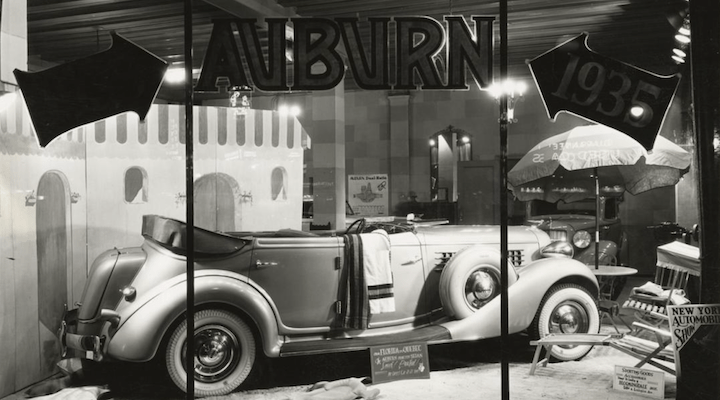
Above: Manhattan auto dealer's window display promoting the 1935 Auburn's appearance at the New York Automobile Show. (Detroit Public Library)
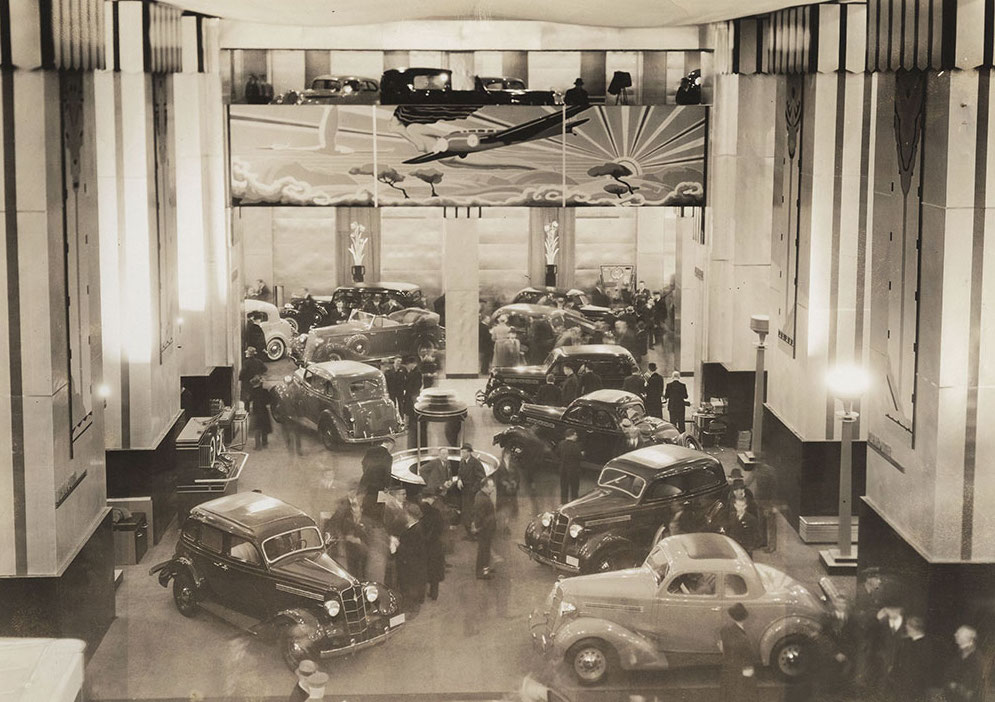
Manhattan’s first big event of 1935 was the annual automobile show at the Grand Central Palace, where New Yorkers chased away the winter blues (and the lingering Depression) in a dreamscape crammed with gleaming new cars.
January 5, 1935 cover by Rea Irvin.
The exhibition included mostly domestic models with wider bodies and, in the case of Chrysler, a dialing back of a radical, streamlined design that was too advanced for American tastes in the 1930s.
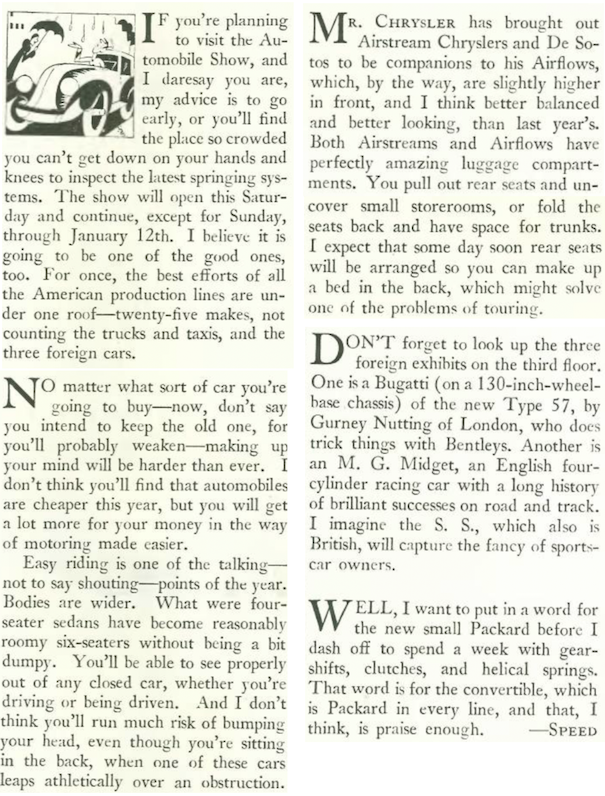
CROWD SOURCING…New Yorker correspondent “Speed” observed that the Grand Central Palace was so crowded with new cars that “you can’t get down on your hands and knees to inspect the latest springing systems.” (forums.aaca.org)SAFE ROOM…This Ford dealer postcard touted safety, durability and roominess rather than style to market a V-8 sedan to Depression-strapped car buyers. (Pinterest)BACK TO BASICS…The DeSoto display showcased more traditional designs (top) after the disappointing debut of the 1934 Airflow. Below, three foreign makes were on display, including Great Britain’s sporty MG Midget. (forums.aaca.org)
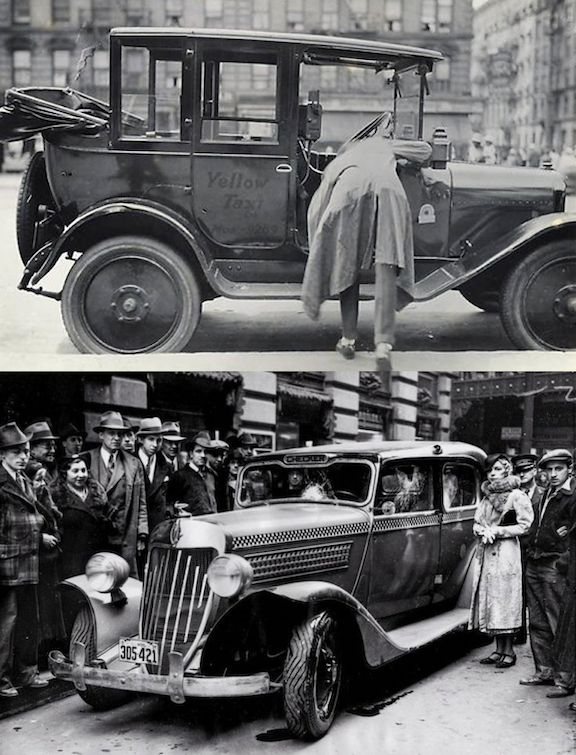
It is no surprise that E.B. White was once again disappointed with new line of cars, still preferring the boxy Model T to the lower-slung streamlined models. That distaste extended to the new taxi cabs hitting the streets of Manhattan, where White saw absolutely no need for wind resistance. An excerpt from his “Notes and Comment:”
IF IT AIN’T BROKE…E.B. White preferred to old Yellow Taxis (seen at top, circa 1932), to the new streamlined Model Y Checker Cabs that were introduced to the streets of Manhattan in 1935. (Metropolitan Museum of Art/Pinterest)
* * *
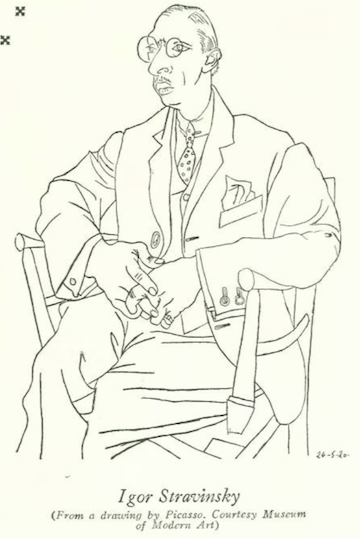
Elsewhere, The New Yorker added a new twist to its “Profile” section by featuring an illustration derived from a drawing by Pablo Picasso…
* * *
From Our Advertisers
The New Yorker’s advertising department padded its revenue from the Christmas season with a slew of ads from automobile companies touting the wonders of their latest models, which were on display at the New York Auto Show…former makers of horse-drawn carriage bodies, the Fisher brothers (Fred and Charles) began making bodies for automobiles in 1908, and the company was later incorporated as part of General Motors…as noted earlier, safety and durability (rather than style) were the calling cards of many automakers during the Depression…
…as is also evidenced here in this ad from Plymouth, part of a continuing series that touted the crash-worthiness of their sedan…
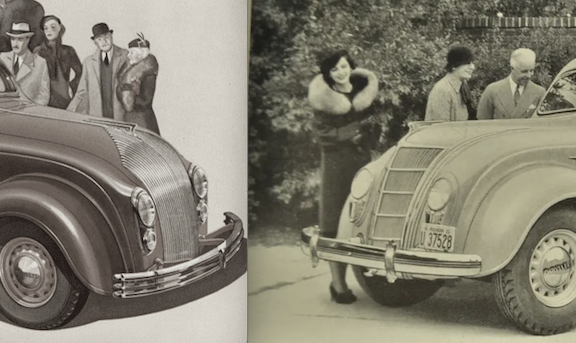
…Plymouth’s parent company Chrysler, still stinging from the lack of consumer interest in their boldly aerodynamic Airflow (introduced in 1934), made modifications to the Airflow’s body, replacing the bold “waterfall” grille with a more traditional peaked unit…the company also offered an even more traditional “Airstream” model that outsold the Airflow 4 to 1…
Consumers in 1934 found the Chrysler Airflow’s bold design (left) too advanced for the times, so Chrysler responded by making the grille on the 1935 model (right) a bit more traditional. That didn’t help sales, either.
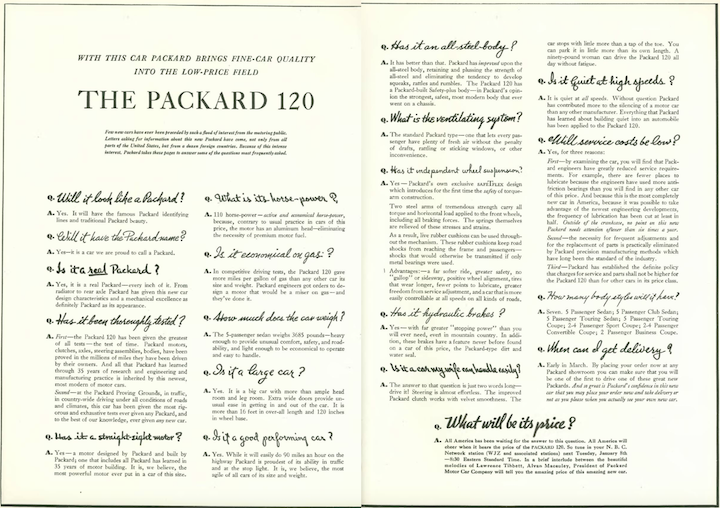
…luxury car maker Packard addressed the challenges of the Depression by introducing a low-priced car (under $1,000) named the 102…it was teased here on the first page of a three-page ad…
…that provided some answers to a “flood” of questions the folks at Packard claimed they had received from across the country and around the world…
…but the ad kept readers in suspense about the car’s actual cost, which was to be announced during Lawrence Tibbett’s NBC radio program…
…Hupmobile was still hanging in there with the innovative, Raymond Loewy-designed Model J, but behind the scenes the company, already beset with sagging sales, was fighting a hostile takeover and would stop making cars altogether by 1938…
…Auburn was also on its last legs, its cars known more for being fast, good-looking and expensive rather for being than safe and economical…although the supercharged Speedster shows here would become a legend in automotive history, and although Auburn began selling more affordable models, the Depression had already taken its toll…
…other luxury brands, such as Cadillac, could survive because they were buoyed by the scale and largesse of a huge corporation, in this case General Motors…
…the folks at Hudson marketed their “Terraplane” with this cartoon ad that quite possibly was illustrated by Wesley Morse, who in 1953 would create the Bazooka Joe comic strip for Topps…
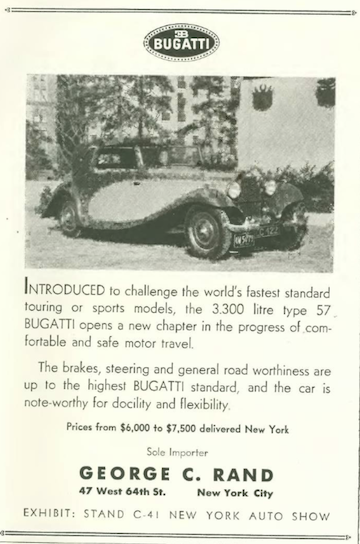
…only three foreign makes were displayed at the exhibition, including Bugatti, which promoted its type 57 in this modest ad placed by a local dealer…at prices ranging as high as $7,500 (nearly $170k today), it was a definitely not a car for the thrifty minded…
…some non-car ads included beachwear from Bonwit Teller…
…while Burdine’s offered men’s suits men that apparently could be worn comfortably while relaxing on the sand…
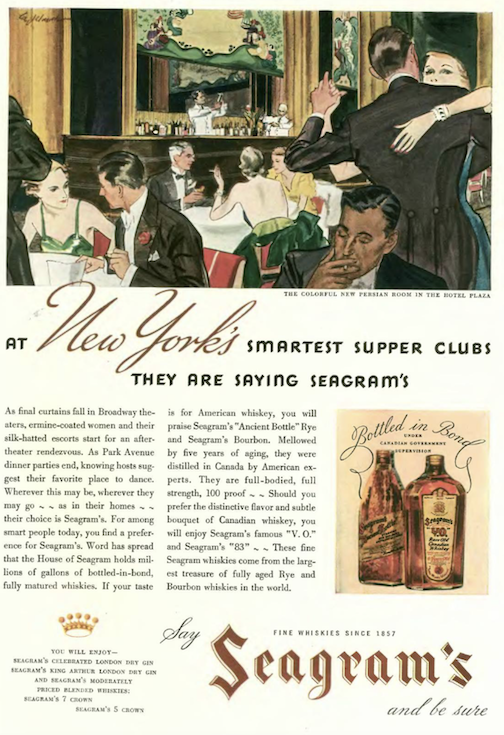
…besides the car companies, others who possessed the means to run full-page color ads included the makers of spirits…
…chewing gum…
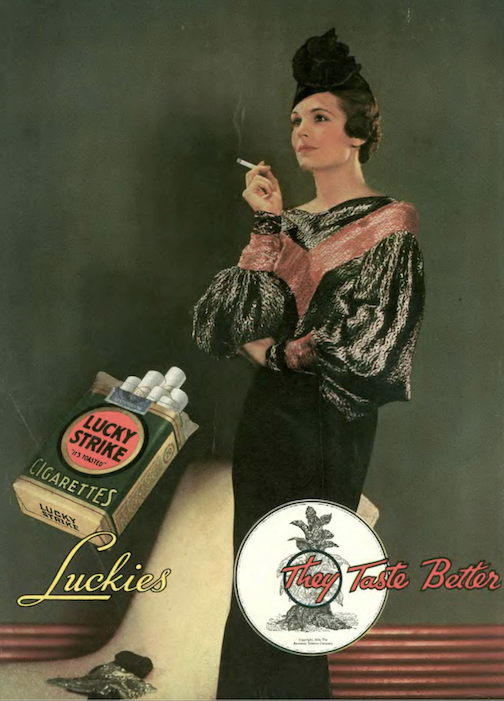
…and, of course, cigarettes…
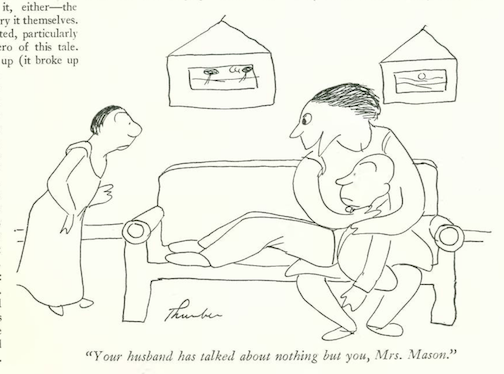
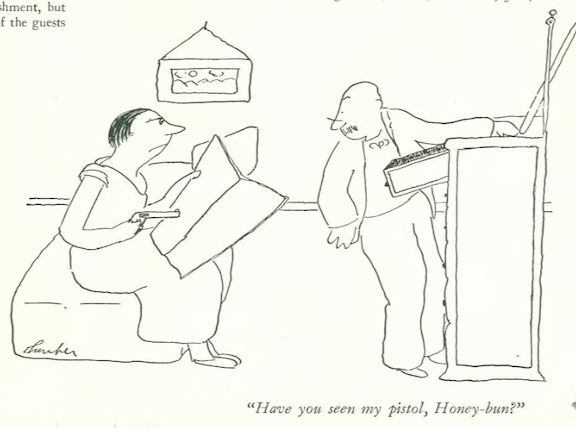
…on to our cartoons, we begin with a spot and a panel by James Thurber…
…Al Frueh, whom we haven’t seen in awhile, gave us an elaborate joke conjured up by some bored astronomers…
…Kemp Starrett looked in on an unlikely Packard customer…
…Perry Barlow predicted a hot time for these two young lads…
…and to close, Gardner Rea offered a cure for a New Year’s hangover…
Above: The Cat and the Fiddle (Pete Gordon) and Mickey Mouse (a monkey in a very creepy costume) were featured in 1934's Babes In Toyland.
We close out the old year and ring in the new with a bit of song and dance from three musicals that entertained New Yorkers in the waning days of 1934.
Dec. 22, 1934 cover by Arnold Hall.
The work of composer Jerome Kern and lyricist Oscar Hammerstein II were prominent in two of those films, adapted from successful Broadway productions—the romantic comedy Music in the Air and the sentimental Sweet Adeline. Success on the stage did not necessarily translate to the screen in either case, according to critic John Mosher.
SOUR NOTES…The famed silent movie star Gloria Swanson showed off her singing chops in Music in the Air, but it wasn’t enough to save the film from becoming a box office failure. The film centered on the stormy relationship between opera star Frieda Hotzfelt (Swanson) and librettist Bruno Mahler (John Boles, pictured). (TCM)TALL ORDER…For those who recalled Helen Morgan’s tragedy-tinged Broadway performance as Addie in Sweet Adeline, Irene Dunn’s more comical take, although delivered with authority, could not hold up the pallid performances of her co-stars, including Donald Woods, right. (TCM)
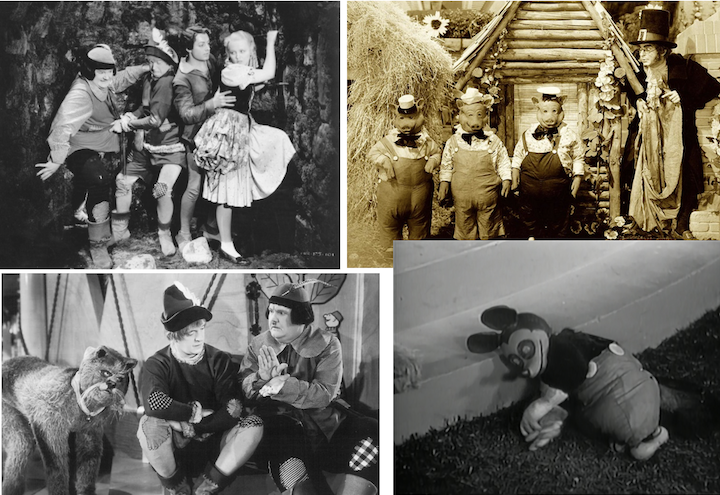
And there was Babes in Toyland, a Hal Roach film headlined by the comedy duo Stan Laurel and Oliver Hardy. The film was well received by critics, including Mosher, who wrote that Babes in Toyland “was far more successful than [1933’s] Alice in Wonderland, and the children will probably be far less bored by it than they generally are by those films designed especially for them.” However, similar to Alice the costumes seem creepily crude, such as the weird rubber pig costumes and the almost terrifying Mickey Mouse, portrayed by a hapless monkey dressed to resemble the big-eared icon. It was apparently the first and last time Walt Disney allowed the Mickey Mouse character to be portrayed outside of a Disney film. No wonder.
Clockwise, from top left, Stan Laurel and Oliver Hardy with Felix Knight (Tom-Tom) and Charlotte Henry (Bo-Peep); the Three Little Pigs with the villain Silas Barnaby, portrayed by Henry Brandon; a very creepy Mickey Mouse (a monkey in costume); and Laurel and Hardy with The Cat and the Fiddle (Pete Gordon). (eofftvreview.wordpress.com/psychotronicaredux.wordpress.com/YouTube/MUBI)
* * *
Alms for the Poor
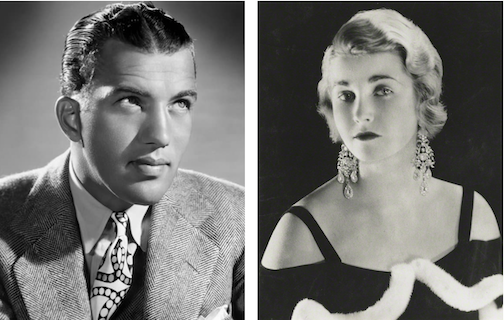
Woolworth store heiress Barbara Hutton was one of the richest women in the world in the 1930s, and her lavish lifestyle in the midst of Depression attracted the attention, and the ire, of newspaper columnist Ed Sullivan. In his “Notes and Comment,” E.B. White made this observation:
COUGH IT UP, LADY…Ed Sullivan, who in 1934 was a well-known Daily News show business columnist, thought Woolworth dime store heiress Barbara Hutton should show more concern for the needy. Known for her lavish spending during the Great Depression, in 1934 Hutton was married to a self-styled Georgian prince named Alexis Mdivani—Mdivani would be the first of Hutton’s seven husbands. Sullivan would go on to greater fame on television with the Ed Sullivan Show. (clickamericana.com/npg.org.uk)
* * *
Oh Baby
Most of us know something about the weird and somewhat tragic tale of the Dionne quintuplets, raised from infancy before the public gaze and exploited to sell everything from dolls and books to soap and toothpaste. When E.B. White made this brief mention in his “Notes and Comment,” the story of the quintuplets was still a jolly one, and their delivering physician, Dr. Allan Roy Dafoe had gone from being a country doctor to one of North America’s most trusted medical authorities. Dafoe would become the childrens’ guardian and impresario, and make a fortune marketing their story and images.
QUINTUPLE YOUR MONEY…After he delivered the Dionee quintuplets, Dr. Allan Roy Dafoe went from being a country doctor to one of North America’s most trusted medical authorities. That later translated into big profits from companies eager to cash in on the quint’s popularity, as these 1937 ads attest. (Pinterest)
* * *
In the Year 2400
“The Talk of the Town” examined the “Buck Rogers” craze, fed by a cartoon strip, a radio show, and an array of toys.
YESTERDAY’S TOMORROW…A Buck Rogers “pop-up” book was just one of the many formats that could be consumed by avid followers of the early sci-fi hero. Also pictured are a themed pocket watch and the “must have” sci-fi toy of 1934, Buck’s XZ-31 Rocket Pistol. (Pinterest/Bullock Museum)
* * *
What’s It All About, Alfie?
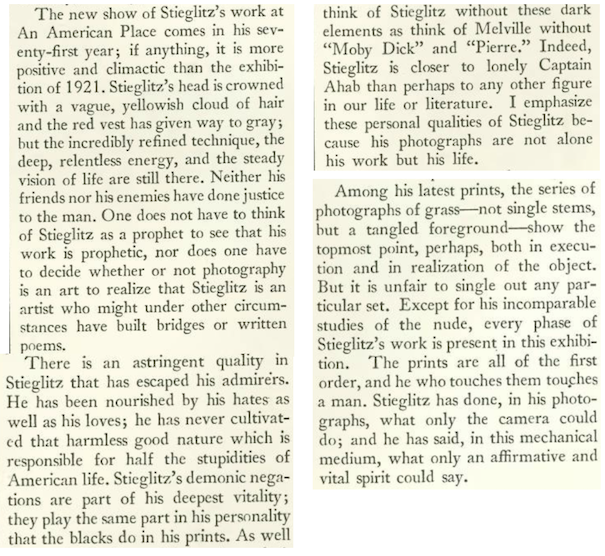
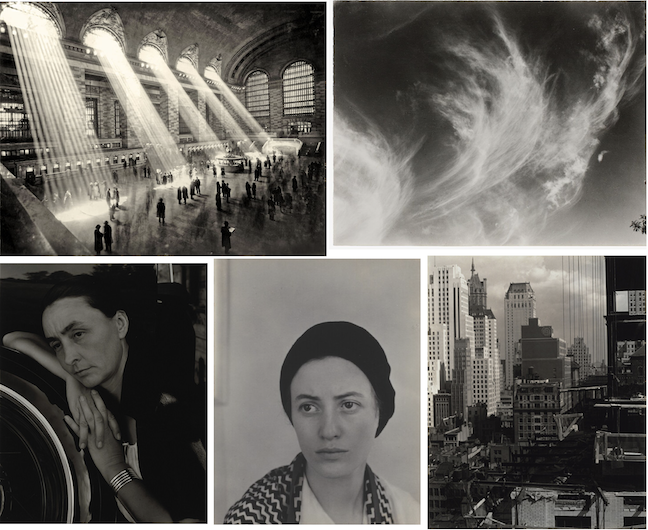
Art and architecture critic Lewis Mumford offered praise for Alfred Stieglitz’s latest exhibition at the photographer’s gallery, An American Place. Mumford noted Stieglitz’s “astringent quality” that rose above the philistine tastes and “stupidities” of American life.
LIFE AND WORK INTERTWINED…Clockwise, from top left: Alfred Stieglitz’s famed 1930 image of Grand Central Terminal; one of the photographer’s many images of clouds under the title Equivalent, 1930; image taken from Stieglitz’s studio/gallery window titled From My Window at An American Place, North, 1931; Dorothy Norman, circa 1931; Georgia O’Keeffe, 1933. Stieglitz, who was married to Georgia O’Keeffe, became Dorothy Norman’s mentor and lover in the late 1920s. (National Gallery of Art/Art Institute of Chicago)
* * *
From Our Advertisers
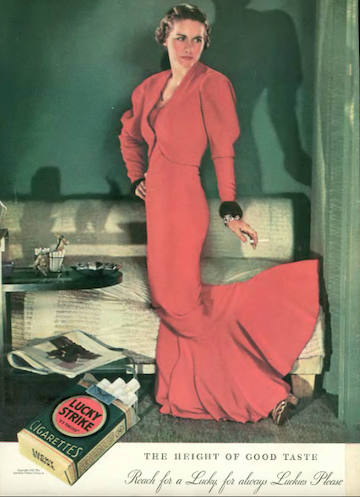
The back cover of The New Yorker was coveted by tobacco companies, the makers of Camels and Lucky Strikes (seen here) both featuring sumptuous photos of stylish women using their product, women being a key growth market for the companies…
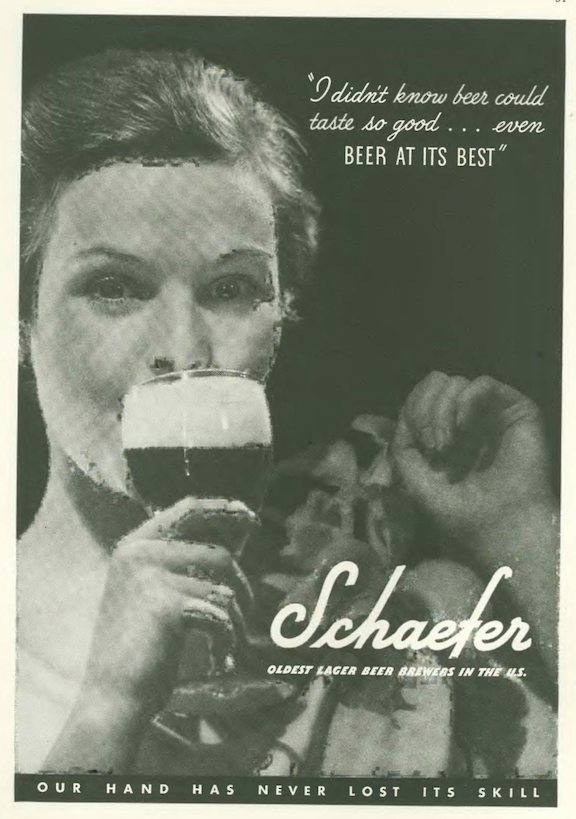
…same for the brewers, who also sought out female consumers to bolster sales of their brands…
…Ponds continued to roll out the seeming legions of socialites and lower-tier royalty to sell their jars of cold cream…
…the magazine’s ads were often directed at middlebrow class anxieties, as we see here…
…by constrast, this ad from Bonwit Teller (graced by fashion illustrator W. Mury) took us out of the stuffy parlor and onto the beckoning beaches of the Caribbean…
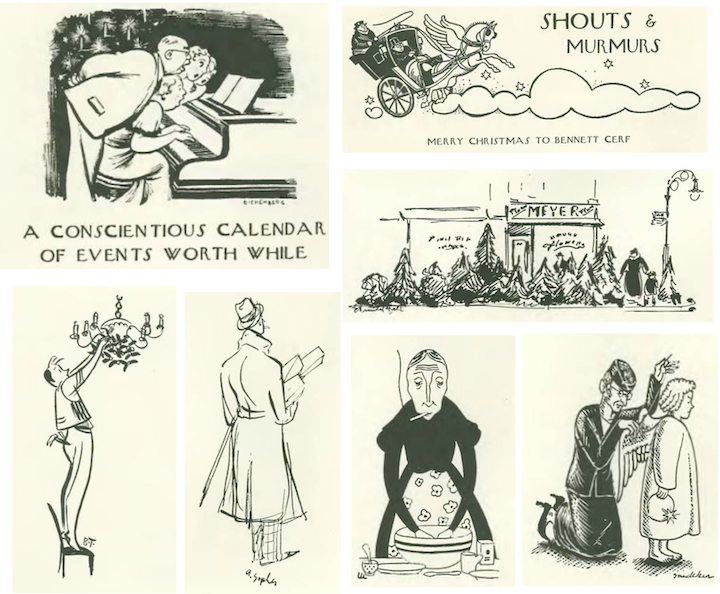
…we move on to our cartoonists…all of the spot illustrations in the issue were holiday-themed, and here are a few choice examples…
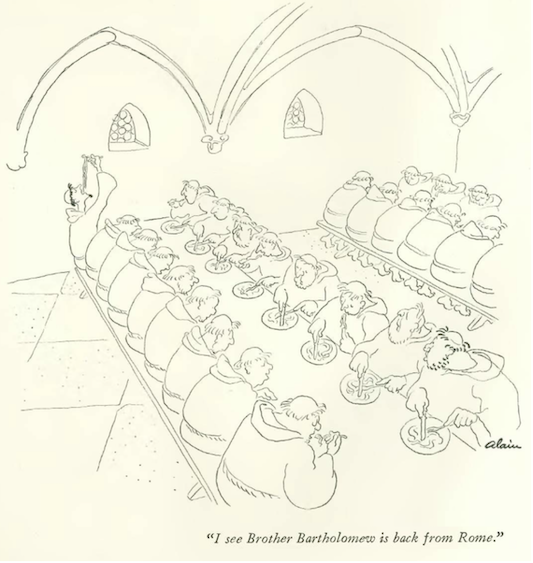
…Daniel ‘Alain’ Brustlein introduced a bit of color to a monastery’s dining hall…
…James Thurber continued to explore the dynamics between the sexes…
…Barbara Shermund did a bit of dreaming with her modern women…
…Carl Rose gave us Christmas cheer, with some reservations…
…and lastly, Perry Barlow with something for the holiday procrastinator…
McSorley’s Old Ale House is probably best known to New Yorker readers through the work of Joseph Mitchell, who was noted for his distinctive character studies in The New Yorker and who in 1943 published McSorley’s Wonderful Saloon, which was later included in a 1992 collection of Mitchell’s works, Up In the Old Hotel.
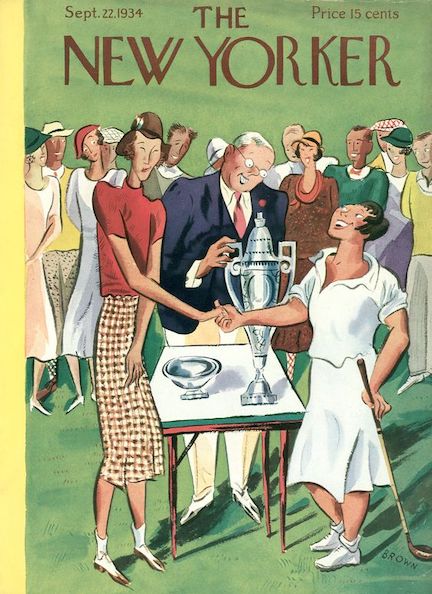
Sept. 15, 1934 cover by Rea Irvin.
Among New York’s oldest saloons, McSorley’s was one of the last of the “Men Only” pubs, finally admitting women in 1970 after the state required the saloon to comply with the U.S. Constitution’s Equal Protection Clause. McSorley’s was visited by many famous patrons in its long history, a mixed bunch that included Abraham Lincoln, Teddy Roosevelt, Harry Houdini and John Lennon. Nine years before Mitchell would pen his account of the saloon, “The Talk of the Town” took a look.
MORE THAN A BAR…Folks were (and still are) drawn to McSorley’s Old Ale House for its rustic atmosphere—apparently no piece of memorabilia has been removed from its the walls since 1910. Clockwise, from top left, McSorley’s in 1942; 1937 Berenice Abbott photo of the interior; and two paintings by John Sloan—McSorley’s Bar, 1912; and Cats in McSorley’s, 1928. Sloan was among the Ashcan School of artists that included Stuart Davis and John Luks—all regulars at McSorley’s. (keithyorkcity.wordpress.com)
* * *
Of the People
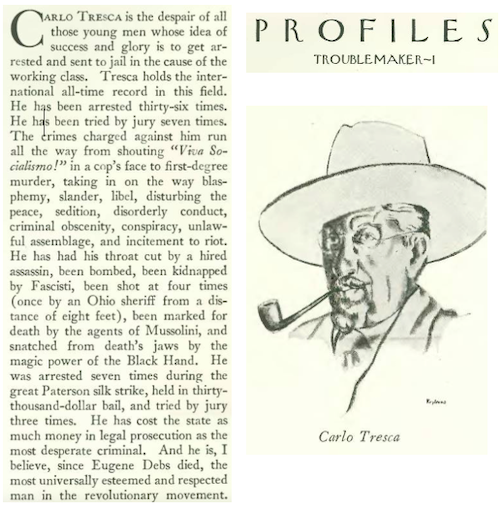
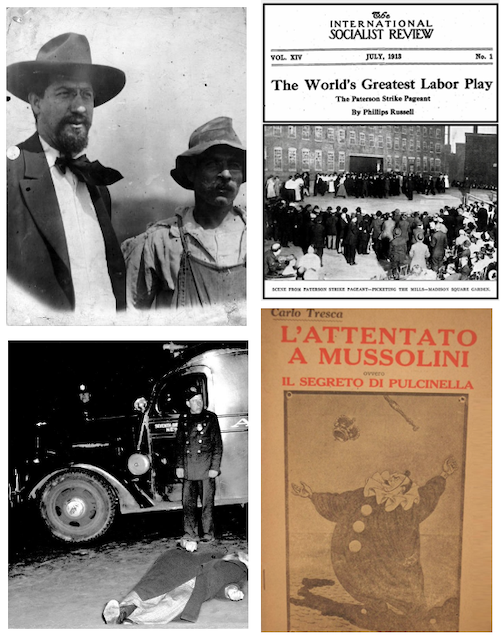
The Italian-American labor organizer Carlo Tresca was a gifted orator and outspoken critic of anyone who stood in his way in his quest for workers’ rights. As political activist and writer Max Eastman pointed out in the lead paragraph of a two-part profile, speaking truth to power also prompted a number of deadly assaults on Tresca (1879–1943), whose campaign for justice was ultimately cut short by an assassin’s bullet in 1943. A brief excerpt:
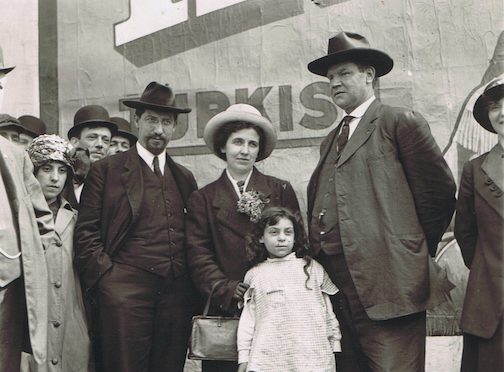
STANDING FIRM…Leaders of the International Workers of the World who led the 1913 Paterson (N.J.) mill strike included, left to right, Carlo Tresca, Elizabeth Gurley Flynn and William D. Haywood. (Photo: News Dept. American Press Association)UP TO THE FINAL CURTAIN…Clockwise, from top left: Carlos Tresca with an unidentified worker in the 1910s; labor activists often staged theatrical works to get their point across—in 1913 The International Socialist Review covered a play at Madison Square Garden about the Paterson N. J. mill strike, which featured more than a thousand amateur actors; cover of a 1926 theatrical work, L’attentato a Mussolini, that attacked the fascist dictatorship of Benito Mussolini; police officer guards Tresca’s body after his 1943 assassination. Tresca was crossing Fifth Avenue at 15th Street when an unidentified assailant jumped out of a black Ford and shot him in the back of the head, killing him instantly. (Wikipedia/weneverforget.org/wetheitalians.com)
* * *
Up In Smoke
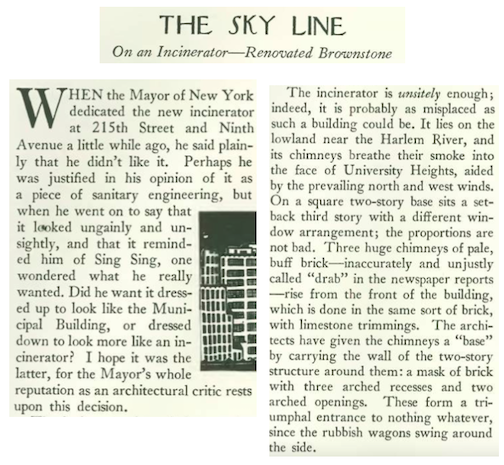
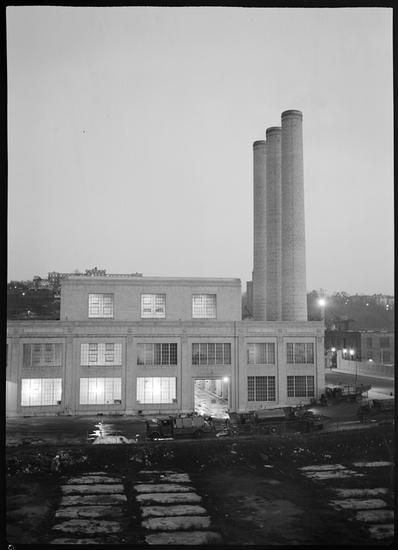
Lewis Mumford sniffed at much of the new architecture popping up around his city, but he took an especially big whiff of the new incinerator that rose above the neighborhoods at 215th Street and Ninth Avenue. When the incinerator opened in 1934 the city stopped dumping its garbage into the sea (it was fouling the beaches) and began burning the stuff around the clock in Harlem, where residents had put up with the smoke and cinders that were emitted from the supposedly “odorless” plant. Cole Thompson’s website My Inwood is a great place to read more about it.
ASHES TO ASHES…New York’s municipal incinerator, located in Harlem, as seen in 1937. The plant closed in 1970 when the city’s rubbish was re-directed to the Fresh Kills landfill on Staten Island. The smokestacks, which had become something of a landmark, were demolished in 2022. (Museum of the City of New York)
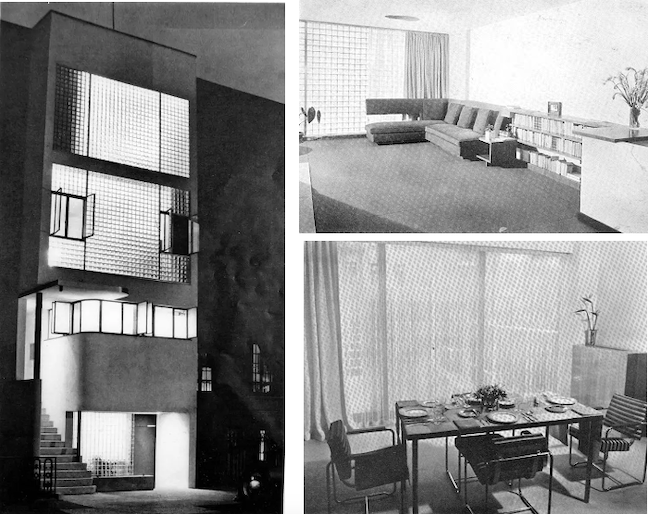
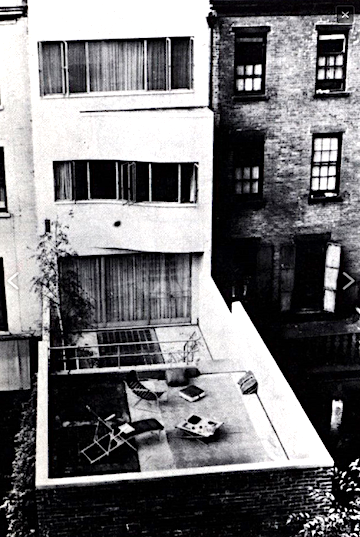
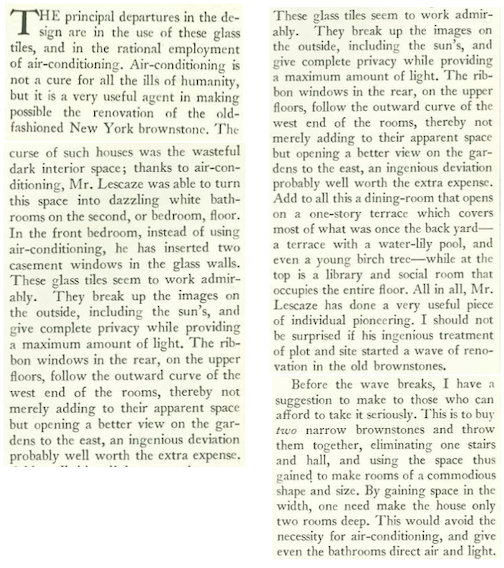
Mumford brightened, however, at another development in the Turtle Bay neighborhood, where architect William Lescaze (1896–1969) had slipped a bright, modernist house in between two dusky brownstones on East 48th Street. The house featured extensive use of glass block in its construction, an architectural first in the city.
RADICAL CHIC…William Lescaze’s four-story house, inserted between the brownstones on East 48th Street, is considered to be the first modernist house in city; at right, the Swiss-born American architect, city planner and industrial designer endorses highballs mixed with Lord Calvert Whiskey in a 1948 advertisement. (Wikipedia)ALL AGLOW…The Lescaze house at night, and two interior views. (From the 1936 issue of Decorative Art, the Annual Issue of the Studio Yearbook via djhuppatz.blogspot.com)GLASSY EYED…The Lescaze House’s glass block facade, the first to be used on a building in New York City, were installed to provide insulation and privacy while also allowing extensive illumination. At right, the front entrance to the lower level, which contained Lescaze’s office. (6sqft.com)THINK PAD…Lescaze situated the most important rooms to the back of the house (dining, master bedroom and living) to isolate them from street noise and bathe them in northern light. His basement office extended under the back terrace. (hiddenarchitecture.net)
Mumford noted that the recent invention of home air-conditioning systems made it possible for Lescaze to bring light deep into the central core of the building…
HIGH AND LOW…Lescaze’s works in the early 1930s included the 1932 PSFS Building in Philadelphia (today: Loews Philadelphia Hotel); at top, PSFS interior view showing board room conference table; below, the 1930-31 Fredrick Vanderbilt Field House in Connecticut. (Hagley Museum and Library/Wikipedia/djhuppatz.blogspot.com)
* * *
Poser
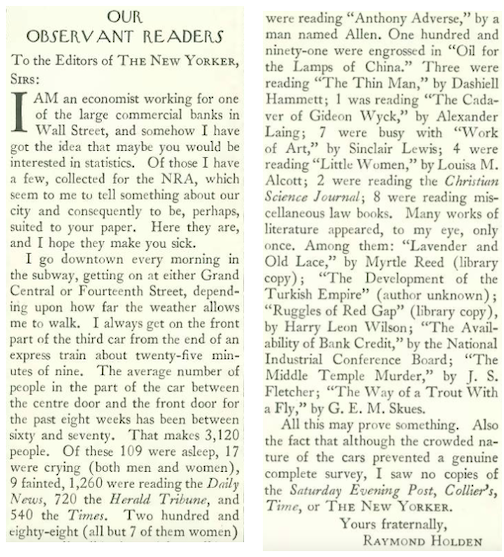
The novelist and poet Raymond Holden (1894–1972) was a regular contributor to The New Yorker from 1929 to 1943. For the Sept.15 issue he assumed the guise of an economist to pen this cheeky letter to the editors:
* * *
Head in the Clouds
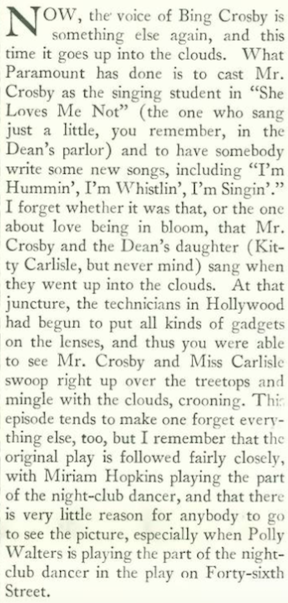
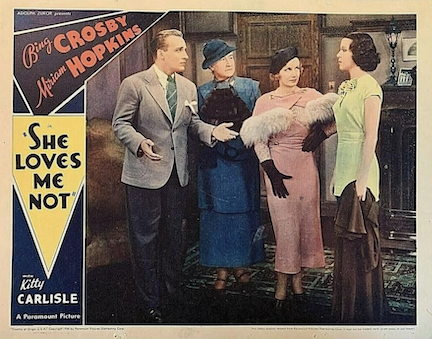
Film critic John Mosher thought Bing Crosby was a fine singer, but he couldn’t quite fathom why the movie-makers at Paramount thought the singer would be even more attractive if he was sent aloft using various camera tricks.
COME FLY WITH ME…Lobby card advertising 1934’s She Loves Me Not starring, from left, Bing Crosby, Maude Turner Gordon, Miriam Hopkins and Kitty Carlisle. (IMDB)
* * *
From Our Advertisers
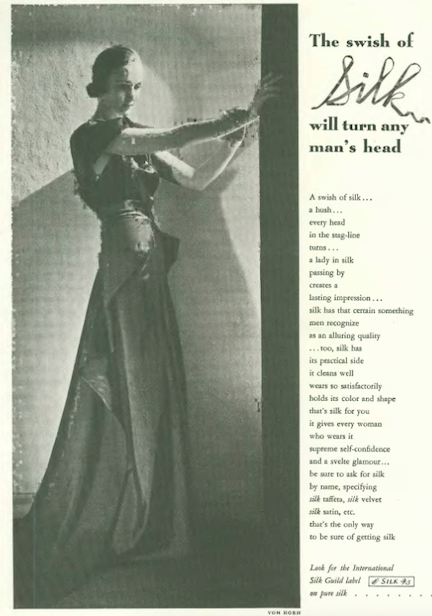
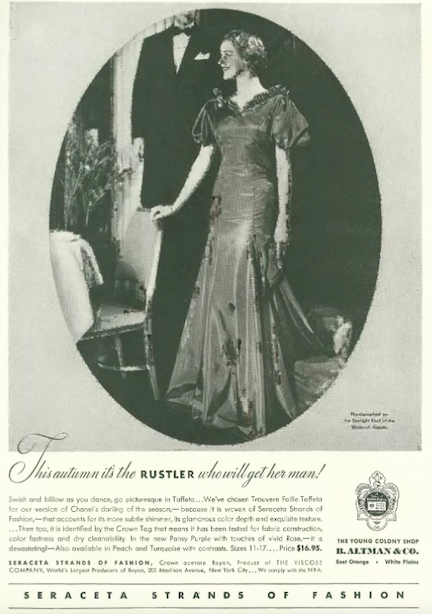
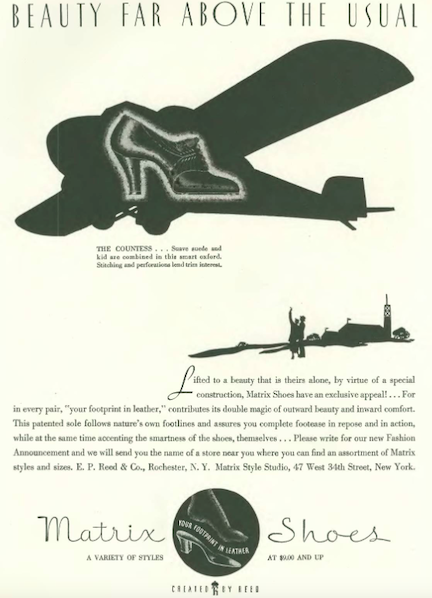
The advertising department must have been thrilled with the flurry of ads that announced the fall and winter fashions…here are three examples, the first two focused on styles supposedly designed attract the opposite sex…the International Silk Guild promised that the “swish” of silk would turn any man’s head…
…while B. Altman’s “Young Colony Shop” claimed you could get your man with the “swish and billow” of taffeta…
…B. Altman ran a second full-page ad to catch a bit older demographic, less concerned with landing a man and more concerned with sending the proper signals to fellow Anglophiles…
…the folks at Matrix shoes were looking for a way to associate their “Countess” model with modern living, but what they got was an image of people waving farewell to some flying footwear…
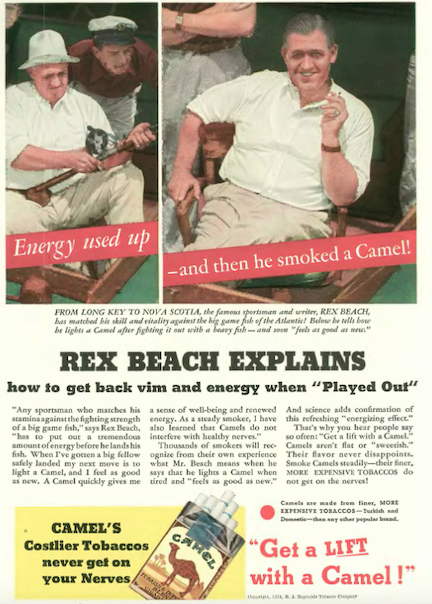
…and here is another in a continuing series of ads from R.J. Reynolds that claimed “science” had confirmed the refreshing, energizing effect of its Camel cigarettes…
…we clear the air with this attractive ad beckoning New Yorkers to sun-kissed Bermuda…
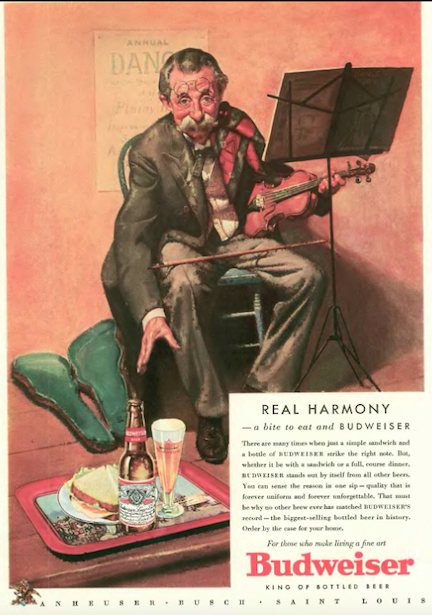
…Budweiser continued its series of Rockwellesque portraits of old men enjoying its product…
…and this two-page spread from Fisher—maker of car bodies for General Motors—shows us how young tots travelled in the days before plastic car seats and other restraining devices…
…on to our cartoonists we begin with a couple examples of spot illustrations from the opening pages…
…on to Peter Arno…the caption reads, “I adore driving at night. Once I caught my foot in a bear trap, though”…the humor is lost on me…I suppose she is referring to a speed trap, perhaps set by an amorous cop…
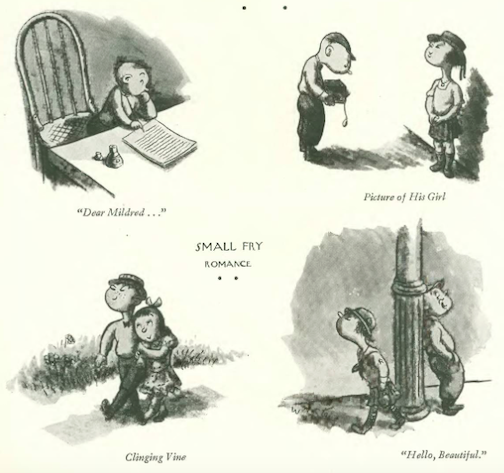
…speaking of amorous, William Steig explored the subject amongst his “Small Fry”…
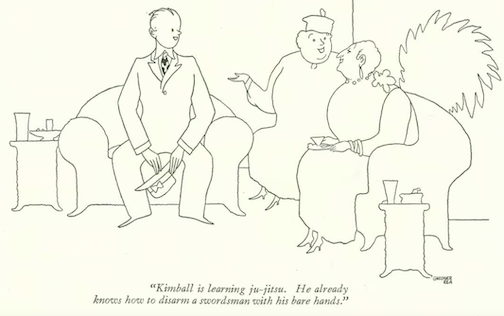
…Gardner Rea sat in on an unlikely boast…
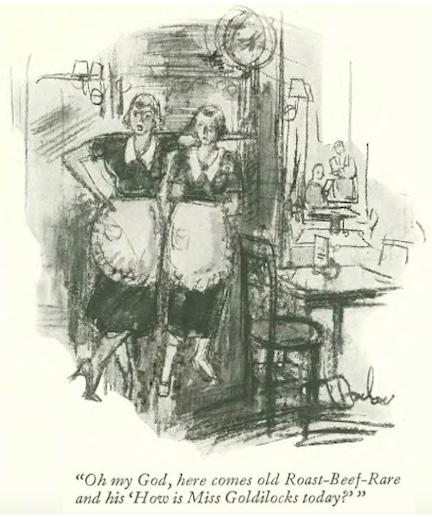
…Perry Barlow illustrated the doldrums associated with waitressing…
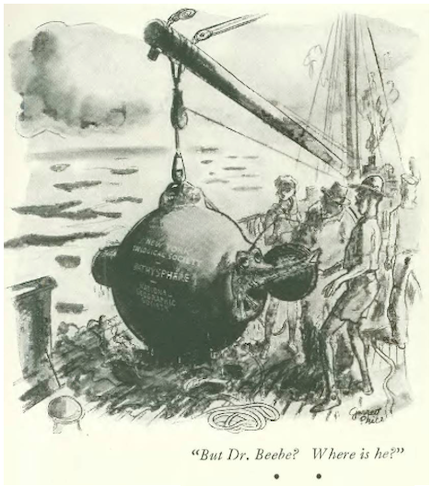
…Garrett Price checked in on the latest developments in deep sea exploration…
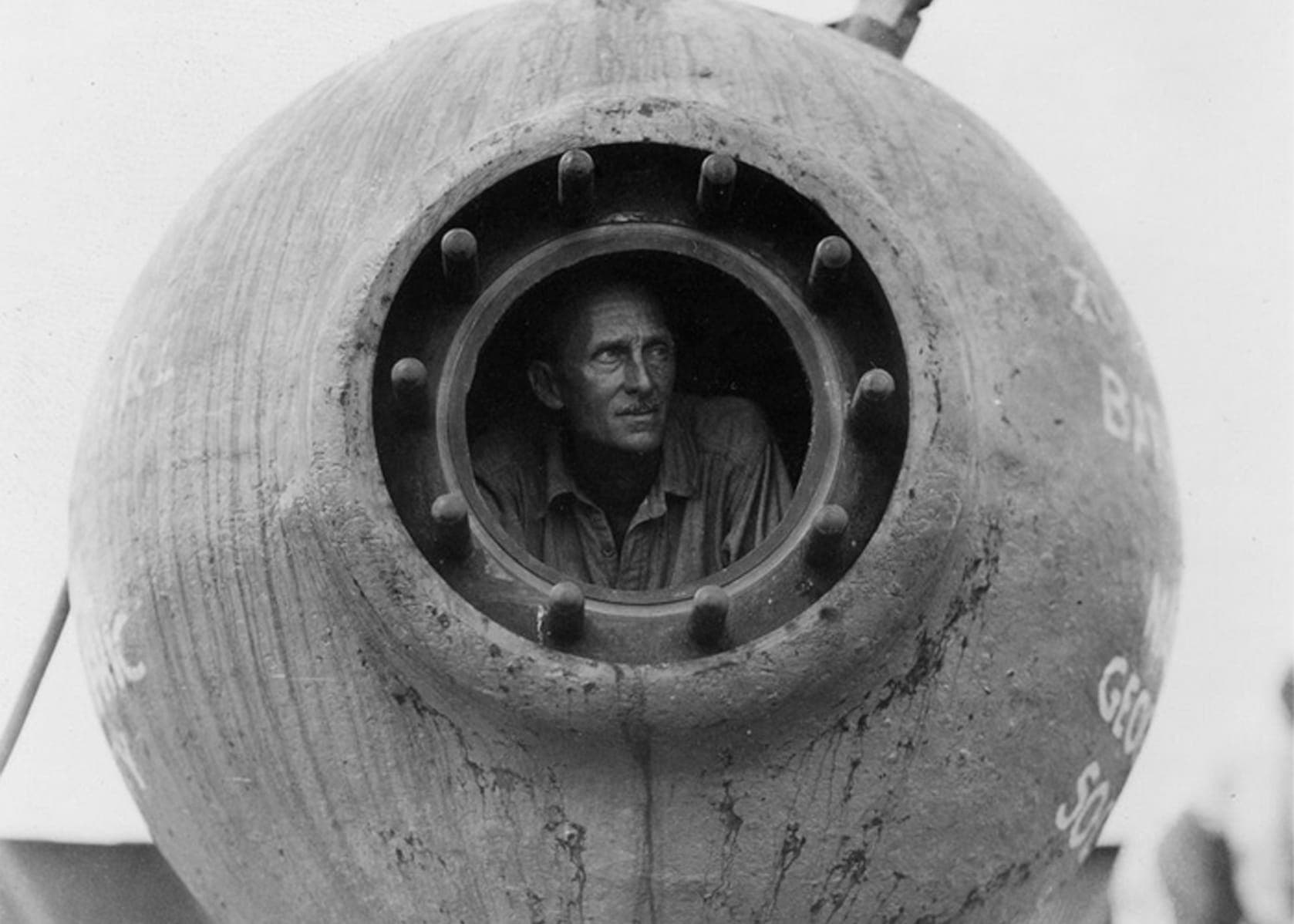
…the cartoon refers to the explorations of William Beebe, who along with engineer Otis Barton descended in a bathysphere to a record 3,028 feet (923 m) on Aug. 15, 1934…
SIT TIGHT…Naturalist William Beebe poses inside the bathysphere in the early 1930s. (msmocean.com/)
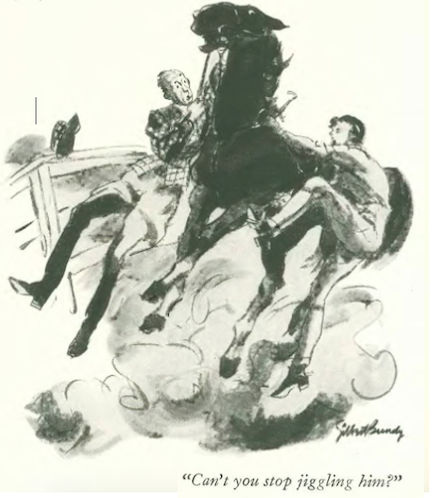
…and we close with Gilbert Bundy, and a couple of horse wranglers…
Above, Stewart's Cafeteria in Greenwich Village, May 1933. (New York Public Library)
Although Sherwood Anderson is mostly known for his short story collections and novels, in the 1930s he also worked as a journalist, and for the June 9, 1934 issue of the New Yorker he explored the “centre of proletarian high life,” Stewart’s Cafeteria in Greenwich Village.
June 9, 1934 cover by Helen Hokinson.
What is particularly interesting about Anderson’s page 77 article for the “A Reporter at Large” column is what it doesn’t report, namely, that Stewart’s Cafeteria (later the Life Cafeteria) was known as a popular gay and lesbian hangout in addition to being a place for gawkers, assorted bohemians, and bohemian wannabes.
Anderson was a man of the world, so he knew exactly what Stewart’s was all about. But even the New Yorker wasn’t in the business of outing anyone, and editor Harold Ross, whose eccentricities included a puritanical strain, would not have allowed anything associated with “sexual deviance” to be printed in his magazine. Here is an excerpt from Anderson’s article, “Stewart’s, On the Square,” in which he subtly hints at the cafeteria’s “third life.”
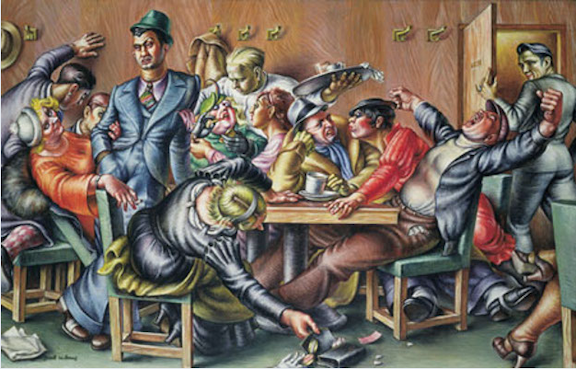
NIGHT LIFE…Paul Cadmus depicted Stewart’s in this sexually charged painting, Greenwich Village Cafeteria, 1934, oil on canvas,Museum of Modern Art. (All archival images for this entry were obtained via nyclgbtsites.org/site/stewarts-cafeteria)
While Anderson tiptoed around the topic of homosexuality, gossip rags such as Stephen Clow’sBroadway Brevities put it front and center. Described as one of the most vicious show business gossip magazines ever published, Brevities also provided Clow with some side income: Clow and his collaborators often threatened to blackmail wealthy businesspeople and show business figures who frequented places like Stewart’s—outing them in his tabloid unless payment was made.
(McGill Institute via HuffPost.com)
Naturally such reporting helped attract gawkers to Stewart’s and its successor, Life Cafeteria. According to the NYC LGBT Historic Sites Project, “Stewart’s closed in the mid-1930s and was subsequently reopened as the equally popular Life Cafeteria. Regulars included a young Tennessee Williams and Marlon Brando (though they didn’t meet each other until years later on a beach in Provincetown). Of the space, Brando later recalled, ‘The rednecks [on the street] were pointing at the diners like animals in a zoo. I was immediately intrigued and ventured in. Before I left that afternoon, I discovered that many of the homosexual men were actually putting on a show for the jam .'”
ON DISPLAY...According to the NYC LGBT Historic Sites Project, the large plate glass windows at Stewart's (later renamed Life Cafeteria) put gay life on full display to the late-night crowds who frequented the busy intersection. Artist Vincent La Gambina depicted one scene that gawkers might have taken in: Life Cafeteria, Greenwich Village, 1936. (Museum of the City of New York)TODAY, the building still stands, although it is a bit less lively as a home for a CVS store and a Bank of America branch. Just around the corner is the famed Stonewall Inn. (Google Maps Image)
According to the NYC LGBT Historic Sites Project:
...in 1935 the manager of Stewart’s was convicted of operating a “public nuisance” and “disorderly house” and “openly outraging public decency” by allowing objectionable behavior in the interior and large crowds to gather outside. Specifically, the district attorney’s complaint cited “certain persons of the homosexual type and certain persons of the Lesbian type, to remain therein and engage in acts of sapphism and divers [sic] other lewd, obscene, indecent and disgusting acts” and that the cafeteria was “used as a rendezvous for perverts, degenerates, homosexuals and other evil-disposed persons.” Much of the testimony centered on the gender non-conforming dress and behavior of the patrons.
Here is another excerpt from Anderson's article, where he delves into the nighttime scene at Stewart's:
* * *
Nightlife, Part II
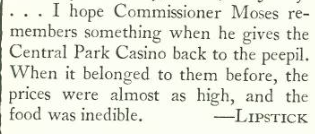
In my previous post E.B. White pondered the fate of the Central Park Casino, a favorite haunt of deposed Mayor Jimmy Walker and other members of the smart set who openly flouted Prohibition laws. In "Tables for Two," Lois Long made this observation (below) at the conclusion of her nightlife column, believing that Parks Commissioner Robert Moses would give the management a chance to lower food prices and allow common folks to enjoy its sumptuous atmosphere. Little did she know that Moses was feasting on a diet of revenge rather than food, and had plans to tear the place down, regardless of its lower prices.
* * *
From Our Advertisers
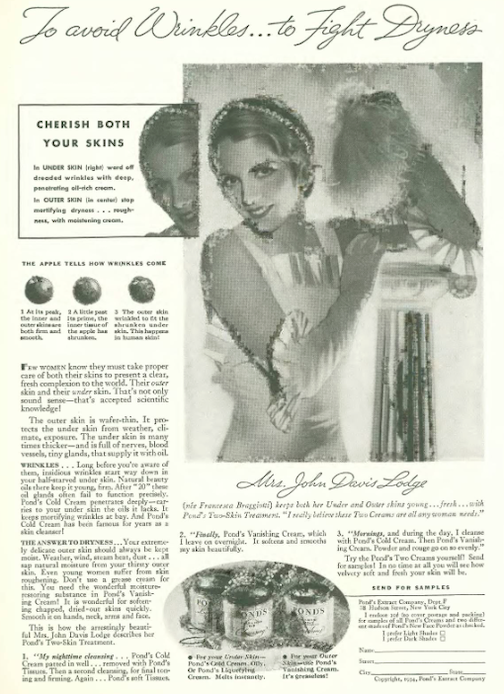
We kick off the ads with another Ponds celebrity endorsement from dancer and actress Francesca Braggiotti (1902-1998), who was married to actor, politician, and diplomat John Davis Lodge...
POWER COUPLE...John Davis Lodge and Francesca Braggiotti in 1932. They were married for 56 years. (Pinterest)
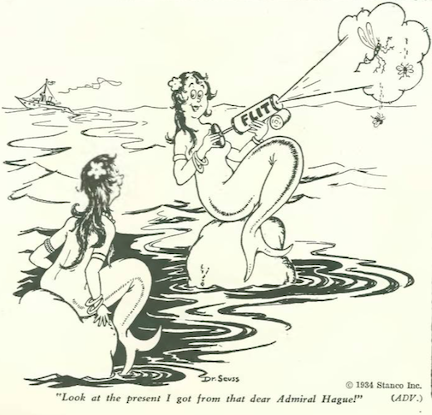
...Dr. Seuss was back with more ads for Flit insecticide...he was still two years away from his first children's book: And to Think That I Saw It on Mulberry Street...
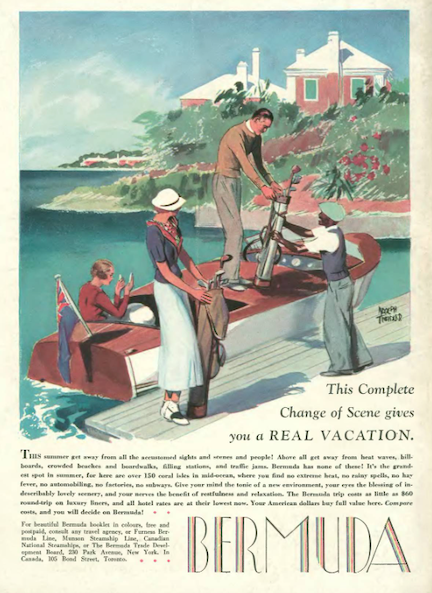
...and with a splash of color, Bermuda beckoned New Yorkers to a "Real Vacation"...
...however, before you headed to Bermuda, you'd needed to do something with the kids...
...on to our cartoonists, we start with spot art from Abe Birnbaum...
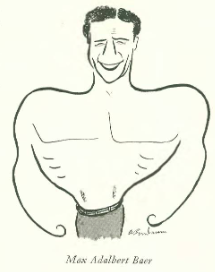
...Birnbaum again with an illustration of boxer Max Baer for the profile section...
...more spot art from James Thurber in the "Goings On About Town" section...
...and Thurber again with some alarming news for a potential suitor...
...Rea Irvin kicked off his series, "Our Native Birds"...
...a famed advertising agency launched a new door-to-door survey, per Perry Barlow...
...Helen Hokinson gave us a hopeful gardener...
...Barbara Shermund looked in on the "modern girl" scene...
...and Peter Arno examined a sad medical case...
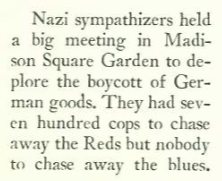
...and we close the June 9 issue with this item from E.B. White, who commented on a recent rally of American Nazis and some fighting Irish...
...the Nazi rally was also alluded to in the June 2 issue (I have the issues reversed this time to support the narrative)...
June 2, 1934 cover by Harry Brown.
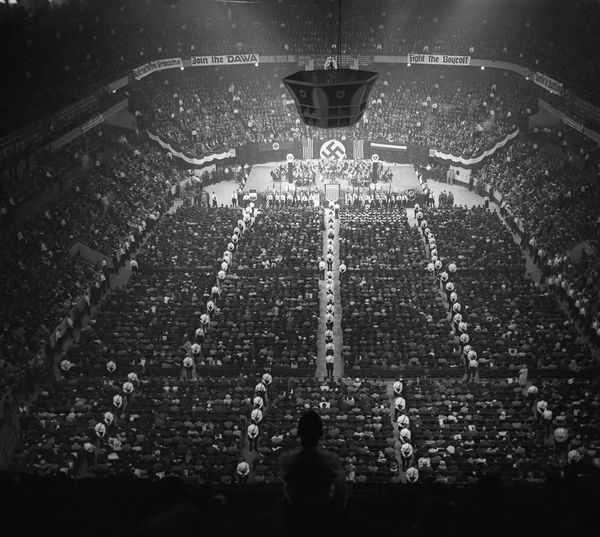
...where Howard Brubaker was keeping things light in his column "Of All Things." I was surprised how little was mentioned in either issue about the meeting of 20,000 Nazi sympathizers on May 17, 1934, at Madison Square Garden.
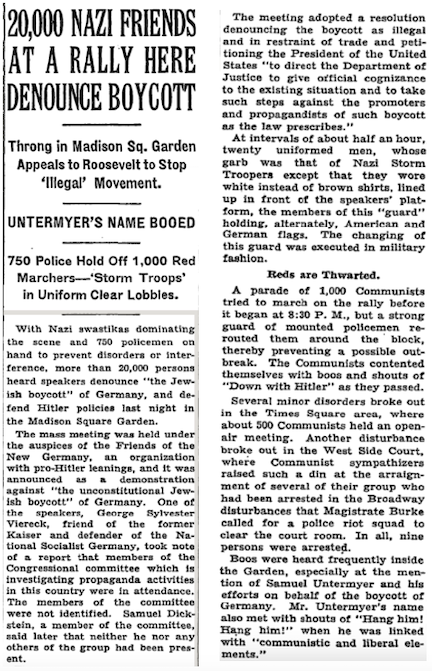
Let's explore further: According to the Jewish Virtual Library, America's first established anti-Nazi boycott group was the Jewish War Veterans (March 19, 1933), followed by the American League for the Defense of Jewish Rights (ALDJR), which was founded by the Yiddish journalist Abraham Coralnik in May 1933. By 1934 the ALDJR was led by Samuel Untermyer, who changed the organization's name to the "Non-Sectarian Anti-Nazi League to Champion Human Rights." Nazi sympathizers targeted Untermyer as the face of boycott efforts, and at the May 17 rally the mere mention of his name prompted shouts of "Hang him!"
AMERIKA...The site for hockey games and dog shows became a site for ugliness on May 17, 1934, when 20,000 Nazi sympathizers gathered in Madison Square Garden to denounce boycotts against Adolf Hitler's regime. (The Archive Project)
This excerpt from the May 18, 1934 edition of The New York Times gives some idea of what transpired at the rally:
REALLY? Americans gathered at Madison Square Garden on May 17, 1934 to show their support for Nazi Germany and denounce American boycotts. (The Archive Project)
* * *
Dueling Muses
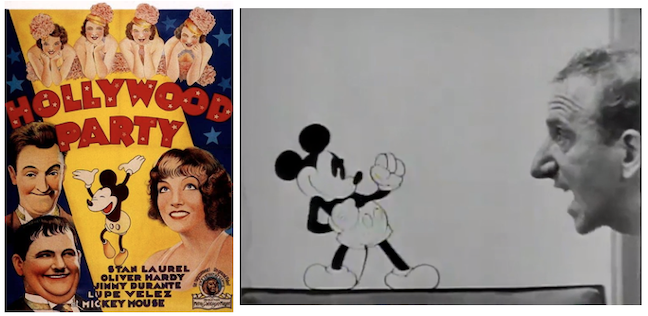
Film critic John Mosher always seemed upbeat about anything involving Disney, but given that animation was still in its infancy (its plastic trickery still rather novel), it didn't take much to outshine the otherwise drab fare (the "Grim") being coughed up by Tinseltown.
MAN OR MOUSE? The star-studded cast of Hollywood Party included Jimmy Durante, seen here duking it out with Mickey Mouse. (IMDB)
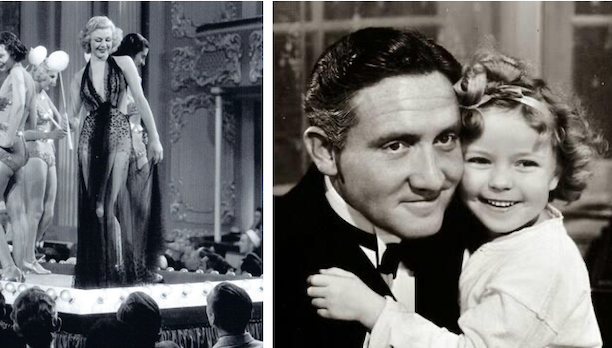
The grim included the Pre-Code drama, Upper World, about a rich, married man who falls to his ruin via a romance with a stripper (don't they always?), and Now I'll Tell, another Pre-Code drama, this one loosely based on the doings of racketeer and crime boss Arnold Rothstein.
SHAKE IT WHILE YOU CAN...Ginger Rogers performs “Shake Your Powder Puff” in a burlesque show in the film Upper World, one of the last of the Pre-Code dramas. It featured Warren William as a wealthy married railroad tycoon whose friendship with a showgirl (Rogers) leads to blackmail and murder; at right, five-year-old future child star Shirley Temple with Spencer Tracy in Now I'll Tell, which was loosely based on the autobiography of Carolyn Green Rothstein, wife of New York gambler Arnold Rothstein. Temple's role was a minor one, however her appearance in the musical Stand Up and Cheer!, which was released a month earlier, would make her a star. (IMDB)
* * *
More From Our Advertisers
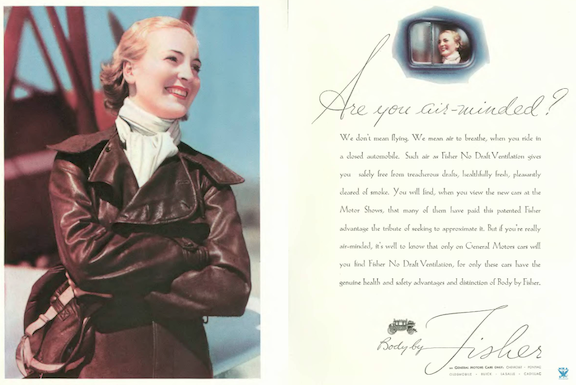
We cool off by a taking a dip in the pool...er, rather by enjoying the "No Draft Ventilation" of a car body by Fisher...the model might want to stay in the pool, since air-conditioning in cars was still a good twenty years away...
...and yes, this is also a car-related ad, if you can believe it, the bride looking forward not to years of wedded bliss but rather her new La Salle (a Cadillac product)...
...another bride, and a car...is that a car body by Fisher? Who cares, the wedding is over and its time to fire one up...
...this woman seems to have it all thanks to Daggett & Ramsdell of Park Avenue, who are prepared to coat her in a "complete range of all the essential creams, lotions, face powder...cold cream soap, dusting powder" etc. etc....
...Dr. Seuss again for Flit, with baby in tow...
...on to our cartoons, we have Robert Day checking on the progress at Mt. Rushmore...
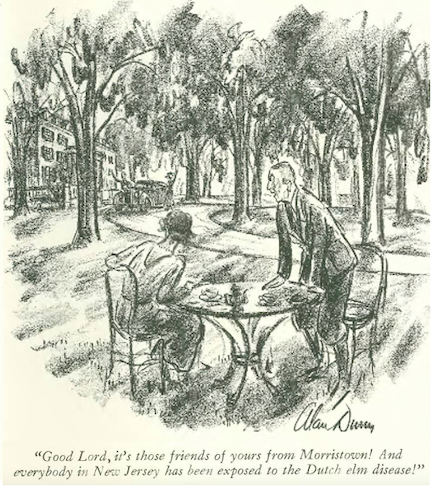
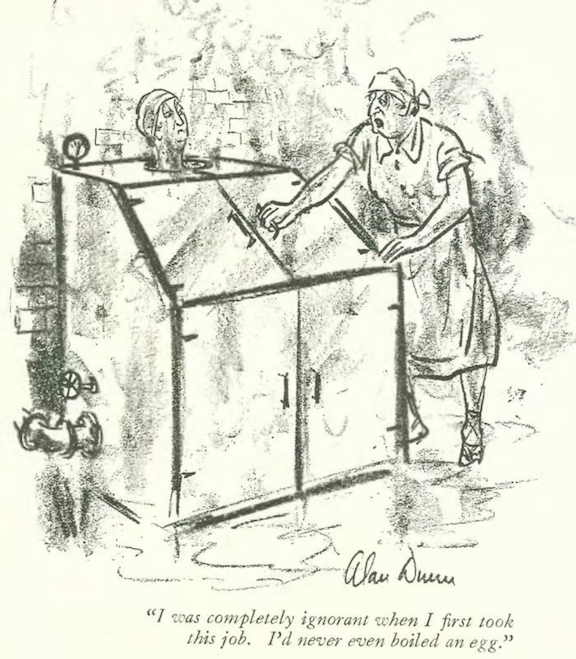
...Alan Dunn reveals pandemic worries of a different nature...
...and we close with Helen Hokinson, and a sudden change of mood...
Above: British architect Norman Foster's 2010 recreation of R. Buckminster Fuller's 1933 Dymaxion car. (Wikipedia)
Despite the limitations of 1930s technology, a few architects and designers were hell-bent on building a streamlined future that until then was mostly the stuff of movies and science fiction magazines.
May 5, 1934 cover by Rea Irvin.
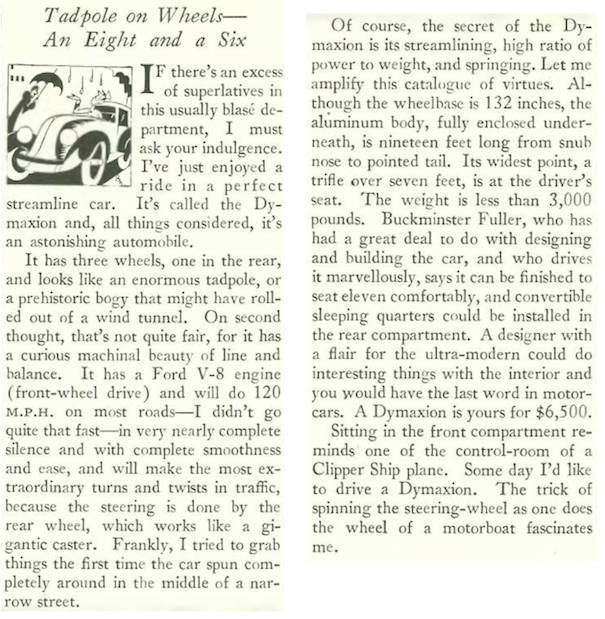
One of them was R. Buckminster Fuller (1895–1983), architect, designer, and futurist probably best known today as the inventor of the geodesic dome (think Disney’s Epcot Center). In the 1930s Fuller was all about a concept he called Dymaxion. Derived from the words dynamic, maximum, and tension, when applied to architecture and design it would supposedly deliver maximum gain from minimal energy input. The writer of the New Yorker article (pseud. “Speed”) was fascinated by the Dymaxion’s motorboat-type steering, no coincidence since Fuller intended to adapt his futuristic car for use on and under the water, as well as in the air.
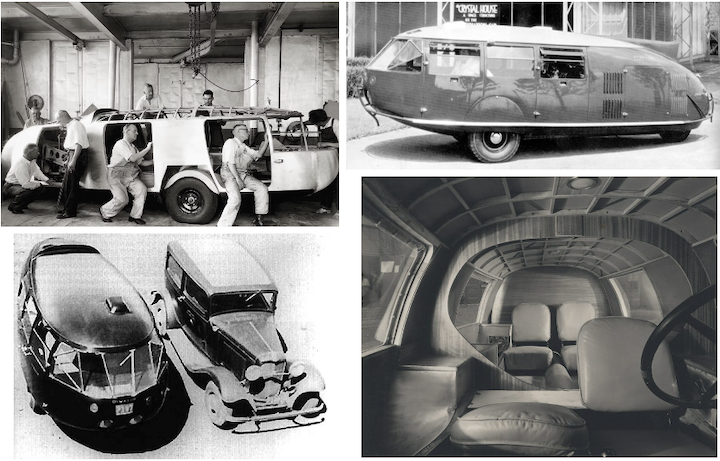
THE SHAPE OF THINGS TO COME…Clockwise, from top left: Workers at a Bridgeport, Conn., plant creating the first of three Dymaxion cars; the Dymaxion at Chicago’s 1933 Century of Progress exposition—the car was involved in a fatal accident at the fair; interior view of the Dymaxion; using the same engine and transmission as a Ford sedan (pictured), the Dymaxion offered three times the interior volume with half the fuel consumption and a 50 percent increase in top speed. (Buckminster Fuller Institute/Poet Architecture)THINKING WITHOUT THE BOX…In 1927 R. Buckminster Fuller (pictured) developed a Dymaxion House, a “Dwelling Machine” that would be the last word in self-sufficiency. Although the aluminum house was intended to be mass-produced, flat-packaged and shipped throughout the world, the design never made it to market (however its ideas influenced other architects); at right, a Fuller geodesic dome at Disney’s Epcot Center in Florida. (archdaily.com/Wikipedia)
The 1933 Century of Progress exposition in Chicago was supposed to be a major showcase for Fuller, but when professional driver Francis Turner was killed while demonstrating the first prototype of the Dymaxion, the car’s prospects dimmed considerably. According to an article by Stephanie d’Arc Taylor (cnn.com Oct. 30, 2019), during the demonstration a local politician tried to drive his own car close to the Dymaxion—to get a better look—and ended up crashing into the unwieldy prototype, which rolled over, killing the driver and injuring its passengers. “The politician’s car was removed from the fracas before police arrived, so the Dymaxion was blamed for the accident,” writes Taylor, who notes that the rear wheel–powered car, though unconventional, was not necessarily the problem. However, “the thing that made the Fuller death-mobile singularly deadly was the fact it was also steered by the rear wheel, making it hard to control and prone to all kinds of terrifying issues.”
That history did not stop architect Norman Foster from building a replica of the Dymaxion in 2010. Foster worked with Fuller from 1971 to 1983, and considers Fuller a design hero.
GIVING IT ANOTHER GO…Architect Norman Foster with his 2010 recreation of the Dymaxion. To build a new Dymaxion, Foster sent a restorer to the National Automobile Museum in Reno, Nevada (home of the only surviving Dymaxion, Car No. 2), and after thousands of photos and measurements Foster had the car recreated using only materials available in 1933: Foster’s Dymaxion consists of an ash frame sheathed in hand-beaten aluminum, mounted on the chassis of an old 1934 Ford Tudor Sedan. (CNN/The Guardian)
According to Taylor, Foster cleaved so closely to Fuller’s original designs that he refers to his creation as a fourth genuine Dymaxion—not a replica. “The car is such a beautiful object that I very much wanted to own it, to be able to touch as well as contemplate the reality for its delight in the same spirit as a sculpture,” said Foster. “Everything in (the car) was either made in 1934, or recreated using techniques and materials that Bucky would have had access to in that period.”
* * *
Meanwhile, At The Tracks…
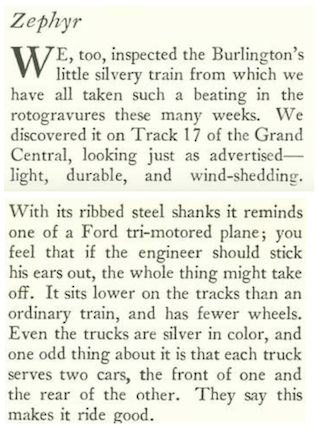
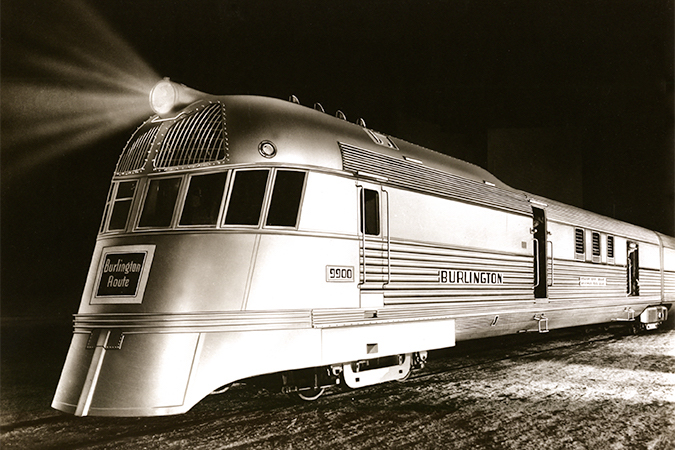
If Fuller’s attempt at the streamlined future was a bit of bust, the Burlington railroad was making a splash with its gleaming new Zephyr. E.B. White reported:
ZOOM ZOOM…The Burlington Zephyr set a speed record for travel between Denver and Chicago when it made a 1,015.4-mile (1,633 km) non-stop “Dawn-to-Dusk” dash in 13 hours 5 minutes at an average speed of almost 78 mph (124 km/h). In one section of the run it reached a speed of 112.5 mph. Following a promotional tour that included New York, it was placed in regular service between Kansas City, Missouri, and Omaha and Lincoln, Nebraska, on November 11, 1934. Other routes would be added later in the Midwest and West. (BNSF)
…we continue with E.B. White, here with some observations regarding Mother’s Day and bank robber/murderer John Dillinger, who had escaped from prison in March 1934 and was on the FBI’s Most Wanted List…
I REMEMBER MAMA…John Dillinger posed with Lake County prosecutor Robert Estill, left, in the jail at Crown Point, Ind. while he awaited his trial for murder in January 1934. Dillinger would escape from the jail in March and would be on the lam until July, when FBI agents would gun him down outside a Chicago movie theatre. (NY Daily News)
…and a last word from White, about an important change at Radio City:
* * *
Voice In The Wilderness
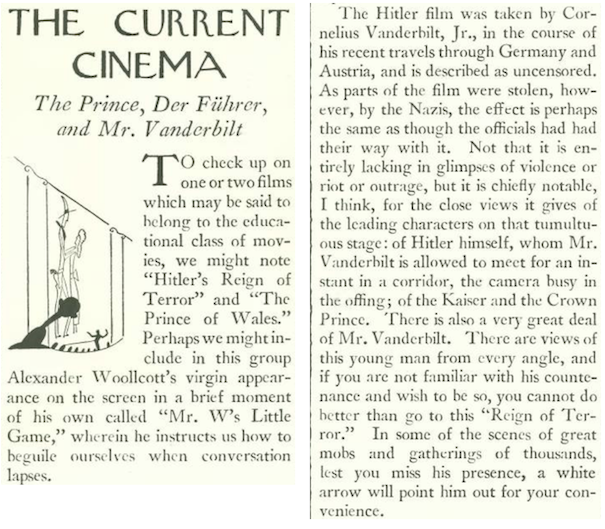
A combination of newsreel footage, documentary, and reenactment, Cornelius Vanderbilt Jr’sHitler’s Reign of Terror played to capacity crowds for two weeks in New York City, despite the refusal of the state’s censor to license the film. Disinherited by his parents when he became a newspaper publisher, Vanderbilt was a determined journalist, covertly filming scenes in Nazi Germany and even briefly encountering Adolf Hitler outside the Reichstag, where Vanderbilt yelled to Der Führer, “And what about the Jews, Your Excellency?” (Hitler ignored the question and referred Vanderbilt to one of his lackeys). Unfortunately, Vanderbilt wasn’t much of a filmmaker, and although he warned Americans about the emerging threat in Germany, few took the film, or his warning, seriously, including John Mosher:
UNHEEDED…Audiences flocked to see Cornelius Vanderbilt Jr’sHitler’s Reign of Terror, but critics dismissed the rather amateurish film—Film Daily scoffed at the film’s prediction that Hitler’s Germany was a future threat to world peace; at right, in the film Vanderbilt confronted “Hitler” in a recreation. (TMDB/Library of Congress)
* * *
From Our Advertisers
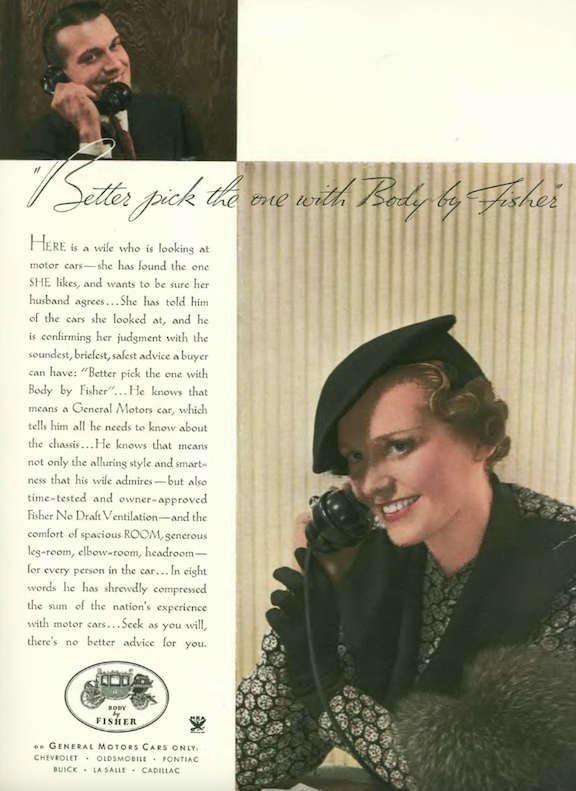
It wouldn’t seat eleven people like a Dymaxion, but a Body by Fisher (coach builder to General Motors) certainly impressed this young woman…but better check with the hubby just in case…
…in this next ad, we find what looks like the same woman, perhaps celebrating her decision with a nice smoke…
…this spot seems out of place in the New Yorker, like it snuck over from Better Homes & Gardens...
…on to our cartoons…with James Thurber’s war of the sexes over, life returned to normal…
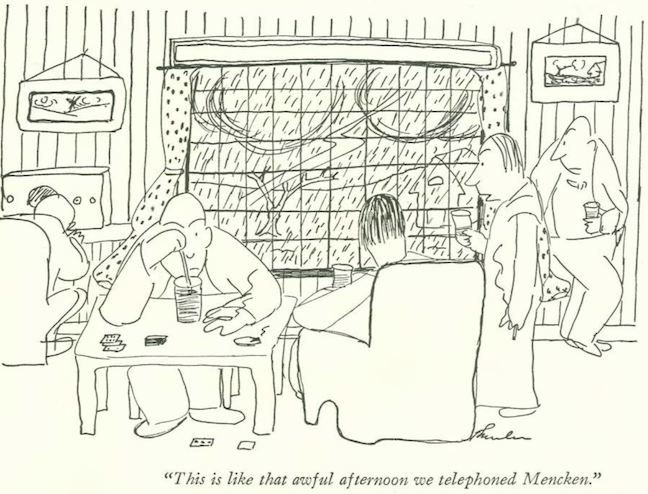
…and both sides shared in the gloom of a rainy afternoon…
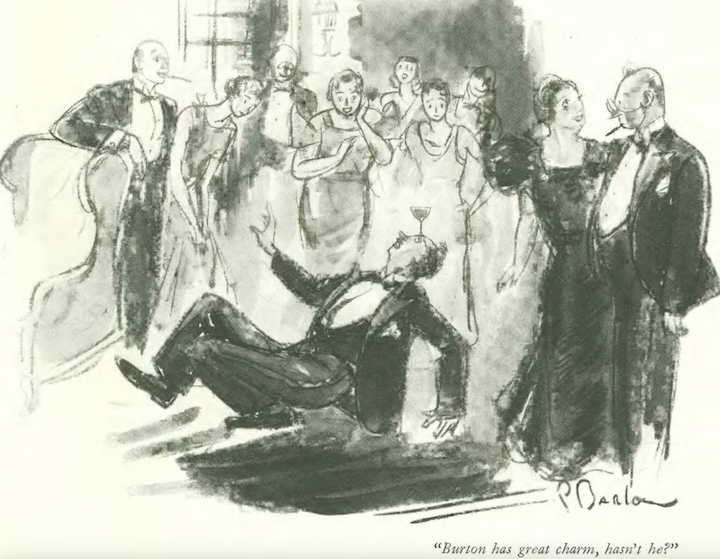
…by contrast, Perry Barlow brightened things up with this life of the party…
…but a good time doesn’t always translate over the airwaves, per George Price…
…Alain illustrated the consequences of losing one’s nest egg…
…Peter Arno didn’t leave any room for dessert…
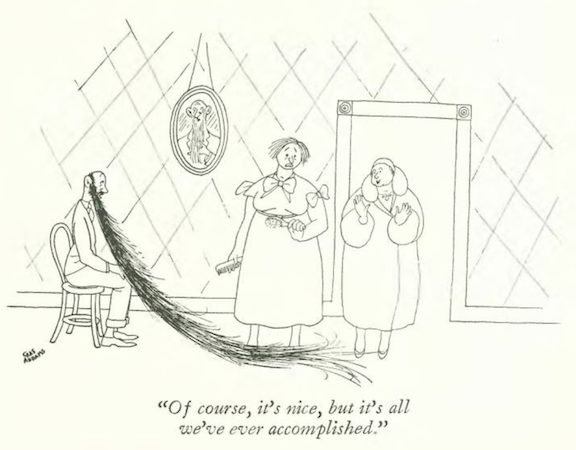
…and Charles Addams returned, a macabre cast of characters still percolating in his brain…
…on to May 12, 1934…
May 12, 1934 cover by Leonard Dove.
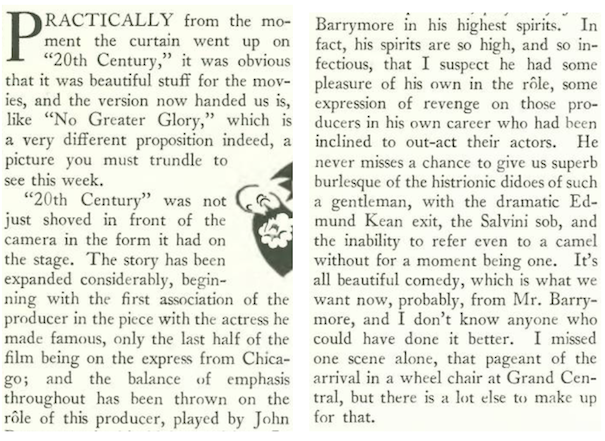
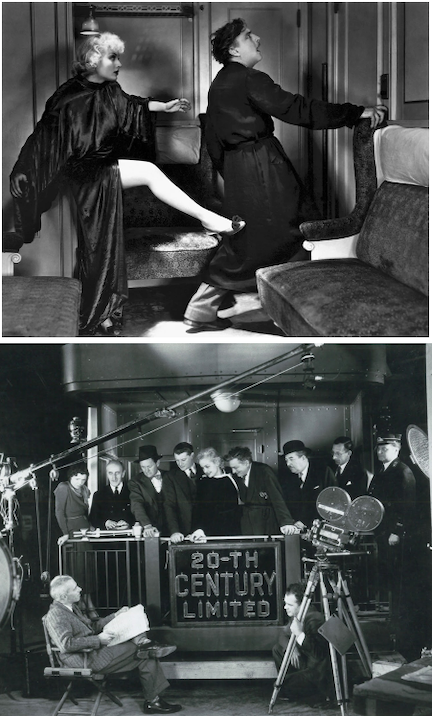
…and back to the movies, this time critic John Mosher found more cheery fare in 20th Century, a pre-Code screwball comedy directed by Howard Hawks and starring John Barrymore and Carole Lombard. Battling alcohol abuse since age 14, Barrymore nevertheless managed to display his rare genius as a comedian and turned in what is considered to be his last great film performance.
GETTING HER KICKS…Top, Carole Lombard delivers a swift one to John Barrymore in the screwball comedy 20th Century. Below, director Howard Hawks with the cast. (greenbriarpictureshows.blogspot.com)
* * *
Playing the Ponies
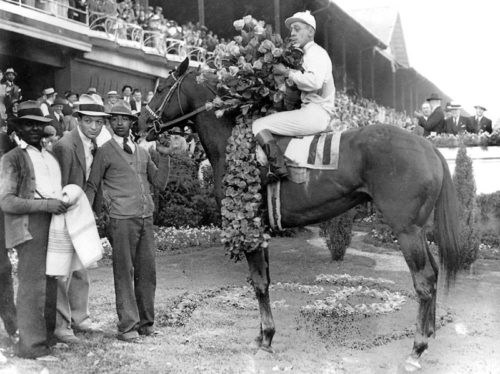
Horse racing correspondent George F. T. Ryall (pseud. “Audax Minor”) considered a losing wager at the Kentucky Derby in his column, “The Race Track.”
A HORSE OF COURSE…Jockey Mack Garner rode Cavalcade to victory at the 1934 Kentucky Derby. (Appanoose County Historical Society)
* * *
More From Our Advertisers
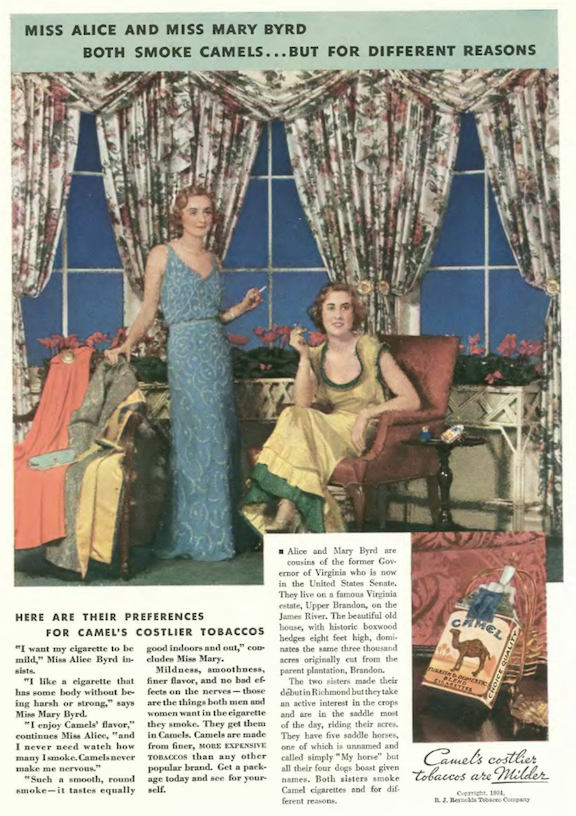
We begin with Camel cigarette endorsers Alice and Mary Byrd, residents of Virginia’s famous Brandon plantation and cousins of Virginia Senator and Governor Harry F. Byrd, known for his fights against the New Deal and his “massive resistance” to federally mandated school desegregation...
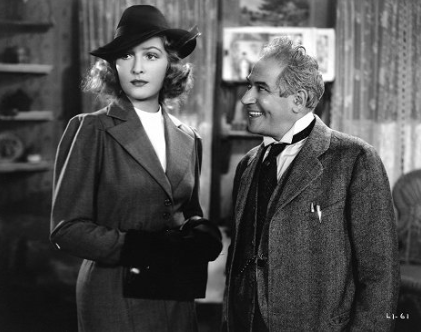
…also to the manor born, Whitney Bourne, a New York deb who would go on to a brief stage and film career that would end when she married her first husband (diplomat Stanton Griffis) in 1939…
AN EYE FOR STYLE…Whitney Bourne in a scene with Solly Ward in 1937’s Flight From Glory. Named in 1933 as one of America’s best dressed women, Bourne was a noted New York socialite, skier, golfer and tennis player as well as an occasional actress.
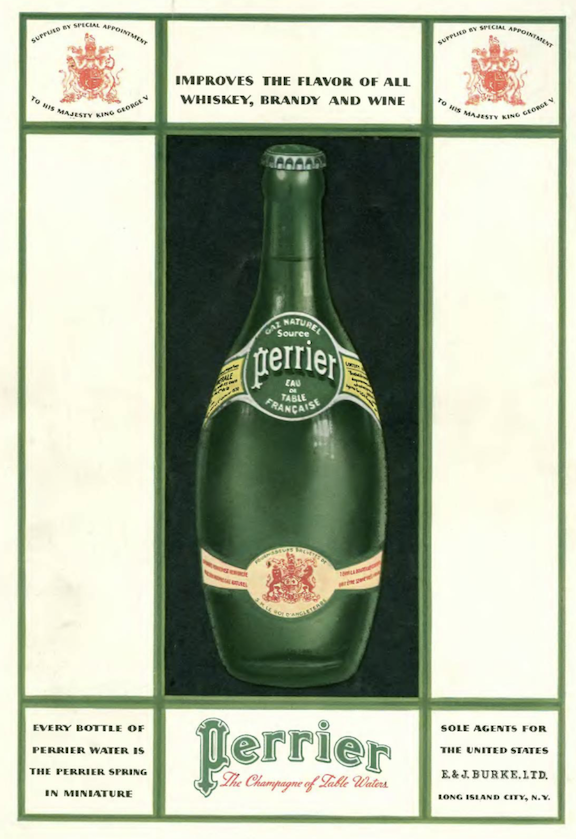
…we move along from the effervescent Whitney Bourne to the sparkling waters of Perrier…
…Gardner Rea followed other New Yorker cartoonists by illustrating an ad for Heinz…
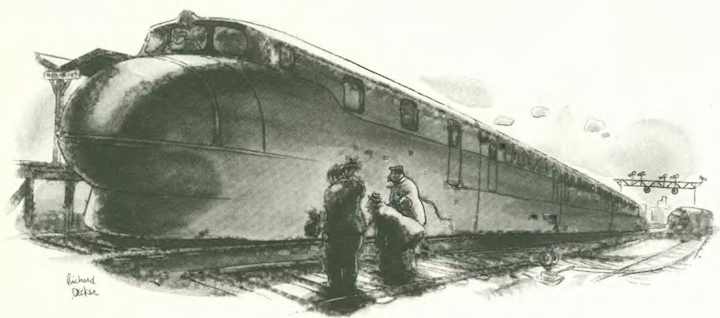
…which brings is to more cartoons, where according to Richard Decker, the move to streamlined trains wasn’t welcomed by everyone…
…Carl Rose illustrated this two-page spread with an imagined right-wing response to the recent left-wing May Day parades…
…William Steig eavesdropped onto a saucy little conversation…
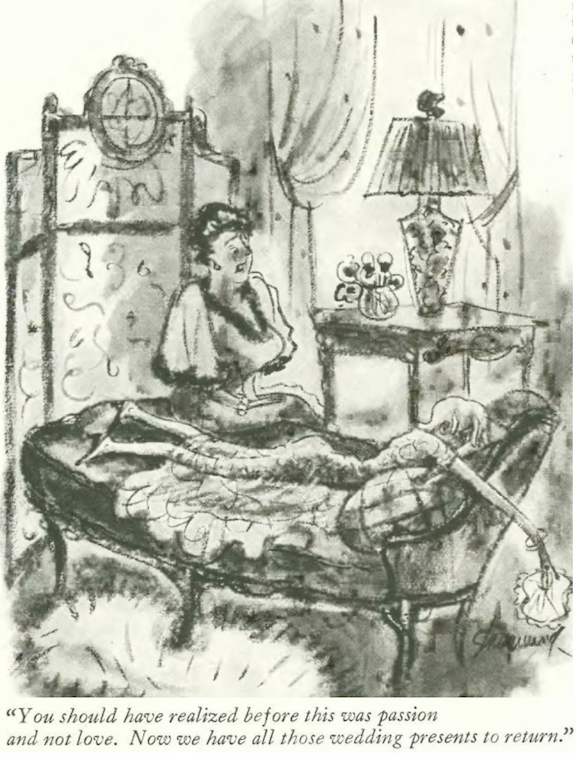
…Barbara Shermund continued her explorations into the trials of the modern woman…
…James Thurber was back to his old tricks…
…and we conclude our cartoons with Eli Garson, and a new perspective…
Before I close, a bit of housekeeping. The first issues in 1925 sometimes ended “The Talk of the Town” with…
…but on May 23, 1925, “Talk” signed off with —The New Yorkers. That continued until the March 31, 1934 issue (below), the last time the New Yorker signed off “The Talk of the Town” with —The New Yorkers:
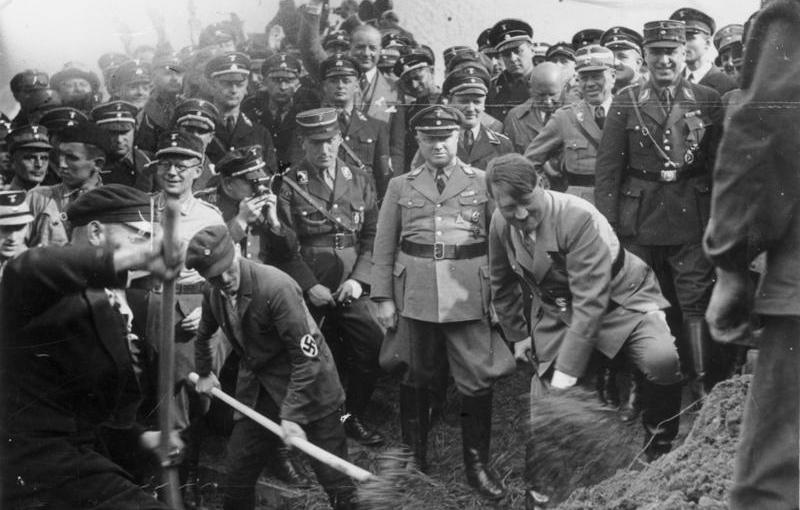
Above: Adolf Hitler at a groundbreaking ceremony for a new section of the Reichsautobahn highway system, 1933. (Bundesarchiv)
Mildred Gilman was one of the highest paid female reporters in the 1920s, interviewing everyone from murderers to heads of state. But when she arranged to interview Adolf Hitler in 1933, the Gestapo got nervous and threw her out of the country.
Feb. 10, 1934 cover by Harry Brown.
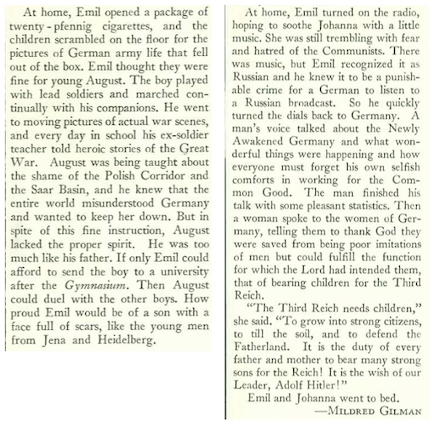
Gilman (1896-1994) doubtless sought a modicum of satisfaction when she penned “Made in Germany” for the Feb. 10, 1934 issue. I am including generous excerpts below, which describe the day in the life of an average Berliner named Emil Pfalz, a man who doesn’t question the omnipresent Nazi propaganda and often worries about his ability to keep in step with the new regime.
THERE’S SOMETHING HAPPENING HERE…Berliners (left) and residents of Worms (top) inspect Nazi propaganda that instructed Germans not to do business with Jewish people (on Jan. 24, 1934, the German government banned Jews from membership in the German Labor Front, depriving them of the opportunity to find employment); below, in early 1934 a simulated uprising was staged in Berlin (with people posing as casualties) as part of Nazi maneuvers. Later that summer SS and Gestapo forces would conduct a purge known as “Night of the Long Knives,” eliminating any known or suspected dissenters of the Nazi regime. Hundreds were murdered and many more arrested. (digitallibrary.usc/Wikipedia)GRIM FAIRY TALE…As a loyal citizen, Emil Pfalz was sure to teach his children the Nazi salute. Image from a Nazi propaganda booklet. (British Library Board)
Emil’s story continues as he contemplates his duties as a father and husband in the Third Reich…
…and heeds the call to produce more Aryan babies.
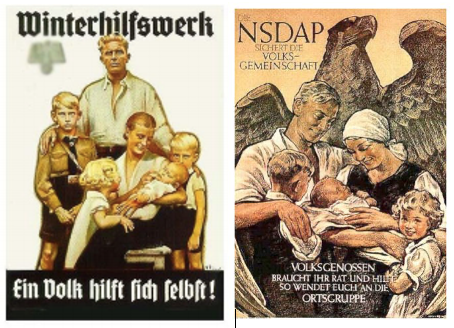
What the Nazis did not want more of was chronically ill or disabled persons. The sick minds of Nazi propagandists produced this image below, which argues that for the same daily amount of reichsmarks you could either support an entire Aryan family or a single mentally disabled person…in 1933 the Law for the Prevention of Hereditarily Diseased Offspring was passed, allowing for the forced sterilization of those regarded as ‘unfit’. In 1939 the regime began killing the disabled (up to 250,000 people).
A final note about the writer, Mildred Gilman. In addition to being a journalist of both daring and flair, she wrote eight novels including the bestseller Sob Sister. In her younger days she was employed as a secretary for New York World columnist Heywood Broun and partied with Dorothy Parker, Alexander Woollcott, and Robert Benchley. She wrote a profile of Paul Robeson for the Sept. 21, 1928 issue of The New Yorker.
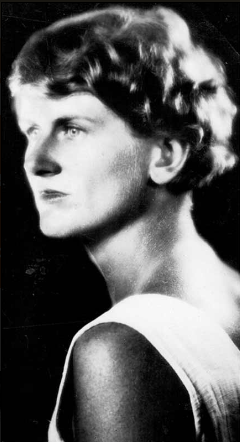
Mildred Gilman in 1938.
* * *
Up In Smoke
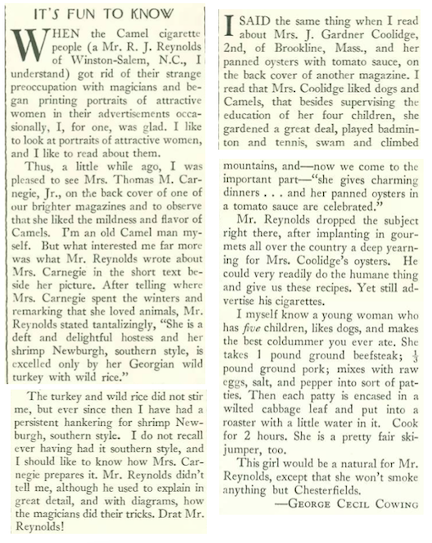
George Cecil Cowing, known for his whimsical “Boulevardier” column for the Pasadena Star-News, commented on the changing themes adopted by cigarette manufacturers, namely the folks at R.J. Reynolds who abandoned their magician-themed ads for their Camel brand (“It’s Fun to Be Fooled”) for spots featuring endorsements from second-tier society women…
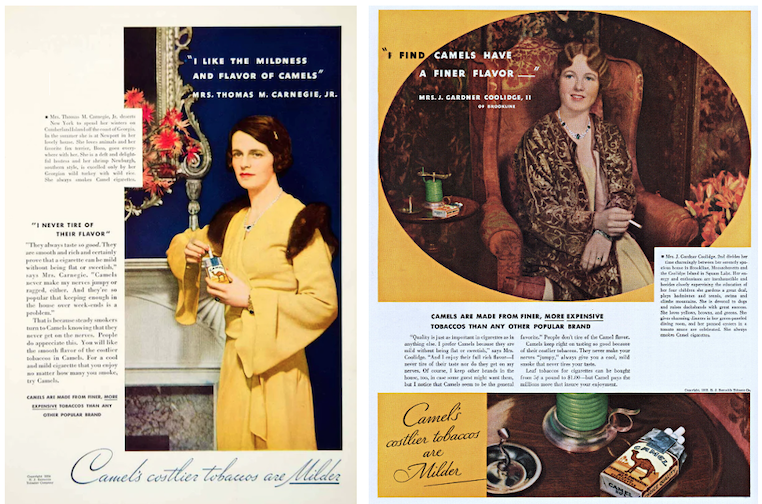
POSH PUFFERS…”Mrs. Thomas M. Carnegie Jr.” (Virginia Beggs) and “Mrs. J. Gardner Coolidge II” (Mary Louise Coolidge) shared their favorite dishes and their love for smoking Camels in these ads, which appeared in The New Yorker in early 1934.
* * *
From Our Advertisers
Appropriately we turn to our advertisers, where we find the Camel brand trying out a new theme that demonstrated their product’s appeal to plainer folks…
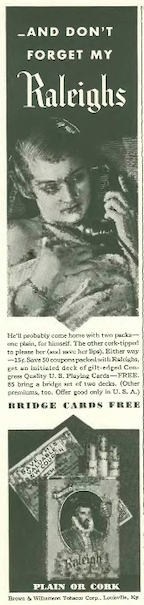
…Brown & Williamson’s first national brand, Raleigh, was launched as a premium cigarette in 1928, here marketed with a plain or cork tip (“to please her and save her lips”)…
…in his parody of Camel ads, George Cecil Cowing wrote that he preferred Chesterfields, a big-time brand of mid-century America…
…the makers of White Rock reveled in the newly found freedoms of legalized alcohol…
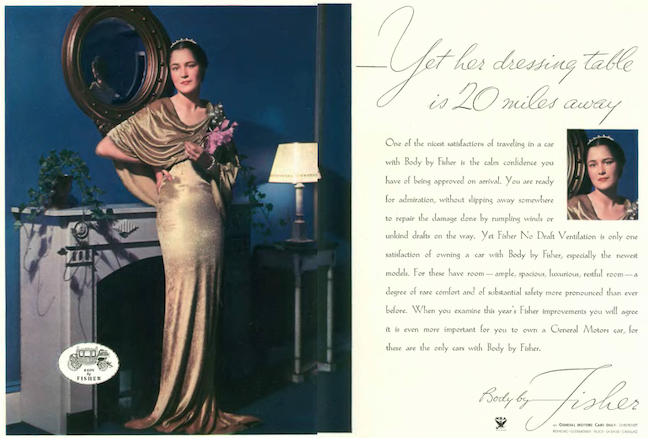
…the folks at Fisher were sticking with their lavish two-page color ads and what has always been a tiresome double entendre…
…Lord & Taylor took to the skies to promote their “country clothes” to the smart set…
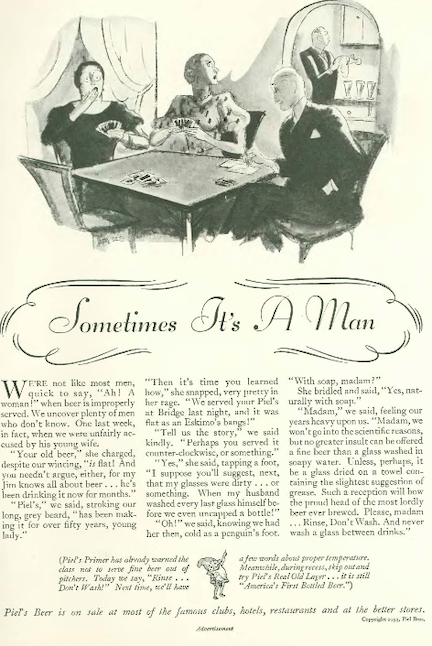
…and cartoonist Herbert Roese, who apparently never published a cartoon in The New Yorker, turned in this very New Yorker-looking illustration for Piel’s…
…on to our cartoonists, we begin with Clarence Day, better known for his Life With Father stories…
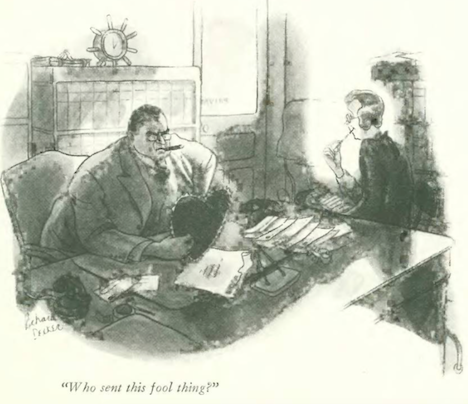
…the Valentine’s issue featured several themed cartoons, including these by Richard Decker…
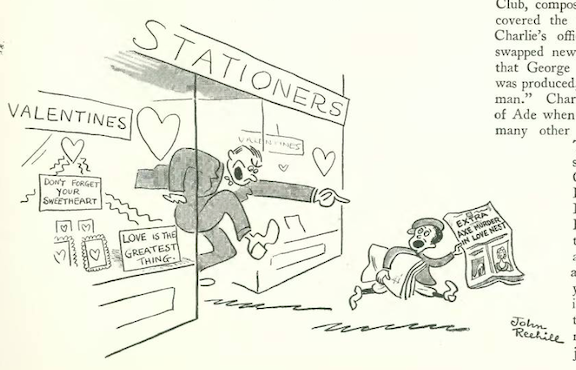
…and John Reehill…
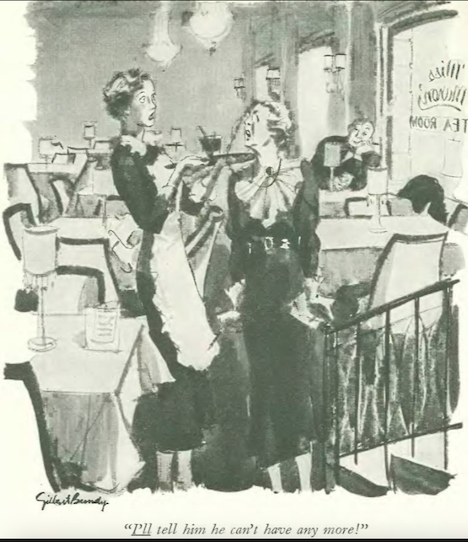
…love was also in the air for Gilbert Bundy…
…while William Crawford Galbraith continued to ply the waters of the creepily lustful…
…and we test different waters with Richard Yardley, a popular editorial cartoonist for The Baltimore Sun…this is the only cartoon he published in The New Yorker…
…the Westminster Kennel Club dog show was in town, here tapped by Helen Hokinson to also explore the theme of fatherhood…
…Perry Barlow was the latest New Yorker contributor to mock the futuristic, aerodynamic style of Chrysler’s Airflow…
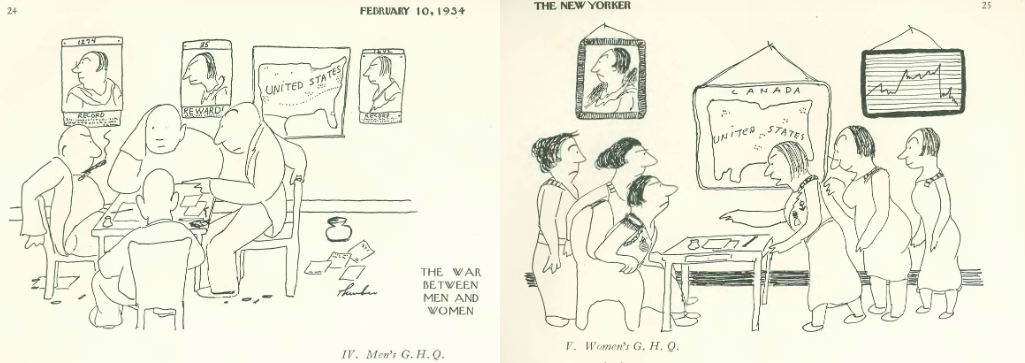
…and James Thurber’s “War Between Men and Women” paused as the two sides made preparations for the next battle…
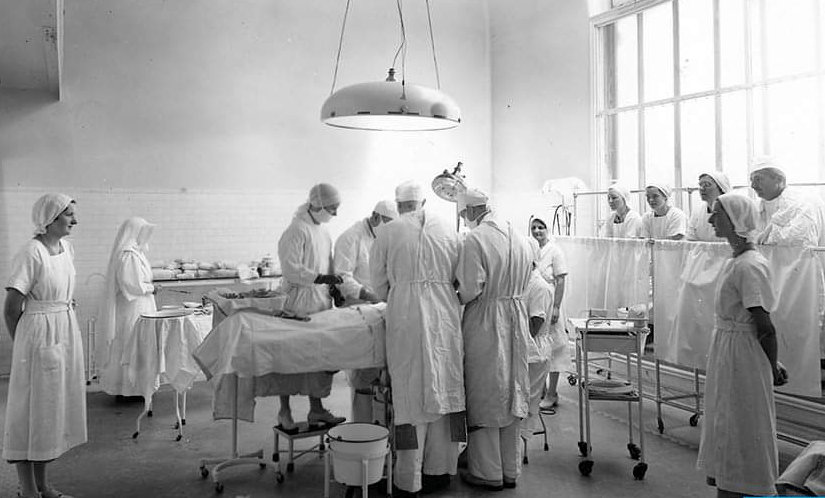
Above: Surgery being performed at the Hospital of Saint Raphael (Conn.) in the late 1930s. Operating rooms were often located near large windows and under skylights to offer greater illumination. (Yale New Haven Hospital)
For all the challenges of 21st century, I always remind myself that advances in medicine during the past ninety years have made our lives better, and substantially longer, even if our current health care system is far from ideal.
Feb. 3, 1934 cover by E. Simms Campbell.
People could live to a ripe old age in the 1930s, however the average life expectancy at birth in 1930 was only 58 for men and 62 for women. The Depression didn’t help matters, and neither did the Dust Bowl, unregulated urban smog, the dramatic rise in smoking, and the lingering effects of more than a decade of bootleg alcohol consumption.
Polio was a serious problem in the 1930s, as was syphilis, which affected as many as ten percent of Americans. Blood groups would not be identified until 1930 (by Nobel Prize-winner Karl Landsteiner), and human nutrition remained something of a puzzle—Vitamin C wasn’t identified until 1932. There was exciting chatter about penicillin (discovered in late 1920s) and the antibacterial effects of sulfonamides (first observed in 1932), but it would be years before antibiotics would come into common use. So yes, infection was also a big killer.
Nevertheless, progress had been made, as told by Morris Markey in the column, “A Reporter at Large.” An excerpt:
FORTRESS ON THE HEIGHTS…Top, Columbia-Presbyterian Medical Center loomed large when it opened in Washington Heights in 1928; below, New York Hospital, most likely the building described in Morris Markey’s column; at left, Dr. George Crile, Sr., completing his landmark 25,000th thyroid operation in 1936. (CUIMC/Wikipedia/Cleveland Clinic)
This next excerpt describes the work of the anesthetist after the patient receives a spinal injection of novocaine, which had replaced cocaine as a pain blocker. At the start of the 1930s, the most-used anesthetic was ether, used in this account to calm the patient. Ether carried its own risks—in was unstable, and sparks from X-ray machines and other equipment could cause an explosion.
NO SMOKING, PLEASE…Anesthetist in the 1920s carefully administers ether while surgeon swabs a patient with iodine (inset). Ether was unstable, and sparks from equipment could cause an explosion. (Internet Archive/Flickr)
* * *
And Then There’s Maude
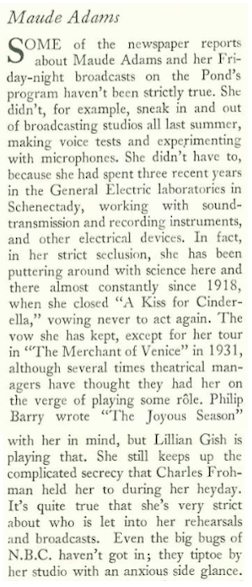
American actress and stage designer Maude Ewing Adams (1872–1953) defined the role of “the boy who wouldn’t grow up” in her Broadway adaptations of Peter Pan in the early 1900s (1905, 1906, 1912 and 1915). She would appear in 26 Broadway productions between 1888 and 1916, but after a severe bout of the Spanish flu in 1918 she retired from the stage and focused on developing better stage lights with General Electric; her electric lights ultimately set the industry standard with the advent of sound movies. As this excerpt from “The Talk of the Town” revealed, Adams was also quite shy and highly valued her privacy.
THE RETIRING SORT…Maud Adams in a Broadway publicity photo, circa 1900. (Vintage Everyday)
* * *
In The Trenches
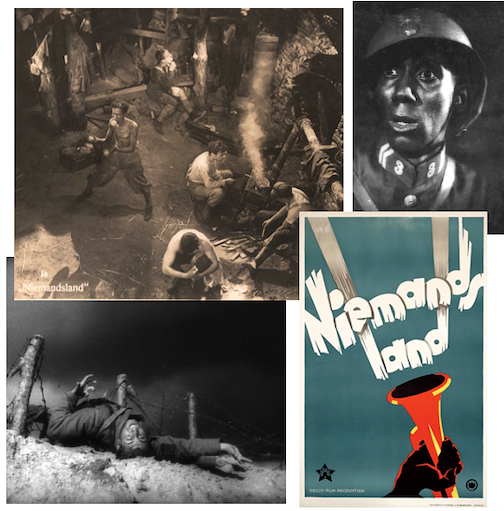
Just before the Nazis decided to turn their country back into a warlike state, Victor Trivas and George Shdanoff wrote and directed an allegorical anti-war film. Niemandsland (released in the U.S. as Hell on Earth) featured five soldiers, from different backgrounds, who find themselves together in a dugout in no man’s land and together come to terms with the absurdity of war. The film premiered in Berlin in December 1931 and was greeted by thunderous applause. A little over a year later it was banned by the Nazis. Critic John Mosher made these observations:
WAR, WHAT’S IT GOOD FOR?…Niemandsland (released in the U.S. as Hell on Earth) featured five soldiers from different backgrounds on a front lines during WWI: a carpenter from Berlin, a mechanic from Paris, an English officer, a Jewish tailor and a Black dancer (the only one who understands everyone’s languages). Actor and dancer Louis W. Douglas (top right) was a Philadelphia native who moved to Paris in 1925 with his dancing partner, Josephine Baker, in the popular La Revue Nègre. He went on to establish a successful musical and film career in Germany until his death in 1939. (silverinahaystack.wordpress.com/IMDB)
* * *
From Our Advertisers
We begin with this jolly color image from Lucky Strike representing the joys of cigarette smoking…
…a trio of ads culled from the back pages, everything from “Tiara Trouble” (apparently a common problem) to a smoking penguin introducing a new line of menthol cigarettes, KOOL, challenging the dominance of the Spud menthol brand (we know who won that battle)…in the final ad, Atlantic City resort hotel Haddon Hall attempted to drum up business using a slavery/emancipation theme—Abraham Lincoln’s birthday is at hand…why not slip the shackles of work and run away to sunshine and freedom?…
…These Paul Whiteman ads were ubiquitous in the 1930s…the distinctive caricature of his pudgy, mustachioed face—Whiteman’s “Potato Head” emblem—was featured in ads and on 78 rpm record labels and various promotional items…on the more classical side, violinist David Rubinoff sawed away on his famed $100,000 Stradivarius for audiences at the Roosevelt Hotel…
…automobile ads continued to grace the pages of The New Yorker, including this one suggesting that young blue bloods would look quite smart in a ’34 Chevy…
…in the 1930s Studebaker marketed car lines including the high-end President, the mid-priced Commander, and the low-priced Dictator…the Dictator was introduced in 1927, so named because it “dictated the standard” other automobile makes would be obliged to follow…the rise of Mussolini and Hitler attached unsavory connotations to the car’s moniker…it was renamed “Director” for European markets and was finally abandoned in 1937…
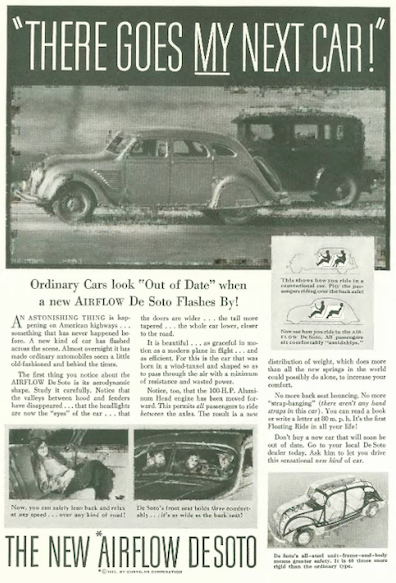
…Chrysler continued to push its radical new Airflow, here demonstrating how it blows the doors off of an old-timer…
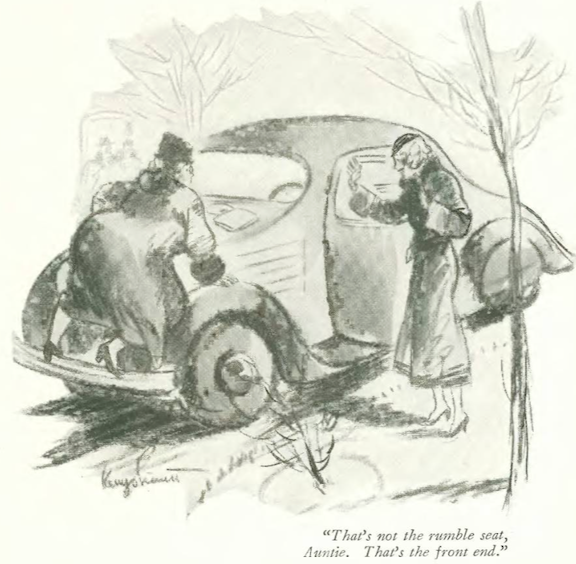
…as we jump into our cartoons, Kemp Starrett referenced the Airflow in his latest contribution to The New Yorker…
…the issue included two from George Price…a playful pairing in the events section…
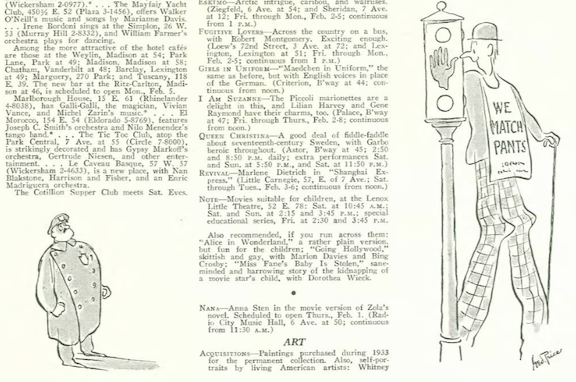
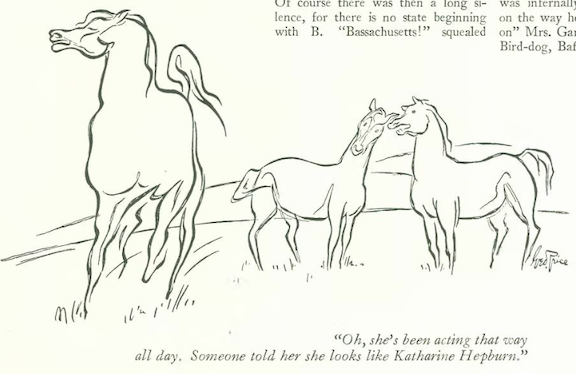
…and a somewhat unkind nod to new Hollywood star Katharine Hepburn…apparently David O. Selznick had misgivings about casting a “horse face” like her…well, she obviously proved him wrong…
…the magazine pulled out this old illustration by H.O. Hofman to break up the copy in Howard Brubaker’s “Of All Things” column…
…more antics from the precocious set, courtesy Perry Barlow…
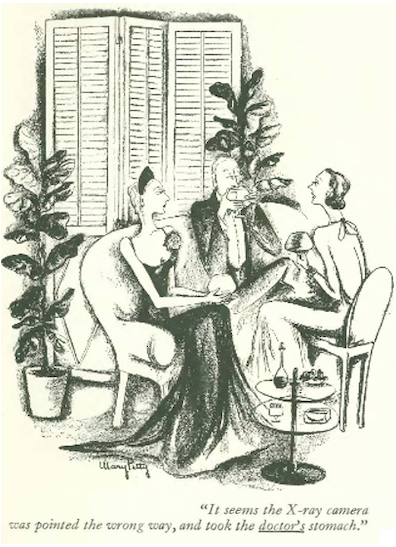
…Mary Petty offered this observation on the state of medicine in 1934…
…a sobering and topical contribution from Alan Dunn…
…Carl Rose made preparations for the annual Charity Ball…
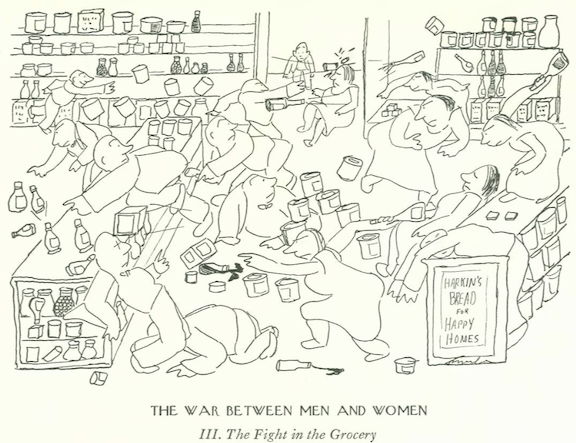
…and James Thurber gave us Part III of his “War Between Men and Women”…
In 1925 New Yorker founding editor Harold Ross wrote that he wanted his new magazine to be “humorous from a sophisticated viewpoint” and “record the situations of everyday life among intelligent and substantial people as do the English magazines, notably Punch, except that our bent is more satirical, sharper.”
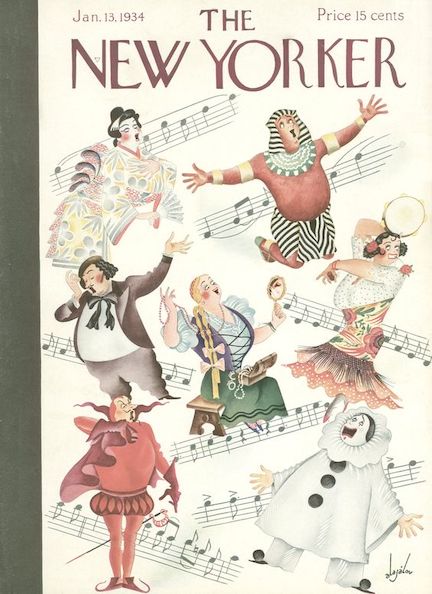
Jan. 13, 1934 cover by Constantin Alajalov.
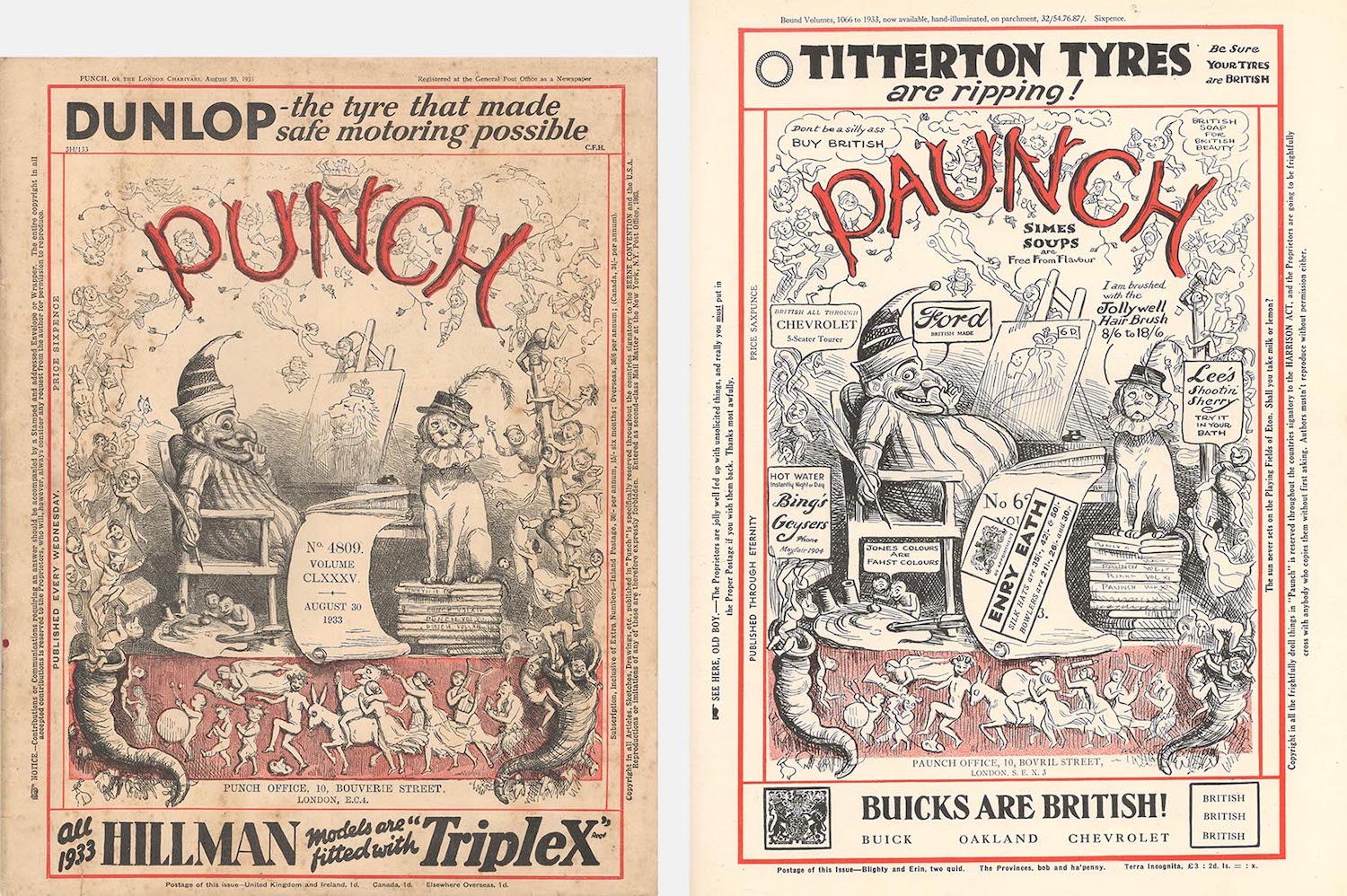
Sharper indeed, as was demonstrated in the Jan. 13, 1934 issue, when Ross’s young magazine took aim at Punch, which was founded in 1841 and had grown long in the tooth under the guidance of Sir Owen Seaman, whose Victorian sensibilities (he joined Punch in 1897) were ripe for parody by a magazine founded during the Jazz Age.
Writer and cartoonist V. Cullum Rogers (MagazineParody.com) notes that the eight pages devoted to “Paunch” was The New Yorker’s longest and most elaborate parody of another publication.
RIPE FOR THE PICKING…The covers of Punch for August 30, 1933, and The New Yorker’s 1934 parody.
E.B. White and Franklin P. Adams contributed parodies (“The Mall” by White and “The Intent Caterpillar” by Franklin) of what Rogers cites as “two of Punch’s favorite forms of bad verse: the sticky-sentimental and the mechanically clever.”
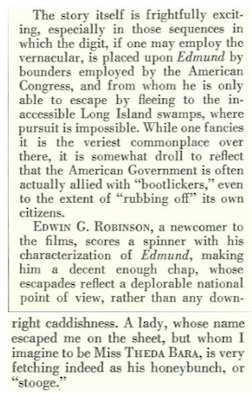
The New Yorker’s theatre critic Wolcott Gibbs joined the fun by penning “Mr. Paunch’s Cinema Review” (excerpt)…
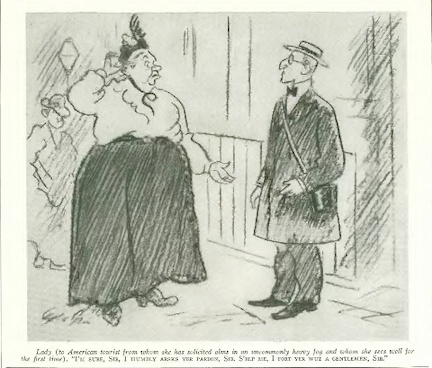
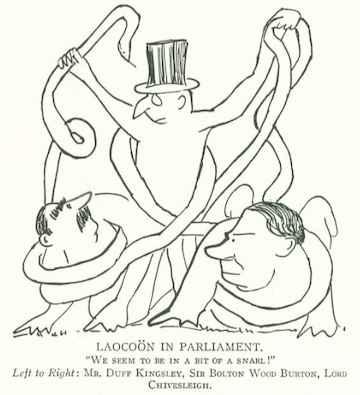
…Rea Irvin and James Thurber offered up their cartooning skills…
Rea Irvin’s parody of a Punch cartoon. (Caption enlarged below).
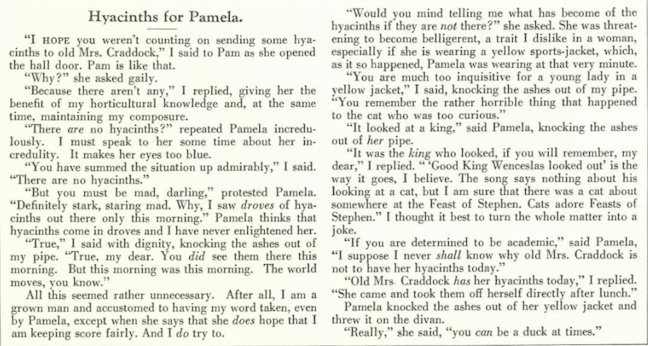
…and Robert Benchley contributed this gem, “Hyacinths for Pamela.”
Rogers writes that although “Paunch” wasn’t promoted on the cover, “the issue it ran in became the first in The New Yorker’s nine-year history to sell out on newsstands. (The second sellout contained Wolcott Gibbs’sTime parody, which suggests a demand for such things).”
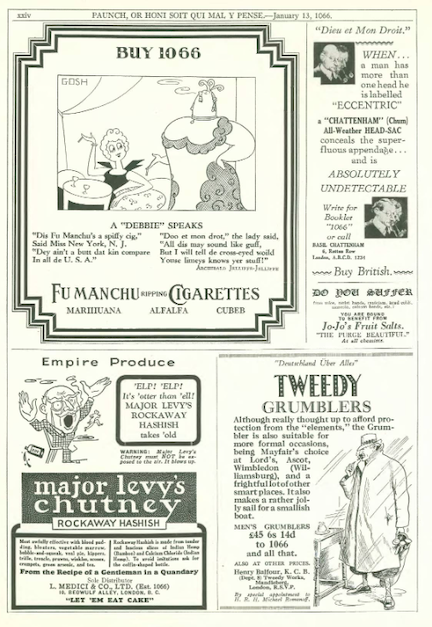
The parody issue concluded with this page of advertisements:
* * *
The Show Must Go On
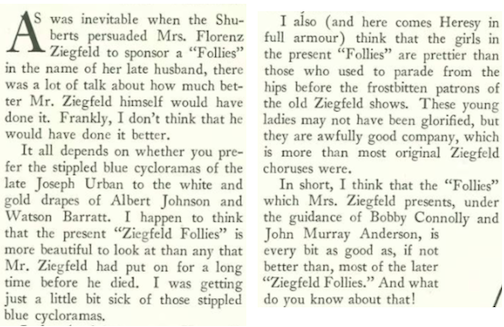
The death of Florenz Ziegfeld Jr. in 1932 did not put an end to his Follies; indeed, under the direction of his widow, Billie Burke, the show seemed to have new legs, at least according to Robert Benchley:
HOOFIN’ IT…Clockwise, from top left: Program for the 1934 Ziegfeld Follies; performers in the show included popular brother–sister dancing act Buddy and Vilma Ebsen, pictured here with Eleanor Powell in Broadway Melody of 1936 (most of us know Buddy Ebsen as Uncle Jed from The Beverly Hillbillies); Al Hirschfeld drawing of the show’s stars; Willie Howard, Fanny Brice and Eugene Howard in Ziegfeld Follies of 1934. (YouTube/NYPL)
* * *
Keen on the Airflow
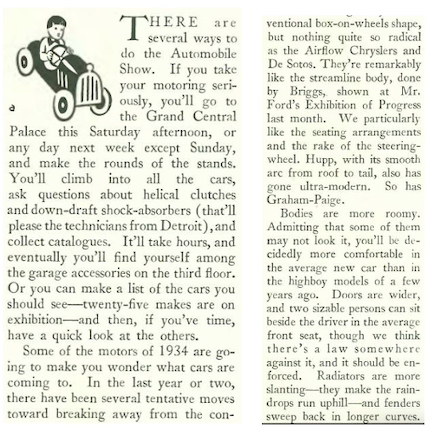
The streamlining trend in autos was not to E.B. White’s liking (see below), but the reviewer of the National Auto Show (pseud. “Speed”) was eager to take the Chrysler Airflow for a spin.
* * *
From Our Advertisers
The Chrysler Corporation ran this two-page ad that took issue with E.B. White’s criticisms of the streamlining trend in automobiles, led by Chrysler’s “Airflow” model…here Chrysler responded with a note pinned to a tear sheet from the Dec. 16, 1933 “Talk of the Town”…You wrote this before you saw the new Chryslers, Mr. New Yorker…
…with the National Auto Show still in town the splashy car ads continued, including this one from the makers of Fisher car bodies…
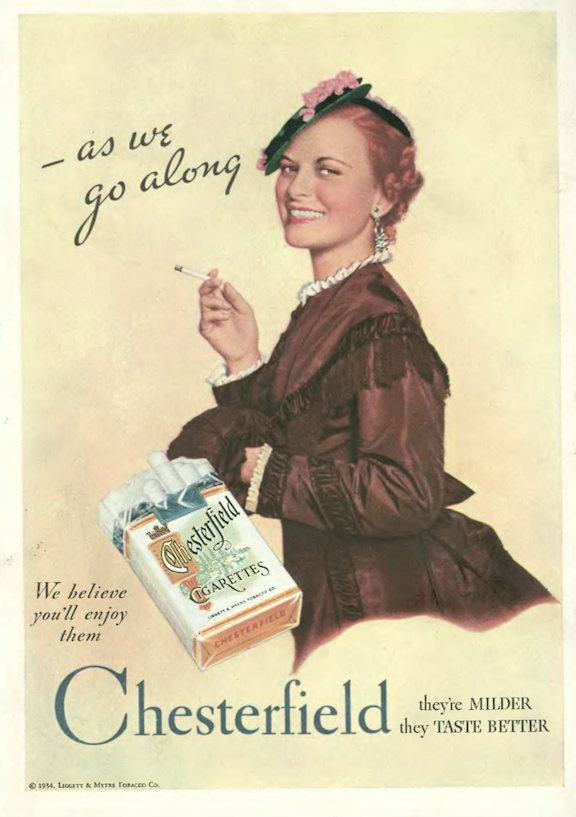
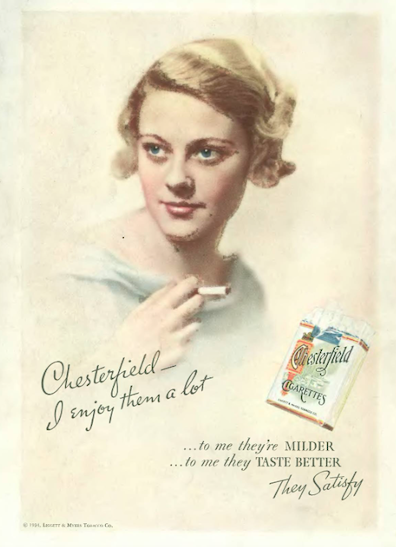
…another advertising stalwart, the Liggett & Myers Tobacco Company, gave us a young woman who enjoyed their Chesterfields “a lot”…
…Guinness was back for those who missed that taste of Dublin…
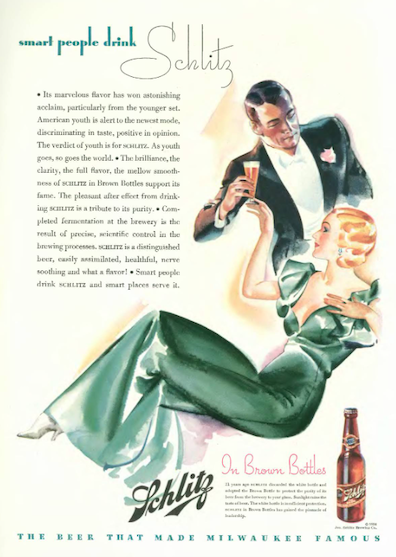
…and the folks behind “The Beer That Made Milwaukee Famous” placed their first ad in The New Yorker…
…if you wanted to have your drink outside of the home, what better place than the Madison Room at The Biltmore…
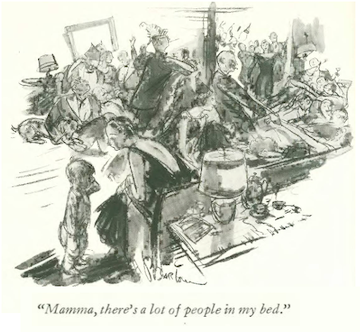
…on to our cartoons, with begin with Perry Barlow and a tot losing sleep over the new year…
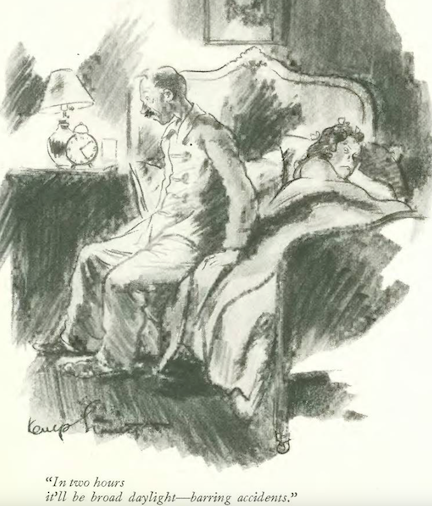
…Kemp Starrett also explored the world of sleep deprivation…
…and we end with James Thurber, and a woman with a low tolerance for “cute” news…
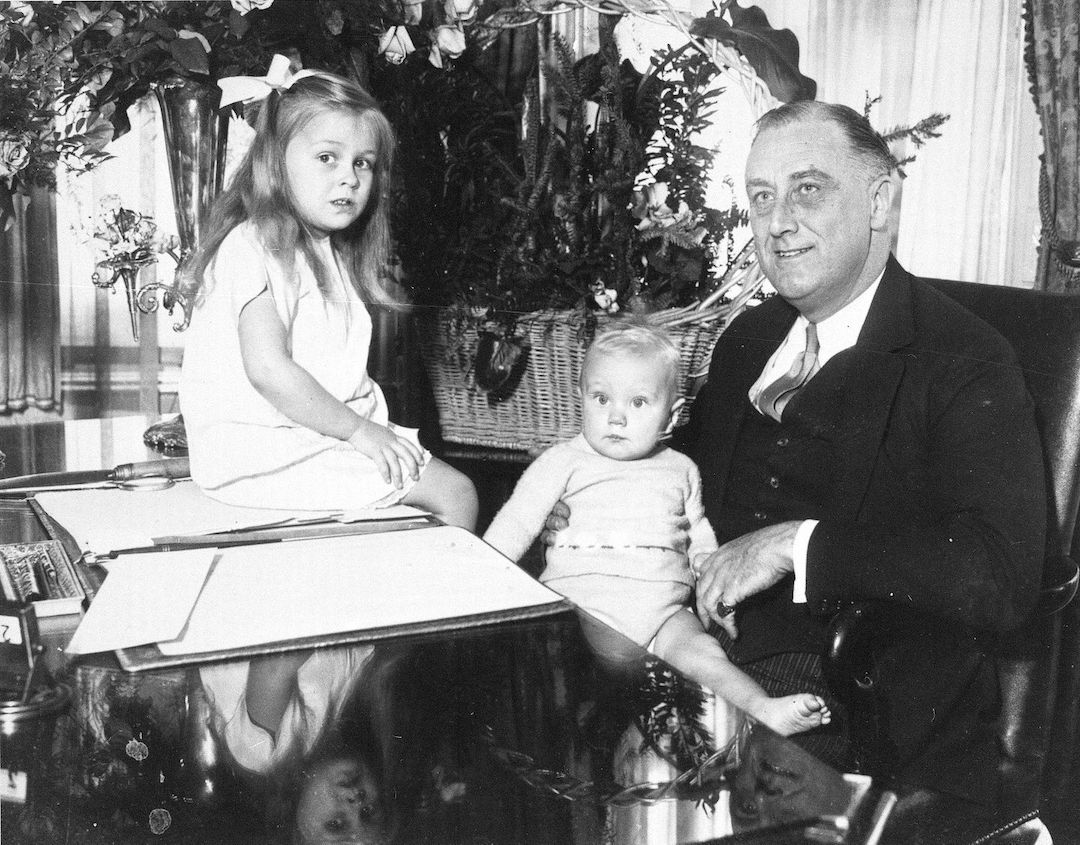
…in case you are wondering, Anna Eleanor “Sistie” Dall was the daughter of Franklin and Eleanor Roosevelt’s eldest child Anna Dall. When Dall separated from her husband in 1933, she moved into the White House with her children, Sistie and Buzzie.
TOO CUTE…Franklin Roosevelt with his grandchildren Anna Eleanor “Sistie” Dall and Curtis “Buzzie” Dall in 1932. According to Buzzie, he and his sister lived in the White House from September 1933 to November 1935. (AP)
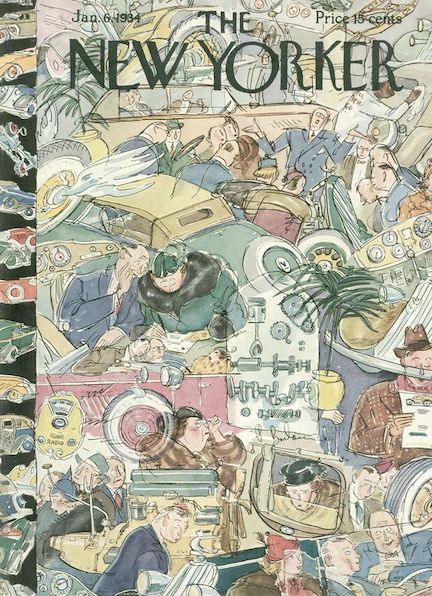
New York’s first big event of the new year was the annual National Auto Show centered at the Grand Central Palace.
Jan. 6, 1934 cover by Perry Barlow.
The year 1934 was all about aerodynamic design, with Chrysler leading the way with its ill-fated Airflow, a bit too ahead of its time. Other companies followed suit in more subtle ways, especially smaller manufacturers looking for novel ways to grab a cut of market share.
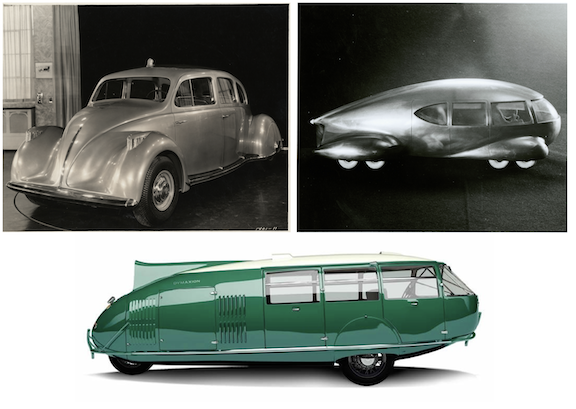
The trend in streamlining was inspired by such designers as Norman Bel Geddes, R. Buckminster Fuller and John Tjaarda…
SLIPPERY SEDANS…Top left, a 1933 Briggs concept car, designed by John Tjaarda, on display at the Ford Exposition of Progress in Detroit; right, a 1932 concept model of Motorcar No. 9 by Norman Bel Geddes; below, a reproduction of R. Buckminster Fuller’s 1933 Dymaxion car. (detroitpubliclibrary.org/Harry Ransom Center/Wikipedia)
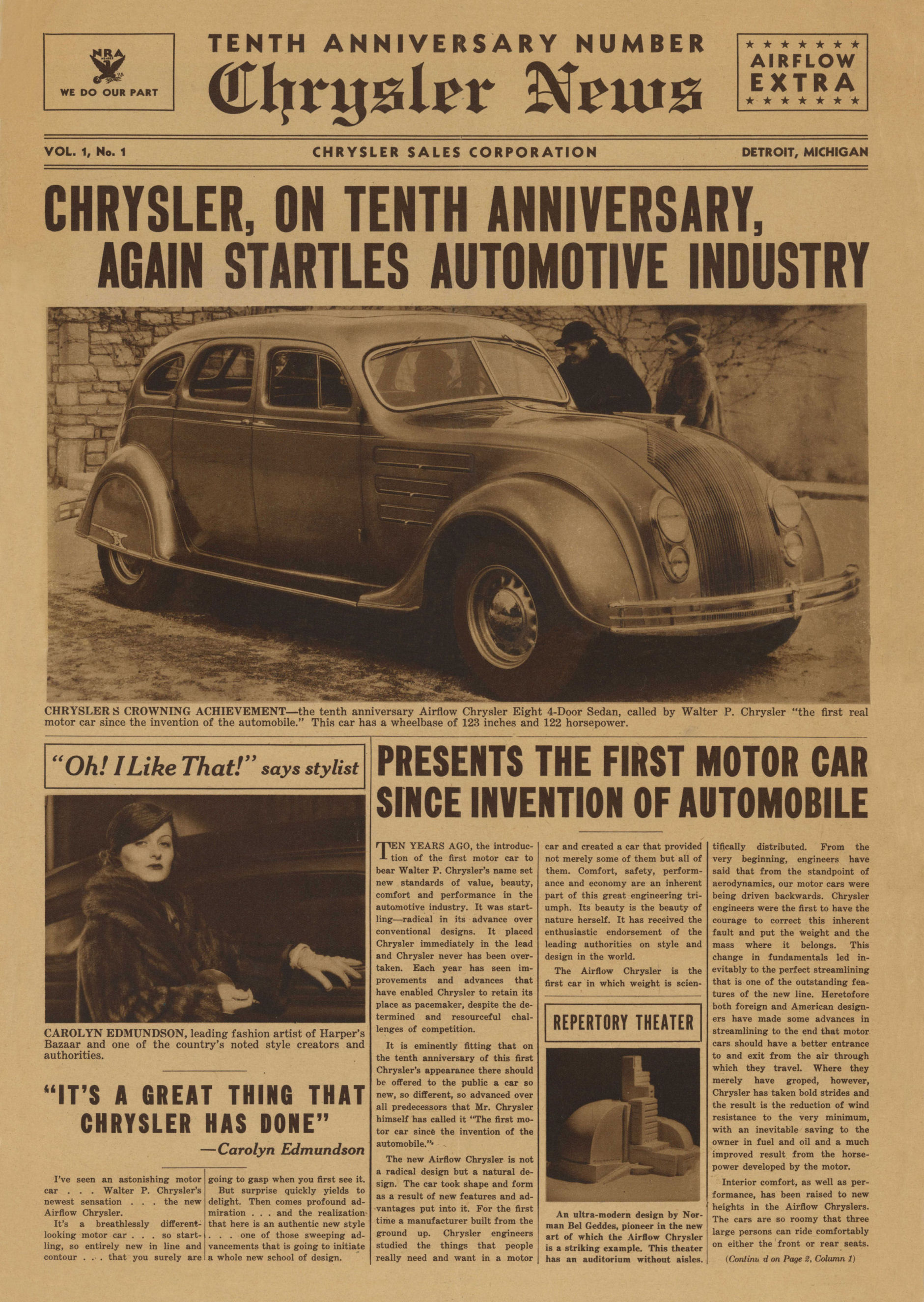
Chrysler pulled out all stops to promote its radical new design at the National Auto Show, even producing a special seven-page newspaper, Chrysler News, to promote the car’s many wonders…
…the inside pages featured TheNew Yorker’sAlexander Woollcott marveling over the Airflow’s design (at the time Woollcott was a Chrysler pitchman).
Although other manufacturers didn’t go as far as Chrysler, the streamlining trend was seen in slanting radiators and sweeping fenders.
LAIDBACK DESIGN…Clockwise, from top left, 1934 Hudson Terraplane K-coupe; 1934 Studebaker President Land Cruiser; 1934 Graham-Paige; 1934 Hupmobile. (hemmings.com/auto.howstuffworks.com/YouTube)
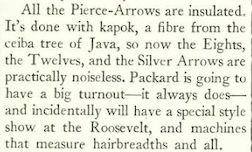
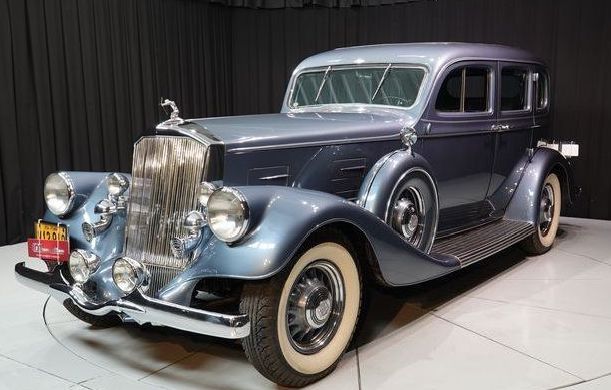
The review also noted the novel way Pierce-Arrow sound-insulated their motorcars:
IT’S STUFFY IN HERE…For sound insulation, luxury carmaker Pierce Arrow used kapok, a fine, fibrous, cotton-like substance that grows around the seeds of the tropical ceiba tree. (Pinterest)
* * *
Wearing the Pants
In 1934 it was still something of a scandal for a woman to wear trousers. Like Marlene Dietrich, Greta Garbo was an actress who could and would defy gender boundaries, and in Queen Christina she effortlessly portrayed the Swedish queen, who in real life was given an education and responsibilities expected of a male heir and often dressed as a man. The film was a critical success, although John Mosher felt Garbo overwhelmed the movie.
READY FOR HER CLOSEUP…Clockwise, from top left, in one of cinema’s most iconic scenes, Queen Christina (Greta Garbo) stands as a silent figurehead at the bow of a ship as the camera moves in for a tight close-up; Garbo with co-star and real-life romantic partner John Gilbert—it was the last of the four films the two would make together; Christina kisses her handmaiden Ebba (Elizabeth Young)—some have suggested Garbo was portraying the queen as bisexual, however the kisses with Ebba were quite chaste; MGM film poster. (moviemaker.com/pre-code.com/IMDB)
* * *
She Also Wore Pants
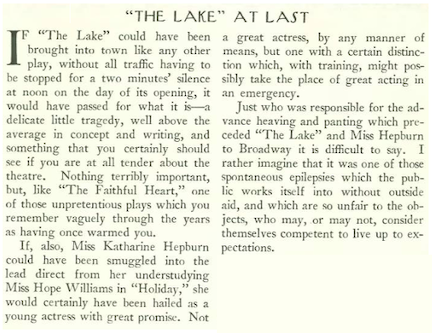
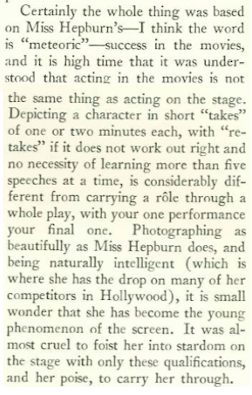
Katharine Hepburn quickly took Hollywood by storm, earning her first Oscar at age 26 for her performance in 1933’s Morning Glory. However, New Yorker drama critic Robert Benchley didn’t see that talent necessarily translating to the Broadway stage, at least not in The Lake:
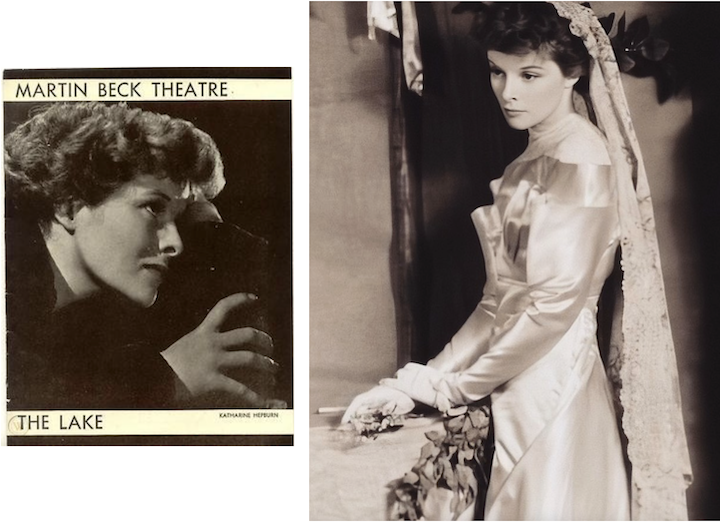
A RARE FLOP…Robert Benchley thought it was “almost cruel” to foist Katharine Hepburn’s stardom onto the stage in a flop like The Lake. At left, cover of the Playbill; at right, Hepburn in one of the costumes for the production. (Playbill/Facebook)
Benchley correctly surmised that the play’s producer, Jed Harris, was trading on the young star’s “meteoric” film success, but Hepburn’s beauty and intelligence were not enough to save this critical flop, which closed after 55 performances.
* * *
On the Town
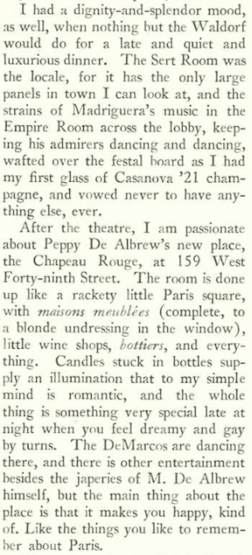
The chronicler of New York fashion and nightlife, Lois Long, detested Prohibition but after repeal also missed the intimacy of speakeasy life. In her latest “Tables for Two” column Long seemed to be settling into a routine and finding new favorites, like the Waldorf’s Sert Room and Peppy de Albrew’s Chapeau Rouge.
THIS WILL DO NICELY…Lois Long sipped Casanova ’21 champagne while enjoying the music of Catalonian violinist Enric R. Madriguera (bottom left) amid the murals of Madriguera’s countryman Josep Maria Sert (right images) in the Waldorf-Astoria’s Sert Room. (waldorfnewyorkcity.com/Wikipedia)FAMILIAR FACES…No doubt Lois Long knew Argentine dancer Abraham “Peppy” de Albrew (left) from his days at Texas Guinan’s notorious 300 Club; Long found de Albrew’s new club, Chapeau Rouge, to be a welcoming slice of Paris, enlivened by the dancing of Antonio and Renee de Marco, pictured at right with their dogs in front of San Francisco’s Fairmont Hotel, circa 1937. (Wikipedia/digicoll.lib.berkeley.edu)
* * *
From Our Advertisers
Thanks to the auto show The New Yorker was raking in a lot of advertising dollars on top of the steady income from tobacco companies and the new infusion of revenue from purveyors of adult beverages…Lucky Strike grabbed the back cover for this striking ad…
…and contrary to the wisdom of the ages, American speed skater Irving Jaffee (who won two gold medals at the 1932 Winter Olympics) credited his athletic prowess in part to smoking unfiltered cigarettes…
…finally, real French Champagne was arriving on American shores…
…as was authentic Scotch whisky…
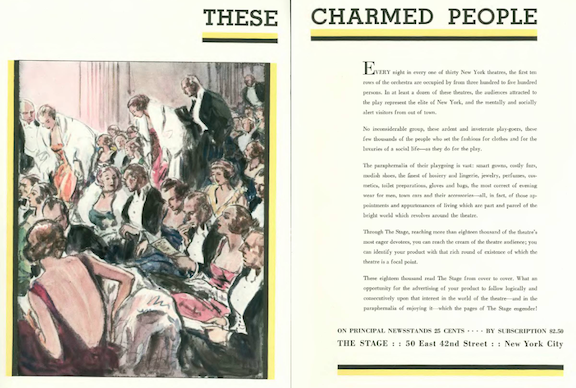
…John Hanrahan was The New Yorker’s policy counsel from 1925 to 1938 and is credited with putting the magazine on firm financial footing during its infancy…in 1931 Hanrahan rebranded the Theatre Guild’s magazine, renaming it The Stage and filling it with the same splashy ads he was also able to bring to The New Yorker…the Depression was a tough time to launch a magazine, and even though Hanrahan added articles on motion pictures and other forms of entertainment in 1935, the magazine folded in 1939…
…and with the National Auto Show in town, car manufacturers filled The New Yorker’s pages with expensive ads…we’ll start with Walter Chrysler’s long-winded appeal on behalf of the Airflow…
…the folks at the usually staid Packard tossed in some unexpected color…
…Pierce-Arrow, at the time America’s top luxury car, offered this sneak peak of its 1934 Silver Arrow…
…Cadillac bought this spread to announce both its luxury and down-market brands…
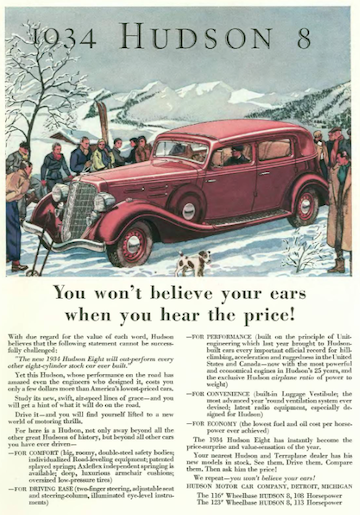
…Hudson Motor Car Company invested in three color pages to announce the rollout of their 1934 Hudson 8…
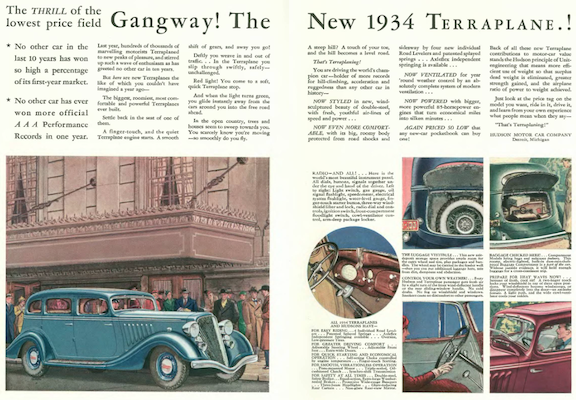
…and their low-priced yet powerful Terraplane…
…Fisher, which made car bodies for General Motors, offered up this color photo of a pretty aviatrix to suggest their interiors were as fresh and clean as the clear skies above…
…Studebaker also paired flying with their latest models…
…Nash employed cartoonist Wayne Colvin for a series of six ads sprinkled across the back pages…here are two examples…
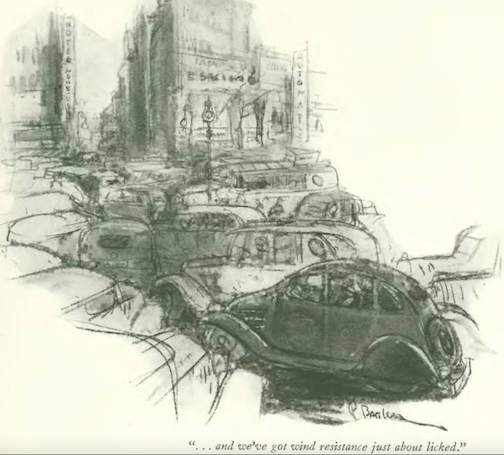
…on to our cartoonists, Perry Barlow used the auto show as inspiration for this cartoon, which appeared along with the review…
…Al Frueh drew up these images for the theatre section…I believe this is the first appearance of Bob Hope in the magazine…
…some housekeeping…I accidentally included this James Thurber cartoon and…
…this Rea Irvin cartoon in my post for the Dec. 30, 1933 issue…they belong with the Jan. 6 issue…
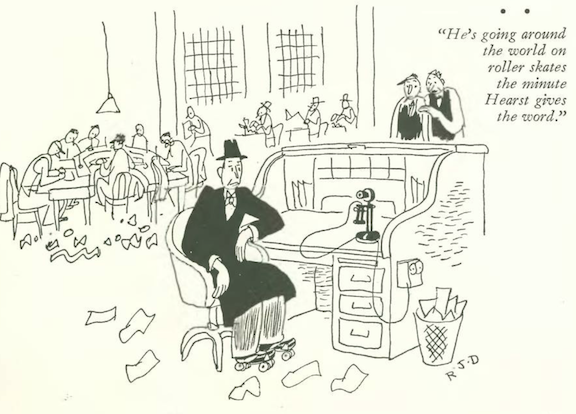
…Robert Day offered up a roving reporter…
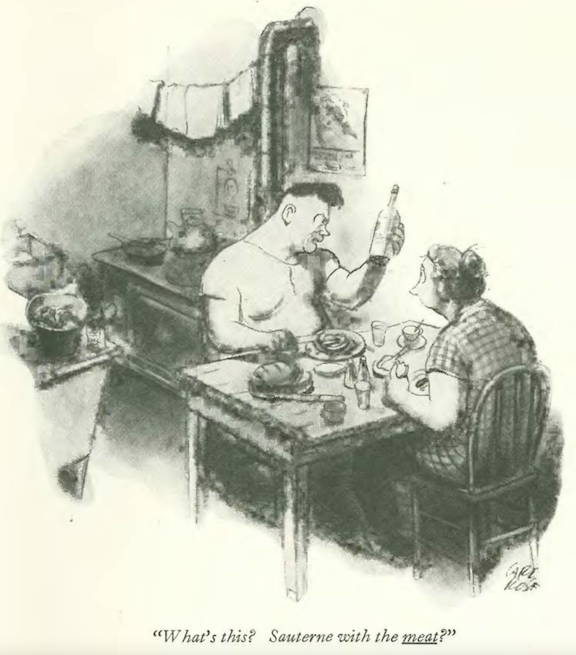
…Carl Rose looked in on a wine connoisseur…
…and we close with a steamy image, courtesy Alan Dunn…
It’s hard to believe in this day and age that a theoretical physicist could enjoy rock star status, but then Albert Einstein wasn’t your everyday theoretical physicist.
Dec. 2, 1933 cover by Helen Hokinson.
A two-part profile of Einstein (1879–1955) by Alva Johnston (with terrific caricature by Al Frueh) examined the life and “idol” status of a man who would define the idea of genius in the 20th century. Although Einstein desired to live an almost reclusive existence at Princeton University, Johnston noted that he had become “fairly reconciled to the occupation of popular idol.”
Einstein was at Princeton thanks to the rise of Adolf Hitler, who came to power in Germany in early 1933 while Einstein was visiting the United States. Returning to Europe that March, Einstein knew he could not return to his home country (indeed, the Gestapo had raided his Berlin apartment and eventually seized all of his property), so when Einstein landed in Antwerp, Belgium on March 28, 1933, he immediately went to the German consulate and surrendered his passport, formally renouncing his German citizenship.
I’M OUTTA HERE…Albert Einstein with a Zionist delegation from France, Belgium, and England upon leaving the SS Belgenland in Antwerp, Belgium, 1933. (United States Holocaust Memorial Museum)
After some time in Europe and Great Britain, in October 1933 Einstein accepted an offer made earlier by from the Institute for Advanced Study in Princeton, New Jersey to serve as a resident scholar. When he arrived with his wife, Elsa, he said he would seclude himself at the Institute and focus on his teaching and research.
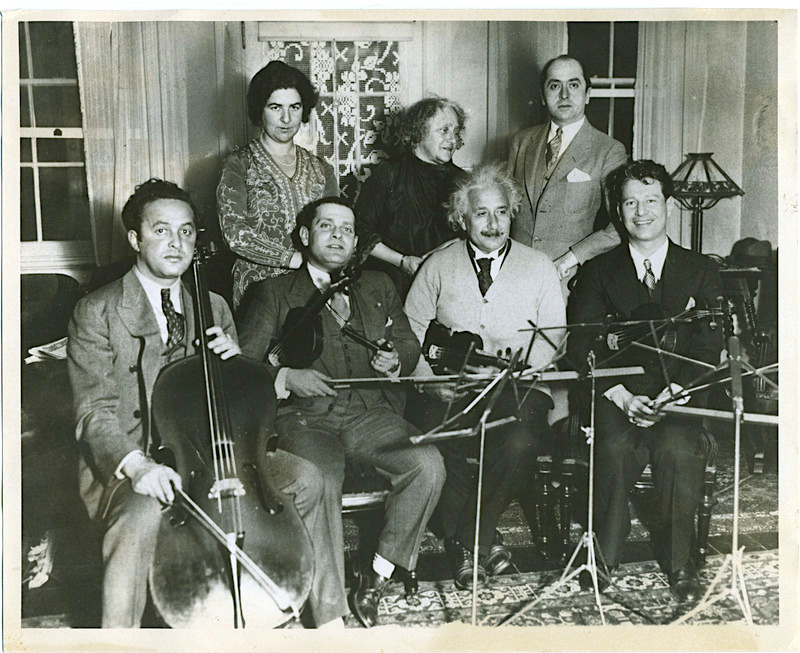
(NY Times, Oct. 18, 1933)EINSTEIN WASN’T FIDDLIN’ AROUND when he played his cherished violin—he once said that if he hadn’t been a scientist, he would have been a musician. This photo was taken at Einstein’s Princeton home in November 1933—he and fellow members of a string quartet were practicing for a December concert at the Waldorf-Astoria to raise money for German-Jewish refugees. From left to right, sitting: Arthur (Ossip) Giskin, Toscha Seidel, Albert Einstein, and Bernard Ocko; standing: Estelle Manheim (Seidel’s wife), Elsa Einstein and unidentified man. (Leo Baeck Institute)
* * *
Stop and Go
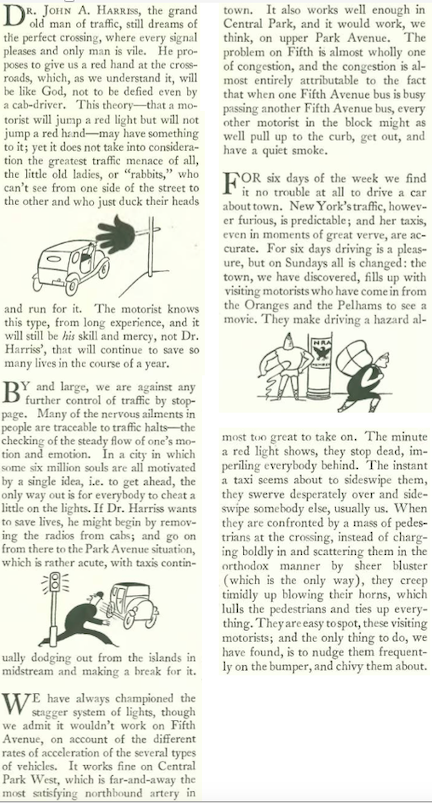
E.B. White devoted his “Notes and Comment” to Manhattan’s traffic situation, which he found manageable as long as tourists stayed out of the way…
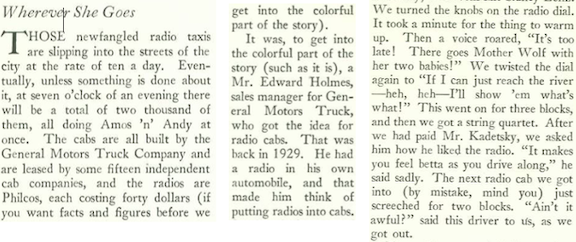
White also noted the perils of Park Avenue, especially the taxi drivers (distracted by those newfangled radios) darting between the islands…
Park Avenue in the 1930s. (geographicguide.com)
…and then there was Fifth Avenue, notorious for traffic jams, made worse on weekends by the tourist traffic…
Fifth Avenue in 1932. (New York State Archives)
…later in “The Talk of the Town” White continued his thoughts on New York taxis, namely the introduction of coin-operated radios installed for use by passengers…
* * *
Fly Newark
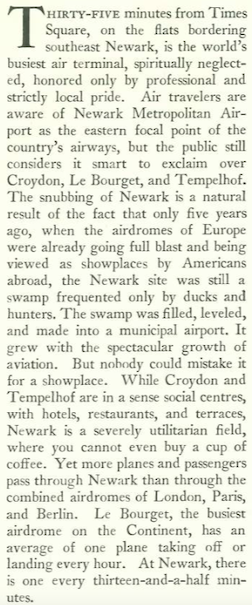
Albert L. Furth took us off the mean streets and into the air when he filed this account about the Newark Metropolitan Airport for “A Reporter at Large.” Furth seemed put off by the cachet of European airports and their many amenities, given that the Newark airport—although admittedly utilitarian—was the busiest in the world. An excerpt:
FREQUENT FLIER…Albert Furth noted that Newark Municipal Airport logged a landing or departure every thirteen-and-a-half minutes. Above, passengers boarding a Boston-bound American Airlines Condor at Newark Airport in 1930. In those simpler times, passengers just walked to the runway and climbed on board. The airport had opened two years earlier on 68 acres of reclaimed swampland along the Passaic River. It was the first major commercial airport in the New York metro area and the first anywhere with a paved runway. (njmonthly.com)
* * *
Goodnight, Speakeasy
Lois Long was an 17-year-old Vassar student when Prohibition went into effect in 1919, so when she started her career in New York in 1922 the only nightlife she knew revolved around speakeasies. Although she held Prohibition officers in disdain, she also believed that the repeal of the 18th Amendment would lower the quality of New York nightlife—the food, the “adroit service,” and the “genial din” of the speakeasy. Excerpts:
FROM LOUCHE TO LEGAL…Lois Long was saying a sad goodbye to her beloved speakeasies; perhaps the Algonquin Hotel (here, circa 1930) would offer some cheer. (Pinterest)
* * *
From Our Advertisers
Abercrombie & Fitch (then an outfitter for the elite outdoorsman) was offering holiday shoppers everything from multi-tool knives to cocktail shakers…
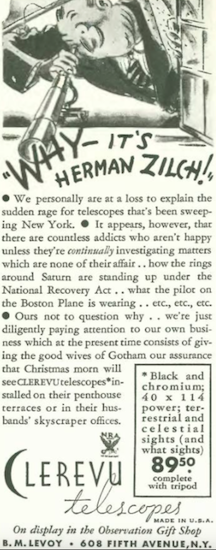
…while the folks at Clerevu telescopes found a growing market for folks who used their product for anything but stargazing…
…with Repeal just days away, the Pleasant Valley Wine Company of New York hoped folks would pop a few of their corks before the good stuff arrived from France…
…the British were coming to the rescue via the Berry Brothers, who were overseeing the importation of liquor from their offices at Rockefeller Center’s British Empire Building…
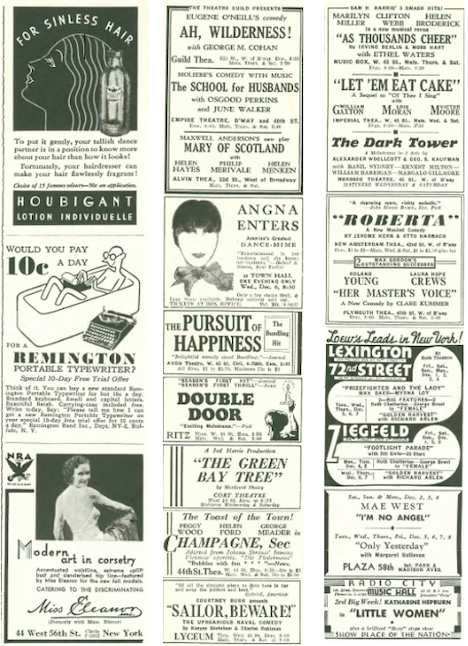
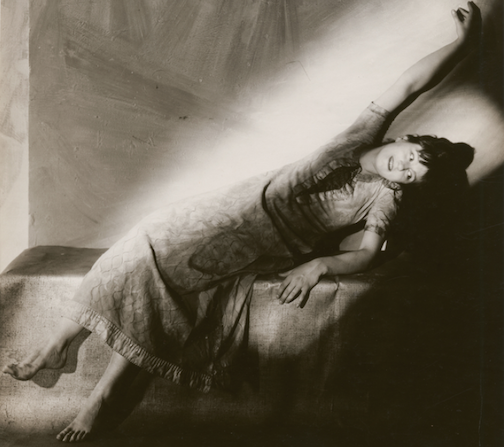
…let’s look at an assortment of one-column ads…the center strip features an ad promoting Angna Enters’ appearance for “one evening only” at The Town Hall (123 West 43rd Street)…Enters (1897–1989) was an American dancer, mime, painter and writer who likely performed her piece Moyen Age…
FEEL THAT STRETCH…Angna Enters performing Moyen Age, circa early 1930s. (NYPL)
…we begin our cartoons with Gardner Rea, and a dedicated bell ringer…
…Otto Soglow showed us a softer side of The Little King…
…Peter Arno revealed the human side of the posh set…
…and we close the Dec. 2 issue with this classic from James Thurber…
…on to Dec. 9, 1933, and a cover by an artist we haven’t seen in awhile, Ilonka Karasz…
Dec. 9, 1933 cover by Ilonka Karasz.
…and we open with this comment by E.B. White, who along with critic Lewis Mumford had once voiced displeasure over the massive Rockefeller Center project. However, while viewing the floodlit tower by night, he decided that he would have to eat his words, observing how “the whole thing swims up tremendously into the blue roxyspheres of the sky”…
MEA CULPA…E.B. White gained a new perspective on Rockefeller Center, pictured here in December 1933. (Wikipedia)
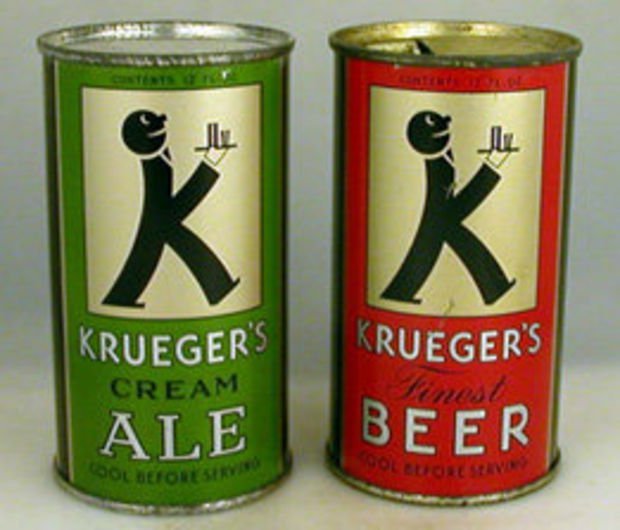
…we continue with White, who also offered his thoughts on something heretofore unthinkable—a proposal to start putting beer in cans…
…it would happen about a year later…on Jan. 24, 1935, the Gottfried Krueger Brewing Company, in partnership with the American Can Company, delivered 2,000 cans of Krueger’s Finest Beer and Krueger’s Cream Ale to drinkers in Richmond, Virginia…
(seletyn.com)
…and despite White’s doubts, apparently ninety-one percent of the first drinkers of the product approved of the canned beer, although when Krueger’s launched their ad blitz they had to include instructions (and a new tool) to open the darn things…
(seletyn.com)
* * *
Dreamscapes
Critic Lewis Mumford offered his thoughts on a recent exhibit by a young surrealist named Salvador Dali…
MIDDLEBROW SURREALIST…The Triangular Hour by Salvador Dali, 1933. (wikiart.org)
…and we move along to moving pictures, where John Mosher was showing some appreciation for Joan Crawford (1906–1977) in the pre-Code film Dancing Lady…
SHE HAD IT ALL…Audiences and critics alike were wowed by Joan Crawford’s performance in Dancing Lady, which featured a star-studded and eclectic cast. Clockwise from top left, Clark Gable plays a Broadway director who becomes Crawford’s love interest; Crawford displays her dancing talent in a Broadway rehearsal; Dancing Lady featured an early film appearance by The Three Stooges, pictured here with Gable and the Stooges’ leader at the time, Ted Healy; Crawford with Stooge Larry Fine—in the original film, Fine completes his jigsaw puzzle only to discover (to his disgust) that it’s a picture of Adolf Hitler. The Hitler scene was removed by the Production Code; its enforcers claimed it insulted a foreign head of state. (IMDB)
In addition to Crawford, the star-studded cast included Clark Gable, Fred Astaire (in his film debut), Franchot Tone (who was married to Crawford from 1935-39 and made seven movies with her), The Three Stooges, Nelson Eddy, and Robert Benchley, who played a reporter in the film.
Dancing Lady was the film debut of Astaire, making Crawford the first on-screen dance partner of the famed hoofer…
(IMDB)
* * *
More From Our Advertisers
We begin with this full-page advertisement from Heinz, which went to great lengths and expense to make their ad appear to part of The New Yorker’s editorial content, even featuring a Perry Barlow cartoon of a boy making a mess with their product…
…another New Yorker contributor who occasionally went over to the advertising side was Alexander Woollcott, here shilling for Chrysler…
…Kayser, purveyor of women’s hosiery and underthings, was going for some humorous holiday cheer, but the effect is a bit unsettling…
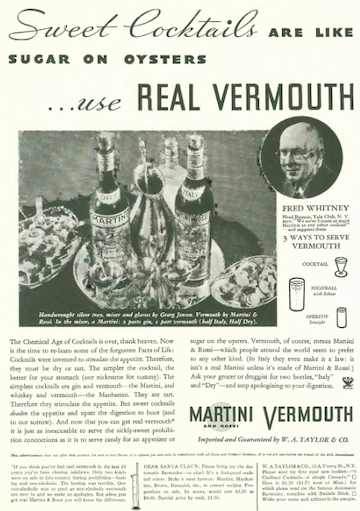
…liquor-related ads began to proliferate with the end of the Prohibition…this one from Martini & Rossi…
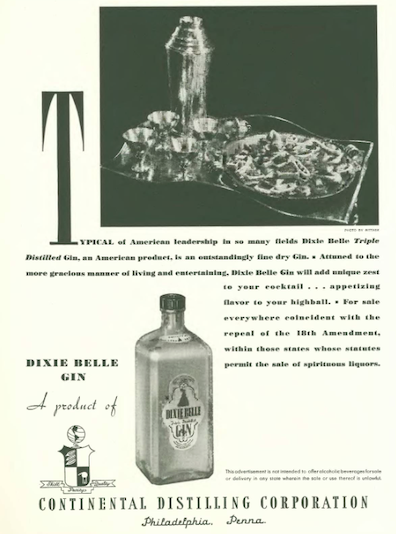
…Continental Distilling was hoping to grab its share of gin sales with its Dixie Belle American gin…
…from the same folks who brought us Fleishmann’s yeast (and kept The New Yorker afloat in its early lean years) came this American dry gin…
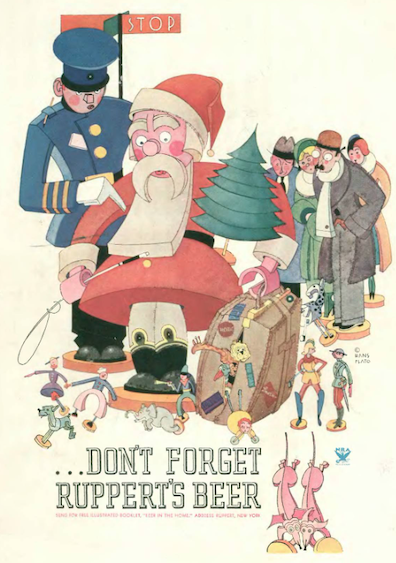
…Ruppert’s Beer was back with another full-page color ad by Hans Flato…
…on to our cartoons, and Santa again, this time besieged by an aggressive tot as rendered by Helen Hokinson…
…Carl Rose found an unlikely customer at a newsstand…
…here is the last of four cartoons Walter Schmidt published in the New Yorker between 1931 and 1933…
…Peter Arno left his glamorous world of nightclubs and high society parties to look in on life at a boarding house…
…and we close with the delightful Barbara Shermund…































































































































 A New Yorker State of Mind