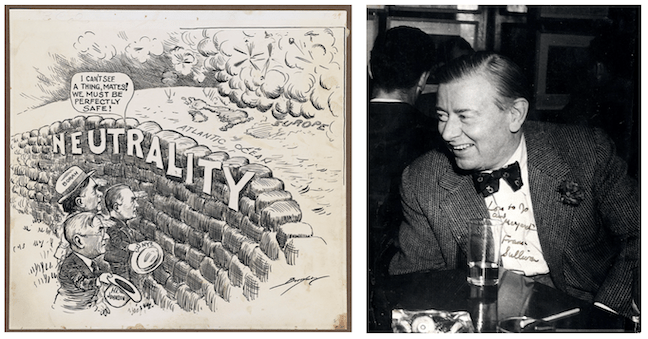
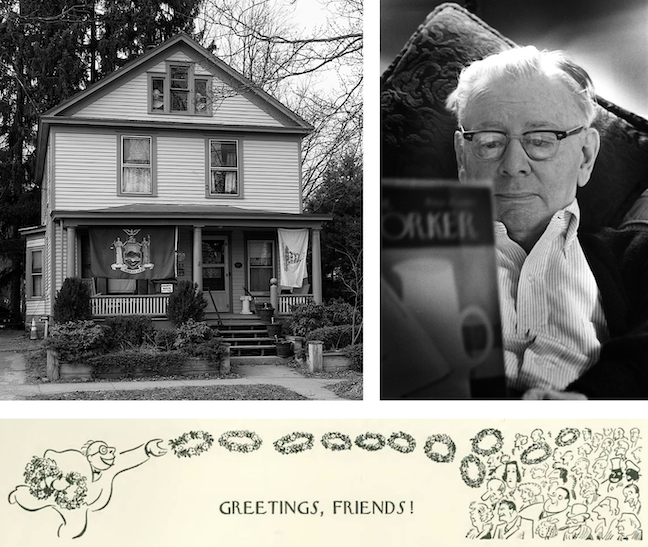
Above: Political cartoon by Clifford Berryman depicting three supporters of the Neutrality Act, 1939; at right, Frank Sullivan at his favorite watering hole, the Worden Hotel in Saratoga Springs, NY. (nationalww2museum.org/digitalarchive.sspl.org)
In 1935 the American humorist Frank Sullivan introduced the “Cliche Expert” Mr. Arbuthnot to New Yorker readers, exploring a variety of bromides associated with everything from political campaigns to the legal system.
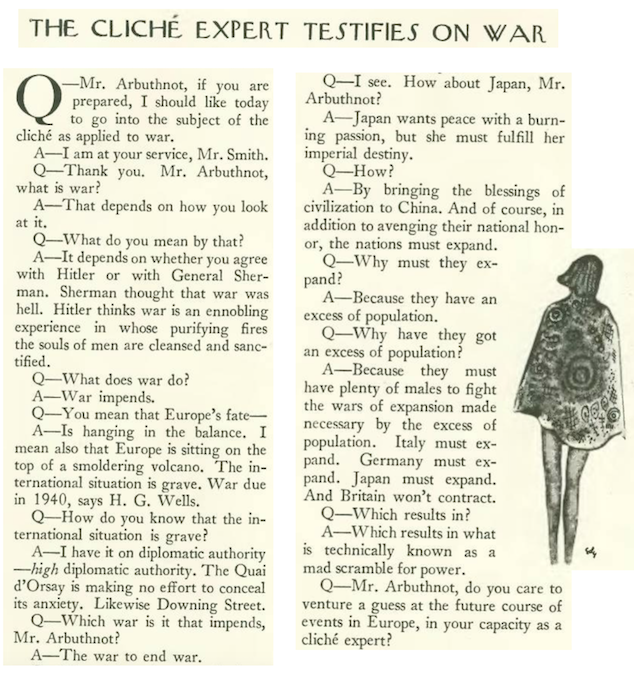
For the July 18 issue Sullivan (1892–1976) called on Mr. Arbuthnot to explore the subject of war (Sullivan had some familiarity with the subject as a soldier in World War I). Below is the first of two excerpts from “The Cliché Expert Testifies on War” (spot drawing by Susanne Suba):
A peripheral member of the Algonquin Round Table, Sullivan wrote his first article for The New Yorker in 1925, and seven years later published his inaugural “Greetings, Friends!” Christmas poem (he would contribute forty-two of them, his last in 1974). He penned more than a dozen Mr. Arbuthnot stories from 1935 to 1952, and also introduced such characters as Aunt Sally Gallup, Martha Hepplethwaite, and the Forgotten Bach. An expert in comparative illusion, he is credited with this gem: “This is either a forgery or a damned clever original!”
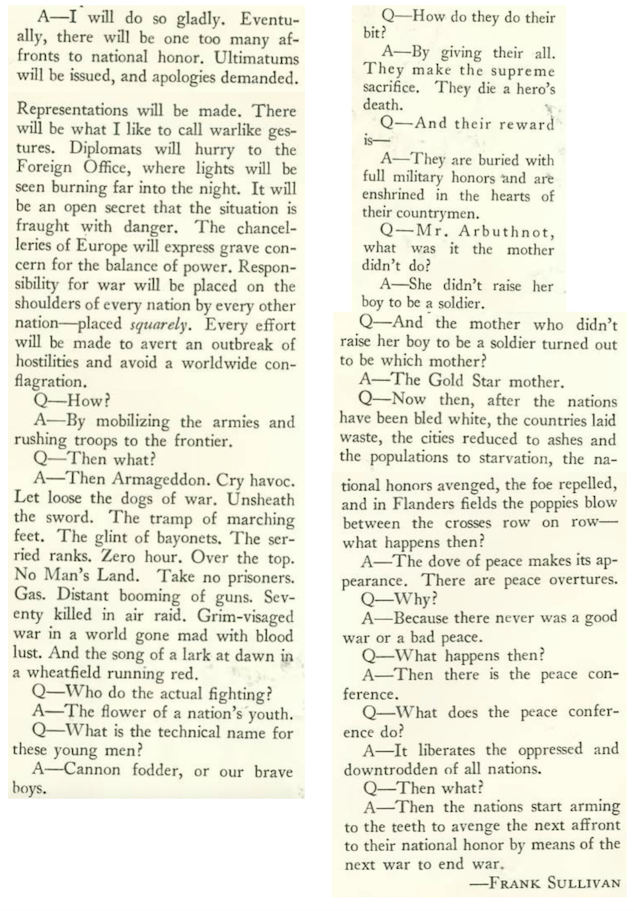
Here is the second excerpt from “The Cliché Expert Testifies on War”…
In a 1967 interview with The New York Times, Sullivan remarked that the war-divided country had lost its sense of humor. “But wars have never stopped humor,” he told Alden Whitman. Sullivan maintained that the world was more lighthearted in the 1920s and 30s, despite the horrors of World War I. “It was a time of beautiful nonsense,” he said.
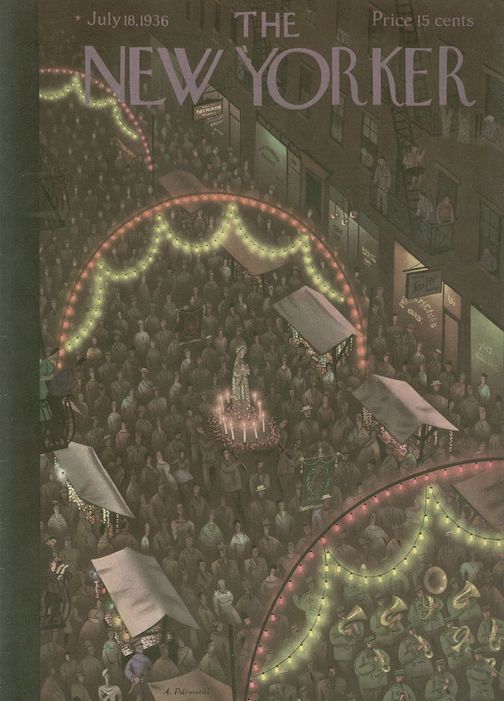
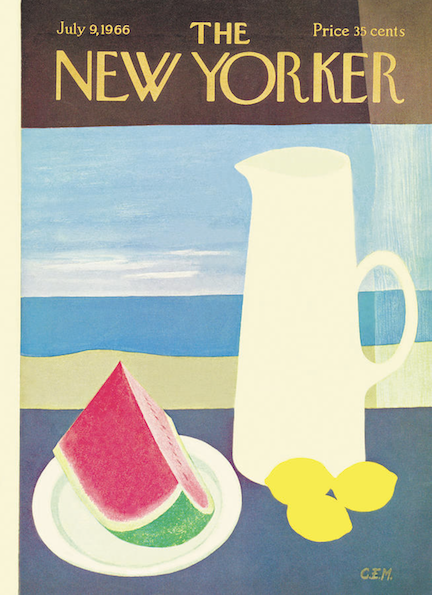
Here is the cover of the July 9, 1966 issue featured above; the painting is by Charles E Martin:
A final note: After his service in World War I, Sullivan moved to New York City and wrote for several newspapers including the New York World. After the World folded in 1931, Sullivan moved back to his hometown, Saratoga Springs, where he shared a small clapboard house with his older sister, Kate Sullivan. Of his preference for small town life, he wrote: “Once I visited New York for twenty years but I wouldn’t live there if you gave me Philadelphia. A small town is the place to live. I live in a small town 180 miles from New York and while I would not say it has New York beat by a mile I would put the distance at six furlongs.”
Called the “Ultimate Freelancer,” Sullivan wrote for The New Yorker for fifty years and also contributed to the New York Times sports section, the Saturday Evening Post, and Town & Country. His work is collected in more than a half-dozen books.
* * *
Hanging Around
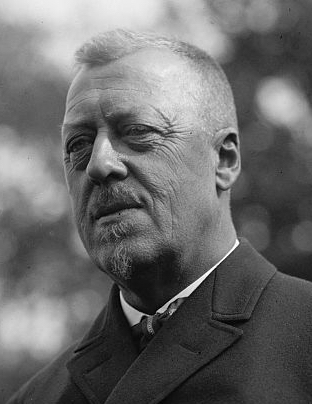
In his “Notes and Comment,” E.B. White noted the speed at which the Hindenburg made its Atlantic crossing, although the giant German airship had to hover over Lakehurst, N.J. for an extra hour to wait for customs officials to get out of bed. White also mentioned a “Dr. Eckener,” a reference to Zeppelin captain Hugo Eckener (see below), who was also manager of a German aircraft company that produced the ill-fated Hindenburg.
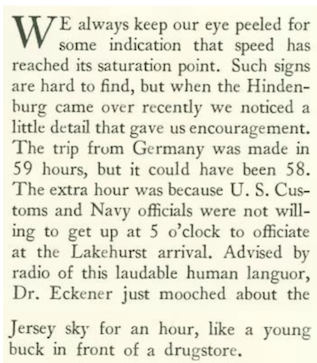
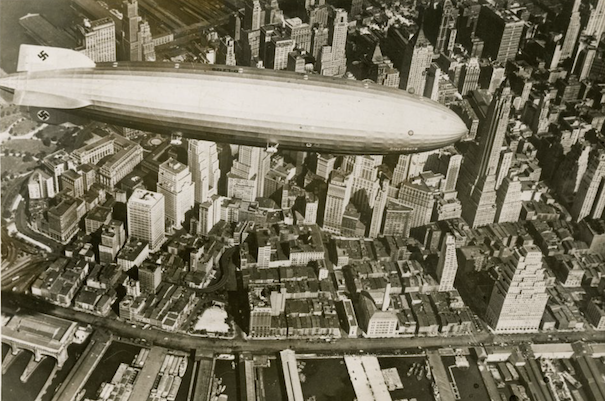
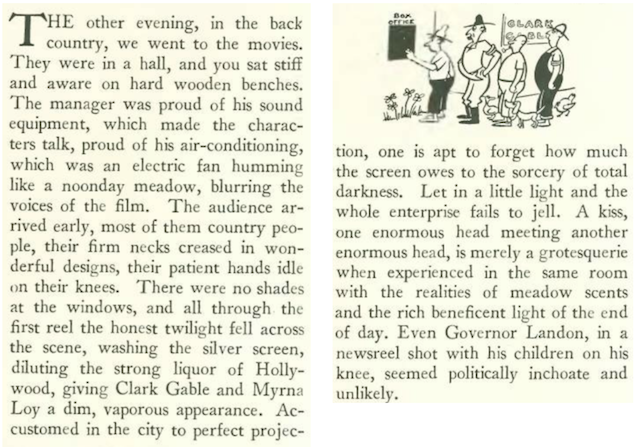
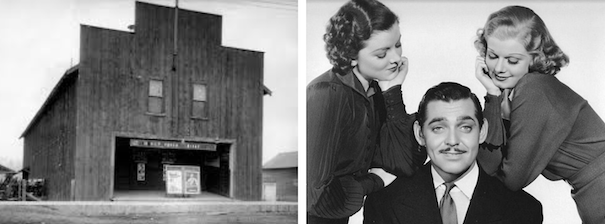
White also commented on a recent evening at the movies “in the back country,” where a Clark Gable–Myrna Loy picture was playing in a makeshift theater outfitted with wooden benches.
* * *
Komrade With Kamera
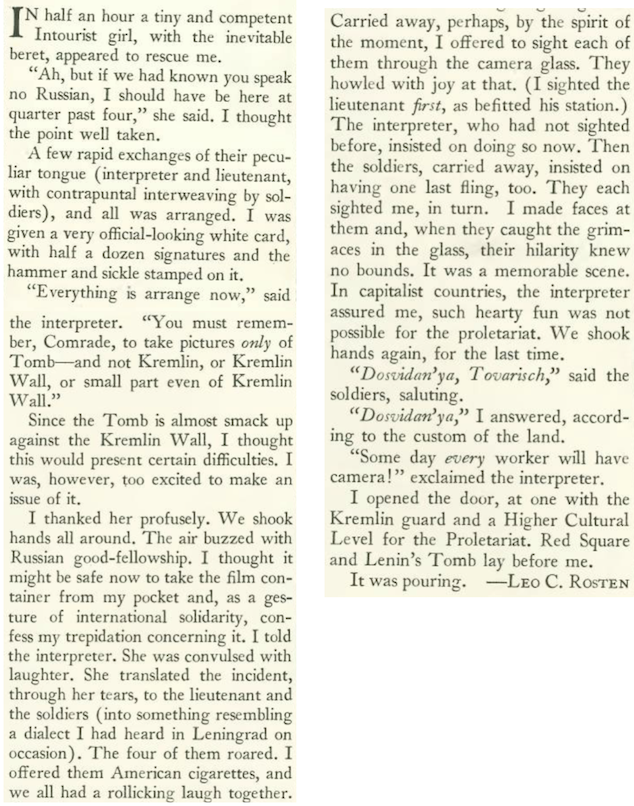
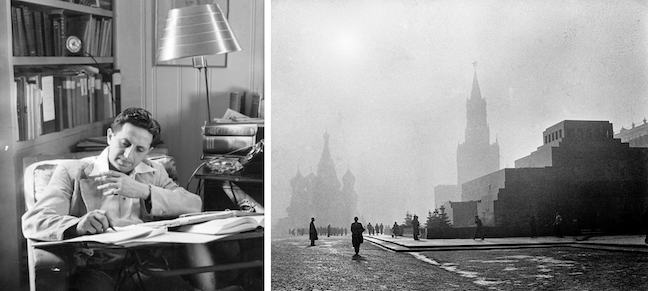
Humorist Leo C. Rosten contributed numerous short fiction stories to The New Yorker as well as several “A Reporter at Large” pieces between 1936 and 1939. He published “A Shot of Lenin’s Tomb” (classified as fiction) in the July 18 issue. Two brief excerpts:
* * *
Crossing Over
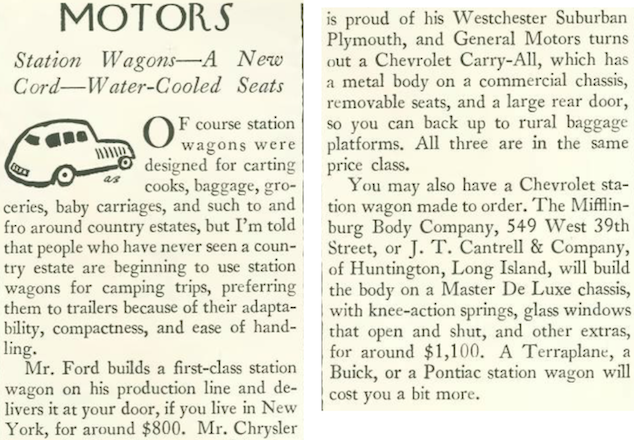
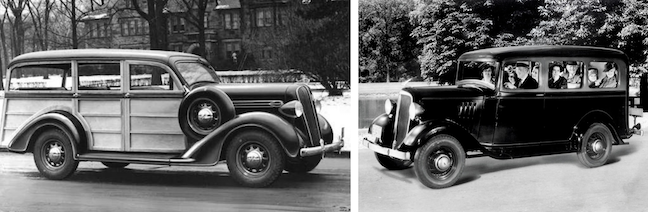
Station wagons were first built in the 1910s as custom jobs—independent manufacturers would produce wooden bodies for the Model T chassis. These were considered “depot hacks” and commercial vehicles rather than family cars. But things changed in the 1930s as manufacturers saw their potential in the consumer market. Journalist George F.T. Ryall (pen name “Speed”), who wrote the “Motors” column for The New Yorker in the 1930s, looked in on the new automobiles that would foreshadow today’s crossovers.
* * *
At the Movies
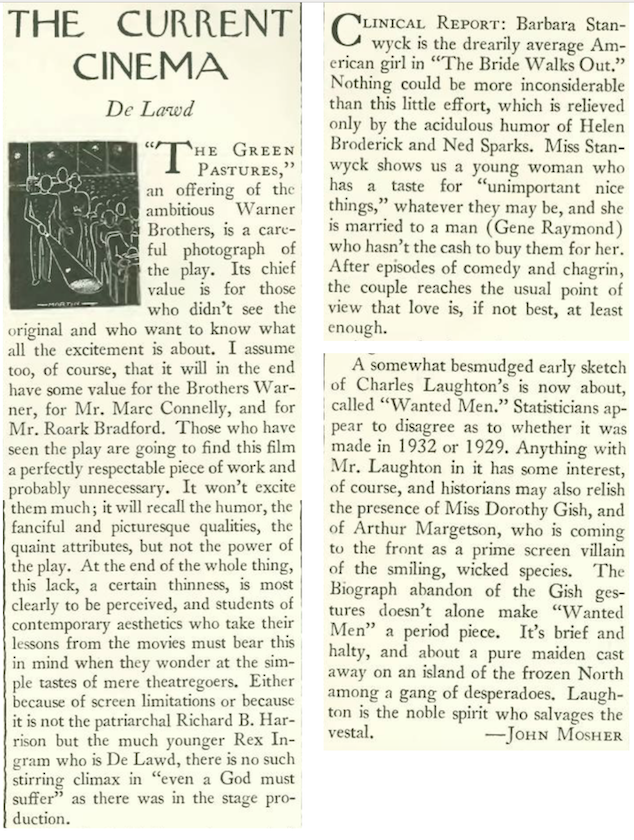
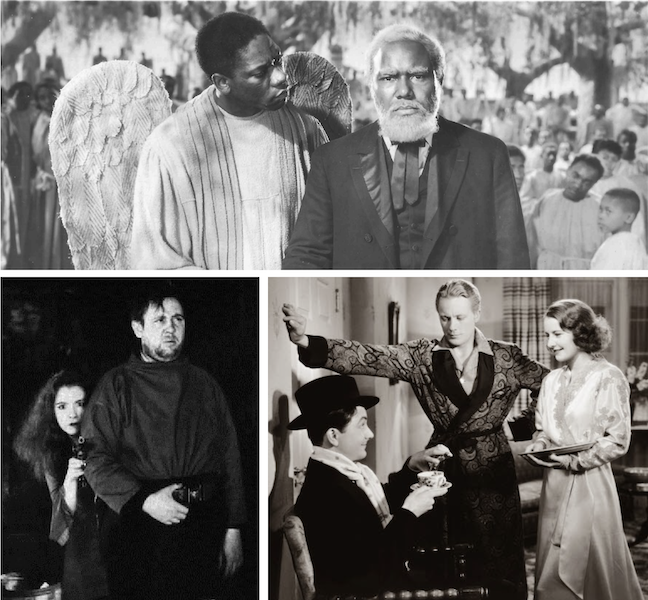
The 1929 play The Green Pastures, which portrayed Old Testament stories as seen through the eyes of a young Black child, was written by playwright Marc Connelly, one of founding members of the Algonquin Round Table. The play was based on Roark Bradford’s popular 1928 story collection Ol’ Man Adam an’ His Chillun (strongly criticized over the years for its patronizing and demeaning portrayals of Black characters). Connelly, who won a Pulitzer for the play, also directed its screen adaptation, one of just six feature films in the Hollywood Studio era to feature an all-Black cast. Critic John Mosher gave the film, along two other releases, an unenthusiastic review.
* * *
From Our Advertisers
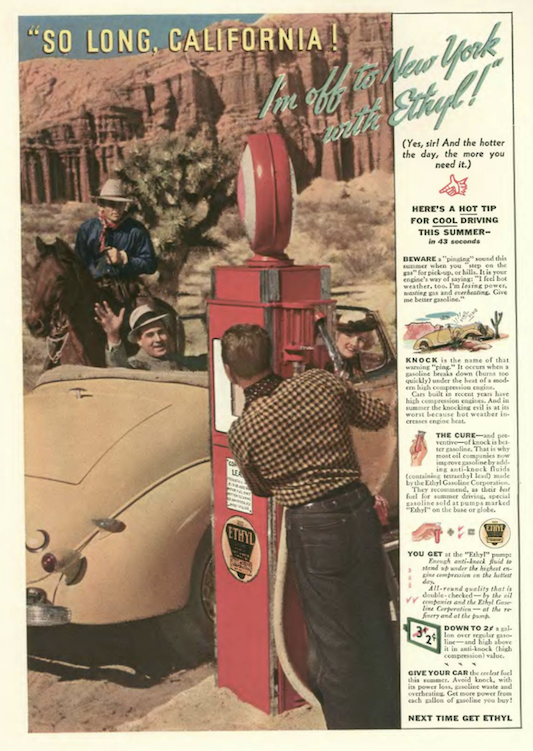
We set off down a long road with a tankful of leaded petrol…
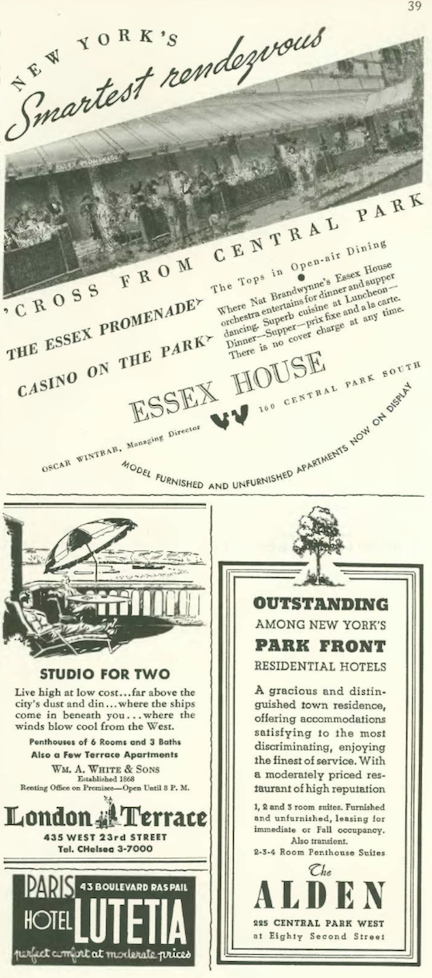
…from the back of the book, select living arrangements from the upscale to the budget conscious…
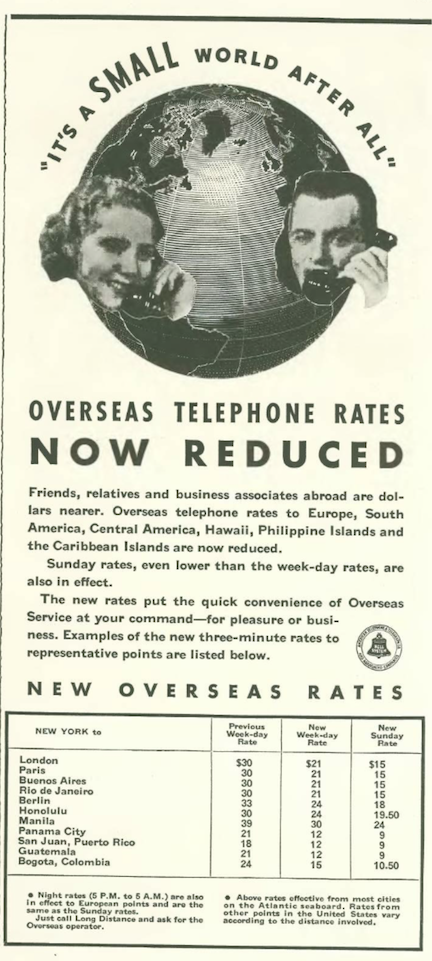
…this ad from Bell Telephone anticipated the Sherman Brothers 1964 earworm that still accompanies a popular Disney attraction…
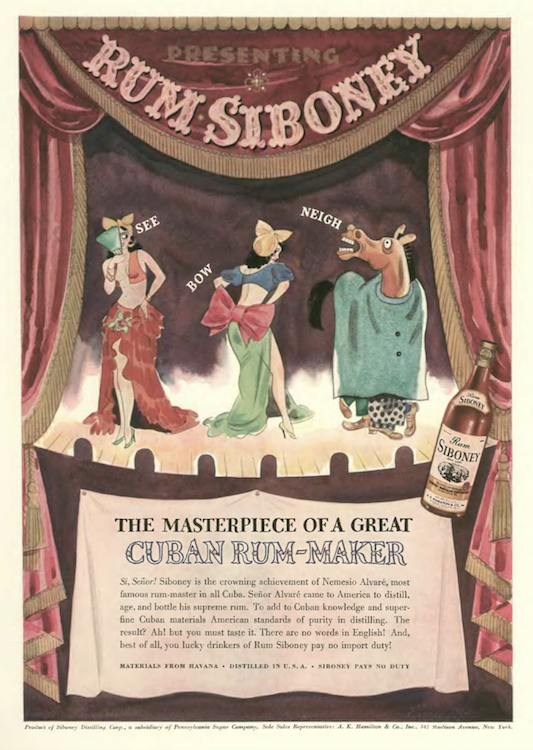
…the back inside cover offered a colorful splash of sex and humor (and a bit of phonetics) to promote Siboney Rum…
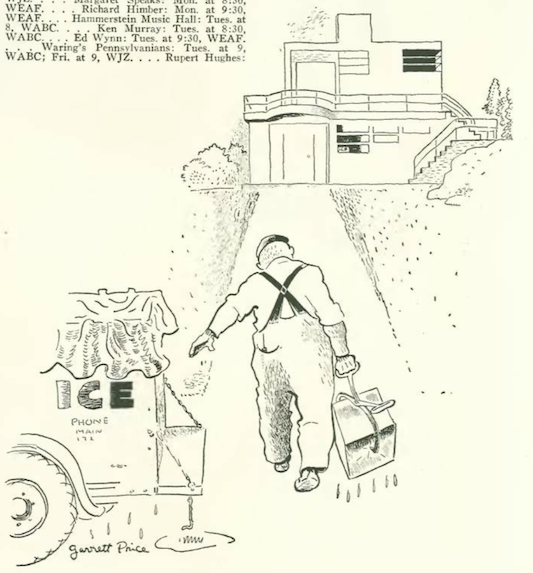
…on to our cartoonists, we begin with some heavy lifting from Garrett Price…
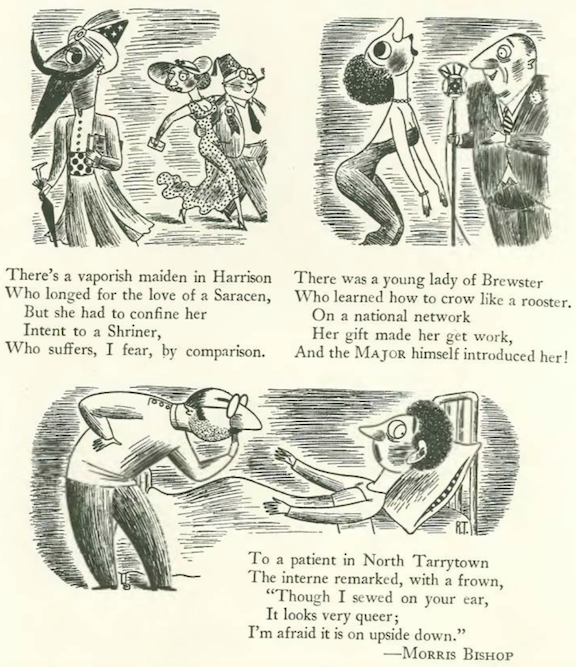
…Richard Taylor sketched up these merry illustrations for a Morris Bishop ditty…
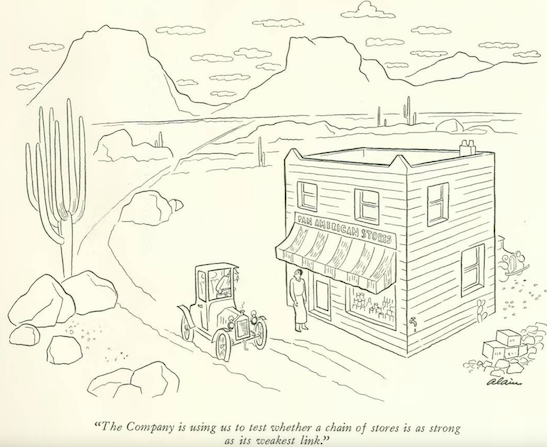
…Alain engaged in some market research…
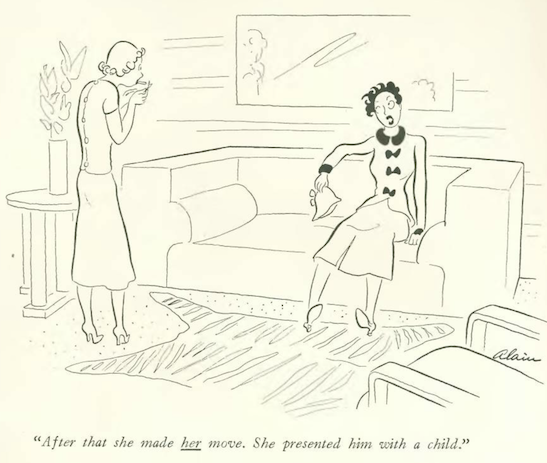
…and channelled a bit of Barbara Shermund humor…
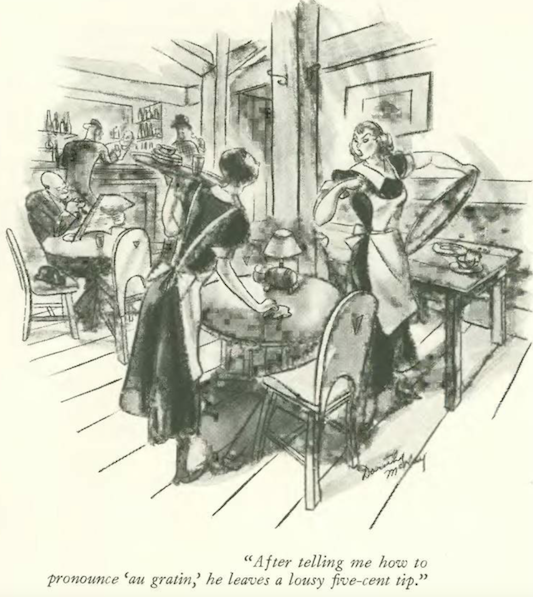
…Dorothy McKay explored the sad world of phonies and cheapskates…
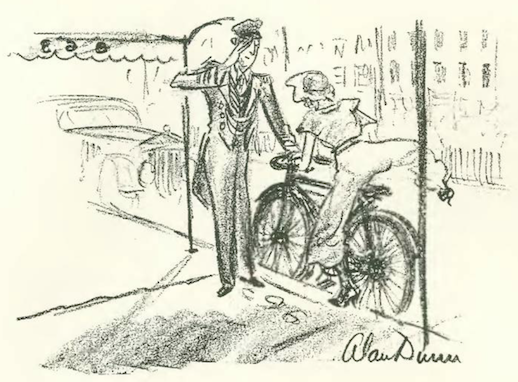
…Alan Dunn gave us a dutiful doorman…
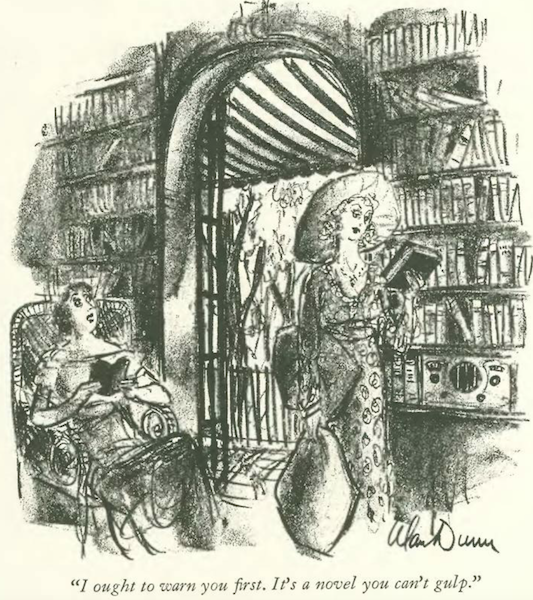
…and Dunn again, contemplating a hefty tome…
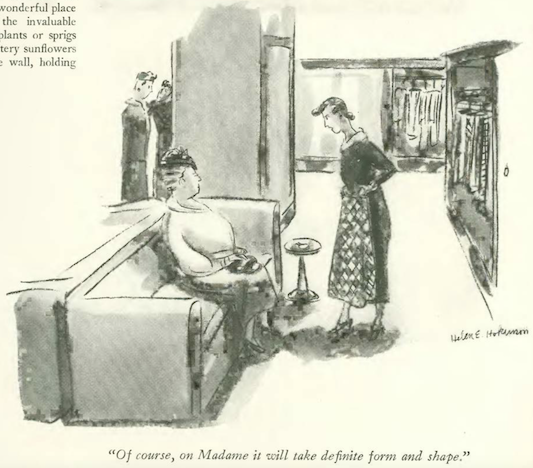
…Helen Hokinson continued her exploration of department store drama…
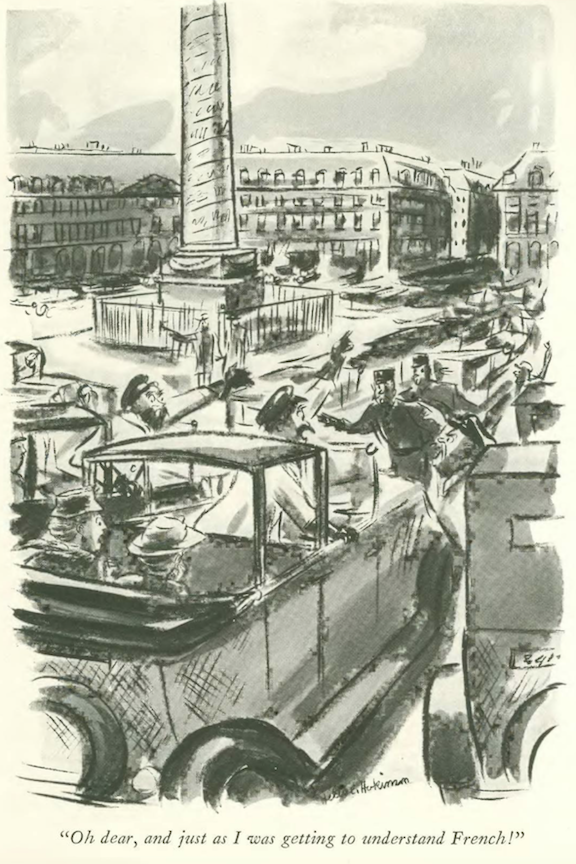
…as well as the world of foreign affairs…
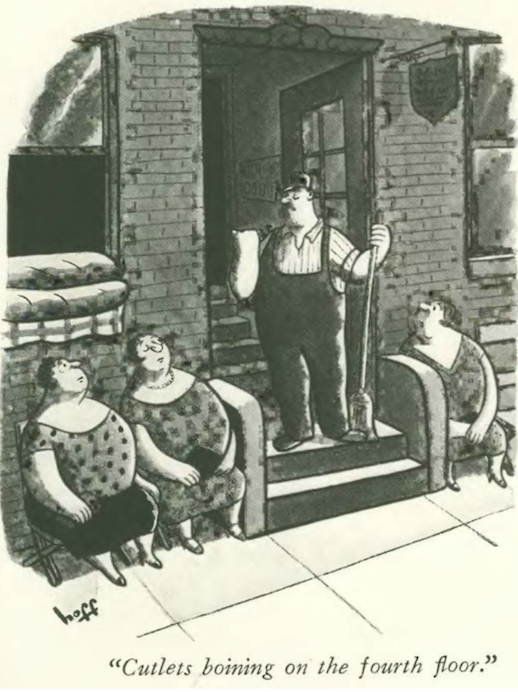
…Syd Hoff sounded the alarm on some burning cutlets…
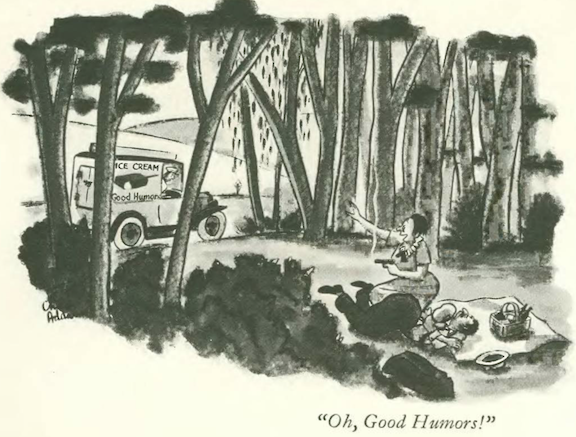
…and we close with the master of dark humor, Charles Addams…
Next Time: That Tammany Taint…


One thought on “Platoon Platitudes”