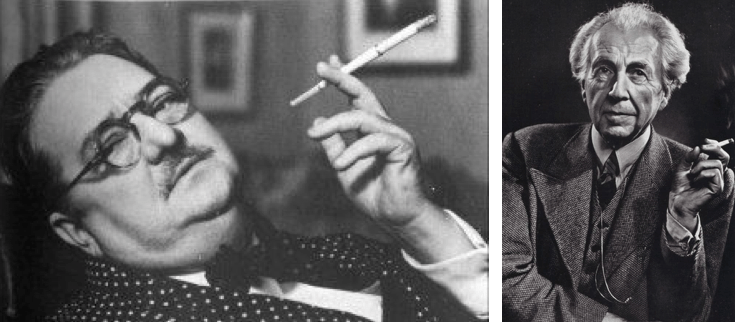
From the late I.M. Pei to Frank Gehry, America has its share of “starchitects,” but only one architect in the history of the profession could claim to be a true household name: Frank Lloyd Wright.
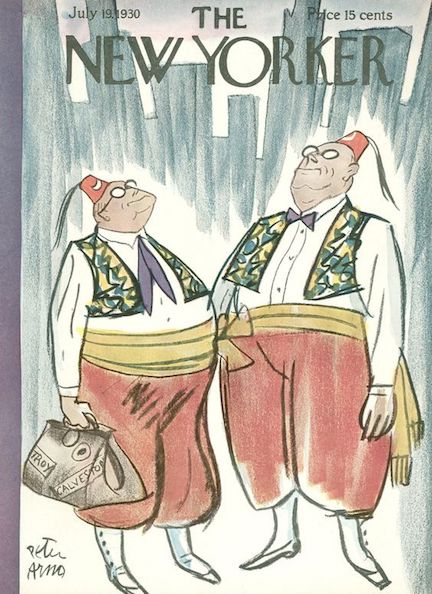
July 19, 1930 cover by Peter Arno.
In a profile titled “The Prodigal Father,” Alexander Woollcott wrote about Wright’s “return” to American acceptance after nearly two decades of scandal and tragedy. Woollcott took great pains to defend Wright’s reputation, marred by his extramarital affair with Mamah Cheney, her murder in 1914 along with six others (including her children) at Wright’s Wisconsin home, Taliesin, and his subsequent remarriage, divorce, and remarriage that followed.
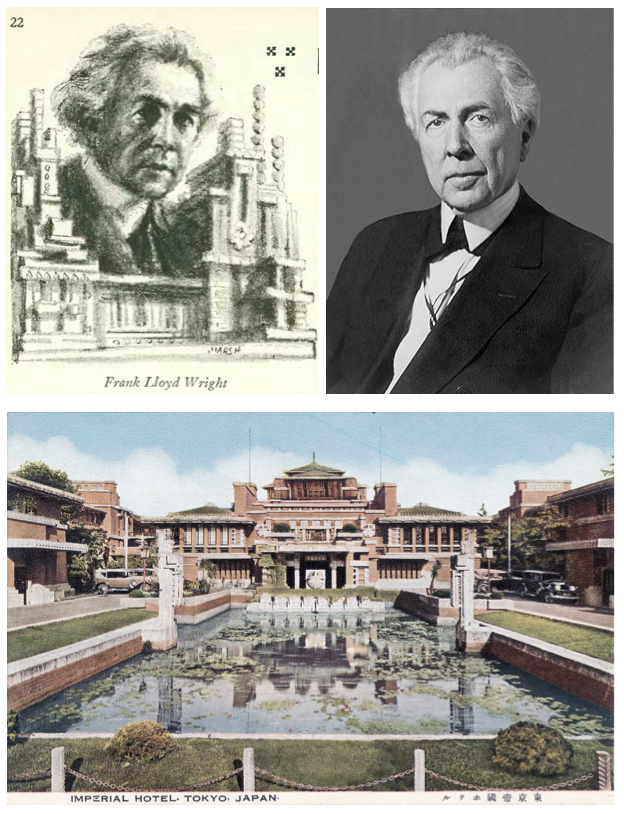
GONE BUT NOT FORGOTTEN…Clockwise, from top left, Reginald Marsh illustration for the profile; Frank Lloyd Wright, circa 1930; Tokyo’s Imperial Hotel, completed in 1923. Designed in the Maya Revival Style Wright favored throughout the 1920s, it was damaged by the 1923 Great Tokyo Earthquake just months after opening. It was demolished in 1967, however the iconic central lobby wing and the reflecting pool were disassembled and rebuilt near Nagoya. (Library of Congress/dezeen.com)
Note: Thanks to a reader’s correction (see comments at the bottom), the following has been revised:
Woollcott also wrote of his visit to Taliesin (the third version of the house, after the first two were destroyed by fires). What stands out about this profile is Woollcott’s praise for the architect, a rare hagiography from a man renowned for his savage wit.
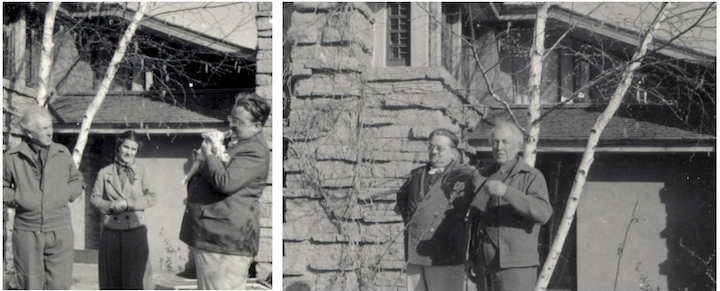
MEETING OF THE MINDS…Above and below are photographs from a autumn visit to Taliesin by Alexander Woollcott. From left are Olgivanna Lloyd Wright, Frank Lloyd Wright and Woollcott. Wright invited Woollcott to the estate in the late 1920s: “This note will be witless as usual, but grateful…. Dear Man, why don’t you come up here? Bring any friend up here with you. Both of you can find an admirable place to work here…” (Avery Architectural & Fine Arts Library, Columbia University, New York)
THIRD TIME’S A CHARM…The third version of Taliesin (built in 1925) is the one Woollcott would have visited in the late 1920s. (Wikipedia/Taliesin Preservation)
* * *
No Surprise Endings, Please
Although sometimes confused with Alexander Woollcott because of his first name, the timid, taciturn Wolcott Gibbs was a force at The New Yorker in his own right, perhaps even more so as he served the magazine from 1927 to 1958 as a jack-of-all-trades: copy editor, feature writer, theater critic, and overall wordsmith. So when the editors of The Writer’s Digest posed a question regarding The New Yorker’s policy for submissions, it was Gibbs who was tapped to compose a response, which was a particular challenge given the magazine didn’t have a clear set of editorial requirements. So Gibbs conjured up an “Answers-To-Hard-Questions Department,” and signed it “Mr. Winterbottom.” Some excerpts:
IN HIS ELEMENT…Wolcott Gibbs, left, relaxes at the Algonquin Hotel in 1937. At right is his New Yorker colleague Dorothy Parker. (Time)
* * *
Munitions of Bremen
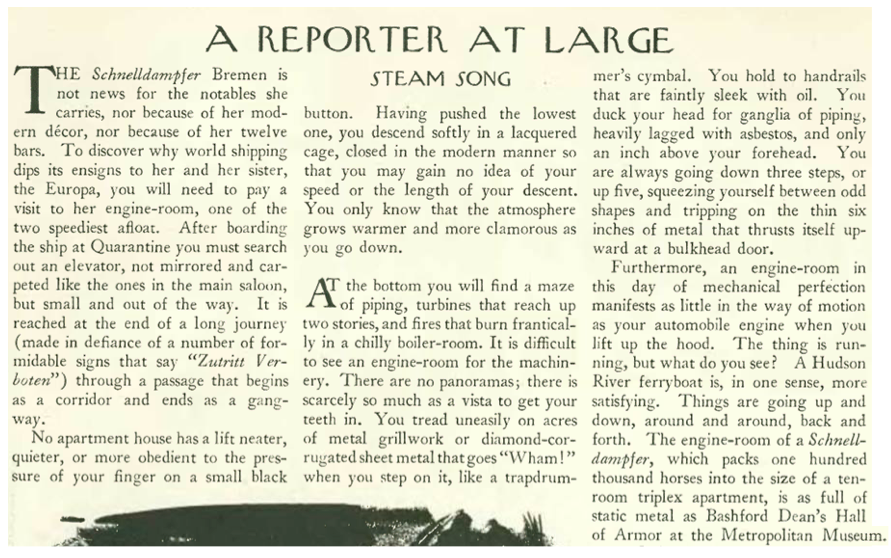
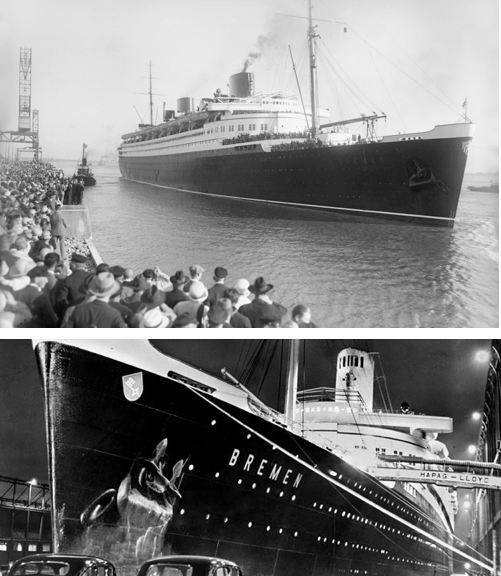
The German Ocean liner SS Bremen was one of the most technologically advanced ocean liners of its day, known for its speed and luxury. Author Eric Hodgins climbed aboard to file a report for the New Yorker, and in the excerpt below marveled at the “mechanical perfection” of the ship’s engine room:
PLOUGHSHARES INTO SWORDS…More than the length of three football fields, the streamlined SS Bremen, launched in 1928, was designed to have a cruising speed of 27.5 knots (50.9 km/h). After a 1941 fire, the ship was largely dismantled, its steel used to manufacture war munitions. (Wikipedia/greatoceanliners.com)
In 1941, while docked in Bremerhaven, a disgruntled crew member set fire to the ship, completely gutting its luxurious interior. During the war the ship was stripped of its steel for use in munitions, and in 1946 what remained was destroyed by explosives.
* * *
From Our Advertisers
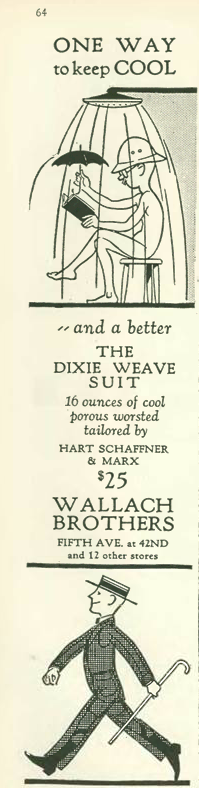
In my readings of recent issues I’ve noted numerous references to hot weather, and for good reason. The summer of 1930 would see record high temperatures and diminished rainfall that would usher in the “Dust Bowl” era of the 1930s. The Wallach Brothers adjusted by offering this “Dixie Weave Suit”…
…the hot weather also called for a tall glass of sparkling soda (mixed with your favorite bootleg beverage, of course)…
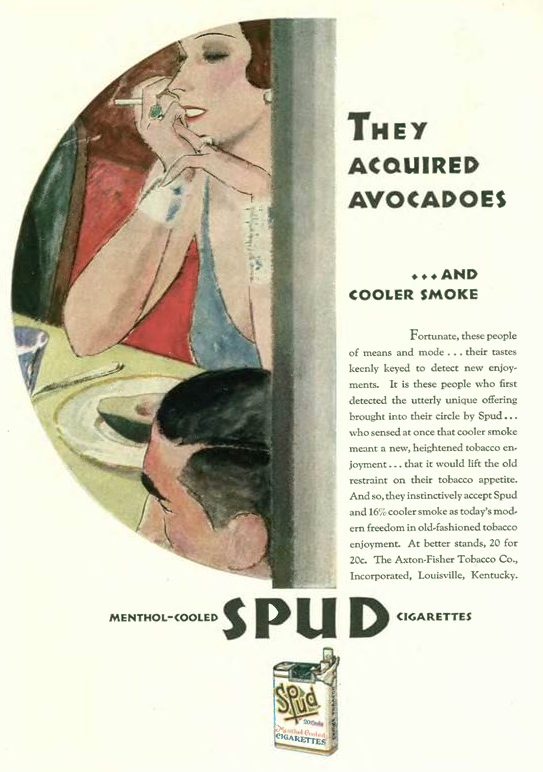
…smokers could keep cool by puffing on a Spud, the first menthol cigarette…
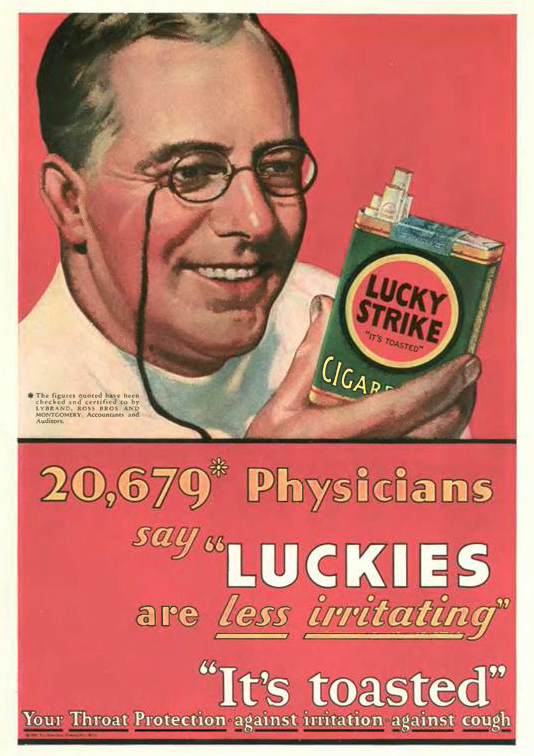
…or you could stick with your Luckies, endorsed by none other than this generic, genial doctor and some bogus survey…
…on to our cartoons…Isadore Klein showed us a downside of Edison’s invention…
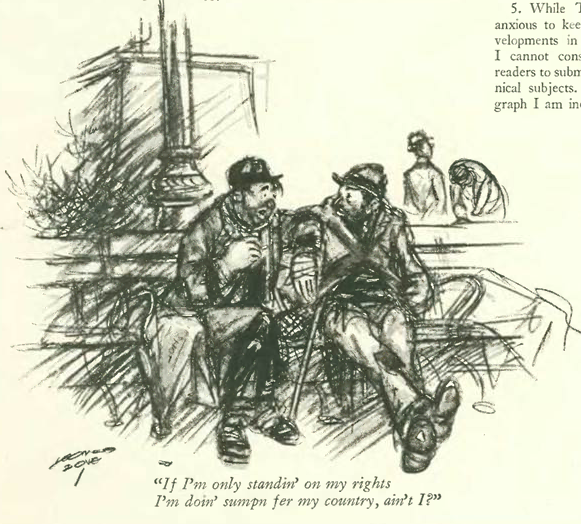
…and Leonard Dove gave us two gentlemen on the skids, a frequent sight in Depression-era New York…
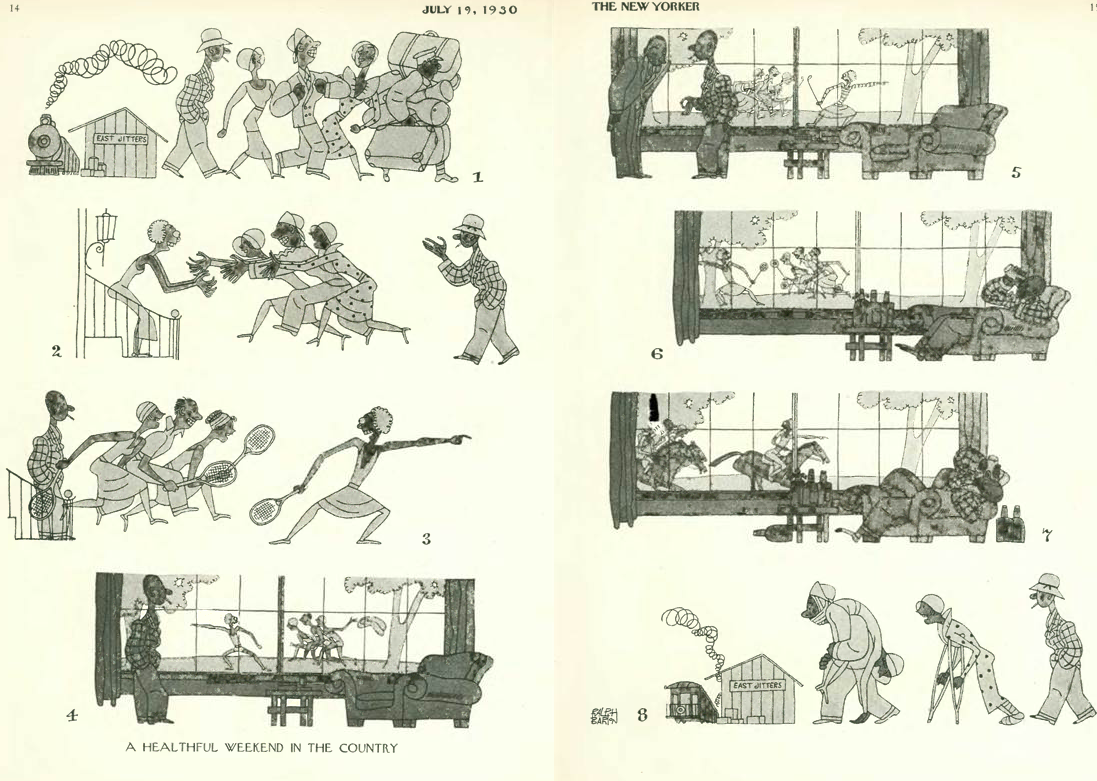
…after a long absence, we see suddenly see a flurry of activity from the pen of Ralph Barton, including this rare sequential cartoon…
…and with the hot summer New Yorkers took to the waters, at Coney Island with Denys Wortman…
When Apollo astronauts landed on the moon fifty years ago, many skeptics asked the question, “What good does this accomplish?”
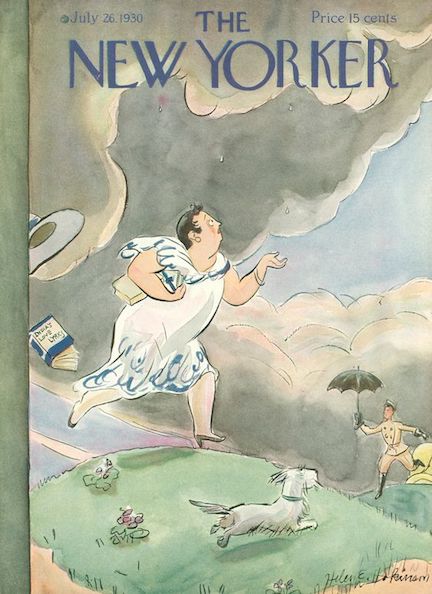
July 12, 1930 cover by Constantin Alajálov.
New Yorker writer Morris Markey posed the same question 89 years ago about transatlantic flights, then limited to a handful of daredevils chasing various speed and distance records. Crossing the ocean in an airplane, Markey observed, was “one of the most difficult things imaginable.” He concluded that despite the heroics of a few pilots, “we are still not much nearer to transoceanic commercial service…”
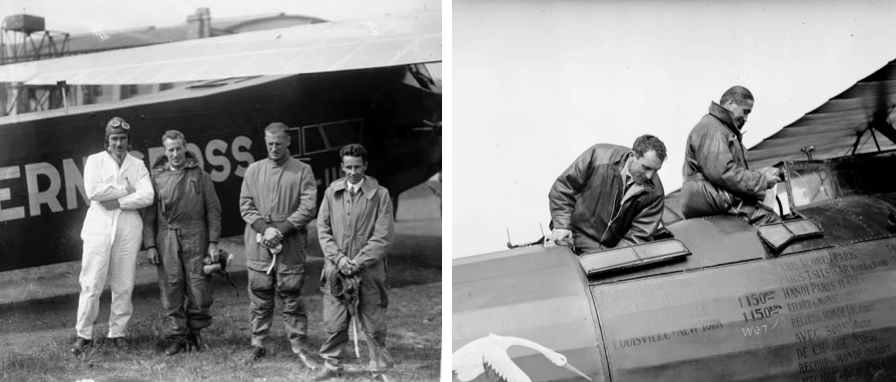
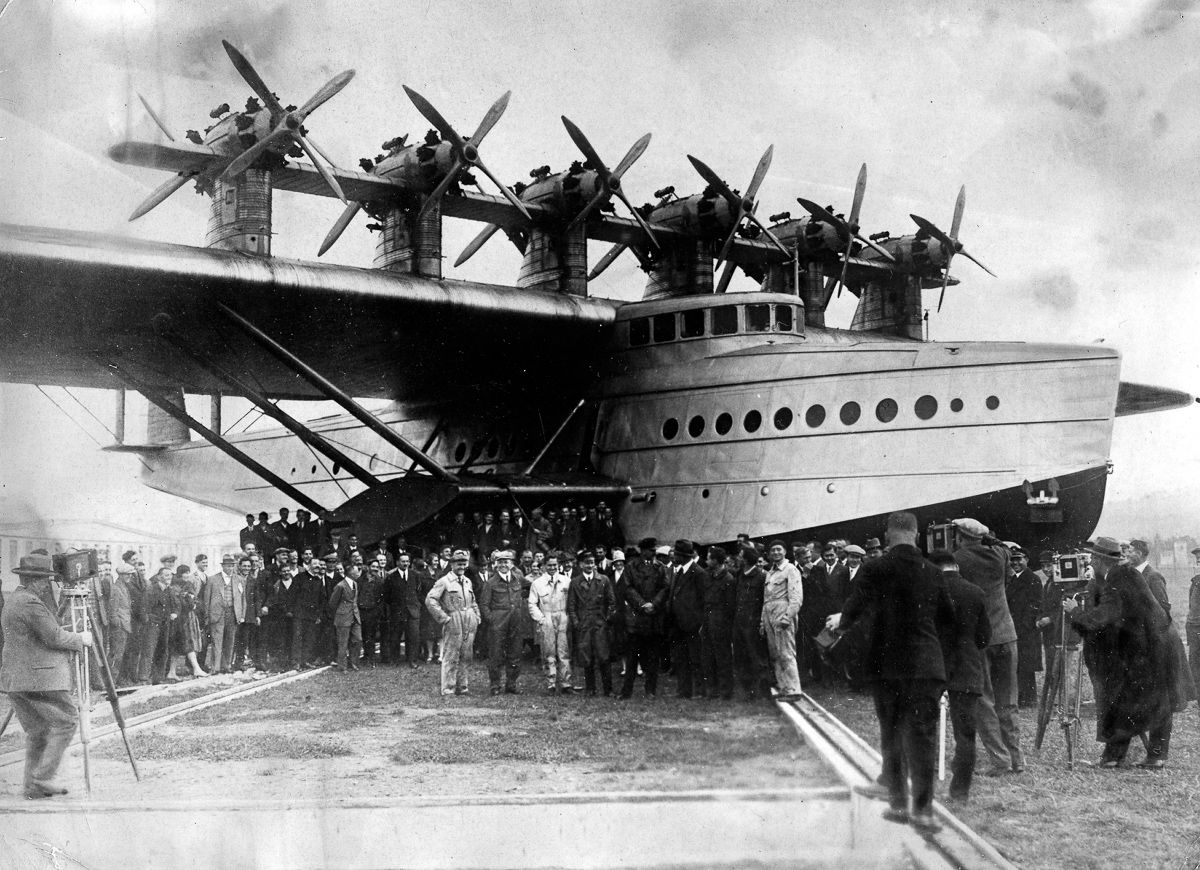
TESTING THE LIMITS…In photo at left, Charles Kingsford Smith (second from left) and the crew of his airplane, Southern Cross, pause before embarking on their east-west crossing of the Atlantic in June 1930; photo at right: Dieudonné Costes (right) with Maurice Bellonte in Boston in 1930. On September 1-2, 1930, they flew the “Point d’Interrogation” from Paris to New York, the first heavier-than-air aircraft to reach New York in the more difficult westbound direction between the North American and European mainlands. (National Library of Ireland/Wikipedia)BIG THINKERS…Germany’s massive Dornier Do-X made its first test flight on July 12, 1929. A few months later, it carried a world-record 169 passengers on a 40-minute flight, an astonishing number given that the largest planes at that time rarely carried more than 20 passengers. In 1930, the Do-X took off on an international publicity tour through Europe, down the west coast of Africa, across the Atlantic to Brazil and up to New York before returning to Berlin. (Mashable)
Markey went on to detail the various obstacles facing transatlantic fliers, including fairly good odds that a plane, laden with fuel and supplies for such a journey, would crash on takeoff. He noted that a little over half of the attempts succeeded, while the others seemed doomed from the start.
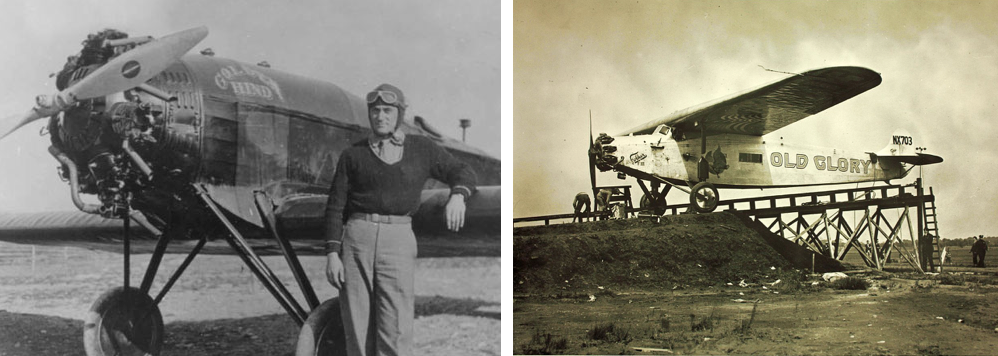
ILL-ADVISED…With only 70 hours of flying experience, Montana rancher Urban F. Diteman (left, with his airplane “Golden Hind”) took off from Harbour Grace, Newfoundland, bound for London. He was never seen again; at right, the William Randolph Hearst-sponsored “Old Glory,” a Fokker F.VIIa single-engined monoplane that was used in 1927 on an attempted transatlantic flight from Old Orchard Beach, Maine to Rome, Italy. The overloaded plane and its crew were lost approximately 700 miles east of Newfoundland, where only a section of wing was recovered. (dailymontana.com/Wikipedia)
* * *
Glare of the New
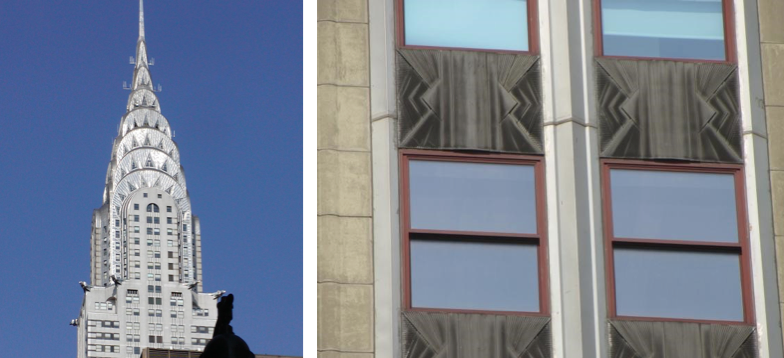
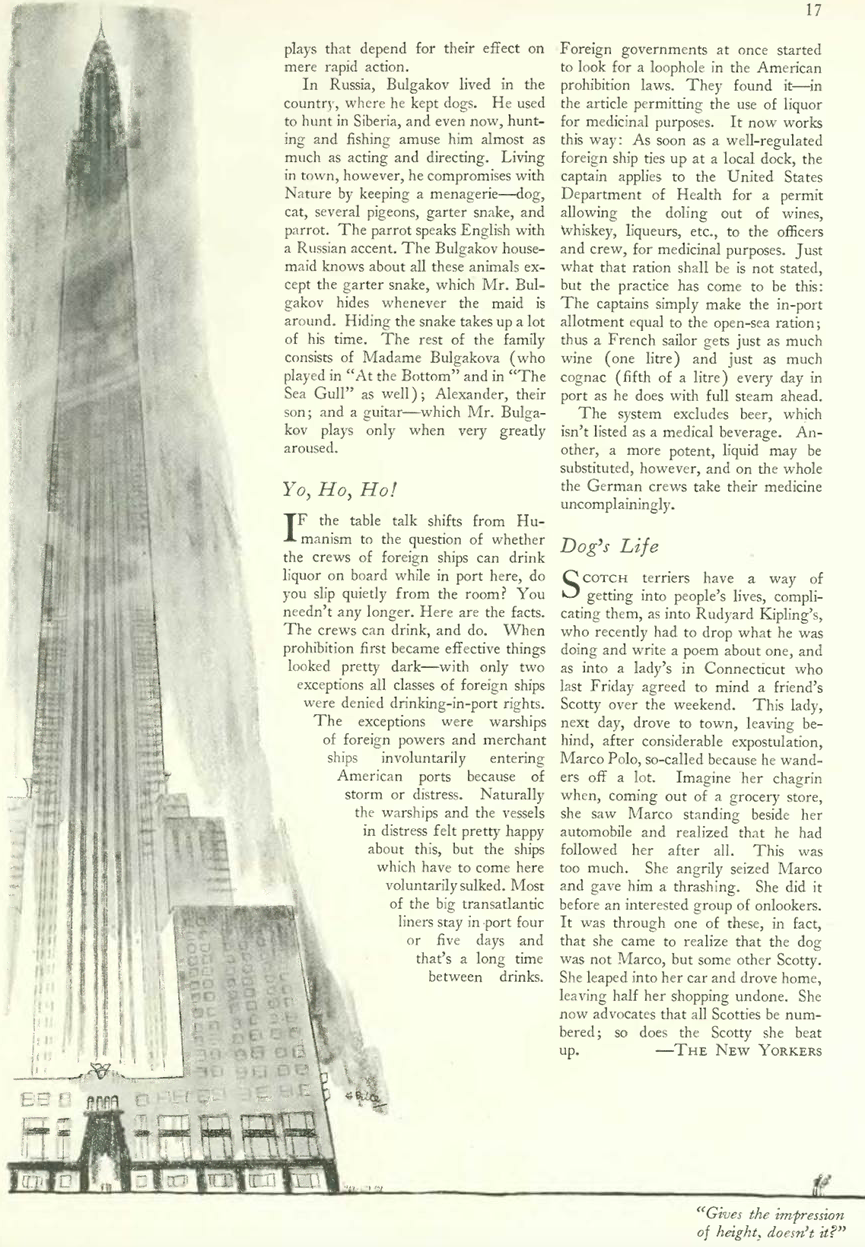
Architecture critic George Chappell enthusiastically followed the construction of the world’s tallest building, but in its completion he found the Chrysler Building’s now-iconic spire to be little more than a stunt, and suggested that a covering of masonry might be in order:
MAYBE SOME VINYL SIDING?…George Chappell wasn’t too crazy about the Chrysler’s chrome dome, and also worried about the amount of steel that would clad the exterior of the Empire State Building, right, which is composed of limestone, chrome bars and aluminum panels. (Wikipedia)
* * *
Bottoms Up
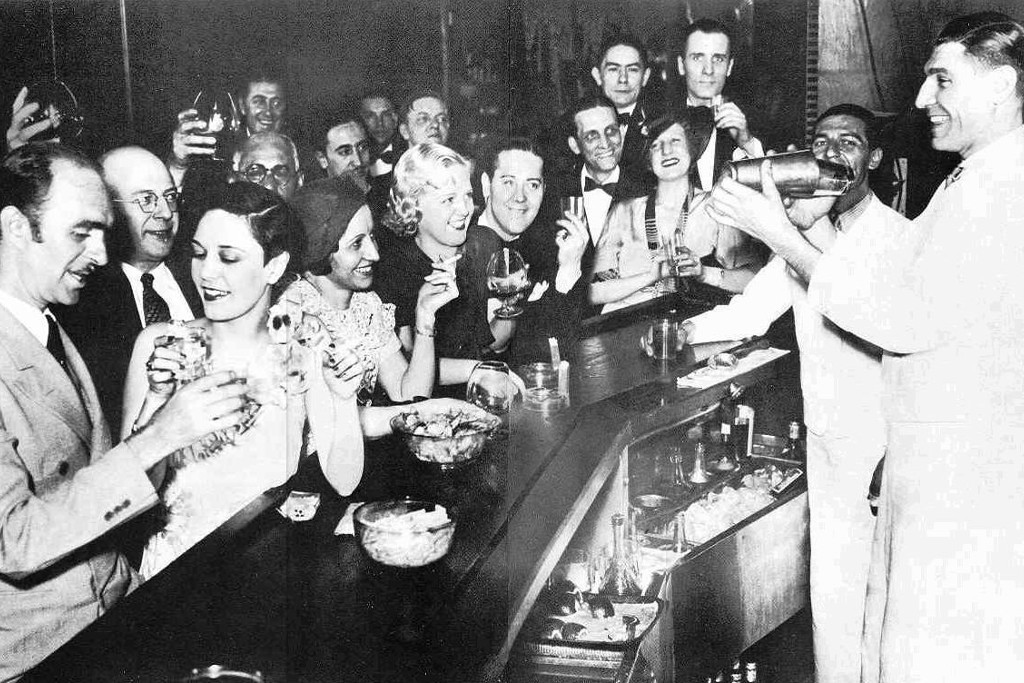
In his “Notes and Comment,” E.B. White pondered the drinking habits of his fellow citizens in the tenth year of Prohibition:
MAKE THAT A DOUBLE…Finding refreshment in the dark days of Prohibition. (junkee.com)
* * *
Good Old Summertime
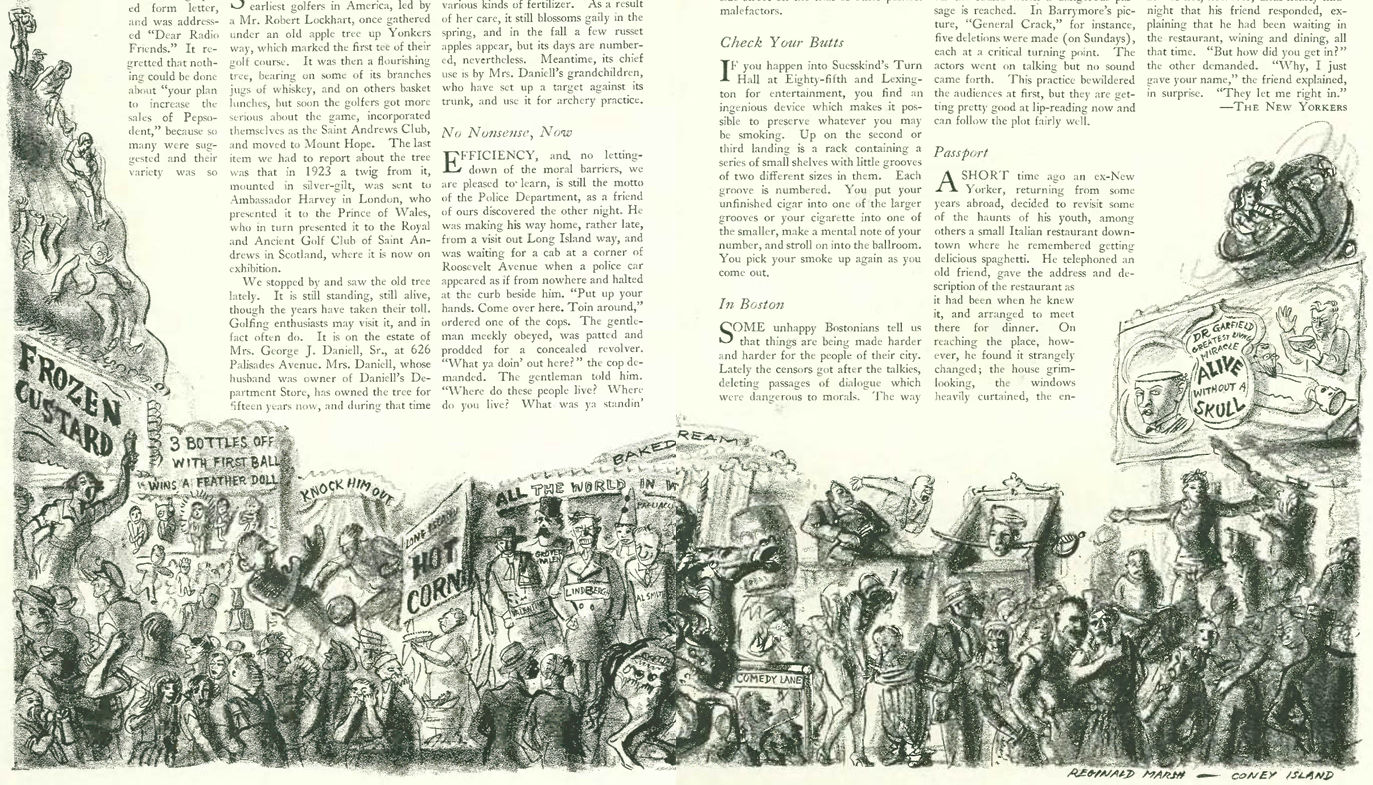
Along the bottom of “The Talk of the Town,” a Reginald Marsh interpretation of Coney Island fun and games…
* * *
Still the Same
Lois Long, who painted a picture of Jazz Age nightlife like no other in her “Tables for Two” column, teased her readers by disguising her identity, often claiming she was a frumpy old lady. With her “Tables” column now on hiatus, the fashionable and young Long maintained her pose, referring to herself as an “old war horse” in her fashion column “On and Off the Avenue.”
Problems of the Rich
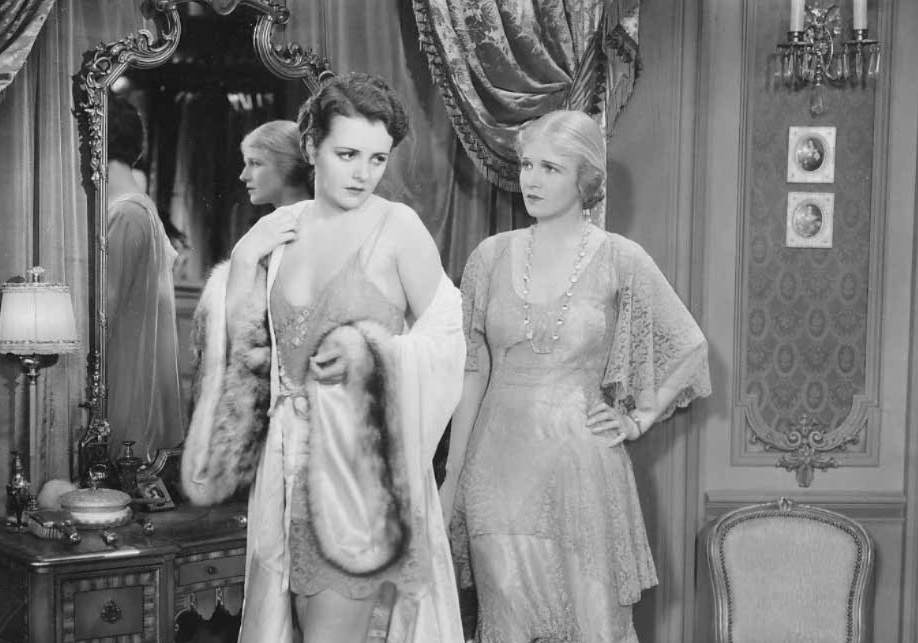
John Mosher reviewed the 1930 American Pre-Code comedy Holiday, which told the story of a young man torn between his wild lifestyle and the tradition of his wealthy fiancée’s family. Films that explored the “problems” of the rich seemed particularly popular in the Depression years…
POOR LITTLE RICH GIRLS…Mary Astor and Ann Harding in Holiday. (IMDB)
* * *
From Our Advertisers
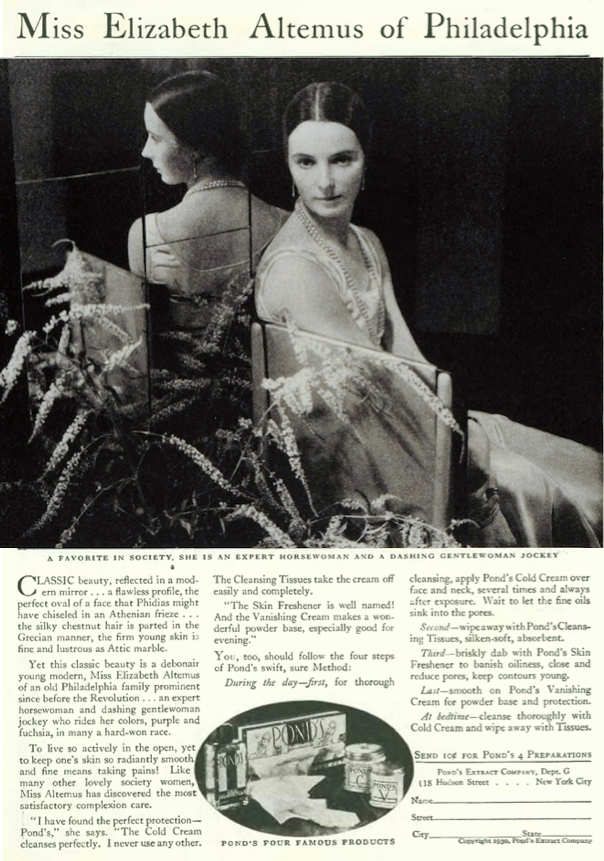
The makers of Pond’s Cold Cream continued its campaign of endorsements by society women, including Philadelphia socialite, philanthropist and champion horsewoman Elizabeth Altemus…
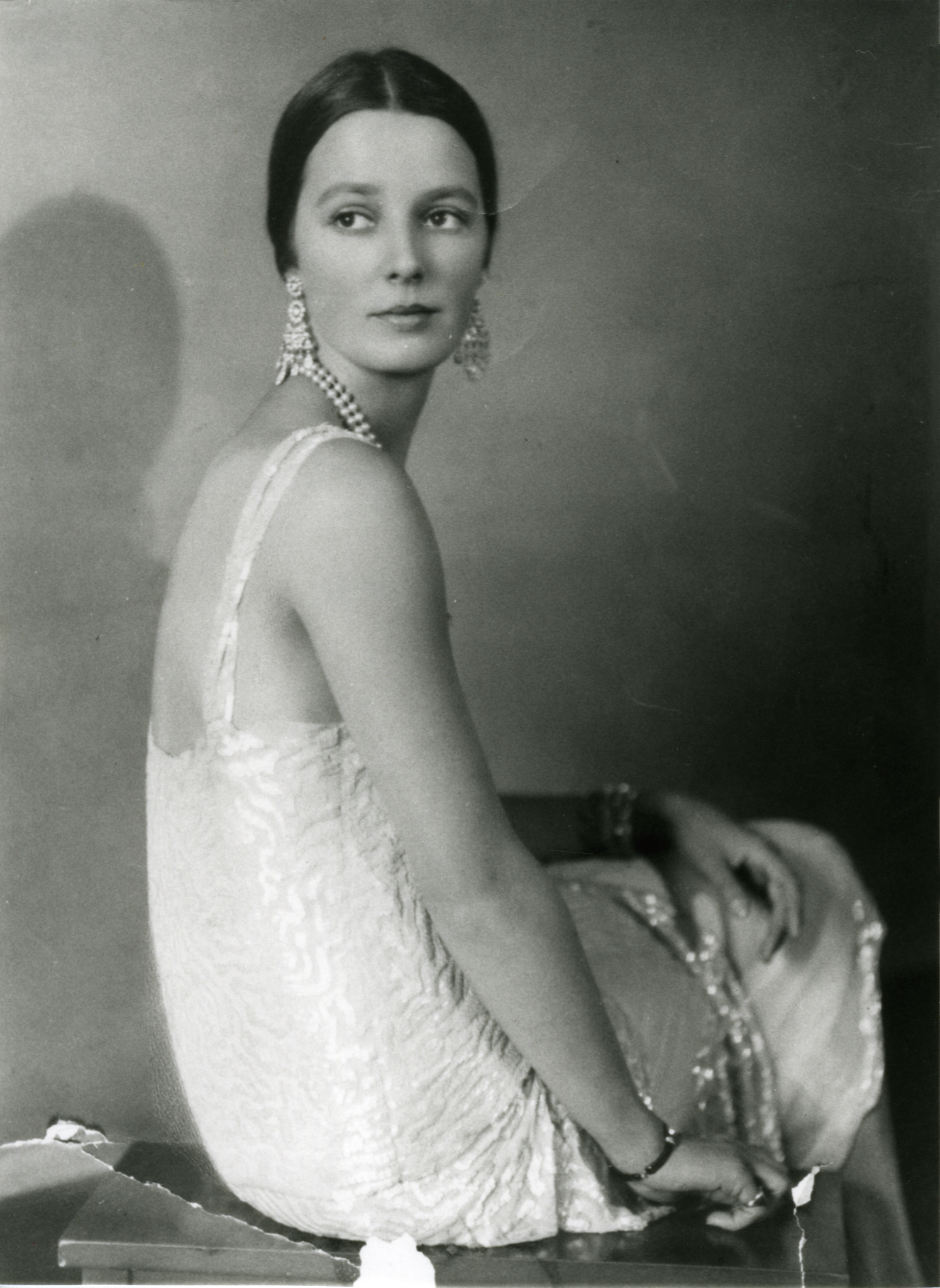
Altemus (1906-1988) was a prominent owner/breeder of Thoroughbred racehorses for more than 50 years. Her first marriage was to Jock Whitney, U.S. Ambassador to the United Kingdom, publisher of the New York Herald Tribune, and president of the Museum of Modern Art. By the looks of this 1937 portrait of Altemus, the cold cream certainly didn’t do her any harm…
Mary Elizabeth Altemus Whitney in 1937. (geni.com)
…speaking of cold cream, when Kleenex was introduced in the early 1920s, it was marketed solely as a hygienic way to remove cold cream. It wasn’t until the 1930s that the makers of Kleenex began to suggest it could also be used as a tissue in place of a handkerchief. Of course it was also a great way to dramatically expand consumption of its brand, and help usher in a new age of disposable products…
…as the Depression deepened, ads for automobiles began to change with the times, most manufacturers emphasizing the affordability of their cars over performance or prestige, as this sad little ad from Packard attested….
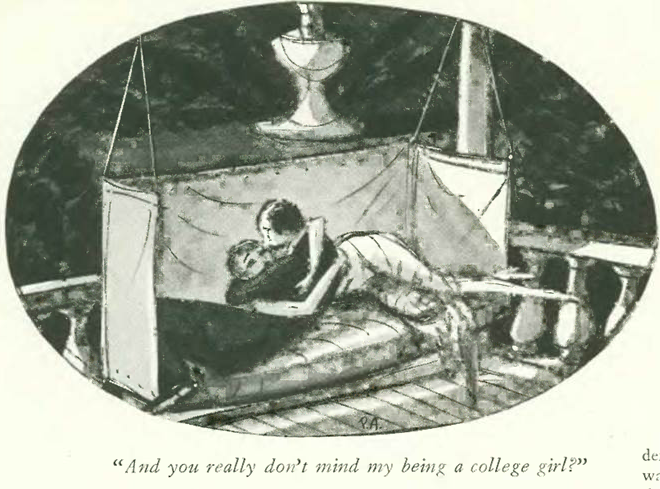
…in three consecutive issues (June 5, 12 and 19) Peter Arno featured the same drawing with a different caption that gave readers a very brief courtship story…
…Alan Dunn offered a glimpse of life among the newsboys…
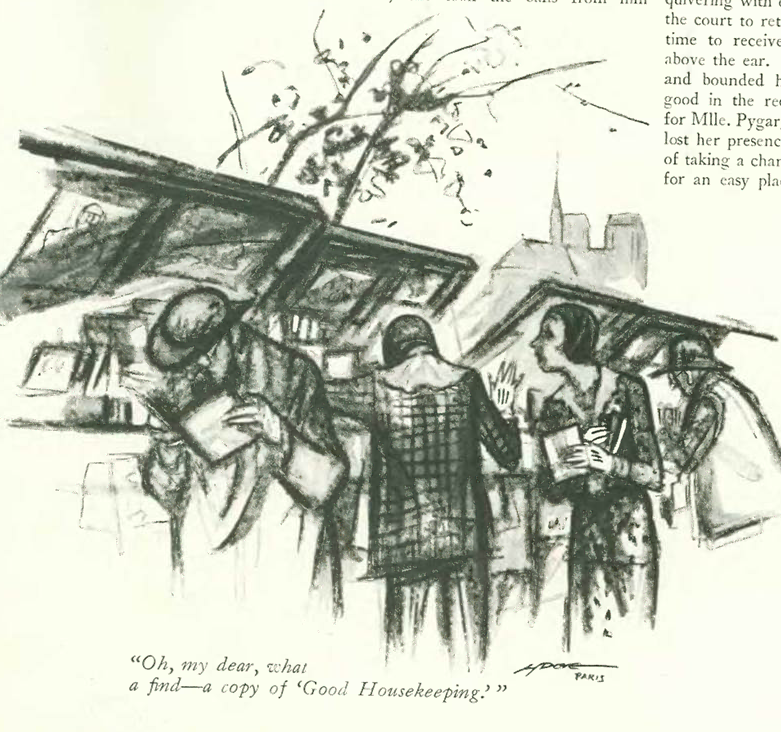
…Leonard Dove found Americans browsing newsstands along the Seine…
…Helen Hokinson looked in on an existential crisis…
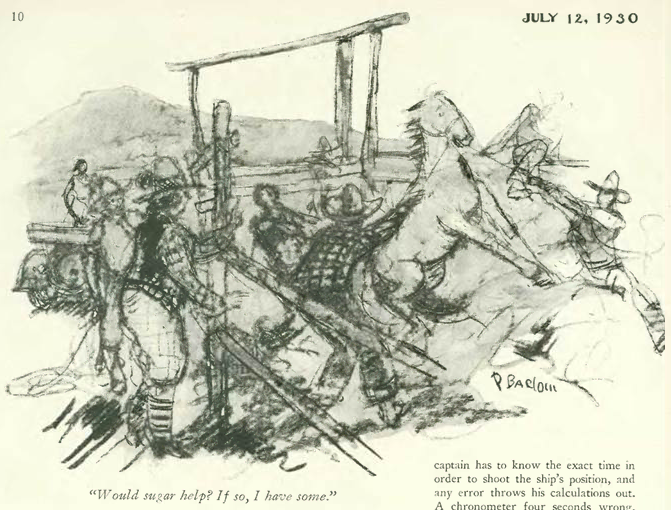
…Perry Barlow was Out West at a dude ranch…
…Barbara Shermund eavesdropped on a couple of debs…
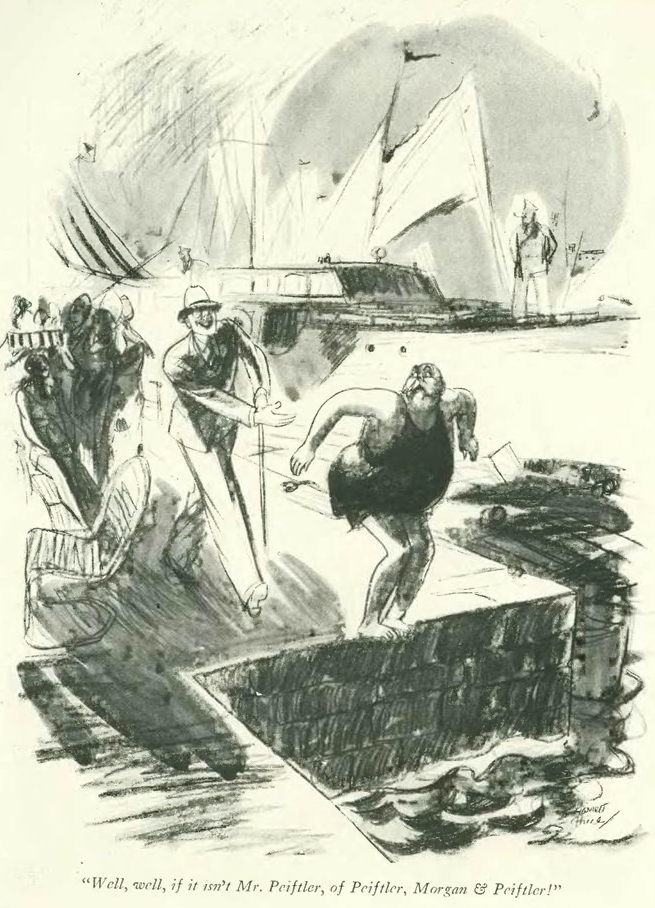
…Garrett Price gave us an awkward encounter among the yachting crowd…
…and finally William Crawford Galbraith, and a case of domesticus interruptus…
The July 5, 1930 New Yorker made a subtle nod to the Fourth of July holiday with this cover by Julian De Miskey. The title images above are of actress Alice White and child actor Jackie Coogan getting into the Independence Day spirit in the 1930s.
July 5, 1930 cover by Julian De Miskey.
On Solid Ground
With massive skyscrapers going up all over the city, some New Yorkers apparently feared that the weight of those buildings would cause the earth’s surface to crack. “The Talk of the Town” offered some factual information to allay those fears:
Not guaranteeing the science on this, but here’s an image I gleaned from Reddit…
Dark gray lines are fault lines (why the brown soil drops in those places). The gray areas are bedrock known as Manhattan Schist, which one can see above ground in Central Park. The reddish brown at lower right is marble. The green area is either gneiss or sill rock.
* * *
War and Apple Pie
E.B. White had some fun at the expense of “Major” Frank Pease, president of the Hollywood Technical Directors Institute, an anti-communist activist organization. Despite the title of his organization, no film director had ever heard of Pease until he began issuing press statements labeling the 1930 film All Quiet on the Western Front as anti-American and anti-military. White responded:
MINOR MAJOR…”Major” Frank Pease, left, thought the depiction of the horrors of war in All Quiet on the Western Front was anti-American. Pease himself never rose above the rank of private, but claimed he was a retired major in the U.S. Army. (Wikipedia/IMDB).
In one of my recent posts, The New Yorker’sJohn Mosher reviewed the film, All Quiet on the Western Front.
* * *
Speaking of Un-American
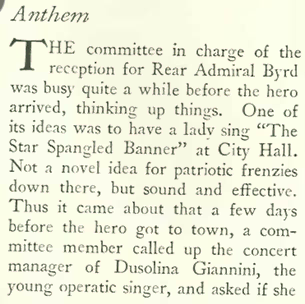
City Hall organizers of a welcome home ceremony for Admiral Richard Byrd — back from his South Pole adventures — arranged to have a woman sing The Star Spangled Banner, but according to “The Talk of the Town,” not just any woman would do…
DISSED…Italian-American soprano Dusolina Giannini was born in Philadelphia, but deemed not American enough to sing at New York’s City Hall for Admiral Richard Byrd. (YouTube)
* * *
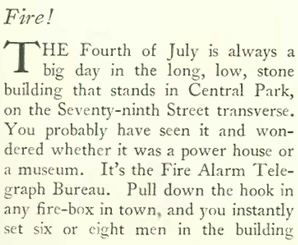
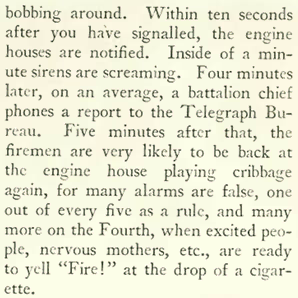
Five Alarm Fireworks
“The Talk of the Town” discussed at some length the challenges July 4 posed to New York’s firefighters. An excerpt:
Also in the “Talk” section, some spot illustrations by Abe Birnbaum, who apparently had returned from a trip to Paris. The first image appeared in the June 28 issue, the second the July 5 issue:
* * *
Just Say No
Helena Huntington Smith turned in a profile on American birth control activist Margaret Sanger (1879-1966). Sanger popularized the term “birth control” and opened the first family planning clinic in the United States. She established several organizations that eventually evolved into the Planned Parenthood Federation of America. The opening paragraphs of Smith’s profile:
Margaret Sanger circa 1930. At right, portrait for the profile by Ralph Barton.
Controversial 89 years ago as well as today, Sanger remains a target of both the right and left, labeled variously as a baby killer and a racist. Sanger was vocal in her opposition to abortion, maintaining that birth control would not only prevent abortions, but would give many women the ability to control family size and end their cycle of poverty. Sanger also spoke out against racism, but the case is more muddled here: She became involved in the eugenics movement through her belief that society needed to limit births by those least able to afford children, including those deemed “unfit” to raise them.
* * *
From Our Advertisers
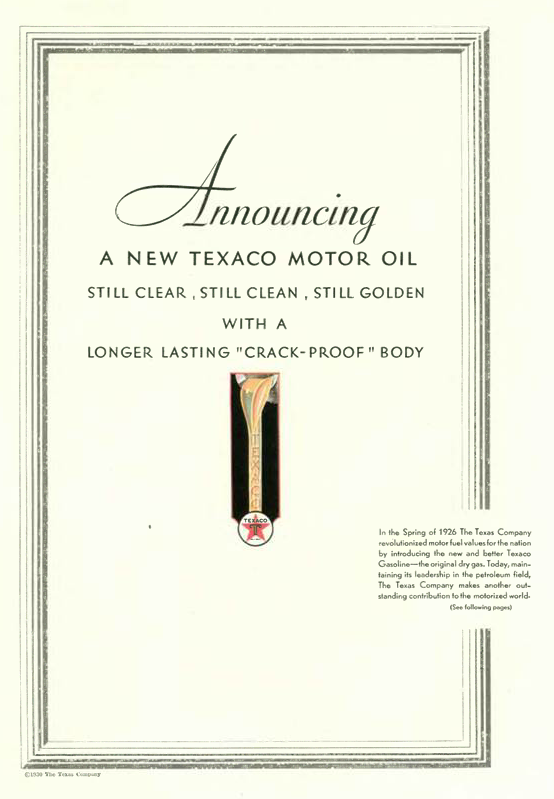
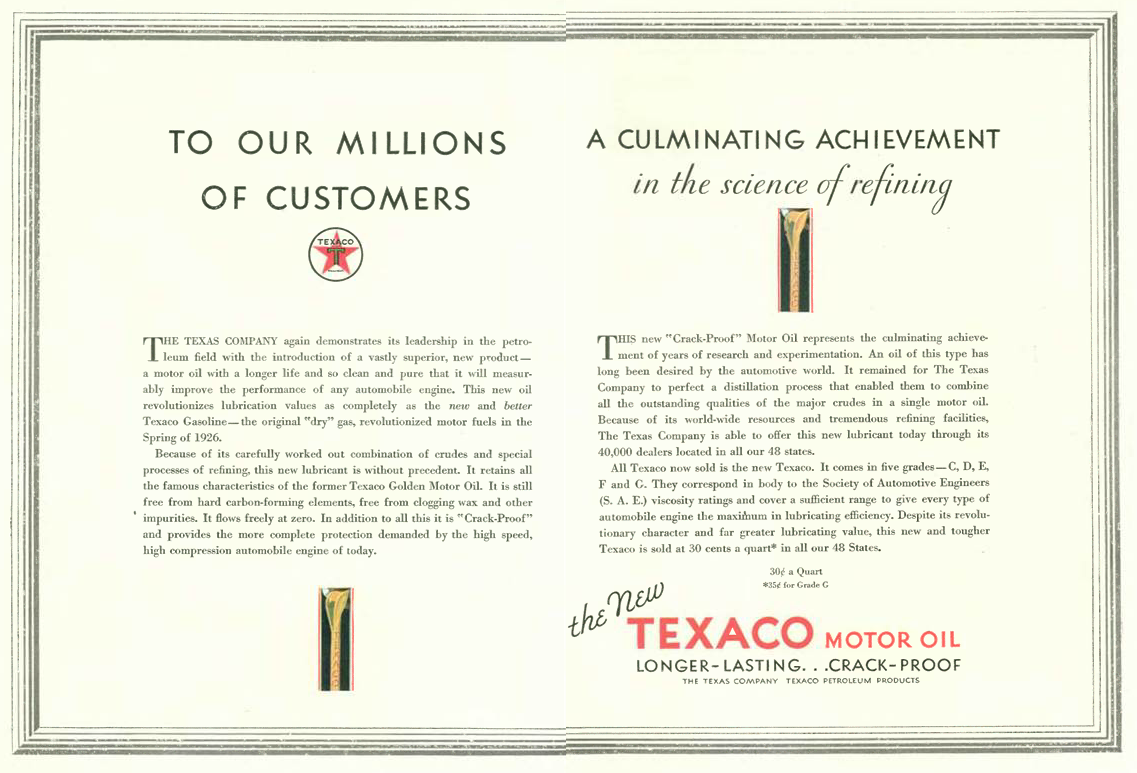
From 1920 to 1930, automobile ownership in America nearly tripled from eight million to 23 million. Along with that growth came the rise of oil giants such as Texaco, which in 1928 became the first U.S. oil company to sell its gasoline nationwide under one single brand name. So they had no problem taking out a three-page ad in the July 5 New Yorker…
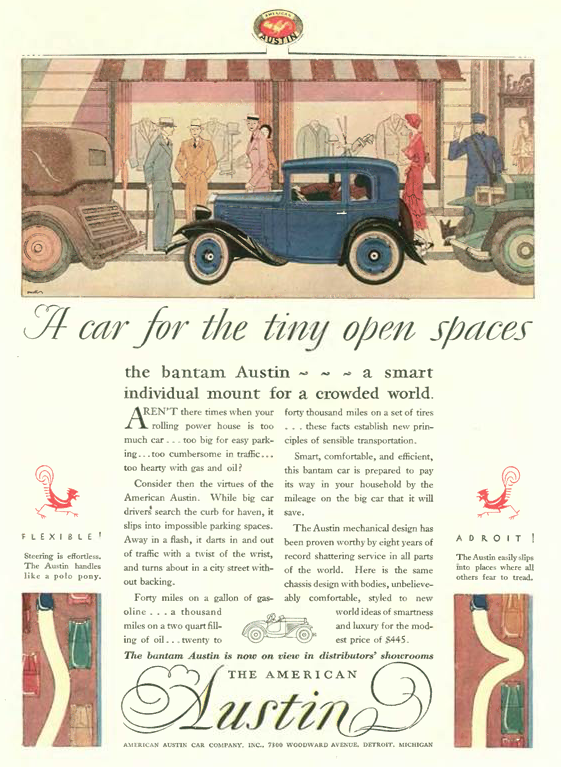
…while Americans were ready to guzzle gas, British automaker Austin touted both fuel economy and compactness in its American entry…
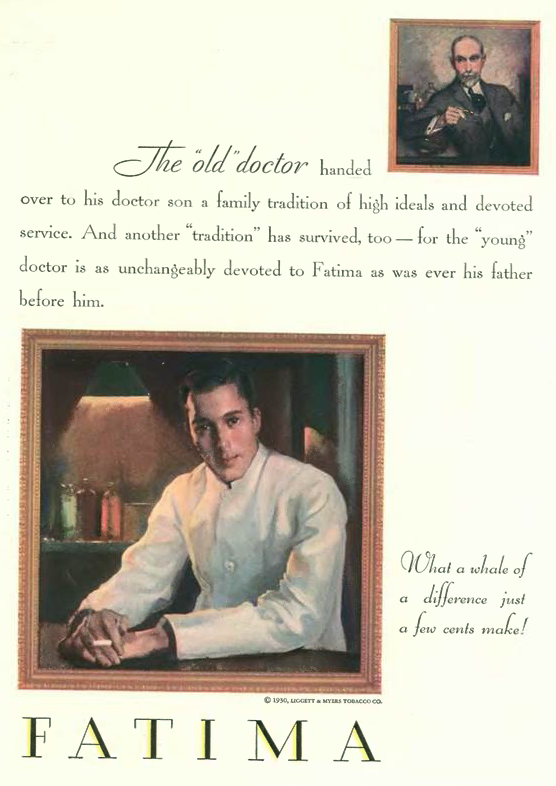
…for several decades in the 20th century tobacco companies employed physicians to promote their deadly products…Fatima was among the first…
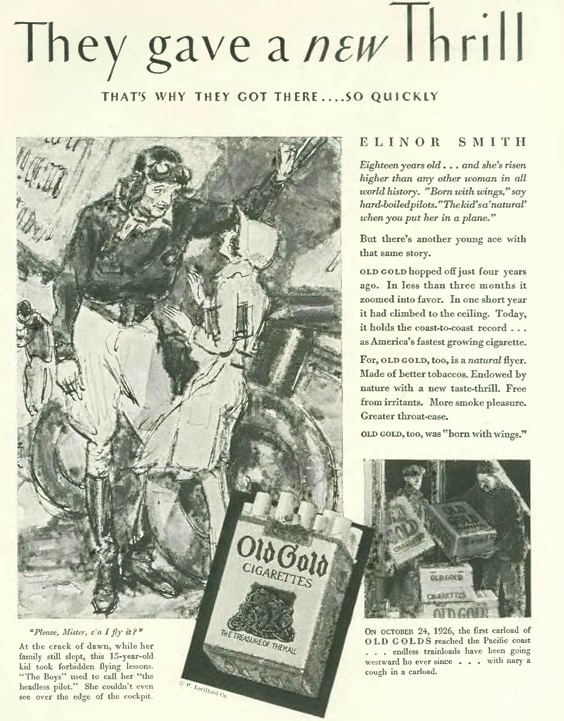
…the makers of Old Gold, however, were pioneers in associating cigarette smoking with sporting activities and tales of derring-do…here the rapid spread of the Old Gold brand across the country is equated to the record-breaking feats of a young female pilot, Elinor Smith…
…I don’t know if Smith herself smoked, but she almost lived 100 years, and flew well into her her 90s…we looked at Smith’s feats in a recent post…
Elinor Smith’s flying career would extend from age 16 to her 90s. In March 1930 she set the women’s world altitude record.
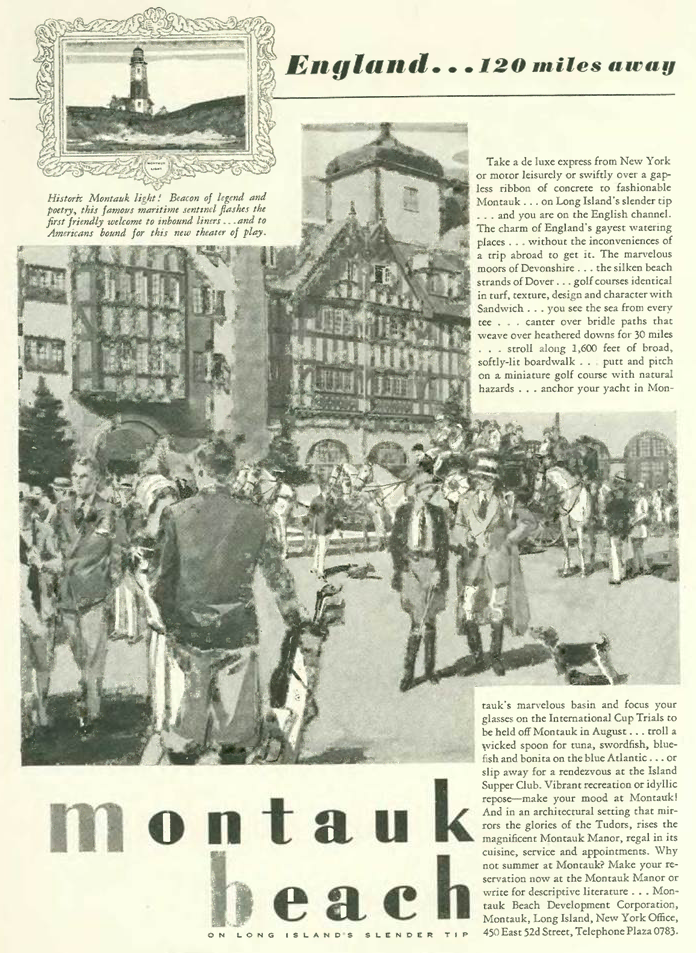
…Carl G. Fisher bought a big chunk of the East End of Long Island in 1926 with the intent of turning it into the “Miami Beach of the North.” Fisher would build more than two dozen Tudor-style buildings at Montauk before losing his fortune in the 1929 market crash. This ad appears to be an attempt to draw renewed interest in the development, appealing to Anglophilic pretensions that sometimes afflicted New Yorker readers…
…speaking of Anglophilia, a cartoon by Denys Wortman offered an example…
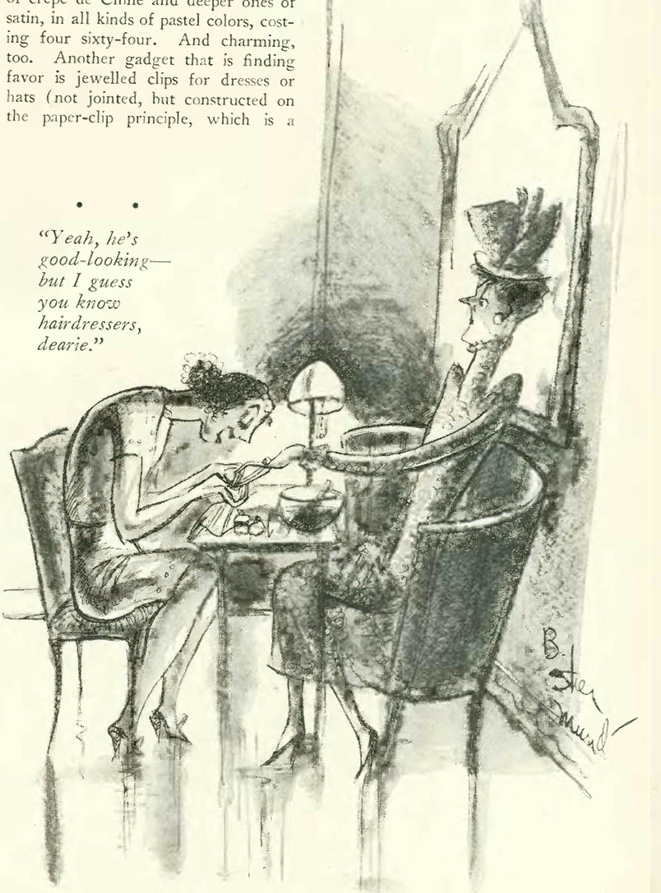
…Barbara Shermund examined an aspect of society’s pecking order…
…and referenced a gay stereotype…
…Garrett Price looked in on a misunderstanding at the museum…
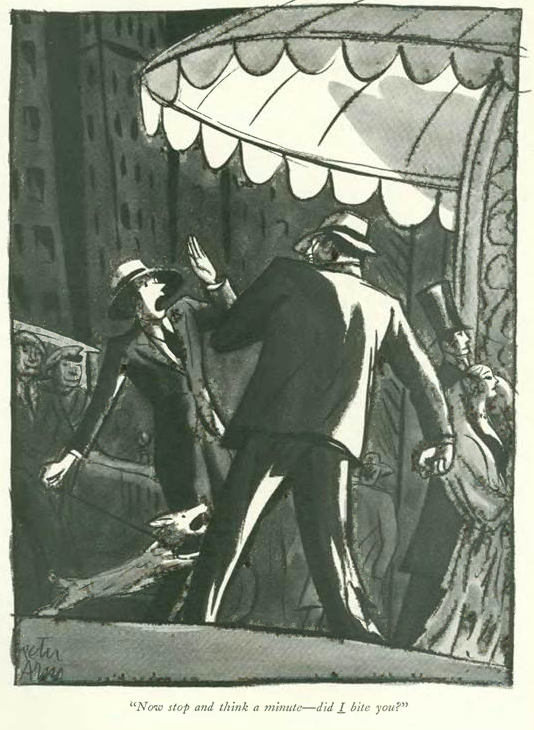
…Peter Arno discovered that a bite is worse than a bark in this case…
…and Leonard Dove gave us a double entendre courtesy of a mild-mannered building supervisor seeking to remove a draft block (or bung) from a chimney flue…
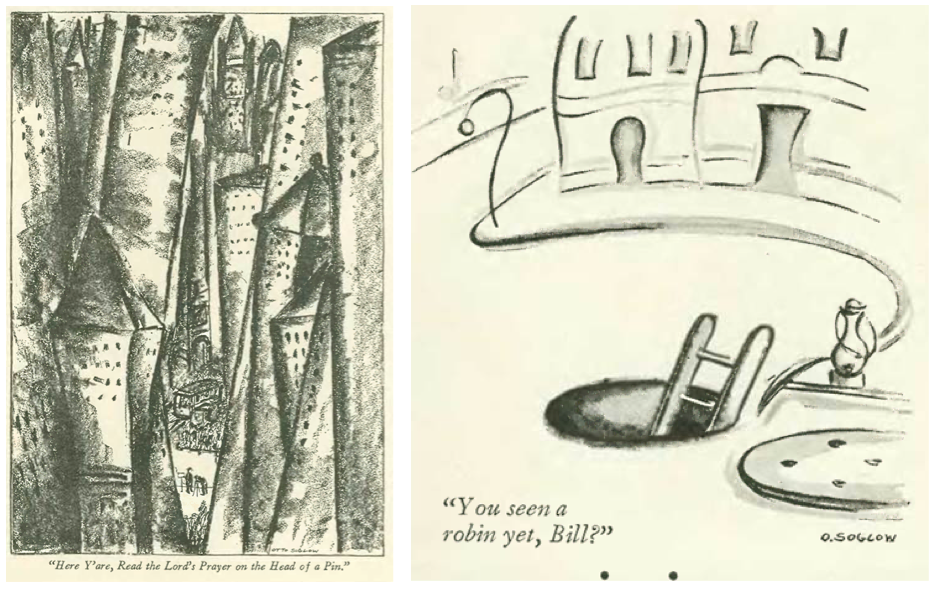
Like his New Yorker colleague Reginald Marsh, Otto Soglow trained in the “Ashcan School” of American art, and his early illustrations favored its gritty urban realism. He had his own life experience to draw upon, being born to modest means in the Yorkville district of Manhattan.
We look at two issues this week. At left, cover of March 31 issue by Peter Arno; at right, June 7 cover by Constantin Alajalov.
But Soglow (1900-1975) would soon abandon the gritty style in the work he contributed to the New Yorker…
RAGS TO RICHES…At left, Otto Soglow’s first cartoon in The New Yorker, Nov. 14, 1925, was rendered in the Ashcan style ; at right, an example of the sparer style he later adopted, one of his manhole series cartoons from March 2, 1929.
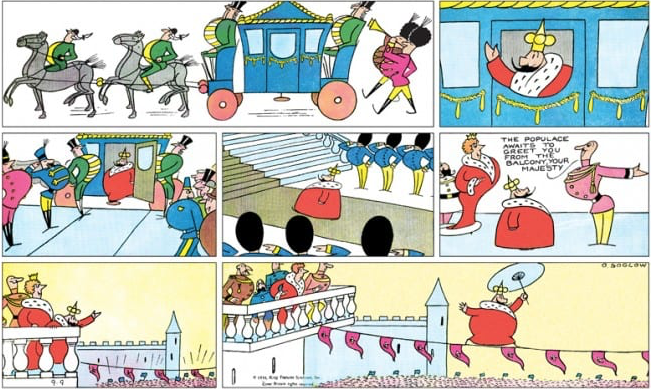
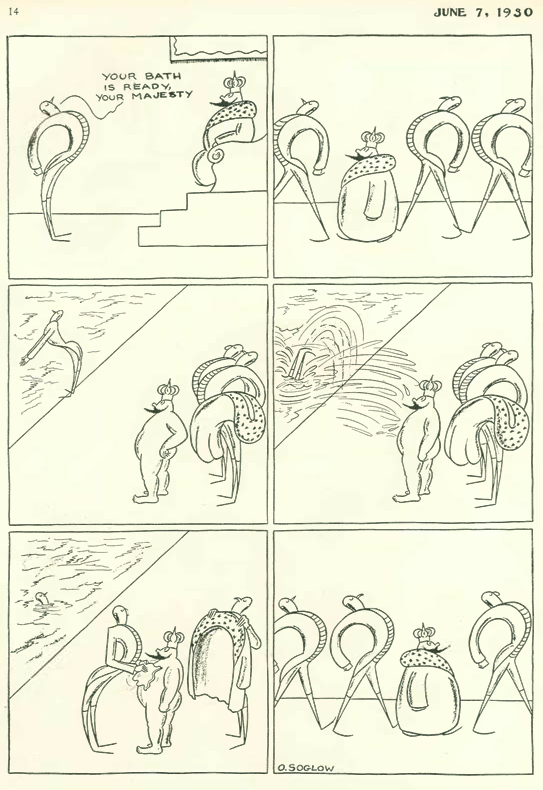
…and in the June 7, 1930 issue, Soglow would publish his first Little King strip, which would launch the 29-year-old into fame and fortune…
Did Soglow know he was on to something big with that first Little King cartoon? Well Harold Ross (New Yorker founding editor) liked what he saw, and asked Soglow to produce more. After building up an inventory over nearly ten months, Ross finally published a second Little King strip on March 14, 1931. It soon became a hit, catching the attention of William Randolph Hearst, who wanted the strip for his King Features Syndicate.
KING OF COMEDY…Otto Soglow working on an illustration for The Ambassador, a short-lived comic strip he created in 1933 for King Features Syndicate. The strip was replaced by The Little King in 1934 after Soglow fulfilled his contractual obligation to The New Yorker. (comicartfans.com)
After Soglow fulfilled his contractural obligation to The New Yorker, The Little King made its move to King Features on Sept. 9, 1934, and the strip ran until Soglow’s death in 1975. After his move to King Features, Soglow continued to contribute cartoons to The New Yorker, but with other themes.
Left, Soglow cartoon from the book Wasn’t the Depression Terrible? (1934); at right, King Features strip from Nov. 19, 1967. (Wikipedia/tcj.com)
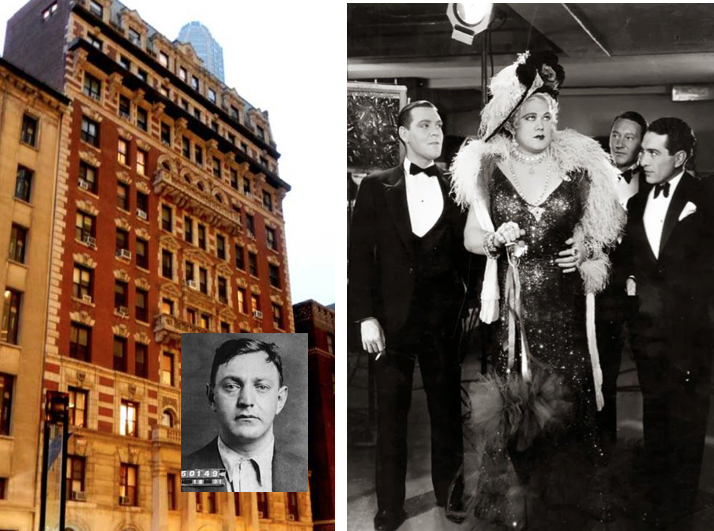
During the summer of 1925, a young writer at Vanity Fair named Lois Long would take over The New Yorker’s nightlife column, “When Nights Are Bold,” rename it “Tables For Two,” and set about giving a voice to the fledgling magazine as well as chronicling the city’s Jazz Age nightlife. There were accounts of Broadway actors mingling with flappers and millionaires at nightclubs and speakeasies, but Long also spoke out on issues such as Prohibition, taking the city’s leaders to task for raids on speakeasies and other heavy-handed tactics contrary to the spirit of the times. “Tables For Two” would go on hiatus with the June 7, 1930 issue, and appropriately so, as the deepening Depression gave the the city a decidedly different vibe. In her “final” column Long would write about the Club Abbey, a gay speakeasy operated by mobster Dutch Schultz…
PARTIED OUT…In her final nightlife column, Lois Long wrote about the new Club Abbey in the basement of the Hotel Harding (left), which was operated by mobster Dutch Schultz (inset). The club’s emcee was Gene Malin (right), Broadway’s first openly gay drag performer. The club was short-lived (as were Schultz and Malin), closing in January 1931 following a mob brawl. (infamousnewyork.com/Pinterest)
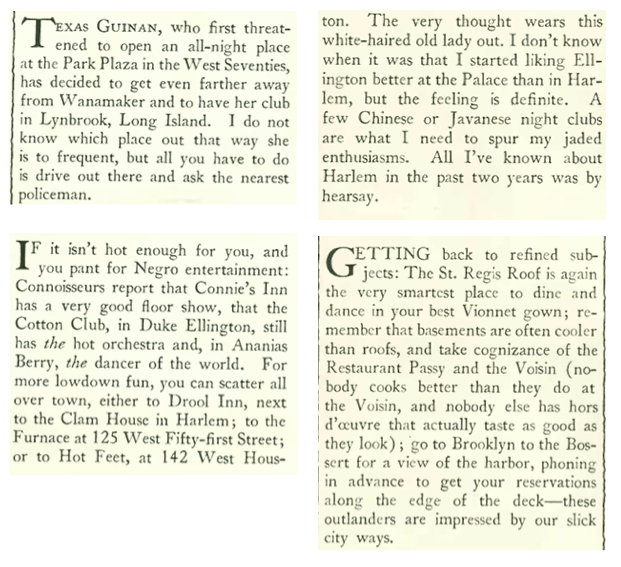
…and she would update her readers on “Queen of the Night Clubs” Texas Guinan, whose Club Intime was sold to Dutch Schultz and replaced by his Club Abbey…
FINAL ACT…Clockwise, from top left, Texas Guinan at Lynbrook, circa 1930; Joseph Urban murals on the rooftop of the St. Regis Hotel; Duke Ellington and his orchestra at the Cotton Club, circa 1930s.
Long’s column would signal a definitive end to whatever remained of the Roaring Twenties. It would also signal the end to some of those associated with those heady times. Texas Guinan’s Lynbrook plans would flop, and Gene Malin’s Club Abbey would close in less than a year. Both would both be dead by 1933—Malin would die in a car accident in 1933, and amoebic dysentery would claim Guinan that same year. Dutch Schultz would be gunned down by gangsters in 1935.
Lois Long, however, would continue to write for The New Yorker for another forty years, and would prove to be as innovative in her fashion column, “On and Off the Avenue,” as she was as a nightlife correspondent.
* * *
Gone to the Dogs
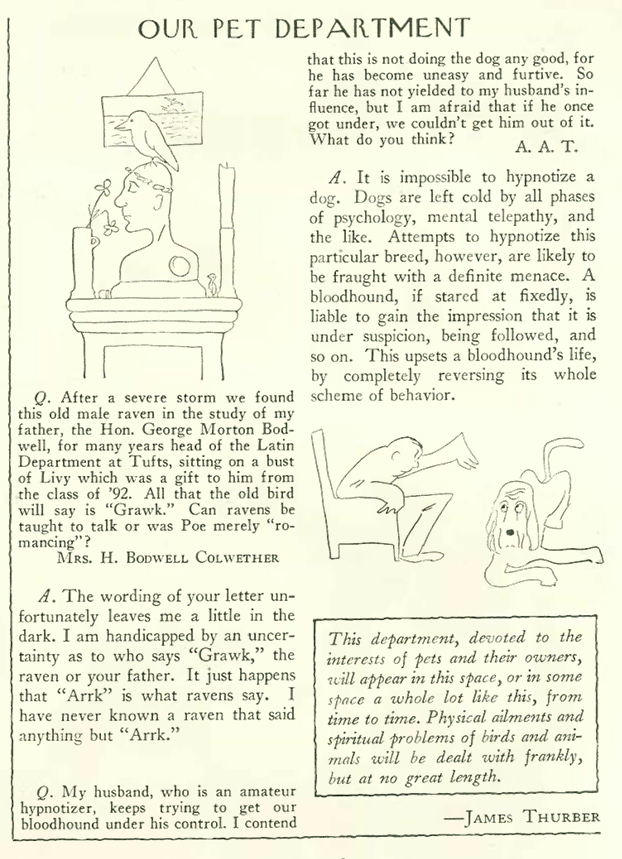
In another installment of his pet advice column (June 7), James Thurber gave us one of his classic dogs…a disinterested bloodhound…
…while Thurber’s buddy and office mate E.B. White commented (in the March 31 issue) on a recent poll conducted among students at Princeton, discovering among other things that New Yorker cartoonist Peter Arno was preferred over the old masters…
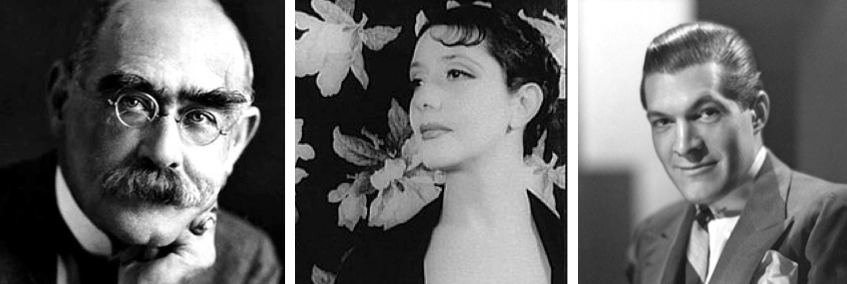
FAN FAVORITES…The Princeton Class of 1930 named (from left) Rudyard Kipling, Lynn Fontanne and Peter Arno as favorite poet, actress and artist respectively in a student poll. (YouTube/Wikipedia/giam.typepad.com)
* * *
We Like It Fine, Thank You
The New Yorker dedicated a full page of the March 31 issue to a tongue-in-cheek rebuttal directed at the New York Evening Journal, which had reprinted one of Peter Arno’s cartoons to illustrate the moral cost of Prohibition. I believe the author of the rebuttal is E.B. White (note how he refers to Arno as “Mr. Aloe”).
…also in the May 31 issue, Rea Irvin changed things up, at least temporarily, with some new artwork for the “Goings On About Town” section. The entries themselves were often clever, such as this listing for a radio broadcast: PRESIDENT HOOVER—Gettysburg speech. Similar to Lincoln’s but less timely…
* * *
From Our Advertisers
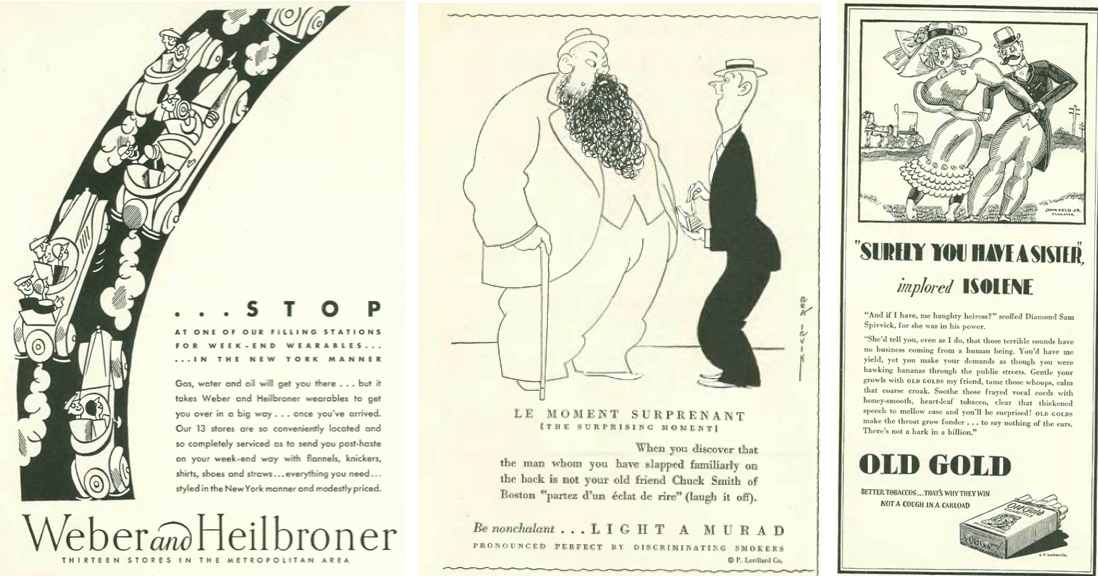
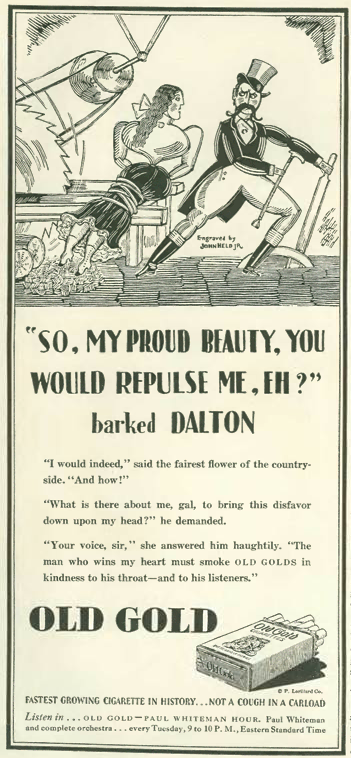
New Yorker cartoonists can be found throughout the advertisements — from left, Julian De Miskey, Rea Irvin and John Held, Jr…
…and in the June 7 issue we find an unusual ad for a used car…a sign of the times, no doubt…
…before it was associated with Germany’s Nazi Party (especially after it seized power in 1933), for thousands of years the swastika had been widely used as a religious or good luck symbol…
…Actress Clara Bow was famously pictured sporting a “good luck” swastika as a fashion statement in this press photo from June 1928, unaware that in a few years the symbol would become universally associated with hate, death and war…
From an unidentified publication dated June 6, 1928. (@JoHedwig/Twitter)
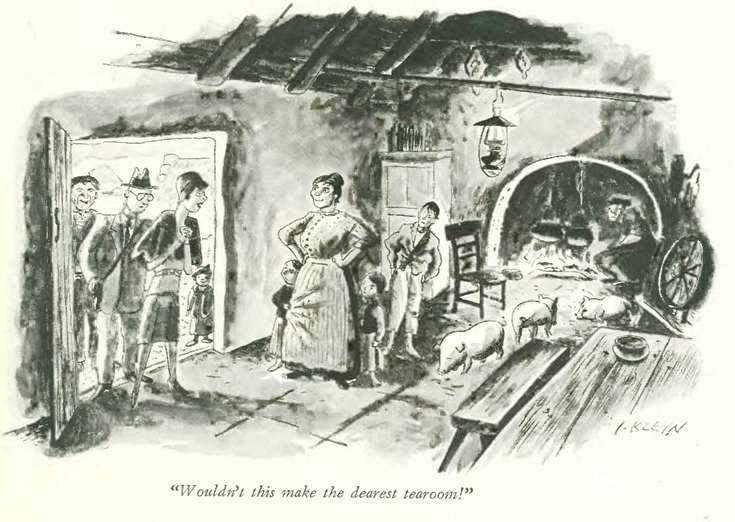
…on to our cartoons, Isadore Klein illustrated a cultural exchange…
…Garrett Price gauged the pain of a plutocrat…
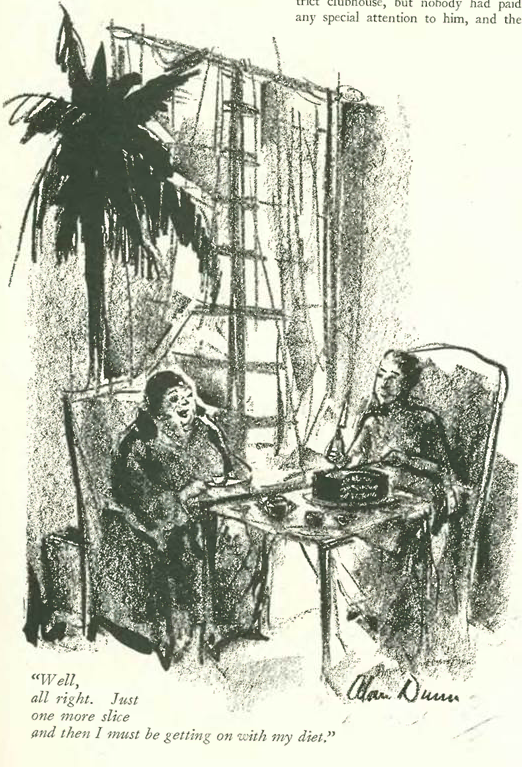
…Alan Dunn eavesdropped on some just desserts…
…Helen Hokinson found humor in the mouths of babes…
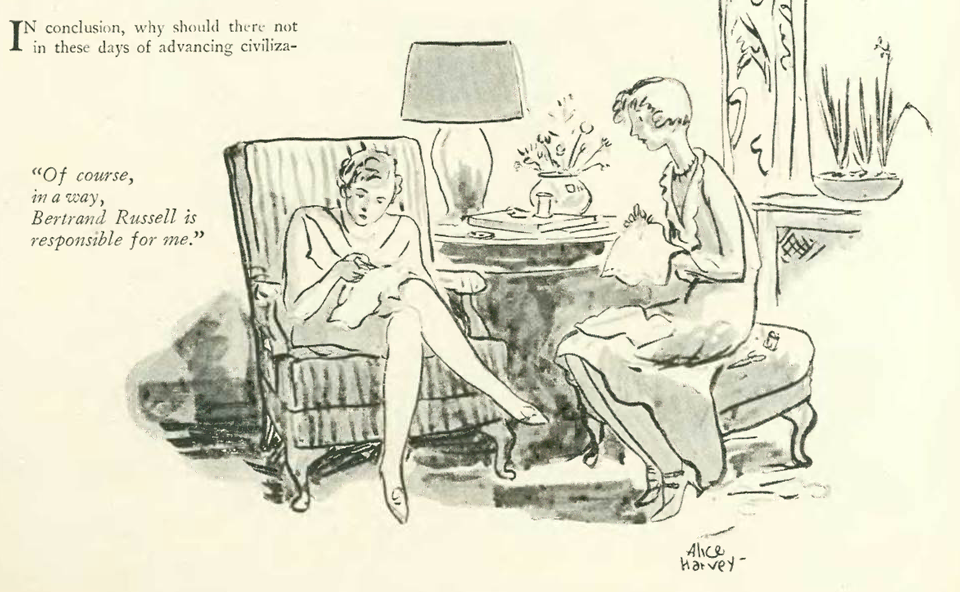
…as did Alice Harvey…
…Leonard Dove examined one woman’s dilemma at a passport office…
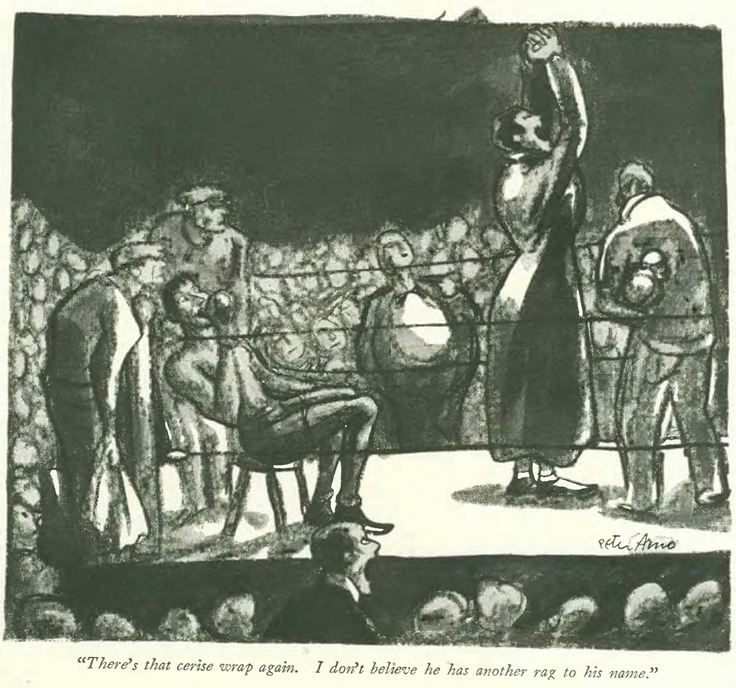
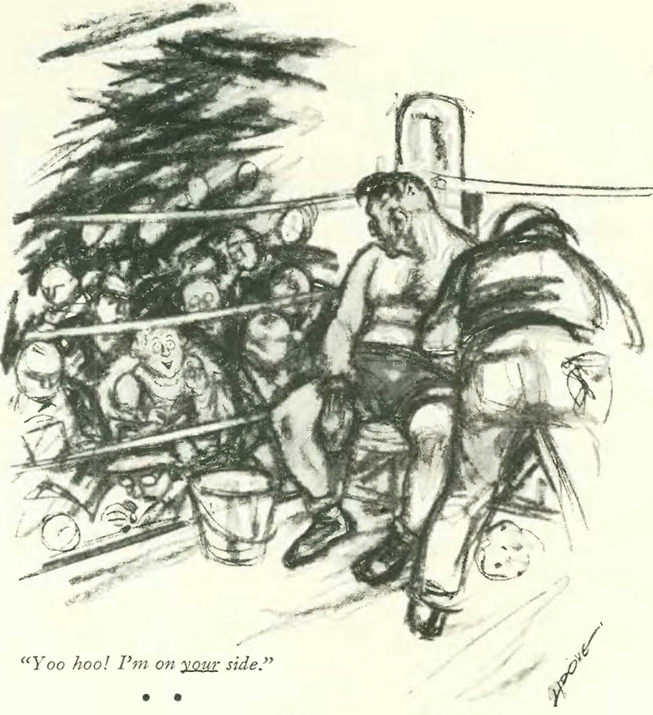
…and Peter Arno, who found some cattiness at ringside…
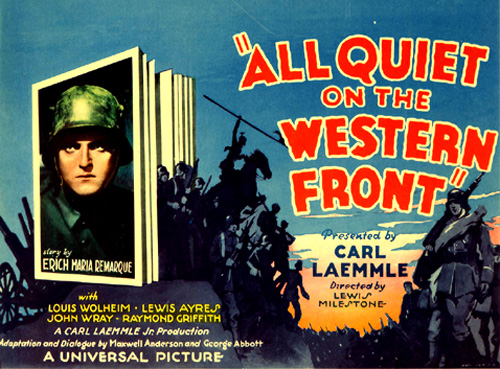
Still considered one of the greatest anti-war films ever made, All Quiet on the Western Front opened in New York on April 29, 1930 to strong reviews. Based on Erich Maria Remarque’s novel of the same name, the film’s depictions of the horrors of war were so realistic and harrowing that it was banned in a number of countries outside of the U.S.
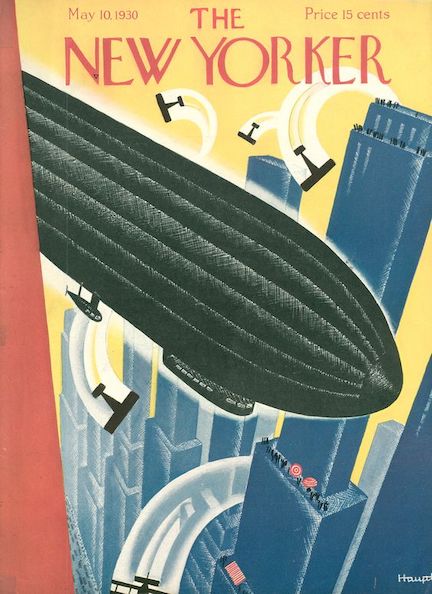
May 10, 1930 cover by Theodore Haupt.
Banned, that is, by nations gearing up for war. In Germany, Nazi brownshirts disrupted viewings during its brief run in that country, tossing smoke bombs into cinemas among other acts of mayhem. Back in the U.S., The New Yorker’sJohn Mosher attended a screening at a “packed” Central Theatre:
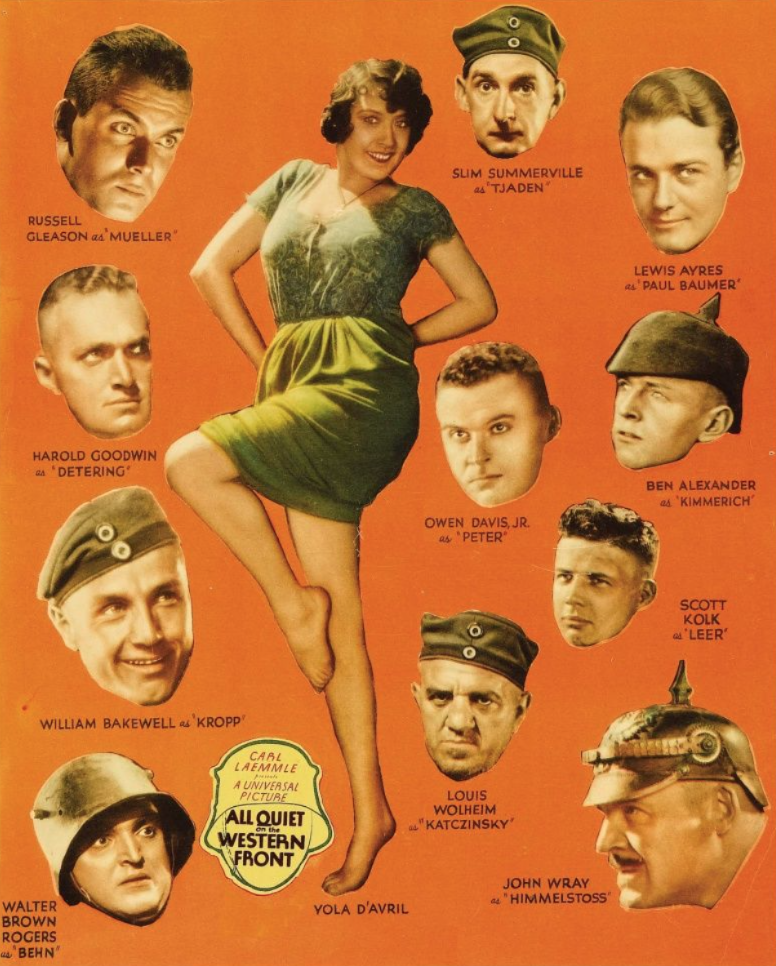
WAR IS HELL…Clockwise, from top left, movie poster for 1930’s All Quiet on the Western Front; German soldier Paul Bäumer (Lew Ayres), falls into a shell crater with a French soldier and draws his knife; in one of the most moving scenes in cinema, Bäumer is forced to spend the night in the crater, where he vainly tries to safe the life of the Frenchman he has mortally wounded; a German soldier crawls through the mud in a German training camp. (IMDB/Universal).
Mosher found the film’s adaption from the novel wanting in places, but overall praised the acting and the quality of the picture…
…and just in case some audiences were put off by the blood and guts, Universal promoted other themes on its lobby cards…
(IMDB)
* * *
More Than a Stunt
In her profile of aviator Elinor Smith (1911-2010), writer Helena Huntington Smith took great pains to distinguish Elinor from other “lady fliers” who were little more than passengers in various flying exploits. Like Amelia Earhart, Smith had the bona fides of a true aviator: in 1927 she become the youngest licensed pilot in the world at age 16, learning stunt flying at an early age. When she was 17 she smashed the women’s flying endurance record by soloing 26½ hours, and in the following month set a woman’s world speed record of 190.8 miles per hour. In March 1930 she set a women’s world altitude record of 27,419 feet (8,357 m), breaking that record in 1931 with a flight reaching 32,576 feet. Smith would continue to fly well into old age. In 2000 she flew NASA’s Space Shuttle vertical motion simulator and became the oldest pilot to succeed in a simulated shuttle landing. In 2001 (at age 89) she would pilot an experimental flight at Langley AFB. An excerpt from the profile:
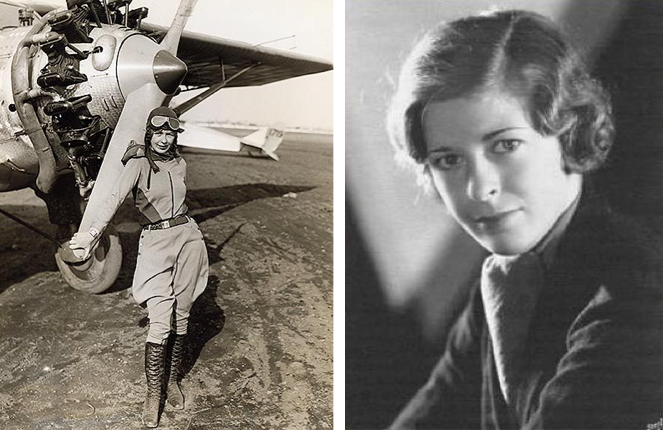
HEAD IN THE CLOUDS…Elinor Smith’s flying career would extend from age 16 and into her 90s. At left, Smith poses in Long Island with the Bellanca monoplane she used to beat the solo flight record in 1929. Right, portrait of Smith circa 1930s. (findagrave.com)
* * *
I’d Rather Be in Philadelphia
Theatre critic Robert Benchley was over the moon regarding a performance of Lysistrata staged by the Philadelphia Theatre Association. Benchley suggested the Philadelphians had “put New York to shame” in staging such a “festival of beauty and bawdiness…never seen on an American stage before.”
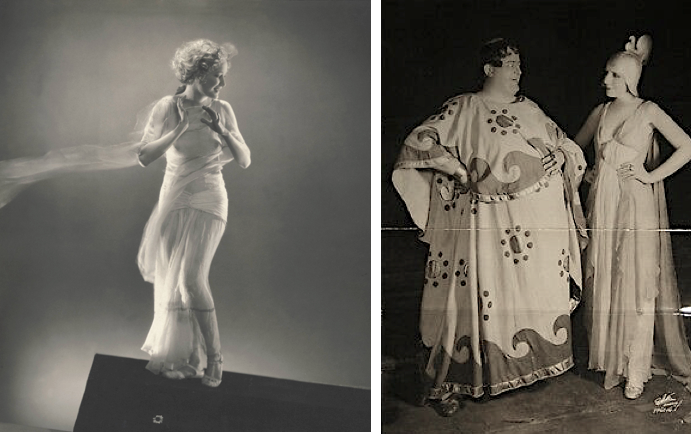
NO MORE HANKY PANKY…Left, actress Miriam Hopkins in Aristophanes’ Lysistrata, as photographed by Edward Steichen; at right, Sydney Greenstreet with unidentified actress from the 1930 Philadelphia production of Lysistrata. (timeline.com)
Benchley praised the seemingly advanced tastes of Philadelphia audiences as he continued to the lament the fact that the City of Brotherly Love had beaten New York to the punch with the staging of the play. He needn’t have worried much longer; the play would open on Broadway on June 5, 1930, at the 44th Street Theatre.
LOVER COME BACK…Production photograph for Norman-Bel Geddes’s staging for Lysistrata, titled “the women of Greece return to their men.” (hrc.utexas.edu)
While we are on the subject of theater, Constantin Alajálov provided this lovely illustration of Anton Chekhov’sUncle Vanya for The New Yorker’s theater review section…
* * *
Make ‘Em Dance, Boys
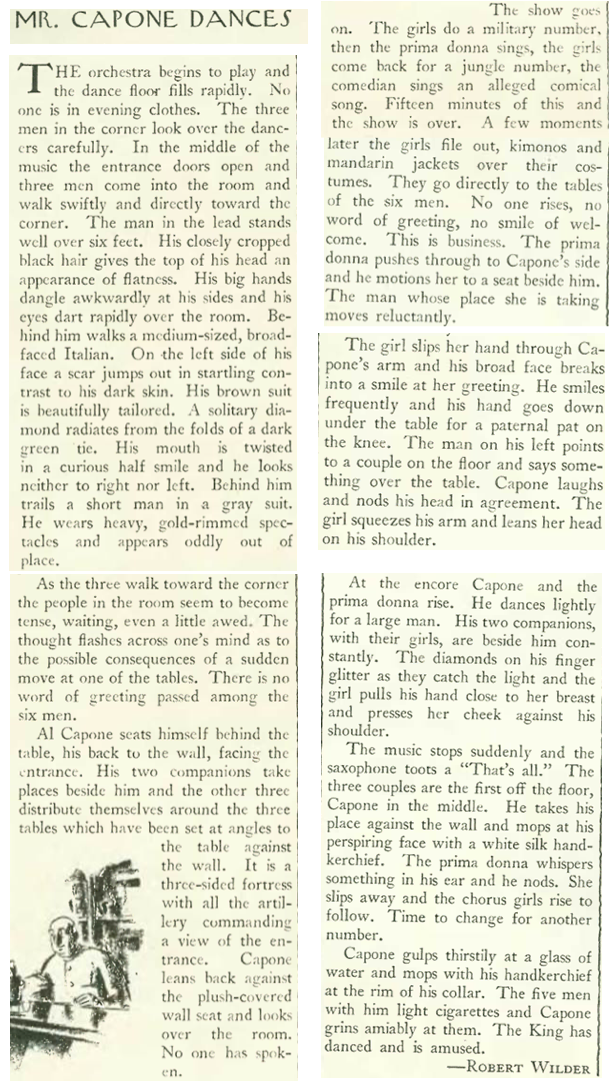
The author Robert Wilder contributed this interesting casual about the appearance of gangster Al Capone at a Chicago nightclub. Excerpts:
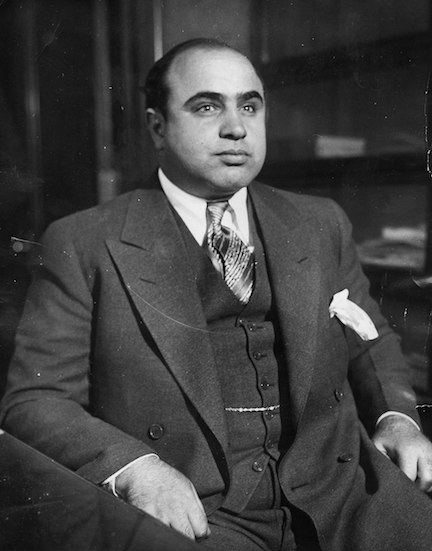
LIGHT ON HIS FEET…Al Capone in 1930. (Wikipedia)
* * *
You Say You Want a Revolution?
Alva Johnston offered his thoughts on how America could stage its own “Red Revolution,” given that Russia and several European countries had already experienced communist uprisings of their own, and also given that New York Police Commissioner Grover Whalen, always in search of problems that didn’t exist, had announced a new “Red Scare” in his fight against communism.
Tongue firmly in cheek, Johnston suggested how American know-how could be brought to bear in inciting a Red Terror. An excerpt:
YANKEE INGENUITY…Alva Johnston, left, offered some innovative ideas for a uniquely American “Red Revolution.” At right, soldiers stand behind a barricade during Germany’s communist Spartacist uprising of January 1919. (Wikipedia)
* * *
Speaking of Revolutionaries
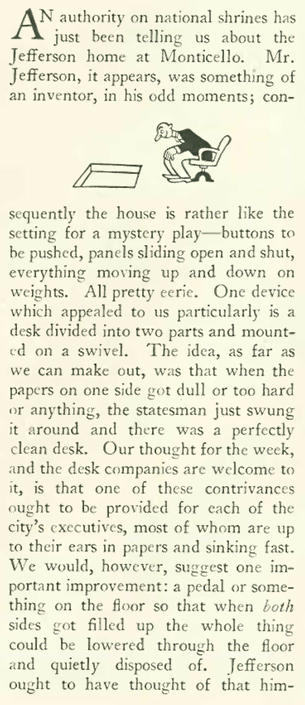
Thomas Jefferson’s home at Monticello is one of America’s most-visited historical sites, but in 1930 it was still something of a regional curiosity, having only been acquired in 1923 for the purposes of turning it into a public museum. Although Jefferson is well known today for his various inventions at Monticello, E.B. White was just learning about this side of the president in his weekly “Notes and Comment” dispatch:
THIS OLD HOUSE…Left, a combination of neglect and Civil War vandalism left Thomas Jefferson’s Monticello enmeshed in weeds and in a state of near collapse by the 1870s. At right, students of the University of Virginia pose outside Monticello in 1930. (UVA/Hulton Archive)
* * *
Play Ball?
We are well into the spring of 1930, yet The New Yorker stood firm in its complete lack of baseball coverage. As I’ve noted before, the magazine covered virtually every sport from horse racing to rowing to badminton, and even lowered itself to regular features on college football and professional hockey, but not a line on baseball, save for an occasional note about the antics of Babe Ruth or the homespun goodness of Lou Gehrig. There were signs, however, that baseball was being played in a city blessed with three major league teams; we do find game times in the “Goings On About Town” section, as well as occasional baseball-themed filler art, and a comic panel in the May 10 issue by Leonard Dove:
From Our Advertisers
We begin with an endorsement for Chase & Sanborn coffee by the soprano Alma Gluck, wife of famed violinist and composer Efrem Zimbalist Sr. Originally I thought she was enjoying coffee with a sister in law named “Mrs. Zimbalist,” but as reader Frank Wilhoit astutely points out, the “Alma Gluck” (celebrity) and “Mrs. Zimbalist” (housewife) are alternate personae of the same individual. And now that I look at the ad again, the clothes and hair styles are identical. I will try to locate a clearer image of the ad…
…and from the makers of White Rock we have a group of swells and their airborne friends enjoying some bubbles that are doubtless mixed with illegal hootch…
…Dr. Seuss continued to offer his artistry on behalf of Flit insecticide…
…and on to our cartoons, Peter Arno illustrated the hazards of the road…
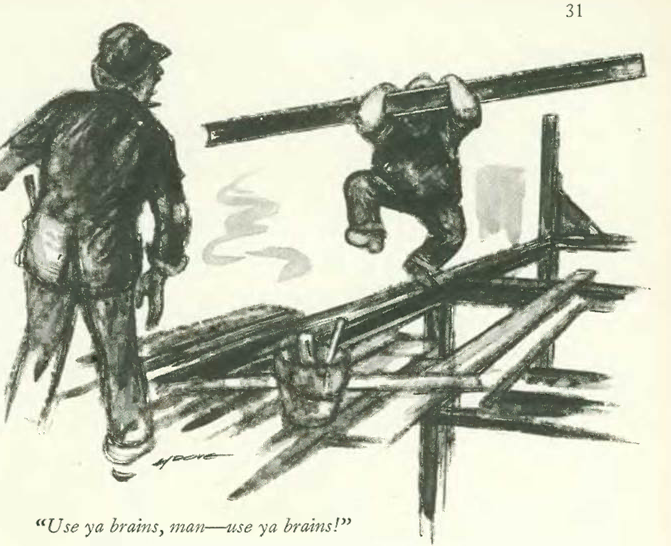
…while Leonard Dove explored the hazards high above the streets of Manhattan…
…Constantin Alajálov explored an odd encounter in a park…
…Isadore Klein mused on the tricks of mass transit…
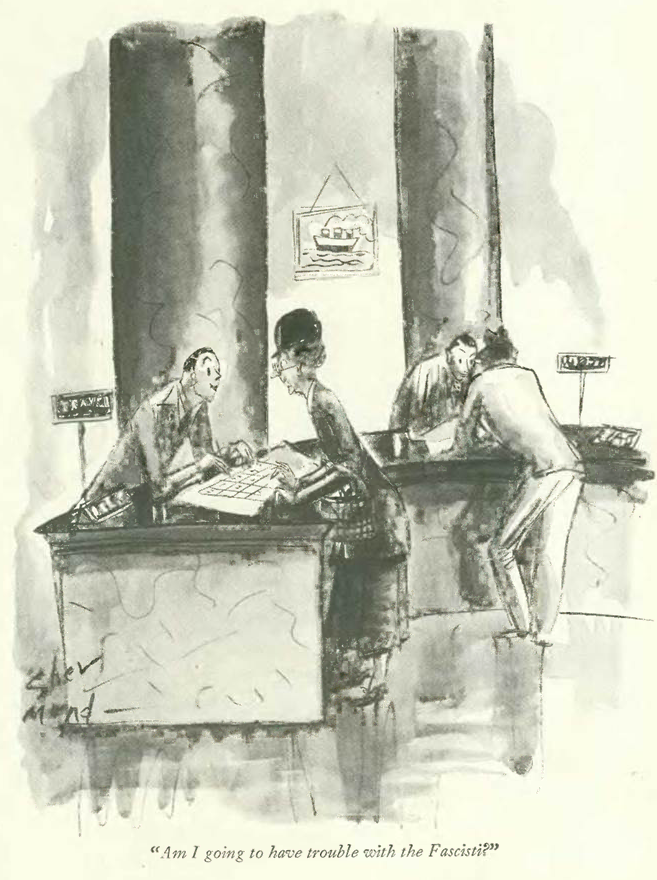
…and two from Barbara Shermund, who looked in on one tourist’s plans for a trip to Mussolini’s Italy…
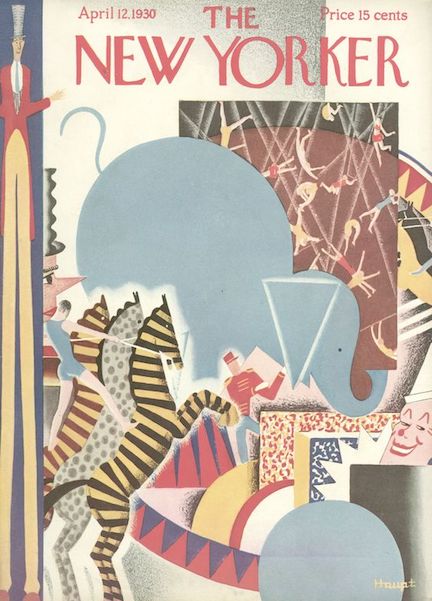
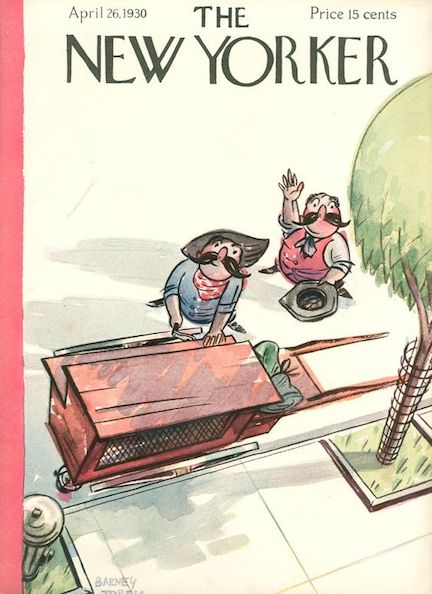
If you lived in small town America in the 20th century, it was a big deal when the circus came to town with its entourage of clowns, acrobats and exotic animals from distant lands.
April 19, 1930 cover by Gardner Rea.
Even New Yorkers, it seems — who could be quite blasé about such things — got a thrill when the Ringling Brothers and Barnum & Bailey Circus rolled into town for its annual spectacle at Madison Square Garden. The New Yorker marked the occasion with its April 12 cover by Theodore Haupt:
For the April 19 issue, E.B. White welcomed the circus on a cautionary note, airing concerns in his “Notes and Comment” column that this old-timey entertainment might be falling under the “base influences” of broadcast radio, Broadway, and Hollywood:
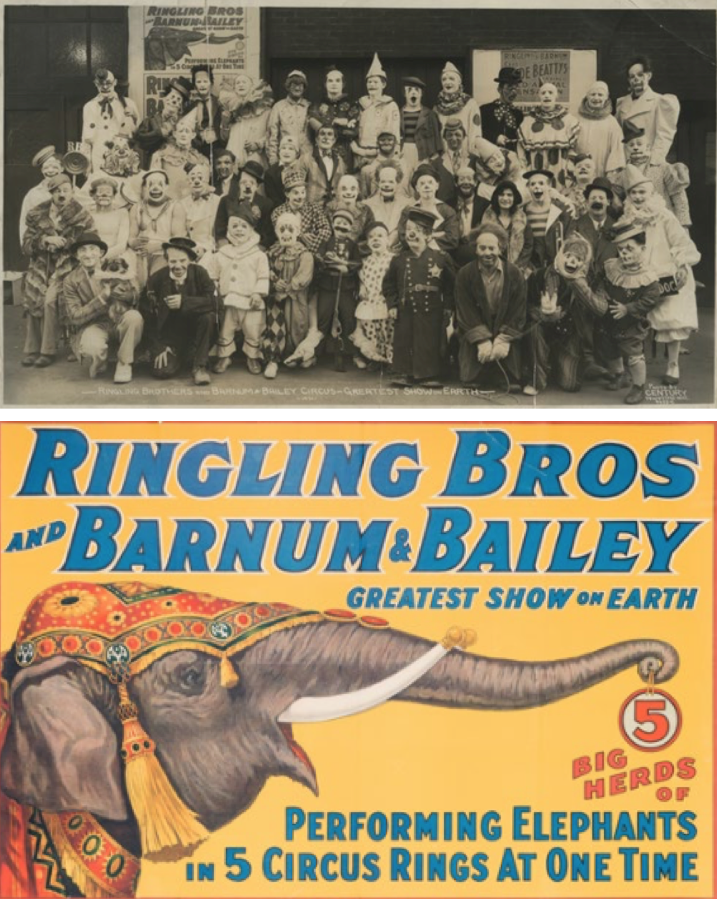
SEND IN THE…YOU KNOW…THOSE GUYS…Top, clowns in town for the 1931 Ringling Brothers and Barnum & Bailey Circus at Madison Square Garden. Below, circus poster announcing the arrival of “The Greatest Show on Earth.” (potterauctions.com)
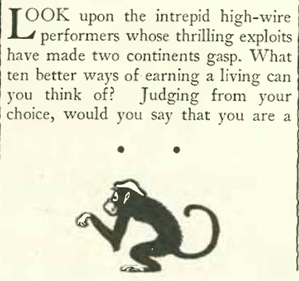
José Schorr, who wrote a number of humorous columns in The New Yorker from 1926 to 1930 on the subject of “how to the pass the time” in various situations, offered this advice on attending the spectacle at Madison Square Garden…
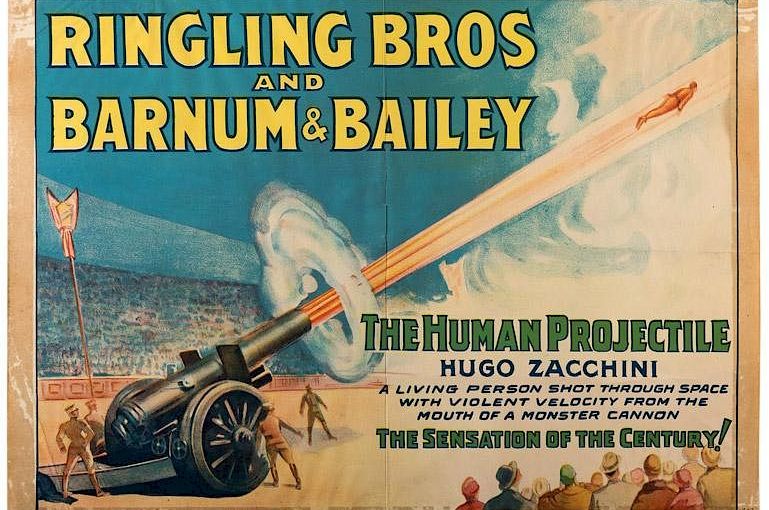
I’D RATHER BE FLYING…1930 poster advertising “The Human Projectile”; 1931 photo of the Ringling Brothers and Barnum & Bailey Circus at Madison Square Garden. (worthpoint.com/bidsquare.com)
…for example, Schorr advised circus-goers to pass the time by considering the inner lives of performers such as “The Human Projectile”…
* * *
Funny Farm
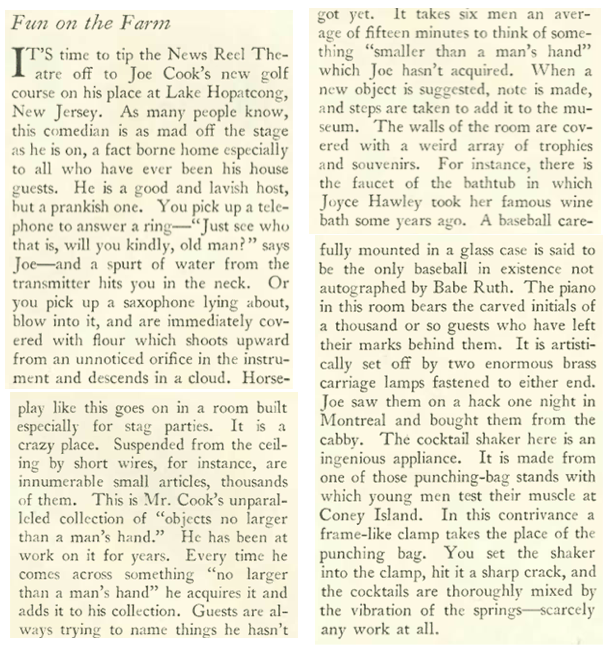
Perhaps you’ve never heard of Joe Cook (1890-1950), but in the 1920s and 30s he was a household name and one of America’s most popular comedic performers. “Talk of the Town” looked in on his antics at his Lake Hopatcong farm, “Sleepless Hollow”…
BATTER UP…Comedian Joe Cook’s residence at Lake Hopatcong, NJ, was known for its celebrity-studded parties. At left, Babe Ruth takes a swing with a giant bat on Cook’s wacky three-hole golf course; at right, Cook relaxing on the steps of his farm. (lakehopatcongnews.com)
* * *
Fun With Balloon Animals
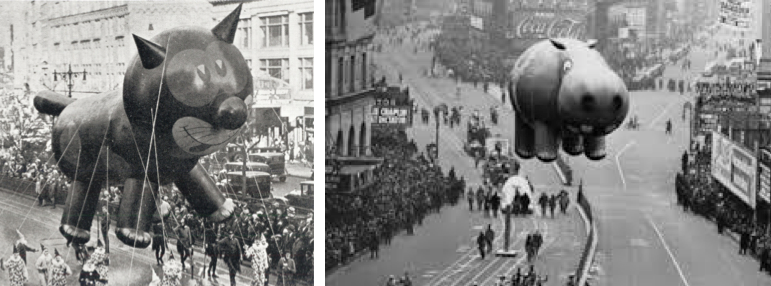
One thing that distinguishes the 1930s from today is that era’s apparent lack of safety standards, or fear of liability. A case in point was Macy’s Thanksgiving Day Parade, which began a tradition in the late 1920s of releasing its giant balloons into the sky at the conclusion of the parade — a $50 reward was offered by Macy’s for their return. “The Talk of the Town” explained:
GOING, GOING, GONE…When Felix the Cat (left, in 1927) was released after the Macy’s Thanksgiving Day Parade, it floated into a power line and caught fire; in 1931 the parade’s Big Blue Hippo (right) was apparently spotted floating over the ocean, never to be seen again. (Macy’s/hatchingcatnyc.com)
Perhaps the craziest anecdote attached to the parade’s annual balloon release belonged to Annette Gipson. While flying a biplane at 5,000 feet with her instructor, she spotted the parade’s 60-foot “Tom Cat” balloon rising high above Queens. Looking to have a bit of fun, the 22-year-old Gipson flew the plane directly into the cat. According to the book Macy’s Thanksgiving Day Parade, “Upon impact, the balloon wrapped itself around the left wing. The plane went into a deep tailspin (nearly throwing Gipson from the cockpit) and sped toward the ground out of control.” Fearing the plane would catch fire when it hit the ground, the instructor killed the ignition, and somehow managed to pull the plane out of the spin and land it safely at Roosevelt Field.
KITTY LITTER…Annette Gipson, right, nearly killed herself and her flight instructor after she deliberately crashed her biplane into a Tom Cat balloon (left) that had been released following the 1932 Macy’s Thanksgiving Day Parade. Of her near-death experience, Gipson told reporters, “It was a sensation that I never felt before—the whirling housetops, rushing up to meet me—and the thoughts of a whole lifetime flashed through my mind.” (ephemeralnewyork.wordpress.com)
A footnote: Following Gipson’s brush with death, Macy’s announced it would not give prize money to those who tried to down the balloons with their airplanes. The incident also brought an end to the company’s tradition of releasing the balloons.
* * *
Birth of the Soundtrack
Songs from popular theater productions were first made available to the masses in the mid-19th century via printed sheet music and later through early recordings. Part of this lineage is the movie soundtrack, which has its origins in the early days of sound pictures. According to TheNew Yorker’s “Popular Records” column, these new recordings would bring the talkies into your home, albeit without the picture…
FROM MAMMY TO MAMMA MIA…Left, a 1930 Brunswick 78 RPM recording of Al Jolson’s “To My Mammy”; at right, soundtrack from the 2008 film Mamma Mia! (popsike.com/amazon.com)
* * *
Cosmo Calvin
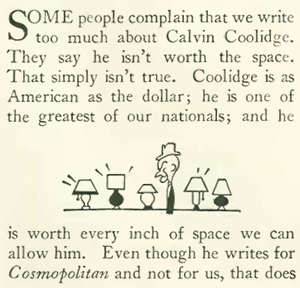
Before Helen Gurley Brown came along in the 1960s and sexed it up, Cosmopolitan was known as a somewhat bland literary magazine, and it was certainly bland enough in 1930 to welcome the scribblings of America’s blandest president to its pages. E.B. White mused in his “Notes”…
NOTHING COMES BETWEEN ME AND MY CALVIN…At left, the May 1930 issue of Cosmopolitan featuring columnist and former U.S. President Calvin Coolidge; at right, Kourtney Kardashian on the cover of the October 2016 issue. (Pinterest/Cosmopolitan)
* * *
How Dry I Am
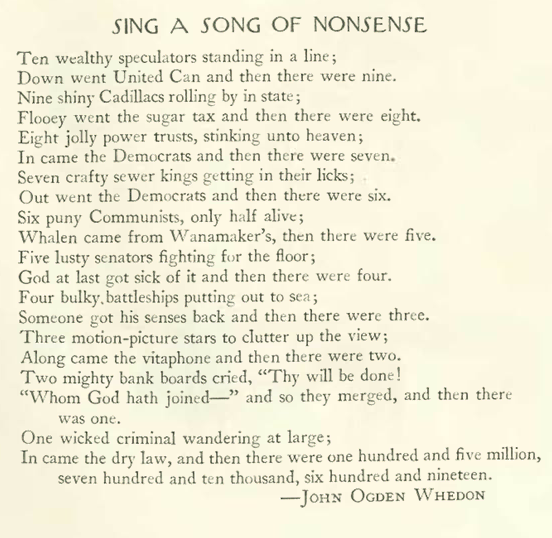
After a decade of living under Prohibition, John Ogden Whedon (1905-1991) put pen to paper and shared his sentiments in a poem for The New Yorker…
…Whedon would go on to a successful career as a screenwriter, especially finding acclaim for his television writing on The Donna Reed Show, Leave It to Beaver, The Andy Griffith Show, and The Dick Van Dyke Show, among others. He was also the grandfather of screenwriter and director Joseph “Joss” Whedon and screenwriters Jed Whedon and Zack Whedon.
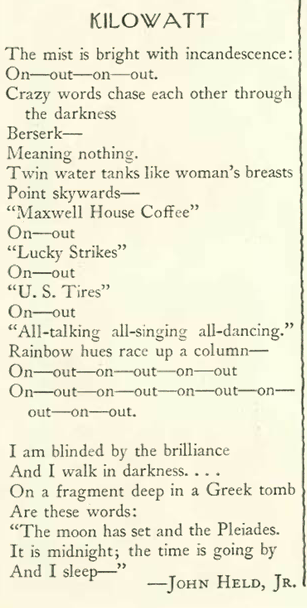
Another poem in the April 19 issue was contributed by John Held Jr., who was perhaps better known to New Yorker readers for his “woodcut” cartoons…
…example of Held’s work from the April 12 issue, featured in an Old Gold advertisement…
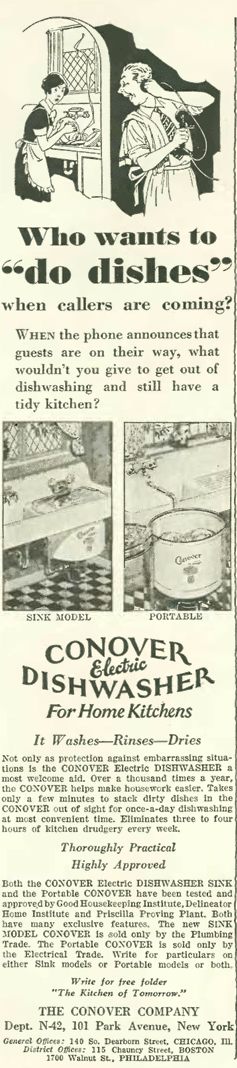
…and that provides a segue into our ads for the April 19 issue, beginning with this spot for an early electric dishwasher…
Here’s what that bad boy looks like in color. (automaticwasher.org)
…I couldn’t find a review in The New Yorker for Emily Hahn’s new book, Seductio Ad Absurdum, but her publisher did take out an ad to get the attention of readers. Many years later The New Yorker would call the journalist and author “a forgotten American literary treasure”…
Emily Hahn circa 1930; first edition of Seductio Ad Absurdum. Author of 52 books, her writings played a significant role in opening up Asia to the West. (shanghaitours.canalblog.com/swansfinebooks.com)
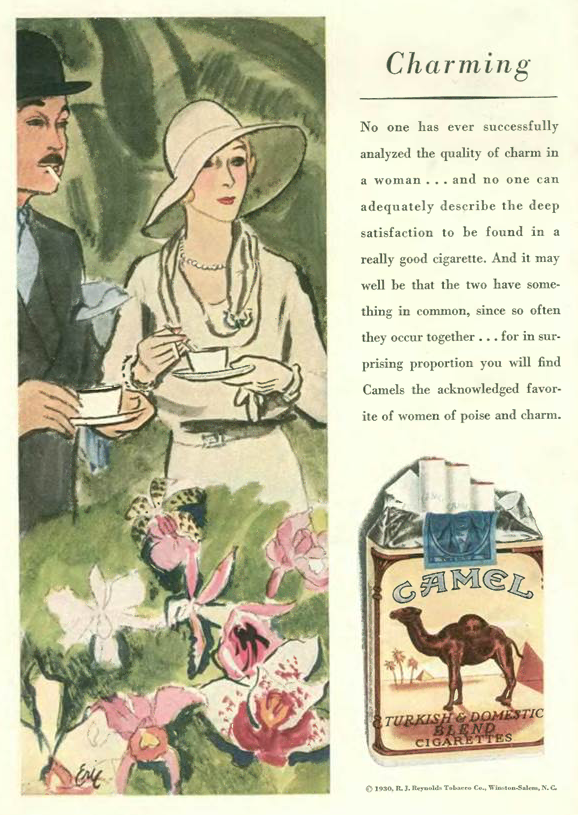
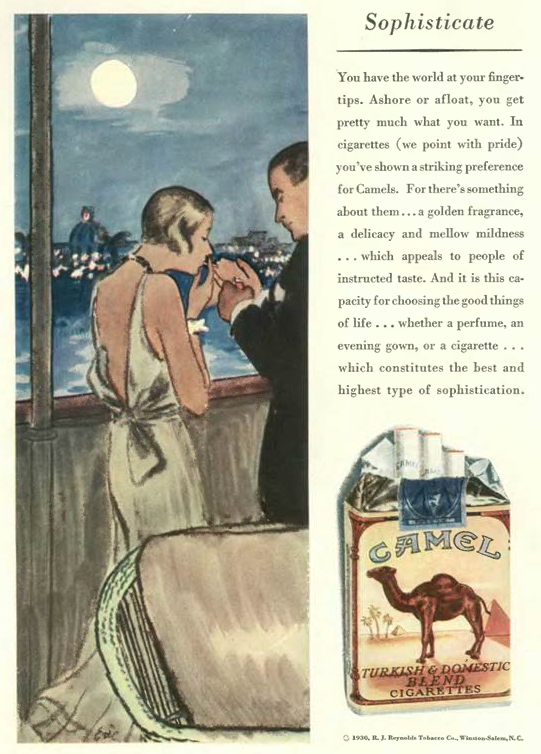
…and here we have another sumptuous ad from illustrator Carl “Eric” Erickson, a far cry from the “Joe Camel” ads that would come along decades later…
…on to our cartoons, Reginald Marsh offered a blue collar perspective on city fashions…
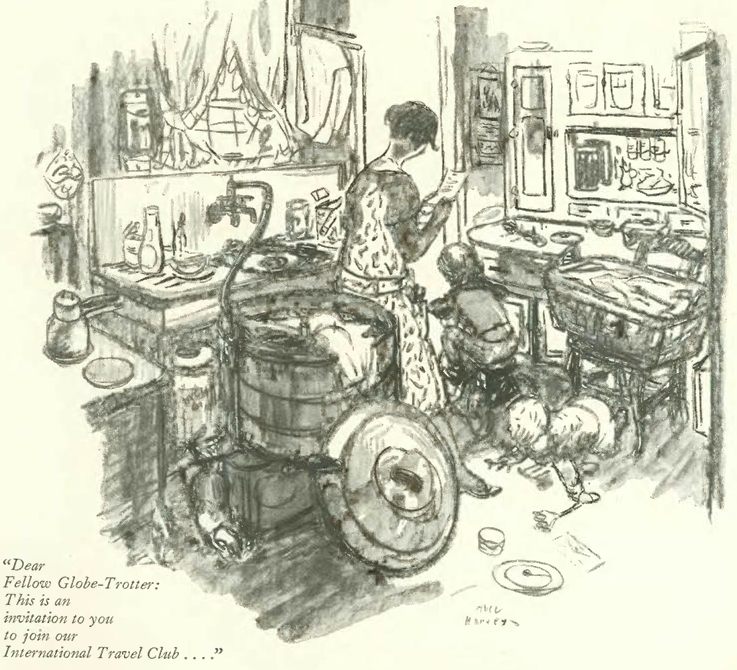
…Alice Harvey captured a moment of reflection by an overworked housewife…
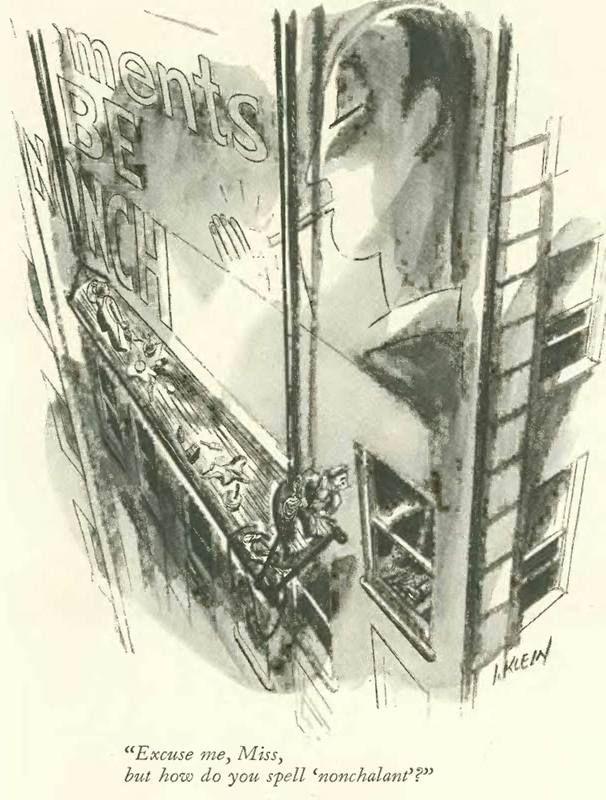
…and Isadore Klein looked in on a couple of working stiffs in need of a dictionary…
…now over to the posh set, with Barbara Shermund…
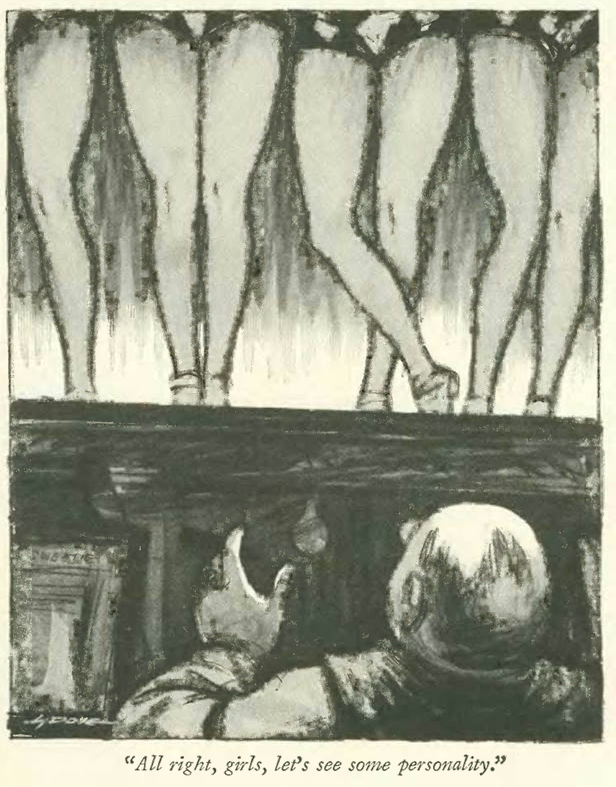
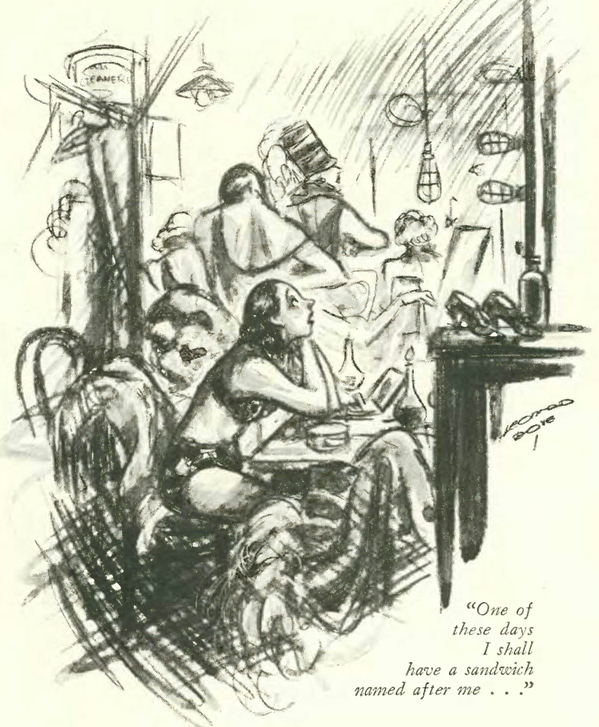
…Leonard Dove found humor on the chorus line…
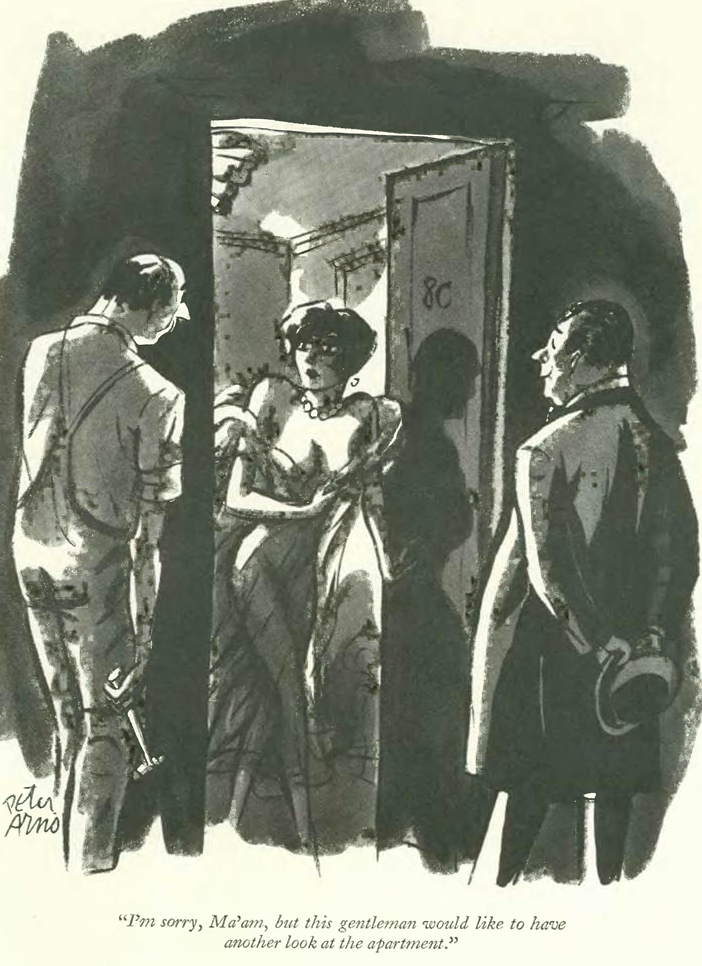
…and we end with this terrific cartoon by Peter Arno, and the perils of apartment life…
Imagine your favorite Hollywood actress, maybe someone like Julia Roberts,Meryl Streep or Judi Dench. You’ve followed their careers and watched most of their movies, but you’ve never heard their voices.
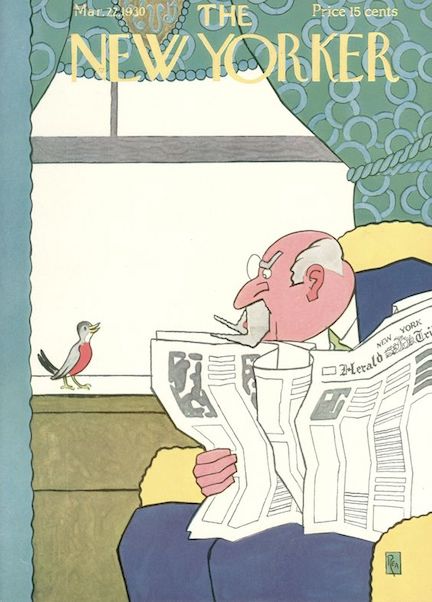
March 22, 1930 cover by Gardner Rea.
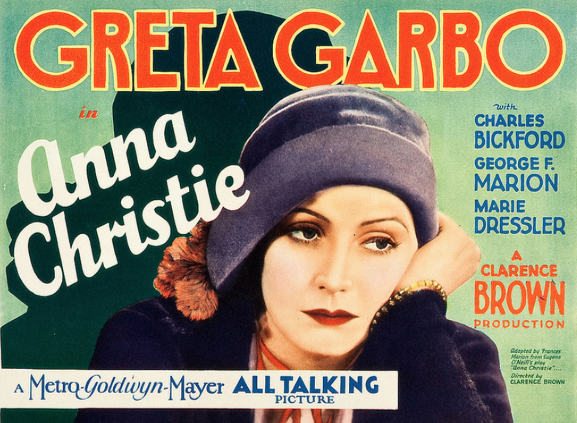
That’s what it was like for Greta Garbo fans before March 1930, when she spoke her first onscreen words in the 1930 MGM drama Anna Christie, which was adapted from a 1922 play by Eugene O’Neill.
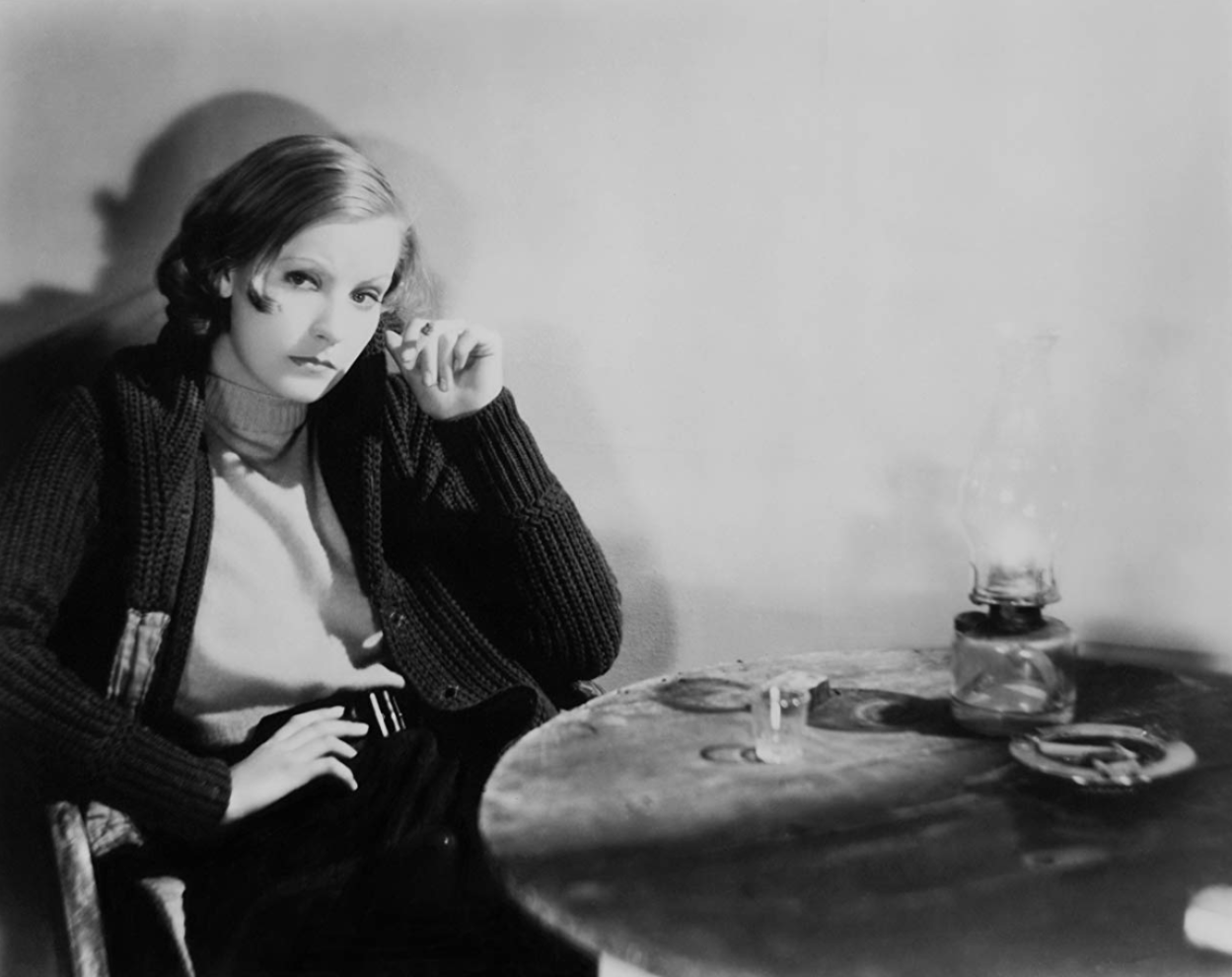
SWEDISH SPHINX…Greta Garbo’s mask-like qualities on display in this publicity still for Anna Christie. (IMDB)
The New Yorker’s film critic John Mosher, not always a fan of Garbo’s silent work, found a “special kind of glamour” in her first talking picture, even tossing out the word “legend” to describe this Swede who avoided publicity like a bad cold…
No doubt a few moviegoers saw the movie just to finally hear that voice, which Mosher described as “a surprise…a deep, low voice, a boy’s voice really, rather flat, rather toneless, yet growing more attractive as the picture advances”…
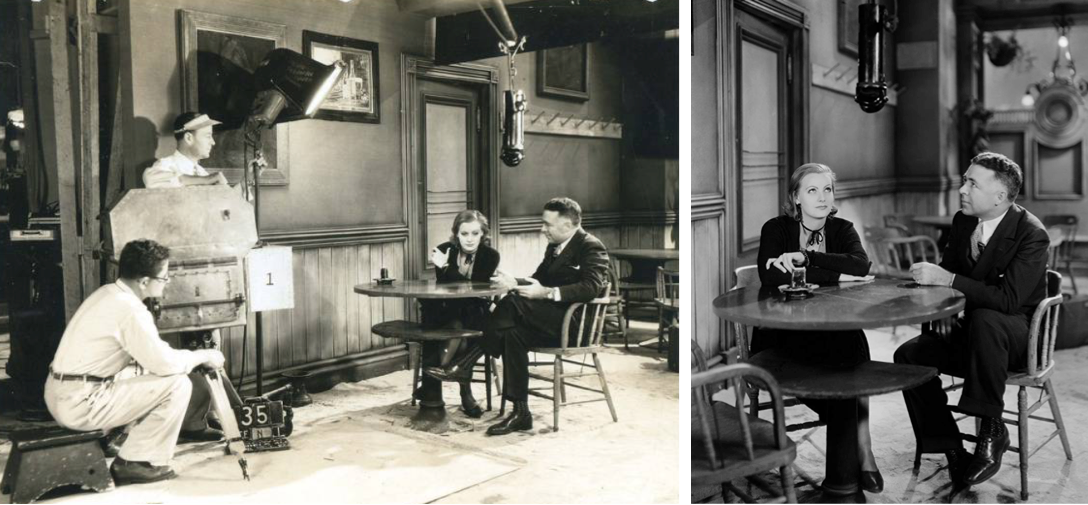
Director William H. Daniels (seated, left) with unidentified cameraman filming a scene from Anna Christie with actors Greta Garbo and Clarence Brown; at right, the actors contemplate the microphone hovering above them. Note how the camera in the first photo is contained in a soundproof case. (IMDB)
Publicized with the tag line “Garbo talks!,” Anna Christie premiered in New York City on Feb. 21 and would become the highest-grossing film of 1930. Later that year a German language version would be filmed featuring Garbo but with a different director and supporting cast.
SOUND DEBUT…Clockwise, from top left, Greta Garbo and Marie Dressler in Anna Christie; an MGM ad touting the film as one of the best pictures of the year (it would be the year’s highest-grossing, and Garbo would receive an Academy Award nomination); studio portraits of Garbo used in the film’s promotion. (IMDB)
* * *
Chicken and Cocktails
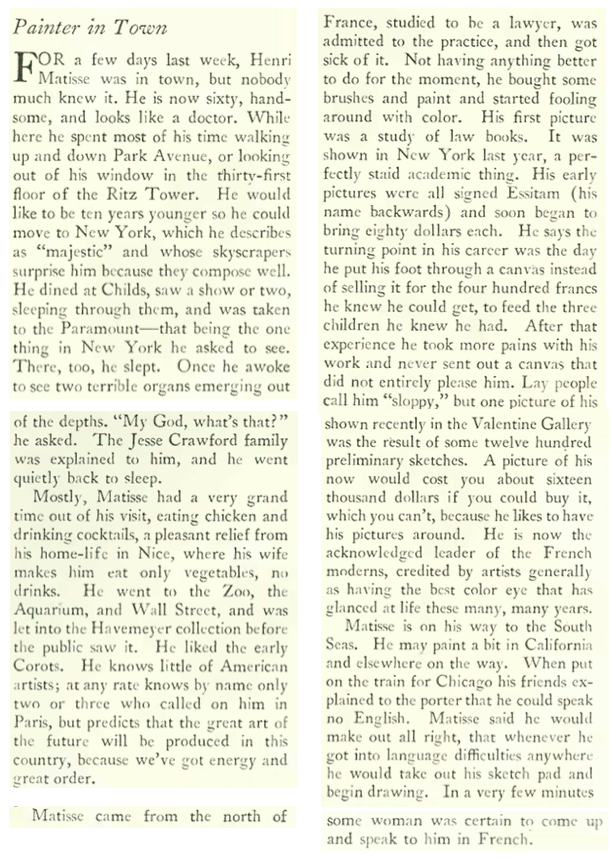
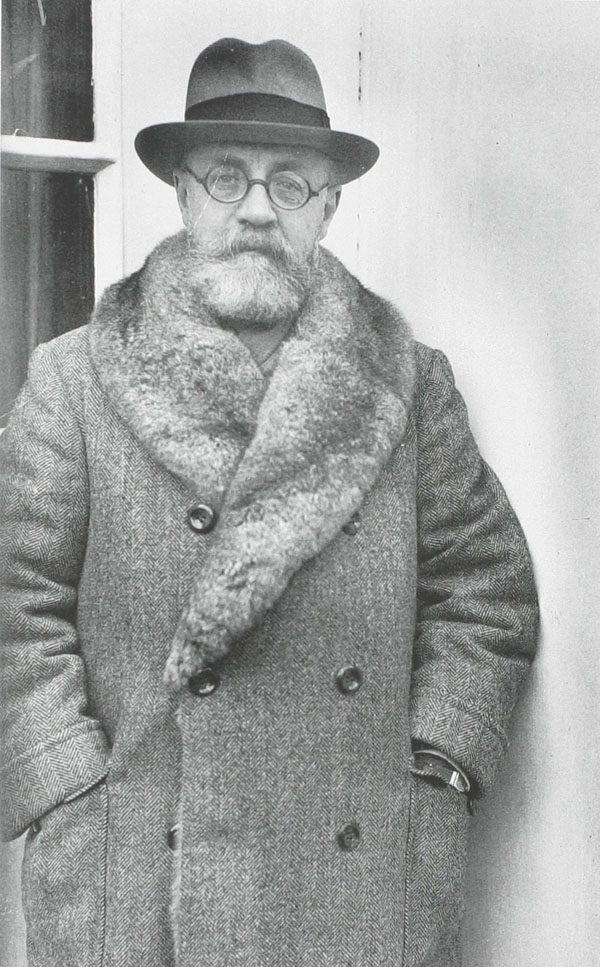
En route to the South Seas, the French artist Henri Matisse (1869-1954) paid a visit to New York City, and by all accounts had a good time there. His visit was described by Murdock Pemberton in “The Talk of the Town”…
I ♥ NEW YORK…Henri Matisse arriving in New York City on the RMS Mauretania December 15, 1930. He described the city as “majestic.” (artistandstudio.tumblr.com)NICE PLACE, THIS…Henri Matisse sitting on the brick roof terrace of 10 Mitchell Place (formerly Stewart Hall), the Queensboro Bridge glimpsed in the background. The photo was taken in 1930 by his son, Pierre Matisse, who was living in New York. At right, 10 Mitchell Place today. A framed photograph of Matisse sitting on the rooftop hangs on the wall of the building’s lobby. (Henri-matisse.net/Ephemeral New York)
* * *
The Last Page
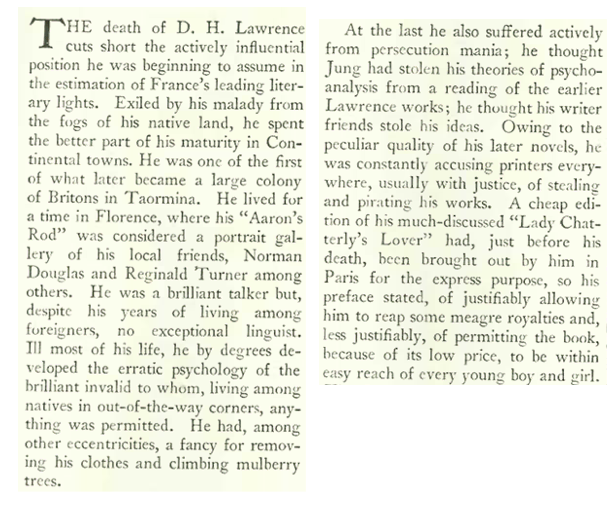
The death of author D.H. Lawrence (1885-1930) was reported to New Yorker readers by Janet Flanner, the magazine’s Paris correspondent, who briefly detailed the writer’s rather sad decline…
FLEETING DAYS…D. H. Lawrence (right) with fellow writer Aldous Huxley at Bandol, in the South of France, 1929. (Topham Picturepoint)
* * *
What Depression?
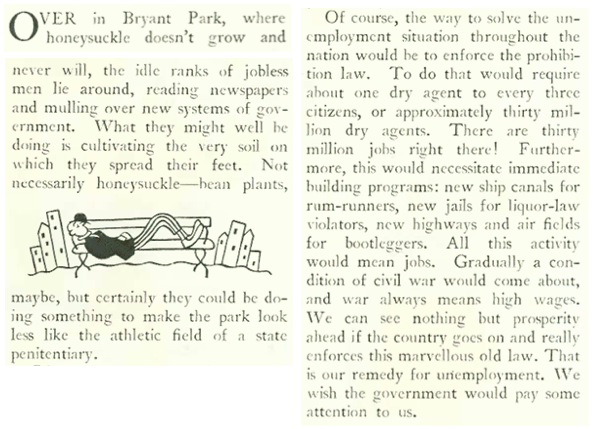
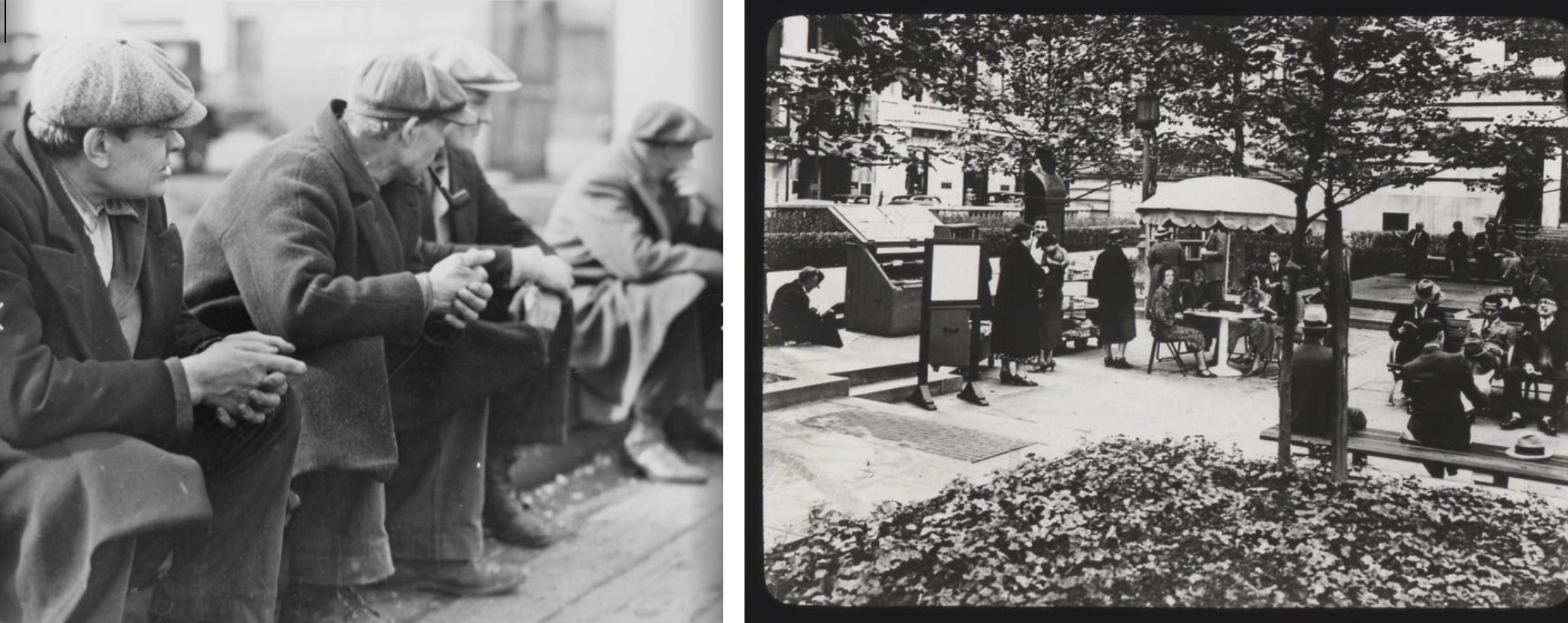
We are nearly five months into the Great Depression, yet there is little evidence in The New Yorker of the catastrophe that was unfolding across the land. And true to form, the approach to the topic was made with humor, via E.B. White in “Notes and Comment”…
KNOW ANY GOOD JOKES?…At left, unemployed New York dockworkers; at right, folks enjoying the New York Public Library’s outdoor reading room in Bryant Park, 1930s. (Lewis Hine/National Archives and Records Administration/New York Public Library)
* * *
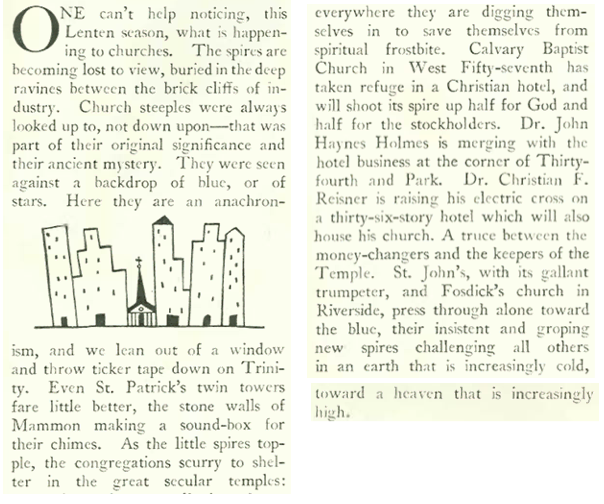
Cathedrals of Commerce
E.B. White also observed the changing skyline, and how the towering skyscrapers were quickly overshadowing the once prominent steeples of the city’s churches…
REACHING TO THE HEAVENS…Clockwise, from top left, Trinity Church Wall Street and St. Patrick’s have been eclipsed by the towers of Mammon, but St. John’s and Riverside still dominate their surroundings. (Wikipedia/St. John’s/Riverside)
* * *
The Other House of Worship
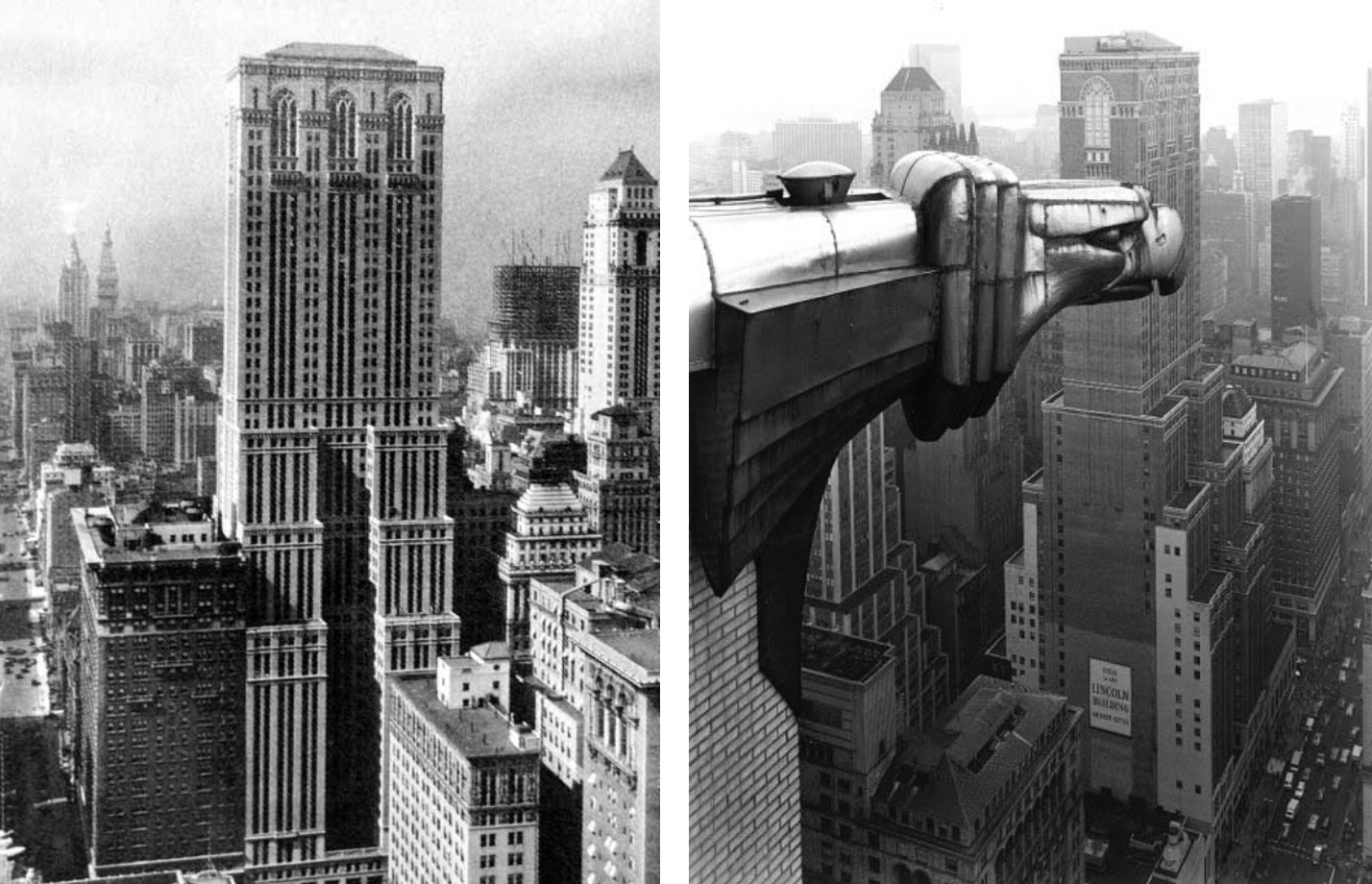
Perhaps a certain skyscraper ennui settled in, as architecture critic George S. Chappell was not all that impressed by the “huge” Lincoln Building (which today still seems huge)…
SIZE DOESN’T MATTER…Although the new Lincoln Building proved to be a massive addition to the New York skyline, its style seemed outdated in contrast to its flashy new neighbor, the Chrysler Building — one of its gargoyles, at right, seems poised to devour the Lincoln Building. (nyc-architecture.com)
* * *
From Our Advertisers
We have a bit more evidence of the Depression in the ads, including this one from Abercrombie & Fitch, with two sporting gents opting to go fishing to take their minds off the markets…
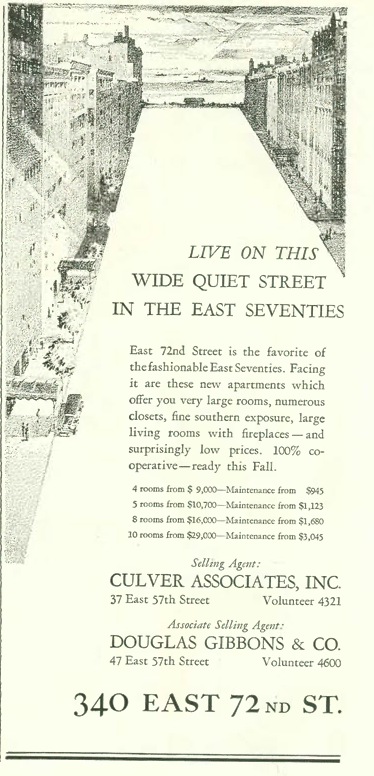
…if fishing wasn’t your thing, perhaps you just wanted to escape into the “quiet” of the wide streets in the East Seventies…
…or relax with a smoke, which artist Carl Erickson made so appealing with his Camel ad illustrations…
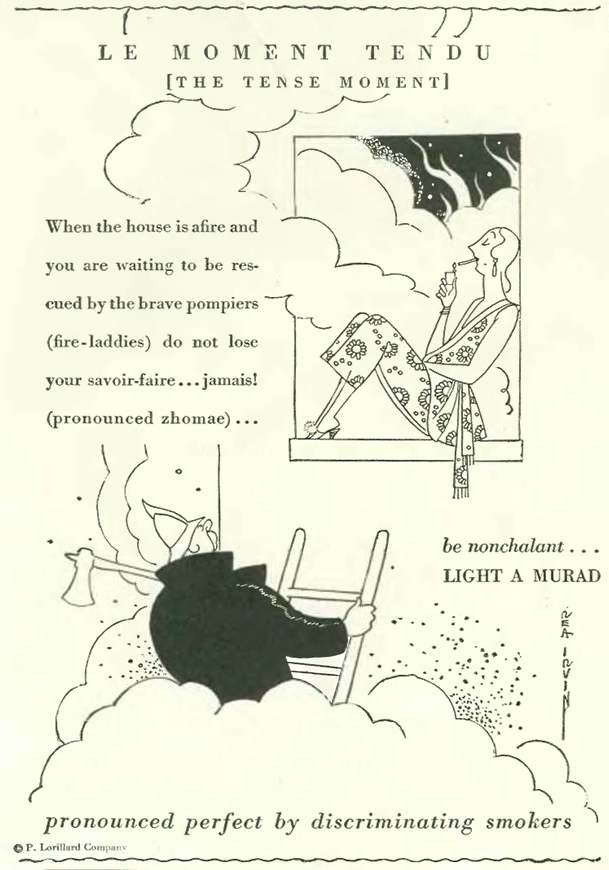
…or take the humorous route to a relaxing smoke, with this ad for Murad as illustrated by Rea Irvin…
…on to our cartoonists, Garrett Price captured the mood of the times…
…while Alfred Krakusin captured an altogether different mood…
...Leonard Dove examined the path to stardom…
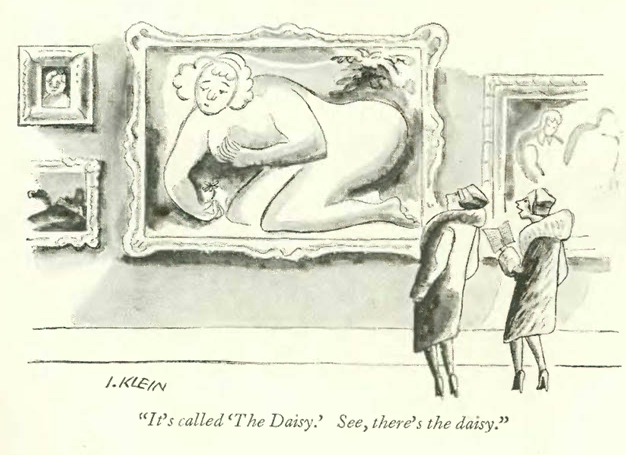
…Isadore Klein pondered modern art…
…William Crawford Galbraith found an unlikely victim of religious zeal…
…Mary Petty gave us a glimpse of a doctor’s office…
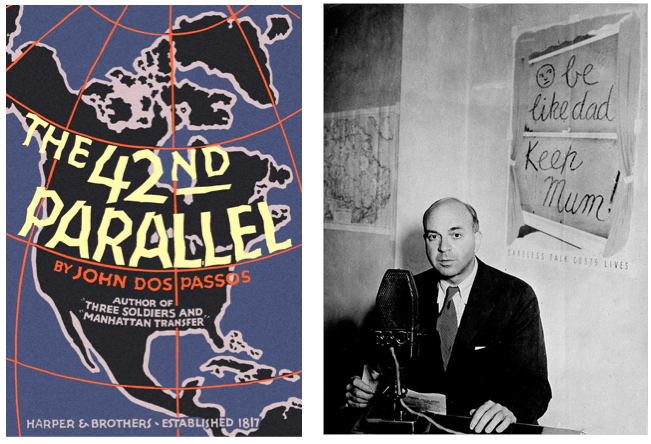
As Ernest Hemingway and F. Scott Fitzgerald spoke to the “Lost Generation” of writers and artists in the 1920s, John Dos Passos (1896-1970) drew upon the ethos of that period to usher in a new style of writing for the 1930s — modern, experimental, and deeply pessimistic.
March 8, 1930 cover by Ilonka Karasz.
Dos Passos’ book The 42nd Parallel would be the first of three books from 1930 to 1936 that would comprise his landmark U.S.A. Trilogy. The book critic for the New Yorker (identified as “A.W.S.”) sensed that this work of avant-garde historical fiction represented a significant marker in the modernist movement, likening it to the work of the great 20th century composer Igor Stravinsky:
A WRITER FOR DEPRESSING TIMES…The 42nd Parallel was the first book in a trilogy published by John Dos Passos between 1930 and 1936. At right, Dos Passos in the early 1940s. (22.hc.com/hilobrow.com)
Dos Passos also painted throughout his life, nearly 600 canvases including this early work from his days in Spain in the 1920s…
John Dos Passos’ watercolor painting of the the Spanish countryside, circa 1922. A modernist writer, Dos Passos also painted in the style of the avant-garde. His nearly 600 paintings throughout his lifetime show influences of Impressionism, Expressionism and Cubism. (johndospassos.com)
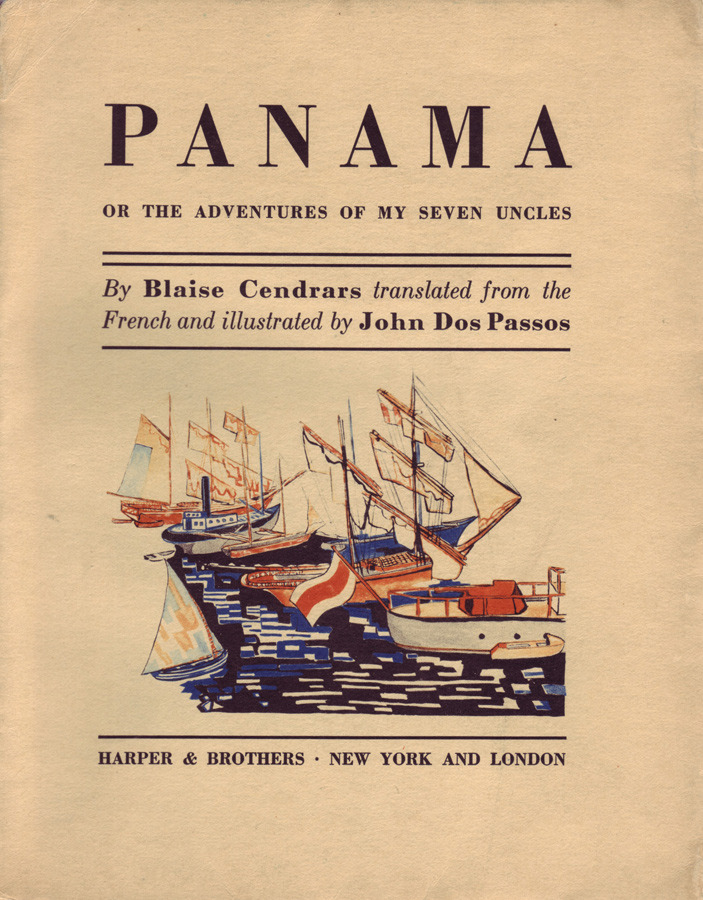
…and he joined his literary and artistic talents in 1931 when he translated and illustrated Blaise Cendrars’ long poem Le Panama et Mes Sept Oncles. Dos Passos became good friends with Cendrars, and in the book’s foreword acknowledged his debt as a writer to the French poet…
(johndospassos.com)
* * *
Don Could Also Write And Draw
Like Dos Passos, Don Herold (1889-1966) could express himself through both words and pictures, albeit in a much less serious vein. In the March 8 issue Herold wrote about the indignity of having to disrobe for a medical examination. An excerpt:
Also an illustrator and cartoonist, Herold made his debut in The New Yorker with this cartoon in the June 1, 1929 issue:
Herold began working as an illustrator around 1910, and enjoyed a long career with a number of publications, including the humor magazine Judge:
* * *
Measuring Up
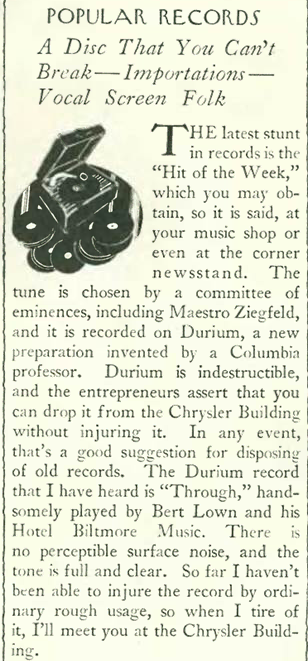
When the Chrysler Building was completed in May 1930, it officially became the world’s tallest building (a record it ceded 11 months later to the Empire State Building). Being the tallest gave the building the distinction of being something to be measured against, including the durability of a musical recording pressed into a material called “Durium”…
…and when advertisers were in need of something large for comparison, they also turned to the new skyscraper to drive home their selling point…
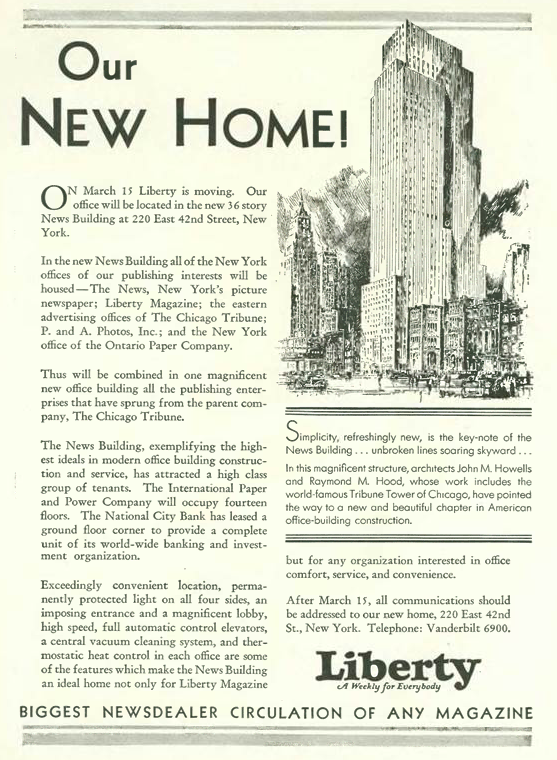
…new skyscrapers also were used to lend distinction to their tenants, such as Liberty Magazine in the new Daily News Building…
…below a 1940 postcard image of the Daily News Building, then known simply as “The News Building,” and a view of the lobby’s famous globe in 1941…
(Wikipedia)
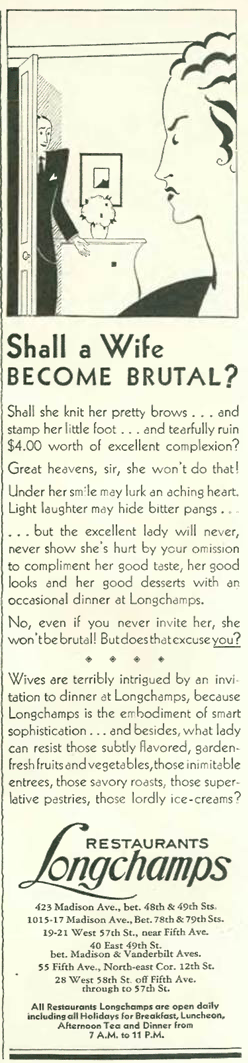
…on to the rest of our ads, here’s a baldly misogynistic one from Longchamps restaurants…
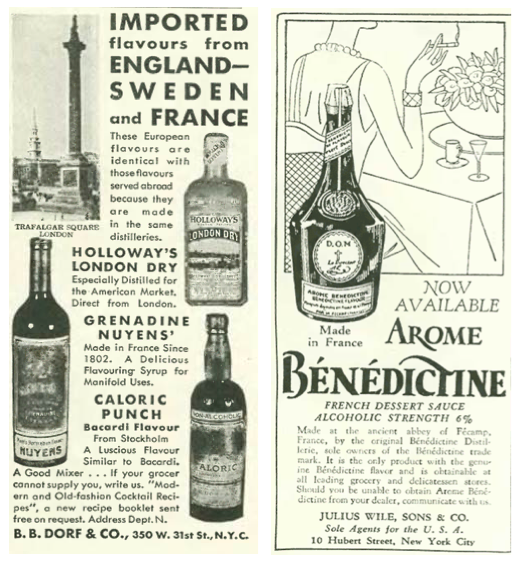
…and as Prohibition wore on into the Thirties, we have sad little back page ads for cocktail “flavours” and Benedictine “Dessert Sauce”…
…on to our cartoons, Gardner Rea explored the subject of family planning…
…Art Young illustrated the perils of modern art…
…Otto Soglow took a stroll with a somnambulist…
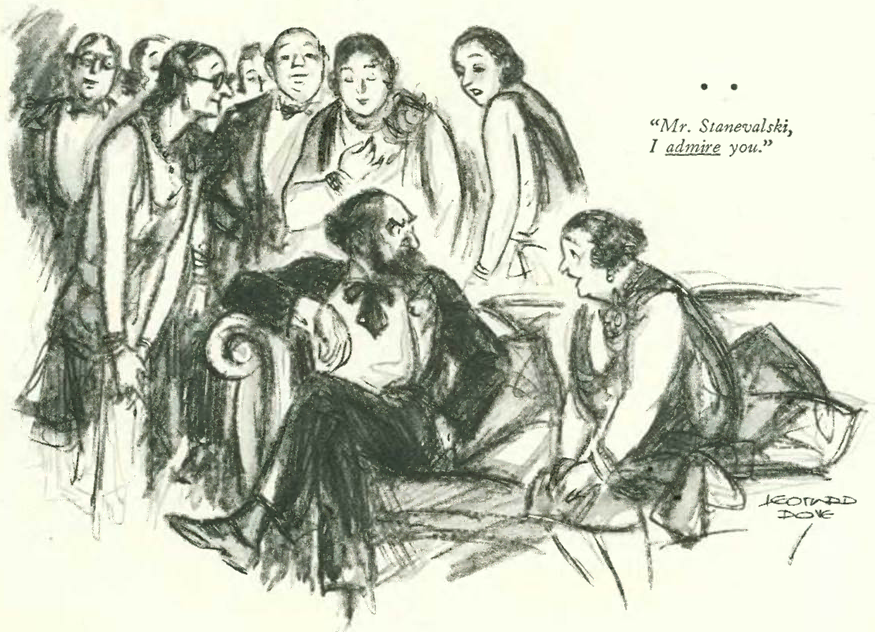
…Leonard Dove inked this awkward moment between the Old and New Worlds…
A host of nature programs from Mutual of Omaha’s Wild Kingdom to Planet Earth owe their origins to a few intrepid filmmakers who 100 years ago gave Americans some of their first glimpses of life in exotic, remote regions of the world.
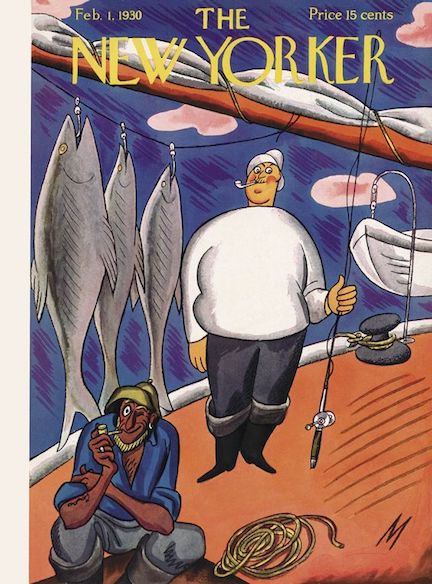
Feb. 1, 1930 cover by Julian De Miskey.
Among the first to do it were a couple from Kansas, Osa and Martin Johnson, who together explored unknown lands and brought back footage of the wildlife and peoples of the African continent, the South Pacific Islands and British North Borneo. Their first film, Among the Cannibal Isles of the South Seas (1918), was followed by several more, including Across the World with Mr. and Mrs. Johnson, which was released in early 1930.
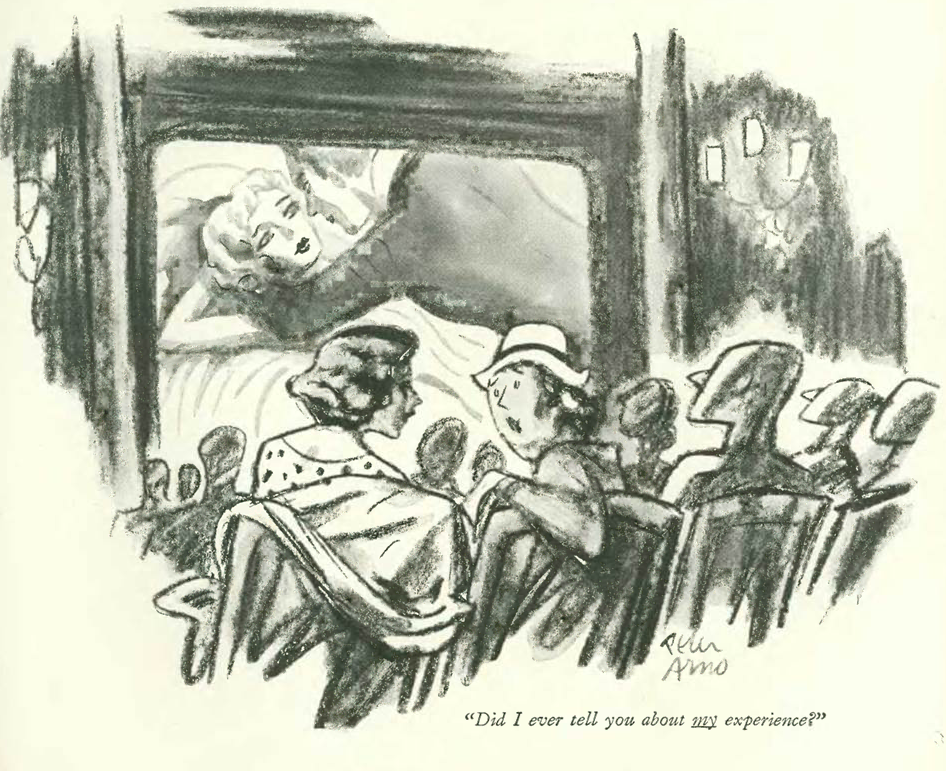
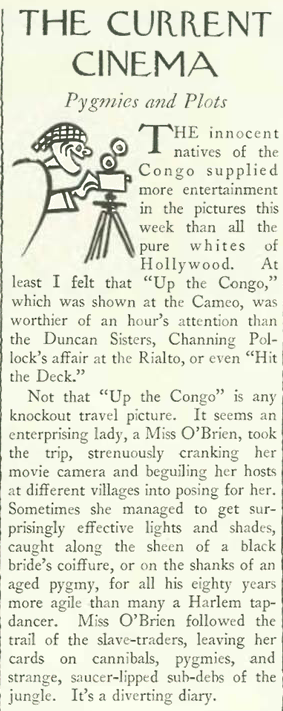
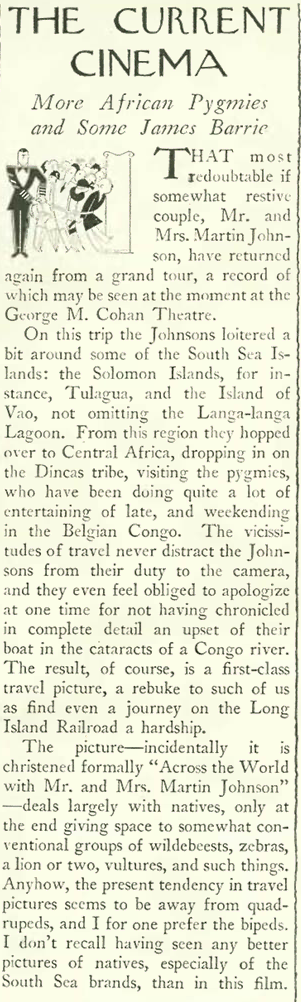
The New Yorker film critic John Mosher was as eager as any audience to take in the adventures of the Johnsons, or even of someone who was inspired by the Johnsons, in this case a “Miss O’Brien” who had just released a “diverting diary” called Up the Congo. Mosher wrote about it in the Jan. 25 issue:
CONTACT…Image of a family from an unidentified Pygmy tribe posing with a European explorer in a 1921 Collier’s New Encyclopedia entry; a group of Mbuti posing with explorer Osa Johnson in 1930. (Wikipedia)
I can find no record of the film UptheCongo, however the exploits of the Johnsons are well documented thanks to the Martin and Osa Johnson Safari Museum in Chanute, Kansas, which has a treasure trove of photos and other information on the explorers.
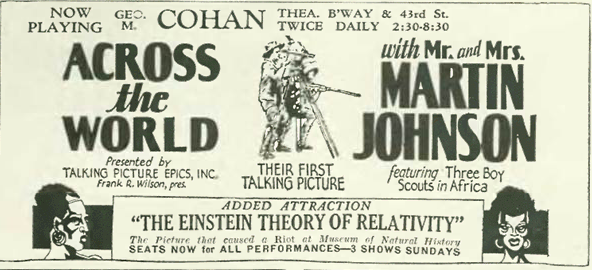
The ad in the Feb. 1, 1930 New Yorker promoting Across the World with Mr. and Mrs. Johnson included an interesting “added attraction”…a film about Einstein’s theory of relativity that had caused a Jan. 8 “riot” at the American Museum of Natural History. That particular screening was intended for members of the Amateur Astronomers Association, but word got out and three times the invited number showed up at the museum, breaking down the lobby gates. Hard to imagine a mob today clamoring to view a science film…
Although the Johnsons made their movies under the auspices of the American Museum of Natural History, much of the footage was staged or edited to maximize the thrills (Mutual of Omaha’s Wild Kingdom did this in the 1960s and 70s, as did producers of Disney’s nature films from the 50s and 60s. The practice continues to this day on cable television).
The Johnsons also didn’t hesitate to gun down animals in the course of their movie-making…
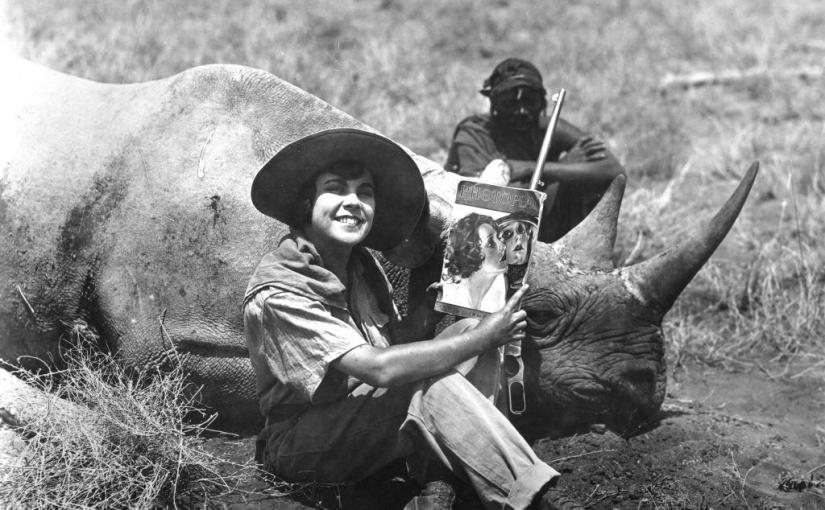
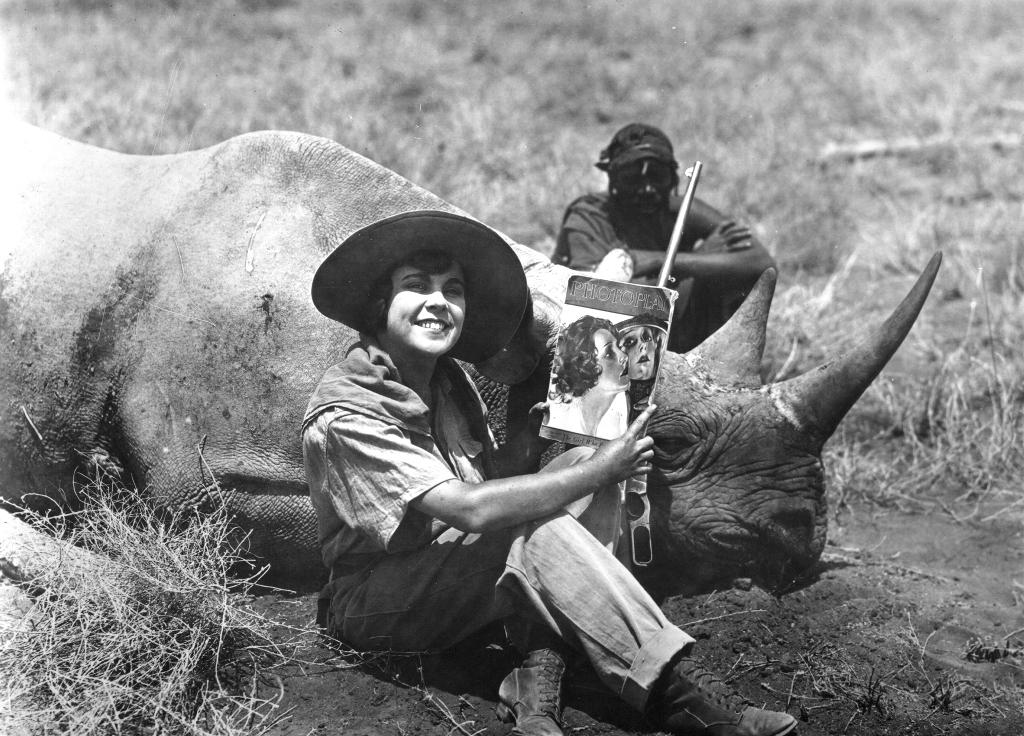
YEP, THAT’S JUXTAPOSITION…Osa Johnson poses with a Photoplay magazine, a dead rhino, and a tribesman, circa 1930. (columbia.edu)
According to a 2011 review from Wild Film History, “in stark contrast to the conservation-themed wildlife films of today, the Johnsons approached their subjects armed with both camera and rifle, with the production including provoked behaviour, staged confrontations and animals shot to death on film. Relying heavily on cutting in kills from professional marksmen, numerous hunting scenes culminate in a heart-stopping sequence where, with the use of clever editing, the adventurous Mrs Johnson appears to bring down a charging rhinoceros with one well-aimed shot.”
Across the World with Mr. and Mrs. Johnson is presented as if the Johnsons were showing their film to a few friends in their New York City apartment. The film is a “silent with sound,” that is, scenes in the field are silent, but the cocktail party “home movie” opening has sound, including “mood music” Osa provides by turning on the radio as the film begins. For all of their film experience, the acting between Osa and Martin is wooden, as is Martin’s narration. The critic John Mosher, however, enjoyed the ride, writing in his Feb. 1 column:
If you are curious, you can watch some of the film here, including the opening home movie scene with Osa and Martin in cocktail attire…
* * *
My Kinda Town
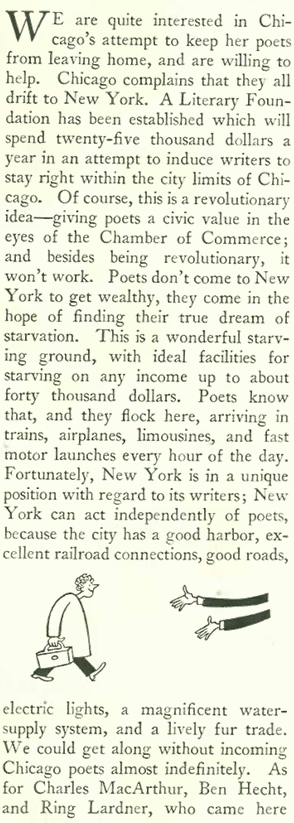
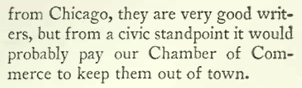
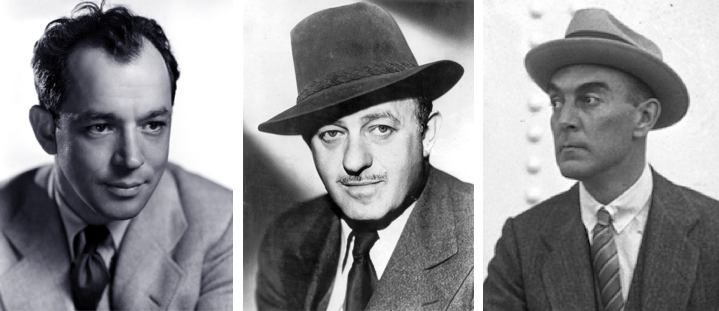
TheNew Yorker occasionally enjoyed taking potshots at the Second City, as well as some good-natured jabs at a few of its former residents who were also denizens of the Algonquin Round Table. Here is E.B. White in the Feb. 1 “Notes and Comment”…
WINDY WITS…Chicagoans Charles MacArthur, Ben Hecht and Ring Lardner were well-known to The New Yorker crowd. (Wikipedia)
* * *
Not In This Century
This item from the Feb. 1 “Talk of the Town” is noteworthy for placing its admiration of technical achievement over any concerns for a child’s welfare. Today the couple would be arrested for this…
* * *
ThePerilsofAging
Irish-American actress and writer Patricia Collinge (1892-1974) wrote a series of short stories for The NewYorker, including this piece for the Feb. 1 issue written when she was 37 years old. It is a sad story about an older actress (37) who hoped to land the part of a younger woman. Some excerpts…
…the actress in the story is led to believe the part was intended for a woman of 28, and is crushed to learn that the agent was looking for “a young twenty-two”…
OH TO BE YOUNG…At left, Gladys Cooper, Alexandra Carlisle and 20-year-old Patricia Collinge in the Drury Lane production of Everywoman (1912); at right, Collinge in 1941. Unlike the sad actress in her short story, Collinge’s career spanned more than 60 years. (Wikipedia)
* * *
ComingAround
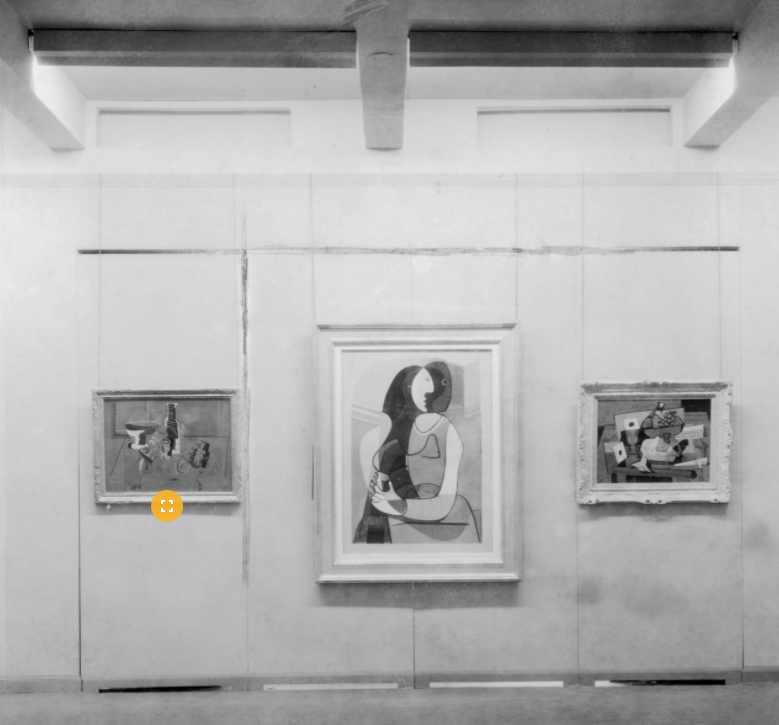
In previous issues art critic MurdockPemberton expressed skepticism about the new Museum of Modern of Art, founded by wealthy society women in November 1929. Pemberton held egalitarian views about art, and wondered if the old money set could create a venue for true modern artists. His review of “Painting in Paris,” MoMA’s third exhibition, seemed to allay his concerns…
PAINTING IN PARIS was the title of the Museum of Modern Art’s third exhibition featuring works by Georges Braque, Georges Rouault, Pablo Picasso, Joan Miró, Marc Chagall, Robert Delauney, Fernand Leger, Henri Matisse and Andre Derain among others. Image above is from the original exhibition at MOMA’s first home in the Heckscher Building at 730 Fifth Avenue. (MOMA)
Images above in color, from left, Pablo Picasso’sGreen Still Life Avignon (1914) and Seated Woman (1927); Georges Braque’sStill life (1927). (MOMA/WikiArt)
Pemberton expressed enthusiasm for the show’s new works that contained few traces of the familiar…
* * *
The King’s Speech
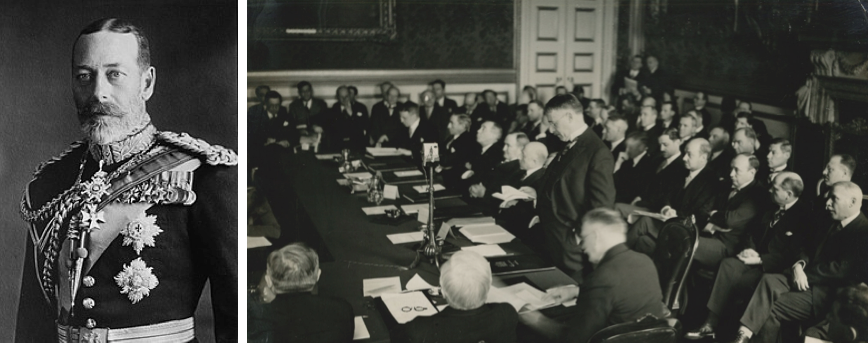
KingGeorgeV was not known for his public speaking, but when he addressed the third meeting of the London Naval Conference it was a big deal, even to American listeners who for the first time heard his voice over broadcast radio, still a very new medium in 1930…
ON THE AIR…The voice of King George V (pictured here in 1923) was broadcast across the Atlantic for the opening of the London Naval Conference at St. James’s Palace in 1930. The third in a series of five meetings, the conference was formed with the purpose of placing limits on the naval capacity of the world’s largest naval powers. (Wikipedia/Churchill Archives Centre)
* * *
Good Clean Fun?
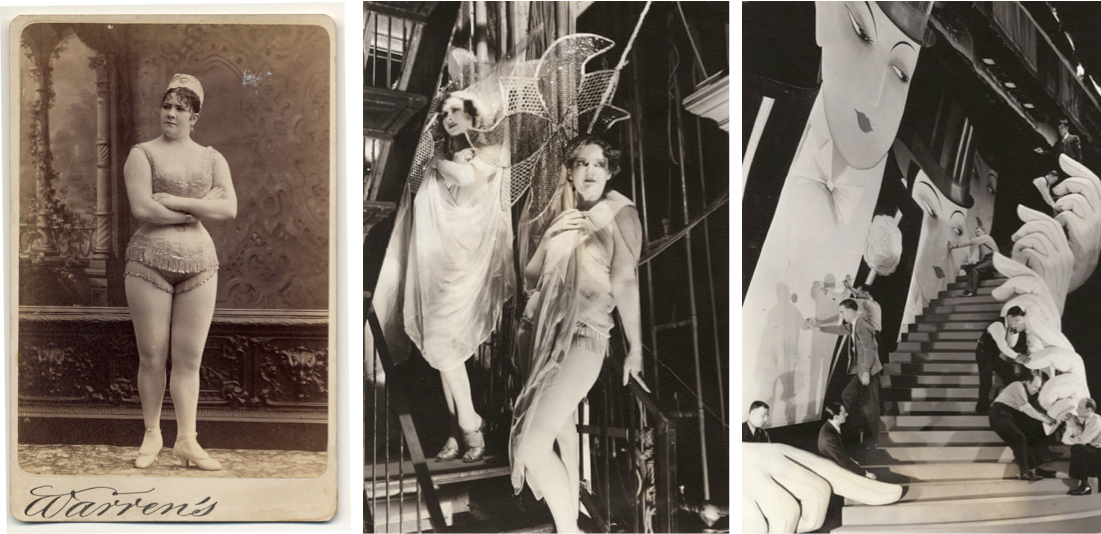
In his theater review column, RobertBenchley lamented the state of burlesque shows at the National Winter Garden, where “leviathans of an earlier day” were being displaced by “agile wisps” in third-rate Broadway productions…
ON THE SHOULDERS OF GIANTS…from left, Viola Clifton, a fuller-figured 1890s burlesque dancer; center and right, Margaret Bourke-White photos from Minsky’s National Winter Garden, 1936. Theater critic Robert Benchley wrote that he missed the “leviathans” of an earlier age, who were replaced by girls who were nothing but “agile wisps.”(mashable.com/theguardian.com)
* * *
From Our Advertisers
Just a couple of ads from the Feb. 1 issue, including this entry from the Shelton Looms offering advice on how one should appear among the Havana social set…
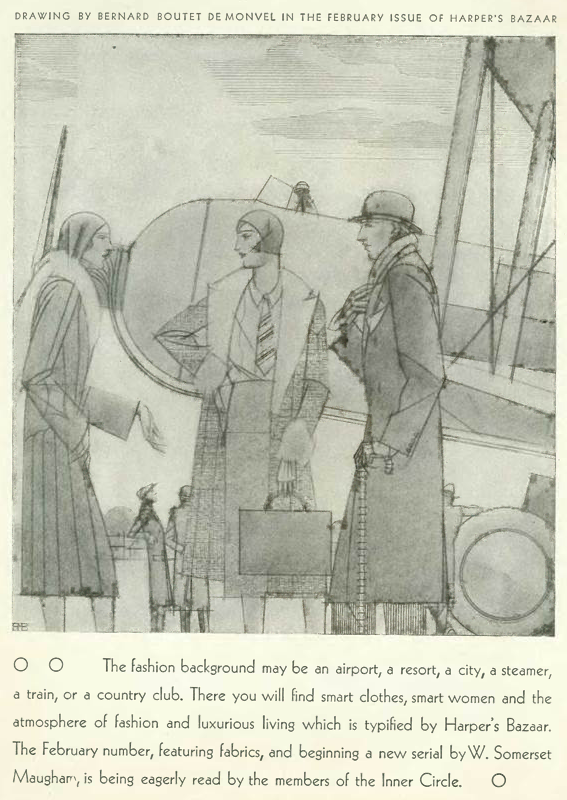
…and this ad from Harper’s Bazaar, also appealing to the smart set…
…our cartoons include this two-page illustration by ReaIrvin…
…AlanDunn’s look into the challenges of running a power plant…
…at the opera with PerryBarlow…
…GardnerRea and some bedroom hinjinks…
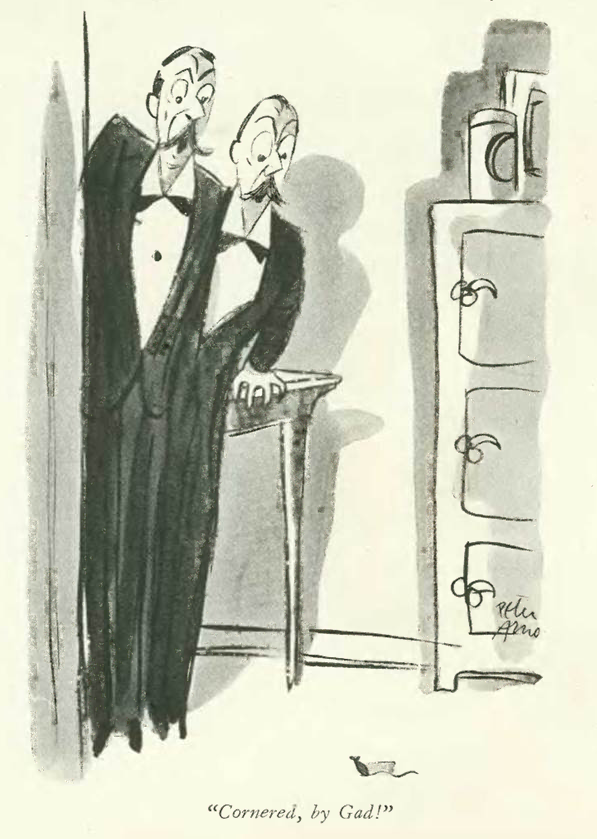
…man vs. mouse, by PeterArno…
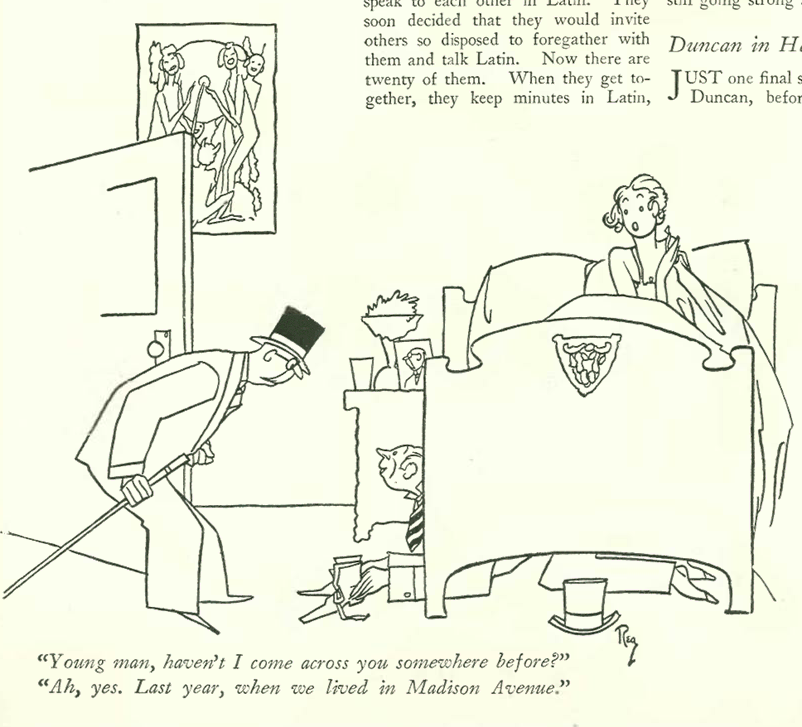
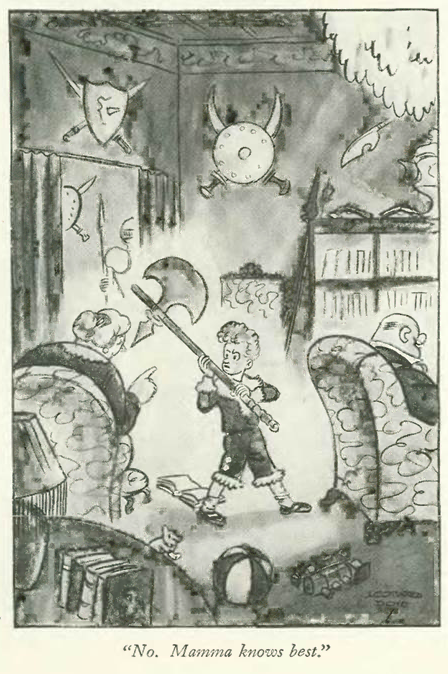
…and this by LeonardDove, seemingly anticipating the work of CharlesAddams…
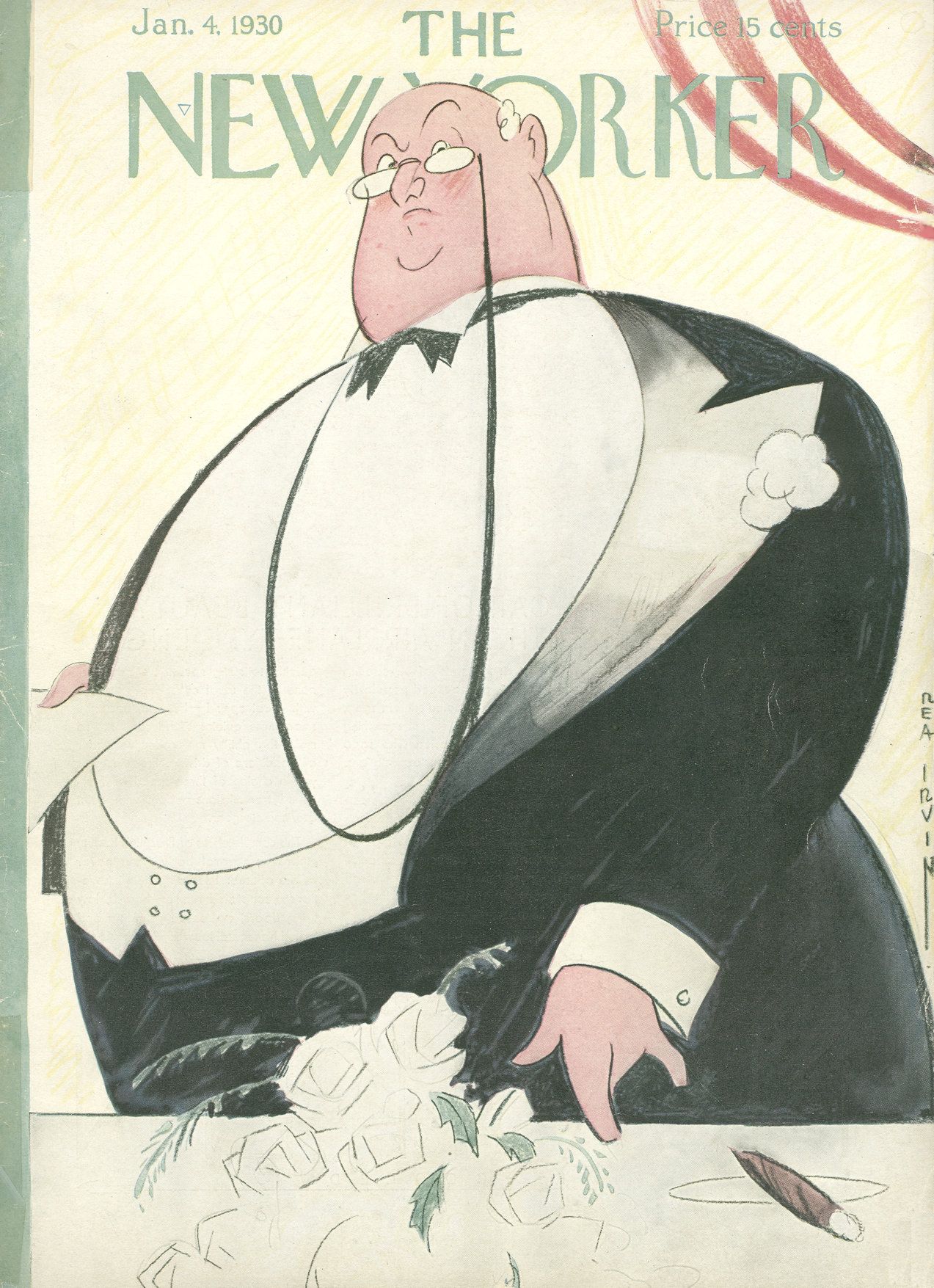
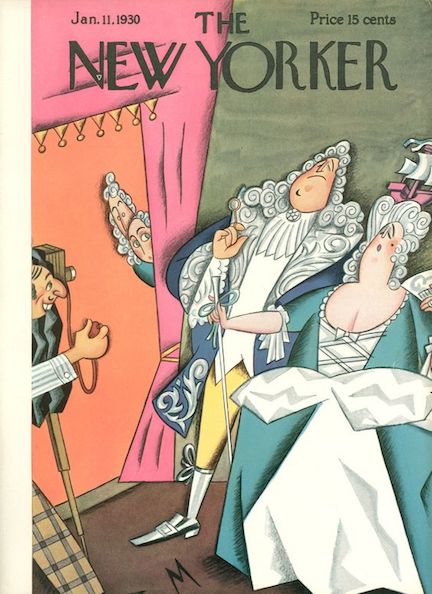
The imposing of image of a fat, fearsome banker greeted readers of the Jan. 4, 1930 issue of TheNew Yorker, an apt symbol for the dawn of a new decade in a country whose fate seemed wholly in the hands of the old moneymen.
Jan. 4, 1930 cover by Rea Irvin.
However bleak the outlook, the show still had to go on, and automakers did their best to entice crowds to the National Automobile Show at the Grand Central Palace. TheNew Yorker’sNicholas Trott wrote of a “tentative modernism” on display at the show as automobile styles continued to transition from “horseless carriages” to something that looked decidedly modern. Trott’s column, illustrated by Peter Arno…
…made note of the modern angles of Art Deco that were creeping into the designs…
DAZZLING DASHES…Clockwise, from top left, the 1930 Essex sported an Art Deco instrument panel, as did the 1930 Hudson Great Eight Sedan. (hemmings.com/Free Library of Philadelphia)
…Trott also noted the increasing popularity of eight-cylinder cars (as evidenced in ads featured later in this blog post)…
TEMPLE OF TRANSPORTATION…Top left, postcard image of the Grand Central Palace exhibition building, circa 1916. At right and below, new automobiles on display at the Palace in the early 1930s. (Wikipedia/NY Daily News)
* * *
Flappers Get Flappy
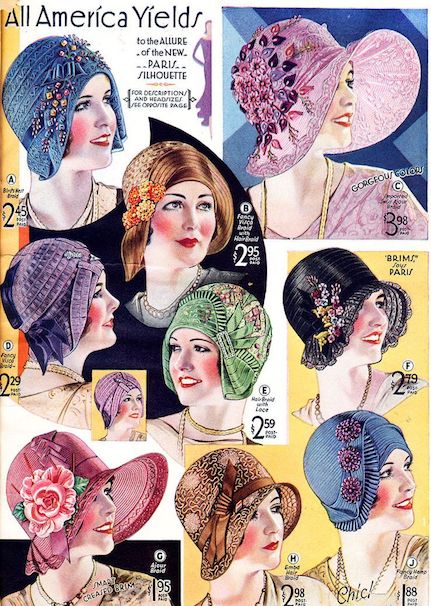
Automobile designs weren’t the only changes seen on the streets of New York. In “Notes and Comment,” E.B. White lamented the introduction of “ear flaps” on women’s hats…
THEY FLOP, JUST LIKE THE STOCK MARKET…A selection of women’s hats from a 1930 Chicago Mail Order Company catalog. (elfsacks.com)
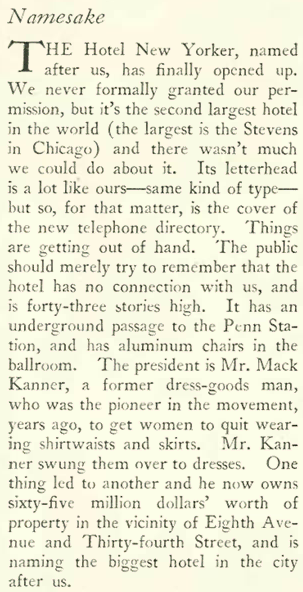
…while on the other hand, in “The Talk of the Town” White welcomed the addition of a namesake hotel to the New York skyline…
NAMESAKE…The 43-story Hotel New Yorker at 481 Eighth Avenue, by architects Sugarman and Berger, opened on January 2, 1930, with more than 2,500 rooms starting at $3.50 a night. At left, the hotel following its completion; top right, construction on the hotel began just 22 months earlier; bottom right, the Terrace Room nightclub was a popular spot for dancing in the 1930s and 40s. (The New Yorker Hotel/americanfoodroots.com)
…White noted that the “New Yorker” name seemed to be popping up everywhere…
A NEW LEASE ON LIFE…The hotel as it appears today. With the decline of train travel (the hotel was near Penn Station), the Hotel New Yorker closed in 1972 and was purchased by the Unification Church in 1975. Subsequently much of the original Art Deco detailing was lost, and the hotel’s famed Louis Jambor murals were painted over. Beginning in the mid-1990s the New Yorker Hotel Management Company launched a $100 million capital improvement project (top right). Fortunately, the Art Deco doors of the Manufacturers Trust Company offices (below) were preserved, as was company’s lobby. (Wikipedia/Daytonian in Manhattan)
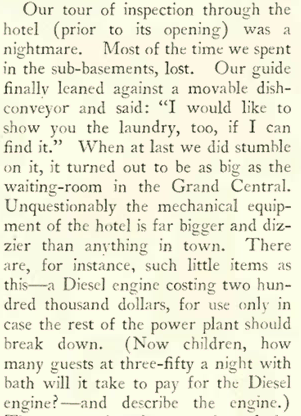
…and White marveled at the building’s massive scale…
WHAT LIES BENEATH…Popular Science (April 1930) offered a view into the bowels of Hotel New Yorker, 78 feet below street level. (tparents.org)
According to Tom Miller’s excellent blog Daytonian in Manhattan, the New Yorker was the largest hotel in city: “it boasted 2,500 rooms, murals by renowned artist Louis Jambor, the largest barber shop in the world (42 chairs and 20 manicurists), 155 chefs and cooks for the five restaurants. Employing 92 telephone operators, the hotel had one of the largest switchboards in the country…Its basement power plant was the largest private plant in the United States. The Great Depression apparently never heard of the New Yorker Hotel as satin-gowned movie stars and top-hatted politicians crossed its marble-floored lobby.” (Inventor Nikola Tesla spent the last ten years of his life in near-seclusion in Suite 3327).
The Unification Church purchased the building in 1975, removing Art Deco details and painting over the Jambor murals. In 1994 the New Yorker Hotel Management Company launched what would be a $100 million capital improvement project. Miller writes that during the renovation “the original marble floors were exposed from under yards of threadbare carpeting.” And happily, “when the doors to the old Manufacturer’s Trust Company were opened, the old 1929 lobby was intact…the Jambor murals (in the Trust’s lobby) survived. The Art Deco terrazzo floors remained. And the tiled corridor to Penn Station still stretches diagonally beneath 8th Avenue, now used as storage for security reasons.”
EPHEMERAL ART…Murals by renowned artist Louis Jambor, seen in this photo of the ballroom in the 1940s. The murals were painted over in the 1970s after the hotel was acquired by the Unification Church. (The New Yorker Hotel)
* * *
Ways of Seeing
Art critic Murdock Pemberton (1888-1982) continued to ponder the meaning of the new Museum of Modern Art, which was staging its second-ever exhibition in its galleries on the 12th floor of the Heckscher Building on Fifth Avenue:
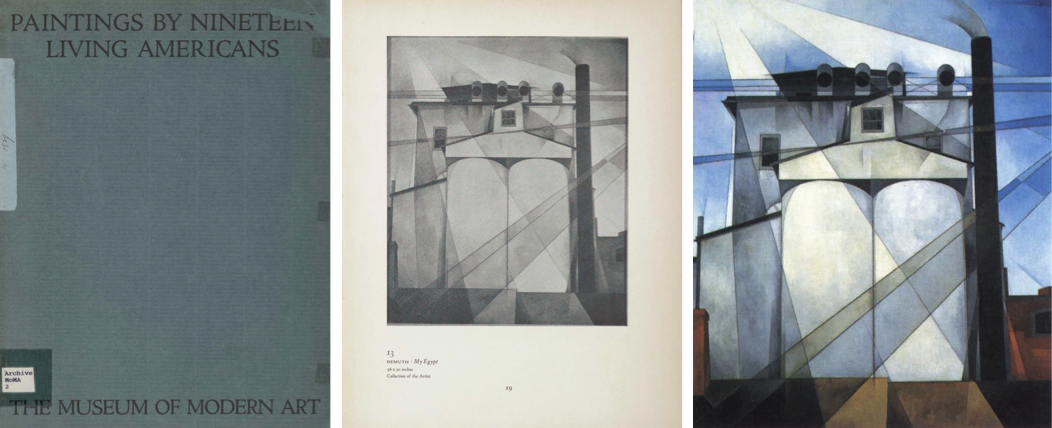
ARE WE NOT MODERN? Charles Demuth’s My Egypt, (oil on composition board, 1927) was among works featured in the Museum of Modern Art’s second exhibition, Paintings by Nineteen Living Americans. From left, cover of the exhibition catalog, a page from the catalog featuring Demuth’s painting, and as the work appears in color. (MoMA/WikiArt)
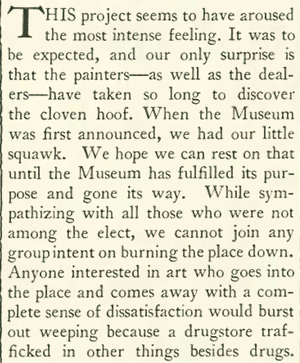
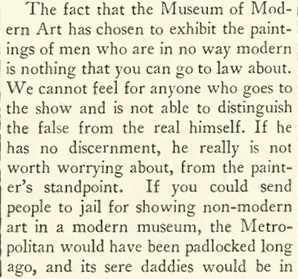
No doubt Pemberton, who came from humble Kansas roots, found it difficult to warm up to a gallery founded in November 1929 by three society women — Mary Sullivan, Lillie Bliss and Abby Rockefeller…
…and wryly suggested that perhaps another museum could be founded, “The Modernest Modern Museum,” for those who lacked clout or patronage with MoMA’s well-heeled board of directors…
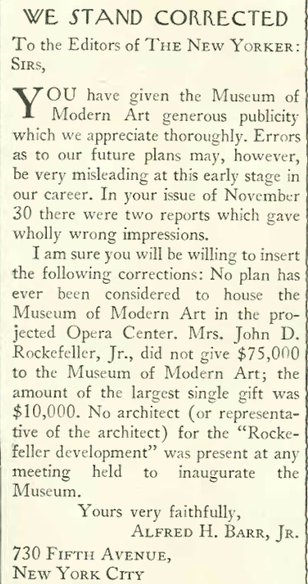
Pemberton’s grumblings caught the attention of Alfred Barr Jr., the first director of the Museum of Modern Art, who sought a correction (printed in the back pages of the Jan. 4 issue) regarding some of Pemberton’s earlier observations of the museum. No doubt Barr was feeling some Rockefeller heat as well:
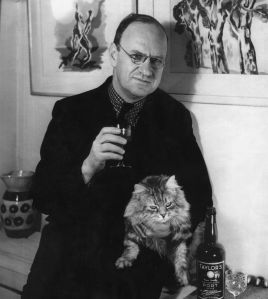
HERE’S MUD IN YOUR EYE…Murdock Pemberton, apparently endorsing Taylor’s Port in 1937. (observer.com)
For some insight into Pemberton’s populist views (the old meaning of the word, not the new one), the critic’s granddaughter, Sally Pemberton, had this to say in a 2012 New Yorkerinterview:
“Being from humble roots in Kansas and having worked to help support his family since he was a young boy, Murdock had a love-hate relationship with the upper echelon of society. He visited “plush hung galleries” and saw how museums treated art and artists in the nineteen-twenties and thirties, and he wanted art to be more accessible. He asked that the Met set aside a room for the work of living artists. He called for art to be displayed in libraries and universities, and in some cases to be sold in department stores. He wrote about what a wonderful thing it was when the W.P.A. put murals in post offices around the country and how that changed the American public’s perception of art.”
Ms. Pemberton is the author of Portrait of Murdock Pemberton: The New Yorker’s First Art Critic.
* * *
From Our Advertisers
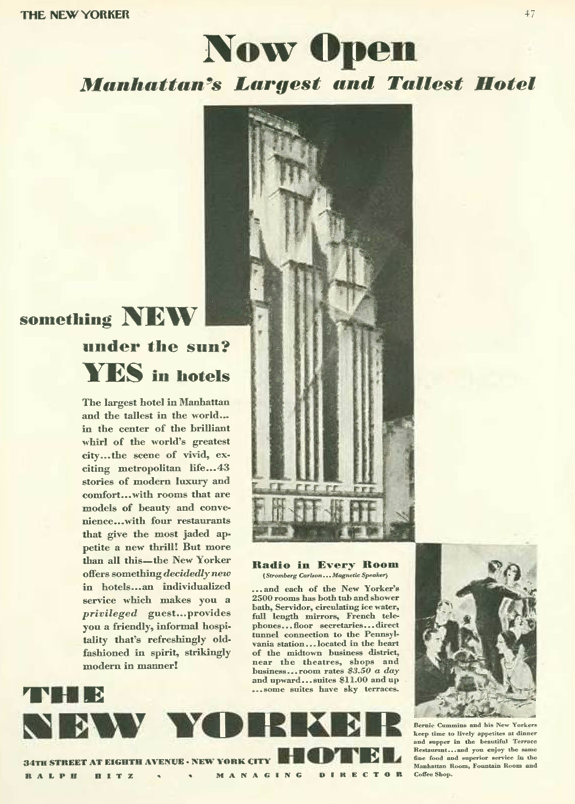
More ink for the newly opened Hotel New Yorker in this advertisement on page 47…
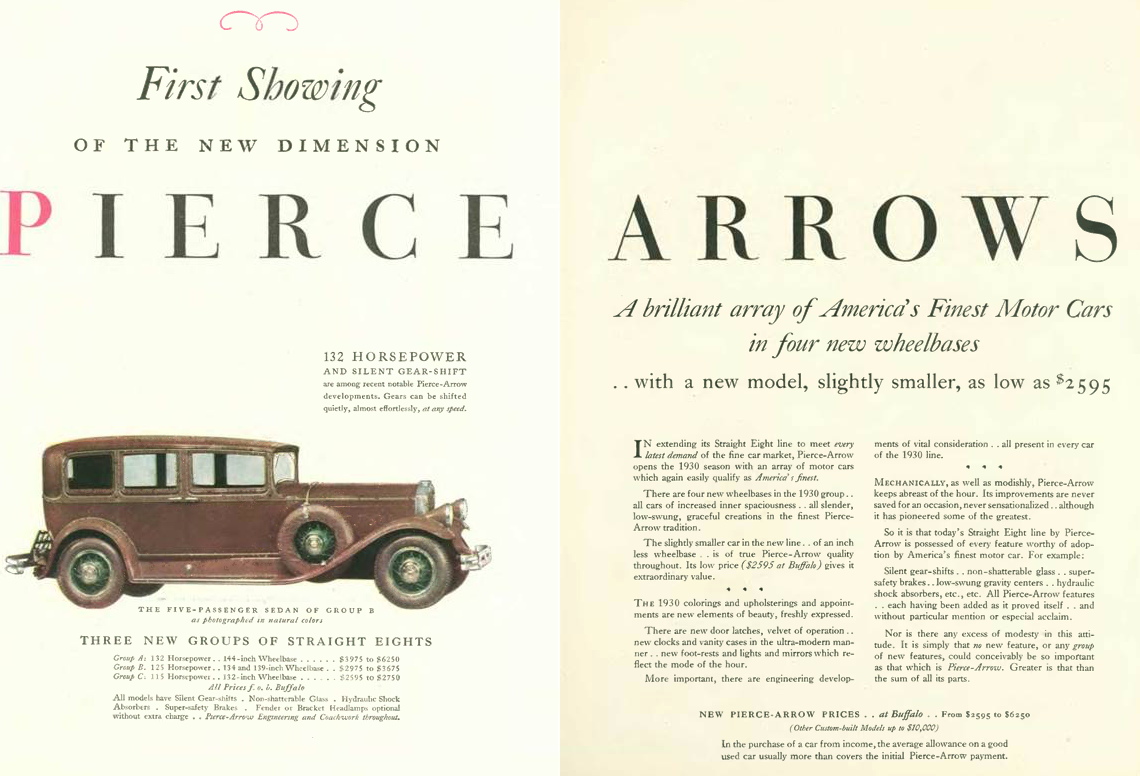
…and with the automobile show in town, the magazine was filled with numerous splashy car ads…Franklin with its air-cooled engine, Hupmobile with its powerful eight, and Pierce-Arrow—America’s answer to Rolls Royce—would all fall victim in the 1930s to the Great Depression…
…the magazine also featured numerous ads beckoning the well-heeled to warmer southern climes, including society snowbirds seeking respite at Palm Beach…
…this ad from Flit (drawn by Dr. Seuss) seemed to recall the old filler joke from the first issues of The New Yorker, a riddle told backwards:
POP: A man who thinks he can make it in par. JOHNNY: What is an optimist, pop?
…Peter Arno offered his talents in this illustration for the theater review section…
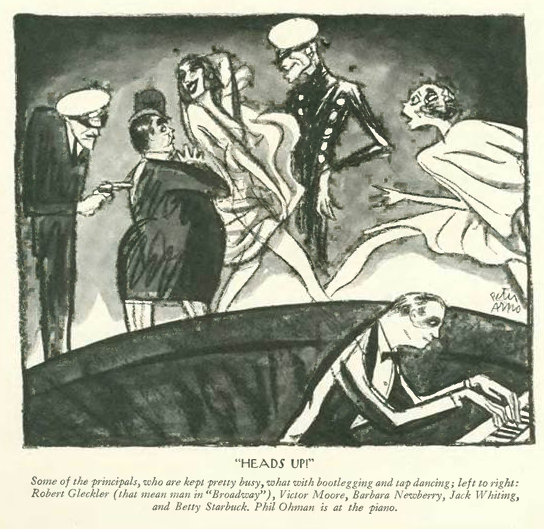
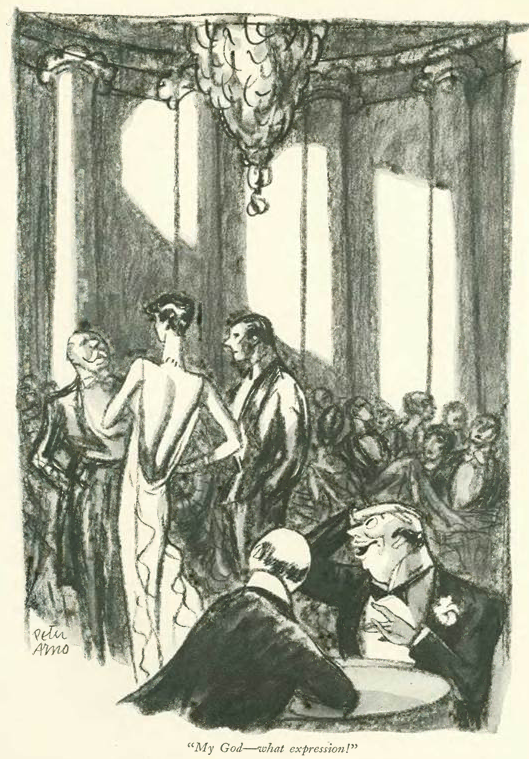
…and this cartoon peek into society night life…
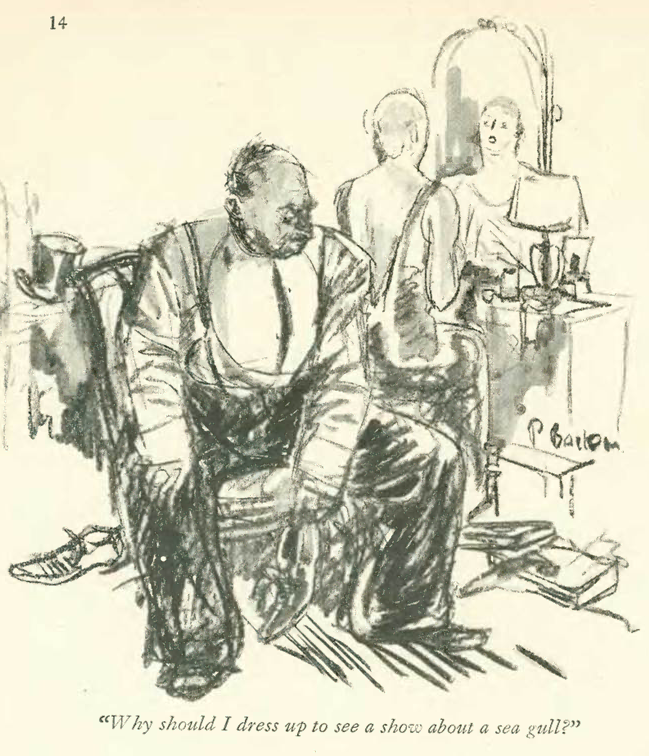
…glimpses of domestic life were provided by Perry Barlow…



























































































































 A New Yorker State of Mind