Help Wanted

Above image: The 1937 painting, titled "Employment Agency," was by Isaac Soyer (1902-1981). Like Reginald Marsh, he was considered a social realist painter who painted scenes of working class life. (Whitney Museum of American Art)

Nineteen thirty-two was a tough year for most Americans, as the Depression approached rock bottom and jobless numbers continued to mount as one out of every four workers was unemployed.

July 2, 1932 cover by William Steig.

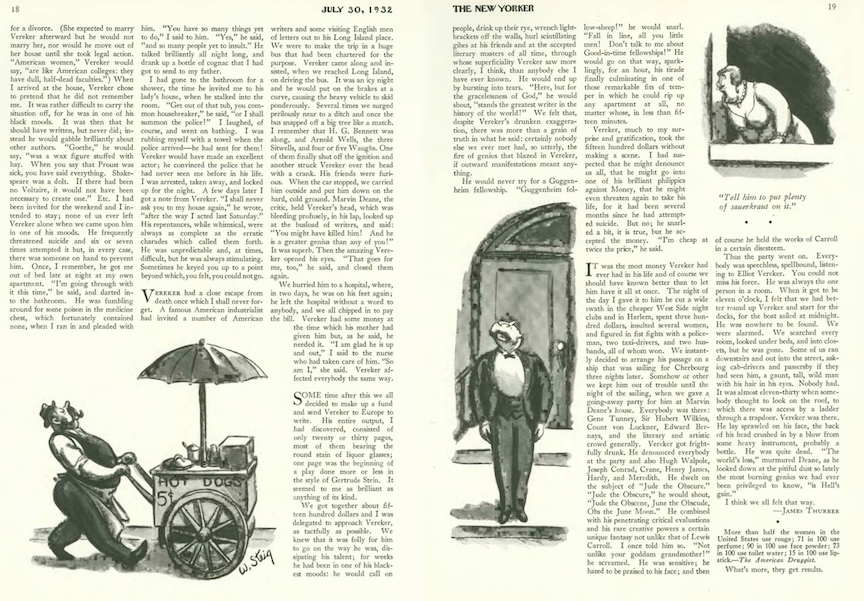
Despite the Depression, The New Yorker was on solid footing, although judging by these next two issues advertising had fallen off. Other indications things weren’t so rosy included the occasional broadsides penned by E.B. White in his “Notes and Comment” column that opened “The Talk of the Town.” White anticipated Franklin D. Roosevelt’s New Deal, calling for “direction from above” and the creation of a peacetime army that would give purpose to the unemployed.

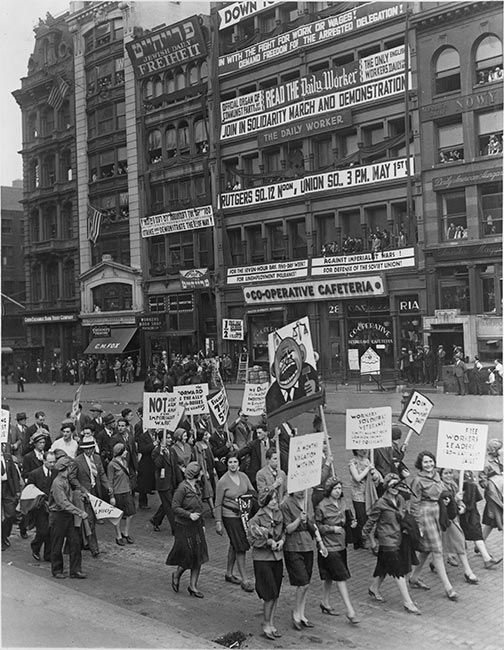
White filed his column while the nation was experiencing a summer of unrest, men and women across the country joining demonstrations demanding relief from the federal government, which under President Herbert Hoover mostly refused to provide funds for the jobless and homeless.

Writing for The Conversation, James N. Gregory, professor of history at the University of Washington, developed a mapping project that has recorded 389 hunger marches, eviction fights and other protests in 138 cities during 1932.

THE UNWANTED…Clockwise, from top left, a man advertises his worth on a sandwich board, ca. 1930; unemployed gather in front of an employment agency, ca. 1930; long line of jobless and homeless men wait outside to get free dinner at a New York municipal lodging house, 1932; even with the New Deal times remained tough for many rural folks — in 1936 Los Angeles Police Chief James E. Davis declared a “Bum Blockade” to stop the mass emigration of poor families fleeing from the Dust Bowl states of the Midwest. (rarehistoricalphotos.com/dailybulletin.com/Associated Press)

White’s column was prescient in many ways, including the need for Americans to laugh during tough times: Abbott & Costello, Burns & Allen, Laurel & Hardy and the Three Stooges, among many other acts, enjoyed their heydays during the Depression and war years.

SWORDS, NOT PLOUGHSHARES were offered to those protesting in the summer of ’32. Above, tanks and mounted troops advance to break up a Bonus Marchers’ camp of veterans protesting lost wages in Washington D.C. on  July 28, 1932. Below, the marchers at the Capitol. (PhotoQuest/The Conversation)

*  *  *

From Our Advertisers

As noted earlier, advertising had fallen off a bit in The New Yorker, but those who still had means to market their wares included the folks at Goodyear, who continued their campaign of comparing their tires to “masterpieces”…

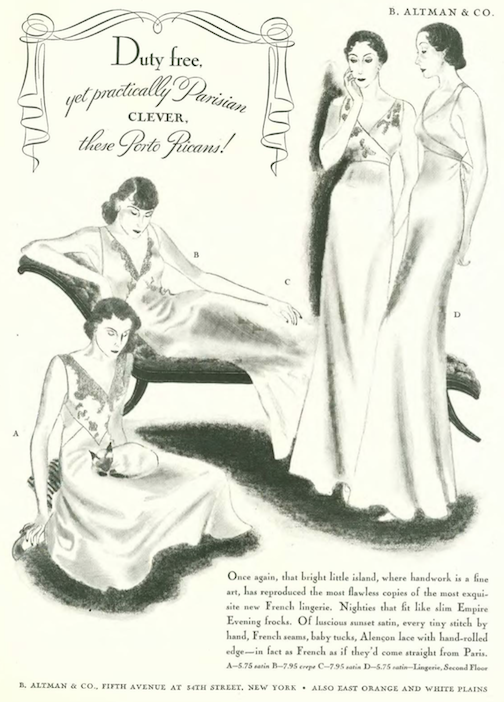
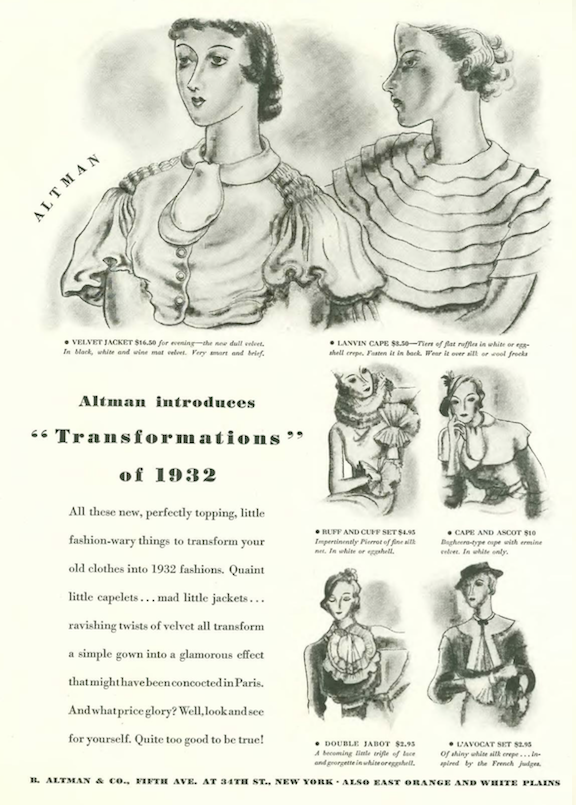
…this B. Altman ad presented a “fashion artist” who was doing quite well despite the Depression…

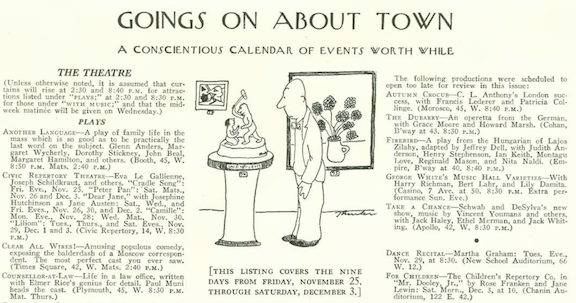
…on to our cartoonists, the top of page 2 and the bottom of page 3 in the “Goings On About Town” were decorated by Julian de Miskey

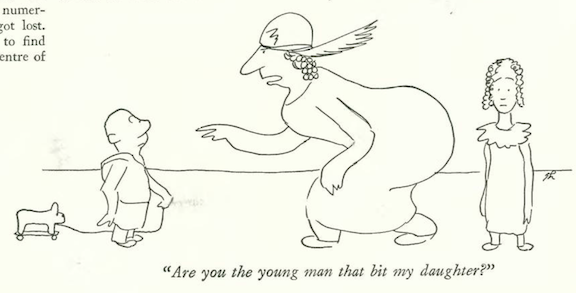
William Steig put one of his “Small Fry” in a barber’s chair…

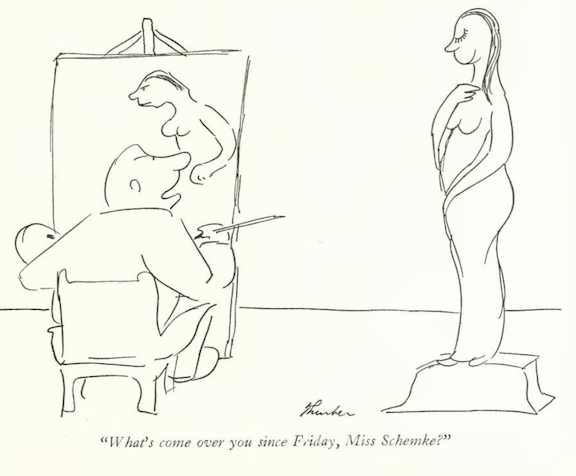
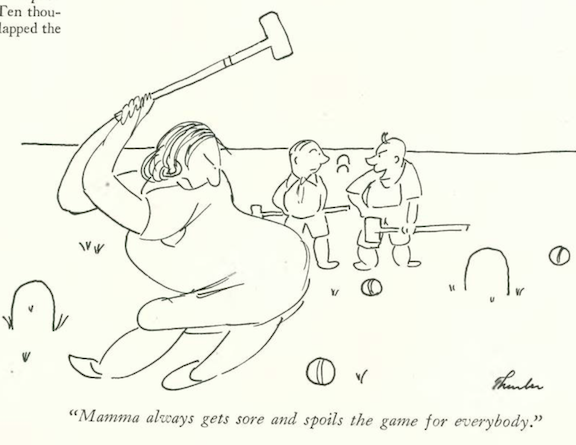
James Thurber continued to plumb the depths of courtship…

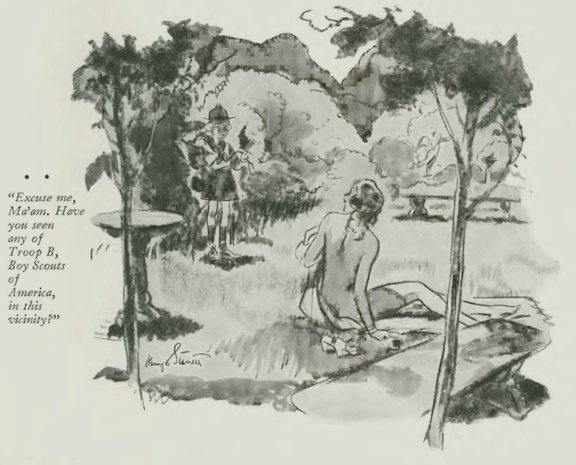
…as did Barbara Shermund

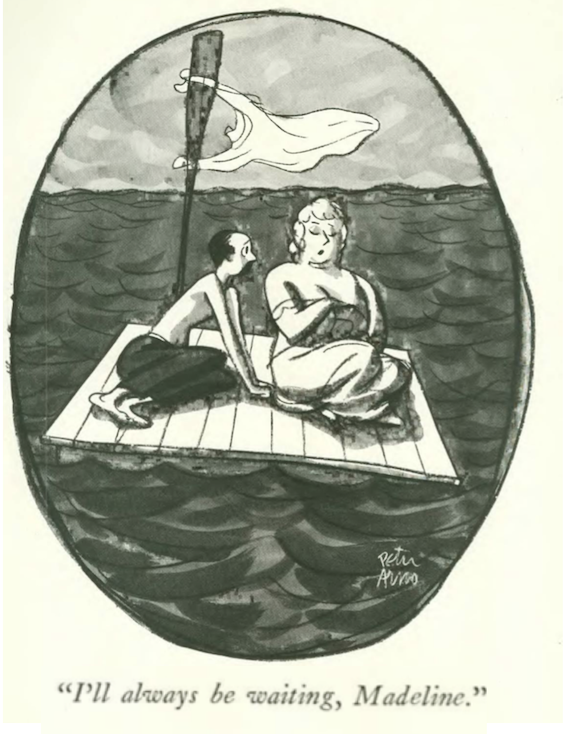
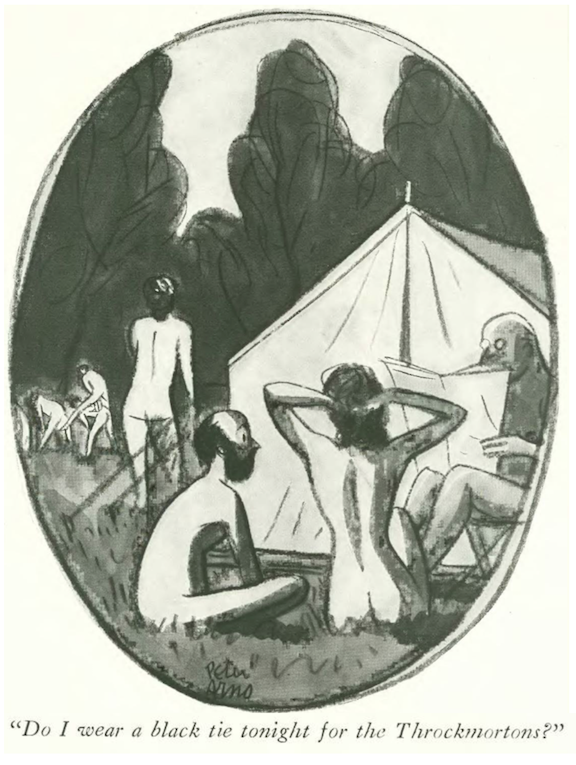
…while Peter Arno was perfecting one his classic tropes…

…on to July 9, 1932…

July 9, 1932 cover by Virginia Andrews.

…where we look at John Mosher’s review of Red Headed Woman, a romantic comedy about an ambitious secretary (Jean Harlow) who tries to sleep her way into high society.

(IMDB)

Harlow (1911-1937) was already famed as a “platinum blonde,” which made her turn as a redhead a major selling point for the pre-code film. Although based on a novel by Katharine Brush, it was Anita Loos’ humorous treatment of the script that made the film more than just a sex romp.

SEEING RED…Jean Harlow seduces her wealthy boss William “Bill” Legendre Jr. (Chester Morris) and breaks up his marriage to his wife Irene (Leila Hyams, photo at right). (IMDB)
LIFE & ART…In many ways Jean Harlow embodied Lorelei Lee, the ambitious gold-digger Anita Loos created for her 1925 novel Gentlemen Prefer Blondes. When Loos (left, photo by Cecil Beaton) ) adapted Katharine Brush’s (right) novel for the 1932 film Red-Headed Woman, MGM made hay of the whole arrangement, seen in this 1932 publicity photo (center) of Harlow and Loos. (silentlondon.co.uk/Cinemania/Goodreads)

*  *  *

From Our Advertisers

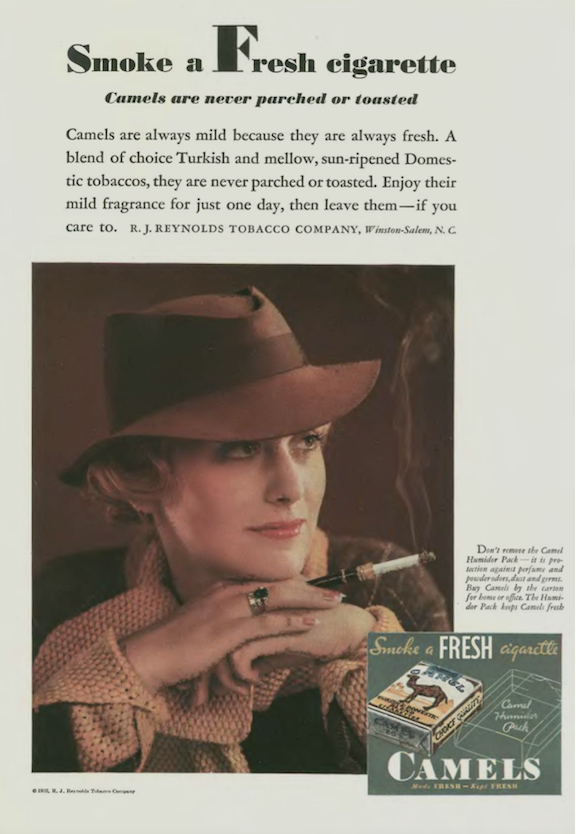
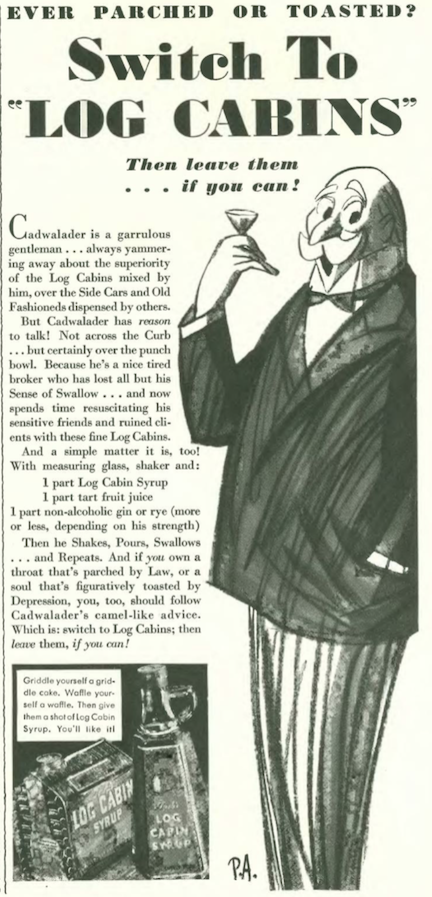
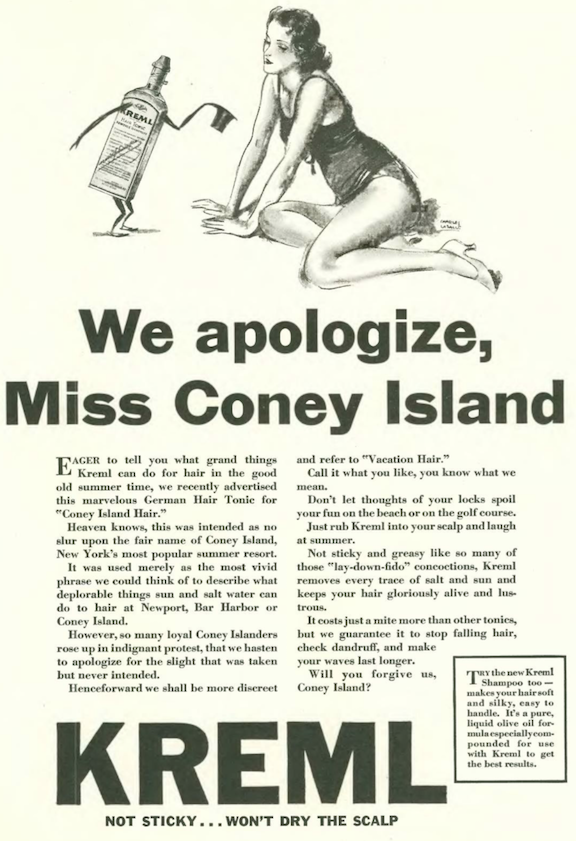
Speaking of redheads, we have this one encouraging us to become addicted to Camel cigarettes and then daring us to “leave them if you can”…

…Longchamps was a chain of restaurants in Manhattan that brought a taste of Continental refinement to middle class New Yorkers…

…the terrific Driving for Deco blog site tells us that wholesaler Henry Lustig opened his first Longchamps restaurant in 1919 at Madison and 78th, specializing in an American version of French cuisine at affordable prices. During the mid to late 1930s the chain rapidly expanded, opening seven restaurants within five years. Four of these restaurants were known for interior designs by Winold Reiss…

HIGH STYLE, LOW PRICES…Clockwise, from top left, the 1931 Continental Building was home to this Longchamps restaurant at Broadway and 41st Street (circa 1937); entrance on 42nd Street to the Longchamps in the Chanin Building, circa 1935; late 1930s matchbook cover from Longchamps; interior design by Winold Reiss in the Chanin Building location. (nyneon.blogspot.com/drivingfordeco.com)

…on to our cartoons with Rea Irvin and another view of French elegance…

…and we close with Barbara Shermund, evesdropping on her Manhattan demimonde…

Next Time: Not For the Kiddies…

Summer Indulgences

Writing under the pseudonym Guy Fawkes, Robert Benchley (1889-1945) tried to keep the newspaper industry honest through regular criticism in his “Wayward Press” column.

June 11, 1932 cover by Helen Hokinson.

As the summer of ’32 approached, Benchley recalled the barrage of sensational headlines that dominated the month of May—everything from Amelia Earhart’s solo crossing of the Atlantic to John Curtis’ false confession in the Lindbergh baby kidnapping. Here is the opening paragraph:

THE NOBLE AND IGNOBLE marked a busy May 1932. On May 20–21, Amelia Earhart became the first woman—and the only person since Charles Lindbergh—to fly nonstop and alone across the Atlantic. She is shown here after arriving in Culmore, Northern Ireland after her solo flight; At top, right, John Hughes Curtis, a bankrupt shipbuilder from Norfolk, Virginia, who falsely claimed he was in contact with the actual kidnappers of the Lindbergh baby, leading investigators on a wild goose chase; bottom right, Jimmy Walker’s days as mayor of New York were numbered as investigations into corruption continued. (pioneersofflight.si.edu/Wikipedia)

*  *  *

News From Texas

Lois Long filed another installment of “Tables for Two,” noting that folks at Broadway and Seventh Avenue “still own most of the motorcars that sally out of town,” with some of those cars ending up at Texas Guinan’s new La Casa Guinan on Merrick Road.

TEXAS TEA…Following the market crash of 1929, Mary Louise Cecilia “Texas” Guinan left Manhattan’s speakeasy life and in time started a new club near Valley Stream, Long Island. Formerly known as Hoffman’s, Guinan renamed the club La Casa Guinan in 1932. (liherald.com)

 *  *  *

Dud Stud

Writing under his pseudonym Audax Minor, George F. T. Ryall reported on the latest news from the track, namely the race at Belmont that produced a surprise winner.

FAIR FAIRENO scored his first major victory of 1932 in the Belmont Stakes. Unfortunately, Faireno fared less well with the fillies—he was found to be completely sterile when tried at stud.(americanclassicpedigrees.com)

*  *  *

Appreciating ZaSu

ZaSu Pitts (1894 – 1963) began her acting career in silent dramas, but moved on to comic roles with the advent of sound, most famously pairing up with Thelma Todd in a string of comedy shorts. Producer Hal Roach saw the duo as a female version of Laurel and Hardy, although Pitts and Todd’s characters were smarter and more streetwise. Pitts was also known for playing many secondary parts in B films, mostly portraying fretful spinsters. According to critic John Mosher, this typecasting did not do justice to the Pitts’ obvious talents, which were on display in 1932’s Strangers of the Evening.

UNSUNG HEROINE is how critic John Mosher described actor ZaSu Pitts, seen at left in a circa 1930 publicity photo. Anticipating Lucy and Ethel from I Love Lucy, Pitts teamed up with Thelma Todd in a string of comedy shorts in the early 1930s. Pitts was featured in dozens of films in her 50-year career, including appearances in 18 films in 1932 alone. (IMDB)

Mosher was also a big fan of Greta Garbo, her recent appearance in Grand Hotel prompting a raft of superlatives from the usually reserved critic. But in her latest outing, As You Desire Me, the enigmatic star seemed to drift a bit closer to earth.

GET OFF MY BACK…Critic John Mosher was a big fan of Greta Garbo, but her appearance in As You Desire Me was a bit of a letdown. Maybe it was the blonde wig. (IMDB)

*  *  *

From Our Advertisers

Chelsea’s London Terrace opened in 1930 as largest apartment building in the world, and it was a world unto itself, noted for its “Garden Quiet” as this ad claimed…

…and its terraces continue to provide respite from the clamor below…

NOW AND THEN…London Terrace today and in 1930. (londonterracestories.com)

…next is another testimonial ad from Pond’s Cold Cream, this time featuring “Mrs. John Davis Lodge,” aka Francesca Braggiotti (1902-1998), an Italian dancer and actor who married fellow actor John Davis Lodge in 1929 (they co-starred in the 1938 film Tonight at Eleven)…

…A member of a prominent political family, John Davis Lodge (1903-1985) later served as governor of Connecticut, a U.S. House representative, and ambassador to Spain, Argentina, and Switzerland…

SECOND ACT… Francesca Braggiotti married fellow actor John Davis Lodge in 1929, but gave up the acting life when her husband entered politics in the 1940s. At left, the couple in 1938; at right, a 1931 portrait of Braggiotti by Arnold Genthe. The couple had two children, one of whom is Lily Lodge, co-founder of Actors Conservatory in NYC. (Wikipedia/geni.com)

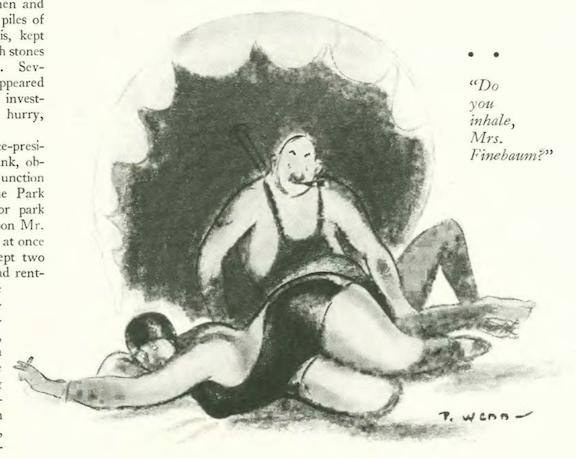
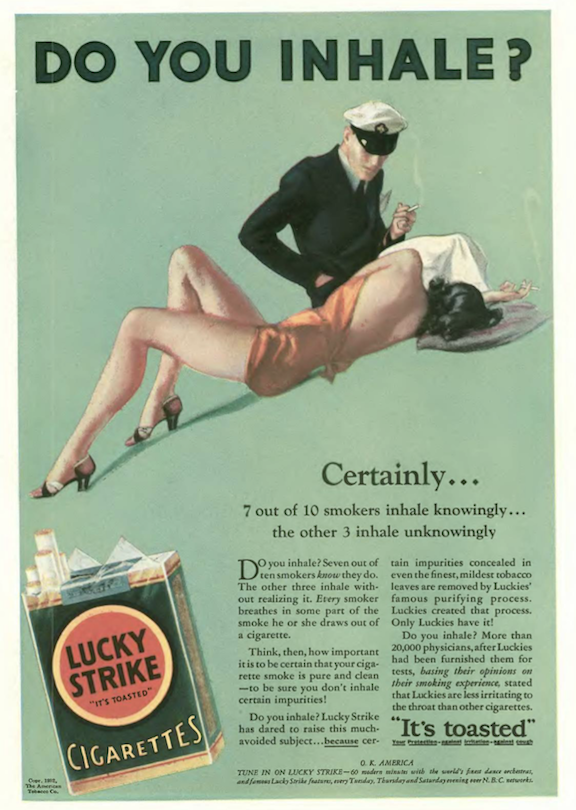
…on with the rest of the ads, we have this one from the maker of Camels, R.J. Reynolds, who took a shot at rival American Tobacco, and their “toasted” Lucky Strikes…

…and we get a dose of retrofuturism thanks to Charles Kaiser and his illustrations of life unbounded with the autogiro, a predecessor to the modern helicopter…

…and it makes a nice segue to our cartoons, beginning with Robert Day

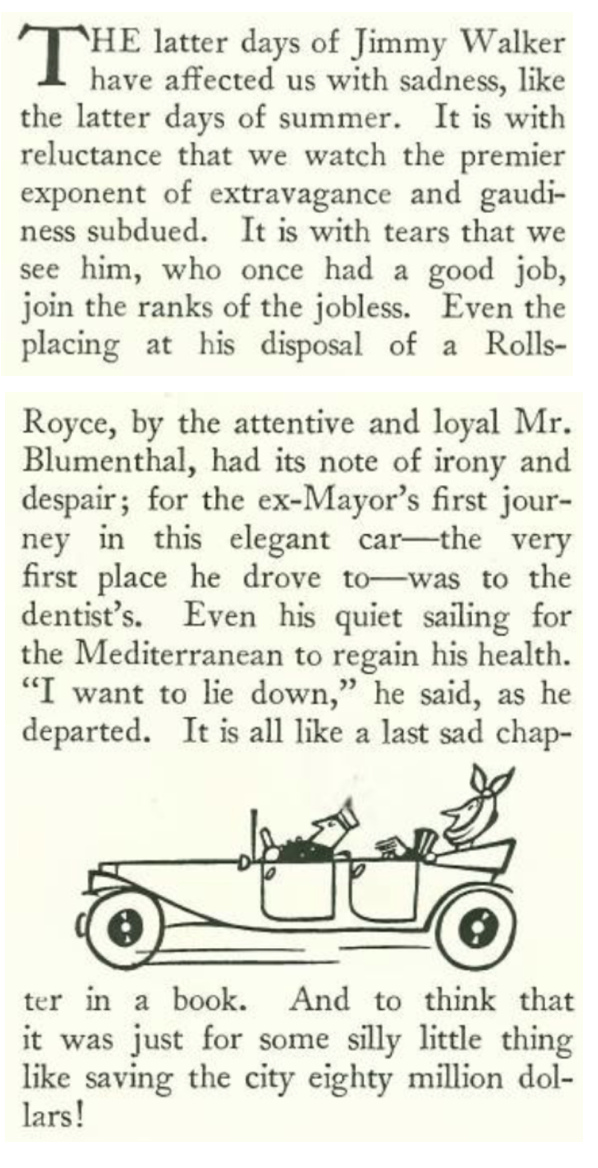
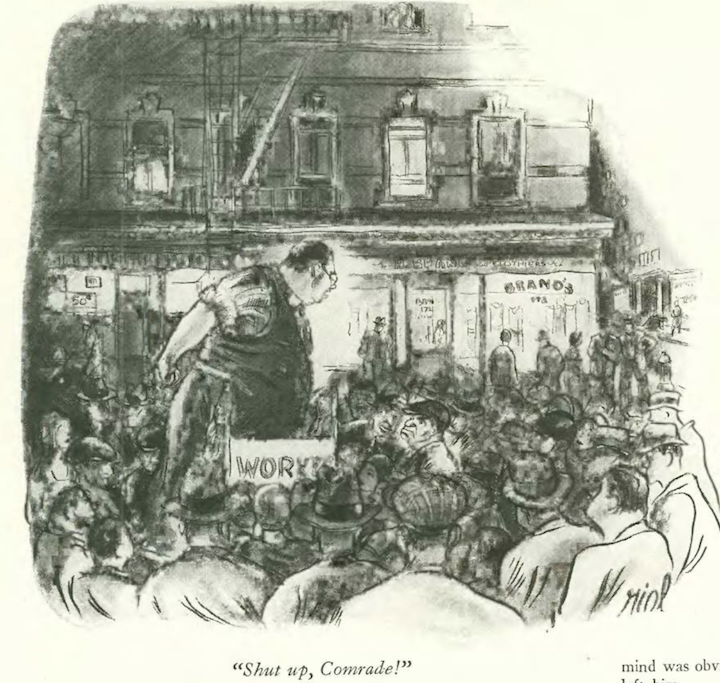
…and the next series are of a scandalous nature, beginning with Otto Soglow’s comment on Mayor Walker’s corruption charge, and an “unnamed” whistleblower…

…and we have scandalous whispers for a dowager at Versailles, with Rea Irvin

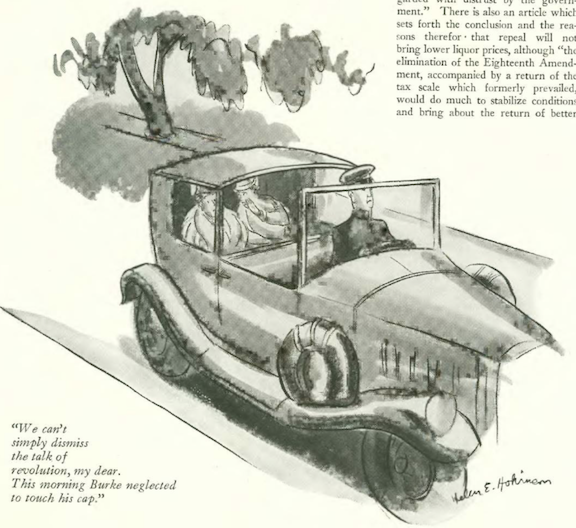
…and we let our imaginations run wild with Helen Hokinson here…

…and again here…

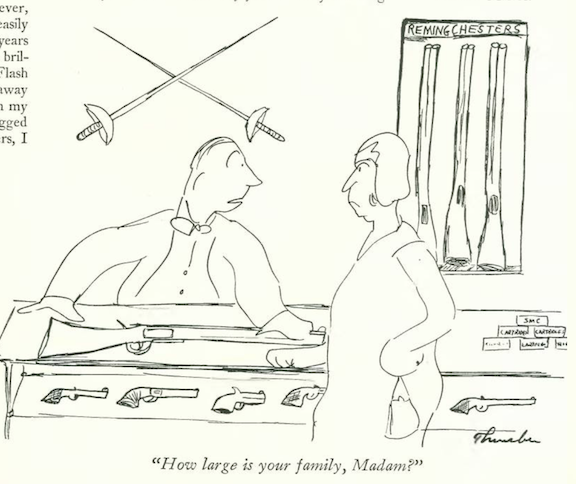
…and we end with another James Thurber classic…

Next Time: On Detention…

A Visit to Minskyville

During the 1930s few people could afford the luxury of a Broadway show, but a trip to “Minskyville” was in reach of nearly anyone looking to escape the gloom of the Depression, at least for a few hours.

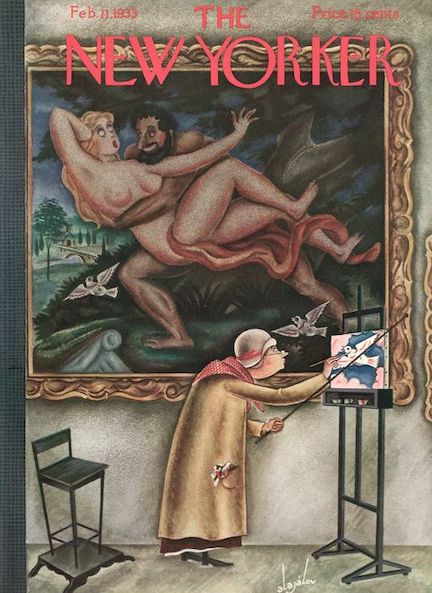
May 28, 1930 cover by Constantin Alajalov.

The Minsky family—brothers Billy, Herbert, Morton and Abe—built the beginnings of a New York burlesque empire, writes actress, author and documentarian Leslie Zemeckis: “Abe, the eldest, started showing racy films in a nickelodeon theater on the Lower East Side. His father—believing that if his son was gonna be a perv, he might as well make real money at it—bought the National Winter Garden theater on Houston Street near Second Avenue (where a Whole Foods stands today), and gave Abe the sixth floor to run his burlesque shows.” Alva Johnson paid a visit to Houston Street and environs for the “A Reporter at Large” column:

LITTLE EGYPT, aka Farida Mazar Spyropoulos, top left, both titillated and scandalized crowds at the 1893 Chicago World’s Fair (really?); clockwise, from center top, three of Minsky Brothers – Billy, Morton and Herbert; the Minsky Brothers owned several burlesque theaters in New York, including Minsky’s Oriental on 51st Street and Broadway, where stripper Julie Bryan was a top draw in 1936; Billy Minsky brought the Minsky brand to Broadway when he leased the Republic Theatre on 42nd Street in 1931; the last two images are by Margaret Bourke-White, backstage at the Republic in 1936. (Wikipedia/Daily News/Estate of Margaret Bourke-White)
NEED A CAREER?…Well, in the 1930s an aspiring dancer or comedian could earn some chops on the burlesque stage. Gypsy Rose Lee (aka Rose Louise Hovick), left, who became the world’s most famous stripper (as well as an actress, author and playwright), was one of the biggest stars of Minsky’s Burlesque; breaks between burlesque performances were commonly filled by comedians, including Abbott and Costello (pictured above in their 1930s burlesque days), who first worked together in 1935 at the Eltinge Burlesque Theater on 42nd Street, at right.

According to Zemeckis, “burlesque caught on among the recent immigrants of the Lower East Side. The shows were cheap, the humor broad, and the allure of beautiful, barely-clothed women transcended language barriers.” But if striptease wasn’t your thing, Minskyville offered plenty of other diversions:

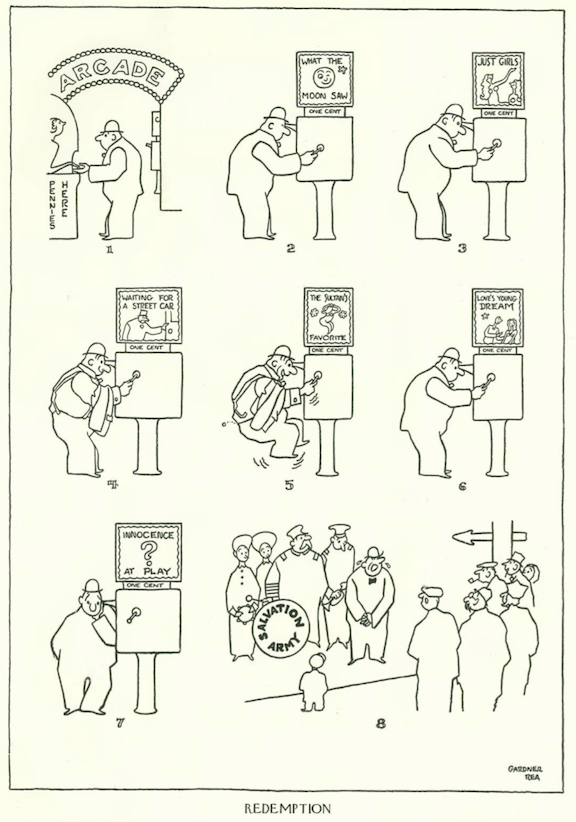
ONE LUMP OR TWO?…Minskyville’s entrepreneurs (top images) added a modern twist to the study of head bumps and cranium size — called Phrenology — with the electronic “Psycograph” (sic); at bottom, Prof. William Heckler’s Trained Flea Circus at Hubert’s Museum on West 42nd Street attracted some gents itching to see Heckler’s fleas in action; according to Alva Johnston, Minskyville’s penny arcade peepshows (such as the one at bottom right) would take your penny or nickel in exchange for photos of a woman old enough to give your grandpa the glad eye. (Museum of Questionable Medical Devices/sideshowworld.com)
LET’S SEE THAT AGAIN…Folks who didn’t want to look at forty-year-old photos of bathing beauties could check out the most popular attraction at Minskyville’s penny arcades — a clip from the famed Long Count Fight, a 1927 rematch between world heavyweight champion Gene Tunney and former champ Jack Dempsey, which Tunney won in a unanimous decision despite being knocked down in the seventh round. It was, and is, the subject of endless debate. (www.wbaboxing.com )

*  *  *

Not a Gearhead

“The Talk of the Town” noted that young Walter P. Chrysler, Jr. preferred arts and literature over things that went zoom:

SOMEDAY THIS WILL ALL BE YOURS, RIGHT?…Walter P. Chrysler Sr. and Walter P. Chrysler Jr. share a father-son moment in 1930. Junior Chrysler devoted much of his life to building a multimillion-dollar collection of paintings (some of which were later found to be forgeries) and made substantial forays into collecting stamps, rare books and glassworks. He also produced a movie, The Joe Louis Story, released in 1953. (chrysler.org)

 *  *  *

Rat-a-tat

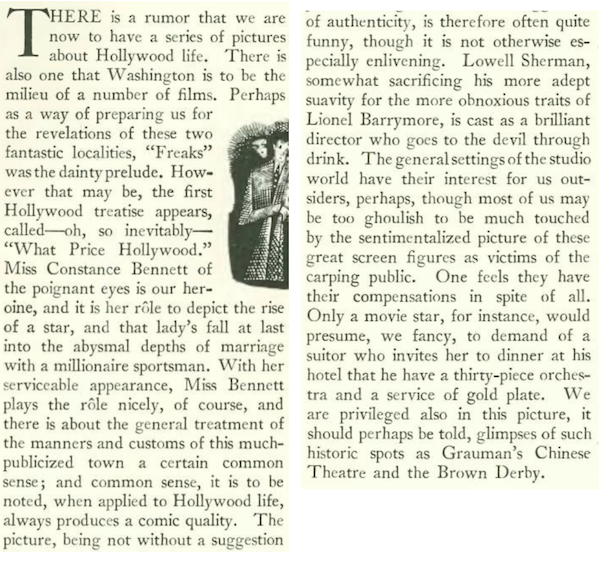
Today most movie lovers associate Scarface with the 1983 Brian DePalma film (starring Al Pacino), but the original Scarface in 1932 was far more influential in that it helped define the American gangster film genre. Directed by Howard Hawks and produced by Hawks and Howard Hughes, the screenplay was penned by early New Yorker contributor Ben Hecht. Mild by today’s standards, the film’s violent scenes caused it to be banned by many theaters around the country. Along with 1931’s Little Caesar and The Public Enemy, Scarface is regarded as among the most significant gangster films. Here is what critic John Mosher thought of it:

JUST IN CASE YOU GET THE WRONG IDEA…Also known as Scarface: The Shame of the Nation, this 1932 gangster film opened with some cautionary words (top left). Clockwise, from top right, gangster “Tony” Camonte (Paul Muni) is flanked by his cronies during a hit on a rival; Tony (Muni) shows his softer side with his dear sister Francesca (Ann Dvorak). United Artists promotional poster (note how Boris Karloff was billed with a reference to his 1931 Frankenstein role). (IMDB)

 *  *  *

From Our Advertisers

Just when I thought it was safe to go back into the water, out comes another line of wool swimsuits. I honestly can’t imagine how they must have felt, especially when wet and clinging to your skin after you left the water…

…the ad below from DuPont was just the sort of thing that drove New Yorker fashion critic Lois Long nuts…a couple of downscale royals shilling their fashion lines to an unsuspecting public…the paychecks from DuPont must have been substantial enough for these bluebloods to publicly embrace synthetics…

TWO HEADS ARE BETTER THAN ONE…Here is the real Countess Borea de Buzzaccarini Regoli, left, and the Princess de Rohan, who played to America’s insatiable thirst for nobility while shilling for a chemical company. (Wikimedia)

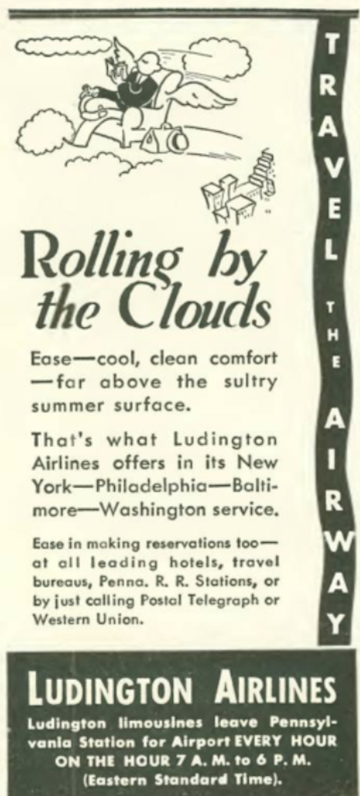
…if you had the money and the steady nerves, you could have hopped aboard an almost 32-hour flight to the West Coast assured that a “coordinated mechanism” of men and machine would get you there in one piece…

…perhaps you could have steadied your nerves by dragging on a Tally-Ho — for some weird reason the Lorillard Tobacco Company (who also made Old Gold) thought some folks might prefer an oval-shaped cigarette (I include the remainder of the back-page ads for context)…

…despite the Depression, The New Yorker was holding its own in sales and subscriptions, but it never hurt to place a house ad every now and then to convince a few who might be holding out…

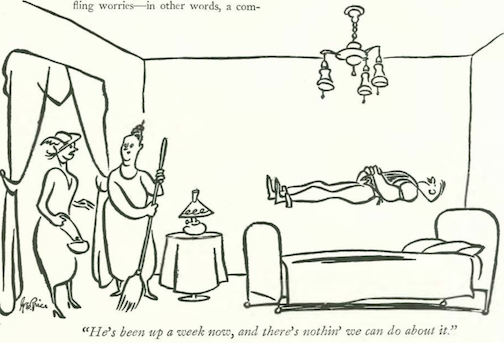
…on to our cartoons, Garrett Price showed us the result of a bad hand…
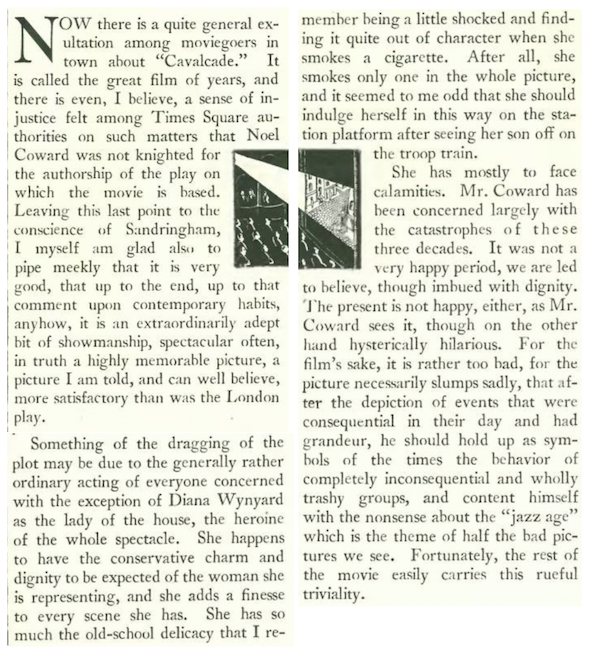
James Thurber offered up this spot illustration in the opening pages…

…and this terrific cartoon…

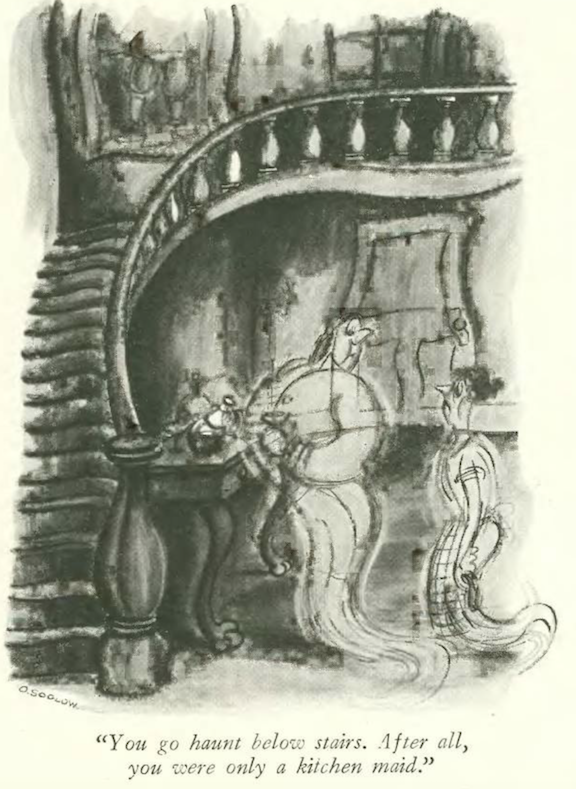
Gardner Rea demonstrated the perils of summoning the dead…

…the departed soul mentioned in Rea’s cartoon was prolific British crime writer, journalist and playwright Edgar Wallace (1875-1932), who wrote 175 novels, 24 plays, and countless articles in newspapers and journals in his relatively short life. He is most famous today as the co-creator of the film King Kong…

PRODUCTIVE SCRIBBLER…Edgar Wallace. (Wikipedia)

…and we end with this gem from Kemp Starrett, and some high-jinks…

Next Time: Jimmy’s Jam…


High Anxiety

The New Yorker profiled authors, composers, civic and world leaders and other notables in its early years, but every so often it would turn the spotlight on a member of the working class.

May 7, 1932 cover by William Steig, the first of 117 covers he would contribute to the magazine over his long life and career.

“The Man With The Squeegee,” a profile written by journalist (and later, playwright) Russel Crouse, detailed the life and work of Stanley Norris, a son of Polish immigrants who daily defied death as a window cleaner on Manhattan’s skyscrapers.

Profile illustration by Hugo Gellert

Below is an excerpt that includes a couple of Norris’ harrowing experiences high above the city streets:

LOOK MA, NO HANDS!…Clockwise, from top left…attached to the side of the Empire State Building, just two leather straps separated this brave window washer from oblivion in March 1936; a lone worker confronts his task in 1935; window washers in 1930; window washers on the 34th street side of the building, January 1932. There are 6,400 windows on the Empire State Building, and each worker averaged 76 panes per day. (retronaut.com/cnn/considerable.com/reddit)

During the 1930s one out of every 200 window cleaners in New York City fell to their deaths annually. In the previous decade, more than 80 fell to their deaths. In another excerpt, Norris recalled one of those unfortunate deaths.

 *  *  *

Vintage Whines

E.B. White enjoyed both wine and spirits, but like many of his fellow Americans he was growing sick and tired of Prohibition, and in his “Notes and Comment” looked abroad for a better way to live.

White concluded the entry with this observation…

…which referenced the sad grape “bricks” folks could order by mail…

Grape growers sold these bricks with a warning that they were not to be used for fermentation — a warning that kept them within the law. Naturally both seller and consumer understood that the end product would likely be something stronger than grape juice.

(vinepair.com)

Where White did procure his cocktails is revealed later in “Notes” — he tells us of an encounter with a night-club host while out walking with his wife, Katharine White, and toddler Joel.

SOMETIMES E.B. JOINED THEM…Katharine White taking baby Joel for a stroll with the White’s beloved Scotty Daisy in New York City, 1931. (brainpickings.org)

 *  *  *

News Stooges

In “The Wayward Press” column, Robert Benchley (writing under the pseudonym Guy Fawkes) took the newspapers to task for their tasteless reporting on the Lindbergh baby kidnapping, and their general sullying of a once proud profession (Benchley himself was an experienced journalist):

TRAGEDY SELLS…The kidnapping of Charles and Ann Lindbergh’s infant son, Charles Jr., dominated headlines across the country in the spring of 1932. This March 3 edition of the St. Petersburg (Fla.) Evening Independent ran this headline just two days after the boy’s disappearance. The body of Charles Jr. was found on May 12, 1932. (Pinterest)

 *  *  *

Rising Stars

The pre-Code drama So Big!, based on Edna Ferber’s 1924 Pulitzer Prize-winning novel, featured two iconic Hollywood actors, but in 1932 only one of them, Barbara Stanwyck, was a bankable star. The film also featured the soon-to-be-famous Bette Davis, who had a much smaller role but was nevertheless grateful to be cast in a prestigious Barbara Stanwyck film. For critic John Mosher, the film proved to be a breakout role for Stanwyck.

SO BIG!…Barbara Stanwyck (left) was a marquee attraction in 1932, but Bette Davis would soon emerge as another major star in the Warner Brothers universe. (IMDB)

 *  *  *

From Our Advertisers

Clothes spun from cotton have been around for thousands of years, but this B. Altman advertisement suggests they were relatively novel for summer wear, at least among the upper orders. Both men and women wore wool bathing suits up until the 1930s, so perhaps there was something new about this cool, casual material…

…no doubt the landed gentry helped keep the Davey Tree Surgeons in business during the Depression, but in those lean times it didn’t hurt to reach out to those with modest means…

…they did something right, because this 141-year-old company still thrives today, the ninth-largest employee-owned company in the U.S…

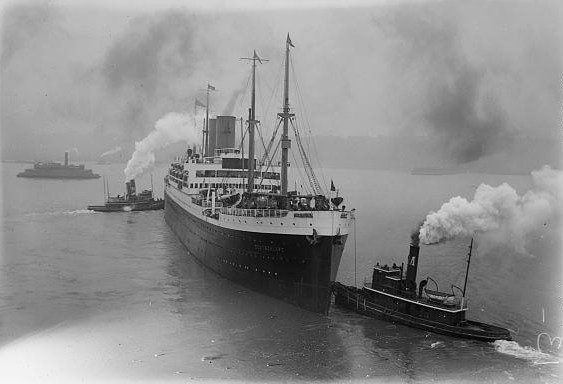
…launched in 1906, the RMS Mauretania was beloved for her Edwardian elegance and style, but as sleeker ships came into service in 1930, the Mauretania was removed from Atlantic crossings and relegated to running shorter cruises from New York to Nova Scotia and Bermuda…

OLD RELIABLE…The RMS Mauretania was the world’s largest and fastest ship after it left the Port of Liverpool in 1906. The liner was scrapped in 1935-37, much to the dismay of many of its former passengers, including President Franklin D. Roosevelt. (Wikipedia)

…with Mother’s Day around the corner, one company suggested a silver cigarette box as a suitable gift…
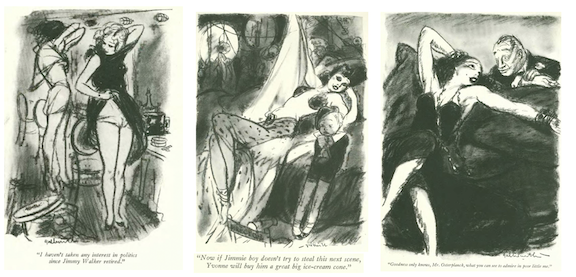
…on to our cartoons, Otto Soglow marked the upcoming holiday with this choreographed group…
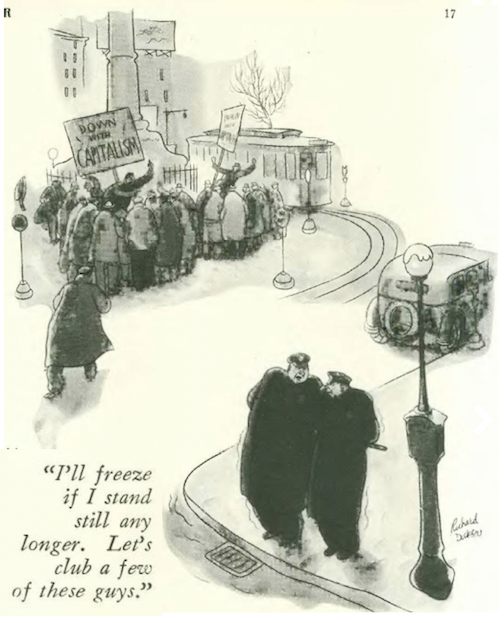
Denys Wortman gave us another side of motherhood…

…other women were busy organizing political gatherings, per Garrett Price

…and Helen Hokinson

James Thurber gave us a dog in distress…

Robert Day illustrated the dilemma of two bootleggers…

…and Barbara Shermund takes us out…

Next Time: Under the Boardwalk…


The Quiet Man

One of the challenges of writing these posts is giving proper due to the many writers and artists who helped shape The New Yorker universe, and especially to those we’ve almost forgotten.

April 30, 1932 cover by Theodore Haupt.

One writer who deserves our special attention is John Mosher, film critic for the New Yorker from 1928 to 1942 and a pioneer of The New Yorker short story. In her 2000 book Defining New Yorker Humor, Judith Yaross Lee notes how the “burlesque” prose of the early magazine was displaced by Mosher’s quieter humor, which lent support to Dorothy Parker’s ironic mode and E.B. White’s “travails of the Sufferer.” Mosher’s prose, writes Lee, “helped New Yorker humor combine broad comic conception and ironic realistic narration.”

In addition to regular film reviews and occasional profiles, Mosher penned nearly fifty short stories, or “casuals” as they were called. It was also Mosher who “discovered” writer John O’Hara when in 1929 he found one of O’Hara’s pieces in a “slush pile” of unsolicited submissions. He is also credited with discovering James Thurber.

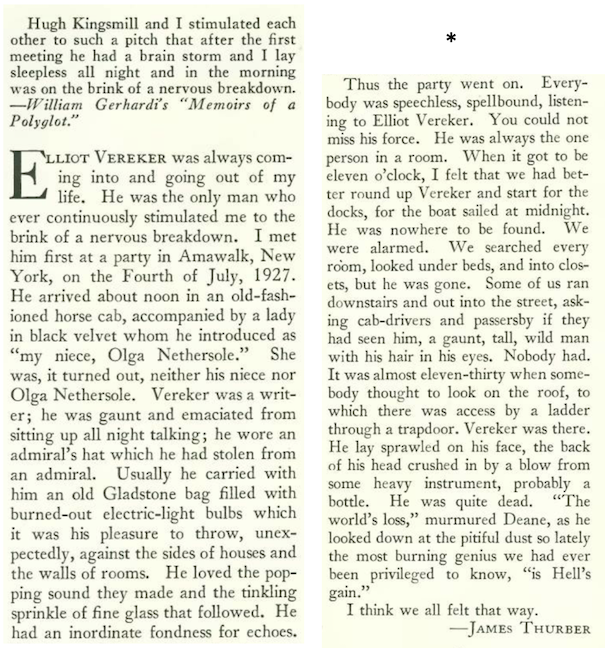
Without further ado, here is one of Mosher’s shorts, “Wake Up, You’re Forty” (Mosher turned forty in 1932) from the April 30 issue. It demonstrates Mosher’s ironic narrative style, skillfully deployed to describe a comically minor event:

THE STORYTELLER…John Mosher’s New Yorker short stories (1925 to 1940) were collected in Celibate at Twilight, illustrated by New Yorker cartoonist Mary Petty. It included tales about life on Fire Island, where Mosher and his partner, broker Philip Claflin, became the first gay property owners in the vacation village of Cherry Grove. Visitors included Mosher’s close friend Edith Lewis as well as Willa Cather, Janet Flanner, Wolcott Gibbs, and James Thurber. (neglectedbooks.com/findagrave.com)
Aerial view of Cherry Grove, circa 1960. (pineshistory.org)

On Sept. 3, 1942, Mosher died of heart failure in New York City at the young age of 50. He was remembered by his New Yorker colleagues in this eulogy found on page 72 of the Sept. 12, 1942 issue:

*  *  *

Going Up!

The “Talk of the Town” took a look at the innovative double-decker elevators being installed in the new Cities Service Building (now 70 Pine Street) in Lower Manhattan. Although the Cities Service building didn’t have the fame of the Empire State Building or the Chrysler Building, when completed the 952-foot Cities Service Building stood as the third tallest in the world.

STILL STANDING TALL…The Cities Service Building (now 70 Pine Street) in Lower Manhattan after its completion in 1932; center, a miniature model of the building, incorporated between the eastern entrance portals on Pine and Cedar Streets; at right, a clipping from the January 1932 Popular Science magazine detailing the unique double-decker elevator design. (MCNY/Wikipedia/Popular Science)

 *  *  *

Electric Patriotism

E.B. White kicked off his “Notes and Comment” with some observations about the newly-renovated Union Square and its electrified American flag:

PATRIOT GAMES…Then as now, Americans have always disagreed on what constitutes a tasteful patriotic display. At top, Union Square (circa 1930) arranged around Henry Kirke Brown’s 1856 statue, George Washington; in 2011 a U.S. Armed Forces Recruiting Office (below) at Broadway and Seventh Avenue, was fitted with a giant electric flag of red, white and blue LED lights. (Dick Ebert)

 *  *  *

From Our Advertisers

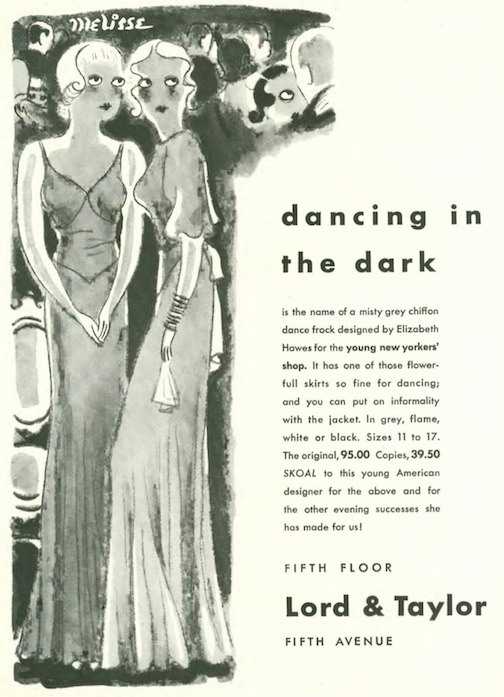
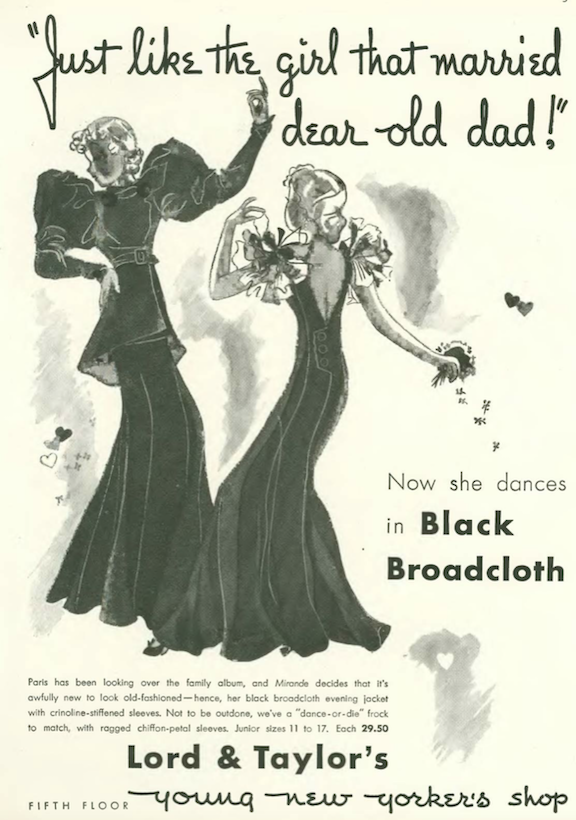
Lord & Taylor rolled out some new ads illustrated by Melisse, aka Mildred Oppenheim

…apparently giddy about their new campaign, Lord & Taylor ran a second one-column ad in the back pages…

…apparently Melisse was a big draw in the 1930s, based on this Dec. 12, 1931 advertisement in the New York Sun (photo added by me, via strippersguide.blogspot.com)…

…travel companies continued their appeals to the well-heeled and included exotic destinations such as Zoppot…

…which today is known as Sopot, Poland…its Sofitel Grand Hotel (aka the Kasino Hotel) continues to serve as a spa resort…

TAKING THE WATERS…Sopot’s Grand Hotel (aka the Kasino Hotel) continues to serve as a spa resort — it is seen in the background of this 1950 photo (top); below, hotel interior in 1927. The hotel has hosted the famous — Greta Garbo, Marlene Dietrich, Josephine Baker — and the infamous, including Adolf Hitler. More recent guests to the hotel included Prince, Shakira, Vladimir Putin and The Weeknd.  (Wikipedia/sofitelgrandsopot.com)

…we move back to the States, where car companies continued to vie for scarce consumer dollars…Buick hired an artist to create this generic image of a successful-looking businessman, hoping to convince readers to invest in their automobile…

…the makers of LaSalle, a downscale version of Cadillac, wanted readers to imagine that owning their car would put them in the same company as the fashionably blasé patrician class…

…Hudson also made an appeal to class with this full-color ad designed to pique the Anglophilic tendencies of many readers…

…the makers of the luxurious Packard usually marketed to older monied folks who sought mechanical quality, refinement and reliability, so this ad was a bit of a surprise…

…and speaking of youth, with have an ad from Ciné-Kodak that begins on a lively note…

…but then includes this guilt-inducing bummer…

Otto Soglow kept things lighter with his latest ad for Sanka…

…which brings us to the cartoons, and Soglow’s Little King

Robert Day gave us a cordial shoppe owner spying opportunity…

James Thurber explored the spirit realm…

Peter Arno found misunderstanding at the manor house…

…and Kemp Starrett found a real fixer-upper…

William Steig let one of his “Small Fry” speak his mind…

…and we close with Alan Dunn, and the pressures of modern love…

Next Time: High Anxiety…

The Grand Garbo

Joan Crawford was an MGM star by the 1930s, and according to many critics, an absolute scene-stealer in 1932’s Grand Hotel. However, The New Yorker’s film critic John Mosher saw Garbo, and only Garbo, in this Academy Award-winning pre-code drama.

April 23, 1932 cover by E.B. White. Although White’s friend and early office mate James Thurber had been contributing drawings for more than a year, it was White who would land the first cover—his only one (Thurber’s first cover would come in 1936). Maria Popova (brainpickings.org) shares this excerpt from a 1969 Paris Review interview, during which White explained to George Plimpton: “I’m not an artist and never did any drawings for The New Yorker. I did turn in a cover and it was published. I can’t draw or paint, but I was sick in bed with tonsillitis or something, and I had nothing to occupy me, but I had a cover idea—of a sea horse wearing a nose bag. I borrowed my son’s watercolor set, copied a sea horse from a picture in Webster’s dictionary, and managed to produce a cover that was bought. It wasn’t much of a thing. I even loused up the whole business finally by printing the word ‘oats’ on the nose bag, lest somebody fail to get the point.”

Greta Garbo’s previous films hadn’t exactly wowed Mosher, but the gossip he was hearing even before he screened Grand Hotel suggested it was not to be missed. Mosher touted the unseen film (in the April 16 issue), expressing his hope that the rumors would prove true—he feared Garbo would quit the business altogether and leave the country if she didn’t land a hit. His fears were laid to rest:

Adapted from the 1929 German novel Menschen im Hotel by Vicki BaumGrand Hotel is considered the first all-star epic. The brainchild of MGM’s production head Irving Thalberg, the film proved a triumph for director Edmund Goulding, who somehow managed to direct five leading roles into one film classic.

GRAND OPENING…The April 12, 1932 opening of Grand Hotel at Broadway’s famed Astor Theatre was much anticipated by critic John Mosher and pretty much everyone else. (ny.curbed.com)
STELLAR CAST…Set at a luxurious Berlin hotel, Grand Hotel brought together the stories of five seemingly unrelated lives. Clockwise, from top left, crooked industrialist Preysing (Wallace Beery), trades innuendos with an ambitious stenographer, Flaemmchen (Joan Crawford); Baron Felix von Gaigern (John Barrymore), a once wealthy man fallen on hard times, supports himself by stealing from vulnerable marks like the depressed ballerina Grusinskaya (Greta Garbo), and also teams up with a gravely ill accountant (Lionel Barrymore, John’s real brother, not pictured here); hotel entrance from the film; MGM movie poster deftly juggled the film’s five big stars; advertisement from the April 16, 1932 New Yorker made much of the film’s star power. (Wikipedia/IMDB)
THE OTHER BIG STAR in Grand Hotel was the luxurious Art Deco set created by Cedric Gibbons. Centered on the hotel’s reception desk, the set allowed filming in 360 degrees. (IMDB)

And let’s not forget that it was in this film Garbo famously uttered “I want to be alone” — it ranks number 30 in AFI’s 100 Years…100 Movie Quotes. In 2007 Grand Hotel was selected for preservation in the United States National Film Registry by the Library of Congress.

* * *

She’s Back

Lois Long aka “Lipstick” turned in yet another “Tables for Two,” even though she had abandoned that column as a regular feature two years earlier. Unlike those earlier columns, Long seemed to have had her fill of the night life, but occasionally she found a diversion or two worth mentioning. She also offered her thoughts about the decline of civilization, indicated by such behaviors as dining at the early hour of 7 p.m.—”rawboned” she called it…

NIGHT LIGHTS…Singer Kate Smith and comedic performer Beatrice Lillie managed to keep Lois Long awake in the wee hours of nightclub entertainments. (katesmith.org/The Poster Corp)

*  *  *

Notes, and More Notes

Despite his cover contribution, and his continued presence in the “Notes and Comment” section, the year 1932 is regarded as one of E.B. White’s leanest as a full-time writer for The New Yorker. According to Scott Elledge in E.B. White: A Biography, White published only a few “Talk” pieces or signed contributions. With a toddler about the house (Joel White had just turned 1 the previous December), White and wife Katharine enjoyed what Elledge describes as perhaps “the happiest of their years together, “able to enjoy fully their professional and private lives in the city they both loved.” So perhaps that explains this particular “Notes” entry for the April 23 issue. Still, it’s good stuff:

(Note Otto Soglow’s Tammany-themed spot cartoon — the political machine was still chugging along, but its days were numbered)

 *  *  *

From Our Advertisers

We begin with this colorful ad from McCutcheon’s to brighten our day…

…the Franklin Automobile Company responded to competition from other luxury car makers by introducing its own 12-cylinder model, the only American car to be powered by a 12-cylinder air-cooled engine (according to the H.H. Franklin Club)…

…introducing a 12-cylinder luxury car was not a good move in 1932—one of the worst years of the Depression—and the company folded by 1934…but what a swell-looking car…

(Courtesy H.H. Franklin Club)

…one innovation that would stick around, however, was the lighted refrigerator, something to brighten those dim days of 1932, that is if you could even afford an electric fridge…

…named to evoke the luxury automobile, the British-made Rolls Razor made its debut in the back pages of The New Yorker with this panel cartoon ad featuring a hapless suitor and his girlfriend’s nosy kid brother…

…the razor came in a rigid case enclosed by two detachable lids; one carried a sharpening stone and the other a leather strop. When a lid was removed, the razor’s oscillating a handle drove a shaft along the frame, pushing the solid, hollow ground blade forward against the stone or dragging it against the strop…

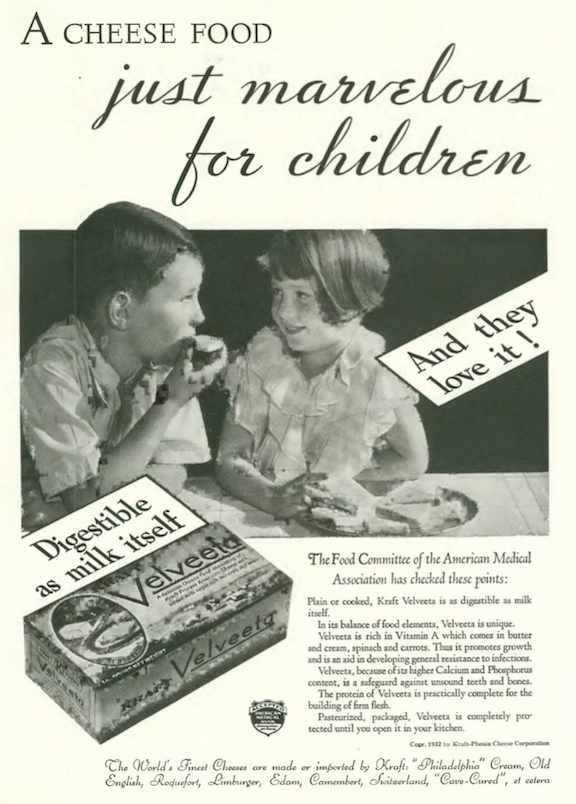
…and here’s an ad you don’t see often in The New Yorker…one featuring children…

…on to our cartoonists, we have more kids via William Steig’s Small Fry…

James Thurber continued to ply his cartooning craft with one of his favorite subjects:

…here is a more detailed look at the above…

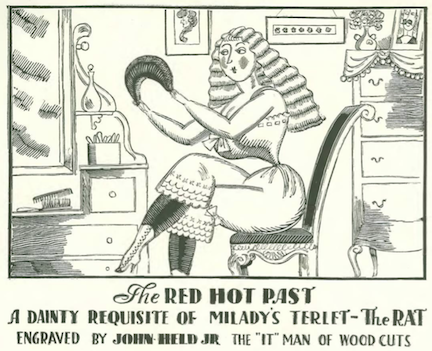
John Held Jr. continued to take us back to those saucy days of yore…

Gardner Rea sketched this hereditary pratfall…

E. McNerney gave us a woman whose beau was in alliance with architecture critic Lewis Mumford

Alan Dunn looked in on the fast-paced world of business…

…and Leonard Dove takes us out on a droll note…

Next Time: The Quiet Man…


Dirge for a Dirigible

There was a time when dirigibles were considered the future of transatlantic transportation. In the 1930s they could carry more passengers than any other type of aircraft while offering amenities usually associated with ocean liners such as private cabins, dining rooms and large observation decks. They were also faster than those water-borne vessels.

March 26, 1932 cover by Bela Dankovsky.

Dirigibles, however, were challenging to operate—with crew members outnumbering passengers—and sometimes they fell from the sky. Such was the fate of the USS Shenandoah during a 1925 publicity flight over Ohio. On board was the Navy’s Lt. Cmdr. Charles Emery Rosendahl (1892–1977), who had to act quickly when the airship encountered a severe thunderstorm. Hitting a violent updraft that carried it beyond the pressure limits of its gas bags, the airship was torn apart. For the March 26 “Profile,” writer Henry Pringle recounted Rosendahl’s experience:

HE LIVED TO TELL ABOUT IT…Clockwise, from top left, Lt. Cmdr. Charles Rosendahl, USN, circa 1930; the USS Shenandoah in pieces near Caldwell, Ohio; the airship in better days; close-up view of the wreckage. (Wikipedia/airships.net)
IT WAS A GAS…Like other other early dirigibles, the USS Shenandoah was designed for war (fleet reconnaissance) rather than passenger service. It was the first rigid airship to use a safer gas, helium, rather than hydrogen to gain lift. However, helium was scarce at the time, and the Shenandoah used almost all of the world’s reserves to fill its gas cells, which held 2,100,000 cubic feet. (fly.historicwings.com)


ON THE CATWALK…Lt. Cmdr. Charles Rosendahl hurried through this area while the USS Shenandoah was being torn apart in mid-air. Rosendahl was ordered out of the control car by the airship’s pilot, Cmdr. Zachery Landsdowne, to check on the Shenandoah’s oil and gas tanks. It was an order that ultimately saved Rosendahl’s life: Eight crew members in the control car, including Landsdowne, perished. In all, 14 crew members lost their lives. (airships.net)

 *  *  *

Untouchable Unmentionables

In his “Notes and Comment,” E.B. White mused about one Boston store’s promotion of a line of women’s underwear as “Gandhi panties,” apparently inspired by the loincloth worn by Indian liberator Mahatma Gandhi:

THE SIMPLE LIFE…Mahatma Gandhi held numerous hunger strikes during his years of protest against India’s caste system and British Imperial rule. He is pictured here in jail in September 1932 during the second of his fasts, protesting the British government’s decision to separate India’s electoral system by caste. (history.com)

 *  *  *

Hearst Wurst

Film critic John Mosher was not happy with the happy ending (or much else) in the William Randolph Hearst-backed Polly of the Circus, which starred Hearst’s mistress, Marion Davies, along with emerging star Clark Gable, who portrayed a small-town minister who risked his career for love with a trapeze artist.

JUST READ THE NAUGHTY BITS…Top image: With the backing of William Randolph Hearst, Marion Davies was able to bill her latest MGM film as a “Marion Davies Production.” Davies had star billing over Clark Gable in Polly of the Circus, but as his star rose in the 1930s, Davies saw her fortunes (and Hearst’s) drain away during the Depression years. Bottom image: the Reverend John Hartley (Gable) and trapeze artist Polly Fisher (Davies) “look for something hot” in the Book of Ruth. (IMDB)

 *  *  *

From Our Advertisers

Electric refrigerators for home use had been around for less than decade in 1932, but as more companies got into the business, the drive to distinguish one’s product from the competitor’s became keen…the distinctive “Monitor Top” GE refrigerators were touted by Rex Cole in both their ads and in the design of their showrooms…

…Allen-Ingraham, on the other hand, demonstrated how their “dual-automatic” Westinghouse could bring harmony to a party of bootleg-swilling old gents…

…the makers of Electrolux invoked the inevitable march of time and progress in promoting their “automatic” refrigerator…

…on to sundry things, the upscale British department store Fortnum & Mason employed this simple ad to demonstrate the superiority of old money over the preening lower orders…

…and in the back pages we find these cheap ads for corsets, a prep school and a shorthand lessons…

…the makers of Listerine reminded readers of the connection between their old line of antiseptic products and their new line of cigarettes…

…the Santa Fe Railroad invited travelers to the Summer Olympics in Los Angeles…

…while the Missouri Pacific line promoted the wonders of Kansas City, the “Heart of America”…

…makers of the autogiro — part airplane, part helicopter — continued to promote the advantages of this supposedly easy to fly contraption…in the 1930s the autogiro was seen as the future of personal air travel, some predicting that the craft would join the automobile in many a garage…

…on to our cartoons, Alice Harvey found one man who was ready for the autogiro lifestyle…

…and Peter Arno gave us an old walrus ready to take advantage of an unsuspecting host…

……and Helen Hokinson’s “girls” also found themselves involved in a scandalous situation…

…on to the April 2, 1932 issue…

April 2, 1932 cover by Julian de Miskey.

…where this time critic John Mosher took a look at a new film (and a new film genre) — Tarzan, the Ape Man, starring Johnny Weissmuller and Maureen O’Sullivan.

Weissmuller (1904-1984) was well known in the 1920s as a five-time Olympic Gold Champion swimmer, so the 28-year-old was a familiar face when he stepped into the title role. The Irish-born O’Sullivan (1911-1998) had appeared in seven films in 1930-31 before she was cast as Jane Parker in Tarzan, the Ape Man. Mosher found the film silly, but entertaining nonetheless.

THAT PRE-CODE LOOK…Before decency codes were strictly enforced in Hollywood, many early 1930s films featured scenes that were pretty racy for those times. Both Maureen O’Sullivan and Johnny Weissmuller were scantily clad for their roles in 1932’s Tarzan the Ape Man. (IMDB/fanpop.com/manapop.com/YouTube)

 *  *  *

Cancel Me, Kate

“That’s Why Darkies Were Born” was a popular song in those days of casual racism, written by Ray Henderson and Lew Brown for George White’s Scandals of 1931. It was recorded by a number artists including Paul Robeson (see below) and Kate Smith — it was one of Smith’s biggest records and also the reason she was recently “cancelled” in some sports venues.

In 2019 the New York Yankees announced that Smith’s rendition of “God Bless America” would no longer be played at Yankee Stadium, citing not only Smith’s version of “That’s Why Darkies Were Born” but also her past performances of the song “Pickaninny Heaven.” The Philadelphia Flyers followed the Yankees example, covering up and later removing a statue of Smith outside the Wells Fargo Center.

THAT’S WHY YOU WERE CANCELLED…One of Kate Smith’s biggest early hits was her performance of “That’s Why Darkies Were Born.” In 2019 the Philadelphia Flyers organization covered and later removed a statue of Smith outside the Wells Fargo Center. (mprnew.org)

 *  *  *

From Our Advertisers

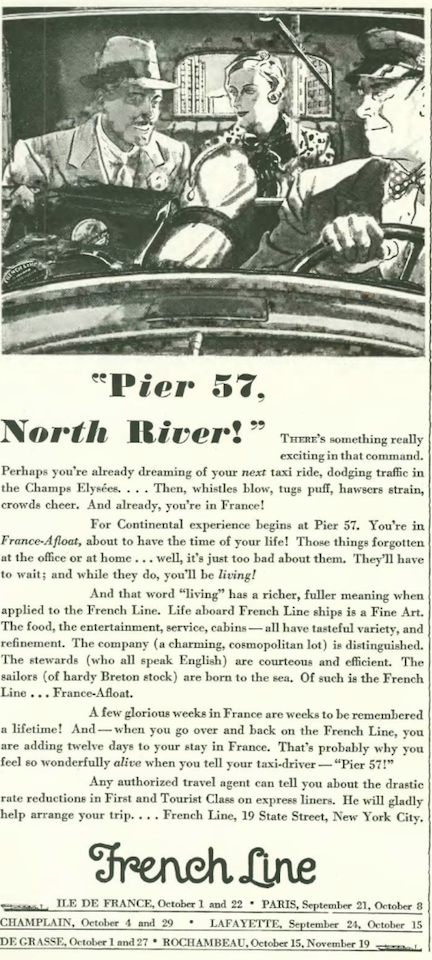
We have more inducements to travel, this time abroad and in style aboard the French Line…

…or if you were looking for something a bit more exotic, Intourist could book you passage to the Soviet Union…

…on to our cartoonists, we begin with this great spot illustration by Victor De Pauw, who contributed to The New Yorker from 1928 to 1948…

William Crawford Galbraith offered some insight into the cultural tastes of the upper orders…

…while Alan Dunn illustrated the Depression’s domestic woes…

…and we have what I believe is the first appearance of William Steig’s “Small Fry” children identified as such…many more would follow, later to be collected into a popular book by the same name…

…and another by Steig of a person contemplating his life’s desire…

…and we end with James Thurber, with all of his familiar themes tied up in one drawing…

Next Time: A Return to the Nightlife…


MoMA Sees The Future

If you love modern architecture, then Feb. 10, 1932 should be an important date on your calendar, for on that date the Museum of Modern Art opened Modern Architecture: International Exhibition.

Feb. 27, 1932 cover by Leonard Dove.

Curated by Philip Johnson and Henry-Russell Hitchcock, the exhibition introduced 33,000 visitors (during the exhibition’s six-week run) to the “International Style,” an emerging architectural style that would utterly transform New York and thousands of cities around the world after the Second World War. In a catalogue prepared for the exhibition, Johnson and Hitchcock defined what this style was all about:

Architecture critic Lewis Mumford welcomed the exhibition, wryly noting that the “best buildings in New York” at the time were the models and photographs “arranged with such clarity and intelligence” by Philip Johnson on MoMA’s walls. An excerpt:

FORM FOLLOWED FUNCTION…MoMA’s Modern Architecture: International Exhibition, opened on Feb. 10, 1932 in the museum’s first home, New York’s Heckscher building on Fifth Avenue. There was nothing fancy about these gallery spaces, but the exhibits wowed The New Yorkers’s Lewis Mumford, including a model of Le Corbusier’s Villa Savoye at top right. (MoMA)
HANDSOME OBJECTS…was how Lewis Mumford described works in the exhibition he singled out for praise, including, from top, Mies van der Rohe’s 1930 Villa Tugendhat, Frank Lloyd Wright’s 1929 Jones residence in Tulsa, and Le Corbusier’s Villa Savoye. At left, the cover of the exhibition catalogue. (MoMA/Wikipedia/dezeen.com)

Mumford concluded his review with this bold observation:

100 PERCENT ORGANIC…View of Hook of Holland housing complex in Rotterdam, designed by J.J.P. Oud, 1926-1927. (umass.edu)

 *  *  *

Out of the Trenches

Floyd Gibbons (1887–1939) was a colorful, fast-talking war correspondent known for his derring-do as a reporter for the Chicago Tribune during World War I (losing an eye in an attempt to rescue an American marine) and later as a radio commentator and narrator of newsreels. His celebrity would even earn him a star on the Hollywood Walk of Fame. For all his death-defying exploits, Gibbons would die at home, of a heart attack, at the tender age of 52.

In his “Notes and Comment” column, E.B. White suggested that Gibbon’s fame had a little help from some friends…

Screen Shot 2021-03-22 at 10.15.43 AM

azu_ms413_b21_f40_drachmanmorocco4
IN HIS ELEMENT…Floyd Gibbons photographed in 1925 while in Morocco covering the Riff War. Seated to the left is journalist and author Rosemary Drachman, who covered the war with Gibbons. (University of Arizona Libraries)

 *  *  *

Love and War

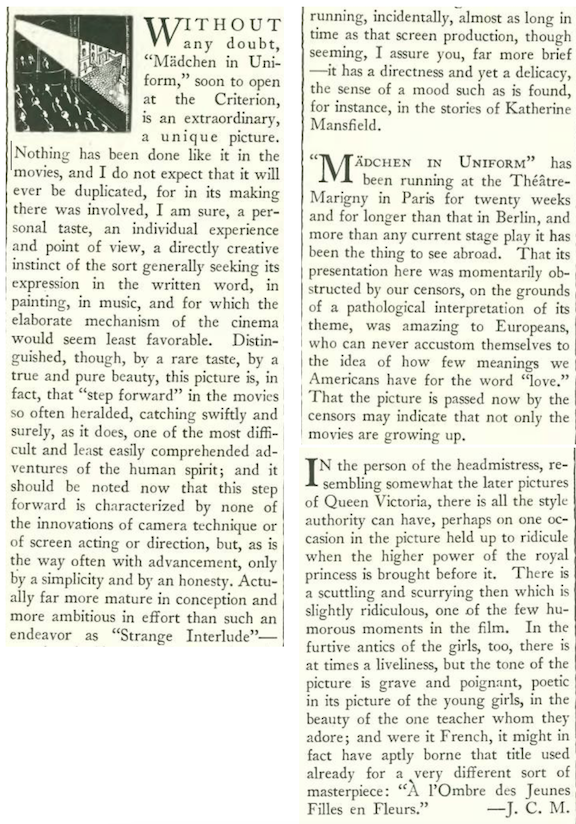
The fourth of seven films Josef von Sternberg and Marlene Dietrich made together, Shanghai Express was a critical success (nominated for three Oscars, winning one for cinematography) for Sternberg as well as for Dietrich and Anna May Wong. This pre-code drama was about a notorious woman (Dietrich, who else) who rides a train through the perils of a Chinese civil war with a British captain (Clive Brook) whom she loves. Critic John Mosher takes it from there:

Screen Shot 2021-03-22 at 9.44.59 AM

Screen Shot 2021-03-30 at 4.32.39 PM
LOOMING EVER LARGER…Marlene Dietrich’s image dominated this poster for Shanghai Express, which starred Dietrich and Anna May Wong (top right) as well as Clive Brook and Warner Oland. Oland, pictured at bottom right with Dietrich, was a (non-Asian) Swedish-American actor most remembered for playing Chinese and Chinese-American characters, including his role as Charlie Chan in 16 films between 1931 and 1937. (IMDB)

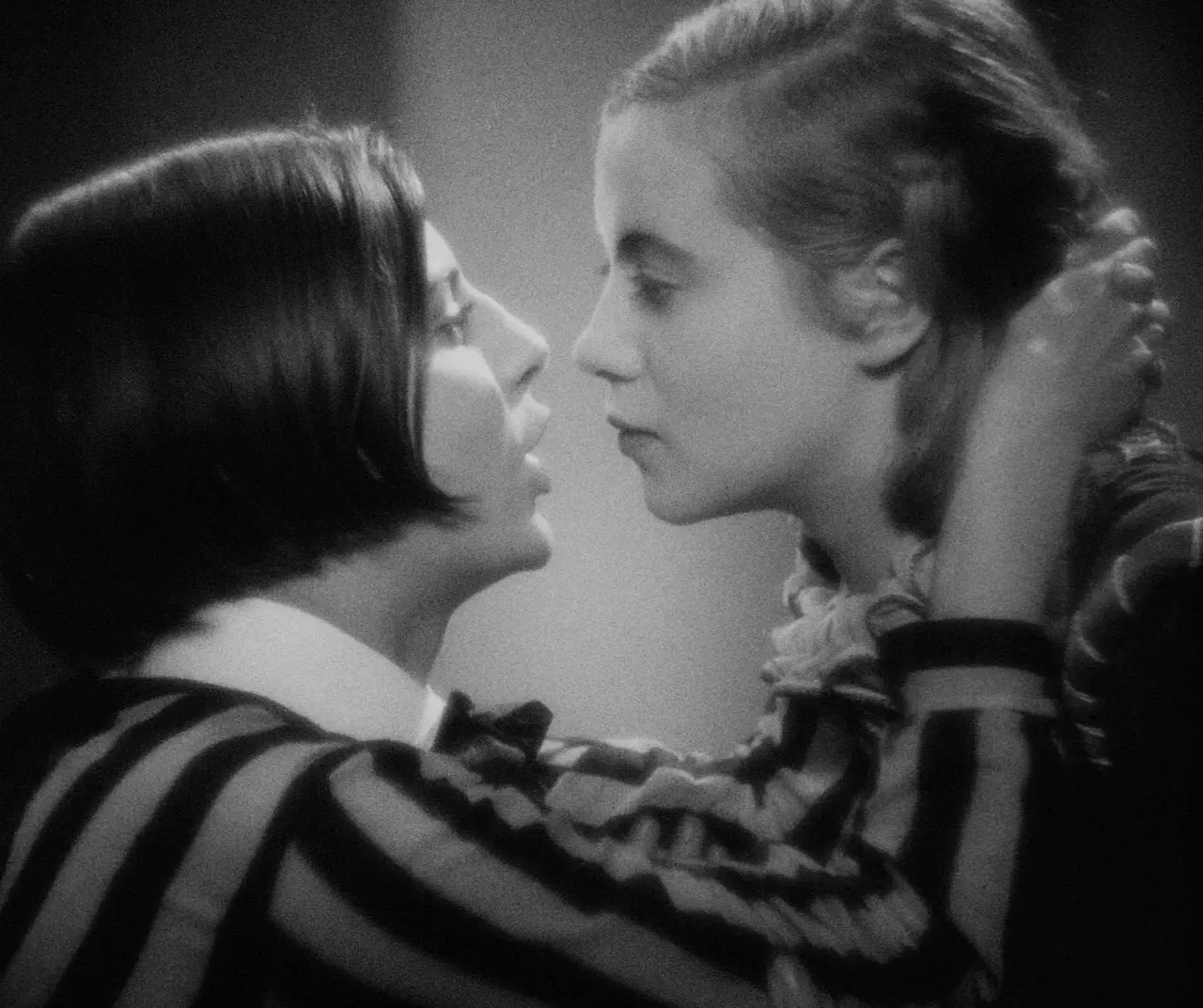
Dietrich and Wong were well acquainted when they came together to make Shanghai Express. It was rumored the two had a romantic relationship when Wong visited Europe in 1928, a rumor that tarnished Wong’s public image (but seemed to have little effect on Dietrich’s).

ALL DRESSED UP…Anna May Wong and Marlene Dietrich pose in Travis Banton costumes for 1932’s Shanghai Express. (Twitter)

 *  *  *

From Our Advertisers

Looking at some advertisements from the Feb. 27 issue…here’s a clip from the back pages of some inexpensive sig ads promoting everything from Broadway to burlesque—Billy Minsky’s was by far the best known burlesque show in Manhattan. Note how the Minsky’s ad included the racy little drawing (hmmm, not for the kiddies) and the postscript at the bottom following “NEW SHOW EVERY MONDAY” — P.S. For New Yorkers and their Rural cousins… 

Screen Shot 2021-03-12 at 1.05.18 PM

…MoMA wasn’t the only place you could find modern design, as this carpet ad suggested…

Screen Shot 2021-03-12 at 1.06.57 PM

…the folks at Alcoa Aluminum were sticking with a more traditional look, even though they were marketing a very modern aluminum chair…you don’t see these much anymore…I mostly remember them reposing in rumpus rooms or church basements…

Screen Shot 2021-03-12 at 12.49.17 PM

…the makers of Nash automobiles were keeping with the times with new “Slip-Streamed” models “with lines and curves suggested by aeronautical design”

Screen Shot 2021-03-12 at 12.49.42 PM

…my father’s first car was a used Nash — something similar to this 1951 Nash Statesman…

Nash_Stateman_2-Door_Sedan_1951

…Nash would acquire rival Hudson in 1954 to create American Motors Corporation, run by a man named George Romney (Mitt’s dad), who would make AMC a successful company before turning to politics (AMC would go on to make some truly weird, if not lovable vehicles, most notably the Gremlin)…and we segue into our cartoons with this ad for Sanka decaf coffee, illustrated by the New Yorker’s William Steig

Screen Shot 2021-03-12 at 12.59.44 PM

Kemp Starrett gave us a little paddy wagon humor…

Screen Shot 2021-03-12 at 12.57.08 PM

Helen Hokinson illustrated a tender moment between father and son…

Screen Shot 2021-03-22 at 10.19.15 AM

…and we close with James Thurber, and some wintertime fun…

Screen Shot 2021-03-12 at 12.53.54 PM

Next Time: The Milne Menace…


Winter Games

E.B. White was not known for his sports reporting, but when the Third Winter Olympic Games opened in Lake Placid, New York, on Feb. 4, 1932, it was White who represented The New Yorker at the first-ever winter games in the U.S.

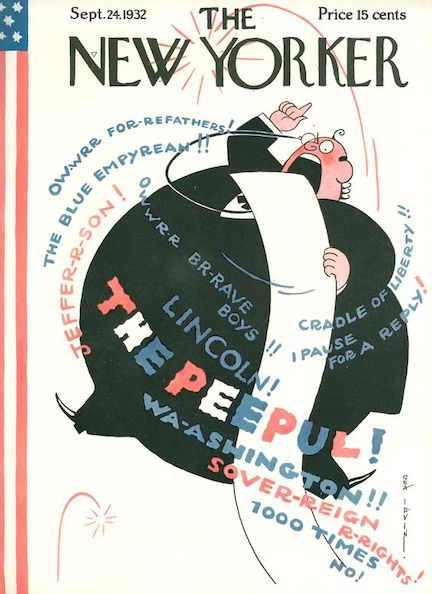
Feb. 20, 1932—seventh anniversary cover by, of course, Rea Irvin!

Famed caricaturist Emery Kelen (1896-1964) provided the artwork for White’s account of the games…

…which was featured in the “A Reporter at Large” section under the title, “Midwinter Madness.” White opened the piece with some observations on Godfrey Dewey, head of the Lake Placid Club, and son of Melvil Dewey, inventor of the Dewey Decimal System. It seems that Dewey wanted the Olympic posters printed in the simplified Dewey system of spelling:

BEFORE BOB COSTAS…Opening ceremonies were a far simpler affair. Clockwise, from top left, the III Winter Olympic Games officially opened on Feb. 4; Sonja Henie of Norway and Karl Schäfer of Austria were gold medal winners in ladies’ and men’s singles figure skating; the rather uninspired official poster for the event; as a pusher in the four-man bobsleigh team, Edward Eagan (center) won the gold medal with the USA I team. Twelve years earlier Eagan had been crowned Olympic champion in the light heavyweight boxing competition at Antwerp. He was the first and only person to win gold at both the summer and winter games. Note the leather helmets and the fact that, unlike today, the sled is actually a real sled. (olympic.org/Wikipedia)

True to form, White set the stage for the games by describing his train journey to Lake Placid. At the games he observed dogsled teams—dogsled racing was one of nine sports featured at the III Winter Olympics—and marveled at the derring-do of the ski-jumpers.

Writing in the Atlantic (Feb. 10, 2014), Philip Bump described the 1932 Games as looking “way more fun and dangerous” than today’s games, “like a group of guys who set up a competition in the woods behind their house. The Jackass Games, really.” They were a lot smaller, too. The 2018 Olympics in Pyeongchang, South Korea featured entrants from 92 countries participating in 102 events over 15 disciplines. By contrast, just 17 countries participated the 1932 games.

HOVERING HANS…Norwegian Olympic skier Hans Vinjarengen took Bronze at the 1932 games. At right, ski jump at Lake Placid. (olympic.com/Wikipedia)

And we close with this gif of an unidentified ski jumper at the ’32 games…

 *  *  *

Seeing Red

The Mexican painter Diego Rivera was sympathetic to the Soviet cause (with a Trotsky twist), but to the party faithful, painting a mural for some money-grubbing capitalists was unforgivable, as “The Talk of the Town” related…

NO GOODNIK…Left, Diego Rivera at work on Allegory of California at the San Francisco Stock Exchange Luncheon Club, 1931. At right, the mural still graces the stairwell of the building, now called “City Club.” (sfhistory.org).

 *  *  *

Thank Heaven For Little Smiles

It is a challenge to find an image of Maurice Chevalier without his sunny smile, but as “The Talk of the Town” revealed, even the French crooner needed a break from all that mirth…

GRIN AND BEAR IT...Maurice Chevalier headlined an evening of song and dance at the Fulton Theatre in February 1932. (playbill.com)

 *  *  *

Survivor

The last surviving artist of the old Currier & Ives print shop, Louis Maurer (1832–1932) celebrated his 100th birthday, and “The Talk of the Town” was there to fete the old man…

AMERICANA’S FINEST…Louis Maurer poses with one of his works on the centenary of his birth. (findagrave.com)

 *  *  *

Silence is Golden

One of the older actors working in Hollywood, British actor George Arliss (1868–1946) was best known for his role in Disraeli (1929), and he is also credited with promoting the career of 23-year-old actress Bette Davis, who would have her breakout role in The Man Who Played God. This remake of a 1922 silent (that also featured Arliss) told the story of a concert pianist, Montgomery Royale, who believes his career is over when he loses his hearing. However, he finds a new purpose when he uses his lip-reading skills to help others, including himself when he calls off his engagement to Grace (Davis) after learning she is in love with another man. Critic John Mosher was impressed by Arliss, but found the film sanctimonious and wished the actor would play a baddie for a change.

TWO-TIMER…George Arliss appeared in both silent (1922) and talking (1932) versions of the The Man Who Played God. The latter film featured 23-year-old Bette Davis (second from left) in her breakout role. (IMDB)

DRAMA KING…Concert pianist Montgomery Royale (George Arliss) considers suicide when he loses his hearing in 1932’s The Man Who Played God. Arliss was the first British actor to win an Academy Award for his role as PM Benjamin Disraeli in 1929’s Disraeli. (IMDB)

While Mosher found The Man Who Played God a bit too preachy, Murders in the Rue Morgue (1932) was way too campy to be taken seriously as a horror film. Thanks to his newfound Dracula fame, Bela Lugosi headlined the film, which debuted another young star, Arlene Francis (1907–2001), who would find her greatest fame in television from 1949 to 1983, most notably on the long-running quiz show What’s My Line?

HORROR MONSTER SHOW…or so the producers of Murders in the Rue Morgue (1932) claimed. Still image from the movie featured Bela Lugosi (left), Noble Johnson and Arlene Francis. (IMDB)

 *  *  *

From Our Advertisers

Planning a visit to England? Don’t be mistaken for a clod-kicking Yankee and get yourself over to Lord & Taylor’s…

…and with spring in the air make sure little sis has the right duds to look like a 40-year-old woman…

…if you’re taking the train, you wouldn’t dare sit with the proles (I mean, look at that woman eating god-knows-what from a wrapper, and some filthy urchin wandering the aisles, and what the hell does Mr. Creepo have in that box?), so why settle for plain old gas when you can sweeten it with some lead?…

…nothing better than traveling out into the fresh air to breathe in some nice fresh tobacco smoke…it’s naturally fresh, so it’s just as good as mountain air, maybe even better

…this poor chap can’t breathe well at all, or so he claims, and that’s why he needs Vapex…

…which puts him right to sleep because it contains 70 percent alcohol, so why not take a couple of chasers with that snort…you’ll get used to the menthol flavor (it’s in your Spud cigarettes after all) and before long it’s nighty-night, oh hell I’ll just drink this and put a little ether on my pillow…yeah that’s the ticket…

…for others, why even bother pretending Prohibition is still a thing?…

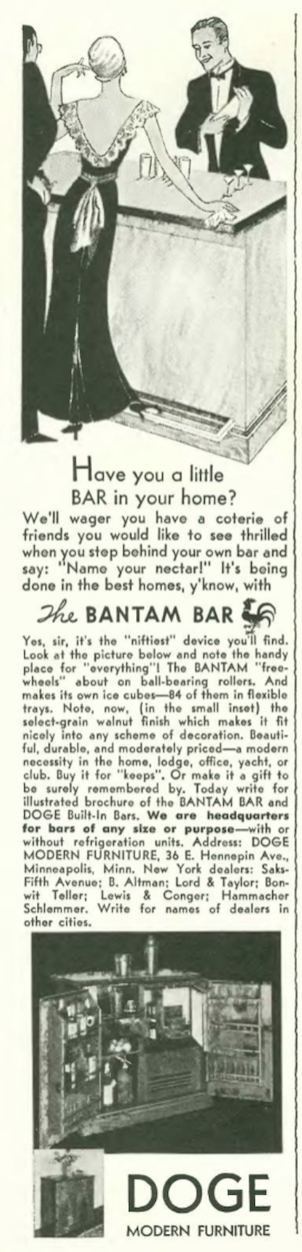
…and look at this swell cocktail set you could stock in your Bantam Bar, designed by The New Yorker’s own John Held Jr

…on to our cartoons, we have Held again with another look at those naughty Victorian days…

Rea Irvin continued his commentary on the “improving” economy…

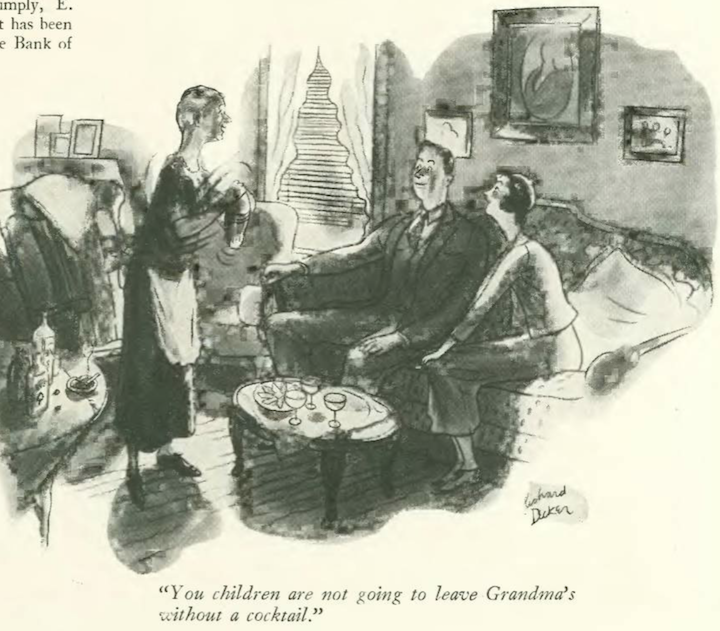
...Richard Decker gave us a master of understatement…

William Steig captured a special father-son moment…

Barbara Shermund continued to explore the ways of her modern women…

…given the recent kerfuffle over Dr. Seuss, Carl Rose confirms just how acceptable racist stereotypes were back in the day…

…and we end with Peter Arno, and one sugar daddy finding himself on the skids, temporarily at least…

Next Time: MoMA Sees The Future…


Babylon Berlin

The name of this post comes from one of my favorite television series, Babylon Berlin, a lavishly produced German neo-noir drama that takes place during the final years of the Weimar Republic, or precisely where we are in the timeline of this blog.

Jan. 9, 1932 cover by Theodore Haupt.

The tumultuous Weimar years of the 1920s and early 30s represented Germany’s initial flirtation with democracy, an experimental age at once filled with post-war  angst and libertine ways, and this was especially true in Berlin where nearly every vice could be plied along its streets and alleyways and in countless clubs and cabarets. It was the setting for a decade of political turmoil, with communists (rival Bolsheviks and Trotskyites) to the left and national socialists (later Nazis) to the right, and in the middle a fledging democracy that ultimately could not hold the center. Janet Flanner, The New Yorker’s Paris correspondent, paid Berlin a visit just one year before Adolf Hitler would seize dictatorial power.

WORLDLY VIEW…Janet Flanner’s account of life in Berlin at the end of 1931 told of economic hardship and hinted at trouble to come, but it mostly depicted life as pictured at right at a Berlin tea dance. This was not a naive perspective, but rather one of a worldly mind not easily shocked by vice and upheaval. As The New Yorker’s longtime Paris correspondent, Flanner’s weekly letters during World War II would also make her a respected war correspondent. At left is an oft-reproduced portrait of Flanner, taken by Berenice Abbott in 1927. At right, a tea dance in the garden of the Hotel Esplanade in Berlin, 1928. (Clark Art Institute/ Süddeutsche Zeitung)

In this excerpt, Flanner saw life continuing at an oddly normal pace despite the hardships and the political tension that boiled behind the façade:

TRUNCATED VISION…Berlin looked to a Modernist future until Adolf Hitler put an end to the “un-German” Bauhaus style in 1933. Despite the economic collapse and political turmoil of 1931 Berlin, the city showcased remarkable technical progress, including a prototype high-speed train (left) that travelled at 230 km per hour (143 mph) from Hamburg to Berlin. At right, Berlin exhibition of Bauhaus-inspired buildings at the 1931 Deutsche Bauausstellung. The cavernous Hall 11, themed as “The Dwelling of Our Time,” was directed by Mies van der Rohe. It mostly displayed the output of his Bauhaus “Werkbund,” including a Mies-designed modern house. (Pinterest/Reichstarifvertrag)

THE OTHER BERLIN…at top, the Friedrichstrasse, Berlin’s “street of sin,” in the late 1920s; below right, prostitutes ply their trade in 1920s Berlin; and below left, buy cocaine capsules from a Berlin drug dealer, 1930. (ddr-postkarten-museum.de/Reddit/Wikipedia)

ANYTHING GOES…Clockwise, from top left, cabaret performance in Berlin that left little to the imagination; the Jockey bar mentioned by Flanner—it was frequented by A-listers such as Jean Cocteau, Andre Gide, Ernest Hemingway and Marlene Dietrich; the Eldorado gay night club in Berlin, 1932; performance of “A Slide on the Razor” at Berlin’s Haller Revue, 1923; the Europahaus, one of hundreds of cabarets in Weimar Berlin, 1931. (cabaret.berlin/Bundesarchiv/tribe.net/Wikipedia)

Toward the end of her article, Flanner noted that “Berliners are busy making a new race,” which is not a reference to Hitler’s “master race” (that would come later) but rather to a new generation overtaking the old. The final lines of this excerpt, however, suggest there might be trouble ahead…

NOT ALL FUN  AND GAMES: Weimer Berlin was also a place of political and economic struggle that at times turned violent. From left, a Nazi youth is wounded during Berlin street violence amid Reichstag elections in 1932; a Berlin bank damaged during violent clashes between police and demonstrators in June 1931; Communist youths in Berlin demonstrate on May Day 1931.  (Pinterest/Financial Times)

The party abruptly ended with Hitler’s takeover of the government in January 1933. The images below said it all:

NEW THEME, NEW OWNERSHIP…The Eldorado gay night club in Berlin before and after Nazi takeover of the German government. (lonesomereader.com)

 *  *  *

Masses’ Mass Media 

“The Talk of the Town” pondered the symbolism of the Daily News Building—from the inscription above its entrance to the place names on its massive lobby globe—which seemed to celebrate its readership, namely the common people.

CAN YOU FIND HOOTERVILLE?…the massive globe in the Daily News lobby (circa 1941), featured the names of small towns and cities along with major population centers; below, inscription “HE MADE SO MANY OF THEM” above the building’s entrance (atlasobscura.com)

 *  *  *

Dem Bones

Art critic Murdock Pemberton paid a visit to the Stieglitz Gallery to check out the latest works by Georgia O’Keeffe. He found that her themes were moving from the urban landscape of New York to the bleached simplicity of the Southwestern desert:

CHANGING HER TUNE…Georgia O’Keeffe’s Cow’s Skull: Red, White, and Blue (1931); O’Keeffe with one of her skull paintings, 1931. (metmuseum.org/CSU Archives)

 *  *  *

Hyde-bound

Film critic John Mosher found much to like about Frederic March’s performance in Dr. Jekyll and Mr. Hyde, and so did critics and Academy voters who bestowed a Best Actor award on the actor.

IDENTITY CRISIS…Bar singer Ivy Pierson (Miriam Hopkins) in a state of undress as she tries (unsuccessfully) to seduce Dr. Jekyll (Frederic March); when Jekyll turns into Mr. Hyde, however, the tables are turned, much to Ivy’s distress. (IMDB)

Mosher found, however, that other pictures playing at the time left much to be desired…

BAD GIRLS…From left, Sylvia Sidney, Miriam Goldina and Esther Howard in 1931’s Ladies of the Big House. (IMDB)

*  *  *

Modern Methods

Early in his writing career Richard Lockridge penned a series of comic sketches for The New Yorker, many of them featuring the characters Mr. and Mrs. North, who would inspire a 26-book series of detective novels. The Norths had yet to make an appearance, but here Lockridge had some fun with the makers of Chevrolets, who used a new-fangled method to promote their product. Excerpts:

FREEBIE…Richard Lockridge thanked the folks from Chevrolet for the free phonograph record, but passed on the automobile. (Ebay)

 *  *  *

From Our Advertisers

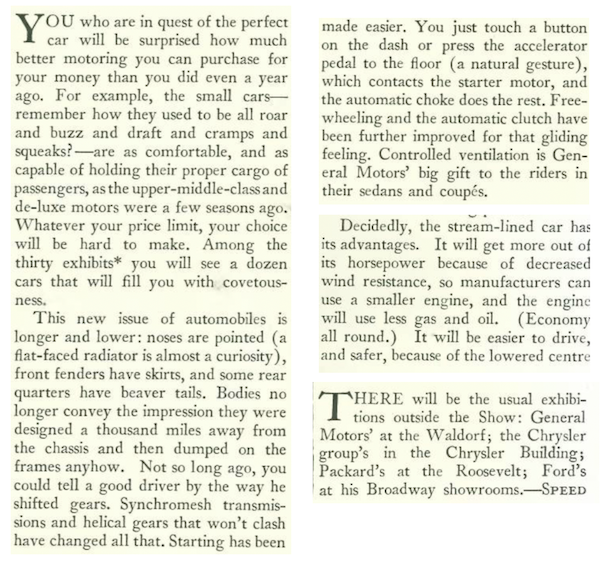
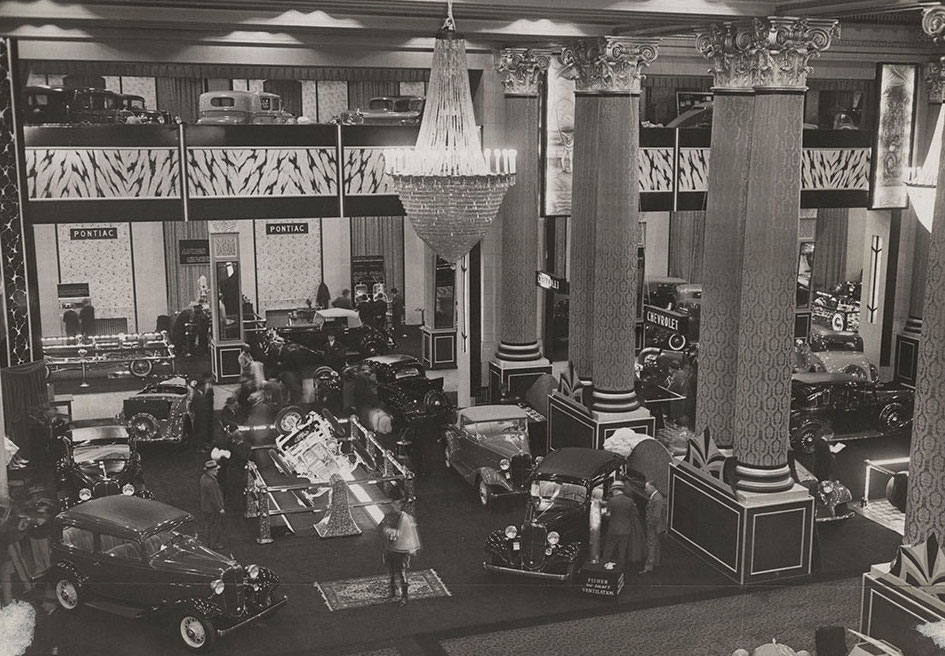
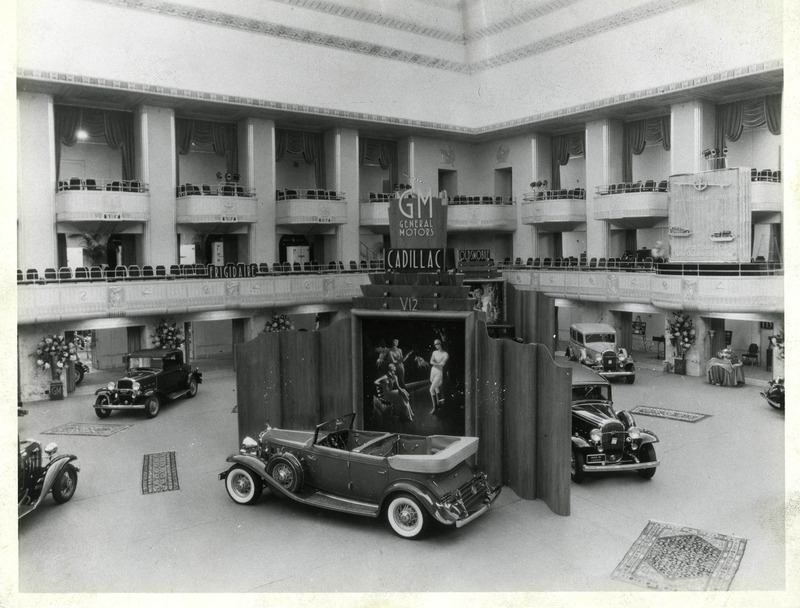
The Annual National Automobile Show at Grand Central Palace kicked off the new year with a stunning lineup of new cars, but General Motors separated itself from the pack by exhibiting its wares at the new Waldorf-Astoria Hotel…I believe this unsigned illustration is by Peter Arno (note “Walrus” in background)…

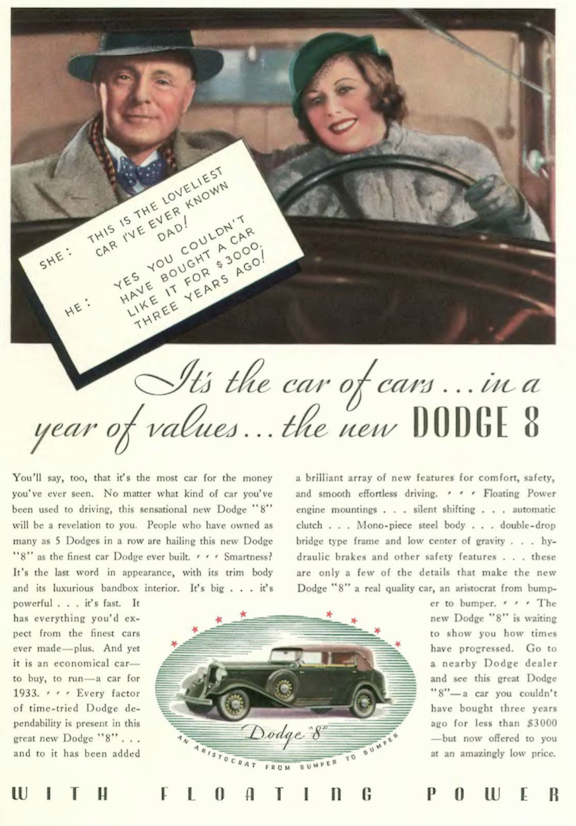
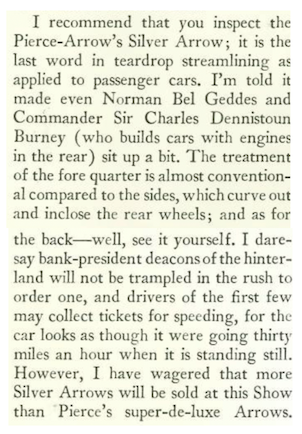
The New Yorker’s advertising department reaped the benefits of the annual show, the Jan. 9 issue replete with ads from various companies…the makers of the Buffalo-based Pierce Arrow — a top-of-the-line luxury car — added a downscale version with a “New Eight” and deeply discounted their prices (which were still well above economy models offered by others)…

…the Depression would put an end to Pierce Arrow by 1938, but rival Lincoln would manage to hang on thanks to their own new “8” and the largess of parent Ford Motor Company…the Lincolns shown here are actually priced higher than the Pierce Arrows, $4300 for the 12 (vs $3185 for the PA 12) and $2900 for the 8 (vs. $2385 for the PA 8)…

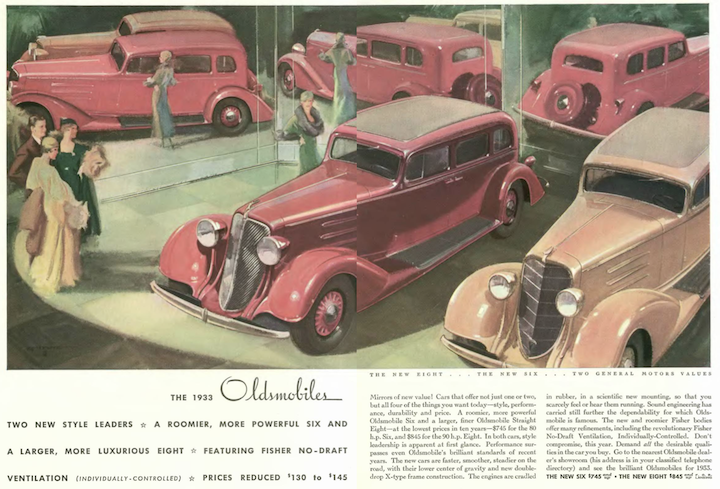
…a bit more down the ladder we have venerable Oldsmobile, alas no longer with us (removed from GM’s lineup in 2014)…

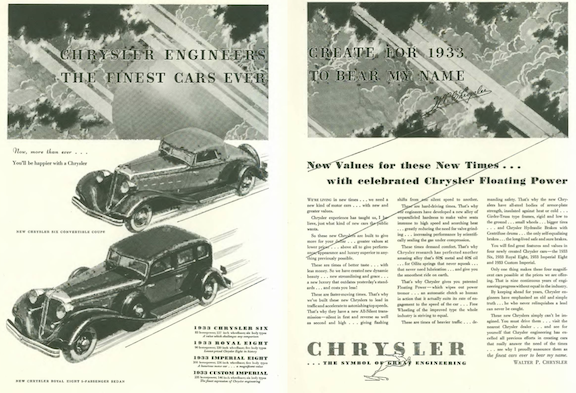
…and a few more rungs down we have the DeSoto (a Chrysler product) and its “sleek” new radiator that was the talk of the auto show, and admired here by “Jimmy Flagg” (aka illustrator James Montgomery Flagg, perhaps best known for his 1917 Uncle Sam poster with the caption “I Want YOU for U.S. Army”)…the DeSoto was a real bargain, priced at under $700…

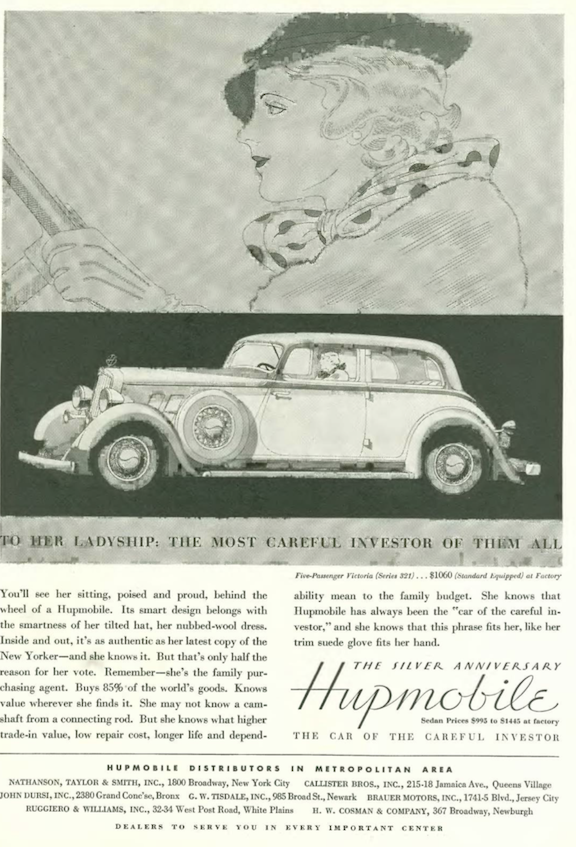
…and here are a few ads from companies long gone…like Pierce Arrow, Auburn (top left) struggled to sell its upscale cars during the Depression…however, the makers of another upscale brand, Packard (bottom right), were able to survive by favoring tried and true designs over gimmicky yearly changes…Hupmobile (top right) was known for its innovations, but a decision to build more expensive cars in the late 1920s put it into a bad position for the Depression-era market, and the company folded by 1939…when Hupmobile was on its last leg, it partnered with the ailing Graham-Paige Motor Company (bottom left), another company known for great designs, but combining two failing companies in this case yielded one larger failing company, and Hup and Graham went down together…

…the clever folks at Buick were way ahead of the others in marketing savvy, emphasizing an attractive, confident woman at the wheel of an unseen car, tapping into a previously untapped market (tobacco companies were busy doing the same)…

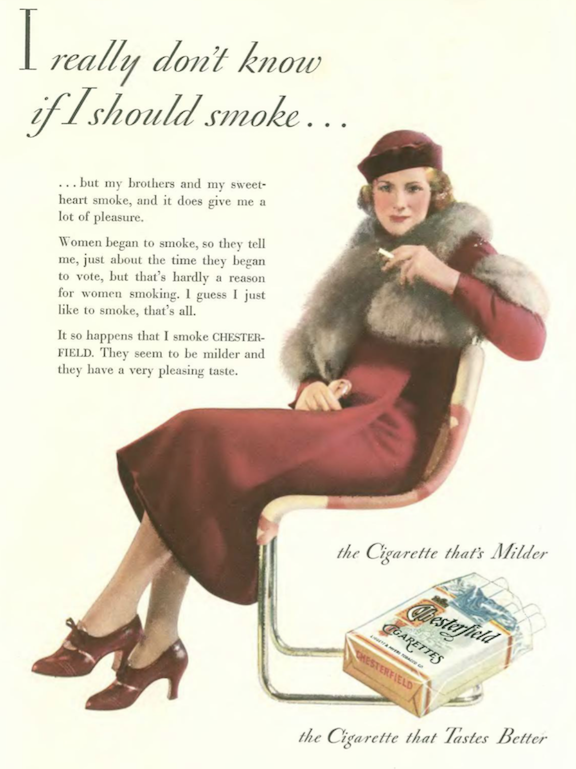
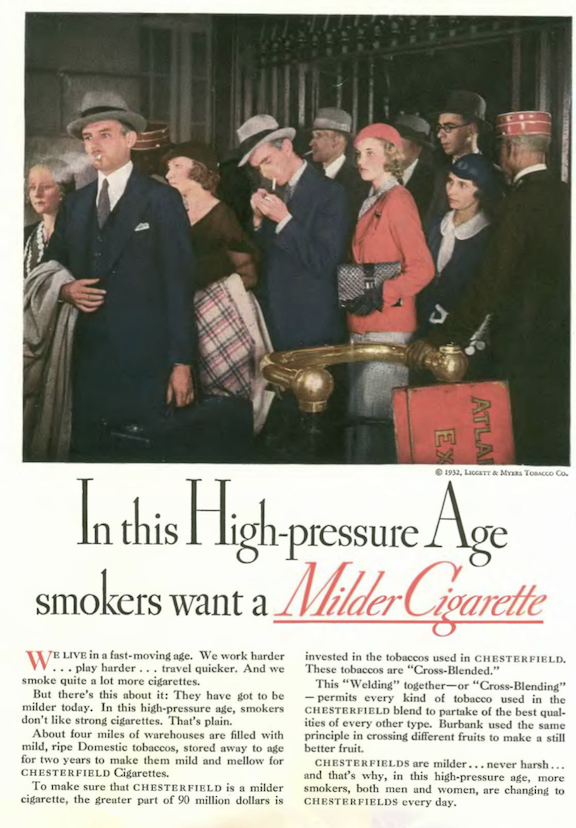
…as we see here from the folks who pushed the Chesterfield brand—in this ad aimed at the growing market of women smokers, you don’t see the carton, but what you do see are people waxing philosophical about smoking, quality smoking, that is, and it’s no mistake that the woman is sitting on the arm of the chair, receiving this “wisdom” from her husband…

…even when a man isn’t present, Chesterfield still perched the woman on the arm of the chair, as seen in this ponderous New Yorker ad from the previous year…

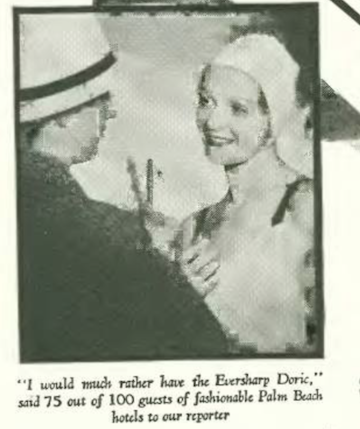
…and then you have Spud—the direct approach—yes dammit, do something, man!…your “mouth happiness” is at stake, so follow a schedule that keeps you puffing every waking minute…

…and we move on to the fashion world, where this new-fangled “Talon Slide Fastener” is keeping women’s corsets zipped up, except the vulgar, slang word “zipper”  hasn’t quite made it into the fashion lexicon as of 1932…

…and this other new invention—”Rayon”—is “becoming important to women who watch and are watched in classic correctness,” but believe me, no old money deb would ever allow anything artificial to touch her delicate hide…

…we continue into the cartoons in the fashion mode with one of Helen Hokinson’s “girls” getting a makeover…

Mary Petty, on the other hand, is keeping an eye on the younger crowd…

…we move on to Barbara Shermund and the old money gang, wary of astrologer Evangeline Adams‘ thoughts on the ailing stock market…

…one of their fellows was having troubles of his own in those troubled times, per William Steig

…and Denys Wortman took us to the other side of that window, and the dreams of a better life…

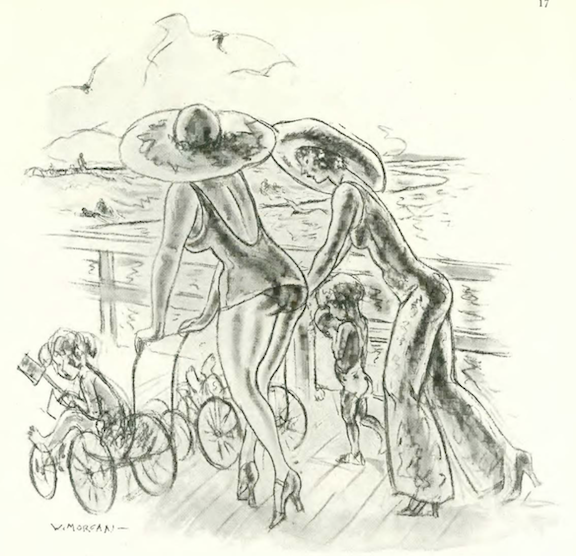
…urban realist Reginald Marsh gave us all a splash of cold water…

Isadore Klein, on the other hand, presented a domestic scene with particular relevance these days…

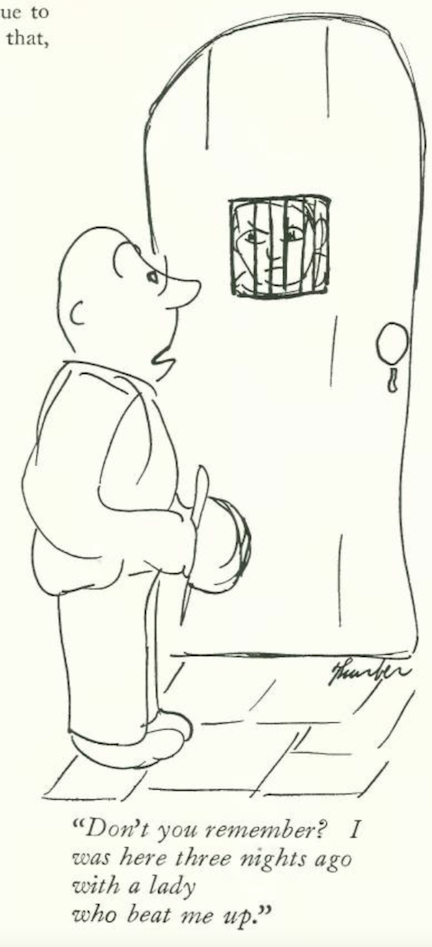
…and another domestic scene from the brilliant James Thurber, in which the pistol once again makes a timely appearance…

Next Time: Dream Cars…