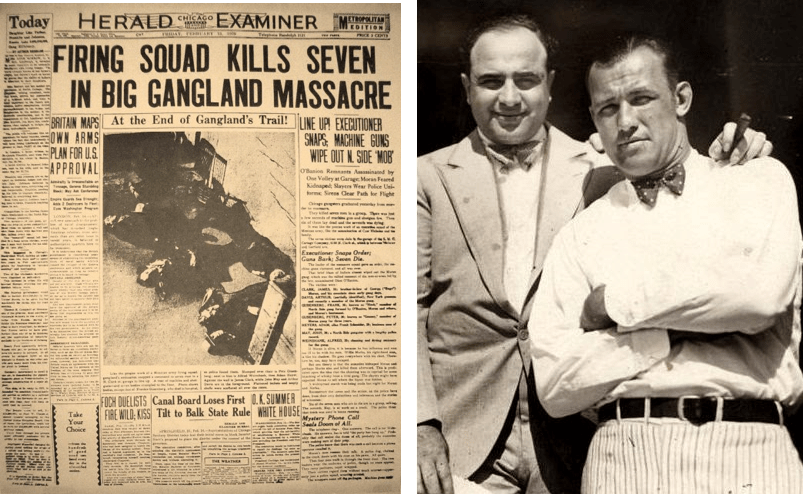
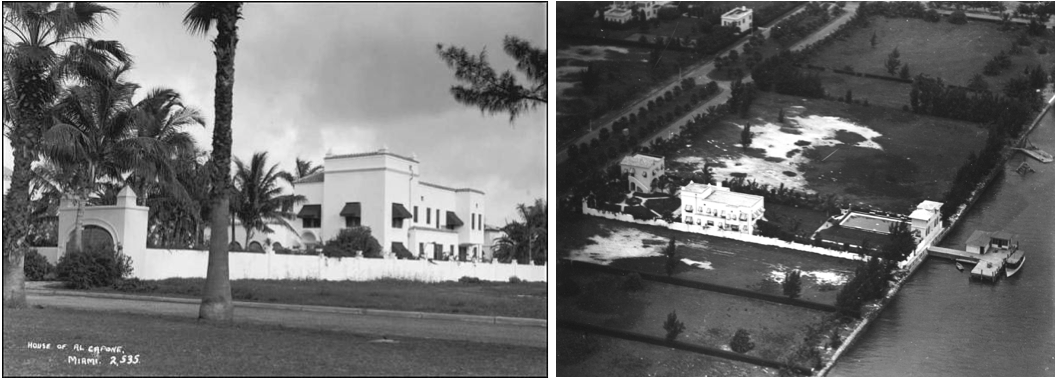
In 1928 Al Capone bought an estate on Miami’s Palm Island as a getaway from the hustle and bustle of Chicago gangster life. He was apparently basking in the Florida sun on Feb. 14, 1929 when four of his associates gunned down seven members of a rival Irish gang on Chicago’s North Side.
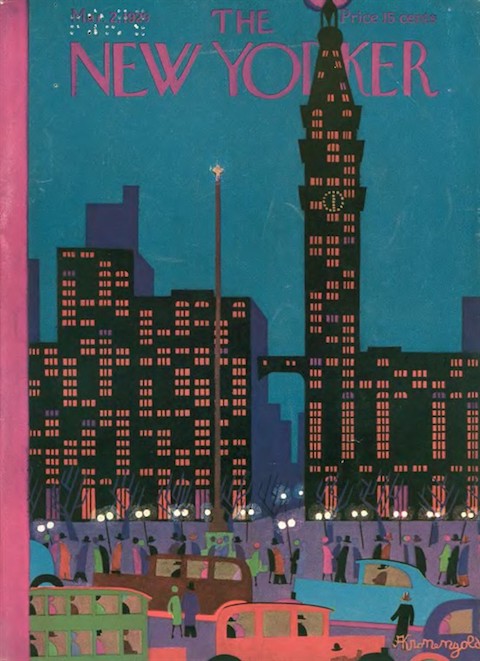
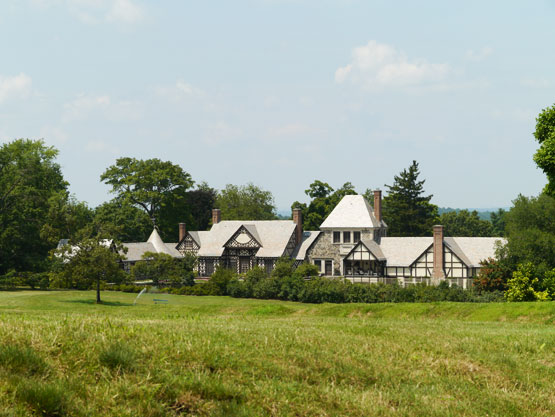
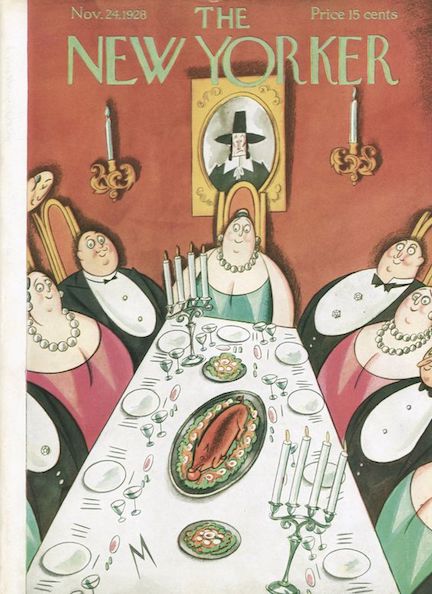
March 2, 1929 cover by Adolph K. Kronengold.WINTER RETREAT…Al Capone’s estate on Miami’s Palm Island. (miami.curbed.com / sallyjling.org)
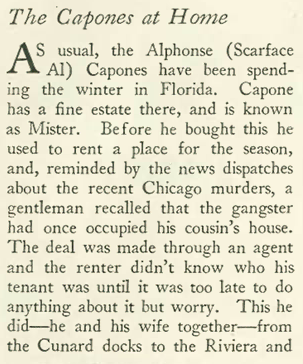
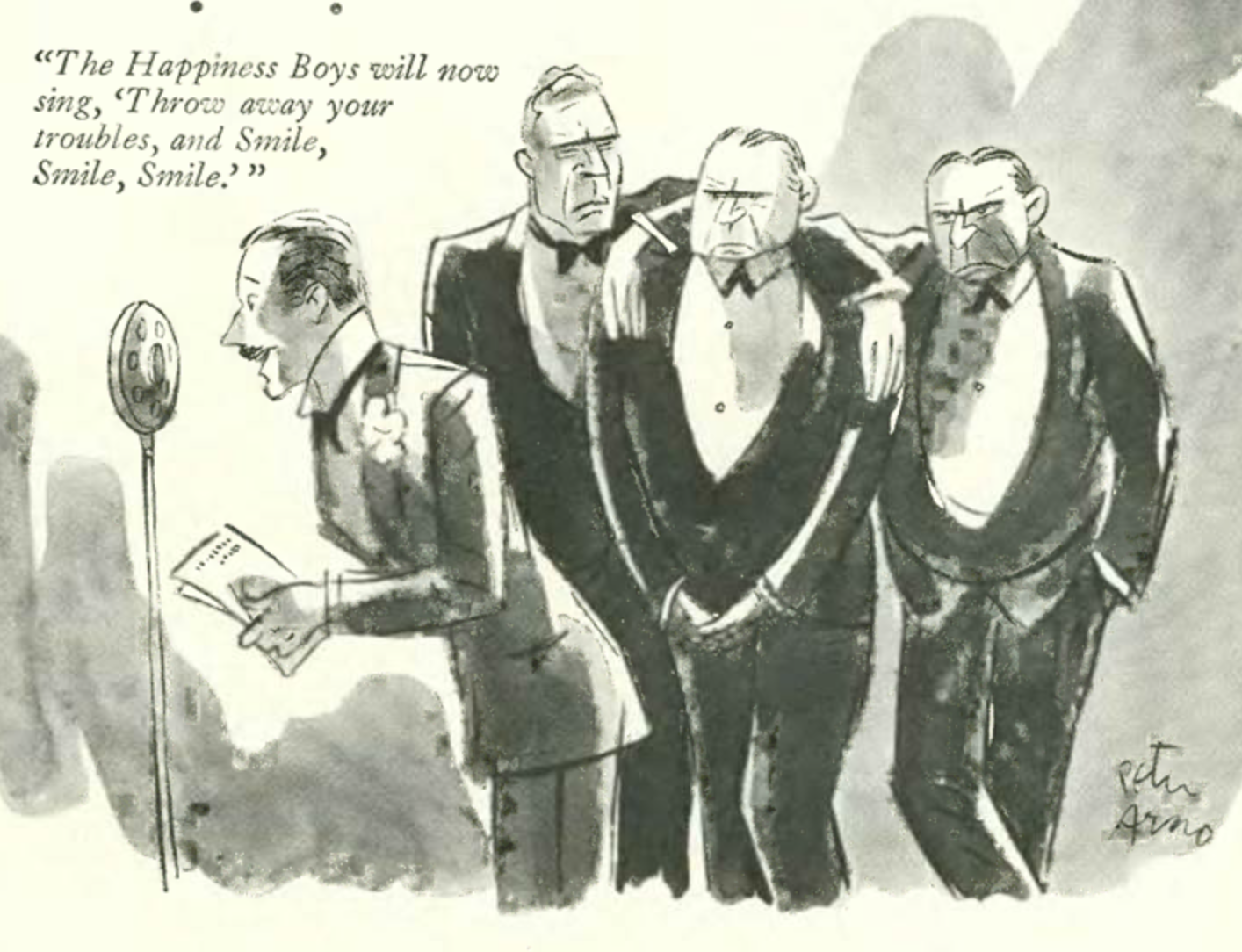
It is widely believed Capone ordered the killings, given that he dominated Chicago’s illegal bootlegging, gambling and prostitution trades and was known for his ruthless elimination of rivals. On the heels of the St. Valentine’s Day massacre, James Thurber contributed this item in the New Yorker’s “Talk of the Town” describing a more mundane side of gangster life:
Shortly after Thurber’s article appeared in the March 2, 1929 New Yorker, Capone would be arrested in Chicago by FBI agents on a contempt of court charge and again in May 1929 on a weapons charge. The following March Capone would be referred to as “public enemy number one” by the Chicago Crime Commission, and a month later he would be arrested on vagrancy charges during a visit to Miami—the Florida governor wanted him out of the state. In 1932 Capone would be sent to Federal Prison for tax evasion.
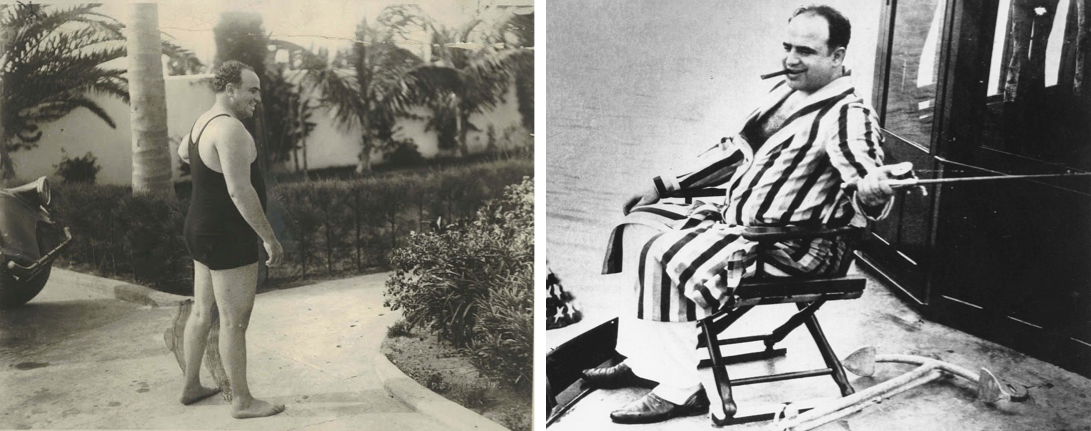
SNOW BIRD OF A DIFFERENT FEATHER…Al Capone relaxes at his Palm Island estate, left, and tries his hand at deep sea fishing off the Florida coast, circa 1929. (miami-history.com)TEN YEARS LATER…Al Capone and his wife Mae (at right), with their son, Albert and their soon-to-be daughter-in-law Diana Ruth Casey. The photo was taken at Palm Island in 1940 after Al Capone’s release from prison. (Associated Press)
When Capone finally returned to Palm Island in 1940, he was a very different man. When he entered the U.S. Penitentiary in Atlanta in 1932 he was found to be suffering from both syphilis and gonorrhea, and when he was released seven years later his mental capacities were severely diminished due to late-stage syphilis. In 1946 a physician concluded Capone had the mentality of a 12-year-old child. He died on Jan. 25, 1947, having just turned 48 years old.
Another mention of the St. Valentine’s Day massacre could be found in Howard Brubaker’s column “Of All Things”…
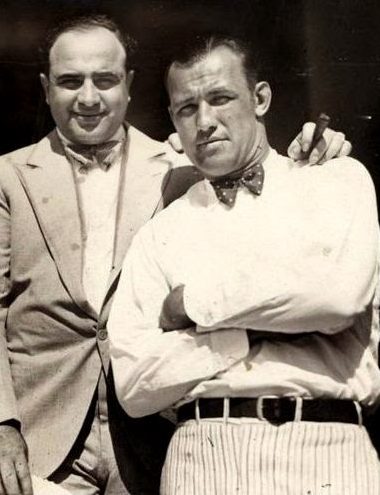
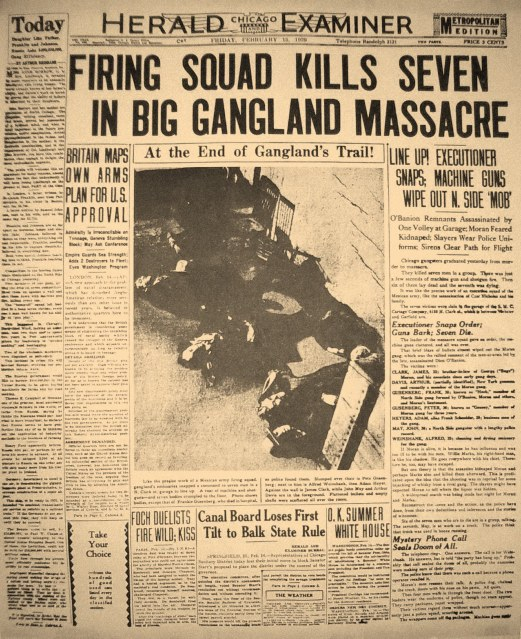
MY ALIBI…Al Capone poses with boxer Jack Sharkey in Miami on Feb 13, 1929, the day before the St. Valentine’s Day Massacre. Sharkey was in training for his bout with Young Stribling. (classicboxingsociety.blogspot.com)MEANWHILE IN THE WINDY CITY…The Chicago Herald-Examiner’s front page coverage of the St. Valentine’s Day Massacre. (Chicago Public Library)
* * *
Pierre’s Hotel
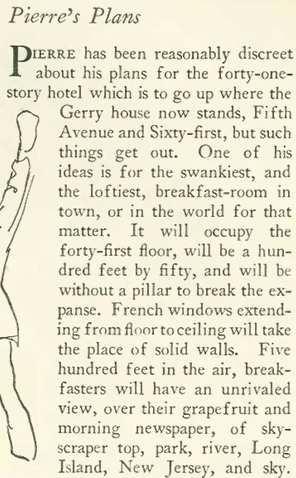
Back in New York, patrons of famed chef Charles Pierre Casalasco were abuzz over his plans for a luxury high-rise hotel. Writing in “Talk of the Town,” Leonard Ware made these observations about Pierre’s big plans:
A BUSBOY’S DREAM…Lloyd Morgan’s 1928 rendering of the Hotel Pierre (left), and the Hotel Pierre today, as viewed from Central Park. The hotel’s builder, Charles Pierre Casalasco, started out as a busboy in his father’s restaurant in Corsica. (Half Pudding Half Sauce / Wikimedia Commons)
Ware recounts how Pierre went from humble busboy to renowned haute cuisine restaurateur:
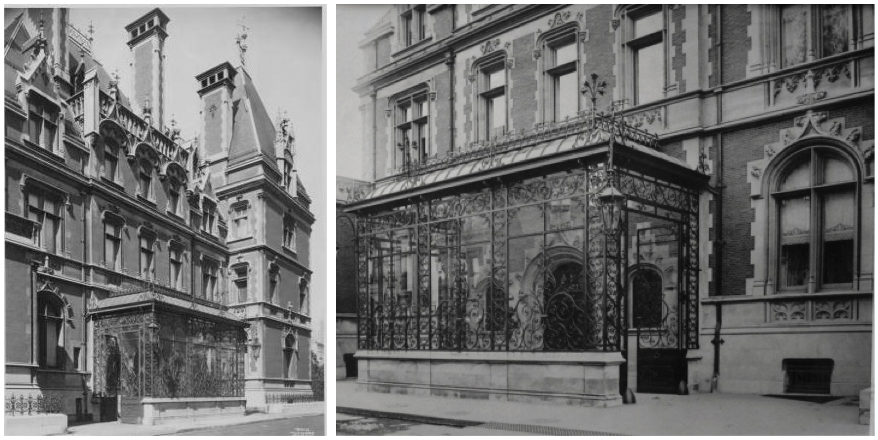
The Rotunda of the Hotel Pierre. (Wikimedia Commons)The 1897 Elbridge T. Gerry mansion, designed by Richard Morris Hunt, was torn down to make way for the Hotel Pierre. French artisans were hired to construct the elaborate wrought iron porte-cochere at the main entrance. (New York Public Library / American Architect & Building News)
* * *
Famed Bluestocking
The New Yorker’s Paris correspondent, Janet Flanner, who wrote under the pen name Genêt, wrote under her own byline for the first time in a profile of the famed novelist Edith Wharton, featured in the March 2 issue. Although born a New Yorker, Wharton mostly lived in France after 1914. Below is a drawing of Wharton by Hugo Gellert that accompanied the profile, of which a few excerpts are included below:
VIVE LA FRANCE…Edith Wharton at her spring and winter home in France, Sainte-Claire du Chateau, circa 1930. She finished her novel, The Age of Innocence at Sainte-Claire. (Pinterest)
STILL LOVELY…Sainte-Claire du Chateau today. (sydneynearlydailyphot.blogspot.com)
GOLDEN YEARS…Edith Wharton in her garden at Sainte-Claire du Chateau, circa 1930.
* * *
From Our Advertisers
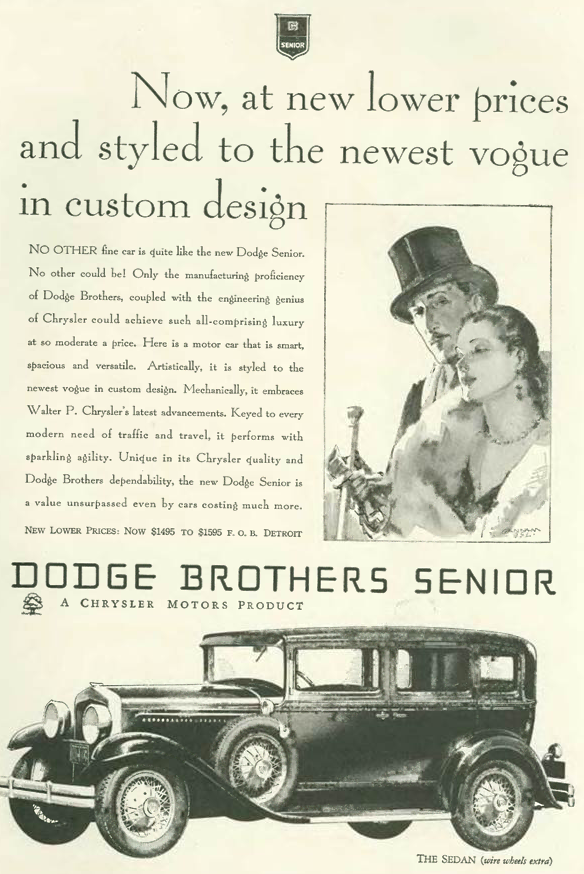
Automobile manufacturers were keen to snob appeal even 90 years ago, as can be seen in this advertisement for Dodge cars—the company had been acquired the previous year by Walter Chrysler. Dodge cars were noted for dependability and value, but this ad suggested even blue bloods would find them appealing…
…Chrysler did however take a more direct aim at the top-hat set with a new model— Imperial—to compete with luxury carmakers such as Lincoln and Cadillac…
…just for kicks, this is what the Chrysler Imperial would look like just 30 years later…
(Kimballstock)
…not to be left out, Cadillac placed its downscale luxury model next to Mont-Saint-Michel in this illustrated advertisement. The LaSalle was comparable in price to the Imperial (around $2,500 to $3000) while top-of-the-line Caddies were priced up to $7000…
…and what do you put in your fine automobile to make it purr? Why gasoline mixed with tetraethyl lead, of course!
Speaking of mixing, I like this advertisement for Cliquot Club, whose manufacturers finally—and not so subtly—hint at how their product is to be enjoyed…
…and finally, this ad for the new Fuller Building, which touted gallery spaces for “superior merchandise” on its first six floors…
ART DECO GEM…The 1928-29 Fuller Building by Walker & Gillette at 41 East 57th St. The crown (at left), and a view of the entrance. The lower floors still serve as gallery spaces for art dealers such as Neuhoff and Emmerich. (nyc-architecture.com)
In the cartoon department, we have I. Klein’s take on recent activities associated with the inauguration of President Herbert Hoover…
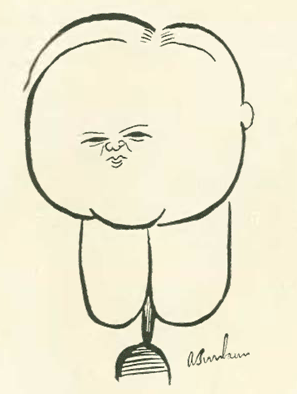
…and Abe Birnbaum, who provided this sketch of Hoover for the opening pages…
…Otto Soglow’s manhole denizens looked for signs of spring…
…and finally, a comment on the diversification of drugstore wares, by a cartoonist signed as “Kinol.” I’ve had no luck tracing this name, so if anyone has the scoop on this artist, please drop me a note!
The fourth anniversary issue of the New Yorker gave every indication that the magazine had arrived as a cultural force.
Fourth anniversary cover, Feb. 23, 1929, by Rea Irvin.
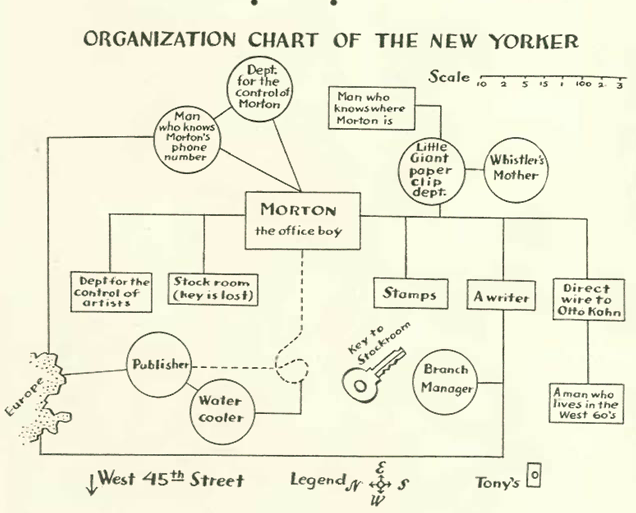
Rich in content, the issue’s offering’s ranged from the famed humorous short “You Were Perfectly Fine” by Dorothy Parker, a profile of famed maestro Arturo Toscanini, and various accounts on the romance between Charles Lindbergh and Anne Morrow. The issue also featured this “organization chart” drawn by Julian de Miskey:
The little door marked “Tony’s” in the bottom right-hand corner referred to a celebrated speakeasy operated by Tony Soma. It was a second home to many New Yorker staffers, and was patronized by hard-drinking actors and writers including Scott and Zelda Fitzgerald, Dorothy Parker and Robert Benchley, and also a young actor named Humphrey Bogart.
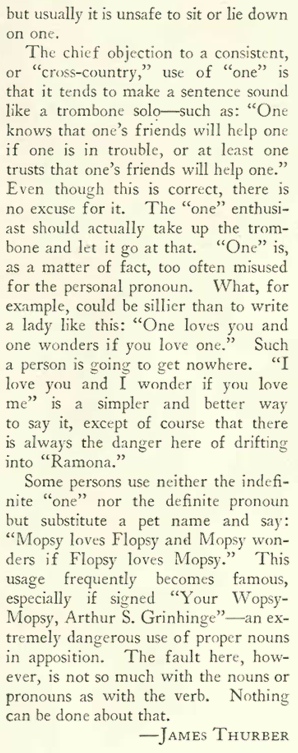
Another notable item in the Feb. 23 issue was this contribution by James Thurber in which he lampooned H.W. Fowler’sModern English Usage, a handbook that New Yorker Editor-in-Chief Harold Ross considered to be the last word in matters of punctuation and grammar. Thurber would write a dozen entries in this series, including the following (click to enlarge):
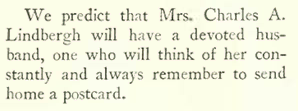
The New Yorker could never get enough of Charles Lindbergh, even though his personality was every bit as wooden as that of the former President Calvin Coolidge. The Feb. 23 “Talk of the Town” speculated on “Charlie’s” affections for Anne Morrow, and the woe that would befall anyone who challenged the famed flyboy for those affections:
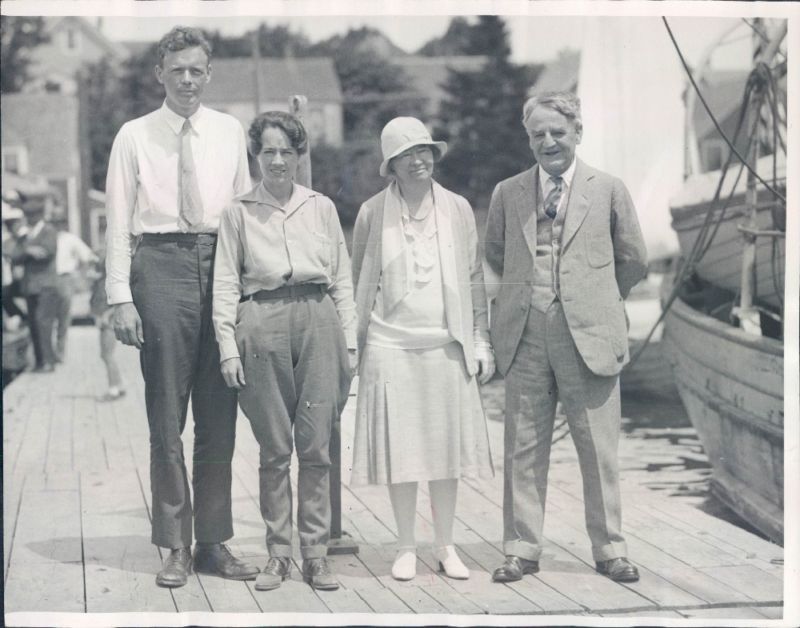
COME FLY WITH ME…Anne Morrow Lindbergh and Charles Lindbergh shortly after their marriage in May 1929. (Bio.com)SON-IN-LAW…Charles and Anne visiting Anne’s parents, Elisabeth and Dwight Morrow, in 1931. Charles met Anne during a visit to Mexico when Dwight was served as ambassador to that country. (kaiology.wordpress.com)
A second item in the Feb. 23 “Talk” section took a closer look at Charles’ courtship habits, or lack thereof…
Even Howard Brubaker got in a word regarding the Lindbergh-Morrow courtship in his column, “Of All Things”…
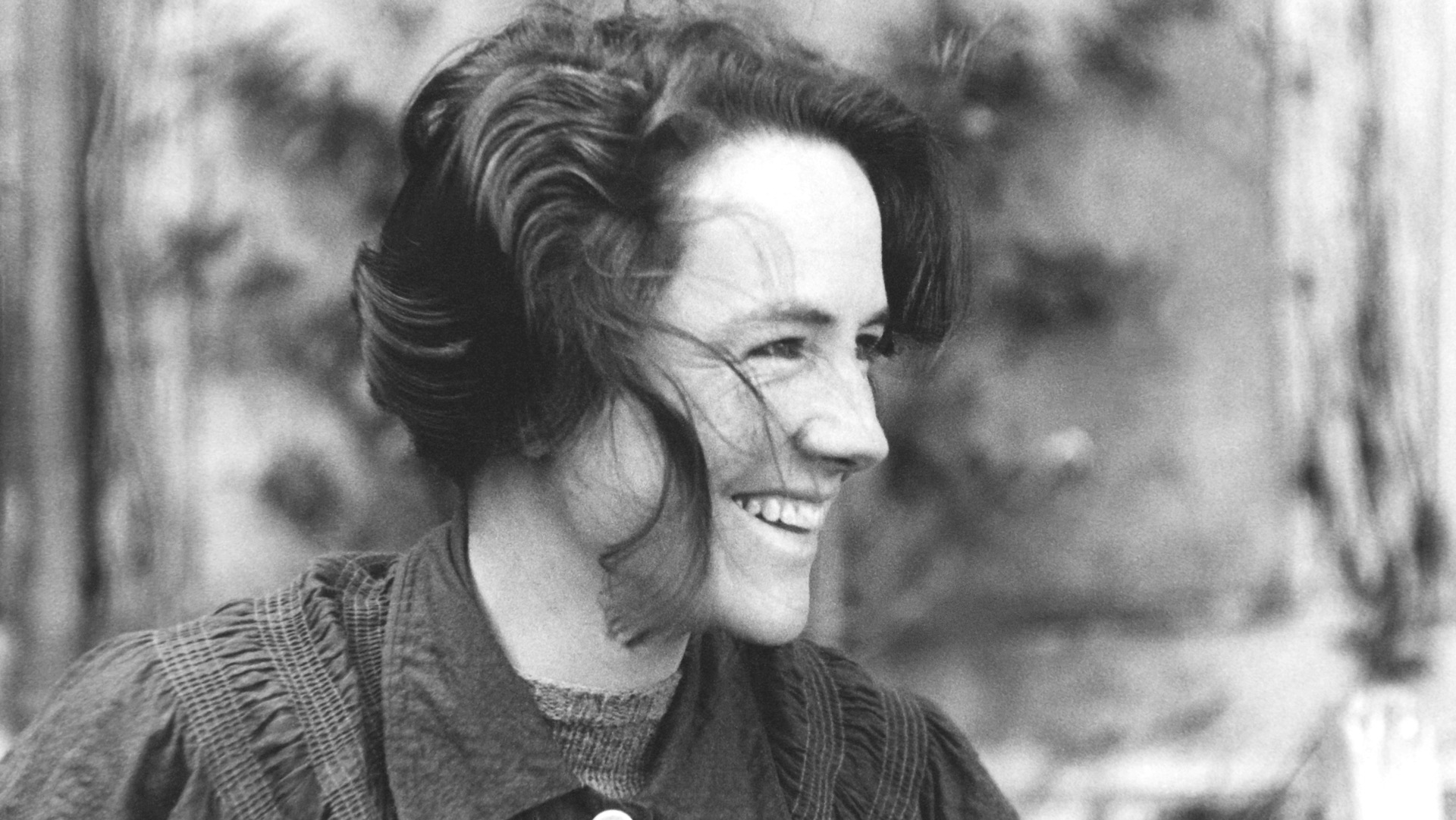
As we know, Brubaker had it wrong. Rather than pining away at home, Anne would become one of the 20th century’s most beloved writers, a leading feminist voice, and an accomplished aviator in her own right.
SORRY CHARLIE…As one for the most beloved writers of the 20th century, Anne Morrow Lindbergh would go on to match and even eclipse her husband’s fame. (PBS)
* * *
Little Yehudi
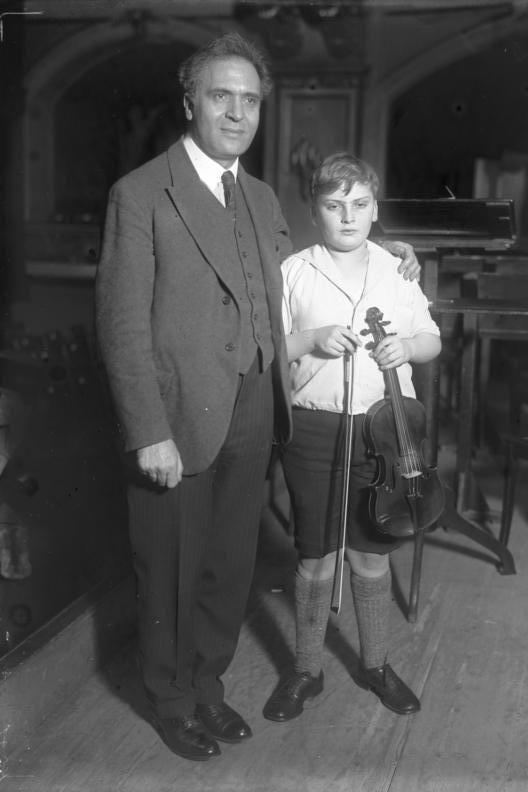
Yehudi Menuhin is known to classical music lovers as one of the greatest violinists of the 20th century. But as this “Talk” item suggests, he was once a little boy, more or less…
STILL IN SHORT PANTS…A young Yehudi Menuhin poses with conductor Bruno Walter in Berlin, 1931. Just two years after this photo was taken, Walter would flee Nazi Germany and eventually settle in the U.S. (Wikipedia)
* * *
More Fun With Lois
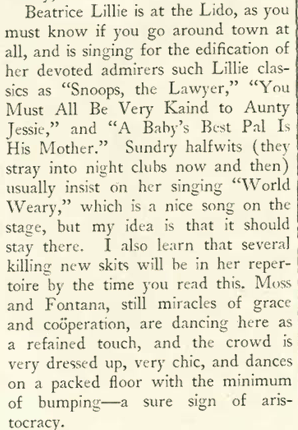
Although Lois Long devoted most of her ink to her weekly fashion column, “On and Off the Avenue,” she continued to write her nightlife column, “Tables for Two,” though somewhat sporadically. Which makes sense because around this time Long was also either pregnant (she was married to New Yorker cartoonist Peter Arno) or was now the mother of a daughter, Patricia. The reason I’m not sure is that I have birth dates from both 1928 and 1929 for Patricia, depending on sources. At any rate, Long was taking in the nightlife in a big way, moving from club to club and assessing the quality of their various acts:
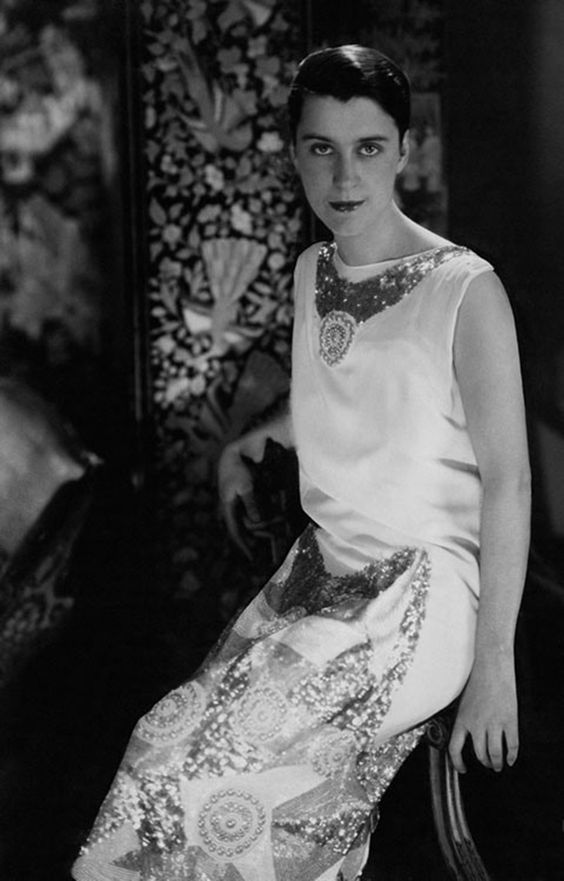
At the Lido, Beatrice Lillie sang “for the edification of devoted admirers”…
AT THE LIDO you could see British actress, singer and comedic performer Beatrice Lillie light up the stage. (vintag.es)
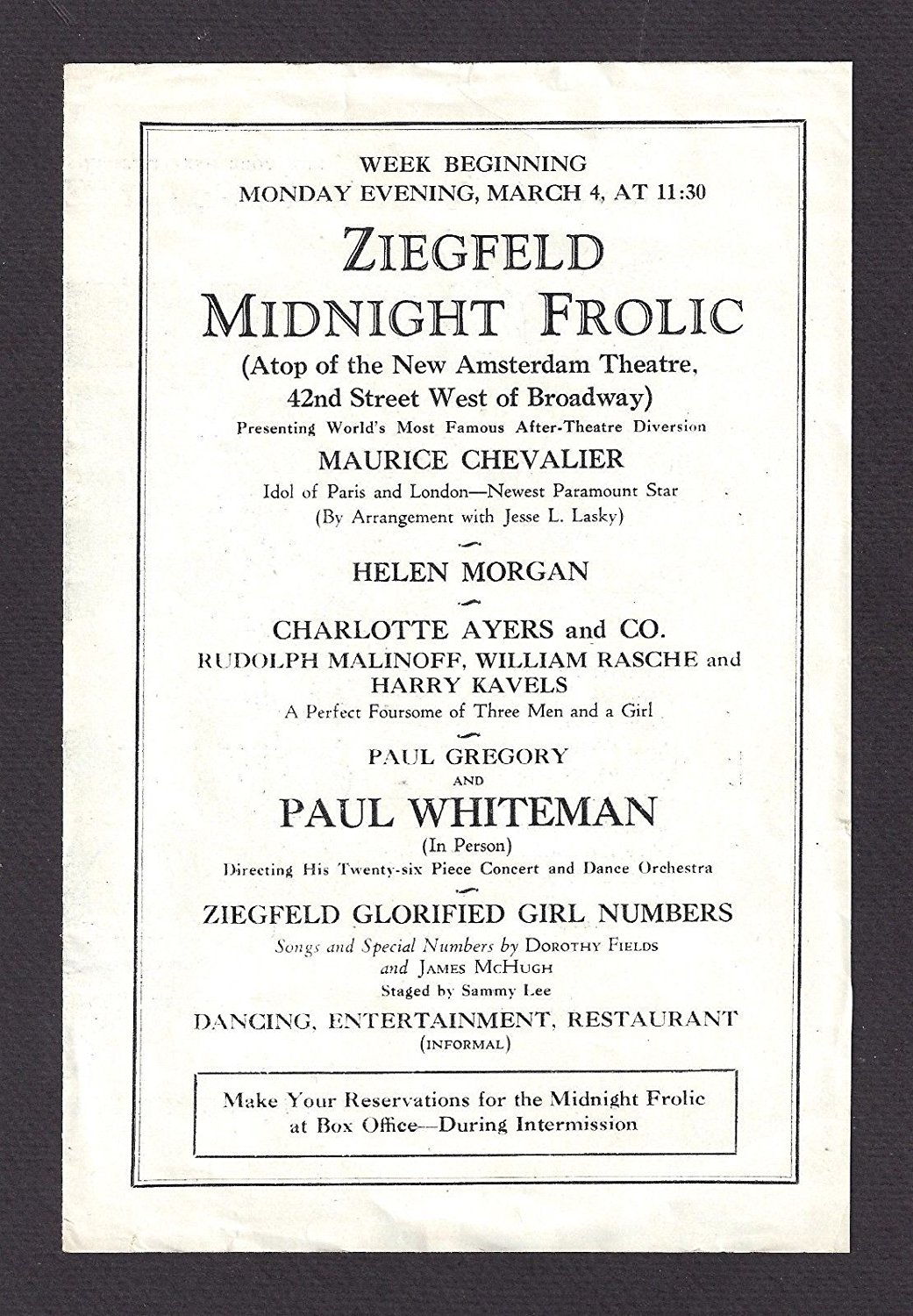
…Long also commented on the arrival of French entertainer Maurice Chevalier, who promised to inject some life into the Paul Whitman Orchestra performing at the Ziegfeld Midnight Frolic…
Flyer announcing Maurice Chevalier’s upcoming performance at the Ziegfeld Midnight Frolic.THANK HEAVEN…Maurice Chevalier in a 1929 publicity photo. He is mostly known today for his appearance in the 1958 film Gigi and his rendition of “Thank Heaven for Little Girls.” (thefamouspeople.com)
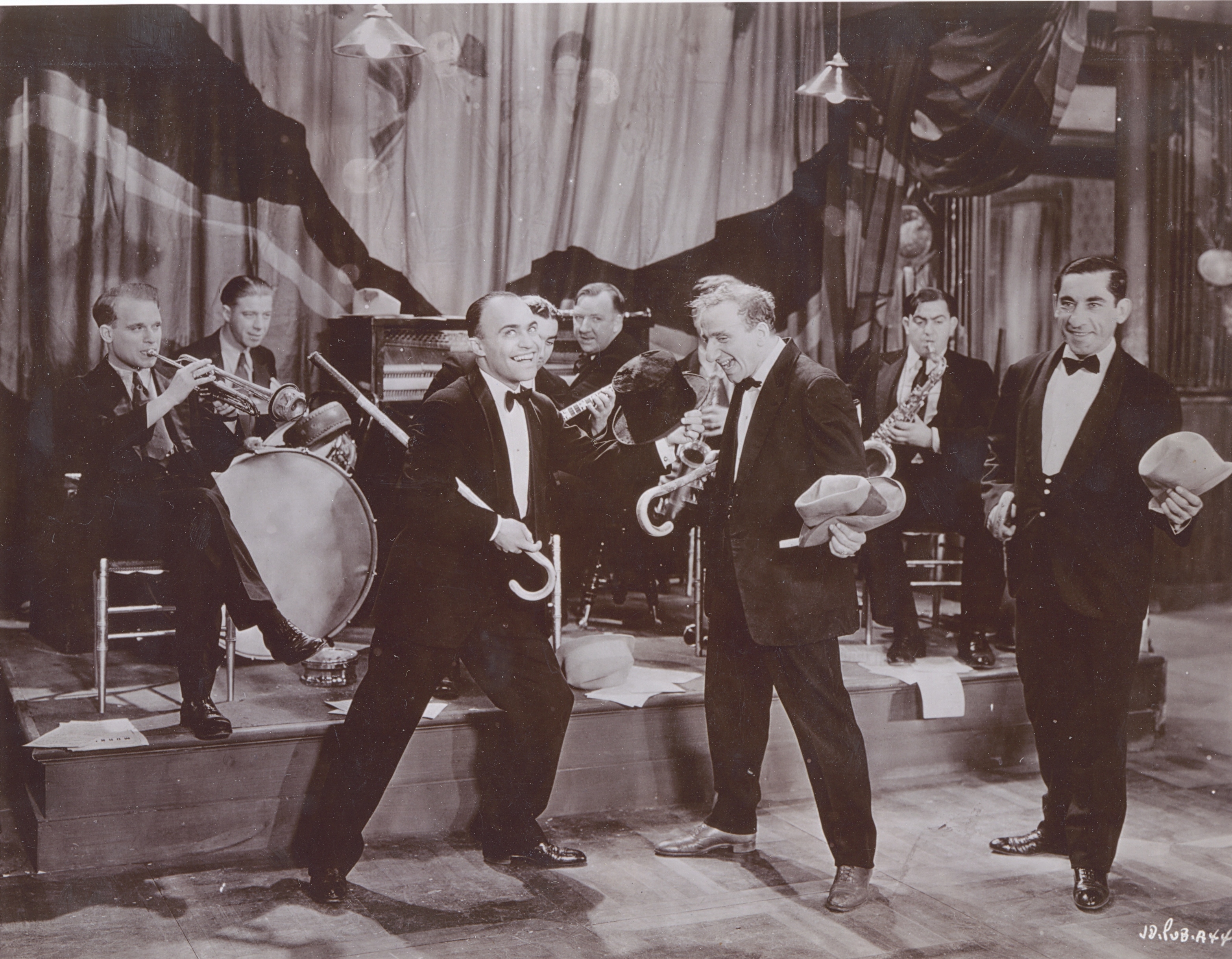
As for the rest of the New York nightlife, Long hoped that in the end it was all for fun, and that there was no “deep meaning” behind the frivolity:
SHALLOW WATERS…Eddie Jackson, Jimmy Durante, Lou Clayton performing their act in the motion picture Roadhouse Nights, 1930. (digitalcollections.nypl.org)
* * *
Something In the Air
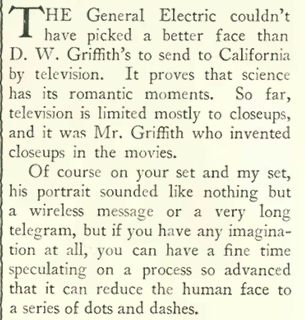
The “On The Air” column noted that NBC had made a brave attempt at rebroadcasting the music of the London Symphony Orchestra from Queen’s Hall and had “succeeded in coaxing a section of Rachmaninoff’s E Minor Symphony across the Atlantic.” It was also reported that the General Electric Company of Schenectady, in its ongoing research into television, had successful sent an image of famed film director D.W. Griffith across the country to California. In a separate item. “The Talk of the Town” also reported on the achievement…
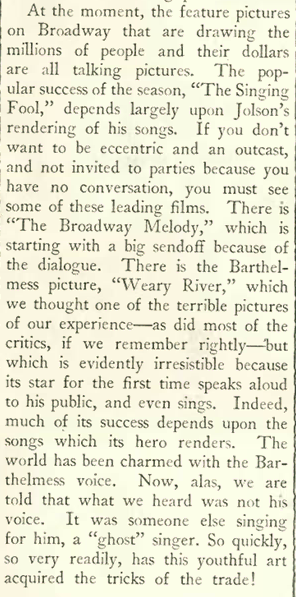
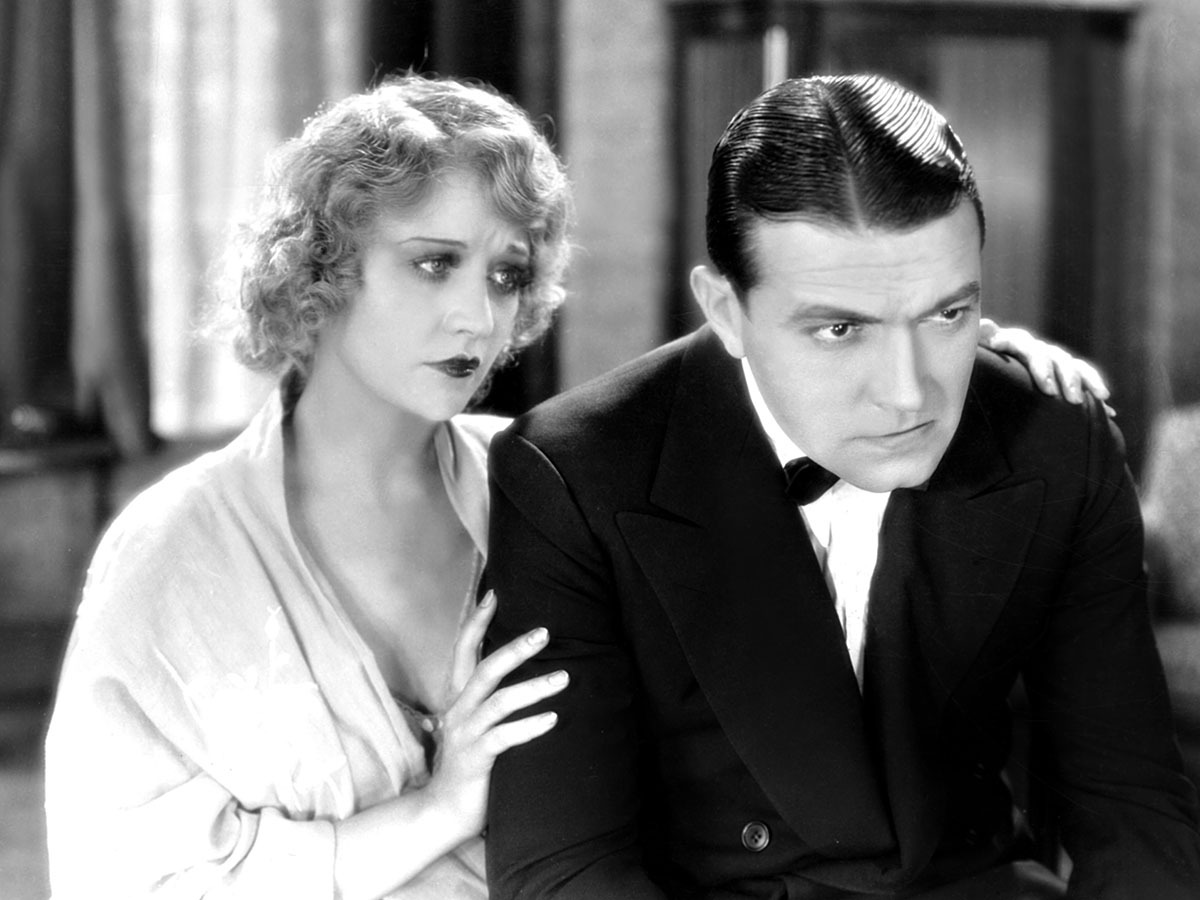
…and advances continued in motion pictures, the “talkies” quickly overtaking the silents and even resorting to such tricks as lip-syncing:
SORRY DEAR, YOU’VE BEEN DUBBED…Betty Compson with Richard Barthelmess in Weary River. While Barthelmess’s character sings and plays the piano throughout the film, Barthelmess himself did not sing or play the piano. Frank Churchill played the piano and Johnny Murray sang into a microphone far away from Barthelmess while he lip-synced and played a piano which had strings deadened with felt. (TCM)
* * *
For the anniversary issue, and for old time’s sake, the New Yorker tossed in this little filler joke from its first issue, a joke that was repeated ad nauseam in subsequent issues:
This riddle, told backwards, appeared to be a mistake, but it was most likely an attack on two-liners found in humor magazines of the day like Judge and Punch.
From Our Advertisers
Advertising was booming for the New Yorker in 1929, the magazine recording nearly $2 million in ad sales that year (compared to just $36,000 in their first year, 1925). Now on to the ads…
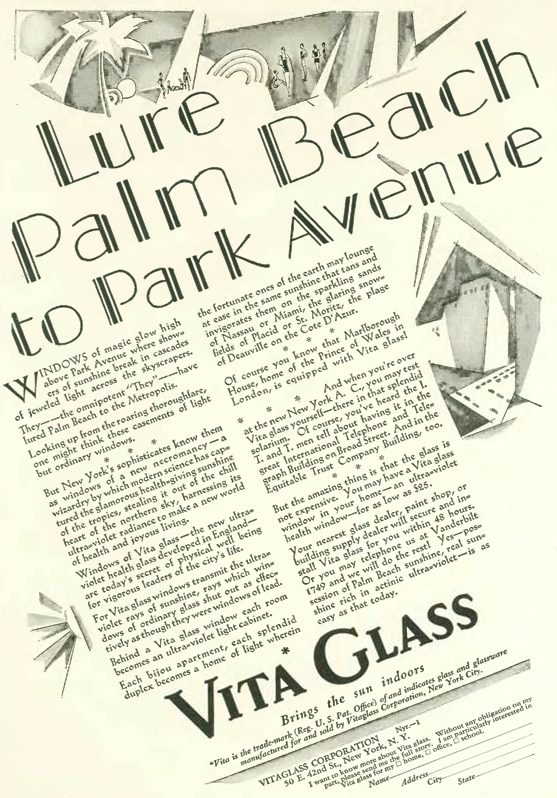
In a recent post we followed the mostly wealthy New York snowbirds down to Palm Beach, Florida, which during the 1920s grew from a quiet village to a resort for the rich and famous. For those who couldn’t make it, they could install “Vita Glass” and bring Palm Beach to Park Avenue…
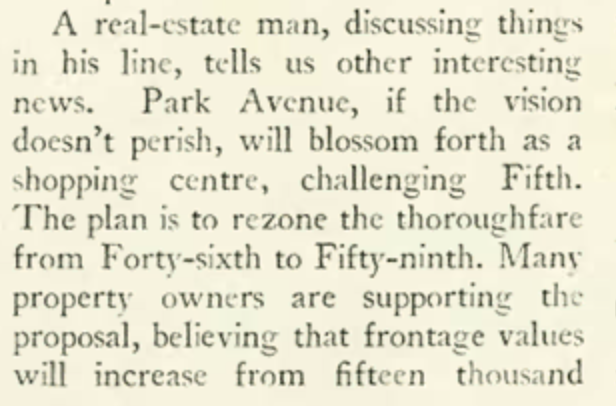
…and as spring approached, one could catch a bit of nature’s breezes atop 730 Park Avenue…
…or live like a demi-god above the toiling masses at Fifth Avenue’s Lefcourt National…
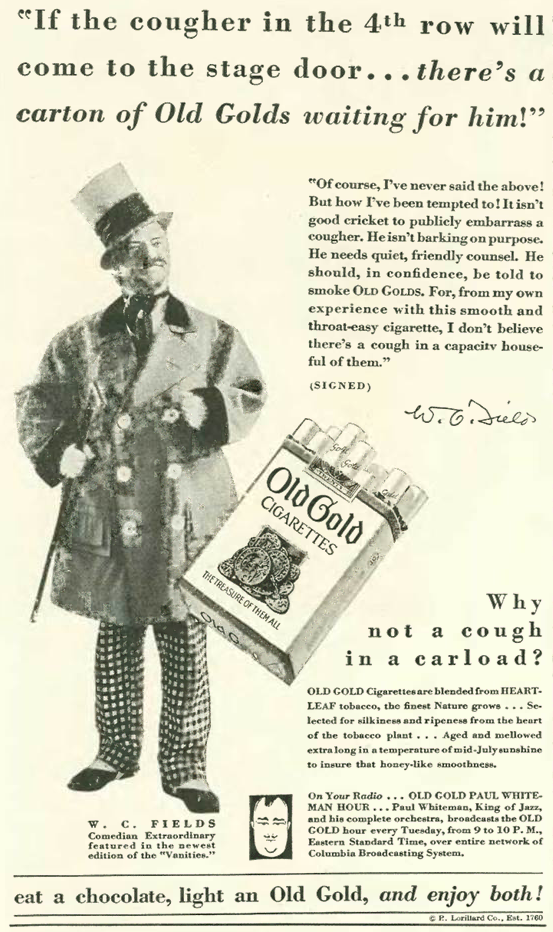
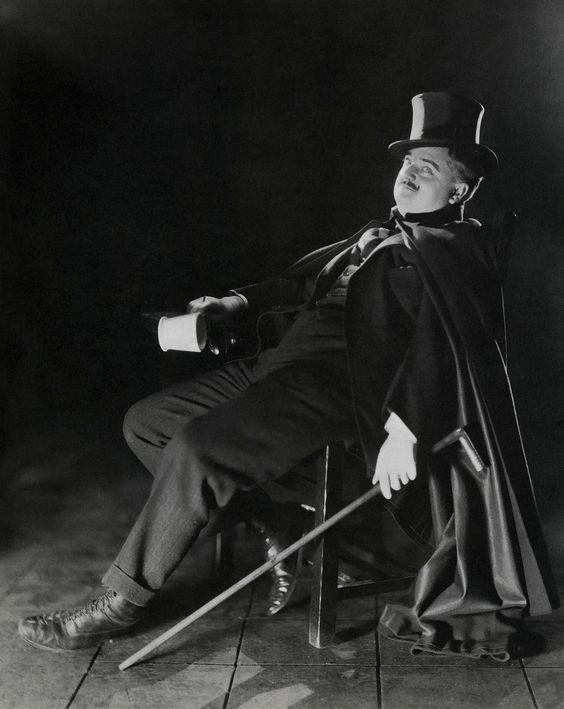
…back on terra firma, we find W.C. Fields the latest endorser of Old Golds…
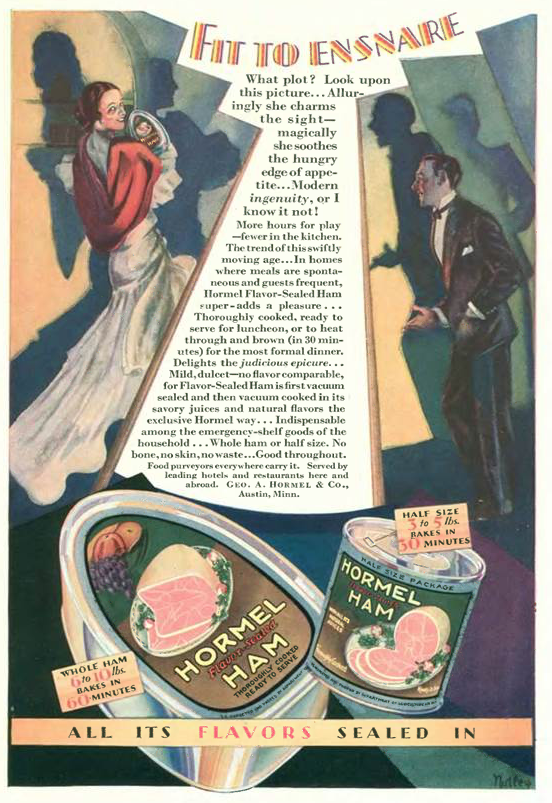
…this has to be the most audacious attempt to add sex appeal to canned ham…
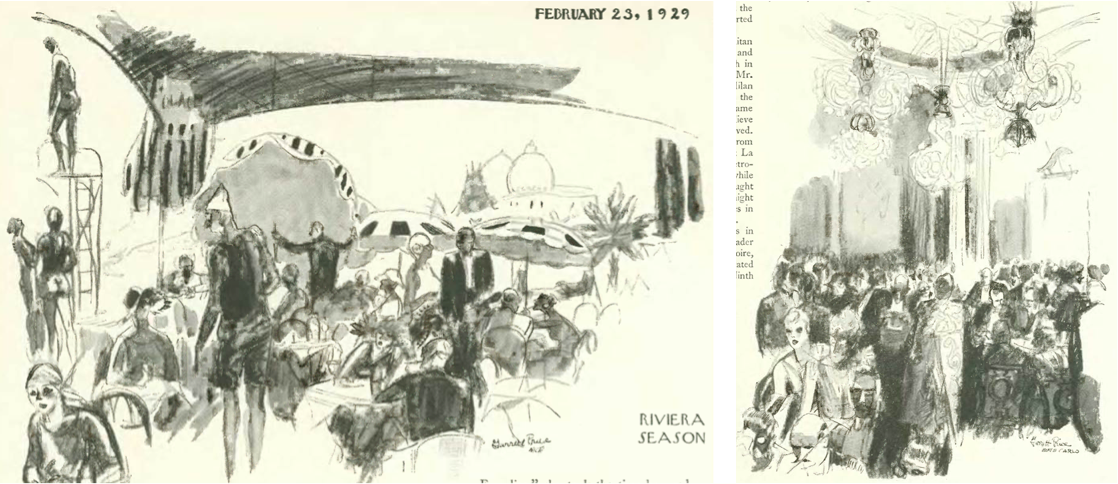
And finally, our illustrators…Garrett Price contributed some fine drawings of Nice and Monte Carlo…
…Barbara Shermund looked in on young toffs making idle chat…
…and Rea Irvin, finding everyone perplexed over Einstein’s unified field theory…
Our sense of what is old and what it is new becomes skewed during periods of rapid change, and such was the case in 1920s New York when large swaths of the old city were swept away and replaced by massive towers that seemingly rose overnight. Places like the Hippodrome Theatre, a 1905 Beaux-Arts confection barely 24 years old, seemed positively ancient in those heady times.
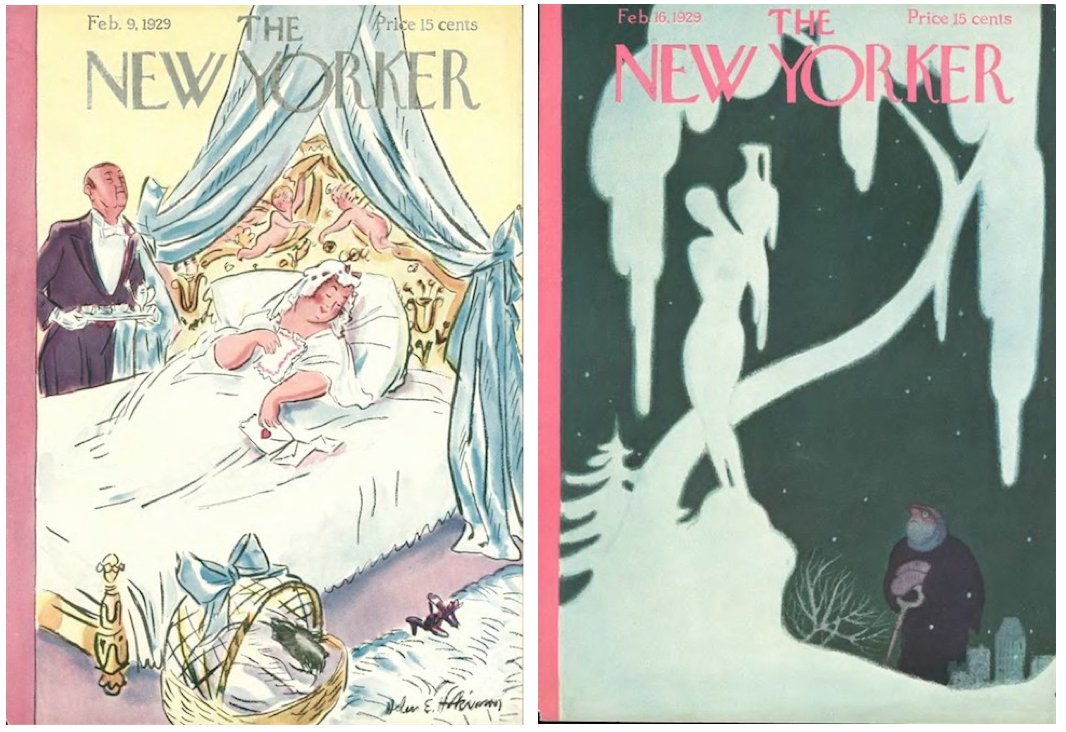
Feb. 9, 1929 cover by Helen Hokinson. Feb. 16, 1929 cover by Rea Irvin.
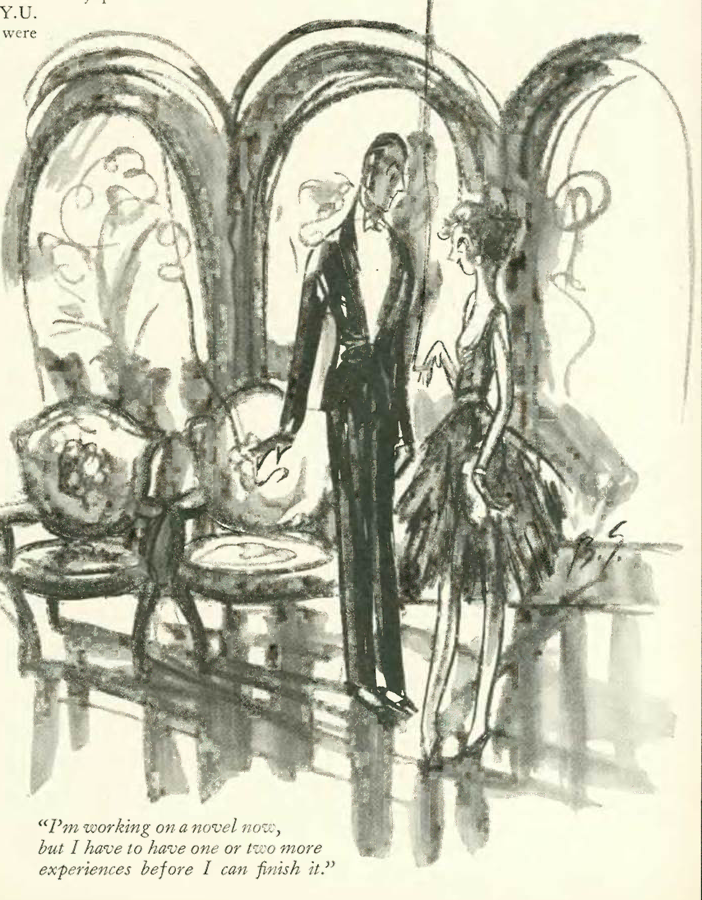
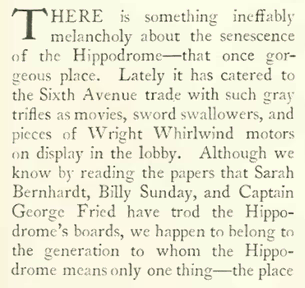
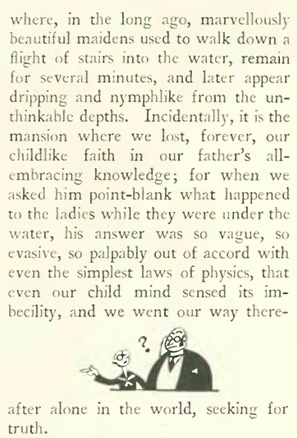
For the most part the New Yorker was enthusiastic about the changing skyline, as its namesake was claiming the crown as America’s premier city; but occasionally a melancholy note would be struck when a familiar institution appeared in decline or fated for the wrecking ball. In the Feb. 9, 1929 “Talk of the Town,” E.B. White wistfully recalled the old days of the Hippodrome, once the largest theatre in the world and the pride of turn-of-the-century New York:
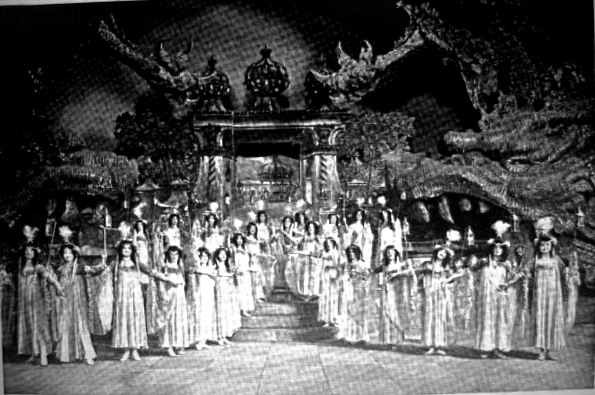
FOR THE MASSES…The Hippodrome, built in 1905, provided entertainment to millions of New Yorkers who couldn’t afford a ticket to a Broadway play. The brainchild of Frederick Thompson and Elmer S. Dundy, entrepreneurs of Coney Island’s Luna Park, the Hippodrome was torn down in 1939 after more than a decade of decline. (1905 photo courtesy Library of Congress)A REALLY BIG SHOOO…One of the first performances at the Hippodrome was a four-hour spectacle: A Yankee Circus on Mars (advertised on the theatre’s marquee in photo above). The 1905 production included 280 chorus girls, 480 soldiers, a parade of cars driven by elephants, an equestrienne ballet, acrobats, and a cavalry charge through a lake. (Image from Harper’s Weekly via daytoninmanhattan.blogspot.com)The Hippodrome’s main theatre could accommodate 5,300 patrons in seats that were four inches wider than normal theatre seats. The dome over the “Roman style” auditorium encompassed an acre. (Broadway Magazine 1905 via daytoninmanhattan.blogspot.com)
The Hippodrome held such a place in the heart of the New Yorker that the magazine offered further reminiscences in the Feb. 16 issue, this time penned by managing editor Harold Ross:
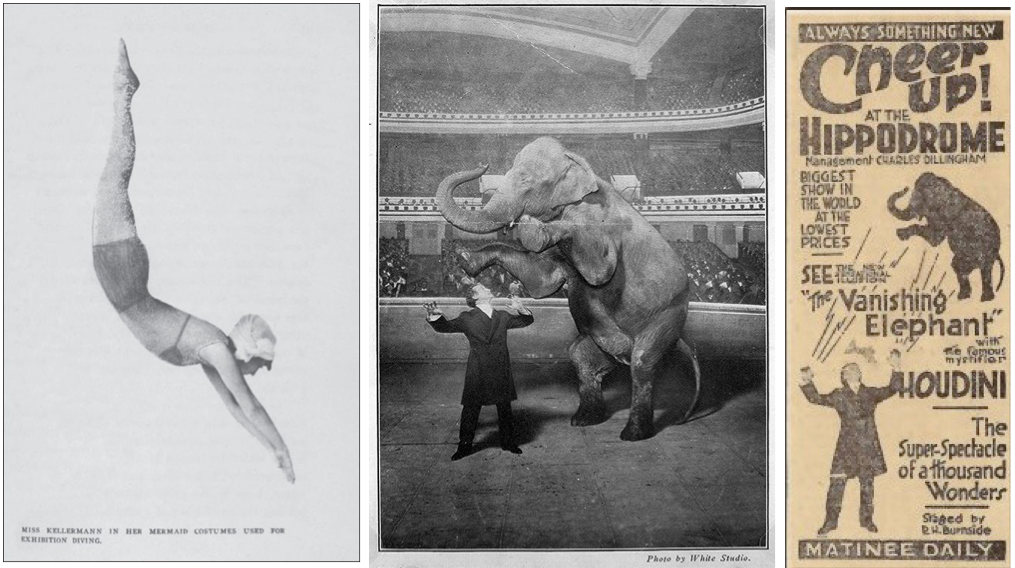
For demonstrations of diving and “mermaid spectacles,” the Hippodrome stage featured an eight-foot high steel tank in four sections, with a front of plate glass. Manned diving bells were also used to raise and lower “mermaids” during performances.
OLD TIMEY FX…Illustration from Nature magazine (left) depicts a diving bell used in the Hippodrome’s swimming and diving tank to raise and lower performers. At top, circa 1910 advertisement; at bottom, the “Court of the Golden Fountain” in the the theatre’s 1905-06 presentation of A Society Circus. (les-sources-du-nil.tumblr.com/flickr/NYC Architecture)
Ross wrote about the Hippodrome’s “diving girls,” who would dive into a tank of water from a height of 90 feet, sometimes at a serious cost to their health:
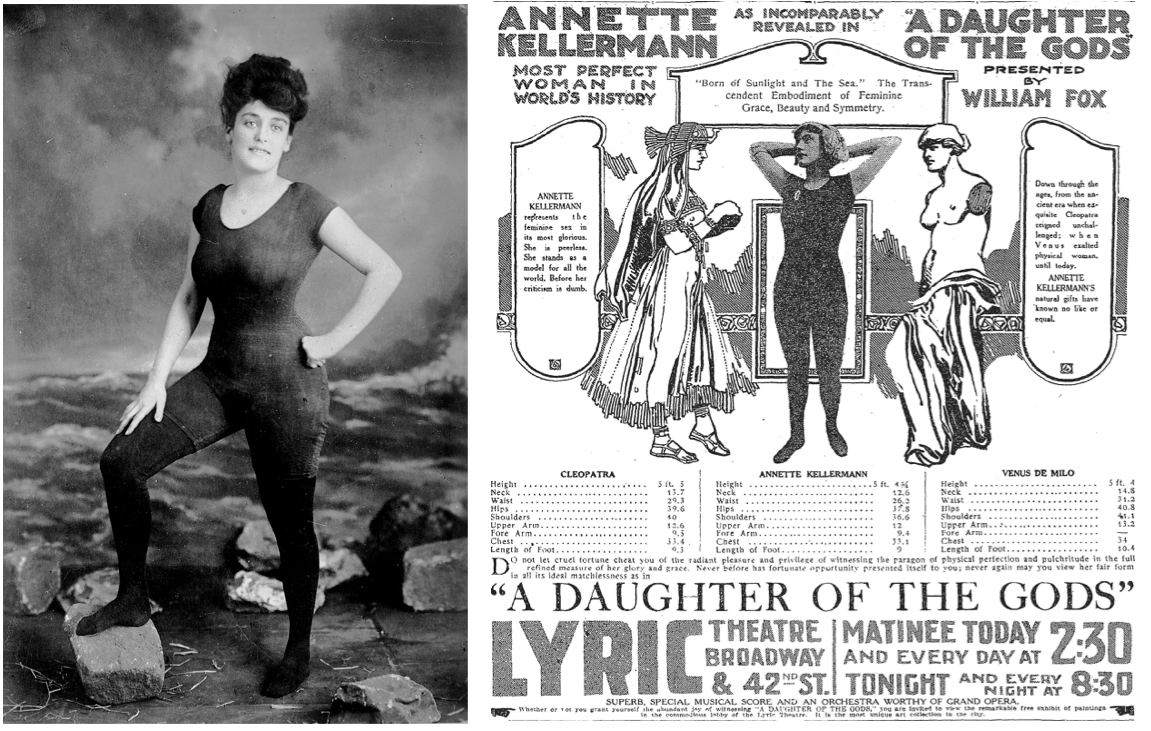
HIPPODROME’S HEYDAYS…In the early 1900s Australian swimmer and diver Annette Kellerman (left, in an image from her 1918 book, How to Swim) was a famed performer at the Hippodrome, as was illusionist and stunt performer Harry Houdini, shown here in 1918 with Jennie the Elephant in a performance of the vanishing elephant trick. (Monash University/americaslibrary.gov/wildabouthoudini.com)MILLION DOLLAR MERMAID…famed around the world by that moniker, swimmer and later actress Annette Kellerman is considered the originator of the one‐piece bathing suit, which she models at left in a photo taken around 1907. At right, advertisement for Kellerman’s 1916 film A Daughter of the Gods (now lost), in which Kellerman achieved another first: the first complete nude scene by a major star. The William Fox Studio made much of Kellerman’s figure, promoting her as the perfect woman by “comparing” her measurements to the likes of Cleopatra and Venus de Milo. (Wikipedia/consumingcultures.net)
Australian swimmer Annette Kellerman was a big draw at the Hippodrome, and helped popularize the sport of synchronised swimming after her 1907 performance of the first water ballet in theatre’s giant plate glass tank. In that same year she shocked Bostonians by appearing on a local beach in a “daring” one‐piece bathing suit (shown above), and was arrested for indecency. This was at a time when a woman’s standard bathing apparel consisted of a blouse, skirt, stockings and swimming shoes.
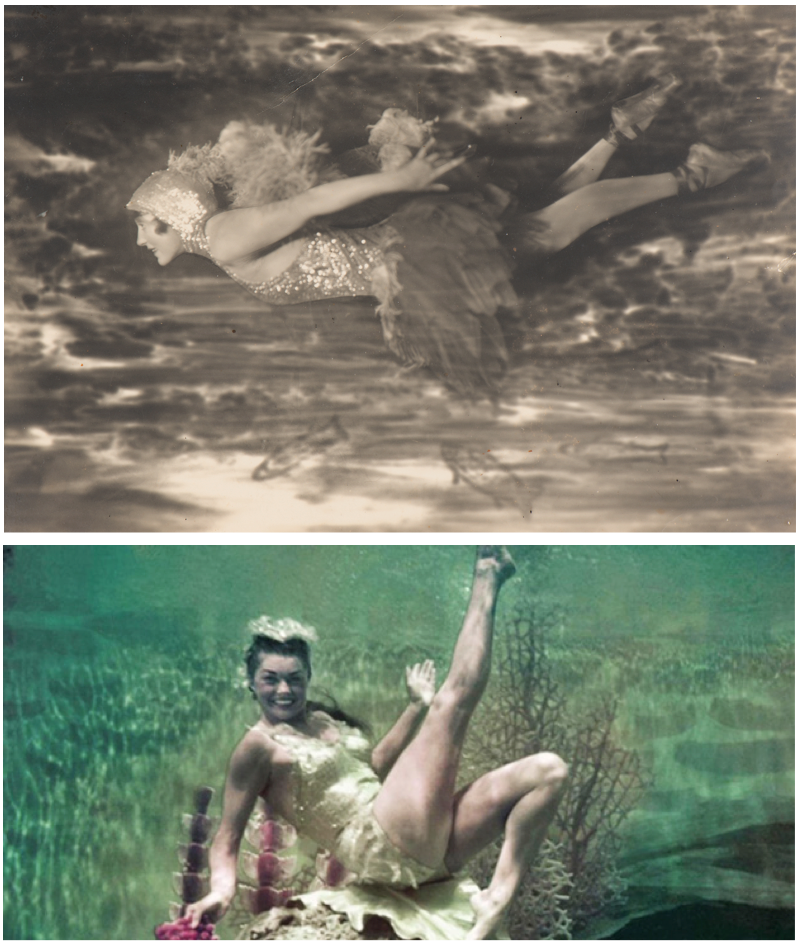
Unlike some of the unfortunate Hippodrome divers who later lost their eyesight due to cranial pressure from high dives, Kellerman went on to a long and active life (she died in 1975, at age 88). Known throughout the world as Australia’s “Million Dollar Mermaid” (and portrayed by Esther Williams in a 1952 movie by the same name), Kellerman appeared in more than a dozen films between 1909 and 1924. She also launched her own line of swimwear and wrote several books on swimming, beauty and fitness.
ALL WET…At top, Annette Kellerman swimming underwater in a gold sequined dress, possibly from Queen of the Sea (1918, now lost). Thirty-four years later Esther Williams (below) would portray Kellerman in Million Dollar Mermaid. (historycouncilnsw.org.au/gsgs/movieactors.com)
* * *
City of Lights
While E.B. White got misty-eyed about the old Hippodrome in the Feb. 9 issue, his fellow New Yorker writer and friend James Thurber was thrilling on the new skyscrapers lighting the city’s skyline:
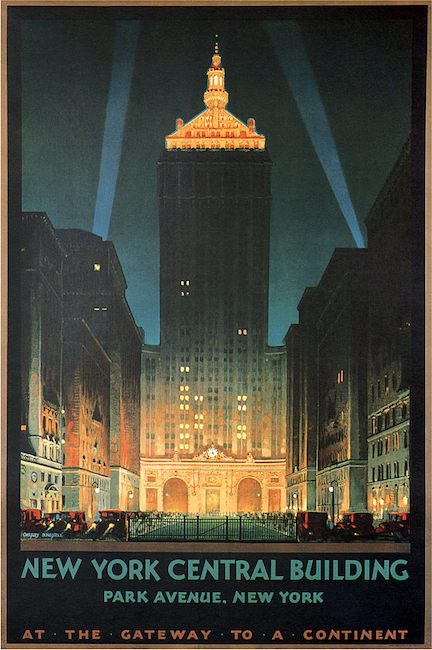
BEJEWELED CROWN…The New York Central Building depicted in a 1929 promotional painting by Chesley Bonestell. (albanyinstitute.org)
Thurber noted that “100,000 candlepower” would light the golden crown of the New York Central Building, the tallest structure in the Grand Central complex. Over at the new Chanin Building, a whopping 25 million candle-power would be trained on its art deco crown.
YOU CAN’T MISS IT…At left, the nearly 700-foot-tall Chanin Building joined the race for the sky in 1928-29. At right, a 1929 drypoint etching by Australian-born artist Martin Lewis depicted the magical glow of the Chanin Building from the viewpoint of a tenement dweller on a fire escape. (NYPL/ephemeralnewyork.wordpress.com)
Advertisers in the New Yorker reflected the mood of this new city of skyscraper canyons. From the Feb. 16 issue:
Ralph Ingersoll and Thurber also wrote in the Feb. 16 “Talk” about plans for “Rockefeller City…”
…and as we know, this was to become the famed Rockefeller Center, a complex of 19 buildings covering 22 acres between 48th and 51st streets. Led by by John D. Rockefeller Jr., the complex was conceived as an urban renewal project to revitalize Midtown (hard to imagine today). The land was originally envisioned as a site for a new Metropolitan Opera house, but when financing fell through the land’s owner, Columbia University, leased it to Rockefeller. Of the anticipated effect of the project, Ingersoll and Thurber wrote:
And for the record, the Feb. 9 issue featured another name that would shape the future of the city—J. Pierpont Morgan was the subject of a lengthy two-part profile penned by John K. Winkler.
* * *
Shouts & Murmurs
The Feb. 16 marks a significant date on the New Yorker calendar—the first appearance of Alexander Woollcott’s famed “Shouts & Murmurs” column:
Writing in the “Double Take” section in the July 18, 2012 issue of the New Yorker, Jon Michaud notes that “Shouts & Murmurs” was Woollcott’s personal column, appearing weekly in the magazine for five years. Perhaps no person other Harold Ross himself could be more associated with the earliest origins of the magazine — Woollcott was a colleague of Ross’s at Stars and Stripes during the First World War, and introduced Ross to his first wife, Jane Grant, who was also a considerable influence on the early magazine.
Michaud writes that Woollcott used the column “to opine on, lampoon, and attack the culture and society of the day. In his distinct and at times excessive style, he reviewed books, wrote spoofs, distributed gossip, and generally rankled as many people as he could.” Woollcott ended the column in December 1934, but it was revived in 1992 as a regular venue for many notable humorists, and continues to this day.
A REAL CHARACTER…Alexander Woollcott, in his idea of casual wear. He once informed his friend and New Yorker colleague Corey Ford: “Ford, I plan to spend three days at your house in New Hampshire next week.” Not overly pleased to be hosting such a demanding guest, Ford uttered a meek “That will be swell.” “I’ll be the judge of that,” Woolcott warned him. (From Elizabeth Olliff, “An Evening at the Algonquin.”)
* * *
Up In Smoke
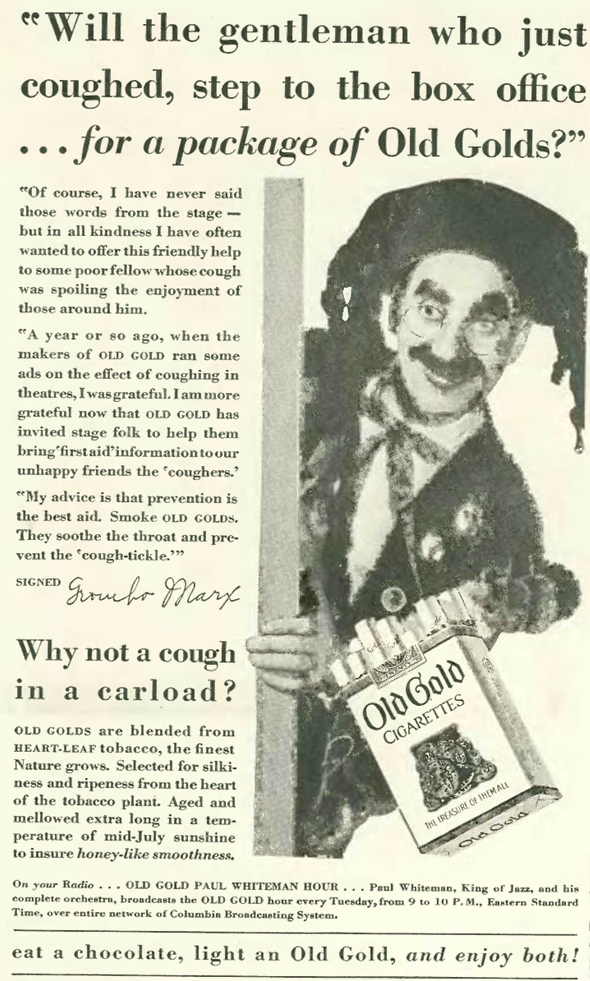
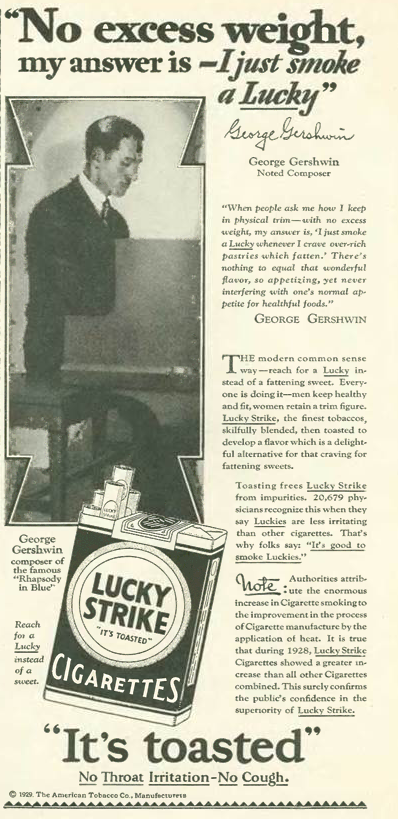
Jumping back to the Feb. 9 “Talk of the Town,” we have this complaint from the magazine regarding celebrity cigarette endorsements. Although the magazine derived a lot of revenue from cigarette ads, Harold Ross insisted on a strict separation between editorial and advertising, allowing his writers free reign to bite the hands that fed them, if they so wished:
Here’s the offending ad, which was featured in the Feb. 23 issue:
In the Feb. 9 issue, Groucho Marx couldn’t resist getting in on the endorsement action…
…nor could Ross’s old friend George Gershwin, who touted the health benefits of Lucky Strikes in the Feb. 16 issue…
In other ads from the Feb. 16 issue, we find that for all of the technological advances in the 1920s, a decent car heater still eluded automakers. Hence…
…on the other hand, we also have this very up-to-date product—the forerunner of today’s rolling airplane luggage…
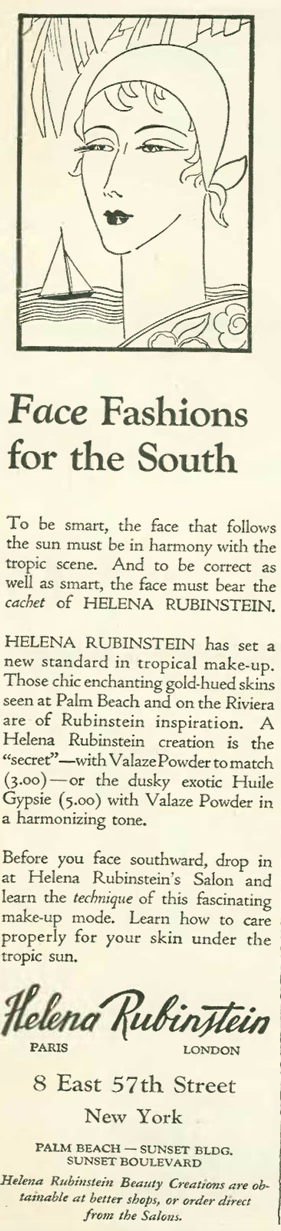
…and if you happened to be flying south, you might have first checked in with Helena Rubinstein to make sure you had the right “face fashions”…
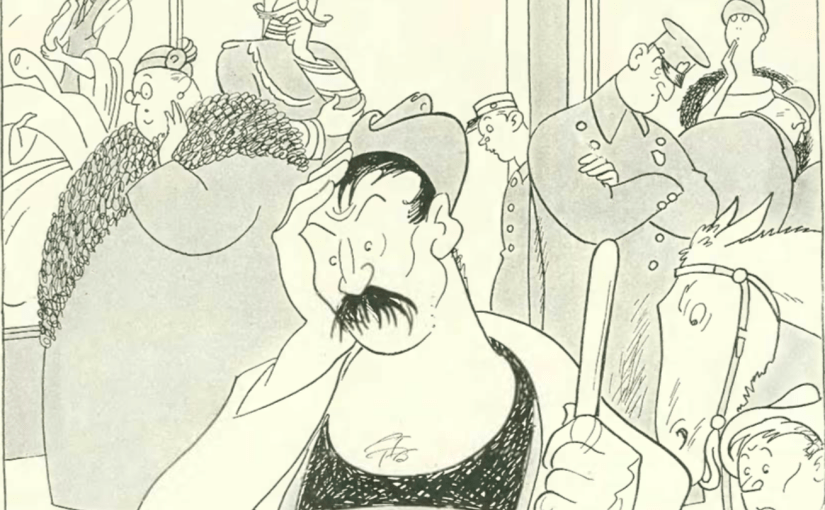
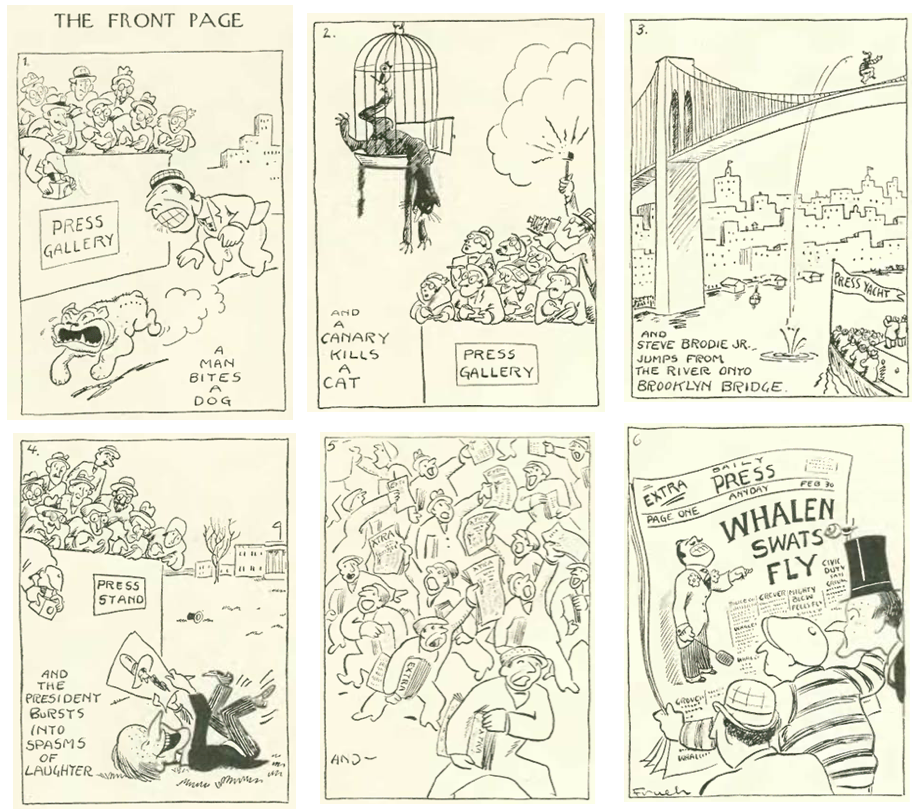
And finally our cartoons, all from the Feb. 9 issue. This first is a six-panel series by Al Frueh that originally ran diagonally, top to bottom, across a two-page spread. It took a shot at the self-promoting police commissioner, Grover Whalen, who was not a friend to the New Yorker due to his ham-fisted approach to Prohibition enforcement…
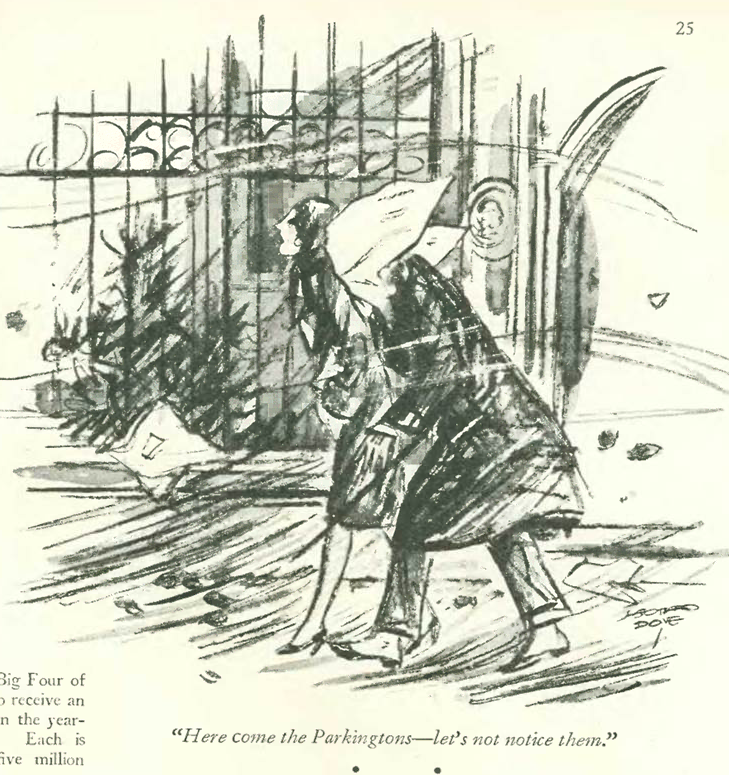
…and Leonard Dove took a shot at some posh folks outside of their urban element…
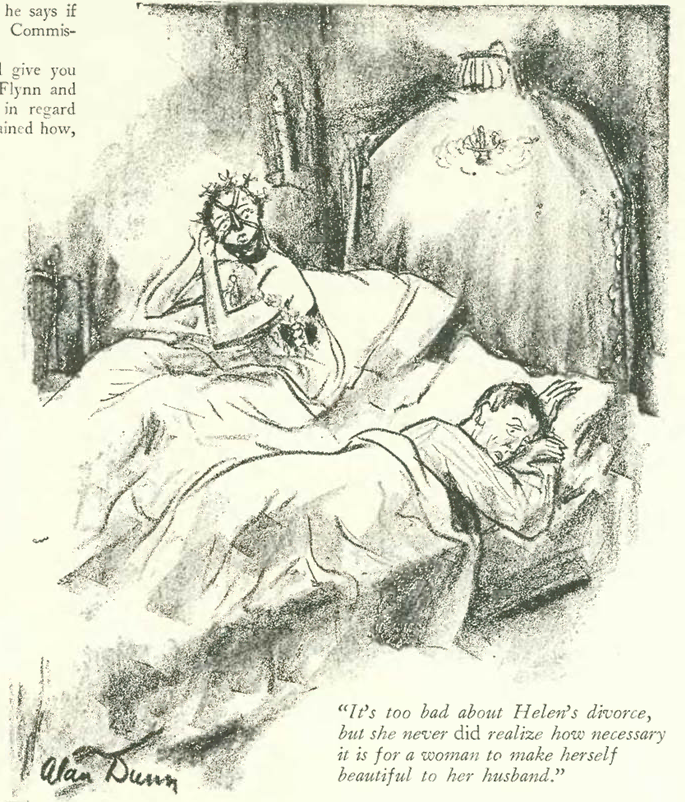
…and finally, Alan Dunn examined the wages of beauty…
Florida’s Palm Beach became a popular destination in the 1920s for well-heeled New Yorkers seeking a respite from winter’s cold and gloom.
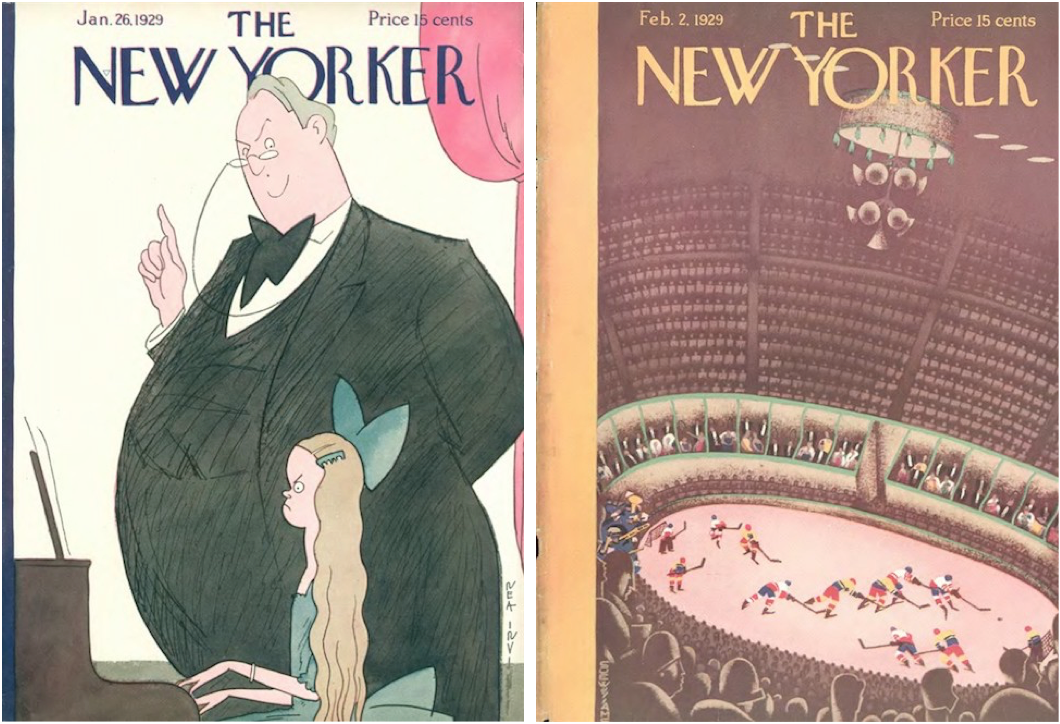
Jan. 26, 1929 cover by Rea Irvin / Feb. 2, 1929 cover by Sue Williams.
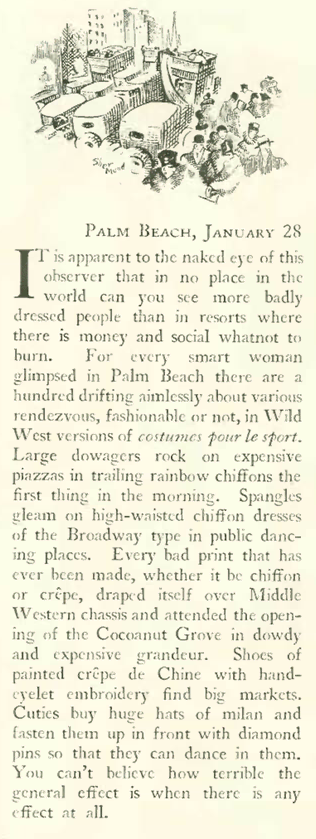
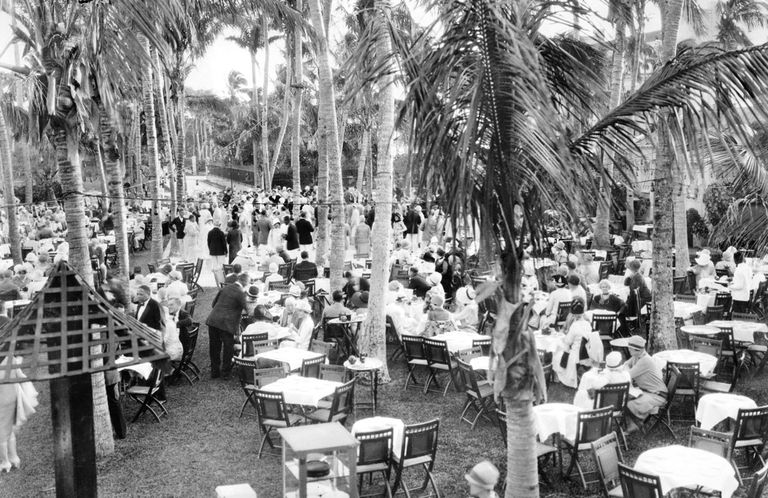
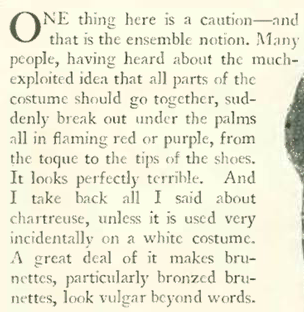
Among them was the New Yorker’s nightlife correspondent and fashion critic Lois Long, who (writing in the Feb. 2 issue) discovered that many snowbirds left their fashion sense back home, or in some cases didn’t have any in the first place…
THOSE GENTLE BREEZES…Dining at the Coconut Grove in Palm Beach, 1928. (Town and Country)
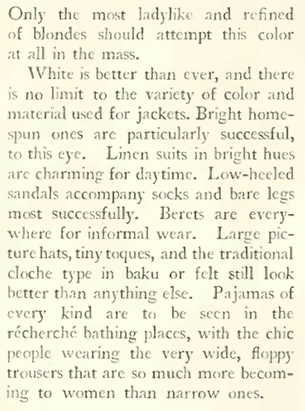
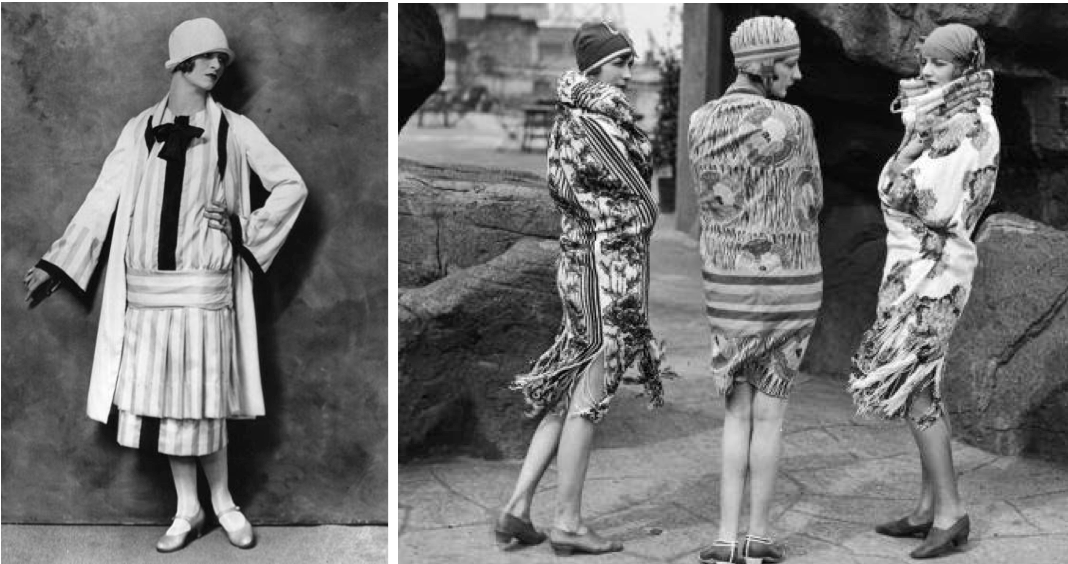
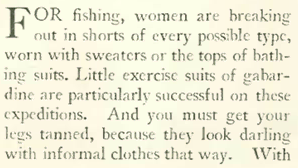
Sufficiently appalled by the fashion scene, Long then offered some advice for those seeking a smarter look in the southern climes…
AHOY THERE…Beach pajamas were a popular choice in the 1920s. (artdecogal.com)BIG BOOSTER…The financier Otto Kahn was one of Palm Beach’s biggest promoters. Here he relaxes with friends at one of his Palm Beach “cottages” (this one is the Oheka Cottage, designed by August Geiger, on North Ocean Boulevard). L to R: New York socialite Sarah Jane Sanford, Otto Kahn, Margaret “Nin” Kahn Ryan (Kahn’s eldest daughter), Betty Bonstetten (of the Rothschild banking fortune), and seated, Nancy Yuille (tobacco heiress who would later marry the Viscount Adair and become the Countess of Dunraven) and Swiss architect Maurice Fatio. (Ellen Glendinning Ordway Collection via New York Social Diary)LOIS IS WATCHING YOU…A sampling of 1920s Palm Beach fashions Lois Long might have spotted during her visit. (vintage.es/picgran.com)
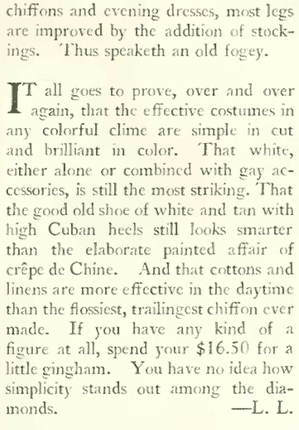
Long concluded her fashion advice with the dictum that when in doubt, keep it simple…
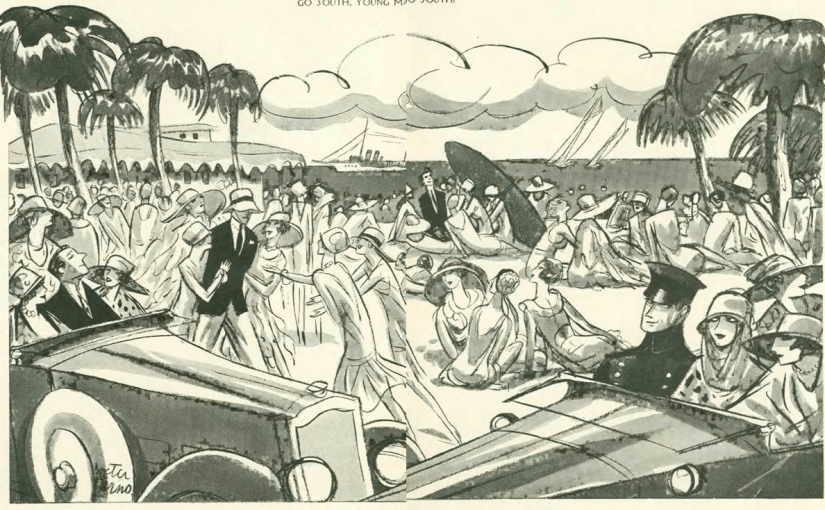
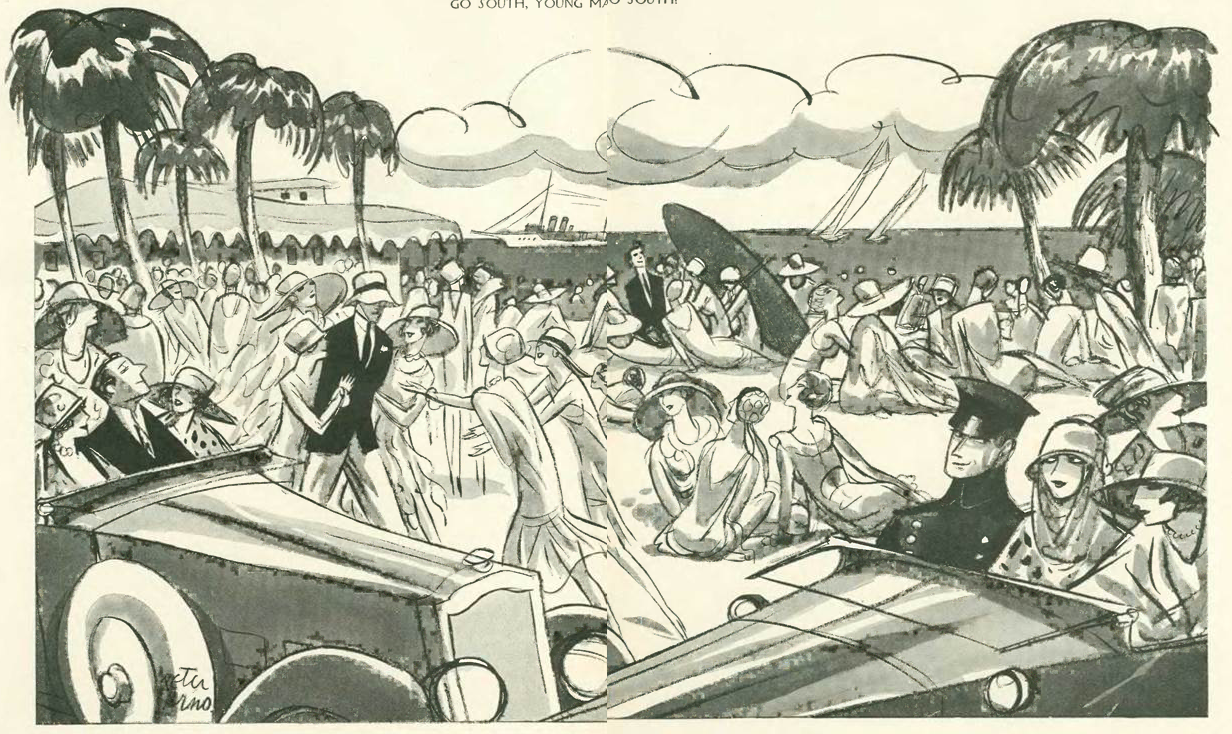
Long must have made the trip with her husband, the New Yorker cartoonist Peter Arno, since he contributed his own take on the scene in the Feb. 16, 1929 issue — a two-page illustration titled “Go South, Young Man, Go South.” (click image to enlarge)
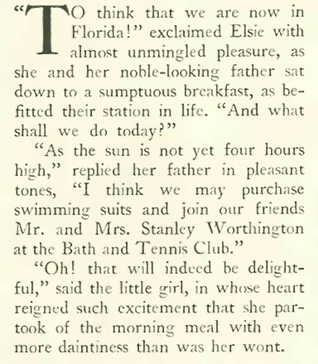
Palm Beach was also on the minds of the New Yorker editors when they composed the Jan. 26 issue, which featured a parody by Josie Turner of the popular Elsie Dinsmore book series: “Elsie Dinsmore at Palm Beach.” A brief excerpt:
Note: The Elsie Dinsmore books (there were 28 of them) featured an impossibly upright eight-year-old and were hugely popular in the late 19th and early 20th century.
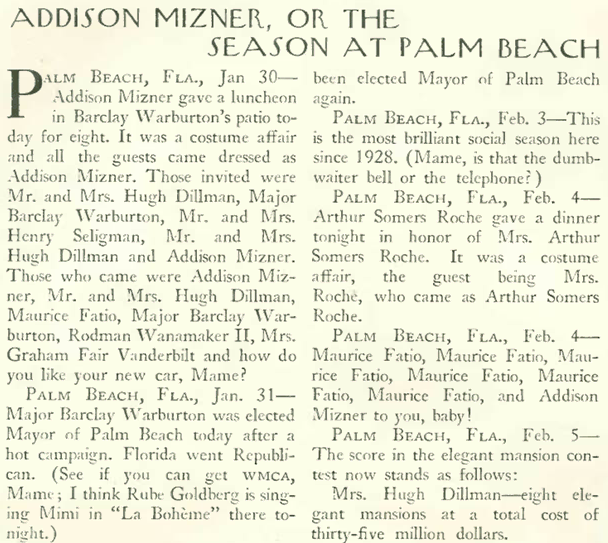
The Feb. 2, 1929 issue featured another Palm Beach-themed parody — this one by Frank Sullivan — that took a poke at Addison Mizner (1872-1933) a fixture of Palm Beach social life who designed resorts and houses for the rich and famous. He is often credited with giving South Florida its signature Mediterranean Revival and Spanish Colonial Revival styles of architecture (Augustus Mayhew, writing for the New York Social Diary, begs to differ: he notes that architect August Geiger established the style in Palm Beach three years before Mizner). An excerpt from Sullivan’s New Yorker parody:
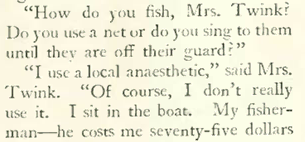
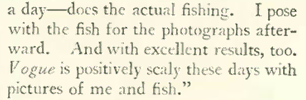
Later in the piece, Sullivan took a crack at a fictitious member of Palm Beach society, a “Mrs. Twink,” who was engaged in the latest “fad” — fishing:
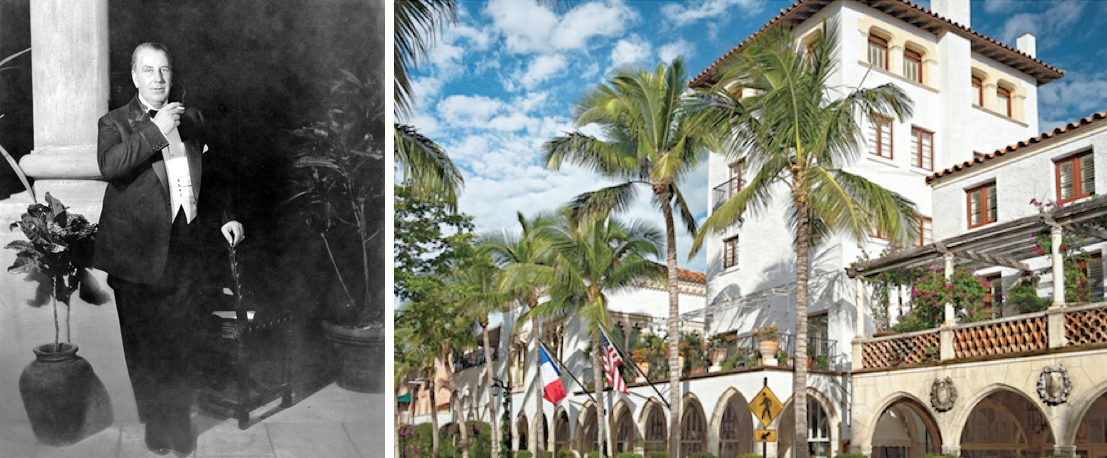
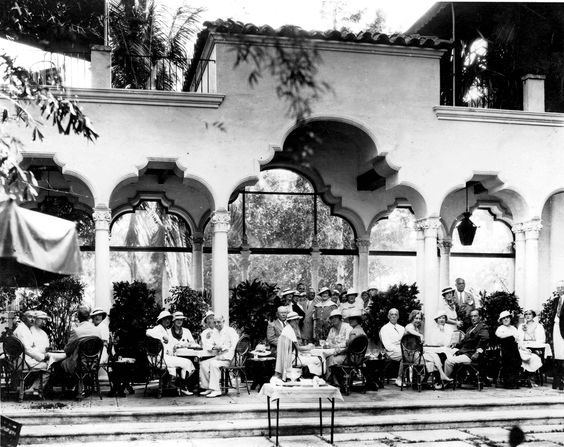
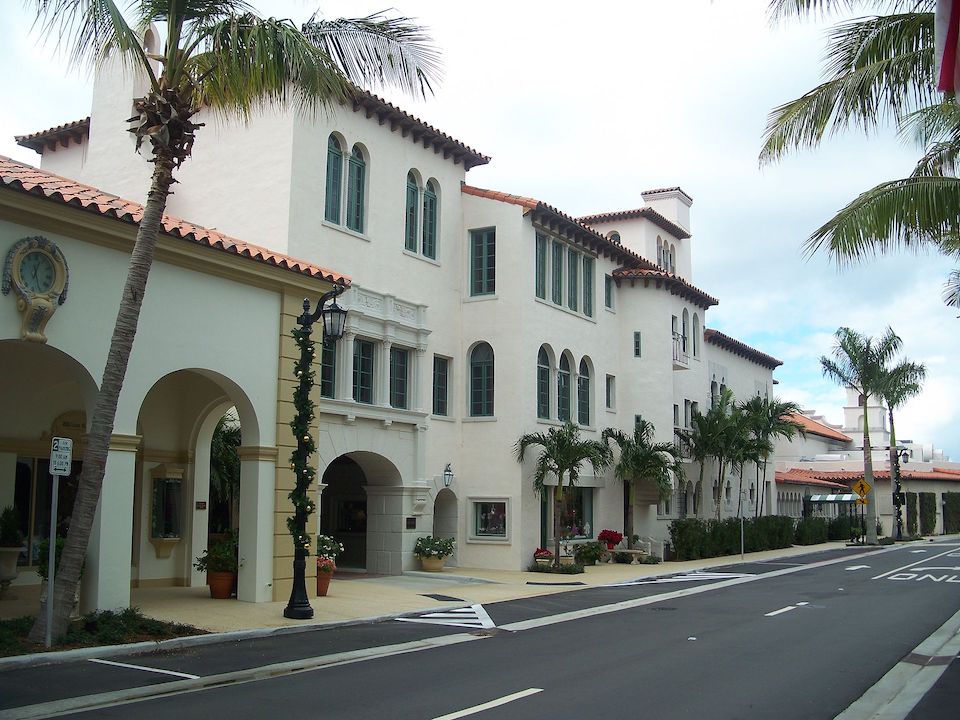
STORYTELLER IN BRICK AND STONE…Addison Mizner epitomized the “society architect.” He was known for making new buildings look like they had taken centuries to construct, even creating stories for his houses that described how they “evolved” through their many owners and historical eras. At right, Mizner’s own Palm Beach residence, Villa Mizner, on Worth Avenue in Palm Beach. It was built in 1924. (palmbeachdailynews.com/Merritt Hewitt)HIS KIND OF PEOPLE…Fashionably dressed members of the Mizner-designed Everglades Club gather in the Marble Patio in the 1920s. (Historical Society of Palm Beach County)STILL THERE…The Everglades Club today. Opened in January 1919, it was Mizner’s first big commission. (Wikipedia)
The Feb. 2 issue also featured this Peter Arno cartoon of one snowbird’s reaction to Palm Beach living:
* * *
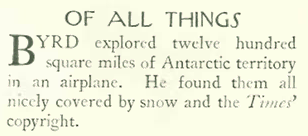
The New Yorker loved to take potshots at the news media, and particularly at the then rather staid New York Times, which apparently had secured exclusive rights to cover Admiral Richard Byrd’s famed exploration of the South Pole by airplane. In his Jan. 26 “Of All Things” column, Howard Brubaker quipped:
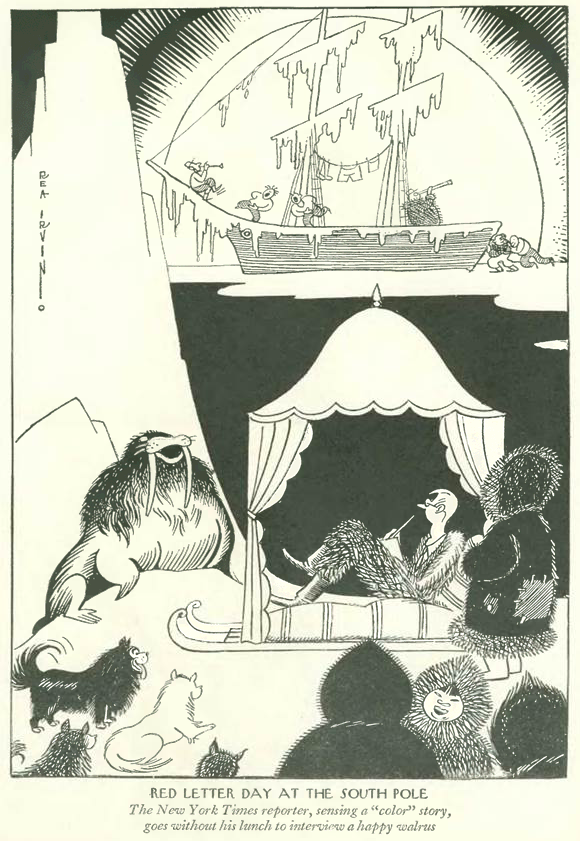
In the following issue, Feb 2, Rea Irvin imagined how a coddled Times reporter might cover the historic expedition:
ONE TOUGH BYRD…Admiral Robert Byrd (inset) led expeditions in the Antarctic from 1928 to 1930 by snowshoe, dog-sled, snowmobile and three airplanes that were transported (partially disassembled) by ship to a base camp on the Ross Ice Shelf. Pictured are Harold June, Commander Byrd, and Bernt Balchen in front of a Fairchild airplane, dubbed “Stars and Stripes.” The plane was used to take aerial photographs. (Richard E. Byrd Papers, The Ohio State University)
* * *
Grouchy Groucho
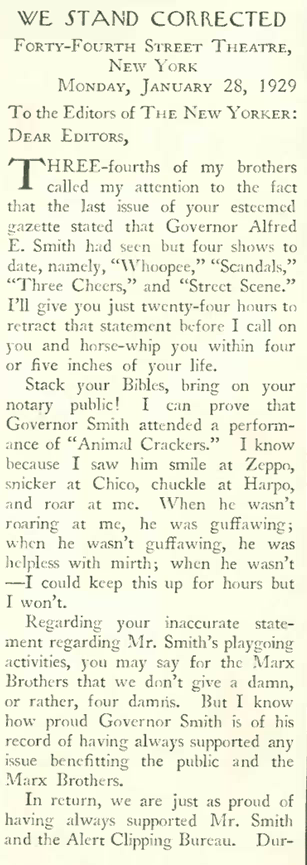
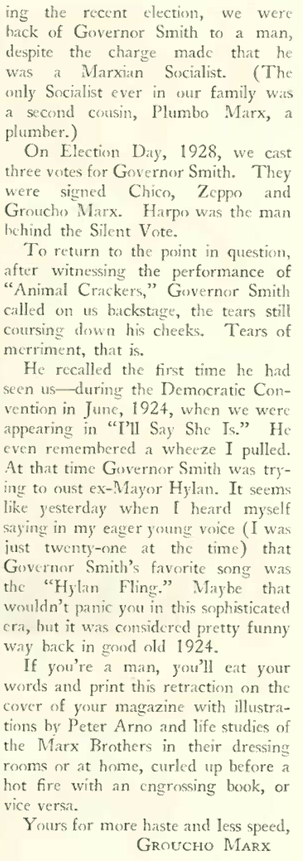
Near the back of the Feb. 2 issue (page 61), comedian Groucho Marx contributed this tongue-in-cheek demand for a retraction from the New Yorker editors:
WIT…A young Groucho Marx in 1930. (Wikipedia)
* * *
Fun With the Rockefellers
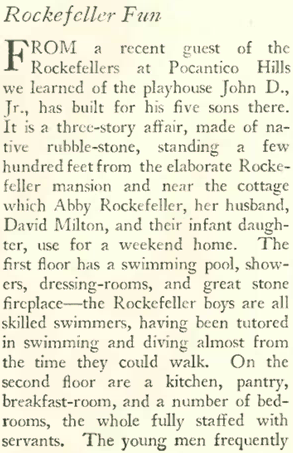
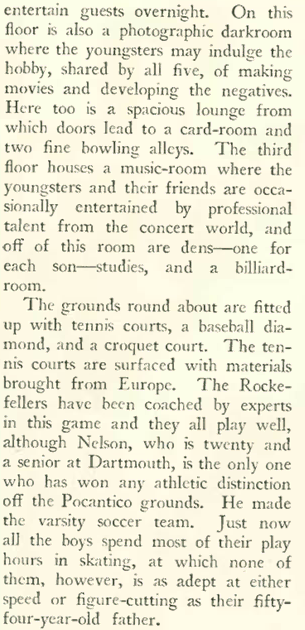
John K. Winkler contributed this piece to the Feb. 2, 1929 “Talk of the Town” that described a “playhouse” John D. Rockefeller Jr. had built for his five sons:
NOT FOR PEEWEE…The three-story playhouse on the Rockefeller estate at Pocantico Hills. (New York Social Diary)
* * *
From Our Advertisers
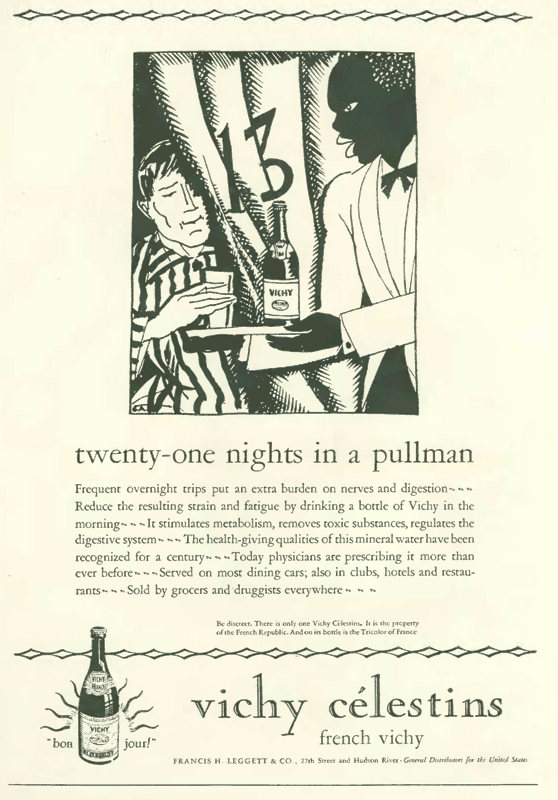
Heading to Palm Beach on a Pullman? Have too much of that bootleg gin the porter slipped you the night before? Then try…
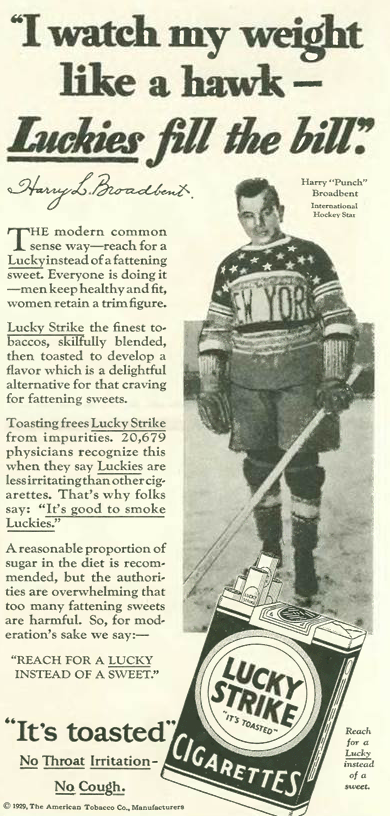
…perhaps you want to stay in shape, like this hockey star. Then grab a Lucky…
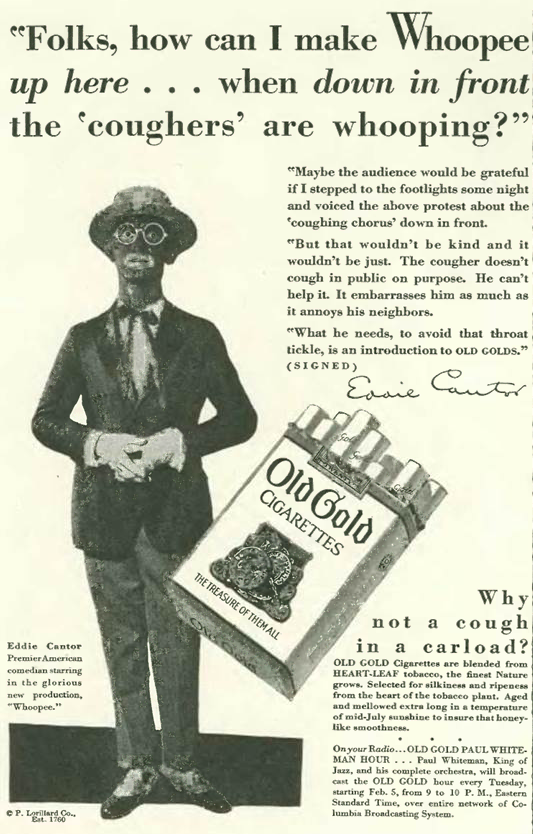
…or maybe you’d like to sing like Eddie Cantor, who soothed his throat with an Old Gold…
…and we close with these comic observations of life among New York society, again featuring the work of Peter Arno…
…and back to the cold New York City winter, with Leonard Dove …
As I noted in my previous post, Prohibition never really caught on in New York City, and instead the law gave rise to thousands of the famed (or to some, infamous) speakeasies tucked away in the nooks and crannies of Jazz Age Manhattan.
Jan. 19, 1929 cover by Constantin Alajalov.
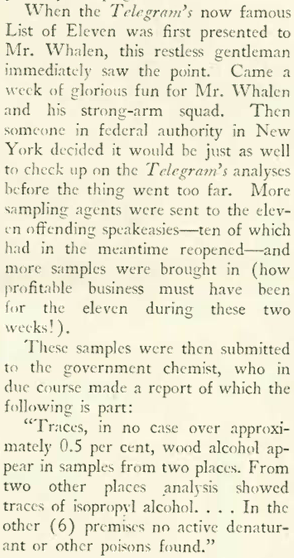
However, there were periodic attempts to reign in the city’s lawbreaking drinkers, including U.S. attorney Emory Buckner’s padlocking of speakeasies in the mid-1920s and New York Police Commissioner Grover Whalen’s strong-arm tactics in early 1929.
BOTTOMS UP!…New York speakeasy patrons in the 1920s. New York Police Commissioner Grover Whalen estimated there were 32,000 illegal speakeasies operating in the city in 1929. (boweryboyshistory.com)
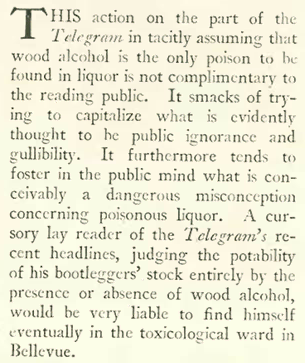
The New Yorker took issue with Whalen’s attempt to enforce Prohibition at the end of a billy club (ironically, Whalen was appointed to the post by Mayor Jimmy Walker, who openly flaunted Prohibition). The magazine also attacked the New York Telegram for conspiring with Whalen to spread rumors among the public about poison alcohol being served in the city’s speakeasies. Research chemist Beverly L. Clarke took the Telegram to task in the New Yorker’s “A Reporter at Large” column:
IN YOUR CASE, I’LL MAKE AN EXCEPTION…New York Police Commissioner Grover Whalen, a product of Tammany Hall, no doubt looked the other way when the mayor, another Tammany alum, openly violated Prohibition laws. (WNYC)
There is also the oft-told account of the U.S. government adding poison to alcohol to discourage illegal consumption, but in truth the government never set out to poison anyone. Rather, it was continuing a practice used long before Prohibition to “denature” alcohol, usually by adding methyl alcohol (commonly referred to as “wood alcohol”) to grain alcohol to make it unfit for human consumption. According to Snopes, adding poison to alcohol was a way to exempt producers of alcohol used in paints and solvents from having to pay the taxes levied on potable spirits. Other denaturing agents were added to grain alcohol by mid-1927, including these listed in Clarke’s article:
ACETONE, WITH A MERCURY TWIST…An assortment of confiscated, adulterated spirits from the Prohibition era. (prohibition.themobmuseum.org)
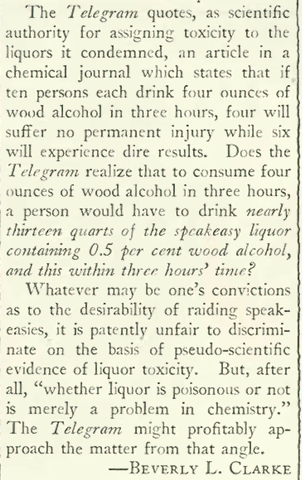
Clarke not only accused the Telegram of spreading misinformation, but also of encouraging Whalen’s ruthless enforcement of Prohibition. Whalen was famously quoted as saying, “There is plenty of law at the end of a nightstick.” Clarke continued:
Clarke concluded that it was “patently unfair to discriminate” against the city’s speakeasies on the basis of “pseudo-scientific” evidence:
Illustration by Constantin Alajalov that accompanied Clarke’s article.
* * *
He Was No Coward
The Jan. 19 issue also featured a lengthy profile of Noël Coward, written by his longtime friend Alexander Woollcott, a critic and commentator for the New Yorker and a founding member of the Algonquin Round Table.
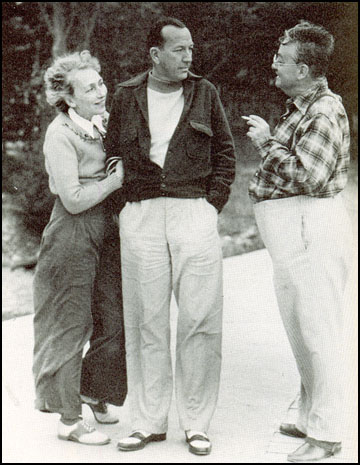
American illustrator and portrait painter Neysa McMein with friends Noël Coward (center) and Alexander Woollcott (right).(spartacus-educational.com)
Woollcott wrote of his friend’s work ethic while taking a wry shot at the New Yorker magazine’s early days:
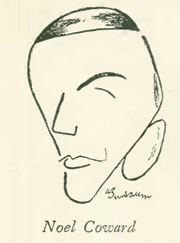
Abe Birnbaum provided this sketch of Coward for the profile:
By 1929 Coward was one of the world’s highest-paid writers, but he did have his setbacks, as Woollcott noted:
Woollcott was referring to Coward’s 1927 play Sirocco, which depicted free love among the posh set and was greeted with loud disapproval in London. According to Dick Richards in his 1970 book, The Wit of Noël Coward, Coward later remarked that his “first instinct was to leave England immediately, but this seemed too craven a move, and also too gratifying to my enemies, whose numbers had by then swollen in our minds to practically the entire population of the British Isles.”
* * *
Par Avion
The New Yorker’s Paris correspondent, Janet Flanner, noted that 1929 would usher in a new era in French passenger air service:
Advances in aviation in 1929 were remarkable considering the Wright Brothers first flight occurred just a little more than 25 years earlier (for those of us in 2018 who can recall 1993, that isn’t a lot of time).
And although only the wealthy could afford to fly back then, it was definitely not for the faint of heart. According to an article by Georgia Diebelius for the Daily Mail, the engine noise could be deafening in the thinly-walled cabins (sometimes little more than painted canvas). The engines of a Ford Tri-Motor, for example, reached 120 decibels on take-off, just 40 decibels below the level that would result in permanent hearing loss. Diebelius writes that because of the noise level, flight attendants had to speak to their passengers through megaphones. As for the flight itself, planes would suddenly drop hundreds of feet at a time, causing passengers to make good use of air sickness bowls placed beneath their seats. Nevertheless, passenger travel increased from just 6,000 annually in 1930 to 1.2 million by 1938.
ODD DUCK…This strange-looking Dyle et Bacalan DB 70 was also designed for French passenger service in 1929, but only one was built. The design was later adapted in the 1930s as a bomber. (Collection Hugues de Suremain)
* * *
Skin As Soft As An Armadillo’s
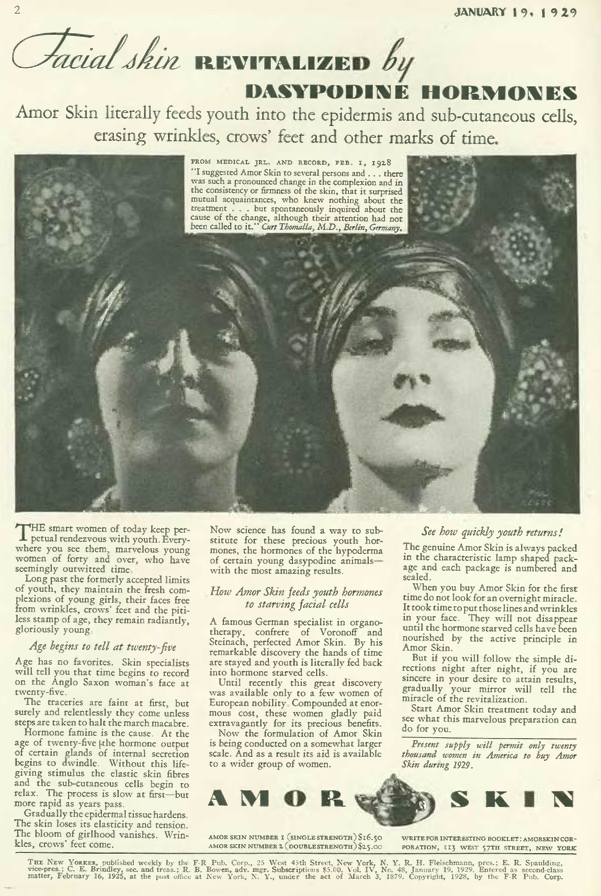
Sampling the advertisements from Jan. 19 we have this message from Amor Skin announcing a youth treatment utilizing something called dasypodine hormones. The term “dasypodine” refers to critters related to the armadillo, so one wonders what they putting on their faces. The armadillo is known carrier of leprosy, so I don’t think I’d be using this stuff, thank you very much…
…and I include this ad for Murad cigarettes because it features artwork by A. H. Fish, renowned for depictions of members of high society. She illustrated dozens of magazine covers for The Tatler and Vanity Fair as well as hundreds of inside and spot illustrations for Condé Nast…
…another cigarette brand, Lucky Strike, convinced American silent movie star Constance Talmadge to endorse their “toasted” smoke…
…and our final advertisement, from Pan American Airliners. Could you imagine an ad for an airline today depicting a man firing a rifle at one of their airplanes?
I include this comic by Alice Harvey for its reference to the song, “I Can’t Give You Anything but Love, Baby,” made popular by Broadway’s hit musical revue Blackbirds of 1928. The song continues to be recorded to this day, and was even included on a 2014 collaborative album, Cheek to Cheek, by Tony Bennett and Lady Gaga.
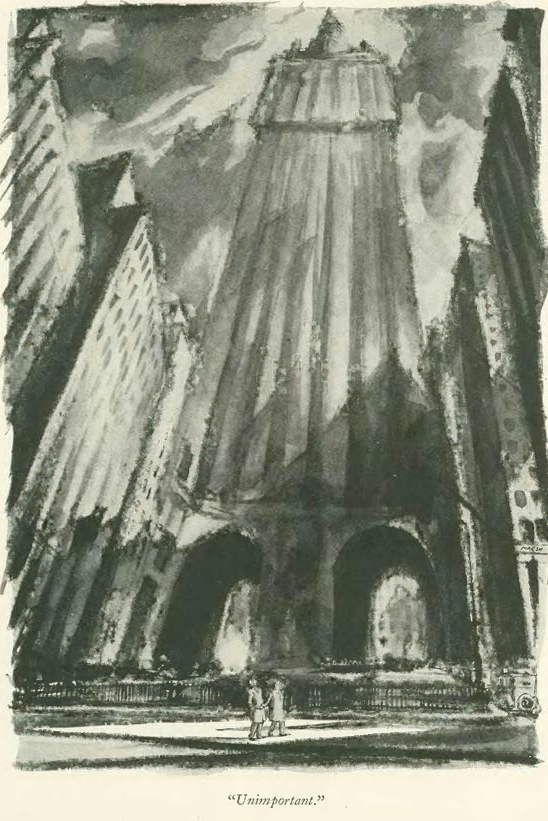
And finally, a different perspective on Manhattan’s changing skyline, courtesy of Reginald Marsh:
What do you do after an evening at the theater when the night is young and the city still thrums with excitement? In 1929 Manhattan, those willing to shell out a $5 cover charge (equivalent to nearly $120 today) and another $3 for front row seats could take in a show on the rooftop of the New Amsterdam Theatre — Florenz Ziegfeld’sMidnight Frolic.
Jan. 12, 1928 cover by Julian de Miskey.
The New Yorker’sLois Long was on hand for opening night of the Ziegfeld Midnight Frolic, where the rich and famous gathered to enjoy after hours performances by Paul Whitman’s orchestra, singer and comedian Eddie Cantor (performing in blackface), and the boozy torch singer Helen Morgan. In her nightlife column, “Tables for Two,” Long observed:
Among the celebrities Long spotted at the Midnight Frolic’s opening night was actress and dancer Peggy Hopkins Joyce, famed for collecting men along with diamonds and furs:
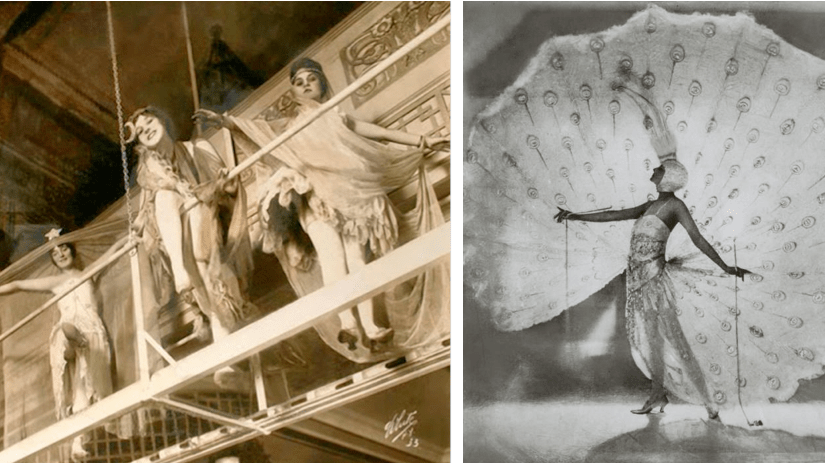
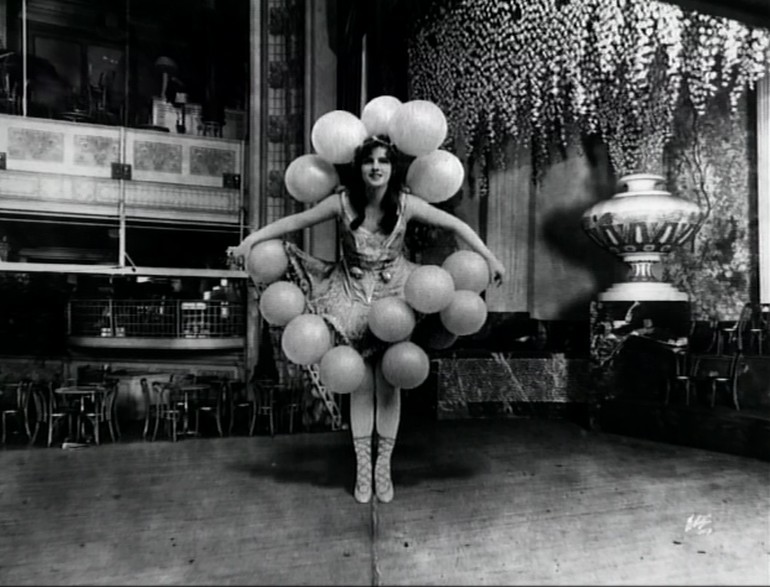
FAMOUSLY FAMOUS…Largely unknown today, during the Roaring Twenties actress and dancer Peggy Hopkins Joyce was one of the decade’s most famous celebrities, her noteriety mostly deriving from her flamboyant lifestyle that included six marriages, dozens of engagements and affairs with celebrities ranging from Charlie Chaplin to Walter Chrysler, who reportedly gave her $2 million in jewelry including a 134-karat diamond necklace. (http://jenniferfabulous.blogspot.com)WHAT THEY DID FOR FUN…Ziegfeld girl Olive Thomas wearing her balloon costume on the stage of the New Amsterdam’s rooftop theatre during the original run of the Midnight Frolic. Male patrons were encouraged to use their cigars and cigarettes to pop the balloons. Photo circa 1915. (Pinterest)
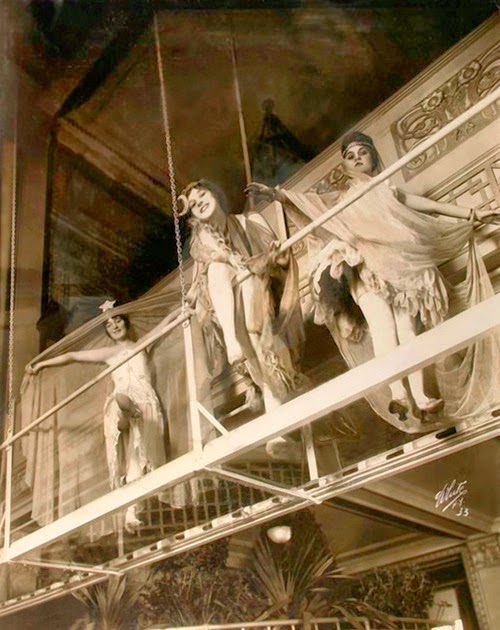
According to a Museum of the City of New York blog (posted by Nimisha Bhat), Flo Ziegfeld was tired of seeing his audiences leave after performances of his Ziegfeld Follies at the New Amsterdam Theatre on 42nd Street (and spend money elsewhere), so in 1915 he staged a new revue — the Danse de Follies! (later to be called Midnight Frolic) on the New Amsterdam’s underused 680-seat roof-top level that included tables, box seats, and a balcony. Ziegfeld added a glass walkway that would allow chorus girls to dance above the audience, affording some customers a more risqué perspective on the dancers.
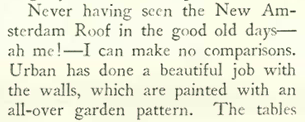
Bhat writes that the club “stayed open year-round for seven years and while World War I couldn’t stop the Midnight Frolic, Prohibition was ultimately what led Ziegfeld to end the show in 1922.” In 1921 Ziegfeld told The New York Times: “The best class of people from all over the world have been in the habit of coming up on the roof … and when they are subjected to the humiliation of having policemen stand by their tables and watch what they are drinking, then I do not care to keep open any longer.” The show Lois Long attended in January 1929 was a revival of the Midnight Frolic, and although Prohibition was still the law, by 1929 it was widely flaunted if not completely ignored by many New Yorkers. Long also noted changes to the rooftop, including a new decor by famed theatrical designer Joseph Urban:
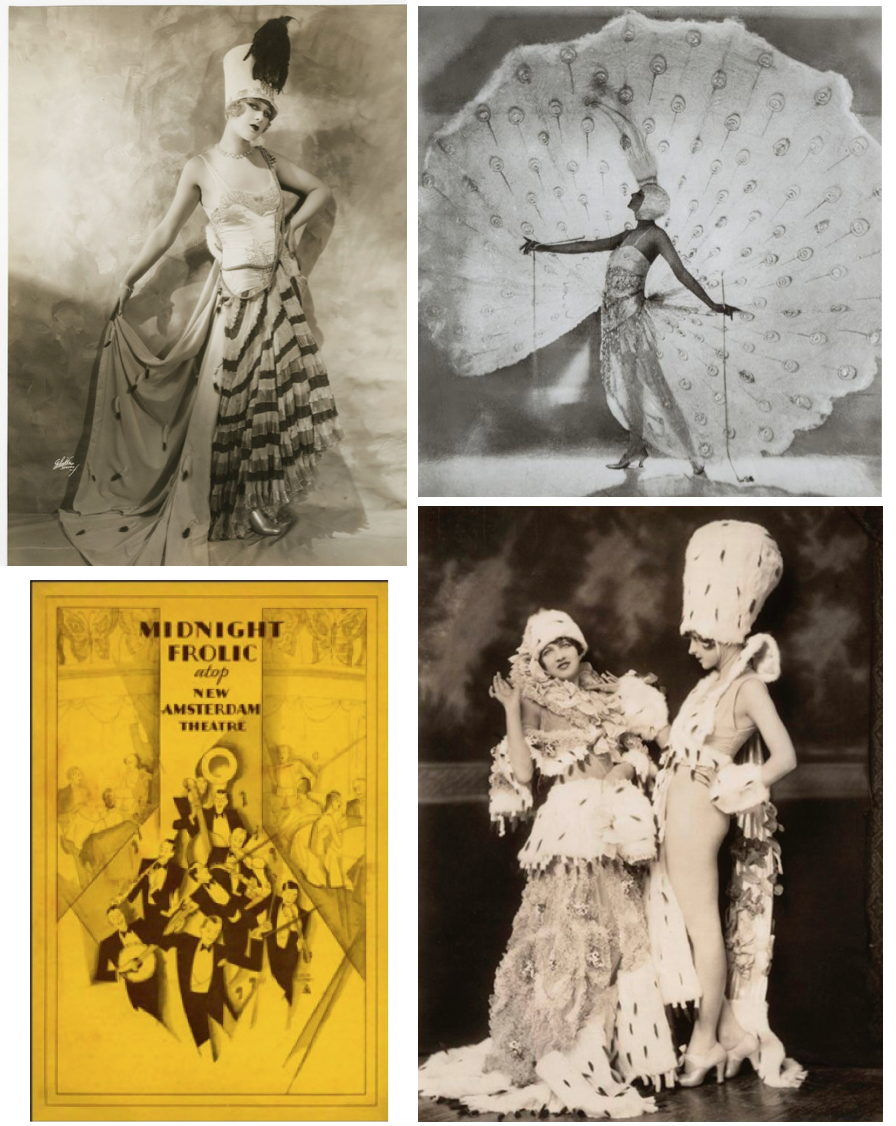
Clockwise, from top left, Hazel Forbes poses in her costume for Ziegfeld’s 1929 Midnight Frolic; Dolores (also known as Rose Dolores) plays the part of “The White Peacock” in the Tropical Birds number for the Midnight Frolic of 1919. Considered to be first celebrity clothes model, Dolores is often credited as the inventor of the “blank hauteur” look of modern fashion models; Jean Ackerman & Evelyn Groves from the 1929 show; program for the 1929 Midnight Frolic. (White Studios/Pinterest/Playbill)READY TO FROLIC…Stage ensemble from the 1917 Midnight Frolic included, at center left, actor/humorist Will Rogers. (Museum of the City of New York)EXTROVERTS…Margaret Morris, Kay Laurell, and Florence Cripps on the infamous glass walkway in the Ziegfeld Midnight Frolic of 1916. (talesofamadcapheiress.blogspot.com)THEY WERE HAMMERED…Insisting that theater-goers would have sore hands after applauding so much, Flo Ziegfeld provided little wooden hammers at Frolic tables, so audiences could bang out their appreciation. (Museum of the City of New York)
There is a filmed performance of Eddie Cantor allegedly made that night at the Ziegfeld Theatre Roof Garden, but it was actually filmed on a soundstage at the Paramount Astoria studio in Queens. You can tell it is staged because during Cantor’s performance he recognizes some of the celebrities who were at the opening (the camera shifts to them as they take bows), but when he calls out Peggy Joyce the camera stays on Cantor. Apparently she didn’t find it necessary to participate in this charade. Nevertheless, this video gives you some idea of what was presented at the Midnight Frolic. And one wonders why Cantor performed in blackface, since it’s just his standard song and gags schtick:
* * *
Mea Culpa
Also in the Jan. 12 issue was this small ad in the back pages — an apology from Texas Guinan, actress, producer, and entrepreneur well-known to New York nightlife (and to the vice squad):
QUEEN OF THE NIGHTCLUBS…or so they called Texas Guinan, pictured here from a 1929 film by the same name. (texasguinan.blogspot.com)
* * *
Nevertheless, Prohibition Continued to Suck…
The Jan. 12 “Talk of the Town” addressed the sheer folly of Prohibition enforcement:
DON’T JUDGE A BOTTLE BY ITS COVER…An assortment of confiscated, adulterated spirits from the Prohibition era. (prohibition.themobmuseum.org)
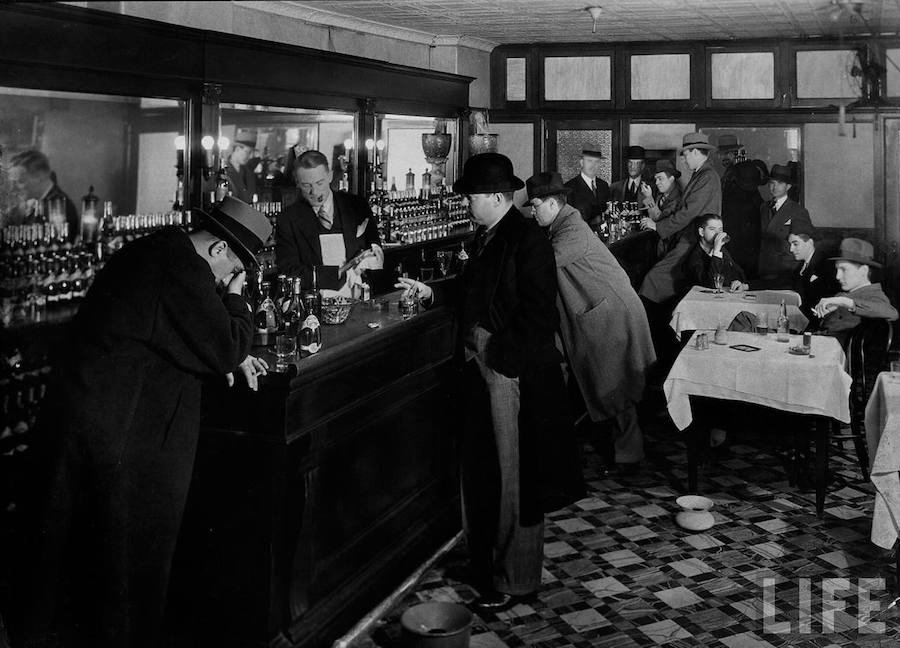
SUPPLY AND DEMAND…In 1925 there were an estimated 30,000 to 100,000 speakeasies in New York City alone. Near the end of the ban on alcohol in 1933 Life photographer Margaret Bourke-White captured some of the city’s elite speakeasies. (Time/Life)
The “Talk” item also addressed the new police commissioner’s approach to enforcement of the unpopular law:
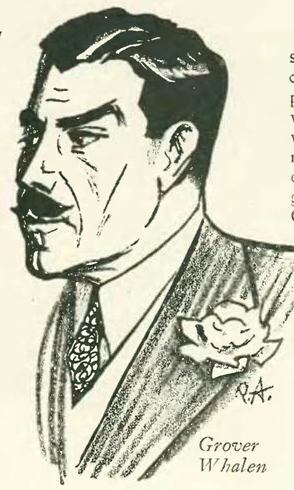
And as it happened, Grover Whalen was also the subject of the Jan. 12 “Profile,” which included this illustration by Peter Arno:
* * *
How’s the Old Ticker?
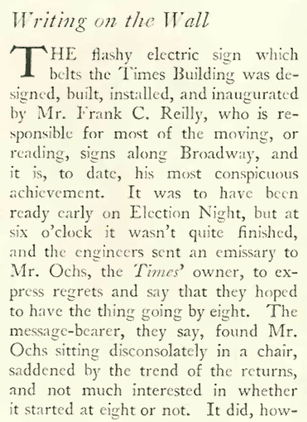
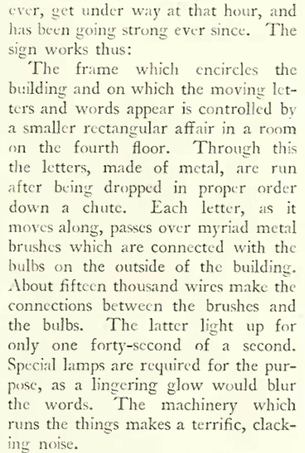
The “Talk of the Town” also marveled at the technology behind the famed news ticker in Times Square, inaugurated on election night the previous November:
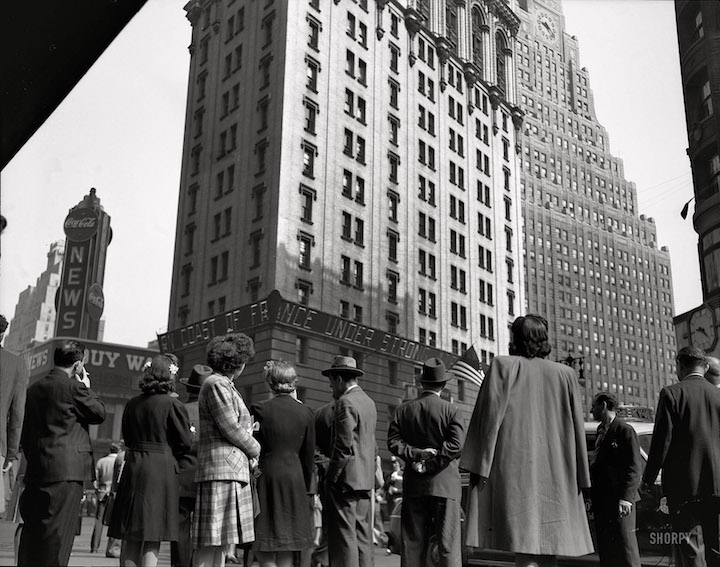
JUNE 6, 1944…Crowd watching D-Day headlines on the New York Times building. (Library of Congress)
The news ticker, known as the “zipper” (which inspired the news crawl at the bottom of today’s cable news channels), made Times Square the place to be when big events were announced. According to Wired magazine, the zipper, invented by Frank C. Reilly, “was the technological marvel of its day, extending 380 feet around the Times Tower and, with a band 5-feet tall, the moving letters were visible from a distance of several city blocks.” Wired cites a 2005 New York Times column to describe how it worked:
“Inside the control room, three cables poured energy into transformers. The hookup to all the bulbs totaled 88,000 soldered connections. Messages from a ticker came to a desk beside a cabinet like the case that contained type used by old-time compositors. The cabinet contained thin slabs called letter elements. An operator composed the message letter-by-letter in a frame. The frame, when filled with the letters and spaces that spelled out a news item, was inserted in a magazine at one end of a track. A chain conveyor moved the track, and each letter in the frame brushed a number of contacts. Each contact set a light flashing on Broadway.” Reilly calculated that there were 261,925,664 flashes an hour from the zipper’s 14,800 bulbs.
* * *
From Our Advertisers
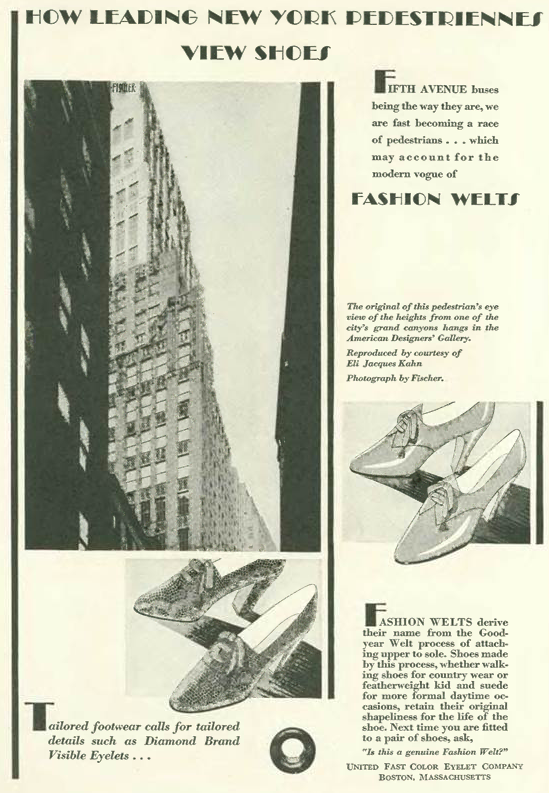
A couple of clothing store ads which demonstrated a more modern look in graphic design…
…and two terrific illustrations (out of four in a two-page spread) by Reginald Marsh that decorated the “Profile” section of the magazine, featuring scenes from the Webster Hall nightclub in the East Village…
Perhaps no decade was more transformative to New York City than the 1920s. From the loosening of social mores to countless technological advances, the city was a very different place as it entered the last year of the Roaring Twenties.
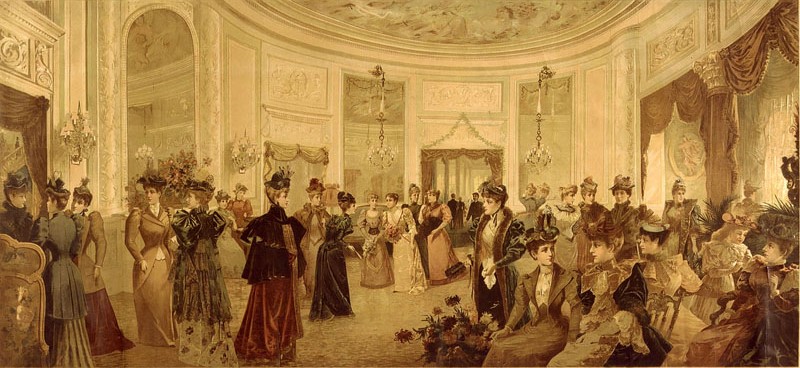
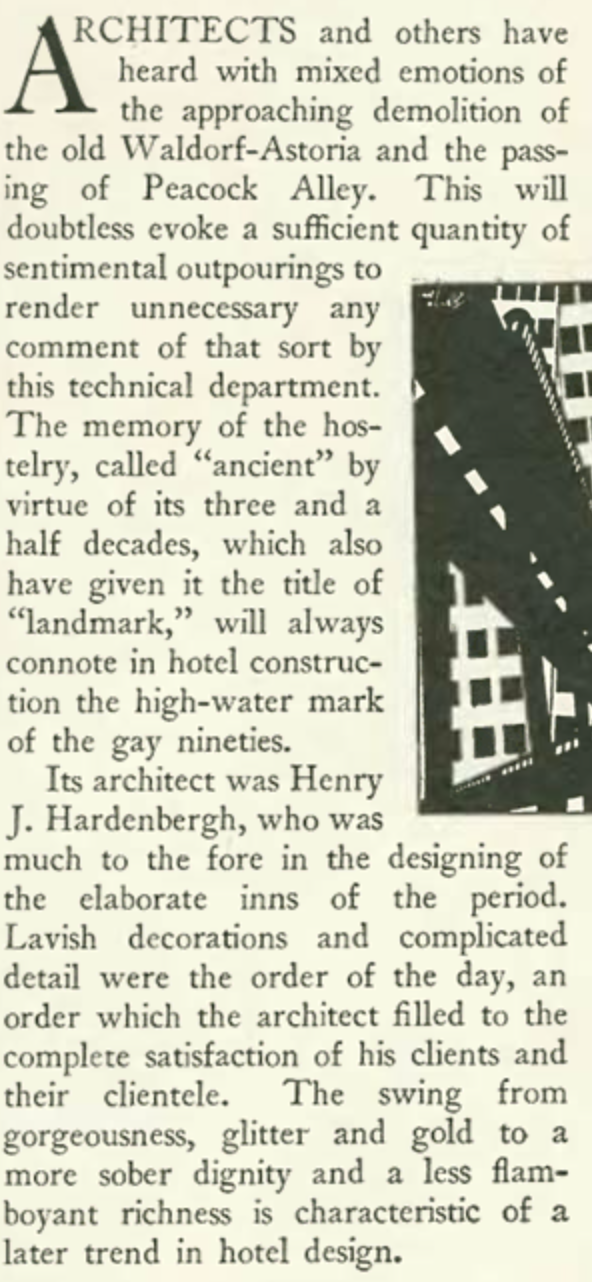
Jan. 5, 1929 cover by Sue Williams. Opening image depicts the original Waldorf Hotel’s Octagon Room in 1893.
Vestiges of the 19th century were quickly erased during the decade as old neighborhoods and stately mansions gave way to massive apartment blocks and towering skyscrapers. Such was the fate of the original Waldorf-Astoria Hotel, its Victorian lavishness out of style in a streamlined age. Writing under the pen name T-Square, New Yorker architecture critic George S. Chappell commented on the planned demolition of the old* Waldorf-Astoria Hotel:
*Although outdated in appearance, the hotel was little more than 30 years old in 1929.
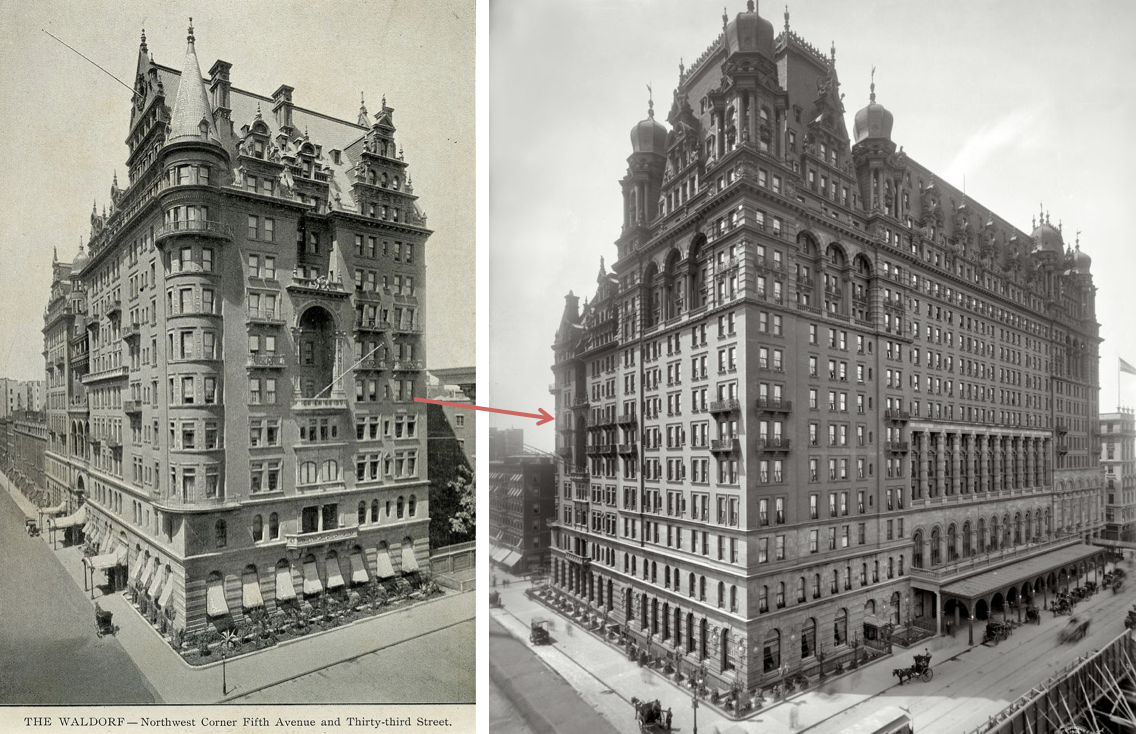
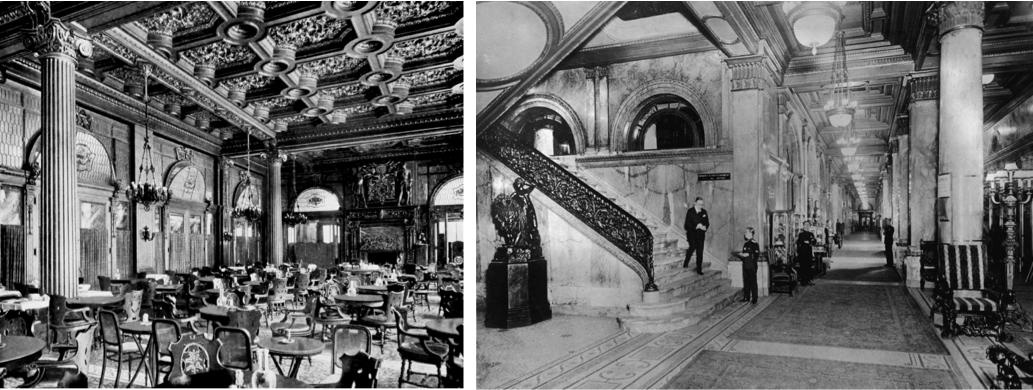
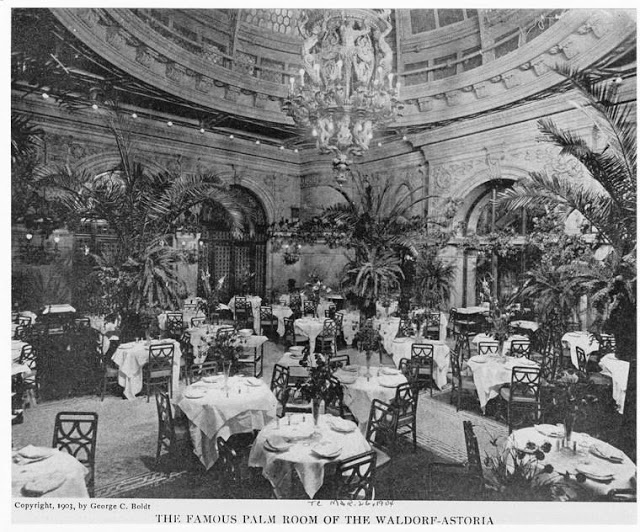
TALE OF TWO HOTELS…The Waldorf-Astoria was actually two hotels joined together. The Waldorf, at left, was built in 1893. The much larger Astoria (right) was constructed in 1897. Note the arrow indicating the original Waldorf in relation to the Astoria. (Wikipedia/Detroit Photography Archive)PLACES TO SEE AND BE SEEN…At left, the “Gentleman’s Cafe” in the Waldorf Hotel. At right, lobby entrance to the marble-lined “Peacock Alley” that connected the two hotels. (Wikipedia/justcocktails.com)DINE IN STYLE…The Palm Room in the Astoria section of the original Waldorf-Astoria Hotel. (New York Public Library)
Chappell wrote that the prime building site was slated to be occupied by a 50-story office building…
…but as it turned out, Floyd Brown was unable to make the final payments on the property, so he sold his claim to the bank. John J. Raskob, a wealthy finance executive and chair of the National Democratic Committee, joined with entrepreneur Pierre du Pont and former New York Governor Al Smith (who lost his bid for the U.S. Presidency in 1928) to buy the property. They had much bigger plans than Floyd Brown: In August 1929 they announced their plan to build the tallest building in the world — what would become the Empire State Building.
TRY, TRY AGAIN…The architecture firm Shreve & Lamb developed this concept (left) for Floyd Brown’s proposed 50-story office building on the site of the old Waldorf-Astoria. At right, what occupies the site today: the Empire State Building, also designed by Shreve & Lamb. (Pinterest/oldstructures.com)
* * *
Car Culture
The Jan. 5 issue featured a lengthy review of the 29th Annual National Automobile Show at Grand Central Palace, as well as numerous advertisements by auto manufacturers hoping to entice New Yorker readers with their latest models.
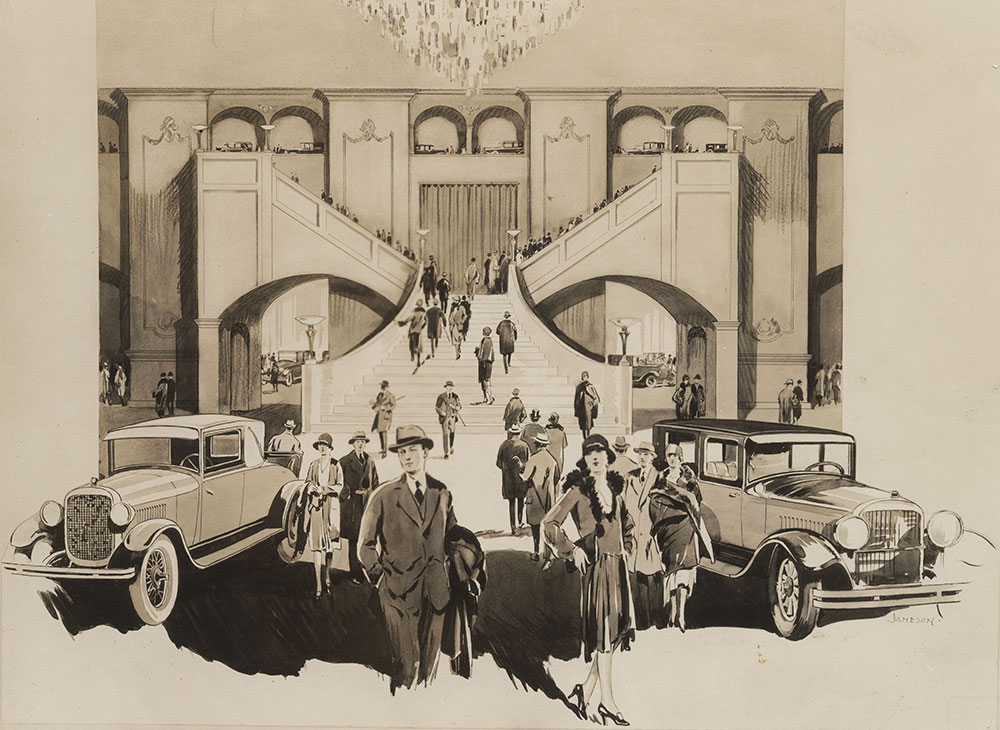
Promoters of the event touted the addition of a grand staircase to Grand Central’s mezzanine level that would ease access to both levels of the show:
AIN’T IT GRAND?…Design drawing created for the 1929 National Automobile Show at Grand Central Palace touting the addition of an equally grand new staircase. (Free Library of Philadelphia)How the new staircase actually appeared at the 1929 show. Note the background where the movement of workmen on ladders lends a ghostly appearance. (Free Library of Philadelphia)A view of the 1929 National Automobile Show from the mezzanine of the Grand Central Palace. (Free Library of Philadelphia)
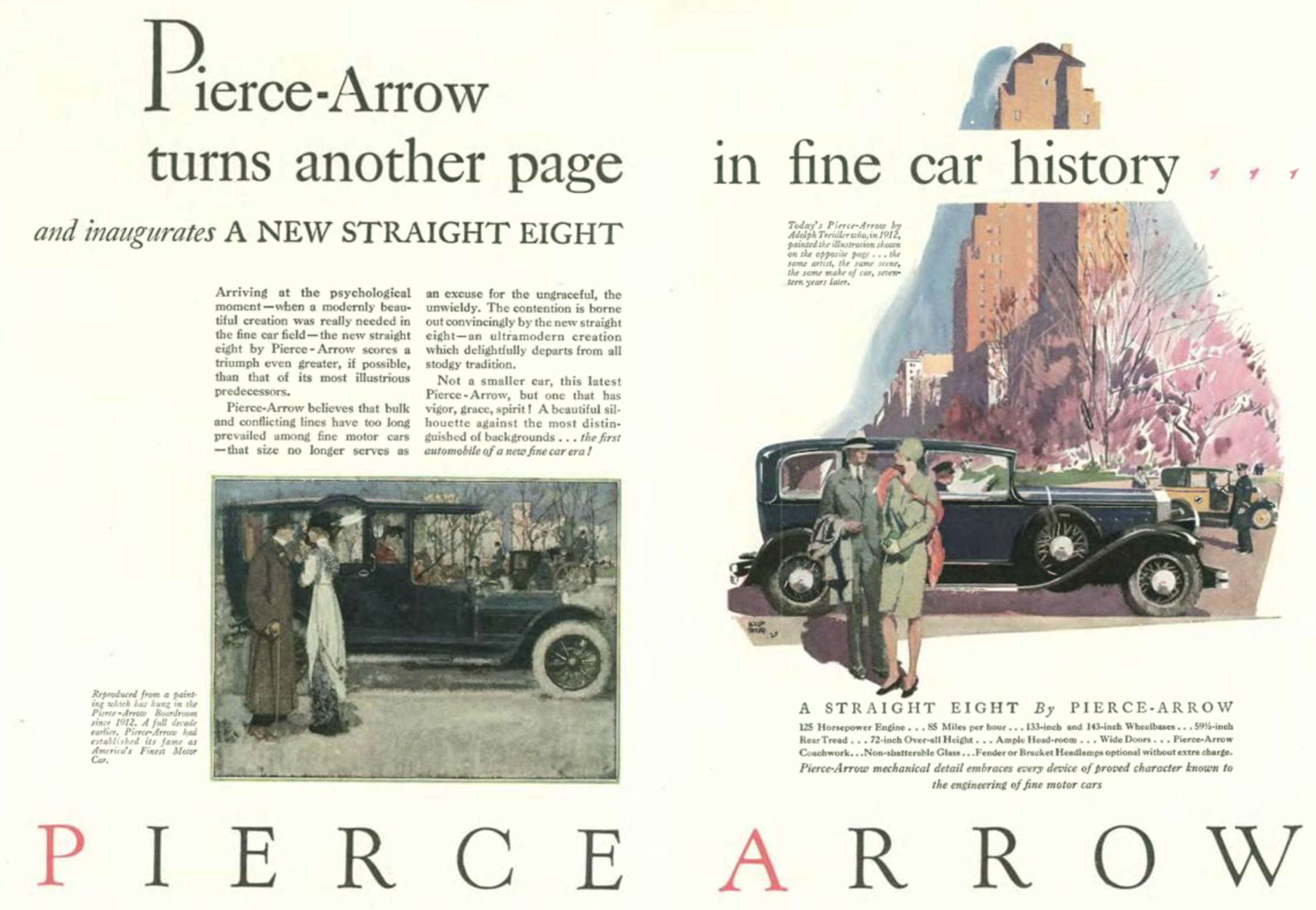
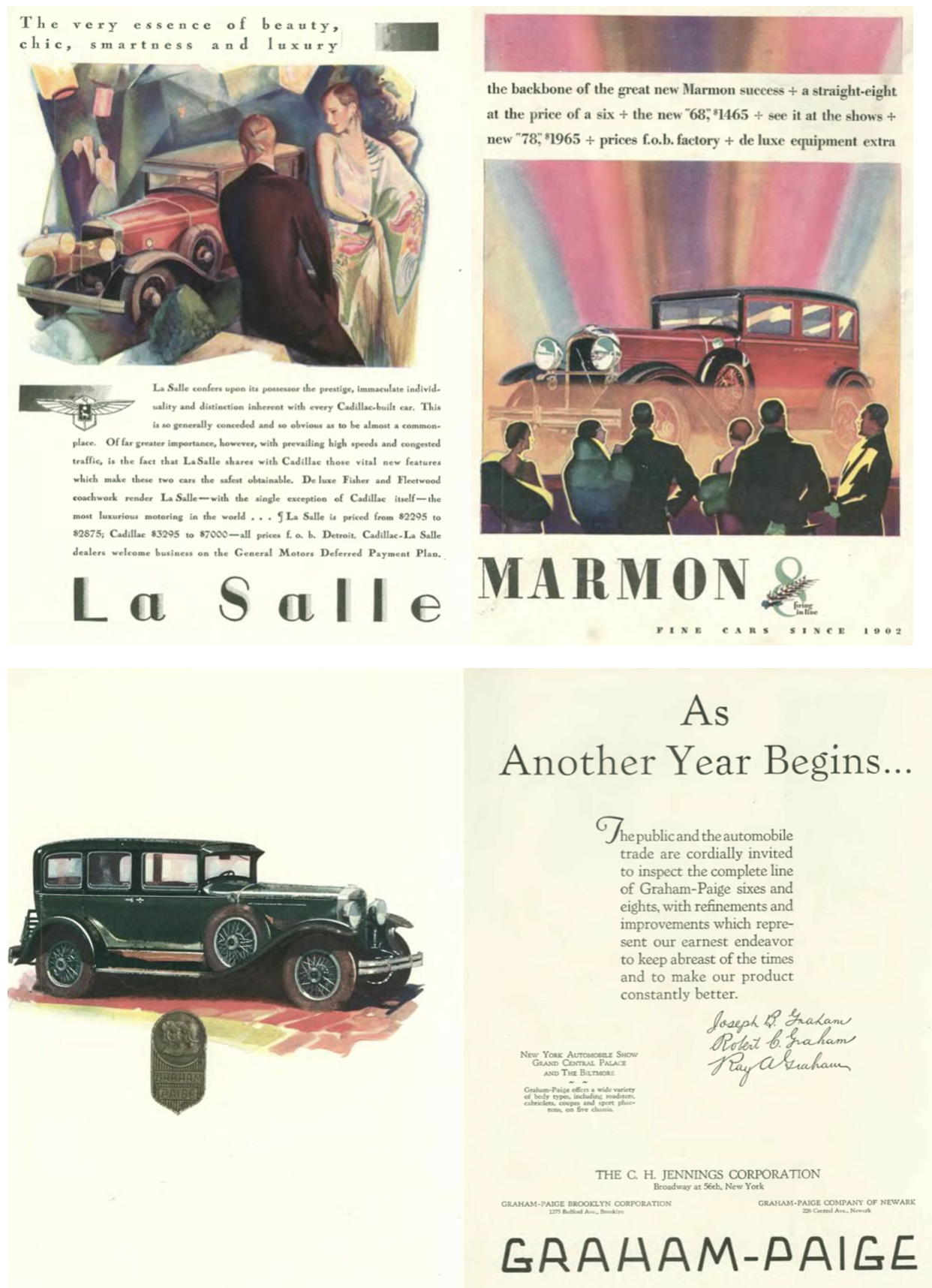
As I mentioned, the Jan. 5 issue was filled with car ads, mostly from long-gone automobile manufacturers. A constant in all of these ads is their appeal to New York’s chic, smart set. Here’s a sampling of a few of them: (click ads to enlarge):
Hupmobile was a successful car company that began its decline in the late 1920s precisely because it turned its back on buyers of medium-priced cars and went after what it perceived to be the more lucrative luxury buyer (see ad above). Hupmobile went out of business in 1939 (after briefly joining forces with Graham-Paige, which also went under that year).
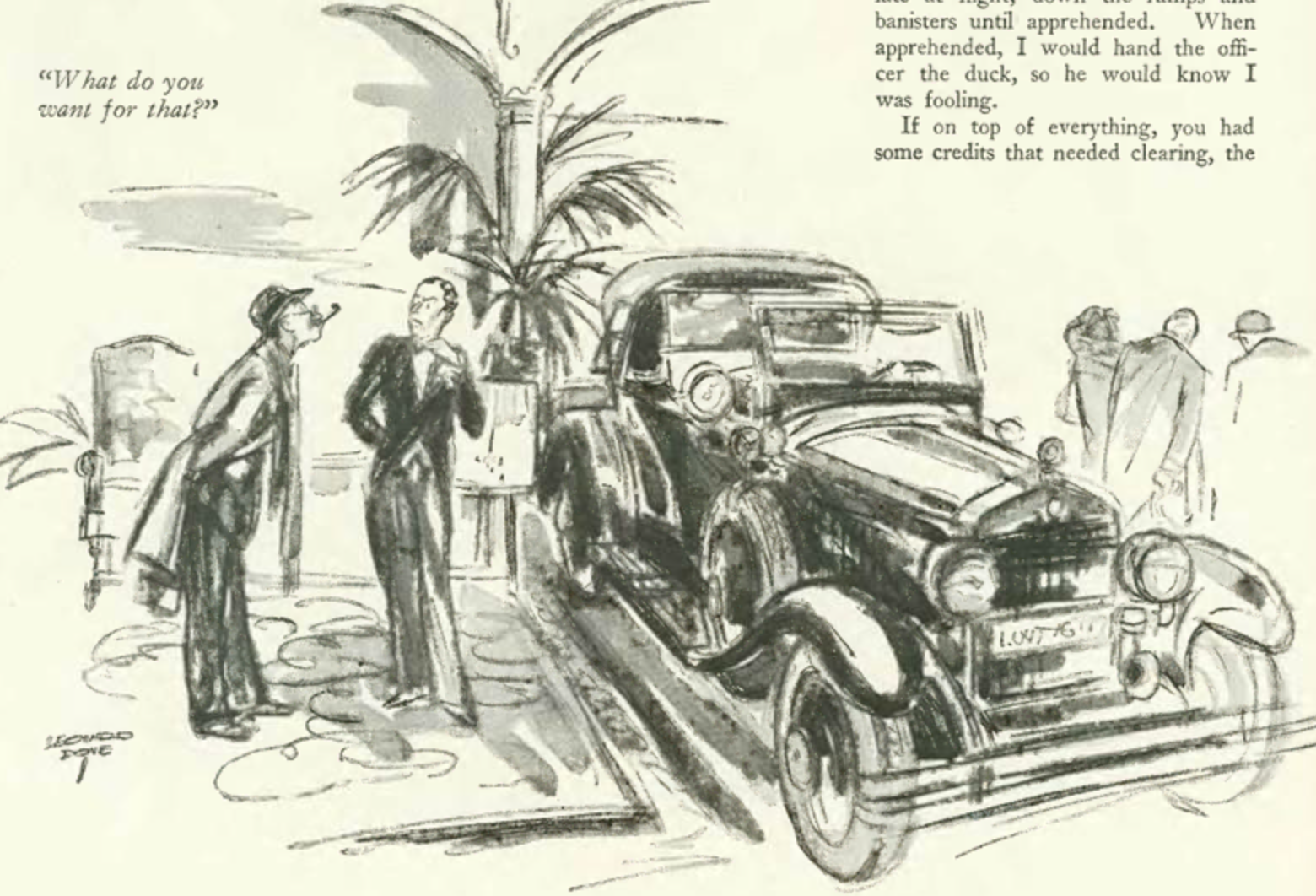
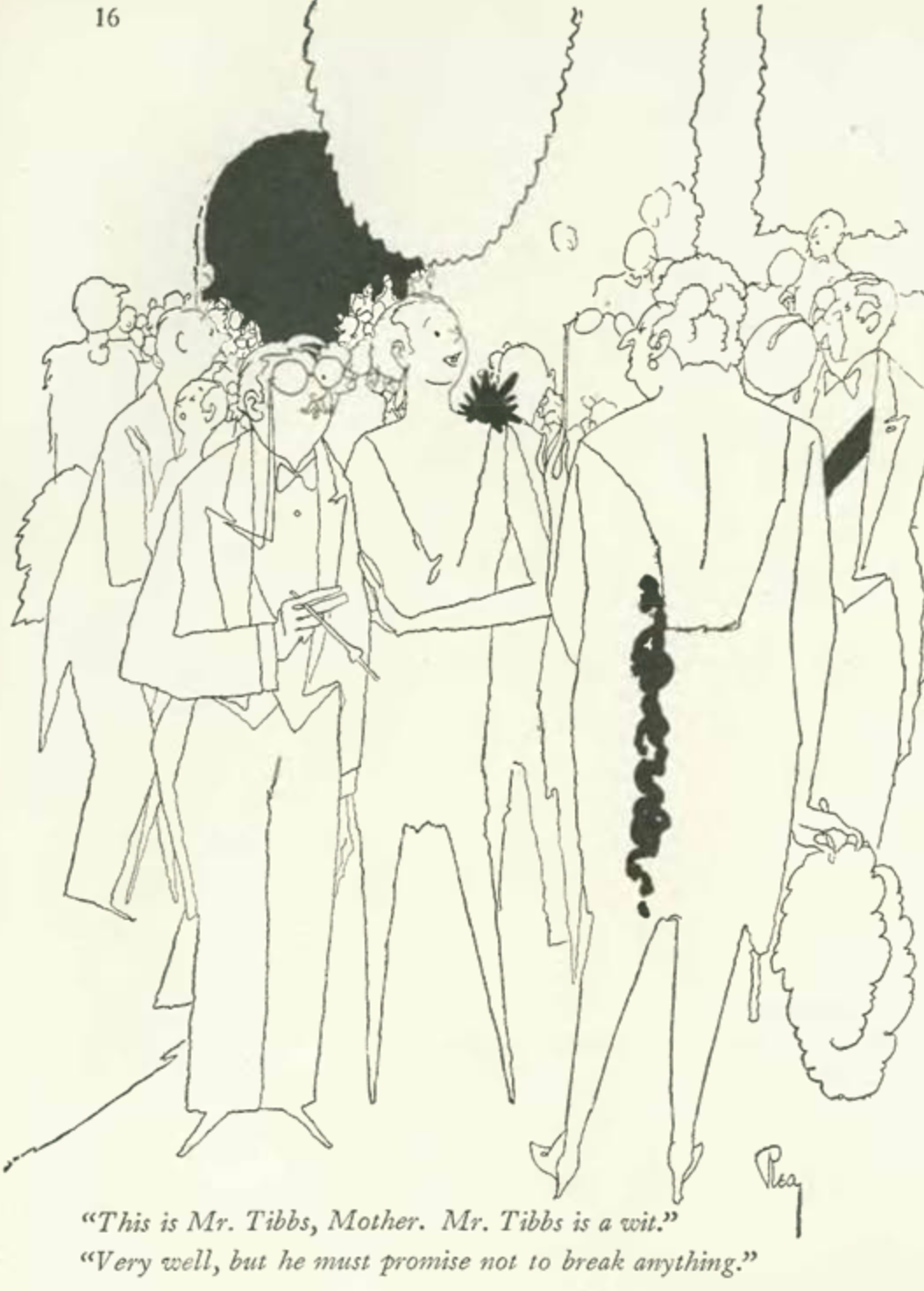
Cartoonist Leonard Dove found humor derived from these very class distinctions when he visited the auto show:
* * *
The Game, Served Up Cold
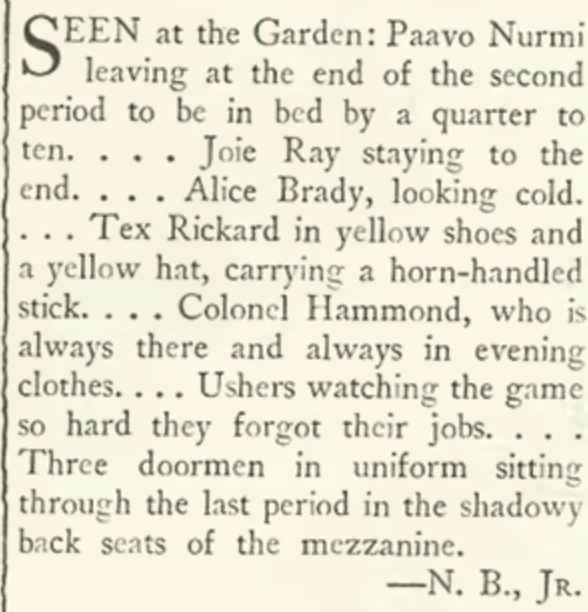
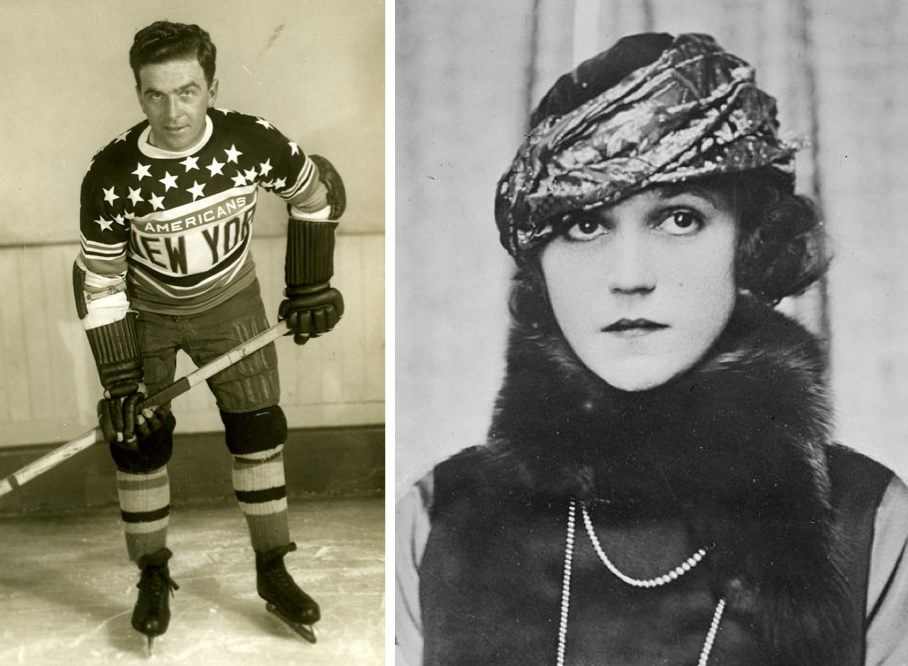
In other diversions from the Jan. 5 issue, Niven Busch Jr. attended the hockey game between the New York Rangers and the New York Americans at Madison Square Garden, noting famous faces in the crowd including Finnish track star Paavo Nurmi and American track star Joie Ray. Also noted were Tex Rickard, builder of Madison Square and founder of the Rangers, ex-football star and businessman Col. Harry Hammond, and film star Alice Brady.
AT THE GARDEN…Not even the exciting hockey play of Billy Boyd (left) and his fellow New York Americans could keep actress Alice Brady warm. (Pinterest/Alchetron)
* * *
From our non-automobile advertisers, another installment of a Theodore Geisel (Dr. Seuss) ad for Flit insecticide (this is the first instance — at least in the Flit ads— in which Geisel signs his art as “Dr. S” instead of “Seuss”).
And another cartoon from the Jan. 5 issue, courtesy Gardner Rea:
* * *
Arno Addendum
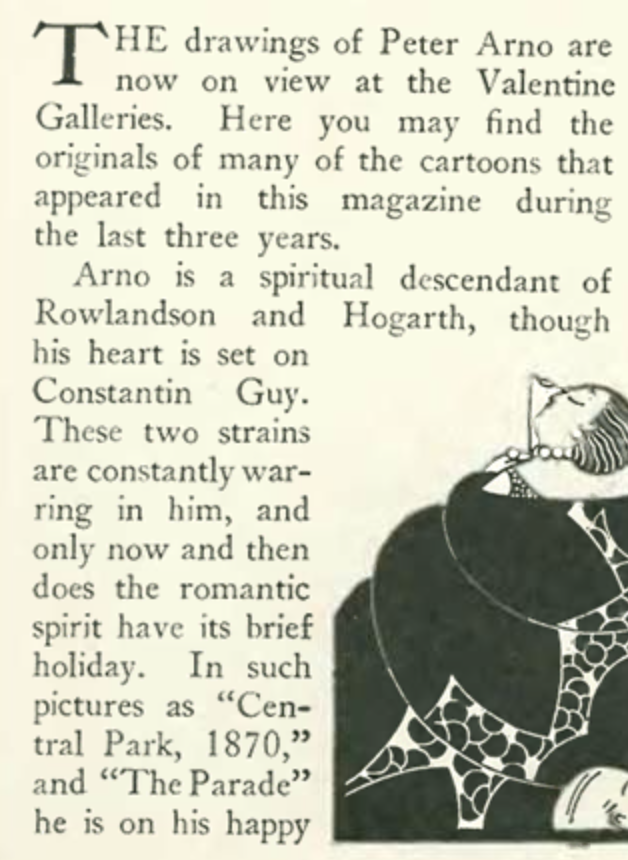
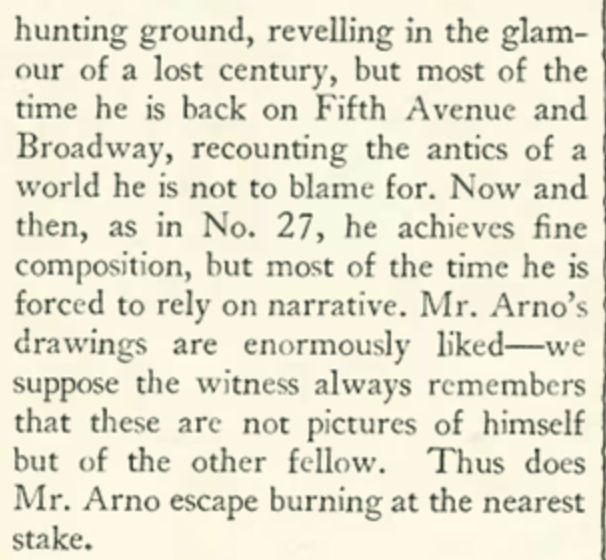
In the rush of the recent holidays I missed an item from the Dec. 22, 1928 issue — namely, art critic Murdock Pemberton’s tongue cheek review (in “The Art Galleries” column) of cartoonist Peter Arno’s December 1928 exhibition of drawings at the Valentine Gallery:
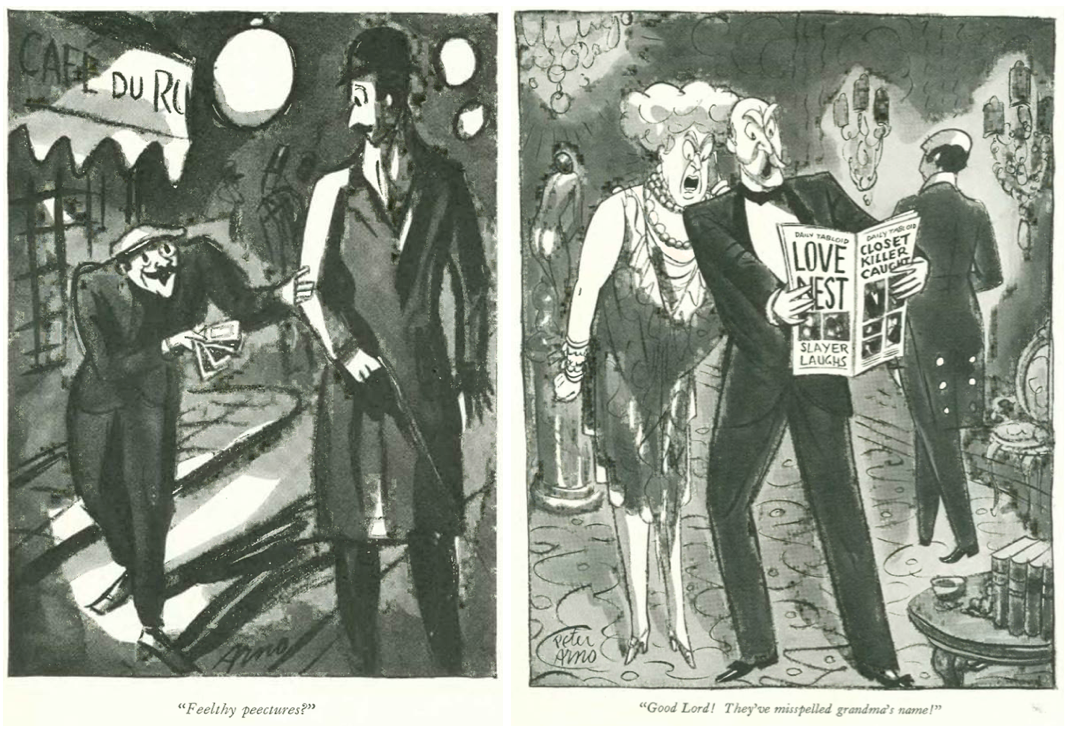
Here are two Arno drawings that were featured in the Valentine exhibition (click to enlarge):
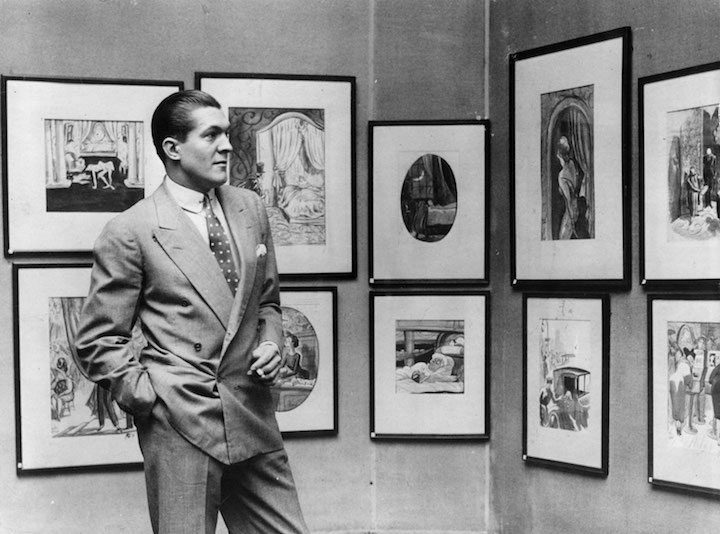
INTERNATIONAL APPEAL…less than four years after his Valentine Galleries debut, Peter Arno exhibited his drawings to great acclaim at the Leicester Galleries in London, October 1932. (Encyclopædia Britannica)
I’ve been writing this blog for nearly three years, and during that stretch have managed to cover more than 200 issues of The New Yorker, or about the first four years of the magazine.
Dec. 22, 1928 and Dec. 29, 1928 covers by Rea Irvin.
The amount of young talent on display in those early issues is truly astounding, from writers such as E.B. White, Dorothy Parker and James Thurber (writer and cartoonist) to illustrators and cartoonists including Peter Arno, Rea Irvin, Helen Hokinson, Miguel Covarrubias and Ilonka Karasz, to name just a few.Among the contributing artists was Abe Birnbaum, who illustrated more than 150 covers for The New Yorker from the 1940s to 1970s. One of his earliest contributions to the magazine was this illustration for the “Profile” section in the Dec. 22 issue:
Canadian artist Shelley Davies writes in her blog that Birnbaum “charmingly captured some of life’s quieter moments with a deft eye.” In addition to The New Yorker, Birnbaum illustrated numerous covers for Stage and Arts In America, and won a Caldecott Award in 1954 for his children’s book, Green Eyes.
ON THE QUIETER SIDE…Abe Birnbaum (pictured here circa 1960) created more than 150 covers for The New Yorker from the 1940s to the 1970s. At right, a cover from March 17, 1962. (google.com.br)
* * *
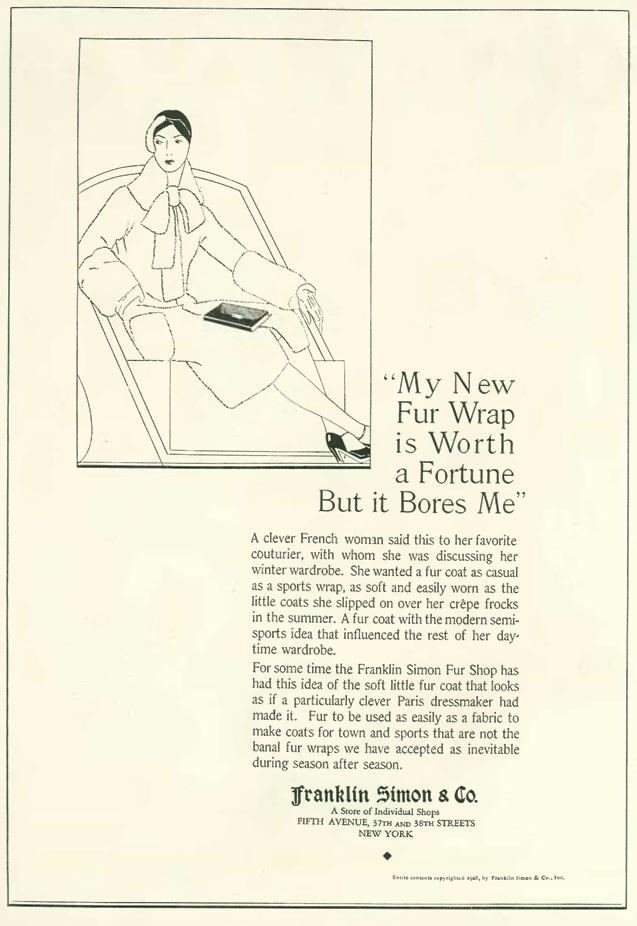
A couple of select advertisements from the Dec. 22 reveal what retailers knew, or thought they knew, about the magazine’s readership. Franklin & Simon, seeking perhaps to broaden their market for furs, suggested that even a stylish French woman might prefer a fur fashioned as a modest “sports wrap”…
…as for the guys, Saks appealed to the anglophilia that apparently was rife among New York’s smart set. Check out the ridiculous hat gracing the noggin of this young dandy…
Well-heeled readers who could afford to flee the New York winter were targeted by these various enticements in the Dec. 22 issue (this is a collage of select ads found in the back pages of the issue):
* * *
Hello Down There
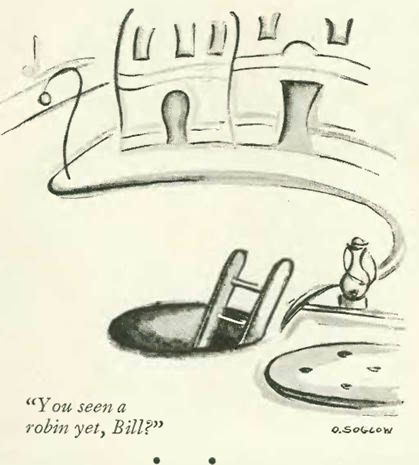
Writing about New Yorker humor derived from class distinctions, Ben Yagoda (About Town: The New Yorker and the World It Made, p. 63) noted a series of cartoons by Otto Soglow that began with this one in the Dec. 22, 1928 issue and continued through thirty installments that ran to early 1930, when the workers, Joe and Bill, finally emerged from the manhole:
This running gag, according to Yagoda, “came from the conceit that the laborers spoke with the same assumptions and in the same catchphrases as those with ‘higher’ places in society.”
Also from the Dec. 22 issue, this terrific cartoon by Leonard Dove that showed a bookish man who had accidentally entered the wrong type of book-making establishment:
* * *
The Girl Who Wouldn’t Grow Up
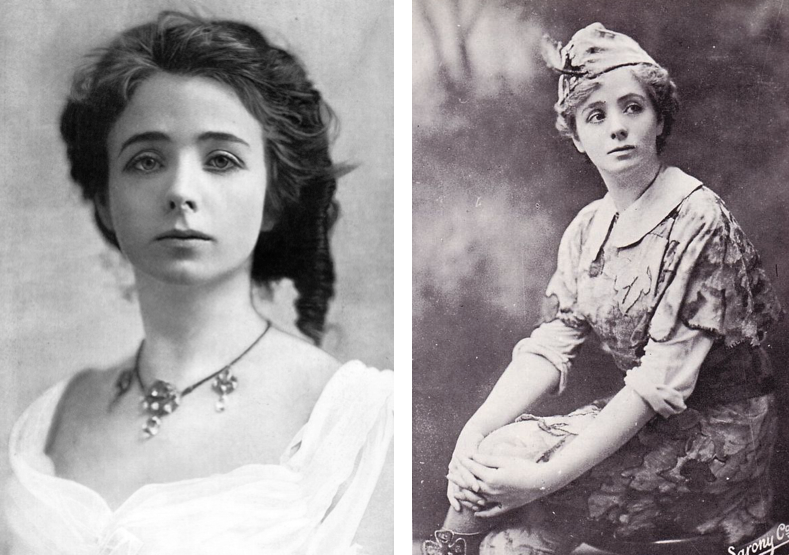
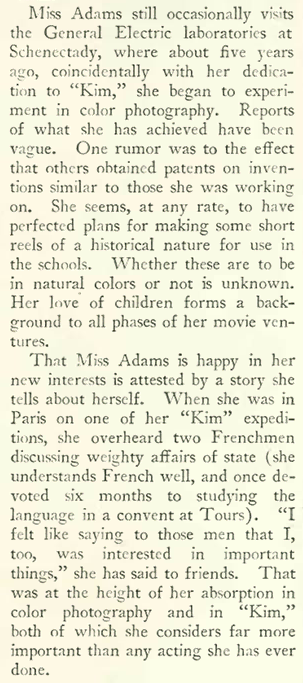
Maude Adams was a major Broadway star in the early years of the 20th century. Appearing in more than 25 productions from 1888 to 1916, she was most famous for her portrayal of Peter Pan in the Broadway production of Peter Pan; or, The Boy Who Wouldn’t Grow Up. She performed that role first in 1905-06 and again in 1912 and 1915. The highest-paid performer of her day, at her peak she earned more than $1 million a year, a staggering sum more than a century ago. James Thurber, writing in the Dec. 29 “Talk of the Town,” reported that after a decade-long absence from the stage, Adams was planning a comeback as a director:
STAR POWER…At left, American actress Maude Adams, circa 1900. At right, Adams as Peter Pan, her most famous stage role. Adams was the first American to portray Peter Pan on the stage. She played the role 1,500 times between 1905-1915. She retired from the stage in 1918 after a severe bout with the flu. She died at age 80 in 1953. (Wikipedia/Oakland Tribune)
Thurber also noted that Adams was working with General Electric in the development of color photography. According to the Trivia Library, it has been suggested that her motivation might have been a wish to appear in a color film version of Peter Pan. She eventually returned to acting in the 1930s, with occasional appearances in regional productions of Shakespeare plays.
* * *
A Lukewarm Welcome to 1929
The Dec. 29 New Yorker opened with these lamentations for the last issue of 1928. At least it appears that one could obtain a decent bottle of French champagne to toast the New Year:
JAM SESSION…1929 photo of traffic on Fifth Avenue. (theoldmotor.com)
* * *
The Passing of a Poet
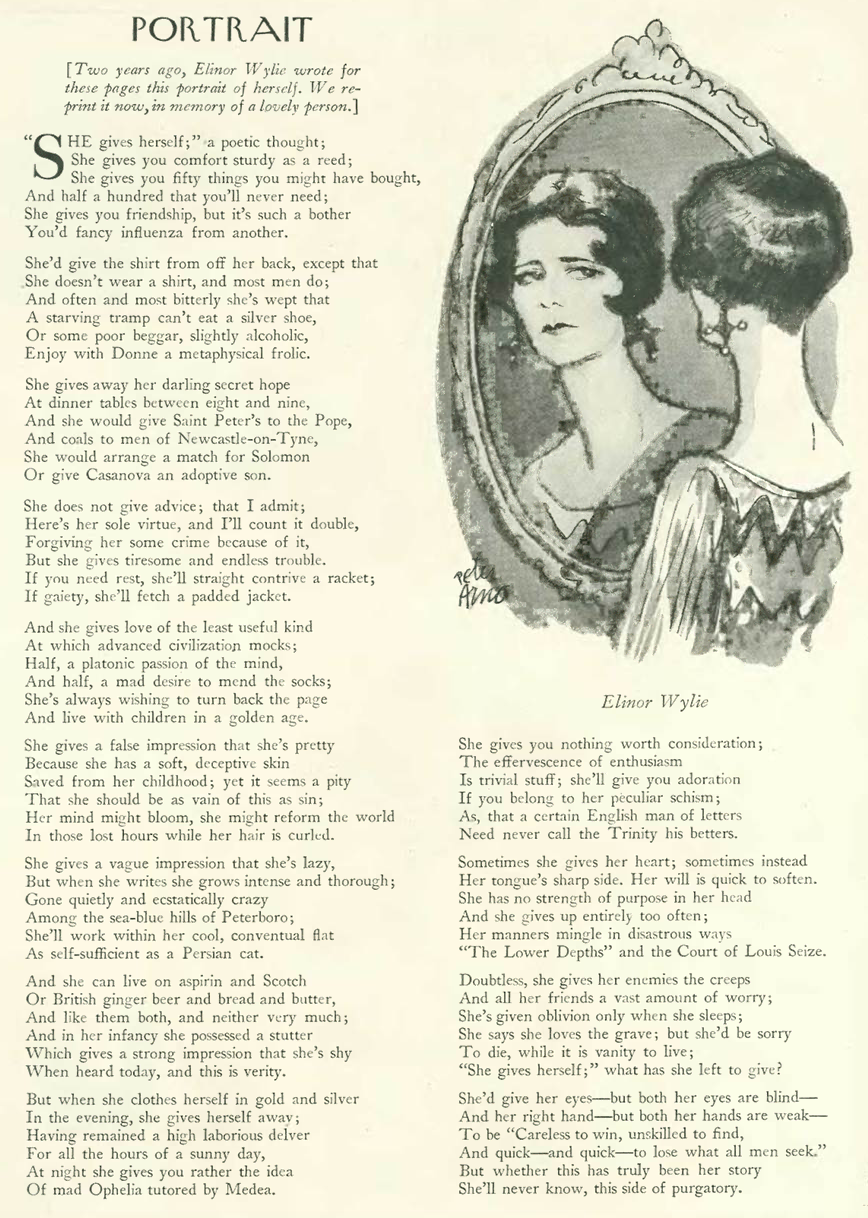
The Dec. 29 issue featured something unprecedented in The New Yorker up to that point: the reprinting of an entire piece previously featured in the magazine. In this case, it was in tribute to the sudden passing of poet and author Elinor Wylie:
PORTRAITS…Elinor Wylie posed for her friend Carl Van Vechten in this 1922 portrait (left). The photo at right, probably taken around 1926, was clearly the inspiration for the illustration by Peter Arno that accompanied “Portrait.” (Yale University/humorinamerica.wordpress.com)
It is no wonder that The New Yorker had such affection for Wylie, for she was as colorful a personality as could be found in 1920s literary circles. A Columbia University Press bio notes that “she was famous during her life almost as much for her ethereal beauty and personality as for her melodious, sensuous poetry.” Born to a socially prominent family and trained for a life in society, she instead became notorious for her multiple marriages and love affairs. She also suffered from extremely high blood pressure that gave her unbearable migraines.
Wylie died on Dec. 16, 1928, while going over a typescript of her poetry collection, Angels and Earthly Creatures, with her estranged third husband, William Rose Benét. According toKaren Stein (in the Dictionary of Literary Biography), Wylie, while picking up a volume of John Donne’s poems, asked Benét for a glass of water. When he returned with it, she reportedly walked toward him and murmured, “Is that all it is?,” and fell to the floor, dead of a stroke. She was 43.
* * *
Age of Innocence
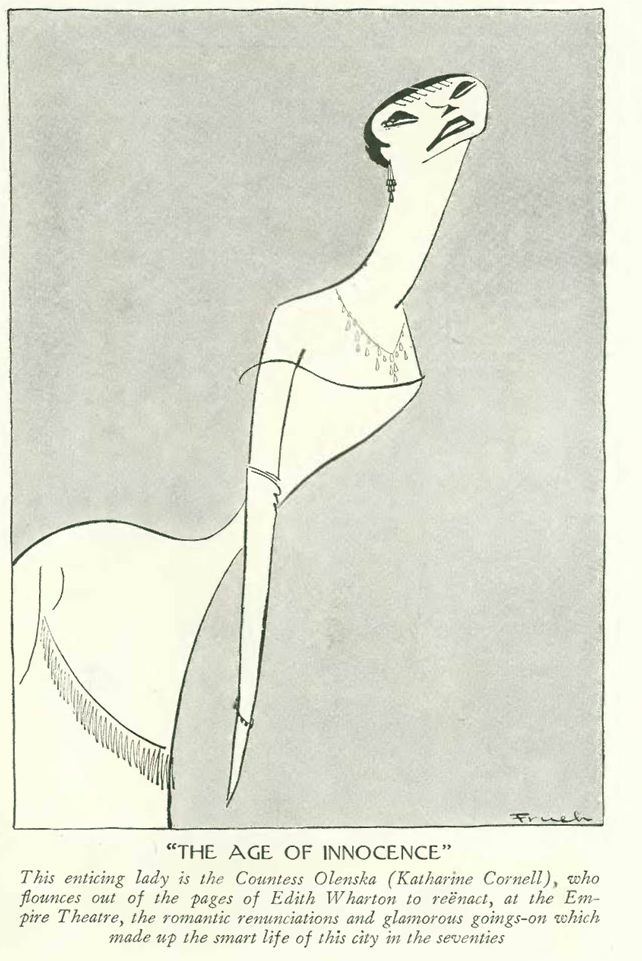
The Dec. 29 theatre review section featured this illustration by Al Frueh of Katharine Cornell in the Empire Theatre’s production of The Age of Innocence:
And below, a studio portrait of Cornell from the same play:
HOW SHE REALLY LOOKED…Katharine Cornell as ‘Countess Ellen Olenska’ in this Vandamm Studio portrait dated November 27, 1928. (Billy Rose Theatre Collection, The New York Public Library)
* * *
Before Baby Snooks
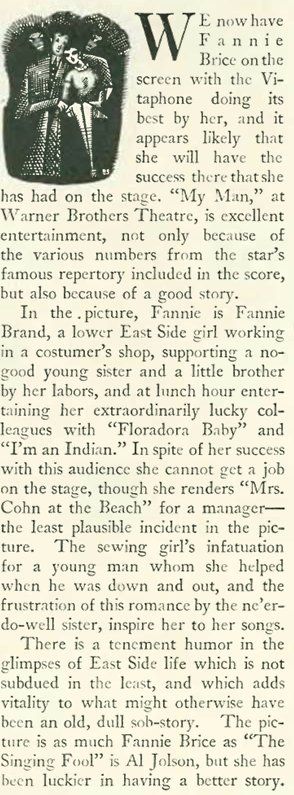
Although it was still a few years before singer and actress Fanny Brice would make her radio debut as the bratty toddler named “Snooks,” she was already well-known to New York audiences for her work in the Ziegfeld Follies (beginning in 1910). In its Dec. 29 issue The New Yorker favorably reviewed Brice’s first motion picture, My Man, which included musical scenes with Vitaphone sound:
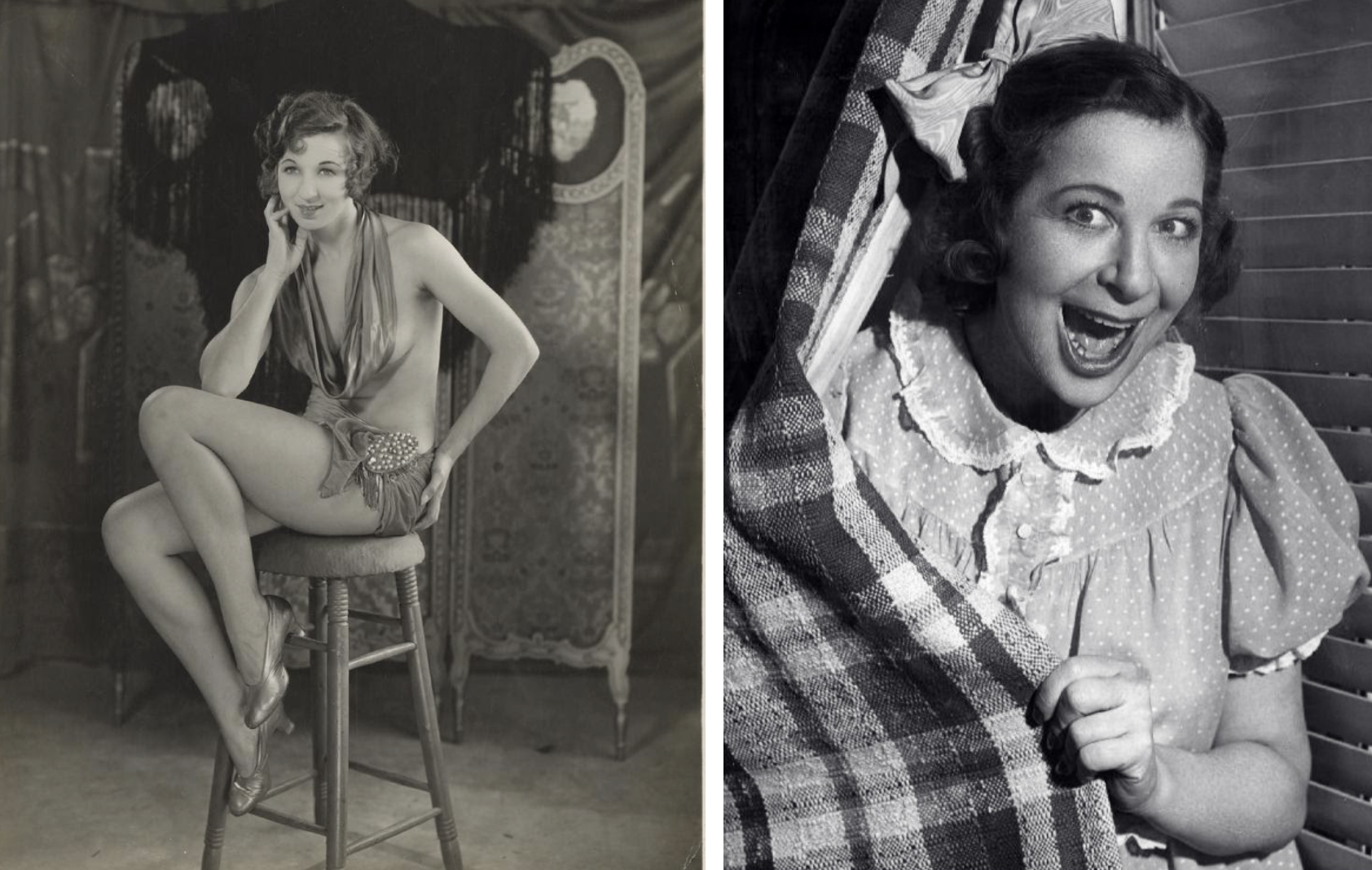
MY MAN…Fanny Brice, Guinn Williams, and Edna Murphy on the set of the partially silent film My Man, 1928. Her first movie appearance, Brice played Fanny Brand, a poor girl who becomes a star. The film is now considered lost, since only an incomplete version survives. (brice.nl)THROUGH THE YEARS…At left, singer and actress Fanny Brice from the time she was a Ziegfeld Follies girl, circa 1915. At right, Brice in the role of Baby Snooks, 1940. (Vintage Everyday/Wikipedia)
* * *
Let’s Get Physical
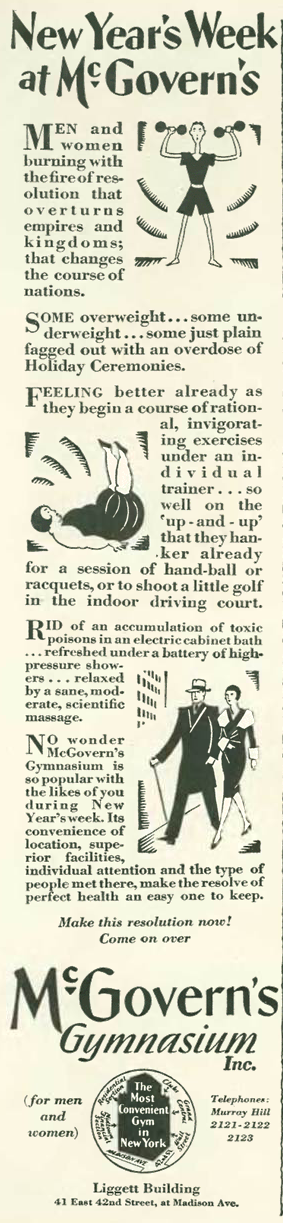
Even 90 years ago some folks (or at least some New Yorkers) resolved to get healthy and hit the gym in the New Year. In this ad, McGovern’s Gymnasium announced it was ready for them:
Babe Ruth trains at Artie McGovern’s Gym for the upcoming baseball season, February 9, 1928. (twitter.com/BSmile)
And to close out 1928, a cartoon from John Reehill…
Like many publications, there are defining moments in the New Yorker’s history that make the magazine what it is today.
December 8, 1928 cover by Peter Arno.
In a post more than two years ago I wrote about Ellin Mackay’s pivotal essay, “Why We Go To Cabarets: A Post-Debutante Explains.” The debutante daughter of a multi-millionaire (who threatened to disinherit her due to her romance with Irving Berlin), Mackay explained that modern women were abandoning social matchmaking in favor of the more egalitarian night club scene. Mackay’s essay provided a huge boost to the struggling New Yorker, which had dipped to less than 3,000 subscribers in August 1925. A more recent post, “A Bird’s Eye View,” noted how a short story by Thyra Samter Winslow opened the door to serious fiction in the magazine.
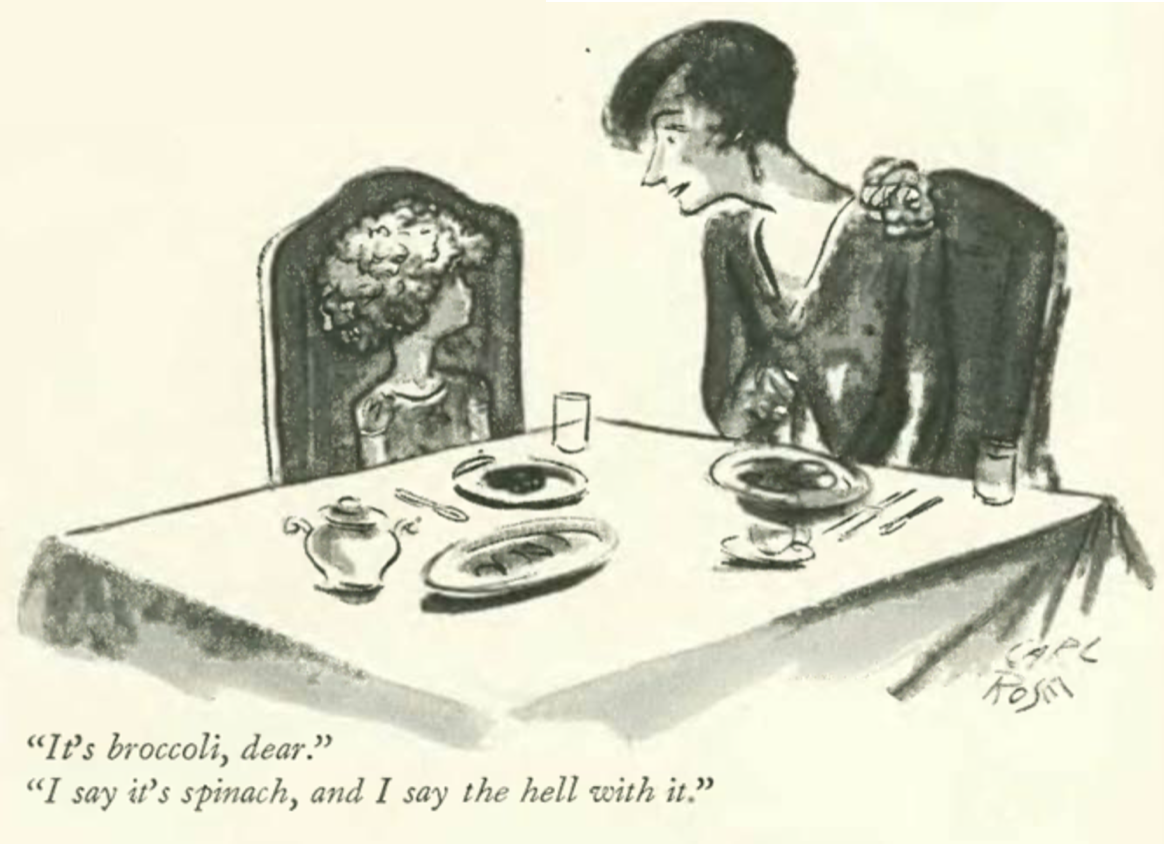
The Dec. 8, 1928 issue was significant for a cartoon by Carl Rose that appeared on the bottom of page 27:
It remains one of The New Yorker’s most famous cartoons, and for good reason. In his book About Town: The New Yorker and the World It Made, Ben Yagoda writes that the cartoon (drawn by Rose, with spinach line provided by E.B. White) “was picking up on something in the culture: it was a moment when the air reverberated with the sound of speech.” Yagoda notes that although “the cartoons led the way,” the magazine has always been filled with the sound of voices in “The Talk of the Town.” Naturalistic rendering of speech could also be found under the heading of such features as “Overheard,” which ran from 1927-1929 and included such contributors as the young writer John O’Hara.
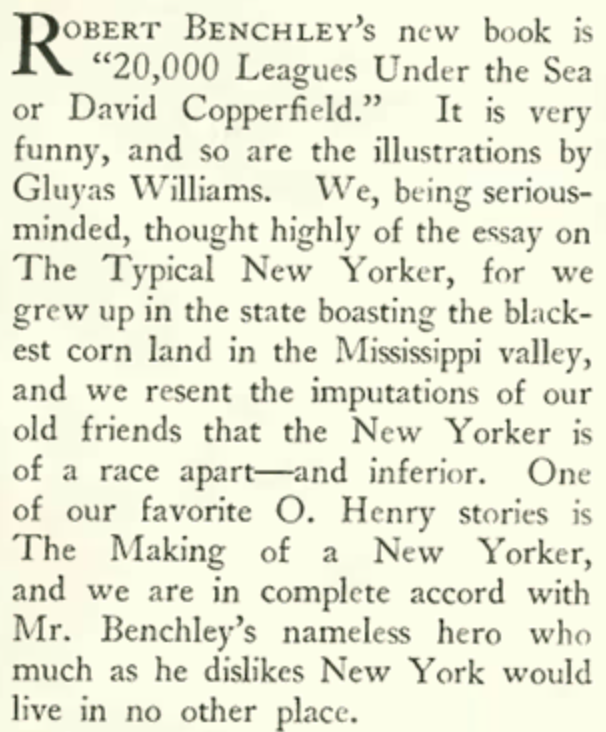
Another New Yorker contributor whose work resounded with the sound of speech, Robert Benchley, received some kind words from the magazine on his latest book, Twenty Thousand Leagues Under the Sea or David Copperfield:
DON’T BE SERIOUS…Robert Benchley and his book, 20,000 Leagues Under the Sea or David Copperfield, illustrated by his New Yorker colleague Gluyas Williams. The cover depicted Benchley performing his famous sketch, The Treasurer’s Report. (Goodreads/bio.com)
* * *
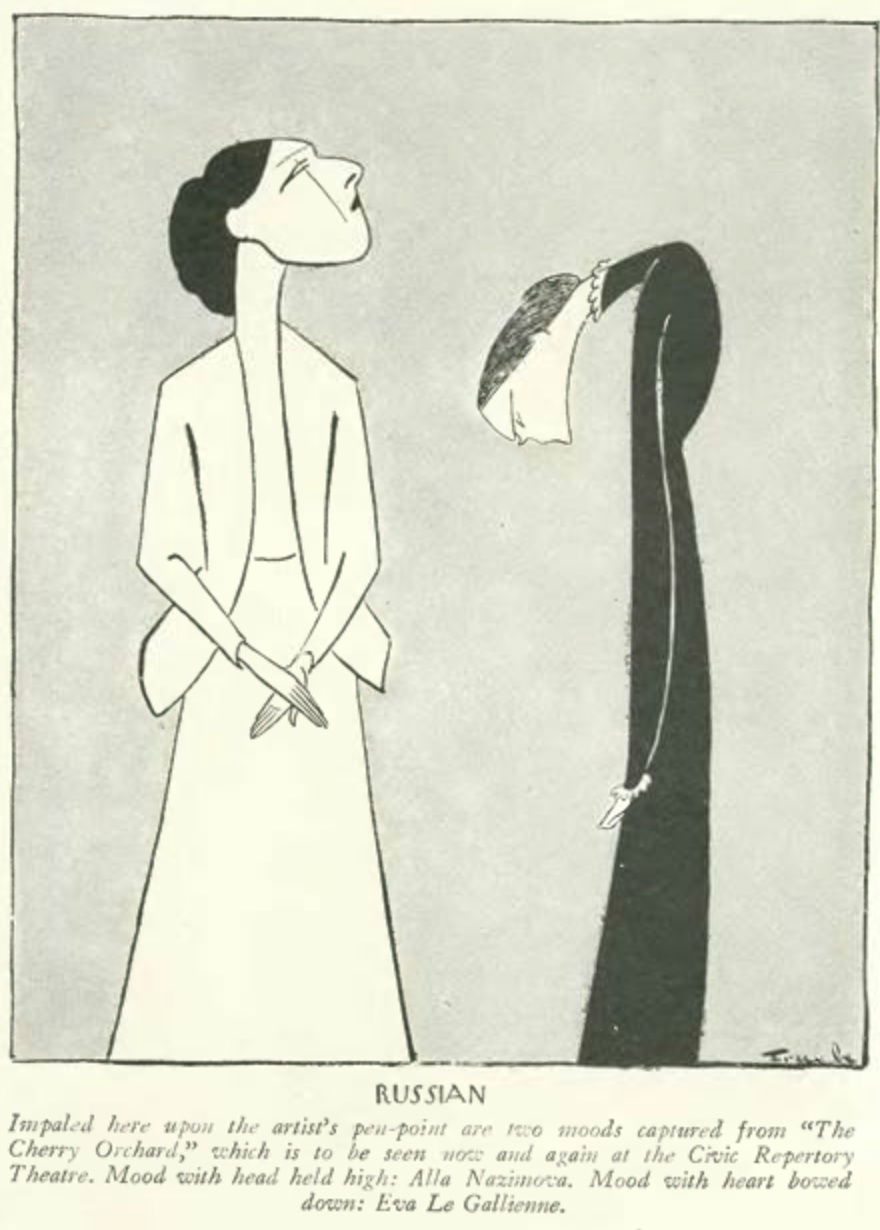
Appearing at the Civic Repertory Theatre (founded by actress Eva Le Gallienne in 1926) was Alla Nazimova and Eva herself in Anton Chekov’s last play, The Cherry Orchard.Al Frueh offered this sketch for the theatre review section.
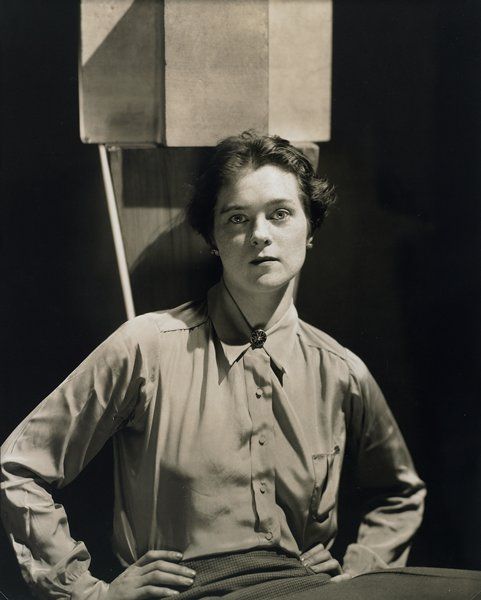
Josephine Hutchinson as Anya, Alla Nazimova as Ranevskaya, and Paul Leyssac as Gayev in Anton Chekov’s last play, The Cherry Orchard, at the Civic Repertory Theatre in 1928. (eBay)TOUR DE FORCE…Eva Le Gallienne in 1928, photo by Edward Steichen. (Minneapolis Institute of Art)
* * *
From Our Advertisers
Advertisements from the Dec. 8 issue offered this study in contrasts…a “modern” take on the holidays by Wanamaker’s, featuring the unfortunately titled “Psycho-Gifts for Christmas”…
…versus the staid offerings of Brooks Brothers on the following page…
* * *
On to the Dec. 15 issue, we find The New Yorker enjoying the debut of the Ziegfeld Follies latest revue…
December 15, 1928 — issue number 200 — cover by Julian de Miskey.
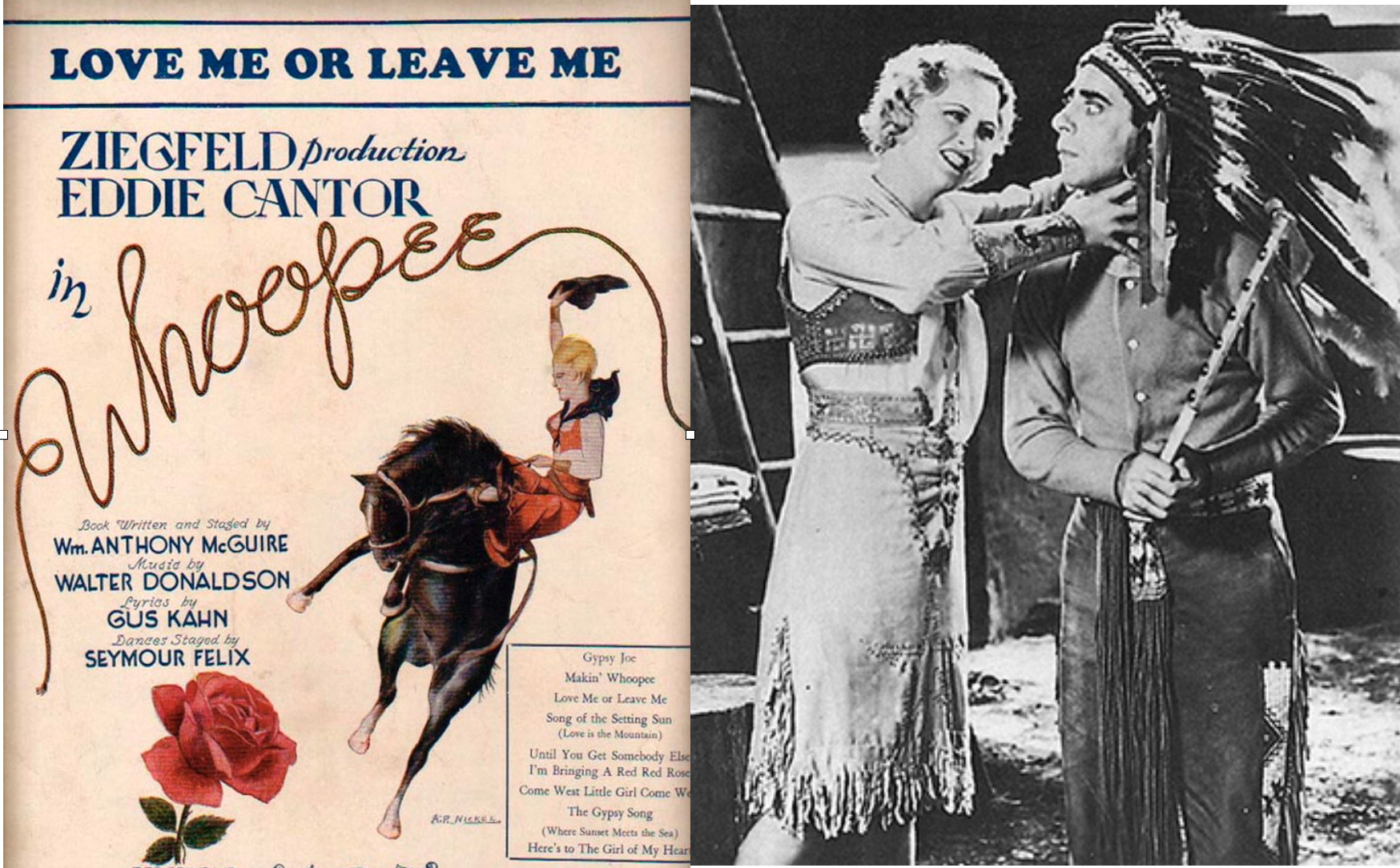
…the show “Whoopee” at the New Amsterdam, featuring Eddie Cantor:
HIT MAKER…Sheet music for the hit “Love Me Or Leave Me” from the Ziegfeld Follies show Whoopee. At right, a still from the 1930 film Whoopee!, with Eleanor Hunt and Eddie Cantor. (carensclassiccinema/thejumpingfrog.com)
And lest you think audiences were flocking to only see Eddie Cantor…
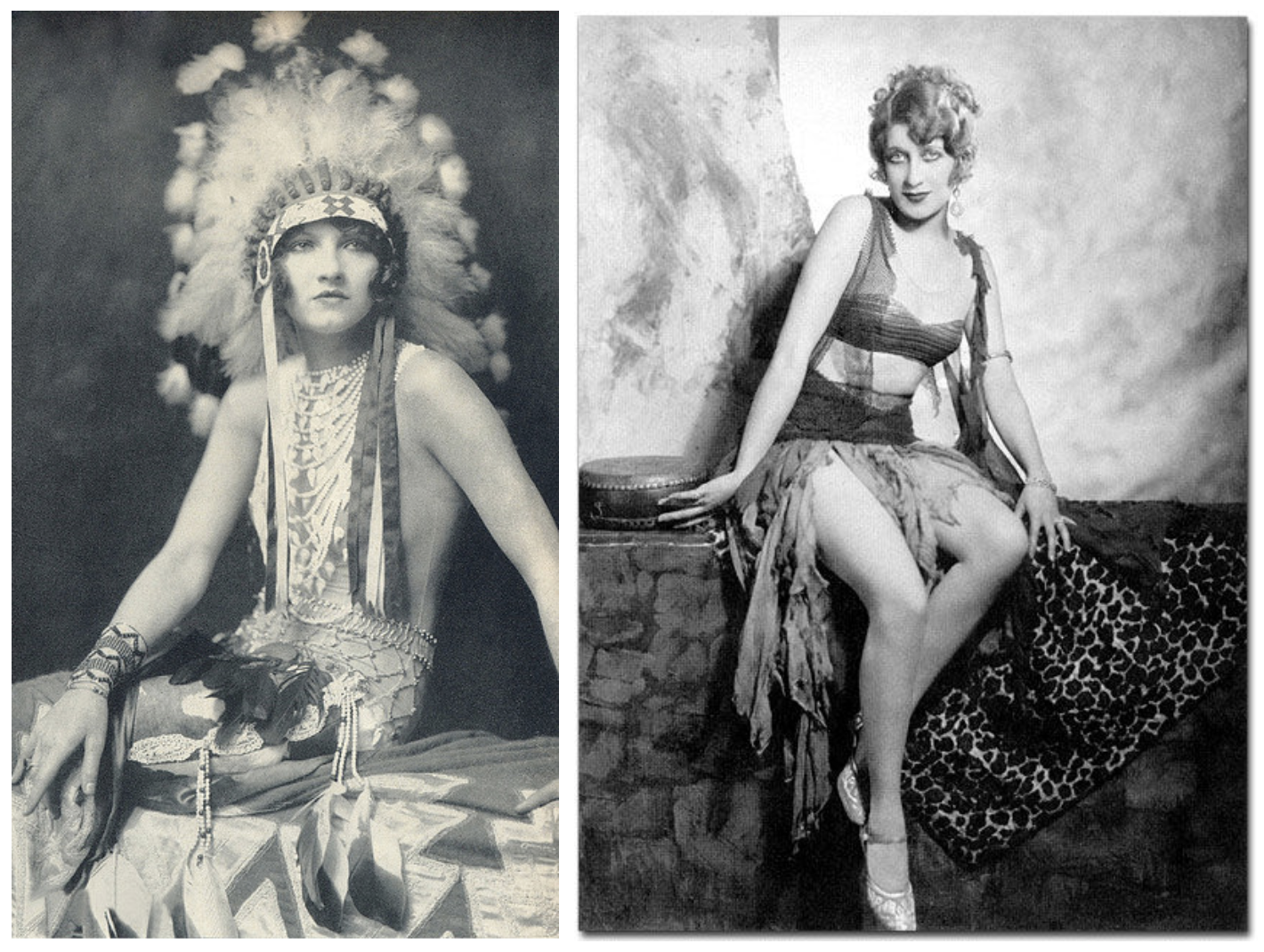
LAVISH, LAVISH!…At left, Ziegfeld Follies performer Jean Ackerman in Whoopee! At right, Ziegfeld performer Ruth Ettig’s rendition of “Love Me or Leave Me” in Whoopee made it a major hit as well as her signature song. (mote-historie.tumblr.com/Alfred Cheney Johnston photo via songbook1.wordpress.com)
* * *
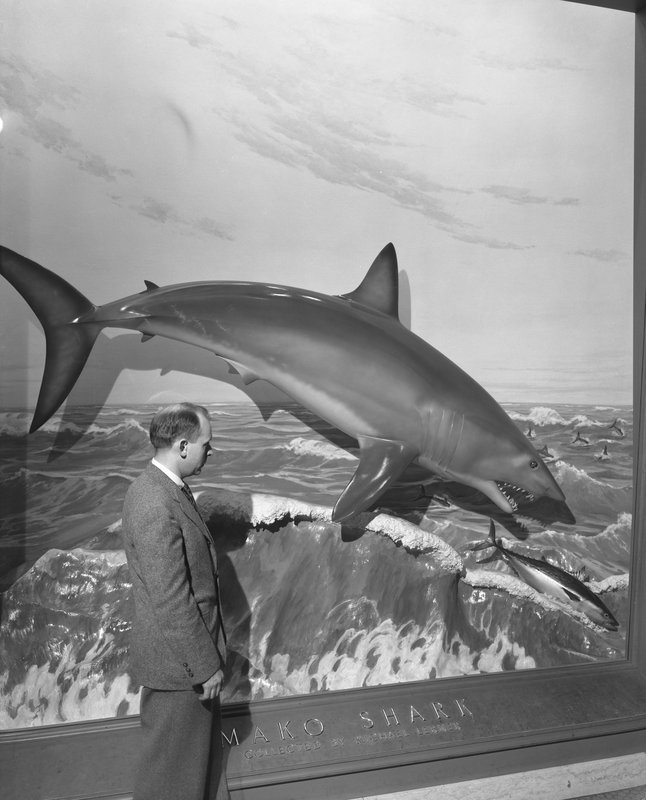
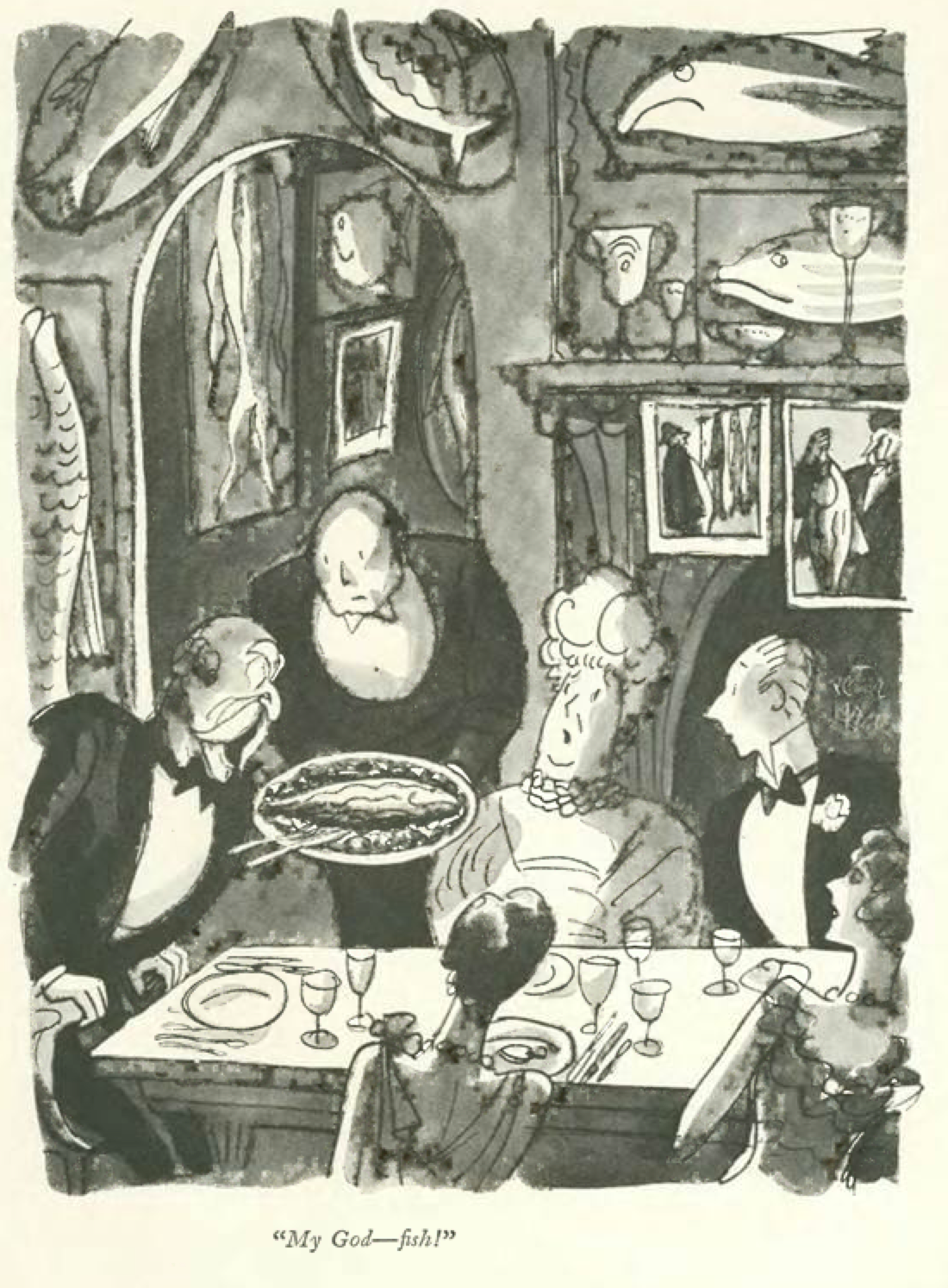
On to less glamorous pursuits, The New Yorker also paid a visit to the new “Fish Wing” at the Museum of Natural History, as recounted in “Talk of the Town.” A brief excerpt:
SWIMMING WITH THE FISHES…A visitor admires the mako shark exhibit at the Hall of Fishes in the American Museum of Natural History, 1948 (AMNH)
From Our Advertisers…
…comes this house ad from The New Yorker itself, promoting its first-ever Album:
Chris Wheeler has gathered all of the albums at this site.
Although the Roaring Twenties saw the relaxing of many moral strictures — particularly in major cities like New York — Mae West’s frank portrayals of sex on an off-Broadway stage could still create a stir in the newspapers and among arbiters of American probity.
Nov. 19, 1928 cover by Theodore G. Haupt.
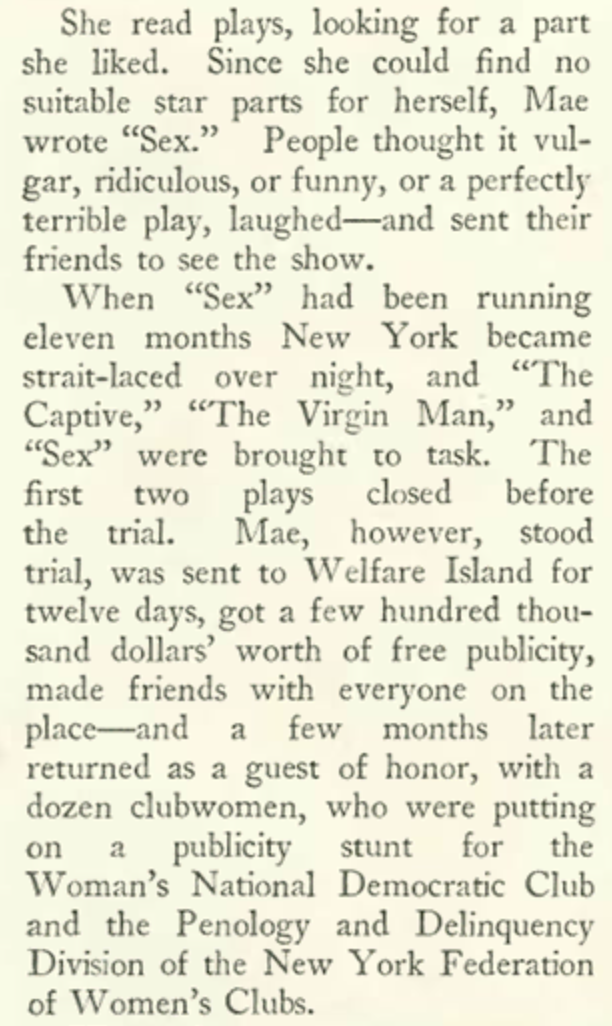
Before she appeared in films (mostly in the 1930s) Mae West was well known to New Yorkers both in vaudeville and on Broadway. Her wider fame came in 1927, when many Americans read about her arrest on obscenity charges linked to a scandalous play simply titled Sex. A story of a Montreal prostitute, Sex opened at Daly’s 63rd Street Theatre on April 1926 to modest audiences and mostly scathing reviews. The New York Times, for example, called it a “crude and inept play, cheaply produced and poorly acted.” Perhaps because of the negative reviews, which mostly focused on the play’s morality, curious audiences flocked to see it. Ironically (at least, I imagine, to the critics), Sex was the only play on Broadway in 1926 to stay open through the summer and into the following year.
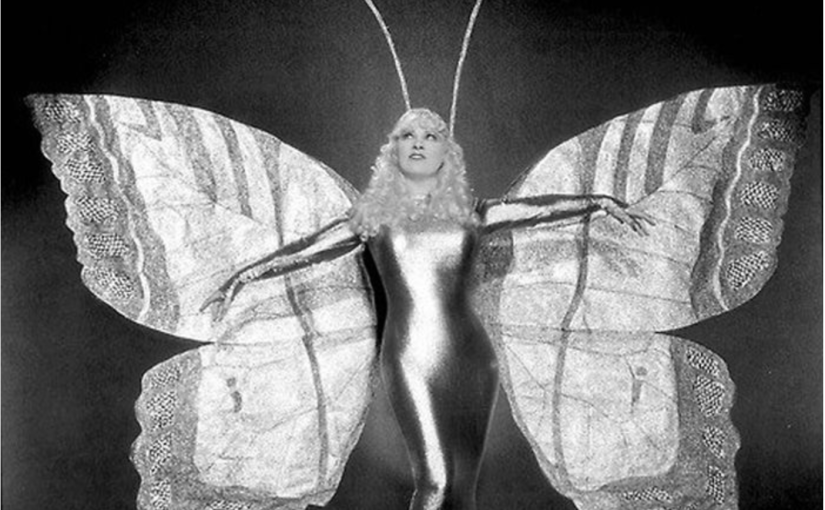
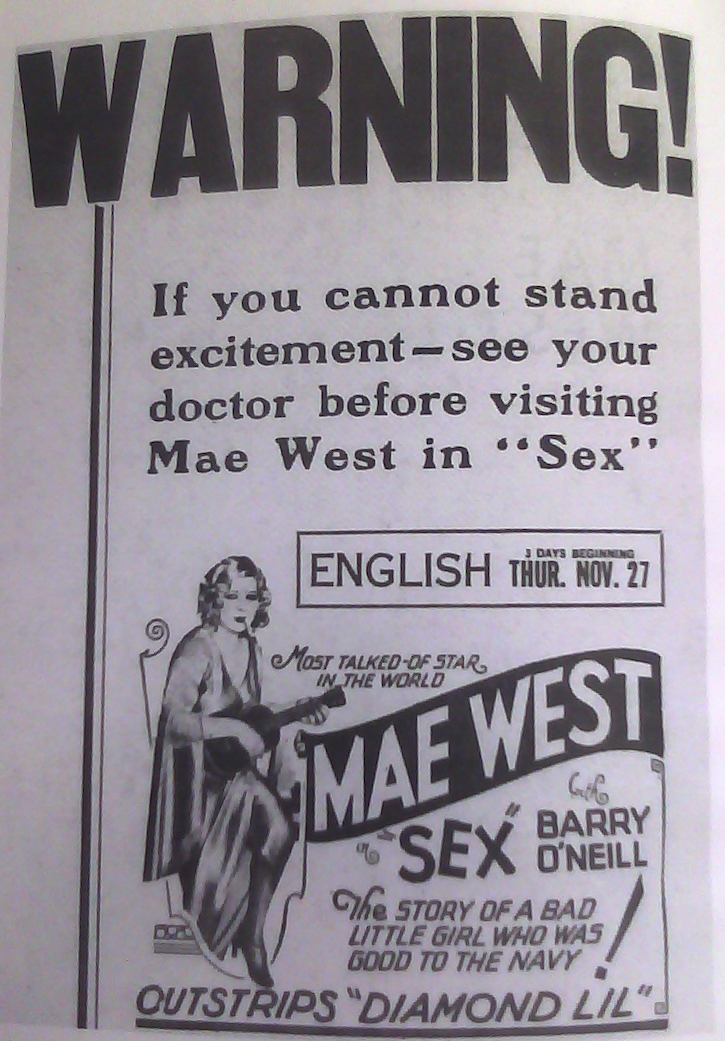
NOW THAT I HAVE YOUR ATTENTION…Mae West in a publicity photo from 1926. At right, promotional poster for Sex, which touted the play as the “Biggest Sensation Since The Armistice.” (maewest.blogspot.com/boweryboyshistory.com)
The fun ended when New York City police raided West’s production company in February 1927 and charged her with obscenity. In another ironic and hypocritical twist (many in the police department and in the city’s court system had enjoyed the play themselves, along with approximately 325,000 others during the play’s 10-month run), authorities fined West $500 and sentenced her to ten days in a workhouse on Welfare Island. Always the entrepreneur, West used the sentence to her advantage, and even arrived at the prison in a limousine. It was during her short stint in prison that she began work on her smash hit Diamond Lil.
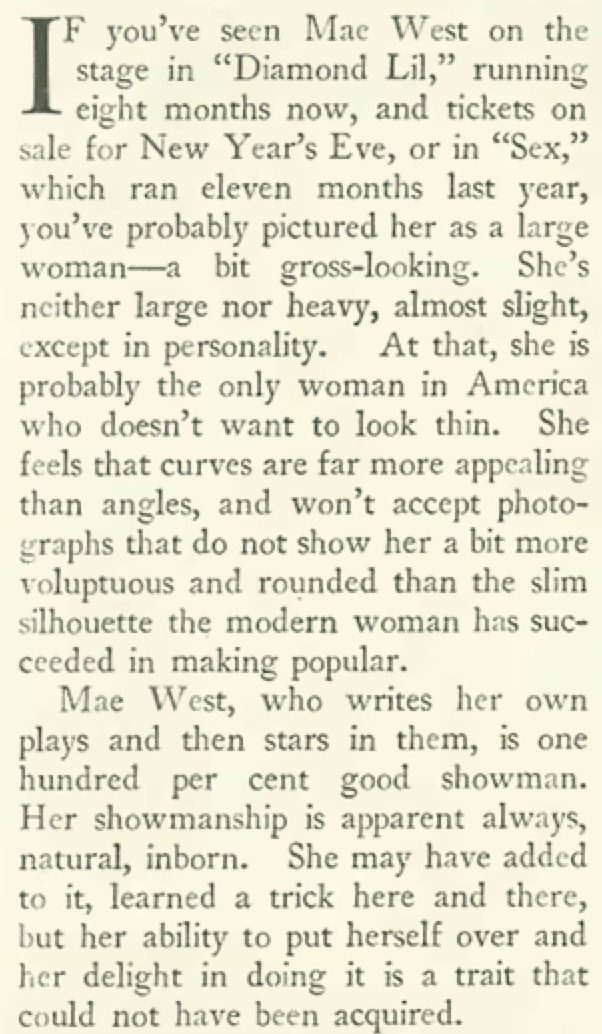
Thyra Samter Winslow, a writer who often exposed the hypocrisy and prejudice in American life in her short fiction, profiled West for the Nov. 10, 1928 issue:
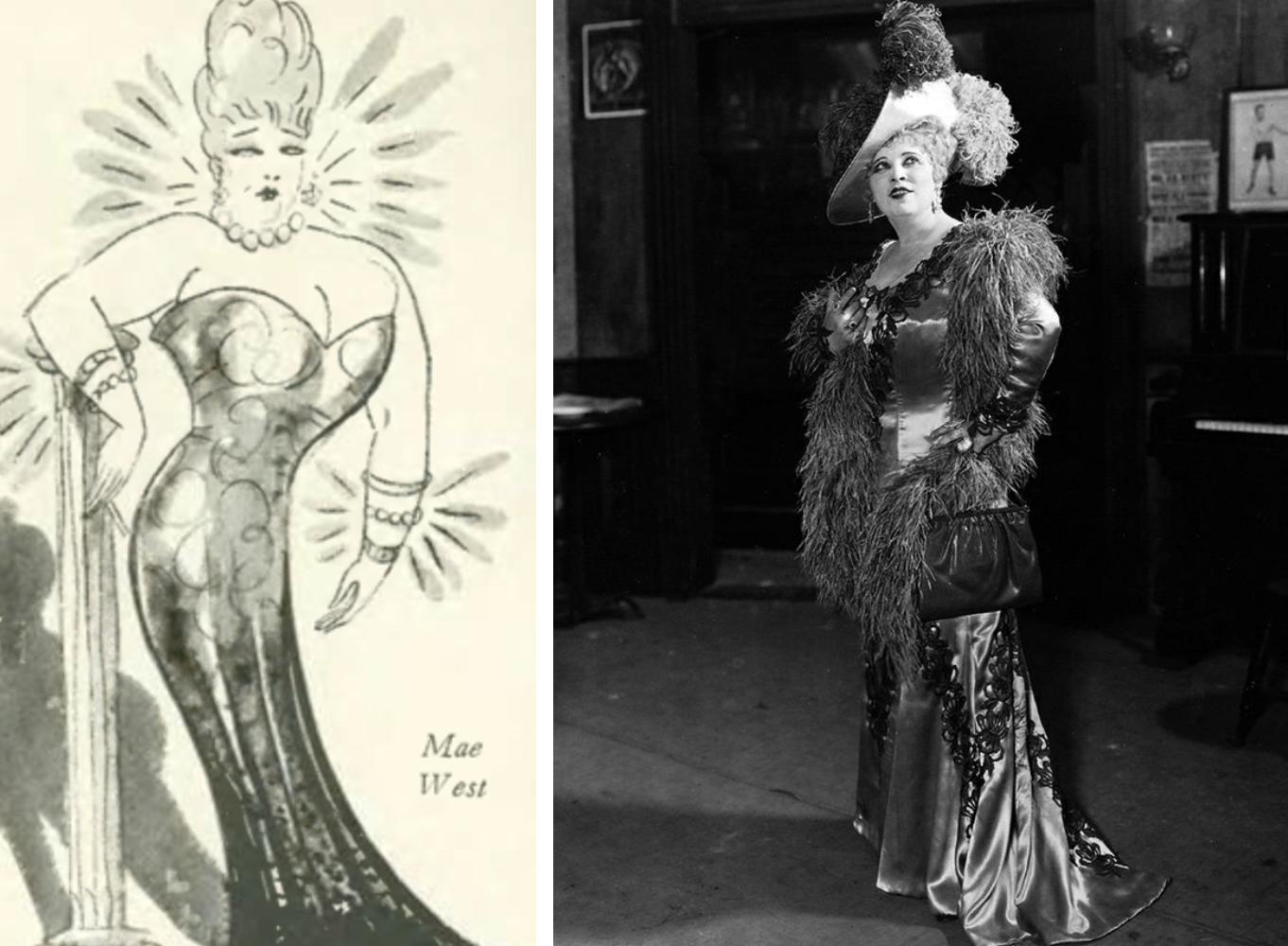
Note Winslow’s surprise to find West to be much smaller than she imagined (indeed, West barely stood five feet tall). Because West preferred a curvy, buxom figure to the thin flapper look, many like Winslow assumed her to be a much larger woman. No doubt her lavish costumes also suggested greater proportions:
West explained to Winslow that she was simply giving the people what they wanted, whether it was outlandish costumes or some “dirt” in their entertainments. Behind this facade, however, was a private, hard-working woman who wrote much of her own material and had the savvy to market it.
BE STILL MY HEART…Page from a 1926 Playbill. (New York Public Library, Shubert Archive)
In her profile, Winslow noted West’s marketing savvy during her incarceration, where she won many new friends along the way:
Winslow concluded her piece wondering if West had peaked in her success, and would “fade out” along with so many other vaudeville stars…
…. In less than seven years, West at age 42 would become Hollywood’s highest paid star and second only to William Randolph Hearst as the highest paid person in America. Ninety-two years after Sex, West remains an icon of popular culture around the world.
ALL THAT GLITTERS…Drawing of Mae West that accompanied the New Yorker profile. At right, publicity photo for Diamond Lil, 1928. (Playbill)
* * *
From Our Advertisers
The Nov. 10 issue featured this all American endorsement for Lucky Strike cigarettes from World Series winning pitcher Waite Hoyt…never mind that TheNew Yorker itself completely ignored the World Series and baseball in general.
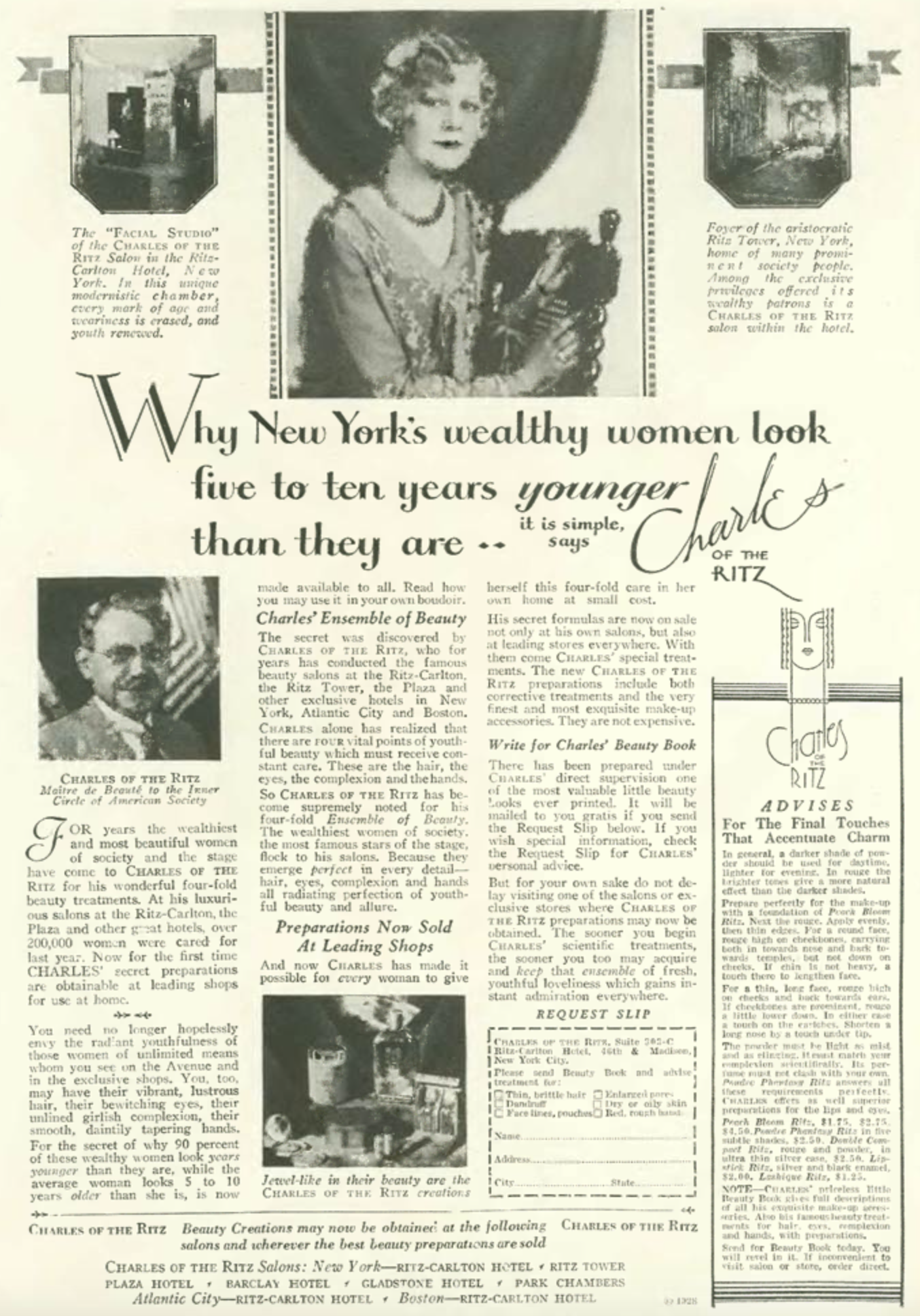
…and Charles of the Ritz used a combination of vanity, snob appeal and class anxiety to promote their latest beauty ensemble…
The comics glimpsed the foibles of the upper classes, including this terrific entry by 22-year-old Ben Hur Baz, a Mexico-born artist who would go on to become famous for his pin-ups in the 1940s and 50s, many of them appearing in Esquire:
…and a game of blind man’s bluff (or some say ‘buff’) as rendered by Peter Arno:
* * *
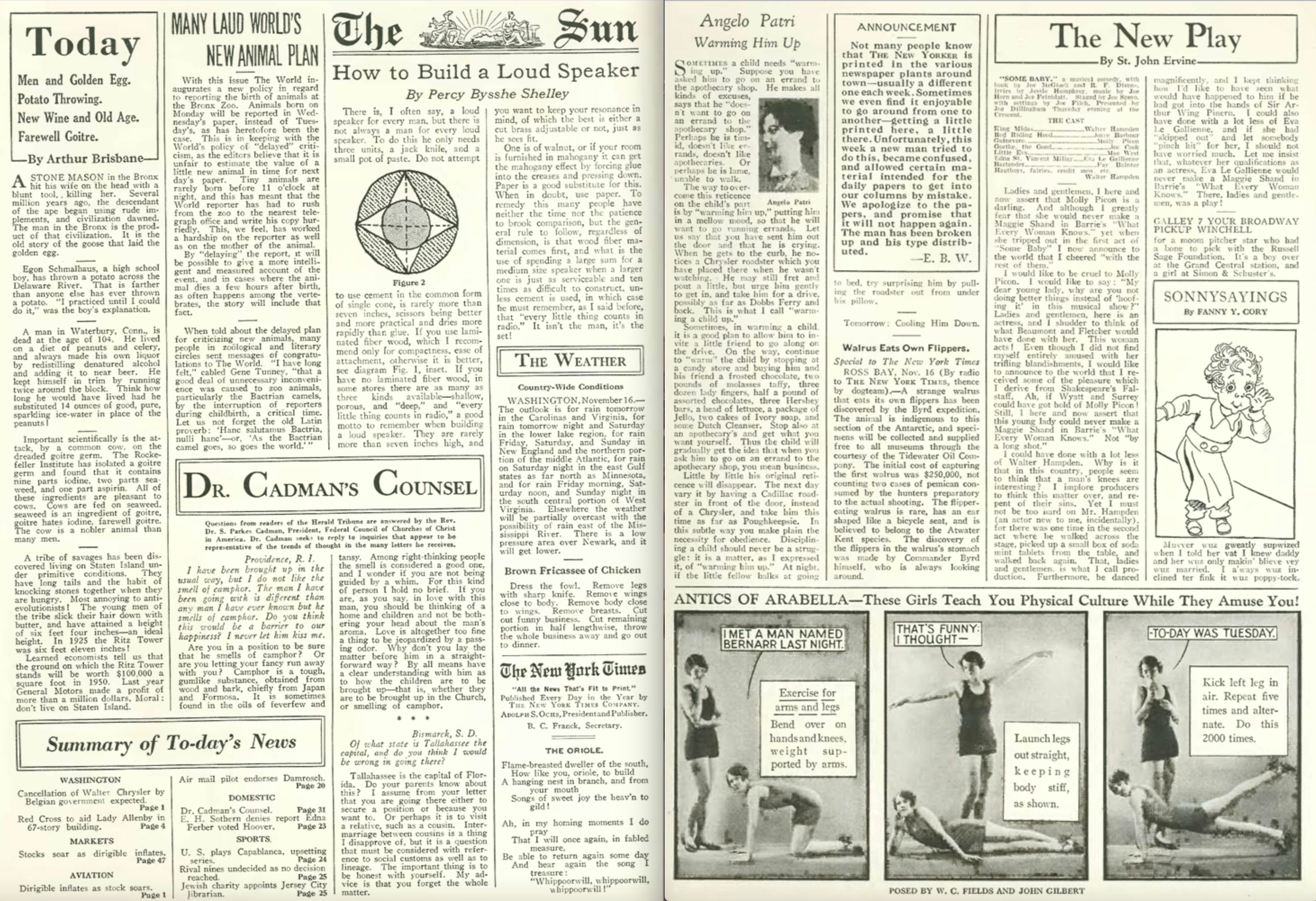
The Nov. 17 issue featured an unusual entry by E.B. White, who, like many of his New Yorker colleagues, found many reasons to be critical of the media, including the dumbing down of newspapers that increasingly favored trivia, sensation and promotion over serious discourse.
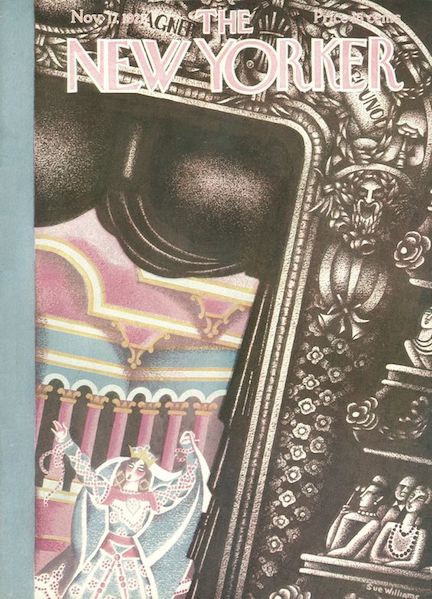
Nov. 17, 1928 cover by Sue Williams.
White skewered the news of the day in this two-page spread that parodied the look and language of contemporary newspapers (click to enlarge):
* * *
The issue’s “Talk of the Town” featured a lengthy entry on Notre Dame football coach Knute Rockne, a figure greatly admired and generally lauded by the magazine’s sportswriters. A brief excerpt:
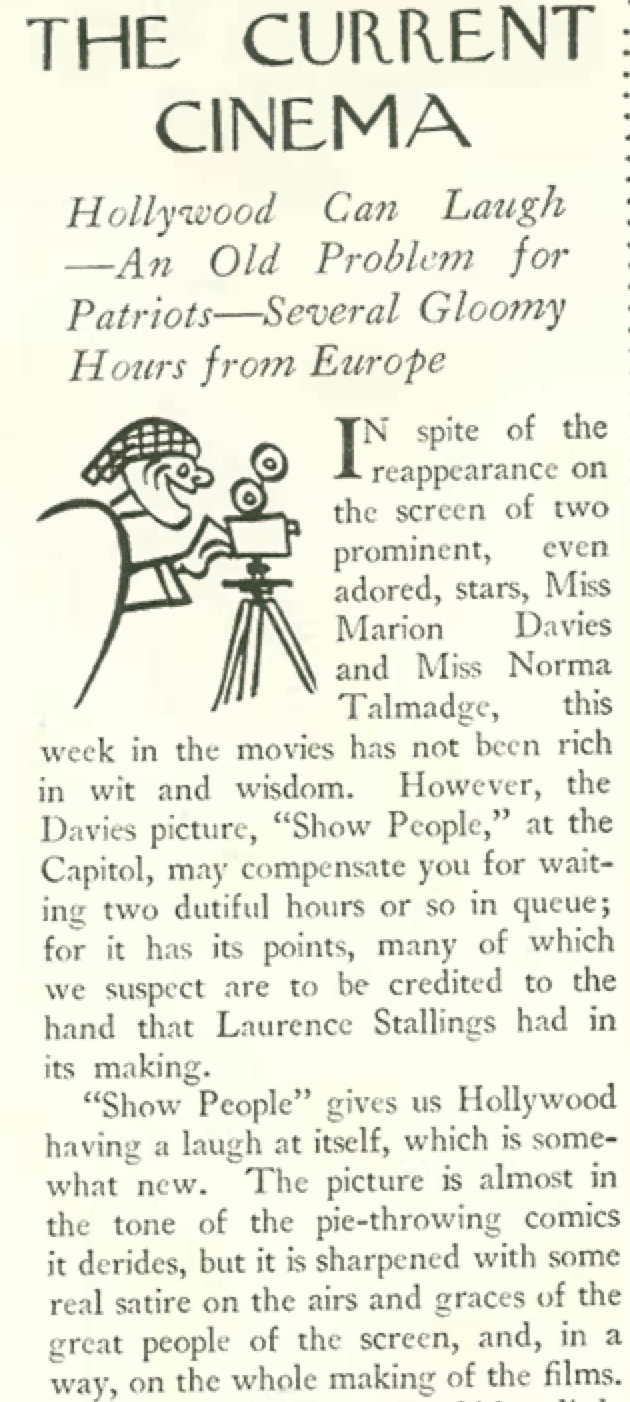
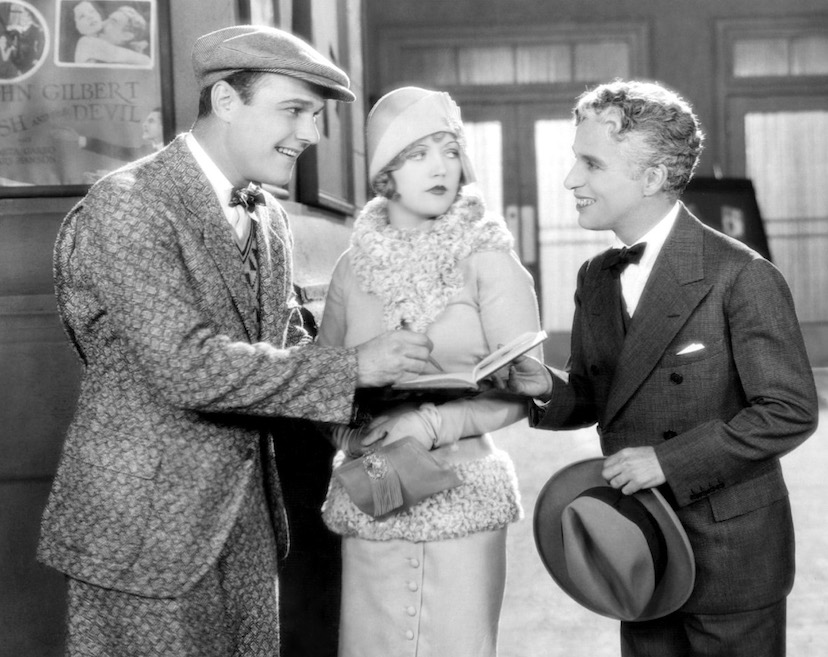
The Nov. 17 film reviews gave a rare thumbs up to an American movie, Show People, which starred Marion Davies.
HE LOOKS FAMILIAR…William Haines (left) and Marion Davies meet Charlie Chaplin in the 1928 Hollywood send-up film, Show People, directed by King Vidor. Chaplin made this rare appearance as himself, without his “Little Tramp” makeup. He was uncredited in the film, and asked to be paid the extra’s fee of only $7.50. (silent-volume.blogspot.com)
* * *
From Our Advertisers
Although you couldn’t legally procure a drink in 1928, you could (unlike today) legally purchase of box of Cuban cigars for you special someone:
…or if you preferred, a carton Chesterfields. Apparently someone in marketing thought conjuring up the horrors of trench warfare would help sell some smokes…
And finally, Peter Arno found out what’s for dinner at the table of a great outdoorsman:









































































































 A New Yorker State of Mind