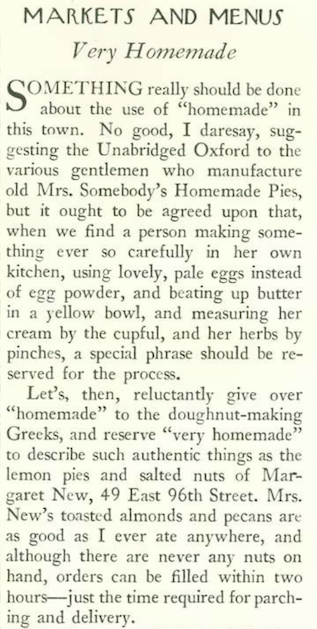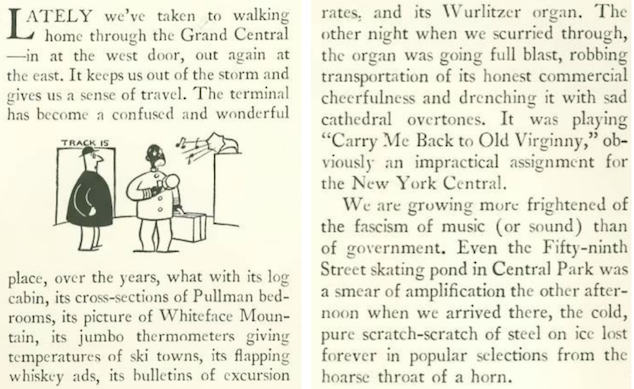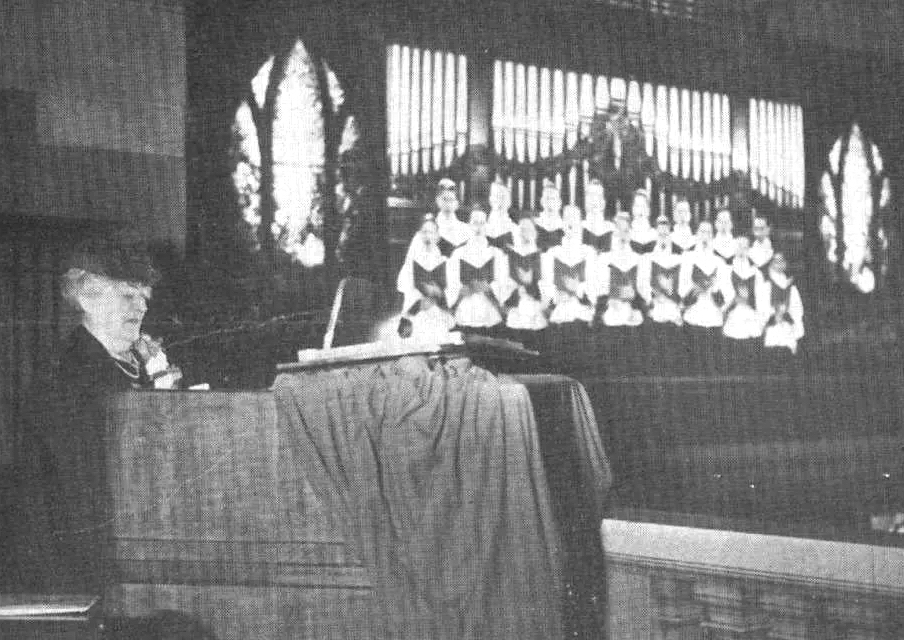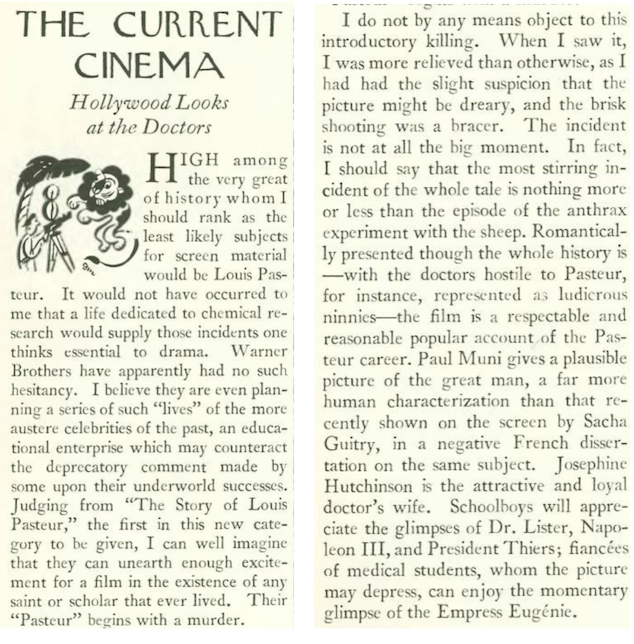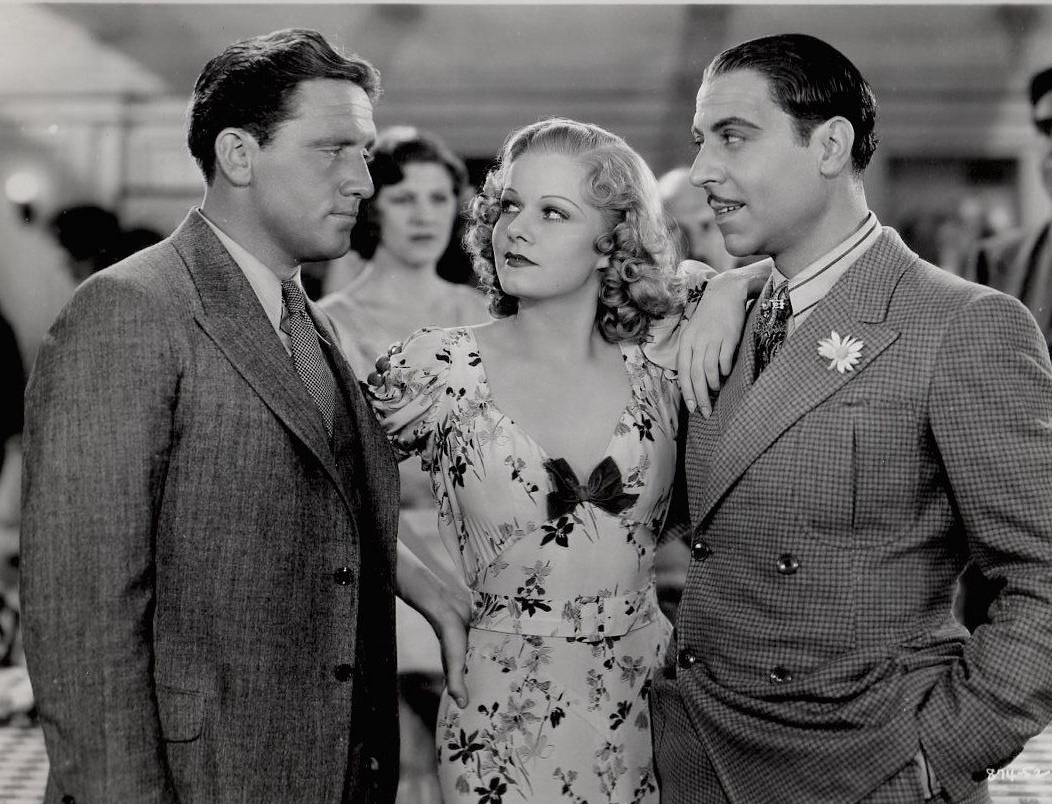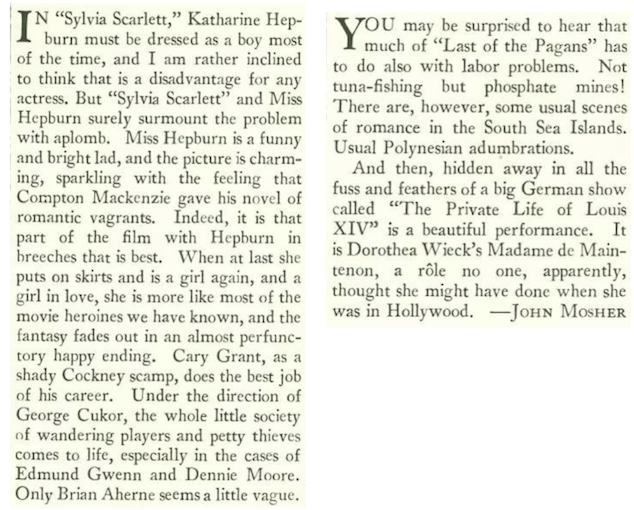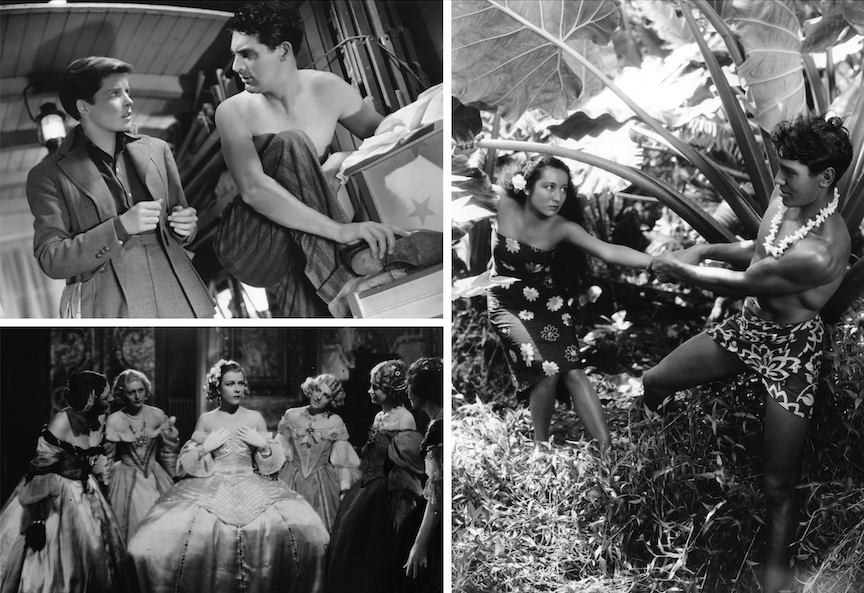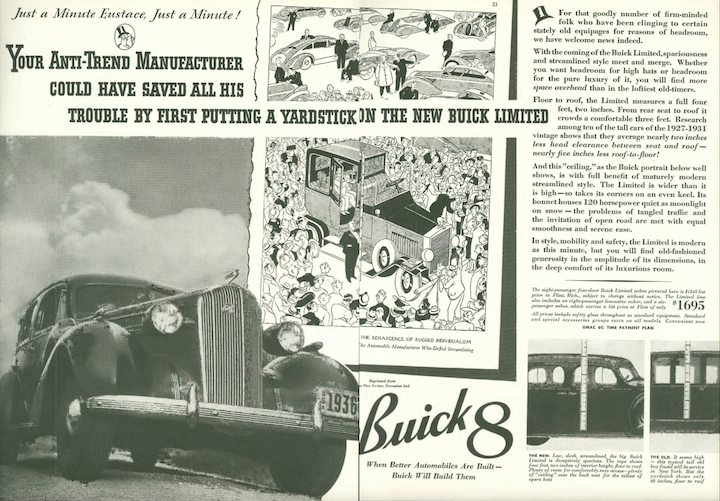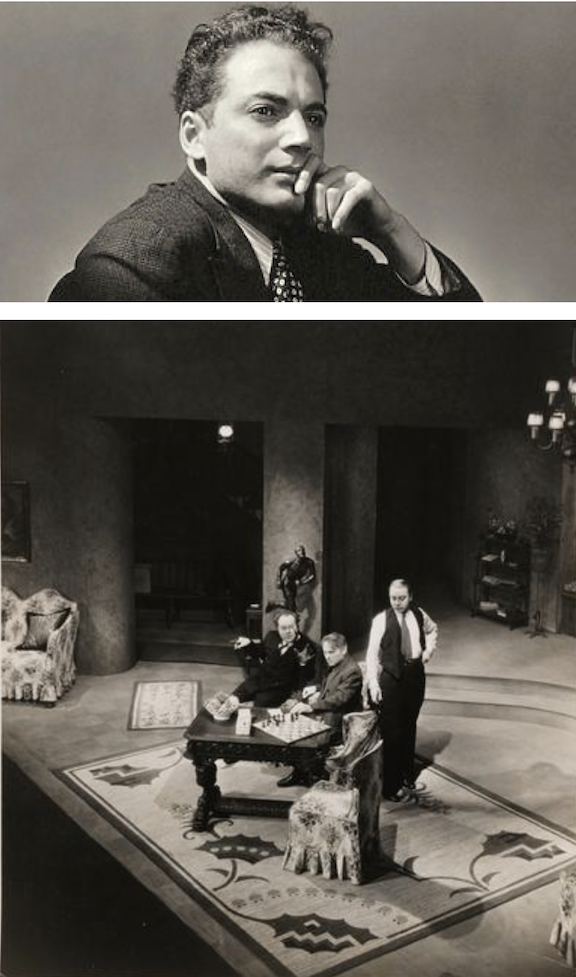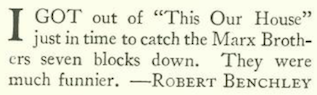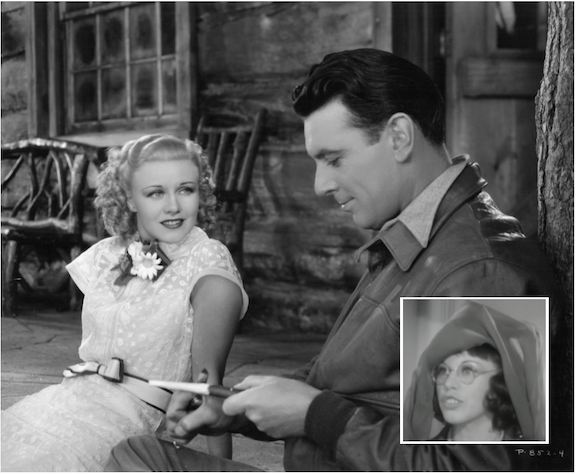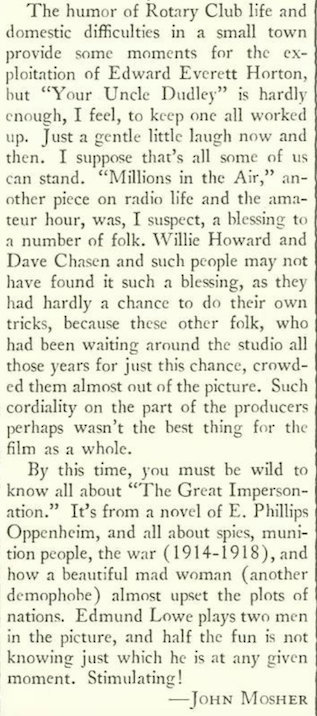
Two Nights At The Opera

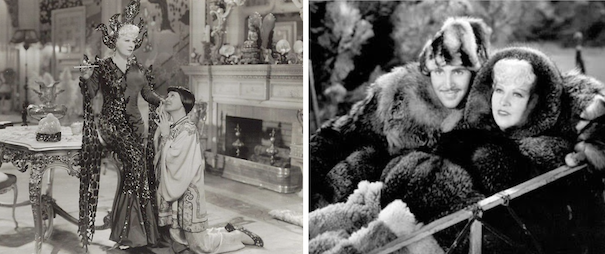
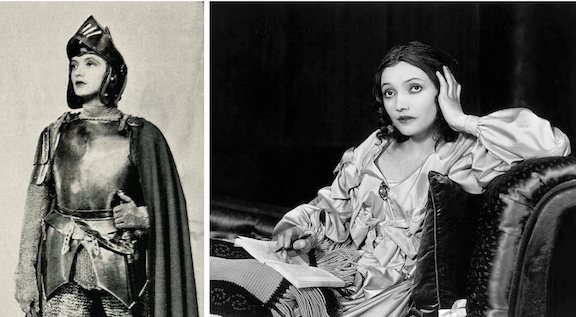
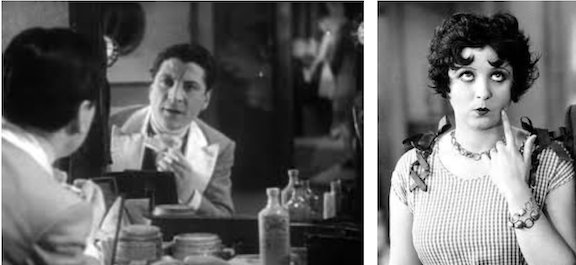
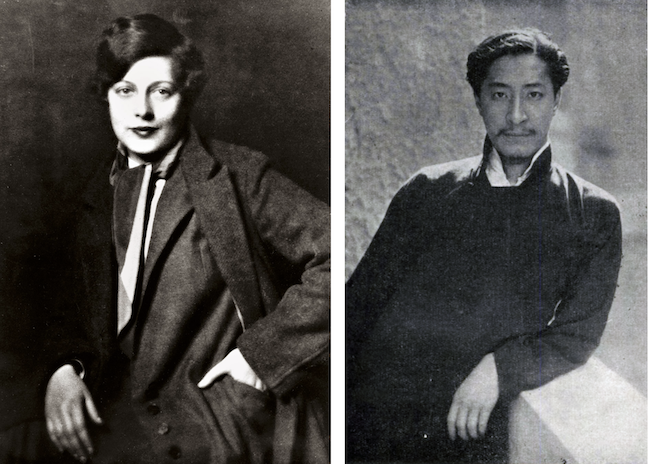
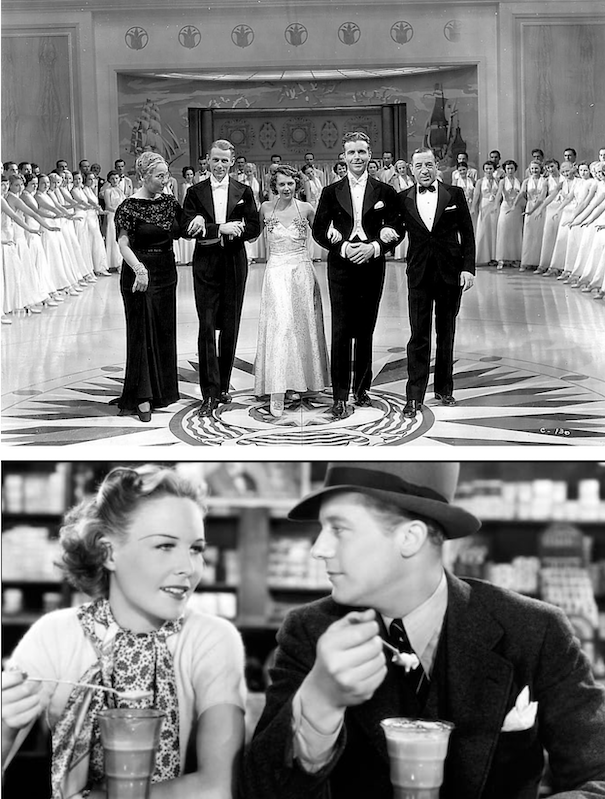
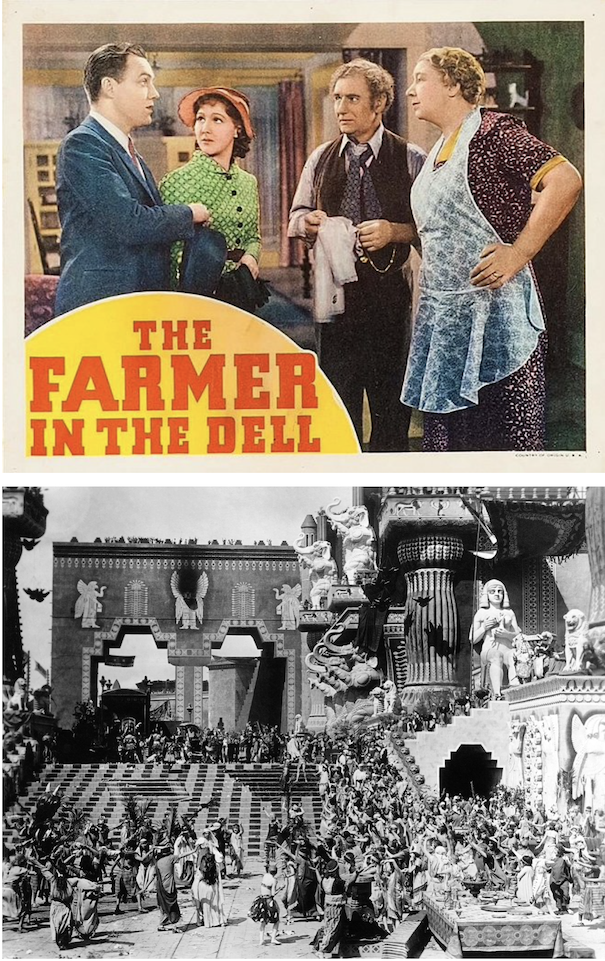
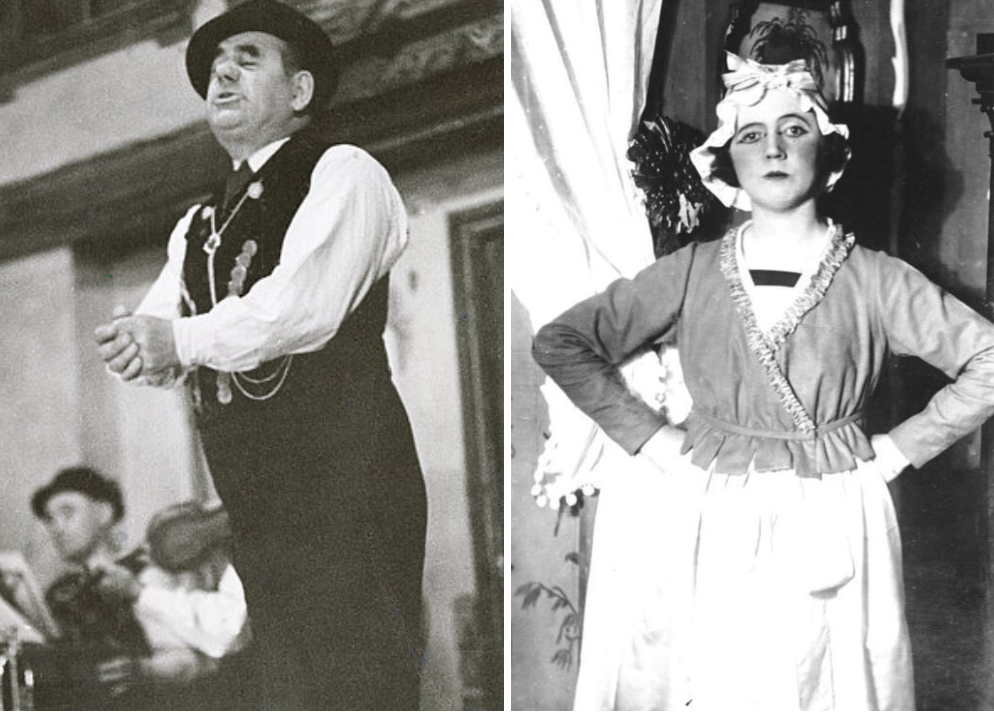
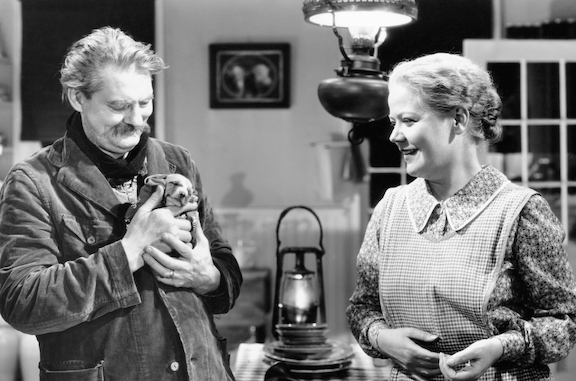
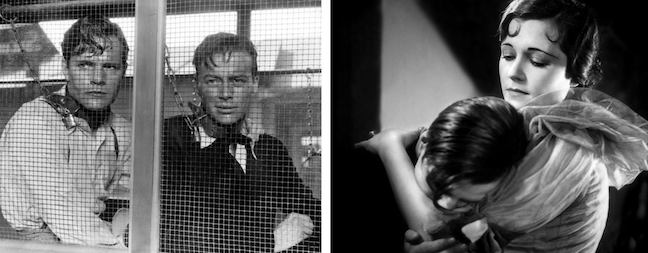
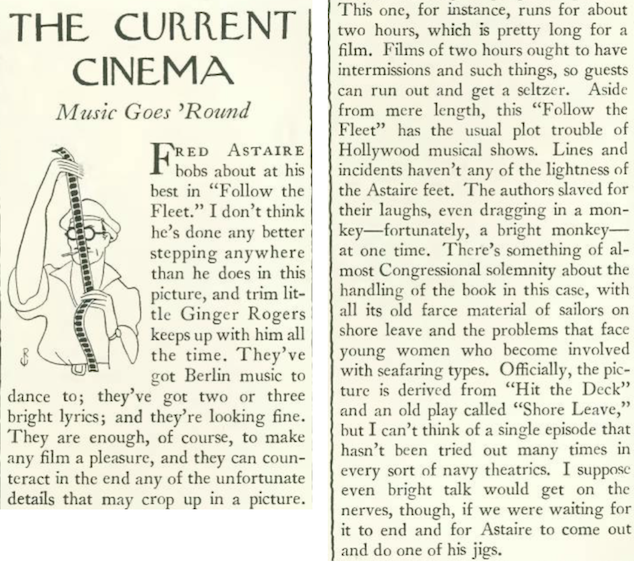
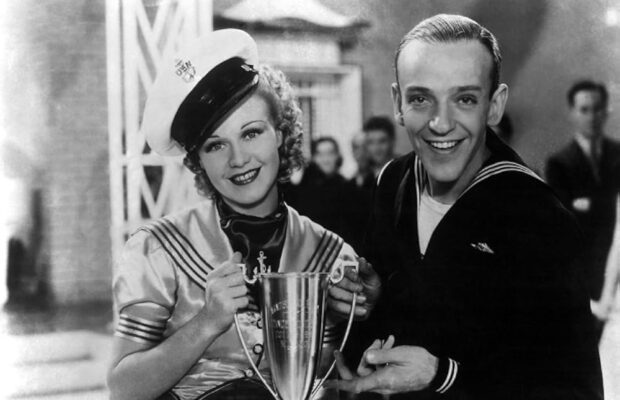
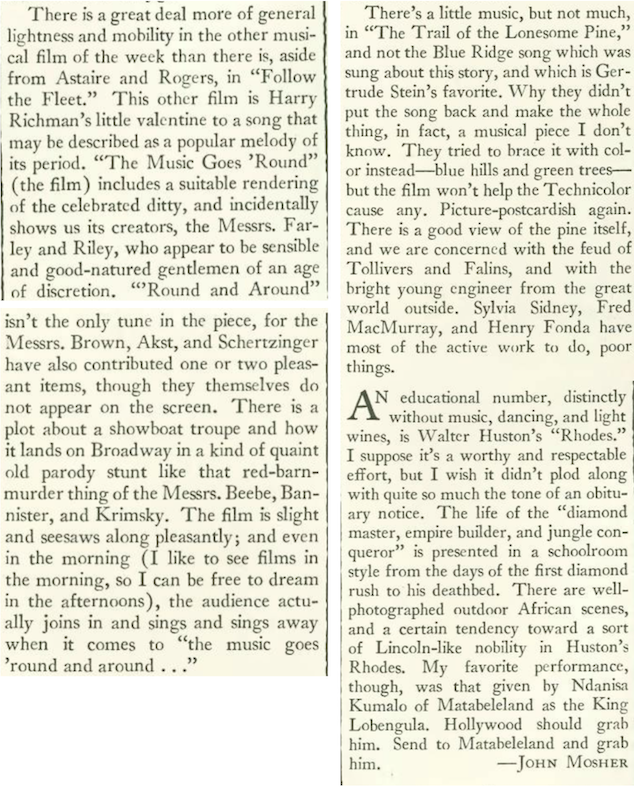
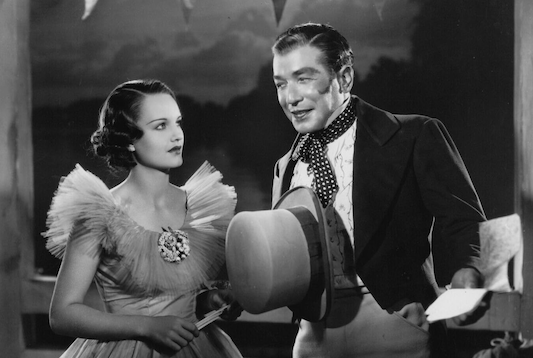
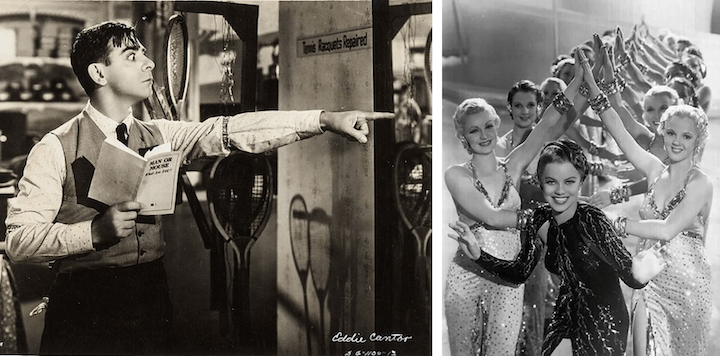
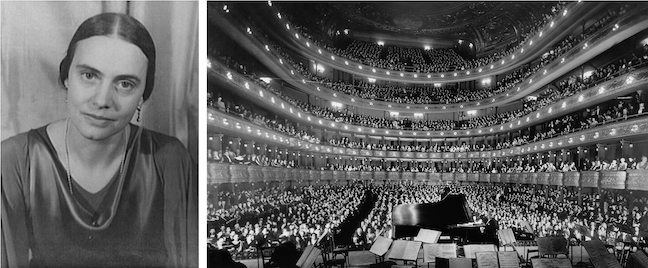
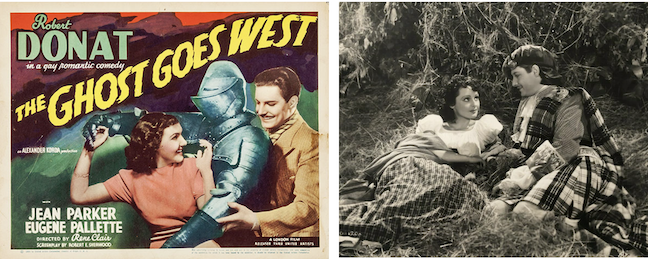
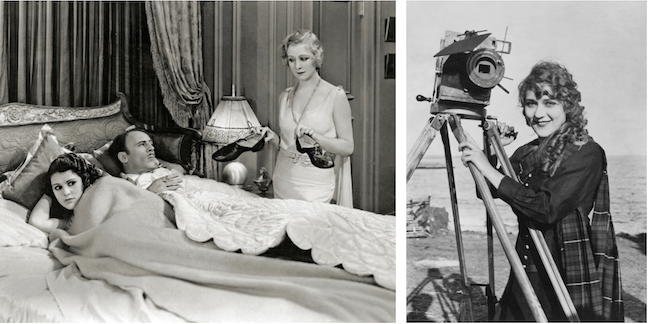
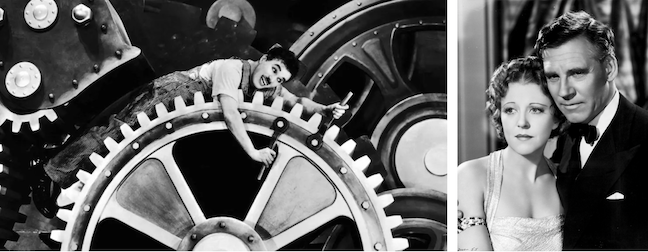
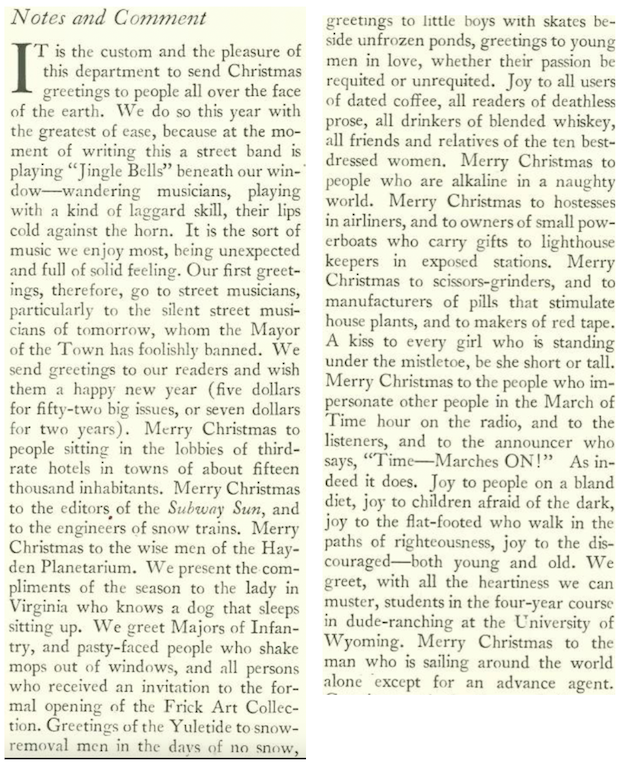
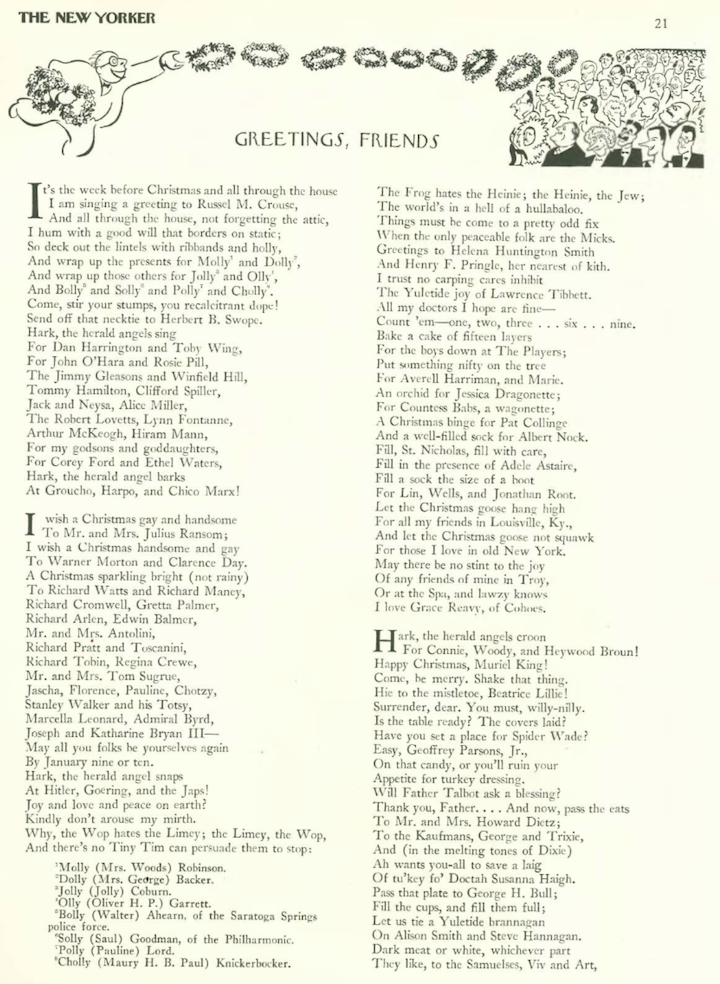
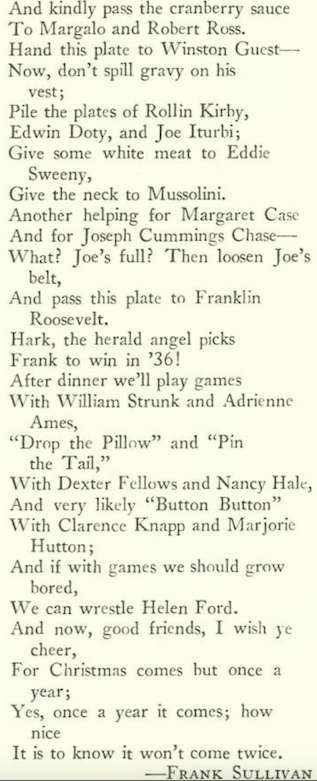
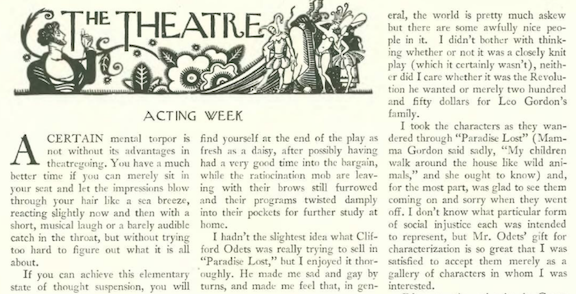
Above: Left image, coloratura soprano Lily Pons with Henry Fonda in I Dream Too Much;at right, Kitty Carlisle and Groucho Marx in A Night at the Opera. (rottentomatoes.com/IMDB)

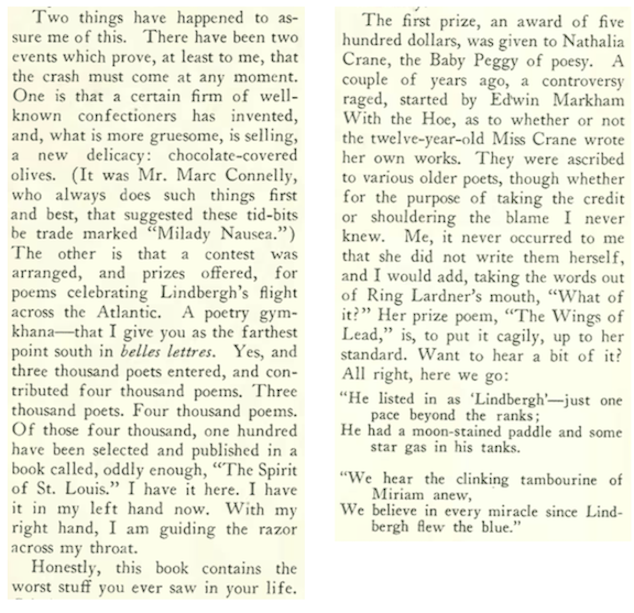
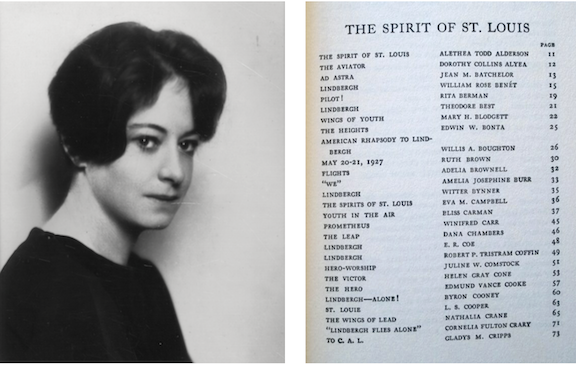
The title of this post refers to two items below, which you’ll discover as we make our way through the December 7, 1935 issue of The New Yorker.

December 7, 1935 cover by Robert Day. A longtime contributor to The New Yorker, Day (1900-1985) contributed hundreds of cartoons as well as eight covers from 1931 to 1976.
Robert Day (photo from This Week anthology via Ink Spill.)

 * 

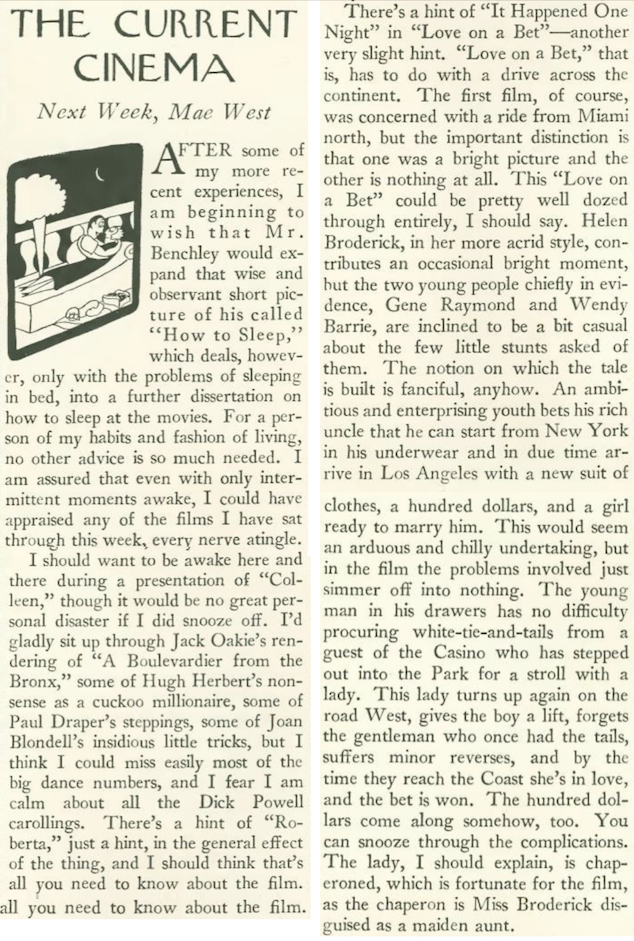
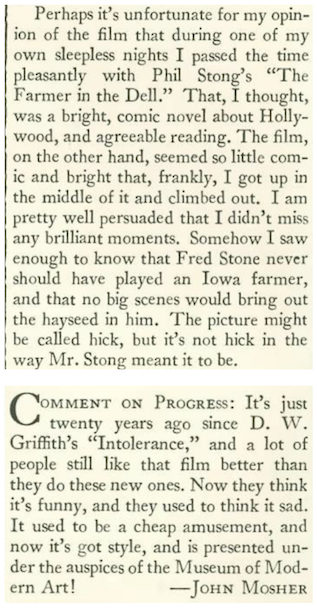
Our first night at the opera comes courtesy of RKO Pictures, which presented French-American coloratura soprano Lily Pons as the star of the musical rom-com I Dream Too Much. Critic John Mosher found the film enjoyable, singling out Pons for praise while chastising the screenwriters for interrupting the lively farce with some “social research.”

DREAM DATE…Clockwise, from top left: Henry Fonda in his third screen appearance as Lily Pons’ love interest in RKO’s I Dream Too Much; movie poster and publicity photo of Pons from the film; Lucille Ball (seen here with actress Esther Dale), appeared in a bit part as a gawky American teenage tourist in Paris (which was actually an RKO studio lot)…little did Ball know that one day she would own that RKO studio lot with husband Desi Arnaz as home to their Desilu Productions facility. (IMDB/Wikipedia/TCM)

Mosher also said farewell to Will Rogers in his final film, In Old Kentucky, which he found to be a “minor affair.” He also reviewed The Land of Promise, a film about Palestine that indicated to Mosher that “life there is highly successful for all present.”

THIS IS GOODBYE…Will Rogers in a scene with Dorothy Wilson in Rogers’ final film appearance, In Old Kentucky. (rotten tomatoes.com)
ORIGIN STORY…According to the Israel Film Archive, Judah Leman’s The Land of Promise “laid the cinematic groundwork for all subsequent Zionist propaganda films that would follow.” (IMDB)

 * * *

E.B. White keeps us on the cinema trail with some thoughts on the film, Mutiny on the Bounty, namely a certain historical inaccuracy:

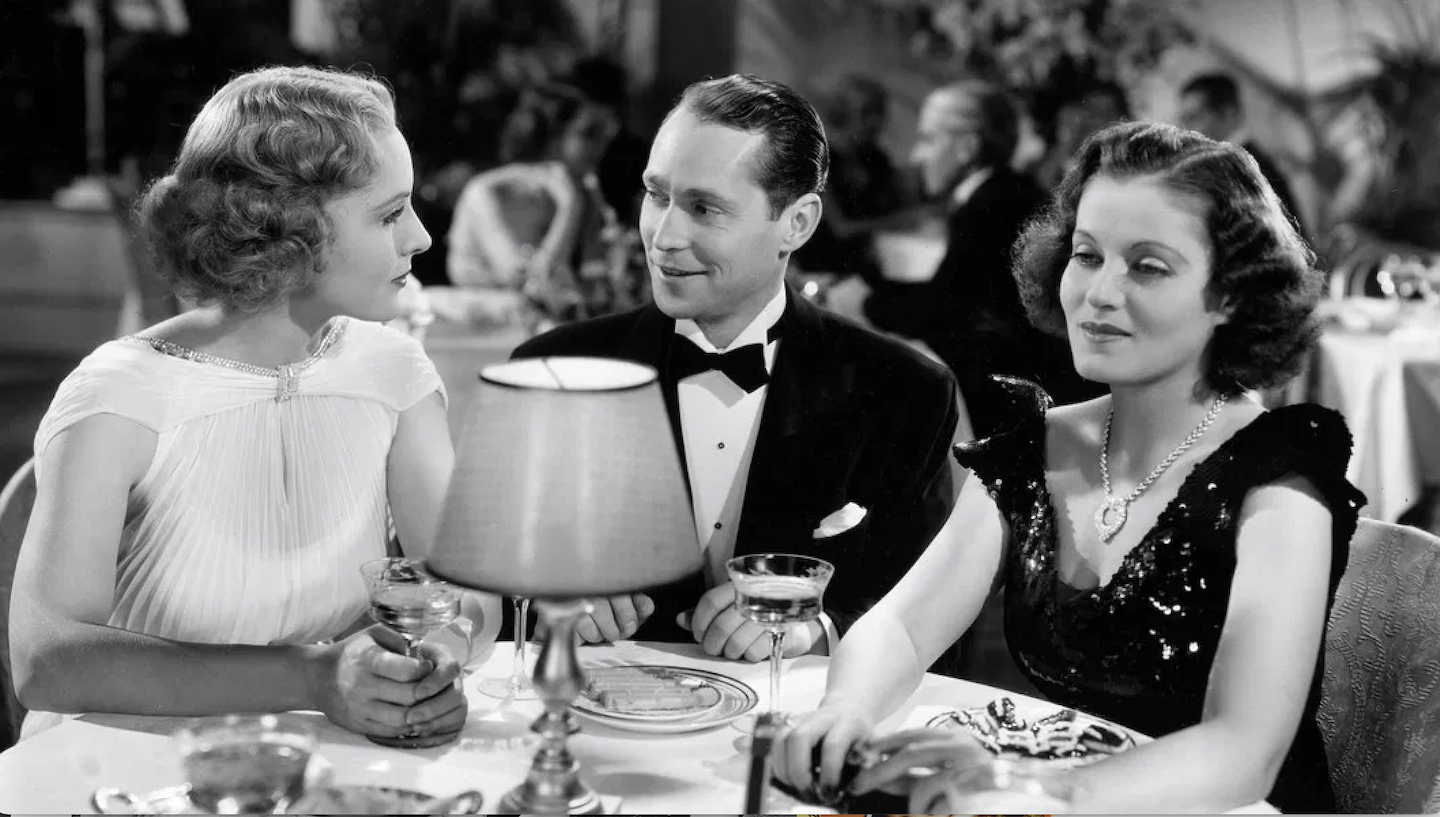
AHEAD OF HIS TIME…E.B. White noted that Roger Byam (Franchot Tone) would have to wait seventy years to learn about germ theory. In addition, the trailer for Mutiny on the Bounty (above) incorrectly referred to Tone’s character as an ensign, when in fact Tone’s role was as a midshipman. (Wikipedia)

 * * *

They Had It First

The swastika was among the more popular designs incorporated into southwestern tribal art during the American tourist era (roughly 1890 to the 1930s). For the Navajo, the symbol represented humanity and life, and was used in healing rituals (it was also widely used by tribal peoples across Europe and Asia). Tourism promoters (called “hotel men” here) encouraged the symbol’s use until the 1930s, when it was increasingly associated with Germany’s Nazi Party. E.B. White explained:


TOURIST FAVORITE…Navajo blankets such as this example, made from 1864 to 1910, were popular with tourists. (Wichita State University)

 * * *

Lois Long’s fashion column continued to be dominated by exhaustive Christmas shopping lists, in this issue stretching from pages 58 to 97…here are the first and last paragraphs of the column…

 * * *

A Woolly Read

Perhaps your special someone was hoping for a thousand-page book under the tree; then look no further than The Woollcott Reader, a collection of stories, essays and other literary gems by New Yorker personality and former “Shouts and Murmurs” columnist Alexander Woollcott. In this excerpt, book critic Clifton Fadiman noted that a signed copy could be had for $7.50.

MY GIFT TO THE WORLD…Alexander Woollcott in 1939, as photographed by Carl Van Vechten, and the $3 brown cloth edition. (Wikipedia/Abebooks.com)

 * * *

From Our Advertisers

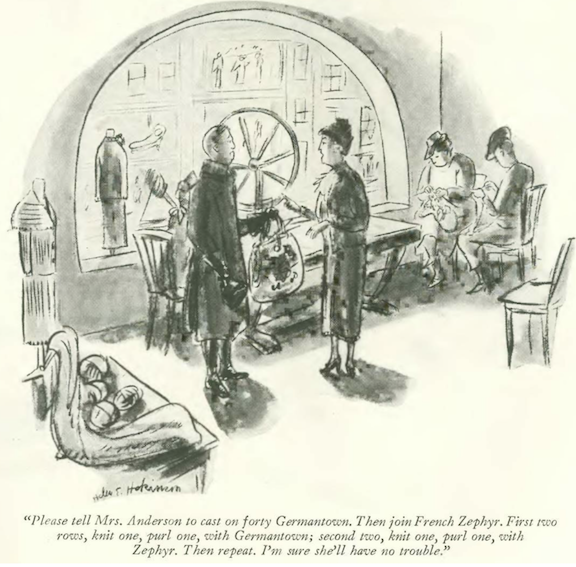
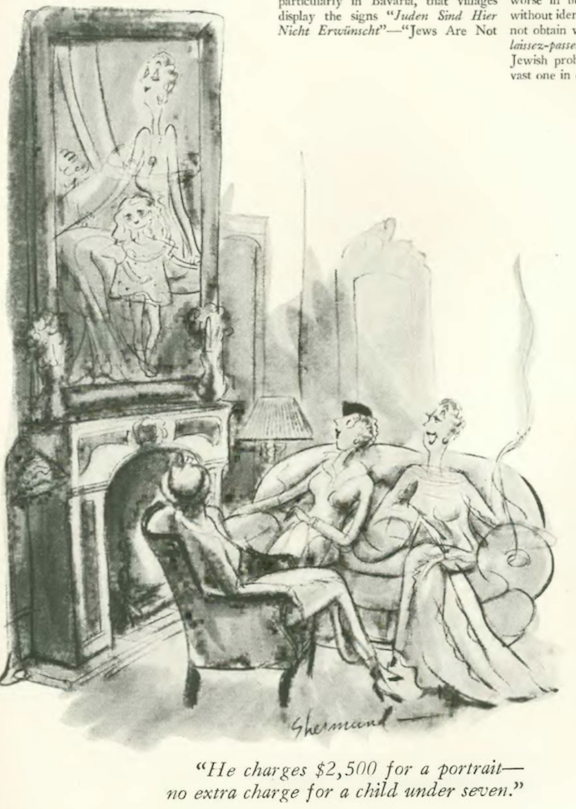
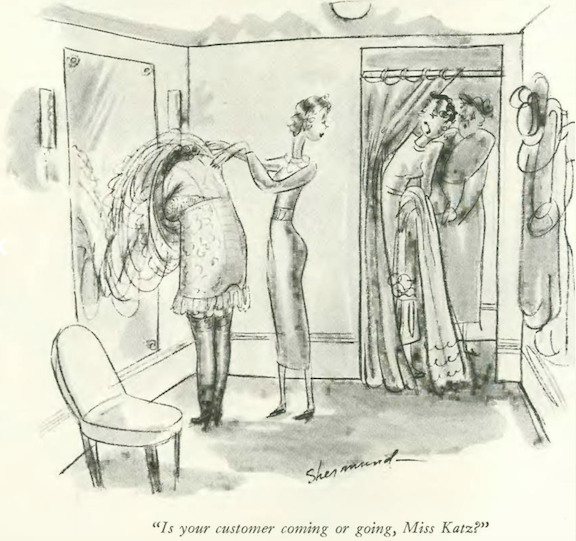
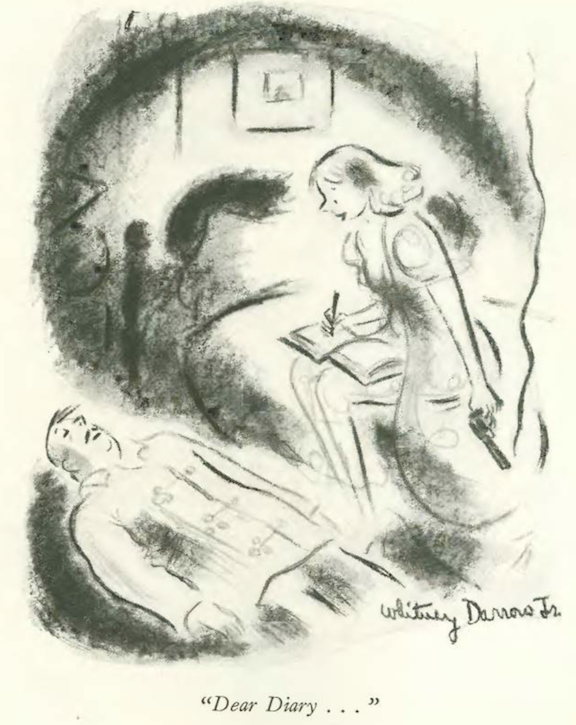
Colorful advertisements brightened the 149 pages of the Dec. 7 issue…we begin with this colorful array from Martex…

…the women’s specialty shop Jane Engel commissioned one of the best-known commercial photographers of the day, Ruzzie Green, to capture this glamorous image…

…Caron Paris offered up this cheerful bouquet…

…the makers of White Rock were enjoying the fruits of post-Prohibition days…

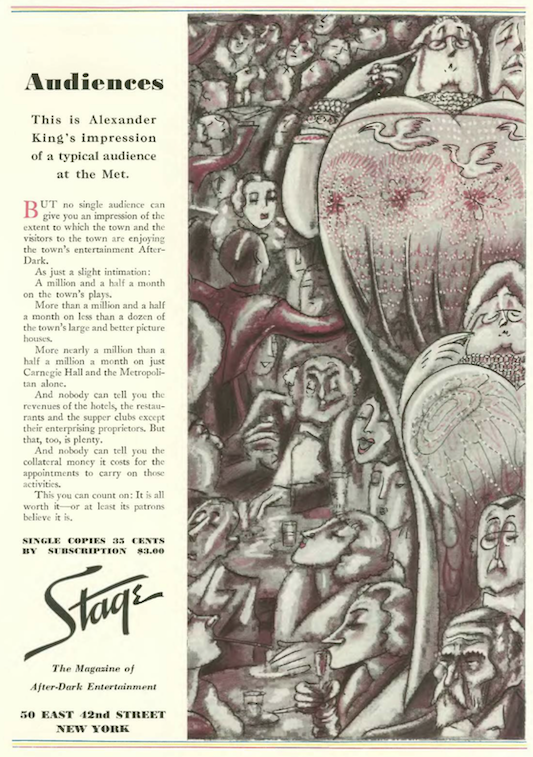
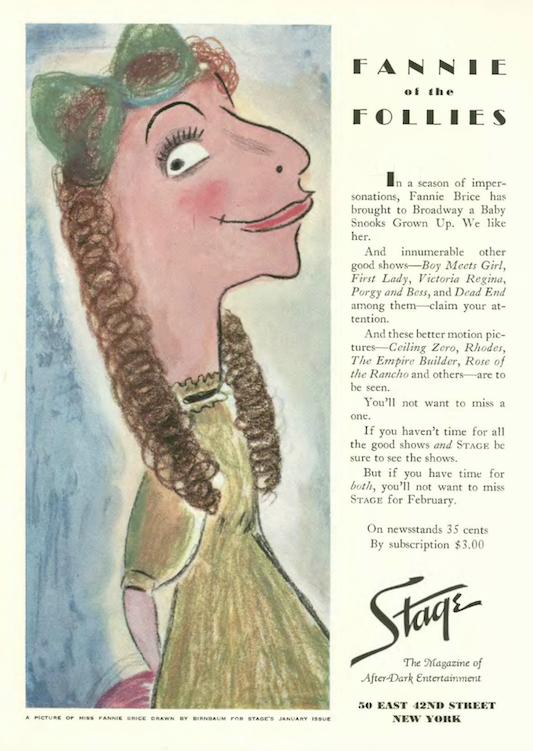
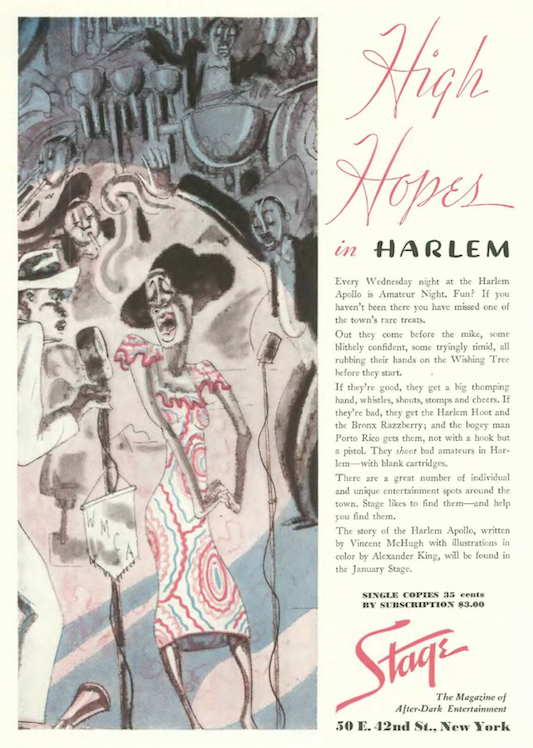
…the publishers of Stage magazine highlighted Beatrice Lillie’s Broadway revue, At Home Abroad

…the Capitol Theatre took out this full-page advertisement to tout the opening of the latest Marx Brothers film…

…here is a close-up of the ad’s “testimonials”…

…and what awaited audiences…

(Wikipedia/thedissolve.com)

…the Lord & Thomas advertising firm imitated the New Yorker style in this full-page promotion…

…now who wouldn’t want a Philco “Radiobar” for the holidays?…

…found this one on 1stdibs.com…pretty cool…

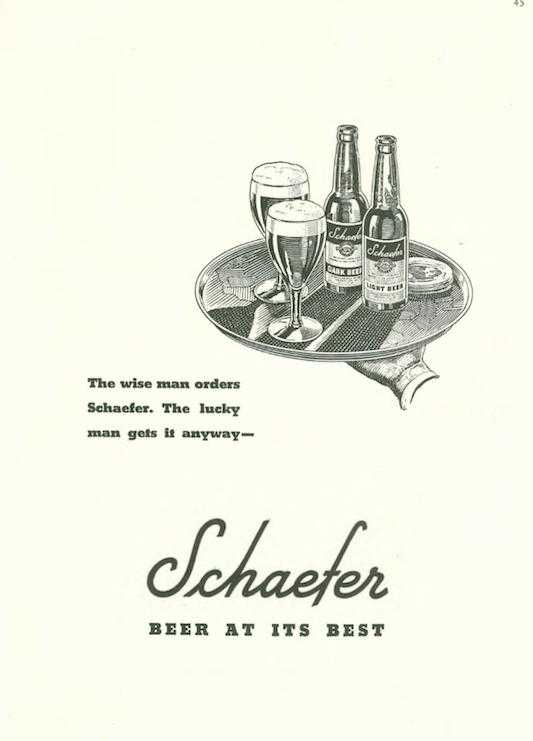
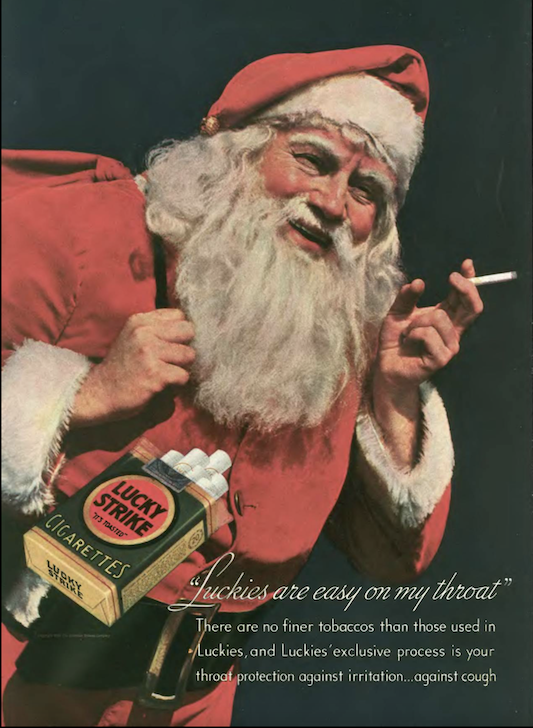
…or you could get a little something for every one of your smoking friends (likely everyone)…

…and you could keep those holiday memories alive with a swell Kodak movie camera…

…Schrafft’s must have been something like an upscale Cracker Barrel…

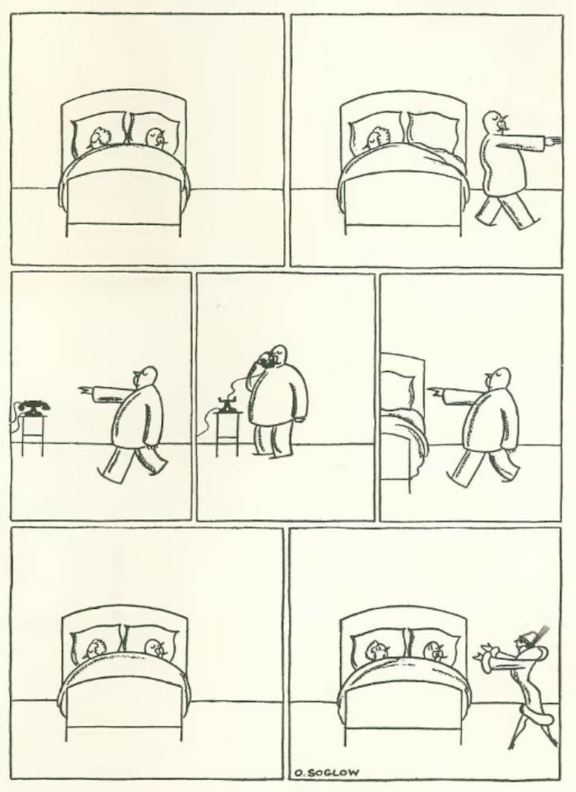
…house ads from The New Yorker included this Otto Soglow-illustrated full pager…
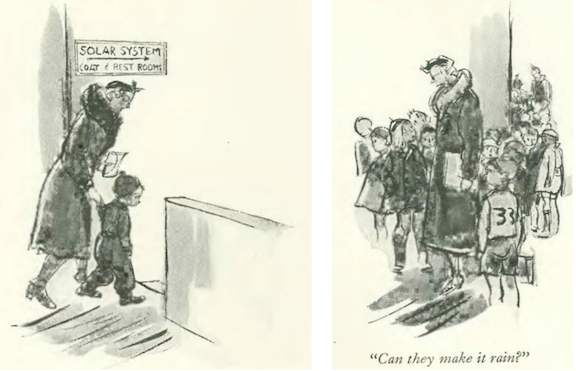
…the magazine also touted books and poems by its contributors…

…and the Seventh New Yorker Album

…more James Thurber here in this spot drawing for the “Books” section…

…and in this cartoon filled with holiday hijinks…

Ilonka Karasz gave us a hockey goalie to open the calendar listings…

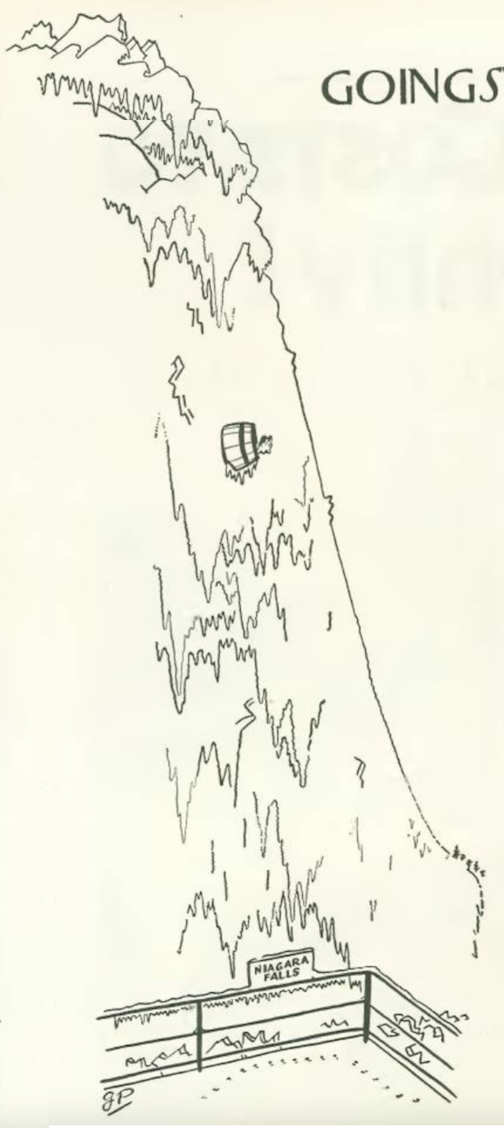
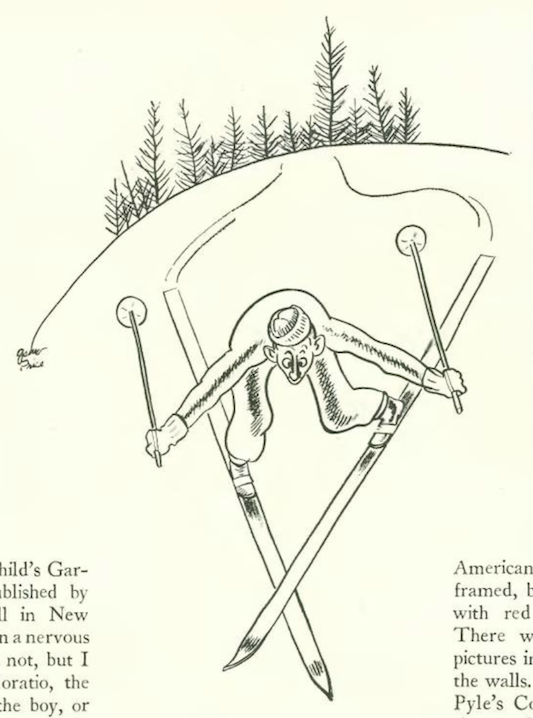
George Price drew up this Depression-themed drawing at the bottom of the “Goings On” section…

…a great spot drawing by Aaron Sopher (1905–1972), who is perhaps best known for his depictions of everyday life in Baltimore…it was oddly placed amidst the “Christmas Gifts” section…

…according to Michael Maslin’s Ink Spill, Sopher contributed just two cartoons to the magazine, in the issues of June 15, 1929, and December 6, 1930 (pictured below)… 

…back to the Dec. 7 issue, and at the Velodrome with Robert Day

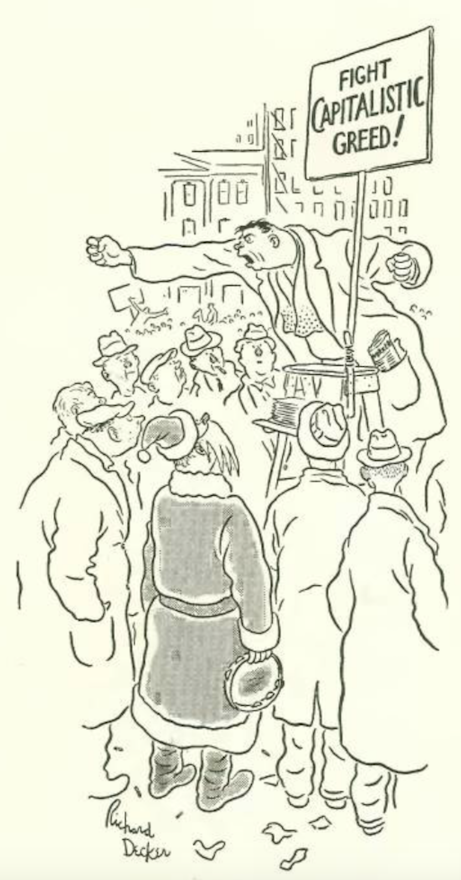
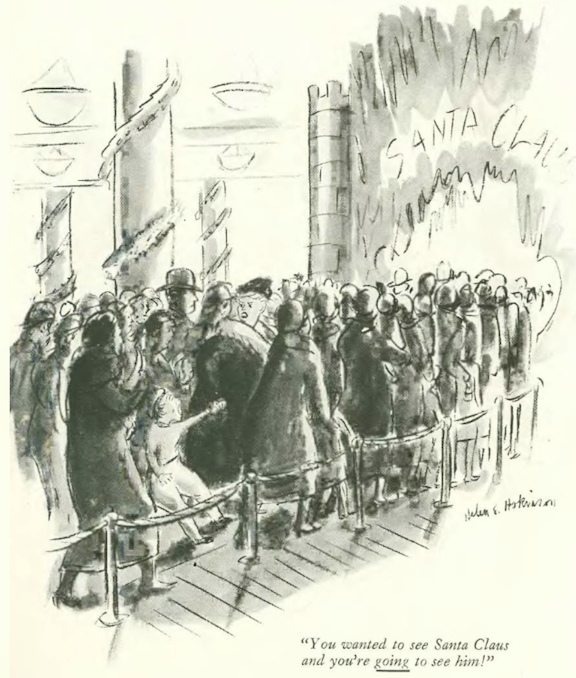
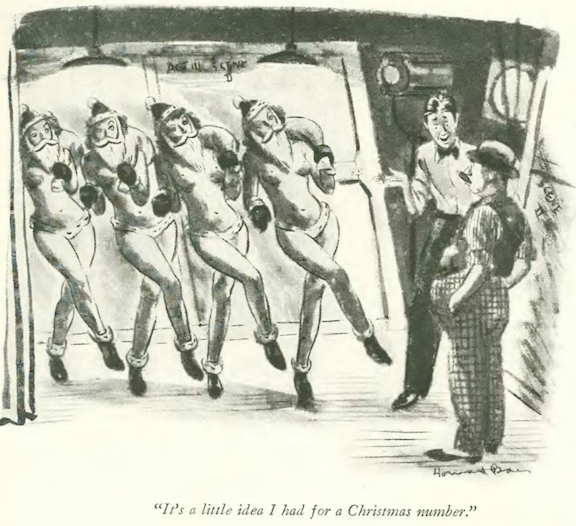
…who also visited an ill-suited Santa…

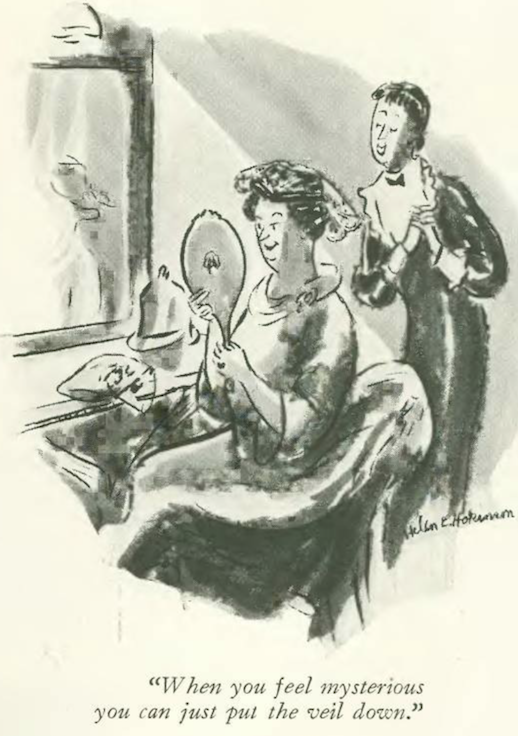
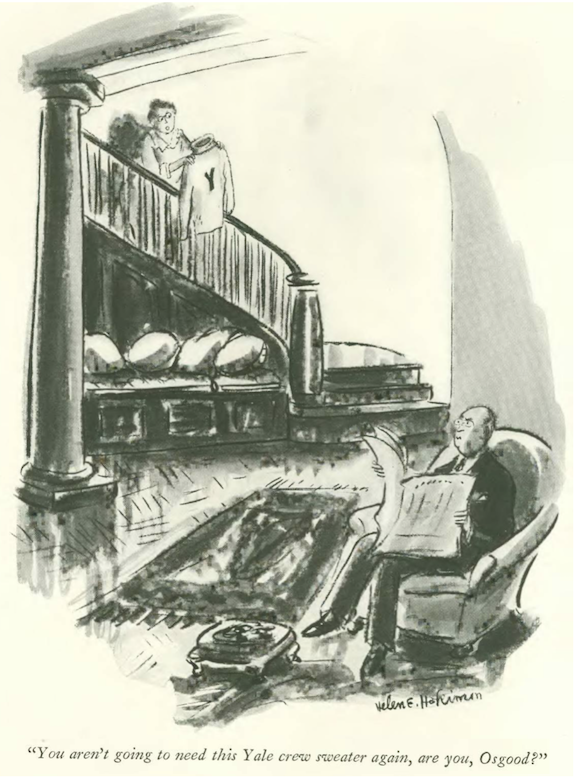
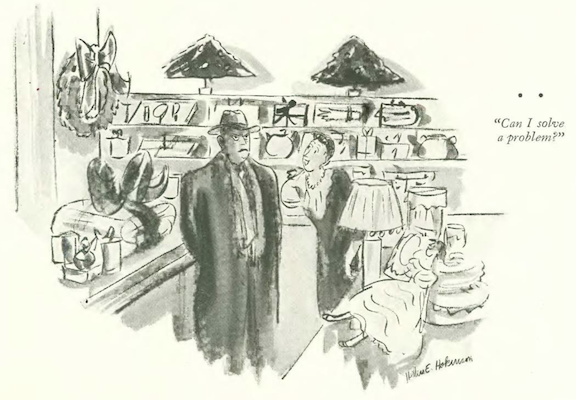
Helen Hokinson pondered gift ideas…

Carl Rose illustrated an unspeakable act at a progressive school…

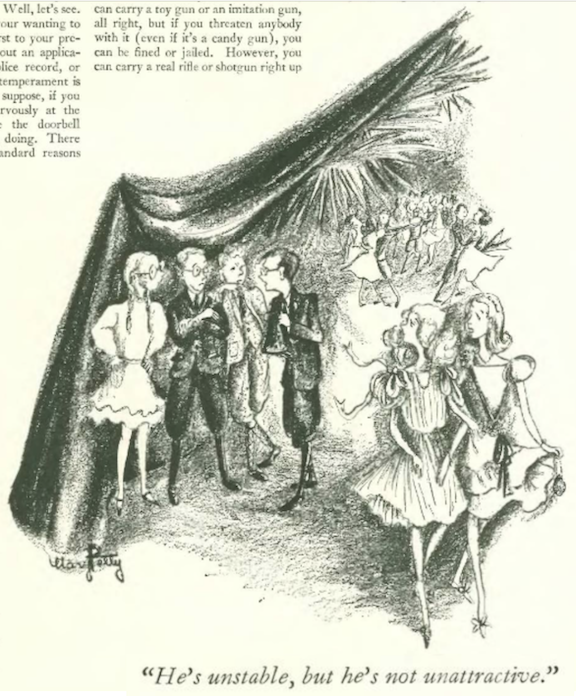
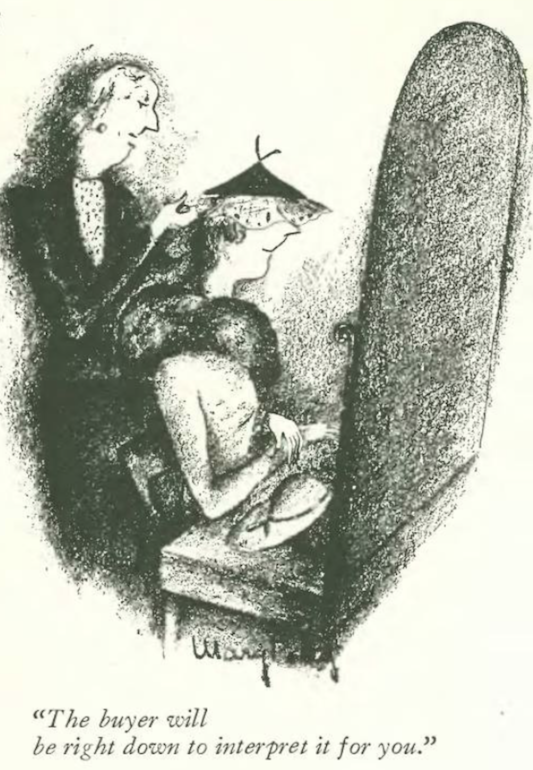
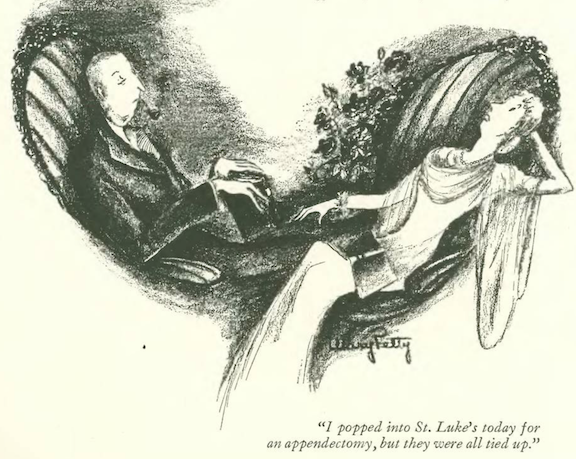
Mary Petty gave us a straightforward diagnosis…

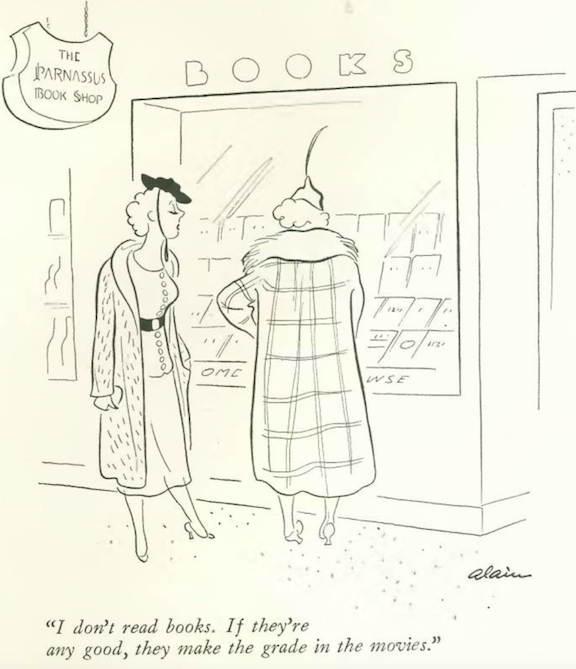
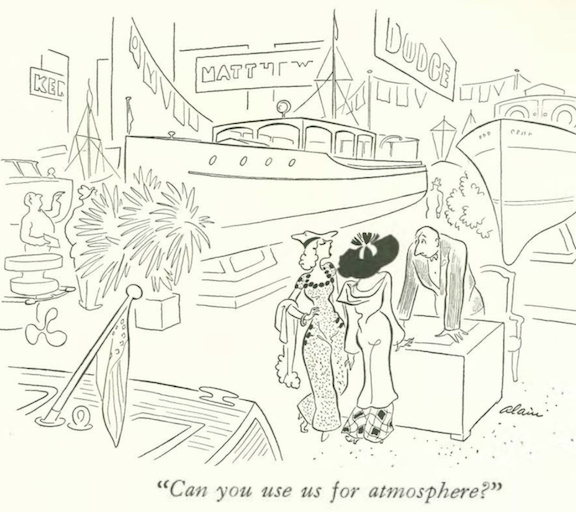
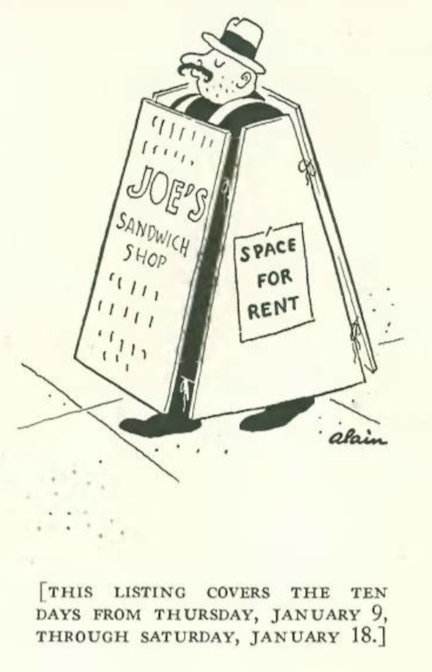
Alain asked us to ponder the fate of one man…

Whitney Darrow Jr eavesdropped on some child philosophy…

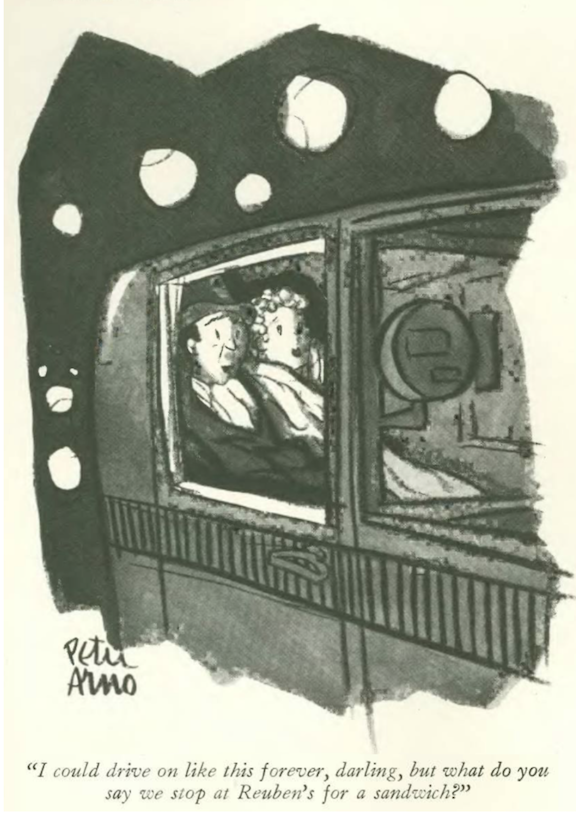
…and we close with Peter Arno, and a groom’s surprise at the altar…
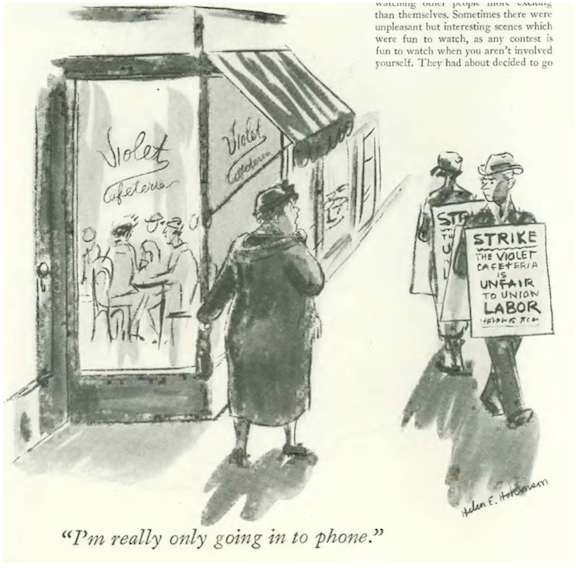
Next Time: Marxist Mayhem…
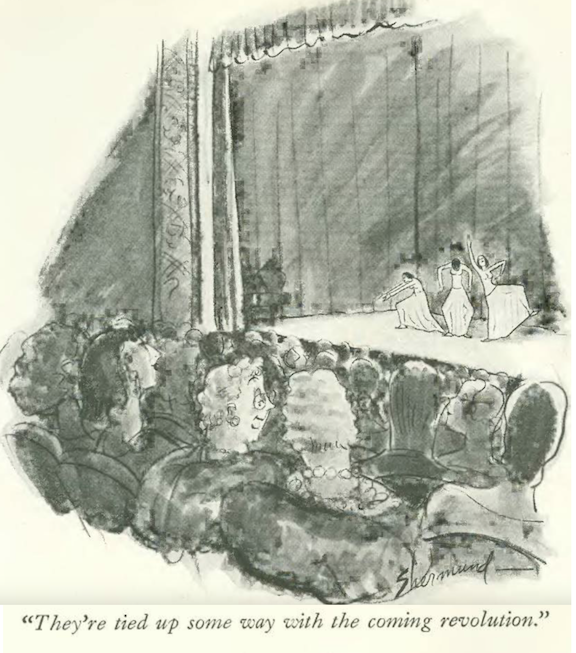
Some Holiday Shopping

Above: Ilonka Karasz designed six children's rooms for a holiday display at Saks Fifth Avenue, featuring colorful rugs (left) and nursery screens (detail at right) among other items. In a House and Garden article, Karasz wrote: "Through new theories of design, production and distribution, [these rooms] have more vision than the manufacturer who still insists upon Little Bo-Peep." (MoMA.org/1stdibs.com)

In the Days of Yore, Christmas celebrations were largely adult- or family-centered affairs, that is until the Industrial Age enabled the mass production of toys and other goodies. Beginning in the 1870s, Macy’s began offering impressive toy displays, and even children in the hinterlands could get in on the action with a Sears catalog, the company raising its game in 1933 with the introduction its Wish Book.

November 30, 1935 cover by Alice Harvey. From 1925 to 1943, Harvey (1894–1983) contributed three covers and more than 160 drawings to The New Yorker. I highly recommend Liza Donnelly’s Very Funny Ladies for more about Harvey and other women cartoonists.
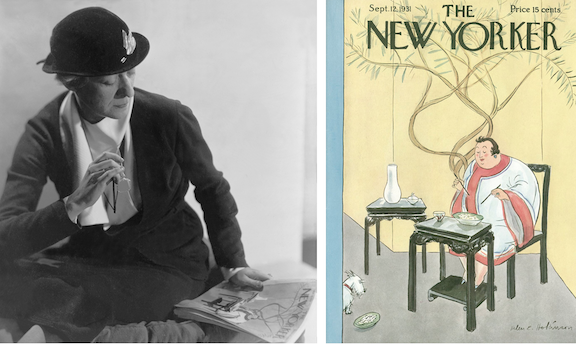
Alice Harvey came to New York from Chicago with her friend Helen Hokinson in the early 1920s, finding early success submitting to Life, Judge and other publications before she and Hokinson joined the fledgling New Yorker in 1925. (Photo from Michael Maslin’s essential Ink Spill).

 *

The New Yorker was no exception when it came to toy shopping, featuring exhaustive lists of toys, games and other items for children available at the city’s major retailers.

BEFORE ONLINE SHOPPING…A crowd of holiday shoppers outside New York’s Macy’s department store, 1939. (Vintage.es)

These lists were in the back of the book, following Lois Long’s “On and Off the Avenue” fashion column. Here are some excerpts:

KEEP THE KIDDOS BUSY…Clockwise, from top left: Bloomingdale’s offered an Optics Set, while Macy’s featured Lester Gaba’s soap sculptures (including Popeye, Olive Oyl and Wimpy), 8mm Mickey Mouse and Silly Symphony cartoons, and “Jack & Jill” portable children’s record players. (scrappyland.com/acghs.org/etsy.com/worthpoint.com)

Of course it wouldn’t be Christmas in New York without F.A.O. Schwarz, and if you shopped at Saks you could be dazzled by children’s rooms designed by Ilonka Karasz.

GIFTS FOR THE MODERN KID…At F.A.O. Schwarz you could find Foxblox and Buck Rogers costumes, while Saks featured children’s rooms and furnishings designed by Ilonka Karasz, including a colorful nursery screen. (Pinterest/invaluable.com/worthpoint.com/cooperhewitt.org/reddit.com)

 * * *

Pouting Plutocrat

In his “Notes and Comment,” E.B. White took issue with J.P. Morgan’s gripes about taxation while grouse hunting in Scotland.

 * * *

A City Resurrected

Founded in 1632, Williamsburg, Virginia played an important role in colonial and revolutionary America, but by the 20th century it had become a quiet and rather neglected little town. Then in 1924 the town’s rector, Rev. W.A.R. Goodwin—bolstered by the successful restoration of his parish church—approached oil tycoon John D. Rockefeller Jr. for funds to restore the entire colonial capital. As John Peale Bishop noted in these excerpts from “Onward & Upward With The Arts,” the project left some residents scratching their heads.

MY VISION, YOUR MONEY…The Rev. W.A.R. Goodwin (left), rector of Bruton Parish Church, shared his vision for Williamsburg with philanthropist John D. Rockefeller Jr; top photo, paved streets and modern utility lines were removed as part of the restoration, circa 1930; bottom photo, pre-restoration photo of Duke of Gloucester Street—all businesses located on Market Square, including these, were demolished during the restoration. (colonialwilliamsburg.org)
RENEWED OR REMOVED…Clockwise, from top left, the 18th-century John Crump House was in a sad state in this 1895 photograph; the Crump House after its 1941-42 restoration; workers examine the old foundation walls of the Governor’s Palace; Williamsburg High School was demolished to make way for the Governor’s Palace reconstruction, seen in the background.(yourhistorichouse.com/colonialwilliamsburg.org)

 * * *

At the Movies

John Mosher had high praise for King Vidor’s Civil War romance, So Red the Rose. Although it did not have the epic sweep (or epic length) of 1939’s Gone With The Wind, Mosher and other critics praised the film’s human qualities. It did not, however, do well at the box office.

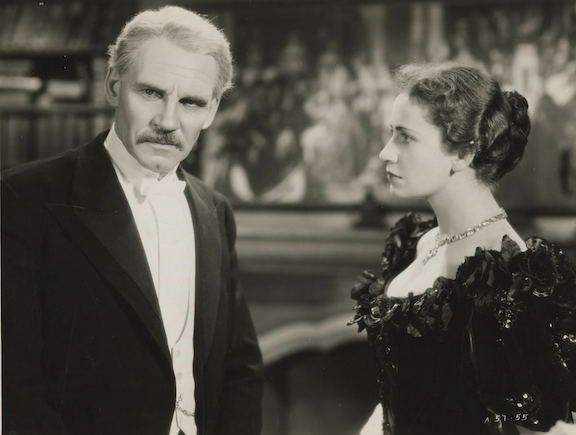
FRANKLY, MY DEAR…a line that would have to wait for another Civil War romance…clockwise, from top left: Randolph Scott and Margaret Sullavan play kissing cousins in So Red the Rose; Mosher singled out Walter Connolly for his performance as the family patriarch; child star Dickie Moore and Sullavan in a scene from the film. (IMDB/Letterboxd.com)
HIDDEN TALENTS…In two other films, Mosher found the performances of the lead actors to either be upstaged or muffled in period costume. Top, Paul Cavanagh, Miriam Hopkins, and Joel McCrea in Splendor. Below, James Cagney and Margaret Lindsay in Frisco Kid. (IMDB/TCM)

 * * *

From Our Advertisers

We start with this advertisement from The Limited Editions Club, founded in New York by George Macy in 1929. The 29-year-old Macy, determined to make his living from books, focused on publishing beautifully illustrated classic titles in limited quantities, available to subscription-paying members. Illustrators of the editions have included Pablo Picasso, Henri Matisse, Reginald Marsh, Norman Rockwell and many other noted artists. The ad below includes an excerpt from a Sinclair Lewis essay that extolled the virtues of investing in fine books.

Above, frontispiece from The Limited Editions Club’s 1930 publication of Thomas De Quincey’s Confessions of an English Opium-Eater, illustrated by Zhenya Gay. (librarything.com)

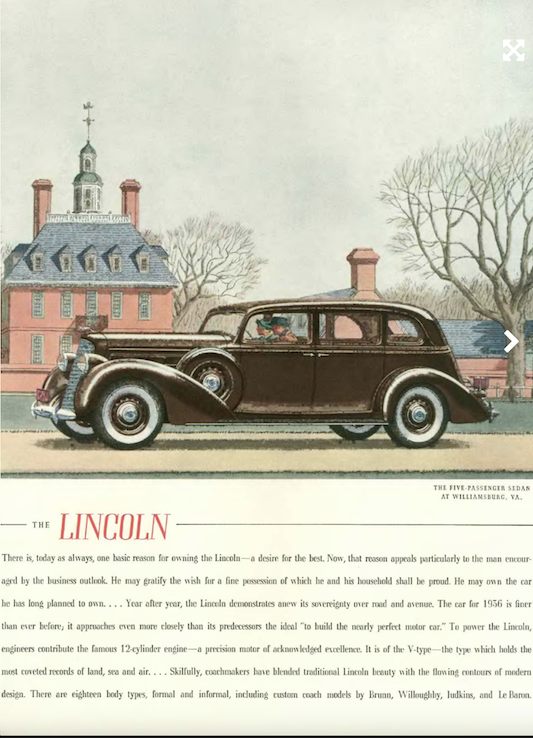
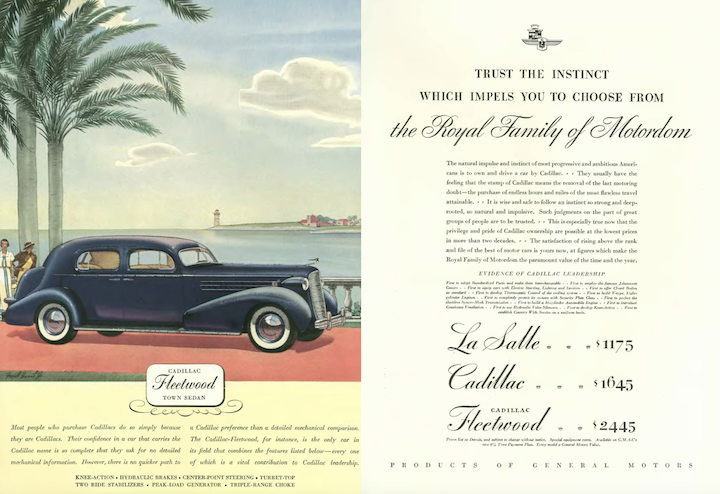
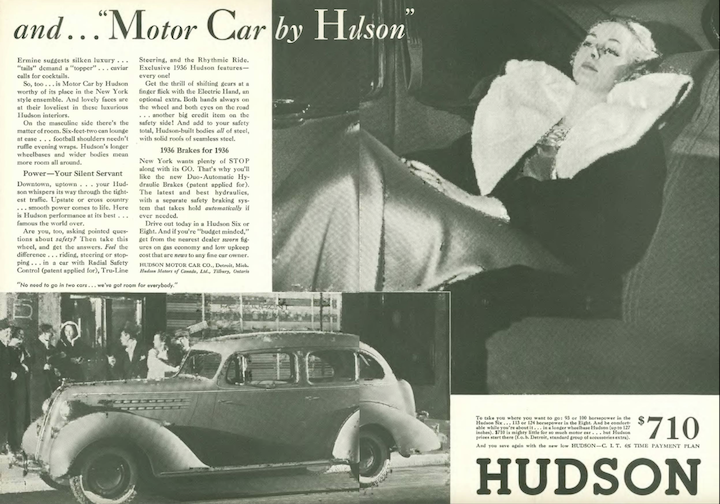
…as the holidays grew near the automobile ads grew more luxurious…this Cadillac spot featured an illustration of posh tots driven by their chauffeur…

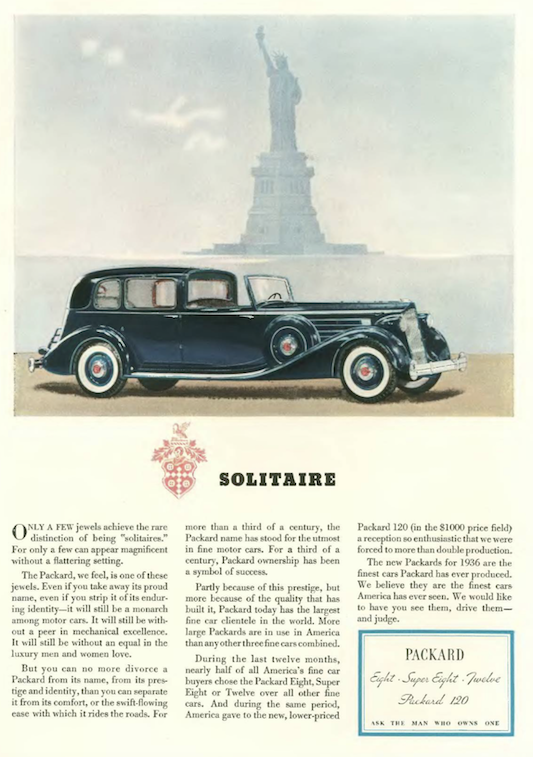
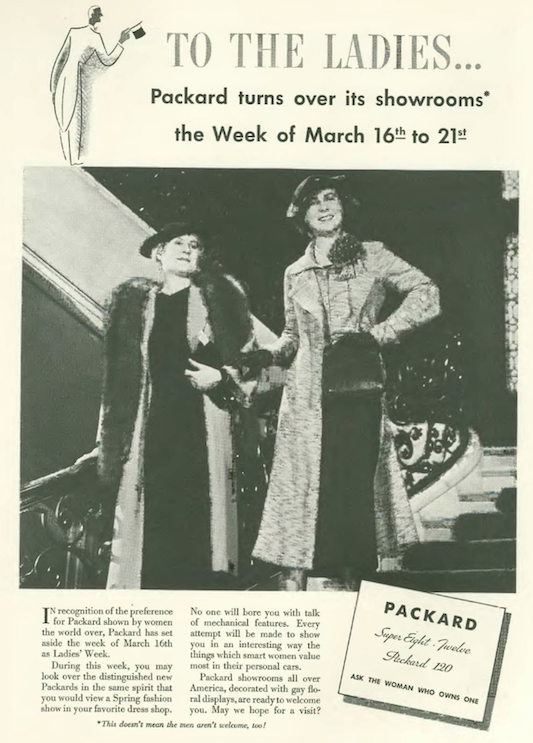
…and from Packard, an automobile designed with the assumption that you already had a liveried driver…

…colorful ads also came our way from Firestone…

…and Goodyear…these two companies were the largest suppliers of automotive tires in North America for more than 75 years…

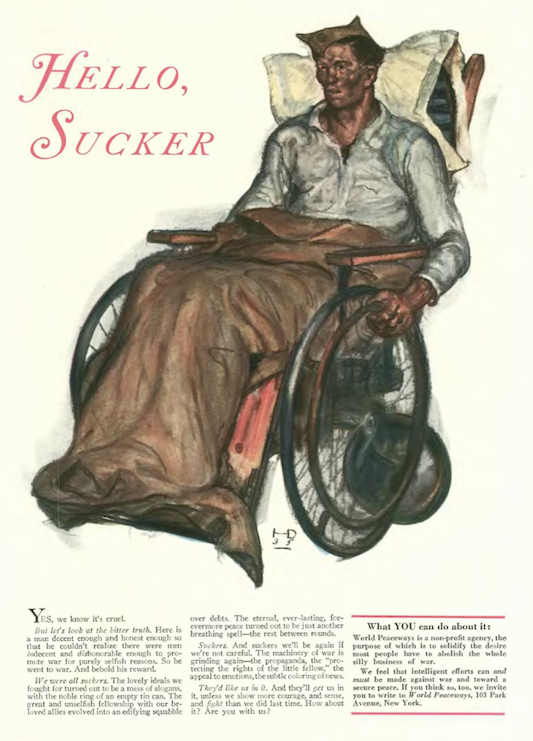
…World Peaceways continued their series of provocative anti-war advertisements…

…Kent Ale was produced by Krueger Brewing Company, one of the first breweries to use cans that were coated with some substance referred to as “Keglined”…

…a detail from an Abercrombie & Fitch advertisement, which suggested “Nudist Glassware” as a unique gift idea for the holidays…

…while The New Yorker suggested a subscription (or three) as a gift that keeps on giving…curiously, the magazine used the talents of artist Lowell Leroy Balcom (1887-1938) to render this woodcut illustration of Eustace Tilley…

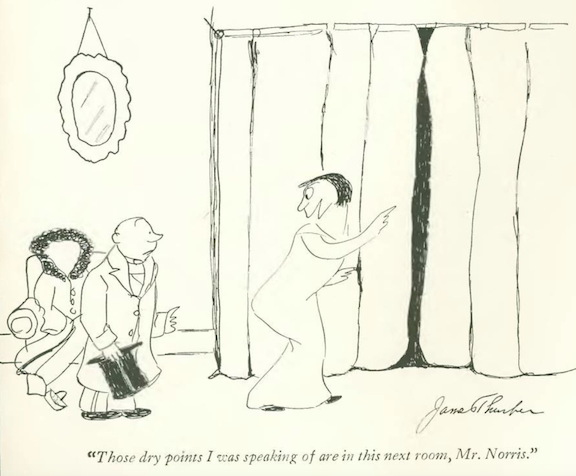
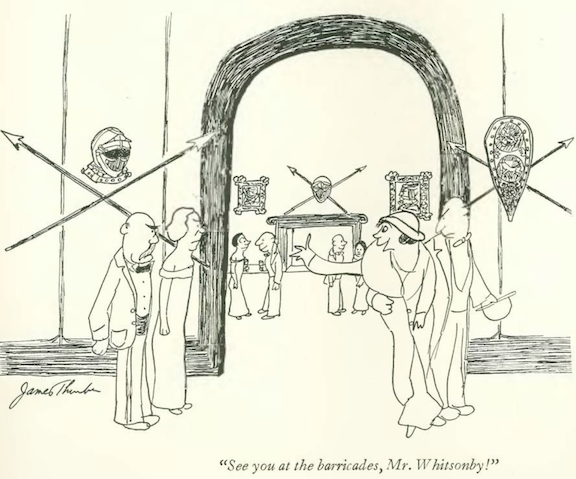
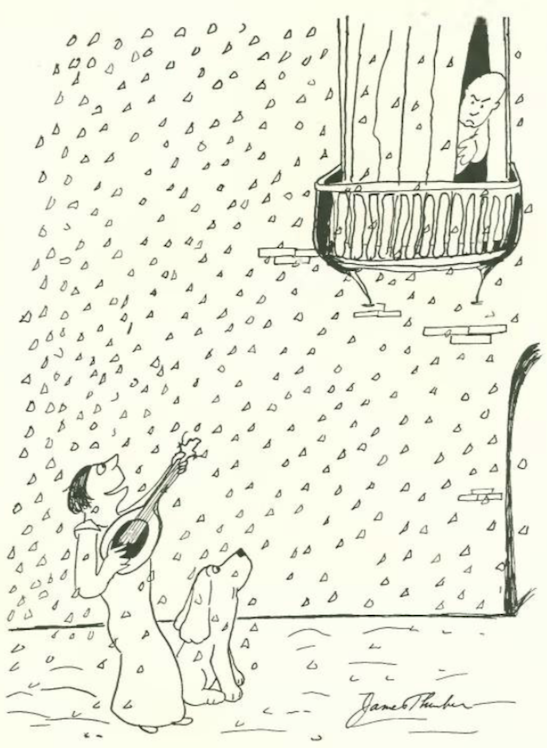
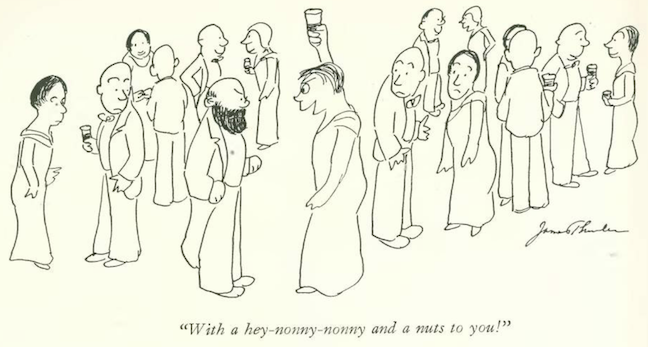
James Thurber kicked off our cartoons with a familiar theme…

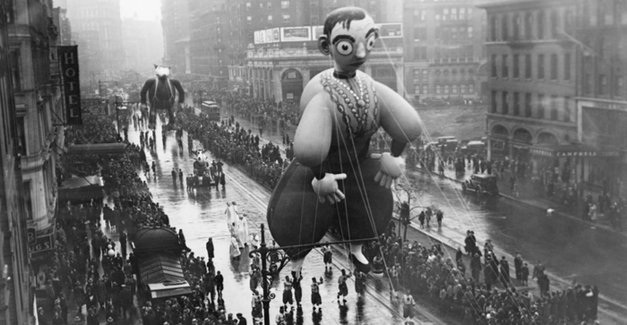
…and Victor de Pauw offered up this Macy’s Thanksgiving Day parade image to calendar section…

…what de Pauw illustrated…

To promote his Silly Symphonies animated short, “The Three Little Pigs”, Walt Disney designed a balloon based on Practical Pig (the one with the brick house). The balloon was featured in the 1934 and 1935 Macy’s Thanksgiving Day parades. (YouTube)

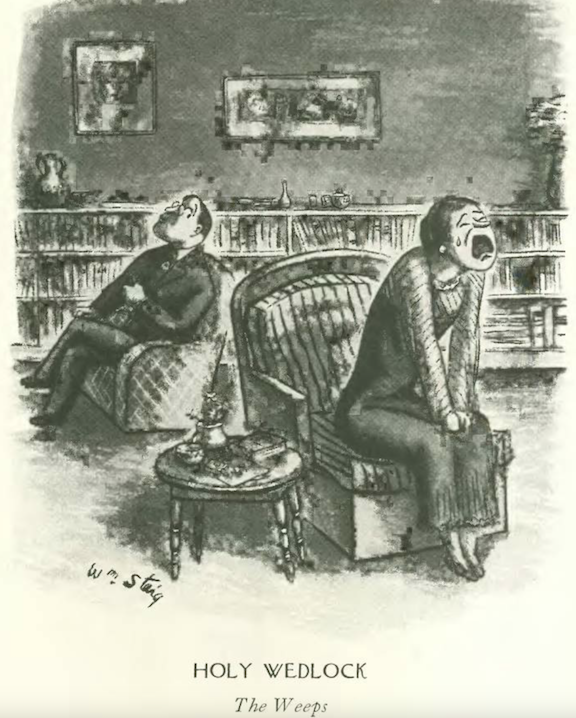
William Steig stepped in for Al Frueh in providing the illustration for the “Theatre” section…

…and Steig again…

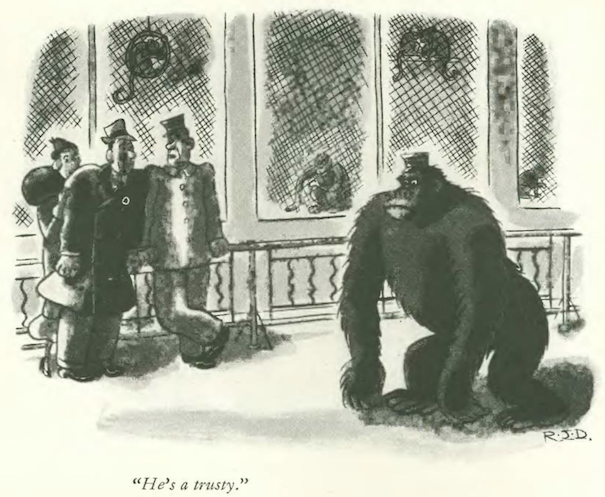
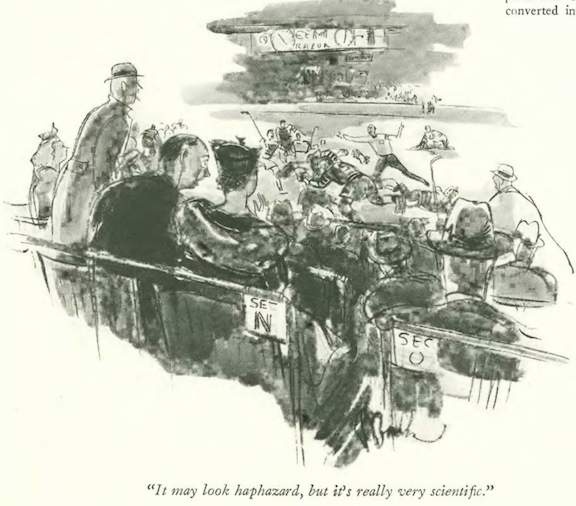
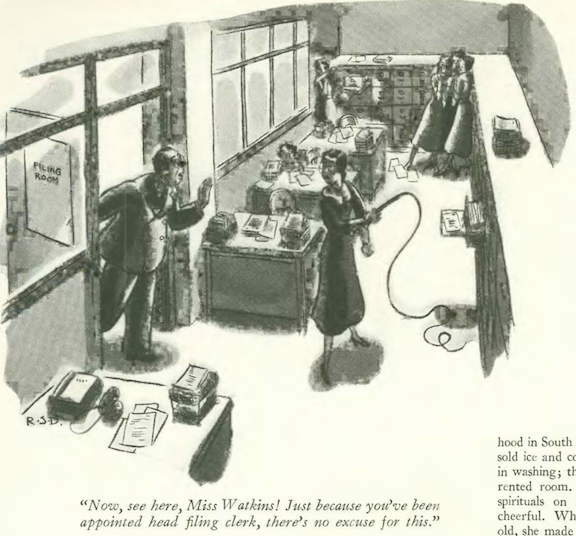
Robert Day gave us an airhead at a balloon factory…

…Day again, with some evicted ghosts…

Helen Hokinson went plant shopping…

…and found a surprise in the kitchen…

Alan Dunn offered a challenge to the Salvation Army…

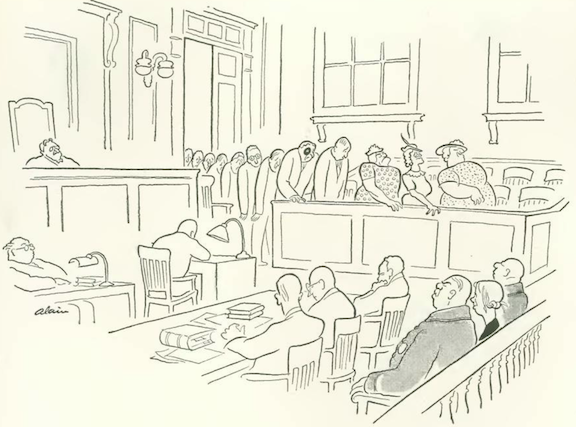
Alain received a special layout for this cartoon…

…which was arranged thusly…

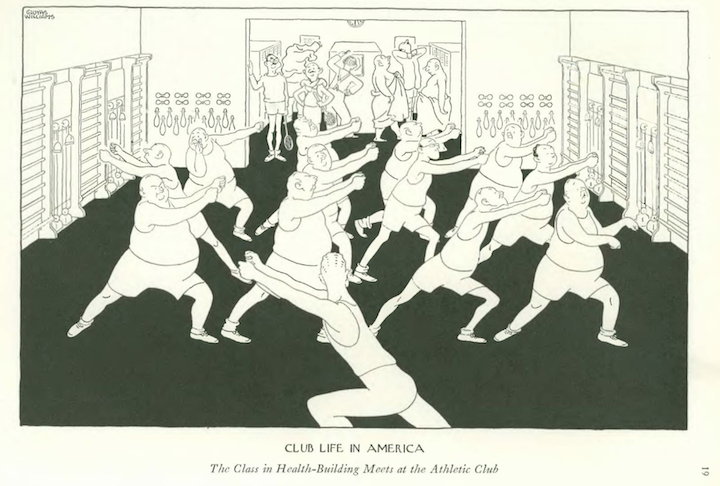
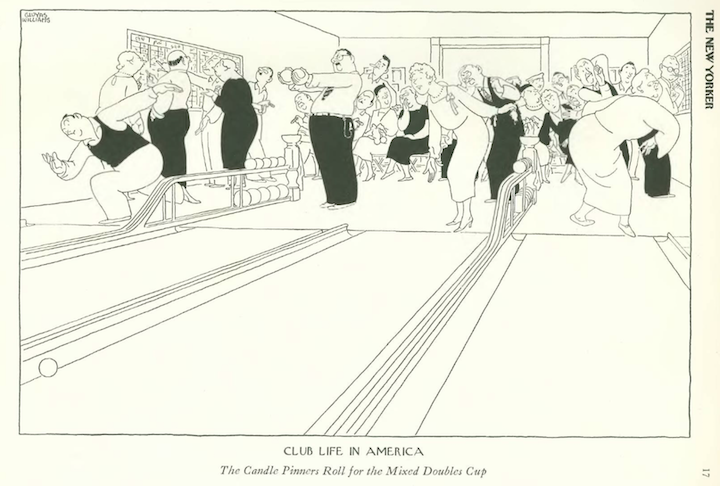
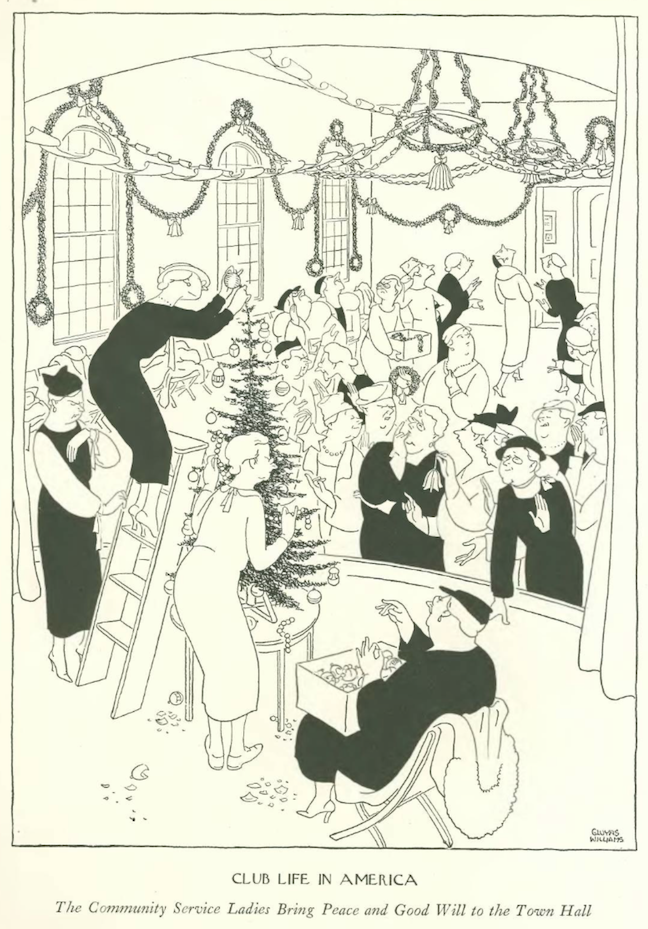
Gluyas Williams was back with his look at club life…

…and we close with Rea Irvin, and the science behind a holiday feast…

…and before we go, our cover artist, Alice Harvey, was publishing New Yorker-style cartoons in Life magazine at least three years before the New Yorker got off the ground. Here is an example of her early work, published 103 years ago on December 28, 1922:

Next Time: Two Nights at the Opera…


Seeking Decorative People

Above: New Year’s Eve at the “El Morocco” Night Club at 154 E. 54th Street, New York, 1935. (Posted on Reddit)

Lois Long took her nightlife seriously, and when it didn’t live up to her standards—defined by the wild speakeasy nights she wrote about after joining The New Yorker in 1925 —she was crestfallen, to say the least.

November 16, 1935 cover by Leonard Dove. This is one of Dove’s fifty-seven New Yorker covers; he also contributed 717 cartoons to the magazine.
Above: Leonard Dove’s self portrait, 1941; photo: 1947. Born 1906, Great Yarmouth, England. Died, Gramercy Hotel, New York City, 1972. (Thanks to Michael Maslin’s indispensable Ink Spill)

 *

When Long joined The New Yorker she was a 23-year-old Vassar graduate, and at age 34 she was not expecting to re-live those heady days; but nightlife in 1935 made her wonder where all the interesting people had gone. Instead of the smart and beautiful speakeasy set, she found people who couldn’t hold a conversation, who cared more about being mentioned in the newspapers by “Cholly Knickerbocker” (a pseudonym used by society columnists)—they simply lacked the “sparkle” she so craved. In this excerpt from her column, “Tables for Two,” she explained:

ALL SHOW, NO GO…Lois Long recalled the heady days of the original torch singer Helen Morgan, but her new club, The House of Morgan, offered up tired vaudeville instead of the singer herself. Above, images of the club from Christopher Connelly’s The Helen Morgan Page. Top, center, detail of Morgan from the 1935 film Sweet Music. Next to Morgan is a photo of Long from the PBS documentary Prohibition. (helen-morgan.net/PBS.org)

 * * *

At the Movies

Our film critic John Mosher was in good spirits after taking in MGM’s Mutiny on the Bounty, and especially the inspired performance by Charles Laughton as the cruel, tyrannical Captain Bligh…

LET’S HAVE A STARING CONTEST…Clark Gable (left) portrayed Fletcher Christian, the Bounty’s executive officer, who disapproved of the cruel leadership of Captain Bligh, portrayed by Charles Laughton (right) in Mutiny on the Bounty. (theoscarbuzz.com)

…two other pictures reviewed by Mosher were less than inspired, but at least the George Raft/Joan Bennett gangster film, She Couldn’t Take It, offered a car chase, and the occasional surprise.

STERILITY ISSUES…Top, Gary Cooper and Ann Harding needed a bit more life in Peter Ibbetson; at least Joan Bennett (bottom photo) found some action in She Couldn’t Take It. (IMDB)

 * * *

From Our Advertisers

Not all fashion advertisements in The New Yorker were aimed at the posh set…Macy’s offered some thrifty selections, including a French-inspired “Theatre Curtain Blouse” that could be opened in the back “so as to reveal your own lily-white vertebrae”…

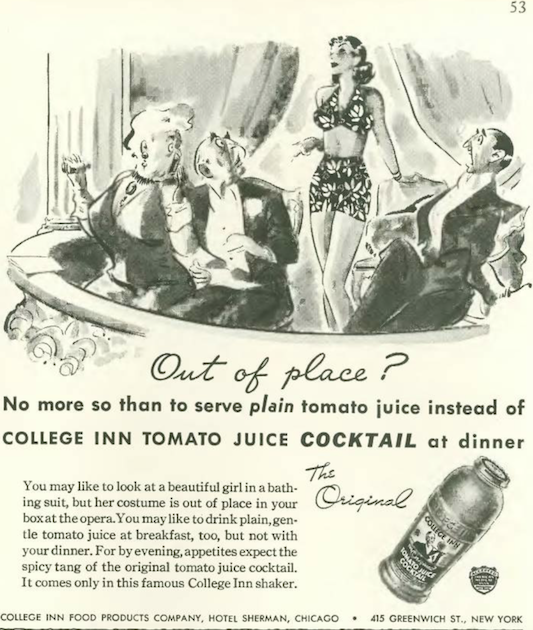
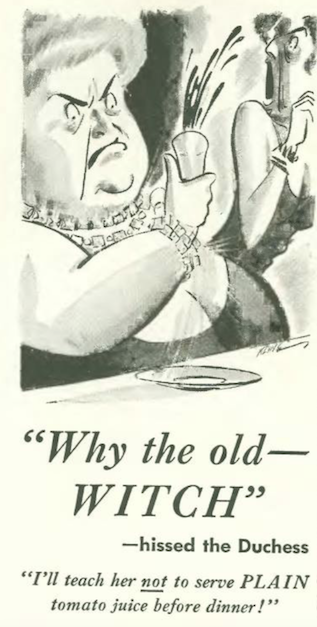
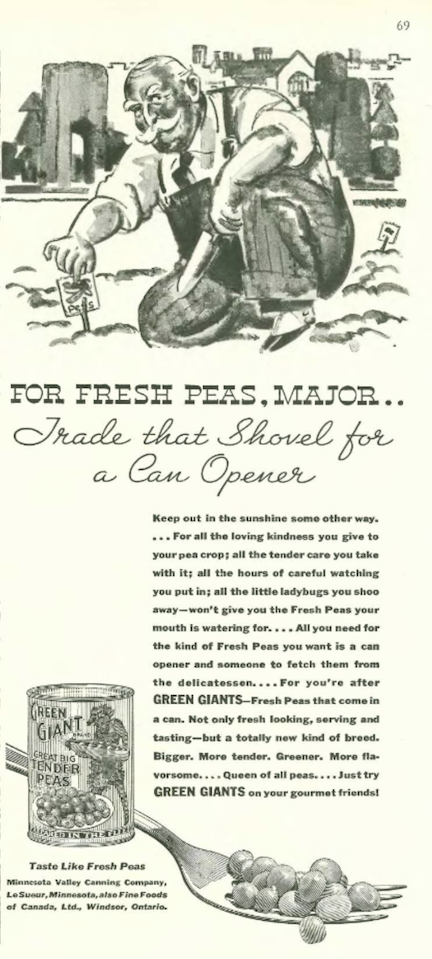
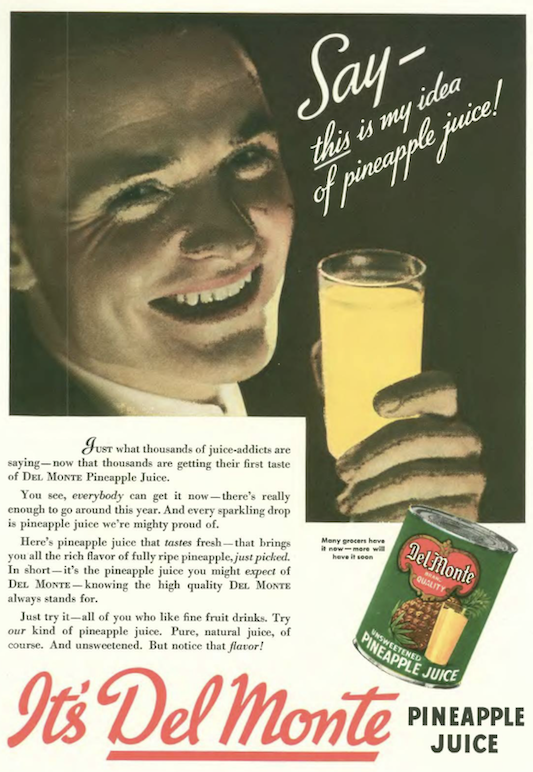
…I am puzzled by the “Duchess” types that appeared in food and beverage ads in the back of the magazine…we’ve seen some angry duchesses in ads for tomato and pineapple juice, and here we have one who has stooped so low as to shell her own peas…

…a side note, the Duchess’s peas came in a can bearing the old Green Giant logo, a savage, bearskin-clad figure…he was redesigned by ad executive Leo Burnett in 1935 to become the friendlier “Jolly Green Giant”…

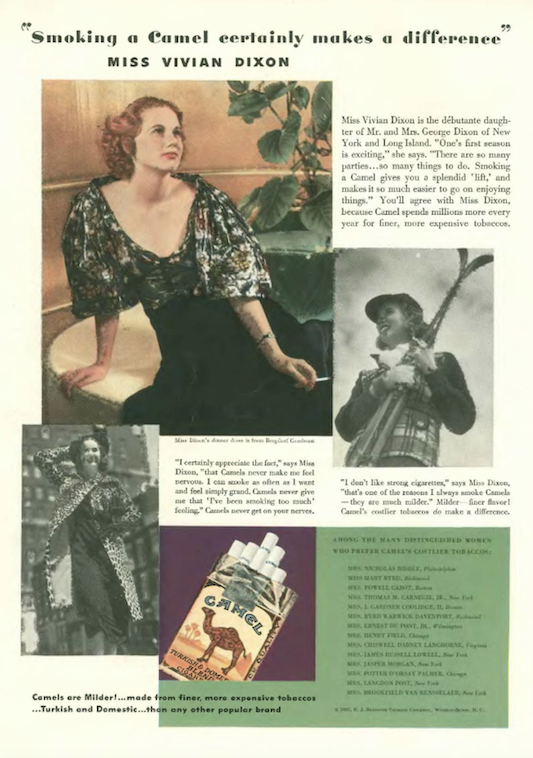
…the makers of Camels presented football coach Chick Meehan in cartoon form to extol the wonders of football and smoking to a young woman…Meehan coached football at Syracuse, NYU and Manhattan College…

…the football theme segues to our cartoon section, beginning with this spot art by James Thurber

Christina Malman’s spot drawings could now be found in every issue, and usually more than one…

…this one by Robert Day also caught my eye, maybe because I like chickens, and dogs too…

…Day again, on the streets of Manhattan…

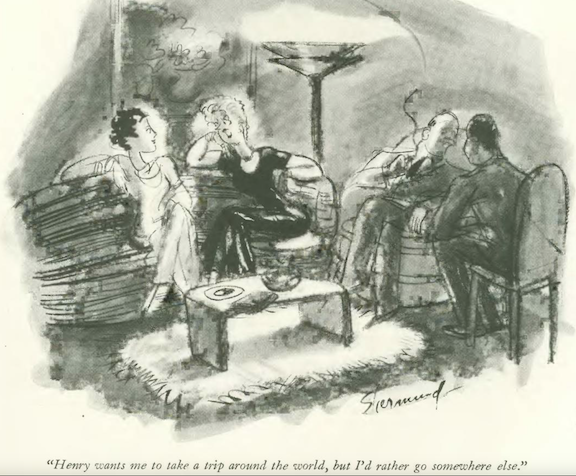
Barbara Shermund showed us a wolf in wolf’s clothing…

Alan Dunn seemed to be channelling Barbara Shermund here…or maybe Dunn’s wife Mary Petty had some influence…

William Crawford Galbraith eavesdropped on some wagering waiters…

Carl Rose found an outlier at the modern Walker-Gordon Dairy Farm…

…The Rotolactor featured in Rose’s cartoon was a mostly automatic machine used for milking a large number of cows successively on a rotating platform…first used at the Walker-Gordon Laboratories and Dairy in Plainsboro, New Jersey (pictured below), the Rotolactor held fifty cows at a time, and hosted about 250,000 visitors annually…

(rawmilkinstitute.org)

…and we go from cows to cats, courtesy Helen Hokinson

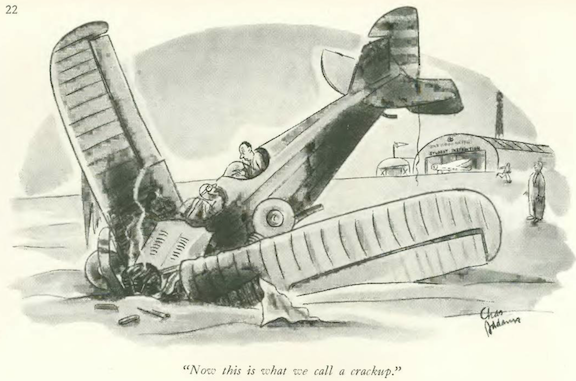
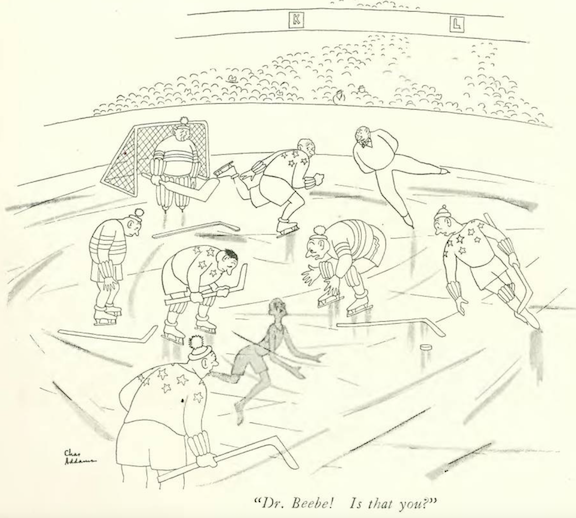
…and Charles Addams booked an unusual perp…

…on to the November 23 issue…

November 23, 1935 cover by Antonio Petruccelli. Petruccelli (1907-1994) began his career as a textile designer, becoming a freelance illustrator in 1932 after winning several House Beautiful cover contests. This is one of four covers he produced for The New Yorker.
Antonio Petruccelli. Here are samples of Petruccelli’s remarkable work. (Helicline Fine Art)

 *

Worth the Wait

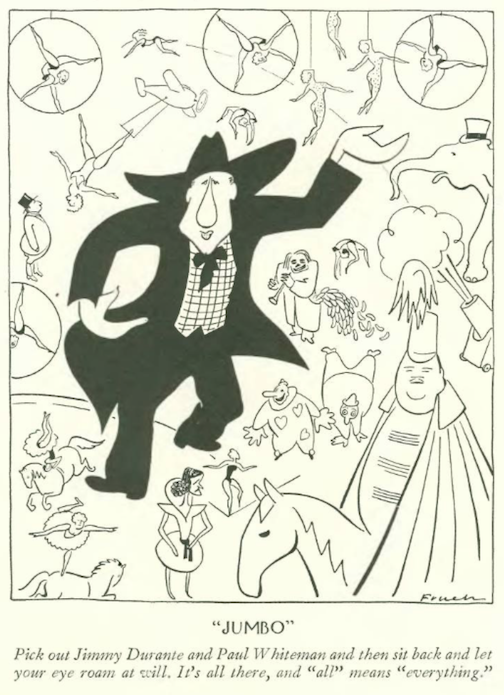
The highly-anticipated circus-themed spectacle Jumbo finally opened at the Hippodrome. In his That’s Entertainment! blog, Jackson Upperco observes that Billy’s Rose’s Jumbo was “more circus than musical comedy,” a production that “was largely an excuse for Mr. Rose to present a circus.” It was headlined by comedian Jimmy Durante and bandleader Paul Whiteman, with a score by Rodgers & Hart. Here are excerpts from a review by Wolcott Gibbs:

JUMB0-SIZED ENTERTAINMENT…Clockwise, from top left, Hippodrome billboard promoting Jumbo; built in 1905, the Hippodrome provided entertainment to thousands who couldn’t afford a Broadway ticket; a circus tent was erected inside the 5,300-seat theatre for the spectacle; Jumbo was one of the most expensive theatrical events of the first half of the 20th century. (Facebook/Library of Congress/Broadway Magazine/jacksonupperco.com)

 * * *

At the Movies

Fyodor Dostoevsky’s 1866 novel Crime and Punishment was adapted to film by both French and American producers in 1935, but critics including The New Yorker’s John Mosher mostly preferred the French version, titled Crime et châtiment.

DOUBLE FEATURE…American and French producers each turned out a film adaption of Fyodor Dostoevsky’s novel Crime and Punishment. Top photo, Marian Marsh as Sonya and Peter Lorre as Roderick Raskolnikov in Columbia’s Crime and Punishment; bottom photo, Madeleine Ozeray as Sonia and Pierre Blanchar as Rodion Raskolnikov in Crime et châtiment. (silverscreenmodes.com/SensCritique.com)

…Mosher reviewed another crime thriller, Mary Burns, Fugitive, but found some comic relief in two other films…

BAD CHOICE IN BOYFRIENDS was the theme of Mary Burns, Fugitive, starring (top left) Sylvia Sidney and Alan Baxter; top right, Joan Bennett and Ronald Colman in the romcom The Man Who Broke the Bank at Monte Carlo; bottom, Fred Allen and Patsy Kelly provided some laughs in musical comedy Thanks a Million. (IMDB)

* * *

From Our Advertisers

Readers of the Nov. 23 issue opened to this lovely image…

…which sharply contrasted with the clunky Plymouth ad on the opposite page…

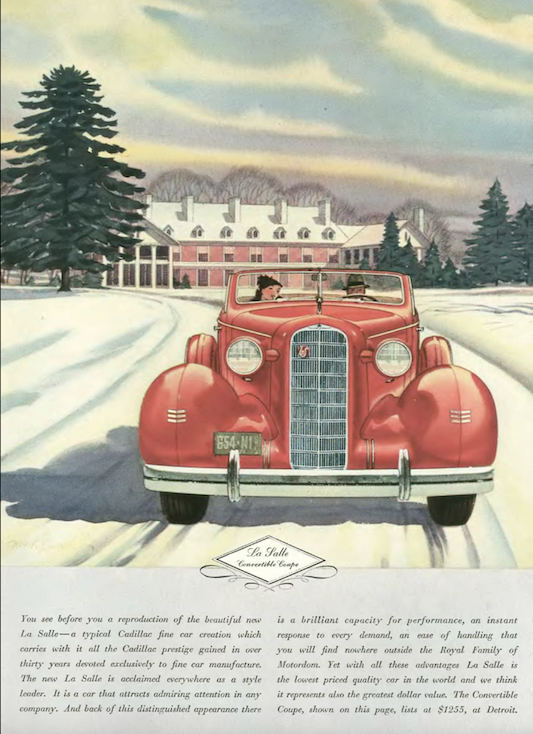
…not so clunky was this colorful illustration promoting Cadillac’s economy model, the La Salle…

…the back cover was no surprise, with yet another glamorous cigarette ad…

…our cartoonists included Richard Decker, and a fashion faux pas to open a boxing match…

George Price eavesdropped into some football strategy…

Carl Rose spotted a canine unbeliever…
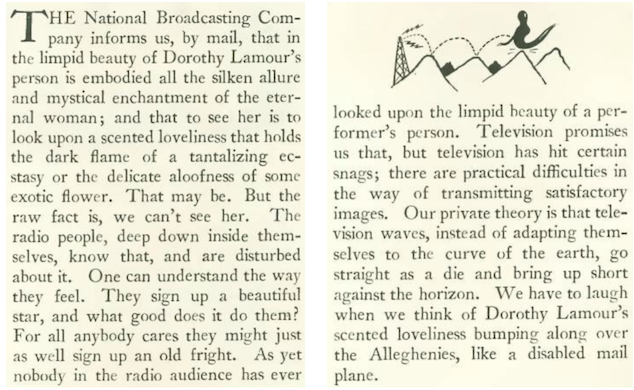
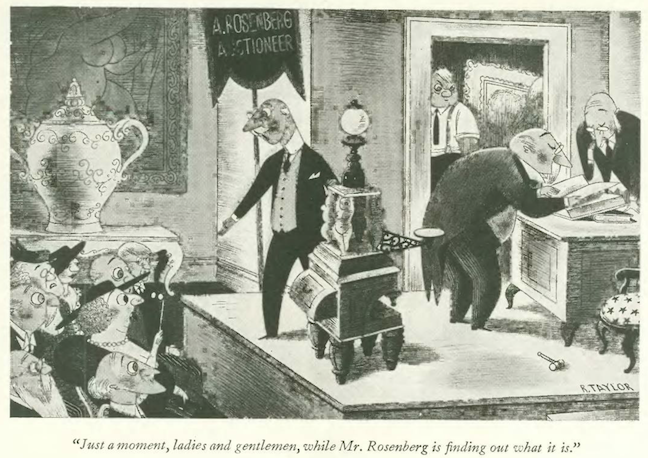
Richard Taylor was back with his distinctive style…
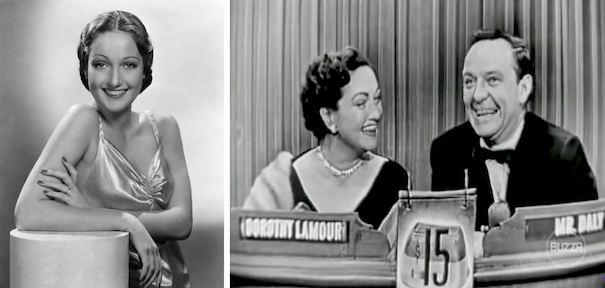
Al Frueh continued to illustrate the latest fare on Broadway…

Otto Soglow crept in for a snooze…

…and we close with James Thurber, and some literary cosplay…

Next Time: Some Holiday Shopping…

Jimmy Comes Home

Above: Former New York Mayor Jimmy Walker and wife Betty Compton, aboard the S.S. Manhattan in 1935. (New York Daily News Archive)

The Roaring Twenties and Jimmy Walker seemed made for each other. A dandy with a taste for fine clothes, late-night parties, and Broadway showgirls, the 97th mayor of New York was a darling of the media…until the market crashed; as nest eggs evaporated along with jobs, folks quickly lost their taste for such frivolity.

November 9, 1935 cover by Daniel “Alain” Brustlein. This was the first of nine covers Brustlein created for the magazine. An Alsatian-born American artist, cartoonist, illustrator, and author of children’s books, Brustlein (1904–1996) contributed to The New Yorker under the pen name “Alain” from the 1930s through the 1950s.
Daniel “Alain” Brustlein, in an undated photo. During the height of Abstract Expressionism Brustlein became a reputable painter, exhibiting his work in New York and Paris. (derfner.org)

 *

The fall of 1935 marked three years since Walker had left office, and for nearly two of those years the city had been governed by the reformist Mayor Fiorello La Guardia. New Yorkers, it seemed, were ready for a dose of Jimmy when he returned from his European exile, hailed by a throng of media and well-wishers.

Writing for Airmail, longtime New York journalist Sam Roberts observes that the city loved Walker, “a charming hellion, a witty, self-effacing, glib humanist, far more flawed, too, and compassionate than pictured previously, a man elevated and condemned by his own character, created and ultimately consumed by his times. He conjures up the anti-Trump—a dodgy philanderer who governed by making people feel good rather than angry.”

WHERE’S THE PARTY?…Former Mayor Jimmy Walker and his wife, Betty Compton, returned to New York in the fall of 1935 amid tremendous fanfare. The New Yorker’s Morris Markey noted that at least 160 media representatives were on hand for the couple’s arrival. (YouTube)

Walker (1881-1946) fled to Europe in November 1932 amid a bribery scandal that had prompted his resignation. Accompanied by Ziegfeld Follies singer Betty Compton (1906–1944)—whom he would marry in Cannes the following April—they would bounce around the continent until Walker determined that the danger of criminal prosecution had passed.

In his “A Reporter at Large” column, Morris Markey wrote about the media’s reception of the exiled mayor, “an army of reporters and photographers, sound engineers and announcers and contact men”…all assembled to inform the world of the return of a “discredited politician.”

HE GOT AROUND…During his time in office from 1926 to 1932, Mayor Jimmy Walker never seemed to miss a moment in the spotlight. Clockwise, from top left, Walker presided over the first shot in the city’s annual marble tournament on June 3, 1928; with actress Colleen Moore at the 1928 premiere of her latest film, Lilac Time;  testifying on bribery charges before the investigative committee of Judge Samuel Seabury, 1932; with Betty Compton following their 1933 wedding in Cannes. (New York Times/konreioldnewyork.blogspot.com/villagepreservation.org)

Markey continued to convey his astonishment at “the monstrous complexity, the fabulous opulence, of the machinery put in motion to inform the universe of Mr. Walker’s arrival upon his native shore.” This included a massive cocktail party—hosted by The United States Lines—for more than two hundred press representatives and other officials.

After all the commotion, Walker would settle into a job as head of Majestic Records, adopt two children with Compton, and host his own radio series on WHN, Jimmy Walker’s Opportunity Hour.

Compton would divorce Walker in 1941 and remarry. Becoming ill after the birth of a son, she would die at age 38 in 1944. Walker would die two years later at age 65 of a brain hemorrhage.

CALLING ON THE ROOSEVELTS…Jimmy Walker and Betty Compton at the White House in 1937. It was pressure from FDR that led to Walker’s resignation in 1932. (Wikipedia)

 * * *

High-flying Hooplah

While New Yorkers were going gaga over Walker, folks in the Bay Area were all atwitter over the first air-mail flight across the Pacific, loading a Pan Am Clipper to the gills with all manner of collectables. E.B. White noted:

BELLYFUL…On Nov. 22, 1935, Pan American Airways made aviation history as the China Clipper lifted off from Alameda, beginning the world’s first trans-Pacific airmail service. Captained by Edwin Musick and crewed by famed navigator Fred Noonan, the Martin M-130 opened a new era of long-distance flight across the Pacific. Noonan, who charted many commercial routes across the Pacific, would go missing along with Amelia Earhart during their ill-fated flight in July 1937. (Library of Congress)

* * *

Wise Men From the East

“The Talk of the Town” visited with Soviet satirists Ilya Ilf (1897–1937) and Evgeny Petrov (1903–1942), who were in New York preparing for a ten-week road trip to California and back. On assignment as special correspondents for the newspaper Pravda, they later published a series of illustrated articles, “American Photographs,” as well as a book titled Single-Storied America (the summer 2004 issue of Cabinet Magazine features an account of their journey as well as a number of their photographs).

AMERICA WAS A GAS…Soviet satirists Ilya Ilf (left) and Yevgeni Petrov check out New York before heading into the American heartland on a ten-week road trip, a highlight being the countless full-service gas stations they encountered along the way. After seeing skyscrapers and mountains and other wonders, the pair agreed that the most enduring image was the one at right: “an intersection of two roads and a gasoline station against a (back)ground of wires and advertising signs.” Sadly, Ilf died two years later from tuberculosis; Petrov died in a plane crash in 1942 while working as a war correspondent. (Aleksandra Ilf archive/Cabinet Magazine)

 * * *

A Jumbo Career

Wallace Beery (1885–1949) got his start in the comedy silents of the 1910s and became a star before the sound era made him an even bigger one; by 1932 he was the world’s highest-paid actor. Alva Johnston’s profile (titled “Jumbo”) took a look at Beery’s life and career (illustration by Al Frueh). Excerpts:

COURTING AND SPARKING…Sid Miller (Wallace Beery) spikes the lemonade as he woos Lily Davis (Aline MacMahon) in a scene from the 1935 film, Ah Wilderness! (letterboxd.com)

 * * *

A View and Corbu

Art and design critic Lewis Mumford was well-known for his hypercritical eye, but occasionally he could be moved to rhapsodize, in this case about the opening of Fort Tryon Park, and particularly about the view it afforded visitors. He reserved his criticism for one of the latest works by Le Corbusier (aka Charles-Édouard Jeanneret), on exhibit at MoMA.

MAGNIFICENT is the word Lewis Mumford used to describe the view from Fort Tryon Park. This scene is taken from Linden Terrace to the west: a barge on the Hudson River and the Hudson Palisades beyond, with the Englewood Cliffs campus of Saint Peter’s University on the top. (Wikipedia)
IRRATIONAL?…Mumford was not pleased with Le Corbusier’s latest work, Le Petite Maison de Weekend (Villa Henfel), which was featured on the cover of the MoMA exhibition catalogue (upper left). Mumford saw the design as a pathetic escape from the architect’s renown rationalism. (MoMA/Fondation Le Corbusier)

* * *

At the Movies

It was a mixed bag at the movies for critic John Mosher, who was delighted by a Soviet take on Gulliver’s Travels, rendered with puppets engaged in a proletarian struggle…

KOMRADE GULLIVER…The Soviet stop motion-animated fantasy film, The New Gulliver, was a communist re-telling of Jonathan Swift’s 1726 novel. The film depicted Lilliput suffering under capitalist inequality and exploitation, with Gulliver enabling a proletarian revolution against the Lilliputian monarchy. (revolutionsnewstand.com)

…but Mosher was less than delighted with the latest from Hollywood, including a sedate The Three Musketeers, a “conventional” remake of D.W. Grifffith’s 1920 melodrama Way Down East, and the romcom Hands Across the Table, which the Times called “uproariously funny” but Mosher deemed barely worth a chuckle.

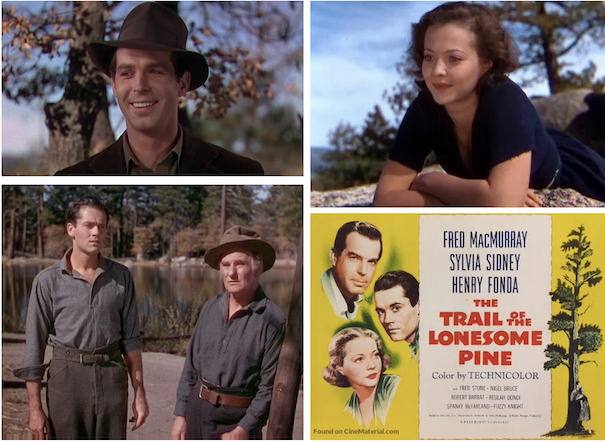
OUTCLASSED BY PUPPETS…John Mosher found the latest from Hollywood underwhelming. Clockwise, from top, Onslow Stevens, Moroni Olsen, and Paul Lukas in The Three Musketeers; Rochelle Hudson and Henry Fonda in Way Down East; Fred MacMurray and Carole Lombard in Hands Across the Table. (mabumbe.com/zeusdvds.com/Wikipedia)

 * * *

From Our Advertisers

The Dorothy Gray salons didn’t mince words when it came to a woman’s beauty regimen…without their help, claimed this ad, the poor “Mrs. Madison” would be “frankly plain,” with a face too wide and eyes and mouth too small…

…notable in ads for men’s and women’s clothes were the presence of cigarettes…all three of the men in this spot are having a smoke in their smart attire…

…White Rock gave their logo-bearer Psyche a rest in 1935 with a variety of ads including this one…

…the makers of Bisquit assumed their customers could read the French dialogue, or at least pretend to…

…when we (of a certain age) think of Marlboro we think of the rugged Marlboro Man, but in 1935 the brand was exclusively marketed to women…

…and who knows what Old Gold’s target was here…definitely women smokers, who were the growth market, but men would take notice of the George Petty pin-up…

…the makers of Pabst Blue Ribbon Beer, who endured Prohibition by offering products like Pabst-ett cheese spread, were ready to grab a big market share after Repeal…

Otto Soglow, still contributing to The New Yorker despite taking his Little King to Hearst, drew up this potentate for a tomato juice spot…

…which segues to our other cartoonists, beginning with Al Frueh and his take on the latest  Broadway hit, Jubilee!

Robert Day saw action on the gridiron…

…unless I missed something, this might be Richard Taylor’s first New Yorker cartoon…

James Thurber put a unique spin on a bowling ball…

Alan Dunn was all in knots at a crime scene…

…Dunn again, pondering the wonders of a makeover…

Barney Tobey eavesdropped on a Downtown subway…

Fritz Wilkinson looked to return a defective pet…

Carl Rose needed two pages to illustrate his epic cartoon (caption added at the bottom for readability)…

…and we close with Helen Hokinson, and a whiff of scandal…

Next Time: Seeking Decorative People…


Planes, Trains and Automobiles

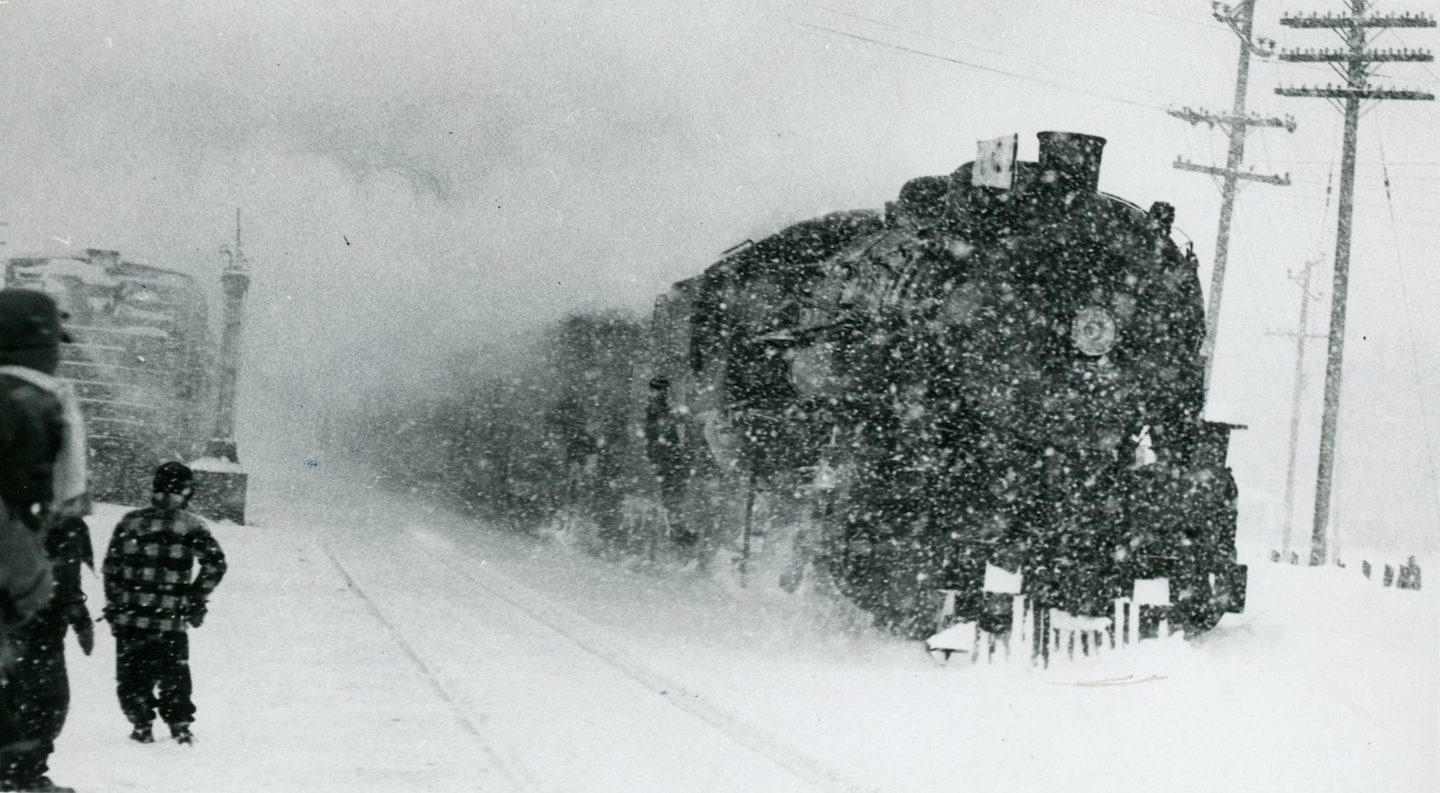
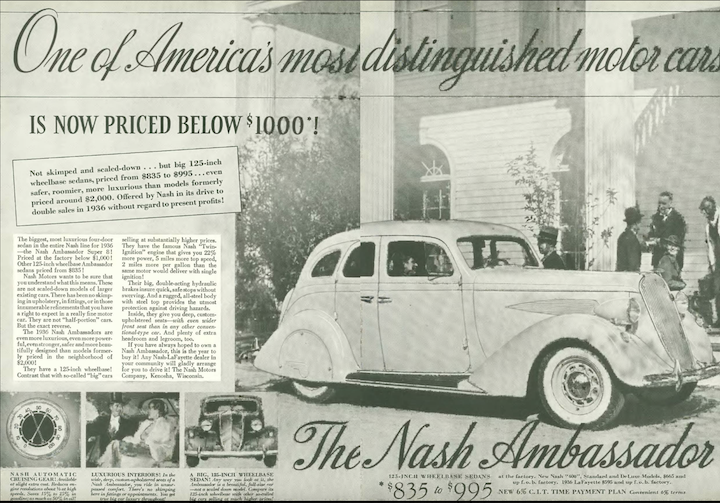
Above: Clockwise from top left—the Douglas DC-3 was introduced to airlines in 1935; Seaboard streamlined locomotive, c. 1930s; 1936 Lincoln-Zephyr; 1936 Pierce Arrow. (hushkit.net/Wikimedia/classicautomall.com)

As we’ve seen in previous issues, E.B. White often served as The New Yorker’s unofficial aviation correspondent; despite his sometimes anachronistic views on progress, he never missed a chance to hop aboard an airplane and marvel at the scene far below.

November 2, 1935 cover by Constantin Alajalov.

White’s enthusiasm, however, was tempered with doubts about air safety, including observations he made in an August 31, 1935 column following the deaths of Wiley Post and Will Rogers in an Alaska plane crash. Here is what he wrote then:

The aviation industry’s strong reaction to that “noisy little paragraph” apparently led to a number of subscription cancellations, prompting White to return to the topic in his Nov. 2 “Notes and Comment” column:

HE’D BEEN AROUND…E.B. White supported his comments on air safety by citing his many flying experiences, including soaring around the Empire State Building “on a blithe morning.” Pictured above is a New York Daily News plane flying over Manhattan in 1934. (NY Daily News)

White also turned to statistics for his defense, finding that per passenger mile, railroads were still the safest mode of transportation in the country.

HOP ABOARD…According to 1933 statistics shared by E.B. White, trains were the safest mode of transportation per passenger mile, followed by buses. Automobiles were the least safe, a fact that still holds true today. From left, Greyhound bus and driver, 1937; automobile wreck, 1930s; New York Central’s 20th Century Limited leaving Chicago’s LaSalle Street station in 1938. (Facebook/Reddit/Wikipedia)

With that, White still wasn’t done with the topic, turning to none other than Anne Morrow Lindbergh for her thoughts on flying, which she shared in her latest book, North to the Orient. White noted Lindbergh’s mixed feelings about flying, about getting to places quickly and missing familiar landmarks. He also suggested that someday airline passengers would use mountains and rivers as landmarks…(I still try to do that when I fly, but at 35,000 feet it is a challenge). Today most folks are content with plugging in their earbuds and tuning out completely.

NOT YOUR EVERYDAY OUTING…In July 1931 Charles and Anne Morrow Lindbergh embarked in their Lockheed Model 8 Sirius on an often treacherous 7,100-mile journey across Canada, Alaska, Siberia and Japan in an attempt to find a commercial route to Asia for Pan American Airways. Top photo, Charles (standing on pontoon) and Anne (in the cockpit) make final preparations before the flight; bottom photo, enthusiastic crowds greet the Lindberghs upon their arrival in Japan. The Siberia-to-Japan leg was the most dangerous due to heavy fog. (historynet.com)

E.B. White also announced the return to the city of former Mayor Jimmy Walker, who had fled to Europe in 1932 amid corruption charges. White noted that New York’s nightclubs were eager to welcome the fun-loving Walker back to town.

SECOND ACT…Still image from a 1935 British Pathé newsreel shows the triumphant return from Europe of former Mayor Jimmy Walker and his wife, Betty Compton. (YouTube)

 * * *

A Zephyr Blows In

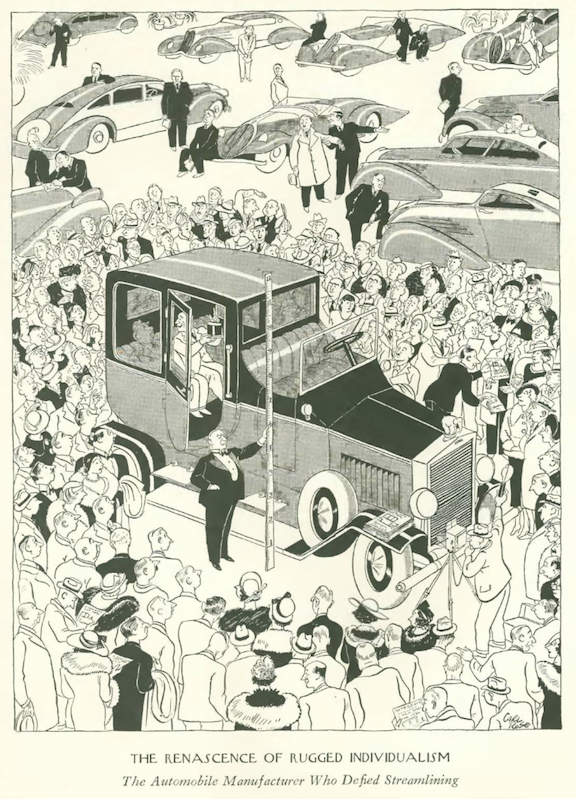
The magazine’s “Motors” correspondent (pen name “Speed”) noted the dazzling display of 1936 models at the New York Automobile Show, singling out the Lincoln-Zephyr as the year’s biggest innovation.

DECO DREAMSCAPE…Streamlining was all the rage at the 1935 New York Automobile Show at Grand Central Palace. Upper right, a woman opens the hood of a streamlining pioneer, the Chrysler Airflow. (New York Daily News)
LEADER OF THE PACK…The 1936 Lincoln-Zephyr had tongues wagging at the New York Automobile Show.  (thehenryford.org)

 * * *

At the Movies

William Powell and Hollywood newcomer Rosalind Russell blessed film critic John Mosher with their spy caper, Rendezvous, while Pauline Lord got lost in the London fog with Basil Rathbone in A Feather in Her Hat.

A CAPER AND A WEEPER…At left, William Powell starred with Hollywood newcomer Rosalind Russell in Rendezvous; at right, Broadway stage actress Pauline Lord appeared opposite Basil Rathbone in A Feather in Her Hat. (1935)

Mosher also screened a French comedy, René Clair’s Le Dernier Milliardaire (The Last Billionaire), finding its slapstick approach to satire a bit dated.

DURABLE AND ADORABLE…Renée Saint-Cyr as Princess Isabelle in the French comedy Le Dernier Milliardaire (The Last Billionaire). Known for her chic comedies, Saint-Cyr (1904–2004) was a major French film star for seven decades. (Film Forum)

Finally, Mosher turned his critical eye toward a British sci-fi film, Transatlantic Tunnel. Looking forward to seeing a gee-whiz Jules Verne-type story, what Mosher found instead was a lot of sentimental “padding” and very little gee-whiz.

UNDERWATER…John Mosher looked forward to an undersea adventure, but instead got a lot of sentimental fluff in the British sci-fi film, Transatlantic Tunnel. Clockwise, from top left, movie poster for the American release; scene from the film depicting the tunnel entrance; the film showcased such futuristic conveniences as video phones (called “televisors”); a group of wealthy industrialists gather at the home of a Mr. Lloyd, a millionaire investor who used a motorized wheelchair. (Wikipedia/Reddit/cinemasojourns.com)

 * * *

No Thanks, Ernie

Clifton Fadiman had an armload of books to review, including an autobiography by Andre Gide (If I Die), novels by Mikhail Sholokhov (Seeds of Tomorrow) and Mari Sandoz (Old Jules), and an Ernest Hemingway tale about big game hunting (Green Hills of Africa) that Fadiman did not care for at all. Here are excerpts from a couple of the reviews:

RUGGED TYPES…At left, Ernest Hemingway poses with skulls of kudu and female of sable antelope in East Africa, 1934, part of his hunting trip described in Green Hills of Africa; at right, photo of Jules Sandoz from the frontispiece of Old Jules, a biography written by his daughter Mari Sandoz. (JFK Library/U of Nebraska)

 * * *

From Our Advertisers

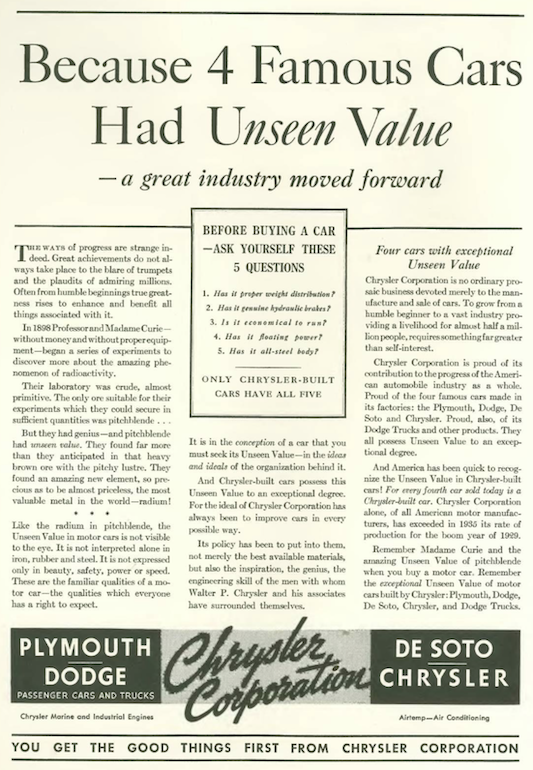
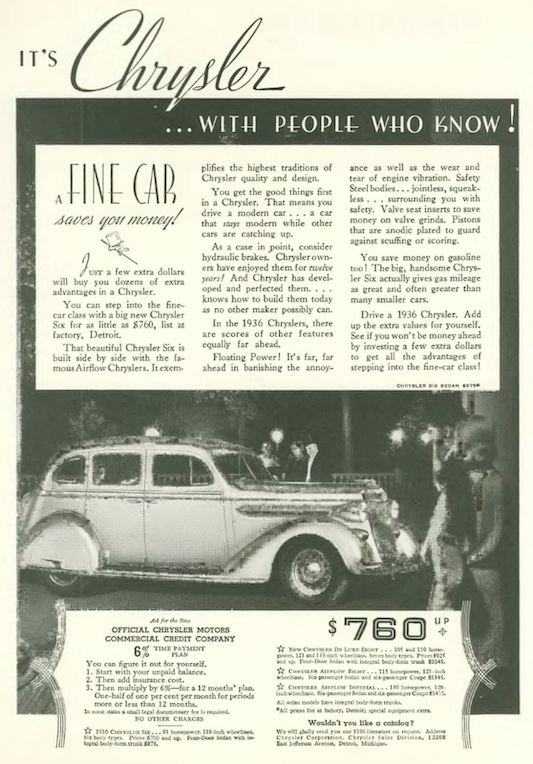
With the National Automobile Show in full swing at the Grand Central Palace, the issue was jammed with ads for every type and price range…the Chrysler Corporation took out this full-page spot on the opening spread to promote one of the lowest priced cars on the market…

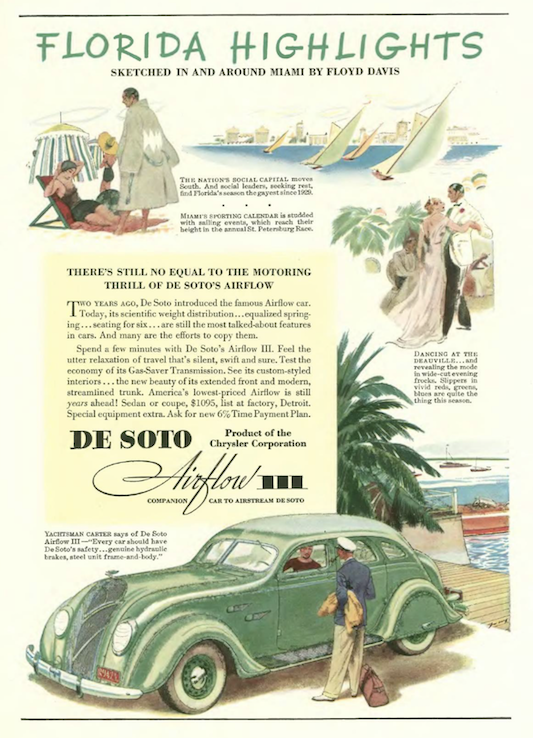
…Chrysler/DeSoto continued to tout its streamlined Airflow models…introduced in 1934, the Airflow was the first full-size American production car to use streamlining, and it featured a number of other innovations, but consumers just weren’t ready for something this radical…even with the streamlining toned down after its first year, only 55,000 units were produced during the model’s four-year run…

…on a side note, Chrysler has revived the Airflow nameplate for an electric car concept due to the marketplace in 2028…

…mentioned in Speed’s review of the Automobile Show, the Lincoln-Zephyr would find success with its aerodynamic design…

…most manufacturers were in on the streamlining trend, noticeable in the tilted grilles, low rooflines, and sweeping fenders…

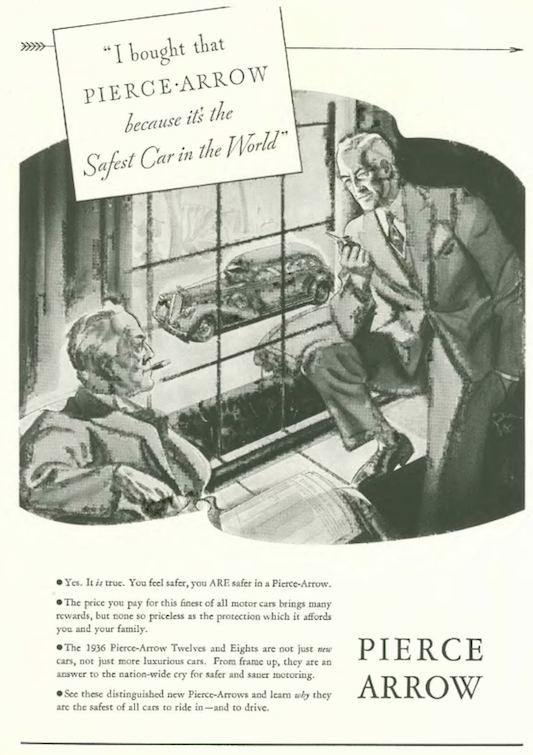
…unlike the other car companies, Pierce Arrow did not produce an economy model to keep its luxury line afloat during the Depression…emphasizing its handmade quality, this American rival to Rolls-Royce went out of business by 1938…

…Goodyear got in on the Auto Show action promoting its tires for the “new and faster cars”…

…the folks at Campbell’s continued their ad series featuring upper-class women covertly serving canned soup to their society friends…in this ad, however, the hostess reveals her secret…

…there were no secrets to be found at Schrafft’s—its popularity increased during the Depression, when more than forty locations in the New York metro offered moderately priced “home-style” meals in an atmosphere that suggested upper-middle-class gentility…

…Long Island’s Lido Country Club tried to drum up some autumn business by promoting the “warm and lazy” sunshine of “Indian Summer”…

…the makers of King George IV Scotch used the face of Stork Club owner Sherman Billingsley to lend some nightlife cachet to their product…here’s an odd little fact: his nephew, Glenn Billingsley, was married to Leave It to Beaver actress Barbara Billingsley, who played June Cleaver on the TV series…

…this week the back cover belonged to R.J. Reynolds, with various aviators testifying to the calming effects of Camel cigarettes…the lead endorser in the ad, Frank Hawks, was famous for breaking aviation speed records until he perished in the crash of an experimental plane in 1938…

…Forstmann ads were a regular feature on the inside front cover during the fall/winter fashion season, rendered in a style made popular by illustrator Carl “Eric” Erickson

…on to our cartoonists, we open the magazine with Maurice Freed

James Thurber was busy in this issue, writing a touching character sketch of a medicine show man he greatly admired (“Doc Marlowe”)…and contributing this spot art for “Goings On About Town”…

…he also turned in this terrific cartoon…

Christina Malman livened up the Auto Show review with this spot art…

Carl Rose also paid tribute to the annual event…

Daniel ‘Alain’ Brustlein did a bit of home decorating…

Robert Day was ready to call it a night…

Helen Hokinson contributed two cartoons, shopping for a pet fish…

and taking in a Dolores Del Rio picture…

…no doubt Hokinson’s “girls” were commenting on the 1935 musical comedy In Caliente, featuring Mexican actress Dolores Del Rio (1904–1983)…Del Rio was the first Mexican actress to achieve mainstream success in Hollywood…

Dolores Del Rio in a scene from In Caliente. (Reddit)

…we continue with George Price, and a dedicated lumberjack…

Ned Hilton discovered some honesty in the Men’s Department…

William Steig took a look around on Election Day…

Richard Decker took the pulse of the medical profession…

…and we close with another by Decker, where seeing is not believing…

Next Time: Jimmy Comes Home…


It Can’t Happen Here

Above: Cover of Sinclair Lewis's 1935 novel about a fascist takeover of America, It Can't Happen Here. At right, 22,000 people attended a Nazi rally at Madison Square Garden on February 20, 1939. (Wikipedia/Reddit)

Ninety years ago Sinclair Lewis published It Can’t Happen Here, a dystopian novel that responded to the rise of fascism in Europe as well as to American demagogues like Louisiana Senator Huey Long.

October 26, 1935 cover by Roger Duvoisin. Duvoisin (1900–1980) was a Swiss-born American writer and illustrator best known for children’s picture books. He illustrated 32 covers for The New Yorker, along with five cartoons. Duvoisin won the Caldecott Medal in 1948 (along with author Alvin Tresselt) for White Snow, Bright Snow.

In his 2016 New Yorker article, “Getting Close to Fascism with Sinclair Lewis’s ‘It Can’t Happen Here,'” journalist Alexander Nazaryan notes how Lewis was arguing for journalism and civic education as essential pillars of democracy. The title of Lewis’s book, Nazaryan observes, suggests that ‘It’ was something more subtle: “a collective apathy, born of ignorance, and a populace that can no longer make the kind of judgments that participatory democracy requires.”

Lewis’s novel also made book critic Clifton Fadiman sit up and take notice. Here are excerpts from the first part of his review:

HOME-GROWN…American fascism was represented by organizations such as the German American Bund, the Silver Legion of America, and radio host Charles Coughlin, who opposed the New Deal and promoted conspiracy theories and antisemitic views. Clockwise, from top left: Nearly a thousand uniformed men wearing swastika arm bands and carrying Nazi banners parade past a reviewing stand in New Jersey on July 18, 1937. The New Jersey division of the German-American Bund had opened the 100-acre Camp Nordland at Sussex Hills; Huey Long in 1935, the same year he was assassinated; Nazi rally at Madison Square Garden in 1939. (AP/Wikipedia)

If you zoom in on the photo at bottom right, you can’t help but notice the woman in the black hat, who seems a little unsure about what she is doing, especially in front of a camera…the woman to her right appears to be hiding her face.

Here is more of Fadiman’s review (click to enlarge). It’s worth a read.

WE’VE BEEN WARNED…Published nearly seventy years apart, Sinclair Lewis’s It Can’t Happen Here (1935) and Philip Roth’s The Plot Against America (2004) both explored the dangers of fascism in the United States. (pulitzer.org/Wikipedia/Nancy Crampton via stanford.edu)

 * * *

It Was Happening There

In her “Letter from Paris,” Janet Flanner was noting “increasing Fascist sentiment and  sympathy” in her adopted city:

OVER THERE…The French Popular Party (Parti populaire français, PPF) was a French fascist and anti-semitic political party led by Jacques Doriot before and during World War II. Formed in June 1936, with an estimated 120,000 members by 1937, it is generally regarded as the most collaborationist party of France. (thefrenchhistorypodcast.com)

 * * *

All Talk

Marion Sayle Taylor (1889–1942) was the popular host of a radio advice show, The Voice of Experience. Margaret Case Harriman (1901–1966) penned a two-part profile of Taylor titled “The Voice.” I’ve included the opening lines to Part One here:

IF ONLY SHE KNEW…Margaret Case Harriman, left, circa 1936, profiled Marion Sayle Taylor before his misdeeds were revealed. (Vogue Archive/eleanorbritton.blogspot.com/Oregon Encyclopedia)

After reading both parts of Harriman’s profile piece, it appears she wasn’t yet aware that Taylor was more than a radio personality; he was also dishonest, manipulative, and opportunistic, according to a biography by Dick and Judy Wagner featured in the Oregon Encyclopedia. For example, Harriman reported (likely from Taylor’s official bio) that Taylor’s first wife, Pauline, had died in childbirth, when in fact she was quite alive and suing him for divorce that same year. Taylor also divorced his second wife, Jessie, who sued him in 1936 after he deceived her about another woman. Not surprisingly, his radio image as a reliable marriage counselor was damaged irretrievably.

FALSE ADVERTISING…A streetcar, possibly in Newark, N.J., advertising a lecture by Taylor, circa 1931. In addition to hiding a previous prison record, Taylor also falsely reported that he had studied at several universities (he did not earn a Ph.D, as the redundant title claims in the above photo). It appears Taylor also kept much of the money he solicited for charitable causes. (Oregon Encyclopedia)

 * * *

Selling Pooh

Commercial cross-marketing of children’s books with toys and other products had its origins in the late nineteenth century with Alice’s Adventures in Wonderland, and in the first years of the 20th century Beatrix Potter’s Peter Rabbit series inspired everything from dishes and wallpaper to board games and dolls—in 1903 Peter Rabbit was the first fictional character to be made into a patented stuffed toy.

Then came another character from British children’s literature, A.A. Milne’s Winnie-the-Pooh. In January 1930, Stephen Slesinger (1901–1953) purchased U.S. and Canadian merchandising, television, recording, and other trade rights to the Winnie-the-Pooh works from Milne (for $1,000, plus royalties), marketing a wide range of products. For the column “Onward & Upward With the Arts,” St. Clair McKelway paid a visit to Slesinger at the Park Avenue offices of Winnie-the-Pooh Association, Inc. Excerpts:

KEEP YER SHIRT ON…The Parker Brothers were the first to feature Winnie-the-Pooh in color for a 1932 board game. Stephan Slesinger added the iconic red t-shirt to Pooh for the game and a children’s record, a look that was later adopted by the Disney Corporation when it acquired the rights from Slesinger’s widow and daughter in 1961. (thedisneyclassics.com)
FUNNIES MAN…At left, Stephan Slesinger in an undated photo. Slesinger was a radio, television and film producer, and a curator of comic strip characters including Alley Cop, Captain Easy, Buck Rogers and Blondie, among others; at center, a record of “Winnie-the-Pooh Songs,” 1932; an ad for the Red Ryder BB gun—in 1938 Slesinger created the comic strip Red Ryder along with artist Fred Harmon. (alchetron/yesterdaysgallery.com/Port Isabel Press)

In another excerpt, McKelway gave us an idea of the scope of Slesinger’s Pooh empire:

 * * *

At the Movies

Critic John Mosher found few thrills in the latest fare from Hollywood, offering his views of Admiral Richard Byrd’s Into Little America and the musical Metropolitan, featuring famed baritone Lawrence Tibbett. 

FOR THE BYRDS…At left, lobby card for Into Little America; at right, Alice Brady and Lawrence Tibbett in Metropolitan. (eBay.uk/rottentomatoes.com)

With a screenplay by Ben Hecht and Charles MacArthur and direction by Howard Hawks, one would hope for some rough and tumble in a film about Gold Rush San Francisco. Instead, Mosher found the trappings of Barbary Coast rather mild. This was doubtless due in part to the Hays Code that curtailed the sex and violence portrayed in films of the 1920s and early 1930s.

TAKING A SPIN…Miriam Hopkins runs the roulette wheel as Edward G. Robinson looks on in Barbary Coast. A brief 2019 review in the Harvard Film Archive praised the film’s Gothic feel created by the “evocative portrayal of early San Francisco as a foggy labyrinth of rickety boardwalks and ominous, sky-high ship masts…” (harvardfimarchive.org)

One might think that a film featuring the destruction of Pompeii would have some thrills, however RKO’s The Last Days of Pompeii proved to be a “temperate affair” in Mosher’s eyes, “one of the great bores of the moment.” The Dick Powell/U.S. Navy vehicle Shipmates Forever didn’t prove to be any better.

HOT TIMES IN POMPEII?…John Mosher called The Last Days of Pompeii “one of the great bores of the moment,” including the “drearily enacted” eruption of Vesuvius in which “Paper temples fall and there is a bit of bustle, and that is all there is to that.” Mosher did single out Basil Rathbone’s performance as an urbane Pontius Pilate, “a Pontius Pilate with a Long Island manner.” (tcm.com)
GO GET ‘EM DICK…The U.S. Naval Academy provided the setting for the musical Shipmates Forever, featuring Dick Powell as a crooner who ultimately chooses the Navy over a singing career. (tcm.com)

* * *

From Our Advertisers

We begin with the inside front cover, where the folks at Fisher touted their innovative “Turret Top” design…Body by Fisher began as a separate company in 1908, specializing as an automobile coach builder…although acquired by General Motors in 1926, the Fisher brand was promoted until the 1980s…

…there were many fall and winter fashion ads in this issue, including this continuing series by Russeks promoting Rayon fabrics…and women smoking, no doubt considered a sign of sophistication…

…Guerlain perfume ads featured the unmistakable style of illustrator Lyse Darcy

…the Heyward/Gershwin production of Porgy and Bess made a splash in this ad for Stage magazine…

…World Peaceways often used terrifying imagery to promote their anti-war messages…this ad was on the inside back cover…

…and as you closed the magazine, the back cover greeted you with this stylish appeal to smoke Luckies…

…on to our cartoonists, starting with Al Frueh in the Theatre section…

…and Frueh again, in this interesting arrangement…

George Price was featured twice…

…with scenes of domestic life as only Price could render…

…and speaking of distinctive, no one did it quite like the great James Thurber

Robert Day gave us two Republicans looking in on the progress of the New Deal…

Carl Rose bid farewell to a writer sick of his peace and quiet…

Whitney Darrow Jr illustrated a literary exchange on a park bench…

…and I close with today’s New Yorker cover artist, Roger Duvoisin—here is his cover for White Snow, Bright Snow, which won the Caldecott Medal in 1948.

Next Time: Planes, Trains and Automobiles…

On Catfish Row

Above: Left image: Todd Duncan (Porgy) and Anne Brown (Bess), in the 1935 Broadway production of Porgy and Bess. Right image: John Bubbles (Sportin’ Life) and Brown. (Photos courtesy the Ira & Leonore Gershwin Trusts)

The 1935 Broadway production of Porgy and Bess is widely regarded as one of the most successful American operas of the twentieth century, but when it opened at the Alvin Theatre on Oct. 10, 1935, reviews were mixed, including the one penned by Wolcott Gibbs.

October 19, 1935 cover by William Crawford Galbraith. The New York Times (Oct. 9, 1935) made this observation about the rodeo at Madison Square Garden: “New York, which for several days has been vaguely aware of an impending rodeo because of a profusion of ten-gallon hats along Eighth Avenue and a sign in a beauty parlor, ‘Welcome, Cowgirls,’ will see the real thing this morning.”

Now you would think a work by composer George Gershwin, with a libretto written by DuBose Heyward (author of the 1925 novel Porgy) and lyricist Ira Gershwin, would be a sure hit. Some critics did praise the production, which ran for 124 performances, but others criticized themes and characterizations of Black Americans that were created by white artists.

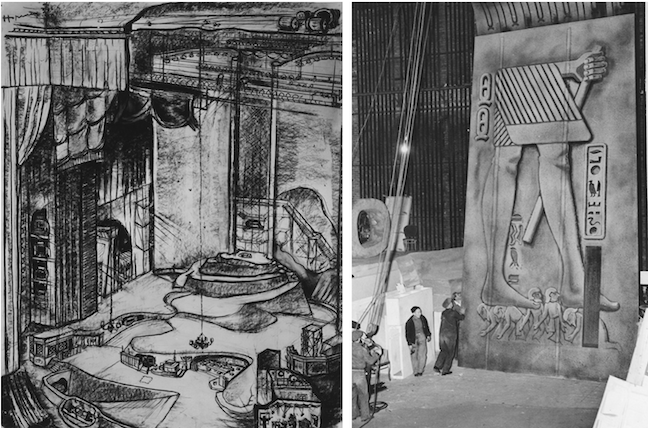
MIXED REVIEWS…The original Catfish Row set for Porgy and Bess as seen at Broadway’s Alvin Theatre (now the Neil Simon Theatre) in 1935. (Billy Rose Theatre Collection, New York Public Library Digital Gallery)

This wasn’t the first time Porgy was adapted to the stage. It was originally produced in 1927 by Heyward and his wife, Dorothy, at the Guild Theatre in New York. The Heywards insisted on an African-American cast—an unusual decision at the time—and enlisted newcomer Rouben Mamoulian to direct. The play ran a total of fifty-five weeks.

ORIGIN STORY: Porgy: A Play in Four Acts, was a 1927 play by Dorothy Heyward and DuBose Heyward, adapted from the short novel by DuBose. (Wikiwand)

Gibbs preferred the original Porgy to the Gershwin–Heyward production, admitting that he simply did not care for “the operatic form of singing a story.”

continued…

TAKING THEIR BOWS…George Gershwin greets an audience after a performance of Porgy and Bess. Behind Gershwin are his brother, Ira Gershwin (left), and librettist and Porgy author DuBose Heyward (partially hidden, at right). (umich.edu)

The Moss Hart/Cole Porter musical comedy Jubilee! premiered at Broadway’s Imperial Theatre on Oct. 12, 1935, just two days after the Porgy and Bess premiere. Gibbs dubbed this show “heat-warming and beautiful.”

THE BEGUINE BEGINS…Inspired by the Silver Jubilee of Britain’s George V, the musical comedy Jubilee! told the story of a fictional royal family. The play featured such hit songs as “Begin the Beguine” and “Just One of Those Things,” which have become part of the American Songbook. (ovrtur.com)
ROYAL HIJINKS…At left, June Knight as Karen O’Kane and Charles Walters as Prince James in Jubilee!; at right, Mary Roland (the Queen) encounters “Mowgli” (Mark Plant) in Act I. (ovrtur.com)

Note: In the last issue (Oct. 12) we saw an ad for an around-the-world luxury cruise on the Franconia. Cole Porter and Moss Hart—with their families, friends, and assistants—sailed on a previous Franconia cruise, possibly in 1934, with the intention to write a new musical while on the trip. Apparently some of the songs and scenes in Jubilee! were inspired by their ports of call.

 * * *

Steering Clear

“The Talk of the Town” commented on the “steer-wrestlers” that were featured at the Madison Square Garden rodeo. Since steer-wrestling was also called “bulldogging,” it caused considerable consternation among New York animal lovers.

A BIG HOWDY…Cowgirls From the Madison Square Garden Rodeo With Millicent Hearst, 1932. (texashistory.unt.edu)

 * * *

Much Ado About FDR

The Conference on Port Development of the City of New York took issue with President Franklin D. Roosevelt’s foreign trade policies, particularly his strict stance on neutrality, which the Conference believed was detrimental to foreign trade. This was likely related to the October 1935 Italian invasion of Ethiopia. E.B. White offered this satirical poem in reaction to the trade spat.

Howard Brubaker also chimed in on the trade issue, and on other unsettling developments in Europe:

 * * *

Puppy Love

Critic and poet Cuthbert Wright (1892–1948) was moved to write poetry after visiting a dog cemetery that also welcomed animals of all stripes. Here are excerpts of the opening and closing lines:

PET PROJECT…Cuthbert Wright was moved to verse after his visit to a pet cemetery, possibly the Hartsdale Pet Cemetery in Westchester. (Wikipedia/parenthetically.blogspot.com)

 * * *

Man and Machine

Art and culture critic Lewis Mumford is back this week, this time taking a look at the work of French artist Fernand Léger (1881–1955), who created a form of cubism known as “tubism,” regarded today as a forerunner of the pop art movement of the mid-1950s and the 1960s.

It is no surprise that the humanist Mumford, who sought an “organic balance” in everyday design, found Léger’s machine-like works alienating and sterile, representing an “aesthetic poverty.”

TOTALLY TUBULAR…Clockwise, from top left, works of Fernand Léger cited by Lewis Mumford: The City, 1919; photo of Léger, circa 1930s; from the 1918–1923 series Mechanical Elements, 1920; Composition in Blue, 1920–27. (Philadelphia Museum of Art/The Met Collection/Art Institute of Chicago, Charles H. and Mary F. S. Worcester Collection)

 * * *

Disappointment in O’Hara

That is how Clifton Fadiman titled his “Books” column after reviewing John O’Hara’s latest novel, Butterfield 8.

O’Hara (1905–1970) wasn’t just any old scribbler. A prolific short-story writer, he has often been credited with helping to invent The New Yorker’s short story style. Praised by the likes of F. Scott Fitzgerald and Ernest Hemingway, O’Hara cranked out two bestsellers before the age of thirty. One was the acclaimed Appointment in Samarra (which was praised by Fadiman). The other was BUtterfield 8, the novel Fadiman found disappointing (Hemingway, on the other hand, blurbed, “John O’Hara writes better all the time.”). Here are a couple of brief excerpts from Fadiman’s review:

Fadiman concluded his review with a note to the author: “Why not let Jean Harlow have it, Mr. O’Hara, and start a fresh page?”

Well, Harlow didn’t get it, but twenty-five years later Elizabeth Taylor would reluctantly take on the role of Gloria Wandrous, and win the Academy Award for Best Actress.

YOU AGAIN?…Laurence Harvey and Elizabeth Taylor played on and off lovers in 1960’s Butterfield 8. John O’Hara did not participate in writing the adaptation, and the film’s plot bore only a slight resemblance to his novel. However, after the film’s release more than one million paperback copies of the novel were sold. (aiptcomics.com)

 * * *

At The Movies

We begin this section with an excerpt from “The Talk of the Town,” which covered the “International World Première” of the Warner Brother’s adaptation of A Midsummer Night’s Dream. The film opened worldwide on October 9, 1935 in London, Sydney, Vienna and at New York’s Hollywood Theatre, where crowds turned out to get a glimpse of the stars.

RUBBERNECKERS…A Midsummer Night’s Dream premiere at the Hollywood Theatre in New York City on October 9, 1935. (britannica.com)

Film critic John Mosher praised Joe E. Brown’s performance as Flute, as well James Cagney’s portrayal of Bottom, and lauded the “magnificent group of clowns” that formed the remainder of The Players. Here are excerpts from his review (note I included the entirety of Otto Slogow’s delightful spot drawing):

THE LOVERS…Left to right: Ross Alexander (Demetrius), Olivia de Havilland (Hermia), Dick Powell (Lysander) and Jean Muir (Helena) meet cute and confused in A Midsummer Night’s Dream. (TCM.COM)
THE SEVEN STOOGES…Bottom (James Cagney) and his fellow Players prepare to perform a stage play about the death of Pyramus and Thisbe which turns into a farce. From left, in front, Joe E. Brown (Flute), Cagney, and Otis Harlan (Starveling); in the back are, from left, Hugh Herbert (Snout), Arthur Treacher (Epilogue) and Dewey Robinson (Snug) as The Players in A Midsummer Night’s Dream. Frank McHugh (Quince) can be seen behind the wall in back. (IMDB)
DANCING THE NIGHT AWAY…Fairie scene from A Midsummer Night’s Dream. (Facebook)

Mosher also reviewed the romantic comedy I Live My Life, which he found to be a satisfying satire on the lives of the rich.

MATCHING WITS…Bored socialite Kay Bentley (Joan Crawford) has a tempestuous romance with idealistic archaeologist Terry O’Neill (Brian Aherne) in I Live My Life. (IMDB)

 * * *

From Our Advertisers

Readers ninety years ago opened the Oct. 19 issue to this two-page spread featuring the latest in fall/winter fashions…the ad on the right from Bergdorf Goodman featured stage and screen actress Gladys George donning a full-length silver fox fur…

…George (1904–1954) was appearing at Henry Miller’s Theatre in the play Personal Appearance…she was featured in this testimonial ad for Schrafft’s in the theatre’s Playbill…

(playbill.com)

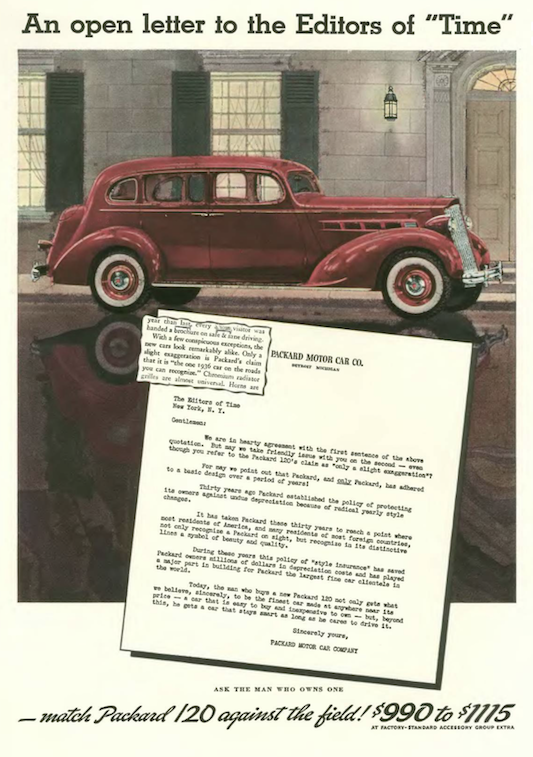
…the folks at Packard took out this colorful two-page spread to promote their more affordable model, the 120…the move to more affordable models helped the luxury carmaker weather the lean years of the Depression…

…there is a strange quality to these Arrow Shirt advertisements…what are the they looking at?…apparently something amusing as the man applies mustard to a hotdog, but it isn’t the vendor, who looks down at his cart…

…R.J. Reynolds continued its Camel campaign featuring accomplished athletes who got a “lift” from smoking…the ad also included a couple of regular folks at the bottom, who claimed the cigarettes were so mild “You can smoke all you want”…

…Old Gold continued to enlist the talents of George Petty to illustrate their full-page ads…

…here’s a couple of back of the book ads touting Irish whisky and Ken-L-Ration dog food…note how the Scottish terriers speak in “dialect”…Ken-L-Ration was a leading dog food brand in the 1930s, thanks to their use of horse meat rather than “waste meat”…

…on to our cartoonists, we start with Al Frueh enhancing the “Theatre” page…

James Thurber showed us a man at odds with the times…

Barbara Shermund kept us up to date on the modern woman…

Whitney Darrow Jr offered a challenge to Helena Rubinstein (note the woman on the right—she could have been drawn by Helen Hokinson)…

Gluyas Williams checked in on the lively proceedings of a book club…

Helen Hokinson went looking for a good winter read…

Gilbert Bundy offered an alarming scenario on the top of p. 31…

…and we close with Peter Arno, and an eye-raising encounter…

New Time: It Can’t Happen Here…

All Dogs Go To Heaven

Above: James Thurber with his beloved Christabel, circa 1950s, and Mary Pickford enjoying some puppy love, circa 1920. (The Thurber Estate/Pinterest)

James Thurber and silent film star Mary Pickford had one thing in common; they loved their dogs.

September 21, 1935 cover by Ilonka Karasz. Antiques magazine (March 8, 2018) described Karasz’s covers as “leafy modernism,” evolving from “dynamic modern depictions of urban life to enchanting, peaceful images of leisure activities…recording details like family picnics or the insects and flowers in her garden.” Many depict scenes around Brewster, New York, where she lived with husband, Willem Nyland, a Dutch-American chemist and pianist. Karasz contributed 186 covers across six decades, beginning with her first on April 4, 1925.

From that point of agreement, however, these contemporaries (Pickford was born in 1892; Thurber in 1894) diverged. Consider Thurber’s response (excerpted) to Pickford’s spiritual musings in a Liberty magazine article titled “Why Die?”

…Thurber contributed this spot drawing for his rebuttal…

ONE OF A KIND…James Thurber immortalized his Airdale, Muggs, in a 1933 story, “The Dog that Bit People.” Muggs, who died in 1928, has his own monument in Green Lawn Cemetery, Columbus, Ohio, installed in 2021. The inscription, taken from Thurber’s short story, reads, “Nobody knew exactly what was the matter with him.” (https://www.dispatch.com/Facebook)
AMERICA’S SWEETHEART was well-known as animal lover. At left, Mary Pickford in 1916; at right, with husband Douglas Fairbanks at their mansion, Pickfair, in the 1920s. (Wikipedia/Pinterest)
SECOND LIFE…Mary Pickford gave up acting in 1933 to pursue her writing career. In 1934 she penned the tract, Why Not Try God?, followed in 1935 by another spiritual bestseller, My Rendezvous with Life. That same year she also published a novel, The Demi-Widow. From left, cover of Liberty magazine with her essay, “Why Die?,” Aug. 18, 1935; Pickford posing with copies of The Demi-Widow, ca. 1935. Kirkus Reviews (Aug. 1, 1935) dubbed The Demi-Widow “Good hammock reading for hot days — light and not too dreadful froth…” (picclick.com.au/digitalcollections.oscars.org/Goodreads)

 * * *

Rumble Humbled

In his “Notes and Comment” E.B. White observed the absurdity of a grown man riding alone in a rumble seat. These seats were phased out by 1939 in American autos (the British, who called them “dickies,” abandoned them a decade later). Rumble seats were unsafe, to be sure, but it was also unpleasant to sit near the exhaust pipe and collect the dust, grit and bugs that would merrily dance around one’s eyes, nose and mouth.

BONE RATTLER…Detail from a photo of man riding in a rumble seat, 1935. (General Photographic Agency/Hulton Archive/Getty Images)

A Red By Any Other Name

White also considered the intentions behind a new book by Robert Forsythe, Redder Than a Rose. Kyle Crichton (1896-1960) used the Forsythe nom de plume whenever he wrote for communist publications such as the Daily Worker. A former coal miner and steel worker, Crichton was also a writer and editor for Collier’s magazine.

 * * *

Fight Night

In anticipation of the boxing match between Joe Louis and Max Baer, The New Yorker featured a Peggy Bacon portrait of Louis at the bottom of its events section, which also contained a listing under “Sports” of the upcoming fight at Yankee Stadium. The caption below the Louis portrait was a quote attributed to Bacon: An out-size in juveniles, simple, unruffled, a shade sullen, practically expressionless, hoarding his energies with the inarticulate dignity and pride of some monster vegetable.–P.B.

a better view of Peggy Bacon’s portrait of Joe Louis

(Smithsonian National Portrait Gallery)

 * * *

At the Movies

Well, the fun couldn’t last forever, as critic John Mosher discovered with the latest batch of films to roll out of Tinseltown. Here he tried to make sense of The Big Broadcast of 1936, and gave a closing nod to Dorothy Parker.

A LITTLE OF THIS, A LITTLE OF THAT…Theatre card promoting the appearances of Gracie Allen and George Burns in The Big Broadcast of 1936. These films were essentially long promo pieces for Paramount’s stable of stars. (IMDB)

Mosher also took in The Goose and the Gander, featuring Kay Francis, one of Warner Brothers’ biggest stars and one of Hollywood’s highest-paid actors. Known for her roles as a long-suffering heroine and her lavish wardrobes, Mosher found Francis ill-suited to a comedic role.

NEEDED A BIT MORE GOOSE…Kay Francis and George Brent in The Goose and the Gander. (IMDB)

 * * *

From Our Advertisers

The 1920s and 30s saw a proliferation of all sorts of electric gadgets, one of them being the toaster, here serving as a centerpiece for a cocktail party…

…before 1935 beer cans were not feasible because they couldn’t withstand the internal pressure of a carbonated liquid…it was the American Can Company (not Continental) that solved the problem by developing an internally-lined can that could contain the pressure…the lining also prevented the beer from tasting metallic…

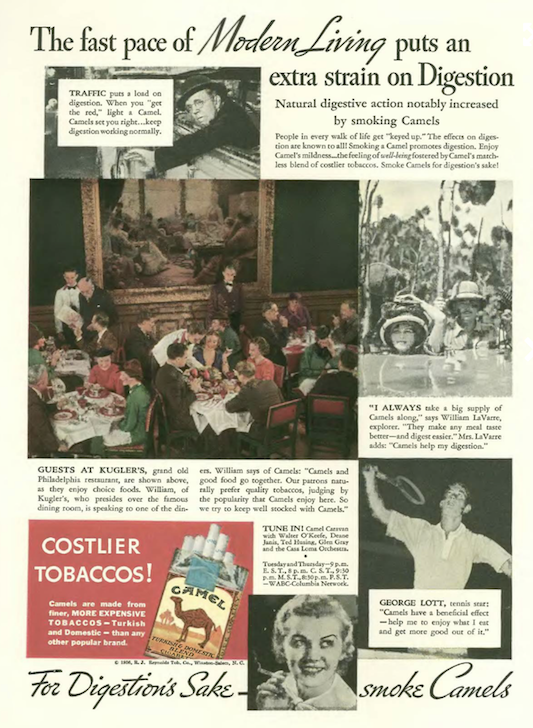
…R.J. Reynolds continued to build its tobacco empire by lining up scads of famous athletes to endorse the health benefits of their Camel cigarettes…

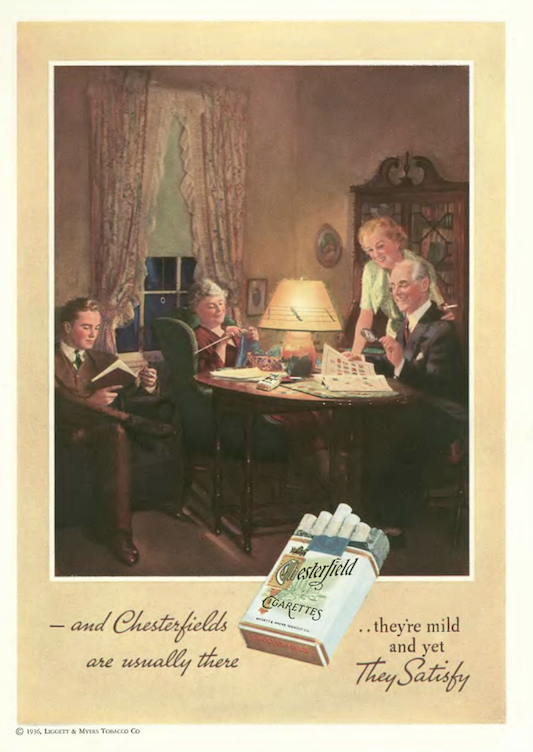
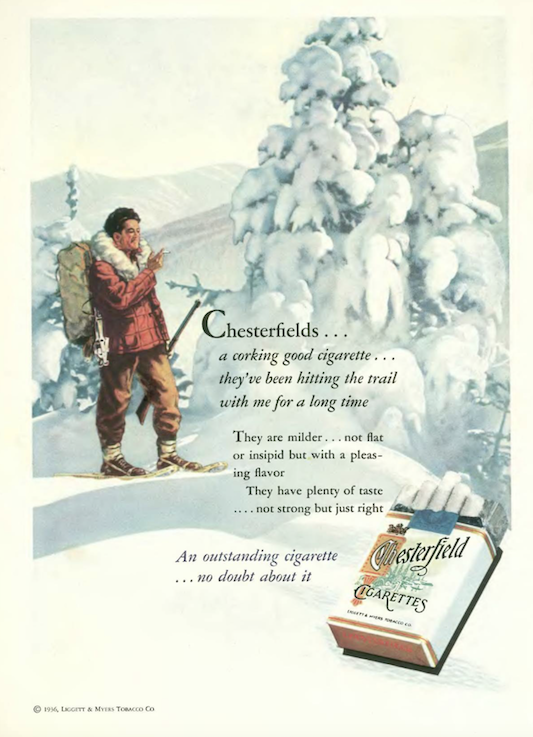
… Liggett & Myers, who in 1926 launched their “Blow some my way” advertising campaign to target women smokers, continued to employ images of young lovers in romantic settings to push their Chesterfields…

…for reference, a Chesterfield ad from 1931…

…on to our cartoons, we start with this spot from Perry Barlow

Alain looked in on a tender moment between father and son…

Charles Addams found a glitch on the assembly line…

Peter Arno drew up two old toffs looking for some adventure…

Robert Day offered up the latest twist in the culinary arts…

…and we close with Helen Hokinson, who was just passing the time…

Next Time: Notes and Comment…


Looking For Mister Wrong

Widely acknowledged as a classic, The 39 Steps further solidified British director Alfred Hitchcock’s image as a master of suspense with American film audiences.

September 14, 1935 cover by Helen Hokinson. Over a twenty-year span, she contributed 68 covers and more than 1,800 cartoons to The New Yorker.

A successful follow up to 1934’s The Man Who Knew Too Much, Hitchcock’s The 39 Steps was conceived and cast by the Gaumont-British Picture Corporation as a vehicle to establish British films in America. The film also featured one of Hitchcock’s favorite plot devices—an innocent man forced to go on the run—seen in such notable films as 1942’s Saboteur and 1959’s North by Northwest. New Yorker film critic John Mosher was among the film’s many admirers:

WE’LL TAKE THE STAIRS…Clockwise, from top left, poster for The 39 Steps; Alfred Hitchcock (second from right) directing the handcuffed Madeleine Carroll (as Pamela) and Robert Donat (as Richard Hannay) on the first day of filming; Hannay evades police on the heath; Pamela and Richard make the best of their predicament as handcuffed escapees. (Wikipedia/jimcarrollsblog.com/criterion.com)

 * * *

Pop-Up Stores

“The Talk of the Town” had a look at the “madhouse” on Nassau Street that daily erupted from noon to 2 p.m. as peddlers took over the street to hawk their wares.

IF WE DON’T HAVE IT, YOU DON’T NEED IT…Hester Street peddlers in 1936. Photo by Berenice Abbott. (boweryboyshistory.com)

* * *

Art of the Artless

James Thurber dissected the workings of a “bad play,” examining varied techniques and familiar tropes. Excerpts:

…below is the complete illustration for Fig. 4, which got cut off in the excerpt above…Thurber depicted “the elderly lady who is a good sport, a hard drinker, and an authority on sex.”

 * * *

The Petulant Painter

Known for a primitive style that included bizarre scenes of frolicking (or floating) voluptuous nudes, the painter Louis Michel Eilshemius (1864–1941) had a style all his own, and had no trouble telling anyone that his work was better than anything hanging in the finest museums (which would not consider him at all until after his death). In 1931 he began calling himself “Mahatma,” hence the title of this profile by Milton MacKaye (illustration by Hugo Gellert). Some brief excerpts:

IRASCIBLE RASCAL…Clockwise, from top left, Louis Michel Eilshemius in 1913; Standing and Reclining Nymphs (1908), Self-portrait (1915); Nymphs Sleeping (1920). Known for his numerous and vitriolic letters to newspaper editors, his letterheads would proclaim such accomplishments as “Educator, Ex-actor, Amateur All-around Doctor, Mesmerist-Prophet and Mystic, Reader of Hands and Faces, Linguist of 5 languages, Spirit-Painter Supreme.” He also claimed to be a world-class athlete and marksman as well as a musician who rivaled Chopin. (Wikipedia/Smithsonian American Art Museum/National Portrait Gallery)

Eilshemius regularly visited art galleries, loudly condemning the works on display. No wonder museums would not consider his odd paintings, which were probably best received by the French, including the artists Henri Matisse and Marcel Duchamp; the latter invited Eilshemius to exhibit with him in Paris in 1917.

Eilshemius’ mental stability had deteriorated substantially by the time MacKaye wrote the profile, which concluded with this sad, final accounting of the man’s life.

Eilshemius would die in the psychopathic ward of Bellevue Hospital in 1941. In the years since, his work has gained a wide audience and can be found in such collections as the Smithsonian, The Phillips Collection, MoMA and the Metropolitan Museum of Art.

SINGULAR VISION…Louis Michel Eilshemius, Afternoon Wind, 1899. (MoMA)

 * * *

In Good Company

In her “Letter From Paris,” Janet Flanner noted that even the French honored the memory of Will Rogers, who had died in a plane crash with aviator Wiley Post on Aug. 15, 1935.

NOTED AND NOTABLE…As an example of Will Rogers’ worldwide fame, Janet Flanner noted that the Paris entertainment newspaper Comœdia published Rogers’ obituary next to that of famed neoimpressionist painter Paul Signac. The other obituary remembered the renowned Swiss soprano Lucienne Bréval. (gallica.bnf.fr via onlinebooks.library.upenn.edu)

 * * *

At the Movies

Coming down from The 39 Steps, John Mosher also sampled some of latest comedies gracing the silver screen…

…Mosher didn’t understand why Marion Davies, nearing the end of her film career, even bothered to appear in the romantic comedy Page Miss Glory (although she was also the producer), in which she portrayed a country girl who stumbles into fame while working as a chambermaid in a luxury hotel…

JUST LIKE CINDERELLA…Marion Davies and Pat O’Brien in Page Miss Glory. (IMDB)

Two For Tonight featured a lot of fine crooning from Bing Crosby, and some hijinks, but fizzled out in the end…

Bing Crosby (right) takes aim in Two For Tonight. (IMDB)

…of the three comedies, Mosher found The Gay Deception to be the most winning. Directed by William Wyler, the film featured a sweepstakes winner pretending to be a rich lady (Frances Dee) who encounters a prince masquerading as a bellboy (Francis Lederer)…hilarity ensued…

THE WYLER TOUCHWilliam Wyler’s The Gay Deception, starring Francis Lederer (left) and Frances Dee, anticipated Wyler’s 1953 Roman Holiday, also a tale about a royal wanting to be a normal person. (letterboxd.com)

 * * *

From Our Advertisers

We welcome fall with the latest fashion from Forstmann Woolens…

…and here is where those wool dresses were spun…

Image from the National Archives depicts the spinning room at Forstmann & Huffman in Passaic, N.J., 1918. The Passaic plant closed in 1958. (Historical Society of Garfield, NJ)

…the makers of leaded gasoline continued to promote their product in full-color spots…

…General Tire (like competitor Goodyear) played up the safety theme and potential perils to loved ones to tout their “blow-out proof” tires…

…like many advertisers in The New Yorker, United Air Lines appealed to the affluent, hoping some of them would take to the air, since only they could afford it…

…for reference…

COZY…Interior of the Boeing 247. (Wikimedia Commons)

Abe Birnbaum, who contributed nearly 200 covers to the New Yorker, offered this rendition of Mickey Mouse to Stage magazine…

…heading to the back of the book we find the latest in entertainment at the Plaza…

James Thurber contributed the drawing at left (rendered in negative) on behalf of Libby’s tomato juice on page 75, and page 80 featured the spare, modern lines of a Cinzano ad…

…our cartoonists include Richard Decker, on the set with a missing extra…

Charles Addams offered a new twist on the Sunday sermon…

Peter Arno found an epic struggle in the shoe department…

Robert Day offered this energy-saving tip…

…and we close with Helen Hokinson, and a lively game of charades…

Next Time: All Dogs Go to Heaven…

A Summer Night

Morris Markey embodied the ideal of “A Reporter at Large,” and for his Sept. 7 column he decided to stroll the steamy streets of Manhattan on a late summer night, finding the sidewalks alive with folks seeking a break from their stifling dwellings.

September 7, 1935 cover by Constantin Alajalov.

Markey (1899-1950) began “Summer Night” by describing a bus ride from Midtown to Washington Square with (I assume) his wife, Helen Turman Markey. They enjoyed the breeze atop the bus as they passed Central Park and heard the faint strains of music in the air.

FINAL NOTES…Morris Markey thought he heard music coming from the Central Park Casino (left) on that hot summer night; it would prove to be one of the Casino’s last summer nights since Robert Moses would have it demolished the following May; at right, Adolf Dehn lithograph Central Park at Night, 1934. (NYC Parks/Art Institute of Chicago)
AMID THE BUSTLE the Markeys hopped off the bus at Washington Square and set out on foot. At left, Washington Square by night, 1945; at right, cacophony on Fifth Avenue, circa 1940. (Facebook)

The scenes described by Markey offer a glimpse of what has changed and what still remains of Manhattan night life after ninety years.

GO BLOW YOUR HORN…Something taxis did then and do now; Markey described folks looking at hats in a shop window, probably similar to this 1930s store at right. (theguardian.com/Pinterest)

They concluded their stroll on the Lower East Side, where Markey noted a tenement clearance project on Allen Street. Considered one of the most densely populated places in the world, the street was widened by demolishing all of the buildings on its east side from Division to Houston Street.

HERE COMES THE SUN…The densely populated Allen Street was called “a place where the sun never shines.” The narrow street was mostly under the shadow of the elevated train tracks until it was widened in 1930s by demolishing all of buildings on its east side. Photo at left shows the public bath at 133 Allen Street (now used as a church). The demolition project, and the removal of the overhead “El” tracks in 1942, created a broad thoroughfare with a meridian mall in the center, as seen in the bottom photo of the intersection of Allen and Delancey circa 1950. (mcny.org/leshp.org/Facebook)

 * * *

At the Movies

Film critic John Mosher finally found a film he could gush about in Anna Karenina, and most notably its star Greta Garbo, who in Mosher’s words “sets the pace and the tone for the whole thing.” Mosher was not alone in his praise: Writing for The Spectator in 1935, Graham Greene wrote that Garbo’s acting in the film overwhelmed the acting of all the supporting cast save that of Basil Rathbone. This observation was later echoed by Roland Barthes, who wrote in 1957 that Garbo belonged “to that moment in cinema when the apprehension of the human countenance plunged crowds into the greatest perturbation, where people literally lost themselves in the human image.” Here is Mosher’s review:

GARBO AND THE OTHERS…Greta Garbo dominated the screen in 1935’s Anna Karenina. Clockwise, from top left, MGM poster for the film; Garbo with Fredric March as Anna’s lover, Count Vronksy; Garbo with Basil Rathbone, who portrayed Anna’s husband Karenin, and child actor Freddie Bartholomew as their son, Sergei; Maureen O’Sullivan took a break from the Tarzan films to portray Anna’s friend Kitty (here with Gyles Isham as Levin). (filmforum.org/Wikipedia/IMDB)

As Mosher noted, Garbo also portrayed Anna Karenina in the 1927 silent film Love, in which she co-starred with John Gilbert as Count Vronsky.

BEEN HERE BEFORE…Greta Garbo as Anna Karenina and John Gilbert as Count Vronsky in the 1927 silent film Love, the second of four films they made together. They were also lovers off-screen in the 1920s, but with the advent of sound pictures her star rose as his began to fall; in their last film together, Queen Christina (1933), Garbo insisted that Gilbert be cast opposite her in a final attempt to revive his declining career. He essentially drank himself to an early grave, dying of a heart attack in January 1936. (rottentomatoes.com)

Mosher also enjoyed the dance moves of Fred Astaire and Ginger Rogers in Top Hat (although it could have used less “patter and piffle”), and brought out his hankie for The Dark Angel, where he once again encountered the acting of Fredric March.

DEFYING GRAVITY…Ginger Rogers and Fred Astaire made their complex dance moves look effortless as they glided through Top Hat, the fourth of ten films they made together. (americancinematheque.com)
TEARS FOR FEARS…Fredric March and Merle Oberon portrayed old friends and lovers facing a rival lover and the horrors of World War I in the 1935 weeper The Dark Angel. (rottentomatoes.com)

 * * *

From Our Advertisers

We begin with a splash of color from the makers of Imperial washable wallpapers…not sure why a wire fox terrier is featured in the advertisement…they were a popular breed, and maybe Fido was the reason one needed washable walls…

…White Rock rolled out their tiny Colonel to promote mineral water as an ideal mixer…

…ever heard of Victor Moore?…well, he was quite the comedian back in the day, playing timid, mild-mannered characters on stage and screen…Moore (1876-1962) was also famous for his 1942 marriage to dancer Shirley Paige when Moore was 65 and Paige was 20…

…Camel rolled out another high society endorser, Maude Adele Brookfield van Rensselaer (1904-1945)…her color image is a watercolor by Leslie Saalburg

…on to our cartoonists, we begin with spot art by Abe Birnbaum

and Maurice Freed

…also in the opening pages this wordless contribution by James Thurber

Gluyas Williams found this midday repast anything but relaxing…

Otto Soglow found a new “man’s best friend”…

Denys Wortman encountered some frank advice at the cosmetics counter…

Helen Hokinson found appreciation for the “strong and silent” acting style…

Peter Arno gave us a department store clerk in need of some time off…

…and we close with Richard Decker, finding some truth in advertising…

Next Time: Looking For Mister Wrong…