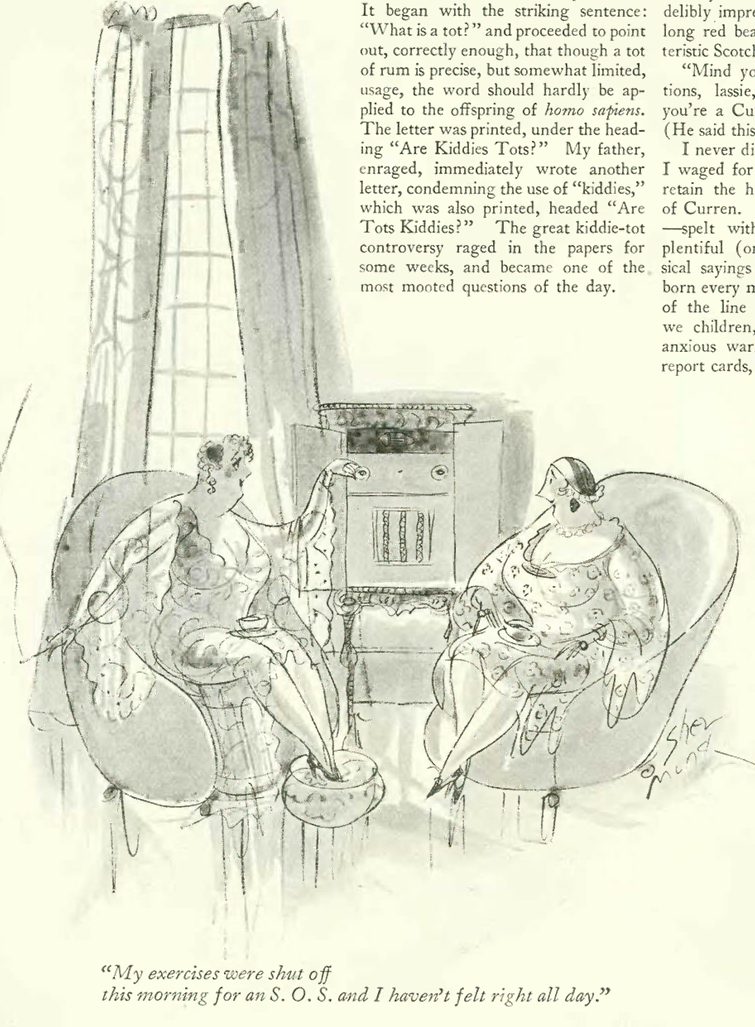
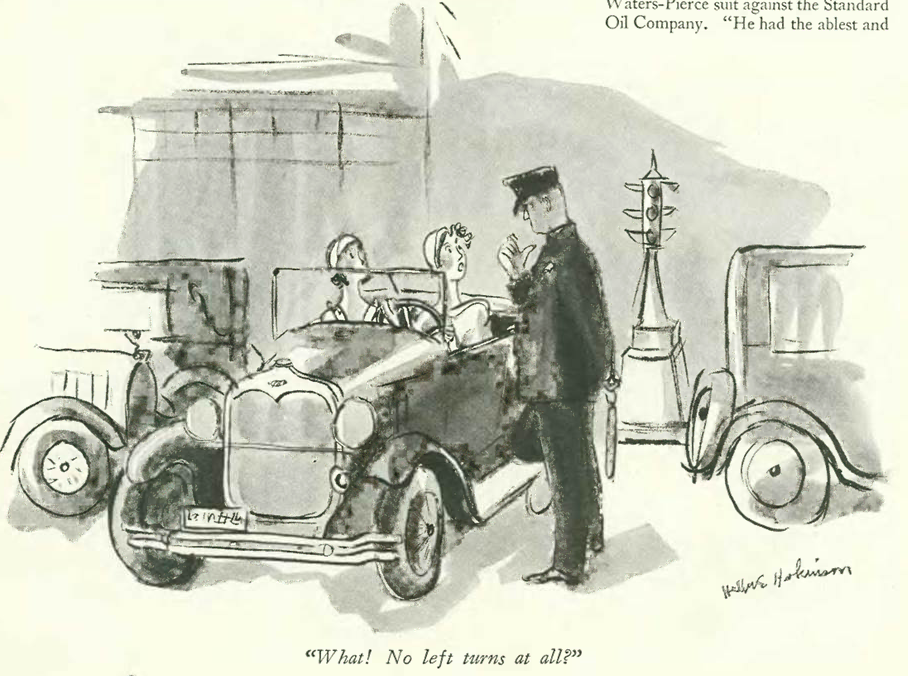
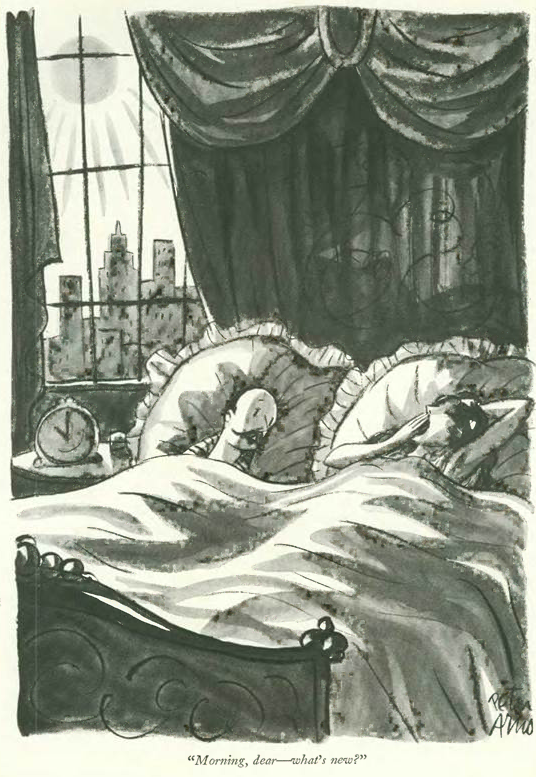
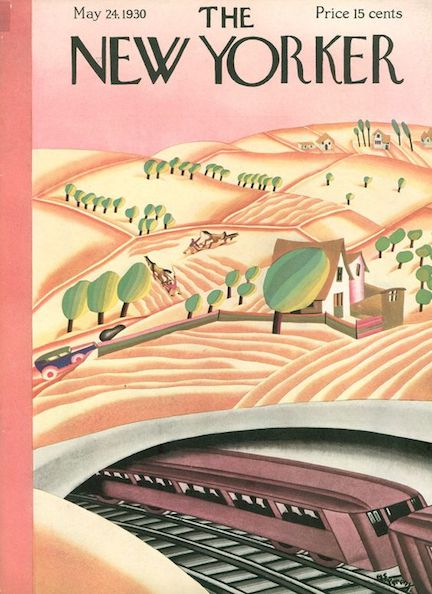
Tens of thousands of commuters daily cross the George Washington Bridge, but in the din of modern commuting few give nary a thought to a span that was once considered a modern marvel.
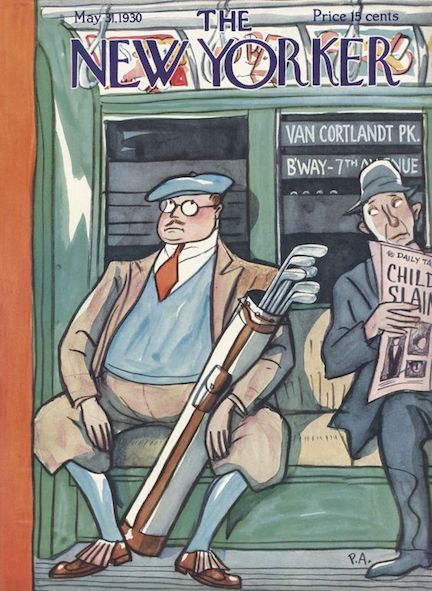
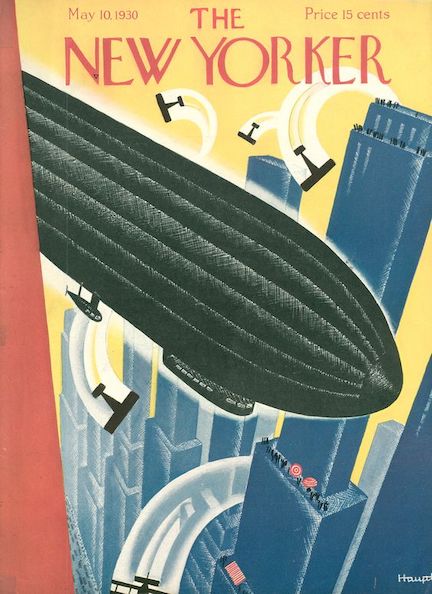
May 3, 1930 cover by Rose Silver.
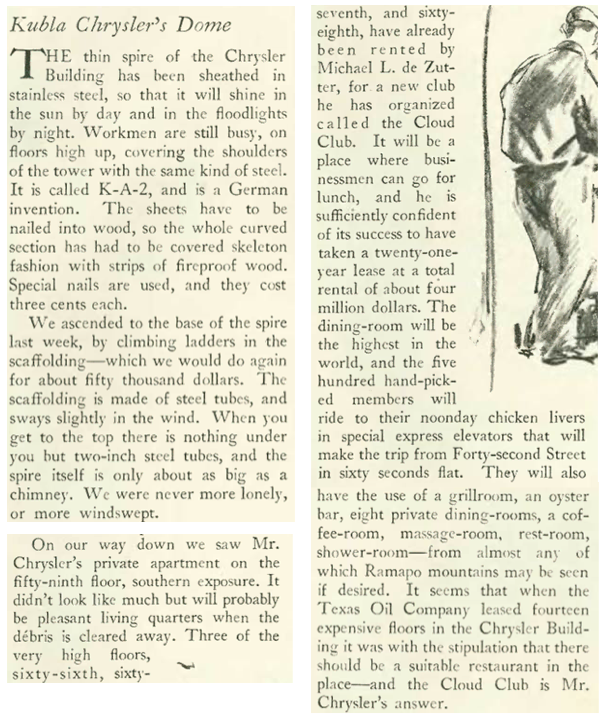
Twice as long as any previous suspension bridge when it opened in 1931, the George Washington Bridge’s main span of 3,500 feet (1,100 m) would be the world’s longest until it was surpassed by San Francisco’s Golden Gate Bridge in 1937. The New Yorker’s “Talk of the Town” (entry most likely by E.B. White) checked on the bridge’s progress for the May 3 issue:
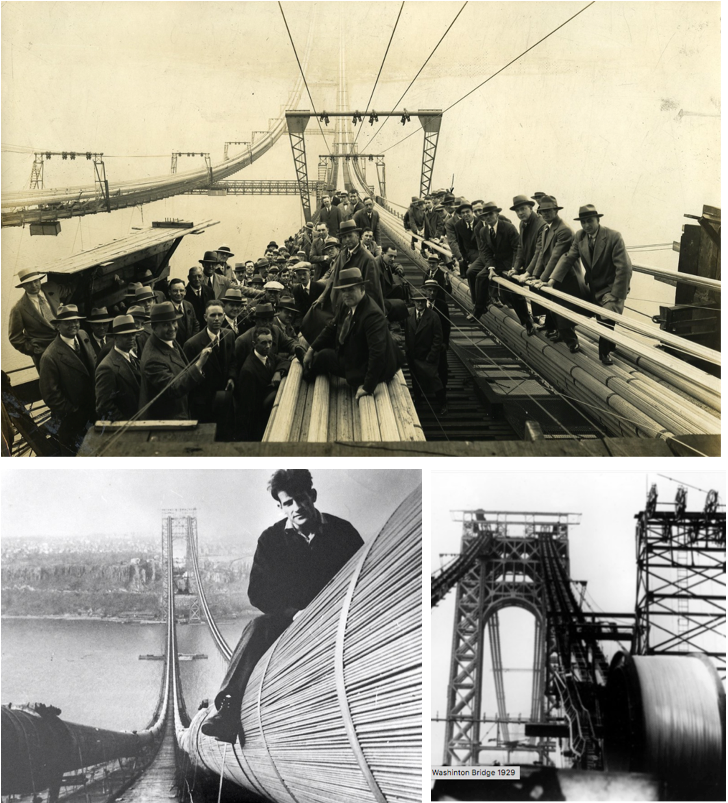
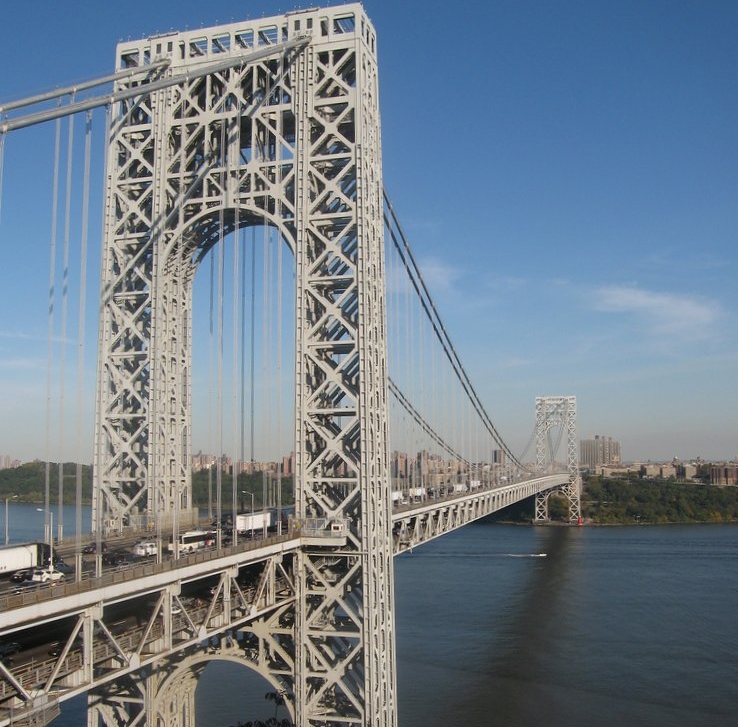
MEN OF STEEL…Some 107,000 miles of wire were used in cables made by John A. Roebling’s Sons Company for the George Washington Bridge — the same firm also supplied wire for the Brooklyn Bridge 60 years earlier (John Roebling and his son, Washington, also designed and built the Brooklyn Bridge). Clockwise, from top, employees of John A. Roebling’s Sons pose atop cable bundles; bottom right, the bridge’s four main cables were each composed of a single strand carried back and forth across the river 61 times. Each strand itself is a bundle of 434 individual wires; bottom left, worker poses atop completed cable. (Flickr/Pinterest)BY ANY OTHER NAME…Known as the Hudson River Bridge during its construction, the George Washington Bridge opened to traffic in 1931. During the first full year of operation in 1932 more than 5.5 million vehicles used the original six-lane roadway — today it is the world’s busiest motor vehicle bridge, carrying more than 100 million vehicles per year. Although the steel towers are iconic today, the original plan called for them to be clad in stone. (Wikipedia)
* * *
A Cabin in the Sky
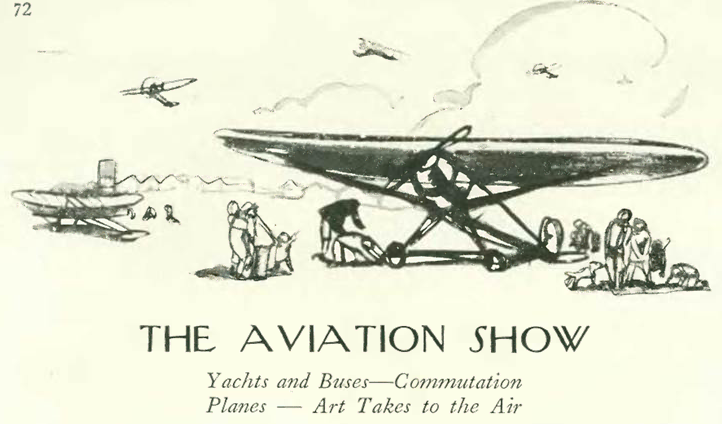
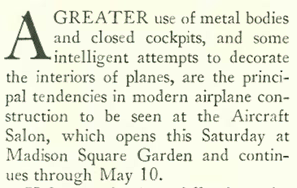
Other signs of modern life were being seen in Midtown, where an “Aircraft Salon” hosted by the Aeronautical Chamber of Commerce was taking place at Madison Square Garden.
Nicholas Trott was on hand to take in the exhibits, noting that advances in aviation included the use of metal bodies (instead of fortified cloth) and greater attention to interior decoration:
SIGNED, SEALED, DELIVERED…An attendee of the New York Aircraft Salon received a special postal stamp, and an autograph from aviator Cy Caldwell, at the Madison Square Garden show. (Joe Krantz)
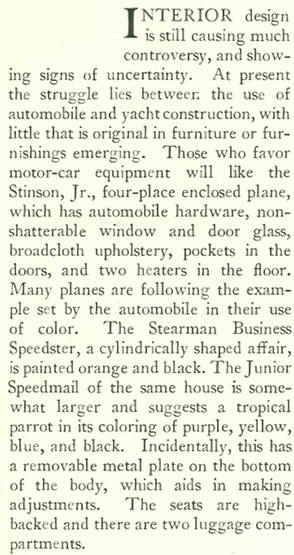
Trott noted that designs of passenger compartments, still in their infancy, suggested something between automobile and nautical motifs:
SORRY, NO HEADPHONES…Clockwise, from top left, a Curtiss Condor 18 and its interior appointments; a Fokker Trimotor featured dining in its cabin. As peaceful as the scene appears, the noise from the motors must have been unbearable. (Wikipedia/dutch-aviation.nl)
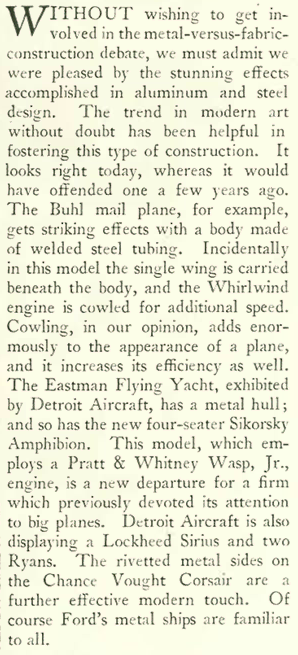
Trott also commented on the debate surrounding metal vs. fabric in the construction of airplanes. Before 1930 most planes were constructed of wood covered with fabric (which were much lighter than metal craft). Although as early as 1920 the National Advisory Committee for Aeronautics declared metal to be superior to wood, only five percent of aircraft in 1930 were of all-metal construction.
DON’T CALL ME WOODY…This eight-passenger Consolidated Fleetster was a rare example of metal construction in early 1930. The wings, however, were still fashioned from wood. (Aeronautical Chamber of Commerce 1931 Aircraft Yearbook)
* * *
Road to Nowhere
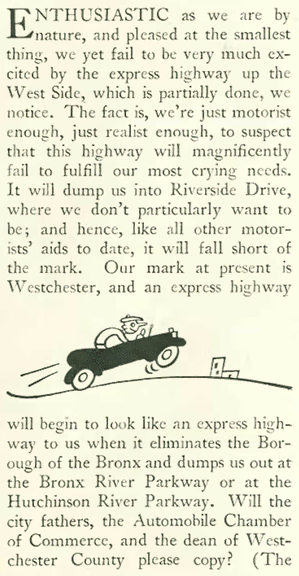
The New Yorker’s enthusiasm for modern marvels did not extend to the West Side Highway, a project that would extend from the late 1920s to the early 1950s. Here is E.B. White’s take on the opening of the highway’s first section:
White’s observations were somewhat prescient — constructed in tight confines, the road’s on-ramps proved too narrow and the turns too tight for use by large trucks. The roadway also lacked proper maintenance, and just two decades after it was completed a section of the highway collapsed under the weight of an asphalt-laden truck. The roadway was demolished between 1977 and 1989. Read more here about the West Side Highway’s surprising history at the Museum of the City of New York.
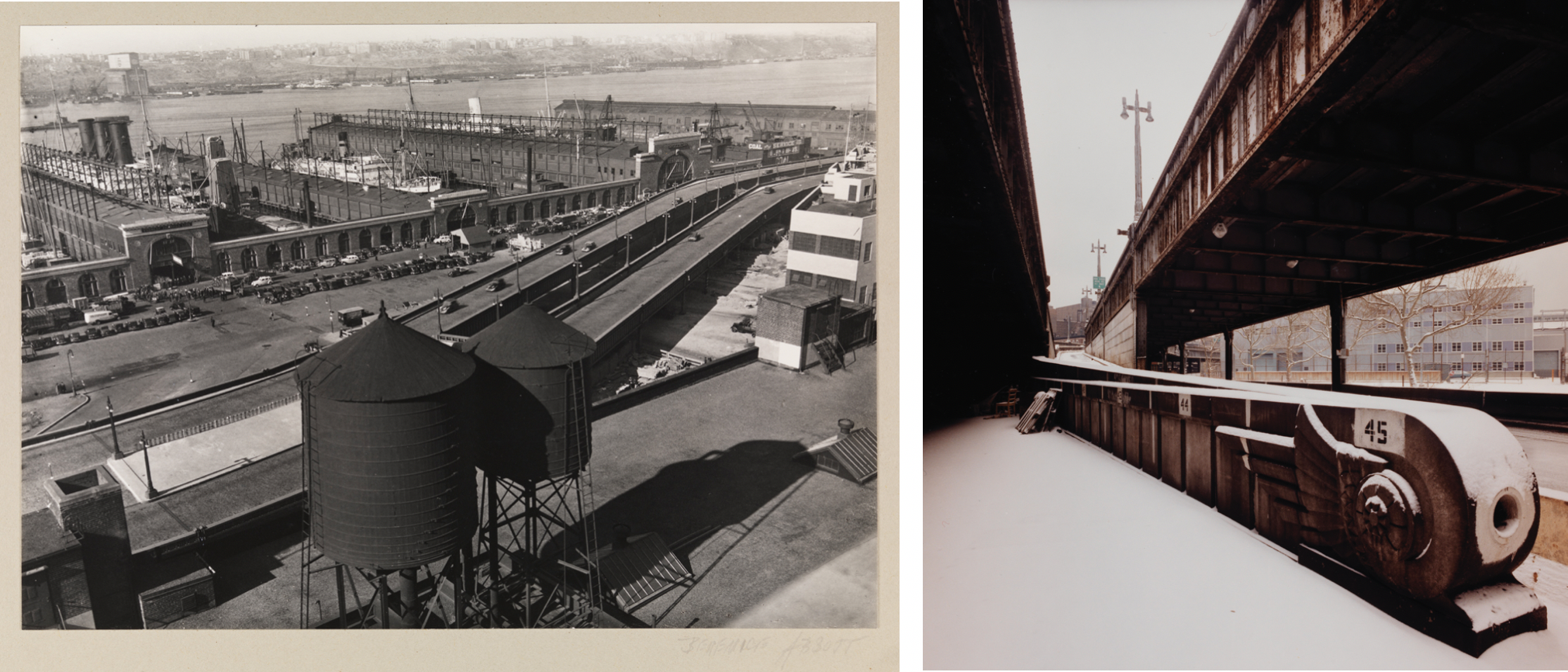
THE ROAD NOT TAKEN, TAKEN…Left, West Side Express Highway and Piers 95-98, photographed by Berenice Abbott from 619 West 54th Street on Nov. 10, 1977; West Side Highway Ramp at 23rd Street reveals Art Deco ornamentation. Detail of photo by Jan Staller, 1978. (Museum of the City of New York)
* * *
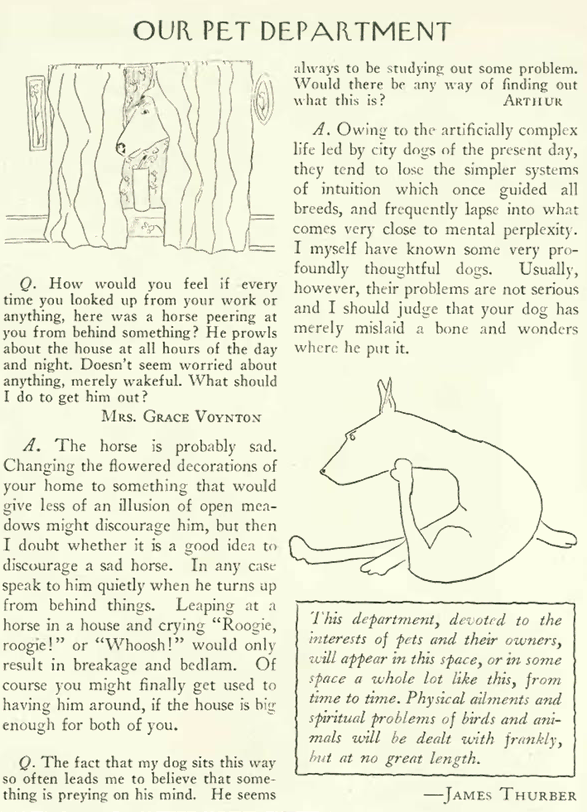
For Pet Lovers
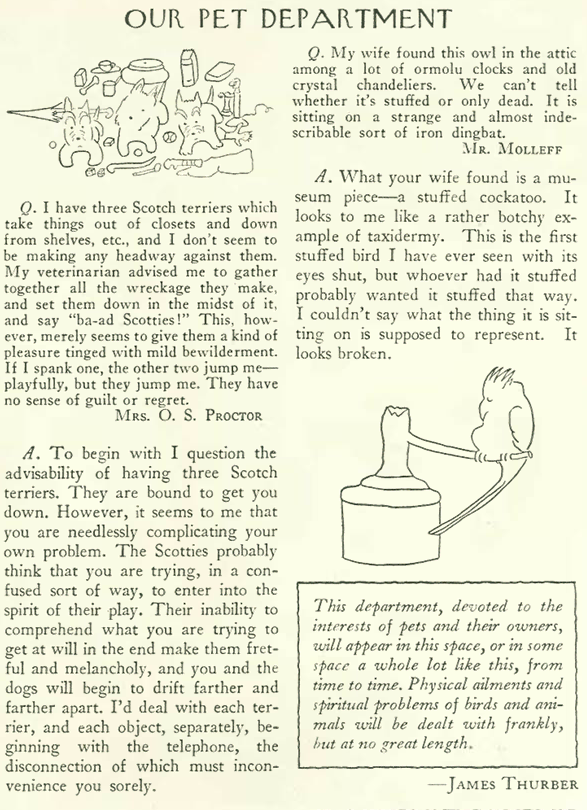
Our latest installment of James Thurber’s “Our Pet Department” column…
* * *
Hate Couture
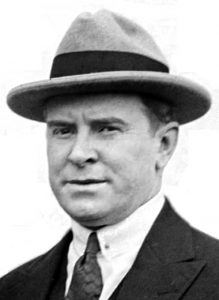
The New Yorker’s Paris correspondent, Janet Flanner, using the pen name “Hippolyta,” contributed this profile of François Coty (1874-1934), a French perfumer and businessman. Flanner’s profile (the introduction included below) described Coty’s rags-to-riches rise in the perfume industry, and touched on his life as a sometime journalist and politician.
What doesn’t come across in the profile is Coty’s extreme right-wing stance on politics and his virulent anti-Semitism, which was often expressed in his newspaper, Figaro. Three years after Flanner’s profile Coty would co-found Solidarité Française, a fascist, paramilitary organization, and a year after that he would be dead of an aneurysm.
François Coty circa 1930. (aperfumeblog.com)
* * *
From Our Advertisers
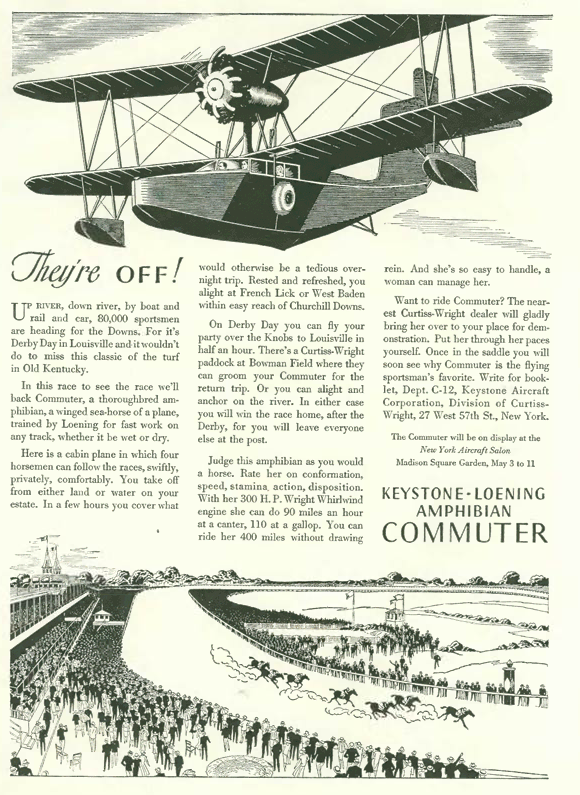
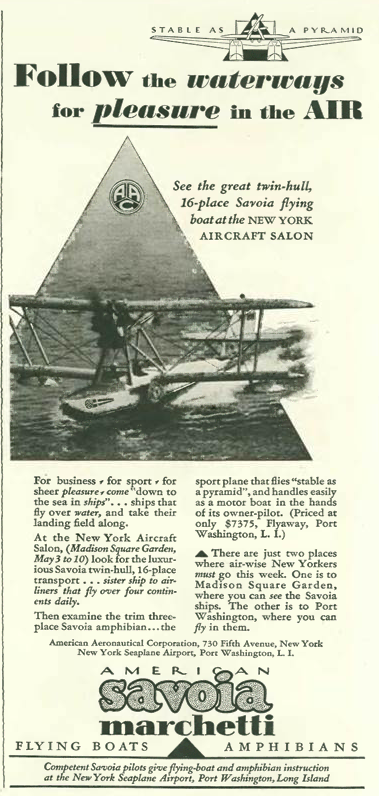
The New Yorker’s bottom line reaped benefits from the big aviation show at Madison Square Garden…
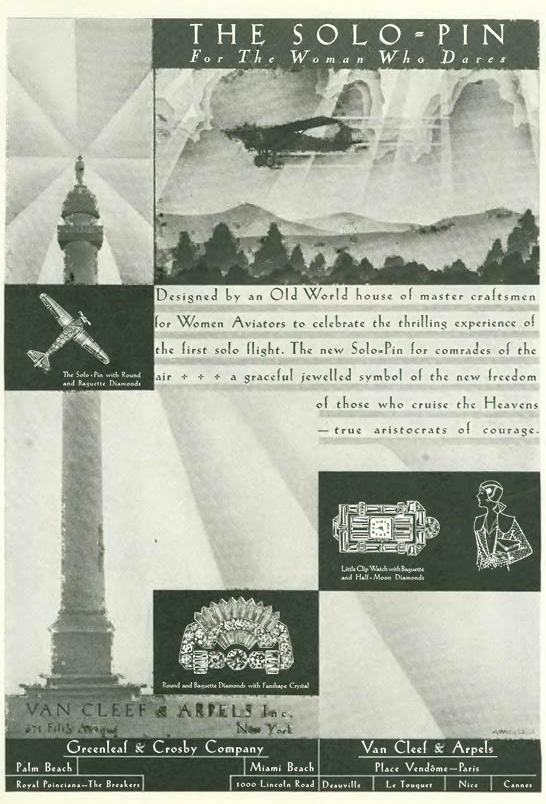
…and even if you weren’t selling airplanes or flying lessons, you could still get in on the action…
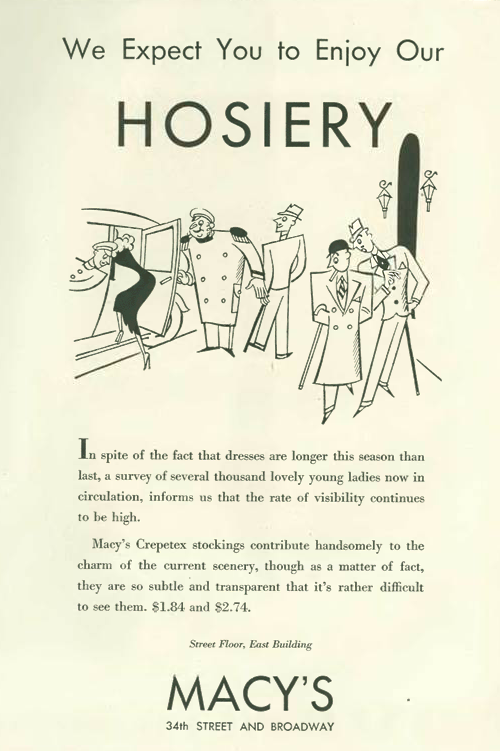
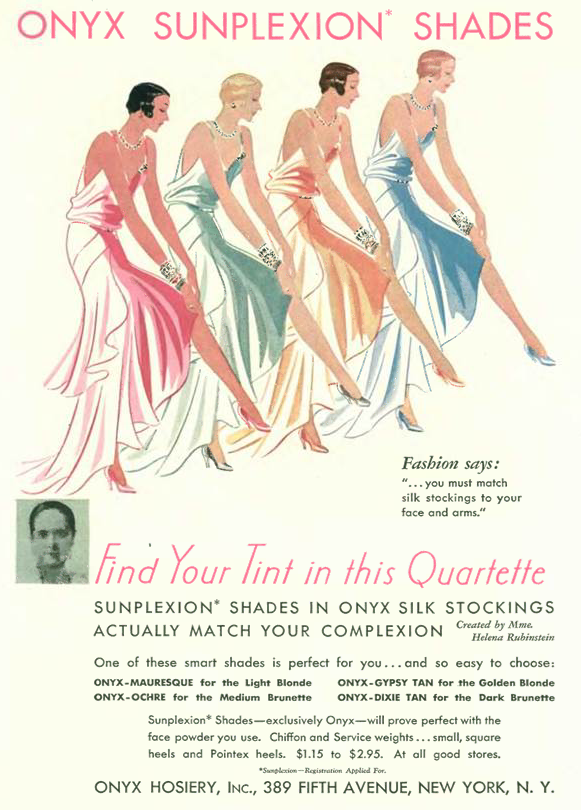
…also from the fashion world, this colorful entry from Onyx Hosiery…
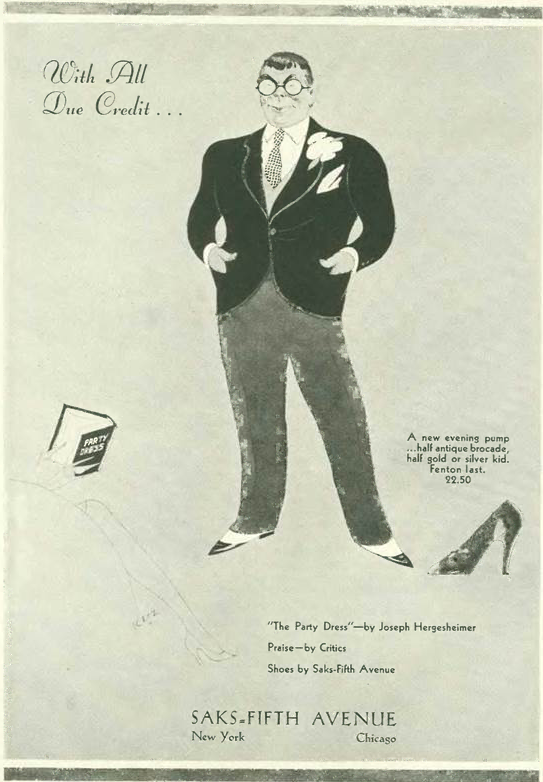
…and this weird ad from Saks, advertising shoes and a party dress but dominated by a caricature of designer Joseph Hergesheimer…
…on to our cartoons…Helen Hokinson paid a visit to the aviation show…
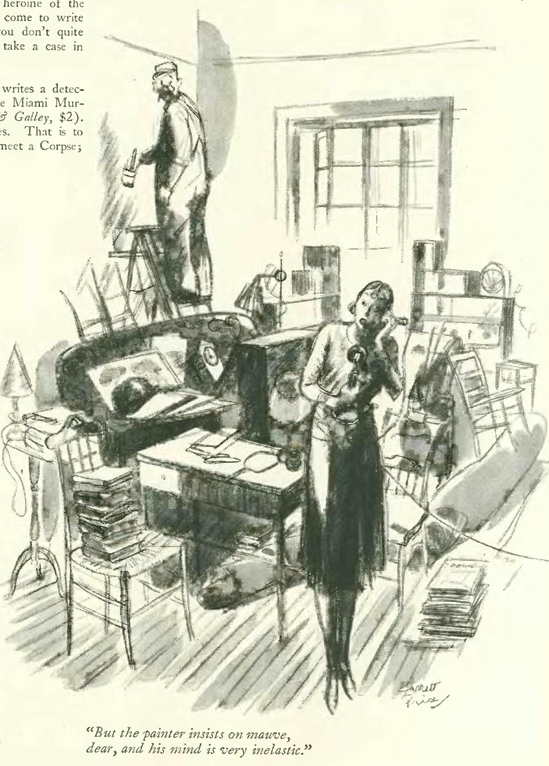
…on the domestic front, Garrett Price examined the challenges of home decor…
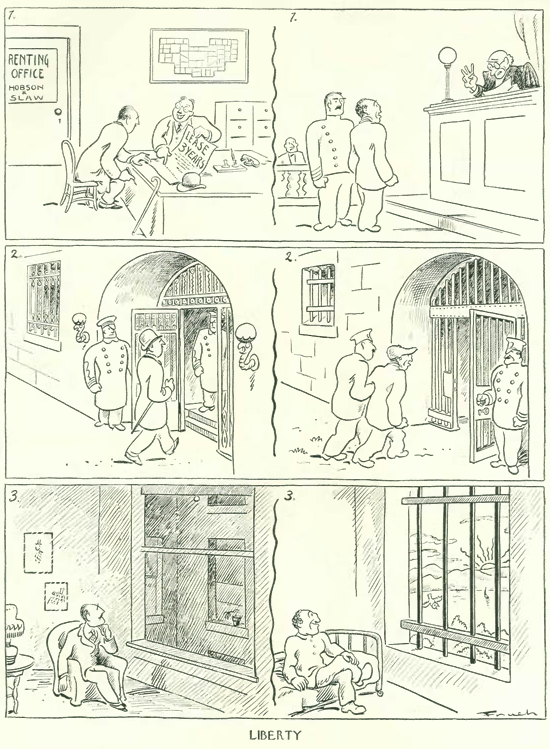
…Al Frueh offered an ironic twist on a room with a view…
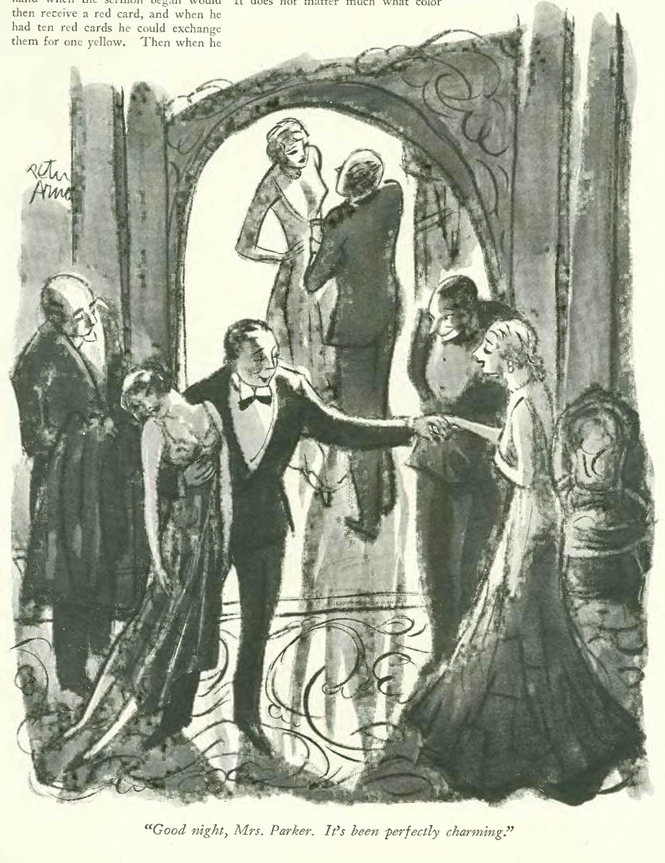
…Peter Arno once again found humor in the partying life…
If you lived in small town America in the 20th century, it was a big deal when the circus came to town with its entourage of clowns, acrobats and exotic animals from distant lands.
April 19, 1930 cover by Gardner Rea.
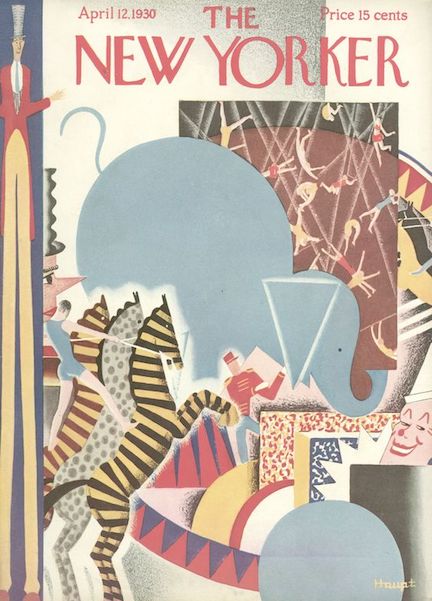
Even New Yorkers, it seems — who could be quite blasé about such things — got a thrill when the Ringling Brothers and Barnum & Bailey Circus rolled into town for its annual spectacle at Madison Square Garden. The New Yorker marked the occasion with its April 12 cover by Theodore Haupt:
For the April 19 issue, E.B. White welcomed the circus on a cautionary note, airing concerns in his “Notes and Comment” column that this old-timey entertainment might be falling under the “base influences” of broadcast radio, Broadway, and Hollywood:
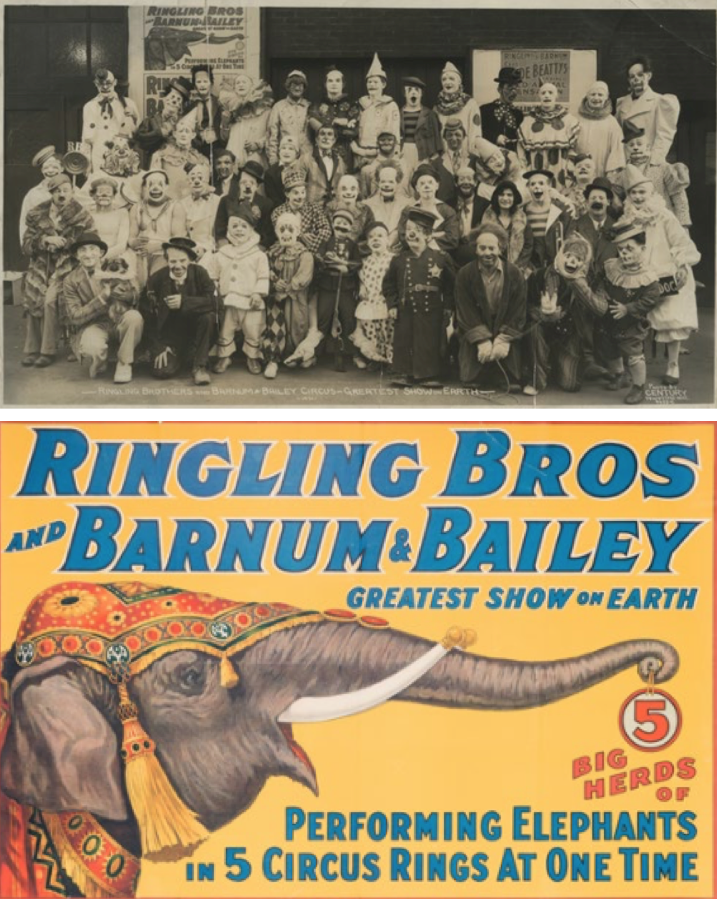
SEND IN THE…YOU KNOW…THOSE GUYS…Top, clowns in town for the 1931 Ringling Brothers and Barnum & Bailey Circus at Madison Square Garden. Below, circus poster announcing the arrival of “The Greatest Show on Earth.” (potterauctions.com)
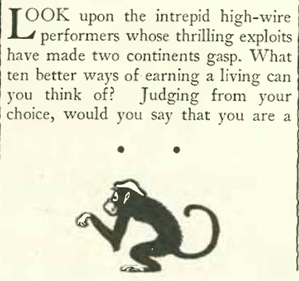
José Schorr, who wrote a number of humorous columns in The New Yorker from 1926 to 1930 on the subject of “how to the pass the time” in various situations, offered this advice on attending the spectacle at Madison Square Garden…
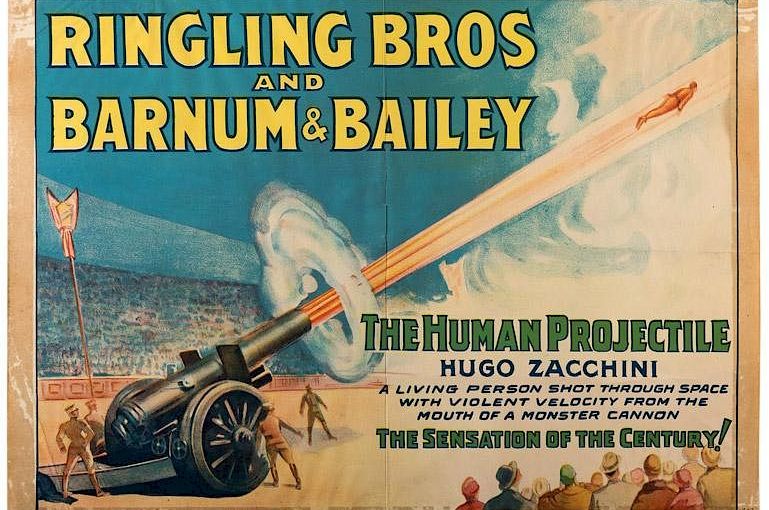
I’D RATHER BE FLYING…1930 poster advertising “The Human Projectile”; 1931 photo of the Ringling Brothers and Barnum & Bailey Circus at Madison Square Garden. (worthpoint.com/bidsquare.com)
…for example, Schorr advised circus-goers to pass the time by considering the inner lives of performers such as “The Human Projectile”…
* * *
Funny Farm
Perhaps you’ve never heard of Joe Cook (1890-1950), but in the 1920s and 30s he was a household name and one of America’s most popular comedic performers. “Talk of the Town” looked in on his antics at his Lake Hopatcong farm, “Sleepless Hollow”…
BATTER UP…Comedian Joe Cook’s residence at Lake Hopatcong, NJ, was known for its celebrity-studded parties. At left, Babe Ruth takes a swing with a giant bat on Cook’s wacky three-hole golf course; at right, Cook relaxing on the steps of his farm. (lakehopatcongnews.com)
* * *
Fun With Balloon Animals
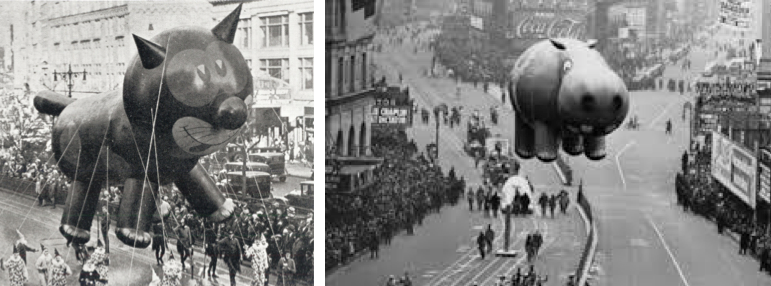
One thing that distinguishes the 1930s from today is that era’s apparent lack of safety standards, or fear of liability. A case in point was Macy’s Thanksgiving Day Parade, which began a tradition in the late 1920s of releasing its giant balloons into the sky at the conclusion of the parade — a $50 reward was offered by Macy’s for their return. “The Talk of the Town” explained:
GOING, GOING, GONE…When Felix the Cat (left, in 1927) was released after the Macy’s Thanksgiving Day Parade, it floated into a power line and caught fire; in 1931 the parade’s Big Blue Hippo (right) was apparently spotted floating over the ocean, never to be seen again. (Macy’s/hatchingcatnyc.com)
Perhaps the craziest anecdote attached to the parade’s annual balloon release belonged to Annette Gipson. While flying a biplane at 5,000 feet with her instructor, she spotted the parade’s 60-foot “Tom Cat” balloon rising high above Queens. Looking to have a bit of fun, the 22-year-old Gipson flew the plane directly into the cat. According to the book Macy’s Thanksgiving Day Parade, “Upon impact, the balloon wrapped itself around the left wing. The plane went into a deep tailspin (nearly throwing Gipson from the cockpit) and sped toward the ground out of control.” Fearing the plane would catch fire when it hit the ground, the instructor killed the ignition, and somehow managed to pull the plane out of the spin and land it safely at Roosevelt Field.
KITTY LITTER…Annette Gipson, right, nearly killed herself and her flight instructor after she deliberately crashed her biplane into a Tom Cat balloon (left) that had been released following the 1932 Macy’s Thanksgiving Day Parade. Of her near-death experience, Gipson told reporters, “It was a sensation that I never felt before—the whirling housetops, rushing up to meet me—and the thoughts of a whole lifetime flashed through my mind.” (ephemeralnewyork.wordpress.com)
A footnote: Following Gipson’s brush with death, Macy’s announced it would not give prize money to those who tried to down the balloons with their airplanes. The incident also brought an end to the company’s tradition of releasing the balloons.
* * *
Birth of the Soundtrack
Songs from popular theater productions were first made available to the masses in the mid-19th century via printed sheet music and later through early recordings. Part of this lineage is the movie soundtrack, which has its origins in the early days of sound pictures. According to TheNew Yorker’s “Popular Records” column, these new recordings would bring the talkies into your home, albeit without the picture…
FROM MAMMY TO MAMMA MIA…Left, a 1930 Brunswick 78 RPM recording of Al Jolson’s “To My Mammy”; at right, soundtrack from the 2008 film Mamma Mia! (popsike.com/amazon.com)
* * *
Cosmo Calvin
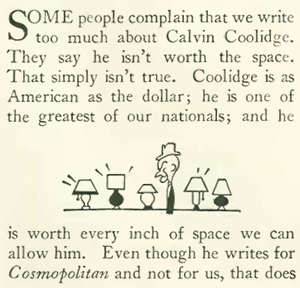
Before Helen Gurley Brown came along in the 1960s and sexed it up, Cosmopolitan was known as a somewhat bland literary magazine, and it was certainly bland enough in 1930 to welcome the scribblings of America’s blandest president to its pages. E.B. White mused in his “Notes”…
NOTHING COMES BETWEEN ME AND MY CALVIN…At left, the May 1930 issue of Cosmopolitan featuring columnist and former U.S. President Calvin Coolidge; at right, Kourtney Kardashian on the cover of the October 2016 issue. (Pinterest/Cosmopolitan)
* * *
How Dry I Am
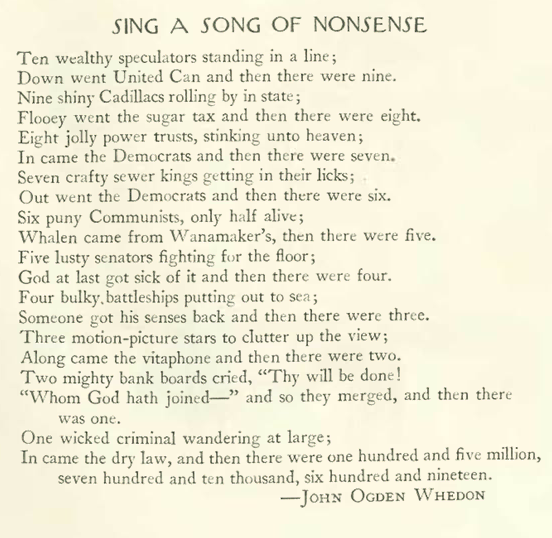
After a decade of living under Prohibition, John Ogden Whedon (1905-1991) put pen to paper and shared his sentiments in a poem for The New Yorker…
…Whedon would go on to a successful career as a screenwriter, especially finding acclaim for his television writing on The Donna Reed Show, Leave It to Beaver, The Andy Griffith Show, and The Dick Van Dyke Show, among others. He was also the grandfather of screenwriter and director Joseph “Joss” Whedon and screenwriters Jed Whedon and Zack Whedon.
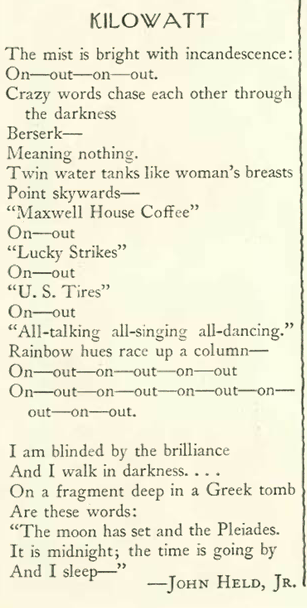
Another poem in the April 19 issue was contributed by John Held Jr., who was perhaps better known to New Yorker readers for his “woodcut” cartoons…
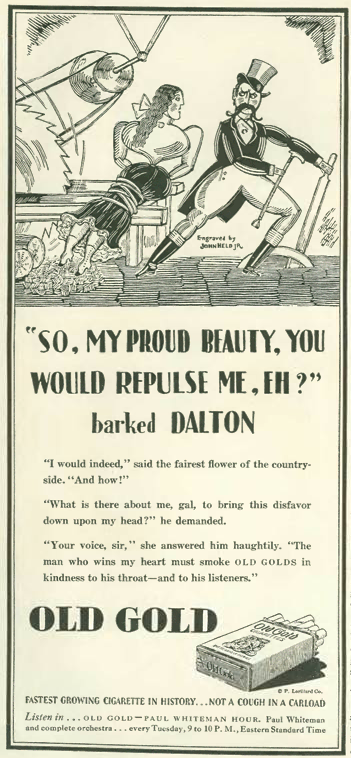
…example of Held’s work from the April 12 issue, featured in an Old Gold advertisement…
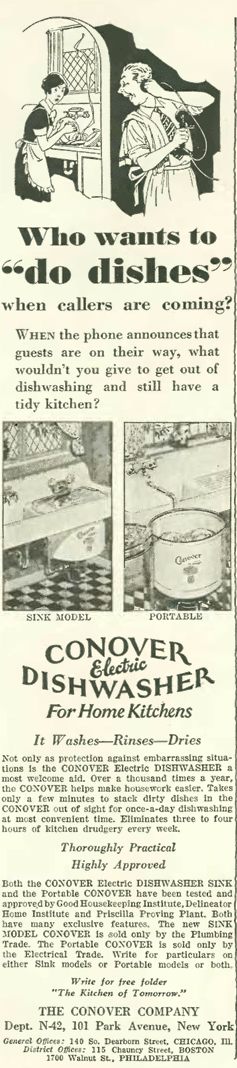
…and that provides a segue into our ads for the April 19 issue, beginning with this spot for an early electric dishwasher…
Here’s what that bad boy looks like in color. (automaticwasher.org)
…I couldn’t find a review in The New Yorker for Emily Hahn’s new book, Seductio Ad Absurdum, but her publisher did take out an ad to get the attention of readers. Many years later The New Yorker would call the journalist and author “a forgotten American literary treasure”…
Emily Hahn circa 1930; first edition of Seductio Ad Absurdum. Author of 52 books, her writings played a significant role in opening up Asia to the West. (shanghaitours.canalblog.com/swansfinebooks.com)
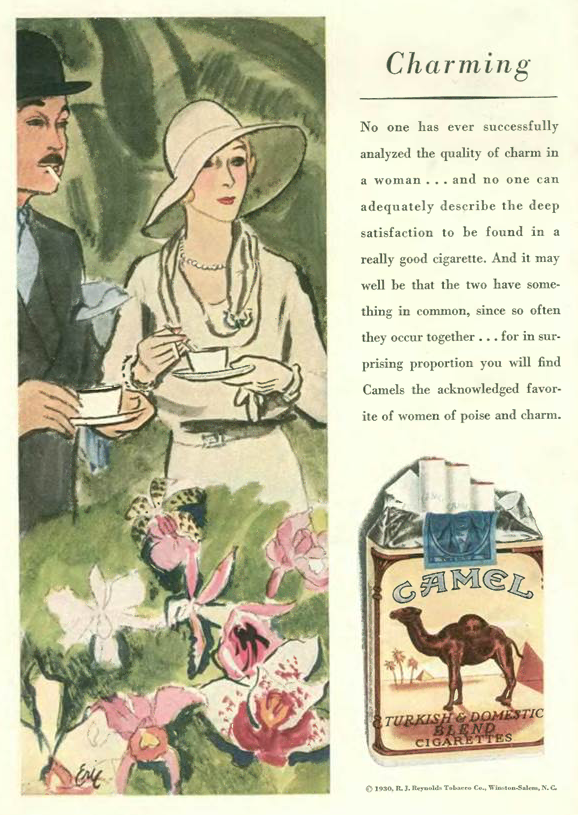
…and here we have another sumptuous ad from illustrator Carl “Eric” Erickson, a far cry from the “Joe Camel” ads that would come along decades later…
…on to our cartoons, Reginald Marsh offered a blue collar perspective on city fashions…
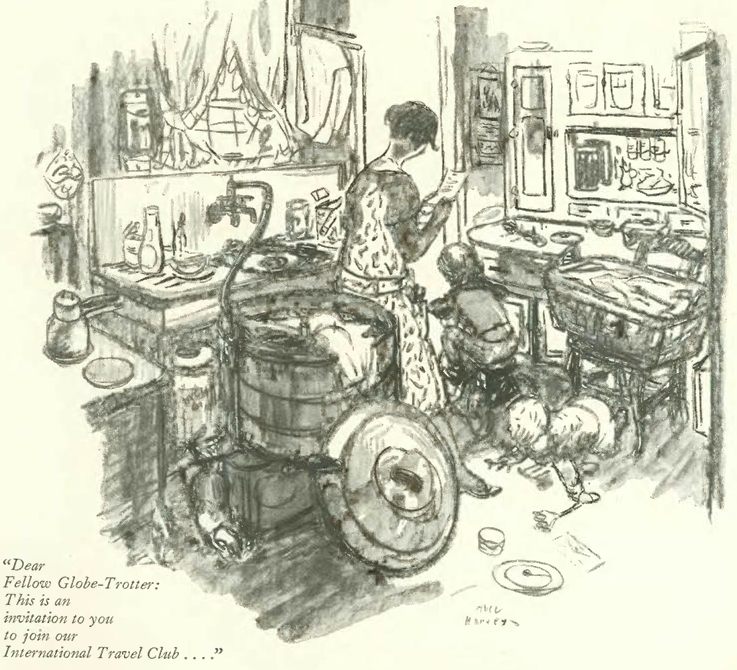
…Alice Harvey captured a moment of reflection by an overworked housewife…
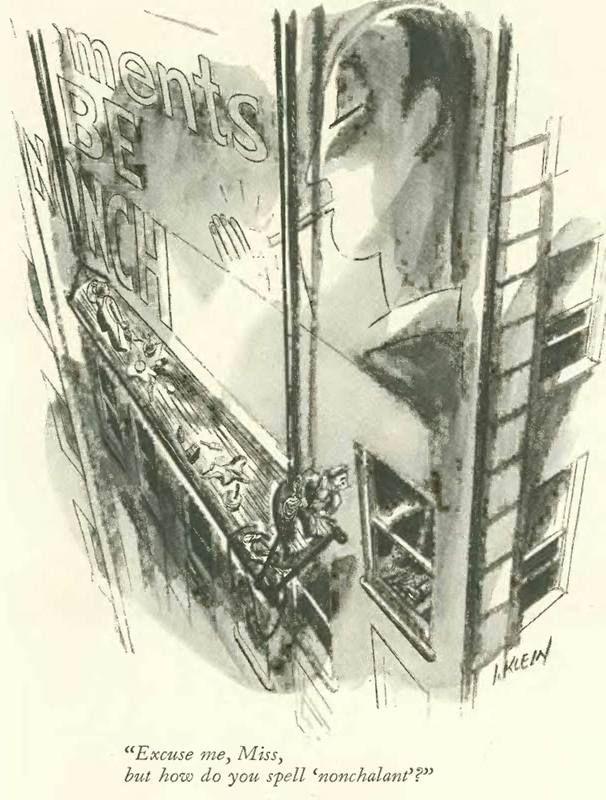
…and Isadore Klein looked in on a couple of working stiffs in need of a dictionary…
…now over to the posh set, with Barbara Shermund…
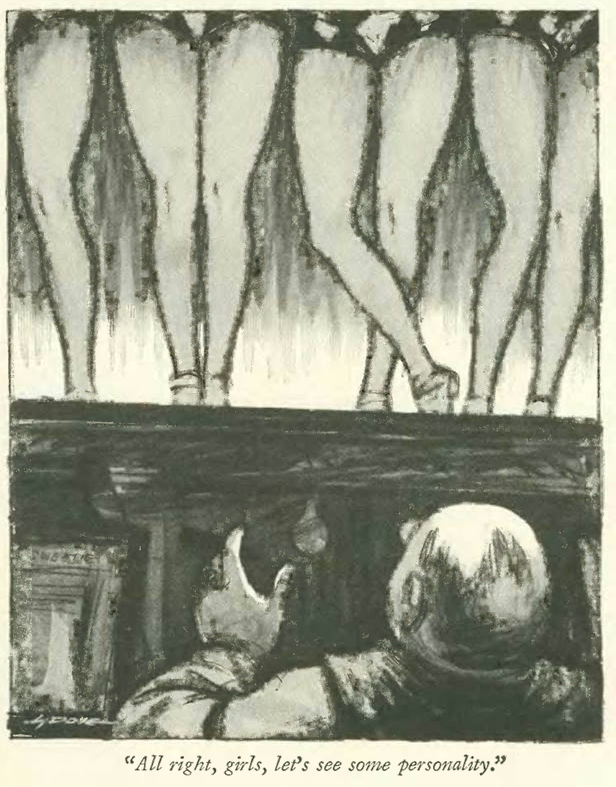
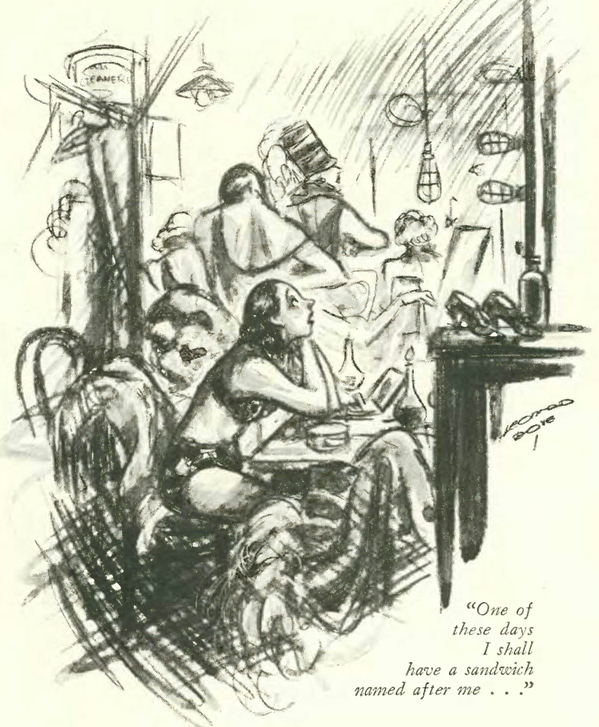
…Leonard Dove found humor on the chorus line…
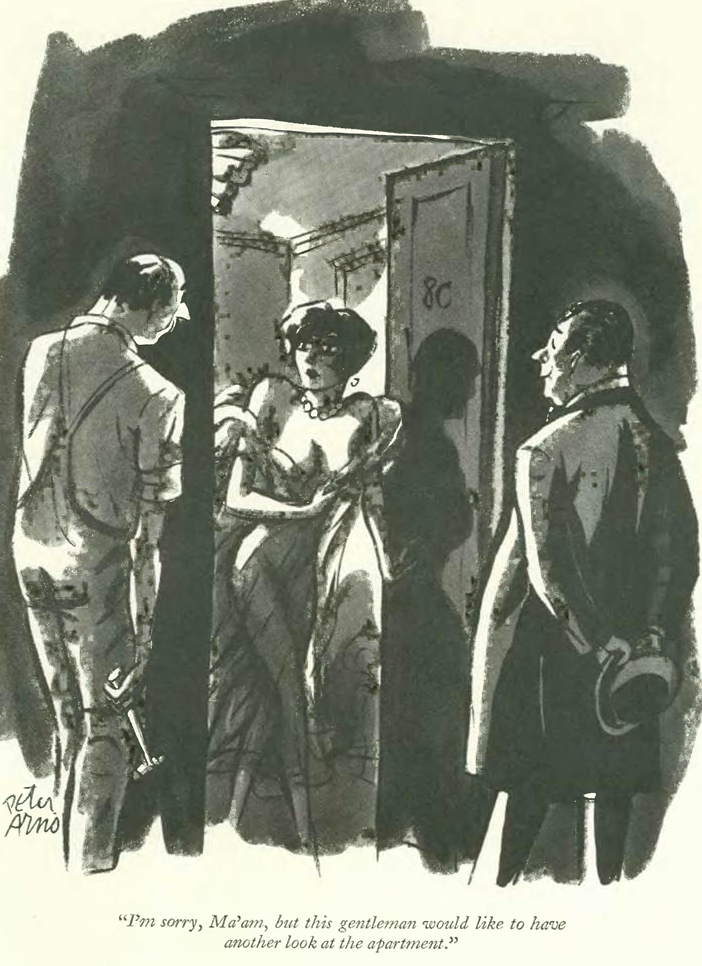
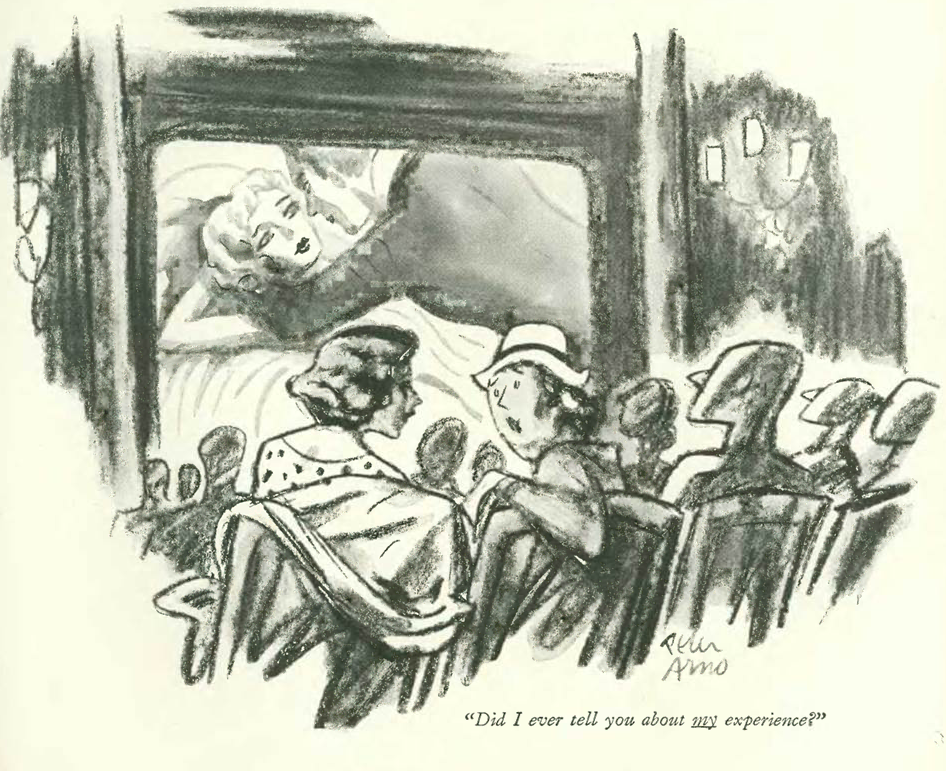
…and we end with this terrific cartoon by Peter Arno, and the perils of apartment life…
With the Chrysler Building nearing completion and the Empire State Building beginning to rise from the old Waldorf-Astoria site, the New York City skyline was taking on the iconic form most of us now associate with the city.
April 12, 1930 cover by Theodore Haupt.
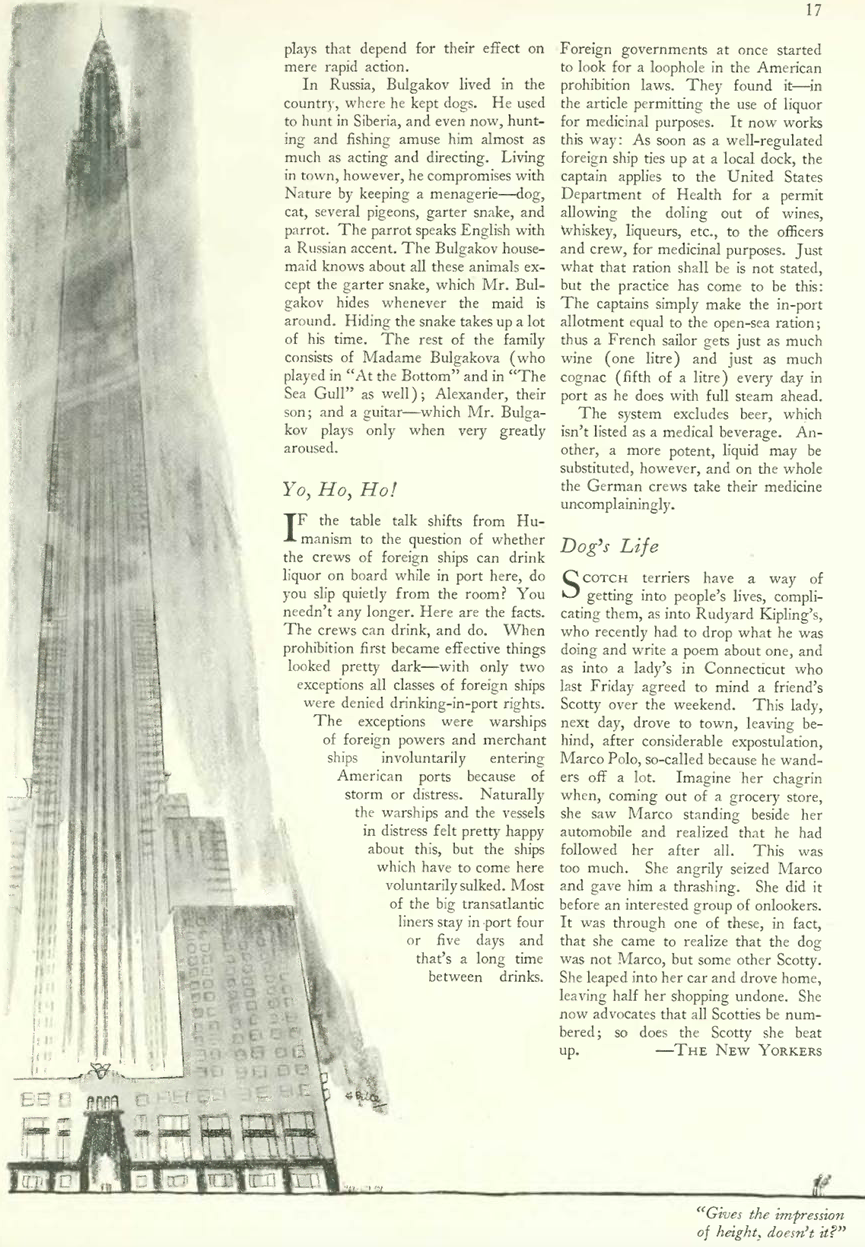
Dubbed “hot jazz in stone and steel” by modernist architect Le Corbusier, the Chrysler Building’s gleaming spire beckoned The New Yorker’s E.B. White and real estate journalist David G. Bareuther (New York Sun) to its summit for a closer look…
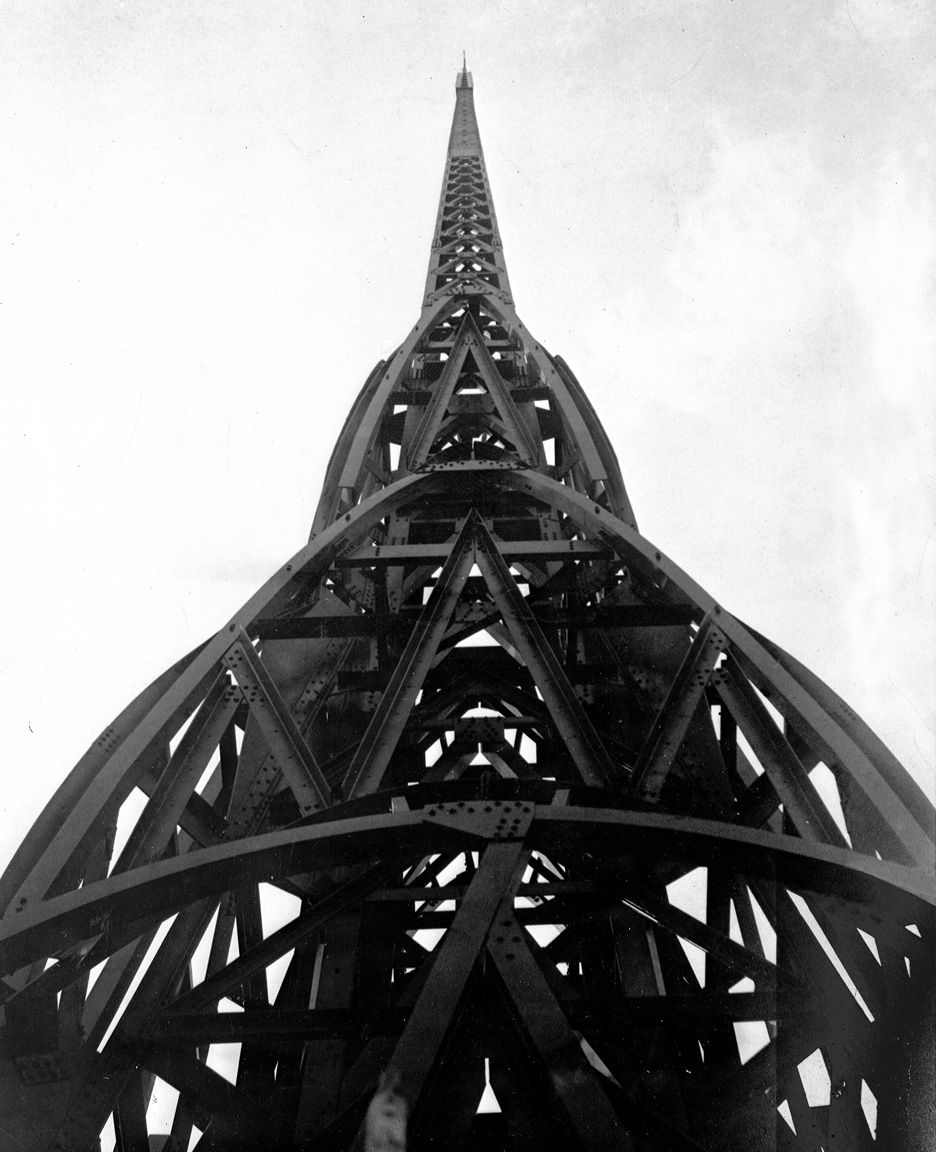
BARE BONES…The spire in place atop the Chrysler building, the dome awaiting its metal skin. (skyscraper.org)WHAT LIES BENEATH…The stainless steel spire still gleams atop the Chrysler Building; beneath the spire, a maze of scaffolding — navigated by E.B. White and David G. Bareuther for their “Talk of the Town” piece, supports the upper portions of the building’s dome. (yahoo.com/nygeschichte.blogspot.com)THE HIGH LIFE…The Chrysler Building’s exclusive Cloud Club was located on the 66th, 67th, and 68th floors. At one time it was the highest lunch club in the world. It closed in 1979. (decopix.com)
If you want to get a sense of what E.B. White and David Bareuther experienced during their climb through the Chrysler’s dome, take a look at this video featuring American radio personality “Opie” (Gregg Hughes) and Hidden Cities author Moses Gates…
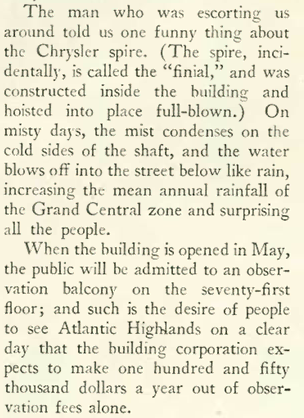
The article also noted that an “observation balcony” would be available for visitors to the 71st floor (actually an enclosed room inside the dome), but I’m sure the expectations for revenue fell quite short, given the competition it would soon receive from the much larger, higher, open air observation deck of the Empire State Building…
REACHING FOR THE STARS…When the Chrysler Building officially opened in 1931, visitors could go up to the 71st-floor observatory (in the dome) and view the city through its triangular windows. The observatory closed in 1945. (nygeschichte.blogspot.com)
…a bit of a digression, but I couldn’t help but notice the observatory’s resemblance to this set from the 1920 silent film The Cabinet of Dr. Caligari…
(silent-volume.blogspot.com)
…and here is a terrific graphic from Popular Science (August 1930) demonstrating how the spire, which was assembled inside the dome, was raised into its final position…
…and finally, some great archival footage documenting the achievement…
* * *
Tragic Theater
We continue our forays into the built environment of 1930 New York by looking at what was lost, including two beloved Broadway theaters. “The Talk of the Town” lamented the decline of the Garrick…
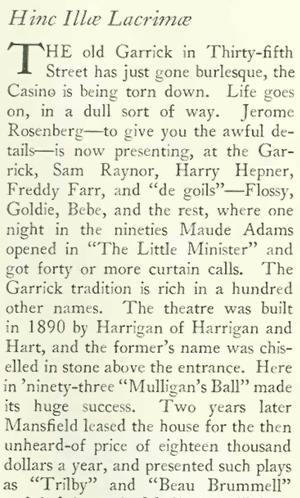
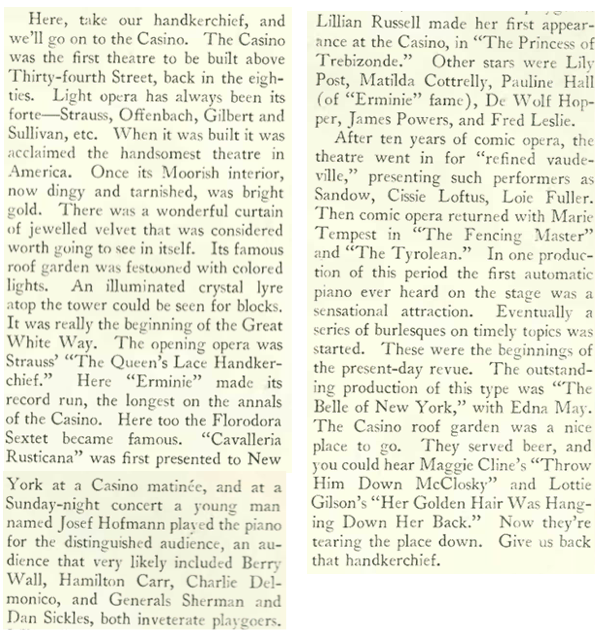
FINAL CURTAIN…Built in 1890 and originally named Harrigan’s Theatre, The Garrick closed as a playhouse in 1929. After a short run of burlesque, the building was demolished in 1932.
HEYDAY…Clockwise, from top left, circa 1910 postcard image of The Casino Theatre at Broadway & 39th; an audience on the Casino’s roof garden glimpses the performance below; interior of the Casino; the British musical comedy Floradora would become one of Broadway’s greatest hits — the New York production opened in 1900 and ran for 552 performances. (Museum of the City of New York )
* * *
From Jazz to Gothic
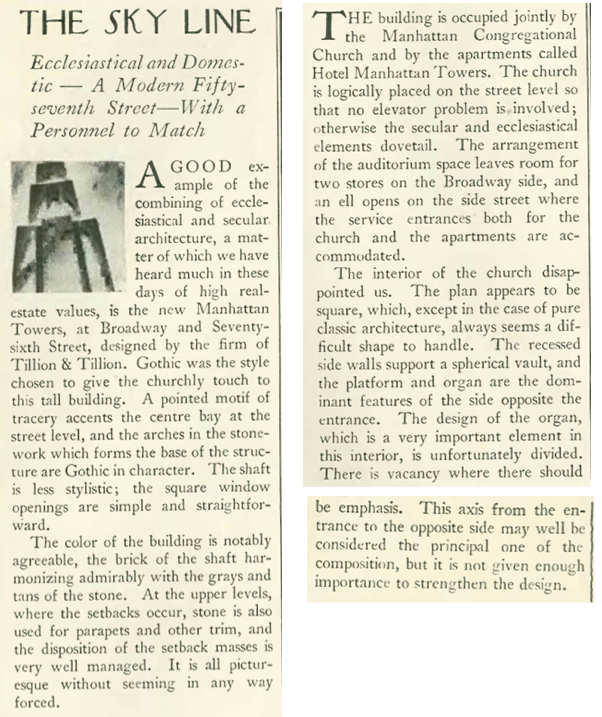
We return our gaze to the skies with three more new buildings reviewed by architecture critic George S. Chappell in his “Sky Line” column. He began with the Manhattan Towers Hotel, which thanks to the Depression would soon fall on hard times, going into foreclosure by October of 1931 and becoming a favorite gangster hideout (read more about the hotel at Daytonian in Manhattan)…
GOD AND MAMMON…Clockwise, from top left, the Manhattan Congregational Church in 1927. The church was torn down in 1928 and replaced by the Manhattan Towers Hotel at Broadway and 76th; the completed hotel, designed to wrap around the three-story Jones Speedometer Building, seen in the lower right of the photo; the first five floors of the building were dedicated to church use; after falling into disrepair, in 1980-83 the 626-room hotel was converted into 113 cooperative apartments. Note that the Speedometer Building still stands, sadly shorn of its ornamentation. (New York Public Library/Daytonian in Manhattan)
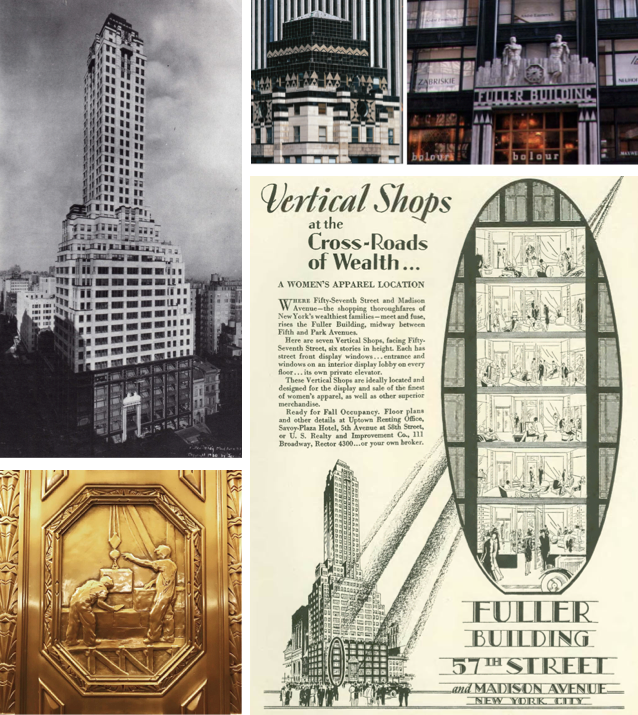
…Chappell also found much to admire in the new Fuller and Squibb buildings…
FULLER HOUSE…Clockwise, from top left, the 1929 Fuller Building was the third home of the George A. Fuller Company (its second home was the 1903 Flatiron Building); detailed views of the building’s tiled pinnacle and unique glass display windows that distinguish the building’s first six stories; an advertisement from the March 2, 1929 New Yorker that touted these gallery spaces for “superior merchandise”; detail of a coffered panel on an elevator door. (deskgram.net/nyc-architecture.com)Clockwise, from top left, entrance to the Squibb Building, now known as 745 Fifth Avenue; the cool white marble of the building’s base so admired by critic George Chappell; today, the building at dusk, the slender profile of 432 Park Avenue rising in the background. (OzBibliophile/paramount-group.com/landmarkbranding.com)
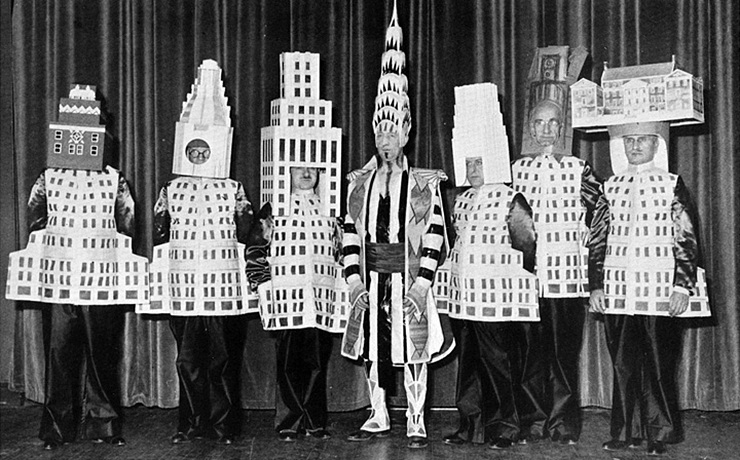
…From the Chrysler Building to the Fuller and Squibb, these new buildings, their architects, and the city’s ever-changing skyline were famously celebrated at the January 1931 Beaux Arts Ball…
HEADS IN THE CLOUDS…the Chrysler Building’s architect, William Van Alen (center), flanked by, from left to right, Stewart Walker (The Fuller Building), Leonard Schultze (The Waldorf-Astoria), Ely Jacques Kahn (The Squibb Building), Ralph Walker (1 Wall Street), D.E. Ward (The Metropolitan Tower), and Joseph H. Freelander (Museum of the City of New York). The New York Times referred to the group as “a tableau vivant of the New York Skyline.” (Van Alen Institute)
* * *
Quiet on the Set
The early days of sound movies created numerous challenges for directors who not only had to adjust the action to accommodate cumbersome microphones, but also to keep out unwanted noises or bad enunciation. “The Talk of the Town” explained…
CLOSETED…In the early days of the talkies, cameras had to be soundproofed in cabinets so their noisy motors would not be picked up by primitive sound equipment. (coloradocollege.edu/Library of Congress)
…Peter Arno illustrated the predicament of filming in nature in this cartoon from the April 5, 1930 issue…(caption: “Well, we can’t start till we get that robin out of there.”)…
* * *
One of Ours
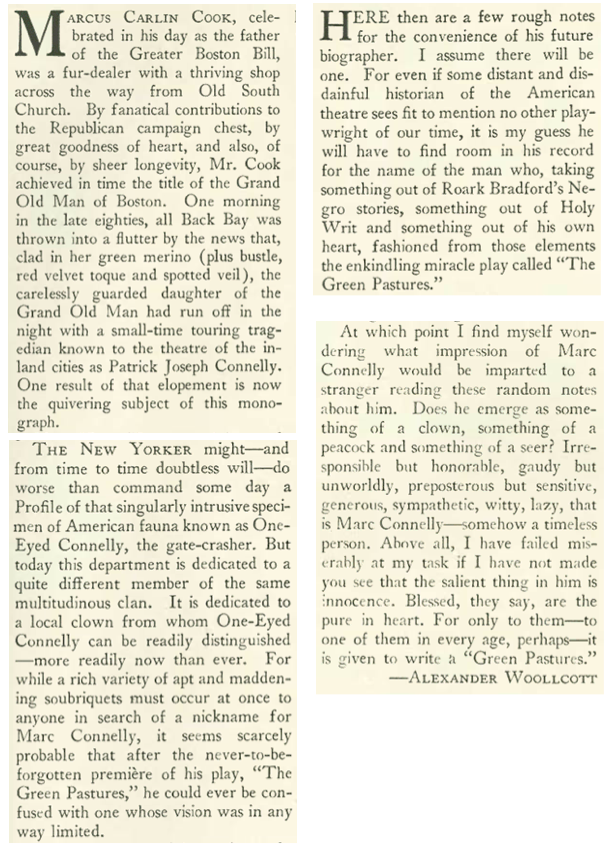
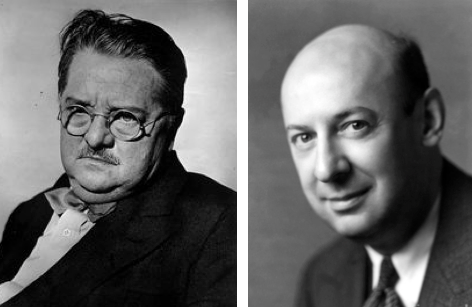
In the story of The New Yorker, Alexander Woollcott and Marc Connelly were there at the beginning as founding members of the Algonquin Round Table and advisory editors to the first issues of the magazine. Basking in the success of his latest play, The Green Pastures (for which he would receive a 1930 Pulitzer Prize for Drama), Connelly was the subject of a April 12, 1930 profile titled “Two-Eyed Connelly,” which was written by Woollcott. Some excerpts, and a caricature by Al Frueh…
FAMILIAR WITH THE SUBJECT…Alexander Woollcott, left, explored the life of his old friend Marc Connelly in the April 12 profile. (goodreads.com/Fine Art America)
* * *
The Party is Really Over
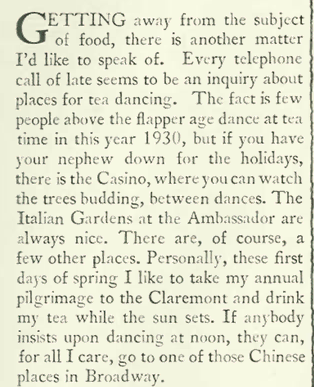
Lois Long’s column “Tables for Two,” which in the 1920s was a must-read for those interested in Jazz Age night life, appeared intermittently in its last year, and its April 12 installment was not even written by Long, but by a writer who signed the column “F.D.” — I assume this is Fairfax Downey, who tried his best to capture Long’s style…
* * *
From Our Advertisers
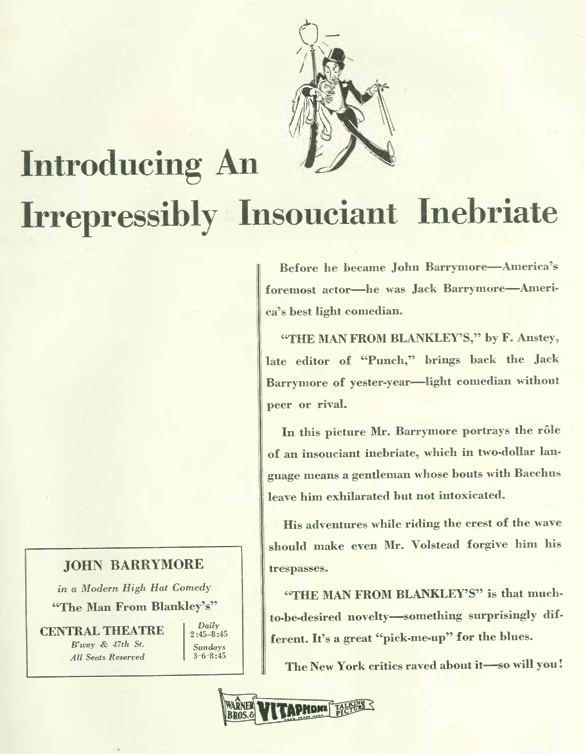
Warner Brothers opened their pocketbooks to publicize John Barrymore’s latest film, The Man From Blankey’s, which the studio described as a “Modern High Hat Comedy”…
WHEN ALCOHOLISM WAS FUNNY…Loretta Young, John Barrymore and Angella Mawby in The Man from Blankley’s. (IMDB)
…Thanks to William Randolph Hearst and his King Features Syndicate, Robert Ripley, the P.T. Barnum of the funny pages, soared to fame in the 1930s with his “Believe It or Not” panel…here he begins his 14-year run on the radio…
HELLO SUCKERS…Robert Ripley in 1930 with a drawing of “the Horned Man of South Africa.” (RIPLEY ENTERTAINMENT INC.)
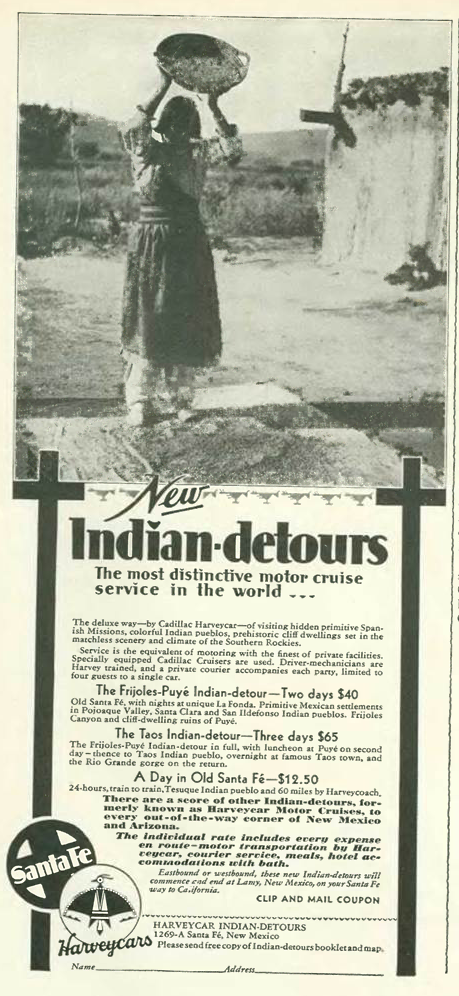
…and here’s an ad for another questionable but very American diversion — Fred Harvey’s “Indian Detours”…
WE’RE NOT IN KANSAS ANYMORE…The Fred Harvey Company was renowned for its chain of eating houses hosted by the famed “Harvey Girls” along the Atchison, Topeka & Santa Fe Railroad between 1876 and 1968. To encourage train travel (and Harvey business) in the Southwest, the Harvey company developed “Indian Detours.” The photo at left is of an “Indian Building” in Albuquerque, which featured displays of art and “live exhibits” that included Native Americans from many tribes around New Mexico. (santafeselection.com)EASY RIDER…1929 Cadillac Harvey Indian Detour Car outside La Fonda, Santa Fe. (Palace of the Governors photo archive)
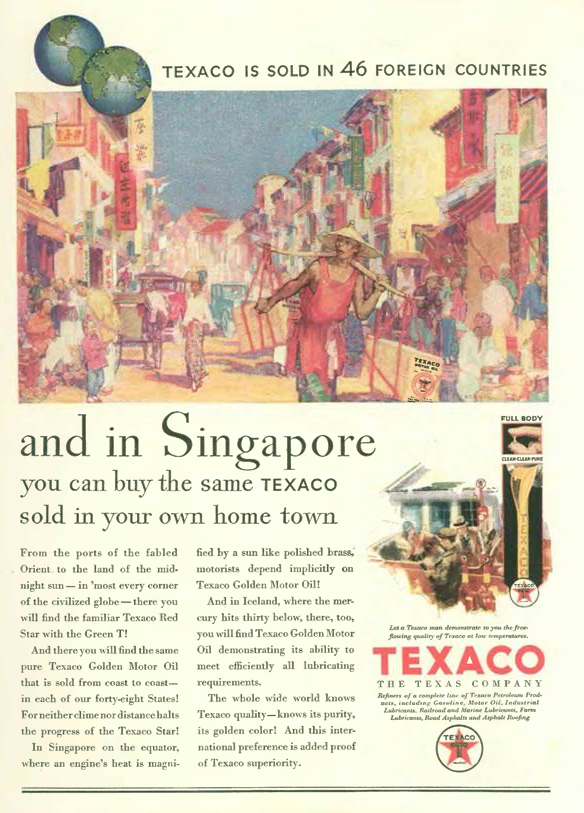
…if you preferred to travel abroad, Texaco wanted you to know that you could still gas up with their product, even in distant Singapore…
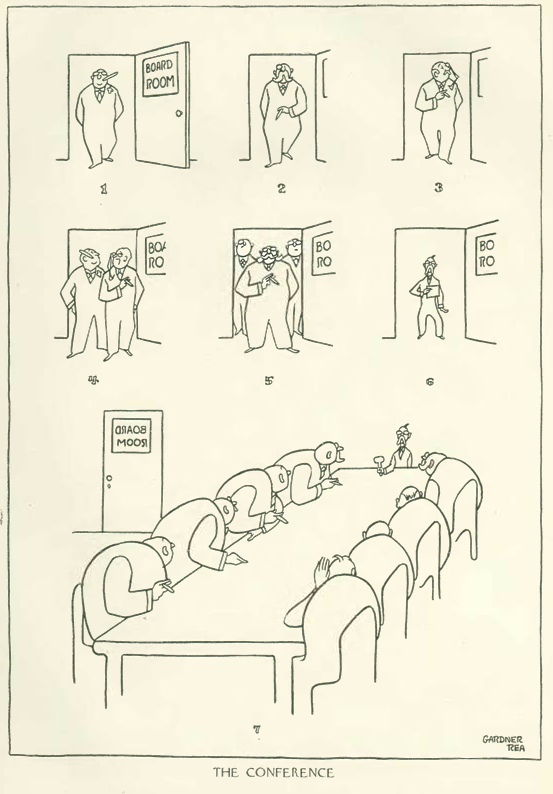
…we begin our cartoons with the spare stylings of Gardner Rea…
…and Otto Soglow…
…we find one of Helen Hokinson’s ladies on her way to fitness…
…William Crawford Galbraith showed us an enterprising young man…
…Art Young illustrated the challenges of the lecture circuit…
…and one of my all-time favorite Peter Arno cartoons…
Imagine your favorite Hollywood actress, maybe someone like Julia Roberts,Meryl Streep or Judi Dench. You’ve followed their careers and watched most of their movies, but you’ve never heard their voices.
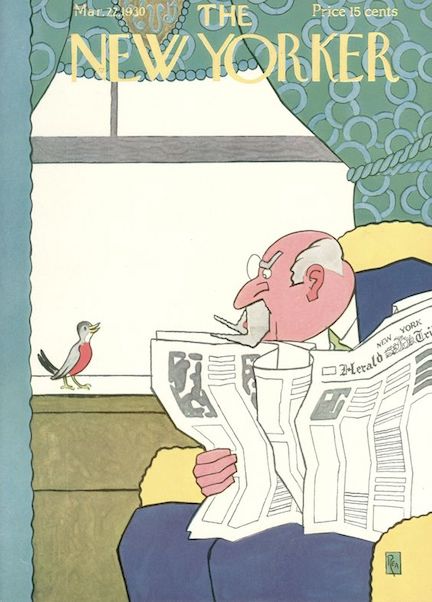
March 22, 1930 cover by Gardner Rea.
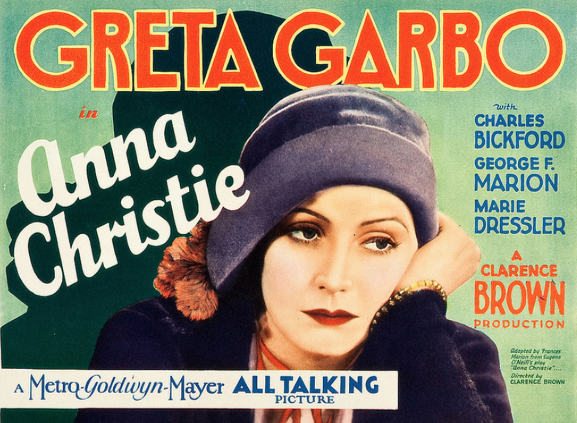
That’s what it was like for Greta Garbo fans before March 1930, when she spoke her first onscreen words in the 1930 MGM drama Anna Christie, which was adapted from a 1922 play by Eugene O’Neill.
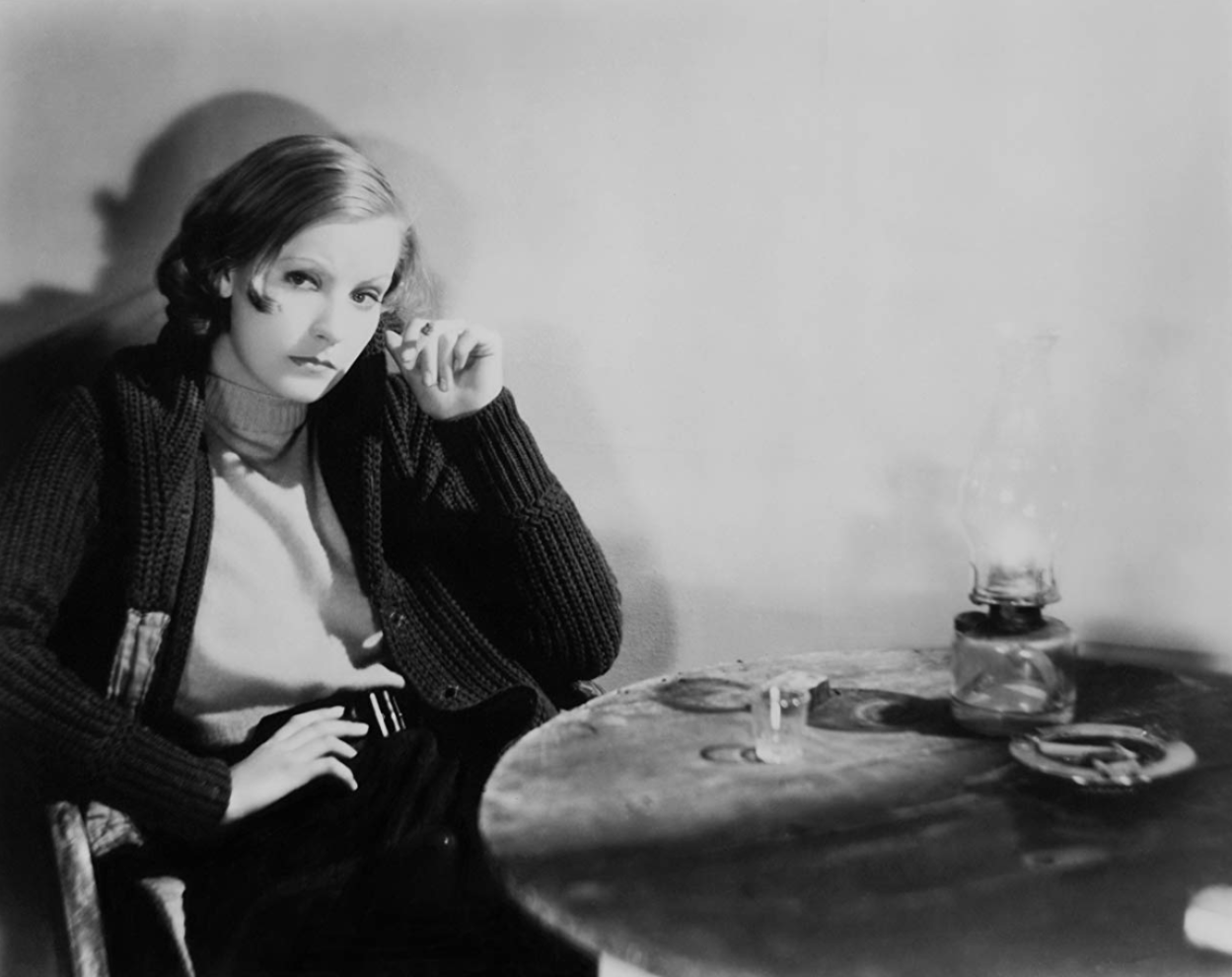
SWEDISH SPHINX…Greta Garbo’s mask-like qualities on display in this publicity still for Anna Christie. (IMDB)
The New Yorker’s film critic John Mosher, not always a fan of Garbo’s silent work, found a “special kind of glamour” in her first talking picture, even tossing out the word “legend” to describe this Swede who avoided publicity like a bad cold…
No doubt a few moviegoers saw the movie just to finally hear that voice, which Mosher described as “a surprise…a deep, low voice, a boy’s voice really, rather flat, rather toneless, yet growing more attractive as the picture advances”…
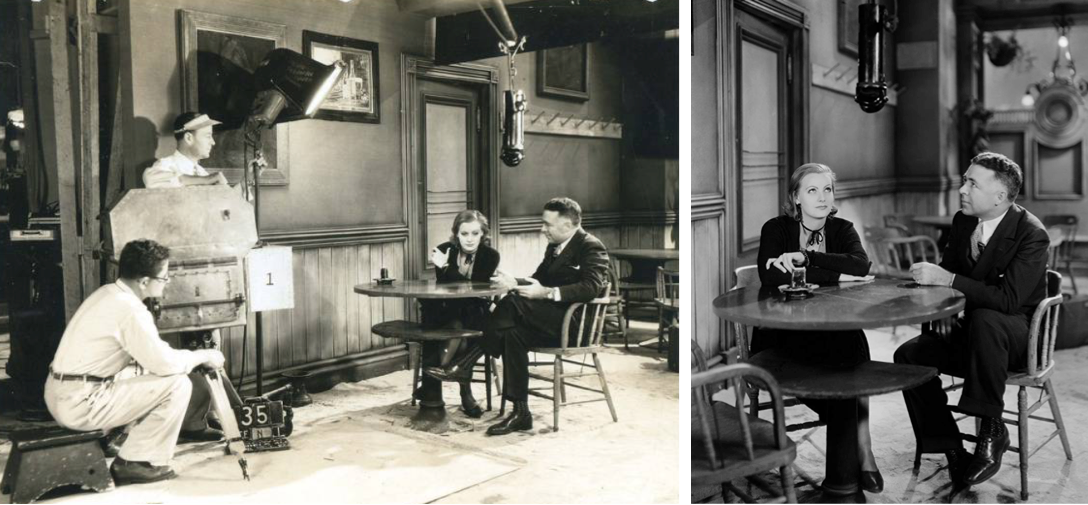
Director William H. Daniels (seated, left) with unidentified cameraman filming a scene from Anna Christie with actors Greta Garbo and Clarence Brown; at right, the actors contemplate the microphone hovering above them. Note how the camera in the first photo is contained in a soundproof case. (IMDB)
Publicized with the tag line “Garbo talks!,” Anna Christie premiered in New York City on Feb. 21 and would become the highest-grossing film of 1930. Later that year a German language version would be filmed featuring Garbo but with a different director and supporting cast.
SOUND DEBUT…Clockwise, from top left, Greta Garbo and Marie Dressler in Anna Christie; an MGM ad touting the film as one of the best pictures of the year (it would be the year’s highest-grossing, and Garbo would receive an Academy Award nomination); studio portraits of Garbo used in the film’s promotion. (IMDB)
* * *
Chicken and Cocktails
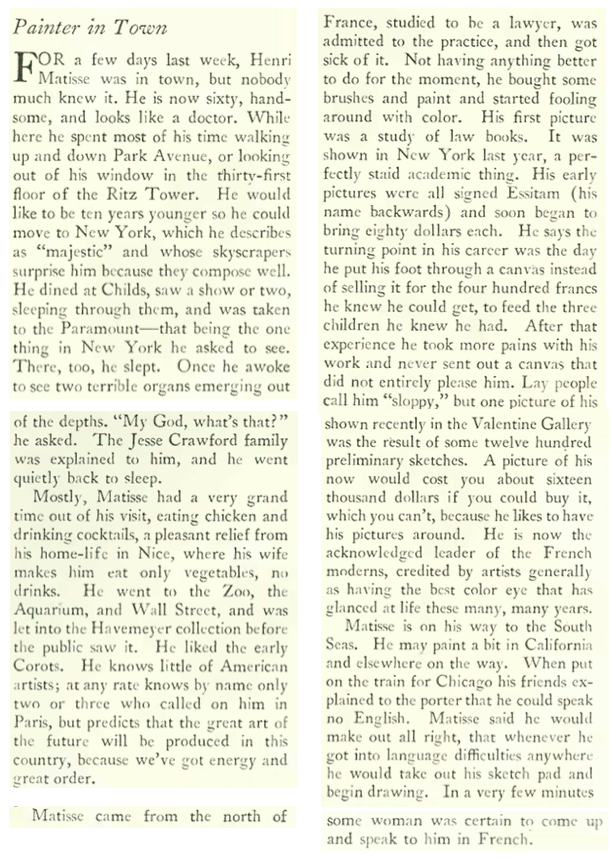
En route to the South Seas, the French artist Henri Matisse (1869-1954) paid a visit to New York City, and by all accounts had a good time there. His visit was described by Murdock Pemberton in “The Talk of the Town”…
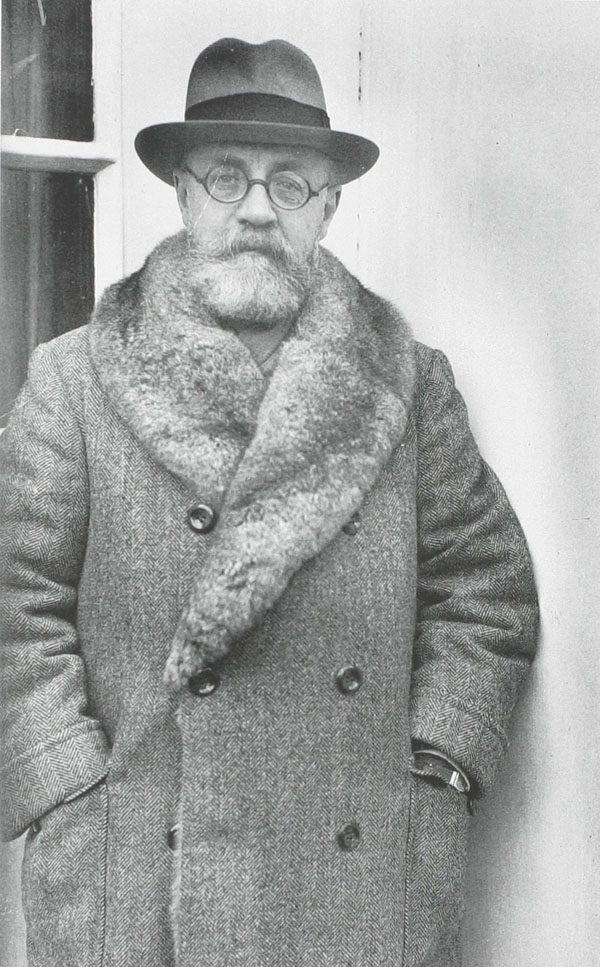
I ♥ NEW YORK…Henri Matisse arriving in New York City on the RMS Mauretania December 15, 1930. He described the city as “majestic.” (artistandstudio.tumblr.com)NICE PLACE, THIS…Henri Matisse sitting on the brick roof terrace of 10 Mitchell Place (formerly Stewart Hall), the Queensboro Bridge glimpsed in the background. The photo was taken in 1930 by his son, Pierre Matisse, who was living in New York. At right, 10 Mitchell Place today. A framed photograph of Matisse sitting on the rooftop hangs on the wall of the building’s lobby. (Henri-matisse.net/Ephemeral New York)
* * *
The Last Page
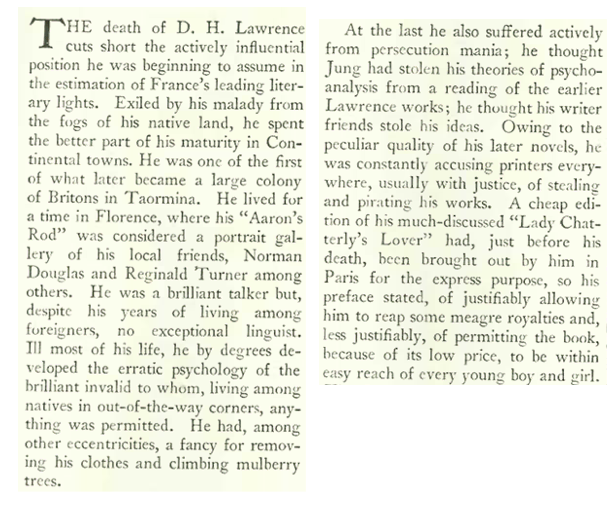
The death of author D.H. Lawrence (1885-1930) was reported to New Yorker readers by Janet Flanner, the magazine’s Paris correspondent, who briefly detailed the writer’s rather sad decline…
FLEETING DAYS…D. H. Lawrence (right) with fellow writer Aldous Huxley at Bandol, in the South of France, 1929. (Topham Picturepoint)
* * *
What Depression?
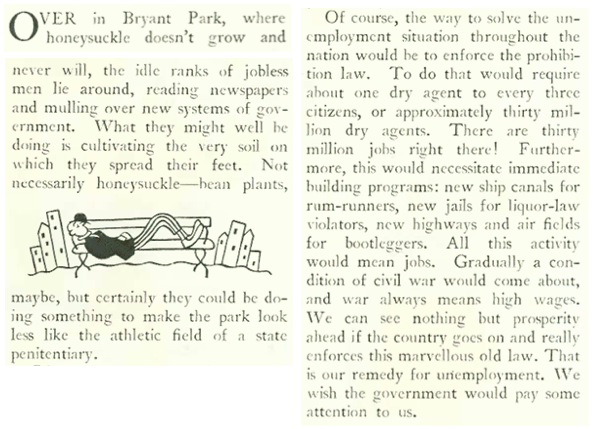
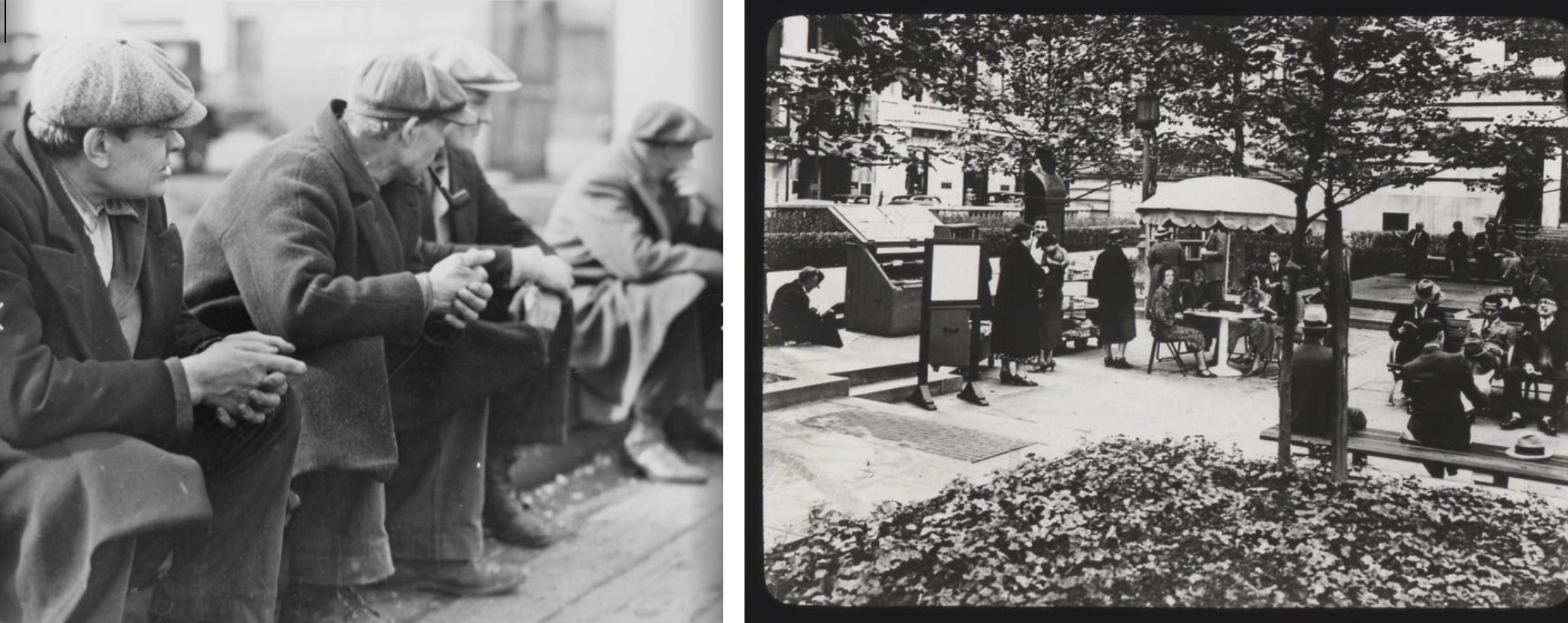
We are nearly five months into the Great Depression, yet there is little evidence in The New Yorker of the catastrophe that was unfolding across the land. And true to form, the approach to the topic was made with humor, via E.B. White in “Notes and Comment”…
KNOW ANY GOOD JOKES?…At left, unemployed New York dockworkers; at right, folks enjoying the New York Public Library’s outdoor reading room in Bryant Park, 1930s. (Lewis Hine/National Archives and Records Administration/New York Public Library)
* * *
Cathedrals of Commerce
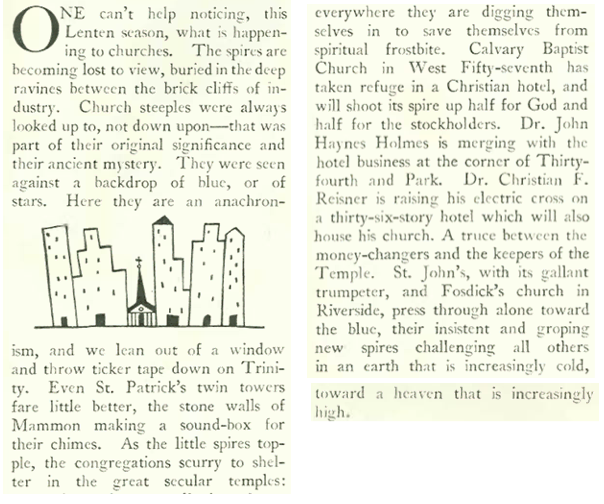
E.B. White also observed the changing skyline, and how the towering skyscrapers were quickly overshadowing the once prominent steeples of the city’s churches…
REACHING TO THE HEAVENS…Clockwise, from top left, Trinity Church Wall Street and St. Patrick’s have been eclipsed by the towers of Mammon, but St. John’s and Riverside still dominate their surroundings. (Wikipedia/St. John’s/Riverside)
* * *
The Other House of Worship
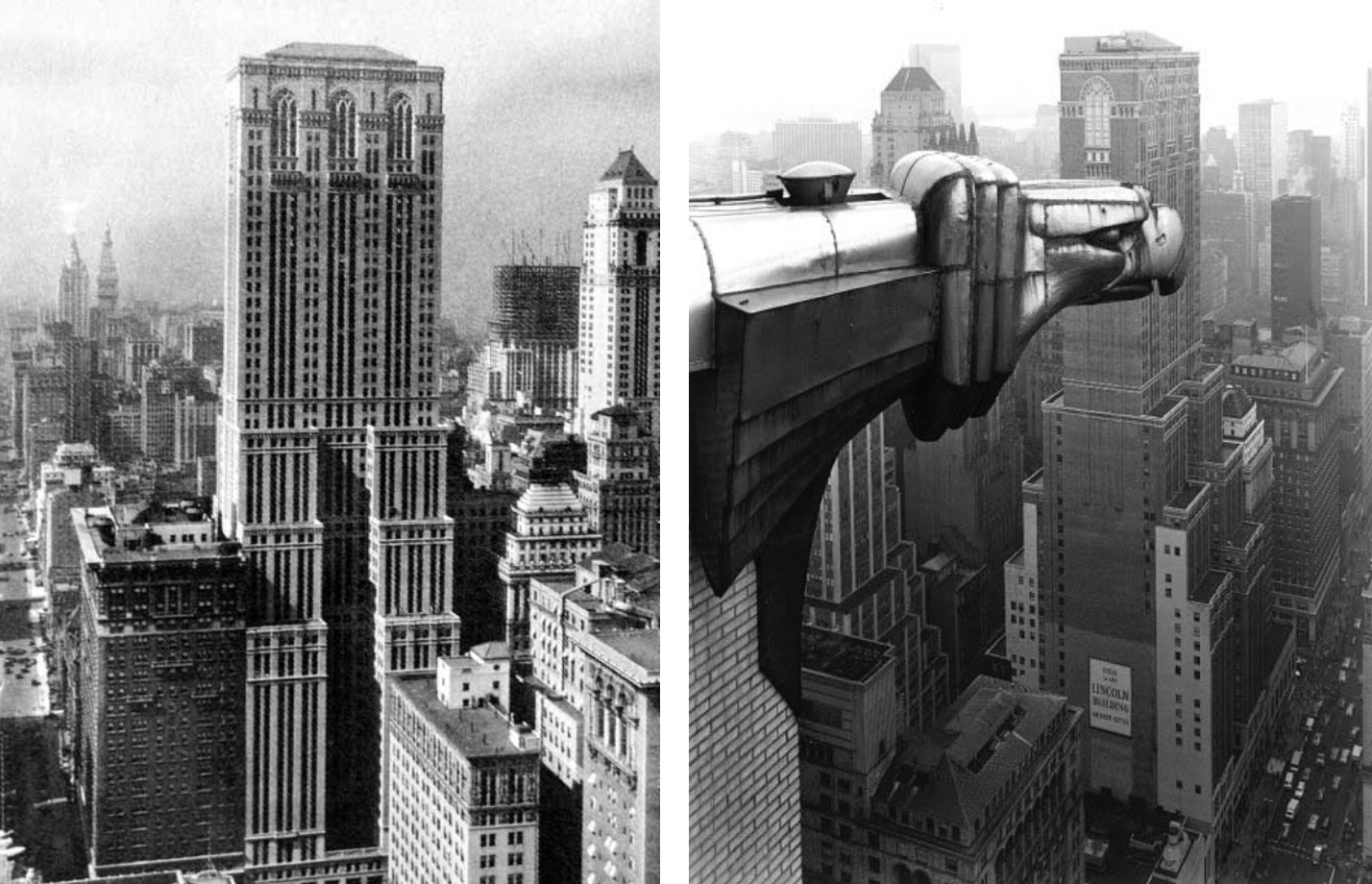
Perhaps a certain skyscraper ennui settled in, as architecture critic George S. Chappell was not all that impressed by the “huge” Lincoln Building (which today still seems huge)…
SIZE DOESN’T MATTER…Although the new Lincoln Building proved to be a massive addition to the New York skyline, its style seemed outdated in contrast to its flashy new neighbor, the Chrysler Building — one of its gargoyles, at right, seems poised to devour the Lincoln Building. (nyc-architecture.com)
* * *
From Our Advertisers
We have a bit more evidence of the Depression in the ads, including this one from Abercrombie & Fitch, with two sporting gents opting to go fishing to take their minds off the markets…
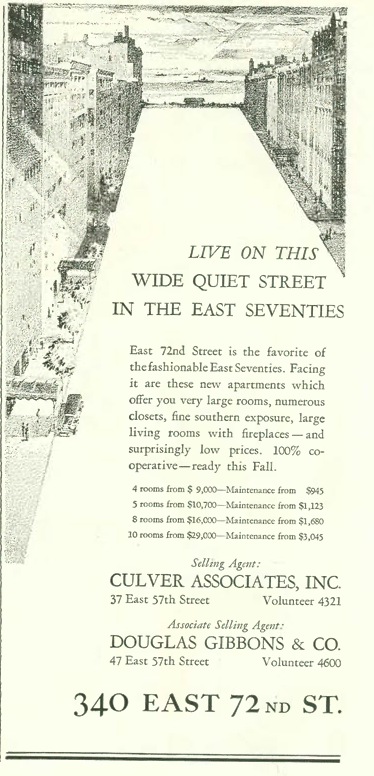
…if fishing wasn’t your thing, perhaps you just wanted to escape into the “quiet” of the wide streets in the East Seventies…
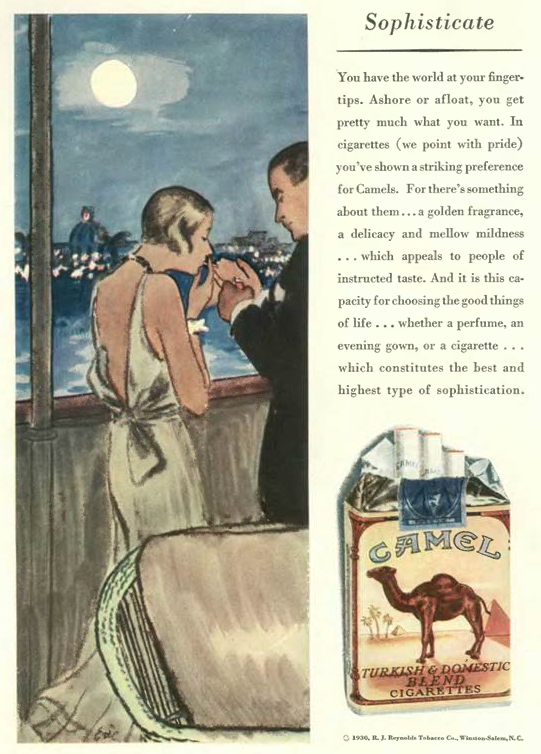
…or relax with a smoke, which artist Carl Erickson made so appealing with his Camel ad illustrations…
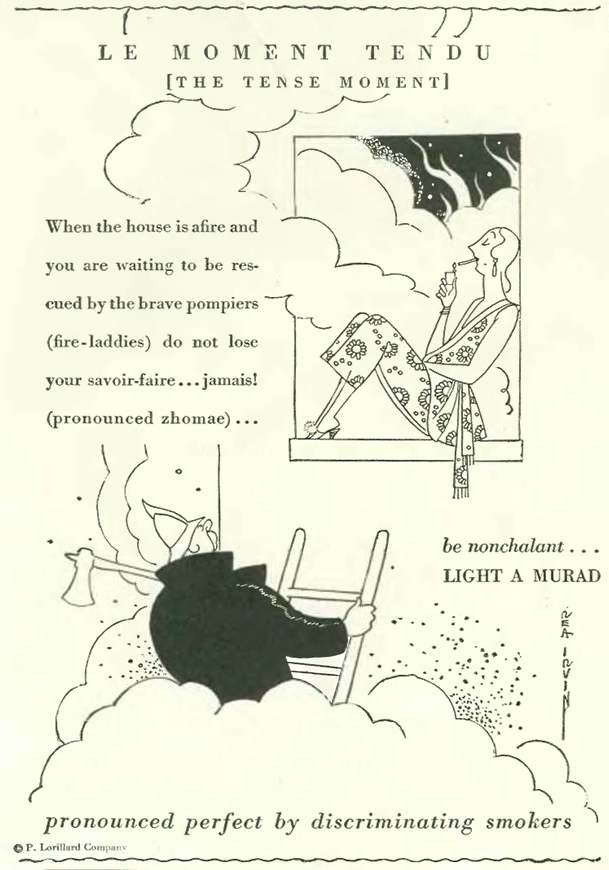
…or take the humorous route to a relaxing smoke, with this ad for Murad as illustrated by Rea Irvin…
…on to our cartoonists, Garrett Price captured the mood of the times…
…while Alfred Krakusin captured an altogether different mood…
...Leonard Dove examined the path to stardom…
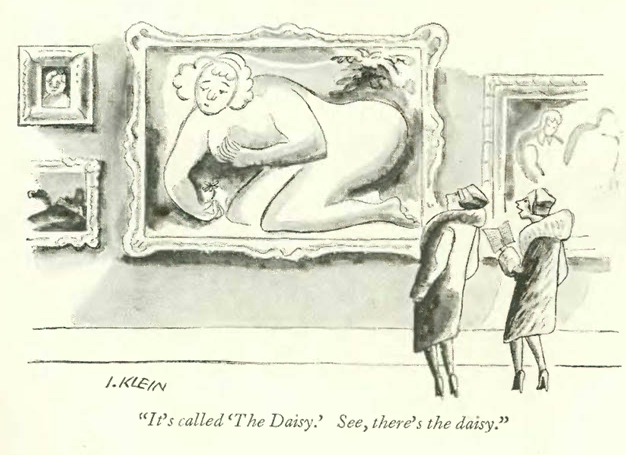
…Isadore Klein pondered modern art…
…William Crawford Galbraith found an unlikely victim of religious zeal…
…Mary Petty gave us a glimpse of a doctor’s office…
As Ernest Hemingway and F. Scott Fitzgerald spoke to the “Lost Generation” of writers and artists in the 1920s, John Dos Passos (1896-1970) drew upon the ethos of that period to usher in a new style of writing for the 1930s — modern, experimental, and deeply pessimistic.
March 8, 1930 cover by Ilonka Karasz.
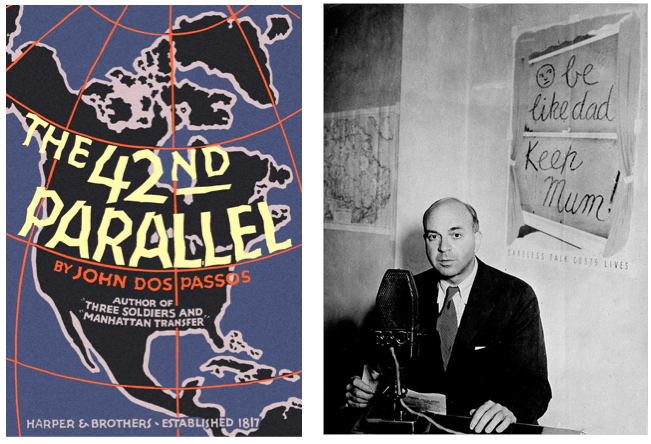
Dos Passos’ book The 42nd Parallel would be the first of three books from 1930 to 1936 that would comprise his landmark U.S.A. Trilogy. The book critic for the New Yorker (identified as “A.W.S.”) sensed that this work of avant-garde historical fiction represented a significant marker in the modernist movement, likening it to the work of the great 20th century composer Igor Stravinsky:
A WRITER FOR DEPRESSING TIMES…The 42nd Parallel was the first book in a trilogy published by John Dos Passos between 1930 and 1936. At right, Dos Passos in the early 1940s. (22.hc.com/hilobrow.com)
Dos Passos also painted throughout his life, nearly 600 canvases including this early work from his days in Spain in the 1920s…
John Dos Passos’ watercolor painting of the the Spanish countryside, circa 1922. A modernist writer, Dos Passos also painted in the style of the avant-garde. His nearly 600 paintings throughout his lifetime show influences of Impressionism, Expressionism and Cubism. (johndospassos.com)
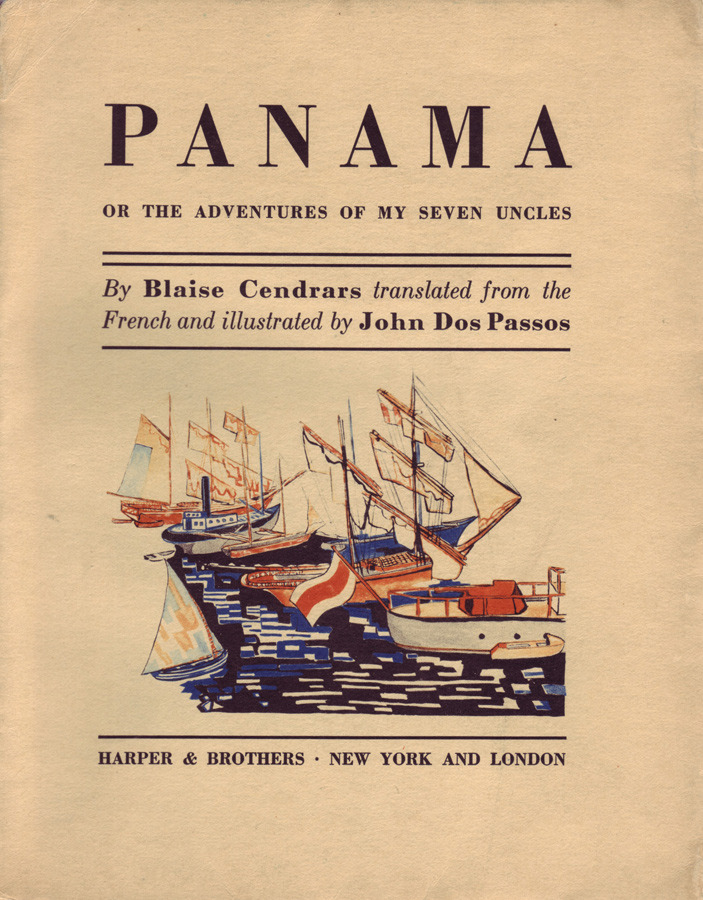
…and he joined his literary and artistic talents in 1931 when he translated and illustrated Blaise Cendrars’ long poem Le Panama et Mes Sept Oncles. Dos Passos became good friends with Cendrars, and in the book’s foreword acknowledged his debt as a writer to the French poet…
(johndospassos.com)
* * *
Don Could Also Write And Draw
Like Dos Passos, Don Herold (1889-1966) could express himself through both words and pictures, albeit in a much less serious vein. In the March 8 issue Herold wrote about the indignity of having to disrobe for a medical examination. An excerpt:
Also an illustrator and cartoonist, Herold made his debut in The New Yorker with this cartoon in the June 1, 1929 issue:
Herold began working as an illustrator around 1910, and enjoyed a long career with a number of publications, including the humor magazine Judge:
* * *
Measuring Up
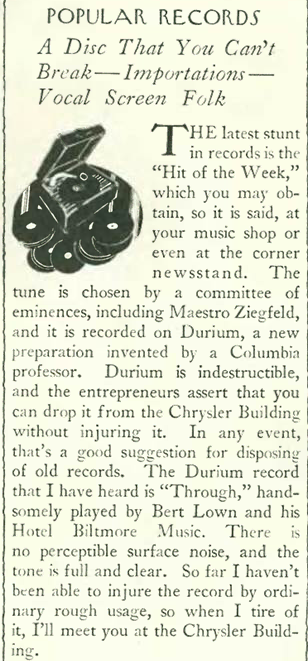
When the Chrysler Building was completed in May 1930, it officially became the world’s tallest building (a record it ceded 11 months later to the Empire State Building). Being the tallest gave the building the distinction of being something to be measured against, including the durability of a musical recording pressed into a material called “Durium”…
…and when advertisers were in need of something large for comparison, they also turned to the new skyscraper to drive home their selling point…
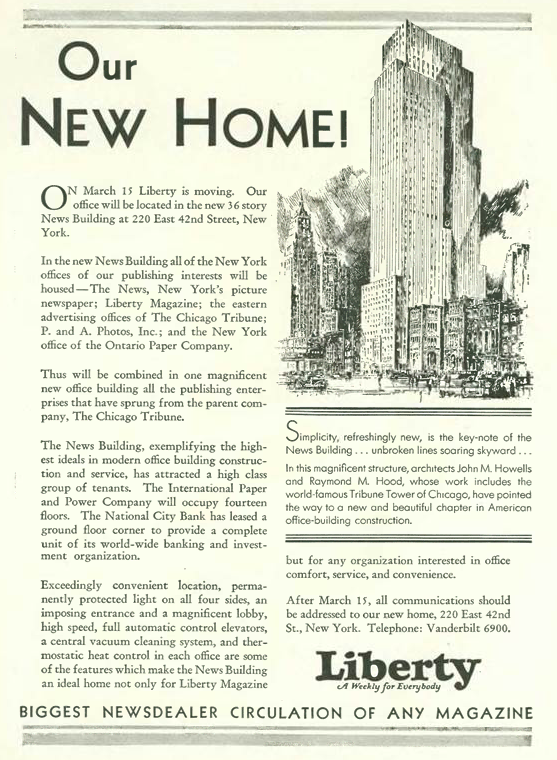
…new skyscrapers also were used to lend distinction to their tenants, such as Liberty Magazine in the new Daily News Building…
…below a 1940 postcard image of the Daily News Building, then known simply as “The News Building,” and a view of the lobby’s famous globe in 1941…
(Wikipedia)
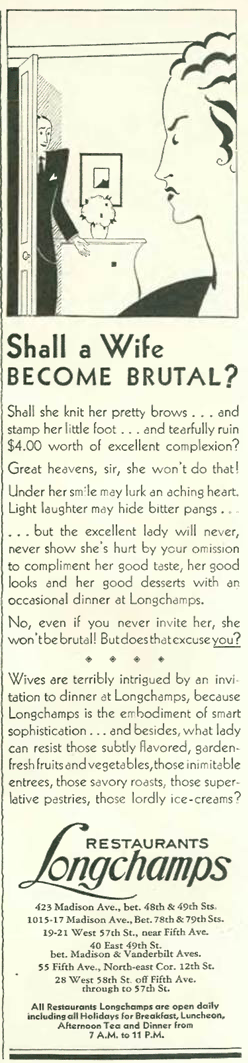
…on to the rest of our ads, here’s a baldly misogynistic one from Longchamps restaurants…
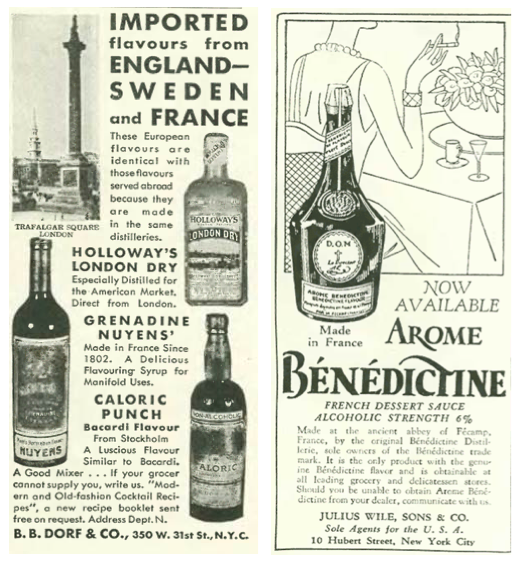
…and as Prohibition wore on into the Thirties, we have sad little back page ads for cocktail “flavours” and Benedictine “Dessert Sauce”…
…on to our cartoons, Gardner Rea explored the subject of family planning…
…Art Young illustrated the perils of modern art…
…Otto Soglow took a stroll with a somnambulist…
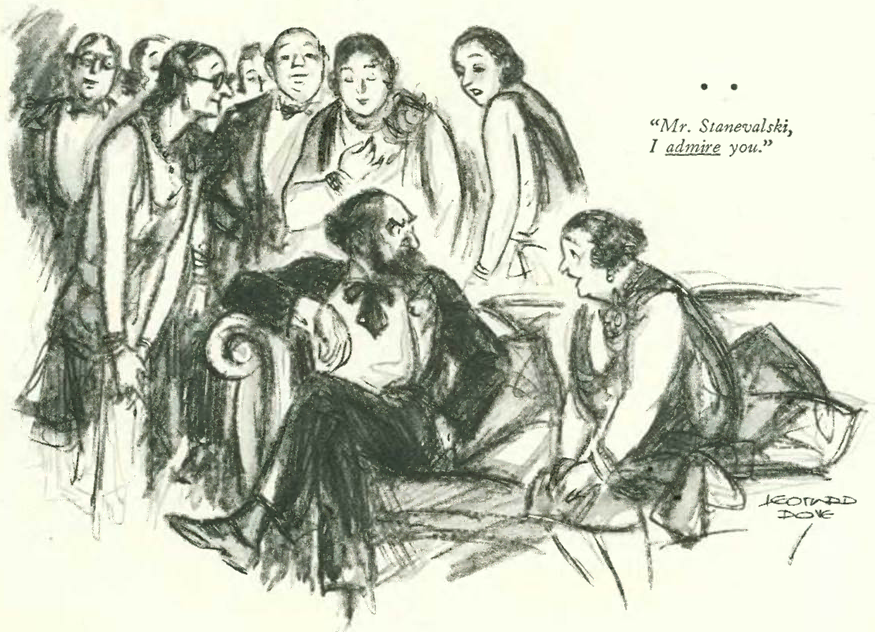
…Leonard Dove inked this awkward moment between the Old and New Worlds…
A host of nature programs from Mutual of Omaha’s Wild Kingdom to Planet Earth owe their origins to a few intrepid filmmakers who 100 years ago gave Americans some of their first glimpses of life in exotic, remote regions of the world.
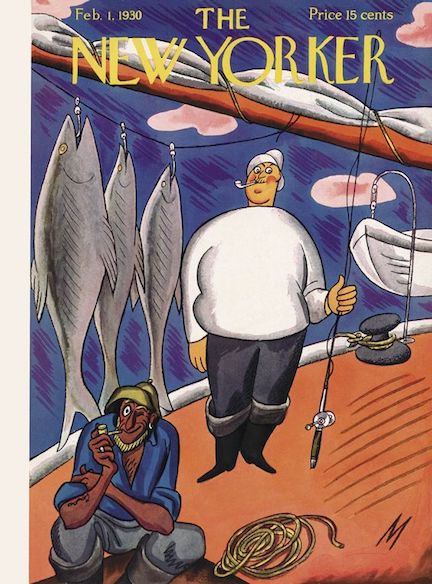
Feb. 1, 1930 cover by Julian De Miskey.
Among the first to do it were a couple from Kansas, Osa and Martin Johnson, who together explored unknown lands and brought back footage of the wildlife and peoples of the African continent, the South Pacific Islands and British North Borneo. Their first film, Among the Cannibal Isles of the South Seas (1918), was followed by several more, including Across the World with Mr. and Mrs. Johnson, which was released in early 1930.
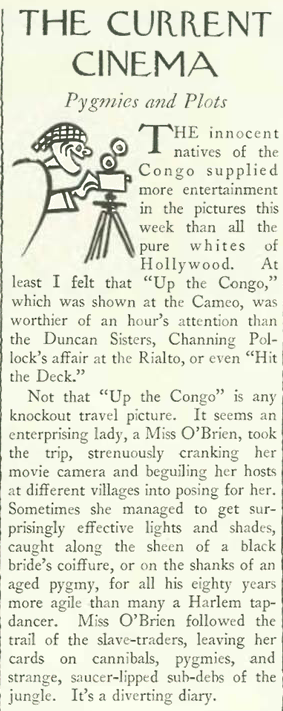
The New Yorker film critic John Mosher was as eager as any audience to take in the adventures of the Johnsons, or even of someone who was inspired by the Johnsons, in this case a “Miss O’Brien” who had just released a “diverting diary” called Up the Congo. Mosher wrote about it in the Jan. 25 issue:
CONTACT…Image of a family from an unidentified Pygmy tribe posing with a European explorer in a 1921 Collier’s New Encyclopedia entry; a group of Mbuti posing with explorer Osa Johnson in 1930. (Wikipedia)
I can find no record of the film UptheCongo, however the exploits of the Johnsons are well documented thanks to the Martin and Osa Johnson Safari Museum in Chanute, Kansas, which has a treasure trove of photos and other information on the explorers.
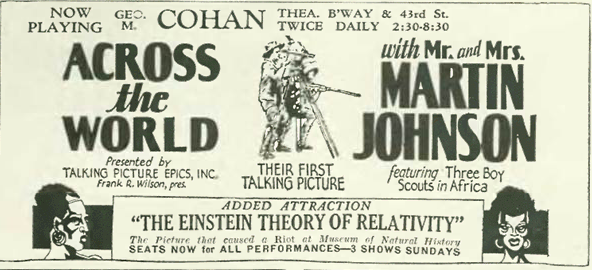
The ad in the Feb. 1, 1930 New Yorker promoting Across the World with Mr. and Mrs. Johnson included an interesting “added attraction”…a film about Einstein’s theory of relativity that had caused a Jan. 8 “riot” at the American Museum of Natural History. That particular screening was intended for members of the Amateur Astronomers Association, but word got out and three times the invited number showed up at the museum, breaking down the lobby gates. Hard to imagine a mob today clamoring to view a science film…
Although the Johnsons made their movies under the auspices of the American Museum of Natural History, much of the footage was staged or edited to maximize the thrills (Mutual of Omaha’s Wild Kingdom did this in the 1960s and 70s, as did producers of Disney’s nature films from the 50s and 60s. The practice continues to this day on cable television).
The Johnsons also didn’t hesitate to gun down animals in the course of their movie-making…
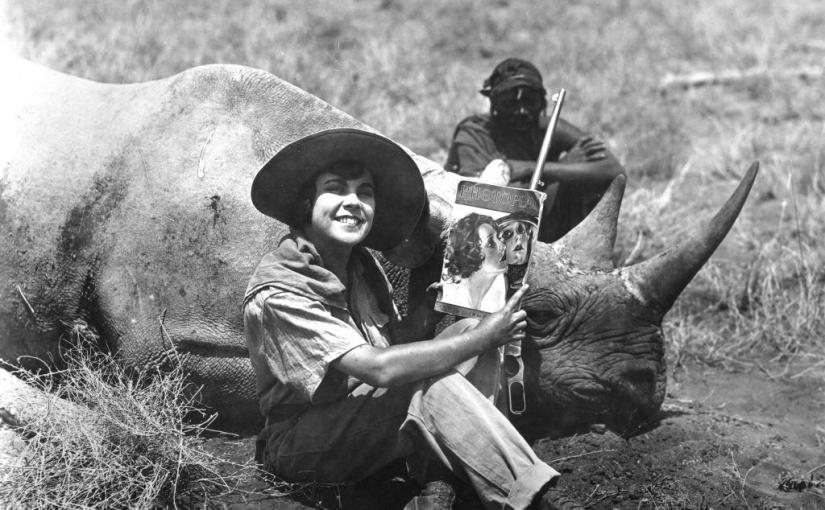
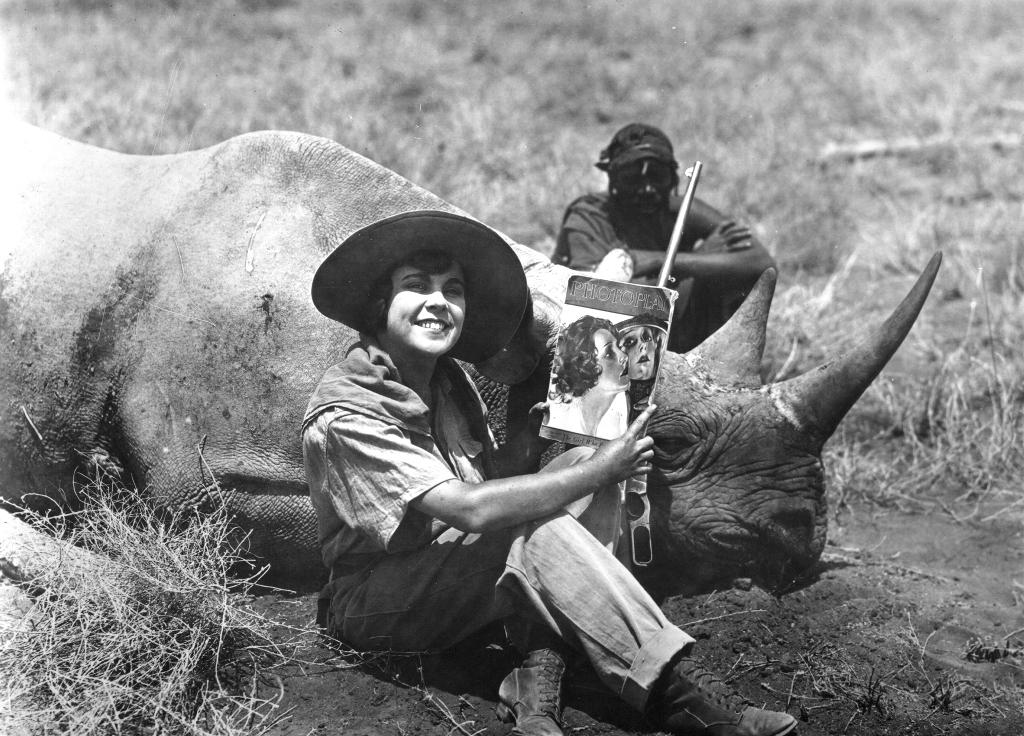
YEP, THAT’S JUXTAPOSITION…Osa Johnson poses with a Photoplay magazine, a dead rhino, and a tribesman, circa 1930. (columbia.edu)
According to a 2011 review from Wild Film History, “in stark contrast to the conservation-themed wildlife films of today, the Johnsons approached their subjects armed with both camera and rifle, with the production including provoked behaviour, staged confrontations and animals shot to death on film. Relying heavily on cutting in kills from professional marksmen, numerous hunting scenes culminate in a heart-stopping sequence where, with the use of clever editing, the adventurous Mrs Johnson appears to bring down a charging rhinoceros with one well-aimed shot.”
Across the World with Mr. and Mrs. Johnson is presented as if the Johnsons were showing their film to a few friends in their New York City apartment. The film is a “silent with sound,” that is, scenes in the field are silent, but the cocktail party “home movie” opening has sound, including “mood music” Osa provides by turning on the radio as the film begins. For all of their film experience, the acting between Osa and Martin is wooden, as is Martin’s narration. The critic John Mosher, however, enjoyed the ride, writing in his Feb. 1 column:
If you are curious, you can watch some of the film here, including the opening home movie scene with Osa and Martin in cocktail attire…
* * *
My Kinda Town
TheNew Yorker occasionally enjoyed taking potshots at the Second City, as well as some good-natured jabs at a few of its former residents who were also denizens of the Algonquin Round Table. Here is E.B. White in the Feb. 1 “Notes and Comment”…
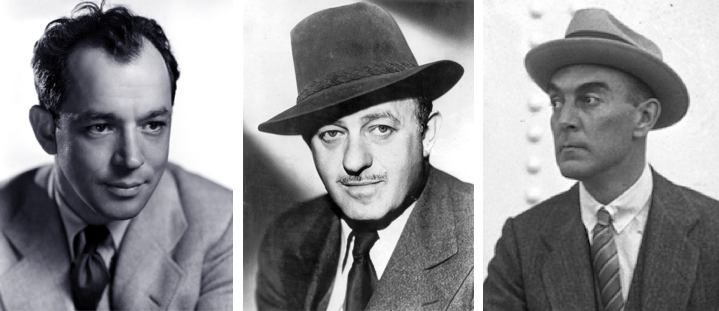
WINDY WITS…Chicagoans Charles MacArthur, Ben Hecht and Ring Lardner were well-known to The New Yorker crowd. (Wikipedia)
* * *
Not In This Century
This item from the Feb. 1 “Talk of the Town” is noteworthy for placing its admiration of technical achievement over any concerns for a child’s welfare. Today the couple would be arrested for this…
* * *
ThePerilsofAging
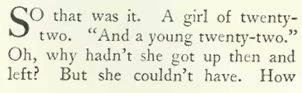
Irish-American actress and writer Patricia Collinge (1892-1974) wrote a series of short stories for The NewYorker, including this piece for the Feb. 1 issue written when she was 37 years old. It is a sad story about an older actress (37) who hoped to land the part of a younger woman. Some excerpts…
…the actress in the story is led to believe the part was intended for a woman of 28, and is crushed to learn that the agent was looking for “a young twenty-two”…
OH TO BE YOUNG…At left, Gladys Cooper, Alexandra Carlisle and 20-year-old Patricia Collinge in the Drury Lane production of Everywoman (1912); at right, Collinge in 1941. Unlike the sad actress in her short story, Collinge’s career spanned more than 60 years. (Wikipedia)
* * *
ComingAround
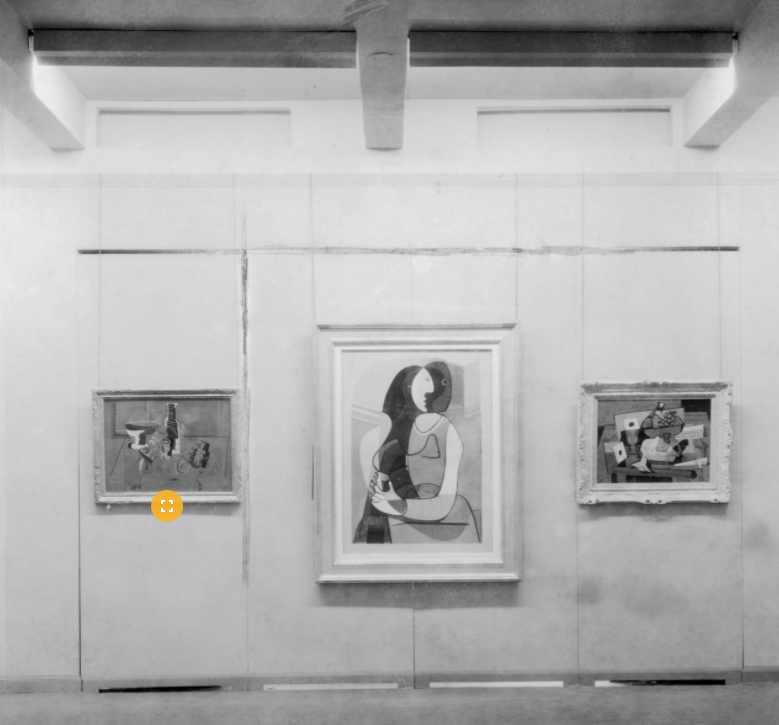
In previous issues art critic MurdockPemberton expressed skepticism about the new Museum of Modern of Art, founded by wealthy society women in November 1929. Pemberton held egalitarian views about art, and wondered if the old money set could create a venue for true modern artists. His review of “Painting in Paris,” MoMA’s third exhibition, seemed to allay his concerns…
PAINTING IN PARIS was the title of the Museum of Modern Art’s third exhibition featuring works by Georges Braque, Georges Rouault, Pablo Picasso, Joan Miró, Marc Chagall, Robert Delauney, Fernand Leger, Henri Matisse and Andre Derain among others. Image above is from the original exhibition at MOMA’s first home in the Heckscher Building at 730 Fifth Avenue. (MOMA)
Images above in color, from left, Pablo Picasso’sGreen Still Life Avignon (1914) and Seated Woman (1927); Georges Braque’sStill life (1927). (MOMA/WikiArt)
Pemberton expressed enthusiasm for the show’s new works that contained few traces of the familiar…
* * *
The King’s Speech
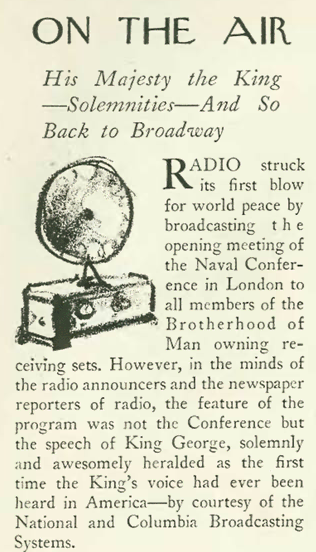
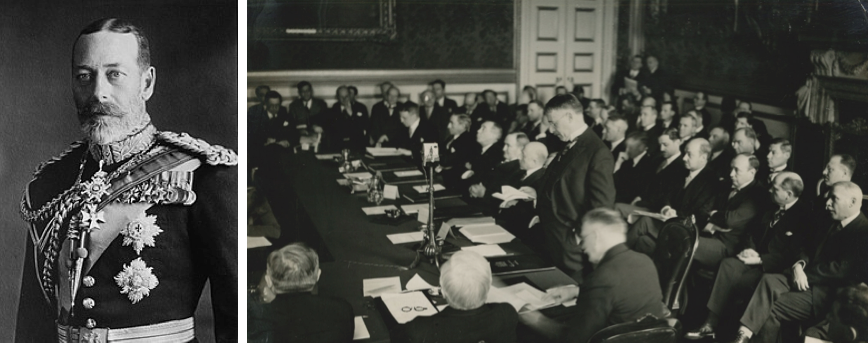
KingGeorgeV was not known for his public speaking, but when he addressed the third meeting of the London Naval Conference it was a big deal, even to American listeners who for the first time heard his voice over broadcast radio, still a very new medium in 1930…
ON THE AIR…The voice of King George V (pictured here in 1923) was broadcast across the Atlantic for the opening of the London Naval Conference at St. James’s Palace in 1930. The third in a series of five meetings, the conference was formed with the purpose of placing limits on the naval capacity of the world’s largest naval powers. (Wikipedia/Churchill Archives Centre)
* * *
Good Clean Fun?
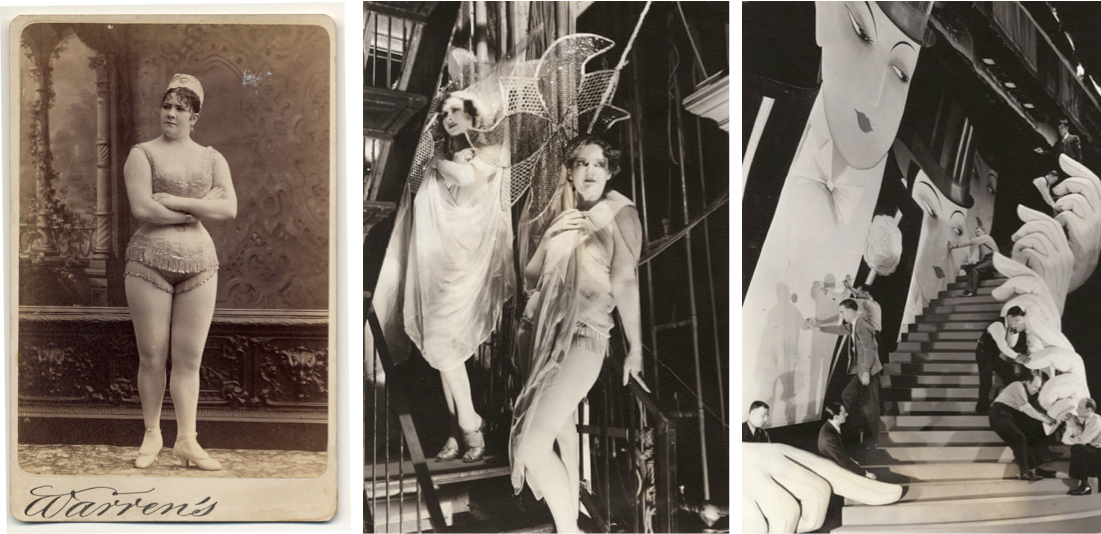
In his theater review column, RobertBenchley lamented the state of burlesque shows at the National Winter Garden, where “leviathans of an earlier day” were being displaced by “agile wisps” in third-rate Broadway productions…
ON THE SHOULDERS OF GIANTS…from left, Viola Clifton, a fuller-figured 1890s burlesque dancer; center and right, Margaret Bourke-White photos from Minsky’s National Winter Garden, 1936. Theater critic Robert Benchley wrote that he missed the “leviathans” of an earlier age, who were replaced by girls who were nothing but “agile wisps.”(mashable.com/theguardian.com)
* * *
From Our Advertisers
Just a couple of ads from the Feb. 1 issue, including this entry from the Shelton Looms offering advice on how one should appear among the Havana social set…
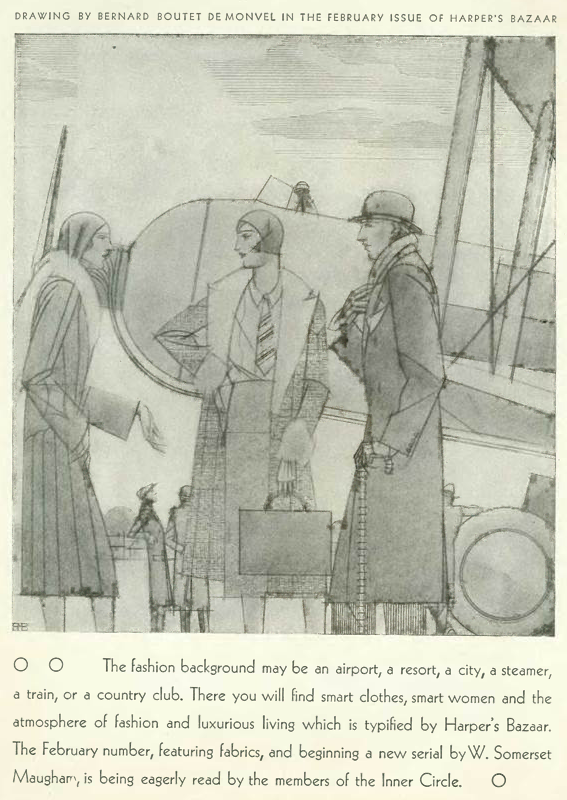
…and this ad from Harper’s Bazaar, also appealing to the smart set…
…our cartoons include this two-page illustration by ReaIrvin…
…AlanDunn’s look into the challenges of running a power plant…
…at the opera with PerryBarlow…
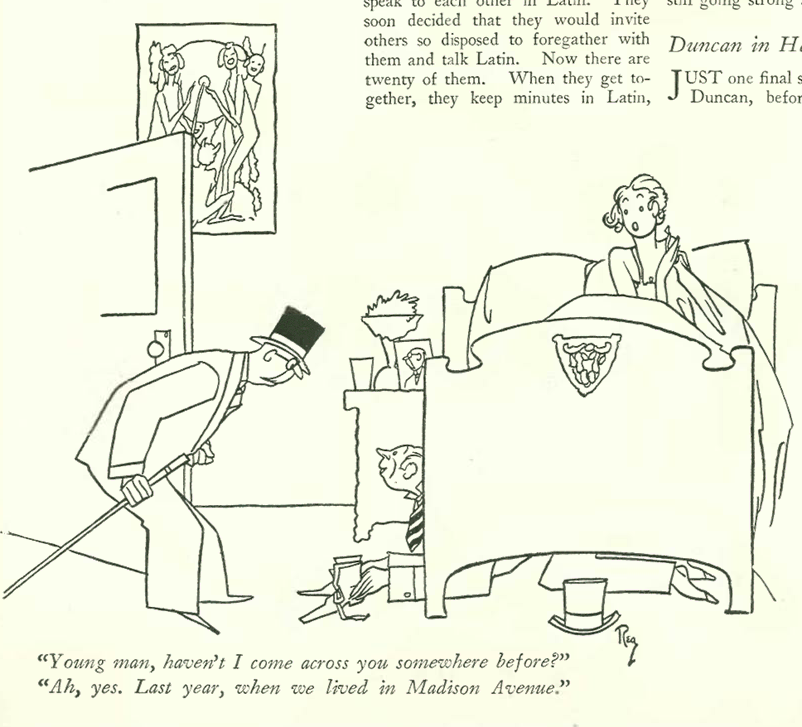
…GardnerRea and some bedroom hinjinks…
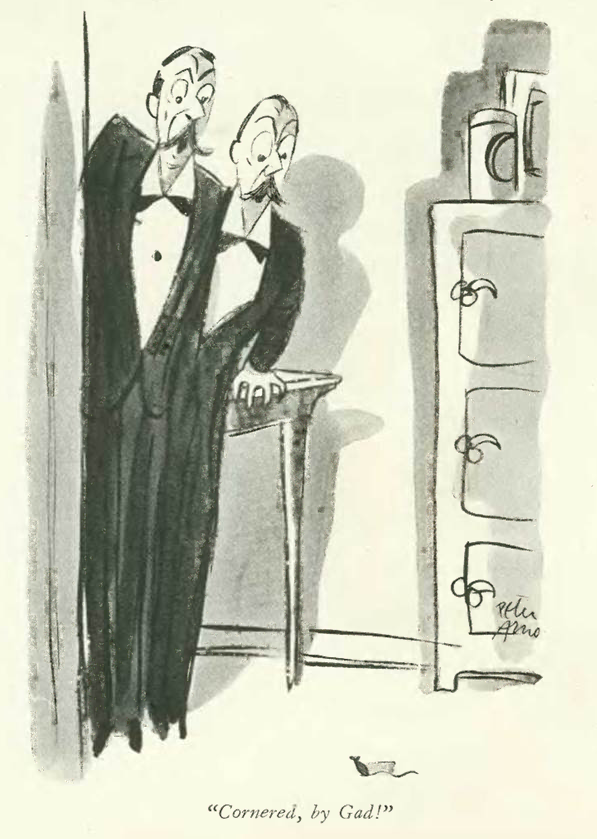
…man vs. mouse, by PeterArno…
…and this by LeonardDove, seemingly anticipating the work of CharlesAddams…
Two weeks had passed since the “Black Tuesday” collapse of share prices on the New York Stock Exchange, but the New Yorker went about business as usual, E.B. White opening his “Notes and Comment” with a complaint — not about the economy — but about a marketing ploy that had New York University shilling magazines on behalf of Funk & Wagnalls.
Nov. 16, 1929 cover by Peter Arno. No doubt Arno drew inspiration from his own domestic situation (with wife and New Yorker columnist Lois Long and their infant daughter Patricia Arno).
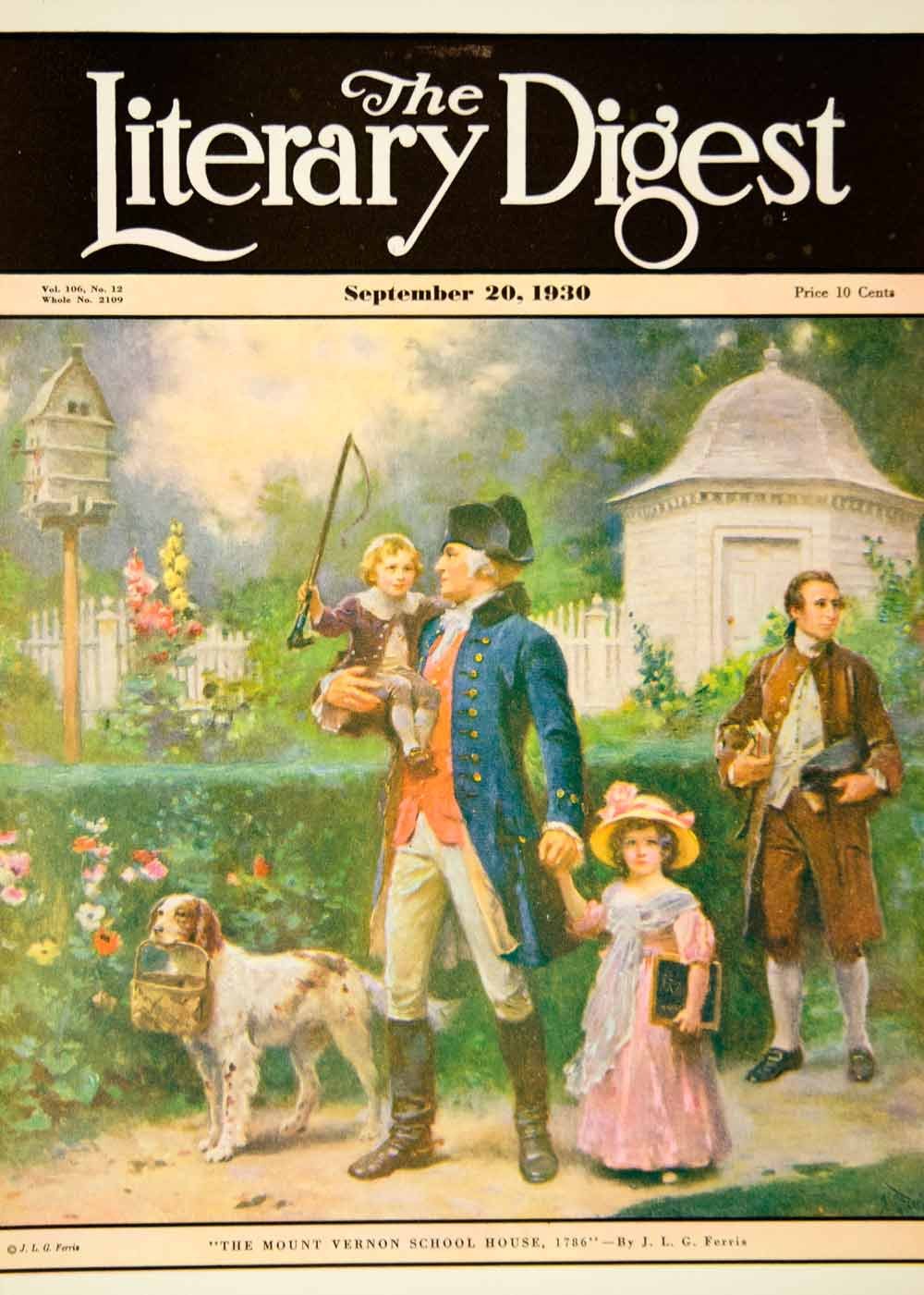
White mocked the contents of a letter from NYU that promised a “free” education to subscribers of Funk & Wagnalls’ middlebrow Literary Digest.
EASY-CHAIR EDUCATION…Founded in 1890 by Isaac Funk (of Funk & Wagnalls fame), the Literary Digest offered readers condensed articles from various American and European publications. The weekly magazine surpassed the one million circulation mark in 1927, but declined precipitously in 1936 after its famed (and usually reliable) presidential poll picked Alf Landon over FDR. It folded in 1938. (Pinterest)
White detailed how NYU’s director of public information promised untold riches to potential Literary Digest subscribers…
YOU CAN BE FAMOUS, FOR JUST PENNIES A DAY…E.B. White mocked an NYU letter that promoted its “hook-up” with the Literary Digest, wryly suggesting that recognition in NYU’s Hall of Fame for Great Americans was within reach of magazine subscribers. The photo above (circa 1935) shows the Hall of Fame’s colonnade, which half-encircled the university library (both designed by Stanford White) and housed 98 bronze busts. A financially strapped NYU sold its University Heights Campus, along with the Hall of Fame and library, to the City University of New York in 1973. (WPA photo via boweryboyshistory.com)
…and the not so subtle revelation that the “free” education came with a price:
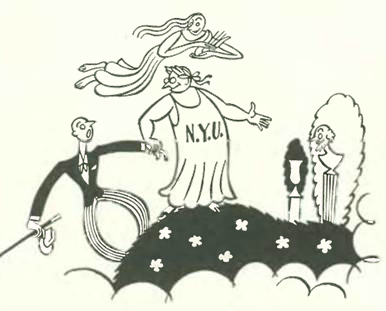
Here’s Julian De Miskey’s illustration that accompanied White’s “Notes”…
* * *
The Lighter Side of Bankruptcy
Evidence of the recent stock market crash was scant in the Nov. 16 issue, save for this blurb from Howard Brubaker…
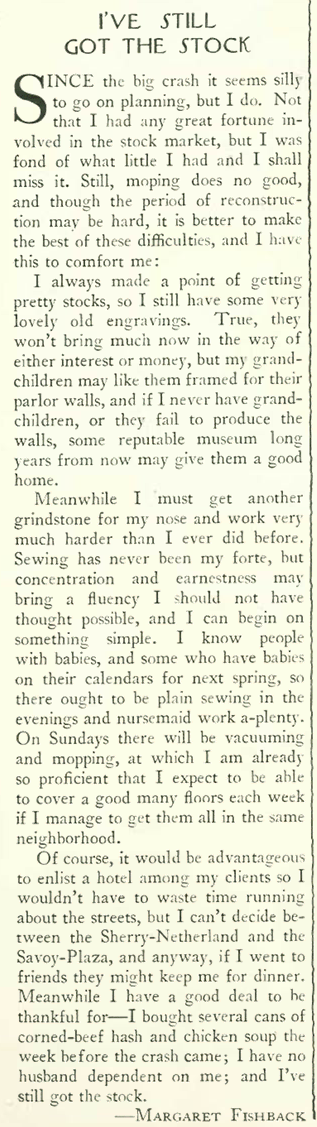
…and this short piece by Margaret Fishback, who took a characteristically lighthearted approach to the devastating news:
Fishback (1900-1985), a widely published poet and prose author from the late 1920s to the 1960s, was also a successful advertising copywriter for Macy’s and a number of other companies.
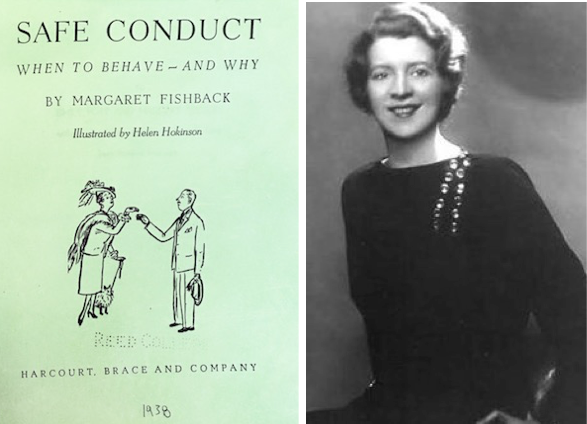
A WAY WITH WORDS…Margaret Fishback wrote a number of poetry and prose books, including Safe Conduct: When to Behave–and Why, a book of etiquette illustrated by The New Yorker’sHelen Hokinson. During the 1930s Fishback was reputed to be the world’s highest-paid female advertising copywriter. (necessaryfiction.com/Wikipedia)
* * *
We Stand Corrected
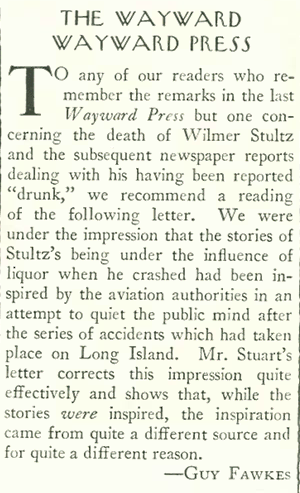
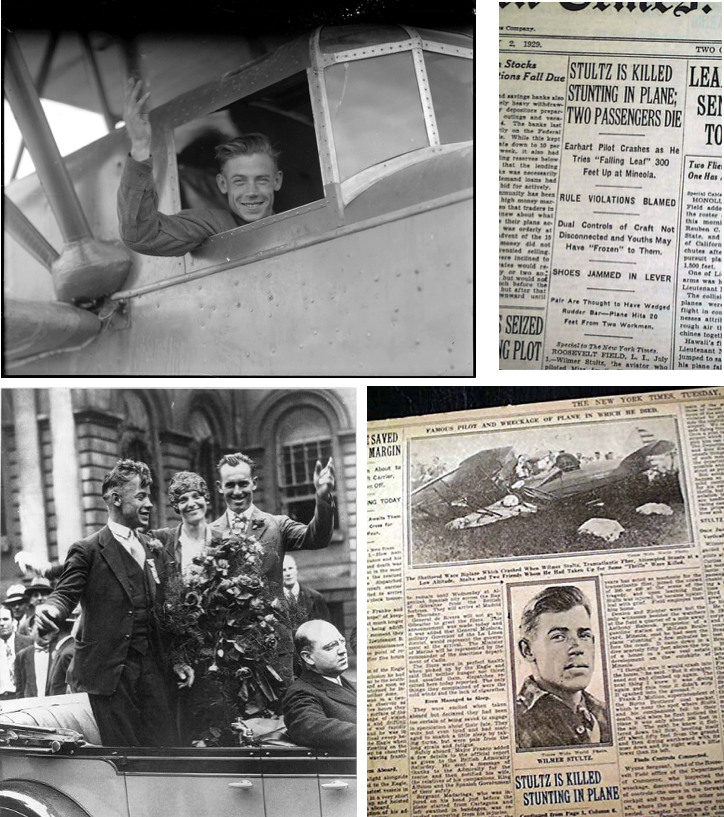
A correction of sorts was offered by Robert Benchley (aka “Guy Fawkes”) regarding one of his recent “Wayward Press” columns, in which the fatal crash of famed aviator Wilmer Stultz’s stunt plane was misattributed to drunkenness:
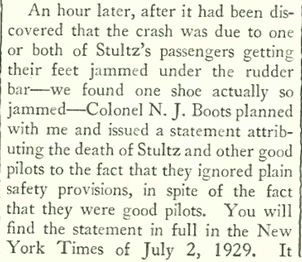
Following the above intro, Benchley included this letter from a representative of the Roosevelt Flying Corporation, John McK. Stuart, in which Stuart explained the real reason for the pilot’s fatal crash, and the source of a vicious rumor:
The cause of the crash, as reported in The New York Times, was attributed to two young men who begged for a ride on Stultz’s stunt plane, a Waco Taperwing, in the early afternoon of July 1, 1929. An investigation of the wreckage found shoes from both passengers jammed under a bar connected to the rudder, rendering it inoperable. In his letter, Stuart explained:
Apparently Stultz’s passengers had braced themselves during stunt maneuvers by jamming their feet under the rudder bar. According to the Times, after a couple of rolling stunts the plane began to climb again from about 200 feet when it rotated nose down and plunged into the ground. Both passengers were killed instantly. Stultz died shortly thereafter at a Long Island hospital.
BRIEF FLIGHT THROUGH LIFE…Clockwise, from top left, Wilmer Stultz (1900-1929) in undated photo; coverage of the fatal crash in the July 2, 1929 New York Times; Stultz, Amelia Earhart, and Lou Gordon feted in front of City Hall, New York City, following their successful flight across the Atlantic in June 1928. Stultz was the pilot of the Fokker Trimotor “Friendship,” aboard which Earhart became the first woman passenger to cross the Atlantic by airplane. Gordon served as the flight’s on-board mechanic. (Boston Public Library/New York Times/Amazon)
* * *
Cowardly Attack
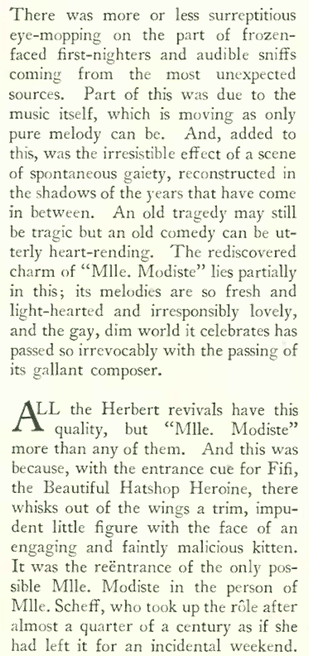
The acclaimed English playwright and composer Noël Coward was much beloved by The New Yorker, so it pained Robert Benchley to write an unflattering review of Coward’s operetta, Bitter Sweet:
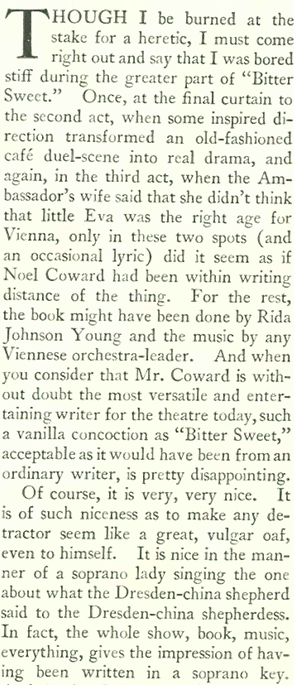
IN THE SOPRANO KEY…British musical star Evelyn Laye (1900-1996) played the leading role of Sari in Noël Coward’s Broadway production of Bitter Sweet. (From The Bygone)
* * *
Hat Shop Heroine
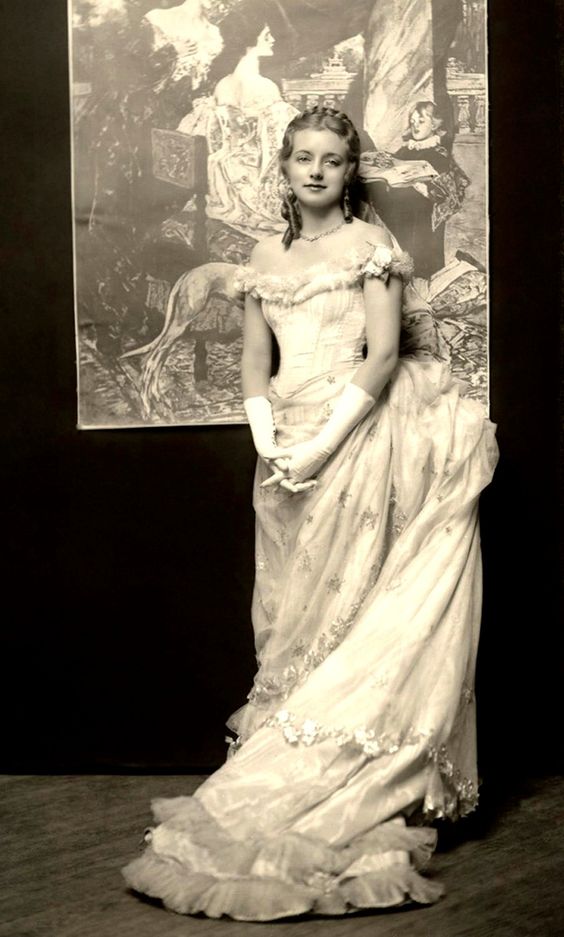
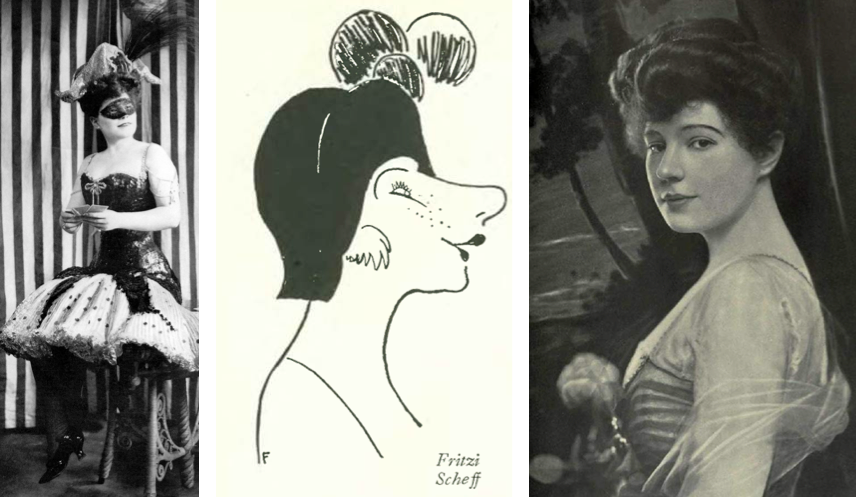
Another operetta — Mlle. Modiste — was getting a Broadway revival at Jolson’s 59th Street Theatre. Its star, Fritzi Scheff (1879-1954), was the subject of a short profile penned by Alison Smith. The operetta, written expressly for Scheff, premiered on Broadway in 1905 at the Knickerbocker Theatre, and enjoyed many revivals. Smith found that after nearly 25 years, Scheff still embodied the role of the hat shop girl who dreamed of being an opera singer. An excerpt:
From left, Fritzi Scheff in Mlle. Modiste (1905); Al Frueh’s caricature of Scheff for the profile; Scheff circa 1910. (Wikipedia/IMDB)
* * *
Best of Both Worlds
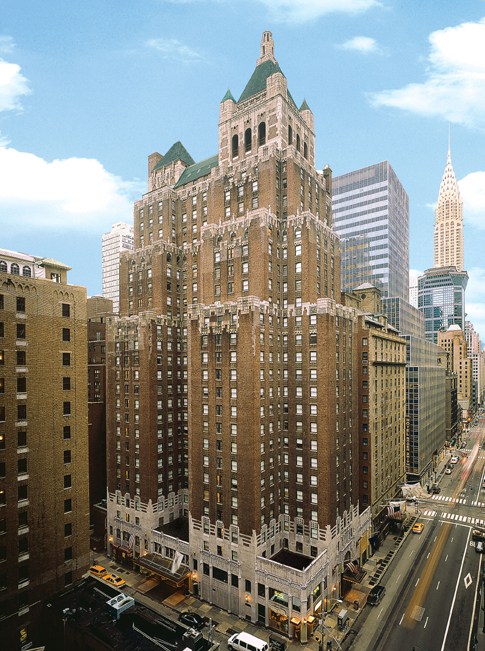
Although the Gothic style was quickly falling out of fashion in the age of Art Deco, architecture critic George S. Chappell found much to admire in Schultze & Weaver’s new Hotel Lexington, part of the hotel construction boom in New York’s Midtown:
STILL ATTACHED TO THE EARTH…The Lexington today, now a Marriott property, at 511 Lexington Avenue and 48th Street. (ohrllc.com)
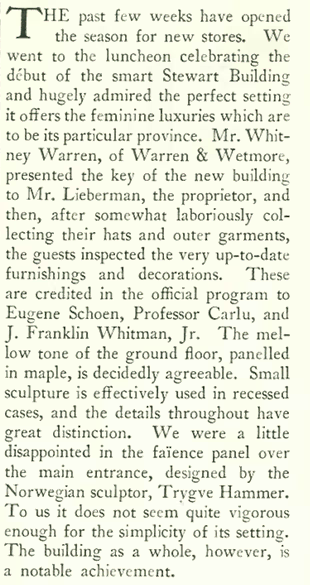
Chappell also admired the “smart” new Stewart Building, calling it the perfect setting for “feminine luxuries”…
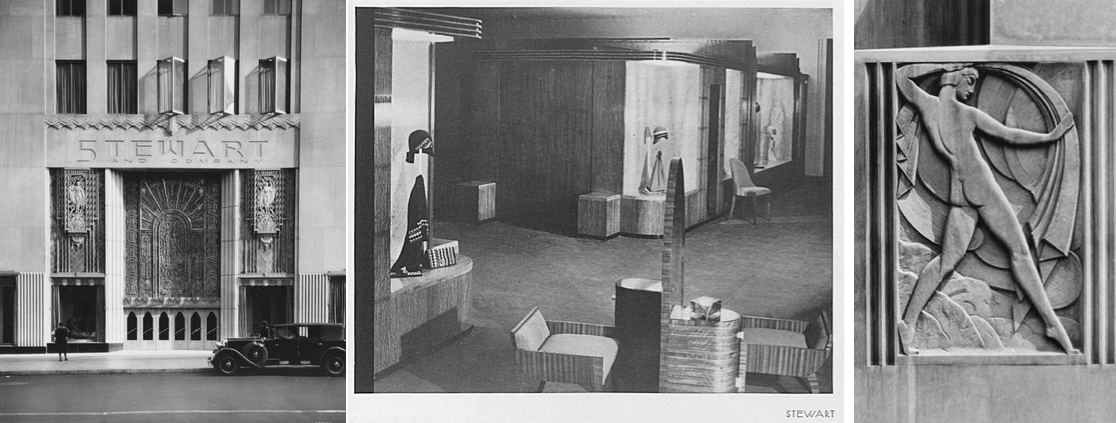
Sadly, the Stewart Company folded just months after the opening of its new building, an early victim of the Depression. Bonwit Teller took over the building in 1930 and stayed until 1979. It was demolished in 1980 to make way for Trump Tower.
BYGONE ELEGANCE…Stewart and Company’s metal and ceramic 5th Avenue entrance, detail, 1929; Stewart Millinery Shop, 1929 (image from Vogue); detail from ornamental frieze above the 8th story, 1929. The building was demolished in 1980 to make way for Trump Tower. Neither the frieze nor the ornate ironwork were saved. (Museum of the City of New York/Vogue via drivingfordeco.com)
* * *
A Survivor’s Tale
The New Yorker hailed Soviet writer Valentine Kataev’s debut novel, The Embezzlers, as “the first hearty and sane laugh that has been heard over the noise of Russian propaganda.” Published in 1926 and translated into English in 1929, the novel was a satire of bureaucracy in the new Soviet state. Remarkably, Kataev (1897-1986) was able to write challenging, satirical works throughout his long life and career without running afoul of Soviet authorities, or falling victim to Stalin’s terror campaigns:
SATIRICAL SOVIET…Valentine Kataev circa 1930. His 1926 debut novel, The Embezzlers, was a satire of Soviet bureaucracy. (russkiymir.ru)
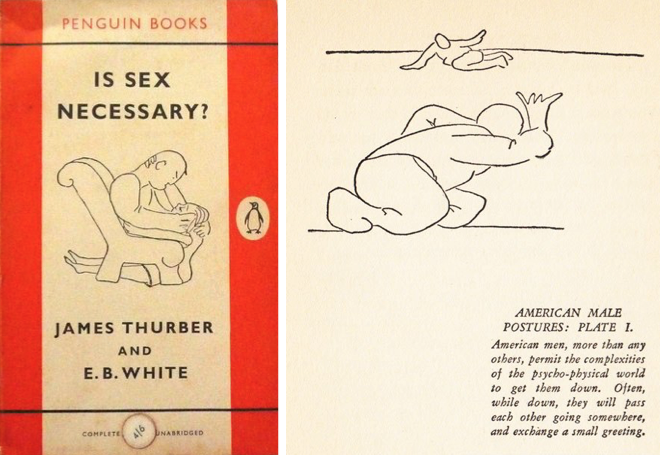
Another title receiving a favorable review, Is Sex Necessary? — a spoof of popular sex manuals and how-to books — was co-written by The New Yorker’sJames Thurber and E.B. White, with illustrations provided by Thurber.
HE CAN DRAW, TOO…Although James Thurber had yet to publish one of his drawings in The New Yorker, the book Is Sex Necessary? featured 42 of them, including the illustration at right that demonstrated the male greeting posture, and below, the posture of a man who could not discern the difference between love and passion. (brainpickings.org)
* * *
Old News
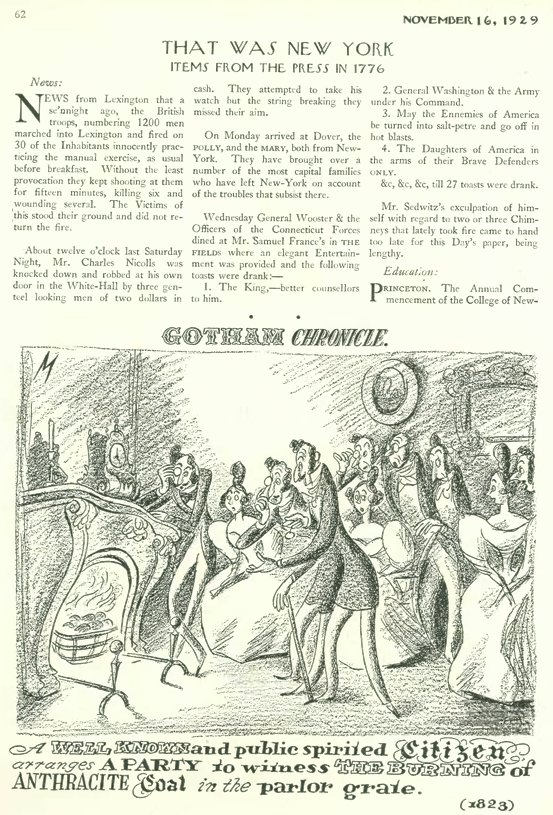
Writer (and later screenwriter) David Boehm temporarily took over the history column “That Was New York” from playwright Russell Crouse and contributed the first in a series of articles featuring clippings from 18th century newspapers (with illustration by Julian De Miskey):
* * *
From Our Advertisers
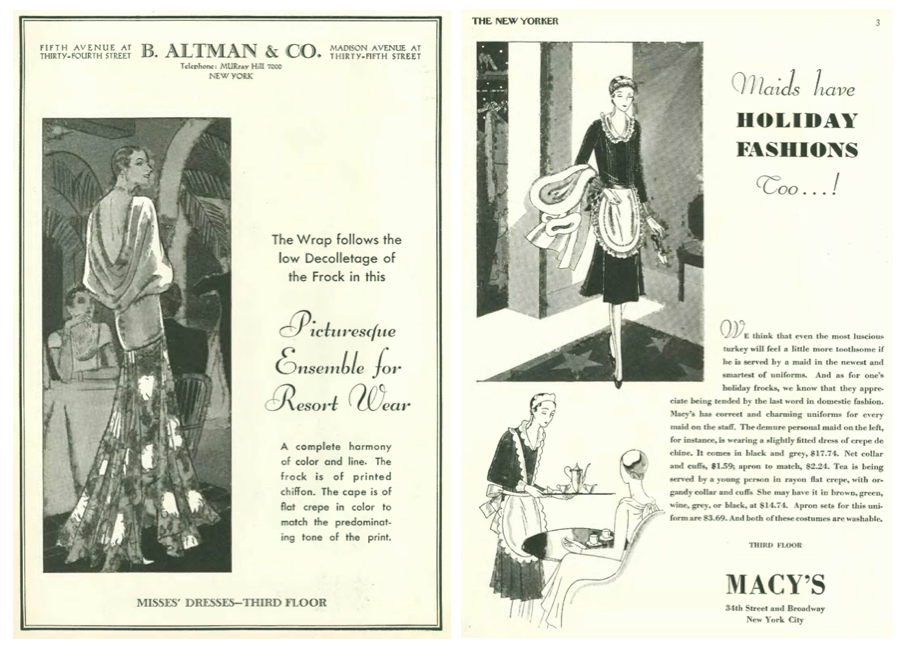
The Depression was coming, but you wouldn’t know it by the ads that appeared in the Nov. 16 issue, which featured the latest in resort wear, and holiday fashions for the maid…
…the Jay Thorpe store assumed some readers had $1,250 to spare for this coat and muff (equivalent to about $18,000 today), while Udall and Ballou jewelers offered a brooch for $9,000 (or nearly $130,000 today)…
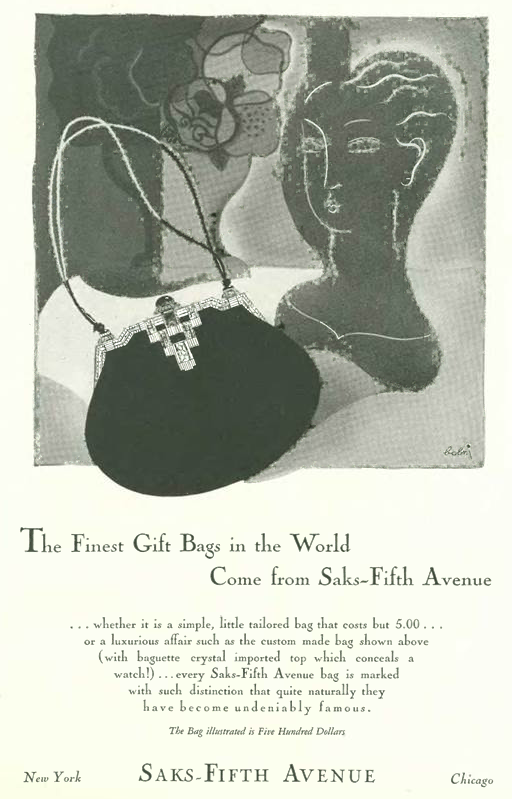
…Saks offered a “simple little tailored bag” for $5, although the one pictured in the ad would set you back $500 ($7,200 today)…
…in this clever ad for Kayser silk hosiery, illustrator Ian Oliver drew a shelf from negative space to allow the model some room to lean…
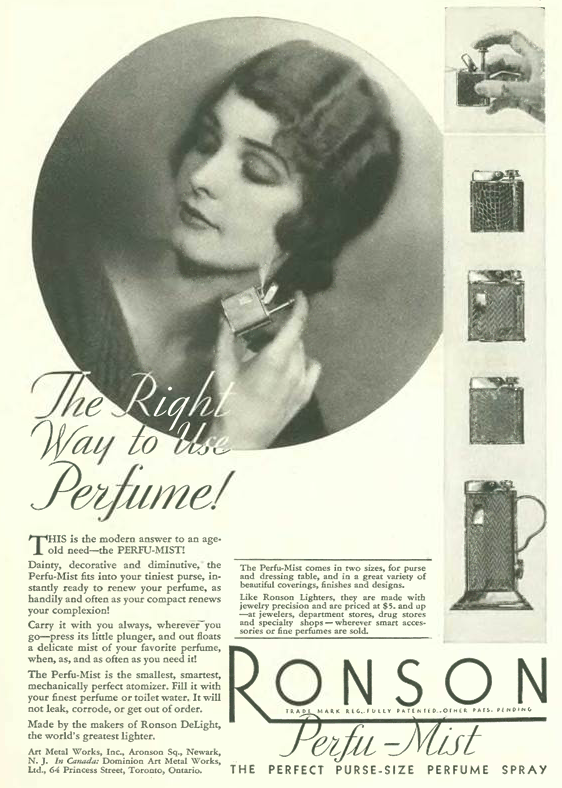
…makers of the Ronson cigarette lighter found a new use for their product, adapting it to serve as a perfume atomizer…I wonder how many women accidentally lit their hair on fire, or took a shot of perfume to the eyes when they wished to have a smoke…
…while you had the lighter handy, you could light up an Old Gold, and thanks to the lack of truth-in-advertising standards, you could do it believing that you were also warding off a winter cold…
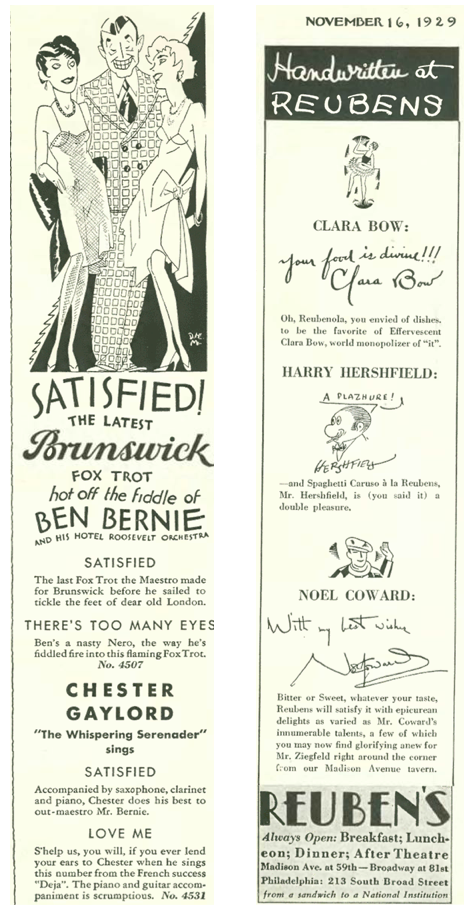
…from the back pages we have these gems from Brunswick records, and Reuben’s restaurant, which featured written testimonials from famous clientele including the “It Girl” actress Clara Bow, cartoonist Harry Hershfield, and playwright Noël Coward …
…Dr. Seuss offered his latest take on the uses of Flit insecticide, here sprayed directly into a user’s face for maximum benefit…
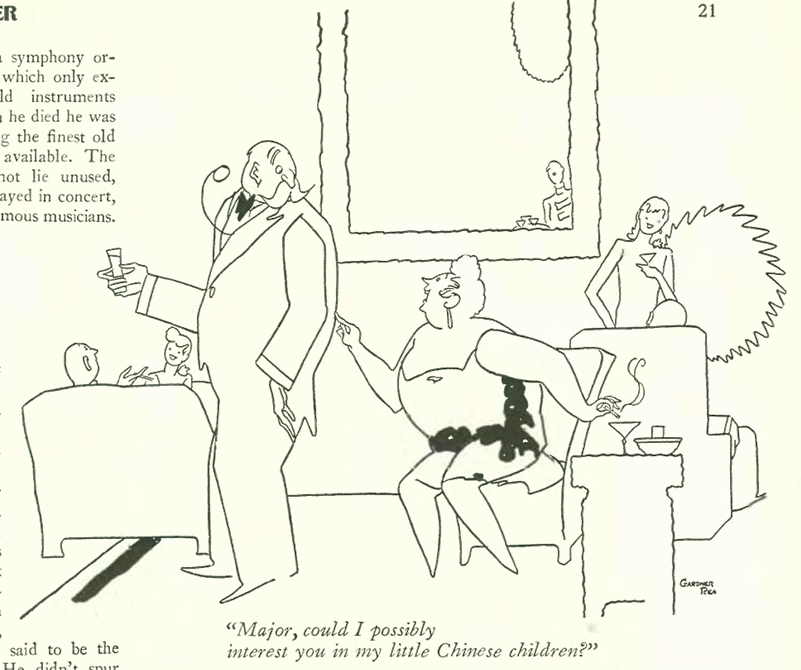
…our cartoons come courtesy of Gardner Rea, who looked in on an act of charity…
…Reginald Marsh illustrated a new use for broadcast radio…
…Barbara Shermund put the “idle” in “idle rich”…
…Garrett Price gave us this lovely illustration of a casual reader…
…and Helen Hokinson went shopping with one of her society women…
The New Yorker offices at 25 West 45th Street were a long walk from Wall Street, but the panic that gripped the city beginning on Oct. 24 spread quickly through the borough. What the panic was about, however, wasn’t exactly clear.
Nov. 2, 1929 cover by Constantin Alajalov.
There was fear in the air, and a hint of doom, when E.B. White submitted his “Notes and Comment” section for the Nov. 2 issue. Having filed his column sometime between October 24 (“Black Thursday”) and October 29, 1929 (“Black Tuesday”), he weighed the mood of his city against the reassurances offered by politicians, bankers and pundits…
TELLERS OF TALES…As the New York Stock Exchange headed toward collapse, President Herbert Hoover, Thomas Lamont (head of the Morgan Bank) and prominent journalist Arthur Brisbane offered assurances that all was well. (Wikipedia/bhg.com)
…and expressed schadenfreude over “a fat land quivering in paunchy fright” and some satisfaction in confirming his suspicions that “our wise and talky friends” on Wall Street really didn’t know what they were talking about:
THEY MADE A MESS OF THE ECONOMY, TOO…Sweeping the floor of the New York Stock Exchange after the Wall Street crash of 1929. (Wikipedia)
It seems White might have believed the worst was over, and that Wall Street would get back to its gambling spirit…
TALES OF TWO CITIES…The Brooklyn Daily Eagle proclaimed panic in its late edition on “Black Thursday,” Oct. 24; however, a day after the “Black Tuesday” crash of Oct. 29, The New York Times offered a more optimistic outlook for the days ahead.
In “The Talk of Town” we find the first use of the word “Depression” in The New Yorker as it is related to the economic collapse…
BUSTED…Crowds gather on Wall Street following news of the stock market crash. (Library of Congress)
* * *
Mr. Blue Sky
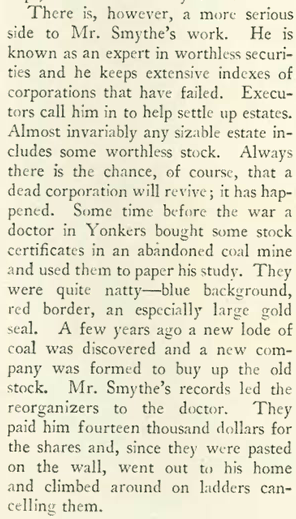
On the subject of stocks, “Talk” also featured this mini profile (written by Robert Coates) of Roland Mulville Smythe (1855-1930), who specialized in buying and selling old and obsolete stocks. Nicknamed “No Telephone” Smythe for his dislike of the device, he began his trade in obsolete securities and banknotes sometime around 1880…
MARKET GLEANER…Title page of Roland Smythe’s 1929 book, Valuable Extinct Securities. The notation beneath his portrait reads “No Telephone.” (worthpoint.com)
Coates told the story of a Yonkers doctor who used what he thought were worthless stock certificates (from an abandoned coal mine) to paper the walls of his study. Thanks to Smythe’s meticulous record-keeping, when a new lode was discovered at the mine, the doctor learned his wallpaper was worth $14,000 (equivalent to about $200,000 today)…
WALL STREET JUNKER…Share bought by Roland M. Smythe in 1899 and signed by him on the reverse side. At right, unusual obituary headline for an unusual man. (scripophily.org)
…Coates concluded by describing Smythe’s aversion to the telephone, and his talent for bowling…
* * *
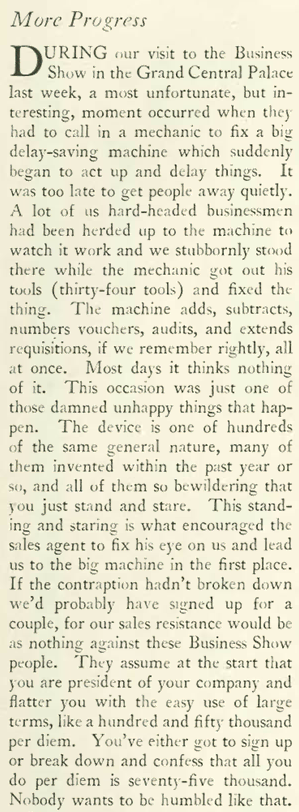
Rise of the Machine
Ironically, the National Business Show was staging a big exhibition in Midtown while the economy was collapsing Downtown. James Thurber was on hand at the Grand Central Palace to take in the wonders of the machine age…
NOT MY TYPE…Manufacturers of the Underwood typewriter staged a typing competition at the 1929 National Business Show at the Grand Central Palace. From left are George Hossfield, Stella Willins (with her typewriter “Timmy”), Irma Wright and Albert Tangora. Hossfield, the men’s champion, could type 157 words a minute. The women’s champion — and the world’s champion typist of the 1930s — Willins once typed 128 words a minute for an entire hour without a mistake. She could type 240 words per minute from memorized lines. (oztypewriter.blogspot.com)
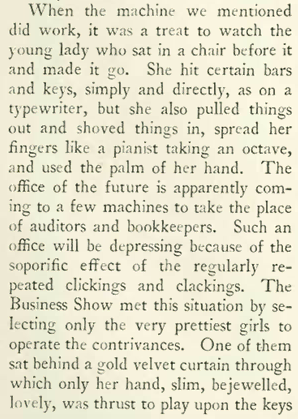
…Thurber seemed as impressed by the machines as by the “very prettiest girls” who were on hand to demonstrate them…
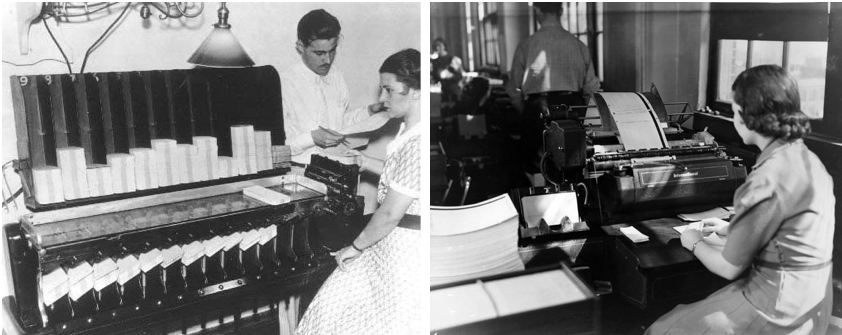
LOOKS COMPLICATED…At left, National Cash Register touted its business machines in this ca. 1930 ad; at right, a woman demonstrates a mimeograph machine in the 1920s. (Pinterest)SHOCK OF THE NEW…At left, these young operators contemplate the operation of an IBM Type 80 horizontal Hollerith card sorter. The woman appears less than thrilled by the mechanical beast; at right, a woman operates a IBM 405 Alphabetic Accounting Machine, ca. 1934. It could process 150 cards a minute and keep track of multiple sums while printing data on continuous-sheet forms. (officemuseum.com/computerhistory.org)
* * *
What a Strange Trip It’s Been
This brief “Talk” entry by Alfred Richman related a story from a traveling salesman just returned from Moscow. Among the highlights of his visit was a Soviet movie that “featured” America’s Sweetheart, Mary Pickford, in the title role…
In the 1920s, silent film stars Mary Pickford and Douglas Fairbanks were perhaps the most famous couple in the world. That included in the Soviet Union, where moviegoers preferred American films over their own avant-garde fare (while on the other hand, the New Yorker found Soviet films to be far more advanced than Hollywood’s). While vacationing in Moscow in 1926, Pickford and Fairbanks visited a Russian film studio with director Sergei Komarov, who cleverly captured enough footage of the two to weave them into a silent comedy titled A Kiss from Mary Pickford (Potseluy Meri Pikford). The film was a spoof on Hollywood fame, finding humor in a loveless man’s chance meeting (and kiss) with Mary Pickford, and his sudden and unexpected attractiveness to the opposite sex.
FUN WHILE IT LASTED…At left, Soviet film poster for Sergei Komarov’sA Kiss From Mary Pickford, featuring Russian actors Anel Sudakevich and Igor Ilyinsky (in the center photos) with various cameos by Mary Pickford and Douglas Fairbanks; at top, Soviet movie posters featuring Fairbanks and Pickford; bottom right, the couple feted by Russian fans, who presented Pickford with the headdress. The year 1929 would mark the end of such films in the Soviet Union — as Stalin began forced collectivization, he declared that Soviet cinema should only satisfy “the basic demands of the proletarian collective farm mass viewer.” Remarkably, Komarov and the actors Sudakevich and Ilyinsky would survive the years of Stalinist terror that would follow, even living to old age. (IMDB/transmediale.de/Facebook fan site)
* * *
Fire and Ice
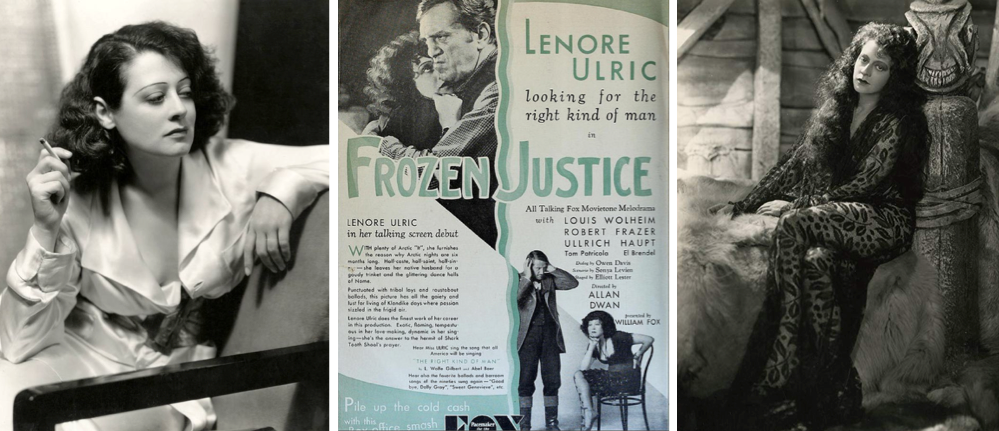
Back stateside, New Yorker film critic John Mosher took in the talking film debut of the hugely popular stage actress Lenore Ulric (1892-1970). Known on Broadway for her portrayals of fiery women, she tried, it seems unsuccessfully, to bring some of that heat to Frozen Justice, which was set in Alaska during the Klondike Gold Rush…
FEMME FATALE…Lenora Ulric, who made less than 20 films, was known for her work on the stage. At left, Ulric taking a break from her Broadway work in the early 1930s; center, magazine ad for Frozen Justice; at right, Ulric as the half-Eskimo Talu in Frozen Justice. (Pinterest/IMDB)
* * *
Right Ho, Plummie (CORRECTION: Not So, Plummie)
I incorrectly attributed this poem in the Nov. 2 issue to British humorist P.G. Wodehouse…
…thankfully, an alert reader kindly pointed out that “Ode to Peter Stuyvesant” isn’t by Wodehouse, but by another person with the initials P.G.W. — Philip G. Wylie.
HE COULD BE FUNNY, TOO…Short story writer, screenwriter and satirist Philip G. Wylie in an undated photo. (Wikipedia)
* * *
From Our Advertisers
We begin with the back pages, where toaster wars were being waged by the makers of the “Toastmaster” and Thomas Edison’s “Automaticrat”…
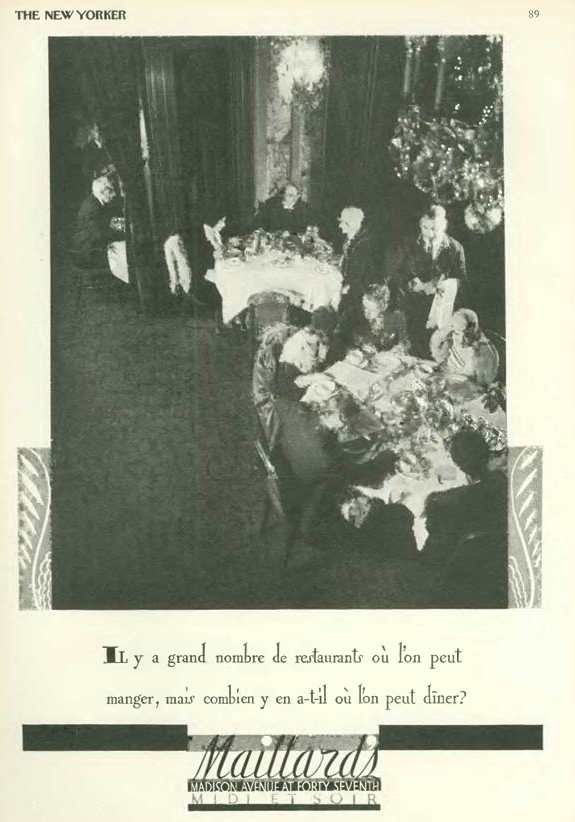
…for some in the posh set, the days of fine dining at places like Maillard’s (with this all-French ad) would be coming to an end thanks to the market crash…actually, Maillard’s itself would come to an end in the 1930s, thanks to the Depression…
…stage, film (and later television) actress and dancer Queenie Smith was the latest celeb to tout the wonders of Lux Toilet Soap…
Queenie Smith circa 1930. (IMDB)
…here’s an unusual way to sell shock absorbers…I’m wondering if this is supposed to be a sugar daddy and a chorus girl trying to make hay in the back seat of a car without Houdaille shocks…
…a couple more ads from the back pages, the ones on the left appeal to women’s fitness, while the ad on the right tries its best to push a product that was fast going the way of the horse and buggy. Spats — devised in the late 19th century to protect one’s shoes and socks (then called stockings) — went out of fashion in the 1930s, no doubt because most streets were now paved and you didn’t have to worry about a passing wagon splashing mud and horseshit all over your shoes and ankles…
…and indeed, now you could have Goodrich Zippers, in smart new colors…
…and speaking of colors, a couple of richly toned ads for Arrow Shirts…
…and Camel cigarettes…
…on to our illustrators and cartoonists…spot drawings — sprinkled throughout the magazine — were often a foot in the door for aspiring contributors (Peter Arno and Charles Addams are just two examples). Below is a collection of spot drawings from the Nov. 2 issue, mostly from established artists including Barbara Shermund, Alice Harvey, Julian De Miskey, Gardner Rea, Johan Bull and I. Klein. The New Yorker also recycled old cartoons for spots, including the illustration below (third row, second one down) by Shermund of the young woman on telephone, which originally appeared in the July 16, 1927 issue with the caption, “Hold the line a minute, dear—I’m trying to think what I have on my mind.”
…Arno continued to provide illustrations for Elmer Rice’s serialized novel, A Voyage to Purilia…
…and Julian De Miskey illustrated G. Marston’s entry for the ongoing “That Was New York” column…
…our cartoons come from Barbara Shermund…
…Gardner Rea, having a political moment…
…for reference, a photo of Mayor Jimmy Walker…
brookstonbeerbulletin.com
…Shermund again, on the joys of parenthood…
…Peter Arno’s take on Jazz Age chivalry…
…and perhaps the timeliest entry of all, from Leonard Dove…
Although two months remained in the decade, The New Yorker of the Roaring Twenties effectively ended with this issue, just days before a massive market crash sent the nation spiraling into the Great Depression.
Oct. 26, 1929 cover by Theodore Haupt. Wonderful rendering of The New York Central Building, with shades of Georgia O’Keeffe.
Not a soul at The New Yorker had an inkling of the bleakness that lay ahead — rampant unemployment, the rise of the Nazi party, the Dust Bowl, Busby Berkeley musicals…
E.B. White, in “Notes & Comment,” was concerned with little more than the changing countryside…
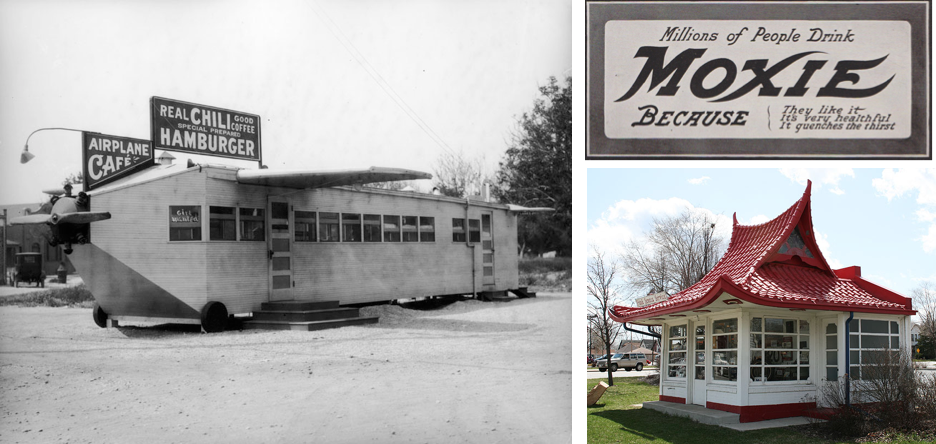
MADE YOU LOOK…Examples of roadside vernacular architecture from the 1920s included the Airplane Cafe in in the San Fernando Valley (1924) and a 1927 Wadham’s gas station in West Allis, Illinois, now on the U.S. National Register of Historic Places. More than 100 of Wadham’s “pagodas” were built, but like much of roadside America, few examples remain. At top, right, a 1920s billboard advertising Moxie soft drinks. (last1onthebus.com/Pinterest/Wikipedia)THE DUCK STOPS HERE…The Big Duck in Flanders, New York, was built in 1930-31 by Long Island duck farmer Martin Maurer to sell duck and duck eggs to passing motorists. It was listed on the National Register of Historic Places in 2008. (Google Maps)
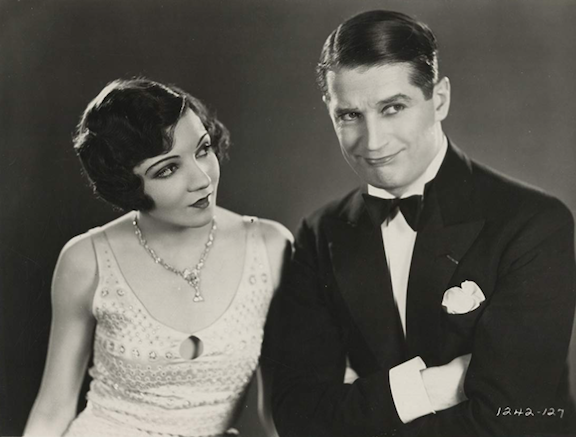
…and further on in “The Talk of the Town,” White shared these observations regarding the popularity of shirts worn by French actor Maurice Chevalier…
THAT’S SHA-VAHL-YEY…Claudette Colbert and Maurice Chevalier in 1930’s The Big Pond. (IMDB)
* * *
Born to Be
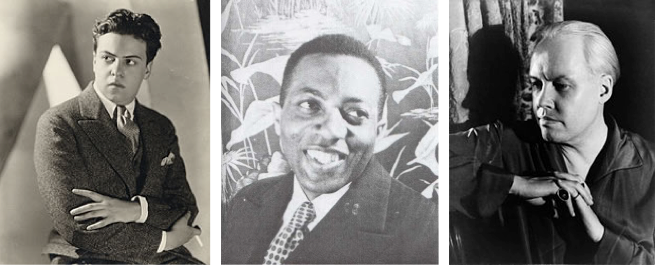
The book review featured an autobiography, Born to Be, written by Taylor Gordon (1893-1971), a famed singer of the Harlem Renaissance, that traced his life journey from Montana to New York. The book included ten full-page illustrations by Mexican artist Miguel Covarrubias, and forwards by Carl Van Vechten and Muriel Draper.
COMBINED TALENTS come together in Taylor Gordon’sBorn to Be: Mexican painter, caricaturist, and illustrator Miguel Covarrubias (left, in a 1920s photo by Nickolas Muray) and Harlem Renaissance singer Gordon (center, in a photo by Carl Van Vechten, who is pictured in a self-portrait at right). (Pinterest/minormoderns.blogspot.com/Wikipedia)
FROM MONTANA TO HARLEM…First edition of Taylor Gordon’sBorn to Be, and illustrations from the book by Miguel Covarrubias (including cover image). The image at bottom left features patron of the Harlem Renaissance Carl Van Vechten, with Gordon. (qbbooks.com/klinebooks.com/Pinterest)
* * *
Little Narcissus
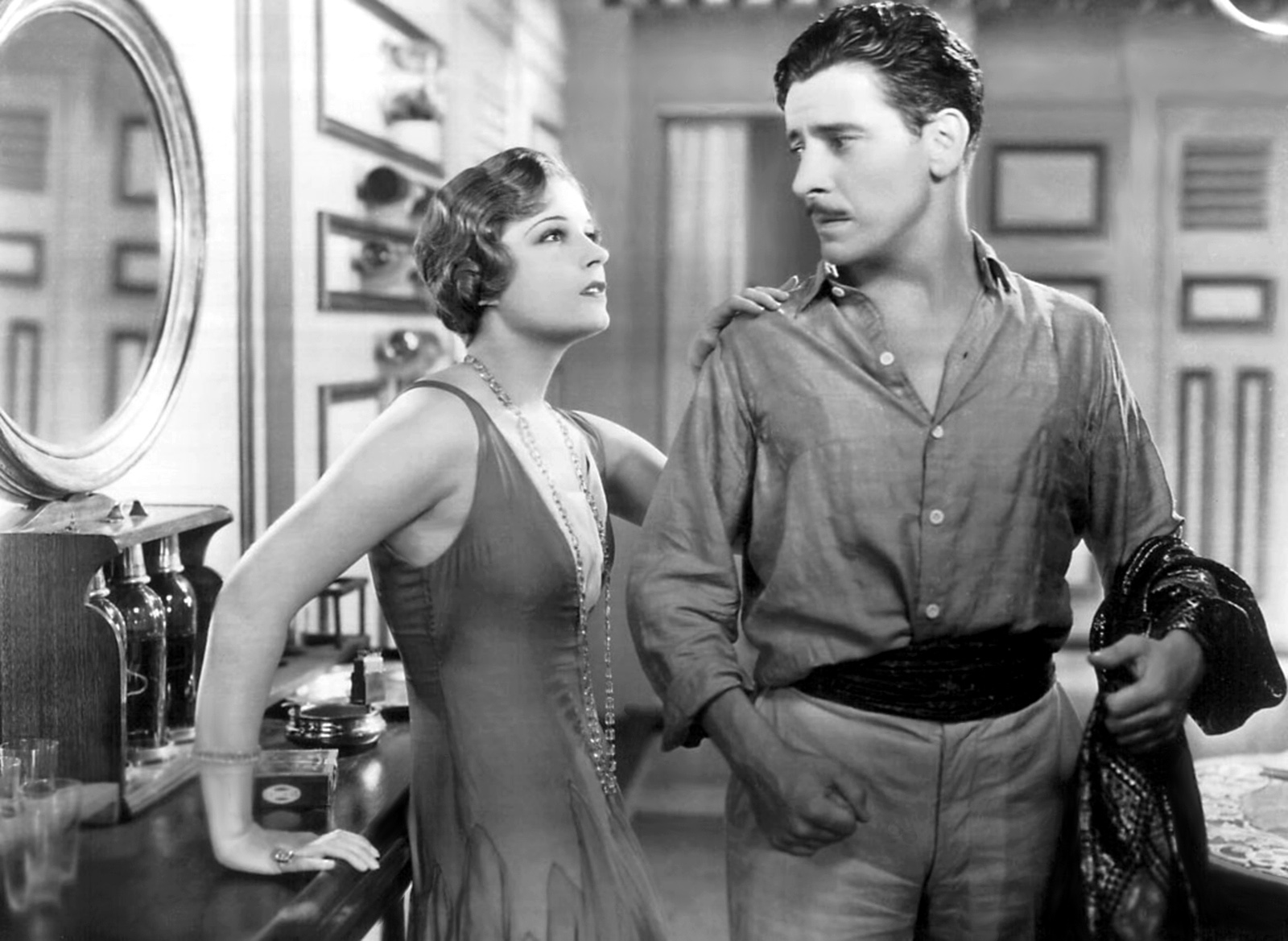
Although today she is known mostly as Errol Flynn’s first wife, the tempestuous French actress Lily Damita (1904-1994) knew how to light up New York and get noticed in Hollywood when she made her American debut in 1929. Henry F. Pringle looked in on Damita’s daily life in the Oct. 26 “Profile.” A brief excerpt:
Lily Damita in a 1931 publicity photo. (Flickr)DEBUT FILM…Lily Damita and Ronald Coleman in 1929’s The Rescue, Damita’s first Hollywood film. (Dr. Macro)
* * *
A Master Achievement
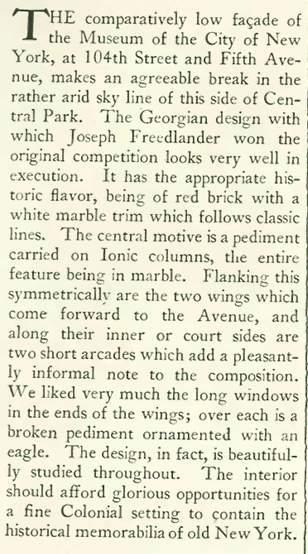
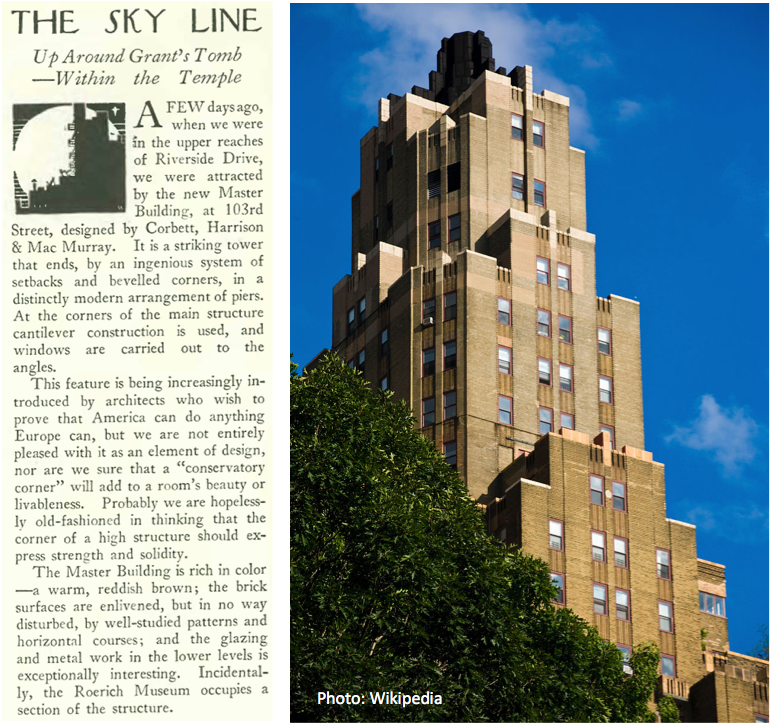
Architecture critic George Chappell gazed upward in admiration for the new Master Building on Riverside Drive. It was one of the city’s first mixed-use structures and the first New York skyscraper to feature corner windows. The apartment building originally housed a museum, a school of the fine and performing arts, and an international art center on its first three floors. The building fell into decline in the late 1960s, but today it thrives as a housing co-operative. The Master was listed on the National Register of Historic Places in 2016.
…on to our advertisements, we find another art deco landmark, the 1930 Squibb building, designed Ely Jacques Kahn…
The Squibb Building at 745 5th Avenue, circa 1930. (Museum of the City of New York)
…Halloween was just around the corner and although it wasn’t a huge holiday as it is today, its presence still permeated the pages of The New Yorker, including a humorous piece by John O’Hara on the challenges of planning a Halloween party…
From left, excerpt from John O’Hara’s piece; an ad from Doubleday featuring a jack-o-lantern; an ad from Breyer’s ice cream that employed the older spelling of the holiday; at bottom, a filler illustration by Julian De Miskey.
…the makers of Marmon autos offered this lovely autumn scene…
…here is an unusual ad from a milliner named Mercedes who bid adieu to former clients in this hand-written, full-page entry…
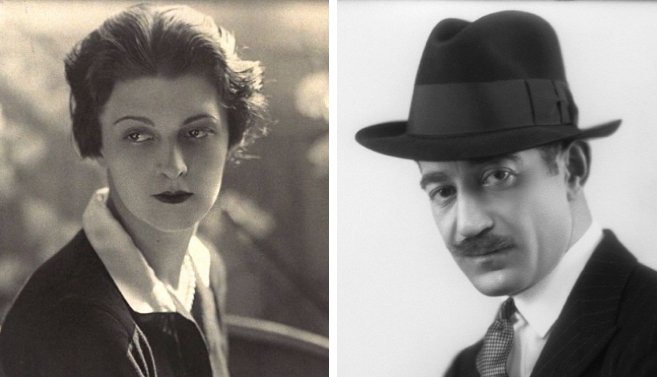
…the name Michael Arlen no doubt caught many a reader’s eye in the Oct. 26 issue. The comings-and-goings of this hugely popular author of thrillers such as The Green Hat (1924) provided much-needed fodder for readers of the first issues of the fledging New Yorker. In this ad, Arlen’s wife, the Countess Atalanta Mercati, shills for Cutex nail polish…
The Countess Atalanta Mercati of Greece and author Michael Arlen were married in France in 1928. (Conde Nast/insiderguide.me)
…and we have more of the torch singer Helen Morgan, this time in an ad for Lux Toilet Soap…
…a couple of back page ads…the now ubiquitous metal folding table (and chairs) was something of a novelty in 1929…the ad on the right from Brunswick Records offers up the latest schmaltz from Al Jolson (I know it’s 1929, but come on Al, really?)…
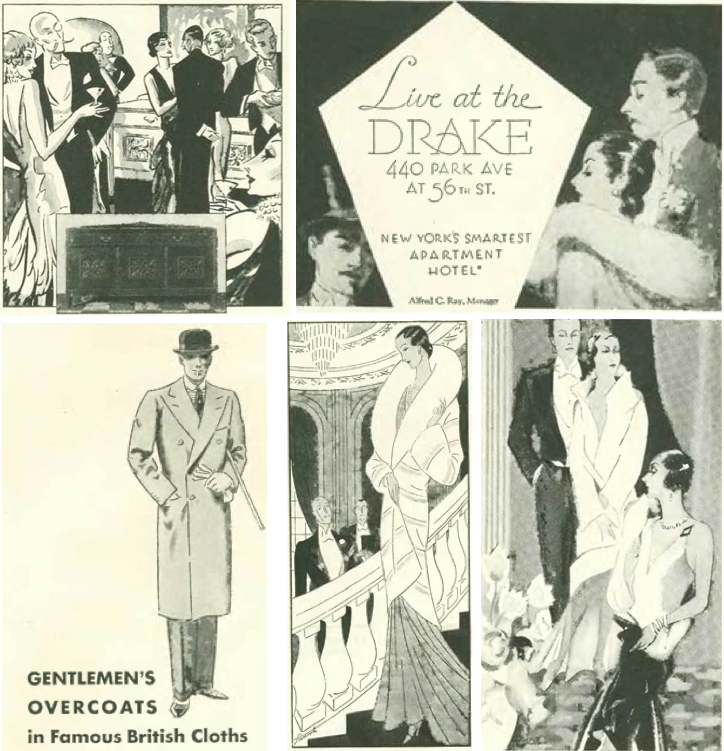
…and since this is the last edition before the big market crash, here’s a collection of images clipped from various ads in the Oct. 26 issue…featuring high-living folks who should appear a bit less smug after they lose their mink coats and boiled shirts to the Depression…
Clockwise, top left, a sampling of illustrations from ads in the Oct. 26 issue: there seemed to be no item too mundane for the posh treatment—an illustration that graced an ad from Frigidaire; superior airs displayed on behalf of the Drake apartments, and below, also on behalf of (sniff) Gotham Gold Stripe stockings; “Arabella” surveys two of her hapless conquests as she descends the stair in an illustration for a Marie Earle salon ad; and an appeal to the city’s rampant Anglophilia from De Pinna of Fifth Avenue.
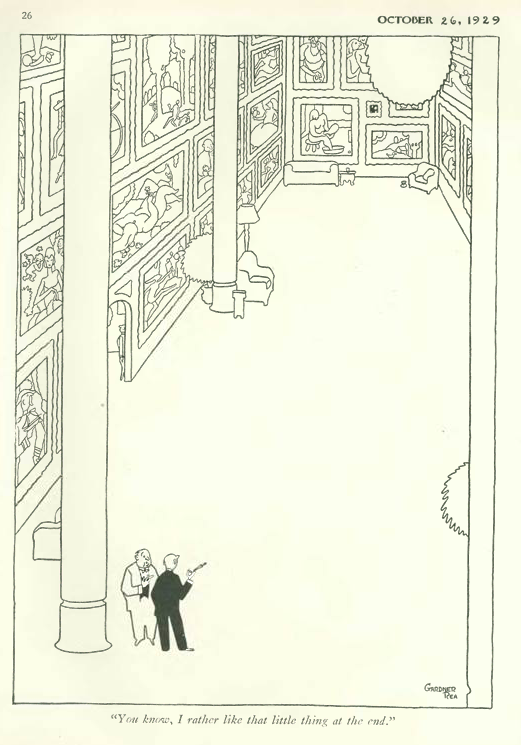
…on to our cartoons, Garner Rea demonstrated his mastery of space in this full-page entry…
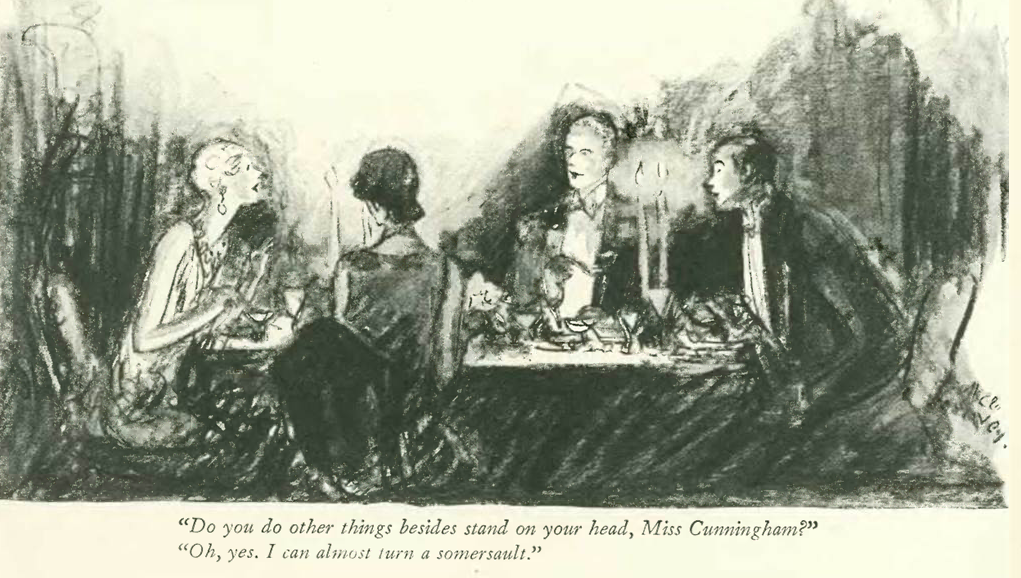
…Alice Harvey eavesdropped on the chit-chat of some toffs at dinner…
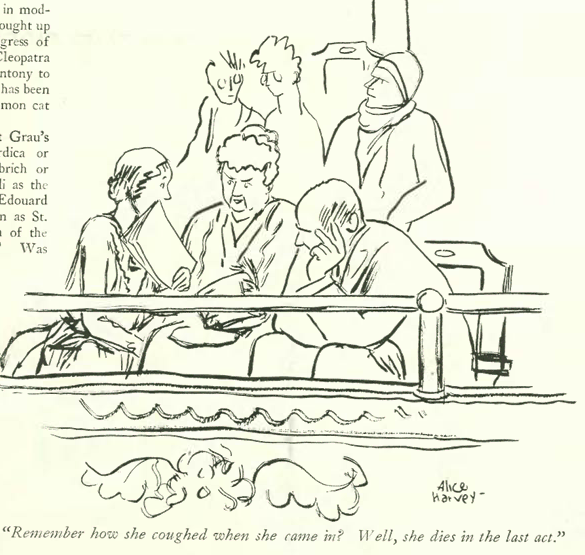
…and Alice Harvey again in this sparer illustration of a spoiler at the opera…
…Peter Arno illustrated unexpected intimacy on a commuter train…
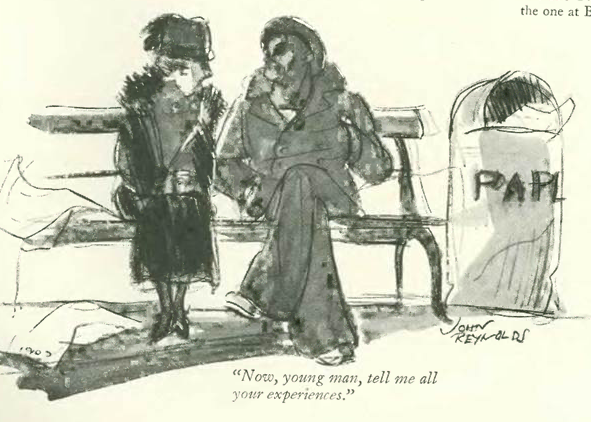
…and from John Reynolds, with a sign of things to come…
E.B. White gazed 50 years into the future in the Sept. 21, 1929 issue, predicting that New York City would be much the same if not a little worse by the time the calendar turned to 1979.
Sept. 21, 1929 cover by Theodore G. Haupt.
White dismissed the popular notion that the future would be one of push-button happiness and gleaming white cities. And as it turned out, he was mostly right on the mark with his predictions:
LOVE IS IN THE AIR…Autogyros (as illustrated on a 1930 cover of Modern Mechanics) were often seen as the future of transportation in the 1920s and 30s; Maureen O’Sullivan (as “LN-18”) and John Garrick (“J-21”) glide above 1980 Manhattan in 1930’s Just Imagine. (modernmechanix.com/pre-code.com)
Instead of the antiseptic fantasy world predicted in such movies as 1930’s Just Imagine (a futuristic musical set in 1980), White correctly foresaw a city that, despite technological advances, would still be a gritty rat race. And if you lived in New York City in 1979 (I was but a visitor then, as now), you would have found a city that indeed was quite dirty and crime-ridden (check out the 1979 movie The Warriors to get a sense of how Hollywood perceived the city at that time). As White observed, “Prophets always leave out the eternal mud”…
A LOT OF HOT AIR…In addition to autogyros, futurists in the 1920s and 30s also saw dirigibles as integral to future transportation. At top left is an illustration of a solar-powered aerial landing field atop a dirigible on the cover of Modern Mechanix magazine, October, 1934; top right, Manhattan in 1980 as depicted in the the 1930 film Just Imagine; bottom right, workers dismantling the Third Avenue Elevated line in 1955; bottom left, Times Square in 1979. (airships.net/IMDB/gothamist.com/viewoftheblue.com)
* * *
Cradle of Civilization
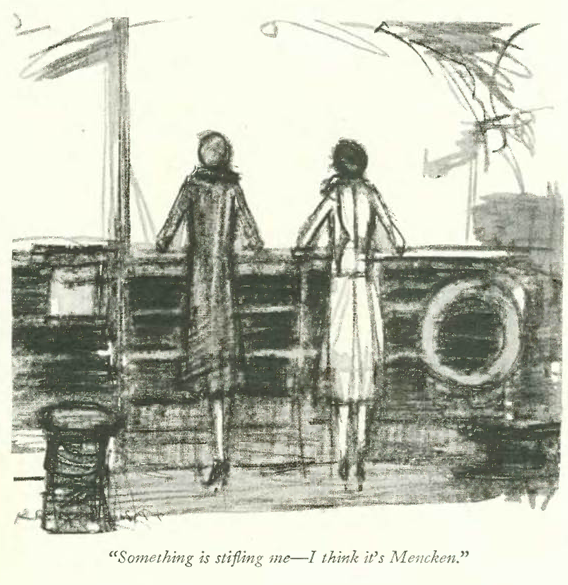
Dorothy Parker took aim at ugly Americans abroad in a casual titled “The Cradle of Civilization.” In these excerpts, Parker commented on the pretensions of young New Yorkers in France, including their ridiculous costumes…
…their bad French, and their even worse manners…
WELL, THEY GOT AWAY WITH IT…Actors Leslie Howard and Ingrid Bergman don the look of French fishermen during the filming of Intermezzo: A Love Story, in 1938. Howard and Bergman were supposed to look like a couple visiting the French Riviera, but in reality it was all filmed near Hollywood. The film was Bergman’s Hollywood debut. (Pinterest)
* * *
A Penny Saved
Back stateside, Wolcott Gibbs looked in on the dying art of the penny-arcade peepshow, and expressed his disappointment with the quality of that product in general…
DON’T JUDGE A PEEP BY ITS COVER…A patron checks out “Hot Tango” at a penny peepshow parlor of the 1920s. (Pinterest)
Gibbs seemed particularly miffed by a film with the misleading title “For Men Only”…
* * *
Uncle Jed
Jed Harris (1900-1979) was a wunderkind of Broadway, producing and directing 31 shows between 1925 and 1956. Before he turned 28 he produced a record four consecutive Broadway hits over the course of 18 months (including the 1928 smash hit The Front Page), and so it was time for some rest. “The Talk of the Town” reported…
Although it was rumored Harris would retire at age 30, he would instead return in the spring of 1930 with a production of Anton Chekhov’sUncle Vanya, and continue producing on Broadway through the 1950s.
WUNDERKIND…A 1928 portrait of Jed Harris that was featured on the Sept. 3, 1928 cover of Time magazine. (Wikipedia)
* * *
Dueling Cassandras
About a month before the big stock market crash we find this curious little item in Howard Brubaker’s “Of All Things” column…
…Considered the first “celebrity economist,” Irving Fisher stated in September 1929 that the stock market had reached “a permanently high plateau,” while around the same time (Sept. 5, 1929) rival economist Roger Babson warned in a speech that “sooner or later a crash is coming, and it may be terrific.” Note: “Ben Bolts” refers to a character in a popular 1842 poem that became an oft-parodied popular song. Each stanza begins with a variation of “Oh don’t you remember…”
* * *
Parental Advisory
Fifty-five years before Tipper Gore and the Parents Music Resource Center pushed the music industry to place warning labels on records containing explicit lyrics, there was much ado about “lascivious lyrics” uttered on “race records” — the term referred to 78-rpm records marketed to African Americans from the 1920s and 1940s. The Sept. 21 “Popular Records” column looked at the controversy surrounding Ethel Waters’ “Second Handed Man,” and didn’t find any…
MUCH ADO…Ethel Waters (circa 1930) and her recording of “Second Handed Man.” (discogs.com/YouTube)
* * *
New Kids on the Block
Architecture critic George S. Chappell (aka “T-Square”) concluded his Sept. 21 column with praise for the designs of the yet-to-be-built Daily News and Chrysler buildings, but expressed dismay at the recently completed Lincoln Building…
BAD COMPANY…New Yorker architecture critic George S. Chappell was excited about the designs for the Daily News Building (left) and Chrysler Building (center), but the Lincoln Building left him wanting. No doubt its gothic topper seemed dated in contrast to the sleek lines of the other buildings. (nyc-architecture.com)
* * *
Movie critic John Mosher took in a couple of new films including Paramount’s 1929 pre-Code drama Jealousy…
FINAL CURTAIN…Jeanne Eagels and Fredric March in a publicity photo for Jealousy. Eagels died of a drug overdose on Oct. 3, 1929, just days after Mosher’s review appeared in The New Yorker. (IMDB)
…and Mosher also reviewed the musical drama The Great Gabbo, which was derived from a story by occasional New Yorker contributor Ben Hecht…
WHO ARE YOU CALLING DUMMY?…Erich von Stroheim has issues with his co-star in The Great Gabbo. (MoMA)
* * *
From Our Advertisers
What appeared to be an unassuming ad from General Motors was actually a plan for world domination, at least in the area of ground transportation. GM gobbled up a number of car companies in the 1920s (see the ad’s fine print) as well as shares in power plants and home appliances. It would overtake Ford in sales in the late 1920s, and thanks to propaganda efforts including those illustrated in the ad below, it would lead a streetcar removal conspiracy that would destroy intercity train transport systems across the U.S. (and convert them to GM buses, naturally)…
Here we have yet another “distinguished handwriting contest” ad from the makers of Marlboro, this time exploiting the efforts of Corinne B. Riley of Sumter, S.C….
…Riley would win more than a handwriting contest, however. She would be elected as a Democrat to Congress in 1962 to fill a vacancy left by her husband, Congressman John Jacob Riley.
Corrine B. Riley in 1962. (Wikipedia)
On to our illustrators and cartoons, we begin with this two-page drawing by Reginald Marsh that appeared along the the bottom of “Talk of the Town”…
…Gardner Rea lent his spare style to this peek into Wall Street…
…Peter Arno appeared to be experimenting with yet another style of drawing…
…that in some ways looked similar to Alan Dunn’s…
…the British cartoonist Bruce Bairnsfather provided this sumptuous drawing of an exchange at a card shop…
…and Isadore Klein gave a vertiginous perspective to home buying…