What Santa Brought in 1928

As we sweep up the tinsel and wrappings from another holiday season, let’s take a look back at 1928 and see what the New York “smart set” wished for under the Christmas tree.

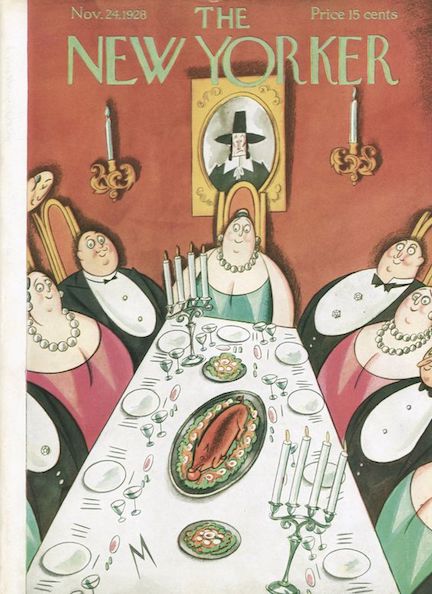
Nov. 24, 1928 cover by Julian de Miskey.

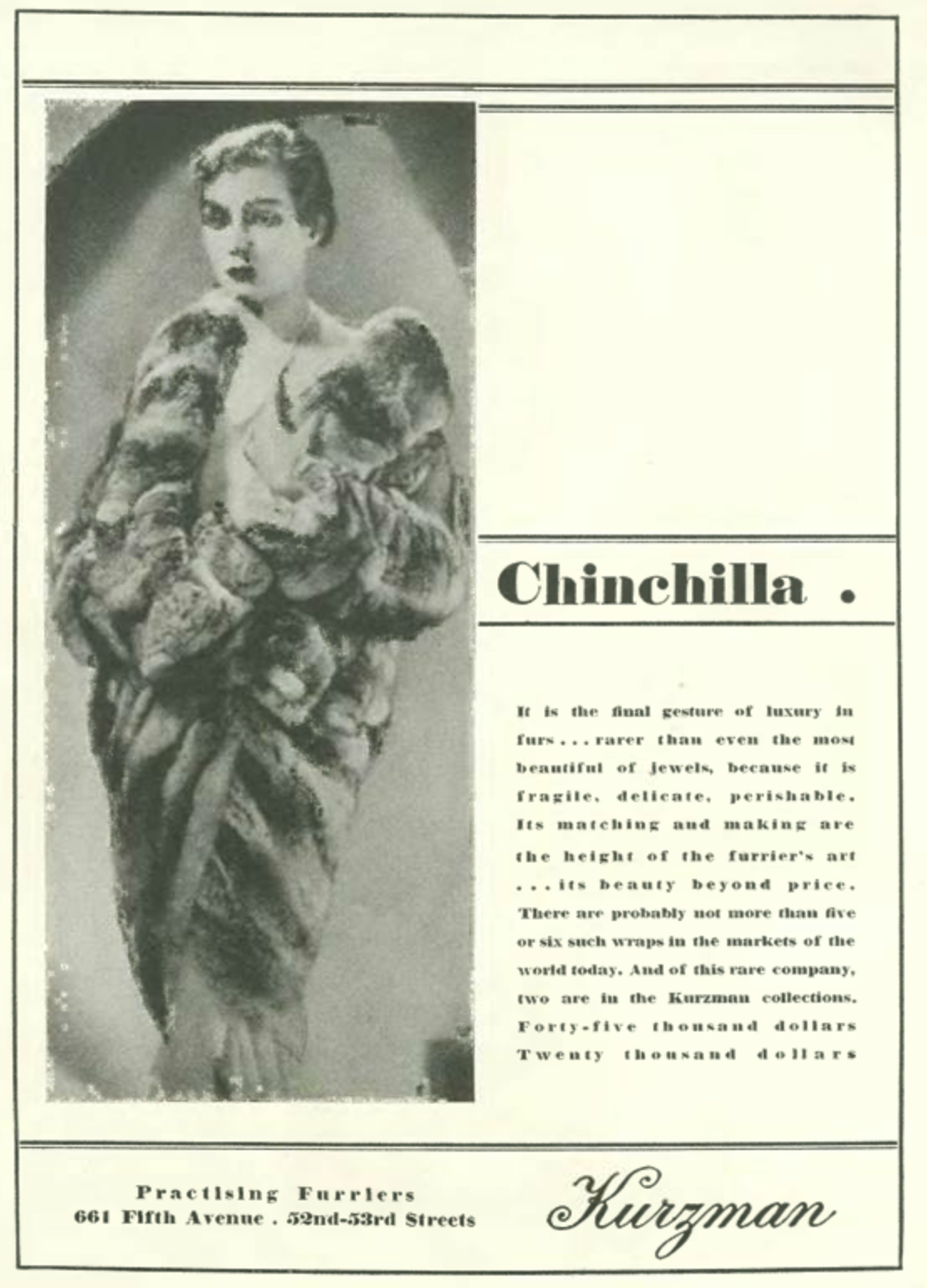
We’ll start with the outlandish, namely this advertisement from Kurzman furriers on Fifth Avenue, which offered just two rare chinchilla coats for sale, one for $45K and the other for a mere $20K. That would be roughly equivalent to $630K and $280K in 2017 dollars. Oh Santa baby…

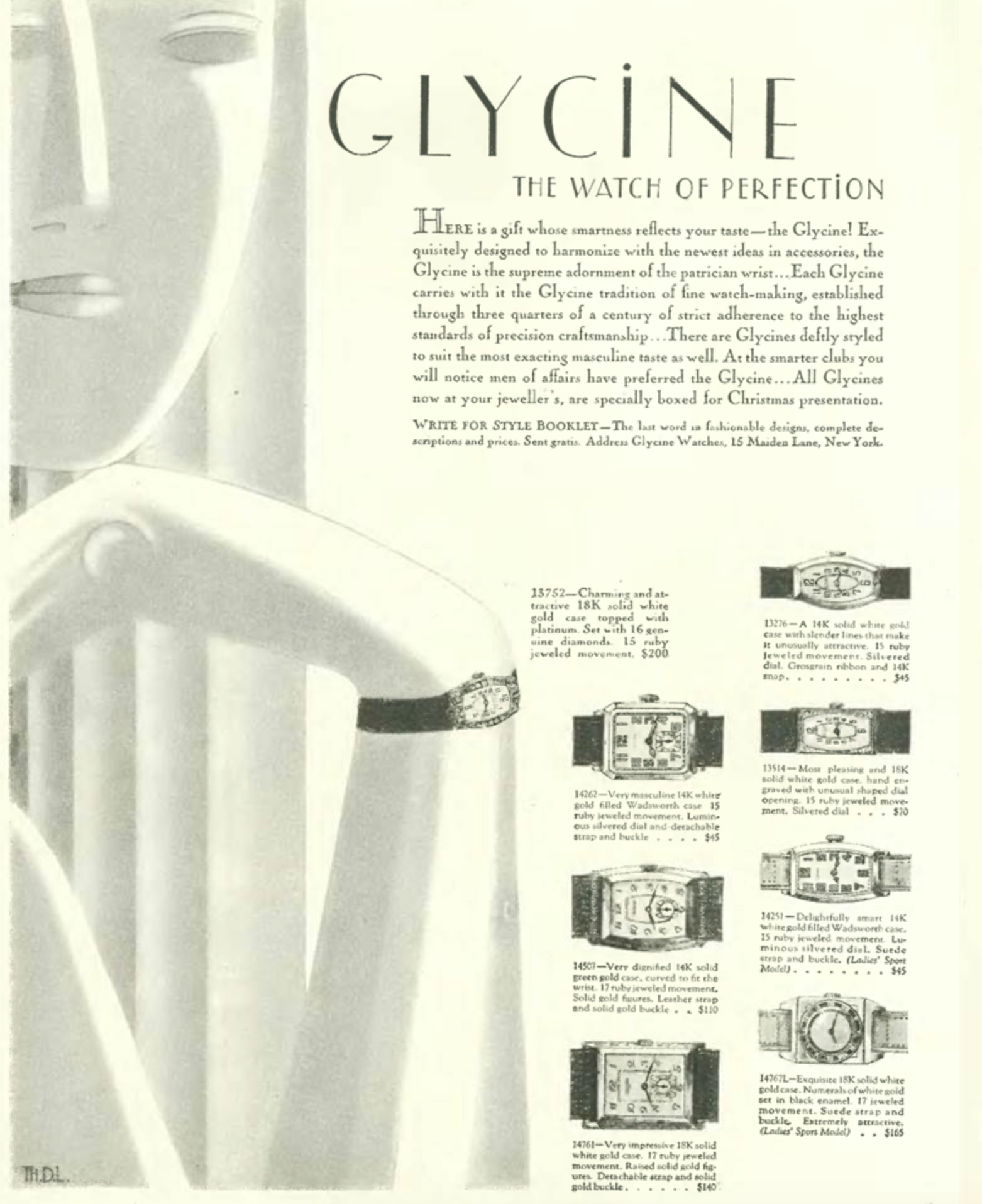
If you didn’t get the chinchilla, you could have asked for a Glycine Swiss watch, a gift “whose smartness reflects your taste”… and is “the supreme adornment of the patrician wrist.”

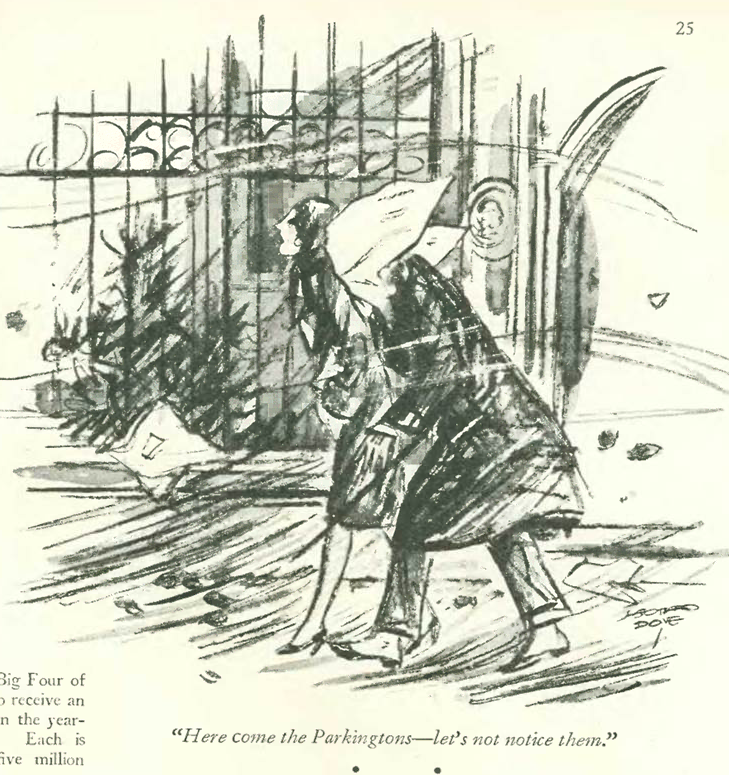
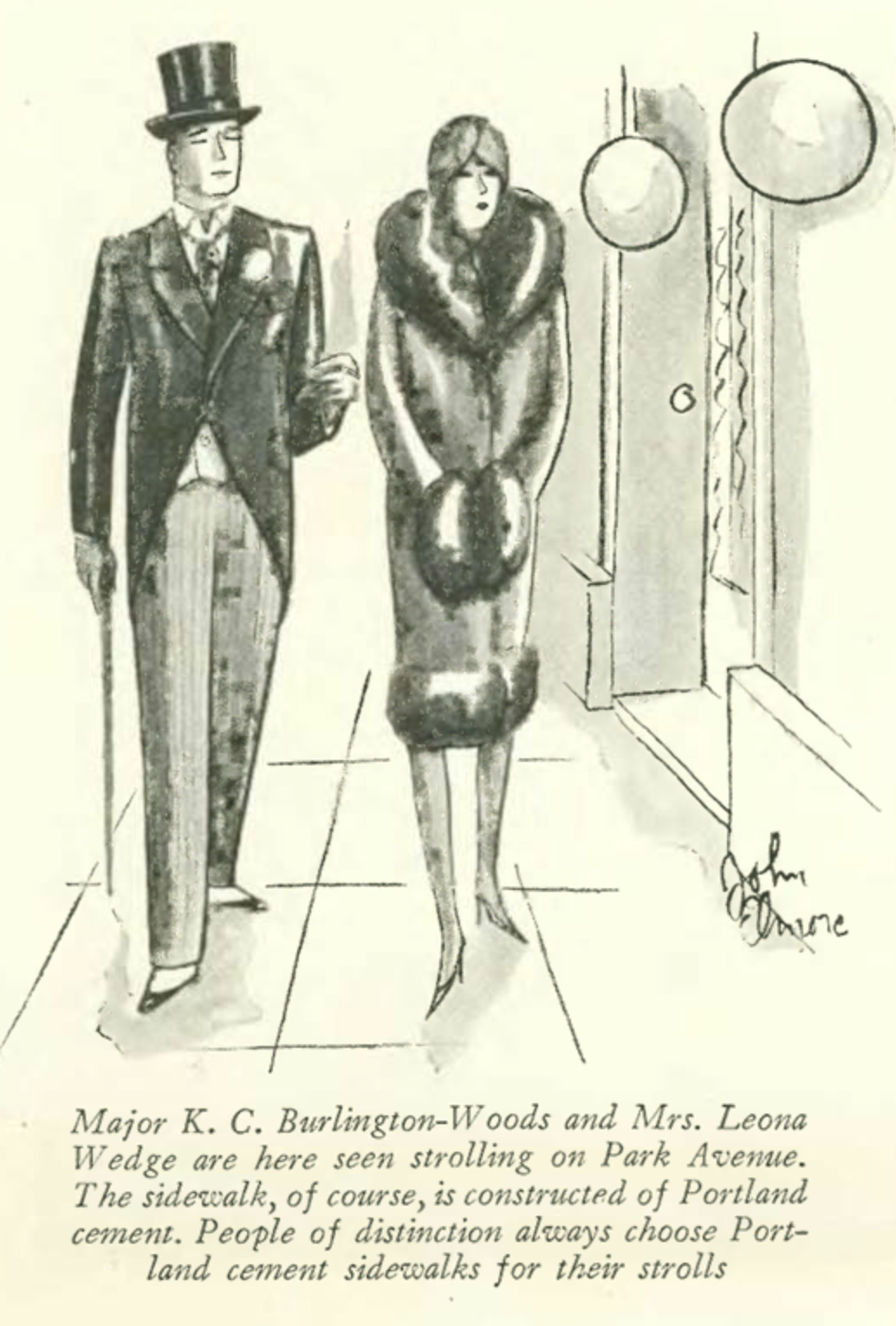
The New Yorker was filled with such ads that appealed to class pretensions, but thankfully the editorial side of the magazine mostly tweaked those pretensions, including this Nov. 24 cartoon by John Elmore:

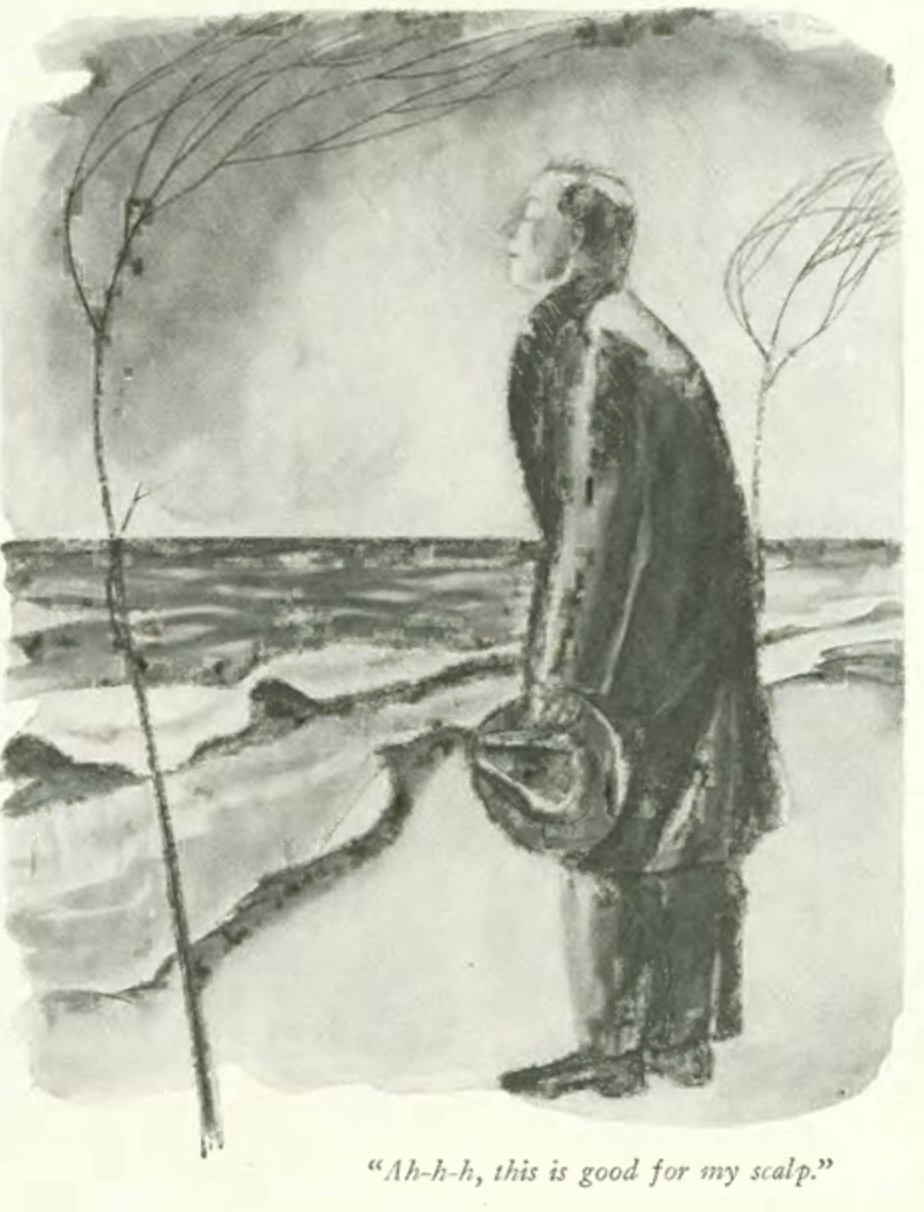
In the following issue (Dec. 1), Elmore also contributed this unsigned cartoon (thanks to Michael Maslin’s invaluable Ink Spill blog for the identification):

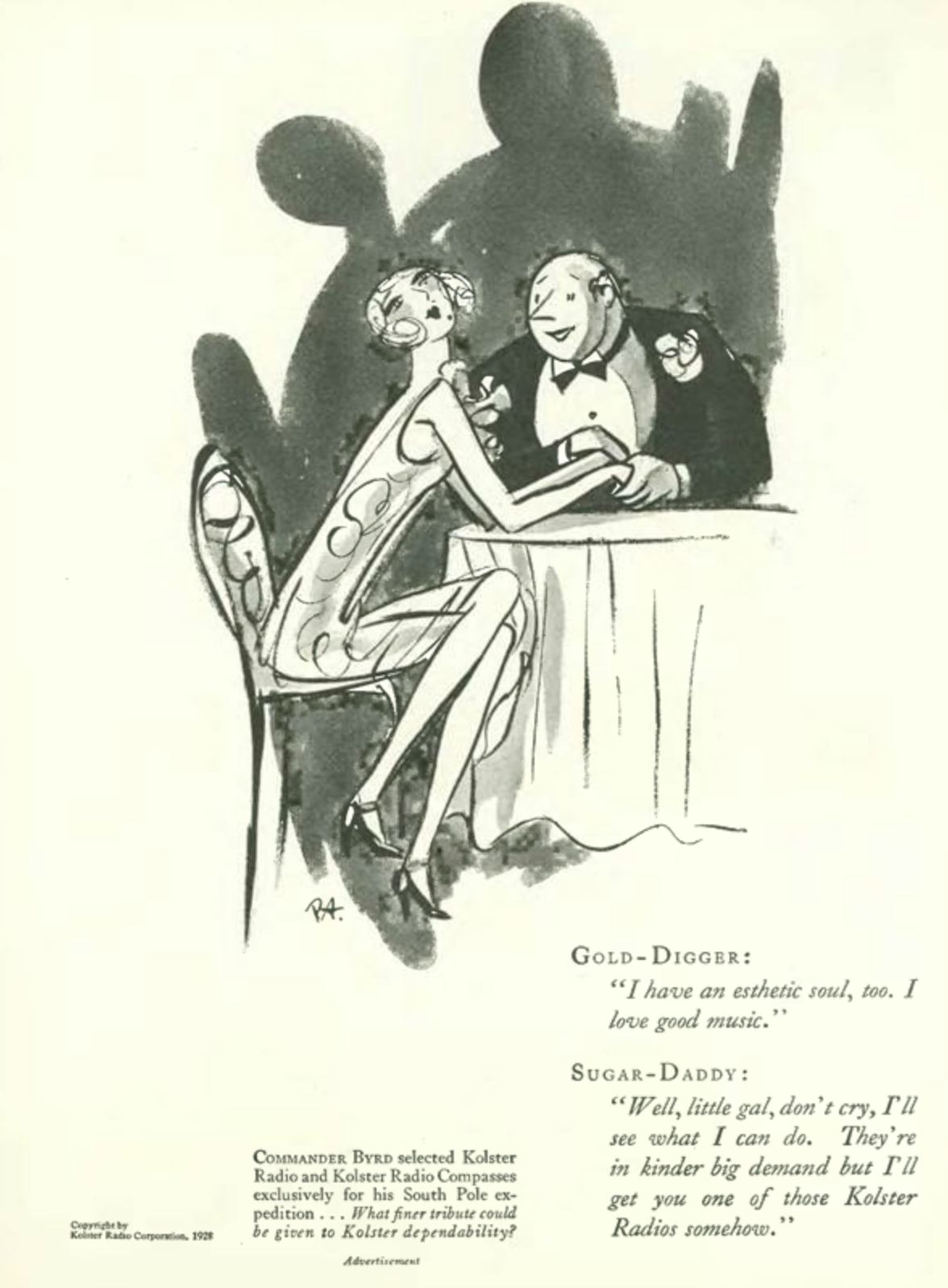
Back to the ads for Nov. 24, Kolster Radio continued its series featuring illustrations by New Yorker cartoonist Peter Arno, this one borrowing from his familiar themes featuring gold-diggers and sugar daddies…

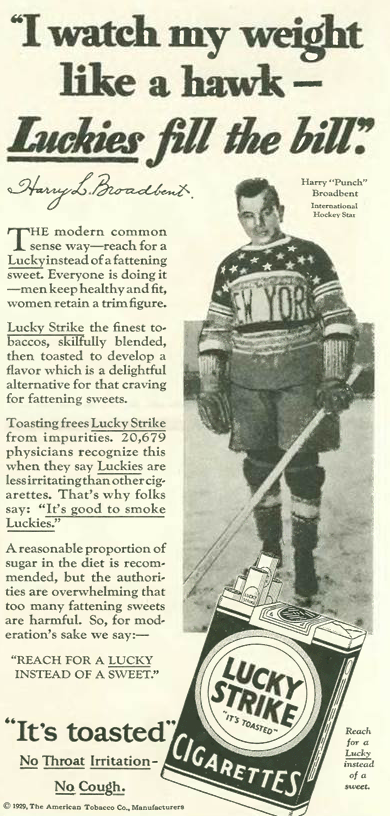
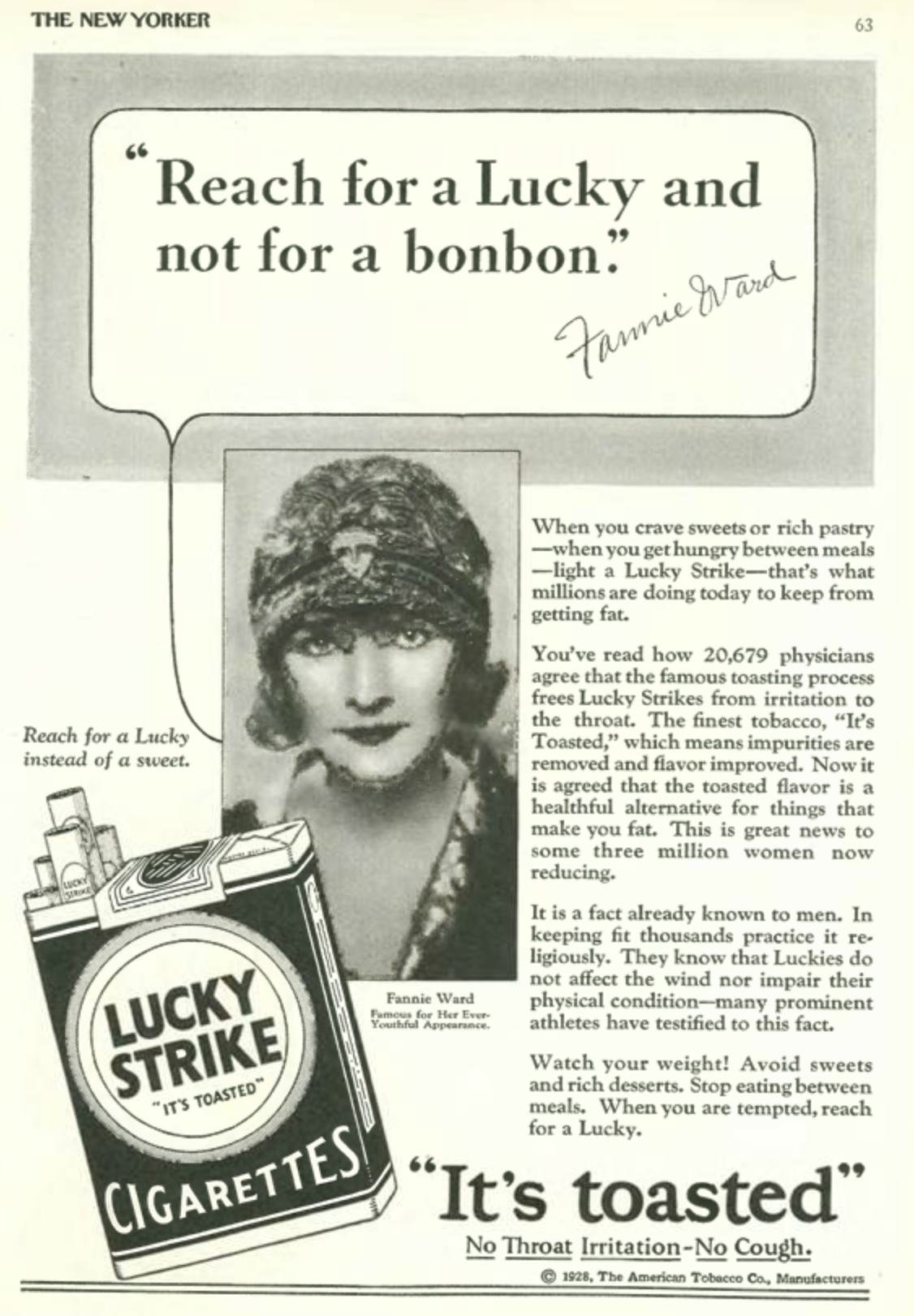
…and 56-year-old stage and silent film actress Fannie Ward offered proof that lighting up a Lucky could keep you slim and youthful. Whether or not she actually smoked the things, Ward was indeed best known for her seemingly ageless appearance.

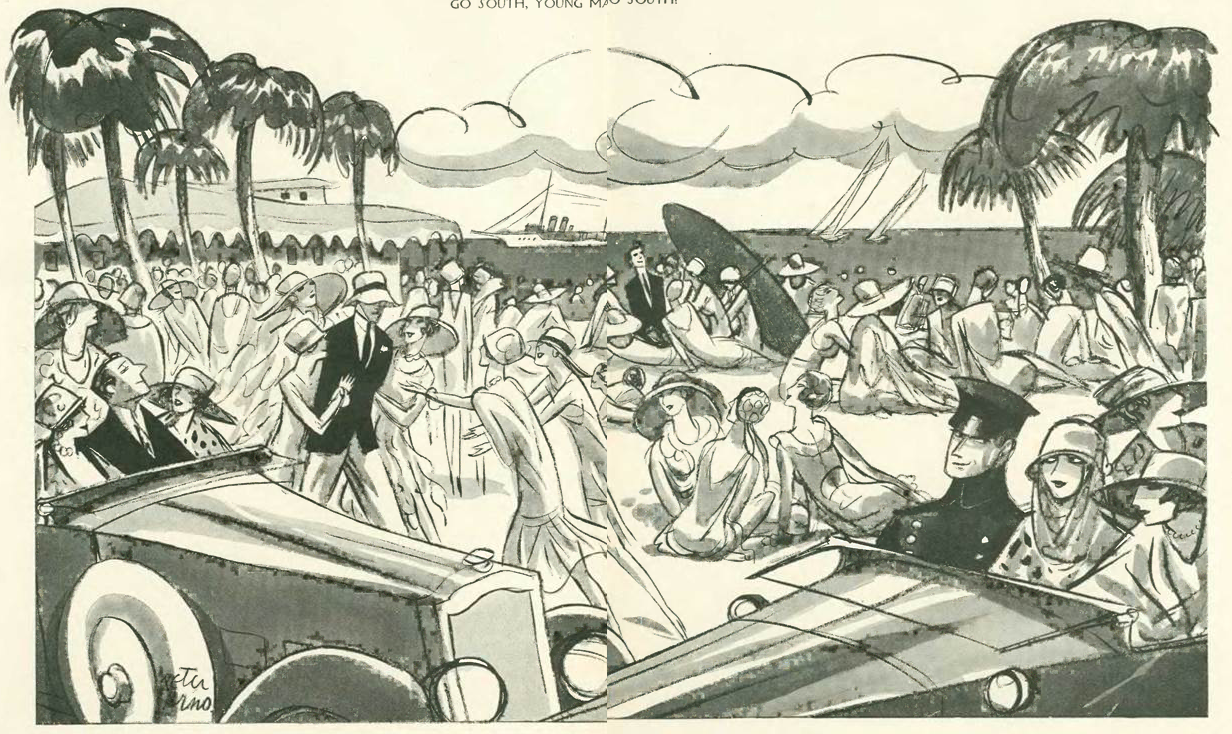
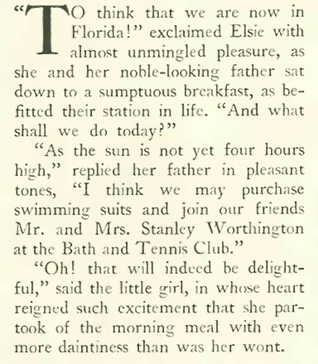
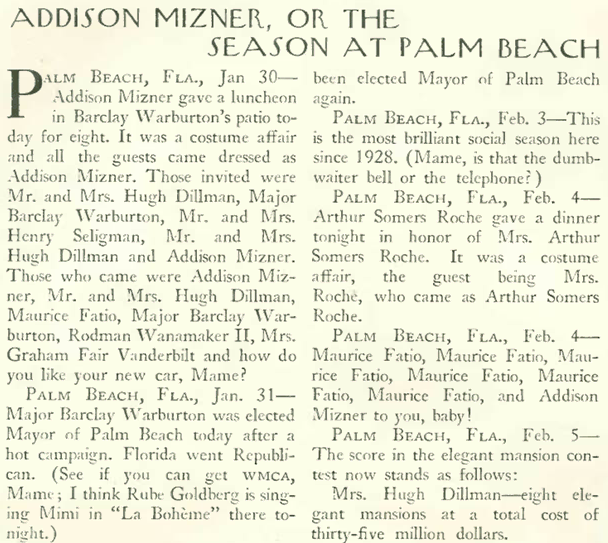
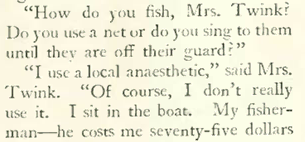
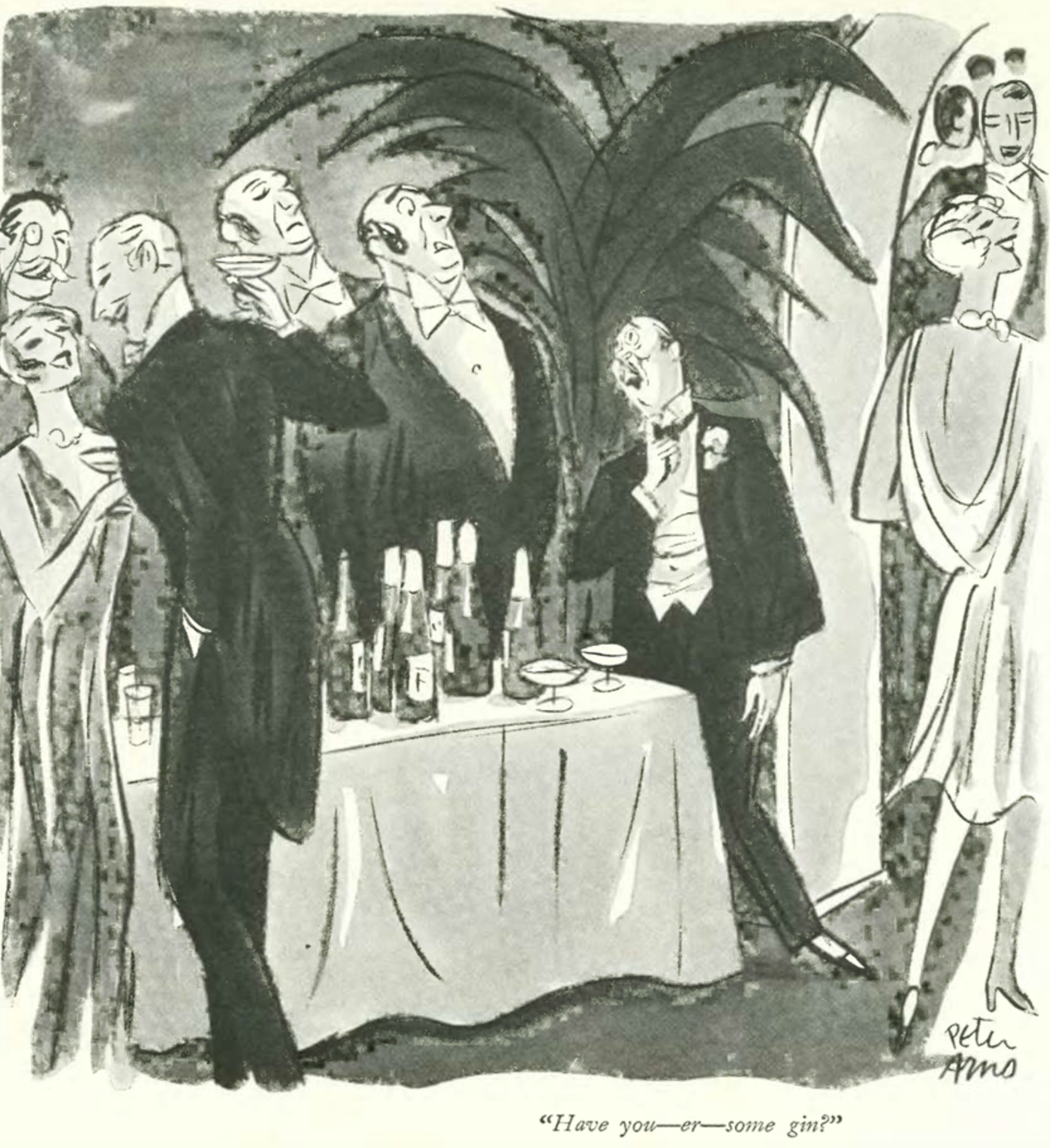
Our cartoons from Nov. 24 issue are courtesy of Arno…

…and Helen Hokinson

We continue our Christmas wish list with the Dec. 1, 1928 issue…

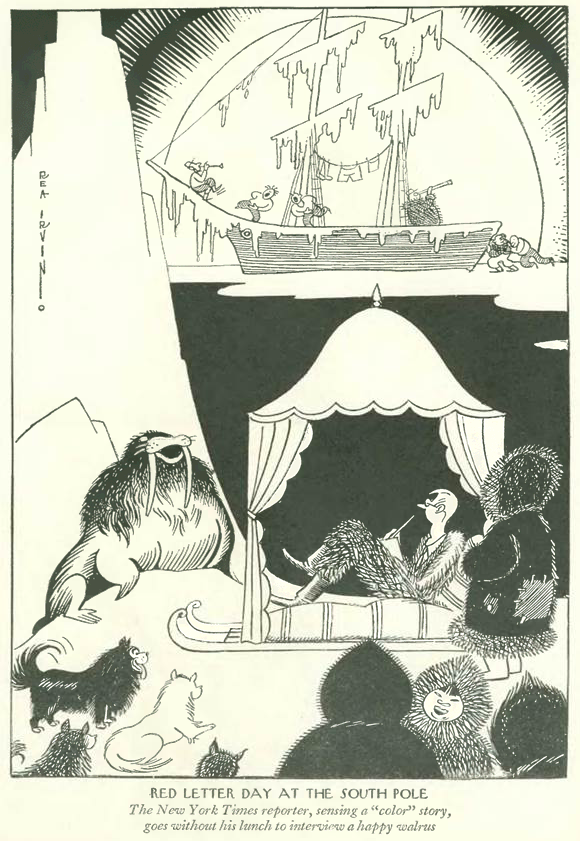
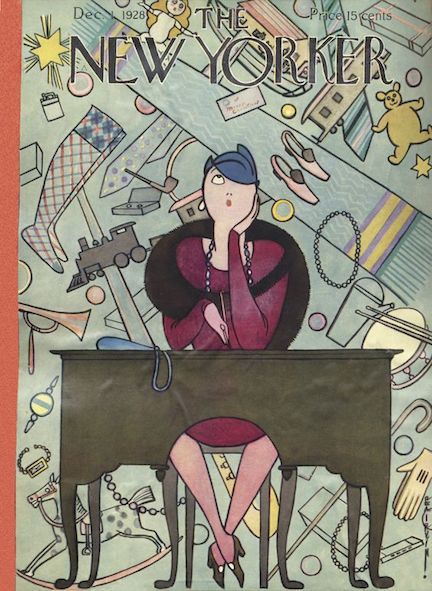
Dec. 1, 1928 cover by Rea Irvin.

Regarding gifts for her, how about some fine French perfume, “originally created for the exclusive use of one of the present Nobility of France” (apparently a person descended from the line that managed to keep their heads attached to their necks)…

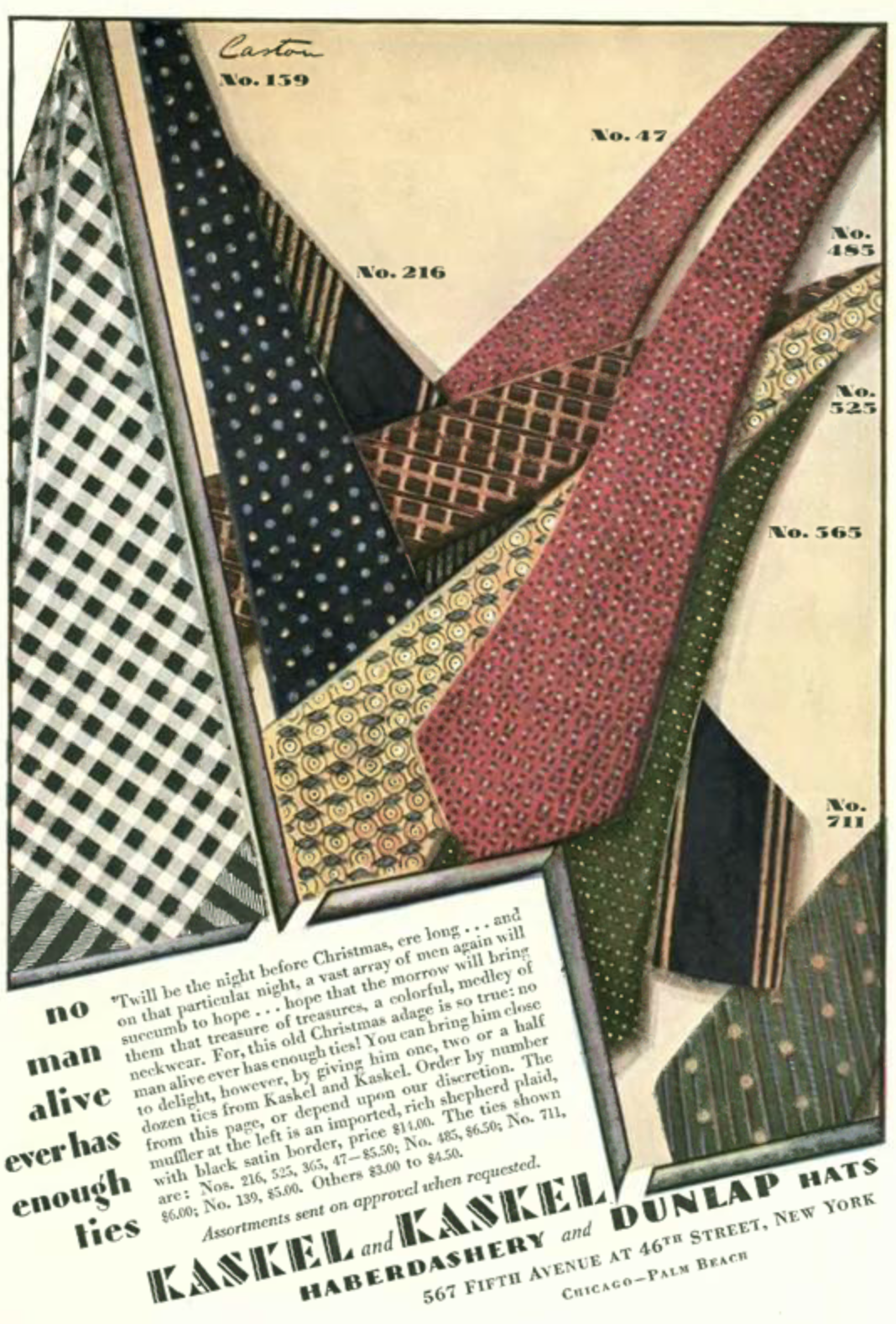
…and for him, the ubiquitous Christmas necktie, with a choice of patterns that would still serve him well in 2018…

Your “smoking friends” would doubtless have appreciated a rum-infused rumidor, available in a variety of finishes and sizes…

…or you could choose from the sundries offered up by Abercrombie & Fitch (bookends appeared to be a popular item)…

…and finally, for that special, anal-retentive someone on your list, “Fabrikoid” covers would keep his or her periodicals neat and tidy (note the New Yorker is conspicuously missing here).

Note: Fabrikoid “was one of DuPont’s first non-explosives products. Produced by coating fabric with nitrocellulose (yep, basically the same flammable stuff silent films were printed on) and marketed as artificial leather, Fabrikoid was widely used in upholstery, luggage and bookbindings during the early 20th century. In the 1920s, Fabrikoid became the preferred material for automobile convertible tops and seat covers” (text from www2.dupont.com).

 * * *

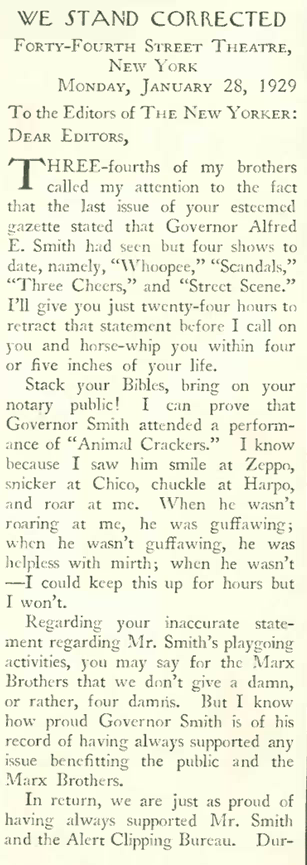
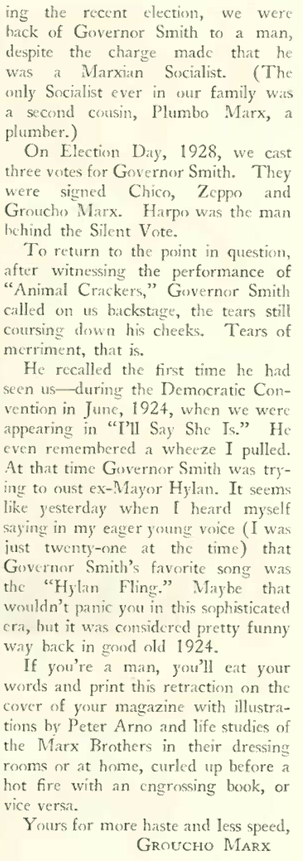
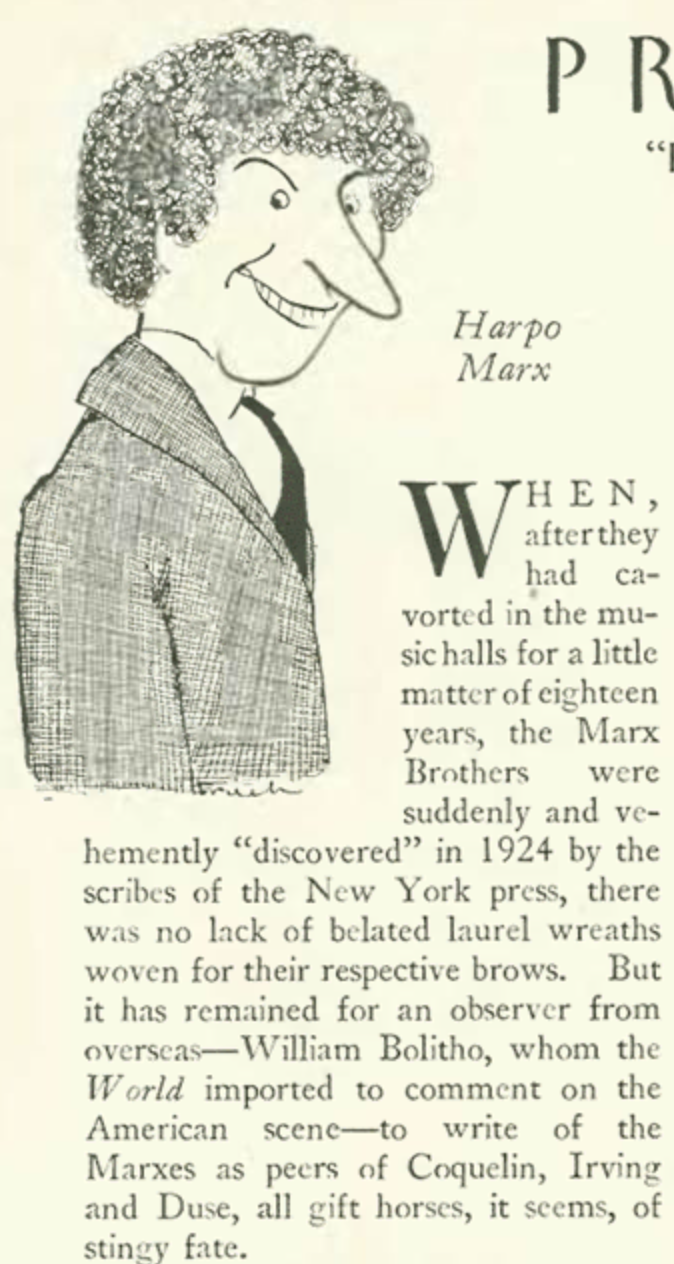
Despite the holidays, there was still news to be reported. The Nov. 24 issue profiled violinist Fritz Kreisler, while the Dec. 1 edition featured a profile of Harpo Marx, written by his fellow Algonquin Round Tabler Alexander Woollcott. Two brief excerpts:

In this next excerpt, it is interesting to note that Woollcott couldn’t see ahead to the huge success in film that awaited Harpo Marx and his brothers. Just eight months after Woollcott’s profile, the Marx Brothers would premiere their first film, The Cocoanuts, and continue to draw on material from their vaudeville and Broadway days to produce a string a comedy hits throughout the 1930s and 40s.

In other news from the Dec. 1 issue, Frank Sullivan grumbled about the recent election of President Herbert Hoover and the state of politics in general, echoing the general sentiment of his New Yorker colleagues in dismissing the national elections as little more than silly sideshow. Two excerpts:

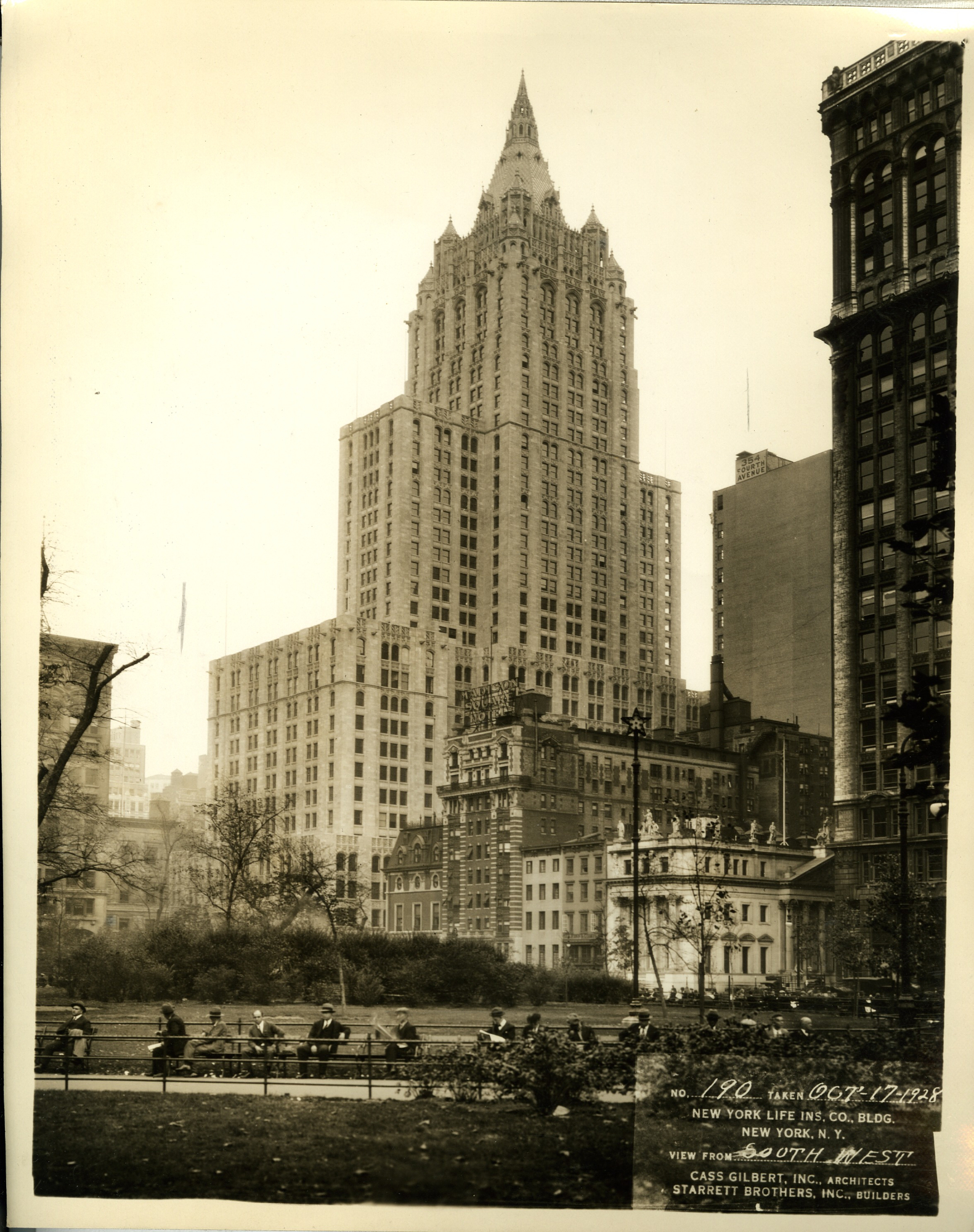
The New Yorker was less pessimistic when it came to the changing skyline, and was almost giddy at times about the latest technology seemingly transforming the city overnight. This time it was the gilded New York Life Insurance tower, and its impressive pneumatic tube system:

THINGS ARE LOOKING UP…Cass Gilbert’s newly completed New York Life Insurance Building in 1928. (Smithsonian)

 *  *  *

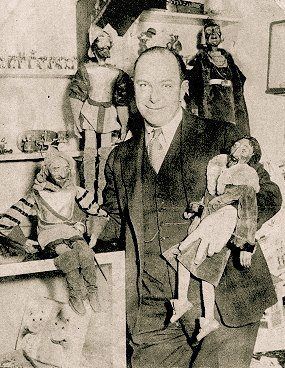
And to close, some more holiday offerings, this time for the kiddies, from Macy’s Department Store, as reported by writer Bertram Bloch:

The Macy’s Christmas window display in 1928 featured the Tony Sarg marionettes in a tableau based on The Adventures of Christopher Columbus. (Pinterest)
SUPER SOAKER…With this 1928 sit ‘n ride toy, junior could hose down the living room thanks to its large water tank and hand crank-operated water tower. (collector.com)

Next Time: Out of the Mouth of Babes…

Conventional Follies of ’28

U.S. presidential elections have long provided fodder for the nation’s humorists, and the 1928 contest between Herbert Hoover and Al Smith was no exception.

March 31, 1928 cover by Theodore G. Haupt.

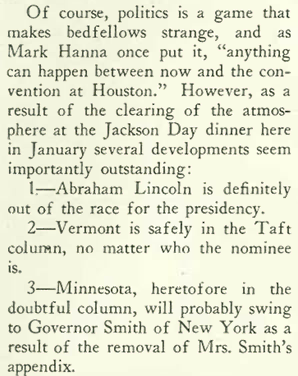
In the March 31, 1928 issue of the New Yorker writer Frank Sullivan and cartoonist Al Frueh took particular delight in skewering the party nominating conventions. As Sullivan observed:

Regarding item No. 3, Sullivan was referring to Minnesota’s famed Mayo Clinic, and the related pride that was doubtless associated with the removal of an appendix from Catherine Dunn, the wife of Al Smith, four-term governor of New York and nominee to lead the Democratic ticket.

The candidates could not have been more different. The first Catholic to be nominated for president, Smith was a crowd-loving, charismatic personality, a Tammany Hall politician and a committed “wet” who opposed Prohibition. He attracted strong support from Catholics, women, drinkers and those who were tired of the crime and corruption associated with dry America.

WET VS. WET BLANKET…The staid, “dry” Republican candidate Herbert Hoover (right) easily defeated the charismatic “wet” Democratic candidate Al Smith in the 1928 U.S. Presidential Election. (Wikipedia)

Hoover, on the other hand, was deliberately dull and humorless, as stiff as his heavily starched collars and committed to keeping the country dry. But the economy under fellow Republican Calvin Coolidge was booming, and it didn’t hurt that many Protestants believed the Catholic Church would dictate Al Smith’s policies if he were elected. Sullivan had some fun with this perceived religious prejudice:

In light of the recent 2016 elections and the prominence of “Islamophobia” in the political rhetoric, Sullivan’s joke regarding the role of “Mohammedans” in the 1928 election is noteworthy:

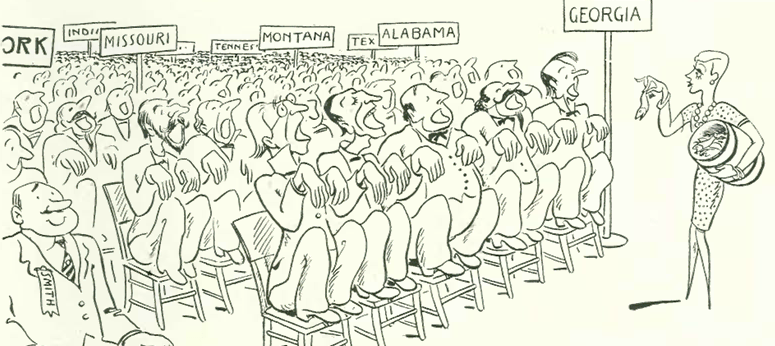
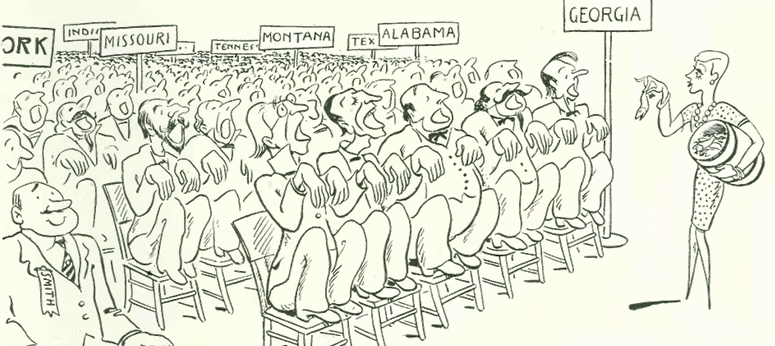
Illustrations by Al Frueh, both top and bottom, aptly captured the picture Sullivan painted of the nominating process:

Smith would lose in a landslide. Journalists at the time attributed his defeat to the three P’s: Prohibition, Prejudice and Prosperity. Rural voters, who favored Hoover, also had a bigger say than their urban brethren: Republicans would benefit from a failure to reapportion Congress and the electoral college following the 1920 census, which had registered a 15 percent increase in the urban population. After the election, Smith became the president of Empire State Inc., the corporation that would build the the Empire State Building in 1930-31.

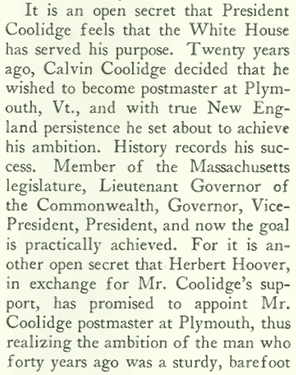
In his piece Sullivan also took at parting shot at President Coolidge…

…as did cartoonist John Price in the same issue…

For reference, the image that inspired Price:

BIG CHIEF… Calvin Coolidge donned a headdress while being named an honorary Sioux chief (“Leading Eagle”) in Deadwood, South Dakota in the summer of 1927. (Associated Press)

 *  *  *

New Yorker Monotypes

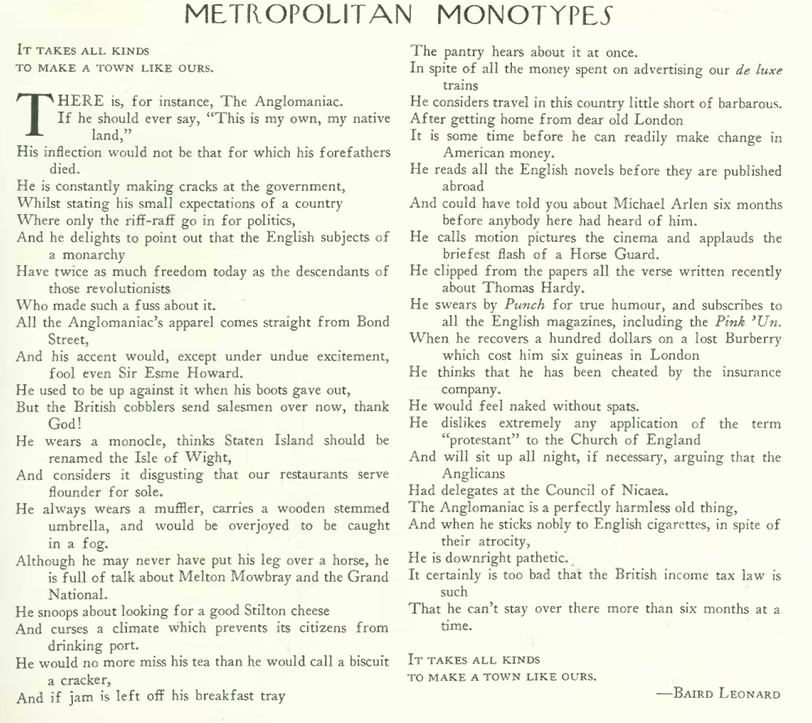
Another humorist who regularly contributed to The New Yorker was Baird Leonard, who beginning with the second issue of the magazine (Feb. 28, 1925) wrote a series titled “Metropolitan Monotypes.” Over five years and 36 installments Leonard wrote free-verse characterizations of various New York “types,” from debutantes to aesthetes to “The Anglomaniac” as described below in this installment from March 31, 1928:

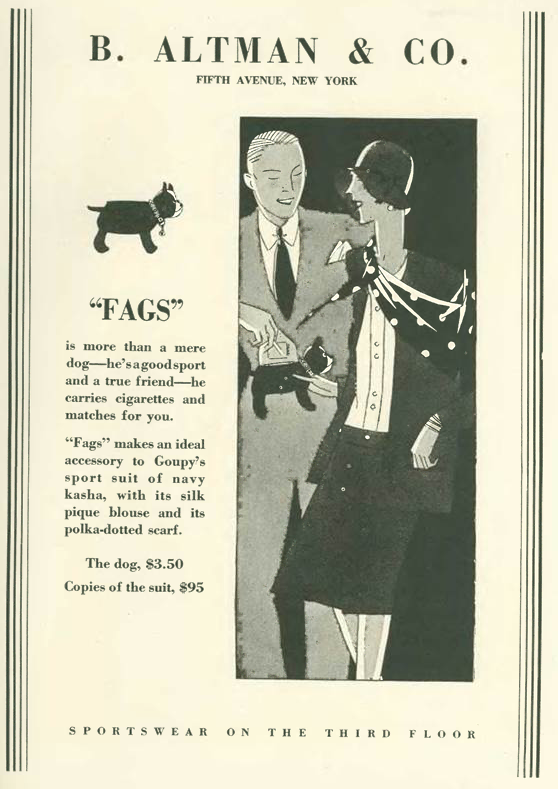
As noted before, Anglophilia oozed from The New Yorker ads, particularly those directed at the male reader (France was a common lure in ads for women). Every issue from the 1920s is rife with examples, but sticking to the March 31 issue we find this ad employing the British slang for cigarettes to market a silly, dog-shaped cigarette case to fashionable women:

In the same issue this ad from Macy’s appealed to participants of a famous cultural event for the posh set—the annual Easter Parade on Fifth Avenue. A tradition dating back to the 1870s, in its first decades the “parade” was a display of wealth and beauty, as the well-to-do strolled from church to church to check out various floral displays.

In 1928, the poor and middle classes were merely observers of the passing parade, perhaps hoping to learn something about the latest fashions. The April 14 “Talk of the Town” suggested as much:

And finally, our cartoon comes courtesy of Leonard Dove, who explores the lighter side of boxing…

Next Time: We Americans…