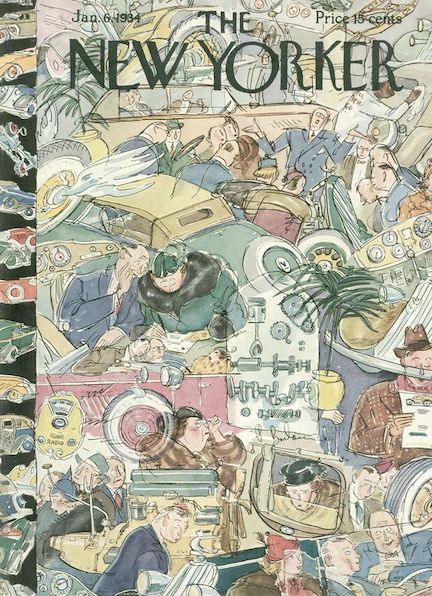
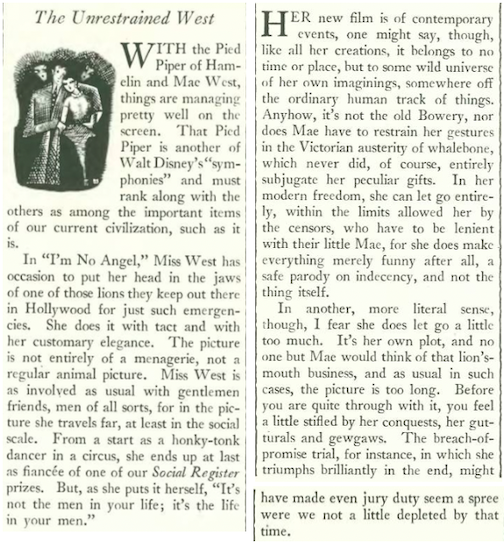
In 1925 New Yorker founding editor Harold Ross wrote that he wanted his new magazine to be “humorous from a sophisticated viewpoint” and “record the situations of everyday life among intelligent and substantial people as do the English magazines, notably Punch, except that our bent is more satirical, sharper.”
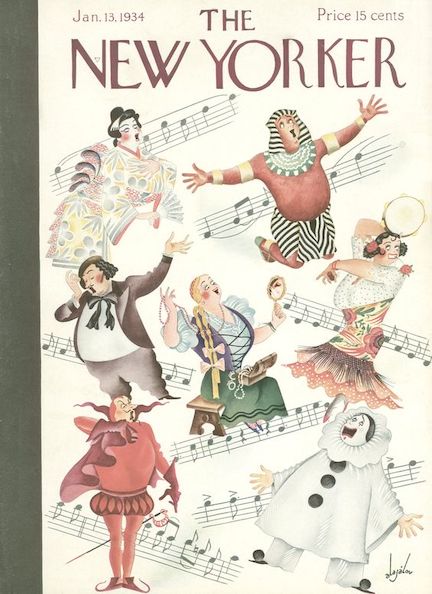
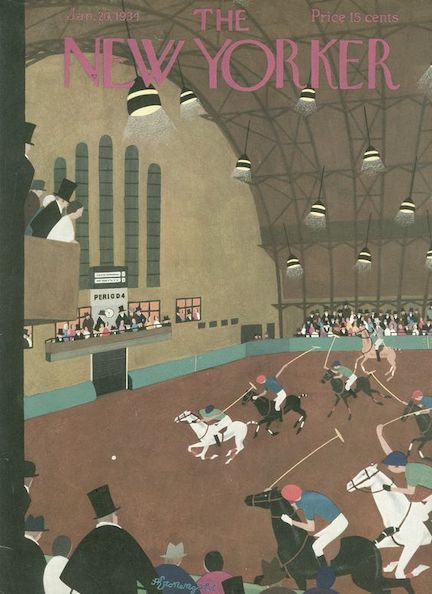
Jan. 13, 1934 cover by Constantin Alajalov.
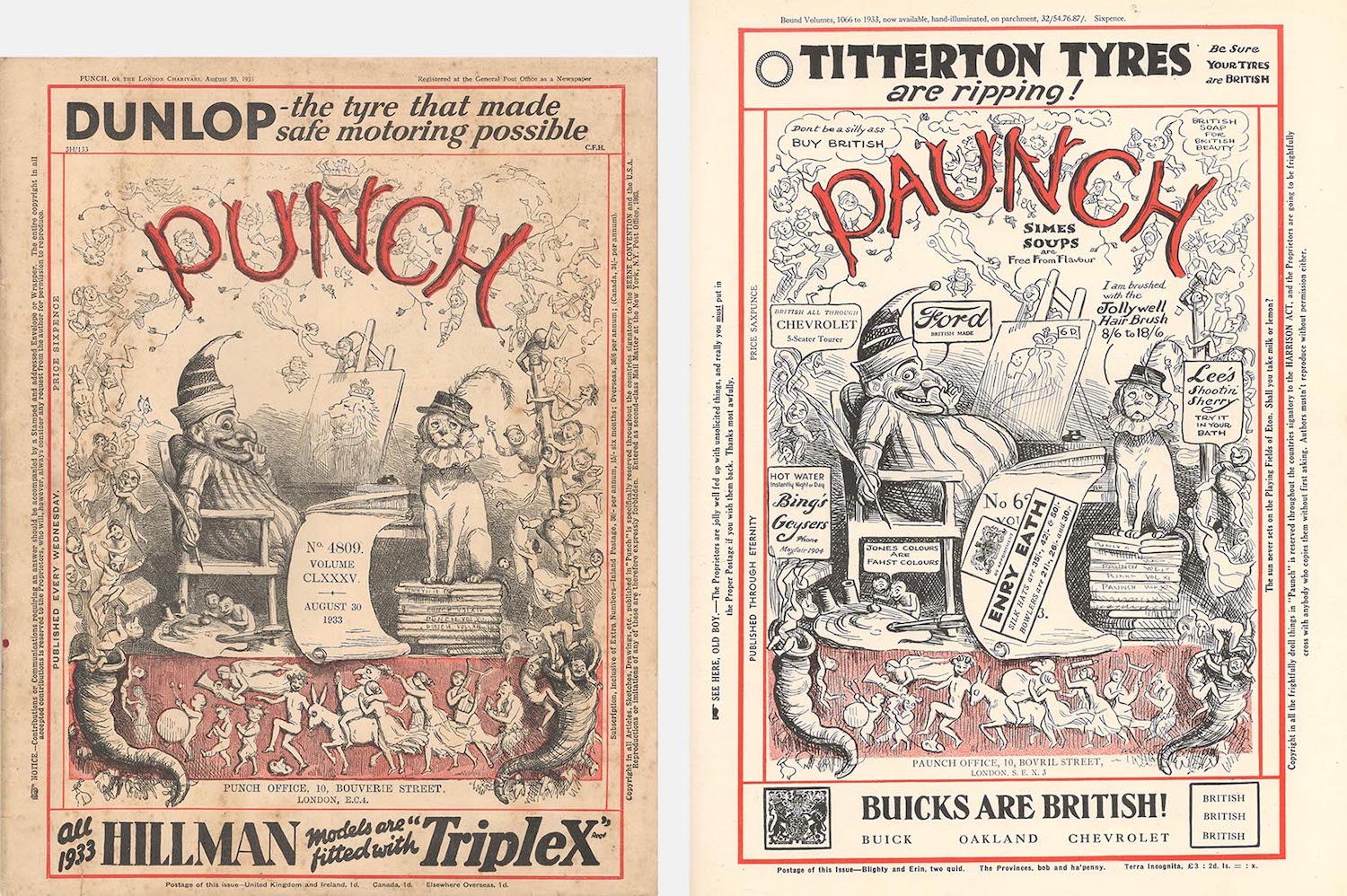
Sharper indeed, as was demonstrated in the Jan. 13, 1934 issue, when Ross’s young magazine took aim at Punch, which was founded in 1841 and had grown long in the tooth under the guidance of Sir Owen Seaman, whose Victorian sensibilities (he joined Punch in 1897) were ripe for parody by a magazine founded during the Jazz Age.
Writer and cartoonist V. Cullum Rogers (MagazineParody.com) notes that the eight pages devoted to “Paunch” was The New Yorker’s longest and most elaborate parody of another publication.
RIPE FOR THE PICKING…The covers of Punch for August 30, 1933, and The New Yorker’s 1934 parody.
E.B. White and Franklin P. Adams contributed parodies (“The Mall” by White and “The Intent Caterpillar” by Franklin) of what Rogers cites as “two of Punch’s favorite forms of bad verse: the sticky-sentimental and the mechanically clever.”
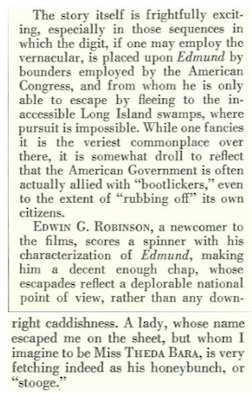
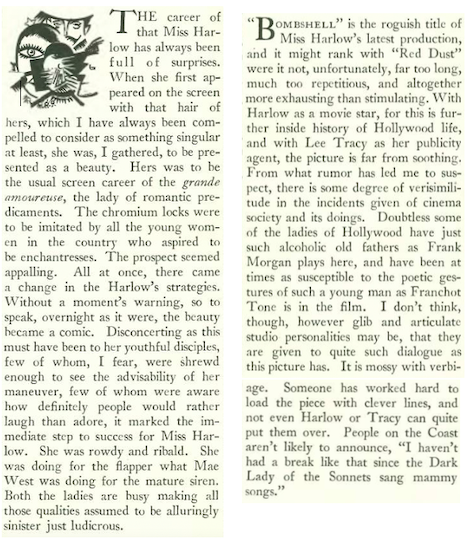
The New Yorker’s theatre critic Wolcott Gibbs joined the fun by penning “Mr. Paunch’s Cinema Review” (excerpt)…
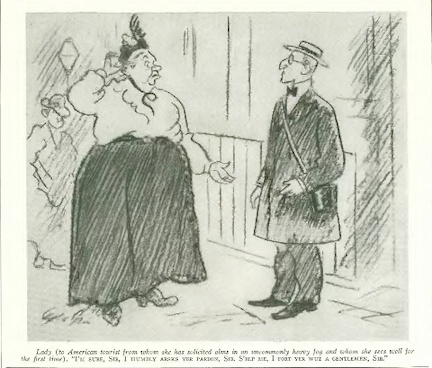
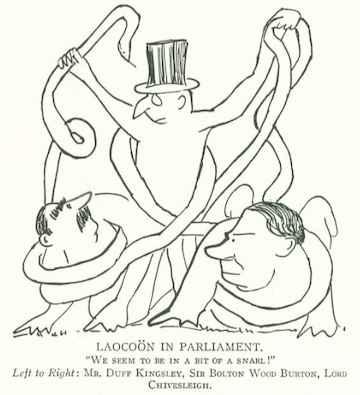
…Rea Irvin and James Thurber offered up their cartooning skills…
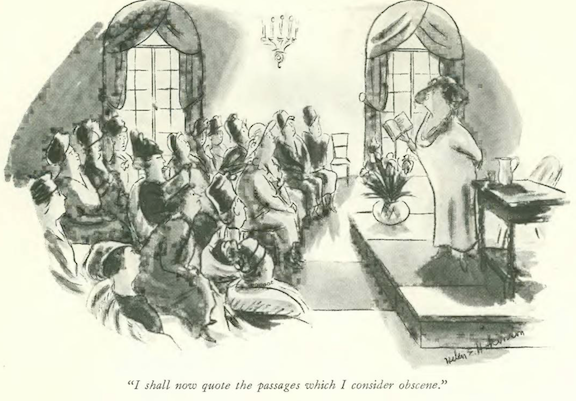
Rea Irvin’s parody of a Punch cartoon. (Caption enlarged below).
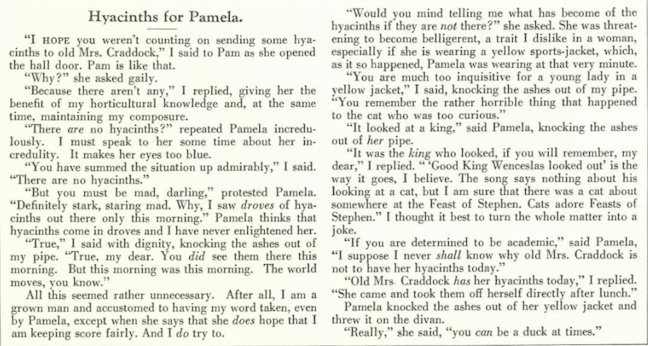
…and Robert Benchley contributed this gem, “Hyacinths for Pamela.”
Rogers writes that although “Paunch” wasn’t promoted on the cover, “the issue it ran in became the first in The New Yorker’s nine-year history to sell out on newsstands. (The second sellout contained Wolcott Gibbs’sTime parody, which suggests a demand for such things).”
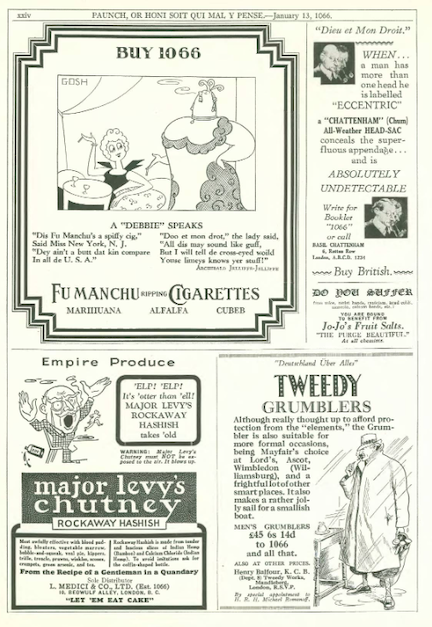
The parody issue concluded with this page of advertisements:
* * *
The Show Must Go On
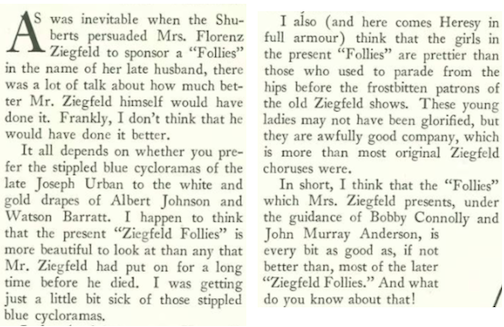
The death of Florenz Ziegfeld Jr. in 1932 did not put an end to his Follies; indeed, under the direction of his widow, Billie Burke, the show seemed to have new legs, at least according to Robert Benchley:
HOOFIN’ IT…Clockwise, from top left: Program for the 1934 Ziegfeld Follies; performers in the show included popular brother–sister dancing act Buddy and Vilma Ebsen, pictured here with Eleanor Powell in Broadway Melody of 1936 (most of us know Buddy Ebsen as Uncle Jed from The Beverly Hillbillies); Al Hirschfeld drawing of the show’s stars; Willie Howard, Fanny Brice and Eugene Howard in Ziegfeld Follies of 1934. (YouTube/NYPL)
* * *
Keen on the Airflow
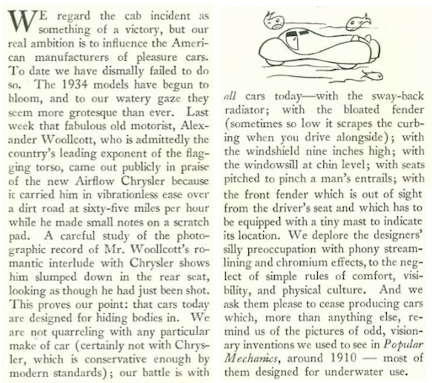
The streamlining trend in autos was not to E.B. White’s liking (see below), but the reviewer of the National Auto Show (pseud. “Speed”) was eager to take the Chrysler Airflow for a spin.
* * *
From Our Advertisers
The Chrysler Corporation ran this two-page ad that took issue with E.B. White’s criticisms of the streamlining trend in automobiles, led by Chrysler’s “Airflow” model…here Chrysler responded with a note pinned to a tear sheet from the Dec. 16, 1933 “Talk of the Town”…You wrote this before you saw the new Chryslers, Mr. New Yorker…
…with the National Auto Show still in town the splashy car ads continued, including this one from the makers of Fisher car bodies…
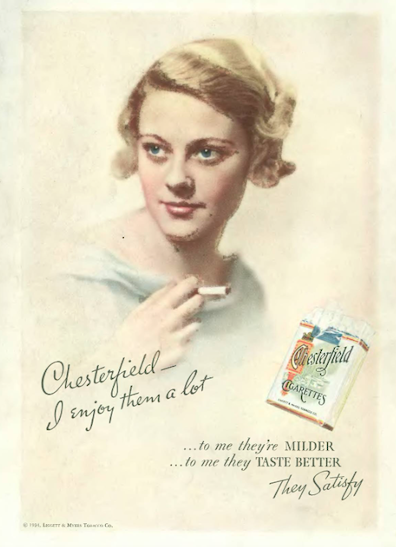
…another advertising stalwart, the Liggett & Myers Tobacco Company, gave us a young woman who enjoyed their Chesterfields “a lot”…
…Guinness was back for those who missed that taste of Dublin…
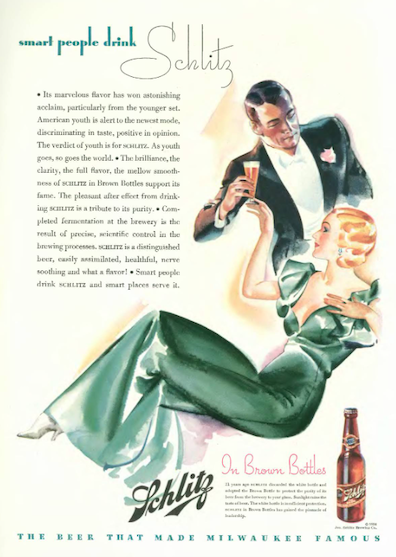
…and the folks behind “The Beer That Made Milwaukee Famous” placed their first ad in The New Yorker…
…if you wanted to have your drink outside of the home, what better place than the Madison Room at The Biltmore…
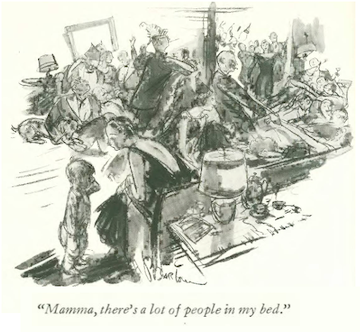
…on to our cartoons, with begin with Perry Barlow and a tot losing sleep over the new year…
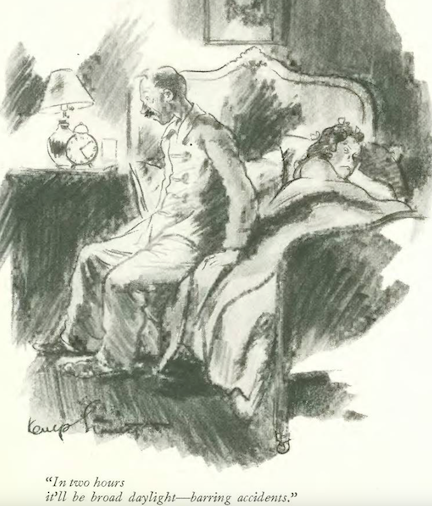
…Kemp Starrett also explored the world of sleep deprivation…
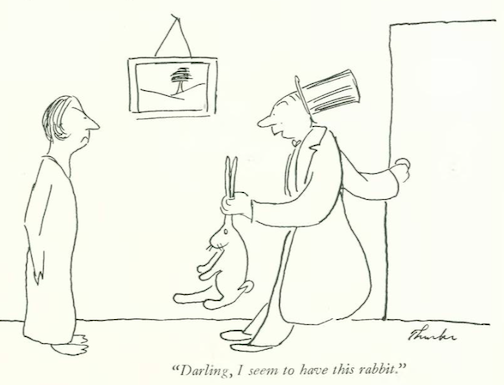
…and we end with James Thurber, and a woman with a low tolerance for “cute” news…
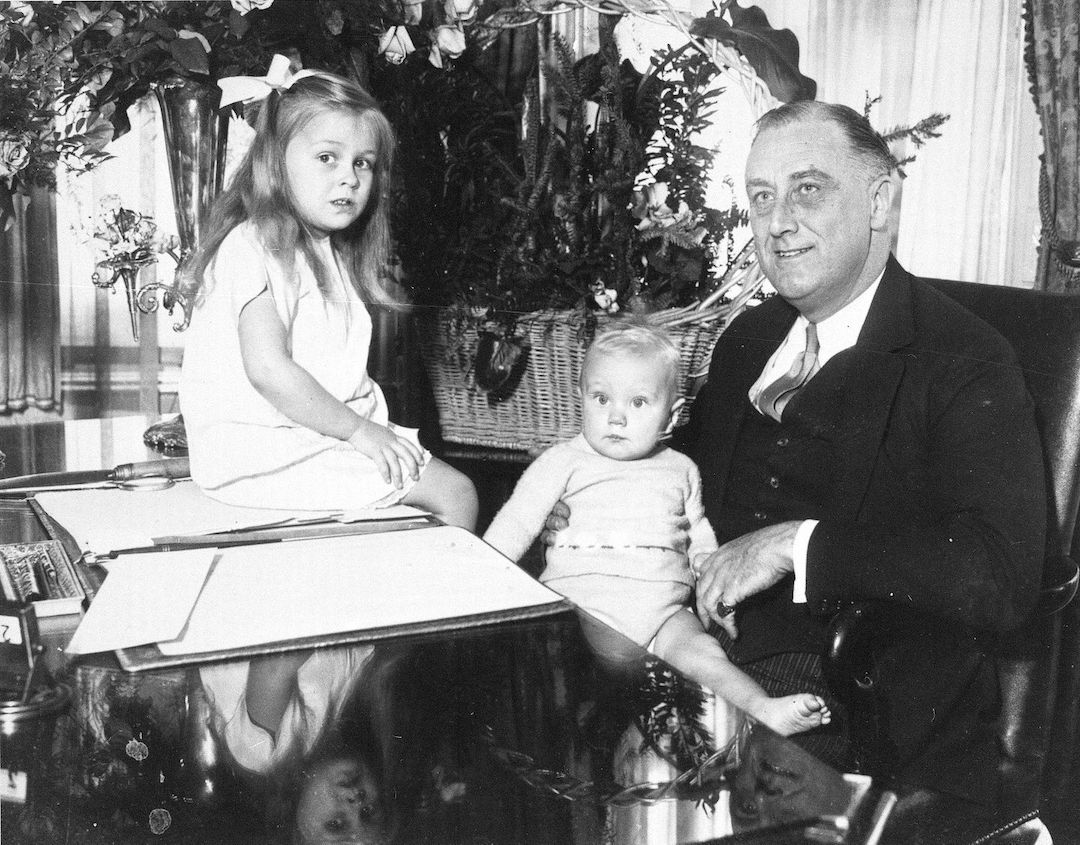
…in case you are wondering, Anna Eleanor “Sistie” Dall was the daughter of Franklin and Eleanor Roosevelt’s eldest child Anna Dall. When Dall separated from her husband in 1933, she moved into the White House with her children, Sistie and Buzzie.
TOO CUTE…Franklin Roosevelt with his grandchildren Anna Eleanor “Sistie” Dall and Curtis “Buzzie” Dall in 1932. According to Buzzie, he and his sister lived in the White House from September 1933 to November 1935. (AP)
Perhaps it was the end of Prohibition, or the implementation of the New Deal, but throughout the pages of the final New Yorker of 1933 you could sense a lightening of spirit.
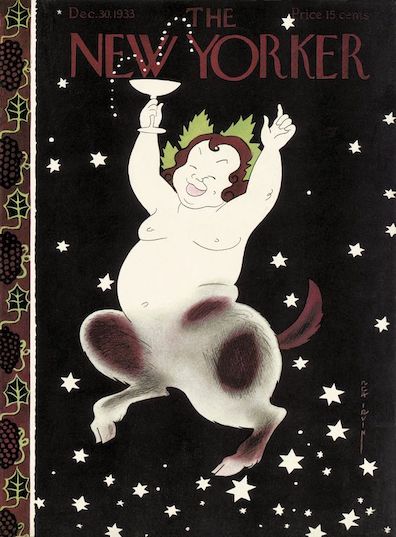
Dec. 30, 1933 cover by Rea Irvin.
By most accounts 1933 was one of the Depression’s worst years, and that is likely why E.B. White chose to remember “only a few scattered moments,” mixing the silly with the salient.
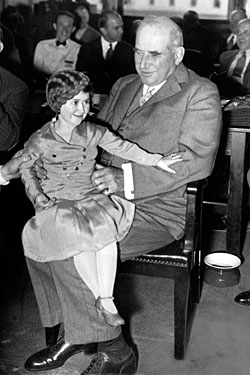
Of the silly, there was the time when the Barnum & Bailey circus dwarf Lya Graf sat on J.P. Morgan’s lap while he was waiting to testify before the Senate Banking Committee…
HE DIDN’T BANK ON THIS…J.P. Morgan was paid a visit by Barnum & Bailey circus dwarf Lya Graf, prior to his testimony before the Senate Banking Committee on June 1, 1933. (New York Magazine)
White also noted the passing of Texas Guinan. Known as “Queen of the Nightclubs,” she was a fixture on the Manhattan speakeasy scene throughout the Roaring Twenties and a reliable source of nightlife headlines. White also recalled George Bernard Shaw’s controversial speech at the crowded Metropolitan Opera House, during which he referred to American financiers as “lunatics” and called the U.S. Constitution a “charter of anarchism.”
YEAR IN A NUTSHELL…Clockwise, from top left: The year 1933 saw the passing of the “Queen of the Nightclubs” Texas Guinan—more than 10,000 showed up for her funeral in November; also that month Thomas G.W. Settle and C.L Fordney ascended to the stratosphere in the Century of Progress balloon; The New York Times (April 12, 1933) published the full text of George Bernard Shaw’s Met speech; Esquire published its first issue in the fall, featuring Ernest Hemingway and John Dos Passos as well as New Yorker cartoonists Constantin Alajalov, William Steig and E. Simms Campbell; according to Vogue, 1933’s breasts were “high and pointed.” (bounddv.medium.com/history.navy.mil/The New York Times/Pinterest)
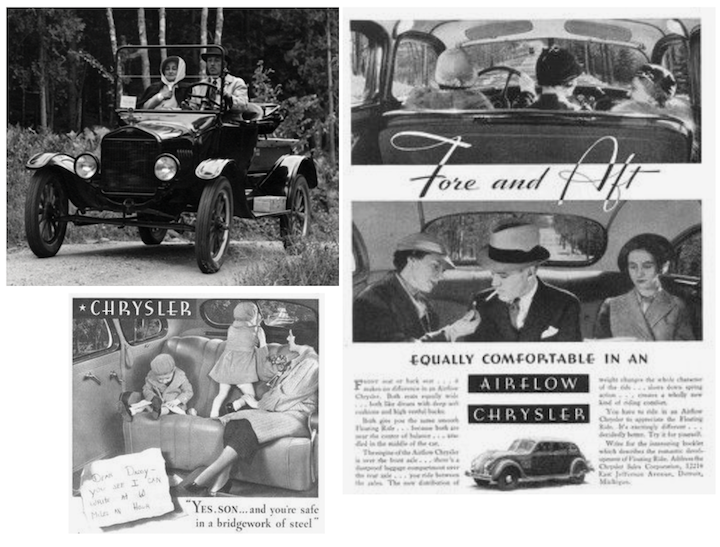
White also had more to say about the streamlining trend in automobiles, led by Chrysler’s new “Airflow.” White preferred the older, boxier models, with plenty of head and hat room.
In 1922 White set off across America in the car of his dreams, a Model T, which had plenty of headroom and, as he later wrote, transformed his view of the land, a vision “shaped, more than by any other instrument, by a Model T Ford…a slow-motion roadster of miraculous design—strong, tremulous, and tireless”…
MERRILY WE ROLL ALONG…Clockwise, from top left: E.B. White and wife Katharine Sergeant take a spin in a Model T in the mid 1930s; despite White’s remonstrations regarding headroom, the makers of the Chrysler Airflow advertised their streamlined car’s interior as practically cavernous. (Goodreads/Pinterest)
* * *
Crying in His Beer
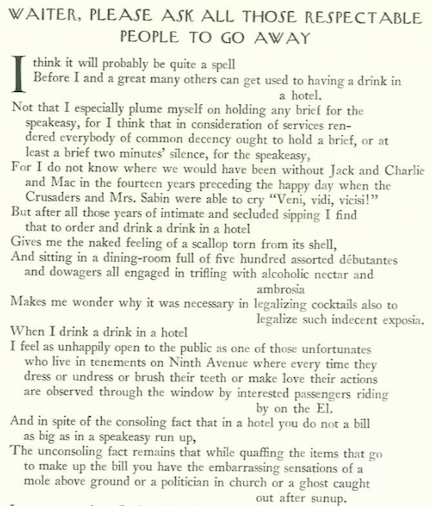
A couple of issues back we saw Lois Long bid a sad farewell to the cosy and secluded atmosphere of the speakeasy…Ogden Nash turned to verse to offer his own lament, feeling naked and exposed in dining rooms “full of 500 assorted debutantes and dowagers”…
FEELING EXPOSED…Ogden Nash (1902–1971) missed the sacrilegious rite of the speakeasy and lamented the “humdrumness” of legal drinking. (vpoeticous.com)
* * *
Wondering About Alice
Combine horrific character designs with a young adult playing a child and you have the recipe for 1933’s star-studded Alice in Wonderland, a film the Nerdist’sKyle Anderson calls “a fascinating, unintentionally disturbing take on a classic.” Almost ninety years earlier the New Yorker’sJohn Mosher found it disturbing in other ways, save for W.C. Field’s portrayal of Humpty Dumpty.
Writing for The Roarbots, Jamie Green notes that Charlotte Henry was 19 when she played Alice: “This version of Alice doesn’t feel like a sweet look at the twists and turns of adolescence; it feels more like a commentary on repressed desire and self-identity.” The film was a flop at the box office.
CHANNELLING HER YOUTH…Clockwise, from top left: 19-year-old Charlotte Henry as Alice in 1933’s Alice in Wonderland; W.C. Fields as Humpty Dumpty; Roscoe Karns as Tweedledee and Jack Oakie as Tweedledum; Alice has a chat with Gryphon (William Austin) and Mock Turtle (Cary Grant). Except for Henry, most of the cast was unrecognizable in their macabre makeup and costumes. (IMDB)
* * *
From Our Advertisers
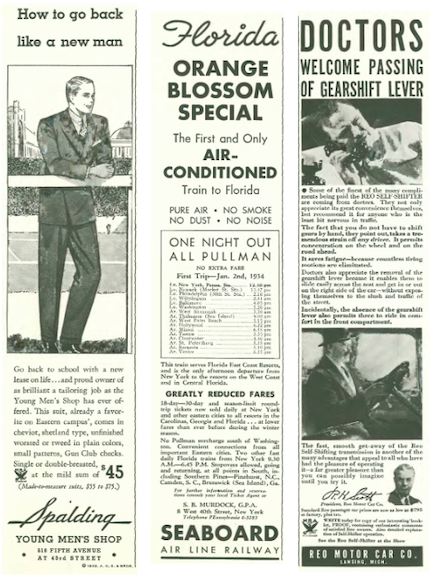
We start with a selection of three one-column ads, featuring, from left, the latest back-to-school look for the collegiate male (apparently attending Columbia); the dustless, noiseless, smokeless, AIR-CONDITIONED railway wonder called the Orange Blossom Special; the automobile arm of the REO Motor Car Company trying to pack everything it could into this narrow little ad (REO would stop producing cars in 1936 in order to focus solely on trucks)…
…the distillers of Holloway’s London Dry Gin warned newly liberated American drinkers about the consequences of imbibing cheap gin…
…the folks at R.J. Reynolds found another member of the gentry to push their Camels onto aspiring young women…
…on to our cartoons, the Dec. 30 issue featured a James Thurber double-header, beginning with this “Talk of the Town” spot illustration…
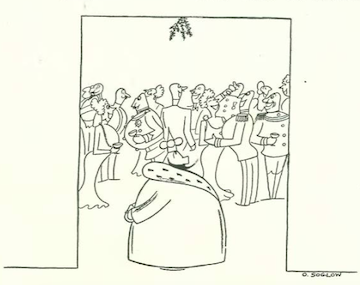
…a rare one-panel Little King from Otto Soglow…
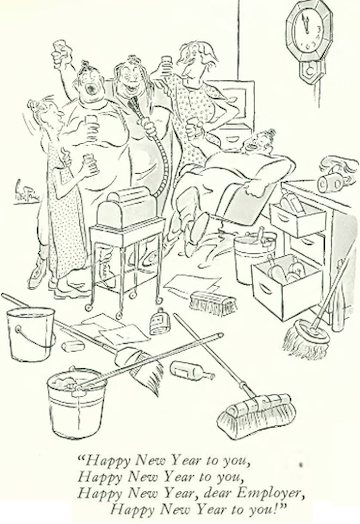
…ringing in the New Year with Syd Hoff…
…and George Price…
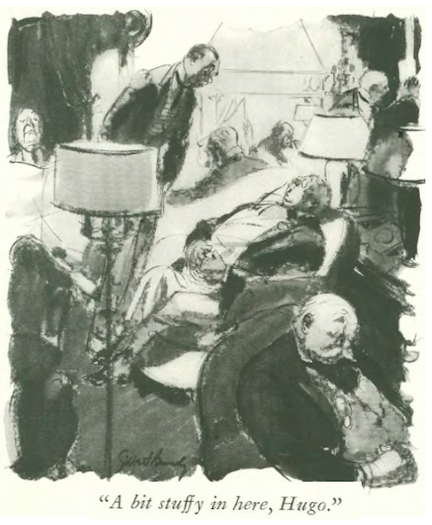
…and we close with Gilbert Bundy, seeking from fresh air…
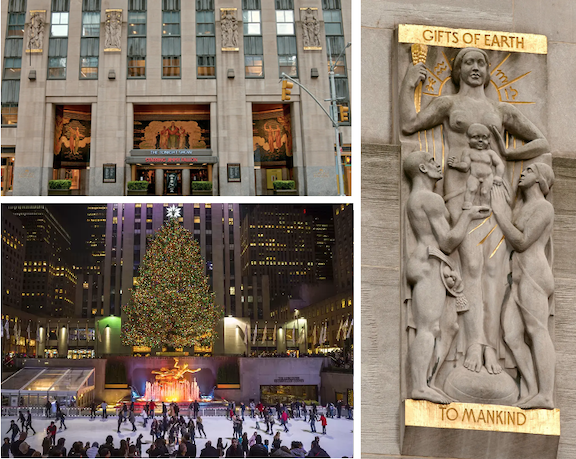
When Rockefeller Center’s design was unveiled in 1931, New Yorker architecture critic Lewis Mumford wrote that it followed ”the canons of Cloudcuckooland.”
Dec. 23, 1933 cover by Helen Hokinson.
Today we know 30 Rock as one of the most iconic and beloved places in Manhattan, but after Mumford saw the plans for this future “Radio City” he went into exile in upstate New York, upset over the “weakly conceived, reckless, romantic chaos” of the project. Mumford wasn’t alone in his opinion; indeed it was his commentary that helped fuel negative reactions from citizens and newspapers alike.
No doubt the scale of the project bothered a lot of people, as it was slated to replace four- and five-story brownstones and other smaller buildings with a series of massive structures (for Mumford, it was rare that any skyscraper found his favor—to him they were oversized symbols of corporate tyranny).
IMMODEST PROPOSAL…In the fall of 1928 John D. Rockefeller leased this property from Columbia University for the future site of Rockefeller Center. The project covered nearly all of the area in the three square blocks bordered by Fifth Avenue, Sixth Avenue, and 48th and 51st Streets. (ephemeralnewyork.wordpress.com)
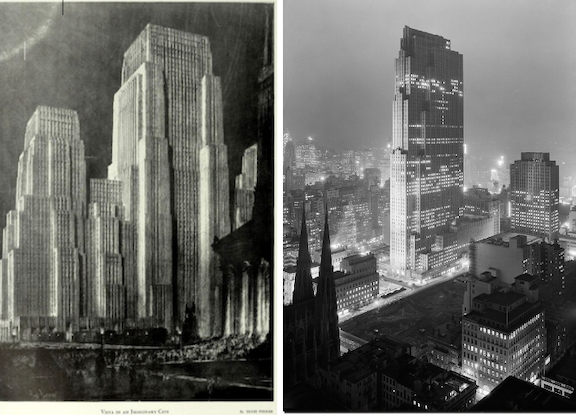
As the Rockefeller Center towers rose, some softened their criticisms, including E.B. White—in the Dec. 9 issue he said he would eat his words after viewing the floodlit 30 Rock by night: “the whole thing swims up tremendously into the blue roxyspheres of the sky.”
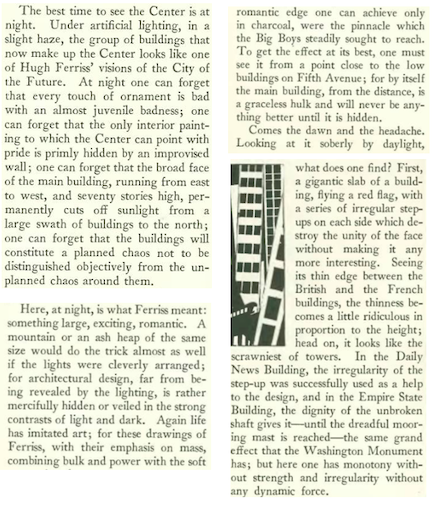
Two weeks later, in his Dec. 23 “Sky Line” column, Mumford agreed that the floodlit buildings looked impressive, recalling Hugh Ferriss’ romantic, futuristic visions of the city; however, the darkness also concealed a decorative scheme that was ”bad with an almost juvenile badness.”
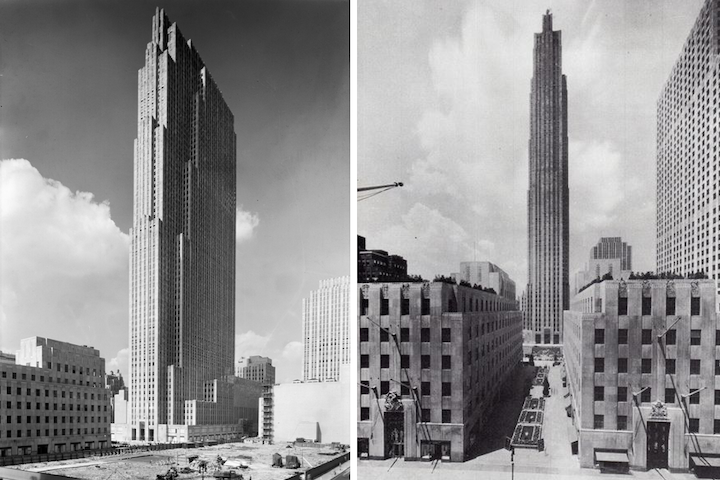
A MATTER OF PERSPECTIVE…Lewis Mumford thought the RCA tower looked “scrawny” when viewed in broad daylight between the British and French empire buildings. (smarthistory.com/Pinterest)NIGHT VISION…In his 1929 book, The Metropolis of Tomorrow, Hugh Ferriss published the image at left of an imaginary city of the future (left). Ferriss was an architect, illustrator, and poet who explored the psychological condition of urban life, and was known for his conte crayon drawings of skyscrapers—nighttime scenes from a futuristic Babylon that are influential in popular culture (e.g. Tim Burton’s vision for Gotham in 1989’s Batman). (archive.org/Wikipedia)
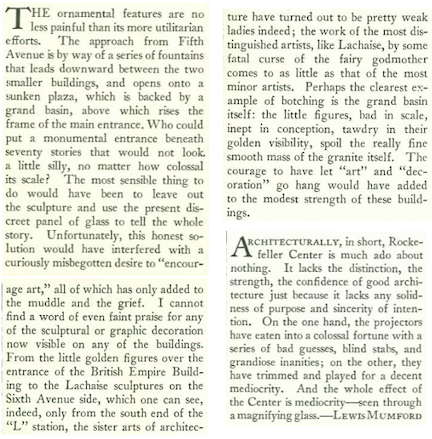
Having finished his excoriation of the buildings’ scale and placement, Mumford proceeded to carve up the ornamental features, including the sunken plaza (today an iconic site for ice skating), which he thought looked “a little silly” in relation to the mass of the RCA building.
TRAINED EYE…Lewis Mumford believed the work of the great Gaston Lachaise was diminished in the Rockefeller Center concept, noting that the Lachaise sculptures on Sixth Avenue (top and right photos) were only visible from the “L” station (Mumford doesn’t mention that the elevated placement of the sculptures was deliberate—they were put there so train riders on the “L” could see them); below, Mumford found the sunken plaza to be out of scale with the RCA tower—for decades it has been one of Manhattan’s most iconic sites. (Wikipedia/Vincent Tullo for The New York Times)
Revisiting Rockefeller Center in his May 4, 1940 “Sky Line” column, Mumford wouldn’t exactly eat his words, but he did admit that the collection of structures formed “a composition in which unity and coherence have to a considerable degree diminished the fault of overemphasis. In other words, they get by.” Mumford still believed 30 Rock was too tall—he would have preferred 32 stories, less than half its actual size: “Good architecture is designed for the human beings who use or view the buildings, not for publicity men or photographers.”
I have to disagree. Every time I look up at 30 Rock I feel my heart soar.
* * *
Yule Like This
The Dec. 23 issue marked the return of Frank Sullivan’s annual holiday poem, “Greetings, Friends!” Sullivan published his first holiday poem in 1932 and faithfully continued the tradition until 1974; after his death in 1976, New Yorker editor William Shawn asked the late Roger Angell to take on the poem. In 2012 Angell passed the duty along to Ian Frazier, the magazine’s current Yuletide bard (Frazier’s latest poem can be found in the Dec. 26, 2022 issue).
* * *
Success, In Spite of it All
“The Talk of the Town” looked in on singer Ethel Waters, who apparently wasn’t brooding over the difficulties of her past life, given that she was seeing so much success as a recording artist and as a Broadway star in As Thousands Cheer. Although her material life was better, she still faced racism wherever she went, including on stage—although she received equal billing, she was segregated from her co-stars in As Thousands Cheer.
BORN INTO THE BLUES…Raised in crushing poverty, Ethel Waters became a major singing star in the 1930s. She was one of the first singers to confront racism in a popular 1933 song, “Suppertime.” (Facebook)
* * *
Enigma
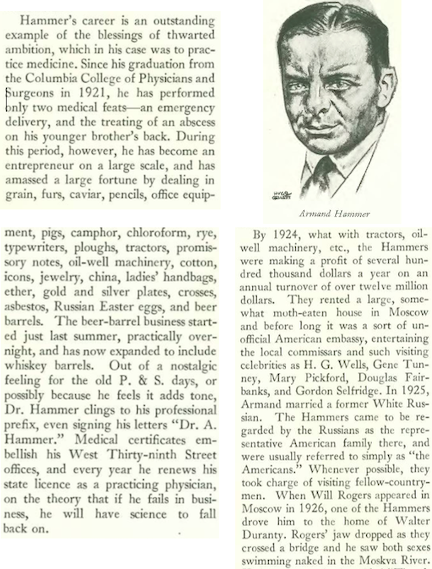
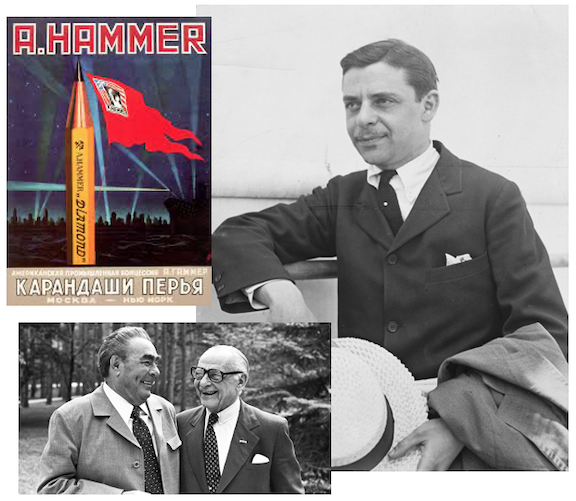
Geoffrey T. Hellman examined the life of American entrepreneur Armand Hammer in a profile titled “Innocents Abroad.” Hammer’s business interests around the world helped him cultivate a wide network of friends and associates. Called “Lenin’s chosen capitalist” by the press, Hammer (1898-1990) started a pencil factory in the Soviet Union in 1926 and later became head of Occidental Petroleum. Throughout his career he maintained close ties with Soviet leaders—which raised many suspicions in the West—but Hammer also served as a citizen diplomat for the U.S., an important go-between during the Cold War. An excerpt:
PROLETARIAN PENCILS…Clockwise, from top left: A 1928 Soviet advertising poster for “A. Hammer” pencils. The factory began work in Moscow in April 1926 as a private American industrial concession; Armand Hammer in the 1920s; Hammer (at right) shares a laugh with Soviet leader Leonid Brezhnev in the 1970s. Hammer is also the great-grandfather of American actor Armie Hammer. (crwflags.com/The New York Times)
* * *
From Our Advertisers
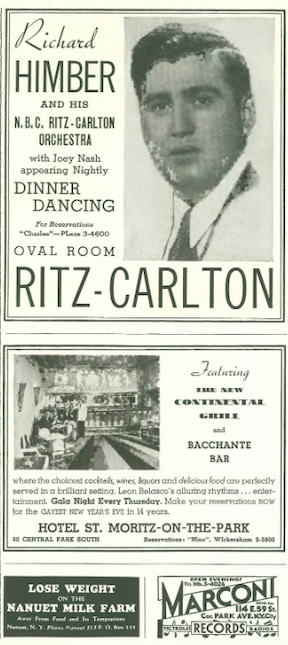
With Prohibition over, New Yorkers were looking forward to celebrating the holidays with Richard Himber and his orchestra at the Ritz-Carlton or enjoying a cocktail at the new Continental Grill and Bacchante Bar at the Hotel St. Moritz…
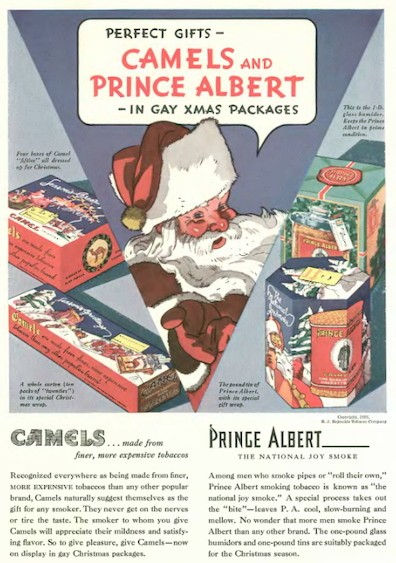
…and no less of an authority than Santa was advising shoppers to give tobacco products to their loved ones this holiday season…
…or perhaps you could be persuaded by elegant holiday wishes from the owners of Lucky Strike, who included their cigarettes among “the best of good things”…
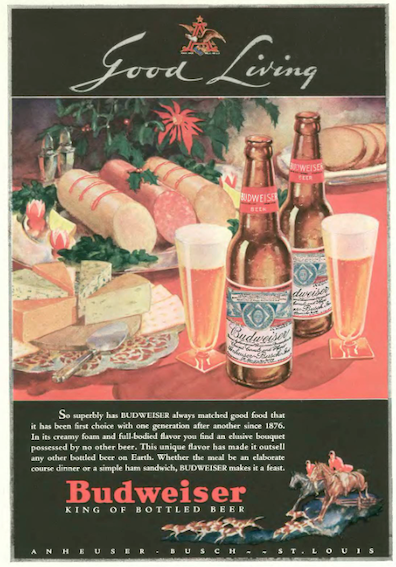
…good living, apparently, could also be found in a bottle of Bud…
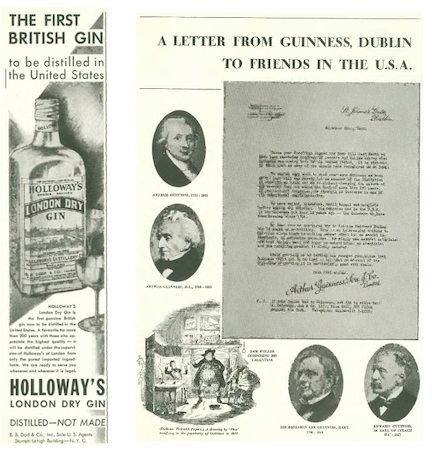
…or in American-distilled “London Dry Gin”…or in a pint of Guinness…
…our cartoons begin with Gardner Rea, and a course in mixology…
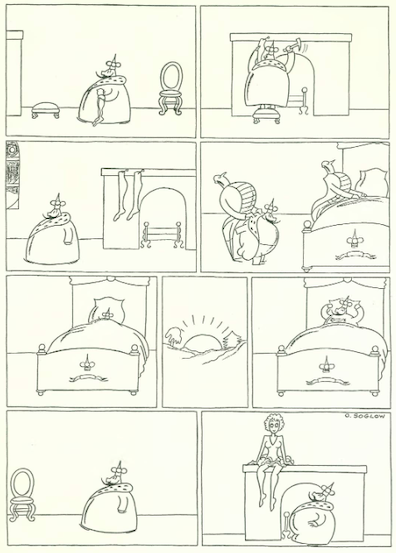
…Otto Soglow’s Little King found a surprise in his Christmas stockings…
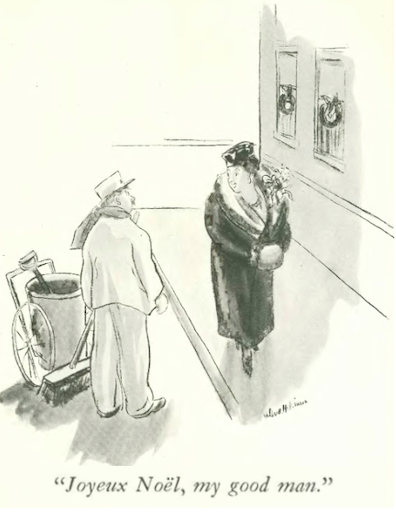
…Helen Hokinson offered some passing holiday cheer…
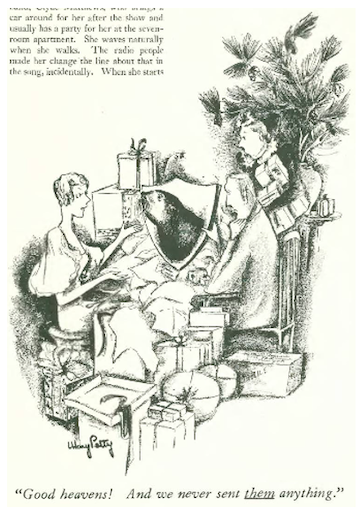
…Mary Petty gave us this unusual Christmas seal…
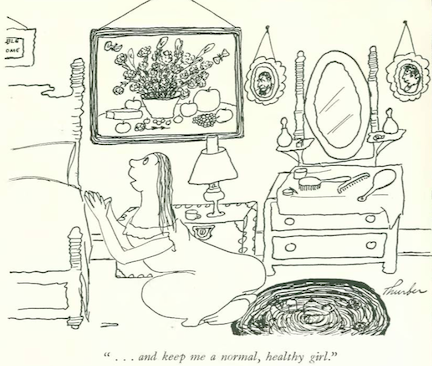
…and from James Thurber, this earnest prayer…
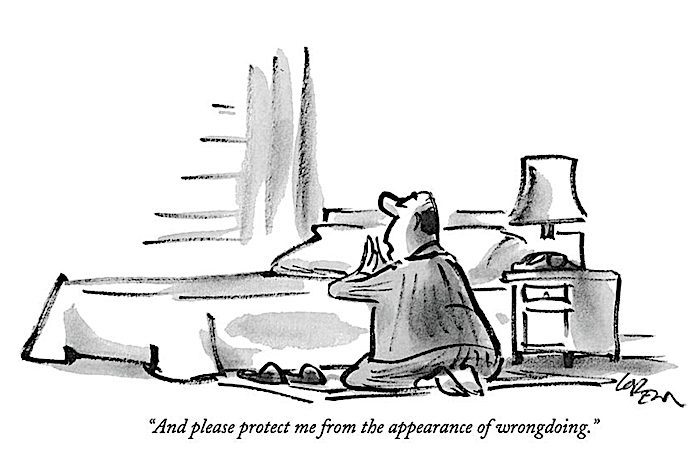
…and we close with another prayer-themed cartoon from Jan. 4, 1982—Lee Lorenz, who died Dec. 8 at age 90, joined the New Yorker staff in 1958, the same year his first cartoon appeared in the magazine’s pages. He also served as art editor (1973–1993) and cartoon editor (1993–1997) for the New Yorker. Michael Maslin penned an appreciation on his Ink Spill site.
…Happy Holidays one and all, as we end with this GIF from Disney’s 1933 short, The Night Before Christmas…
…and this scene from December 1933, when Rockefeller Center decided to make the Christmas Tree an annual tradition and held the very first tree lighting ceremony…
At left, image from December 1933—the very first tree lighting ceremony at 30 Rock, when the Christmas Tree became an annual tradition; at right, the tree on the Plaza in 1934, before ice skaters occupied the space. (rockefellercenter.com/Museum of the City of New York)
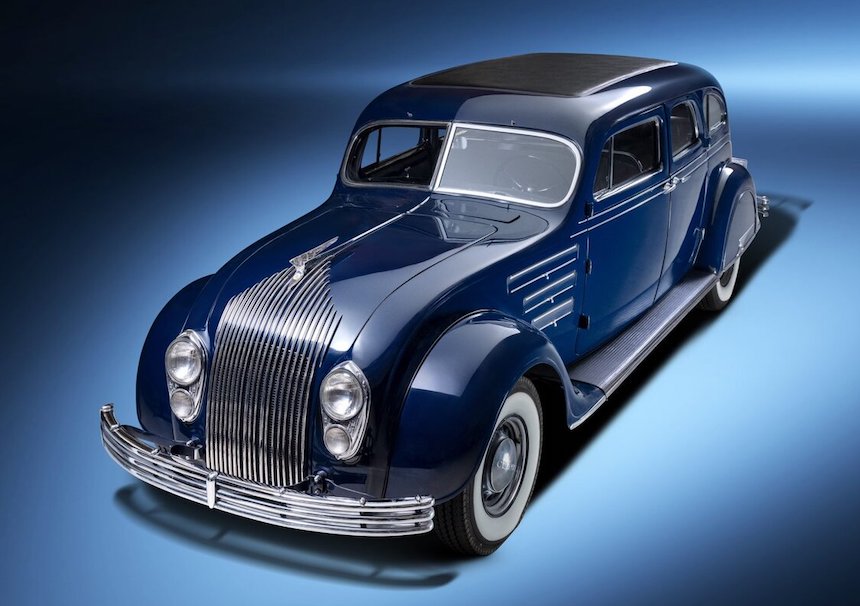
“We had the horse and buggy. We had the automobile. Now we have the first real motor car in history.” — Walter P. Chrysler. (Image: Blair Bunting via hagerty.com)
Classic motorcar collector and aficionado Jay Leno has more than 180 vehicles in his collection, but a pride and joy is a 1934 Chrysler Airflow Imperial CX—one of the only three surviving CXs today.
Dec. 16, 1933 cover by Rea Irvin.
The 1934 Chrysler Airflow was a car of the future that came too early. The Airflow’s advances in engineering—including invention of the modern unibody—still inform car design today. But the streamlined look of the car was probably too advanced for those depressed times, and despite lots of media attention it flopped with consumers. E.B. White was among those who weren’t ready to jump on the Airflow bandwagon, and even poked fun at colleague Alexander Woollcott for posing in the backseat of an Airflow for a Chrysler advertisement:
The Woollcott ad in question, which appeared in the previous issue (Dec. 9):
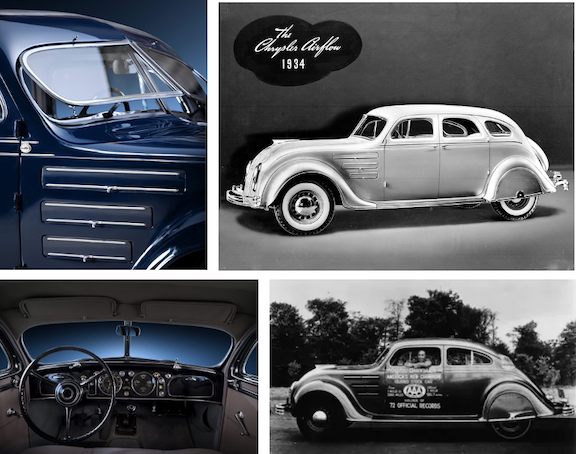
Of the major car companies in the 1930s, Chrysler was perhaps the most revolutionary in terms of technological and design advances. The first car to be wind tunnel-tested, the Airflow’s lightweight, unibody design moved the engine over the front axle and positioned the passengers between the front and rear wheels for a much roomier, smoother ride. Chrysler claimed the unibody also made the car stronger and safer, as this newsreel attests:
Air truly flowed through the car; even the windshield could be cranked open for greater air circulation.
AND THEN THERE WERE THREE…Jay Leno’s Chrysler Airflow Imperial CX, one of only three CX’s known to exist today. Other versions of the Airflow included a model sold under the DeSoto brand name. You can see this car in action on Jay Leno’s Garage.(Blair Bunting)AIR SUPPLY…Clockwise, from top left: The Chrysler Airflow featured a windshield that could be cranked open; advertising card for the Airflow; Indy veteran Harry Hartz set seventy-two speed and distance records at the Bonneville Salt Flats in an Airflow, driving 97.5 mph over the flying mile; the roomy interior featured a nearly horizontal steering column, which freed up space in the driver’s footwell. Although normal today, it was revolutionary in 1934, when most cars had steering columns sprouting from the floor. (Blair Bunting/macsmotorcitygarage.com)
* * *
No Fair, Doug
Few Hollywood marriages could ever match the legendary status accorded to that of Mary Pickford and Douglas Fairbanks, darlings of the silent screen who who exchanged vows in 1918. When the couple separated in 1933, even E.B. White couldn’t resist a bit of Tinseltown gossip.
FAIRY TALE FIZZLE…The very public nature of the Mary Pickford–Douglas Fairbanks marriage put a big strain on their matrimonial bonds. When both saw their careers fade at the end of the silent era, Fairbanks found escape in overseas travel, and in a romance with Sylvia, Lady Ashley (pictured above, center). Pickford and Fairbanks would divorce in 1936, and that same year Fairbanks and Lady Ashley would marry—just three years later Fairbanks would die from a heart attack, at age 56. Pickford would marry actor-musician Charles “Buddy” Rogers in 1937—they would remain married until her death in 1979. (Huffington Post/npg.org.uk)
* * *
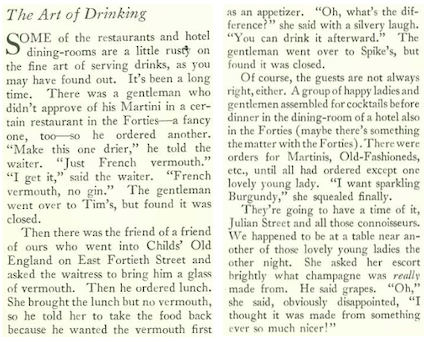
Drinking Problem
“The Talk of the Town” reported on the challenges facing both restaurants and patrons who were becoming reacquainted with legal drinking:
* * *
Before Mr. Rogers
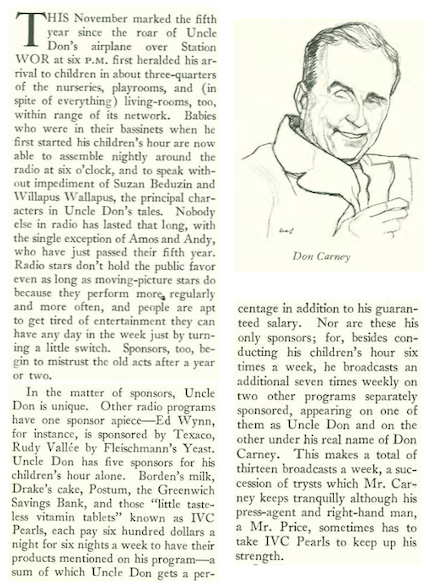
The “Profile” took a childish turn with this account of Don Carney (1896–1954) penned by Margaret Case Harriman. Carney is best remembered as the host of Uncle Don, a hugely popular WOR children’s radio program produced between 1928 and 1947. Excerpts:
MERCH…Don Carney’s popularity in the 1930s is evidenced in the output of merchandise including sheet music (1935), a 1940 activity book, and a 1936 “Strange Adventures” story book. (phantom.fan/ebay)
* * *
From Our Advertisers
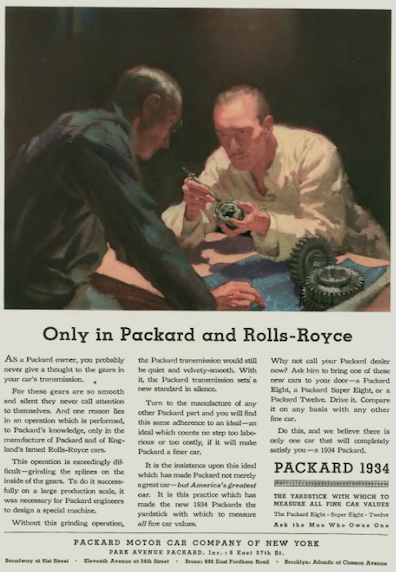
Speaking of fine cars, the folks at Packard pointed out one similarity between their automobile and the product manufactured by Rolls-Royce…owning a Packard in the 1930s was indeed considered prestigious, and like Rolls-Royce it competed in the international luxury car market…
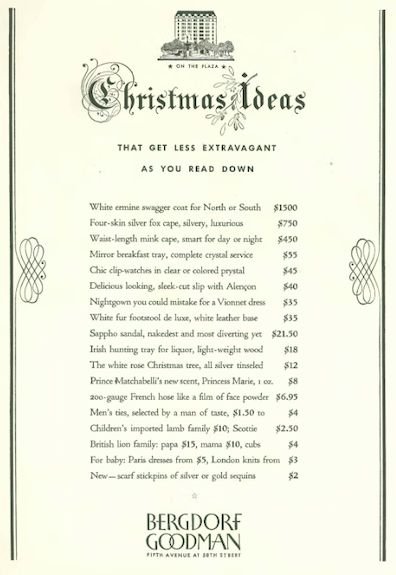
…Bergdorf Goodman placed this helpful ad listing various gift ideas in descending order of price…and extravagance…
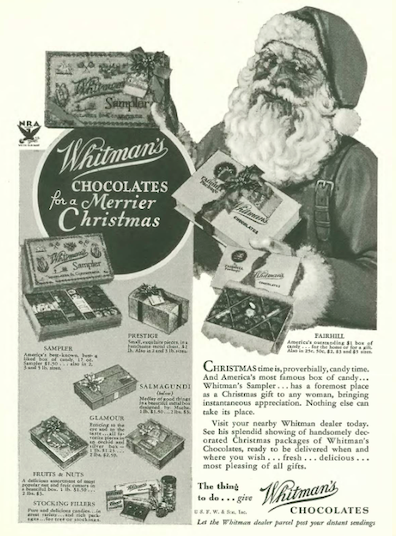
…and it wouldn’t be Christmas without the perennial Whitman’s Santa Claus touting his sweet wares…
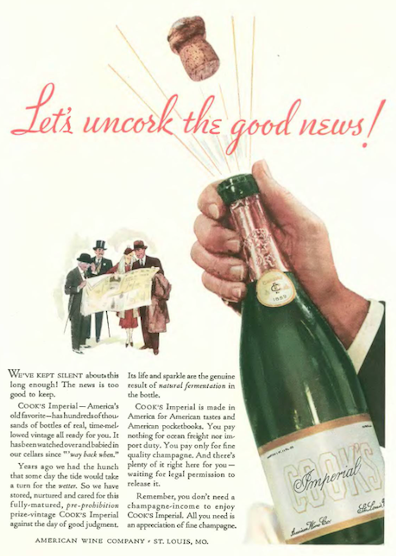
…and New Yorkers were getting ready to celebrate a New Year without Prohibition, and pop some “good news” with Cook’s American “champagne”…
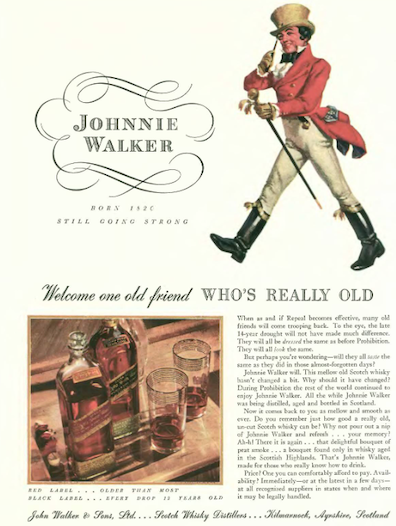
…an “old friend,” Johnnie Walker, strode into the advertising pages of the New Yorker for the very first time…
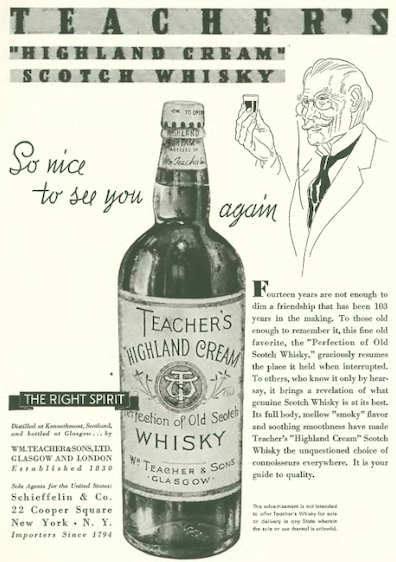
…while another purveyor of Scotch whiskey, Teacher’s, raised a glass to the return of legal liquor in the colonies…
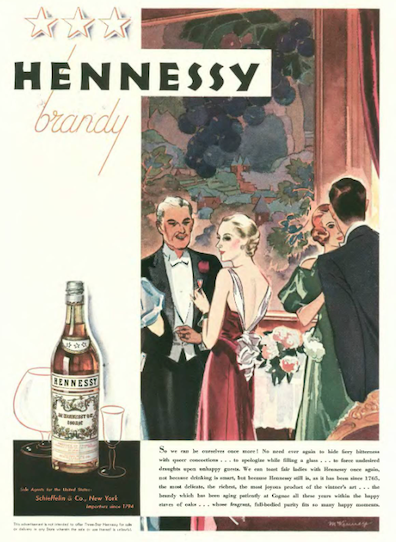
…the makers of Hennessy brandy celebrated the fact that “we can be ourselves once more”…
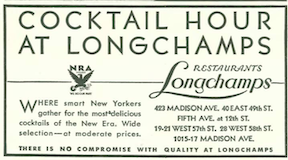
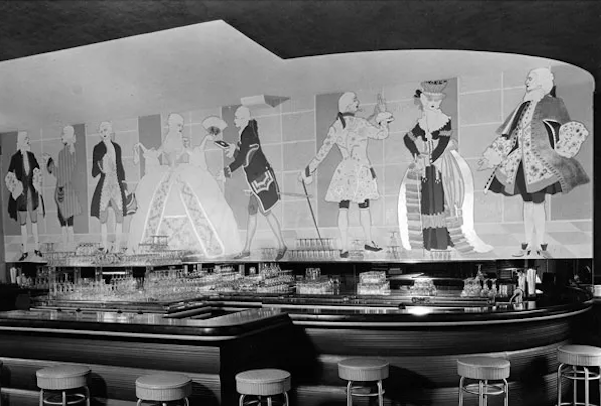
…the end of Prohibition saw the rapid expansion of the chain of Longchamps restaurants in New York City…in the 1930s the company hired top modernist decorators and architects (Winold Reiss and Ely Jacques Kahn, among others) to create some of New York’s most glamorous interiors…
LONGCHAMPS LONG GONE…Winold Reiss’s Louis XV mural behind the Chanin Building’s Longchamps bar, 1935. Hugely popular in mid-century New York, Longchamps all but vanished by 1970. Read more about one of New York’s most stylish restaurants at two wonderful sites, Driving For Deco and Restaurant-ing Through History. (winoldreiss.org)
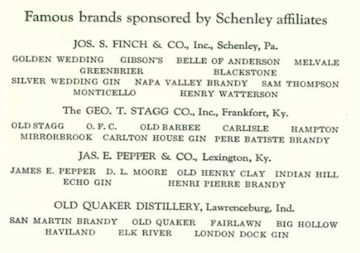
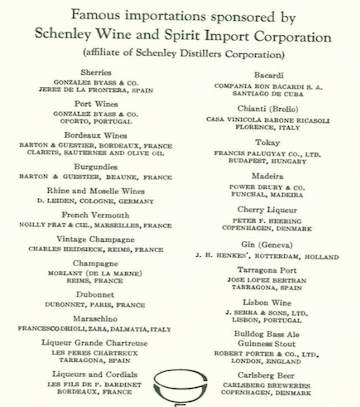
…Schenley was a giant in the spirits industry…headquartered in the Empire State Building, it also had a giant impact in the United States…to assure consumers that quality hadn’t suffered over the thirteen long years of Prohibition, Schenley ran this two-page ad stating: on through the years—famous names, famous brands, secrets, formulae, warehouses, yes—and stocks of precious old liquor have been accumulated and guarded by Schenley for you when the day arrives…
…here are some of the brands listed by Schenley in the side column:
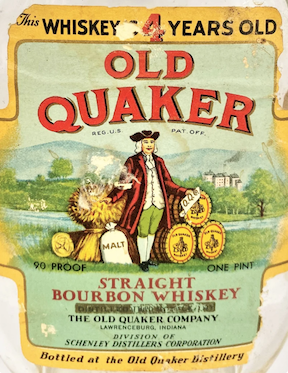
Old Quaker was one of Schenley’s popular whiskey brands in the 1930s.
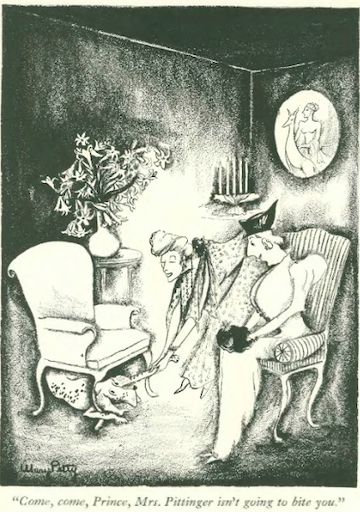
…and we sober up for our cartoonists, beginning with Mary Petty…
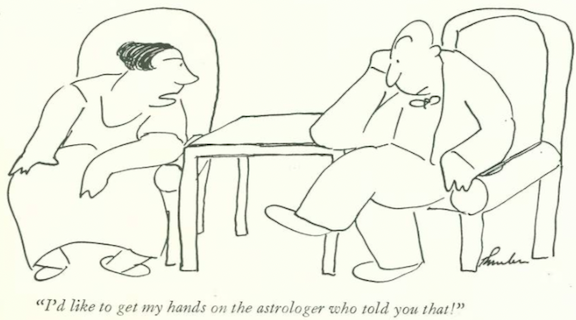
…mixed company was always a recipe for trouble in James Thurber’s world…
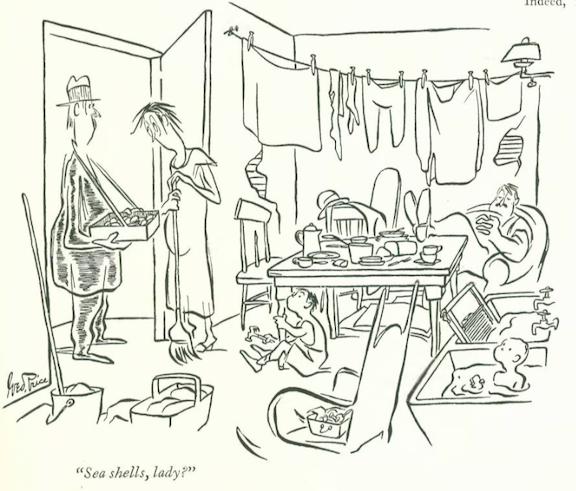
…and we close with George Price, and an unexpected visitor…
It’s hard to believe in this day and age that a theoretical physicist could enjoy rock star status, but then Albert Einstein wasn’t your everyday theoretical physicist.
Dec. 2, 1933 cover by Helen Hokinson.
A two-part profile of Einstein (1879–1955) by Alva Johnston (with terrific caricature by Al Frueh) examined the life and “idol” status of a man who would define the idea of genius in the 20th century. Although Einstein desired to live an almost reclusive existence at Princeton University, Johnston noted that he had become “fairly reconciled to the occupation of popular idol.”
Einstein was at Princeton thanks to the rise of Adolf Hitler, who came to power in Germany in early 1933 while Einstein was visiting the United States. Returning to Europe that March, Einstein knew he could not return to his home country (indeed, the Gestapo had raided his Berlin apartment and eventually seized all of his property), so when Einstein landed in Antwerp, Belgium on March 28, 1933, he immediately went to the German consulate and surrendered his passport, formally renouncing his German citizenship.
I’M OUTTA HERE…Albert Einstein with a Zionist delegation from France, Belgium, and England upon leaving the SS Belgenland in Antwerp, Belgium, 1933. (United States Holocaust Memorial Museum)
After some time in Europe and Great Britain, in October 1933 Einstein accepted an offer made earlier by from the Institute for Advanced Study in Princeton, New Jersey to serve as a resident scholar. When he arrived with his wife, Elsa, he said he would seclude himself at the Institute and focus on his teaching and research.
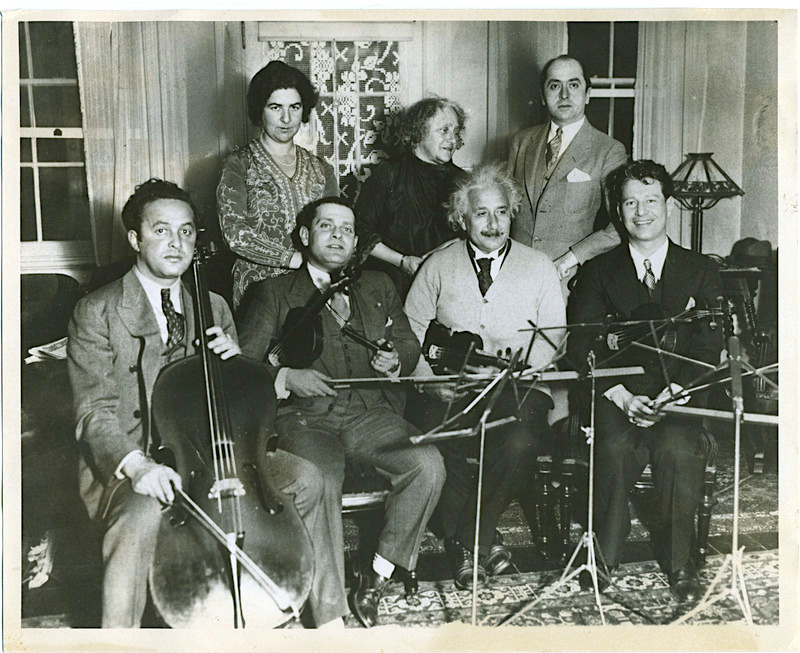
(NY Times, Oct. 18, 1933)EINSTEIN WASN’T FIDDLIN’ AROUND when he played his cherished violin—he once said that if he hadn’t been a scientist, he would have been a musician. This photo was taken at Einstein’s Princeton home in November 1933—he and fellow members of a string quartet were practicing for a December concert at the Waldorf-Astoria to raise money for German-Jewish refugees. From left to right, sitting: Arthur (Ossip) Giskin, Toscha Seidel, Albert Einstein, and Bernard Ocko; standing: Estelle Manheim (Seidel’s wife), Elsa Einstein and unidentified man. (Leo Baeck Institute)
* * *
Stop and Go
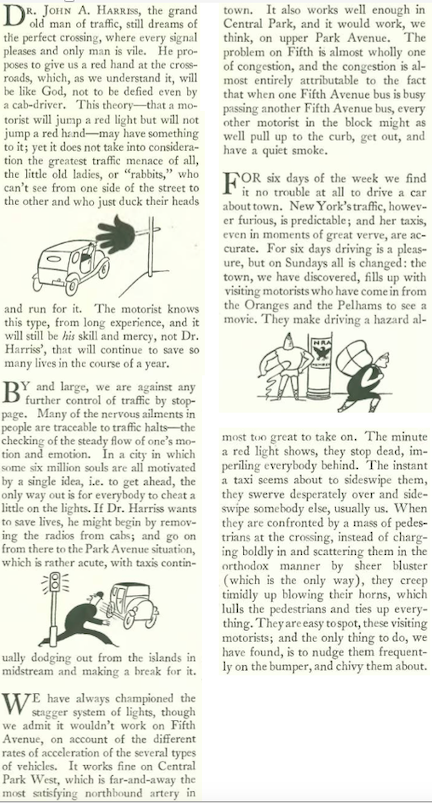
E.B. White devoted his “Notes and Comment” to Manhattan’s traffic situation, which he found manageable as long as tourists stayed out of the way…
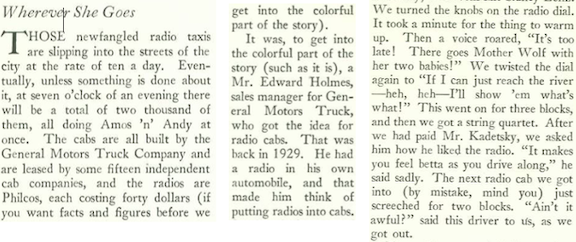
White also noted the perils of Park Avenue, especially the taxi drivers (distracted by those newfangled radios) darting between the islands…
Park Avenue in the 1930s. (geographicguide.com)
…and then there was Fifth Avenue, notorious for traffic jams, made worse on weekends by the tourist traffic…
Fifth Avenue in 1932. (New York State Archives)
…later in “The Talk of the Town” White continued his thoughts on New York taxis, namely the introduction of coin-operated radios installed for use by passengers…
* * *
Fly Newark
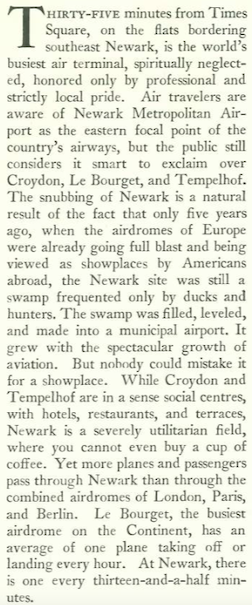
Albert L. Furth took us off the mean streets and into the air when he filed this account about the Newark Metropolitan Airport for “A Reporter at Large.” Furth seemed put off by the cachet of European airports and their many amenities, given that the Newark airport—although admittedly utilitarian—was the busiest in the world. An excerpt:
FREQUENT FLIER…Albert Furth noted that Newark Municipal Airport logged a landing or departure every thirteen-and-a-half minutes. Above, passengers boarding a Boston-bound American Airlines Condor at Newark Airport in 1930. In those simpler times, passengers just walked to the runway and climbed on board. The airport had opened two years earlier on 68 acres of reclaimed swampland along the Passaic River. It was the first major commercial airport in the New York metro area and the first anywhere with a paved runway. (njmonthly.com)
* * *
Goodnight, Speakeasy
Lois Long was an 17-year-old Vassar student when Prohibition went into effect in 1919, so when she started her career in New York in 1922 the only nightlife she knew revolved around speakeasies. Although she held Prohibition officers in disdain, she also believed that the repeal of the 18th Amendment would lower the quality of New York nightlife—the food, the “adroit service,” and the “genial din” of the speakeasy. Excerpts:
FROM LOUCHE TO LEGAL…Lois Long was saying a sad goodbye to her beloved speakeasies; perhaps the Algonquin Hotel (here, circa 1930) would offer some cheer. (Pinterest)
* * *
From Our Advertisers
Abercrombie & Fitch (then an outfitter for the elite outdoorsman) was offering holiday shoppers everything from multi-tool knives to cocktail shakers…
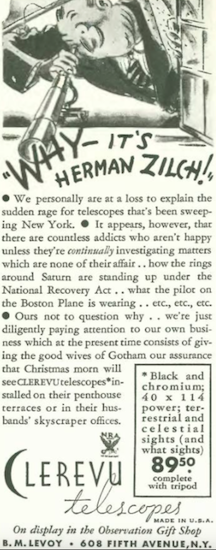
…while the folks at Clerevu telescopes found a growing market for folks who used their product for anything but stargazing…
…with Repeal just days away, the Pleasant Valley Wine Company of New York hoped folks would pop a few of their corks before the good stuff arrived from France…
…the British were coming to the rescue via the Berry Brothers, who were overseeing the importation of liquor from their offices at Rockefeller Center’s British Empire Building…
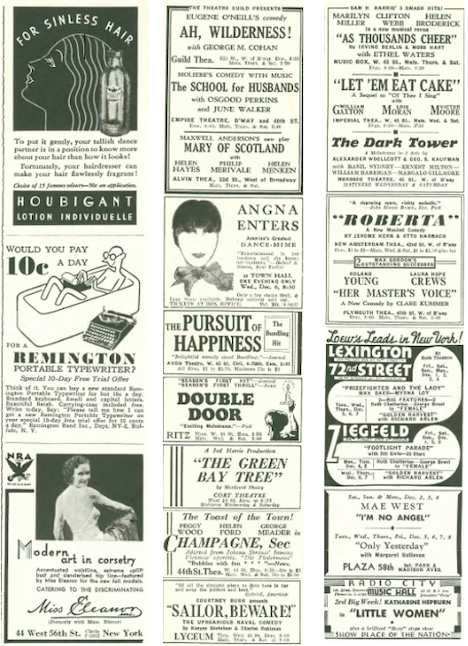
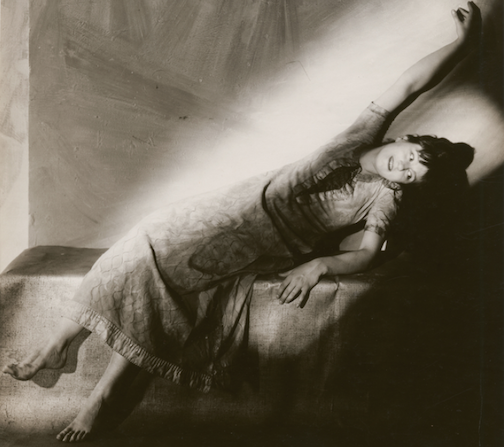
…let’s look at an assortment of one-column ads…the center strip features an ad promoting Angna Enters’ appearance for “one evening only” at The Town Hall (123 West 43rd Street)…Enters (1897–1989) was an American dancer, mime, painter and writer who likely performed her piece Moyen Age…
FEEL THAT STRETCH…Angna Enters performing Moyen Age, circa early 1930s. (NYPL)
…we begin our cartoons with Gardner Rea, and a dedicated bell ringer…
…Otto Soglow showed us a softer side of The Little King…
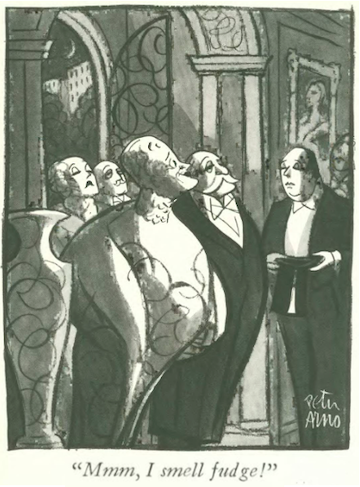
…Peter Arno revealed the human side of the posh set…
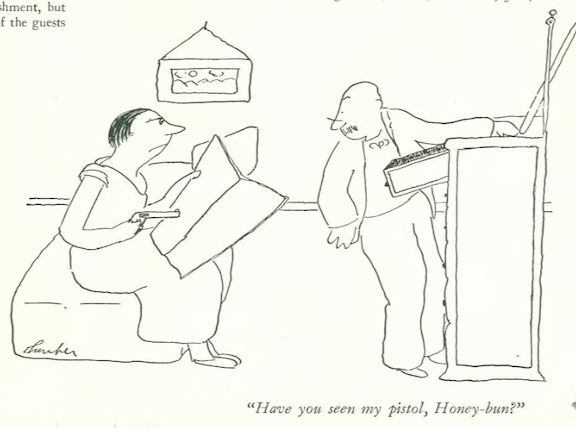
…and we close the Dec. 2 issue with this classic from James Thurber…
…on to Dec. 9, 1933, and a cover by an artist we haven’t seen in awhile, Ilonka Karasz…
Dec. 9, 1933 cover by Ilonka Karasz.
…and we open with this comment by E.B. White, who along with critic Lewis Mumford had once voiced displeasure over the massive Rockefeller Center project. However, while viewing the floodlit tower by night, he decided that he would have to eat his words, observing how “the whole thing swims up tremendously into the blue roxyspheres of the sky”…
MEA CULPA…E.B. White gained a new perspective on Rockefeller Center, pictured here in December 1933. (Wikipedia)
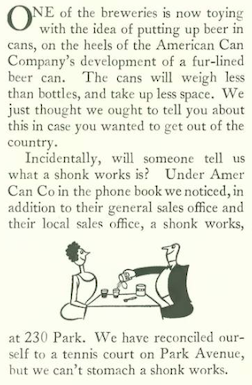
…we continue with White, who also offered his thoughts on something heretofore unthinkable—a proposal to start putting beer in cans…
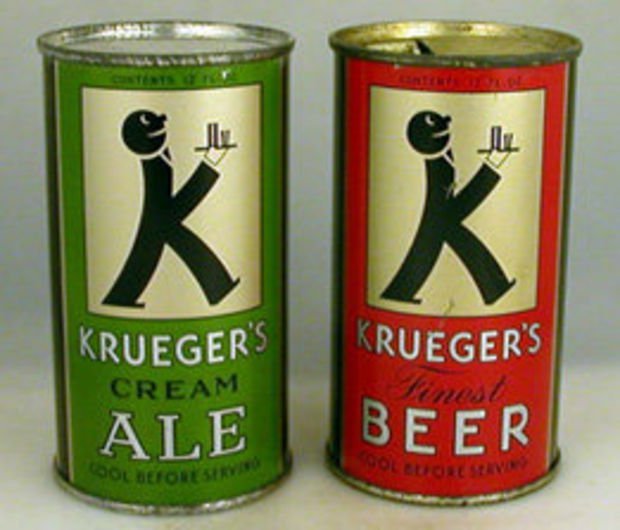
…it would happen about a year later…on Jan. 24, 1935, the Gottfried Krueger Brewing Company, in partnership with the American Can Company, delivered 2,000 cans of Krueger’s Finest Beer and Krueger’s Cream Ale to drinkers in Richmond, Virginia…
(seletyn.com)
…and despite White’s doubts, apparently ninety-one percent of the first drinkers of the product approved of the canned beer, although when Krueger’s launched their ad blitz they had to include instructions (and a new tool) to open the darn things…
(seletyn.com)
* * *
Dreamscapes
Critic Lewis Mumford offered his thoughts on a recent exhibit by a young surrealist named Salvador Dali…
MIDDLEBROW SURREALIST…The Triangular Hour by Salvador Dali, 1933. (wikiart.org)
…and we move along to moving pictures, where John Mosher was showing some appreciation for Joan Crawford (1906–1977) in the pre-Code film Dancing Lady…
SHE HAD IT ALL…Audiences and critics alike were wowed by Joan Crawford’s performance in Dancing Lady, which featured a star-studded and eclectic cast. Clockwise from top left, Clark Gable plays a Broadway director who becomes Crawford’s love interest; Crawford displays her dancing talent in a Broadway rehearsal; Dancing Lady featured an early film appearance by The Three Stooges, pictured here with Gable and the Stooges’ leader at the time, Ted Healy; Crawford with Stooge Larry Fine—in the original film, Fine completes his jigsaw puzzle only to discover (to his disgust) that it’s a picture of Adolf Hitler. The Hitler scene was removed by the Production Code; its enforcers claimed it insulted a foreign head of state. (IMDB)
In addition to Crawford, the star-studded cast included Clark Gable, Fred Astaire (in his film debut), Franchot Tone (who was married to Crawford from 1935-39 and made seven movies with her), The Three Stooges, Nelson Eddy, and Robert Benchley, who played a reporter in the film.
Dancing Lady was the film debut of Astaire, making Crawford the first on-screen dance partner of the famed hoofer…
(IMDB)
* * *
More From Our Advertisers
We begin with this full-page advertisement from Heinz, which went to great lengths and expense to make their ad appear to part of The New Yorker’s editorial content, even featuring a Perry Barlow cartoon of a boy making a mess with their product…
…another New Yorker contributor who occasionally went over to the advertising side was Alexander Woollcott, here shilling for Chrysler…
…Kayser, purveyor of women’s hosiery and underthings, was going for some humorous holiday cheer, but the effect is a bit unsettling…
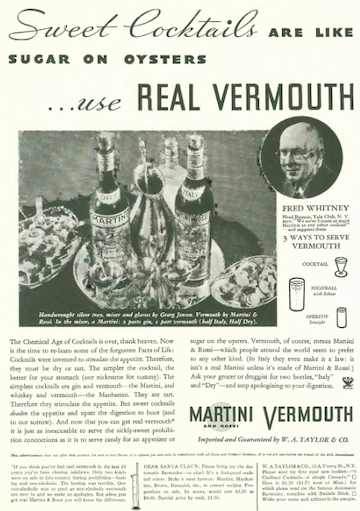
…liquor-related ads began to proliferate with the end of the Prohibition…this one from Martini & Rossi…
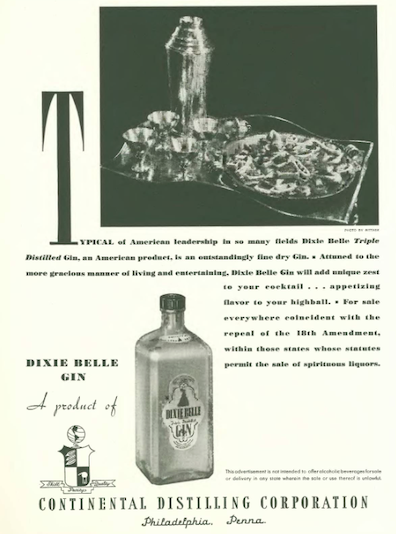
…Continental Distilling was hoping to grab its share of gin sales with its Dixie Belle American gin…
…from the same folks who brought us Fleishmann’s yeast (and kept The New Yorker afloat in its early lean years) came this American dry gin…
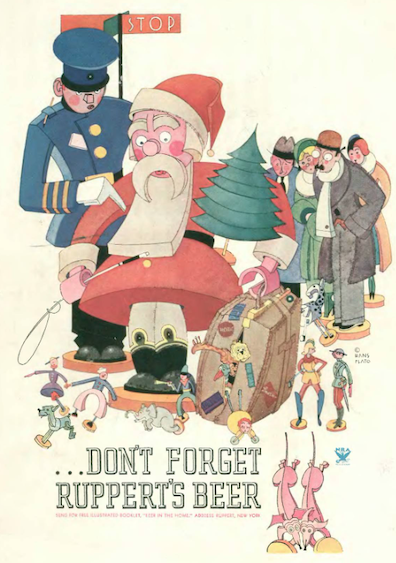
…Ruppert’s Beer was back with another full-page color ad by Hans Flato…
…on to our cartoons, and Santa again, this time besieged by an aggressive tot as rendered by Helen Hokinson…
…Carl Rose found an unlikely customer at a newsstand…
…here is the last of four cartoons Walter Schmidt published in the New Yorker between 1931 and 1933…
…Peter Arno left his glamorous world of nightclubs and high society parties to look in on life at a boarding house…
…and we close with the delightful Barbara Shermund…
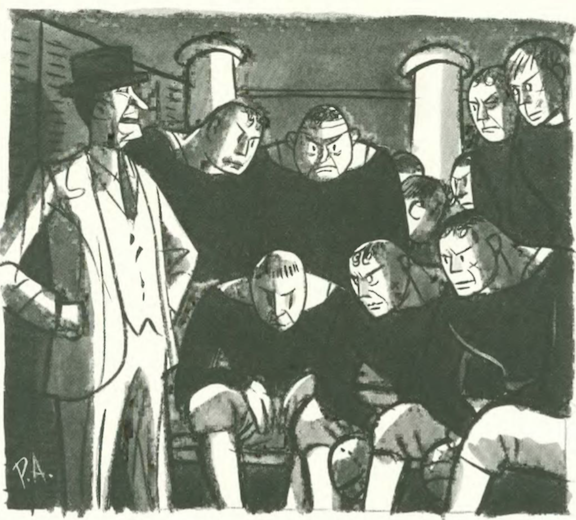
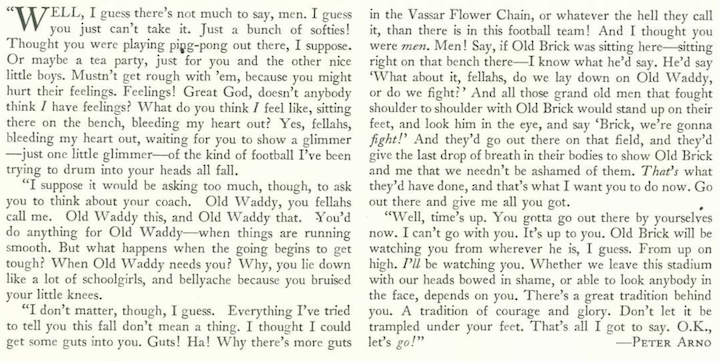
Peter Arno departed from his usual one-liners in the Nov. 18, 1933 issue with a football-themed cartoon that featured a four-paragraph caption…
Nov. 18, 1933 cover by Abner Dean.
…that consisted of a pep talk from a football coach—”Old Waddy”…
…Arno had visited the football theme before, notably in this early cover from 1928…
Arno cover from Oct. 7, 1928.
…and he referenced it again in the years ahead…
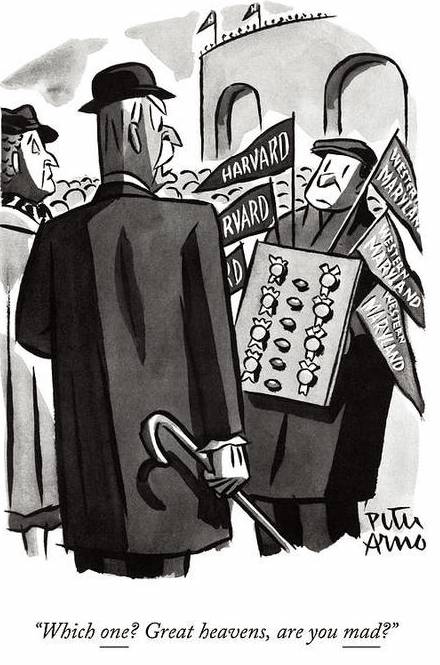
HAIL VARSITY…Peter Arno delivered another, much shorter pep talk in a cartoon (left) from the Nov. 20, 1937 issue; at right, Arno’s last football-themed gag, published in The New Yorker of November 25, 1967, just three months before the cartoonist’s death. Check out one of my favorite New Yorker sites, Attempted Bloggery, for more on the 1937 cartoon.
…and one more from Arno, a classic from September 27, 1947…
* * *
Pre-emptive Nostalgia
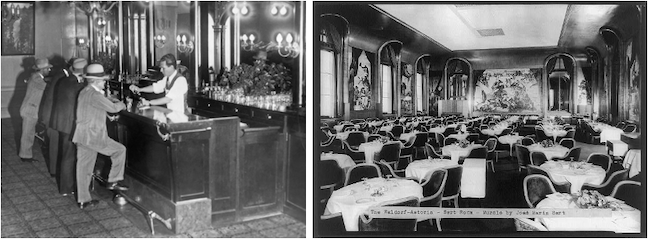
Although E.B. White welcomed the end of Prohibition with open arms, he also wondered what could be lost when drinkers emerged from the shadows of the speakeasy world…
THAT HOMEY FEELING…E.B. White suggested transforming the Waldorf-Astoria’s Sert Room (right) into a dingy dive to help ease drinkers back into the world of legal alcohol. (Britannica/Library of Congress)
White also referenced his many years at Tony’s, a speakeasy and Italian restaurant popular with writers and others in the New Yorker’s orbit. Tony Soma operated the speakeasy until 1929, when John D. Rockefeller bought Soma’s building along with other properties to make way for Rockefeller Center. Soma would later open another popular (and legit) restaurant and also become known as a yoga practitioner and the grandfather of actress Angelica Huston. You can read more about Soma at The Speakeasy King.
* * *
The French Underground
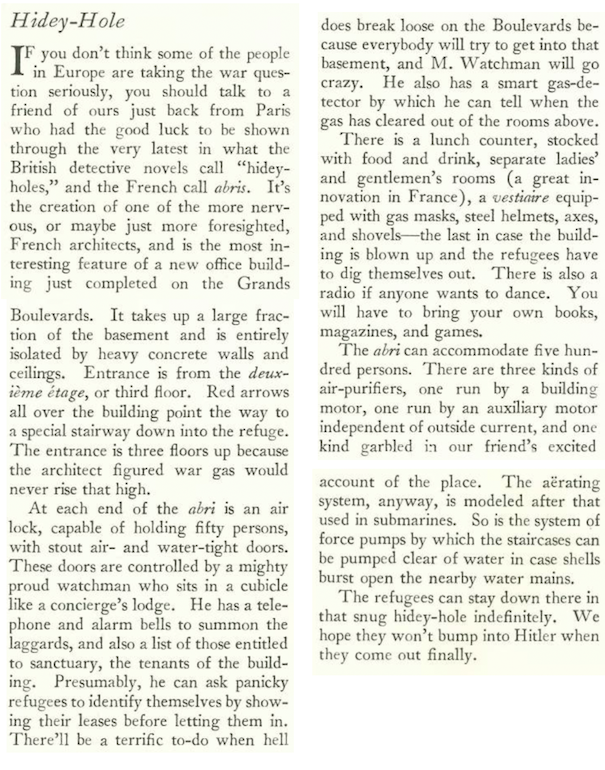
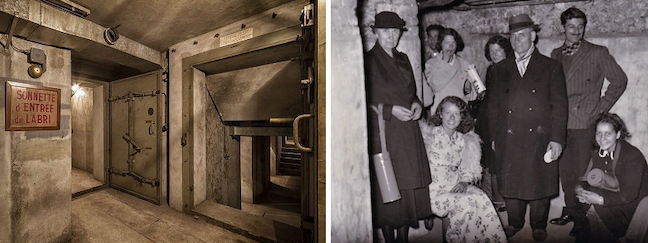
Although war seemed like a distant rumor to most Americans, the French were busy preparing for that likelihood, according to this “Talk of the Town” piece attributed to Europe-based documentary filmmaker Richard de Rochemont and New Yorker stalwart James Thurber.
LOOK OUT BELOW…At left, a preserved WWII abris can be found below platforms 2 and 3 at Paris’ Gare de l’Est; right, Parisians take shelter in an abris in 1939. (Trip Adviser/Ebay)
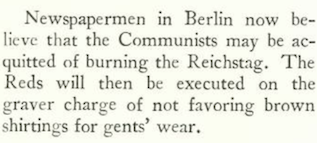
…in his column, “Of All Things,” Howard Brubaker mused on the latest rumblings from Berlin…
DEMOCRACY IN ASHES…An arson attack on the Reichstag (home of the German parliament) on February 27, 1933 was used by Adolf Hitler as pretext to suspend civil liberties and conduct a ruthless pursuit of “communists,” both real and imagined. (Wikipedia)
* * *
Little Women, Big Film
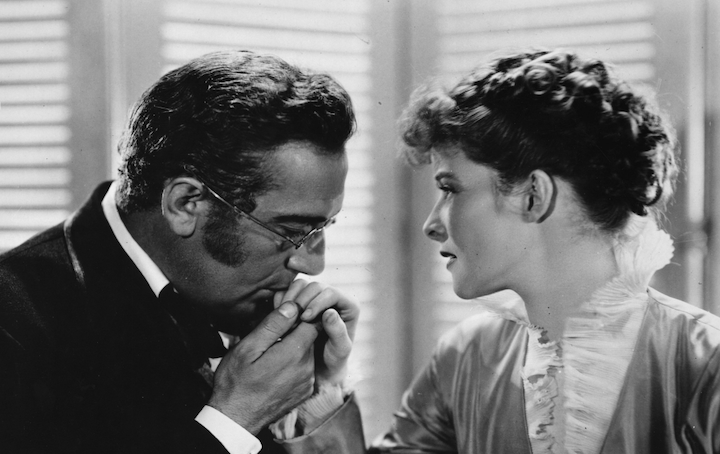
On the brighter side, we turn to Hollywood and John Mosher’s review of George Cukor’s critically acclaimed Little Women, which featured a cast led by Katharine Hepburn and Joan Bennett.
MEINE LIEBCHEN…Impoverished German linguist Professor Bhaer (Paul Lukas) proposes to Jo (Katharine Hepburn) in 1933’s Little Women. (IMDB)
SEW WITH JO…From left, the March family as portrayed by Jean Parker (as Beth), Joan Bennett (Amy), Spring Byington (Marmee March), Frances Dee (Meg), and Katharine Hepburn (Jo) in the George Cukor-directed Little Women. (IMDB)
…Mosher also found something to like in the MGM romance The Prizefighter and the Lady, which starred Myrna Loy along with professional boxers Max Baer, Primo Carnera, and Jack Dempsey.
THE NEW “IT” MAN was how MGM publicists promoted professional boxer Max Baer in his film debut. Top right, Baer in a scene with Myrna Loy; bottom right, professional boxer Primo Carnera with Loy and Baer—Carnera was the world heavyweight boxing champion at the time of the film’s release, however Baer would defeat the Italian giant in their real-life 1934 fight; bottom center, Baer’s son, Max Baer Jr., would also find Hollywood fame in the 1960s playing Jethro Bodine on TV’s The Beverly Hillbillies. (IMDB/Wikipedia)
* * *
Sausage Factory
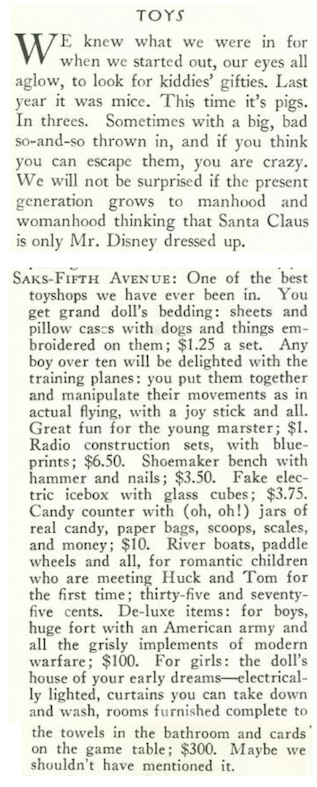
We’ve previously looked at the smashing success of Walt Disney’sThree Little Pigs cartoon and its theme song, which took the country by storm in the fall of 1933. So it was no surprise that the piggies could be found in toy departments across the metropolis as the Christmas season approached. These are brief snippets from a lengthy holiday shopping column that was appended annually to Lois Long’s “On and Off The Avenue” every November and December.
HOG HAVEN…You could help the Three Little Pigs find their way to safety in this 1933 Disney board game. As in the film, the final leg of the board game’s journey has the wolf landing in a cauldron of boiling water. As if that wasn’t bad enough, the Disney film also featured one of the pigs adding turpentine to the cauldron. (Ebay)
This being America in the 1930s, and early Disney, the Three Little Pigs cartoon contained an offensive scene in which the Big Bad Wolf disguises himself as a Jewish peddler, complete with a fake nose, glasses, and beard (accompanied by a fiddle, the wolf also adopts a Yiddish accent).* The character was included in the above board game:
* The film was finally edited in 1948 with a redesign of the Wolf’s disguise—as a Fuller Brush salesman.
* * *
From Our Advertisers
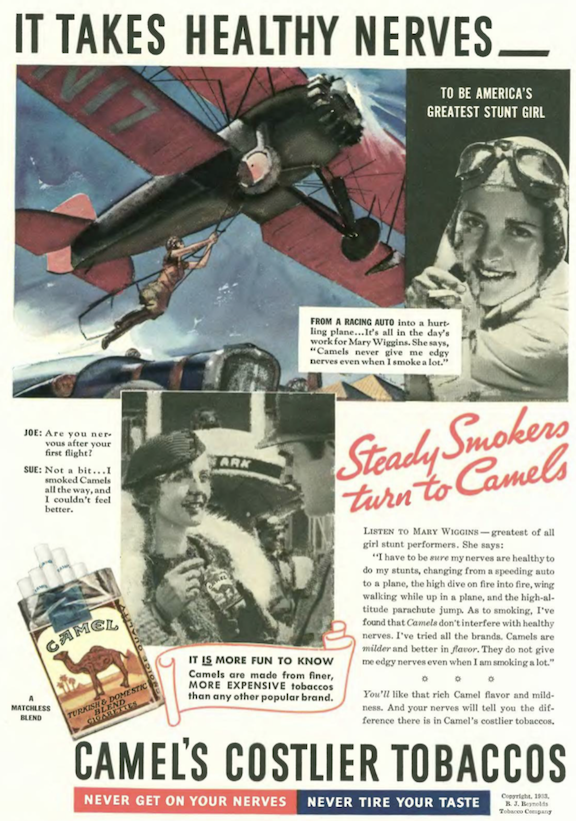
We kick off our ads with more “healthy nerves” testimonials from Camel smokers, including stuntwoman/pilot Mary Wiggins…
…Caron Paris also went aloft with one of their famed “En Avion” adverts…
…back on the ground, this hapless couple found themselves taking a slow car to a soaking…although wearing a fur coat while riding in a rumble seat probably wasn’t a good idea, regardless of the weather…
…for those rainy days, you could get yourself a Salisbury overcoat from Brooks Brothers…this sports-themed illustration was a new twist for the usually staid BB…
…and there’s always one or two really weird ads, like this one from The Sun newspaper that touted baloney sales at Gimbels as proof of advertising prowess…
…collectors of Art Deco are well-acquainted with the work of Hans Flato, who did a series of ads (and related merchandise) for New York-based Ruppert’s Beer in the early 1930s…Flato (1887-1950) worked in a variety of styles, but the characters he created for Ruppert’s stand out…for reasons known only to the Flato, the feet of the Ruppert’s characters were always attached to yellow disks, like toy dolls…
…James Thurber was keeping busy illustrating ads aimed at folks wanting to escape the cold…
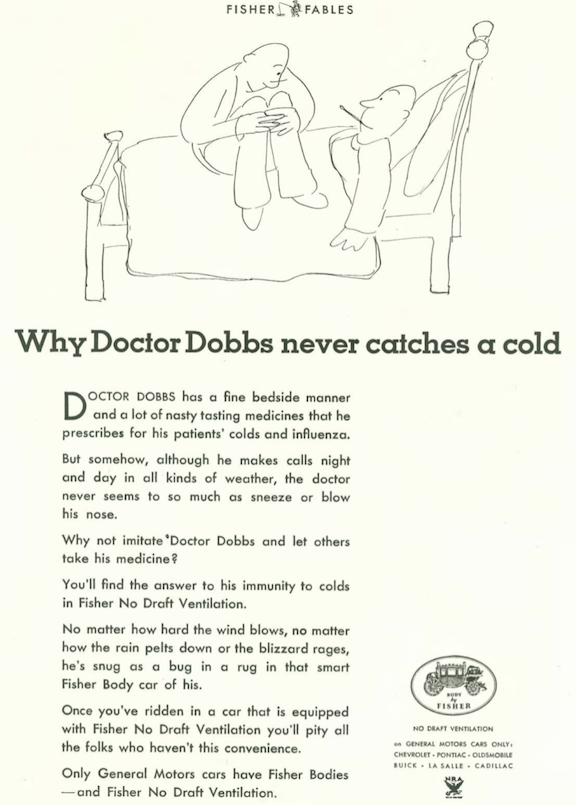
…as well as those who caught a cold in a drafty automobile…
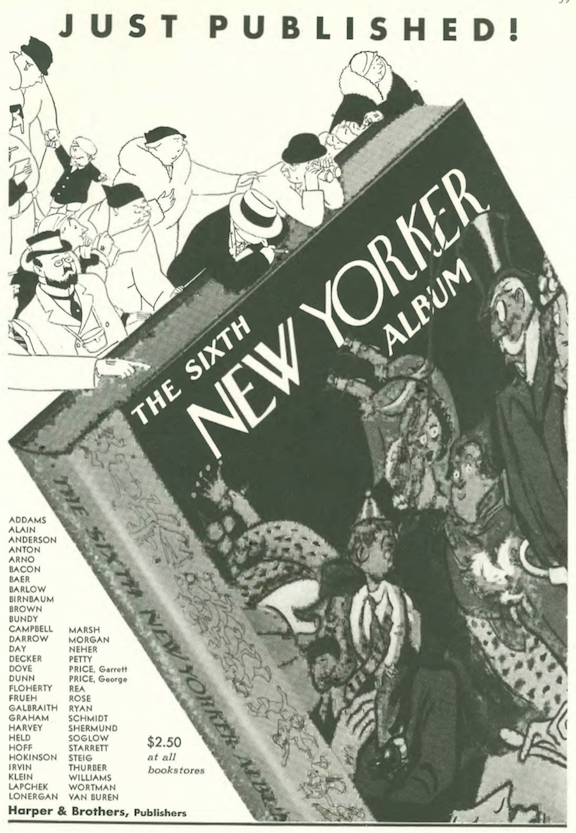
…The New Yorker announced the publication of its sixth album, with an illustration by Gluyas Williams…
…while Otto Soglow, in a much smaller back-page ad, proclaimed the publication of his first The Little King collection…Soglow had just ten months left on his contract with The New Yorker—his Little King would relocate to William Randolph Hearst’s King Features Syndicate in September 1934…
…speaking of Soglow, we kick off the cartoons with his potentate’s latest adventure…
…William Steig gave us a sneeze and a chorus…
…and we close with Eli Garson, and a tale from the Almost Wanted…
The NBC Studios at 30 Rockefeller Plaza have wowed visitors and performers alike for nearly 90 years. Today we look back at the remarkable foresight of the studios’ designers, who created spaces that would one day accommodate a new medium called television, which was still in its experimental stages.
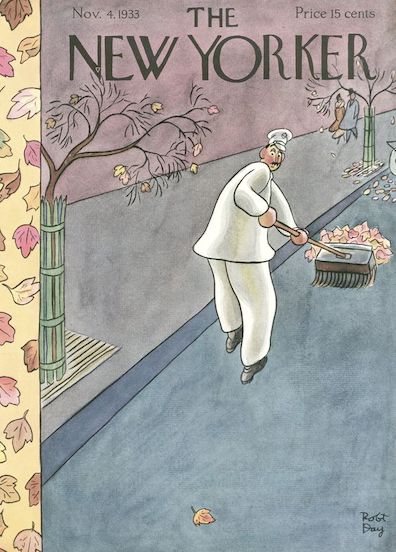
Nov. 4, 1933 cover by Robert Day, who contributed a total of eight covers to The New Yorker.
However, before we jump in, let’s look at Robert Day’s cover for the Nov. 4 issue, which featured a familiar character who made his first appearance on the cover of issue #12 (May 9, 1925), and returned four years later looking much older in the dog days of August…
Cover of issue #12 (May 9, 1925) by Rea Irvin introduced our street sweeper, who returned Aug. 3, 1929 by the hand of Gardner Rea.
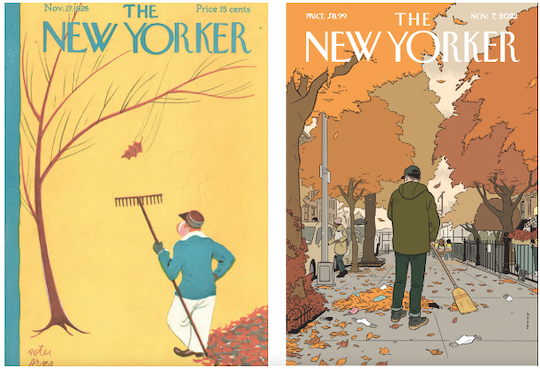
Day’s cover, however, was also a nod to the annual gathering of autumn leaves—an occasional cover theme that began with Peter Arno’s contribution to the Nov. 27, 1926 issue (below, left) and most recently expressed in Adrian Tomine’s cover for the Nov. 7, 2022 issue (with timely pandemic reference)…
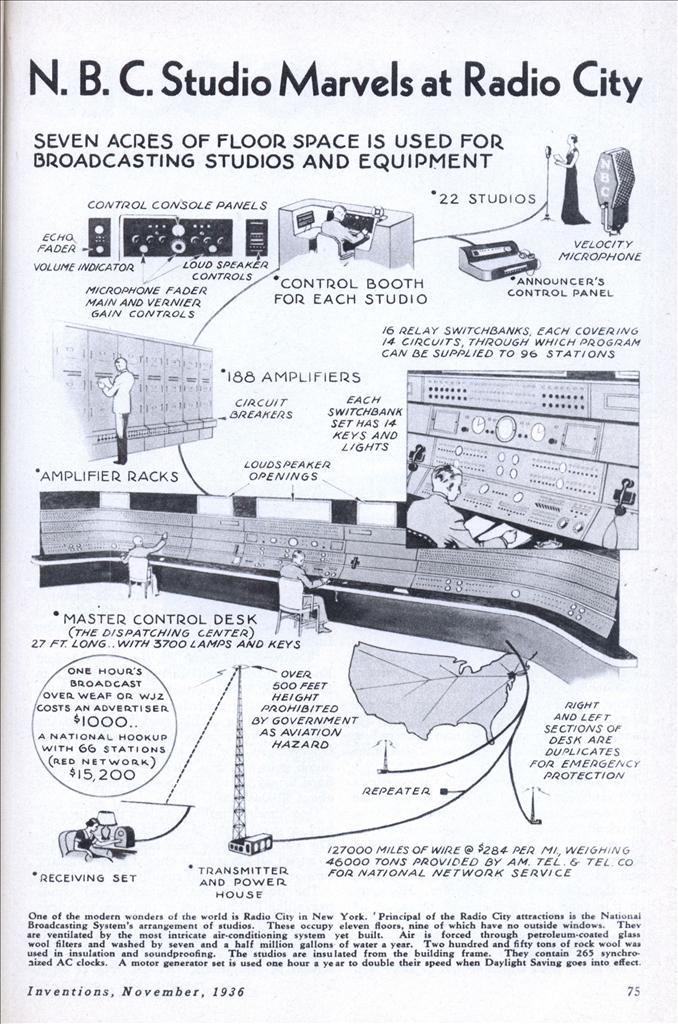
Back to Radio City, Morris Markey recounted the technological wonders of the new NBC studios in his “A Reporter at Large” column, “Marconi Started It.” Markey noted the “fabulous quality” of the facilities, wired for the day when television would arrive. Excerpts:
GEE WHIZ…Morris Markey could be assured that some folks would be “goggled-eyed” by NBC studios, including the technophiles at Popular Mechanics. (westmb.org)
WHERE HISTORY WAS MADE…Studio 8H was the world’s largest radio studio when it opened in 1933. It would be converted for television in 1950. (westmb.org)
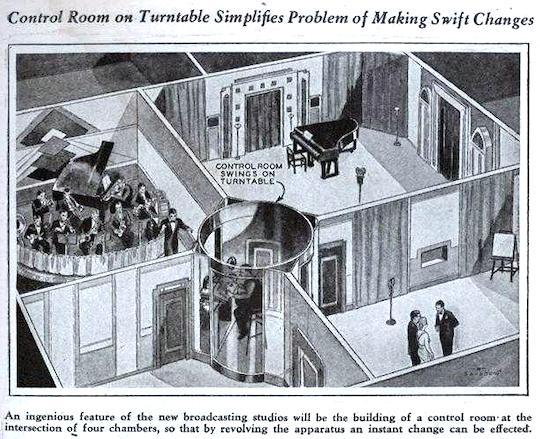
Markey marveled at NBC Studios’ various design innovations, including a revolving control room dubbed the “Clover Leaf”…
(Modern Mechanics, Jan. 1931)
Almost 90 years later, the studios continue to serve the broadcast needs of the 21st century, including Studio 8H…
LIVE FROM NEW YORK…Studio 8H was the world’s largest radio studio when it opened in 1933. Converted to television in 1950, it has been home to Saturday Night Live since 1975. Above, SNL stage manager Gena Rositano, in 2015. Below, longtime SNL director Don Roy King at the controls for Studio 8H, also in 2015. (Dana Edelson/NBC via Directors Guild of America)
* * *
Leopold!
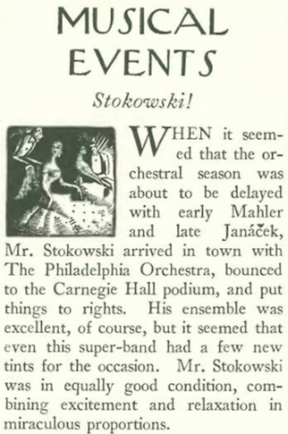
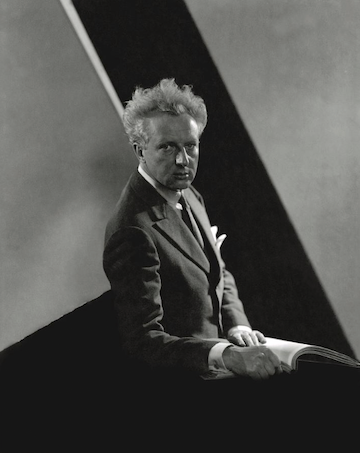
Conductor Leopold Stokowski was no stranger to Studio 8H. From 1941 to 1944 he led the NBC Symphony Orchestra in that venue. One of the leading conductors of the early and mid-20th century, Stokowski (1882–1977) began his musical career in New York City in 1905 as the organist and choir director at St. Bartholomew’s Church, but by 1915 he was conducting the famed Philadelphia Orchestra. Robert Simon reported on Stokowski’s return to New York for a performance at Carnegie Hall. A brief excerpt:
I GET AROUND…Portrait Of Leopold Stokowski by Edward Steichen, Dec. 1, 1933. Married three times and once romantically linked to Greta Garbo, he was married to wife #3, Gloria Vanderbilt, for ten years. (Condé Nast)
Stokowski had the distinct honor of being satirized in a 1949 Looney Tunes cartoon, “Long-Haired Hare,” in which Bugs Bunny disguised himself as the conductor and entered the stage to the astonished whispers of the orchestra…Leopold! Leopold!…
MAESTRO…Bugs Bunny as Stokowski in “Long-Haired Hare.”
Stokowski was no stranger to animation. The conductor appeared in silhouette in Disney’s Fantasia (1940), leading the Philadelphia Orchestra in the film’s score. He even shook hands with Mickey Mouse.
* * *
Bigga Badda Wolfa
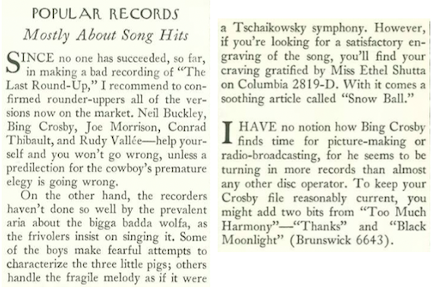
The New Yorker took a look at the popular records of the day, and in addition to tunes by Bing Crosby and Rudy Vallée there was yet another release of “Who’s Afraid of the Big Bad Wolf?”…Ethel Shutta was the latest of seemingly dozens of artists to cash in on the Disney hit…
I’LL HUFF AND I’LL PUFF…Those who couldn’t get enough of “Who’s Afraid of the Big Bad Wolf” could turn to Ethel Shutta’s rendition of the hit song on Columbia records. (discogs.com)
* * *
Page-Turner
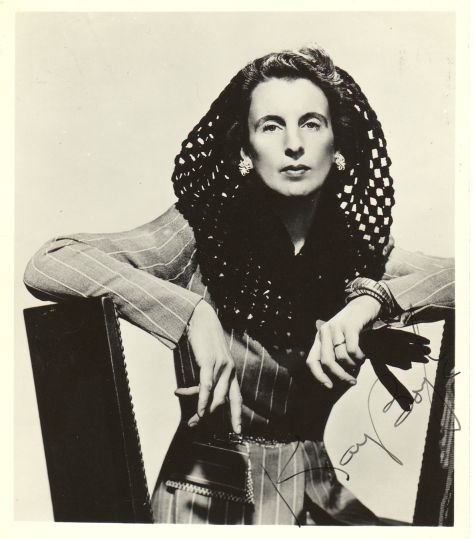
Writer Kay Boyle wasn’t afraid of wolves or any other subject for that matter, according to book reviewer Clifton Fadiman…
TOSSING A SALACIOUS SALAD…Kay Boyle, photographed by George Platt Lynes, 1941. (The Kay Boyle Papers, Morris Library, Southern Illinois University)
* * *
A Grapeful Nation
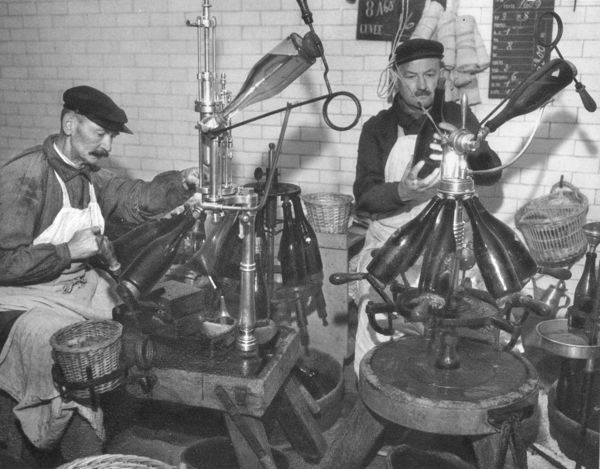
As New Yorkers counted the days until the end of Prohibition, The New Yorker did its part to get readers back up to speed by enlisting the talents of one of the world’s great wine experts, Frank Schoonmaker, who had the enviable job of filing a series of wine reports for the magazine. His first installment of “News From the Wine Country” featured the Champagne region. Excerpts:
THAT FIZZY FEELING…Bottling the good stuff in the Champagne region, circa 1930. (wineterroirs.com)
* * *
From Our Advertisers
Christmas was just around the corner, and F.A.O. Schwarz was READY with its 64-page catalog…
…White Rock anticipated the end of Prohibition with an ad featuring a miniature colonel who apparently needed a stiff drink to prepare for his wife’s return from abroad…
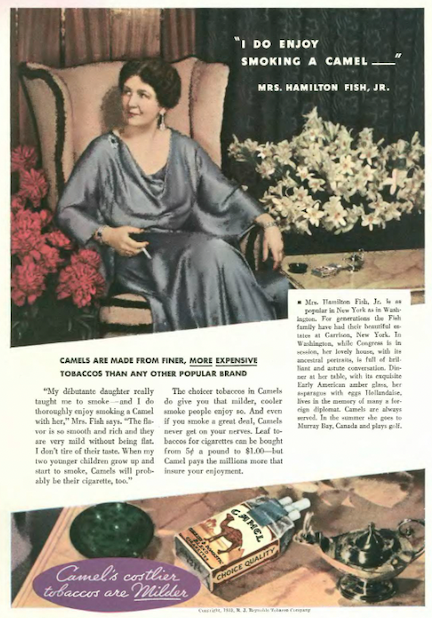
…Mrs. Hamilton Fish Jr, aka Grace Chapin, was married to the New York congressman from 1920 until her death in 1960, apparently enjoying many Camels along the way…her husband would go on living another 31 years and take three more brides before expiring at age 102…
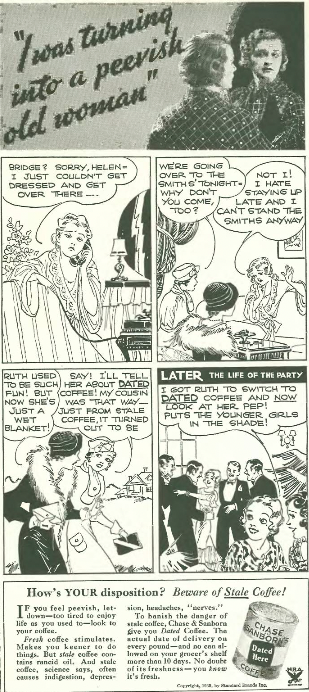
…another cautionary tale from Chase & Sanborne about the perils of undated coffee…
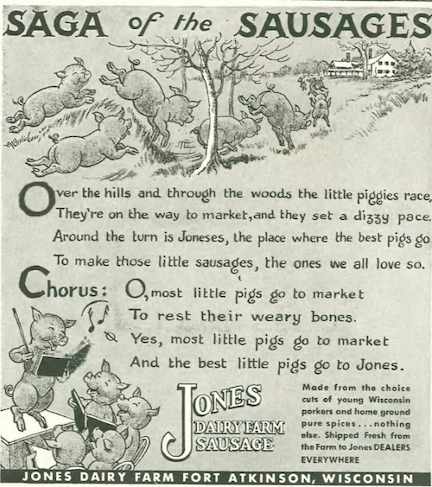
…and with the holidays approaching, a jolly ditty from Jones Dairy Farm, home to little piggies who merrily dash toward their inevitable slaughter…
…and we jump to another back-page ad, this from the stately Plaza, where you could get a single room for five bucks a night…
…turning to the cartoons, we find George Price hitting his stride with multiple cartoons in consecutive issues…
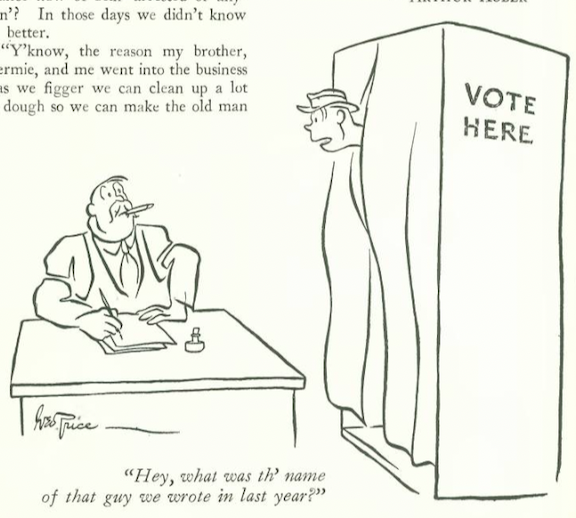
…and taking a look at the recent elections…
…on to James Thurber, and continuing struggles on the domestic front…
…and that brings us to our next issue…
Nov. 11, 1933 cover by Constantin Alajalov.
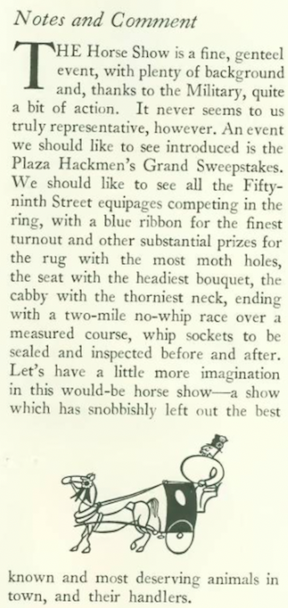
…in which E.B. White had a thing or two to say about the latest edition of the National Horse Show at Madison Square Garden.
HORSE SENSE AND SENSIBILITY…The National Horse Show at Madison Square Garden was a major event on New York’s social calendar; top and bottom right, scenes from the 1936 show; bottom left, undated scene circa 1960. (Stills from YouTube)
* * *
Versatile Verse
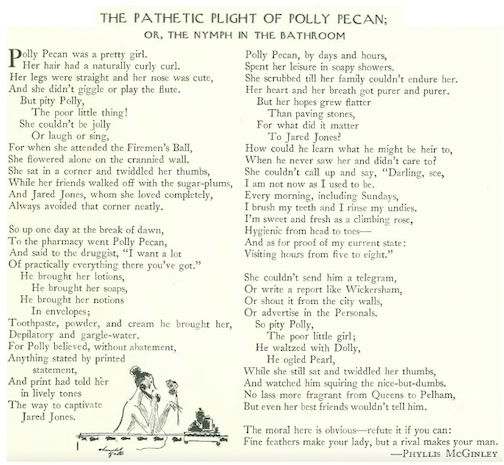
Phyllis McGinley (1905–1978) was the author of children’s books and poetry, the latter genre most notably for The New Yorker. However, she attracted a wide audience for her light verse in other publications ranging from Ladies Home Journal to The Saturday Review.
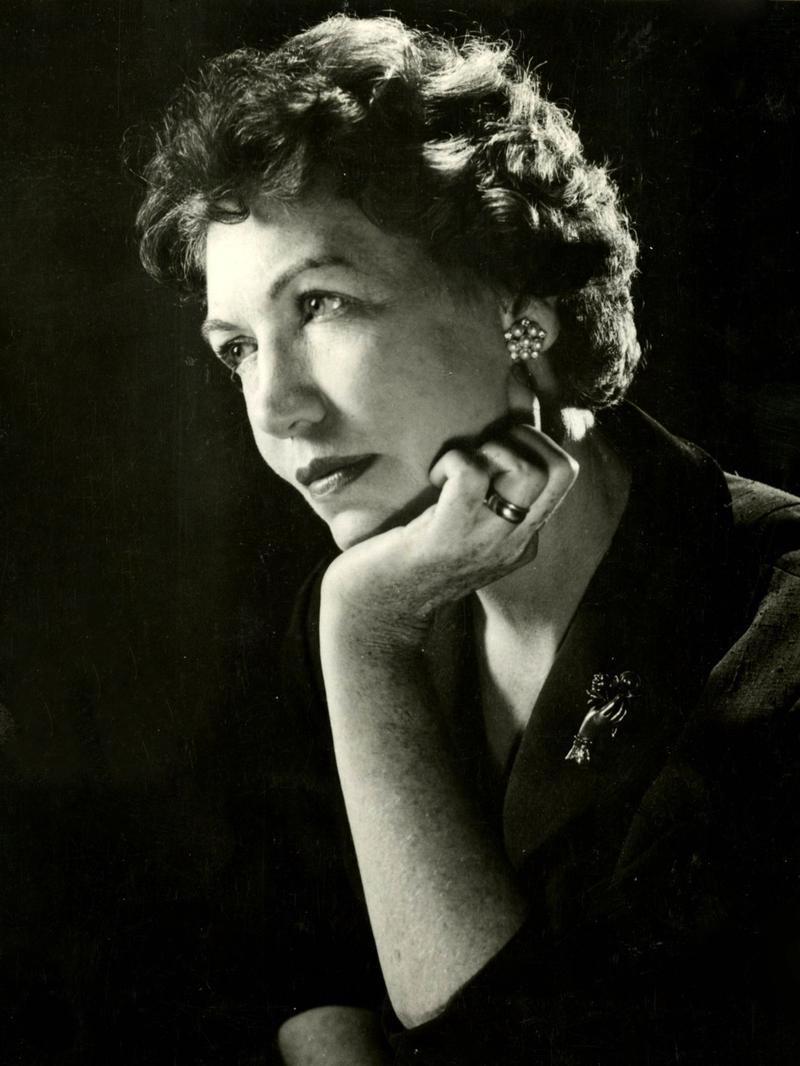
LIGHT TOUCH…Phyllis McGinley in an undated photo. She received the Pulitzer Prize in 1961 for her book Times Three—the first writer of light verse to receive the prize. (wnyc.org)
* * *
Oil and Water
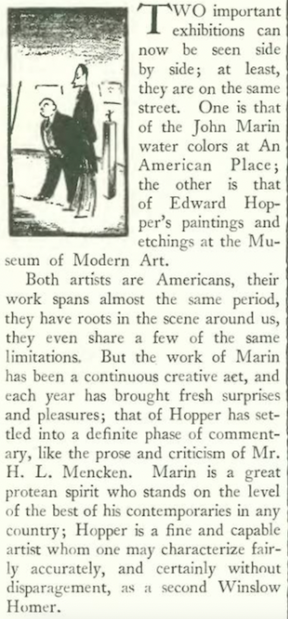
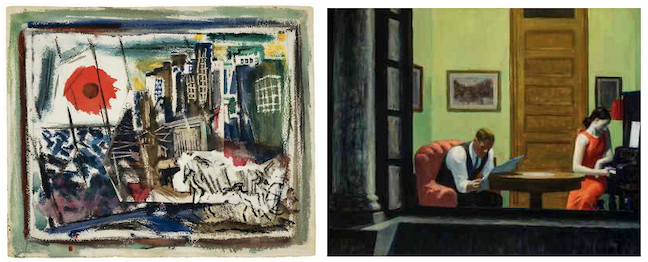
Art and architecture critic Lewis Mumford found two very different visions of America in the works of contemporaries John Marin and Edward Hopper. Marin’s watercolors were featured at An American Place, while Hopper’s oil paintings and etchings were shown down the street at the Museum of Modern Art.
SIDE BY SIDE…Lewis Mumford found different visions of New York and the world at An American Place and MoMA galleries. At left, John Marin’s watercolor From the Bridge, N.Y.C. (1933); at right, Edward Hopper’sRoom in New York, also from 1933. (Artists Rights Society/Sheldon Memorial Art Gallery)
* * *
More From Our Advertisers
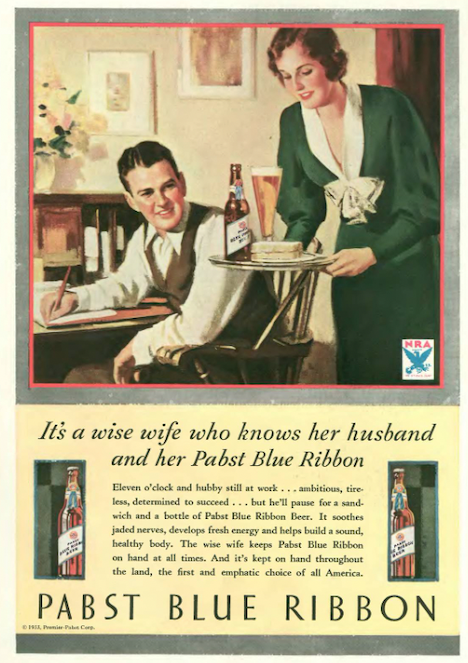
Okay, so I’ll buy the part about PBR’s ability to soothe “jaded nerves,” but I doubt it gave this guy “fresh energy” and “a sound, healthy body”…
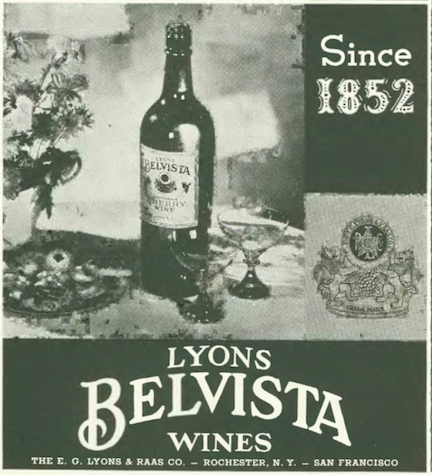
…After thirteen long years, winemakers emerged from their cellars to glimpse the light of a new day…
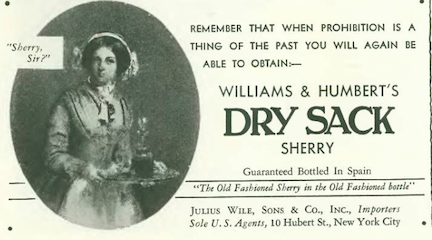
…and yes, after thirteen long years, some folks would be yearning for their DRY SACK Sherry…
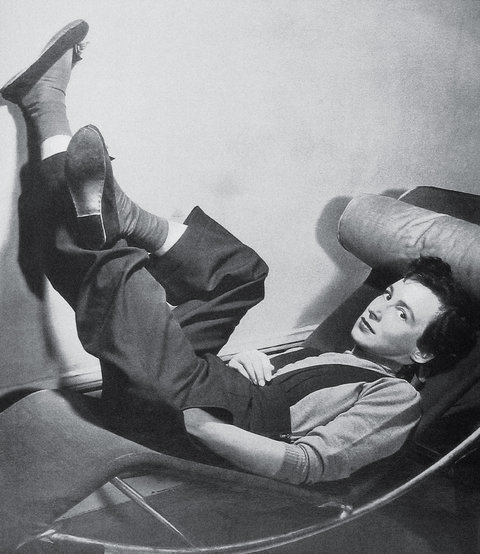
…the name Elizabeth Hawes was synonymous with high fashion in the late 1920s and 1930s—she owned one of the most exclusive couture houses in New York…
…an outspoken advocate of dress reform, Hawes (1903–1971) was referred to by one historian as “the Dorothy Parker of fashion criticism.” After attacking the fashion industry with her 1938 book, Fashion Is Spinach (Hawes wrote: “I don’t know when the word fashion came into being, but it was an evil day…”), she closed her fashion house and in 1942 took a job as a machine operator at a wartime plant in New Jersey. She became a union organizer, a champion of gender equality, and a critic of American consumerism.
IN A LEAGUE OF HER OWN…Elizabeth Hawes — writer, fashion designer and political activist, poses for a photograph in 1941. (Mary Morris Lawrence)
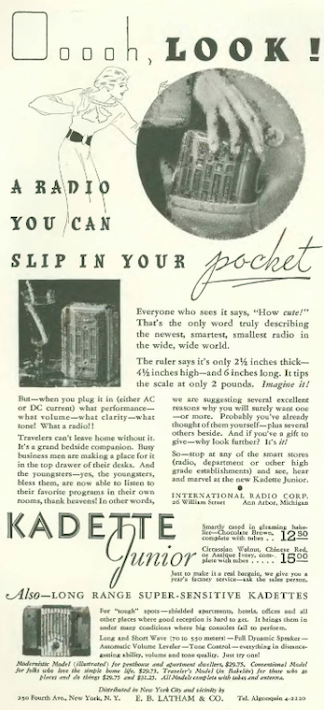
…speaking of consumerism, ooooh look! A radio “you can slip in your pocket,” depending of course on the size of your pocket…
…transistors would not come along until the late 1950s, so the Kadette still depended on tubes, and you had to plug it in somewhere, so no running down the beach with headphones, at least for awhile…
The Kadette Junior. (radiolaguy.com)
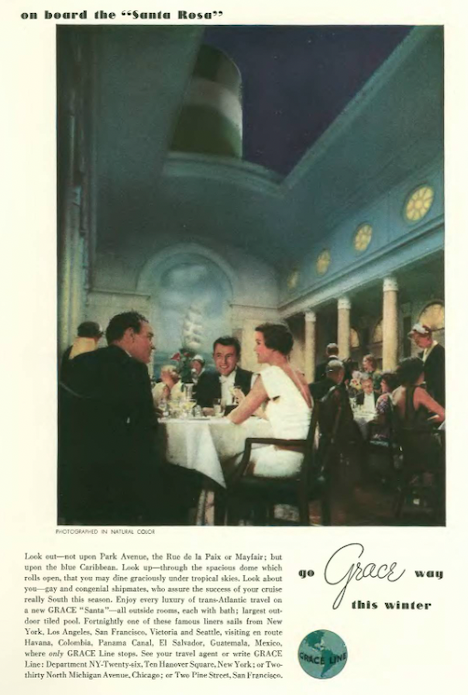
…it must have been a rare treat to sail on a ship like the SS Santa Rosa—situated between the ship’s two funnels, the dining room had an atrium stretching up two-and-a-half decks and featured a retractable roof…
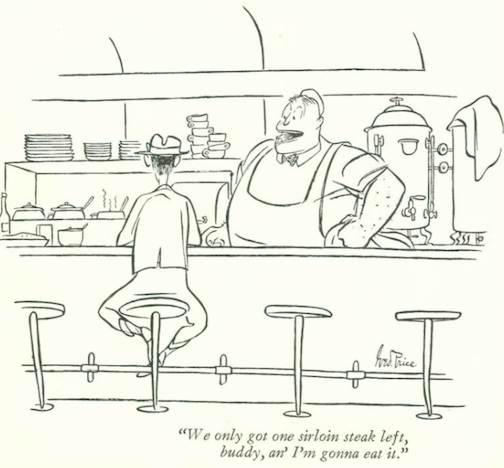
…on to more cartoons, and more George Price…
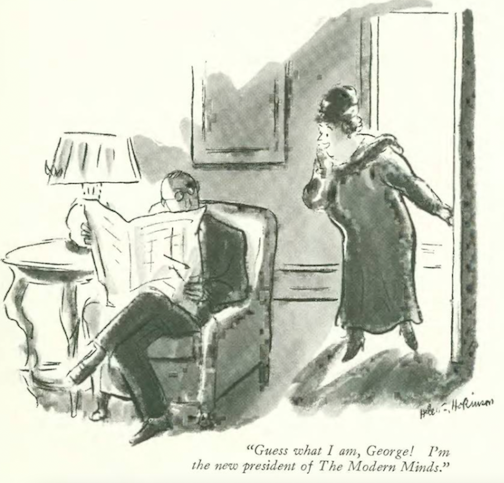
…moving along, we received some big news from one of Helen Hokinson’s “girls”…
…an aside I’ve been meaning to include…in 1952, just three years after Helen Hokinson’s untimely death, a cartoonist for The Cincinnati Enquirer, Franklin Folger, debuted a cartoon called “The Girls.” The cartoon was eventually syndicated and appeared in more than 150 newspapers worldwide before Folger retired it in 1977. Perhaps I am missing something, but I cannot find a single reference to Folger’s obvious appropriation of Hokinson’s “girls”…some examples of Folger’s work from the early 1960s and another from H.H. for comparison:
…and onward to Peter Arno, and the trials of portrait artists…
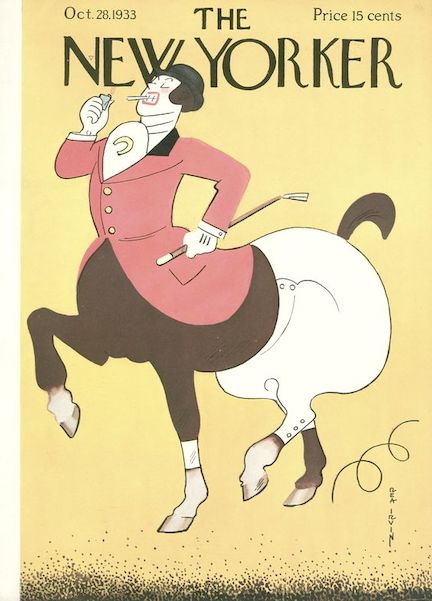
Much like Marilyn Monroe in the 1950s, Jean Harlow occupied a brief period in Hollywood history, but her star shone long after her untimely death.
Oct. 28, 1933 cover by Rea Irvin.
Adam Victor’s The Marilyn Encyclopedia draws all sorts of weird parallels between the actresses: both raised by strict Christian Scientists, both married three times, both left school at sixteen to marry their first husbands, both acted opposite Clark Gable in the last film each ever made. Most importantly, Monroe idolized Harlow, so it was no coincidence that she sported her own version of “platinum blonde” hair.
ART IMITATES LIFE…In 1958 Marilyn Monroe posed as Jean Harlow for photographer Richard Avedon in a Life magazine feature. (Flickr)
The term “Bombshell” was affixed to the 22-year-old Harlow after the 1933 film’s release, and was later used to describe Monroe and other sex symbols of the 1950s and early 60s.
Harlow’s character in Bombshell, Lola Burns, satirized the stardom years of the silent era sex symbol Clara Bow, who was director Victor Fleming’s fiancée in 1926. Although critical reviews were mostly positive, New Yorker critic John Mosher found the film “mossy with verbiage.”
TAKE A BOW, CLARA…Bombshell satirized the stardom years of silent era sex symbol Clara Bow, who was director Victor Fleming’s fiancée in 1926 (photo at left is of the couple on the set of 1926’s Mantrap); in BombshellJean Harlow portrayed a sex symbol who, like Bow, wanted to live a normal life. In real life, Bow made her last film in 1933 and retired to a ranch at age 28. (IMDB)
A STAR IS BORED…In Bombshell, movie star Lola Burns (Jean Harlow) dislikes her sexy vamp image and wants to live a normal life, but her studio publicist E. J. “Space” Hanlon (Lee Tracy) insists on feeding the press endless provocative stories about her. Clockwise, from top left: Lee Tracy and Louise Beavers in a scene with Harlow; Harlow and Una Merkel, who portrayed Lola’s assistant, Mac; Harlow in a scene with Mary Forbes, C. Aubrey Smith, and Franchot Tone; Harlow in a scene with Ruth Warren and Frank Morgan—the latter portrayed Lola’s pretentious, drunken father. (IMDB)
Harlow would die at age 26 on June 7, 1937. Her heavy drinking didn’t help, but neither did the misdiagnosis she received as her kidneys were rapidly failing. While filming Saratoga with Clark Gable, Harlow was stricken with what she believed was the flu, and her persistent stomach pain was misdiagnosed as a swollen gallbladder. Just two days before her death another doctor finally diagnosed her kidney disease, but in 1937 nothing could be done—kidney dialysis would not be available for another decade, and transplants would not be an option until the mid-1950s.
* * *
Second City Sanctimony
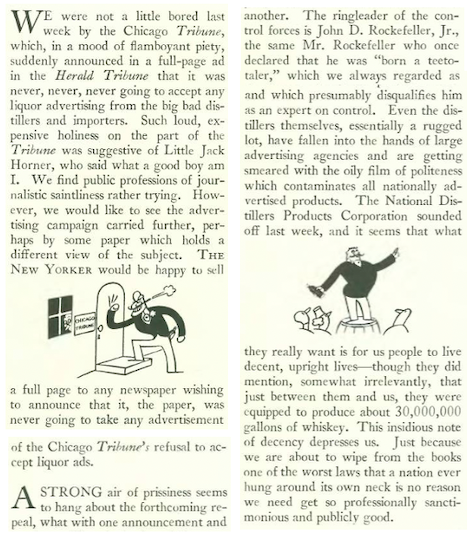
The New Yorker rarely missed an opportunity to take a dig at the square-toed ways of the Second City and its flagship newspaper, the Tribune. In his “Notes and Comment,” E.B. White (who enjoyed gin martinis) found the newspaper’s sanctimonious stance tedious:
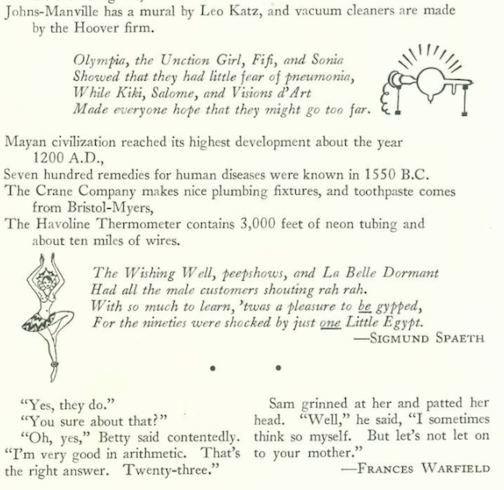
The 1933 Chicago World’s Fair, aka “A Century of Progress,” received scant attention from The New Yorker, unless it provided opportunities for parody. Musicologist Sigmund Spaeth (1885-1965), well-known in the 1930s and 40s for his NBC radio programs, offered this take on the Windy City’s exposition:
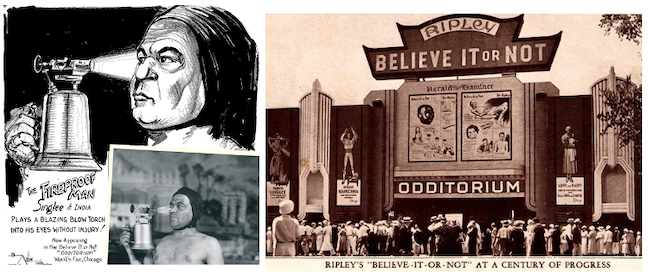
WONDERS NEVER CEASE…In addition to its more high-minded attractions, the Chicago World’s Fair also featured such sideshow attractions as Ripley’s Odditorium, which featured “The Fireproof Man” among other novelties. (pdxhistory.com)
* * *
Big, Bad Earworm
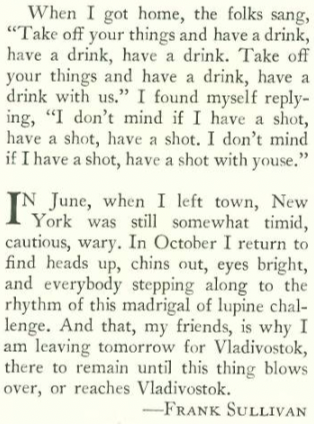
It seems quaint that nearly 90 years ago one of the most popular songs in America was “Who’s Afraid of the Big Bad Wolf?” To Frank Sullivan, there was no escaping “that lilting tune”…
SIMPLER TIMES…”Who’s Afraid of the Big Bad Wolf?” was a huge hit during the second half of 1933. One of the most well-known Disney songs, it was covered by numerous artists and musical groups.
Sullivan concluded that a trip to Vladivostok might be the only way to escape the catchy melody…
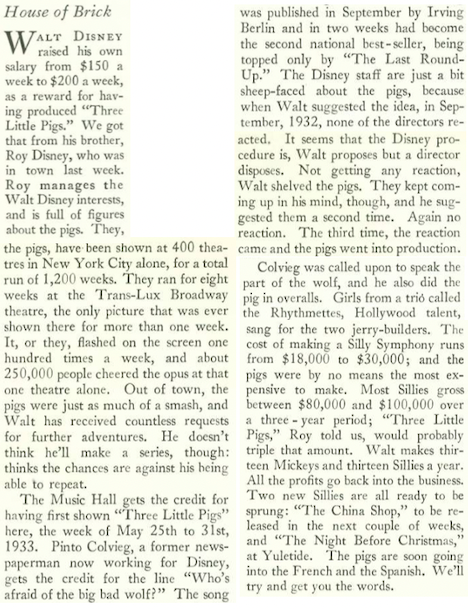
Briefly jumping to the Nov. 4 issue, “The Talk of Town” took a closer look at the song and the 1933 Disney Silly Symphonies cartoon in which it was featured—Three Little Pigs. Written by Frank Churchill and Ann Ronell, the song launched a market for future Disney tunes, with Irving Berlin securing the sheet music rights over Mickey Mouse and the Silly Symphonies.
WE’RE IN THE MONEY…The 1933 Disney Silly Symphonies cartoon Three Little Pigs helped to launch the Disney juggernaut nearly 90 years ago.
* * *
Polymath
Le Corbusier, aka Charles-Édouard Jeanneret (1887–1965), was known as a pioneer of modern architecture and design in the early and mid-20th century, but as this review by Lewis Mumford suggested, he was also a talented modernist painter.
WAYS OF SEEING…Le Corbusier’s early paintings followed the ideas of something he called “purism”—at left is an example from 1920, Still Life. Later on his work become more abstract, including Menace, at right, from 1938. The horse head in the painting seems to reference Pablo Picasso’s 1937 painting, Guernica. (Wikipedia/Art Basel)
* * *
Dear Papa
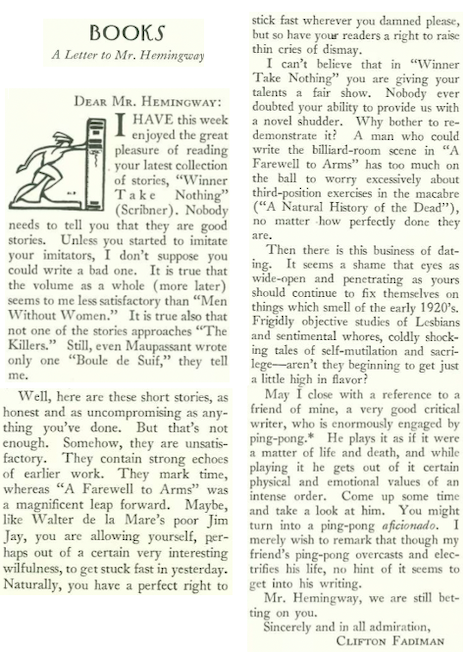
Following the high praise Ernest Hemingway received in 1926 for The Sun Also Rises, Dorothy Parker feared for the novelist’s next book: “You know how it is—as soon as they all start acclaiming a writer, that writer is just about to slip downward.” Seven years later Parker’s colleague Clifton Fadiman detected some slippage, finding Hemingway’s latest output a bit stale. Rather than pen a negative review, Fadiman shared his concerns by way of an open letter:
PHONING IT IN…Clifton Fadiman (right) found Ernest Hemingway’sWinner Take Nothing to be “stuck fast in yesterday.” (AP/Wikipedia/Pinterest)
* * *
From Our Advertisers
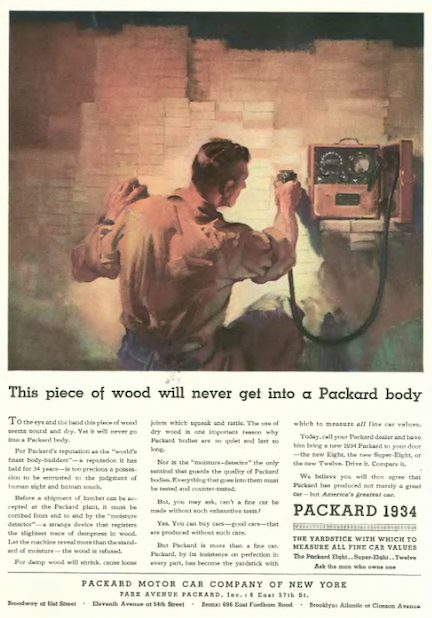
Until the 1920s all car bodies were framed in wood, preferably ash, but by the end of the 1930s all-steel car bodies became the standard…Packard made the switch beginning around 1938…
…ah, the good old days when you could smoke in the “rarefied atmosphere” of an airplane, the pilot so close by you could tap him on the shoulder…
…Brooklyn’s Hittleman-Goldenrod Brewery opened in late 1933 promising beer in the finest English tradition…sadly, it closed in 1937…
…the Waldorf-Astoria announced the re-opening of its Empire Room with entertainment by Xavier Cugat and his tango orchestra, featuring the dancer Margo…this was just the sort of “juvenile” entertainment Lois Long detested (see my previous post)…
…according to this ad, “His Lordship” drank a pot of decaf Sanka at midnight “and never winked an eye all night”…it doesn’t mention that he probably also wet the bed…
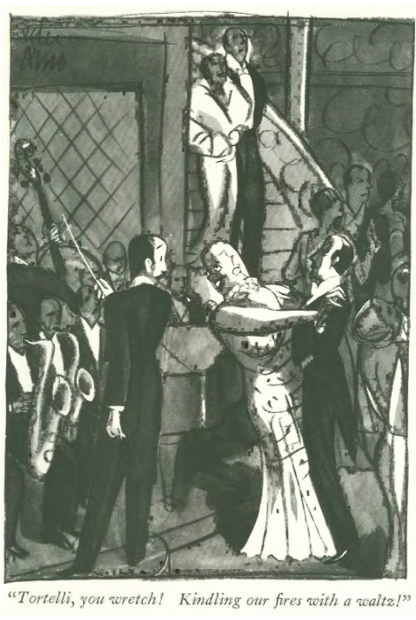
…on to our cartoons, we begin with Peter Arno and the woes of the monied classes…
…on to Helen Hokinson, and the charms of the precocious…
…Gardner Rea gave us a toff absorbed in historical fiction…
…Alain (aka Daniel Brustlein) offered up a flautist who found beauty in his routine life…
…and we close with Perry Barlow, and motherhood among the smart set…
As in her other films, Mae West’s character in I’m No Angel was sexually independent and unapologetically so. (Kino Lorber)
We first encountered Mae West back in 1926 when The New Yorker commented on her risqué Broadway play, Sex. Although the play was the biggest ticket in town, it eventually attracted a police raid that landed West in jail on morals charges. Sentenced to ten days for “corrupting the morals of youth,” she could have paid a fine, but for West a short stint on Welfare Island was worth its weight in publicity gold.
Oct. 14, 1933 cover by Rea Irvin.
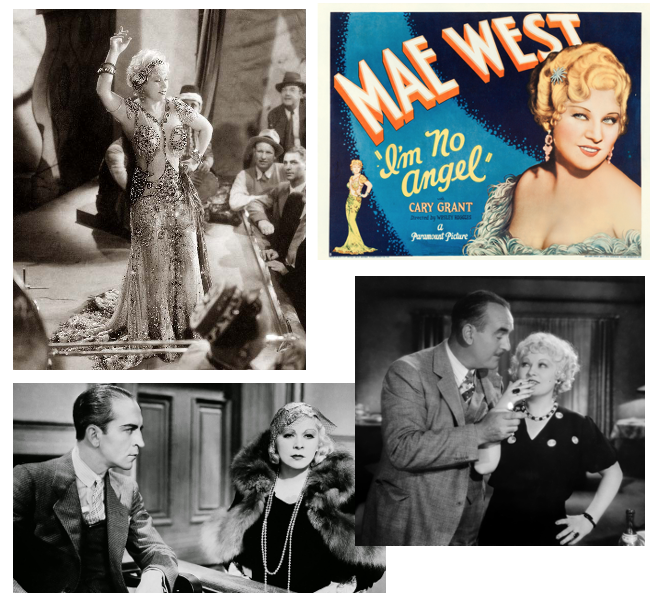
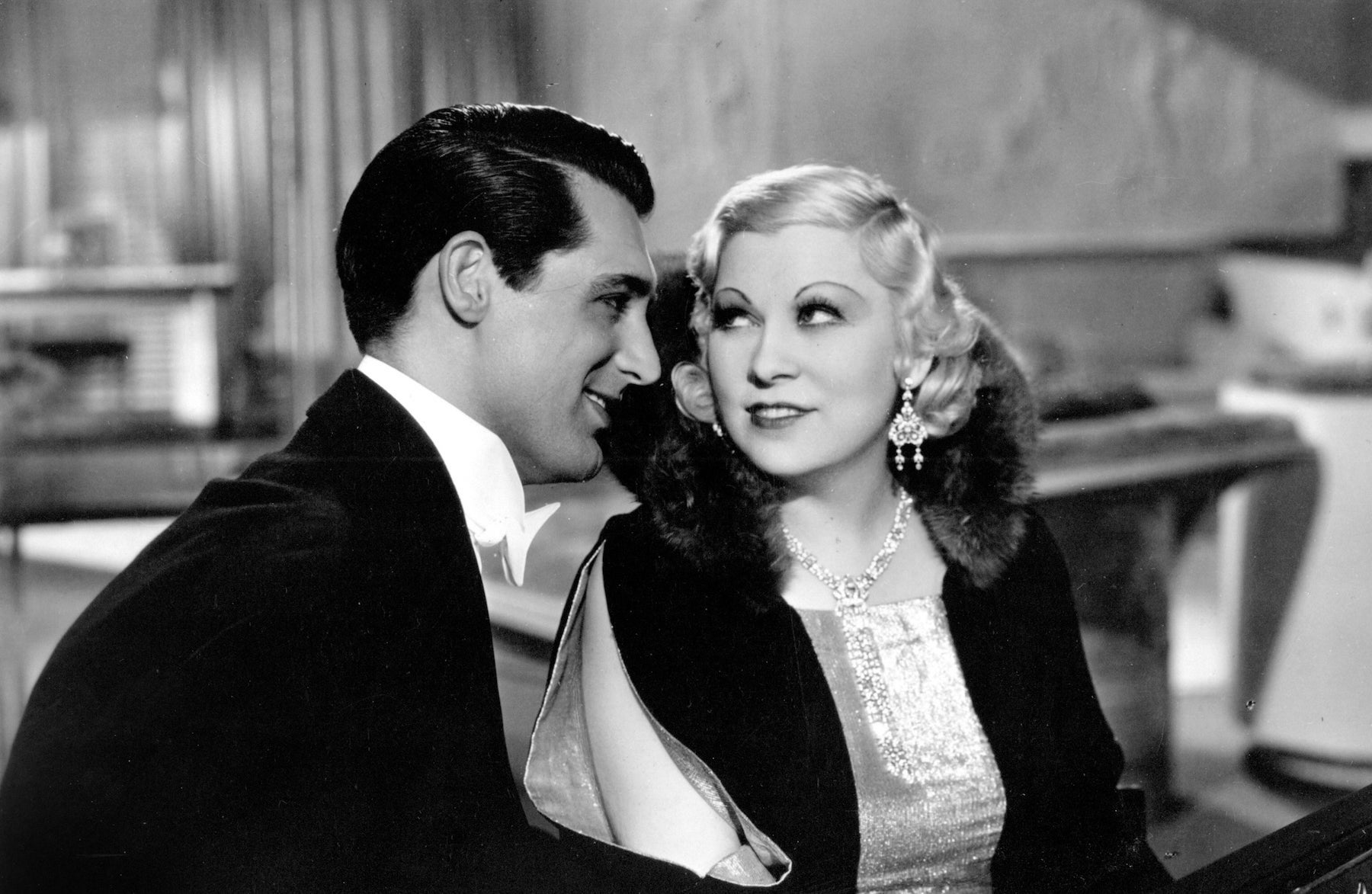
Fast forward seven years, and West is one of the nation’s biggest box office attractions and starring in her third film, I’m No Angel. Depression-era audiences responded enthusiastically to West’s portrayals of a woman from the wrong side of the tracks who in the end gains both fortune and social acceptance. Although puritanical forces continued to be outraged by West’s antics, New Yorker film critic John Mosher found her act to be “a safe parody on indecency.”
SHIMMY TO SUCCESS…Clockwise, from top left: At the beginning of I’m No Angel, Tira (Mae West) shimmies and sings in a circus sideshow; studio poster for the film— In the early 1930s, West’s films were key in saving Paramount Pictures from bankruptcy; a wealthy sideshow customer (William B. Davidson) arranges a private rendezvous; Tira has her day in court despite attempts by her ex-boyfriend, Slick Wiley (Ralf Harolde), to discredit her. (IMDB)
SHE GETS HER MAN…Cary Grant starred opposite Mae West for the second and final time in I’m No Angel. Eleven years junior to West, Grant portrayed Tira’s fiancé, Jack Clayton. (TCM)
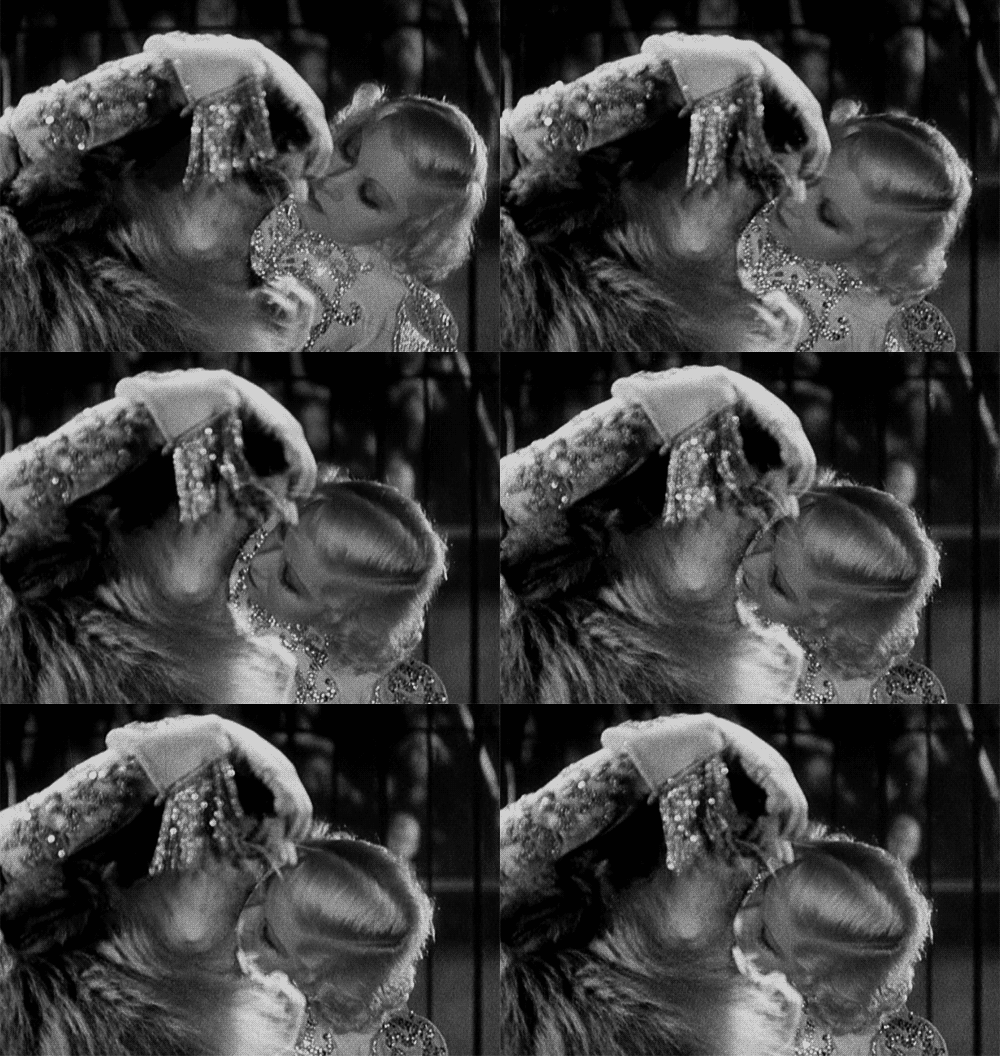
And finally, a much-talked about scene from the movie featured West putting her head (rather sensually) into the mouth of a lion. In reality it appears to be a camera trick: West was actually placing her head to the side of the lion’s mouth. Still, a gutsy move by West. As for the lion, it was no picnic either.
* * *
Comic Relief
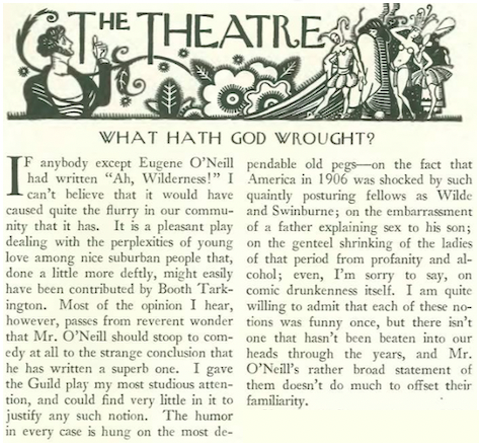
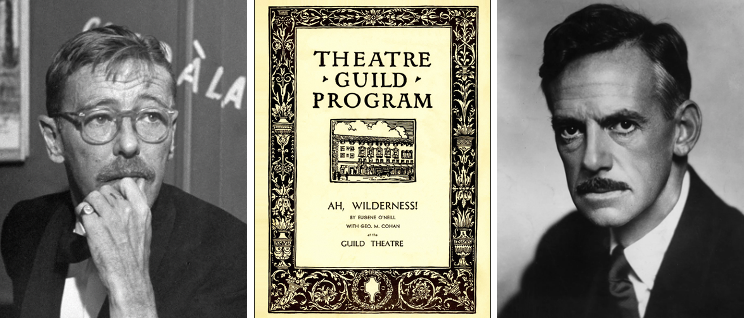
Eugene O’Neill surprised critics and audiences alike when he premiered Ah, Wilderness! at Broadway’s Guild Theatre on October 2, 1933. Among the critics was Wolcott Gibbs, who concluded that O’Neill should stick to his usual themes of disillusion and despair. An excerpt:
PASS THE CORN, PLEASE…Around the table in the original 1933 Broadway production of Ah, Wilderness! are (from left) George M. Cohan (Nat Miller), Eda Heinemann (Lily), Elisha Cook, Jr. (Richard), Gene Lockhart (Sid), Marjorie Marquis (Mrs. Nat Miller), Walter Vonnegut, Jr. (Tommy) and Adelaide Bean (Mildred). (Photograph by Vandamm for Stage magazine, November 1933)
ERRORS OF COMEDY…Wolcott Gibbs (left) found Eugene O’Neill’s attempt at comedy to be nothing more than a recycling of corny old saws. However, Ah, Wilderness! proved successful in its first Broadway production and in the touring company that followed. It remains to this day a staple of community repertory. (The New Yorker/Playbill/Encyclopedia Britannica)
* * *
Hell in a Handbasket
If Eugene O’Neill couldn’t offer up some woe, then leave it to E.B. White of all people to supply reason for despair. In his 1982 review of a collection of White’s poems and sketches, Timothy Foote observed that White occasionally assumed the guise of Pessimist, “a desperate fellow who served as a one-man distant-early-warning system…”
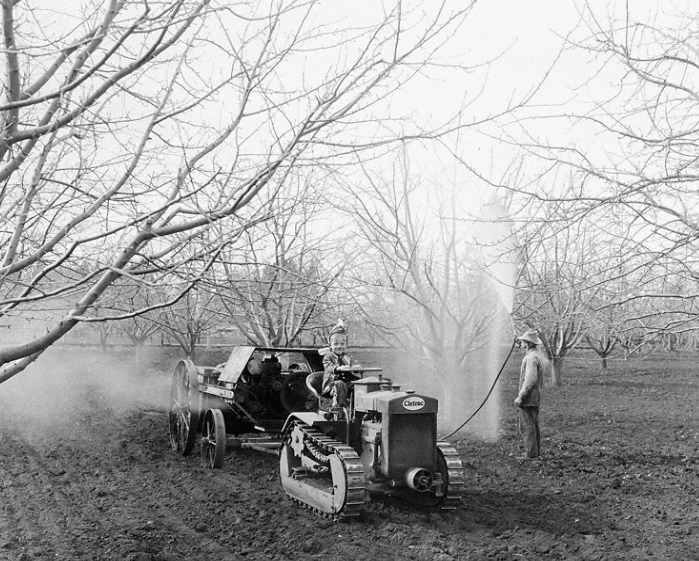
For the Oct. 14 issue White bemoaned the loss of the American elm (of the 77 million elms in North America in 1930, more than 75 percent were lost to Dutch elm disease by 1989), the dangers of pesticide use, and other maladies. Excerpts:
APPLE OF HIS EYE…E.B. White had reason to be concerned about the widespread practice of spraying lead arsenic on fruit trees. This 1930 photograph shows an Oregon orchardist and his child spraying apple trees with the stuff. (oregonhistoryproject.org)
White’s New Yorker colleague John O’Hara raised some concerns of his own, namely the likelihood of another world war in this prescient piece titled “Dynamite is Like a Mill Pond.” Excerpts:
FROM RUSSIA WITH LOVE…John O’Hara pondered the likelihood of another world war and an unlikely bedfellow: Soviet Russia. Photo circa 1938. (AP via loa.org)
* * *
Pooh-Poohing Mr. Milne
In his review of A.A. Milne’s latest novel, The Red House Mystery, Clifton Fadiman seemed to recall Dorothy Parker’s own revulsion to Milne’s juvenile style (“Tonstant Weader Fwowed Up” Parker once wrote of The House at Pooh Corner). Excerpts:
* * *
From Our Advertisers
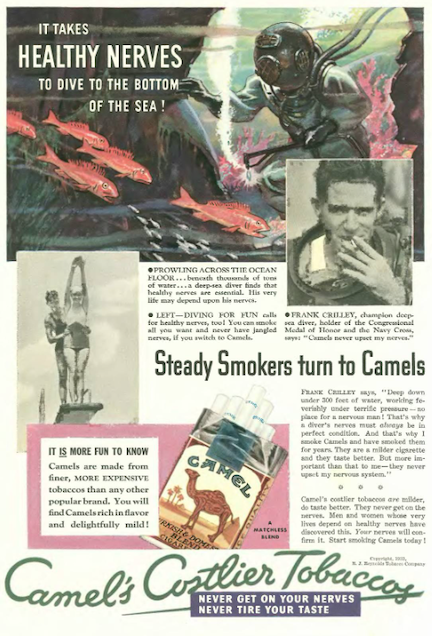
The makers of Camels took to the water to prove how their cigarettes supported “healthy nerves,” whether in the deep sea or on the high dive…
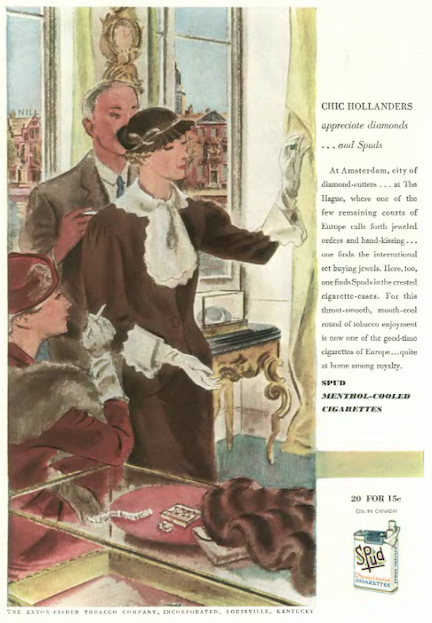
…with a name like “Spud” you really had to stretch to prove you were a choice of the smart set…here they claimed their product was “quite at home among royalty”…
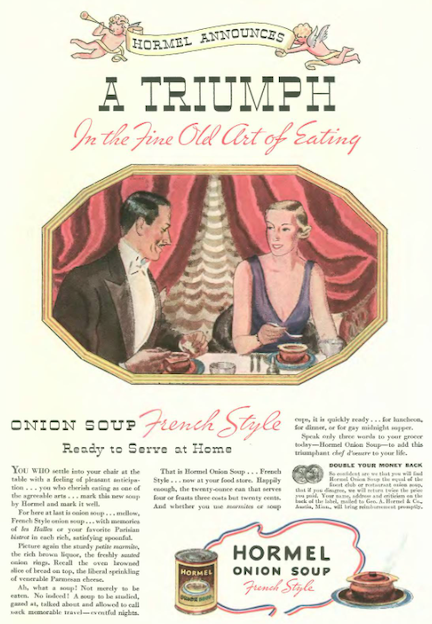
…here’s another great example of class appropriation, a white-tie dinner featuring a couple of toffs eating canned soup…
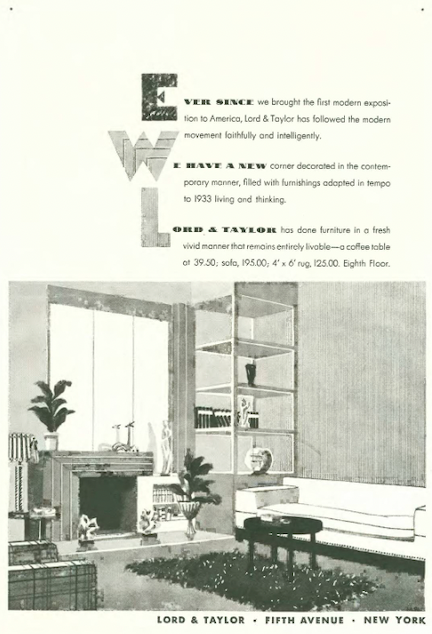
…and we give our eyes a break with a bit of elegance from Lord & Taylor, featuring the art of modern living…
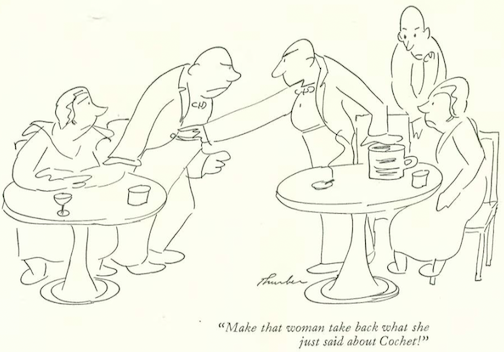
…on to our cartoons, we begin with James Thurber…
…curious to know Thurber’s favorite songs?—then check out this Thurber Thursday post from Michael Maslin’sInkspill...
…we continue with William Steig’s look at a “Lady With Mirror”…
…and discover the calm after a storm in this domestic scene by Kemp Starrett…
…visit the Century of Progress World’s Fair in Chicago, with George Price…
…for reference, Price’s cartoon depicted the Federal Building at the Century of Progress…
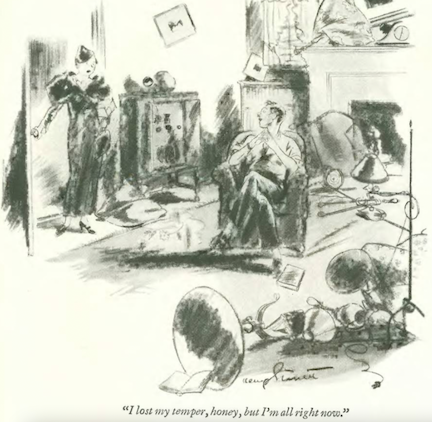
…and is often the case with this blog, we give Peter Arno the last word…
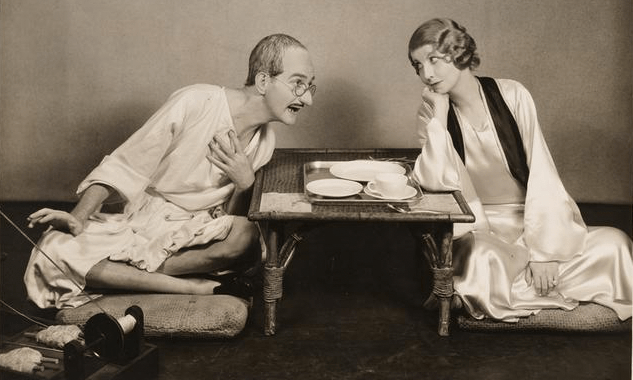
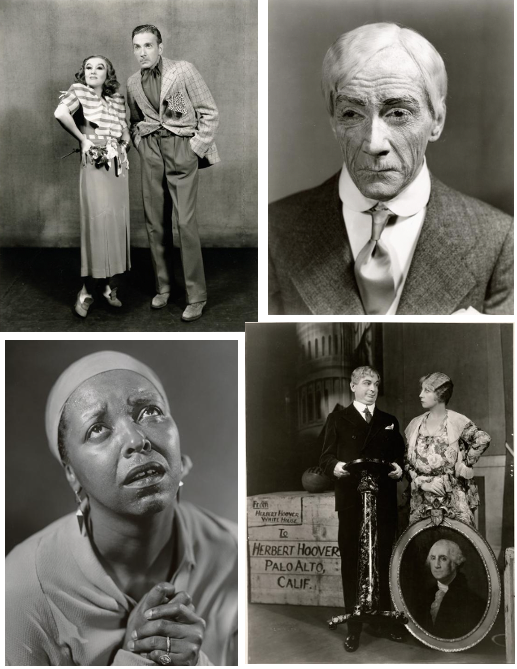
ABOVE: Broadway's As Thousands Cheer (1933) featured evangelist Aimee Semple McPherson (Helen Broderick) trying to persuade Mahatma Gandhi (Clifton Webb) to end his hunger strike and join her act. (NYPL)
Broadway gave Depression audiences a lift with As Thousands Cheer, a revue featuring satirical sketches that skewered the lives and affairs of the rich and famous and served as a precursor to sketch shows like Saturday Night Live.
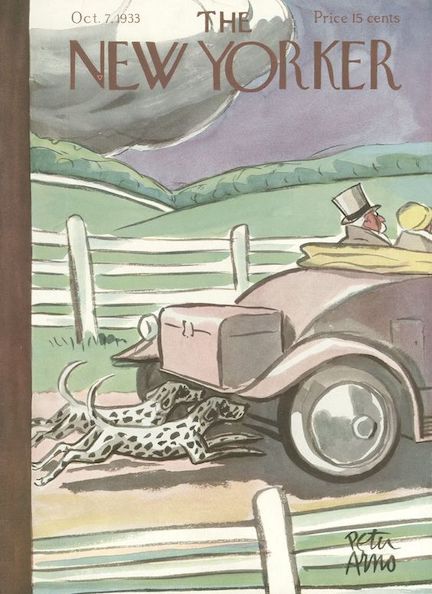
Oct. 7, 1933 cover by Peter Arno.
With a book by Moss Hart and music and lyrics by Irving Berlin, the revue was a big hit, playing for nearly a year on Broadway in its initial run.
TOON TIME…Marilyn Miller led a chorus of cartoon characters in a sketch titled “The Funnies” in As Thousands Cheer; leading the revue were Miller, Clifton Webb and Helen Broderick, here featured on the cover of the Playbill. The production would be Marilyn Miller’s last—one of Broadway’s biggest stars known for playing sunny characters, her personal life was filled with illness and tragedy, and she would go to an early death in 1936. (playbill.com)
Wolcott Gibbs took his turn as Broadway reviewer, and pronounced As Thousands Cheer “the funniest thing in town.”
Not everything was roses in As Thousands Cheer: In a poignant star turn, Ethel Waters sang—at Irving Berlin’s request—his famous tune “Supper Time,” a Black woman’s lament for her lynched husband. The revue was the first Broadway show to give an African-American star (Waters) equal billing with whites, however she was segregated from her co-stars and did not appear in any sketches with them. Her co-stars even refused to bow with her at the curtain call until Berlin intervened. According to the James Kaplan biography Irving Berlin, “The show had a successful tryout at Philadelphia’s Forrest Theatre in early September, although opening night was marred by an ugly incident all too in tune with the times: the stars Clifton Webb, Marilyn Miller, and Helen Broderick refused to take a bow with Ethel Waters. To his everlasting credit, Berlin told the three that of course he would respect their feelings—only in that case there needn’t be any bows at all.
“They took their bows with Waters at the next show.”
NEWSMAKERS…Each sketch in As Thousands Cheer was preceded with a newspaper headline. Clockwise, from top left, in the sketch headlined JOAN CRAWFORD TO DIVORCE DOUGLAS FAIRBANKS, JR, Marilyn Miller and Clifton Webb portrayed the stars arguing over publicity rights to their divorce; Webb as 94-year-old John D. Rockefeller; the headline FRANKLIN D. ROOSEVELT INAUGURATED TOMORROW featured Mr. and Mrs. Herbert Hoover on their last day in the White House, portrayed by Leslie Adams and Helen Broderick; Ethel Waters singing Irving Berlin’s “Supper Time.” (New York Public Library)
* * *
A Final Byline
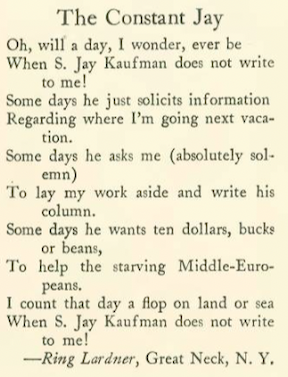
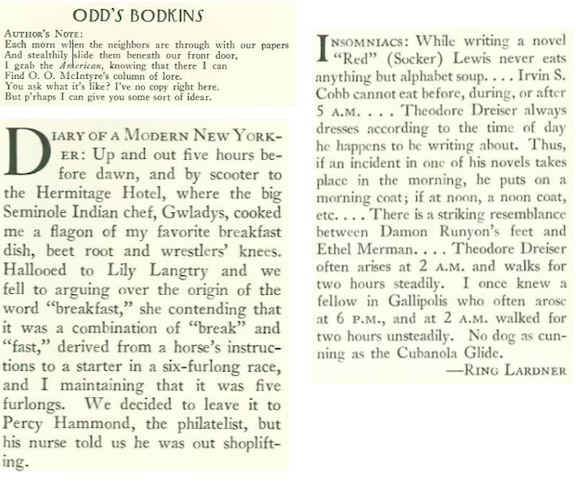
E.B. White opened his column with a tribute to Ring Lardner, who died at age 48 of a heart attack and other complications. In the months before his death Lardner had contributed a number of comical “Over the Waves” radio reviews.
JOURNALIST AT HEART…Ring Lardner (1885-1933) worked for several newspapers before settling at the Chicago Tribune in 1913—it became the home newspaper for his syndicated column, In the Wake of the News. (Chicago Tribune)
Lardner’s first contribution to The New Yorker came shortly after the magazine’s founding. “The Constant Jay” was published in the April 18, 1925 issue: Readers appreciated his subtle wit, including this oft-quoted gem:
“The race is not always to the swift nor the battle to the strong—but that’s the way to bet.”
Lardner also liked to poke fun at himself and his aw-shucks view of things. Here are the opening and closing paragraphs of his final New Yorker contribution, “Odd’s Bodkins:”
* * *
Macy Modernism
As Lewis Mumford observed in his “Skyline” column, Macy’s was the first department store to embrace a modern approach to interior design, but as Marilyn Friedman notes in her book, Making America Modern: Interior Design in the 1930s, Macy’s modernism was a bit toned down to blend into more traditional settings. A case in point was Macy’s 1933 Forward House exhibition, which Mumford described as “a brilliant piece of modern showmanship.”
EASY ON THE EYES…”Living room in the Suburban House of Forward House” at R.H. Macy & Co., New York, 1933, from The Upholsterer and Interior Decorator, October 15, 1933. (artdeco.org)
* * *
Fishing for Commies
Geoffrey Hellman profiled New York House Rep. Hamilton Fish Jr (1888–1991), a staunch anti-communist perhaps best known for establishing the Tomb of the Unknown Soldier at Arlington National Cemetery. I feature this brief excerpt mainly for the great caricature by Abe Birnbaum.
MINDING THE HOME FRONT…Hamilton Fish, Jr making a speech in Los Angeles, 1935. Fish served in the U.S. House of Representatives from 1920 to 1945 and during that time was a prominent opponent of intervention into foreign affairs. (UCLA Special Collections)
* * *
All Wet
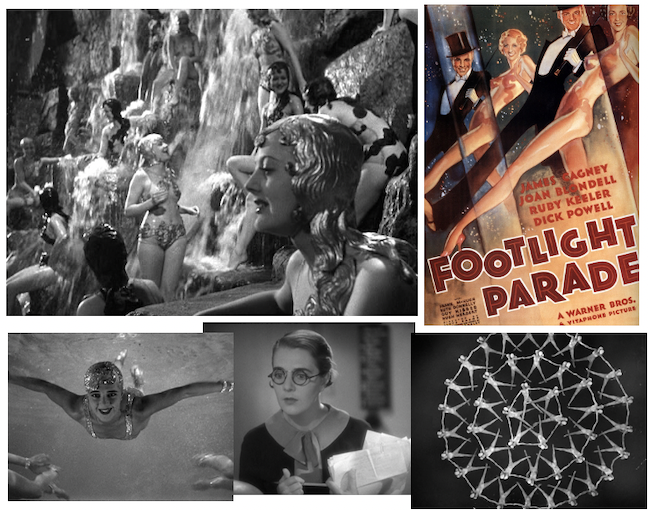
Eleven years before Esther Williams made her first aqua-musical, Ruby Keeler took the dive under Busby Berkeley’s direction in Footlight Parade. E.B. White served as film critic for the Oct. 7 issue, and found Footlight to be a feast for the male gaze, as well as mindless entertainment.
TAKING THE PLUNGE…Clockwise, from top left: According to E.B. White, there was no gainsaying “the general aahhhhh” of the semi-nude waterfall scene in Footlight Parade; promotional poster left no doubt as to what audiences might expect from the film; Busby Berkeley displayed his craft in water-based choreography; Ruby Keeler portrayed a dancer turned secretary who is transformed back into a dancer—just add water. (IMDB)
* * *
A Dog’s Life
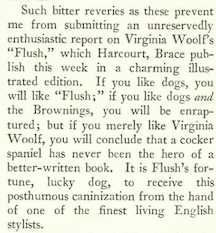
Doubtless drained from writing The Waves, Virginia Woolf followed up with some historical fiction, namely Flush: A Biography, a book about Elizabeth Barrett Browning’s cocker spaniel. Clifton Fadiman had this to say about the unusual biography:
VIRGINIA WOOF…Frontispiece for Flush: A Biography. Virginia Woolf used the tale of a dog to explore social themes ranging from feminism to class conflict. (Heritage Auctions)
* * *
From Our Advertisers
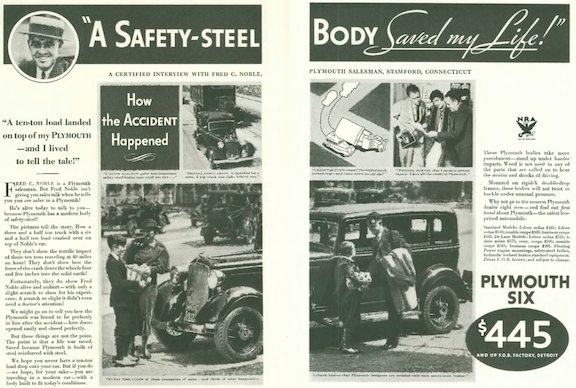
When you market a car for only $445 you aren’t going after the luxury market, but hey, drop a ten-truck truck on this baby and you can live to tell about it…
…with legal beer flooding the market brewers were particularly keen to attract female drinkers of all ages…and apparently social classes…
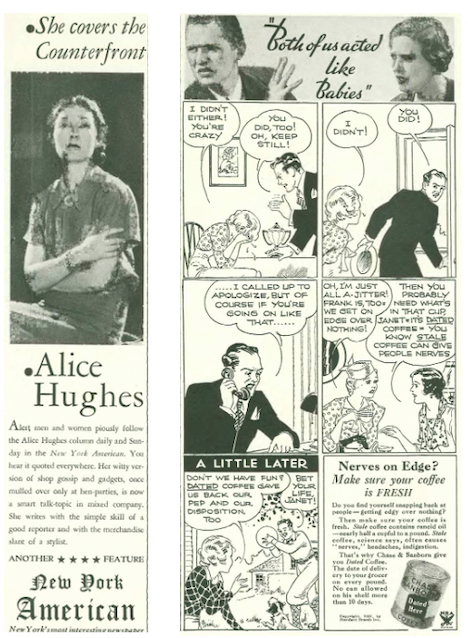
…a couple of ads from the back pages, the first touting the smart-set writing of columnist and foreign correspondent Alice Hughes for the New York American, and the second an advertisement for Chase & Sanborn coffee, which relayed the story of a marriage on the brink due to stale coffee…
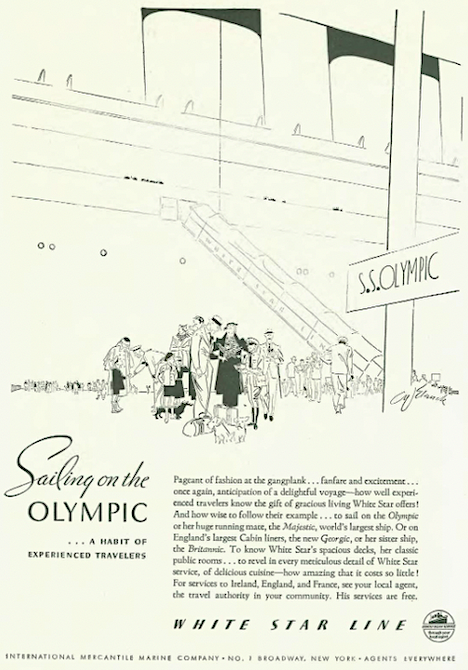
…I include this ad for the heroic scale of the ocean liner, particularly as depicted by the people in the background…
…we bounce on to our cartoons with Otto Soglow’s Little King…
…James Thurber continued to explore the unrest among our domestic youth…
…speaking of America’s youth, this gathering (courtesy Gardner Rea) appeared to have trouble finding some…
…Helen Hokinson found fun with flounder…
…Rea Irvin turned the tables on a life-drawing class…
…and we close with Richard Decker, over the moon with a stranded chorine…
…and in a nod to the approaching holiday, imagery from a 1933 Fleischer Studios animated short film, Betty Boop’s Hallowe’en Party…