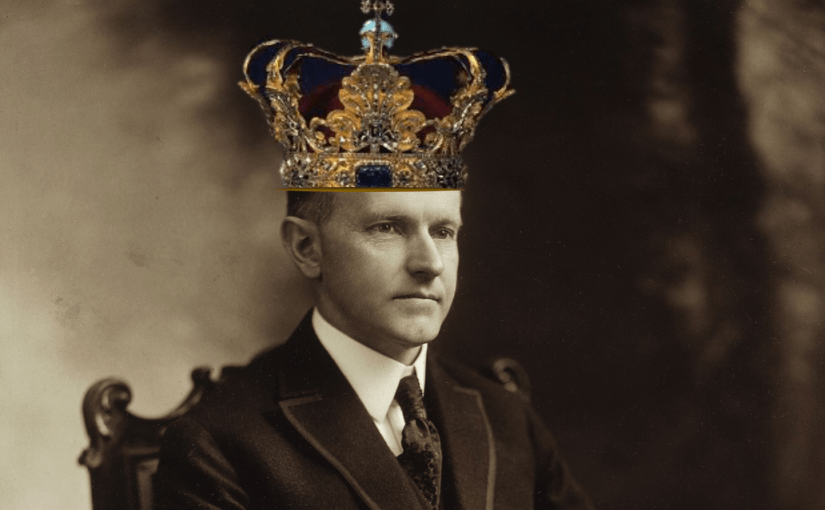
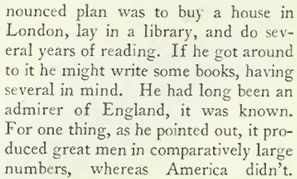
Although the United States declared its independence from British Empire nearly 250 years ago, the royal family and all of its requisite trappings persist in the American imagination like a phantom limb.
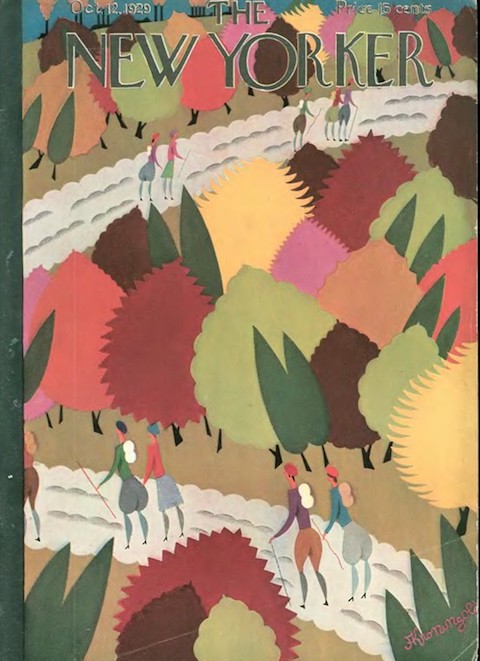
Oct. 5, 1929 cover by Theodore G. Haupt.
E.B. White observed as much in the “Notes and Comment” section of the Oct. 5 issue, in which he offered his views regarding the “pother” over the wedding of Calvin Coolidge’s son, John, to Florence Trumbull, the daughter of Connecticut Governor John Harper Trumbull…
White could have looked no further than the pages of The New Yorker for further evidence to his claims. The bourgeois yearnings of its readers were reflected in countless advertisements laced with anglophilic pretensions. Here are examples from 1929 issues we have previously examined:
LIVE LIKE A BARON…Ads from The New Yorker of the 1920s often featured illustrations of regal, priggish types such as the couple above, deployed to sell everything from apartments and ginger ale……to no-frills automobiles and menthol cigarettes. No product was too pedestrian for the royal treatment.
Writing under the pseudonym “Guy Fawkes,” Robert Benchley commented further on the Coolidge-Trumbull nuptials in the “Wayward Press” column:
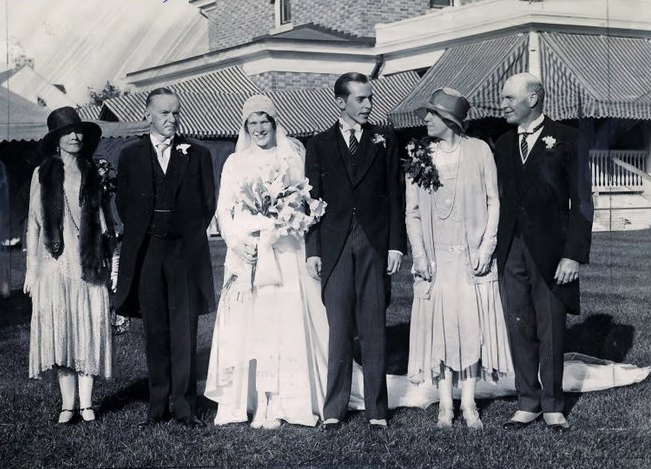
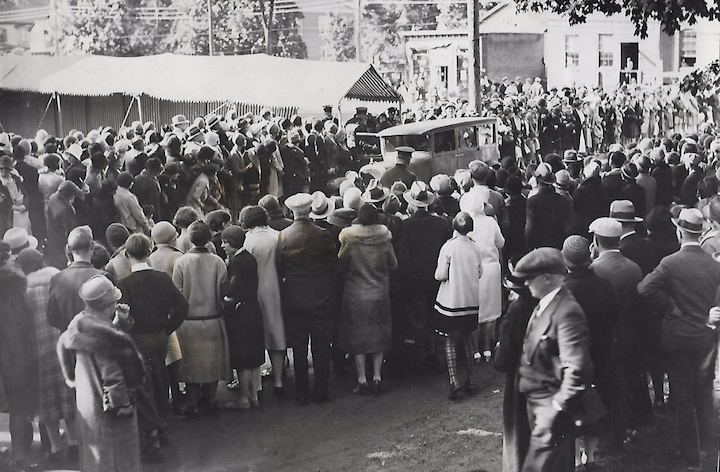
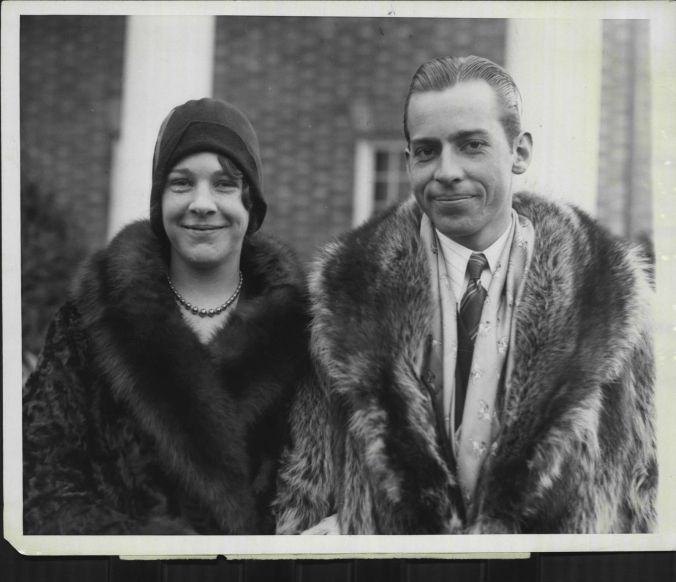
HEY CAL, IT’S A WEDDING, NOT A FUNERAL…The former U.S. President Calvin Coolidge was known as “Silent Cal” for good reason, given his reserved demeanor that rarely produced a smile (although he apparently had a dry wit). He poses here at the wedding of his son, John. Left to right are Grace Goodhue Coolidge, President Coolidge, Florence Trumbull Coolidge, John Coolidge; Maud Pierce Usher Trumbull, and Gov. John Trumbull. (patch.com)NOT EXACTLY KING’S ROAD…Onlookers line the street near the Congregational church in Plainview, Conn., hoping for a glimpse of the bride and groom, who were united in a simple ceremony. (Associated Press)CUTE COUPLE…Florence Trumbull and John Coolidge during their engagement, 1928. (crackerpilgrim.com)
* * *
Modest Mussolini
We go from famous faces to infamous ones, namely the Italian dictator Benito Mussolini, aka Il Duce, who received the adoration of his public while trying to remain inconspicuous at the cinema. “Talk” recounted…
NOW PICTURE HIM UPSIDE DOWN…A 1929 postcard image of the once-revered Italian dictator Benito Mussolini. Sixteen years later he would be shot by his own people and strung up by his feet from the roof of a Milan gas station. (worthpoint.com)
* * *
Going Down
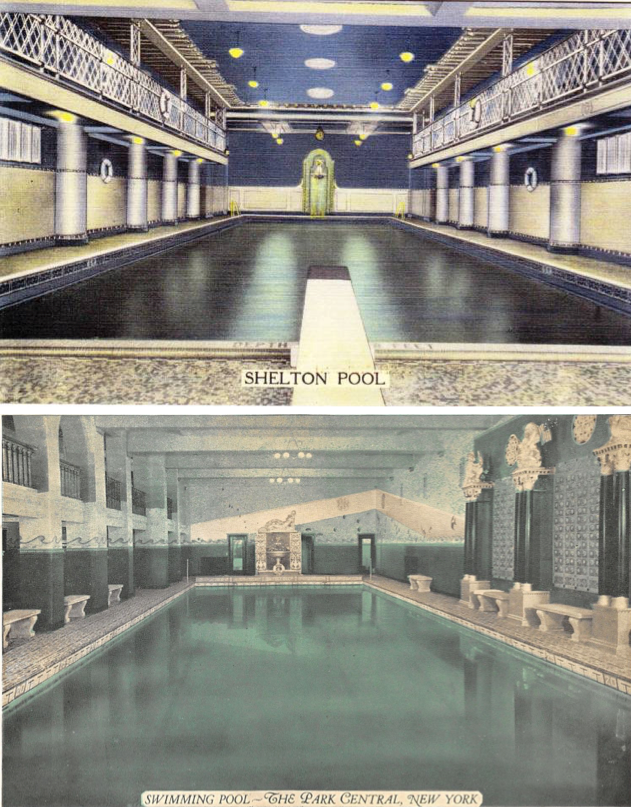
“Talk” also commented on the growing trend for high-rise apartments to provide swimming pools and other amenities below street level:
TAKING THE PLUNGE DOWN UNDER…Few indoor swimming pools were available to New Yorkers during the 1920s. Two of the nicer ones were found underground at the Shelton Hotel (above) and the Park Central. Sadly, both pools no longer exist. In 2007 the Shelton’s pool was removed and the cavernous space was divided into three levels. I’m not sure when Park Central’s disappeared, but it’s fate was doubtless similar to the Shelton’s.(daytoninmanhattan.blogspot.com/hippostcard.com)
* * *
How About a Catch?
As I’ve noted on previous occasions, The New Yorker of the 1920s all but ignored major league baseball. The magazine gave regular coverage to seemingly every sport, from hockey and college football to polo and yacht racing, but regular coverage of baseball was nonexistent, even when the Yankee’s Murderers’ Row (Ruth, Gehrig among others) won back-to-back World Series titles in 1927-28.
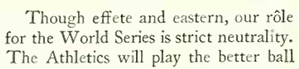
Still no coverage in the Oct. 5 issue, but the sport did get a brief mention in Howard Brubaker’s “Of All Things” column…
…and the issue was filled with baseball imagery, including the cover…
The Oct. 5 issue was filled with baseball-related items, but no actual coverage of the games. Images from the issue included, from left, the cover by Theodore Haupt; a filler sketch by Constantin Alajalov; and a Johan Bull illustration of umpire Bill Klem for the issue’s “Profile” section.
* * *
In a Sentimental Mood
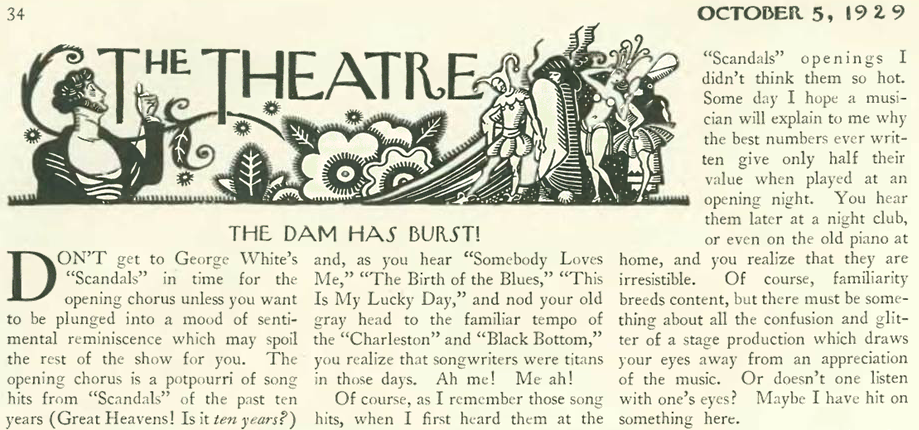
Robert Benchley checked out George White’s latest version of his Scandals revue at the Apollo Theatre, and found the sometimes risqué show to be in a sentimental mood…
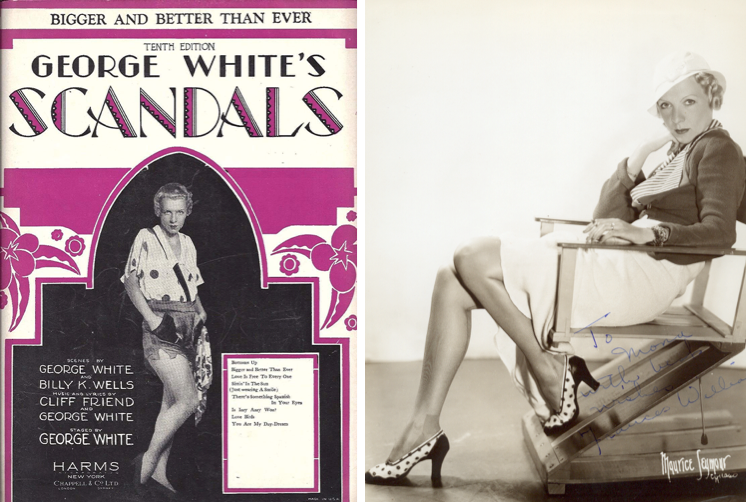
BETTER SENTIMENTAL THAN DEPRESSED…The chanteuse Frances Williams (pictured on the show’s sheet music and at right) likely provided the only spark to the 1929 edition of George White’s Scandals. (amazon/psychotronicpaul.blogspot.com)
Benchley also looked in on Elmer Rice’s latest, See Naples and Die, featuring veteran English actress Beatrice Herford and the up-and-coming Claudette Colbert…
VETERAN AND ROOKIE…Veteran English actress Beatrice Herford and the up-and-coming Claudette Colbert headlined Elmer Rice’s See Naples and Die. Colbert (pictured at right in a 1928 Broadway publicity photo) would go on to massive stardom in the 1930s. (Alchetron/Wikipeda)
Benchley applauded the veteran Herford’s performance, but found the otherwise reliable Colbert miscast as a wisecracking, Dorothy Parker type (Benchley, as we know, was close friends with Parker, so he knew what he was talking about)…
* * *
An (Ugly) American in Paris
Off to Paris, we find correspondent Janet Flanner joining with Parisians in deriding the behavior of American tourists, who were on a course to drain every last drop from the Île–de–France before departing for the bone-dry USA:
DRINKING IN THE SIGHTS…American tourists at a Parisian café, circa 1920s. (tavbooks.com)
* * *
Party Pooper
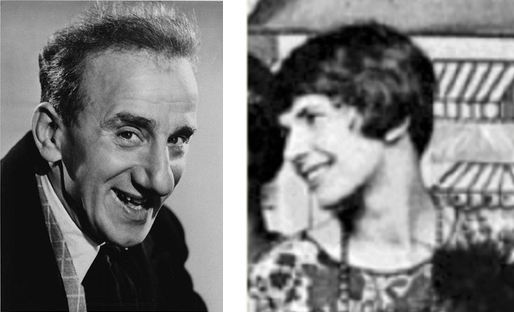
With her infant child (Patricia Arno) at home, it is doubtful Lois Long was seeing as much nightlife as she did during her first weeks at The New Yorker, when “nights were bold.” And indeed, her nightlife column “Tables for Two” would end in June 1930…for awhile anyway. Her Oct. 5 column took a cursory spin through the various nighttime offerings, ending on this note regarding a fan letter and a message from comedian Jimmy Durante:
THE GREAT SCHNOZZOLA Jimmy Durante brought a smile to the face of Lois “Lipstick” Long.
* * *
From Our Advertisers
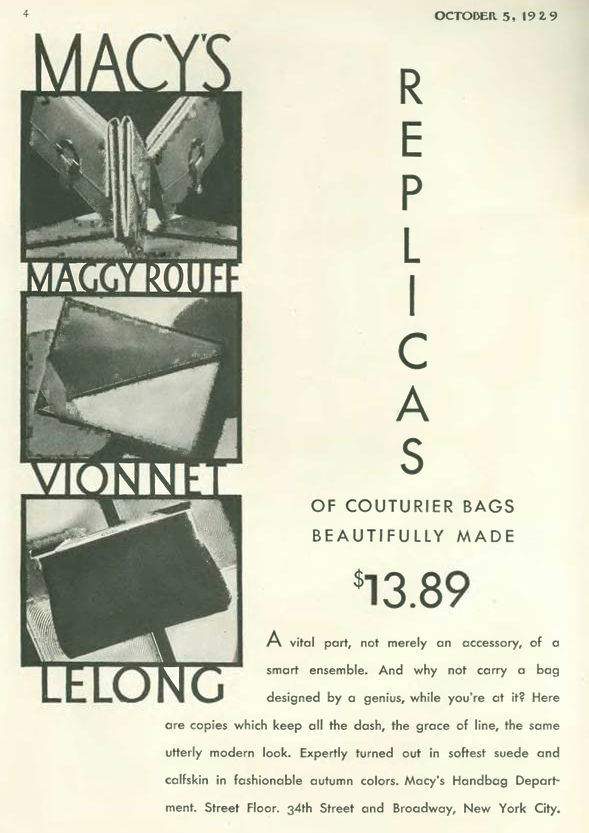
With the latest Paris fashions splattered across newstands all over Manhattan, retailers scrambled to get “replicas” to consumers…Macy’s had “couturier bags”…
…the Hollander Dressmaking Department was ready to make a perfect copy of Patou’s “Quiproquo”…
…and this Chanel frock could be had in misses’ sizes for $145 (roughly equivalent to about $2K today)…
…Philip Morris hadn’t yet discovered the “Marlboro Man,” and were still hawking their cigarettes through a “distinguished handwriting contest.” The latest winner was Edmund Froese…
…who would go on to become a popular mid-century landscape painter…
Port of New York, by Edmund Froese (undated)
…another artist in the midst of our ads is Carl “Eric” Erickson, who created these lovely images for R.J. Reynolds that would induce people to take up the habit with a Camel…
…and then we have some rather unlovely ads from the back pages, including these two that would not go over well with today’s readers…
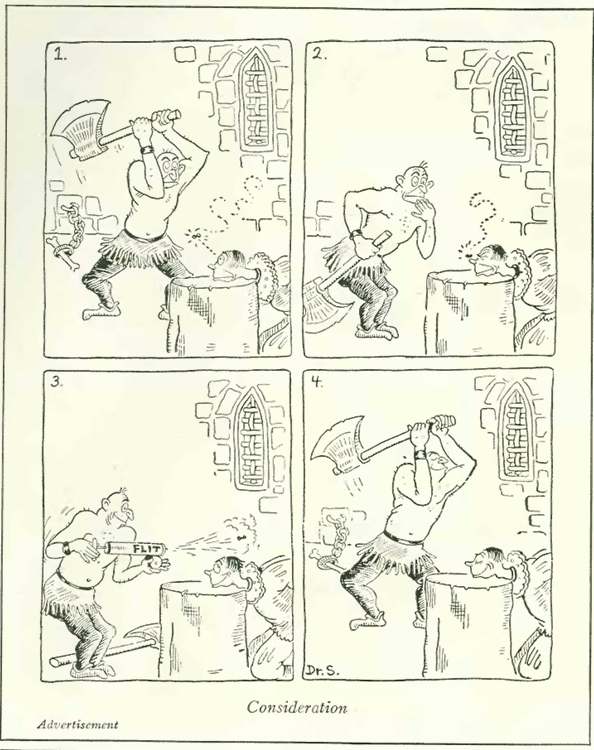
…or this from Dr. Seuss, still sharpening his skills with Flit insecticide…
…or this ad from Abercrombie & Fitch, wrong on so many levels…
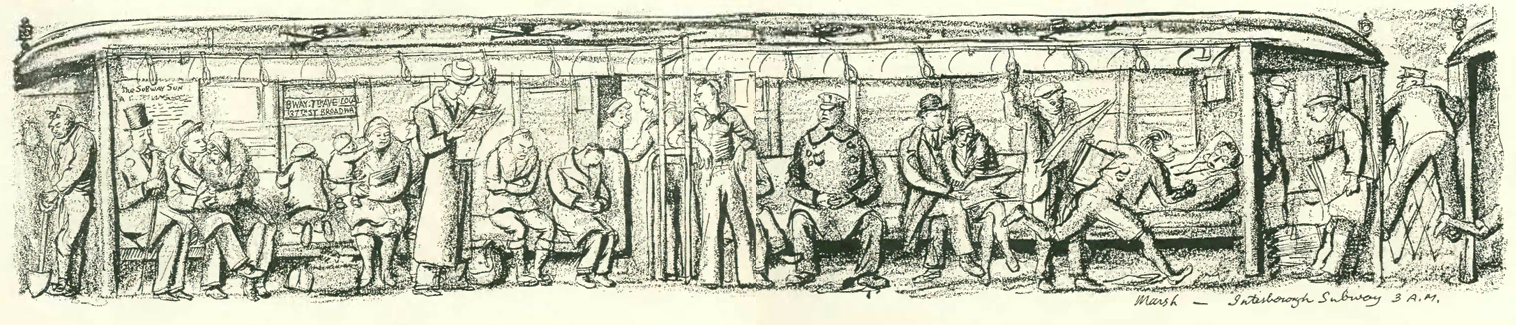
…on to happier things, here’s an illustration by Reginald Marsh that ran along the bottom of “Talk of the Town”…(click to enlarge)
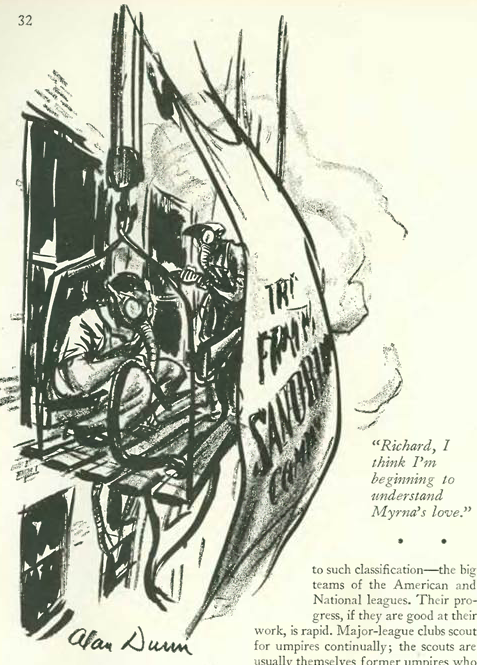
…Alan Dunn found love in the air above the streets of Manhattan…
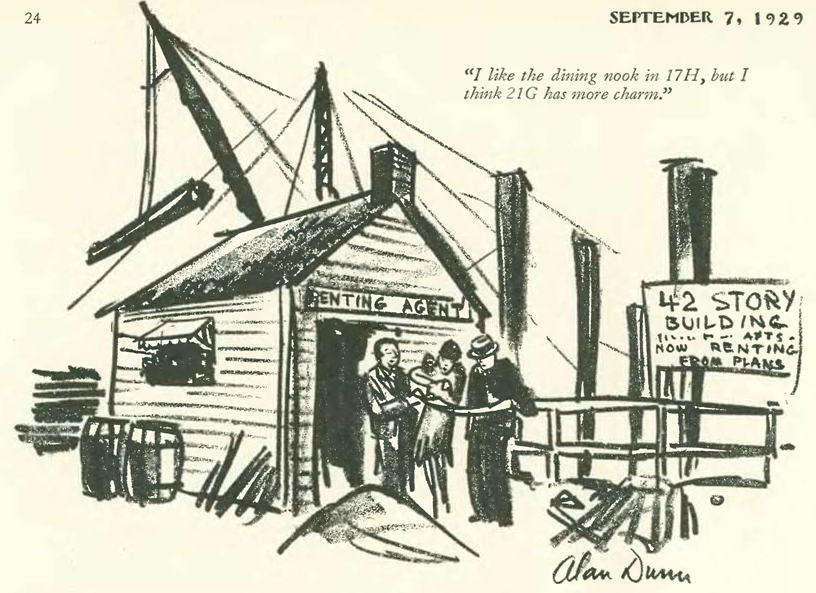
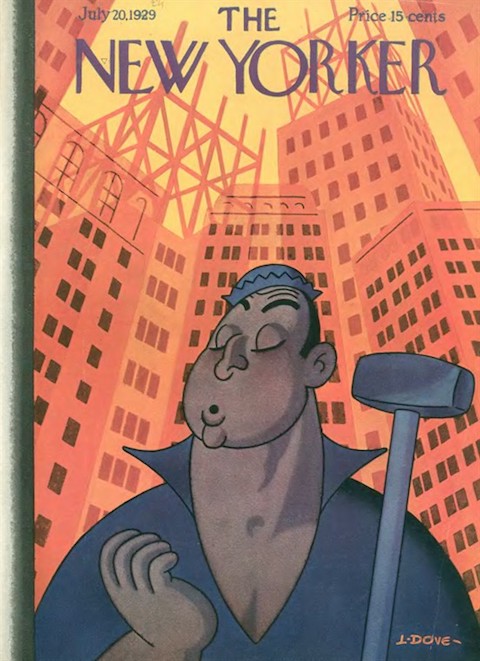
…and Leonard Dove revealed the hazards of apartment rentals…
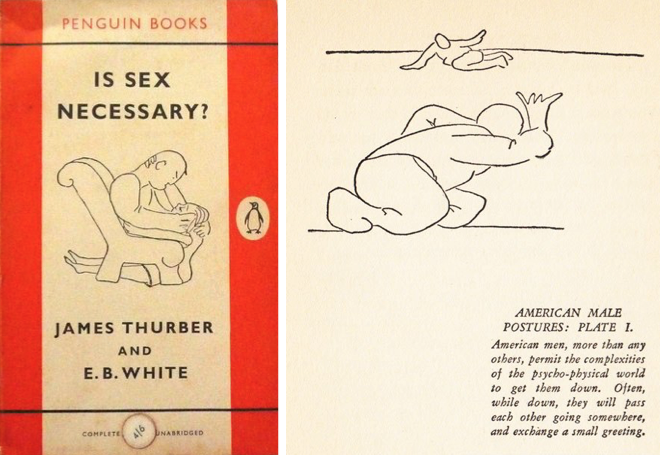
James Thurber and E.B. White shared an office at the New Yorker that has been described as “the size of a hall bedroom.” This proximity doubtless supported a rich exchange of ideas that coalesced in their 1929 bestseller, Is Sex Necessary? Or, Why You Feel the Way You Do.
Sept. 28, 1929 cover by Julian De Miskey.
A spoof of popular sex manuals and how-to books that dealt with Freudian theories, the book featured chapters (alternately written by Thurber and White) that delved into pseudo-sexual conditions such as “Frigidity in Men” — the title of a chapter by White excerpted in the Sept. 28, 1929 issue of The New Yorker…
Expanding on the condition known as “recessive knee,” White coined the term “Fuller’s retort,” and claimed it was “now a common phrase in the realm of psychotherapy”…
THE ARTIST EMERGES…Although James Thurber had yet to publish one of his drawings in The New Yorker magazine, Is Sex Necessary? featured 42 of them, including the illustration at right that demonstrated the male greeting posture. (brainpickings.org)
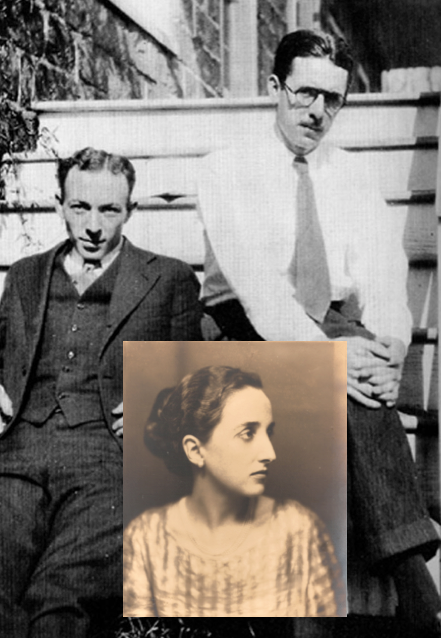
No other editor besides founder Harold Ross did more to give The New Yorker its shape and voice than Katharine Angell, who recommended to Ross the hiring of both White and Thurber. It is worth noting that White would marry Angell in the same month, November 1929, as the publication of Is Sex Necessary? In their case, sex was necessary, as Katharine would give birth to their son, Joel White, the following year.
DYNAMIC TRIO…Katharine Angell (inset) would be instrumental in bringing both E.B. White (left) and James Thurber to The New Yorker. (Pinterest/Wikipedia)
* * *
A New Rabbit Hole
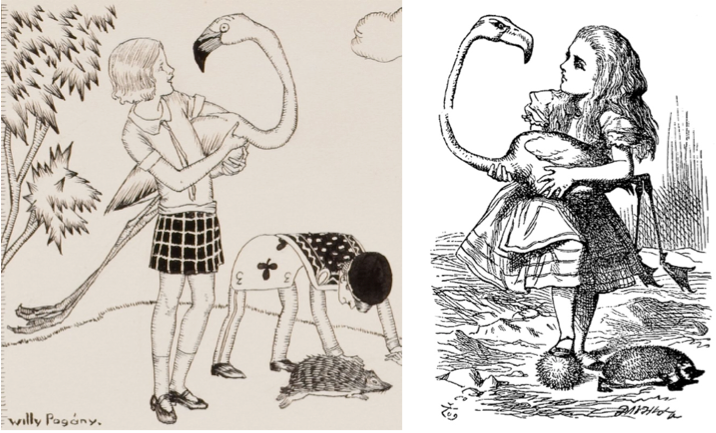
In other news from the world of publishing, “The Talk of the Town” (also largely a product of Thurber and White) noted the publication of a new edition of Alice in Wonderland that featured a re-drawn Alice with bobbed hair and the slender profile of a 1920s flapper. White mused:
NEW ALICE, MEET OLD ALICE…A 1929 edition of Alice and Wonderland featured a Jazz Age Alice (left) as rendered by Willy Pogany. At right, Sir John Tenniel’s original Alice, from the 1866 edition. (comicartfans.com/girlmuseum.org)
* * *
Rise of the Boob Tube
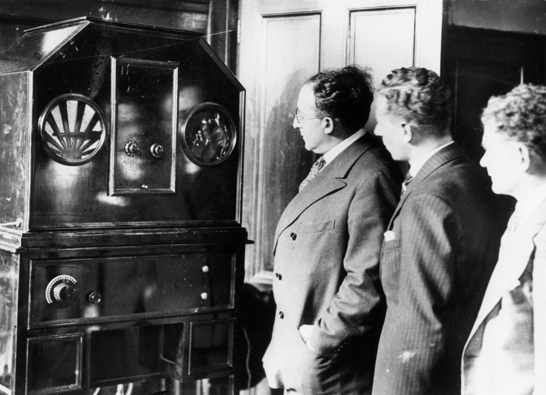
Also in “Talk,” it was reported that the BBC would be putting television on the air “five times a week for a half an hour.” The broadcasts, on a single channel, featured speeches, comic monologues and popular songs. The technology did not allow sound and image to be transmitted together, so “viewers” (there were only a handful of sets) first heard each piece in audio, followed by a mute moving image:
COMMERCIAL-FREE…Early television promotor Sydney Moseley (left) and two employees of the Baird Television Development Co. watch the inaugural television broadcast on a “Noah’s Ark Televisor,” Sept. 30, 1929. The televisor was the invention of British TV pioneer John Logie Baird (1888-1946). (scienceandmediamuseum.org.uk)
* * *
Mutt & Jeff & Peggy
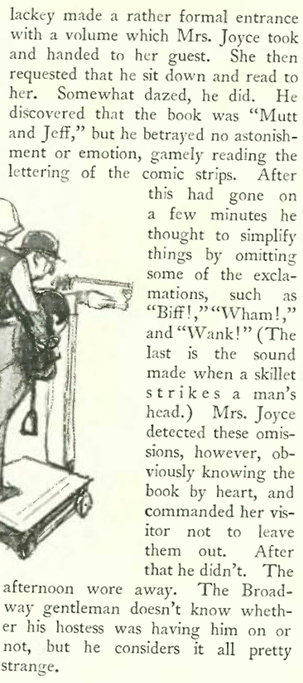
This odd little item in “Talk” focused on the literary interests of Peggy Hopkins Joyce, an actress and dancer best known for her lavish lifestyle and multiple marriages and affairs. She was a Kardashian of her day — famous for being famous. Despite her flamboyant ways, Joyce seemed to have some rather pedestrian tastes, at least when it came to her reading pleasure…
JEEVES, BRING ME SOME LIGHT READING…Peggy Hopkins Joyce (left) might have preferred the high life, but her tastes in reading seemed more of the rabble. She is pictured here in her Hollywood debut, the 1926 silent film The Skyrocket. The film bombed, and Joyce made just one more screen appearance before moving on to other things. (Bizarre Los Angeles/mycomicshop.com)
* * *
Ring Cycle
Ring Lardner contributed a casual titled “Large Coffee,” in which he checks into a hotel to escape life’s distractions and get some writing done. The piece consisted of diary entries largely concerned with Lardner’s inability to get a proper order of coffee. He began with an editor’s note that described how his corpse was found in the room, along with the diary. Some excerpts:
COFFEE AND CIGARETTES helped fuel the genius of writer Ring Lardner. (Brittanica)
* * *
Master of the Screwball
Preston Sturges (1898-1959) was known for taking the screwball comedy and turning into something more than a simple farce. Reviewer Robert Benchley saw the potential in this young Broadway producer, whose second play, Strictly Dishonorable, opened to great acclaim:
KEEPING IT LIGHT…Tullio Carminati as Count Di Ruvo and Muriel Kirkland as Isabelle Parry in Broadway’s Strictly Dishonorable, 1929. Producer Preston Sturges reportedly wrote the hit play in just six days. (Museum of the City of New York)
* * *
Have No Fear
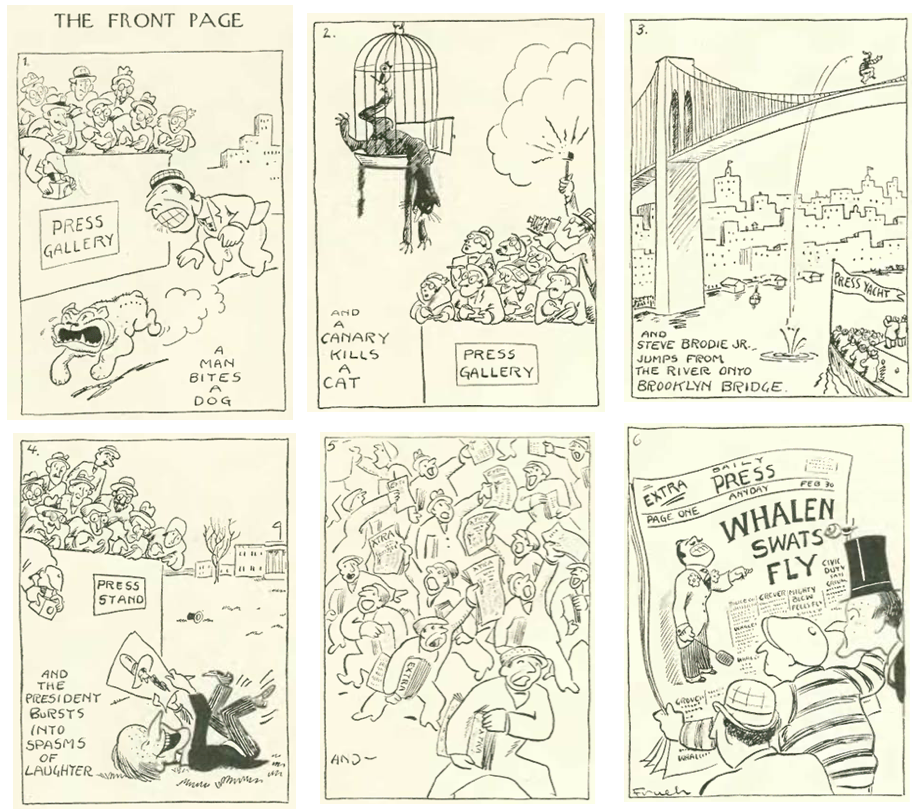
Morris Markey (1899-1950) often took on the lurid and sensationalist reporting of his day in a column he established at The New Yorker titled “Reporter at Large.” In his Sept. 28 column titled “Fear, Inc.” Markey chided everyone from the newspapers and Hollywood to the headline-grabbing NYC Police Commissioner Grover Whalen, and painted a picture of organized crime that was less violent and glamorous, and a lot more mundane…
MAKE SURE YOU GET MY GOOD SIDE…NYC Police Commissioner Grover Whalen loved to make headlines with his “get tough on crime” approach. He was was famously quoted as saying, “There is plenty of law at the end of a nightstick.” (wnyc.org)
Markey suggested that rather than screeching tires and blazing Tommy guns, most of the crime in the city was just the humdrum of making money…
Sadly, Markey himself would meet a violent end, dying of a gunshot wound at the age of 51. It is unclear whether it was self-inflicted.
* * *
The Last Laugh
The year 1929 saw the passing of Minnie Marx, the beloved mother of the Marx Brothers comedy troupe. Alexander Woollcott offered this tribute in his “Shouts and Murmurs” column…
MY LITTLE CLOWNS…Minnie Marx with her sons, The Marx Brothers, circa 1920. (Find a Grave)
* * *
From Our Advertisers
Harper’s Bazar began weekly publication in 1867, catering to women in the middle and upper classes. The magazine was a frequent advertiser in the upstart New Yorker, no doubt perceiving a considerable overlap among its readers. This full page ad in the Sept. 28 issue of the New Yorker featured a column by the Bazar’s Paris fashion correspondent, Marjorie Howard…
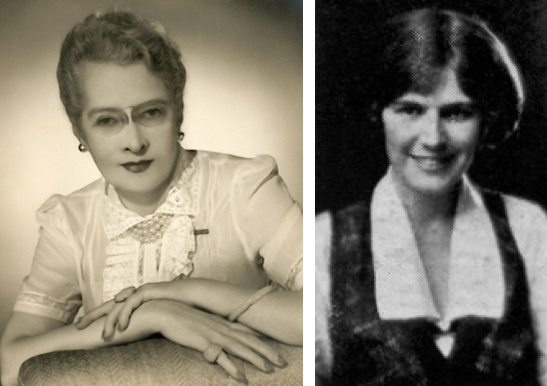
…no doubt The New Yorker’s own fashion editor, Lois Long (1901-1974), read her rival’s column with great interest, and, like the magazine she wrote for, Long was the young upstart compared to the veteran Howard (1878-1958). However, according to future New Yorker editor William Shawn, Long was the superior writer. Upon Long’s death in 1974, Shawn said “Lois Long invented fashion criticism,” adding that she “was the first American fashion critic to approach fashion as an art and to criticize women’s clothes with independence, intelligence, humor and literary style.” Here is a brief excerpt from Long’s fashion column, “On and Off the Avenue,” in the Sept. 28 issue…
OF A FASHION…Majorie Howard (left) served as fashion editor for Harper’s Bazar in the late 1920s and 1930s. Lois Long (right) wrote the New Yorker fashion column, “On and Off the Avenue,” from 1927 to 1970. (findagrave.com/Vassar College)
…looking at some of the ads from the magazine’s back pages, here’s one from Scribner’s announcing the publication of A Farewell to Arms (a first edition for only $2.50)…
…the back pages of The New Yorker near the theater section were filled with signature ads promoting various entertainments…
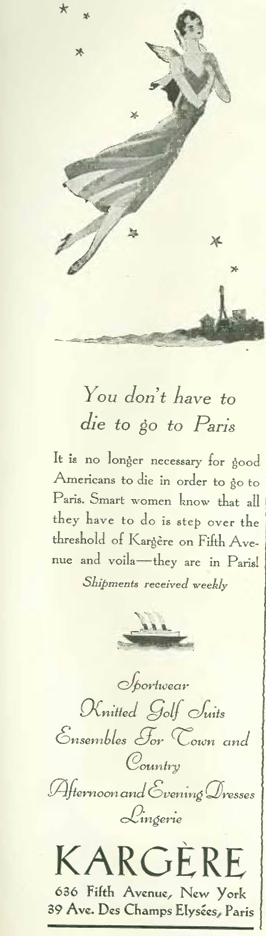
…this ad from Kargère referenced an exchange from Oscar Wilde’sThe Picture Of Dorian Gray: “They say that when good Americans die they go to Paris,” chuckled Sir Thomas…” Really! And where do bad Americans go to when they die?” inquired the Duchess. “They go to America,” murmured Lord Henry…
…several ads and filler illustrations from the Sept. 28 issue featured posh folks dressed for fox hunting season, the makers of Spud cigarettes among them…
…this ad from Frigidaire featured an illustration by Herbert Roese, whose style at the time somewhat resembled Peter Arno’s…
and Arno’s full-page contribution to the Sept. 28 issue…
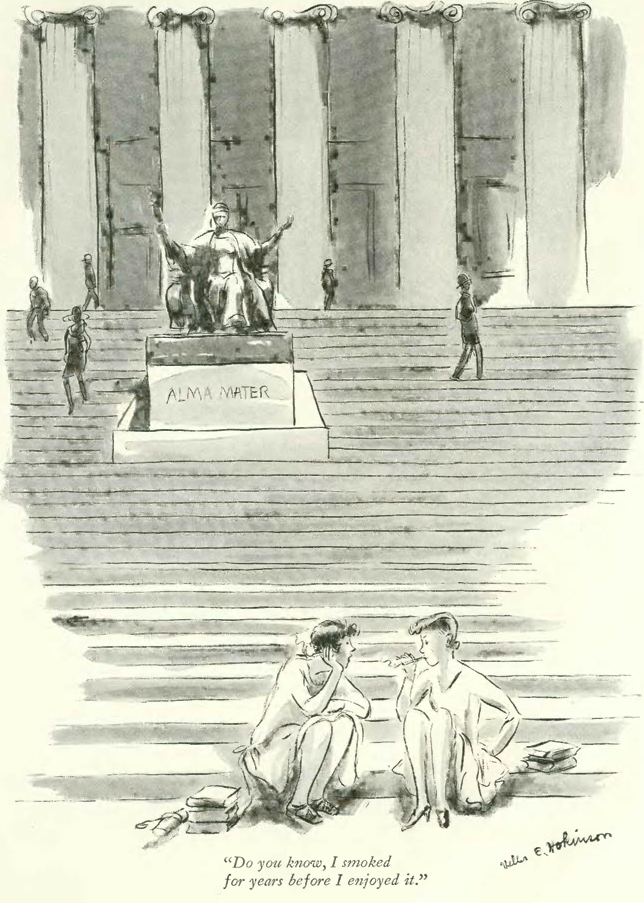
…another artist at The New Yorker who along with Arno often received a full page for her work was Helen Hokinson, here looking in on life at Columbia U…
…and there were artists who were lucky to get any space at all, including Kent Starrett, who probably drew on his own experiences at The New Yorker’s front office for this entry…
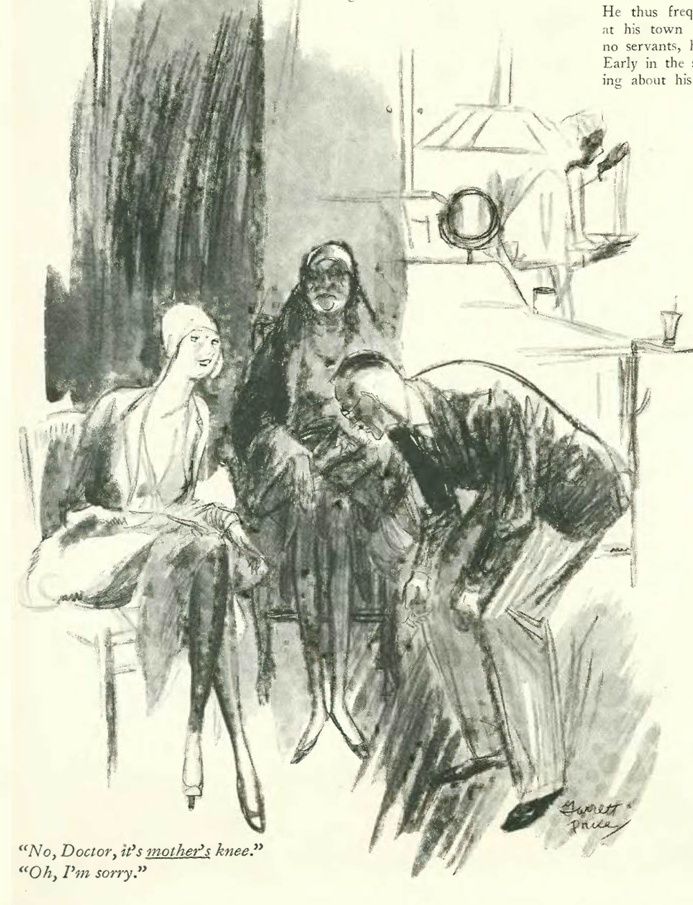
…and finally, Garrett Price illustrated the challenges of the “house call”…
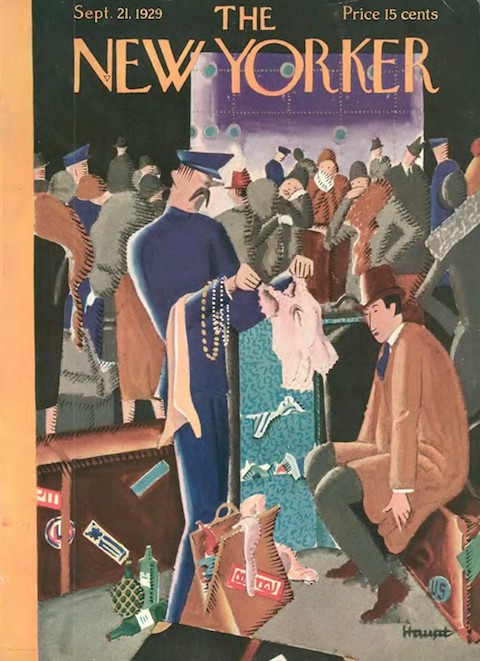
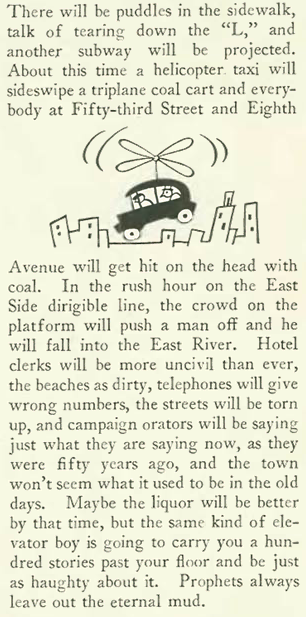
E.B. White gazed 50 years into the future in the Sept. 21, 1929 issue, predicting that New York City would be much the same if not a little worse by the time the calendar turned to 1979.
Sept. 21, 1929 cover by Theodore G. Haupt.
White dismissed the popular notion that the future would be one of push-button happiness and gleaming white cities. And as it turned out, he was mostly right on the mark with his predictions:
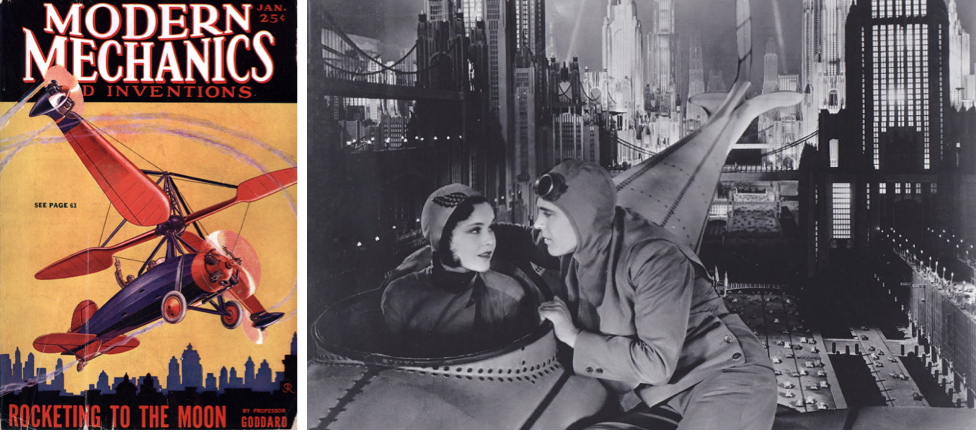
LOVE IS IN THE AIR…Autogyros (as illustrated on a 1930 cover of Modern Mechanics) were often seen as the future of transportation in the 1920s and 30s; Maureen O’Sullivan (as “LN-18”) and John Garrick (“J-21”) glide above 1980 Manhattan in 1930’s Just Imagine. (modernmechanix.com/pre-code.com)
Instead of the antiseptic fantasy world predicted in such movies as 1930’s Just Imagine (a futuristic musical set in 1980), White correctly foresaw a city that, despite technological advances, would still be a gritty rat race. And if you lived in New York City in 1979 (I was but a visitor then, as now), you would have found a city that indeed was quite dirty and crime-ridden (check out the 1979 movie The Warriors to get a sense of how Hollywood perceived the city at that time). As White observed, “Prophets always leave out the eternal mud”…
A LOT OF HOT AIR…In addition to autogyros, futurists in the 1920s and 30s also saw dirigibles as integral to future transportation. At top left is an illustration of a solar-powered aerial landing field atop a dirigible on the cover of Modern Mechanix magazine, October, 1934; top right, Manhattan in 1980 as depicted in the the 1930 film Just Imagine; bottom right, workers dismantling the Third Avenue Elevated line in 1955; bottom left, Times Square in 1979. (airships.net/IMDB/gothamist.com/viewoftheblue.com)
* * *
Cradle of Civilization
Dorothy Parker took aim at ugly Americans abroad in a casual titled “The Cradle of Civilization.” In these excerpts, Parker commented on the pretensions of young New Yorkers in France, including their ridiculous costumes…
…their bad French, and their even worse manners…
WELL, THEY GOT AWAY WITH IT…Actors Leslie Howard and Ingrid Bergman don the look of French fishermen during the filming of Intermezzo: A Love Story, in 1938. Howard and Bergman were supposed to look like a couple visiting the French Riviera, but in reality it was all filmed near Hollywood. The film was Bergman’s Hollywood debut. (Pinterest)
* * *
A Penny Saved
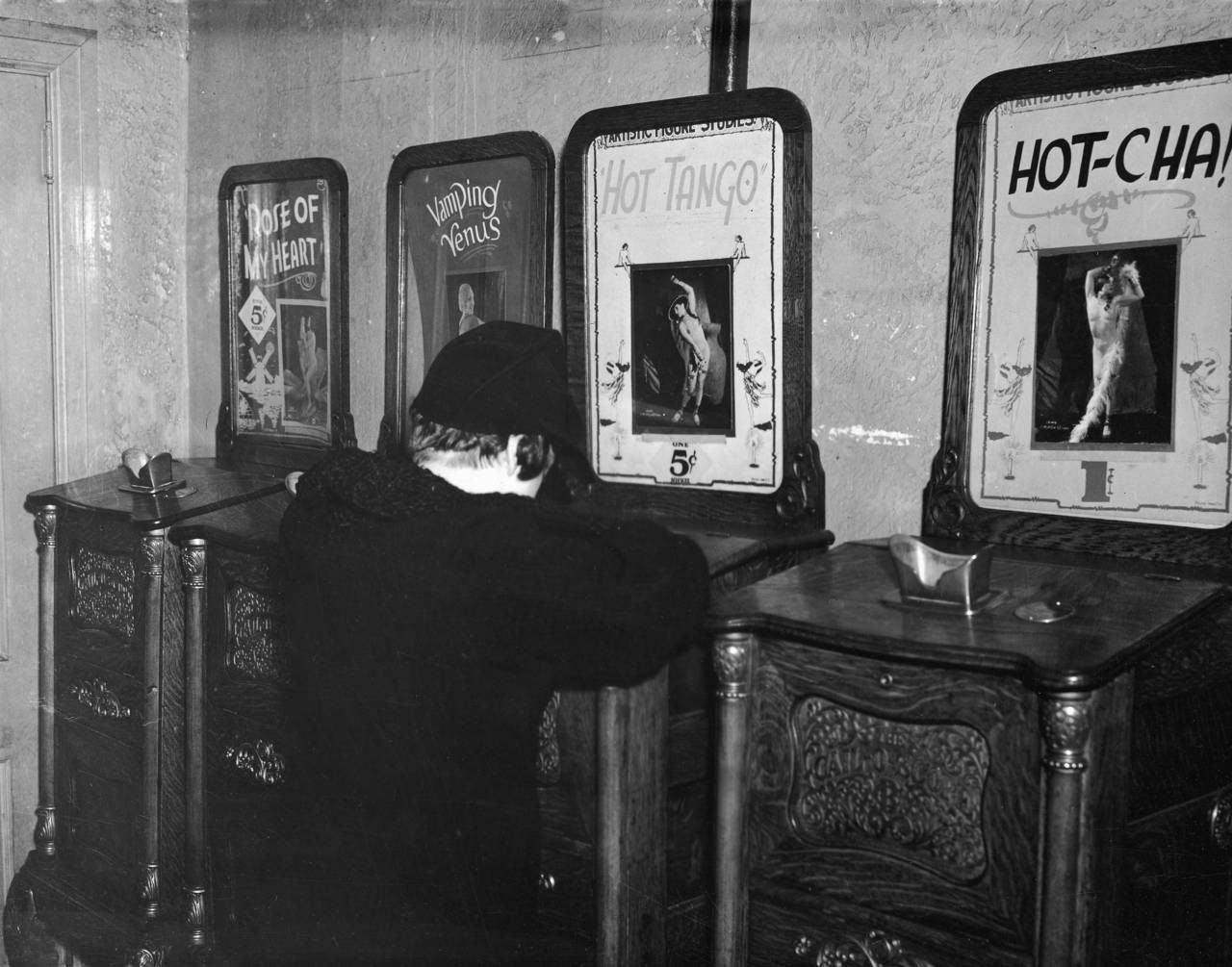
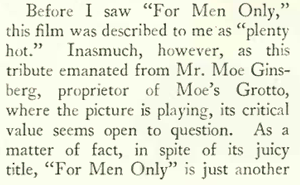
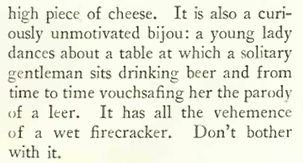
Back stateside, Wolcott Gibbs looked in on the dying art of the penny-arcade peepshow, and expressed his disappointment with the quality of that product in general…
DON’T JUDGE A PEEP BY ITS COVER…A patron checks out “Hot Tango” at a penny peepshow parlor of the 1920s. (Pinterest)
Gibbs seemed particularly miffed by a film with the misleading title “For Men Only”…
* * *
Uncle Jed
Jed Harris (1900-1979) was a wunderkind of Broadway, producing and directing 31 shows between 1925 and 1956. Before he turned 28 he produced a record four consecutive Broadway hits over the course of 18 months (including the 1928 smash hit The Front Page), and so it was time for some rest. “The Talk of the Town” reported…
Although it was rumored Harris would retire at age 30, he would instead return in the spring of 1930 with a production of Anton Chekhov’sUncle Vanya, and continue producing on Broadway through the 1950s.
WUNDERKIND…A 1928 portrait of Jed Harris that was featured on the Sept. 3, 1928 cover of Time magazine. (Wikipedia)
* * *
Dueling Cassandras
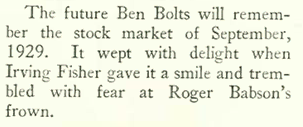
About a month before the big stock market crash we find this curious little item in Howard Brubaker’s “Of All Things” column…
…Considered the first “celebrity economist,” Irving Fisher stated in September 1929 that the stock market had reached “a permanently high plateau,” while around the same time (Sept. 5, 1929) rival economist Roger Babson warned in a speech that “sooner or later a crash is coming, and it may be terrific.” Note: “Ben Bolts” refers to a character in a popular 1842 poem that became an oft-parodied popular song. Each stanza begins with a variation of “Oh don’t you remember…”
* * *
Parental Advisory
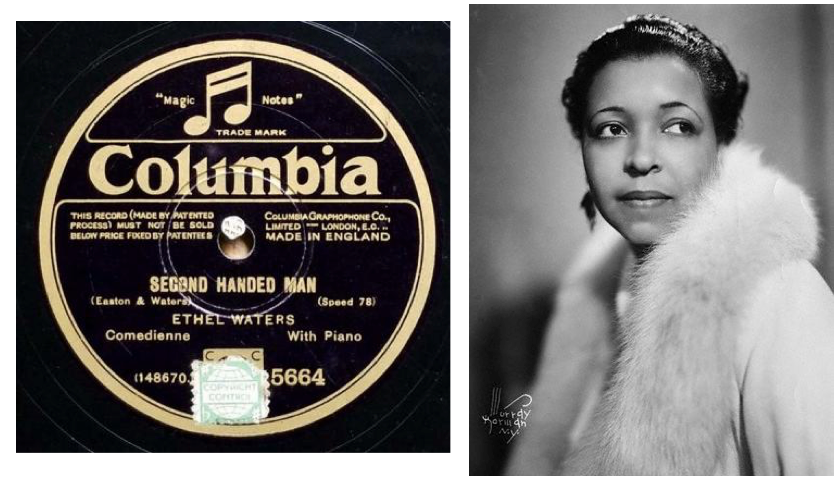
Fifty-five years before Tipper Gore and the Parents Music Resource Center pushed the music industry to place warning labels on records containing explicit lyrics, there was much ado about “lascivious lyrics” uttered on “race records” — the term referred to 78-rpm records marketed to African Americans from the 1920s and 1940s. The Sept. 21 “Popular Records” column looked at the controversy surrounding Ethel Waters’ “Second Handed Man,” and didn’t find any…
MUCH ADO…Ethel Waters (circa 1930) and her recording of “Second Handed Man.” (discogs.com/YouTube)
* * *
New Kids on the Block
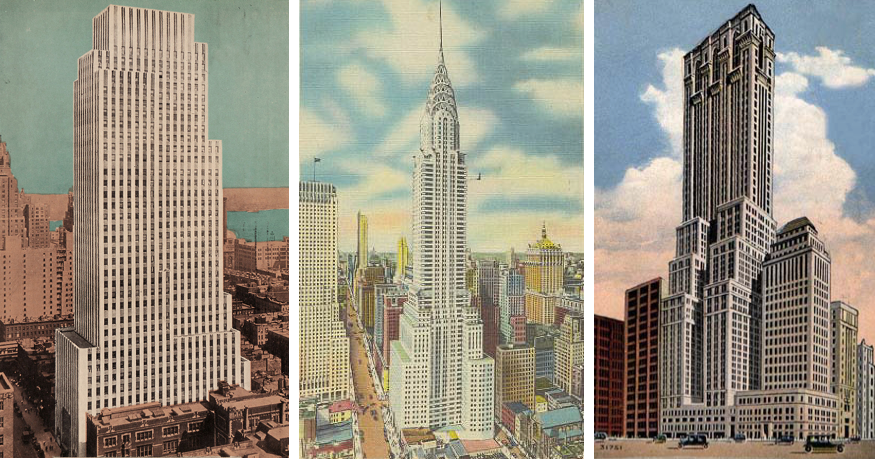
Architecture critic George S. Chappell (aka “T-Square”) concluded his Sept. 21 column with praise for the designs of the yet-to-be-built Daily News and Chrysler buildings, but expressed dismay at the recently completed Lincoln Building…
BAD COMPANY…New Yorker architecture critic George S. Chappell was excited about the designs for the Daily News Building (left) and Chrysler Building (center), but the Lincoln Building left him wanting. No doubt its gothic topper seemed dated in contrast to the sleek lines of the other buildings. (nyc-architecture.com)
* * *
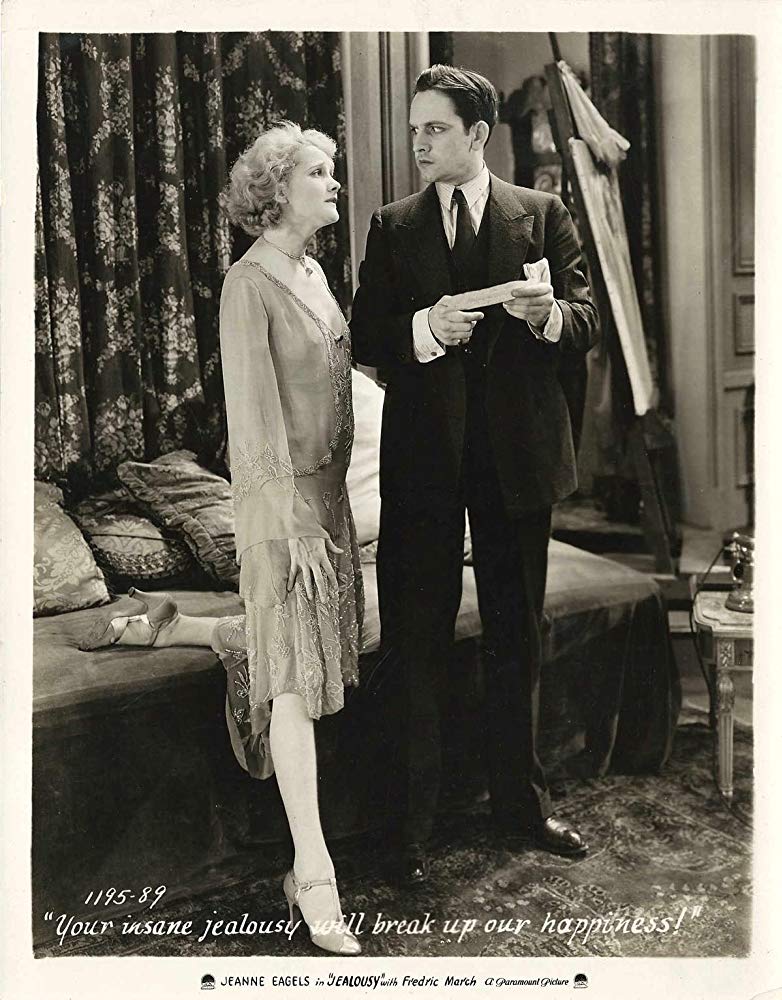
Movie critic John Mosher took in a couple of new films including Paramount’s 1929 pre-Code drama Jealousy…
FINAL CURTAIN…Jeanne Eagels and Fredric March in a publicity photo for Jealousy. Eagels died of a drug overdose on Oct. 3, 1929, just days after Mosher’s review appeared in The New Yorker. (IMDB)
…and Mosher also reviewed the musical drama The Great Gabbo, which was derived from a story by occasional New Yorker contributor Ben Hecht…
WHO ARE YOU CALLING DUMMY?…Erich von Stroheim has issues with his co-star in The Great Gabbo. (MoMA)
* * *
From Our Advertisers
What appeared to be an unassuming ad from General Motors was actually a plan for world domination, at least in the area of ground transportation. GM gobbled up a number of car companies in the 1920s (see the ad’s fine print) as well as shares in power plants and home appliances. It would overtake Ford in sales in the late 1920s, and thanks to propaganda efforts including those illustrated in the ad below, it would lead a streetcar removal conspiracy that would destroy intercity train transport systems across the U.S. (and convert them to GM buses, naturally)…
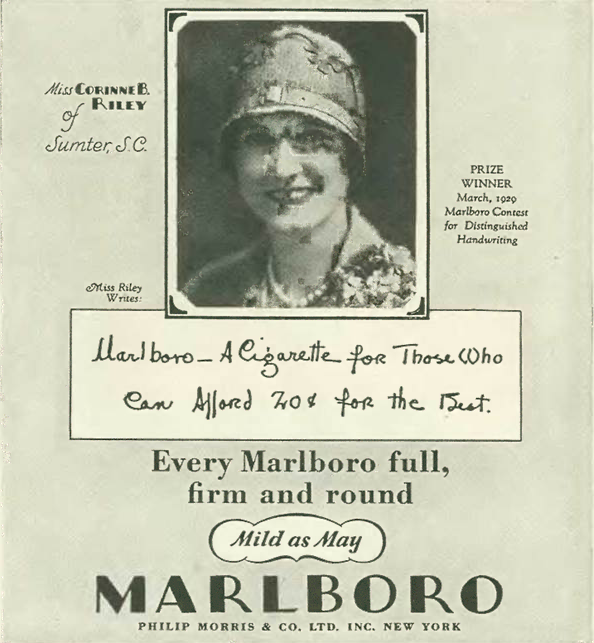
Here we have yet another “distinguished handwriting contest” ad from the makers of Marlboro, this time exploiting the efforts of Corinne B. Riley of Sumter, S.C….
…Riley would win more than a handwriting contest, however. She would be elected as a Democrat to Congress in 1962 to fill a vacancy left by her husband, Congressman John Jacob Riley.
Corrine B. Riley in 1962. (Wikipedia)
On to our illustrators and cartoons, we begin with this two-page drawing by Reginald Marsh that appeared along the the bottom of “Talk of the Town”…
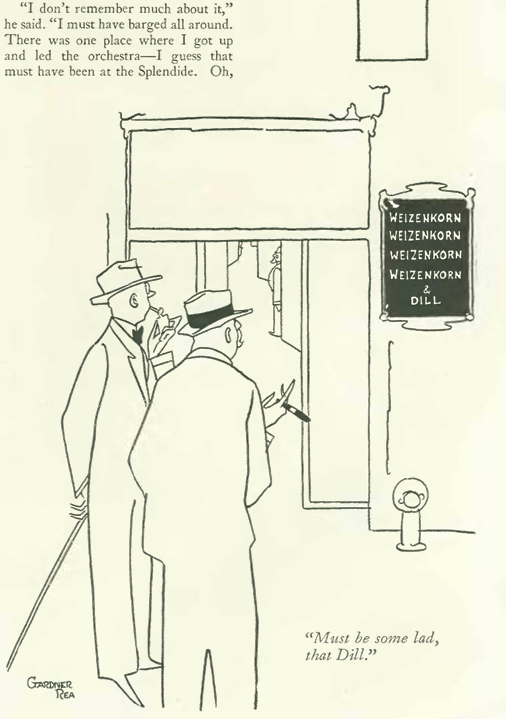
…Gardner Rea lent his spare style to this peek into Wall Street…
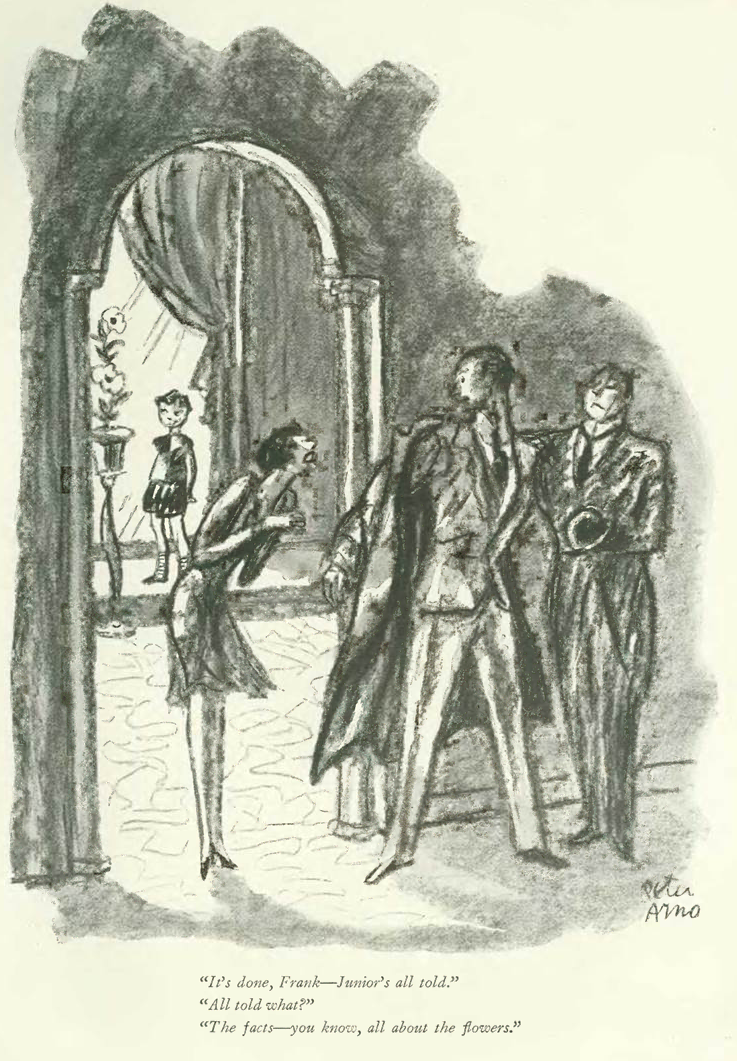
…Peter Arno appeared to be experimenting with yet another style of drawing…
…that in some ways looked similar to Alan Dunn’s…
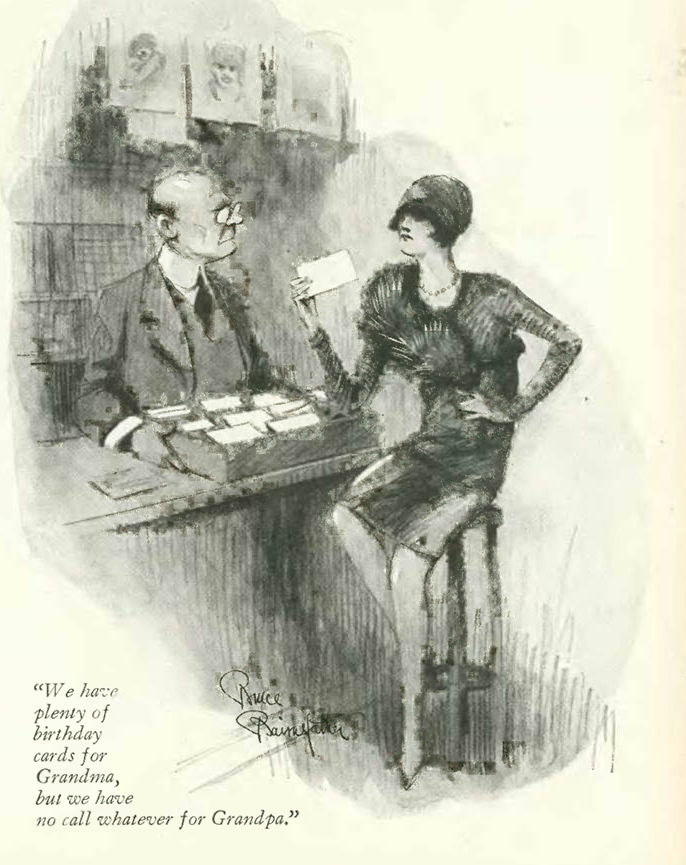
…the British cartoonist Bruce Bairnsfather provided this sumptuous drawing of an exchange at a card shop…
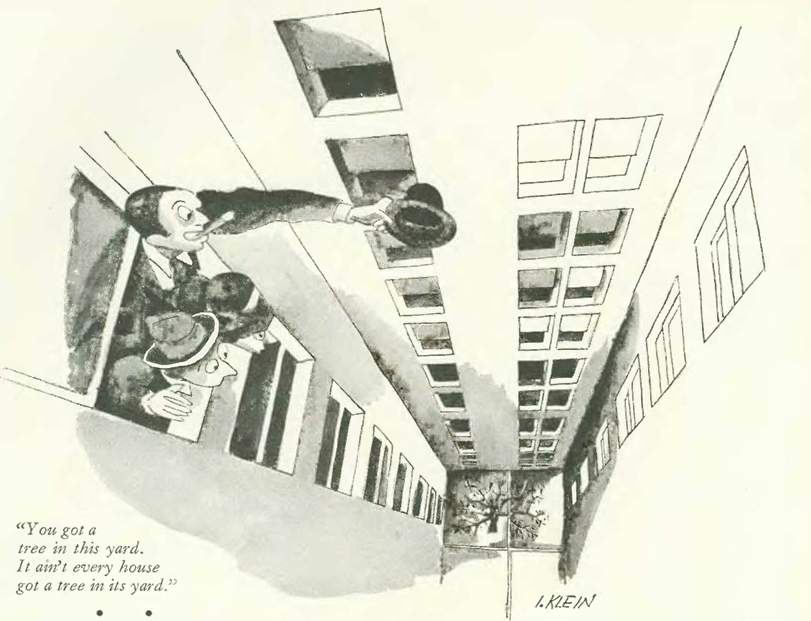
…and Isadore Klein gave a vertiginous perspective to home buying…
Avery Hopwood’s 1919 Broadway hit, The Gold Diggers, was among cultural events of the late teens that signaled the dawn of new age; namely, the Jazz Age.
Sept. 7, 1929 cover by Sue Williams.
So it seems appropriate that the play, when adapted to the screen in 1929 as a Technicolor talkie, would also signal the end of that age. As the New Yorker’s film critic John Mosher observed in his review of The Gold Diggers of Broadway, the themes that seemed new and daring a decade earlier had been played out, the “general humors” of the picture having “become very familiar”…
The film featured Nancy Welford, Winnie Lightner and Ann Pennington as three chorus girls who try to entice a wealthy backer to invest money in their struggling Broadway show. The film was a big hit, and it made a star of Winnie Lightner (1899-1971), who played the boldest “Gold Digger” of the trio.
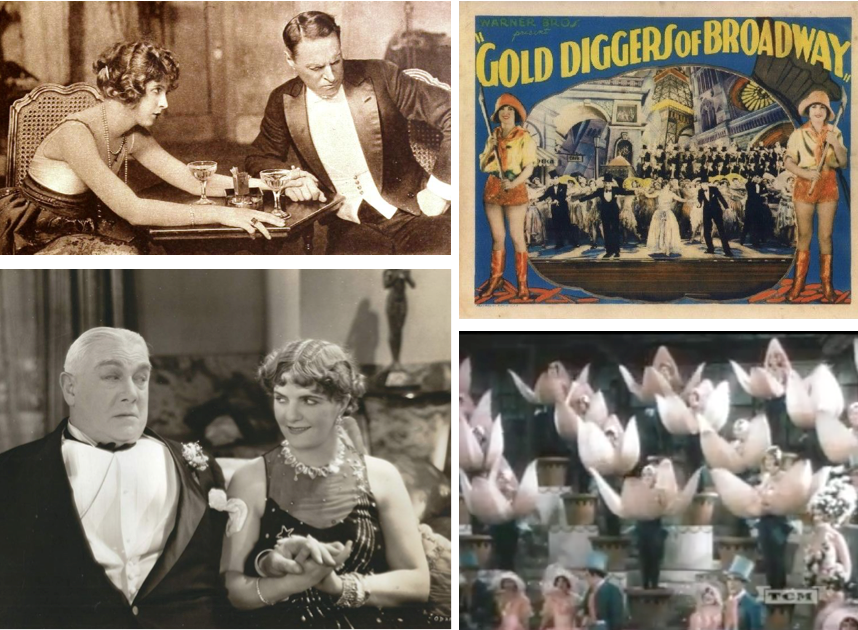
PROSPECTORS…Clockwise from top left, Ina Claire as the original “Gold Digger” with Bruce McRae in the 1919 Broadway play The Gold Diggers; lobby card for the 1929 film Gold Diggers of Broadway; image from the film’s “Tiptoe Thru the Tulips” song-and-dance number; Winnie Lightner works her charms on Albert Gran in a scene from the film. (Wikipedia/IMDB/TCM-YouTube)IT’S FUN MAKING PICTURES…Helen Foster, Ann Pennington, Nancy Welford and William Bakewell in a publicity photo from 1929’s Gold Diggers of Broadway. (IMDB)
Lightner wasn’t the only actor to steal the show. The film also proved a winner for crooner Nick Lucas (1897-1982), who performed two hit songs written for the movie — “Painting the Clouds with Sunshine” and “Tiptoe through the Tulips.” Yes, that second song was the very same tune Tiny Tim rode to fame nearly 40 years later.
TIPTOE THROUGH HISTORY…At left, Nick Lucas sings what would be become his signature song “Tiptoe through the Tulips” to Lilyan Tashman in the Gold Diggers of Broadway. At right, forty years later, Lucas sang the song on The Tonight Show With Johnny Carson (apparently using the same guitar) on the occasion of singer Tiny Tim’s televised wedding to Victoria Mae Budinger (“Miss Vicky”). Tiny Tim (inset) also made “Tiptoe through the Tulips” his signature song, although his was a campier version, sung in a falsetto, vibrato voice accompanied by his trademark ukulele. (YouTube)
The Gold Diggers of Broadway was a “pre-code” film, that is, a film made during a brief period of the early sound era (roughly 1929 through mid-1934) when censorship codes were not enforced and many films openly depicted themes ranging from promiscuity and prostitution to amoral acts of violence.
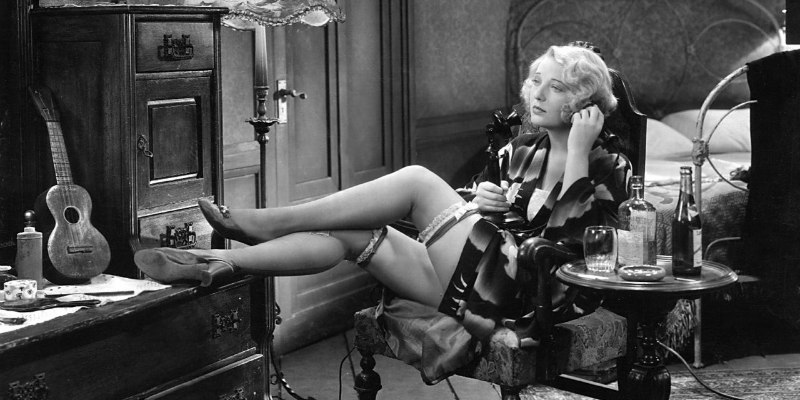
A LEG UP ON THE CENSORS…Warner Brothers publicity photo of Dorothy Mackaill, who played a secretary-turned-prostitute in 1931’s Safe in Hell. (Wikipedia)
Those unenforced codes had their origins in the early 1920s. In response to outcries from preachers and politicians alike over the immortality of Hollywood (both on- and off-screen), the president of Paramount Pictures, Adolph Zukor — fearing that cries for censorship would cut into his profits — called a February 1921 meeting of his studio rivals at Delmonico’s restaurant on 5th Avenue. At the meeting Zukor (1873-1976) distributed a set of 14 rules that would guide every Paramount production (Zukor’s studio at that time was actually known as Famous Players-Lasky). The rules covered everything from “improper sex attraction” to “unnecessary depictions of bloodshed.”
It was also Zukor’s idea to appoint the former U.S. Postmaster General, Will Hays, as President of the Motion Picture Producers and Distributors of America. It would be Hays’ job to enforce the code and generally “clean up” Hollywood. However, until mid-1934 both Hays and the code served mostly as publicity ploys to keep the preachers and politicians off the backs of studio execs.
Zukor was profiled by Niven Busch, Jr. in the Sept. 7 issue (with portrait by George Shellhase). In his opening paragraph, Busch commented on “Pop” Zukor’s efforts to stave off the censors:
* * *
Delmonico’s Redux
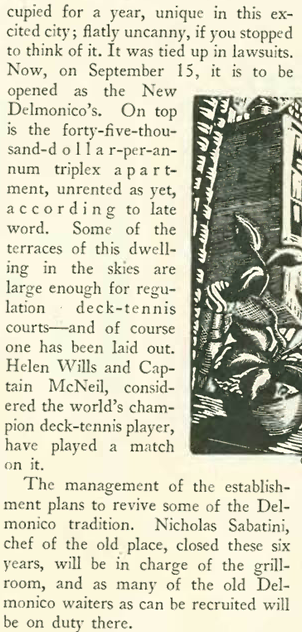
The famed Delmonico’s restaurant that provided the setting for Adolph Zukor’s “14 rules” meeting in 1921 closed its doors in 1923, a victim of Prohibition (more people dined at home, where they could still drink). Writing in the Sept. 7 “Talk of the Town,” Bernard A. Bergman described plans for the long-awaited opening of a new Delmonico’s in a skyscraper bearing the same name…
RICH DESSERTS…Dinner in honor of French Navy Admiral Paul Campion at the old Delmonico’s in 1906. (Wikipedia/Library of Congress)AND SALAD DAYS…Delmonico’s wait staff pose for a photograph in 1902. (Museum of the City of New York)
A former Delmonico’s chef, Nicholas Sabatini, hoped to bring back some of old waiters and cooks from the restaurant’s glory days, but it seemed most were far too long in the tooth. It is unclear if he ever got his dream off the ground, or if the grill room was able to crank out fare comparable to that of the old Delmonico’s. Probably not…
THE KITCHEN IS CLOSED…The 1928 Hotel Delmonico, as shown in a 1937 photograph. It was purchased by Donald Trump in 2002 and converted into luxury condominiums. It would not host a great restaurant, but the Beatles would stay there in 1964. (New York Public Library)
* * *
Relax. You’re in Omaha
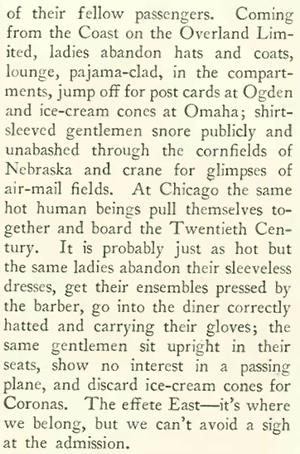
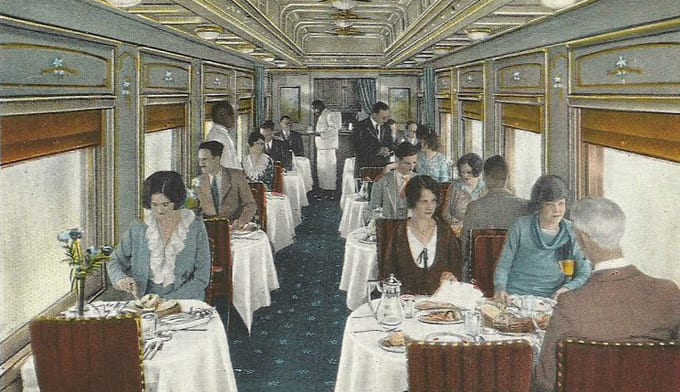
E.B. White’s “Notes and Comment” entry in the Sept. 7 “Talk of the Town” described travel on the Union Pacific’s Overland Limited, and the “mystic dividing line” that separated laid-back Westerners from buttoned-up Easterners:
MIND YOUR MANNERS, AT LEAST UNTIL YOU LEAVE CHICAGO…Tinted photo postcard depicting the dining car on a Union Pacific train that traveled the Chicago to Denver route in the 1920s. (myutahparks.com)
* * *
Write What You Know
The Wisconsin-born Marion Clinch Calkins (1895 – 1968) often wrote humorous rhymes for The New Yorker under the pen name Majollica Wattles. While many writers reveled in the party atmosphere of the Roaring Twenties, Calkins worked as a vocational counselor and social worker at Lillian Wald’s Henry Street Settlement. This experience doubtless led her to more serious writing after the 1929 market crash — her critically acclaimed book, Some Folks Won’t Work (1930), is considered a seminal document on the Great Depression.
But in September 1929, Calkins was still in a humorous vein, and published this satirical piece on the role of an ideal housewife in the Sept. 7 issue. Excerpts:
CALL ME CLINCH…Marion Clinch Calkins circa 1905 and 1945. She wrote under the name of Clinch Calkins because she wanted her authorship to be gender-neutral. (evansvillehistory.net/NEH)
* * *
Information Please
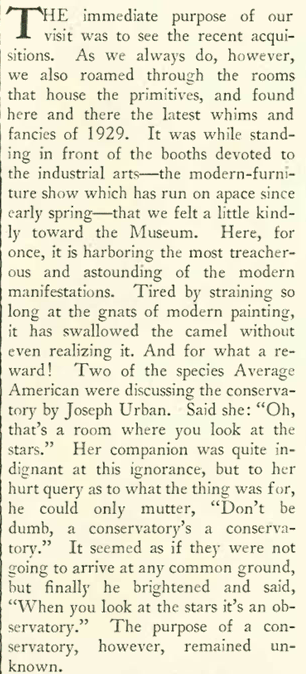
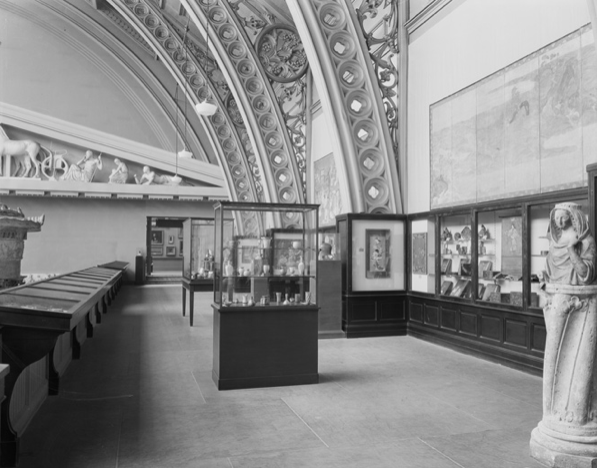
The New Yorker’s art critic Murdock Pemberton did not suffer fools gladly, and whenever the local museums seemed less than up to snuff, he was there to provide some correctional advice…
NEED AN AUDIO GUIDE? STILL WORKING ON THAT…The Metropolitan Museum of Art’s H.O. Havemeyer Collection, 1930. (The Metropolitan Museum of Art)
* * *
From Our Advertisers
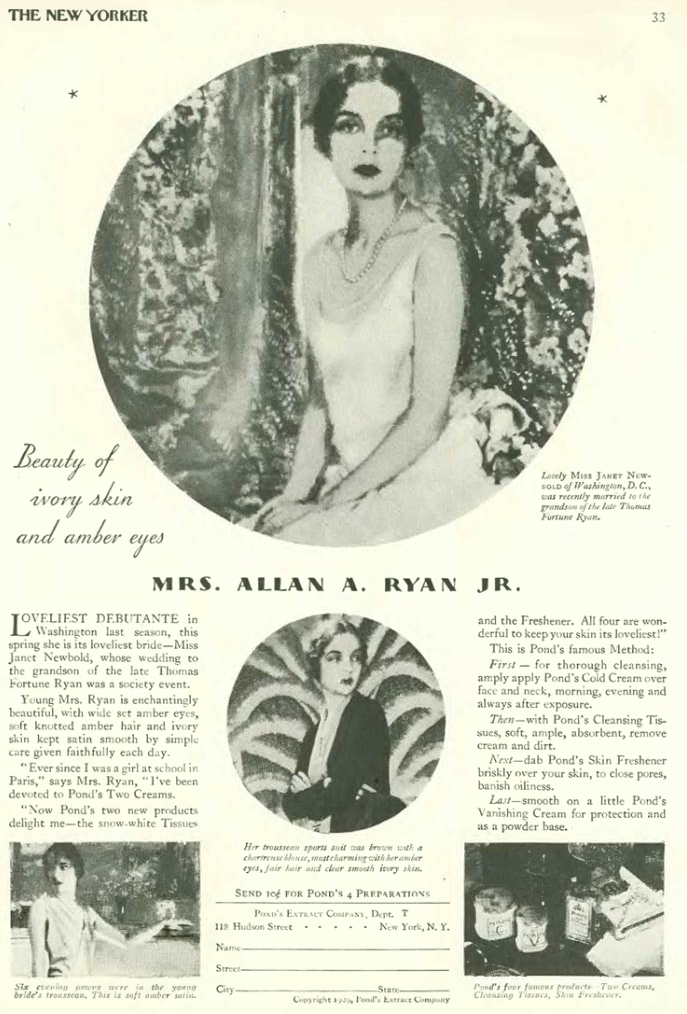
Despite the advances made by women in the 1920s, they still lived under a patriarchy, especially when it came to the patrician classes. And so the young bride of Gifford Pinchot II was identified only as a “Mrs.” in the headline for this Pond’s cold cream ad…
…Mrs. Gifford Pinchot II was actually Janine Voisin (1910-2010). She must have had more than a healthy complexion, as she lived 100 years…
Janine Voisin Pinchot in 1933. (history.blogberth.com)
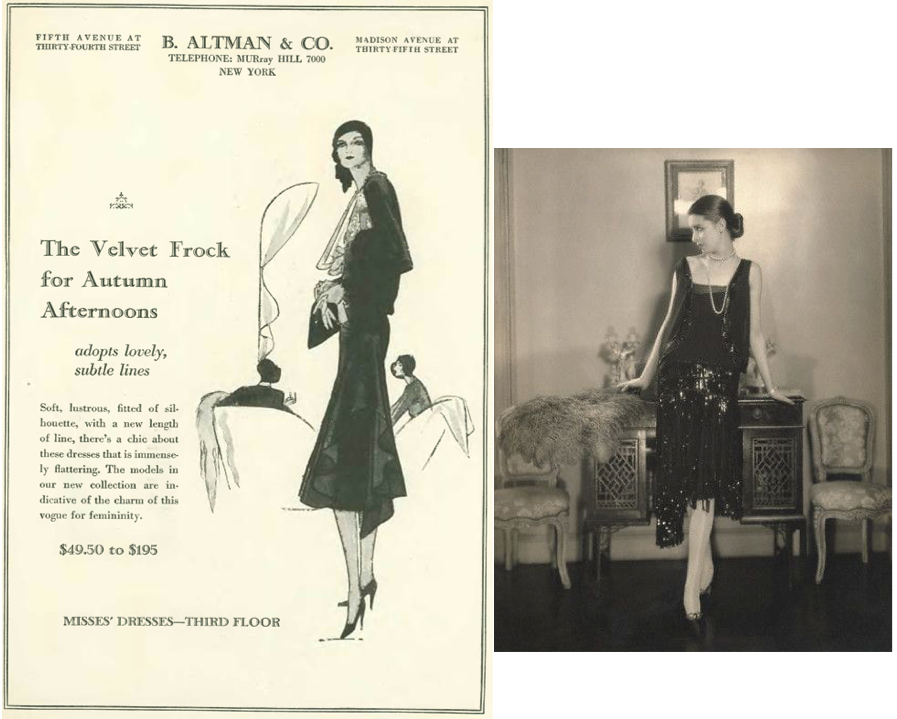
Another woman known for her beauty in the 1920s was the model Marion Morehouse (who was married to poet E.E. Cummings from 1934 until his death in 1962). Considered by some to be the first “supermodel,” I include an image of Morehouse below (right) to demonstrate how artists exaggerated the female form in fashion ads of the day…
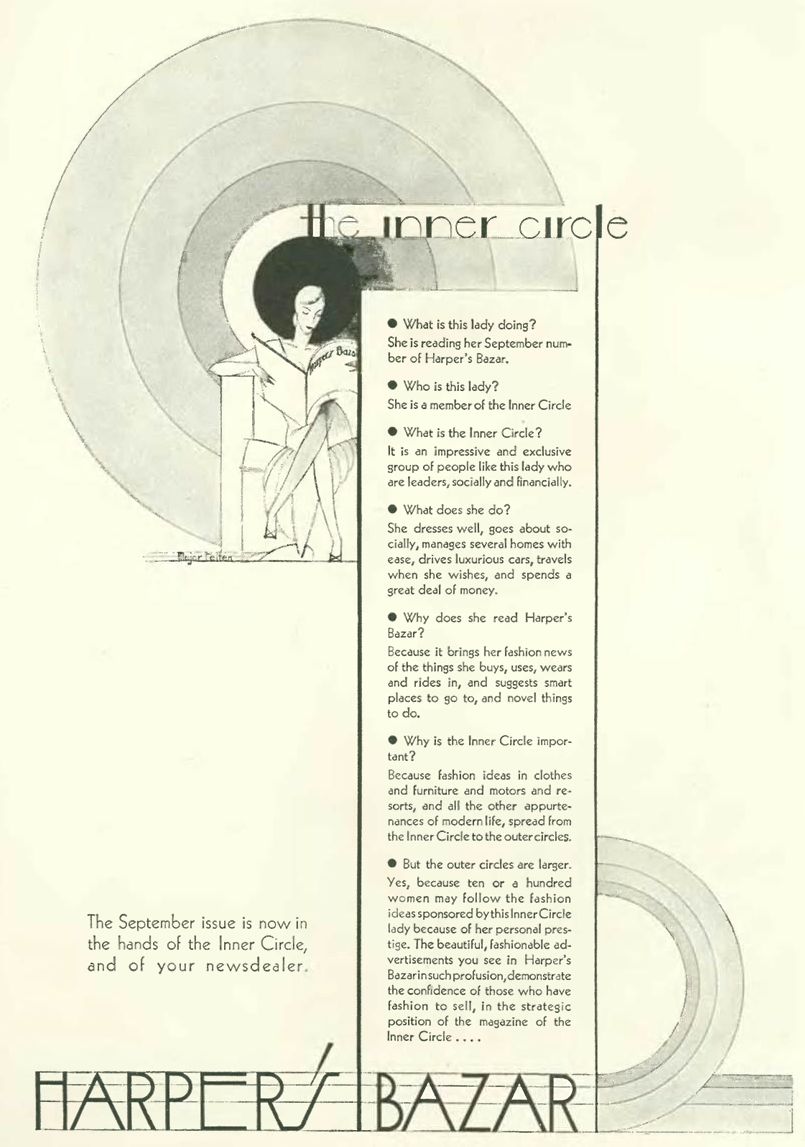
…the body wasn’t the only thing subject to exaggeration, or hyperbole, as this ad from Harper’s Bazar attested in defining the exclusivity of its readership…
…the New York Sun also appealed to social mores in an attempt to sell more newspapers…
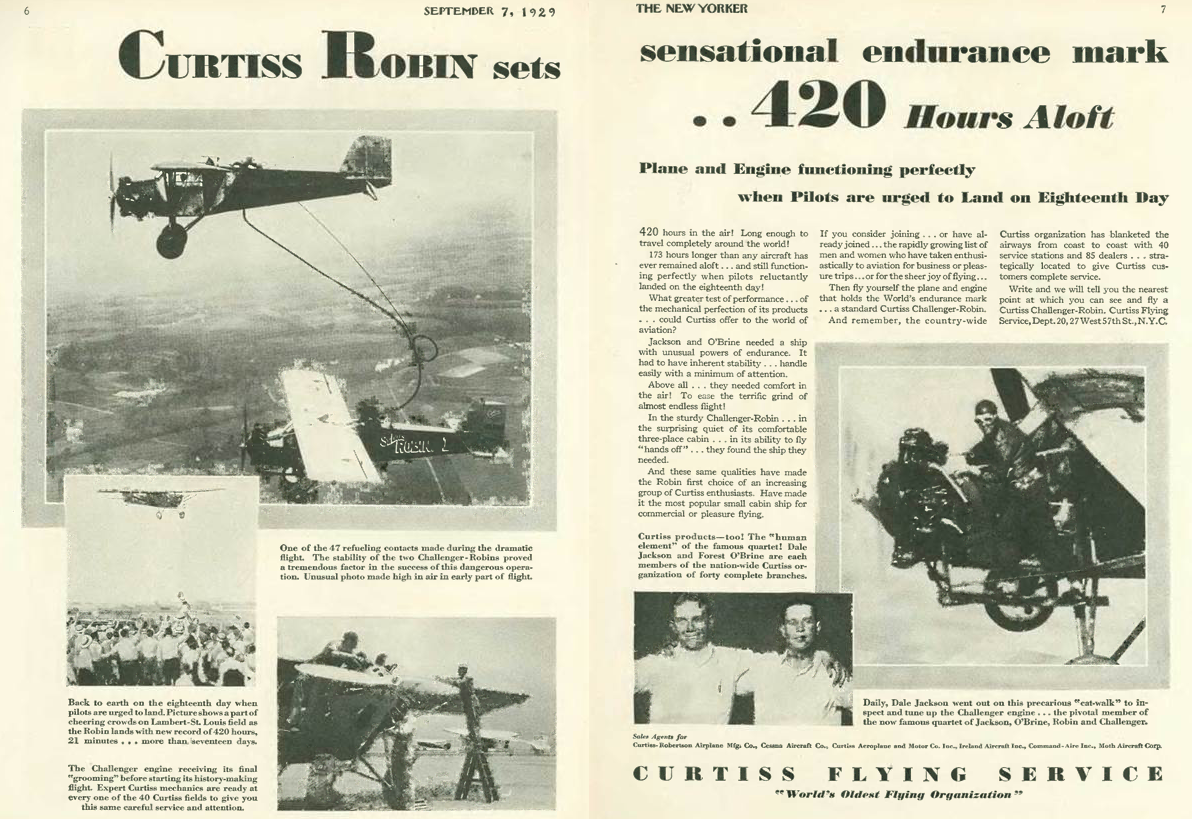
…the Curtiss Robin Flying Service touted their latest achievement — the St. Louis Robin being refueled during its flight to a new world’s endurance record of 420 hours — greatly surpassing the record of 150 hours set by the Army’s “Question Mark” airplane at the beginning of 1929…
…our cartoonists from the Sept. 7 issue include Gluyas Williams, who had some fun at the expense of Alice Foote MacDougall, who was the “Starbucks” of her day, at least in New York…
…MacDougall turned her coffee business into a restaurant empire in the 1920s. She opened several restaurants in Manhattan, all decorated in a signature style meant to evoke European cafés…
EURO AMBIENCE…Interior of Alice Foote MacDougall’sFirenze, 6 West 46th Street, New York City, 1925. (New York Historical Society)
…other cartoons included this commentary on public advertising by Leonard Dove…
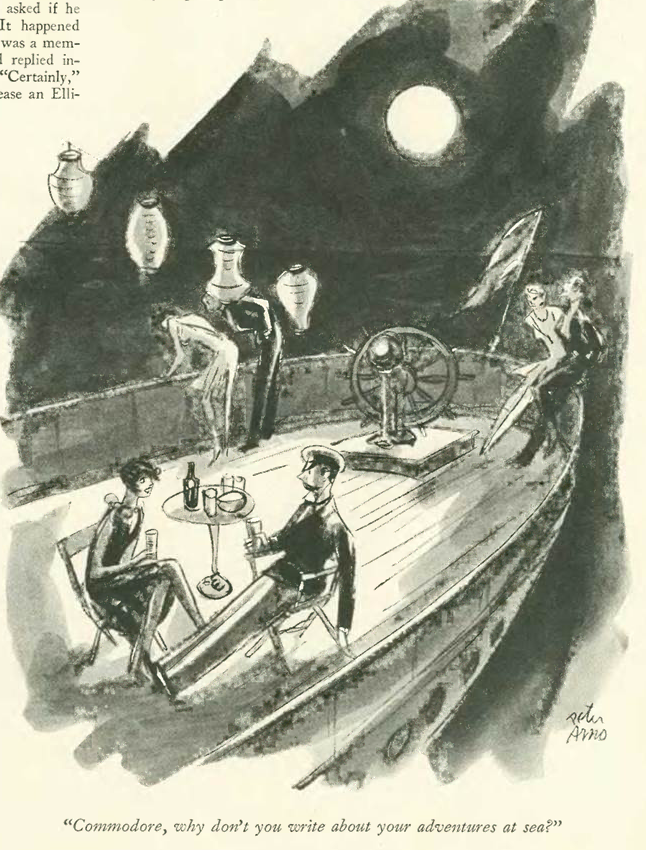
…Peter Arno’s unique take on the seafaring life…
…Helen Hokinson eavesdropped on some tween talk…
…and Alan Dunn gave us some perspective on the fast pace of city life…
For more than a century, a political organization known as the Tammany Society ruled New York City politics with an iron fist. Founded in 1786 (and named for Tamanend, a chief in the Lenni-Lenape nation), by the mid 19th century it rapidly expanded its political control by earning the loyalty of the city’s fast-growing immigrant population, particularly the Irish.
July 13, 1929 cover by Rea Irvin.
The Tammany Society proved an efficient machine for controlling state Democratic politics as well as New York City elections. Through its use of patronage to reward loyal precinct leaders, it also became a center for big-time graft. Most of us know a bit about Tammany thanks to school history books that focused on the deep corruption of William “Boss” Tweed, who was brought down by the press and by Harper’s Weekly cartoonist Thomas Nast in the 1870s. Tammany Hall would survive the scandal, and in the 1920s would still pull the strings of politicians including Gov. Al Smith and New York City Mayor Jimmy Walker.
Tammany had several homes, but during its most notorious years it was located in a circa 1812 hall (then called a “wigwam”) and later in an 1868 building on 14th Street, between Third and Fourth avenues. The July 13, 1929 “The Talk of the Town” noted the recent demolition of that old hall and the opening of a new headquarters on 17th Street:
POLITICAL BAGGAGE…Top, a stereoscope card featuring the 1868 Tammany Hall; below, Thomas Nast cartoons depicting the corruption of Tammany Hall and the downfall of Boss Tweed. (Wikimedia Commons/Smithsonian)
“Talk” found the new building unimpressive; it seemed to signal that the old political machine was losing some of its luster:
EVOLUTION OF THE WIGWAM, as depicted on a poster circa 1920. (nypdhistory.com)Top left: The old Tammany Hall, decorated for the 1868 Democratic National Convention. Bottom left, the old hall was located at 141 E 14th Street, between 3rd and 4th Avenues. It was demolished in 1927 to make way for expansion of the Consolidated Edison building (right). (NYPL Digital Gallery/mediahistoryny.files.wordpress.com/Wikipedia)
Indeed, “Talk” found the building to be a somewhat austere, hosed-down affair, far removed from its grander past:
I LIKE YOUR NEW HAT…The 1929 Tammany Hall (top left) is currently undergoing a major renovation. Although the interior is being dramatically altered, including the addition of a glass dome, the landmarked exterior will mostly be preserved. When completed, the building—a mix of office and retail—will be known as 44 Union Square. (bkskarch.com)
For further evidence that the more austere Tammany Hall was nevertheless alive and well in 1929, another “Talk” item noted the organization’s continued influence behind the scenes in local politics:
The 1930s marked the beginning of the end for Tammany Hall, when reform-minded Democrats such as President Franklin Roosevelt and New York’s Republican Mayor Fiorello La Guardia (supported by Roosevelt on a “Fusion” ticket) dismantled Tammany’s system of patronage. The Tammany Society abandoned its headquarters in 1943 when it found it no longer had the funds to maintain the hall. Bought by a local affiliate of the International Ladies Garment Workers Union, it later housed the New York Film Academy and the Union Square Theatre until 2016, when it underwent extensive remodeling to make way for new office and retail space.
* * *
Your Two Cents Worth
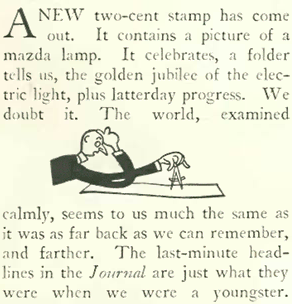
“Talk” also commented on the introduction of a new two-cent stamp that featured an image of Thomas Edison’s Mazda lamp, marking the celebration of fifty years of electric light. The magazine cheekily suggested that in the world of technological progress, there was nothing new under the sun:
(eBay)
* * *
Americans in Paris
The New Yorker featured this humorous bit by a writer identified as “Guido” (I assume it is one of E.B. White’s many pseudonyms), who looked in on the chatter of various Parisian cafés and bars:
VOLSTEAD CAN’T GET US HERE…Enjoying the good life at a Parisian brasserie, circa 1920s. (National Geographic)
* * *
Hit and Miss
The New Yorker generally reveled in the good times Florenz Ziegfeld brought to the stage, but his latest effort, Show Girl, proved a bit of a disappointment (more evidence, in my view, that folks were tiring of the decade-long party known as the Roaring Twenties):
TAP-DANCING ON THE GRAVE OF THE ROARING TWENTIES…Although TheNew Yorker seemed less than enthused by Flo Ziegfeld’s latest effort, Show Girl, Ruby Keeler (top left) brought her tap shoes and her ‘A’ game to the performance. Clockwise, from top right, Keeler has some fun with the comedy trio Clayton, Jackson and Durante; program cover for Show Girl; the popular Albertina Rasch Girls with Harriet Hoctor in the “An American in Paris” scene of Show Girl, 1929. (Pinterest/jacksonupperco.com/eBay/songbook1.wordpress.com)
* * *
One of a Kind
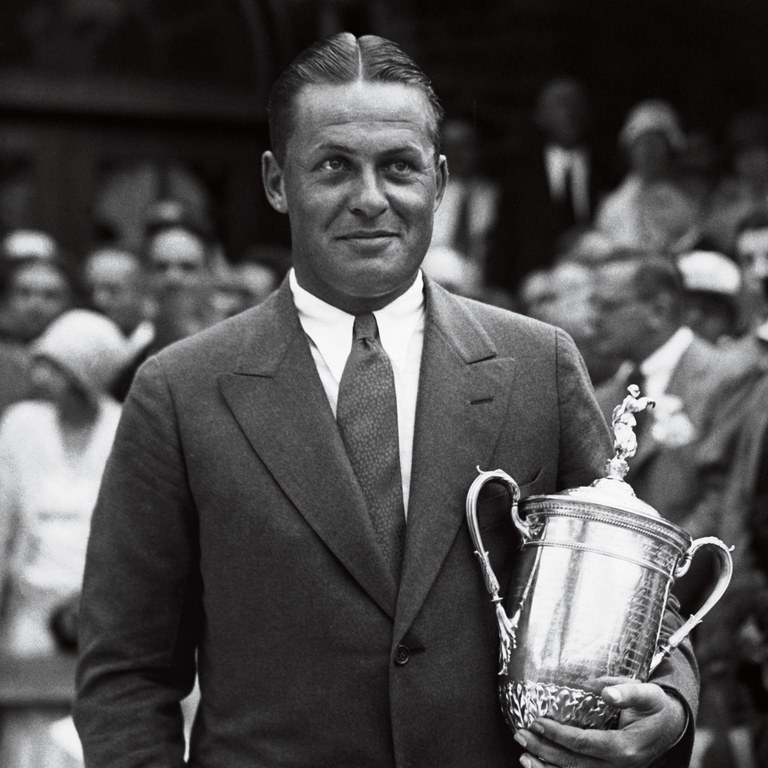
New Yorker sportswriter Niven Busch, Jr. provided a nice write-up on golfer Bobby Jones, the most successful amateur ever to compete in the sport. An attorney by trade, the unassuming Jones had just won his third U.S. Open (he would win again in 1930). In all he would play in 31 majors, winning 13 of them and finishing in the top 10 an incredible 27 times. After retiring at age 28 in 1930 he helped design the Augusta National Golf Club and co-founded the Masters Tournament. An excerpt:
AND HE DID IT WEARING A NECKTIE…Although a lawyer by trade, the amateur golfer Bobby Jones was one of golf’s greatest champions. He pictured here after winning the 1929 U.S.Open in Mamaroneck, New York. (golf digest.com)
* * *
An Odd Bit
Looking around the July 13 issue, let’s see what nighttime diversions were being touted by TheNew Yorker in their “Going on About Town” section (note the warning on the last item):
* * *
From Our Advertisers
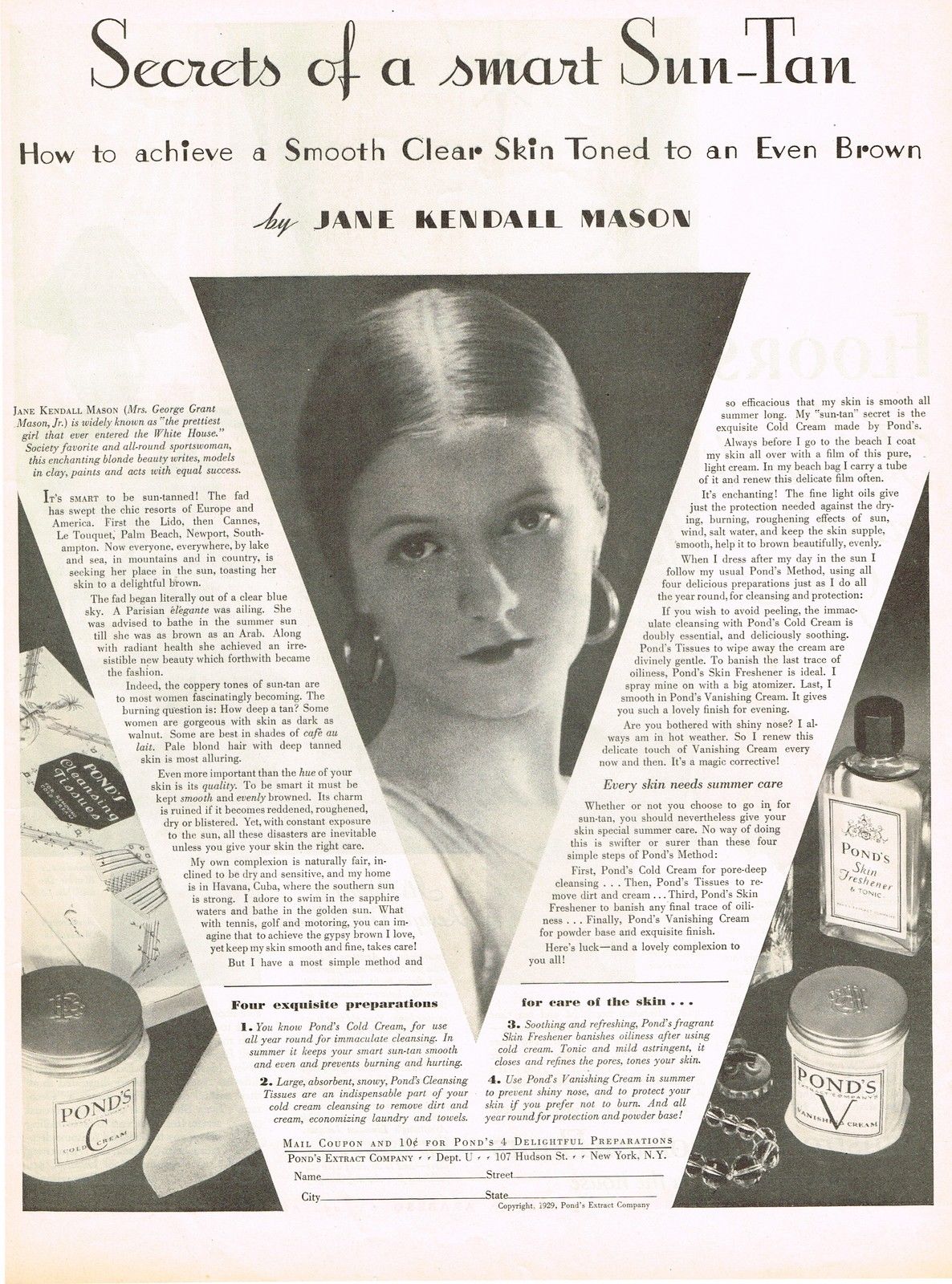
The makers of Pond’s cold cream continued to roll out endorsements from high society with this testimonial from Jane Kendall Mason (1909-1980), the newlywed wife of George Grant Mason, an executive with Pan American Airways in Cuba.
In 1925, the 17-year-old Jane made her formal debut in Washington society. After a visit with Grace Goodhue Coolidge, the first lady famously declared that Jane was “the most beautiful girl ever to enter the White House.”
After their marriage, the Masons became friends with Ernest and Pauline Hemingway, and introduced the Hemingways into Cuban society. Jane could hunt, fish, and hold her liquor, and, according to Ernest Hemingway, she was the most uninhibited person he’d ever met. So naturally they had a torrid, tempestuous, two-month affair that ended with Jane’s attempted suicide (she leapt from a balcony that was not high enough to do the job).
Hemingway supposedly used Jane as a model for the cruel-hearted Margot Macomber in The Short, Happy Life of Francis Macomber, in which the title character—trapped in a sad marriage to a wealthy but spineless American (George?)—accidentally shoots her husband in the head while on safari. She is also considered to be the model for the sex-obsessed Helene Bradley in Hemingway’s novel To Have and Have Not— a character also married to a rich but spineless husband.
Carlos Gutierrez (who served as a boat guide for Ernest Hemingway) and Jane Mason aboard “Sloppy” Joe Russell’s boat Anita in 1933. (Ernest Hemingway Photograph Collection, JFK Presidential Library and Museum, Boston)
Mark Walston, writing for the July-August issue of Bethesda Magazine, notes that the mean-spirited Hemingway “sent Jane drafts of his work, taunting and tormenting her with his venomous and thinly veiled portraits.” According to Walston, Jane divorced Mason in 1940, and one month later married John Hamilton, former executive director of the Republican National Committee. After that brief marriage she wed George Abell, columnist for The Baltimore Sun and Washington Times-Herald. Her fourth and final husband was Arnold Gingrich, founder of Esquire and editor of Coronet magazines. Jane died in 1980. On her tombstone is her self-penned epitaph: “Talents too many, not enough of any.”
On to our next ad, which featured an interesting exchange between two men who discuss the fortunes of a guy named Cecil Barnes, retired at age 33 and owner of a new personal airplane…
…and we segue into our cartoons, featuring a mother and child (drawn by Carl Kindl) probably flying on one of those Sikorskys…
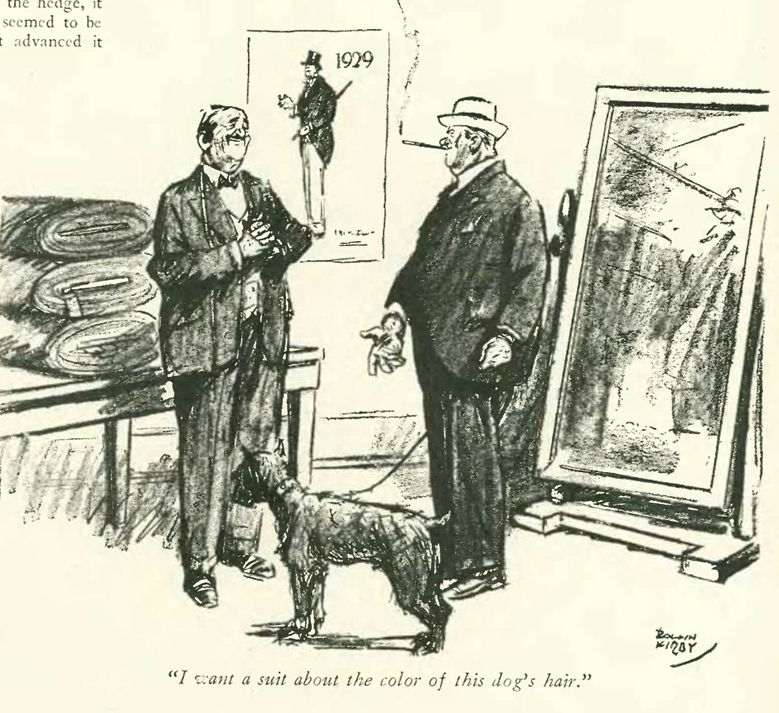
…Rollin Kirby looked in on a tailor’s shop (this is one of only two drawings published by Kirby in TheNew Yorker)…
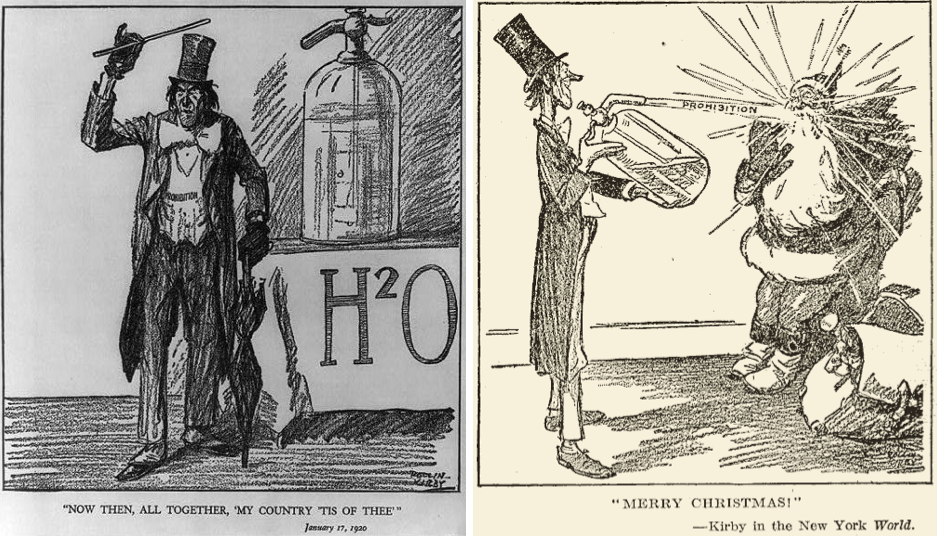
…a note on Kirby, a three-time Pulitzer winner: outraged by the passage of Prohibition laws, Kirby created one of his most famous characters, “Mr. Dry,” which he introduced to readers of the New York World in January 1920…
Rollin Kirby’s miserly, foreboding “Mr. Dry” made his first appearance in the pages of the New York World on Jan. 17, 1920, shortly after Prohibition laws went into effect in the United States. Mr. Dry also made an appearance at the end of 1920, to throw some water on America’s Christmas cheer. (bottlesboozeandbackstories.blogspot.com)
You can read more about Rollin Kirby and Mr. Dry here.
…Roland Baum peeked in on a reluctant stargazer…
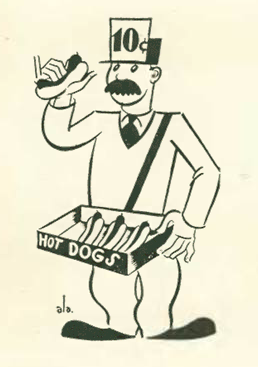
…and to close, this little filler drawing of a hot dog vendor by Constantin Alajalov…
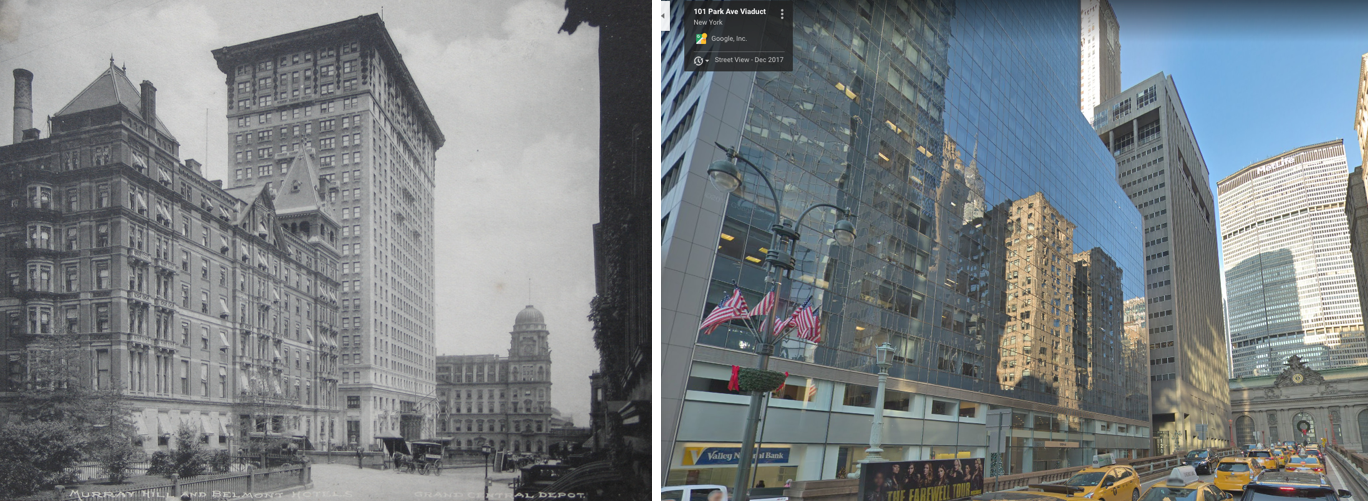
While the Empire State Building developers were preparing to reduce the old Waldorf-Astoria Hotel to rubble, another venerable relic of the Victorian age, the Murray Hill Hotel, was still clinging to the earth at its prime location next to the Grand Central Depot.
June 15, 1929 cover by Sue Williams.
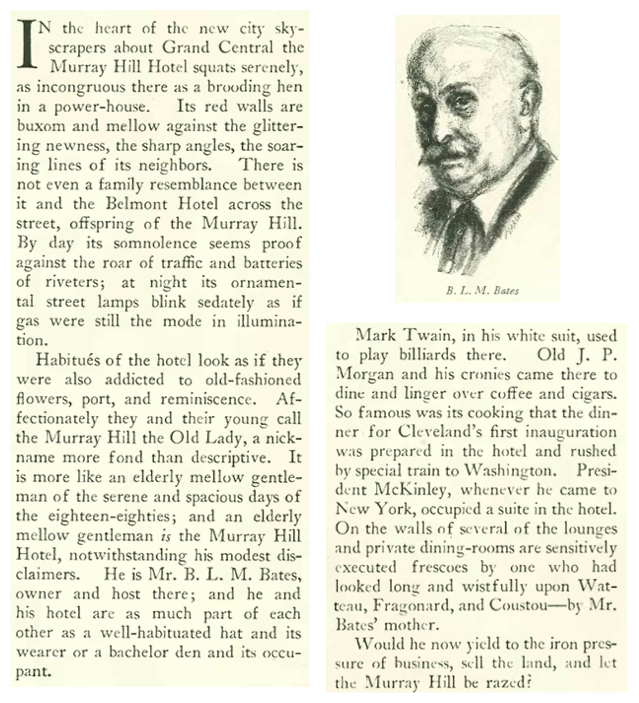
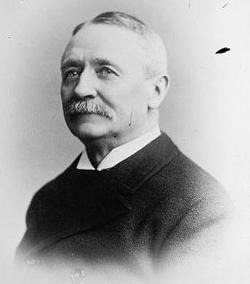
The hotel’s survival was due in part to its owner, Benjamin L. M. Bates (1864-1935), who seemed as much a part of the hotel as its heavy drapes and overstuffed chairs. Bates, who started out at the hotel as assistant night clerk, was profiled in the June 15, 1929 issue by Joseph Gollomb (with portrait by Reginald Marsh) Some excerpts:
The hotel was just 26 years old when Bates bought it in 1910. But by the Roaring Twenties Murray Hill Hotel seemed as ancient as grandmother’s Hepplewhite…
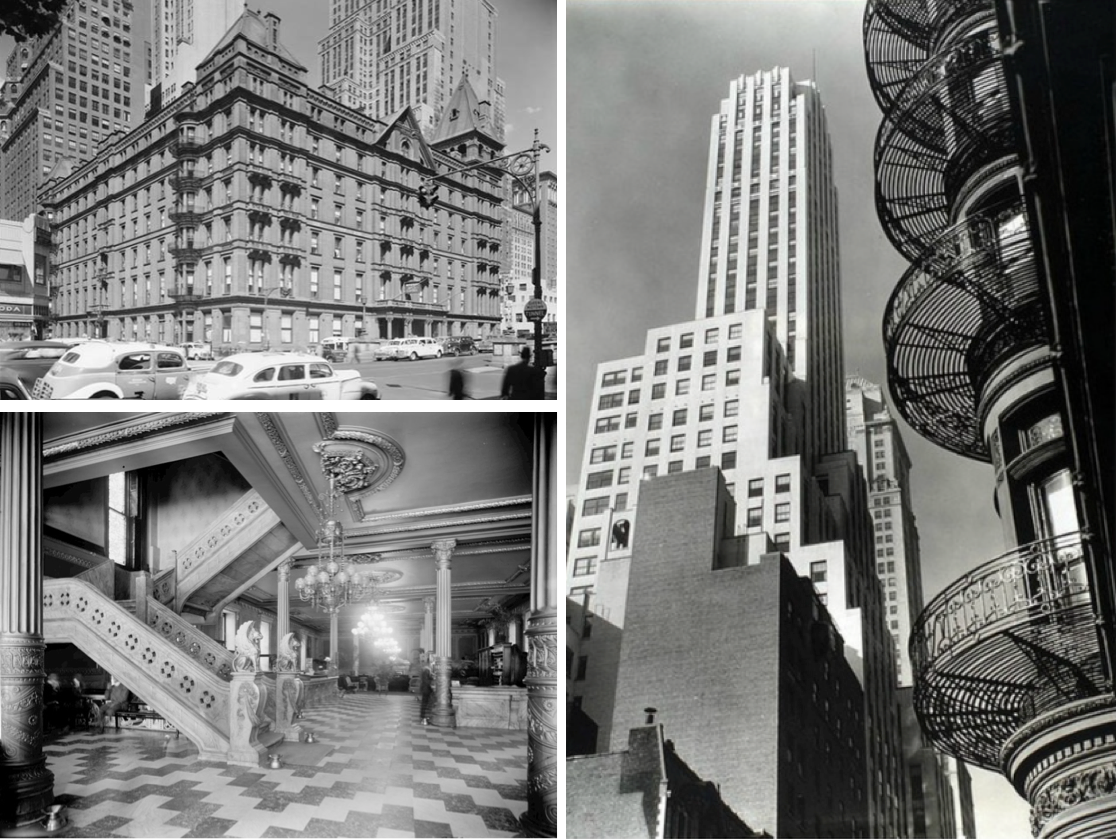
Clockwise, from top, left, The Murray Hill Hotel in September 1946, just months before it was demolished; the hotel’s ornate spiral fire escape, seen at the right in a 1935 photograph of 22 East 40th Street by Berenice Abbott; the hotel’s office and foyer. The hotel featured 600 rooms and two courtyards. (Museum of the City of New York (1 & 2)/Wikipedia)
…but to the very end it continued to be a popular gathering spot for New York notables, including Christopher Morley’s prestigious literary society, the Baker Street Irregulars…
FAMILIAR HAUNT…Three members of the exclusive literary group, the Baker Street Irregulars — Fletcher Pratt, Christopher Morley and Rex Stout —swap stories at the Murray Hill Hotel in 1944. (Wikipedia)
…with the hotel’s prime location near Grand Central Depot (and its replacement, Grand Central Station), the party couldn’t last forever, and the Murray Hill Hotel yielded to the wrecking ball in 1947…
THEN AND NOW, the Murray Hill Hotel, circa 1905. The adjacent 25-story Belmont Hotel, erected in 1904-06 and a skyscraper for its time, would be razed in 1931. Note the old Grand Central Depot in the background, which would be replaced in 1913 by Grand Central Station. At right, a Google Maps view of the same location today.
Some parting notes about the Murray Hill Hotel: In 1905, delegates from 58 colleges and universities gathered at the hotel to address brutality in college football and reform the sport. They formed the Intercollegiate Athletic Association of the United States, which would later become the NCAA.
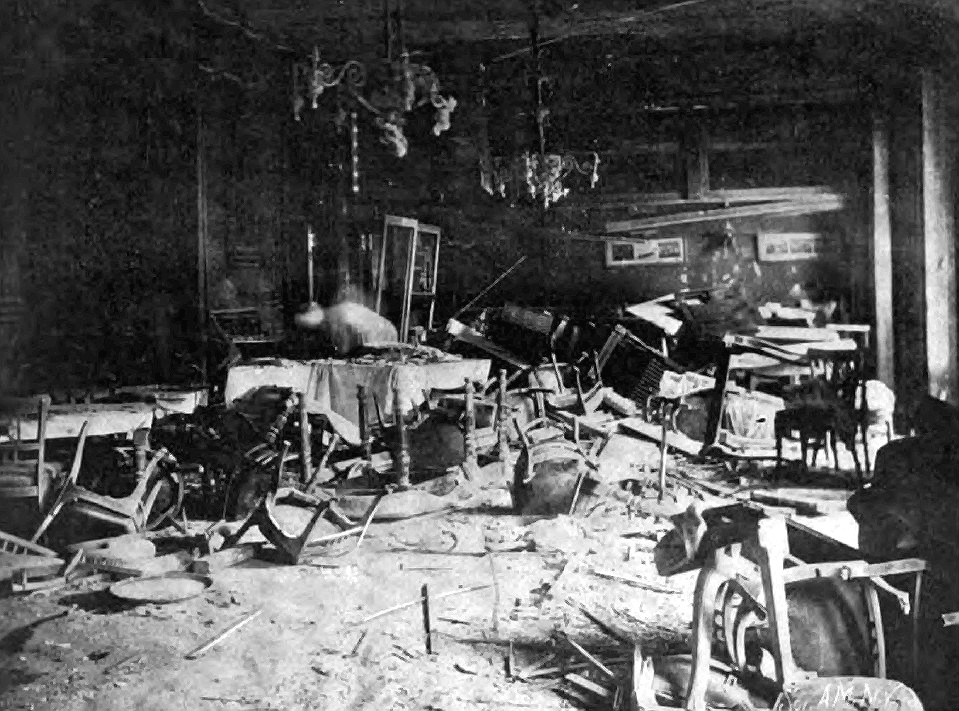
The hotel was also the site of a massive explosion in 1902, when workers constructing a subway tunnel under Park Avenue accidentally set a dynamite shed ablaze. Every window along Park Avenue and 40th Street was blown out, and the blast opened a pit, 10 feet deep and 30 feet wide, in front of the building. Five people were killed by the blast—three of them at the Murray Hill Hotel.
AFTERMATH…The Murray Hill Hotel’s cafe following the 1902 explosion. (Wikimedia Commons)
* * *
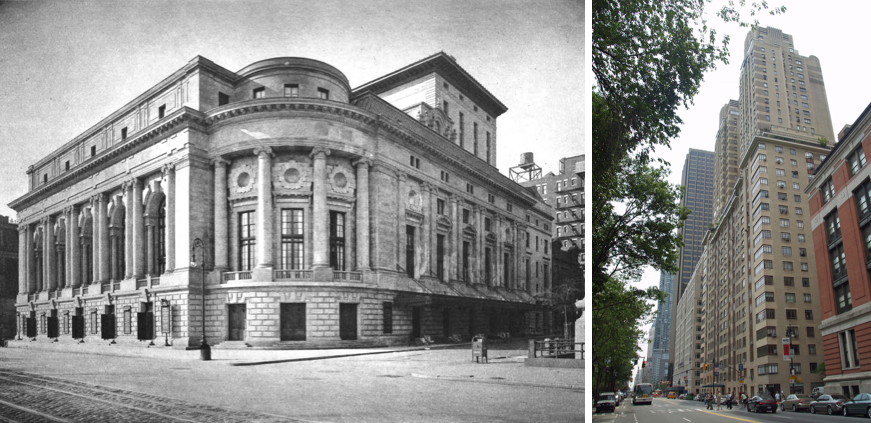
Irwin S. Chanin, fresh from erecting his Art Deco masterpiece, the Chanin Building, was now setting his sights on the Century Theatre, barely twenty years old but already obsolete due to its poor acoustics and inconvenient location. “The Talk of the Town” takes it from there…
BIGGER PLANS…The Century Theatre, located at 62nd Street and Central Park West, opened on November 6, 1909. Plagued by poor acoustics and an inconvenient location, it was demolished in 1931 and replaced by the Irwin S. Chanin’s Century Apartments building. (The New-York-Architect, November 1909/David Shankbone via Wikipedia)
As the Century Theatre marked its last days, an older and more successful theater in the Bowery went up in flames. The Thalia Theatre (also known as “Bowery Theatre” and other names) was a popular entertainment venue for 19th century New Yorkers and for the Bowery’s succession of immigrant groups. A series of buildings (it burned four times in 17 years) housed Irish, German and Yiddish theater and later Italian and Chinese vaudeville. The 1929 fire marked the end of the line. “Talk” noted its passing…
UP IN SMOKE…The Bowery’s Thalia Theatre (building with columns) went up in flames on June 5, 1929. The photo was taken in 1928, one year before the final fire. Note the elevated train tracks in front of the building. (Manhattan Unlocked)
While we are on the subject of the changing skyline, I will toss in this cartoon from the issue by Reginald Marsh…the caption read: “I tell you, Gus, this town ain’t what it used to be.”
* * *
Down for the Count
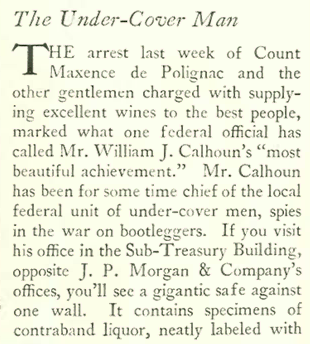
There was a bit of a sensation in the June newspapers when a European count was arrested for running a bootlegging ring among socially prominent circles. A headline in a June 8, 1929 edition of the New York Times shouted: LIQUOR RING PATRONS FACING SUBPOENAS; Socially Prominent Customers Are Listed in Papers Found in de Polignac Raids. COUNT SAILS FOR PARIS. Goes, After Nearly Losing Bail Bond, Smilingly Calling the Affair ‘Misapprehension.’
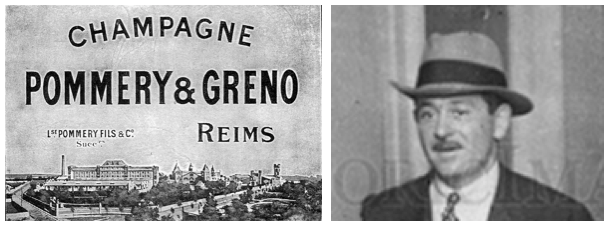
What the Times so breathlessly recounted were the activities of Count Maxence de Polignac (1857–1936), who owned one of France’s most prominent Champagne houses, Pommery & Greno.
The Times reported that an undercover federal agent, William J. Calhoun, led a raid that netted the Count and 34 others in a liquor ring connected to many Park Avenue and Fifth Avenue residents. Calhoun’s agents interrupted the Count’s morning bath (at his suite in the Savoy-Plaza Hotal) to make the arrest. They seized more than “seven cases of champage and liquors” in the suite, which the count said were for his personal use. Denying all charges, de Polignac was nevertheless arrested. Thanks to a guarantee provided by his friends at the Equitable Surety Company, he made the $25,000 bail and quickly set sail for Paris. “Talk” reported…
IT WAS JUST A LITTLE SIDE BUSINESS…Count Maxence de Polignac owned the house of Pommery & Greno, one of the largest Champagnes firms in France. (Wikipedia/tcreims.com)
“Talk” concluded the dispatch with some notes on Calhoun’s character as a federal agent…
…and a final bit of trivia, Count Maxence de Polignac was the father of Prince Pierre of Monaco, Duke of Valentinois, who in turn was the father of Rainier III of Monaco, who famously married the actress Grace Kelly. Grace Kelly, by the way, was born in November 1929, just months after her grandfather-in-law’s run-in with Prohibition authorities.
* * *
Underwhelmed
Once again “Talk” looked in on aviation hero Charles Lindbergh, and his dispassionate approach to matters of fame…
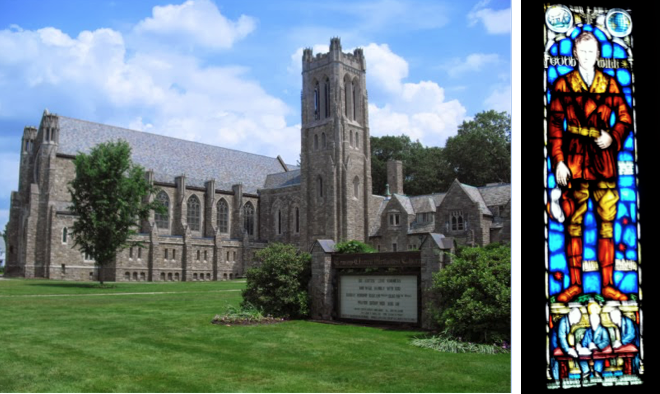
GOODWILL, OR WHATEVER…Trinity Methodist Episcopal Church in Springfield, Mass., features a series of 24 stained-glass windows representing historic personages with the theme, “The Light of Christ in the Life of Civilization.” Charles Lindbergh’s pane represents “Goodwill.” (tm01001.blogspot.com)
* * *
Mr. Monroe Outwits a Bat
James Thurber submitted a humorous piece on a husband and wife at a weekend cabin retreat. The husband encounters a bat, and feigns to dispatch it while his wife remains behind closed doors. A brief clip:
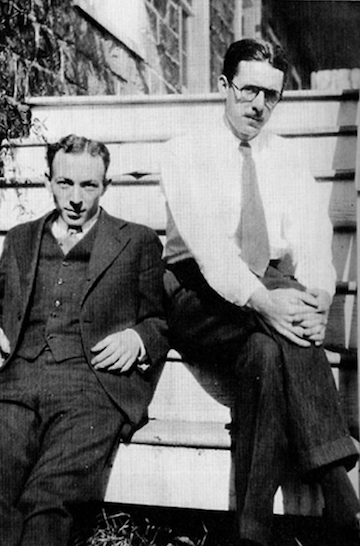
E.B. White and James Thurber, circa late 1920s.
Thurber’s office mate and friend, E.B. White, penned a piece on the opening of the Central Park Casino (“Casino, I Love You”) in which he pretended to be a hobo loitering outside the Casino’s recent grand re-opening. Some excerpts…
White’s character confuses Urbain Ledoux with Casino designer Joseph Urban. Ledoux was known to New Yorkers as “Mr. Zero,” a local humanitarian who managed breadlines for the poor. White’s character continues to name off the notables present at the event…
* * *
From Our Advertisers
We begin with a Pond’s cold cream ad featuring Janet Newbold (1908-1982), who was known in some circles as “the most beautiful woman in New York”…
MIRROR, MIRROR…Left, an iconic photo of Janet Newbold by Erwin Blumenfeld, “Woman and Mirror,” was published in Harper’s Bazaar in November 1941. “Janet Newbold Wearing A Sari,” photo by John Rawlings, was published in Vogue in 1947. Thrice married, her last marriage (in 1948) was to James S. Bush, uncle of U.S. President George H.W. Bush. (Harper’s Bazaar/Vogue)
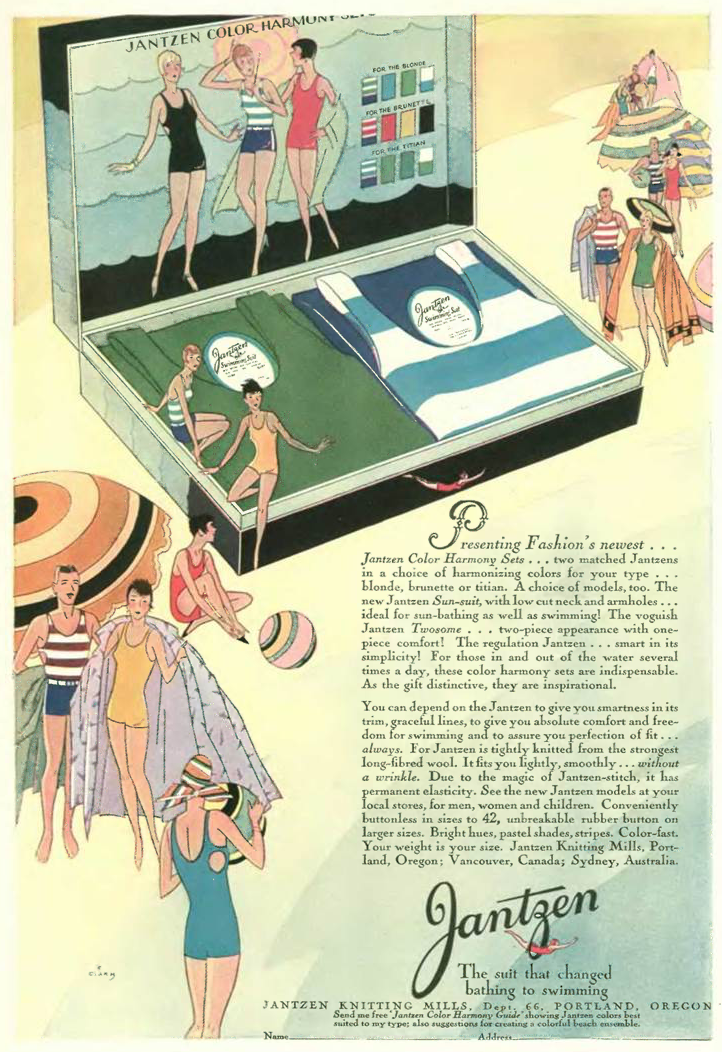
…some of the more colorful ads in the June 15 issue included this entry by Jantzen…
…and this ad for the REO Flying Cloud, a name that suggested speed and lightness, and changed the way cars would be named in the future (e.g. “Mustang” rather than “Model A”)…
…and if you think gimmicky razors are something new, think again…
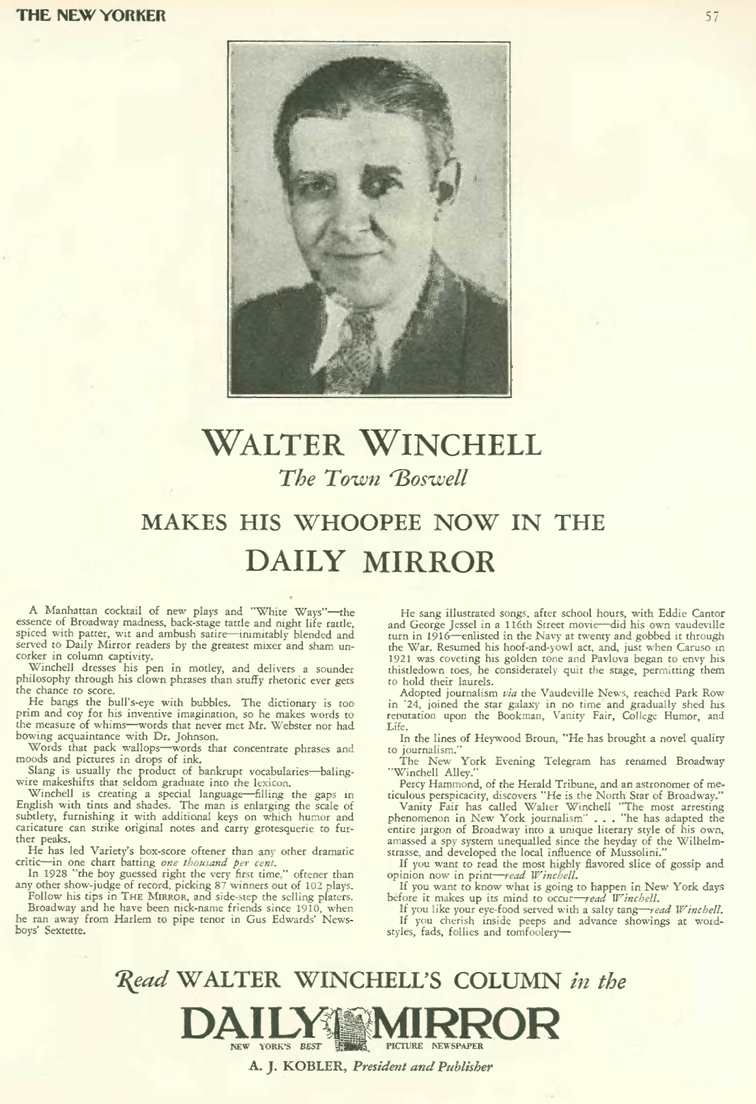
…this ad announcing Walter Winchell’s employment with the New York Daily Mirror is significant in that in marks the beginning of the first syndicated gossip column. Winchell’s column, On-Broadway, was syndicated nationwide by King Features. A year later he would make his radio debut over New York’s WABC…
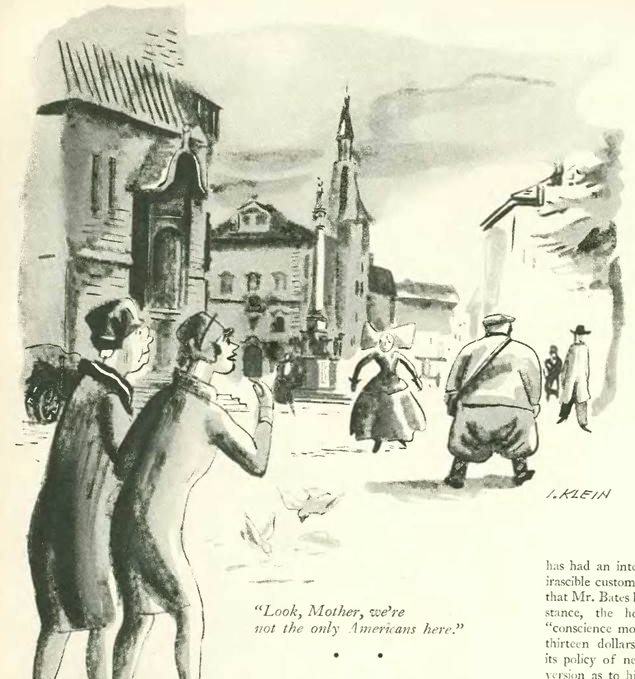
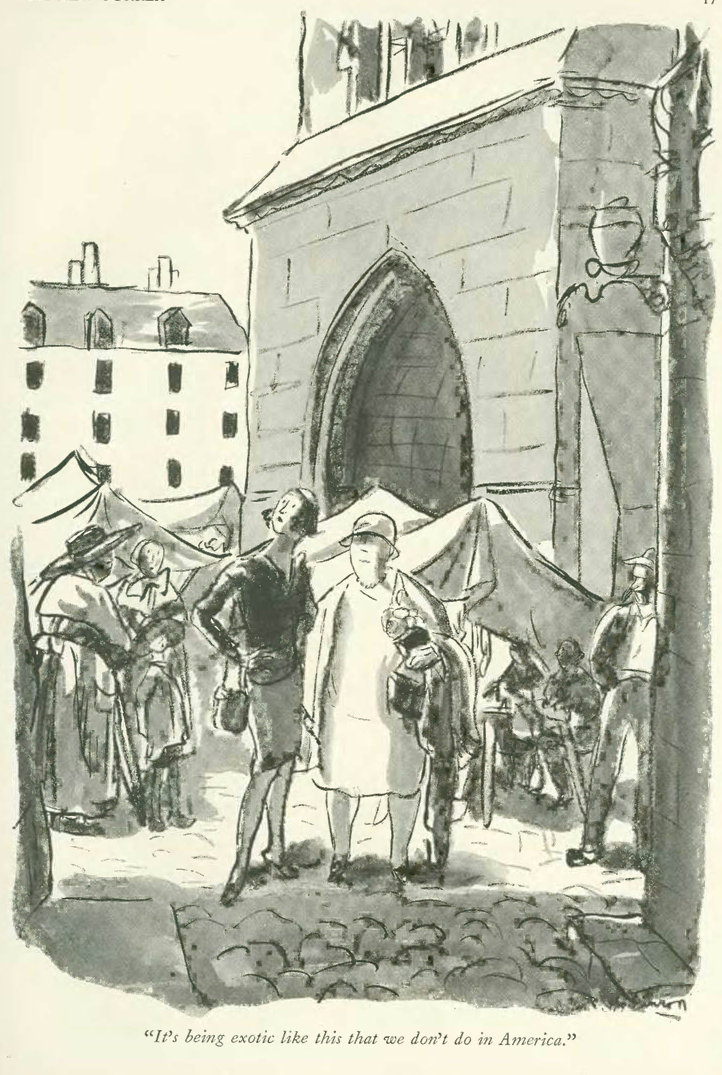
…for our June 15 cartoons, Isadore Klein confirms that stereotypes regarding American tourists haven’t changed much in 90 years…
…a quick footnote on Klein. In his long and colorful career, he would contribute cartoons to the New Yorker and many other publications. He also drew cartoons for silent movies, including Mutt and Jeff and Krazy Kat, and later worked for major animation studios including Screen Gems, Hal Seeger Productions, and Walt Disney. He was a writer and animator for such popular cartoons as Mighty Mouse, Casper, Little Lulu and Popeye.
Isadore Klein (1897–1986) holding the National Cartoonists Society “Silver T-Square.” He received the honor from his fellow members on April 22, 1974. (michaelspornanimation.com)
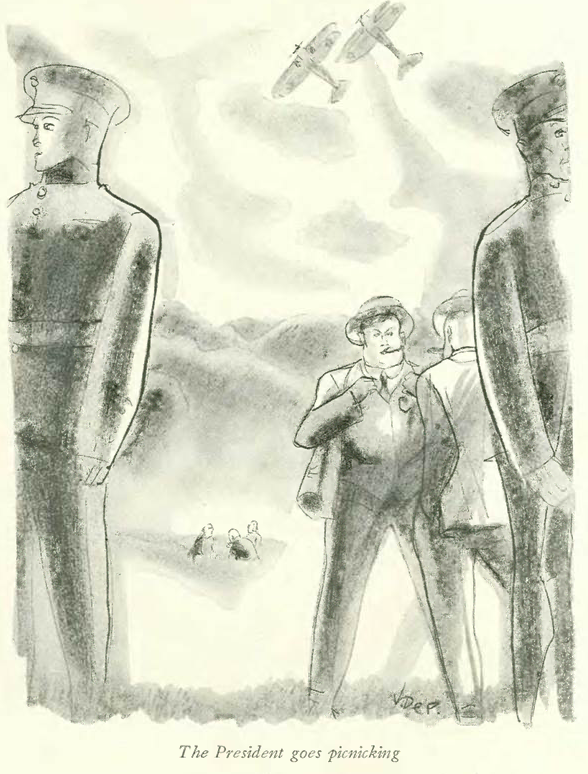
…Belgium-born artist Victor De Pauw depicted President Herbert Hoover picnicking, as viewed through his security detail…
…and a quick note on De Pauw…well known during his lifetime, he illustrated seven covers for The New Yorker and drew many social and political cartoons for magazines such as Vanity Fair, Fortune and Life. He also had a career as a serious painter, and some of his work can be found at the Museum of Modern Art…
Victor de Pauw (1902-1971) and one of his New Yorker covers from Nov. 20, 1943. (Smithsonian/Conde Nast)
…Helen Hokinson looked in on two of her society women in need of some uplift…
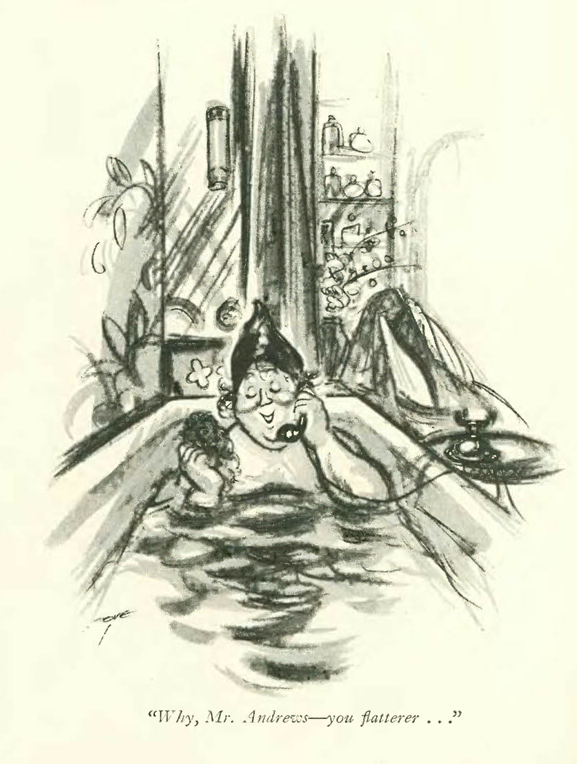
…and Leonard Dove looked in on another enjoying a soak…
Moving along to the June 22, 1929 issue, “The Talk of the Town” offered more news on the city’s changing skyline…
June 22, 1929 cover by Constantin Alajalov.
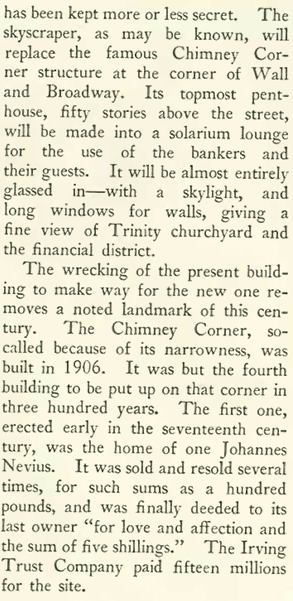
…and noted that the slender 1906 “Chimney Corner” building at Wall and Broadway had a date with the wrecking ball…
FAILED THE TEST OF TIME…At left, 18-story “Chimney Building” was demolished in 1929 along neighboring properties to make way for the Irving Trust Building (now 1 Wall Street), an Art Deco masterpiece by architect Ralph Walker. Note the scale of the two buildings relative to the church spire. (skyscraper.org/architectsandartisans.com)
* * *
Apartheid on the Seas
“Talk” also featured this sad account of a theatrical company setting sale for England and discovering that racial discrimination did not end at the docks of New York Harbor. It is also sad that The New Yorker didn’t seem to have any problem with this injustice, and rather saw it as nothing more than fodder for an amusing anecdote…
NOT THE GOOD OLD DAYS…Percy Verwayne, Frank H. Wilson and Evelyn Ellis were part of the cast in the original Broadway production of Porgy in 1927. The play, by Dorothy and DuBose Heyward, was the basis for the libretto in the George Gershwin’s 1935 Porgy and Bess. (Wikipedia)
* * *
The profile for June 22 featured 100-year-old John R. Voorhis (1829-1932), Chairman of New York City’s Board of Elections. A fixture of the Tammany Hall Democratic political machine, in 1931 Tammany members created a special title for the old man—Great Grand Sachem. He died the next year at age 102.
John Voorhies in 1900, when he was a bouncy youth of 71.
* * *
From Our Advertisers
Another colorful entry from the makers of Jantzen swimwear to celebrate the summer season…
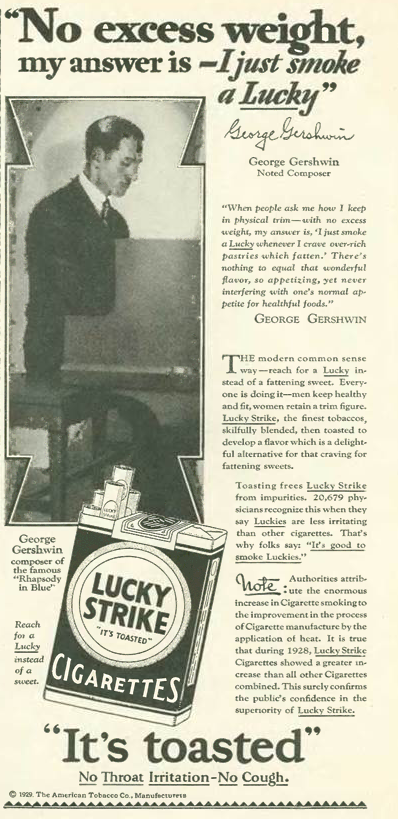
…famed composer George Gershwin urged his fans to light up a Lucky Strike…
…and with help from Rea Irwin, Knox Hatters offered yet another example of the faux pas one might suffer without the proper headgear…
…for our June 22 cartoons, Helen Hokinson caught up with some American tourists…
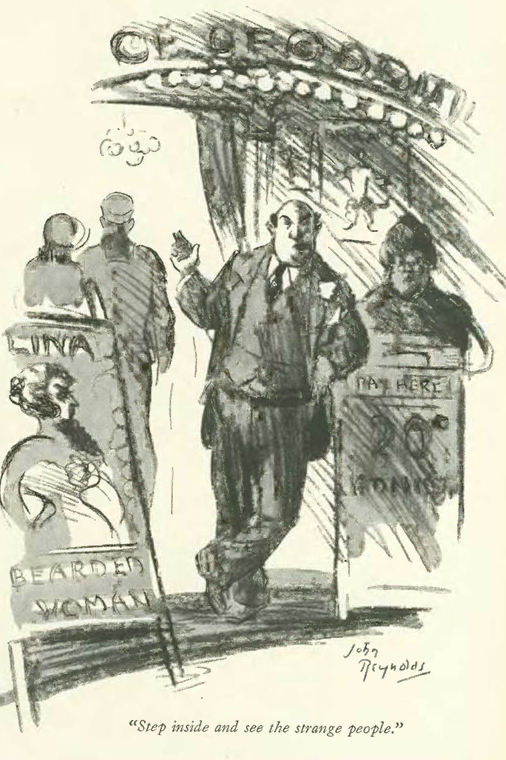
…John Reynolds found a bit of irony in one carnival barker’s claim…
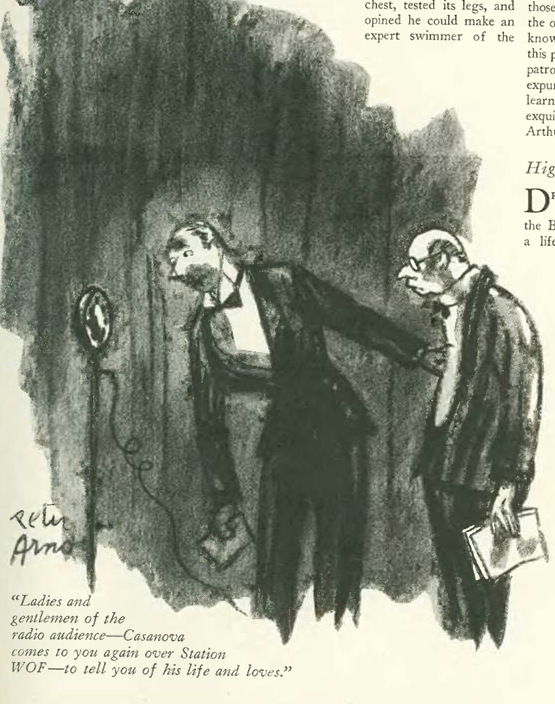
…and Peter Arno revealed a less than glamorous face behind a radio broadcast…
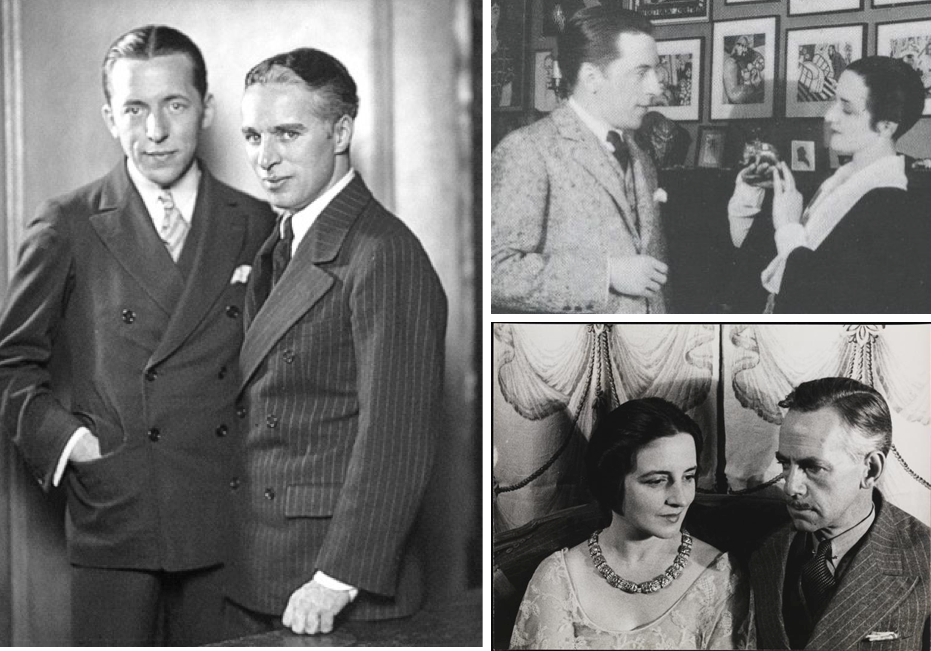
Like his good friend Charlie Chaplin, Ralph Barton wore a mask of a clown that hid a face of bitter anguish. Chaplin would cope, more or less. Barton would not.
March 16, 1929 cover by Rea Irvin.
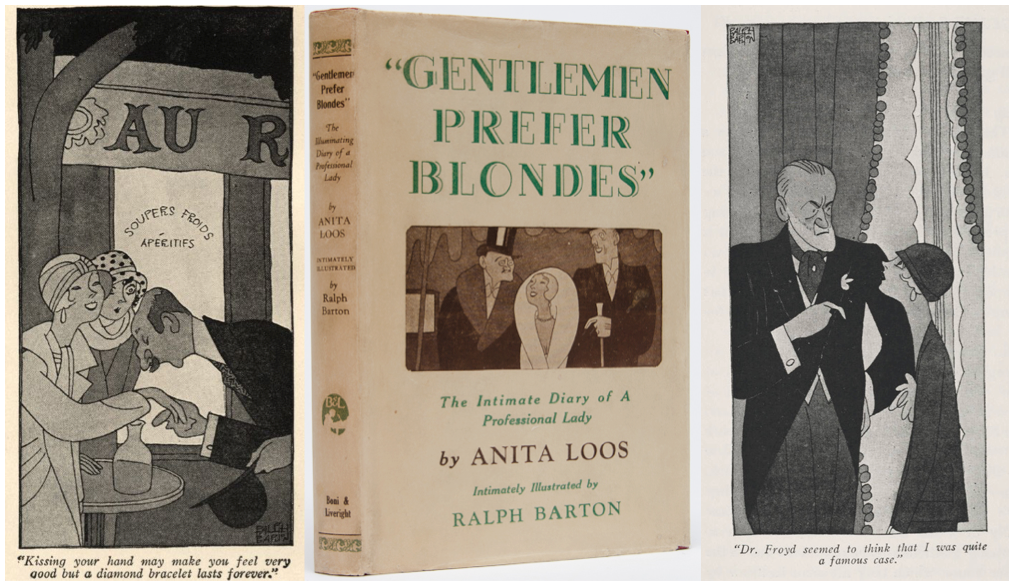
A member of the New Yorker gang from the very beginning, Barton served as the magazine’s advisory editor but more famously as a caricaturist of the Roaring Twenties, also contributing to the likes of Harper’s Bazaar, Collier’s, Vanity Fair and Judge. He also illustrated one of the most popular books of the Twenties, Anita Loos’ Gentlemen Prefer Blondes:
Images (left and right) from the book, Gentlemen Prefer Blonds.
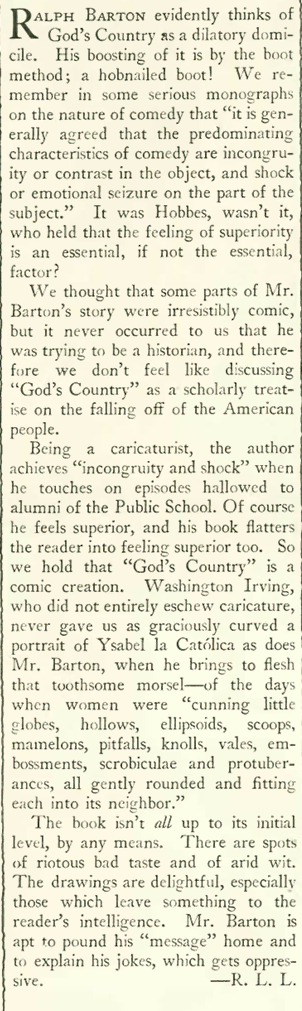
In 1929 Barton would publish a book of his own, God’s Country, which was reviewed in the March 16, 1929 edition of the New Yorker:
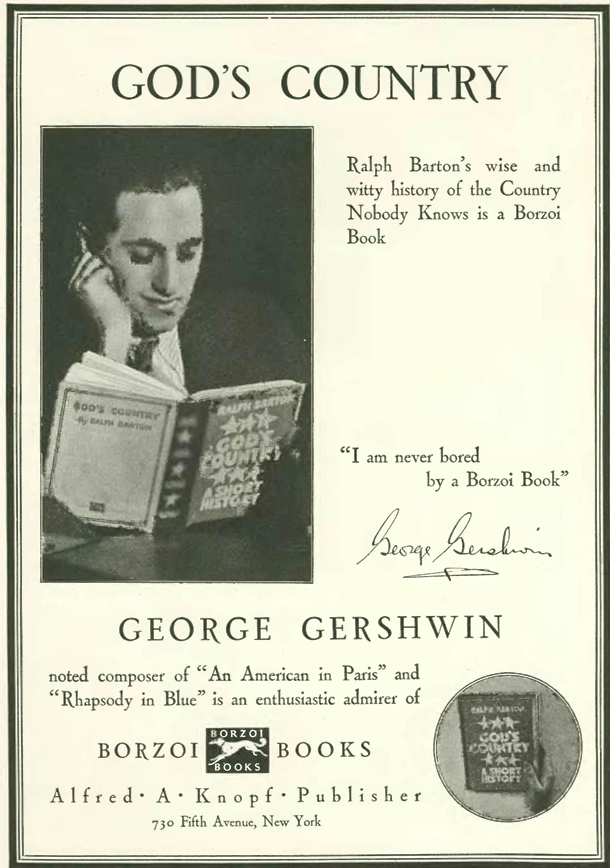
The same issue featured this advertisement from Knopf promoting God’s Country as the latest addition to its lovely Borzoi Books collection (and endorsed by composer and Barton friend George Gershwin)…
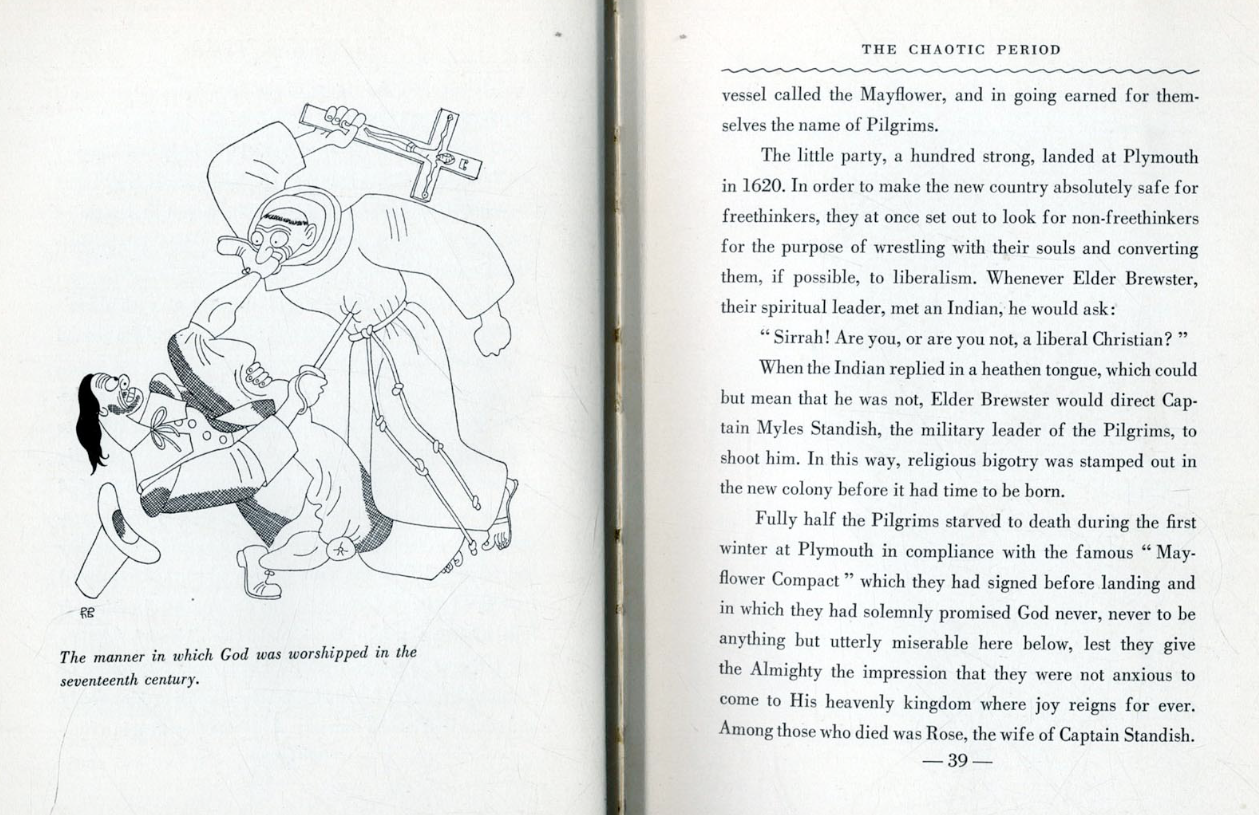
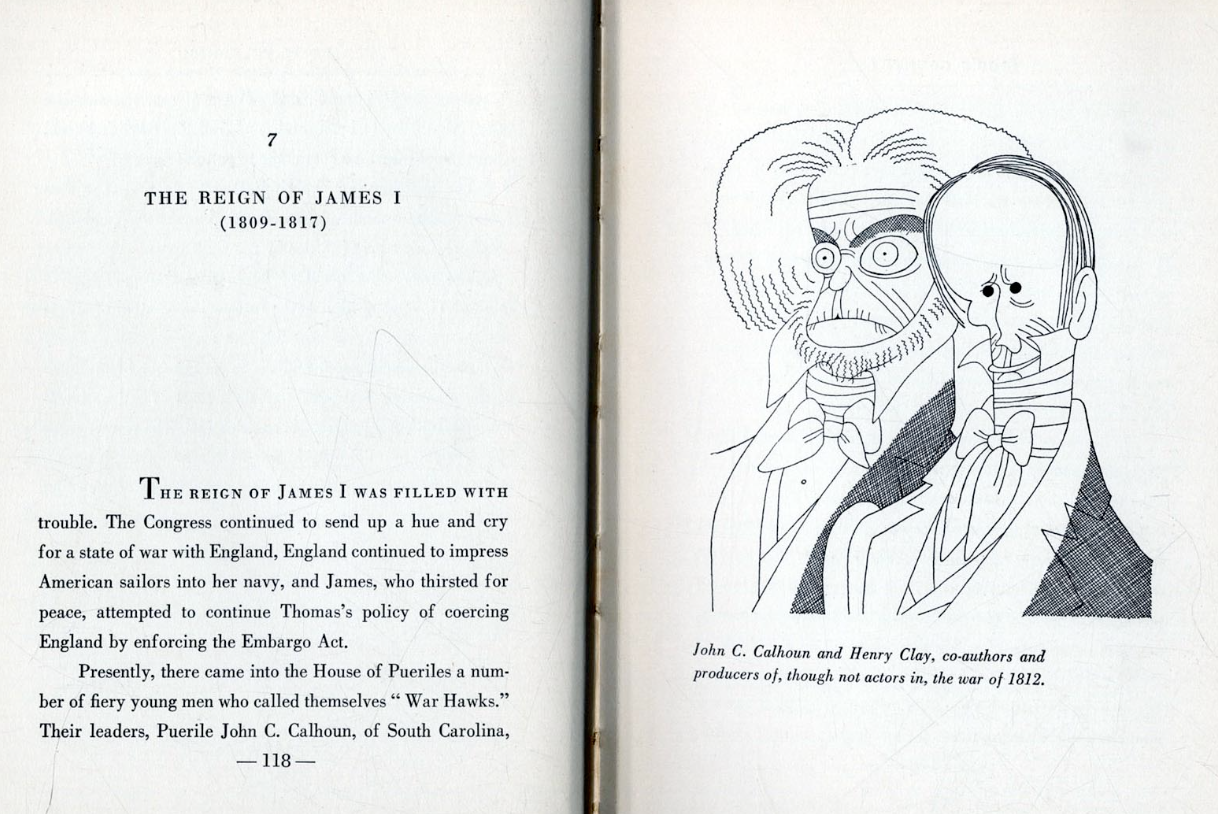
Some excerpts from the book…(click to enlarge)
(All images courtesy fulltable.com)
Barton was a longtime friend of Charlie Chaplin, even coming to the silent film star’s defense (in the pages of the July 23, 1927 New Yorker) when many Americans turned their backs on the comedian during a messy and much publicized divorce trial. In that New Yorker piece Barton concluded that France would be a better, more welcoming home to such an artist:
Clockwise, from left: Ralph Barton poses with his old friend Charlie Chaplin for photographer Nickolas Muray in 1927; Barton with wife Carlotta Monterey in the mid-1920s; Carl Van Vechten’s portrait of Monterey with husband Eugene O’Neill in 1933, two years after Barton’s death. (Mimi Muray/allstarpics.com/Museum of the City of New York)
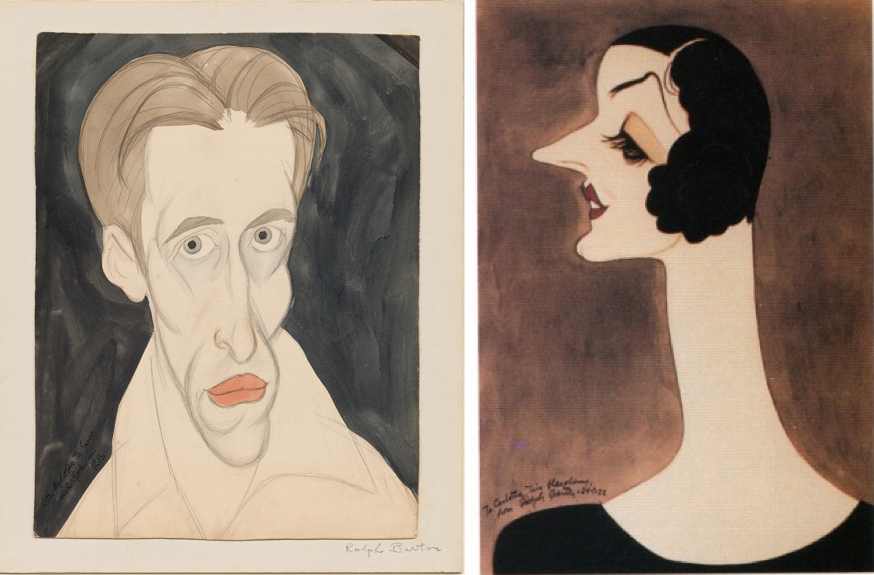
The manic-depressive Barton had his own problems in the love department, marrying four times in his short life, most famously to wife No. 3, stage and film actress Carlotta Monterey, who divorced Barton in 1926 and married playwright Eugene O’Neill in 1929. Although Barton would marry again, he would never recover from his loss of Monterey.
PORTRAIT IN ANGUISH…Ralph Barton self-portrait, 1925. At right, Barton’s portrait of his third wife, Carlotta Monterey, from 1922. In 1926 Barton wrote, “The human soul would be a hideous object if it were possible to lay it bare.” (National Portrait Gallery/Mimi Muray)
A little more than two years after publishing God’s Country—May 19, 1931—the 39-year-old Barton shot himself through the right temple in his East Midtown apartment. He referred to Carlotta Monterey in his suicide note, writing that he had lost the only woman he’d ever loved. He also wrote: “I have had few difficulties, many friends, great successes; I have gone from wife to wife and house to house, visited great countries of the world—but I am fed up with inventing devices to fill up twenty-four hours of the day.”
As the exuberance of the Jazz Age faded into the Depression, so did Barton’s reputation as a chronicler of that age. An abstract for the 1998 Library of Congress exhibition Caricature and Cartoon in Twentieth-Century America notes that “in a good week he (Barton) could make $1,500 (about $22,000 today) but a couple of years after his early death his caricature of George Gershwin sold for $5.”
The last caricature Barton ever drew was of his old friend, Charlie Chaplin.
Note: I took the title of this blog entry from a 1991 book on the life of Ralph Barton: The Last Dandy, Ralph Barton, American Artist, 1891-1931, by Bruce Keller.
Babbitt Babble
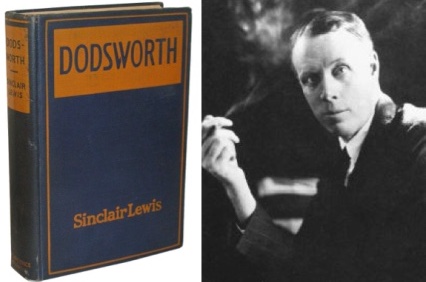
Preceding the review of Barton’s book in the March 16 New Yorker was this much less complimentary review of Sinclair Lewis’s latest effort, Dodsworth, a story in the tradition of Henry James about wealthy middle-class Americans on a grand tour of Europe.
The task of skewering Lewis and his book fell to Dorothy Parker, who would never mistake Lewis for Henry James: ““I can not, with the slightest sureness, tell you if it (Dodsworth) will sweep the country, like ‘Main Street,’ or bring forth yards of printed praise…My guess would be that it will not. Other guesses which I have made in the past half-year have been that Al Smith would carry New York state, that St. John Ervine would be a great dramatic critic for an American newspaper, and that I would have more than twenty-six dollars in the bank on March 1st. So you see my my confidence in my judgment is scarcely what it used to be.”
NOT UP TO SNUFF…Sinclair Lewis, circa 1930s. (Library of Congress)
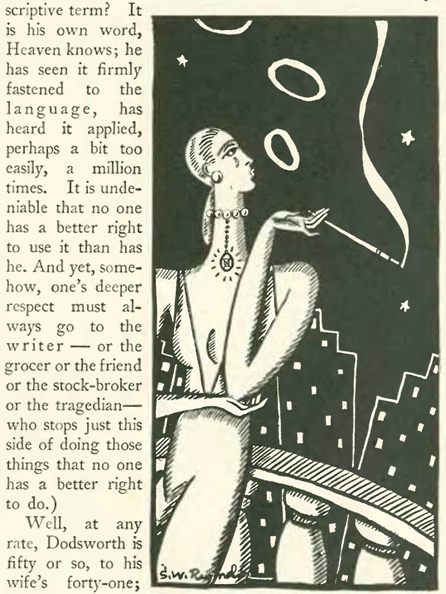
Parker took particular umbrage at Lewis’s use of the name of a character from another book as a descriptive term for his latest:
Parker concluded that if a reader could wade through the book’s cluttered language and “grotesquely over-drawn figures,” there was a conclusion that was perhaps worth pursuing…
…the New Yorker was never afraid to bite the hand that fed it (except Raoul Fleischmann’s, whose money saved the magazine from an early death), so even though its author was savaged on the opposite page, Dodsworth’s publisher Harcourt still sprung for an ad:
* * *
This Geometric Life
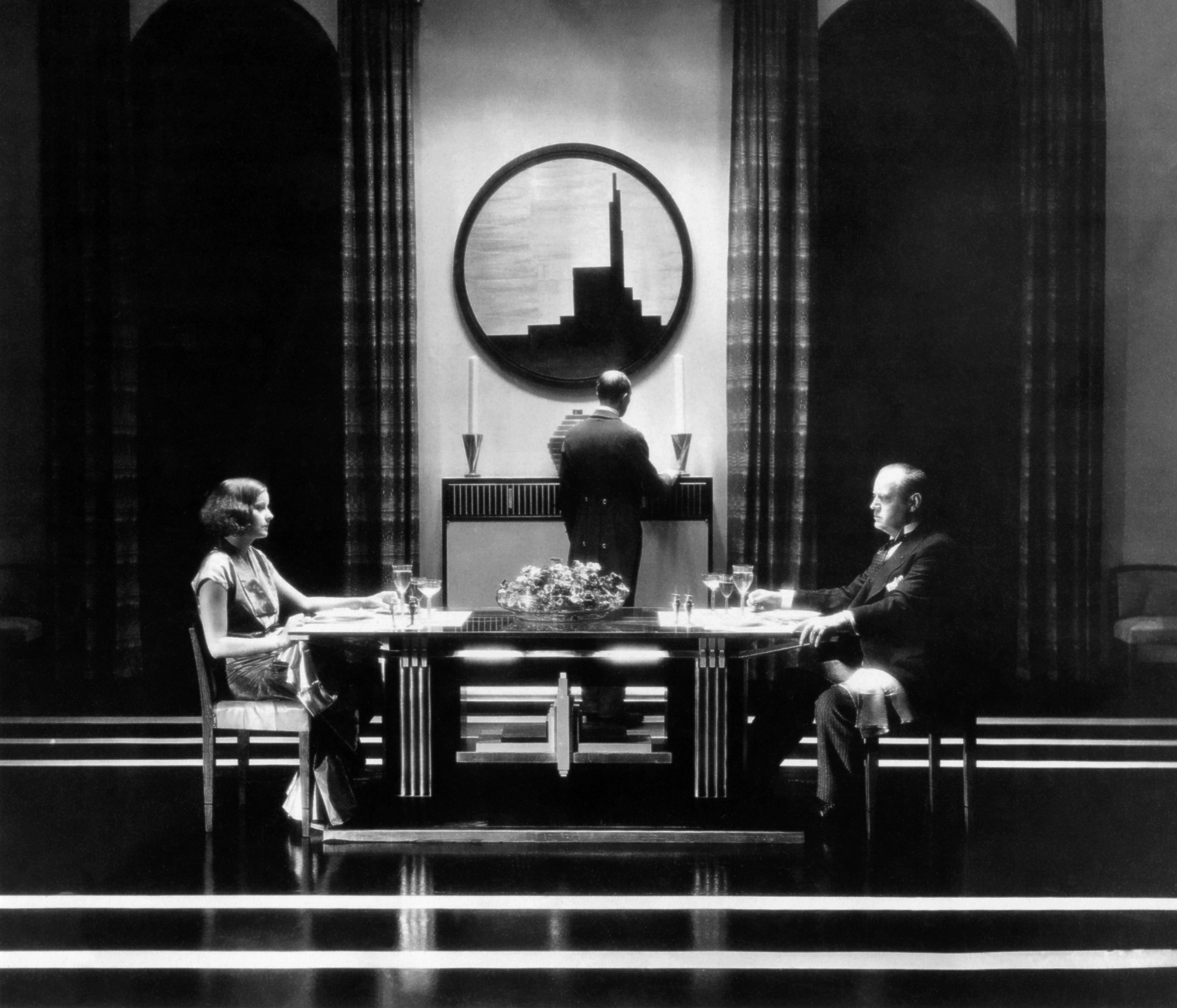
The author of the March 16, 1929 “Comment” (Leading item of “The Talk of the Town”) found the “geometric life” dictated by modern design took some getting used to. This entry was most likely written by E.B. White:
DARLING, YOU SEEM RATHER COLD…Greta Garbo and Anders Randolf break bread amid the angular lines of an art deco dining room in the 1929 film The Kiss, set design by Cedric Gibbons. (pinterest.co.uk)
* * *
Mexican Firecracker
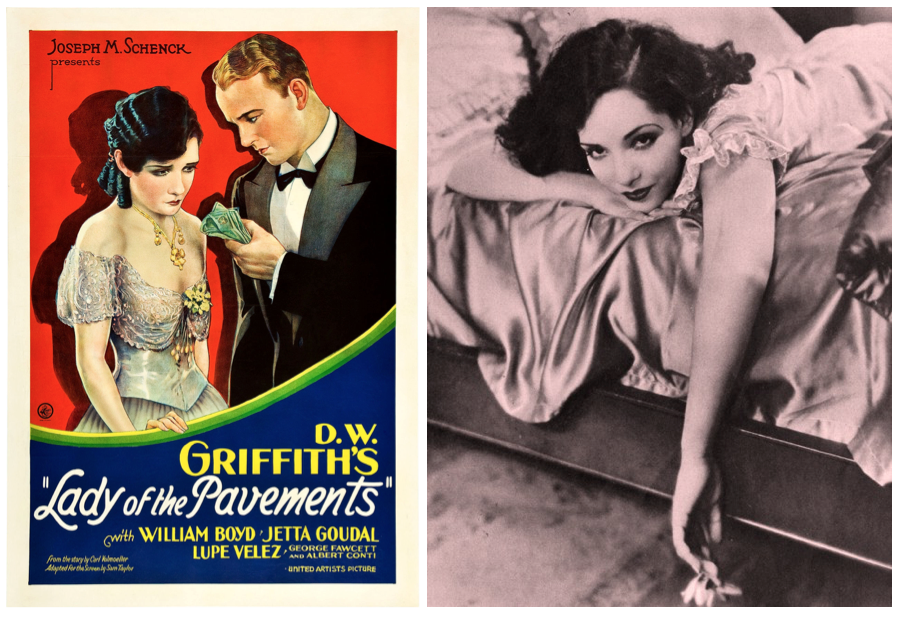
Mexican actress and emerging star Lupe Velez caught the eye, and ear, of the New Yorker in her latest film, Lady of the Pavements…
DUBBED THE ‘MEXICAN FIRECRACKER,’ Lupe Velez emerged as a star at the advent of sound motion pictures. Theatrical release poster, left, and Velez in a scene from D.W. Griffith’s 1929 film, Lady Of The Pavements. (Wikipedia/moviessilently.com)
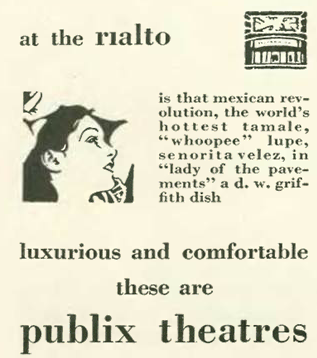
An ad in the same issue of the New Yorker touted the film’s appearance at Public Theaters, a chain owned by Paramount:
Well-known for her explosive screen presence, Velez was big star in the 1930s. Married to Tarzan actor Johnny Weissmuller from 1933 to 1939, her star began to fade at the end of the decade. She died of a drug overdose in 1944, just 36 years of age.
* * *
From Our Advertisers
A few advertisements that caught my eye from the March 16 issue…one thing you notice is the emerging sophistication of advertising techniques, including this ad for Resilio Cravats that enticed by deliberating not showing the product…
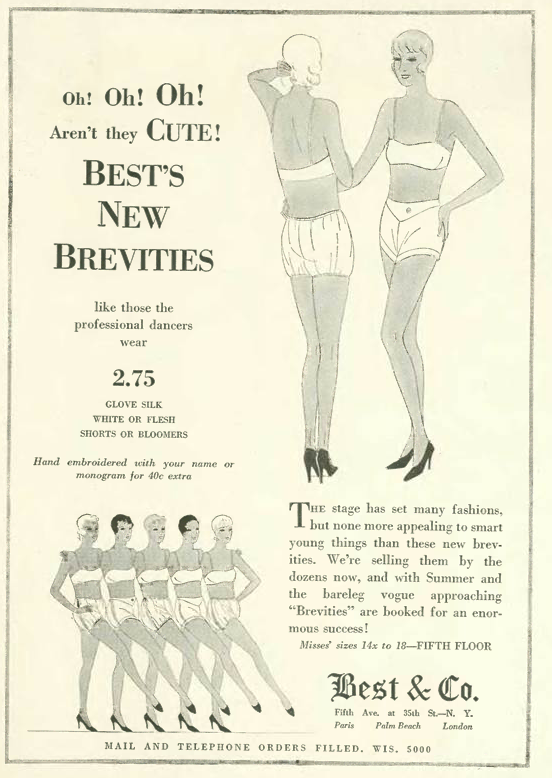
…and this ad that demonstrated Best & Co. was not shy at all to show women in their skivvies (or suggest that they could wear the same undergarments as a Follies performer)…
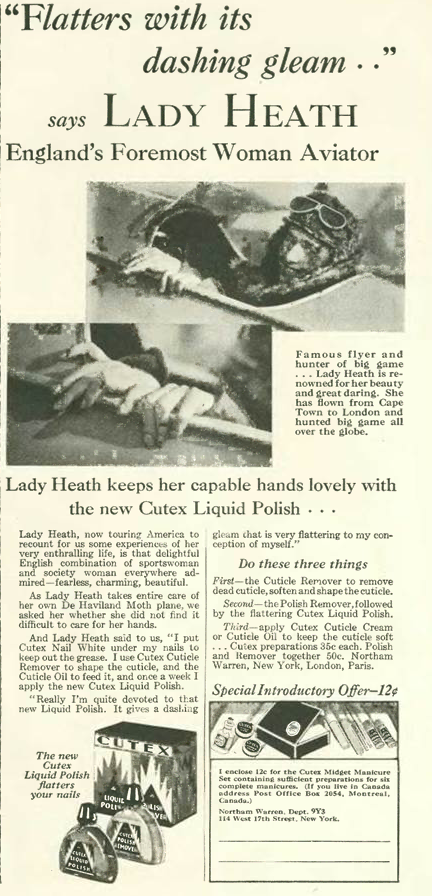
…and then we have this strange ad for Cutex nail polish, with an endorsement by Sophie Peirce-Evans, later known as Mary, Lady Heath, a well-know aviatrix (dubbed “Lady Icarus”) of the 1920s who shared headlines with Amelia Earhart for her high-flying derring-do. The close-up shot of the hands is priceless…
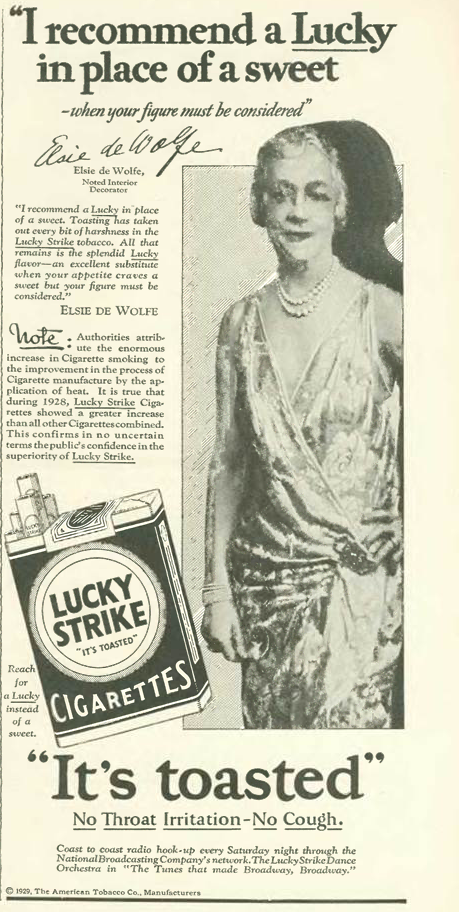
…and then we have another celebrity endorsement of a cigarette by a society figure—interior designer and social maven Elsie de Wolfe, who was also known as Lady Mendl…
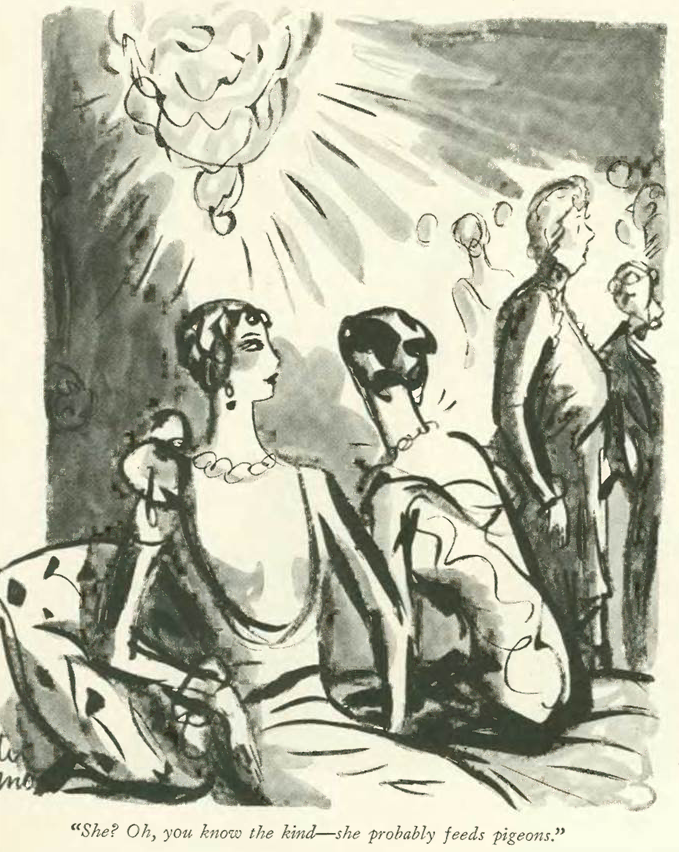
…and on to the cartoons…Peter Arno listened in on two young debutantes sizing up a dowager at a society gathering…
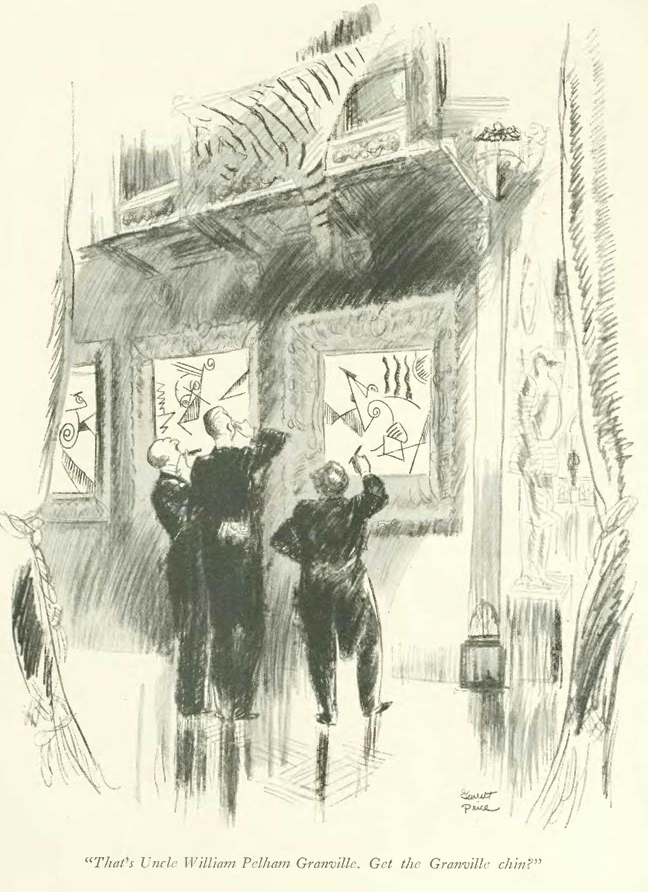
…while Garrett Price looked in on well-heeled visitors to the Metropolitan Museum of Art contemplating what appears to be the work of W.A. Dwiggins in the museum’s The Architect & the Industrial Arts exhibition…
A defining moment for Art Deco design in America occurred at New York’s Metropolitan Museum of Art during a 1929 exhibition that showcased everything from household furnishings to garden design.
March 9, 1929 cover by Theodore Haupt. Between 1927 and 1933, Haupt would illustrate 45 covers for the New Yorker.
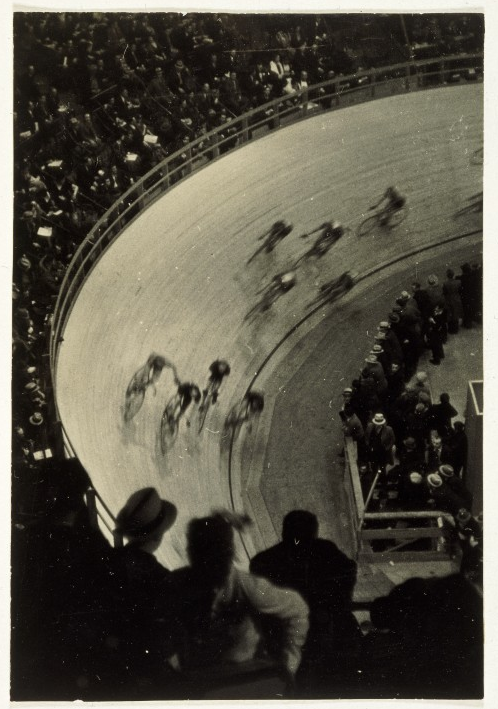
Before we delve into the Met’s exhibition, The Architect and the Industrial Arts, a quick note about the New Yorker’sTheodore Haupt-illustrated cover, which referenced the annual Six-Day Cycling Race that was taking place at the Madison Square Garden Velodrome. The event, which began at the old Madison Square Garden in 1891 and lasted until 1950, featured a beer garden (after Prohibition) in the center of the oval and drew such celebrities as Bing Crosby, Barbara Stanwyck and Peggy Joyce. It was said that Crosby even paid the hospital bills of riders who fell during the race.
THIS MIGHT TAKE AWHILE…The Six-Day Cycling Race at the Madison Square Garden Velodrome, 1932. (Victoria & Albert Museum)
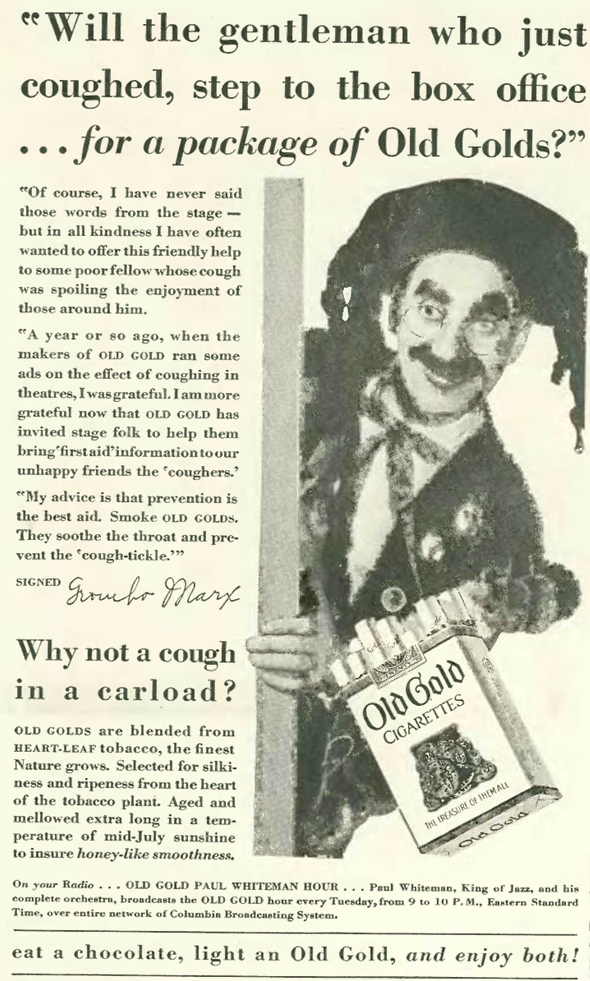
The March 9 issue was lively with another contribution from Groucho Marx (“Press Agents I Have Known”) and an Alexander Woollcott-penned profile of playwright and screenwriter Charles Gordon MacArthur (husband of stage actress Helen Hayes and father of James “Book ’em Danno” MacArthur).
But as the blog title suggests, it was also filled with articles and ads that told of a city embracing all things new and modern, including a piece by architecture critic George S. Chappell on the Metropolitan Museum of Art’s eleventh Exhibition of Contemporary American Design, titled The Architect and the Industrial Arts. It was curated by the Met’s Richard F. Bach, who organized 15 annual exhibitions of contemporary industrial art at the museum between 1917 and 1940.
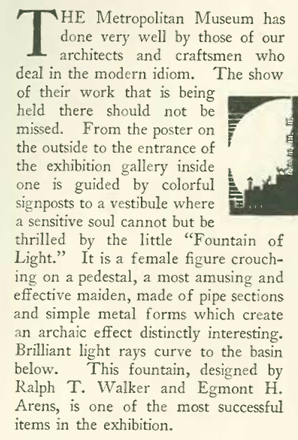
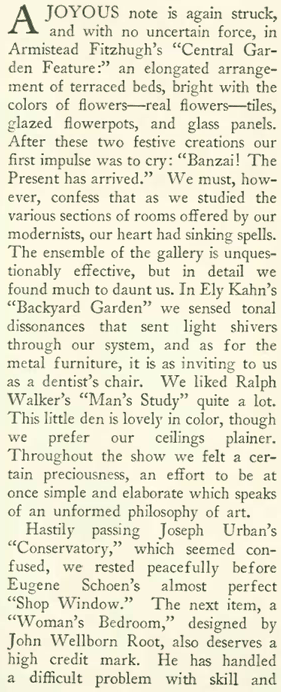
The 1929 exhibition of Art Deco works was the biggest yet, inspired by the Art Moderne movement in Europe and particularly the 1925 Paris Exposition International des Arts Decoratifs et Industriels). The Met exhibition, wrote Chappell, “should not be missed”…
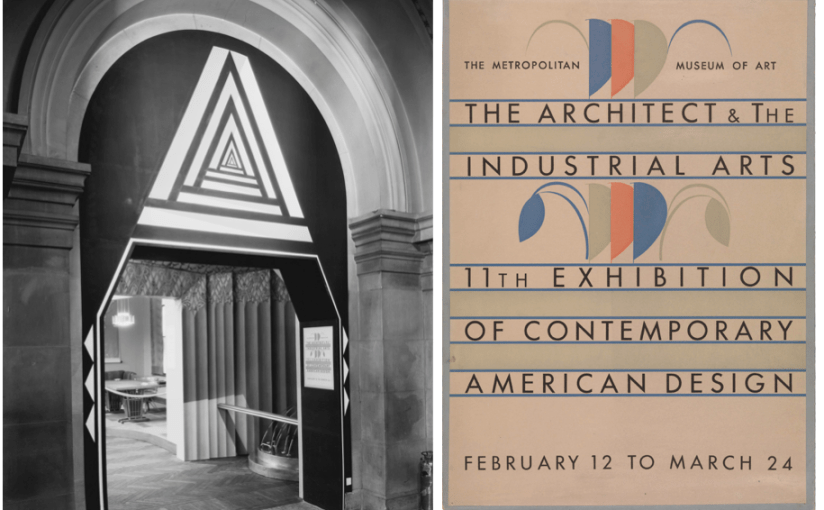
PORTAL TO THE FUTURE…Entrance to The Architect & the Industrial Arts exhibition at The Metropolitan Museum of Art, designed by Joseph Urban. The above exhibition poster (seen mounted on the doorway in the photo) was by W.A. Dwiggins. (Metropolitan Museum of Art)Ornaments created by W.A. Diggins for the exhibition catalogue included, from left, “Conservatory,” for a section on Joseph Urban; ornament on a page devoted to curator Richard F. Bach; “Backyard Garden” for a section on Ely Jacques Kahn; and an ornament that graced the acknowledgements page. (Metropolitan Museum of Art, via paulshawletterdesign.com)NOT YOUR GRANDMOTHER’S GARDEN…Mosaic semi-circular bench designed by Austin Purves, Jr. was featured in architect Ely Jacques Kahn’s “Backyard Garden” display by at the The Architect & the Industrial Arts exhibition at the Metropolitan Museum of Art. (Pencil Points Magazine, January 1929)
Chappell found the exhibit to be “stimulating,” although he hoped designers in the future would “curb cleverness” and focus more on fundamentals:
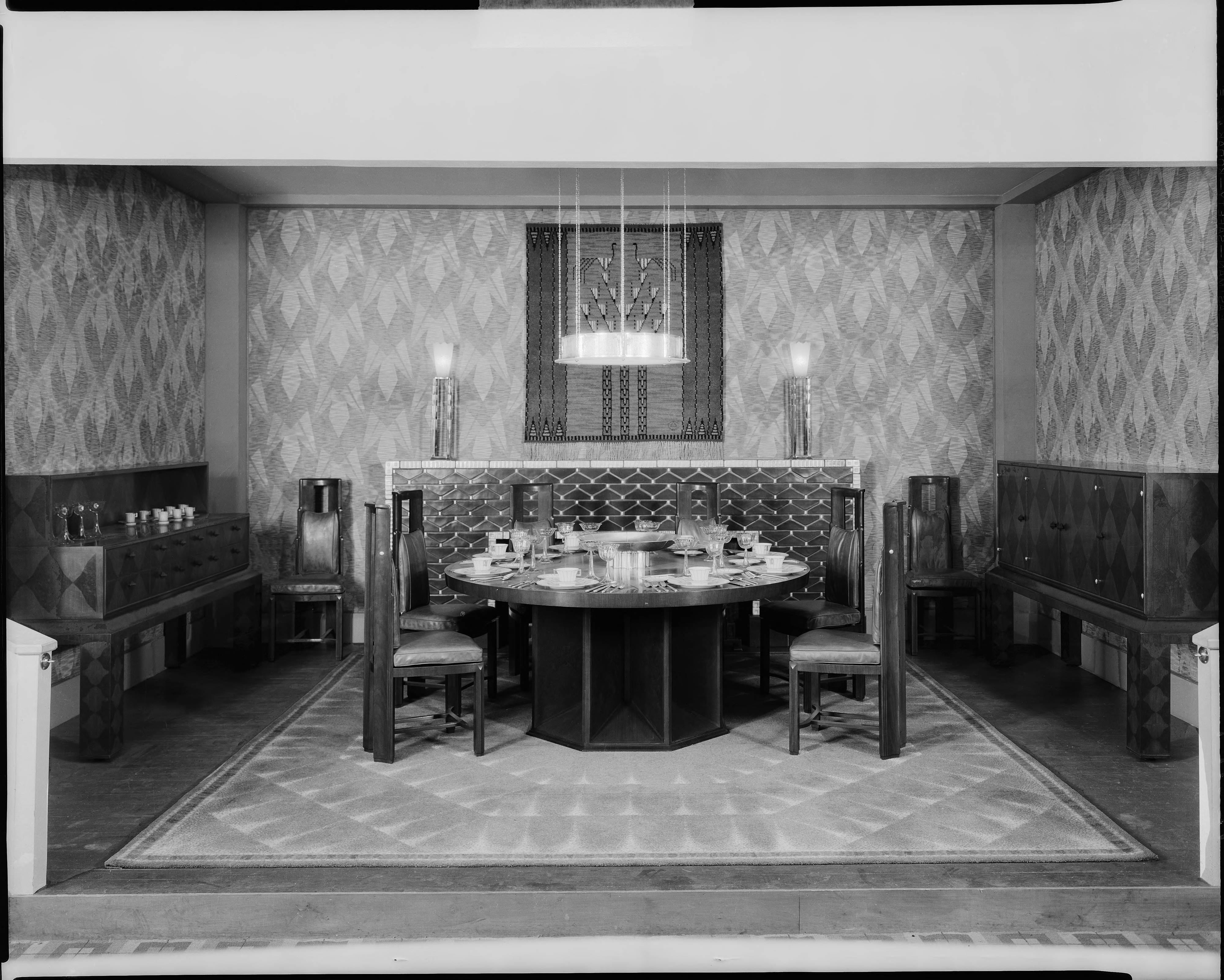
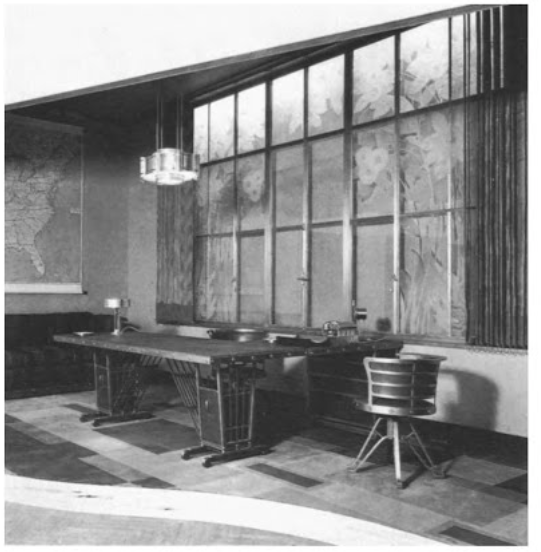
DINING IN STYLE…A dining room designed by Finnish architect Eliel Saarinen for The Architect and the Industrial Arts exhibition at the Metropolitan Museum of Art. (Metropolitan Museum of Art)VISIONARIES…The Cooperating Committee for 1929 The Architect and the Industrial Arts exhibition were, standing, left to right, architects Raymond Hood, Eugene Schoen and Ely Jacques Kahn. Seated, left to right, architects Ralph T. Walker, John Wellborn Root, Jr. and Eliel Saarinen; ceramist, painter and graphic artist Leon V. Solon; and architect, illustrator and scenic designer Joseph Urban. (Metropolitan Museum of Art)COZY…Ralph Walker’s “Man’s Study for a Country House” at the The Architect and the Industrial Arts exhibition. (architectsandartisans.com)ALL BUSINESS…Raymond Hood’s “Business Executive’s Office” featured at The Architect and the Industrial Arts exhibition. (Metropolitan Museum of Art)
Writing in the February 1929 Bulletin of the Metropolitan Museum of Art, curator Richard S. Bach posed bold questions for this new age: “What is the tempo of our day? What are the dominant elements of our culture, our activities, our thinking? Is this a speed age or are we sedate? Have we time to be dignified and stately about frills or are we air-minded? Do we wait for months, as once all did, for the silkworm to complete his labors before beginning to make thread from his cocoon…or (do we) make a few bales of vegetable silk out of chemically treated wood fiber between breakfast and lunch as a regular chore of a business week-day? And is this the mechanistic millennium which shrivels the soul and makes mockery of imagination, or are these fabulous industries, these automatic instruments of production, the means of bringing within range of vision the real potentialities of our crowded lives and of interpreting our aspirations and achievements?
Pumping Iron Into the Sky
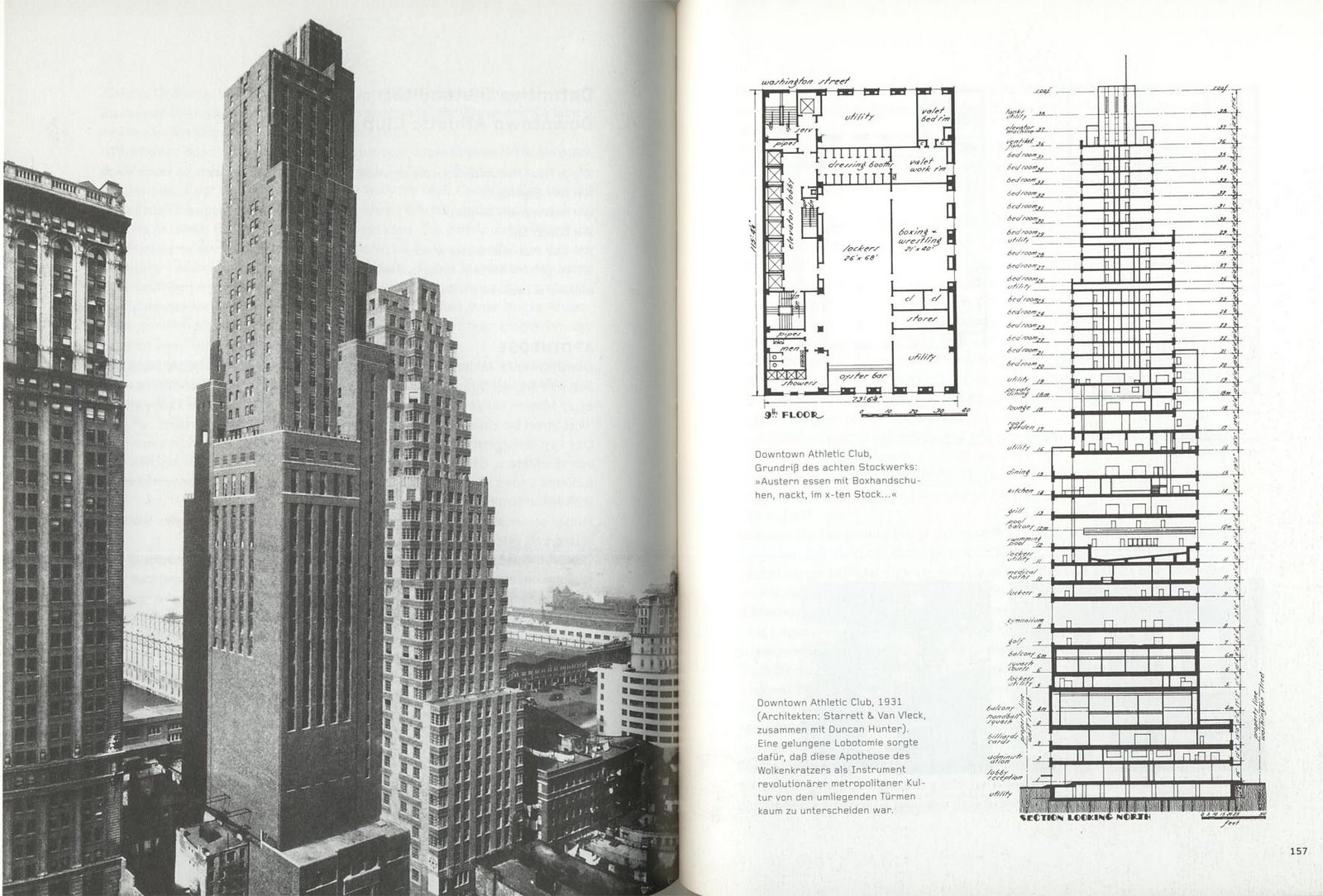
The architecture firm Starrett & van Vleck saw the “real potentialities of our crowded lives” when they designed a new Art Deco skyscraper to house the Downtown Athletic Club. Writing in Lost City News, Mary Hohlt cites the architect Rem Koolhaas, who sees the Downtown Athletic Club as “the ideal of a hyper-reality in the burgeoning urban form of hyper-density and congestion.” The Club is “the everything-at-your-fingertips self-improvement incubator for men…It is a place for men to indulge on self-improvement; to better themselves in a place only the constructed, hyper-reality of Manhattan can provide.”
SELF-IMPROVEMENT INCUBATOR…the Downtown Athletic Club by Starrett & van Vleck, 1930. (4.bp.blogspot.com) click to enlarge
Hohlt writes that Koolhaas sees the Downtown Athletic Club as a sterile place: “Towering in the sky, the Club removes men from the rest of the world and allows them a kind of aesthetic improvement that cannot be passed on.” E.B. White took a less jaded view in this “Talk of the Town” segment:
STILL A WINNER…Famous for serving as the site of the annual awarding of the Heisman Trophy, the Downtown Athletic Club closed in 2001 following the 9/11 attacks. The club was within a “frozen zone” closed to the public during the long clean-up that followed, and could not withstand the financial impact of such a long closure. It reopened in 2005 as a residential tower. (newyorkitecture.com)
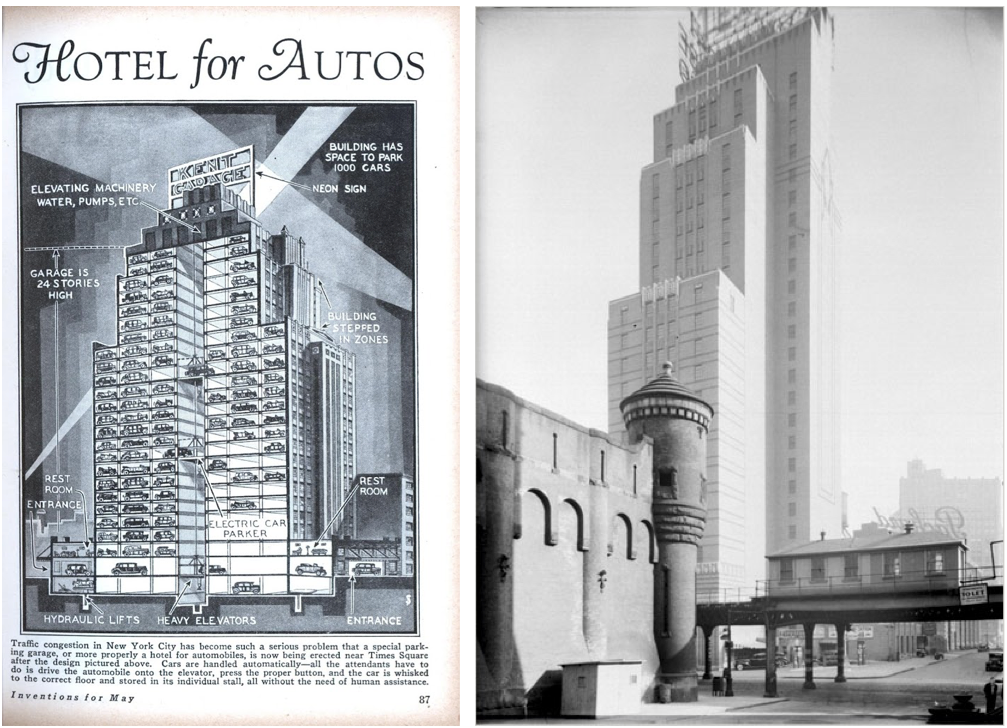
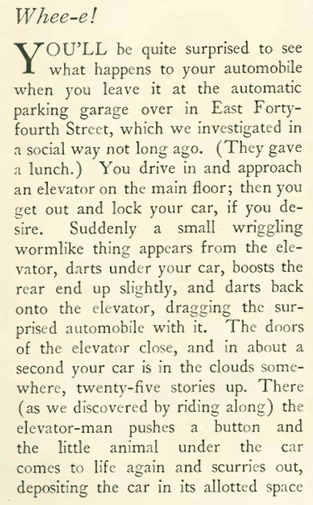
Another New Yorker who saw the “real potentialities of our crowded lives” was insurance salesman Milton A. Kent, who in 1928-29 erected a brick and terra-cotta Art Deco tower that could park 1,000 cars using an automatic elevator system.
MONUMENT TO THE CAR…The May 1928 issue of Modern Mechanix featured this cutaway illustration of Milton Kent’s high-rise, automated parking garage. (boweryboyshistory.com) click image to enlarge
Once again E.B. White was on hand to render this observation for “Talk”…
HUMAN SCALE…Kent’s fantastic garage still stands at West 61st Street, but today it serves as—you guessed it—an apartment building. (boweryboyshistory.com)
* * *
Death of a Can-Can Dancer
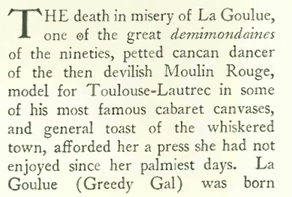
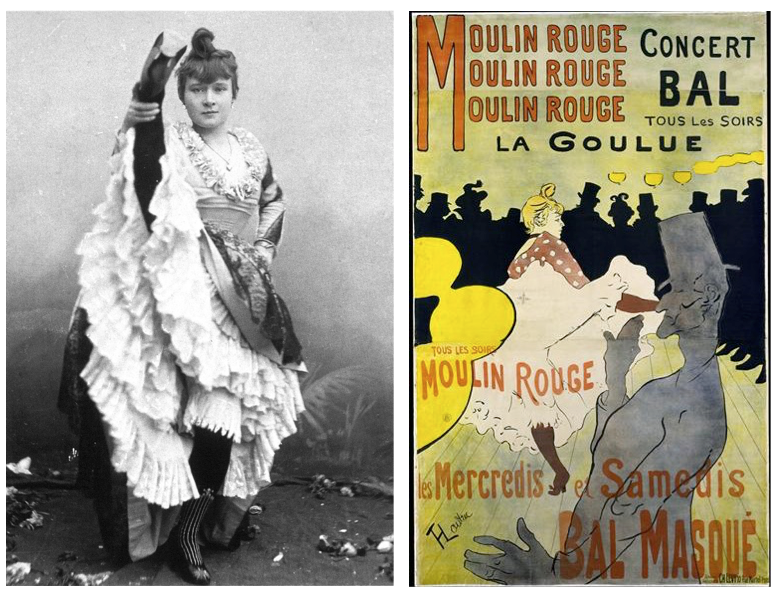
The sad death of Louise Weber, aka La Goulue, was announced in Janet Flanner’s “Letter from Paris” column. Weber was a can-can dancer at the Moulin Rouge in Paris and a model for some of Henri de Toulouse-Lautrec’s most famous cabaret paintings. Flanner wrote of La Goulue’s rise to fame…
JUST FOR KICKS… Louise Weber, aka La Goulue, circa 1890, and an 1891 poster by Toulouse-Lautrec advertising the performers La Goulue and “No-Bones” Valentin at the new Paris dance hall Moulin Rouge. (Wikipedia)
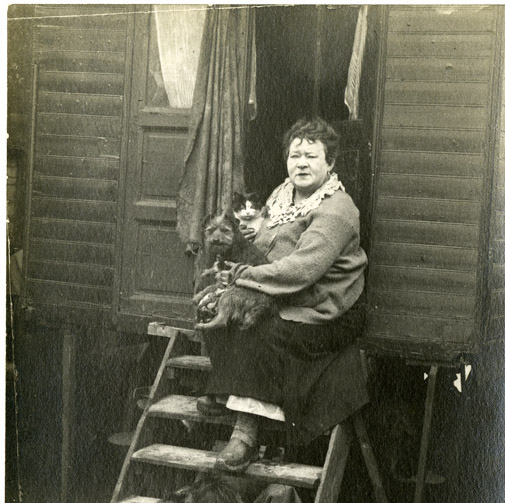
…and her sad downfall into a life of poverty among the rag-pickers:
SAD DECLINE…La Goulue, her face freshly powdered, sat on the steps of her small trailer for an unknown postcard photographer in the 1920s. This image is a detail of the original photograph, held at the Wheaton College Permanent Collection.
* * *
From Our Advertisers
An advertisement on page 45 for Mohawk carpets featured two Cockney charwomen admiring the new carpets at the General Motors headquarters:
A corresponding note: Shreve & Lamb’s 1927 General Motors Building was the hub of Columbus Circle’s Automobile Row. A hideous 2012 remodel, which clad the entire structure in reflective glass, has rendered the former landmark unrecognizable:
Museum of the City of New York/nyc-architecture.com
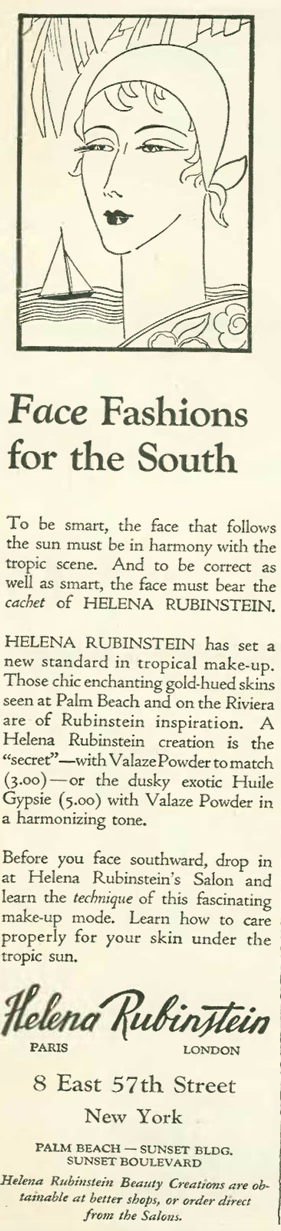
Getting back to all things “moderne,” these facing ads on pages 8-9 offered some new looks for spring…
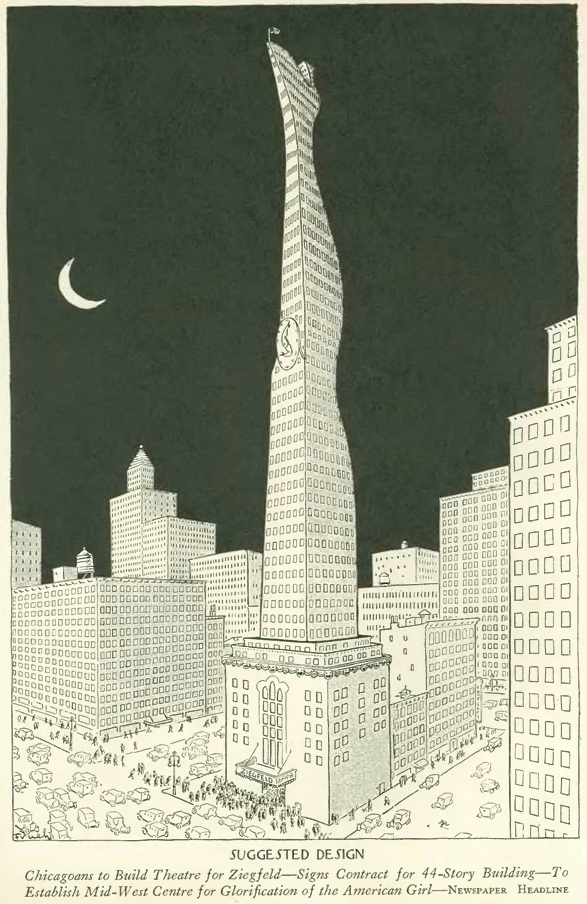
…and in the cartoons, a tongue-in-cheek vision of a modern high-rise by Al Frueh, prompted by the news that Florenz Ziegfeld planned to build a 44-story building in his native Chicago. Thanks to the market crash later in the year, it was never realized.
In drawings sprinkled across pages 24-25, Helen Hokinson examined various approaches to tax season, including these two examples…
…and finally, Peter Arno caught a theatre performer with his pants down…
Our sense of what is old and what it is new becomes skewed during periods of rapid change, and such was the case in 1920s New York when large swaths of the old city were swept away and replaced by massive towers that seemingly rose overnight. Places like the Hippodrome Theatre, a 1905 Beaux-Arts confection barely 24 years old, seemed positively ancient in those heady times.
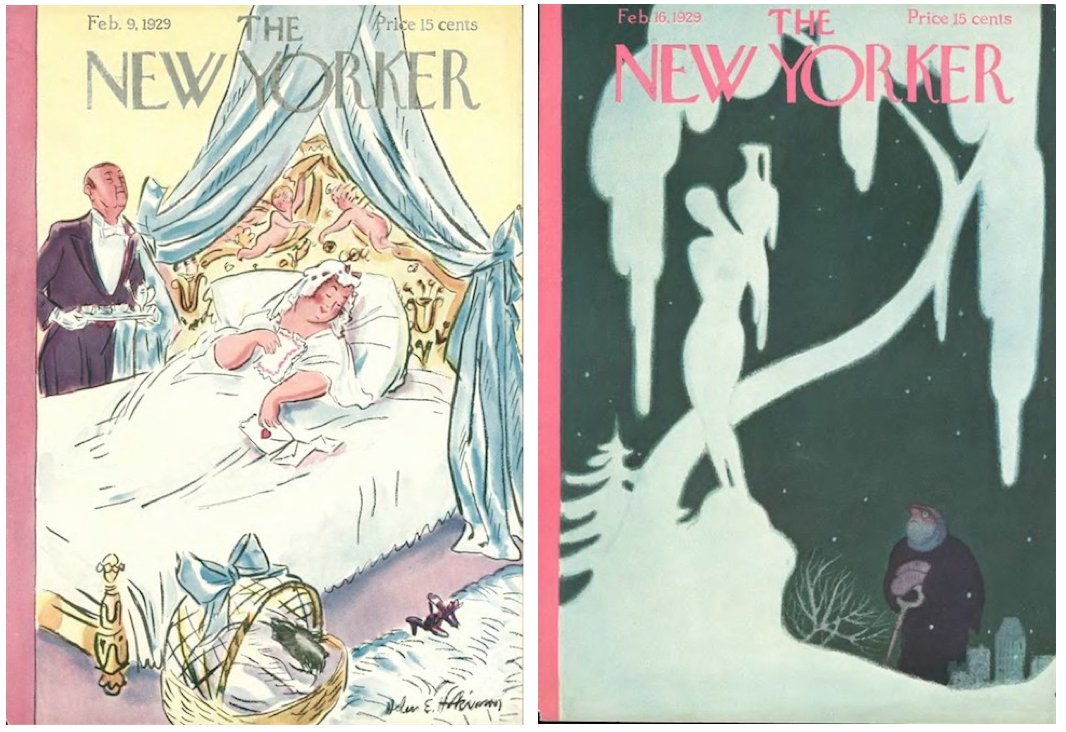
Feb. 9, 1929 cover by Helen Hokinson. Feb. 16, 1929 cover by Rea Irvin.
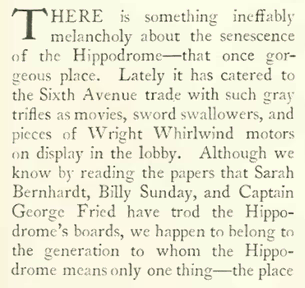
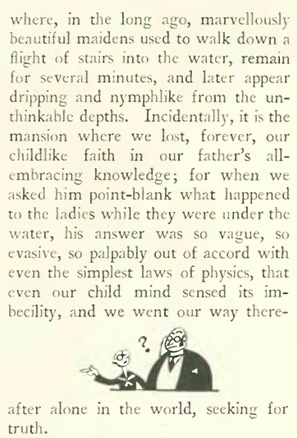
For the most part the New Yorker was enthusiastic about the changing skyline, as its namesake was claiming the crown as America’s premier city; but occasionally a melancholy note would be struck when a familiar institution appeared in decline or fated for the wrecking ball. In the Feb. 9, 1929 “Talk of the Town,” E.B. White wistfully recalled the old days of the Hippodrome, once the largest theatre in the world and the pride of turn-of-the-century New York:
FOR THE MASSES…The Hippodrome, built in 1905, provided entertainment to millions of New Yorkers who couldn’t afford a ticket to a Broadway play. The brainchild of Frederick Thompson and Elmer S. Dundy, entrepreneurs of Coney Island’s Luna Park, the Hippodrome was torn down in 1939 after more than a decade of decline. (1905 photo courtesy Library of Congress)A REALLY BIG SHOOO…One of the first performances at the Hippodrome was a four-hour spectacle: A Yankee Circus on Mars (advertised on the theatre’s marquee in photo above). The 1905 production included 280 chorus girls, 480 soldiers, a parade of cars driven by elephants, an equestrienne ballet, acrobats, and a cavalry charge through a lake. (Image from Harper’s Weekly via daytoninmanhattan.blogspot.com)The Hippodrome’s main theatre could accommodate 5,300 patrons in seats that were four inches wider than normal theatre seats. The dome over the “Roman style” auditorium encompassed an acre. (Broadway Magazine 1905 via daytoninmanhattan.blogspot.com)
The Hippodrome held such a place in the heart of the New Yorker that the magazine offered further reminiscences in the Feb. 16 issue, this time penned by managing editor Harold Ross:
For demonstrations of diving and “mermaid spectacles,” the Hippodrome stage featured an eight-foot high steel tank in four sections, with a front of plate glass. Manned diving bells were also used to raise and lower “mermaids” during performances.
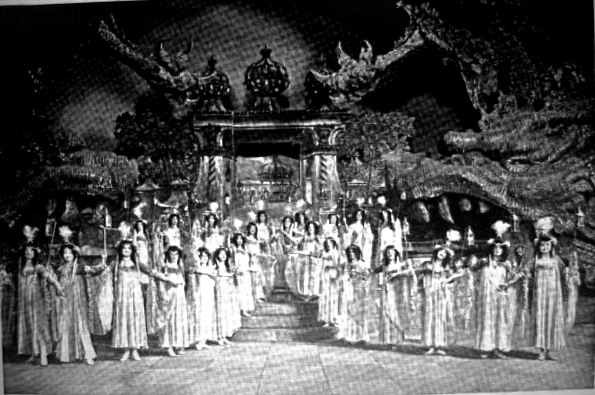
OLD TIMEY FX…Illustration from Nature magazine (left) depicts a diving bell used in the Hippodrome’s swimming and diving tank to raise and lower performers. At top, circa 1910 advertisement; at bottom, the “Court of the Golden Fountain” in the the theatre’s 1905-06 presentation of A Society Circus. (les-sources-du-nil.tumblr.com/flickr/NYC Architecture)
Ross wrote about the Hippodrome’s “diving girls,” who would dive into a tank of water from a height of 90 feet, sometimes at a serious cost to their health:
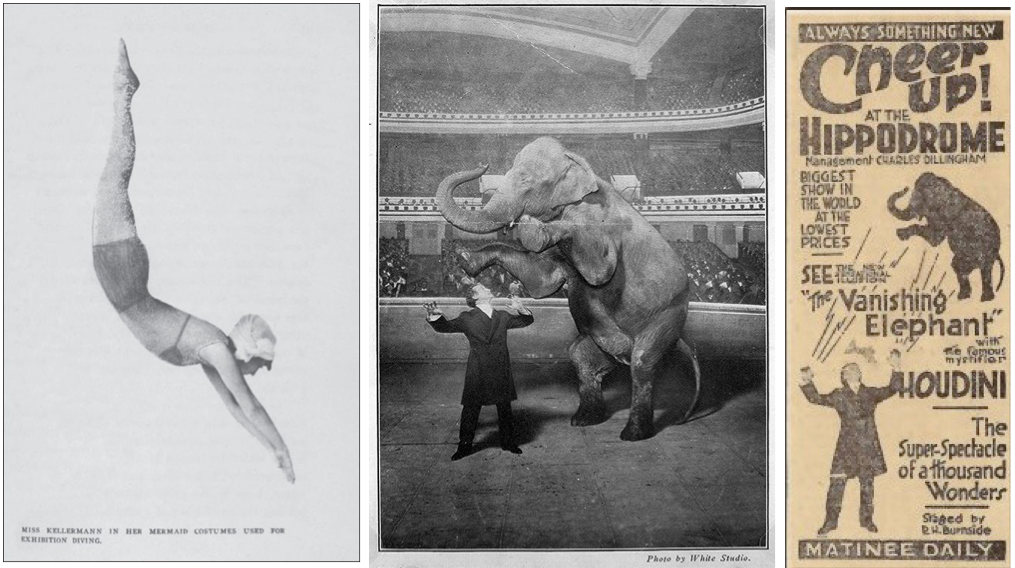
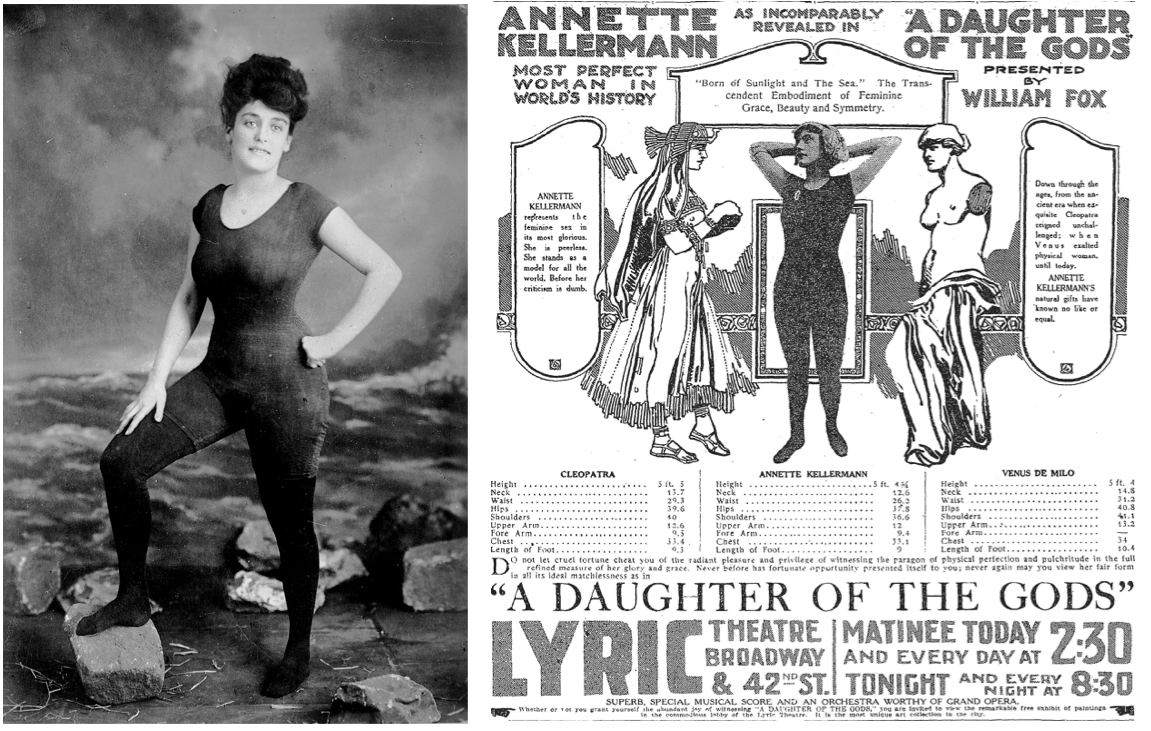
HIPPODROME’S HEYDAYS…In the early 1900s Australian swimmer and diver Annette Kellerman (left, in an image from her 1918 book, How to Swim) was a famed performer at the Hippodrome, as was illusionist and stunt performer Harry Houdini, shown here in 1918 with Jennie the Elephant in a performance of the vanishing elephant trick. (Monash University/americaslibrary.gov/wildabouthoudini.com)MILLION DOLLAR MERMAID…famed around the world by that moniker, swimmer and later actress Annette Kellerman is considered the originator of the one‐piece bathing suit, which she models at left in a photo taken around 1907. At right, advertisement for Kellerman’s 1916 film A Daughter of the Gods (now lost), in which Kellerman achieved another first: the first complete nude scene by a major star. The William Fox Studio made much of Kellerman’s figure, promoting her as the perfect woman by “comparing” her measurements to the likes of Cleopatra and Venus de Milo. (Wikipedia/consumingcultures.net)
Australian swimmer Annette Kellerman was a big draw at the Hippodrome, and helped popularize the sport of synchronised swimming after her 1907 performance of the first water ballet in theatre’s giant plate glass tank. In that same year she shocked Bostonians by appearing on a local beach in a “daring” one‐piece bathing suit (shown above), and was arrested for indecency. This was at a time when a woman’s standard bathing apparel consisted of a blouse, skirt, stockings and swimming shoes.
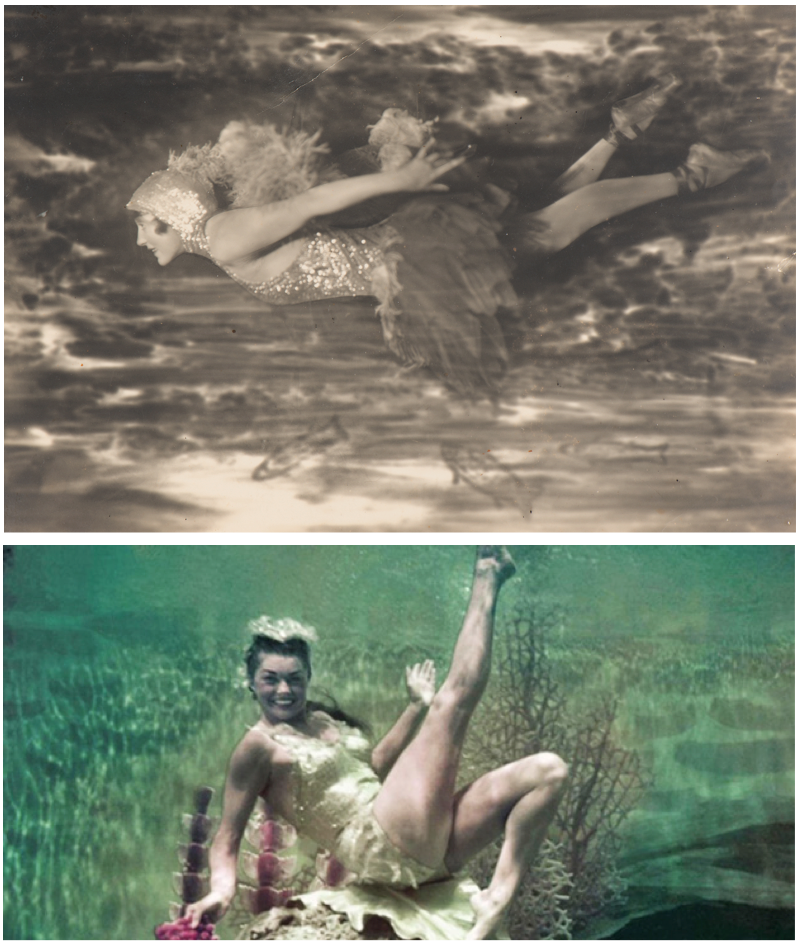
Unlike some of the unfortunate Hippodrome divers who later lost their eyesight due to cranial pressure from high dives, Kellerman went on to a long and active life (she died in 1975, at age 88). Known throughout the world as Australia’s “Million Dollar Mermaid” (and portrayed by Esther Williams in a 1952 movie by the same name), Kellerman appeared in more than a dozen films between 1909 and 1924. She also launched her own line of swimwear and wrote several books on swimming, beauty and fitness.
ALL WET…At top, Annette Kellerman swimming underwater in a gold sequined dress, possibly from Queen of the Sea (1918, now lost). Thirty-four years later Esther Williams (below) would portray Kellerman in Million Dollar Mermaid. (historycouncilnsw.org.au/gsgs/movieactors.com)
* * *
City of Lights
While E.B. White got misty-eyed about the old Hippodrome in the Feb. 9 issue, his fellow New Yorker writer and friend James Thurber was thrilling on the new skyscrapers lighting the city’s skyline:
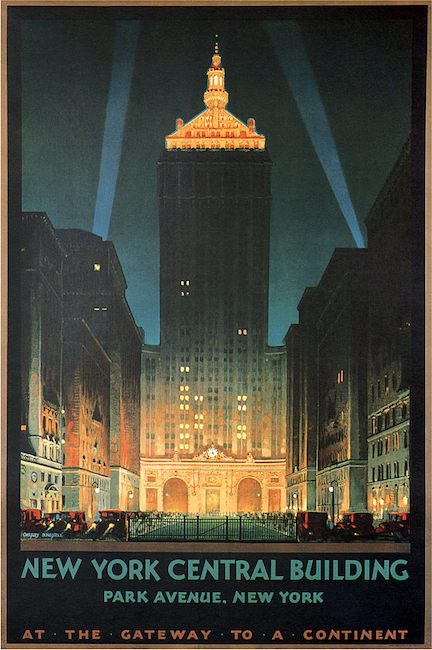
BEJEWELED CROWN…The New York Central Building depicted in a 1929 promotional painting by Chesley Bonestell. (albanyinstitute.org)
Thurber noted that “100,000 candlepower” would light the golden crown of the New York Central Building, the tallest structure in the Grand Central complex. Over at the new Chanin Building, a whopping 25 million candle-power would be trained on its art deco crown.
YOU CAN’T MISS IT…At left, the nearly 700-foot-tall Chanin Building joined the race for the sky in 1928-29. At right, a 1929 drypoint etching by Australian-born artist Martin Lewis depicted the magical glow of the Chanin Building from the viewpoint of a tenement dweller on a fire escape. (NYPL/ephemeralnewyork.wordpress.com)
Advertisers in the New Yorker reflected the mood of this new city of skyscraper canyons. From the Feb. 16 issue:
Ralph Ingersoll and Thurber also wrote in the Feb. 16 “Talk” about plans for “Rockefeller City…”
…and as we know, this was to become the famed Rockefeller Center, a complex of 19 buildings covering 22 acres between 48th and 51st streets. Led by by John D. Rockefeller Jr., the complex was conceived as an urban renewal project to revitalize Midtown (hard to imagine today). The land was originally envisioned as a site for a new Metropolitan Opera house, but when financing fell through the land’s owner, Columbia University, leased it to Rockefeller. Of the anticipated effect of the project, Ingersoll and Thurber wrote:
And for the record, the Feb. 9 issue featured another name that would shape the future of the city—J. Pierpont Morgan was the subject of a lengthy two-part profile penned by John K. Winkler.
* * *
Shouts & Murmurs
The Feb. 16 marks a significant date on the New Yorker calendar—the first appearance of Alexander Woollcott’s famed “Shouts & Murmurs” column:
Writing in the “Double Take” section in the July 18, 2012 issue of the New Yorker, Jon Michaud notes that “Shouts & Murmurs” was Woollcott’s personal column, appearing weekly in the magazine for five years. Perhaps no person other Harold Ross himself could be more associated with the earliest origins of the magazine — Woollcott was a colleague of Ross’s at Stars and Stripes during the First World War, and introduced Ross to his first wife, Jane Grant, who was also a considerable influence on the early magazine.
Michaud writes that Woollcott used the column “to opine on, lampoon, and attack the culture and society of the day. In his distinct and at times excessive style, he reviewed books, wrote spoofs, distributed gossip, and generally rankled as many people as he could.” Woollcott ended the column in December 1934, but it was revived in 1992 as a regular venue for many notable humorists, and continues to this day.
A REAL CHARACTER…Alexander Woollcott, in his idea of casual wear. He once informed his friend and New Yorker colleague Corey Ford: “Ford, I plan to spend three days at your house in New Hampshire next week.” Not overly pleased to be hosting such a demanding guest, Ford uttered a meek “That will be swell.” “I’ll be the judge of that,” Woolcott warned him. (From Elizabeth Olliff, “An Evening at the Algonquin.”)
* * *
Up In Smoke
Jumping back to the Feb. 9 “Talk of the Town,” we have this complaint from the magazine regarding celebrity cigarette endorsements. Although the magazine derived a lot of revenue from cigarette ads, Harold Ross insisted on a strict separation between editorial and advertising, allowing his writers free reign to bite the hands that fed them, if they so wished:
Here’s the offending ad, which was featured in the Feb. 23 issue:
In the Feb. 9 issue, Groucho Marx couldn’t resist getting in on the endorsement action…
…nor could Ross’s old friend George Gershwin, who touted the health benefits of Lucky Strikes in the Feb. 16 issue…
In other ads from the Feb. 16 issue, we find that for all of the technological advances in the 1920s, a decent car heater still eluded automakers. Hence…
…on the other hand, we also have this very up-to-date product—the forerunner of today’s rolling airplane luggage…
…and if you happened to be flying south, you might have first checked in with Helena Rubinstein to make sure you had the right “face fashions”…
And finally our cartoons, all from the Feb. 9 issue. This first is a six-panel series by Al Frueh that originally ran diagonally, top to bottom, across a two-page spread. It took a shot at the self-promoting police commissioner, Grover Whalen, who was not a friend to the New Yorker due to his ham-fisted approach to Prohibition enforcement…
…and Leonard Dove took a shot at some posh folks outside of their urban element…
…and finally, Alan Dunn examined the wages of beauty…
Like many publications, there are defining moments in the New Yorker’s history that make the magazine what it is today.
December 8, 1928 cover by Peter Arno.
In a post more than two years ago I wrote about Ellin Mackay’s pivotal essay, “Why We Go To Cabarets: A Post-Debutante Explains.” The debutante daughter of a multi-millionaire (who threatened to disinherit her due to her romance with Irving Berlin), Mackay explained that modern women were abandoning social matchmaking in favor of the more egalitarian night club scene. Mackay’s essay provided a huge boost to the struggling New Yorker, which had dipped to less than 3,000 subscribers in August 1925. A more recent post, “A Bird’s Eye View,” noted how a short story by Thyra Samter Winslow opened the door to serious fiction in the magazine.
The Dec. 8, 1928 issue was significant for a cartoon by Carl Rose that appeared on the bottom of page 27:
It remains one of The New Yorker’s most famous cartoons, and for good reason. In his book About Town: The New Yorker and the World It Made, Ben Yagoda writes that the cartoon (drawn by Rose, with spinach line provided by E.B. White) “was picking up on something in the culture: it was a moment when the air reverberated with the sound of speech.” Yagoda notes that although “the cartoons led the way,” the magazine has always been filled with the sound of voices in “The Talk of the Town.” Naturalistic rendering of speech could also be found under the heading of such features as “Overheard,” which ran from 1927-1929 and included such contributors as the young writer John O’Hara.
Another New Yorker contributor whose work resounded with the sound of speech, Robert Benchley, received some kind words from the magazine on his latest book, Twenty Thousand Leagues Under the Sea or David Copperfield:
DON’T BE SERIOUS…Robert Benchley and his book, 20,000 Leagues Under the Sea or David Copperfield, illustrated by his New Yorker colleague Gluyas Williams. The cover depicted Benchley performing his famous sketch, The Treasurer’s Report. (Goodreads/bio.com)
* * *
Appearing at the Civic Repertory Theatre (founded by actress Eva Le Gallienne in 1926) was Alla Nazimova and Eva herself in Anton Chekov’s last play, The Cherry Orchard.Al Frueh offered this sketch for the theatre review section.
Josephine Hutchinson as Anya, Alla Nazimova as Ranevskaya, and Paul Leyssac as Gayev in Anton Chekov’s last play, The Cherry Orchard, at the Civic Repertory Theatre in 1928. (eBay)TOUR DE FORCE…Eva Le Gallienne in 1928, photo by Edward Steichen. (Minneapolis Institute of Art)
* * *
From Our Advertisers
Advertisements from the Dec. 8 issue offered this study in contrasts…a “modern” take on the holidays by Wanamaker’s, featuring the unfortunately titled “Psycho-Gifts for Christmas”…
…versus the staid offerings of Brooks Brothers on the following page…
* * *
On to the Dec. 15 issue, we find The New Yorker enjoying the debut of the Ziegfeld Follies latest revue…
December 15, 1928 — issue number 200 — cover by Julian de Miskey.
…the show “Whoopee” at the New Amsterdam, featuring Eddie Cantor:
HIT MAKER…Sheet music for the hit “Love Me Or Leave Me” from the Ziegfeld Follies show Whoopee. At right, a still from the 1930 film Whoopee!, with Eleanor Hunt and Eddie Cantor. (carensclassiccinema/thejumpingfrog.com)
And lest you think audiences were flocking to only see Eddie Cantor…
LAVISH, LAVISH!…At left, Ziegfeld Follies performer Jean Ackerman in Whoopee! At right, Ziegfeld performer Ruth Ettig’s rendition of “Love Me or Leave Me” in Whoopee made it a major hit as well as her signature song. (mote-historie.tumblr.com/Alfred Cheney Johnston photo via songbook1.wordpress.com)
* * *
On to less glamorous pursuits, The New Yorker also paid a visit to the new “Fish Wing” at the Museum of Natural History, as recounted in “Talk of the Town.” A brief excerpt:
SWIMMING WITH THE FISHES…A visitor admires the mako shark exhibit at the Hall of Fishes in the American Museum of Natural History, 1948 (AMNH)
From Our Advertisers…
…comes this house ad from The New Yorker itself, promoting its first-ever Album:
Chris Wheeler has gathered all of the albums at this site.