The Major’s Amateur Hour

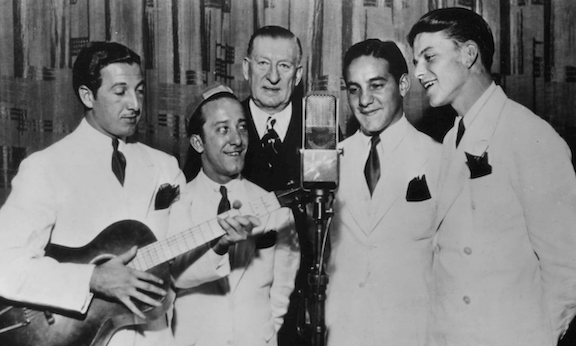
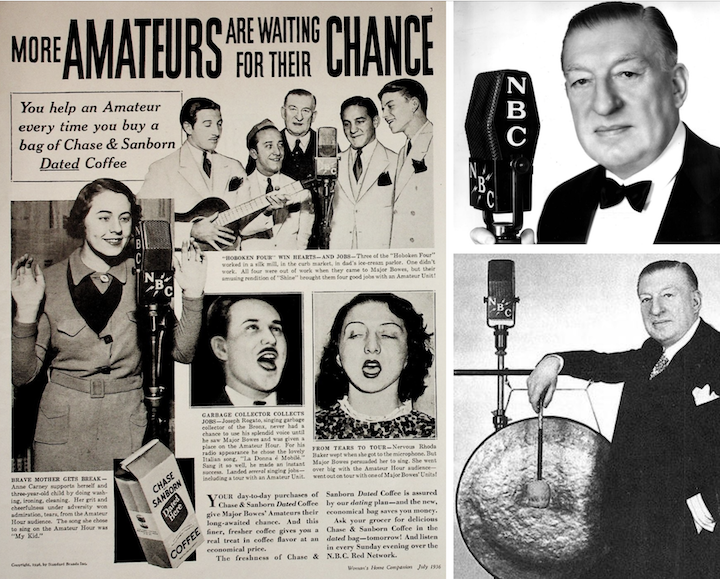
Above: Photo of the Hoboken Four as they appeared on the "Amateur Hour with Major Bowes" in 1935. At center is "Major" Edward Bowes, and at right is Frank Sinatra. The other three members of the Hoboken Four were Frank Tamburro, Patty Prince and Jimmy Petro. (knkx.org)

Nearly seventy years before American Idol appeared on our TV screens, a hugely successful and influential talent show filled the airwaves from NBC’s radio studios at Rockefeller Center.

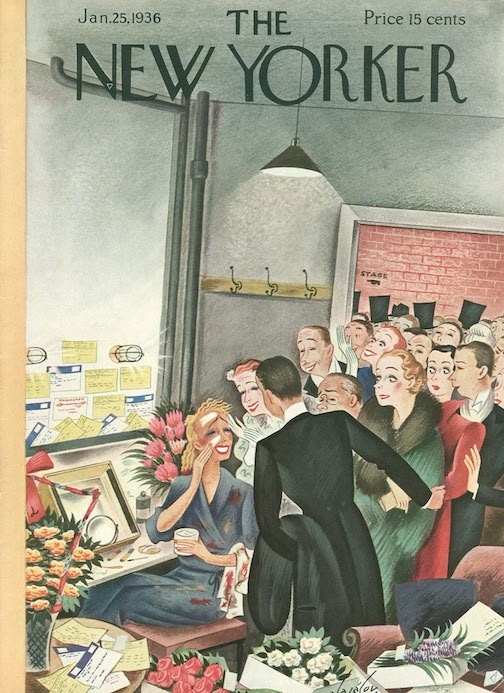
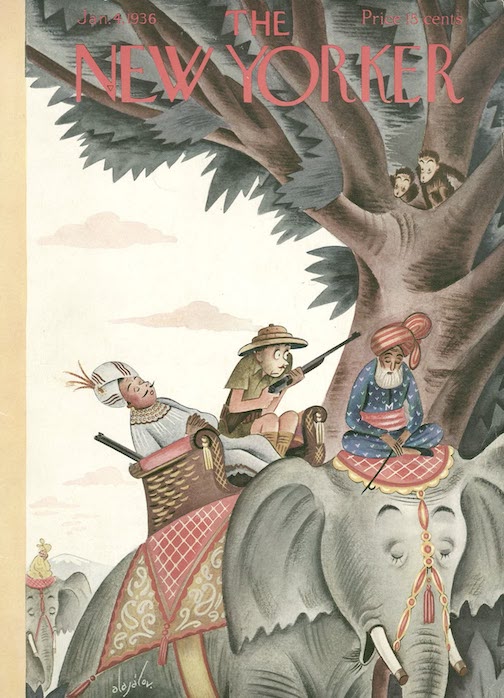
January 4, 1936 cover by Constantin Alajalov.

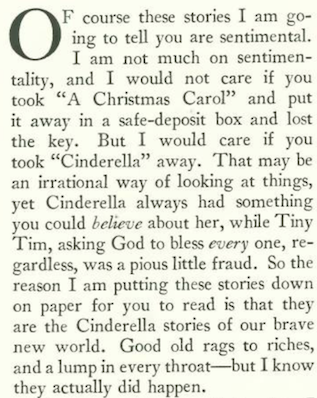
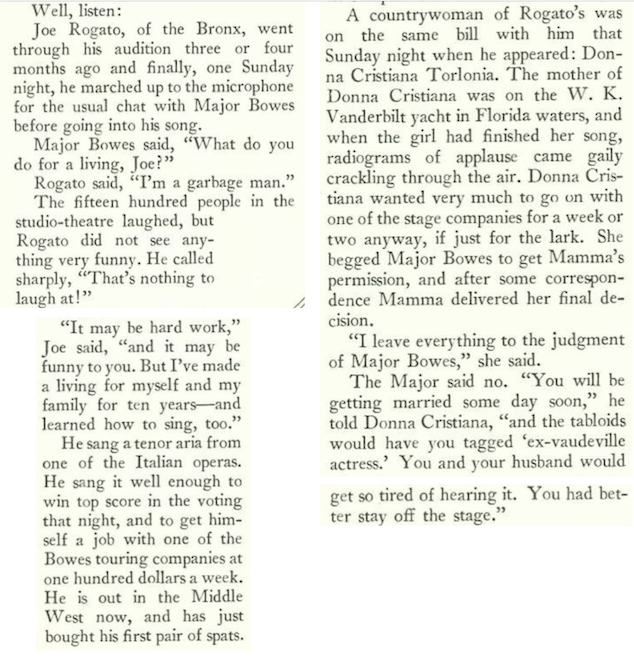
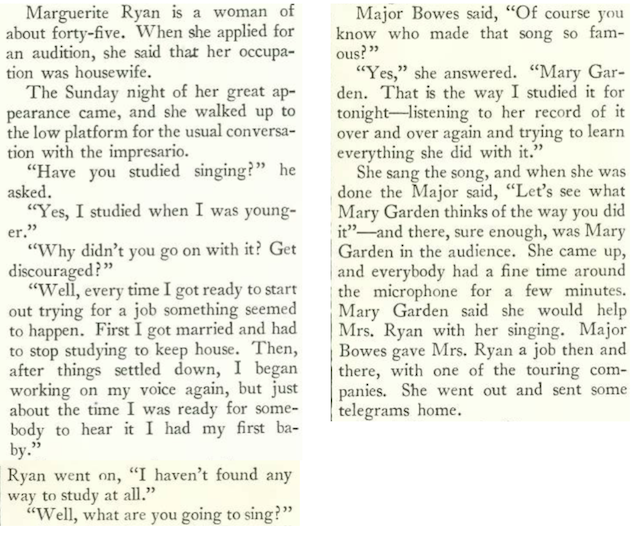
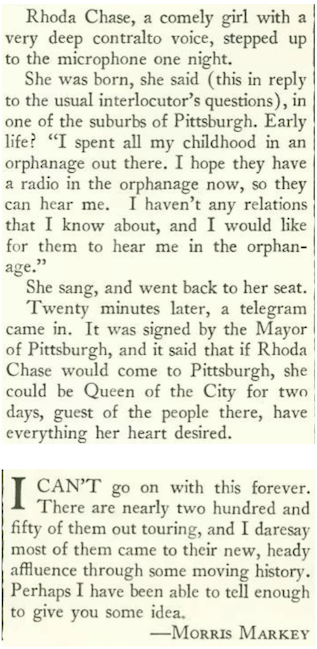
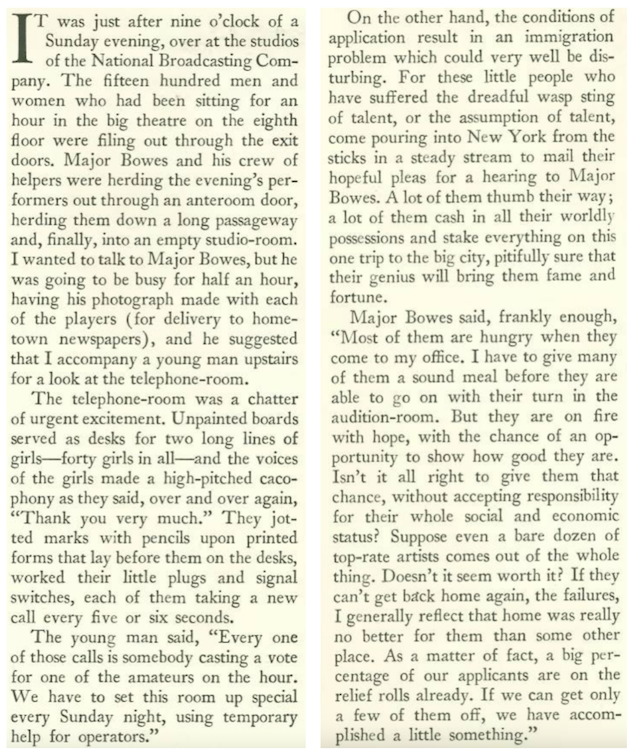
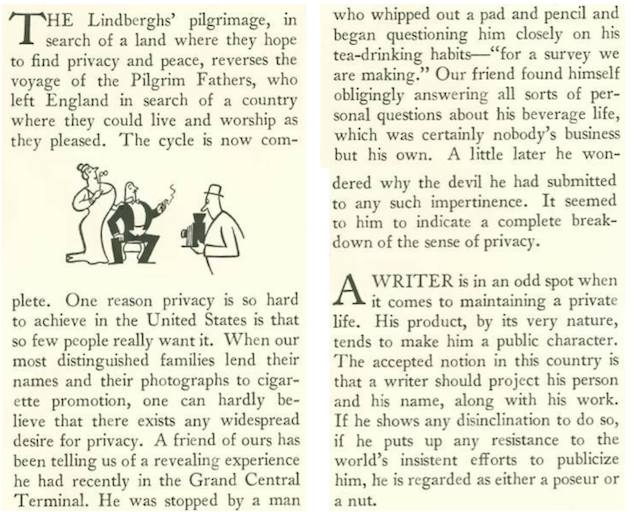
Millions tuned in each week to the Major Bowes Amateur Hour, which got its start in 1934 at radio station WHN before moving to NBC the following year. Created and hosted by “Major” Edward Bowes (1874–1946), Bowes would chat with contestants before listening to their performances, which could be cut short by the Major’s gong (see below). For his “A Reporter at Large” column, Morris Markey paid a visit to Bowes during evening auditions at the NBC studios. Excerpts:

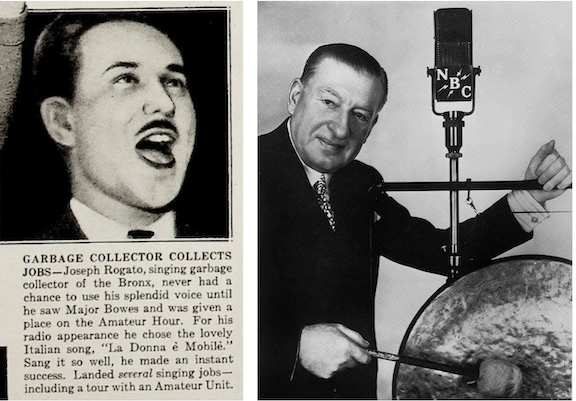
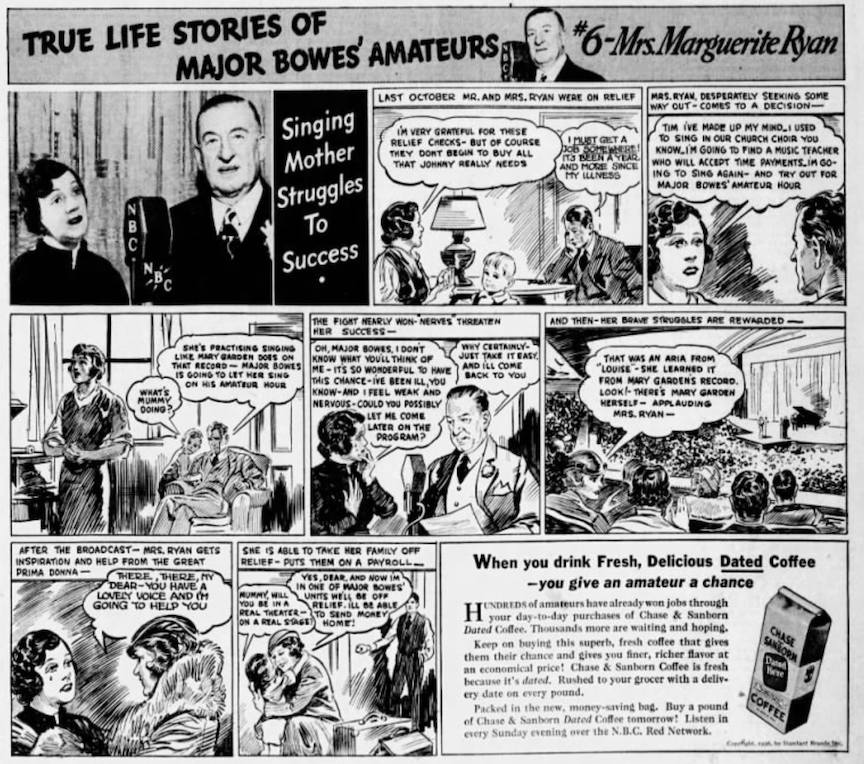
THE GONG SHOW…At bottom right, Edward Bowes with the gong he used to abruptly end acts he deemed poor or inept—he abandoned the prop in 1936 after receiving thousands of letters from listeners who objected to the premature termination of acts (apparently the concept was a direct inspiration for Chuck Barris’s 1970s TV program, The Gong Show). At left, a July 1936 Women’s Home Companion advertisement from the show’s sponsor, Chase & Sanborn. The ads highlighted the rags-to-riches stories of the more successful contestants. (eBay.com/Wikipedia)

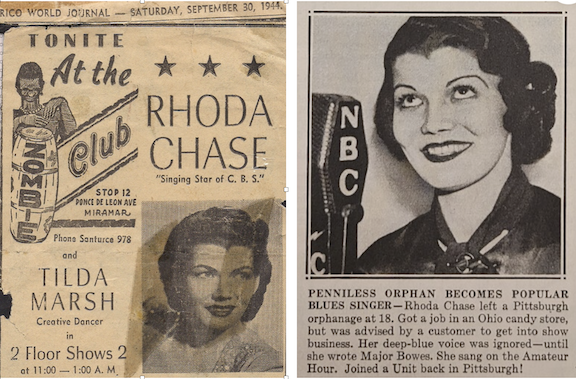
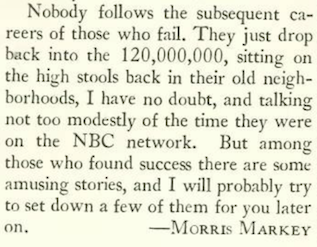
Markey ended his piece noting the reality of the many contestants who, unlike Frank Sinatra, would not go on to successful entertainment careers.

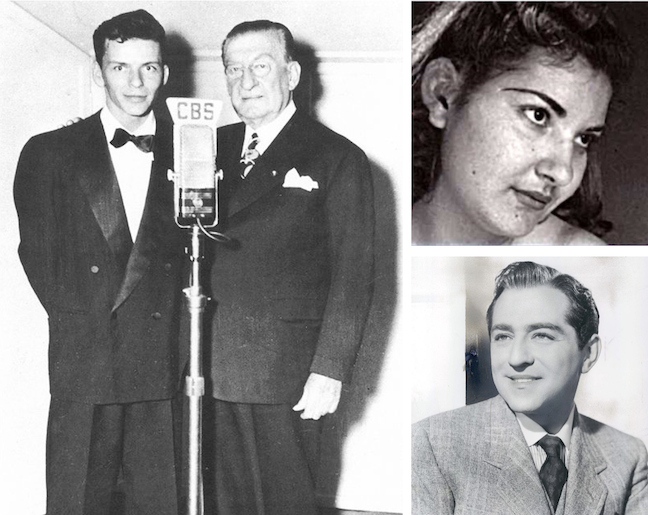
STARMAKER…Clockwise, from left: Major Edward Bowes and returning Amateur Hour performer Frank Sinatra in 1943; in 1935 eleven-year-old Maria Callas performed the Madama Butterfly aria “Un bel dì vedremo,” on the Amateur Hour; actor/baritone Robert Merrill performed on the show in 1936. (winnetoba.com/mariacallasestate.com/Wikipedia)

 * * *

Fleeing the Limelight

In December 1935 Charles and Anne Morrow Lindbergh secretly boarded a ship in New York and headed to England, seeking to escape the media frenzy that followed their son’s kidnapping and the subsequent trial. Thanks to connections through Anne’s family, they were able to move into a secluded estate in the Kent countryside. In his “Notes and Comment,” E.B. White explained:

HIDEOUT…From 1936 to 1938 Charles and Anne Morrow Lindbergh lived in a secluded English estate called “Long Barn.” The estate in County Kent was owned by a friend of Anne’s family. (waverlyhs.weebly.com)
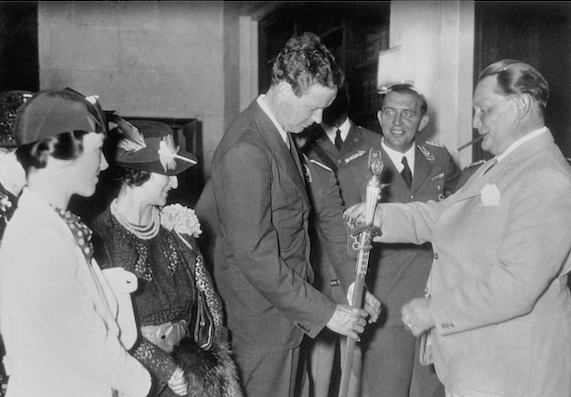
NOT HIS FINEST HOUR…In July 1936 Luftwaffe commander Hermann Goering (right) presented the Sword of Honor of the German Air Force to Charles Lindbergh during a visit to Berlin. Anne Morrow Lindbergh is to the far left. Goering would also present Lindbergh with a high-ranking Nazi-era civilian medal, the Service Cross of the German Eagle, during a 1938 visit. Anne presciently referred to the medal as “the albatross.” (Library of Congress)

According to White, Mayor Fiorello La Guardia cited lax police control of the media in the case of the fleeing Lindberghs. In turn, White attempted to explain the unique temperaments of Irish police officers.

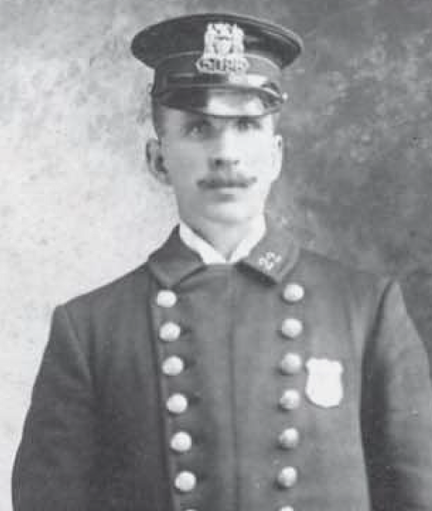
GIVE US A BREAK…E.B. White noted the courage and wisdom of Irish cops, but also found their lassitude “almost theatrical.” Pictured above is Irish immigrant Patrick Leddy, who joined the NYPD in 1910 and remained on the force for more than thirty-five years. (Courtesy of Margaret Fitzpatrick Leddy via nyirishhistory.us)

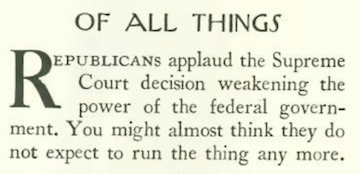
A final note on the Lindberghs from Howard Brubaker, a snippet from his “Of All Things” column.

 * * *

Italian Swashbuckler

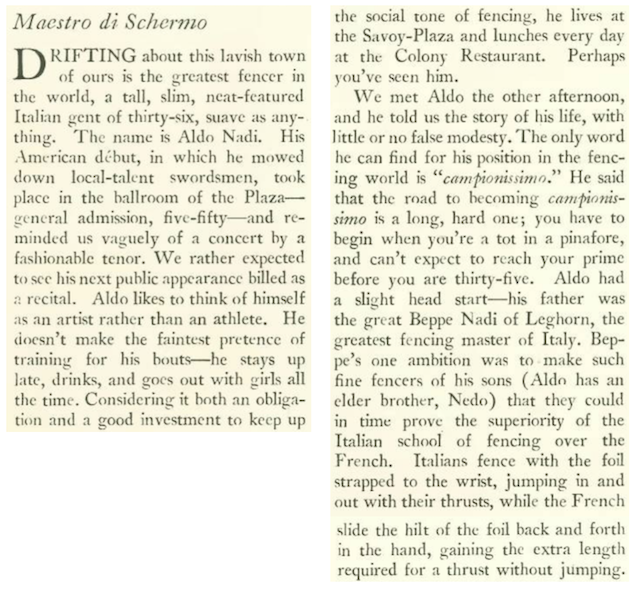
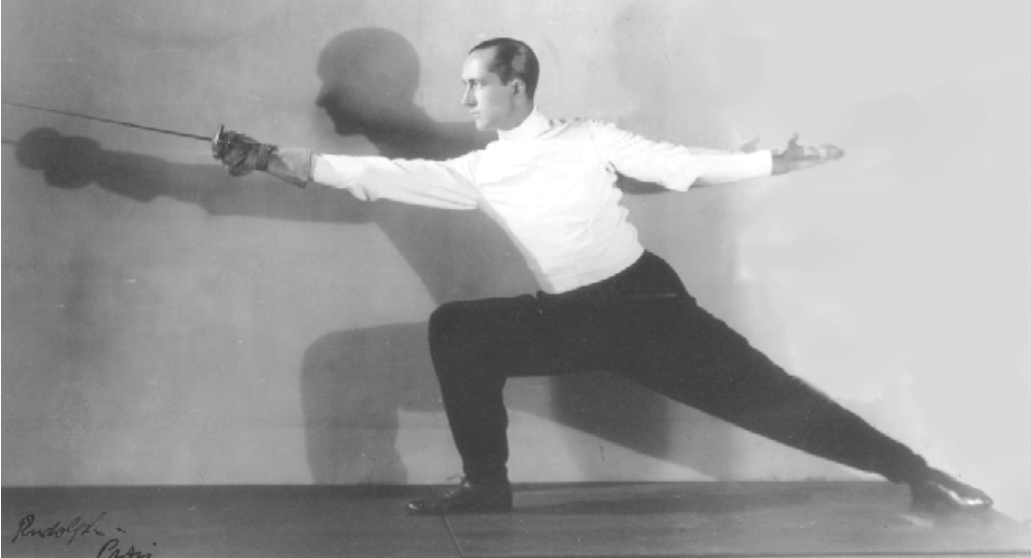
The Italian fencer Aldo Naldi (1899-1965) won three gold medals and one silver at the 1920 Olympics before turning professional. According to West Coast Fencing, Aldo traveled Europe like a prizefighter, “competing in well-attended matches for cash purses…in a world of travel, glamour, drinking, womanizing, gambling and fencing, Aldo Nadi reigned supreme, going nearly eight years without a defeat.” “The Talk of the Town” was on hand for his American debut. Excerpts:

EN GARDE!…During the interwar years Aldo Nadi reigned supreme, going nearly eight years without a defeat. (dennishollingsworth.us)

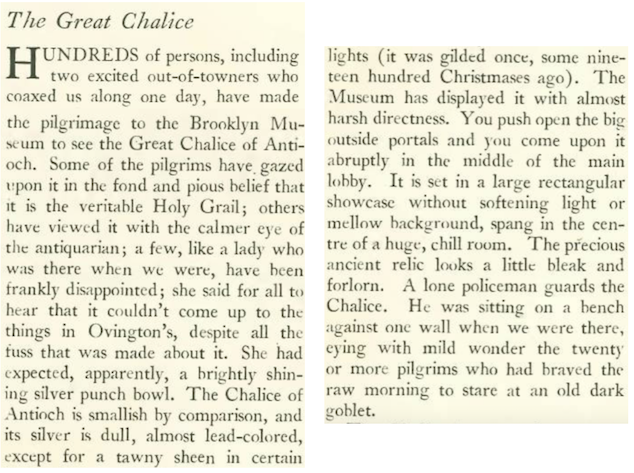
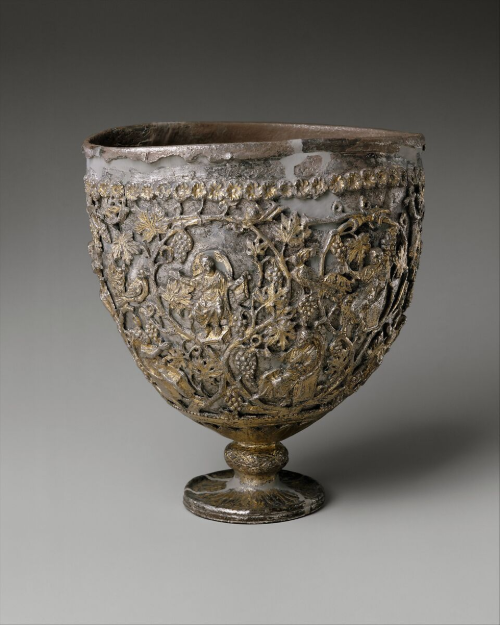
“Talk” also examined the fuss being made over the Great Chalice of Antioch, which was on display at the Brooklyn Museum. Excerpts:

COULD IT BE?…Claimed to have been found in Antioch around 1900, this chalice’s plain silver bowl was ambitiously identified by some as the Holy Grail, the cup used by Christ at the Last Supper. It is displayed with the Metropolitan Museum’s Byzantium collection. (metmuseum.org)

* * *

Year, Schmear

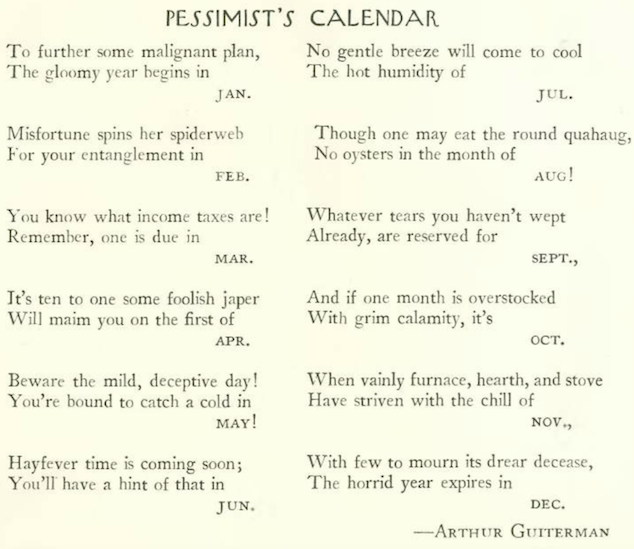
To mark the New Year, Arthur Guiterman offered up one his humorous poems…

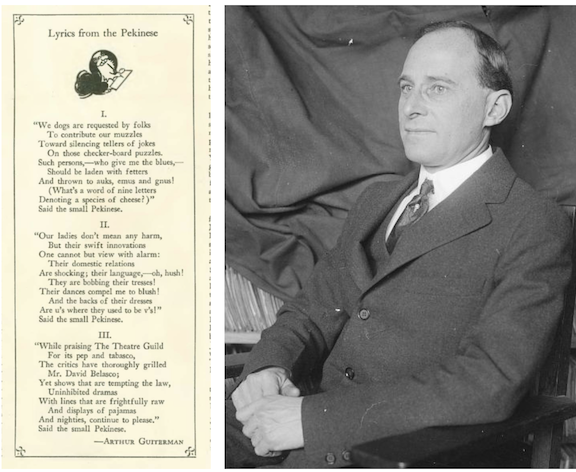
…Guiterman (1871–1943) was an early contributor to The New Yorker—the magazine’s very first issue, Feb. 21, 1925, featured the first installment of Guiterman’s recurring “Lyrics from the Pekinese,” which ran through the first eleven issues.

MEOW…Arthur Guiterman’s “Lyrics from the Pekinese,” featured in the first issue of The New Yorker. At right, Guiterman in an undated photo. (Library of Congress)

 * * *

Before He Was Spooky

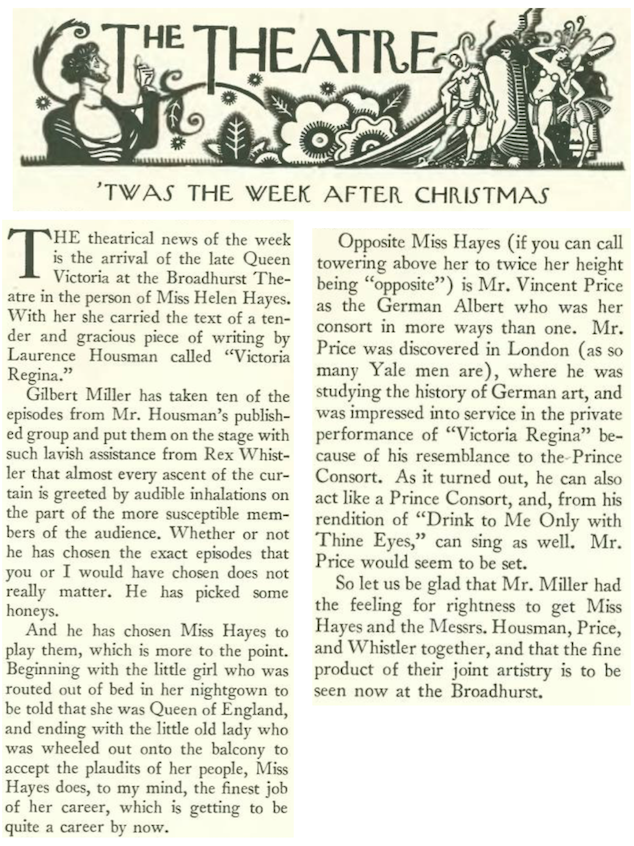
Robert Benchley’s review of the stage began on a bright note with Victoria Regina, which starred Vincent Price as Prince Albert and Helen Hayes as Queen Victoria. Benchley praised the realism Price and Hayes lent to the production. Excerpts:

A MATCH MADE ON BROADWAY…The 24-year-old Vincent Price and the 35-year-old Helen Hayes portrayed Prince Albert and Queen Victoria in Victoria Regina, which ran for 203 performances at the Broadhurst Theatre. Robert Benchley thought their casting was ideal. (Pinterest)

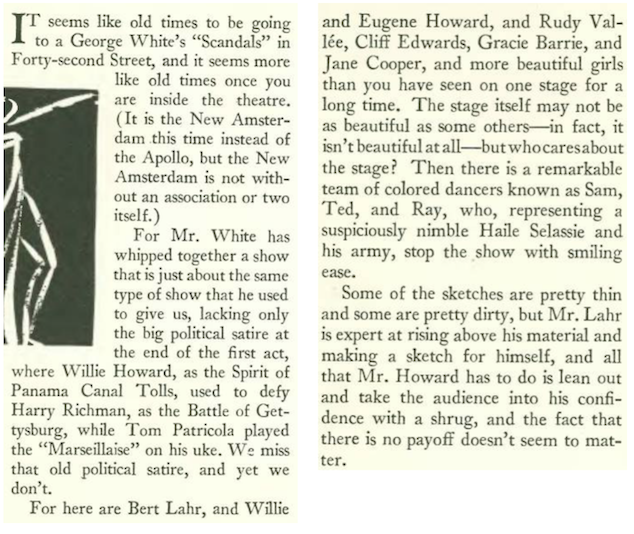
Benchley also sat through George White’s latest Scandals revue, finding it similar to White’s older shows—beautiful showgirls, various singers and dancers, and assorted comedians—with Bert Lahr shining above it all.

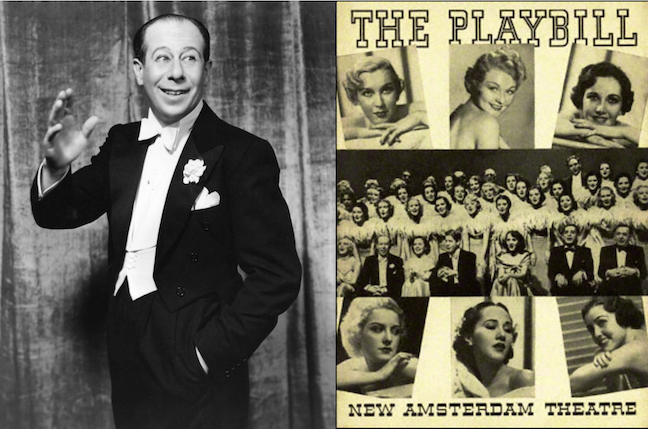
IT SEEMED LIKE OLD TIMES to Robert Benchley as he took in the latest edition of George White’s Scandals. Bert Lahr (left) was among the headliners for the 1936 revue, which ran for 110 performances at the New Amsterdam Theatre before taking to the road. (Wikipedia/Playbill.com)

 * * *

At the Movies

John Mosher had a busy week at the movies, finding “considerable pleasure” in the screen adaptation of Eugene O’Neill’s Ah Wilderness!…

MILLER TIME…The Miller family attends a commencement ceremony that helps kick off the action in Ah Wilderness! From left, Aline MacMahon, Mickey Rooney, Spring Byington, and Bonita Granville. (IMDB)

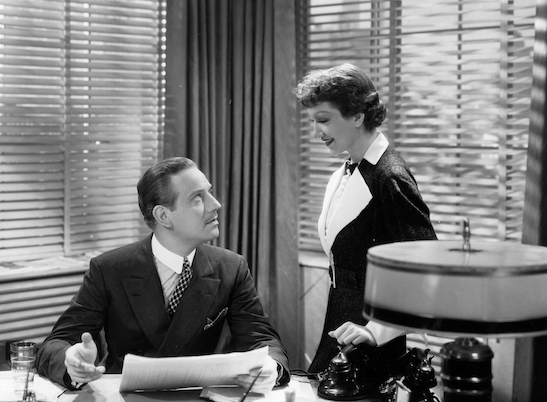
Mosher also looked at films featuring leading actresses of the day—Barbara Stanwyck in Annie Oakley, Bette Davis in Dangerous, and Claudette Colbert in The Bride Comes Home.

A TRIO OF TALENTS…Clockwise, from top left, Claudette Colbert had her hands full with Robert Young and Fred MacMurray in The Bride Comes Home; Barbara Stanwyck took aim in Annie Oakley; and Bette Davis portrayed a down-and-out actress with trouble on her mind in Dangerous. For her performance, Davis won the Academy Award for Best Actress. (laurasmiscmusings.blogspot.com/girlswithguns.org/vanguardofhollywood.com )

 * * *

Gaming the Games

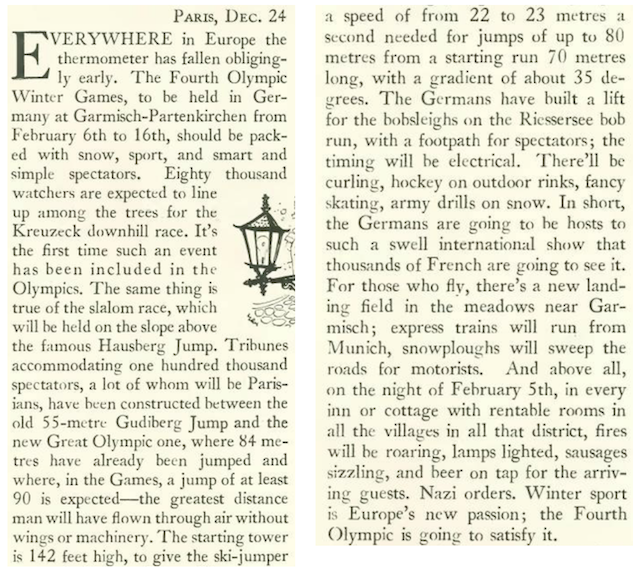
In her “Paris Letter,” Janet Flanner noted the preparations for the Fourth Olympic Winter games to be held in Garmisch-Partenkirchen, Germany.

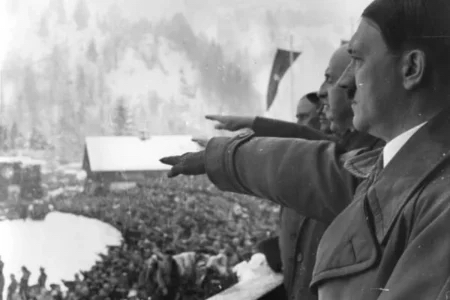
WINTER HAS ARRIVED…Adolf Hitler and his fellow Nazi thugs brought a certain chill to the 1936 Winter Games in Garmisch-Partenkirchen. Garmisch and Partenkirchen were separate communities until Hitler forced them to merge in anticipation of the games. (arolsen-archives.org)

 * * *

From Our Advertisers

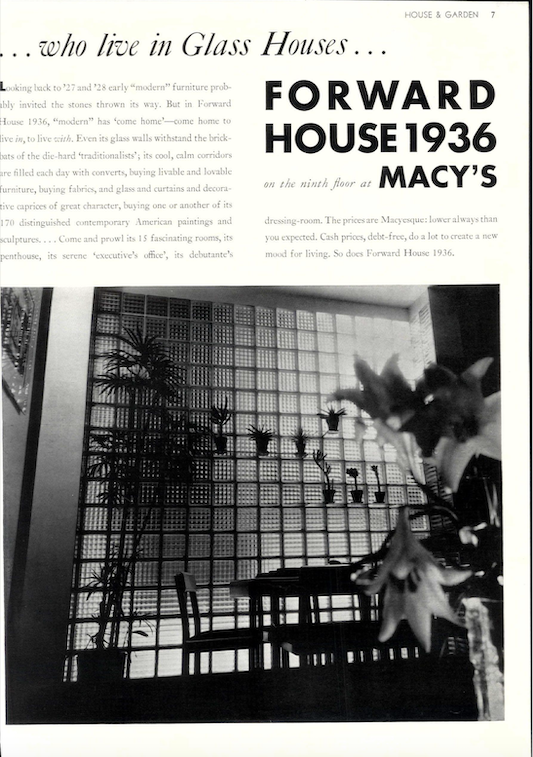
From 1933 to 1939, Macy’s hosted a series of unique design exhibitions under the title “Forward House” that showcased contemporary furniture, decor, and architectural ideas…

…for reference, here is another “Forward House” advertisement from the February 1936 House & Garden magazine…

…the folks at Robbins Island Oysters employed the legend of Giacomo Casanova to market their tasty little rocks…apparently Casanova claimed that he consumed more than fifty oysters each morning to sustain his amorous adventures…

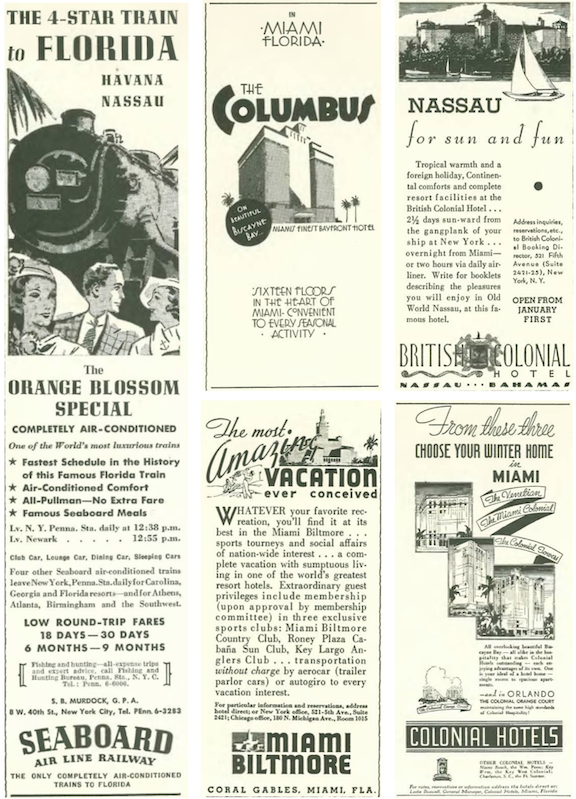
…with the holidays over, the number of ads decreased significantly, leaving readers with a mere sixty pages—less than the half the length of the fat pre-Christmas editions…the theme in the Jan. 4 issue was travel to warmer climes, these examples culled from several back of the book pages…

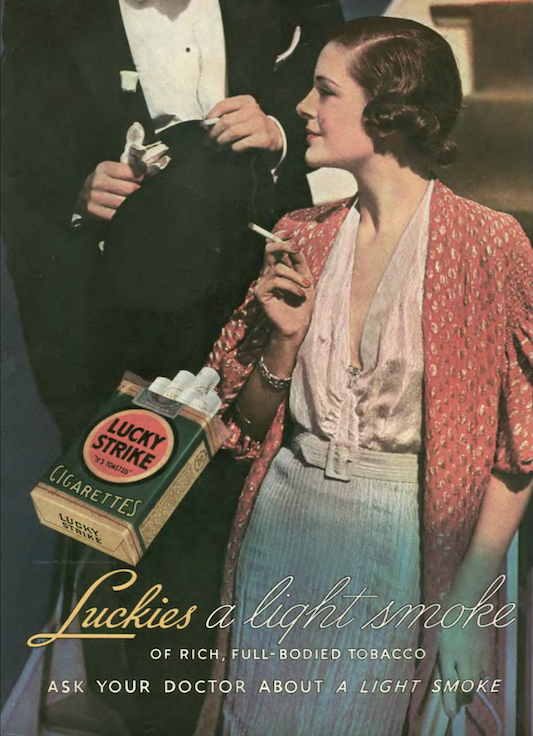
…the end of the holiday season did not stop tobacco companies from taking out lavish full-page advertisements targeting women smokers, this one gracing the back cover…note the implied medical endorsement at the bottom…

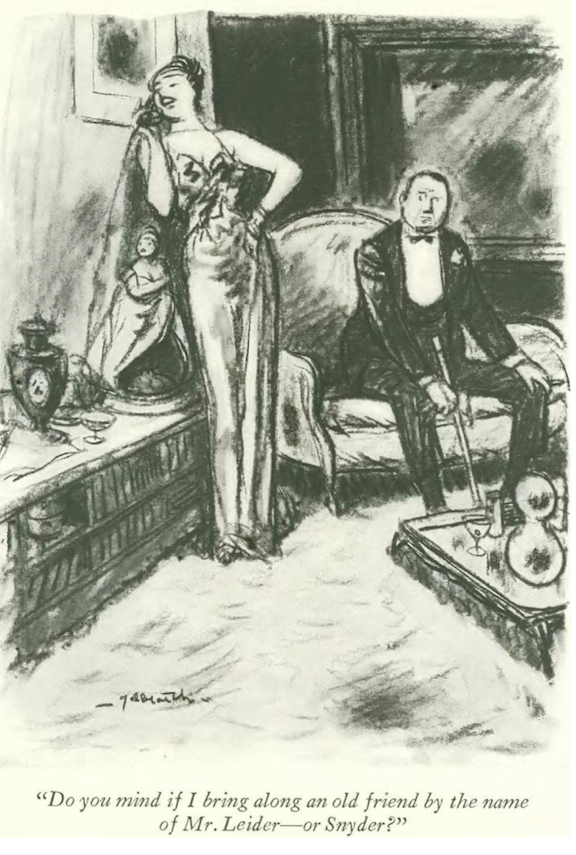
…we clear the air and move on to our cartoonists, beginning with spot drawings by D. Krán

…and Christina Malman

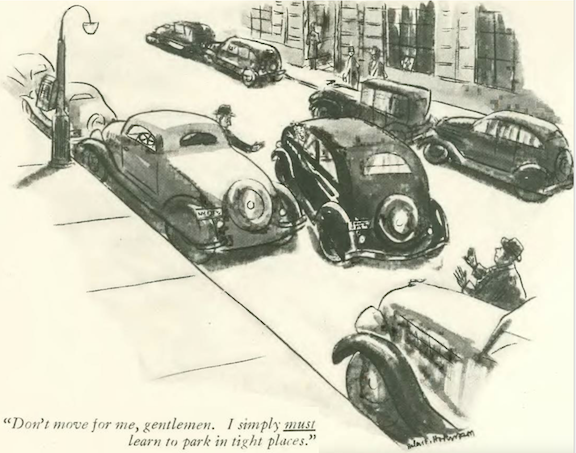
…one of Helen Hokinson’s girls sought an impromptu parking lesson…

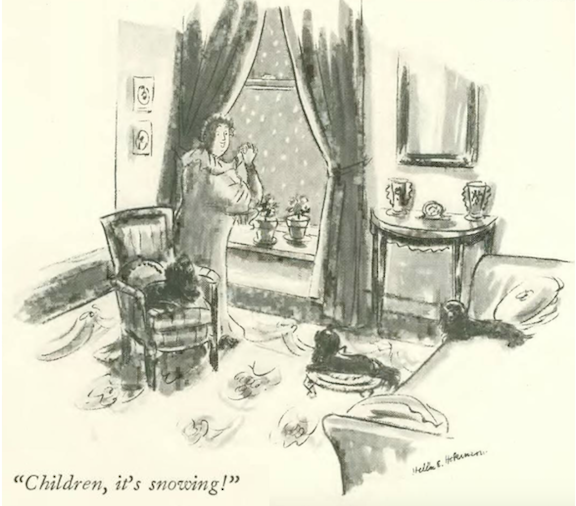
…while another welcomed winter with her furry charges…

Whitney Darrow Jr gave us a full-service information booth…

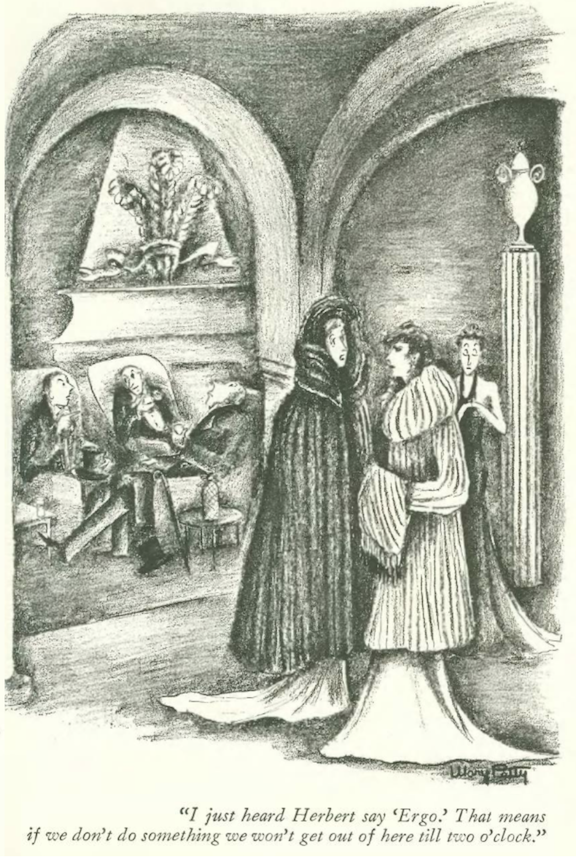
Mary Petty illustrated a dowager with simple tastes…

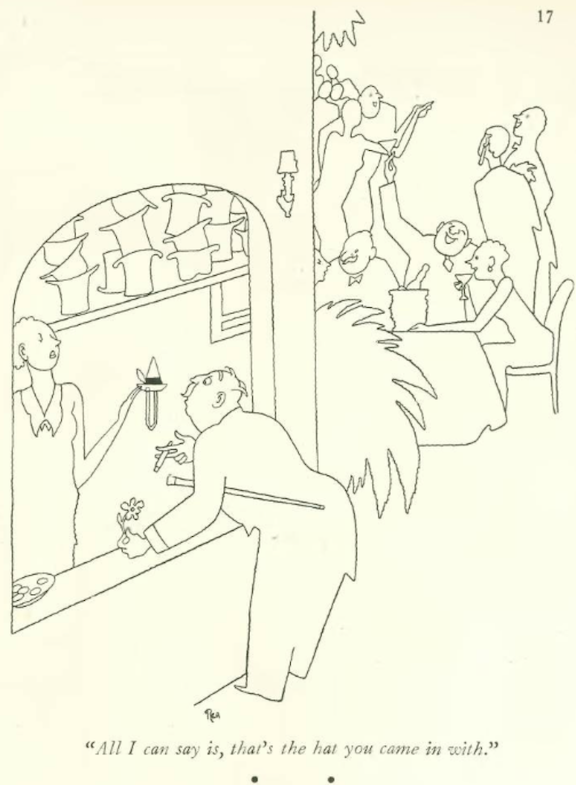
Gardner Rea was confounded at the hat check…
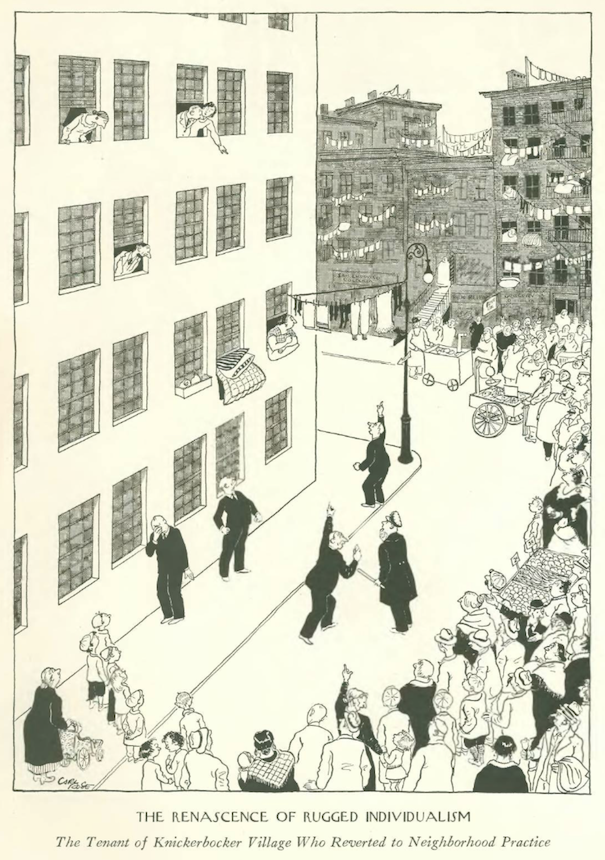
Carl Rose offered up another example of rugged individualism…

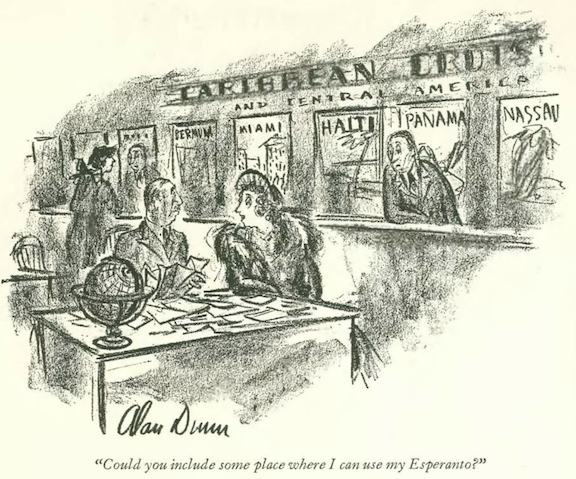
Alan Dunn served up a unique language challenge…

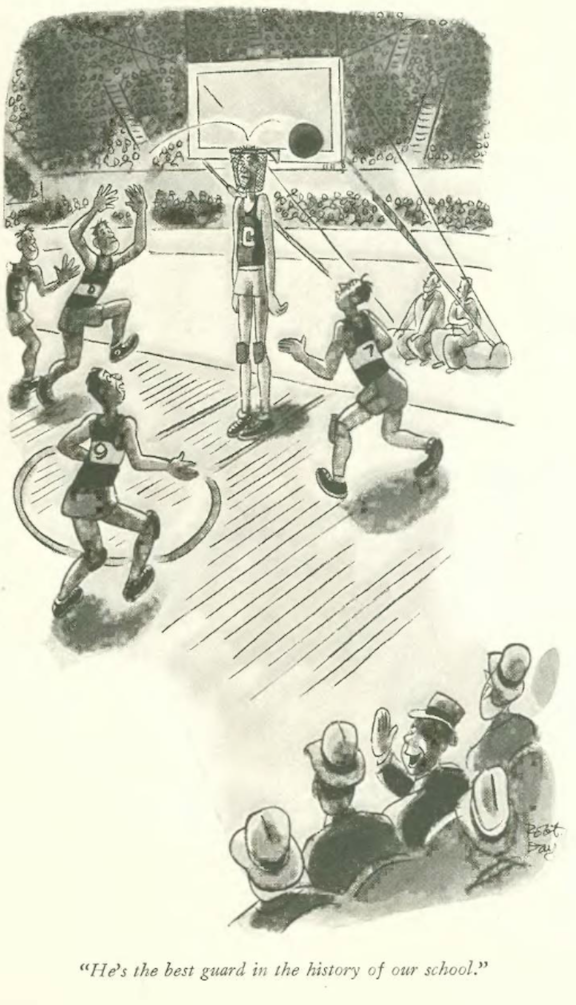
Robert Day stood tall at a basketball game…

William Crawford Galbraith was horsing around…

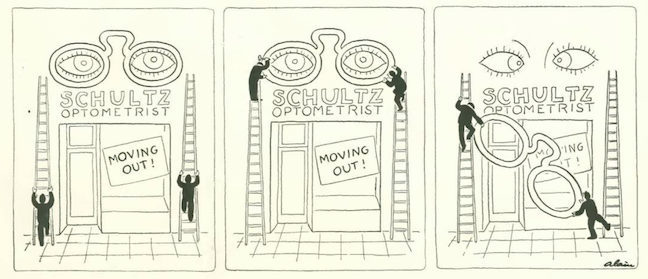
Alain looked crosseyed at a store closing…

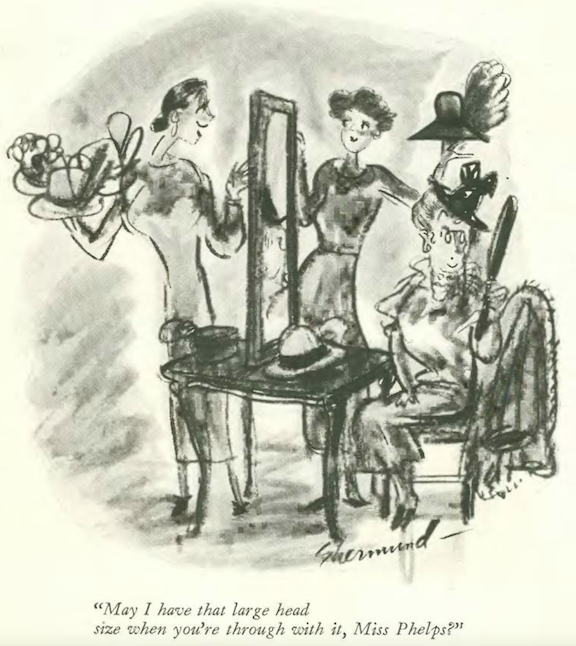
…and we close with Barbara Shermund, who sized up things at a hat shop…

Next Time: Obsessed at the Movies…

It Can’t Happen Here

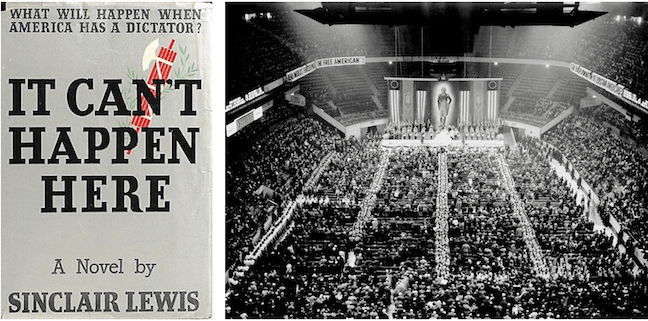
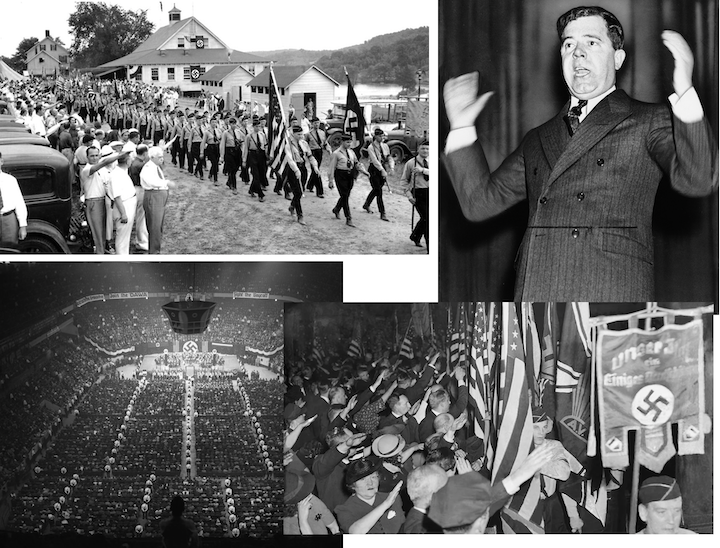
Above: Cover of Sinclair Lewis's 1935 novel about a fascist takeover of America, It Can't Happen Here. At right, 22,000 people attended a Nazi rally at Madison Square Garden on February 20, 1939. (Wikipedia/Reddit)

Ninety years ago Sinclair Lewis published It Can’t Happen Here, a dystopian novel that responded to the rise of fascism in Europe as well as to American demagogues like Louisiana Senator Huey Long.

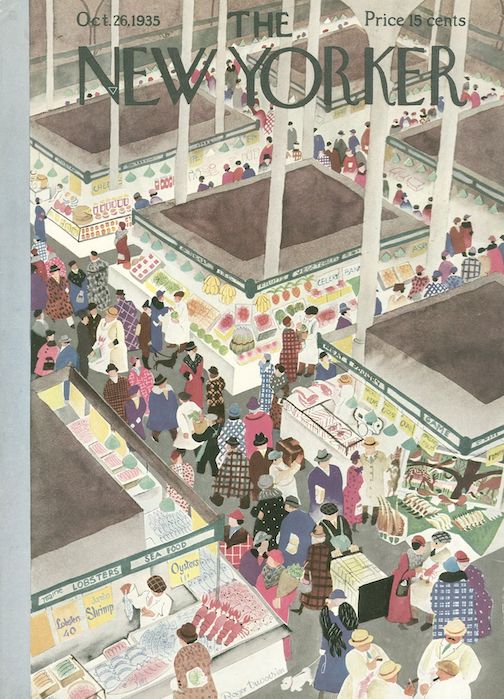
October 26, 1935 cover by Roger Duvoisin. Duvoisin (1900–1980) was a Swiss-born American writer and illustrator best known for children’s picture books. He illustrated 32 covers for The New Yorker, along with five cartoons. Duvoisin won the Caldecott Medal in 1948 (along with author Alvin Tresselt) for White Snow, Bright Snow.

In his 2016 New Yorker article, “Getting Close to Fascism with Sinclair Lewis’s ‘It Can’t Happen Here,'” journalist Alexander Nazaryan notes how Lewis was arguing for journalism and civic education as essential pillars of democracy. The title of Lewis’s book, Nazaryan observes, suggests that ‘It’ was something more subtle: “a collective apathy, born of ignorance, and a populace that can no longer make the kind of judgments that participatory democracy requires.”

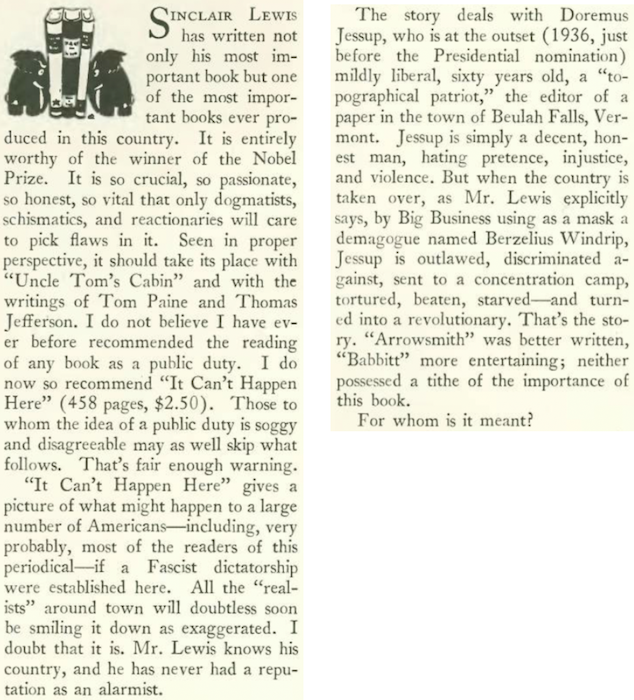
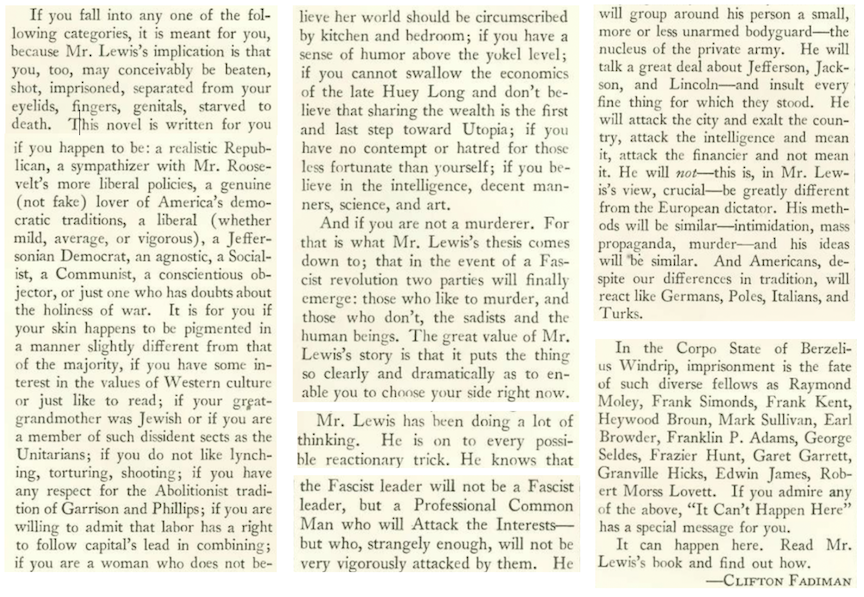
Lewis’s novel also made book critic Clifton Fadiman sit up and take notice. Here are excerpts from the first part of his review:

HOME-GROWN…American fascism was represented by organizations such as the German American Bund, the Silver Legion of America, and radio host Charles Coughlin, who opposed the New Deal and promoted conspiracy theories and antisemitic views. Clockwise, from top left: Nearly a thousand uniformed men wearing swastika arm bands and carrying Nazi banners parade past a reviewing stand in New Jersey on July 18, 1937. The New Jersey division of the German-American Bund had opened the 100-acre Camp Nordland at Sussex Hills; Huey Long in 1935, the same year he was assassinated; Nazi rally at Madison Square Garden in 1939. (AP/Wikipedia)

If you zoom in on the photo at bottom right, you can’t help but notice the woman in the black hat, who seems a little unsure about what she is doing, especially in front of a camera…the woman to her right appears to be hiding her face.

Here is more of Fadiman’s review (click to enlarge). It’s worth a read.

WE’VE BEEN WARNED…Published nearly seventy years apart, Sinclair Lewis’s It Can’t Happen Here (1935) and Philip Roth’s The Plot Against America (2004) both explored the dangers of fascism in the United States. (pulitzer.org/Wikipedia/Nancy Crampton via stanford.edu)

 * * *

It Was Happening There

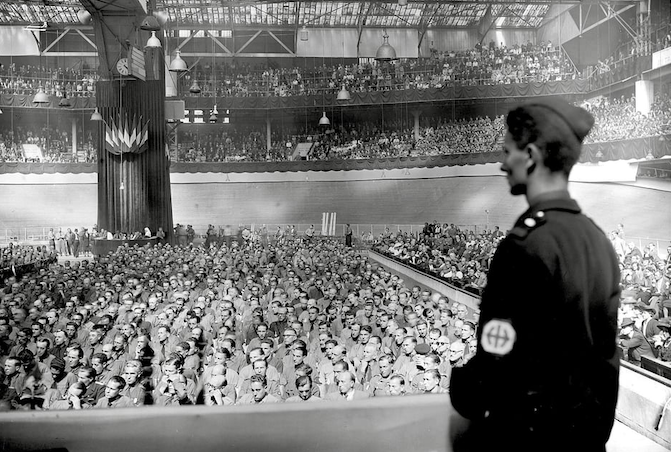
In her “Letter from Paris,” Janet Flanner was noting “increasing Fascist sentiment and  sympathy” in her adopted city:

OVER THERE…The French Popular Party (Parti populaire français, PPF) was a French fascist and anti-semitic political party led by Jacques Doriot before and during World War II. Formed in June 1936, with an estimated 120,000 members by 1937, it is generally regarded as the most collaborationist party of France. (thefrenchhistorypodcast.com)

 * * *

All Talk

Marion Sayle Taylor (1889–1942) was the popular host of a radio advice show, The Voice of Experience. Margaret Case Harriman (1901–1966) penned a two-part profile of Taylor titled “The Voice.” I’ve included the opening lines to Part One here:

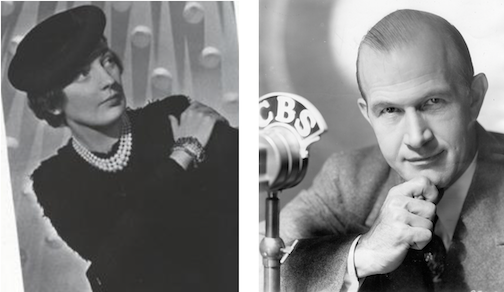
IF ONLY SHE KNEW…Margaret Case Harriman, left, circa 1936, profiled Marion Sayle Taylor before his misdeeds were revealed. (Vogue Archive/eleanorbritton.blogspot.com/Oregon Encyclopedia)

After reading both parts of Harriman’s profile piece, it appears she wasn’t yet aware that Taylor was more than a radio personality; he was also dishonest, manipulative, and opportunistic, according to a biography by Dick and Judy Wagner featured in the Oregon Encyclopedia. For example, Harriman reported (likely from Taylor’s official bio) that Taylor’s first wife, Pauline, had died in childbirth, when in fact she was quite alive and suing him for divorce that same year. Taylor also divorced his second wife, Jessie, who sued him in 1936 after he deceived her about another woman. Not surprisingly, his radio image as a reliable marriage counselor was damaged irretrievably.

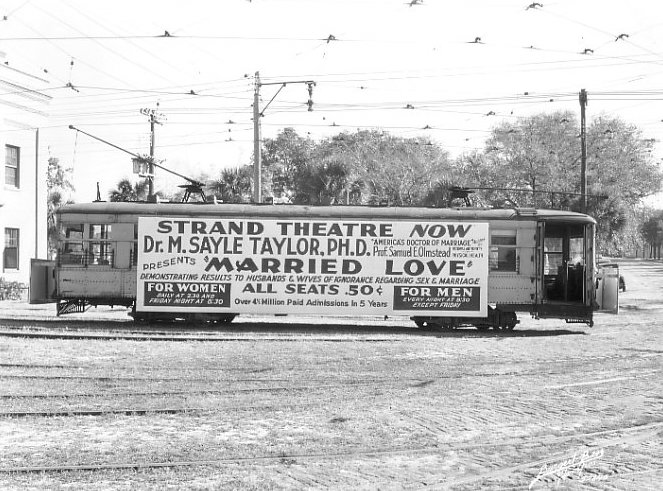
FALSE ADVERTISING…A streetcar, possibly in Newark, N.J., advertising a lecture by Taylor, circa 1931. In addition to hiding a previous prison record, Taylor also falsely reported that he had studied at several universities (he did not earn a Ph.D, as the redundant title claims in the above photo). It appears Taylor also kept much of the money he solicited for charitable causes. (Oregon Encyclopedia)

 * * *

Selling Pooh

Commercial cross-marketing of children’s books with toys and other products had its origins in the late nineteenth century with Alice’s Adventures in Wonderland, and in the first years of the 20th century Beatrix Potter’s Peter Rabbit series inspired everything from dishes and wallpaper to board games and dolls—in 1903 Peter Rabbit was the first fictional character to be made into a patented stuffed toy.

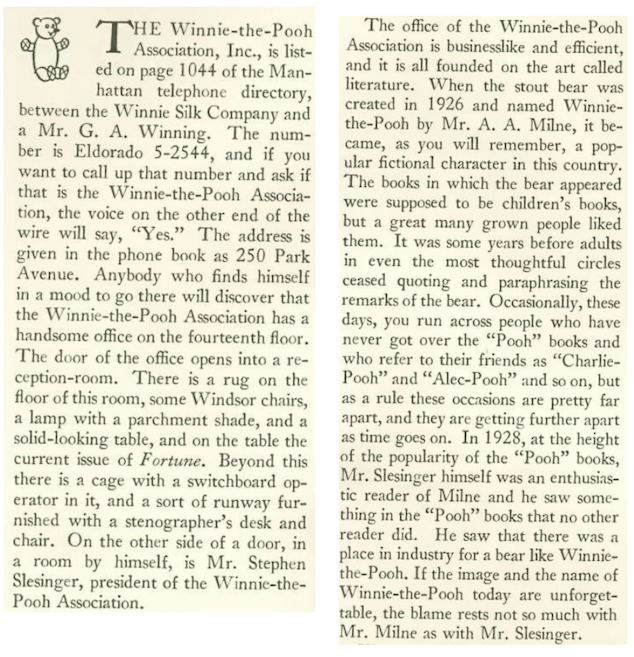
Then came another character from British children’s literature, A.A. Milne’s Winnie-the-Pooh. In January 1930, Stephen Slesinger (1901–1953) purchased U.S. and Canadian merchandising, television, recording, and other trade rights to the Winnie-the-Pooh works from Milne (for $1,000, plus royalties), marketing a wide range of products. For the column “Onward & Upward With the Arts,” St. Clair McKelway paid a visit to Slesinger at the Park Avenue offices of Winnie-the-Pooh Association, Inc. Excerpts:

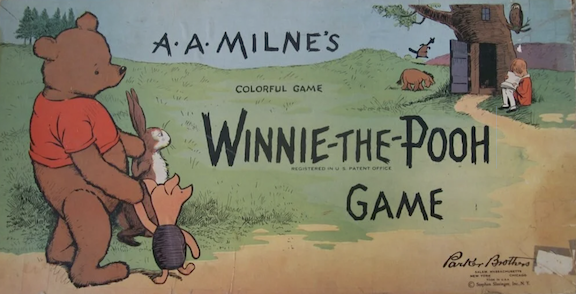
KEEP YER SHIRT ON…The Parker Brothers were the first to feature Winnie-the-Pooh in color for a 1932 board game. Stephan Slesinger added the iconic red t-shirt to Pooh for the game and a children’s record, a look that was later adopted by the Disney Corporation when it acquired the rights from Slesinger’s widow and daughter in 1961. (thedisneyclassics.com)
FUNNIES MAN…At left, Stephan Slesinger in an undated photo. Slesinger was a radio, television and film producer, and a curator of comic strip characters including Alley Cop, Captain Easy, Buck Rogers and Blondie, among others; at center, a record of “Winnie-the-Pooh Songs,” 1932; an ad for the Red Ryder BB gun—in 1938 Slesinger created the comic strip Red Ryder along with artist Fred Harmon. (alchetron/yesterdaysgallery.com/Port Isabel Press)

In another excerpt, McKelway gave us an idea of the scope of Slesinger’s Pooh empire:

 * * *

At the Movies

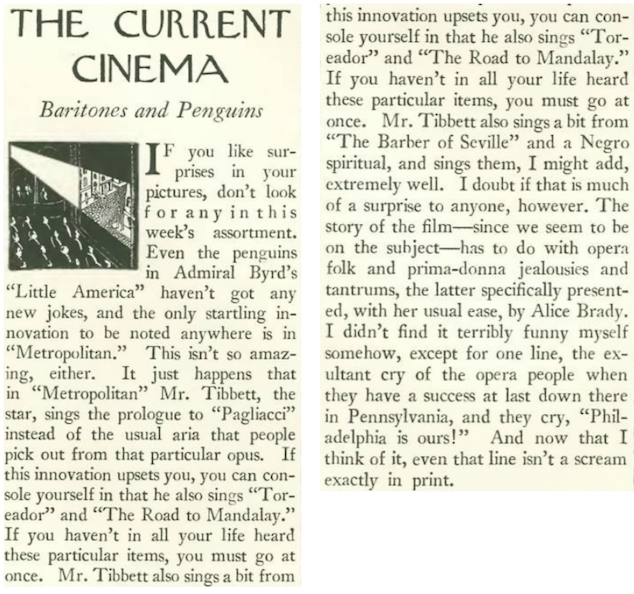
Critic John Mosher found few thrills in the latest fare from Hollywood, offering his views of Admiral Richard Byrd’s Into Little America and the musical Metropolitan, featuring famed baritone Lawrence Tibbett. 

FOR THE BYRDS…At left, lobby card for Into Little America; at right, Alice Brady and Lawrence Tibbett in Metropolitan. (eBay.uk/rottentomatoes.com)

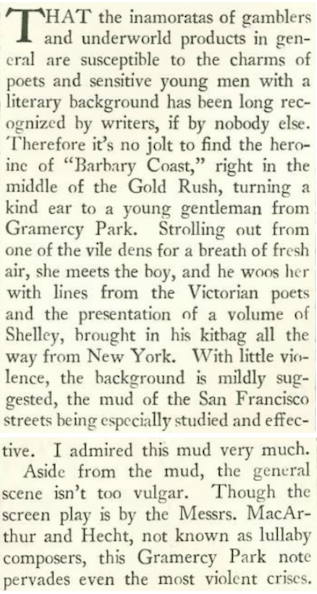
With a screenplay by Ben Hecht and Charles MacArthur and direction by Howard Hawks, one would hope for some rough and tumble in a film about Gold Rush San Francisco. Instead, Mosher found the trappings of Barbary Coast rather mild. This was doubtless due in part to the Hays Code that curtailed the sex and violence portrayed in films of the 1920s and early 1930s.

TAKING A SPIN…Miriam Hopkins runs the roulette wheel as Edward G. Robinson looks on in Barbary Coast. A brief 2019 review in the Harvard Film Archive praised the film’s Gothic feel created by the “evocative portrayal of early San Francisco as a foggy labyrinth of rickety boardwalks and ominous, sky-high ship masts…” (harvardfimarchive.org)

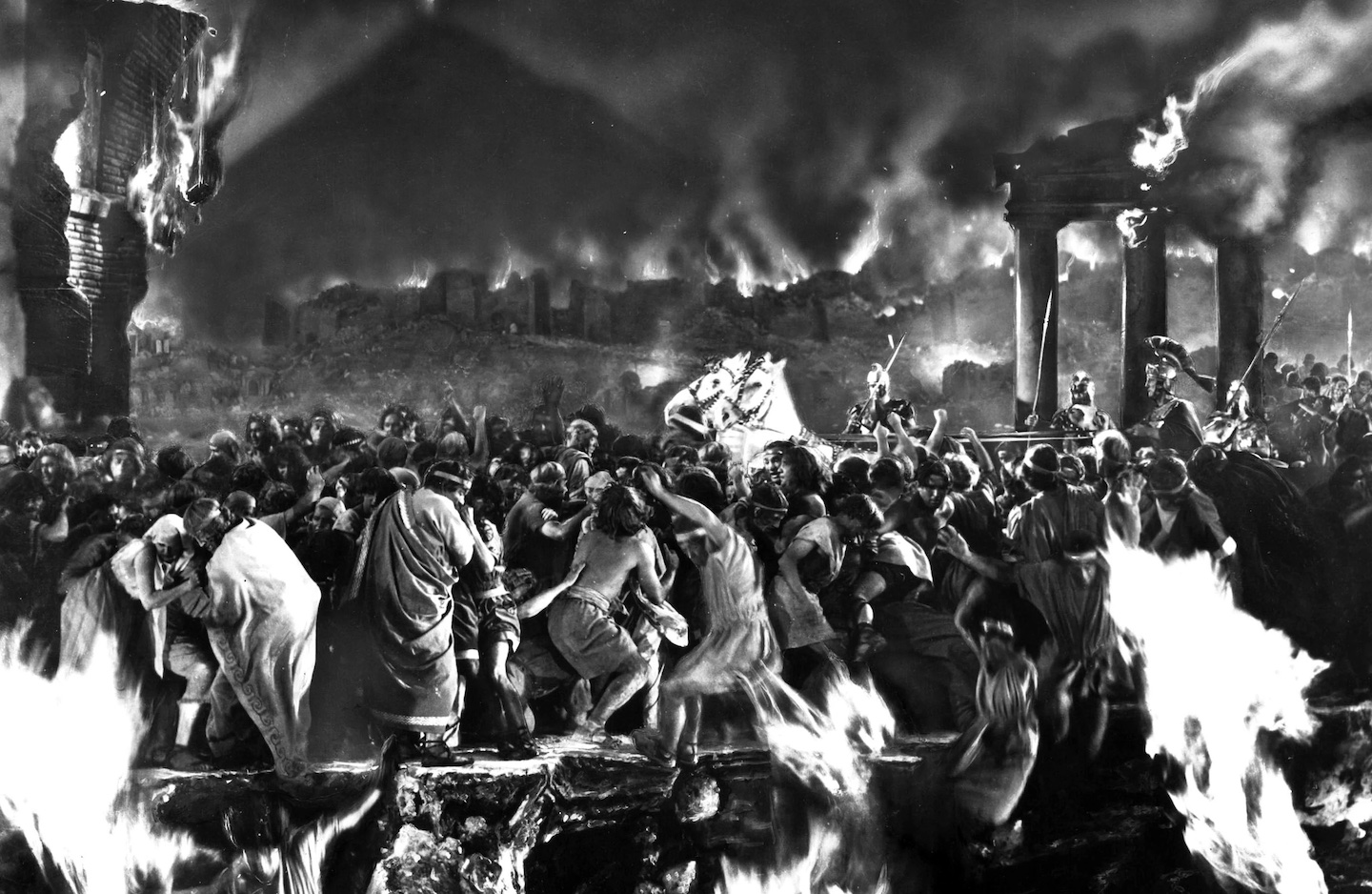
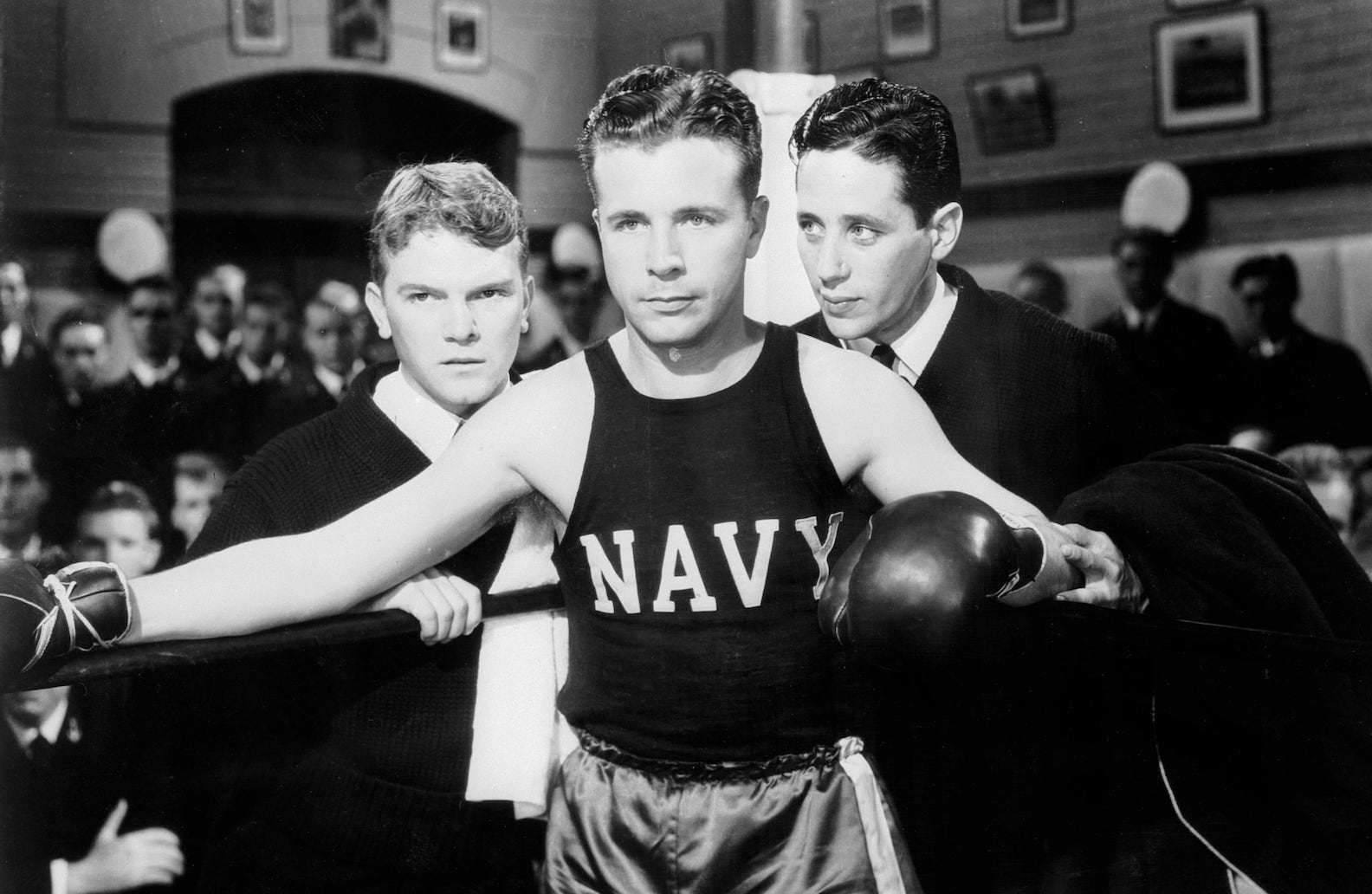
One might think that a film featuring the destruction of Pompeii would have some thrills, however RKO’s The Last Days of Pompeii proved to be a “temperate affair” in Mosher’s eyes, “one of the great bores of the moment.” The Dick Powell/U.S. Navy vehicle Shipmates Forever didn’t prove to be any better.

HOT TIMES IN POMPEII?…John Mosher called The Last Days of Pompeii “one of the great bores of the moment,” including the “drearily enacted” eruption of Vesuvius in which “Paper temples fall and there is a bit of bustle, and that is all there is to that.” Mosher did single out Basil Rathbone’s performance as an urbane Pontius Pilate, “a Pontius Pilate with a Long Island manner.” (tcm.com)
GO GET ‘EM DICK…The U.S. Naval Academy provided the setting for the musical Shipmates Forever, featuring Dick Powell as a crooner who ultimately chooses the Navy over a singing career. (tcm.com)

* * *

From Our Advertisers

We begin with the inside front cover, where the folks at Fisher touted their innovative “Turret Top” design…Body by Fisher began as a separate company in 1908, specializing as an automobile coach builder…although acquired by General Motors in 1926, the Fisher brand was promoted until the 1980s…

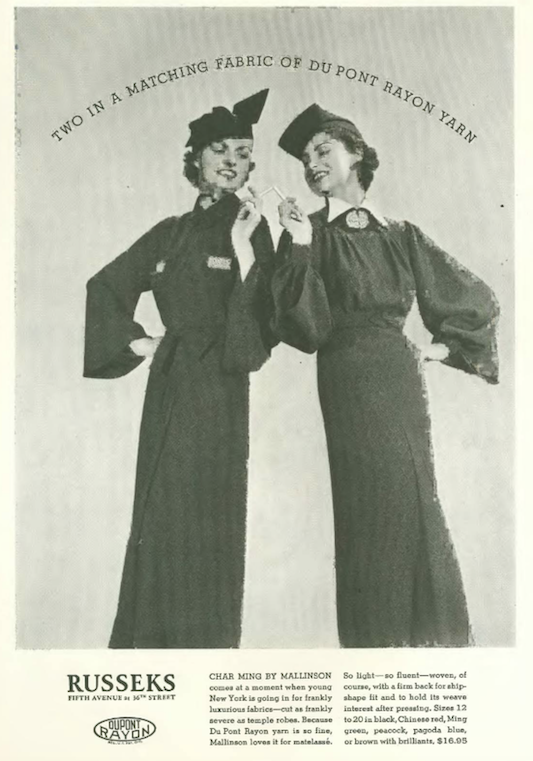
…there were many fall and winter fashion ads in this issue, including this continuing series by Russeks promoting Rayon fabrics…and women smoking, no doubt considered a sign of sophistication…

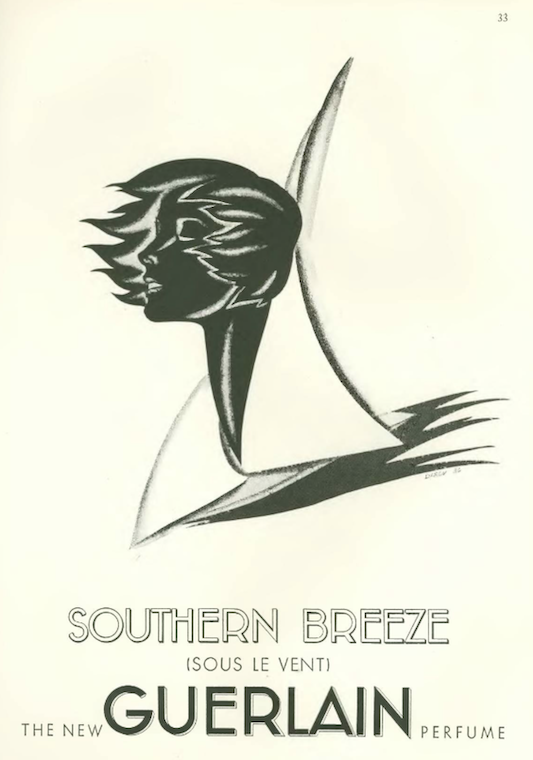
…Guerlain perfume ads featured the unmistakable style of illustrator Lyse Darcy

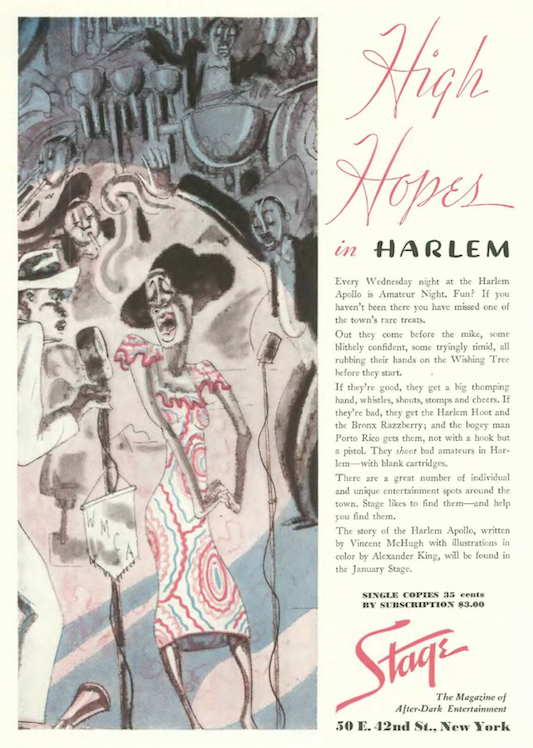
…the Heyward/Gershwin production of Porgy and Bess made a splash in this ad for Stage magazine…

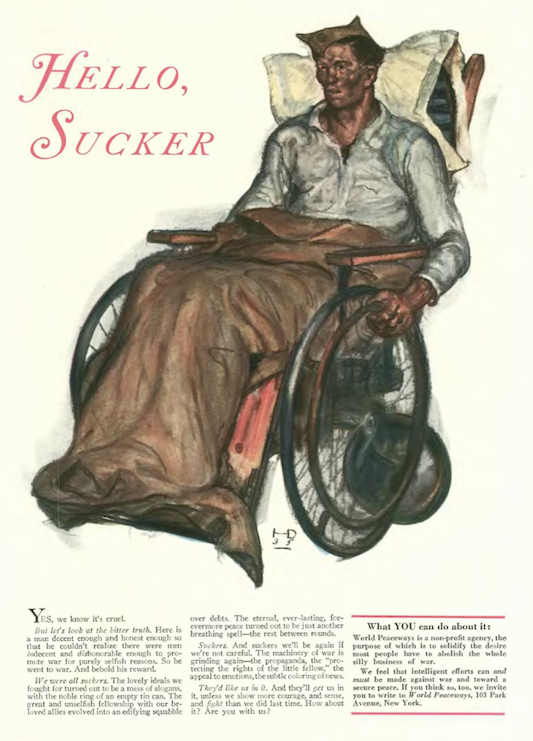
…World Peaceways often used terrifying imagery to promote their anti-war messages…this ad was on the inside back cover…

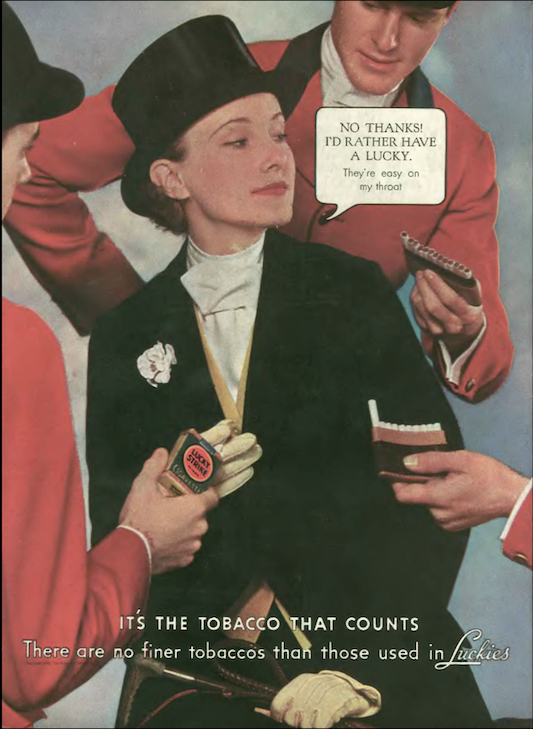
…and as you closed the magazine, the back cover greeted you with this stylish appeal to smoke Luckies…

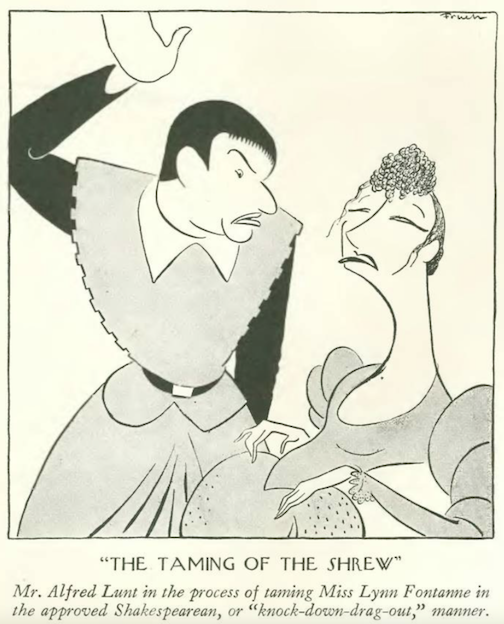
…on to our cartoonists, starting with Al Frueh in the Theatre section…

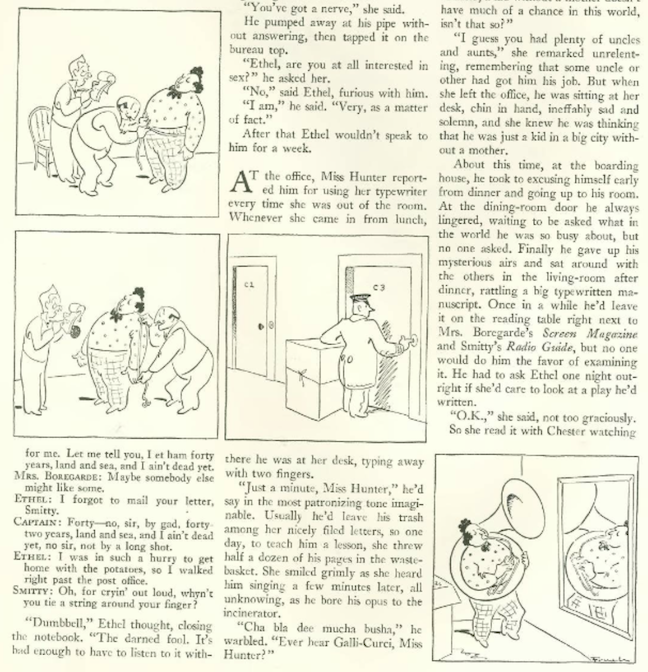
…and Frueh again, in this interesting arrangement…

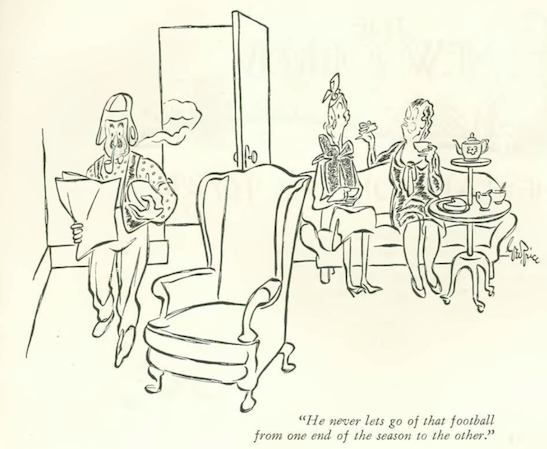
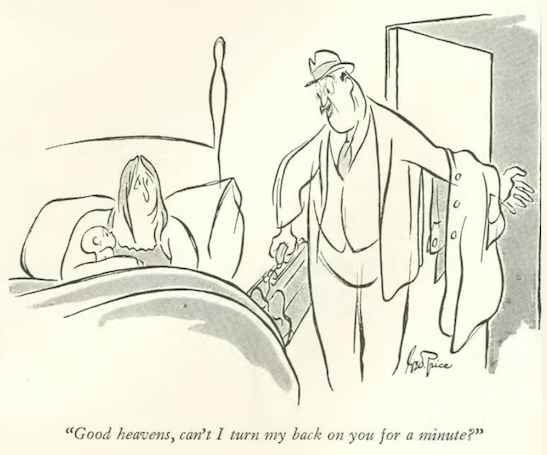
George Price was featured twice…

…with scenes of domestic life as only Price could render…

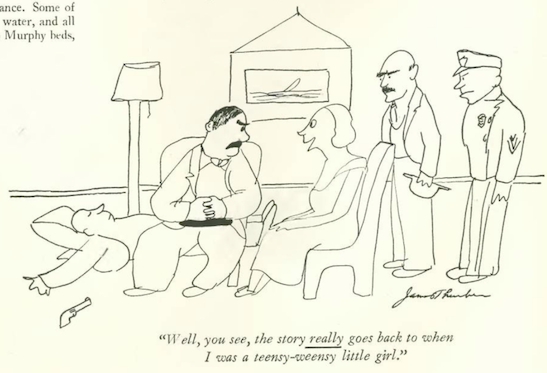
…and speaking of distinctive, no one did it quite like the great James Thurber

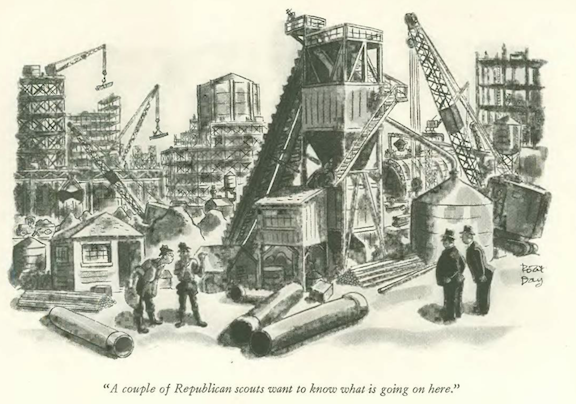
Robert Day gave us two Republicans looking in on the progress of the New Deal…

Carl Rose bid farewell to a writer sick of his peace and quiet…

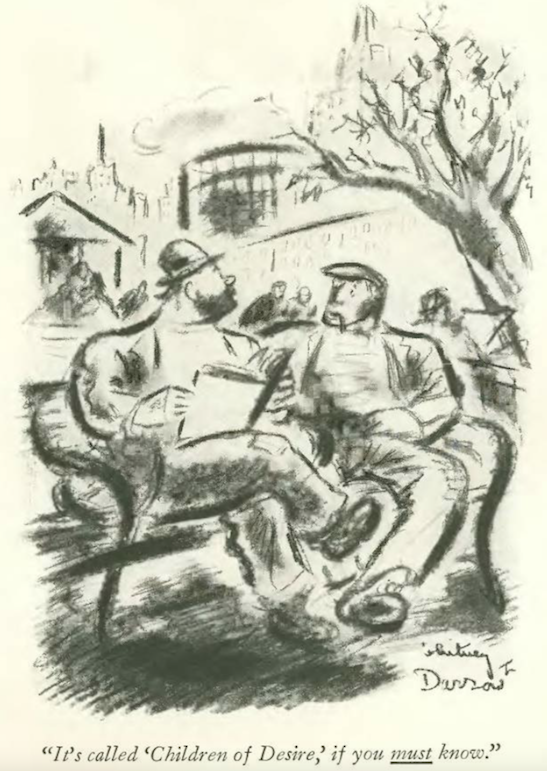
Whitney Darrow Jr illustrated a literary exchange on a park bench…

…and I close with today’s New Yorker cover artist, Roger Duvoisin—here is his cover for White Snow, Bright Snow, which won the Caldecott Medal in 1948.

Next Time: Planes, Trains and Automobiles…

School Days

Above: First-grade pupils at the blackboard, circa 1943. (The New York Times)

Peering into the life of a Manhattan elementary school—as it was ninety years ago—offers a glimpse into the social mores of the 1930s.

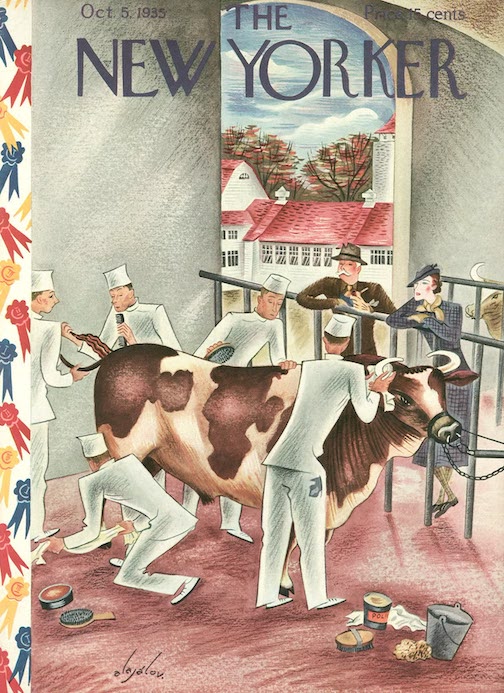
October 5, 1935 cover by Constantin Alajalov.

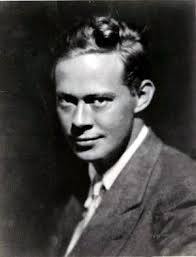
Taking us back to those days was St. Clair McKelway (1905-1980), who beginning in 1933 served as a writer and editor for The New Yorker. Although not well-known today, McKelway was credited by William Shawn as one of a handful of people who “set the magazine on its course.”

St. Clair McKelway. (LA Times)

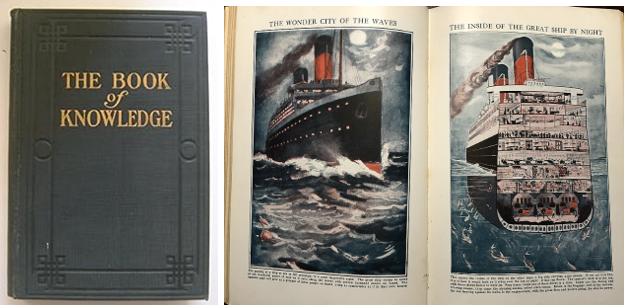
AROUND THE  WORLD IN TWENTY VOLUMES…The Grolier Society’s The Book of Knowledge was a well-known resource to students and teachers alike in the 1930s. Originally largely a reprint of the British Children’s Encyclopædia with U.S. revisions, it evolved over time into an entirely new entity. This particular volume is from 1919, part of a twenty-volume set. (Randal Oulton via Wikipedia)

In this next excerpt, a teacher and principal speak of the schoolchildren dispassionately, casually referring to one pupil’s IQ as “almost down to mental defective.”

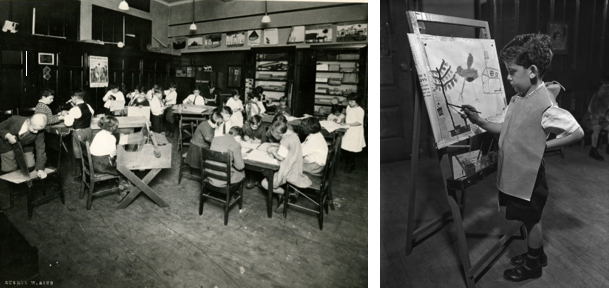
PS PUPILS…Students participate in Elizabeth Irwin’s “Little Red Schoolhouse“ program at PS 61 in 1928; at right, a kindergarten painter at PS 23 in 1935. (NYC Municipal Archives/Fordham U)

In this final excerpt, McKelway looked in on the school’s “ungraded class” of sixteen boys, most from families who were “on relief.” Beginning in the third paragraph, note how the teacher speculates on the future of one of the students.

STILL STANDING, STILL SERVING…PS 165 Robert E. Simon school today. (insideschools.org/Anna Duncan/Friends of PS 165)

A final note: It is interesting to compare McKelway’s article with one written almost thirty years later by few blocks from Columbia University, the school teaches children of graduate students and professors as well as long-time neighborhood residents and newcomers.

 * * *

Moving Days

In the fall of 1935 E.B. and Katharine White and their four-year-old son Joel moved from their Greenwich Village apartment on East 8th Street (reluctantly for E.B.) to Turtle Bay Gardens in the East 40s. At about the same time The New Yorker moved from its original headquarters on West 45th Street to its new digs at 25 West 43rd Street, where the magazine would settle in for more than fifty years.

HOME SWEET HOME…This New York townhouse (left) was the new home of E.B. and Katharine White in the fall of 1935 (their neighbor was Katharine Hepburn). At right, The New Yorker also moved to a new home at 25 West 43rd Street. The magazine would occupy several floors of the building for 56 years. (homes.com/Ink Spill)

 * * *

A Good Bad Girl

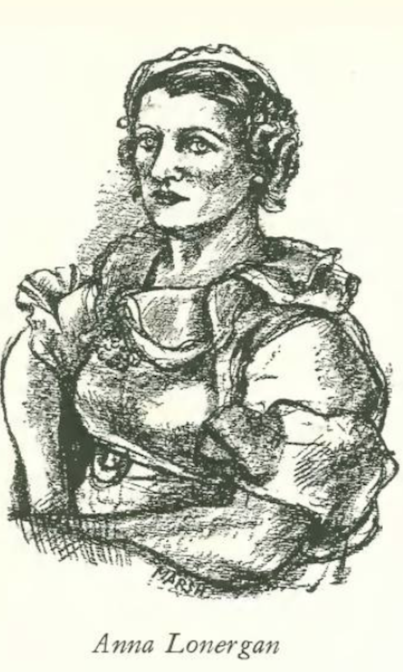
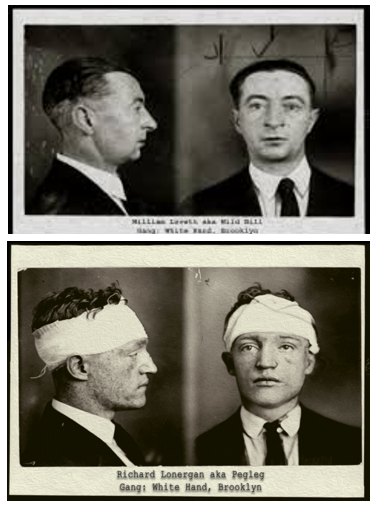
Journalist Meyer Berger (1898-1959) was known for digging deep into his subjects, including a two-part New Yorker profile of Anna Lonergan, “Queen of the Irishtown Docks.” Her two husbands and a brother—notorious killers themselves—were murdered in gang wars along with dozens of others who were Lonergan’s friends and neighbors. She was often called to the morgue to identify murder victims, thus the “Profile” title “Lady in Crepe”—one who is in a constant state of mourning. Here are the opening paragraphs:

SHE WANTED TO BE A NUN…Anna Lonergan, as rendered by Reginald Marsh for the Profile.
KILL OR BE KILLED…Members of the Irish “White Hand Gang” battled their Italian rivals (the Black Hand Gang) on the Brooklyn waterfront from the early 1900s to 1930. Anna Lonergan’s first husband William “Wild Bill” Lovett (top) was murdered in 1923; her brother Richard “Pegleg” Lonergan was gunned down in 1925. (artofneed.com)

 * * *

At the Movies

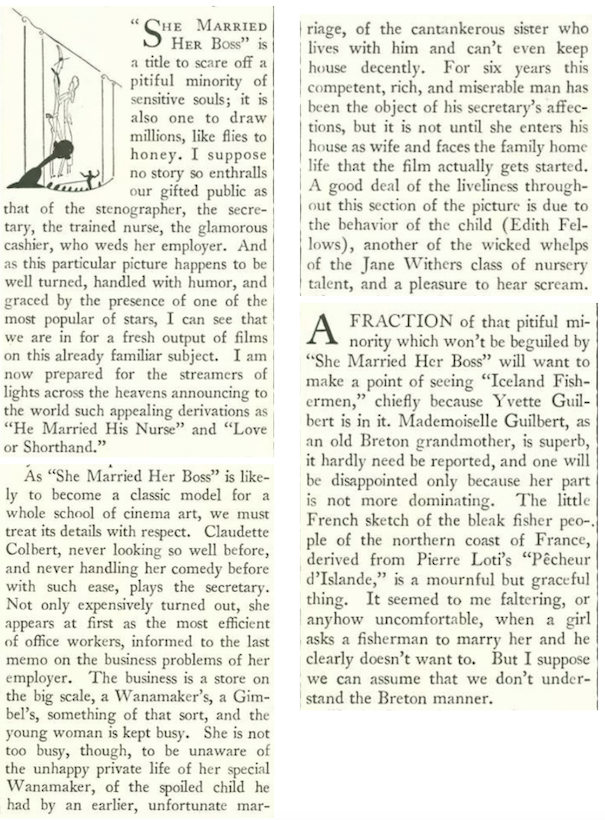
Film critic John Mosher took on a couple of very different films—the lively Claudette Colbert comedy She Married Her Boss, and the “mournful, graceful” Iceland Fisherman featuring the 1890s French cabaret star Yvette Guilbert.

BUSINESS AND PLEASURE…Melvyn Douglas and Claudette Colbert in She Married Her Boss. (IMDB)
GRAND GRANDMOTHER...John Mosher found French actress and cabaret singer Yvette Guilbert (1865–1944) to be the main attraction as a Breton grandmother in 1934’s Pêcheur d’Islande (Iceland Fishermen). Guilbert was a favorite subject of artist Henri de Toulouse-Lautrec, who made many portraits and caricatures of Guilbert, including the one at right from 1894. (musee-breton.finistere/National Portrait Gallery, London/Wikipedia)

Mosher also screened Soviet Russia through the Eyes of an American, which documented American engineer Charles Stuart’s travels through the Soviet Union. You can watch the entire film here.

NO FAMINE HERE…Children playing games were featured in Soviet Russia through the Eyes of an American, a travelogue that skipped all the bad parts of Stalinist Russia. (YouTube/Hoover Institution)

* * *

Some Housekeeping

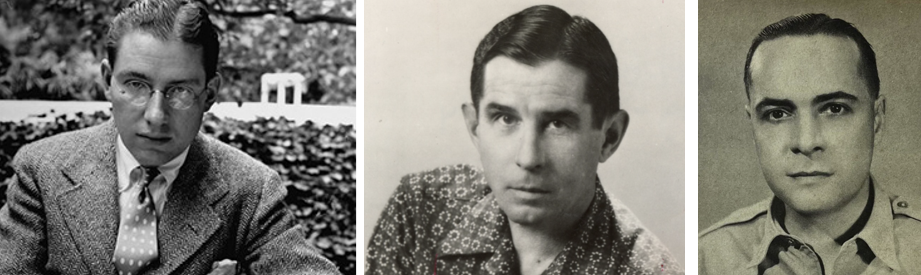
Before we jump into the advertisements, I would feel remiss not to mention other writers in the issue, including poet Ogden Nash (“How Now, Sirrah, Oh, Anyhow”), James Thurber (“Smashup,” featuring henpecked husband Tommy Trinway); Frances Warfield (“Practical Nurse”); Theodore Pratt (“I Jes’ Goin'”); James Reid Parker (“The First Day”); Andree L. Eilert (“Words Across the Sea”) W.E. Farbstein (“Copycat”); and P. S. Le Poer Trench (“Parsons is Prepared”). Some of these contributors are long forgotten—Warfield often wrote about her deafness, but little to nothing can be found out about Eilert or Trench without considerable effort (Trench published twice in the New Yorker in 1935).

AMONG THE KNOWN…At left, Ogden Nash (1902-1971) is the most famous of this trio that includes Theodore Pratt (1901-1969), center, known as the “Literary Laureate of Florida”; and at right, James Reid Parker (1909-1984), who sidelined as a writer of captions for Helen Hokinson. Read more about Parker’s contributions to The New Yorker at Michael Maslin’s New Yorker treasure trove Ink Spill.

 * * *

From Our Advertisers

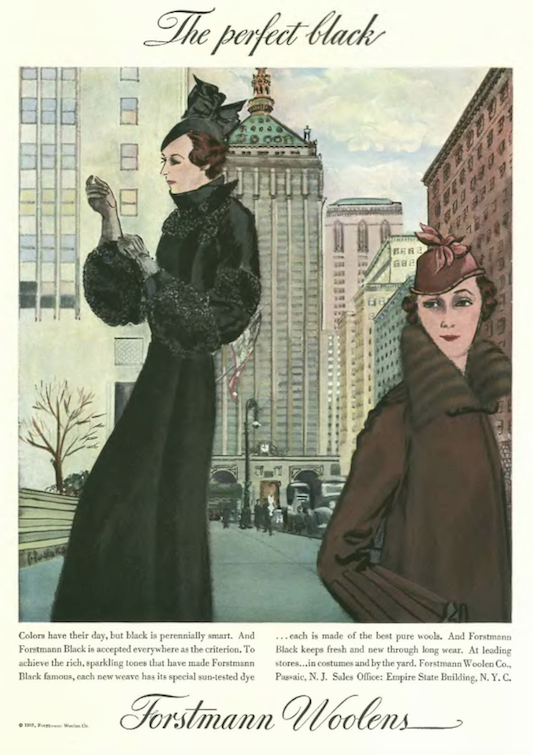
Apparently business was booming at Forstmann Woolens, who continued to post these stylish ads in the opening pages of The New Yorker—note Midtown’s 1927-29 New York Central Building (now Helmsley Building) that served as a gateway to Grand Central…

…who knew that one could be so stylish while drinking a glass of tomato juice?…

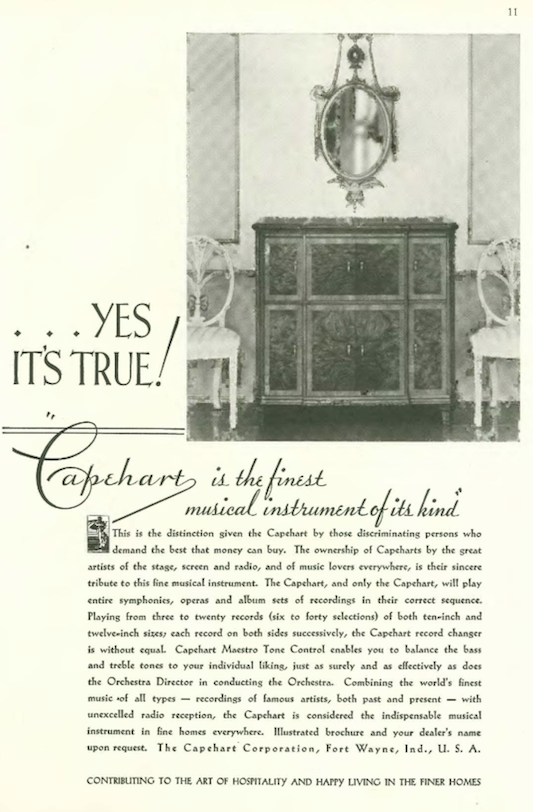
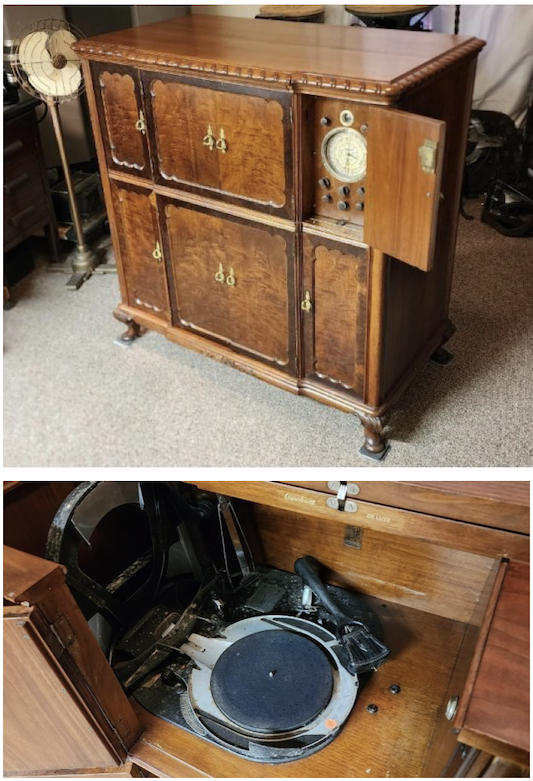
…the Capehart Automatic Phonograph Company produced a radio-phonograph that could automatically flip records to play both sides—this particular model could play up to twenty records in succession…

QUITE THE GIZMO…Restoration of a Capehart 405E. These units were not cheap, selling for the equivalent of $30k or more today. (forum.antiquephono.org)

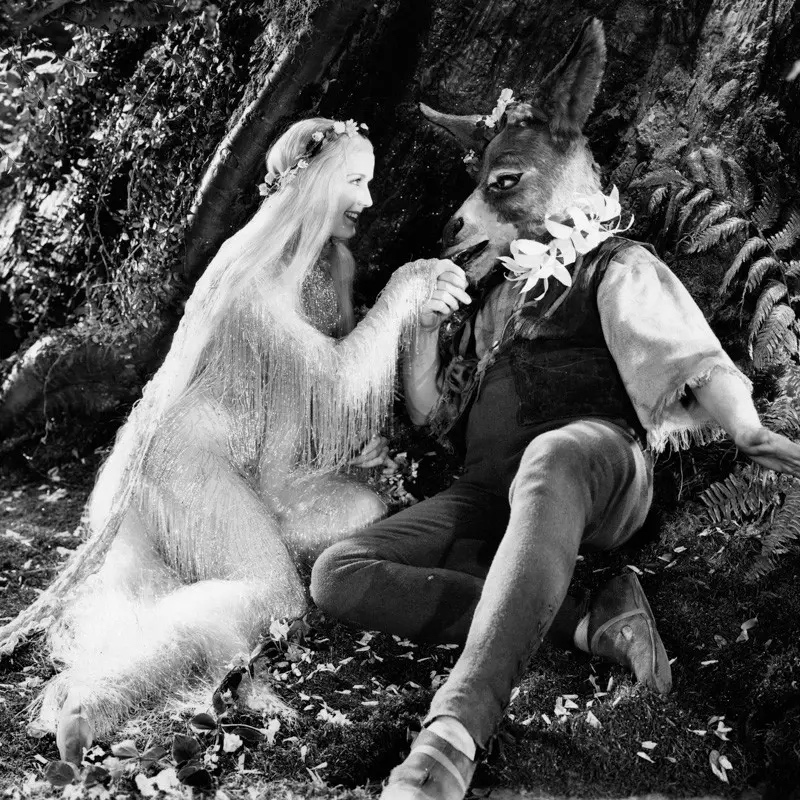
…Warner Brothers took out a full-page ad to announce the world premiere of A Midsummer Night’s Dream…the lavish, star-studded production featured, among others, James Cagney, Olivia de Havilland, Dick Powell, Anita Louise and Mickey Rooney

AN ACQUIRED TASTE...Anita Louise as Titania, Queen of the Fairies, and James Cagney as Bottom, the Weaver, in the 1935 film production of Shakespeare’s A Midsummer Night’s Dream. The film failed at the box office with mixed reviews, however it won two Academy Awards—Best Cinematography and Best Film Editing, and it was nominated for Best Picture. Today the film gets mostly good reviews. (www.academymuseum.org)

Stage magazine also took out a full-page ad to trumpet its own star-studded lineup, including contributions by James Thurber, Peggy Bacon and Abe Birnbaum

…Mrs. Chiswell Dabney Langhorne, nee Caryetta Davis Saunders (1899-1971), was the latest society maven to encourage women smokers to enjoy the unfiltered pleasures of Camel cigarettes…

…on to our cartoonists, George Price and Maurice Freed got things rolling with these spot drawings…

Carl Rose mixed the old with the new on moving day…

Barney Tobey showed us how the posh travelled to school…

George Price again, here demonstrating the joys of moneyed eccentricity…

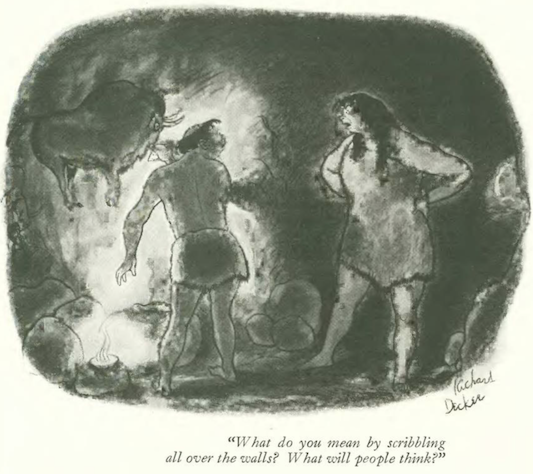
Richard Decker explored the origins of art criticism…

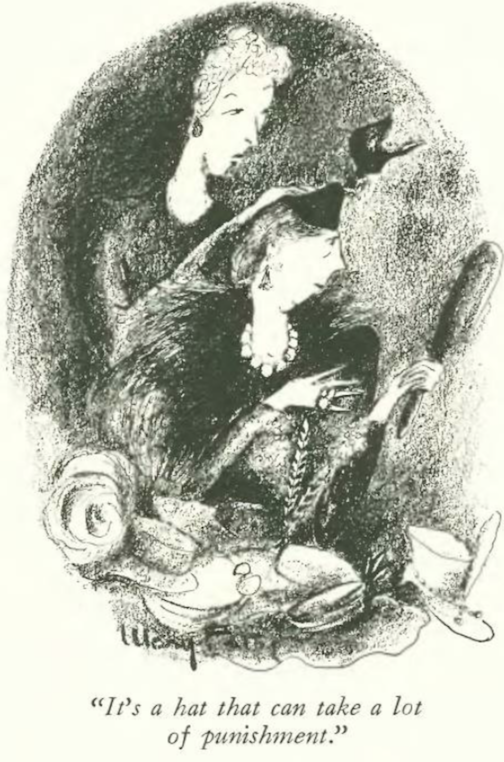
Mary Petty offered some durable fashion advice…

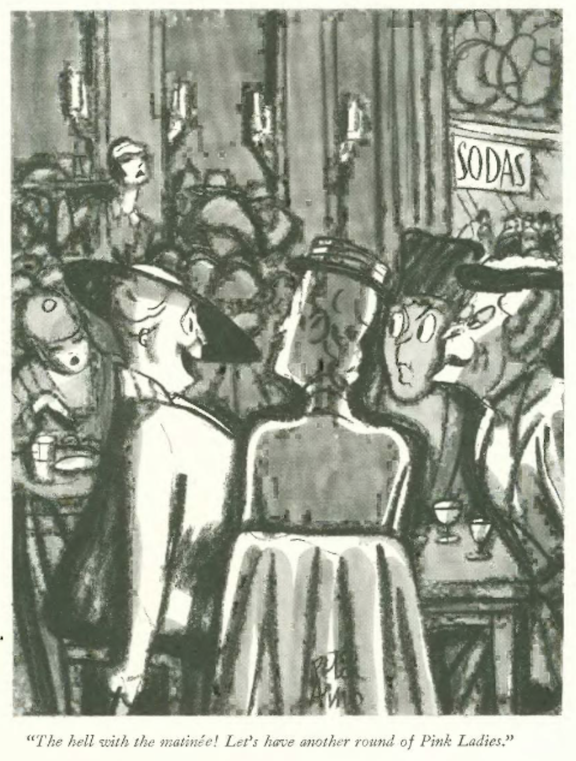
…and we close with Peter Arno, finding sudden inspiration in a Pink Lady cocktail…

Next Time: A Merry Menagerie…


Going With the Flow

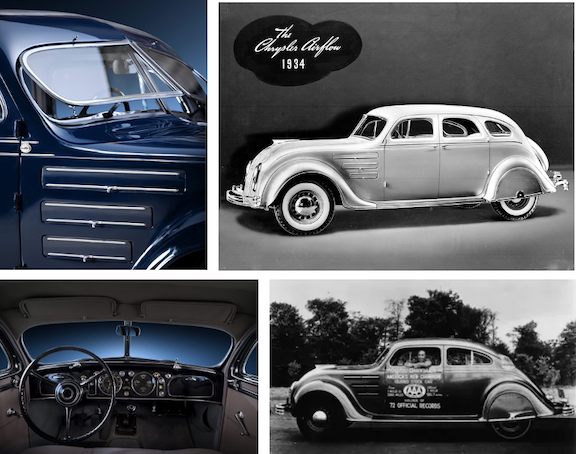
“We had the horse and buggy. We had the automobile. Now we have the first real motor car in history.” — Walter P. Chrysler. (Image: Blair Bunting via hagerty.com)

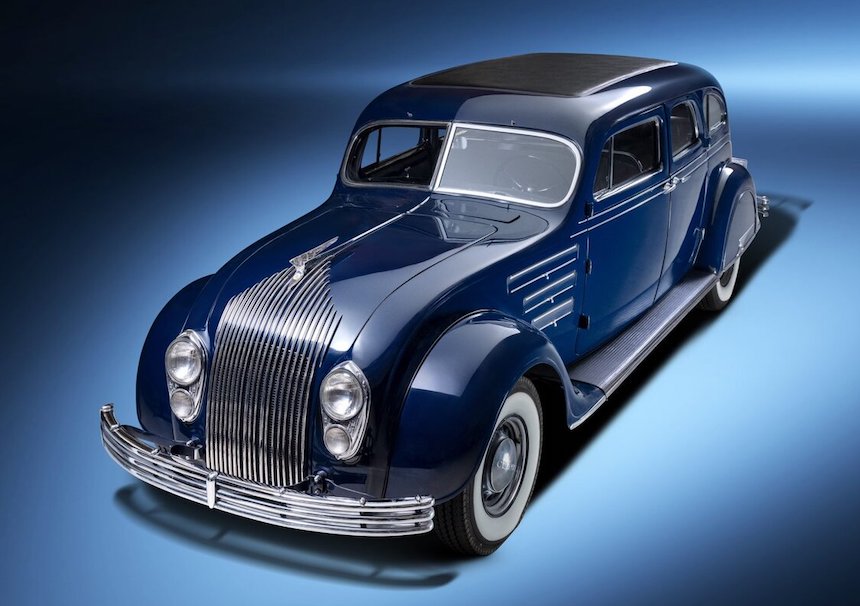
Classic motorcar collector and aficionado Jay Leno has more than 180 vehicles in his collection, but a pride and joy is a 1934 Chrysler Airflow Imperial CX—one of the only three surviving CXs today.

Dec. 16, 1933 cover by Rea Irvin.

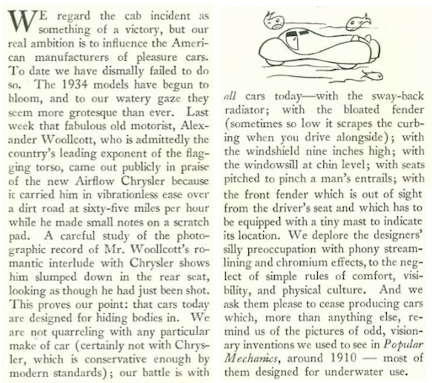
The 1934 Chrysler Airflow was a car of the future that came too early. The Airflow’s advances in engineering—including invention of the modern unibody—still inform car design today. But the streamlined look of the car was probably too advanced for those depressed times, and despite lots of media attention it flopped with consumers. E.B. White was among those who weren’t ready to jump on the Airflow bandwagon, and even poked fun at colleague Alexander Woollcott for posing in the backseat of an Airflow for a Chrysler advertisement:

The Woollcott ad in question, which appeared in the previous issue (Dec. 9):

Of the major car companies in the 1930s, Chrysler was perhaps the most revolutionary in terms of technological and design advances. The first car to be wind tunnel-tested, the Airflow’s lightweight, unibody design moved the engine over the front axle and positioned the passengers between the front and rear wheels for a much roomier, smoother ride. Chrysler claimed the unibody also made the car stronger and safer, as this newsreel attests:

Air truly flowed through the car; even the windshield could be cranked open for greater air circulation.

AND THEN THERE WERE THREE…Jay Leno’s Chrysler Airflow Imperial CX, one of only three CX’s known to exist today. Other versions of the Airflow included a model sold under the DeSoto brand name. You can see this car in action on Jay Leno’s Garage. (Blair Bunting)
AIR SUPPLY…Clockwise, from top left: The Chrysler Airflow featured a windshield that could be cranked open; advertising card for the Airflow; Indy veteran Harry Hartz set seventy-two speed and distance records at the Bonneville Salt Flats in an Airflow, driving 97.5 mph over the flying mile; the roomy interior featured a nearly horizontal steering column, which freed up space in the driver’s footwell. Although normal today, it was revolutionary in 1934, when most cars had steering columns sprouting from the floor. (Blair Bunting/macsmotorcitygarage.com)

 * * *

No Fair, Doug

Few Hollywood marriages could ever match the legendary status accorded to that of Mary Pickford and Douglas Fairbanks, darlings of the silent screen who who exchanged vows in 1918. When the couple separated in 1933, even E.B. White couldn’t resist a bit of Tinseltown gossip.

FAIRY TALE FIZZLE…The very public nature of the Mary PickfordDouglas Fairbanks marriage put a big strain on their matrimonial bonds. When both saw their careers fade at the end of the silent era, Fairbanks found escape in overseas travel, and in a romance with Sylvia, Lady Ashley (pictured above, center). Pickford and Fairbanks would divorce in 1936, and that same year Fairbanks and Lady Ashley would marry—just three years later Fairbanks would die from a heart attack, at age 56. Pickford would marry actor-musician Charles “Buddy” Rogers in 1937—they would remain married until her death in 1979. (Huffington Post/npg.org.uk)

  * * *

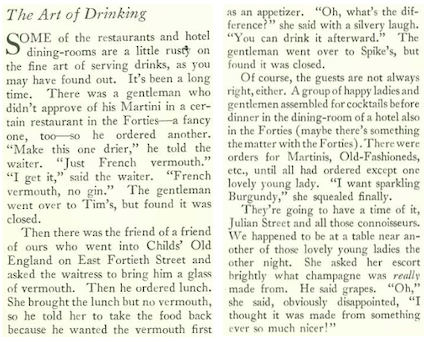
Drinking Problem

“The Talk of the Town” reported on the challenges facing both restaurants and patrons who were becoming reacquainted with legal drinking:

 * * *

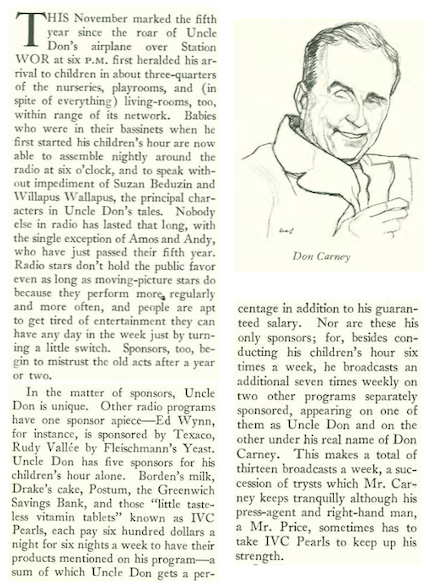
Before Mr. Rogers

The “Profile” took a childish turn with this account of Don Carney (1896–1954) penned by Margaret Case Harriman. Carney is best remembered as the host of Uncle Don, a hugely popular WOR children’s radio program produced between 1928 and 1947. Excerpts:

MERCH…Don Carney’s popularity in the 1930s is evidenced in the output of merchandise including sheet music (1935), a 1940 activity book, and a 1936 “Strange Adventures” story book. (phantom.fan/ebay)

 * * *

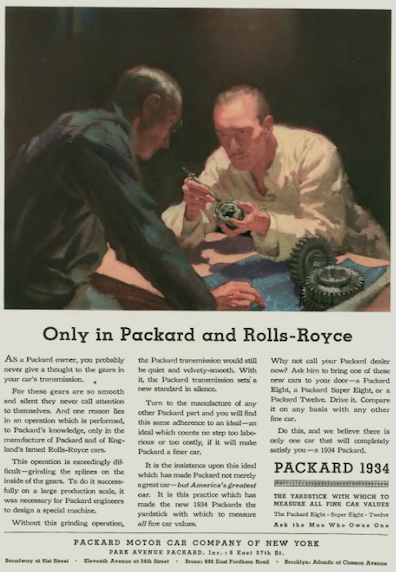
From Our Advertisers

Speaking of fine cars, the folks at Packard pointed out one similarity between their automobile and the product manufactured by Rolls-Royce…owning a Packard in the 1930s was indeed considered prestigious, and like Rolls-Royce it competed in the international luxury car market…

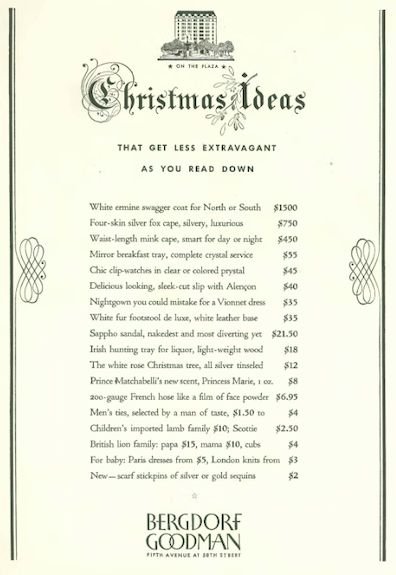
…Bergdorf Goodman placed this helpful ad listing various gift ideas in descending order of price…and extravagance…

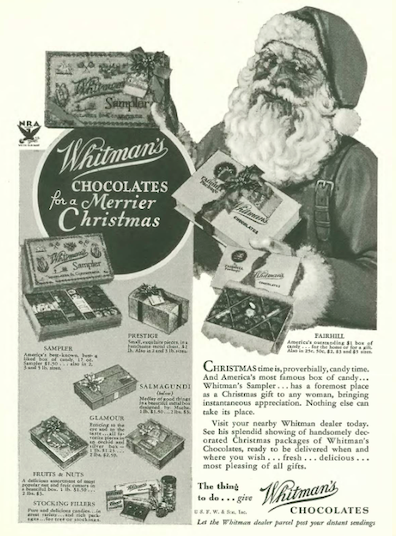
…and it wouldn’t be Christmas without the perennial Whitman’s Santa Claus touting his sweet wares…

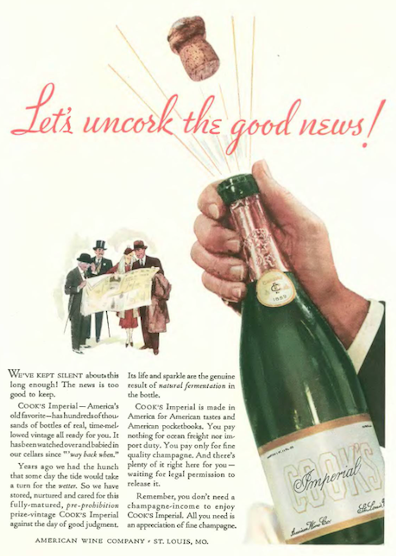
…and New Yorkers were getting ready to celebrate a New Year without Prohibition, and pop some “good news” with Cook’s American “champagne”… 

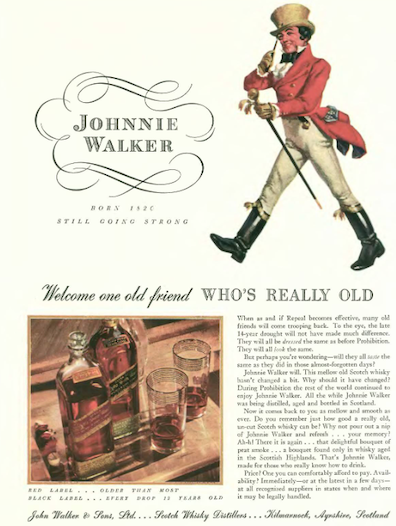
…an “old friend,” Johnnie Walker, strode into the advertising pages of the New Yorker for the very first time…

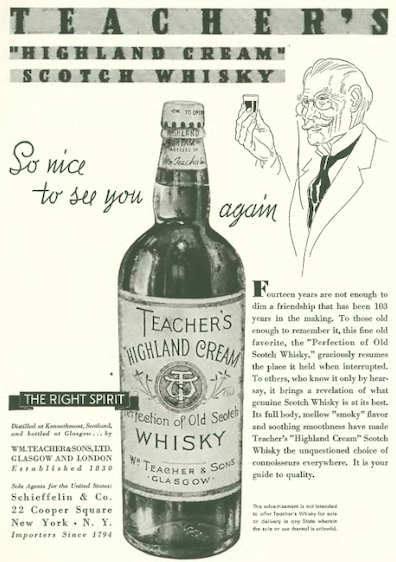
…while another purveyor of Scotch whiskey, Teacher’s, raised a glass to the return of legal liquor in the colonies…

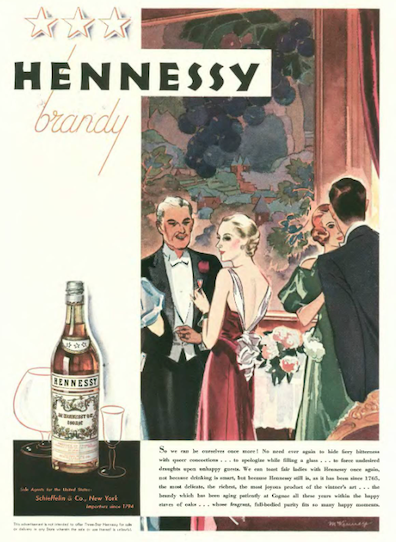
…the makers of Hennessy brandy celebrated the fact that “we can be ourselves once more”…

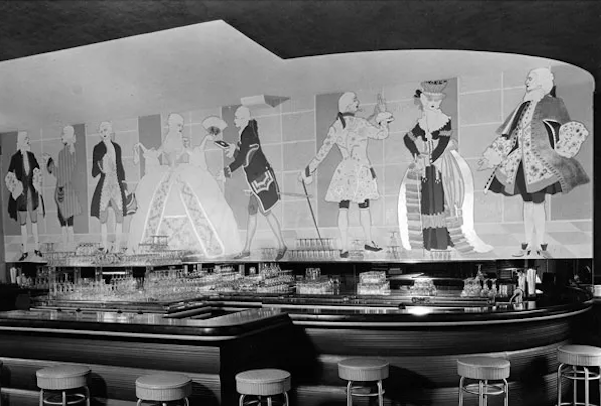
…the end of Prohibition saw the rapid expansion of the chain of Longchamps restaurants in New York City…in the 1930s the company hired top modernist decorators and architects (Winold Reiss and Ely Jacques Kahn, among others) to create some of New York’s most glamorous interiors…

LONGCHAMPS LONG GONE…Winold Reiss’s Louis XV mural behind the Chanin Building’s Longchamps bar, 1935. Hugely popular in mid-century New York, Longchamps all but vanished by 1970. Read more about one of New York’s most stylish restaurants at two wonderful sites, Driving For Deco and Restaurant-ing Through History. (winoldreiss.org)

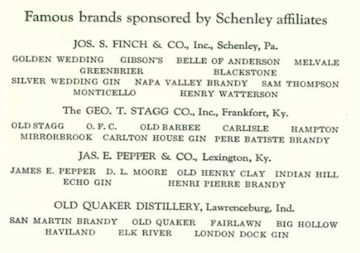
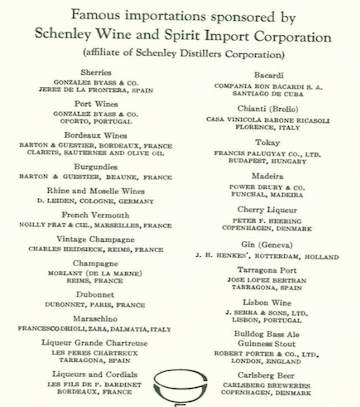
…Schenley was a giant in the spirits industry…headquartered in the Empire State Building, it also had a giant impact in the United States…to assure consumers that quality hadn’t suffered over the thirteen long years of Prohibition, Schenley ran this two-page ad stating: on through the years—famous names, famous brands, secrets, formulae, warehouses, yes—and stocks of precious old liquor have been accumulated and guarded by Schenley for you when the day arrives

…here are some of the brands listed by Schenley in the side column:

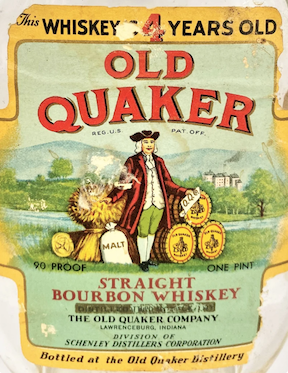
Old Quaker was one of Schenley’s popular whiskey brands in the 1930s.

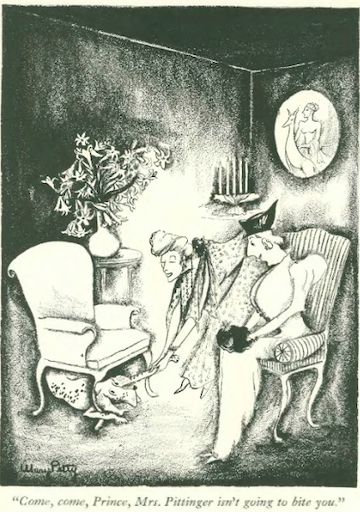
…and we sober up for our cartoonists, beginning with Mary Petty

…mixed company was always a recipe for trouble in James Thurber’s world…

…and we close with George Price, and an unexpected visitor…

Next Time: The Cold Light of Day…


The Radio City

The NBC Studios at 30 Rockefeller Plaza have wowed visitors and performers alike for nearly 90 years. Today we look back at the remarkable foresight of the studios’ designers, who created spaces that would one day accommodate a new medium called television, which was still in its experimental stages.

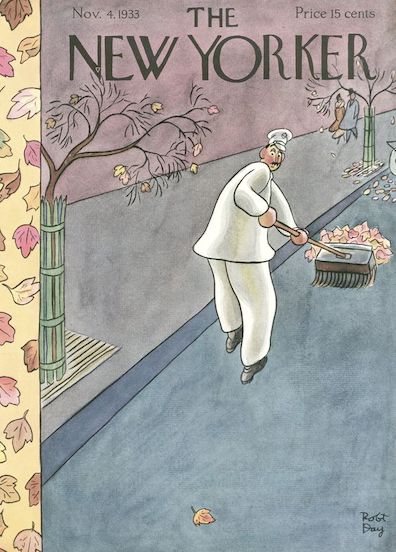
Nov. 4, 1933 cover by Robert Day, who contributed a total of eight covers to The New Yorker.

However, before we jump in, let’s look at Robert Day’s cover for the Nov. 4 issue, which featured a familiar character who made his first appearance on the cover of issue #12 (May 9, 1925), and returned four years later looking much older in the dog days of August…

Cover of issue #12 (May 9, 1925) by Rea Irvin introduced our street sweeper, who returned Aug. 3, 1929 by the hand of Gardner Rea.

Day’s cover, however, was also a nod to the annual gathering of autumn leaves—an occasional cover theme that began with Peter Arno’s contribution to the Nov. 27, 1926 issue (below, left) and most recently expressed in Adrian Tomine’s cover for the Nov. 7, 2022 issue (with timely pandemic reference)…

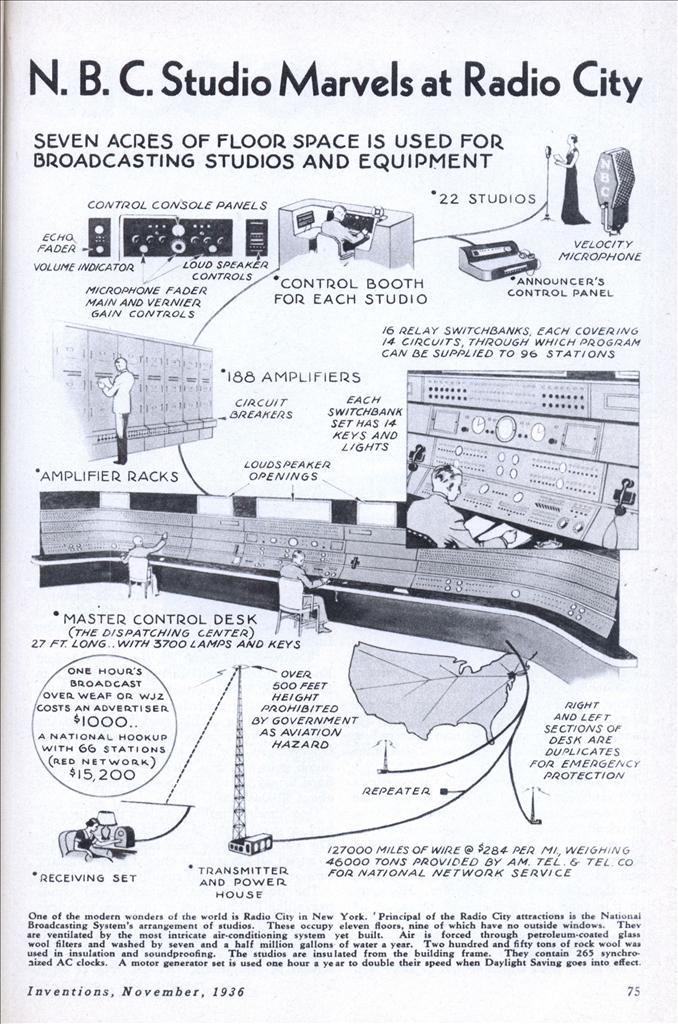
Back to Radio City, Morris Markey recounted the technological wonders of the new NBC studios in his “A Reporter at Large” column, “Marconi Started It.” Markey noted the “fabulous quality” of the facilities, wired for the day when television would arrive. Excerpts:

GEE WHIZ…Morris Markey could be assured that some folks would be “goggled-eyed” by NBC studios, including the technophiles at Popular Mechanics. (westmb.org)

WHERE HISTORY WAS MADE…Studio 8H was the world’s largest radio studio when it opened in 1933. It would be converted for television in 1950. (westmb.org)

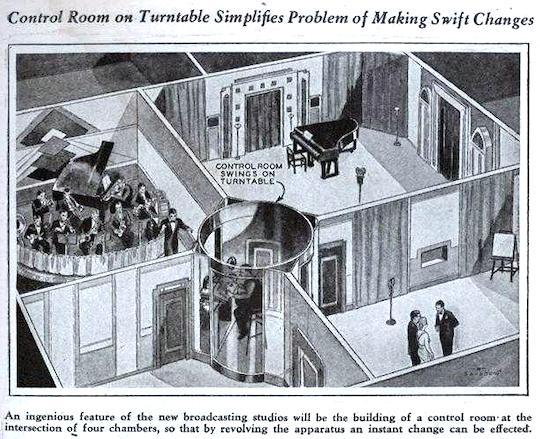
Markey marveled at NBC Studios’ various design innovations, including a revolving control room dubbed the “Clover Leaf”…

(Modern Mechanics, Jan. 1931)

Almost 90 years later, the studios continue to serve the broadcast needs of the 21st century, including Studio 8H…

LIVE FROM NEW YORK…Studio 8H was the world’s largest radio studio when it opened in 1933. Converted to television in 1950, it has been home to Saturday Night Live since 1975. Above, SNL stage manager Gena Rositano, in 2015. Below, longtime SNL director Don Roy King at the controls for Studio 8H, also in 2015. (Dana Edelson/NBC via Directors Guild of America)

 * * *

Leopold!

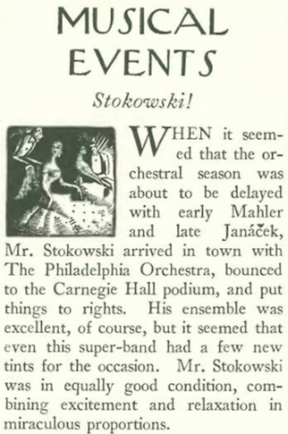
Conductor Leopold Stokowski was no stranger to Studio 8H. From 1941 to 1944 he led the NBC Symphony Orchestra in that venue. One of the leading conductors of the early and mid-20th century, Stokowski (1882–1977) began his musical career in New York City in 1905 as the organist and choir director at St. Bartholomew’s Church, but by 1915 he was conducting the famed Philadelphia Orchestra. Robert Simon reported on Stokowski’s return to New York for a performance at Carnegie Hall. A brief excerpt:

I GET AROUND…Portrait Of Leopold Stokowski by Edward Steichen, Dec. 1, 1933. Married three times and once romantically linked to Greta Garbo, he was married to wife #3, Gloria Vanderbilt, for ten years. (Condé Nast)

Stokowski had the distinct honor of being satirized in a 1949 Looney Tunes cartoon, “Long-Haired Hare,” in which Bugs Bunny disguised himself as the conductor and entered the stage to the astonished whispers of the orchestra…Leopold! Leopold!…

MAESTRO…Bugs Bunny as Stokowski in “Long-Haired Hare.”

Stokowski was no stranger to animation. The conductor appeared in silhouette in Disney’s Fantasia (1940), leading the Philadelphia Orchestra in the film’s score. He even shook hands with Mickey Mouse.

 * * *

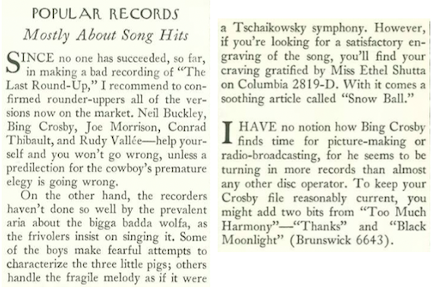
Bigga Badda Wolfa

The New Yorker took a look at the popular records of the day, and in addition to tunes by Bing Crosby and Rudy Vallée there was yet another release of “Who’s Afraid of the Big Bad Wolf?”…Ethel Shutta was the latest of seemingly dozens of artists to cash in on the Disney hit…

I’LL HUFF AND I’LL PUFF…Those who couldn’t get enough of “Who’s Afraid of the Big Bad Wolf” could turn to Ethel Shutta’s rendition of the hit song on Columbia records. (discogs.com)

 * * *

Page-Turner

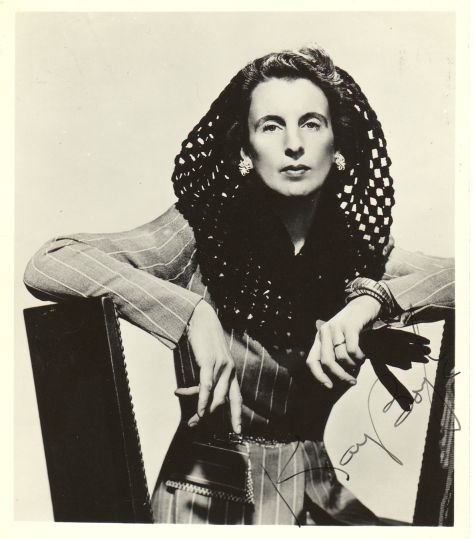
Writer Kay Boyle wasn’t afraid of wolves or any other subject for that matter, according to book reviewer Clifton Fadiman

TOSSING A SALACIOUS SALAD…Kay Boyle, photographed by George Platt Lynes, 1941. (The Kay Boyle Papers, Morris Library, Southern Illinois University)

 * * *

A Grapeful Nation

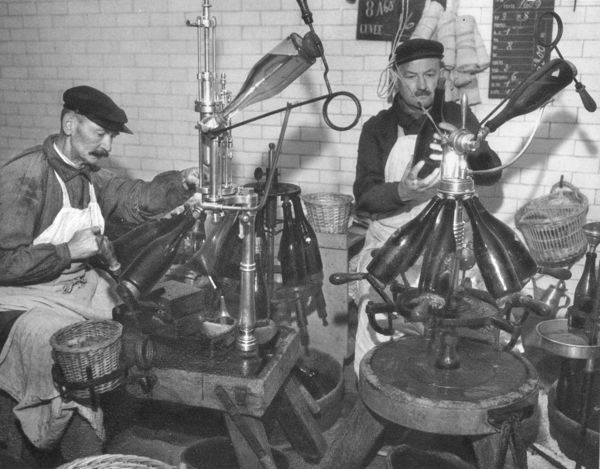
As New Yorkers counted the days until the end of Prohibition, The New Yorker did its part to get readers back up to speed by enlisting the talents of one of the world’s great wine experts, Frank Schoonmaker, who had the enviable job of filing a series of wine reports for the magazine. His first installment of “News From the Wine Country” featured the Champagne region. Excerpts:

THAT FIZZY FEELING…Bottling the good stuff in the Champagne region, circa 1930. (wineterroirs.com)

 * * *

From Our Advertisers

Christmas was just around the corner, and F.A.O. Schwarz was READY with its 64-page catalog…

…White Rock anticipated the end of Prohibition with an ad featuring a miniature colonel who apparently needed a stiff drink to prepare for his wife’s return from abroad…

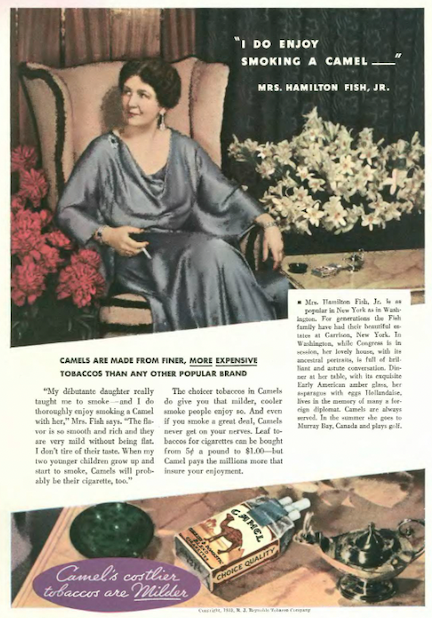
…Mrs. Hamilton Fish Jr, aka Grace Chapin, was married to the New York congressman from 1920 until her death in 1960, apparently enjoying many Camels along the way…her husband would go on living another 31 years and take three more brides before expiring at age 102…

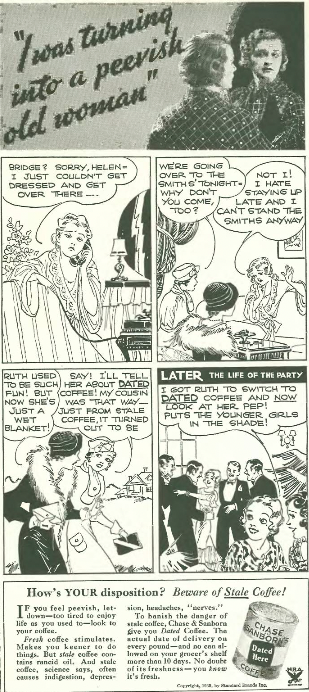
…another cautionary tale from Chase & Sanborne about the perils of undated coffee…

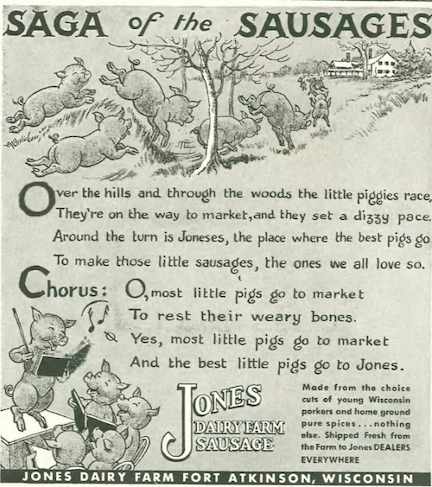
…and with the holidays approaching, a jolly ditty from Jones Dairy Farm, home to little piggies who merrily dash toward their inevitable slaughter…

…and we jump to another back-page ad, this from the stately Plaza, where you could get a single room for five bucks a night…

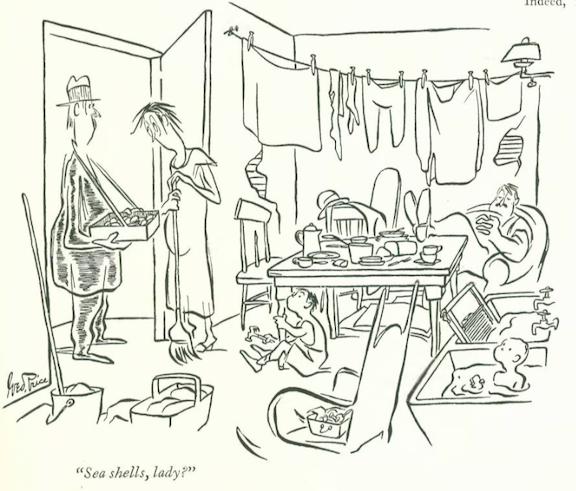
…turning to the cartoons, we find George Price hitting his stride with multiple cartoons in consecutive issues…

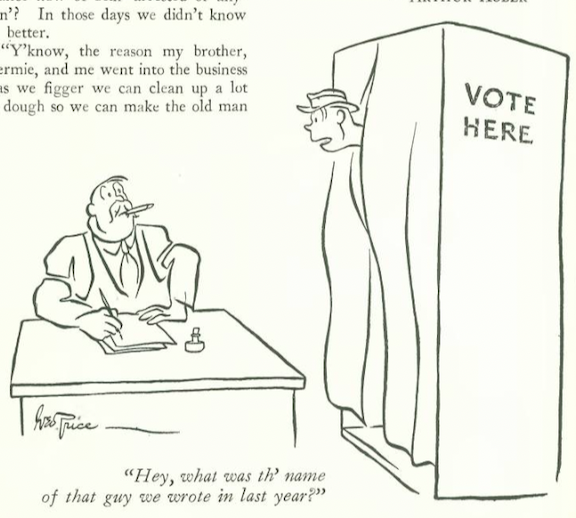
…and taking a look at the recent elections…

…on to James Thurber, and continuing struggles on the domestic front…

…and that brings us to our next issue…

Nov. 11, 1933 cover by Constantin Alajalov.

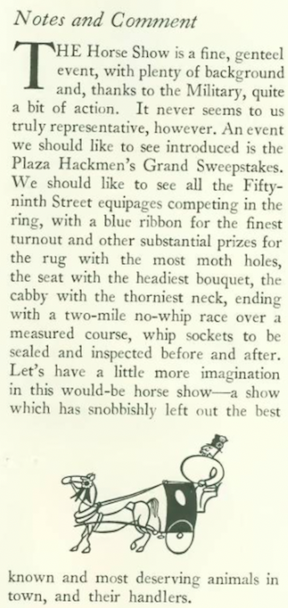
…in which E.B. White had a thing or two to say about the latest edition of the National Horse Show at Madison Square Garden.

HORSE SENSE AND SENSIBILITY…The National Horse Show at Madison Square Garden was a major event on New York’s social calendar; top and bottom right, scenes from the 1936 show; bottom left, undated scene circa 1960. (Stills from YouTube)

 * * *

Versatile Verse

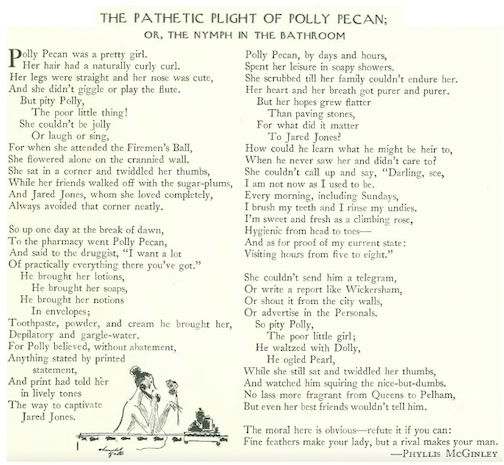
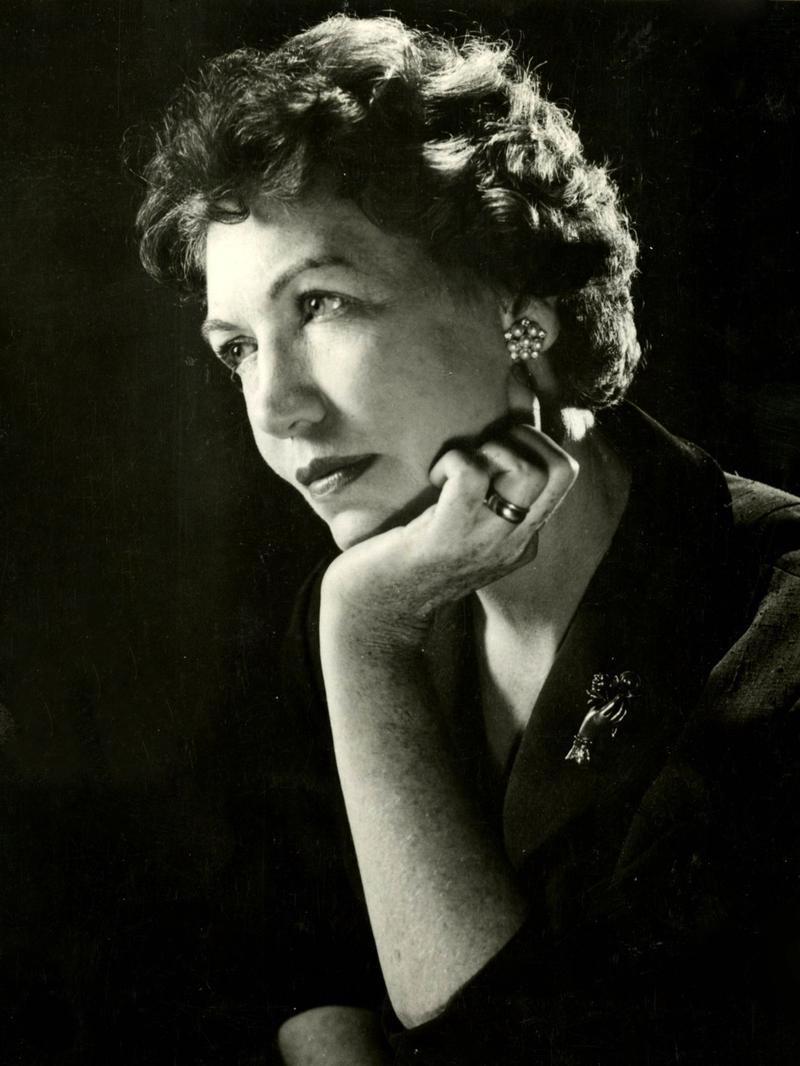
Phyllis McGinley (1905–1978) was the author of children’s books and poetry, the latter genre most notably for The New Yorker. However, she attracted a wide audience for her light verse in other publications ranging from Ladies Home Journal to The Saturday Review.

LIGHT TOUCH…Phyllis McGinley in an undated photo. She received the Pulitzer Prize in 1961 for her book Times Three—the first writer of light verse to receive the prize. (wnyc.org)

 * * *

Oil and Water

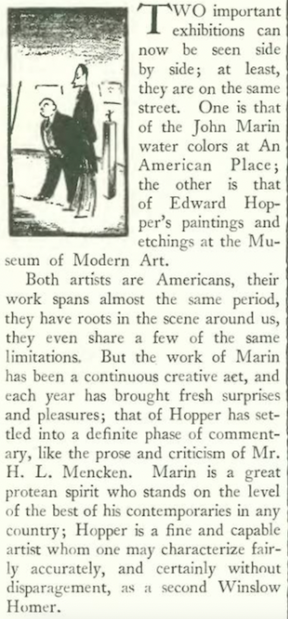
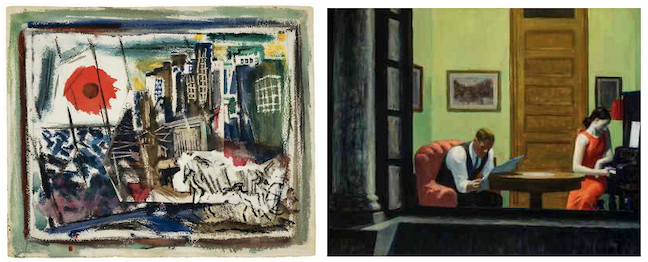
Art and architecture critic Lewis Mumford found two very different visions of America in the works of contemporaries John Marin and Edward Hopper. Marin’s watercolors were featured at An American Place, while Hopper’s oil paintings and etchings were shown down the street at the Museum of Modern Art.

SIDE BY SIDE…Lewis Mumford found different visions of New York and the world at An American Place and MoMA galleries. At left, John Marin’s watercolor From the Bridge, N.Y.C. (1933); at right, Edward Hopper’s Room in New York, also from 1933. (Artists Rights Society/Sheldon Memorial Art Gallery)

 * * *

More From Our Advertisers

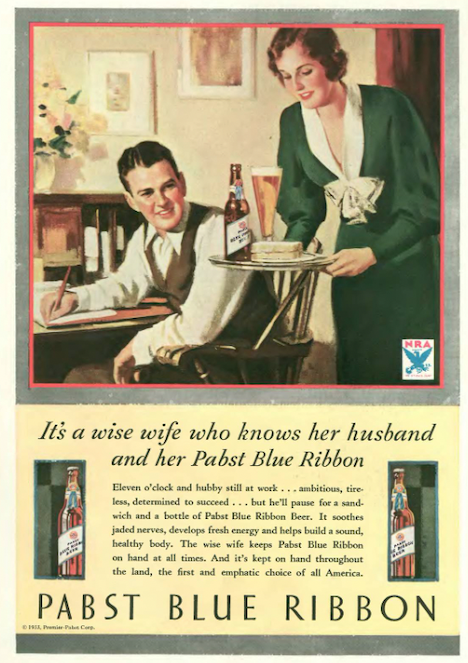
Okay, so I’ll buy the part about PBR’s ability to soothe “jaded nerves,” but I doubt it gave this guy “fresh energy” and “a sound, healthy body”…

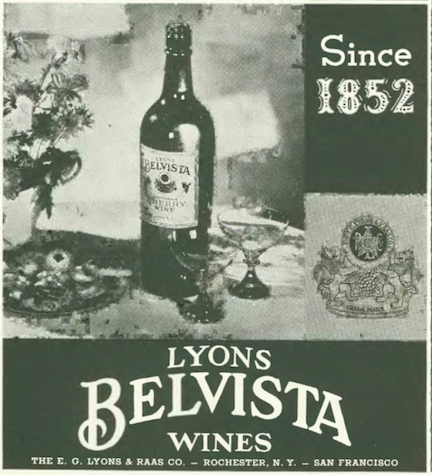
…After thirteen long years, winemakers emerged from their cellars to glimpse the light of a new day…

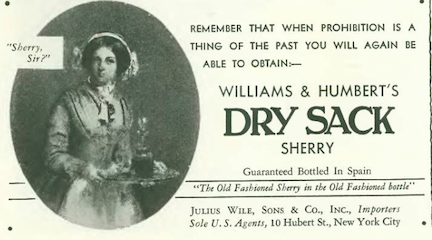
…and yes, after thirteen long years, some folks would be yearning for their DRY SACK Sherry…

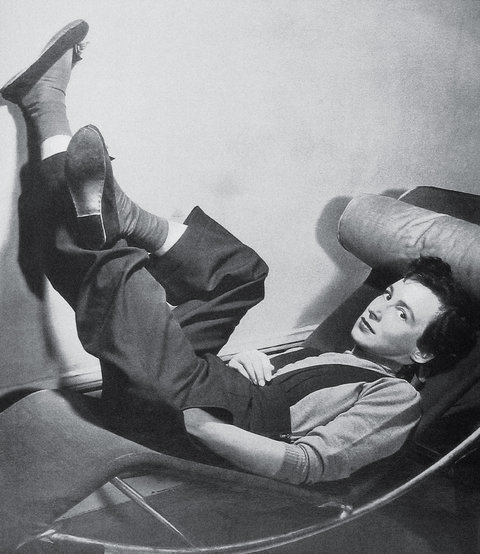
…the name Elizabeth Hawes was synonymous with high fashion in the late 1920s and 1930s—she owned one of the most exclusive couture houses in New York…

…an outspoken advocate of dress reform, Hawes (1903–1971) was referred to by one historian as “the Dorothy Parker of fashion criticism.” After attacking the fashion industry with her 1938 book, Fashion Is Spinach (Hawes wrote: “I don’t know when the word fashion came into being, but it was an evil day…”), she closed her fashion house and in 1942 took a job as a machine operator at a wartime plant in New Jersey. She became a union organizer, a champion of gender equality, and a critic of American consumerism.

IN A LEAGUE OF HER OWN…Elizabeth Hawes — writer, fashion designer and political activist, poses for a photograph in 1941. (Mary Morris Lawrence)

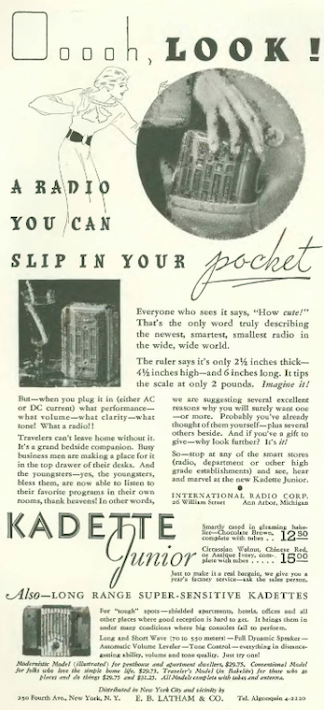
…speaking of consumerism, ooooh look! A radio “you can slip in your pocket,” depending of course on the size of your pocket…
…transistors would not come along until the late 1950s, so the Kadette still depended on tubes, and you had to plug it in somewhere, so no running down the beach with headphones, at least for awhile…

The Kadette Junior. (radiolaguy.com)

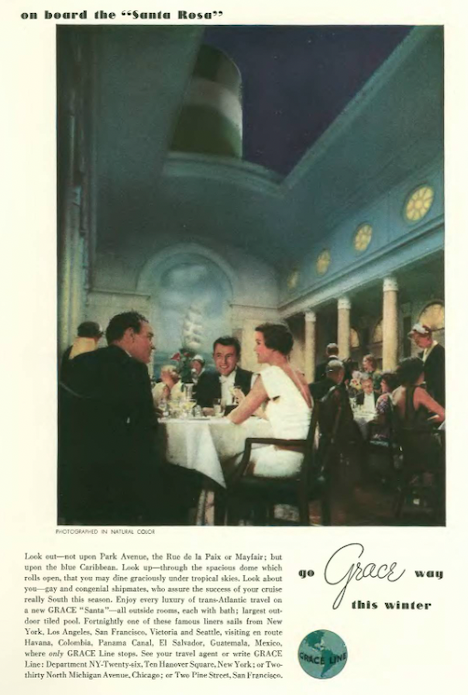
…it must have been a rare treat to sail on a ship like the SS Santa Rosa—situated between the ship’s two funnels, the dining room had an atrium stretching up two-and-a-half decks and featured a retractable roof…

…on to more cartoons, and more George Price

…moving along, we received some big news from one of Helen Hokinson’s “girls”…

…an aside I’ve been meaning to include…in 1952, just three years after Helen Hokinson’s untimely death, a cartoonist for The Cincinnati Enquirer, Franklin Folger, debuted a cartoon called “The Girls.” The cartoon was eventually syndicated and appeared in more than 150 newspapers worldwide before Folger retired it in 1977. Perhaps I am missing something, but I cannot find a single reference to Folger’s obvious appropriation of Hokinson’s “girls”…some examples of Folger’s work from the early 1960s and another from H.H. for comparison:

…and onward to Peter Arno, and the trials of portrait artists…

…and we close with two by Barbara Shermund

…rendered in different styles…

Next Time: Coach Arno…

An Instant Star

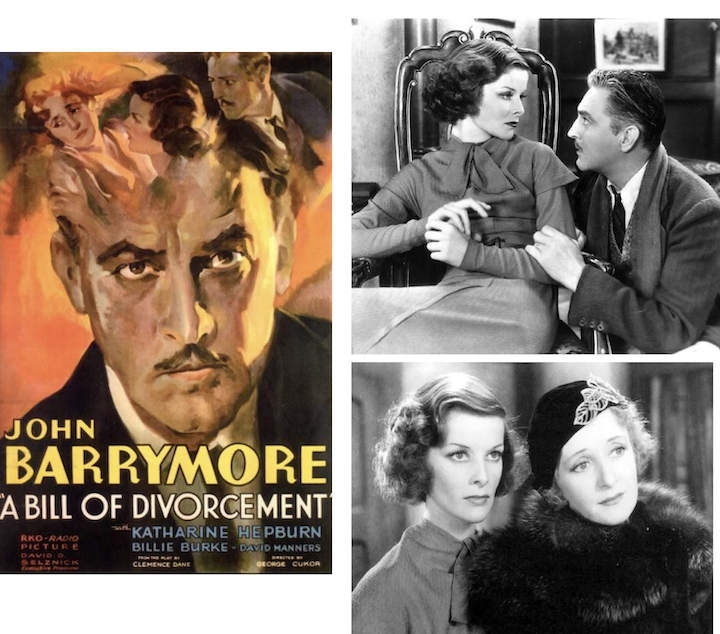
George Cukor’s 1932 pre-Code film A Bill of Divorcement would make Katharine Hepburn an instant star in her screen debut…

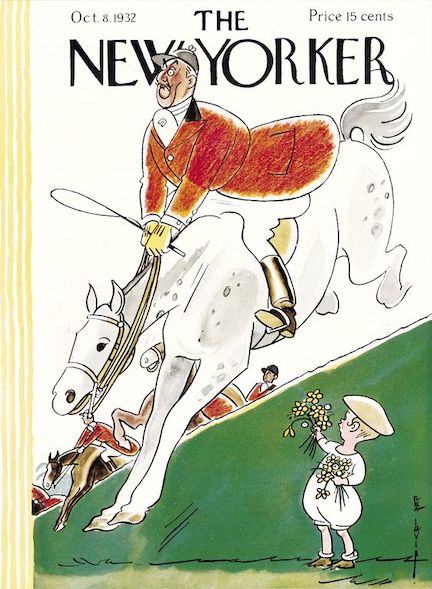
Oct. 8, 1932 cover by Rea Irvin.

… but New Yorker critic John Mosher seems to have missed the boat in spotting this new talent, who would go on to be—at least according to the American Film Institute, “the greatest female star of classic Hollywood cinema.” In A Bill of Divorcement, Hepburn portrays a young woman who fears she has inherited the same psychiatric problems that plague her father (John Barrymore). Mosher wrote:

A LOT ON HIS MIND…In A Bill of Divorcement, John Barrymore portrays a man who escapes from a mental hospital after 15 years of confinement, seeking to return to wife and family; his daughter, Sydney (Katharine Hepburn), fears she has inherited his psychiatric problems, while Sydney’s mother, Meg (Billie Burke) wants to start a new life with another man. (IMDB)

Although Mosher offered a rather tepid response to Hepburn’s debut role, critic Mordaunt Hall of The New York Times called the film “intelligent, restrained and often stirring.” Of Hepburn he wrote: “Miss Hepburn’s characterization is one of the finest seen on the screen and the producers have been wise in not minimizing the importance of her part because Mr. Barrymore is the star of the film.”

 *  *  *

On Shaky Ground

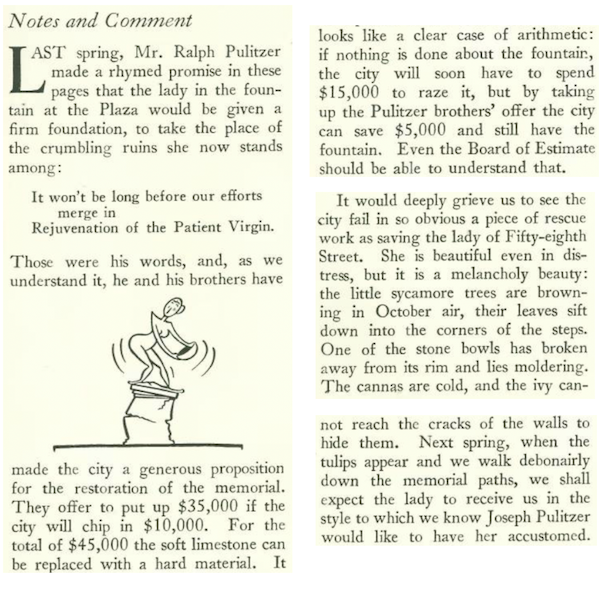
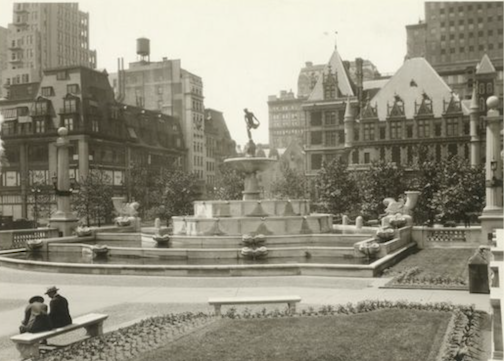
E.B. White noted the sad state of the Pulitzer Fountain, which had stood at the Plaza since 1916. Although Joseph Pulitzer’s sons had put up funds to restore the landmark, the city had yet to act on a plan.

Fortunately the fountain still stands, thanks to restorations in 1933-35, 1971 and 1985-90. As to White’s concerns, the city finally accepted the Pulitzers’ offer, and after delays due to labor disputes it was completed in June 1935. The original limestone basin was rebuilt in Italian marble, and a limestone balustrade and columns that surrounded the fountain were demolished.

WHEN WE WERE YOUNG…The Pulitzer Fountain after it was completed in 1916. (New York Public Library)

White also mused about the nature of Long Island, soon to be transformed under Robert Moses’ system of parkways that would stretch across the island’s vast expanses.

EAT ME…Hundreds of truck farms dotted Long Island in the early 20th century, especially known for their potatoes. (Newsday)

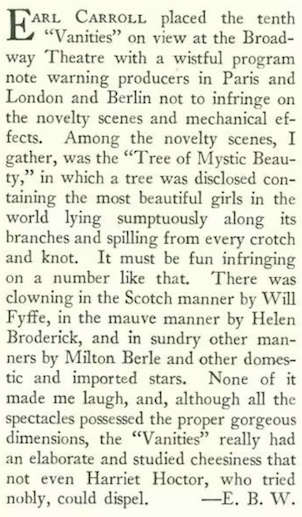
…and we have more from White, also serving as the magazine’s theater critic and taking in the latest installment of Earl Carroll’s Vanities…I include this mainly to note the young vaudevillian Milton Berle’s first appearance on a big stage…

BEFORE UNCLE MILTIE…Milton Berle (1908–2002) made his first appearance on a big stage with Earl Carroll’s 1932 Vanities. It is also noteworthy that in that same year Chicago native Vincente Minnelli (see program cover) was getting his first breaks on Broadway as a stage and costume designer. (tralfaz.blogspot.com/Playbill)

 *  *  *

Delirious Nights

Although Lois Long was primarily focused on her fashion column, she continued to file an occasional “Tables for Two” that gave readers a glimpse into New York nightlife, including the star-studded (Walter Chrysler, Howard Hughes, among others) opening of the Pierrette Club in the Waldorf-Astoria’s Sert Room…

DANCING WITH THE STARS…Lois Long reported on the star-studded opening of the Pierrette Club in the Waldorf-Astoria’s Sert Room, which featured a series of Saturday night supper dances; images of the Sert Room left and right; at center, The New York Times’ account of the club’s opening, Oct. 2, 1932. (geographicguide.com/The New York Times/jstor.org)

 *  *  *

From Our Advertisers

Simon & Schuster promoted George Gershwin’s Song Book, illustrated by New Yorker regular Constantin Alajalov

…signed first editions go for up to $8000 these days…

(raptisrarebooks.com)

…meanwhile, Farrar & Rinehart trumpeted the release of Evelyn Waugh’s latest novel (his third)…Black Mischief satirized the ways Europeans attempted to impose their customs and beliefs on other cultures…

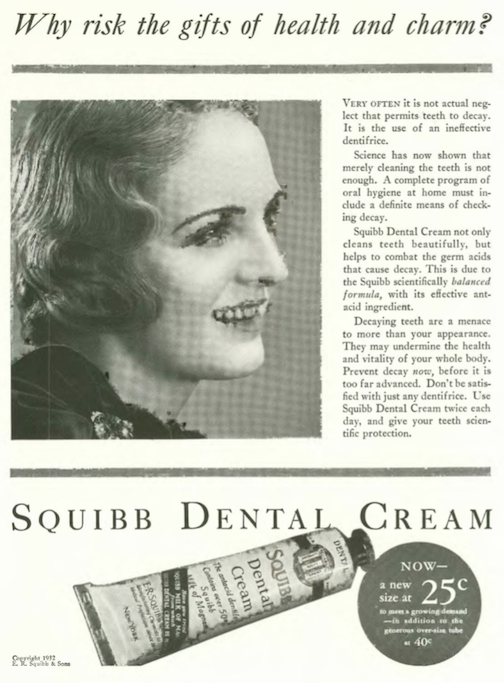
…Squibb helped The New Yorker’s bottom line with three separate ads scattered throughout the magazine…back in the day the Squibb brand was associated with everything from toothpaste…

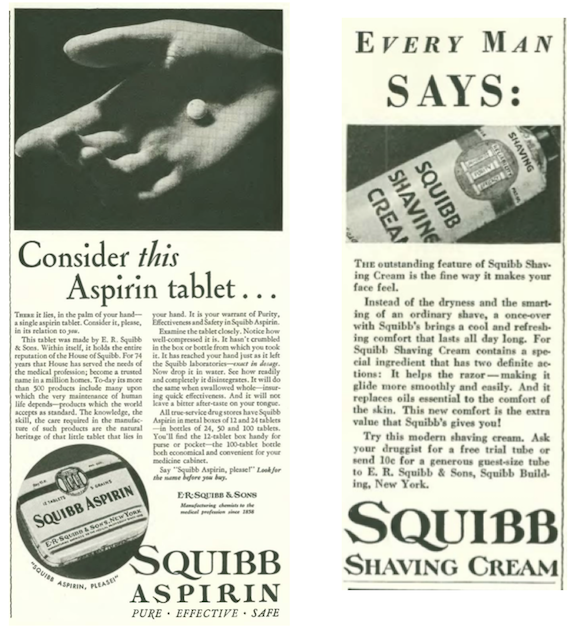
…to aspirin and shaving cream…founded in 1858, it merged with Bristol Meyers in 1989 to form one of the world’s largest pharmaceutical companies, Bristol Myers Squibb, which today is mostly known for manufacturing dozens of prescription pharmaceuticals and biologics…

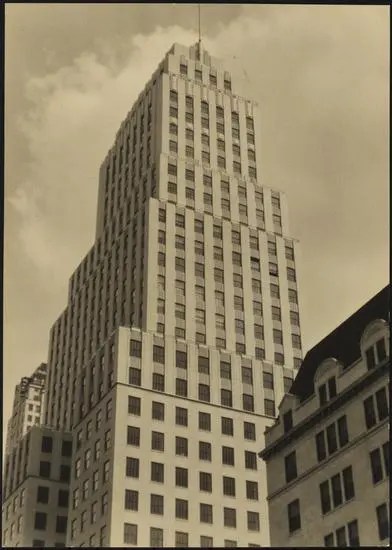
…Squibb & Sons were the primary tenant (the top 12 floors) of New York’s landmark Squibb Building when it opened its doors in 1930…

(Museum of the City of New York)

…moving on, here are a couple of ads that show us one thing that has definitely changed in the past 89 years…when was the last time you wore a fur coat to a football game?…

…cigarette manufacturers had plenty of money to advertise during the depths of the Depression, but apparently so did the folks at Wamsutta Mills…Wamsutta sheets are no longer made in New Bedford—part of the circa 1847 mill complex is now loft-style housing…however, the Wamsutta brand still exists in the U.S. through Bed, Bath & Beyond and internationally as part of a Brazilian textile conglomerate…

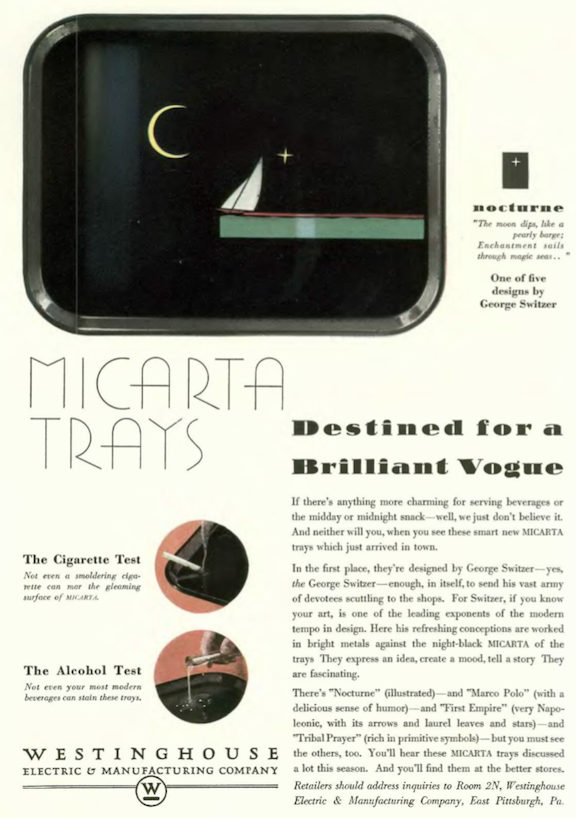
…Micarta was a substance developed by Westinghouse in the early 20th century for use with electrical equipment…produced from a combination of linen, canvas, paper, fiberglass and other materials processed under heat and pressure, Westinghouse found a new use for this laminate — serving trays designed by George Switzer…you can read more about Micarta trays at Driving for Deco…reader Chris notes that Micarta is “still available in a wide range of grades and designer colors and is popular with hobbyists and craftsmen the world over”…

…in the Oct. 29 issue, E.B. White made this observation about Micarta trays…

…on to our cartoons, William Steig’s “Small Fry” learned about the birds and the bees…

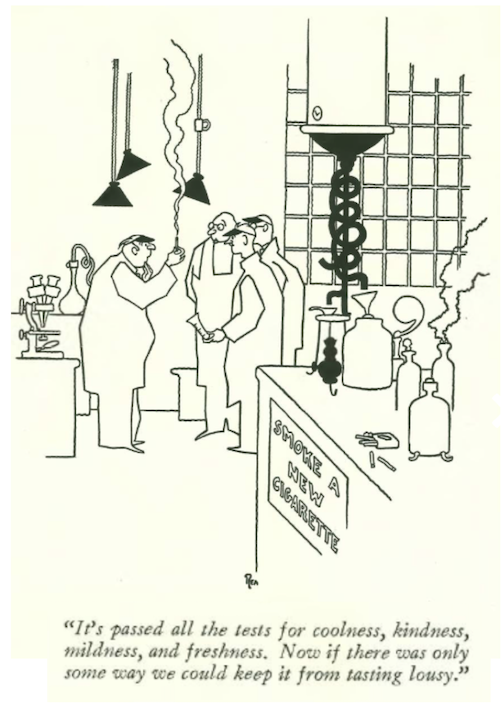
Gardner Rea visited some tobacco researchers challenged to keep pace with advertising claims…

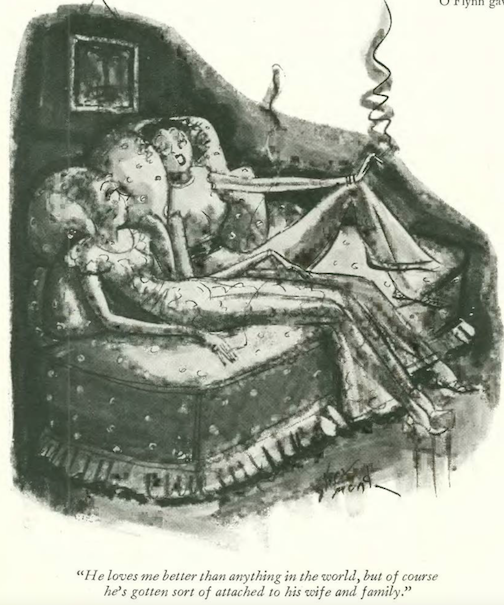
Barbara Shermund looked into the love lives of the modern woman…

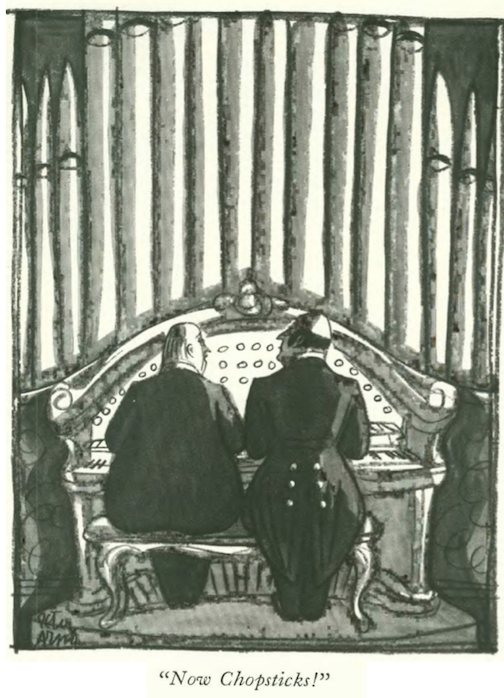
…and Peter Arno got playful at the pipe organ…

…on to our Oct. 15, 1932 issue…

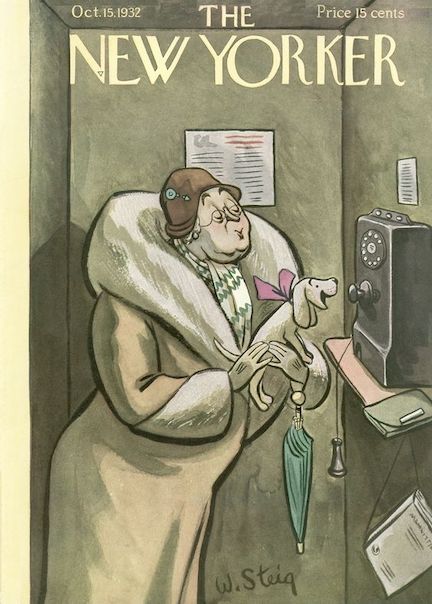
Oct. 15, 1932 cover by William Steig.

…where we check in on John O’Hara (1905–1970), who defined the short story at The New Yorker (and contributed more shorts to the magazine than any other writer). For the Oct. 15 issue O’Hara submitted a profile titled “Of Thee I Sing, Baby.” The profile is unusual because it is told as a story rather than as a biography, and the subject, a chorus girl, is not identified by her real name. A brief excerpt:

WRITING MACHINE…John O’Hara (pictured here in 1945) contributed more short stories to The New Yorker than any other writer. (Library of Congress)

 *  *  *

William Steig (1907–2003) was both a writer and illustrator, and every bit as prolific as O’Hara, publishing more than 50 books during his long life and career, including his very first, which received this mention at the end of the Oct. 15 book review section:

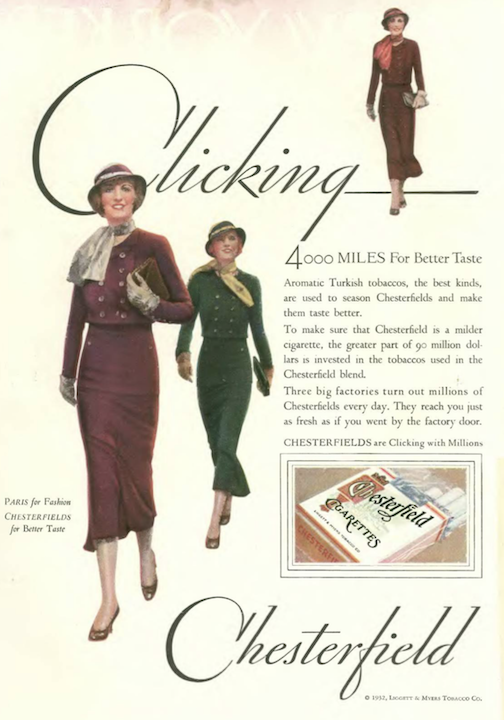
…on to our Oct. 15 advertisers, we have the makers of Chesterfields pairing their product with the sophistication of Paris fashions…

Carl “Eric” Erickson illustrated a number of ads for R.J. Reynolds’ Camel cigarettes in the late 1920s and early 1930s…here he employed his signature sophisticated style for the French Line…

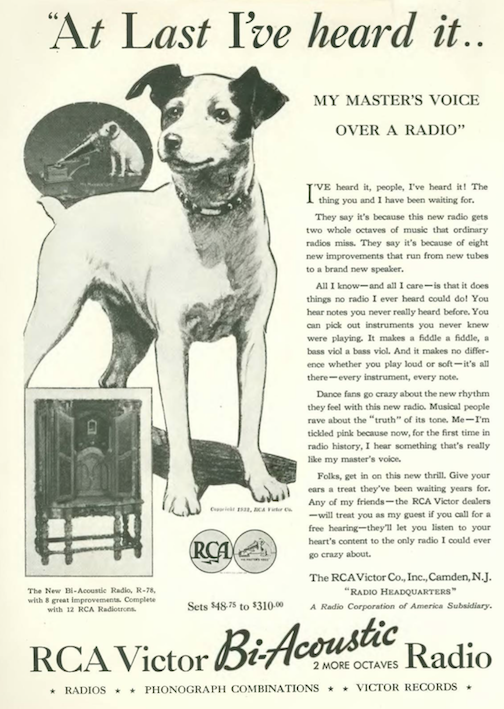
…RCA promoted the next great advance in radio technology—”bi-acoustic” sound that added “two more octaves” to radio broadcasts…it would take thirty more years to roll out something we take for granted today—stereo…

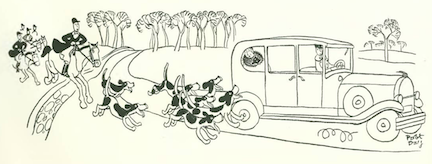
…on to our cartoons, Robert Day joined a misdirected fox hunt…

Richard Decker gave us one man’s simple solution to a perilous situation…

…and we close with a classic from James Thurber

Next Time: City On a Hill…

The Wayward Press

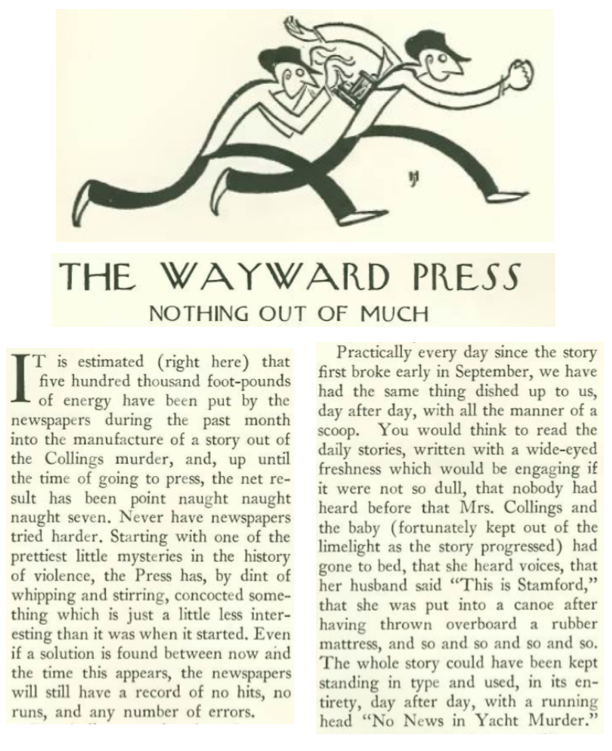
Robert Benchley is remembered today as an American humorist, and his funny side was on display in his New Yorker theater reviews and other contributions. It was his background as a journalist, however, that shown through in his column “The Wayward Press.”

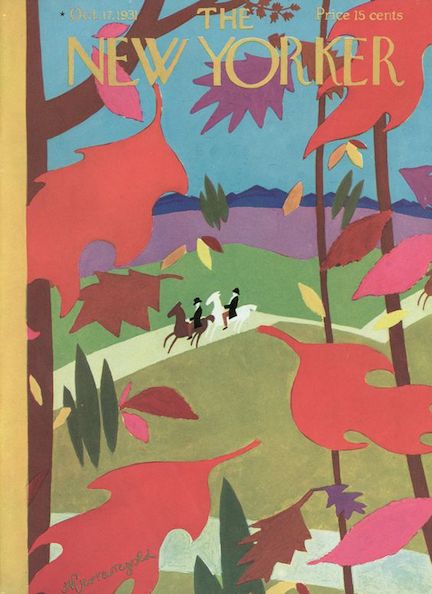
Oct. 10, 1931 cover by Theodore Haupt.

Benchley’s more serious side as a reporter (though still sprinkled with wit) demonstrated his ability to expose the conspiratorial nature of the 1930s press — which seemed to be in bed with moneyed interests — and decry its insatiable appetite for sensationalism. His October 10 column took aim at the coverage of the death of banking heir Benjamin Collings, who was murdered on Long Island Sound while aboard his yacht, Penguin. The investigation went on for weeks with scant developments, but that didn’t stop the newspapers from trying to squeeze every ounce of blood from this turnip.

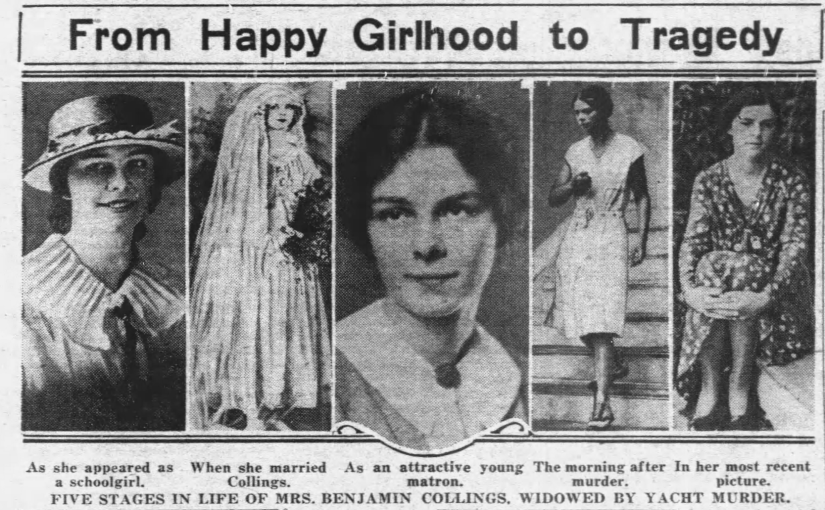
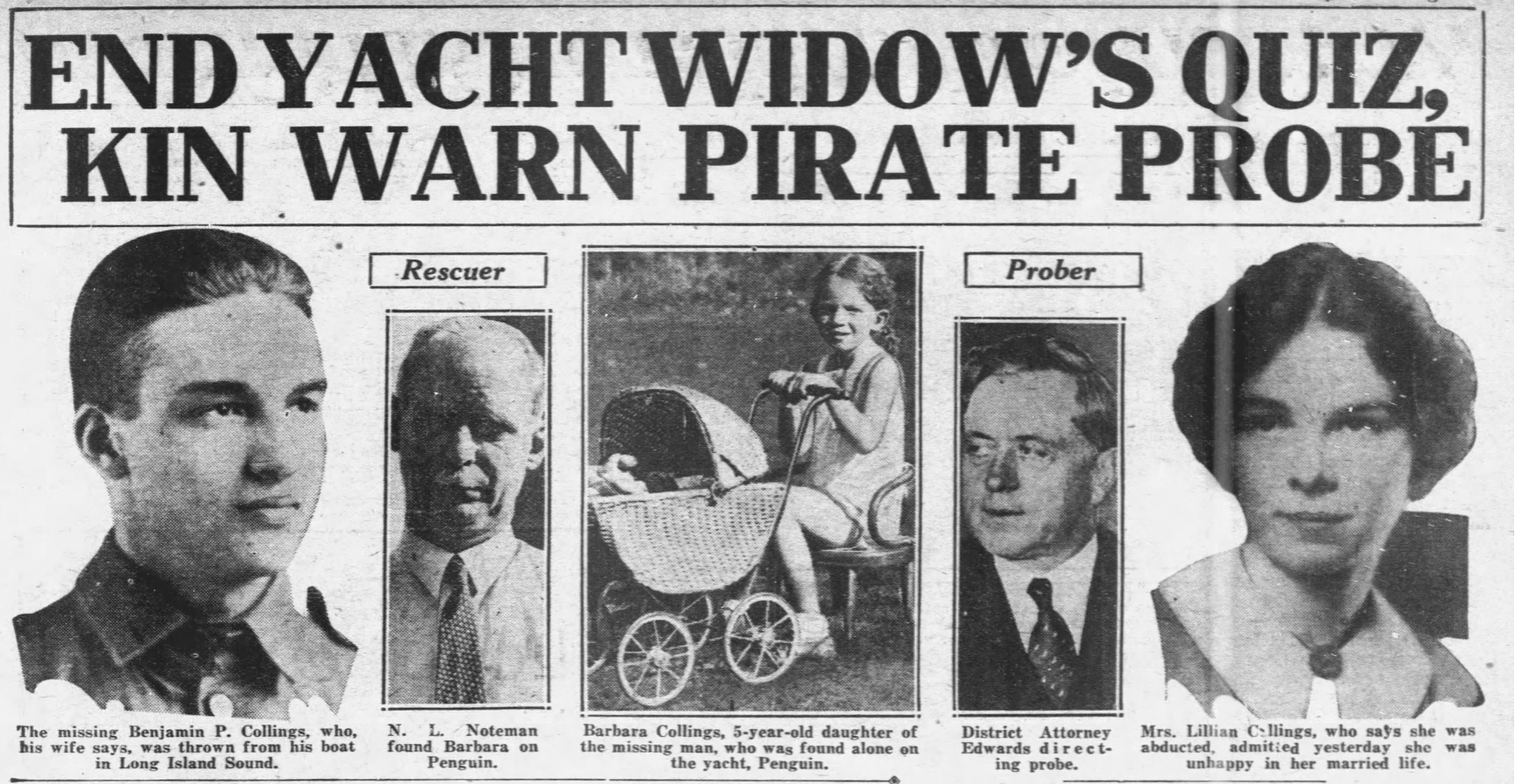
The New York Daily News milked the incident for all its worth, the heading of this first article featuring photos of the slain Benjamin Collings (far left), his widow (and briefly a suspect) Lillian Collings, as well as an image of their five-year-old daughter, Barbara. According to Lillian, all three were sleeping aboard the family yacht Penguin when two men paddled a canoe up to their boat. When Ben went on deck to confront the pair, these “pirates” (as she called them) seized control of the boat, and threw Ben overboard. According to Lillian, the men forced her into the canoe, then cut the Penguin’s anchor and set it adrift with little Barbara still on board. While the girl was quickly rescued by another yachtsman, the “pirates” deposited Lillian in a moored motorboat on Oyster Bay before disappearing into the night. The Suffolk County DA found Lillian’s account unbelievable, and newspapers subsequently described her story as bizarre and illogical. The Daily News headline below indicates Lillian’s family wanted her interrogation to end…

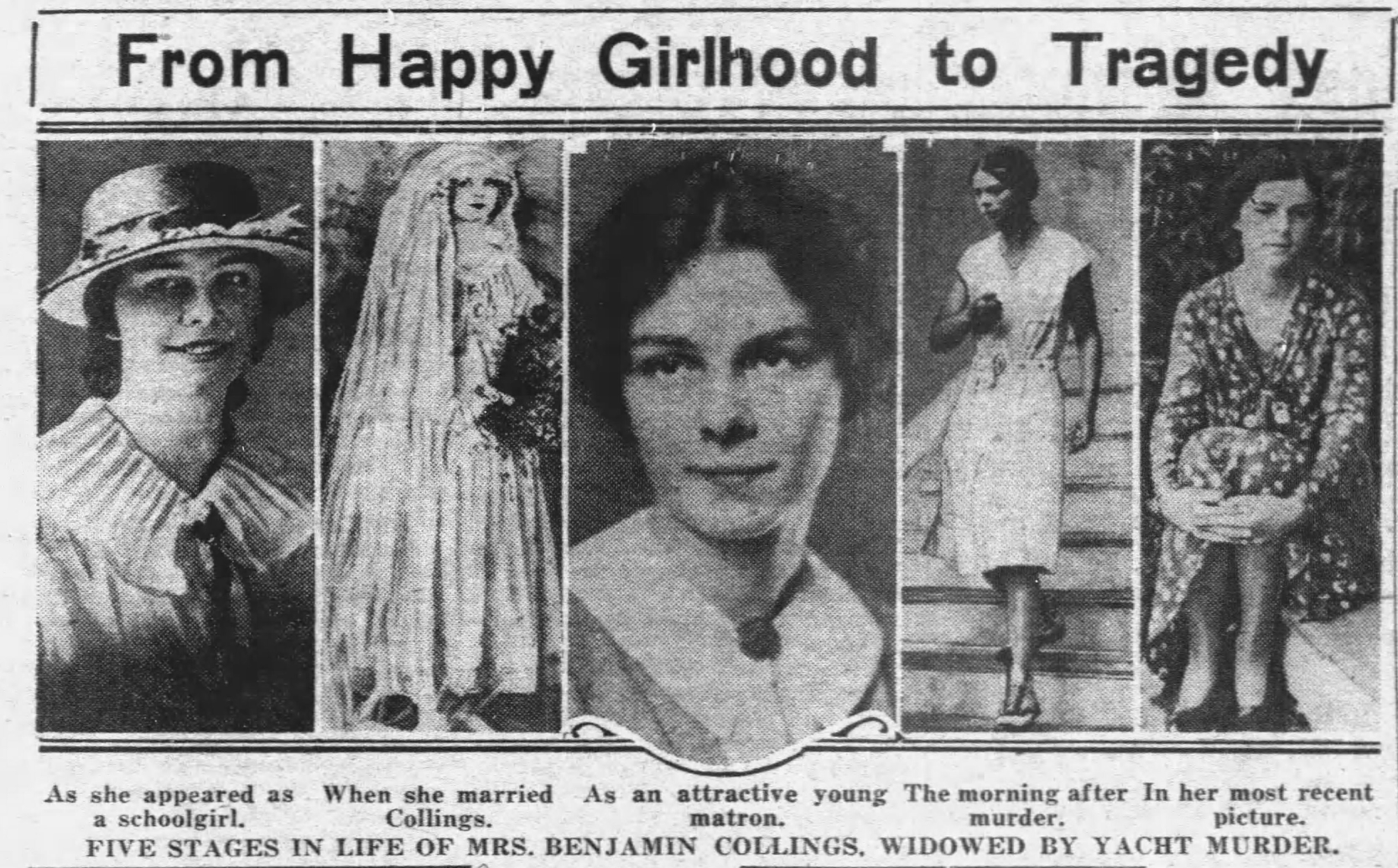
…lacking any other details, the Daily News nevertheless kept the story alive with features such as this one below that described Five Stages in Life of Mrs. Benjamin Collings, Widowed by Yacht Murder

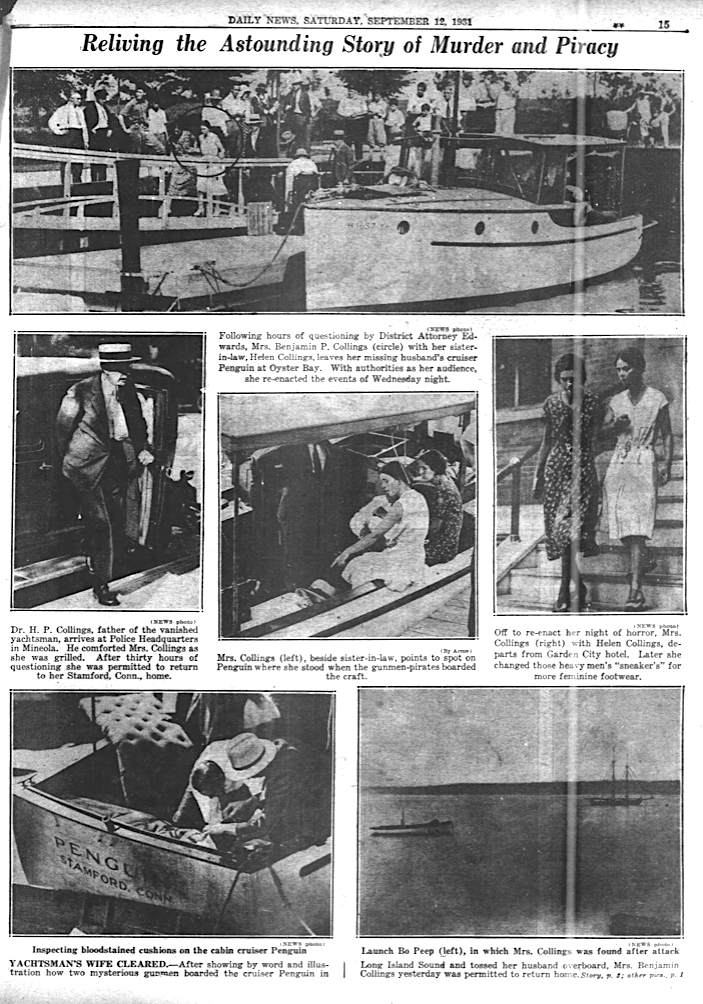
…and in case readers still wanted more, the paper rehashed the whole thing in photos in its Sept. 12 edition…

A few days after the yacht incident the body of Ben Collings washed up on the North Shore, his hands bound and his skull bashed in. The Suffolk County DA then began hauling in pairs of suspects who somewhat matched Lillian’s description—a 50-year-old man with gray hair and a skinny teenager—but none were quite right. The crime has never been solved.

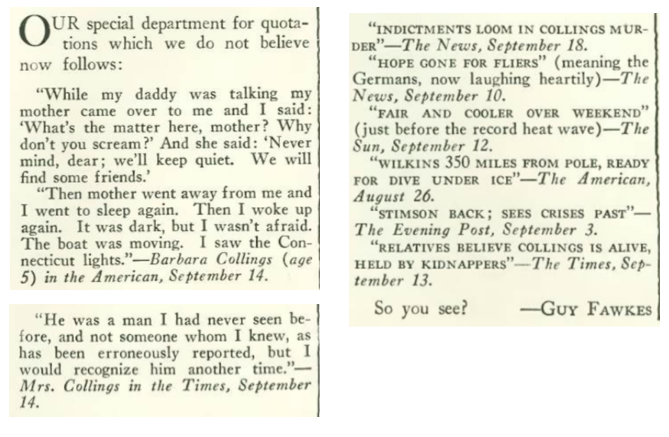
Benchley concluded his column with some quotations which he “did not believe”…

 *  *  *

And Now For Something Ironic…

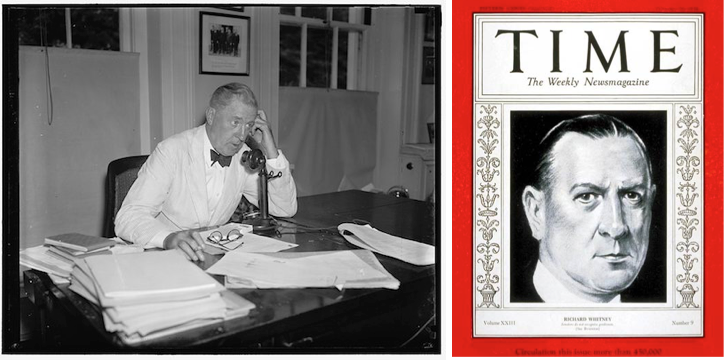
In his “Notes and Comment,” E.B. White teased New York Stock Exchange President Richard Whitney for blaming the market crash on “human vanity and selfishness,” when it was indeed those qualities that drove the markets in the first place. Before the decade was out Whitney would succumb to the very vices he named, and would serve three years and four months at Sing Sing for embezzlement.

HE DID TIME, THEN HE DID SOME MORE TIME…Richard Whitney made the cover of the Feb. 26, 1934 issue of Time magazine for his work as president of the New York Stock Exchange. At left, Whitney in 1937. He was sentenced to five to ten years for embezzlement, but was released early from Sing Sing for good behavior. He went on to a simpler life, managing a dairy farm and then a textile company before his death in 1974 at age 86. (Wikipedia/Time)

 *  *  *

The What Goes Up Department

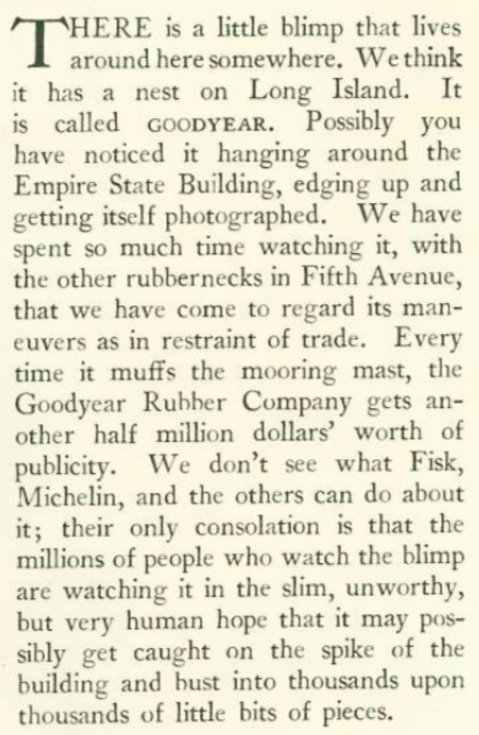
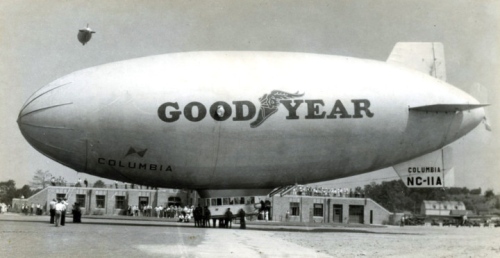
E.B. White also commented on the latest edition of the Goodyear Blimp, christened Columbia, which he spotted hanging around the Empire State Building. Note E.B. White’s last line

Columbia was flying around the Empire State Building because Goodyear was running a sightseeing service in which passengers paid $3 for a 15-minute flight around Manhattan. The blimp also performed publicity stunts such as delivering newspapers to a man standing on the Empire State’s mooring mast—that particular stunt was supposedly a test to see if airships could anchor on the mast for passenger loading and unloading (and as we know, they couldn’t and wouldn’t).

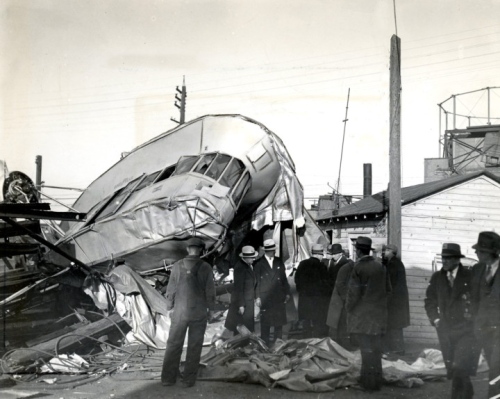
Just four months after White watched Columbia hover over Manhattan, the airship would indeed bust into a thousand pieces, meeting its demise near the Queens airport (today’s LaGuardia). Caught in unexpected high winds, Columbia dipped into the ground, tearing off its landing gear and bending its propellers. The ground crew tried to secure the blimp but an updraft ripped the airship from their hands and sent it sailing over Flushing Bay.

As Columbia once again drifted back over land, the 23-year pilot Prescott Dixon ordered his chief mechanic, John Blair, to pull a rip cord that would release most of the air from the blimp. As Blair reached from the cabin for the cord the blimp shifted, and Blair fell to his death. Columbia then knocked two men off a warehouse roof (injuring them), then struck a factory and some power lines before crashing along the tracks of the Long Island Railroad. Dixon survived after being extricated from the crumpled gondola.

CHRISTENED WITH A BOTTLE OF LIQUID AIR, the Goodyear Blimp Columbia was readied for its inaugural flight over Akron, Ohio, in July 1931.

A SHORT LIFE…Just seven months after its inaugural flight, Columbia crashed near Flushing Bay on Feb. 12, 1932. (kathrynsreport.com)

 *  *  *

When Bridges Were Crowd-Pleasers

“The Talk of the Town” announced the imminent opening of the Jeffreys Hook Bridge, to be known thence as the George Washington Bridge:

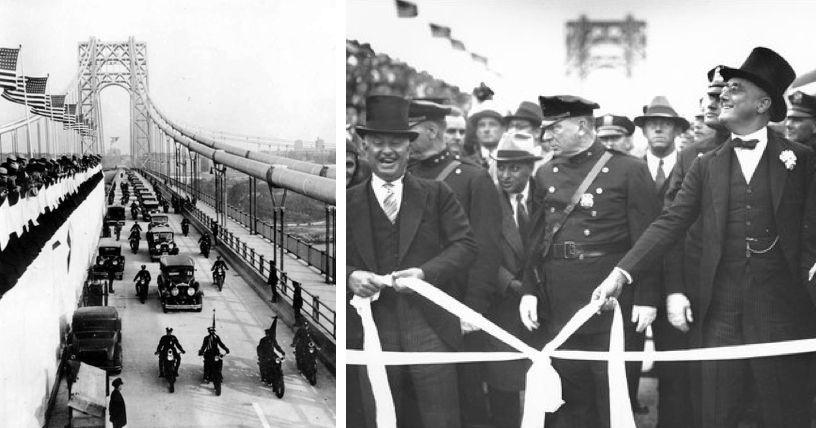
BREAK OUT YOUR TOP HAT…New Yorkers turned out in droves to mark the official opening of the George Washington Bridge on Oct. 24, 1931. Gov. Morgan F. Larson of New Jersey, left, and Gov. Franklin D. Roosevelt of New York, right, did the ribbon honors at the dedication. (New Haven Register/AP)

 *  *  *

They Couldn’t Say ‘Hooters’ Either

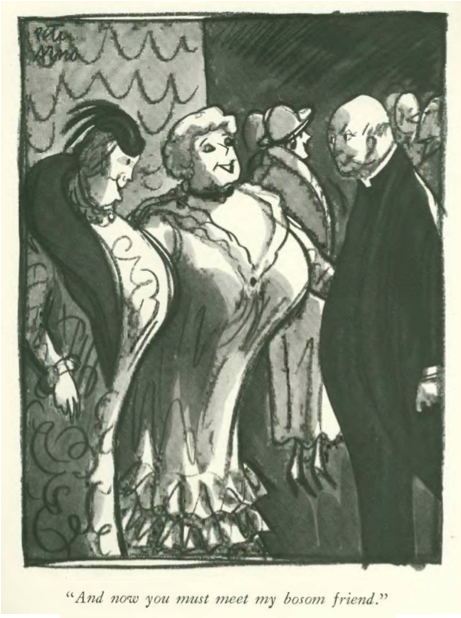
In these coarser times it is hard to believe that 89 years ago the word “bosom” was a “no-no” on the nation’s airwaves, per this “Talk” item…

 *  *  *

An Actor’s Actor

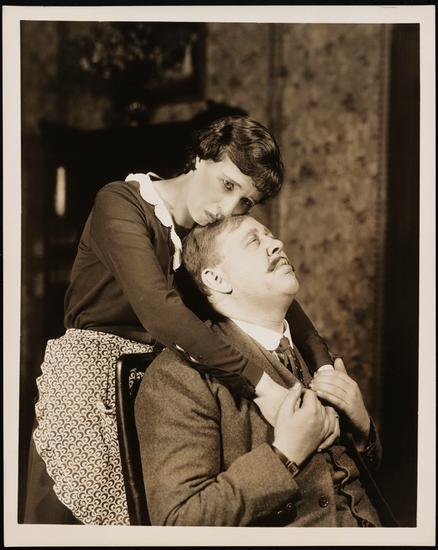
Theater critic Robert Benchley wasn’t the only one who noticed the talents of newcomer Charles Laughton in his New York stage debut — Hollywood would immediately come calling for the 32-year-old English actor:

WE’LL KEEP HIM…Cicely Oates as Annie Marble and Charles Laughton as William Marble in the 1931 play Payment Deferred. (Museum of the City of New York)

 *  *  *

Kinda Long For Being Short

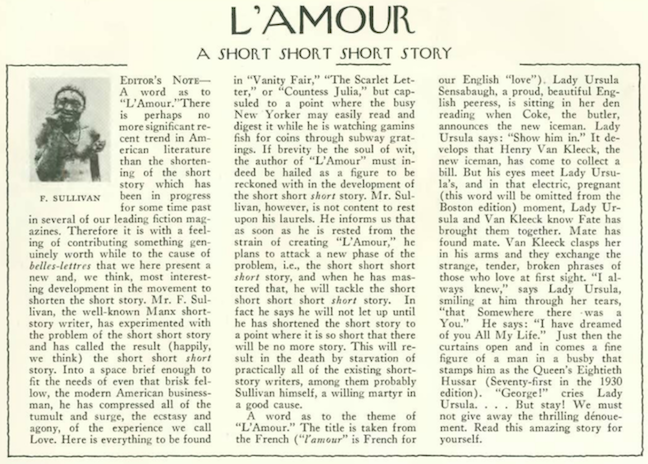
Humorist Frank Sullivan claimed to be following the trend for shorter short stories by turning in this piece with an editor’s note longer than the story itself:

 *  *  *

Lurid Lit

Our dear Dorothy Parker is back with another of her entertaining book columns, and in this installment we have her taking on the world of literary and not-so-literary sex romps. Excerpts:

DIRTY LITTLE BOOKS?…The three books featured in Dorothy Parker’s column included, from left, Young and Healthy by Donald Henderson Clarke (issued here under a different title in a pulp 1948 Novel Library edition); Theodore Wilde’s Moonblind, which featured a hermaphrodite character and homosexual encounters; and although attributed to Anonymous, Lady Chatterley’s Husbands was actually written by Anthony Gudaitis, aka Anton Gud, who often wrote anonymously for erotica publisher Samuel Roth. Although it was publicized as a sequel to D.H. Lawrence’s Lady Chatterley’s Lover, Gud’s book actually had less sex than the Lawrence original. After all, in the sequel Lady Chatterley gets tired of horny old Mellors. (Goodreads/Amazon)

…and before we leave Dorothy, please note her last line in the review, where she quotes Carl Rose’s famed 1928 cartoon (with caption by E.B. White)…

 *  *  *

From Our Advertisers

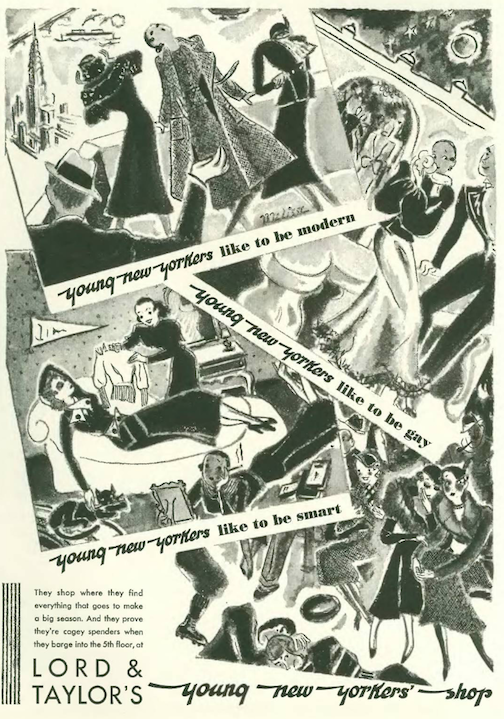
Just a couple quick ones (I will have more in the next installment)…this Lord & Taylor ad (illustrated by Mildred Oppenheim Melisse) showed young New Yorkers how to look smart for the fall (Lord & Taylor, the oldest department store in the United States (founded 1826), recently closed all 38 of its stores due to the pandemic, and it was announced in August that Lord & Taylor would be liquidated. Apparently its name will continue as an online-only business…

…and Helen Hokinson offered this illustration of one of her “girls” shilling for Frigidaire refrigerators…

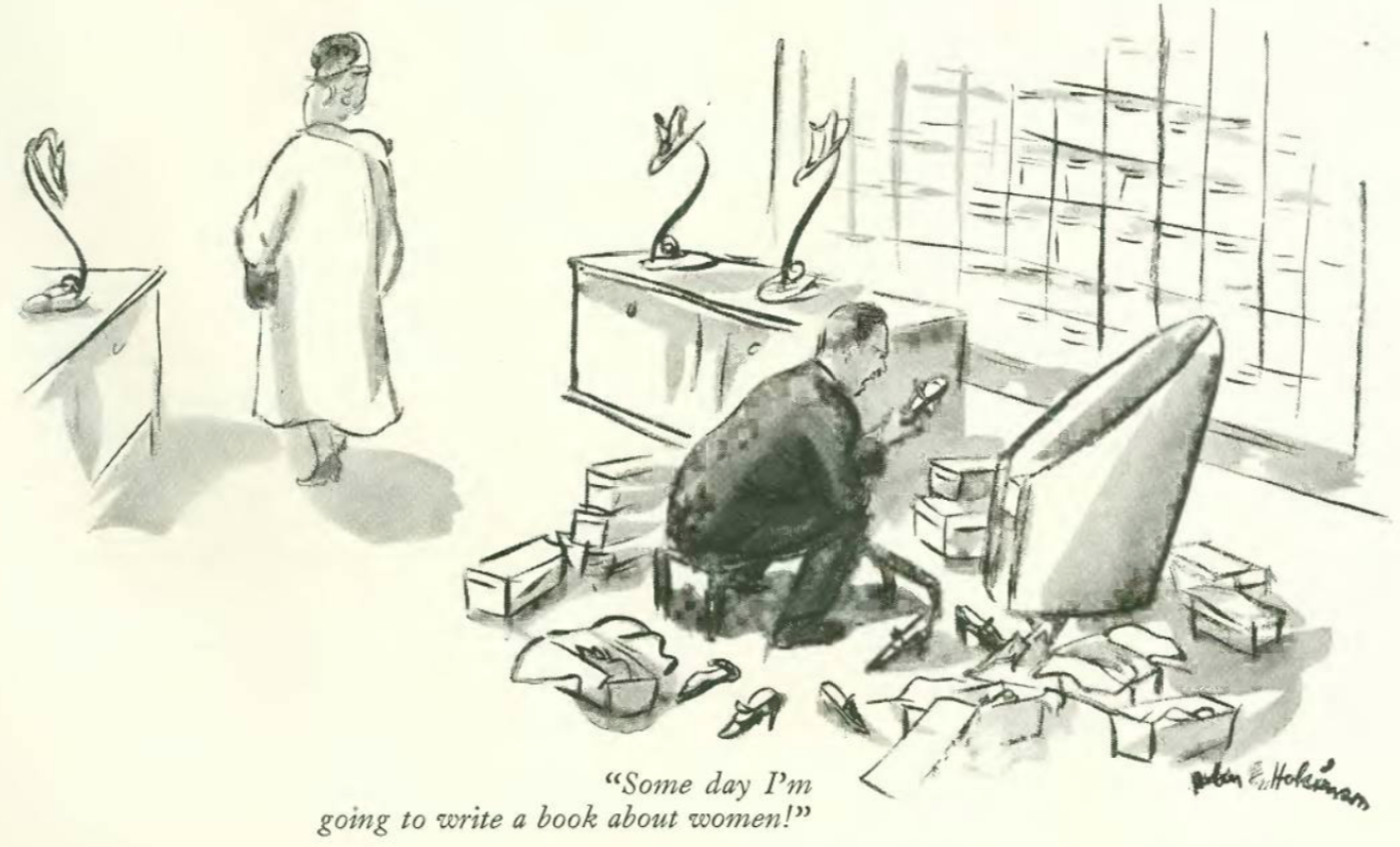
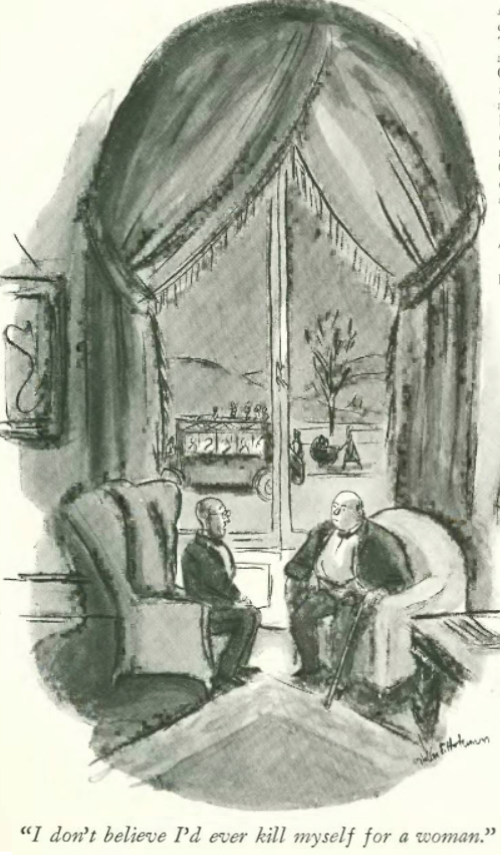
…and two more from Helen in the Oct. 10 cartoons…

…exploring men’s attitudes toward the opposite sex…

Garrett Price visited a seemingly unappetizing banquet…

Kemp Starrett gave us a man looking at life on the bright side…

William Steig explored home decor…

Barbara Shermund found some bedtime gossip…

…and recalling our earlier “Talk” item regarding bosoms, here’s Peter Arno

Next Time: Monkey Business…


Asphalt Jungle

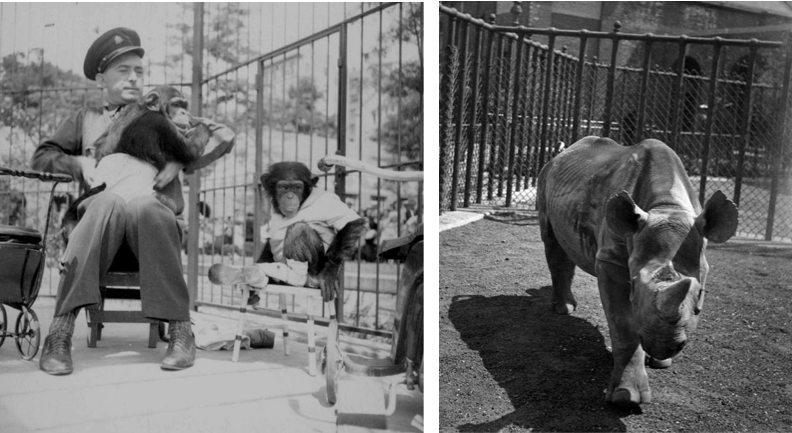
The zoos of yesteryear were joyless places, that is, if you were one of the animals. Children squealed with fear and delight at the sight of a caged lion, and many an adult had fun tossing peanuts at elephants or teasing enraged gorillas locked behind bars; but if you were a zoo animal in 1931, life was endless hours of boredom, sprinkled with moments of terror and humiliation.

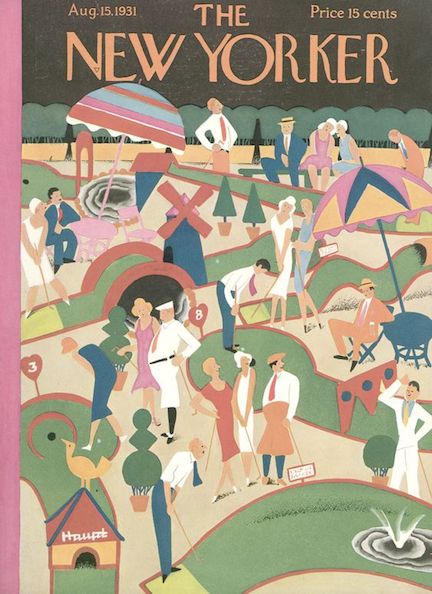
Aug. 15, 1931 cover by Theodore Haupt.

It is instructive to look back 89 years and see how far we’ve come, and how far we still have to go, to see our fellow creatures as more than curiosities and amusements to be captured and gawked at, and to see their environments as something to be preserved, not only for their survival but for ours as well.

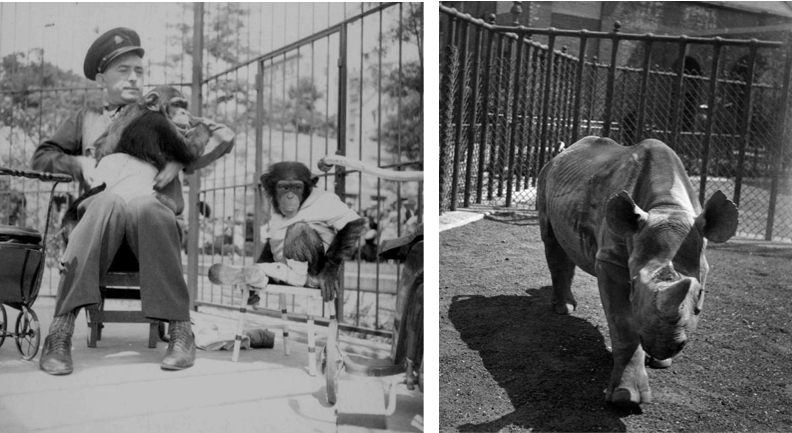
LIFE BEHIND BARS…Left, a zookeeper with chimps at the Central Park Zoo, 1936. Right, a rhino paces in a barred enclosure, 1937. (nycgovparks.org)

E.B. White paid a visit to the Central Park Zoo, and found it wanting in a number of respects:

Many zoos back then were more collections of curiosities than places where you could learn about various habitats. So when David Sarnoff, president of RCA, bagged a live opossum in the South, the critter was given a new home in an antelope enclosure, per this item in the Dec. 20, 1931 New York Times:

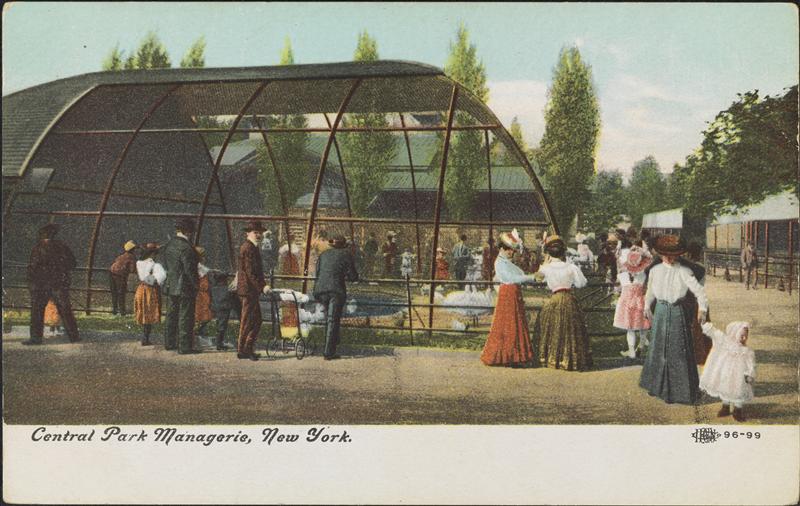
The Central Park Zoo was established in the 1860s as a “menagerie” behind the Arsenal, and by the turn of the century attracted millions of visitors to its displays of exotic animals.

GETTING AWAY FROM IT ALL…Postcard image of the Menagerie in Central Park, New York, 1905. (Museum of the City of New York—MCNY)

ANIMAL ATTRACTION…Postcard image of folks enjoying caged birds at the Menagerie, 1905. (MCNY)

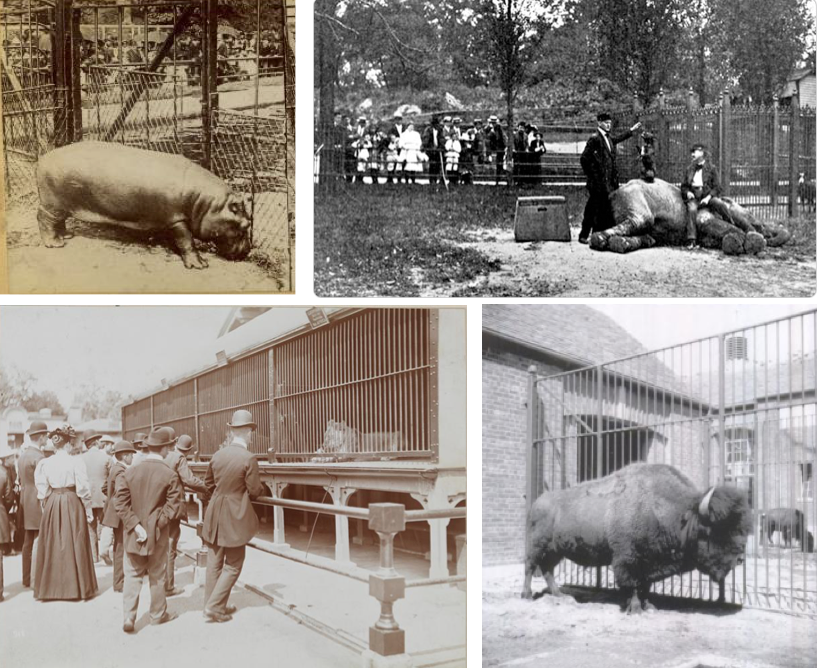
O GIVE ME A HOME…In the early days of zoos, animals were presented in cages and fenced enclosures with no hint as to what their natural habitat might look like. Clockwise, from top left, “Fatima” the hippo, image from an 1896 stereograph card; a 1911 photo of a trainer and a dog perched on top of a hapless elephant; a bull bison around the turn of the century; a group of people observe animals in cages at the Central Park Menagerie, 1895. (Library of Congress/nycgovparks.org/MCNY)

 *  *  *

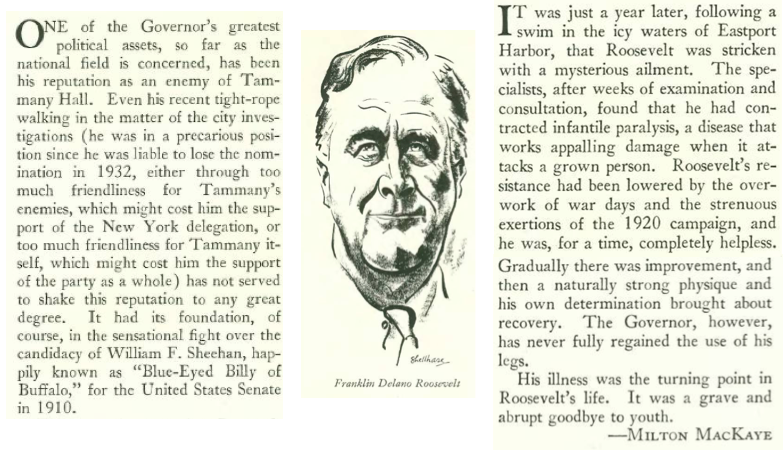
He’s Your Future

The New Yorker featured two-part profile of the governor of New York, Franklin D. Roosevelt, who unbeknownst to writer Milton MacKaye would soon become the next president of the United States. Two excerpts (not continuous)…

  *  *  *

From Our Advertisers

Ah yes, the first time I visited the Empire State Building’s observation deck (in the 1970s) a heavy smog enveloped the city (the air is much cleaner today). I like how the promoters spin disappointment into an opportunity — “The mysterious beauty of the city has a million constantly changing aspects”…

…if you were looking for bluer skies, Bermuda could have been an option if you had the means…

…or you could have stayed closer to home at a Long Island beach resort, as Helen Hokinson illustrated, and as we segue into our cartoons…

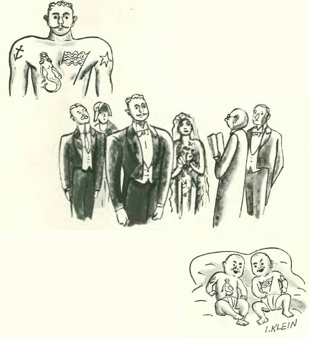
Isadore Klein gave us a very unscientific, albeit humorous view of genetics…

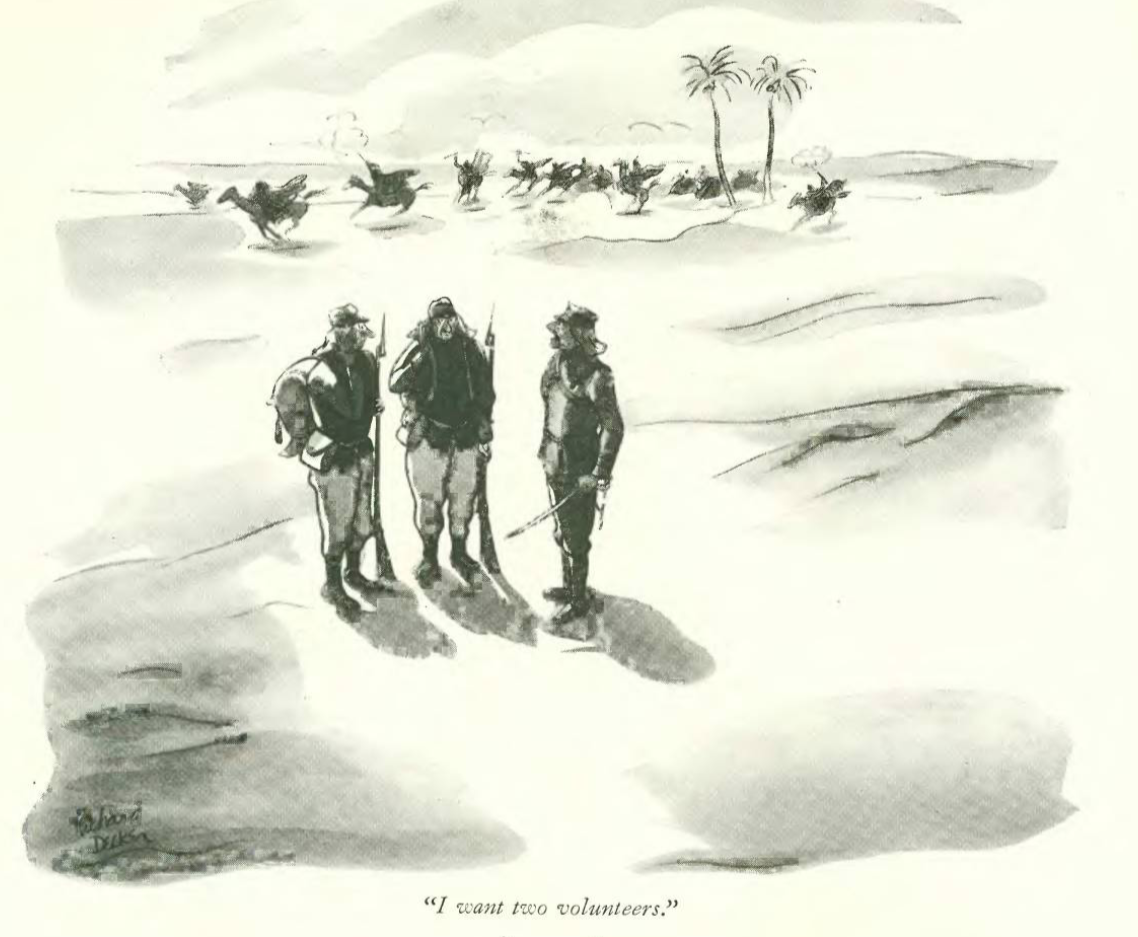
Richard Decker redefined the meaning of “volunteers”…

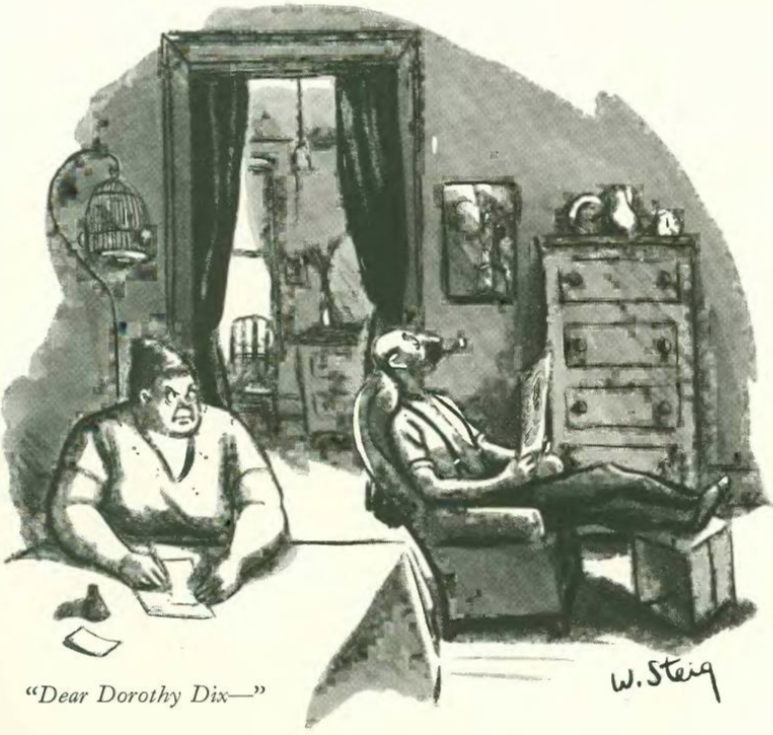
…and William Steig summoned the advice of Dorothy Dix, a forerunner of “Dear Abby” who was the most widely read female journalist of her time…

We move on to the Aug. 22, 1931 issue…

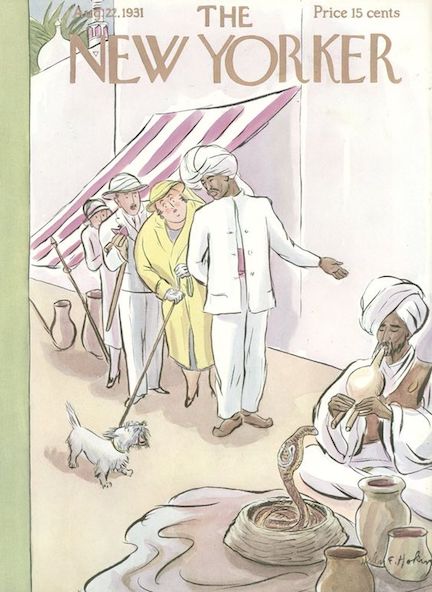
Aug. 22, 1931 cover by Helen Hokinson.

…in which James Thurber wrote about his experience with early television in “The Talk of the Town”…

NO CABLE BILL, YET…Charles Francis Jenkins demonstrates his “Radiovisor” console television in 1929. At right, the inner workings featured a rotating disc punctured with tiny holes, each projecting a line across the glass screen to compose an image. As Thurber noted, the pictures commonly were too dark for viewers to see anything more than silhouettes. Not to mention Thurber’s eyesight was also terrible. (earlytelevision.org)

 *  *  *

The Other Moving Pictures

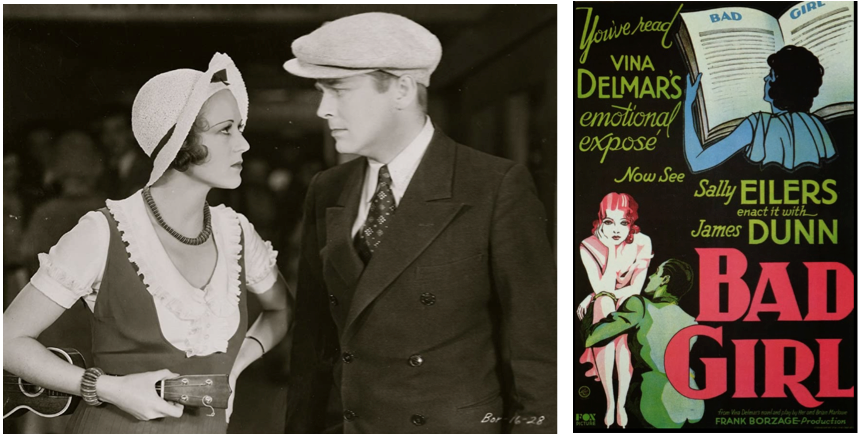
The movies still had nothing to fear from television in 1931, and Hollywood continued to draw large audiences to “Pre-Code” films that featured doses of sex and violence. Novelist Viña Delmar gained famed in 1928 with her suggestively titled book Bad Girl, so when it was adapted into a film, audiences came running—even if the screen adaptation proved to be a bit tamer than the novel that inspired it. Critic John Mosher observed:

I’M JUST A LITTLE BAD…Sally Eilers played the title character in Bad Girl with co-star James Dunn. The film won two Oscars in 1932 for Best Director (Frank Borzage) and Best Writing, Adaptation (Edwin J. Burke). (IMDB)

 *  *  *

Chic Chapeau

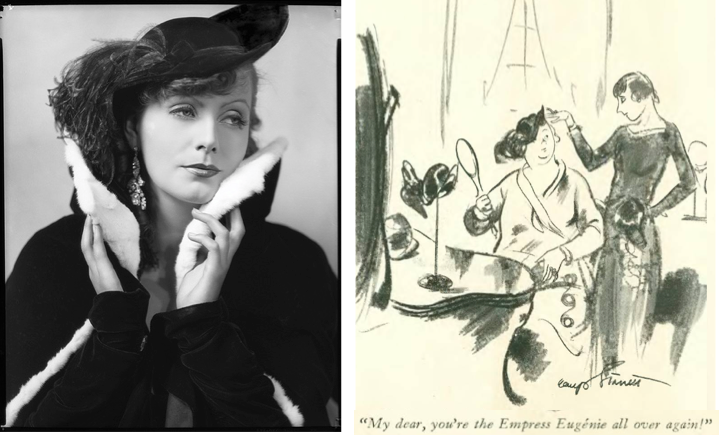
The Empress Eugénie hat was named for 19th century French empress Eugénie de Montijo, who was known as a fashion trendsetter. The hat was revived in 1930 after Greta Garbo was seen wearing a version of one in the popular film Romance. E.B. White was not exaggerating when he noted (in his “Notes and Comment”) that the jaunty hat was seen on “every other head” in the city.
 

LOOK WHAT YOU STARTED…Greta Garbo sported an Empress Eugénie hat in the 1930 film Romance, setting off a fashion craze that persisted through much of the decade. At right, Kemp Starrett referenced the trend in this Aug. 8, 1931 cartoon in The New Yorker. (Pinterest)

 *  *  *

From Our Advertisers

Speaking of trends, these “roughies” were all the rage among the young folks, in the dorms and on the beach…

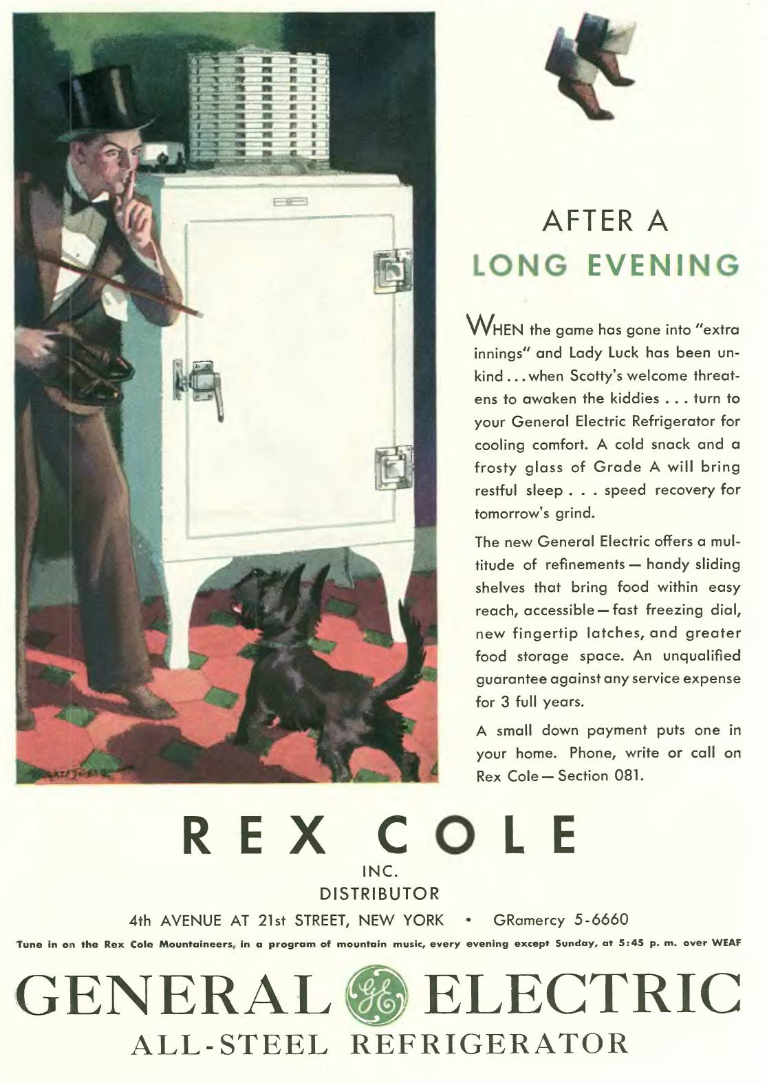
…one trend I wasn’t aware still persisted in 1931 was a top hat and tails for an evening out among the smart set…

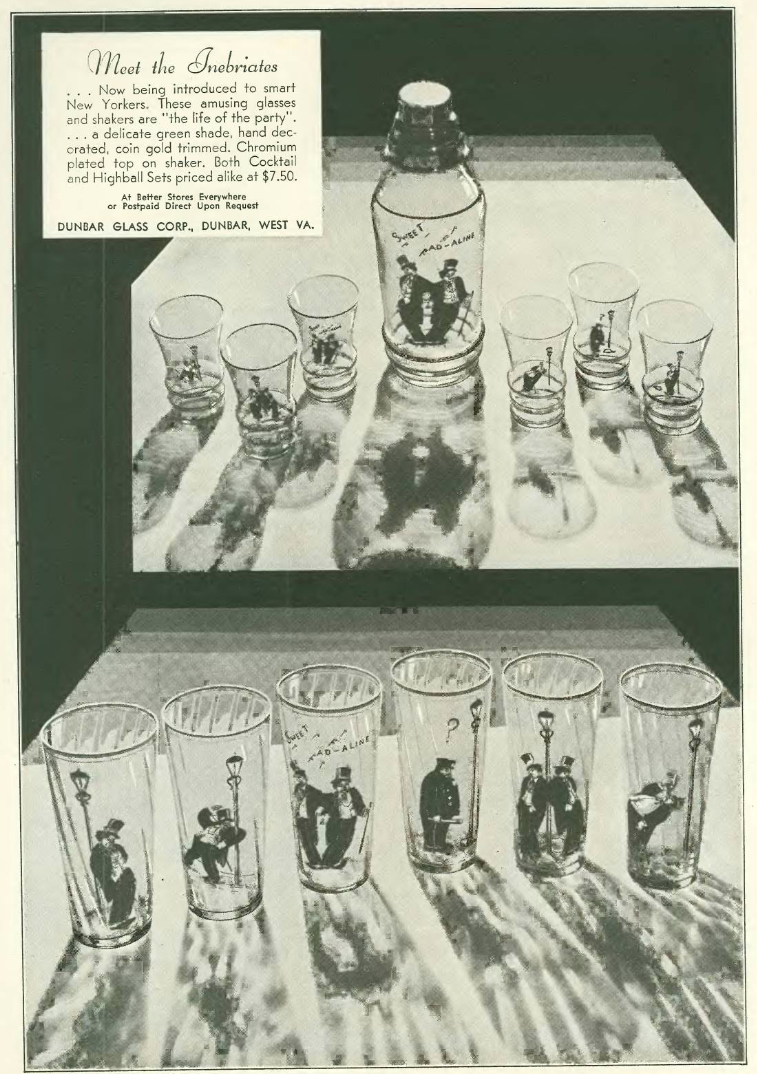
…according to this ad, if you were a “smart” and fashionable New Yorker, then you needed an “Inebriates” themed cocktail set…

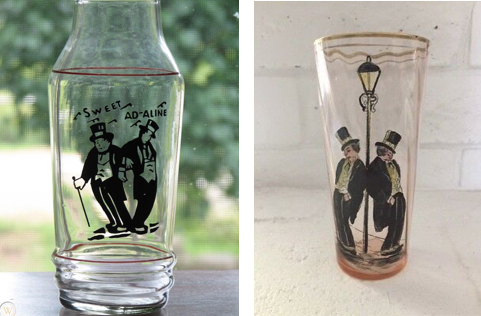
…examples of the glassware for sale on Worthpoint…

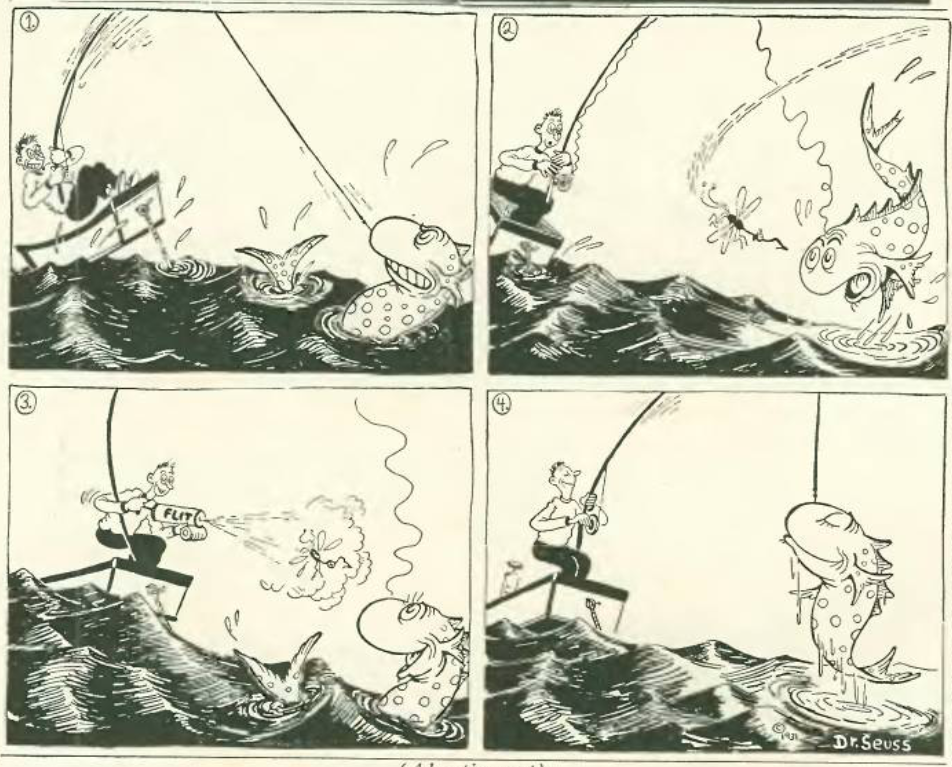
Dr. Seuss was still busy selling pesticide with this four-panel ad…

…on to the cartoons, we start with James Thurber

…and Rea Irvin continued to experiment with various motifs, this time an Egyptian-themed cartoon referencing the “wine bricks” sold by enterprising vineyards during Prohibition…

Peter Arno found a big surprise during a mansion tour…

…and we end with Otto Soglow

…and Richard Decker…both cartoons reminded me of Al Jaffee’s Snappy Answers to Stupid Questions

…I grew up reading Mad magazine, and always looked forward to Jaffee’s fold-ins…he just retired from Mad at the young age of 99, so we conclude with one of his Snappy Answers panels from Mad #98, Oct. 1965…

Next Time: Unnatural History…


Through the Looking Glass

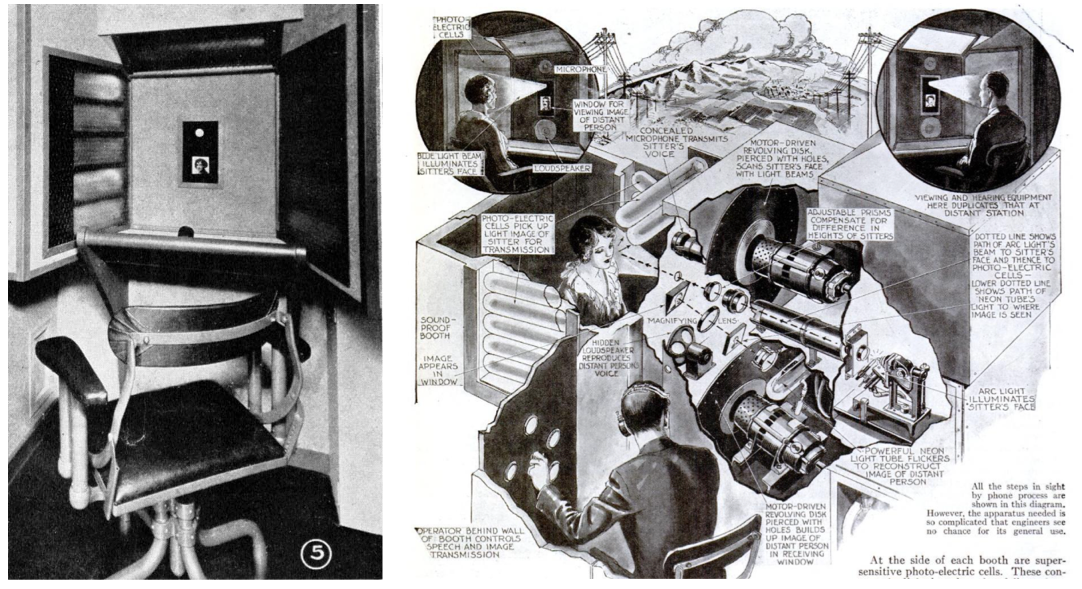
The next time you complain about a boring Zoom meeting, think about Morris Markey’s visit to New York’s Bell Laboratories in the spring of 1931, when he marveled at what was, perhaps, the “apotheosis” of American industry: a two-way video telephone.

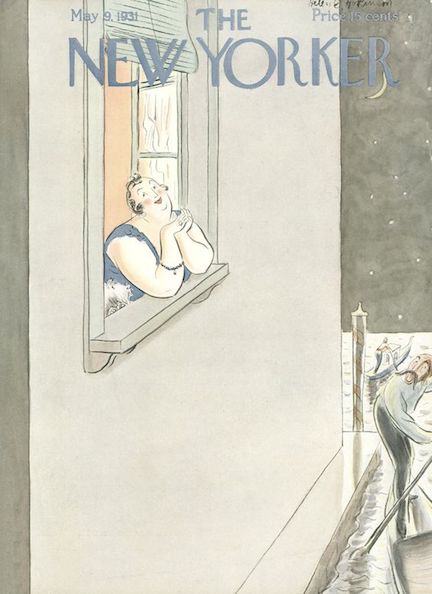
May 9, 1931 cover by Helen Hokinson.

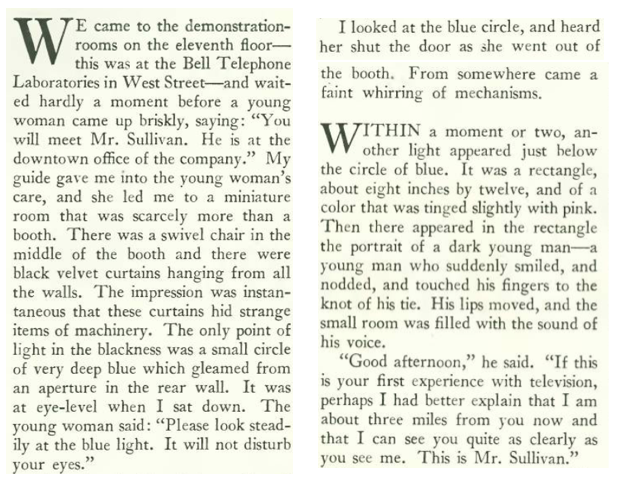
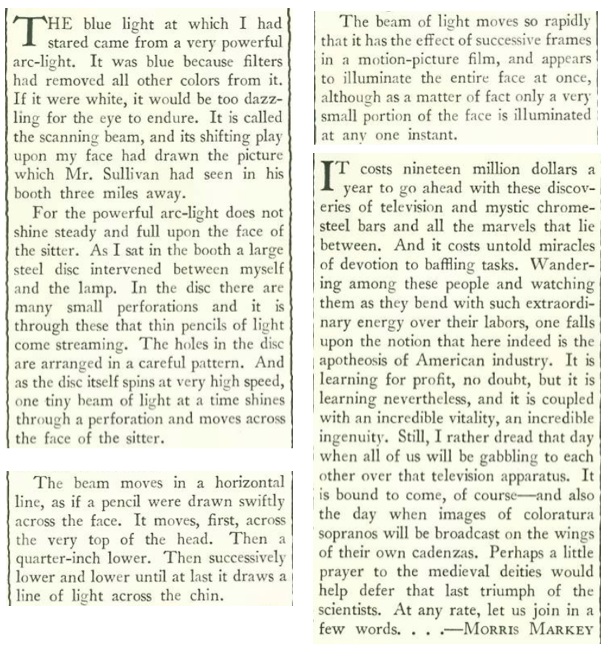
Mass-market television in the U.S. was still two decades away, but what Markey saw demonstrated in 1931 was a glimpse of the future, seeing and conversing with another man three miles away via a long wire that transmitted images from a fantastic array of spinning discs and neon tubes:

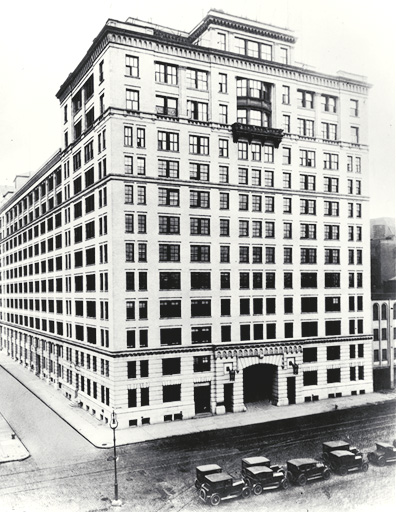
TECHNOLOGY’S MATERNITY WARD…The original Bell Labs building at 463 West Street in New York. It was the birthplace of talking movies, television, radar and the vacuum tube. (att.com)

DEFINITELY NOT HI-DEF…At left, this is most likely where Morris Markey sat for the demonstration of early video phone technology. At right (click image to enlarge), a July 1930 article in Popular Science Monthly described how the transmitting apparatus worked. (earlytelevision.org/books.google.com)

BUT WILL IT SELL?…Herbert Hoover, then secretary of commerce, became the world’s first television personality in 1927 when his voice and face (inset) were transmitted to an audience at Bell Laboratories in New York City. At the time, AT&T, Bell’s parent company, was doubtful about television’s moneymaking potential. (edn.com)

SPINNING WHEELS…Whirling metal discs, pictured at left, perforated with tiny holes, cast a series of horizontal beams of light across a viewer’s face (right), which were then transmitted to a receiver. (earlytelevision.org)

Despite its gee-whiz factor, many, including the folks at Bell Labs, seemed doubtful that the technology would come into wider use or be profitable any time soon, if ever. Markey noted that his little demonstration required many millions of dollars in research and development, but he was prophetic in suggesting that such technology might come to be dreaded if it ever came into common use.

*  *  *

Uplifting Sight

That a bra and girdle maker should become the topmost tenant at the new Empire State Building was not lost on E.B. White, who commented thusly…

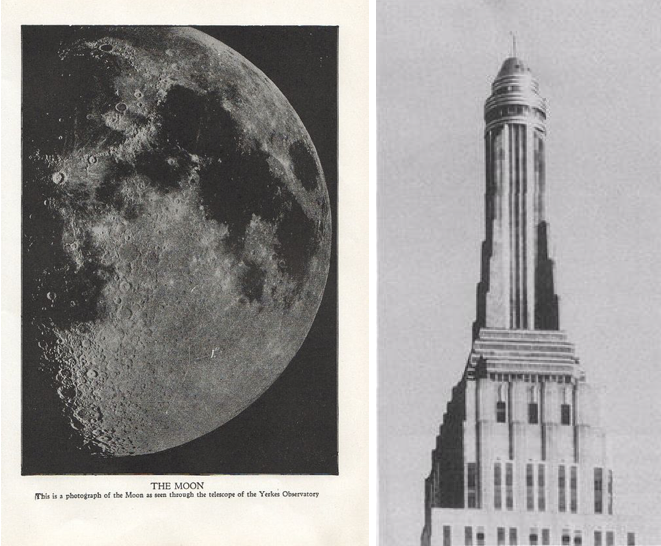
…and while viewers wouldn’t actually see a giant bra atop the skyscraper, many were nevertheless interested in getting a closer look at some of the building’s details, as reported in “The Talk of the Town”…

OVER THE MOON?…The moon gained some keen competition from telescope viewers when the Empire State Building climbed its way into the sky. (Pinterest/tech-notes.tv)

 *  *  *

Channelling Marlene

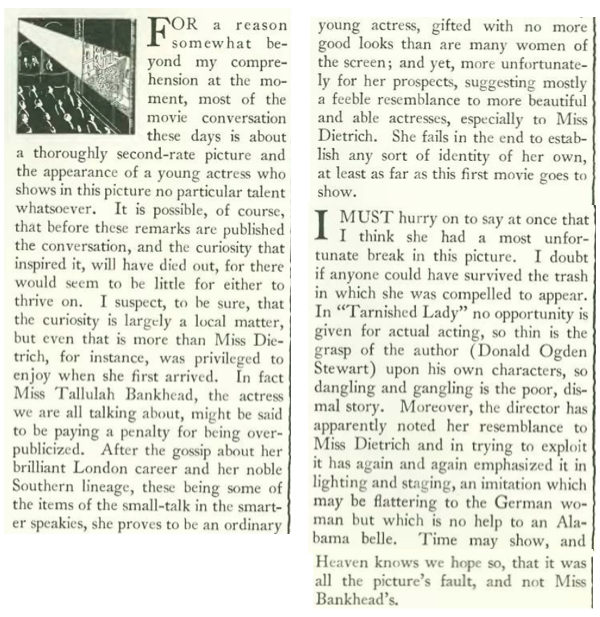
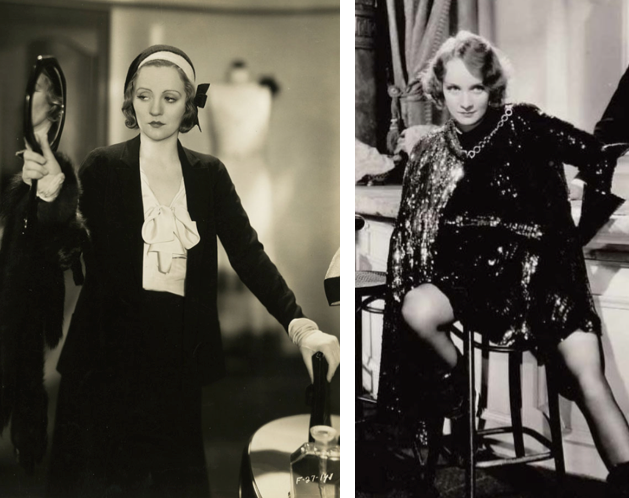
Film critic John Mosher wasn’t over the moon when it came to the acting of Tallulah Bankhead in Tarnished Lady, however he surmised it was likely the director’s fault for trying to exploit Bankhead’s passing resemblance to Marlene Dietrich. Mosher noted that lighting and staging flattering to the German actress just didn’t work with the belle from Alabama.

MIRROR, MIRROR…Tallulah Bankhead (left) might have pondered who was the fairest in the land, but The New Yorker’s John Mosher found her to be no match for German actress Marlene Dietrich (right, in 1931’s Dishonored) when it came to screen presence. (IMDB)

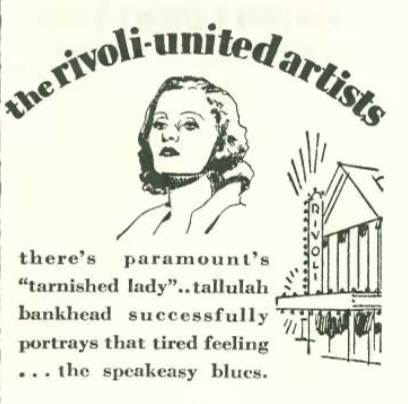
Despite Mosher’s blah review, Paramount touted Bankhead’s portrayal of a “tarnished lady” in this ad from the same issue:

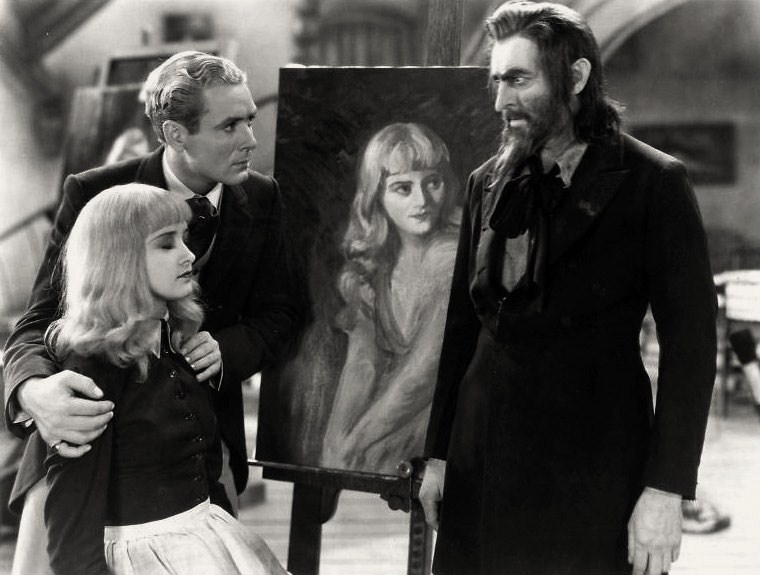
Mosher, however, found redemption in another film making the rounds, Warner Brothers’ Svengali starring John Barrymore:

YOU ARE GETTING VERRRY SLEEPY…in 1931’s Svengali, 17-year-old Marian Marsh played the artist’s model Trilby, who is transformed into a great opera star by the sinister hypnotist, Svengali, played by John Barrymore. Also pictured is Bramwell Fletcher, who portrayed Trilby’s love interest, Billee. (Wikipedia)

 *  *  *

From Our Advertisers

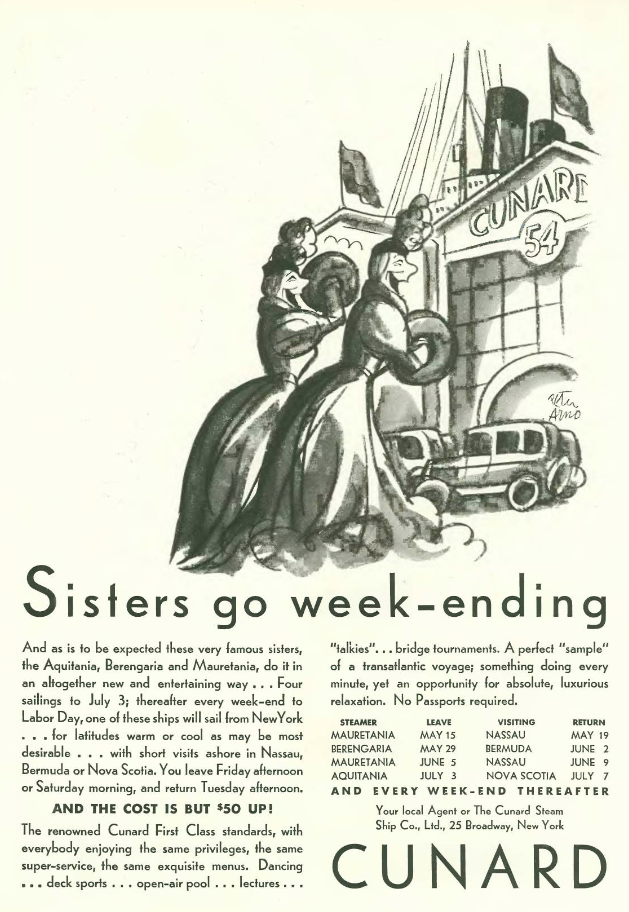
After a long absence, Peter Arno’s Whoops Sisters returned to the pages of The New Yorker, not as a cartoon panel but as shills for the Cunard Line…

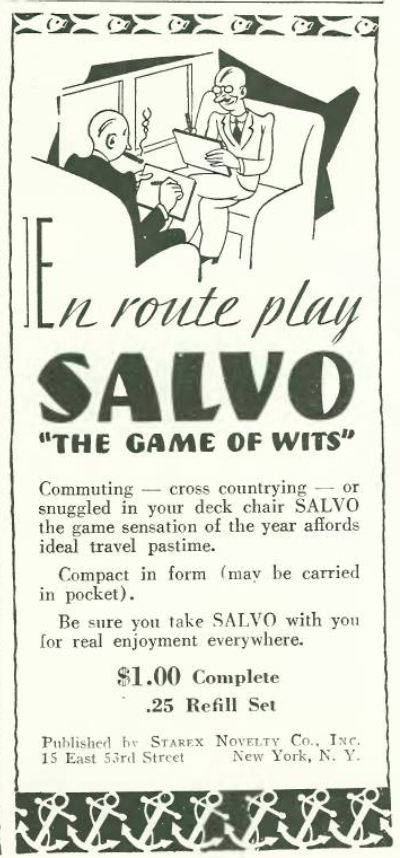
…whether traveling by boat or train, you might have considered bringing along “Salvo,” an early version of a popular game that today we call “Battleship”…

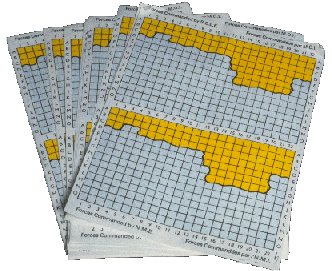
…Salvo and other Battleship-type games were originally played on pieces of paper like this…

…and here’s an ad for ice cube trays that exploited the popularity of the “Ripley’s Believe It or Not” syndicated newspaper feature…

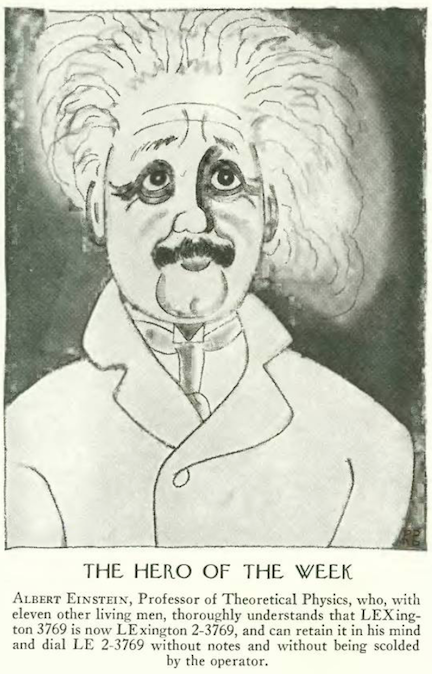
…on to our cartoonists, Ralph Barton rendered Albert Einstein as his latest “Hero”…

…and interpreted the latest headlines in his “Graphic Section”…

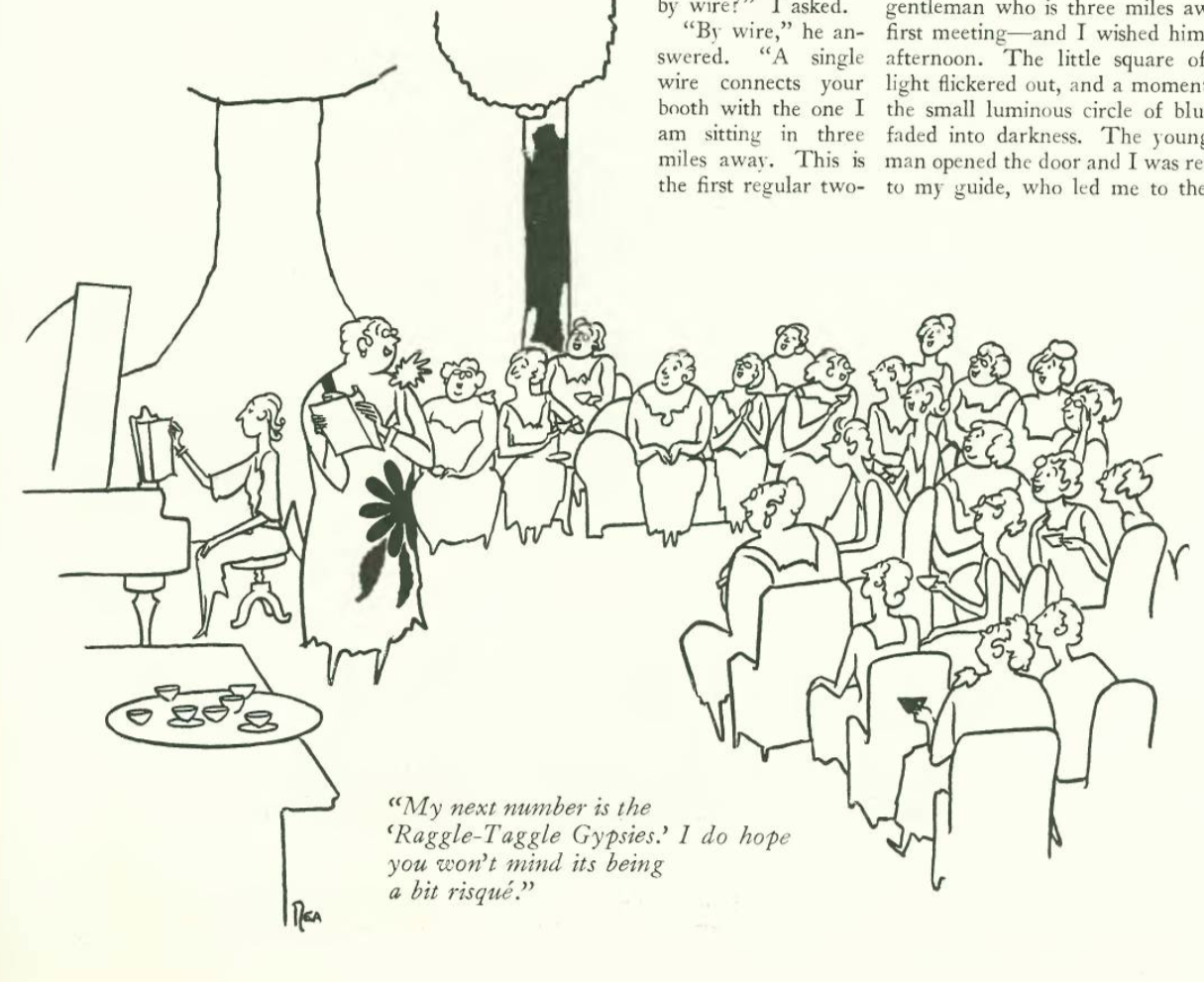
…among the delicate set, we got a bit risqué with Gardner Rea

…and nearly apoplectic with Gluyas Williams

Otto Soglow’s Little King, on the other hand, reigned with a steady hand…

…and we end with I. Klein, and a little bauble for the Missus…

Next Time: The Short Life of Two-Gun Crowley…


And the Winner Is…

We lead off with a couple of winners from the Feb. 7, 1931 issue, beginning with a cover by Rea Irvin that takes measure of a lighter moment at the Westminster Kennel Club Dog Show.

Feb. 7, 1931 cover by Rea Irvin.

The 1930 Best of Show winner Pendley Calling of Blarney also took the top honor in 1931, giving the wire fox terrier back-to-back Westminster wins. Overall, terriers have dominated Westminster — wire fox terriers have won Best of Show fifteen times, with Scottish terriers a distant second, with eight wins.

TOP DOG…Pendley Calling of Blarney won back-to-back crowns in 1930-31 at Westminster Kennel Club Dog Show at Madison Square Garden. The dog’s owner, John Grenville Bates, mercifully retired the pooch after the ’31 win. (Westminster Kennel Club)

STANDARD? WHO ARE YOU KIDDING?…Standard poodle Siba won Best in Show at the 144th annual Westminster Kennel Club Dog Show on Feb. 11, 2020, at Madison Square Garden. (Reuters)

The other winner was Cimarron, the first film to receive more than six Academy Award nominations, winning three including Best Picture (then called Best Production). It was the first Western to win Best Picture, and it would be nearly sixty years until another Western, Dances with Wolves, would take the top honor.

HE LOST HIS SHIRT, TOO…

Despite some “sagging moments,” John Mosher mostly lavished praise on the film, which was showing at the Globe Theatre:

THAT’S NO WELCOME WAGON…Clockwise, from top left, Yancey and Sabra Cravat (Richard Dix and Irene Dunn) join the 1889 Oklahoma Land Rush with their son, Cim (Junior Johnston); a less-than-friendly greeting at a boomer town; wagons line up for the big land grab; a young prostitute, Dixie Lee (Estelle Taylor), outwits Yancey for a piece of prime property. (IMDB)

OH DEAR, THERE’S THAT LOOK AGAIN…Yancey (Richard Dix) takes it upon himself to establish order in the boomer town of Osage. On the bed are Yancey’s son, Cim (Junior Johnston) and wife Sabra (Irene Dunn). (IMDB)

 *  *  *

Handy Painter

It is hard to imagine the struggles of one-handed painter José Clemente Orozco (1883-1949), who despite his handicap was able to complete huge murals in true fresco style (paint applied quickly on fresh, wet plaster), including five socially-themed frescoes at the Joseph Urban-designed New School. The murals included controversial depictions of Lenin and Stalin, but it wasn’t until the 1950s — during the McCarthy era — that school officials felt compelled to cover the images with a curtain. More protests followed, this time from faculty and students, and the curtains fell along with Joe McCarthy. “The Talk of the Town” looked in on the artist at work:

HE LOOKS FAMILIAR…José Clemente Orozco’s “The Struggle in The Occident”, 1930-1931, one of five frescoes at the New School. (Pinterest)

 *  *  *

Prescience of Mind

News reporter and author Elmer Davis submitted this humorous piece to The New Yorker doubtless thinking how preposterous, and therefore humorous, the following notion would be (a brief excerpt):

 *  *  *

Funny Cigarettes

In the early years of broadcast radio (and later TV) tobacco companies rightly saw a huge gold mine in radio show sponsorships. So when CBS radio executives accepted a sponsorship from Lorillard (the makers of Old Gold), they realized they had a challenge on their hands. “Talk” explained:

COUGH ME A MELODY…The makers of Old Gold cigarettes had CBS in their clutches in this September 1933 ad featuring bandleader Fred Waring and singer Babsie. (period paper.com)

…The above “Talk of the Town” item referred to the famous Murad ads illustrated by The New Yorker’s own Rea Irvin

…while other advertisers were scaling back a bit due to the Depression, lovely full-color ads continued to flow from tobacco companies (and oil companies)…

…Pierce-Arrow was also known for its sumptuous ads, but they wouldn’t save the luxury car maker from going under by the mid-1930s…

…Some less expensive black and white ads, such as this hand-lettered ad from Stein & Blaine, could be quite charming…

…speaking of charm, this ad from Arthur Murray could have used a little of it…note the stern visage of the woman, described as “typical of Arthur Murray’s staff of expert teachers”…

…on to our Feb. 7 cartoons, we have one of Peter Arno’s stock characters, the Sugar Daddy, in an awkward moment at a costume party…

…Arno’s party looked a lot more lively than this affair, illustrated by William Crawford Galbraith...

…and Carl Rose gave us this pair, who seem to having the best time of all…

Mary Petty eavesdropped on a guileless young woman…

…and Gardner Rea paid a visit to the Met…

 *  *  *

On to our Feb. 14 issue, and Gardner Rea once more…

Feb. 14, 1931 cover by Gardner Rea.

The Feb. 14 issue featured a profile of actress Katharine Cornell (1893-1974), written by cultural critic Gilbert Seldes. The caricature of Cornell is by Al Frueh. Excerpts:

Promotional photograph of Katharine Cornell as Elizabeth Barrett in the original 1931 Broadway production of The Barretts of Wimpole Street. It was her most famous role(Theatre Magazine, March 1931)

Cornell is considered one of the greatest actors of American theater, known for her eloquence and romantic stage presence. Seldes concluded:

 *  *  *

Strange Bedfellows

In his column “Of All Things,” Howard Brubaker referred to an exchange between American capitalists and Soviet Russians that resulted in the rapid industrialization of the Soviet Union. That actual story behind this effort is pretty amazing.

 *  *  *

Sneak Peek

Film critic John Mosher was so excited about Charlie Chaplin’s latest film that he offered this teaser to readers…

 *  *  *

From Our Advertisers

We have this ad from the developers of the Empire State Building, which was being readied for a May 1931 opening…

…the Empire State Building was erected on the site of the old Waldorf-Astoria Hotel. The new Waldorf-Astoria, also completed in 1931, was located more than 15 blocks away from its original site. Both the Empire State Building and the Waldorf Astoria would become Art Deco landmarks, and both shared the distinction of holding world records: the Empire State was the world’s tallest building (a record it would keep until 1970), and the Waldorf would claim the title of the world’s tallest hotel (until 1963)…

…on to our cartoonists, we have Ralph Barton contributing one of his last illustrations to the theater review section…

Richard Decker references a recent change in New York telephone numbers with this prison scene…

…Decker was referring to this bit of news, here interpreted by E.B. White in his Feb. 14 “Notes and Comment.”

James Thurber returned with his second-ever stand-alone cartoon for the New Yorker

Garrett Price mined a theme that would become common in New Yorker cartoons: the tycoon vs. meek employee…

Nancy Fay gave us a glimpse of the seamier side of family life…

R. Van Buren goes even darker with this entry…

…and we end on a high note, with Alan Dunn

Next Time: Super Tramp…