Fear of Flying

The early New Yorker loved two things about modern life — college football and air travel. Tragedy would bring them together on the last day of March 1931.
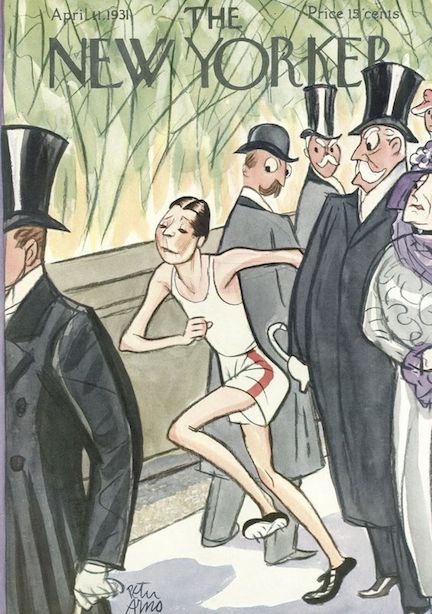
April 11, 1931 cover by Peter Arno. A brilliant cover, contrasting the skinny, lightly clad runner with one of Arno’s stock characters from the Taft era—a millionaire with a walrus mustache.

The New Yorker’s sportswriter John Tunis was especially keen on Knute Rockne’s Notre Dame football team, which played an annual rivalry game against Army at Yankee Stadium. Tunis’s colleague, E.B. White, was the flying enthusiast, never missing a chance to hop aboard a plane and marvel at the scene far below. In the Nov. 30, 1929 issue, White was eager to join passengers on a test of the Fokker F-32, and suggested that flying was becoming so routine that one could be blasé about its risks:

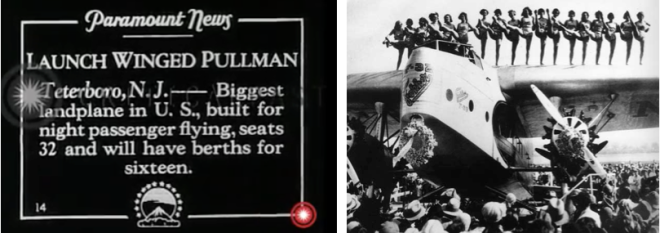
WHAT COULD POSSIBLY GO WRONG?…Title card from a silent Paramount newsreel reporting on a November 1929 test flight of the Fokker F-32 at Teterboro, possibly the same flight enjoyed by E.B. White. At right, a celebration of the plane’s arrival in Los Angeles. (YouTube/petersonfield.org)

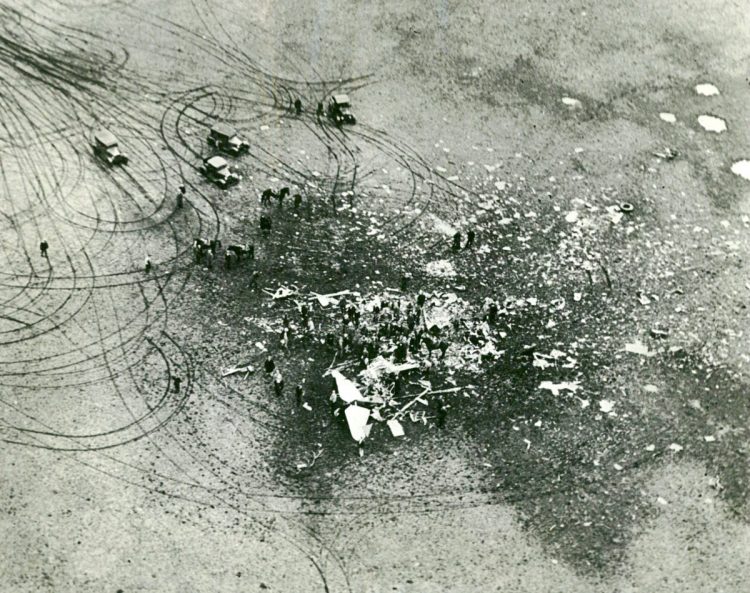
All of that exuberance came crashing down in a Kansas wheat field on March 31, 1931. It was Rockne’s fame—which The New Yorker and countless other magazines and newspapers helped to spread—that put the coach on a TWA flight to Hollywood, where director Russell Mack was filming The Spirit of Notre Dame. Rockne stopped in Kansas City, where he visited his two oldest sons, before boarding a Fokker F-10 destined for Los Angeles. About an hour after takeoff one of the airplane’s wings broke to pieces, sending Rockne and seven others to their deaths.
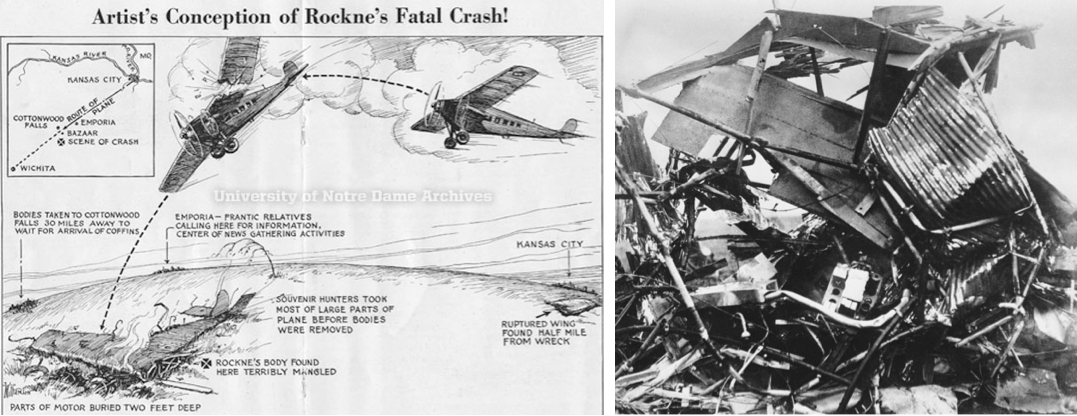
(University of Notre Dame) click image to enlarge

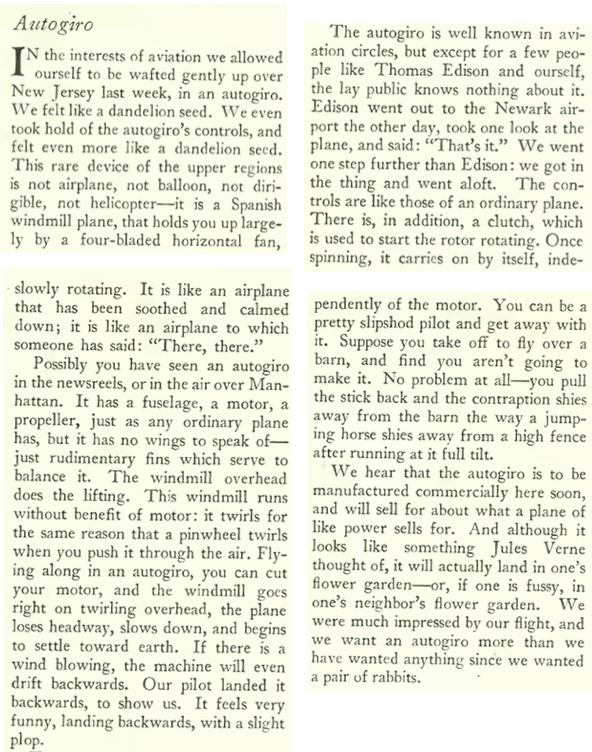
The accident rattled E.B. White. In his April 11, 1931 “Notes and Comment,” White pondered the eulogies Rockne received from President Herbert Hoover and others, calling into question the fame a college football coach could attain while achievements of college faculty go unheralded. White also seemed to have lost some of his faith in the progress of aviation, suggesting that the autogiro (a cross between an airplane and a helicopter) might be the safest way to proceed into the future:

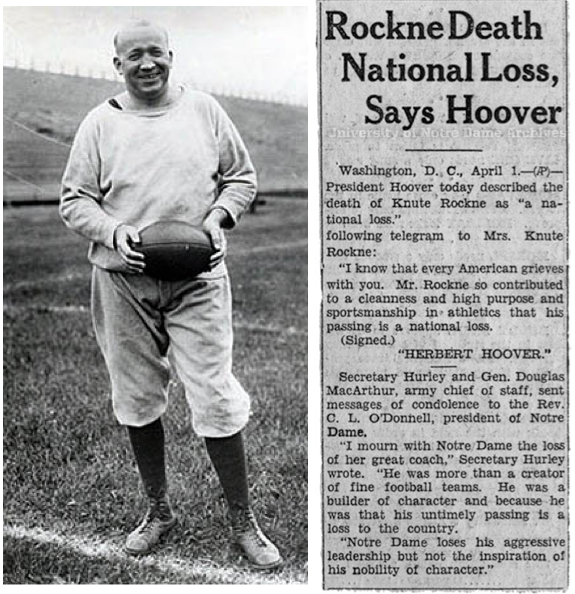
Knute Rockne, in undated photo. (University of Notre Dame)

Ironically, it was thanks to Rockne’s fame that the aviation industry began to get serious about safety. A public outcry over the crash led to sweeping changes in everything from design to crash investigation, changes that have helped make flying one of the safest forms of transportation today.
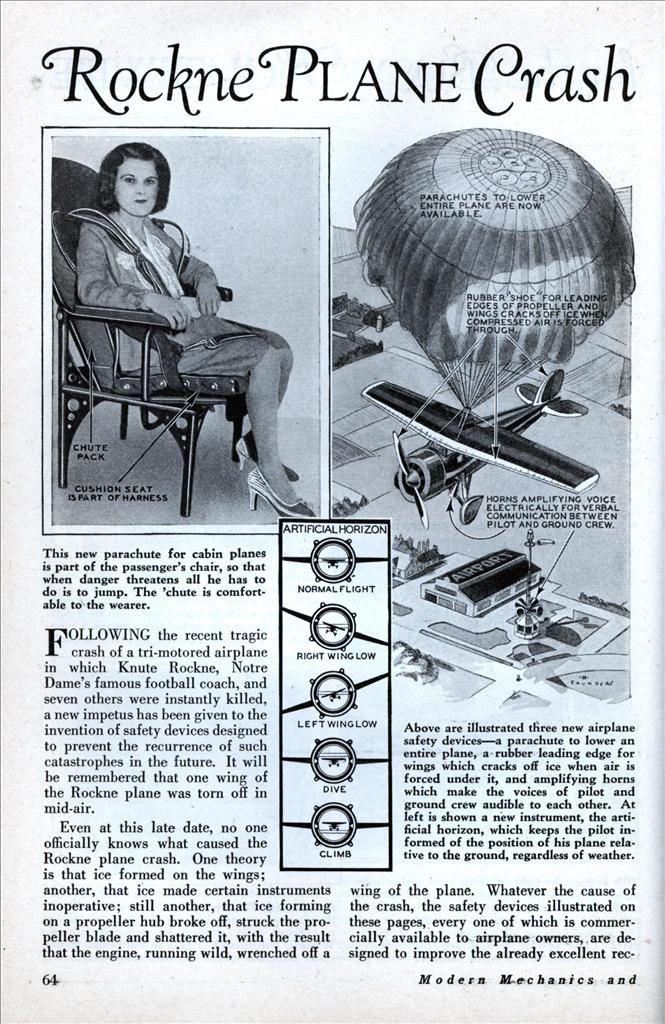
SAFETY FIRST…The crash that claimed the life of Knute Rockne resulted in a public outcry for greater safety in the air. This article in the July 1931 issue of Modern Mechanics suggested parachutes for passengers and for the plane itself. (modernmechanix.com)

As for the cause of crash, it was determined that the plywood covering one of the Fokker F-10’s wings had separated from the wing’s supporting structure — the wing had been bonded together with a water-based glue that likely deteriorated as the result of rainwater seeping into the wing.

Unfortunately, the investigation into the crash was hampered by souvenir-seekers, who carried away most of the large parts of the plane even before the bodies were removed. So much for honest Midwestern values, at least in this case.
(clickamericana.com)

 *  *  *

Give My Regards

Back in Manhattan, Dorothy Parker was writing a eulogy of her own, bidding farewell to her interim role as theater critic. Parker subbed for Robert Benchley during his extended European vacation, and often noted that it was just her luck  to be stuck with a string of plays that likely comprised one of Broadway’s worst spring line-ups.
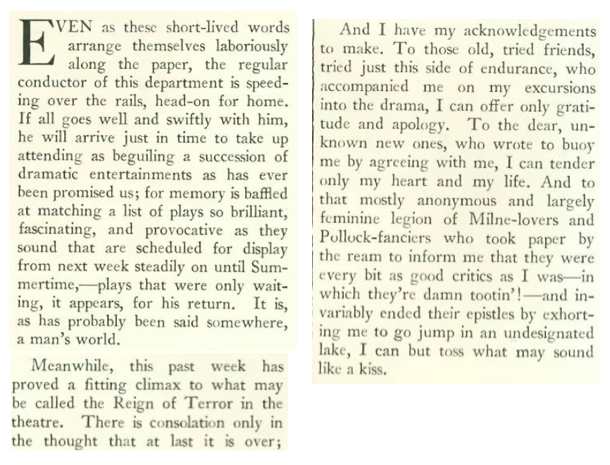
In an earlier column Parker had alluded to the fact that Benchley was in Europe, no doubt staying part of the time with their mutual friends, Gerald and Sara Murphy, at their fashionable “Villa America” at Cap d’Antibes on the French Riviera.
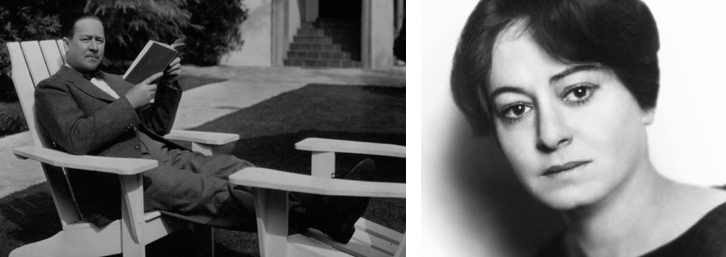
SIGHT FOR SORE EYES…Dorothy Parker was glad to have her old friend Robert Benchley back at the theater desk, she having endured a “rotten time” reviewing a long string of bad plays. (dorothy parker.com)

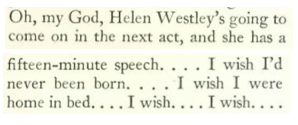
Hopeful to review at least one play of redeeming value before her friend returned, Parker was to be sorely disappointed as evidenced in her final review column. Of the terribly dated Getting Married, a play written by George Barnard Shaw way back in 1908, Parker was more afraid of Getting Bored, especially when Helen Westley (portraying Mrs. George Collins) entered the stage to deliver a 15-minute monologue…
Things got no better with the second play Parker reviewed, Lady Beyond the Moon, a “dull, silly, dirty play” that was frequently interrupted by various sounds from the restless audience — “comments, titters and lip-noises…” The play must have been terrible, because it closed after just fifteen performances.

As for the third play Parker reviewed, the misnamed Right of Happiness, the audience had every excuse “for displayed impatience,” yet conducted itself “like a group of little lambs.” Right of Happiness, observed Parker, “fittingly concluded the horrible little pre-Easter season…” The play closed after just eleven performances.

 *  *  *

Turning Up the Heat

If anyone thought he had a right to happiness it would have been New York Mayor Jimmy Walker, who was preparing to face a grilling from Judge Samuel Seabury. Walker loved the nightlife and left most of his duties to a bunch of Tammany Hall cronies whose activities drew the attention of reformers like Seabury and Gov. Franklin D. Roosevelt. In his “A Reporter at Large” column, Morris Markey observed:

 *  *  *

Walking Tall

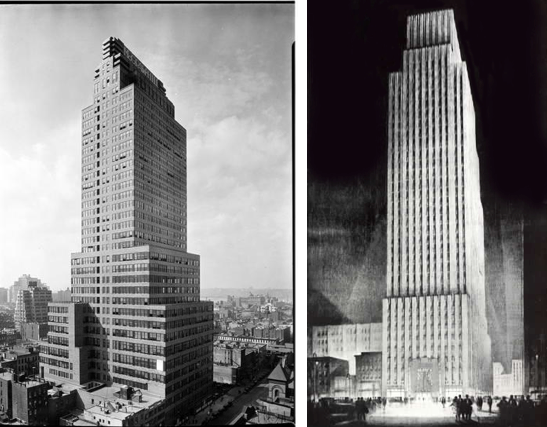
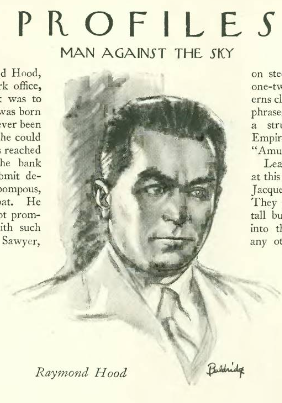
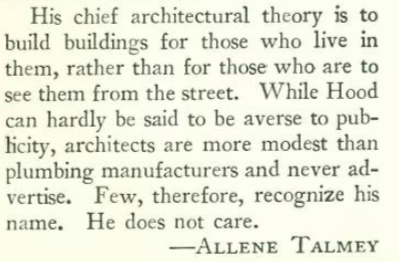
Raymond Hood (1881-1934) might have been short in stature, but he stood tall among the architects of some of New York’s most iconic skyscrapers — Rockefeller Plaza, American Radiator, Daily News, McGraw Hill (Sadly, both his career and his life were cut short when he died in 1934 at age 53 from complications related to rheumatoid arthritis). Allene Talmey, a former reporter for the New York World and managing editor of Conde Naste’s original Vanity Fair, gave Hood his due (see brief excerpt) in a New Yorker profile, with a portrait by Cyrus Baldridge:
LANDMARKS…The 1931 McGraw-Hill Building and the 1929-30 Daily News Building. (MCNY/Wikipedia)
And of course, Hood’s 30 Rock. I took this last December before everything shut down.

 *  *  *

From Our Advertisers

Speaking of big and tall, Al Smith and his gang took out this full page ad to announce the availability of office rentals in the world’s tallest building. Thanks to the Depression, only 23 percent of the available space in the Empire State Building was rented out in its first year. Thankfully, the building was also an instant tourist attraction, with one million people each paying a dollar to ride elevators to the observation decks in 1931, matching what the owners made in rent that year…
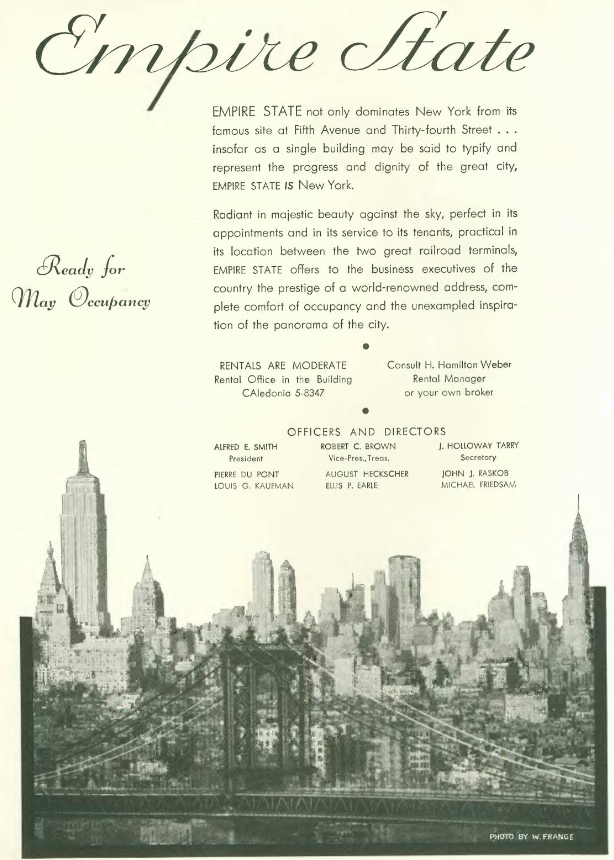
…for those who could afford more than a dollar ride up the Empire State’s elevators, the cooling breezes of coastal California beckoned…

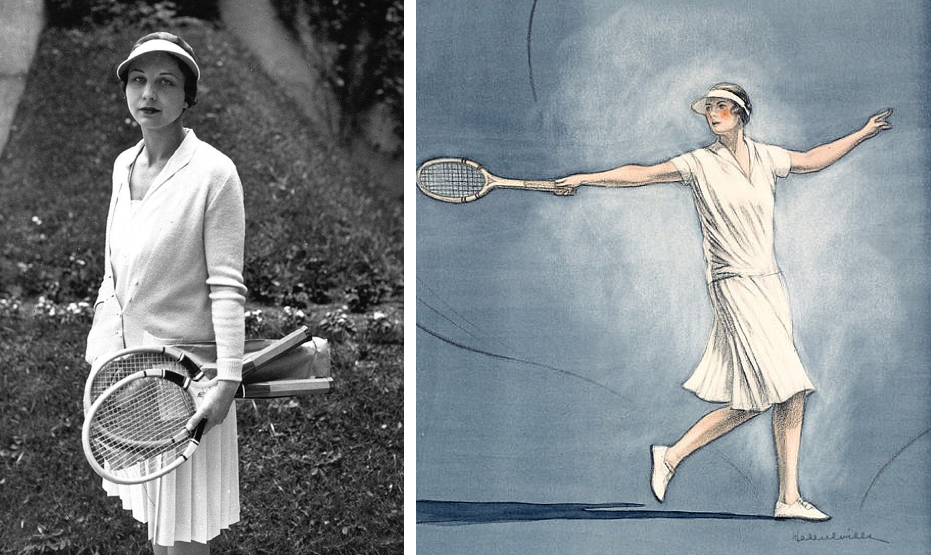
…those with even greater means and leisure time could hop on a boat to Europe…note that you could still cruise on the Olympic, the Titanic’s sister ship…also note that the illustration of the posh couple was rendered by Helen Wills (1905-1998), better known at the time as the top women’s tennis player in the world…

HELEN, MEET HELEN…American tennis star Helen Wills in 1932, and a self-portrait from the same year. Wills was the world’s top women’s tennis player for nine of the years between 1927 and 1938. She played tennis into her 80s, and sketched and painted all of her life. (Wikipedia/invaluable.com)

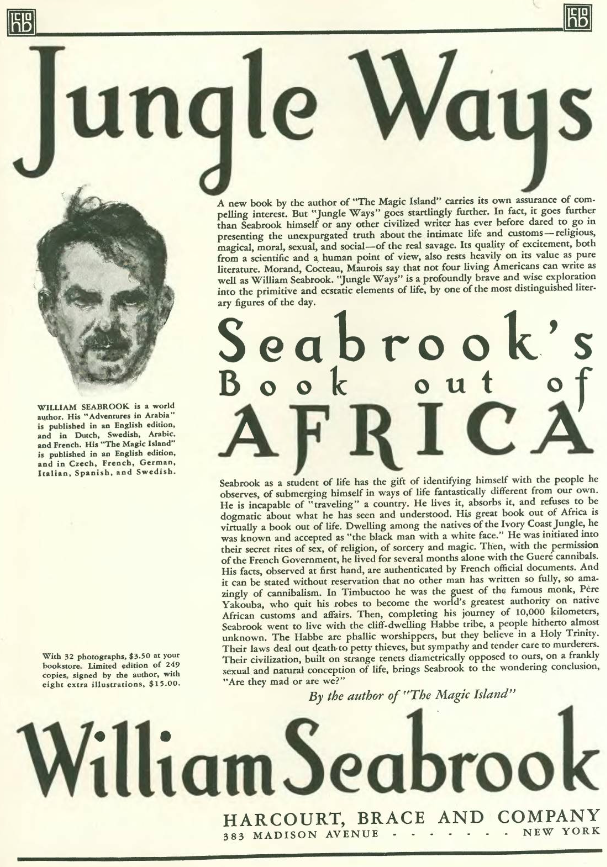
…Guess who’s coming to dinner?…hopefully not William Seabrook, who had just released his latest book on his adventures as an explorer…in Jungle Ways, Seabrook devoted an entire section to cannibalism in the French Sudan and how to cook human flesh; apparently he tried some himself…but then again by most accounts he was a weird dude who dabbled in occultism and possibly believed in zombies…Seabrook’s 1929 book, The Magic Island, is credited with introducing the concept of zombies to popular culture…
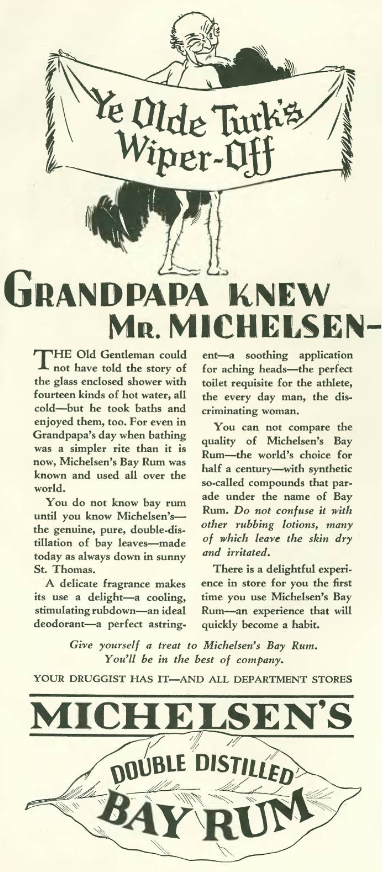
…speaking of weird, an ad for Michelsen’s “Bay Rum” body rub…
…when Marlboro cigarettes were introduced in the mid-1920s, they were marketed as “luxury” cigarettes and sold mostly at resorts and hotels. In the late 1920s, however, they were marketed as a “lady’s cigarette,” with ads in the New Yorker featuring handwriting and penmanship contests to promote the brand. This ad from November 1930 featured the “second prize” winner of their amateur copywriting contest…
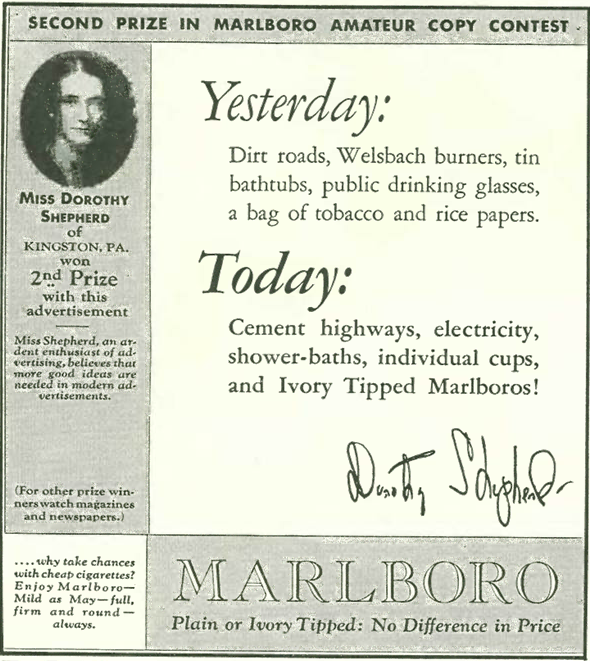
…it appears marketing tactics changed a bit in 1931…still the dopey contest, but instead of real photos of winners, like the schoolmarmish “Miss Dorothy Shepherd” above, this ad featured a rather tawdry image of a model, more gun moll than schoolmarm…

…on to our cartoonists…Ralph Barton, who was with The New Yorker from Day One, had been increasing his contributions to the magazine after a notable absence from spring 1929 to summer 1930…beset by manic-depression, he would take his own life in May 1931, so what we are seeing are Barton’s last bursts of creativity before his tragic end, reviving old favorites like “The Graphic Section”…

Barbara Shermund entertained with some parlor room chatter…

Leonard Dove looked in on a couple of frisky old duffers…
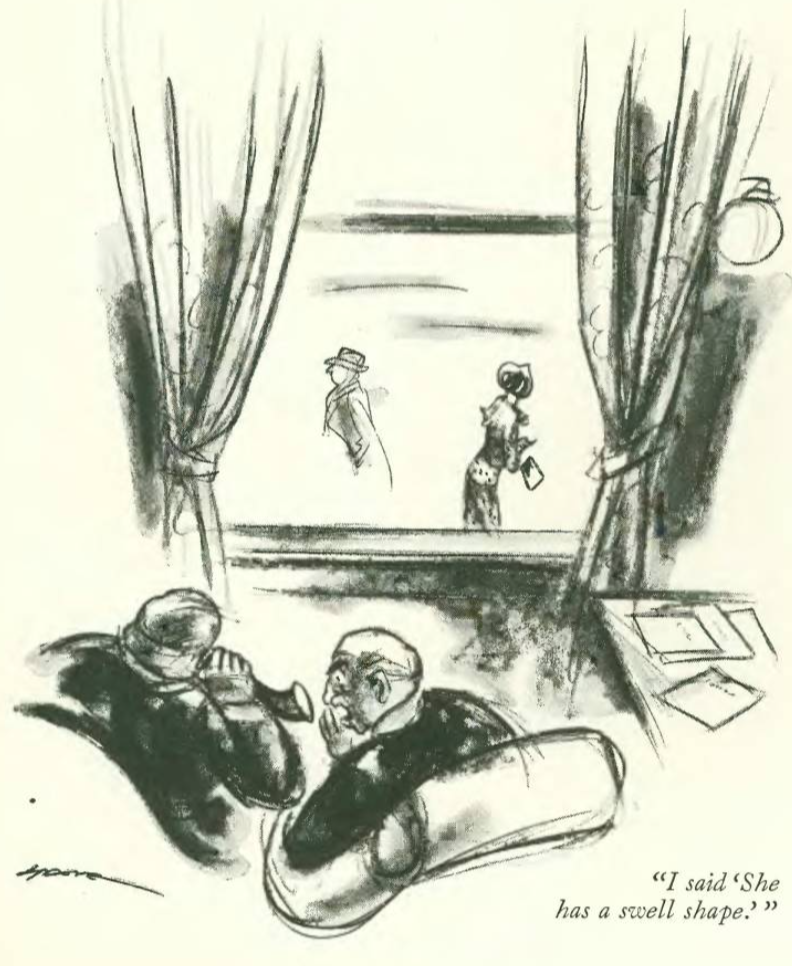
William Crawford Galbraith, and a crashing bore…

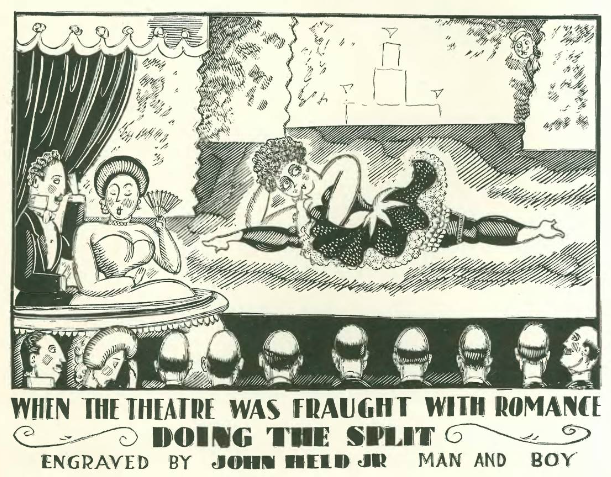
John Held Jr gave us one of his “naughty” engravings…
…and two by our dear Helen Hokinson, stuck in traffic…

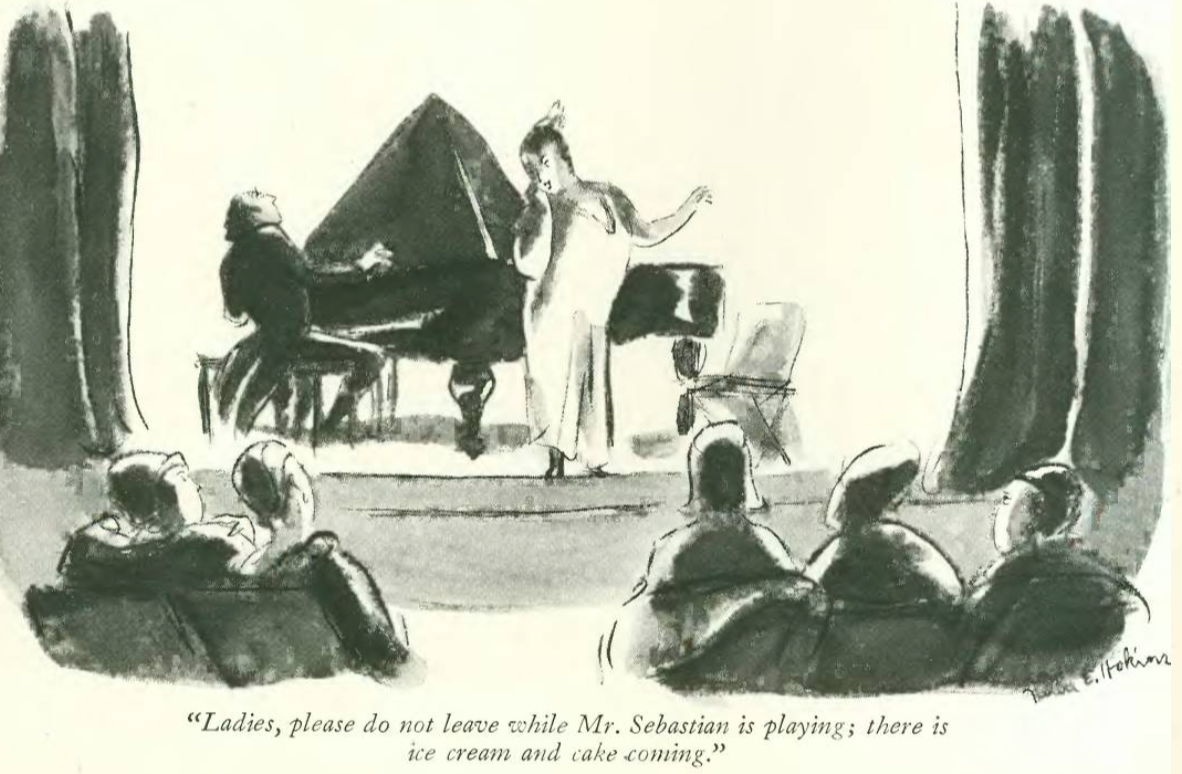
…and enjoying cake and ice cream, with a dab of culture…
Next Time: An Unmarried Woman…

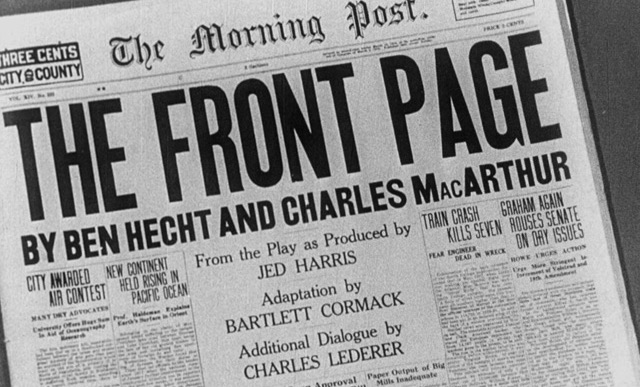
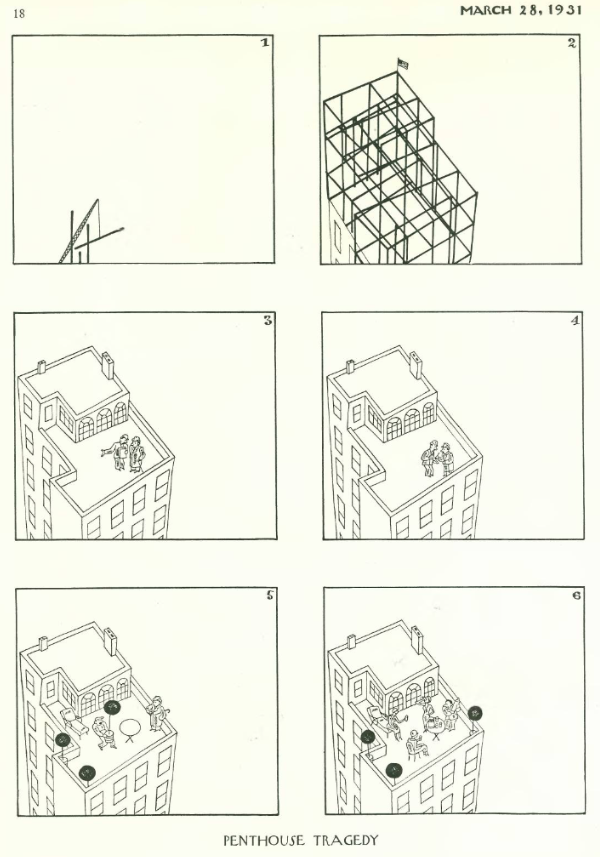
Front Page News

It’s hard to beat Chicago as a source for hardboiled storytelling, and two of its best newspaper reporters, Ben Hecht and Charles MacArthur, would draw on their rough and tumble newsroom experiences to create one of Broadway’s most-beloved plays.

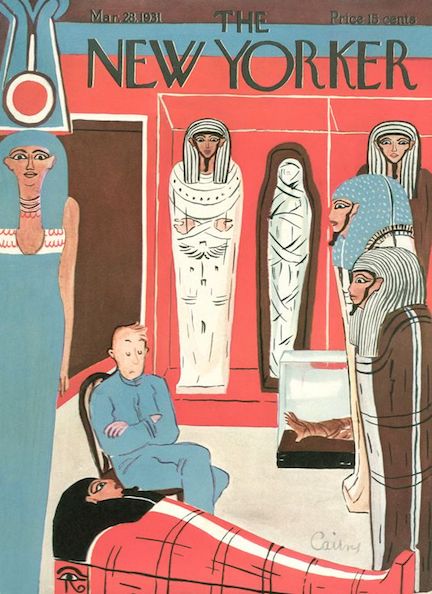
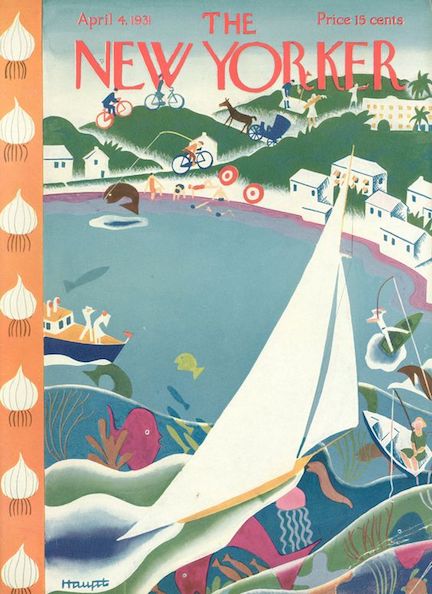
March 28, 1931 cover by Ruth Cairns.

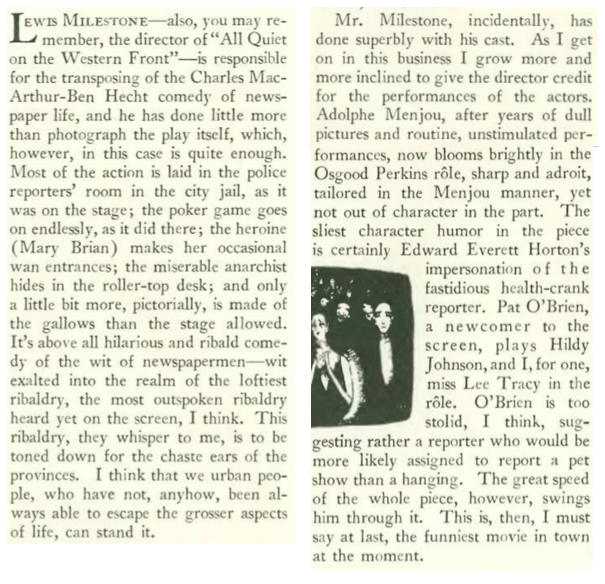
Although they were Chicago boys, The New Yorker crowd viewed Hecht and MacArthur as adopted (or perhaps naturalized) Manhattanites. So when John Mosher wrote his glowing review of the film adaption of The Front Page, he was writing about the work of a pair well known to the Algonquin Round Table set.

WE ❤ NY…Chicagoans Ben Hecht, left, and Charles MacArthur were familiar faces with the Algonquin Round Table crowd. (Chicago Tribune/Amazon)
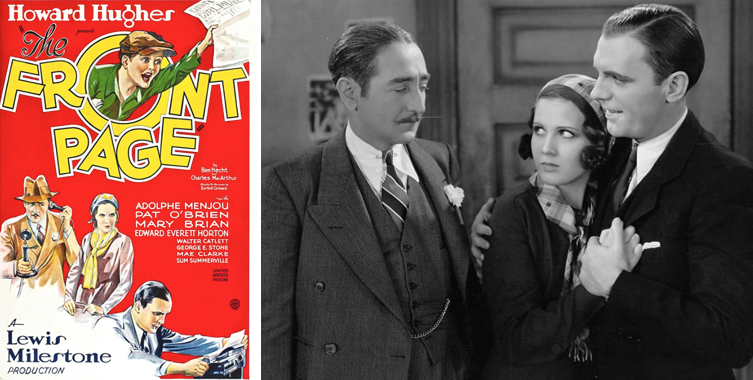
NEWSIES…Editor Walter Burns (Adolphe Menjou) sizes up his reporter Hildy Johnson (Pat O’Brien) and Hildy’s fiance Peggy Grant (Mary Brian) in The Front Page. (IMDB)

MacArthur (1895-1956) was especially close to the Algonquin group, having shared an apartment with Robert Benchley and a bed with Dorothy Parker in the early 1920s. In 1928 MacArthur would marry one of Broadway’s most beloved stars, Helen Hayes.

For his part, Hecht (1893-1964) contributed short fiction pieces to The New Yorker during its lean first years, 1925-1928. After the success of The Front Page, Hecht would go on to become one of Hollywood’s greatest screenwriters.

Here’s Mosher’s review:

Playwright and essayist James Harvey observes that The Front Page was “Hecht and MacArthur’s Chicago…(and) that counts most deeply in the imagination of Hollywood. And their play, the first of the great newspaper comedies, did more to define the tone and style, the look and the sound of Hollywood comedy than any other work of its time.”

DESK JOB…Hildy Johnson (Pat O’Brien) and Molly Malloy (Mae Clarke) hide escaped murderer Earl Williams (George E. Stone) in a rolltop desk in 1931’s The Front Page. (Everett)
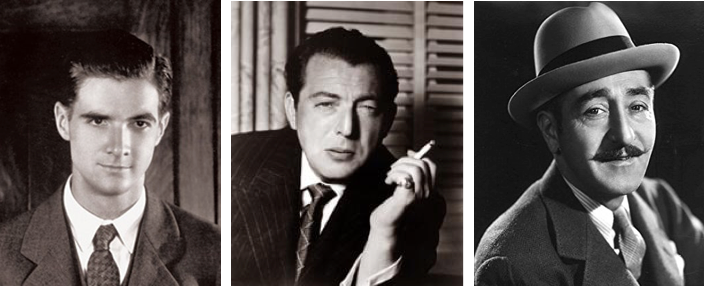
TRIUMPHANT TRIUMVIRATE… Following up on the success of his famously over-budget war film Hell’s Angels (1930), Howard Hughes (left) had another hit on his hands as co-producer of The Front Page; at the Fourth Academy Awards the film was nominated for Best Picture, Lewis Milestone (center) for Best Director, and Adolphe Menjou (right) for Best Actor. (Wikipedia/IMDB)

A footnote: Ben Hecht and Charles MacArthur were close throughout their careers, and remain so even in death: they are buried near each other on a hilltop in Oak Hills Cemetery, Nyack, NY.

 *  *  *

From Our Advertisers

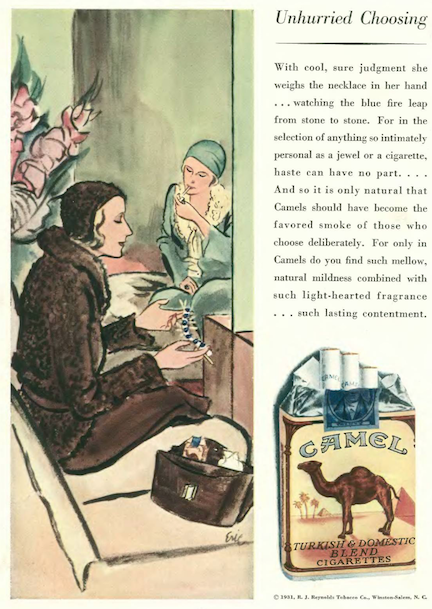
In the late 1920s and early 1930s several illustrators drew inspiration from the style Carl “Eric” Erickson made famous with his elegant series of ads for Camel cigarettes…I’m not sure if this ad (part of a series promoting “The New Chevrolet Six”) is by Erickson or an imitator, but it seems the artists were likely inspired by the actress Greta Garbo and her signature beret…

…and for comparison, an Erickson Camel ad from the March 21, 1931 issue…

…and our inspiration, Greta Garbo circa 1930…

…those Chevy buyers might have considered investing in Velmo mohair upholstery to boost the resale value of their auto…

…among other technological wonders of the age — furniture crafted from aluminum, soon to become ubiquitous in workplaces across the country…

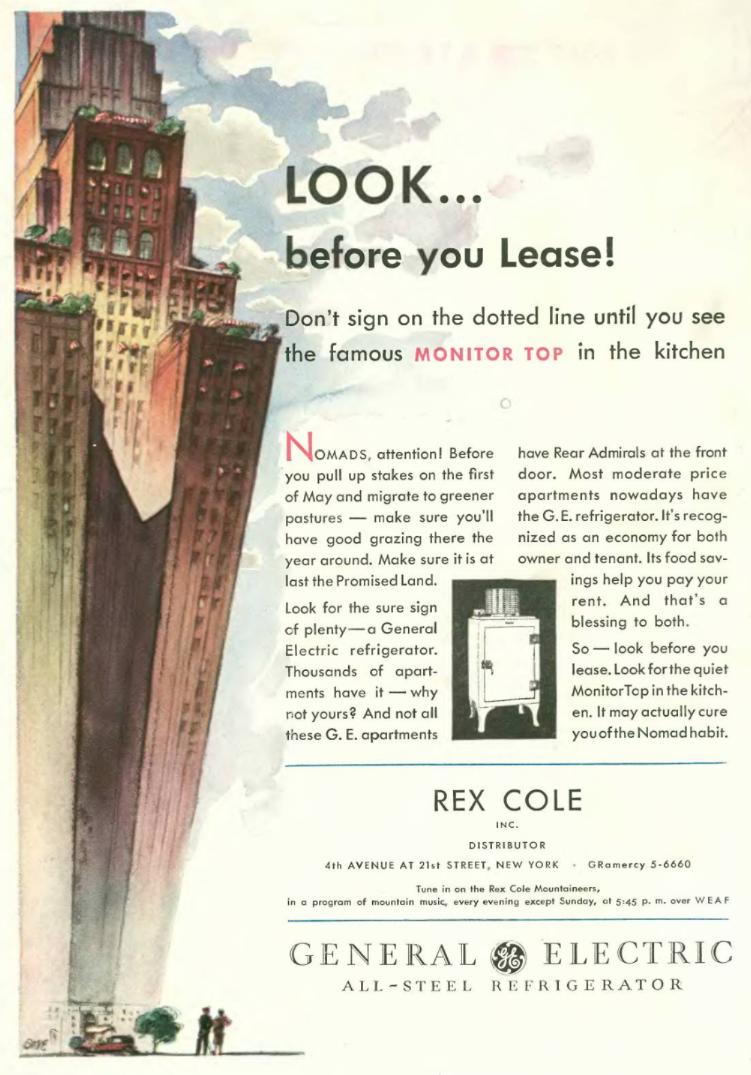
…and then there was the electric refrigerator, still new to a lot of households in 1931 as icemen began to hang up their tongs and head for the sunset…

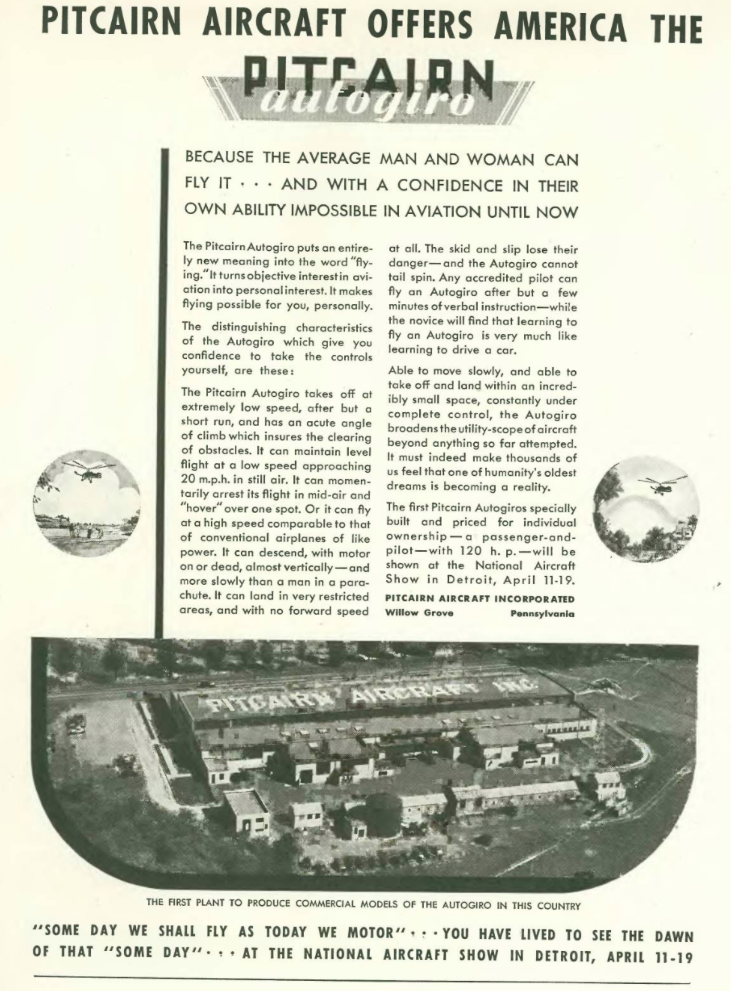
…if you were a modern man or woman of means, you could ditch the auto altogether and get yourself a Pitcairn autogiro…

…in the 1920s and 30s the autogiro was considered by many to be the transportation of the future, a flying machine as easy to operate as driving a car…

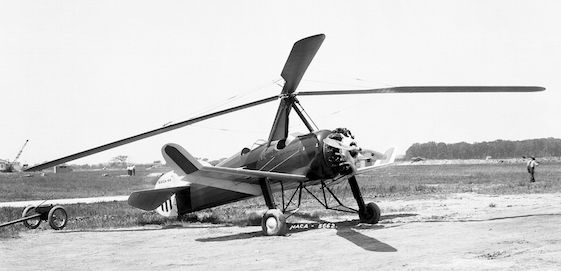
HEY DAD, CAN I HAVE THE KEYS TO THE AUTOGIRO?…Above, a Pitcairn PCA-2. In the 1920s and 30s, many future-forward designers imagined the autogiro as the flying car of tomorrow. (Wikipedia)

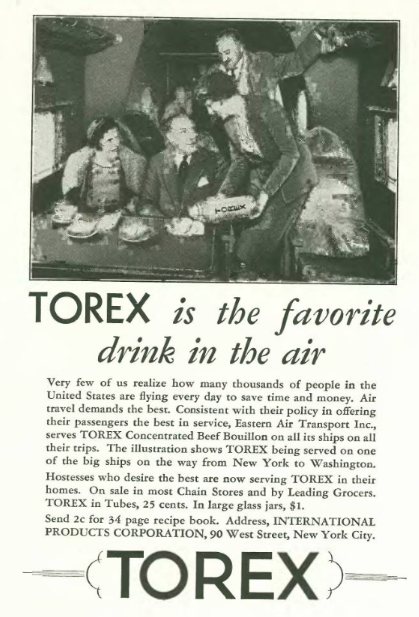
…for those who preferred to be passenger rather than pilot, they could relax in the comfort of an airplane cabin and enjoy some…hmmm…beef broth! From what I understand, passenger flight was not this cosy in 1931…this was long before pressurized cabins, when you had to mostly fly in the weather, and not above it, and you probably had to fight to keep from upchucking that Torex all over the lovely flight attendant…

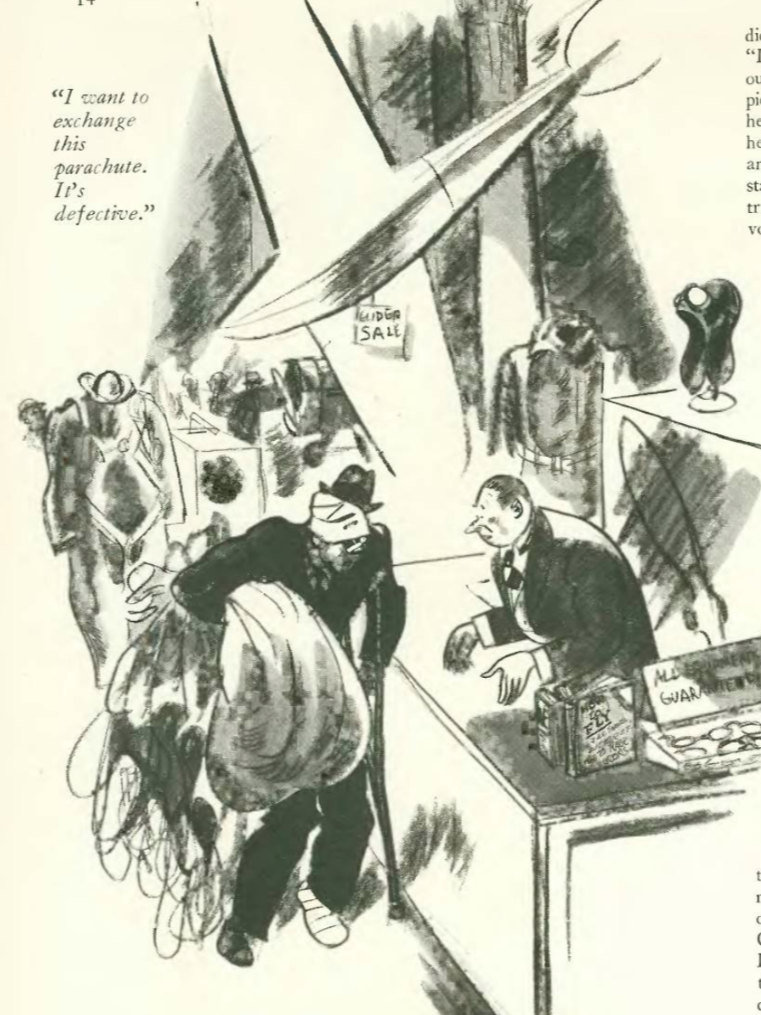
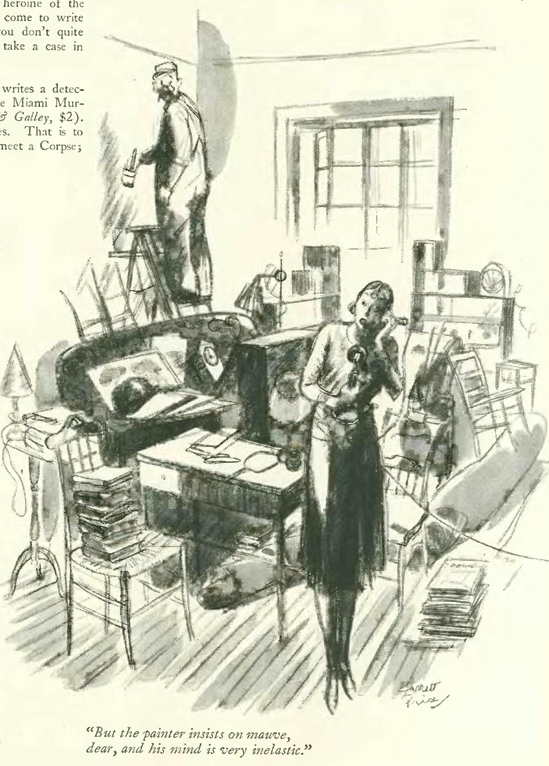
…while we are on the subject of flight, we turn to our cartoons, beginning with Garrett Price

…meanwhile, William Steig explored the trials of young love…

…a rare two-pager from Ralph Barton

Leonard Dove adopted an alias for a cartoon that seems inspired by a recent trip to Persia…

Otto Soglow illustrated one man’s dilemma at a bus stop…

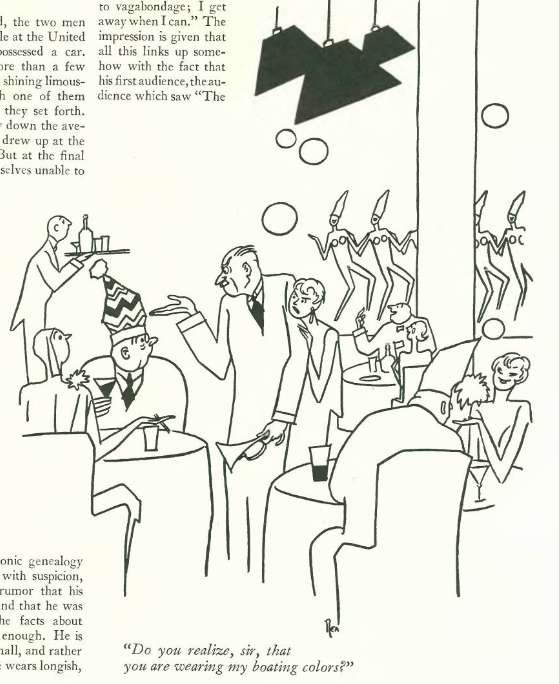
Gardner Rea found offense in an unlikely setting…

Barbara Shermund defined pathetic in this sugar daddy’s boast…

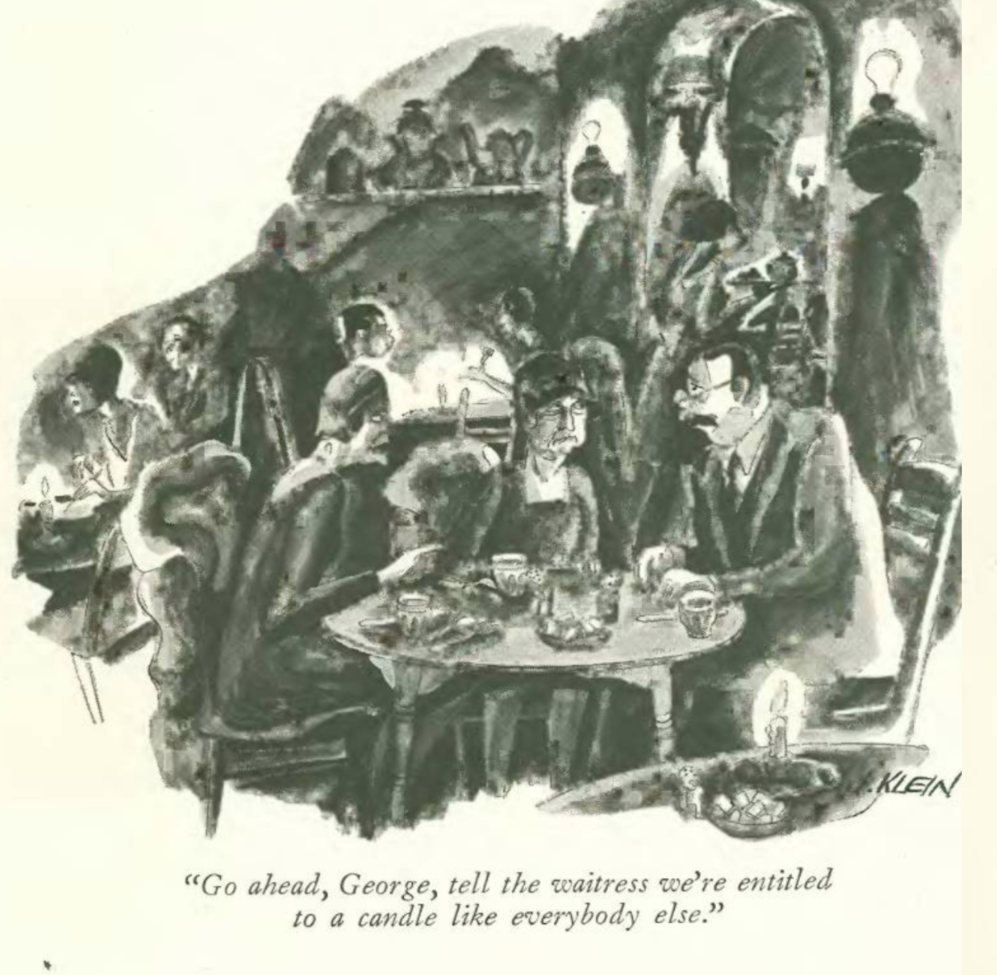
…while on the other end of the spectrum, I. Klein illustrated the burdens of life as a Milquetoast…

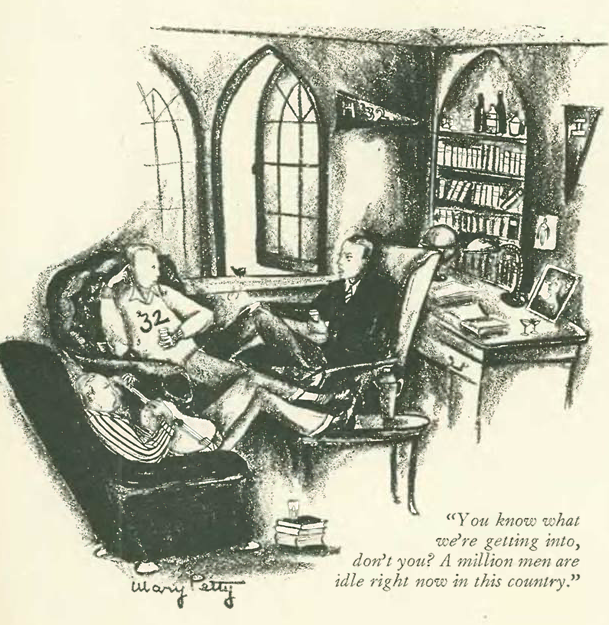
…and we sign off with Mary Petty, and one woman’s terms of endearment…

Next Time: Last Stand for Beau James…

Killer Queen

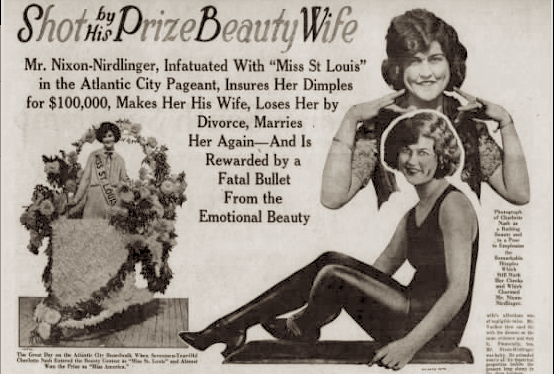
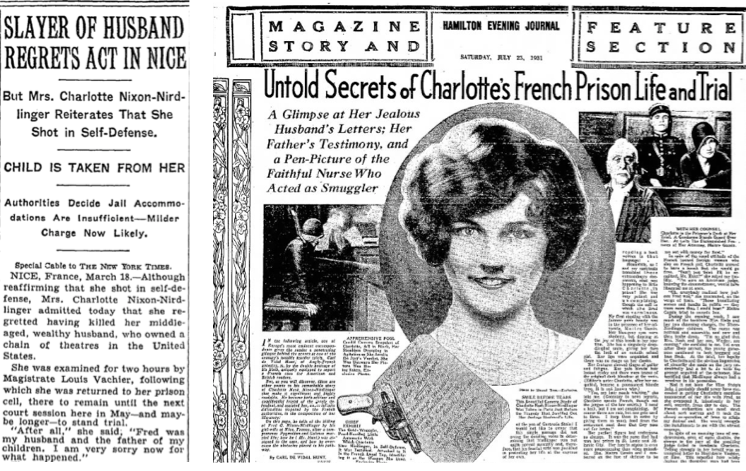
The story of Fred Nixon-Nirdlinger isn’t exactly dinner table conversation these days, but in the spring of 1931 his death at the hands of his beauty queen wife had much of America abuzz.

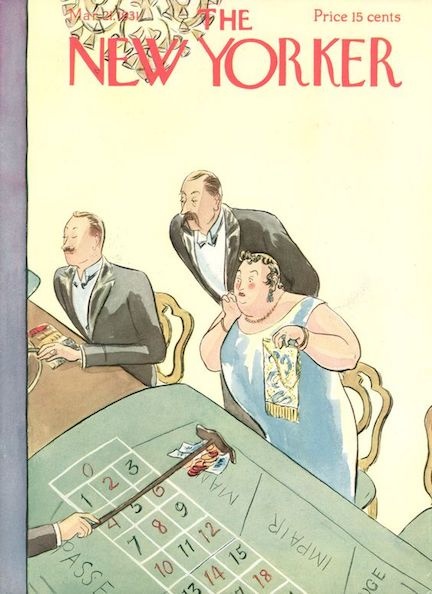
March 21, 1930 cover by Helen Hokinson.

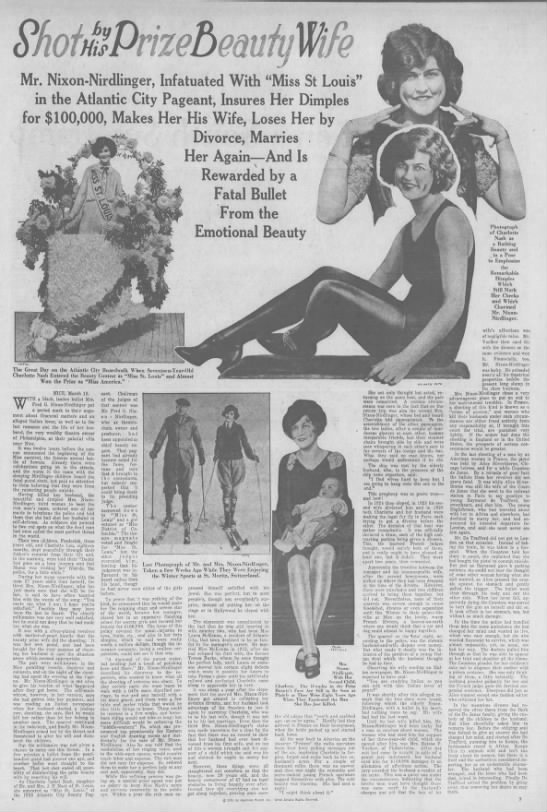
Charlotte Nash, Miss St. Louis of 1923, would have passed into obscurity like so many other beauty contestants if she hadn’t married a wealthy theater owner 30 years her senior, and then divorced and remarried him, and then shot him in the head on the French Riviera.

But first, the reason I am writing about this lurid episode: here’s E.B. White in the March 21, 1931 “Notes and Comment”…

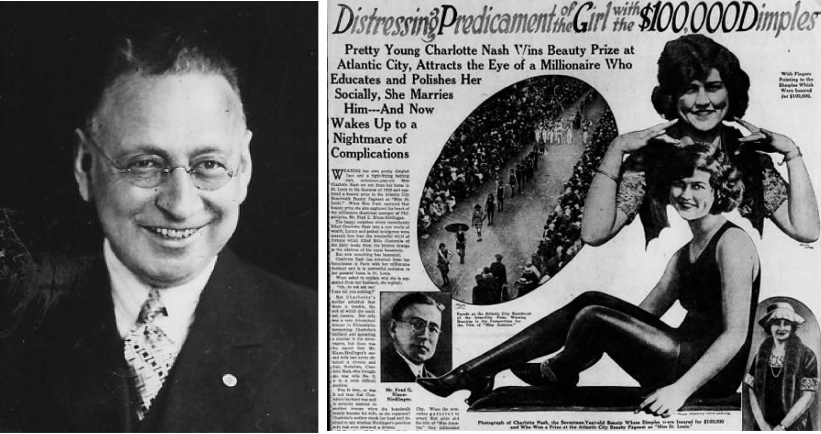
Forty-seven-year-old Fred Nixon-Nirdlinger, wealthy owner of a Philadelphia theater chain, was serving as a judge at the 1923 Miss America competition in Atlantic City when the 17-year-old “Miss St. Louis,” Charlotte Nash, caught his eye and his fancy. By February 1924 they were married…

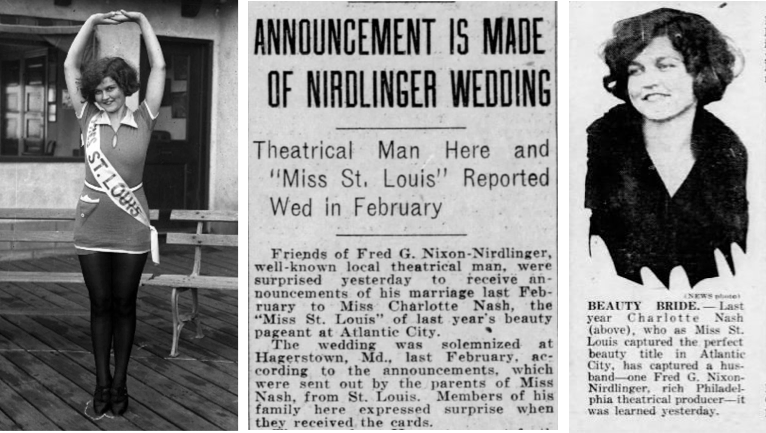
FANCY STRIKER…Seventeen-year-old Charlotte Nash strikes a pose at the 1923 Miss America pageant in Atlantic City; belated 1924 marriage announcement in the Philadelphia Inquirer; announcement in the New York Daily News. (New York Daily News/Philadelphia Inquirer)

…Fred was furious that Charlotte did not win the title in Atlantic City. He vowed to make her a movie star and sent her off to finishing school to work on her manners and elocution…

CRADLE TO GRAVE…Fred Nixon-Nirdlinger sent his young bride to finishing school for “a touch of polishing here and there.” Little did he know that one day she would finish him too…permanently. (findagrave.com/Pittsburgh Press)

…Unfortunately, Fred forgot to tell his young bride that he already had a wife —news that came to light on a trans-Atlantic voyage to Paris, where Fred and Charlotte had planned to honeymoon. Already pregnant with his child, Charlotte nevertheless divorced Fred, but remarried him some months later after the baby was born (and after considerable wooing and groveling by the theater magnate). Fred rejoined Charlotte in France, but the second honeymoon didn’t last long either. On the evening of March 11, 1931, the intensely jealous Fred accused his young wife of trafficking with “gigilos.” After Charlotte denied the charge, Fred seized her by the neck and threatened to choke her to death.

Crime Historian Laura James takes it from there:

“At some point Fred went into the kitchen for more whisky. Charlotte used the opportunity to flee to the bedroom, where she slipped a loaded pistol under her pillow. Fred’s last words to her were, “I will kill you rather than let you have an Italian lover.” Charlotte beat him to it, and as she lay on the bed she retrieved her pistol and fired. The first bullet entered just under Fred Nixon-Nirdlinger’s left eye and lodged at the base of his skull. A second bullet hit him in the chest. Two other shots went wild. Fred crumpled in a pool of blood.”

Charlotte was soon in a French jail, now a bigger star than she had ever been, or ever would be…

FINALLY GETTING SOME NOTICES…Left, detail of a March 18, 1931 New York Times account of the slaying; right, a more lurid take on the story by the July 18, 1931 edition of the Hamilton (Ohio) Evening Journal. Below, another colorful account from the San Francisco Examiner. (newspaper.com/New York Times)

During the subsequent trial, Charlotte’s defense attorneys argued that the shooting was a clear case of self-defense, and the jury agreed, acquitting the former beauty queen in just nine minutes. When she returned to the United States with her two young children, it appeared she would be entitled to a big chunk of Fred’s fortune…

…but in the end the will left her nearly penniless, so she earned what she could by telling her sensational story to the media, including this multi-installment feature she penned for the St. Louis Star and Times:

IT’S A LONG STORY…The 14th and 16th installments of Charlotte Nash’s story of her brush with fame and infamy in the St. Louis Star and Times. (newspaper.com)

Laura James notes that Charlotte might have been better off remaining in France: “The verdict was largely attributed (by the American newspapers at least) to French attitudes toward beautiful women and marriage in general (the jury included eight bachelors). But she returned to St. Louis; learned that her husband’s will left her nearly penniless; and tried to find acting jobs in Hollywood only to be snubbed Lizzie Borden-style, as Hollywood would have none of her. In the end she would declare, ‘Sometimes I’m sorry that I was ever considered beautiful. It brought me more trouble than joy.”‘

But the story doesn’t end there. Charlotte Nash Nixon-Nirdlinger (1905-2009) dropped out of public view, but would live on into the 21st century, dying at age 103 or 104 in her hometown of St. Louis, Missouri, where she rests today.

RIP CHARLOTTE. (findagrave.com)

 *  *  *

Turkey Trot

Dorothy Parker began to detect a pattern as she continued subbing for her friend Robert Benchley’s theater review column. All of the plays she had reviewed to date were found to be uniformly terrible; she found comfort, however, in fellow critics who also viewed Broadway’s spring lineup as a flock of “little turkeys”…

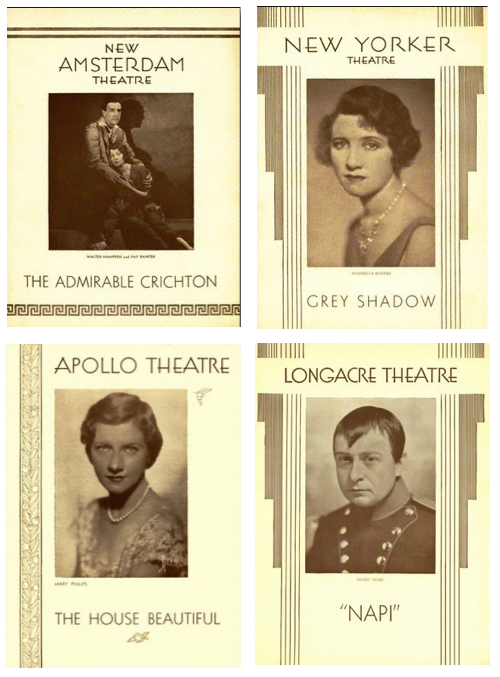
BIRDS OF A FEATHER…Dorothy Parker found Broadway’s spring lineup to be uniformly terrible, and audiences mostly agreed. Clockwise, from top left, The Admirable Crichton ran for two months and 56 performances at the New Amsterdam Theatre; Grey Shadow closed after 39 performances at the New Yorker Theatre; Napi, directed and lead-acted by the diminutive Ernest Truex (pictured) lasted just 21 shows at the Longacre; The House Beautiful bested them all by staying open for 108 performances at the Apollo. A curious side note: Mary Philips, pictured on the Apollo cover, was Humphrey Bogart’s second wife. The marriage lasted ten years — 1928 to 1938. (Playbill)

Of the plays Parker reviewed, she called The Admirable Crichton “piteously dated;” of Grey Shadow, she wrote that it would be as indelicate for her to discuss the play as it would be to “go into details of my appendectomy;” Parker deemed Napi “as grubby and unpleasant a little comedy as you could want to stay away from;” and she did not find The House Beautiful all that beautiful…”The House Beautiful is, for me, the play lousy.”

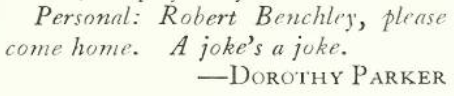
Parker ended the column with her usual plea to Benchley:

 *  *  *

Moses Parts the Swamp

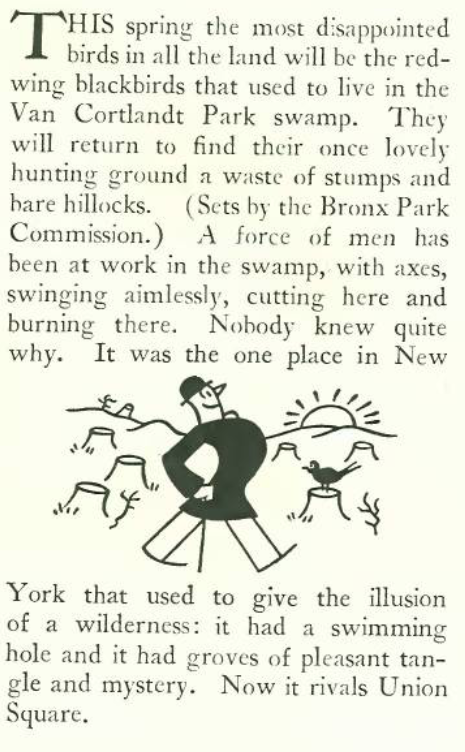
In his “Notes and Comment,” E.B. White noted the destruction of trees and swampland in Van Cortlandt Park. In 1931 Robert Moses was president of the Long Island Park Commission but held political sway over so much more. What White was witnessing were preparations for the construction of the Henry Hudson Parkway and Mosholu Parkway that would split Van Cortlandt into six separate pieces. White was right about the disappearing birds: the last remaining freshwater marsh in the state, Tibbetts Brook, was dredged to accommodate construction.

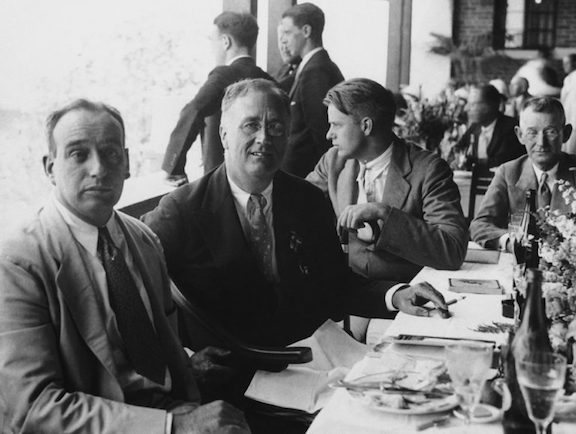
HE PAVED PARADISE…Governor Franklin D. Roosevelt of New York attends a Jones Beach luncheon on July 26, 1931, as a guest of Robert Moses (far left), who was president of the Long Island Park Commission. (AP Photo)
A PARK DIVIDED…The Mosholu Parkway cuts a wide swath through Van Cortlandt Park, 1936. (Museum of the City of New York)

 *  *  *

Those Daring Young Men

Ever since Charles Lindbergh made his historic transatlantic flight in 1927, Americans were captivated by the derring-do of pilots who competed for various “firsts.” In the case of Clyde Pangborn and Hugh Herndon Jr., the goal was to to fly around the world and break the record of 20 days and 4 hours set by Germany’s Graf Zeppelin in 1929. In his “Reporter at Large” column, Morris Markey noted the many weeks of preparation by the two pilots…

A BIT OF FUN…July 1931 newspaper illustration of Clyde Pangborn, left, and Hugh Herndon Jr., with a map of the route they followed on their attempt to set a new round-the-world flight record. (AP)

Markey noted that the two pilots claimed they were setting out on their dangerous mission “for the fun of it”…

While Pangborn and Herndon were still making flight plans at their Hotel Roosevelt headquarters, Wiley Post and Harold Gatty took to the air and claimed the record of 8 days and 15 hours. Pangborn and Herndon decided to make a go of it anyway, leaving New York on July 28, 1931, in their red Bellanca named the Miss Veedol, but poor weather in Siberia caused them to abandon their quest.

There was, however, a $25,000 prize being offered by the Tokyo newspaper Asahi Shimbun to the first pilots to cross the Pacific non-stop, so Pangborn and Herndon regrouped and successfully flew the Miss Veedol across the Pacific Ocean — in 41 hours and 13 minutes. It wasn’t exactly a smooth flight; three hours after takeoff the device used to jettison the landing gear failed, prompting Pangborn to climb out onto the wing barefoot at 14,000 feet to remove the landing gear props. After several other near-mishaps — including nearly smashing into a mountain — the duo completed their historic flight with a controlled crash landing near Wenatchee, Washington.

NO WHEELS, NO PROBLEM…More than 41 hours after departing Japan, Clyde Pangborn and Hugh Herndon Jr. performed a controlled crash landing near Wenatchee, Washington, completing the first-ever nonstop flight across the Pacific Ocean. (Wired.com)
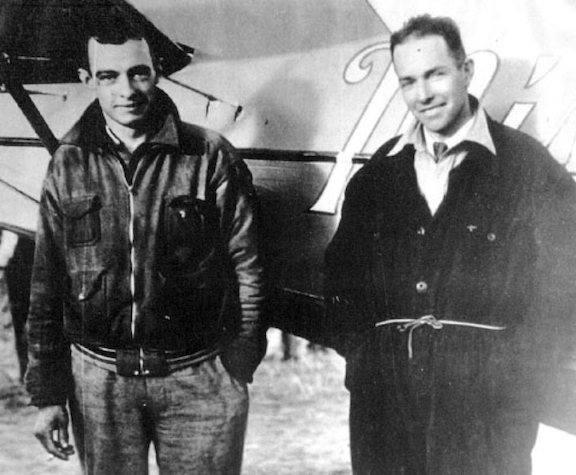
STILL IN ONE PIECE…Hugh Herndon Jr., left, and Clyde Pangborn after crash-landing at Wenatchee, Wash., following their 1931 flight across the Pacific from Misawa, Japan. (Spirit of Wenatchee).

 *  *  *

From Our Advertisers

Herndon and Pangborn made plans for their round-the-world flight while staying at the Roosevelt Hotel in Midtown…I’ve stayed there myself and enjoyed its nubby charms…as for the underground passageway to the Grand Central, it’s still there, but no longer open to the public…

…the makers of Kleenex originally marketed their tissues for makeup removal…by the 1930s, however, they saw a much bigger opportunity…

…if the Roosevelt Hotel wasn’t posh enough for you, the new Waldorf-Astoria might have been your cup of tea…

…and if you could stay at the Waldorf, you might be able to afford a Packard, which in the 1930s was a near-rival to Rolls Royce…

…I toss this one in from Goodyear because it is probably the only time an image of the Taj Mahal was used to sell tires…

…we have another lovely Carl “Eric” Erickson illustration for Camel…

…and at first glance I thought this was another two-page ad for Chesterfield cigarettes, but it appears the candy manufacturers also wanted to tie their products to exciting lifestyles…in this case, you were urged to eat candy for some quick energy…here it is implied that Schrafft’s candy will give you the energy you need for sailboating and…er…other activities…

…for comparison, Chesterfield ad from 1930…

…on to our cartoons…Otto Soglow continued the adventures of the Little King…

Perry Barlow showed us that war is hell…

…some ringside niceties courtesy E. McNerney

Mary Petty reminded us that posh folks weren’t exactly known for their intellect…

Alan Dunn examined the challenges of buying an older house…

Helen Hokinson gave us a politically precocious young lad…

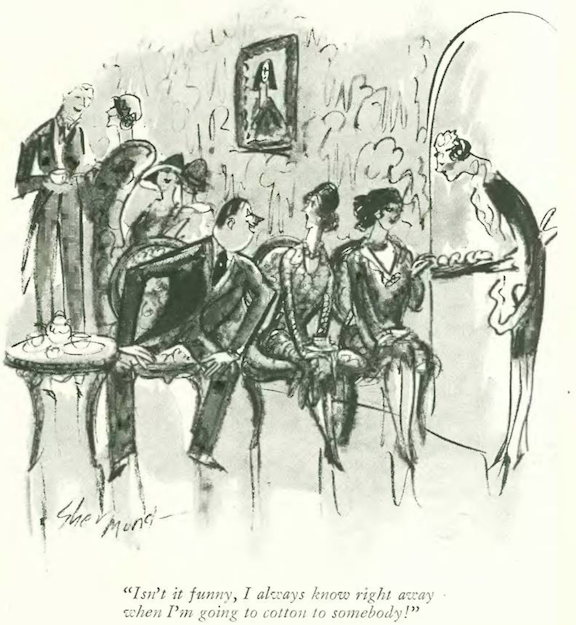
…and two glimpses into high society by Barbara Shermund

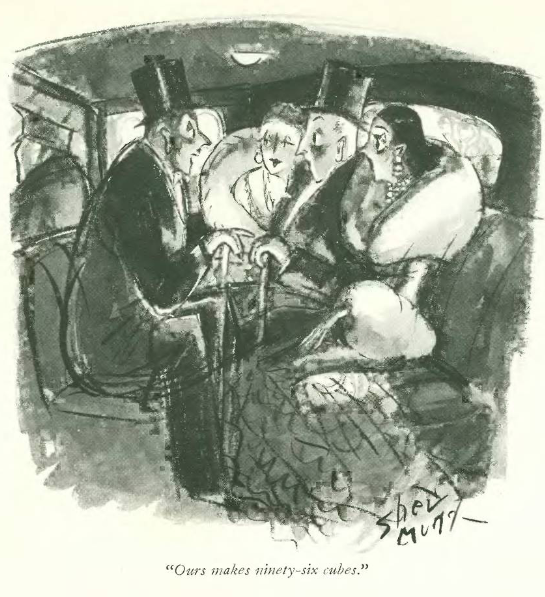
…including their scintillating conversations about such things as ice makers…

Next Time: Front Page News…


Risky Business

The Irish American gangster JackLegsDiamond was often referred to as the “clay pigeon of the underworld” due to surviving several attempts on his life.

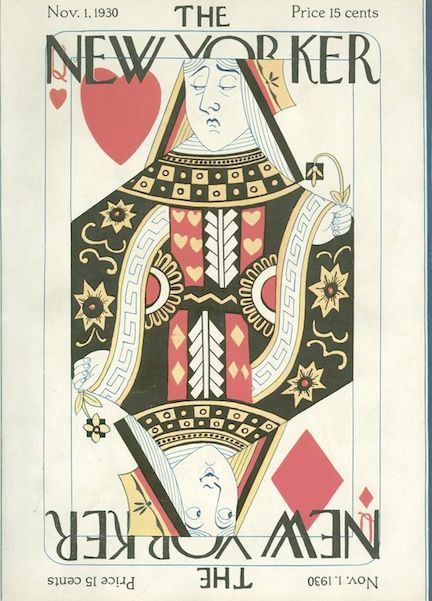
Nov. 1, 1930 cover by Rea Irvin.

In his “Reporter at Large” column, Morris Markey checked up on the fleet-footed bootlegger, adored by the public for his various brushes with the law and escapes from sure death. In his opening paragraph, Markey referred to one of the attempts on Diamond’s life: On October 12, 1930, he survived being shot five times at Manhattan’s Hotel Monticello:

Markey’s column attempted to remove some of the glamour from Diamond’s flamboyant life, a life that would be cut short about a year later in an Albany rooming house…

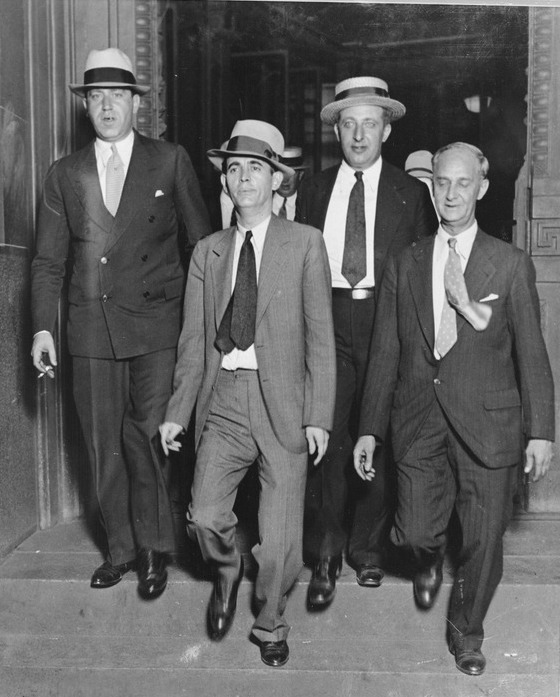
OUT WITH THE BOYS…Legs Diamond leaves the federal court in New York with his attorney and a couple of cronies on Aug. 8, 1931, after being convicted of owning an unlicensed still and conspiring to violate Prohibition laws. (digitalcommonwealth.org)
BEDFELLOWS…Legs Diamond had a number of mistresses, but the best known was Marion “Kiki” Roberts, who was with Diamond shortly before he was slain. (The Mob Museum/Pinterest)
DEADLY TRIO…Clockwise, from top left, Legs Diamond is comforted by his wife, Alice Kenny Diamond, after being shot three times at a roadhouse near Cairo, NY, on April 27, 1931. His enemies finally succeeded in killing him on Dec. 18, 1931, shooting him three times in the back of the head in an Albany rooming house. Alice would be shot and killed less than two years later, possibly by Diamond’s enemies to keep her quiet. And sadly, The New Yorker’s “Reporter at Large” columnist Morris Markey would also meet a violent end, dying of a gunshot wound to the head in 1950. Whether it was by his hand or another’s, it was never determined. (Albany Archives/NY Times)

An afternote: Enemies would finally catch up to Legs Diamond and kill him on Dec. 18, 1931. Diamond’s wife, Alice Kenny Diamond, would be shot and killed less than two years later. Diamond’s mistress and former Ziegfeld Follies performer Marion “Kiki” Roberts would return to the stage and cash in on her notoriety. In 1937 it was reported she was the big draw in a touring “Crazy Quilt” burlesque revue. And according to the writer William Kennedy, who wrote about Diamond in his 1975 novel Legs, the last record of Kiki Roberts was in Boston in the 1940s, where “she was still appearing as ‘Jack (Legs) Diamond’s Lovely Light o’ Love.’ ”

Here is newsreel footage of Diamond’s mistress Marion “Kiki” Roberts, shortly after the gangster’s death. In this brief interview with a Boston reporter (and with her mother at her side) Roberts advises girls to “live good clean lives and obey their parents wishes.” Note how it appears she is reading from cue cards.

 *  *  *

Chitty Chitty Bang Bang

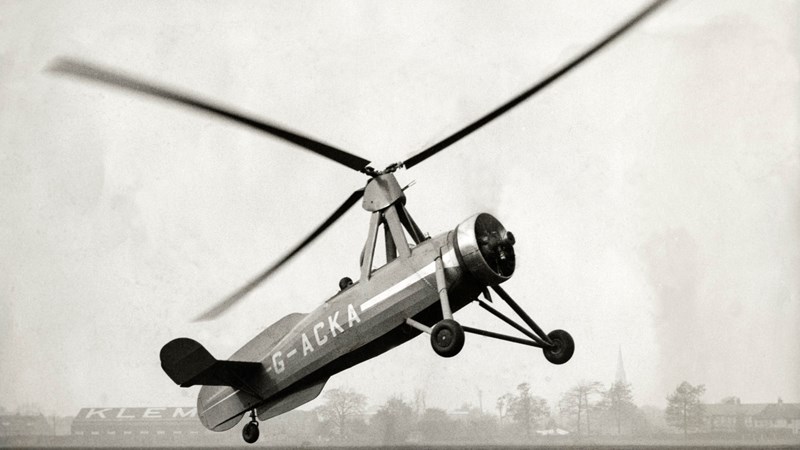
A precursor to the helicopter, the autogyro was considered by many to be the next logical step in aircraft development, and especially in the development of smaller craft that could serve as safe, affordable transportation options for commuters. The New Yorker’s E.B. White, an aviation enthusiast, demonstrated to readers the wonders of this aircraft:

EASY AS PIE…A Cierva Autogiro C30 takes flight circa 1933. (findmypast.co.uk)

 *  *  *

Baker’s Big Show

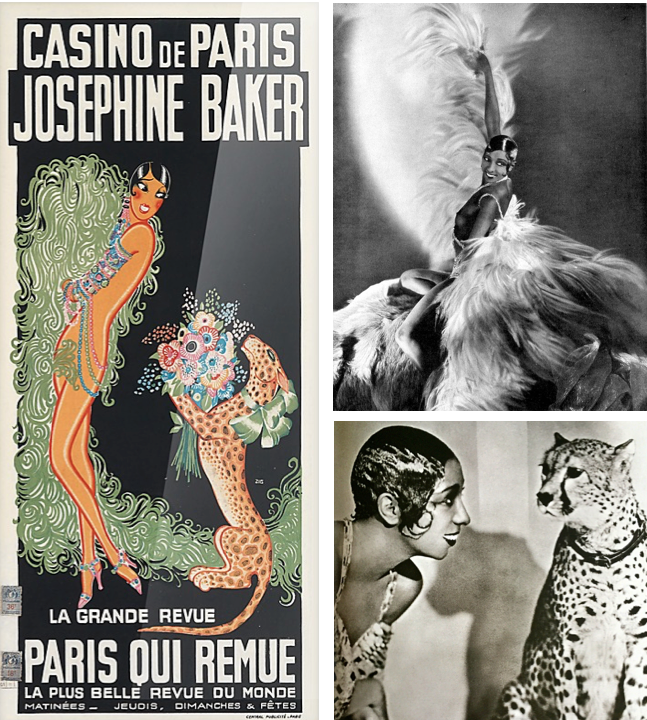
Nineteen-year-old American-born French entertainer Josephine Baker became an instant symbol of Jazz Age Paris when she starred in La Revue Nègre in October 1925. Her erotic dance routines wowed Paris audiences, and she quickly moved on to the famed Folies Bergère. In 1930 she opened a new show at the Casino de Paris that also featured her pet cheetah, Chiquita. The New Yorker’s Janet Flanner was there to take it all in:

HEAR THE THUNDER…Nineteen-year-old Josephine Baker took Paris by storm when she appeared in La Revue Nègre at the Théâtre des Champs-Élysées in October 1925. (harleminmontmartre.paris/artphotolimited.com)
HEAR ME ROAR…The New Yorker’s Janet Flanner was wowed by Josephine Baker’s newest show at the Casino de Paris that also featured her pet cheetah, Chiquita. (pictorem.com/vam.ac.uk/artphotolimited.com)

 *  *  *

Grim Reminder

Despite the deepening Depression across the country, few mentions of it were made in the pages of The New Yorker. Howard Brubaker, in his “Of All Things” column, offered this not-so-gentle reminder:

 *  *  *

From Our Advertisers

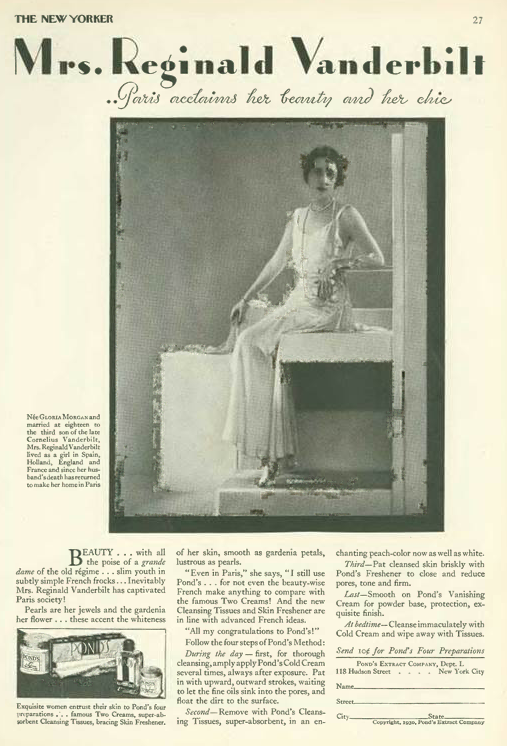
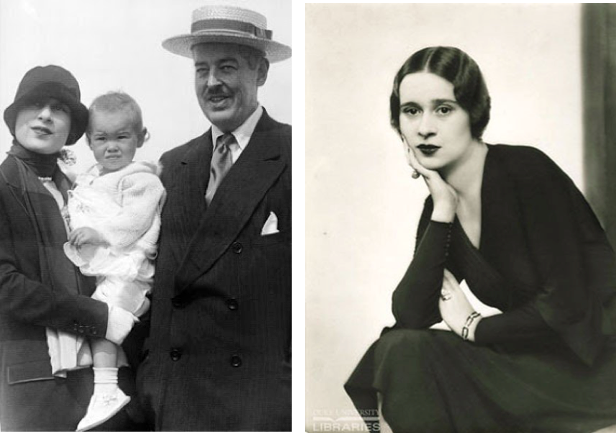
We feature Gloria Morgan Vanderbilt, a Swiss-born American socialite shilling for Pond’s cold cream. At the time of this ad she was the mother of six-year-old Gloria Vanderbilt (who would become a famous fashion designer and artist and the mother of CNN’s Anderson Cooper)…

POOR LITTLE RICH GIRLS…Gloria Morgan Vanderbilt and her husband, Reginald Claypoole Vanderbilt with daughter Gloria, circa 1924-25. Reginald died in 1925, and a famous custody battle over little Gloria (who recently died at age 95) would take place in 1934. At right, portrait of Gloria Morgan Vanderbilt by Dorothy Wilding, 1933. (Perkins Library, Duke University)

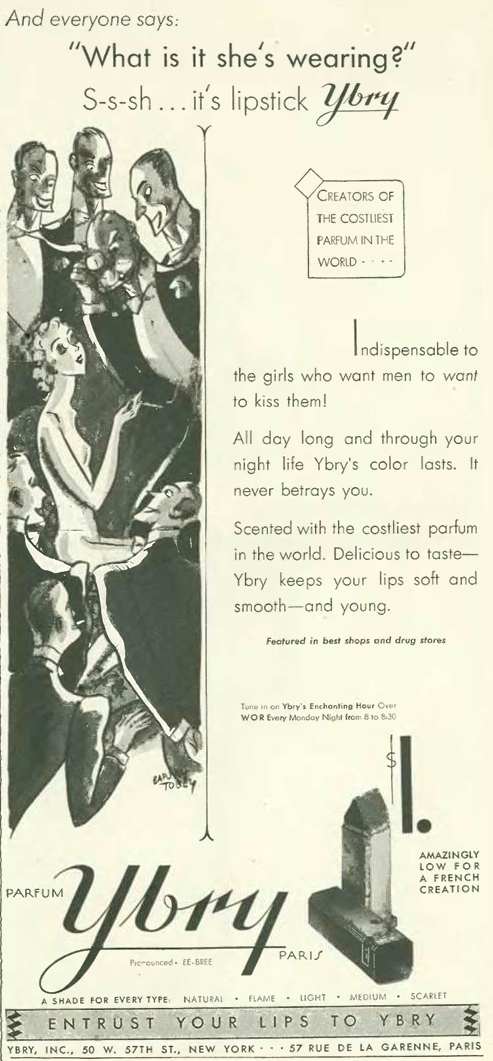
…the makers of Ybry lipstick apparently did not have the budget to garner a patrician endorsement, so they settled for this illustration by New Yorker cartoonist Barney Tobey

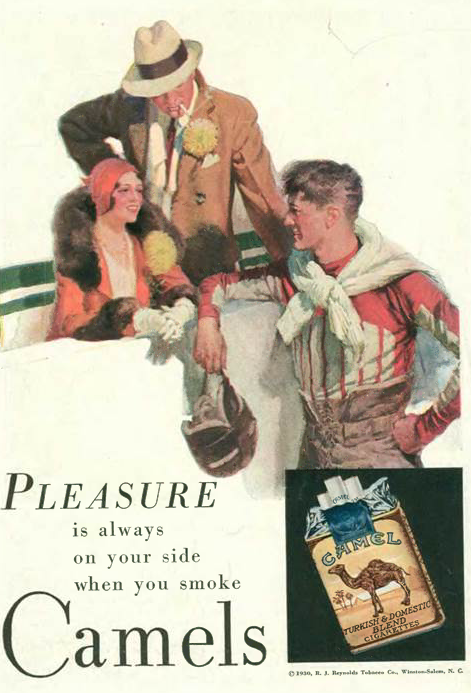
…and we have another lovely color ad from R.J. Reynolds, once again linking cigarettes to athletic prowess…

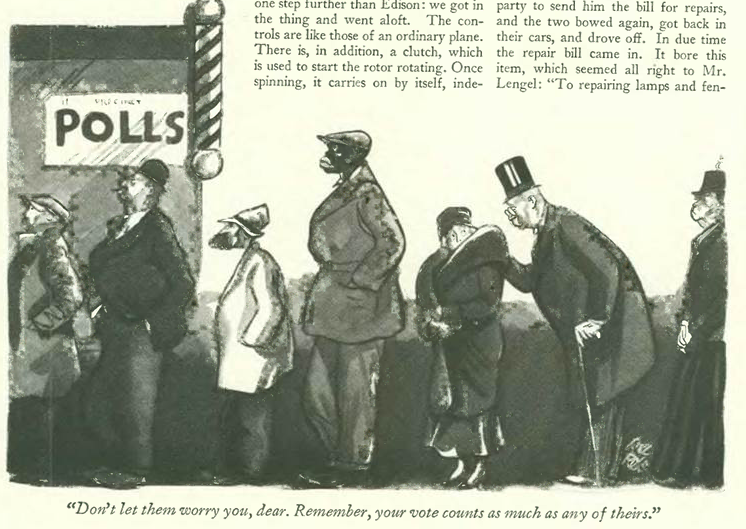
…on to our cartoons, we mark election season with Carl Rose

Barbara Shermund explored the generation gap…

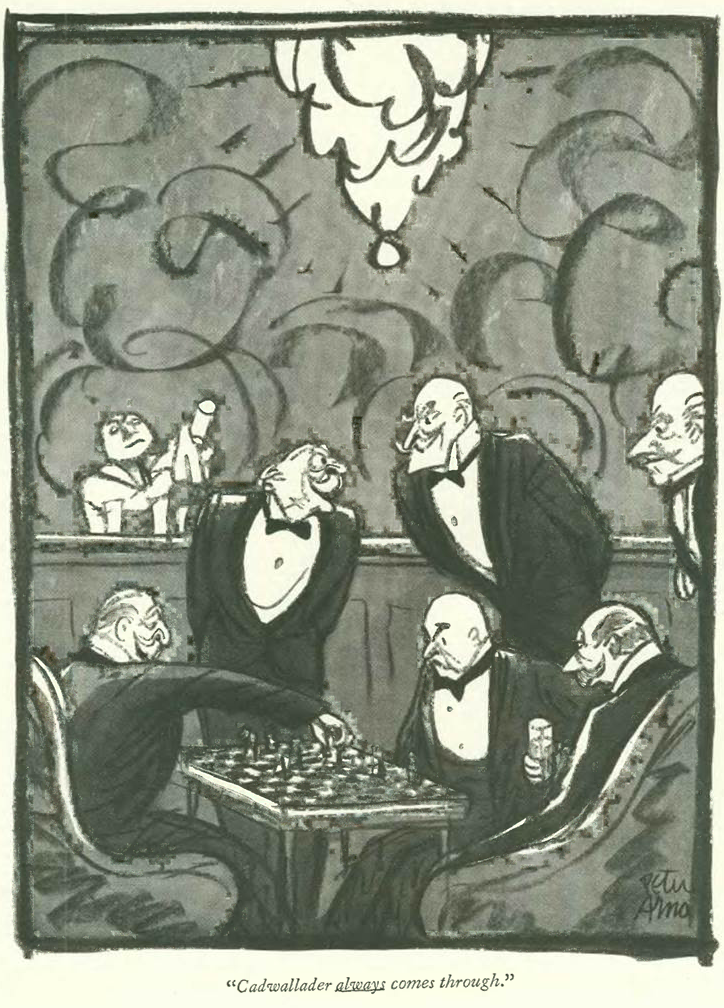
Peter Arno gathered his sugar daddies for a game of chess…

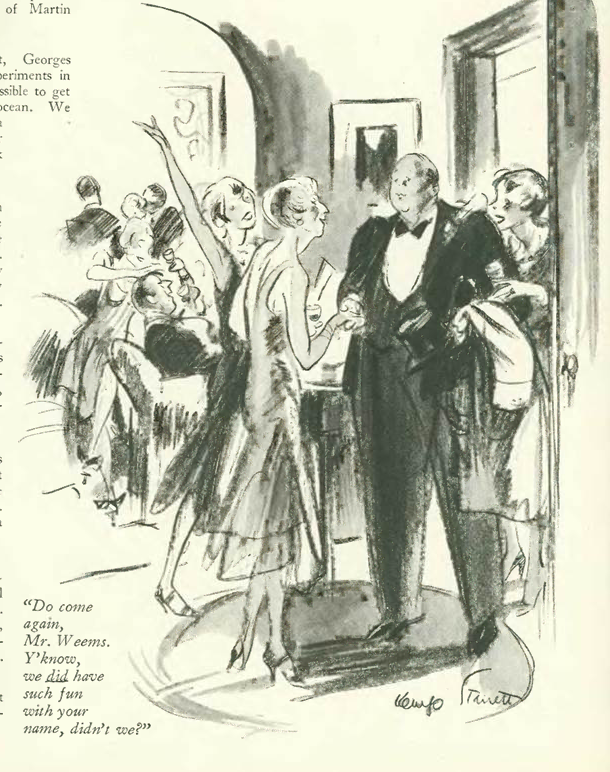
Kemp Starrett introduced us to an unlikely life of the party…

Alan Dunn examined the influences of popular cinema…

Mary Petty gave us an Ivy League perspective of the Great Depression…

…and Arno again, with a cartoon that was featured along with The New Yorker’s “Wayward Press” column…

Next Time: Body and Soul…


Lights, Camera, Action

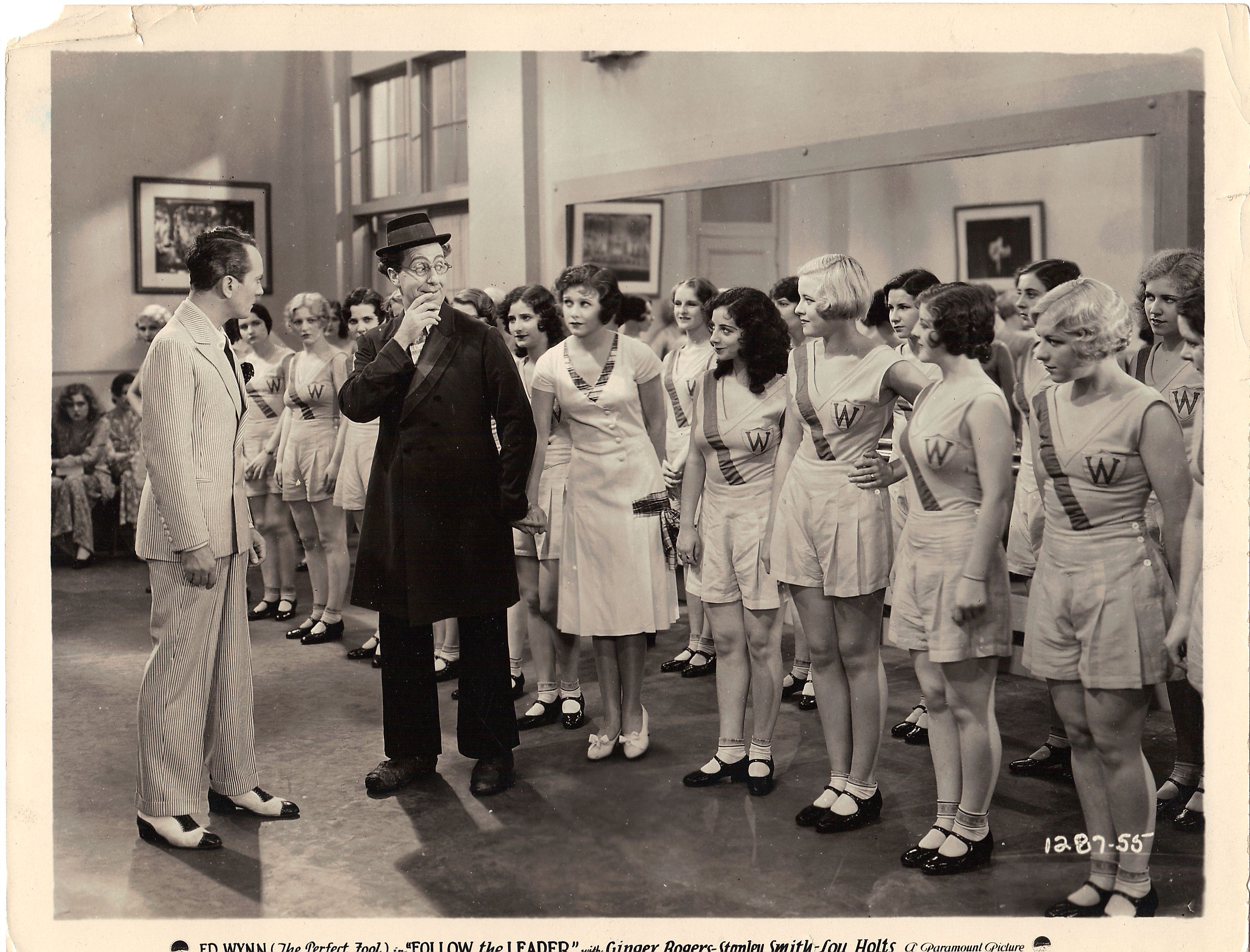
Comedian Ed Wynn began his long acting career on a vaudeville stage in 1903, and beginning in 1914 his giggly voice would delight Broadway crowds flocking to the Ziegfeld Follies. So when he stepped in front of a movie camera for a talking picture, it was something of a sensation.

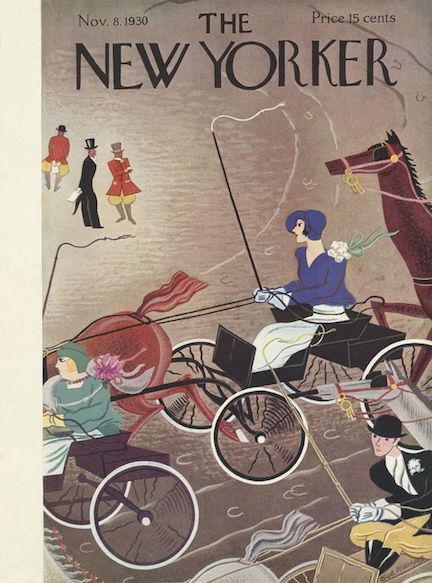
September 27, 1930 cover by Sue Williams.

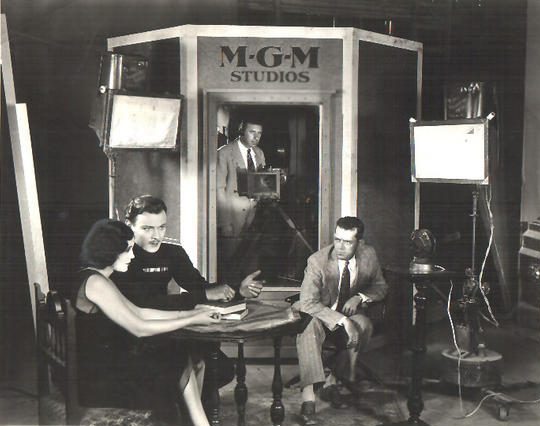
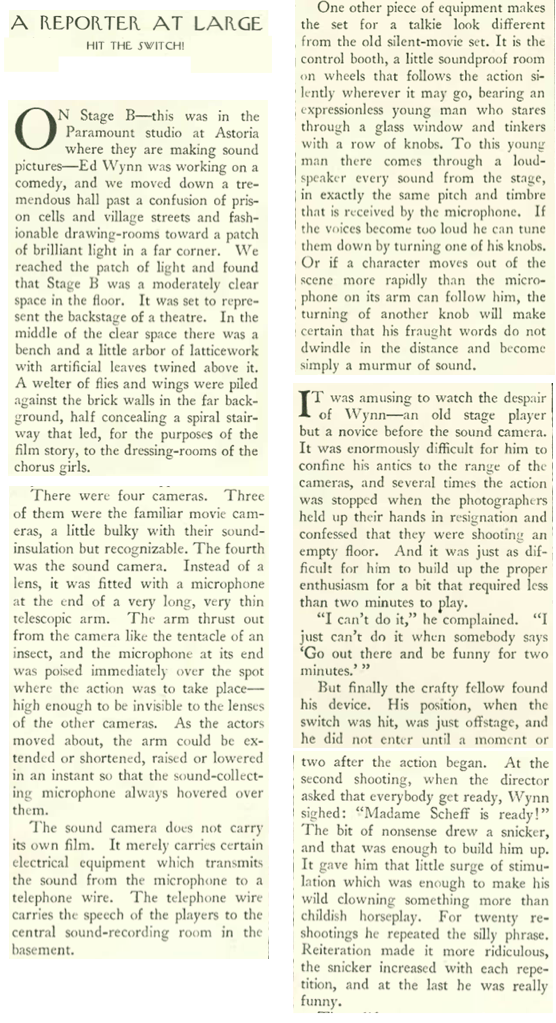
It was not an easy transition for the stage veteran. As you can see from Morris Markey’s account below in “A Reporter at Large,” the early talkies presented all manner of challenges and restrictions for stage actors accustomed to a bit more freedom of movement and expression.

SCANDALOUS BUNCH…Ed Wynn (in hat) portrayed a character he developed on Broadway — “Crickets” — in his film debut Follow the Leader. At left is actor Stanley Smith, and at center, holding Wynn’s hand, is a brunette Ginger Rogers, with chorus girls from George White’s Scandals. (IMDB)

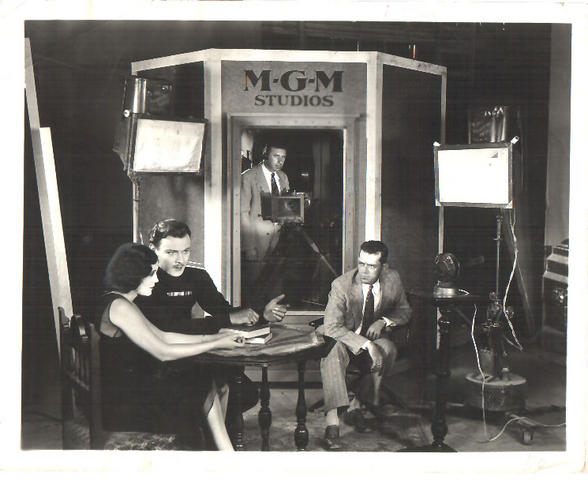
PAY NO ATTENTION TO THE MAN BEHIND THE WINDOW…Noisy cameras were enclosed in soundproof boxes in the early days of the talkies. Above, Woody Van Dyke directs Raquel Torres and Nils Asther in 1930’s The Sea Bat. (nilsasther.blogspot.com)
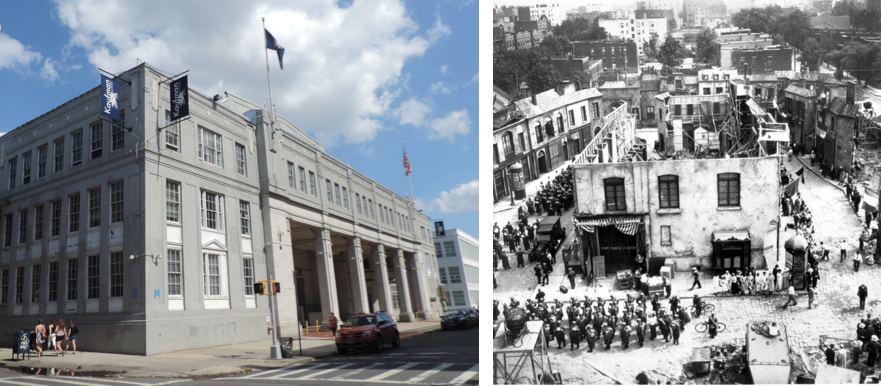
TINSELTOWN IN QUEENS…For his article, Morris Markey visited the set of Follow the Leader at Astoria Studios in Queens. The original studio building, at 35th Avenue, is on the National Register of Historic Places. Although Paramount moved its movie operations to Hollywood in the early 1930s, the studio continued to be used for both film and television productions. At right, a bit of Paris was erected in the midst of Queens for the filming of 1929’s The Gay Lady. (Wikipedia/Kaufman Astoria Studios)
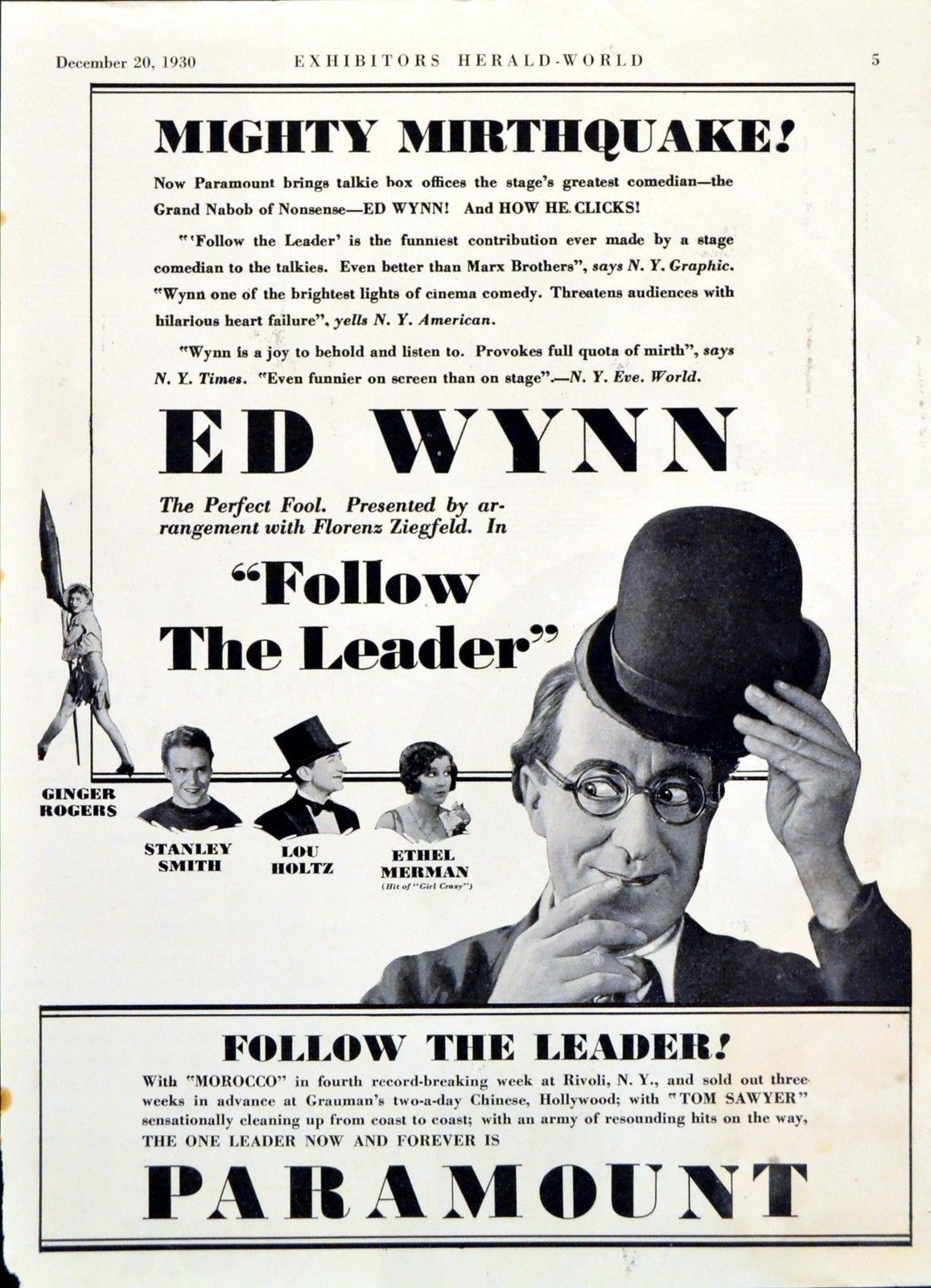
FILM DEBUT…A December 1930 magazine advertisement touting Ed Wynn’s first motion picture. (IMBD)

 *  *  *

False Modesty?

In Morris Markey’s second installment of his profile on Charles Lindbergh, Markey suggested that Lindbergh’s aversion to publicity might be a pose…

NO WI-FI, BUT YOU COULD SMOKE…Top, the posh set take wing with TWA circa 1930; below, passengers prepare to board an American Airways Curtiss Condor II in 1933. (historydaily.org/Sweezey Pictures/Ken Sweezey)

…and also wondered how much credit Lindbergh could take for sparking the aviation industry, given that flying was still an activity reserved for a very few…

…Markey also noted a “lively rumor” that Lindbergh wanted to be President…

…fortunately Lindbergh did not give truth to the rumor, or fulfill the alternate history created by Philip Roth in his 2004 novel The Plot Against America

HANGIN’ WITH A BAD CROWD…Top, Charles Lindbergh accepts a ceremonial sword from Hermann Göring during a 1936 visit to Nazi Germany; below, right, Lindbergh in Germany, 1937. Philip Roth’s novel imagined Lindbergh’s election to the Presidency in 1940 and its chilling results. (Reddit/The New Yorker/Goodreads)

 *  *  *

Bad Moon Rising

In 1930 few, if anyone, were aware of Lindbergh’s proclivities toward nationalism and antisemitism. And lacking a crystal ball, Markey’s New Yorker colleague, Howard Brubaker, had little reason to be alarmed by the federal elections in Germany, which gave the Nazis the second largest number of seats in the Reichstag. In his “Of All Things” column, Brubaker quipped:

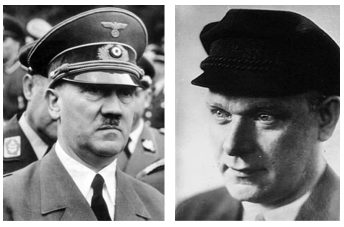
INCOMPATIBLE…As Howard Brubaker noted in “Of All Things,” the fascists led by Adolf Hitler, left, and the communists led by Ernst Thälmann (right) made big gains in the 1930 German elections. After gaining power in 1933, Hitler would arrest Thälmann and later have him shot. (Wikipedia)

*  *  *

Gummed to Death

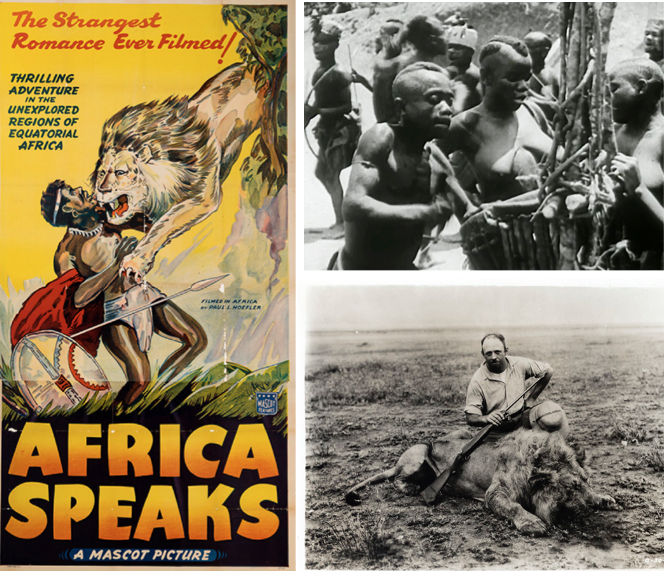
The New Yorker’s John Mosher took in the latest travelogue to exploit and misrepresent life on the African savannah. Africa Speaks included a scene depicting a fatal attack on a “native boy” by a lion —  an attack that was actually staged at a Los Angeles zoo and involved a toothless lion…

STRANGE INDEED…At left, movie poster for Africa Speaks; top right, Pygmy drummers in the film; bottom right, explorer Paul Hoefler getting closer to nature. (IMDB/Wikimedia)

*  *  *

From Our Advertisers

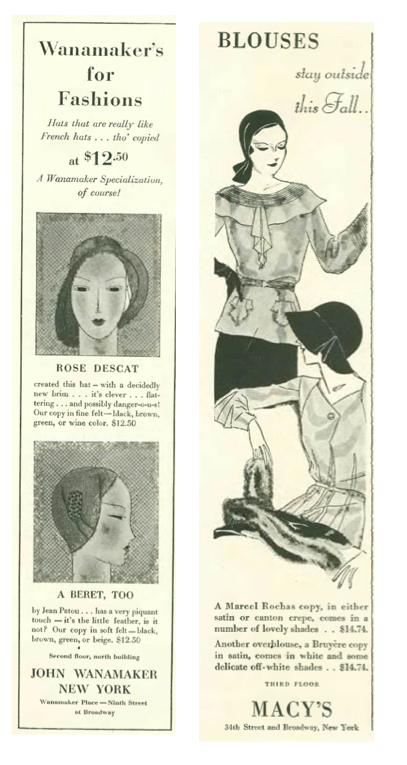
When Paris unveiled is spring and fall fashions, large department stores were always quick to respond with “copies”…

…while the higher end boutiques offered originals to “poor little rich girls”…

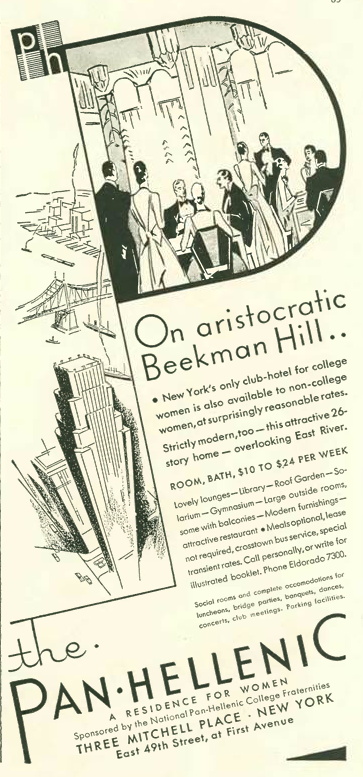
…perhaps some of these “poor little rich girls” socialized at the Panhellenic, a “club-hotel for college women”…

…and here are some views of the Panhellenic House, circa 1929…

Center, The Panhellenic House, at First Avenue and 49th Street; at left, the solarium; at right, a ballroom. (Avery Library/Museum of The City of New York)

…the makers of Old Gold cigarettes had some of the weirdest ads to push their smokes, including this one…

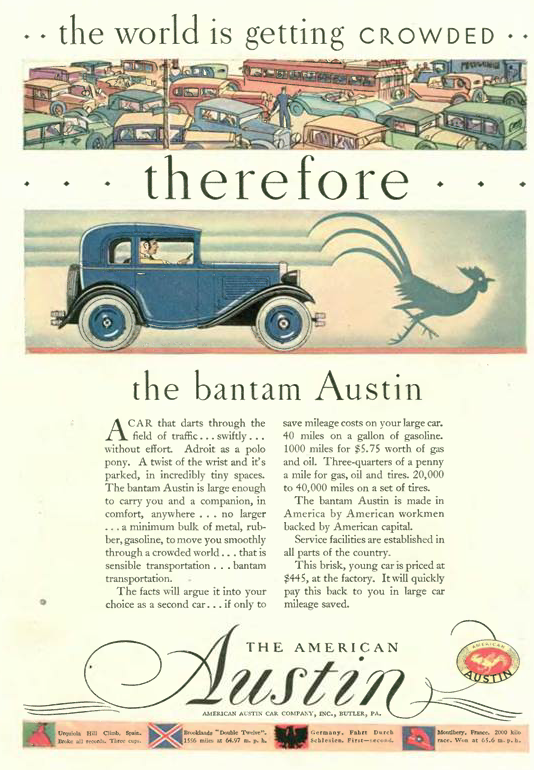
…and one wonders what the world would be like (and especially the U.S.) if car buyers would have favored a more compact version of the motorcar going forward…

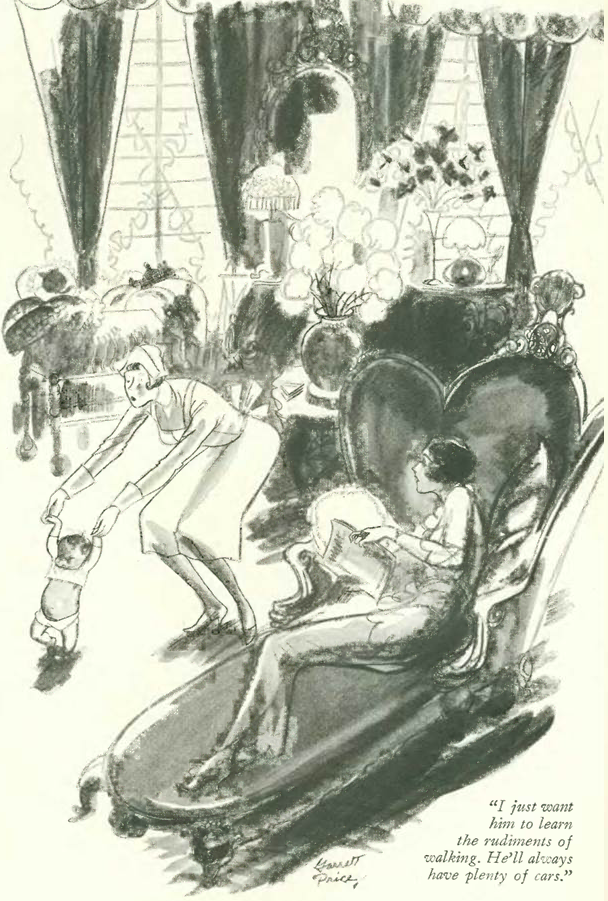
…on to our cartoons…we begin with parenting tips from the posh set, courtesy Garrett Price

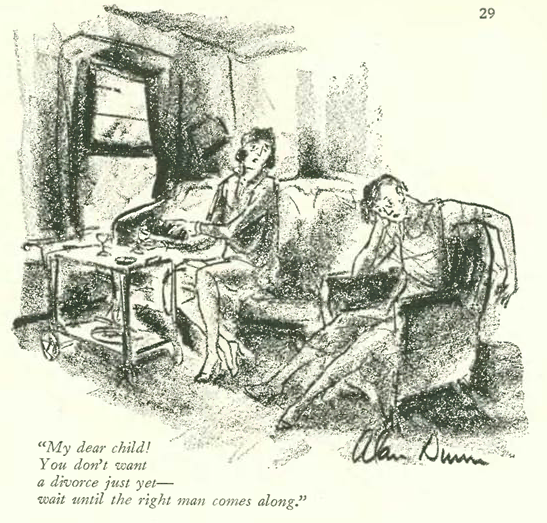
Alan Dunn explored modern matrimony…

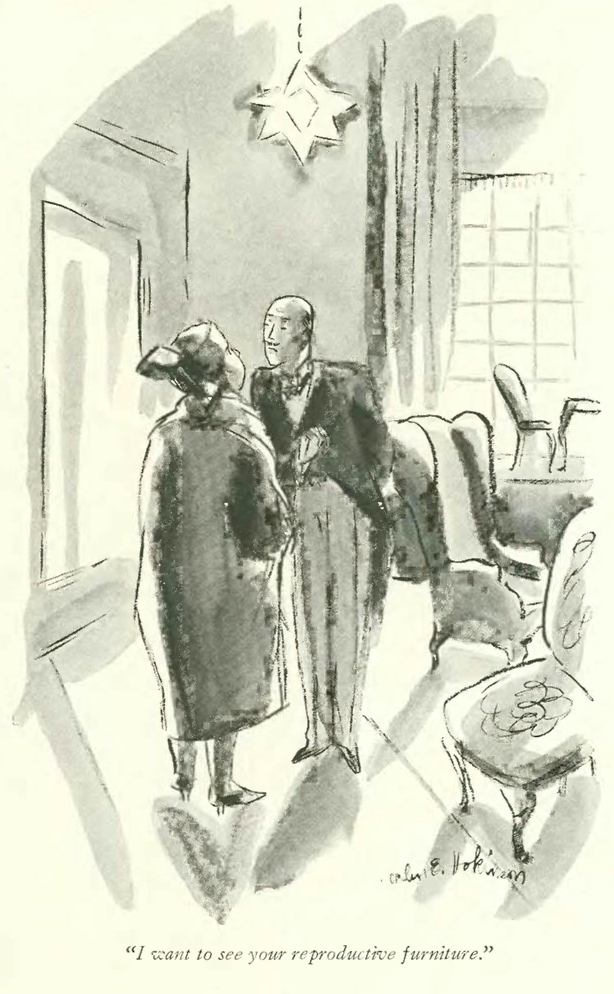
…one of Helen Hokinson’s ladies demonstrated a unique taste in furniture…

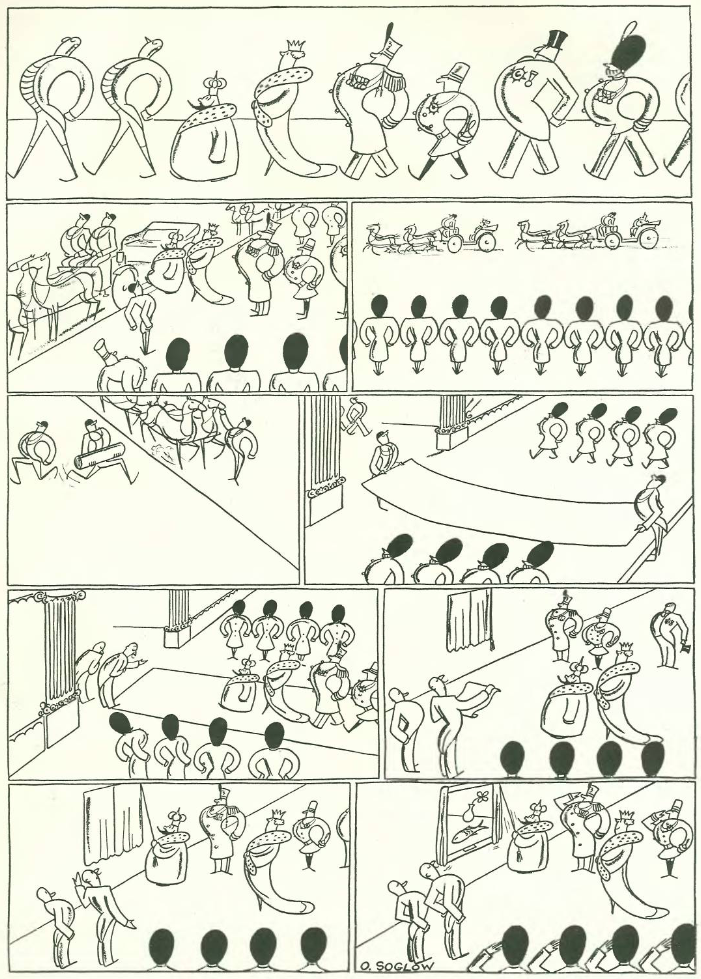
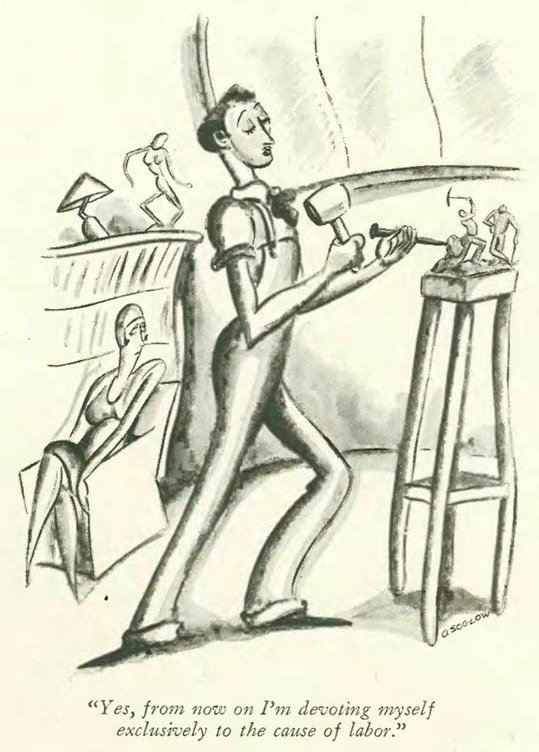
Otto Soglow continued to explore humor in a wavy fashion…

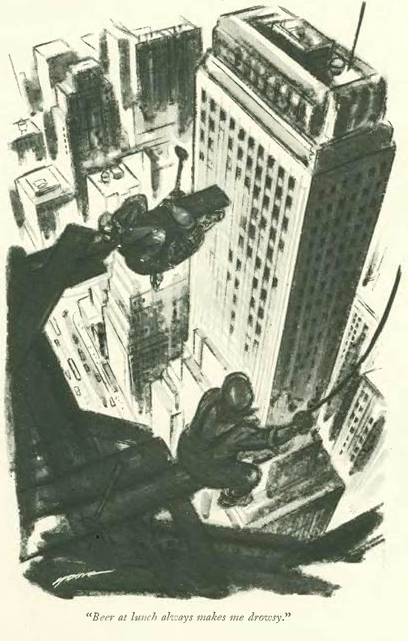
…and we close with this vertiginous view provided by Leonard Dove

Caption: “Beer at lunch always makes me drowsy.”

Next Time: Leatherheads…


The Flying Misanthrope

When Charles Lindbergh returned to New York after his solo, history-making transatlantic flight, he was mobbed by thousands of fans and adored by many millions more. The feeling was not mutual.

Sept. 20, 1930 cover by Theodore Haupt.

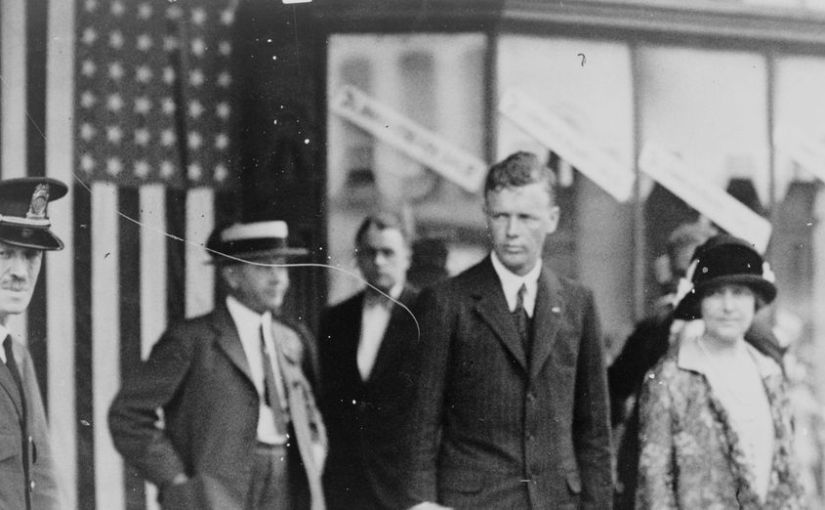
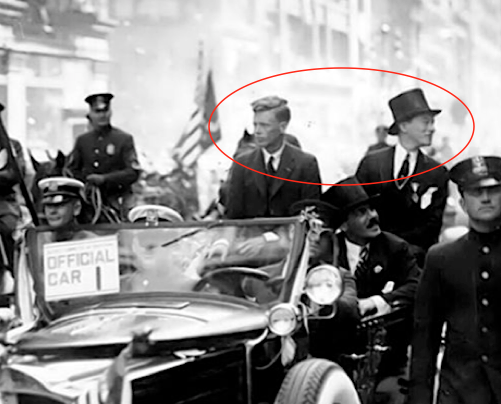
This image from his June 13, 1927 ticker-tape parade says it all, a disinterested, almost hostile-looking Lindbergh contrasted with that crowd-loving dandy, Mayor Jimmy Walker:

Detail of larger photograph. (Associated Press)

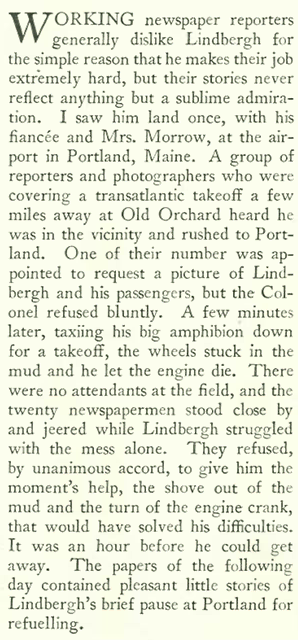
Morris Markey checked in on the famed flyboy three years later in a two-part profile for the New Yorker. Markey observed how Lindbergh had become “sucker-sour,” a phrase that described how someone could suddenly go wild “at the ceaseless procession of staring faces.” I encourage you to read the excerpt below about Lindbergh’s appearance at the 1929 Cleveland Air Races, where in a fit of temper he nearly forced a passenger plane to lose control and crash:

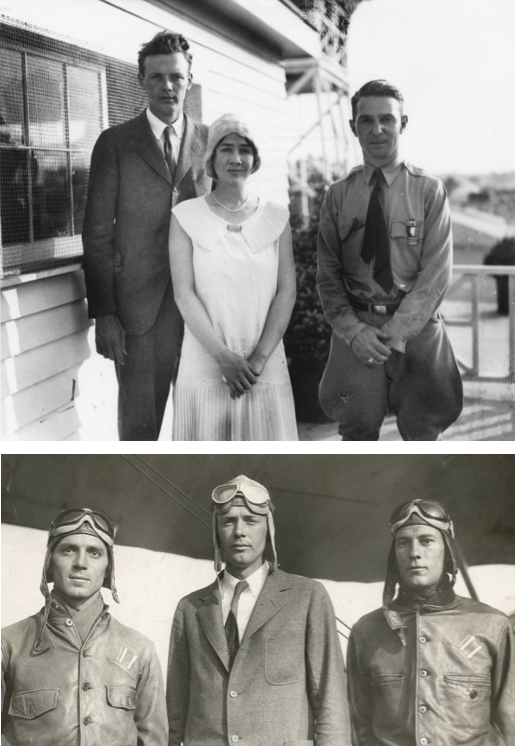
SAY CHEESE…Top photo, Charles and Anne Lindbergh pose with Cliff Henderson at the 1929 Cleveland National Air Races. Henderson was the managing director of the National Air Races and was often described as “the Barnum of aviation.” Below, Lindbergh flanked by Navy flyers Frederick Kivette and Frank O’Beirne at the 1929 air races. (Smithsonian)

Because he was a national hero of nearly saint-like dimensions, newspaper reporters did not dare to report on his antics at the Cleveland Air Races (so far, The New Yorker account is the only one I can find of the incident). Needless to say, he was not popular among members of the fourth estate:

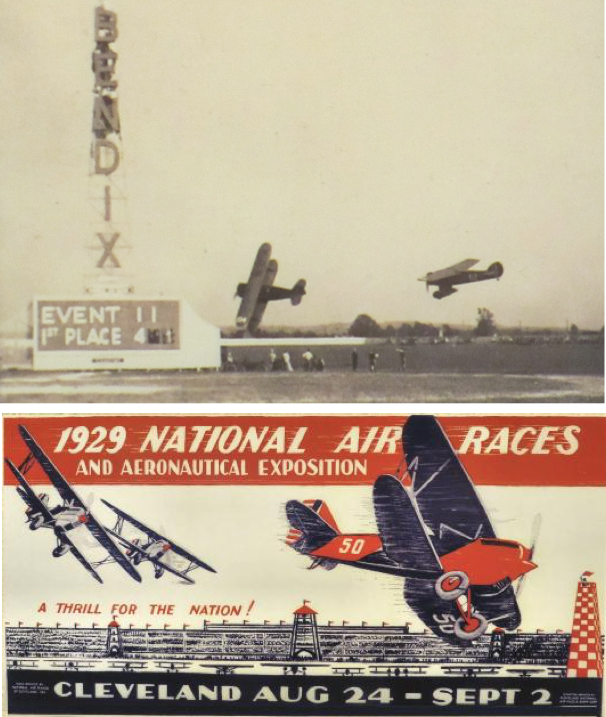
WHAT COULD POSSIBLY GO WRONG?…Fliers raced around a closed course near a crowded grandstand at the 1929 National Air Races in Cleveland. (Western Reserve Historical Society)

 *  *  *

Innocents Abroad

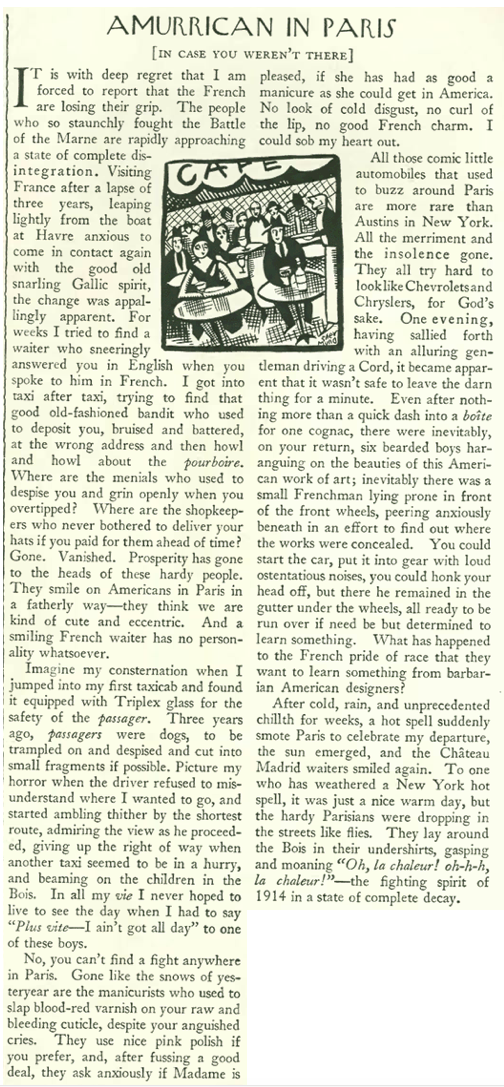
It was a nice surprise to find Lois Long once again writing under her pen name “Lipstick” in this casual piece (excerpted below) on Parisian life. I was also surprised to find the term “Amurrican” in the headline — I always thought it was a more recent derivation of redneck-speak…

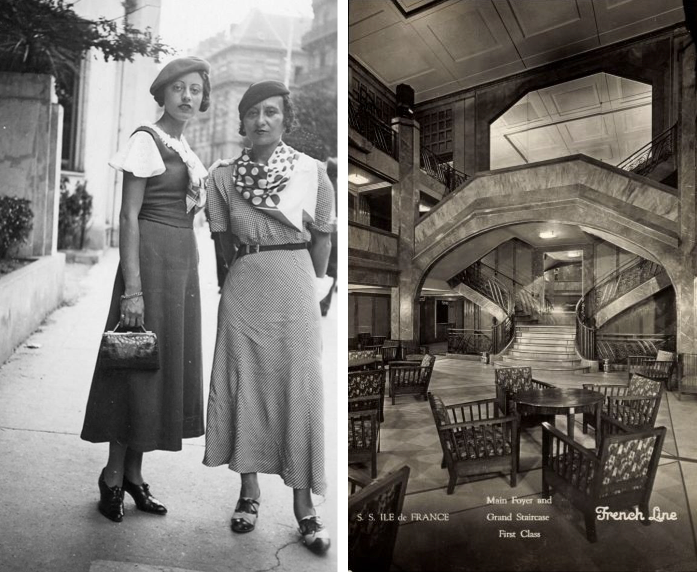
OVER THERE…Left, a fashionable pair on the streets of Paris circa 1930; right, main staircase and grand foyer of the Ile de France. (Pinterest/akpool.co.uk)

 *  *  *

Imbiber in Chief

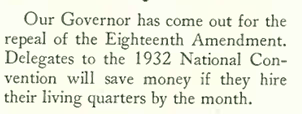
No doubt many a New Yorker enjoyed this bit of news from Howard Brubaker (in his column, “Of All Things”) regarding New York Governor Franklin D. Roosevelt, who later as president would preside over the end of Prohibition.

LEADING BY EXAMPLE…FDR and a gin martini. (Time/Life)

 *  *  *

From Our Advertisers 

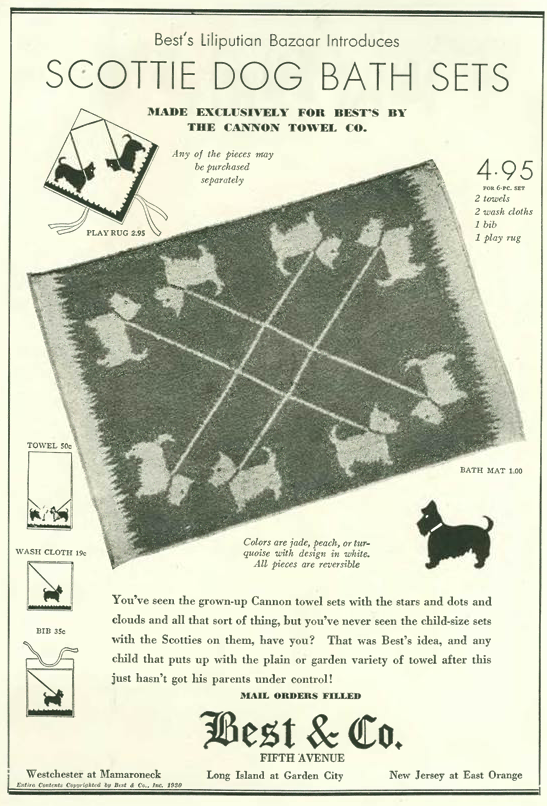
The Scottish Terrier was one of the most popular dog breeds in 1930s America (in addition to martinis, FDR was also fond of Scotties, including his loyal companion Fala), and you could show your love for the breed with bath sets from Best & Company…

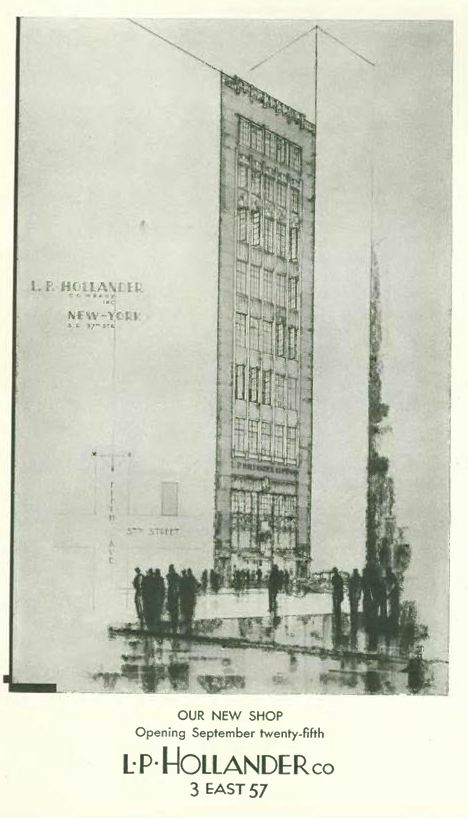
…the handsome L.P. Hollander Company Building (designed by William Lamb) at 3 East 57th began life in 1930 as a women’s fashion boutique…

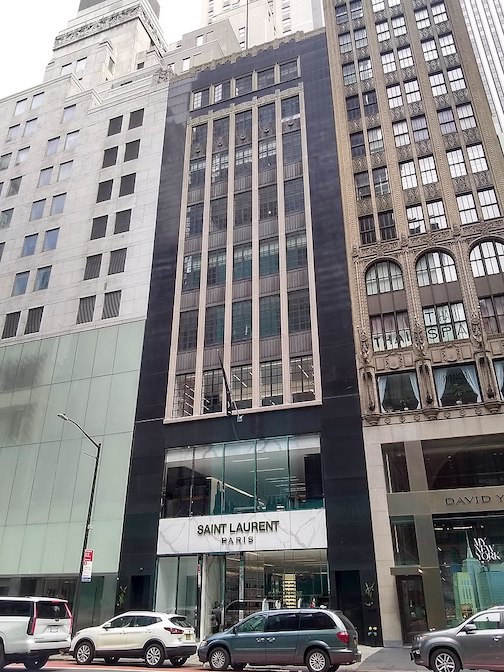
…and today it serves as the Fifth Avenue home to Yves Saint Laurent…

(Wikipedia)


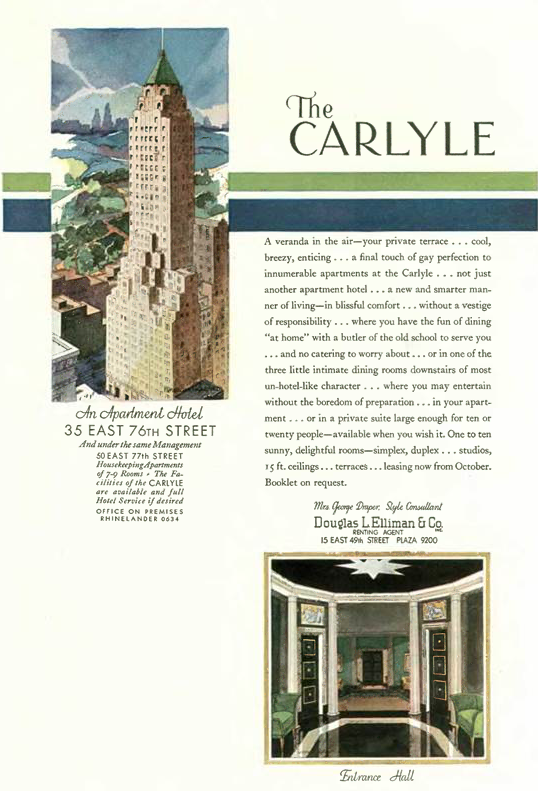
…another exclusive New York destination, the Carlyle, opened as a luxury residential hotel in 1930, only to go into receivership in 1931 thanks to the deepening Depression. In the postwar years it would rise to prominence and become a favorite haunt of the Kennedy family. The Carlyle is also home to the Bemelmans Bar, which is decorated with murals painted by Ludwig Bemelmans depicting his storybook character, Madeline, in Central Park…

…the Carlyle’s cozy Bemelmans Bar…

(TripAdvisor)

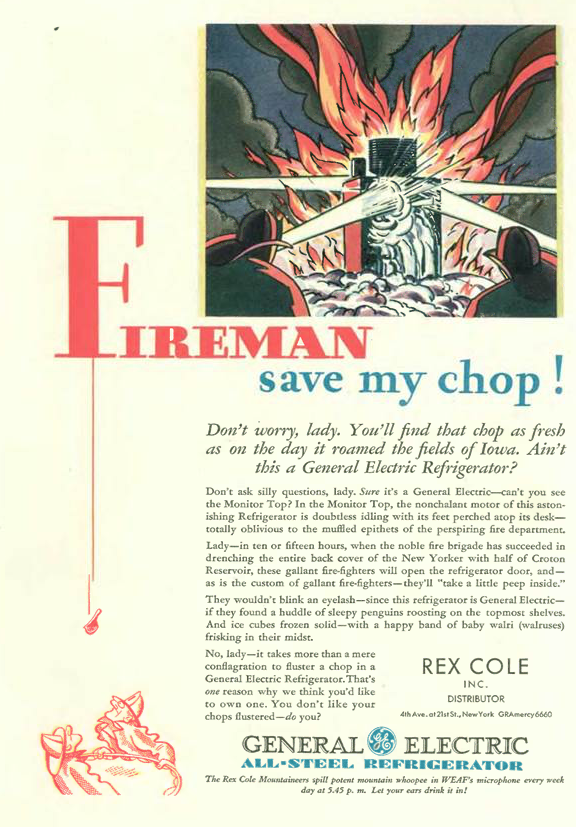
…this next one goes in my terrible ads file…did the makers of this GE refrigerator really want to depict it bursting into flames?…

…it is 1930, and we are at the dawn of the age of plastics, and in this case “Beetleware” tumblers made from an early type of plastic formed from a urea formaldehyde powder developed in England and licensed to American Cyanamid …so bottom’s up!…

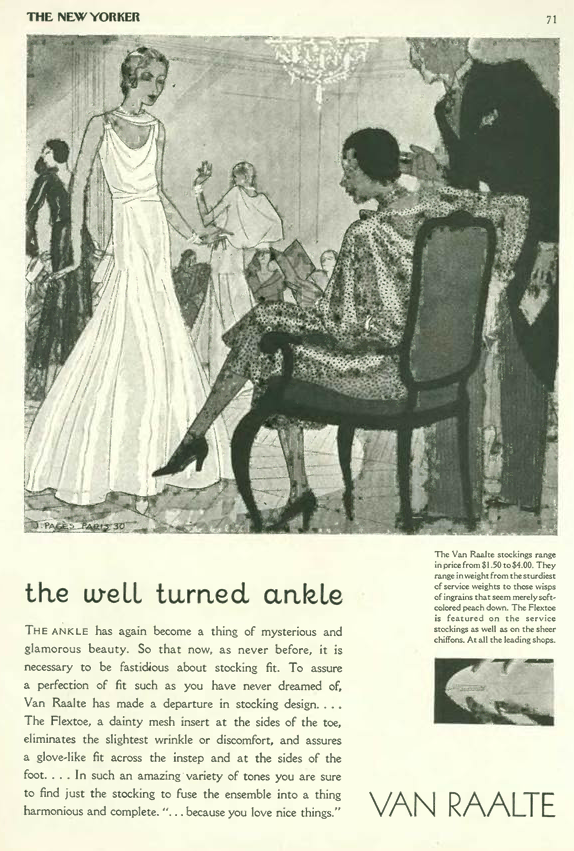
…the makers of Van Raalte stockings hoped to revive the sex appeal of the ankle…

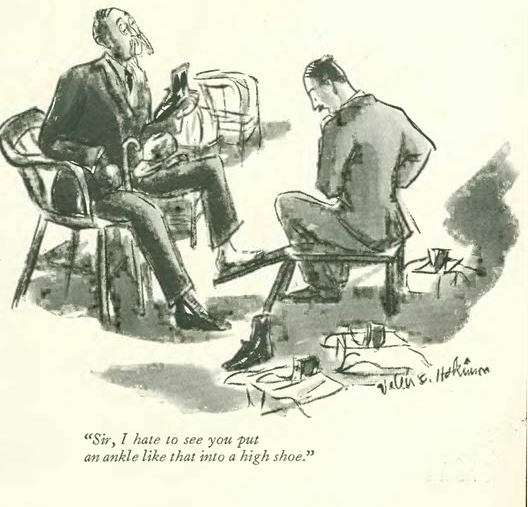
…which provides a good segue to our cartoons, this one by Helen Hokinson, which was actually featured on the page opposite the stocking ad…

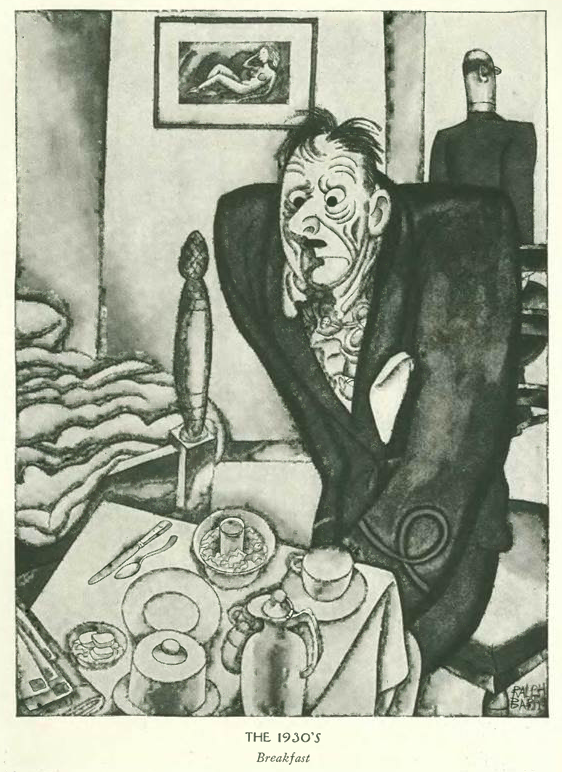
Ralph Barton continued his series on the 1930’s…

Alan Dunn took his work to new heights…

Gardner Rea had fun with the garden club set (English-American S. Parkes Cadman was a pioneer Christian radio broadcaster in the 1920s and 30s)…

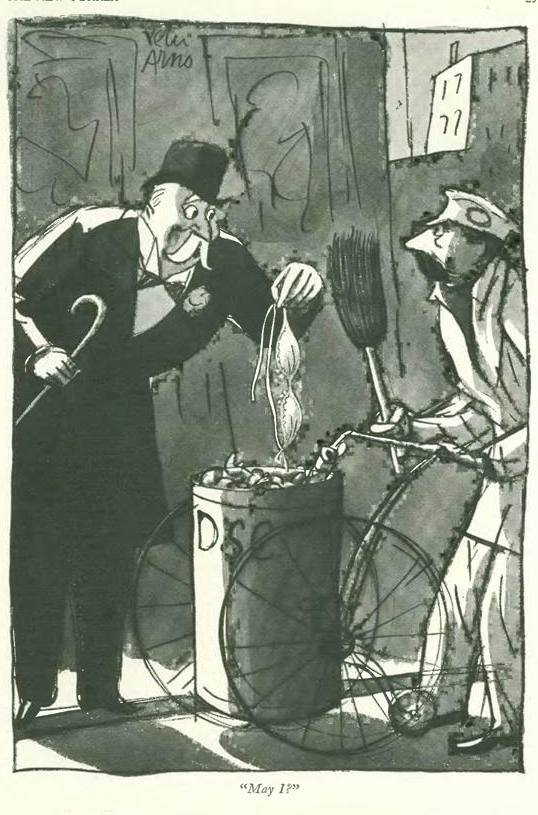
…while Peter Arno illustrated this cultural exchange on the streets of New York…

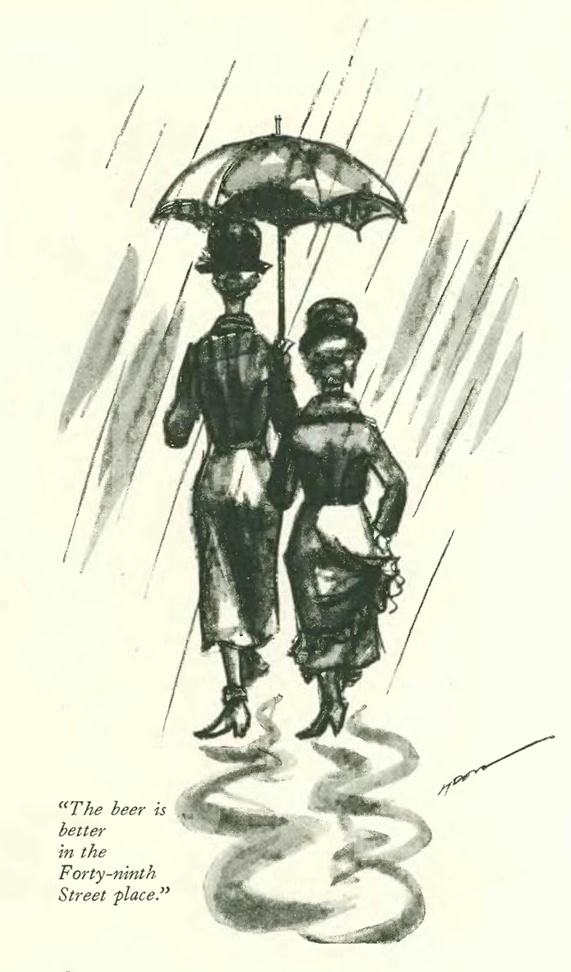
…and we end with Leonard Dove, and a walk in the rain…

Next Time: Lights, Camera, Action…


Hell’s Angels

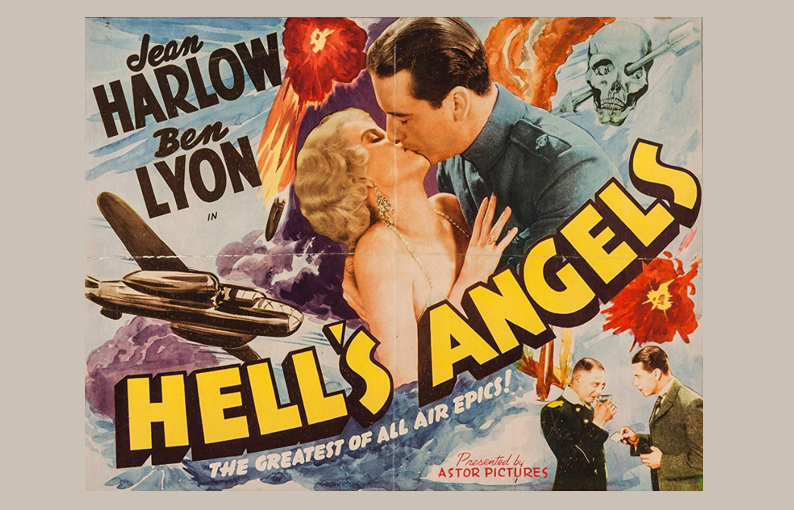
Among the films in 1930 that marked a new era in motion pictures was Howard Hughes’s epic war film Hell’s Angels. 

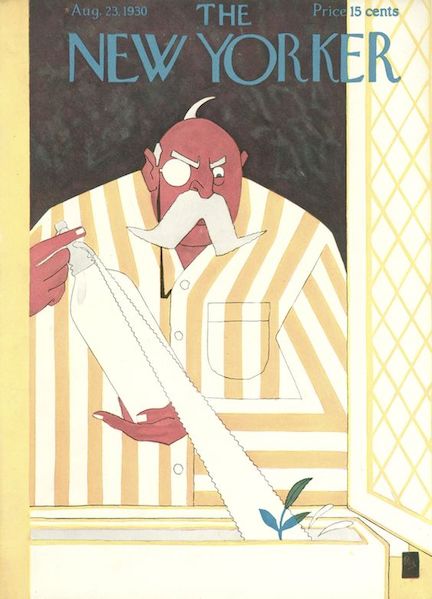
August 23 cover by Gardner Rea.

Originally shot as a silent, Hughes (1905-1976) retooled the film, and over a period of three years (1927-30) poured much of his own money into making what many consider to be Hollywood’s first sound action movie. The film also introduced audiences to 19-year-old Jean Harlow (1911-1937), handpicked by Hughes to replace Norwegian actress Greta Nissen in the lead role (Nissen’s accent posed a problem for the talkies). The film would make Harlow an instant star, propelling her to worldwide fame as the “Platinum Blonde” sex symbol of the 1930s.

Beset by delays due to Hughes’s incessant tinkering, the movie was famously expensive. For example, a total 137 pilots were used in just one flying scene at the end of the film. In addition to monetary costs, the filming also claimed the lives of three pilots and a mechanic, and Hughes himself would fracture his skull during a stunt flying attempt.

PRE-CODE…Before Will Hays imposed his moral code on Hollywood, films in the early thirties were frank with sexual references, as the image at left attests. When Howard Hughes switched the filming of Hell’s Angels to sound, he replaced Norwegian actress Greta Nissen with 19-year-old Jean Harlow (seen with co-star Ben Lyon). Harlow’s first major film appearance would make her an overnight star; at right, Frank Clarke and Roy Wilson flying an S.E.5A (front) and a Fokker D.VII (back, note camera) in the filming of Hell’s Angels. (Wikipedia)

The New Yorker’s John Mosher found the action scenes enticing, but the acting left something to be desired…

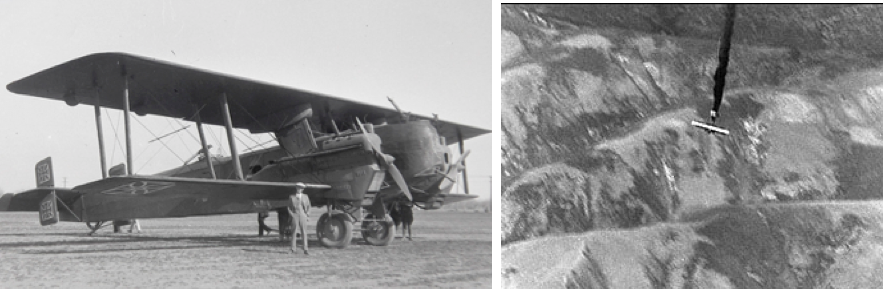
COSTLY VENTURE …This Sikorsky S-29A (left), repainted to represent a German Gotha bomber, would crash into the California hills during filming (right), killing mechanic Phil Jones, who failed to bail out along with the pilot. (Northrop Grumman)
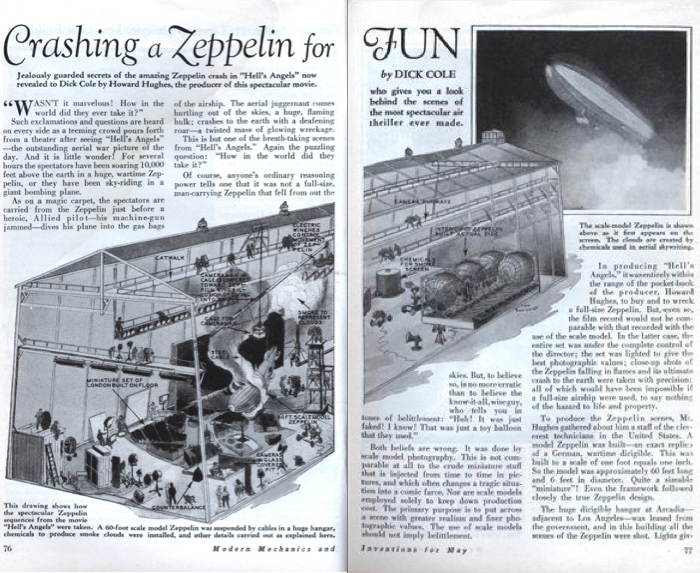
GEE WHIZ…The media often reported on the progress of the film, such as in this May 1930 article in Modern Mechanics and Inventions that detailed a $1 million sequence in which a fighter dives his plane into the top of a Zeppelin, causing it to explode and crash to earth. (Modern Mechanix)

We skip ahead briefly to the Aug. 30 issue, in which “The Talk of Town” featured a mini profile of Howard Hughes and his film. Note how Hughes’s extravagance is described through his frequent use of long-distance telephone calls:

A STAR IS BORN…19-year-old Jean Harlow and Ben Lyon in 1930’s Hell’s Angels. (IMDB/Pinterest)

*  *  *

A Whale of a Movie

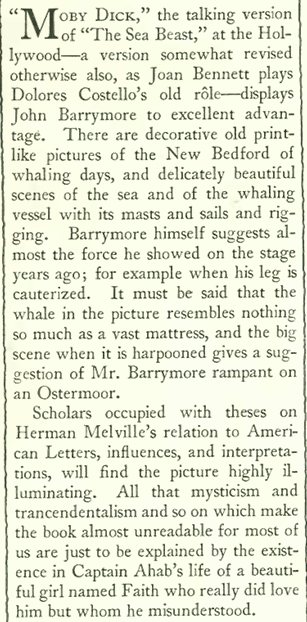
Critic John Mosher also took in a film adaptation of Herman Melville’s Moby Dick, a very loose adaptation that excluded the novel’s central character, Ishmael, and invented a love story for the maniacal Capt. Ahab…

A WHALE OF A STORY…From left, Noble Johnson as Queequeg, John Barrymore as Ahab, and Walter Long as Stubbs in 1930’s Moby Dick. At right, top, the whale puts the hurt on a boat; bottom, Joan Bennett as Faith, a contrived love interest for the old salt. (IMDB)

 *  *  *

Daily Dazzle

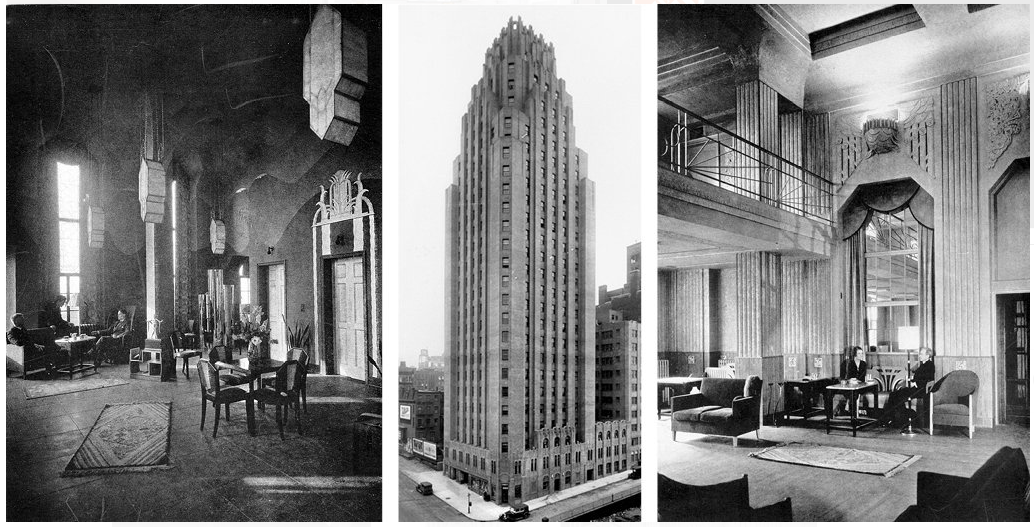
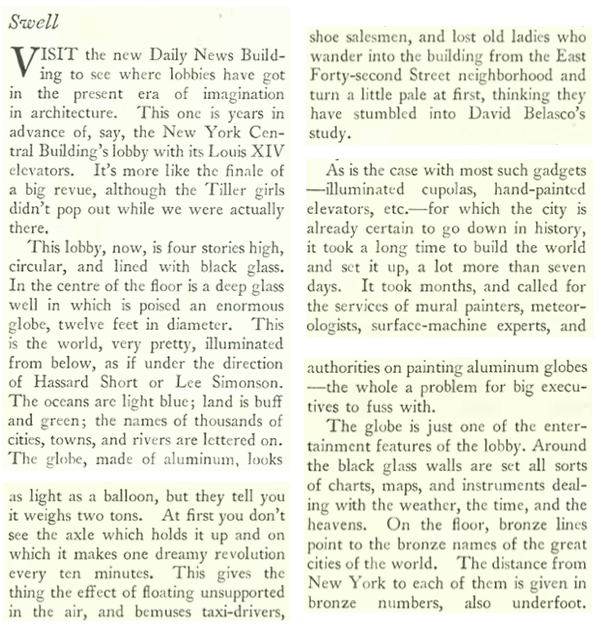
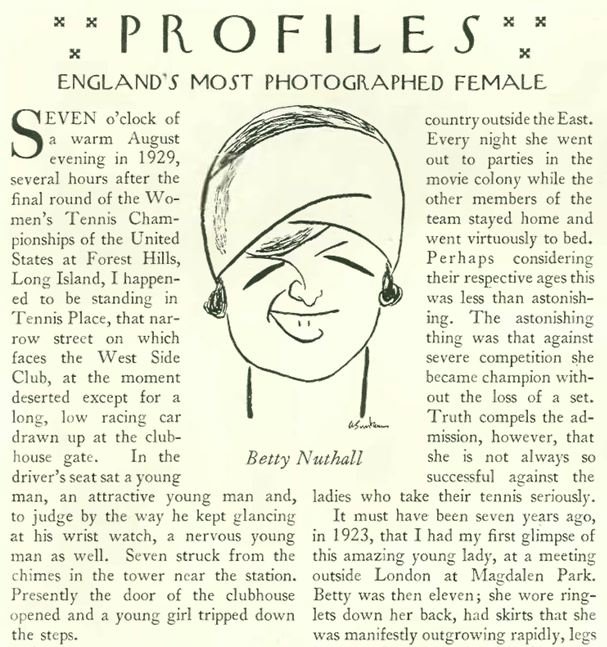
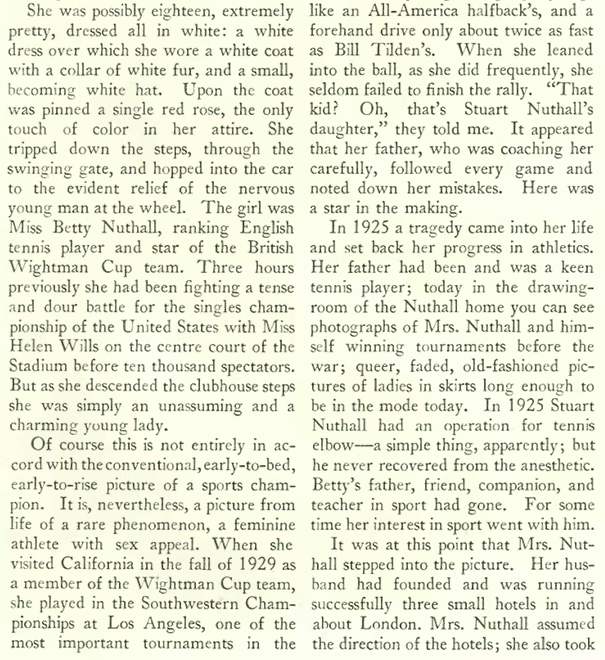
“The Talk of the Town” gushed over the lobby of the new Daily News Building, likening it to the glitz of a Broadway revue:

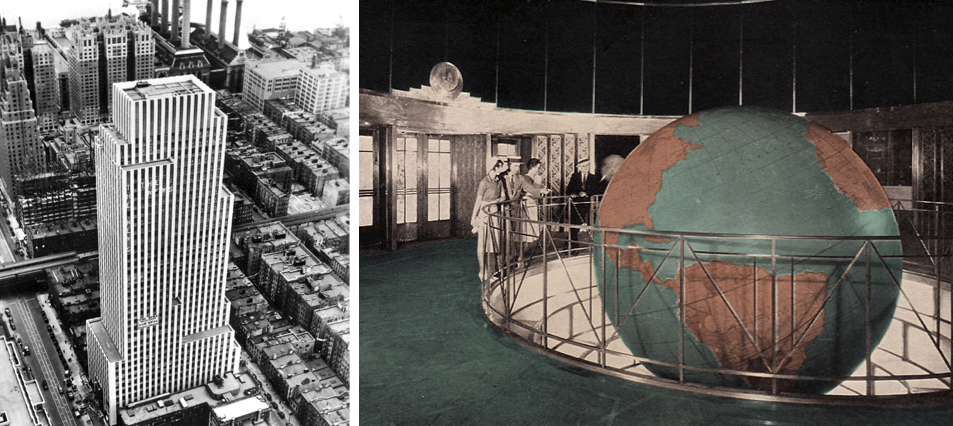
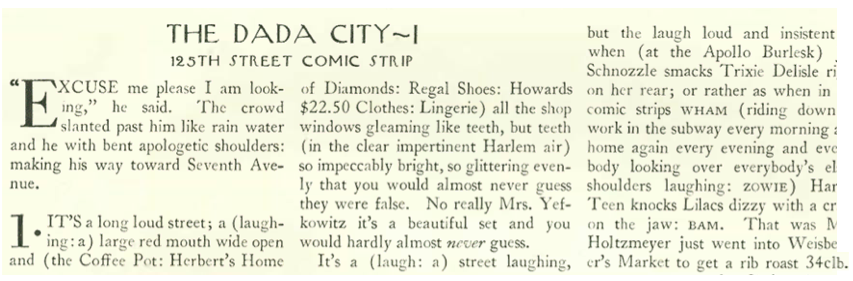
HOME FOR CLARK KENT…The Daily News Building served as the model for the headquarters of the fictional Daily Planet, the building where Superman worked as mild-mannered Clark Kent; at right, an image from 1941 of the lobby, dominated by the world’s largest indoor globe. (Wikipedia/Public Domain)
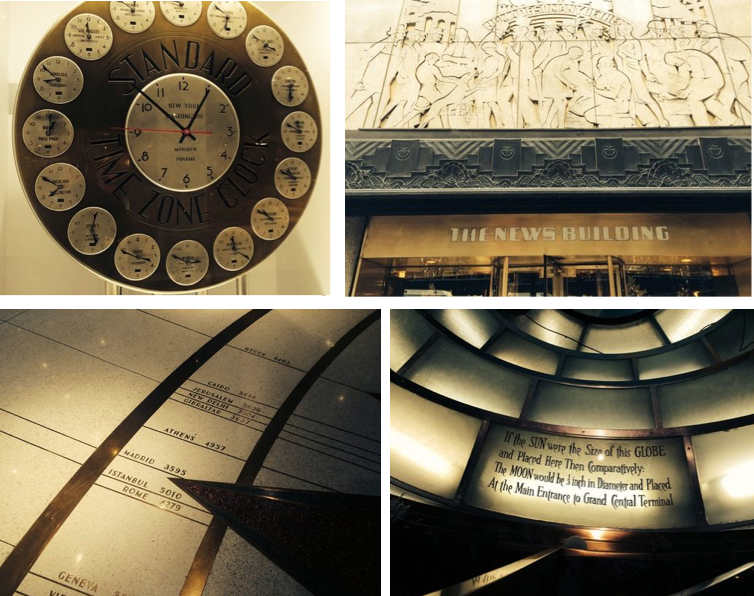
A LOBBY FOR LEARNING…The lobby includes an array of clocks, top left, that give the time in various global destinations. (Luke J. Spencer via atlasobscura.com)

 *  *  *

A Busboy’s Dream

Charles Pierre Casalasco left his life as a busboy in Corsica and studied haute cuisine in Paris before arriving at the shores of Manhattan in the early 1900s. He became a renowned headwaiter who by 1929 garnered enough financial backing from New York’s most powerful families to construct the exclusive Hotel Pierre. Writing under her pseudonym, “Penthouse,” New Yorker columnist Marcia Davenport described the building’s apartments to eager readers:

FUN WHILE IT LASTED…The 41-story, 714-room Hotel Pierre officially opened in October 1930 to great fanfare. The party would be short-lived, as the deepening Depression would force the hotel into bankruptcy just two years later. At right, photo of the Rotunda, before a 2017 remodeling. (New York Public Library)

 *  *  *

So Much For Title IX

Then as now, women athletes were held to a separate set of standards, not only judged for their athletic abilities, but also for their “sex appeal,” as John Tunis suggests more than a few times in his profile of English tennis champion Betty Nuthall (1911-1983). Excerpts:

HOW’S THAT BACKHAND?…Betty Nuthall greets American tennis star Bill Tilden in September 1930; on the cover of Time after winning the 1930 U.S. Open. (Digital Commonwealth/Time Inc.)

 *  *  *

Free Expression

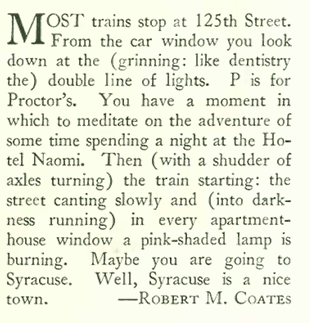
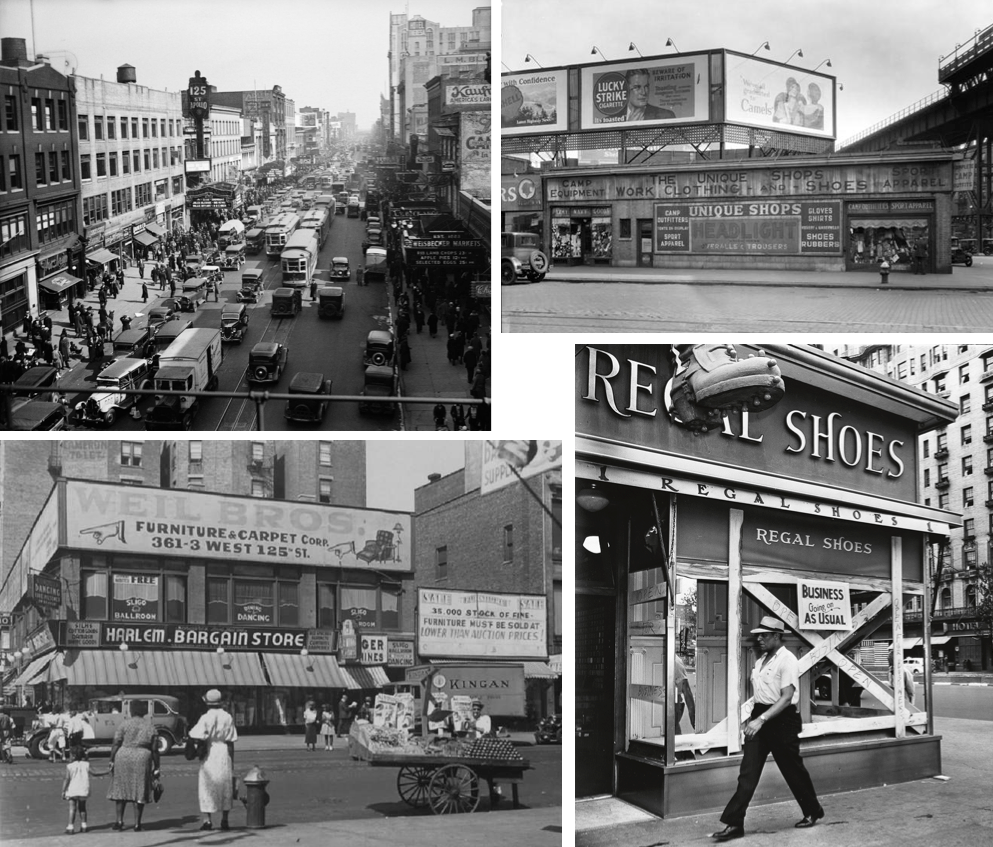
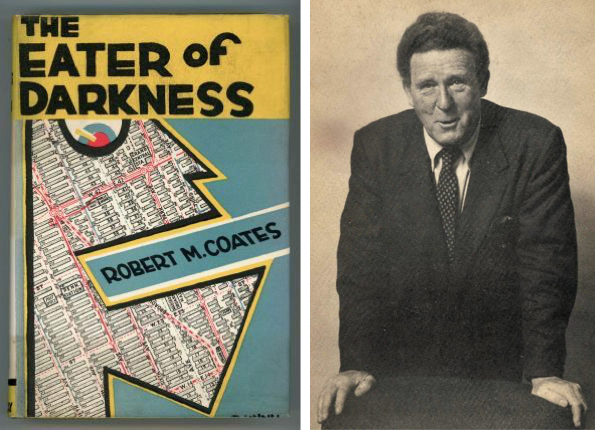
Robert Myron Coates (1897–1973) was a writer of experimental, expressionistic novels who later became a longtime art critic for The New Yorker (he is credited with coining the term “abstract expressionism” in 1946). In the Aug. 23 issue he contributed the first installment of “Dada City,” here describing street life in Harlem. Excerpts:

STREET LIFE…Scenes around Harlem’s 125th Street, clockwise from top left: the Apollo Theatre marquee punctuates a busy street scene in 1935; NW corner of 125th and Broadway, 1930; Regal Shoes storefront, 1940s, photo by Weegee; 125th and St. Nicholas Avenue in 1934. (Skyscraper City/Museum of the City of New York)
AMERICAN ORIGINAL…Robert M. Coates’s The Eater of Darkness (1926) has been called the first surrealist novel in English. (Goodreads)

 *  *  *

From Our Advertisers

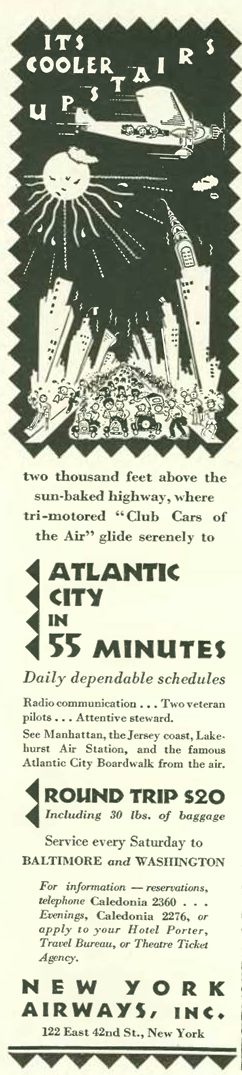
New Yorkers who were still enduring the brutal summer of 1930 could find relief, if they could afford it, on a New York Airways flight…

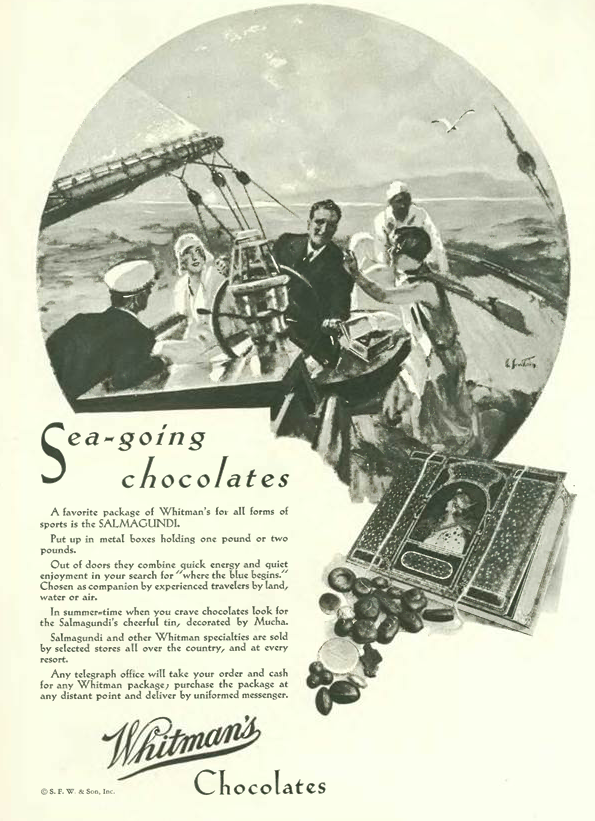
…or if you had the means, you could take your yacht out to sea, like this chap in a coat and tie who calmly steers with one hand while offering a box of chocolates to his guests with the other…

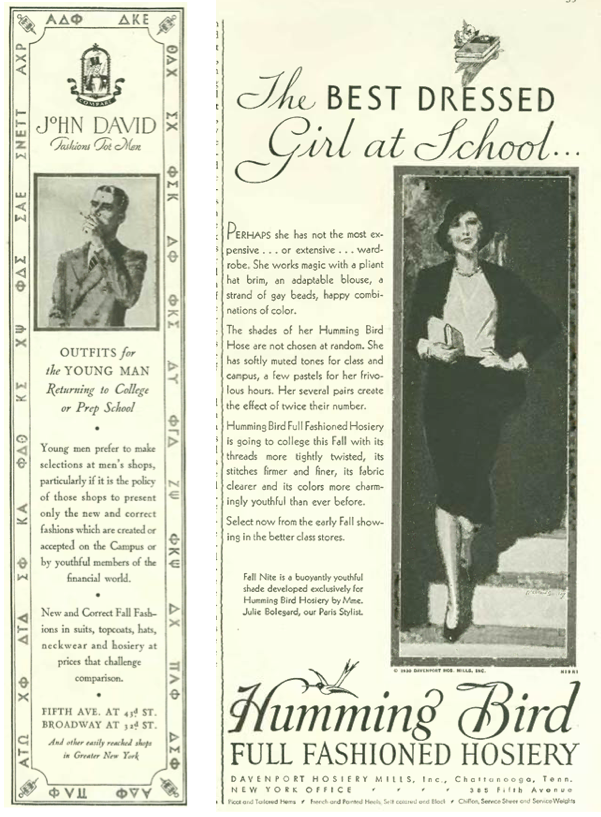
…our sailor wasn’t the only one dressed to nines…here are two ads offering suggestions to young folks returning to college or prep school…

…for comparison, this is how a group of college students at Columbia University dress today…

(Columbia University)

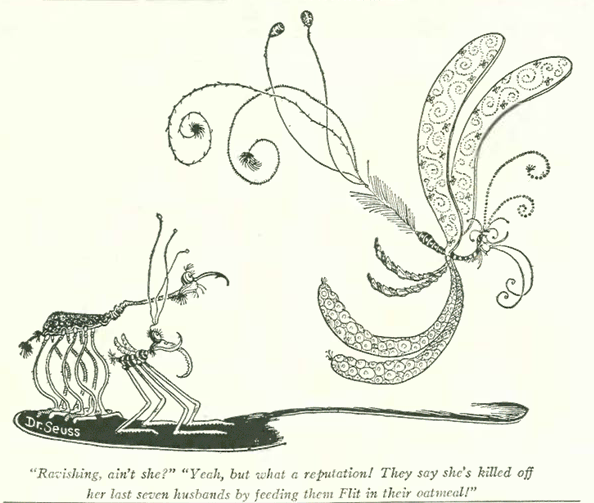
Dr. Seuss continued to crank out drawings on behalf of Flit insecticide…

…and on to cartoons, yet another rerun (the sixth) of this Peter Arno drawing with a new caption (Dorothy Dix was a popular advice columnist)…

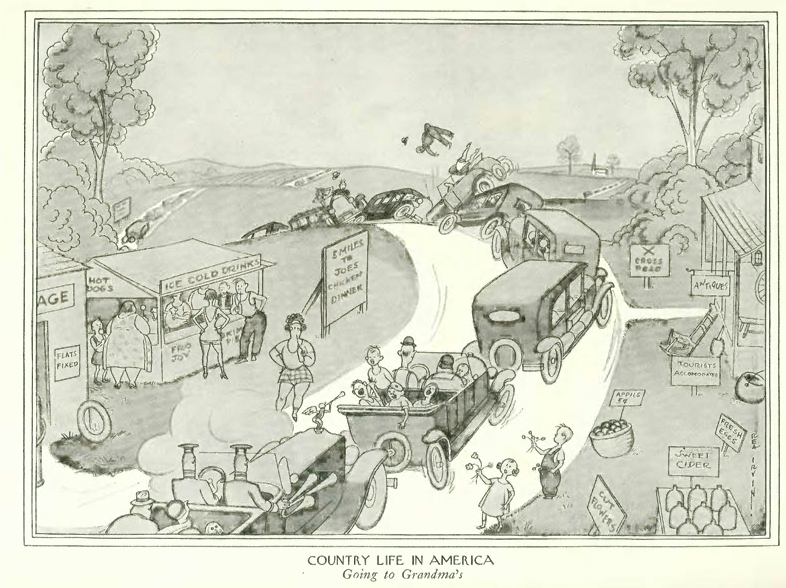
…and another look at country life courtesy Rea Irvin (originally printed sideways on a full page)…

…and another country scene, this time among the toffs, thanks to Garrett Price

…back in the city, some parlor room chatter as depicted by Barbara Shermund

…downtown, Isadore Klein looked at the economic challenges of peep shows…

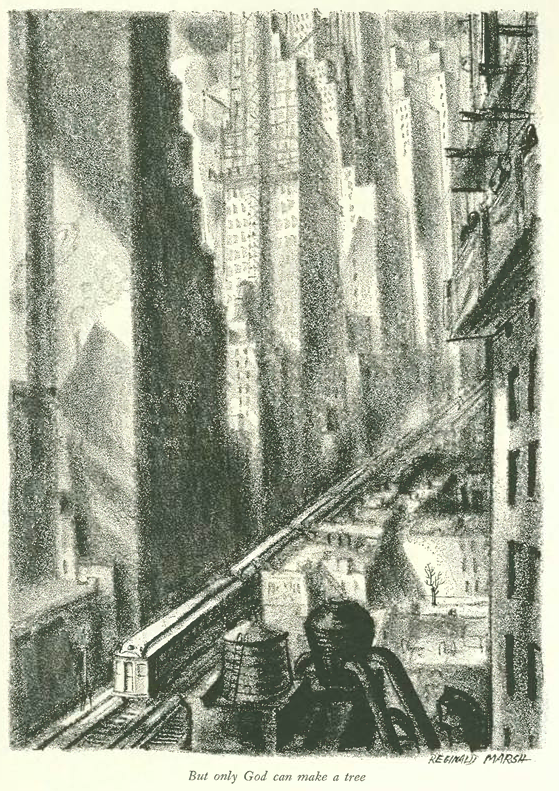
…and we close with this reflection on city life, by Reginald Marsh

Next Time: Marble Halls…

Transatlantic Dreaming

When Apollo astronauts landed on the moon fifty years ago, many skeptics asked the question, “What good does this accomplish?”

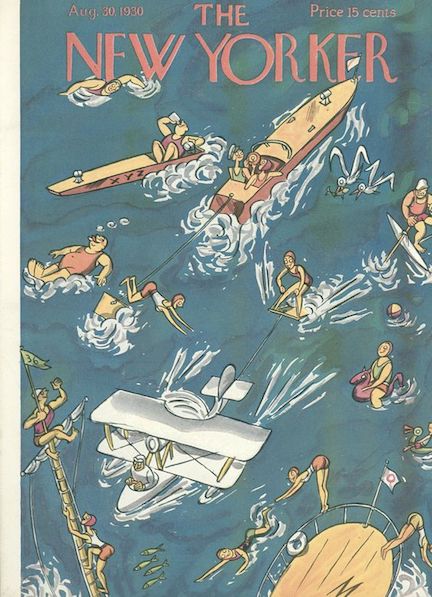
July 12, 1930 cover by Constantin Alajálov.

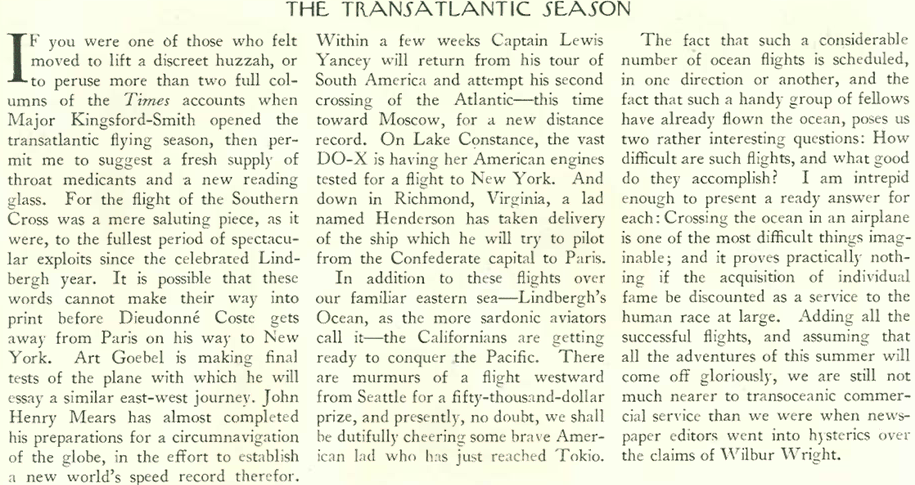
New Yorker writer Morris Markey posed the same question 89 years ago about transatlantic flights, then limited to a handful of daredevils chasing various speed and distance records. Crossing the ocean in an airplane, Markey observed, was “one of the most difficult things imaginable.” He concluded that despite the heroics of a few pilots, “we are still not much nearer to transoceanic commercial service…”

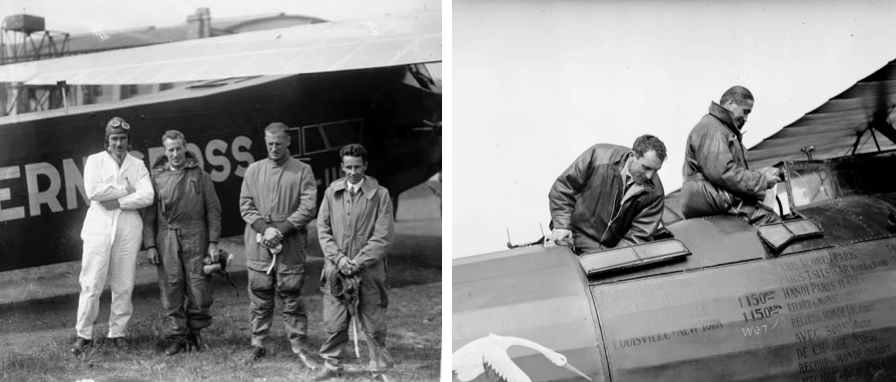
TESTING THE LIMITS…In photo at left, Charles Kingsford Smith (second from left) and the crew of his airplane, Southern Cross, pause before embarking on their east-west crossing of the Atlantic in  June 1930; photo at right: Dieudonné Costes (right) with Maurice Bellonte in Boston in 1930. On September 1-2, 1930, they flew the “Point d’Interrogation” from Paris to New York, the first heavier-than-air aircraft to reach New York in the more difficult westbound direction between the North American and European mainlands. (National Library of Ireland/Wikipedia)
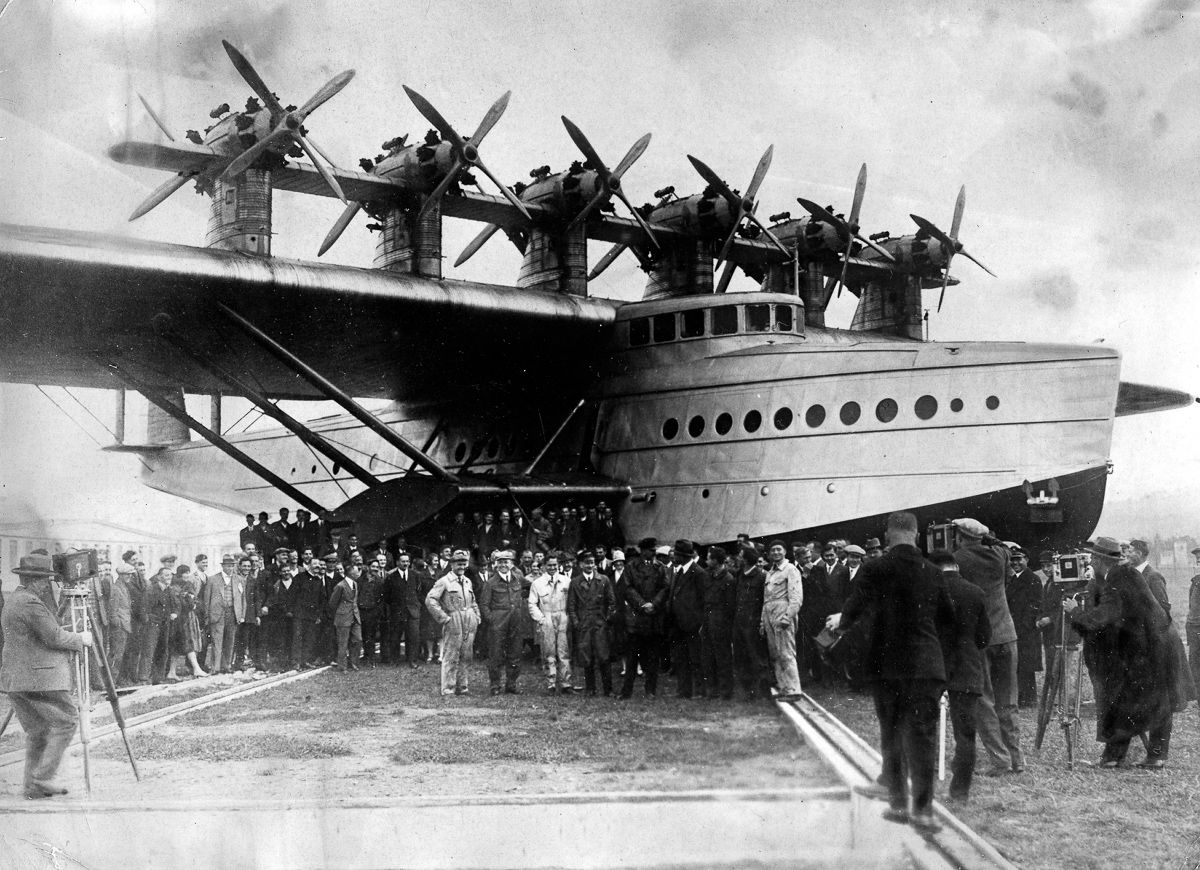
BIG THINKERS…Germany’s massive Dornier Do-X made its first test flight on July 12, 1929. A few months later, it carried a world-record 169 passengers on a 40-minute flight, an astonishing number given that the largest planes at that time rarely carried more than 20 passengers. In 1930, the Do-X took off on an international publicity tour through Europe, down the west coast of Africa, across the Atlantic to Brazil and up to New York before returning to Berlin. (Mashable)

Markey went on to detail the various obstacles facing transatlantic fliers, including fairly good odds that a plane, laden with fuel and supplies for such a journey, would crash on takeoff. He noted that a little over half of the attempts succeeded, while the others seemed doomed from the start.

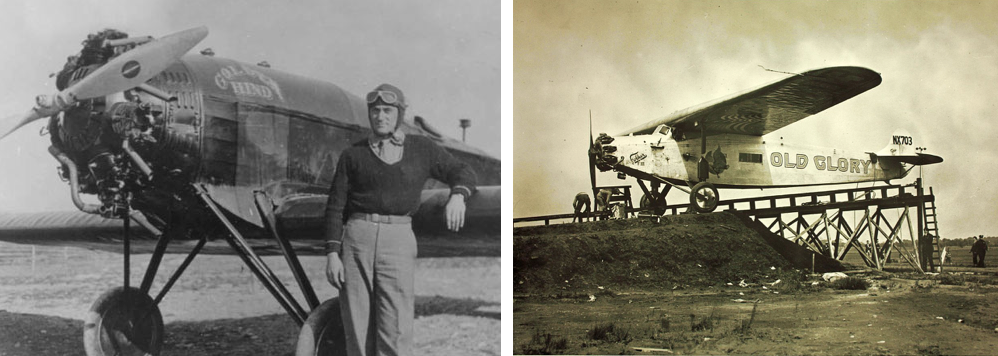
ILL-ADVISED…With only 70 hours of flying experience, Montana rancher Urban F. Diteman (left, with his airplane “Golden Hind”) took off from Harbour Grace, Newfoundland, bound for London. He was never seen again; at right, the William Randolph Hearst-sponsored “Old Glory,” a Fokker F.VIIa single-engined monoplane that was used in 1927 on an attempted transatlantic flight from Old Orchard Beach, Maine to Rome, Italy. The overloaded plane and its crew were lost approximately 700 miles east of Newfoundland, where only a section of wing was recovered. (dailymontana.com/Wikipedia)

 *  *  *

Glare of the New

Architecture critic George Chappell enthusiastically followed the construction of the world’s tallest building, but in its completion he found the Chrysler Building’s now-iconic spire to be little more than a stunt, and suggested that a covering of masonry might be in order:

MAYBE SOME VINYL SIDING?…George Chappell wasn’t too crazy about the Chrysler’s chrome dome, and also worried about the amount of steel that would clad the exterior of the Empire State Building, right, which is composed of limestone, chrome bars and aluminum panels. (Wikipedia)

 *  *  *

Bottoms Up

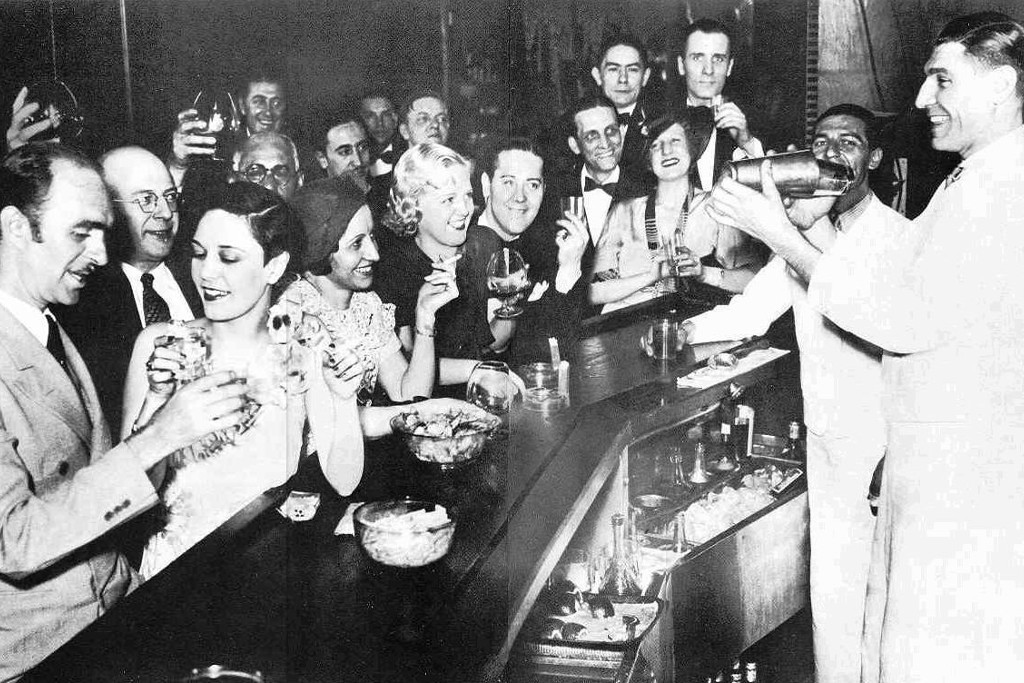
In his “Notes and Comment,” E.B. White pondered the drinking habits of his fellow citizens in the tenth year of Prohibition:

MAKE THAT A DOUBLE…Finding refreshment in the dark days of Prohibition. (junkee.com)

 *  *  *

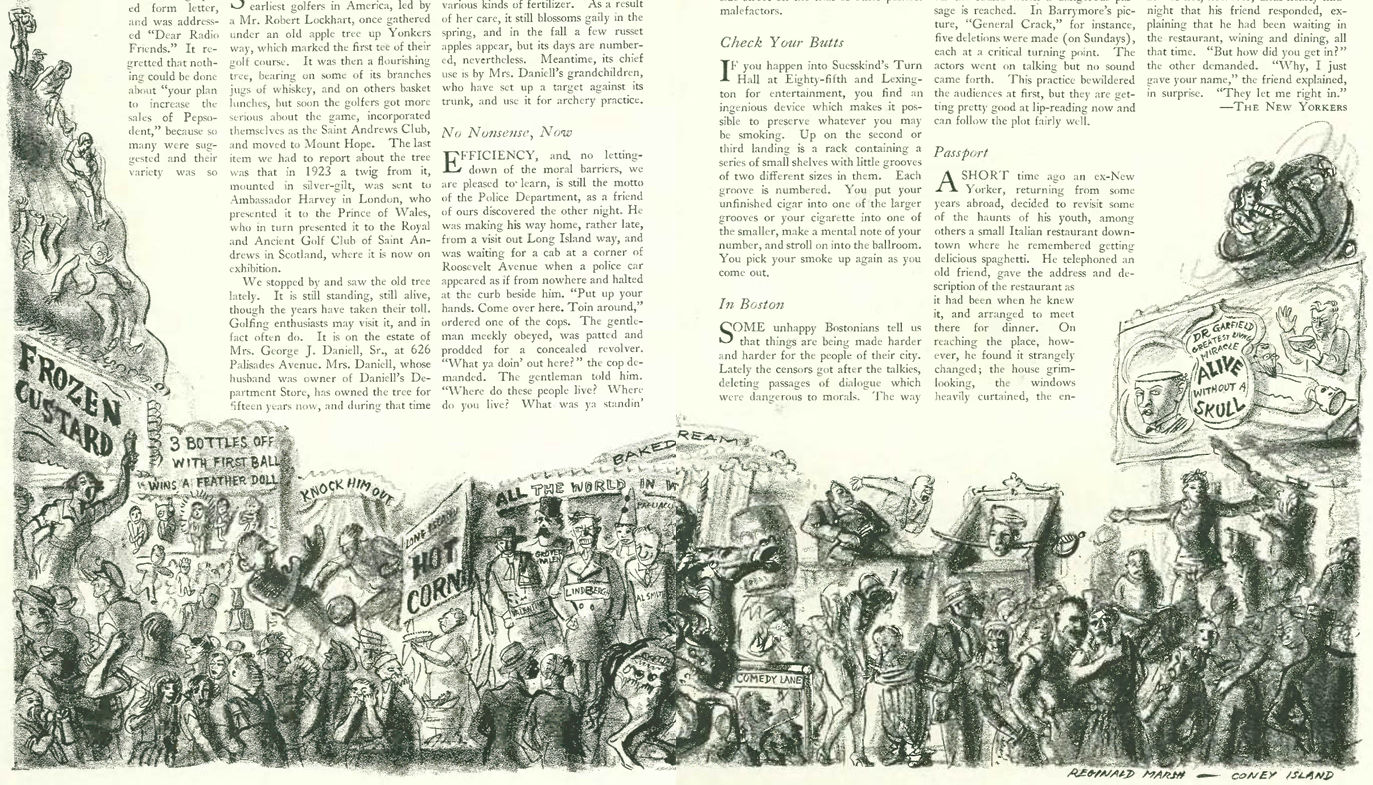
Good Old Summertime

Along the bottom of “The Talk of the Town,” a Reginald Marsh interpretation of Coney Island fun and games…

 *  *  *

Still the Same

Lois Long, who painted a picture of Jazz Age nightlife like no other in her “Tables for Two” column, teased her readers by disguising her identity, often claiming she was a frumpy old lady. With her “Tables” column now on hiatus, the fashionable and young Long maintained her pose, referring to herself as an “old war horse” in her fashion column “On and Off the Avenue.”

Problems of the Rich

John Mosher reviewed the 1930 American Pre-Code comedy Holiday, which told the story of a young man torn between his wild lifestyle and the tradition of his wealthy fiancée’s family. Films that explored the “problems” of the rich seemed particularly popular in the Depression years…

POOR LITTLE RICH GIRLS…Mary Astor and Ann Harding in Holiday. (IMDB)

 *  *  *

From Our Advertisers

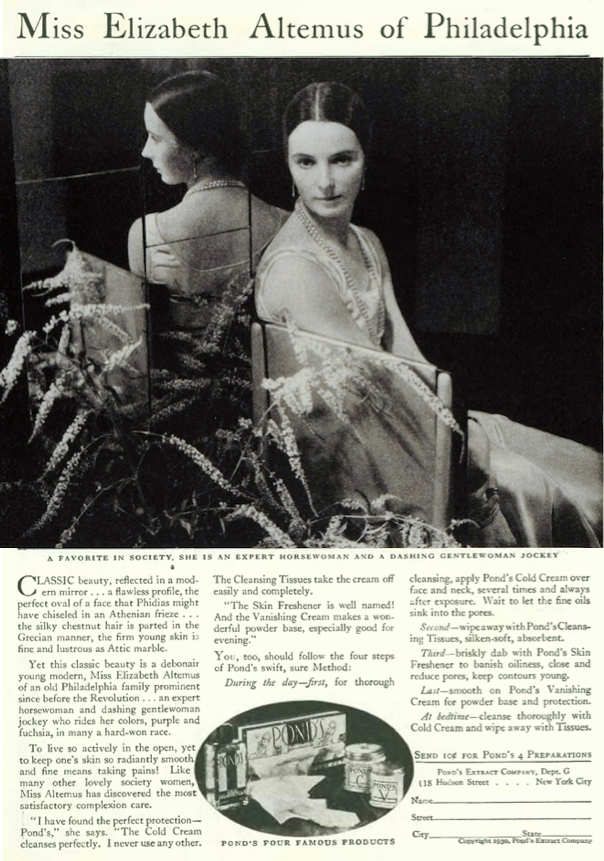
The makers of Pond’s Cold Cream continued its campaign of endorsements by society women, including Philadelphia socialite, philanthropist and champion horsewoman Elizabeth Altemus

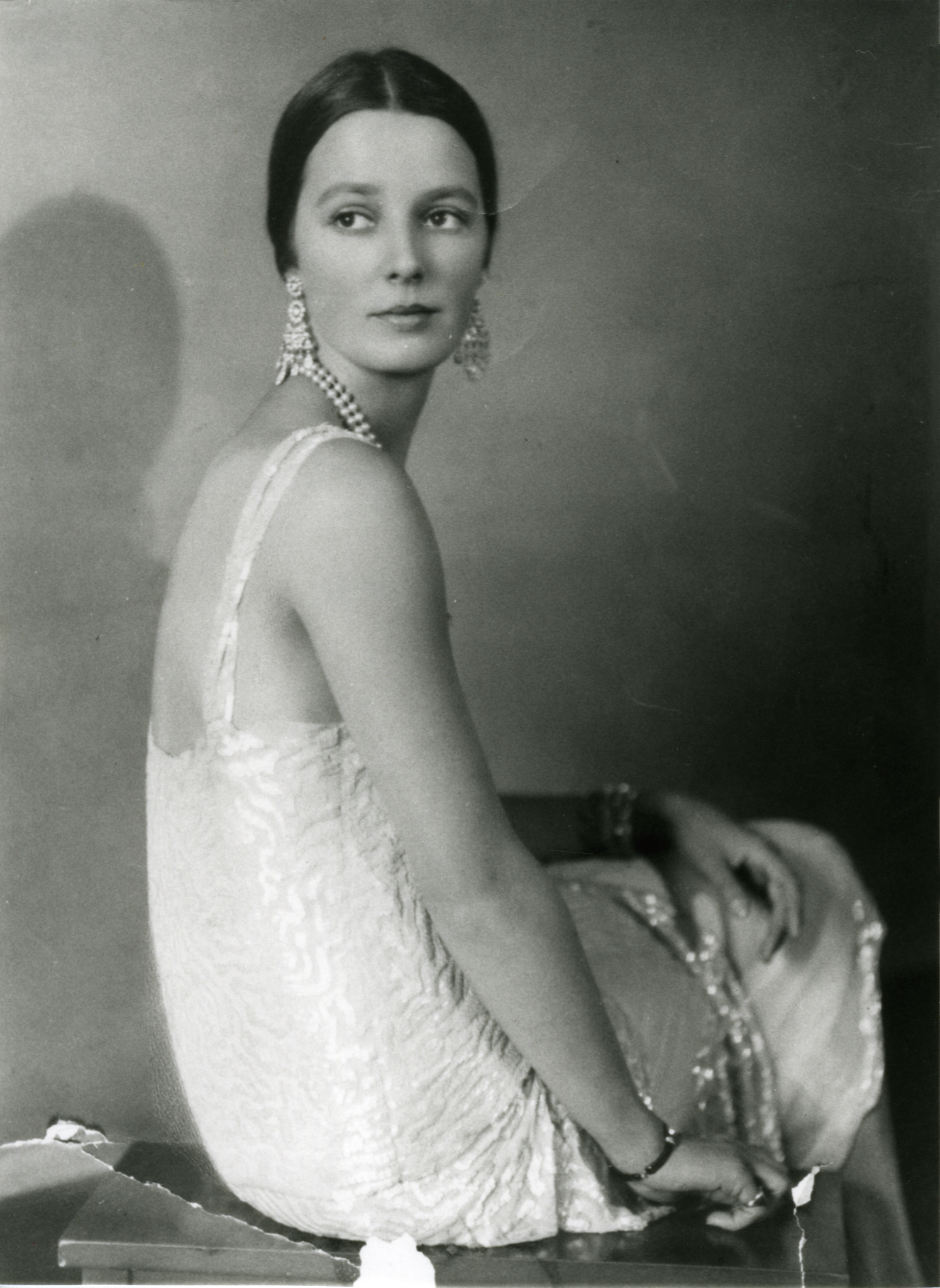
Altemus (1906-1988) was a prominent owner/breeder of Thoroughbred racehorses for more than 50 years. Her first marriage was to Jock Whitney, U.S. Ambassador to the United Kingdom, publisher of the New York Herald Tribune, and president of the Museum of Modern Art. By the looks of this 1937 portrait of Altemus, the cold cream certainly didn’t do her any harm…

Mary Elizabeth Altemus Whitney in 1937. (geni.com)

…speaking of cold cream, when Kleenex was introduced in the early 1920s, it was marketed solely as a hygienic way to remove cold cream. It wasn’t until the 1930s that the makers of Kleenex began to suggest it could also be used as a tissue in place of a handkerchief. Of course it was also a great way to dramatically expand consumption of its brand, and help usher in a new age of disposable products…

…as the Depression deepened, ads for automobiles began to change with the times, most manufacturers emphasizing the affordability of their cars over performance or prestige, as this sad little ad from Packard attested….

…in three consecutive issues (June 5, 12 and 19) Peter Arno featured the same drawing with a different caption that gave readers a very brief courtship story…

Alan Dunn offered a glimpse of life among the newsboys…

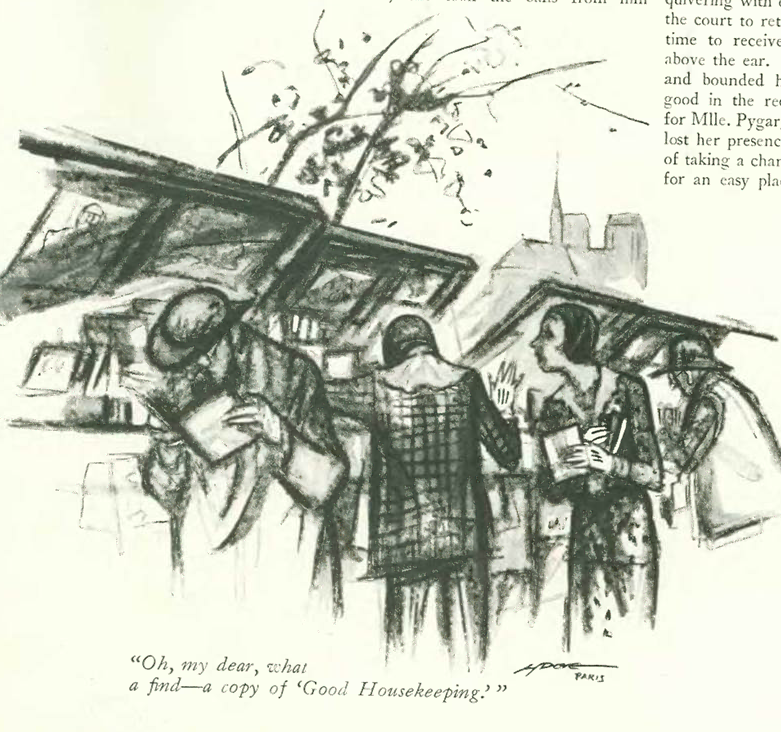
Leonard Dove found Americans browsing newsstands along the Seine…

Helen Hokinson looked in on an existential crisis…

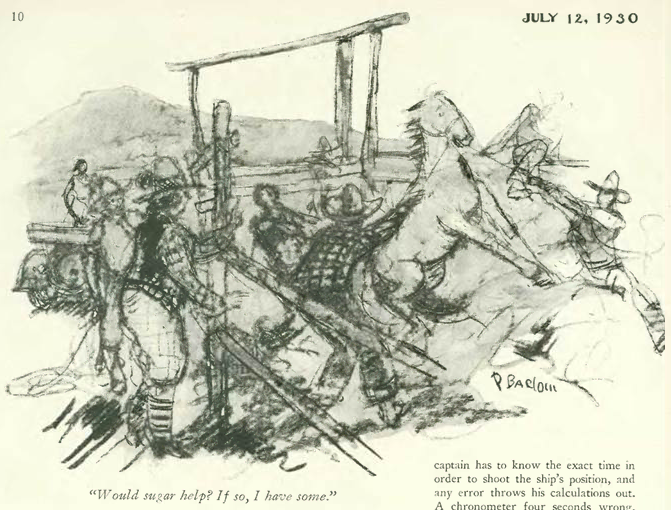
Perry Barlow was Out West at a dude ranch…

Barbara Shermund eavesdropped on a couple of debs…

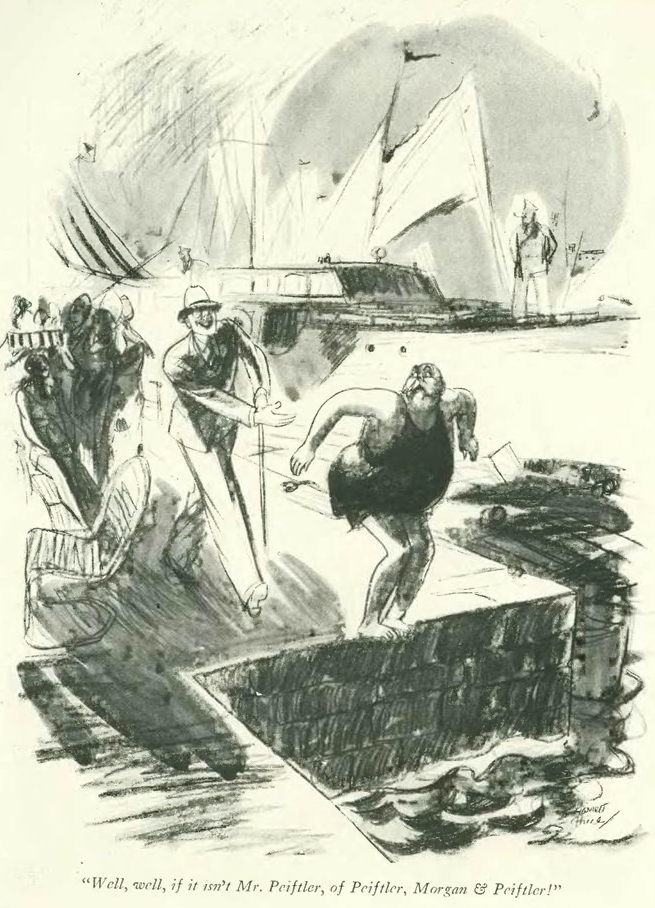
Garrett Price gave us an awkward encounter among the yachting crowd…

…and finally William Crawford Galbraith, and a case of domesticus interruptus

Next Time: Aleck & Frank at Taliesin…

All Quiet on the Western Front

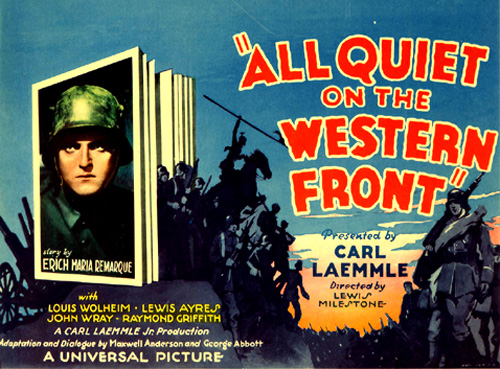
Still considered one of the greatest anti-war films ever made, All Quiet on the Western Front opened in New York on April 29, 1930 to strong reviews. Based on Erich Maria Remarque’s novel of the same name, the film’s depictions of the horrors of war were so realistic and harrowing that it was banned in a number of countries outside of the U.S.

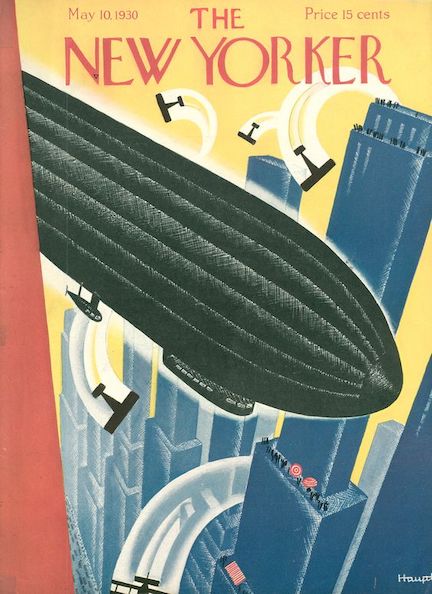
May 10, 1930 cover by Theodore Haupt.

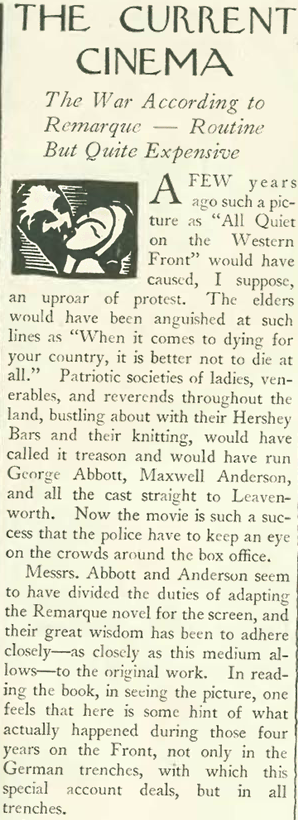
Banned, that is, by nations gearing up for war. In Germany, Nazi brownshirts disrupted viewings during its brief run in that country, tossing smoke bombs into cinemas among other acts of mayhem. Back in the U.S., The New Yorker’s John Mosher attended a screening at a “packed” Central Theatre:

WAR IS HELL…Clockwise, from top left, movie poster for 1930’s All Quiet on the Western Front; German soldier Paul Bäumer (Lew Ayres), falls into a shell crater with a French soldier and draws his knife; in one of the most moving scenes in cinema, Bäumer is forced to spend the night in the crater, where he vainly tries to safe the life of the Frenchman he has mortally wounded; a German soldier crawls through the mud in a German training camp. (IMDB/Universal).

Mosher found the film’s adaption from the novel wanting in places, but overall praised the acting and the quality of the picture…

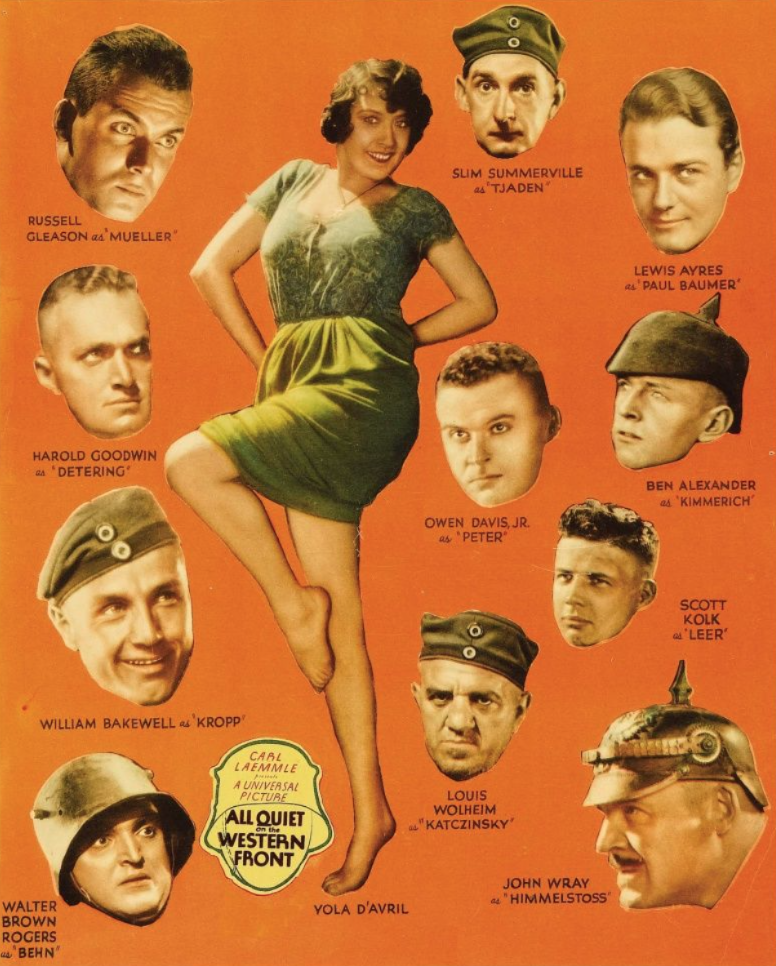
…and just in case some audiences were put off by the blood and guts, Universal promoted other themes on its lobby cards…

(IMDB)

 *  *  *

More Than a Stunt

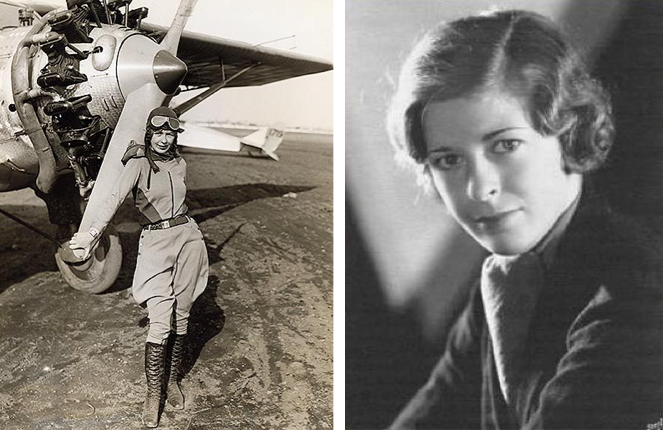
In her profile of aviator Elinor Smith (1911-2010), writer Helena Huntington Smith took great pains to distinguish Elinor from other “lady fliers” who were little more than passengers in various flying exploits. Like Amelia Earhart, Smith had the bona fides of a true aviator: in 1927 she become the youngest licensed pilot in the world at age 16, learning stunt flying at an early age. When she was 17 she smashed the women’s flying endurance record by soloing 26½ hours, and in the following month set a woman’s world speed record of 190.8 miles per hour. In March 1930 she set a women’s world altitude record of 27,419 feet (8,357 m), breaking that record in 1931 with a flight reaching 32,576 feet. Smith would continue to fly well into old age. In 2000 she flew NASA’s Space Shuttle vertical motion simulator and became the oldest pilot to succeed in a simulated shuttle landing. In 2001 (at age 89) she would pilot an experimental flight at Langley AFB. An excerpt from the profile:

HEAD IN THE CLOUDS…Elinor Smith’s flying career would extend from age 16 and into her 90s. At left, Smith poses in Long Island with the Bellanca monoplane she used to beat the solo flight record in 1929. Right, portrait of Smith circa 1930s. (findagrave.com)

 *  *  *

I’d Rather Be in Philadelphia

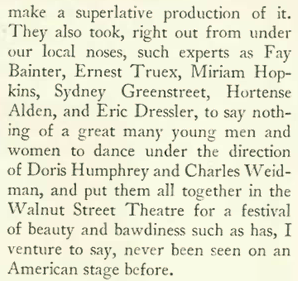
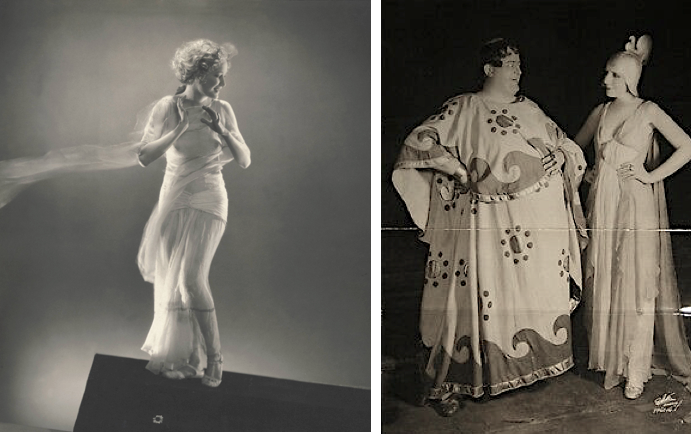
Theatre critic Robert Benchley was over the moon regarding a performance of Lysistrata staged by the Philadelphia Theatre Association. Benchley suggested the Philadelphians had “put New York to shame” in staging such a “festival of beauty and bawdiness…never seen on an American stage before.”

NO MORE HANKY PANKY…Left, actress Miriam Hopkins in Aristophanes’ Lysistrata, as photographed by Edward Steichen; at right, Sydney Greenstreet with unidentified actress from the 1930 Philadelphia production of Lysistrata. (timeline.com)

Benchley praised the seemingly advanced tastes of Philadelphia audiences as he continued to the lament the fact that the City of Brotherly Love had beaten New York to the punch with the staging of the play. He needn’t have worried much longer; the play would open on Broadway on June 5, 1930, at the 44th Street Theatre.

LOVER COME BACK…Production photograph for Norman-Bel Geddes’s staging for Lysistrata, titled “the women of Greece return to their men.” (hrc.utexas.edu)

While we are on the subject of theater, Constantin Alajálov provided this lovely illustration of Anton Chekhov’s Uncle Vanya for The New Yorker’s theater review section…

 *  *  *

Make ‘Em Dance, Boys

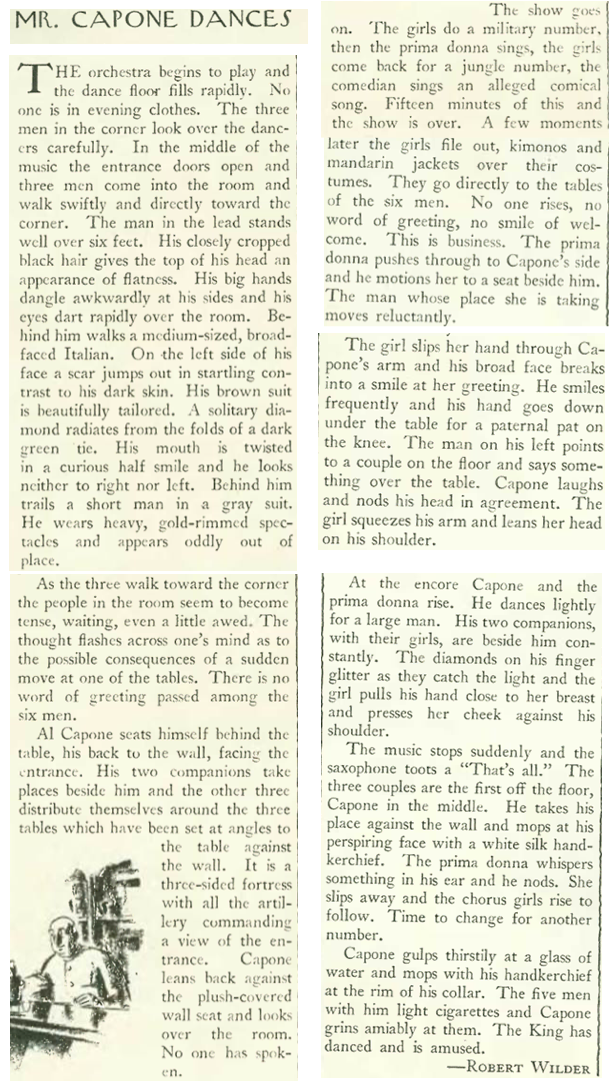
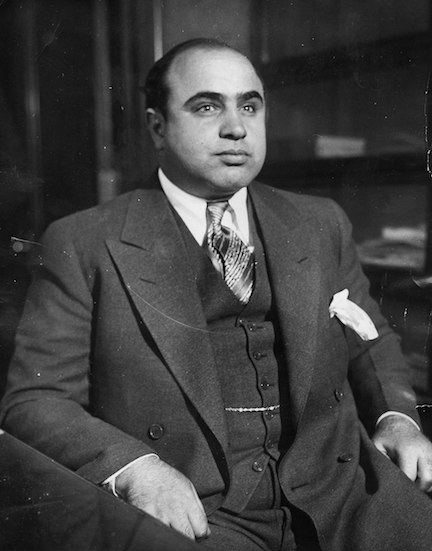
The author Robert Wilder contributed this interesting casual about the appearance of gangster Al Capone at a Chicago nightclub. Excerpts:

LIGHT ON HIS FEET…Al Capone in 1930. (Wikipedia)

 *  *  *

You Say You Want a Revolution?

Alva Johnston offered his thoughts on how America could stage its own “Red Revolution,” given that Russia and several European countries had already experienced communist uprisings of their own, and also given that New York Police Commissioner Grover Whalen, always in search of problems that didn’t exist, had announced a new “Red Scare” in his fight against communism.

Tongue firmly in cheek, Johnston suggested how American know-how could be brought to bear in inciting a Red Terror. An excerpt:

YANKEE INGENUITY…Alva Johnston, left, offered some innovative ideas for a uniquely American “Red Revolution.” At right, soldiers stand behind a barricade during Germany’s communist Spartacist uprising of January 1919. (Wikipedia)

 *  *  *

Speaking of Revolutionaries

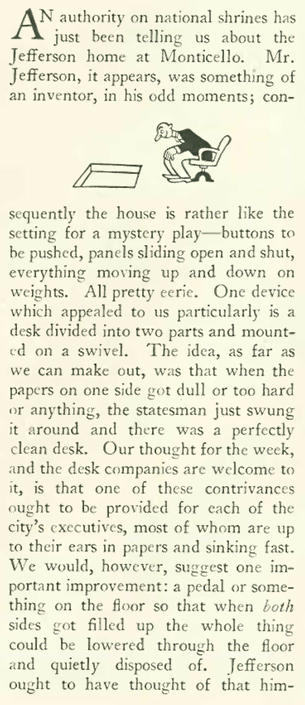
Thomas Jefferson’s home at Monticello is one of America’s most-visited historical sites, but in 1930 it was still something of a regional curiosity, having only been acquired in 1923 for the purposes of turning it into a public museum. Although Jefferson is well known today for his various inventions at Monticello, E.B. White was just learning about this side of the president in his weekly “Notes and Comment” dispatch:

THIS OLD HOUSE…Left, a combination of neglect and Civil War vandalism left Thomas Jefferson’s Monticello enmeshed in weeds and in a state of near collapse by the 1870s. At right, students of the University of Virginia pose outside Monticello in 1930. (UVA/Hulton Archive)

 *  *  *

Play Ball?

We are well into the spring of 1930, yet The New Yorker stood firm in its complete lack of baseball coverage. As I’ve noted before, the magazine covered virtually every sport from horse racing to rowing to badminton, and even lowered itself to regular features on college football and professional hockey, but not a line on baseball, save for an occasional note about the antics of Babe Ruth or the homespun goodness of Lou Gehrig. There were signs, however, that baseball was being played in a city blessed with three major league teams; we do find game times in the “Goings On About Town” section, as well as occasional baseball-themed filler art, and a comic panel in the May 10 issue by Leonard Dove:

From Our Advertisers

We begin with an endorsement for Chase & Sanborn coffee by the soprano Alma Gluck, wife of famed violinist and composer Efrem Zimbalist Sr. Originally I thought she was enjoying coffee with a sister in law named “Mrs. Zimbalist,” but as reader Frank Wilhoit astutely points out, the “Alma Gluck” (celebrity) and “Mrs. Zimbalist” (housewife) are alternate personae of the same individual. And now that I look at the ad again, the clothes and hair styles are identical. I will try to locate a clearer image of the ad…

…and from the makers of White Rock we have a group of swells and their airborne friends enjoying some bubbles that are doubtless mixed with illegal hootch…

Dr. Seuss continued to offer his artistry on behalf of Flit insecticide…

…and on to our cartoons, Peter Arno illustrated the hazards of the road…

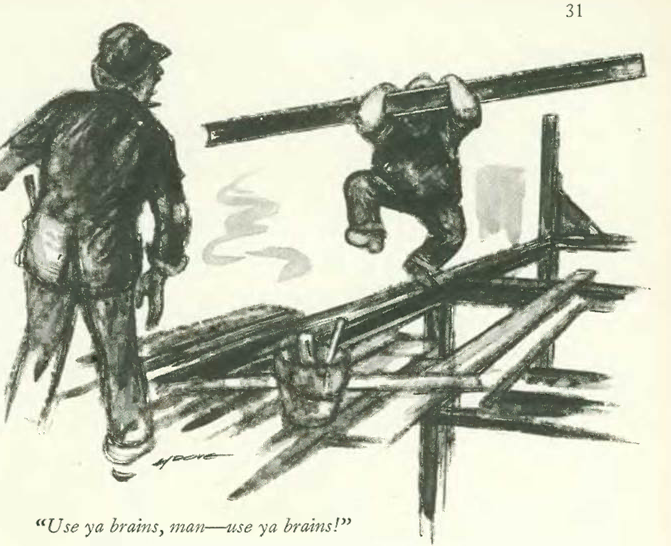
…while Leonard Dove explored the hazards high above the streets of Manhattan…

Constantin Alajálov explored an odd encounter in a park…

Isadore Klein mused on the tricks of mass transit…

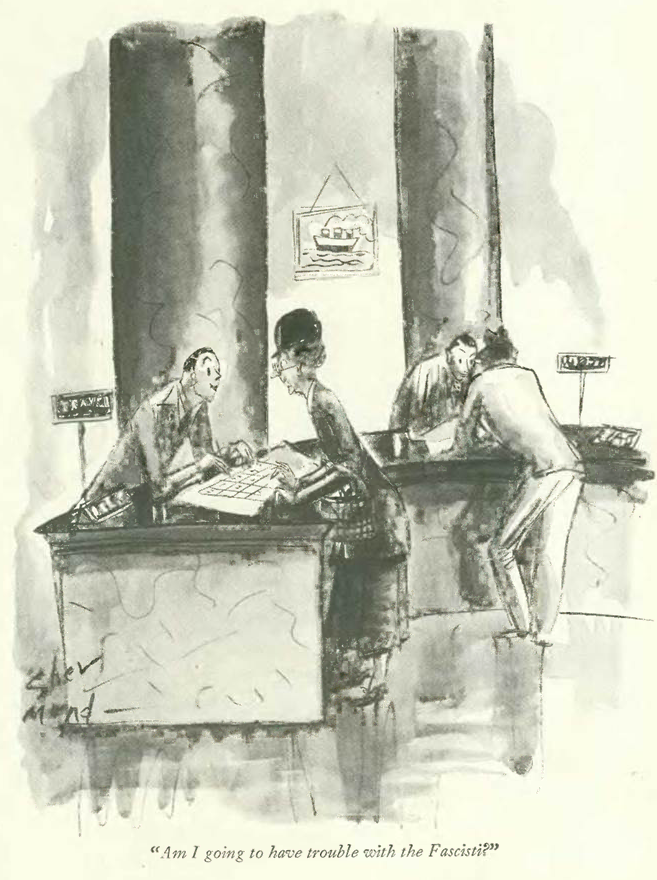
…and two from Barbara Shermund, who looked in on one tourist’s plans for a trip to Mussolini’s Italy…

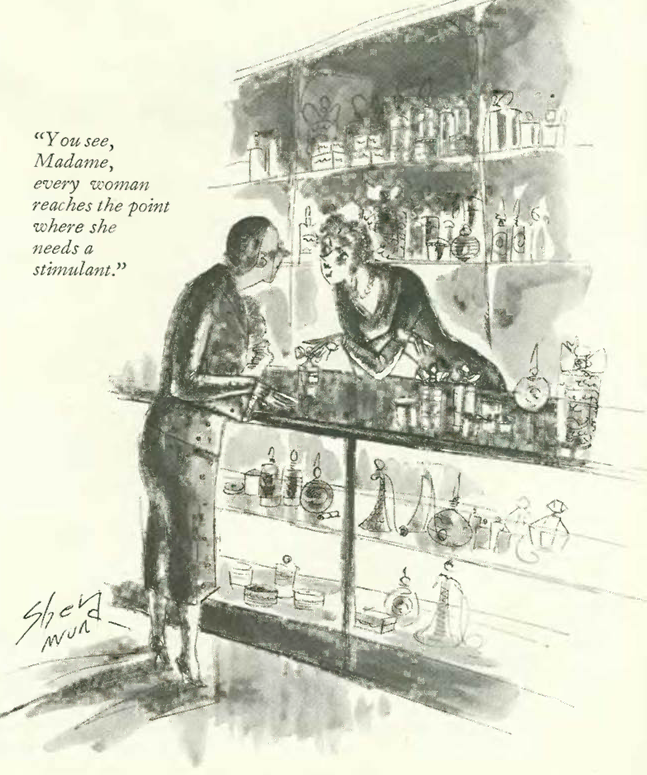
…and some helpful advice at a perfume counter…

Next Time: Red Alert…


Minding the Gap

Tens of thousands of commuters daily cross the George Washington Bridge, but in the din of modern commuting few give nary a thought to a span that was once considered a modern marvel.

May 3, 1930 cover by Rose Silver.

Twice as long as any previous suspension bridge when it opened in 1931, the George Washington Bridge’s main span of 3,500 feet (1,100 m) would be the world’s longest until it was surpassed by San Francisco’s Golden Gate Bridge in 1937. The New Yorker’s “Talk of the Town” (entry most likely by E.B. White) checked on the bridge’s progress for the May 3 issue:

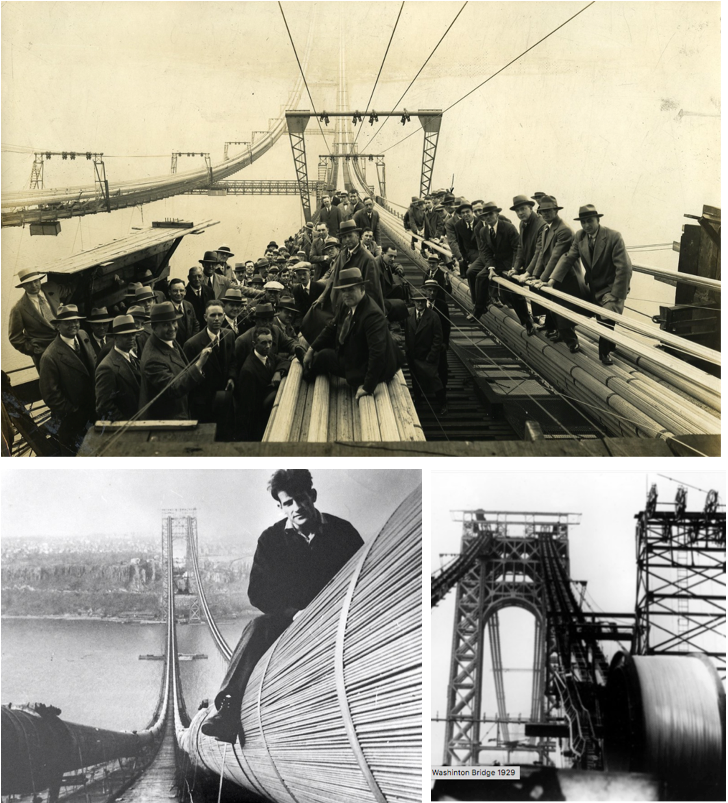
MEN OF STEEL…Some 107,000 miles of wire were used in cables made by John A. Roebling’s Sons Company for the George Washington Bridge — the same firm also supplied wire for the Brooklyn Bridge 60 years earlier (John Roebling and his son, Washington, also designed and built the Brooklyn Bridge). Clockwise, from top, employees of John A. Roebling’s Sons pose atop cable bundles; bottom right, the bridge’s four main cables were each composed of a single strand carried back and forth across the river 61 times. Each strand itself is a bundle of 434 individual wires; bottom left, worker poses atop completed cable. (Flickr/Pinterest)
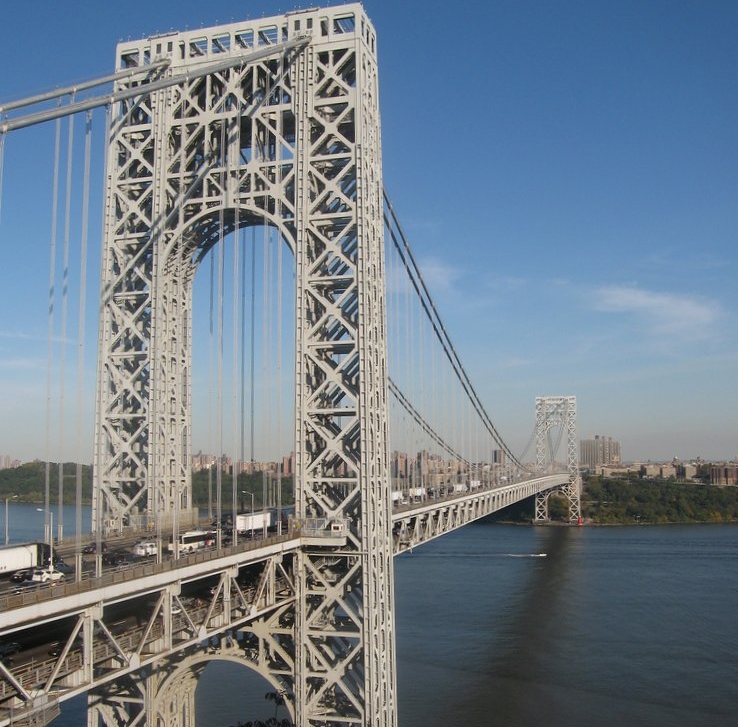
BY ANY OTHER NAME…Known as the Hudson River Bridge during its construction, the George Washington Bridge opened to traffic in 1931. During the first full year of operation in 1932 more than 5.5 million vehicles used the original six-lane roadway — today it is the world’s busiest motor vehicle bridge, carrying more than 100 million vehicles per year. Although the steel towers are iconic today, the original plan called for them to be clad in stone. (Wikipedia)

 *  *  *

A Cabin in the Sky

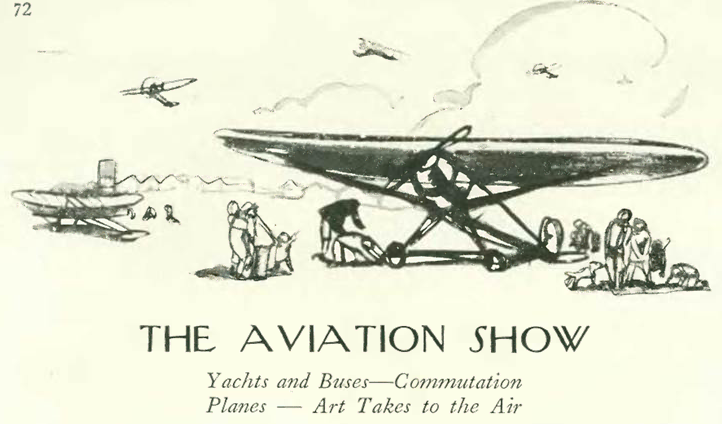
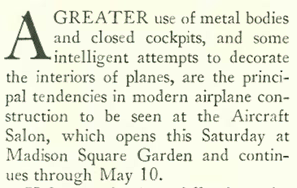
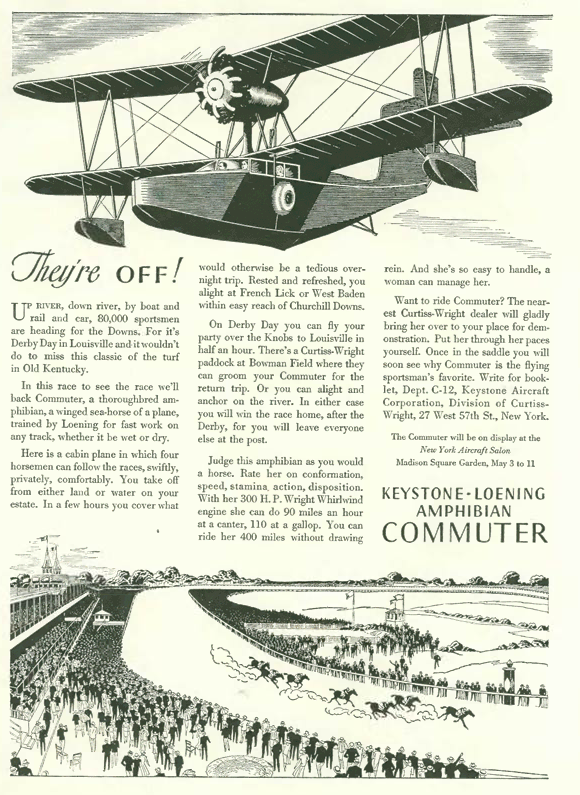
Other signs of modern life were being seen in Midtown, where an “Aircraft Salon” hosted by the Aeronautical Chamber of Commerce was taking place at Madison Square Garden.

Nicholas Trott was on hand to take in the exhibits, noting that advances in aviation included the use of metal bodies (instead of fortified cloth) and greater attention to interior decoration:

SIGNED, SEALED, DELIVERED…An attendee of the New York Aircraft Salon received a special postal stamp, and an autograph from aviator Cy Caldwell, at the Madison Square Garden show. (Joe Krantz)

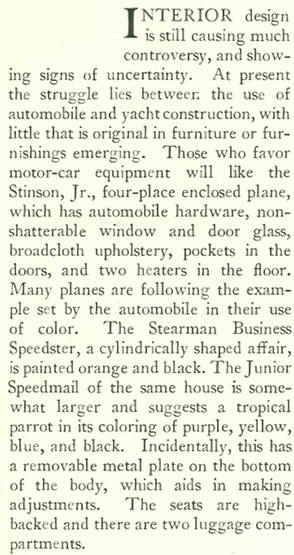
Trott noted that designs of passenger compartments, still in their infancy, suggested something between automobile and nautical motifs:

SORRY, NO HEADPHONES…Clockwise, from top left, a Curtiss Condor 18 and its interior appointments; a Fokker Trimotor featured dining in its cabin. As peaceful as the scene appears, the noise from the motors must have been unbearable. (Wikipedia/dutch-aviation.nl)

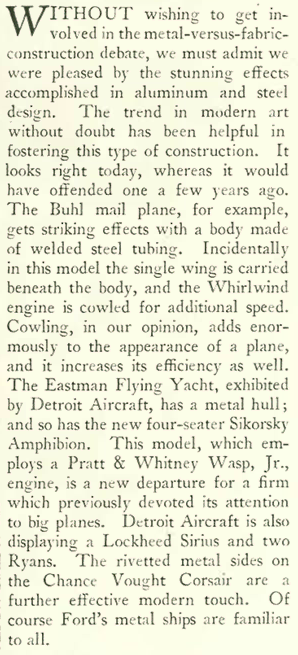
Trott also commented on the debate surrounding metal vs. fabric in the construction of airplanes. Before 1930 most planes were constructed of wood covered with fabric (which were much lighter than metal craft). Although as early as 1920 the National Advisory Committee for Aeronautics declared metal to be superior to wood, only five percent of aircraft in 1930 were of all-metal construction.

DON’T CALL ME WOODY…This eight-passenger Consolidated Fleetster was a rare example of metal construction in early 1930. The wings, however, were still fashioned from wood. (Aeronautical Chamber of Commerce 1931 Aircraft Yearbook)

 *  *  *

Road to Nowhere

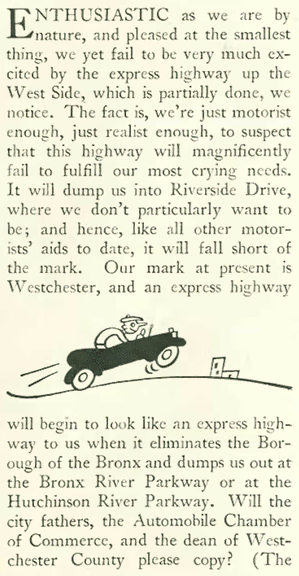
The New Yorker’s enthusiasm for modern marvels did not extend to the West Side Highway, a project that would extend from the late 1920s to the early 1950s. Here is E.B. White’s take on the opening of the highway’s first section:

White’s observations were somewhat prescient — constructed in tight confines, the road’s on-ramps proved too narrow and the turns too tight for use by large trucks. The roadway also lacked proper maintenance, and just two decades after it was completed a section of the highway collapsed under the weight of an asphalt-laden truck. The roadway was demolished between 1977 and 1989. Read more here about the West Side Highway’s surprising history at the Museum of the City of New York.

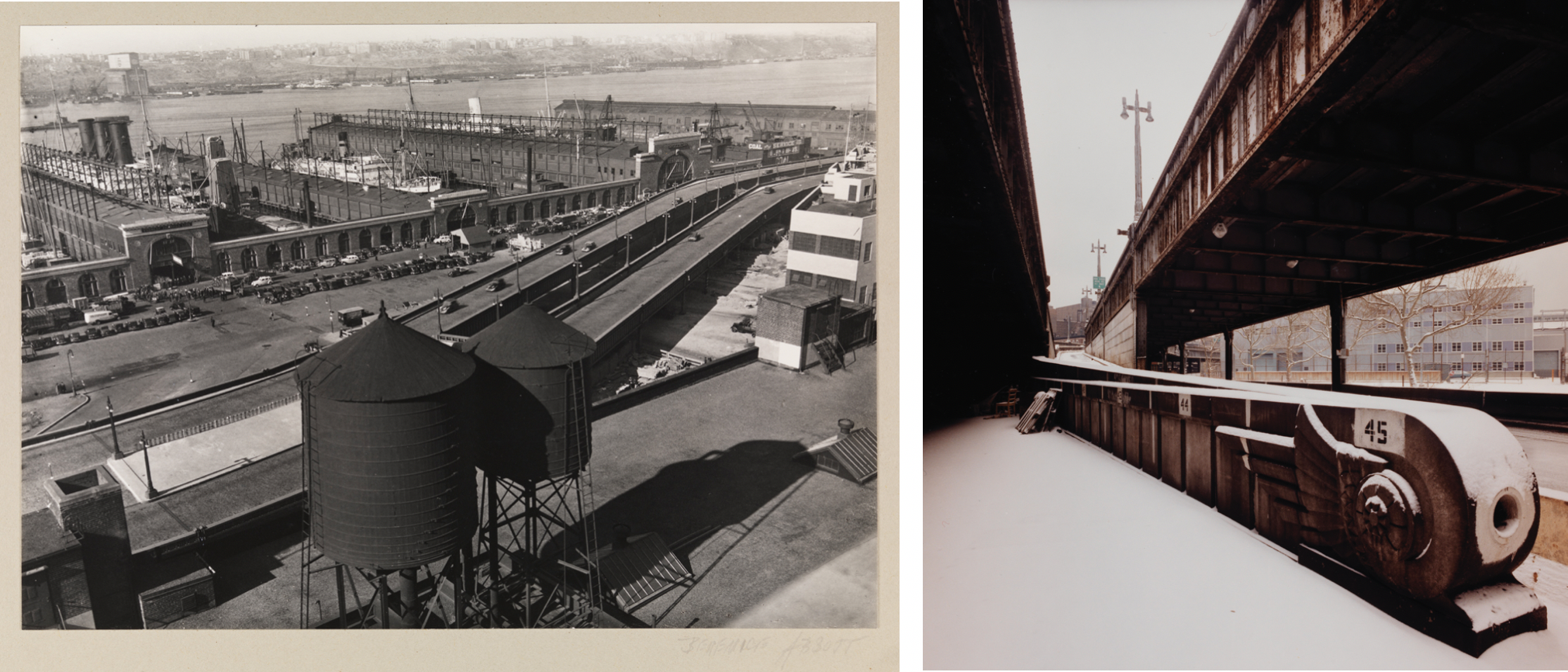
THE ROAD NOT TAKEN, TAKEN…Left, West Side Express Highway and Piers 95-98, photographed by Berenice Abbott from 619 West 54th Street on Nov. 10, 1977; West Side Highway Ramp at 23rd Street reveals Art Deco ornamentation. Detail of photo by Jan Staller, 1978. (Museum of the City of New York)

 *  *  *

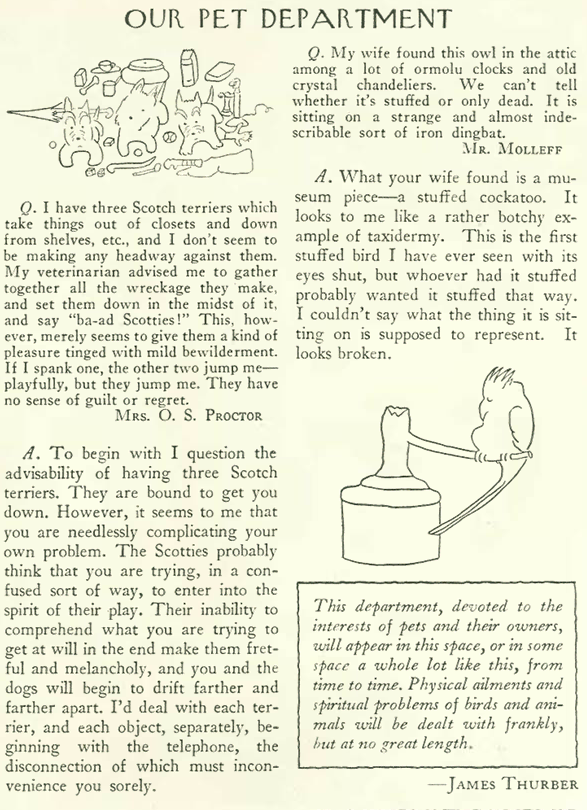
For Pet Lovers

Our latest installment of James Thurber’s “Our Pet Department” column…

 *  *  *

Hate Couture

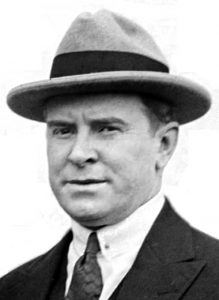
The New Yorker’s Paris correspondent, Janet Flanner, using the pen name “Hippolyta,” contributed this profile of François Coty (1874-1934), a French perfumer and businessman. Flanner’s profile (the introduction included below) described Coty’s rags-to-riches rise in the perfume industry, and touched on his life as a sometime journalist and politician.

What doesn’t come across in the profile is Coty’s extreme right-wing stance on politics and his virulent anti-Semitism, which was often expressed in his newspaper, Figaro. Three years after Flanner’s profile Coty would co-found Solidarité Française, a fascist, paramilitary organization, and a year after that he would be dead of an aneurysm.

François Coty circa 1930. (aperfumeblog.com)

 *  *  *

From Our Advertisers

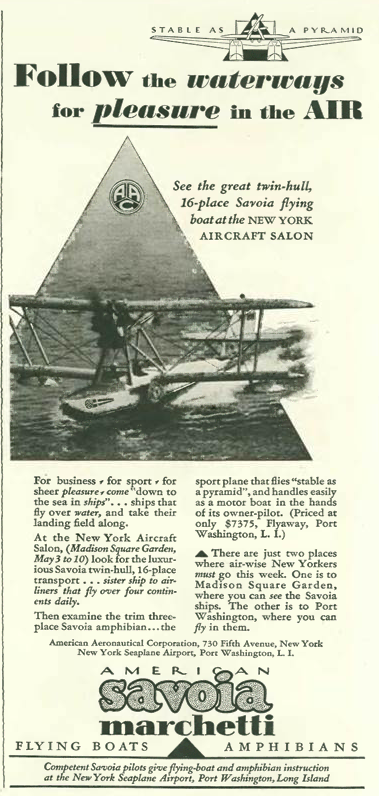
The New Yorker’s bottom line reaped benefits from the big aviation show at Madison Square Garden…

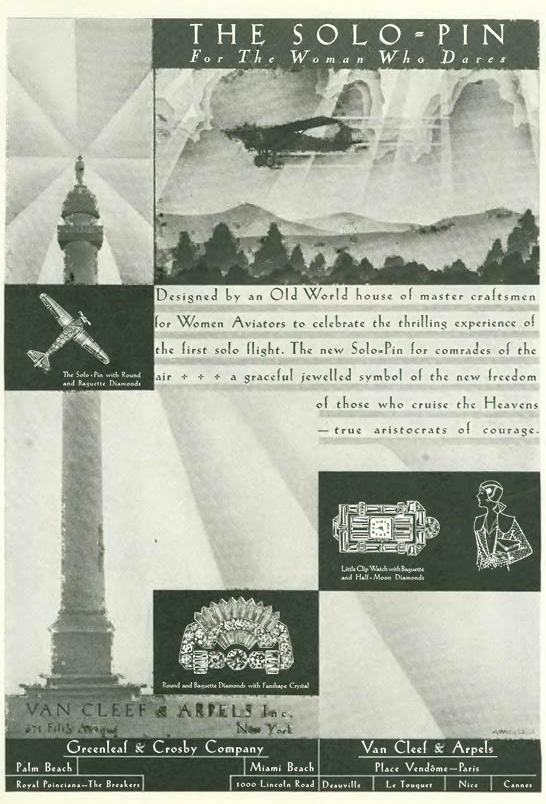
…and even if you weren’t selling airplanes or flying lessons, you could still get in on the action…

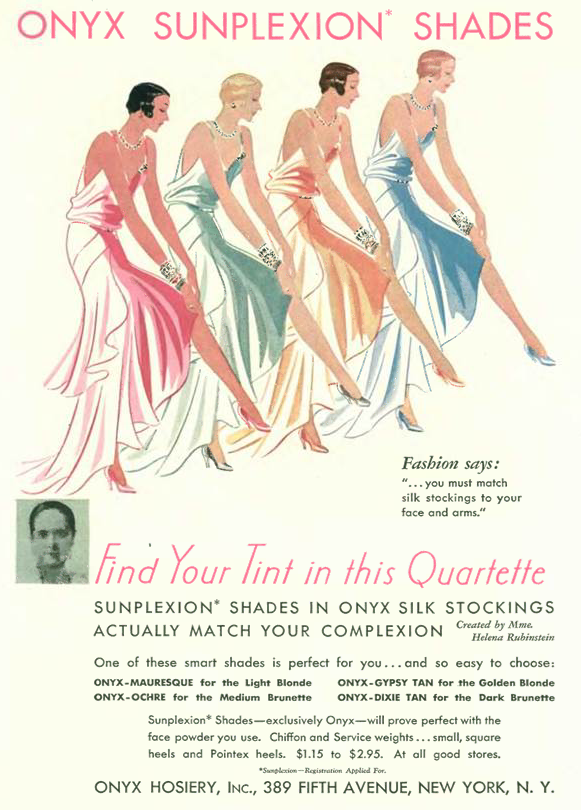
…also from the fashion world, this colorful entry from Onyx Hosiery…

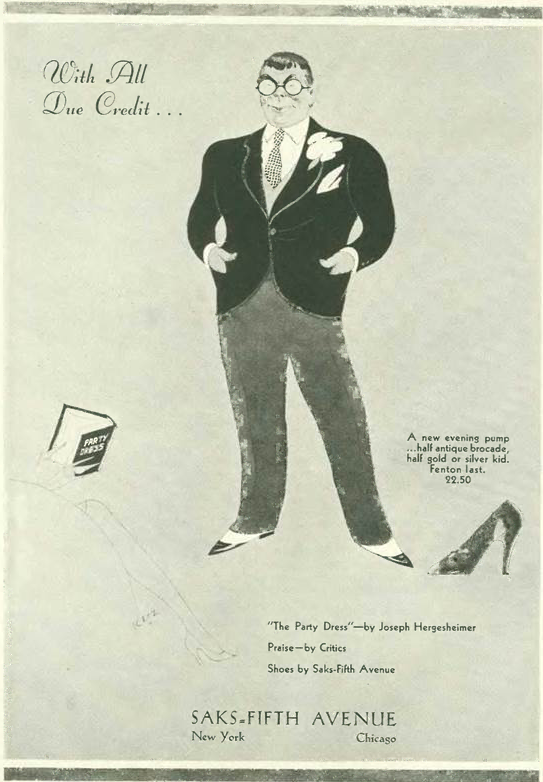
…and this weird ad from Saks, advertising shoes and a party dress but dominated by a caricature of designer Joseph Hergesheimer

…on to our cartoons…Helen Hokinson paid a visit to the aviation show…

…on the domestic front, Garrett Price examined the challenges of home decor…

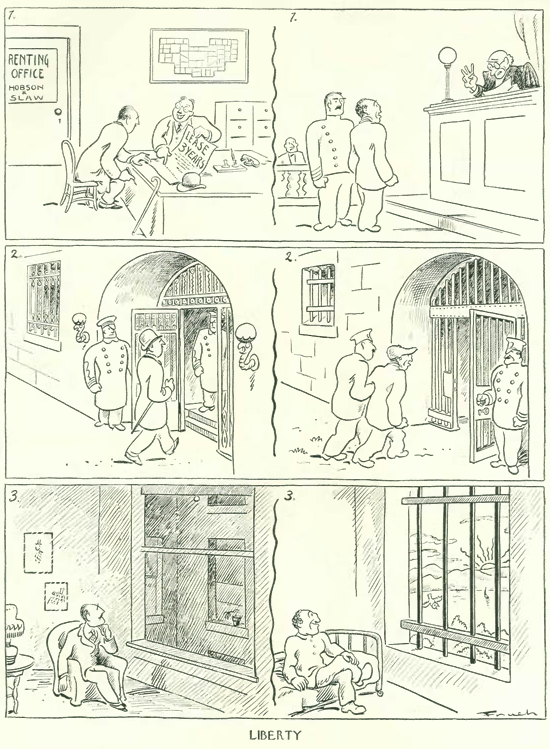
Al Frueh offered an ironic twist on a room with a view…

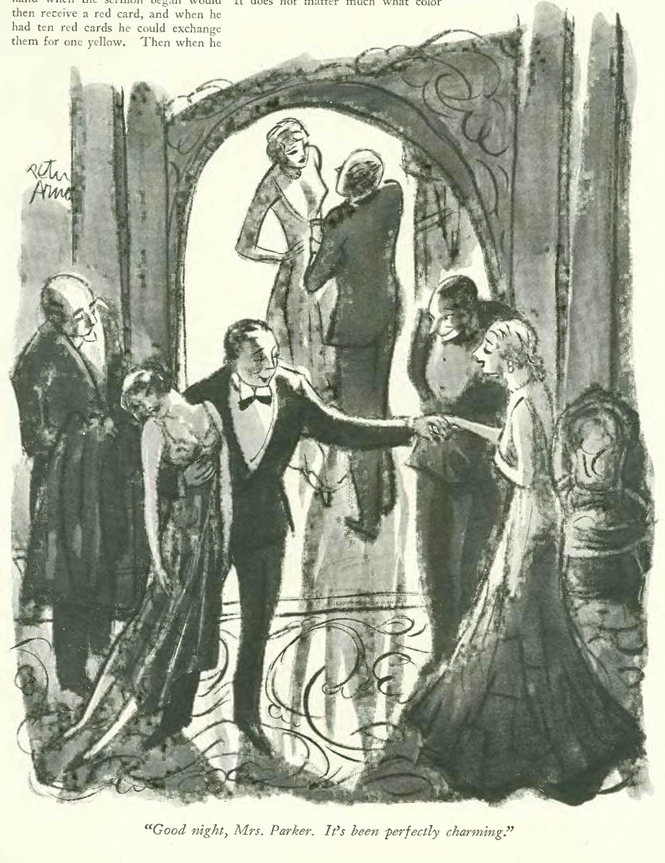
Peter Arno once again found humor in the partying life…

…as did Gardner Rea

Next Time: All Quiet on the Western Front…