The Last Summer

Winding down the last summer of the 1920s — an unusually hot one — one detects subtle changes in The New Yorker’s mood; weary from the decade-long party known as the Roaring Twenties, a bit more mature, and more confident in its voice thanks to the regular writings of James Thurber, E.B. White and Lois Long and copious cartoons and illustrations by such notables as Peter Arno, Barbara Shermund and Helen Hokinson that gave the magazine a distinctively modern feel as it headed into the 1930s.

Aug. 10, 1929 cover by Theodore Haupt; Aug. 17 cover by Peter Arno.

The exuberance associated with the rapidly changing skyline was still there, however, as the Aug. 17 “Talk of the Town” speculated on the race for the world’s tallest building. The article not only anticipated an architect’s sleight of hand, but also a Zeppelin docking station that in the end would top the world’s tallest building:

As it turned out, William Van Alen did not have to compete against himself, the commission for One Wall Street instead going to Ralph Walker, who would design a beautiful art deco landmark that, at 50 stories, would not vie for the title of the world’s tallest building. Unbeknownst to The New Yorker, and perhaps Van Alen, the challenger would instead be 40 Wall Street, which would hold the crown as world’s tallest for about a month. Thanks to some sleight of hand (see caption below) the Chrysler building would quickly surpass 40 Wall Street and hold the title for just eleven months, bested in the end by the Empire State Building (which would sport a “Zeppelin superstructure”).

DECO DELIGHTS…40 Wall Street (left) vied with the Chrysler Building for the title of the world’s tallest building. The 927-foot 40 Wall Street would claim the title in late April 1930. One month later, the Chrysler building would sprout a needle-like spire (secretly constructed inside the building) bringing its total height to 1,046 feet. The builders of 40 Wall Street cried foul and claimed that their building contained the world’s highest usable floor, whereas the Chrysler’s spire was strictly ornamental and inaccessible. Less than a year later the point was made moot when the Empire State Building soared above them both. (Wikipedia/The Skyscraper Museum)
ERECTILE DYSFUNCTION…Clockwise, from top left, progression of designs for the Chrysler Building; the building’s architect, William Van Alen; drawing from Popular Science Monthly (Aug. 1930) revealed the inner workings of the spire’s clandestine construction; Zeppelin docking station for the Empire State Building as imagined in a composite (faked) photograph. At 1,250 feet, the wind-whipped mooring mast proved not only impractical, but downright dangerous. In September 1931 a dirigible briefly lashed itself to the mast in 40 mph winds, and two weeks later the Goodyear Blimp Columbia managed to deliver a stack of Evening Journals to a man stationed on the tower. Contrary to the faked photograph, no passengers ever transferred from the tower to a Zeppelin. (Skyscraper City/Wikipedia/NY Times)

*  *  *

What, Me Worry?

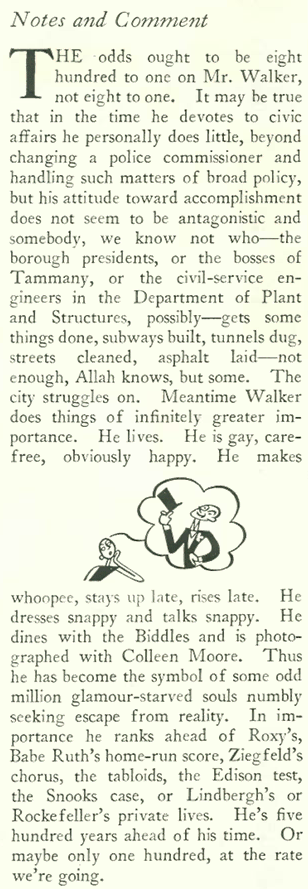
The famously flamboyant New York City Mayor Jimmy Walker lived the easy life during his initial years as Hizzonner, riding a booming economy, partying with the rich and famous (while flaunting Prohibition laws), carousing with his mistress (Ziegfield dancer Betty Compton) and sleeping until noon. When reform-minded Fiorello La Guardia challenged Walker’s reelection bid in 1929, Walker left the dirty work to his Tammany Hall cronies and continued to charm the public, and The New Yorker. The Aug. 17 “Talk of the Town” observed:
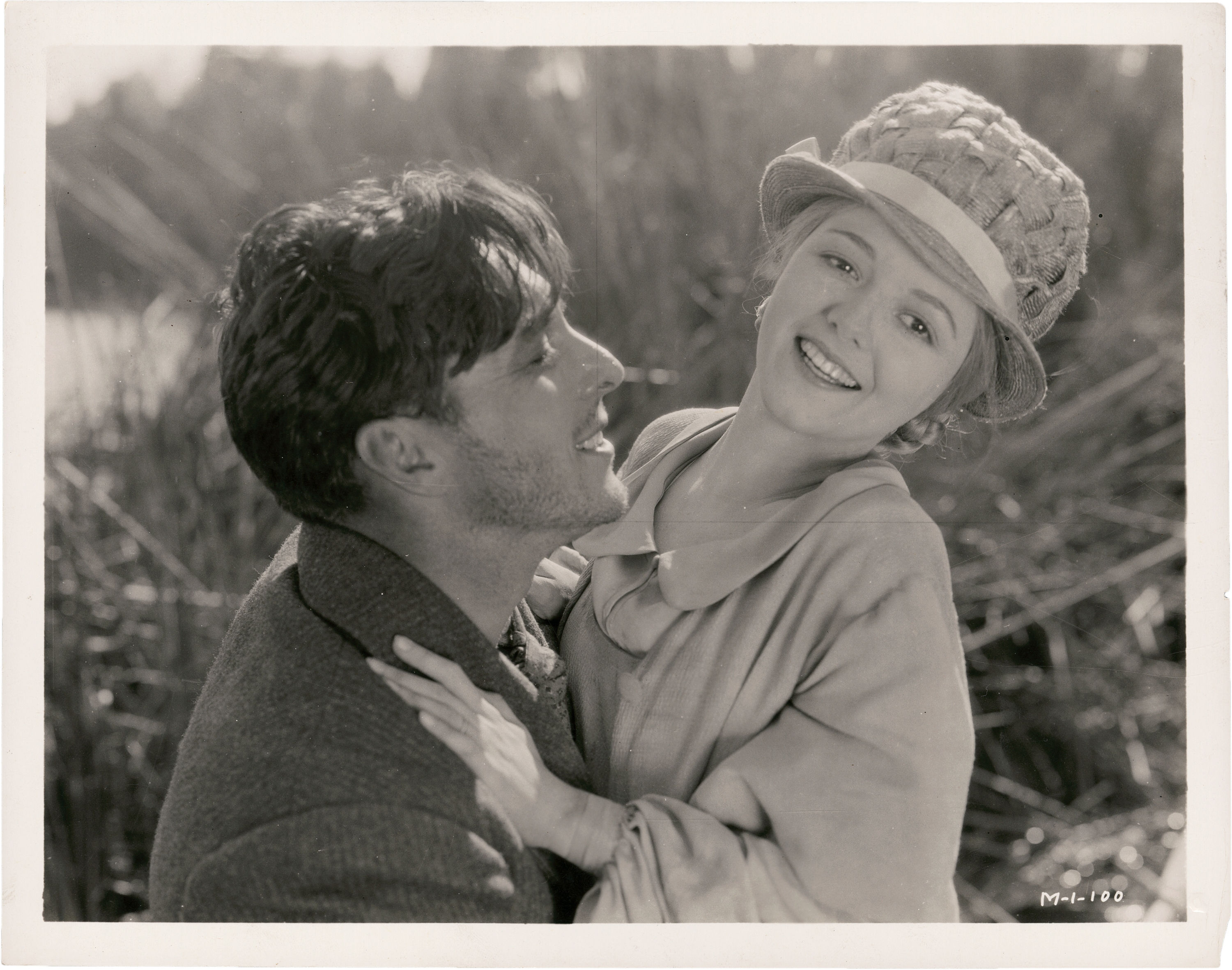
IT’S EASY BEING ME…Mayor Jimmy Walker accompanied actress Colleen Moore to the October 1928 premiere of her latest film, Lilac Time. (konreioldnewyork.blogspot.com)
I HAVE MY EYE ON YOU…Reform-minded Fiorello La Guardia (right) detested Jimmy Walker and his Tammany cronies, but that wasn’t enough to get him elected in 1929. The Great Depression would soon turn the tables. (Wikipedia)

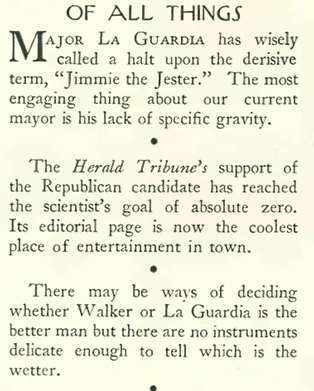
Howard Brubaker, in his Aug. 17 “Of All Things” column, suggested that La Guardia had a zero chance of getting elected. Just three years later, Walker would resign amid scandal and flee to Europe. La Guardia, on the other hand, would be elected to the first of his three terms as mayor in 1933, riding the wave of the New Deal.
 *  *  *

Peek-A-Boo

Politics might have been business as usual, but in the world of fashion the vampish hat styles associated with flappers were giving way to a new rolled-brim look that seemed to suggest an aviator’s helmet. In her Aug. 17 fashion column “On and Off the Avenue,” Lois Long reported:

FACING THE FUTURE…Vampish hats of 1928, pictured at top, gave way to the rolled-brim or flare look of 1929. (Images gleaned from magazine/catalog images posted on Pinterest)

Long seemed to welcome the idea that women should once again bare their foreheads…

 *  *  *

Twain Wreck

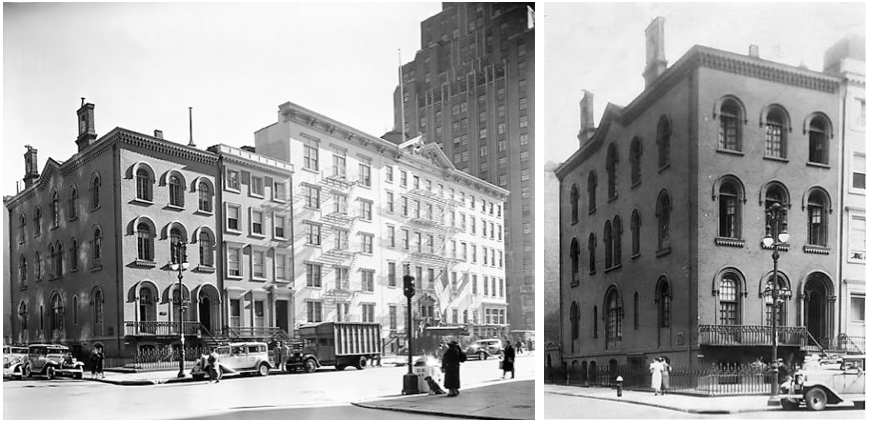
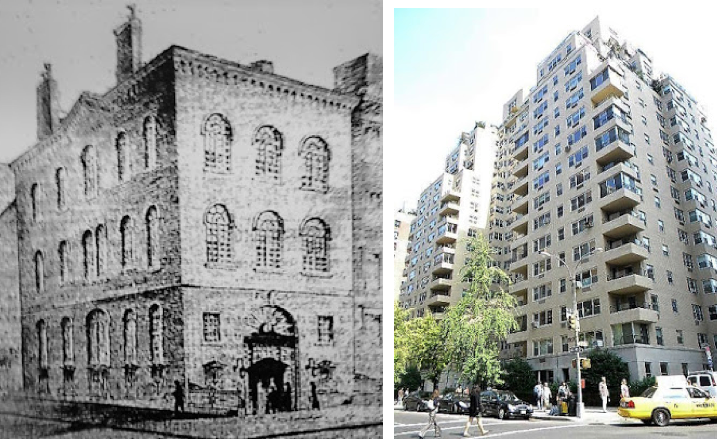
Jumping back to the Aug. 10 issue, “The Talk of the Town” reported on the possible remodeling or demolition of a house once occupied by Samuel Clemens, aka Mark Twain. The house in question was a lavish old mansion built by Henry Brevoort, Jr. in 1834, at the northwest corner of Fifth Avenue and 9th Street. Twain lived in the house from 1905 to 1908, and it was there that Twain’s biographer Albert Paine conducted interviews with the author and wrote the four-volume Mark Twain, a Biography; The Personal and Literary Life of Samuel Langhorne Clemens. When millionaires abandoned their Fifth Avenue mansions in the 1920s and high-rise apartments took their place, there was pressure to either convert an old mansion like the Breevoort house at 21 Fifth Avenue to apartments or demolish it altogether.

LOOKING GOOD AFTER A CENTURY…At left, Berenice Abbott took this photograph of No. 21 Fifth Avenue in 1935. At right, in a close-up shot from the same period, the 1924 plaque from the Greenwich Village Historical Society is visible on the side of the house. (Museum of the City of New York/Greenwich Village Historical Society)
A NOW FOR SOMETHING COMPLETELY DIFFERENT…A proposed 1929 remodeling (left) moved the front door of the old Brevoort mansion to the center and lowered it to street level. At right, today the 1955 Brevoort apartment house occupies the site. (daytoninmanhattan.blogspot.com)

The Greenwich Village Historical Society did what it could to save the house, and in 1924 affixed a bronze plaque to a side wall noting that both Twain and Washington Irving were once occupants. When the house was slated for demolition in 1954, the Society appealed to New Yorkers to raise the $70,000 needed to move the building, but only a fraction of that amount was secured. No. 21 was demolished in 1954 along with the rest of the houses on that block.

 *  *  *

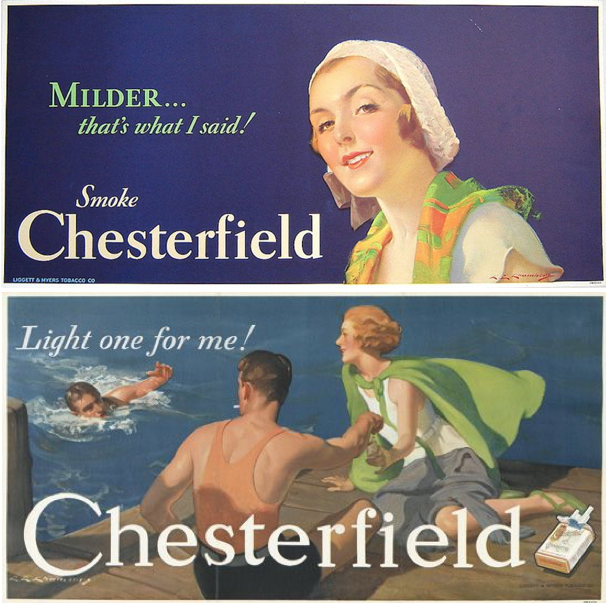
Charles Edward Chambers was an American illustrator probably best known for his Chesterfield ads, although he also illustrated stories for a number of popular magazines from the early 1900s until his death in 1941. The Aug. 10 “Talk of the Town” looked in on his work with model Virginia Maurice:

QUICK…THROW THAT MAN A CIGARETTE!…Examples of Charles Edward Chambers’ Chesterfield ads from 1929 featuring model Virginia Maurice. Note that Maurice is wearing the latest “rolled brim” hat style in the upper image. (Pinterest)
HIS NONSMOKING SECTION…A 1919 Harper’s cover illustration by Charles Edward Chambers. (Wikipedia)

*  *  *

Mama’s Boy

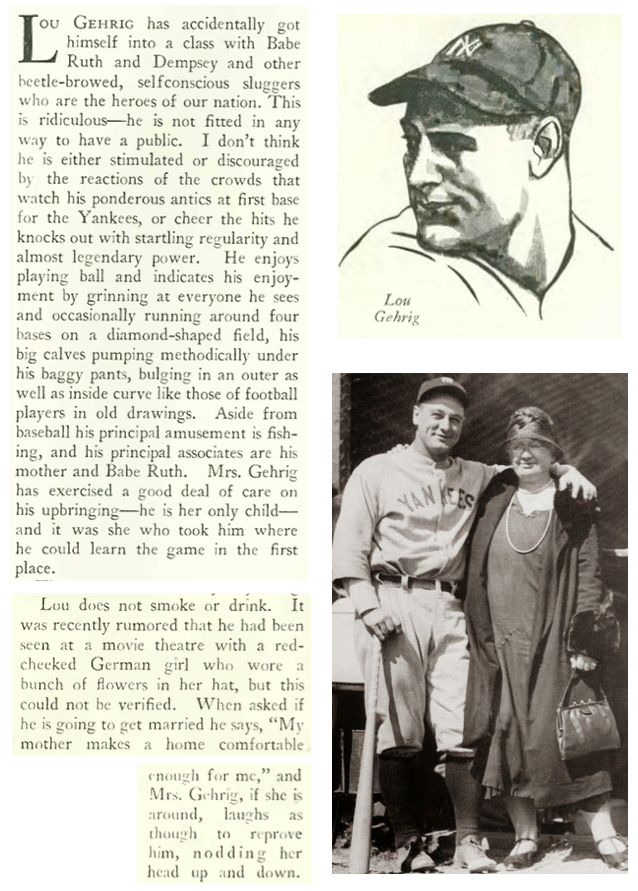
Lou Gehrig rivaled Babe Ruth as a top Murderer’s Row slugger for the 1929 Yankees, yet he couldn’t be more opposite in his lifestyle. A teetotaler and nonsmoker, Gehrig was completely devoted to mom (pictured below in 1927). Niven Busch Jr. submitted this profile of Gehrig for the Aug. 10 issue. Excerpts:
 *  *  *

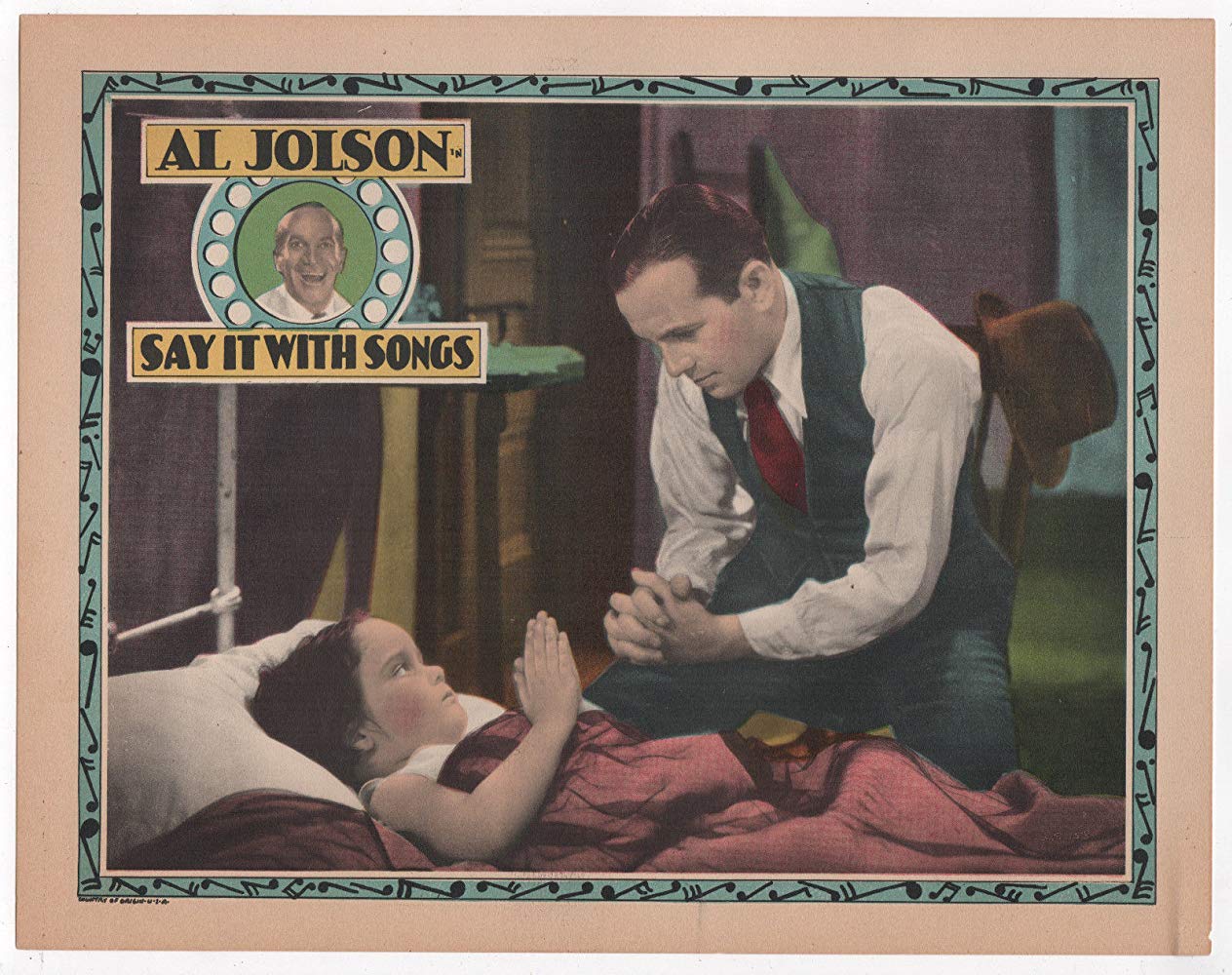
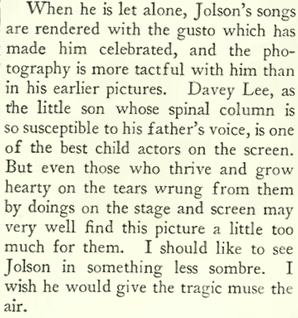
After appearing as Al Jolson’s dying son in The Singing Fool (1928), the child actor Davey Lee returned to the screen for yet another Jolson weeper, 1929’s Say It With Songs. Once again portraying Jolson’s son—this time crippled and rendered dumb after being hit by a truck—he miraculously recovers at the end of the film. The New Yorker wasn’t having any of this sentimental treacle, especially served up for a second time…
LET’S PRAY FOR A BIG BOX OFFICE…Davey Lee and Al Jolson in Say It With Songs. (IMDB)

…and the magazine hoped for something a bit less somber from Jolson in the future, suggesting that he “give the tragic muse the air”…
In the same issue of The New Yorker, this advertisement touted Jolson’s recording of “Little Pal” from Say It With Songs (note the blackface image of Jolson—his unfortunate trademark back in the day)…

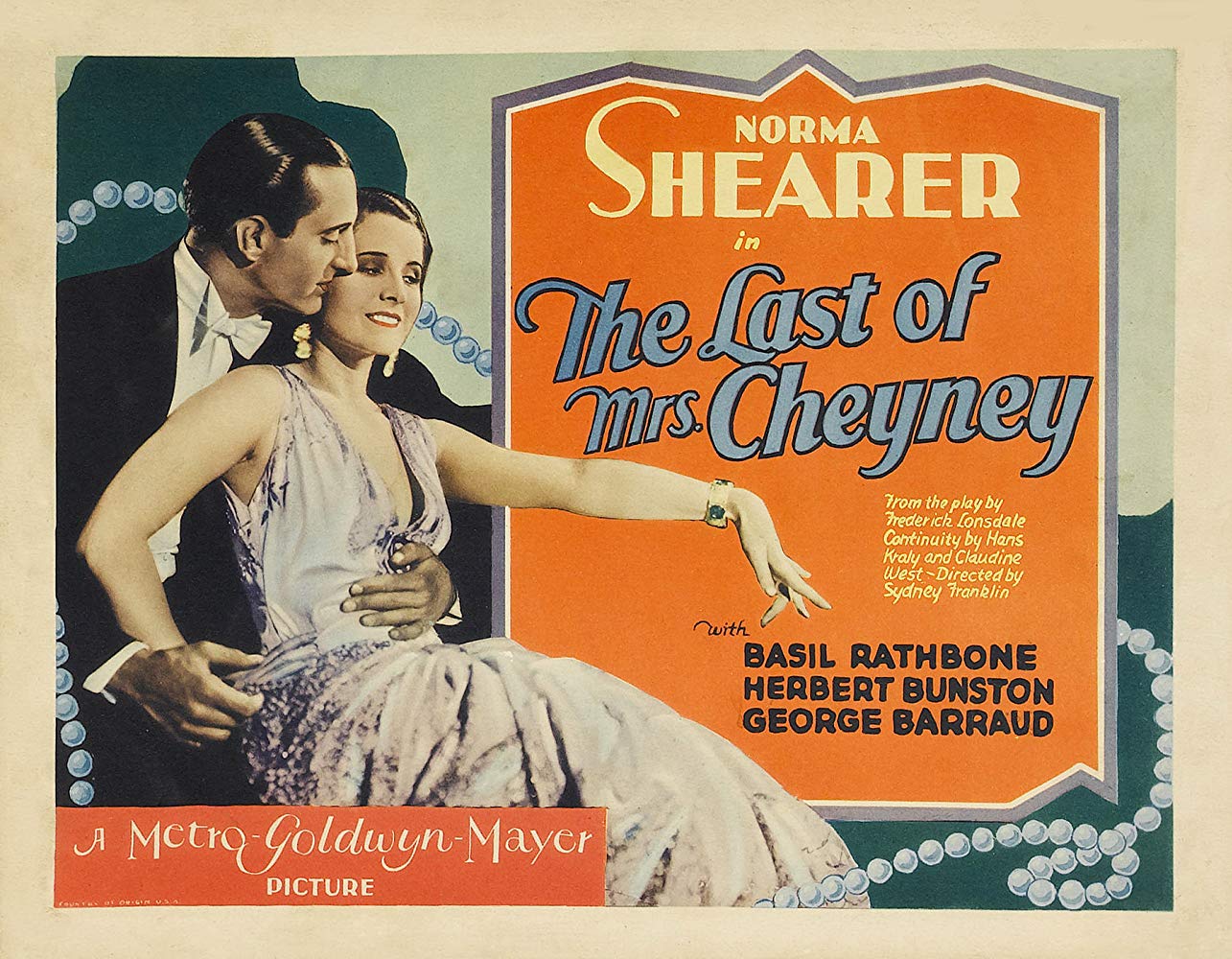
…happily, there were other movies that offered less schmaltzy diversions, including Norma Shearer’s comedy-drama The Last of Mrs. Cheyney, in which Shearer portrayed the jewel thief Fay Cheyney…

OH BASIL YOU ANIMAL…Theatre card for The Last of Mrs. Cheyney. (IMDB)

…often cast as a heavy in silent films, it was the “talkies” that made William Powell a star, his pleasant voice more suited to a hero or leading man than a villain. In The Greene Murder Case, Powell portrayed amateur detective Philo Vance, a role that he played in another 1929 release, The Canary Murder Case (originally filmed as a silent in 1928), both based on mystery novels by S.S. Van Dine. Powell would portray Philo Vance in three more films from 1930 to 1933 until he took on the role of another amateur detective, Nick Charles, in 1934’s The Thin Man (a role he would reprise five times from 1936 to 1947)…
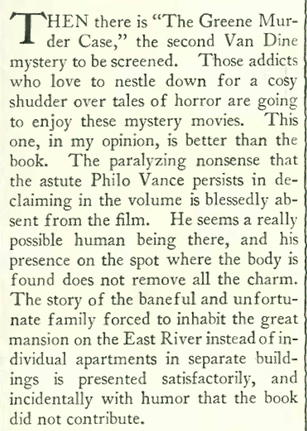
WHODUNNIT? YOUDUNNIT!…William Powell as detective Philo Vance, Florence Eldridge as Sibella Greene, and Jean Arthur as Ada Greene in 1929’s The Greene Murder Case. (IMDB)
KEEPING IT QUIET…William Powell as Philo Vance and Louise Brooks as “the Canary,” a scheming nightclub singer, in The Canary Murder Case. Brooks was a huge star in the silent era and the iconic flapper. According to IMDB, the film was shot as a silent in 1928, but producers decided to rework it as a more profitable “talkie.” When Brooks refused to return from Germany (where she was filming Pandora’s Box) to dub the movie, Paramount spread the word that Brooks’ voice was not suited to sound film, although later productions made by Brooks proved this to be wrong. Actress Margaret Livingston ultimately supplied Brooks’ voice for Canary. (IMDB)

*  *  *

From Our Advertisers

We look at some advertisements from the August 17 issue, including this one from Past Blue Ribbon. Note that nowhere in the ad is the word “beer” used, this being a “near-beer” with less than 1% alcohol content by volume. In addition to making cheese (a Velveeta-like product), Pabst hoped to keep its company alive by selling this “brew” during the unusually hot summer of 1929…

…and with that blazing sun advertisers also promoted a number of face creams and powders to those “enjoying the sunny outdoor life,” including this two-page spread from Richard Hudnut and Poudre Le Début

…the outdoor life could also be enjoyed in a convertible Packard 640, a car that was a cut above a Lincoln or Cadillac, and was considered by some to be America’s answer to the Rolls Royce…
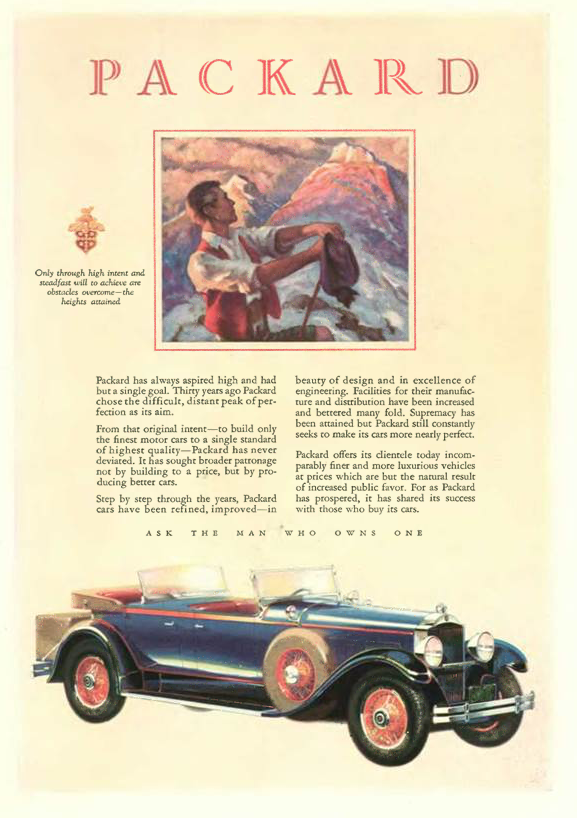
A 1929 Packard 640 Convertible. This particular model can be had today for about $130,000. (Hemmings Motor News)

…I found this ad in the back pages interesting for its crude design yet overt appeal to snobbishness with this haughty pair…
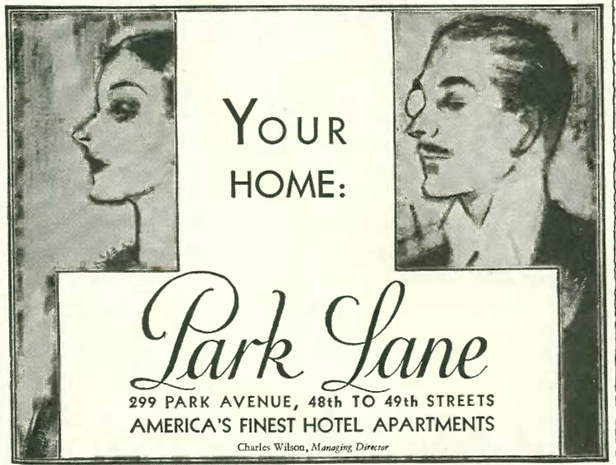
…and here is what the Park Lane looked like when it opened in 1924…

Circa 1924 advertisement from the Sargent lock and hardware company touting its fixtures in the new Park Lane hotel apartments. At right, circa 1924 image from The American Architect depicting the Park Lane’s dining room. The building is long gone, razed some time in the 1960s to make way for an office tower. (Pinterest)

 *  *  *

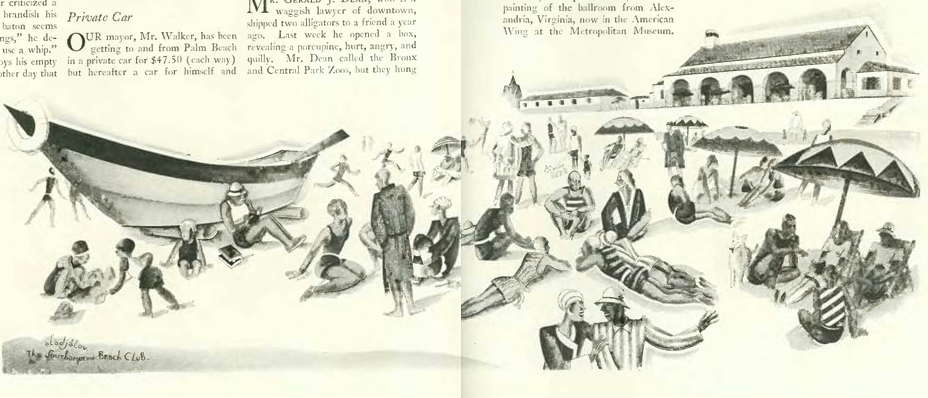
This week’s featured illustration is by Constantin Alajalov, who depicted a summer scene from the Southampton Beach Club…click to enlarge…
…our cartoonists from the Aug. 10 issue include Helen Hokinson, who looked at the challenges of Americans abroad…

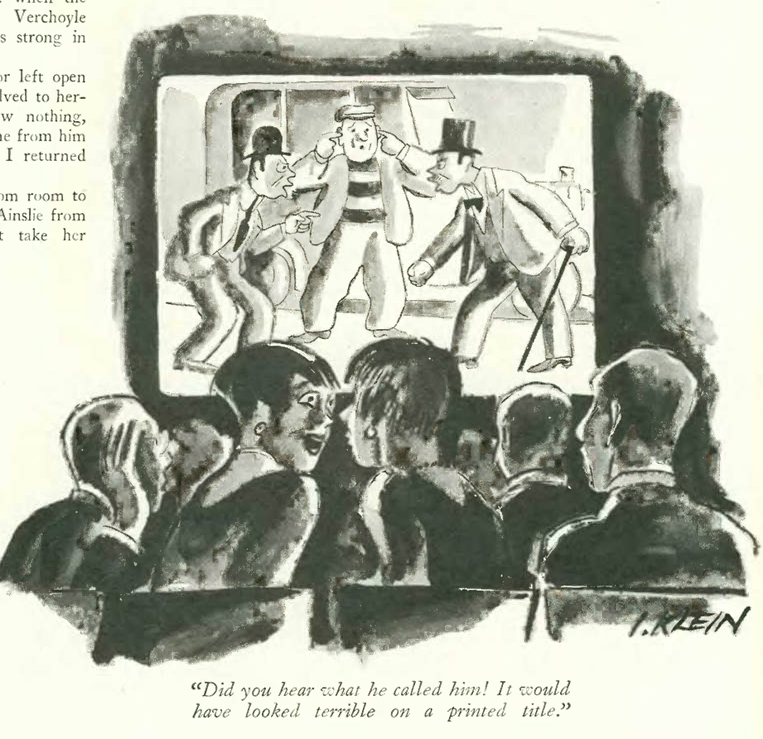
Isadore Klein observed the changing mores of movie houses (a couple of “damns” were apparently uttered in the talking pictures of 1929)…
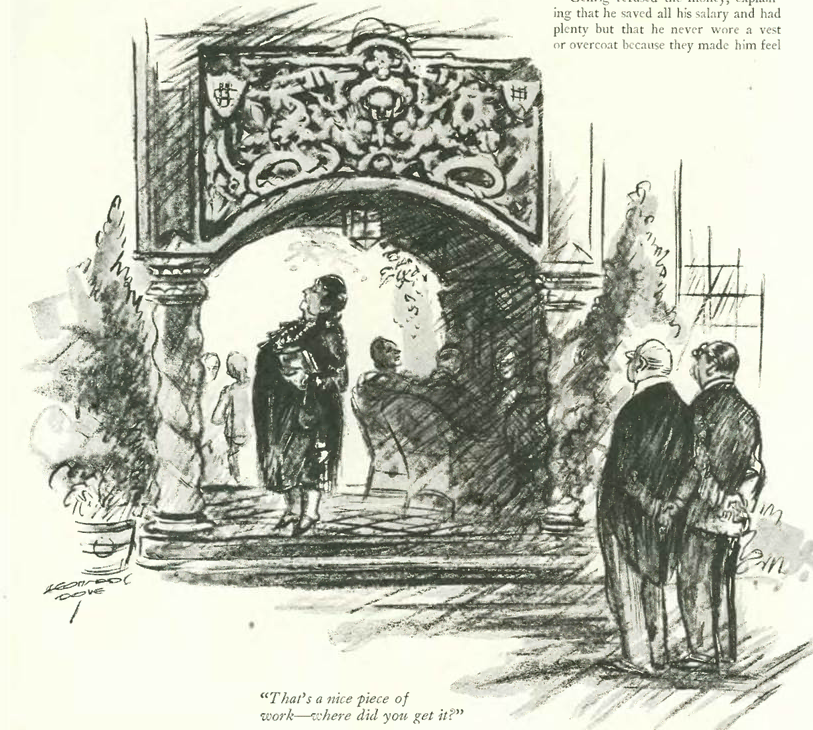
…and Leonard Dove offered up a double entendre of sorts…
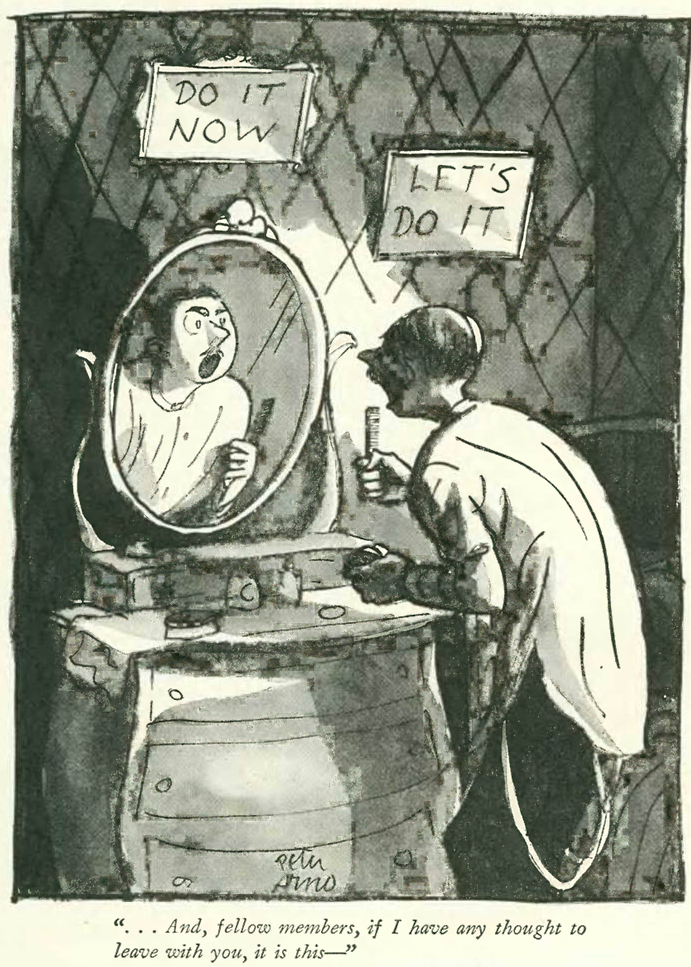
…cartoons for the Aug. 17 issue included a peek behind the scenes at a motivational speaker courtesy Peter Arno

Carl Kindl had some fun with the juxtaposition of a matron and a flapper hat…

…and for reference, the cloche hat called a “Scalawag” was featured in this ad by Knox in the March 30, 1929 New Yorker…drawing by Carl “Eric” Erickson

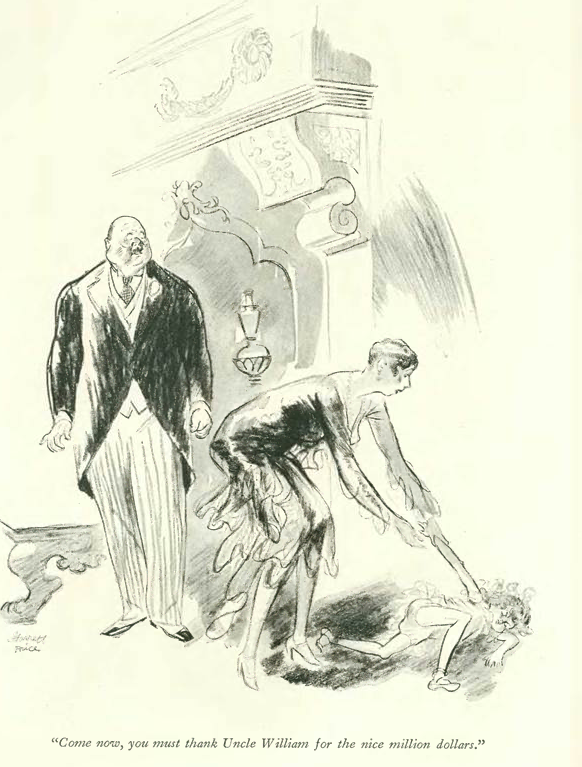
Garrett Price portrayed the antics of an ungrateful trust fund brat, who probably did not have that million dollars after the market crash…
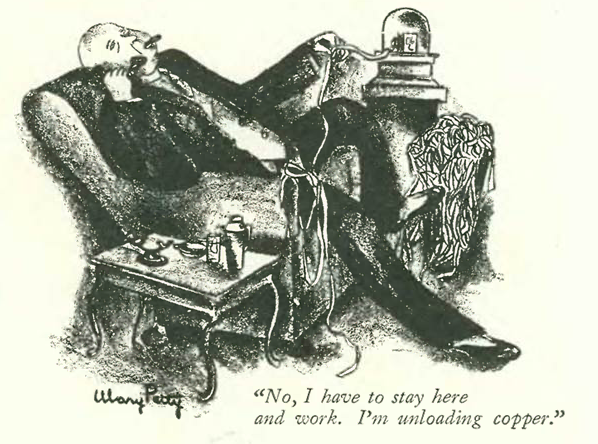
…and this fellow, depicted by Mary Petty, who doubtless would be less nonchalant come Oct. 28, or what we know as “Black Monday”…
Next Time: Hooray for Hollywood…


Georgia on My Mind

Although artist Georgia O’Keeffe has long been celebrated for her desert imagery and interpretations of natural forms, during the 1920s her heart was very much in New York City.

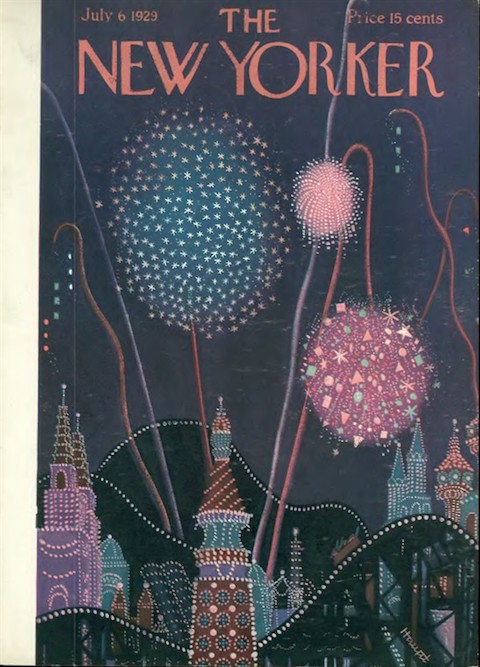
July 6, 1929 cover by Theodore Haupt.

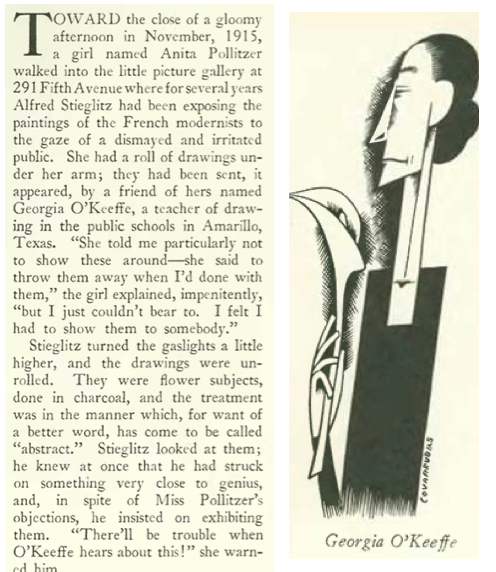
And New York City was where it all began for O’Keeffe (1887-1986). In January 1916, the famed photographer Alfred Stieglitz (1864-1946) was shown a portfolio of charcoal drawings by O’Keeffe’s friend, Anita Pollitzer. Stieglitz was so impressed that he immediately made plans to exhibit the drawings—without O’Keeffe’s permission. The longtime art critic for The New Yorker, Robert Coates, told the story in the opening lines of his July 6 profile piece on the artist:

O’Keeffe moved from Texas to New York in 1918, and she and Stieglitz would marry in 1924, a marriage that would last until his death in 1946 (despite the fact he took a longtime lover, 22-year-old Dorothy Norman, in 1927).

TWO OF A KIND…Alfred Stieglitz, left, photographed by Paul Strand at Lake George, New York, in 1929. Exhausted and depressed, Stieglitz had retreated to the lake for the summer after learning that his exhibition space in the Anderson Galleries, which he called “The Room,” would be demolished along with the gallery building.  ∞  Center, a photo Stieglitz had attached to a July 10, 1929 letter to O’Keeffe, who had begun spending summers painting in New Mexico. Below the photograph he wrote, “I have destroyed 300 prints to-day. And much more literature. I haven’t the heart to destroy this…”    O’Keeffe in a 1929 photograph by Stieglitz, after her return from New Mexico. (aperture.org/Yale Beinecke Library/flashbak.com) click to enlarge

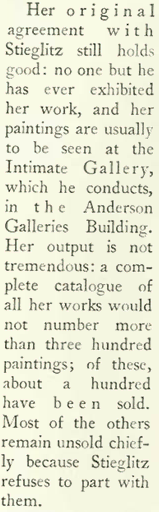
Following O’Keeffe’s first exhibition at the 291 gallery, Stieglitz established a firm hold over the display and sale of her work:

During the 1920s O’Keeffe found much inspiration on the streets of Manhattan, and particularly in the proximity of the Shelton Hotel, where she lived from 1925 to 1936. The Shelton, which opened in Midtown in 1924 as the tallest hotel in the world, provided a perfect vantage point for O’Keeffe to observe city life:

EYE OF THE BEHOLDER…Georgia O’Keeffe was captivated by her adopted city, particularly views from and around New York’s Shelton Hotel, where she lived from 1925 to 1936. Top row, from left: New York Street with Moon (1925)  ∞  New York Street No. 1 (1926)  ∞  Shelton Hotel New York No. 1 (1926)    The Shelton with Sunspots (1926)    East River From the Shelton (1926)  ||  Bottom row, from left: New York Night (1929)    Radiator Building – Night, New York (1927)    East River From the 30th Story of the Shelton Hotel (1928)  ∞  Ritz Tower, Night (1928). (museothyssen.org/okeeffemuseum.org/curiator.com/virginia.edu/isak.typepad.com/ theartstack.com (2)/ephemeralnewyork.wordpress.com/artnet.com) click to enlarge

 *  *  *

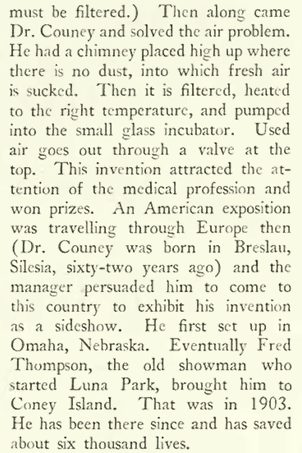
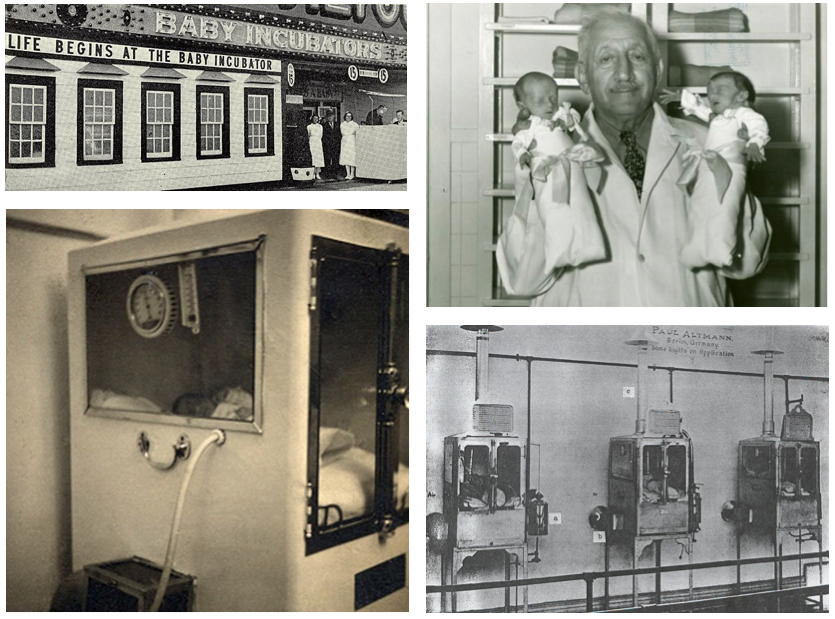
During the early decades of the 20th century Martin Couney (1870-1950) was renowned for his baby incubator exhibits at various world’s fairs and for his long-standing display of incubating babies at New York’s Coney Island, wedged between the usual sideshow attractions of freaks and burlesques. Couney charged visitors 25 cents to view the infants (in order that their parents would not have to pay for their medical care). “The Talk of the Town” looked in on Couney…

I’M NOT A DOCTOR. I JUST PLAY ONE IN REAL LIFE…Clockwise, from top left, Incubator display building on Coney Island circa 1920s; Martin Couney with babies in undated photo; Couney’s early infant incubators in operation at the Trans-Mississippi Exposition in Omaha, 1898; the infant Beth Allen in a Coney Island incubator, 1941. (NPR/New York Public Library Digital Collections/Beth Allen)

Although many physicians at the time reviled Couney as a showman and a quack (he was most likely not a trained medical doctor), he nevertheless saved the lives of thousands of infants who would have died if left to the care of hospitals that were slow to catch on to this lifesaving device (they weren’t widely adopted until after Couney’s death in 1950). The “Talk” article credited Couney for saving “about six thousand lives.” Many of those babies went on to live long and healthy lives:

SEEING IS BELIEVING…Beth Allen (pictured, at left, in 2016, and as an infant in the photo montage above) was born three months premature in Brooklyn in 1941. Her mother initially rejected putting Beth in one of Couney’s Coney Island incubators, but her father persuaded Martin Couney to talk to his wife, who acquiesced. At right, Lucille Horn (pictured with daughter Barbara in 2015) was given little hope by doctors when she was born premature in 1920. The hospital staff told her father that they didn’t have a place for her, and that she had no chance of survival. Nevertheless, her father grabbed a blanket to wrap her in, hailed a taxicab and took her to Couney’s infant exhibit at Coney Island. Barely 2 pounds in 1920, she lived to age 96. (AP/NPR StoryCorps)

 *  *  *

The Electric Company

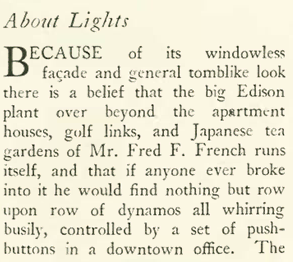
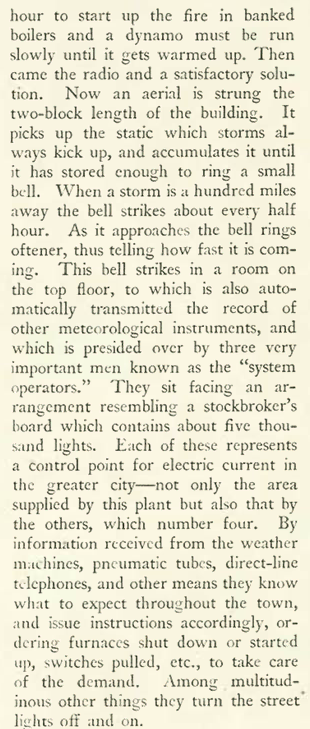
The 1920’s saw an explosion of labor-saving electric appliances, ranging from electric fans and irons to vacuum cleaners and refrigerators. The decade also saw a massive proliferation of electric lights, and the huge power plants that would be needed to keep everything running. “Talk” looked in on the Edison Company’s East River power plant to see how it all worked:

STILL HUMMING…Edison’s East River power plant (now ConEd), entered service in 1926 and is still in operation today (with a number of updates and additions over the years). At right, a 1920s view of the Broadway lights (newtownpentacle.com/Museum of the City of New York)

The opening of the Edison plant on the East River was a big deal in 1926. According to the ConEd website, “the six-story boilers installed at Fourteenth Street and East River were so large that a luncheon for nearly 100 people was served inside one of them before the renovated station went into operation… during the opening day ceremony in 1926, Queen Marie of Rumania flipped the switch to start the 100,000 horsepower turbine generator.”

“Talk” also offered some interesting insights into the plant’s complex operations, including an unusual storm warning system:

YOU GET THE IDEA…A Philadelphia Electric Company control room in the 1920s. New York’s was undoubtedly much larger. (IEEE Computer Society)

*  *  *

From Our Advertisers

Fleischmann Yeast was a regular advertiser in The New Yorker for a good reason: Raoul Fleischmann (of the New York yeast and baking giant) hated the baking business but loved hanging out with the Algonquin Round Table crowd, which included New Yorker founding editor Harold Ross. When the fledging magazine nearly went belly up in 1925, Fleischmann kicked in the money (and on a number of occasions thereafter) to keep it going. Hence the “free” advertising he received for his product, touted not as a baking aid, but rather as a cure for constipation and other intestinal turmoils. In this ad, a physician who “treated German Royalty” endorsed the generous consumption of yeast cakes…

…a  footnote on the Fleischmann ad: Dr. Kurt Henius (1882-1947) was a doctor of medicine and a professor on the Friedrich-Wilhelms (now Humboldt) University medicine faculty at the Charité hospital in Berlin, Germany. Because he was Jewish, he was dismissed from the university in 1935, and in 1939 he fled from the Nazis to safety in Luxembourg, where he died in 1947.

 *  *  *

During prohibition we see plenty of ads in The New Yorker for ginger ale and sparkling water, but this one for Pabst Blue Ribbon beer caught my eye. This was, of course, “near-beer,” with an alcohol content of 0.5%…

According to Forbes magazine, the few breweries that managed to survive during Prohibition made everything from ceramics and ice cream to the barely alcoholic near beer. Pabst also turned to making cheese, which was aged in the brewery’s ice cellars. The brand, “Pabst-ett,” was sold to Kraft in 1933 at the end of Prohibition…

(Courtesy Pabst Blue Ribbon)

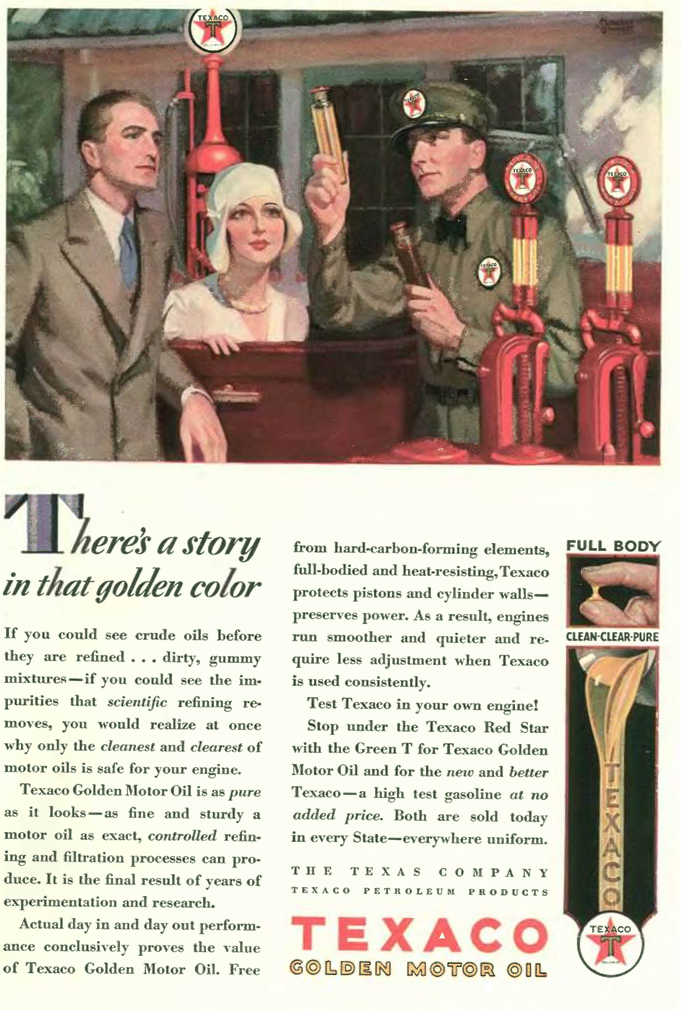
…and this colorful ad comes courtesy of Texaco. Did you ever see two young people more enamored with petroleum products?…

…before we get to the cartoons, here is a two-page illustration in the July 6 issue by Constantin Alajalov (click to enlarge)…

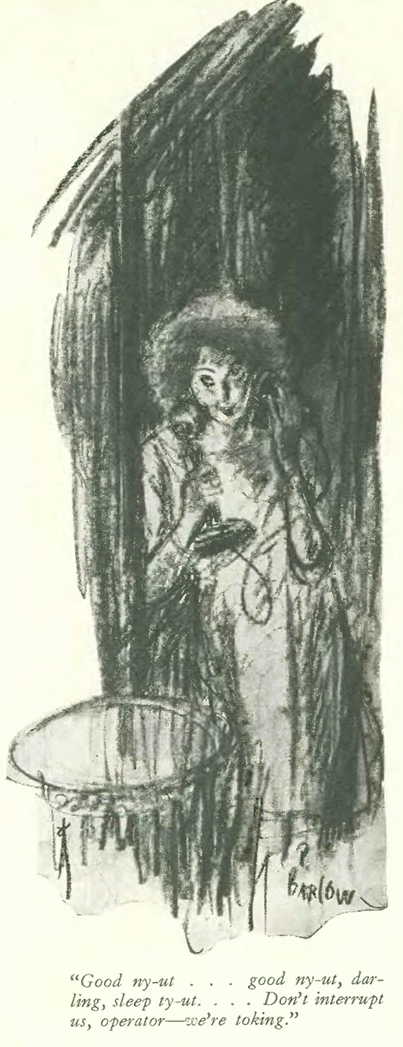
…this peek into the world of trolley car conductors appears to be by Perry Barlow

…and finally, Peter Arno revealed the thankless work of one stuntman…

Next Time: Not Your Grandpa’s Tammany…


Let Them Eat Cake

The re-opening of New York’s Central Park Casino in 1929 was in many ways the city’s last big party before the economy came crashing down, along with the exhuberance and frivolity of the Jazz Age.

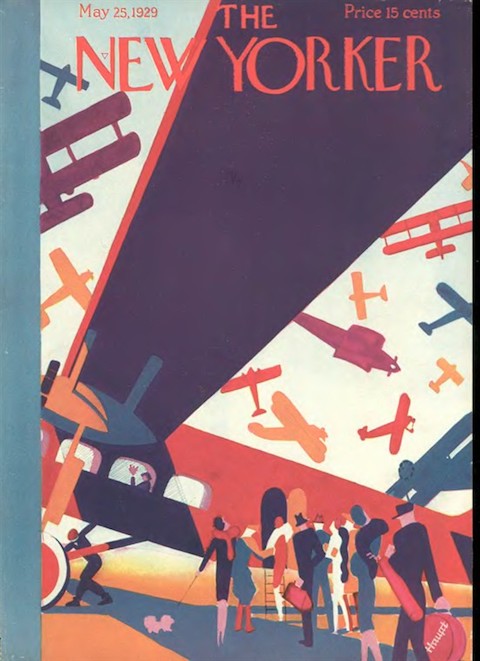
May 25, 1929 cover by Theodore Haupt.

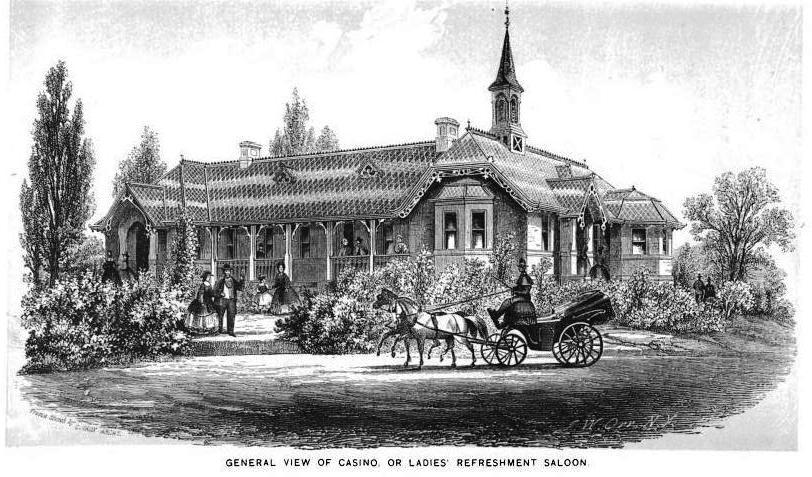
The Casino itself wasn’t new–it opened in 1864 as the Ladies’ Refreshment Salon (sometimes spelled “saloon”), a two-room stone cottage designed by Calvert Vaux. As Susannah Broyles writes in her excellent blog post for the Museum of the City of New York, the Victorian cottage was a place where “unaccompanied ladies could relax during their excursions around the park and enjoy refreshments at decent prices, free of any threat to their propriety.”

Central Park’s Ladies’ Refreshment Saloon opened in 1864. (daytoninmanhattan.blogspot.com)

Broyles writes that by the 1880s the salon had morphed into a far pricier destination, a restaurant called The Casino, open to both sexes. With the rare attraction of outdoor seating, “it was the place to see and be seen.”

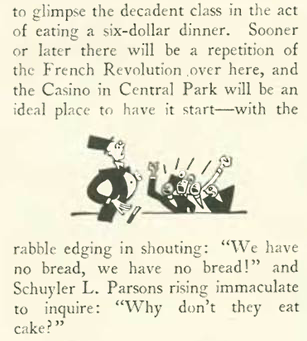
By the 1920s the restaurant had grown a bit shabby. Then along came the city’s flamboyant mayor, Jimmy Walker (1881-1946), who saw the potential of the property as a place where he could hob-nob with wealthy and fashionable New Yorkers and openly flaunt Prohibition laws. There were others, however, who found the idea of an exclusive playground for the rich in a public park distasteful. The New Yorker observed as much in the “Notes and Comment” opening of “The Talk of the Town”…

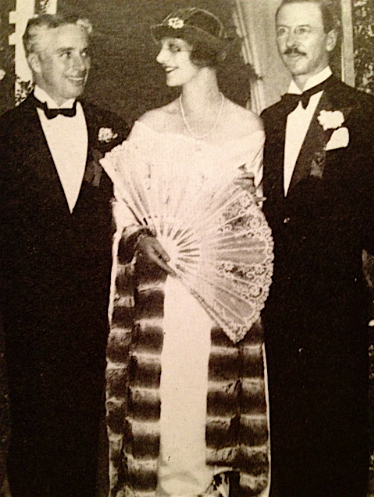
…the “Schuyler L. Parsons” referred to above was a tireless host, prominent decorator, and a society A-lister. He is pictured here (circa 1930) with two of his closest friends, actor Charlie Chaplin and the actress, singer and dancer Gertrude Lawrence

(Tyler Hughes Collections)

The Central Park Casino reopened its doors on June 4, 1929 at an invitation-only event. The following day it would open to the public, but as New York’s newest and most expensive restaurant it would remain closed to all but the wealthiest. As The New Yorker observed, the city was, after all, a “plutarchy,” and the populace passing by the Casino would at least be allowed “to glimpse the decadent class in the act of eating a six-dollar dinner” (nearly $90 today).

This formal announcement of the opening appeared in the May 6, 1929 issue of The New Yorker, including the time of the event—I suppose for the benefit of the 600 who actually had an invitation, or perhaps to tantalize those without such credentials…

The Casino was a playground for the rich by design, conceived in the image of the flamboyant Mayor Walker—himself a product of the Tammany Hall political machine—and executed by hotelier Sidney Solomon, who obtained the building’s lease via some Tammany-style subterfuge. Solomon hired architect and theatrical set designer Joseph Urban to transform the Casino into a glittering showpiece of Jazz Age nightlife.

Clockwise, from top left, the Central Park Casino; architect Joseph Urban; his Casino ballroom design with black-mirrored ceiling; the Casino lobby. (acontinuouslean.com/Columbia University/centralpark.com/drivingfordeco.com)

The New Yorker continued its observations on the Casino in another “The Talk of the Town” piece titled “Historical Note,” attributing the inspiration for the Casino not to Walker or Solomon, but to socialite Anthony Joseph Drexel Biddle Jr…

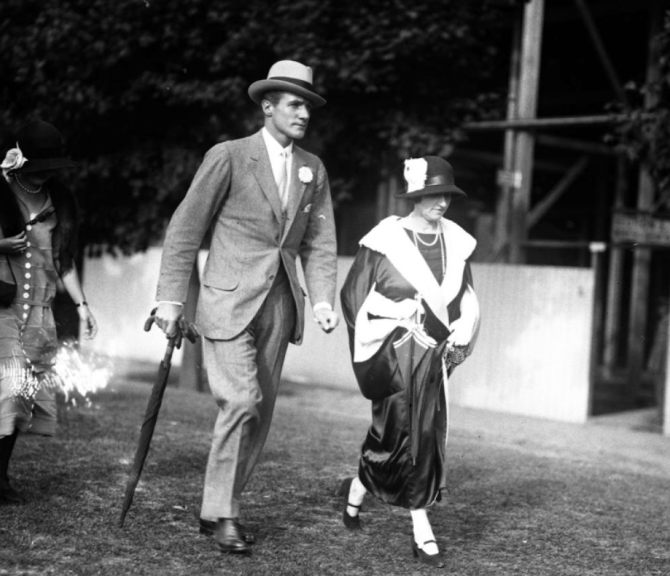
AN EYE FOR THE FINER THINGS…The wealthy socialite A.J. Biddle (pictured here with his first wife, Mary Lillian Duke, in 1924) trained his eye on the Central Park Casino while on the rooftop of the St. Regis Hotel pondering another Joseph Urban project. (voxsartoria.com)
PARTY BOY…New York Mayor Jimmy Walker and his nighttime playground, the Central Park Casino, show here on September 10, 1935. (Britannica/ New York City Department of Parks & Recreation)

Well, as you’ve probably guessed, the party didn’t last forever. After the October 1929 stock market crash, the sight of rich folks stuffing their faces and drinking fine wines in a public park looked even more unseemly. Soon the Casino found itself in the crosshairs of Parks Commissioner Robert Moses, who detested Mayor Walker.

As for Walker himself, a growing financial scandal prompted him to resign from office on Sept. 1, 1932. He promptly fled to Europe with his mistress, Ziegfeld girl Betty Compton, and stayed overseas until the threat of criminal prosecution had passed. For Moses, it wasn’t satisfaction enough to see Walker driven from office. In 1936, despite protests from preservationists, Moses had Urban’s lovely restaurant demolished. It was replaced by a children’s playground the following year.

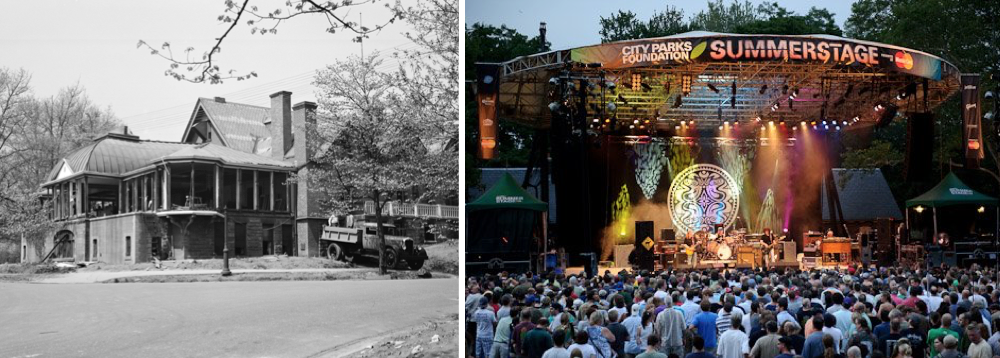
THE PARTY’S OVER…Crews dismantling the Central Park Casino in 1936. In 1937, the Rumsey Playground was built on the site of the Casino, and in the 1980’s the site was razed again and converted into Rumsey Playfield, where the city’s SummerStage events are now held. (Museum of the City of New York/centralpark.com)

*  *  *

A Drinking Life

As the Jazz Age was winding down, one of its greatest chroniclers began a brief relationship with The New Yorker. In the March 12, 2017 issue of the magazine, Erin Overbey and Joshua Rothman wrote “There’s a doomed, romantic quality to the relationship between F. Scott Fitzgerald and The New Yorker; they were perfect for each other but never quite got together.” In total, Fitzgerald published just two poems and three humorous shorts for the magazine, beginning with this piece in the May 25, 1929 issue:

Fitzgerald’s last contribution to the New Yorker would appear in the Aug. 21, 1937 issue (“A Book of One’s Own”). Following the author’s death in 1940 the magazine would feature various articles on his life and work, and in 2017—77 years after Fitzgerald’s death—the New Yorker would publish a long lost short story, “The IOU.” A fitting title for an author who sadly did not get his due while he was alive.

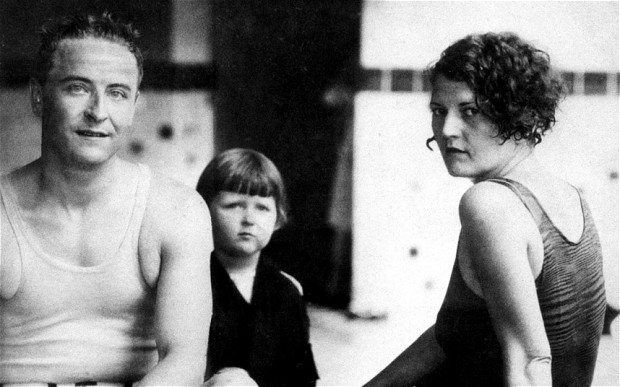
IOU…F. Scott Fitzgerald with daughter “Scottie” and wife Zelda, circa 1927. (The Telegraph)

 *  *  *

One of the Gang

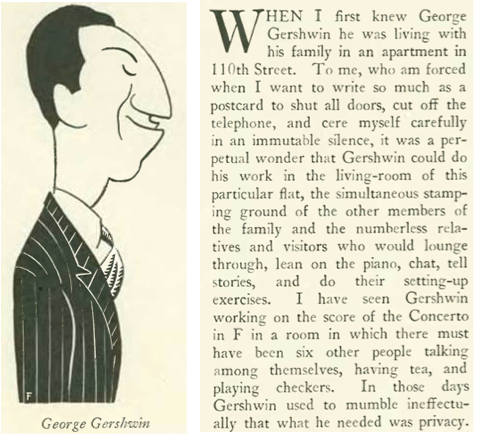
Among the Jazz Age artists and writers who orbited around the Algonquin Round Table (and the Central Park Casino) and chummed with the writers of the New Yorker was musician and composer George Gershwin (1898-1937) who was profiled in the May 25 issue by his friend and longtime New Yorker writer Samuel N. Behrman. The opening paragraph (with caricature by Al Frueh):

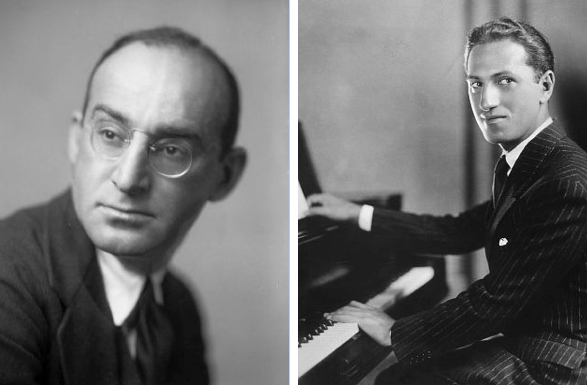
IN THE SAME ORBIT…Samuel Nathaniel Behrman (left), was an American playwright, screenwriter, biographer, and longtime writer for The New Yorker. From the late 1920s through the 1940s, he was considered one of Broadway’s leading authors of “high comedy,”His son is the composer David Behrman. At right, George Gershwin at the piano, 1929. (prabook.com/IMDB)

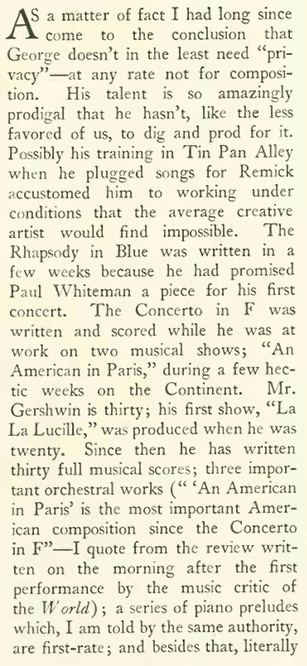
In the profile, Behrman observed that although Gershwin expressed a desire for privacy, he was quite capable of dashing off major works in practically any setting:

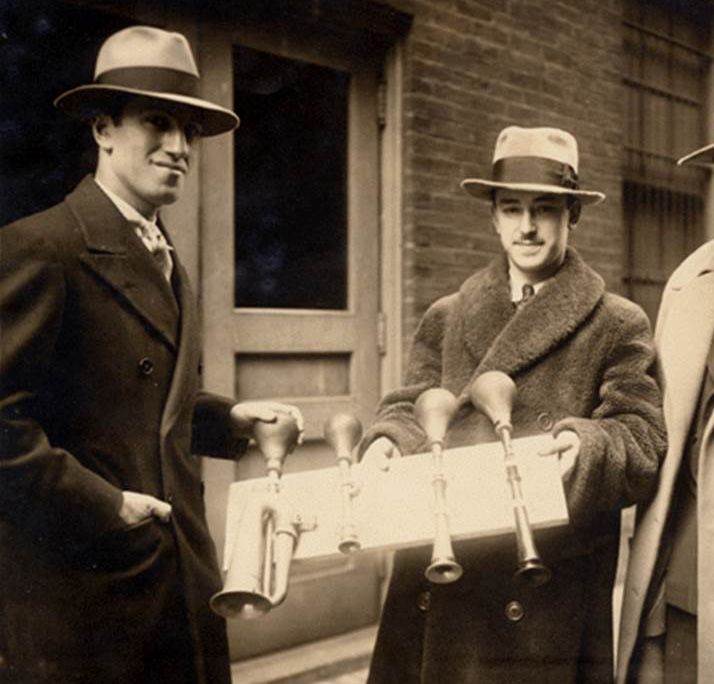
TOOTING HIS OWN HORN…Composer George Gershwin and Cincinnati Symphony Orchestra percussionist James Rosenberg holding four taxi horns used in the orchestra’s performance of An American in Paris, on Feb. 28, 1929. (Photo courtesy of Ira and Leonore Gershwin Trusts)

 *  *  *

Scratching the Surface

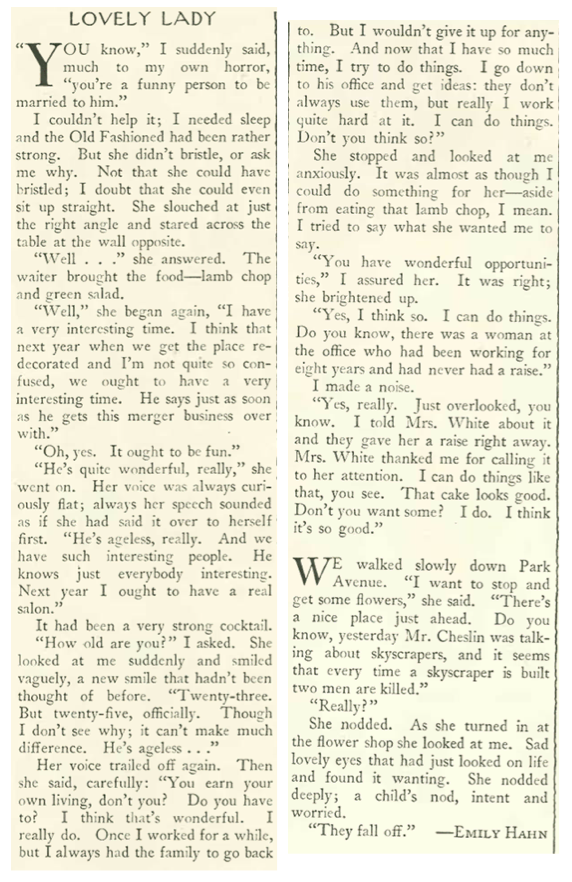
Emily Hahn (1905-1997) was a prolific journalist and author who contributed at least 200 poems, articles and works of fiction to The New Yorker over an astonishing 68-year span—from 1928 to 1996. As the title suggests, I am merely scratching surface, and will devote a post to her in the near future. Here is her contribution to the May 25, 1929 issue:

PROLIFIC…A 1937 portrait of Emily Hahn taken in Shanghai, China, by Sir Victor Sassoon. The author of 54 books, Hahn is credited with playing a significant role in opening up Asia and Africa to the West through her many novels. (DeGolyer Library, SMU)

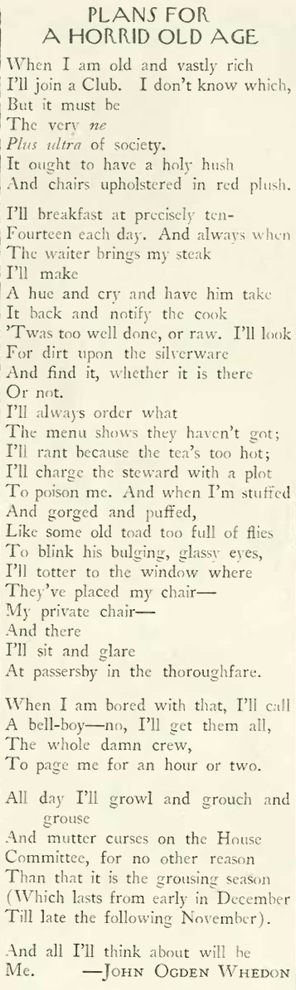
Another frequent contributor to The New Yorker was screenwriter John Ogden Whedon (1905-1991), who offered up mostly shorts from 1928 to 1938. He is best known as a television writer for such shows as The Andy Griffith Show, The Dick Van Dyke Show and Leave It to Beaver. Whedon and his wife, Louise Carroll Angell, were parents and grandparents to a number of screenwriters, including grandson Joss Whedon, creator of Buffy the Vampire Slayer and writer/director of The Avengers (2012) and its sequel Avengers: Age of Ultron (2015). An excerpt of grandpa’s writing from the May 25 issue:

 *  *  *

From Our Advertisers

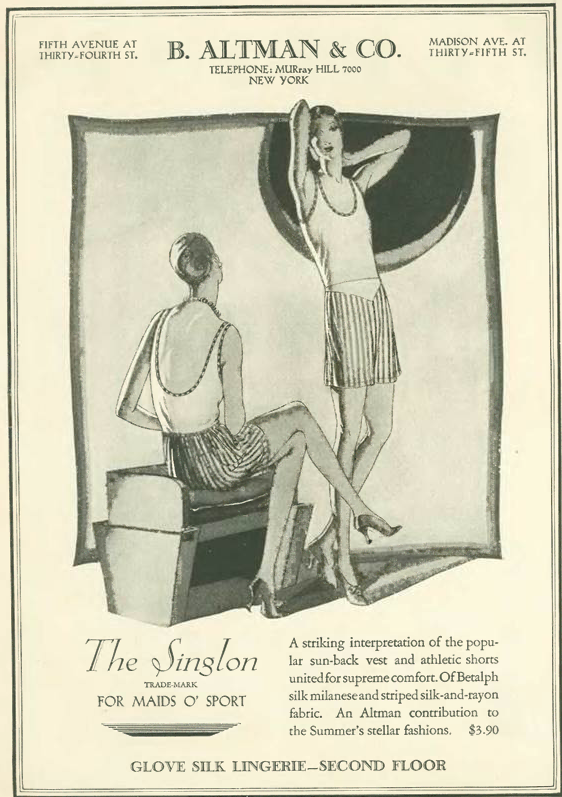
In a recent post (Waldorf’s Salad Days) I noted an ad from Lily of France that proclaimed the straight flapper figure was out, and it was now the “season of curves.” This ad from B. Altman begs to differ…

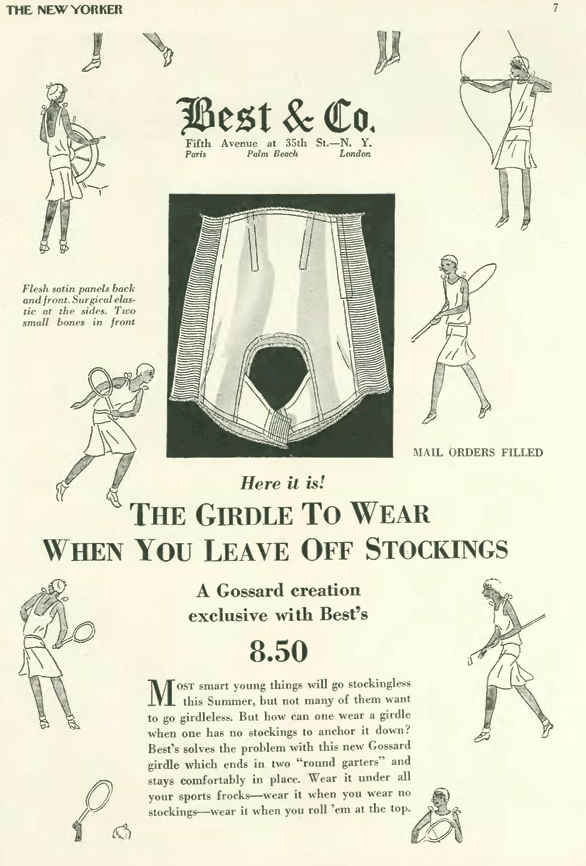
…one way to keep that straight figure was to pull on a girdle, which I’m sure felt great while one played tennis…

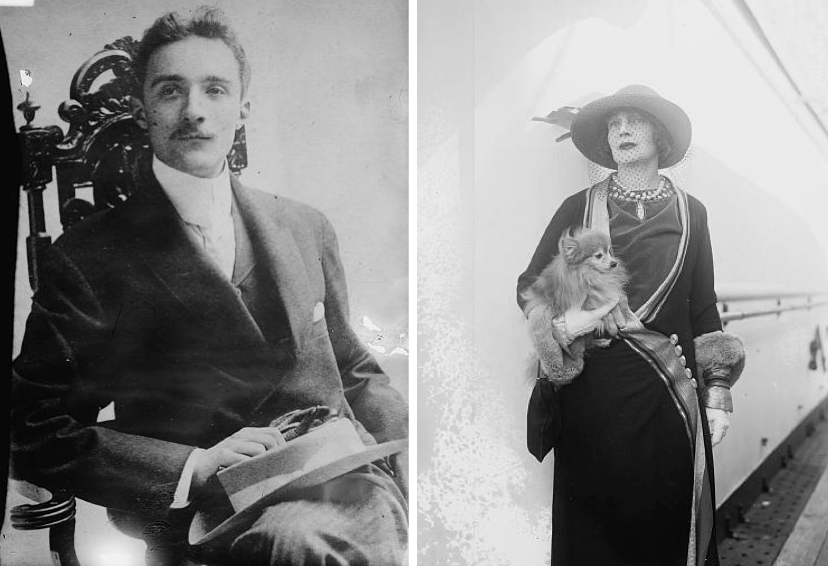
…our latest Lucky Strike endorser is…Mrs. Jerome Napoleon Bonaparte. Never heard of her? Well, “Mrs. Jerome” was actually a one Blanche Pierce (1872-1950) of Rochester, NY. Her second husband, Jerome Napoleon Bonaparte (the great-grandnephew of Emperor Napoleon) was something of a wastrel, having inherited a fortune and never worked at a job or profession. Blanche herself was known as a social climber…

THEY EXISTED…Jerome Napoleon Charles Bonaparte (pictured here circa 1915) was the great-grandnephew of Emperor Napoleon and a man of extreme leisure. His wife, Blanche Pierce Bonaparte (right, in a photo circa 1925), was known as a dog lover, a passion that indirectly led to her second husband’s demise. Jerome died while walking his wife’s dog in Central Park—he apparently stumbled over the dog’s leash and broke his neck. (Library of Congress)

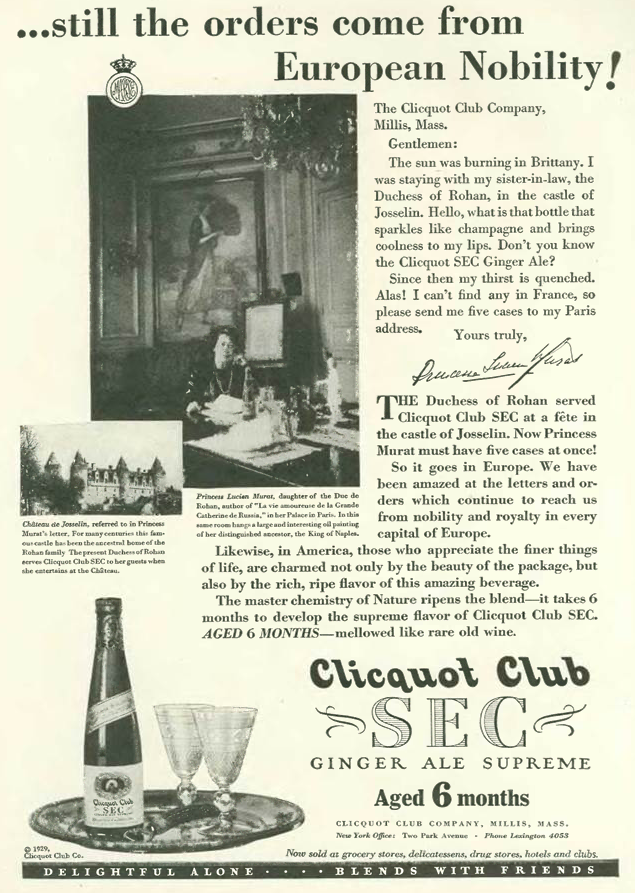
…speaking of European nobility, here is another sad endorsement from a French noble touting the wonders of Clicquot Club ginger ale to Prohibition-strapped Americans…

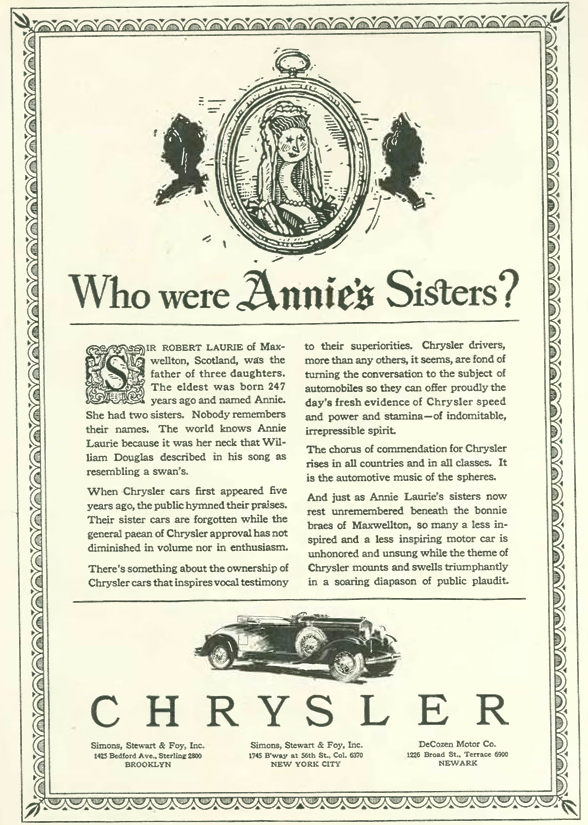
…and then we have this weird “Annie Laurie” analogy used by Chrysler to sell its line of automobiles…

…the manufacturers of Studebaker, on the other hand, opted for a more direct approach, equating its automobiles with the speed and modernity of airplane flight…note how in both ads the cars are pictured with the windshields folded down to emphasize sleekness…

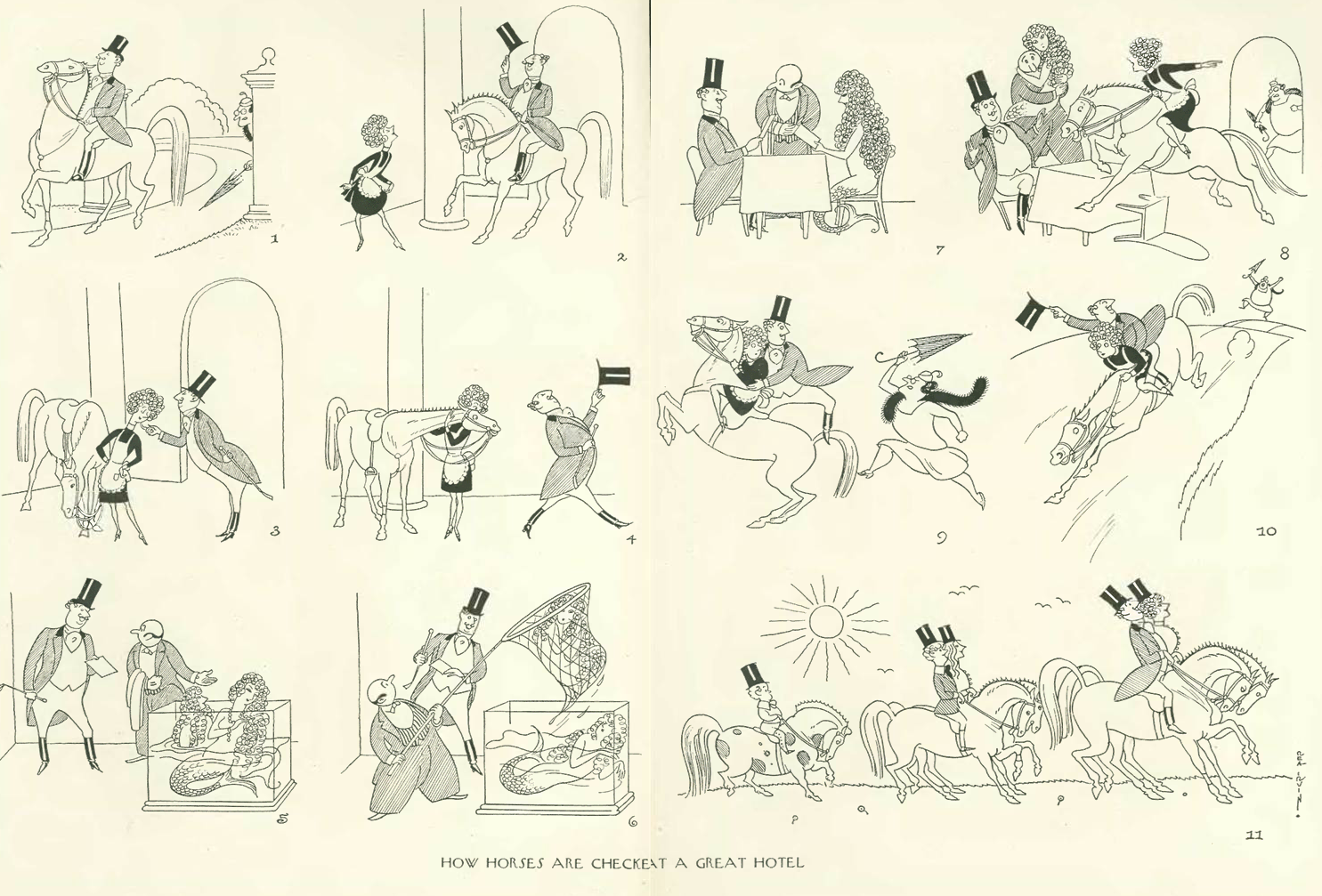
…on to the cartoons: we begin with this two-page entry by Rea Irvin, which makes very little sense…I get the part where the rich old man (stalked by his fearsome wife) finds a mistress (and a new wife) through the process of “checking his horse,” but the whole mermaid thing is lost on me…please click to enlarge—I’d love to have this one explained…
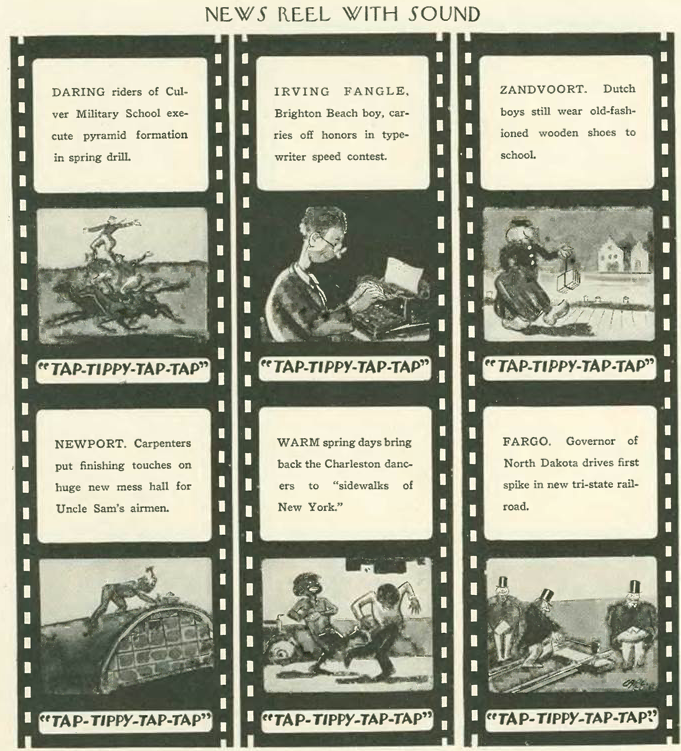
Carl Rose had some fun with newfangled sound effects in the dawning age of the talkies…
Peter Arno sketched up the cynicism of one New York dowager…

Perry Barlow captured two women who might have been driving home from an auction at the old Waldorf-Astoria Hotel…

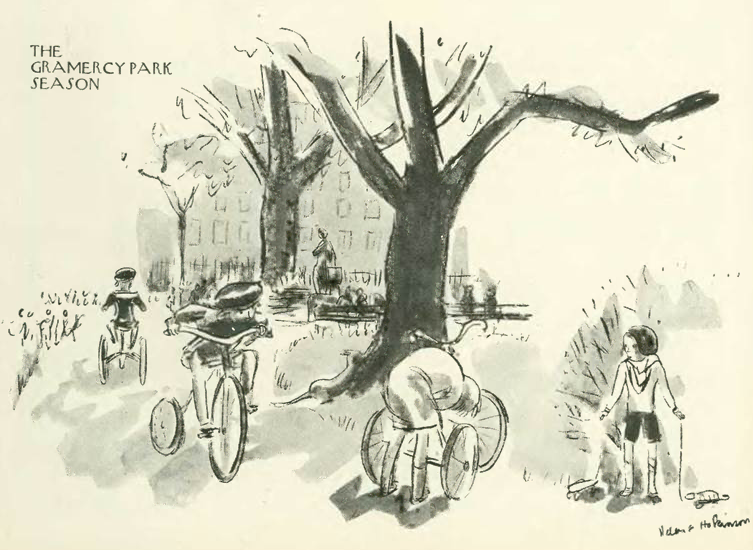
…and finally, a lovely illustration by Helen Hokinson of children at play…

Next Time: The Unspeakables…


That Moderne Feeling

A defining moment for Art Deco design in America occurred at New York’s Metropolitan Museum of Art during a 1929 exhibition that showcased everything from household furnishings to garden design.

March 9, 1929 cover by Theodore Haupt. Between 1927 and 1933, Haupt would illustrate 45 covers for the New Yorker.

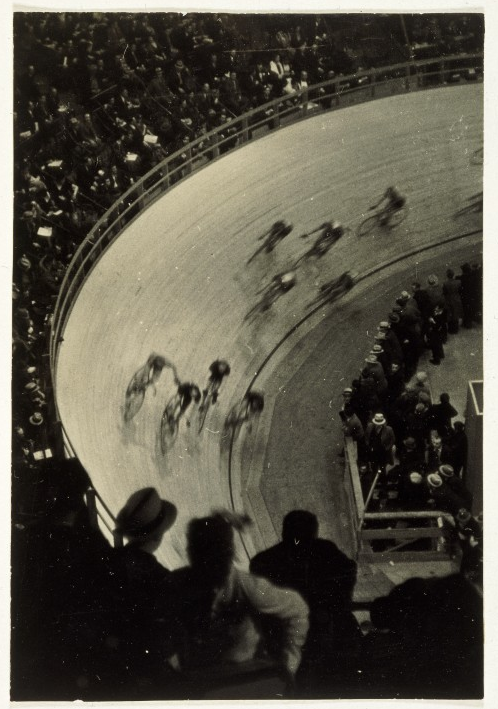
Before we delve into the Met’s exhibition, The Architect and the Industrial Arts, a quick note about the New Yorker’s Theodore Haupt-illustrated cover, which referenced the annual Six-Day Cycling Race that was taking place at the Madison Square Garden Velodrome. The event, which began at the old Madison Square Garden in 1891 and lasted until 1950, featured a beer garden (after Prohibition) in the center of the oval and drew such celebrities as Bing Crosby, Barbara Stanwyck and Peggy Joyce. It was said that Crosby even paid the hospital bills of riders who fell during the race.

THIS MIGHT TAKE AWHILE…The Six-Day Cycling Race at the Madison Square Garden Velodrome, 1932. (Victoria & Albert Museum)

The March 9 issue was lively with another contribution from Groucho Marx (“Press Agents I Have Known”) and an Alexander Woollcott-penned profile of playwright and screenwriter Charles Gordon MacArthur (husband of stage actress Helen Hayes and father of James “Book ’em Danno” MacArthur).

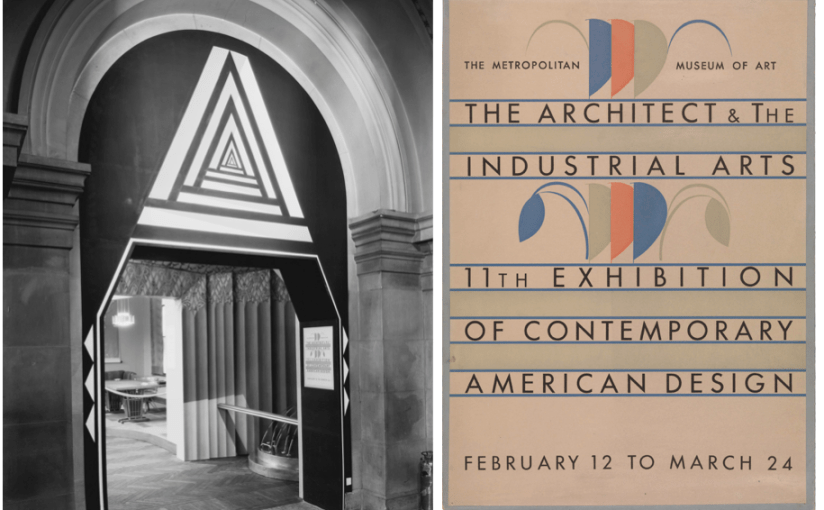
But as the blog title suggests, it was also filled with articles and ads that told of a city embracing all things new and modern, including a piece by architecture critic George S. Chappell on the Metropolitan Museum of Art’s eleventh Exhibition of Contemporary American Design, titled The Architect and the Industrial Arts. It was curated by the Met’s Richard F. Bach, who organized 15 annual exhibitions of contemporary industrial art at the museum between 1917 and 1940.

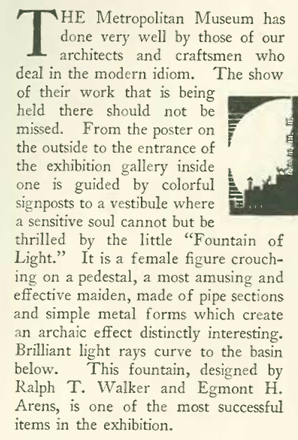
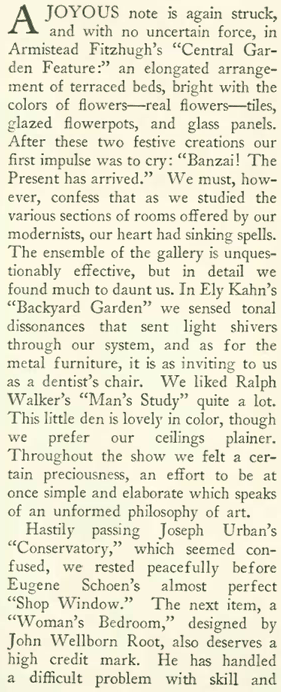
The 1929 exhibition of Art Deco works was the biggest yet, inspired by the Art Moderne movement in Europe and particularly the 1925 Paris Exposition International des Arts Decoratifs et Industriels). The Met exhibition, wrote Chappell, “should not be missed”…

PORTAL TO THE FUTURE…Entrance to The Architect & the Industrial Arts exhibition at The Metropolitan Museum of Art, designed by Joseph Urban. The above exhibition poster (seen mounted on the doorway in the photo) was by W.A. Dwiggins. (Metropolitan Museum of Art)
Ornaments created by W.A. Diggins for the exhibition catalogue included, from left, “Conservatory,” for a section on  Joseph Urban; ornament on a page devoted to curator Richard F. Bach; “Backyard Garden” for a section on Ely Jacques Kahn; and an ornament that graced the acknowledgements page. (Metropolitan Museum of Art, via paulshawletterdesign.com)
NOT YOUR GRANDMOTHER’S GARDEN…Mosaic semi-circular bench designed by Austin Purves, Jr. was featured in architect Ely Jacques Kahn’s “Backyard Garden” display by at the The Architect & the Industrial Arts exhibition at the Metropolitan Museum of Art. (Pencil Points Magazine, January 1929)

Chappell found the exhibit to be “stimulating,” although he hoped designers in the future would “curb cleverness” and focus more on fundamentals:

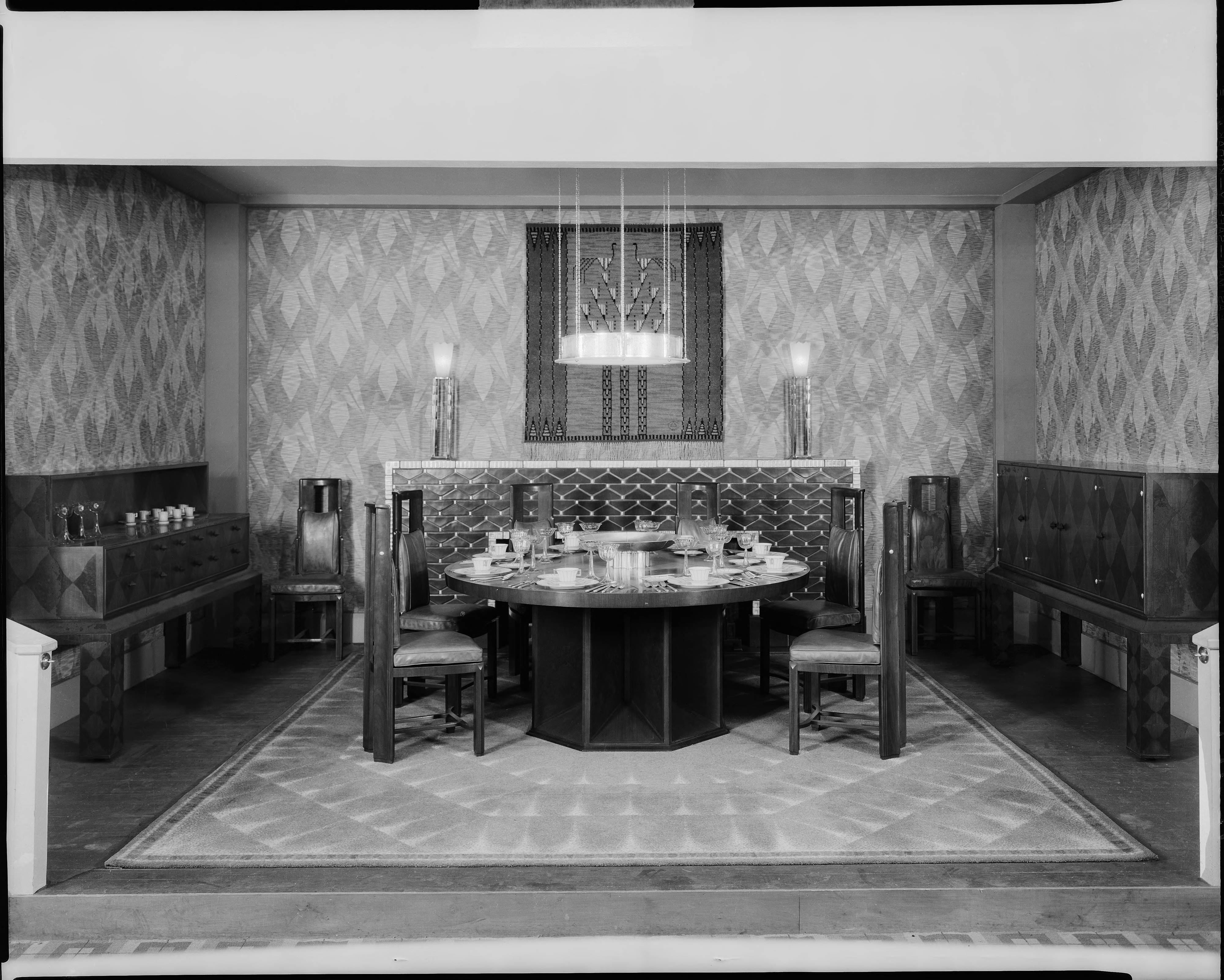
DINING IN STYLE…A dining room designed by Finnish architect Eliel Saarinen for The Architect and the Industrial Arts exhibition at the Metropolitan Museum of Art. (Metropolitan Museum of Art)
VISIONARIES…The Cooperating Committee for 1929 The Architect and the Industrial Arts exhibition were, standing, left to right, architects Raymond Hood, Eugene Schoen and Ely Jacques Kahn. Seated, left to right, architects Ralph T. Walker, John Wellborn Root, Jr. and Eliel Saarinen; ceramist, painter and graphic artist Leon V. Solon; and architect, illustrator and scenic designer Joseph Urban. (Metropolitan Museum of Art)
COZY…Ralph Walker’s “Man’s Study for a Country House” at the The Architect and the Industrial Arts exhibition. (architectsandartisans.com)
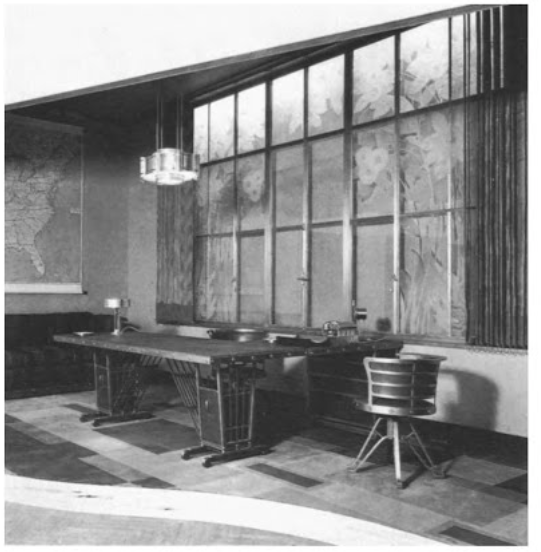
ALL BUSINESS…Raymond Hood’s “Business Executive’s Office” featured at The Architect and the Industrial Arts exhibition. (Metropolitan Museum of Art)

Writing in the February 1929 Bulletin of the Metropolitan Museum of Art, curator Richard S. Bach posed bold questions for this new age: “What is the tempo of our day? What are the dominant elements of our culture, our activities, our thinking? Is this a speed age or are we sedate? Have we time to be dignified and stately about frills or are we air-minded? Do we wait for months, as once all did, for the silkworm to complete his labors before beginning to make thread from his cocoon…or (do we) make a few bales of vegetable silk out of chemically treated wood fiber between breakfast and lunch as a regular chore of a business week-day? And is this the mechanistic millennium which shrivels the soul and makes mockery of imagination, or are these fabulous industries, these automatic instruments of production, the means of bringing within range of vision the real potentialities of our crowded lives and of interpreting our aspirations and achievements?

Pumping Iron Into the Sky

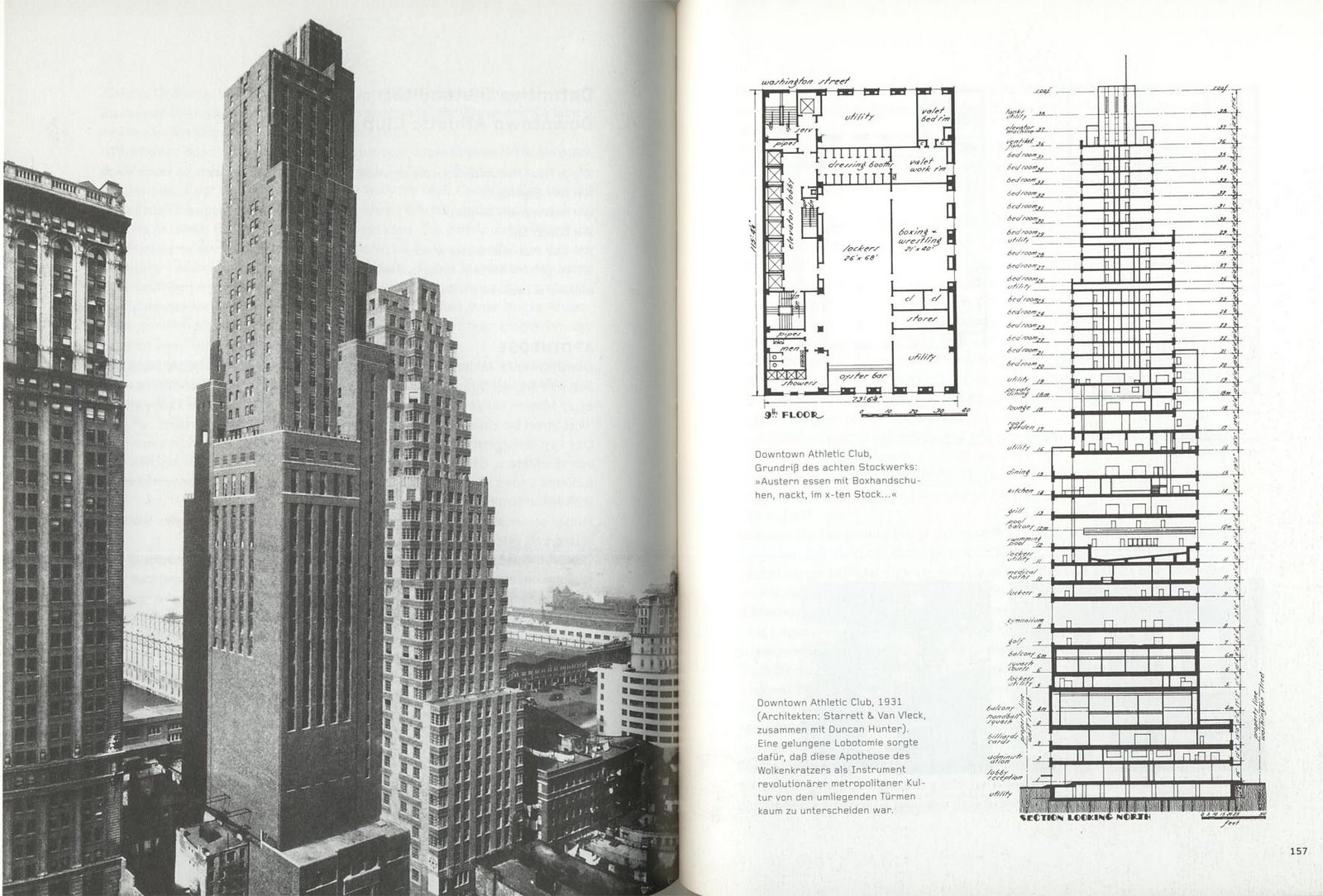
The architecture firm Starrett & van Vleck saw the “real potentialities of our crowded lives” when they designed a new Art Deco skyscraper to house the Downtown Athletic Club. Writing in Lost City NewsMary Hohlt cites the architect Rem Koolhaas, who sees the Downtown Athletic Club as “the ideal of a hyper-reality in the burgeoning urban form of hyper-density and congestion.” The Club is “the everything-at-your-fingertips self-improvement incubator for men…It is a place for men to indulge on self-improvement; to better themselves in a place only the constructed, hyper-reality of Manhattan can provide.”

SELF-IMPROVEMENT INCUBATOR…the Downtown Athletic Club by Starrett & van Vleck, 1930. (4.bp.blogspot.com) click to enlarge

Hohlt writes that Koolhaas sees the Downtown Athletic Club as a sterile place: “Towering in the sky, the Club removes men from the rest of the world and allows them a kind of aesthetic improvement that cannot be passed on.” E.B. White took a less jaded view in this “Talk of the Town” segment:

STILL A WINNER…Famous for serving as the site of the annual awarding of the Heisman Trophy, the Downtown Athletic Club closed in 2001 following the 9/11 attacks. The club was within a “frozen zone” closed to the public during the long clean-up that followed, and could not withstand the financial impact of such a long closure. It reopened in 2005 as a residential tower. (newyorkitecture.com)

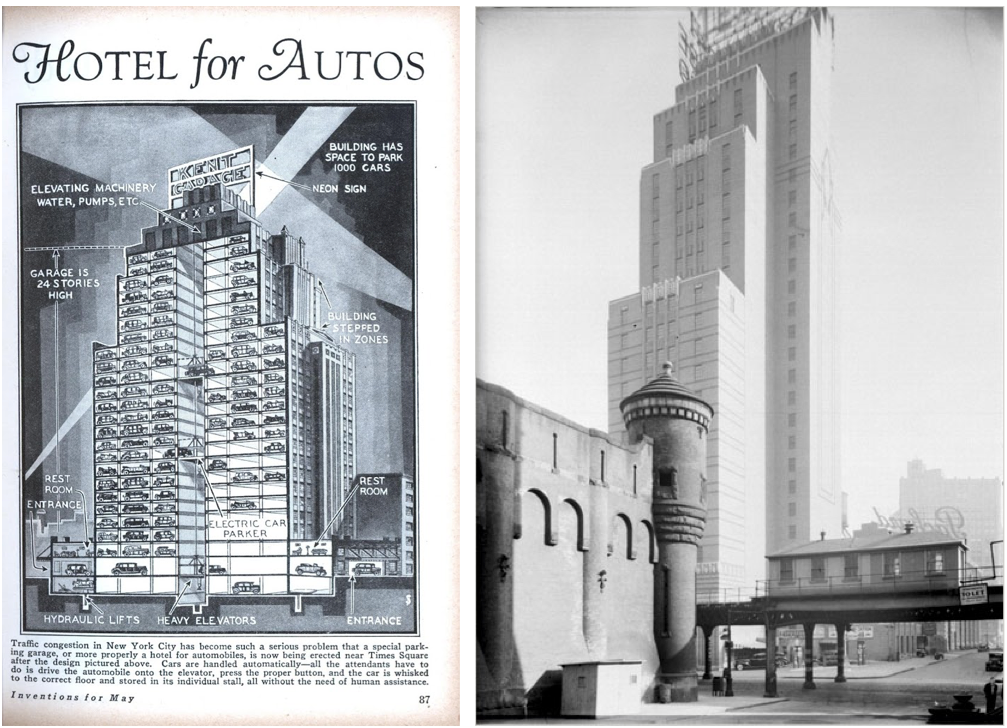
Another New Yorker who saw the “real potentialities of our crowded lives” was insurance salesman Milton A. Kent, who in 1928-29 erected a brick and terra-cotta Art Deco tower that could park 1,000 cars using an automatic elevator system.

MONUMENT TO THE CAR…The May 1928 issue of Modern Mechanix featured this cutaway illustration of Milton Kent’s high-rise, automated parking garage. (boweryboyshistory.com) click image to enlarge

Once again E.B. White was on hand to render this observation for “Talk”…

HUMAN SCALE…Kent’s fantastic garage still stands at West 61st Street, but today it serves as—you guessed it—an apartment building. (boweryboyshistory.com)

 *  *  *

Death of a Can-Can Dancer

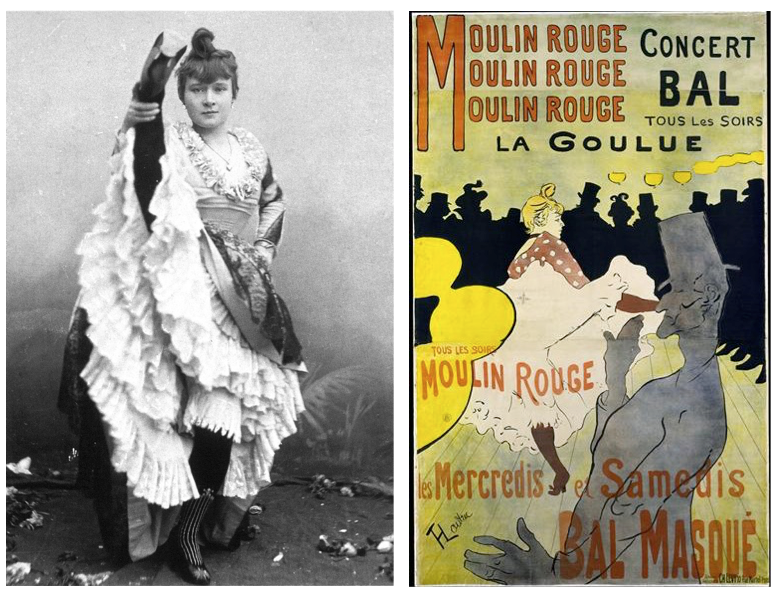
The sad death of Louise Weber, aka La Goulue, was announced in Janet Flanner’s “Letter from Paris” column. Weber was a can-can dancer at the Moulin Rouge in Paris and a model for some of Henri de Toulouse-Lautrec’s most famous cabaret paintings. Flanner wrote of La Goulue’s rise to fame…

JUST FOR KICKS… Louise Weber, aka La Goulue, circa 1890, and an 1891 poster by Toulouse-Lautrec advertising the performers La Goulue and “No-Bones” Valentin at the new Paris dance hall Moulin Rouge. (Wikipedia)

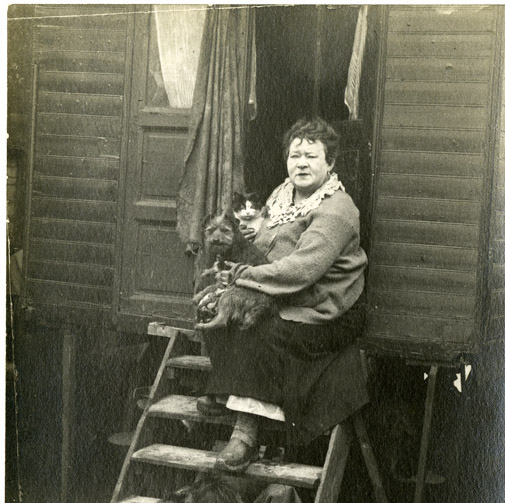
…and her sad downfall into a life of poverty among the rag-pickers:

SAD DECLINE…La Goulue, her face freshly powdered, sat on the steps of her small trailer for an unknown postcard photographer in the 1920s. This image is a detail of the original photograph, held at the Wheaton College Permanent Collection.

 *  *  *

From Our Advertisers

An advertisement on page 45 for Mohawk carpets featured two Cockney charwomen admiring the new carpets at the General Motors headquarters:

A corresponding note: Shreve & Lamb’s 1927 General Motors Building was the hub of Columbus Circle’s Automobile Row. A hideous 2012 remodel, which clad the entire structure in reflective glass, has rendered the former landmark unrecognizable:

Museum of the City of New York/nyc-architecture.com

Getting back to all things “moderne,” these facing ads on pages 8-9 offered some new looks for spring…

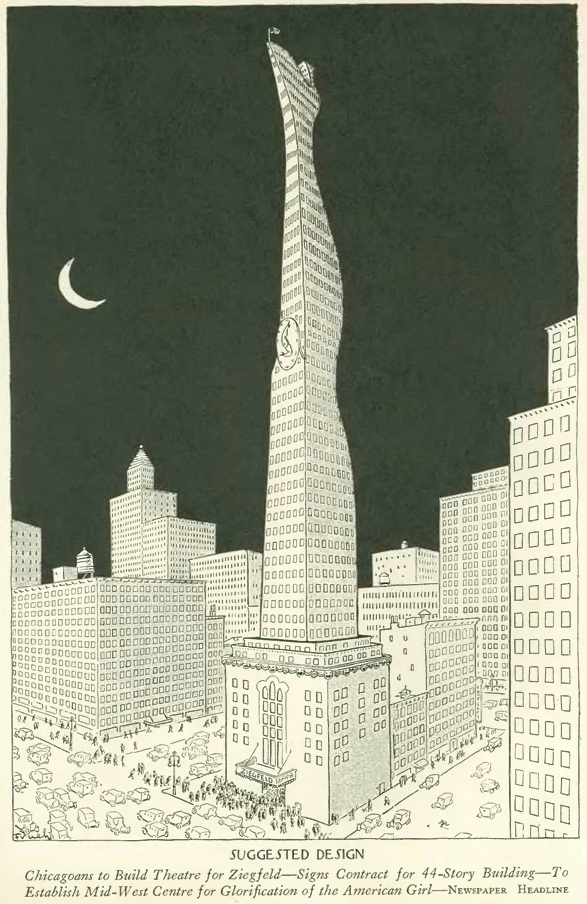
…and in the cartoons, a tongue-in-cheek vision of a modern high-rise by Al Frueh, prompted by the news that Florenz Ziegfeld planned to build a 44-story building in his native Chicago. Thanks to the market crash later in the year, it was never realized.

In drawings sprinkled across pages 24-25, Helen Hokinson examined various approaches to tax season, including these two examples…

…and finally, Peter Arno caught a theatre performer with his pants down…

Next Time: Babbitt Babble…


Diamond Mae

Although the Roaring Twenties saw the relaxing of many moral strictures — particularly in major cities like New York — Mae West’s frank portrayals of sex on an off-Broadway stage could still create a stir in the newspapers and among arbiters of American probity.

Nov. 19, 1928 cover by Theodore G. Haupt.

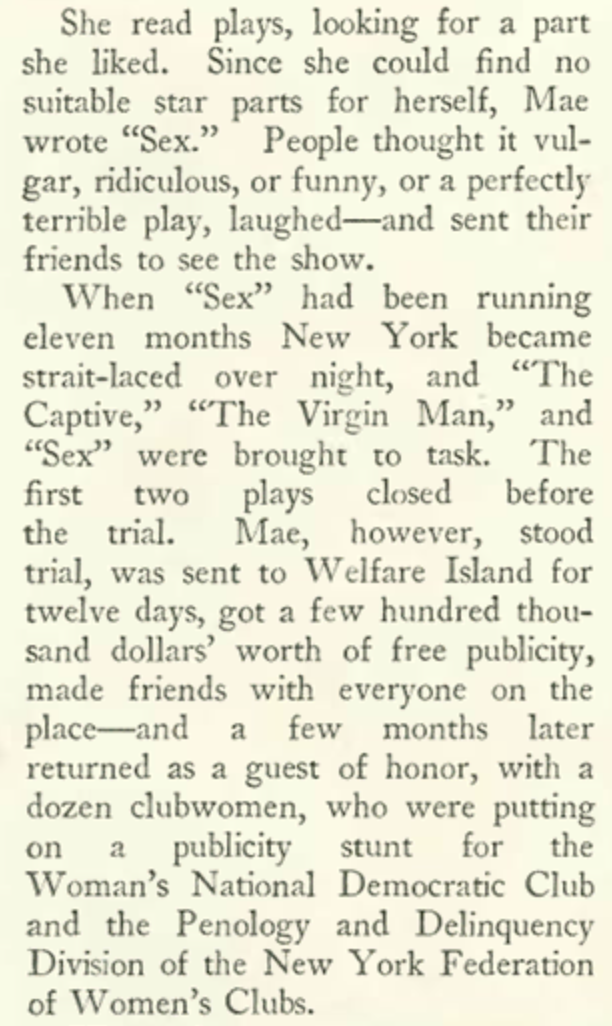
Before she appeared in films (mostly in the 1930s) Mae West was well known to New Yorkers both in vaudeville and on Broadway. Her wider fame came in 1927, when many Americans read about her arrest on obscenity charges linked to a scandalous play simply titled Sex. A story of a Montreal prostitute, Sex opened at Daly’s 63rd Street Theatre on April 1926 to modest audiences and mostly scathing reviews. The New York Times, for examplecalled it a “crude and inept play, cheaply produced and poorly acted.” Perhaps because of the negative reviews, which mostly focused on the play’s morality, curious audiences flocked to see it. Ironically (at least, I imagine, to the critics), Sex was the only play on Broadway in 1926 to stay open through the summer and into the following year.

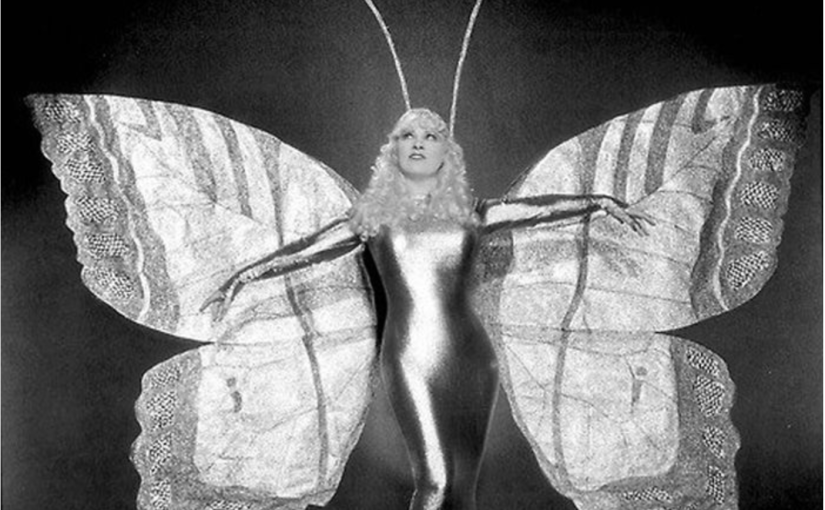
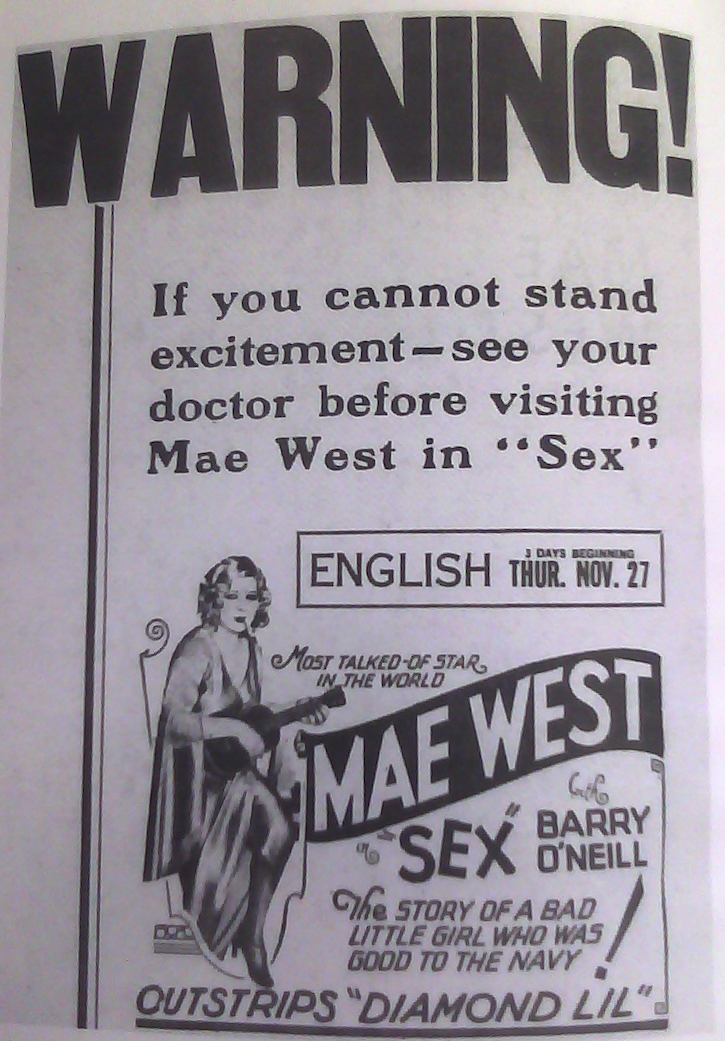
NOW THAT I HAVE YOUR ATTENTION…Mae West in a publicity photo from 1926. At right, promotional poster for Sex, which touted the play as the “Biggest Sensation Since The Armistice.” (maewest.blogspot.com/boweryboyshistory.com)

The fun ended when New York City police raided West’s production company in February 1927 and charged her with obscenity. In another ironic and hypocritical twist (many in the police department and in the city’s court system had enjoyed the play themselves, along with approximately 325,000 others during the play’s 10-month run), authorities fined West $500 and sentenced her to ten days in a workhouse on Welfare Island. Always the entrepreneur, West used the sentence to her advantage, and even arrived at the prison in a limousine. It was during her short stint in prison that she began work on her smash hit Diamond Lil.

Thyra Samter Winslow, a writer who often exposed the hypocrisy and prejudice in American life in her short fiction, profiled West for the Nov. 10, 1928 issue:

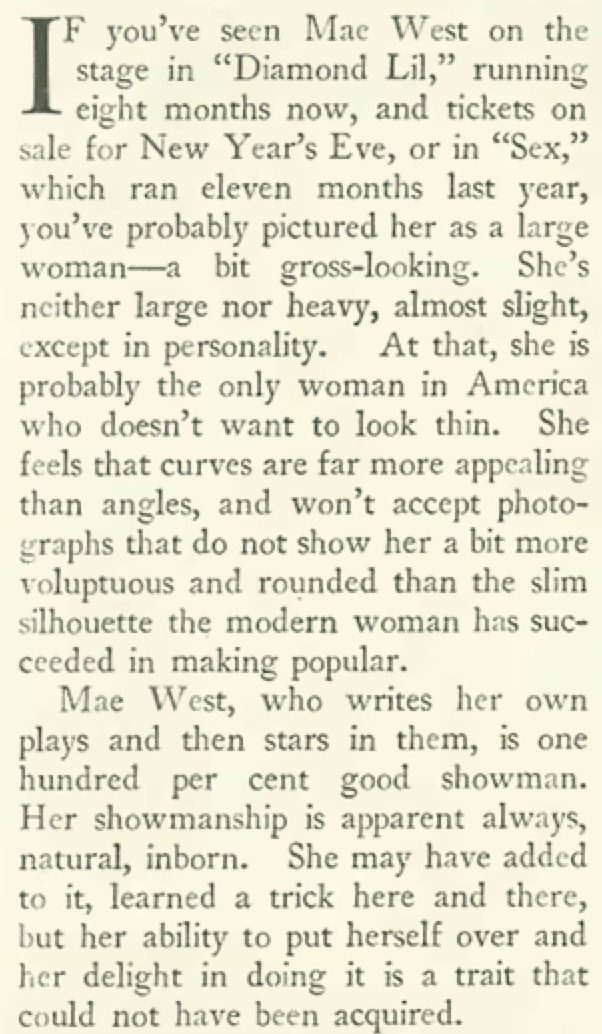
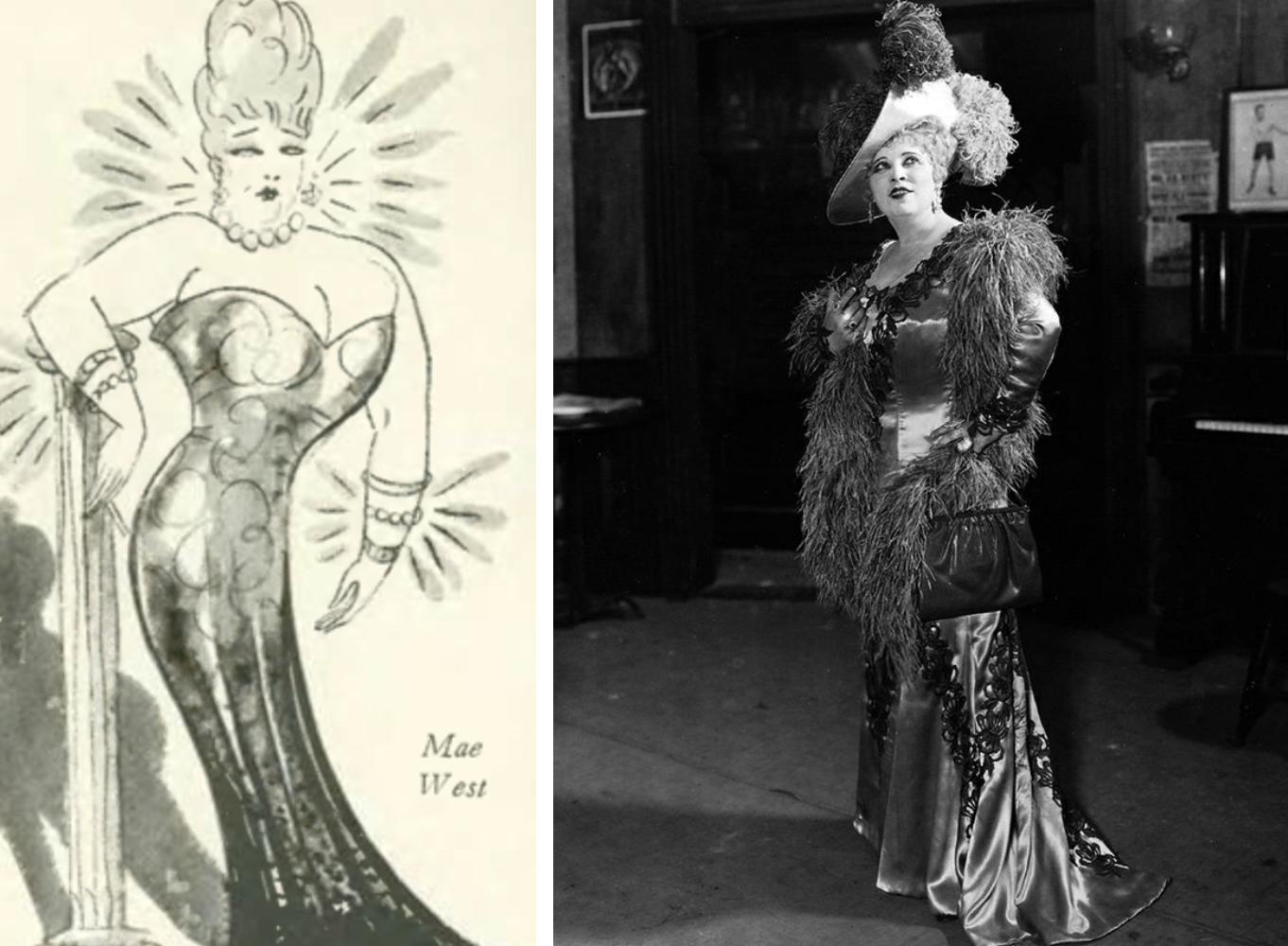
Note Winslow’s surprise to find West to be much smaller than she imagined (indeed, West barely stood five feet tall). Because West preferred a curvy, buxom figure to the thin flapper look, many like Winslow assumed her to be a much larger woman. No doubt her lavish costumes also suggested greater proportions:

West explained to Winslow that she was simply giving the people what they wanted, whether it was outlandish costumes or some “dirt” in their entertainments. Behind this facade, however, was a private, hard-working woman who wrote much of her own material and had the savvy to market it.

BE STILL MY HEART…Page from a 1926 Playbill. (New York Public Library, Shubert Archive)

In her profile, Winslow noted West’s marketing savvy during her incarceration, where she won many new friends along the way:

Winslow concluded her piece wondering if West had peaked in her success, and would “fade out” along with so many other vaudeville stars…

…. In less than seven years, West at age 42 would become Hollywood’s highest paid star and second only to William Randolph Hearst as the highest paid person in America. Ninety-two years after Sex, West remains an icon of popular culture around the world.

ALL THAT GLITTERS…Drawing of Mae West that accompanied the New Yorker profile. At right, publicity photo for Diamond Lil, 1928. (Playbill)

 *  *  *

From Our Advertisers

The Nov. 10 issue featured this all American endorsement for Lucky Strike cigarettes from World Series winning pitcher Waite Hoyt…never mind that The New Yorker itself completely ignored the World Series and baseball in general.

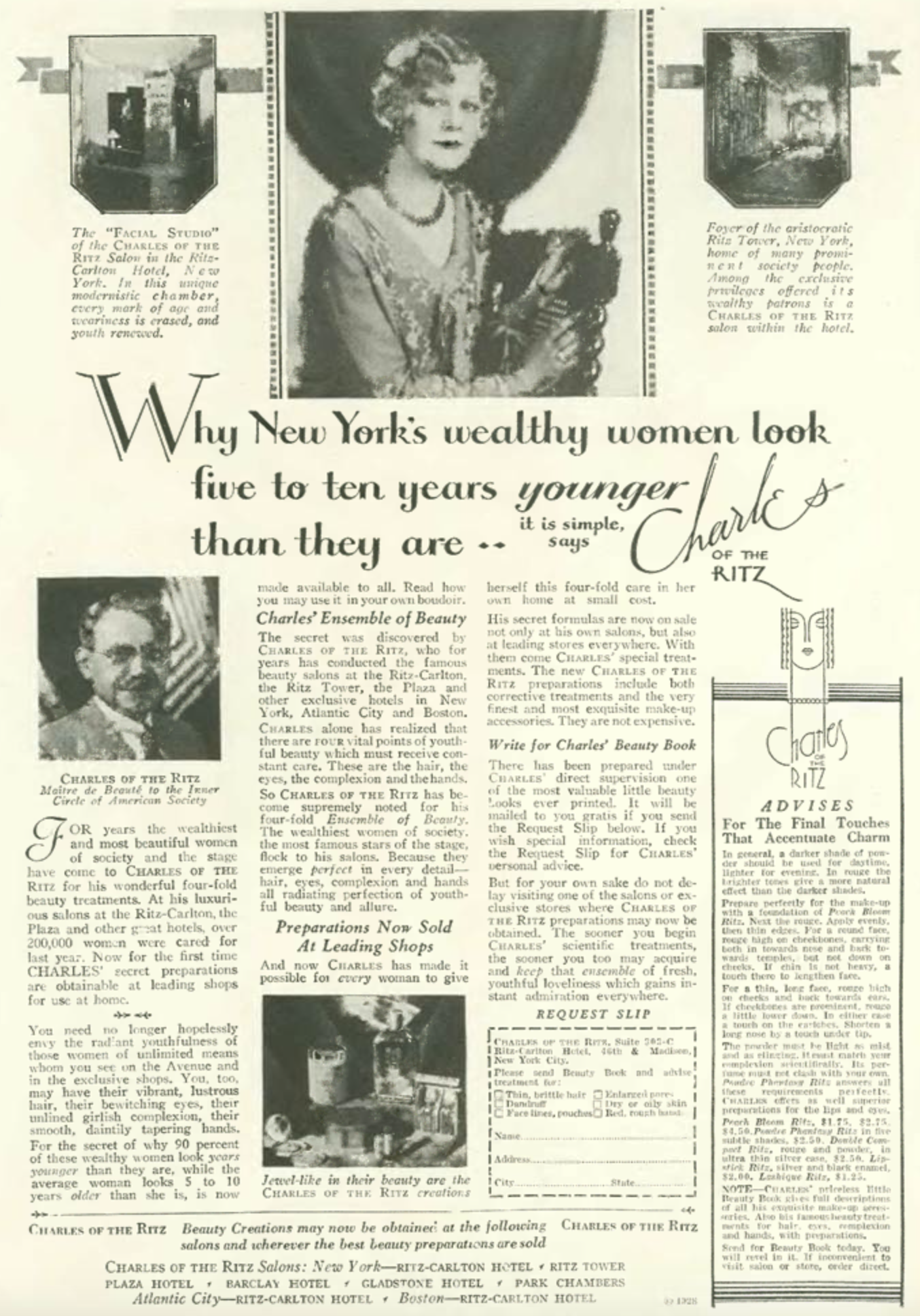
…and Charles of the Ritz used a combination of vanity, snob appeal and class anxiety to promote their latest beauty ensemble…

The comics glimpsed the foibles of the upper classes, including this terrific entry by 22-year-old Ben Hur Baz, a Mexico-born artist who would go on to become famous for his pin-ups in the 1940s and 50s, many of them appearing in Esquire:

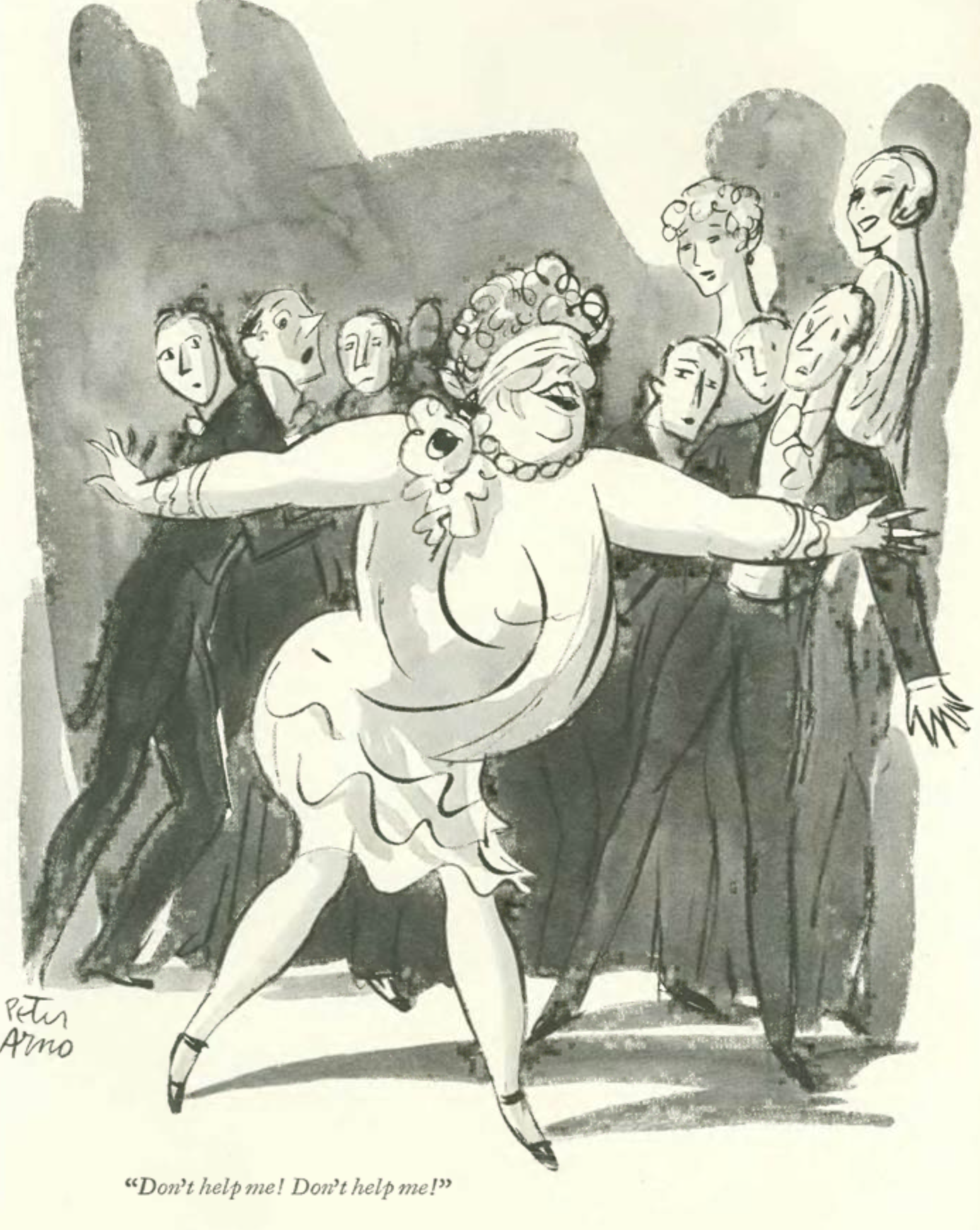
…and a game of blind man’s bluff (or some say ‘buff’) as rendered by Peter Arno:

  *  *  *

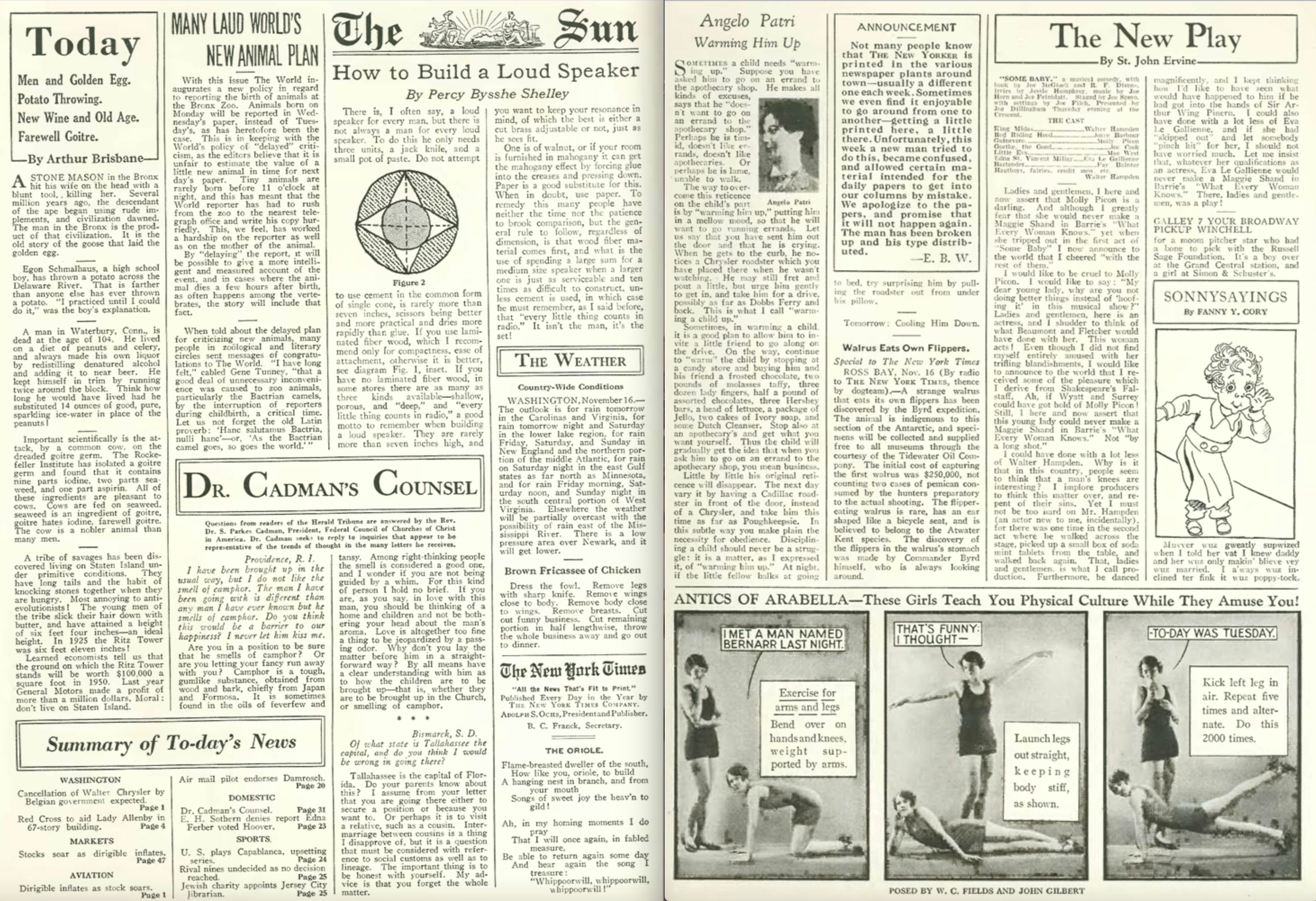
The Nov. 17 issue featured an unusual entry by E.B. White, who, like many of his New Yorker colleagues, found many reasons to be critical of the media, including the dumbing down of newspapers that increasingly favored trivia, sensation and promotion over serious discourse.

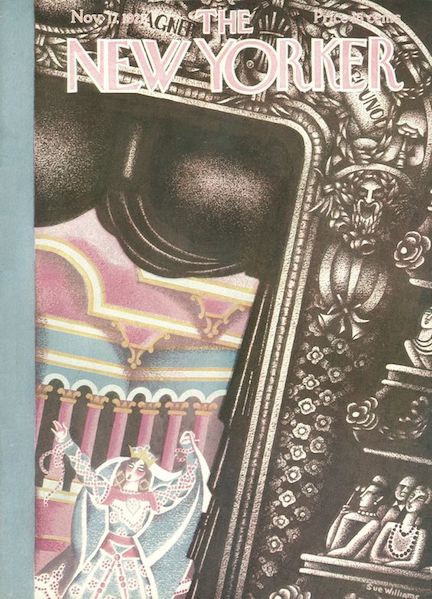
Nov. 17, 1928 cover by Sue Williams.

White skewered the news of the day in this two-page spread that parodied the look and language of contemporary newspapers (click to enlarge):

 *  *  *

The issue’s “Talk of the Town” featured a lengthy entry on Notre Dame football coach Knute Rockne, a figure greatly admired and generally lauded by the magazine’s sportswriters. A brief excerpt:

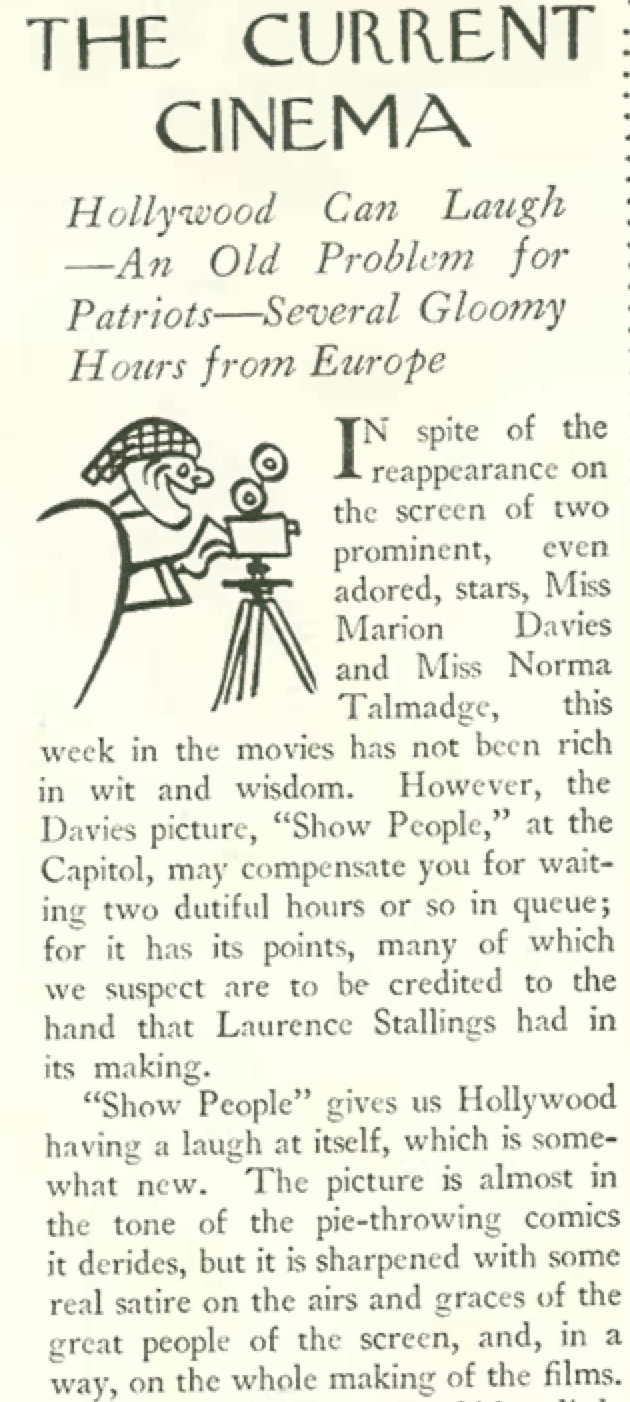
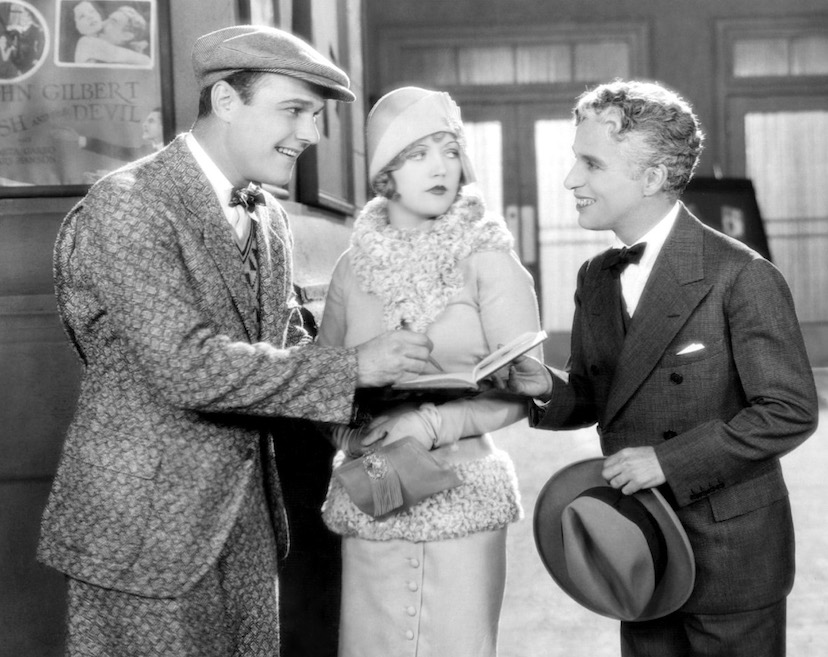
The Nov. 17 film reviews gave a rare thumbs up to an American movie, Show People, which starred Marion Davies.

HE LOOKS FAMILIAR…William Haines (left) and Marion Davies meet Charlie Chaplin in the 1928 Hollywood send-up film, Show People, directed by King Vidor. Chaplin made this rare appearance as himself, without his “Little Tramp” makeup. He was uncredited in the film, and asked to be paid the extra’s fee of only $7.50. (silent-volume.blogspot.com)

 *  *  *

From Our Advertisers

Although you couldn’t legally procure a drink in 1928, you could (unlike today) legally purchase of box of Cuban cigars for you special someone:

…or if you preferred, a carton Chesterfields. Apparently someone in marketing thought conjuring up the horrors of trench warfare would help sell some smokes…

And finally, Peter Arno found out what’s for dinner at the table of a great outdoorsman:

Next Time: What Santa Brought in 1928…


Conventional Follies of ’28

U.S. presidential elections have long provided fodder for the nation’s humorists, and the 1928 contest between Herbert Hoover and Al Smith was no exception.

March 31, 1928 cover by Theodore G. Haupt.

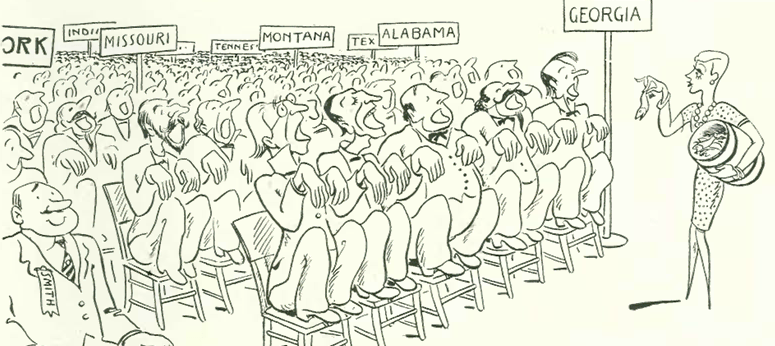
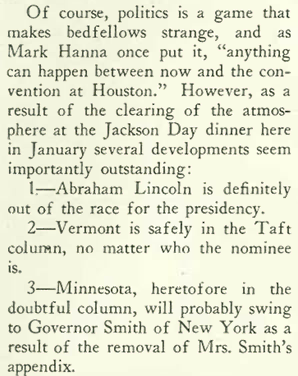
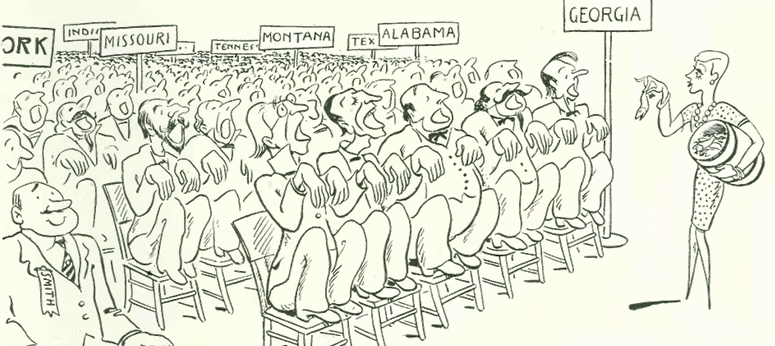
In the March 31, 1928 issue of the New Yorker writer Frank Sullivan and cartoonist Al Frueh took particular delight in skewering the party nominating conventions. As Sullivan observed:

Regarding item No. 3, Sullivan was referring to Minnesota’s famed Mayo Clinic, and the related pride that was doubtless associated with the removal of an appendix from Catherine Dunn, the wife of Al Smith, four-term governor of New York and nominee to lead the Democratic ticket.

The candidates could not have been more different. The first Catholic to be nominated for president, Smith was a crowd-loving, charismatic personality, a Tammany Hall politician and a committed “wet” who opposed Prohibition. He attracted strong support from Catholics, women, drinkers and those who were tired of the crime and corruption associated with dry America.

WET VS. WET BLANKET…The staid, “dry” Republican candidate Herbert Hoover (right) easily defeated the charismatic “wet” Democratic candidate Al Smith in the 1928 U.S. Presidential Election. (Wikipedia)

Hoover, on the other hand, was deliberately dull and humorless, as stiff as his heavily starched collars and committed to keeping the country dry. But the economy under fellow Republican Calvin Coolidge was booming, and it didn’t hurt that many Protestants believed the Catholic Church would dictate Al Smith’s policies if he were elected. Sullivan had some fun with this perceived religious prejudice:

In light of the recent 2016 elections and the prominence of “Islamophobia” in the political rhetoric, Sullivan’s joke regarding the role of “Mohammedans” in the 1928 election is noteworthy:

Illustrations by Al Frueh, both top and bottom, aptly captured the picture Sullivan painted of the nominating process:

Smith would lose in a landslide. Journalists at the time attributed his defeat to the three P’s: Prohibition, Prejudice and Prosperity. Rural voters, who favored Hoover, also had a bigger say than their urban brethren: Republicans would benefit from a failure to reapportion Congress and the electoral college following the 1920 census, which had registered a 15 percent increase in the urban population. After the election, Smith became the president of Empire State Inc., the corporation that would build the the Empire State Building in 1930-31.

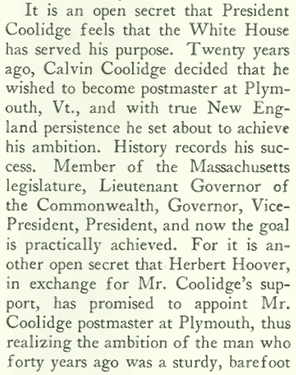
In his piece Sullivan also took at parting shot at President Coolidge…

…as did cartoonist John Price in the same issue…

For reference, the image that inspired Price:

BIG CHIEF… Calvin Coolidge donned a headdress while being named an honorary Sioux chief (“Leading Eagle”) in Deadwood, South Dakota in the summer of 1927. (Associated Press)

 *  *  *

New Yorker Monotypes

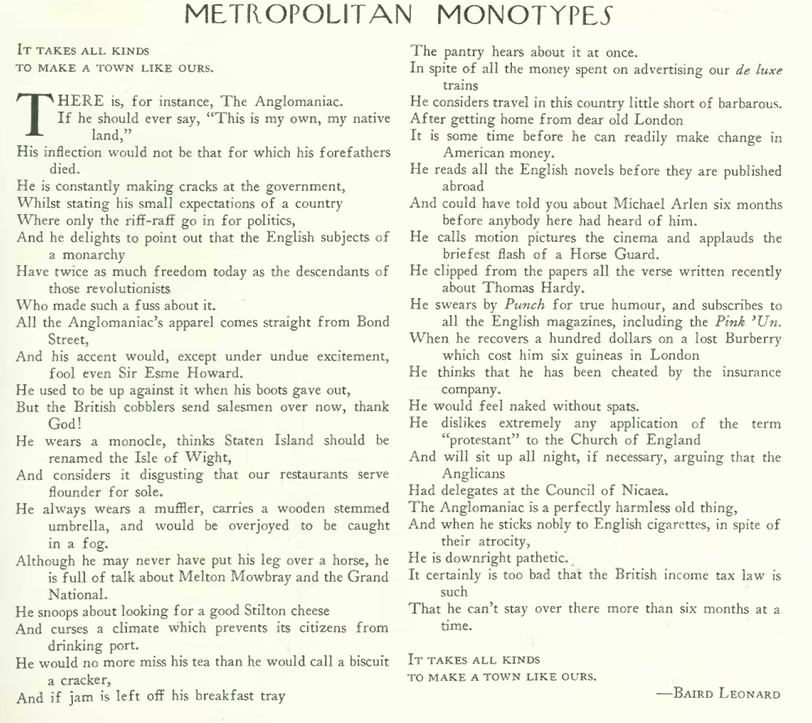
Another humorist who regularly contributed to The New Yorker was Baird Leonard, who beginning with the second issue of the magazine (Feb. 28, 1925) wrote a series titled “Metropolitan Monotypes.” Over five years and 36 installments Leonard wrote free-verse characterizations of various New York “types,” from debutantes to aesthetes to “The Anglomaniac” as described below in this installment from March 31, 1928:

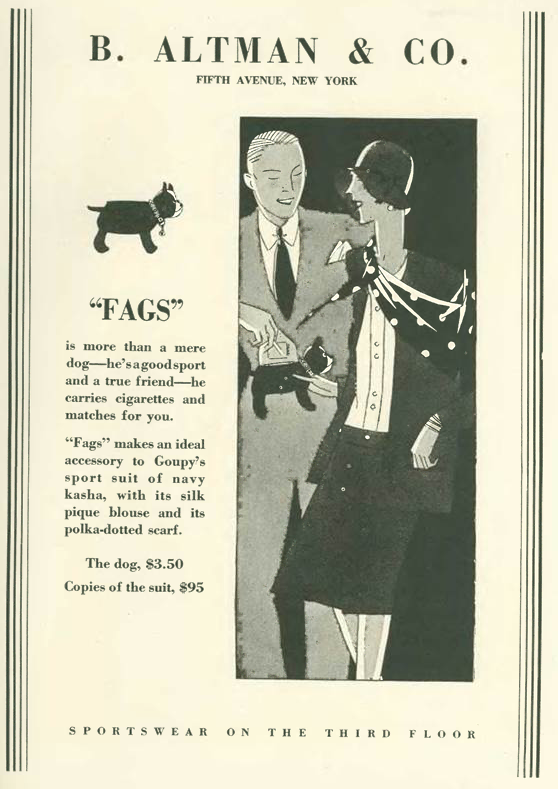
As noted before, Anglophilia oozed from The New Yorker ads, particularly those directed at the male reader (France was a common lure in ads for women). Every issue from the 1920s is rife with examples, but sticking to the March 31 issue we find this ad employing the British slang for cigarettes to market a silly, dog-shaped cigarette case to fashionable women:

In the same issue this ad from Macy’s appealed to participants of a famous cultural event for the posh set—the annual Easter Parade on Fifth Avenue. A tradition dating back to the 1870s, in its first decades the “parade” was a display of wealth and beauty, as the well-to-do strolled from church to church to check out various floral displays.

In 1928, the poor and middle classes were merely observers of the passing parade, perhaps hoping to learn something about the latest fashions. The April 14 “Talk of the Town” suggested as much:

And finally, our cartoon comes courtesy of Leonard Dove, who explores the lighter side of boxing…

Next Time: We Americans…

Speakeasy Nights

Before screenwriter Niven Busch Jr. headed to Hollywood in 1931, he cut his teeth as writer for The New Yorker, contributing a series of profiles (later compiled in Twenty-one Americans) as well as an intermittent series from May 1927 to Feb. 1930 on New York’s Prohibition-era speakeasies.

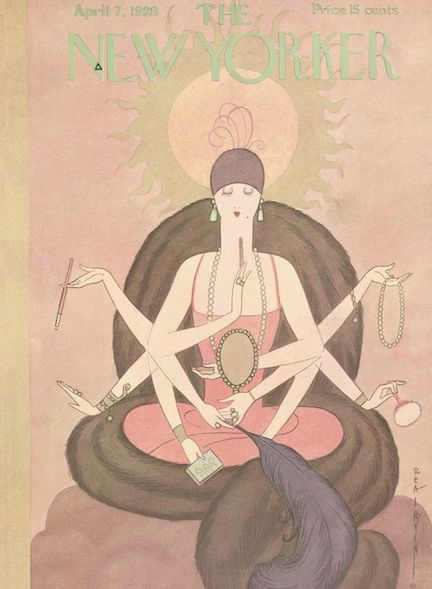
February 18, 1928 cover by Theodore G. Haupt.

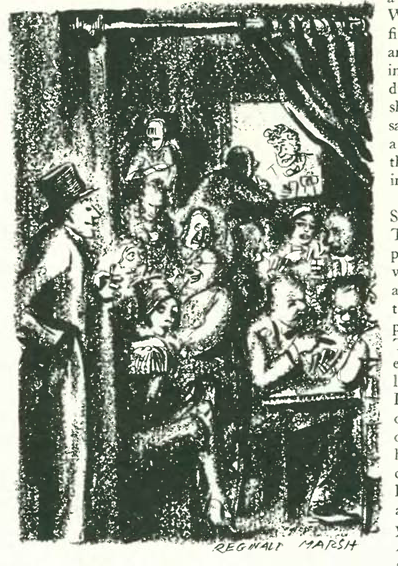
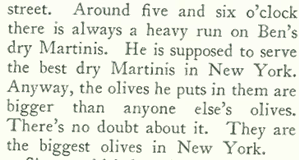
Always careful to shield the identity of speakeasy owners and patrons, Busch described the often less-than-glamorous digs of New York’s illegal watering holes. In a speakeasy called “The No Trump,” two Irish brothers took turns mixing drinks “on a kitchen table in a cubbyhole” while Busch sat in a darkened bar and listened in on a conversation coming from the adjoining “bridge room”…

This illustration by Reginald Marsh accompanied Niven Busch’s article.

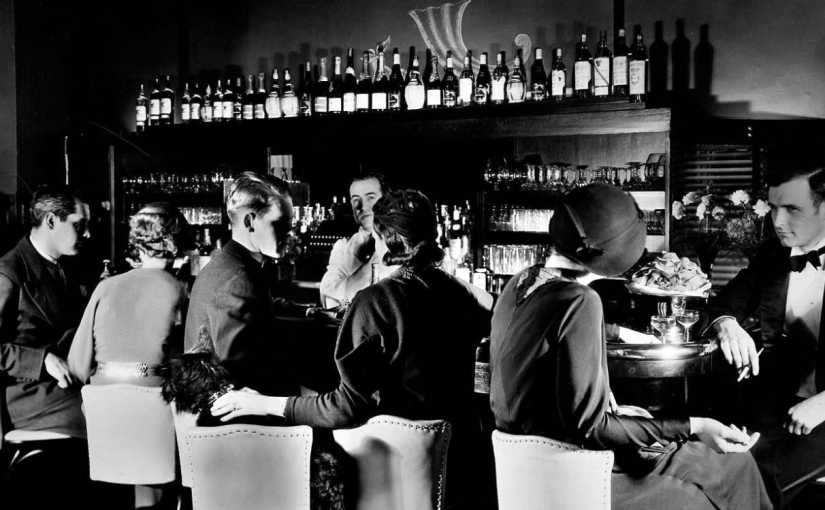
LAST CALL…Images taken by photographer Margaret Bourke-White for Life magazine during the last days of Prohibition. (Time.com)
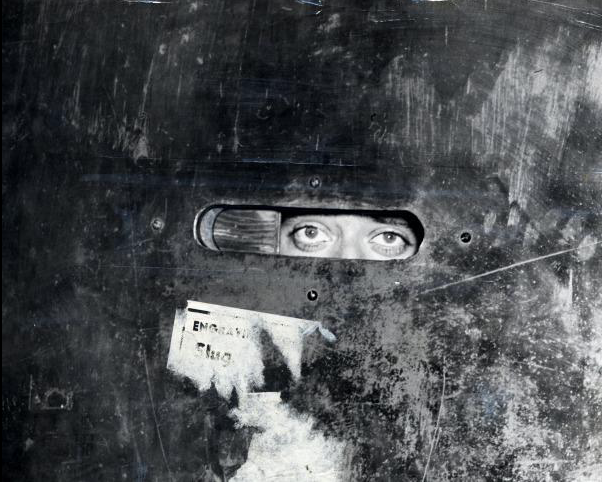
WHO GOES THERE?…The familiar slot in the door came in handy for speakeasy owners wishing to screen clients before allowing entry into their illegal lairs. (Chicago Tribune)
BETTER SWILL…The Marlborough House, an East Side speakeasy for socialites during Prohibition, 1933. Photo by Margaret Bourke-White for Fortune. (Time.com)

Busch also described his visit to the “Circus Speakeasy,” operated by a man who “travelled for 21 years with the Ringling Circus”…

A young Niven Busch Jr., circa 1930. (enetpress.com)
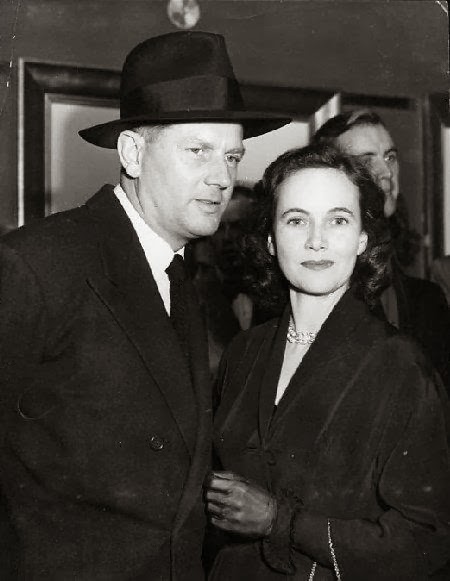
Busch and the third of his five wives, the actress Teresa Wright, in the 1940s. (danielmartineckhart.com)

In his later years as a producer and screenwriter in Hollywood, Busch would script movies ranging from The Man With Two Faces (1934) starring Edward G. Robinson, to The Postman Always Rings Twice (1946), with Lana Turner.

All Aboard

One of the prominent voices of the unsigned “Talk of the Town,” E.B. White was also a regular contributor of short pieces in The New Yorker, such as the following which described a mistaken encounter on an overnight train:

 *  *  *

Another way to calm the jitters

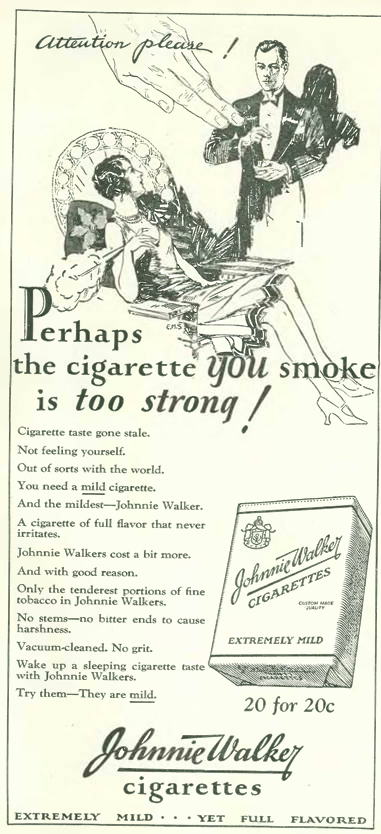
If you couldn’t legally (or illegally) buy Johnny Walker Scotch whisky in 1928, you had to settle for their brand of “vacuumed-cleaned, extremely mild” cigarettes, which were apparently sold as late as the 1950s…

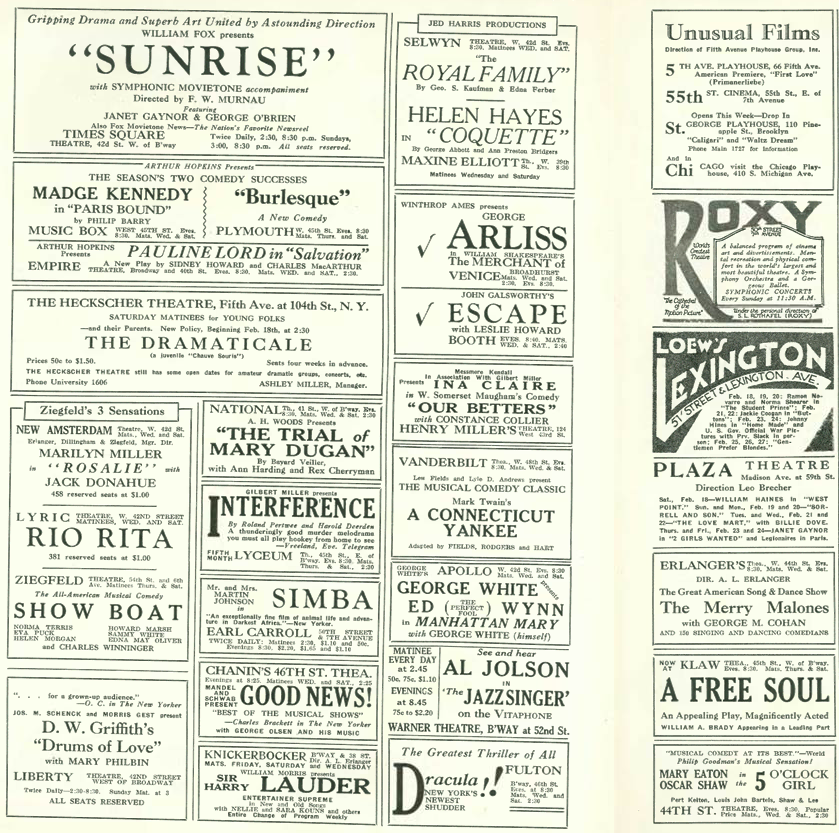
And to get a taste of what was showing at the local cinemas, I’ve included this page-and-third spread of movie and theatre ads from the back pages. Note the film Sunrise featured prominently at the top left-hand corner.

Starring George O’Brien, Janet Gaynor, and Margaret Livingston, this 1927 silent romantic drama, directed by F.W. Murnau, used the new Fox Movietone sound-on-film system, making it one of the first feature films with a synchronized musical score and sound effects soundtrack. Sunrise (full title: The Sunrise: A Song of Two Humans) won the Academy Award in the category “Unique and Artistic Picture” at the 1st Academy Awards in 1929, and Gaynor won the first Academy Award for “Best Actress in a Leading Role.” Sunrise is considered one of the greatest films of the silent era and even today is widely considered a masterpiece.

AWARD-WINNING SMILES…George O’Brien and Janet Gaynor in 1927’s acclaimed The Sunrise: A Song of Two Humans. (The Red List)

 *  *  *

And finally, more hijinks from the moneyed classes, courtesy of Peter Arno:

Next Time: Amen Aimee…

Distant Rumblings

As I’ve previously noted, reading back issues of periodicals often gives one a feeling of omniscience; as I thumb through week after week of late 1920s New Yorkers, I realize that for all their cleverness and worldly wisdom, even that magazine’s writers and editors could not see with any clarity into the future. But neither can any of us…one wonders what readers 89 years hence will surmise from today’s magazines, that is, if our civilization lasts that long.

January 28, 1928 cover by Theodore G. Haupt.

Howard Brubaker (in his column “Of All Things”) might have spotted something brewing on the horizon, even if it wouldn’t become perfectly clear until Dec. 7, 1941. Here is a clip from his Jan. 28, 1928 column in The New Yorker:

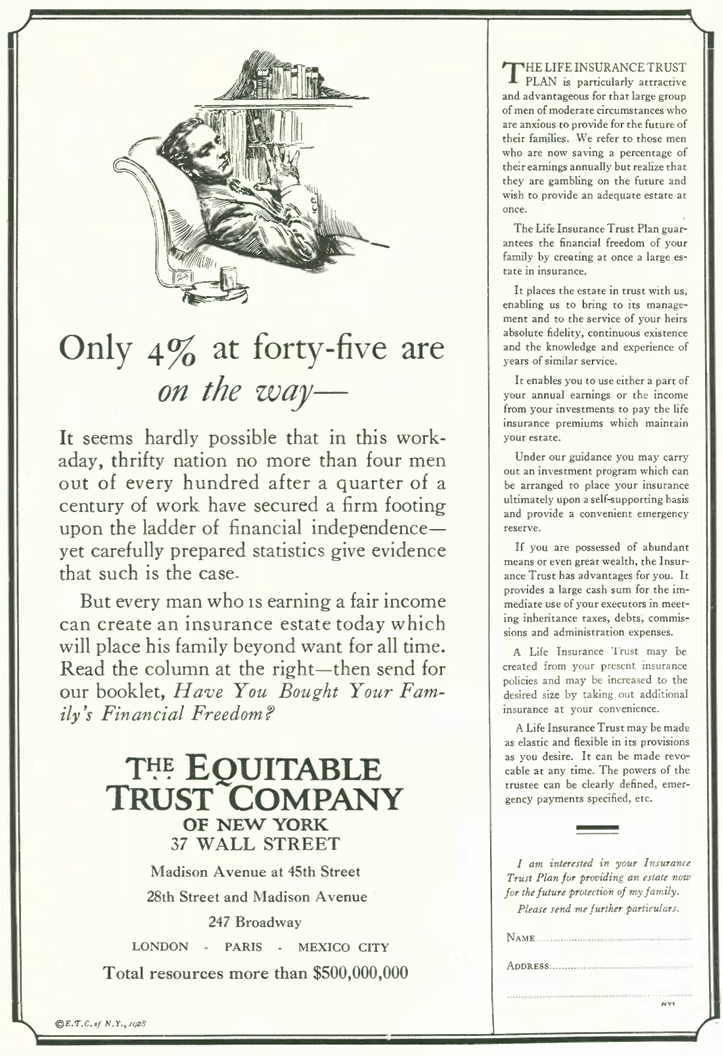
Two other major events in U.S. history, the Stock Market Crash of 1929 and the Great Depression that would follow, were less than two years away. But this was the Roaring Twenties, and some thought the fun would never end…except perhaps Equitable Trust, which placed this advertisement in the Jan. 28 issue:

Apparently the folks at Equitable Trust weren’t assured of their own financial freedom—after the Crash they would be acquired by Chase National Bank, making Chase the largest bank in the world at that time.

Despite the overheated economy of the 1920s, there still were plenty of poor and unemployed people in the city. One man, Urbain Ledoux (known as Mr. Zero in order to hide his identity), often arranged protests and demonstrations to bring attention to the poor and unemployed, and opened a number of bread lines and soup kitchens to feed the hungry, including the “Tub,” depicted in this two-page illustration by Constantin Alajalov along the bottom of the “Talk” section of the Jan. 28 issue (click image to enlarge).

 *  *  *

Not All Gloom and Doom

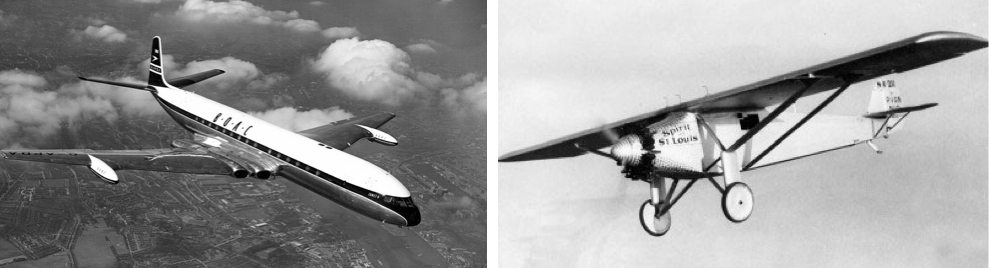
Hindsight also reveals the trajectory of the 20th century’s great accomplishments. Charles Lindbergh’s transatlantic flight in 1927, for example, fueled the imaginations of those who would usher in the jet age and space travel. Just 31 years after Lindbergh’s flight, the British Overseas Airways Corporation (BOAC) would begin operation of its first transatlantic passenger jet service. And only 42 years would separate Lindbergh’s flight from Neil Armstrong’s moonwalk.

JUST 31 YEARS would separate Lindbergh’s flight from the first transatlantic jet service. At left, the DeHavilland Comet 4 (1958), and at right, Lindbergh’s Spirit of St. Louis (1927). (warthunder.com/howstuffworks.com)

Like the rest of America, The New Yorker was an enthusiastic follower of developments in aviation after Lindbergh (the “aerial ambassador” referred to below). The January 28 “Talk of the Town” led with this item about pilots soaring to ever greater heights.

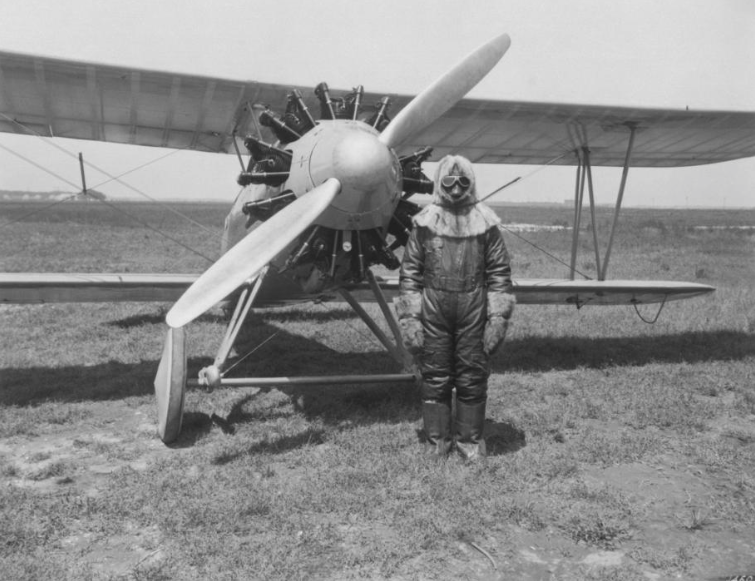
Consider that a mere 41 years separated this…

YETI, SET, GO!…A pilot in high altitude flying gear next to a Wright Apache biplane, January 1, 1928. In September 1926 the Apache set the world altitude record for seaplanes (38,500 ft) and in April 1930 it set the land-plane altitude record of 43,166 ft. (NASA)

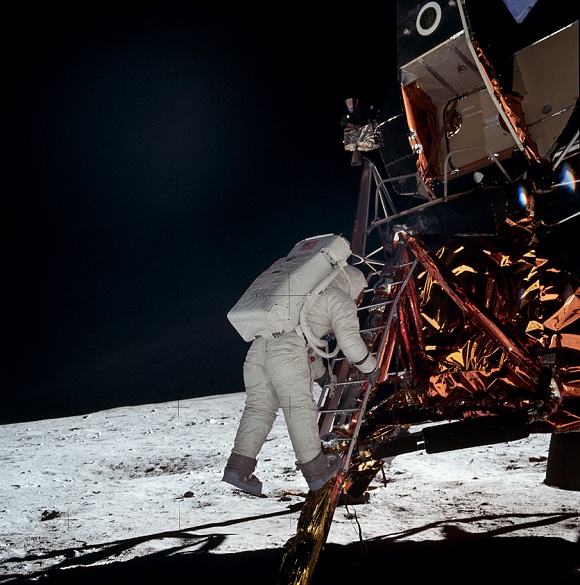
…from this…

LEAVE THE FUR COAT AT HOME…The second man on the moon, Buzz Aldrin, prepares to step onto the lunar surface, July 20, 1969. (Neil Armstrong/NASA)

 *  *  *

While Back on Earth…

Big events in America always seem to involve the appearance of showgirls, whether it is the introduction of a new car or some techno gadget. As this “Talk” item indicates, much was the same 89 years ago…

 *  *  *

Silent Giant

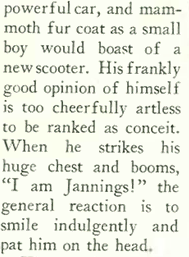
German film actor Emil Jannings was lauded for his performances on the screen in both Germany and America in films, and he was particularly adept at portraying of the pathos of middle-aged men. The New Yorker disliked most of Hollywood’s output (and usually praised the much-artier German films), so when Jannings landed on these shores he was lauded by the magazine, which dedicated a profile (written by Elsie McCormick) to him in the Jan. 28 issue, accompanied by a Hugo Gellert illustration. Some excerpts:

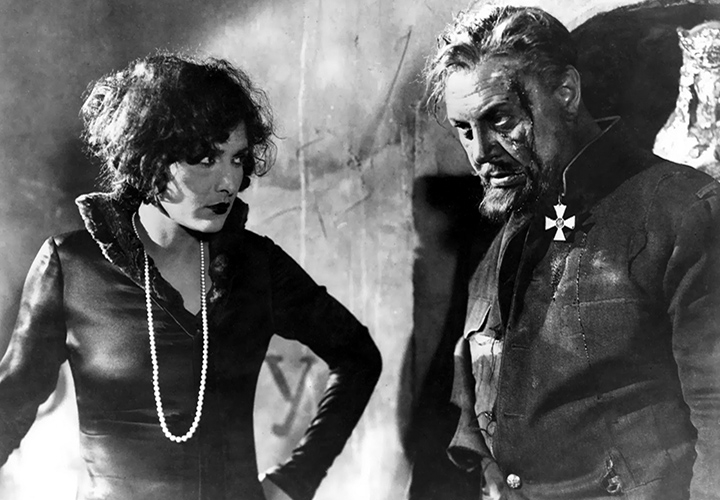
LIFE IS HARD…Evelyn Brent and Emil Jannings star in The Last Command. In the first Academy Awards, Jannings would win best actor for two films, The Last Command and The Way of All Flesh. (silentfilm.org)

At the first Academy Awards in 1929, Jannings would win a Best Actor Oscar for two of his 1928 films, The Last Command and The Way of All Flesh. An interesting side note from writer Susan Orlean: In her 2011 book, Rin Tin Tin: The Life and The Legend, Jannings was not actually the winner of the first best actor vote, but the runner-up. The famous dog actor Rin Tin Tin actually won the vote. The Academy, worried about not being taken seriously, gave the award to the human instead.

Janning’s thick German accent would bring his Hollywood career to an end with sound pictures. He would return to Germany, and during the Third Reich he would star in several films that promoted the Nazis. According to Wikipedia, the shooting of his last film, Wo ist Herr Belling? was aborted when Allied troops entered Germany in Spring 1945. Jannings reportedly carried his Oscar statuette with him as proof of his former association with Hollywood.

From the Advertising Department

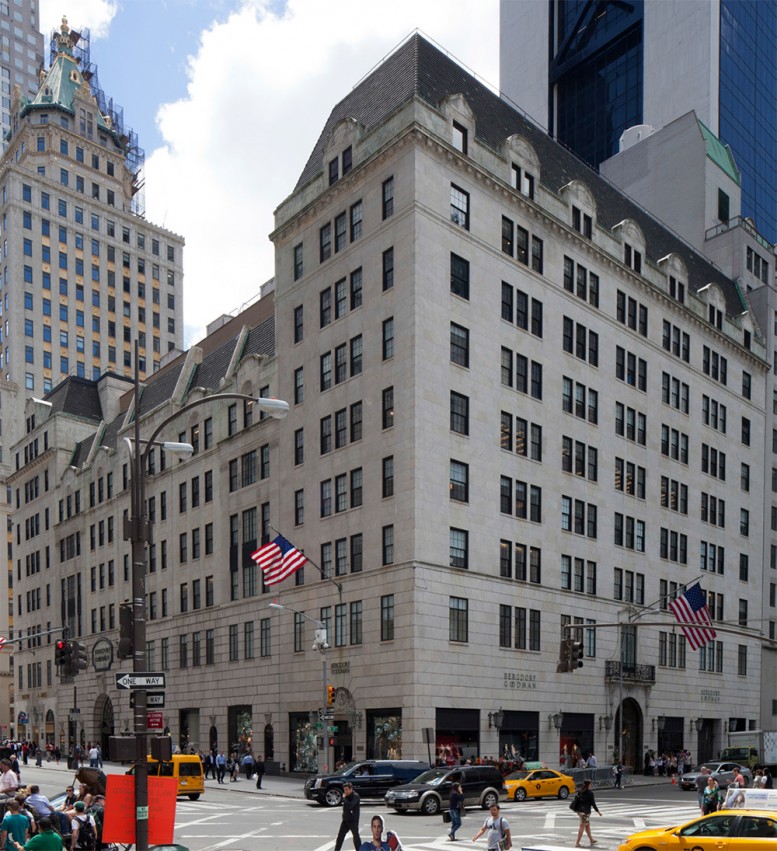
This advertisement from the Jan. 28 issue caught my eye because Bergdorf Goodman is one of the few stores in Manhattan still operating at its original site:

Bergdorf Goodman today. (Photo courtesy LPC)

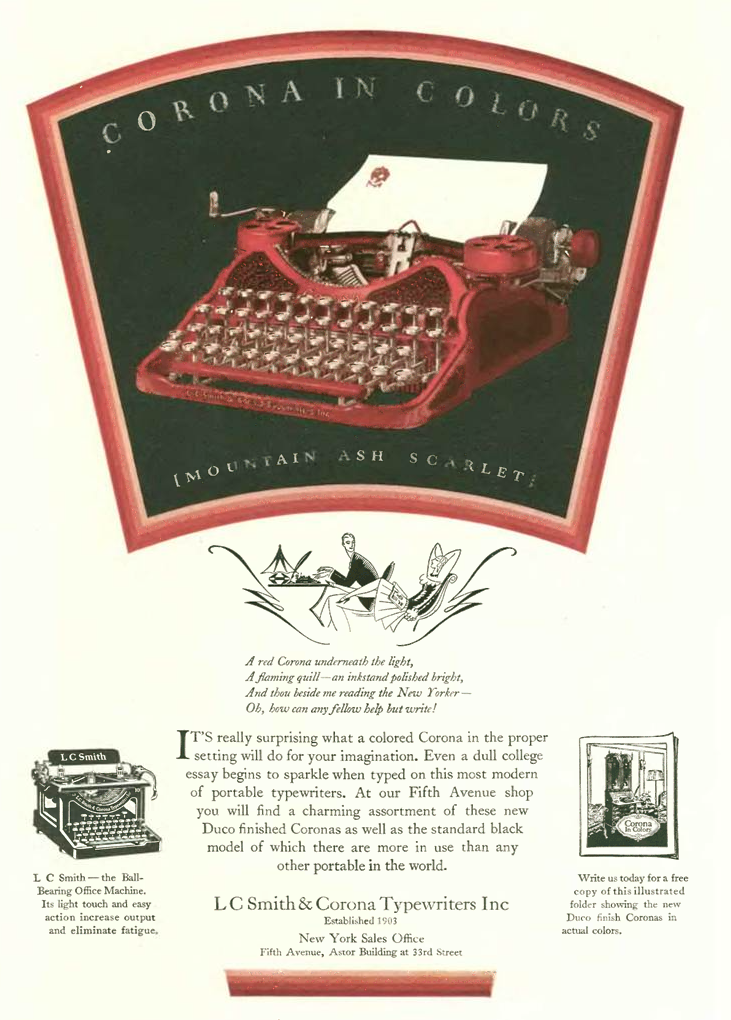
And here we have perhaps the iMac of its day, standing  apart from the competition with its colorful, bold new look…

And finally, this early cartoon from longtime New Yorker cartoonist Perry Barlow having some fun at the expense of New York’s working class…

Next Time: Good Vibrations…


The Perfect Gift for 1927

We close out 1927 by looking at the final December issues, which grew fat with Christmas advertising catering to the tastes of New York’s smart set.

dec-10
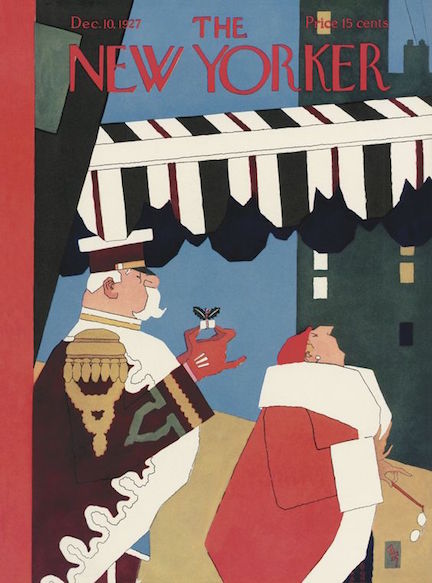
December 10, 1927 cover by Gardner Rea.

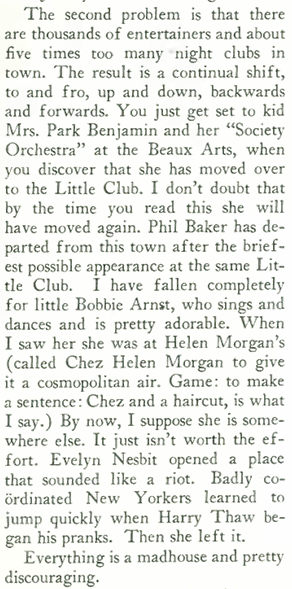
Before we jump to the ads, let’s look in on Lois Long, who in the Dec. 10 issue continued her lamentations regarding the quality of New York’s Prohibition-era night life and reminded readers that her job was far from a “soft snap”…

screen-shot-2017-02-06-at-10-03-06-am

The problem, as diagnosed by Long, was that there were not enough talented entertainers to fill the needs of an overabundance of nightclubs…

screen-shot-2017-02-06-at-10-04-09-am

vit-94-bobbe-arnst1
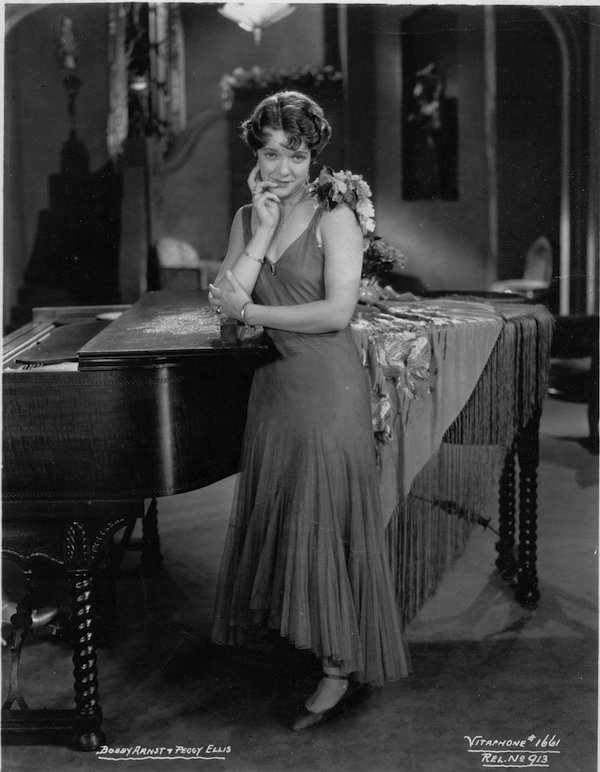
LOIS THOUGHT BOBBIE ARNST WAS PRETTY SWELL when she appeared at Helen Morgan’s nightclub. A noted broadway singer and dancer, Arnst is pictured above in a publicity photo from the 1929 film Rhythms in Blue. (picking.com)
screen-shot-2017-02-07-at-12-33-26-pm
ON THE OTHER HAND…Evelyn Nesbit’s tearoom (and later speakeasy) couldn’t survive on notoriety alone. In the early 20th century Nesbit’s face was everywhere—from advertisements to calendars—but in 1906 her fame took a nasty turn when her jealous husband, Harry Thaw, shot and killed suspected lover and famed architect Stanford White at Madison Square Garden’s rooftop theatre. At left, Nesbit in 1900. At right, Nesbit in her tea room on West 52nd Street, near Broadway, circa 1922. (Library of Congress / restaurant-ingthroughhistory.com)

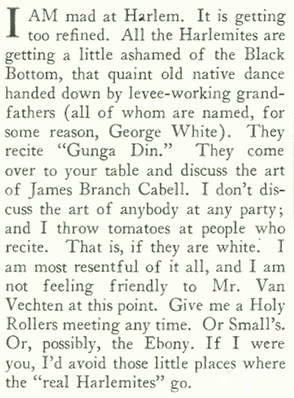
Long also railed against the white appropriation of Harlem entertainment, which she felt was draining the place of its soulfulness. In particular she called out writer and photographer Carl Van Vechten, who among white writers was the most prominent in intellectualizing the “Harlem Renaissance”…

screen-shot-2017-02-06-at-11-43-27-am

What to Buy in ’27

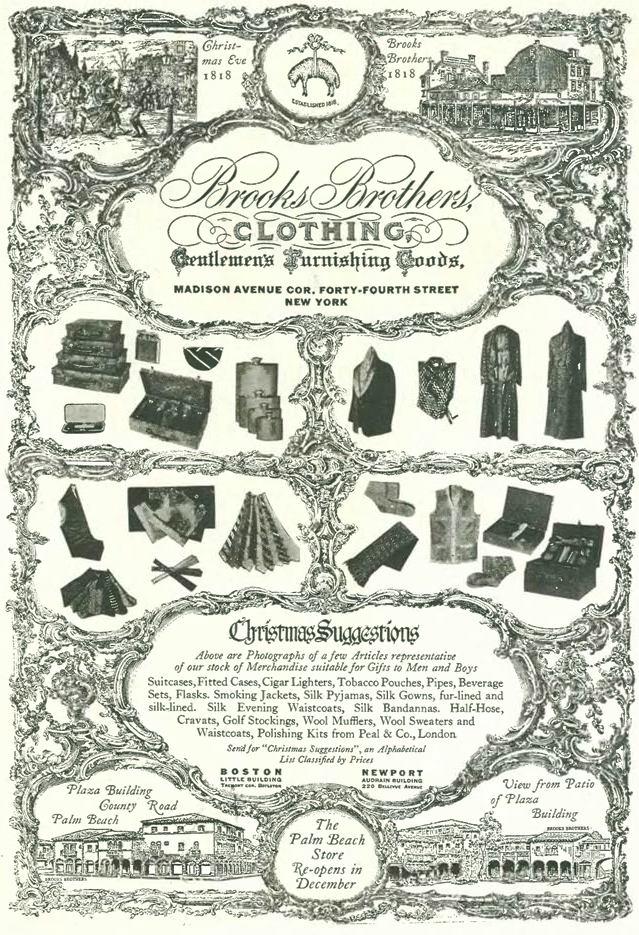
The Dec. 10 and Dec. 17 issues grew fat with holiday advertising, averaging 120+ pages as opposed to the usual 60 or so pages. The advertisements mostly appealed to upscale readers, ranging from this almost Victorian-style ad from the staid Brooks Brothers…

screen-shot-2017-02-06-at-9-46-21-am

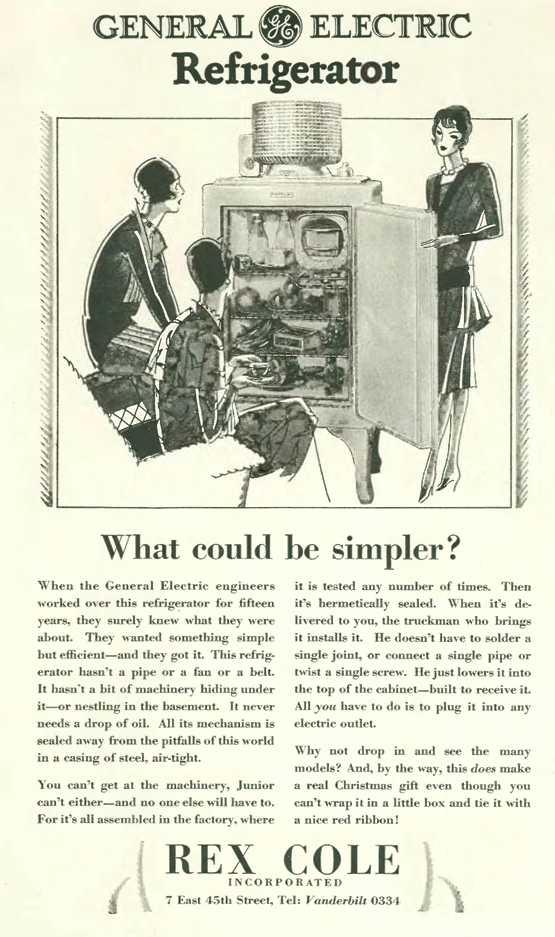
…to this ad from Rex Cole promoting the latest in modern conveniences…

screen-shot-2017-02-06-at-9-56-44-am

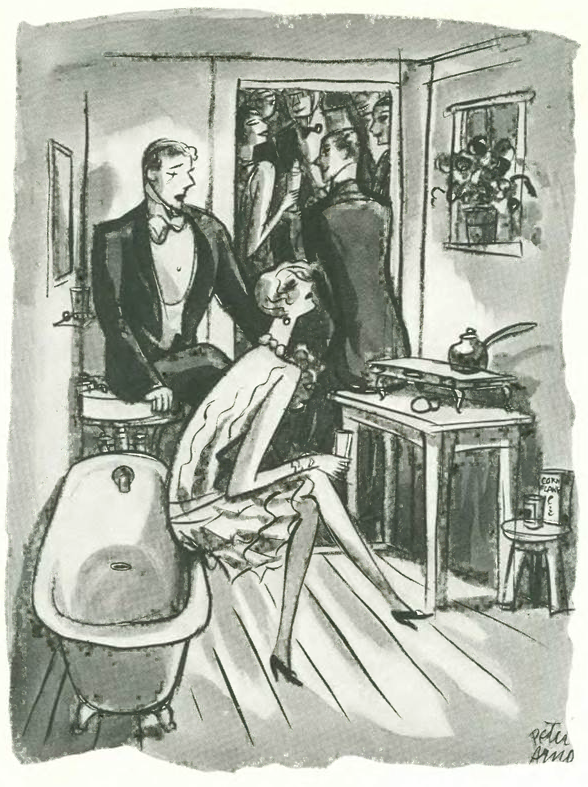
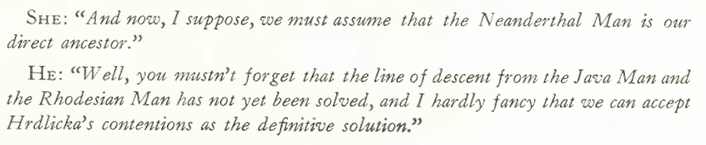
And I’ll toss in this cartoon from the Dec. 10 issue, in which Peter Arno allows us to listen in on an unlikely conversation between a couple of toffs…

screen-shot-2017-02-06-at-9-53-54-am

screen-shot-2017-02-06-at-9-54-11-am

Lois is Also Tired of the Holidays

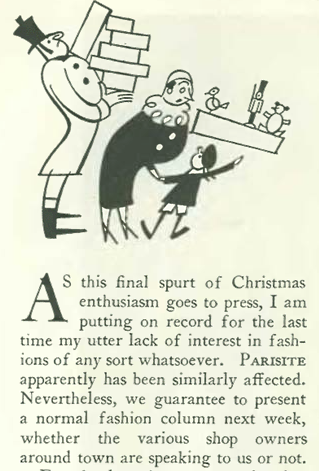
On to the Dec. 17 issue, in which Lois Long also shared with readers her weariness of Christmas shopping in her column, “On and Off the Avenue.”

dec-17
December 17, 1927 cover by Theodore G. Haupt.

The “Parisite” Long referred to in this excerpt was actually Elizabeth Hawes, who occasionally contributed to Long’s column (with cables sent from Paris) regarding the latest in French fashions. More on Hawes another time…

screen-shot-2017-02-06-at-12-11-30-pm

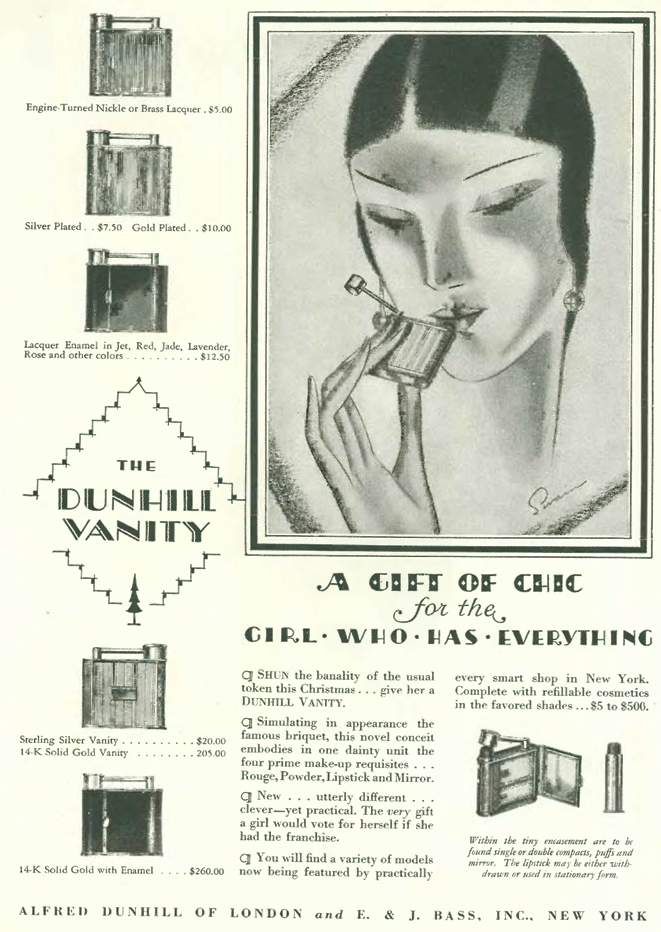
As for ads in the Dec. 17 issue, we get this one from Dunhill, maker of fine English cigarettes and accessories: a woman’s compact that resembles a lighter…

screen-shot-2017-02-06-at-12-07-21-pm

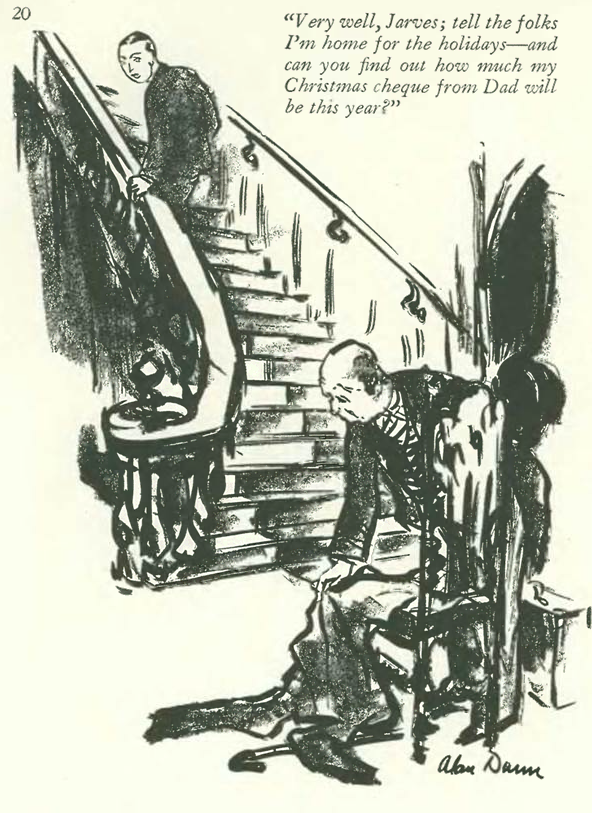
…and the same issue offers this glimpse into the life a spoiled rich kid, home from college for the holidays. The cartoon is by Alan Dunn, one of the most published New Yorker cartoonists (1,906 cartoons from 1926 to 1974)…

screen-shot-2017-02-06-at-11-52-12-am

With Christmas advertising over, the magazine’s page length dropped by half from the Dec. 17 to the Dec. 24 issue…

dec-24
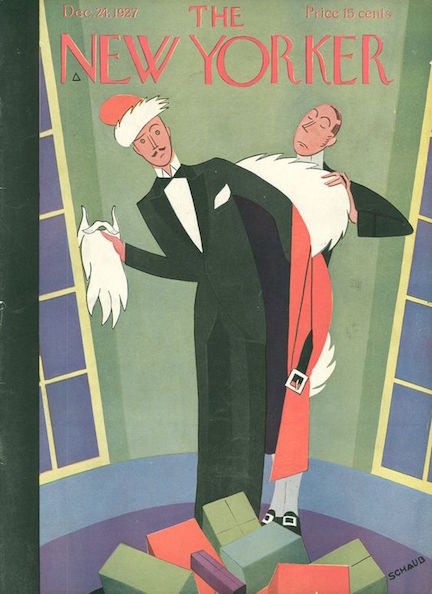
December 24, 1927 cover by Andre De Schaub.

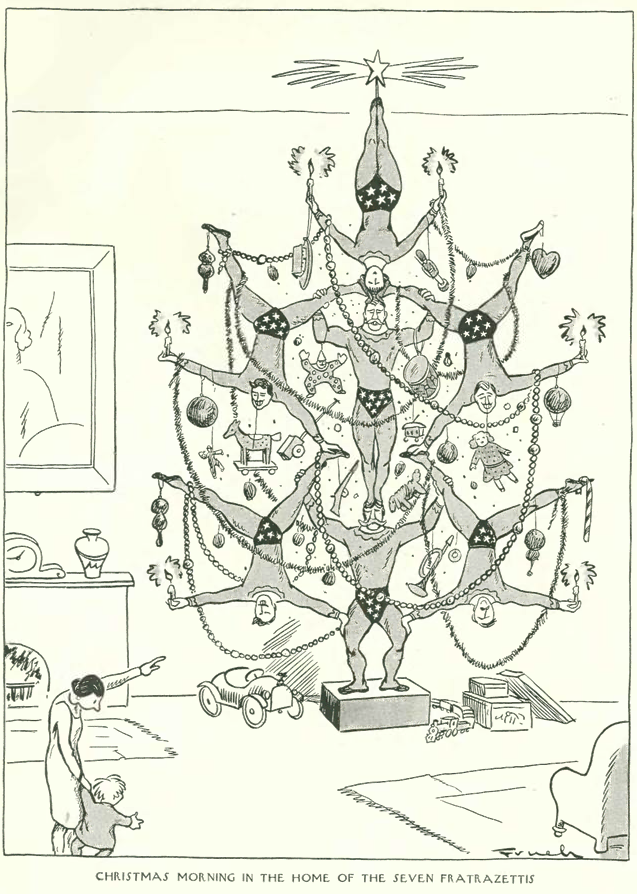
…in which we find this holiday-themed illustration by Al Frueh:

screen-shot-2017-02-06-at-12-26-56-pm

Why We Sing Auld Lang Syne

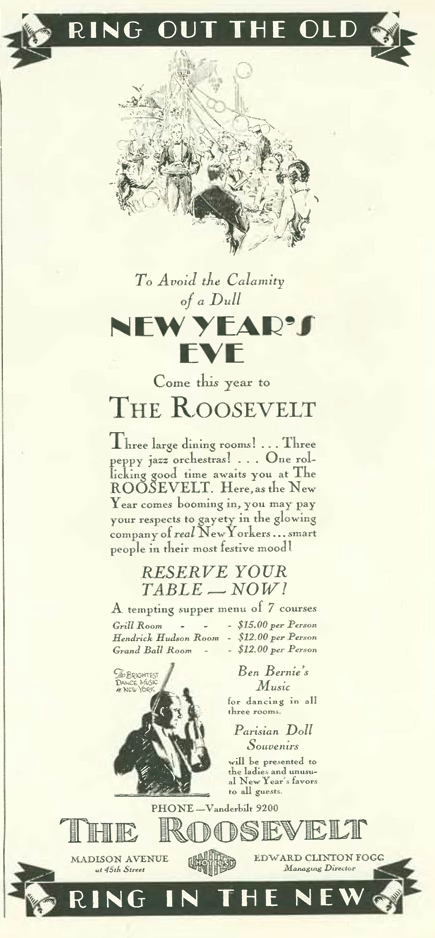
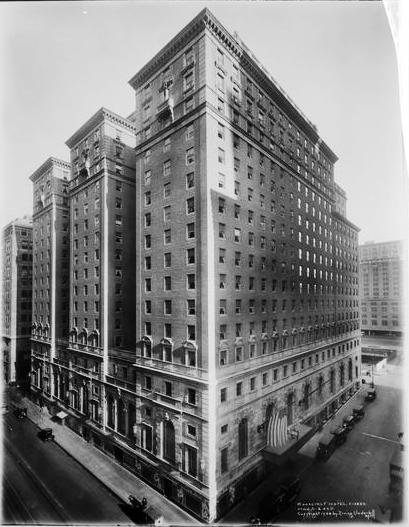
This advertisement in the Dec. 24 issue invited readers to celebrate the New Year at The Roosevelt Hotel…

screen-shot-2017-02-06-at-12-27-47-pm

roosevelt-hotel-1924
The Roosevelt Hotel after its completion in 1924 (Museum of the City of New York)
1387211957-0
AULD ACQUAINTANCE…If you want to know why we sing “Auld Lang Syne” on New Year’s Eve, you can thank Guy Lombardo and his Royal Canadian Band, which made the song a staple at his New Year’s performances beginning in 1929 at the Roosevelt Hotel. Their performance that night was broadcast on the radio before midnight Eastern time on CBS, then after midnight on NBC radio. (neatorama.com)

 *  *  *

Now Let’s Get Out of Here

With the holidays out of the way, New Yorkers still faced a good three months of winter. That is, unless you were well-heeled enough to head south to Palm Beach. Considering the abundance of ads promoting travel to southern climes in the Dec. 24 and 31 issues, apparently many of the magazine’s readers possessed the means to do just that…

screen-shot-2017-02-06-at-12-29-05-pm

screen-shot-2017-02-06-at-12-29-15-pm

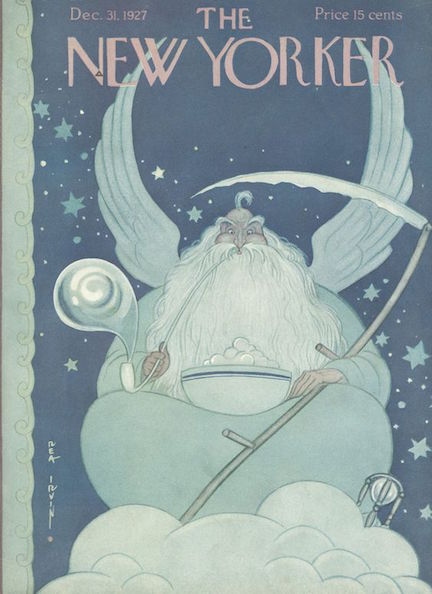
And we close this entry, and the year of 1927, with this cover…

dec-31
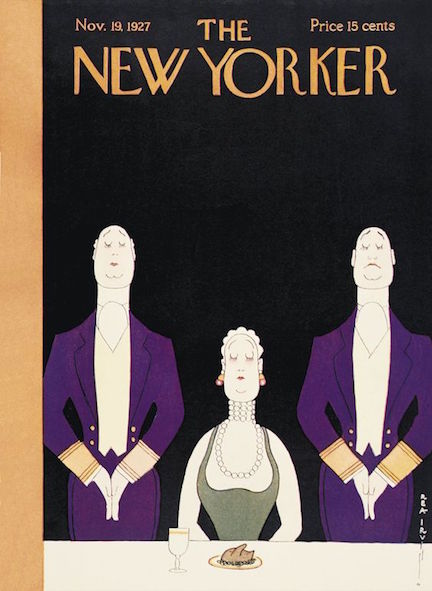
December 31, 1927 cover by Rea Irvin.

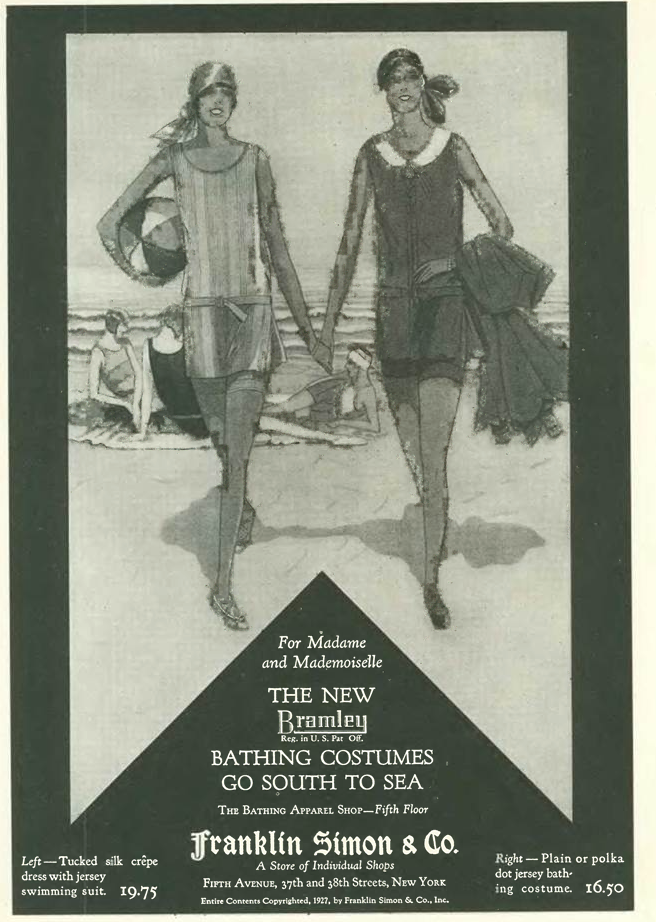
…and another tropical-themed advertisement, courtesy of Russeks…

screen-shot-2017-02-06-at-12-31-07-pm

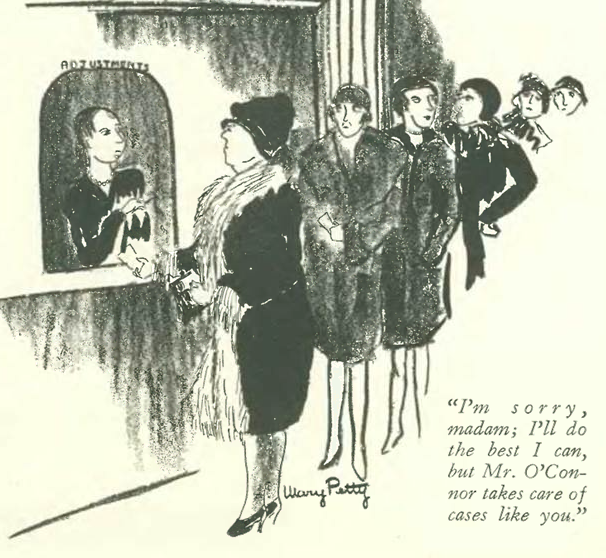
…and this cartoon by Mary Petty depicting those who were left behind, still returning their Christmas gifts…

screen-shot-2017-02-06-at-12-32-39-pm

Next Time: Odious Odes…

jan-7


The Shape of Things to Come

(Photograph by Flickr user August Fischer)

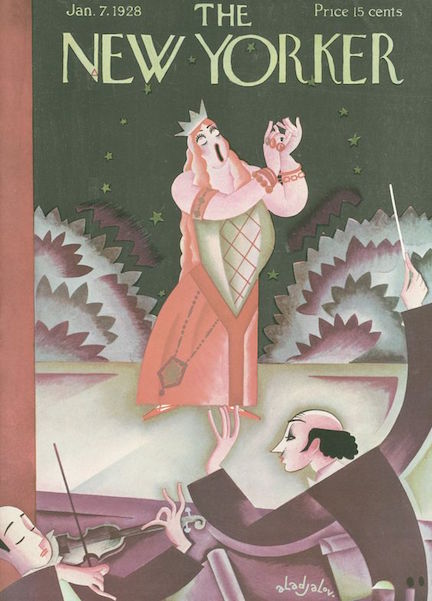
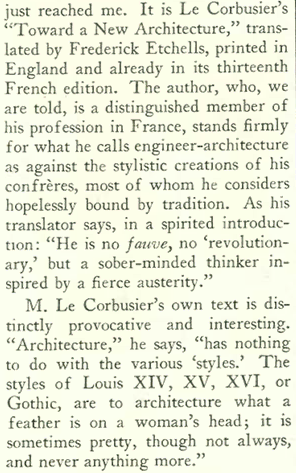
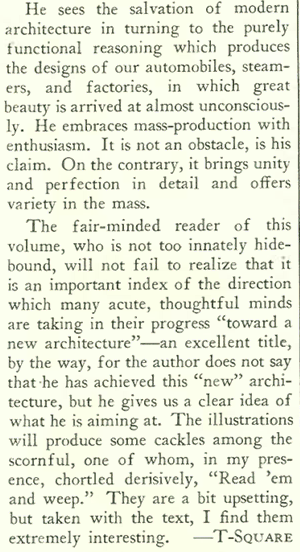
It is often observed that when we look to the past we can see our the future. More than 90 years ago, Swiss architect Le Corbusier (Charles-Édouard Jeanneret) wrote an influential book on modern architecture, Vers une Architecture (1923) that helped to radically change how we looked at our built environment. Translated into English in 1927 under varying titles (Toward an Architecture, or Towards a New Architecture), the book caught the appreciative eye of New Yorker architecture critic George Chappell, who wrote under the pseudonym “T-Square.”

6a4881d9250d214bed267228a8881e08
Nov. 12, 1927 cover by Theodore G. Haupt.

Given that most new architecture in Manhattan was adorned in architectural stylings from the past, or gussied up in Jazz Age art deco, Chappell was introducing his readers to something very different, to ideas that would transform their city within two generations.

screen-shot-2017-01-19-at-9-10-14-am

screen-shot-2017-01-19-at-9-10-22-am

slide31-720x540
A SOBER-MINDED THINKER…Le Corbusier at work in his apartment at 20 Rue Jacob, Paris, in the late 1920s. (Brassai Paris)

In his embrace of technology and mass production, Corbusier maintained that houses should be built in standardized forms that allowed for continuous refinement, designed as “machines for living” with the same precision as automobiles and airplanes…

screen-shot-2017-01-18-at-9-28-04-am

In case you doubt the architect’s fervor, here is Corbusier’s manifesto on mass production included in Towards a New Architecture:

screen-shot-2017-01-23-at-10-01-39-am

0195a9893bd41cf67cb5cd7b0bacc4f9
MACHINES FOR LIVING…This two-family structure on the outskirts of Stuttgart, Germany, was designed by Le Corbusier and his cousin, Pierre Jeanneret in 1927. It was one of the first built manifestations of Corbusier’s Five Points of a New Architecture, a manifesto written in 1926. The house set an important precedent for the emerging International Style associated with Germany’s Bauhaus movement. (noordinaryhomes.com)

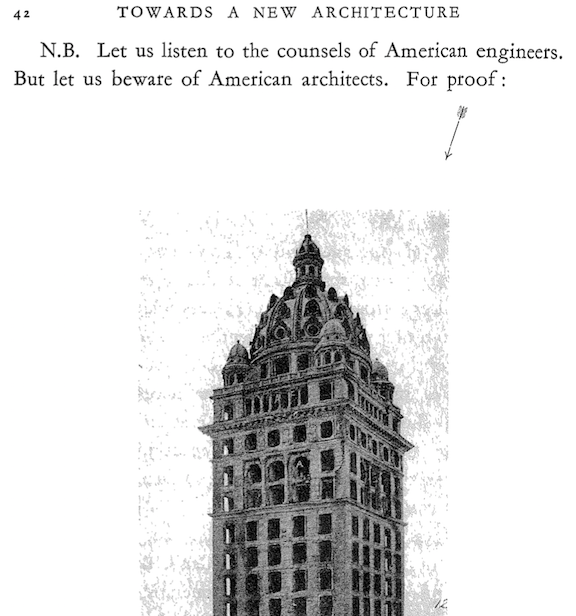
In Towards a New Architecture, Corbusier wrote that while architecture was  stifled by custom and lost in the past (“to send architectural students to Rome is to cripple them for life…”), engineers were embracing new technologies and building simple, effective and “honest” structures. Rather than rely on past forms or contemporary trends such as art deco, Corbusier said architecture should fundamentally change how humans interact with buildings.

monoskop-org
ALL DRESSED UP WITH NOWHERE TO GO…A photograph from Towards a New Architecture. Corbusier said contemporary architecture was stifled by custom and lost in the past. (monoskop.org)
fig_7_page_29_copy_0
FORM FOLLOWS FUNCTION…Examples of “honest” and functional industrial buildings featured in Towards a New Architecture. (monoskop.org)

Corbusier concluded his book with a moral imperative and an ominous choice  for the future: “Architecture or Revolution.”  He asserted that the “great disagreement between the modern state of mind…and the stifling accumulation of age-long detritus” would force modern man to live in an “old and hostile environment” and deny him an “organized family life,” ultimately leading to the destruction of the family.

In less than ten years the Nazis would chase the “degenerate” Bauhaus out of Europe and into the embrace of American academe. In short order Corporate America would adopt Corbusier’s International Style, if imperfectly, but most Americans would prove resistant to making their homes into “machines for living.”

Corbusier would doubtless be shocked (and disappointed) to know that 100 years hence people still live in mock Tudors and “Tuscan Villas,” especially in the midst of so much advanced technology.

villa-savoye-near-paris-france_le-corbusier_unesco_flickr-august-fischer_dezeen_936_0-1
HOME SWEET HOME…Villa Savoye near Paris, France. Designed by Le Corbusier in 1928, completed in 1931. Named a World Heritage Site in 2016. (Photograph by Flickr user August Fischer)

 *  *  *

AS HE WAS SAYING…

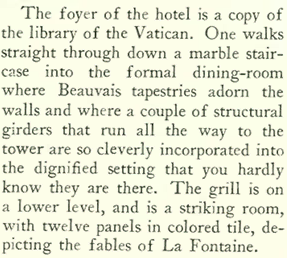
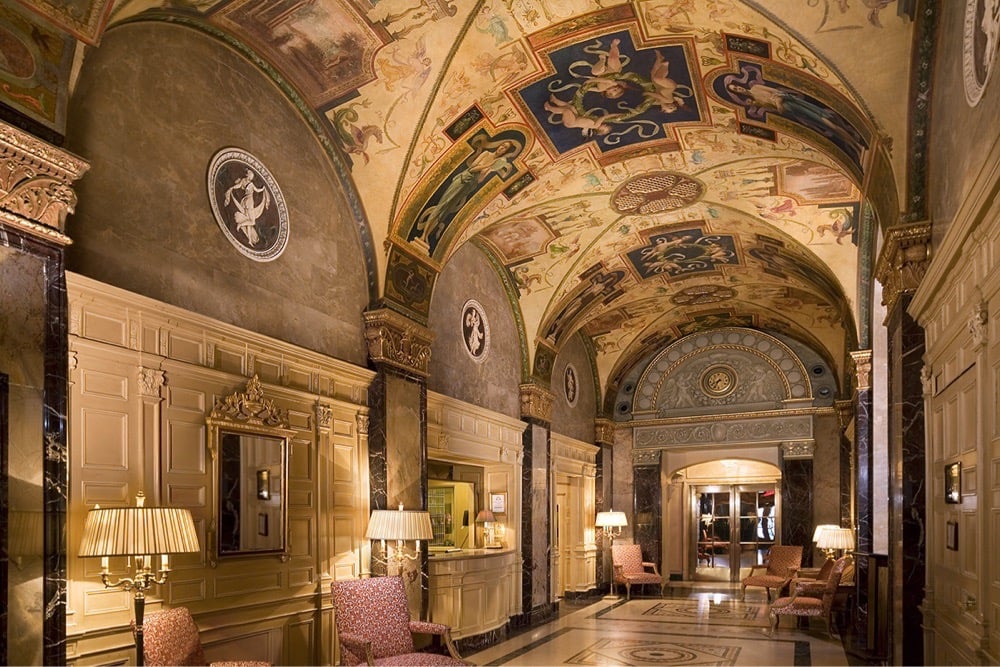
The new Sherry-Netherland apartment hotel near Central Park was exactly the sort of architecture Corbusier detested. “The Talk of the Town,” however, seemed impressed with its elegant appointments…

penthouse-35k

o
SUMPTUOUS…The foyer of the Sherry-Netherland, restored to its former glory in 2014. (Wikipedia)
screen-shot-2017-01-24-at-9-28-00-am
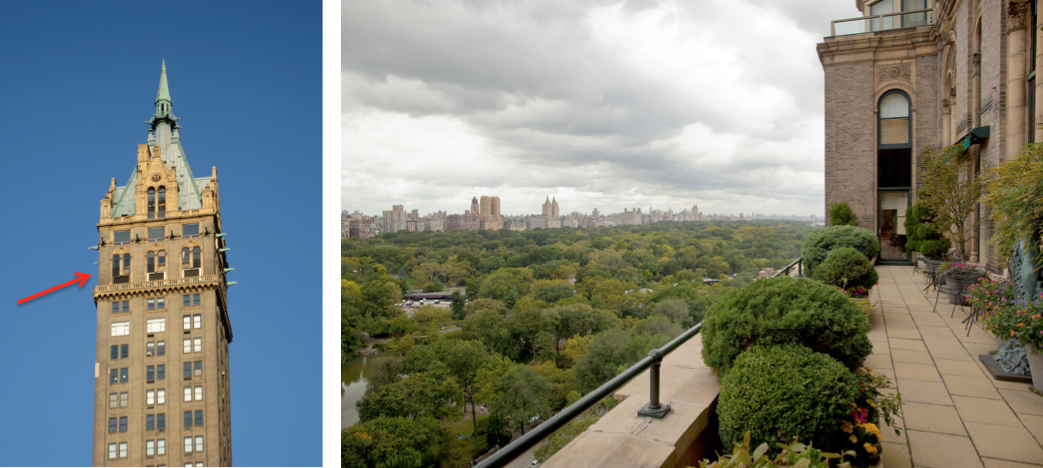
ROOM WITH A VIEW…The Sherry-Netherland penthouse, priced at $35,000 a year in 1927, is now worth more than $100 million. (TripAdvisor/Robert Caplin for The New York Times)

“Talk” noted that beneath the Sherry-Netherland’s spire the penthouse apartment could be had for $35,000 a year, roughly equivalent to $477,000 today. The building went co-op in the 1950s, and that would have been a good time to buy the penthouse. Today it is valued at more than $100 million.

Poo on Pooh

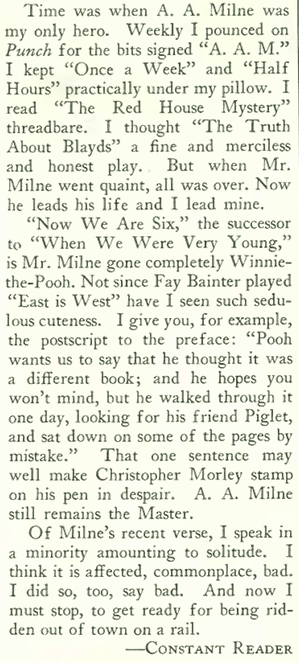
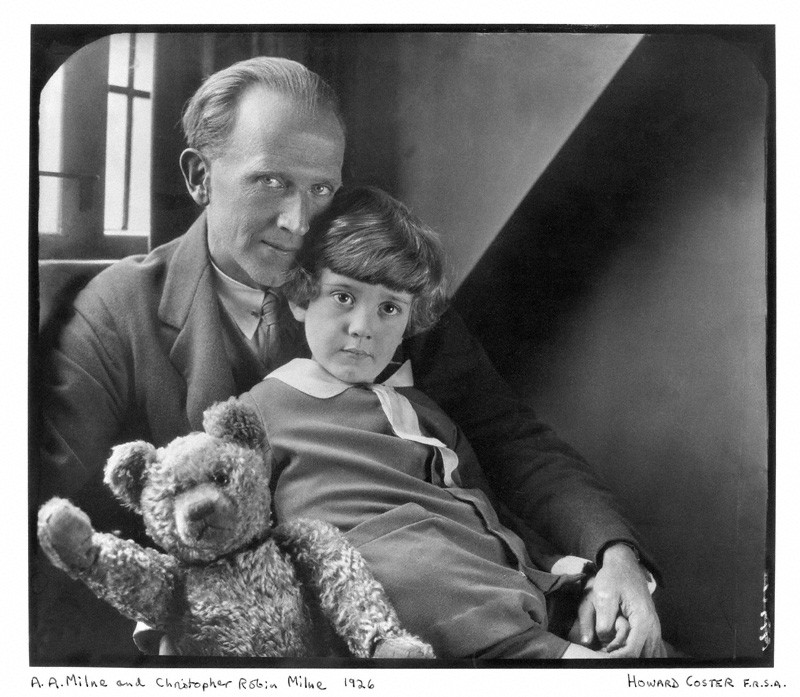
Dorothy Parker lamented the state of children’s literature in the “Books” section, and expressed her displeasure with A.A. Milne, a former humor writer for Punch who “went quaint” with his Winnie the Pooh stories.

screen-shot-2017-01-18-at-9-32-35-am

by Howard Coster, half-plate film negative, 1926
OLD SOFTIE…A. A. Milne with his son Christopher Robin and Pooh Bear, at Cotchford Farm, their home in Sussex, in 1926. Photo by Howard Coster. (npg.org.uk)

 *  *  *

New Game in Town

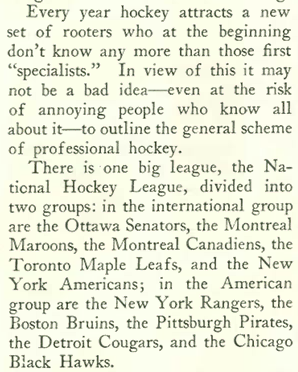
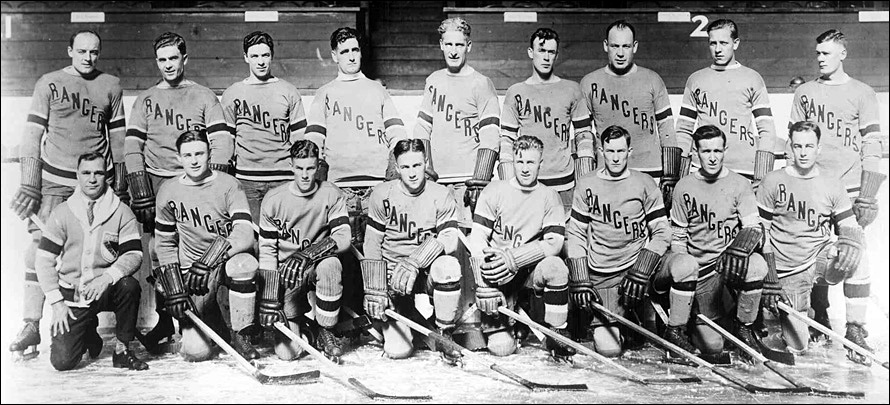
Niven Busch Jr. wrote about the growing popularity of professional hockey. Tex Rickard’s two-year-old franchise, the New York Rangers, were a major draw at the new Madison Square Garden (they would win the Stanley Cup in their second year), and even Texans were into the sport–Busch noted that a game between Dallas and Fort Worth teams drew 20,000 spectators.

screen-shot-2017-01-19-at-9-05-43-am

192728_lg
ICE MEN…Stanley Cup winners, the 1927-28 New York Rangers. (rangers.ice.nhl.com)

 *  *  *

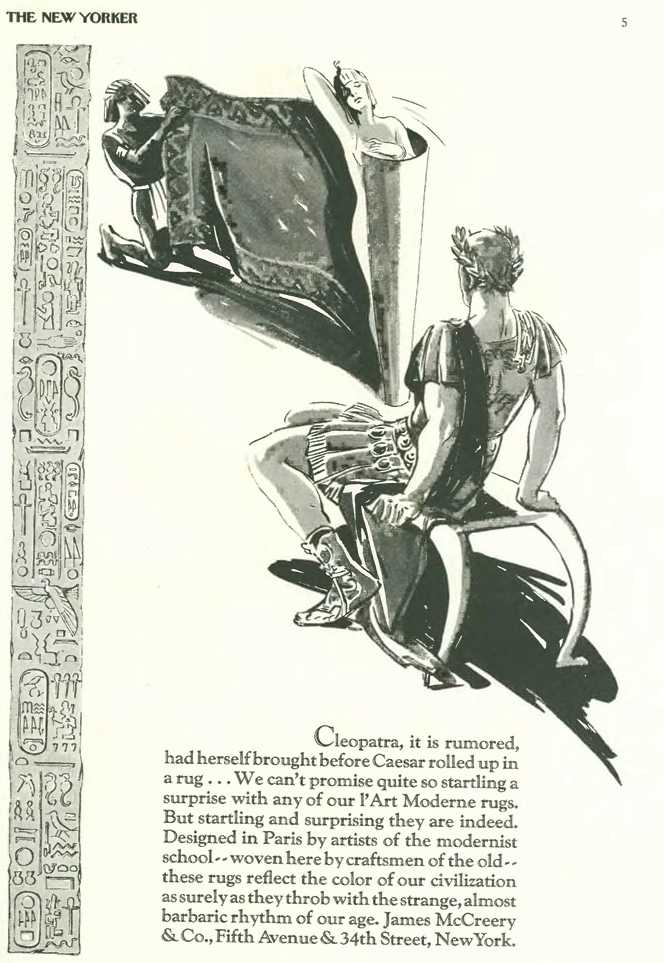
And finally, from the world of advertising, here is one in a series of classically themed ads for the McCreery department store…

screen-shot-2017-01-10-at-12-32-37-pm

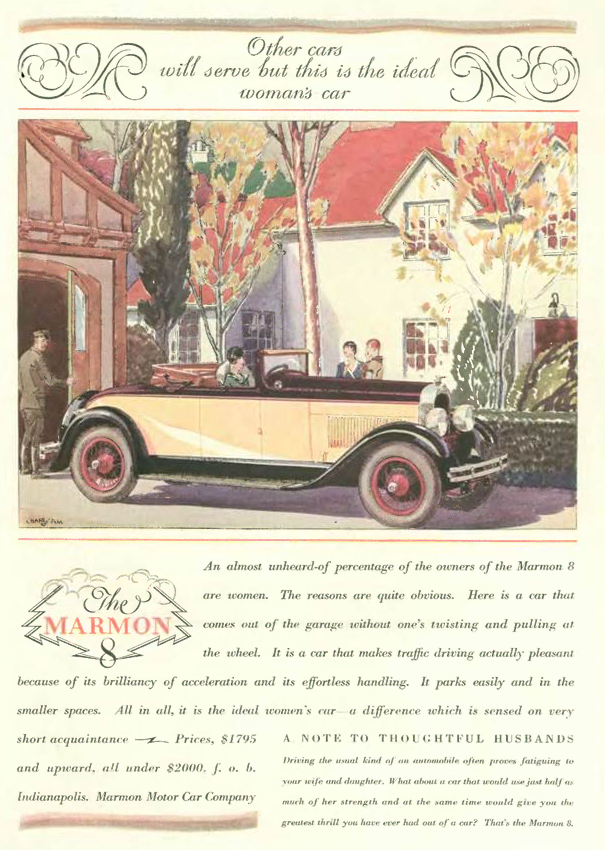
…and this advertisement for the Marmon 8, an “ideal woman’s car”…
screen-shot-2017-01-17-at-9-12-50-am

Next time: Mutt & Jeff…

b68f7029982159e66d4478b3e80316ef