A Bridge Too Far

Despite the rise of the professional classes in the 20th century (and their attendant rules for accreditation and licensing) there still existed individuals who practiced at the highest levels with little or no formal training.

June 8, 1929 cover by Julien de Miskey.

Gustav Lindenthal (1850-1935) was a case in point. An Austrian immigrant who designed New York’s Hell Gate Bridge among others had little formal education and no degree in civil engineering. Rather, he learned by working as an assistant on various construction projects and teaching himself mathematics, metallurgy, engineering, hydraulics and other principles of the building profession.

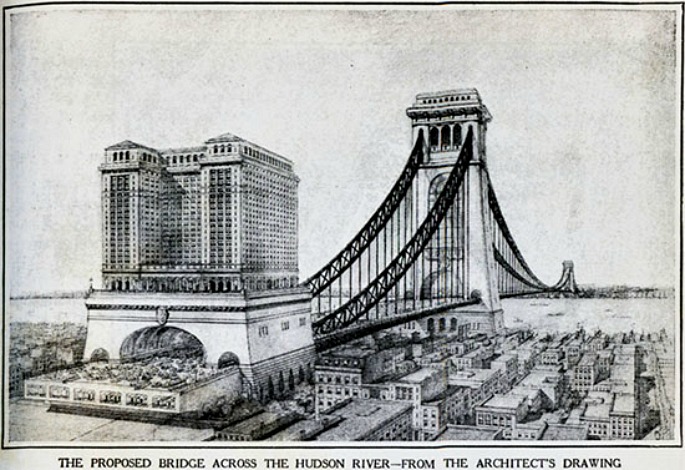
Lindenthal was praised for his innovations in bridge design as well as for his artistic eye, but one project eluded him throughout his career: the largest bridge in the world—a massive double-decker that would span the Hudson River from 57th Street in New York City to Hoboken in New Jersey. The June 8, 1929 “Talk of the Town” checked in on the nearly 80-year-old bridge builder:

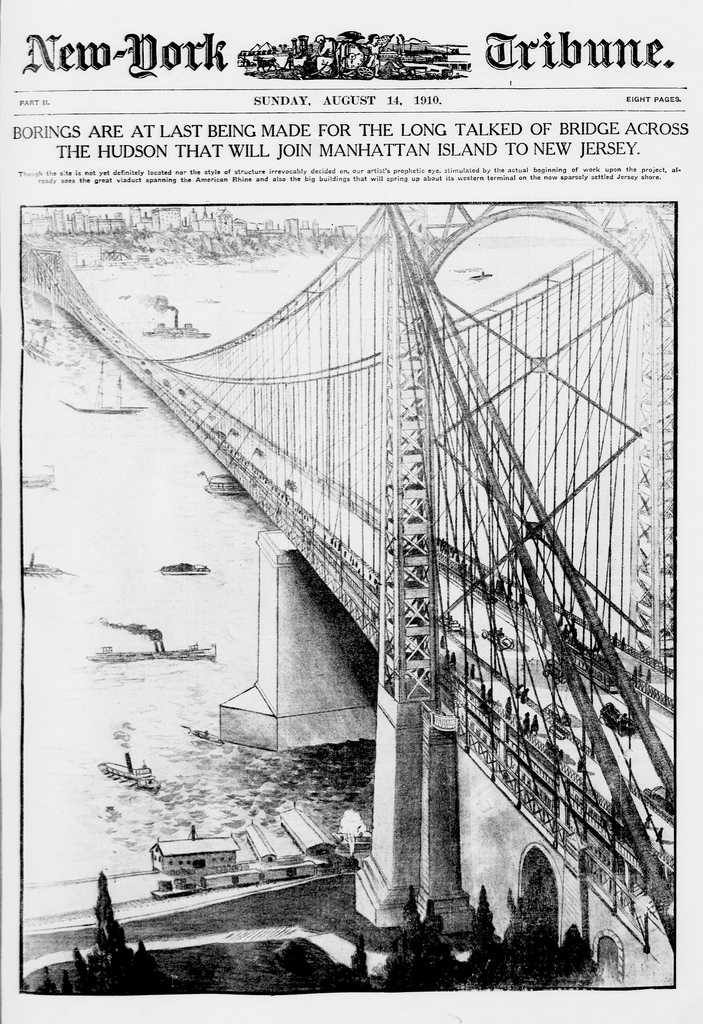
A cornerstone for the Hudson bridge was laid in 1895, but a series of bad breaks, including the 1898 Depression and various political setbacks, served to continually delay the project. The New York Tribune anticipated the bridge in its April 28, 1907 edition…

(untapped cities) click to enlarge

…and three years later the Tribune seemed confident that work was finally underway…
(untapped cities)

…however by the 1920s the bridge was still a dream. In 1921 Scientific American offered the latest glimpse of Lindenthal’s proposed 57th Street Bridge — a span 6,000 feet in length, with a 200-foot-wide double deck accommodating 24 lanes of traffic and 12 railroad tracks. An artist’s rendering included a massive building, on an arched plinth, positioned over the bridge deck:
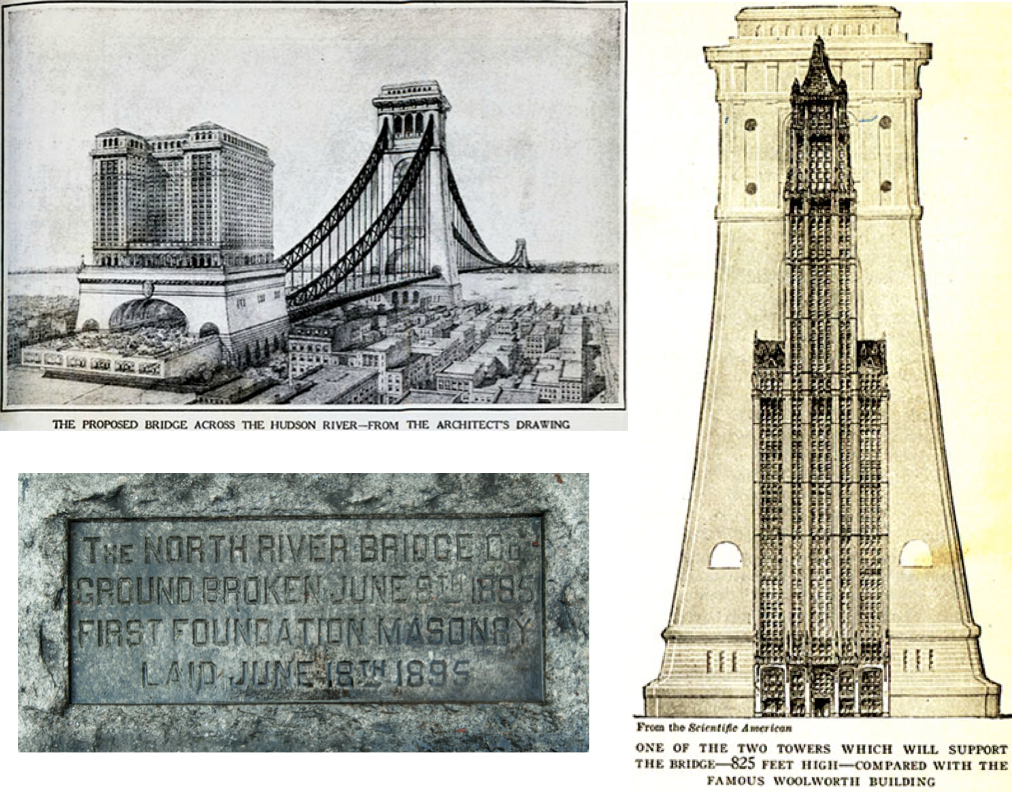
BIG PLANS…Clockwise, from top left: Artist’s rendering of Gustav Lindenthal’s proposed 57th Street bridge from the June 25, 1921 issue of Scientific American. That same issue featured a size comparison with the then-tallest building in the world—the Woolworth Building. Below, the 1895 cornerstone, recently recovered from a crumbling pier on the New Jersey side of the Hudson and relocated to the grounds of Steven’s Institute of Technology in Hoboken. (untappedcities.com)

The New Yorker suggested that Lindenthal’s legacy was already secure, and with his determination and vigorous constitution, he still might still win the day:

Despite his vigor, Lindenthal would not live to see his dream realized. However, he is remembered for building some of New York’s most iconic bridges, including the Hell Gate and Queensboro:

LEGACY…Clockwise, from top left, Hell Gate Bridge; Gustav Lindenthal, circa 1920; Queensboro Bridge. (Library of Congress/Britannica/Pinterest)

 *  *  *

Keeping Up With the Lindberghs

Despite his worldwide fame, Charles Lindbergh (1902-1974) detested the limelight, particularly when it came to his personal life. Writing in the column “The Wayward Press,” humorist Robert Benchley mocked the newspapers for their invasions into the lives of the celebrated, including newlyweds Charles and Anne Morrow Lindbergh:
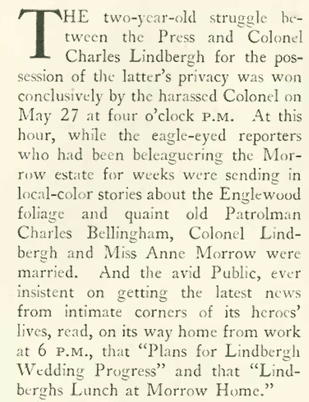
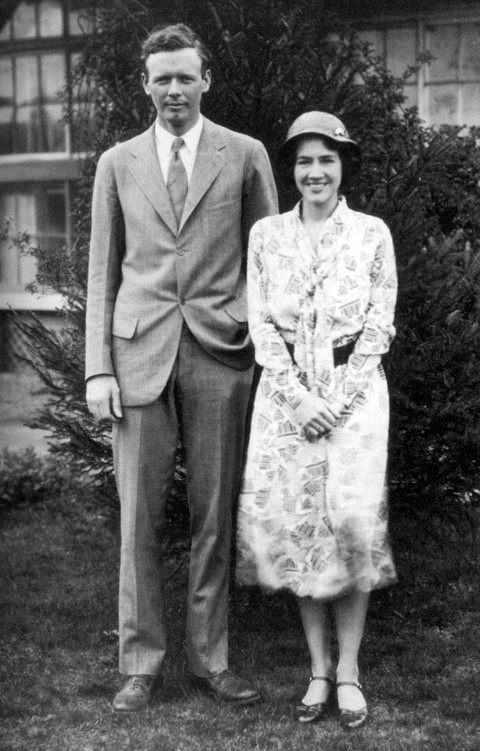
MIND YOUR OWN BEESWAX…Charles and Anne Morrow Lindbergh after their marriage in a private ceremony on May 27, 1929, at the home of her parents in Englewood, New Jersey. (Library of Congress)

Benchley wasn’t buying the newspaper industry’s insistence that the public demanded to know the facts about the flyboy’s nuptials:
 *  *  *

Let the Good Times Roll

With the newly remodeled Central Park Casino officially christened by Mayor Jimmy Walker and his cronies, The New Yorker’s Lois Long (in “Tables for Two”) decided to pay a visit to see what all the fuss was about:

Long also commented on the declining fortunes of another familiar face of New York nightlife, Texas Guinan, who had fled Manhatten’s smoky speakeasy scene for the bucolic climes of Nassau County…
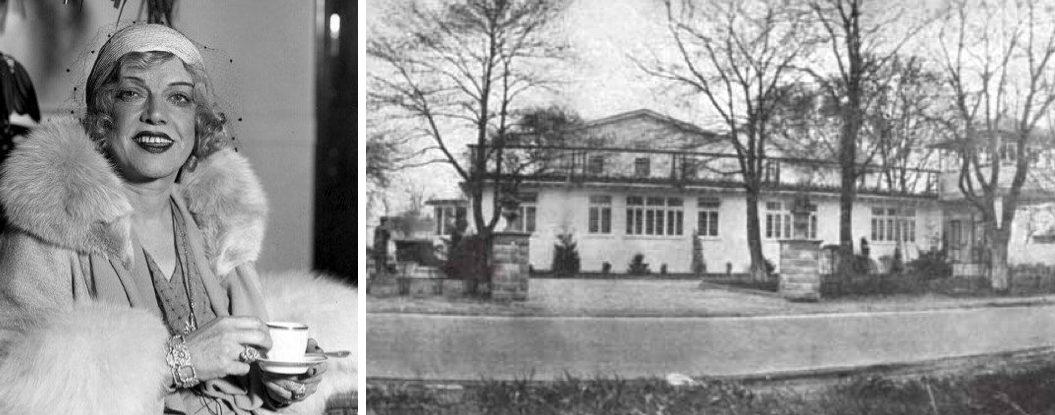
GOODBYE CITY LIFE…Texas Guinan took her nightclub to the quiet village of Valley Stream, New York, located just south of Queens in Nassau County. Guinan didn’t abandon all the trappings of city life: she drove to Valley Stream in a lavender Rolls Royce, and continued to greet her patrons with her famous “Hello, Sucker!” (jhgraham.com/texasguinanblogspot.com)

Long concluded that regardless where one ended up on a summer evening, one should be aware that a shabbier crowd awaited their company:

 *  *  *

Cuba Libre

Now we look at another New Yorker contributor who today is not exactly a household name: Donald Barr Chidsey (1902-1981), an American writer, biographer, historian and novelist best known for his adventure fiction. In this short column he offered some insights into the Cuban drinking scene:

ADVENTURESOME LAD…Donald Barr Chidsey wrote more than 50 books, including many action-adventure titles such as Captain Adam, from 1953. Note the resemblance of the hero on the cover to the author. (etsy/Amazon)

 *  *  *

Waxing Poetic

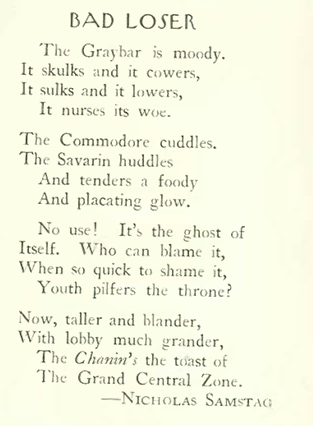
From its very first issue, The New Yorker also published a wide variety of poets, including Nicholas Samstag (1904-1968),who contributed several poems to the magazine in 1928 and 1929. Samstag later went on to a successful career in advertising, and was a close associate of  Edward Bernays, considered the father of public relations and propaganda.
A frequent contributor to The New Yorker, writer, poet and critic Mark Van Doren (1894-1972) published more than three dozen poems in the magazine from 1929 to 1972. Here is his first contribution, in the June 8, 1929 issue:

Van Doren’s last contribution to The New Yorker was published on Nov. 18, 1972, less than a month before his death. It was appropriately titled “Good Riddance”…

DID THE APPLE FALL FAR FROM THE TREE?…At left, a circa 1925 portrait of Mark Van Doren. He was the father of Charles Van Doren, who achieved brief renown as the 1957 winner of the rigged game show Twenty One. He is pictured at far right with fellow contestant Vivienne Nearing and game show host Jack Barry. (art.net/Wikipedia)

 *  *  *

From Our Advertisers

As summer approached some distinct themes emerged in ads aimed at female consumers. Here is a collection of ads from the June 8 issue that capitalized on the new tanning craze of the late 1920s…

click to enlarge

…and another big craze of the 1920s, the permanent wave, seemed to be a necessity as summer approached…

click to enlarge

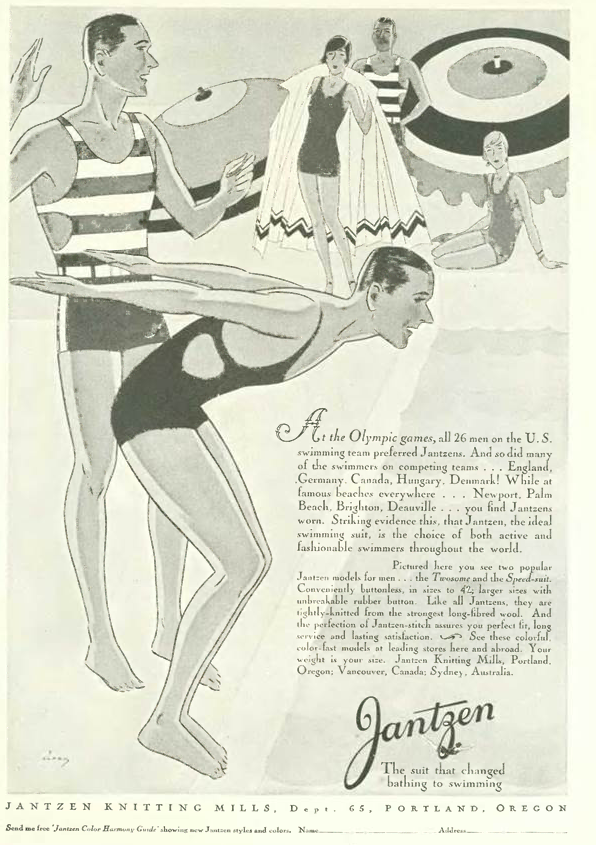
…as for the gents, check out this new line of Jantzen swimwear modeled by what appear to be identical twins…
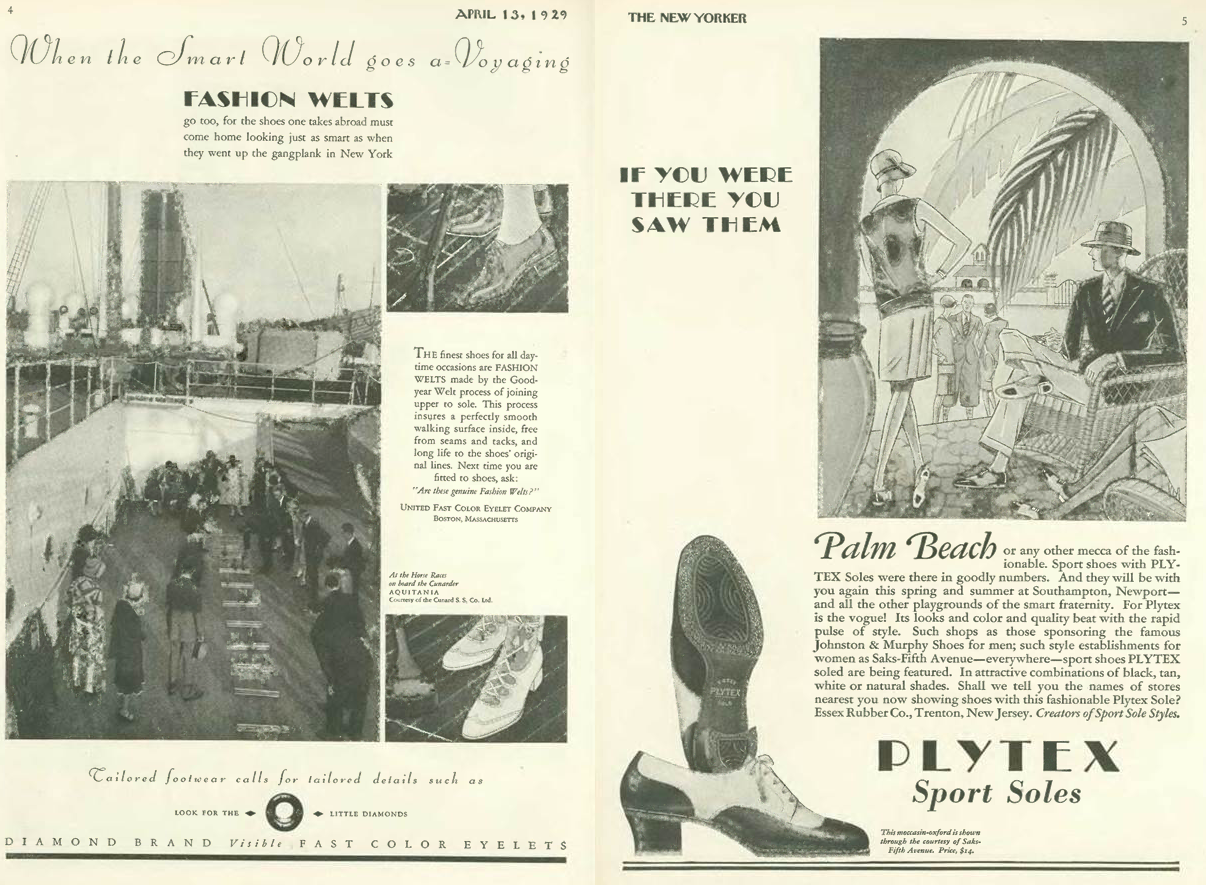
…and when you’re out of the water, a pair of “fashion welts” were all the rage for tip-toeing across the hot sands of Southampton…

…this ad from B. Altman depicted two women clad for “open motoring” (not sure how those long, lithe figures will fit into that tiny rumble seat)…

…for a less dusty mode of transportation, you could hop aboard The Broadway Limited for a quick 20-hour jaunt to Chicago…

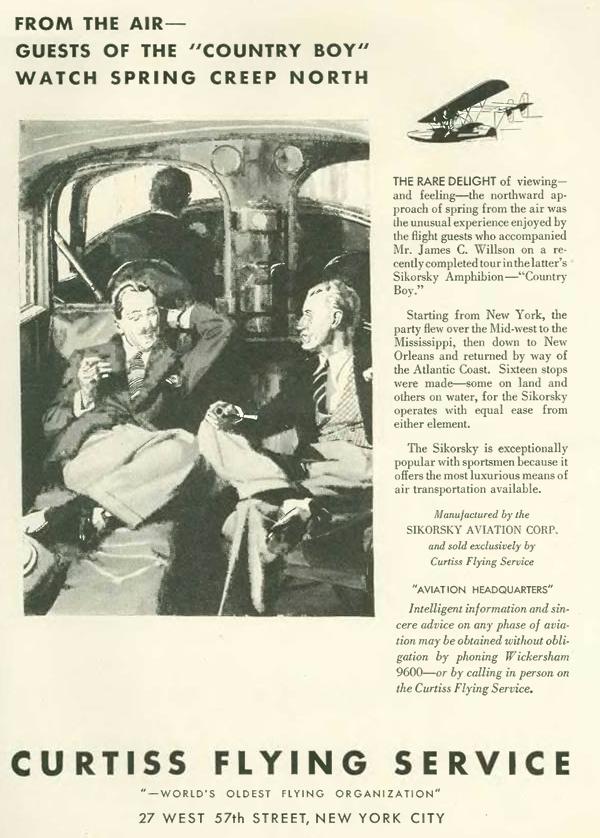
…or better yet, have a relaxing smoke with one of your chums aboard a Sikorsky seaplane…
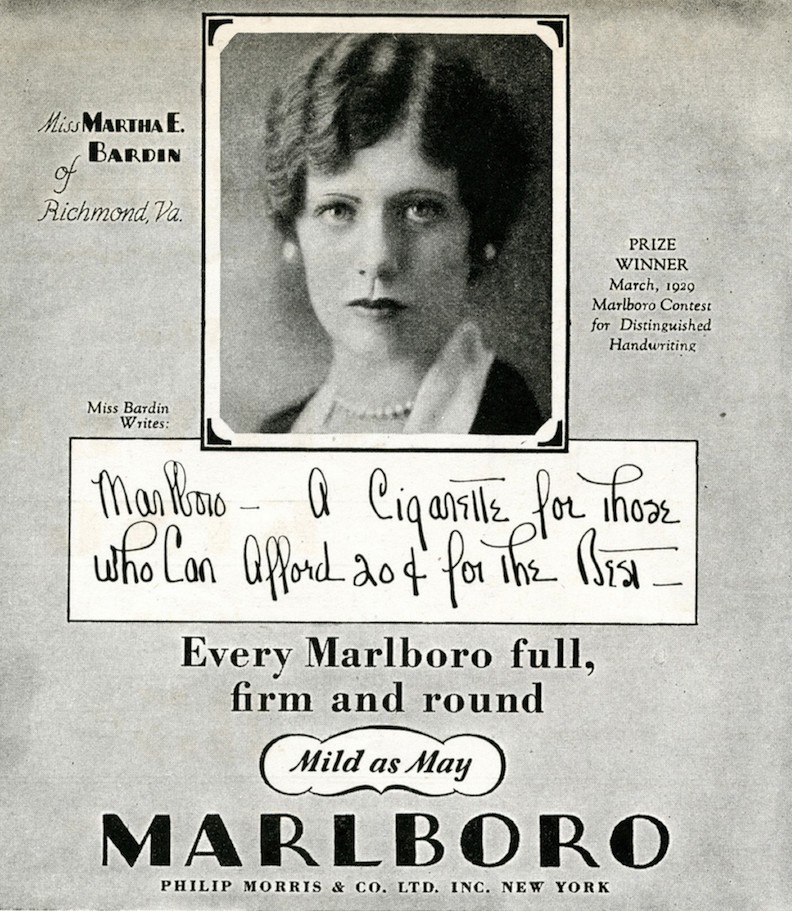
…our cigarette ad for this week comes from Philip Morris, makers of Marlboro, who once again exploited the nation’s youth with a bogus handwriting contest that doubled as a product endorsement…
…our June 8 comics are from Helen Hokinson, who offered a full page of illustrations from a “Fifth Avenue Wedding”…

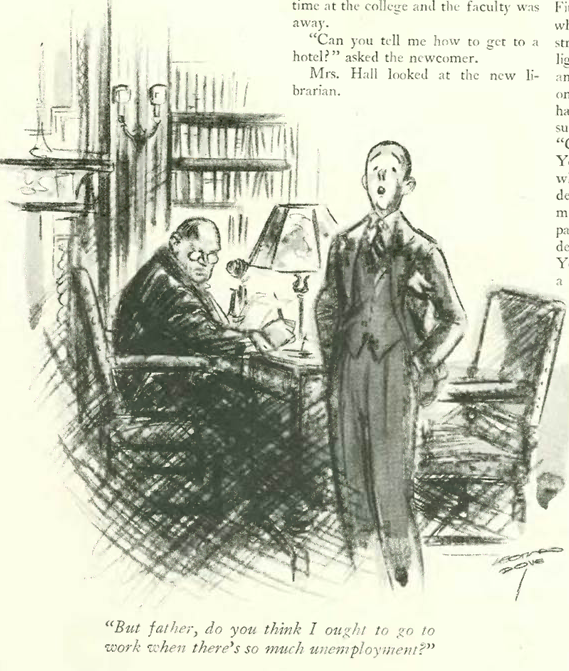
…while Leonard Dove peeked in on a wastrel son and his disappointed father…
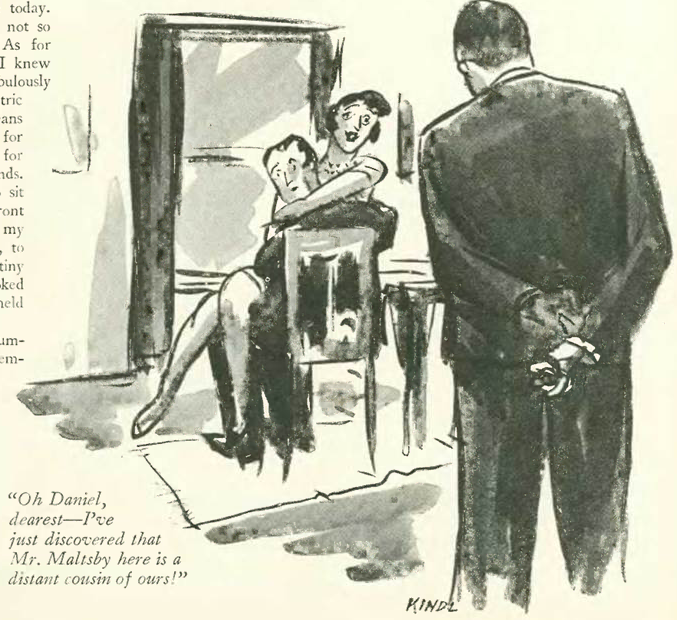
…and we have an awkward moment revealed by Carl Kindl

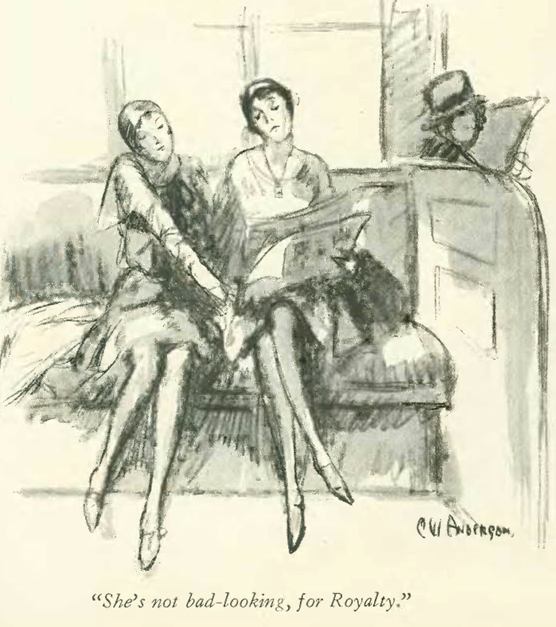
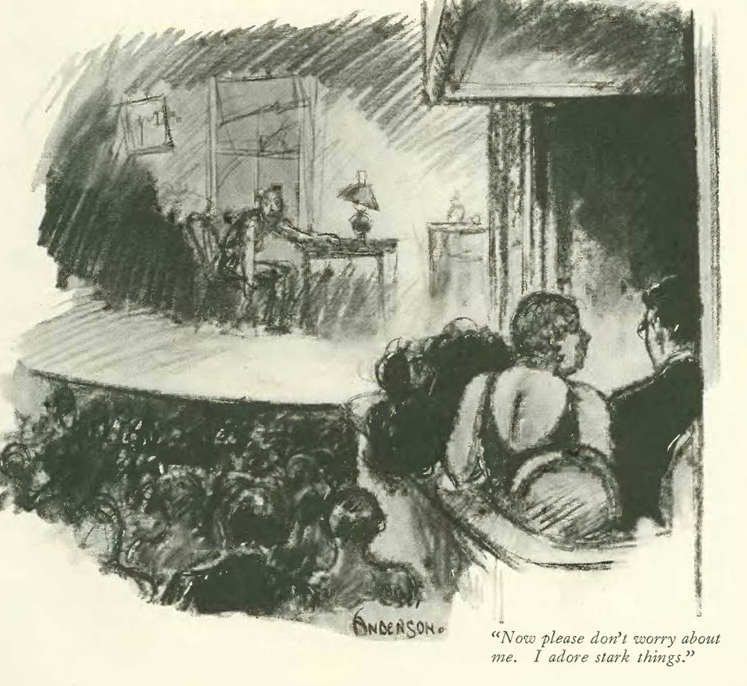
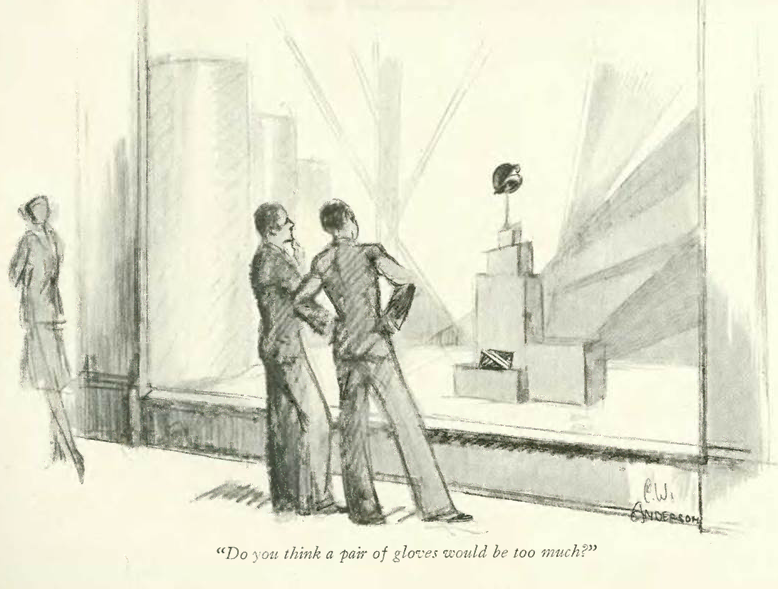
…and an observation by C.W. Anderson on the minimalism of modernist design…
…and finally, Peter Arno’s take on the challenges of shooting sound motion pictures…

Caption: “Lord, Mr. Rolbert, you’ll have to develop a more robust sneeze—the public will think you’re a sissy!”

Next Time: Something Old, Something New…

The Unspeakables

For all its embrace of the modern city and its technological wonders, The New Yorker mostly despaired of the changes wrought by the introduction of sound to motion pictures.

June 1, 1929 cover by Rea Irvin.

Granted, early sound technology was primitive, with directors, actors and crew members adapting on the fly to the demands of a new medium that required absolute silence on film sets and cumbersome microphones that severely limited the movements of actors. Screenwriters, accustomed to writing brief intertitles in silent films, now had to write expository dialogue, and actors had to rely less on exaggerated facial expressions and body movements and more on the spoken word. And it helped if you didn’t have a speech impediment or heavy accent.

Writing for “The Reporter at Large” column (titled “The Unspeakables”), Hollywood correspondent Jean-Jacques lamented that the talkies were “here to stay”…

BARNLIKE STAGES were erected on both coasts to produce early silent films. Clockwise, from top left, Fox’s World Paragon Studios in Ft. Lee, NJ, circa 1917; interior of the studio; several films in production, side-by-side, at Edison’s Bronx studio, circa 1915; Fox studios in Los Angeles, 1920s. (moviemice.com/Wikipedia)

Jean-Jacques recalled the professions that would now be lost to the talkies, including the “mood musicians” who played their instruments on silent film sets in order to evoke emotions from the actors…

IN THE MOOD…During the silent era “mood musicians” were hired to play their instruments on film sets in order to evoke emotions from the actors. (Pinterest)
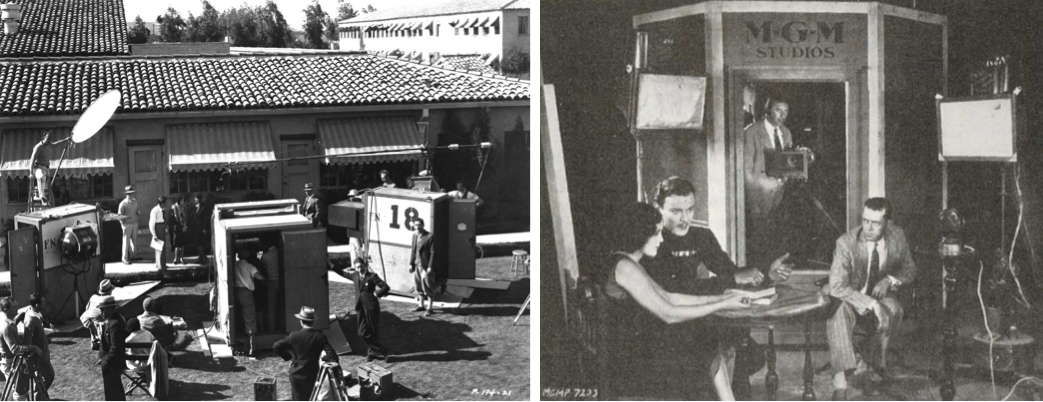
THE SILENCE OF SOUNDS…In the early days of the talkies the entire set had to be silent, and special care had to be taken to ensure loud cameras were housed in soundproof boxes such as those pictured above. Instead of the introduction of sound expanding the capabilities of filmmaking, it was often limited by the bulky gear used to capture that sound. Therefore, many films consisted of “stage” musical numbers that were static shots. (Caption and image at left courtesy Colorado College. Image at right from cinecollage.net)

The writer also noted the challenges that faced “the old scenario writer…hemmed in by a multitude of new rivals…

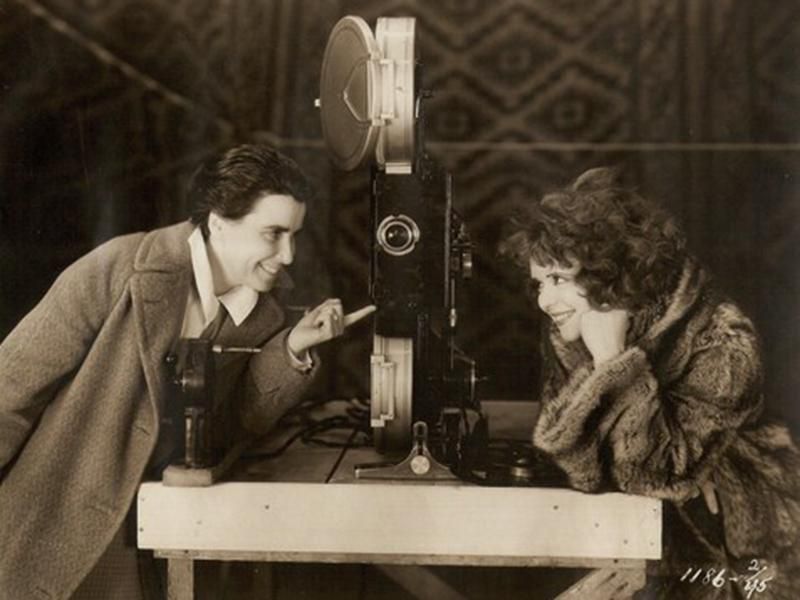
WE HAVE WAYS OF MAKING YOU TALK…Dorothy Arzner (left) poses with “It Girl” Clara Bow in a publicity shot for The Wild Party, Bow’s first talking picture. Bow is famously quoted as saying (in 1930) “I hate talkies. They’re stiff and limiting. You lose a lot of your cuteness, because there’s no chance for action.” Arzner tried to remedy that problem: she is credited with inventing the boom mike, which allowed for greater movement by the actor. (Paramount Pictures/Wikimedia Commons)

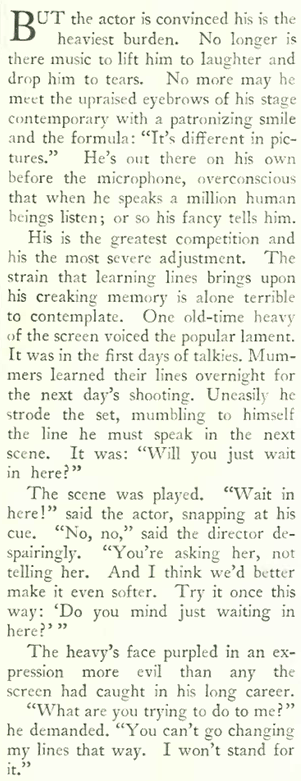
Jean-Jacques recounted the frustrations experienced by one old-time actor dealing with the limitations of bulky sound equipment…

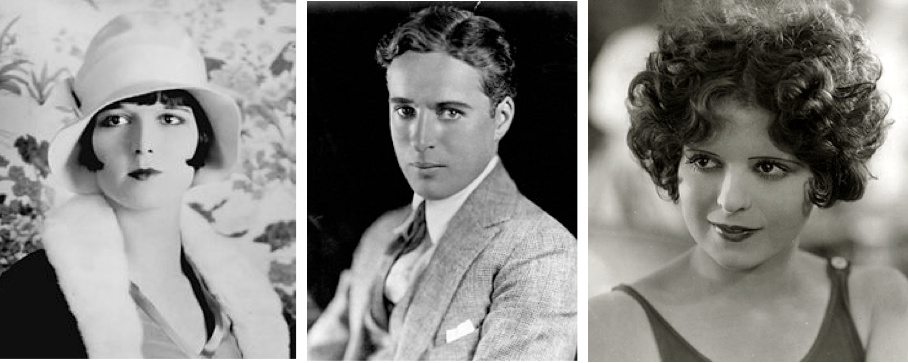
This actor was not alone. A number of major silent film stars including Charlie Chaplin, Louise Brooks, and Clara Bow did not embrace the novelty of sound pictures. Motion Picture Classic magazine (September 1930) quoted Bow as saying, “I hate talkies … they’re stiff and limiting. You lose a lot of your cuteness, because there’s no chance for action, and action is the most important thing to me.” According to the article, a visibly nervous Bow had to do a number of retakes in The Wild Party because her eyes kept wandering up to the microphone overhead.

SILENCE IS GOLDEN…A number of major silent film stars including (from left) Louise Brooks, Charlie Chaplin and Clara Bow did not embrace the novelty of sound pictures. (Wikipedia)

Jean-Jacques signed off his New Yorker piece with the hope that someday pictures and sound would be combined into a worthy new art form…

Perhaps he had to look no further than Manhattan’s Rialto Theatre to find that first glimmer of hope, for it was there that the Marx Brothers were tearing up the screen in their first talking picture, The Cocoanuts, reviewed in the magazine’s “The Current Cinema” column…

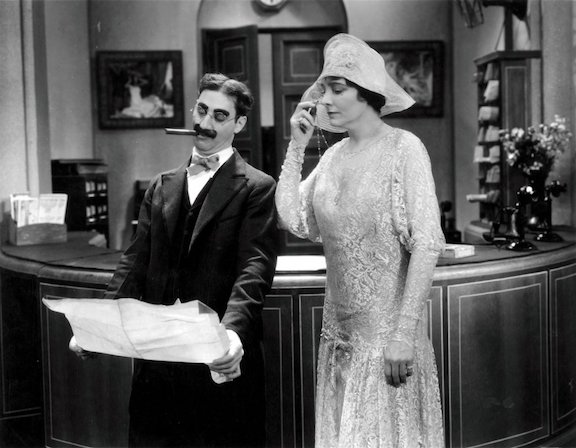
If The New Yorker was looking for snappy dialogue in motion pictures, there was plenty of it in The Cocoanuts, including this snippet between Groucho Marx, playing Mr. Hammer—an unscrupulous manager of a bankrupt Florida hotel—and wealthy hotel guest Mrs. Potter, played by Margaret Dumont…

Hammer: Do you know that property values have increased since 1929 one thousand per cent? Do you know that this is the biggest development since Sophie Tucker? Do you know that Florida is the show spot of America and Cocoanut Manor the black spot of Florida?

Mrs. Potter:  You told me that yesterday.

Hammer: I know but I left out a comma.

Or this gem…

Hammer, to Mrs. PotterJust think – tonight, tonight when the moon is sneaking around the clouds I’ll be sneaking around you. I’ll meet you tonight under the moon. Oh, I can see it now – you and the moon. Wear a neck-tie so I’ll know you.

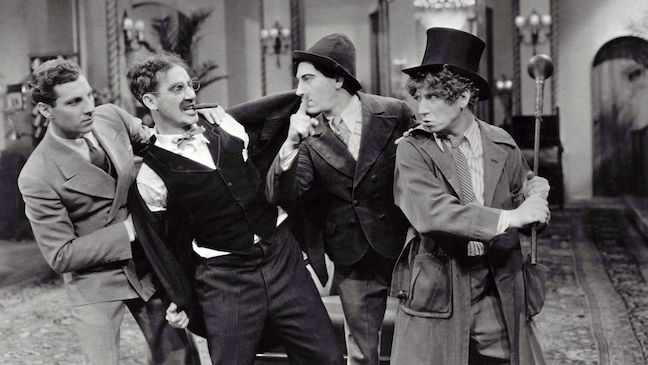
SHOW ‘EM HOW IT’S DONE…Zeppo, Groucho, Chico and Harpo Marx in their first sound movie, The Cocoanuts, 1929. (vitaphonedreamer.wordpress.com)
BAMBOOZLER… Mrs Potter (Margaret Dumont), inspects Mr Hammer’s (Groucho Marx) Florida property “deals” in The Cocoanuts. (British Film Institute)

 *  *  *

For Sentimental Reasons

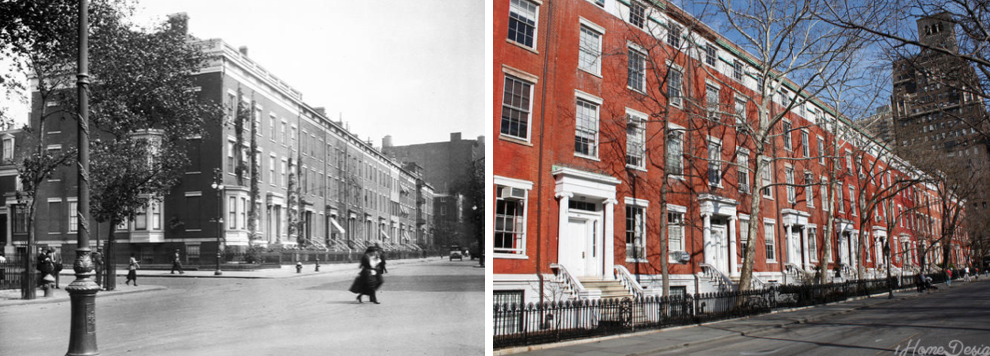
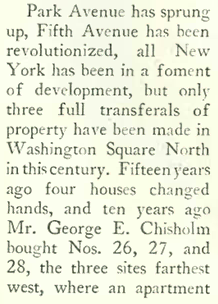
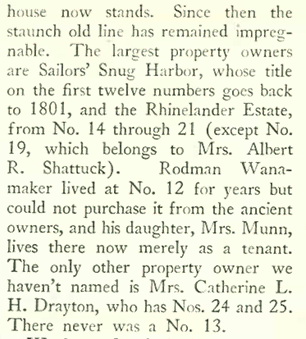
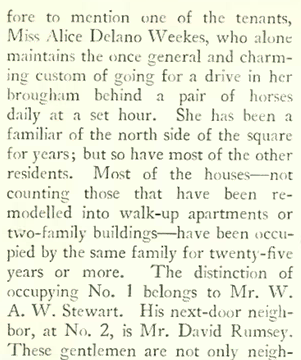
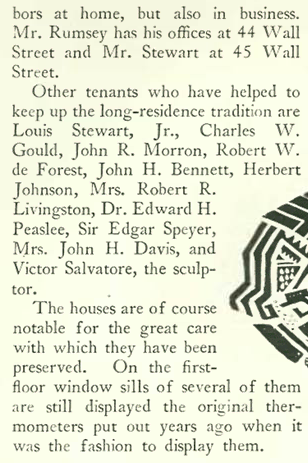
Additional evidence that The New Yorker was not always ready to embrace change came from its many articles, particularly in “The Talk of the Town,” that seemed to favor the preservation of buildings that defined the character of certain neighborhoods, including the early 19th century row houses that lined Washington Square North…

THEN AND NOW…At left, photo dated 1921 of Washington Square, north side of square looking east from 5th Avenue. Corner house in foreground is No. 12. The far end at right shows Nos. 3, 2, 1. At right, roughly the same block today. (Museum of the City of New York/1homedesigns.com)

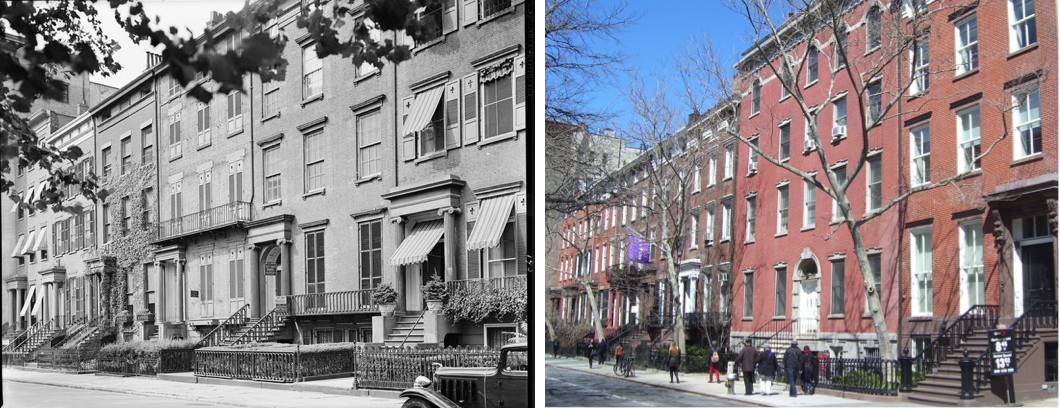
At left, photo dated 1936 (by Berenice Abbott) of Washington Square North, nos. 21-25, between Fifth Avenue and MacDougal Street. At right, nos. 19-26 today. (Museum of the City of New York/Wikimedia Commons)

 *  *  *

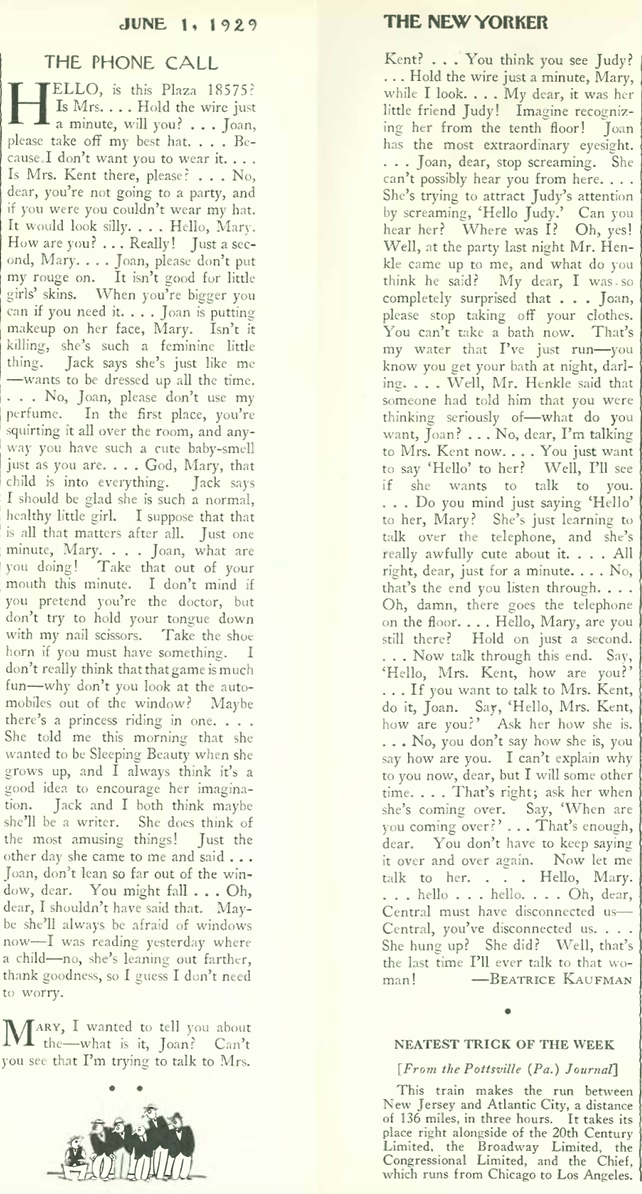
The Wittier Kaufman

Editor and playwright Beatrice Kaufman worked and played within the orbit of the famed wits of the Algonquin Round Table, but was not a regular member like her husband, playwright and director George S. Kaufman. But Beatrice Kaufman didn’t the need the Algonquin to display her wit. Indeed, according to Michael Galchinsky (writing for the Jewish Women’s Archive), she was regarded as one of the wittiest women in New York in the 1930s and 40s. Here is an example of her work in the June 1 issue of The New Yorker:

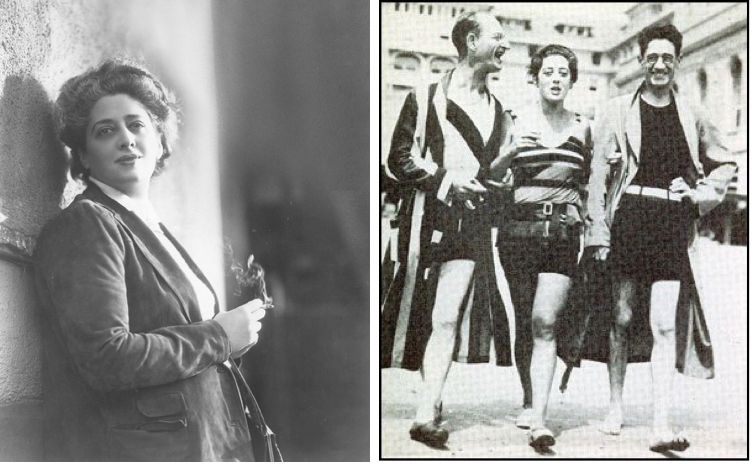
THE WITTIEST OF THEM ALL…Editor, writer and playwright Beatrice Kaufman (left, in undated photo). At right, comedian Julius Tannen (left) frolics with Beatrice and her husband, Broadway playwright/producer George S. Kaufman in Atlantic City in the 1920s. (thepurplediaries.com/spartacus-educational.com)

 *  *  *

Rags to Riches

The life of Fred F. French was something out of dime novel; born in dire poverty, he became a self-made real estate tycoon and a shrewd builder of some of Manhattan’s biggest land developments. French was the subject of a profile written by Robert M. Coates, an art critic who would be a longtime contributor to The New Yorker. An excerpt, with illustration by Al Frueh:

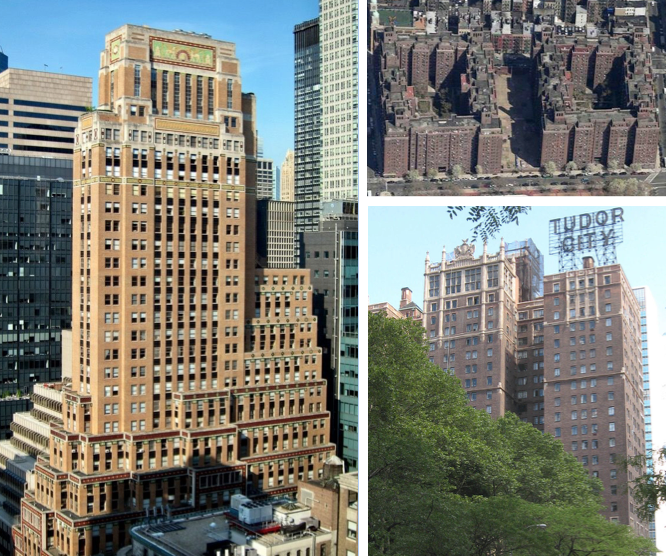
MONUMENTS TO FRED…Fred French’s New York City buildings included, clockwise from left, the 38-story Fred F. French Building (1927) at 45th Street and 551 Fifth Avenue (designated a National Landmark); Knickerbocker Village (1934) on the Lower East Side; and the East Side’s Tudor City apartment complex (1927-1932). (Pinterest/thelodownny.com/Wikipedia)

 *  *  *

From Our Advertisers

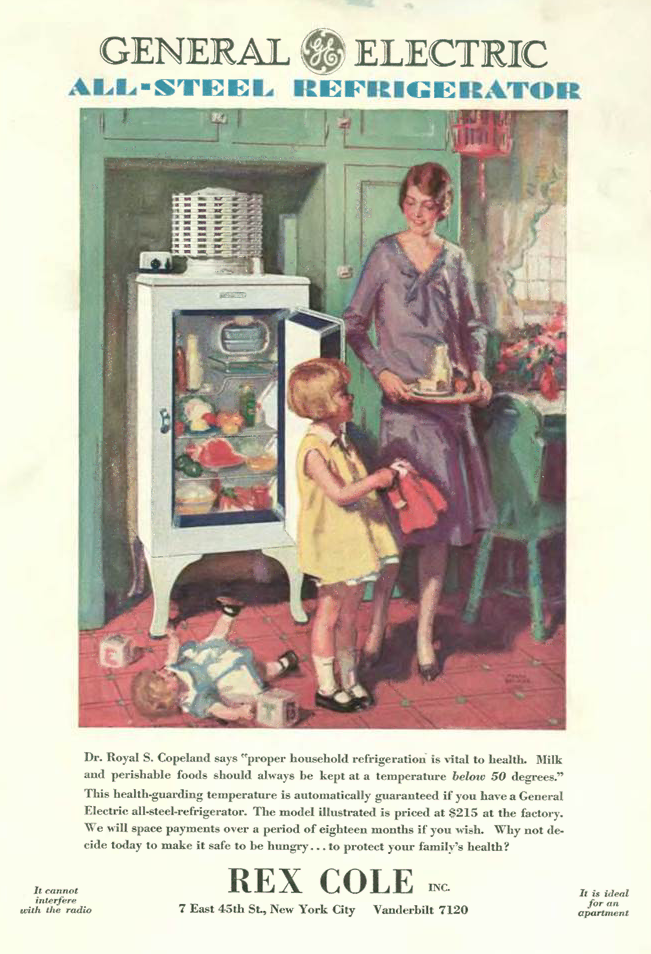
Let’s start with a couple of lovely color ads, which appeared with greater frequency in the magazine…here we have a snatch of the good life, courtesy General Electric…

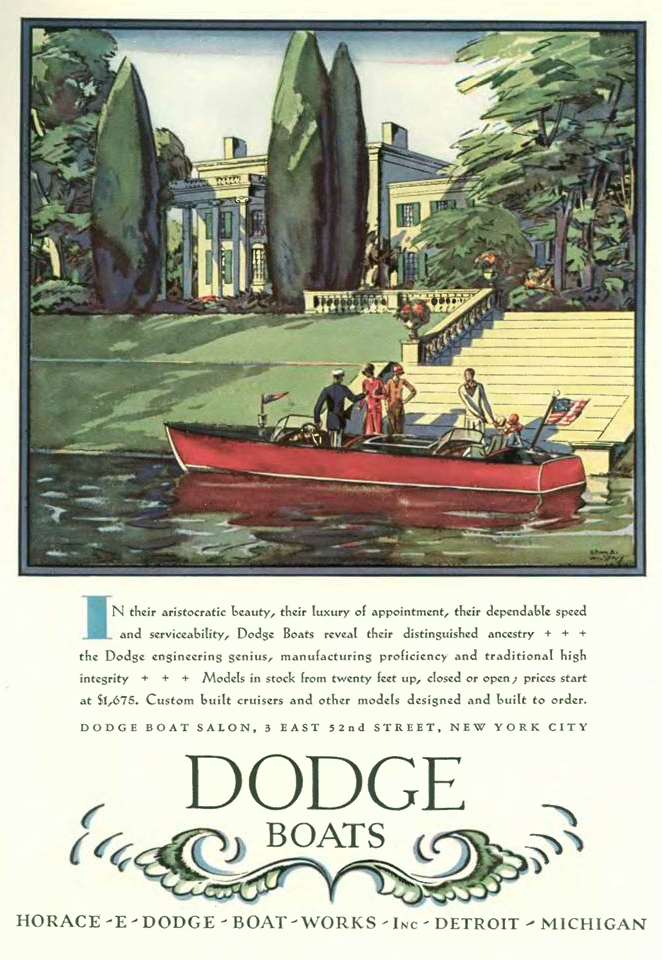
…and perhaps a less homespun image of the good life, from the makers of Dodge boats…

…and here we have another example of the modern world rushing in, this time in the form of instant coffee crystals…

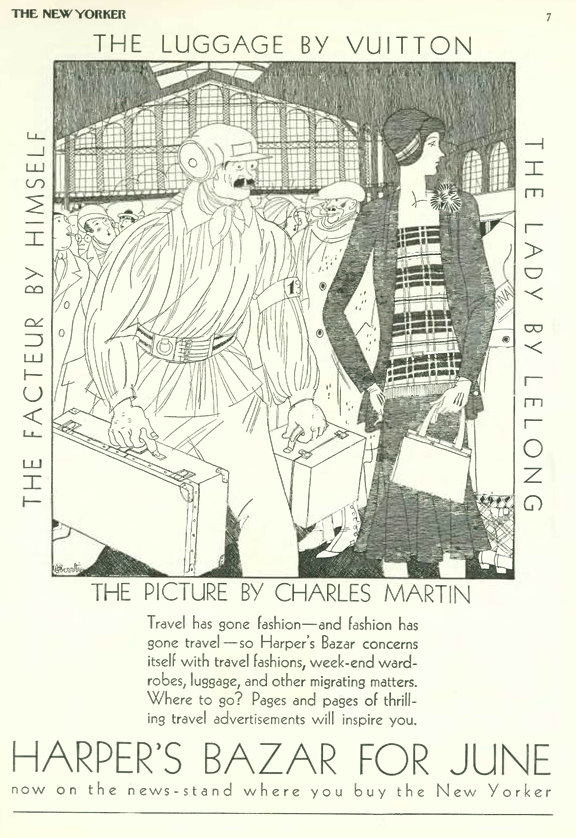
…and another taste of the modern from Harper’s Bazar magazine, featuring an illustration by French artist and illustrator Charles Martin

…and just for kicks, another example of Martin’s work from an earlier time…

Image from Sports et Divertissements by Charles Martin, 1914. (Wikipedia)

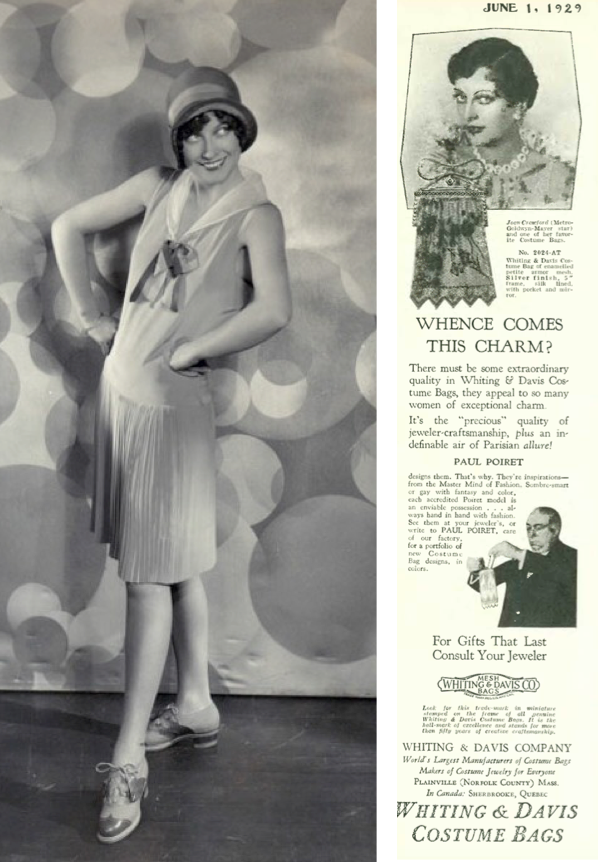
…and here is a back page ad for costume bag maker Whiting & Davis, with an endorsement by Joan Crawford, who was already a pretty big star by 1929. My guess is that Whiting & Davis paid more for the endorsement than they did for the ad…I included a photo of Crawford (at left) from 1929 just to show that she did have a lighter side…

…this ad from the makers of Flit insecticide begs the question: was our beloved Dr. Seuss (aka Theodore Geisel) once a racist? Well…

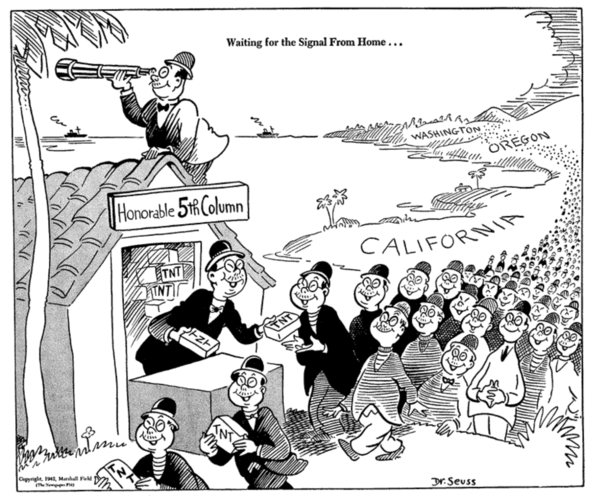
…although Geisel was a liberal Democrat and a supporter of the New Deal, during World War II he also supported the internment of Japanese Americans, as is evident from this unfortunate 1942 cartoon…

Dr. Seuss 1942 cartoon with the caption ‘Waiting for the Signal from Home’ (slideshare.net)

…later in life Geisel became a staunch environmentalist and anti-war protestor. In 1961 he wrote The Sneetches, which promoted racial equality. Perhaps Geisel lived to regret those earlier drawings…

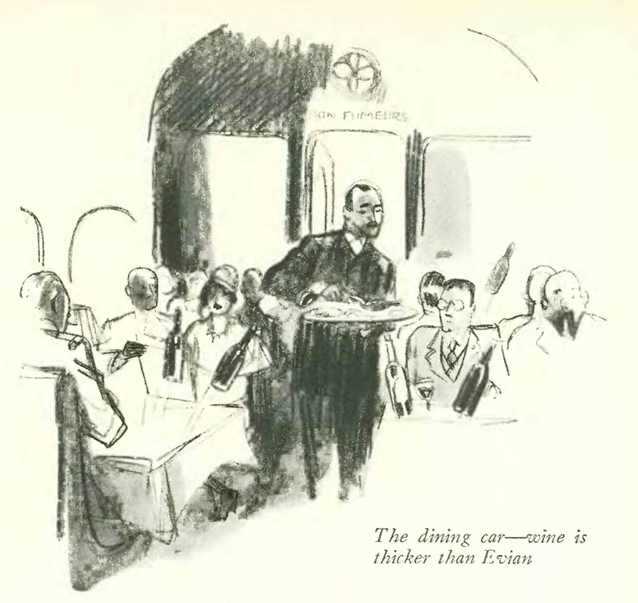
…and on to our illustrators and cartoonists, beginning with this sketch by Garrett Price, apparently inspired from a recent trip to France (it was featured along with several other small sketches in the “Profile” section)…

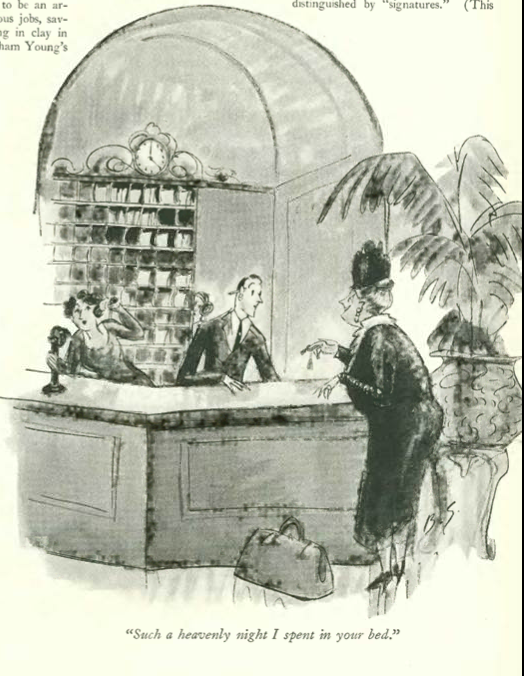
Barbara Shermund had some fun with a double entendre…

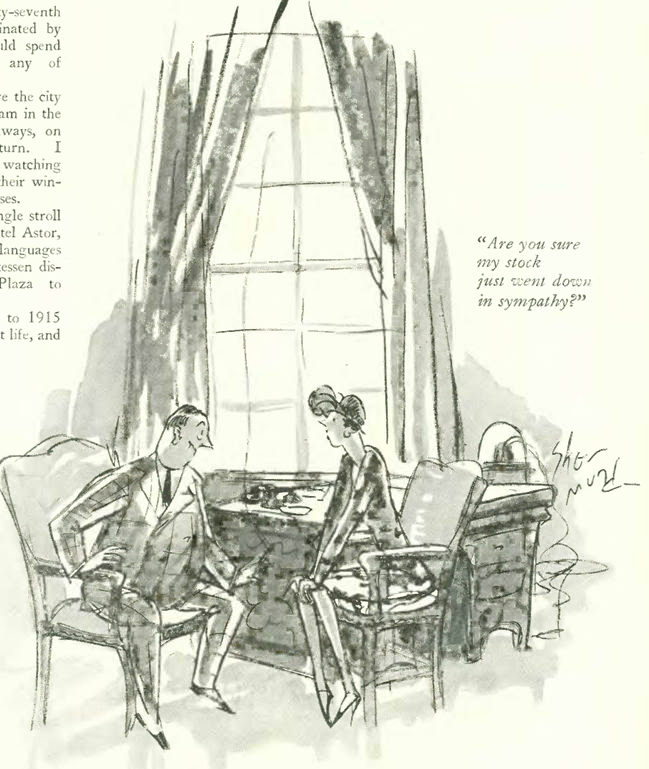
…and popped up again with this look at the stock market…

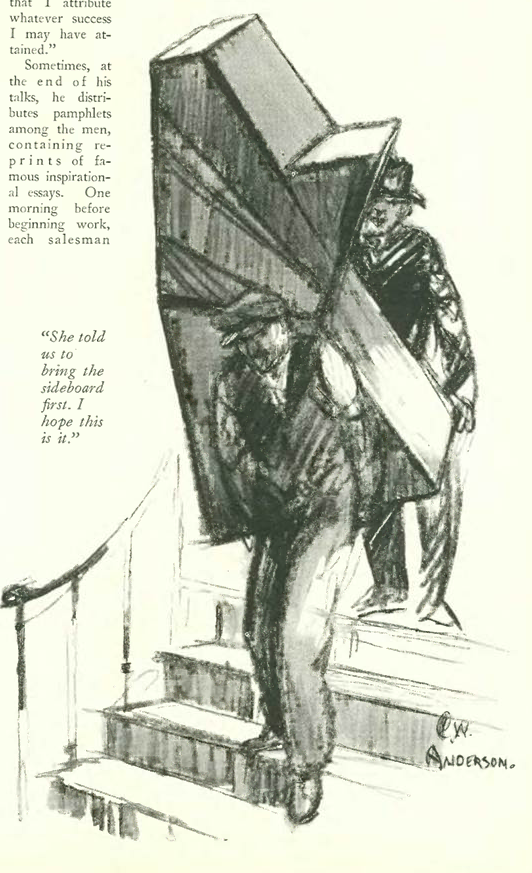
C.W. Anderson found humor in the strange shapes of modernist furniture…

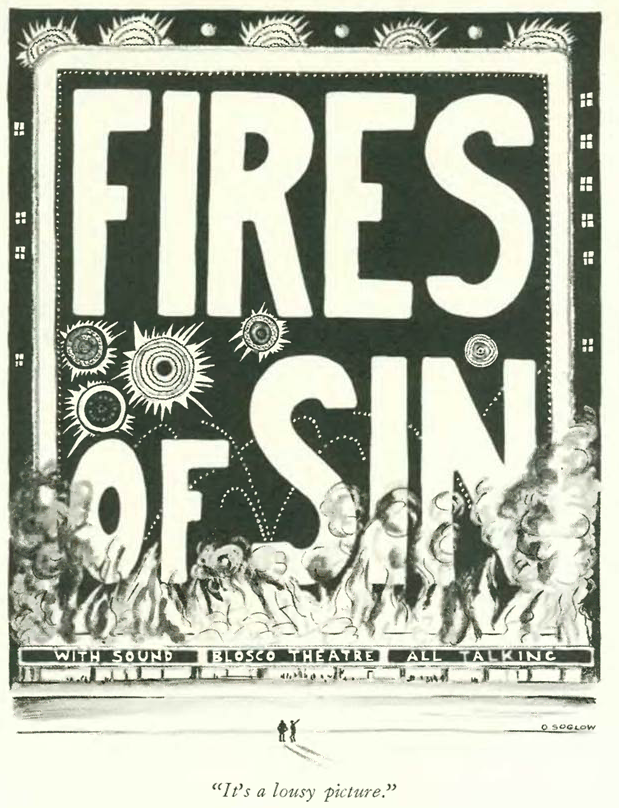
Otto Soglow commented on the glitzy hype of Broadway…

…and cartoonist/humorist Don Herold made his comics debut in The New Yorker with this entry…

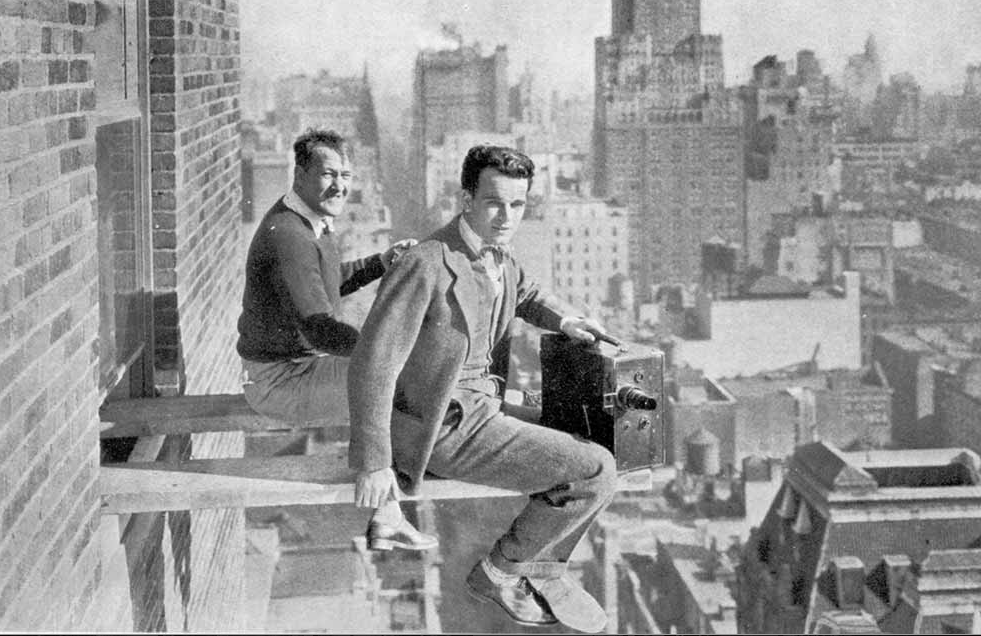
…and finally, a bonus image I came across while researching the advent of sound motion pictures. The photo, from the silent era, shows two cameramen shooting a parade, possibly for a newsreel. Note how their only support consists of two wooden planks wedged into an open window…

(moviemice.com)

Next Time: A Bridge Too Far…
Let Them Eat Cake

The re-opening of New York’s Central Park Casino in 1929 was in many ways the city’s last big party before the economy came crashing down, along with the exhuberance and frivolity of the Jazz Age.

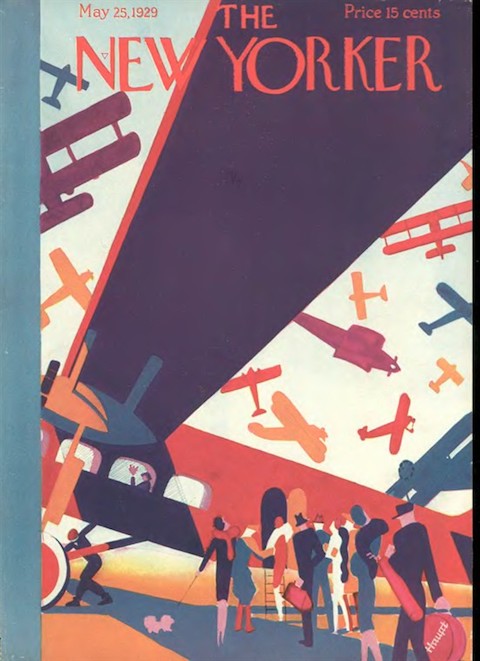
May 25, 1929 cover by Theodore Haupt.

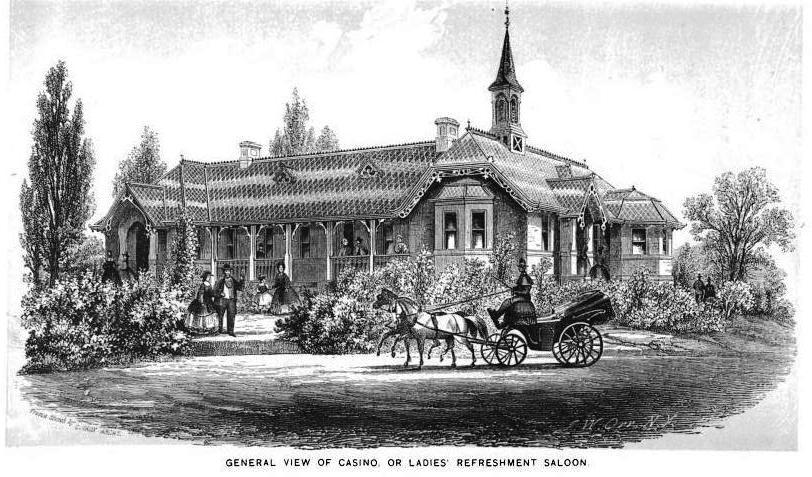
The Casino itself wasn’t new–it opened in 1864 as the Ladies’ Refreshment Salon (sometimes spelled “saloon”), a two-room stone cottage designed by Calvert Vaux. As Susannah Broyles writes in her excellent blog post for the Museum of the City of New York, the Victorian cottage was a place where “unaccompanied ladies could relax during their excursions around the park and enjoy refreshments at decent prices, free of any threat to their propriety.”

Central Park’s Ladies’ Refreshment Saloon opened in 1864. (daytoninmanhattan.blogspot.com)

Broyles writes that by the 1880s the salon had morphed into a far pricier destination, a restaurant called The Casino, open to both sexes. With the rare attraction of outdoor seating, “it was the place to see and be seen.”

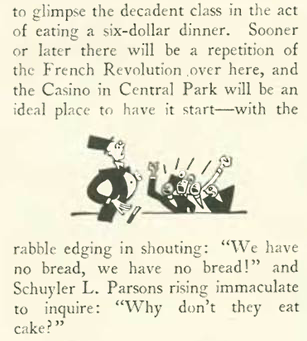
By the 1920s the restaurant had grown a bit shabby. Then along came the city’s flamboyant mayor, Jimmy Walker (1881-1946), who saw the potential of the property as a place where he could hob-nob with wealthy and fashionable New Yorkers and openly flaunt Prohibition laws. There were others, however, who found the idea of an exclusive playground for the rich in a public park distasteful. The New Yorker observed as much in the “Notes and Comment” opening of “The Talk of the Town”…

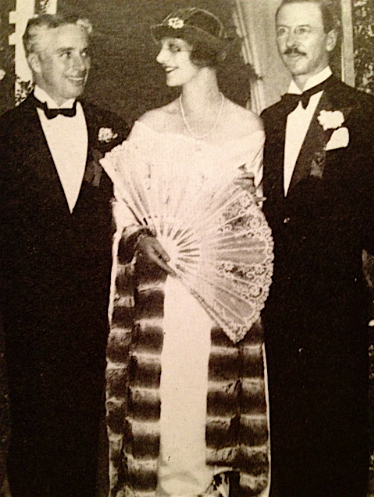
…the “Schuyler L. Parsons” referred to above was a tireless host, prominent decorator, and a society A-lister. He is pictured here (circa 1930) with two of his closest friends, actor Charlie Chaplin and the actress, singer and dancer Gertrude Lawrence

(Tyler Hughes Collections)

The Central Park Casino reopened its doors on June 4, 1929 at an invitation-only event. The following day it would open to the public, but as New York’s newest and most expensive restaurant it would remain closed to all but the wealthiest. As The New Yorker observed, the city was, after all, a “plutarchy,” and the populace passing by the Casino would at least be allowed “to glimpse the decadent class in the act of eating a six-dollar dinner” (nearly $90 today).

This formal announcement of the opening appeared in the May 6, 1929 issue of The New Yorker, including the time of the event—I suppose for the benefit of the 600 who actually had an invitation, or perhaps to tantalize those without such credentials…

The Casino was a playground for the rich by design, conceived in the image of the flamboyant Mayor Walker—himself a product of the Tammany Hall political machine—and executed by hotelier Sidney Solomon, who obtained the building’s lease via some Tammany-style subterfuge. Solomon hired architect and theatrical set designer Joseph Urban to transform the Casino into a glittering showpiece of Jazz Age nightlife.

Clockwise, from top left, the Central Park Casino; architect Joseph Urban; his Casino ballroom design with black-mirrored ceiling; the Casino lobby. (acontinuouslean.com/Columbia University/centralpark.com/drivingfordeco.com)

The New Yorker continued its observations on the Casino in another “The Talk of the Town” piece titled “Historical Note,” attributing the inspiration for the Casino not to Walker or Solomon, but to socialite Anthony Joseph Drexel Biddle Jr…

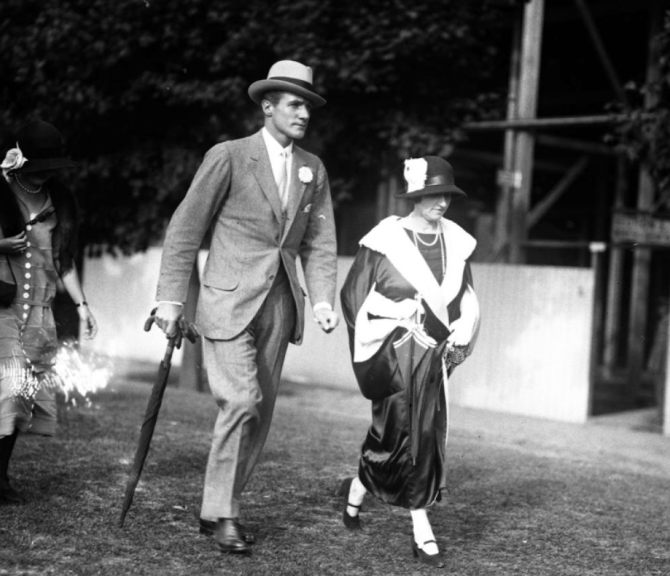
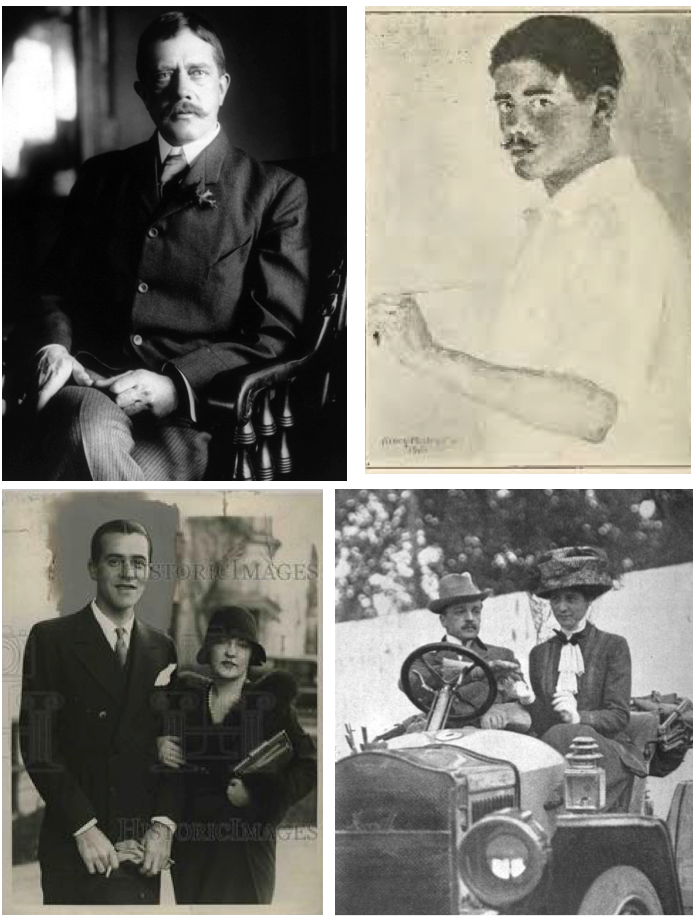
AN EYE FOR THE FINER THINGS…The wealthy socialite A.J. Biddle (pictured here with his first wife, Mary Lillian Duke, in 1924) trained his eye on the Central Park Casino while on the rooftop of the St. Regis Hotel pondering another Joseph Urban project. (voxsartoria.com)
PARTY BOY…New York Mayor Jimmy Walker and his nighttime playground, the Central Park Casino, show here on September 10, 1935. (Britannica/ New York City Department of Parks & Recreation)

Well, as you’ve probably guessed, the party didn’t last forever. After the October 1929 stock market crash, the sight of rich folks stuffing their faces and drinking fine wines in a public park looked even more unseemly. Soon the Casino found itself in the crosshairs of Parks Commissioner Robert Moses, who detested Mayor Walker.

As for Walker himself, a growing financial scandal prompted him to resign from office on Sept. 1, 1932. He promptly fled to Europe with his mistress, Ziegfeld girl Betty Compton, and stayed overseas until the threat of criminal prosecution had passed. For Moses, it wasn’t satisfaction enough to see Walker driven from office. In 1936, despite protests from preservationists, Moses had Urban’s lovely restaurant demolished. It was replaced by a children’s playground the following year.

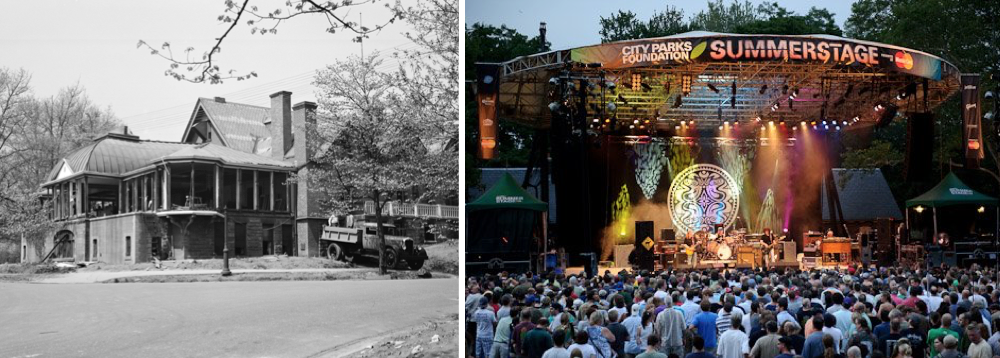
THE PARTY’S OVER…Crews dismantling the Central Park Casino in 1936. In 1937, the Rumsey Playground was built on the site of the Casino, and in the 1980’s the site was razed again and converted into Rumsey Playfield, where the city’s SummerStage events are now held. (Museum of the City of New York/centralpark.com)

*  *  *

A Drinking Life

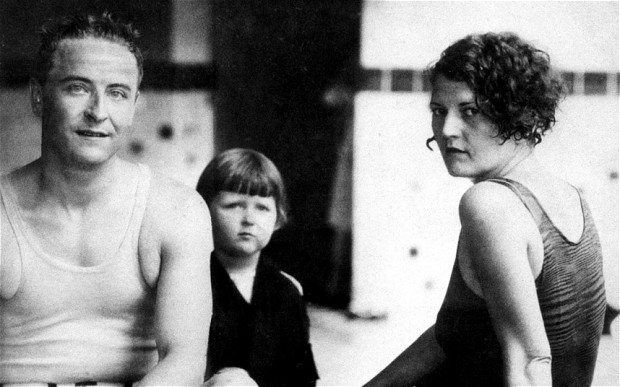
As the Jazz Age was winding down, one of its greatest chroniclers began a brief relationship with The New Yorker. In the March 12, 2017 issue of the magazine, Erin Overbey and Joshua Rothman wrote “There’s a doomed, romantic quality to the relationship between F. Scott Fitzgerald and The New Yorker; they were perfect for each other but never quite got together.” In total, Fitzgerald published just two poems and three humorous shorts for the magazine, beginning with this piece in the May 25, 1929 issue:

Fitzgerald’s last contribution to the New Yorker would appear in the Aug. 21, 1937 issue (“A Book of One’s Own”). Following the author’s death in 1940 the magazine would feature various articles on his life and work, and in 2017—77 years after Fitzgerald’s death—the New Yorker would publish a long lost short story, “The IOU.” A fitting title for an author who sadly did not get his due while he was alive.

IOU…F. Scott Fitzgerald with daughter “Scottie” and wife Zelda, circa 1927. (The Telegraph)

 *  *  *

One of the Gang

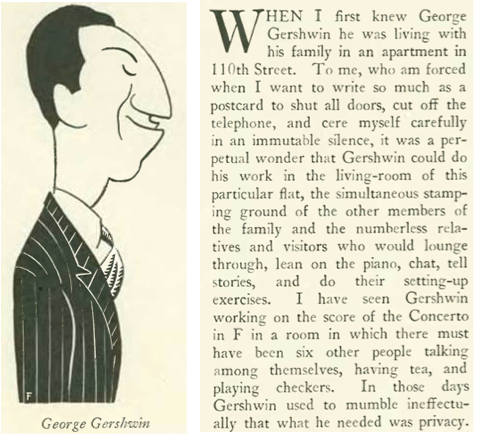
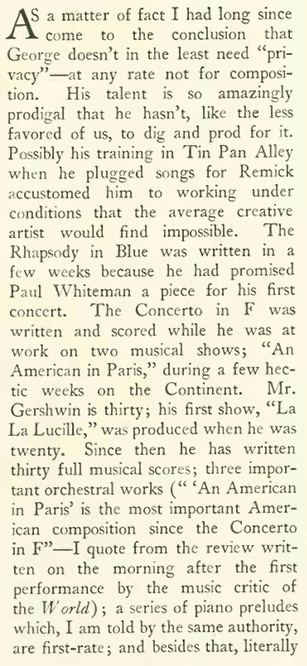
Among the Jazz Age artists and writers who orbited around the Algonquin Round Table (and the Central Park Casino) and chummed with the writers of the New Yorker was musician and composer George Gershwin (1898-1937) who was profiled in the May 25 issue by his friend and longtime New Yorker writer Samuel N. Behrman. The opening paragraph (with caricature by Al Frueh):

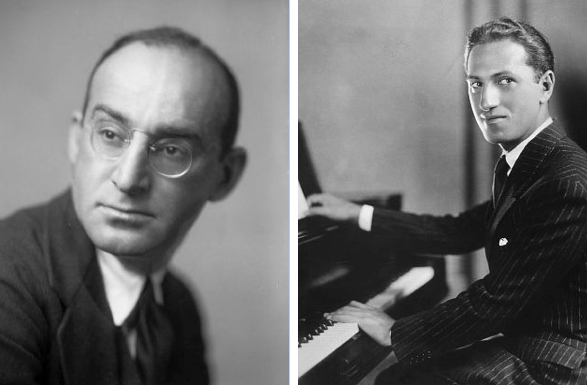
IN THE SAME ORBIT…Samuel Nathaniel Behrman (left), was an American playwright, screenwriter, biographer, and longtime writer for The New Yorker. From the late 1920s through the 1940s, he was considered one of Broadway’s leading authors of “high comedy,”His son is the composer David Behrman. At right, George Gershwin at the piano, 1929. (prabook.com/IMDB)

In the profile, Behrman observed that although Gershwin expressed a desire for privacy, he was quite capable of dashing off major works in practically any setting:

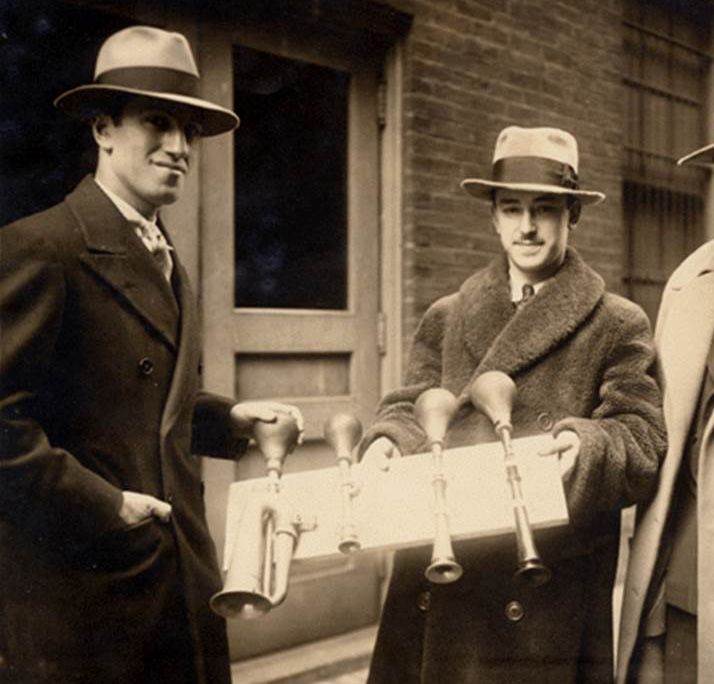
TOOTING HIS OWN HORN…Composer George Gershwin and Cincinnati Symphony Orchestra percussionist James Rosenberg holding four taxi horns used in the orchestra’s performance of An American in Paris, on Feb. 28, 1929. (Photo courtesy of Ira and Leonore Gershwin Trusts)

 *  *  *

Scratching the Surface

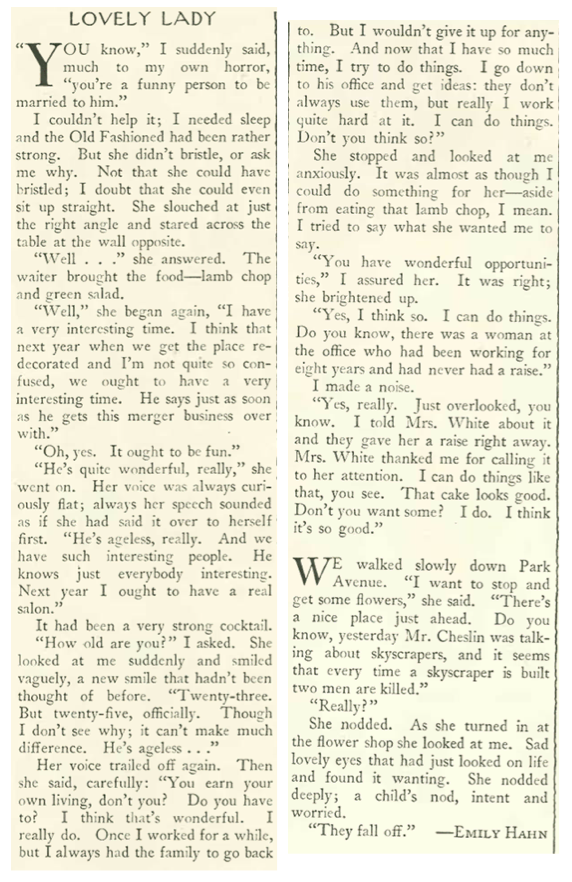
Emily Hahn (1905-1997) was a prolific journalist and author who contributed at least 200 poems, articles and works of fiction to The New Yorker over an astonishing 68-year span—from 1928 to 1996. As the title suggests, I am merely scratching surface, and will devote a post to her in the near future. Here is her contribution to the May 25, 1929 issue:

PROLIFIC…A 1937 portrait of Emily Hahn taken in Shanghai, China, by Sir Victor Sassoon. The author of 54 books, Hahn is credited with playing a significant role in opening up Asia and Africa to the West through her many novels. (DeGolyer Library, SMU)

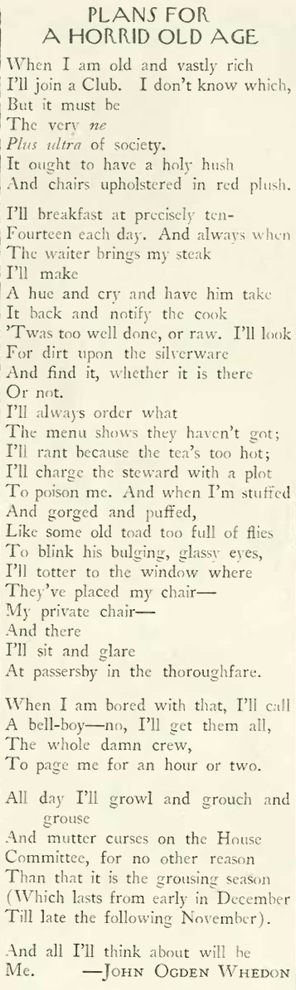
Another frequent contributor to The New Yorker was screenwriter John Ogden Whedon (1905-1991), who offered up mostly shorts from 1928 to 1938. He is best known as a television writer for such shows as The Andy Griffith Show, The Dick Van Dyke Show and Leave It to Beaver. Whedon and his wife, Louise Carroll Angell, were parents and grandparents to a number of screenwriters, including grandson Joss Whedon, creator of Buffy the Vampire Slayer and writer/director of The Avengers (2012) and its sequel Avengers: Age of Ultron (2015). An excerpt of grandpa’s writing from the May 25 issue:

 *  *  *

From Our Advertisers

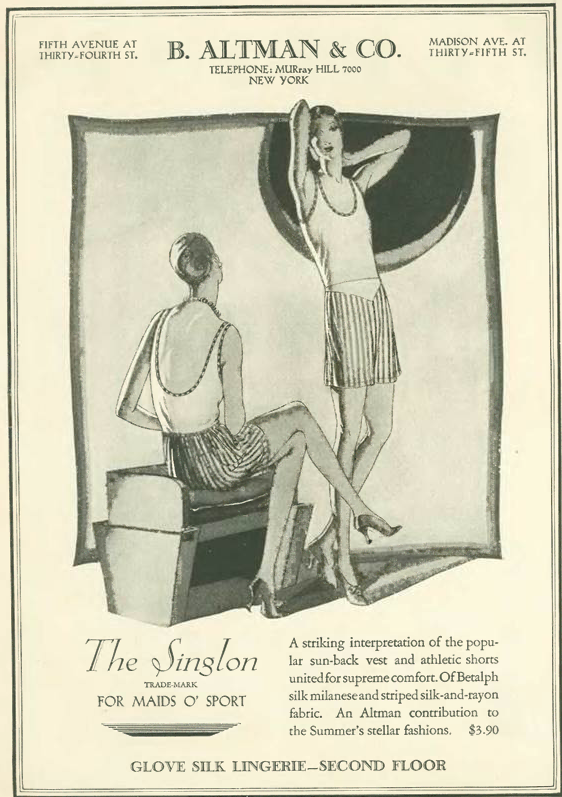
In a recent post (Waldorf’s Salad Days) I noted an ad from Lily of France that proclaimed the straight flapper figure was out, and it was now the “season of curves.” This ad from B. Altman begs to differ…

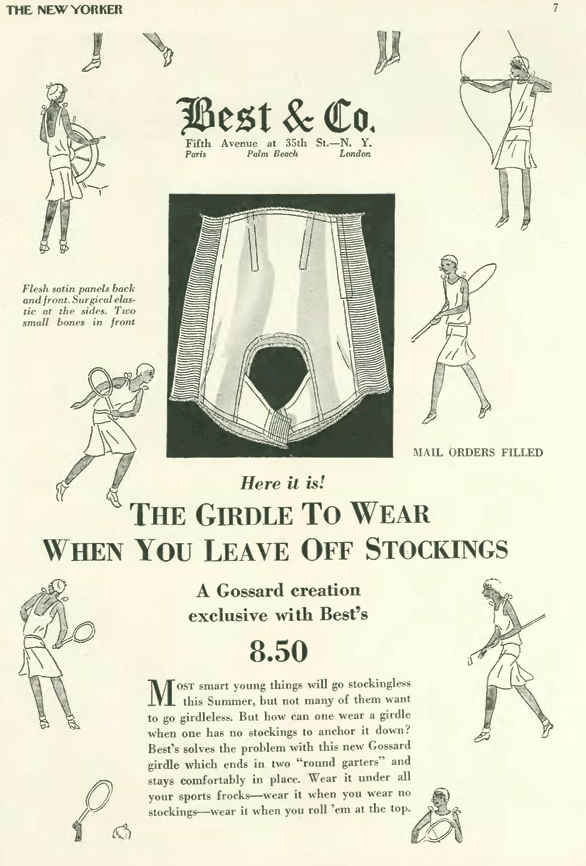
…one way to keep that straight figure was to pull on a girdle, which I’m sure felt great while one played tennis…

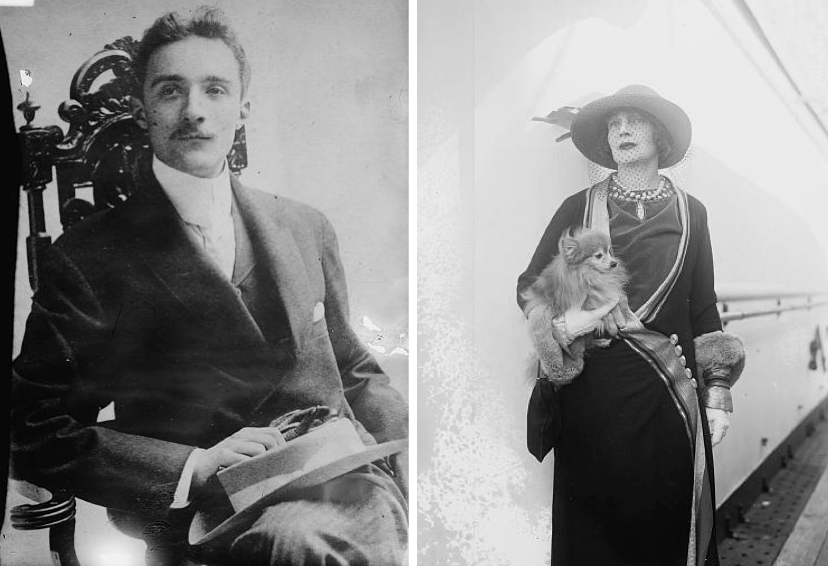
…our latest Lucky Strike endorser is…Mrs. Jerome Napoleon Bonaparte. Never heard of her? Well, “Mrs. Jerome” was actually a one Blanche Pierce (1872-1950) of Rochester, NY. Her second husband, Jerome Napoleon Bonaparte (the great-grandnephew of Emperor Napoleon) was something of a wastrel, having inherited a fortune and never worked at a job or profession. Blanche herself was known as a social climber…

THEY EXISTED…Jerome Napoleon Charles Bonaparte (pictured here circa 1915) was the great-grandnephew of Emperor Napoleon and a man of extreme leisure. His wife, Blanche Pierce Bonaparte (right, in a photo circa 1925), was known as a dog lover, a passion that indirectly led to her second husband’s demise. Jerome died while walking his wife’s dog in Central Park—he apparently stumbled over the dog’s leash and broke his neck. (Library of Congress)

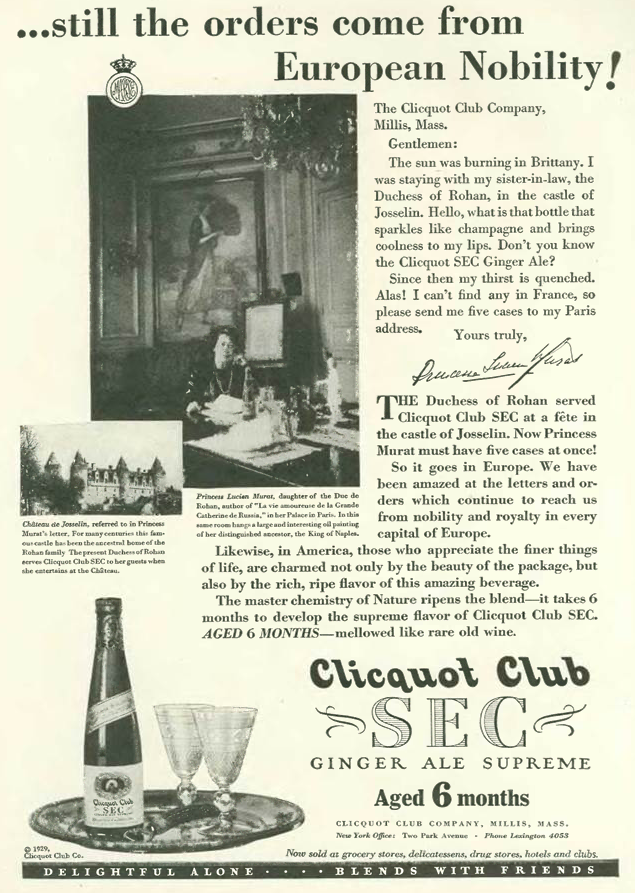
…speaking of European nobility, here is another sad endorsement from a French noble touting the wonders of Clicquot Club ginger ale to Prohibition-strapped Americans…

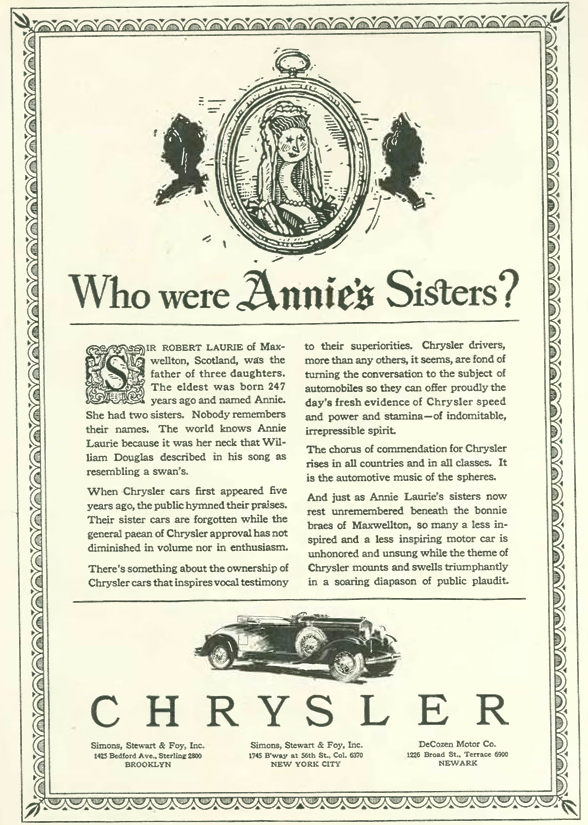
…and then we have this weird “Annie Laurie” analogy used by Chrysler to sell its line of automobiles…

…the manufacturers of Studebaker, on the other hand, opted for a more direct approach, equating its automobiles with the speed and modernity of airplane flight…note how in both ads the cars are pictured with the windshields folded down to emphasize sleekness…

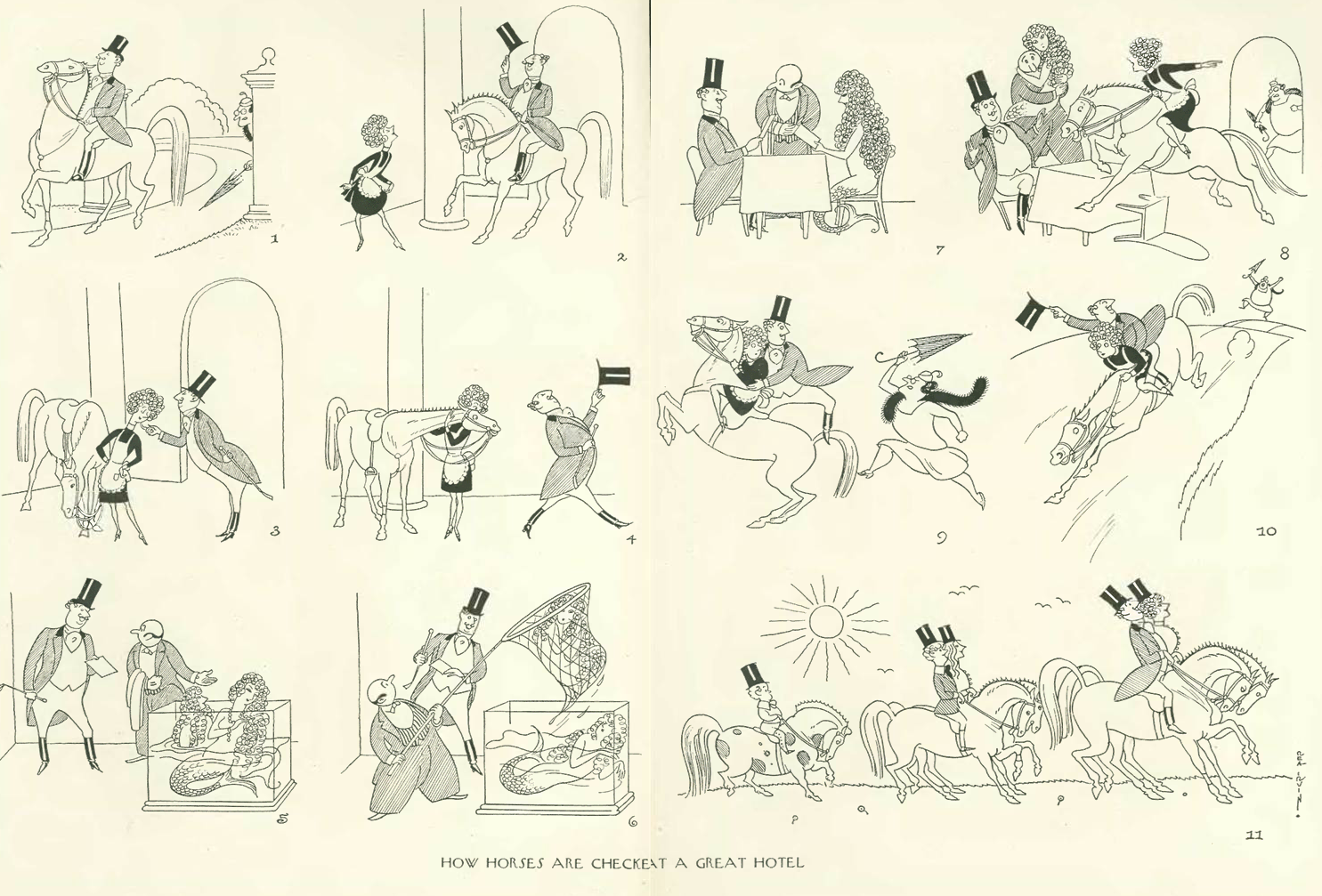
…on to the cartoons: we begin with this two-page entry by Rea Irvin, which makes very little sense…I get the part where the rich old man (stalked by his fearsome wife) finds a mistress (and a new wife) through the process of “checking his horse,” but the whole mermaid thing is lost on me…please click to enlarge—I’d love to have this one explained…

Carl Rose had some fun with newfangled sound effects in the dawning age of the talkies…

Peter Arno sketched up the cynicism of one New York dowager…

Perry Barlow captured two women who might have been driving home from an auction at the old Waldorf-Astoria Hotel…

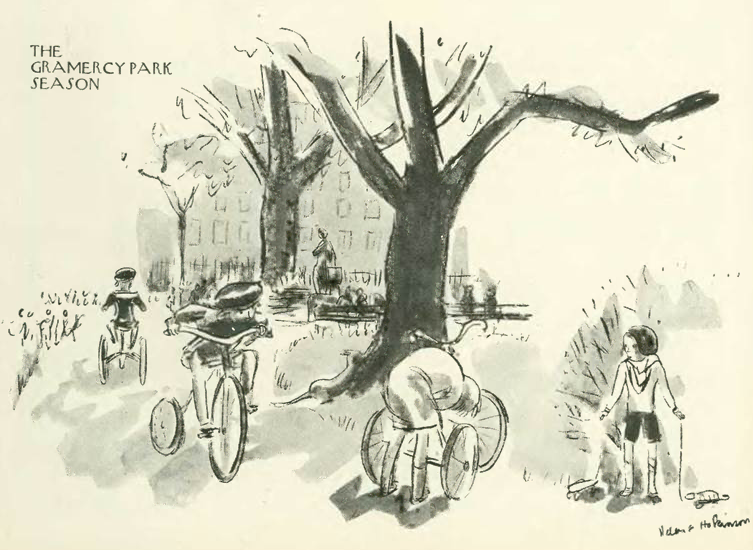
…and finally, a lovely illustration by Helen Hokinson of children at play…

Next Time: The Unspeakables…


How Charles Shaw Felt About Things

Some people really do lead charmed lives: Take for example Charles Green Shaw. Born to wealth, he was a fixture in the glamorous social scene of Jazz Age New York, but was also a key player in its intellectual and artistic life. An accomplished author as well as a poet and illustrator, Shaw turned to painting in his late thirties and became a leading figure in the world of abstract art.

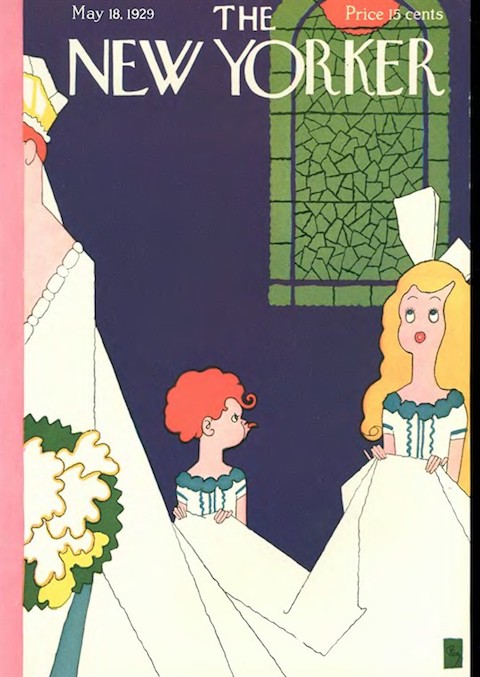
May 18, 1929 cover by Gardner Rea.

Shaw (1892-1974) was an early contributor to The New Yorker, penning more than thirty pieces for the magazine between 1925 and 1932, including three short contributions to the very first issue (Feb. 21, 1925). Here’s one of them:

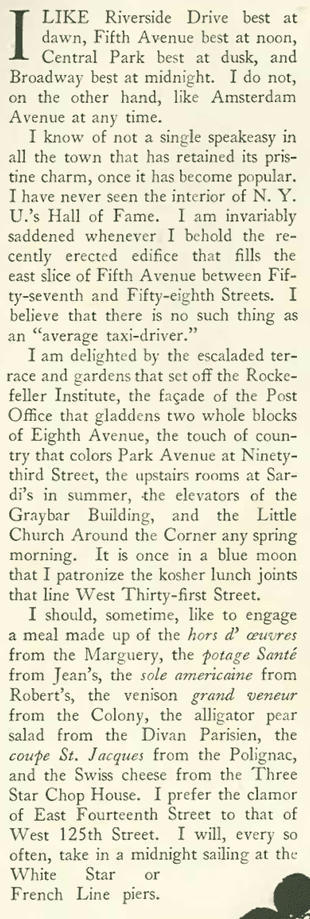
That short piece anticipated a much longer entry by Shaw four years later—in the May 18, 1929 New Yorker—in a column titled “How I Feel About Things.” An excerpt…

YEAH & MEH…Charles Shaw liked Central Park at dusk; Amsterdam Avenue, not so much. (Time Freeze Photos/NYC Municipal Archives)
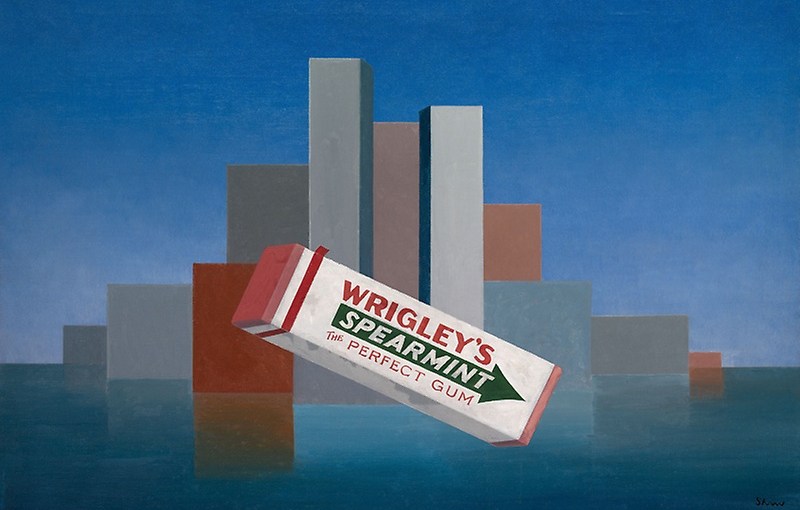
SOMETHING TO CHEW ON…Top left, Charles G. Shaw in 1945. Clockwise, from top right, Untitled Abstraction, 1943, oil on fiberboard; Wrigley’s, 1937, oil on canvas; photo of Wrigley’s gum package on top of a postcard image of New York City. On the back of the photo Shaw had written “idea for montage.” (Wrigley painting courtesy Art Institute of Chicago/other images from Archives of American Art, Smithsonian Institution)

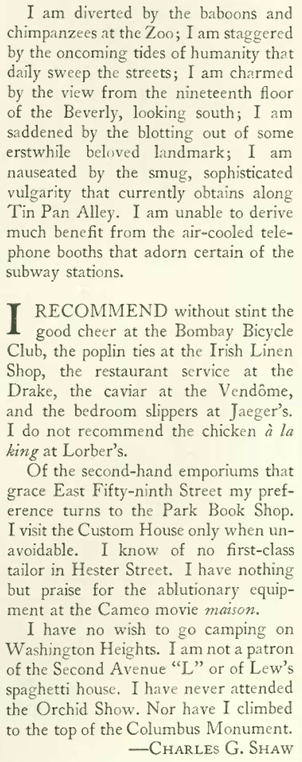
…one more excerpt from the Shaw column…

Shaw would contribute more columns to The New Yorker in this vein: four more titled “How I Feel About Things” (1929-1931) followed by “How I Look at Things in General” (1931), and his final two New Yorker columns (1931-1932), “Things I Have Never Liked.”

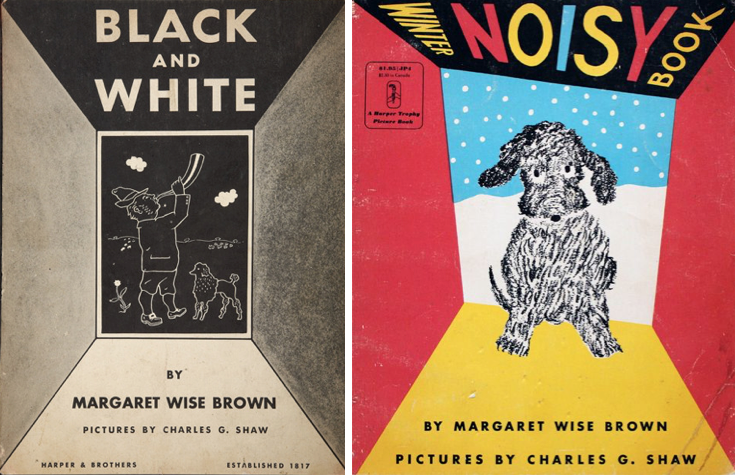
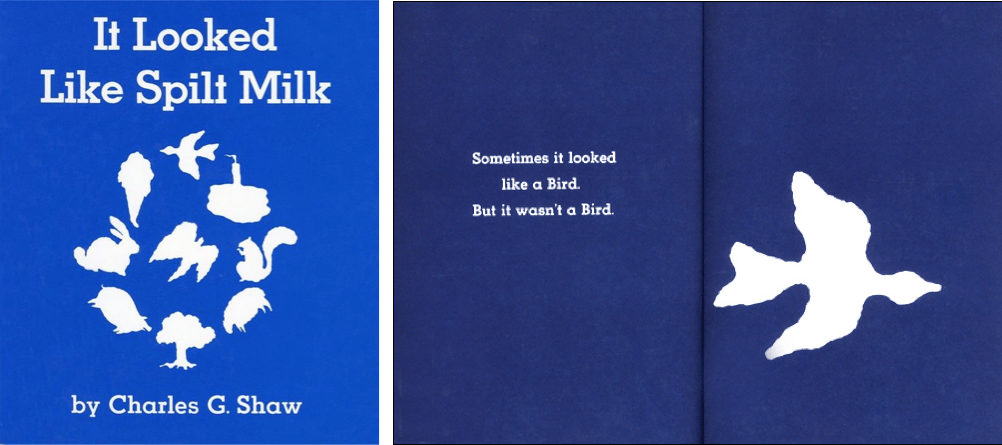
He also illustrated children’s books, including two by Margaret Wise Brown (of Goodnight Moon fame). In 1947, Shaw published It Looked Like Spilt Milk, a book that introduced children to abstract art. It remains in print and popular today.

SOMETHING FOR THE KIDS…Shaw provided illustrations for Margaret Wise Brown’s Black and White (1944) and The Winter Noisy Book (1947). (Harper)
STILL POPULAR…Shaw published It Looked Like Spilt Milk as a children’s introduction to abstract art. (Kinder Books)

 *  *  *

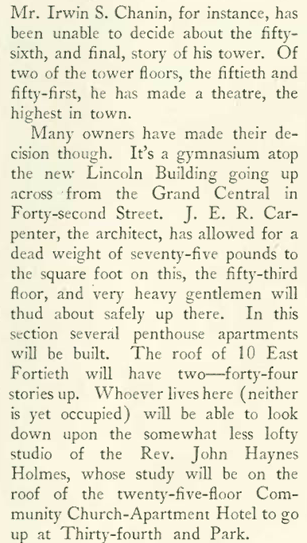
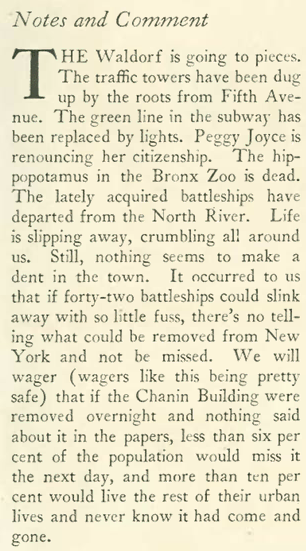
In the “The Talk of the Town,” James Thurber looked at “high-living” trends among occupants atop the city’s newest skyscrapers, including developer Irwin Chanin:

CROWN JEWELS…The Chanin Building at 122 E. 42nd Street sports a distinctive crown that contains a wraparound terrace (now closed) at the 56th floor. A theater on the 50th and 51st floors, just below Irwin S. Chanin’s executive suite, was later converted into office space.(aviewoncities.com/untappedcities.com)
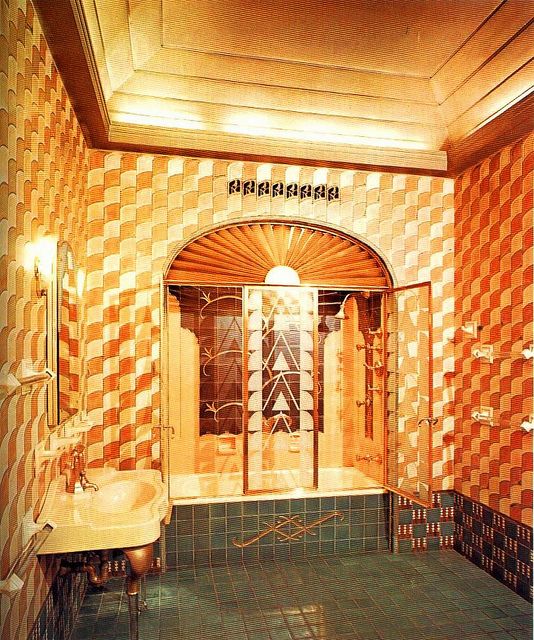
A THRONE IN THE SKY…The art deco bathroom in the 52nd floor executive suite of architect and real estate developer Irwin S. Chanin was designed by Jacques Delamarre. (Pinterest)
AERIAL GYMNASTICS…1930s postcard image of the Lincoln Building at 60 East 42nd. At right, the building’s rooftop gymnasium. (nyc-architecture.com/Tony Hisgett)

…Thurber continued his survey downtown in the financial district, and noted the proliferation of “lanterns” atop various skyscrapers…

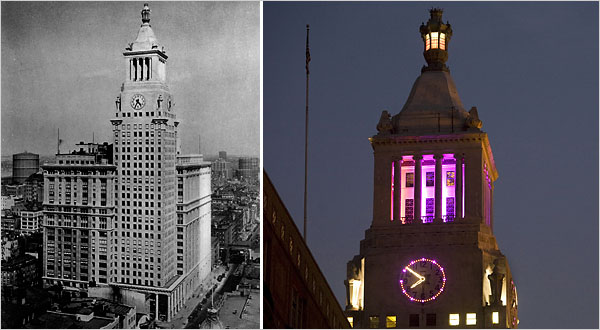
ALL THE RAGE…”Lanterns” of various styles were popular toppers to Jazz Age skyscrapers. Above, the 24-story Consolidated Gas Building (now the Con Edison tower) by day and night. (Architect/Office for Metropolitan History/Michael Falco for The New York Times)
TRY TO TOP THIS…The distinctive lantern of the New York Central Building at 230 Park Avenue, now called the Helmsley Building  (andrewcusack.com/Wikipedia)

*  *  *

Waldorf Adieu, Part Two

For a second week “The Talk of the Town” led off with an item about the demise of the Waldorf-Astoria hotel, this time attempting to put it into some perspective…

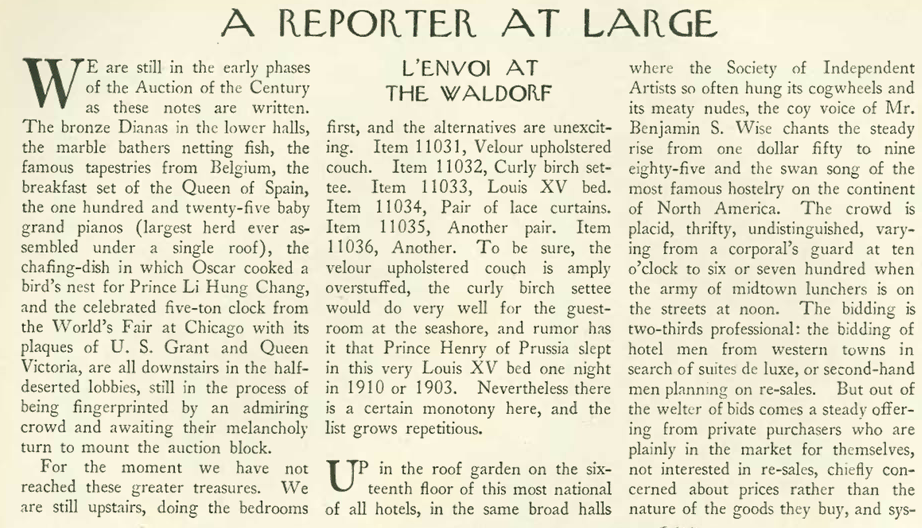
…and Charles Merz offered a lengthy account of the auctions that were already taking place at the hotel as everything from grand pianos (125 in all) to a nine-foot-tall, five-ton, bronze-and-mahogany clock either went on the block or into storage…

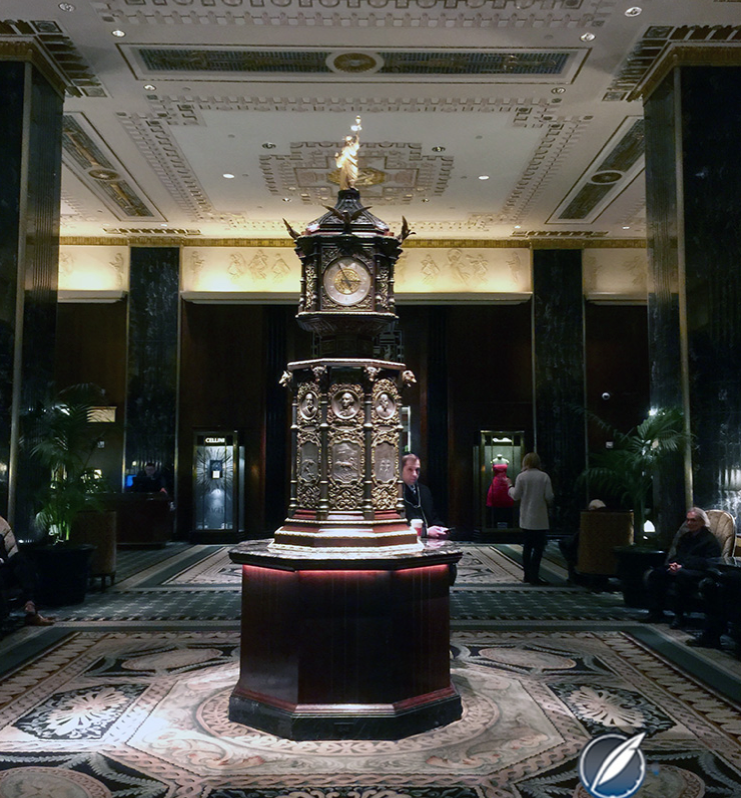
GOING, GOING…Illustration depicting an auction of items from the hotel. At right, the Waldorf’s nine-foot-tall, five-ton clock, shown here on display at the 1893 Chicago World’s Fair. A gift from Queen Victoria, the clock was acquired after the fair by John Jacob Astor IV, builder of the Astoria part of the old Waldorf-Astoria. He had it placed near the old hotel’s Rose Room restaurant. (Museum of the City of New York/Wikimedia)
STILL TICKING…The clock as it appears today in the lobby of the new Waldorf-Astoria, which was completed in 1931. A gilded Statue of Liberty was added to the top of the clock in 1902, a gift from the French government. (Wikimedia/Elizabeth Doerr)

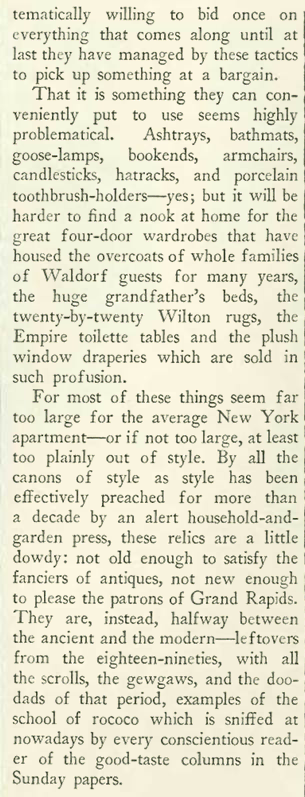
…Merz observed that although lavish tapestries, statuary, heavy furniture and other large items were up for sale, many buyers showed up merely to acquire a small memento…

IF THAT IS YOUR THING…Ornate furnishings (such as this French rococo-style furniture) were likely purchased at the auction by someone who actually had room for them. (Pinterest)

…Merz concluded that in the end, these “lesser treasures” will serve as props that will be handed down to the next generations, along with stories about the great and not-so-great who once slept or dined at the old hotel…

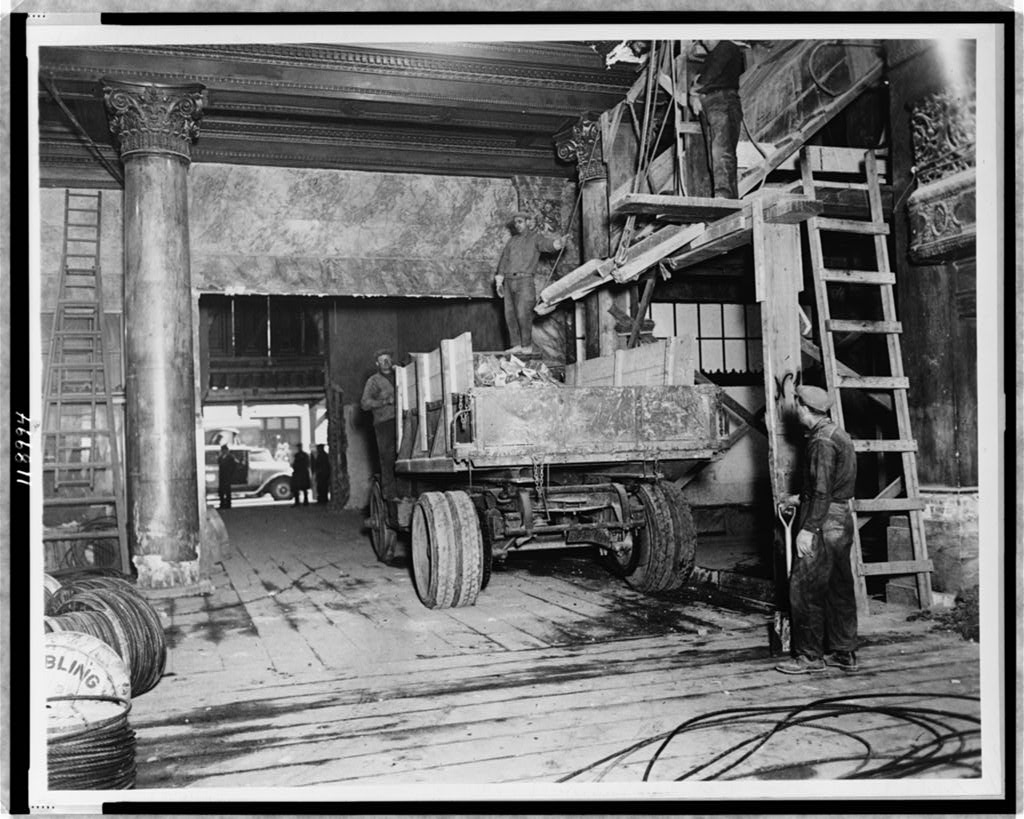
LAST DANCE…Workers emptying the old Waldorf-Astoria ballroom in 1929. (Library of Congress)

The May 18 issue featured yet another item on the Waldorf-Astoria — in “The Wayward Press” column, Robert Benchley (under the pseudonym “Guy Fawkes”) suggested that the story on the hotel’s demise had been milked for all it was worth….

 *  *  *

The Algonquin Wits

Speaking of milking a story, Alexander Woollcott playfully referenced his own material in the May 18 issue—indeed, quoting a profile he had written in the very same issue. Woollcott penned a humorous piece on friend and fellow Algonquin Round Table wit George S. Kaufman (caricature by Miguel Covarrubias). An excerpt:

…a bit later in the profile, Woollcott observed…

…a few pages later in the same issue, Woollcott offered more observations on his friend in his weekly “Shouts and Murmurs” column…quoting the above paragraph…

Kaufman would have his own say in 1939 with his hit play, The Man Who Came to Dinner (written with Moss Hart). The play’s main character, a cantankerous misanthrope named Sheridan Whiteside, was closely based on Woollcott.

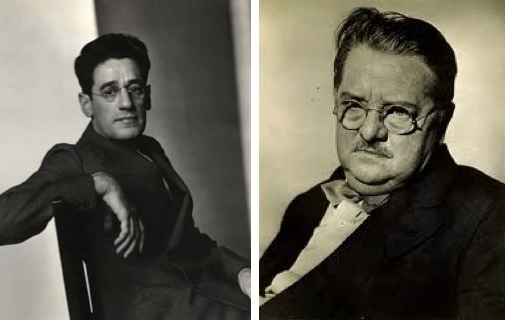
SPARRING PARTNERS…George S. Kaufman and Alexander Woollcott often matched wits around the famed Algonquin Round Table. (Pinterest)
OUT OF SORTS…The cantankerous misanthrope Sheridan Whiteside (a character based on Alexander Woollcott) was portrayed by Monty Woolley in the 1939 hit play, The Man Who Came to Dinner. The play was adapted into a 1942 movie with Woolley (left) reprising his role as Sheridan Whiteside. Playing opposite Woolley are Bette Davis (center) and Ann Sheridan. (oldhollywoodtimes.com)

What did Woollcott think of the treatment? According to an article featured in Story of the Week (Library of America), he loved it: “When the play went on its West Coast tour, he even stepped into the lead role, treating audiences to the sight of a celebrity acting as a satirical version of a character based on his own public persona. At the end of one performance, cheered on by repeated curtain calls, Woollcott riffed off one of his character’s signature lines from the play and announced to the audience that he planned to sue the authors for $150,000.”

Those were the days…

 *  *  *

Distracted Drivers

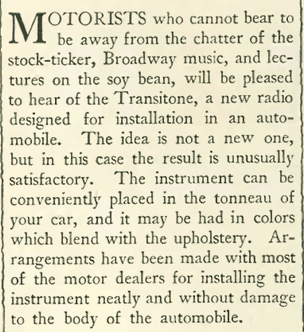
In his “Motors” column, Nicholas Trott described a new gadget that could bring new levels of pleasure (or danger) to the driving experience: the car radio:

The Transitone was probably the first production car radio in the U.S., and looked something like this (left image):

VACUUM TUBES are exposed under the dash of this car (left) outfitted with a Transitone radio. At right, a Crosley car radio from 1931. (radiomuseum.org)

 *  *  *

From Our Advertisers

The makers of Pond’s cold cream continued to land endorsements from the landed gentry, this time from 30-year-old Lady Violet Astor (née Violet Mary Elliot-Murray-Kynynmound, Dame of the Order of St. John), whose hair was described “as ripe as wheat,” her skin “pink and white as a hedge rose.” Okay, I’ll try a jar…

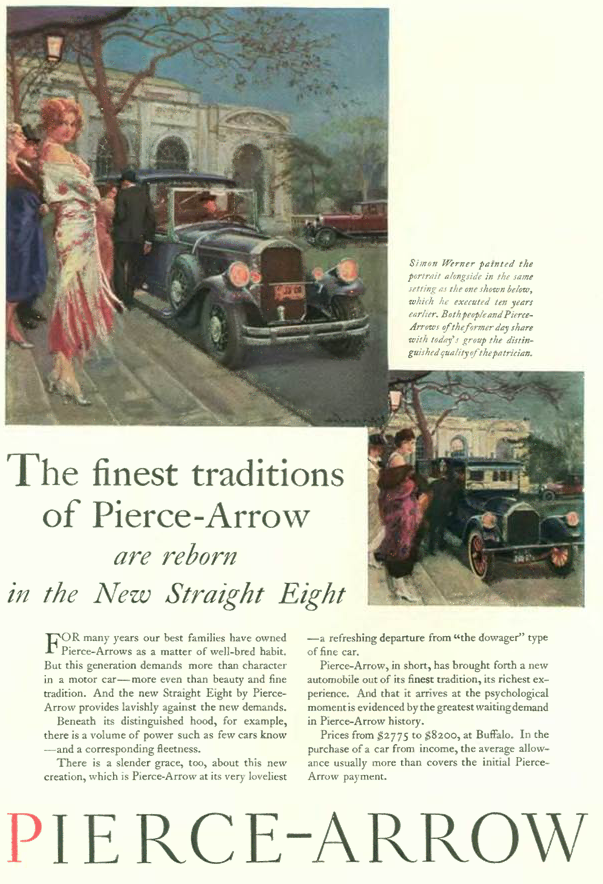
…and for more snob appeal, advertisements from American luxury carmaker Pierce-Arrow often featured messages that linked its cars to a lineage of earlier models, suggesting their automobiles had a well-bred, timeless quality (as opposed to the novelties found in cars driven by the plebeian classes). The caption reads: “Both people and Pierce-Arrows of the former day share with today’s group the distinguished quality of the patrician”…

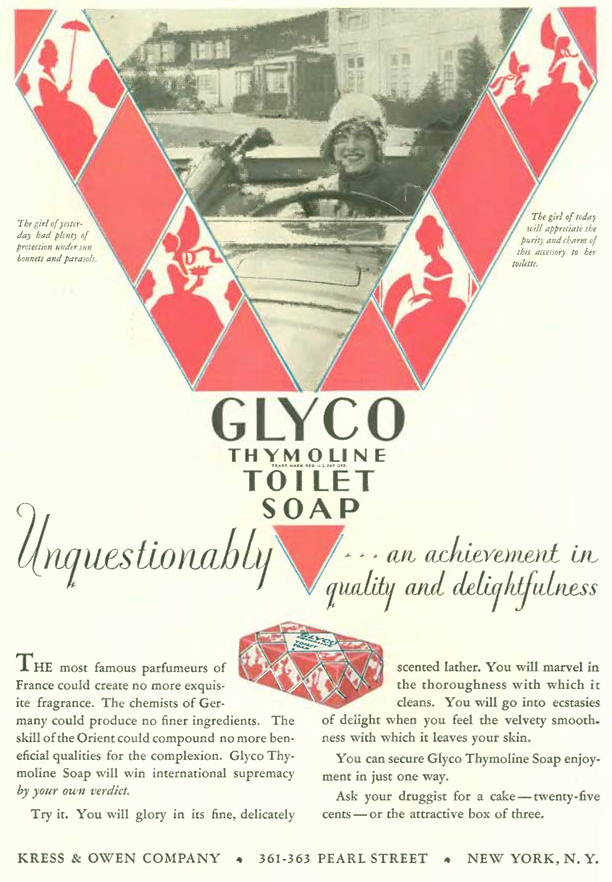
…the makers of Glyco “Thymoline” also drew upon the past to make a point about their soap, stating that “the girl of yesteryear had plenty of protection under sun bonnets and parasols,” whereas today’s young woman boldly races off to play golf without even bothering to put up the windshield. She’ll need Glyco to scrub off the bugs, dust and bits of gravel that will likely kick up into her face…

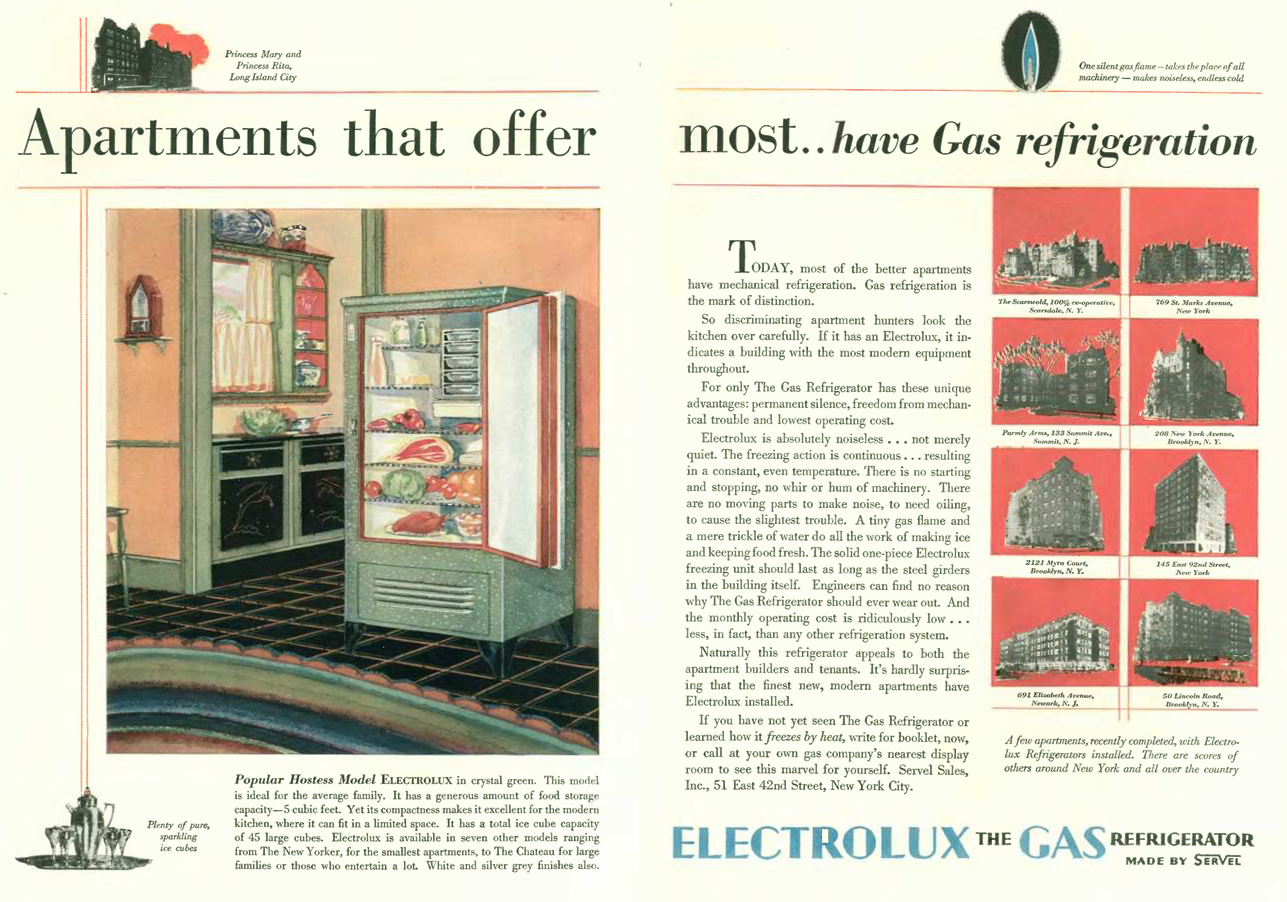
…One thing you notice at the end of the 20’s is the proliferation of color ads in The New Yorker, some quite lavish including this appeal from Electrolux, which depicted all of the new apartments popping up around the city powered by their gas appliances…

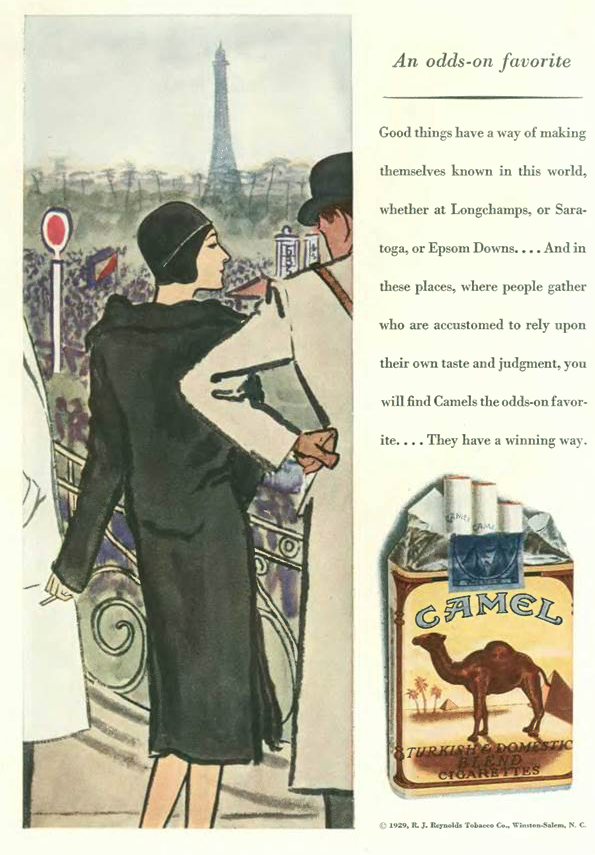
…and we have another lovely rendering by Carl “Eric” Erickson urging readers to smoke Camel cigarettes…

…and this ad caught my eye for its depiction of a house in the future, namely the year 1949 — you land your personal airplane on the roof and relax in your dynamic, angular furniture while a robot butler shakes up cocktails for you and your top-hatted friend…

…the house in the ad somewhat resembles this 1929 drawing by Swiss-American architect William Lescaze

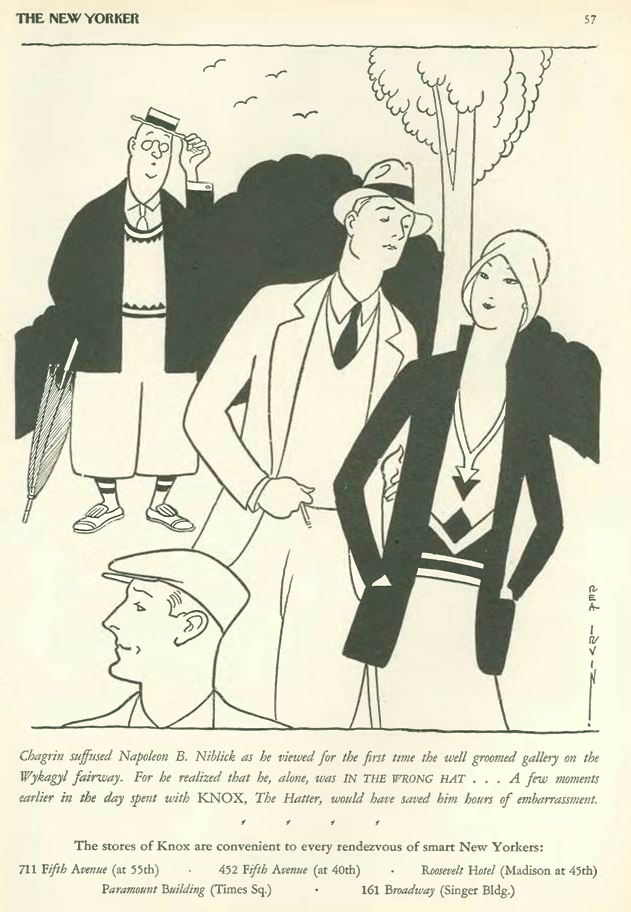
…we have another ad from Knox hatters (drawn by Rea Irvin) that featured an unfashionable, portly man (Napoleon B. Niblick) being snubbed by some Westchester toffs…

…our comics are provided by C.W. Anderson

…and Peter Arno

Next Time: Let Them Eat Cake…


Waldorf’s Salad Days

While Manhattan is home to some of the world’s most iconic buildings, it is also known for knocking them down. Sometimes it was a matter of changing tastes, but more often than not it was the steamroller of economic progress that flattened any sentimental soul that stood in its path.

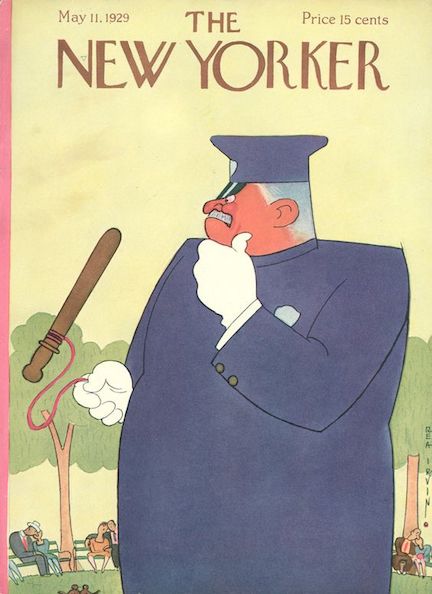
May 11, 1929 cover by Rea Irvin.

The old Waldorf-Astoria symbolized the wealth and power of the Gilded Age, but in the Roaring Twenties the storied hotel — with all its Victorian turrents, gables and other doo-dads — looked hopelessly dated despite being just a bit over 30 years old (the Waldorf opened in 1893, and the much larger Astoria rose alongside it four years later). A group of businessmen, led by former mayor Al Smith, bought the property to build the Empire State Building — an art deco edifice that would scream Jazz Age but would be completed at the start of the Great Depression. The New Yorker’s James Thurber reported on the old hotel’s last day in the May 11, 1929 “Talk of the Town”…

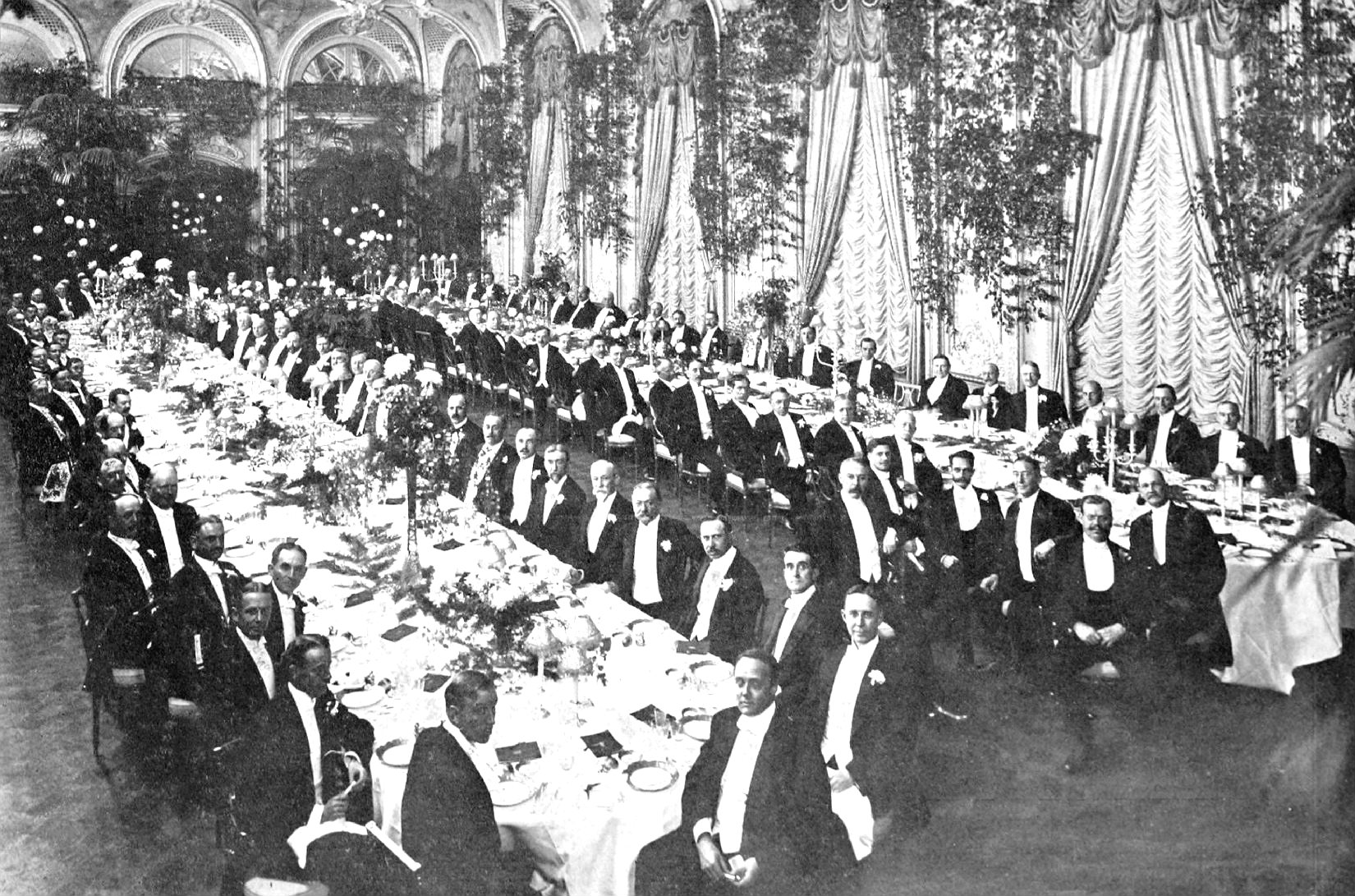
THEY LIKED RICH FOOD…1909 banquet in the Grand Ballroom at the Waldorf-Astoria honoring US Steel founder Elbert Gary. (Wikimedia Commons)

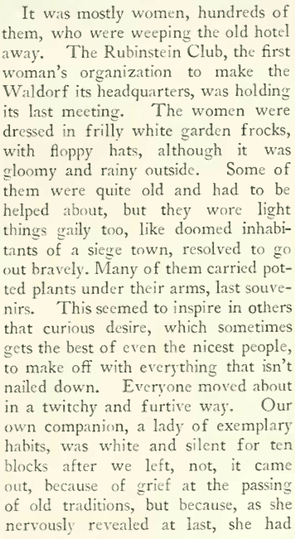
Thurber wrote of the hundreds of club women who mourned the loss of their familiar meeting rooms, and one elevator operator who would not be joining their chorus of sobs…

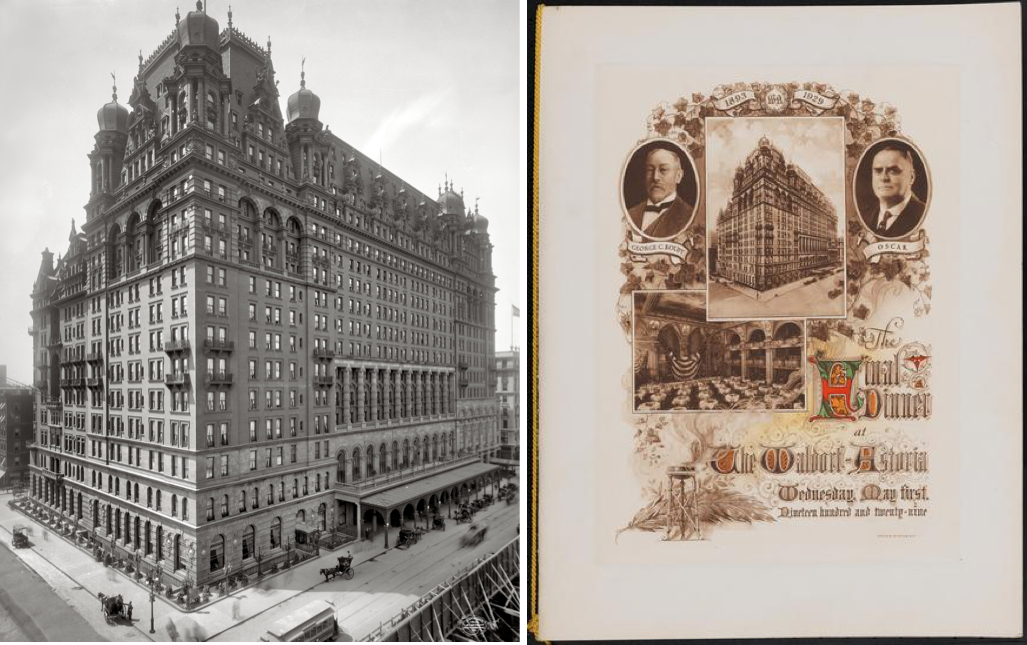
HEYDAY…the old Waldorf-Astoria hotel circa 1900, and the cover for the menu announcing “The Final Dinner.” The menu included a cherrystone clam cocktail, turtle soup, crown of bass (in lobster sauce), mignon of spring lamb (chasseur), supreme of guinea hen (tyrolienne), bombe mercedes ice cream, and coffee. (Bowery Boys/Museum of the City of New York)
THEY’RE SELLING YOU…Illustration depicting an auction of items from the hotel. (Museum of the City of New York)

In the “Reporter at Large” column, humorist Robert Benchley supplied his own perspective on the closing of the venerable hotel, and the countless speeches that reverberated between its walls…

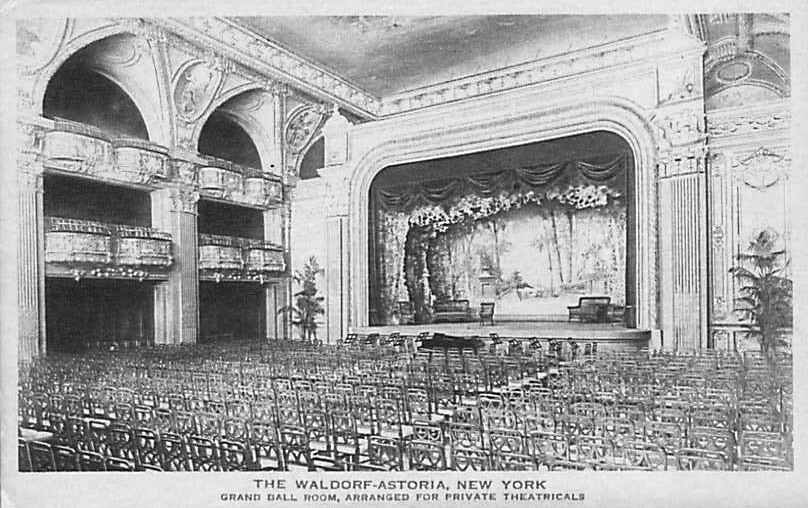
A 1903 image of the Grand Ball Room, “arranged for private theatricals. “(New York Public Library)

Benchley offered excerpts from dozens of hypothetical speeches, and then offered this final benediction to the old hotel:

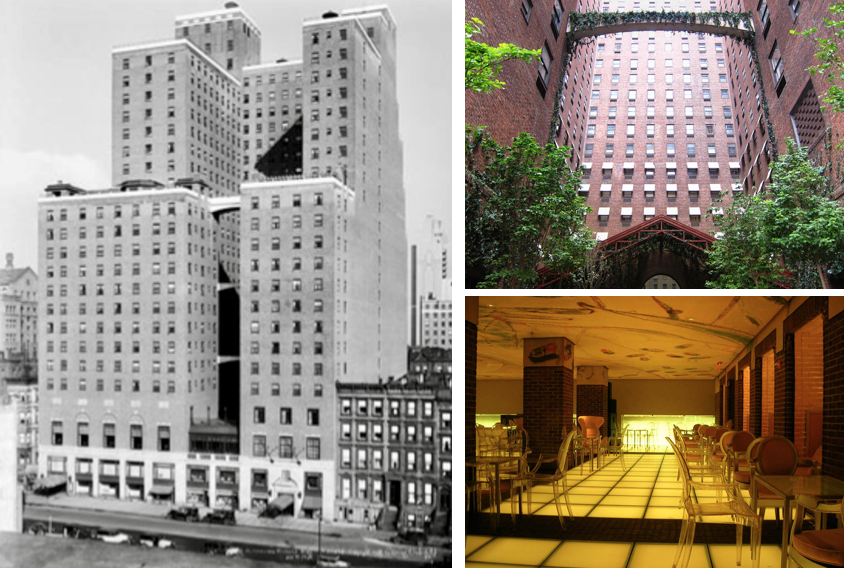
In his “The Sky Line” column, architecture critic George S. Chappell (aka T-Square) looked in on the newly completed American Woman’s Association clubhouse and residence for young women on West 58th Street. Developed by Anne Morgan, daughter of J.P. Morgan, the building contained 1,250 rooms and featured a swimming pool, restaurant, gymnasium and music rooms along with various meeting rooms.

TRAINING GROUND…At left, the American Woman’s Association clubhouse and residence in 1932. At right, view of the central atrium of the AWA residence, now the Hudson Hotel. Below, the Hudson Bar (renovated after 1997), which has been featured in a number of TV shows including Gossip Girl and Sex and the City. (Liza DeCamp/Nan Palmero top right/RoryRory bottom)

In a 1998 New York Times “Streetscapes” feature, Christoper Gray cites a 1927 Saturday Evening Post interview with Anne Morgan, who said she believed women were at a temporary disadvantage in the business world and therefore founded the American Woman’s Association as “a training school for leadership, a mental exchange” where women “can hear what other women are doing.” After the AWA went bankrupt in 1941, the building was converted into The Henry Hudson Hotel, open to both men and women. From 1982 until 1997 the building’s second through ninth floors served as the headquarters for public television station WNET. The MacNeil/Lehrer NewsHour (now the PBS NewsHour) was broadcast from the building during that time.

*  *  *

Punching for Peace

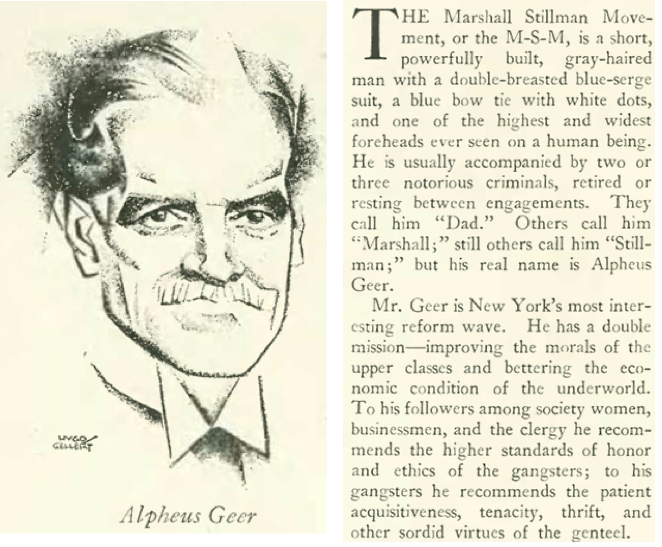
The old New Yorker was filled with personalities virtually unknown today, but who had tremendous influence in their time. Among them was Alpheus Geer (1863-1941), who founded the Marshall Stillman Movement, which promoted the sport of boxing as a way to steer young men away from a life of crime. An excerpt (with illustration by Hugo Gellert):

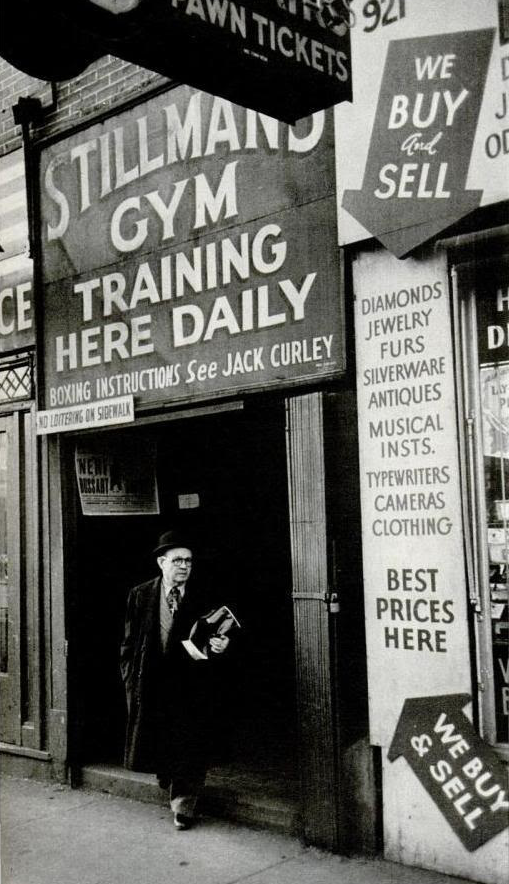
Alpheus Geer help found Stillman’s Gym in 1919 as a way to promote his Marshall Stillman Movement methods of boxing. Many famous fighters trained in the dank, smoky atmosphere of Stillman’s, including Jack Dempsey, Joe Louis and Rocky Marciano. Pictured above is famed boxing trainer Charley Goldman leaving Stillman’s Gym, circa 1940s. (easthamptonstar.com)

 *  *  *

Before we turn to the ads, this “Out of Town” column from the back pages struck an unusual tone regarding the types of tourists planning a summer in Germany…

…and from our advertisers, this ad promoting Louis Sherry’s new “informal restaurant” at Madison and 62nd Street…

WHAT’S IN A NAME…The Louis Sherry restaurant at Madison and 62nd, circa 1930. At right, the building today, now occupied by the French fashion company Hermès. (McKim, Mead & White / nycarchitecture.com)

Louis Sherry ran a famous restaurant at Fifth Avenue and 44th Street from 1898 to 1919 (like many famed restaurants, Prohibition helped put an end to it). Sherry died in 1926, so the owners of the new restaurant were merely trading on his name. In addition to a “delicacies shop” (gourmet foods were arrayed in the plate glass windows) Louis Sherry also contained a tea room, ice cream parlor and a balcony restaurant…

…like the Sherry restaurant, the new Hotel Delmonico traded on the fame of the old Delmonico’s Restaurant, which also fell victim to Prohibition by 1923. Today the hotel is best known as the place where the Beatles stayed in August 1964…

…here is another ad from Clicquot Club trying its best to sell its aged “Ginger Ale Supreme” to dry Americans. Famed avant-garde-art patron and party host Count Etienne de Beaumont (who looked like he’d had a few of something) testified how Cliquot “blends very agreeably” with the champagne most Americans cannot have…

…well, if you couldn’t have a legal drink, maybe you could entertain your friends with TICKER…”The New Wall Street Game That is Sweeping America!” My guess is this game didn’t sell so well after Black Tuesday, Oct. 29, 1929…

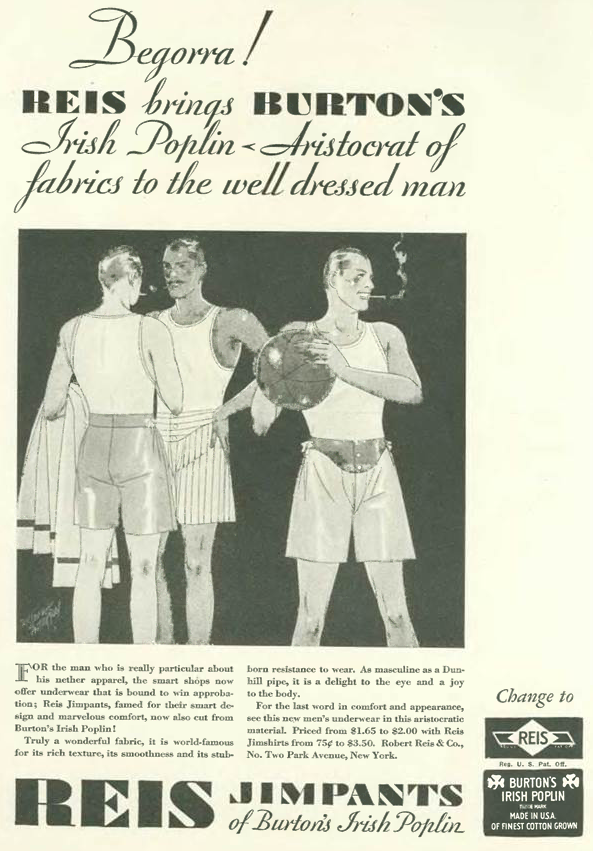
…those BVD’s aren’t good enough for you? Then try the “Aristocrat of fabrics” (and have a smoke while you toss the medicine ball around with the gents)…

…and here is more evidence that the Roaring Twenties were losing their growl even before the big crash—the straight flapper figure was out; it was now the “season of curves”…

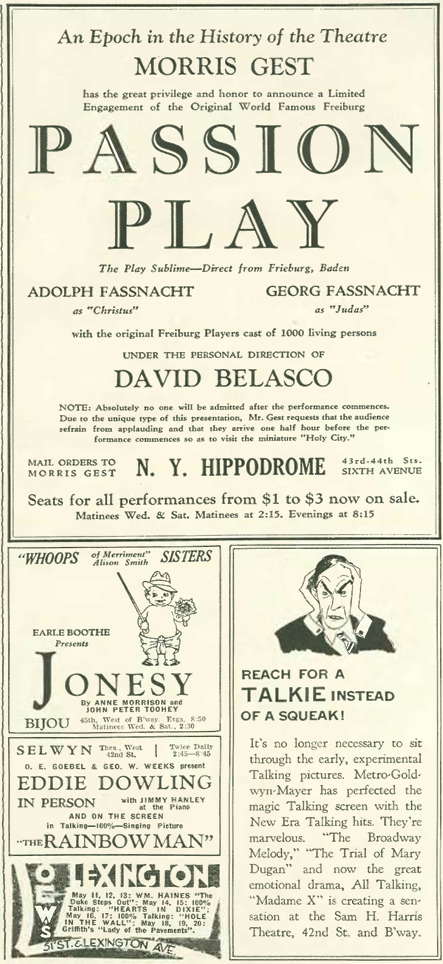
…a look at some of the cheap ads in the back of the magazine, including the one at bottom left from the Sam Harris Theater that played on the Lucky Strike cigarette slogan (“Reach for a Lucky instead of a sweet!”)…

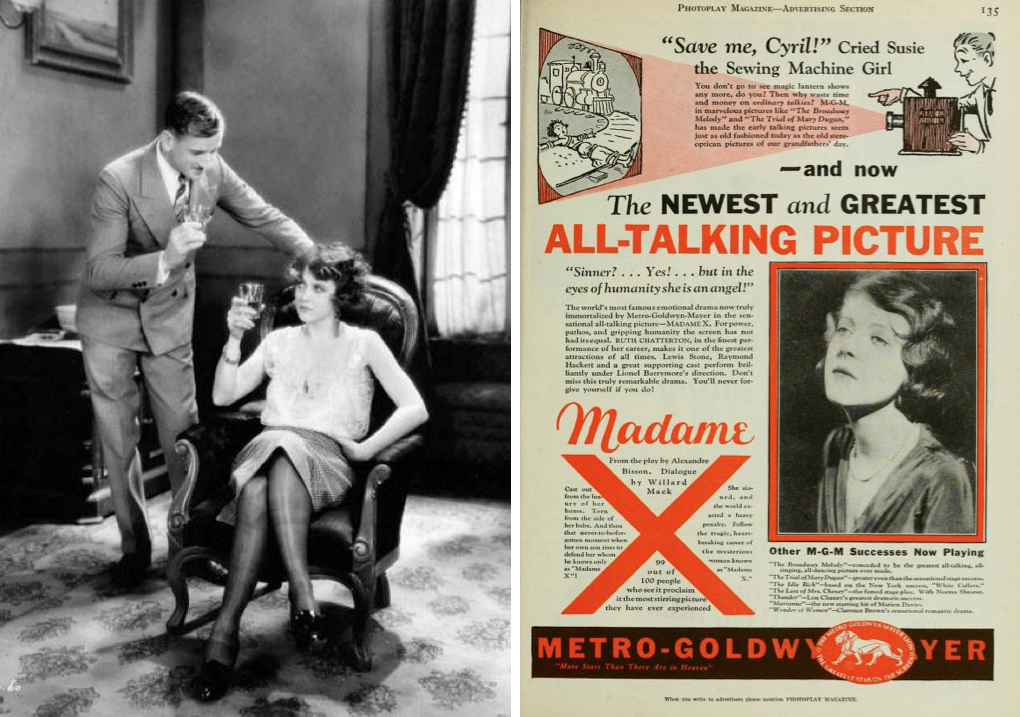
…one of the films featured at the Sam Harris Theatre was Madame X, a movie about a woman who leaves her wealthy (but cold) husband, turns to a life of crime, then tries to reclaim her son. The ad is correct in that it did create something of a sensation when it was released. It is also important to note that the film premiered at the Sam Harris for a reason: The director, Lionel Barrymore, didn’t want audiences to think his film was just another song and dance picture (like most of the first sound films) but rather a serious drama presented at a legitimate stage venue rather than a movie house…

UP TO NO GOOD…Ullrich Haupt as the cardsharp Laroque and Ruth Chatterton as Jacqueline Floriot in Madame X. At right, ad in Photoplay promoting the film. Click to enlarge. (Wikipedia/IMDB)

…back to our ads, here’s a remarkably crude one from the racist misogynists who made Muriel cigars (they being Lorillard, who also manufactured Old Golds)…

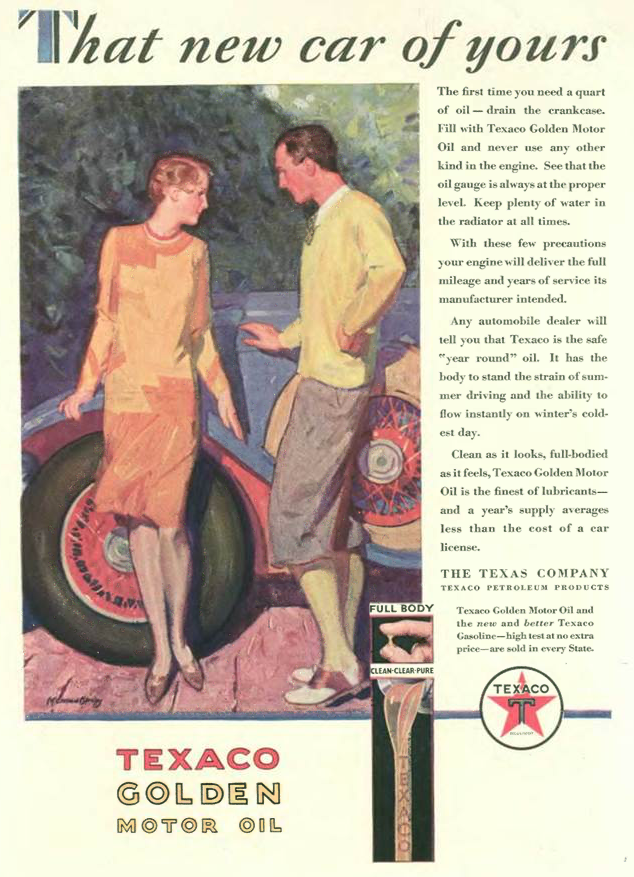
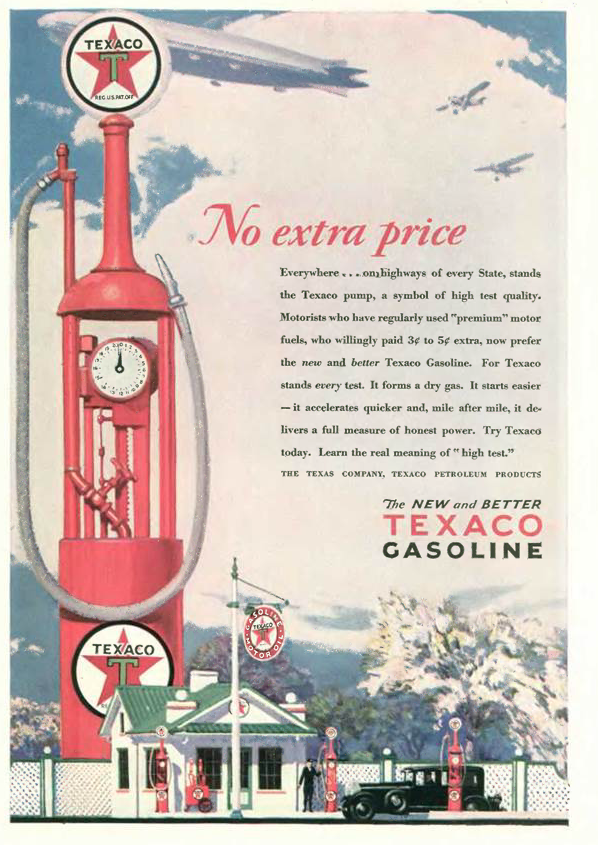
…and a softer message from The Texas Company, manufacturer of Texaco “golden” motor oil…

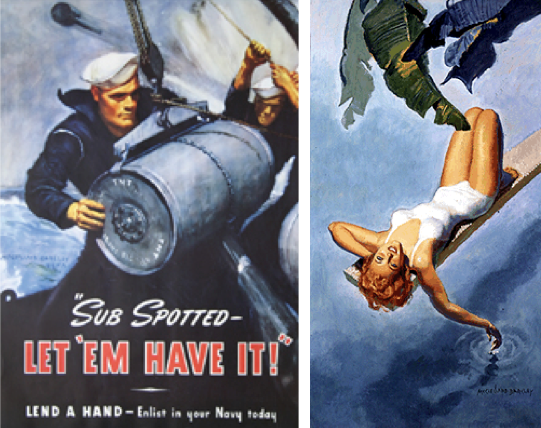
…the artist who rendered the above couple in those golden hues was American illustrator McClelland Barclay (1891-1943). Published widely in The Saturday Evening Post, Ladies’ Home Journal, and Cosmopolitan, Barclay was known for war posters as well as pin-ups:

VERSATILE…Navy recruitment poster by McClelland Barclay, and an illustration for the cover of a 1942 Saturday Home Magazine. (Wikipedia/illustrationhouse.com)

In 1940 Barclay reported for active duty in the US Navy, serving in the New York recruiting office and illustrating posters. Determined to be a front-line combat artist, he served in both the Atlantic and Pacific theatres until he was reported missing in action after his boat was torpedoed in the Solomon Islands.

 *  *  *

Our comics are supplied by Alan Dunn, who probed the vagaries of movie magazine gossip…

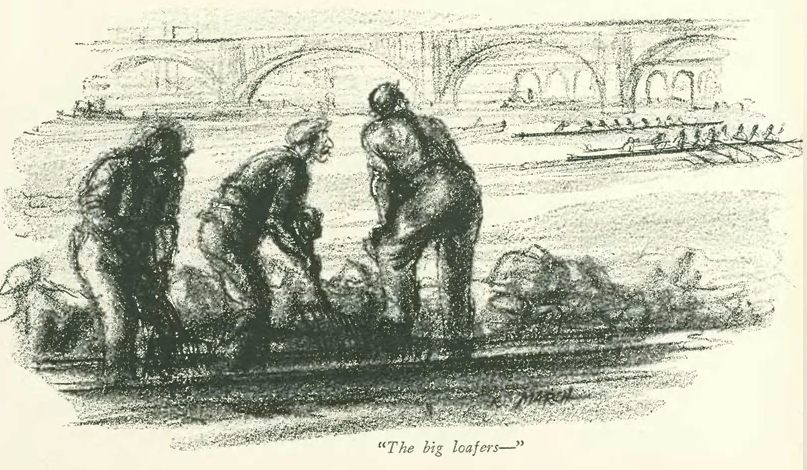
…and Reginald Marsh, known for his social realistic depictions of working life in New York, including these stevedores eyeing a regatta…

…and finally, Gardner Rea looked in on a young man displaying early signs of cynicism…

Next Time…How Charles Shaw Felt About Things…


From Broadway to Babylon

While the introduction of sound to motion pictures ended the careers of some silent film stars in the late 1920s, Hollywood’s “talkies” offered new opportunities for Broadway stage actors who could now take their vocal talents to the screen and to audiences nationwide.

May 4, 1929 cover by Ilonka Karasz.

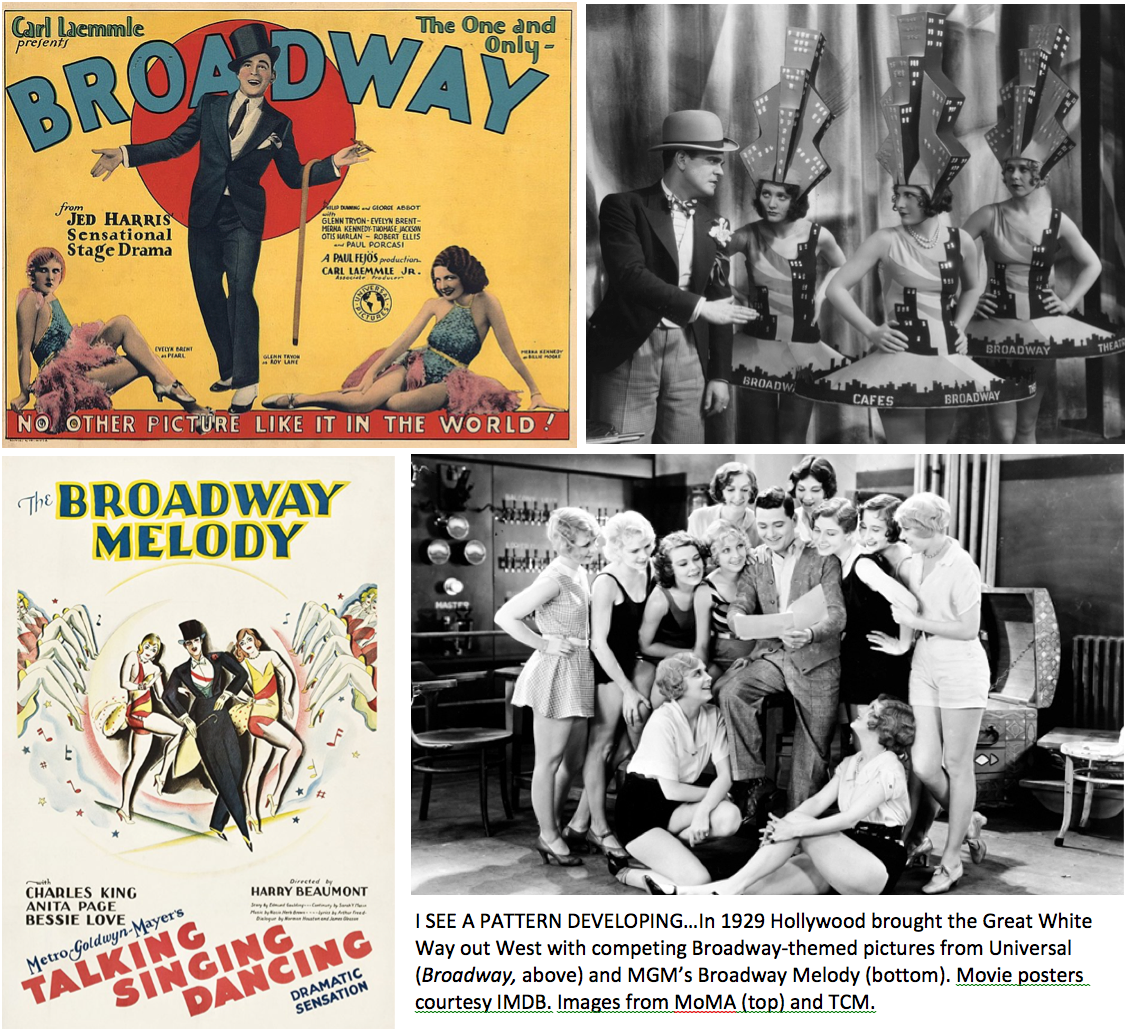
And so began the so-called “Broadway Exodus.” Robert Benchley offered his wry observations on the phenomenon in the May 4, 1929 “A Reporter at Large” column:

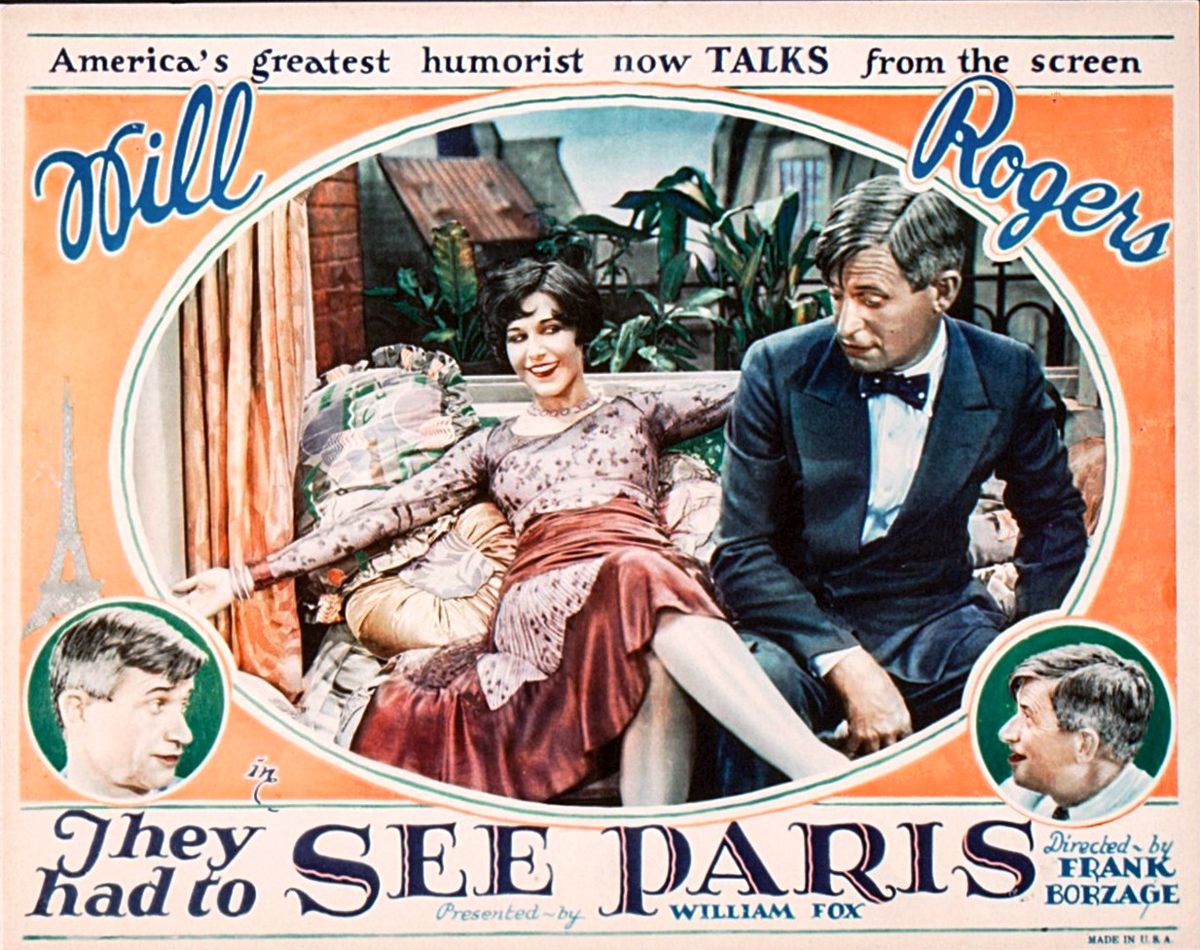
AW SHUCKS…Broadway mainstay and a perennial performer with the Ziegfeld Follies, humorist Will Rogers found his element in Hollywood’s new talkies, appearing here with Fifi D’Orsay in 1929’s They Had to See Paris. (Wikipedia)
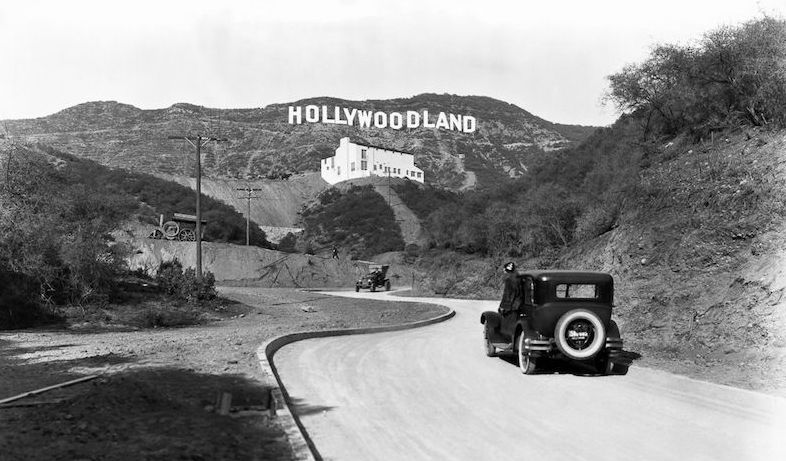
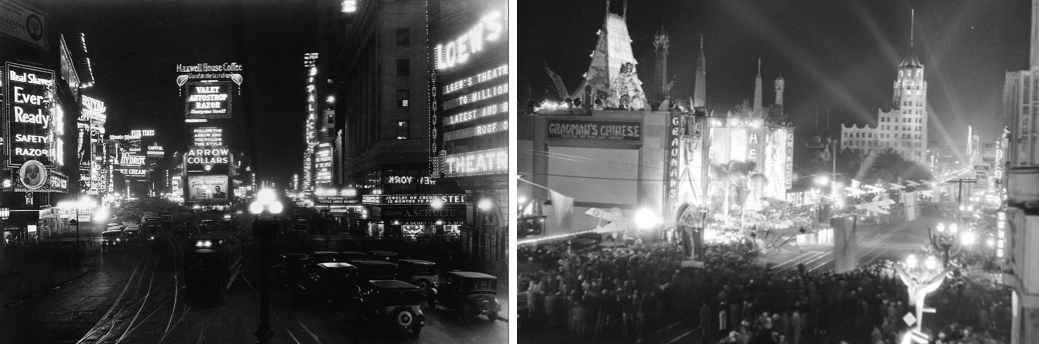
TALE OF TWO CITIES…Broadway in 1925 (left) and Hollywood Boulevard in 1929. (Daily Mail/USC Digital Library)

Benchley observed that regardless how many Broadway stars moved west, Hollywood Boulevard would never be mistaken for Broadway. However, Benchley himself would catch the bug and head to Tinseltown, appearing in dozens of feature films and shorts including How to Sleep, which would win an Academy Award for “Best Short Subject, Comedy,” in 1935.

NICE WORK IF YOU CAN GET IT…Robert Benchley in the 1935 Oscar-winning short, How to Sleep. (YouTube)

 *  *  *

One Who Stayed on Broadway

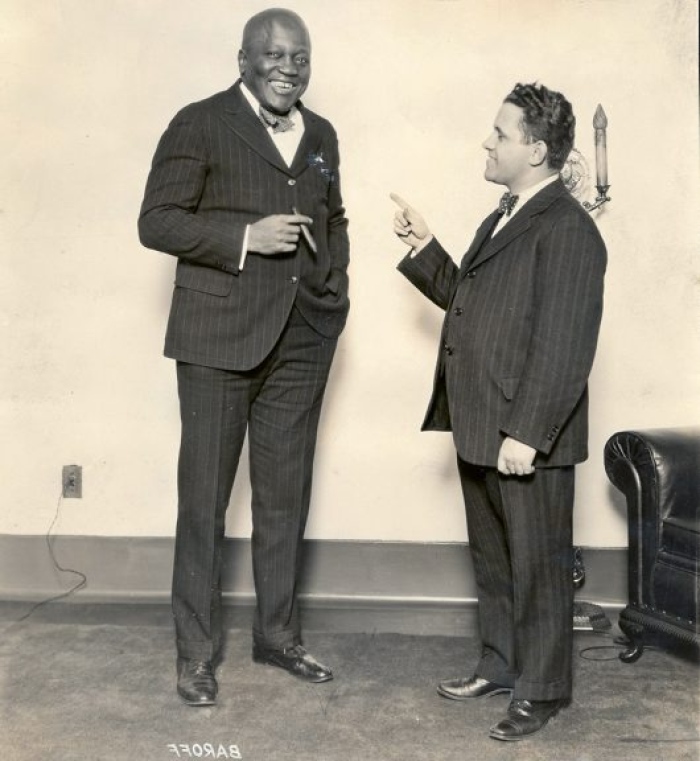
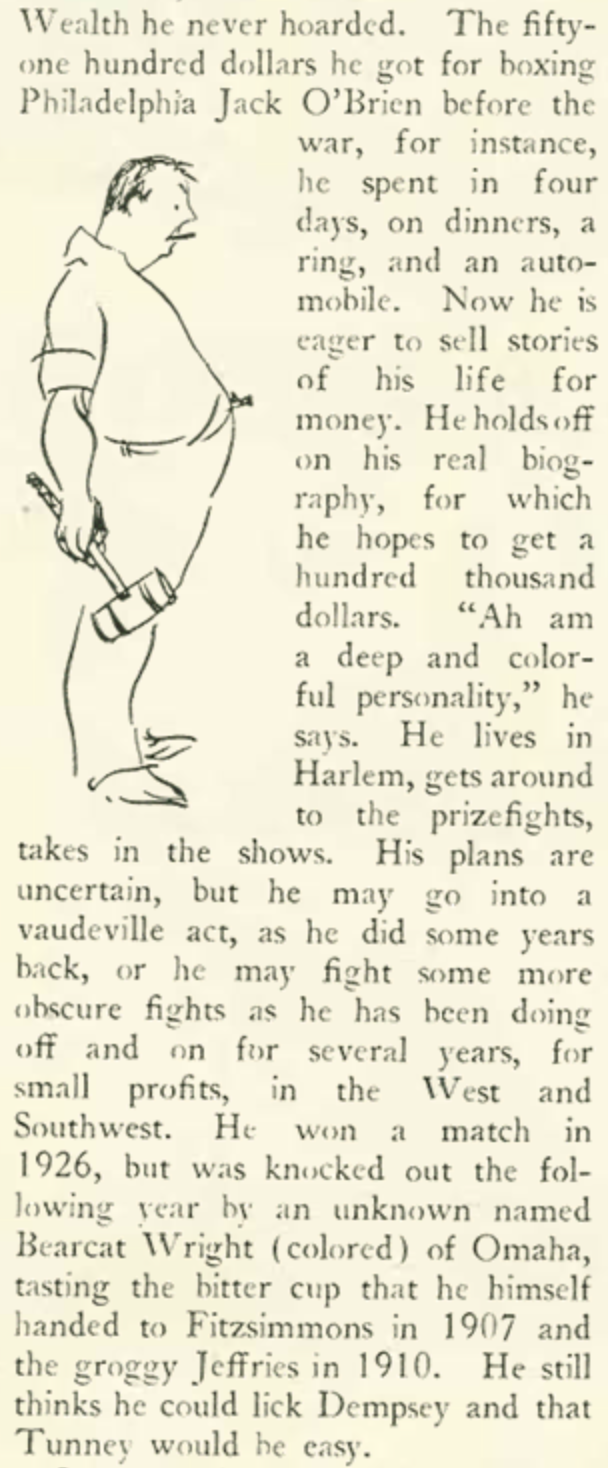
James Thurber reported in “The Talk of the Town” that famed boxing champion Jack Johnson was a common sight on the sidewalks of Broadway. Thurber noted that Johnson, the first African American world heavyweight boxing champion (1908–1915), had fallen on less glamorous days, but still appeared fit at age 51.

IN FIGHTING FORM…Jack Johnson visits with writer Joe Butler at the Scranton Times-Tribune offices on Nov. 30, 1929. (Scranton Times-Tribune)

Thurber noted that Johnson was planning to sell stories of his life, and possibly get into vaudeville. The boxer also mused that who could lick either of the heavyweight champs of the 1920s, Gene Tunney and Jack Dempsey

CREAMPUFFS…The 51-year-old Jack Johnson claimed he could defeat either of the famed heavyweight champions of the 1920s, Gene Tunney (left) or Jack Dempsey. (Reemus Boxing)

…and Thurber shared a strange account regarding the thickness of Johnson’s skull, which apparently bested that of an ox…

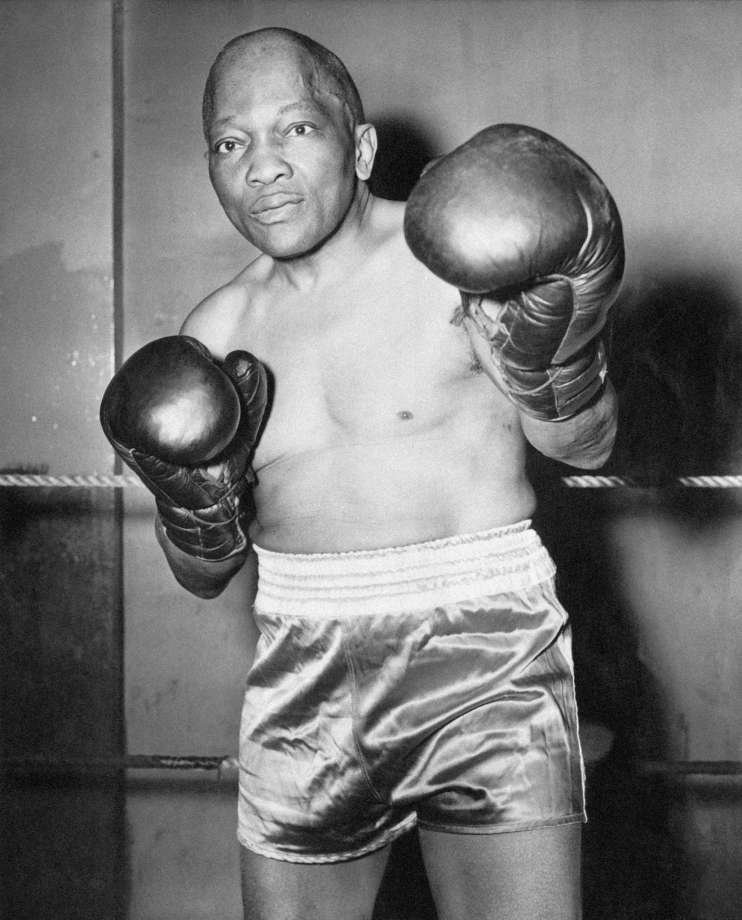
FIGHT TO THE LAST…The 67-year-old Jack Johnson prepares for an exhibition boxing match at a war bond show in New York City on May 1945. Along with making public appearances, Johnson also performed on Broadway during his retirement. (Houston Chronicle)

Johnson continued professional boxing until age 60, and thereafter participated in boxing exhibitions in various venues until his death at age 68 in a car crash near Raleigh, NC. It was reported that Johnson was racing angrily from a nearby diner that had refused to serve him when he lost control and hit a light pole.

 *  *  *

Don’t Ask, Don’t Tell

Anyone who thinks the recent squabbles over Planned Parenthood are anything new might do a little reading on the life of Margaret Sanger, who opened the first birth control clinic in the U.S. in 1916 (in Brooklyn) and was subsequently arrested for distributing information on contraception. In 1929 she was again arrested for operating a “secret” birth control clinic in the basement of a Manhattan brownstone. On March 22, 1929, the New York Police Department sent an undercover female detective, Anna McNamara, to Sanger’s clinic. Posing as a patient who wished to avoid another pregnancy, McNamara was advised on various forms of contraception. She later returned to the clinic as part of the police raid, during which she seized a number of confidential patient files. At Sanger’s subsequent court hearing, McNamara learned first-hand about the importance of patient confidentiality. From the May 4 “Talk of the Town”…

Recalling her arrest in a 1944 article, “Birth Control: Then and Now,” Sanger wrote that McNamara taunted her during the raid when she was told that she had no right to touch private medical files. Sanger wrote “I shall never forget the color of Mrs. McNamara’s face when she heard this medical testimony recited several days later in Magistrates’ Court at the hearing. She was totally unprepared for this embarrassing revelation of her own organs.” The New Yorker made note of this…

Sanger would continue to work for birth control until her death in 1966. Although her name is still invoked in debates over abortion, Sanger herself was generally opposed to abortion, maintaining that contraception was the only practical way to avoid it.

GAG ORDER…In April 1929 Margaret Sanger planned to speak at Boston’s Ford Hall Forum on Free Speech. Ironically, the topic of birth control was banned in Boston at the time, so Sanger appeared onstage with a gag over her mouth while historian Arthur M. Schlesinger read her remarks on free speech to the assembly. At right, the February 1926 issue of Birth Control Review. Founded by Sanger in 1917, she served as editor until 1928. It ceased publication in 1940. (womensstatus.weebly.com/sangerpapers.wordpress.com)

 *  *  *

Please Sit Still

The “Talk of the Town” also looked on American Impressionist painter Childe Hassam, who demonstrated the challenges of painting en plein air…

LOVELY SCENE…Childe Hassam’s Landscape at Newfields, New Hampshire, oil on canvas, 1909. Hassam in his studio circa 1920. (Wikimedia Commons/Wikipedia)

…and found it difficult to finish a farmhouse sketch when a door was unexpectedly closed on his subject…

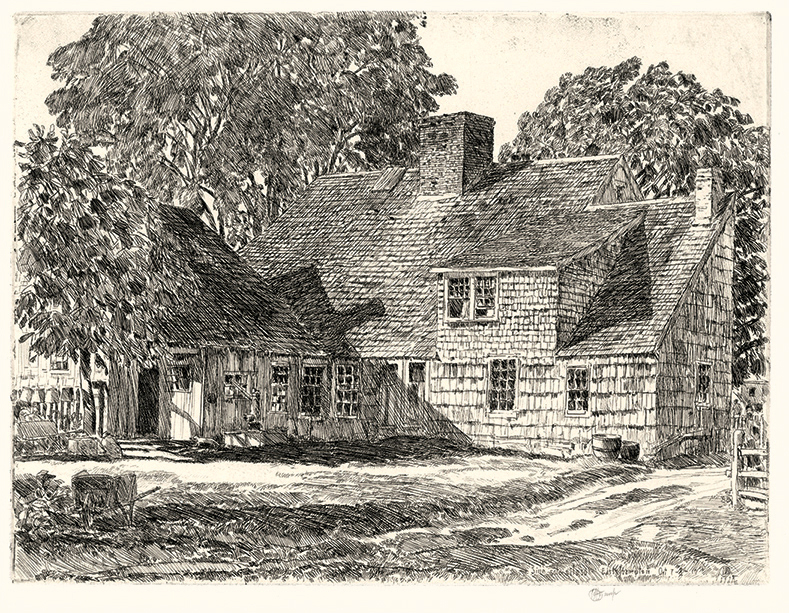
THIS ONE HE FINISHED…Childe Hassam’s etching, The Old Dominy House (East Hampton), 1928. This work was probably created during Hassam’s visits to East Hampton described in “The Talk of the Town.”(Smithsonian)

 *  *  *

All That Jazz

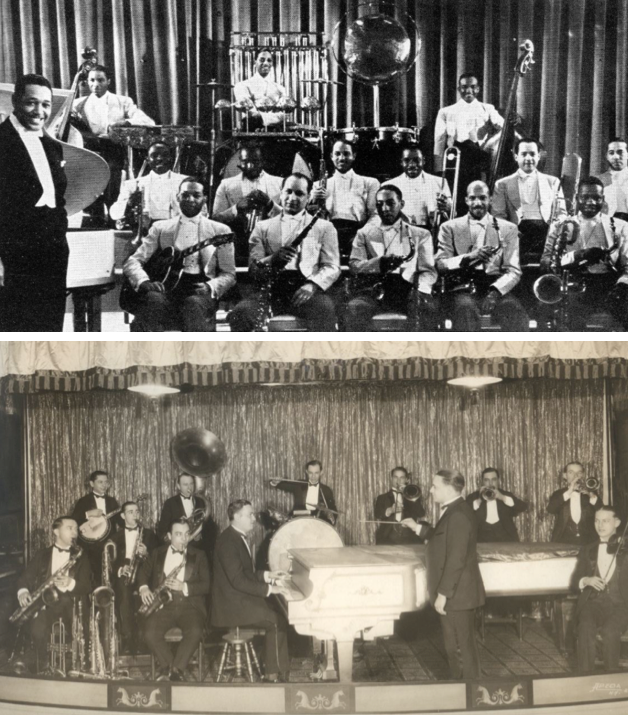
As Lois Long’s contributions to her “Tables for Two” column grew ever more infrequent, it was clear that she was wearying of the nightlife scene. Now 28 and a young mother, “Lipstick” was shedding her image as a fun-loving flapper and devoting more time and energy to her fashion column, “On and Off the Avenue.” Nevertheless, she still found the time to visit the Cotton Club and proclaim Duke Ellington’s jazz orchestra as “the greatest of all time”…

…although her other observations of the New York nightclub scene appear to have been hastily dashed off…

THE BEST…Duke Ellington and his orchestra (top), circa 1930. Below, Vincent Lopez conducts his orchestra in 1923. (oldtimeblues.net / www.jazzhound.net © Mark Berresford)

 *  *  *

Electric Wonders

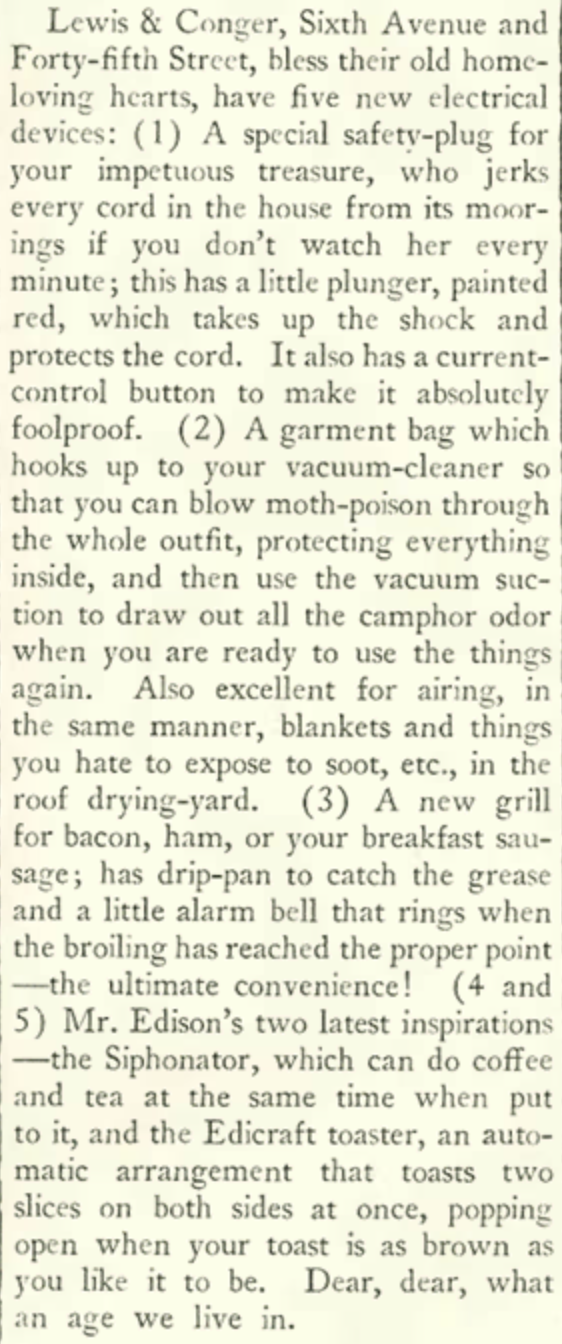
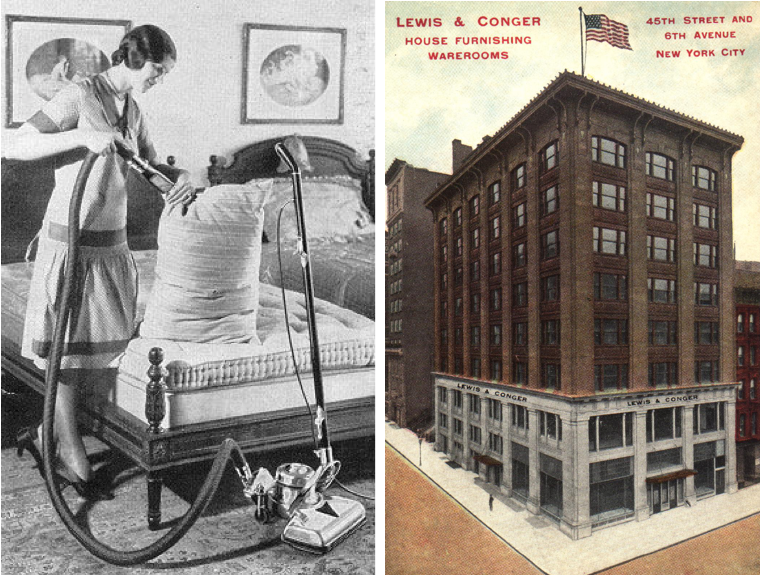
The May 4 issue updated readers on some of the latest gadgets available to modern households in 1929. I particularly like the device that allowed your vacuum to blow “moth poison” into your garments…

NOW THIS DOES NOT SUCK…Garments and other household items could be fumigated against moths using a new reverse vacuum attachment, available at Lewis & Conger. (Cyberspace Vacuum Cleaner Museum / Columbia University)

*  *  *

From Our Advertisers

One thing you notice about 1920s advertising is the amount of turgid copy they contain…I suppose without distractions such as TV and iPhones people actually took the time to read all of these bloated messages, such as this one from Whitman’s that suggested a box of candy is more than a box of candy…

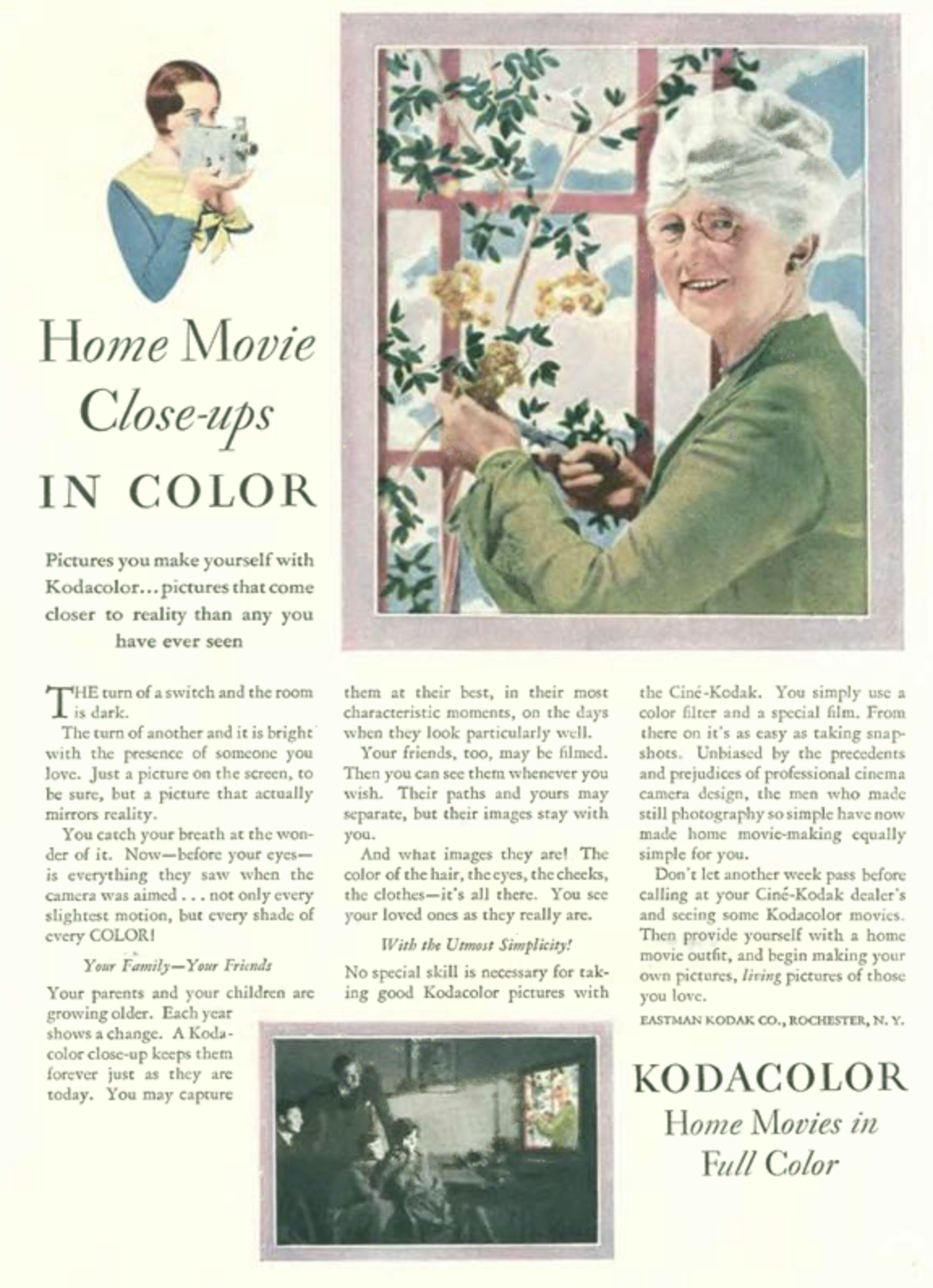
…or how about this lengthy appeal from Kodak, which used guilt to convince you to get some film of grandma while she was still “at her best…”

…the makers of Spud promised a “new freedom” and a “16% cooler smoke” to the users of its menthol-laced cigarettes. Spuds were the first menthol cigarettes, developed in 1924 by Ohioan Lloyd “Spud” Hughes, who sold them out of his car until the brand was acquired in 1926 by The Axton-Fisher Tobacco Company. By 1932 Spud was the fifth-most popular brand in the U.S., and had no competitors in the menthol market until Brown & Williamson launched their Kool brand in 1933. The Spud brand died out by 1963 (along with, presumably, many of its customers)…

…leveraging the popularity in the 1920s of knights and fairies, as well as the Anglo- and Francophila of New Yorker readers, “Mrs. Marie D. Kling” hoped to entice city dwellers up to the burbs in Scarsdale…

…our cartoons are courtesy of Barbara Shermund, who looked in on a couple of debs performing their daily exercises…

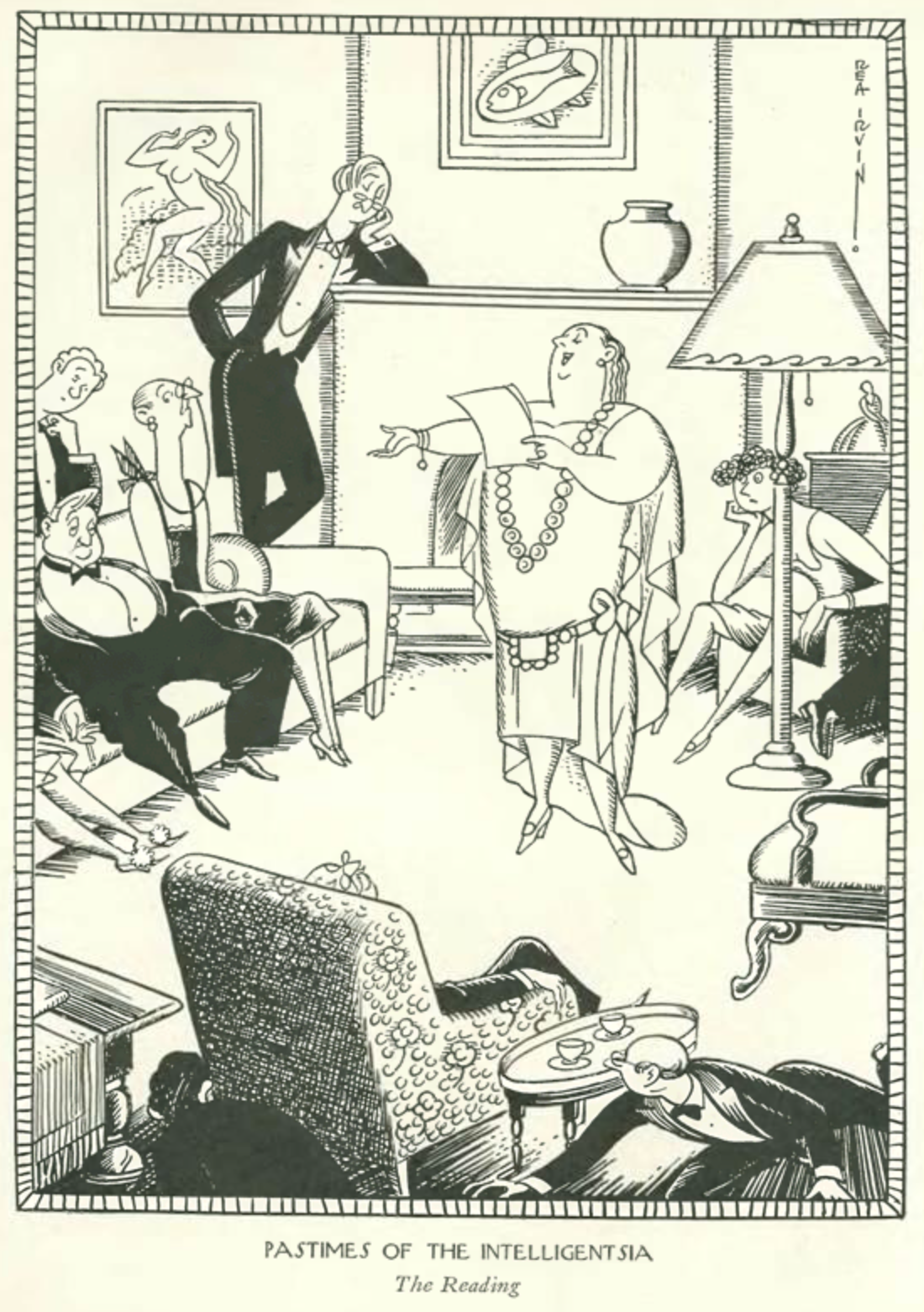
…while down in the parlor, Rea Irvin captured the horrors inflicted by an author’s tedious reading…

…and finally, Peter Arno probed the depths of sanctimony…

Next Time: Waldorf’s Salad Days…

Hello Molly

While the New Yorker was happy to send singer Marion Talley packing back to Midwest (see last post), it was wholly embracing one of its own, Molly Picon. But as we will see, it had every reason to do so.

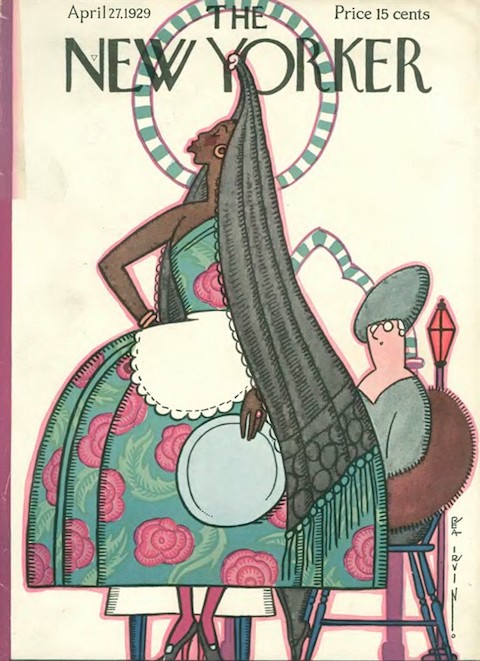
April 27, 1929 cover by Rea Irvin.

The daughter of Polish immigrants, Molly Picon (1898-1992) was born Małka Opiekun in New York City on Feb. 28, 1898, and became of a star of Yiddish theatre and film before moving to English language productions in the 1930s.

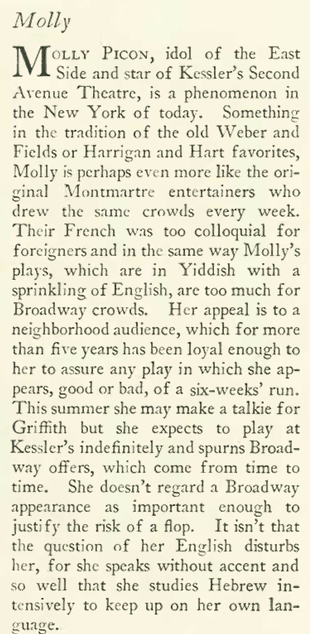
Writing in “The Talk of the Town,” James Thurber described Picon as an “idol of the East Side”…

PRECOCIOUS…Molly Picon began performing in the Yiddish Theatre at age six. Pictured, from left, is 10-year-old Molly in a 1908 Nickelodeon short of a vaudeville act, Fagan’s Decision; an undated press photo; in The Jolly Orphan, 1929. (Jewish Women’s Archive/Wikipedia/Museum of the City of New York)
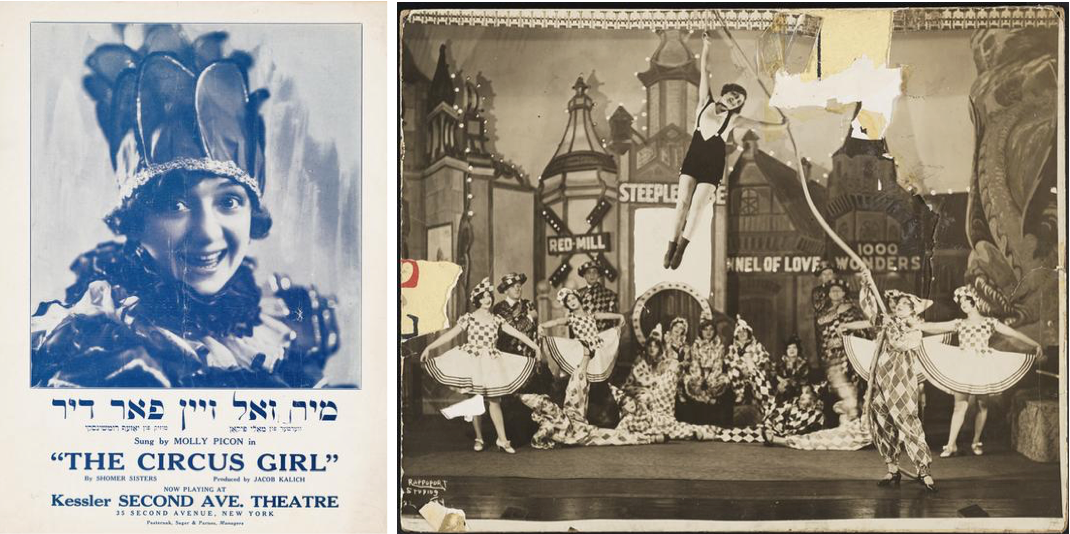
At left, music sung by Molly Picot in the a Yiddish theatre production, Tsirkus meydl (The Circus Girl), 1928. At right, a scene from the play. (Museum of the City of New York)
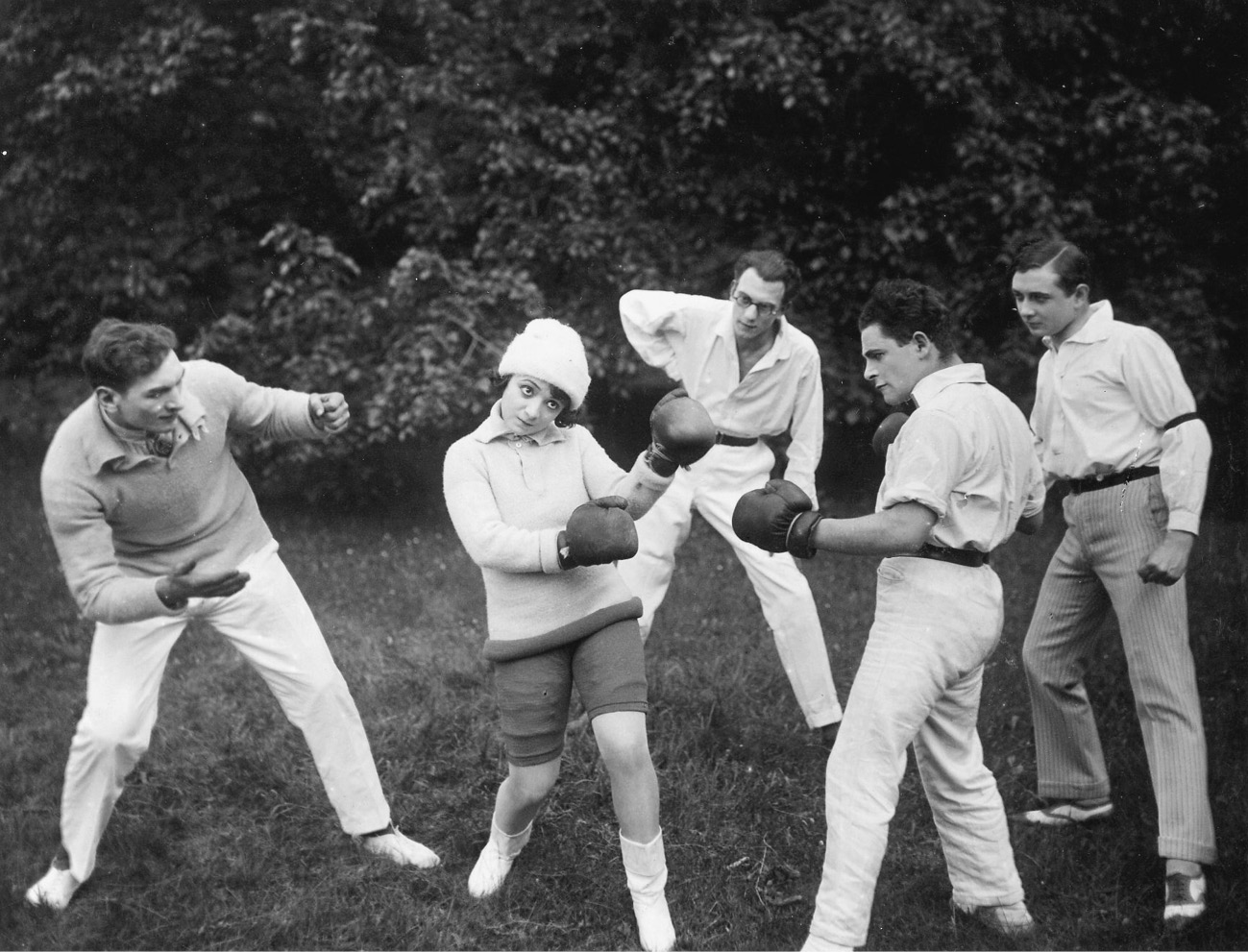
PUT ‘EM UP…Molly Picot tries her hand at boxing in the silent comedy, East and West, originally produced in Austria in 1923. In this film about assimilation and Jewish values, a sophisticated New Yorker travels back to his village to attend his niece’s traditional wedding. There he encounters the rambunctious Molly, whose hijinks include boxing, and teaching other young villagers to shimmy. (Image: National Center for Jewish Film / Caption: UC Berkeley Library)

Thurber described Picon’s personal life as simple and focused on her family, a path she followed throughout her 94 years:

Picon met her husband, Jacob “Yonkel” Kalich (1891-1975) in 1918 and they married a year later. In an exhibition at the American Jewish Historical Society, Picon is quoted on how meeting Kalich changed her life:

“When we met in Boston, I was the All-American Girl full of hurdy-gurdys and absolutely illiterate about Jewish culture. Yonkel, on the other hand, was the complete intellectual who knew not only classic Yiddish but its plays, theater and writers.”

After they married in 1919, the couple toured Eastern European cities with large Jewish populations in order that she could improve her Yiddish and gain experience as a performer. Kalich served as her manager and creator of many of her roles, and they often performed together, including in two films nearly 50 years apart—East and West (1923) and Fiddler on the Roof (1971).

Top photos, left to right, Molly Picon in the Yiddish Theatre comedy Di Tsvey Kuni Lemels (The Two Kuni Lemels), 1926; with husband Jacob “Yonkel” Kalich in the 1923 silent film comedy, East and West; with Kalich that same year in Vienna. Bottom row, left to right, Picon tapes the Maxwell House Radio Show, 1938, and below, on the set of the Fiddler on the Roof (1971) with husband Jacob “Yonkel” Kalich; with Frank Sinatra in Come Blow Your Horn (1963); and on the TV show The Facts of Life (1979). (Wikimedia Commons/American Jewish Historical Society/Jewish Women’s Archive)

Picon appeared on a variety of TV shows from the 1960s through the 1980s including Car 54, Where Are You?, Gomer Pyle, The Facts of Life, and Trapper John M.D. Movie appearances during that time included Fiddler on the Roof (1971); For Pete’s Sake (with Barbra Streisand, 1974); and perhaps one of her oddest roles, as Roger Moore’s longsuffering mother in The Cannonball Run (1981) and 1984’s The Cannonball Run II (In those films, Moore portrayed Seymour Goldfarb, heir to the Goldfarb Girdles fortune, who preferred the life of pretending to be a spy to girdle manufacturing).

Thurber observed that Picon was only interested in comedic roles, a preference she stuck to throughout her long career.

Molly Picon as Mrs. Bronson in the television show Car 54, Where Are You? (1962) (Wikimedia Commons)

To learn more about Molly Picon’s fascinating life, visit the online exhibition at the American Jewish Historical Society.

 *  *  *

Sober as a Judge

Despite Prohibition, booze flowed freely in New York in the late 1920s thanks to bootleggers and corrupt cops. U.S. Assistant Attorney General Mabel Walker Willebrandt tried her best to crack down on violations, arresting (among many others) the operators of two of Manhattan’s most popular nightclubs, actress Texas Guinan (300 Club) and torch singer Helen Morgan (Chez Morgan). In the “Talk of the Town,” the New Yorker found hope in the acquittal of Guinan and Morgan, and in the opinion of one of the jurors:

In the same issue, this cartoon by Oscar Howard tells us a lot about New York’s approach to Prohibition enforcement in 1929…

 *  *  *

Captive Audience

In the April 27 “Talk of the Town” James Thurber also turned his attention to the latest treacle flowing out of Hollywood—the premiere of The Rainbow Man, starring Eddie Dowling in his first talking picture. Thurber found the film to be “alarmingly bad.” But that was only the beginning…

TIRED OF ME YET?…Lloyd Ingraham, Eddie Dowling, and Marian Nixon in The Rainbow Man (1929) (IMDB)

Thurber wrote that the film was followed by live performances from “a Kate Smith” and by Eddie Dowling himself, who piled more ham on the proceedings.

PILING IT ON…Eddie Dowling gave audiences more than they needed (at least in the view of James Thurber) at the premiere of The Rainbow Man. Dowling would share the stage with Kate Smith, apparently unknown to Thurber at that time. She would go on to massive stardom. Dowling, not so much. (IMDB/Pinterest)

 *  *  *

Slow Man River

Things didn’t look much better in the magazine’s movie review section, where the 1929 film version of the huge 1927 Broadway hit musical Showboat seemed stuck on sandbar:

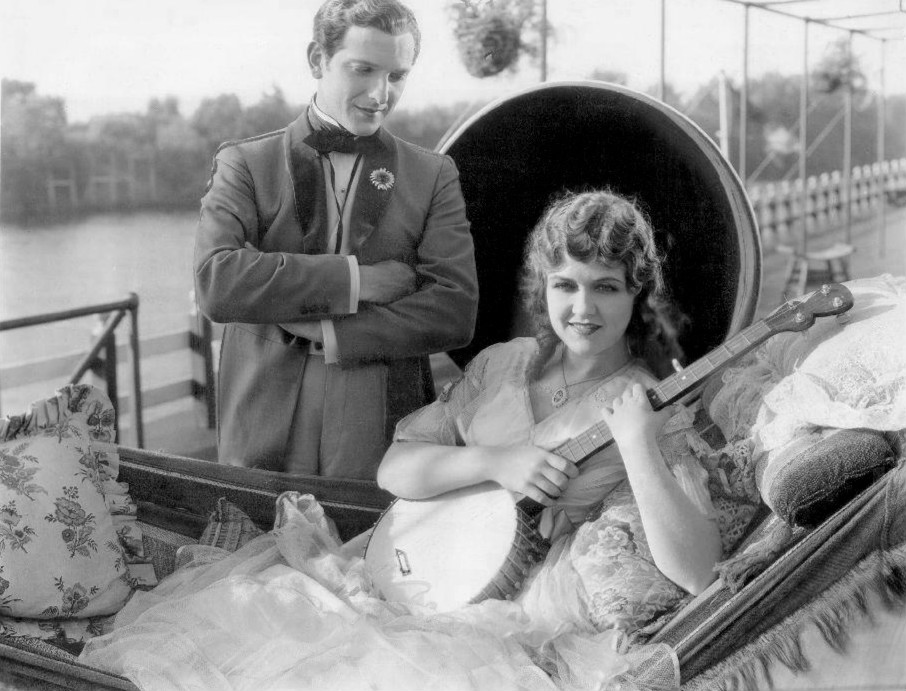
SLOW BOAT…Scene from the 1929 film Show Boat featuring Laura LaPlante as Magnolia Hawks and Joseph Schildkraut as Gaylord Ravenal. (Wikipedia)

 *  *  *

Elsie Dinsmore Revisited

Phyllis Crawford (writing under the pseudonym Josie Turner) contributed another parody of the Elsie Dinsmore book series. The original books (28 in all), were written in the late 19th and early 20th century and featured an impossibly upright eight-year-old as the main character.

Crawford, herself an author of children’s books (including the award-winning Hello, the Boat!), had some fun with the Dinsmore books, her parody featuring a still pious and innocent Elsie living with her father in New York, where she encounters his circle of friends including gamblers and chorus girls (the collected pieces were published as a book in 1930: Elsie Dinsmore on the Loose). In this brief excerpt from Crawford’s piece in the April 27 issue (“Elsie Dinsmore Entertains at Tea”), little Elsie tries her best to entertain a friend of her “dear Papa”…

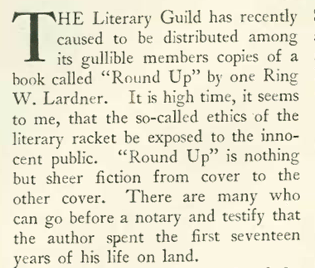
On the topic of books, Dorothy Parker, in her “Reading and Writing” column, took aim at middlebrow book clubs such as the Literary Guild, expressing (in her way) surprise that such a club would actually recommend something with literary merit…

Advertisement in the April 27 issue for Ring Lardner’s Round Up. At right, Lardner and Dorothy Parker, circa 1930. (thenationalpastimemuseum.com/selectedshorts.org)

 *  *  *

From Our Advertisers

We begin with a colorful ad from the makers B.V.D., a brand name that would become synonymous with men’s underwear…

…Russian prima ballerina Anna Pavlova demonstrated the wonders of Cutex nail polish in her famous “Dying Swan” costume (Pavlova would be dead herself in less than two years)…

…while the Wizard of Menlo Park applied his genius to the cause for better toast…

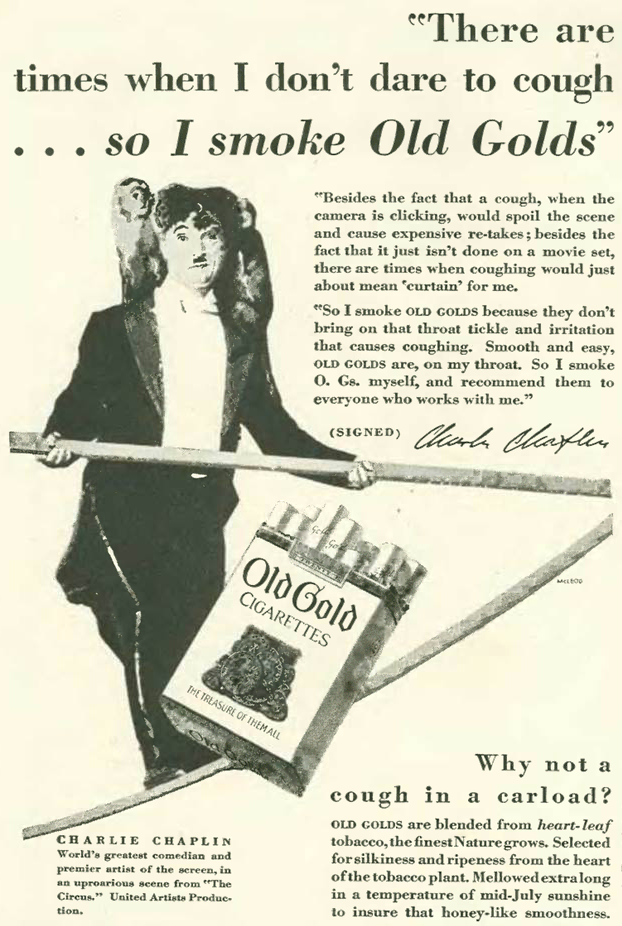
…and actor John Gilbert was the latest actor to “reach for a Lucky instead of a sweet”…

…this ad in the back pages enticed readers to visit the International Exposition of Barcelona…those fortunate enough to have made the trip would have seen Mies Van Der Rohe’s “Barcelona House” (pictured) and the first-ever Barcelona chair…

(thomortiz.tumblr.com)

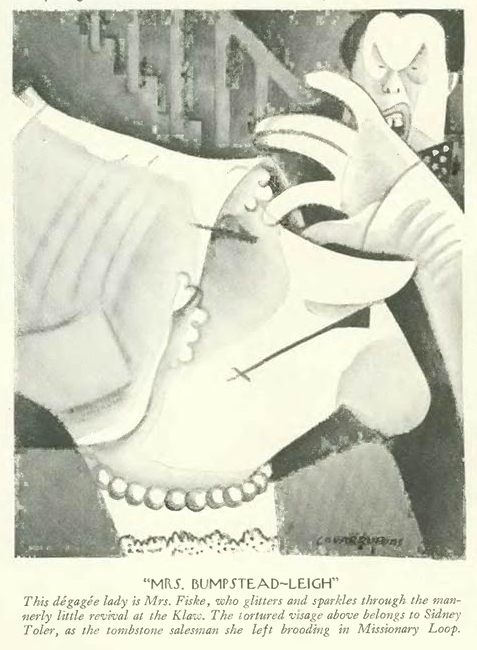
…on to cartoons and illustrations, in the theatre section this contribution by Miguel Covarrubias

…Covarrubias (pictured) was an early contributor to the New Yorker, indeed he contributed to the very first issue with this rendering of Italian opera manager Giulio Gatti-Casazza for the first-ever profile…

Gluyas Williams illustrated the collective shaming of a commuter by residents of Tudor City…

…Tudor City was touted in many early New Yorker ads as having all the amenities of the suburbs but within walking distance of the city…here is an ad from the March 26, 1927 issue of The New Yorker

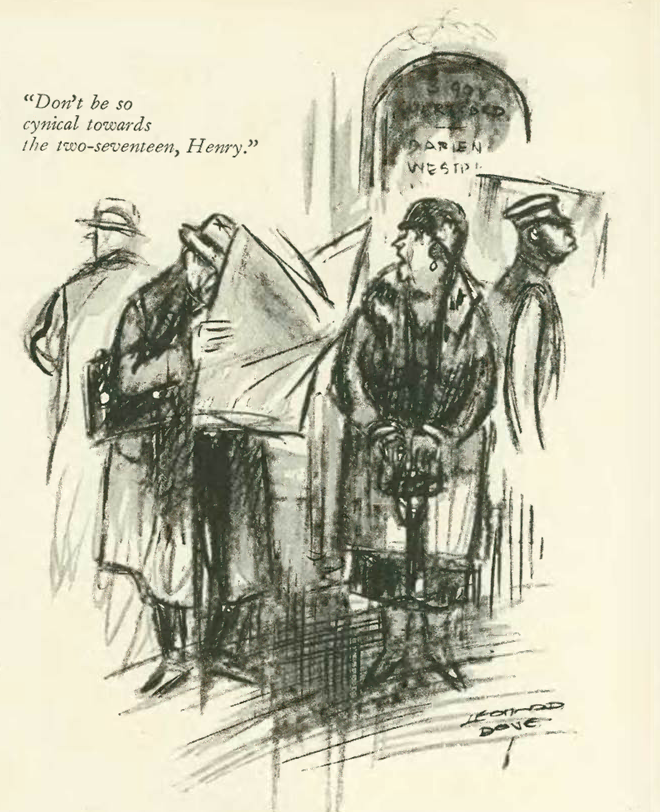
…and then we have the English cartoonist Leonard Dove, who looks in on a couple who are obviously not from Tudor City…

…and finally, a terrific cartoon by an artist I have failed to identify (if anyone knows, please comment!)…

Next Time: From Broadway to Babylon…

The So-So Soprano

Although its founding editor, Harold Ross, was raised in the rude surroundings of a Colorado mining town and often displayed the manners of a backwoodsman, the New Yorker nevertheless looked down its sophisticated nose at most anything west of the Hudson, and the middle west was reserved for particular ridicule in its homespun piety and small city boosterism.

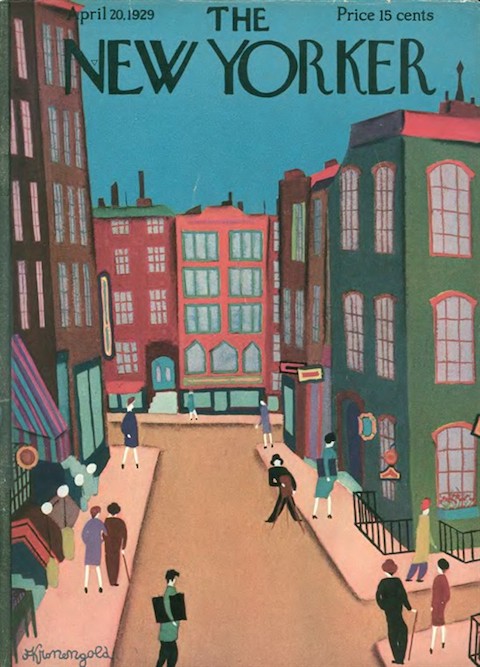
April 20, 1929 cover by Adolph K. Kronengold.

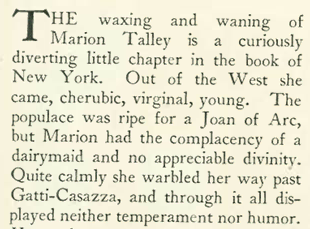
Enter one Marion Talley, a child prodigy from the tiny town of Nevada, Missouri. After appearing in a lead role at age 15 for the Kansas City Grand Opera, excited civic leaders raised enough money to send Talley to New York to study voice. Four years later (February 1926) she made her Metropolitan Opera debut as Gilda in Rigoletto — at that time the youngest prima donna to appear on the Met stage. A delegation of Kansas City’s two hundred leading citizens (including the mayor) travelled to New York via special train to attend the performance. Adding to the spectacle, a noisy telegraph machine was set up backstage so Talley’s father could send dispatches back home during the performance. Writing in his “A Reporter at Large” column for the New Yorker’s Feb. 27, 1926 issue, Morris Markey scoffed at the hype and Babbitry on display:

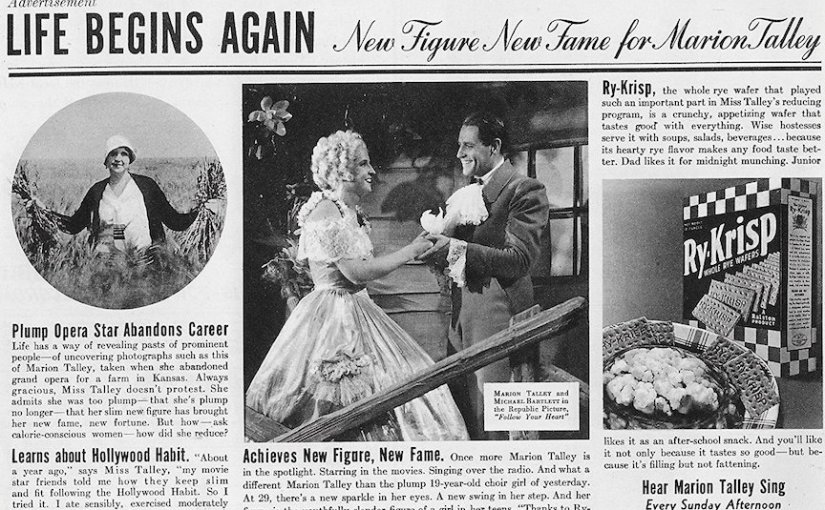
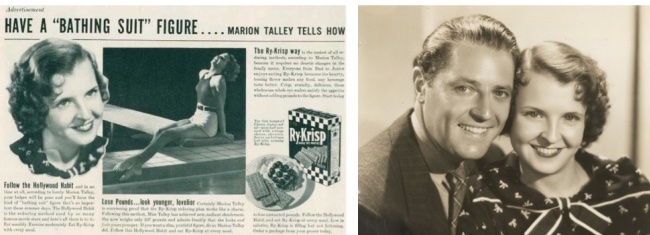
THE BIG TIME…at right, with co-star Michael Bartlett in her only movie, Follow Your Heart (1936); left, promoting Ry-Krisp crackers, sponsor of her NBC radio show, 1937. (imdb.com/mnopedia.org)

The New Yorker (via E.B. White in “Notes & Comment”) caught up with Talley more than three years later in the April 20, 1929 issue, her short career seemingly over, her voice perhaps destined for nothing more than “hog-calling”…

When Talley’s Met contract was not renewed for the 1929 season, she announced her plans to retire to a wheat farm in Kansas (hence the hog calling reference). She did, however, try to revive her career on concert tours and then on her own NBC Radio program (1936-1938), sponsored by Ry-Krisp. She made one film, the 1936 musical Follow Your Heart, but after its tepid reception the 30-year-old Talley decided to retire from show business.

ONE MORE TRY…Testimonial ads promoting weight reduction usually signal the end of a career, and for Marion Talley her Ry-Krisp diet endorsement was no exception. (imdb)

Talley married twice — to pianist Michael Rauchelsen (1932–1934) and to music critic Adolph Eckstein (1935–1942), the latter with whom she had a daughter, Susan. Talley died in 1983 in Beverly Hills, California.

*  *  *

Dark Clouds on the Horizon

The April 20, 1929 “Talk of the Town” made passing mention of a man who would be instrumental in the stock market crash later that year—National City Bank President Charles E. Mitchell:

The “Talk” item references a $25 million advance Mitchell offered to stock market traders who were getting the yips in an overheated market. This happened after a “mini crash” on March 25, 1929, when the Federal Reserve told its banks to withhold all loans to finance securities. Mitchell’s announcement apparently reassured the public enough to stop the panic, but in reality it only delayed the inevitable—a major market crash brought on in large part by the over-selling of securities by Mitchell’s bank.

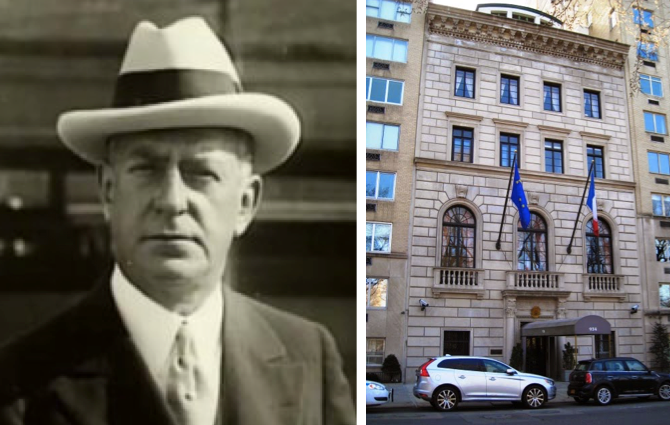
RUNAWAY BULL…Charles E. Mitchell’s reckless overselling of securities played a large role in the October 1929 stock market crash. Arrested and indicted for tax evasion in 1933, Mitchell would be acquitted of criminal charges but would end up paying a million dollars to the U.S. government in a civil settlement. At right, Walker’s stately townhouse on Fifth Avenue, now home to the French consulate. (geni.com/daytonian in manhattan)

The “Talk” item continued with this observation on the Panic of 1907, and how banker J.P. Morgan had also offered $25 million to bring the market back to earth:

PANIC ATTACK…banker J.P. Morgan (left) used a pile of money to calm the stock market during the Panic of 1907. His son, J.P. Morgan Jr., (right) would try to do the same following the October 1929 crash, when he and other bankers attempted to prevent a depression by purchasing some overpriced blue chip stock. As we know, their actions had little effect. (Library of Congress)

 *  *  *

Funny Girl

One of Broadway’s biggest stars in the 1920s, Fanny Brice (1891-1951) was profiled by Niven Busch Jr. in the April 20 issue. In addition to her work with the Ziegfeld Follies and other stage productions, by 1929 the comedian, singer and actress had recorded two-dozen songs and appeared in the 1928 film, My Man. Brice’s star would continue to rise in the 1930s and 40s, especially on the radio portraying the bratty toddler “Baby Snooks.” Here are the opening lines of the profile, which included a caricature of Brice by Miguel Covarrubias:

Top right, caricature of Fanny Brice that accompanied the New Yorker profile, drawn by Miguel Covarrubias. Below, publicity photo of Brice as Baby Snooks, 1938. (Photofest)

 *  *  *

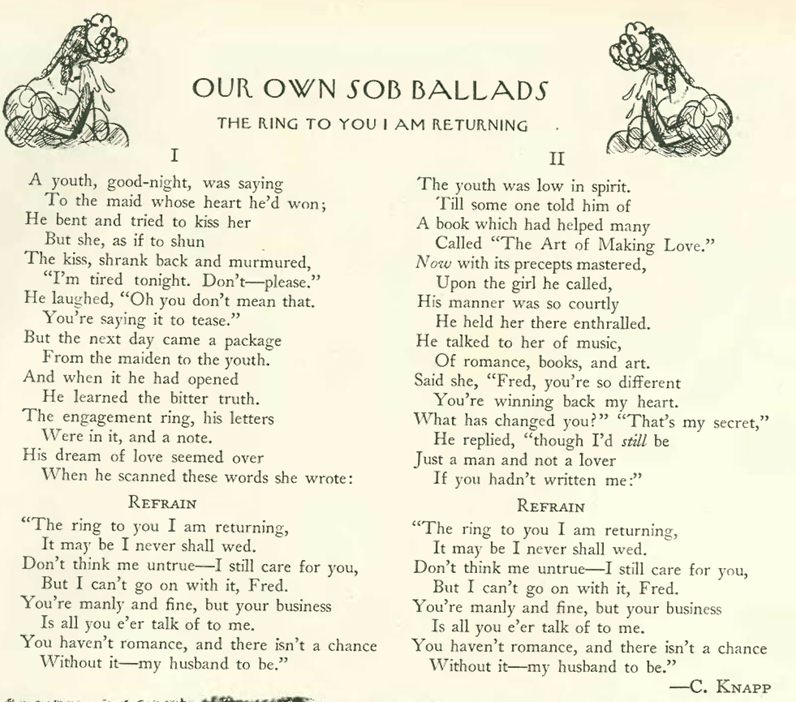
From its very beginnings comic verse played an important role in the pages of the New Yorker. The subjects of my previous blog post (Generation of Vipers), sisters Elinor Wylie and Nancy Hoyt, both contributed comic poems to the magazine, as did Clarence Knapp, a former mayor of Saratoga, New York, who also wrote prose pieces on that city’s famed horse racing scene. According to Judith Yaross Lee (Defining New Yorker Humor, p. 354), Knapp was a New Yorker insider who penned a total of 14 mock-melodramatic “sob ballads” between 1927 and 1930. Lee observes that Knapp’s ballads followed a fixed formula, two 16-line stanzas followed by eight-line refrains, that “joked about present social values by invoking past forms.”

*  *  *

They Loved a Parade

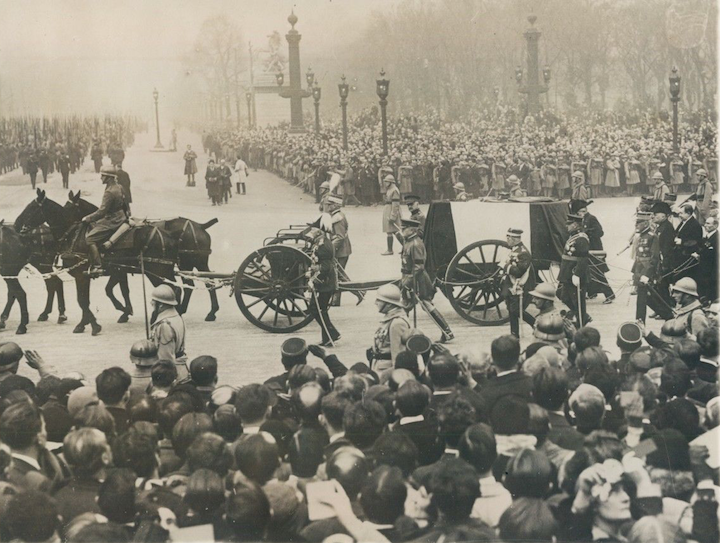
After the passing of literary giant Victor Hugo in 1885 (his funeral attracted two million mourners), Paris became known for its spectacular funeral processions. So when famed French general and (WWI) Supreme Allied Commander Marshal Ferdinand Foch died on March 20, 1929, the City of Light turned out in droves to say goodbye. On hand to report the scene was the New Yorker’s Paris correspondent, Janet Flanner, aka Genêt:

A PARIS FAREWELL…The Tricolor-draped coffin of Marshal Ferdinand Foch is escorted by the Allied Commanders from the Great War (WWI) during the funeral procession. The American General John J. Pershing can be seen marching alongside the catafalque in the center of the photo. (Associated Press)

By Flanner’s account, Foch’s send-off easily matched Hugo’s in terms of crowd size:

 *  *  *

The Art of Smoking

Cigarette manufacturers used a variety of marketing techniques to promote their tobacco products. During the late 1920s and early 30s R.J. Reynolds sought to attract more women smokers through a series of stylish ads for its Camel brand that evoked a softly elegant world. These ads were illustrated by Carl Erickson (1891–1958), a fashion artist whose work was widely seen in Vogue and in promotions for Coty cosmetics. This ad appeared in the April 20 issue of the New Yorker:

While studying at Chicago’s Academy of Fine Arts, Erickson was nicknamed “Eric,” a name he later used to sign his works. Also a successful portrait artist, Erickson lived part of his professional life in France (1920 to 1940) with his wife, the fashion illustrator Lee Creelman. Below are several examples of Erickson’s Camel work, including two back page illustrations from Delineator, a women’s fashion magazine that featured Butterick sewing patterns.

Clockwise from top, left, ad from Delineator, July 1930; 1929 ad from unknown source; unknown date and source; Carl “Eric” Erickson at work circa 1950; ad from the Delineator, July 1929. (Delineator/fashionising.com/periodpaper.com)

And From Our Other Advertisers…

With our Cuba relations once again eroding, let’s look back 89 years to a time when affordable, care-free living could be yours in sunny Havana…

…or in the days before foam rubber, “ozonized” animal hair gave bounce to your rugs…

…or the modestly well-off could contemplate an apartment on Park Avenue…

View from a 16th floor condo at 784 Park Avenue, yours today for a cool $8 million. (triumphproperty.com/stribling.com)

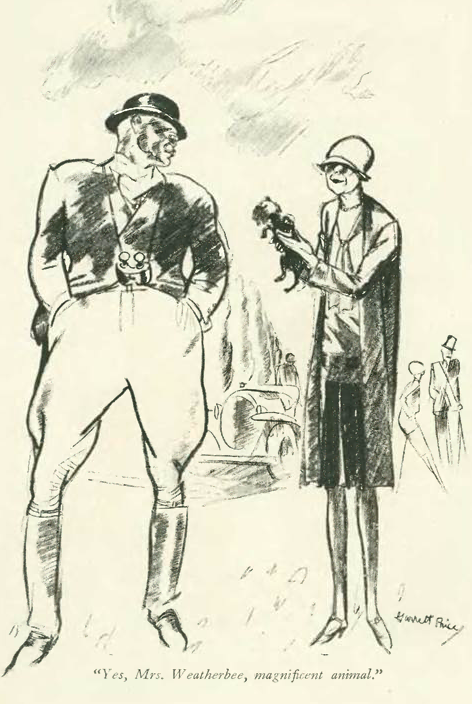
Our cartoons come courtesy of Garrett Price (1895-1979), who would contribute hundreds of cartoons as well as 100 covers during his more than 50 years with the New Yorker. An excellent look at Price’s life and work can be found in The Comics Journal

Garrett Price, circa 1918, and one of his New Yorker covers from May 21, 1949. (The Comics Journal)

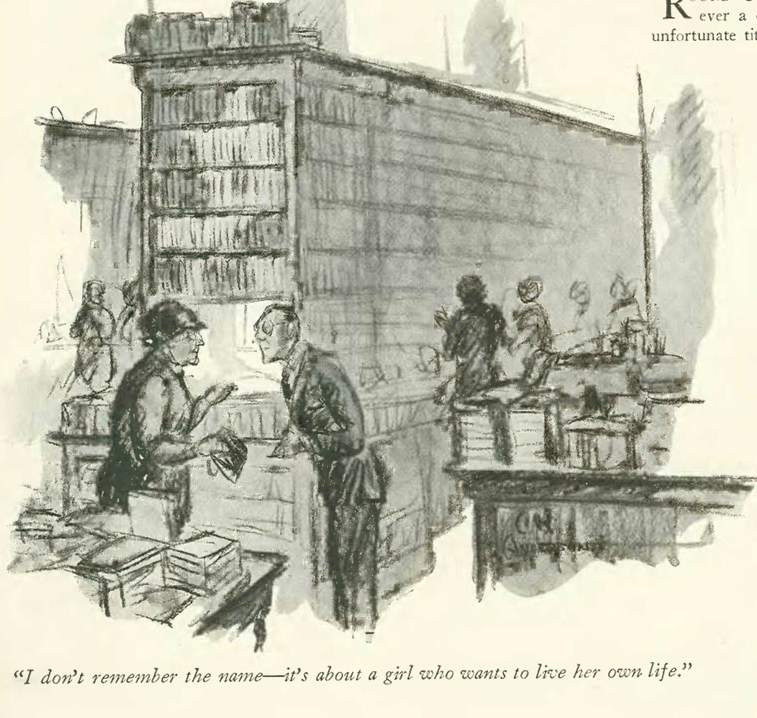
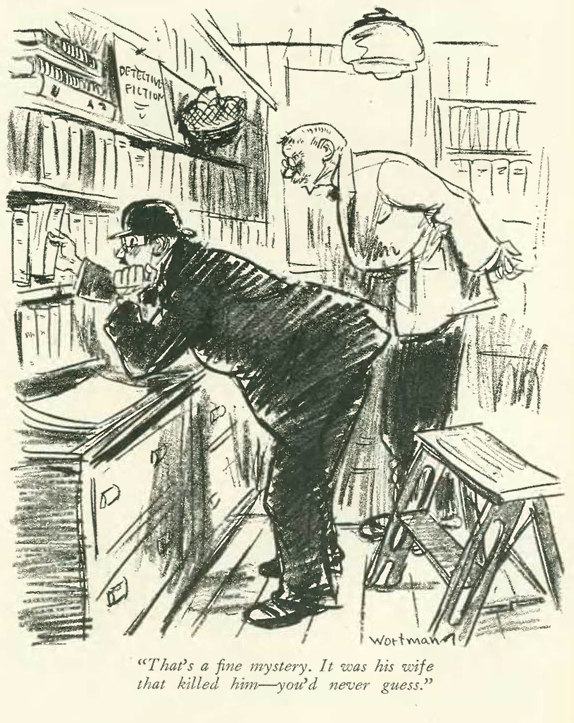
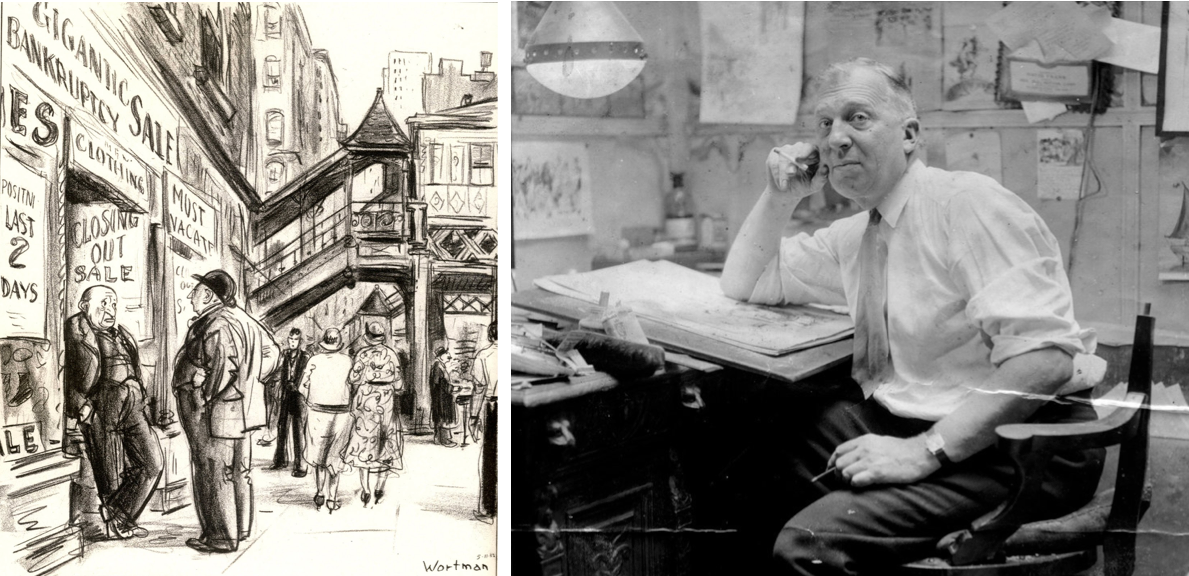
Denys Wortman (1887-1958) looked in on a bookseller with a “spoiler” problem. From 1924 to 1954 Wortman drew the nationally syndicated comic strip Metropolitan Movies for the New York World. The beautifully drawn strip offered a naturalistic portrayal of daily life in New York City…

Denys Wortman at work in an undated photo. At left, an example from his Metropolitan Movies comic strip, dated May 11, 1932. (New York World/New York Times)

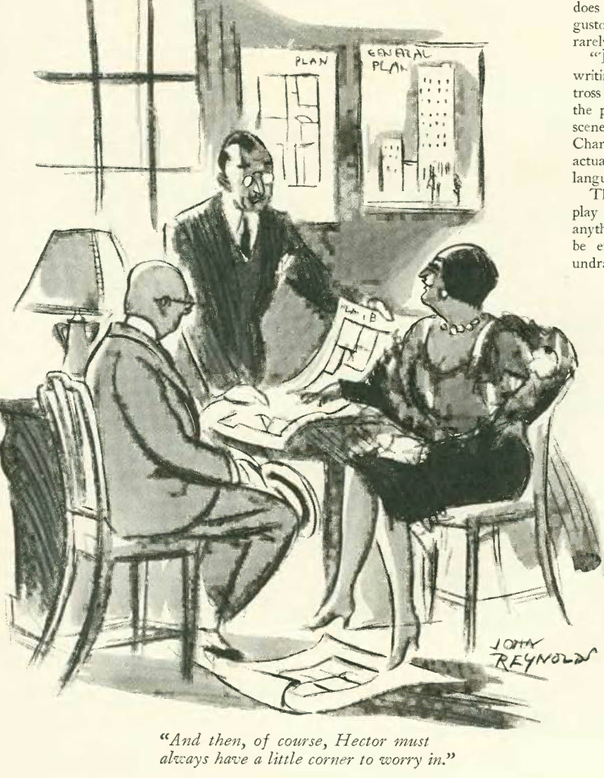
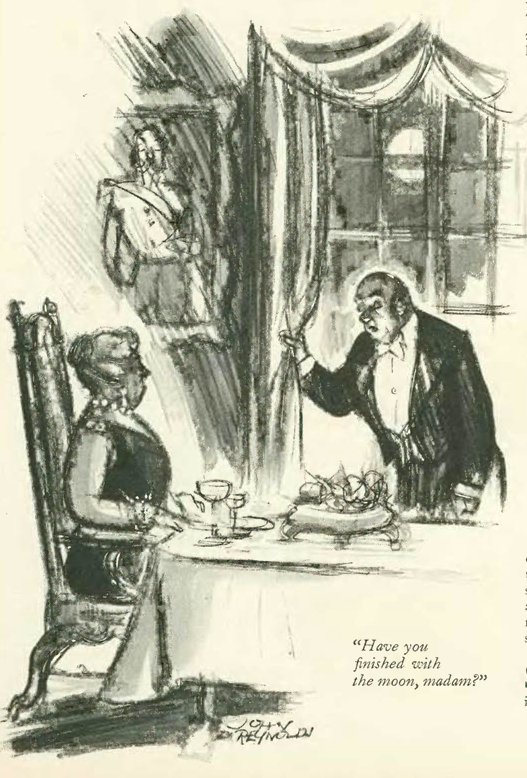
…and John Reynolds looked in on the challenges of the architecture profession. Reynolds contributed 34 drawings to the New Yorker from 1928 to 1930.

Next Time: Hello Molly…


Generation of Vipers

I’d spotted Nancy Hoyt’s byline in the New Yorker before, but I had no idea of the joys and sorrows (mostly sorrows) that were attached to it.

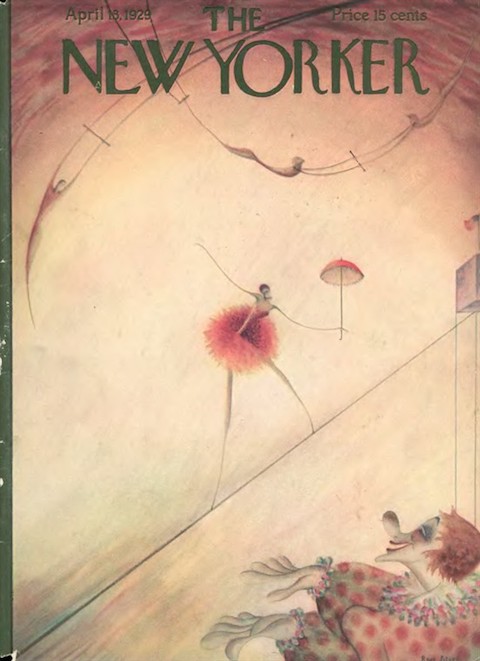
April 13, 1929 cover by Rose Silver.

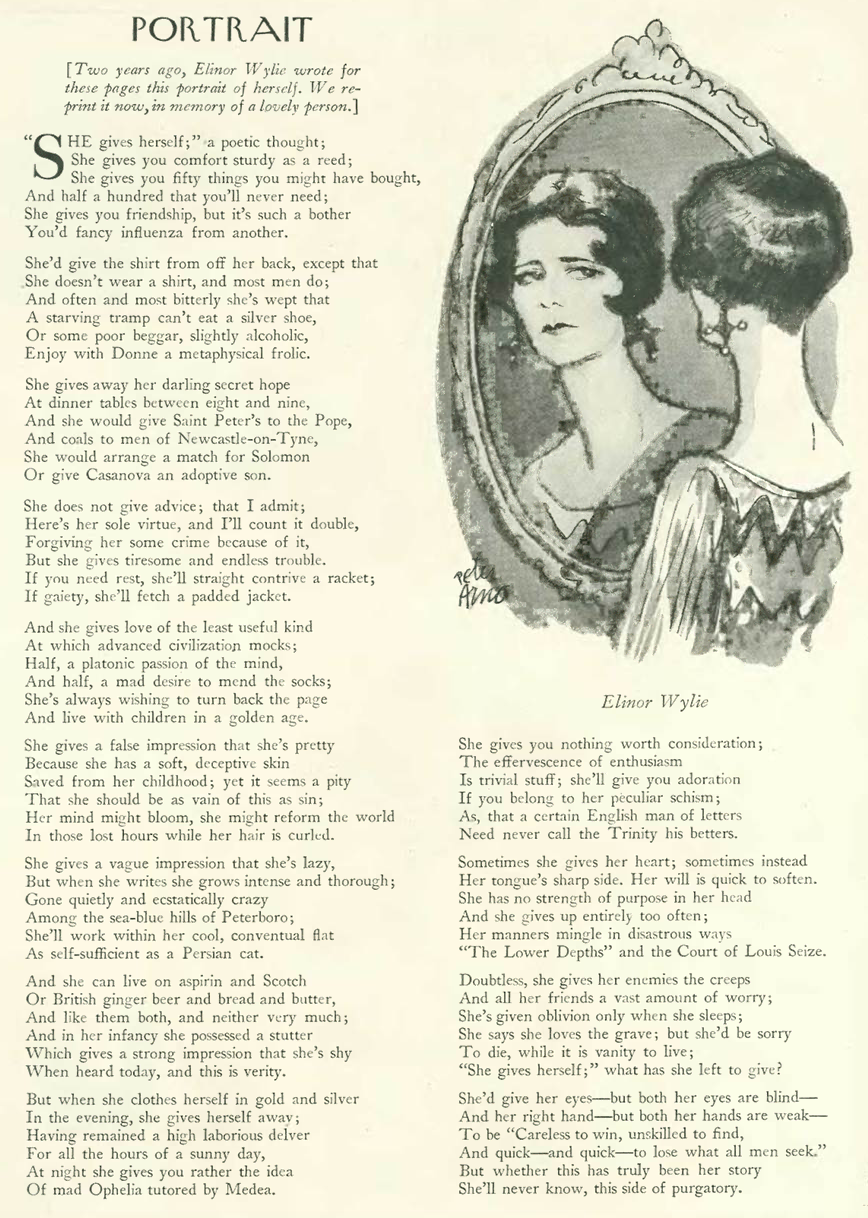
Nancy McMichael Hoyt was the younger sister of poet and writer Elinor Wylie, the latter a beloved figure at the New Yorker. Indeed when Wylie died suddenly on Dec. 16, 1928, the editors paid tribute by reprinting her autobiographical profile, “Portrait,” in the Dec. 29, 1929 issue:

Elinor and Nancy were the daughters of U.S. Solicitor General Henry Martyn Hoyt, Jr. and Anne Morton McMichael. Both came from prominent Pennsylvania families and loomed large in Washington society. The sisters became notorious for their multiple marriages and love affairs, and it was often thought that Nancy lived in imitation of her older sister when she took on a writing career of her own.

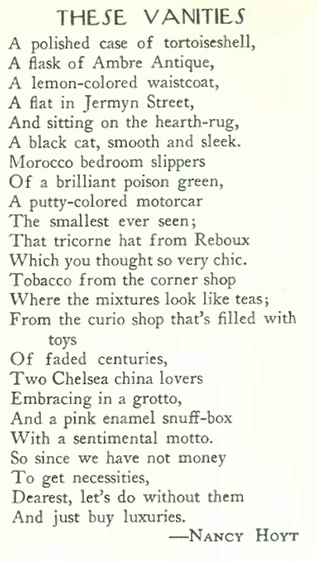
Elinor Wylie would contribute at least a dozen poems or short fiction pieces to the New Yorker between 1925 and 1929 (three of them posthumously). Her sister Nancy would contribute three pieces of short fiction (1927-28) and one poem, “These Vanities,” published in the March 12, 1927 issue:

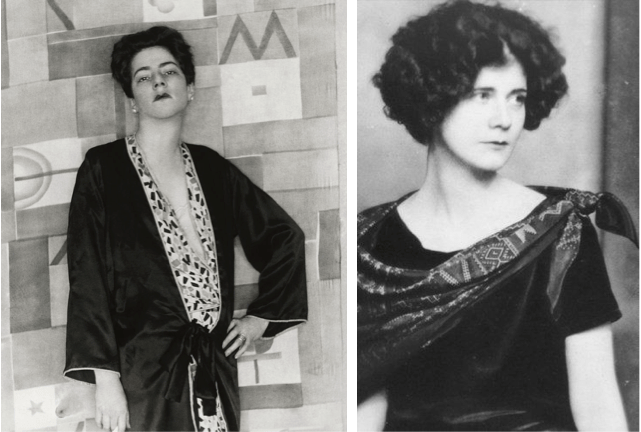
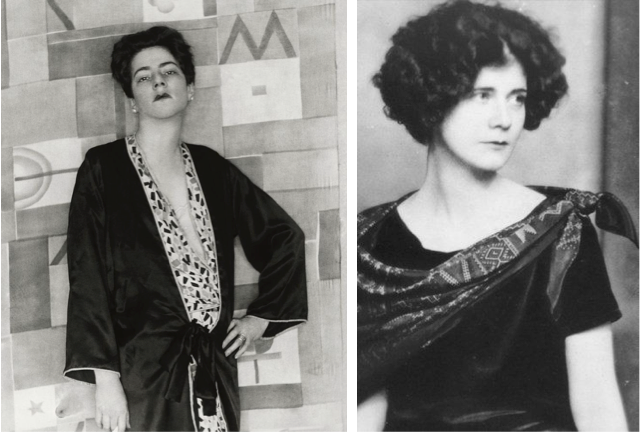
IMITATION OF LIFE…Nancy Hoyt (left) followed in the footsteps of her older, more successful sister, Elinor Wylie (right). The undated photo of Hoyt was taken by Sherril Schell. Wylie’s 1922 portrait was taken by her friend Carl Van Vechten. (CondeNast, alchetron)

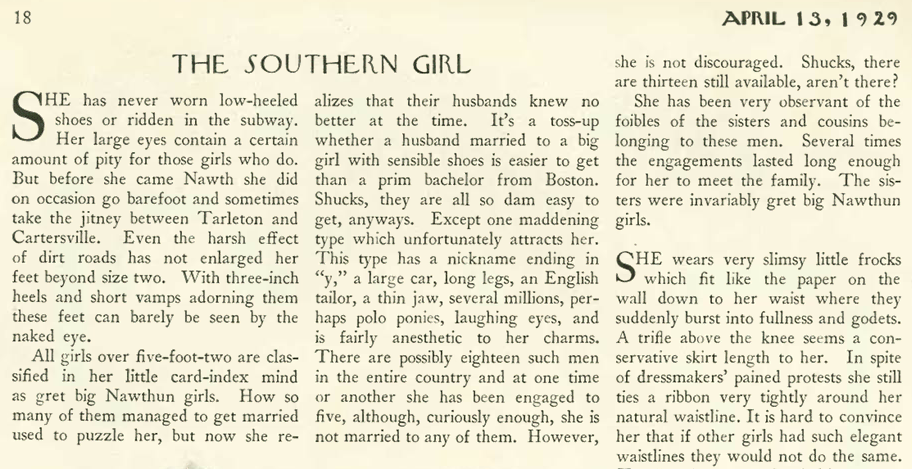
The April 13, 1929 issue featured Hoyt’s sharp satirical piece about a fictional Southern Girl…

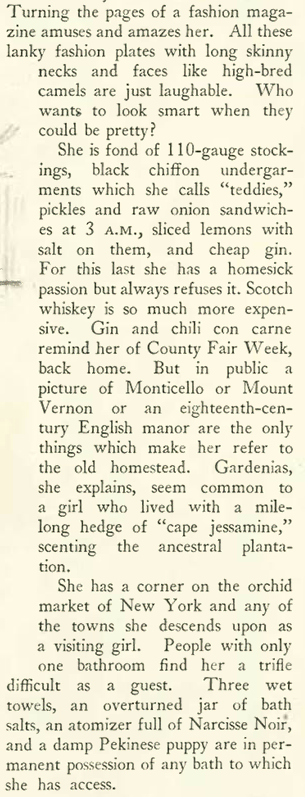
No doubt Hoyt drew on her own observations of Washington society and the clash of debutantes from the North and South. She continued her skewering of the Southern girl, likening her to something of a country bumpkin…

…and not very bright at that…

The last paragraph is telling, because in many ways it describes Hoyt’s own life. In her 2003 book, A Private Madness: The Genius of Elinor Wylie, Evelyn Helmick Hively wrote that Hoyt “scandalized Washington by cancelling her wedding after society guests arrived for the ceremony” (apparently Elinor helped her reach the decision). Her various love affairs and marriages provided rich material for reporters who wrote about her flings with the Earl of Donegal and and the heir to the Reynolds Tobacco fortune. The Washington Herald reported her attempt to elope to Canada with a taxi driver she had known for only ten days.

Hively observed that each member of the Hoyt family “seemed fated to flame briefly, to struggle, and too often to die tragically.” Indeed, Elinor and Nancy’s mother Anne once told a reporter that she had given birth to a “generation of vipers,” and predicted she would outlive them all. And she nearly did:

• The eldest child, Elinor Wylie, suffered from extremely high blood pressure that gave her unbearable migraines. She died of a stroke on Dec. 16, 1928, while going over a typescript of her poetry collection, Angels and Earthly Creatures, with her estranged third husband, William Rose Benét. She was 43.

• The eldest son, Henry Martyn Hoyt, became a poet and painter. He killed himself in 1920 at age 33 by inhaling through a tube attached to a gas jet.

• Daughter Constance A. Hoyt married a German diplomat (against her family’s wishes) and became Baroness von Stumm-Halberg. She was either 33 or 34 when she committed suicide in Bavaria in 1923.

• Morton McMichael Hoyt would marry the same woman—Eugenia Bankhead (sister of actress Tallulah Bankhead)—three times. Heavy drinking ended his life in 1949, at age 50.

• Just fifteen days later Nancy Hoyt would succumb to the drink at age 47.

The family patriarch, Henry Martyn Hoyt, Jr., was long gone by then, dying at age 54 in 1910. The family matriarch, Anne Morton McMichael, almost outlived them all (odd, considering that she was in ill health much of her life and often remained confined to her room). She died in her late 80s, in 1949, the same year as her two youngest children.

Top left, Henry Martyn Hoyt, Jr., U.S. Solicitor General and patriarch of the Hoyt family; in addition to Elinor Wylie and Nancy Hoyt, his children included (clockwise, from top right) the painter and poet Henry Martyn Hoyt III (in a self-portrait); Constance Hoyt (pictured riding in a car with Baron Ferdinand von Stumm-Halberg); and Morton Hoyt, seen here with his three-time wife Eugenia Bankhead. (Wikipedia, hokku.wordpress.com, theesotericcuriosa.blogspot.com, historic images.com)

And as a final, sad note (did you expect anything else?) Nancy’s daughter, Edwina Curtis, would eventually inherit the bulk of the Hoyt estate, which was quickly squandered.

 *  *  *

Silence is Golden

During the silent era, actress Mary Pickford was hands down the queen of the movies. Pickford and her husband, actor Douglas Fairbanks, were also the original Hollywood power couple, founding the Pickford-Fairbanks Studio and later joining forces with Charlie Chaplin and D.W. Griffith to create United Artists. Pickford was also one of the original 36 founders of the Academy of Motion Picture Arts and Sciences (the “Oscar” presenters).

AMERICA’S SWEETHEART…Mary Pickford with her signature curls, surrounded by fan mail, circa 1920. (AMPAS)

Although she was born in Canada, she was beloved in the States as a symbol of female virtue, affectionately dubbed “America’s Sweetheart.” According to writer Eileen Whitfield (Pickford: the Woman Who Made Hollywood), one silent movie reporter described Pickford as “the best known woman who has ever lived, the woman who was known to more people and loved by more people than any other woman that has been in all history.”

Also known as the “girl with the curls” for her famous ringlets, fans were shocked to find those ringlets replaced by a short bob in Pickford’s first talking film, Coquette, in which she played a reckless socialite. The New Yorker was not shocked; on the contrary, it found Pickford’s depiction of a coquette rather forced, and not altogether believeable:

THUS SPOKE MARY PICKFORD…Crowds lined up at the United Artists Theatre in Los Angeles to get a first glimpse of the “new” talking Mary Pickford in Coquette. (martinturnbull.com)

Not only did the New Yorker find Pickford’s performance less than plausible, but the storyline itself seemed a bit fanciful. As for the “Southern drawl” used in the dialogue, the magazine found it “almost unintelligible to Manhattan ears…”

You be the judge. Here’s a brief clip from the film:

Coquette was a box office success, and Pickford would win an Oscar for her first sound performance. Nevertheless, her best days were in the silent era, and she retired from acting in 1933.

100% MARY…(Left to Right) Matt Moore, John St. Polis, and Mary Pickford in Coquette (1929), a film directed by Sam Taylor. (Wikimedia)

 *  *  *

Today we associate popular songs with a particular performer or group, but in the first half of the 20th century most songs were recorded by many different artists, and such was the case with Ray Henderson’s hit “Button Up Your Overcoat” (from the musical comedy Follow Thru), recordings of which were available under three different labels by three popular artists of the day—Helen Kane, Zelma O’Neal, and Ruth Etting. As the New Yorker suggested, you could “pick your own fashions”…

PICK YOUR FASHION…Left to right, Helen Kane, Ruth Etting and Zelma O’Neal all recorded renditions of the “Button Up Your Overcoat” in 1929. (bennypdrinnon.blogspot.com/ruthettig.com/findagrave.com)

 *  *  *

From Our Advertisers

Spring had sprung and so did “fashion welts” and rubber-soled Plytex shoes suitable for ship decks or leisurely strolls along Palm Beach…

…while the folks at Texaco referenced the future with dirigibles and airplanes to hawk its higher octane “premium” gasoline…

For our comics, we have this entry by C.W. Anderson, who was born in Wahoo, Nebraska, and went on to author the popular Billy and Blaze books for young readers. I know this thanks to Michael Maslin’s indispensable The New Yorker Cartoonists A-Z.

…and we close with this cartoon by John Reynolds, who contributed a total of 34 drawings to the New Yorker between 1928 and 1930…

Next Time: The So-So Soprano…

While You Were Away

During the Roaring Twenties New Yorkers took a wrecking ball to much of their past, and at a breathtaking pace that left many residents little time to ponder what was lost.

March 30, 1929 cover by Julian de Miskey.

Writer and cultural critic Gilbert Seldes succinctly summed up this spirit of the times in a tongue-in-cheek “reminiscence” of the “old” New York—that is, how the city appeared the previous fall before he left to spend the winter in Bermuda:

NOW WHERE WILL I GET A WALDORF SALAD? Writer Gilbert Seldes (top left) ticked off some of the many changes to his city while he was away for the winter, including (clockwise, from top right), the murder of racketeer Arnold Rothstein; the planned demolition of the Waldorf Astoria to make room for the Empire State Building (photo of the partially demolished hotel); and perhaps the first song to be overplayed on the radio ad nauseumAl Jolson’s “Sonny Boy.” (Wikipedia, Daily News, New York Public Library, musicals101.com)

A member of the intellectual elite but also a strong advocate for cultural democracy, Seldes began writing for the New Yorker in late 1925 and would be a frequent contributor through 1936. In 1937 he would join CBS as its first director of television programs, and would also become one of television’s first critics thanks to his 1937 Atlantic Monthly article, “The ‘Errors’ of Television.” (Note: There were only 50 experimental TV sets in the New York area in 1937, and the first commercially available sets weren’t sold until 1939). In 1958—when there would be 42 million U.S. households with a television—Seldes would serve as the host of NBC’s The Subject is Jazz.

 *  *  *

Peggy Bacon Did It All

Another early contributor to the New Yorker was Peggy Bacon, who displayed her sharp wit in her nearly 50 articles and poems for the magazine from 1926 to 1950. But Bacon was also well-known for displaying her talent and wit in the many paintings and illustrations she created throughout her long career. The New Yorker’s art critic Murdock Pemberton sang her praises in the March 30, 1929 issue after visiting her show at the Weyhe Gallery.

A FEW IDEAS was the title of this 1927 drypoint work featured in Peggy Bacon’s Weyhe Gallery show. At right, Bacon, circa 1920s. (artnet.com/wikipedia)
A sampling of Peggy Bacon drypoint works from the 1920s, clockwise, from top: Frenzied Effort, 1925; Vanity, 1929; Penguin Island, 1926. (Brooklyn Museum/Artnet/1stdibs.com)

 *  *  *

The March 30 profile featured aviation innovator Giuseppe Mario Bellanca, who in 1922 designed the first enclosed-cabin monoplane in the U.S. Perhaps even more significant, his design in 1913 of a plane with a propeller in front, a wing in the middle and tail at the end set the standard for all aircraft built since. (Before 1913 many planes were propelled from the rear, with the “tail” projected in front of the craft). The profile writer, William Weimer (with art by Hugo Gellert) admired Bellanca’s ability to stand toe-to-toe with the mighty du Pont family:

Bellanca founded the Roos-Bellanca Aircraft Company in Omaha in 1927, and was featured on the cover of Time. In 1929 he created the Delaware-based Bellanca Aircraft Corporation of America in a financial partnership with the du Ponts.

AVIATION PIONEER Giuseppe Mario Bellanca (center) at the new Bellanca Airfield in New Castle, Delaware, 1928. Bellanca’s planes would establish numerous records for altitude, endurance, and speed. (Delaware Public Archives)

 *  *  *

Showing Some Restraint

In his “Sky Line” column, the New Yorker architecture critic George S. Chappell (aka “T-Square”) praised an award-winning 1928 apartment at 3 East 84th Street for its contemporary charm and “fine restraint.” Designed by Raymond Hood and John Mead Howells, the 9-story building was commissioned by Joseph Medill Patterson, owner of the New York Daily News. The design would be influential in Hood’s much more ambitious projects two years later—the Daily News Building (1930) and Rockefeller Center (1931).


The Raymond Hood– and John Mead Howells-designed 3 East 84th Street. Top right, the front entrance; and bottom right, ceiling’s silver leaf squares. (Susan DeMark–mindfulwalker.com)

 *  *  *

Advertisers in the March 30 issue offered various garments for the gentleman, including this sports-country ensemble at left from Finchley and a custom lounging robe from Macy’s…

…and for fashionable, amusingly mischievous woman there was the new “Scalawag” hat by Knox (ad illustrated by the great Carl Erickson)

…Blue Moon’s blonde fairy girl was one of the Jazz Age’s most recognizable labels…here she is matched with an Art Deco-inspired spectrum of stocking colors…

…Ligget & Myers Tobacco Company joined the ranks of sophisticated advertisers who touted a product—in this case Fatima cigarettes—without actually showing the product…

…on the other hand, American Tobacco Company, the makers of Lucky Strike, made doubly sure you wouldn’t forget that bright red bullseye, or Rosalie Adele Nelson, “The Original Lucky Poster Girl”…

Nelson’s image for Lucky Strike was almost as ubiquitous as the fairy in the Blue Moon ads. Apparently she was also a member the Nelson family of circus acrobats and performed her own signature act with baby elephants:

Rosalie Adele Nelson with her baby elephant act, 1929 (eBay)

Philip Morris took an entirely different (and unusual) approach to selling its relatively new brand of Marlboro cigarettes by touting the achievements of Gretchen Colnik, winner of the “1928 Marlboro Contest for Distinguished Handwriting….”

Like Rosalie Adele Nelson, Gretchen Colnik would go on to minor fame of her own. She was managing editor of the Great Neck, NY, newspaper before returning to her hometown—Milwaukee, Wisconsin. From 1952 to 1966 Gretchen was the Martha Stewart of Milwaukee, hosting a TV show that provided advice on interior design, food and crafts. “The Gretchen Colnik Show” was sponsored by Mrs. Karl’s Bread.

Our cartoon is by Leonard Dove, who looks in on an architect at work:

The Cruelest Month

The film reviews for the April 6, 1929 issue found the New Yorker once again at odds with Hollywood and favoring cinematic products from the Old World.

April 6, 1929 cover by Rea Irvin.

In the case it was a French film, The Passion of Joan of Arc, which even today is regarded as a cinematic landmark.

A LOT AT STAKE…American poster for The Passion of Joan of Arc; at right, Maria Falconetti in the title role. (Wikipedia/Film Forum)

The New Yorker review praised the film as “one of the few of the year which merit serious attention”…

On the other hand, there were the latest products from Hollywood, which stood on the other side of a “vast abyss” from the French film:

HO HUM FOR HOLLYWOOD…At left, Mary Dugan (Norma Shearer) with her conniving lawyer, Edward West (Lewis Stone) in The Trial of Mary Dugan; Lewis Stone was a apparently a busy man in the late 1920s—here he is again (center image), this time portraying John Sterling, a tea plantation investor lacking the mojo to keep up with his much younger wife, Lillie (Greta Garbo) in Wild Orchids; and at right, Janet Gaynor as a little Dutch girl in Christina, a film now considered lost. Click image to enlarge (normashearer.com/pinterest)

 *  *  *

From Our Advertisers

The April 6 issue found Charlie Chaplin getting in on the action of Old Gold cigarette endorsements…

…while Curtiss Flying Service thought it might interest some of the more well-heeled New Yorker readers in the purchase of an airplane…

…a couple weeks later, in the April 20 issue, the New Yorker would make this observation about the ad in “The Talk of the Town”…

…and finally, our cartoon by R. Van Buren, looking in on yet another sugar daddy and his much younger companion on a night out…

Next Time: Generation of Vipers…