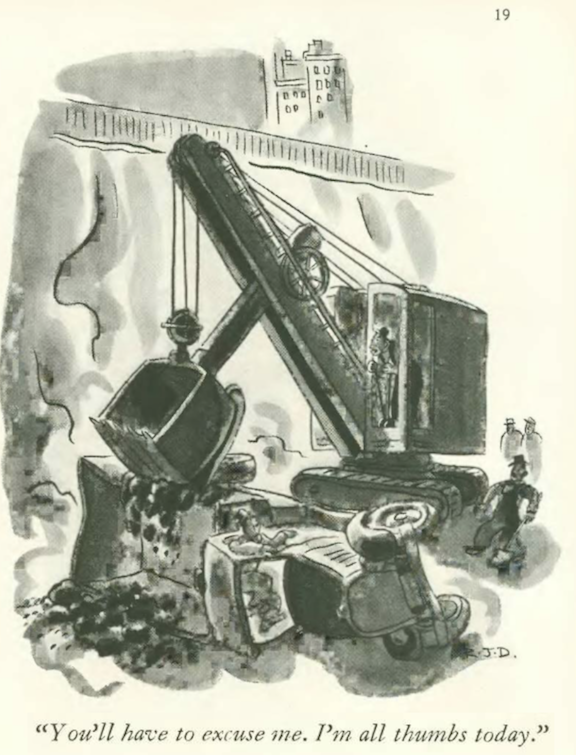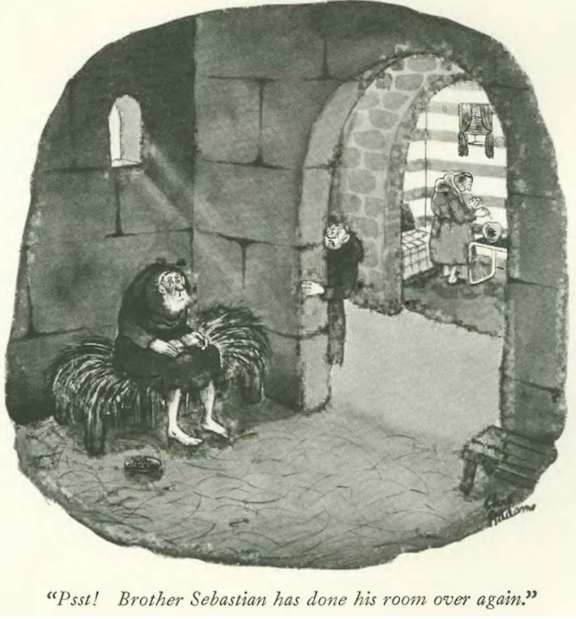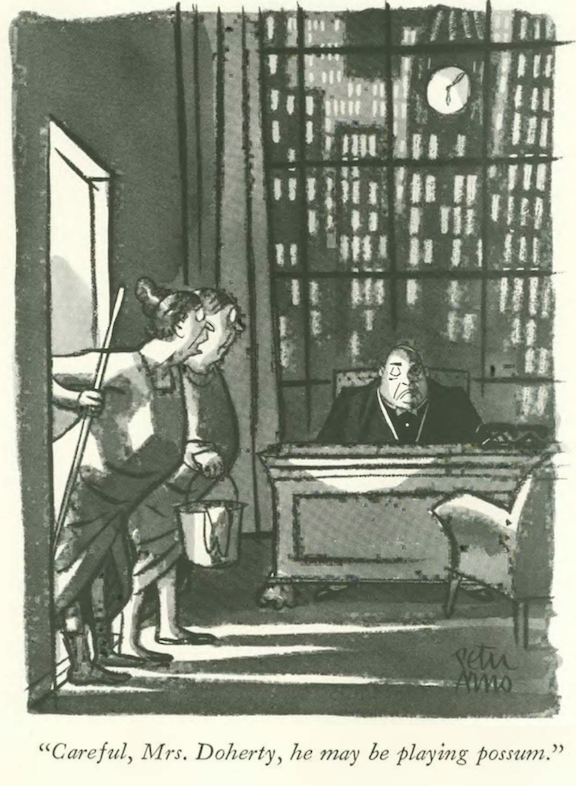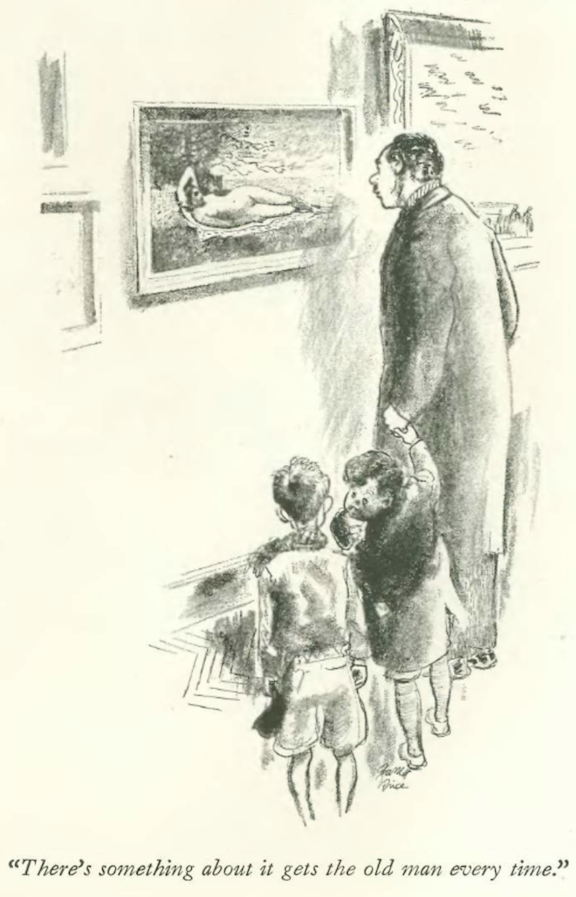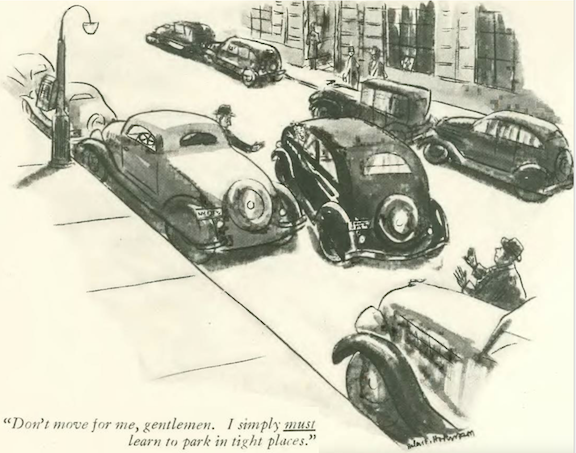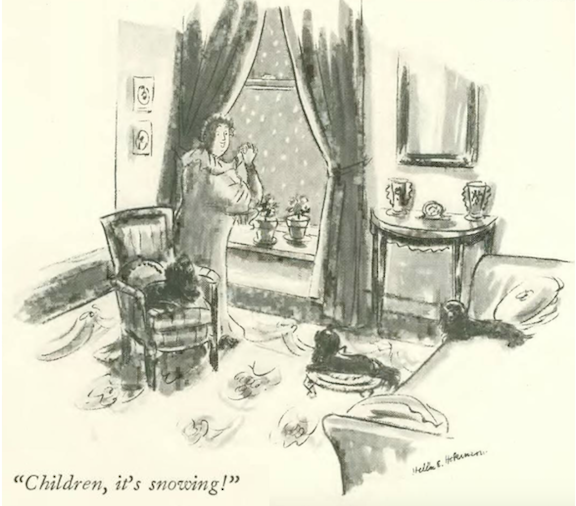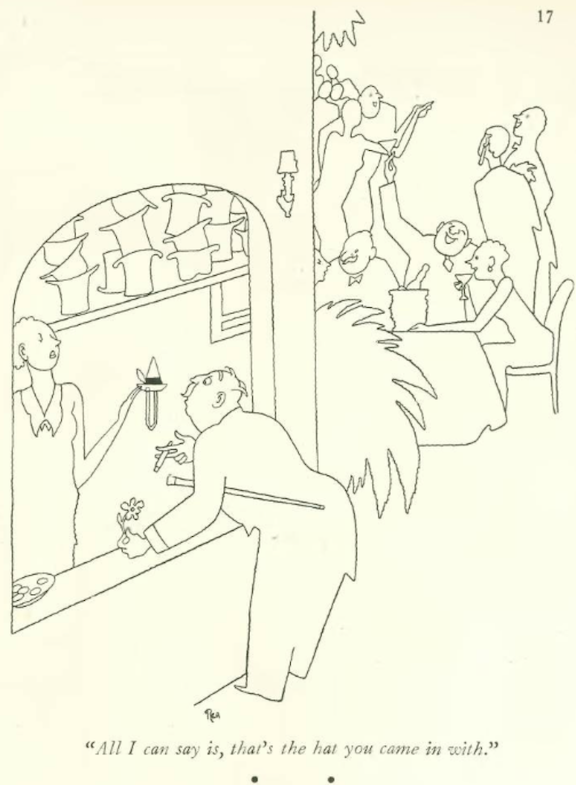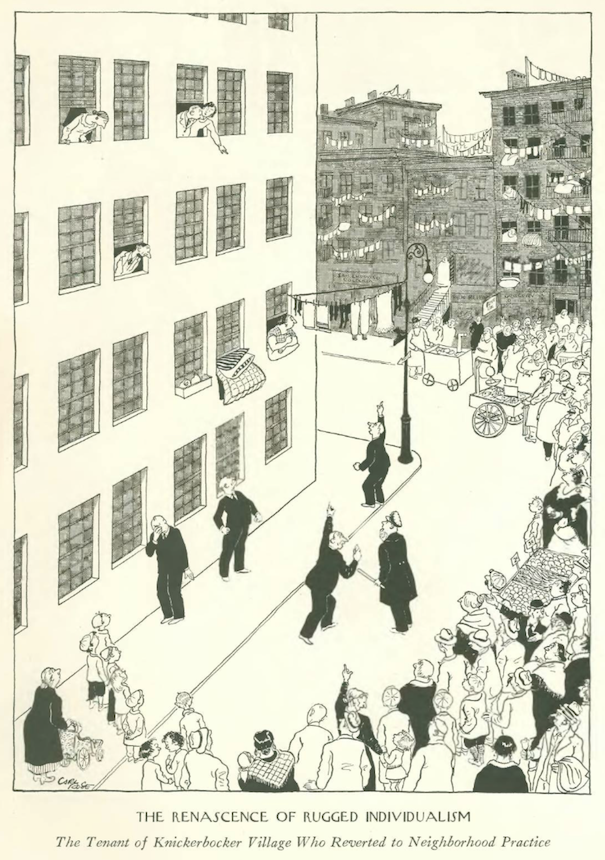
Fracking the Frick

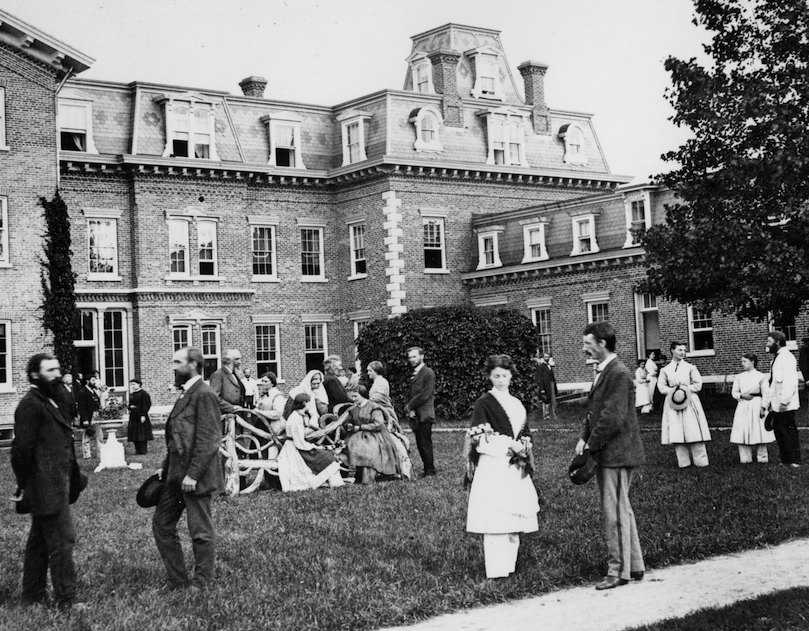
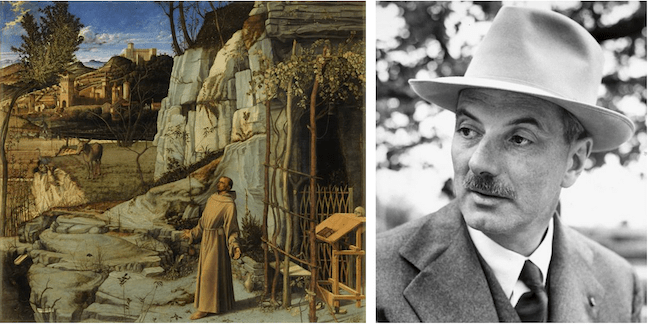
Above: Critic Lewis Mumford was not ecstatic about his visit to the newly opened Frick Collection, unhappy with the museum's crowd-control regulations that limited his view of Giovanni Bellini's masterpiece, St Francis in Ecstasy, among other things. (wikiart.org/communitydevelopmentarchive.org)

Considered one of the finest museums in the U.S., the Frick Collection on the Upper East Side of Manhattan was established in 1935 to preserve steel magnate Henry Clay Frick’s priceless 14th- to 19th-century European paintings as well as the Frick house and its furnishings. When it opened to the public on Dec. 16, 1935, museum staff distributed timed-entry tickets to prevent crowding, and therein lay the rub for New Yorker critic Lewis Mumford.

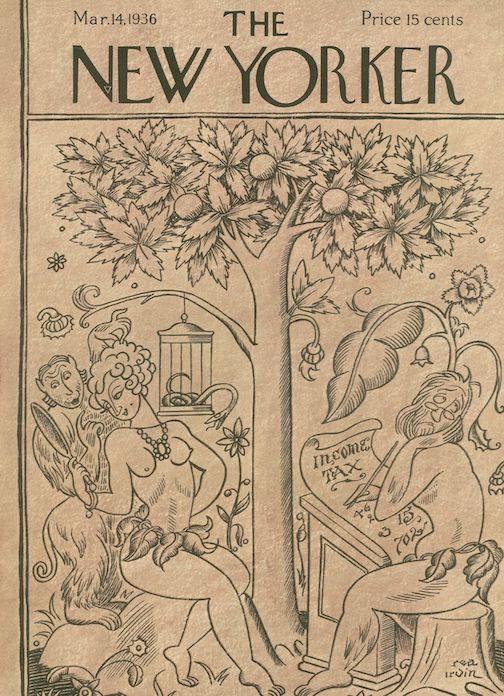
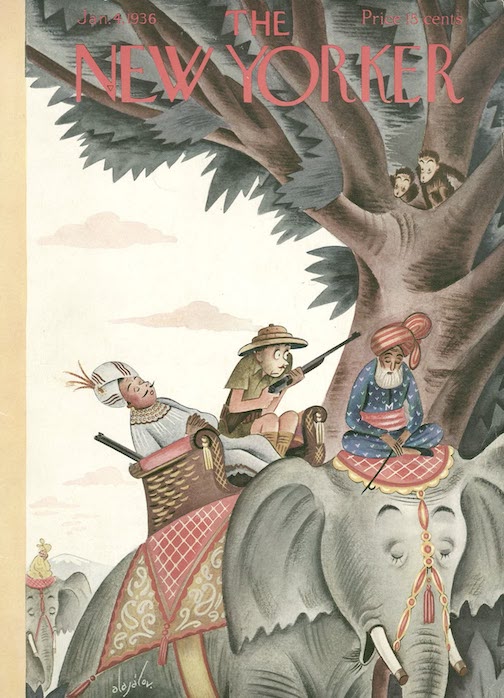
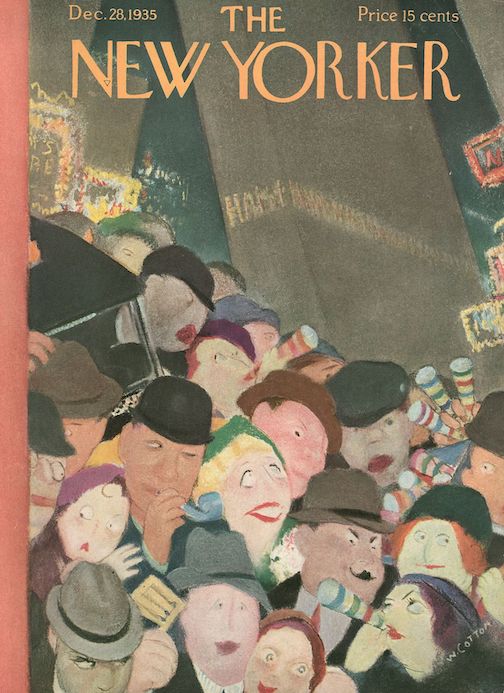
December 28, 1935 cover by William Cotton. Exclusively a cover artist for The New Yorker, Cotton (1880–1958) produced fifty-five covers for the magazine.

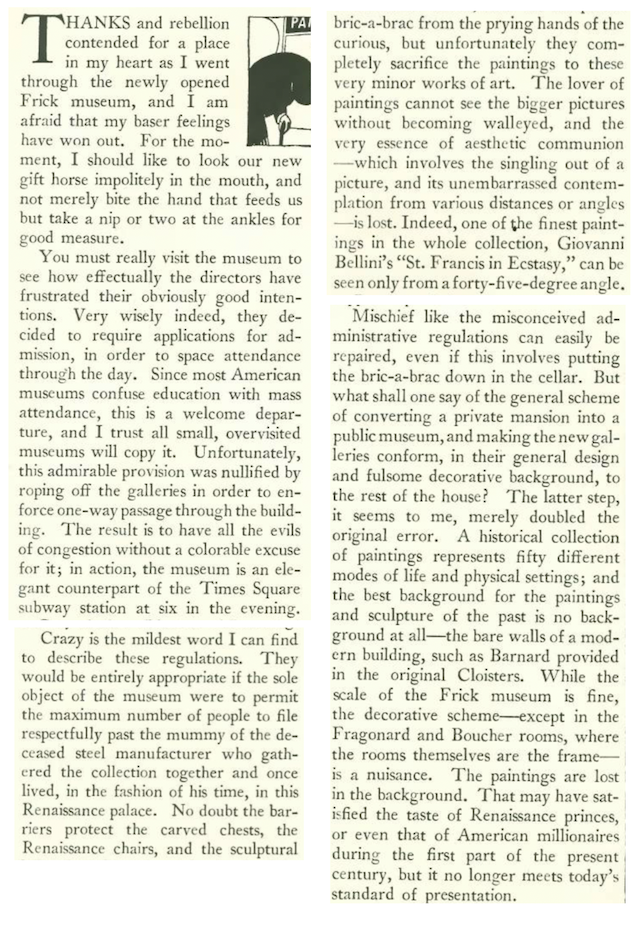
The timed tickets, along with ropes that forced visitors to follow a defined path, spoiled the museum’s debut for Mumford, who was one of its few detractors. In these excerpts Mumford addressed the crowd control measures, and criticized the furniture and other “bric-a-brac” that further served to obstruct his viewing pleasure:

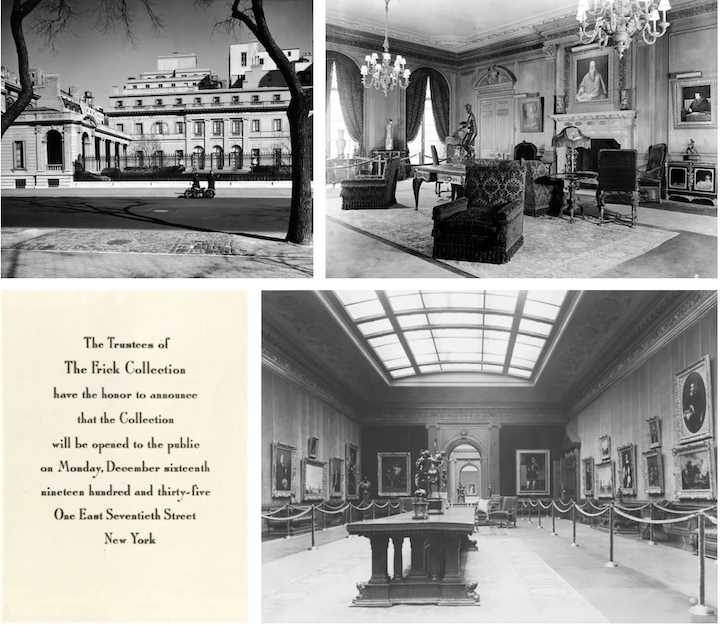
ROPES AND BRIC-A-BRAC presented obstacles to Mumford’s visit at the opening of the Frick Collection. Clockwise, from top left, view of the Frick mansion, circa 1935; installation view of the Living Hall, 1935; West Gallery, 1935; invitation to the opening of The Frick Collection, 1935. (businessinsider.com/Frick Art Reference Library Archives)

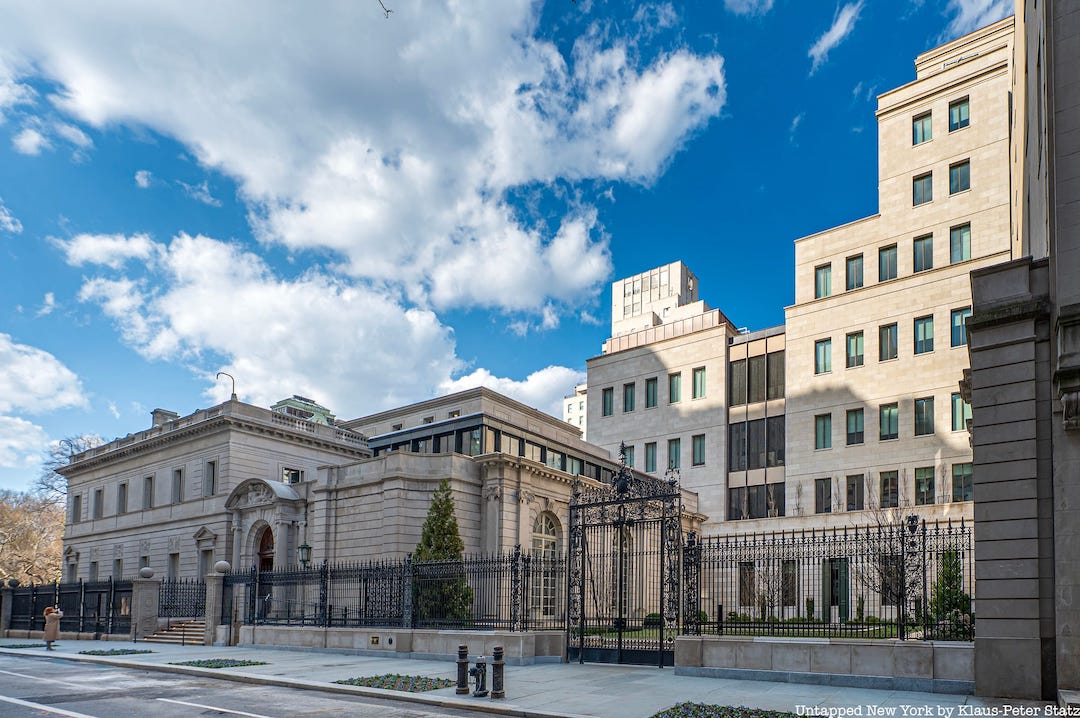
The Frick’s recent renovation and expansion has also had its detractors; after enduring a long and contentious proposal review process and five years of renovation and construction, the Frick reopened to the public in April 2025. It seems most attendees appreciate the changes.

OLD AND NEW…The Frick Collection’s home today, with expansion to the right. (untappedcities)

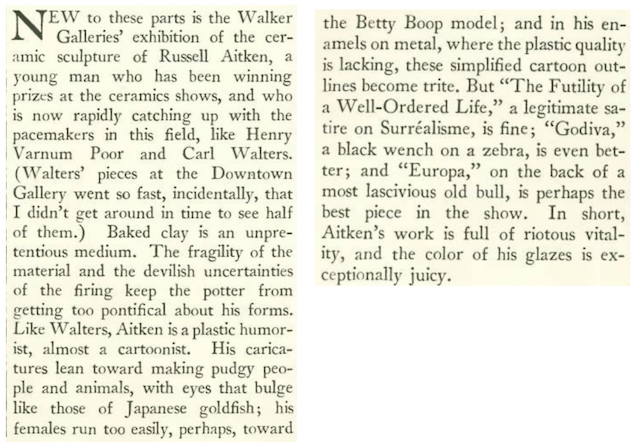
Mumford also took a look at the latest work by ceramic sculptor Russell Aitken (1910-2002), comparing his work to that of a cartoonist. Aitken was a rather odd duck in the art world, renowned both for his quirky sculptures as well as for his exploits as a big game hunter.

KILLER ARTWORK…Russell Aitken had eclectic tastes, to say the least, ranging from creating cutesy ceramics and cartoonish enamels to murdering Cape buffalo. Top left, Virgins of Mogambo, enamel on metal, 1935; bottom left, The Cactus Kid, ceramic, 1932. At right, midcentury whiskey ad featuring Aiken as a big game hunter. (Cleveland Museum of Art/findagrave.com)

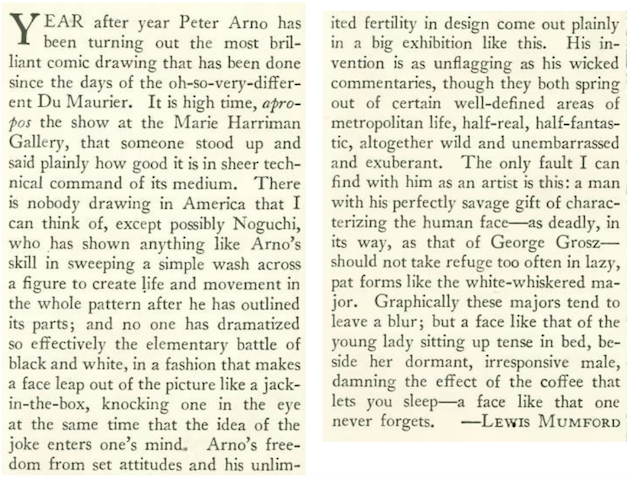
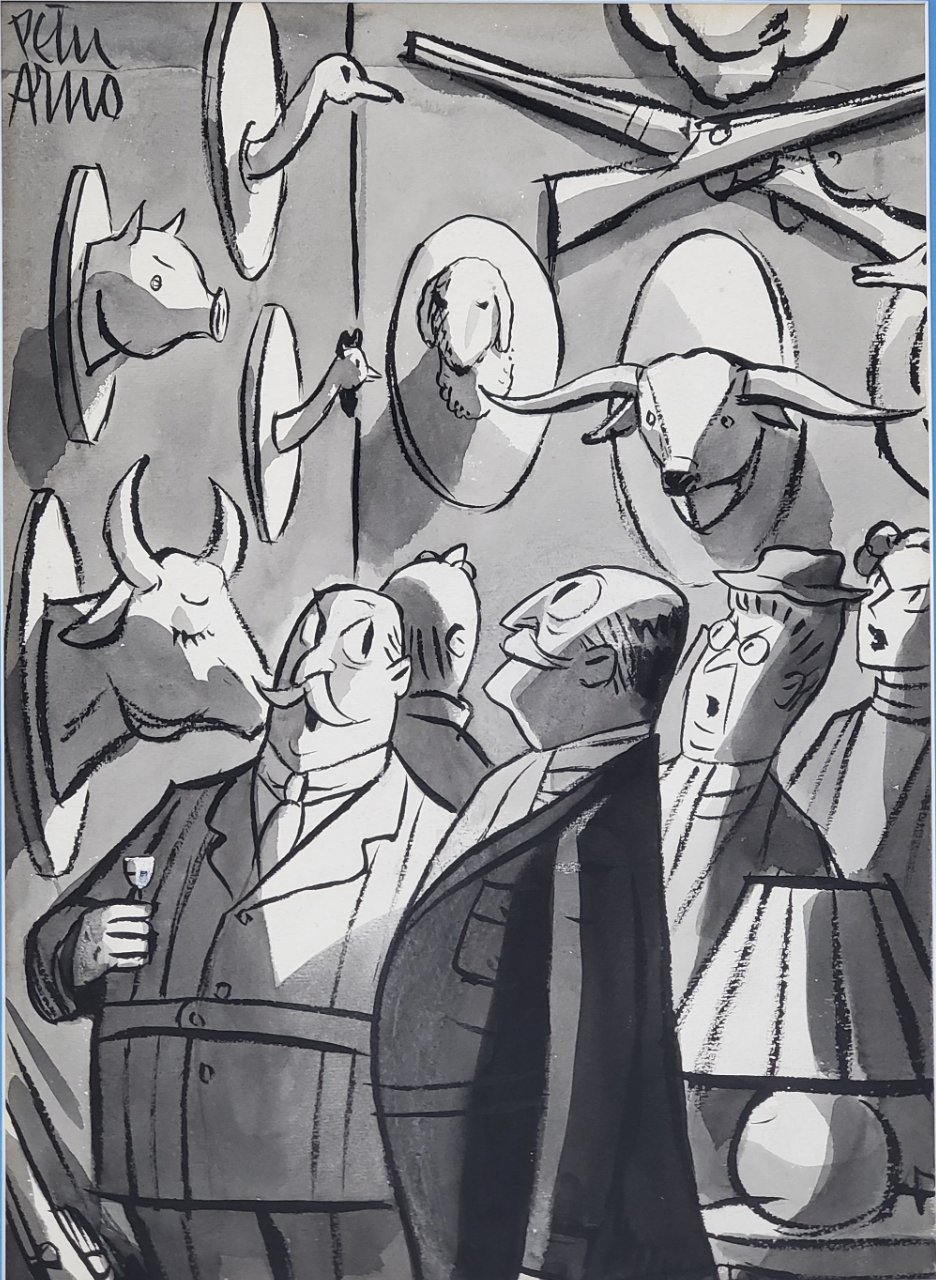
It’s always a little dicey to review the work of a colleague, but in the case of Peter Arno, Mumford had mostly praise, some of it quite high, that is except for Arno’s “white-whiskered major” which Mumford characterized as a “lazy, pat form.”

Thankfully Arno ignored Mumford’s criticism and continued to draw his “white-whiskered major.” Here he is in a delightful 1937 cartoon featured on one of my favorite New Yorker-related sites, Attempted Bloggery:

Caption reads: “I Only Kill For Food.”

 * * *

Shock of the New

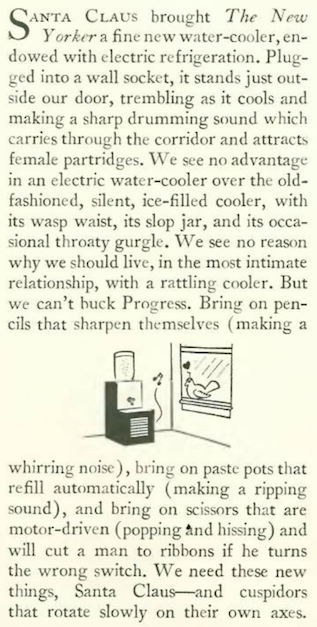
E.B. White, ever skeptical of newfangled inventions, saw no reason why The New Yorker’s old ice-filled water cooler needed to be replaced by a “rattling” electric one:

* * *

O Tannenbaum

Two decades before Rockefeller Plaza raised its giant Christmas tree (or before Rockefeller Center even existed), New Yorkers gathered around a “Tree of Light” at Madison Square. “The Talk of the Town” remembered:

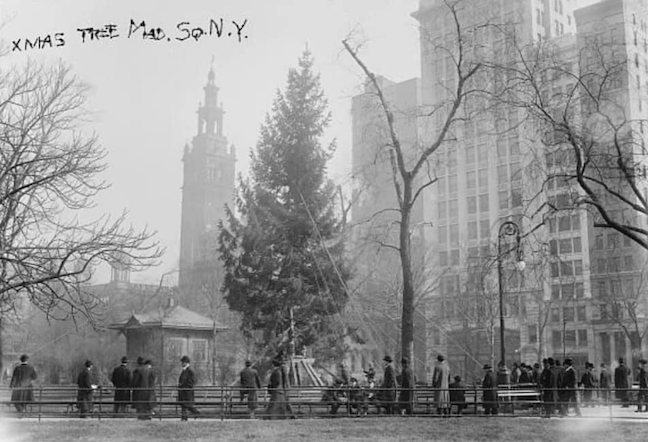
TREE OF LIGHT…America’s first outdoor Christmas tree lighting apparently occurred in Madison Square Park in 1912 (the “Talk” excerpt cited 1911). Bowery Boys History notes that “the organizers knew they were doing something unique, but probably did not realize the special significance of the event. Their 70-foot-tall imported tree from the Adirondacks, festooned with lights from the Edison Company, would be the first outdoor community Christmas tree in the United States.” (Library of Congress )

According to Bowery Boys History, in 1912 “this ‘Tree of Light’, mounted in cement, was such a novelty that almost 25,000 people showed up that night [Christmas Eve] to witness it and enjoy an evening-long slate of choral entertainment.” The following year, The New York Times reported that the Salvation Army took over the event, offering up “10,000 hot sausages and 10,000 cups of hot coffee” for the crowds.

The celebration was sparked by social activists seeking to draw attention to the needs of the city’s poor. On Christmas Day, 1912, the Times ran extensive coverage, and noted the charitable tone of the event in this excerpt:

 * * *

Honor Roll

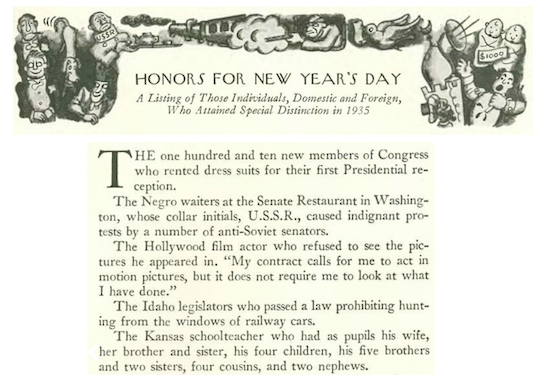
Joseph P. Pollard and W.E. Farbstein covered a two-page spread, listing individuals of “Special Distinction” in honor of the New Year…here is a brief excerpt:

 * * *

Best (and Worst) of Broadway

Robert Benchley reviewed the hits and misses of the fall Broadway season, and admitted he had become something of a softhearted theatre critic after spending six months in Hollywood.

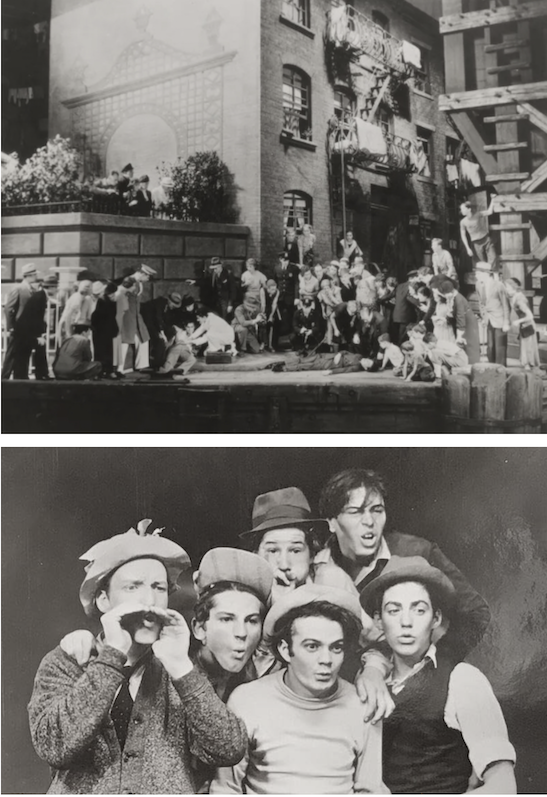
MEET THE GANG…Among the plays recommended by Robert Benchley was Dead End, which opened at the Belasco Theatre on Oct. 28,1935 and ran for 687 performances before closing on June 12, 1937. The play featured an impressive set design by Norman Bel Geddes (top) and introduced the Dead End Kids (aka the Bowery Boys), various teams of young actors who made 89 films and three serials for four different studios during their 21-year film career. The photo above shows the original six Dead End Kids—front row, from left, Huntz Hall, Gabriel Dell, Leo Gorcey and Billy Halop; back row, Bobby Jordan and Bernard Punsly. (deadendmusical.com)

 * * *

At the Movies

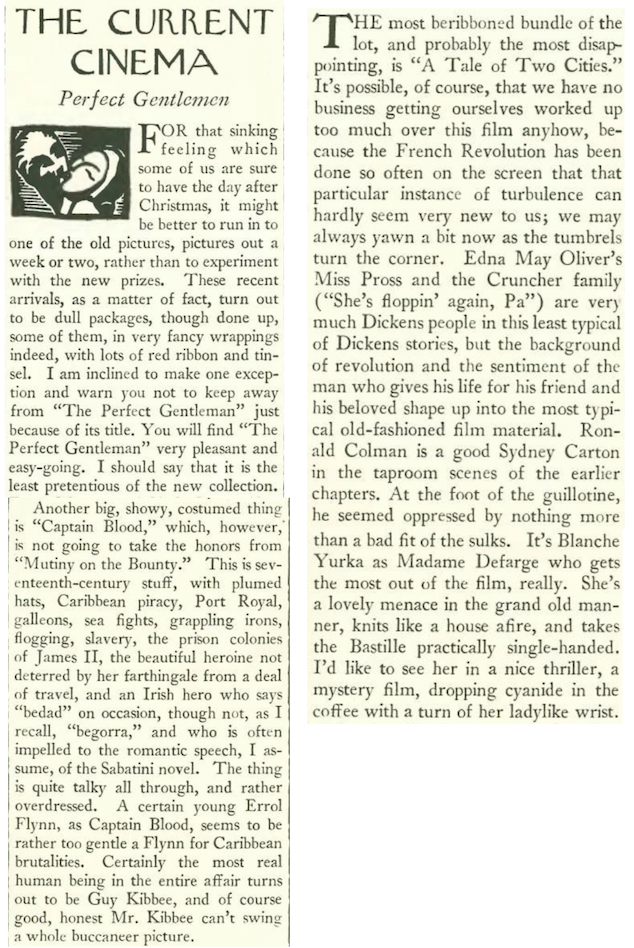
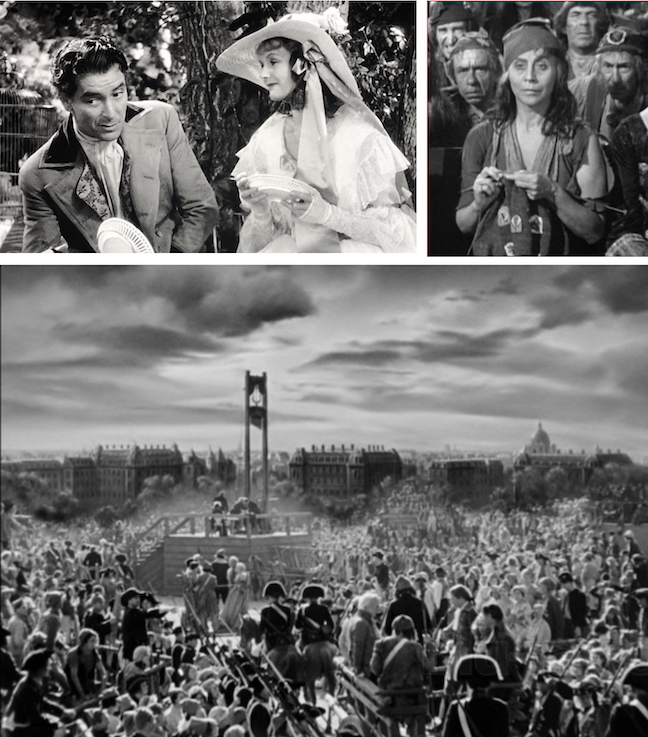
New Yorkers could nurse their holiday hangovers with a variety of films, ranging from the “very pleasant” The Perfect Gentleman to the “overdressed” Captain Blood, which featured a young Errol Flynn as a rather gentle pirate. As for the late year’s most anticipated film, A Tale of Two Cities, critic John Mosher found a few bright spots between his yawns, including praise for Blanche Yurka’s standout performance as Madame DeFarge.

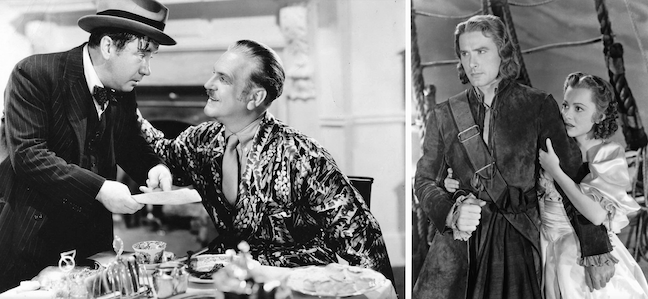
GENTLE MAN AND GENTLE PIRATE…At left, Forrester Harvey and Frank Morgan in The Perfect Gentleman; at right, Errol Flynn and Olivia de Havilland in Captain Blood. The film launched the 26-year-old Flynn and the 19-year-old de Havilland into Hollywood stardom, and marked the beginning of Flynn’s swashbuckler image. (MGM/IMDB)
I’M LOSING MY HEAD OVER YOU…Clockwise, from top left, Sydney Carton (Ronald Colman) would lose his noggin to the guillotine in a scheme to save Lucie Manette (Elizabeth Allan) in A Tale of Two Cities; veteran theater actress Blanche Yurka, who learned to knit for her acclaimed role as Madame Defarge, is shown here in a front row seat before the guillotine—it was Yurka’s first film role; at the bottom, the execution scene at the Place de la Révolution. (bluray.com/michaelbalter.substack.com)

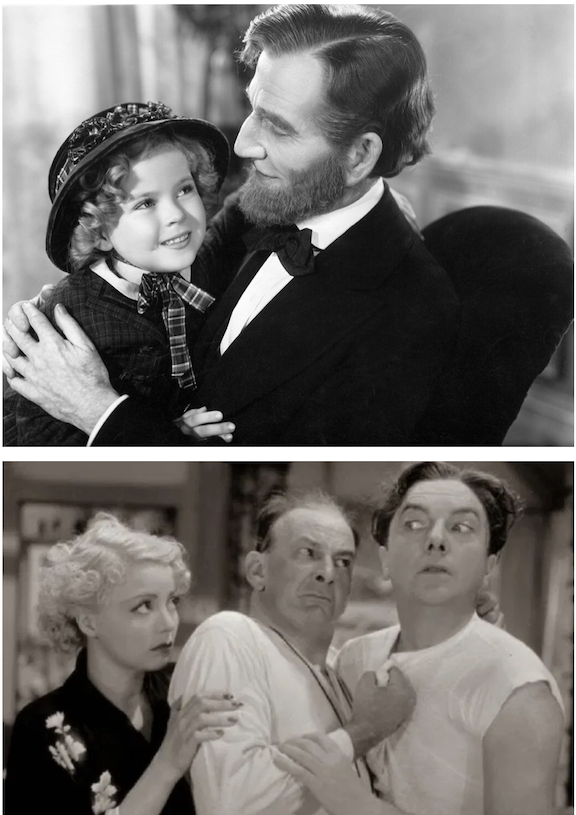
If piracy and revolution were “too much for your holiday nerves,” Mosher suggested the latest Shirley Temple film, The Littlest Rebel, featuring the superstar moppet dancing her way through the Civil War (and, unfortunately, performing a scene in blackface). Also on tap was the the musical comedy, Coronado.

SEEKING A PRESIDENTIAL PARDON, little Virgie Cary (Shirley Temple) asks President Lincoln (Frank McGlynn Sr.) to bestow mercy on her Confederate father in The Littlest Rebel; below, Alice White, Leon Errol and Jack Haley in the musical comedy Coronado. Haley is best known today as the Tin Man in 1939’s The Wizard of Oz. (whitehousehistory.org/themovieb.org)

 * * *

From Our Advertisers

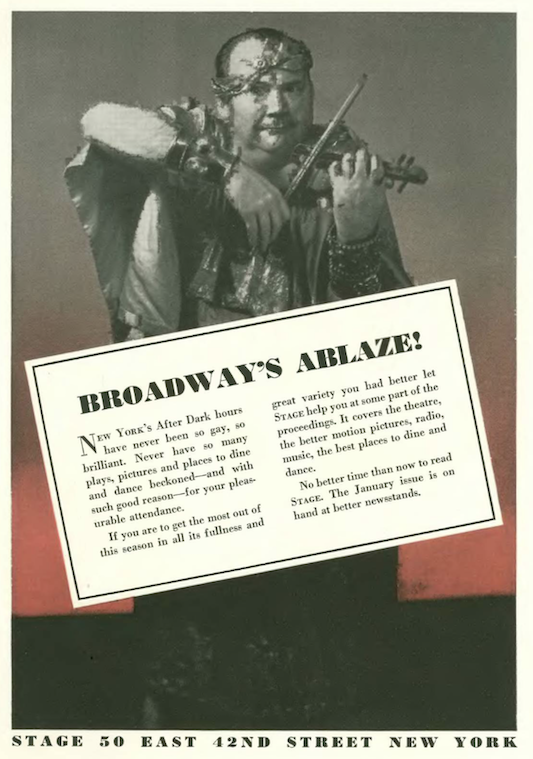
We look in on our advertisers, beginning with this from Stage magazine…the actor portraying Nero is likely from the play Achilles Had a Heel, which closed after just eight performances…

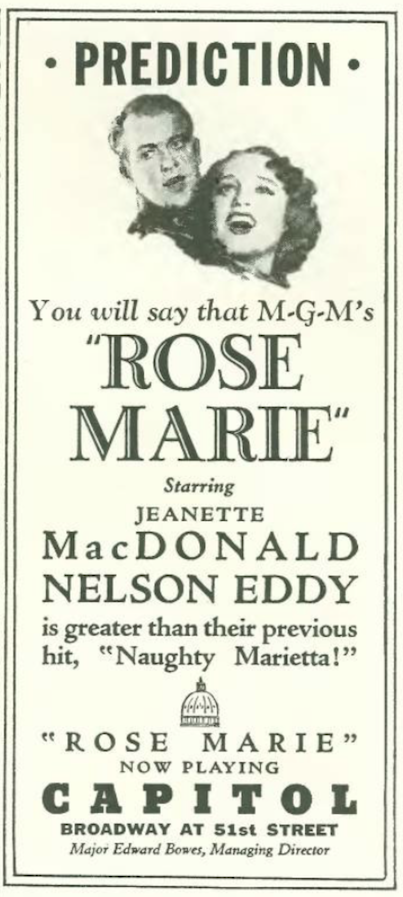
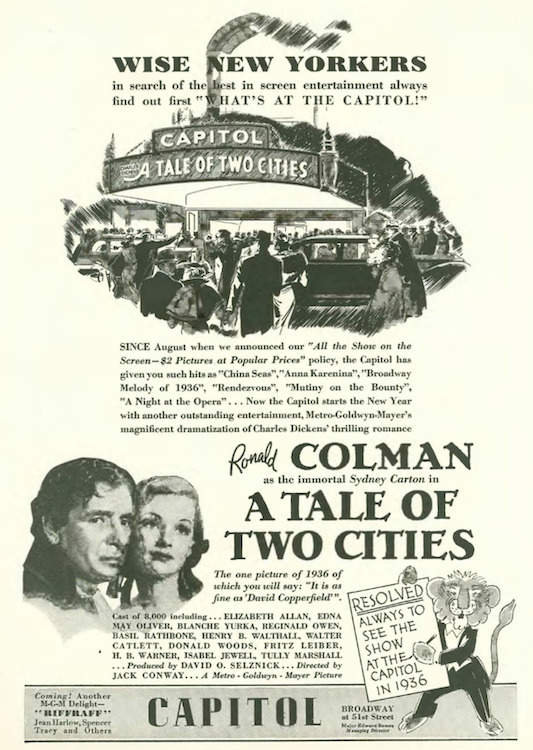
John Mosher wasn’t wowed by MGM’s A Tale of Two Cities, even if the Capitol Theatre promised a spectacle with “a cast of 8,000″…

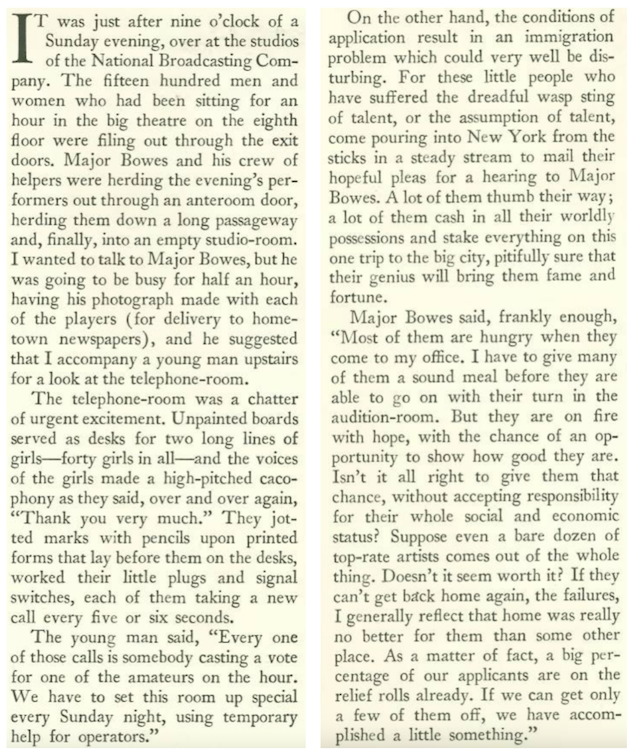
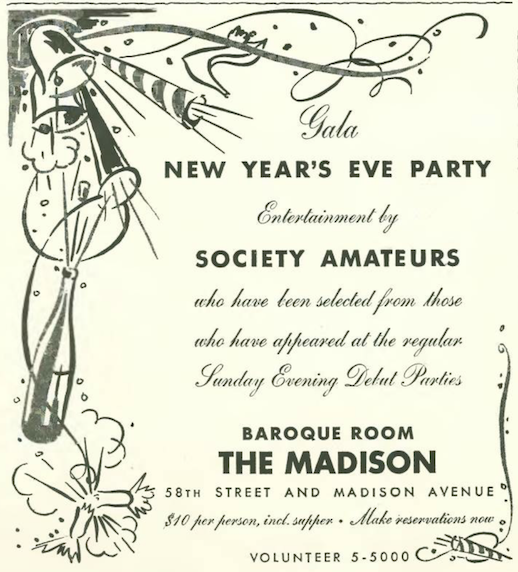
…this back of the book ad promised entertainment by “Society Amateurs” selected from the “Sunday Evening Debut Parties”…

…the brewers of Guinness promoted the health benefits of their product for the New Year…

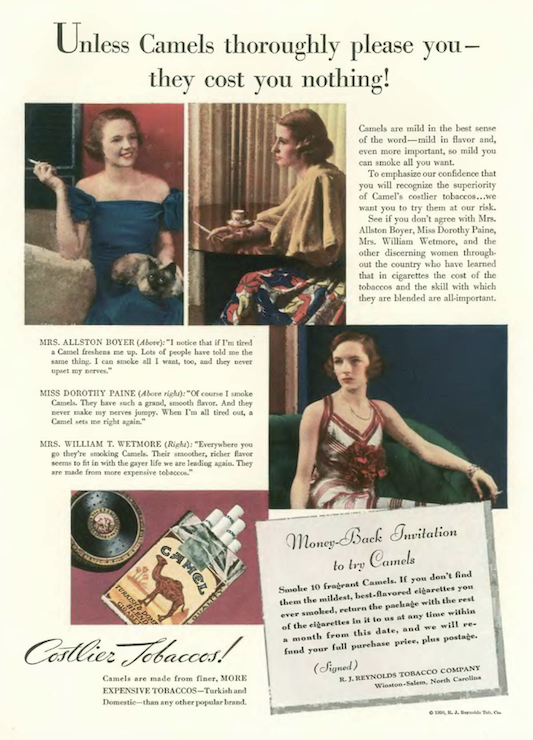
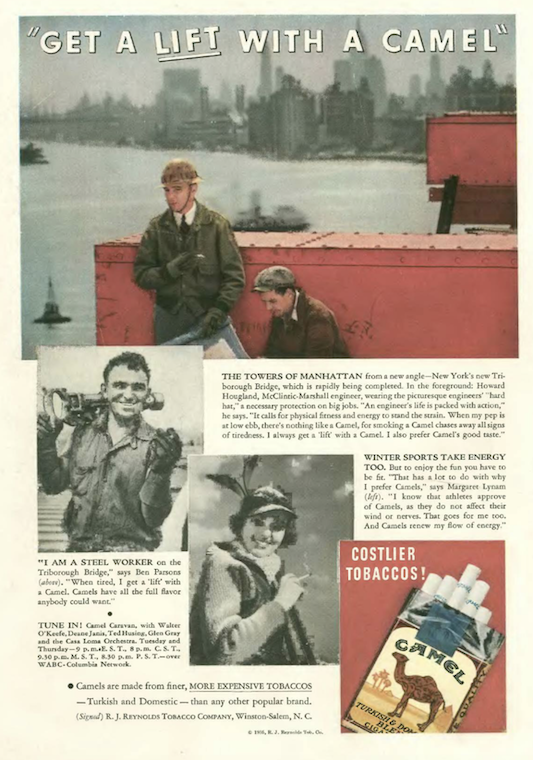
…and the makers of Camels continued to print testimonials touting the invigorating effects of their cigarettes…

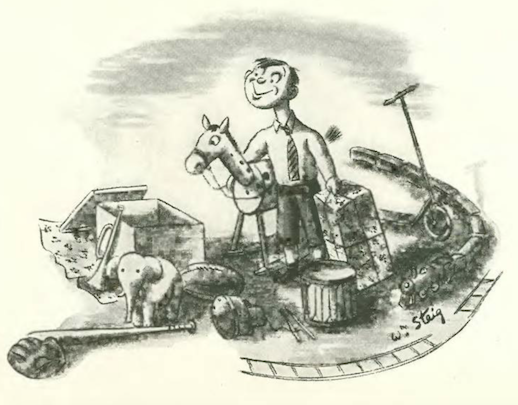
…on to our cartoonists, with William Steig taking stock of the Christmas haul…

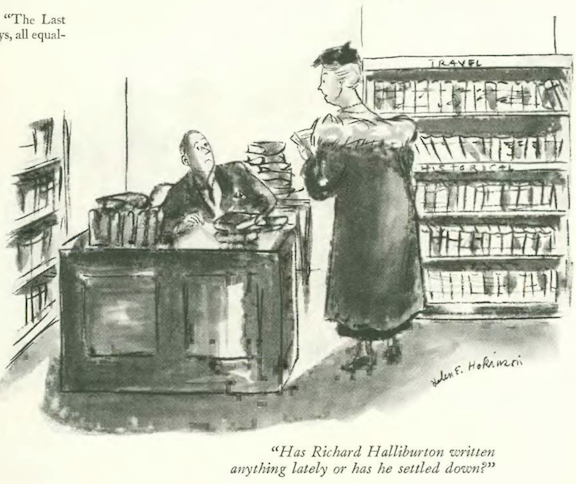
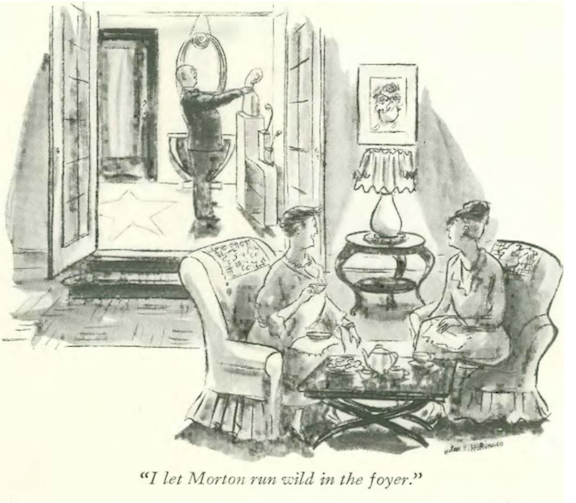
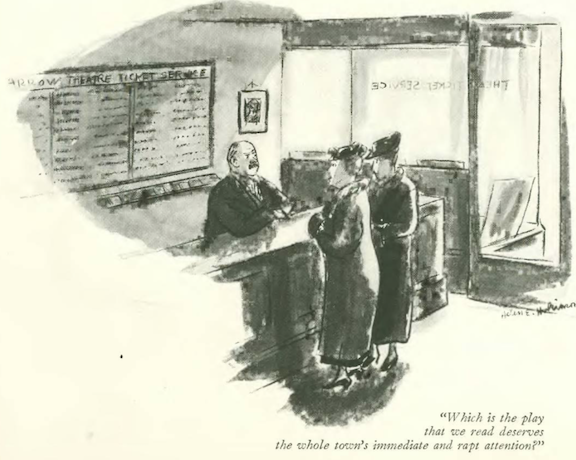
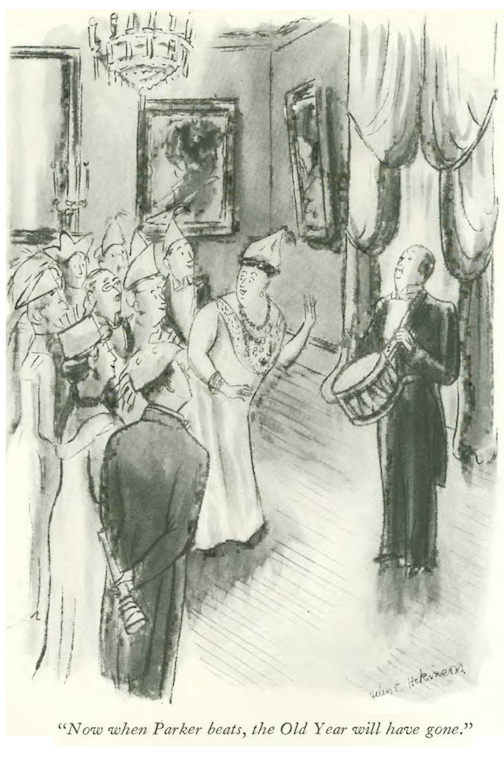
Helen Hokinson’s girls were looking for the hottest show in town…

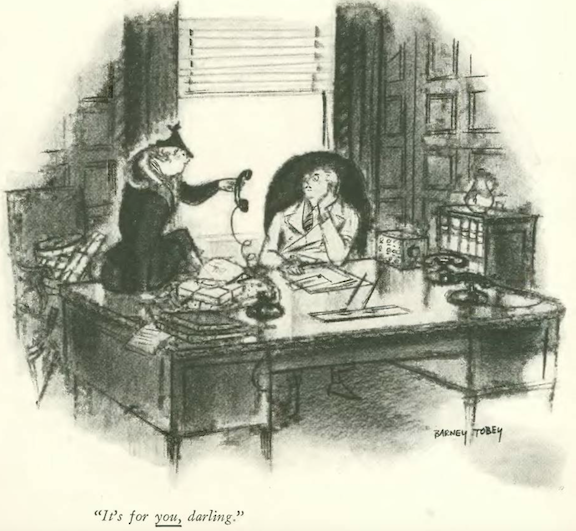
Barney Tobey was the latest cartoonist to take a shot at the boss-secretary trope…

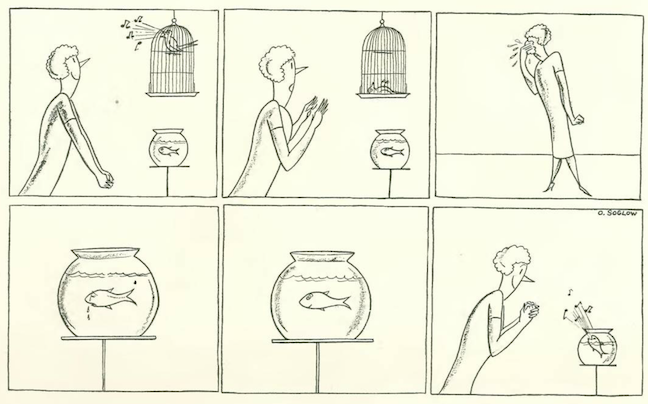
Otto Soglow gave us a singing fish…

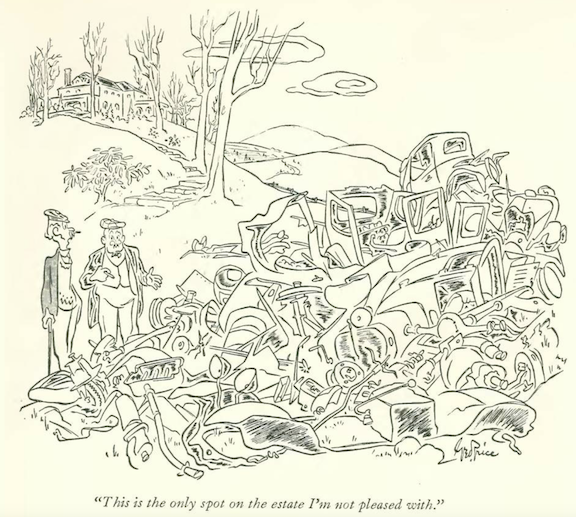
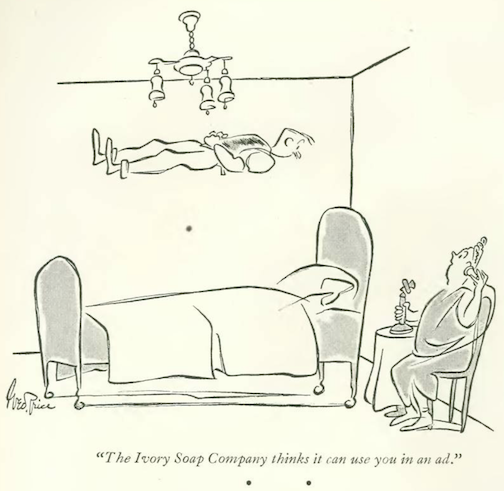
George Price came across a landscaping challenge…

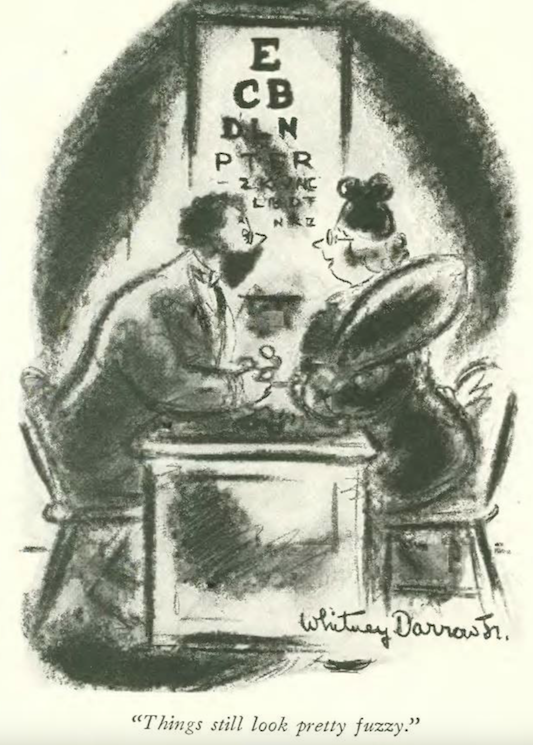
Whitney Darrow Jr focused on a visit to the optometrist…

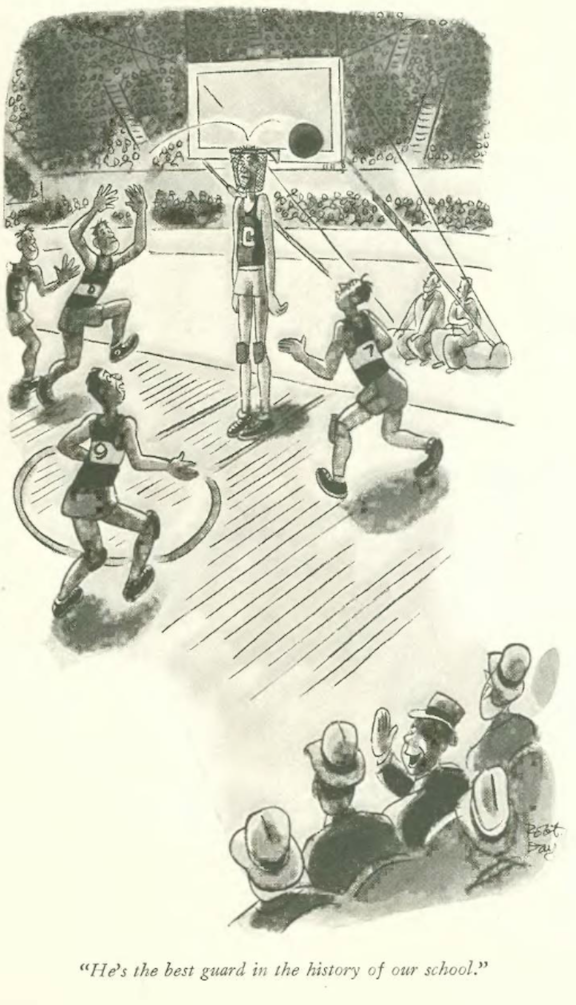
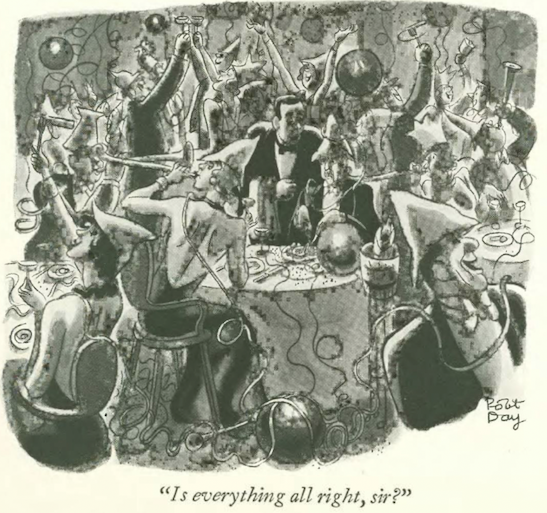
Robert Day gave us a party pooper too pooped to party…

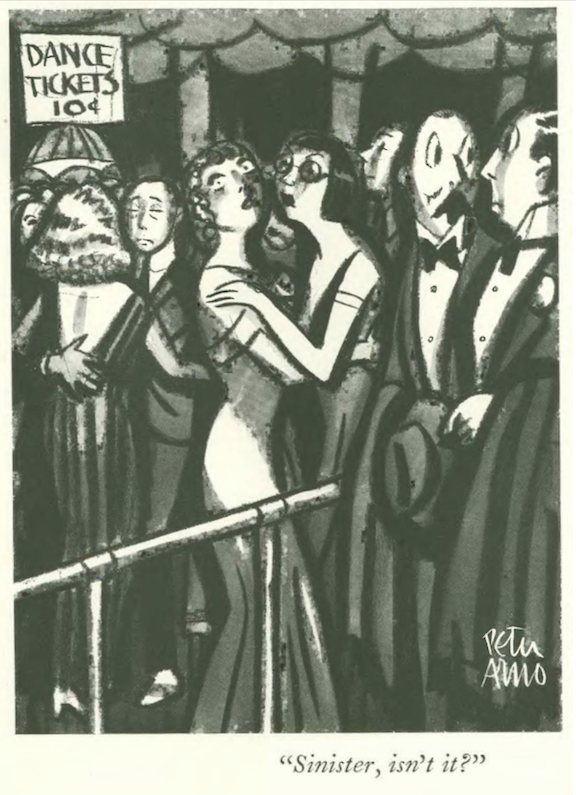
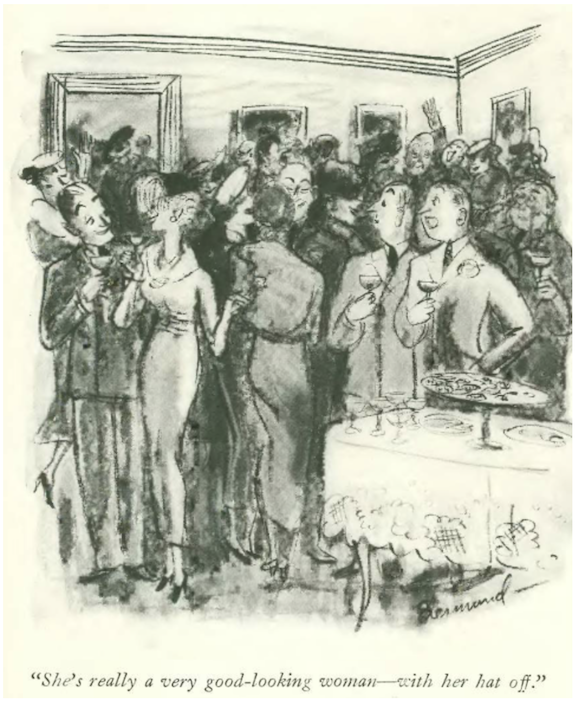
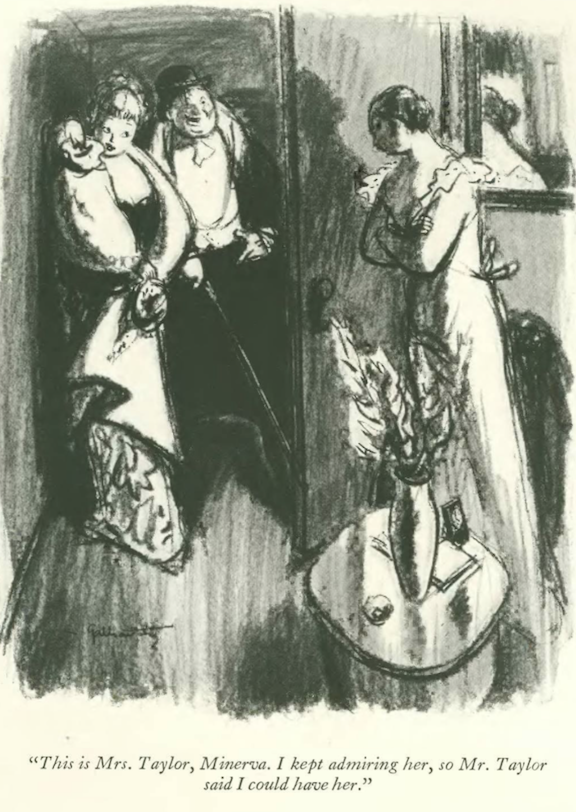
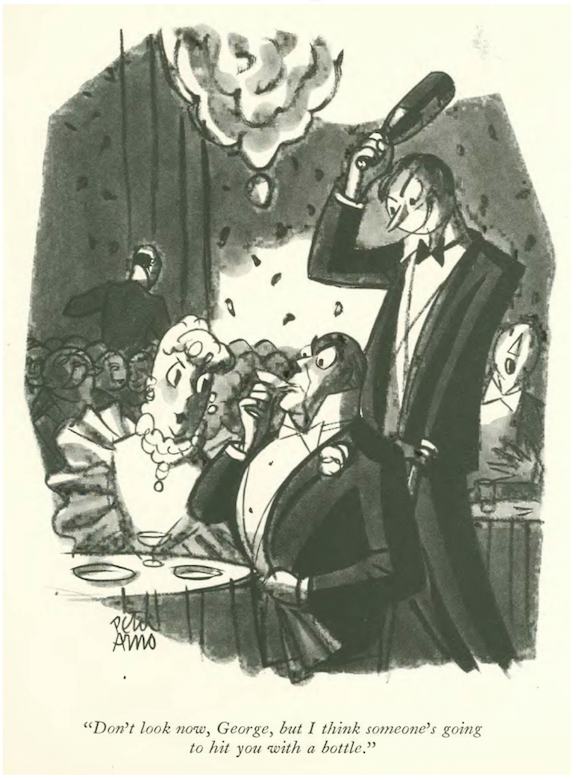
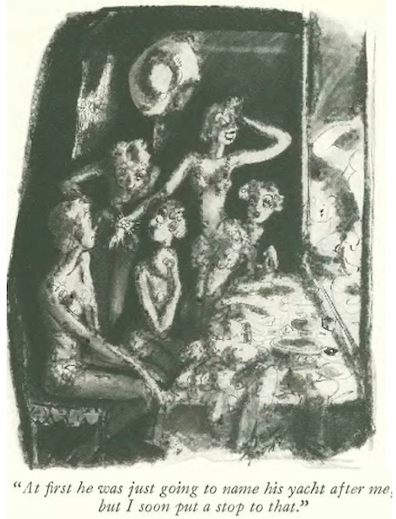
…and Peter Arno offered a glimpse into his active nightlife…

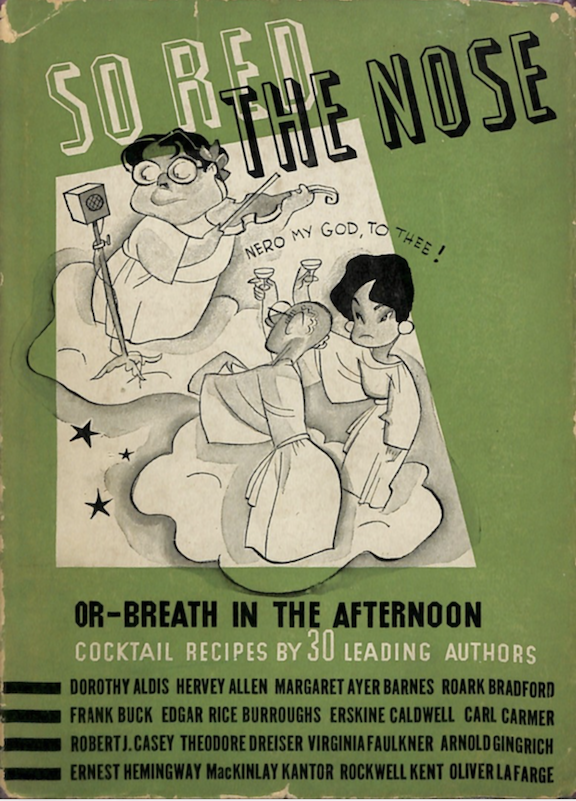
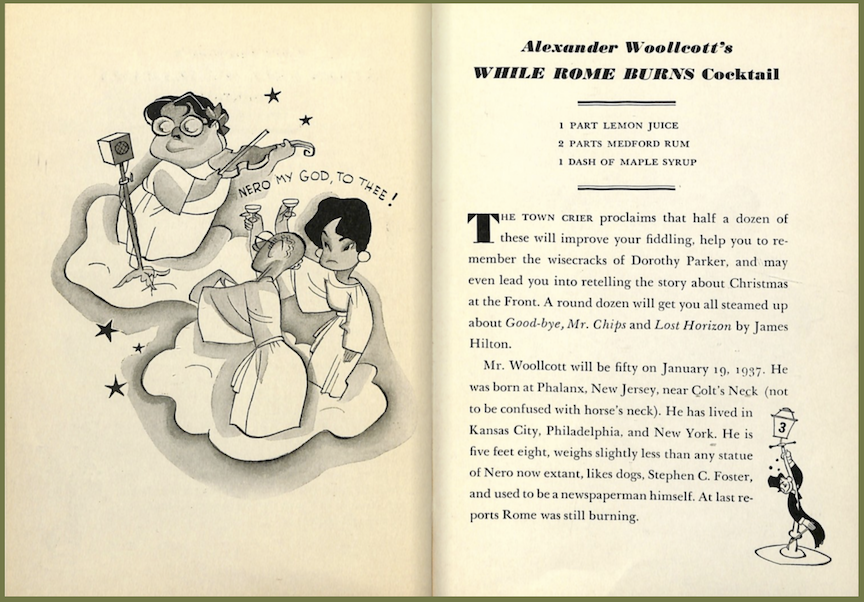
…before we go, I ran across this cocktail book, So Red the Nose, at Messy Nessy’s Cabinet of Curiosities

…this particular tome featured an Alexander Woollcott recipe for a cocktail called “While Rome Burns”…

…you can flip through the entire book at this site

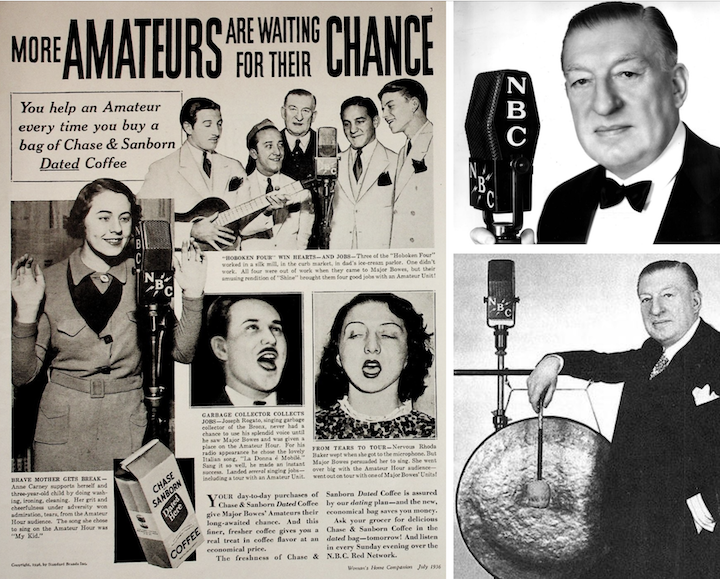
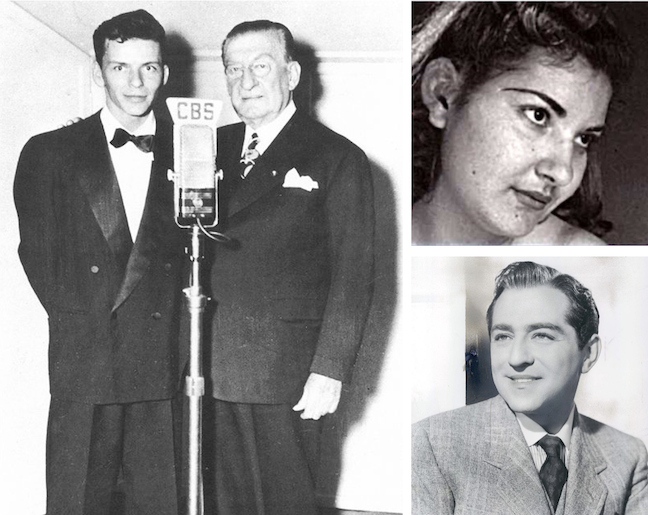
Next Time: The Major’s Amateur Hour …

Picking on Pickford

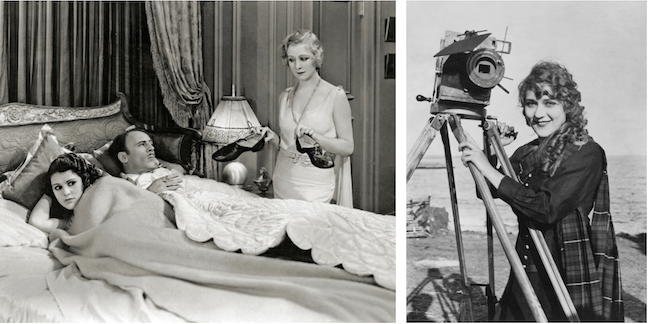
Above: Mary Pickford (right, from 1916) spoke out against salacious content in films, such as this scene from 1930's Madam Satan. (Wikipedia/mainemedia.edu)

James Thurber seemed to enjoy teasing silent film legend Mary Pickford in her new career as social commentator and author of spiritual articles and books. Having retired from acting in 1933, Pickford was also using her powerful position as a co-founder of United Artists to focus on the moral direction of the film industry.

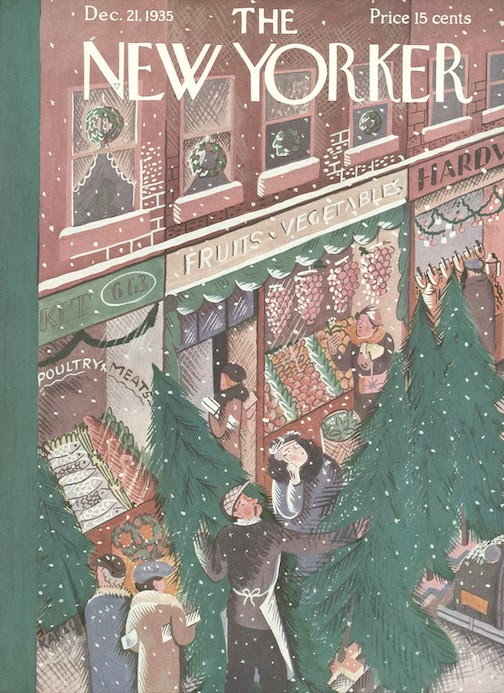
December 21, 1935 cover by Ilonka Karasz.

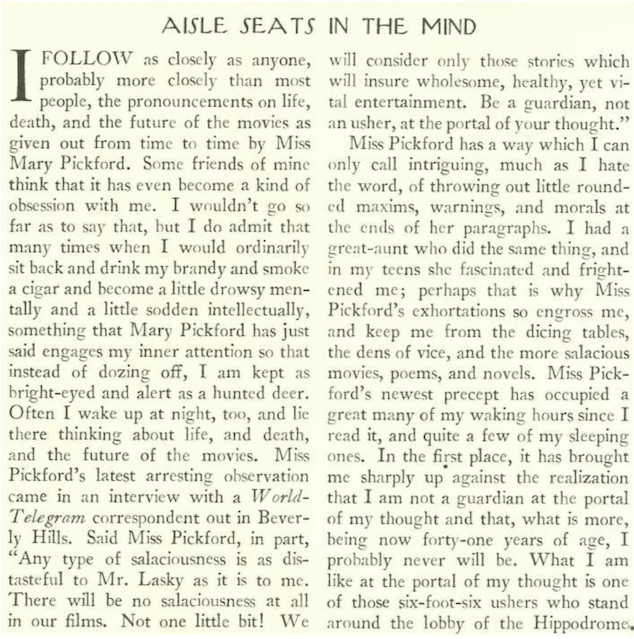
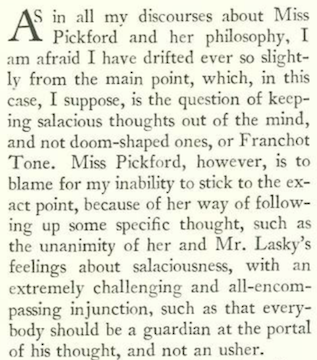
Back in the Sept. 21 issue of The New Yorker, Thurber took a humorous poke at Pickford’s Liberty magazine article on the afterlife, and found more fodder after Pickford, in an interview with the World-Telegram, criticized “salacious” films. “Be a guardian, not an usher, at the portal of your thought,” she advised. Thurber took the bait. Excerpts:

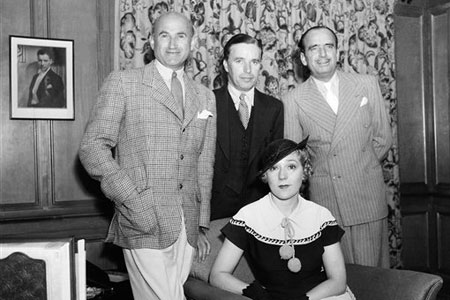
KEEPING IT CLEAN…From left, producer Samuel Goldwyn, actors Charlie Chaplin and Douglas Fairbanks Sr. pose behind Mary Pickford at a United Artists board meeting in Los Angeles, July 9, 1935. (AP)

Thurber took particular pleasure in Pickford’s comments regarding the control of one’s dirty thoughts:

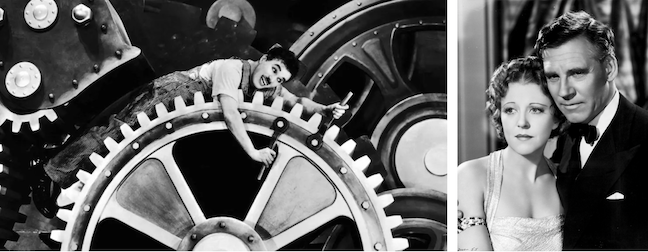
PICKFORD’S UNITED ARTISTS produced some memorable, non-salacious films in 1936, including Charlie Chaplin’s Modern Times, and the acclaimed Dodsworth starring Ruth Chatterton and Walter Huston as Fran and Sam Dodsworth. (Wikipedia)

Pickford had a strong ally in the Hays Code, a set of self-imposed censorship guidelines that would keep mainstream studio films relatively free of salacious content for the next thirty years.

 * * *

A White Christmas

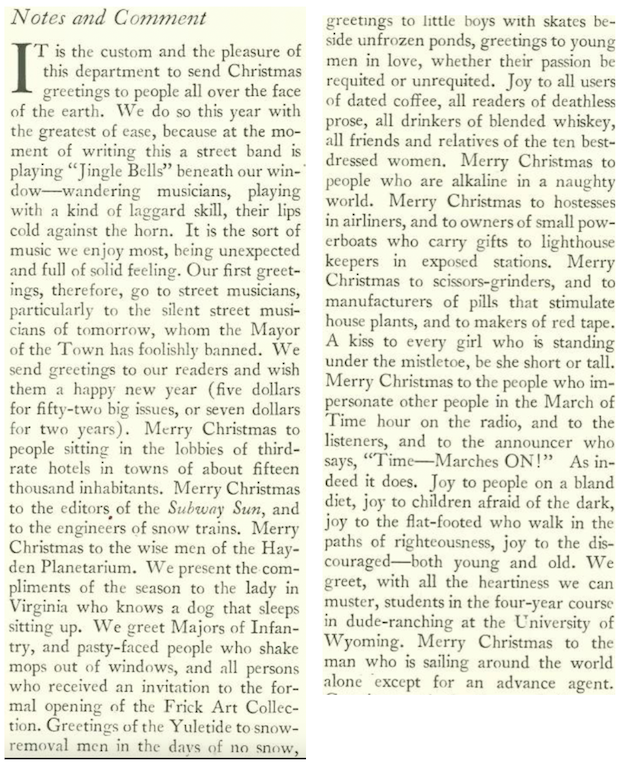
E.B. White offered holiday greetings to everyone from drinkers of blended whiskey to the makers of red tape (plus a plug for New Yorker subscriptions)…

CHEERS AND JEERS…E.B. White sent holiday greetings to the men who were changing the Normandie’s massive propellers (from three- to four-blade), and probably wanted to give a lump of coal to Mayor Fiorello La Guardia for “foolishly” banning organ grinders from city streets. (ships nostalgia.com/ephemeralnewyork)

…and concluded with these words…

Otto Soglow added this bit of spot art to the bottom of White’s “Notes and Comment”…

 * * *

A Holiday Tradition

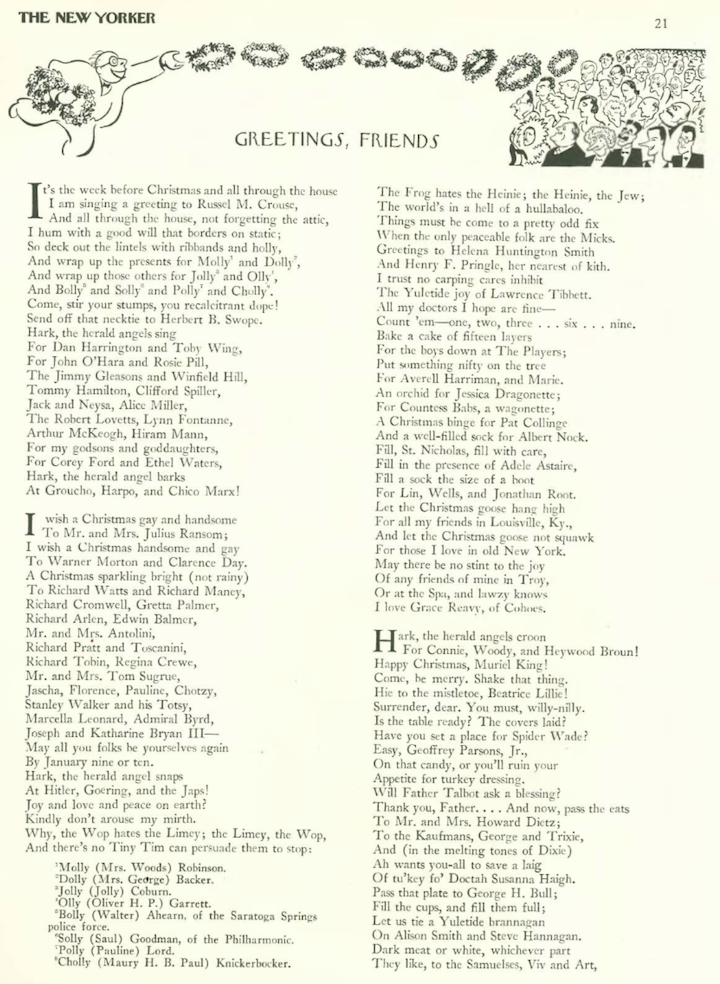
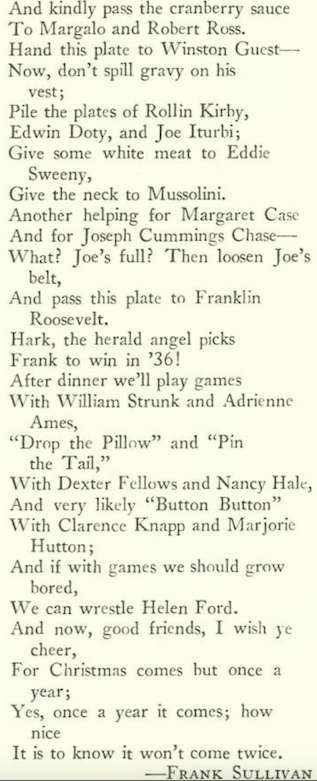
Page 21 featured Frank Sullivan’s annual Christmas poem (he wrote forty-two of them from 1932 to 1974)…

…which continued on page 22…

 * * *

Lost In Paradise

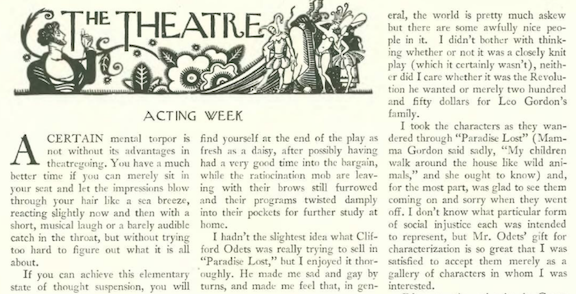
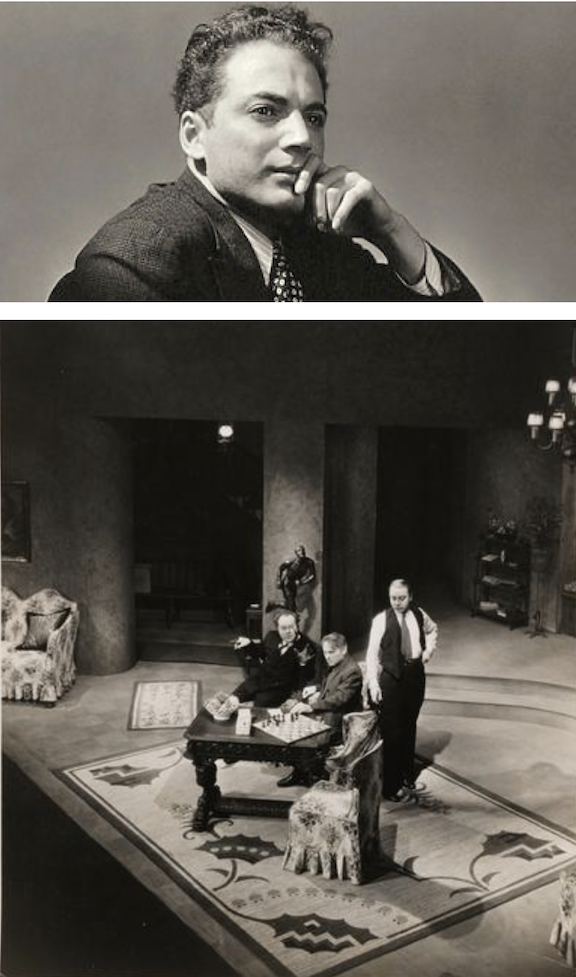
Robert Benchley did the honors as theatre critic for the Dec. 21 issue, enjoying an evening at Longacre Theatre with the richly endowed characters featured in Clifford Odets’ Paradise Lost.

GREAT PLAY, WHATEVER IT MEANS…Robert Benchley thoroughly enjoyed Clifford Odets’ gallery of characters in Paradise Lost. Top, Odets circa 1930s; below, photo from the 1935-36 production at Broadway’s Longacre Theatre. (mcny.org)

Apparently the rest of the Broadway fare was not so great, as Benchley fled Cort’s Theatre (it featured This Our House, which closed after just two performances) to catch A Night at the Opera with the Marx Brothers. 

 * * *

At the Movies

Benchley wasn’t the only one enjoying a night at the movies. Critic John Mosher found favor with German actor Emil Jannings’ latest flick, The Making of a King (Der alte und der junge König), calling the film “a sensible picture of the old bully,” namely the father of Frederick the Great.

LIGHTEN UP, FRED…Heinrich Marlow (left) and Emil Jannings in a scene from The Making of a King. The film depicted the turbulent relationship between Prussian King Friedrich Wilhelm I and his son, Crown Prince Friedrich. (IMDB)

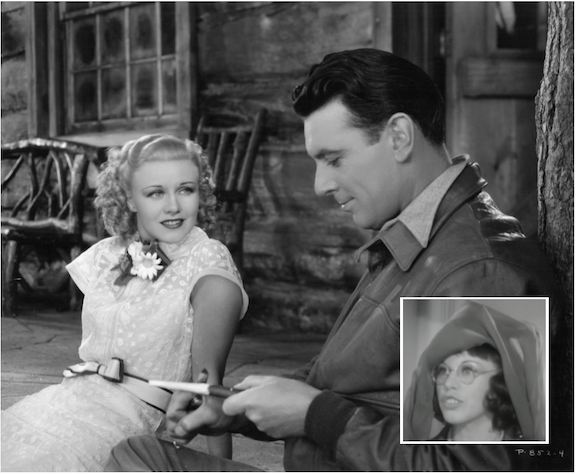
Mosher found bright moments in Ginger Rogers’ latest film, but would have preferred another pairing with her fellow hoofer, Fred Astaire.

BETTER WITH FRED thought John Mosher of Ginger Rogers’s brave turn as an actress fleeing from her admiring fans in 1935’s In Person. Rogers donned eyeglasses, a wig, and fake teeth (inset) to portray the actress in hiding. She is pictured here in a scene with co-star George Brent. (IMDB)

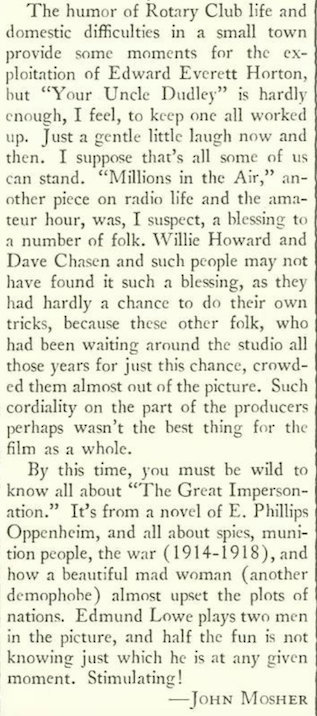
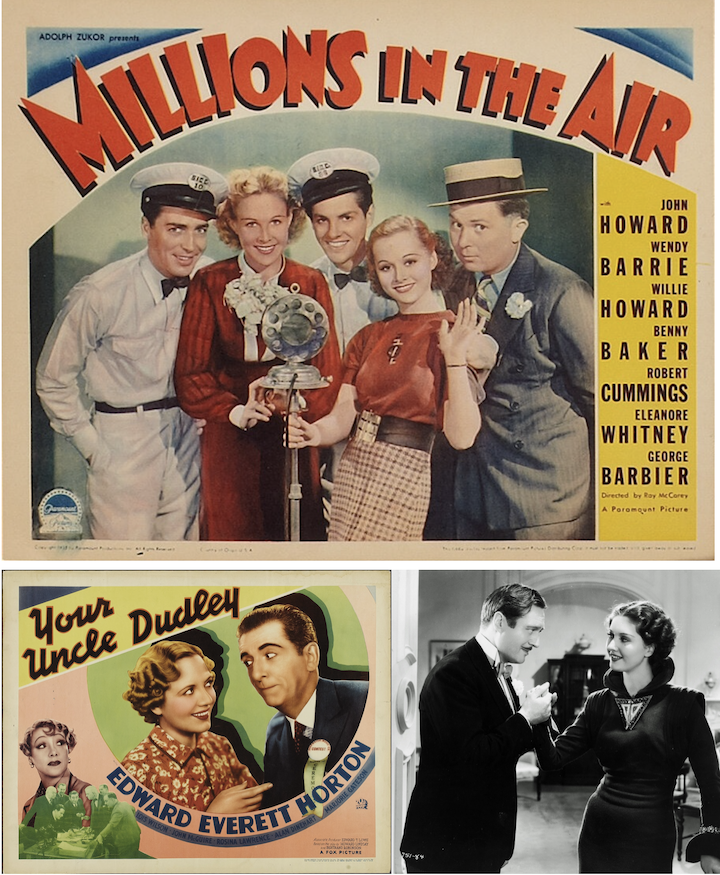
Mosher was stimulated by The Great Impersonation, however, the “cordial” films about small town life and happy radio folk left him less than enthused.

MORE SPIES, PLEASE…John Mosher didn’t get too excited over the standard fare offered in the films Millions in the Air and Your Uncle Dudley, however he found the performances of Edmund Lowe and Wera Engels (bottom right) in the spy caper The Great Impersonation to be most stimulating. (IMDB)

* * *

From Our Advertisers

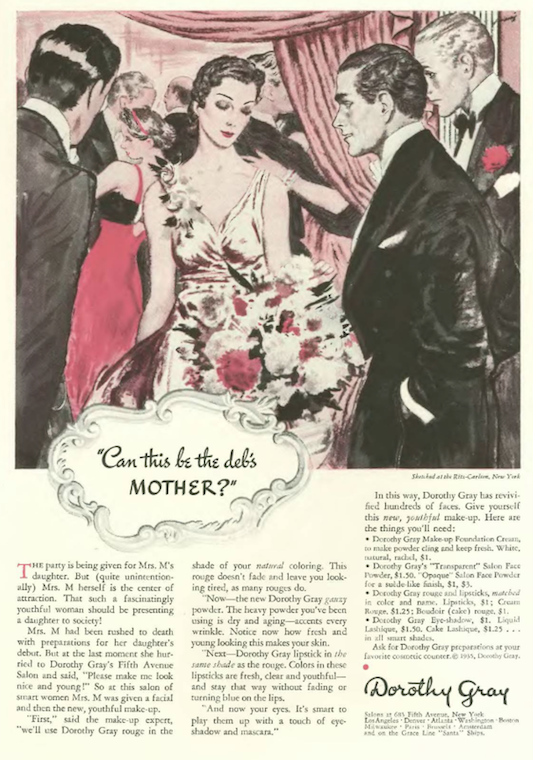
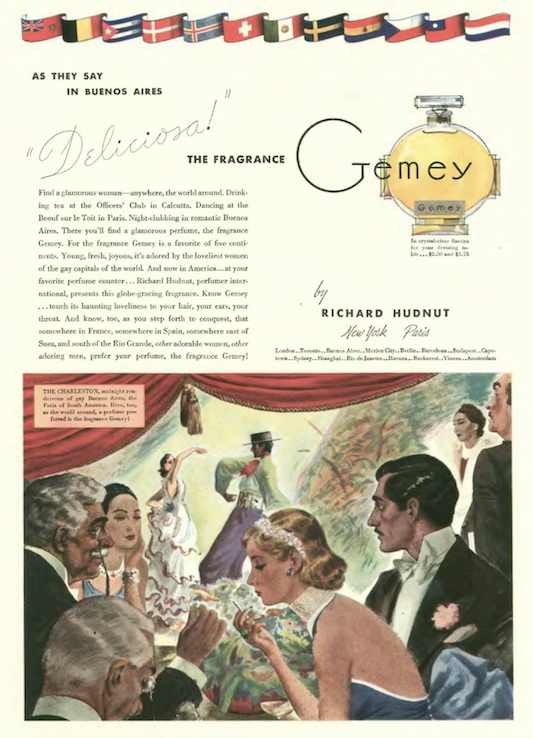
After touring France in the late 1870s, a New York drugstore owner named Richard Hudnut returned to the States determined to introduce French-style perfumes and cosmetics to American women. He soon transformed his drugstore into an elegant showroom, and in time became the first American to achieve international success in cosmetics…

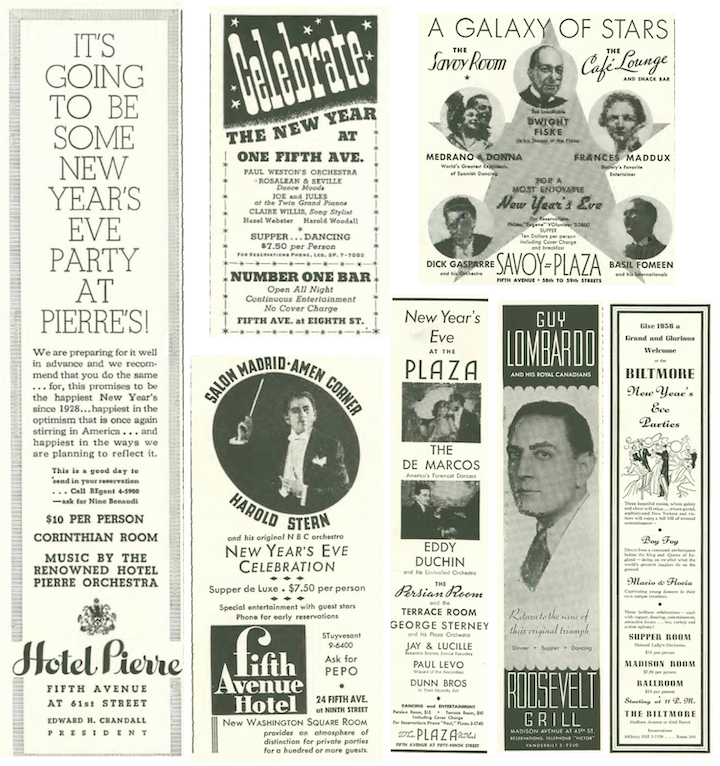
…advertisements for Christmas gifts mostly dropped out of the magazine, and the back of the book was filled with spots touting various New Year’s Eve entertainments…

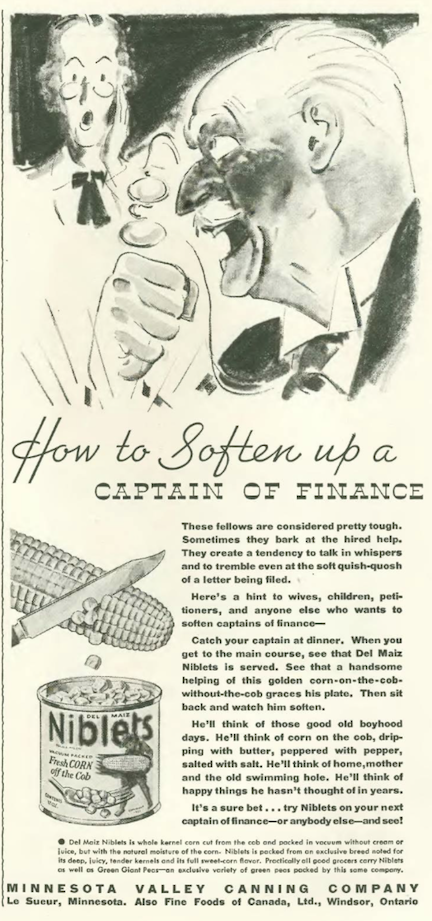
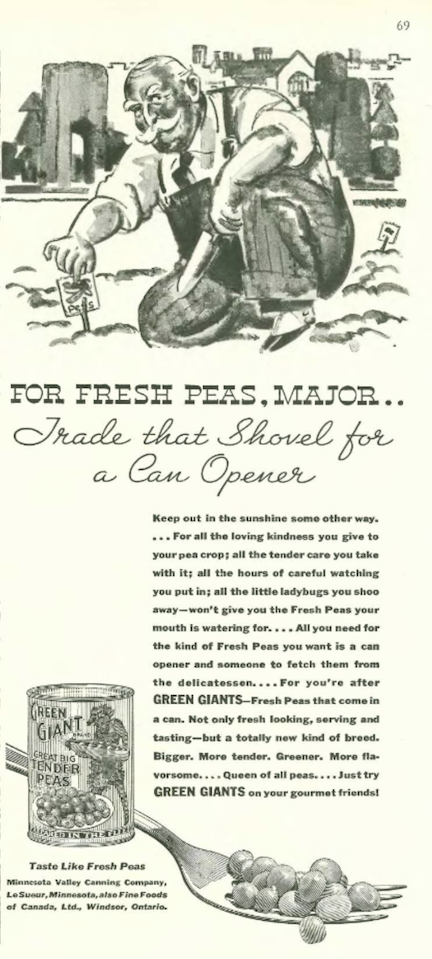
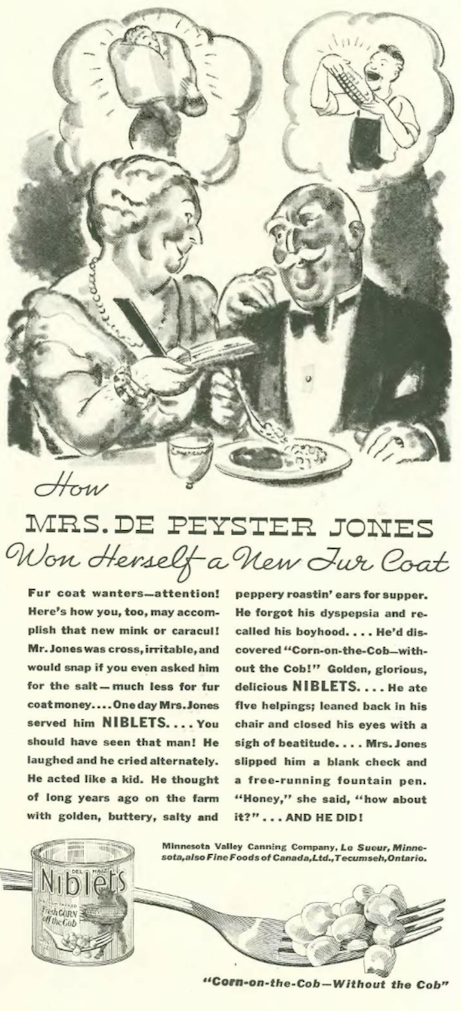
…in this ad from the Minnesota Valley Canning Company (renamed Green Giant in 1950), a robber baron’s humble roots, and his checkbook, are triggered by a can of corn…

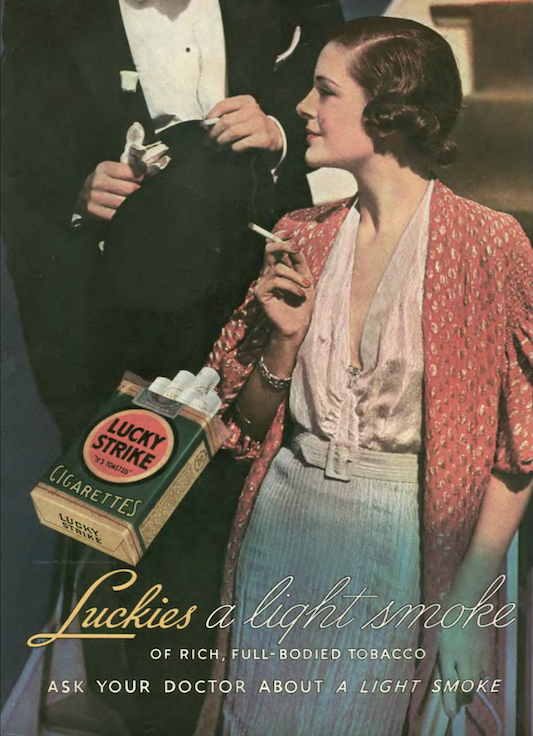
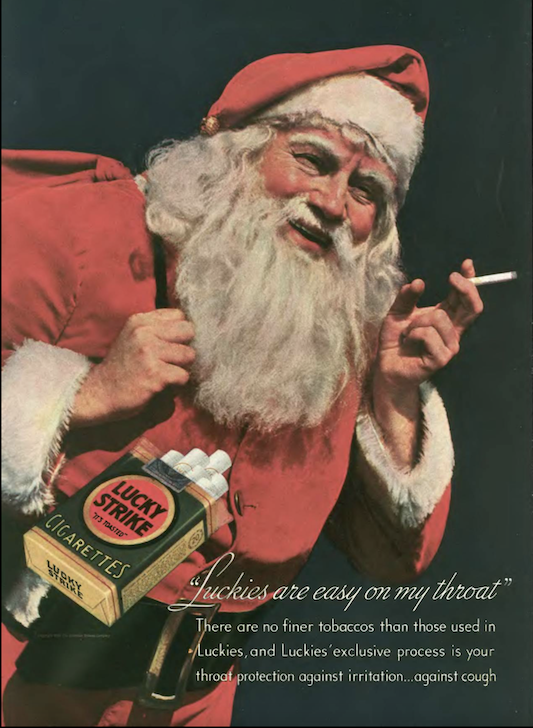
…thanks to the makers of Luckies, Jolly Old St. Nick was dropping more than soot down your chimney on Christmas Eve…

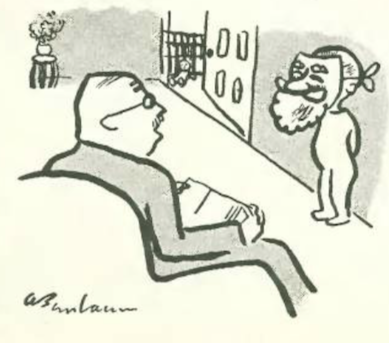
…we kick off our cartoons with this spot illustration by Abe Birnbaum

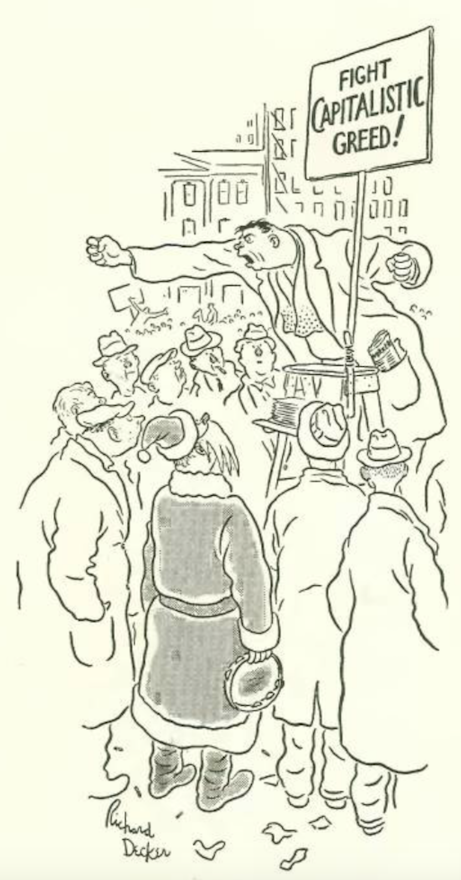
...Richard Decker gave us this caption-less appeal to the masses…

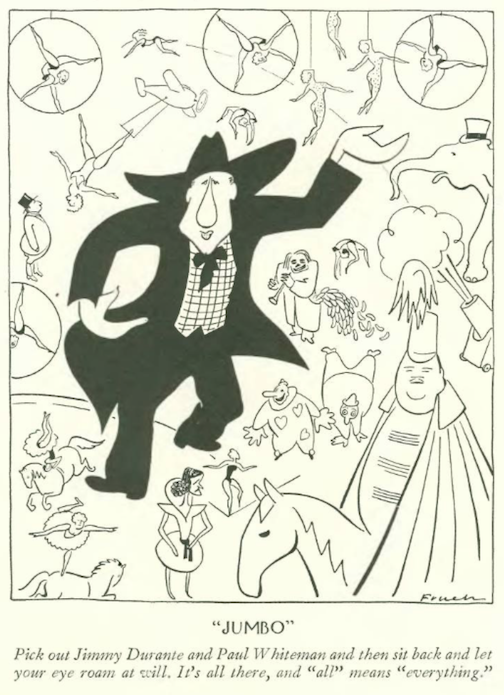
Al Frueh brightened up the “Theatre” section…

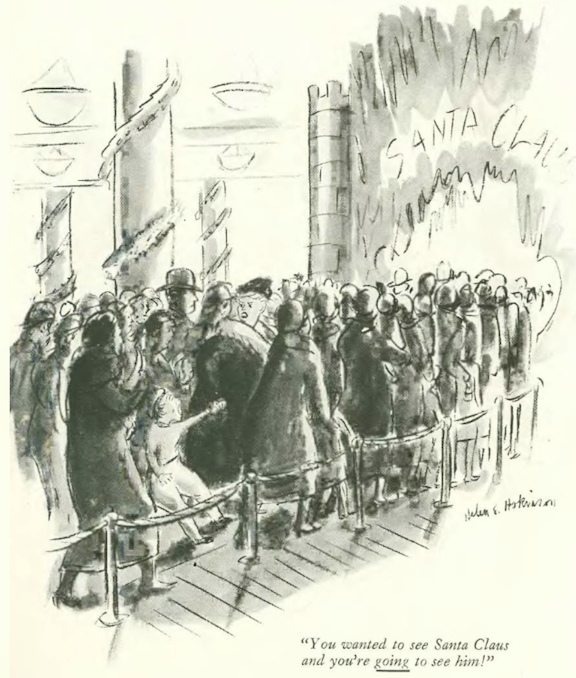
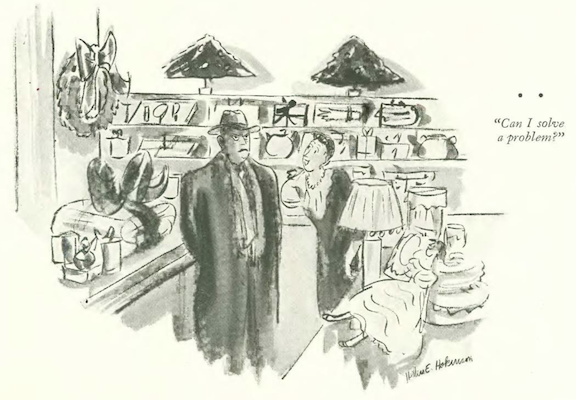
Helen Hokinson got in line at Macy’s…

…and found a challenge in the housewares department…(see Summer Pierre’s wonderful tribute to Hokinson and her observational forays into the city with James Reid Parker)…

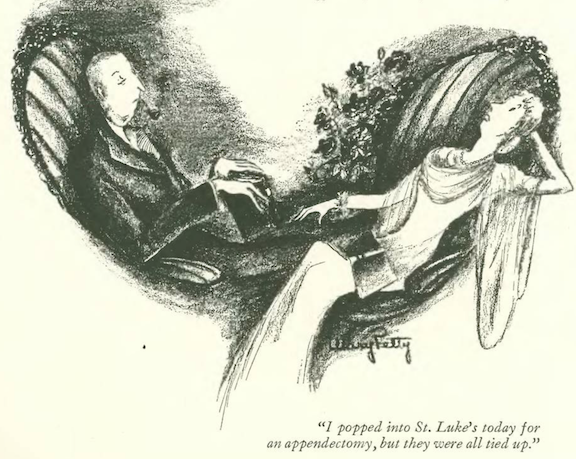
Mary Petty took the laid-back approach to a medical emergency…

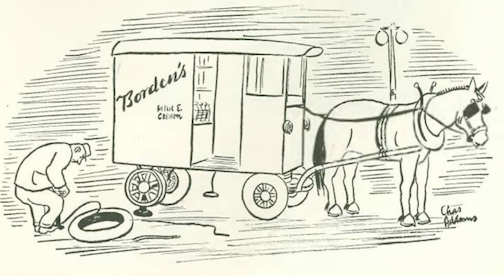
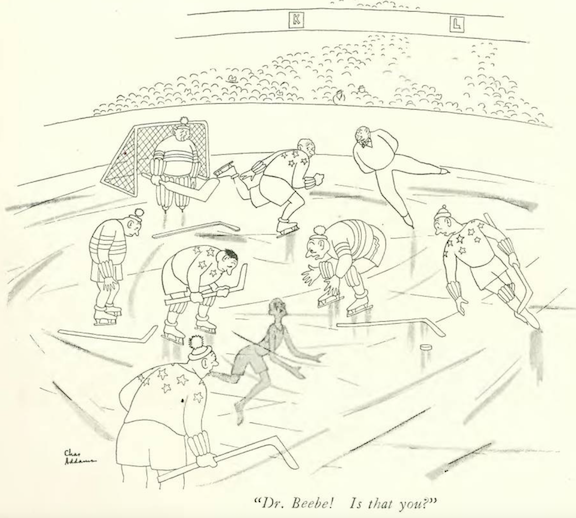
Charles Addams placed undersea explorer William Beebe in a precarious situation…

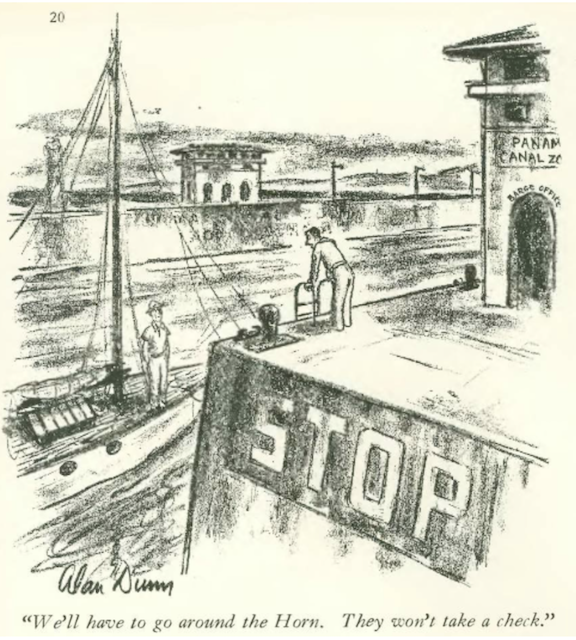
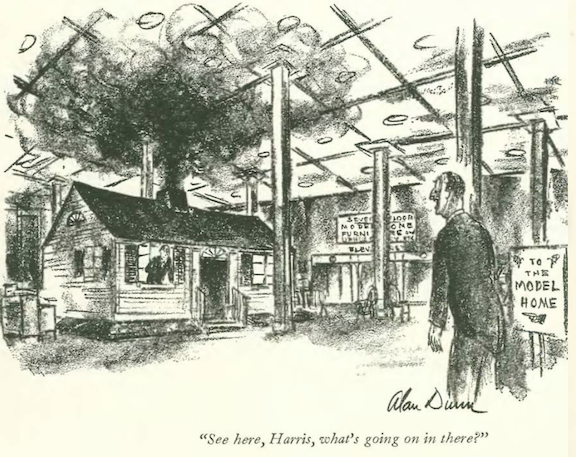
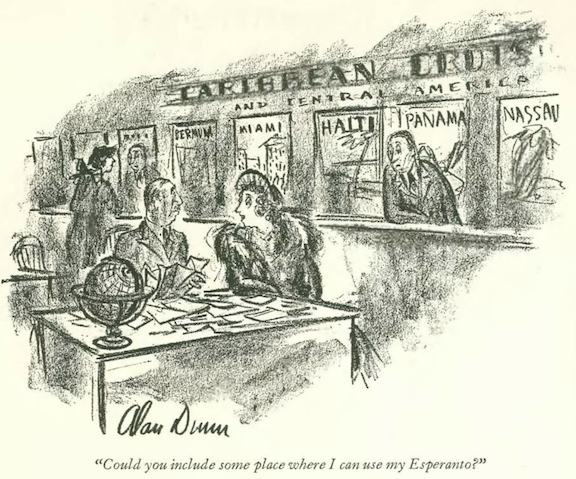
Alan Dunn diagnosed a bad a ticker at a watch shop…

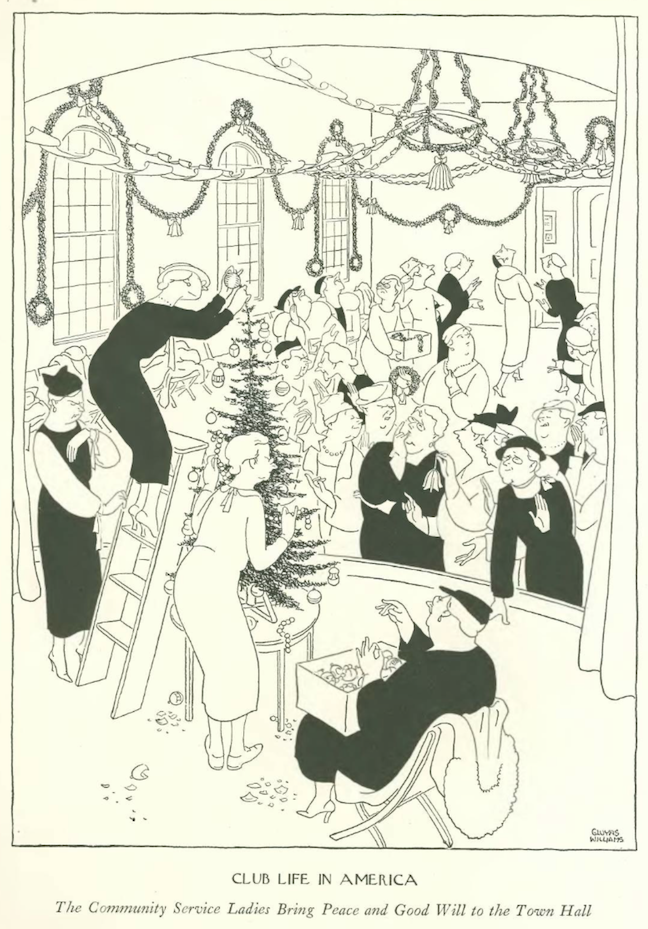
Gluyas Williams was back with another look at club life…

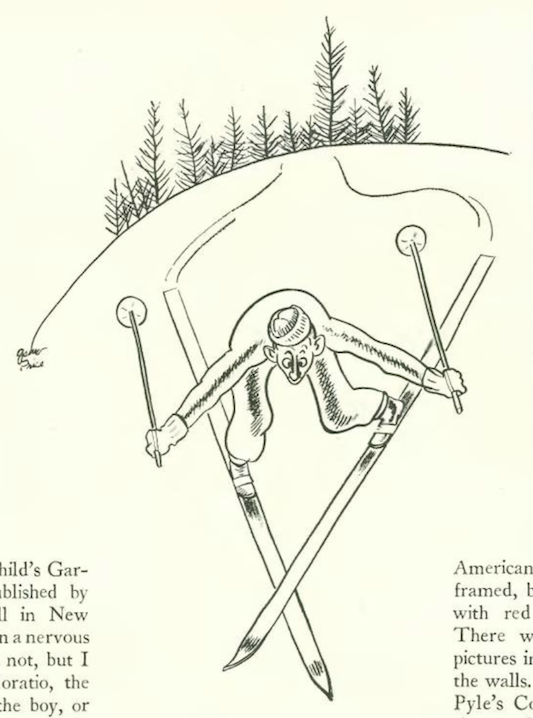
Garrett Price snowplowed his way onto the page…

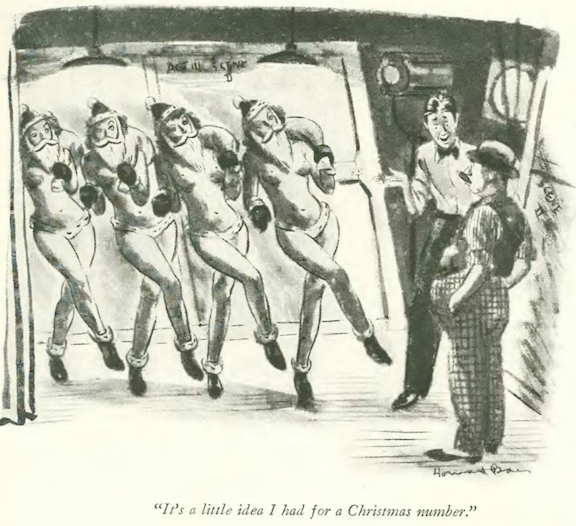
…it seems Howard Baer channeled Peter Arno for this one…

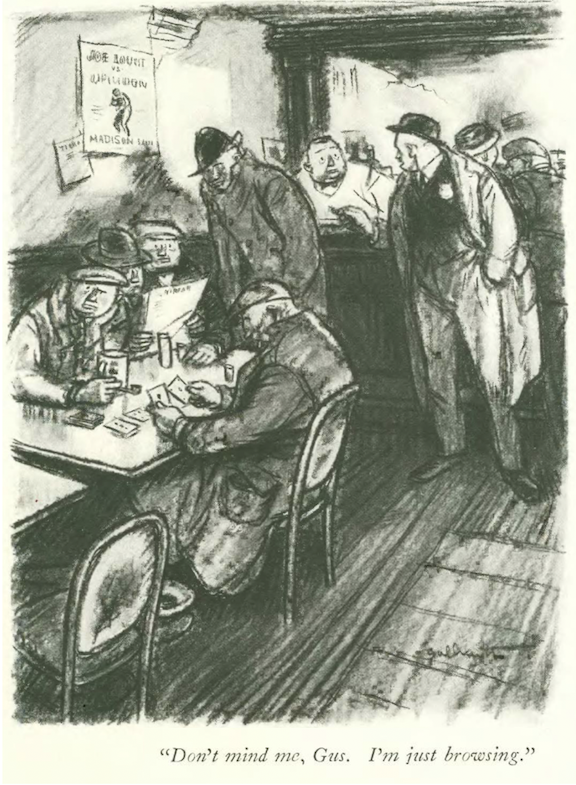
…and we close with William Crawford Galbraith, just doing a little browsing…

Next Time: Fracking the Frick…

Farewell to 1934

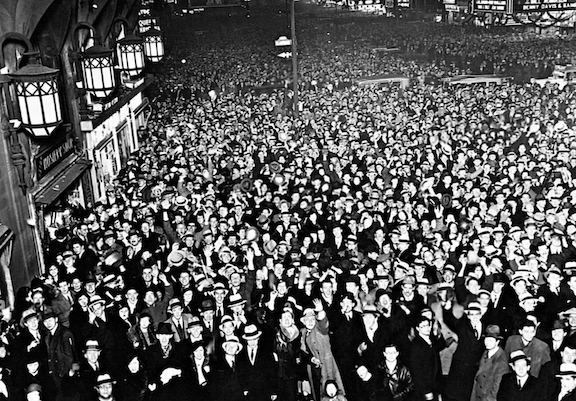
Above: Ringing in the New Year at Times Square, 1934.

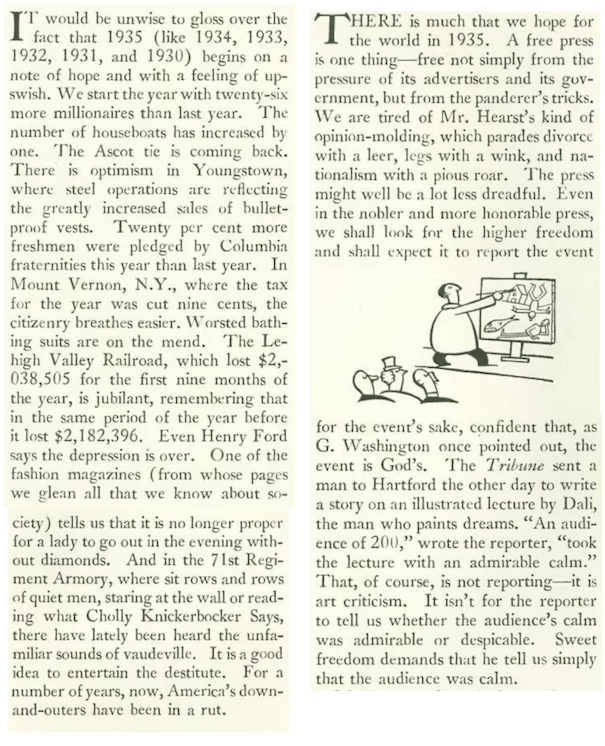
We bid adieu to 1934 with some odds and ends, beginning with E.B. White’s observations for the upcoming year, which if anyone had noticed the uptick in Ascot tie purchases, just might be a bit rosier than previous years of the decade.

Dec. 29, 1934 cover by S. Liam Dunn.

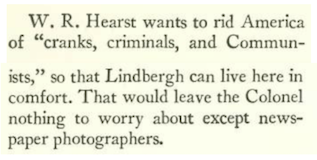
White was also hopeful for a new year with a less dreadful press, particularly the pandering type promulgated by William Randolph Hearst.

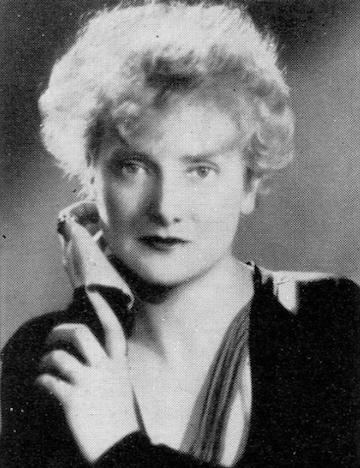
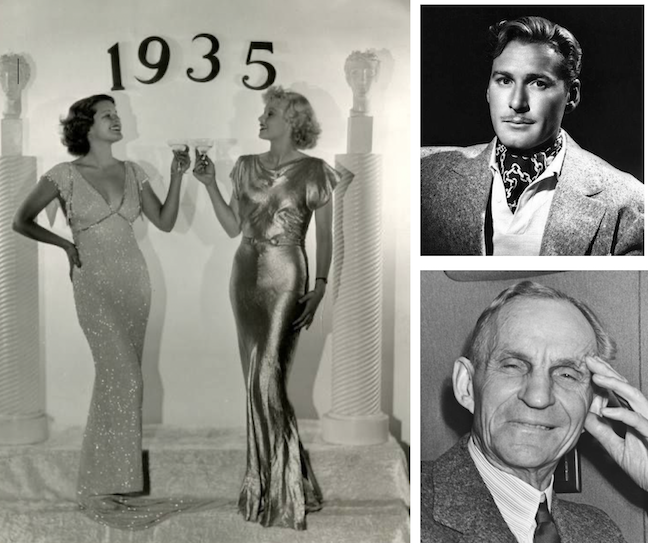
GOOD RIDDANCE…E.B. White wryly noted the positive signs heading into 1935. While actresses Billie Seward and Lucille Ball rang in the New Year, Erroll Flynn was sporting an ascot tie and Henry Ford was proclaiming that the Depression was over. (Pinterest)

 * * *

Dr. Peeper

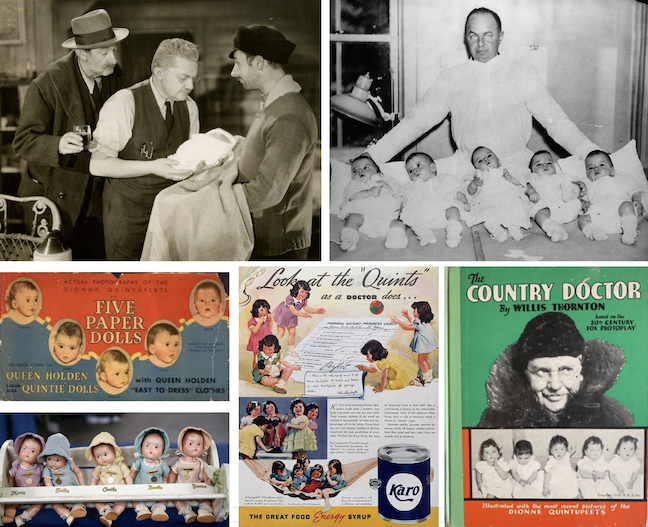
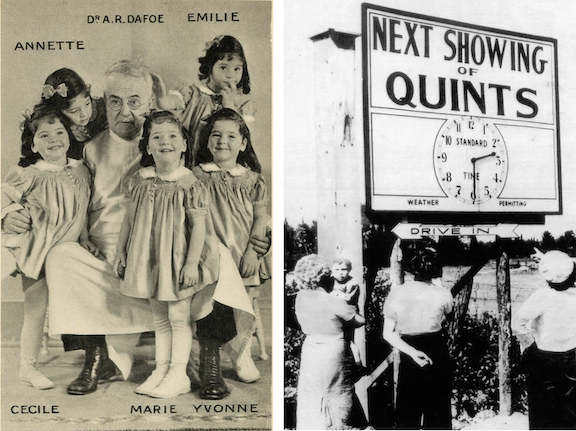
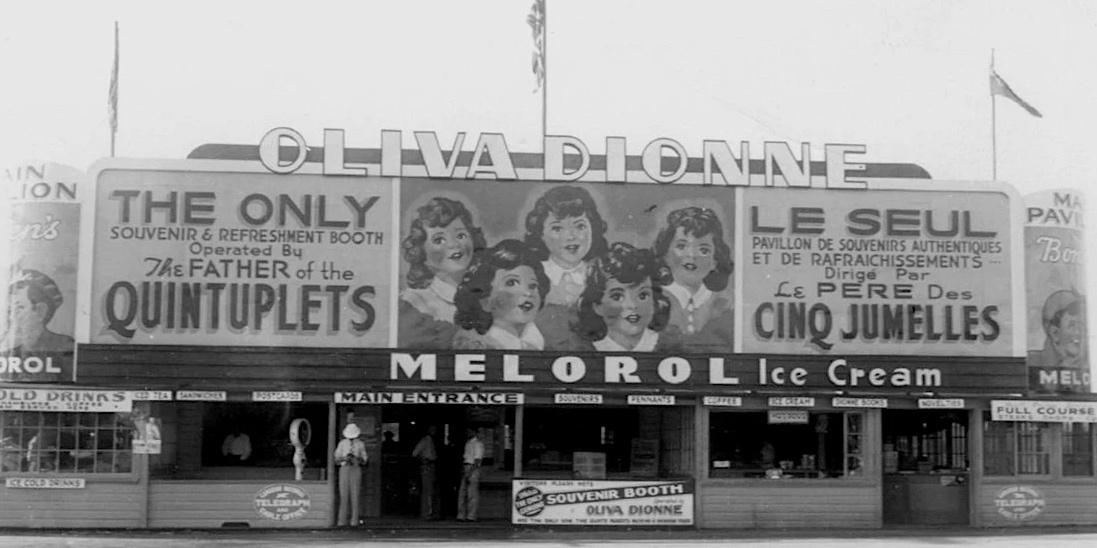
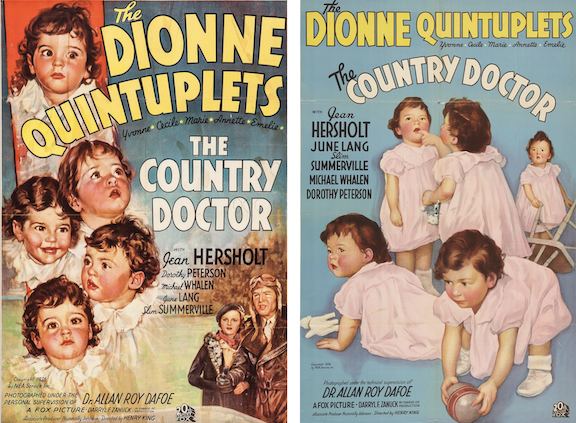
“The Talk of the Town” noted that Dr. Allan Dafoe, the country doctor who gained fame for delivering the Dionne Quintuplets, expressed a desire to see Sally Rand perform her bubble dance during his visit to Gotham. “Talk” also looked in on the some of the technical aspects of the burlesque dancer’s signature act:

DON’T BURST MY BUBBLE…Dr. Allan Dafoe of Dionne Quintuplet fame looked forward to taking in the sights of New York, including Sally Rand’s famed bubble dance. (Image from the 1936 book The Country Doctor/Sally Rand via stuffnobodycaresabout.com)

 * * *

Leading Ladies

Film Critic John Mosher noted the continued rise of two leading female stars, twenty-seven-year-old Katharine Hepburn and six-year-old Shirley Temple. Mosher recalled Hepburn’s recent performance in Little Women, and proclaimed that she “succeeds again” in The Little Minister.

OPPORTUNITY KNOCKS...Katharine Hepburn and John Beal in The Little Minister. Hepburn portrayed Babbie, a member of the nobility who disguises herself as a gypsy to protect villagers from a tyrannical lord. In the process she falls in love with the good Rev. Gavin Dishart (Beal). (IMDB)

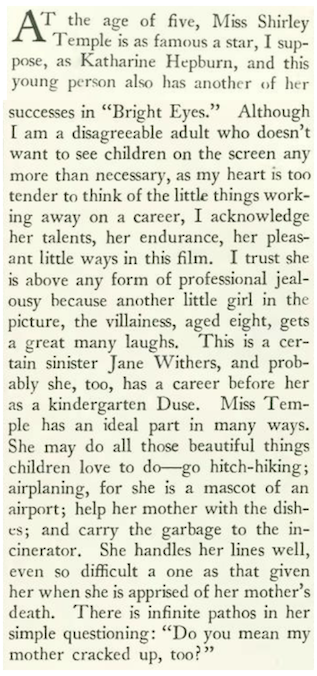
Although Mosher admitted he was a “disagreeable adult” who doesn’t enjoy seeing children on the screen “more than necessary,” he acknowledged Shirley Temple’s talents as well as those of child actor Jane Withers in Bright Eyes.

BRIGHT EYES, BRIGHT STARS…Jane Withers, Shirley Temple, and Terry in Bright Eyes. (IMDB)

 * * *

That Youthful Feeling

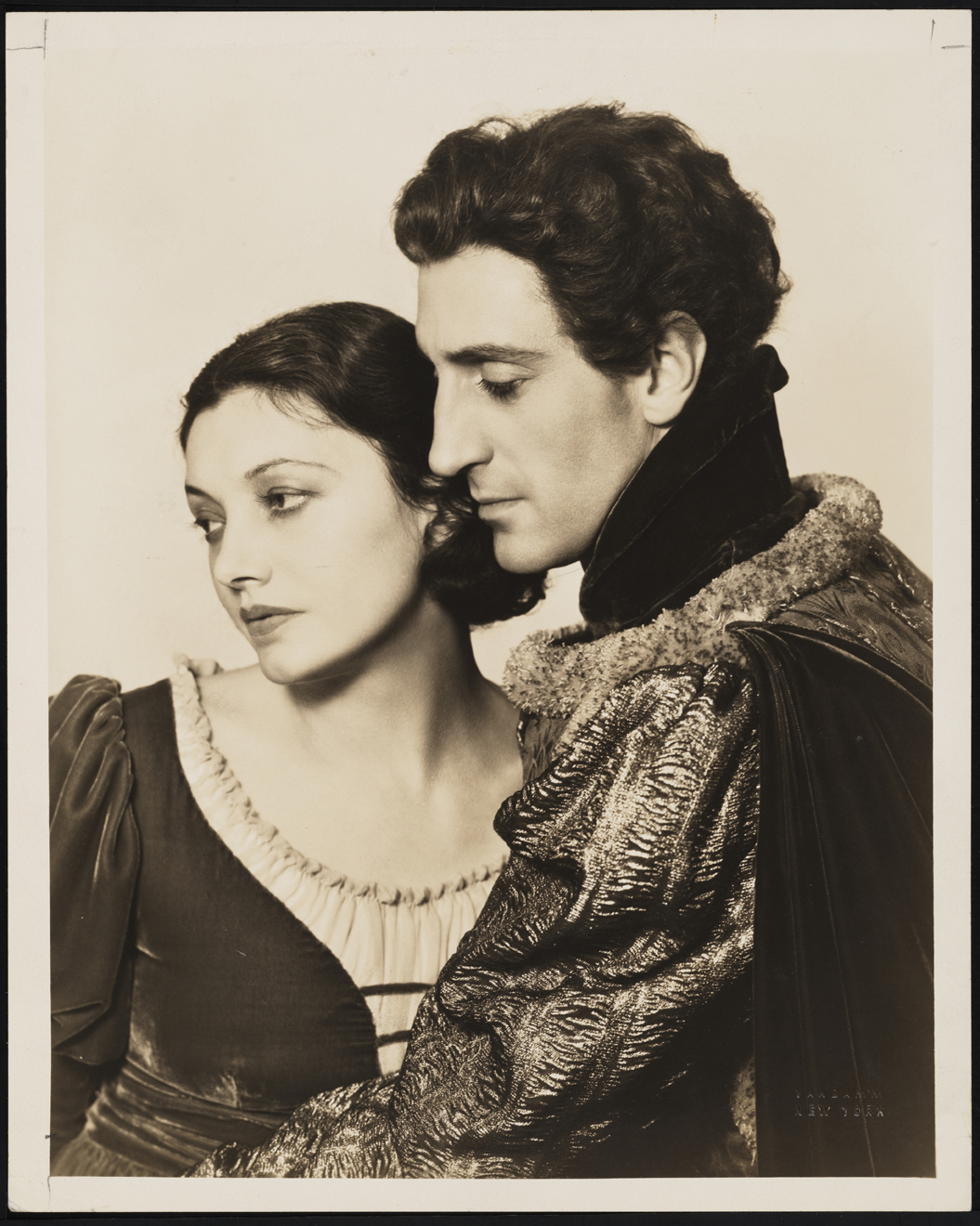
Given that William Shakespeare’s star-crossed lovers Romeo and Juliet were mere teenagers (the ages 13 and 16 were given to Juliet and Romeo, respectively), many productions featured actors more than twice that age. That was the case in 1933 when the play was revived by actress Katharine Cornell and her director husband Guthrie McClintic, who took the play on a seven-month nationwide tour before it was revised and opened on Broadway in December 1934. Critics dubbed the 41-year-old Cornell “the greatest Juliet of her time,” and it seems Robert Benchley heartily agreed in this excerpt from his stage review:

AGE IS JUST A NUMBER…The 41-year-old Katharine Cornell and 42-year-old Basil Rathbone in a promotional photo for Romeo and Juliet. Cornell was the first performer to receive the Drama League’s Distinguished Performance Award, which became the oldest and most exclusive theatrical honor in North America. (Vandamm photo, Museum of the City of New York)

 * * *

The New Yorkiest Place 

In 1930 gossip columnist Walter Winchell called the new Stork Club “New York’s New Yorkiest place on W. 58th,” and when it relocated to 3 East 53rd Street in 1934 it further defined itself as the ultimate New York night club. In her “Tables for Two” column, Lois Long found the new location much to her liking. An excerpt:

THE STORK DELIVERS…The Stork Club truly became the New Yorkiest nightclub when it relocated to 3 East 53rd Street in 1934. Clockwise, from top left: the club entrance in the 1930s; Cary Grant was one of the many celebrities who favored the nightclub, circa 1935; a 1930’s club menu; Lita Grey, the former teen bride of actor Charlie Chaplin, was a featured singer at the club during Lois Long’s visit. (Gibbes Museum of Art/Pinterest/vintagemenuart.com/IMDB)

 * * *

So Long?

Clarence Day, best known for his Life with Father stories, also contributed a number of cartoons to the magazine, accompanied by satirical poems and humorous shorts. Day would die at the tender age of 61—after a bout with pneumonia—in December 1935, about a year after this  cartoon was published in The New Yorker. I assume he was signing off from the magazine in order to arrange publication of his Life with Father book, which was published shortly after his death.

 * * *

From Our Advertisers

Sunny California beckoned those who had the means and leisure to head to warmer climes during the New York winter…

…for those who stayed behind, they could wrap themselves in a chic winter coat such as this one sported by Camel endorser Mrs. Langdon Post (Janet Kirby)…

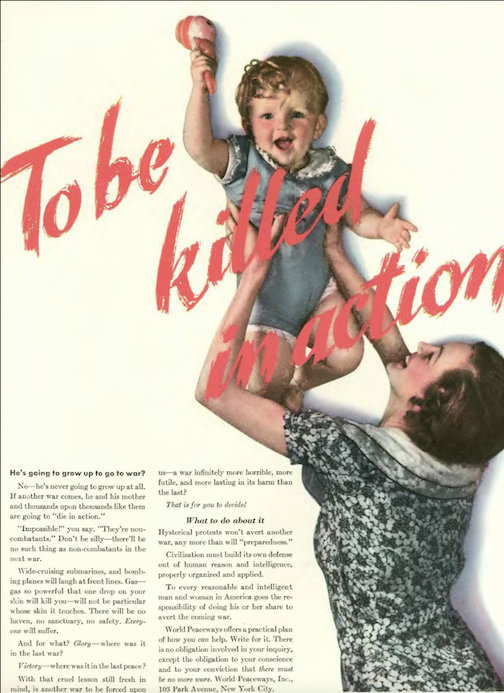
…another colorful ad with a not-so-colorful message from World Peaceways, a 1930s anti-war organization that characterized soldiers (and future soldiers, seen here) as pawns in the corrupt games of the rich and powerful…

…the distributors of French champagne rang in the New Year by suggesting that Doyen was worth your very last cent…

…we kick off our cartoons by welcoming the New Year with George Price

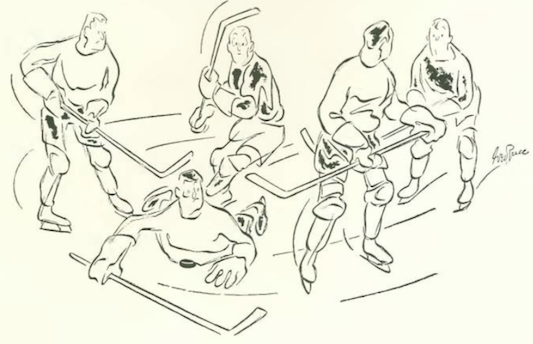
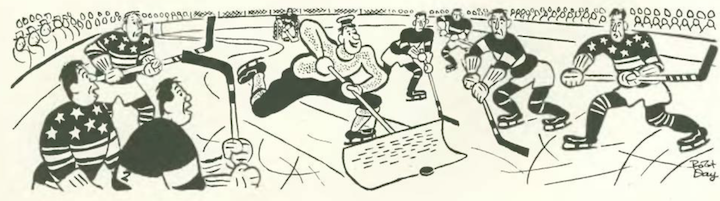
Robert Day contributed a spot drawing that offered a new twist to ice hockey…

…I should know this artist, but it escapes me for the moment…nevertheless, a great illustration to stretch across the bottom of an opening page…

…a closeup of the signature…

…another from George Price, still up in the air in the final issue of 1934…

Garner Rea introduced us to the life of the party…

…”Miss Otis Regrets” is a 1934 Cole Porter song about the lynching of a society woman after she murders her unfaithful lover. Porter wrote the song as a parody of a sad cowboy song he heard on the radio. The song was further workshopped for fun at “smart set” cocktail parties…on to our next cartoon, and a moment of keen insight from James Thurber

Garrett Price went on the town with some students of anatomy…

…and we say Happy New Year with the help of Helen Hokinson

Next Time: Easy Riders…

A Light in Darkness

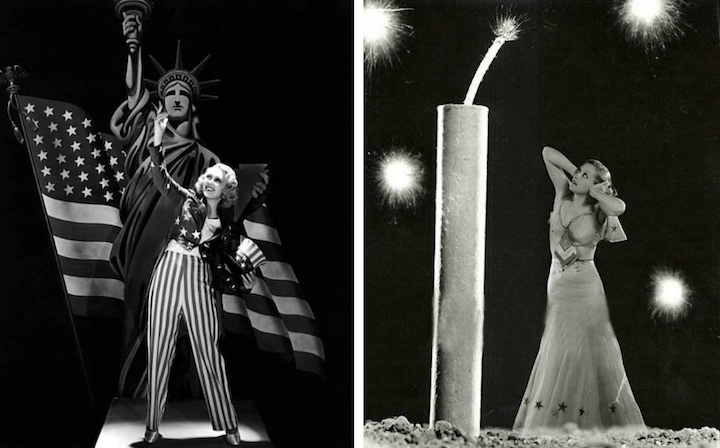
Above: For this Hollywood-heavy post we feature stars of the 1930s—the two Joans, Joan Blondell (left) and Joan Crawford, marking the Fourth of July holiday.

The New Yorker marked the Fourth of July with this William Steig cover featuring a patriotic “strap” along the binding and one of his precocious “Small Fry”…

June 30, 1934 cover by William Steig.

We’ve been looking at ways New Yorkers kept their cool in the hot summer of 1934, and one way to beat the heat was to escape into the air-conditioned darkness of a movie theater. It was not uncommon for folks to remain seated after the credits rolled and watch the feature all over again,  just enjoy some cold comfort.

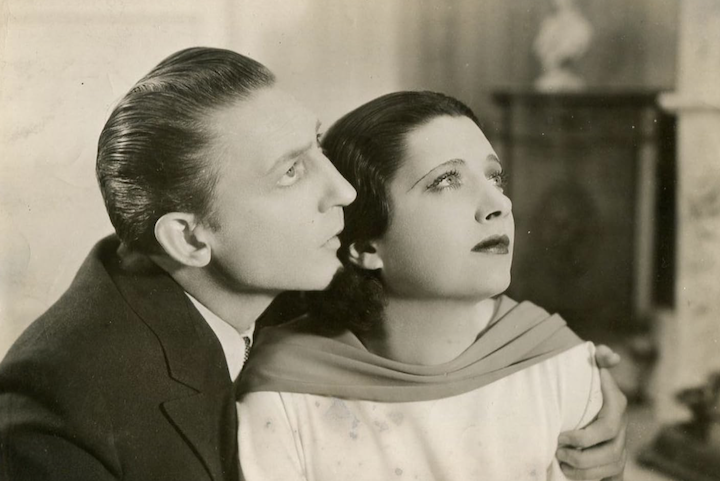
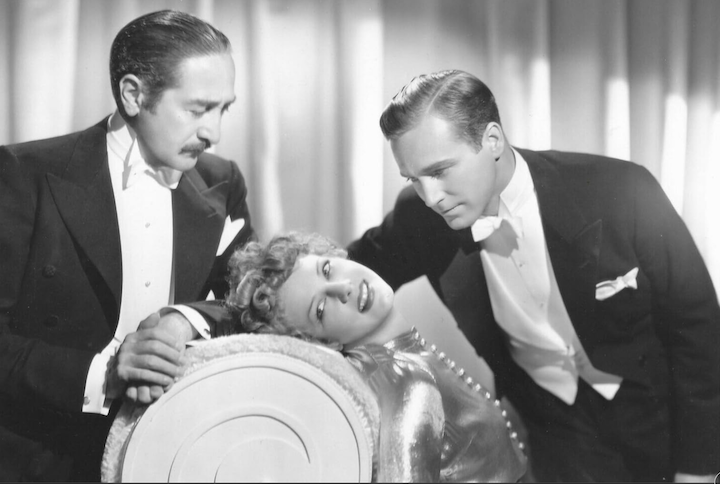
Film critic John Mosher no doubt enjoyed this particular perk, and perhaps this made him a bit more agreeable to whatever was playing on the big screen, including three rather dull pictures featuring actresses Marion Davies, Kay Francis and Elissa Landi.

Marion Davies (1897–1961) was the veteran of the group, beginning her film career in 1917 and appearing in thirty silent films before breaking into sound movies. Sadly, her talents as an actress and comedian were overshadowed by her reputation as William Randolph Hearst’s mistress. Known for her aristocratic bearing, Austrian-American actress Elissa Landi (1904–1948) appeared in several British silents and on Broadway before signing with Fox Films in 1931. Kay Francis (1905–1968) began her film career with the advent of sound movies in 1929. A major box-office draw for Warner Brothers, by 1935 Francis was one of Hollywood’s highest-paid actors (she was also a former roommate and longtime friend of The New Yorker’s Lois Long).

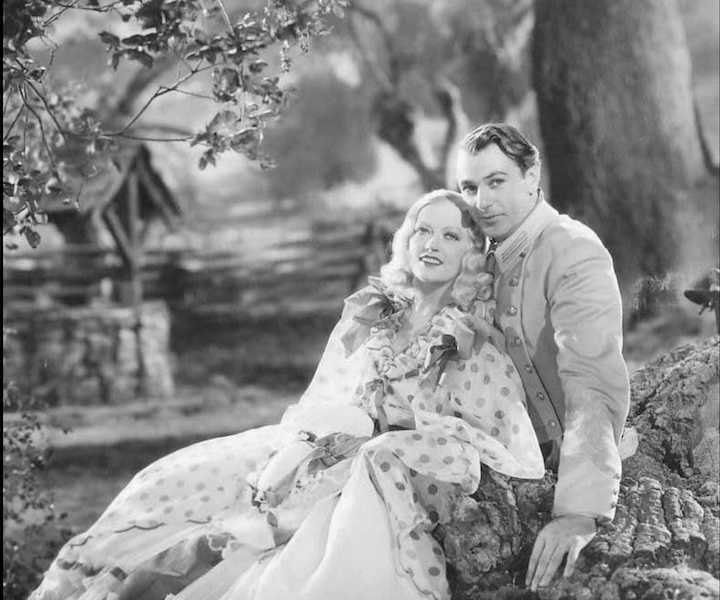
BEFORE SCARLETT AND RHETT…Gary Cooper and Marion Davies as star-crossed lovers in the 1934 Civil War drama Operator 13. Davies portrayed actress Gail Loveless, recruited by the Union to infiltrate a Confederate camp, where she falls for Capt. Jack Gailliard, a Confederate officer played by Cooper. (IMDB)

Perhaps one of the more notorious examples of a white actor in blackface, Operator 13 featured Davies as a Union spy who poses as a Black maid to infiltrate a Confederate camp…

FOOLING NO ONE…Marion Davies, in blackface, with Sam McDaniel in Operator 13. (IMDB)
PLAYING DOCTOR…Kay Francis and Warren William in the 1934 Pre-Code drama Dr. Monica. (IMDB)
JUST KEEP PRETENDING UNTIL THE CREDITS…From left, Adolphe Menjou, Elissa Landi, and David Manners in the 1934 romantic comedy The Great Flirtation. (IMDB)

 * * *

Sentimental Journey

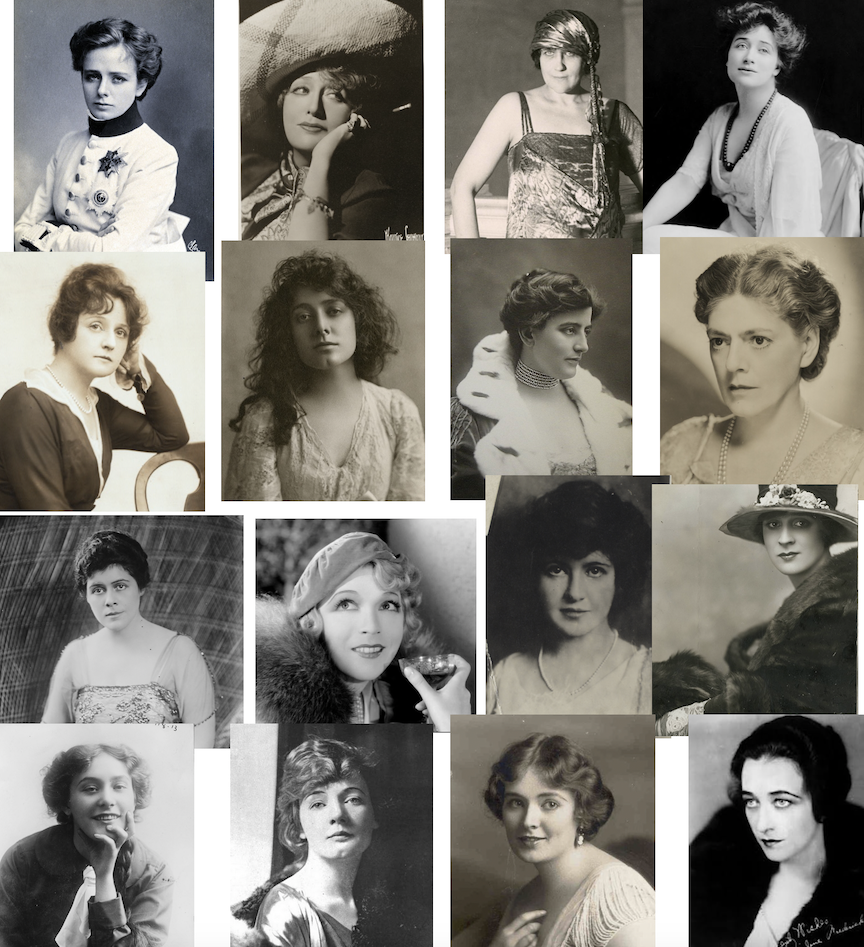
Another critic enjoying the cool of the theater was Robert Benchley, who used this break in the Broadway season to reveal his passions regarding a number of stage actresses. An excerpt:

BENCHLEY’S BROADWAY…Robert Benchley’s all-time favorite Broadway actresses included, from top row, left to right, Maud Adams, Florence Reed, Gladys Hanson, and Charlotte Walker; second row, from left, Laura Hope Crews, Julia Marlowe, Maxine Elliott, and Ethel Barrymore; third row, Janet Beecher, Ina Claire, Marguerite Clark, and Jane Cowl; fourth row, Elsie Ferguson, Martha Hedman, Marjorie Rambeau, and Pauline Frederick. (NYPL/Wikipedia/IMDB)

 * * *

A Poke at Palooka

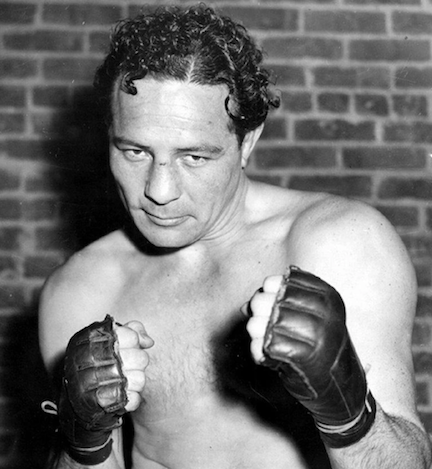
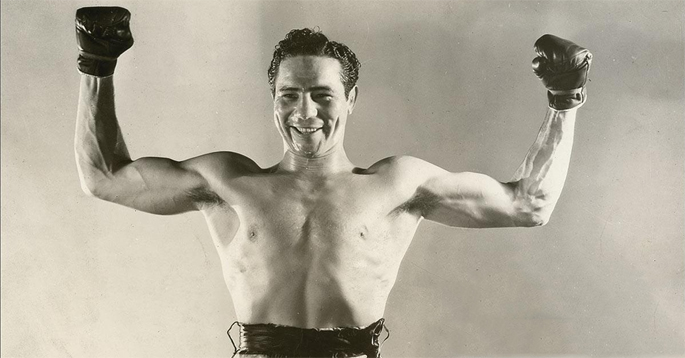
In his column “Of All Things,” Howard Brubaker took a shot below the belt at the new heavyweight boxing champ, Max Baer.

WHO SEZ I CAN’T READ?…Max Baer in the 1930s. (boxing.fandom.com/wiki)

 * * *

From Our Advertisers

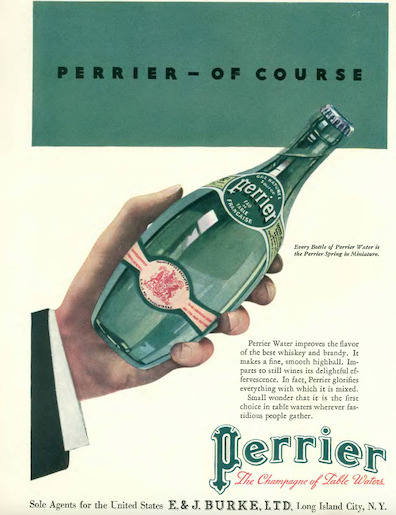
It was hot outside, folks were cooling off with their favorite beverages, and advertisers responded in kind…we begin with a familiar green bottle, and with apologies to Max Baer, you didn’t need to know how to read to know this was a bottle of Perrier…

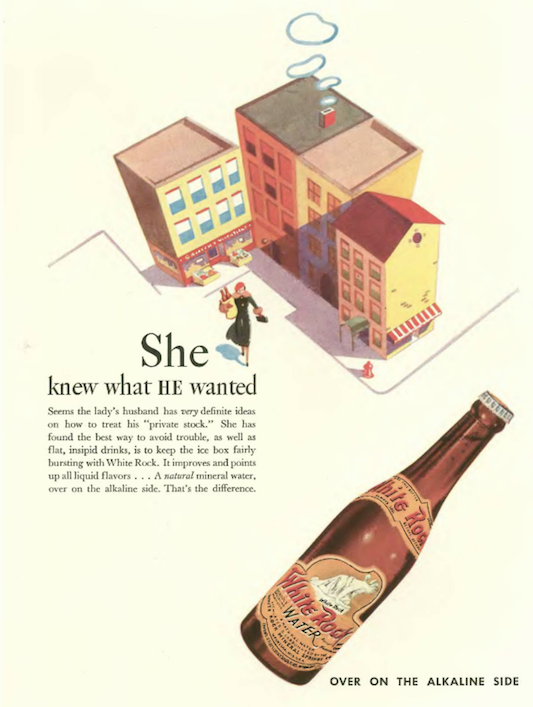
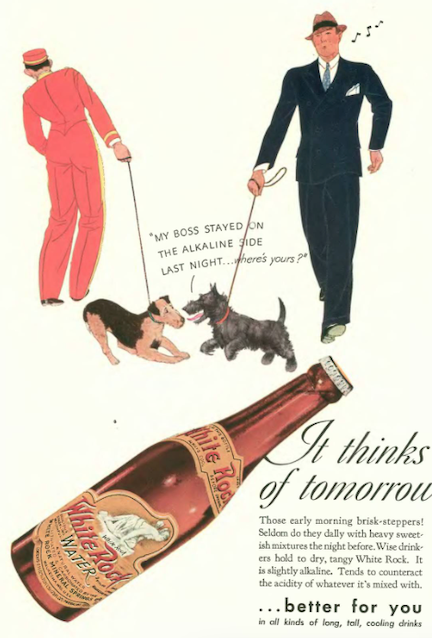
…if your taste was more on the domestic side, there was White Rock…

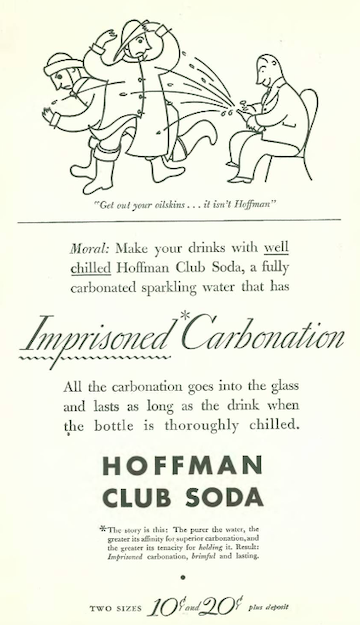
…a series of Hoffman Club Soda ads sought to convince consumers about their superior carbonation…

…or how about a brandy, perhaps lightly chilled, especially if it’s late in the evening, and you happen to be sitting on a breezy hotel rooftop…

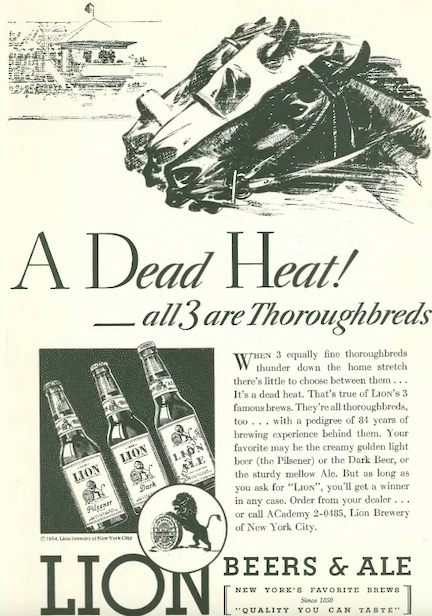
…or you could cool down with a Lion beer…considered a heritage brewery, Lion Brewery is one of only ten pre-Prohibition breweries that has independently and continuously operated since the repeal of Prohibition…

…a fairly new brand of cigarettes, Marlboro, was still taking out these bargain-sized ads to build brand recognition…Flit insecticide, on the other hand, was well-known thanks to these ubiquitous Dr. Seuss ads…

…the folks at General Tire & Rubber were the latest advertiser to tie their product to the glamour of aviation…

…and on to our cartoons, we begin with another installment of native birds via Rea Irvin

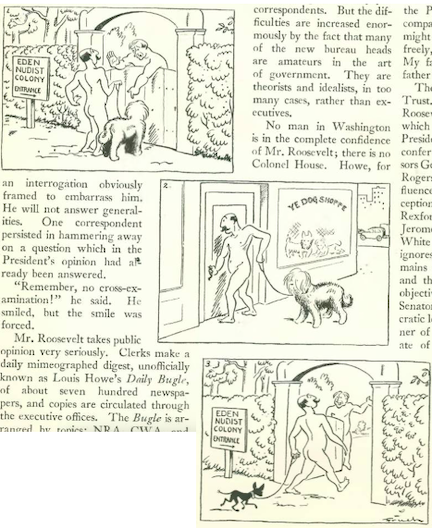
Al Frueh chimed in with this three-panel encounter at a nudist colony…

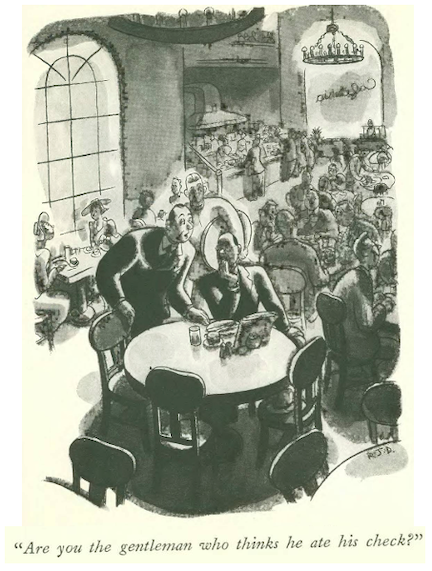
Robert Day presented a case of indigestion…

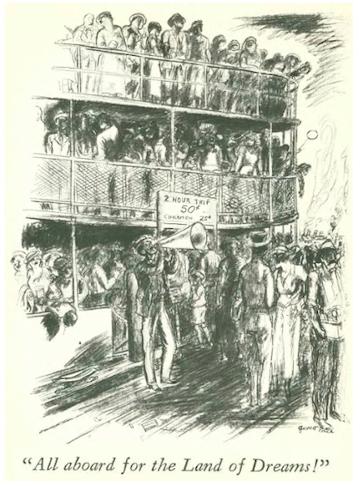
Garrett Price welcomed us aboard a dream cruise…

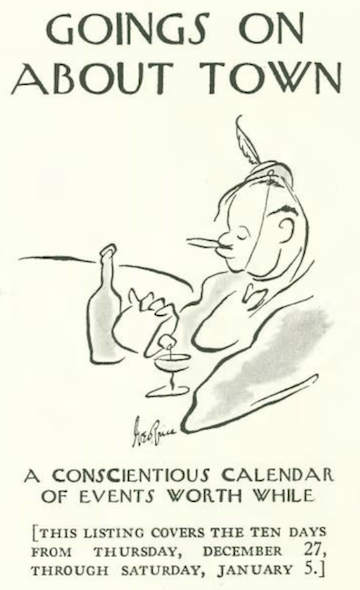
George Price gave us this gem in the “Goings On About Town” section,,,

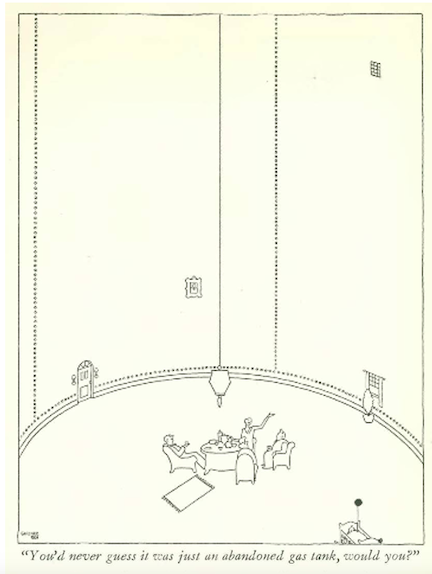
Gardner Rea gave us his spare line to illustrate an enormous space…one of his specialties…

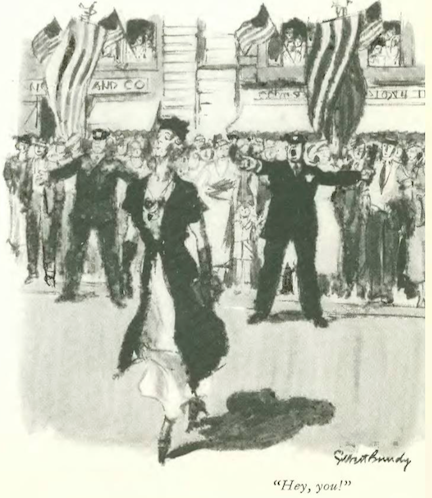
Gilbert Bundy marked the Fourth with an entitled jaywalker…
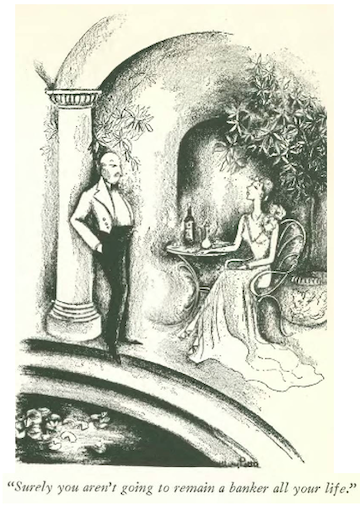
…and we close with Mary Petty, and a banker’s contentment…

Next Time: London Calling…

Ring Ding

Back in the days before we had a zillion different entertainment options, almost anyone with a pair of ears would tune in to hear the radio broadcast of a heavyweight title fight.

June 23, 1934 cover by Rea Irvin.

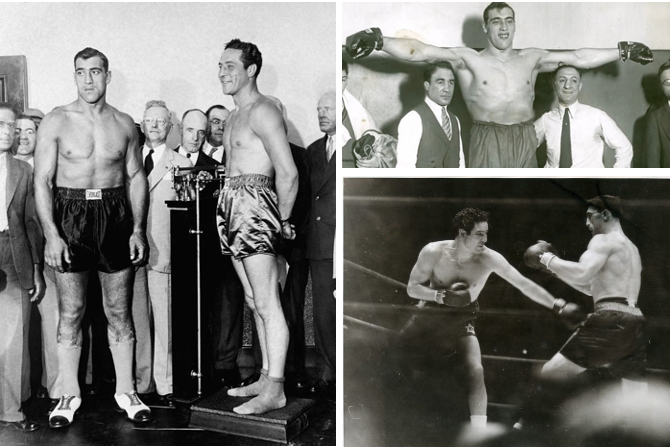
Jack Dempsey and Gene Tunney dominated the late 1920s, while Joe Louis, Max Schmeling and Jack Sharkey were marquee names in the 1930s along with Max Baer and Primo Carnera, who met on June 14, 1934 at the outdoor Madison Square Garden Bowl in Long Island City. The reigning champ Carnera (1906–1967), who stood six-and-a-half feet tall and weighed in at 260 pounds, had won more fights by knockout than any other heavyweight champion. But Baer (1909–1959) was known as a knockout puncher who beat one opponent so savagely that he died the following day.

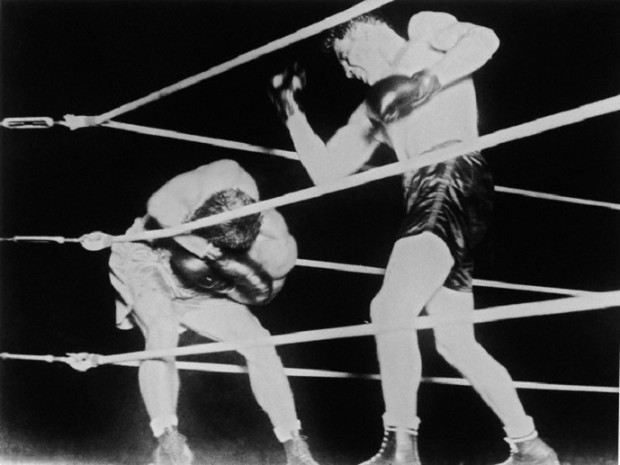
DEADLY DUEL…Max Baer (right) fought Frankie Campbell on Aug. 25, 1930, in San Francisco for the unofficial title of Pacific Coast champion. In the fifth round Baer got Campbell against the ropes and hammered him senseless. Campbell died the next day. An autopsy revealed that Campbell’s brain was “knocked completely loose from his skull.” Baer was profoundly affected by Campbell’s death, and donated purses from succeeding bouts to Campbell’s family. (thefightcity.com)

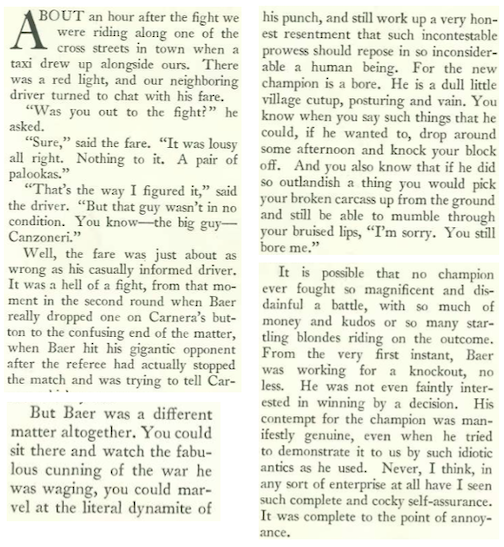
Baer was also something of a showboater, a quality Morris Markey found distasteful when he wrote about the Baer–Carnera bout in “A Reporter at Large.”

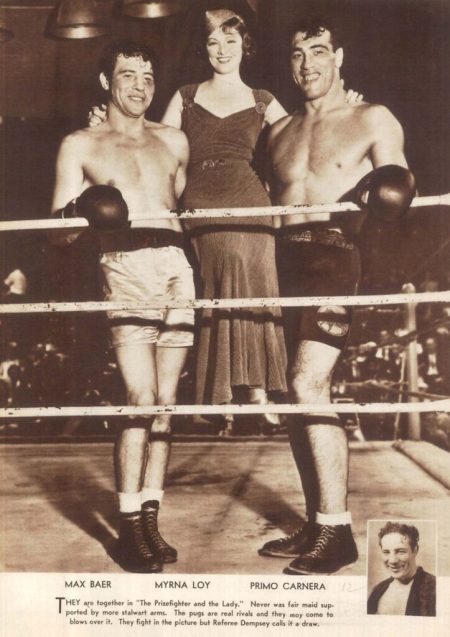
ALL SMILES…A year before their championship bout Max Baer (left) and Primo Carnera starred with Myrna Loy in The Prizefighter and the Lady. (theusaboxingnews.com)

GIANT SLAYER…The Italian prizefighter and wrestler Primo Carnera, nicknamed the “Ambling Alp,” was the reigning heavyweight champion when he faced Max Baer on June 14, 1934 at the Madison Square Garden Bowl. Baer felled the champion eleven times before the fight was stopped in the eleventh round. Baer would only hold the title for a year, losing to James J. Braddock on June 13, 1935, in what has been called one of the greatest upsets in boxing history. (theusaboxingnews.com)

Markey further explained why Baer’s behavior in the ring was so bothersome, and how it differed from the comic antics of other famous athletes:

RETIRING TYPES…Both Primo Carnera and Max Baer acted in films during their boxing careers, and continued acting after their retirements (Carnera in 1944, Baer in 1941). At left, Carnera with Bob Hope in the 1954 American comedy Casanova’s Big Night (Carnera appeared in eleven Italian films and in a half-dozen American films); at right, Max Baer and brother Buddy Baer (also a boxer) with Lou Costello in the 1949 comedy Africa Screams. Baer would appear in more than 20 films.(theusaboxingnews.com/monstermoviemusic.blogspot.com)

Complications from diabetes would take Carnera down for good at age 60. Baer would die even younger, from a heart attack, at age 50. His last words reportedly were, “Oh God, here I go.” Baer’s son, actor and director Max Baer Jr. (best known as Jethro Bodine from TV’s The Beverly Hillbillies) is still with us, at age 85.

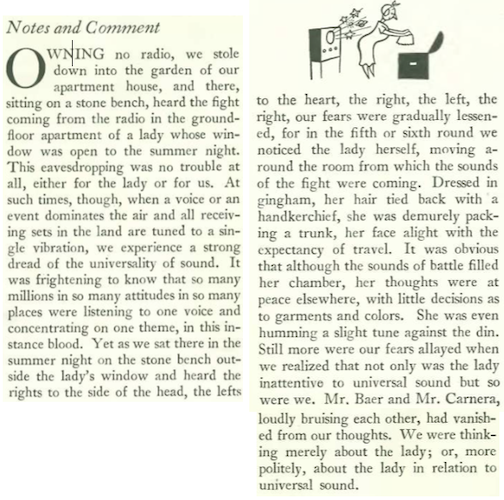
We aren’t quite finished with the Baer–Carnera fight…E.B. White led his “Notes and Comment” with this observation regarding the fight’s mass appeal and seeming universality:

 * * *

Apologies to Ms. Winslow

I seem to have given short shrift to author Thyra Samter Winslow (1886–1961) who published more than 200 stories during her career in magazines such as The Smart Set and The American Mercury. She published more than thirty in The New Yorker, from 1927 to 1942, including the serialization of her short story collection, My Own, My Native Land. The story “Poodles” was featured in the June 23 issue.

According to the Encyclopedia of Arkansas, Winslow’s early life in Fort Smith (Ark.) “provided background for her view of small towns as prejudiced, hypocritical, and suffocating places…many stories expose the hypocrisy, prejudice, and carefully maintained social structures of both small town and urban life. She was particularly adept at portraying women of every social class, often in an unfavorable light. Money, especially the pursuit of it as a means to happiness or status, is an important theme throughout her work.”

THE PURSUIT OF HAPPINESS…Thyra Samter Winslow with friend, 1937. (findagrave.com)

 * * *

Hot Enough For Ya?

So what did New Yorkers do when the summer heat set in? The next few items offer some clues, beginning with this poem by E.B. White:

SUMMER STOCK…Theatergoers fled to shady villages in New York, New Jersey and New England in the 1920s and 30s when summer stock theater was at its height. The above photo shows theatergoers leaving a performance at the Lakewood Theatre near Skowhegan, Maine. The theater was claimed to be the oldest and finest summer stock company in America with a Broadway cast. Nearby Lakewood Inn provided recreation, camping, and tourist bungalows. (mainememory.net)

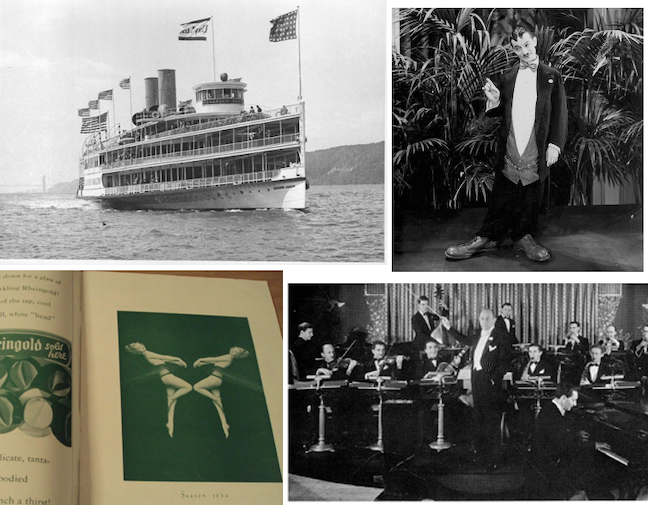
You could also take in some entertainment while enjoying the cooling breezes of the Hudson River. Robert Benchley hopped aboard the Alexander Hamilton to enjoy Bobby Sanford’s showboat revue:

SOME REAL SHOWBOATING…Clockwise, from top left, the steamboat Alexander Hamilton hosted Bobby Sanford’s showboat revue; comedian Lester Allen served as emcee for the show; the Meyer Davis Orchestra supplied the music; the revue featured the “exotic” DuVal sisters (image from program) among other diversions. (Hudson River Maritime Museum/IMDB/vintagebandstand.blogspot.com/Worthpoint)

“Tables for Two” took a look at summer dining options, from sidewalk cafes to hotel rooftops featuring dinner and dancing—this “Tables” was not written by Lois Long, but by Margaret Case Harriman, who knew a thing or two about nightlife (she was the daughter of the Hotel Algonquin’s owner, Frank Case)…

DANCING WITH THE STARS…The Waldorf-Astoria’s “Starlight Roof” was a popular summer restaurant for dining and dancing. Image from a 1935 publication The Waldorf-Astoria by Richard Averill Smith. (The Waldorf-Astoria)
 * * *
Doing Swimmingly
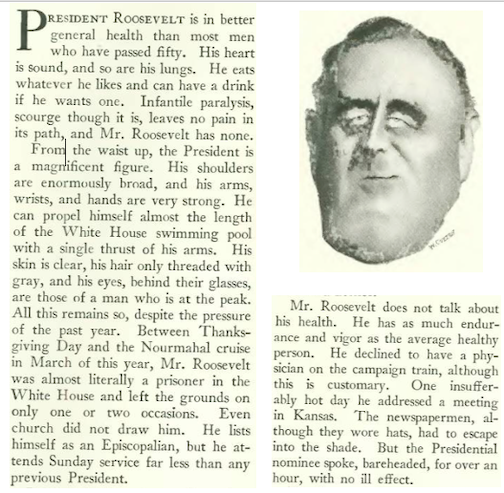
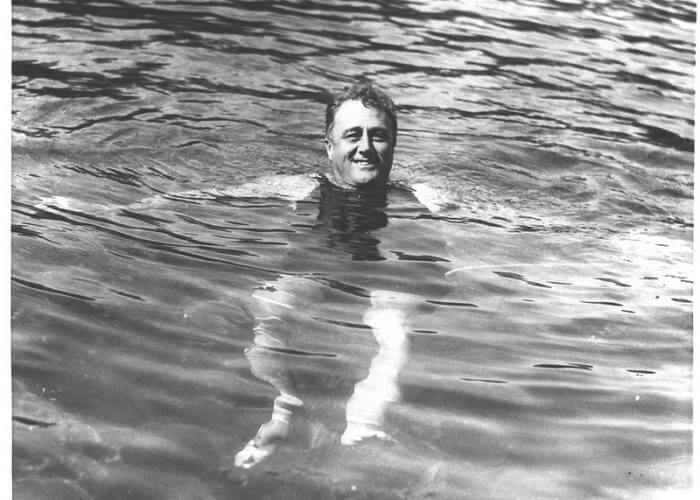
Historian Henry F. Pringle published part two of his series on President Franklin D. Roosevelt, here marveling at the president’s health despite his serious bout with polio (drawing by William Cotton).

TAKING THE WATERS…President Franklin D. Roosevelt took to swimming for therapy and exercise. (FDR Presidential Library and Museum)

* * *

Get Yourself to Chi-Town

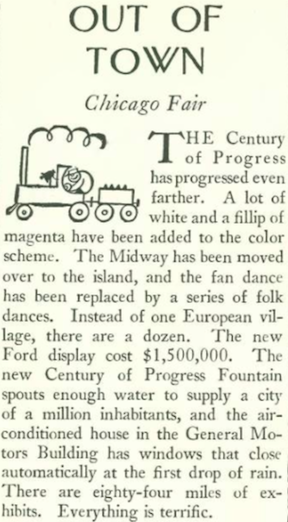
The Chicago World’s Fair (The Century of Progress) was in its second and final year, and The New Yorker found everything “terrific.” Excerpt:

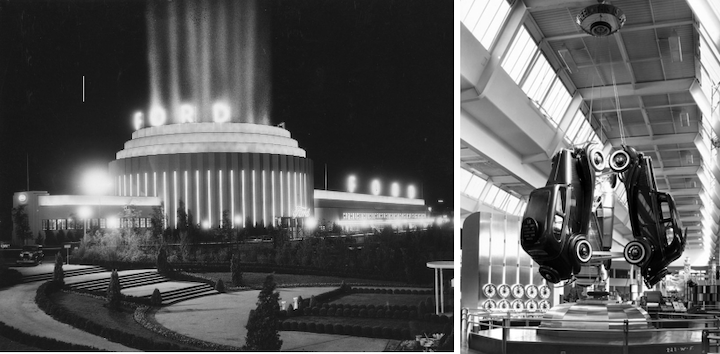
MAKING A SPECTACLE OF ITSELF…The 11-acre Ford Motor Company exhibit at Chicago’s Century of Progress became the most talked-about exhibit of 1934, featuring a central rotunda designed to simulate graduated clusters of gears. At right, Proof of Safety Exhibit in the Ford Building. (chicagology.com)

  * * *

From Our Advertisers

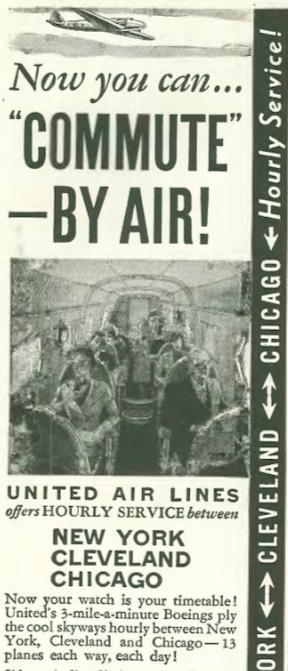
Just a couple of entries this week…You could take a plane to the Chicago World’s Fair on a United Airlines Boeing 247…

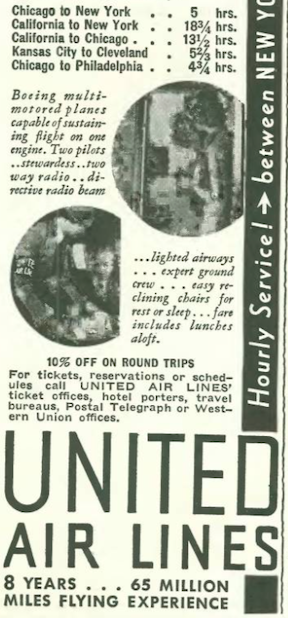
…the lower section of the ad claimed you could fly to Chicago in about five hours in planes featuring “Two pilots…stewardess…two-way radio…directive radio beam”…

TSA? WHAT’S A TSA?…United Airlines Boeing 247-D at an airport terminal with passengers and crew. (digitalcollections.lib.washington.edu)
COZY CONFINES…Passengers enjoy a game of checkers aboard a Boeing 247 in 1933. (digitalcollections.lib.washington.edu)

…and what would our advertising section be without two fashionable people lighting up?…

…on to our cartoonists, we begin with Reginald Marsh’s illustration of a Rep Theatre production…

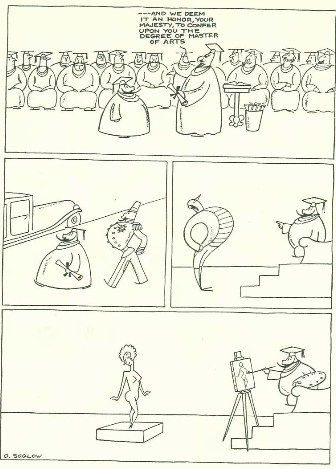
Otto Soglow’s Little King found his artistic side…

Rea Irvin continued his examination of native fauna…

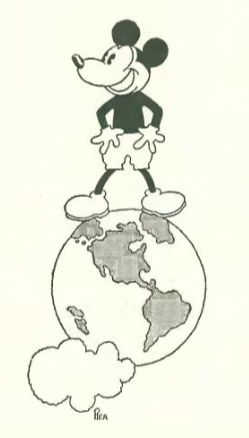
Gardner Rea correctly predicted the global domination of Mickey Mouse…

Peter Arno showed the dizzying effects of a Coney Island ride…

…however at the altar the thrill was gone, per Garrett Price

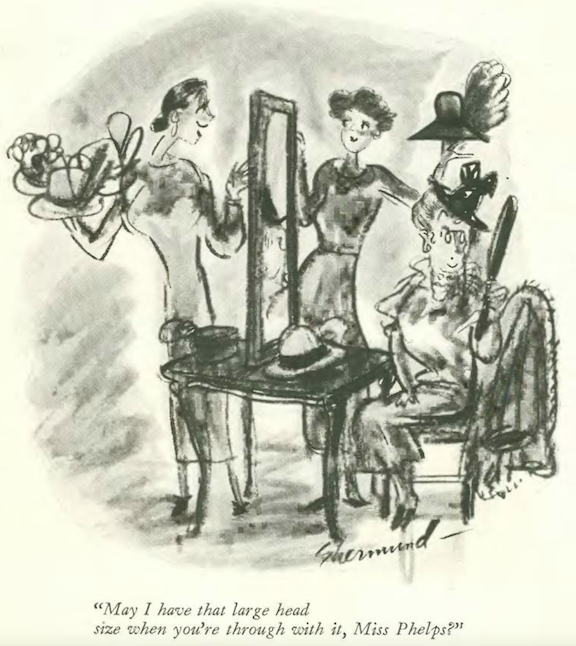
…another take on the ways of love, with Barbara Shermund...

…the newfangled diagonal bathtub continued to dazzle, with George Price

Gardner Rea offered up some subtle irony on the farm…

…and we close with James Thurber, in a poetic moment…

Next Time: A Light in Darkness…

The Power Broker

Above: Robert Moses in 1939 with a model of his proposed Battery Bridge Park Reconstruction; at right, 1934 Bryant Park renovation, view to the south on 6th Avenue from 42nd Street. (Wikipedia/NYC Parks Department)

The title for this entry comes from Robert Caro’s landmark 1974 biography of Robert Moses, The Power Broker: Robert Moses and the Fall of New York, which questioned the benefit of Moses’s monumental projects.

March 10, 1934 cover by Abner Dean.

Like him or not, few unelected officials have wielded more power than Moses, who through various appointed positions, including New York City Parks Commissioner, he was able to impose his will on mayors, legislators, congressmen, wealthy burghers, and even, on occasion, The White House. In turn he imposed his will on the city itself, clearing whole neighborhoods to lay down new roads that extended from Manhattan to the tip of Long Island, where neither farmer nor landed gentry could stand in his way. A profile written by Milton MacKaye examined what made Moses tick. An excerpt:

DON’T YOU DARE PUT ME ON HOLD…Relentless doesn’t begin to describe Robert Moses’s pursuit of power. Clockwise, from top left, Moses circa 1930; one of the swimming pools at the west bathhouse at Long Island’s Jones Beach, a project that helped launch Moses’s road to power; Long Island Expressway, which transformed Long Island from farm country (and a retreat for the rich) into a land of bedroom communities and public parks; the east parking field at Jones Beach. (Britannica/Library of Congress/U.S. National Archives)

In another excerpt, MacKaye noted that Moses had been named a member of the Triborough Bridge Authority; Moses would ultimately become chairman, and through this position would possess enormous, unchecked power and influence. Moses was skilled at creating legal structures that would favor his ambitions, burying language into legislative bills and other documents that would make him impervious to influence from mayors, legislators, governors and other elected officials.

A DIFFERENT KIND OF PLAYGROUND…Moses intensely disliked former New York Mayor Jimmy Walker, who used the Central Park Casino (top left) as his personal playground. Moses exacted his vengeance by having the historic casino razed in 1935 and replaced with the Rumsey Playground; at right, the 1936 Triborough Bridge (Berenice Abbot photo), a cluster of three separate spans connecting the Bronx, Manhattan, and Queens. It was developed through Moses’s Triborough Bridge Authority, which was impervious to influence from mayors, legislators and governors. While the city and state were strapped for funds, Moses reaped millions from tolls, which financed his other ambitions; bottom left, Moses in 1938. (Wikipedia/transalt.org/Library of Congress)

Final note, I highly recommend Caro’s The Power Broker—it’s a doorstop of a book, but also one of the best biographies of the 20th century and a must-read for anyone who wishes to understand how present-day New York came to be, and how it really works.

 * * *

Let’s Talk About the Weather

Robert Benchley, writing under the pseudonym Guy Fawkes, took a turn at “The Wayward Press” column, commenting on the sensationalistic coverage of the weather by the local press. In all fairness to the press, New York City had endured a blizzard as well as the coldest temperature ever recorded for the city: 15 below zero (Fahrenheit) on Feb. 9, 1934. (According to newspaper accounts, it was 14.3 below).

Benchley also commented on journalist Ernest Gruening (1887–1974), who was the editor of the New York Post for only four months in 1934, but during those four months he really shook things up.

EASY BOSS…Ernest Gruening was editor of the New York Post for only four months in 1934, but during that time he made life better for his newsroom employees by implementing an unheard of 40-hour work week. Gruening went on to serve as the governor of the Alaska Territory from 1939 until 1953, and as a U.S. Senator from Alaska from 1959 until 1969. (Photo from 1935 via Wikipedia)

Robert Benchley thought the press made too much of the city’s snowy weather, but these newsreels tell a different story:

 * * *

Punch Drunk

Critic John Mosher found slim pickings at the local movie houses, opting for Jimmy Durante’s Palooka as the best of crop:

RIBALDRY AT RINGSIDE…Clockwise from top left, Knobby Walsh (Jimmy Durante) tries to press his advantage during the weigh-in of boxer Al McSwatt (portrayed by William Cagney, the look-alike younger brother of James Cagney) in 1934’s Palooka; Durante thinks he’s found a winning fighter in Joe Palooka (Stuart Erwin); Joe’s father, Pete Palooka (Robert Armstrong) demonstrates why he’s nicknamed “Goodtime” with the help of Trixie (Thelma Todd); Durante with Lupe Vélez, who portrayed glamorous cabaret singer and fortune hunter Nina Madero. (IMDB)

 * * *

From Our Advertisers

We start with a couple ads from the back pages…the promoters of Chicago’s famed Stevens Hotel offered a unique perspective as they appealed to New Yorkers to come check out the “Century of Progress” World’s Fair, which proved so popular that it planned to reopen in May for a second year…at right, The Gotham catered to the ladies with a special cocktail bar that only allowed men in the company of a woman…

NICE DIGS…At left, The Stevens Hotel (now Hilton Chicago) and, at right, The Gotham (now The Peninsula) are happily still with us today. (Wikipedia)

…cigarette manufacturers continued to work on their biggest growth market with ads like this one from the Lorillard Tobacco Company…here a perceptive woman chooses to ignore the “brazen claims” of other tobacco companies and makes an informed decision to inhale an Old Gold…

…Liggett & Myers, on the other hand, stuck with this subservient pose, suggesting both are happy with their cigarette, and their station in life…

…another colorful ad from the makers of Schlitz beer…following the end of Prohibition Schlitz quickly became the world’s top-selling brewery, a position it would hold into the 1960s until it switched to cheaper brewing methods…

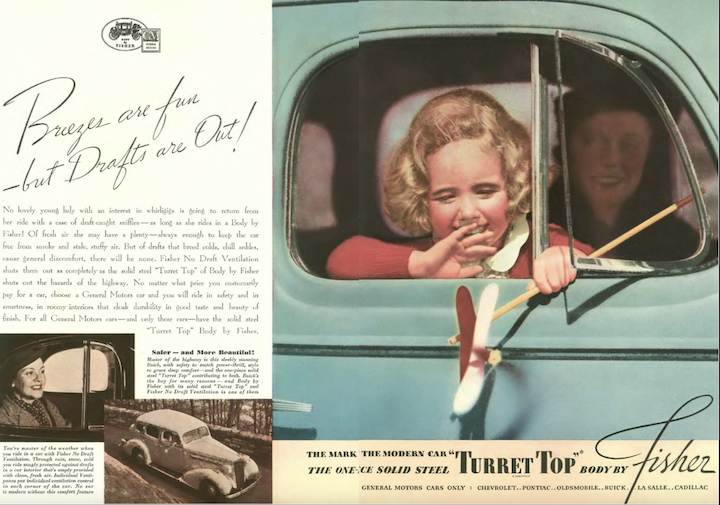
…the makers of Fisher car bodies (owned by General Motors) continued their lavish two-page spreads touting the homey comforts of their interiors…

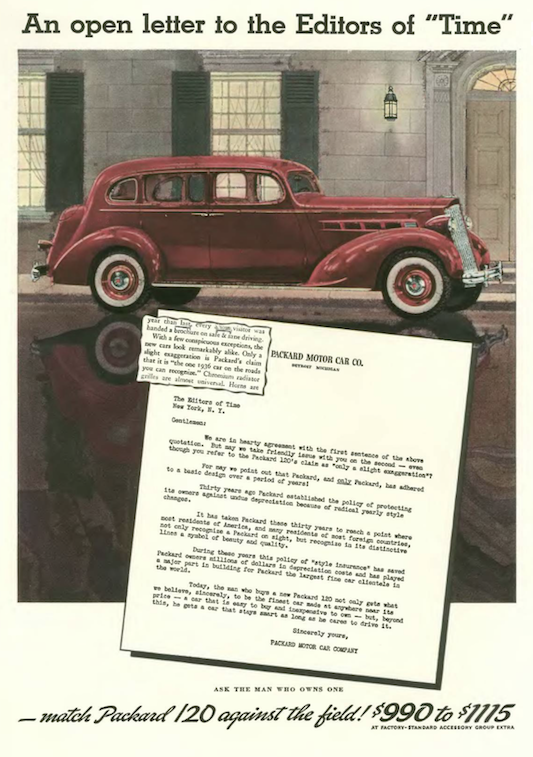
…and no more staid ads from luxury carmaker Packard, who ran this full-color, full-bleed spot…

…it’s almost springtime for Hitler, and Germany welcomed American tourists with promises of “Dreaming Villages” (whatever those are), charming health spas and places of romance and beauty…hmmm, no mention of swastika flags hanging from every building, or parades of goose-stepping thugs…

…this public service ad promoted the effectiveness of the National Recovery Act, offering the uptick in underwear sales as a sure sign of economic growth…

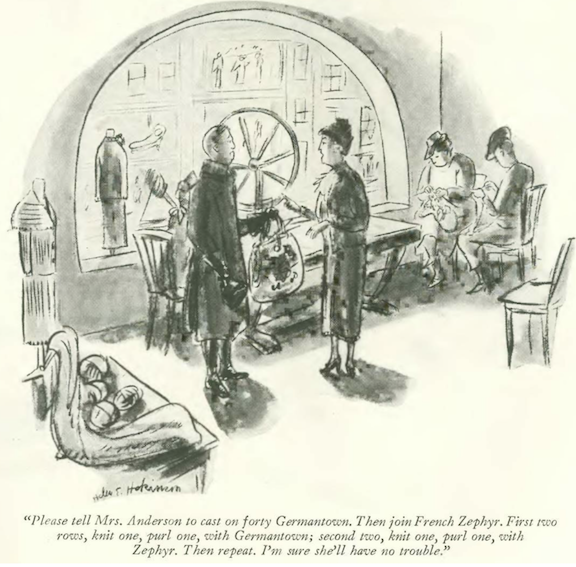
…on to our cartoonists, we begin with Helen Hokinson experiencing the results of the recent blizzard…

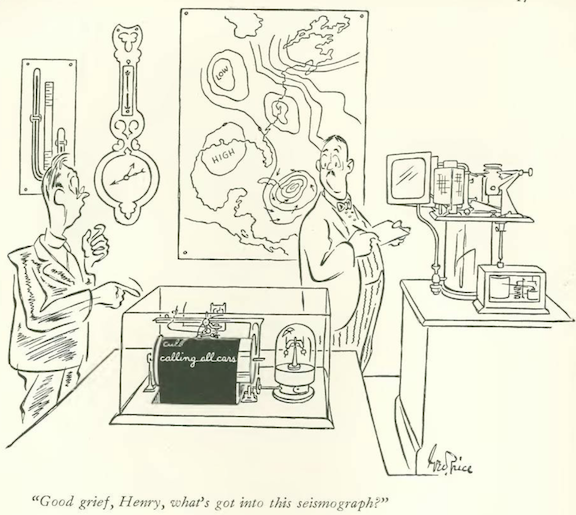
…as did Henry Anton, with a befuddled meteorologist…

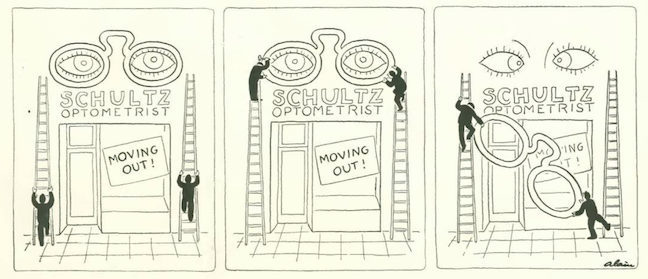
Alain (Daniel Brustlein) gave us this wordless gem…

…while Garrett Price presented a sculptor’s greatest challenge…

Alan Dunn gave us two women who expected more pizzazz from a recent funeral…

Peter Arno contended with some Peeping Toms…

…and James Thurber looked in on recent maneuvers in his war between the sexes…

Next Time: Art of the Machine…

A Joycean Odyssey

Above, James Joyce and his longtime partner Nora Barnacle, in Zurich, 1930. They would marry the following year when Joyce established residency in the UK. (SUNY Buffalo)

It began 103 years ago when the American literary magazine The Little Review published its latest installment of James Joyce’s landmark novel Ulysses—a chapter that featured an account of a wanker on a beach.

Jan. 20, 1934 cover by Adolph K. Kronengold.

More specifically, the passage described the novel’s main character, Leopold Bloom, pleasuring himself while gazing at a teenage girl. It didn’t take long for the pearl-clutchers at the New York Society for the Suppression of Vice to go after the editors of The Little Review, who were ultimately fined for obscenity and banned from publishing the remainder of the novel, which, by the way, Joyce had structured along the lines of Homer’s epic poem, the Odyssey.

Scenes in the novel that frankly described sexual acts and mocked rituals of the Catholic Church kept the book off American shelves until 1934, when District Judge John M. Woolsey ruled that the book was neither pornographic nor obscene. One wonders if Judge Woolsey took a cue from the end of Prohibition.

Lovers of literature, including New Yorker book reviewer Clifton Fadiman, rejoiced at the judge’s decision. We skip ahead to the Jan. 27 issue for Fadiman’s thoughts on the matter:

DUBLINER…James Joyce in 1928, as photographed by Berenice Abbott; announcement by Shakespeare & Company (Paris) of the first publication of Ulysses, 1921; cover of the American first edition, 1934, with Ernst Reichl’s “calmly audacious” jacket design. (Wikipedia/Abe Books)

 * * *

Pleasurable Diversion

We now turn to the Jan. 20 issue, in which Robert Benchley concluded his stage reviews with a generous nod to his dear friend and colleague, Dorothy Parker, whose short stories were being performed as sketches at the Barbizon-Plaza Hotel, the first fully-equipped music and arts residential center in the U.S.

INCIDENTAL ATTRACTION…Stories from Dorothy Parker’s 1933 collection After Such Pleasures were performed as sketches at the Barbizon-Plaza Hotel; at left, Parker with her husband, actor/author Alan Campbell. (Pinterest/Biblio)

 * * *

Une Séduction Américaine

Janet Flanner began writing her weekly New Yorker column “Letter from Paris” in September 1925, keeping readers informed on a variety of subjects ranging from arts and culture to politics and crime. In the Jan. 20 issue she introduced readers to French actor Charles Boyer (1899–1978), who was preparing to try his luck in Hollywood. Actually, Boyer made his first trip to Tinseltown in 1930, but his return would mark the beginning of a successful run in American cinema, including the 1944 mystery-thriller Gaslight and the 1967 romantic-comedy Barefoot in the Park.

MAKING BEAUTIFUL MUSIC…Charles Boyer as the ” gypsy” vagabond Latzi, with Jean Parker (center) and Loretta Young in 1934’s Caravan. (MoMA)

 * * *

The Way Of All Flesh

Lois Long continued to chronicle New York nightlife in her “Tables for Two” column, exuding “rapture” over the new theatre/restaurant Casino de Paree, which featured ample nudity as well as top performers dancer Bill “Bojangles” Robinson and comedienne Sheila Barrett.

The Casino de Paree featured revues, dancing, and side shows such as fire-eaters and animal acts. It closed in 1937, and the building later became home to the trendy 80s–90’s hot spot Studio 54.

CLOTHES OPTIONAL…A 1934 brochure offered glimpses of the entertainment to be had at the new theatre/restaurant Casino de Paree.

The Casino de Paree’s menu gave patrons some idea of what could be expected on the stage…

(The Culinary Institute of America Menu Collection)

…but if food and drink was the only thing on your mind, you could enjoy lobster thermidor for a buck seventy-five…

(The Culinary Institute of America Menu Collection; Craig Claiborne Menu Collection)

* * *

From Our Advertisers

How reliable were Goodyear’s tires? Hopefully more reliable than this adage, which Abraham Lincoln apparently never uttered…

…major exhibitions at the Grand Central Palace changed like the seasons, the National Automobile Show ceding to the National Motor Boat & Engine Show…

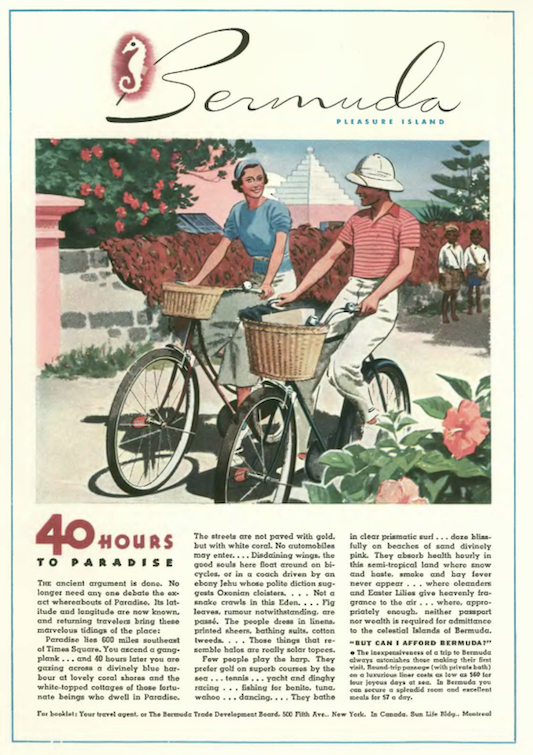
…if you’d rather have someone else do the sailing, the Bermuda line could take you on a round-trip cruise for as little as $60…

…with the end of Prohibition, the folks at White Rock were doubtless pleased to overtly advertise their product as a cocktail mixer…
…on to our cartoonists, Al Frueh contributed this rendering for the theatre review section…

Daniel ‘Alain’ Brustlein found this salon conversation a bit Mickey Mouse…

Helen Hokinson explored the results of family planning…

E. Simms Campbell gave us an unlikely den of thieves…

Gilbert Bundy had us wondering what ensued at this gentlemen’s club…

…and James Thurber fired the first shot in The War Between Men And Women…

…on to Jan. 27, 1934…

Jan. 27, 1934 cover by Rea Irvin.

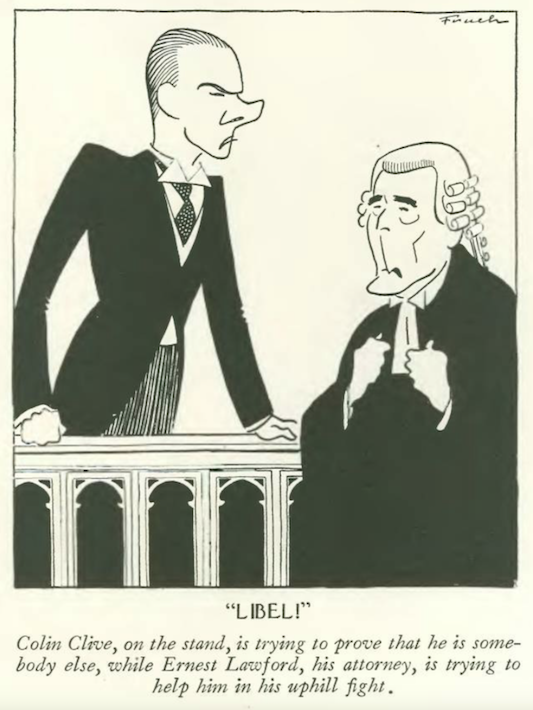
…where writer W.E. Woodward profiled Sinclair Lewis (1885-1951), whose manner had changed noticeably after receiving the Nobel Prize. An excerpt (with caricature by Al Frueh):

I’M SOMEBODY NOW…Sinclair Lewis (far right) with his 1930 Nobel Prize for literature. Other 1930 prize winners were, from left, Venkata Raman (physics), Hans Fischer (chemistry), and Karl Landsteiner (medicine).

 * * *

More From Our Advertisers

We begin with this lovely color illustration by Helen Hokinson, which also graced the cover of the January 1934 issue of The Stage

…the vintners at Moët & Chandon let New Yorkers know that their fine Champagne could be had from sole distributors Labourdette and Company…

…cultural critic Gilbert Seldes advised drinkers to abandon their degraded ways and return to the civilized consumption of an old favorite…

…while the folks at Guinness reminded us of their product’s deep history as well as its health benefits…

…and for the teetotalers the purveyors of Joyz Maté encouraged Yankees to take up this “strange” South American drink…the ad claimed it “fortifies the body against fatigue” (thanks to the generous amount of caffeine) and acts as a “corrective and a balancer” (it helped stimulate bowel movements)…

…on to our cartoons, we begin with Gardner Rea, borrowing from a running gag in the Marx Brothers’ 1930 film Animal Crackers, which featured Harpo chasing a sexy blonde around a mansion (apologies for the poor reproduction quality—the archival image was quite faint)…

Gilbert Bundy gave us a couple confronting the subtleties of Times Square…

Robert Day commented on the latest trend in taxicab conveniences: coin-operated radios for passengers…

…this two-page Little King cartoon by Otto Soglow revealed another side to our diminutive potentate…

…and the war between the sexes raged on, with James Thurber

Next Time: Under the Knife…


A Poke At Punch

In 1925 New Yorker founding editor Harold Ross wrote that he wanted his new magazine to be “humorous from a sophisticated viewpoint” and “record the situations of everyday life among intelligent and substantial people as do the English magazines, notably Punch, except that our bent is more satirical, sharper.”

Jan. 13, 1934 cover by Constantin Alajalov.

Sharper indeed, as was demonstrated in the Jan. 13, 1934 issue, when Ross’s young magazine took aim at Punch, which was founded in 1841 and had grown long in the tooth under the guidance of Sir Owen Seaman, whose Victorian sensibilities (he joined Punch in 1897) were ripe for parody by a magazine founded during the Jazz Age.

Writer and cartoonist V. Cullum Rogers (MagazineParody.com) notes that the eight pages devoted to “Paunch” was The New Yorker’s longest and most elaborate parody of another publication.

RIPE FOR THE PICKING…The covers of Punch for August 30, 1933, and The New Yorker’s 1934 parody.

E.B. White and Franklin P. Adams contributed parodies (“The Mall” by White and “The Intent Caterpillar” by Franklin) of what Rogers cites as “two of Punch’s favorite forms of bad verse: the sticky-sentimental and the mechanically clever.”

The New Yorker’s theatre critic Wolcott Gibbs joined the fun by penning “Mr. Paunch’s Cinema Review” (excerpt)…

…Rea Irvin and James Thurber offered up their cartooning skills…

Rea Irvin’s parody of a Punch cartoon. (Caption enlarged below).

…and Robert Benchley contributed this gem, “Hyacinths for Pamela.”

Rogers writes that although “Paunch” wasn’t promoted on the cover, “the issue it ran in became the first in The New Yorker’s nine-year history to sell out on newsstands. (The second sellout contained Wolcott Gibbs’s Time parody, which suggests a demand for such things).”

The parody issue concluded with this page of advertisements:

 * * *

The Show Must Go On

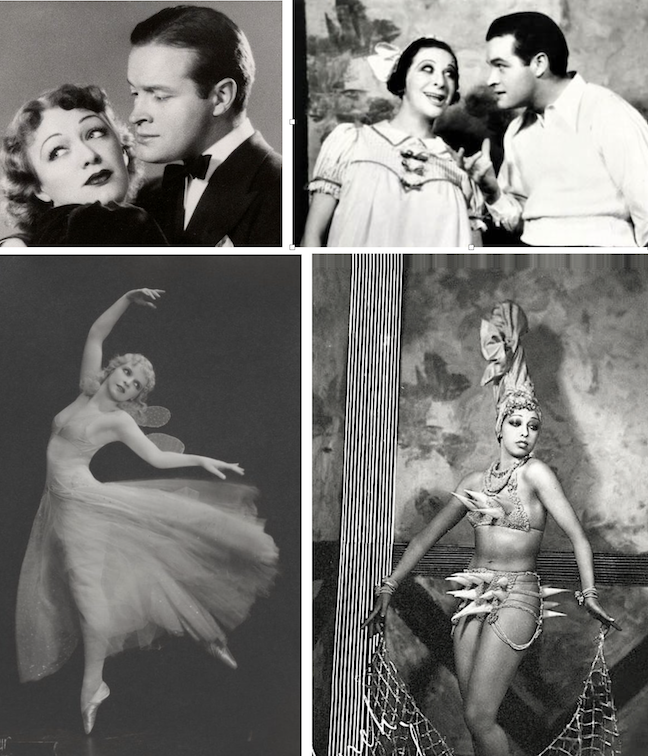
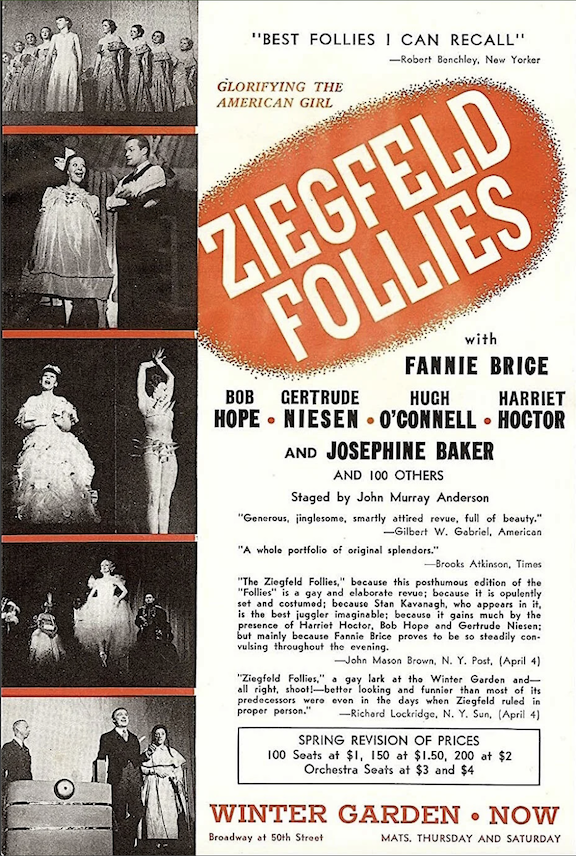
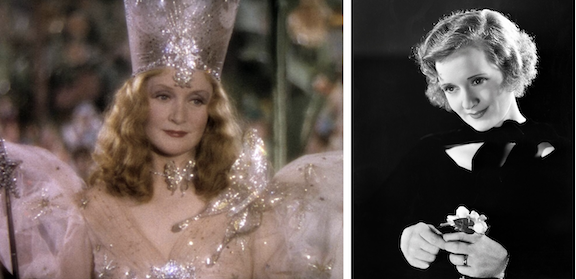
The death of Florenz Ziegfeld Jr. in 1932 did not put an end to his Follies; indeed, under the direction of his widow, Billie Burke, the show seemed to have new legs, at least according to Robert Benchley:

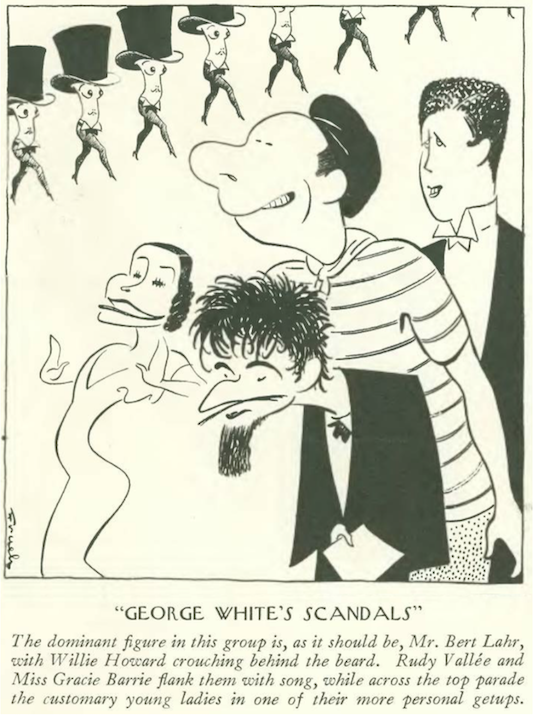
HOOFIN’ IT…Clockwise, from top left: Program for the 1934 Ziegfeld Follies; performers in the show included popular brother–sister dancing act Buddy and Vilma Ebsen, pictured here with Eleanor Powell in Broadway Melody of 1936 (most of us know Buddy Ebsen as Uncle Jed from The Beverly Hillbillies); Al Hirschfeld drawing of the show’s stars; Willie Howard, Fanny Brice and Eugene Howard in Ziegfeld Follies of 1934. (YouTube/NYPL)

* * *

Keen on the Airflow

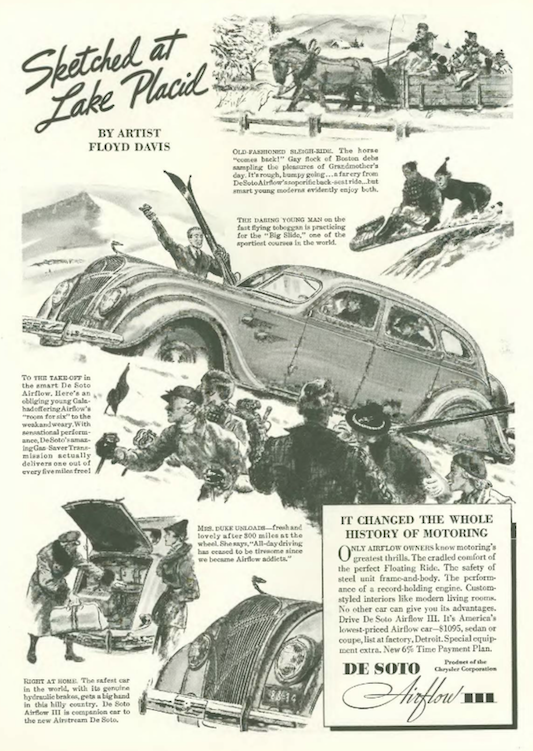
The streamlining trend in autos was not to E.B. White’s liking (see below), but the reviewer of the National Auto Show (pseud. “Speed”) was eager to take the Chrysler Airflow for a spin.

 * * *

From Our Advertisers

The Chrysler Corporation ran this two-page ad that took issue with E.B. White’s criticisms of the streamlining trend in automobiles, led by Chrysler’s “Airflow” model…here Chrysler responded with a note pinned to a tear sheet from the Dec. 16, 1933 “Talk of the Town”…You wrote this before you saw the new Chryslers, Mr. New Yorker

…with the National Auto Show still in town the splashy car ads continued, including this one from the makers of Fisher car bodies…

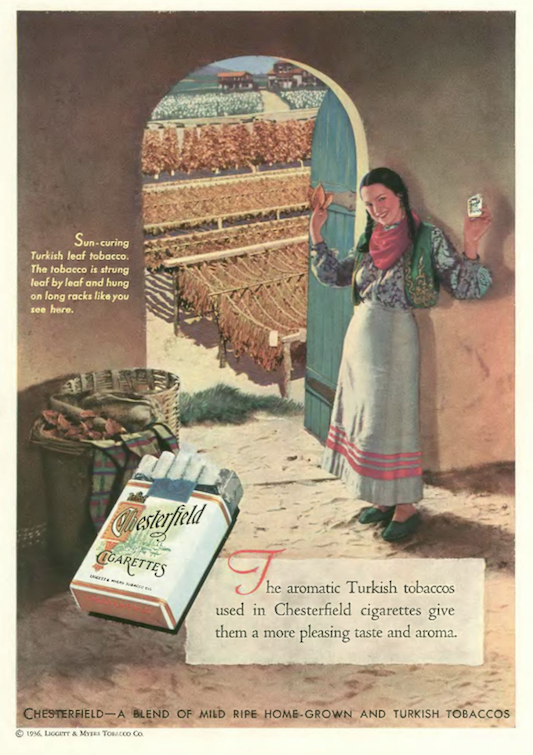
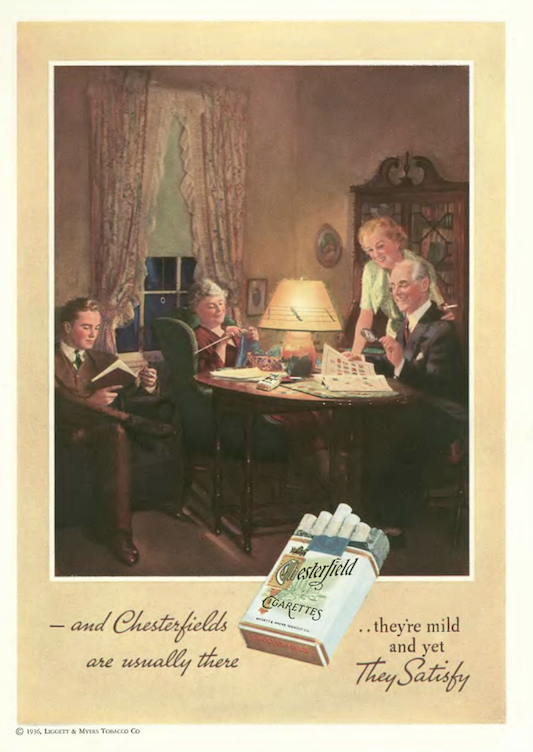
…another advertising stalwart, the Liggett & Myers Tobacco Company, gave us a young woman who enjoyed their Chesterfields “a lot”…

…Guinness was back for those who missed that taste of Dublin…

…and the folks behind “The Beer That Made Milwaukee Famous” placed their first ad in The New Yorker

…if you wanted to have your drink outside of the home, what better place than the Madison Room at The Biltmore…

…on to our cartoons, with begin with Perry Barlow and a tot losing sleep over the new year…
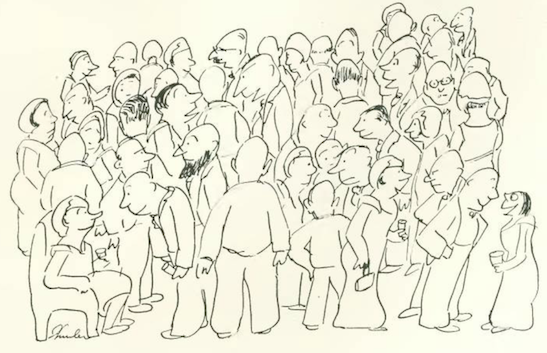
Kemp Starrett also explored the world of sleep deprivation…
…and we end with James Thurber, and a woman with a low tolerance for “cute” news…

…in case you are wondering, Anna Eleanor Sistie” Dall was the daughter of Franklin and Eleanor Roosevelt’s eldest child Anna Dall. When Dall separated from her husband in 1933, she moved into the White House with her children, Sistie and Buzzie.

TOO CUTE…Franklin Roosevelt with his grandchildren Anna Eleanor Sistie” Dall and Curtis “Buzzie” Dall in 1932. According to Buzzie, he and his sister lived in the White House from September 1933 to November 1935. (AP)

Next Time: A Joycean Odyssey…


America’s Love Affair

New York’s first big event of the new year was the annual National Auto Show centered at the Grand Central Palace.

Jan. 6, 1934 cover by Perry Barlow.

The year 1934 was all about aerodynamic design, with Chrysler leading the way with its ill-fated Airflow, a bit too ahead of its time. Other companies followed suit in more subtle ways, especially smaller manufacturers looking for novel ways to grab a cut of market share.

The trend in streamlining was inspired by such designers as Norman Bel Geddes, R. Buckminster Fuller and John Tjaarda

SLIPPERY SEDANS…Top left, a 1933 Briggs concept car, designed by John Tjaarda, on display at the Ford Exposition of Progress in Detroit; right, a 1932 concept model of Motorcar No. 9 by Norman Bel Geddes; below, a reproduction of R. Buckminster Fuller’s 1933 Dymaxion car. (detroitpubliclibrary.org/Harry Ransom Center/Wikipedia)

Chrysler pulled out all stops to promote its radical new design at the National Auto Show, even producing a special seven-page newspaper, Chrysler News, to promote the car’s many wonders…

…the inside pages featured The New Yorker’s Alexander Woollcott marveling over the Airflow’s design (at the time Woollcott was a Chrysler pitchman).

Although other manufacturers didn’t go as far as Chrysler, the streamlining trend was seen in slanting radiators and sweeping fenders.

LAIDBACK DESIGN…Clockwise, from top left, 1934 Hudson Terraplane K-coupe; 1934 Studebaker President Land Cruiser; 1934 Graham-Paige; 1934 Hupmobile. (hemmings.com/auto.howstuffworks.com/YouTube)

The review also noted the novel way Pierce-Arrow sound-insulated their motorcars:

IT’S STUFFY IN HERE…For sound insulation, luxury carmaker Pierce Arrow used kapok, a fine, fibrous, cotton-like substance that grows around the seeds of the tropical ceiba tree. (Pinterest)

 * * *

Wearing the Pants

In 1934 it was still something of a scandal for a woman to wear trousers. Like Marlene Dietrich, Greta Garbo was an actress who could and would defy gender boundaries, and in Queen Christina she effortlessly portrayed the Swedish queen, who in real life was given an education and responsibilities expected of a male heir and often dressed as a man. The film was a critical success, although John Mosher felt Garbo overwhelmed the movie.

READY FOR HER CLOSEUP…Clockwise, from top left, in one of cinema’s most iconic scenes, Queen Christina (Greta Garbo) stands as a silent figurehead at the bow of a ship as the camera moves in for a tight close-up; Garbo with co-star and real-life romantic partner John Gilbert—it was the last of the four films the two would make together; Christina kisses her handmaiden Ebba (Elizabeth Young)—some have suggested Garbo was portraying the queen as bisexual, however the kisses with Ebba were quite chaste; MGM film poster. (moviemaker.com/pre-code.com/IMDB)

 * * *

She Also Wore Pants

Katharine Hepburn quickly took Hollywood by storm, earning her first Oscar at age 26 for her performance in 1933’s Morning Glory. However, New Yorker drama critic Robert Benchley didn’t see that talent necessarily translating to the Broadway stage, at least not in The Lake:

A RARE FLOP…Robert Benchley thought it was “almost cruel” to foist Katharine Hepburn’s stardom onto the stage in a flop like The Lake. At left, cover of the Playbill; at right, Hepburn in one of the costumes for the production. (Playbill/Facebook)

Benchley correctly surmised that the play’s producer, Jed Harris, was trading on the young star’s “meteoric” film success, but Hepburn’s beauty and intelligence were not enough to save this critical flop, which closed after 55 performances.

 * * *

On the Town

The chronicler of New York fashion and nightlife, Lois Long, detested Prohibition but after repeal also missed the intimacy of speakeasy life. In her latest “Tables for Two” column Long seemed to be settling into a routine and finding new favorites, like the Waldorf’s Sert Room and Peppy de Albrew’s Chapeau Rouge.

THIS WILL DO NICELY…Lois Long sipped Casanova ’21 champagne while enjoying the music of Catalonian violinist Enric R. Madriguera (bottom left) amid the murals of Madriguera’s countryman Josep Maria Sert (right images) in the Waldorf-Astoria’s Sert Room. (waldorfnewyorkcity.com/Wikipedia)
FAMILIAR FACES…No doubt Lois Long knew Argentine dancer Abraham “Peppy” de Albrew (left) from his days at Texas Guinan’s notorious 300 Club; Long found de Albrew’s new club, Chapeau Rouge, to be a welcoming slice of Paris, enlivened by the dancing of Antonio and Renee de Marco, pictured at right with their dogs in front of San Francisco’s Fairmont Hotel, circa 1937. (Wikipedia/digicoll.lib.berkeley.edu)

 * * *

From Our Advertisers

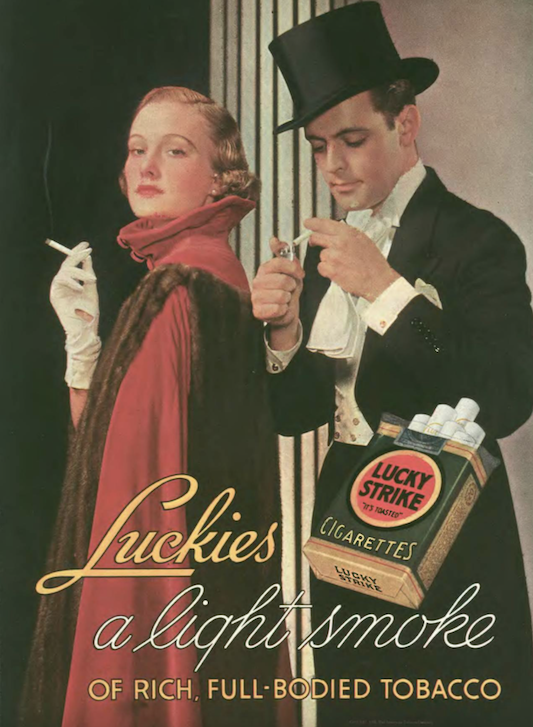
Thanks to the auto show The New Yorker was raking in a lot of advertising dollars on top of the steady income from tobacco companies and the new infusion of revenue from purveyors of adult beverages…Lucky Strike grabbed the back cover for this striking ad…

…and contrary to the wisdom of the ages, American speed skater Irving Jaffee (who won two gold medals at the 1932 Winter Olympics) credited his athletic prowess in part to smoking unfiltered cigarettes…

…finally, real French Champagne was arriving on American shores…

…as was authentic Scotch whisky…

John Hanrahan was The New Yorker’s policy counsel from 1925 to 1938 and is credited with putting the magazine on firm financial footing during its infancy…in 1931 Hanrahan rebranded the Theatre Guild’s magazine, renaming it The Stage and filling it with the same splashy ads he was also able to bring to The New Yorker…the Depression was a tough time to launch a magazine, and even though Hanrahan added articles on motion pictures and other forms of entertainment in 1935, the magazine folded in 1939…

…and with the National Auto Show in town, car manufacturers filled The New Yorker’s pages with expensive ads…we’ll start with Walter Chrysler’s long-winded appeal on behalf of the Airflow…

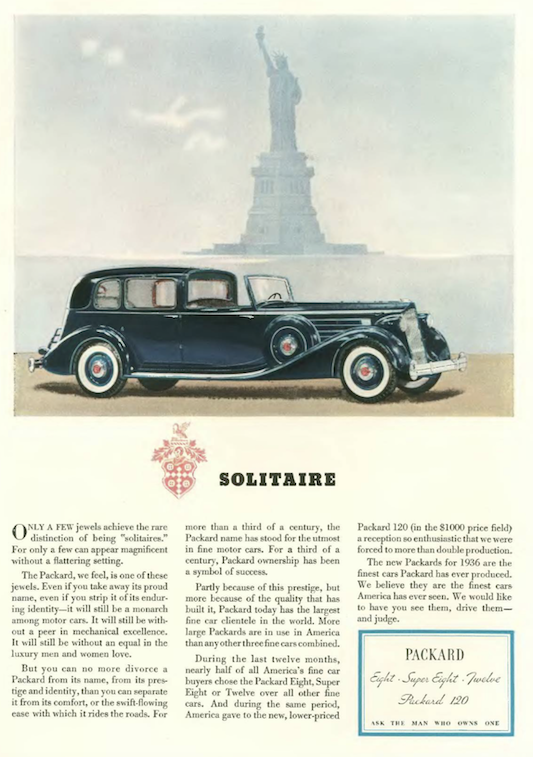
…the folks at the usually staid Packard tossed in some unexpected color…

…Pierce-Arrow, at the time America’s top luxury car, offered this sneak peak of its 1934 Silver Arrow…

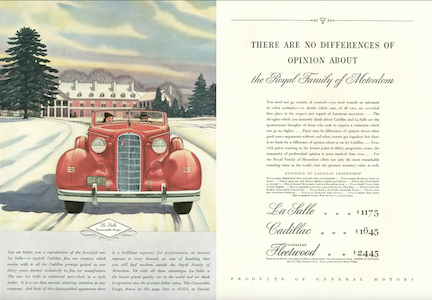
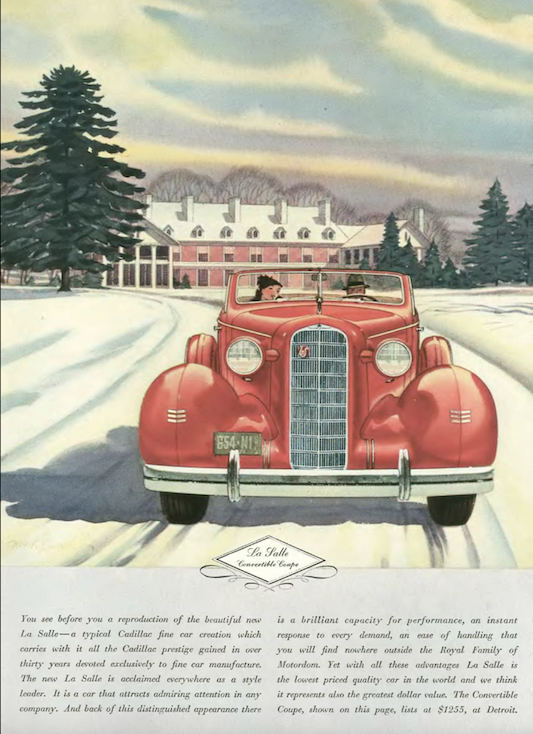
…Cadillac bought this spread to announce both its luxury and down-market brands…

…Hudson Motor Car Company invested in three color pages to announce the rollout of their 1934 Hudson 8…

…and their low-priced yet powerful Terraplane…

…Fisher, which made car bodies for General Motors, offered up this color photo of a pretty aviatrix to suggest their interiors were as fresh and clean as the clear skies above…

…Studebaker also paired flying with their latest models…

…Nash employed cartoonist Wayne Colvin for a series of six ads sprinkled across the back pages…here are two examples…

…on to our cartoonists, Perry Barlow used the auto show as inspiration for this cartoon, which appeared along with the review…

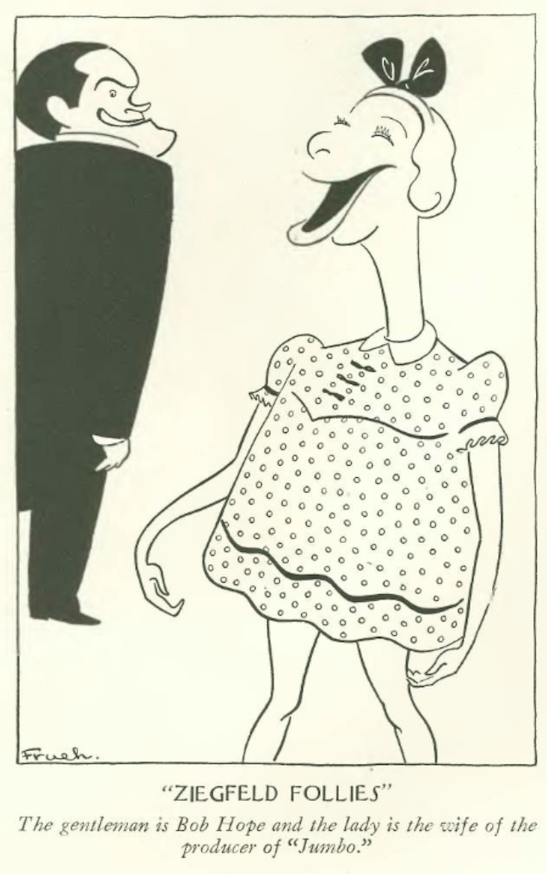
Al Frueh drew up these images for the theatre section…I believe this is the first appearance of Bob Hope in the magazine…

…some housekeeping…I accidentally included this James Thurber cartoon and…

…this Rea Irvin cartoon in my post for the Dec. 30, 1933 issue…they belong with the Jan. 6 issue…

Robert Day offered up a roving reporter…
Carl Rose looked in on a wine connoisseur…
…and we close with a steamy image, courtesy Alan Dunn

Next Time: A Poke at Punch…
Headline News

The news of the day in May 1933 included a visit to the U.S. by Irish playwright George Bernard Shaw, a controversial Diego Rivera mural at Rockefeller Center, the abandonment of the Gold Standard, and the continuing saga of legal beer.

May 13, 1933 cover by Adolph K. Kronengold.

Writing under the pseudonym “Guy Fawkes,” Robert Benchley opined on the state of the print media in “The Wayward Press”…an excerpt:

NEWSMAKERS CIRCA 1933 included George Bernard Shaw (left), here being escorted by actors Charlie Chaplin and Marion Davies from a Hollywood luncheon hosted by Davies in March 1933; other headlines touted the return of legal beer and the suspension of the gold standard by the Roosevelt administration—everyone was required to deliver all gold coin, gold bullion and gold certificates owned by them to the Federal Reserve by May 1 for the set price of $20.67 per ounce. Pictured are guards stocking returned gold in New Jersey bank vaults, 1933. (Pinterest/history.com)

 * * *

Selling the Pitch

Babe Ruth was something of a freak of nature, becoming the “Sultan of Swat” despite a life of heavy drinking, poor eating habits and erratic attention to training regimens. Nevertheless, as Ruth neared the end of his career at age 38 he could still put on a show. In his “Notes and Comment,” E.B. White was hoping for just that sort of thing:

STILL GOT IT…E.B. White would get his wish for some “real showmanship” at the end of the 1933 season, when famed Yankee slugger Babe Ruth—in his 20th year in the majors—volunteered to pitch against the Red Sox in the final game of the season at Yankee Stadium. Not only did Ruth pitch a complete game, he also hit his 34th homer of the season in the Yankees’ 6–5 victory. (ballnine.com)

 * * *

From Our Advertisers

I wonder what it was like to cruise on the Dnieper River for fourteen days through “Colorful Ukrainia” during the Great Famine that Stalin imposed on that land, killing as many as five million people…

…more ads from the back pages touting various libations including Trommer’s “White Label” beer, a drink made from conch juice called “Konktail,” and an ad illustrated by William Steig promoting “imitation gin and other flavors” made by Red Lion…none of these products exist today…

…however you can still buy canned spaghetti, if that is your thing, but not “Force” breakfast cereal…

…still more selections from the back pages…on the left, an ad for Pear’s Soap that introduced us to “wise parents” whose children “are well-bred—the ‘nice people’ of tomorrow”…on the right, the lifeless gaze of a woman who pondered how life could be better in Tudor City…and in the middle, an unlikely one-column ad from luxury car maker Pierce Arrow…the automaker was America’s answer to Rolls Royce, but the Depression would take it down by 1938…

…I’m guessing the Velveeta is the mild one…

…technology was transforming beachwear, including this “Swagger Boy” outfit spun from Dupont’s latest synthetic, Acele…

…B. Altman, on the other hand, went full-color to promote their exclusive, imported fabric under the trade name Meadowbrook…

…and who ever thought a tire could look so posh, here dominating a gathering of the smart set…

…and look at this swell, sporting top hat and walking stick, but he also knows a good value when it comes to his tires…

…we move on to our cartoons with James Thurber and a lot of people apparently going nowhere…

Helen Hokinson’s girls were all ears at the latest club gathering…

Otto Soglow’s Little King got in on the excitement of legal beer…

…and we continue to the issue of May 20, 1933, with a cover by Arnold Hall, who did at least eight covers for The New Yorker during the 1930s…

May 20, 1933 cover by Arnold Hall.

The big news in this issue was Mexican artist Diego Rivera and his controversial mural at Rockefeller Center. Rivera’s New Yorker profile was written by Geoffrey Hellman (1907–1977), who beginning in 1929 served as the magazine’s principal writer for “The Talk of the Town.” Here’s an excerpt, with illustration by Al Frueh:

What got Rivera in hot water with John D. Rockefeller Jr. and family was a mural that departed somewhat from the artist’s earlier study sketches—Rivera had been hired to depict “man at the crossroads,” looking to the future with uncertainty but also with hope for a better world.

According to a 2014 story by NPR’s Allison Keyes, leftist organizations and various communist groups in New York criticized Rivera for agreeing to work with capitalist paragons like the Rockefellers. In response, Rivera sent assistants to find a picture of Bolshevik leader Vladimir Lenin. “If you want communism, I will paint communism,” he apparently said.

The subsequent inclusion of Lenin in the mural led to protests by the Rockefeller family, the press and the public. Rivera was ultimately asked to leave the country, losing yet another commission for the Chicago World’s Fair. Rivera got paid for his Rockefeller Center mural, but the work itself was demolished.

After returning to Mexico Rivera recreated the mural, adding some vengeful references (see below) to his 1934 work, Man, Controller of the Universe.

Rivera’s wife, Frida Kahlo, had accompanied him to New York, and during their time in the states (1930-34) she produced a number of now-famous paintings. However in 1933 she was not recognized as a serious artist. Indeed when she visited with the Detroit News in 1932, the headline read, “Wife of the Master Mural Painter Gleefully Dabbles in Works of Art.” In the same vein, Hellman perceived Kahlo as nothing more than a pretty helpmeet.

MORE THAN A PRETTY FACE…At left, Diego Rivera and Frida Kahlo attending an art exhibition in New York, 1933; at right, Kahlo and Rivera before the controversial mural at Rockefeller Center. Although an unknown in the art world in 1933, Kahlo would one day eclipse her husband’s fame. (SFGate/Pinterest)
MISCONCEPTION…Clockwise, from top, an early sketch of the Diego Rivera’s mural differed from what he ultimately painted in Rockefeller Center. After the mural was destroyed in 1934, Rivera recreated the work under the title Man, Controller of the Universe, now on display at the Palacio de Bellas Artes in Mexico City. A detail of that work shows Vladimir Lenin holding hands with workers of different races. Below, juxtaposed with the image of Lenin in that painting was another famous face, that of John D. Rockefeller Jr., depicted drinking martinis with a prostitute. Touché!
(Museo Frida Kahlo)

Rivera’s Rockefeller Center mural was eventually replaced in 1937 by American Progress, painted by the Spanish artist José Maria Sert:

(Flickr)

The irony of the Rivera controversy was not lost on E.B. White, who offered this ballad in response:

 * * *

Keep it in Your Pocket

E.B. White again, this time opening his column with thoughts on the anti-Hitler parade that was held in New York.

White refers to his “swastika watchfob”…before the Nazis came to power, the swastika was known to many cultures as a symbol of prosperity and good luck.

IT’S THE REAL THING…In 1925 Coca Cola made a lucky brass watch fob in the shape of a swastika. At that time the swastika was still a symbol of good luck. (Reddit)
SHOW OF UNITY…Anti-Hitler parade in New York protested the May 10, 1933 book burnings across Nazi Germany. (encyclopedia.ushmm.org)

In his weekly column Howard Brubaker added this observation regarding life in Nazi Germany…

Back home, folks could still enjoy a taste of Germany that wasn’t associated with violence and hate…an excerpt from “The Talk of the Town”…

GEMÜTLICHLüchow’s opened in 1882 when Union Square was still New York’s theater and music hall district, and featured seven dining rooms and a beer garden. The restaurant closed in 1982 and was demolished in 1995 to make way for an NYU dormitory. (Pinterest/MCNY)

 * * *

From Our Advertisers

The architecture profession fell on hard times during the Depression. In 1931 the Architects’ Emergency Committee began promoting the talents of unemployed architects who were willing to work for less than half their ordinary fee, limiting charges to materials, a small amount of cash, and a place to sleep…this is an example of a series of ads that ran in The New Yorker in the spring of 1933…

…one profession not feeling the hard times?—the makers of tobacco products, and specifically cigarettes…

…speaking of hard times, we turn to our cartoons and Gardner Rea

…and we close on a bright note, otherwise known as Peter Arno

Next Time: Rebirth of a Nation?