Waldorf’s Salad Days

While Manhattan is home to some of the world’s most iconic buildings, it is also known for knocking them down. Sometimes it was a matter of changing tastes, but more often than not it was the steamroller of economic progress that flattened any sentimental soul that stood in its path.

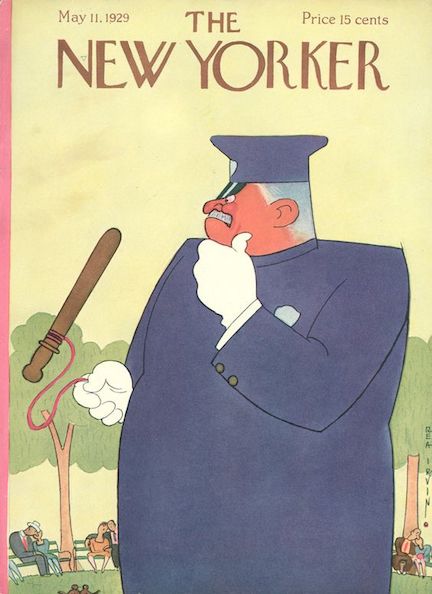
May 11, 1929 cover by Rea Irvin.

The old Waldorf-Astoria symbolized the wealth and power of the Gilded Age, but in the Roaring Twenties the storied hotel — with all its Victorian turrents, gables and other doo-dads — looked hopelessly dated despite being just a bit over 30 years old (the Waldorf opened in 1893, and the much larger Astoria rose alongside it four years later). A group of businessmen, led by former mayor Al Smith, bought the property to build the Empire State Building — an art deco edifice that would scream Jazz Age but would be completed at the start of the Great Depression. The New Yorker’s James Thurber reported on the old hotel’s last day in the May 11, 1929 “Talk of the Town”…

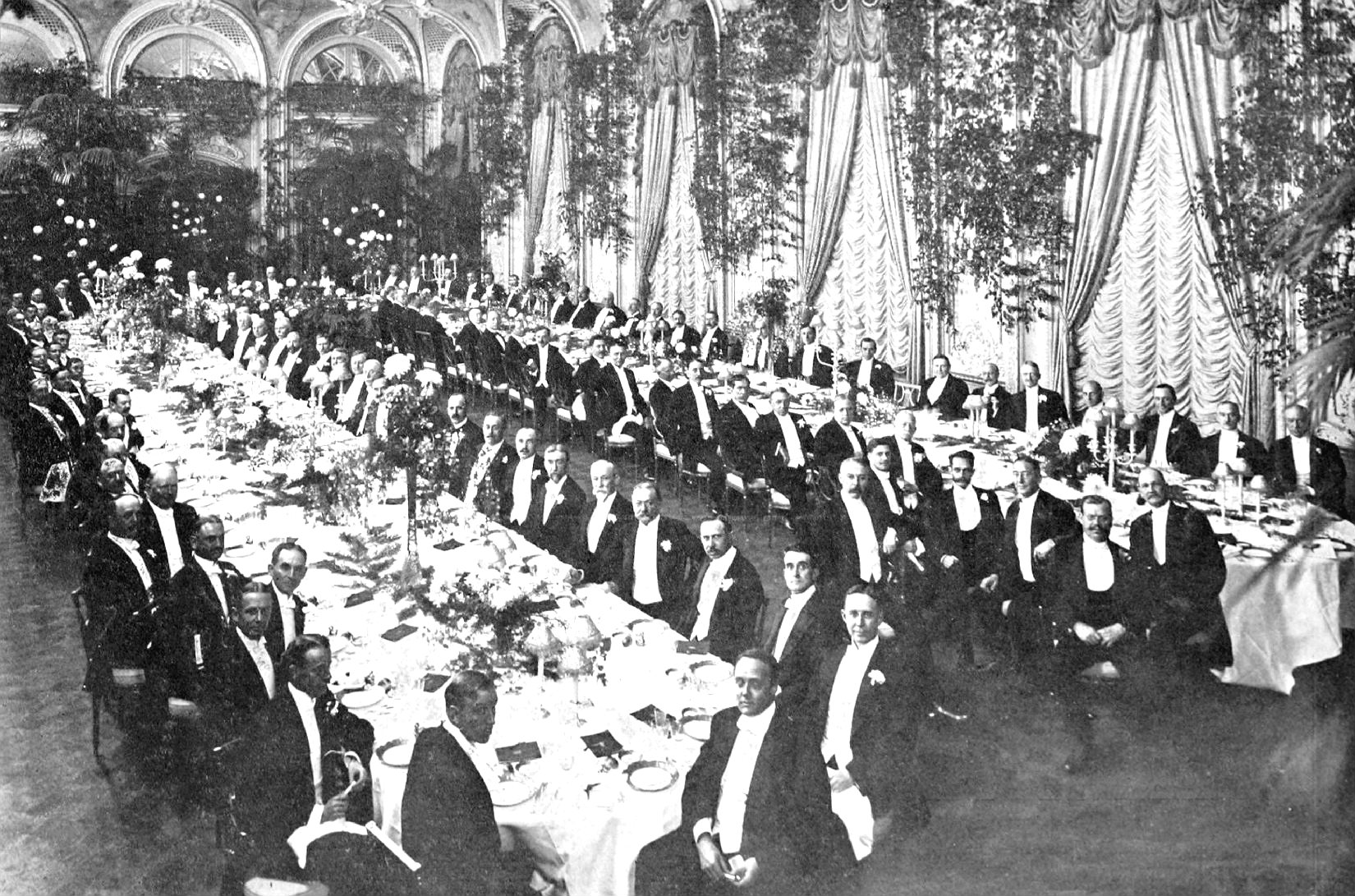
THEY LIKED RICH FOOD…1909 banquet in the Grand Ballroom at the Waldorf-Astoria honoring US Steel founder Elbert Gary. (Wikimedia Commons)

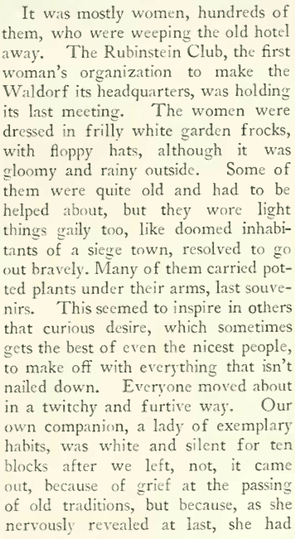
Thurber wrote of the hundreds of club women who mourned the loss of their familiar meeting rooms, and one elevator operator who would not be joining their chorus of sobs…
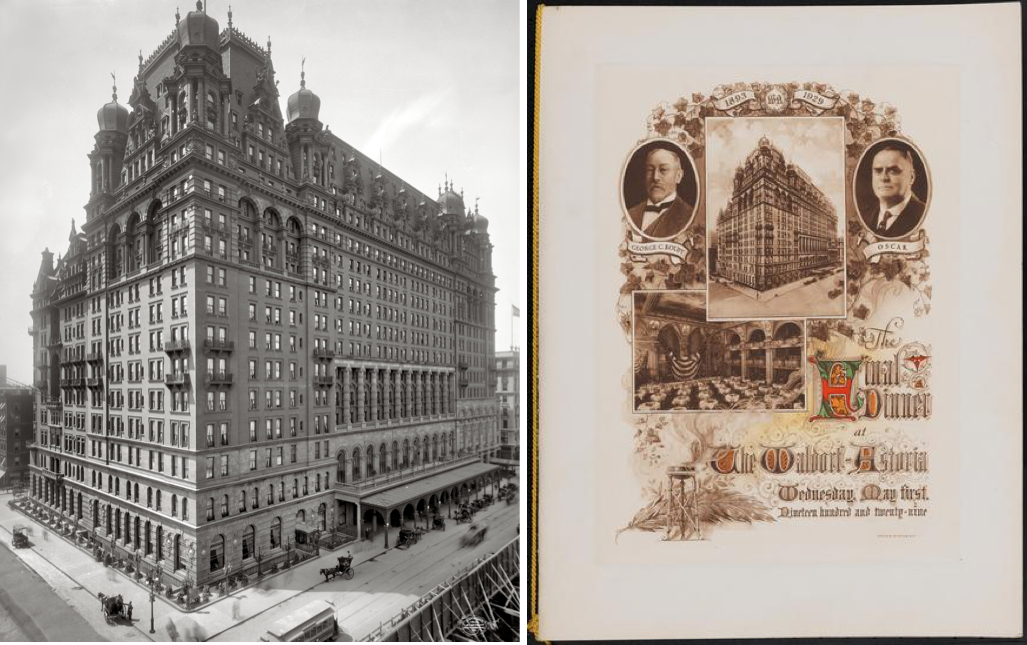
HEYDAY…the old Waldorf-Astoria hotel circa 1900, and the cover for the menu announcing “The Final Dinner.” The menu included a cherrystone clam cocktail, turtle soup, crown of bass (in lobster sauce), mignon of spring lamb (chasseur), supreme of guinea hen (tyrolienne), bombe mercedes ice cream, and coffee. (Bowery Boys/Museum of the City of New York)
THEY’RE SELLING YOU…Illustration depicting an auction of items from the hotel. (Museum of the City of New York)

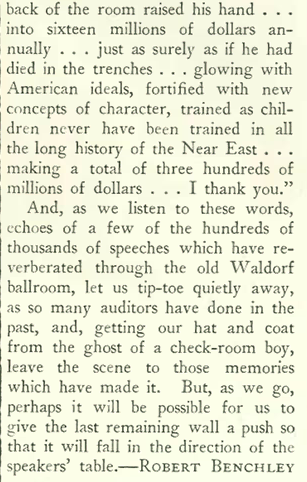
In the “Reporter at Large” column, humorist Robert Benchley supplied his own perspective on the closing of the venerable hotel, and the countless speeches that reverberated between its walls…

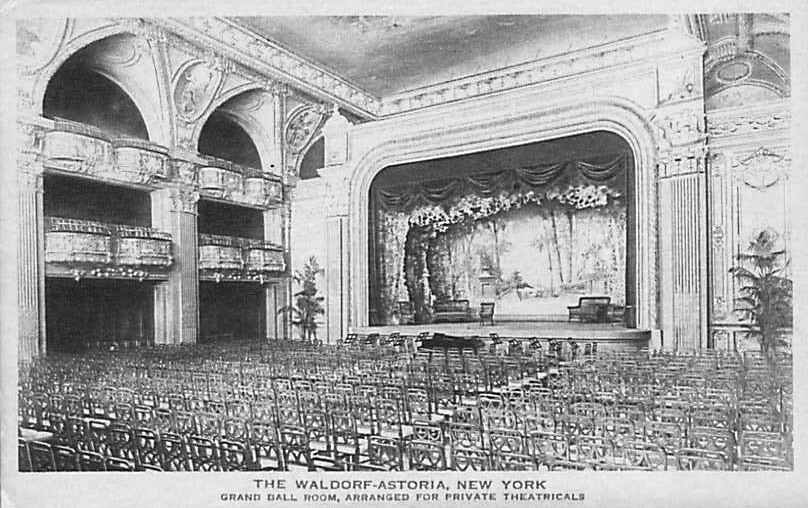
A 1903 image of the Grand Ball Room, “arranged for private theatricals. “(New York Public Library)

Benchley offered excerpts from dozens of hypothetical speeches, and then offered this final benediction to the old hotel:

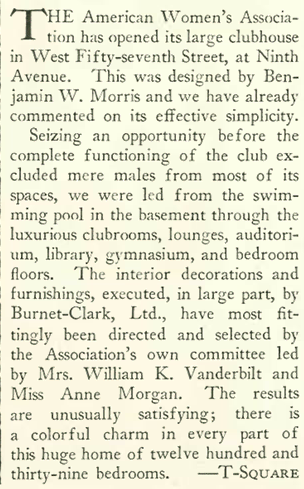
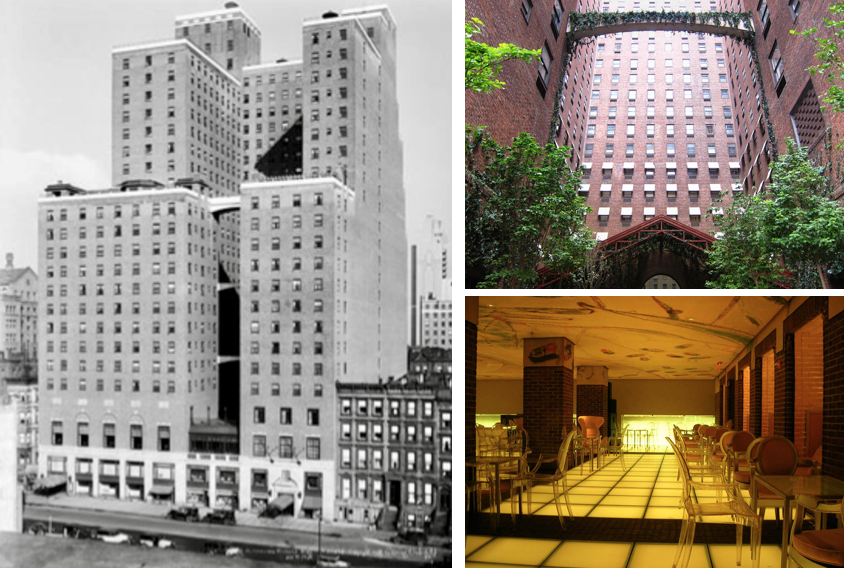
In his “The Sky Line” column, architecture critic George S. Chappell (aka T-Square) looked in on the newly completed American Woman’s Association clubhouse and residence for young women on West 58th Street. Developed by Anne Morgan, daughter of J.P. Morgan, the building contained 1,250 rooms and featured a swimming pool, restaurant, gymnasium and music rooms along with various meeting rooms.

TRAINING GROUND…At left, the American Woman’s Association clubhouse and residence in 1932. At right, view of the central atrium of the AWA residence, now the Hudson Hotel. Below, the Hudson Bar (renovated after 1997), which has been featured in a number of TV shows including Gossip Girl and Sex and the City. (Liza DeCamp/Nan Palmero top right/RoryRory bottom)

In a 1998 New York Times “Streetscapes” feature, Christoper Gray cites a 1927 Saturday Evening Post interview with Anne Morgan, who said she believed women were at a temporary disadvantage in the business world and therefore founded the American Woman’s Association as “a training school for leadership, a mental exchange” where women “can hear what other women are doing.” After the AWA went bankrupt in 1941, the building was converted into The Henry Hudson Hotel, open to both men and women. From 1982 until 1997 the building’s second through ninth floors served as the headquarters for public television station WNET. The MacNeil/Lehrer NewsHour (now the PBS NewsHour) was broadcast from the building during that time.

*  *  *

Punching for Peace

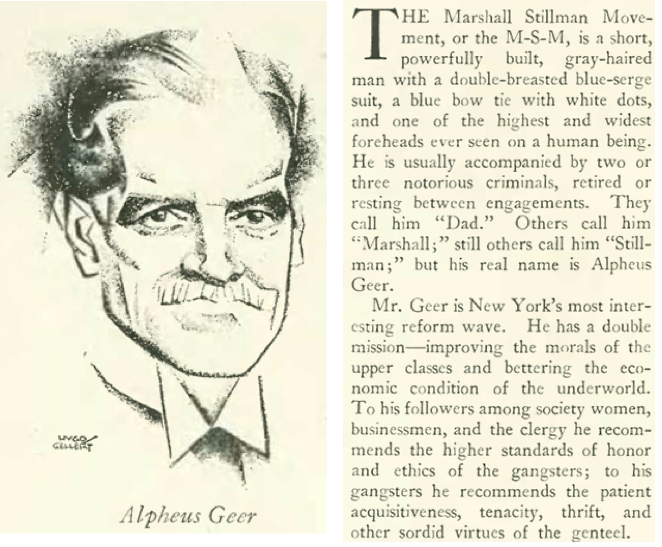
The old New Yorker was filled with personalities virtually unknown today, but who had tremendous influence in their time. Among them was Alpheus Geer (1863-1941), who founded the Marshall Stillman Movement, which promoted the sport of boxing as a way to steer young men away from a life of crime. An excerpt (with illustration by Hugo Gellert):

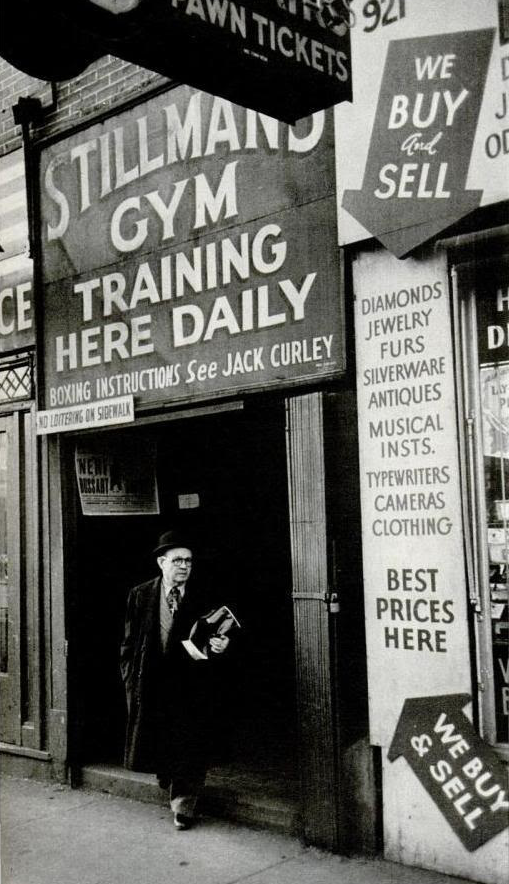
Alpheus Geer help found Stillman’s Gym in 1919 as a way to promote his Marshall Stillman Movement methods of boxing. Many famous fighters trained in the dank, smoky atmosphere of Stillman’s, including Jack Dempsey, Joe Louis and Rocky Marciano. Pictured above is famed boxing trainer Charley Goldman leaving Stillman’s Gym, circa 1940s. (easthamptonstar.com)

 *  *  *

Before we turn to the ads, this “Out of Town” column from the back pages struck an unusual tone regarding the types of tourists planning a summer in Germany…

…and from our advertisers, this ad promoting Louis Sherry’s new “informal restaurant” at Madison and 62nd Street…

WHAT’S IN A NAME…The Louis Sherry restaurant at Madison and 62nd, circa 1930. At right, the building today, now occupied by the French fashion company Hermès. (McKim, Mead & White / nycarchitecture.com)

Louis Sherry ran a famous restaurant at Fifth Avenue and 44th Street from 1898 to 1919 (like many famed restaurants, Prohibition helped put an end to it). Sherry died in 1926, so the owners of the new restaurant were merely trading on his name. In addition to a “delicacies shop” (gourmet foods were arrayed in the plate glass windows) Louis Sherry also contained a tea room, ice cream parlor and a balcony restaurant…

…like the Sherry restaurant, the new Hotel Delmonico traded on the fame of the old Delmonico’s Restaurant, which also fell victim to Prohibition by 1923. Today the hotel is best known as the place where the Beatles stayed in August 1964…

…here is another ad from Clicquot Club trying its best to sell its aged “Ginger Ale Supreme” to dry Americans. Famed avant-garde-art patron and party host Count Etienne de Beaumont (who looked like he’d had a few of something) testified how Cliquot “blends very agreeably” with the champagne most Americans cannot have…

…well, if you couldn’t have a legal drink, maybe you could entertain your friends with TICKER…”The New Wall Street Game That is Sweeping America!” My guess is this game didn’t sell so well after Black Tuesday, Oct. 29, 1929…

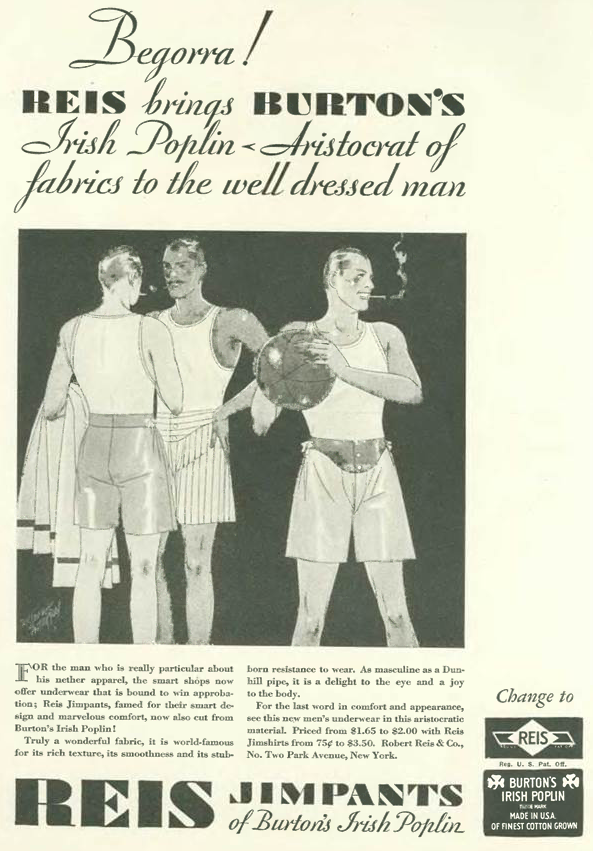
…those BVD’s aren’t good enough for you? Then try the “Aristocrat of fabrics” (and have a smoke while you toss the medicine ball around with the gents)…

…and here is more evidence that the Roaring Twenties were losing their growl even before the big crash—the straight flapper figure was out; it was now the “season of curves”…

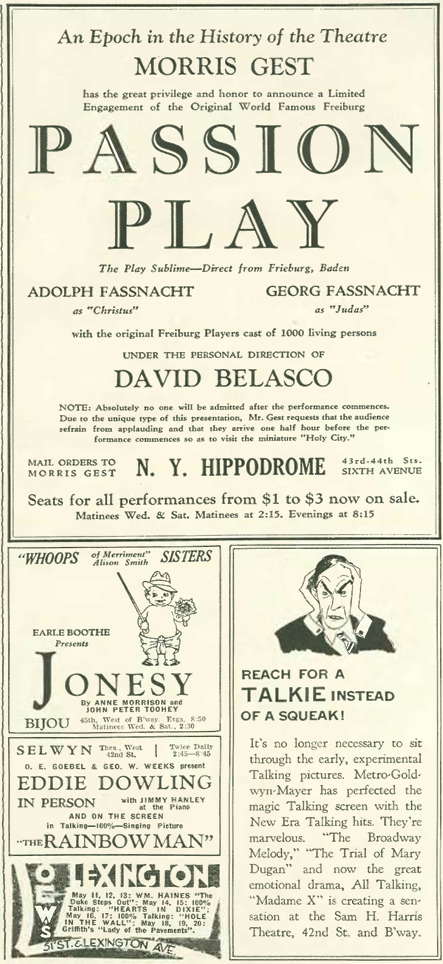
…a look at some of the cheap ads in the back of the magazine, including the one at bottom left from the Sam Harris Theater that played on the Lucky Strike cigarette slogan (“Reach for a Lucky instead of a sweet!”)…

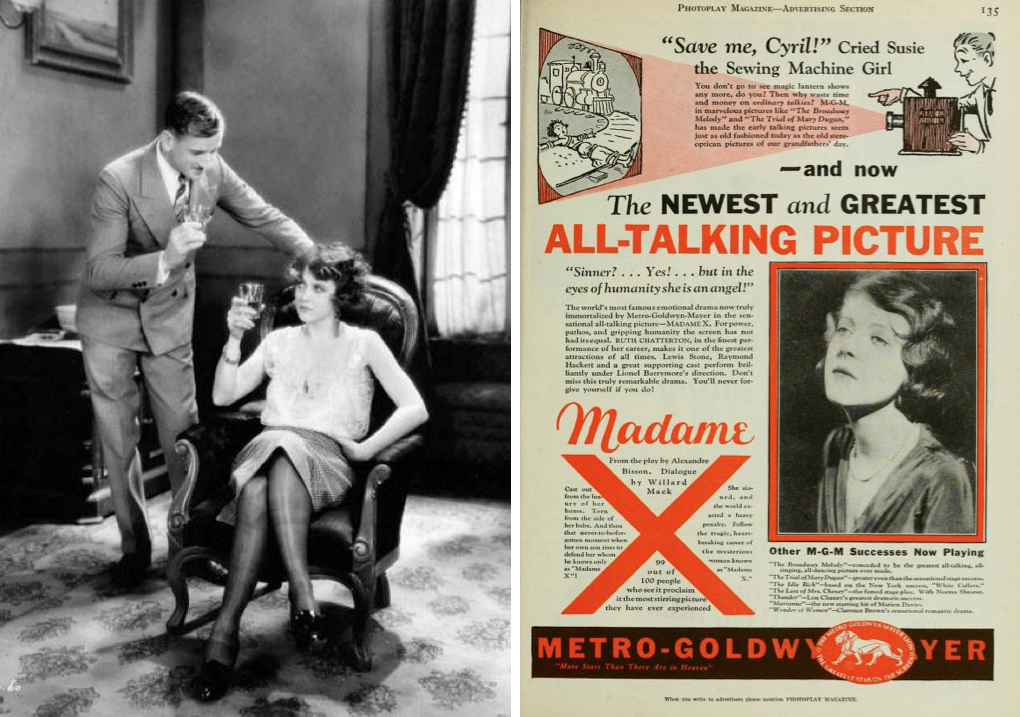
…one of the films featured at the Sam Harris Theatre was Madame X, a movie about a woman who leaves her wealthy (but cold) husband, turns to a life of crime, then tries to reclaim her son. The ad is correct in that it did create something of a sensation when it was released. It is also important to note that the film premiered at the Sam Harris for a reason: The director, Lionel Barrymore, didn’t want audiences to think his film was just another song and dance picture (like most of the first sound films) but rather a serious drama presented at a legitimate stage venue rather than a movie house…

UP TO NO GOOD…Ullrich Haupt as the cardsharp Laroque and Ruth Chatterton as Jacqueline Floriot in Madame X. At right, ad in Photoplay promoting the film. Click to enlarge. (Wikipedia/IMDB)

…back to our ads, here’s a remarkably crude one from the racist misogynists who made Muriel cigars (they being Lorillard, who also manufactured Old Golds)…

…and a softer message from The Texas Company, manufacturer of Texaco “golden” motor oil…

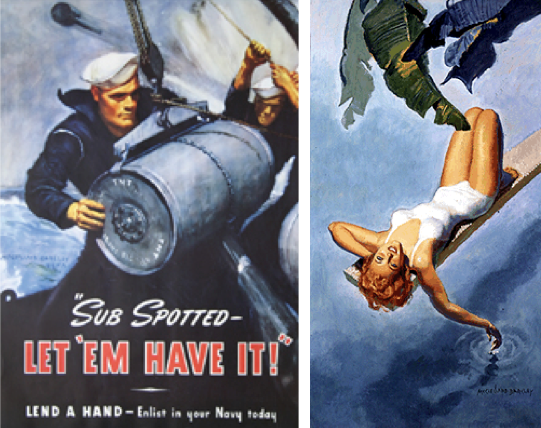
…the artist who rendered the above couple in those golden hues was American illustrator McClelland Barclay (1891-1943). Published widely in The Saturday Evening Post, Ladies’ Home Journal, and Cosmopolitan, Barclay was known for war posters as well as pin-ups:

VERSATILE…Navy recruitment poster by McClelland Barclay, and an illustration for the cover of a 1942 Saturday Home Magazine. (Wikipedia/illustrationhouse.com)

In 1940 Barclay reported for active duty in the US Navy, serving in the New York recruiting office and illustrating posters. Determined to be a front-line combat artist, he served in both the Atlantic and Pacific theatres until he was reported missing in action after his boat was torpedoed in the Solomon Islands.

 *  *  *

Our comics are supplied by Alan Dunn, who probed the vagaries of movie magazine gossip…

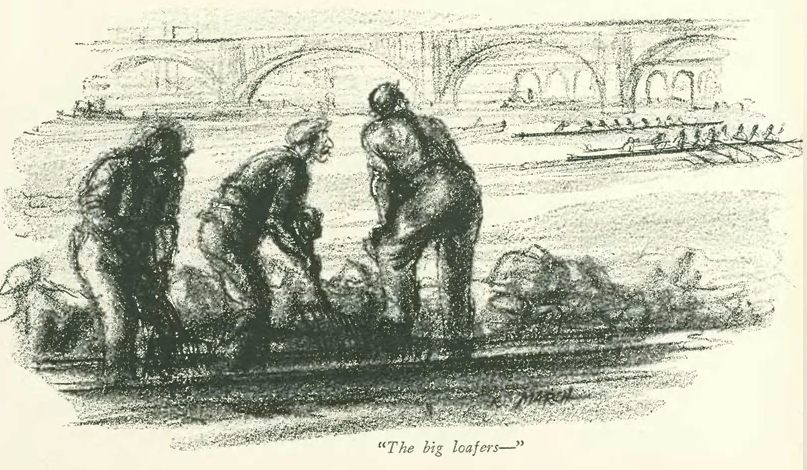
…and Reginald Marsh, known for his social realistic depictions of working life in New York, including these stevedores eyeing a regatta…

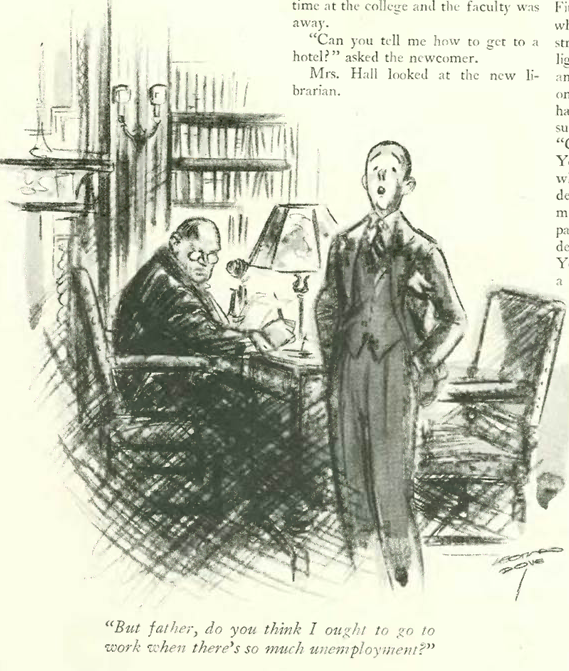
…and finally, Gardner Rea looked in on a young man displaying early signs of cynicism…

Next Time…How Charles Shaw Felt About Things…


From Broadway to Babylon

While the introduction of sound to motion pictures ended the careers of some silent film stars in the late 1920s, Hollywood’s “talkies” offered new opportunities for Broadway stage actors who could now take their vocal talents to the screen and to audiences nationwide.

May 4, 1929 cover by Ilonka Karasz.

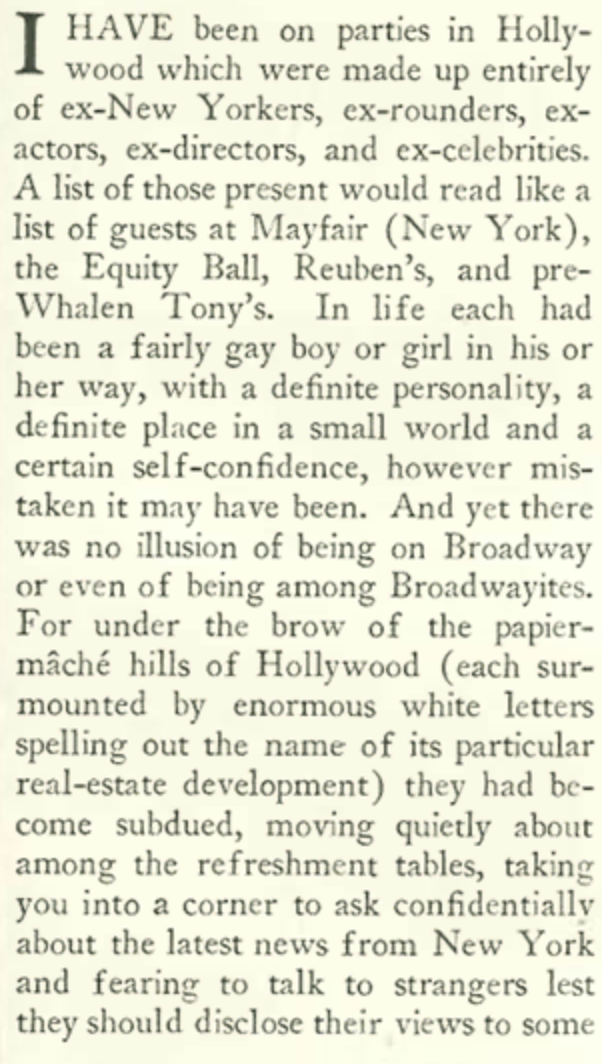
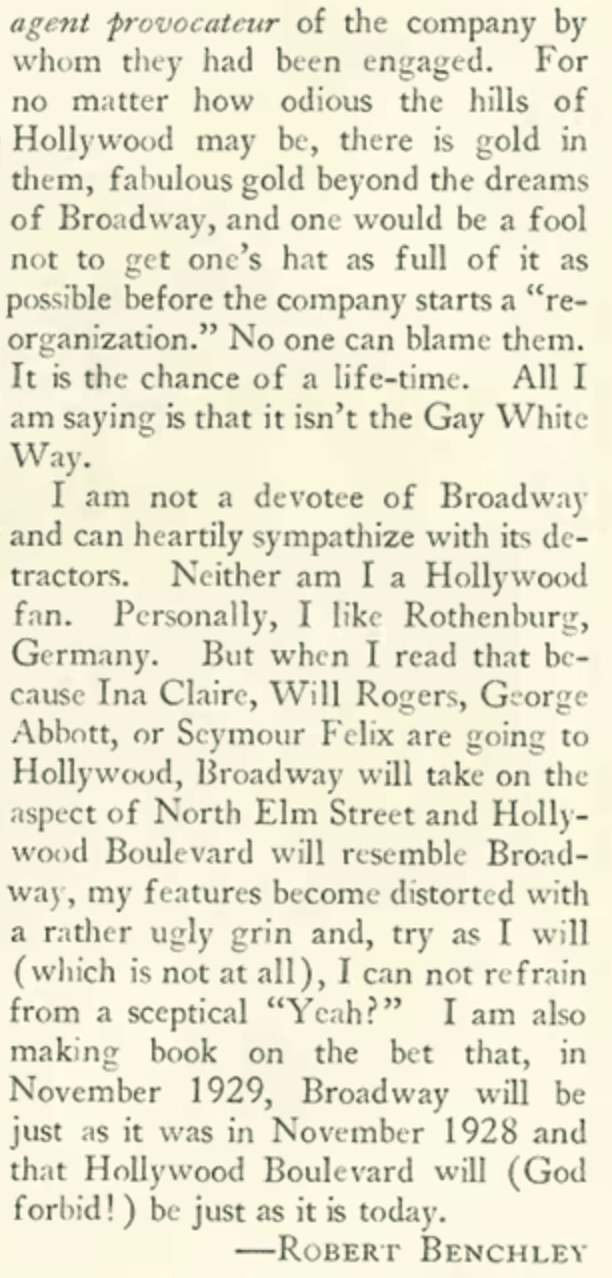
And so began the so-called “Broadway Exodus.” Robert Benchley offered his wry observations on the phenomenon in the May 4, 1929 “A Reporter at Large” column:

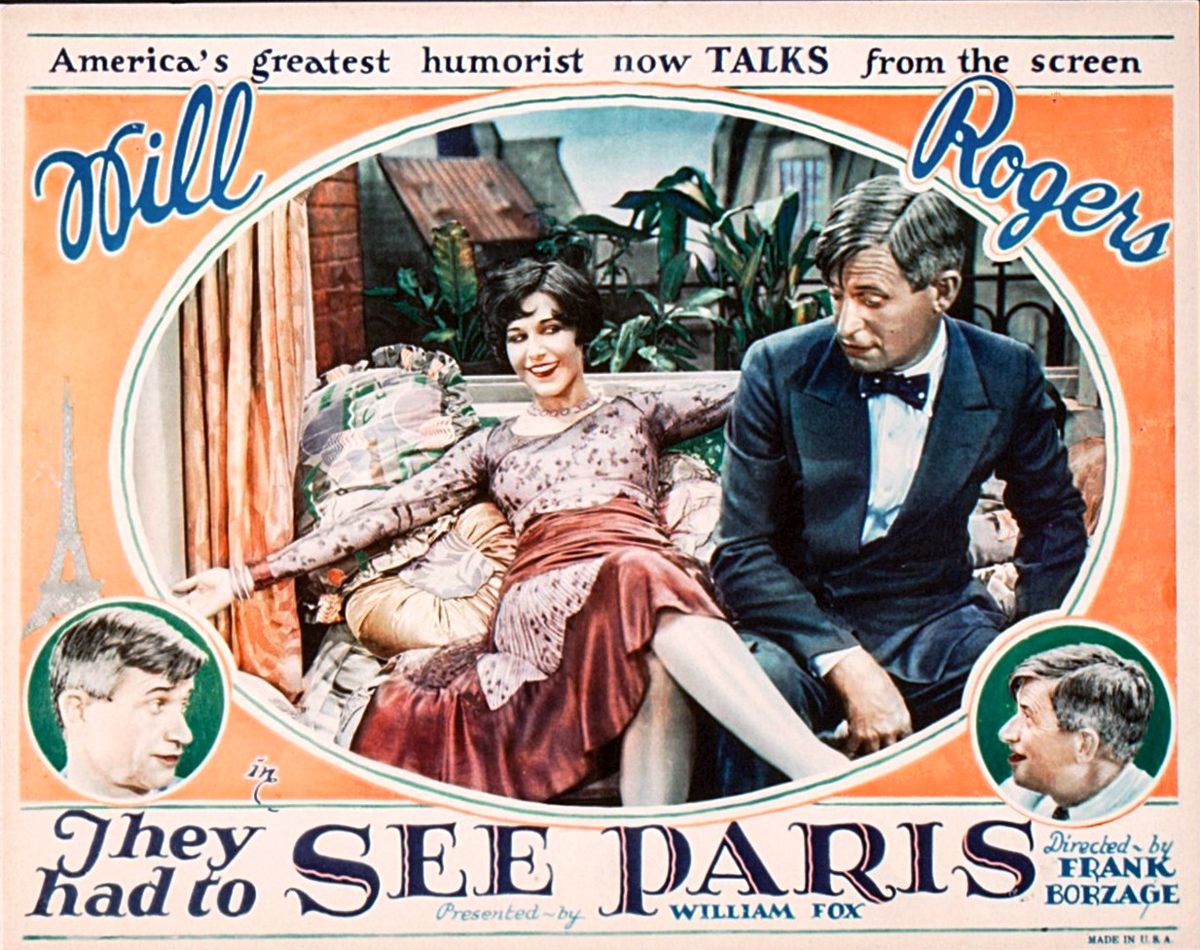
AW SHUCKS…Broadway mainstay and a perennial performer with the Ziegfeld Follies, humorist Will Rogers found his element in Hollywood’s new talkies, appearing here with Fifi D’Orsay in 1929’s They Had to See Paris. (Wikipedia)
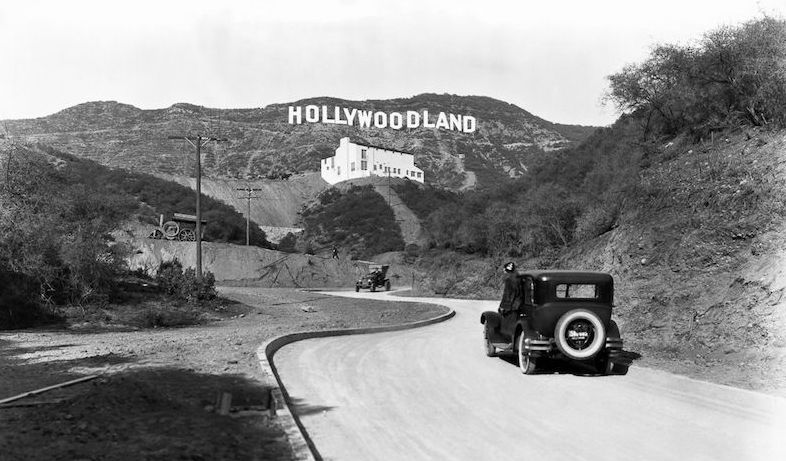
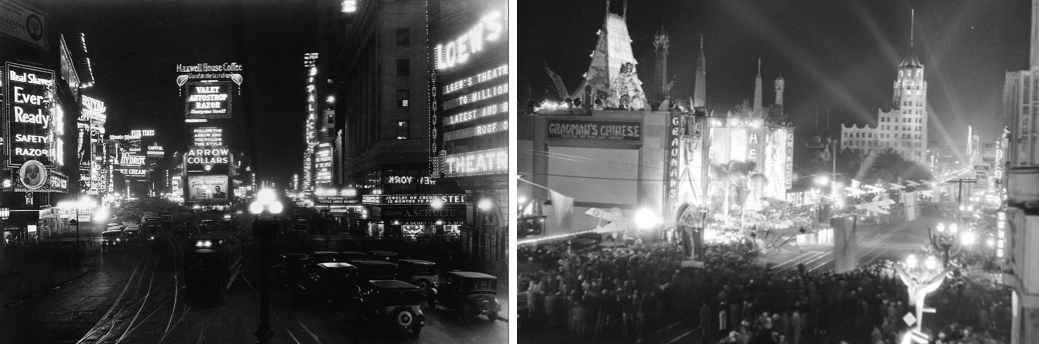
TALE OF TWO CITIES…Broadway in 1925 (left) and Hollywood Boulevard in 1929. (Daily Mail/USC Digital Library)

Benchley observed that regardless how many Broadway stars moved west, Hollywood Boulevard would never be mistaken for Broadway. However, Benchley himself would catch the bug and head to Tinseltown, appearing in dozens of feature films and shorts including How to Sleep, which would win an Academy Award for “Best Short Subject, Comedy,” in 1935.

NICE WORK IF YOU CAN GET IT…Robert Benchley in the 1935 Oscar-winning short, How to Sleep. (YouTube)

 *  *  *

One Who Stayed on Broadway

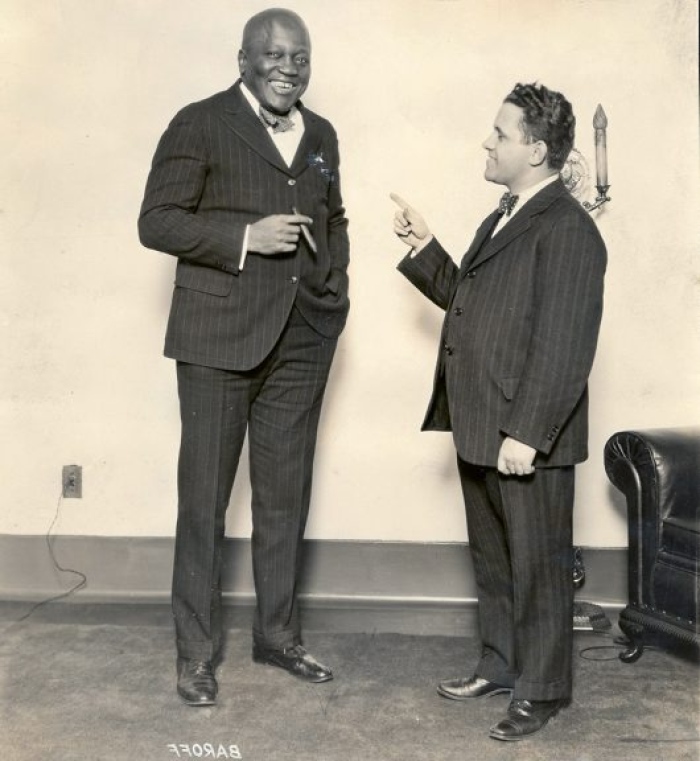
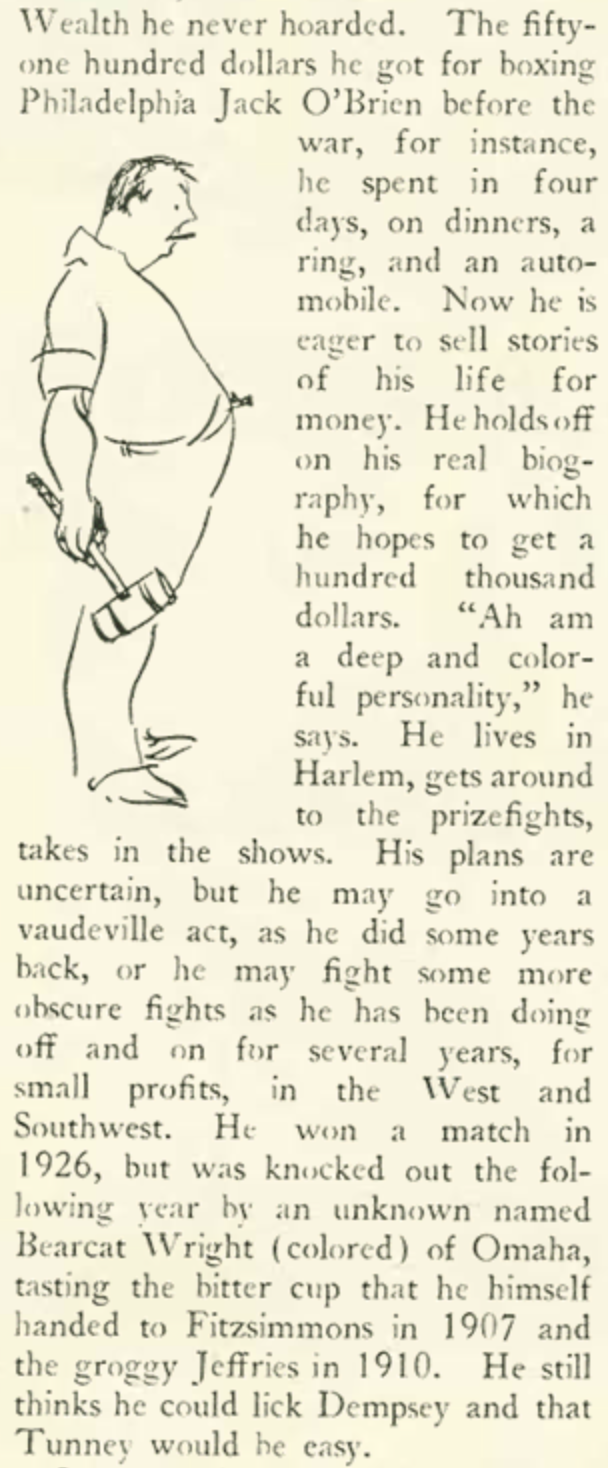
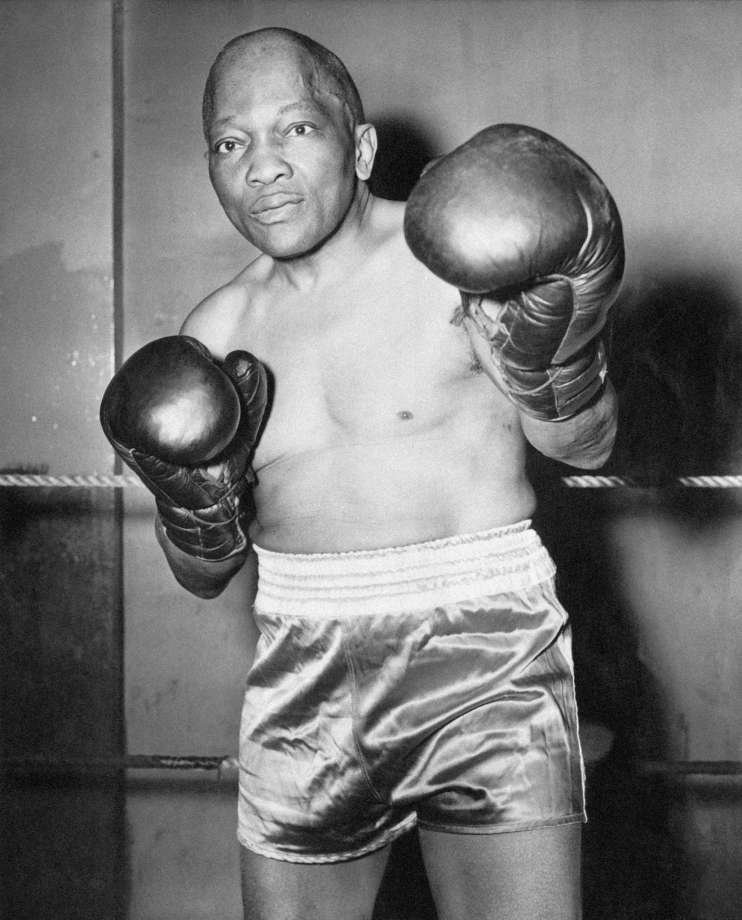
James Thurber reported in “The Talk of the Town” that famed boxing champion Jack Johnson was a common sight on the sidewalks of Broadway. Thurber noted that Johnson, the first African American world heavyweight boxing champion (1908–1915), had fallen on less glamorous days, but still appeared fit at age 51.

IN FIGHTING FORM…Jack Johnson visits with writer Joe Butler at the Scranton Times-Tribune offices on Nov. 30, 1929. (Scranton Times-Tribune)

Thurber noted that Johnson was planning to sell stories of his life, and possibly get into vaudeville. The boxer also mused that who could lick either of the heavyweight champs of the 1920s, Gene Tunney and Jack Dempsey

CREAMPUFFS…The 51-year-old Jack Johnson claimed he could defeat either of the famed heavyweight champions of the 1920s, Gene Tunney (left) or Jack Dempsey. (Reemus Boxing)

…and Thurber shared a strange account regarding the thickness of Johnson’s skull, which apparently bested that of an ox…

FIGHT TO THE LAST…The 67-year-old Jack Johnson prepares for an exhibition boxing match at a war bond show in New York City on May 1945. Along with making public appearances, Johnson also performed on Broadway during his retirement. (Houston Chronicle)

Johnson continued professional boxing until age 60, and thereafter participated in boxing exhibitions in various venues until his death at age 68 in a car crash near Raleigh, NC. It was reported that Johnson was racing angrily from a nearby diner that had refused to serve him when he lost control and hit a light pole.

 *  *  *

Don’t Ask, Don’t Tell

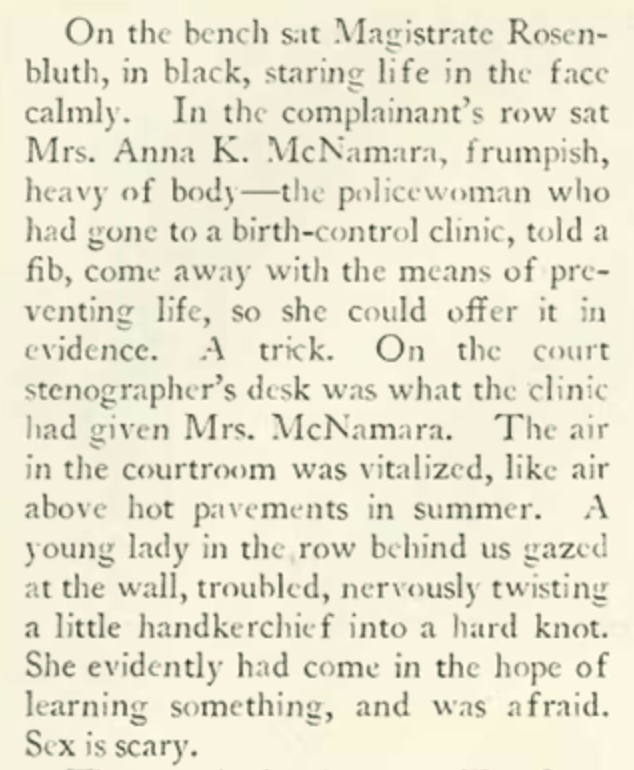
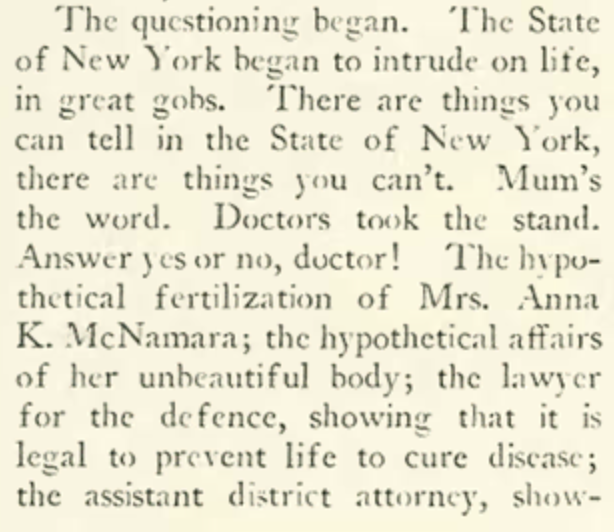
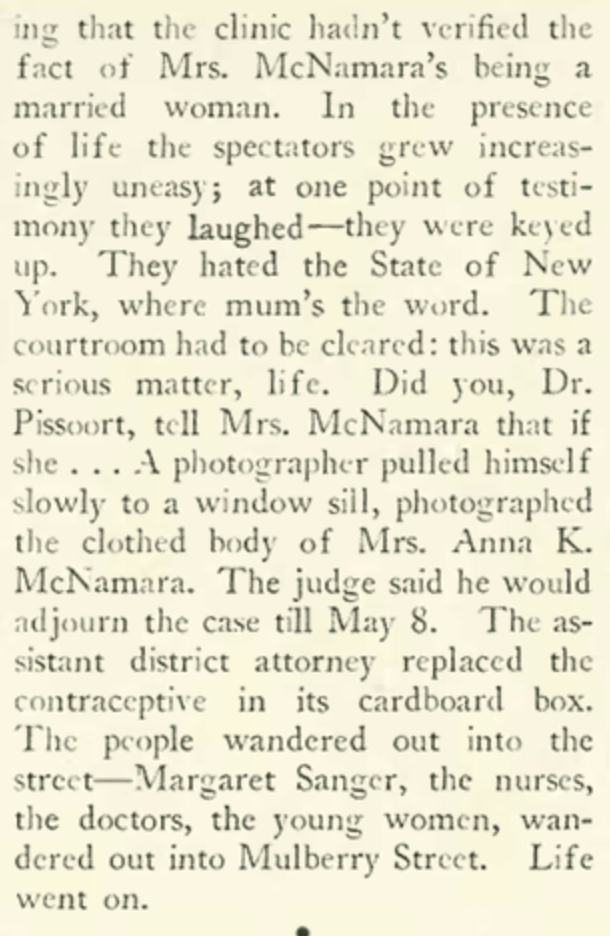
Anyone who thinks the recent squabbles over Planned Parenthood are anything new might do a little reading on the life of Margaret Sanger, who opened the first birth control clinic in the U.S. in 1916 (in Brooklyn) and was subsequently arrested for distributing information on contraception. In 1929 she was again arrested for operating a “secret” birth control clinic in the basement of a Manhattan brownstone. On March 22, 1929, the New York Police Department sent an undercover female detective, Anna McNamara, to Sanger’s clinic. Posing as a patient who wished to avoid another pregnancy, McNamara was advised on various forms of contraception. She later returned to the clinic as part of the police raid, during which she seized a number of confidential patient files. At Sanger’s subsequent court hearing, McNamara learned first-hand about the importance of patient confidentiality. From the May 4 “Talk of the Town”…

Recalling her arrest in a 1944 article, “Birth Control: Then and Now,” Sanger wrote that McNamara taunted her during the raid when she was told that she had no right to touch private medical files. Sanger wrote “I shall never forget the color of Mrs. McNamara’s face when she heard this medical testimony recited several days later in Magistrates’ Court at the hearing. She was totally unprepared for this embarrassing revelation of her own organs.” The New Yorker made note of this…

Sanger would continue to work for birth control until her death in 1966. Although her name is still invoked in debates over abortion, Sanger herself was generally opposed to abortion, maintaining that contraception was the only practical way to avoid it.

GAG ORDER…In April 1929 Margaret Sanger planned to speak at Boston’s Ford Hall Forum on Free Speech. Ironically, the topic of birth control was banned in Boston at the time, so Sanger appeared onstage with a gag over her mouth while historian Arthur M. Schlesinger read her remarks on free speech to the assembly. At right, the February 1926 issue of Birth Control Review. Founded by Sanger in 1917, she served as editor until 1928. It ceased publication in 1940. (womensstatus.weebly.com/sangerpapers.wordpress.com)

 *  *  *

Please Sit Still

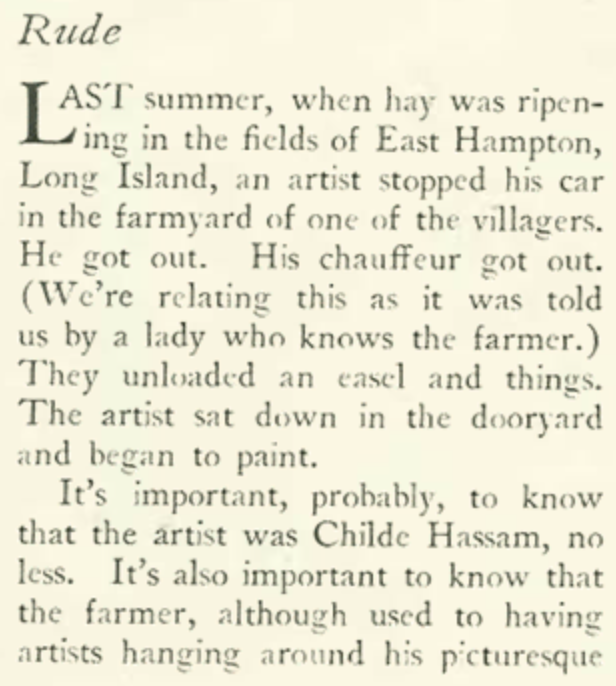
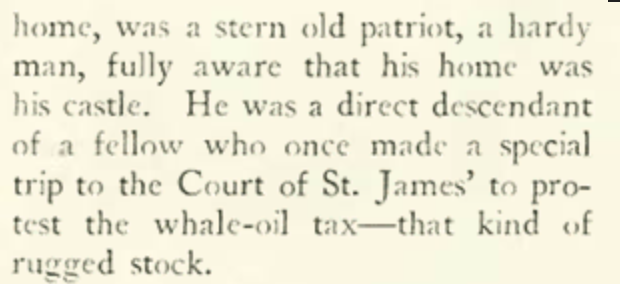
The “Talk of the Town” also looked on American Impressionist painter Childe Hassam, who demonstrated the challenges of painting en plein air…

LOVELY SCENE…Childe Hassam’s Landscape at Newfields, New Hampshire, oil on canvas, 1909. Hassam in his studio circa 1920. (Wikimedia Commons/Wikipedia)

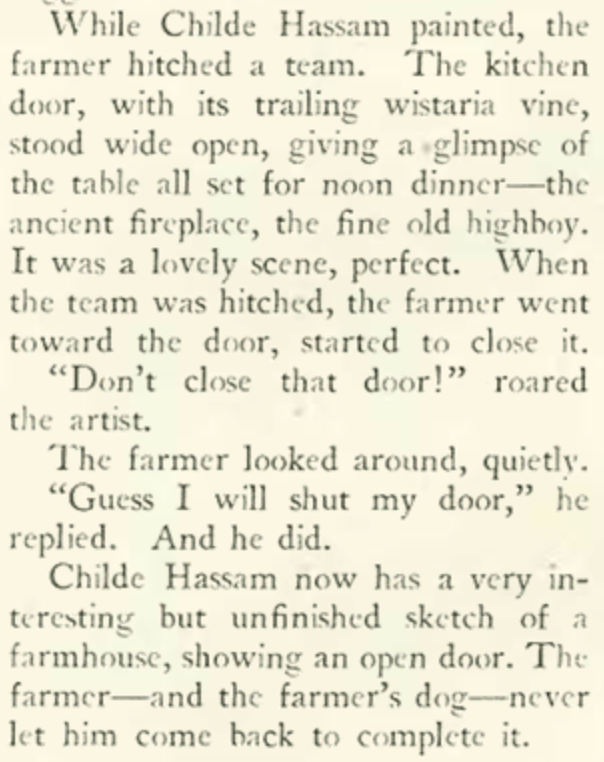
…and found it difficult to finish a farmhouse sketch when a door was unexpectedly closed on his subject…

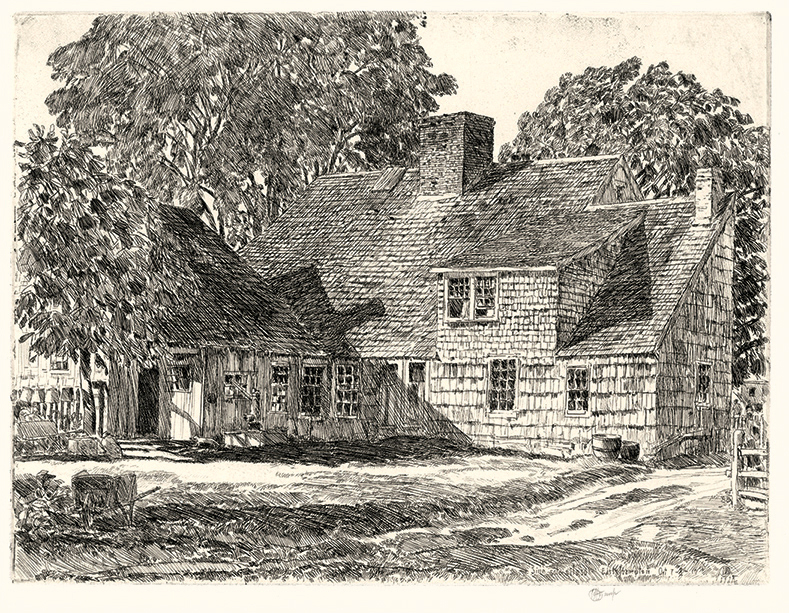
THIS ONE HE FINISHED…Childe Hassam’s etching, The Old Dominy House (East Hampton), 1928. This work was probably created during Hassam’s visits to East Hampton described in “The Talk of the Town.”(Smithsonian)

 *  *  *

All That Jazz

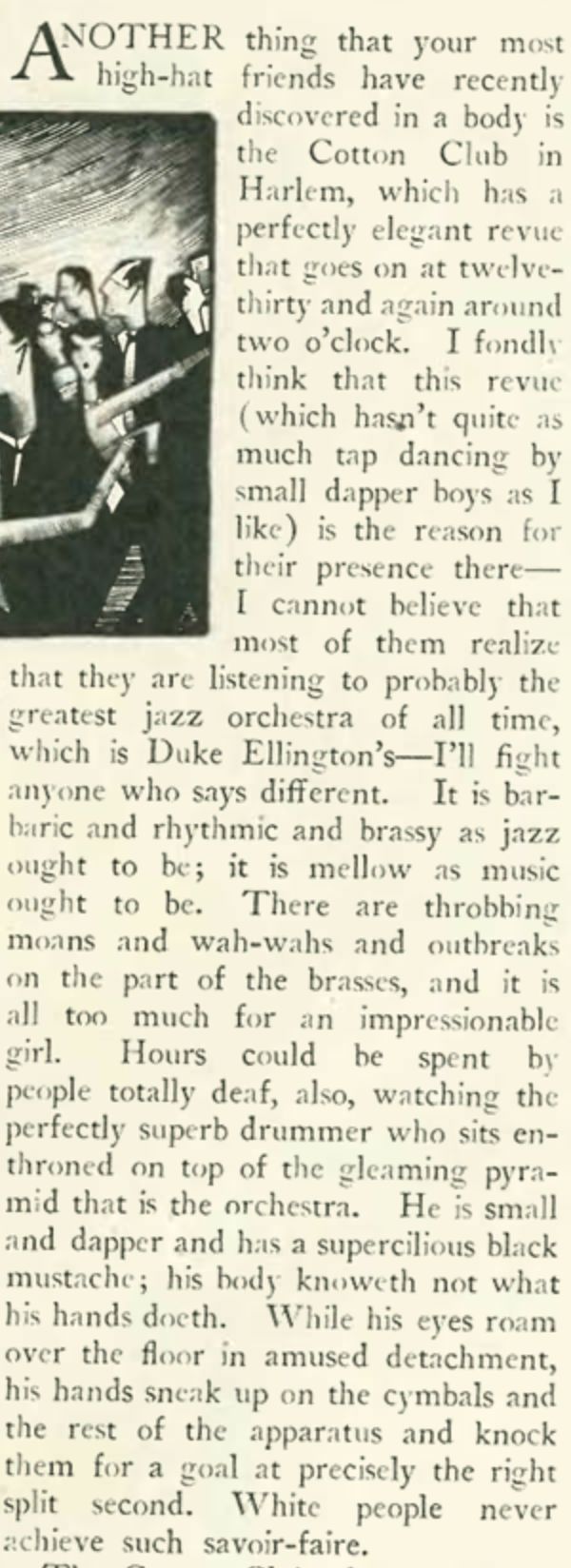
As Lois Long’s contributions to her “Tables for Two” column grew ever more infrequent, it was clear that she was wearying of the nightlife scene. Now 28 and a young mother, “Lipstick” was shedding her image as a fun-loving flapper and devoting more time and energy to her fashion column, “On and Off the Avenue.” Nevertheless, she still found the time to visit the Cotton Club and proclaim Duke Ellington’s jazz orchestra as “the greatest of all time”…

…although her other observations of the New York nightclub scene appear to have been hastily dashed off…

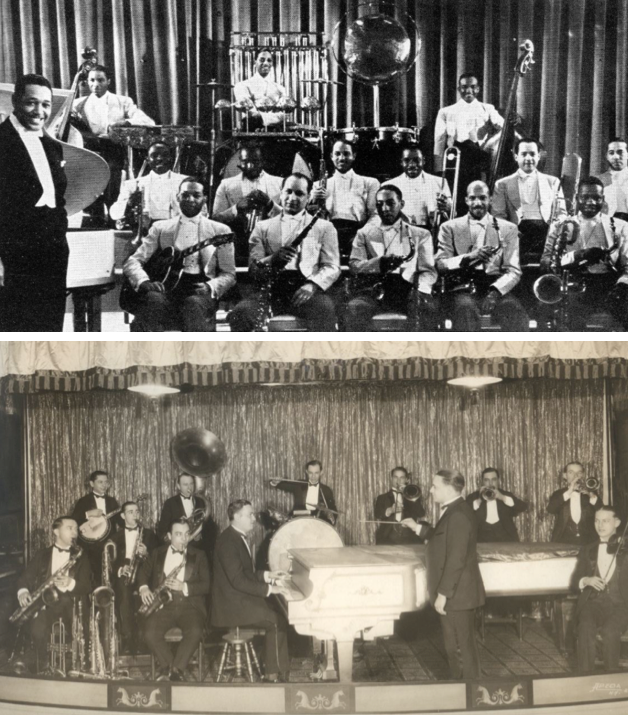
THE BEST…Duke Ellington and his orchestra (top), circa 1930. Below, Vincent Lopez conducts his orchestra in 1923. (oldtimeblues.net / www.jazzhound.net © Mark Berresford)

 *  *  *

Electric Wonders

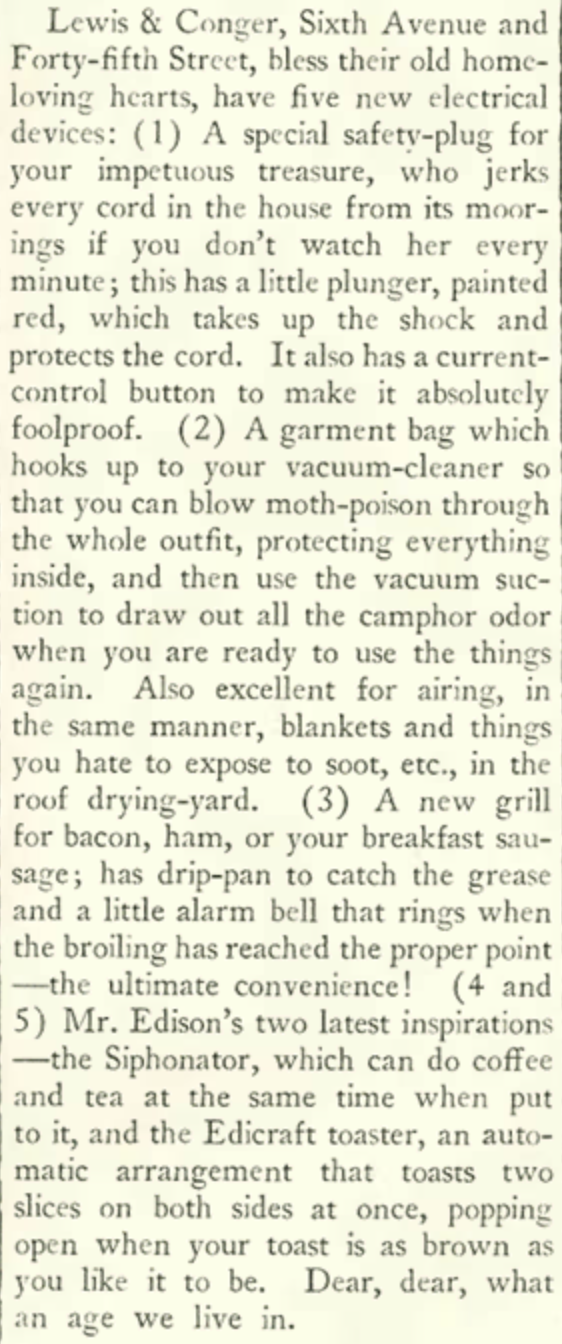
The May 4 issue updated readers on some of the latest gadgets available to modern households in 1929. I particularly like the device that allowed your vacuum to blow “moth poison” into your garments…

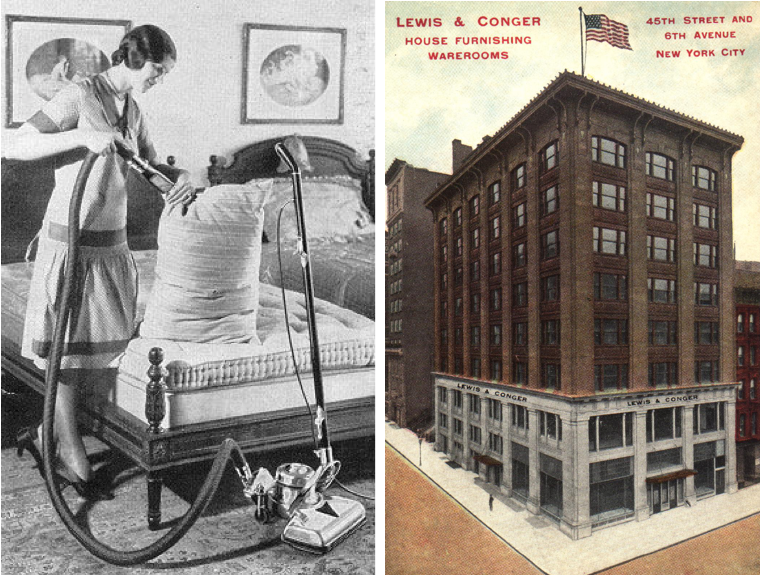
NOW THIS DOES NOT SUCK…Garments and other household items could be fumigated against moths using a new reverse vacuum attachment, available at Lewis & Conger. (Cyberspace Vacuum Cleaner Museum / Columbia University)

*  *  *

From Our Advertisers

One thing you notice about 1920s advertising is the amount of turgid copy they contain…I suppose without distractions such as TV and iPhones people actually took the time to read all of these bloated messages, such as this one from Whitman’s that suggested a box of candy is more than a box of candy…

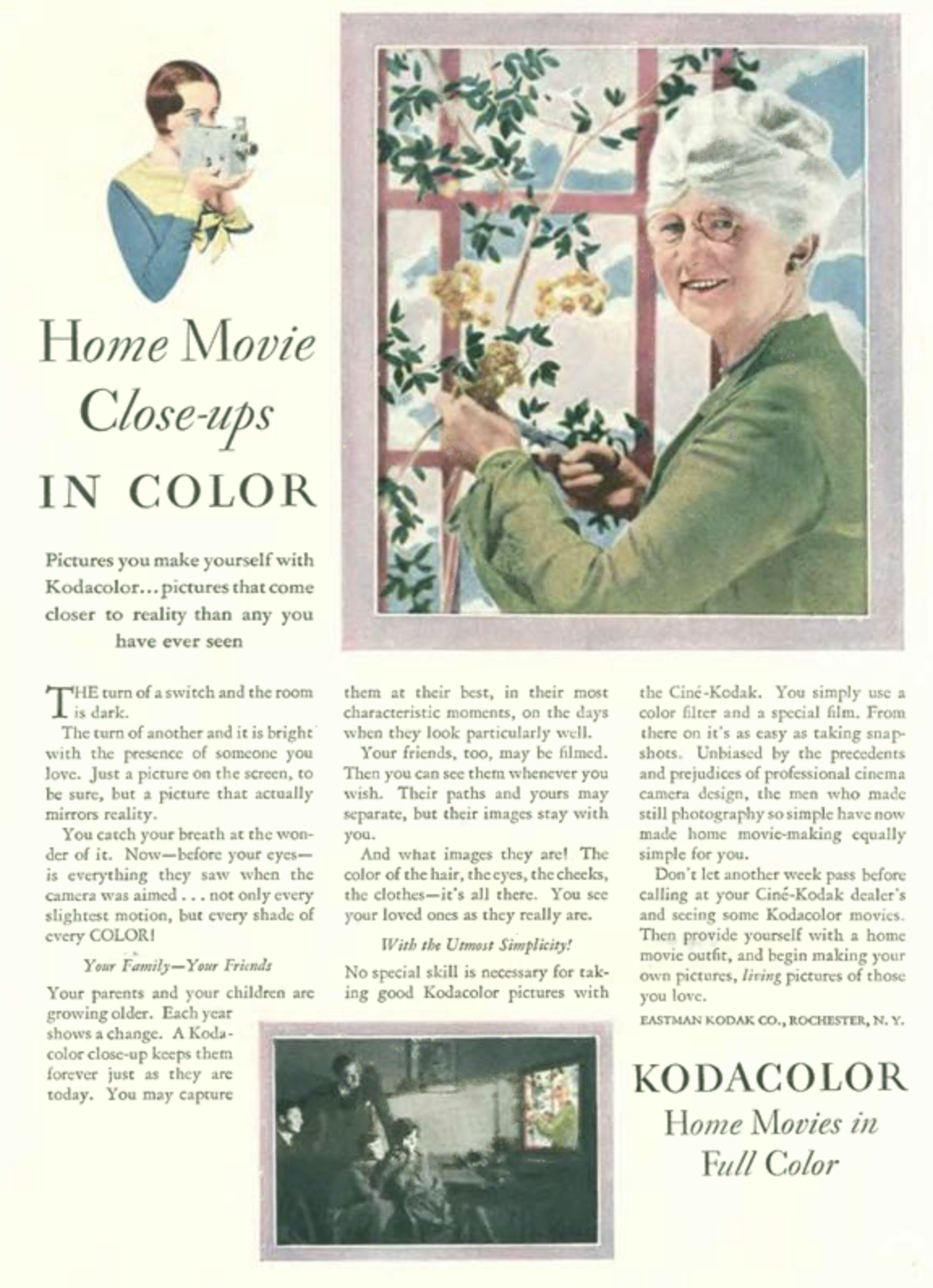
…or how about this lengthy appeal from Kodak, which used guilt to convince you to get some film of grandma while she was still “at her best…”

…the makers of Spud promised a “new freedom” and a “16% cooler smoke” to the users of its menthol-laced cigarettes. Spuds were the first menthol cigarettes, developed in 1924 by Ohioan Lloyd “Spud” Hughes, who sold them out of his car until the brand was acquired in 1926 by The Axton-Fisher Tobacco Company. By 1932 Spud was the fifth-most popular brand in the U.S., and had no competitors in the menthol market until Brown & Williamson launched their Kool brand in 1933. The Spud brand died out by 1963 (along with, presumably, many of its customers)…

…leveraging the popularity in the 1920s of knights and fairies, as well as the Anglo- and Francophila of New Yorker readers, “Mrs. Marie D. Kling” hoped to entice city dwellers up to the burbs in Scarsdale…

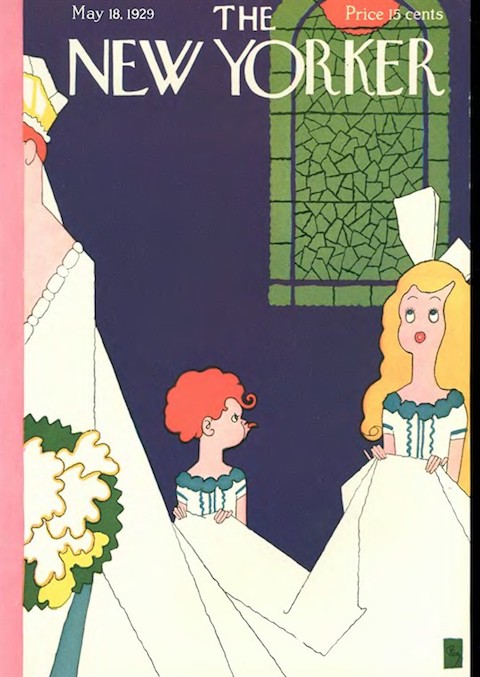
…our cartoons are courtesy of Barbara Shermund, who looked in on a couple of debs performing their daily exercises…

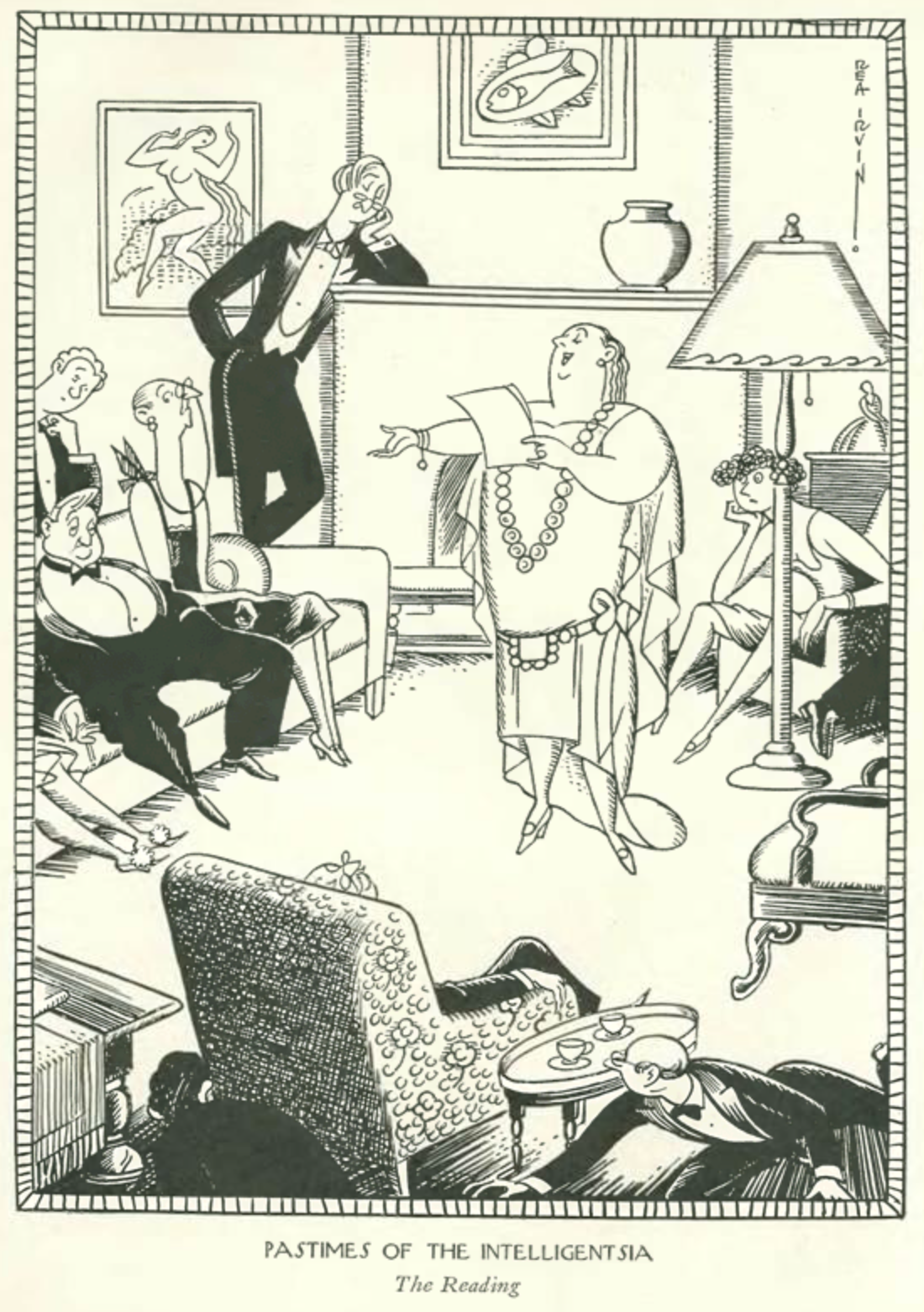
…while down in the parlor, Rea Irvin captured the horrors inflicted by an author’s tedious reading…

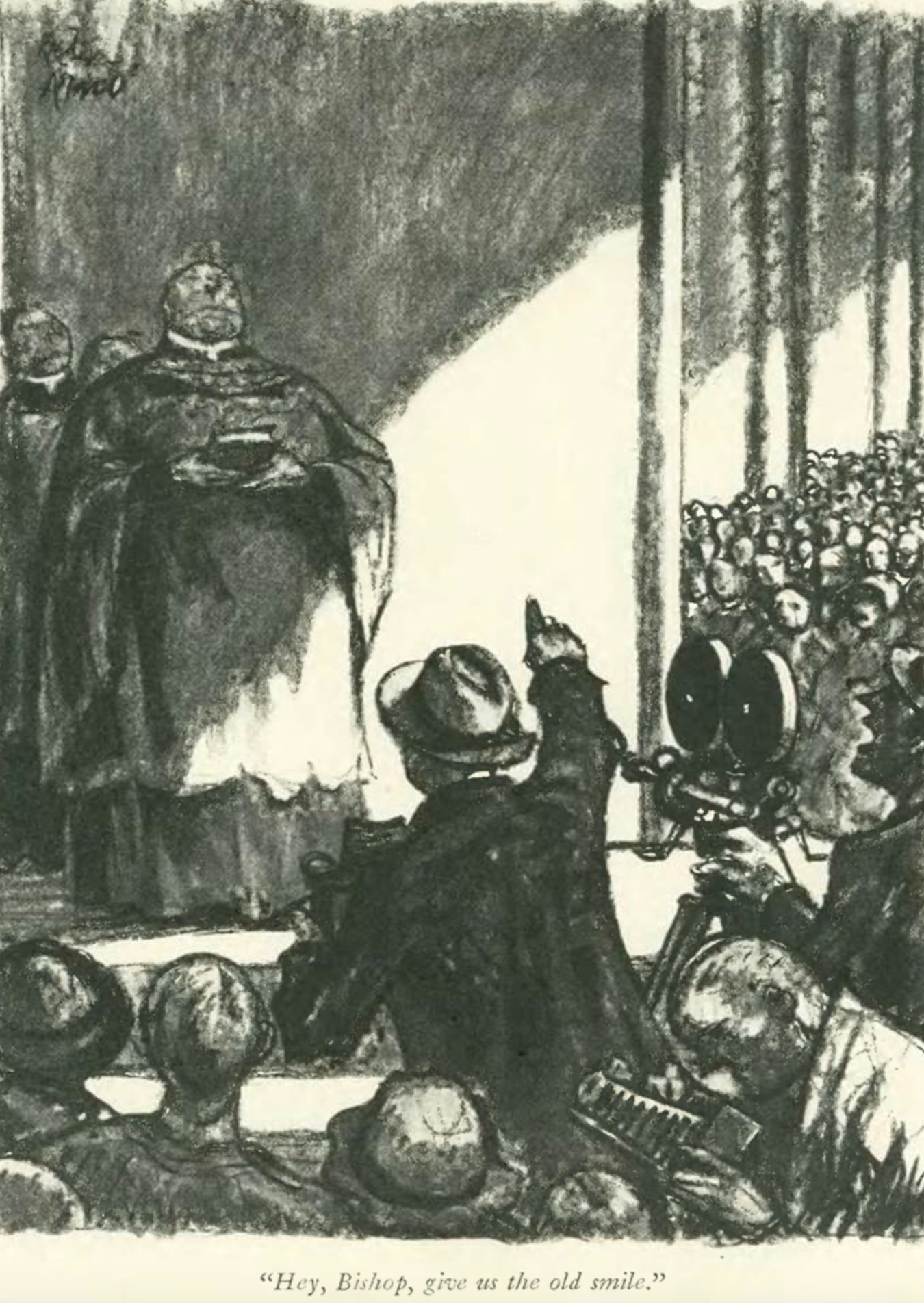
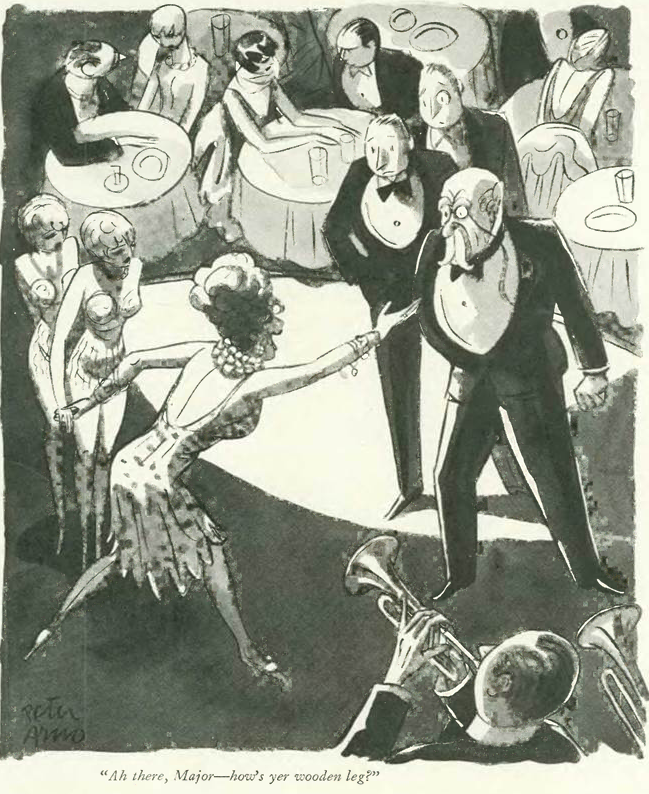
…and finally, Peter Arno probed the depths of sanctimony…

Next Time: Waldorf’s Salad Days…

Out of the Mouth of Babes

Like many publications, there are defining moments in the New Yorker’s history that make the magazine what it is today.

December 8, 1928 cover by Peter Arno.

In a post more than two years ago I wrote about Ellin Mackay’s pivotal essay, “Why We Go To Cabarets: A Post-Debutante Explains.” The debutante daughter of a multi-millionaire (who threatened to disinherit her due to her romance with Irving Berlin), Mackay explained that modern women were abandoning social matchmaking in favor of the more egalitarian night club scene. Mackay’s essay provided a huge boost to the struggling New Yorker, which had dipped to less than 3,000 subscribers in August 1925. A more recent post, “A Bird’s Eye View,” noted how a short story by Thyra Samter Winslow opened the door to serious fiction in the magazine.

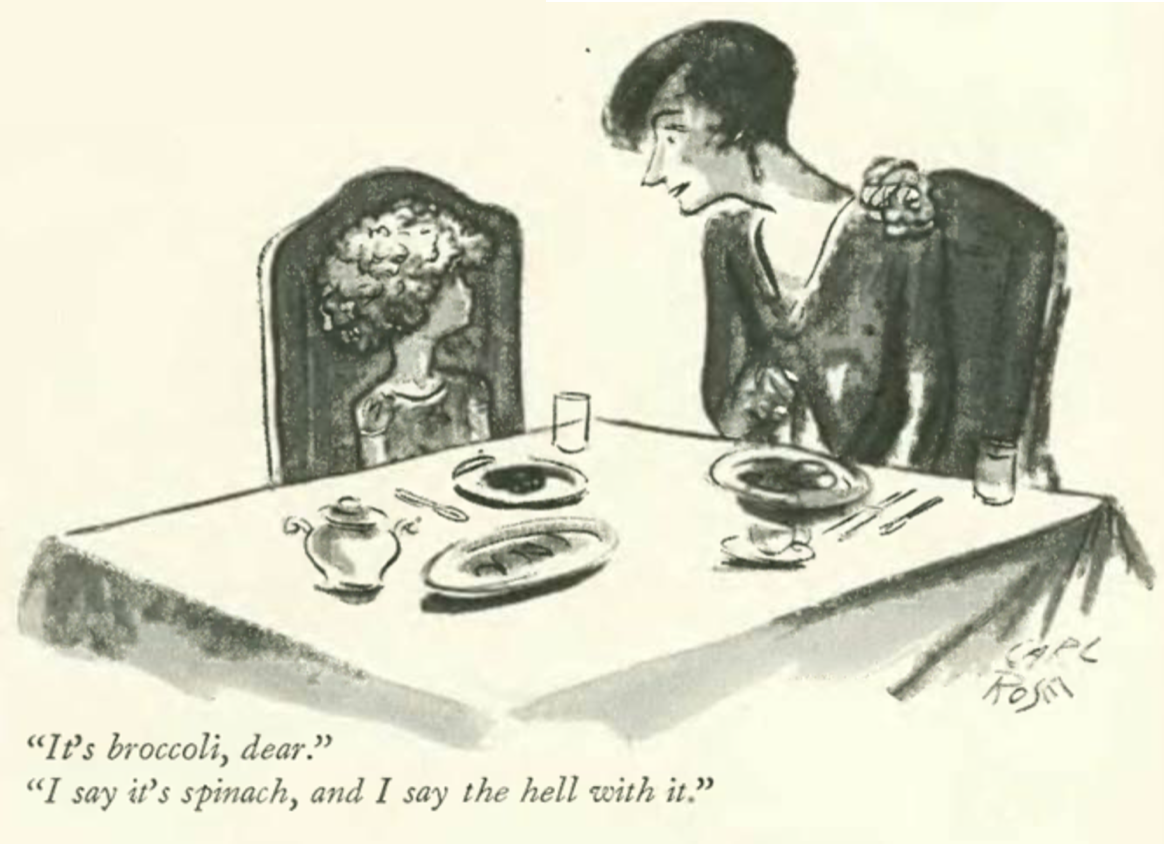
The Dec. 8, 1928 issue was significant for a cartoon by Carl Rose that appeared on the bottom of page 27:

It remains one of The New Yorker’s most famous cartoons, and for good reason. In his book About Town: The New Yorker and the World It Made, Ben Yagoda writes that the cartoon (drawn by Rose, with spinach line provided by E.B. White) “was picking up on something in the culture: it was a moment when the air reverberated with the sound of speech.” Yagoda notes that although “the cartoons led the way,” the magazine has always been filled with the sound of voices in “The Talk of the Town.” Naturalistic rendering of speech could also be found under the heading of such features as “Overheard,” which ran from 1927-1929 and included such contributors as the young writer John O’Hara.

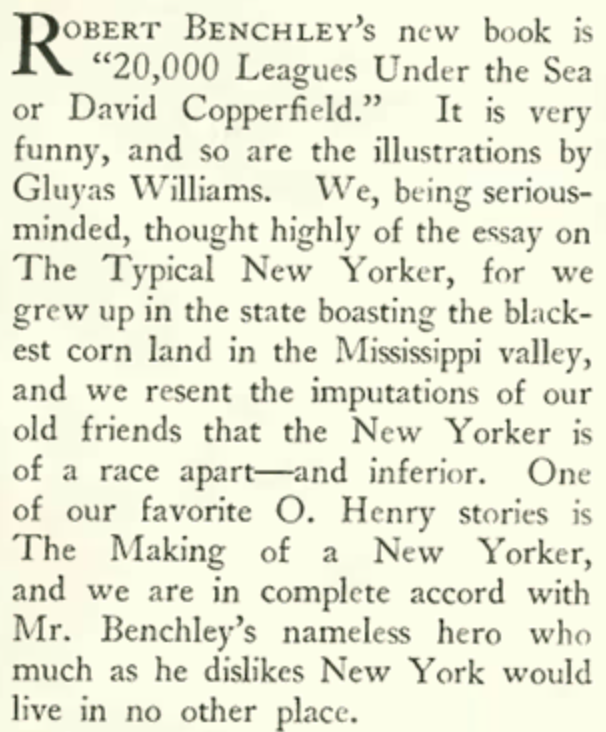
Another New Yorker contributor whose work resounded with the sound of speech, Robert Benchley, received some kind words from the magazine on his latest book, Twenty Thousand Leagues Under the Sea or David Copperfield:

DON’T BE SERIOUS…Robert Benchley and his book, 20,000 Leagues Under the Sea or David Copperfield, illustrated by his New Yorker colleague Gluyas Williams. The cover depicted Benchley performing his famous sketch, The Treasurer’s Report. (Goodreads/bio.com)

 * * *

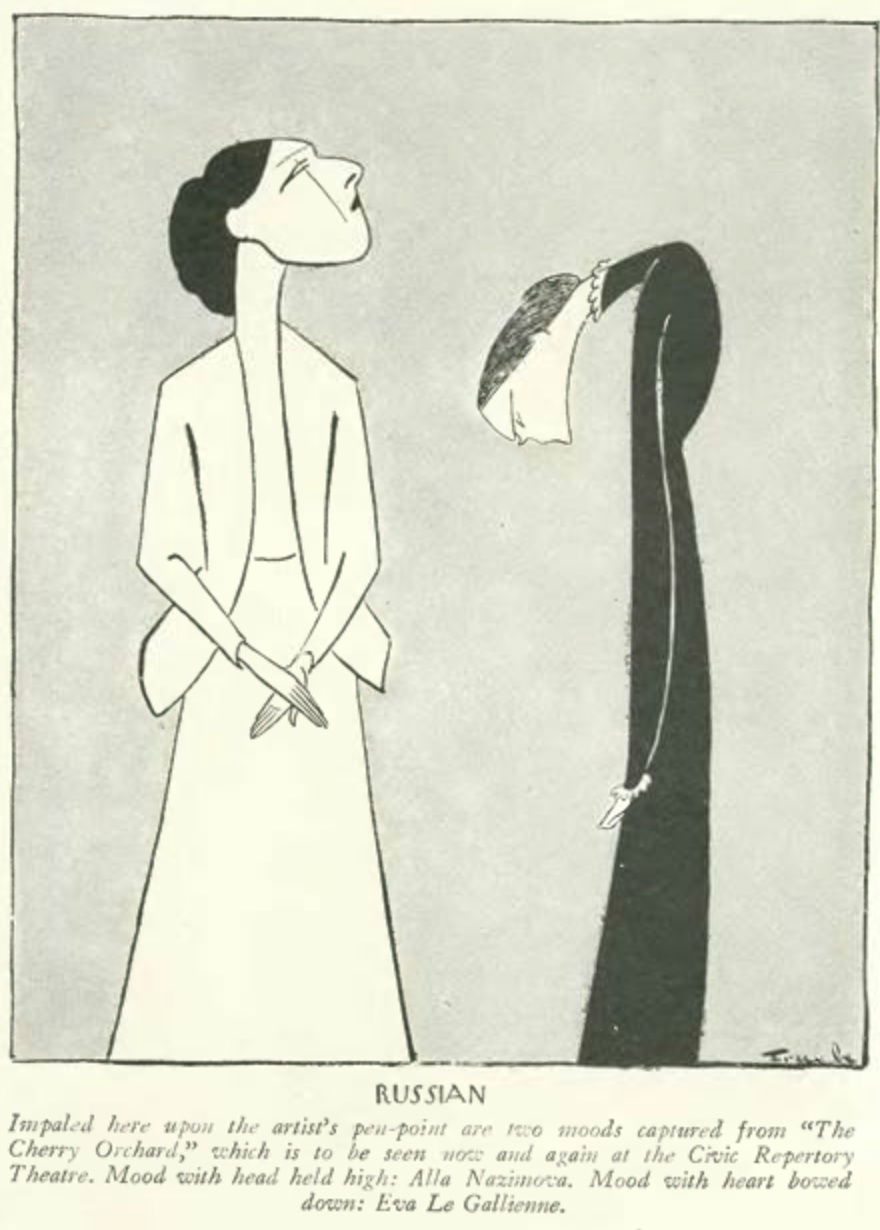
Appearing at the Civic Repertory Theatre (founded by actress Eva Le Gallienne in 1926) was Alla Nazimova and Eva herself in Anton Chekov’s last play, The Cherry Orchard. Al Frueh offered this sketch for the theatre review section.

Josephine Hutchinson as Anya, Alla Nazimova as Ranevskaya, and Paul Leyssac as Gayev in Anton Chekov’s last play, The Cherry Orchard, at the Civic Repertory Theatre in 1928. (eBay)
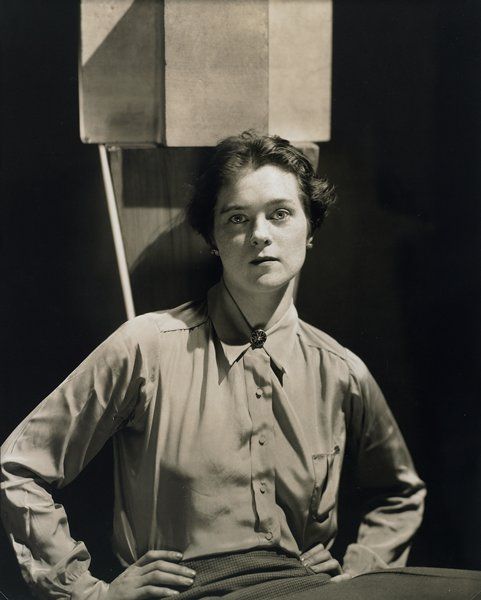
TOUR DE FORCE…Eva Le Gallienne in 1928, photo by Edward Steichen. (Minneapolis Institute of Art)

 * * *

From Our Advertisers

Advertisements from the Dec. 8 issue offered this study in contrasts…a “modern” take on the holidays by Wanamaker’s, featuring the unfortunately titled “Psycho-Gifts for Christmas”…

…versus the staid offerings of Brooks Brothers on the following page…

 * * *

On to the Dec. 15 issue, we find The New Yorker enjoying the debut of the Ziegfeld Follies latest revue…

December 15, 1928 — issue number 200 — cover by Julian de Miskey.

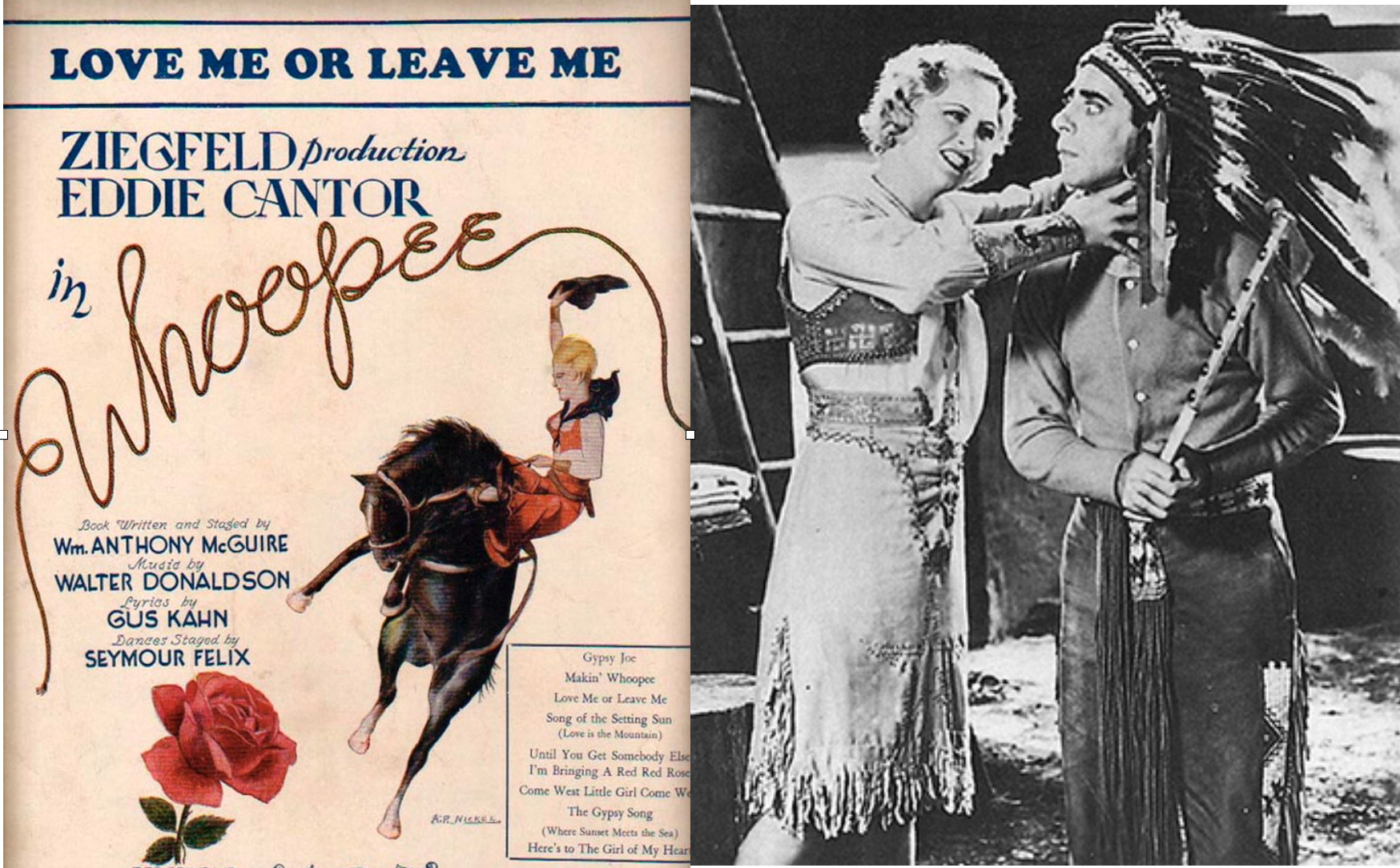
…the show “Whoopee” at the New Amsterdam, featuring Eddie Cantor:

HIT MAKER…Sheet music for the hit “Love Me Or Leave Me” from the Ziegfeld Follies show Whoopee. At right, a still from the 1930 film Whoopee!, with Eleanor Hunt and Eddie Cantor. (carensclassiccinema/thejumpingfrog.com)

And lest you think audiences were flocking to only see Eddie Cantor…

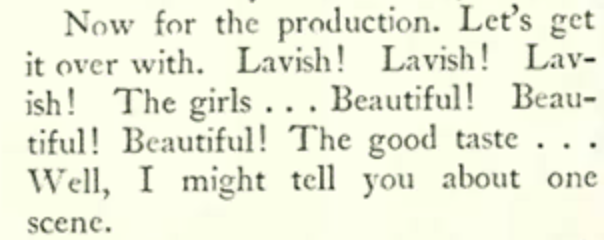
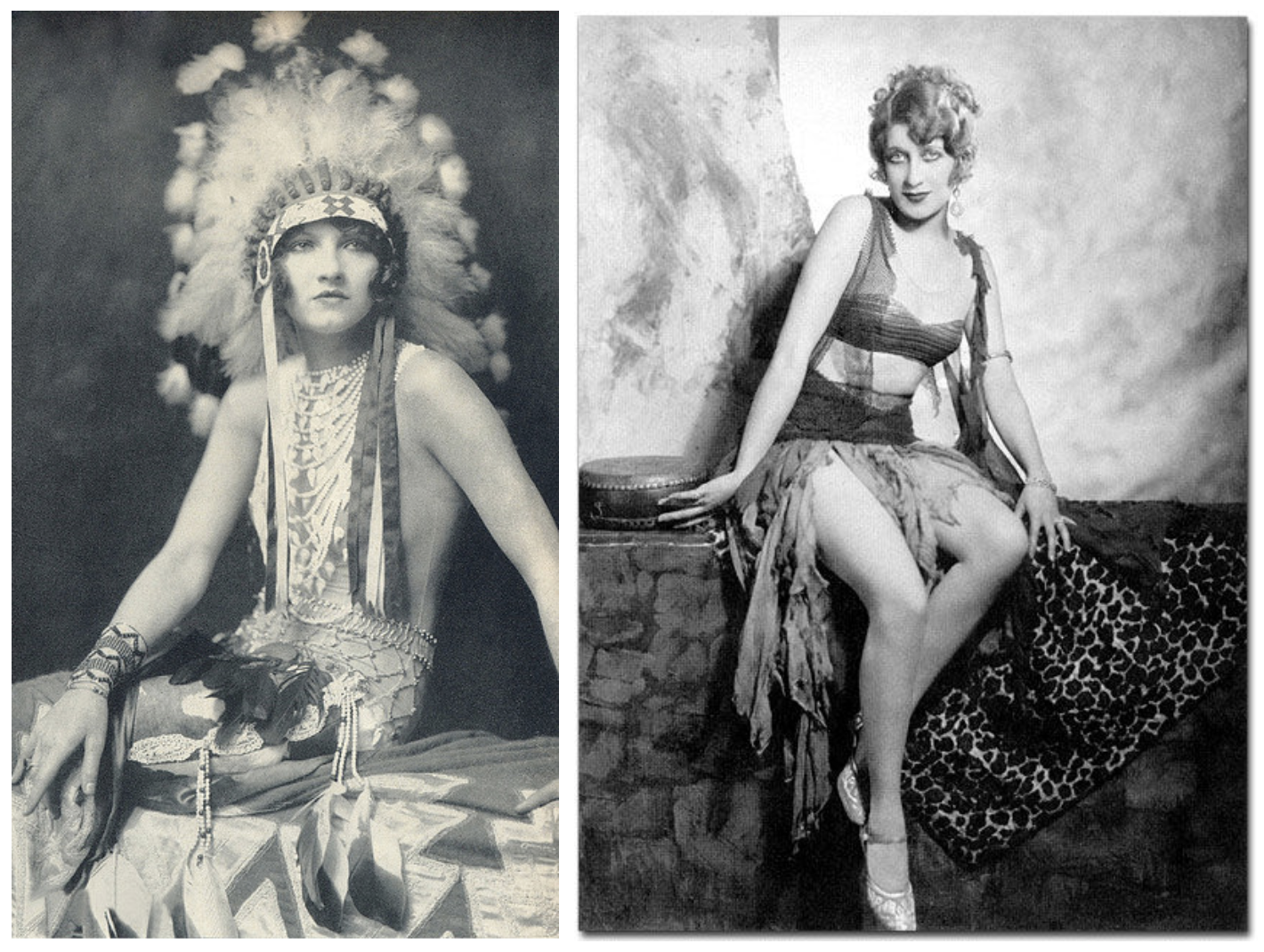
LAVISH, LAVISH!…At left, Ziegfeld Follies performer Jean Ackerman in Whoopee! At right, Ziegfeld performer Ruth Ettig’s rendition of “Love Me or Leave Me” in Whoopee made it a major hit as well as her signature song. (mote-historie.tumblr.com/Alfred Cheney Johnston photo via songbook1.wordpress.com)

 * * *

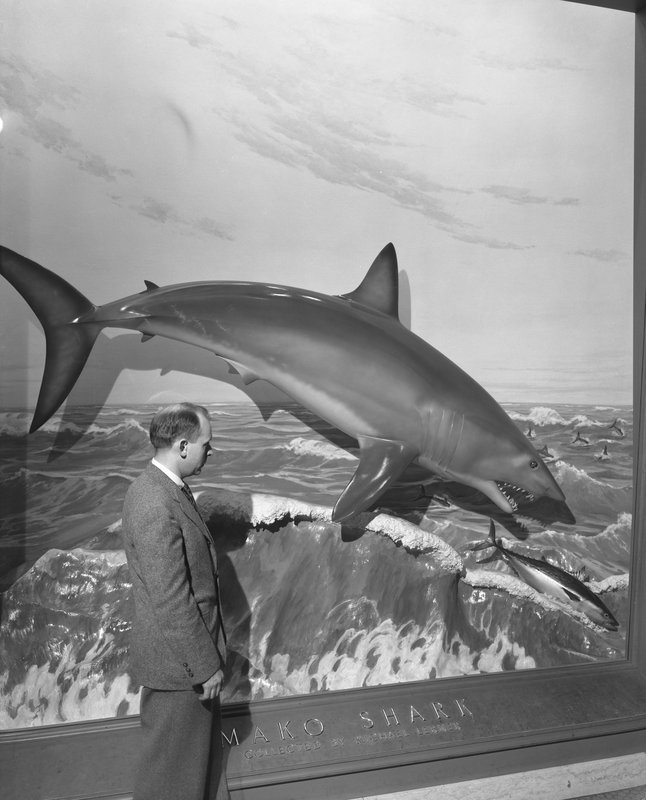
On to less glamorous pursuits, The New Yorker also paid a visit to the new “Fish Wing” at the Museum of Natural History, as recounted in “Talk of the Town.” A brief excerpt:

SWIMMING WITH THE FISHES…A visitor admires the mako shark exhibit at the Hall of Fishes in the American Museum of Natural History, 1948 (AMNH)

From Our Advertisers…

…comes this house ad from The New Yorker itself, promoting its first-ever Album:

Chris Wheeler has gathered all of the albums at this site.

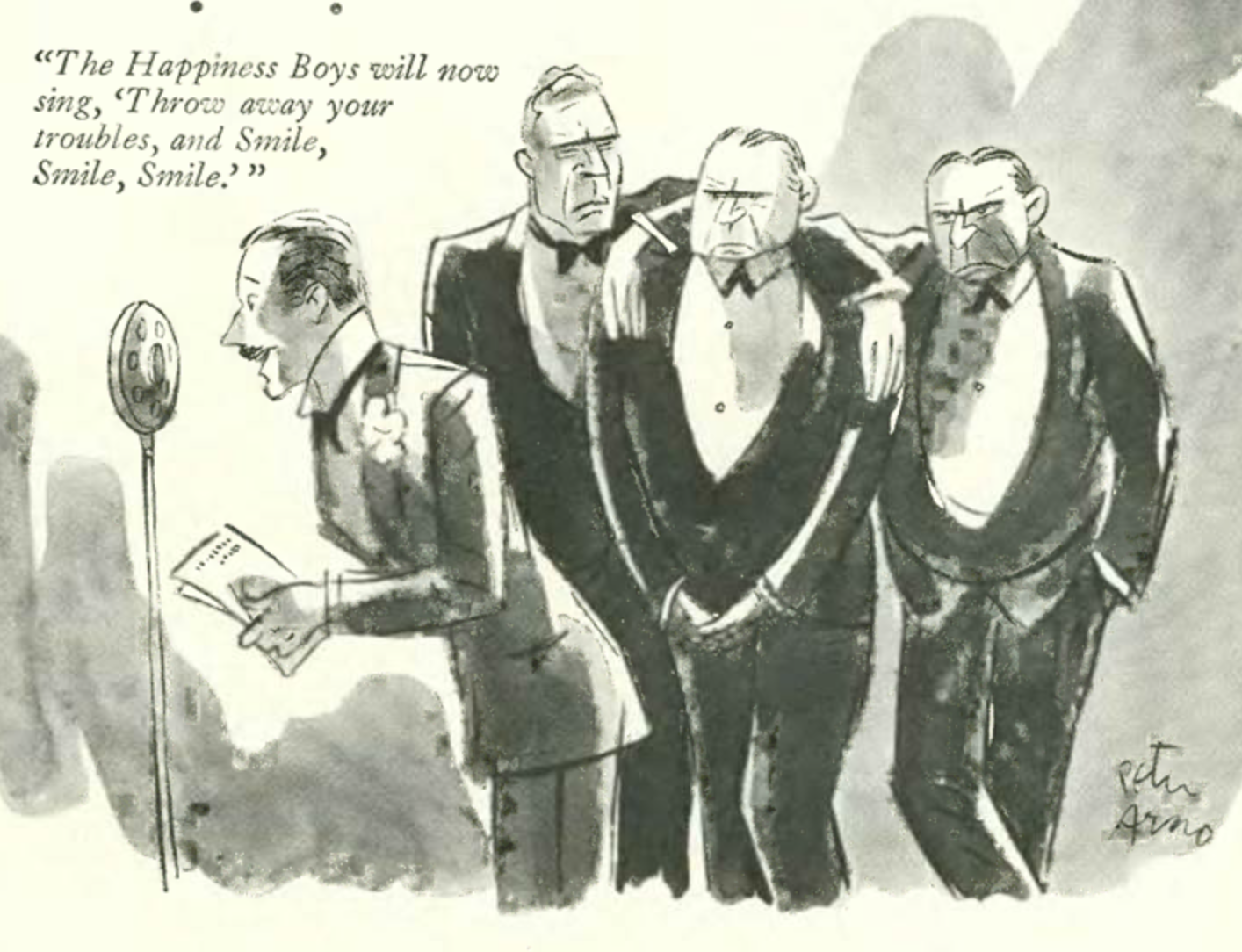
And finally, our cartoon, courtesy Peter Arno:

Next Time: Happy 1929!


Dorothy Parker Goes to the Movies

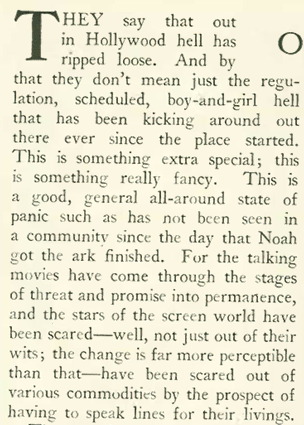
Dorothy Parker turned her jaded eye to the latest big thing — talking pictures — and in the Sept. 1, 1928 issue she joined her New Yorker colleagues in a collective yawn at the technology that was dramatically transforming cinema.

Sept. 1, 1928 cover by Helen Hokinson.

In a feature titled “Out of the Silence,” Parker mused about the changes facing former silent stars…

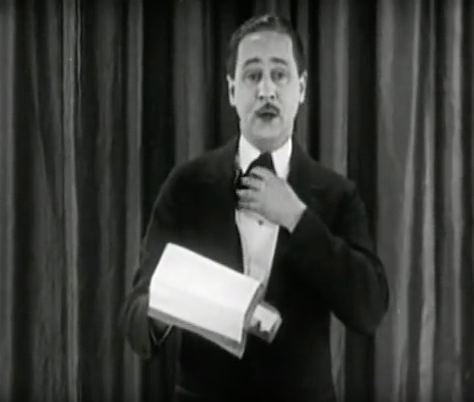
…and seemed unconvinced that the talking pictures, at least to date, were any real improvement over the silents, including a performance by her Algonquin Round Table pal and New Yorker colleague Robert Benchley, who seemed but a talking simulacrum:

HIS SCREEN VERSION…Robert Benchley delivers his comedy sketch The Treasurer’s Report in a short 1928 Movietone film. Benchley portrayed a nervous assistant treasurer struggling to present an organization’s yearly report. (YouTube screen shot)

Parker attended a matinee at a jam-packed Warner Theatre, where folks paid a dollar apiece for standing room only to witness a series of shorts and a feature-length film, all presented with sound:


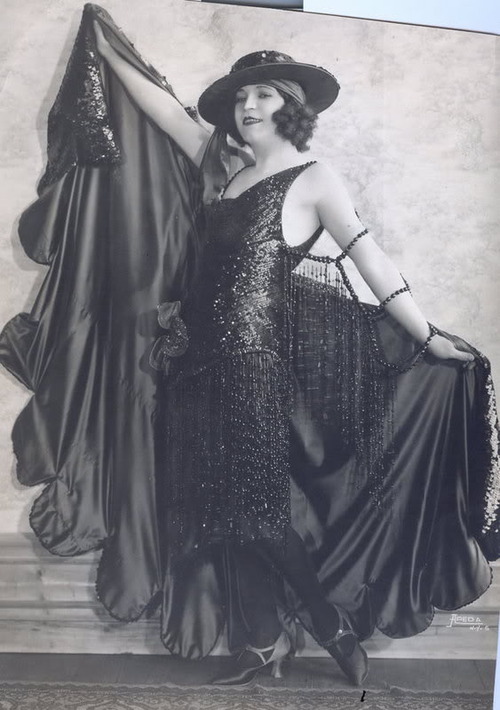
One of the shorts featured a performance by female impersonator George Francis Peduzzi, known professionally as Karyl Norman, “The Creole Fashion Plate,” followed by a performance from violinist Albert Spaulding:

WHAT A DRAG…Dorothy Parker was underwhelmed by Karyl Norman’s performance in a Vitaphone short. He is pictured here in a 1924 publicity photo, dressed as “The Creole Fashion Plate.” (queermusicheritage.com)

What Parker was subjecting herself to was the Vitaphone Varieties, described by North Carolina Museum of Art film curator Laura Boyes as “the last gasps of vaudeville.”

Boyes writes that many vaudevillians stepped off the stage to immortalize their acts on film in the early days of the talkies. They were produced in Brooklyn between 1927 and 1929 using the Vitaphone method (large recorded discs synchronized with the film) “at a time when the major studios hoped that the talkies were just a passing fad.” She notes that “talkies would eventually put this style of theater completely out of business, and Vitaphone shorts literally became the place where Vaudeville went to die. Many of the people in these short films were obscure at the time, and they are doubly obscure now.”

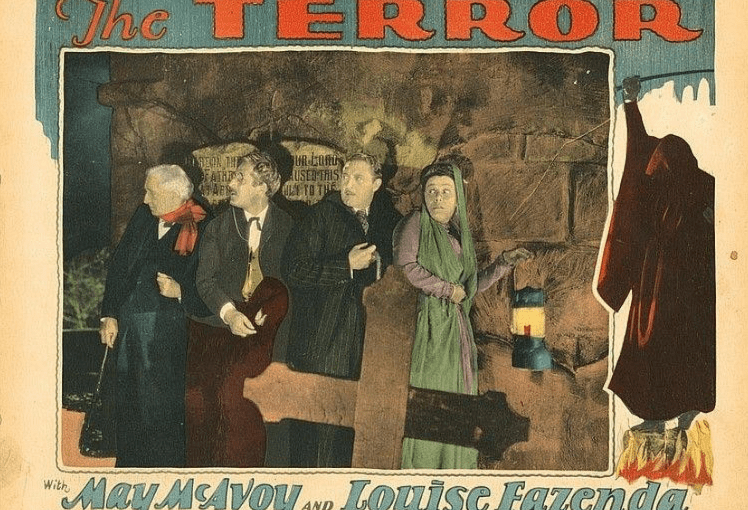
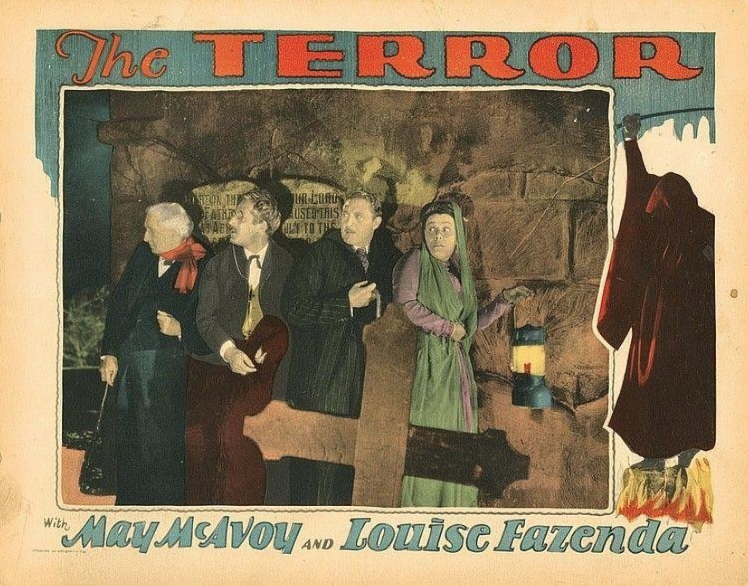
As for the main feature, The Terror, the only terror Parker felt was the fear of being bored to death:

SOUND AND FURY, SIGNIFYING NOTHING…Dorothy Parker found The Terror to be unexciting, its sound effects a “racket.” But for the record, it was the first all-talking horror film. (IMDB)

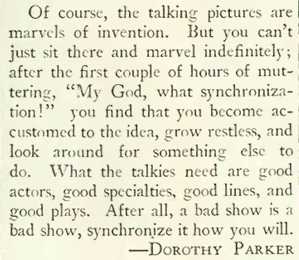
Parker concluded that “talking pictures are marvels of invention,” but “a bad show is a bad show, synchronize it how you will.”

Coming of Age in Samoa

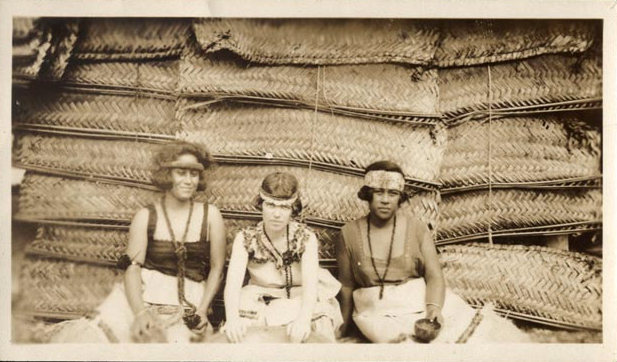
Social critic and humorist Baird Leonard took the honors as book reviewer for the Sept. 1 issue, offering a brief, humorous endorsement of Margaret Mead’s landmark Coming of Age in Samoa, in which the famed anthropologist explored the link between culture and psychosexual development among the island’s adolescents. Leonard found much to like about the book, and particularly Mead’s observations on the separation of youth from adult activities in Samoan culture (it would enhance his bridge-playing enjoyment):

GOING NATIVE…Margaret Mead sitting between two Samoan girls, ca. 1926. (Library of Congress).

 *  *  *

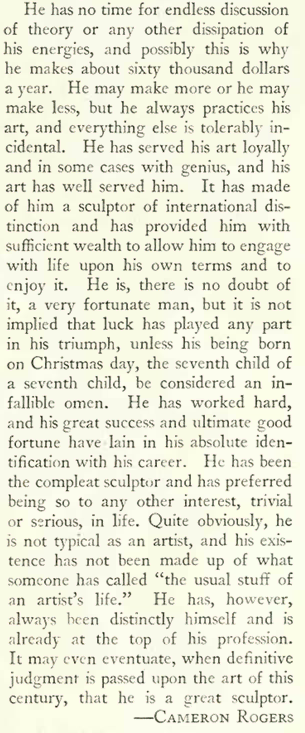
Writer Cameron Rogers profiled American sculptor Paul Manship, who was an important contributor to Art Deco style, and is perhaps best known for his iconic Prometheus sculpture at Rockefeller Center in New York. Rogers made these closing observations about Manship, noting that the artist’s success netted him about $60,000 a year — close to $850,000 today (These days, someone like showman/artist Jeff Koons, who makes giant shiny balloon animal sculptures, among other things, has a net worth of at least $100 million).

PROMETHEUS, gilded cast bronze by Paul Manship, 1934, at Rockefeller Center. (Encyclopedia Britannica)

 *  *  *

From Our Advertisers

I find it interesting when one magazine advertises in another, especially when an older magazine like the Outlook (founded in 1893) advertises in an upstart like The New Yorker. But then again, the publishers of the Outlook were looking to breathe new life into their stodgy journal, and what better way than to announce that their “conservative girl” was now a modern, grown-up woman with a new Jazz Age look and an attitude to match. And it was no coincidence that they hired The New Yorker’s Rea Irvin to illustrate their point.

OUTLOOK magazine was first published as The Christian Union in 1870, changing its name to Outlook in 1893 when it shifted its focus from religious subjects to social and political issues. The magazine folded in 1935. (Pinterest)

 *  *  *

Our cartoon is by Peter Arno, who continued to explore the lighter moments of New York night life…

Next Time: Mussolini’s Romance Novel…


Office Romance

The New Yorker’s founder and editor, Harold Ross, did not approve of office romances. He had a magazine to run after all, and didn’t want any distractions from Cupid’s arrow.

30e6d833482958226738b30ce4244558
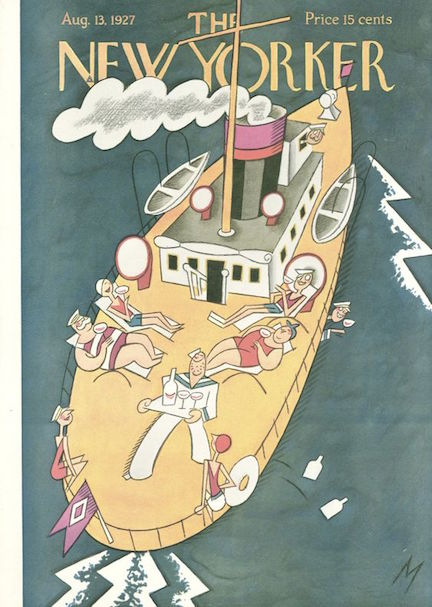
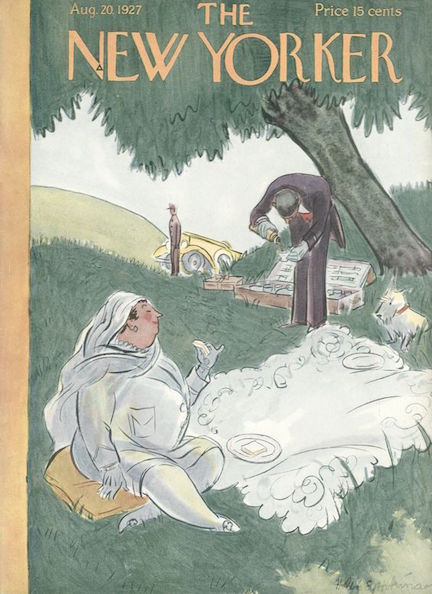
August 13, 1927 cover by Julian de Miskey.

But then again, it seemed inevitable that Lois Long and Peter Arno–two of the magazine’s most lively personalities and important early contributors–would end up together. Arno cut a dashing figure as one The New Yorker’s most celebrated cartoonists. He often drew upon the same subject matter as Long, who covered the nightclub and speakeasy scene in her column, “Tables for Two” and in the process defined the lifestyle of the liberated flapper. Long is also credited with inventing the field of fashion writing and criticism with her other New Yorker column, “On and Off the Avenue.”

screen-shot-2016-11-16-at-9-33-38-am
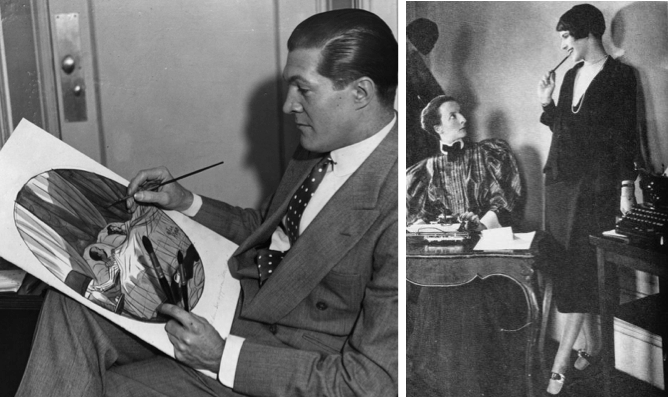
OFFICE SWEETHEARTS… Arno and Long personified the witty, cosmopolitan image cultivated by The New Yorker. (Wall Street Journal, Wikipedia)

In Vanity Fair, Ben Schwartz (“The Double Life of Peter Arno,” April 5, 2016) wrote that Arno and Long “personified what people thought The New Yorker was, which was very fortunate…(Long was) tall, lanky, a Vassar grad with bobbed hair and a wicked sense of humor, a minister’s daughter to Arno’s judge’s son, and she matched him as a hell-raiser.” It was actually their raucous affair that set Ross on a “permanent scowl” regarding office romances.

Schwartz quotes Arno’s and Long’s daughter, Patricia (Pat) Arno, about her parents’ wild relationship: “There were lots of calls to (gossip columnist Walter) Winchell or some other columnist about nightclub fights…with my mother calling and saying, ‘Oh, please don’t print that about us,’ trying to keep their names out of the papers.”

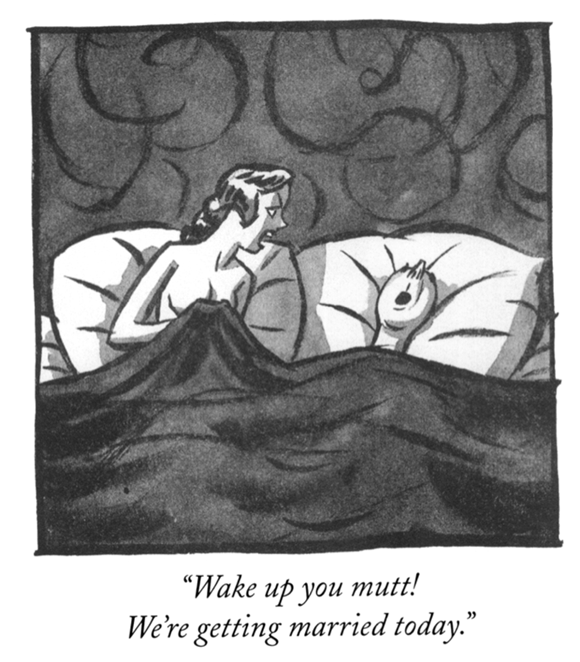
Schwartz suggests that Arno drew on personal experience when in 1930 he published Peter Arno’s Hullabaloo, a “collection of cartoons that included a set of racy drawings featuring a dashing couple much like himself and Long. In one, a nude woman, in bed, yells at her sleeping lover: ‘Wake up, you mutt! We’re getting married to-day.'”

favoritecartoon-4-580

Long and Arno were married by her father, the Rev. Dr. William J. Long, at her parents’ home in Stamford, Conn., on August 13, 1927. Their daughter, Patricia, was born September 18, 1929.

According to Schwartz, Arno’s first three books sold well (Whoops Dearie! 1927, Parade 1929, and Hullabaloo 1930) “allowing the young family to move into an East Side penthouse. Their social circle included New Yorker staffers, the magazine’s owner, Raoul Fleischmann, publishers Condé Nast and Henry Luce, Kay Francis (Broadway actress, future Hollywood star and Long’s former roommate), and some of the city’s financial powers. ‘Once my mother was having trouble with her Plymouth,’ says Pat Arno, “and Walter Chrysler took off his evening coat, rolled up his sleeves, and fixed it himself.'”

kay-glam
STAR POWER…Actress Kay Francis, no stranger to wild living, was Lois Long’s longtime friend and also her roommate until Long married Peter Arno in 1927. (flickchick1953)
peter-arno-curtis-arnoux-peters-jr-cartoonist-ben-schwartz-07
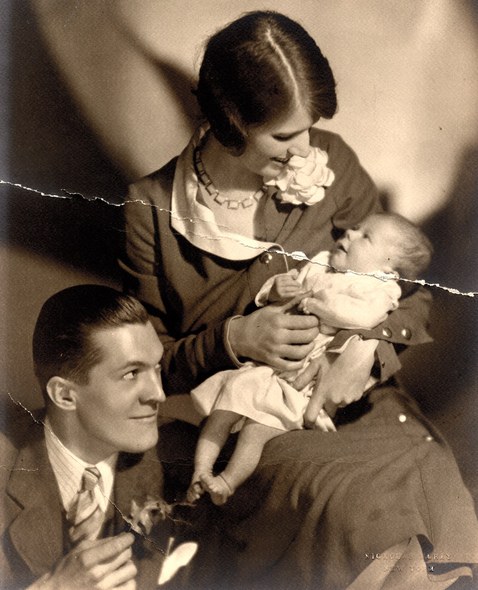
HAPPY INTERLUDE…Arno and Long with their baby daughter, Patricia, in 1929. (Vanity Fair)

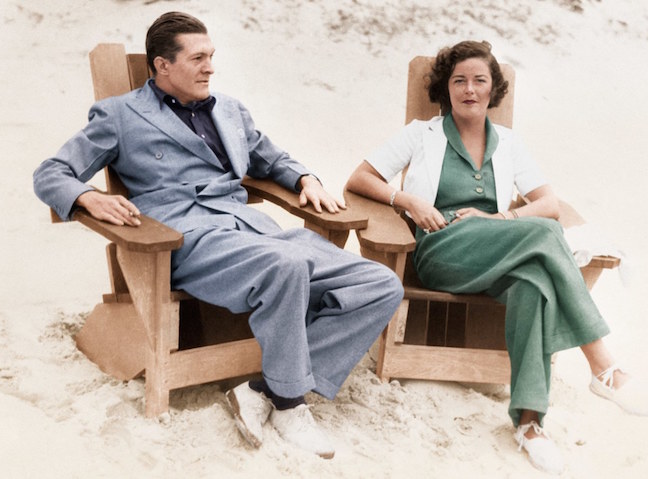
Less than two years after the birth of their daughter, Arno and Long would get a divorce in Reno on June 30, 1931. Arno later married debutante Mary Livingston Lansing in August 1935; they divorced in July 1939. After his divorce from Lansing, Arno moved to a farm near Harrison, New York, where he lived in seclusion, drawing for The New Yorker and enjoying music, guns, and sports cars. He died of emphysema on February 22, 1968 at the age of 64.

peter-arno-curtis-arnoux-peters-jr-cartoonist-ben-schwartz-11
Arno with second wife, debutante Mary Livingston “Timmie” Lansing, Winsted, Connecticut, 1939. (Digital Colorization by Lorna Clark)

In 1938 Long would marry Donaldson Thorburn, a newspaper and advertising man. After his death in 1952 she would marry Harold Fox, head of an investment brokerage firm. Long’s colleague at The New Yorker, Brendan Gill, described Fox as “a proper Pennsylvanian named Harold A. Fox.” They lived in an 1807 Pennsylvania-Dutch farmhouse, where Long delighted in the woods, farms and wildlife as well as in her two grandchildren—Andrea Long Bush and Katharine Kittredge Bush. In 1960 she wrote to her alma mater, Vassar College, that the “hectic fifteen years or so after graduation, when I thought I had New York City by the tail and was swinging it around my head, seem very far away. Thank God. I like things this way.” Long would continue working as a columnist for The New Yorker until the death of Harold Fox, in 1968. She died in 1974 at age 72.

screen-shot-2016-11-16-at-10-40-11-am
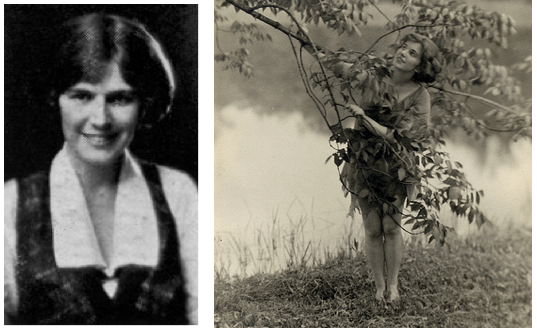
BEFORE IT ALL BEGAN…Left, Lois Long’s photo in Vassar’s yearbook, The Vassarion. At right, during her senior spring, Lois posed for a photo by Sunset Lake. Long studied English and French, graduating in1922 with an English major. (vcencyclopedia.vassar.edu)

*  *  *

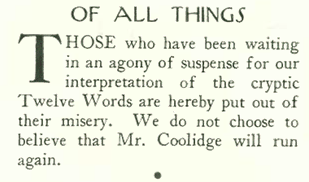
The big news in the Aug. 13, 1927 edition (the same date as the Long-Arno wedding) was President Calvin Coolidge’s brief, ambiguous announcement that he would not run for president. Almost everyone assumed he would run for a second term, given the booming economy in the age of “Coolidge Prosperity.”

Coolidge was summering in Black Hills when he gave his secretary, Everett Sanders, a piece of paper that read, “I do not choose to run for president in 1928.” Sanders then scheduled a midday press conference for August 2, 1927. At 11:30 a.m., Coolidge cut out strips of paper with this statement–I do not choose to runand at the conference handed each reporter one of the strips. Coolidge offered no further information, and only remarked, “There will be nothing more from this office today.” This led to considerable debate among the press as to intentions of the president. The New Yorker’s “Talk of the Town” mused…

screen-shot-2016-11-15-at-12-11-05-pm

…Howard Brubaker’s “Of All Things” column offered this wry observation…

screen-shot-2016-11-15-at-12-16-05-pm

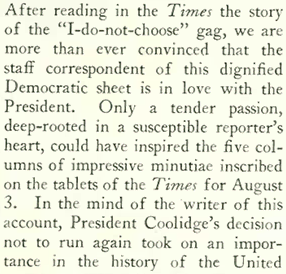
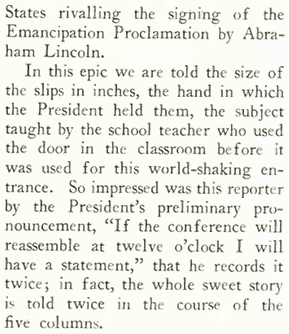
…while humorist Robert Benchley (writing under the pseudonym “Guy Fawkes”) in his “The Press in Review” column continued The New Yorker’s stinging attack on the media for its continued attempts to sensationalize events or impart personality traits on colorless newsmakers:

the-press-in-review

guy-fawkes

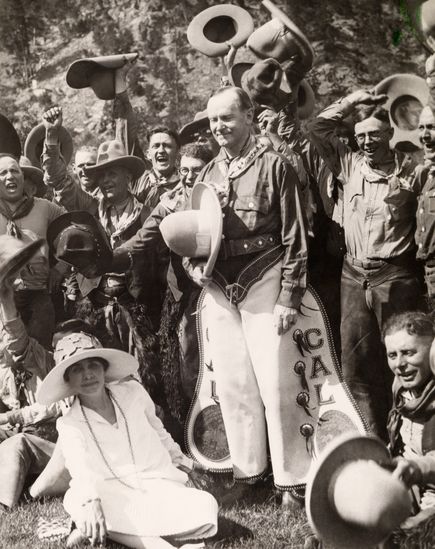
02-calvin-coolidge-cowboy_69085_600x450
HAPPY TRAILS, CAL…No doubt the simple life of the Black Hills influenced Calvin Coolidge’s decision in 1927 to decline a second term as president. (Library of Congress)

Next Time: The Movies Take Wing…

31163f0a903d36d43f89b8495fe4e9a4


Fun in the Sun

Screen Shot 2015-09-09 at 12.47.57 PM
Cover of Jan. 2, 1926 issue by Rea Irvin.

As we begin a new year of The New Yorker, it strikes me how little things have changed in 90 years, at least when it comes to human nature–wars and rumors of wars, celebrity gossip, the latest fads in music and fashion, fights over politics and religion. It’s all still with us. And yet, a person from 2015 would be seem like an extraterrestrial in 1926.

January 1926 was still a year and a half away from Charles Lindbergh’s Atlantic flight. Today we think so little of jumping on a plane that soars seven miles above the earth and whisks us anywhere in a matter of hours.

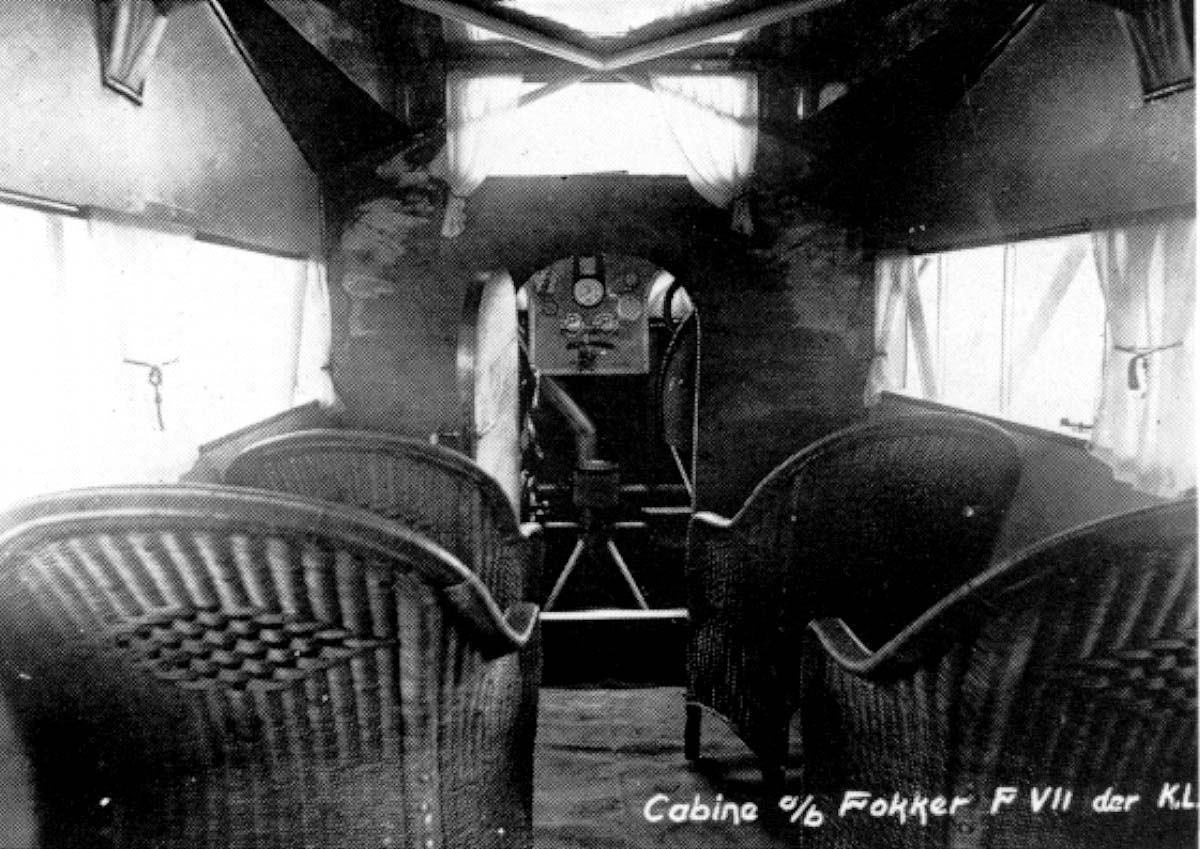
Fokker F7 cabin KLM
The Fokker F7. If you could even afford to fly in the mid-1920s, this is your ride. Buckle up! (Top, aviation history.com; bottom, dutchaviation.nl)

People in 1926 lived very differently, with far fewer distractions. No TV, only sporadic music on mono-tinny radios (or from mostly scratchy, hand-cranked records). Electric lights, but only if you lived in a city or town. The metropolis was noisy, but there was also silence. No cellphones or earphones, no CNN or ESPN blaring from every vertical surface. Your health? Forget it. Going to the dentist, regardless of your station in life, was a chamber of horrors. Ditto the doctor. Ever look at an antique doctor’s bag? Just some brown bottles, weird clamps and a saw. Penicillin wouldn’t be discovered until 1928, and for some reason lots of people died back then of peritonitis. It would claim both Rudolph Valentino and Harry Houdini in 1926. Finally, if you lived in 1926 you probably thought The War to End All Wars was just that. Only a few of the very sage saw the annihilation yet to come.

Anyway…

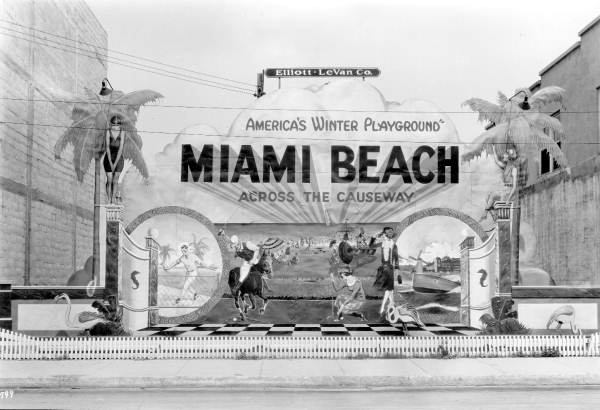
I titled this edition “Fun in the Sun” because the Jan. 2 issue opens with back-to-back ads enticing freezing New Yorkers to go south for the winter:

Screen Shot 2015-09-22 at 4.43.33 PM

Screen Shot 2015-09-22 at 4.43.42 PM

These were boom years for places like Miami Beach, formerly a quiet backwater but fast becoming a popular vacation getaway for New Yorkers and other Northeasterners. During the 1920s many wealthy industrialists from the north and Midwest also built their winter homes there.

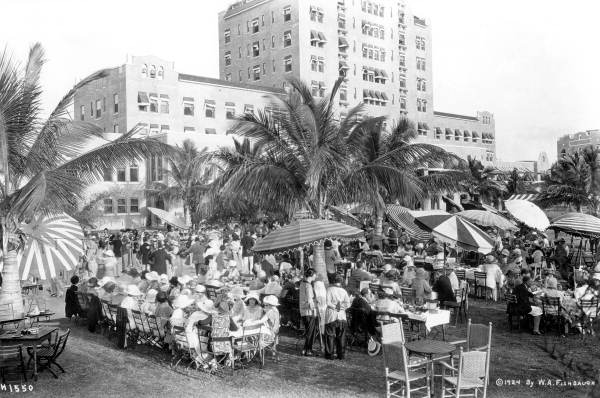
1923
Japanese tea garden at the Flamingo Hotel in 1923 – Miami Beach (State Archives of Florida, Florida Memory)
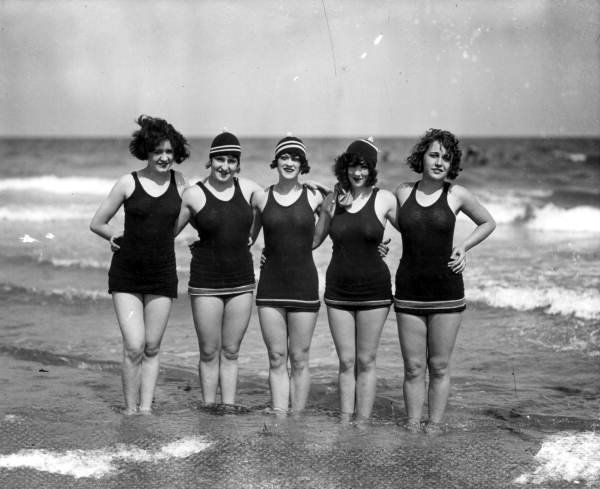
1925
Bathers on Miami Beach in 1925 (State Archives of Florida, Florida Memory)

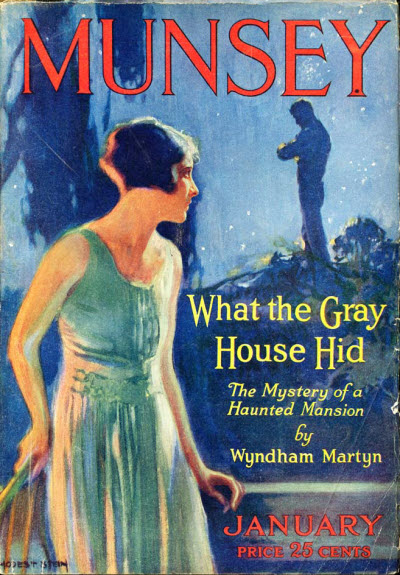
In other items, the “Reporter at Large” Morris Markey commented on the death of Frank Munsey, American newspaper and magazine publisher. Munsey had a reputation for extreme frugality and was widely disliked by employees who blamed him for their “shoddy recompense.” Munsey is credited with the idea of using new high-speed printing presses to print cheap, ragged pulp magazines, especially for working-class readers. Magazines such as Munsey and Argosy were filled with various genres of action and adventure fiction.

munsey_192501
Munsey’s Magazine January 1925 (philsp.com)

Markey wrote that Munsey would fire people on a whim for reasons that included being left-handed, too old, too young, or too fat. During his ownership of the New York Sun, Munsey gave “a peremptory order that all fat men, being inefficient and probably lazy, be expelled from the Sun staff.” Markey was no fan of Munsey as is clear in this excerpt:

Screen Shot 2015-09-25 at 9.29.26 AM

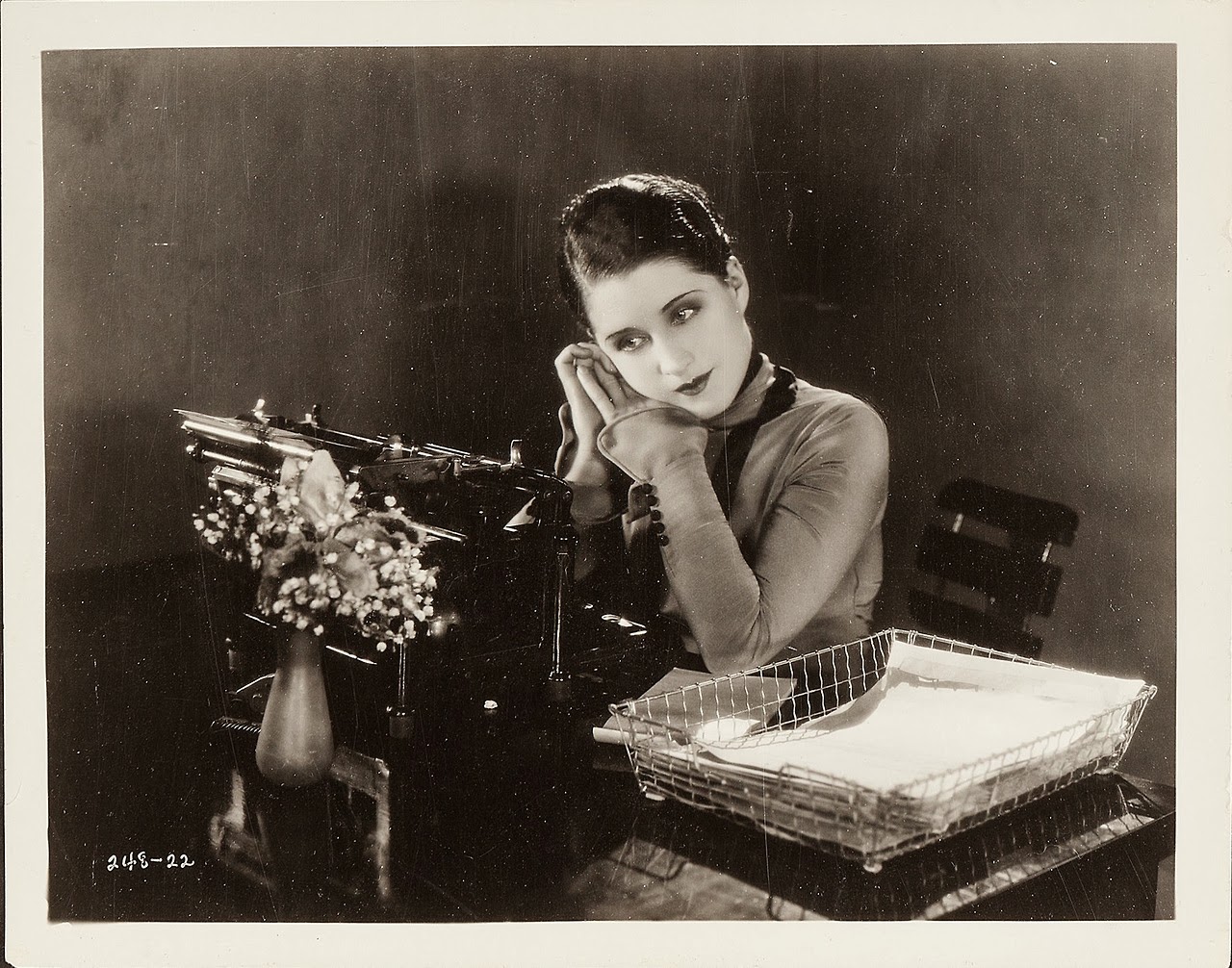
Theodore Shane continued to be disappointed with films coming out of Hollywood. He described Norma Shearer’s latest picture His Secretary as “poor.”

His Secretary - Hobart Henley - 1925
A stenographer, and a vamp! Norma Shearer in His Secretary, 1925 (silent beauties)

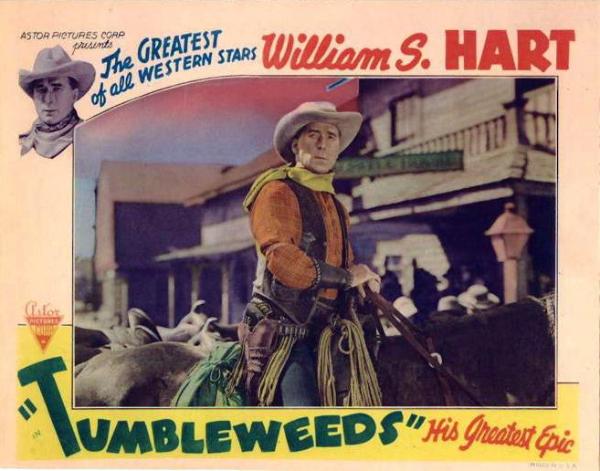
The film was about a humble stenographer who suddenly transforms into a ravishing sex symbol, a “Cinderella theme” that Shane believed had been thoroughly worn out by the actress. He was also underwhelmed by the return to the screen of William S. Hart, once a big star of the early silents.

Screen Shot 2015-09-25 at 9.45.41 AM

TUMBLEWEEDS_Silent_Western_Lobby_Card_1_William_S._Hart-600x471
The old cowboy isn’t done yet, durn it! (silenthollywood.com)

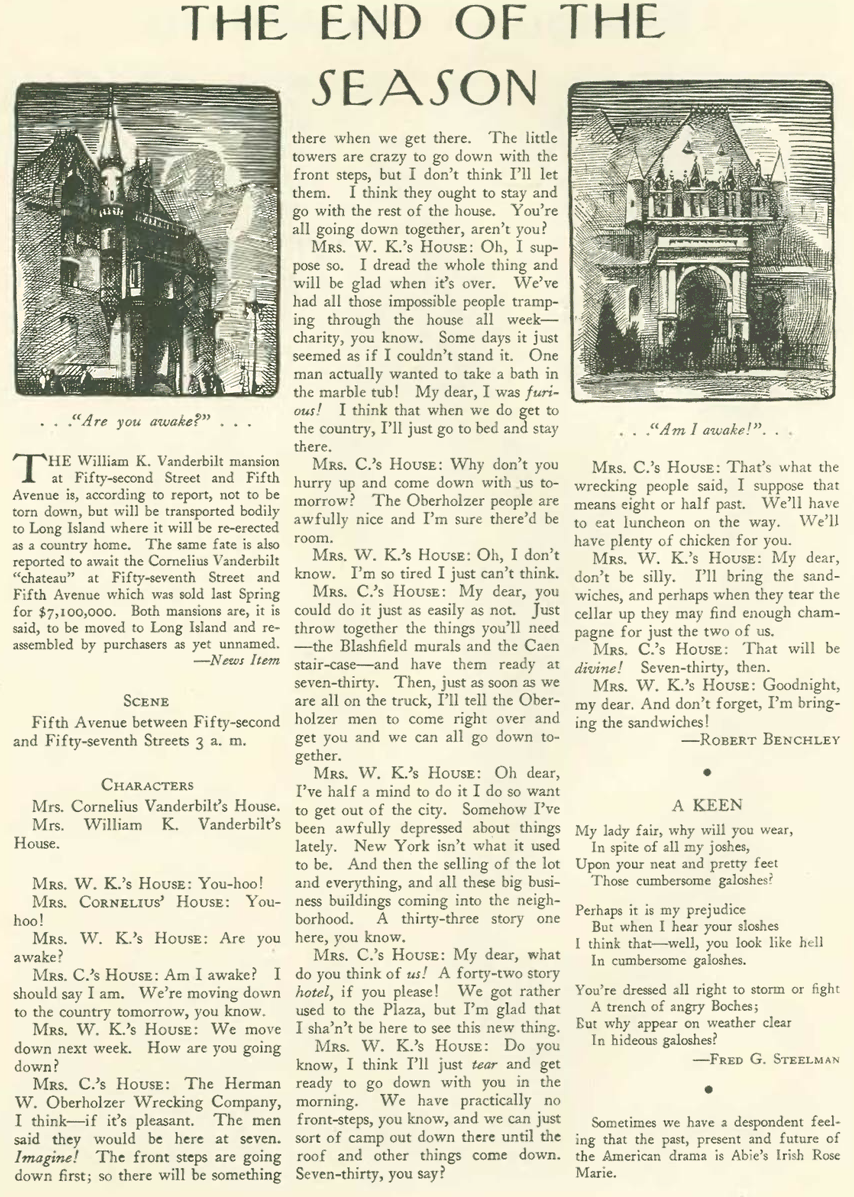
I have written several entries about the changing face of Fifth Avenue (the old mansions being destroyed, that is). Here is Robert Benchley’s take on the subject:

Screen Shot 2015-09-25 at 9.31.31 AM

To close, an illustrated feature by Helen Hokinson, once again showing us how a college student of the 1920s looks (to my eyes anyway) as ancient and remote as a mastodon:

Screen Shot 2015-09-25 at 9.36.00 AM

Next time: Ben Hur Bric-à-brac

Screen Shot 2015-09-25 at 9.48.36 AM


The Last Laugh

Screen Shot 2015-09-06 at 12.02.47 PM
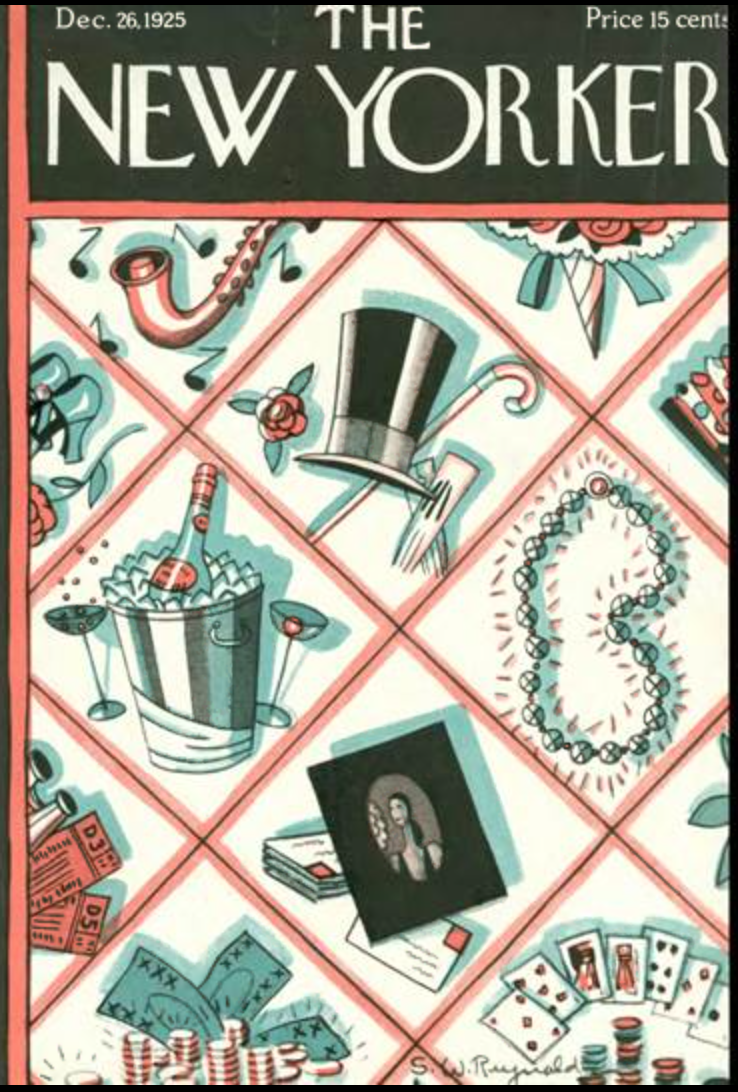
Dec. 26, 1925 cover by S.W. Reynolds

We close out The New Yorker’s first year with the magazine on firmer footing and many of its mainstay writers and artists firmly in place.

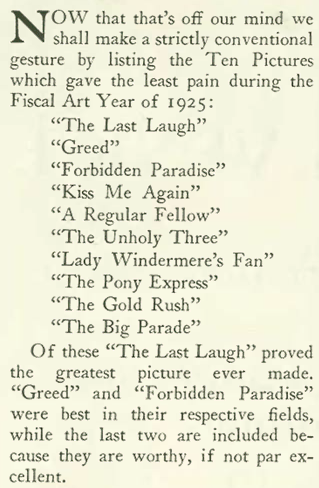
The Dec. 26, 1925 issue was the usual hodgepodge, but some writers did give a nod to the end of the year, including film critic Theodore Shane, who offered his list of the best ten moving pictures of 1925.

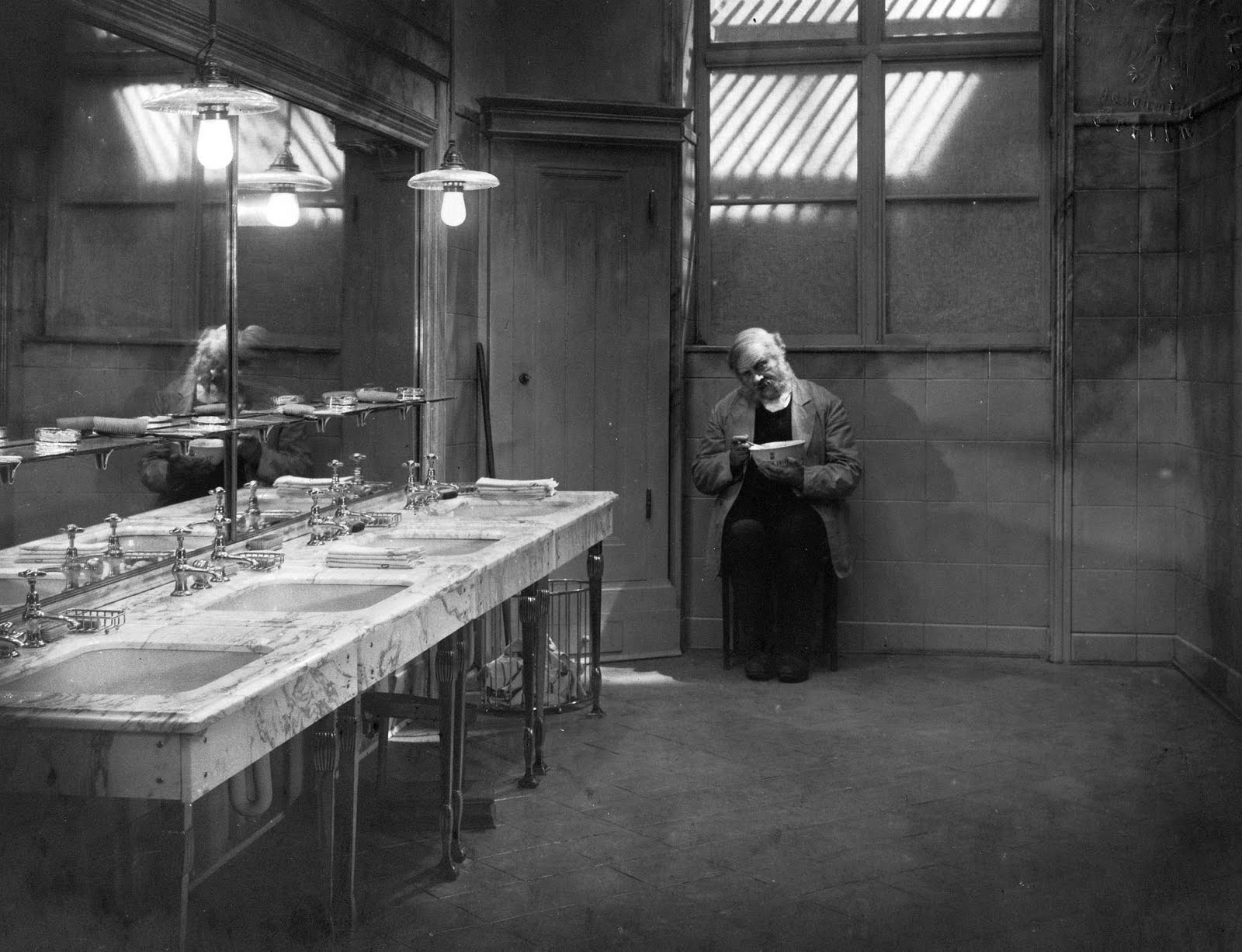
Shane’s favorite film by far was The Last Laugh, (the German title was Der letzte Mann, or The Last Man) a 1924 German film directed by F.W. Murnau and starring Emil Jannings (who would later win the first Academy Award for Best Actor in 1929). Shane referred to it as “the greatest picture ever made.” Released in the U.S. in 1925, the film was about a proud doorman who loses his job and tries to hide the fact from his friends and family. Shane usually reserved his highest praise for German cinema in his columns.

derletztemann2
Scene from The Last Laugh (1924) starring Emil Jannings. (Roger Ebert)

Shane’s complete list of the ten best movies of 1925:

Screen Shot 2015-09-09 at 12.26.59 PM

For the worst films of the year, Shane suggested a tie between Drusilla With a Million, Lord Jim, Joanna, the Million Dollar Girl or Stella Dallas.

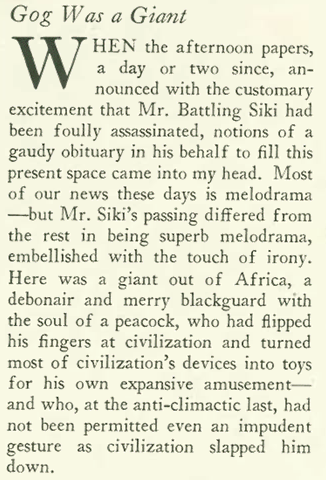
The New Yorker also commented on the murder of the irrepressible boxer Louis Mbarick Fall, popularly known as “Battling Siki.”

BattlingSiki
“Battling Siki” in his heyday. (Wikipedia)

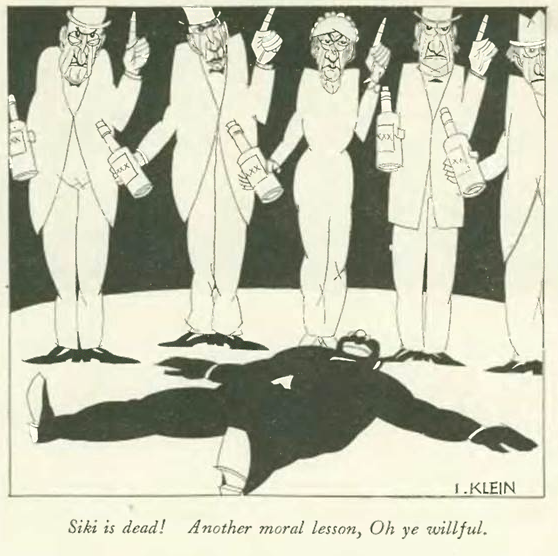
Born in Senegal, he was a light heavyweight boxer from 1912–1925, and briefly reigned as a light heavyweight champion. Known for his heavy drinking and carousing, on the night of Dec. 15, 1925, he was found dead near his 42nd Street apartment. He had been shot twice in the back at close range. He was 28.

In his column, “A Reporter at Large,” Morris Markey offered this observation on Battling Siki’s passing:

Screen Shot 2015-09-09 at 12.47.15 PM

The cartoonist Isadore Klein, on the other hand, contributed this strange stand-alone illustration for “The Talk of the Town” section:

Screen Shot 2015-09-08 at 11.50.02 AM

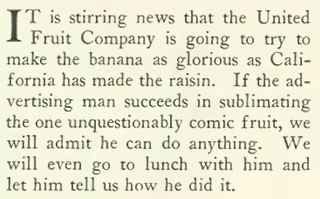
Also in “Talk” was this brief item about the United Fruit Company:

Screen Shot 2015-09-08 at 11.40.53 AM

United Fruit would be no laughing matter three years later with the Banana Massacre, which would claim the lives of an unknown number of workers who were striking for better working conditions in Columbia.

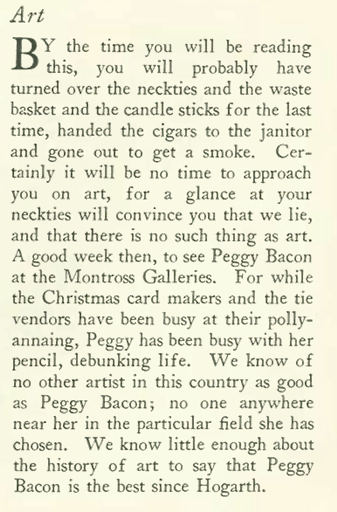
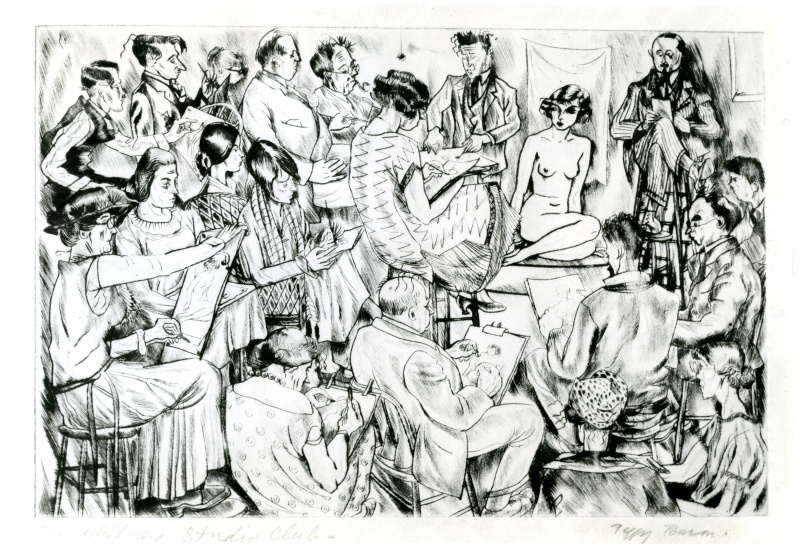
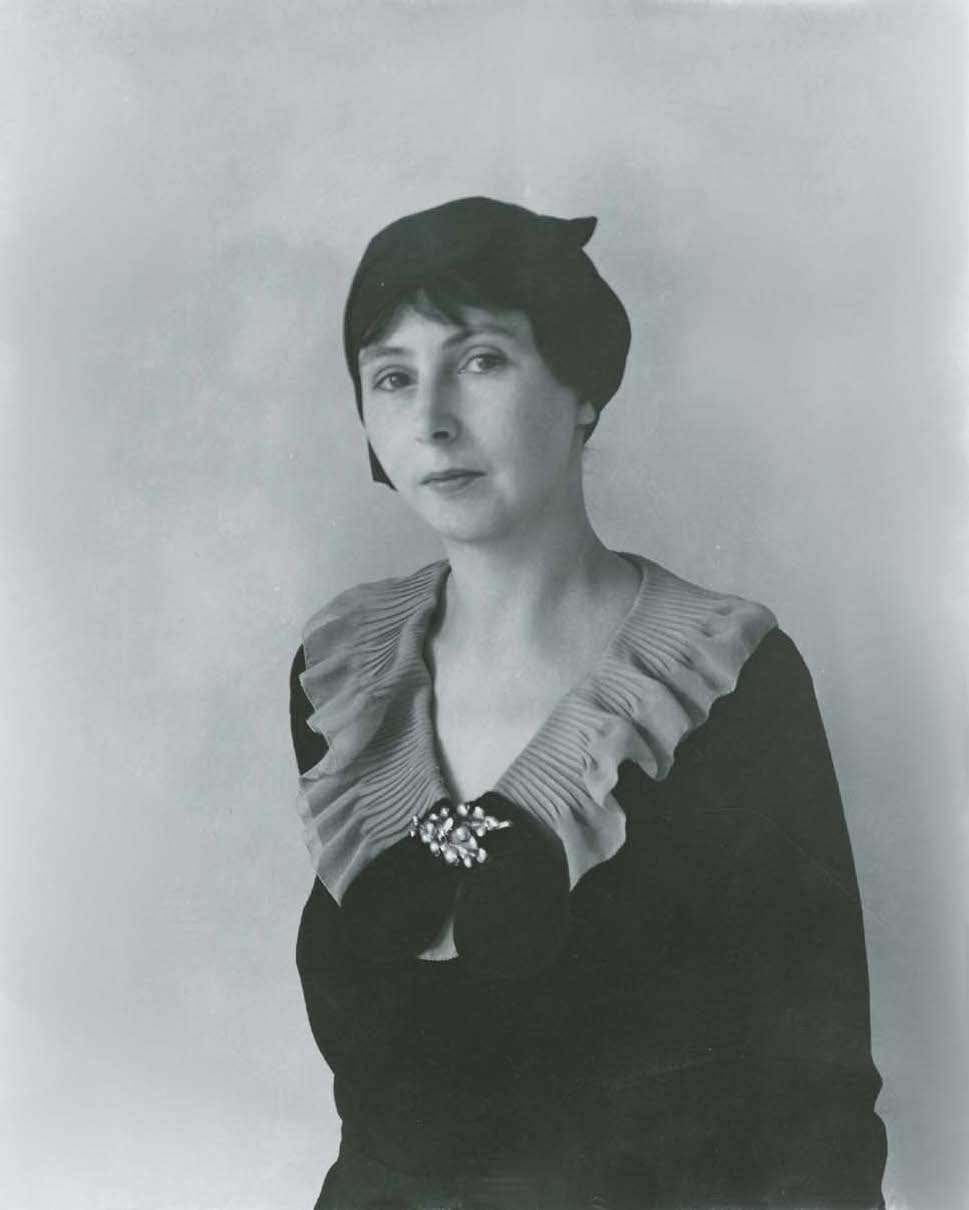
Art critic Murdock Pemberton offered a glowing review of an exhibit at the Montross Galleries by frequent New Yorker contributor Peggy Bacon:

Screen Shot 2015-09-09 at 12.19.40 PM

cc2_1540
Peggy Bacon, The Whitney Studio Club, 1925. (Whitney Museum of American Art)
Peggy_Bacon,_American_painter,_illustrator_and_printmaker,_1895-1987
Peggy Bacon (Smithsonian)

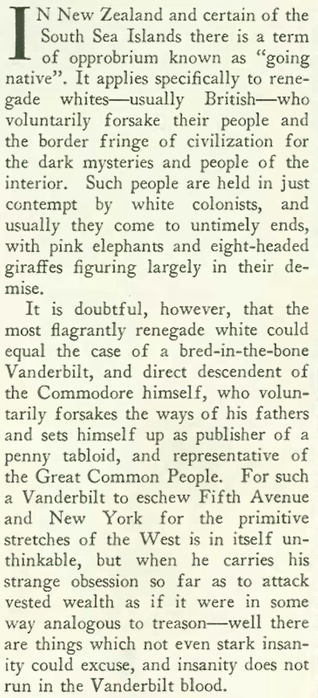
“Profiles” looked at Cornelius Vanderbilt Jr, “The Fifth Avenue Maverick.” William Boardman Knox wrote that the young Vanderbilt “is as alien to his blood as a marmoset to a gorilla.”

Screen Shot 2015-09-09 at 12.45.35 PM

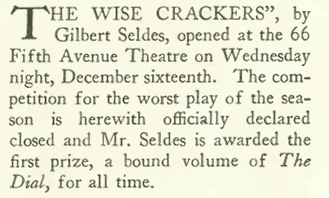
In the “The Theatre,” critic Herman J. Mankiewicz pulled no punches when he declared Gilbert Seldes’ play The Wise Crackers “the worst play of the season” (Seldes was himself a noted critic and sometime New Yorker contributor):

Screen Shot 2015-09-09 at 12.15.09 PM

What’s more, the play was about a group of literate New Yorkers who gather to exchange witty barbs and sarcastically comment on the doings of the day. In other words, it was inspired by the Algonquin Round Table, which famously included Mankiewicz as a member.

Another Round Table notable was Robert Benchley, who contributed this piece for the last issue of the year:

Screen Shot 2015-09-09 at 12.39.48 PM

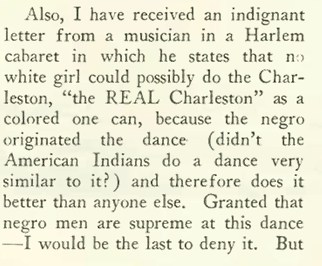
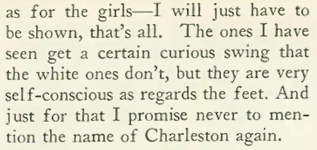
Lois Long offered her regrets for ever bringing up the subject of “The Charleston:”

Screen Shot 2015-09-21 at 6.19.44 PM

Screen Shot 2015-09-21 at 6.20.17 PM

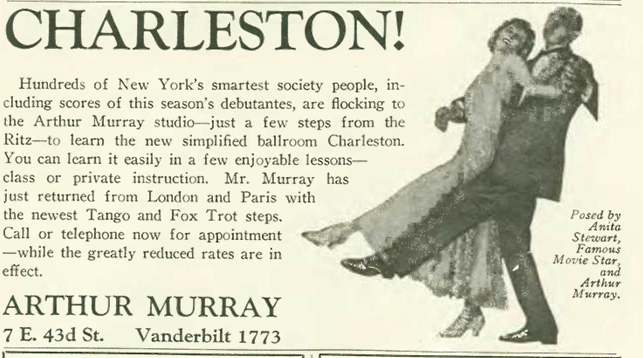
And just a few pages over, lessons were advertised for…The Charleston!

Screen Shot 2015-09-09 at 12.34.19 PM

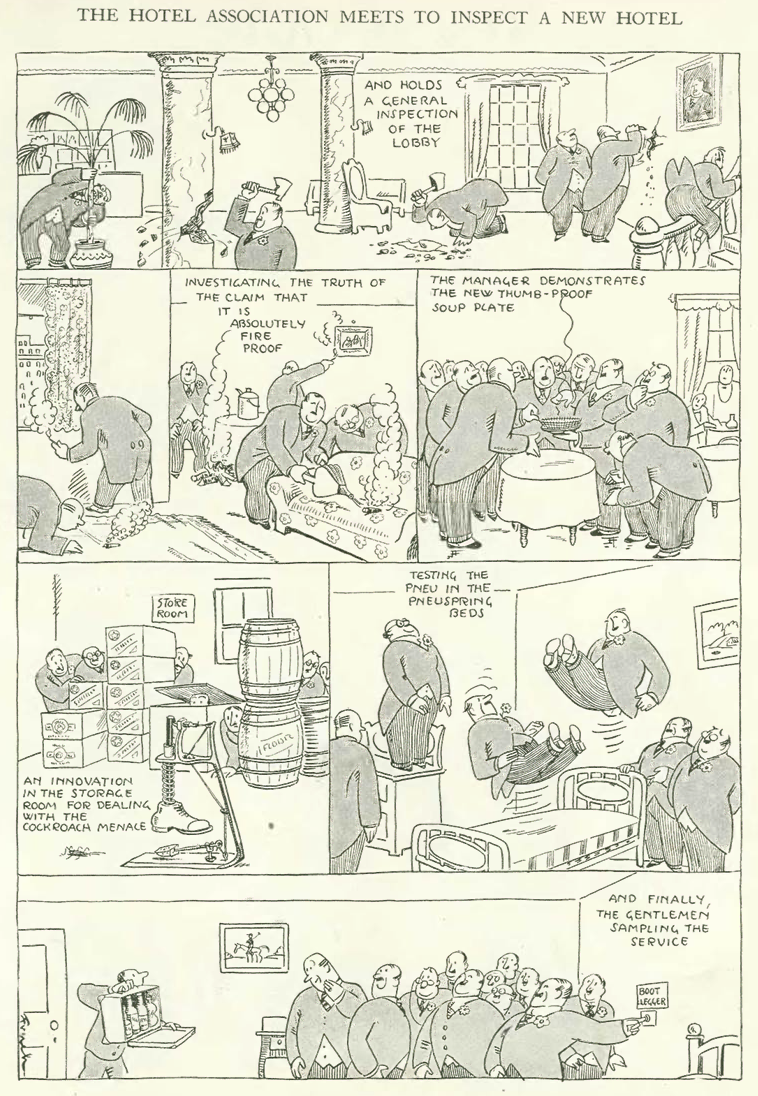
And to close, here’s a little fun with hotel inspectors, courtesy of Al Frueh:

Screen Shot 2015-09-21 at 12.52.41 PM

Next Time: Fun in the Sun…

Screen Shot 2015-09-09 at 12.47.57 PM