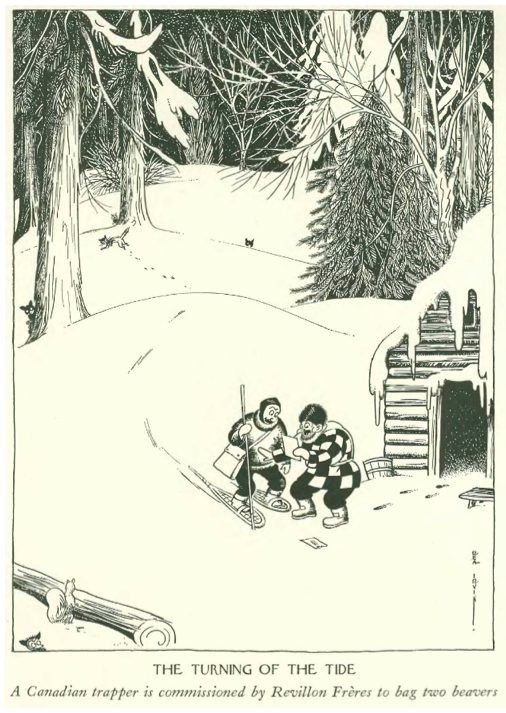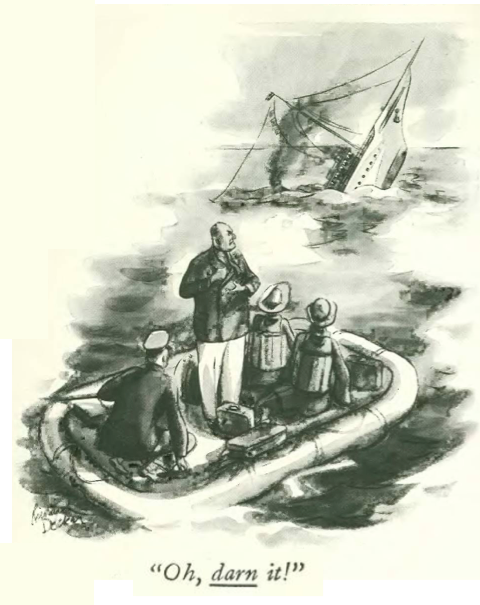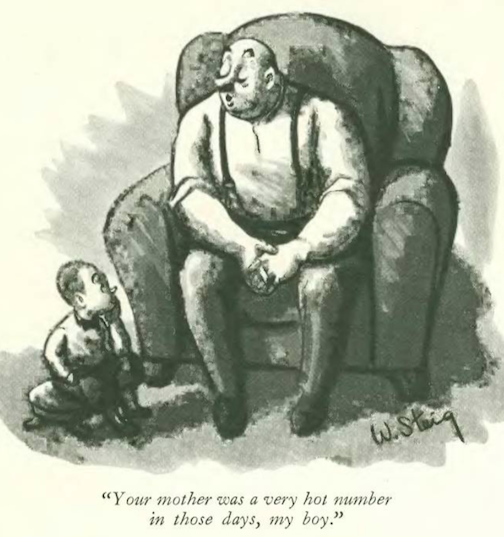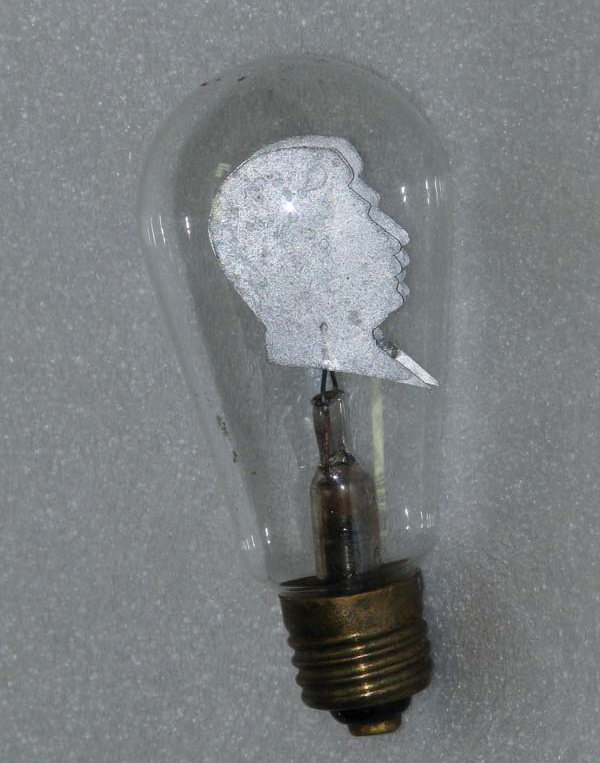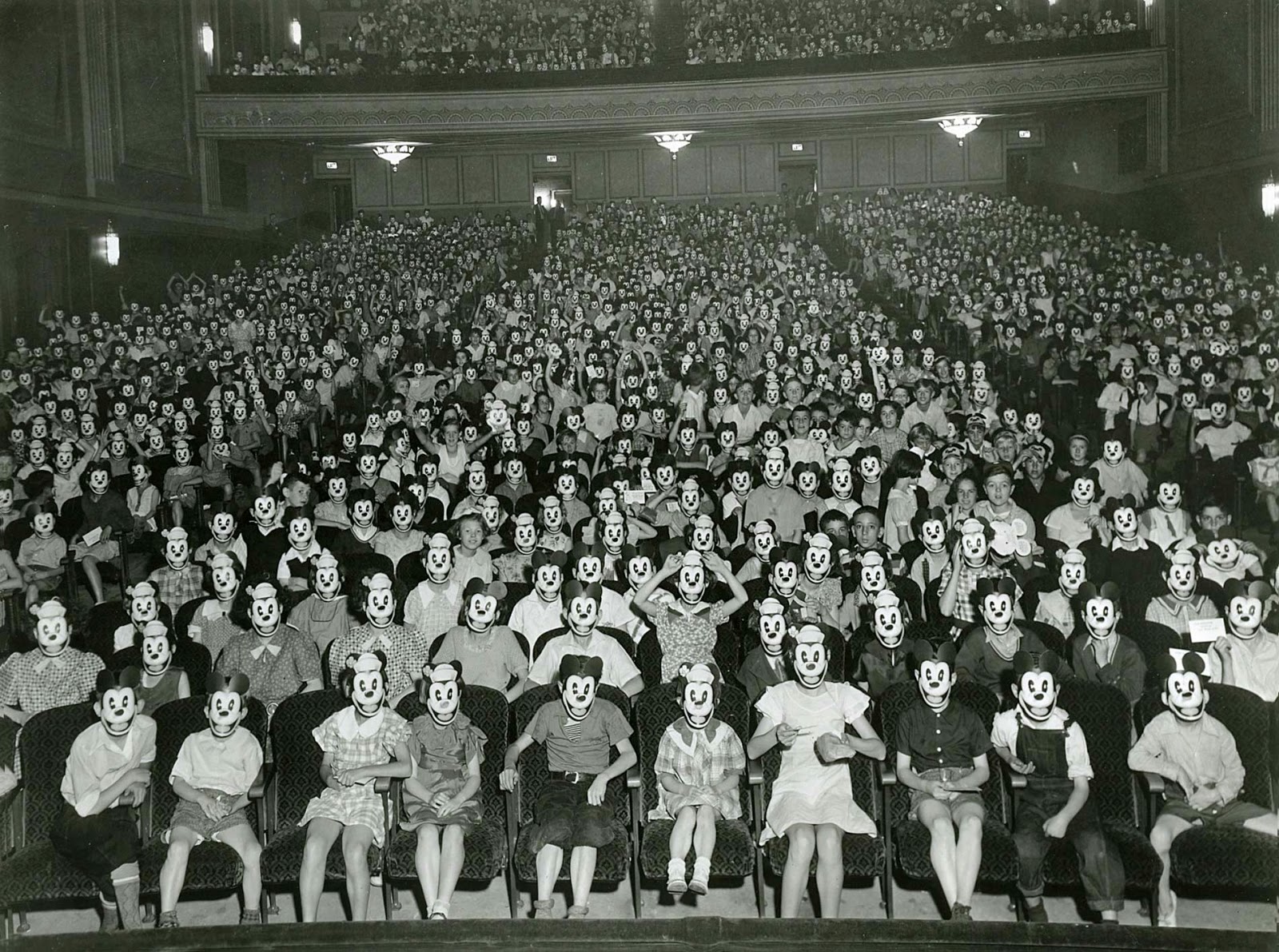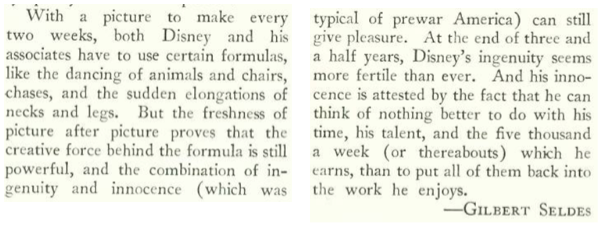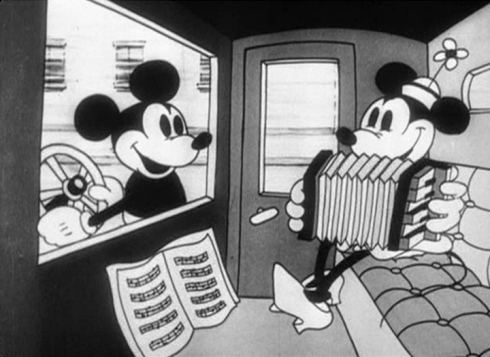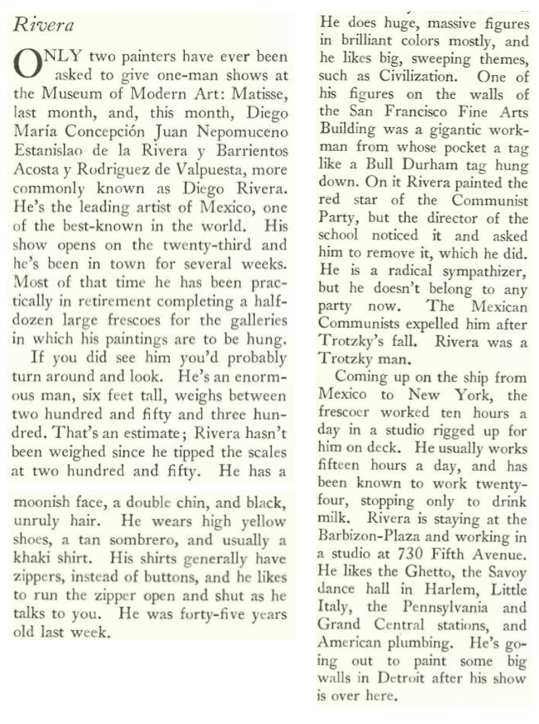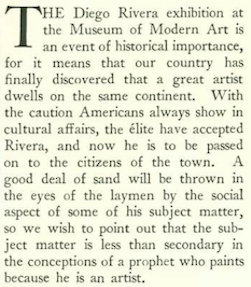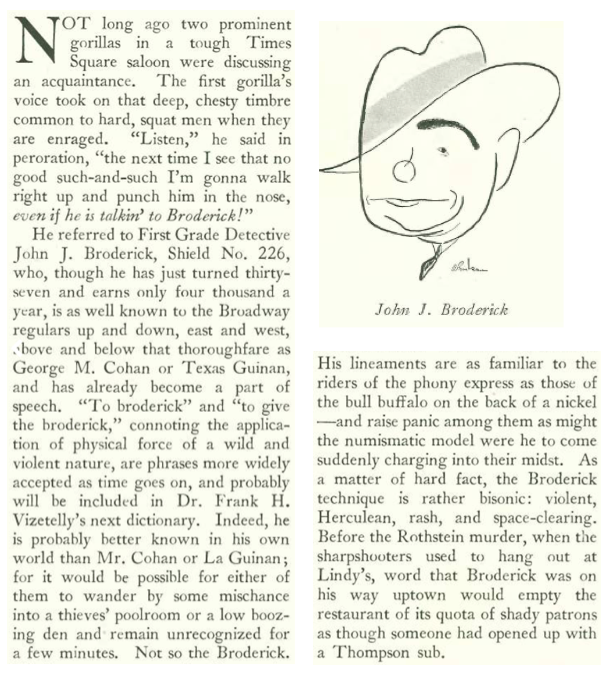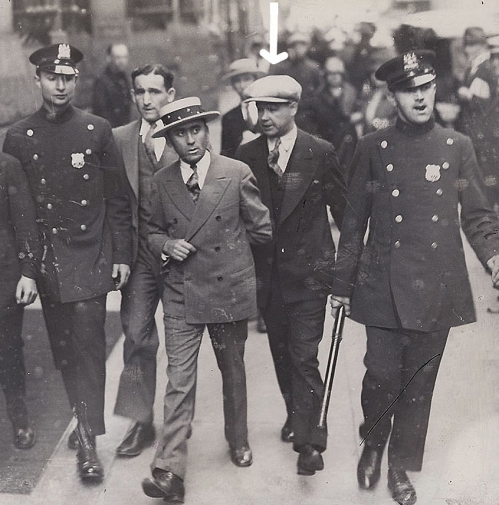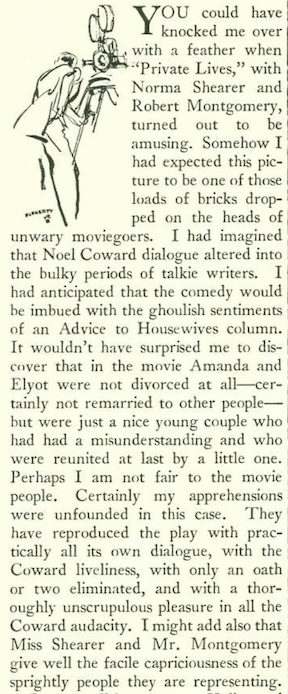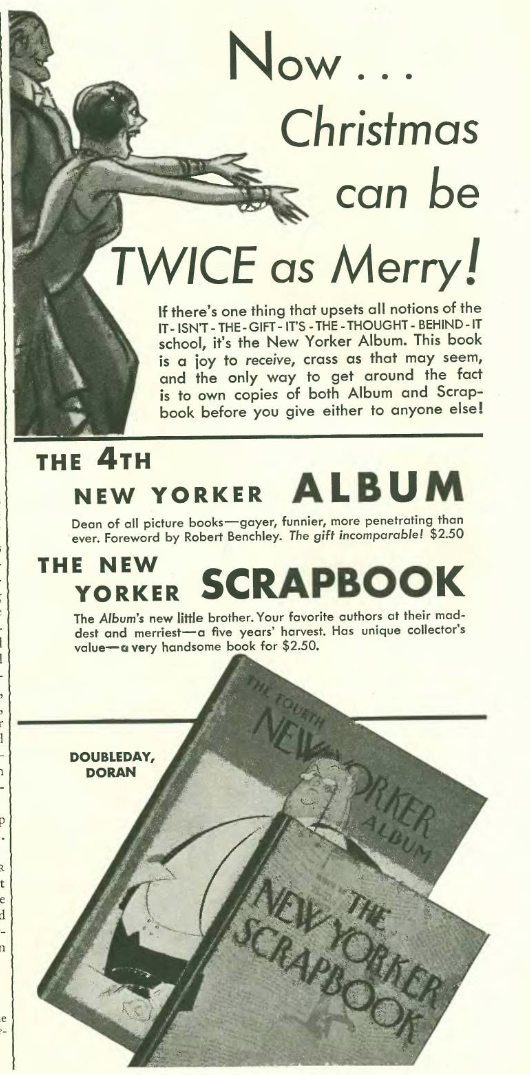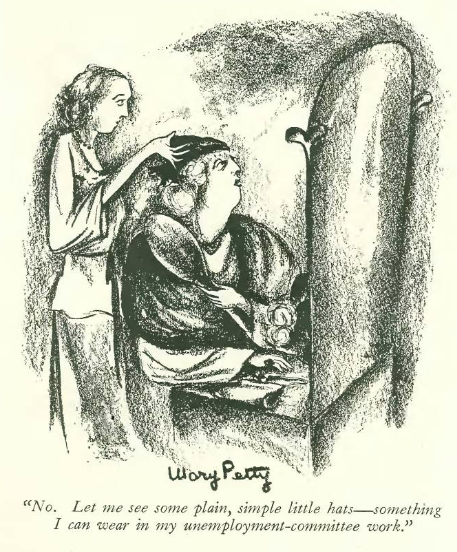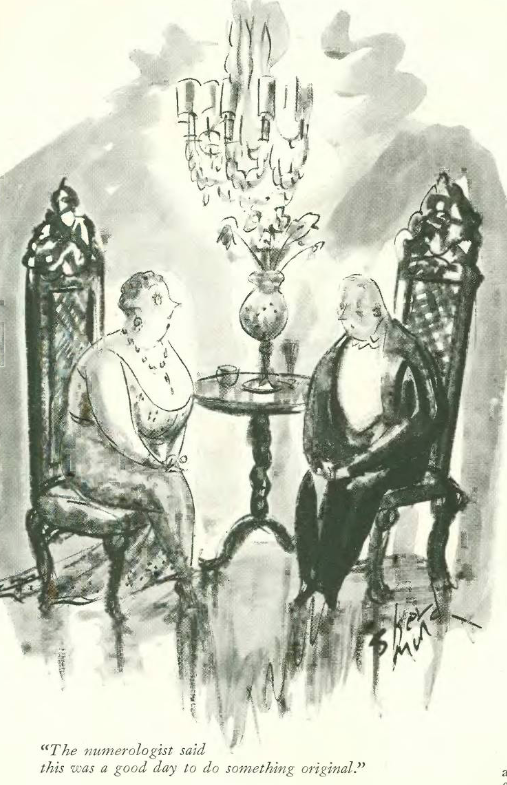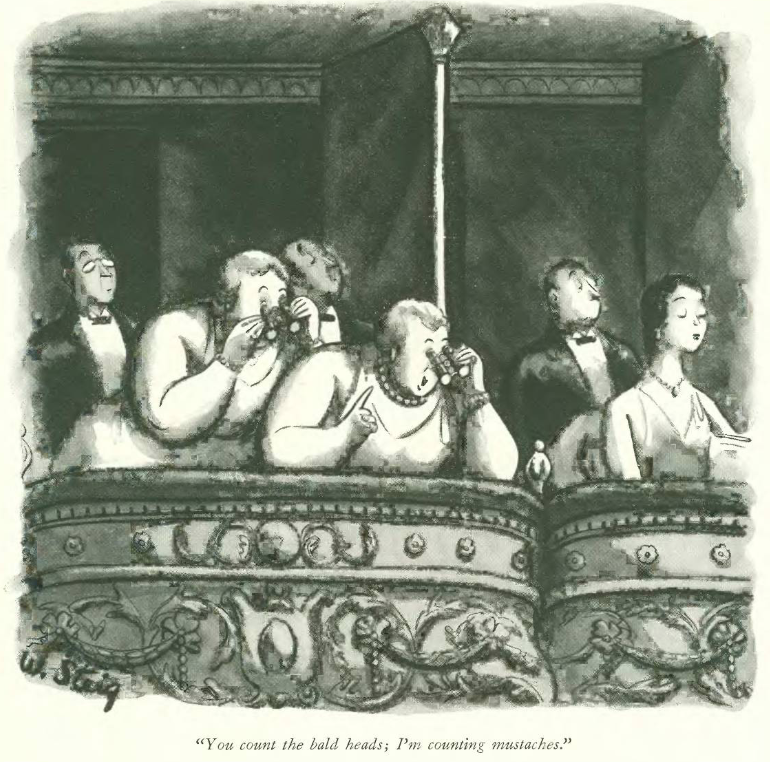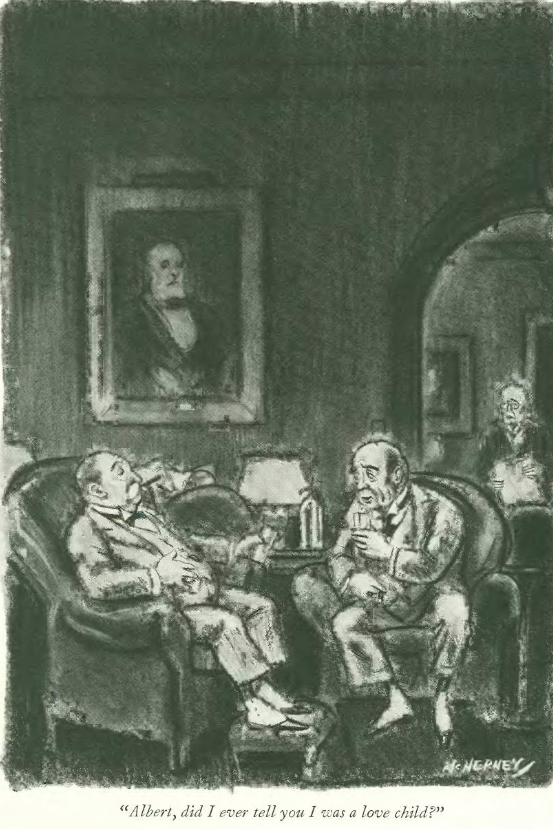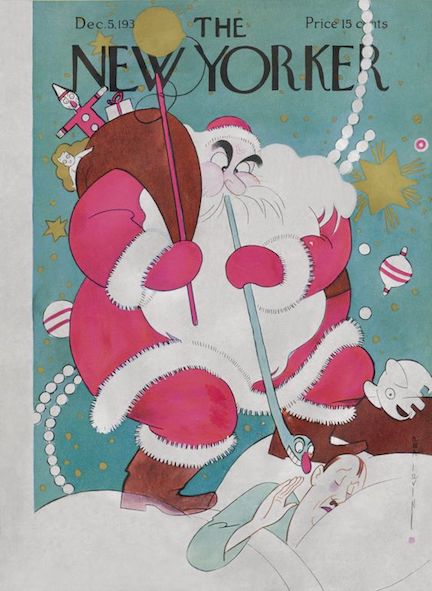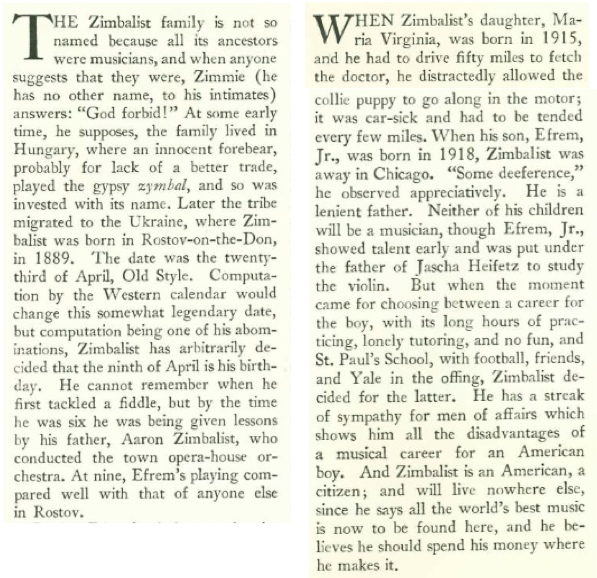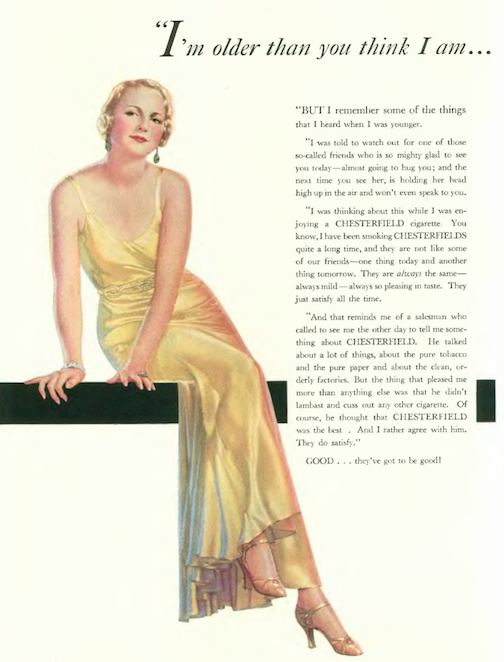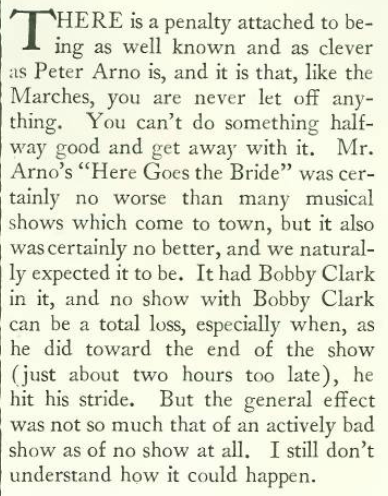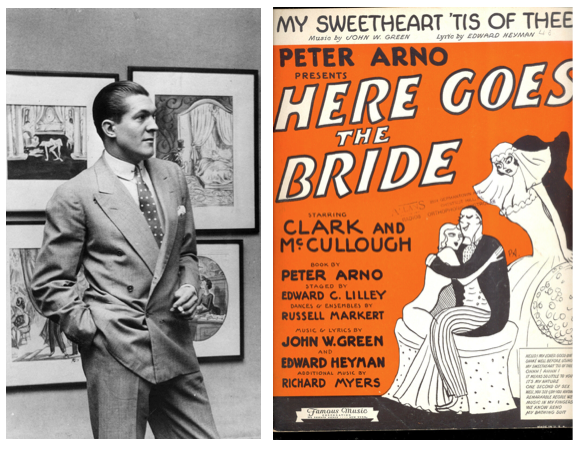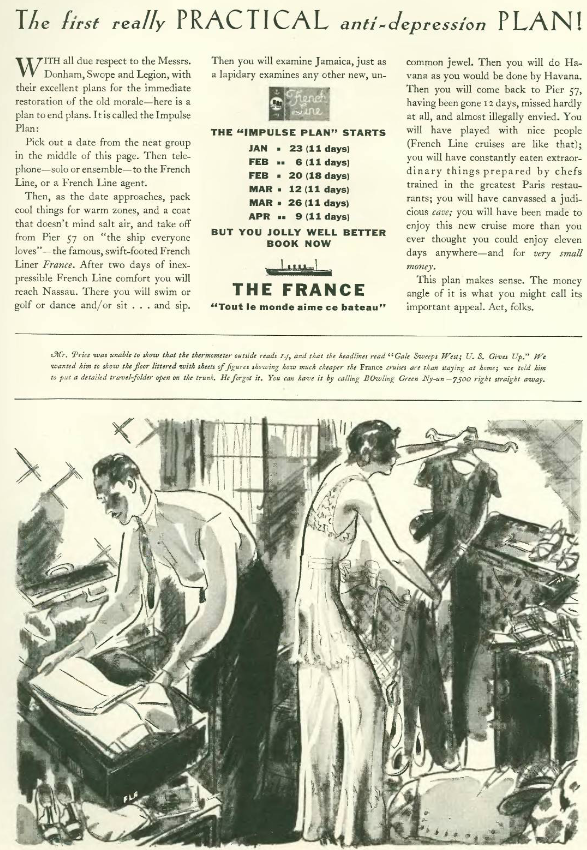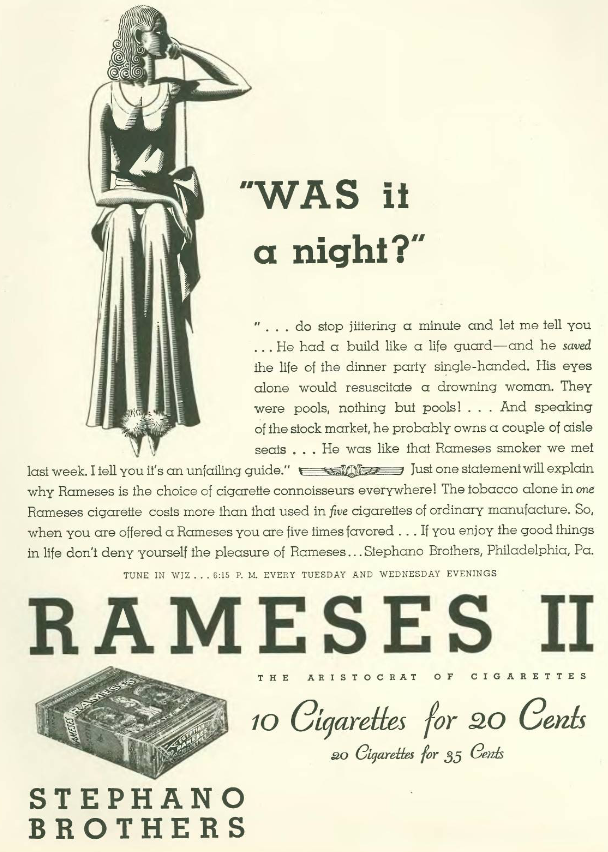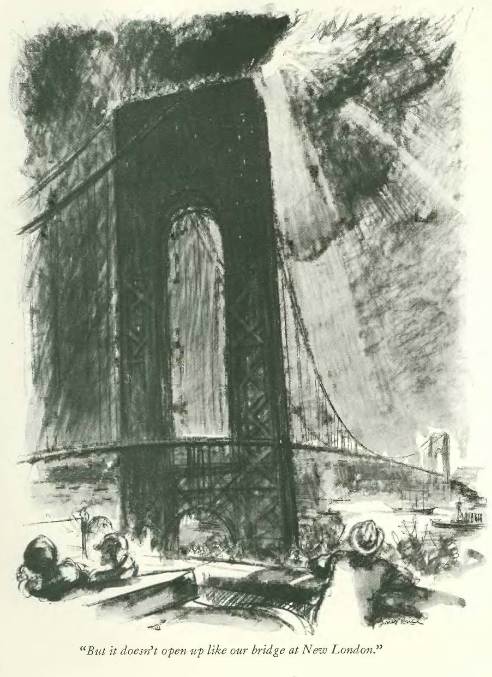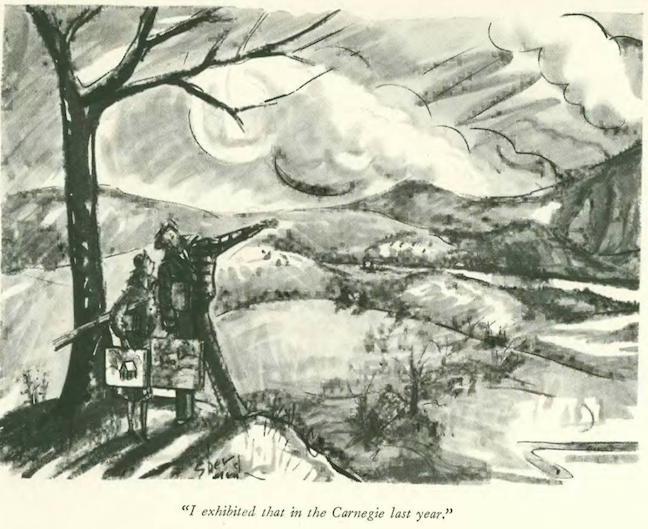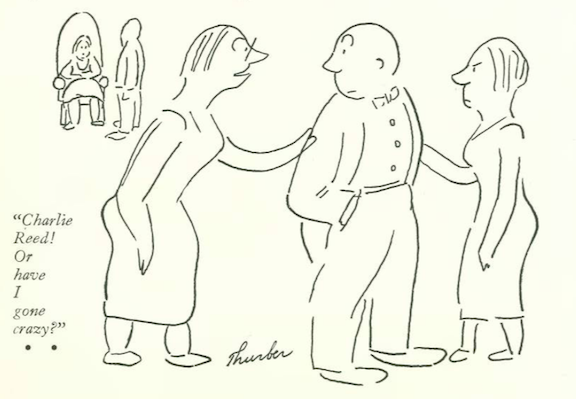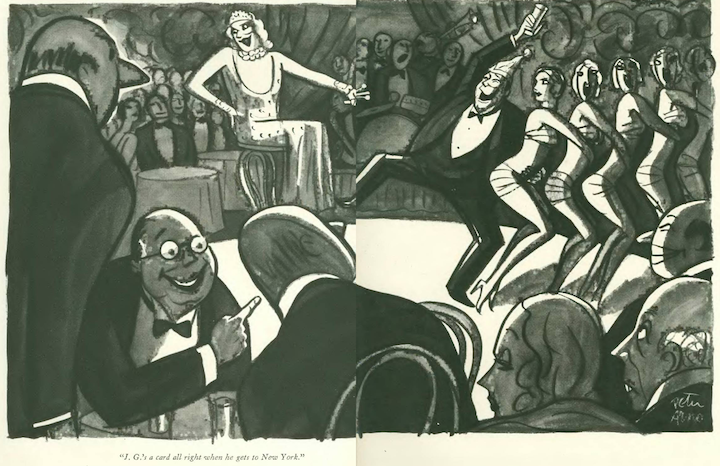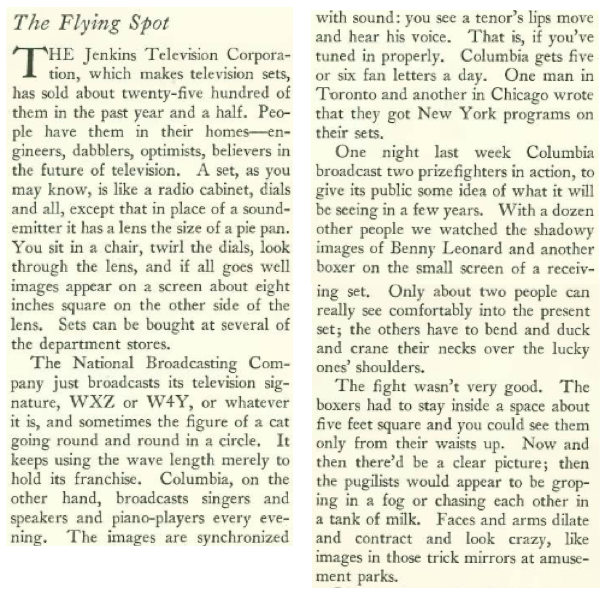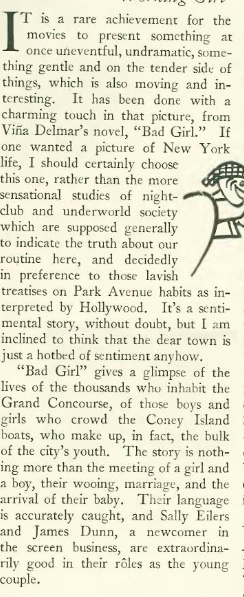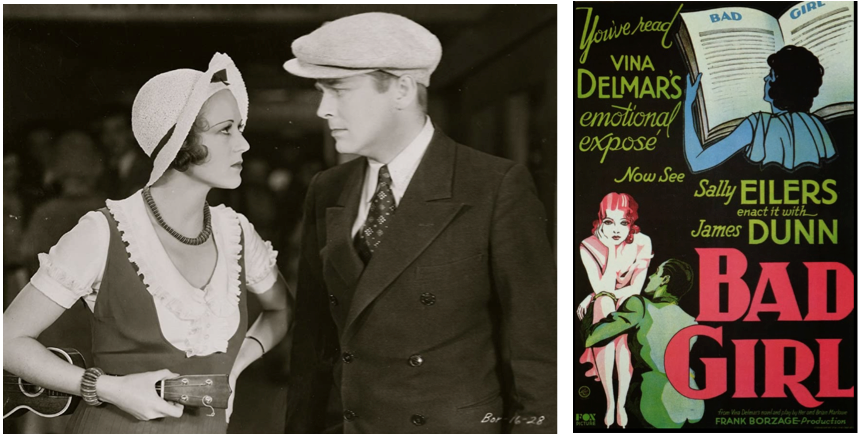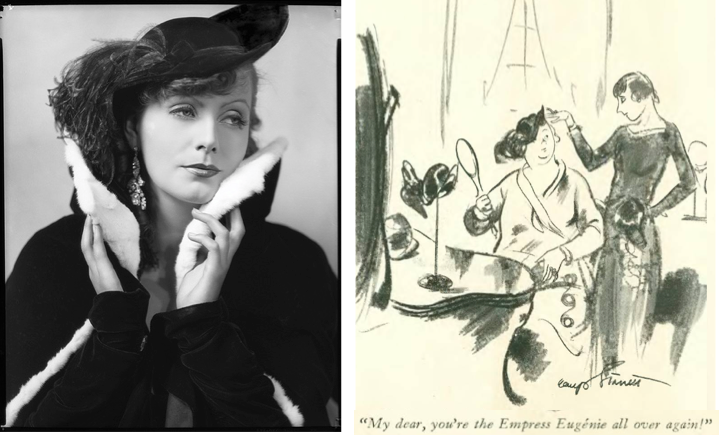
The next time you complain about a boring Zoom meeting, think about Morris Markey’s visit to New York’s Bell Laboratories in the spring of 1931, when he marveled at what was, perhaps, the “apotheosis” of American industry: a two-way video telephone.
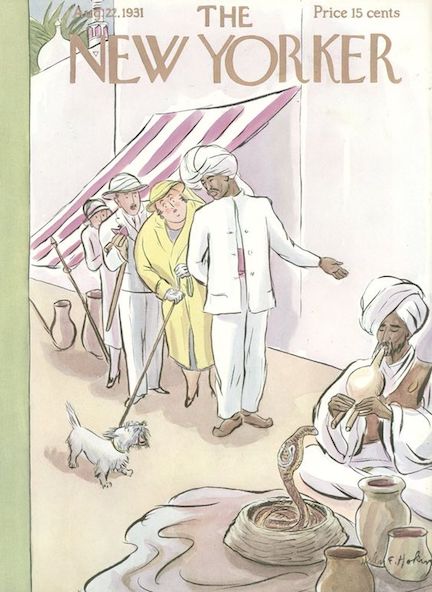
May 9, 1931 cover by Helen Hokinson.
Mass-market television in the U.S. was still two decades away, but what Markey saw demonstrated in 1931 was a glimpse of the future, seeing and conversing with another man three miles away via a long wire that transmitted images from a fantastic array of spinning discs and neon tubes:
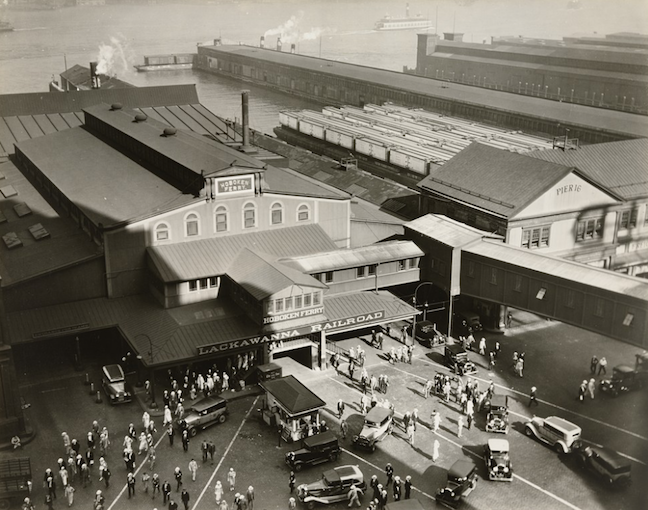
TECHNOLOGY’S MATERNITY WARD…The original Bell Labs building at 463 West Street in New York. It was the birthplace of talking movies, television, radar and the vacuum tube. (att.com)DEFINITELY NOT HI-DEF…At left, this is most likely where Morris Markey sat for the demonstration of early video phone technology. At right (click image to enlarge), a July 1930 article in Popular Science Monthly described how the transmitting apparatus worked. (earlytelevision.org/books.google.com)BUT WILL IT SELL?…Herbert Hoover, then secretary of commerce, became the world’s first television personality in 1927 when his voice and face (inset) were transmitted to an audience at Bell Laboratories in New York City. At the time, AT&T, Bell’s parent company, was doubtful about television’s moneymaking potential. (edn.com)SPINNING WHEELS…Whirling metal discs, pictured at left, perforated with tiny holes, cast a series of horizontal beams of light across a viewer’s face (right), which were then transmitted to a receiver. (earlytelevision.org)
Despite its gee-whiz factor, many, including the folks at Bell Labs, seemed doubtful that the technology would come into wider use or be profitable any time soon, if ever. Markey noted that his little demonstration required many millions of dollars in research and development, but he was prophetic in suggesting that such technology might come to be dreaded if it ever came into common use.
* * *
Uplifting Sight
That a bra and girdle maker should become the topmost tenant at the new Empire State Building was not lost on E.B. White, who commented thusly…
…and while viewers wouldn’t actually see a giant bra atop the skyscraper, many were nevertheless interested in getting a closer look at some of the building’s details, as reported in “The Talk of the Town”…
OVER THE MOON?…The moon gained some keen competition from telescope viewers when the Empire State Building climbed its way into the sky. (Pinterest/tech-notes.tv)
* * *
Channelling Marlene
Film critic John Mosher wasn’t over the moon when it came to the acting of Tallulah Bankhead in Tarnished Lady, however he surmised it was likely the director’s fault for trying to exploit Bankhead’s passing resemblance to Marlene Dietrich. Mosher noted that lighting and staging flattering to the German actress just didn’t work with the belle from Alabama.
MIRROR, MIRROR…Tallulah Bankhead (left) might have pondered who was the fairest in the land, but The New Yorker’sJohn Mosher found her to be no match for German actress Marlene Dietrich (right, in 1931’s Dishonored) when it came to screen presence. (IMDB)
Despite Mosher’s blah review, Paramount touted Bankhead’s portrayal of a “tarnished lady” in this ad from the same issue:
Mosher, however, found redemption in another film making the rounds, Warner Brothers’ Svengali starring John Barrymore:
YOU ARE GETTING VERRRY SLEEPY…in 1931’s Svengali, 17-year-old Marian Marsh played the artist’s model Trilby, who is transformed into a great opera star by the sinister hypnotist, Svengali, played by John Barrymore. Also pictured is Bramwell Fletcher, who portrayed Trilby’s love interest, Billee. (Wikipedia)
* * *
From Our Advertisers
After a long absence, Peter Arno’s Whoops Sisters returned to the pages of The New Yorker, not as a cartoon panel but as shills for the Cunard Line…
…whether traveling by boat or train, you might have considered bringing along “Salvo,” an early version of a popular game that today we call “Battleship”…
…Salvo and other Battleship-type games were originally played on pieces of paper like this…
…and here’s an ad for ice cube trays that exploited the popularity of the “Ripley’s Believe It or Not” syndicated newspaper feature…
…on to our cartoonists, Ralph Barton rendered Albert Einstein as his latest “Hero”…
…and interpreted the latest headlines in his “Graphic Section”…
…among the delicate set, we got a bit risqué with Gardner Rea…
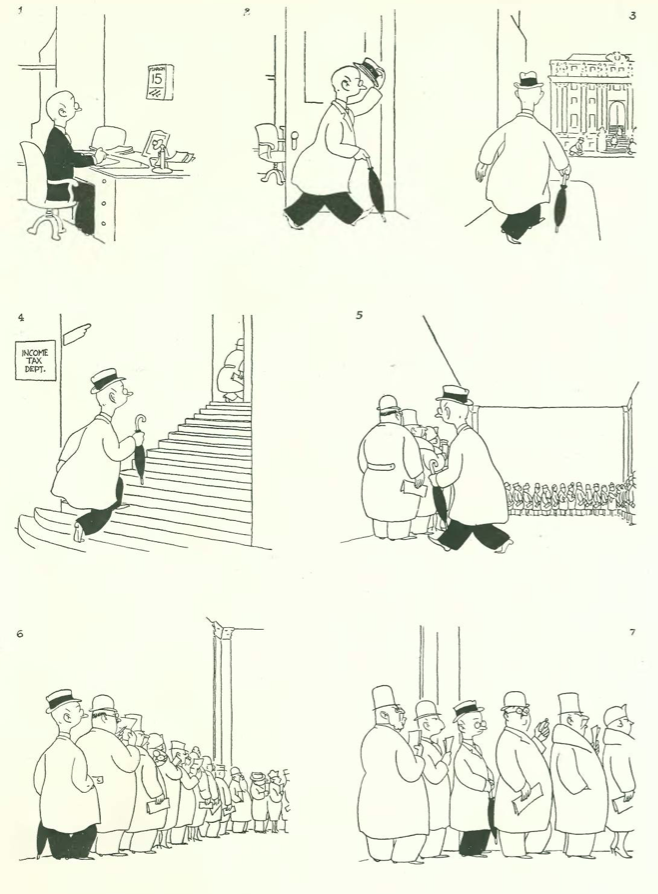
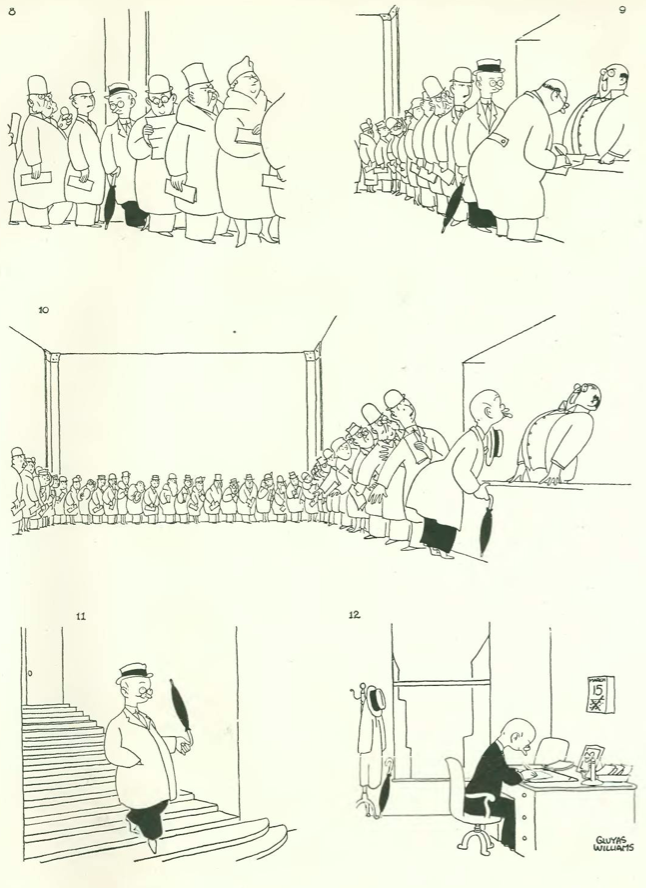
…and nearly apoplectic with Gluyas Williams…
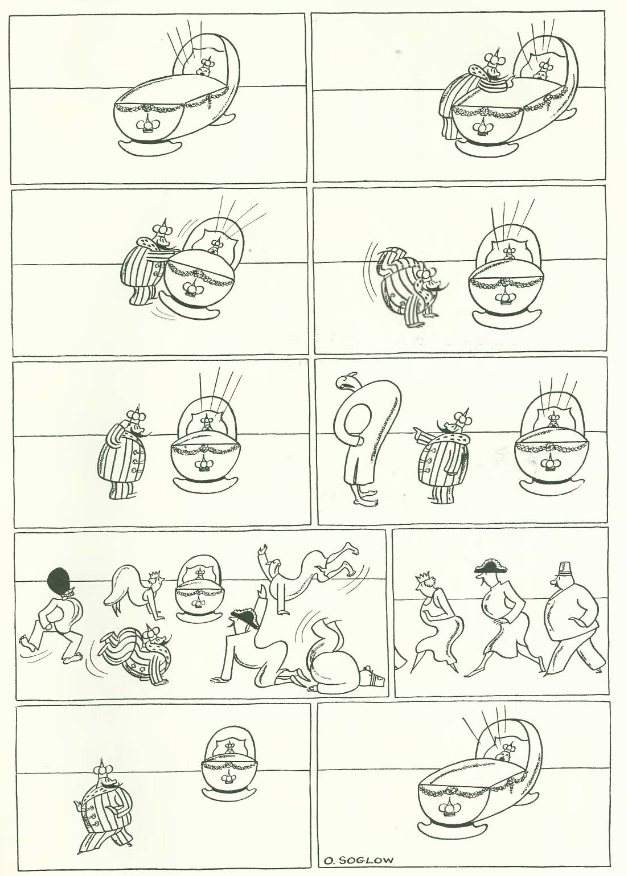
…Otto Soglow’s Little King, on the other hand, reigned with a steady hand…
…and we end with I. Klein, and a little bauble for the Missus…
When New Yorker cartoonist Peter Arno hooked up with his colleague, nightlife columnist Lois Long, it was like twisting together two sticks of dynamite.
April 18, 1930 cover by Charles Donelan, his only cover for The New Yorker. See more about the artist at the end of this post.
Married in 1927, they were the glamour couple at The New Yorker, and each played an outsized role in giving the early magazine a distinctive, cosmopolitan voice and look. Hard-drinking hell raisers, they both loved the Roaring Twenties nightlife in what seemed like an endless party. But when the party ended, so did their brief, volatile marriage.
VOLATILE COMBINATION…Peter Arno and Lois Long were the toast of The New Yorker office and the toast of the town with their office romance, marriage (in 1927), and much-publicized split. The hard-partying couple separated in 1930 and divorced the following year.
As the end of her marriage neared, the 29-year-old Long had become almost circumspect, and in a series of columns under the title “Doldrums,” she took a skeptical look at the world around her, the sad ways of the younger generation, and in this fifth installment, subtitled “Can’t We Be Friends?”, she probed the inequities of a society that encouraged women to be hard-working, super competent and attractive while men still did as they pleased (the question remains today: recall 2018, when Facebook’s Sheryl Sandberg asked women to “Lean In”).
LIFE WITH LOIS…Peter Arno drew on his domestic experiences with wife Lois Long for comic inspiration. Clockwise, top left, Arno and Long with baby daughter Patricia, 1928; a wedding day wakeup call from Arno’s 1930 cartoon collection Hullabaloo; Nov. 18, 1929 cover and a Aug. 24, 1929 cartoon suggesting a lack of maternal instinct. By all accounts Long was a doting mother and grandmother.
In Vanity Fair,Ben Schwartz (“The Double Life of Peter Arno,” April 5, 2016) quotes Arno’s and Long’s daughter, Patricia (Pat) Arno, about her parents’ wild relationship: “There were lots of calls to (gossip columnist Walter) Winchell or some other columnist about nightclub fights…with my mother calling and saying, ‘Oh, please don’t print that about us,’ trying to keep their names out of the papers.”
Here’s another excerpt from Long’s “Doldrums,” asking about the state of Modern Men (apologies for the missing fifth line — “novels”)…
Long had not only given up on marriage—and apparently men for the time being—but she’d also had it with the partying life. She had put her nightlife column, “Tables for Two,” on hiatus, turning her attentions to her popular fashion column, “On and Off the Avenue,” while continuing to contribute unsigned pieces to “The Talk of the Town” and occasional pieces like “Doldrums.”
In early 1931 Arno moved to Reno, Nevada, which granted quick divorces to anyone who took up residency for five months. According to a 2016 book written by New Yorker cartoonist Michael Maslin(Peter Arno: The Mad, Mad World of The New Yorker’s Greatest Cartoonist), Arno found more trouble in Reno when newspaper publisher Neely Vanderbilt accused him of having an affair with his wife, Mary, and threatened violence against Arno. Maslin writes: “Nearly lost in the whole Arno/Vanderbilt dust-up was the end of Arno and Long’s marriage. On June 29th, Lois was granted a Reno divorce on the grounds of intolerable cruelty.” I highly recommend Maslin’s book, filled with anecdotes drawn from a fascinating life lived in some of New York’s headiest times.
Vanderbilt would also divorce his wife in 1931. Mary Weir Logan Vanderbilt was the second of his seven wives.
AND THE BAND PLAYED ON…On the same month as his Reno divorce (June 1931), Vanity Fair ran this photo of Arno pretending to conduct bandleader Fred Waring and two of his Pennsylvanians. (CondeNast)
Arno and Long would get joint custody of Patricia, but the child would remain living with her mother. Long had this to say about the future of her “Little Persimmon”…
* * *
A Man’s World?
E.B. White wondered in his “Notes and Comment” after encountering a barroom (had to be a speakeasy) with a carpeted floor…
KEEPING IT REAL…Patrons relax at McSorley’s Old Ale House near Cooper Square, circa 1935. (ephemeralnewyork.wordpress.com)
* * *
Long Before Social Distancing
There were many diversions around the old city, including baseball games and the circus at Madison Square Garden…some clips from the “Goings On” section…
…Reginald Marsh marked the arrival of the circus with a drawing that encircled pages 20-21…here is a detail…
and how the whole thing appeared…
* * *
The Twain Never Met
Once a star attraction with the Ziegfeld Follies, comedian Will Rogers was also finding success on radio and in the films. His latest talkie, A Connecticut Yankee, referenced Mark Twain’s 1889 novel, A Connecticut Yankee in King Arthur’s Court, in name only, as noted by reviewer John Mosher. But then again, Rogers himself was not a Yankee, but an Okie.
MARK WHO?…Inspired by a Mark Twain novel, 1931’s A Connecticut Yankee was mostly a Will Rogers vehicle. Top right, Sagramor (Mitchell Harris) confronts the “Connecticut Yankee” Hank Martin (Will Rogers). Below, the queen (Myrna Loy) tries to make nice with Hank. (IMDB)
* * *
From Our Advertisers
If you had the time but not the means to travel to Europe (it was the Depression, after all), you might have considered a trip to “Old Québec,” just 500 miles up the road from New York City, although in those days you likely took the train, or possibly a boat, since routes between cities were still a uneven patchwork of roads…
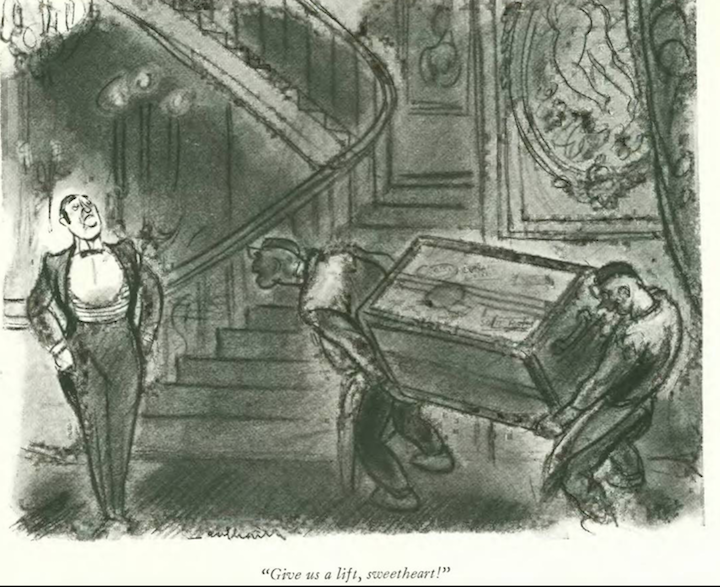
…and you could look stylish at the station or the boat dock with these handsome Hartmann trunks…
…these spring travelers opted for a car, filled with the aroma of burning tobacco…
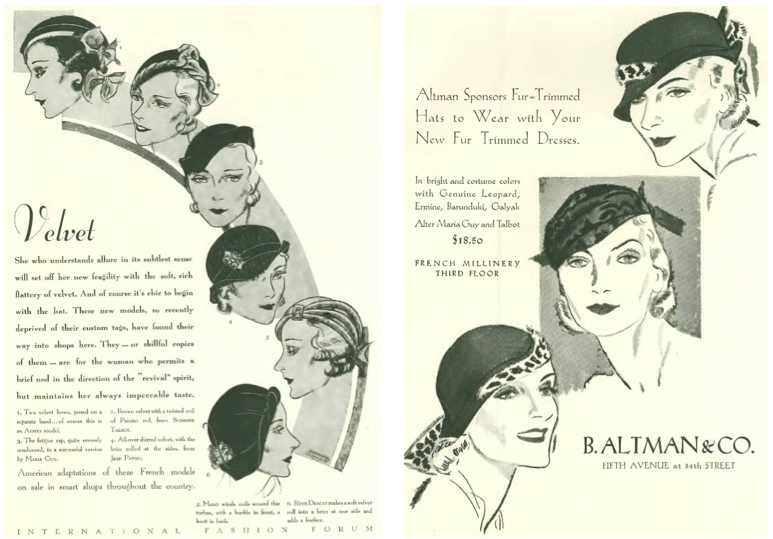
…spring was also time for the latest Paris fashions, and Macy’s suggested you could “put one over on Paris” by donning a garment spun from from DuPont’s miracle fiber, Rayon…
…however, those operating the finer dress shops would never consider letting any synthetic hang in their windows, or touch their skin for that matter, and proudly proclaimed the latest shipments from Paris…
…those shopping for Paris fashions might have consulted Majorie Dork to get slim in all the right places…
…on to our illustrations and cartoons, we have two by Ralph Barton, his “Hero of the Week”…
…and his “Graphic Section” take on the week’s news…
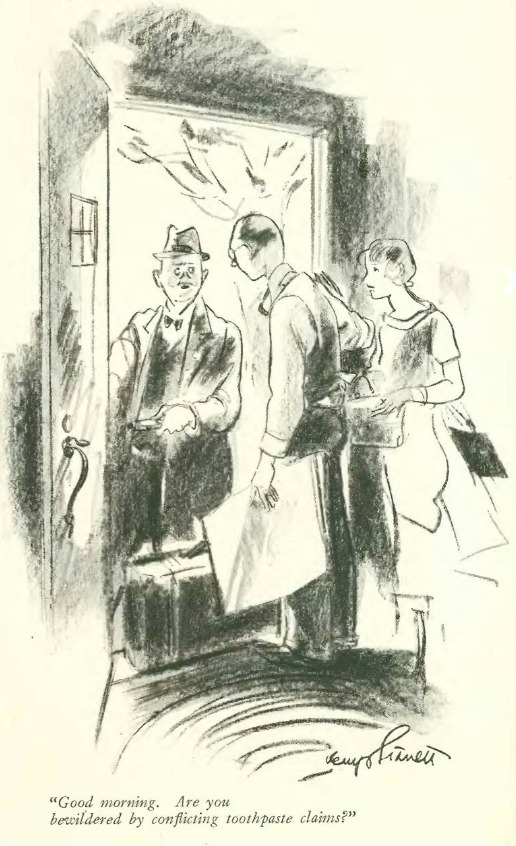
…Gardner Rea kicks off our cartoons with a look at the machine age…
…Rea’s cartoon referred to the popular vaudeville comedian Joe Cook, who was known for his demonstrations of needlessly complex machines…here he is featured in the September 1931 issue of Modern Mechanics magazine…
…Erlanger’s Theatre advertised Cook’s “Newest, Maddest Musical” in the back pages of TheNew Yorker…
…it’s not often you find Mahatma Gandhi as the subject of a cartoon…this one is by Bruce Bairnsfather…
…a unique form of stage fright was illustrated by John Floherty Jr…
…Jack Markow gave us a little night music…
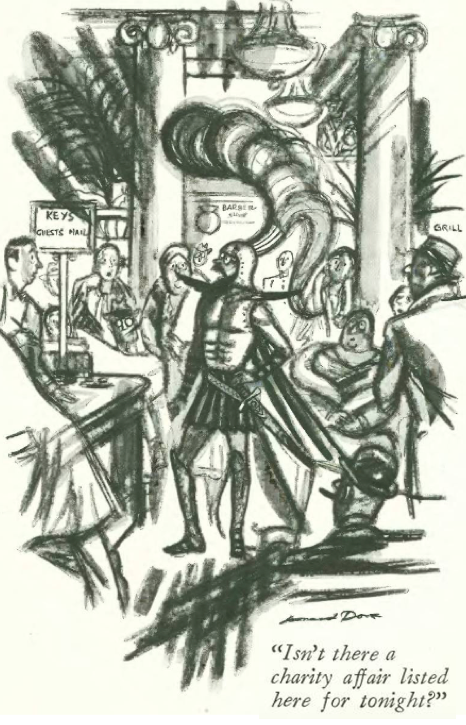
…Leonard Dove and the possibly reluctant apple of someone’s eye…
…I would love to know more about this Rea Irvin cartoon, which seems to be a parody of a cartoon from the British Punch…
…John Reehill rendered a portentous moment at the barbershop…
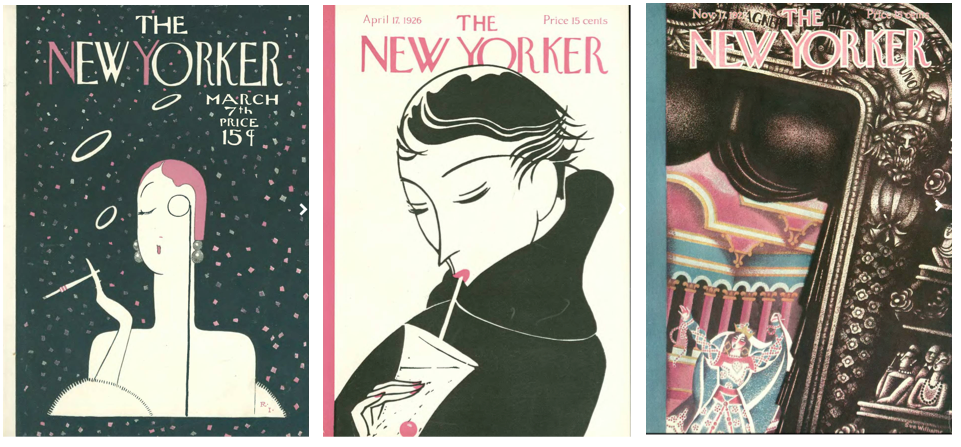
…and finally, today’s cover (bottom left) by Charles Donelan caught my eye because the early New Yorker rarely noted the existence of baseball, except in the events section. Up to this point there had been just two covers featuring baseball: May 8, 1926, by Victor Bobritsky…
…and, at right, the Oct. 5, 1929 cover by Theodore Haupt...
…as for the cover on the left, it would be Charles Donelan’s only New Yorker cover…throughout his career he would illustrate for various publications, including the sports section of the Boston Traveler (this is from the March 21, 1921 edition)…
…and a comic strip featured in the Boston Globe called “Russett Appul” (this is from Oct. 11, 1929)…Donelan also performed Russett and other characters on Boston radio stations and stage shows…
The early New Yorker loved two things about modern life — college football and air travel. Tragedy would bring them together on the last day of March 1931.
April 11, 1931 cover by Peter Arno. A brilliant cover, contrasting the skinny, lightly clad runner with one of Arno’s stock characters from the Taft era—a millionaire with a walrus mustache.
The New Yorker’s sportswriter John Tunis was especially keen on Knute Rockne’s Notre Dame football team, which played an annual rivalry game against Army at Yankee Stadium. Tunis’s colleague, E.B. White, was the flying enthusiast, never missing a chance to hop aboard a plane and marvel at the scene far below. In the Nov. 30, 1929 issue, White was eager to join passengers on a test of the Fokker F-32, and suggested that flying was becoming so routine that one could be blasé about its risks:
WHAT COULD POSSIBLY GO WRONG?…Title card from a silent Paramount newsreel reporting on a November 1929 test flight of the Fokker F-32 at Teterboro, possibly the same flight enjoyed by E.B. White. At right, a celebration of the plane’s arrival in Los Angeles. (YouTube/petersonfield.org)
All of that exuberance came crashing down in a Kansas wheat field on March 31, 1931. It was Rockne’s fame—which The New Yorker and countless other magazines and newspapers helped to spread—that put the coach on a TWA flight to Hollywood, where director Russell Mack was filming The Spirit of Notre Dame. Rockne stopped in Kansas City, where he visited his two oldest sons, before boarding a Fokker F-10 destined for Los Angeles. About an hour after takeoff one of the airplane’s wings broke to pieces, sending Rockne and seven others to their deaths.
(University of Notre Dame) click image to enlarge
The accident rattled E.B. White. In his April 11, 1931 “Notes and Comment,” White pondered the eulogies Rockne received from President Herbert Hoover and others, calling into question the fame a college football coach could attain while achievements of college faculty go unheralded. White also seemed to have lost some of his faith in the progress of aviation, suggesting that the autogiro (a cross between an airplane and a helicopter) might be the safest way to proceed into the future:
Knute Rockne, in undated photo. (University of Notre Dame)
Ironically, it was thanks to Rockne’s fame that the aviation industry began to get serious about safety. A public outcry over the crash led to sweeping changes in everything from design to crash investigation, changes that have helped make flying one of the safest forms of transportation today.
SAFETY FIRST…The crash that claimed the life of Knute Rockne resulted in a public outcry for greater safety in the air. This article in the July 1931 issue of Modern Mechanics suggested parachutes for passengers and for the plane itself. (modernmechanix.com)
As for the cause of crash, it was determined that the plywood covering one of the Fokker F-10’s wings had separated from the wing’s supporting structure — the wing had been bonded together with a water-based glue that likely deteriorated as the result of rainwater seeping into the wing.
Unfortunately, the investigation into the crash was hampered by souvenir-seekers, who carried away most of the large parts of the plane even before the bodies were removed. So much for honest Midwestern values, at least in this case.
(clickamericana.com)
* * *
Give My Regards
Back in Manhattan, Dorothy Parker was writing a eulogy of her own, bidding farewell to her interim role as theater critic. Parker subbed for Robert Benchley during his extended European vacation, and often noted that it was just her luck to be stuck with a string of plays that likely comprised one of Broadway’s worst spring line-ups.
In an earlier column Parker had alluded to the fact that Benchley was in Europe, no doubt staying part of the time with their mutual friends, Gerald and Sara Murphy, at their fashionable “Villa America” at Cap d’Antibes on the French Riviera.
SIGHT FOR SORE EYES…Dorothy Parker was glad to have her old friend Robert Benchley back at the theater desk, she having endured a “rotten time” reviewing a long string of bad plays. (dorothy parker.com)
Hopeful to review at least one play of redeeming value before her friend returned, Parker was to be sorely disappointed as evidenced in her final review column. Of the terribly dated Getting Married, a play written by George Barnard Shaw way back in 1908, Parker was more afraid of Getting Bored, especially when Helen Westley (portraying Mrs. George Collins) entered the stage to deliver a 15-minute monologue…
Things got no better with the second play Parker reviewed, Lady Beyond the Moon, a “dull, silly, dirty play” that was frequently interrupted by various sounds from the restless audience — “comments, titters and lip-noises…” The play must have been terrible, because it closed after just fifteen performances.
As for the third play Parker reviewed, the misnamed Right of Happiness, the audience had every excuse “for displayed impatience,” yet conducted itself “like a group of little lambs.” Right of Happiness, observed Parker, “fittingly concluded the horrible little pre-Easter season…” The play closed after just eleven performances.
* * *
Turning Up the Heat
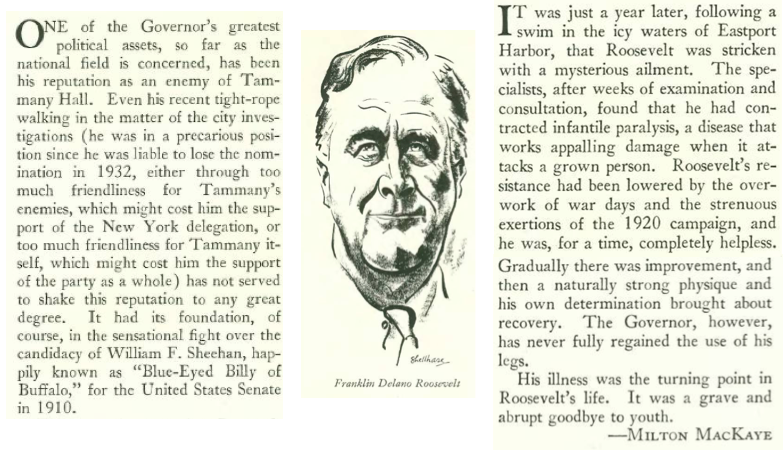
If anyone thought he had a right to happiness it would have been New York Mayor Jimmy Walker, who was preparing to face a grilling from Judge Samuel Seabury. Walker loved the nightlife and left most of his duties to a bunch of Tammany Hall cronies whose activities drew the attention of reformers like Seabury and Gov. Franklin D. Roosevelt. In his “A Reporter at Large” column, Morris Markey observed:
* * *
Walking Tall
Raymond Hood (1881-1934) might have been short in stature, but he stood tall among the architects of some of New York’s most iconic skyscrapers — Rockefeller Plaza, American Radiator, Daily News, McGraw Hill (Sadly, both his career and his life were cut short when he died in 1934 at age 53 from complications related to rheumatoid arthritis). Allene Talmey, a former reporter for the New York World and managing editor of Conde Naste’s original Vanity Fair, gave Hood his due (see brief excerpt) in a New Yorker profile, with a portrait by Cyrus Baldridge:
LANDMARKS…The 1931 McGraw-Hill Building and the 1929-30 Daily News Building. (MCNY/Wikipedia)And of course, Hood’s 30 Rock. I took this last December before everything shut down.
* * *
From Our Advertisers
Speaking of big and tall, Al Smith and his gang took out this full page ad to announce the availability of office rentals in the world’s tallest building. Thanks to the Depression, only 23 percent of the available space in the Empire State Building was rented out in its first year. Thankfully, the building was also an instant tourist attraction, with one million people each paying a dollar to ride elevators to the observation decks in 1931, matching what the owners made in rent that year…
…for those who could afford more than a dollar ride up the Empire State’s elevators, the cooling breezes of coastal California beckoned…
…those with even greater means and leisure time could hop on a boat to Europe…note that you could still cruise on the Olympic, the Titanic’s sister ship…also note that the illustration of the posh couple was rendered by Helen Wills (1905-1998), better known at the time as the top women’s tennis player in the world…
HELEN, MEET HELEN…American tennis star Helen Wills in 1932, and a self-portrait from the same year. Wills was the world’s top women’s tennis player for nine of the years between 1927 and 1938. She played tennis into her 80s, and sketched and painted all of her life. (Wikipedia/invaluable.com)
…Guess who’s coming to dinner?…hopefully not William Seabrook, who had just released his latest book on his adventures as an explorer…in Jungle Ways, Seabrook devoted an entire section to cannibalism in the French Sudan and how to cook human flesh; apparently he tried some himself…but then again by most accounts he was a weird dude who dabbled in occultism and possibly believed in zombies…Seabrook’s 1929 book, The Magic Island, is credited with introducing the concept of zombies to popular culture…
…speaking of weird, an ad for Michelsen’s “Bay Rum” body rub…
…when Marlboro cigarettes were introduced in the mid-1920s, they were marketed as “luxury” cigarettes and sold mostly at resorts and hotels. In the late 1920s, however, they were marketed as a “lady’s cigarette,” with ads in the New Yorker featuring handwriting and penmanship contests to promote the brand. This ad from November 1930 featured the “second prize” winner of their amateur copywriting contest…
…it appears marketing tactics changed a bit in 1931…still the dopey contest, but instead of real photos of winners, like the schoolmarmish “Miss Dorothy Shepherd” above, this ad featured a rather tawdry image of a model, more gun moll than schoolmarm…
…on to our cartoonists…Ralph Barton, who was with The New Yorker from Day One, had been increasing his contributions to the magazine after a notable absence from spring 1929 to summer 1930…beset by manic-depression, he would take his own life in May 1931, so what we are seeing are Barton’s last bursts of creativity before his tragic end, reviving old favorites like “The Graphic Section”…
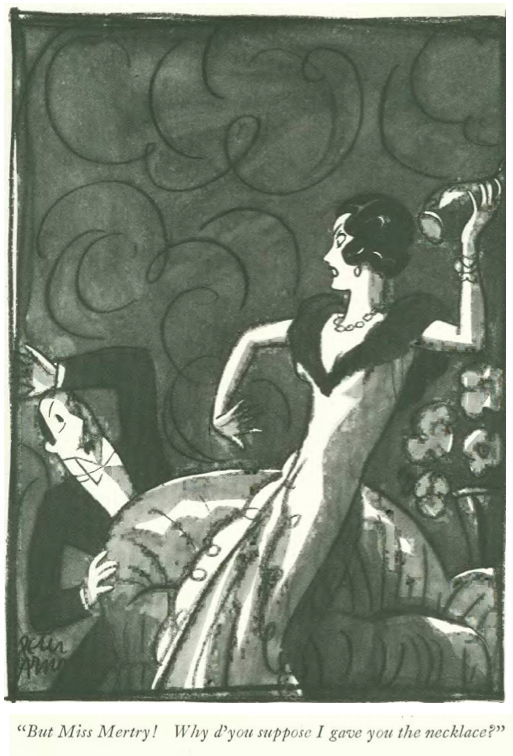
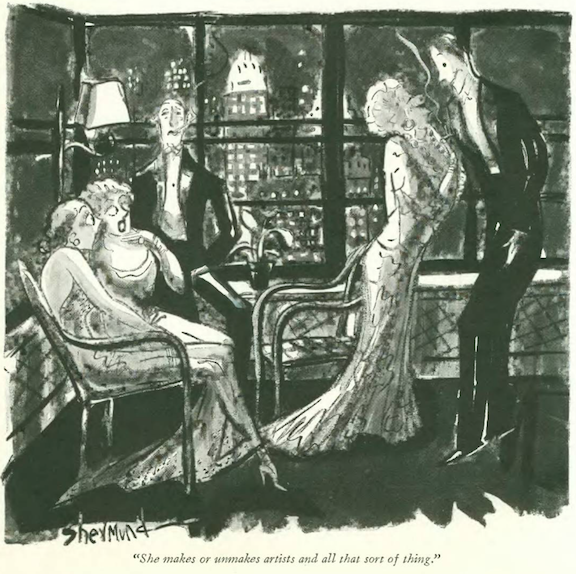
…Barbara Shermund entertained with some parlor room chatter…
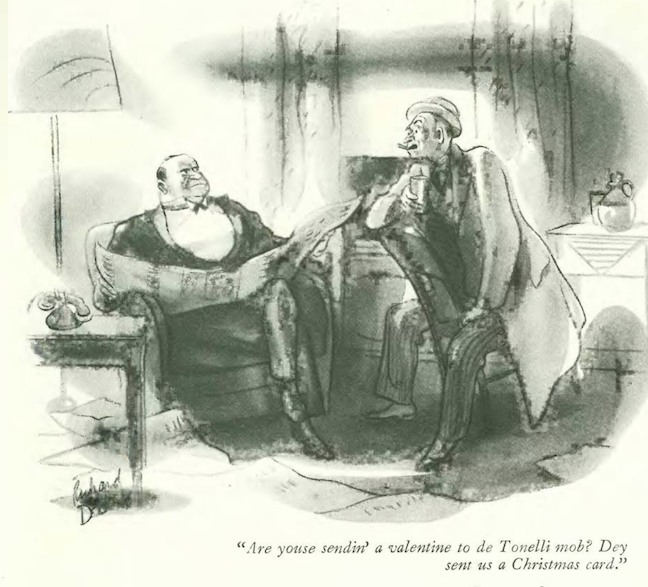
…Leonard Dove looked in on a couple of frisky old duffers…
…William Crawford Galbraith, and a crashing bore…
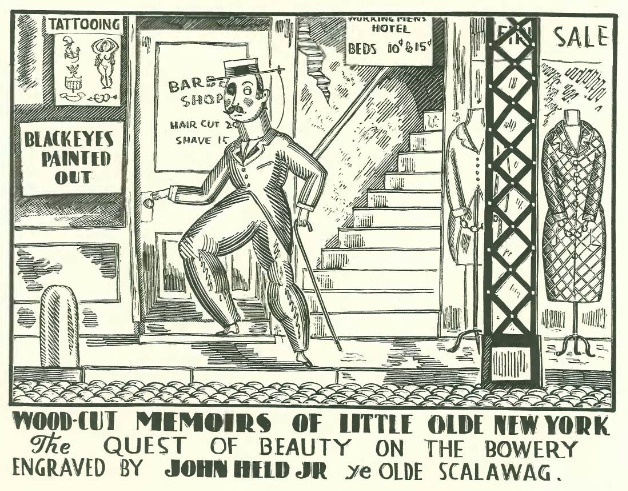
…John Held Jr gave us one of his “naughty” engravings…
…and two by our dear Helen Hokinson, stuck in traffic…
…and enjoying cake and ice cream, with a dab of culture…
In today’s world of endless media options, it is hard to fathom the influence newspapers had over daily life in the 19th and early 20th centuries. There was one news source that many New Yorkers simply could not live without: The New York World.
March 7, 1931 cover by Helen Hokinson.
So when the World ceased publication after a 70-year run, many of its readers struggled to come to terms with the loss. Despite the World’s working class appeal and sensationalistic reporting, E.B. White nevertheless counted himself among its mourners, offering a lengthy eulogy in his “Notes and Comment” column (with Otto Soglow illustration)…
THE COLOR OF MONEY…Under the leadership of Joseph Pulitzer, who bought The World in 1883, the newspaper began an aggressive era of circulation building, and in 1896 enticed readers with pages printed by one of the world’s first four-color printing presses. The World was the first newspaper to launch a Sunday color supplement, which featured “The Yellow Kid” cartoon Hogan’s Alley (above, right). (5dguide.com)
A pioneer of yellow journalism, The World also featured sensational stories and headlines to capture the attention of readers…
…however, The World was also home to a number of prominent journalists, including the famed Elizabeth Cochran Seaman (aka Nellie Bly) and many writers from the social orbit of the Algonquin Round Table who were also early contributors to the fledgling New Yorker.
In his “Notes” essay, White suggests that he found something authentic in The World’s sensational style, and praised it for going after stories that more staid publications, like The New York Times, tended to ignore or downplay. The World’s staff of writers came from the rough and tumble, muckraking world of journalism, the same world in which The New Yorker’s founding editor, Harold Ross, first cut his teeth.
ALL-STAR LINE-UP…Many of The World’s famed writers inhabited the orbit of The New Yorker and the Algonquin Round Table, including, from left, music critic Deems Taylor, journalist and social critic Heywood Broun, “The Conning Tower” columnist Franklin P. Adams, and humorist Frank Sullivan. (deemstaylor.com/britannica.com/Wikipedia)
* * *
Swedish Sphinx?
Thirty years after her death, Greta Garbo remains an iconic figure in popular culture, due to her expressive eyes and sensuality, but perhaps even more so due to her elusive air. In her profile of the star for The New Yorker, titled “American Pro Tem,” Virgilia Peterson Ross refused to buy into the mysterious aura that was partly manufactured by Garbo’s handlers at MGM. The other part, however, was genuine Garbo, who detested parties, serious talk, and other formalities.
THE FACE…Like her contemporary Marlene Dietrich, Greta Garbo preferred an androgynous look. From left, Garbo wearing the flat-heeled oxfords she favored; publicity photo from 1932; wearing one of her trademark berets in the late 1930s. (garboforever.com)
Ross touched on Garbo’s love life—she never married in her 84 years, but she was close to her mentor, Finnish director Mauritz Stiller, who died in 1928, having been eclipsed by his protégé. Garbo’s co-star in the silents, John Gilbert—known as a great lover on the screen—wanted to marry Garbo, but she balked at his frequent proposals. The two lived together intermittently in 1926 and 1927, Gilbert helping Garbo not only with her acting also teaching her how to behave like a star and barter with studio bosses. Garbo later admitted that she was in love with Gilbert, but preferred to remain single because she “always wanted to be the boss.” Drink and despair would send Gilbert to an early grave in 1936. In her profile piece, Ross concluded that Garbo was “not a mystery to be solved,” but rather “a limpid child.”
THE MEN IN HER LIFE…Greta Garbo contemplates a new-fangled microphone with film director Clarence Brown on the set of Garbo’s first talkie, Anna Christie. Brown would direct Garbo in seven different films; Garbo with sometime lover John Gilbert in Flesh and the Devil (1926). They would appear in four films together; Garbo with Finnish director and early mentor Mauritz Stiller, in 1926. (Wikipedia/IMDB/garboforever.com)
* * *
Suffering Artist
Dorothy Parker continued to sub as theater critic for her friend, Robert Benchley, who was traveling abroad. It was not a task to her liking — during her temporary stint she had yet to see a play that didn’t insult her taste or her intelligence. Her review for the March 7 issue would prove no different.
BROADWAY BLAHS…Dorothy Parker had yet to find a play to her liking in her stint as theater critic for the New Yorker. To her credit, she had to sit through a couple of stinkers: A Woman Denied lasted about a month — 37 performances — and Paging Danger closed its curtains for good after just four performances. (Playbill/BBC)
* * *
The Misanthrope
To call Wyndham Lewis a character is an understatement. The English writer, social critic and painter (he founded the cubist-inspired Vorticist movement) managed to offend just about everybody before his death in 1957. He was described by the London Review as “fiercely unsentimental,” and that is how I would describe this opening paragraph from his short story “Dark Party”…
CLASSIC POSE…A 1929 portrait of Wyndham Lewis by photographer George Charles Beresford. (Wikipedia)
* * *
From Our Advertisers
A couple of ads appealing to women readers of the New Yorker, including this elegant bon voyage scene advertising travel clothes…
…and something you never see anymore, the “boneless” girdle…replaced today by Spanx and the like…
…Before we roll into our cartoons, some cinema-inspired art by Al Frueh…
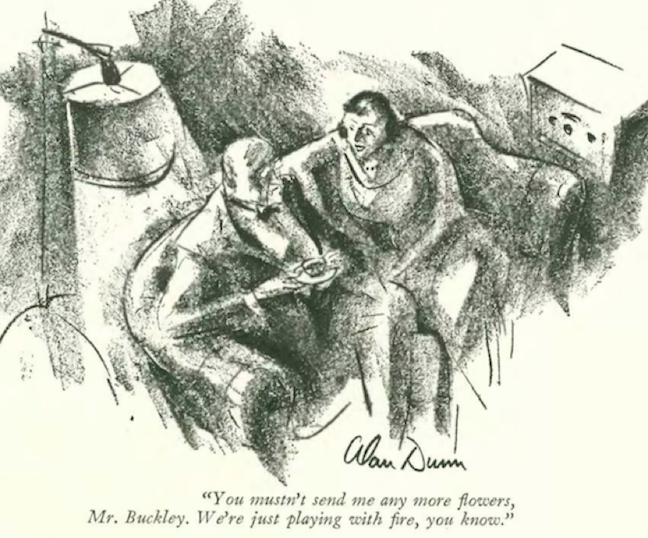
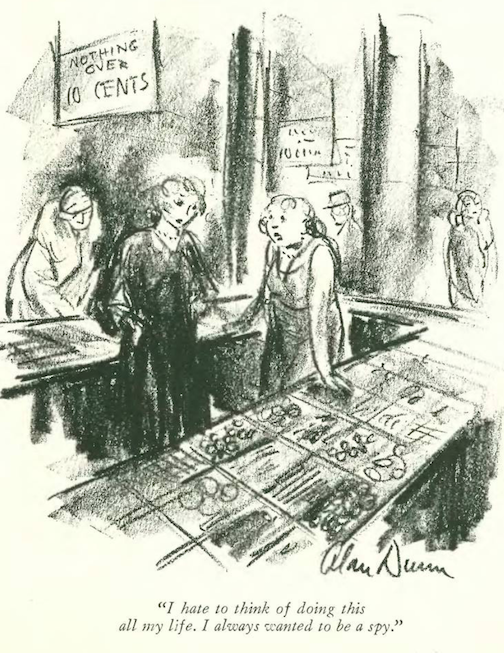
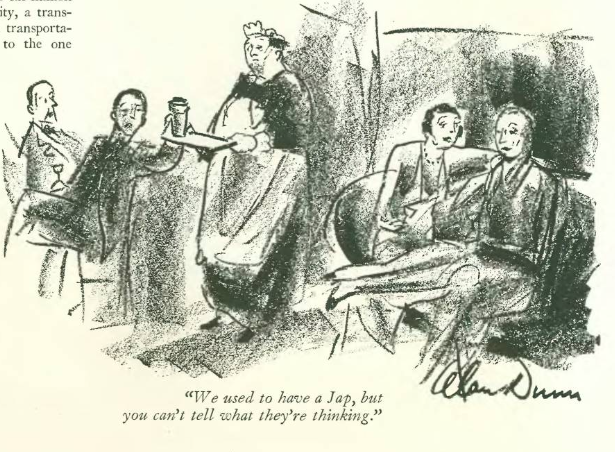
…Alan Dunn went out to dinner…
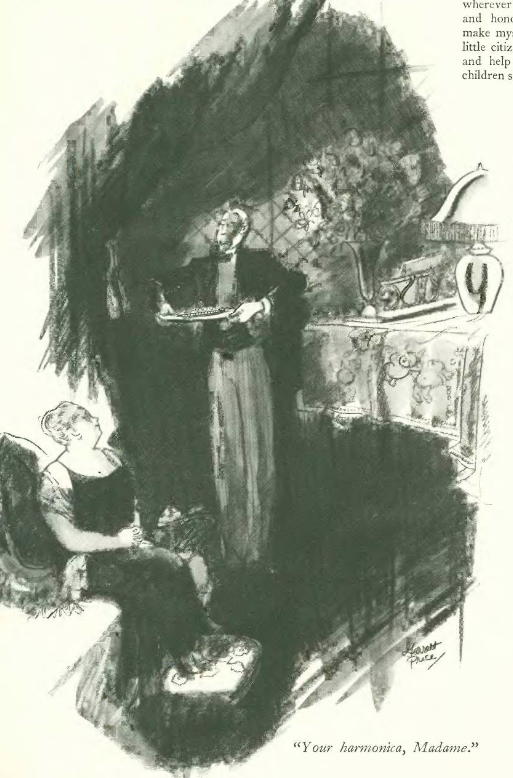
…Garrett Price went on safari…
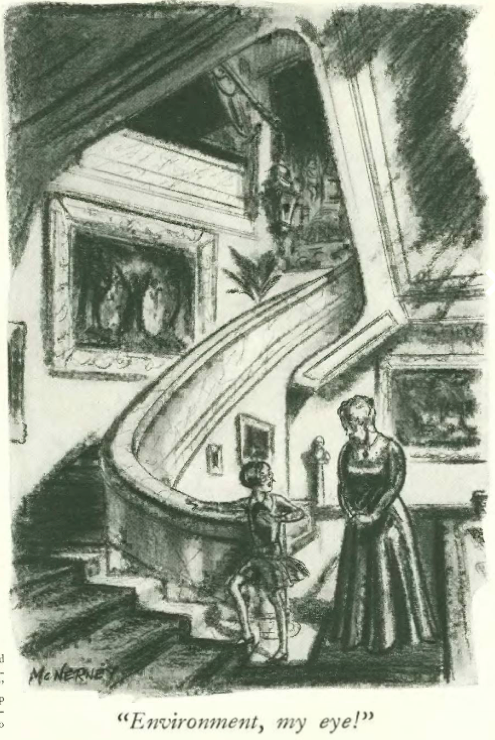
…E. McNerney channelled his inner Arno for this backstage scene…
…and the real Peter Arno gave us this passing scene which recalled his old Whoops Sisters gags…
In the 1920s and 30s the concept of the documentary film was still in its infancy, and beginning with the silent Nanook of the North (1922), the idea that a documentary and a drama were separate things was unknown to filmmakers.
Feb. 28, 1930 cover by Theodore Haupt.
What was known, however, was the box office appeal of films that explored unknown and exotic lands, like Ernest B. Schoedsack’s 1927 blockbuster Chang, which featured a mix of staged events as well as the actual slaughter of wild animals. Audiences (and most critics) seemed little troubled that these films were a mix of fact and fiction. It was a movie, after all, and movies followed a story arc, and they had drama, and sometimes comedy. And so when Schoedsack (1893-1979) introduced audiences to an orangutan named Rango, publicists described the simian star as the “Charlie Chaplin of the Jungle.” The New Yorker’sJohn Mosher found the performances of the various apes “astonishingly adept”…
MONKEY BUSINESS…Clockwise, from top left, the Iowa-born Ernest B. Schoedsack cut his filmmaking teeth as a producer/director of quasi-documentaries, beginning with 1925’s Grass, which followed a caravan from Angora to Persia; a young Sumatran boy, Bin, bonds with the orangutan Rango; promotional theater card for the film. (filmaffinity.com)NOT SO CUDDLY…Two years after Rango,Ernest B. Schoedsack would co-produce and co-direct 1933’s King Kong, with Merian C. Cooper. (Britannica)
If interpretations of tropical life weren’t accurate in 1931, it wasn’t completely due to filmmakers taking dramatic license. Attitudes toward “exotic” lands and people commonly ranged from naively paternalistic to downright racist. In a letter to The New Yorker, Patrick T.L. Putnam (1904-1953) is decidedly of the former, portraying Congo pygmies as clever, amusing children who hoodwink unsuspecting “explorers”…
To Putnam’s credit, he showed a genuine interest (and respect for) in the lives of tribal peoples, and particularly the Mbuti of the Congo’s Ituri Forest. He remained in the Congo for the rest of his life. This thumbnail is the only photo I could find of Putnam:
(geni.com)
* * *
Big Bill Turns Pro
In first decades of the 20th century it was still widely believed that athletic competition should be for its own sake rather than as a means for making money, so many top stars competed as amateurs. Professional golf wasn’t established until 1916, and professional leagues in basketball and football first formed in the 1920s. Amateur status was especially prized in tennis — before the “Open Era” began in 1968, only amateurs were allowed to compete in Grand Slam tournaments.
Sports promoter C. C. Pyle established the first professional tennis tour in 1926 with American and French stars playing exhibition matches in front of paying audiences. According to The New Yorker’sJohn Tunis, many in the crowd were finely dressed, with men in top hats and women turned out in the latest high fashion.
America’s top draw was “Big Bill” Tilden, the world’s number one player from 1920 to 1925 and the first American to win Wimbledon. It caused quite a stir when Tilden went pro on Dec. 31, 1930. He barnstormed across the country, playing one-night stands with a small group of professionals including the top Czech player Karel Koželuh. “The Talk of the Town” had this to say about the fledging game of professional tennis:
BARNSTORMERS…Bill Tilden (left) and Karel Koželuh toured America and Europe with a handful of other players in a series of exhibition matches in the fledgling professional tennis circuit. (Britannica/cyranos.ch)
In his sports column, John Tunis offered this description of the competitors:
NOW AND THEN…At left, you can still spot a few neckties at Wimbledon as the audience watches Roger Federer and Andy Roddick enter Centre Court in 2009; at right, Wimbledon crowd in 1925. (BBC/Vintage Every Day)
* * *
Triple Tripe
Dorothy Parker continued to sub in the theater column for her friend Robert Benchley, who was traveling abroad. She found little to like on the Great White Way, including three forgettable plays she reviewed in the Feb. 28 issue:
Apparently audiences agreed with Parker’s assessment. The Gang’s All Here closed after just 23 performances, The Great Barrington, after just 16. And Heat Wave was not so hot, closing after a mere 15 performances.
NOT SO GREAT…Program for 1931’s The Great Barrington. It lasted 16 performances. (IBDB)
Parker once again closed the column with a plea to her dear friend:
* * *
To Swash No More
In his “Notes and Comment,” E.B. White lamented the end of Douglas Fairbanks as the swashbuckler of the silents, and rejected the talkie version of the actor in Reaching for the Moon, a film in which Fairbanks portrayed Larry Day, a Wall Street millionaire who later loses his fortune in the 1929 stock market crash.
KEEP YOUR SHIRT ON, DOUG…From left, Douglas Fairbanks in the silent era’s The Thief of Bagdad (1924); Fairbanks on an ocean cruise with Bebe Daniels in Reaching for the Moon. The 47-year-old Fairbanks was still fit enough to pose shirtless, but E.B. White wasn’t having any of it. Despite his fit appearance, Fairbanks would die of a heart attack at the end of the decade. (IMDB)
The film today is perhaps best known for its sumptuous Art Deco sets…
(IMDB)
…and for one of Bing Crosby’s earliest film appearances. Reaching for the Moon was originally intended to be a musical featuring numbers by Irving Berlin, however Berlin found director Edmund Goulding difficult to work with, so only one of the original five songs recorded for the film was used, “When the Folks High Up Do the Mean Low Down,” sung by Crosby. It was filmed late at night after he had completed his gig at the Cocoanut Grove.
SINGING WITH BA-BA-BEBE…A young Bing Crosby sings “When the Folks High Up Do the Mean Low Down” with Bebe Daniels in Reaching for the Moon. (IMDB)
* * *
Modern Living
E.B. White also commented on the modern world’s reliance on electric appliances, a habit a mere decade in the making since the gadgets he lists below did not exist before the 1920s:
ELECTRIC SURGE…Prior to the 1920s none of these electric appliances existed. By 1931 many homes were dependent upon them — although many country houses would have to wait for the Rural Electrification Administration (1935) and other New Deal programs get electrical service. (Pinterest)
* * *
From Our Advertisers
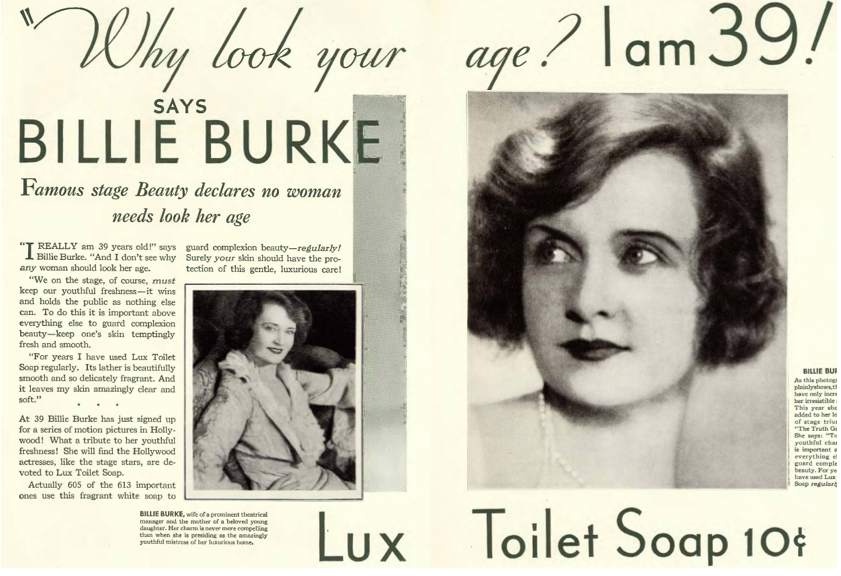
I’ve written before about Lux Toilet Soap’s celebrity-studded ad campaigns, but this two-page ad in the Feb. 28 issue caught my eye because it featured one of my favorite actresses, Jessie Royce Landis…
…who appeared in two of my favorite films, both by Alfred Hitchcock: To Catch a Thief (1955) and North by Northwest (1959).
MATERNAL ROLES…Jessie Royce Landis usually played older than she was in real life. Clockwise, from top left, detail of Lux ad; Landis circa 1930; opposite Cary Grant in 1955’s To Catch a Thief; and again with Grant in 1959’s North by Northwest. In the latter film she played Grant’s mother, but in reality she was only seven years older than Grant. (IMDB)
…much of the Douglas Fairbanks/Bebe Daniels film Reaching for the Moon was set on a luxury ocean liner…if the stock market didn’t get you down, you could also afford to travel in style with the Empress of Britain…
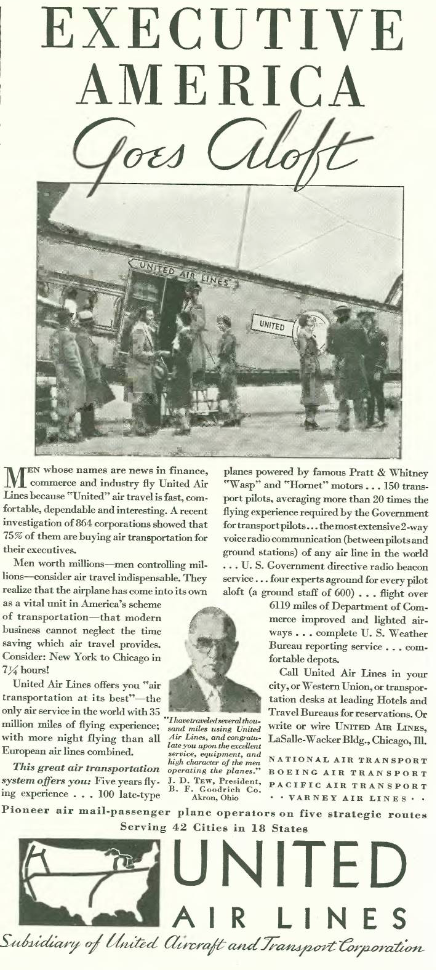
…or on one of the fine ships of the French Line fleet…
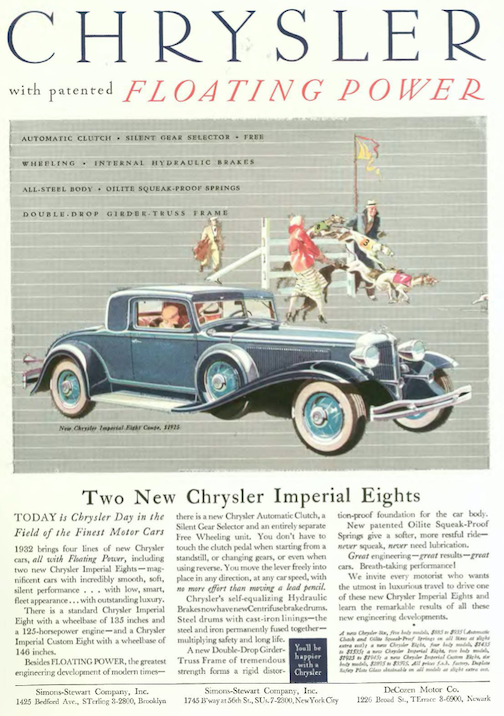
…the Imperial was one of the luxury cars that could get you to the docks…
…among the stranger ads to appear in The New Yorker was this one by the maker of clay plumbing fixtures…
…on to our cartoonists, Ralph Barton returned with this illustration for the theater section…
…Rea Irvin brought us another of his two-page series cartoons…
…Gardner Rea commented on the state of the art world…
…Peter Arno peered in on an unfortunate infant…
…Helen Hokinson gave us this exchange along a city street…
…Garrett Price illustrated a tall order for a blues musician…
…Carl Kindl found clashing styles in the shoe department…
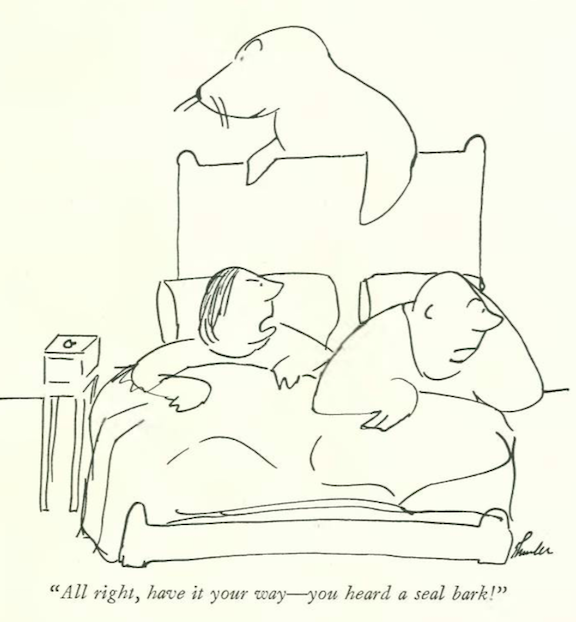
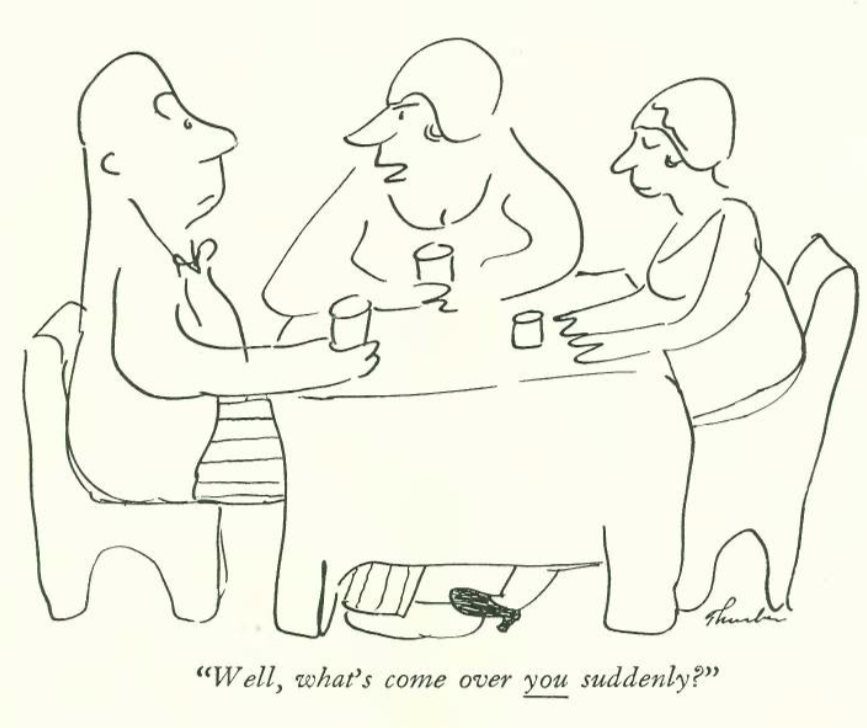
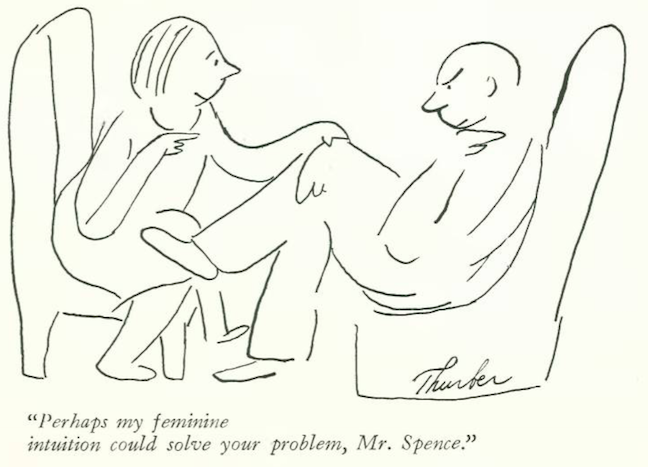
…and James Thurber returned with a prelude to his battle of the sexes…
The late film critic Roger Ebert once observed that “if only one of Charles Chaplin’s films could be preserved, City Lights would come the closest to representing all the different notes of his genius.”
Feb. 21, 1931 cover by Rea Irvin, marking the New Yorker’s sixth anniversary.
The New Yorker’s film critic in 1931, John Mosher, would have agreed. Before he previewed the picture, however, Mosher feared (along with others) that the great actor and director had seen his best days…
…instead, the film proved a hit with both audiences and critics, and today is regarded as one of the greatest films ever made. It was no doubt a relief to Ebert when the film was selected by the Library of Congress for preservation in the National Film Registry.
HE DOES IT ALL…United Artists issued several different types of posters to promote the film, including these two. (IMDB)A TENDER FELLOW…The Tramp (Charlie Chaplin) encounters a blind flower girl (Virginia Cherrill) on a street corner and is instantly smitten; later that evening the Tramp saves a drunken millionaire (Harry Myers) from suicide. (IMDB)
The film has its tender moments, but being a Chaplin production it also had plenty of slapstick, including this famous scene in which the Tramp and his millionaire friend go out on the town and dig into plates of spaghetti…and in the Tramp’s case, some confetti…
Mosher (and many other critics since) believe the opening scene of the film—in which a statue is unveiled to reveal a sleeping Tramp—was Chaplin’s attack on sound movies:
CAUGHT NAPPING…The Tramp is unveiled along with a statue in the opening scene of City Lights. (IMDB)
Although the film had a full musical score and sound effects, there was no spoken dialogue. Rather, Chaplin poked fun of the tinny-sounding talkies of the day by putting not words, but the sounds of a kazoo, into the mouths of speechifying politicians gathered at the statue’s unveiling…
For all its humor, City Lights was a serious work by a serious actor and director who sought something close to perfection. The scene in which the Tramp encounters a blind flower girl on a street corner required three hundred and forty-two takes with actress Virginia Cherrill, who was a newcomer to film.
Writing in The New Yorker, critic Richard Brody (“Chaplin’s Three Hundred and Forty-Two Takes,” Nov. 19, 2013) noted that “Chaplin didn’t have a mental template that he wanted Cherrill to match; he approaches the scene not quite knowing what he wanted.” Brody observed that the perfection Chaplin sought was one of results, and not of conformity to a preconceived schema. “He sought what provoked, in him, the perfect emotion, the perfect aesthetic response — but he wouldn’t know it until he saw it. He started to shoot in the confidence that the thing — whatever it was — would happen.” Chaplin’s technique can be seen in this clip from the Criterion Collection’s 2013 DVD release of the film. Note that this footage was shot by The New Yorker’s Ralph Barton, a close friend of Chaplin’s:
* * *
Chaplin, Part Two
The Chaplin buzz was not confined to the movie section of the magazine, which featured more insights on the star in “The Talk of the Town.”
GENIUS LOVES COMPANY…Photo of Albert Einstein and Charlie Chaplin at the Los Angeles premiere of City Lights. Einstein said Chaplin was the only person in Hollywood he wanted to meet. (Wikipedia)
* * *
Funny In a Different Way
Like City Lights,Tod Browning’sDracula is today considered a classic film. Indeed, Bela Lugosi’s timeless portrayal of the old bloodsucker set a standard for vampire flicks and horror films in general. The New Yorker’s John Mosher, however, would have none of it, dismissing the film in a single paragraph.
PAIN INTHE NECK…Count Dracula (Bela Lugosi) goes for a nibble on the fragile Mina (Helen Chandler) in 1931’s Dracula. (IMDB)
Mosher was also dismissive of Fritz Lang’sBy Rocket to the Moon, originally released in German as Frau Im Mond (Woman in the Moon). The 1929 production is considered one of the first “serious” science fiction movies, anticipating a number of technologies that would actually be used in space travel decades later.
RETRO ROCKET…Fritz Lang’s Woman in the Moon would predict a number of technologies used decades later in actual space flight, including multi-stage rockets. Lang also anticipated the future in the much-acclaimed Metropolis (1927).
* * *
Bored on Broadway
Robert Benchley was visiting friends abroad, so Dorothy Parker did what any pal would do and subbed for his theater column. As it turned out, it was not a happy task, even if she did receive complementary tickets to one of the hottest shows on Broadway:
Having dispatched Katharine Cornell’sBarretts of Wimpole Street, Parker took aim at America’s Sweetheart, based on a book by Herbert Fields with music and lyrics by Richard Rodgers and Lorenz Hart. Parker ended the savaging with a plea to her dear friend and colleague to return home soon:
THEY LAUGHED, THEY CRIED…Katharine Cornell (left) portrayed Elizabeth Barrett in Barretts of Wimpole Street. Dorothy Parker thought Cornell was a first-rate actress, but didn’t think much of her play. As for Inez Courtney (right) in America’s Sweetheart, Parker believed she did what she could, whatever that meant. (Pinterest)
* * *
Lest We Forget
The New Yorker turned six with this issue, and in the life of any magazine, that is something to be celebrated, and especially in hindsight as our beloved publication closes in on its centenary in 2025. Some thoughts from E.B. White:
* * *
From Our Advertisers
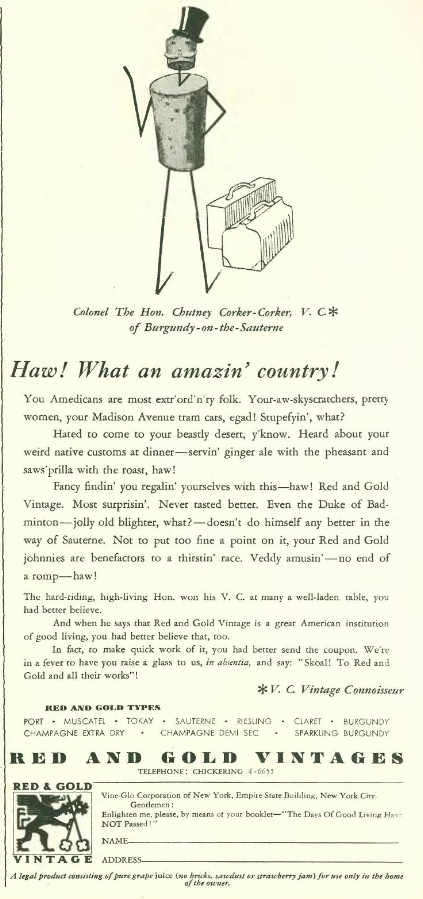
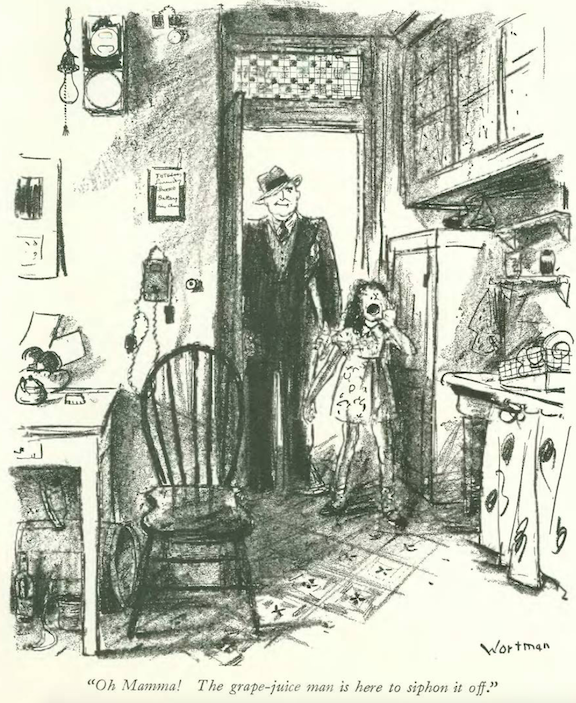
We’ve seen in past ads how Prohibition-era vintners marketed grape juice bricks that could be dissolved in water and fermented in the home. In this ad they took it a step further, sending expert cellarers direct to customers’ homes to help them create their own, perfectly legal, wine cellar…
…those with wine cellars might have preferred to live in a “highly restricted” community in Jackson Heights…
…and furnish their homes with the latest in modern furniture design…
…and here we have an early example of the “macho” smoker, anticipating the arrival of his buddy, the Marlboro Man…
…on to our cartoonists, another theater section entry by one of Charlie Chaplin’s closest friends, Ralph Barton…
…and cartoons by Peter Arno, who channelled Dracula via his Sugar Daddy…
…Garrett Price, and the burdens of the rich…
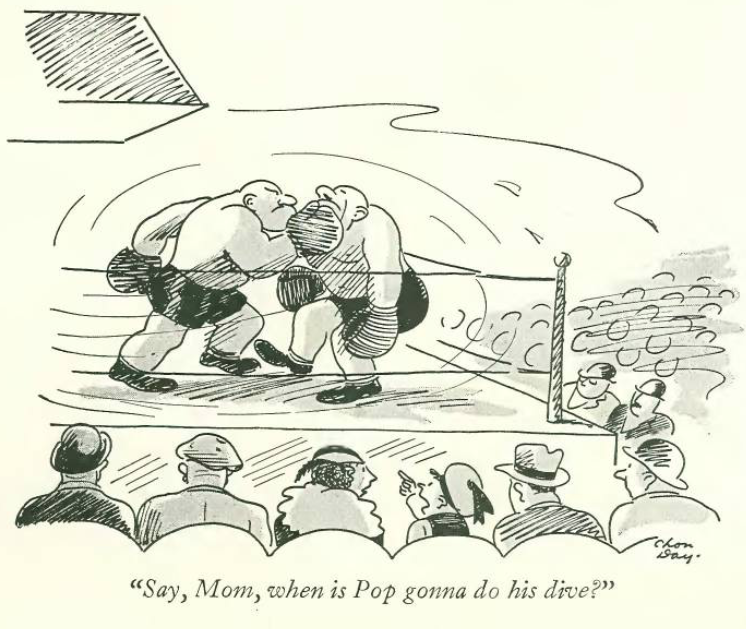
…Denys Wortman examined the follies of youth…
…and we end with dear Helen Hokinson, and the miracle of birth…
We lead off with a couple of winners from the Feb. 7, 1931 issue, beginning with a cover by Rea Irvin that takes measure of a lighter moment at the Westminster Kennel Club Dog Show.
Feb. 7, 1931 cover by Rea Irvin.
The 1930 Best of Show winner Pendley Calling of Blarney also took the top honor in 1931, giving the wire fox terrier back-to-back Westminster wins. Overall, terriers have dominated Westminster — wire fox terriers have won Best of Show fifteen times, with Scottish terriers a distant second, with eight wins.
TOP DOG…Pendley Calling of Blarney won back-to-back crowns in 1930-31 at Westminster Kennel Club Dog Show at Madison Square Garden. The dog’s owner, John Grenville Bates, mercifully retired the pooch after the ’31 win. (Westminster Kennel Club)STANDARD? WHO ARE YOU KIDDING?…Standard poodle Siba won Best in Show at the 144th annual Westminster Kennel Club Dog Show on Feb. 11, 2020, at Madison Square Garden. (Reuters)
The other winner was Cimarron, the first film to receive more than six Academy Award nominations, winning three including Best Picture (then called Best Production). It was the first Western to win Best Picture, and it would be nearly sixty years until another Western, Dances with Wolves, would take the top honor.
HE LOST HIS SHIRT, TOO…
Despite some “sagging moments,” John Mosher mostly lavished praise on the film, which was showing at the Globe Theatre:
THAT’S NO WELCOME WAGON…Clockwise, from top left, Yancey and Sabra Cravat (Richard Dix and Irene Dunn) join the 1889 Oklahoma Land Rush with their son, Cim (Junior Johnston); a less-than-friendly greeting at a boomer town; wagons line up for the big land grab; a young prostitute, Dixie Lee (Estelle Taylor), outwits Yancey for a piece of prime property. (IMDB)OH DEAR, THERE’S THAT LOOK AGAIN…Yancey (Richard Dix) takes it upon himself to establish order in the boomer town of Osage. On the bed are Yancey’s son, Cim (Junior Johnston) and wife Sabra (Irene Dunn). (IMDB)
* * *
Handy Painter
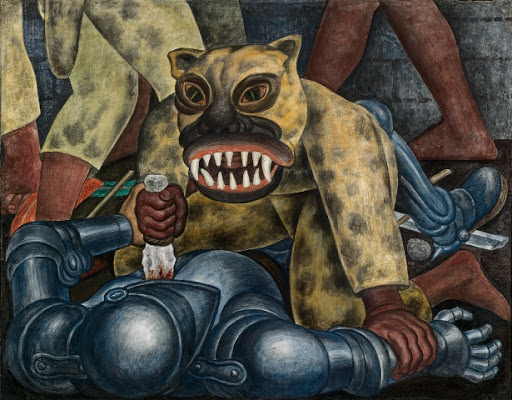
It is hard to imagine the struggles of one-handed painter José Clemente Orozco (1883-1949), who despite his handicap was able to complete huge murals in true fresco style (paint applied quickly on fresh, wet plaster), including five socially-themed frescoes at the Joseph Urban-designed New School. The murals included controversial depictions of Lenin and Stalin, but it wasn’t until the 1950s — during the McCarthy era — that school officials felt compelled to cover the images with a curtain. More protests followed, this time from faculty and students, and the curtains fell along with Joe McCarthy. “The Talk of the Town” looked in on the artist at work:
HE LOOKS FAMILIAR…José Clemente Orozco’s “The Struggle in The Occident”, 1930-1931, one of five frescoes at the New School. (Pinterest)
* * *
Prescience of Mind
News reporter and author Elmer Davis submitted this humorous piece to The New Yorker doubtless thinking how preposterous, and therefore humorous, the following notion would be (a brief excerpt):
* * *
Funny Cigarettes
In the early years of broadcast radio (and later TV) tobacco companies rightly saw a huge gold mine in radio show sponsorships. So when CBS radio executives accepted a sponsorship from Lorillard (the makers of Old Gold), they realized they had a challenge on their hands. “Talk” explained:
COUGH ME A MELODY…The makers of Old Gold cigarettes had CBS in their clutches in this September 1933 ad featuring bandleader Fred Waring and singer Babsie. (period paper.com)
…The above “Talk of the Town” item referred to the famous Murad ads illustrated by The New Yorker’s own Rea Irvin…
…while other advertisers were scaling back a bit due to the Depression, lovely full-color ads continued to flow from tobacco companies (and oil companies)…
…Pierce-Arrow was also known for its sumptuous ads, but they wouldn’t save the luxury car maker from going under by the mid-1930s…
…Some less expensive black and white ads, such as this hand-lettered ad from Stein & Blaine, could be quite charming…
…speaking of charm, this ad from Arthur Murray could have used a little of it…note the stern visage of the woman, described as “typical of Arthur Murray’s staff of expert teachers”…
…on to our Feb. 7 cartoons, we have one of Peter Arno’s stock characters, the Sugar Daddy, in an awkward moment at a costume party…
…Arno’s party looked a lot more lively than this affair, illustrated by William Crawford Galbraith...
…and Carl Rose gave us this pair, who seem to having the best time of all…
…Mary Petty eavesdropped on a guileless young woman…
…and Gardner Rea paid a visit to the Met…
* * *
On to our Feb. 14 issue, and Gardner Rea once more…
Feb. 14, 1931 cover by Gardner Rea.
The Feb. 14 issue featured a profile of actress Katharine Cornell (1893-1974), written by cultural critic Gilbert Seldes. The caricature of Cornell is by Al Frueh. Excerpts:
Promotional photograph of Katharine Cornell as Elizabeth Barrett in the original 1931 Broadway production of The Barretts of Wimpole Street. It was her most famous role. (Theatre Magazine, March 1931)
Cornell is considered one of the greatest actors of American theater, known for her eloquence and romantic stage presence. Seldes concluded:
* * *
Strange Bedfellows
In his column “Of All Things,” Howard Brubaker referred to an exchange between American capitalists and Soviet Russians that resulted in the rapid industrialization of the Soviet Union. That actual story behind this effort is pretty amazing.
* * *
Sneak Peek
Film critic John Mosher was so excited about Charlie Chaplin’s latest film that he offered this teaser to readers…
* * *
From Our Advertisers
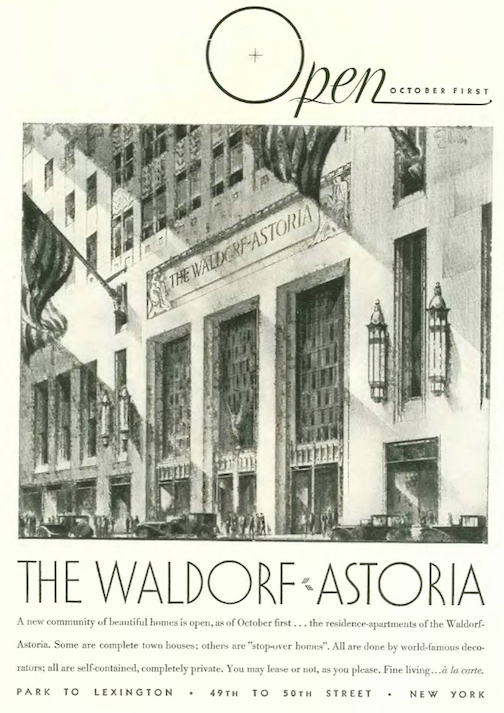
We have this ad from the developers of the Empire State Building, which was being readied for a May 1931 opening…
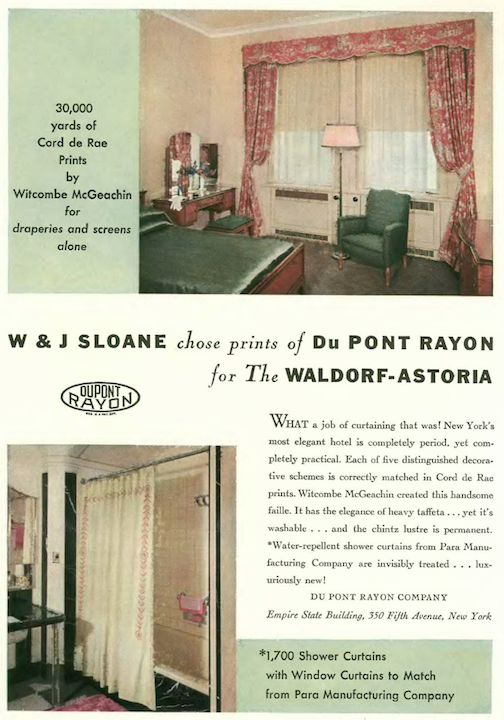
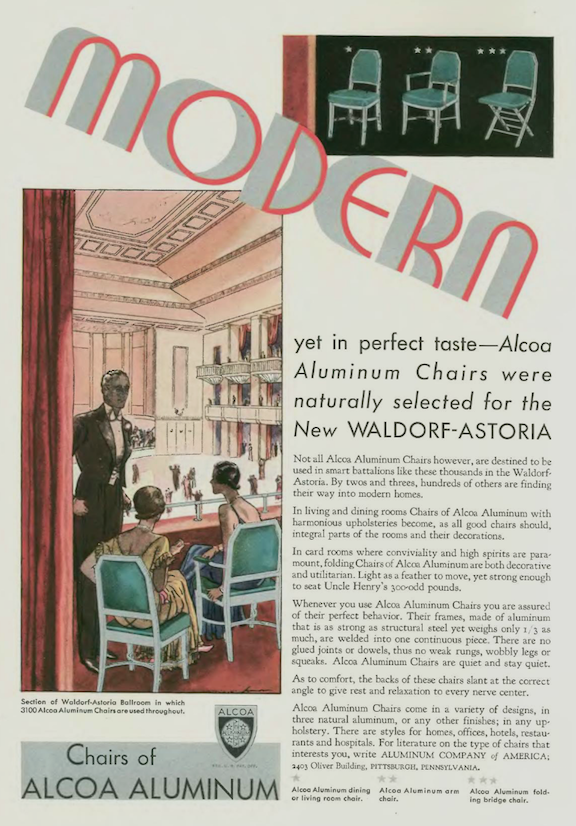
…the Empire State Building was erected on the site of the old Waldorf-Astoria Hotel. The new Waldorf-Astoria, also completed in 1931, was located more than 15 blocks away from its original site. Both the Empire State Building and the Waldorf Astoria would become Art Deco landmarks, and both shared the distinction of holding world records: the Empire State was the world’s tallest building (a record it would keep until 1970), and the Waldorf would claim the title of the world’s tallest hotel (until 1963)…
…on to our cartoonists, we have Ralph Barton contributing one of his last illustrations to the theater review section…
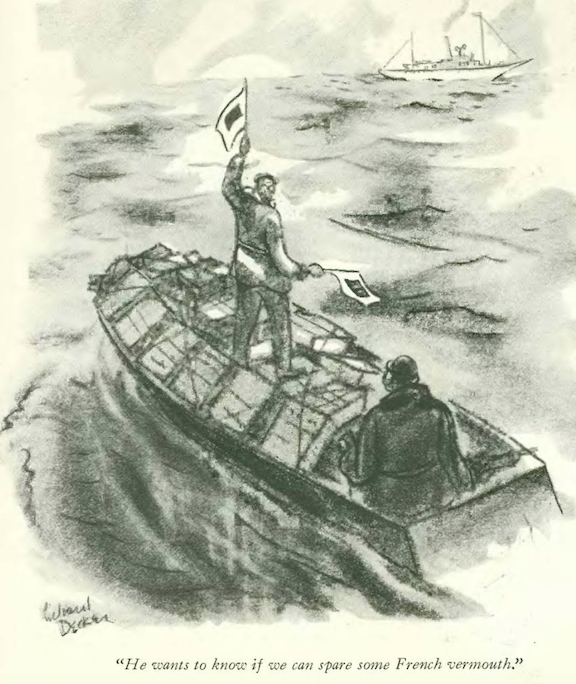
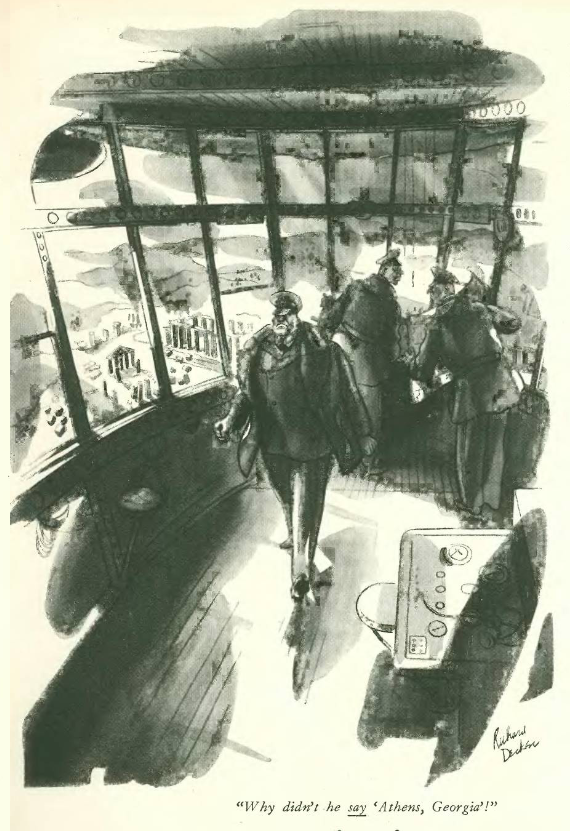
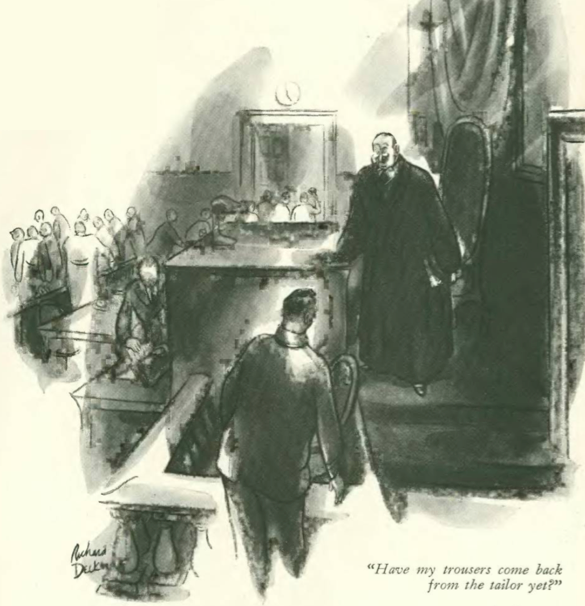
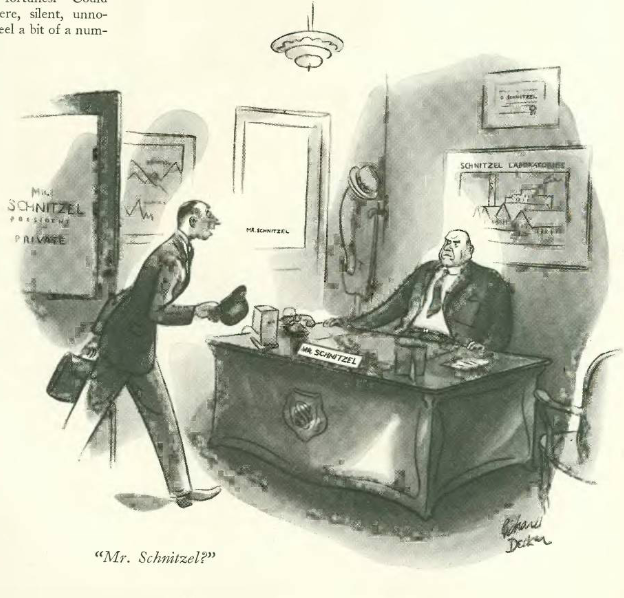
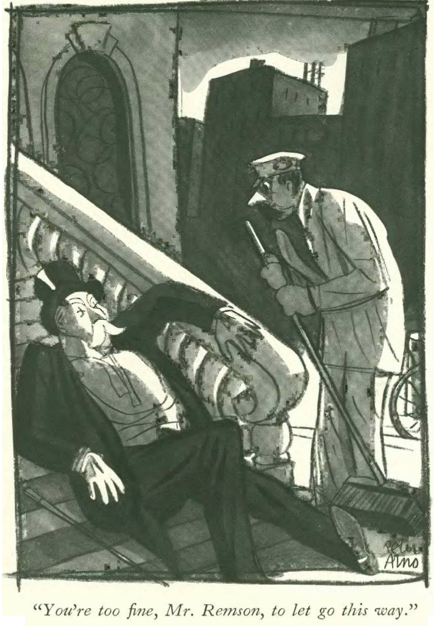
…Richard Decker references a recent change in New York telephone numbers with this prison scene…
…Decker was referring to this bit of news, here interpreted by E.B. White in his Feb. 14 “Notes and Comment.”
…James Thurber returned with his second-ever stand-alone cartoon for the New Yorker…
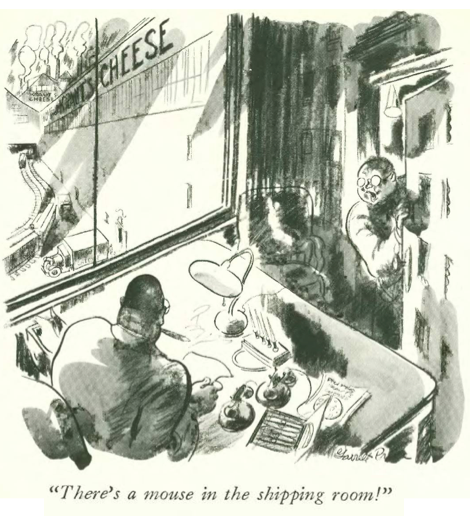
…Garrett Price mined a theme that would become common in New Yorker cartoons: the tycoon vs. meek employee…
…Nancy Fay gave us a glimpse of the seamier side of family life…
Like E.B. White, James Thurber and Dorothy Parker who came before him, S. J. Perelman was one of those New Yorker writers whose name would become synonymous with the magazine.
Jan. 24, 1931 cover by William Crawford Galbraith.
Perelman’s first New Yorker article, “Ten Cents in Stamps,” appeared in the Jan. 24, 1931 issue, his subject a collection of self-help and “how to” books he introduced with this Editor’s Note: “Upsetting as it may seem, all the books reviewed in the following article are genuine.”
FOR THE BIRDS…S. J. Perelman (1904–1979) sampled Canary Breeding for Beginners among other titles in his first humorous short for The New Yorker. The above 1935 photograph was made by Ralph Steiner, who recalled “when I made this photograph I said ‘this is a foolish thing for two grown men to be doing with their time,’ Perelman answered: ‘We may be the only two men in the world at this moment not doing harm to anyone.'”(amazon/akronartmuseum.org)
Without further ado, some excerpts…
…Perelman offered us a taste of Martini’s poetic gifts…
MARTINI WITH A TWIST…S.J. Perelman wanted “a little tighter thinking” from Martini, The Palmist, in his book, How to Read Eyes. (Etsy/johnesimpson.com)
…and also sampled the wisdom of Jacob Penn, who wrote a book titled How to Get a Job Through Help Wanted Advertisements. Perelman zeroed in on the book’s appendix, which contained “Successful Model Letters”…
* * *
Dorothy Returns
After a long absence, Dorothy Parker returned to her immensely popular “Reading and Writing” column. Parker had been staying at an alpine sanitorium in Switzerland, providing moral support for her friends Gerald and Sara Murphy while their young son was treated for tuberculosis. Parker had originally fled to Europe (France, specifically) to write her “Great American Novel,” only to end up on the Swiss mountaintop, where she composed a long letter just recently published (2014) under the title Alpine Giggle Week. Back in New York, she returned to her typewriter and released her wit on Charles Noel Douglas, editor of Forty Thousand Sublime and Beautiful Thoughts.
A PENNY FOR YOUR THOUGHTS?…Charles Noel Douglas had 40,000 of them, Dorothy Parker discovered.(amazon/britannica.com)
* * *
A ‘Tables’ Reprise
Lois Long was also back, in a way, reviving her “Tables for Two” column for on a one-off on the city’s Broadway hot-spots…
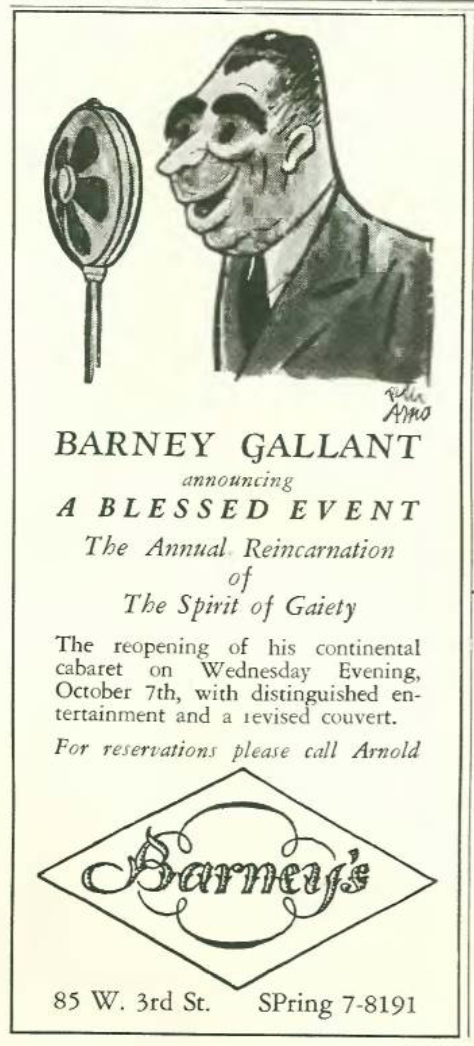
AFTER THE CURTAIN FALLS on Broadway there were plenty of nighttime diversions to keep theater crowds entertained into the wee hours.Clockwise, from top left, singer-dancer Frances Williams worked wonders with Harry Richman and his orchestra at the Club Richman; Bobby Dolan wielded a smart baton at Barney’s; and crooner Morton Downey (pictured with wife and actress Barbara Bennett)… lent his golden tenor to adoring crowds at Club Delmonico. The couple spawned the combative star of 1980s “Trash TV” Morton Downey Jr. (Pinterest)
* * *
From Our Advertisers
We begin with a full page of ads for various Broadway shows…
…and if you wanted to get tickets to one of those shows, here is 1931’s version of StubHub…
…and we are reminded that it is indeed 1931 with overtly racist ads such as this…
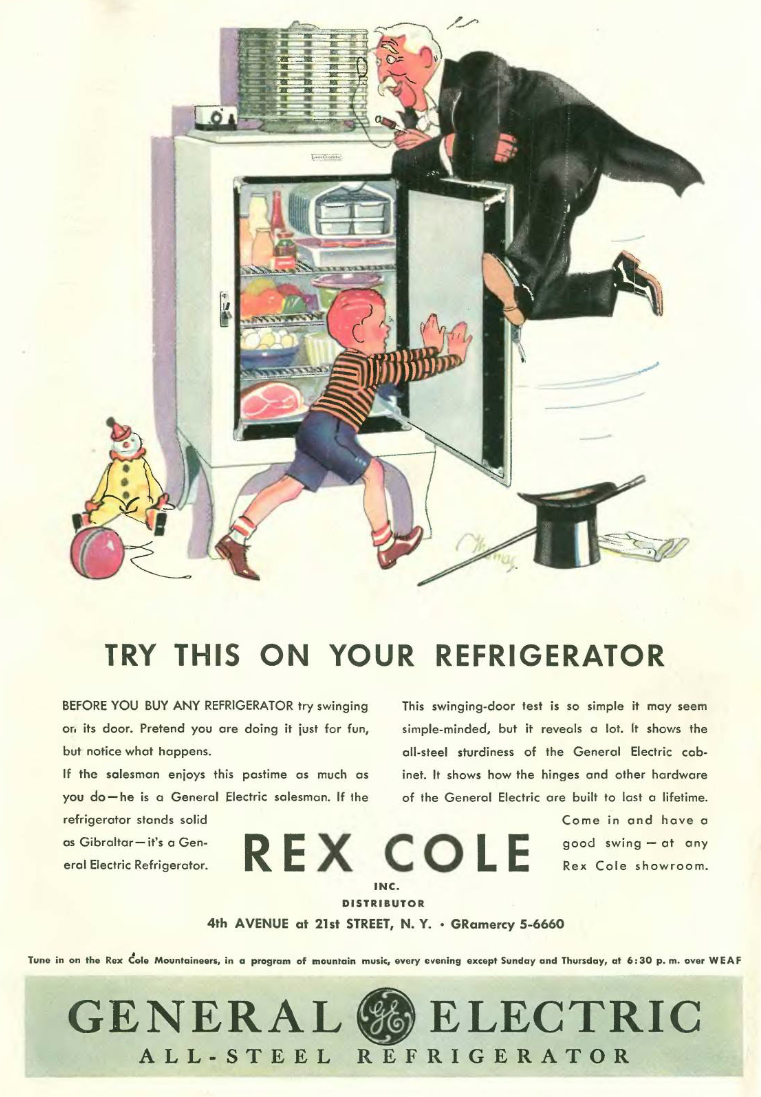
…back home, the help isn’t treated much better. “Cook” can suffer as long as the food remains fresh in the gleaming Frigidaire…
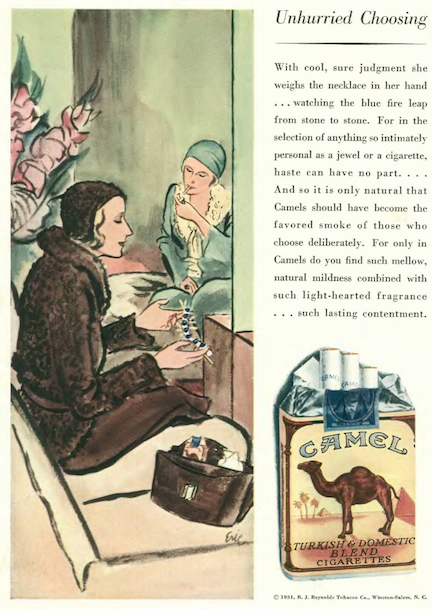
…meanwhile, our stylish Camel smokers (illustrated by Carl “Eric” Erickson) are keeping cool on the slopes…
…and perhaps this is the one and only time a painting by Thomas Gainsborough is compared to a tire…
…on to our illustrators and cartoons, the editors tossed in this old spot illustration by H.O. Hofman to fill space on the events page…
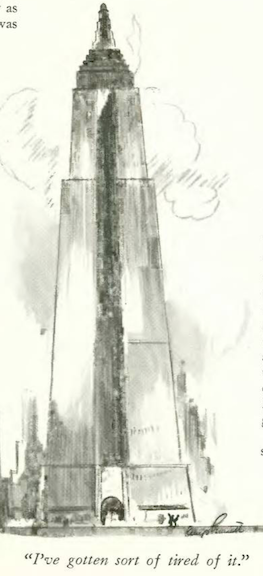
…an then we have this spot (sorry, I can’t identify the artist) that imagines disastrous consequences for the Empire State Building’s “mooring mast” (which was never used as such)…
…and Ralph Barton returned to lend his artistry to the theater review section…
…for our cartoons, we begin with Sewell Johnson’s lone contribution to The New Yorker…
…Carl Rose was at the movies…
…Isadore Klein warmed things up in this parlor scene…
…Alan Dunn justified the existence of thriller author Edgar Wallace…
...John Reehill gave us a look at an unlikely radio act (however, from 1936 to 1956 ventriloquist Edgar Bergen and his dummy, Charlie McCarthy, would be hugely popular radio stars)…
…Rea Irvin paid a visit to the diner in this full-page cartoon…
…and another full-page cartoon from Peter Arno, who looked in on an intimate moment…
During the early years of the Depression and before censorship guidelines were imposed by the Hays Code, Hollywood cranked out a slew of “Pre-Code” films filled with sex and violence, including 1931’s Little Caesar, the first “talkie” gangster film that defined the genre for decades to come.
Jan. 17, 1931 cover by Peter Arno.
It also propelled the career of Edward G. Robinson (1893-1973), who portrayed “Little Caesar” Rico Bandello—it was a breakout role for the actor, leading to a 50-year career of playing tough guys among other roles. Although the film today is considered a classic and well-regarded by critics, The New Yorker’sJohn Mosher was not entirely bowled over; he did, however, see the talent potential of the 33-year-old Robinson:
OUCH…Clockwise, from top left, Rico Bandello (Edward G. Robinson) catches some lead from a rival gangster in Little Caesar; Rico has little patience for his partner Joe (Douglas Fairbanks Jr.) and his love interest Olga (Glenda Farrell); Rico and his boys doing a little banking business; Rico up to no good with his sidekick Otero (George E. Stone). (Britannica/moviestillsdb.com/MoMA/IMDB)
Mervyn LeRoy’sLittle Caesar would kick off a series of Warner Brothers gangster films that would help launch the careers of other actors including James Cagney (The Public Enemy, Angels With Dirty Faces) and Humphrey Bogart (The Petrified Forest). Here’s Warner’s trailer for Little Caesar:
* * *
You Dirty Rat
The Jan. 17 “Talk of the Town” looked in on the growing rat infestation at Riker’s Island, a swampy little island that expanded more than four times its original size thanks to the mountains of garbage dumped there in the early 20th century. Much of it was coal ash, which caused the spontaneous fires referred to in the following “Talk” article. Of course the garbage also attracted legions of rats, which officials tried to counter by releasing vicious dogs and pigs on the island. It only seems fitting that such a place would become home to one of America’s most hellish prisons:
RAT TRAP…Clockwise, from top, aerial view of the Riker’s Island Penitentiary, which opened in 1932. Mountains of garbage, some 130 feet high, are visible in the background. The garbage heaps were prone to spontaneous combustion. In 1934 a prison warden described his nighttime view as a “whole hillside lit up with little fires. … It was beautiful”; view of a cellblock; adding to the mountain of garbage in 1937. (correction history.org)
* * *
Sign of the Times
No doubt some of the folks who ended up at Riker’s were desperate souls who were reduced to begging on the streets of Manhattan. Morris Markey, in his “A Reporter at Large” column, looked in on some of the city’s “Vagabonds,” noting that the Depression had added some new faces among the panhandlers, faces “torn by an unaccustomed pain.” An excerpt:
HARD TIMES…An unemployed man seeks work in the 1930s. (Wayne State University)
* * *
Grim for the Reaper
The Depression, it seems, was even hard on the nation’s undertakers, according to E.B. White in “Notes and Comment”…
NEED A LIFT?…A hearse and undertaker in 1930. Business was surprisingly slow in hard times. (my101years.com)
* * *
Work is Fun When You Don’t Need It
Lois Long filed another installment in her “Doldrums” series, in which she commented on the desires of the city’s debutantes to find some purpose in life…
PUTTING THEIR BEST FEET FORWARD…Debutantes pose in Washington, D.C., circa 1930. (Pinterest)
* * *
Pablo Who?
New York’s Valentine Gallery was offering a showing of works by Pablo Picasso, who was famous enough to create as he wished, but not quite ready for canonical consideration…
I’LL DO AS I PLEASE…Pablo Picasso in 1931, in a portrait by Cecil Beaton. (oscarenfotos.com)
* * *
Order Restored
After its Marion Talley debacle, the Metropolitan Opera stage welcomed French soprano Lily Pons (1898-1976) to its stage. “The Talk of Town” noted that although Pons’ debut was far less hyped than Talley’s, her reception by New York audiences was far more enthusiastic. While Talley’s career would sputter and fade, Pons would enjoy a long association with the Metropolitan Opera, where she performed nearly 300 times between 1931 and 1960.
A BREATH OF FRESH AIR…One of the most popular prima donnas of her time, French soprano Lily Pons would grace the Metropolitan Opera stage for 30 years. From right, a 1931 portrait of Pons by Cecil Beaton; on the cover of Time, Oct. 17, 1932. (CondeNast/Time)
* * *
From Our Advertisers
Best & Company looked out for the welfare of New York’s young women by offering a selection of wool “Vassarettes” to stave off the “Grippe” weather…
…with the annual Motor Boat Show at the Grand National Palace, several ads called readers’ attention to expensive toys fewer and fewer could afford to own…
…the makers of Sterling boat motors shelled out the big bucks for this full-color, back-page ad…overall, the number of boat ads were down from previous years…
…Rea Irvin continued to pick up some extra income with an ongoing series of cartoons promoting Murad cigarettes…
…on to Irvin’s fellow cartoonists, we have Peter Arno’s look at the new economy…
…likewise Denys Wortman…
…and Perry Barlow…
…while Alan Dunn checked in on the challenges of those who still had means…
…Barbara Shermund was still the life of the party…
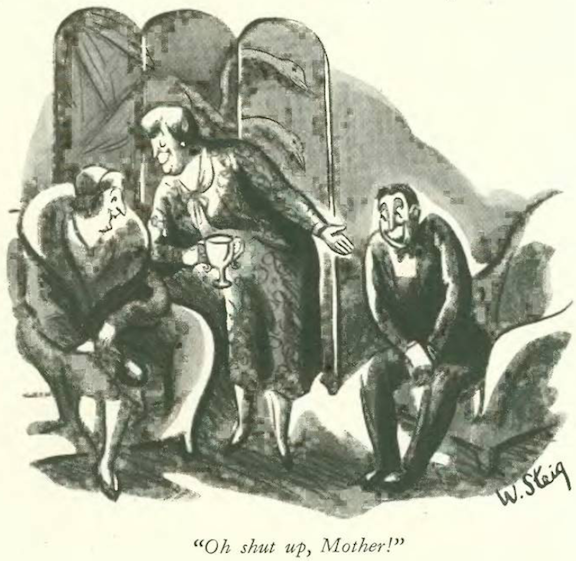
…and William Steig was beginning to establish himself in the stable of cartoon regulars (and offer a preview of his famed “Small Fry”)…
…and finally, a new perspective on the Chrysler Building, from Gardner Rea…
The Vassar-educated Lois Long was an icon of the flapper generation and a reigning voice—witty and smart—of New York nightlife in the Roaring Twenties.
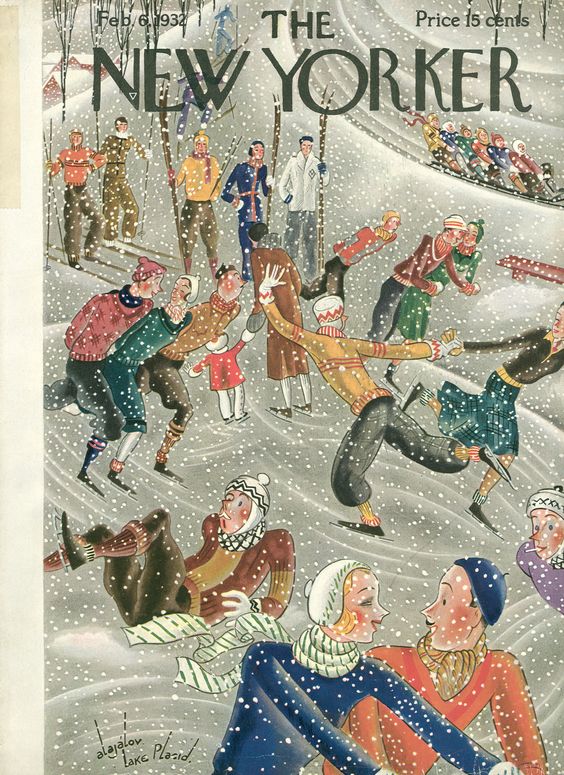
Jan. 10, 1931 cover by Constantin Alajalov.
In one of her early “Tables for Two” columns, the famously hard-partying Long made this request of her New Yorker readers: “Will someone do me a favor a get me home by eleven sometime? And see that nobody gives a party while I am catching up? I do so hate to miss anything.”
DONT START THE PARTY WITHOUT ME…Carefree days at your neighborhood speakeasy. (Manchester’s Finest)
By the dawn of 1931 few were in the mood for a party, including the 29-year-old Long, who was mother to a toddler and would soon divorce husband and New Yorker cartoonist Peter Arno.
But it wasn’t motherhood or a tempestuous marriage that soured Long on the party scene. Rather, blame fell to the whiny, self-absorbed crowd that had displaced her fun-loving Jazz Age revelers. In the Jan. 10, 1931 issue Long began to assess the decade ahead in a six-part series titled “Doldrums.” The first installment, “Bed of Neuroses,” suggests Long missed the joie de vivre that characterized the previous decade:
“It is all so discouraging; so very, very, sad. Six million people in New York, and apparently no one in the white-collar class who can lose himself for a moment in the ecstasy of a roller-coaster. Six million people in New York, and every one of them a curious little study in maladjustment. Thousands of young men who own dinner jackets, and I am always drawing someone who makes scenes in public because he once had a little cat that died and he has never got over it.”
With that, Long’s partying days were officially over. Some excerpts from “Bed of Neuroses”…
SALAD DAYS…Clockwise, from top left, Lois Long relaxing on the beach in a image captured from a 1920s home movie; silent film star Charlie Chaplin,Vanity Fair editor Frank Crowninshield, sculptor Helen Sardeau, Lois Long and screenwriter Harry D’Arrast pose in a Coney Island photo booth, 1925; Long with husband Peter Arno and daughter Patricia, 1929; Long at the office in a classic flapper pose, circa 1925. (PBS/Joshua Zeitz/Patricia Long/Wikipedia)
Long recalled the days when one could hold his or her liquor…
There has been a trend among the bright young drinkers toward a glass of sherry before meals instead of cocktails, a bottle of wine during dinner, port with the cheese, a liqueur with the coffee — instead of one highball after another.
…and when one’s personal hang-ups remained personal, and were not subject to tedious public display:
Long’s nightlife column, “Tables for Two” folded a few months after the 1929 stock market crash, but she would continue to make unsigned contributions to the “Comments” and “The Talk of the Town” sections into the 1950s. Her main focus at the magazine, however, would be her fashion column, “On and Off the Avenue,” which she would write until 1968. Upon her death in 1974, New Yorker editor William Shawn remarked that Long “was the first American fashion critic to approach fashion as an art and to criticize women’s clothes with independence, intelligence, humor and literary style.”
* * *
The Age of Giants
Architecture critic George S. Chappell took in the grandeur of the nearly completed Empire State Building, which rose from the rubble of the old Waldorf-Astoria hotel and perhaps more than any building served as a giant exclamation point for the 20th century metropolis. Chappell did not buy developers’ claims regarding the building’s “mooring mast,” calling it a “silly gesture” that the building would have been better served without. Looking back from our time, however, it is hard to imagine the building without its distinctive spire:
DIZZY HEIGHTS…Completed in 1931, the Empire State Building stood as the world’s tallest until 1970. Clockwise, from top left, New Yorker critic George Chappell viewed the “mooring mast” as a publicity stunt, and believed the building would have been better without it; interior of the building at its grand opening in May 1931; ground-level view of the setbacks Chappell admired; the completed tower in 1931. (lajulak.org/Associated Press/Acme/Pinterest)
Chappell also made note of a neo-Georgian style building designed by Joseph Freedlander for the Museum of the City of New York:
HISTORY’S HOME…The main facade of the Museum of the City of New York facing Fifth Avenue. (Wikipedia)
* * *
Ignoble Deeds
“The Talk of the Town” looked in on some aging veterans of the 19th century “Indian Wars” and found the old coots reminiscing about the massacre of various North American tribes…
NO HARD FEELINGS?…Crow warrior White Man Runs Him poses with 82-year-old Gen. Edward Settle Godfrey, a survivor of the Battle of Little Bighorn, at the 50th Anniversary of the battle in 1926. (Wikipedia)
* * *
Cheeky
E.B. White assumed the nom de plume “Eustace Tilley” to answer an earnest query letter from Leslie Fulenwider of Famous Features Syndicate. Fulenwider probably didn’t know what he was in for…
ALTER EGO…E.B. White periodically assumed the role of New Yorker mascot Eustace Tilley in handling magazine correspondence.
* * *
Too Cool for School
In his weekly art gallery column, Murdock Pemberton noted the New Year’s Day opening of the New School for Social Research in a “timid landmark” designed by Joseph Urban of theatrical design fame. The school’s boardroom featured a series of murals by realist painter Thomas Hart Benton.
NEW LOOK FOR NEW SCHOOL…Joseph Urban’s interpretation of the International Style for the New School for Social Research at 66 West 12th Street.AMERICAN TABLEAU…Three panels from Thomas Hart Benton’s ten-panel mural, America Today. Originally installed in the New School’s boardroom, it is now housed at the Metropolitan Museum of Art. (charlesmcquillen.com)
* * *
From Our Advertisers
“If you’re to be among this season’s southbound fortunates,” as this ad begins, you’ll want to check out these Bradley bathing suits designed for a variety of privileged personalities…
…but before you hit the beach, you might consider an “Ardena Bath” to take away some of that winter fat…
…this 1932 illustration (below) demonstrates how a full-body, Ardena paraffin wax bath works. An Elizabeth Arden advertisement described the procedure thus: You step into a tub lined with waxed paper. Over you they pour a warm liquid paraffin which slowly hardens until you are encased in a paraffin shell. Your face becomes pink. You are permeated in a sense of well-being. Suddenly, the perspirations bursts from you, for the shell forms a vacuum which causes the pores to open and, consequently, impurities are drawn away…
…on to our cartoons, we have two from William Steig, who produced 2,600 drawings and 117 covers for The New Yorker and whose work would span two centuries, delighting both adults and children alike, most notably the picture book Shrek! that would lead to a hugely successful movie series. According to The Numbers: Where Data and the Movie Business Meet, “after the release of Shrek 2 in 2004, Steig became the first sole-creator of an animated movie franchise that went on to generate over $1 billion from theatrical and ancillary markets after only one sequel.”
Here is Steig’s first New Yorker cartoon, from the Aug. 9, 1930 issue:
…and back to the Jan. 10, 1931 issue, in which Steig offered these glimpses into city life…
…and then have a look into the posh set from New Yorker stalwart Helen Hokinson…
…some bedside manner with Leonard Dove…
…Peter Arno continued to explore the complexities of love…
…and Gardner Rea showed us the softer side of a hardened criminal…
…and before we close I want to bring to your attention to this wonderful New Yorker parody that Peter Binkley recently shared with me. Binkley writes that the Dec. 20, 1930 cover “was the model for a parody issue that friends of my grandparents in the Village made for them when they visited for the holidays. My grandparents had lived in New York for a couple of years but moved away in 1929. They and this group of friends lived in the same building on Morton St., and were fervent New Yorker readers. The parody is interesting, I think, for giving a glimpse of what New Yorker fans below the top-hat-wearing class enjoyed about it at the time.”
Below, left, is the cover of the Dec. 30 issue by Constantin Alajalov, and next to it the terrific parody cover.
…and a couple of the interior pages, with parodies of cartoons by Peter Arno and John Held Jr….