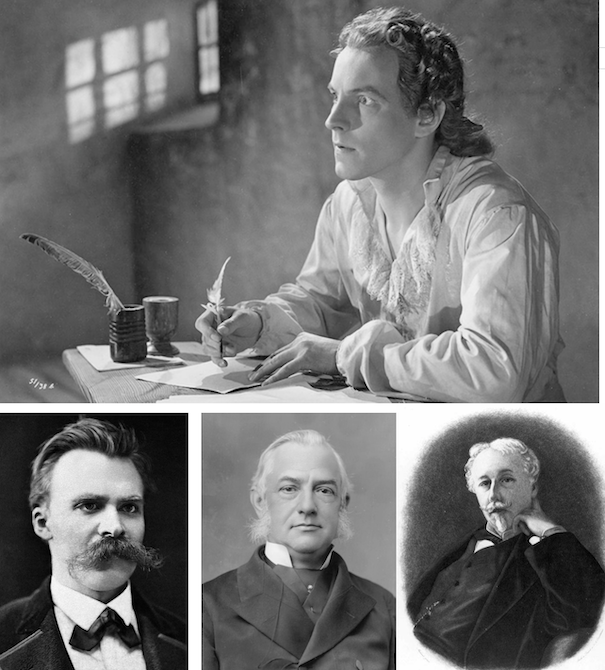
It Can’t Happen Here

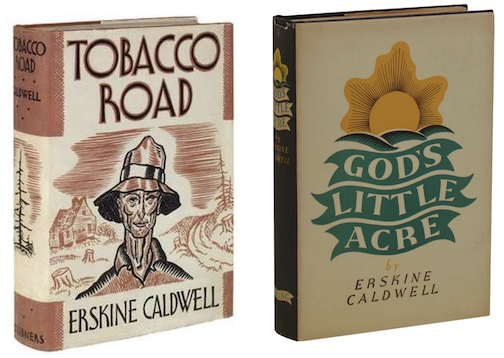
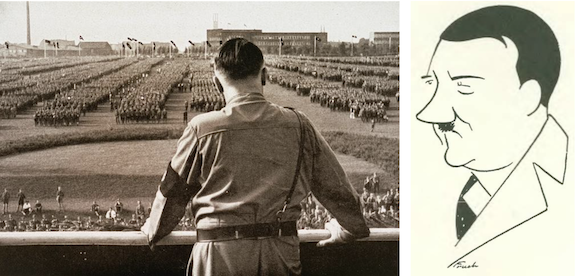
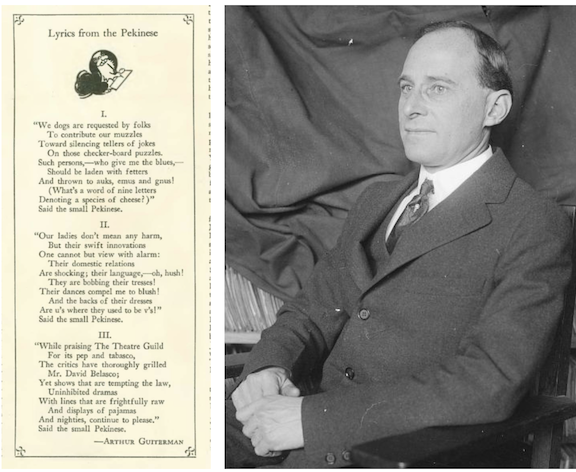
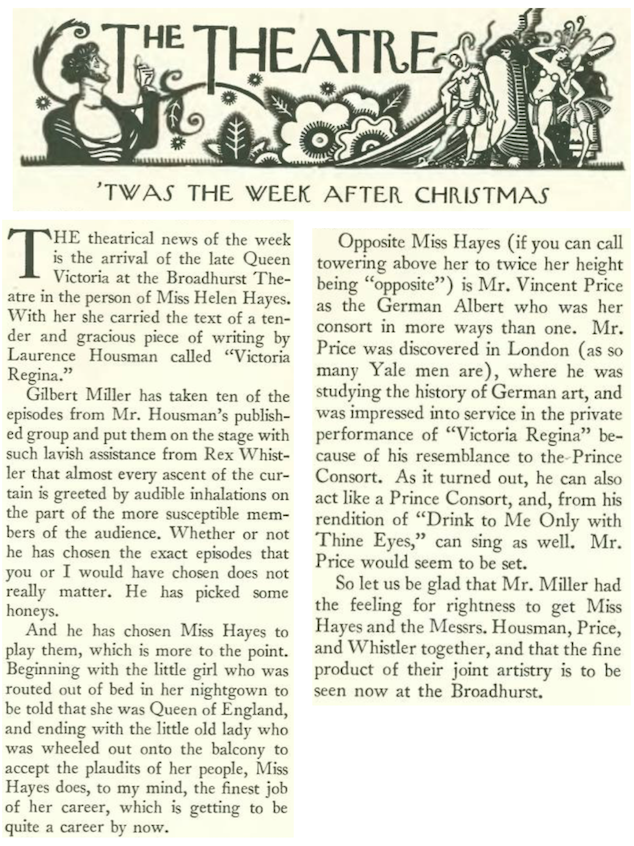
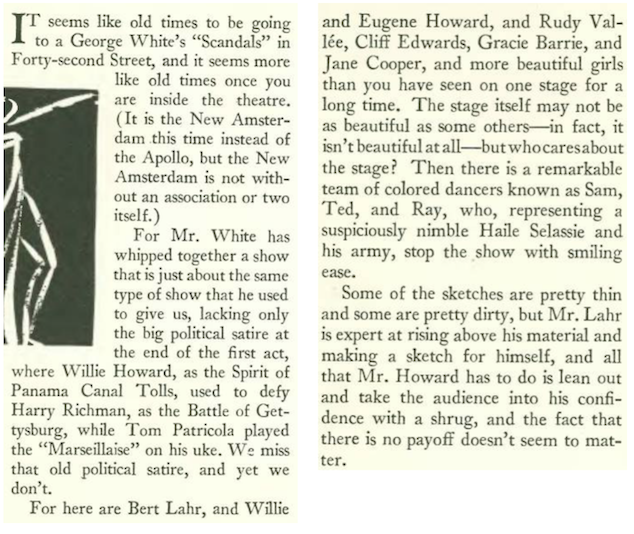
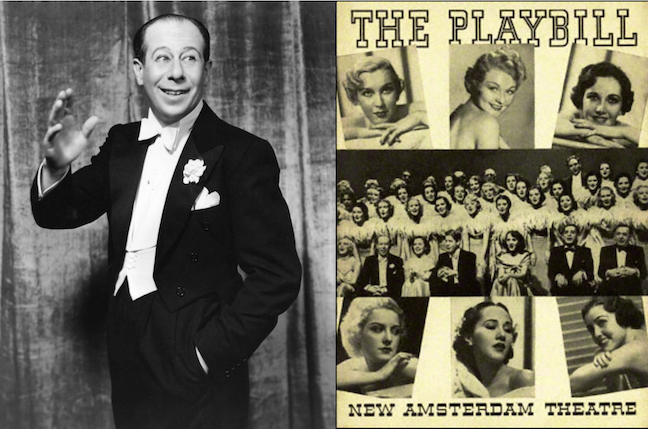
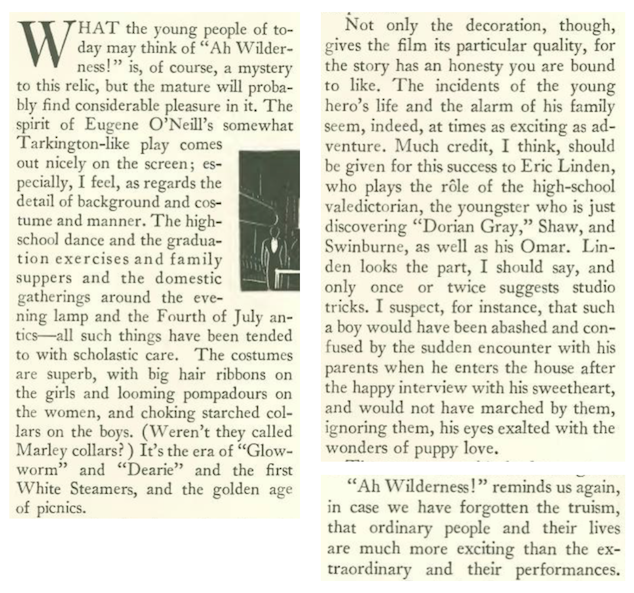
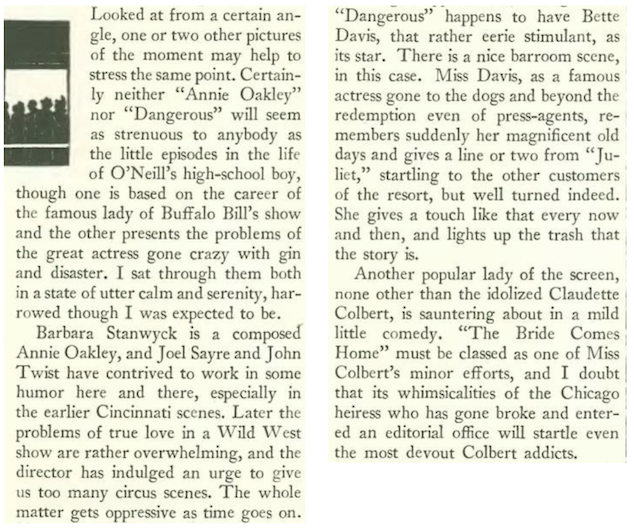
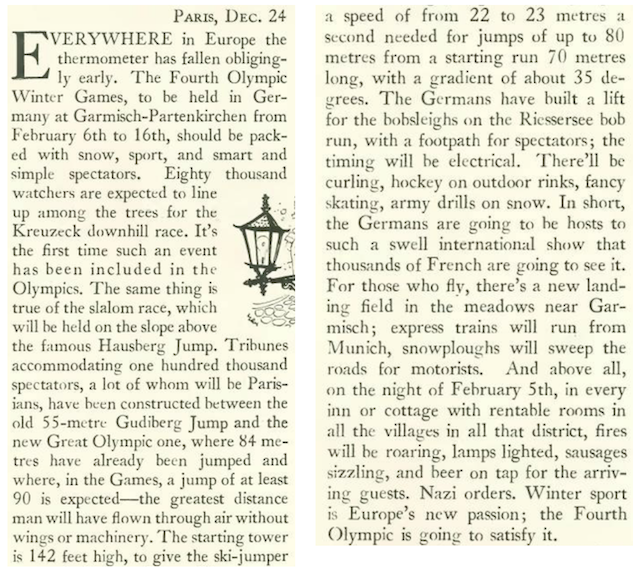
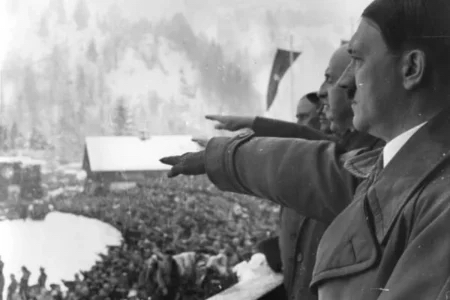
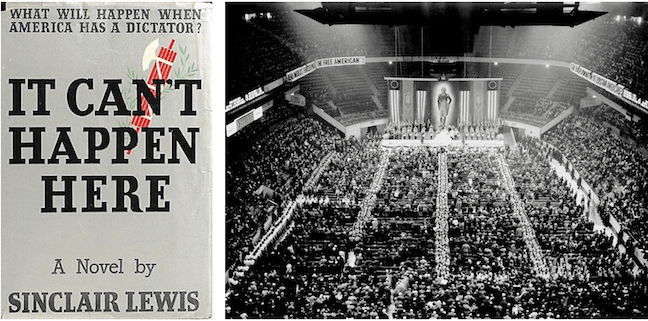
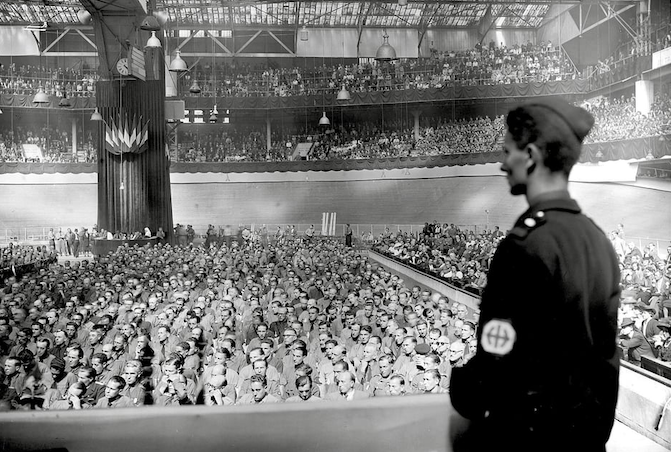
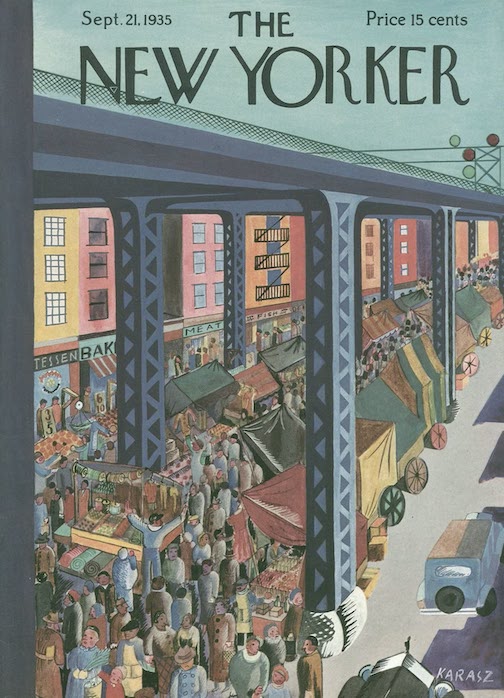
Above: Cover of Sinclair Lewis's 1935 novel about a fascist takeover of America, It Can't Happen Here. At right, 22,000 people attended a Nazi rally at Madison Square Garden on February 20, 1939. (Wikipedia/Reddit)

Ninety years ago Sinclair Lewis published It Can’t Happen Here, a dystopian novel that responded to the rise of fascism in Europe as well as to American demagogues like Louisiana Senator Huey Long.

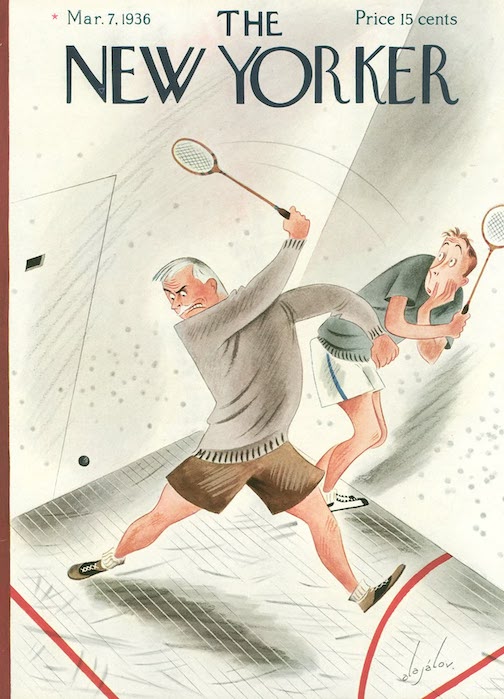
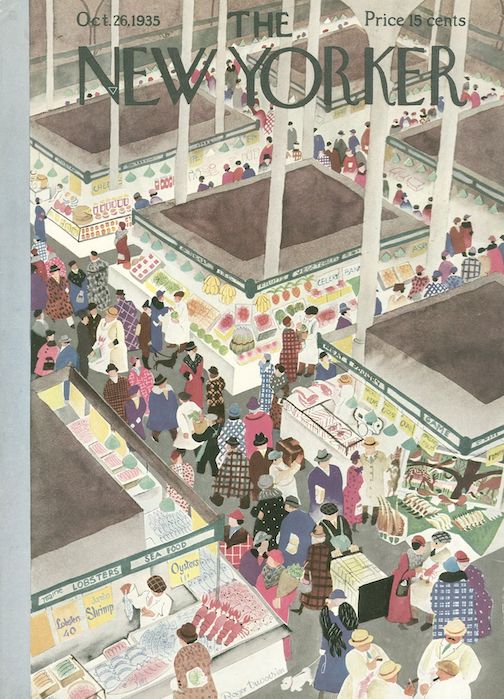
October 26, 1935 cover by Roger Duvoisin. Duvoisin (1900–1980) was a Swiss-born American writer and illustrator best known for children’s picture books. He illustrated 32 covers for The New Yorker, along with five cartoons. Duvoisin won the Caldecott Medal in 1948 (along with author Alvin Tresselt) for White Snow, Bright Snow.

In his 2016 New Yorker article, “Getting Close to Fascism with Sinclair Lewis’s ‘It Can’t Happen Here,'” journalist Alexander Nazaryan notes how Lewis was arguing for journalism and civic education as essential pillars of democracy. The title of Lewis’s book, Nazaryan observes, suggests that ‘It’ was something more subtle: “a collective apathy, born of ignorance, and a populace that can no longer make the kind of judgments that participatory democracy requires.”

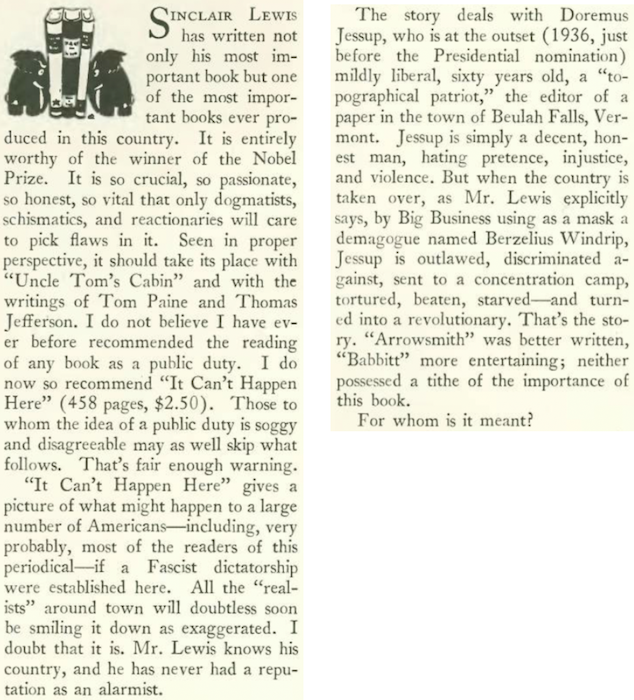
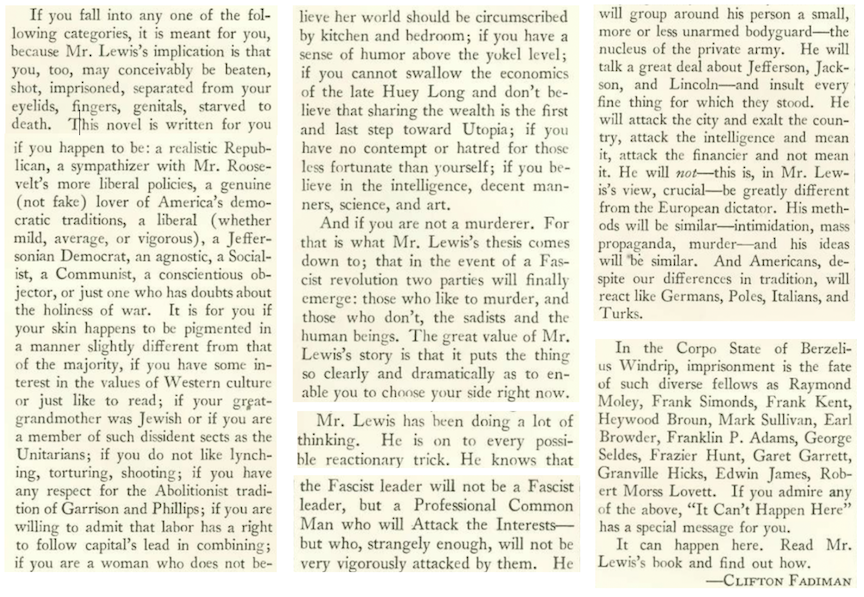
Lewis’s novel also made book critic Clifton Fadiman sit up and take notice. Here are excerpts from the first part of his review:

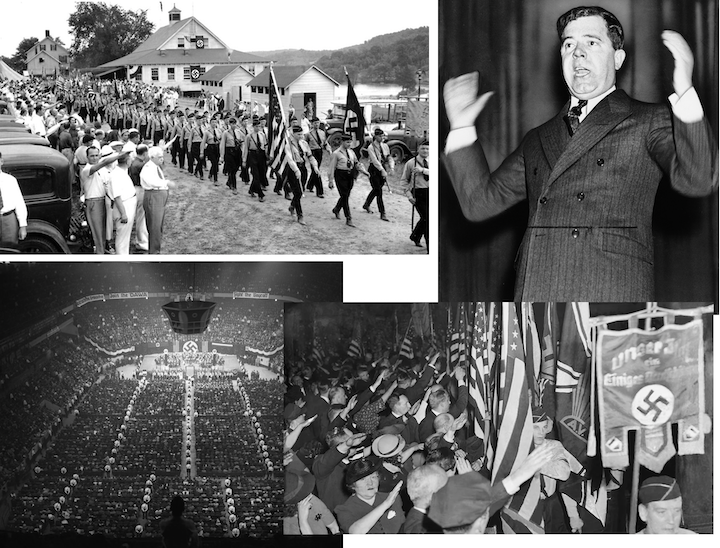
HOME-GROWN…American fascism was represented by organizations such as the German American Bund, the Silver Legion of America, and radio host Charles Coughlin, who opposed the New Deal and promoted conspiracy theories and antisemitic views. Clockwise, from top left: Nearly a thousand uniformed men wearing swastika arm bands and carrying Nazi banners parade past a reviewing stand in New Jersey on July 18, 1937. The New Jersey division of the German-American Bund had opened the 100-acre Camp Nordland at Sussex Hills; Huey Long in 1935, the same year he was assassinated; Nazi rally at Madison Square Garden in 1939. (AP/Wikipedia)

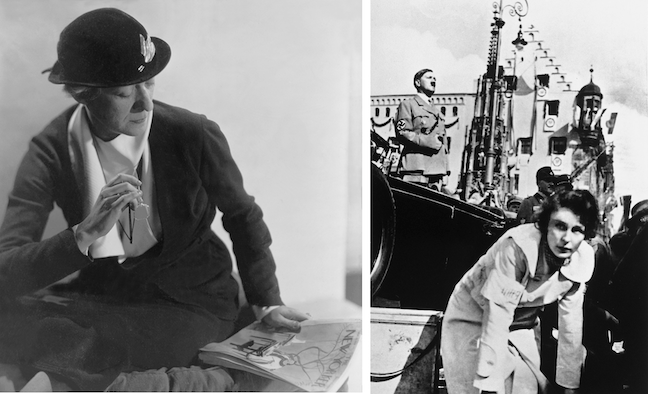
If you zoom in on the photo at bottom right, you can’t help but notice the woman in the black hat, who seems a little unsure about what she is doing, especially in front of a camera…the woman to her right appears to be hiding her face.

Here is more of Fadiman’s review (click to enlarge). It’s worth a read.

WE’VE BEEN WARNED…Published nearly seventy years apart, Sinclair Lewis’s It Can’t Happen Here (1935) and Philip Roth’s The Plot Against America (2004) both explored the dangers of fascism in the United States. (pulitzer.org/Wikipedia/Nancy Crampton via stanford.edu)

 * * *

It Was Happening There

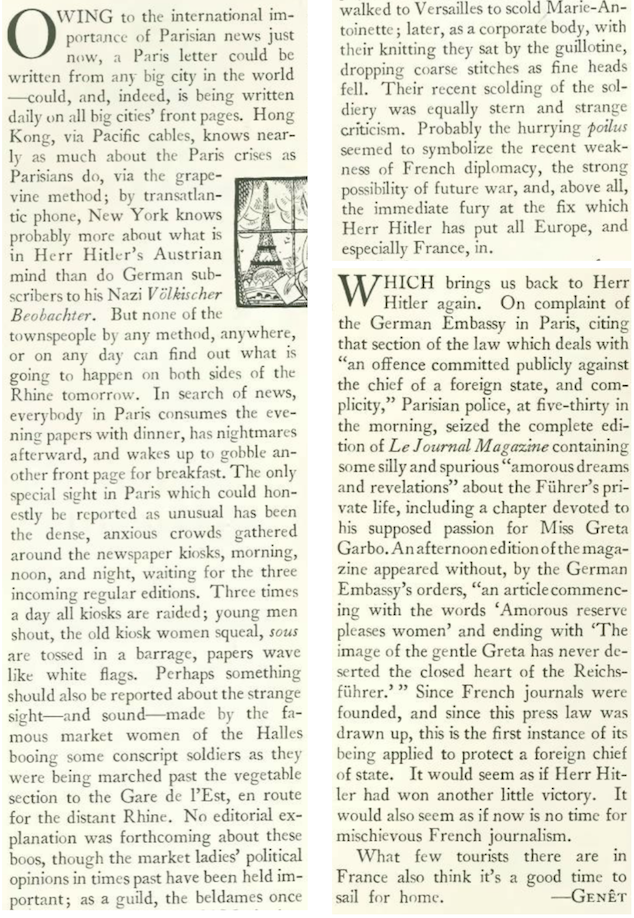
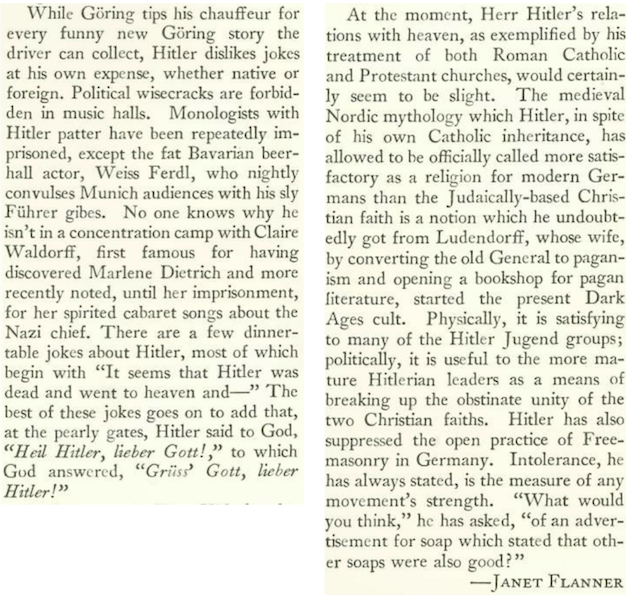
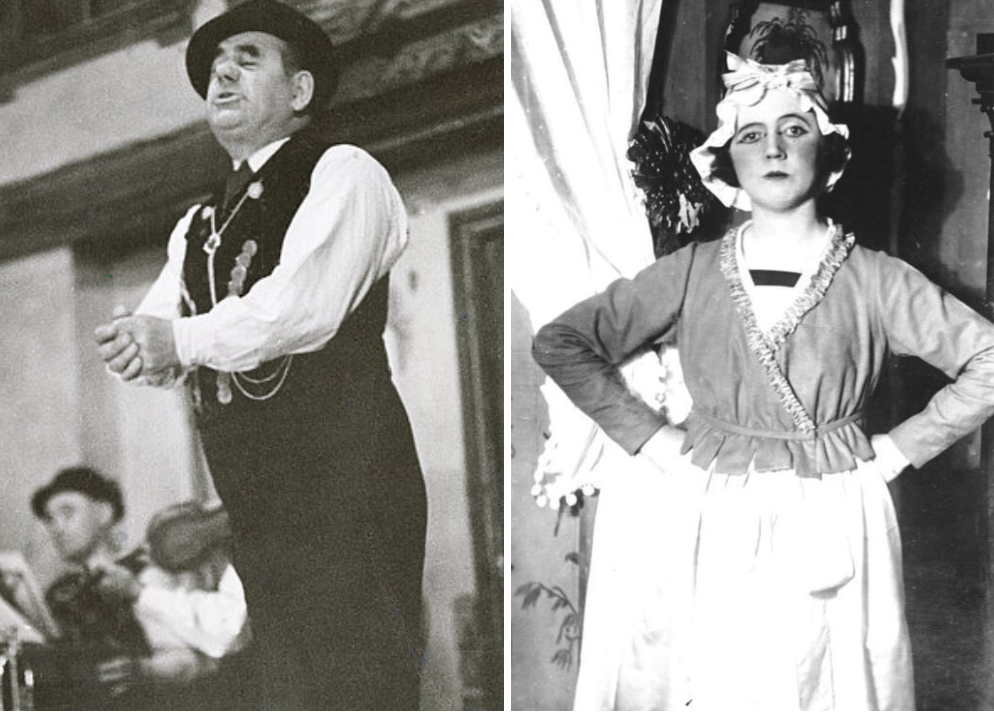
In her “Letter from Paris,” Janet Flanner was noting “increasing Fascist sentiment and  sympathy” in her adopted city:

OVER THERE…The French Popular Party (Parti populaire français, PPF) was a French fascist and anti-semitic political party led by Jacques Doriot before and during World War II. Formed in June 1936, with an estimated 120,000 members by 1937, it is generally regarded as the most collaborationist party of France. (thefrenchhistorypodcast.com)

 * * *

All Talk

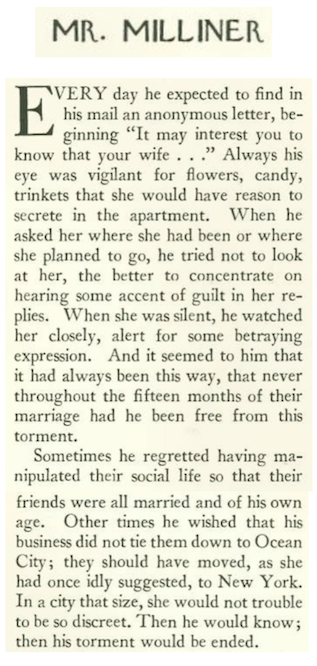
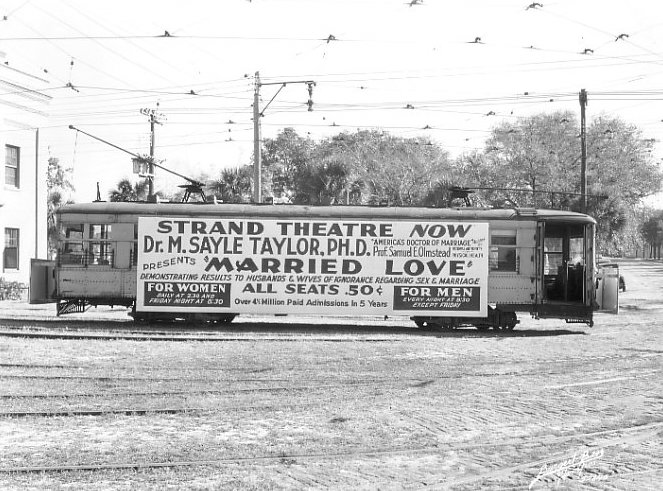
Marion Sayle Taylor (1889–1942) was the popular host of a radio advice show, The Voice of Experience. Margaret Case Harriman (1901–1966) penned a two-part profile of Taylor titled “The Voice.” I’ve included the opening lines to Part One here:

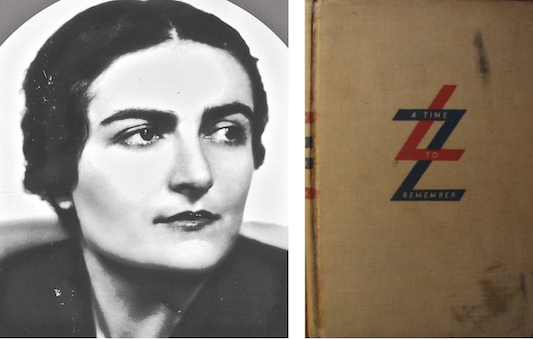
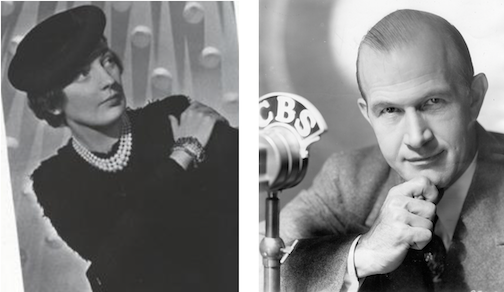
IF ONLY SHE KNEW…Margaret Case Harriman, left, circa 1936, profiled Marion Sayle Taylor before his misdeeds were revealed. (Vogue Archive/eleanorbritton.blogspot.com/Oregon Encyclopedia)

After reading both parts of Harriman’s profile piece, it appears she wasn’t yet aware that Taylor was more than a radio personality; he was also dishonest, manipulative, and opportunistic, according to a biography by Dick and Judy Wagner featured in the Oregon Encyclopedia. For example, Harriman reported (likely from Taylor’s official bio) that Taylor’s first wife, Pauline, had died in childbirth, when in fact she was quite alive and suing him for divorce that same year. Taylor also divorced his second wife, Jessie, who sued him in 1936 after he deceived her about another woman. Not surprisingly, his radio image as a reliable marriage counselor was damaged irretrievably.

FALSE ADVERTISING…A streetcar, possibly in Newark, N.J., advertising a lecture by Taylor, circa 1931. In addition to hiding a previous prison record, Taylor also falsely reported that he had studied at several universities (he did not earn a Ph.D, as the redundant title claims in the above photo). It appears Taylor also kept much of the money he solicited for charitable causes. (Oregon Encyclopedia)

 * * *

Selling Pooh

Commercial cross-marketing of children’s books with toys and other products had its origins in the late nineteenth century with Alice’s Adventures in Wonderland, and in the first years of the 20th century Beatrix Potter’s Peter Rabbit series inspired everything from dishes and wallpaper to board games and dolls—in 1903 Peter Rabbit was the first fictional character to be made into a patented stuffed toy.

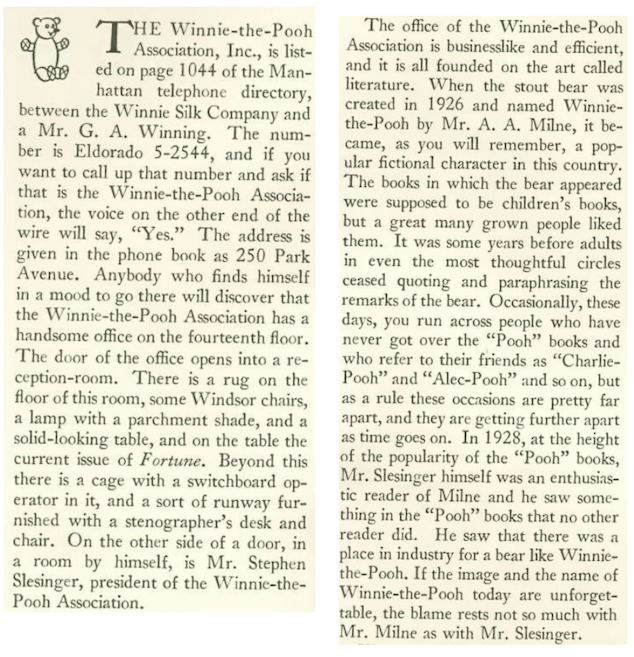
Then came another character from British children’s literature, A.A. Milne’s Winnie-the-Pooh. In January 1930, Stephen Slesinger (1901–1953) purchased U.S. and Canadian merchandising, television, recording, and other trade rights to the Winnie-the-Pooh works from Milne (for $1,000, plus royalties), marketing a wide range of products. For the column “Onward & Upward With the Arts,” St. Clair McKelway paid a visit to Slesinger at the Park Avenue offices of Winnie-the-Pooh Association, Inc. Excerpts:

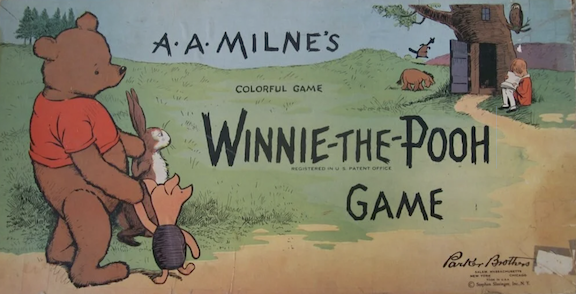
KEEP YER SHIRT ON…The Parker Brothers were the first to feature Winnie-the-Pooh in color for a 1932 board game. Stephan Slesinger added the iconic red t-shirt to Pooh for the game and a children’s record, a look that was later adopted by the Disney Corporation when it acquired the rights from Slesinger’s widow and daughter in 1961. (thedisneyclassics.com)
FUNNIES MAN…At left, Stephan Slesinger in an undated photo. Slesinger was a radio, television and film producer, and a curator of comic strip characters including Alley Cop, Captain Easy, Buck Rogers and Blondie, among others; at center, a record of “Winnie-the-Pooh Songs,” 1932; an ad for the Red Ryder BB gun—in 1938 Slesinger created the comic strip Red Ryder along with artist Fred Harmon. (alchetron/yesterdaysgallery.com/Port Isabel Press)

In another excerpt, McKelway gave us an idea of the scope of Slesinger’s Pooh empire:

 * * *

At the Movies

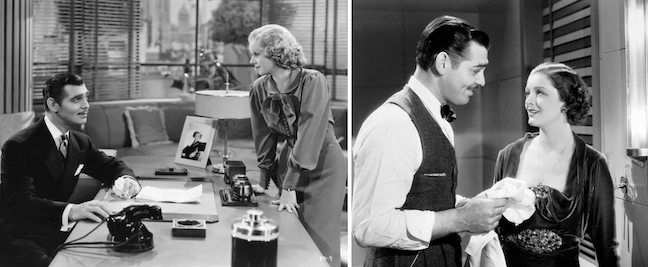
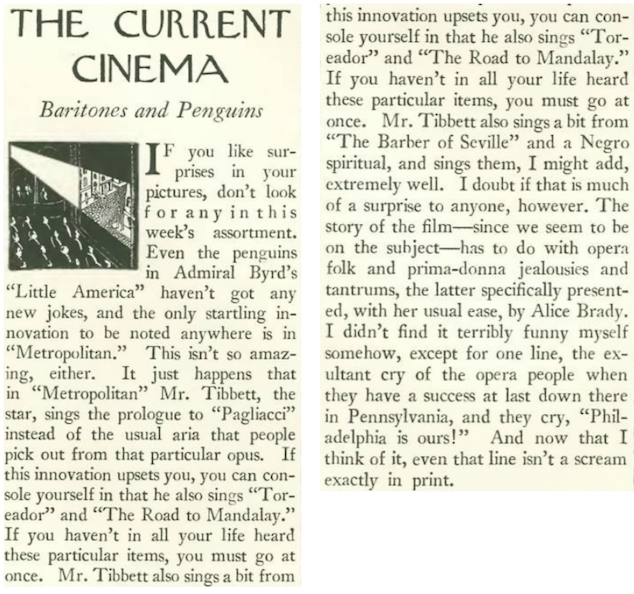
Critic John Mosher found few thrills in the latest fare from Hollywood, offering his views of Admiral Richard Byrd’s Into Little America and the musical Metropolitan, featuring famed baritone Lawrence Tibbett. 

FOR THE BYRDS…At left, lobby card for Into Little America; at right, Alice Brady and Lawrence Tibbett in Metropolitan. (eBay.uk/rottentomatoes.com)

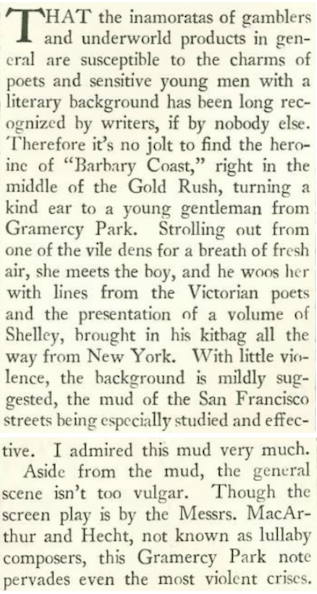
With a screenplay by Ben Hecht and Charles MacArthur and direction by Howard Hawks, one would hope for some rough and tumble in a film about Gold Rush San Francisco. Instead, Mosher found the trappings of Barbary Coast rather mild. This was doubtless due in part to the Hays Code that curtailed the sex and violence portrayed in films of the 1920s and early 1930s.

TAKING A SPIN…Miriam Hopkins runs the roulette wheel as Edward G. Robinson looks on in Barbary Coast. A brief 2019 review in the Harvard Film Archive praised the film’s Gothic feel created by the “evocative portrayal of early San Francisco as a foggy labyrinth of rickety boardwalks and ominous, sky-high ship masts…” (harvardfimarchive.org)

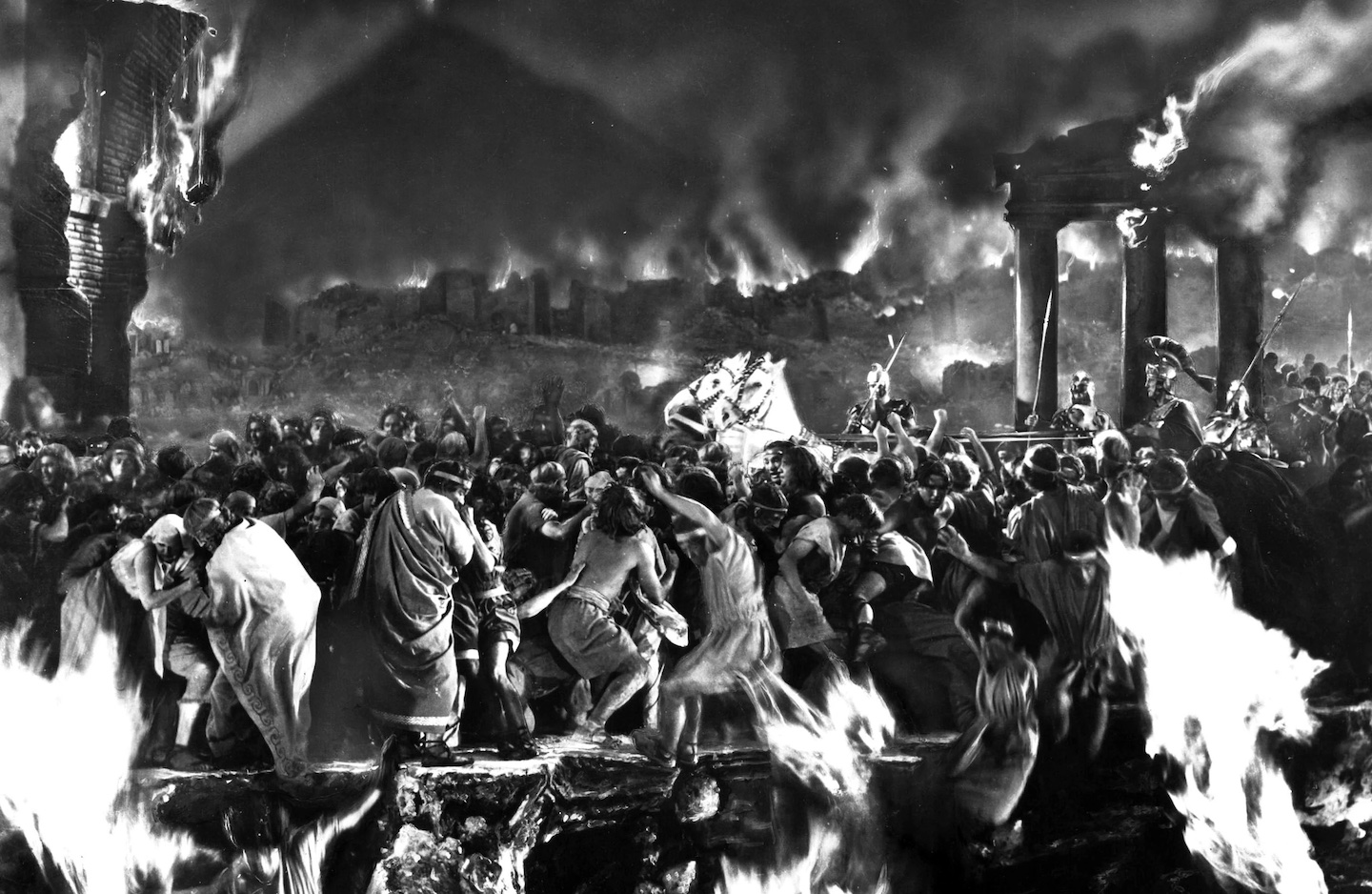
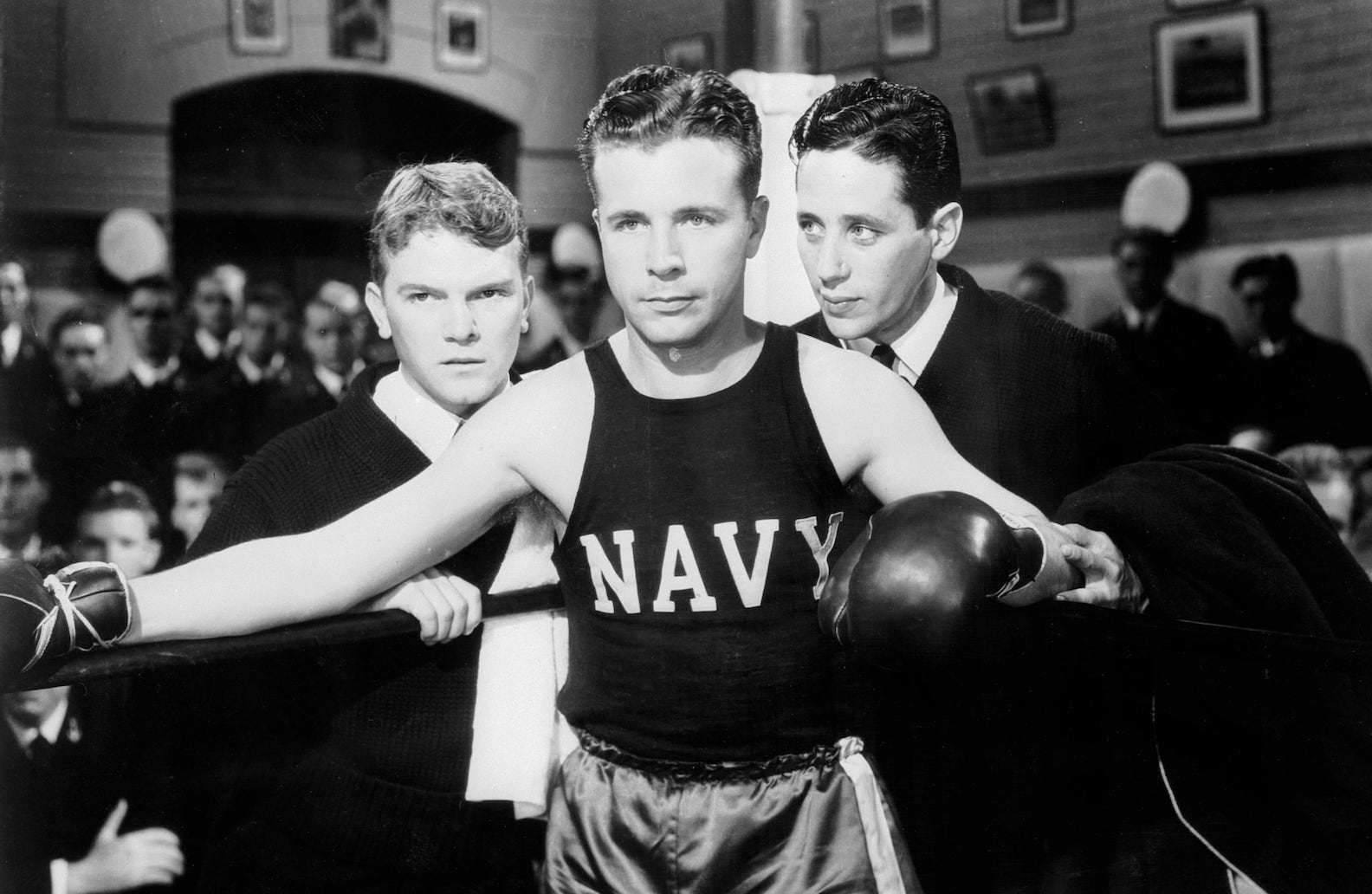
One might think that a film featuring the destruction of Pompeii would have some thrills, however RKO’s The Last Days of Pompeii proved to be a “temperate affair” in Mosher’s eyes, “one of the great bores of the moment.” The Dick Powell/U.S. Navy vehicle Shipmates Forever didn’t prove to be any better.

HOT TIMES IN POMPEII?…John Mosher called The Last Days of Pompeii “one of the great bores of the moment,” including the “drearily enacted” eruption of Vesuvius in which “Paper temples fall and there is a bit of bustle, and that is all there is to that.” Mosher did single out Basil Rathbone’s performance as an urbane Pontius Pilate, “a Pontius Pilate with a Long Island manner.” (tcm.com)
GO GET ‘EM DICK…The U.S. Naval Academy provided the setting for the musical Shipmates Forever, featuring Dick Powell as a crooner who ultimately chooses the Navy over a singing career. (tcm.com)

* * *

From Our Advertisers

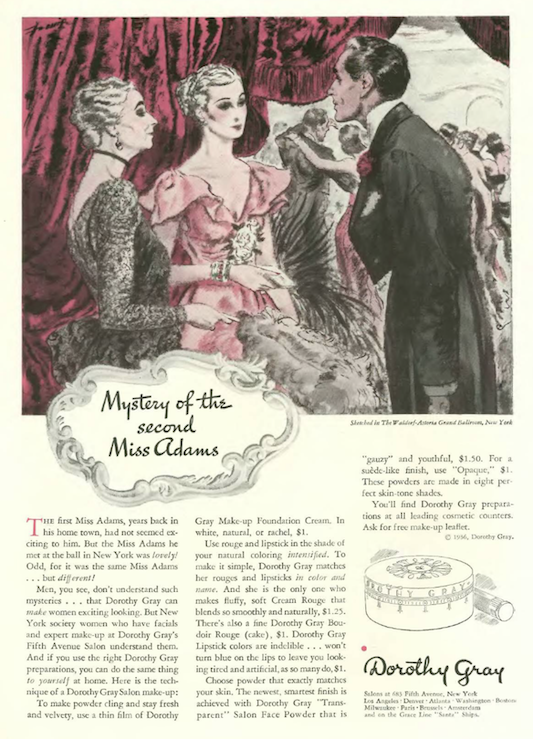
We begin with the inside front cover, where the folks at Fisher touted their innovative “Turret Top” design…Body by Fisher began as a separate company in 1908, specializing as an automobile coach builder…although acquired by General Motors in 1926, the Fisher brand was promoted until the 1980s…

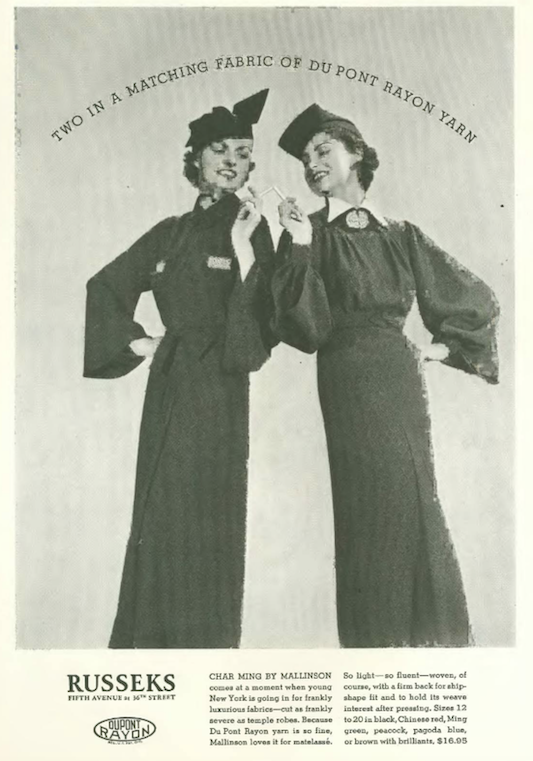
…there were many fall and winter fashion ads in this issue, including this continuing series by Russeks promoting Rayon fabrics…and women smoking, no doubt considered a sign of sophistication…

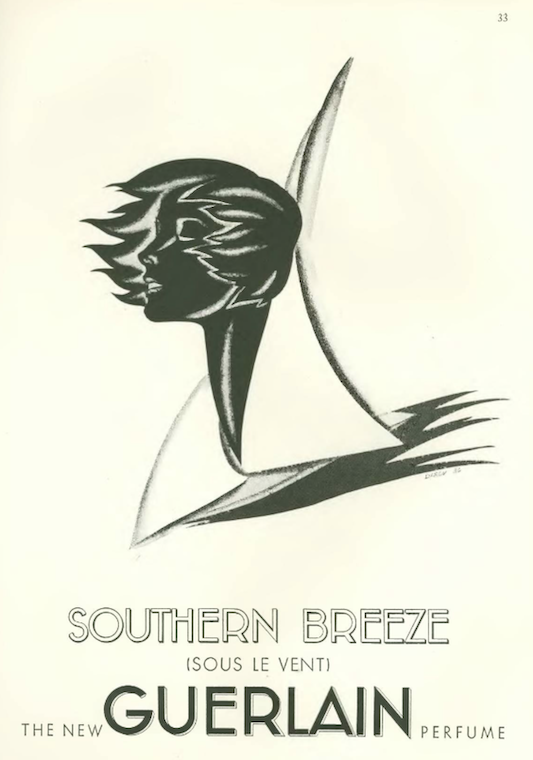
…Guerlain perfume ads featured the unmistakable style of illustrator Lyse Darcy

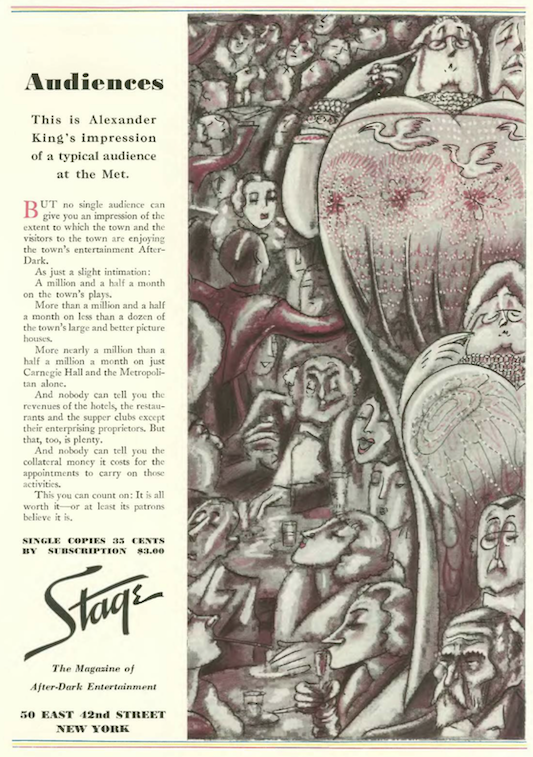
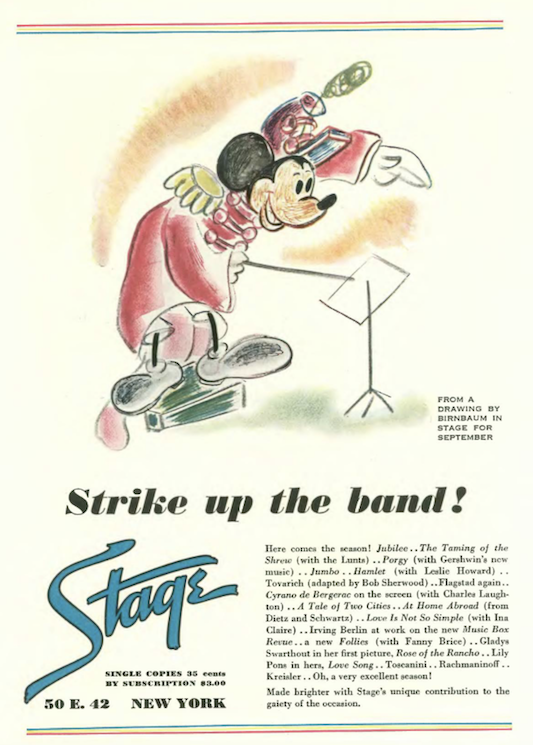
…the Heyward/Gershwin production of Porgy and Bess made a splash in this ad for Stage magazine…

…World Peaceways often used terrifying imagery to promote their anti-war messages…this ad was on the inside back cover…

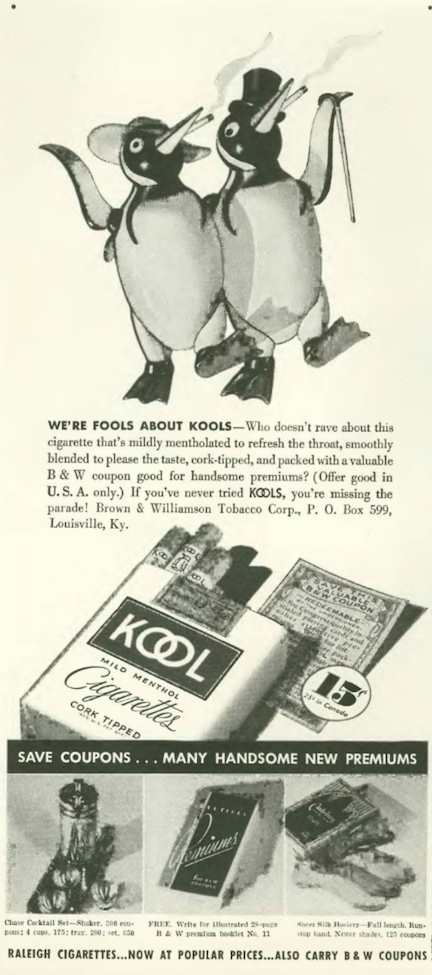
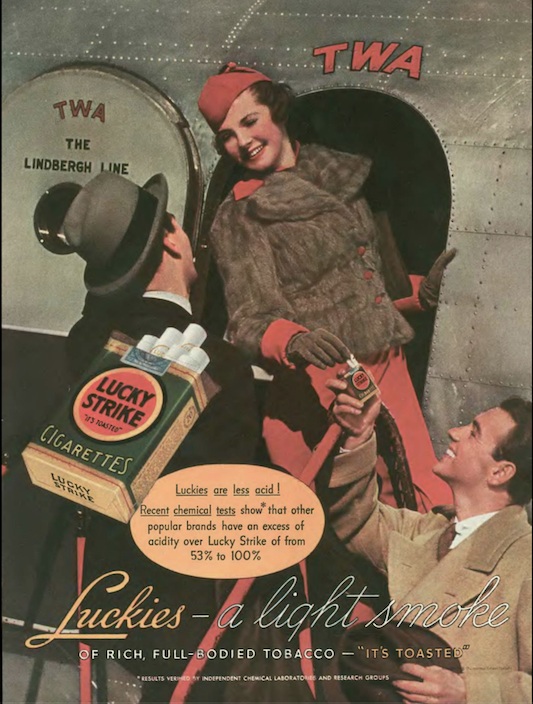
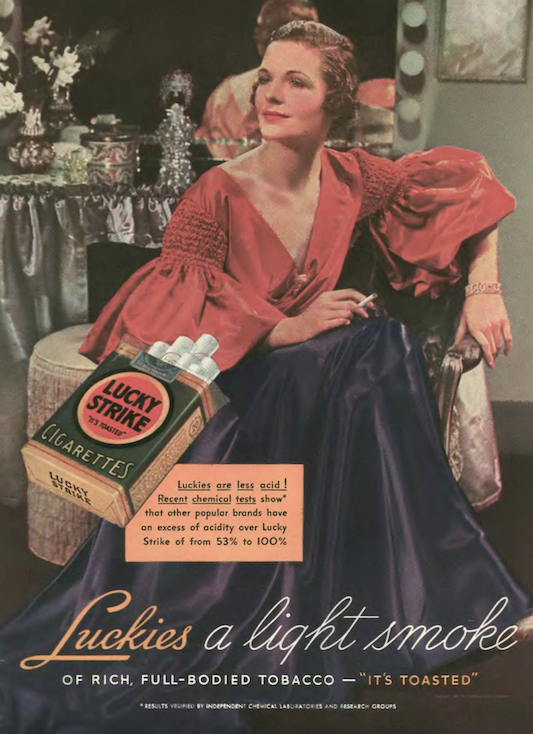
…and as you closed the magazine, the back cover greeted you with this stylish appeal to smoke Luckies…

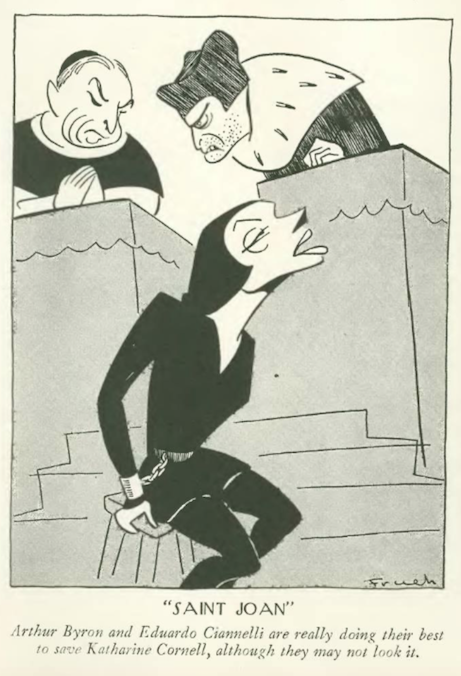
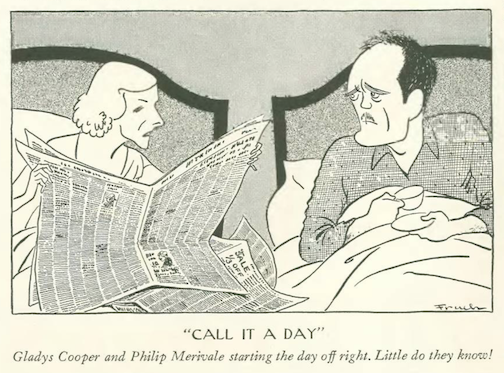
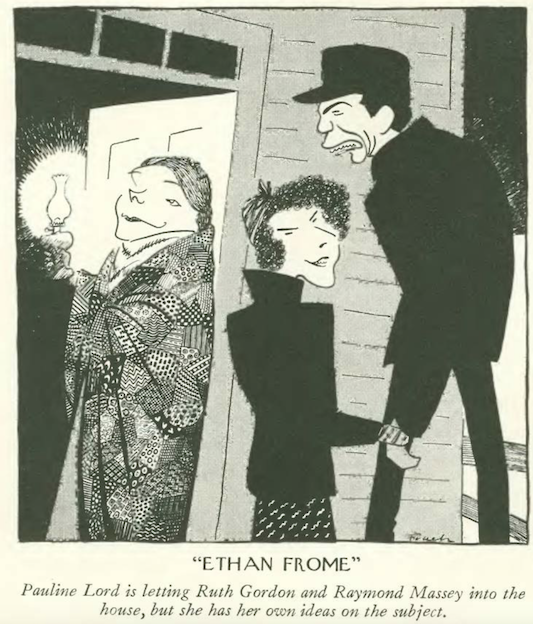
…on to our cartoonists, starting with Al Frueh in the Theatre section…

…and Frueh again, in this interesting arrangement…
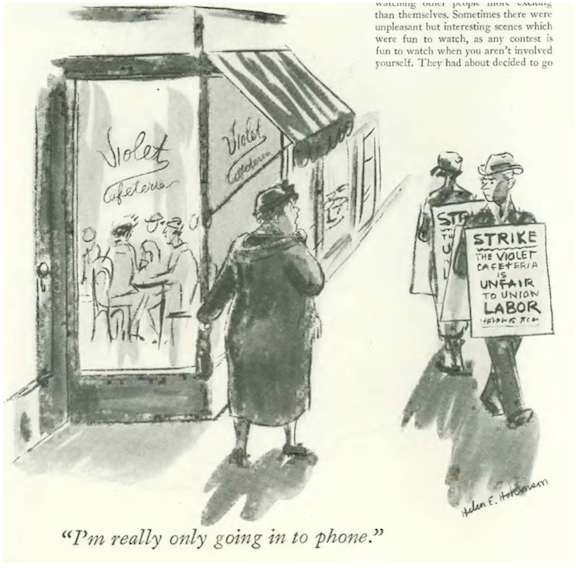
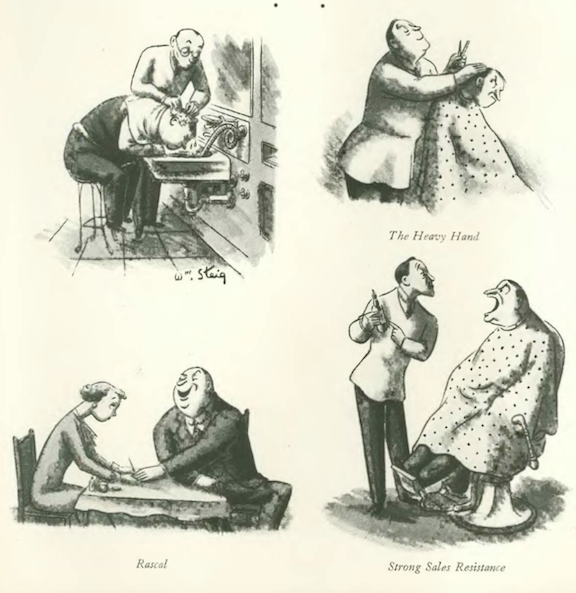
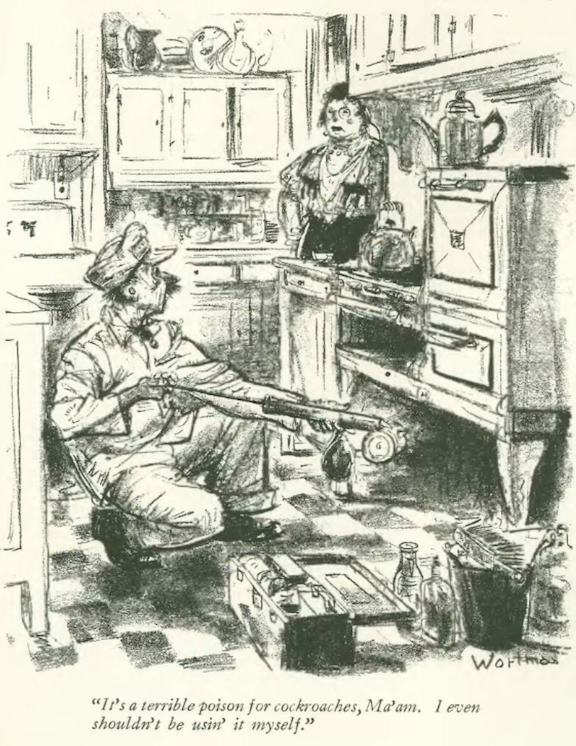
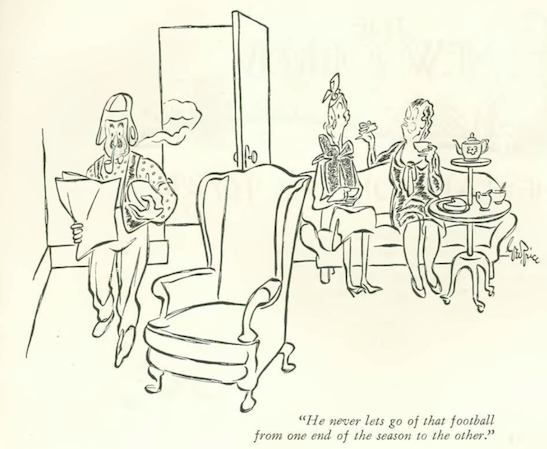
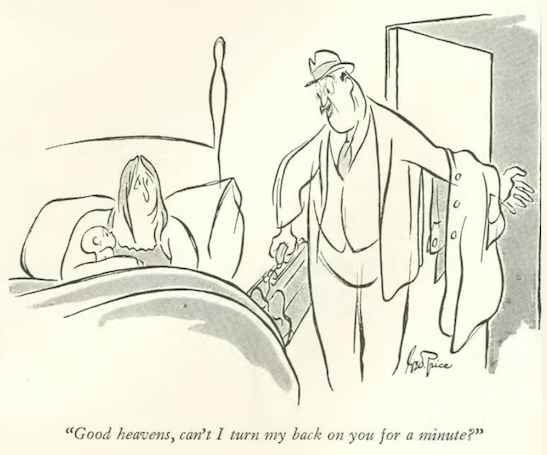
George Price was featured twice…
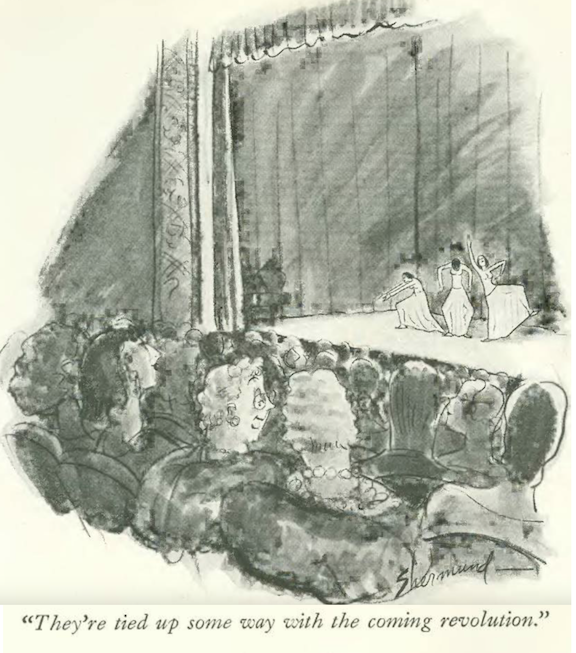
…with scenes of domestic life as only Price could render…

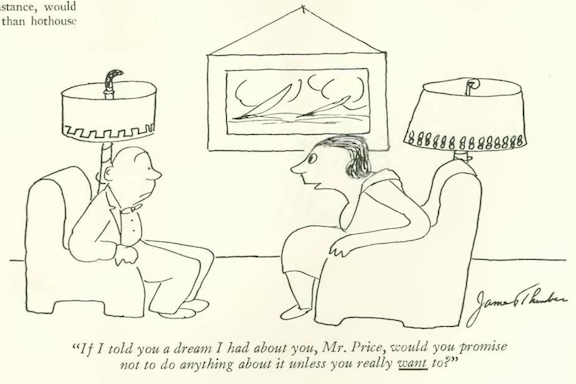
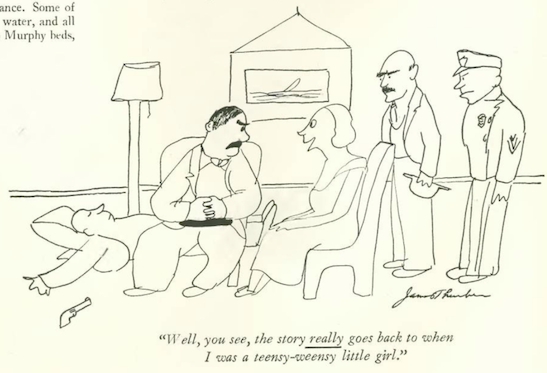
…and speaking of distinctive, no one did it quite like the great James Thurber

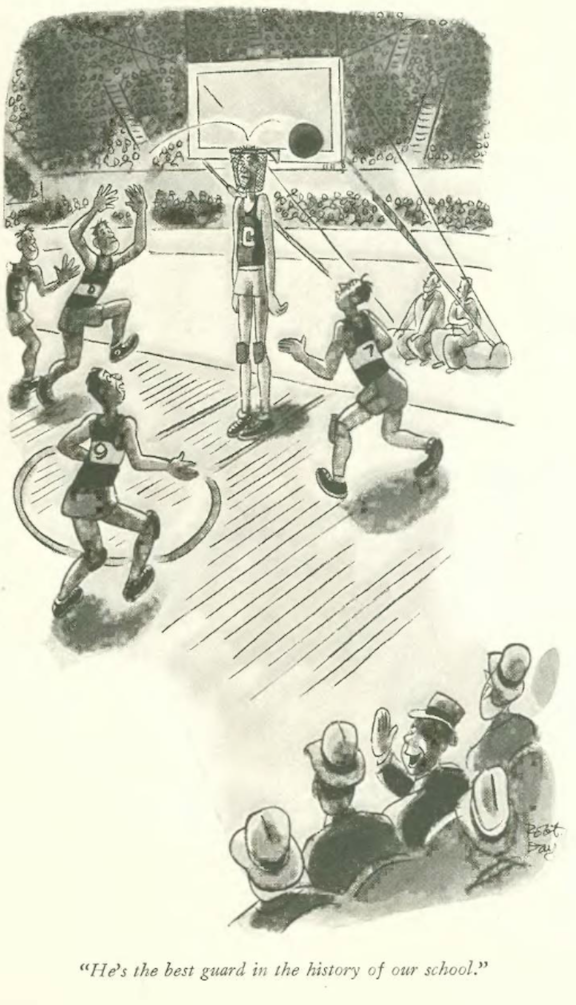
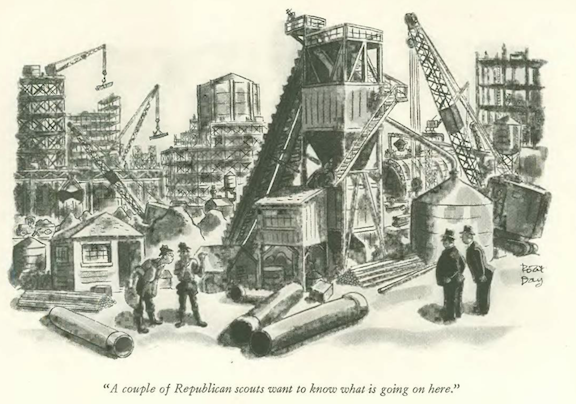
Robert Day gave us two Republicans looking in on the progress of the New Deal…

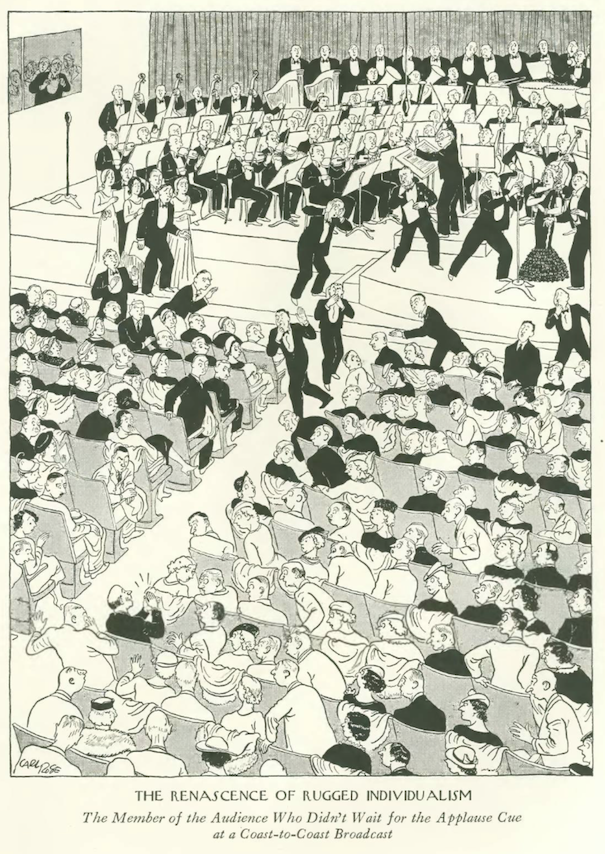
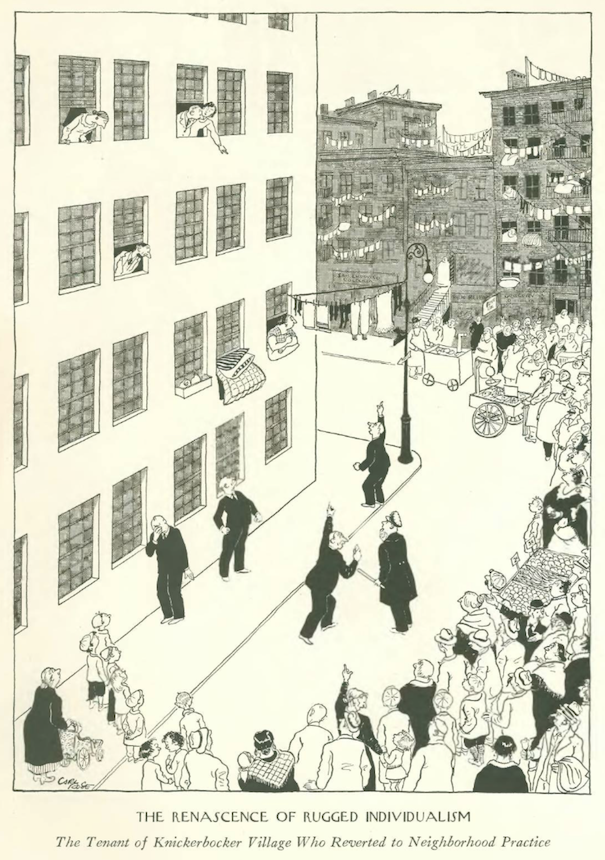
Carl Rose bid farewell to a writer sick of his peace and quiet…

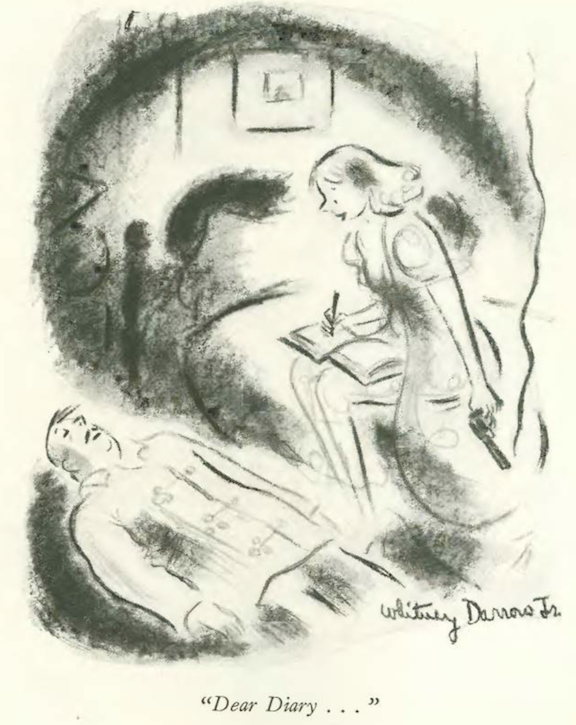
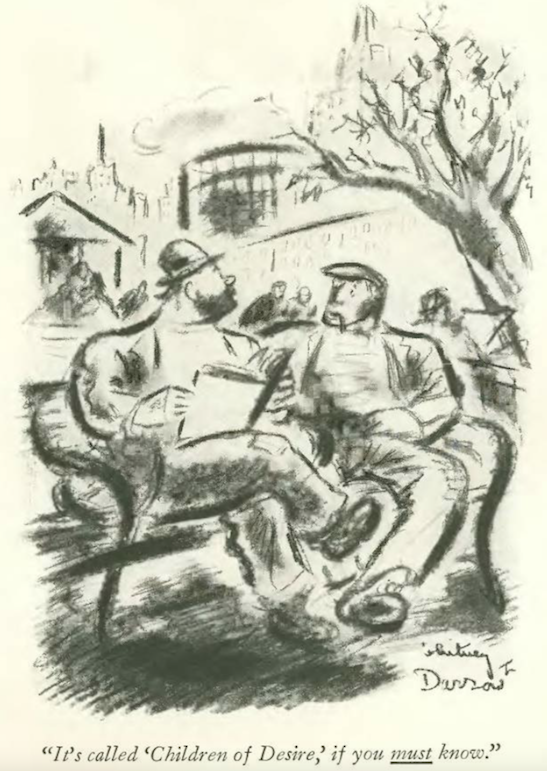
Whitney Darrow Jr illustrated a literary exchange on a park bench…
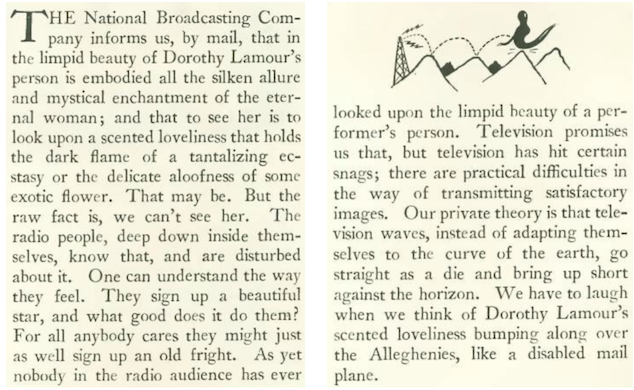
…and I close with today’s New Yorker cover artist, Roger Duvoisin—here is his cover for White Snow, Bright Snow, which won the Caldecott Medal in 1948.

Next Time: Planes, Trains and Automobiles…

Looking For Mister Wrong

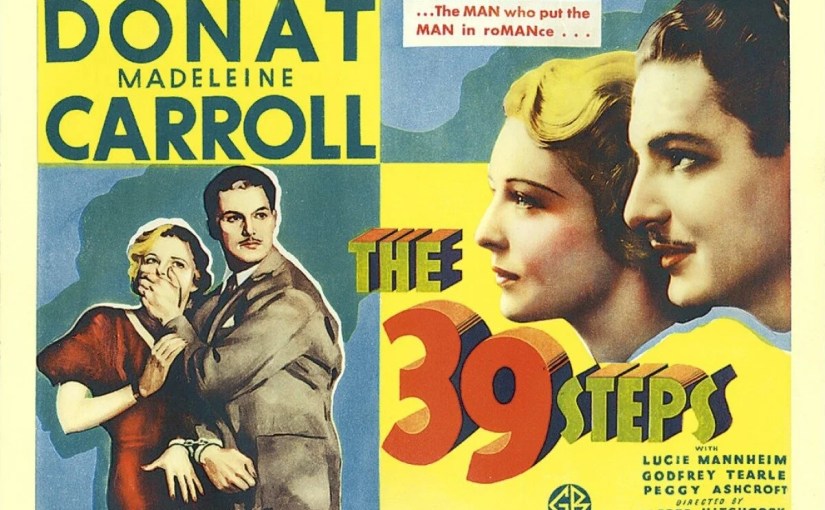
Widely acknowledged as a classic, The 39 Steps further solidified British director Alfred Hitchcock’s image as a master of suspense with American film audiences.

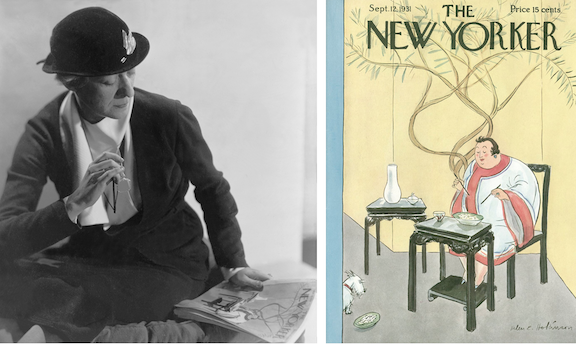
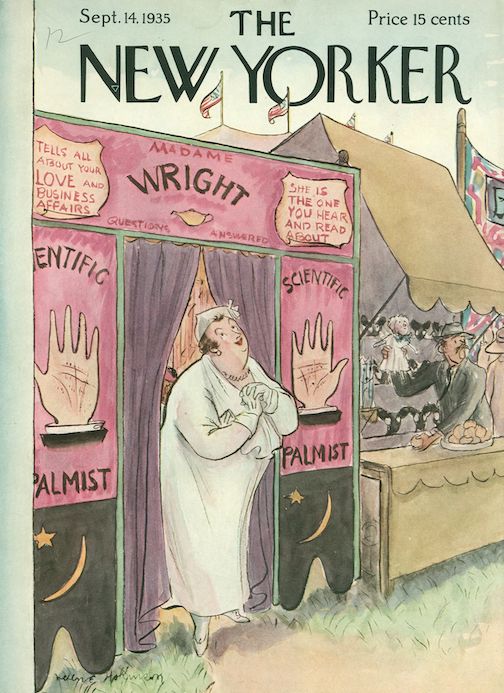
September 14, 1935 cover by Helen Hokinson. Over a twenty-year span, she contributed 68 covers and more than 1,800 cartoons to The New Yorker.

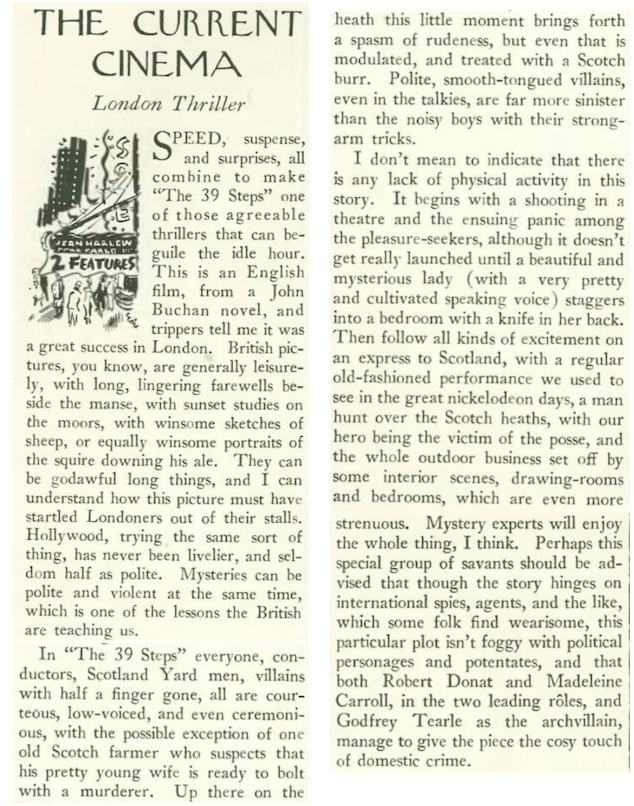
A successful follow up to 1934’s The Man Who Knew Too Much, Hitchcock’s The 39 Steps was conceived and cast by the Gaumont-British Picture Corporation as a vehicle to establish British films in America. The film also featured one of Hitchcock’s favorite plot devices—an innocent man forced to go on the run—seen in such notable films as 1942’s Saboteur and 1959’s North by Northwest. New Yorker film critic John Mosher was among the film’s many admirers:

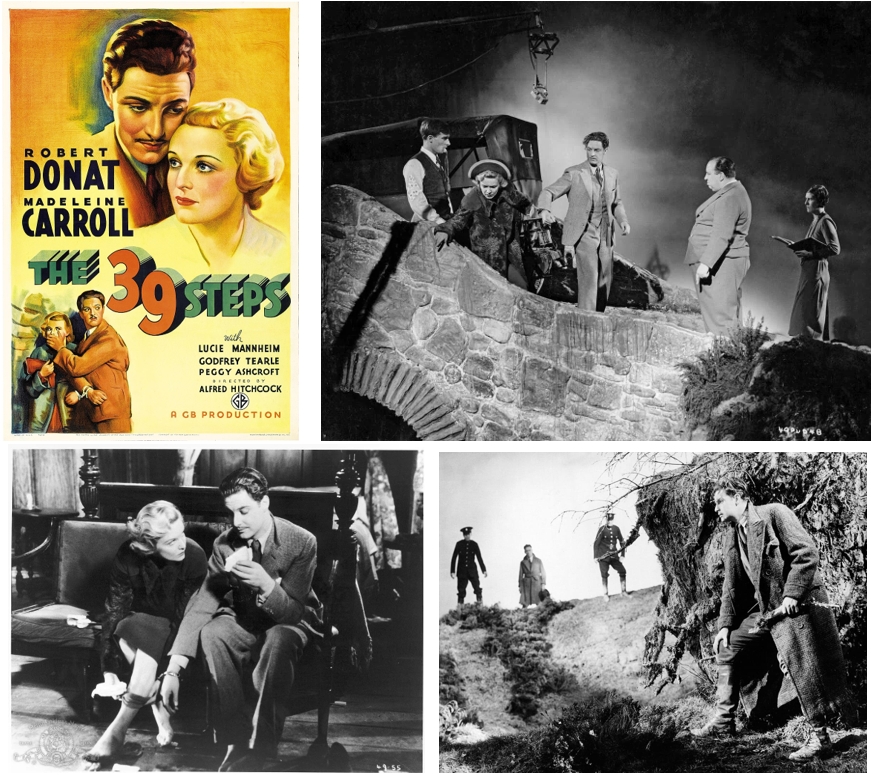
WE’LL TAKE THE STAIRS…Clockwise, from top left, poster for The 39 Steps; Alfred Hitchcock (second from right) directing the handcuffed Madeleine Carroll (as Pamela) and Robert Donat (as Richard Hannay) on the first day of filming; Hannay evades police on the heath; Pamela and Richard make the best of their predicament as handcuffed escapees. (Wikipedia/jimcarrollsblog.com/criterion.com)

 * * *

Pop-Up Stores

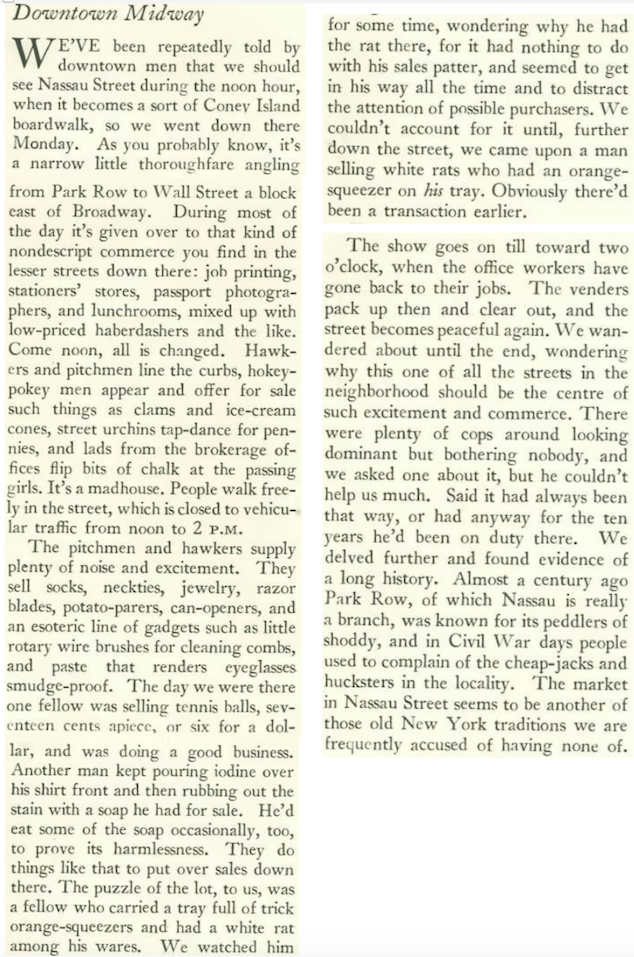
“The Talk of the Town” had a look at the “madhouse” on Nassau Street that daily erupted from noon to 2 p.m. as peddlers took over the street to hawk their wares.

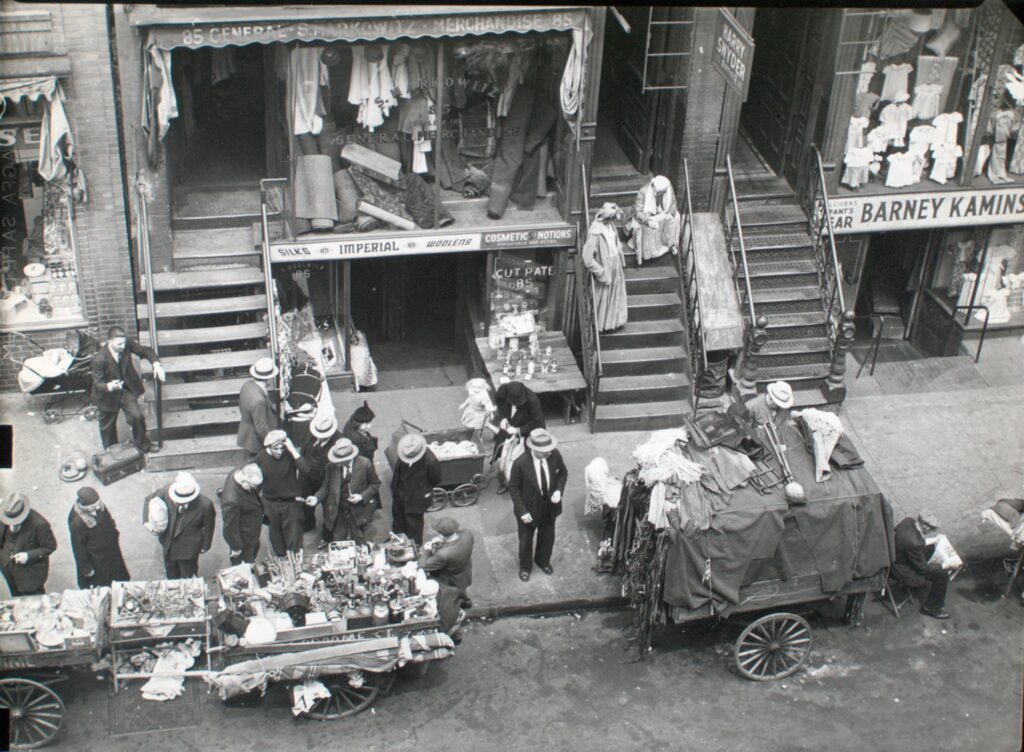
IF WE DON’T HAVE IT, YOU DON’T NEED IT…Hester Street peddlers in 1936. Photo by Berenice Abbott. (boweryboyshistory.com)

* * *

Art of the Artless

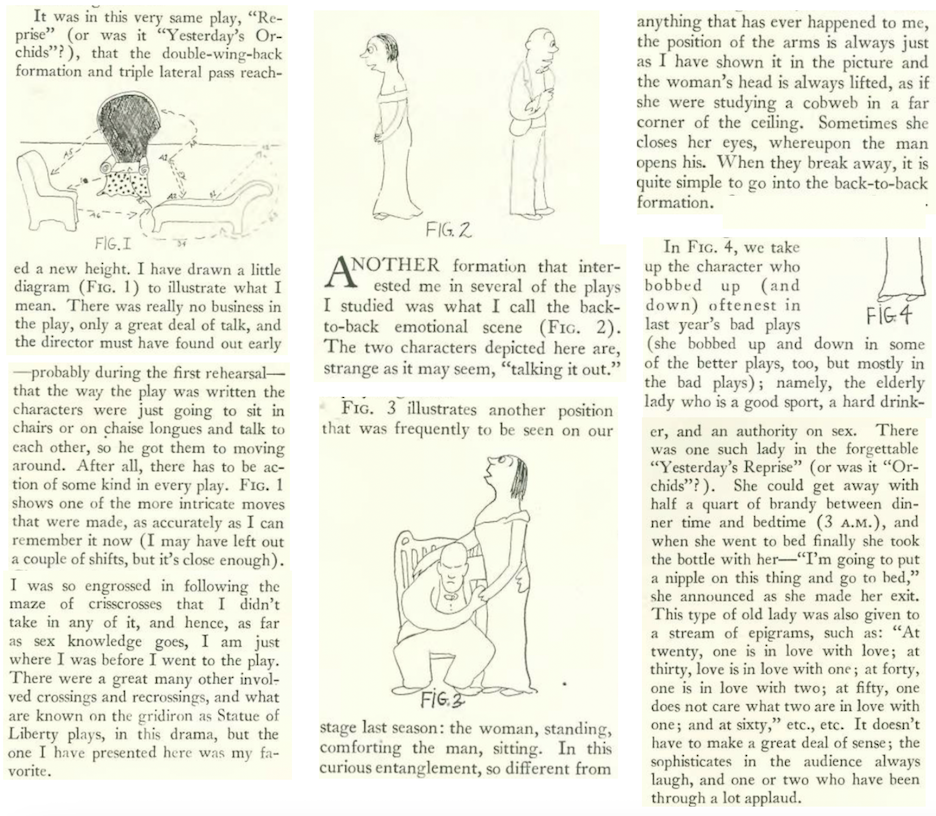
James Thurber dissected the workings of a “bad play,” examining varied techniques and familiar tropes. Excerpts:

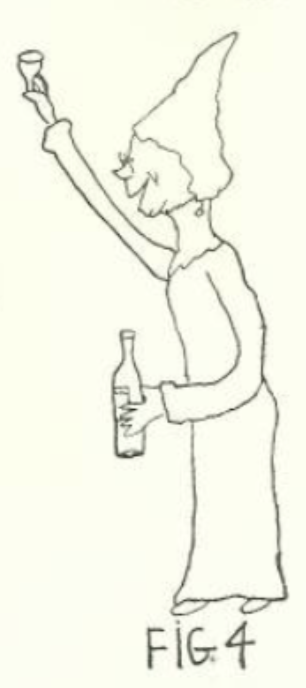
…below is the complete illustration for Fig. 4, which got cut off in the excerpt above…Thurber depicted “the elderly lady who is a good sport, a hard drinker, and an authority on sex.”

 * * *

The Petulant Painter

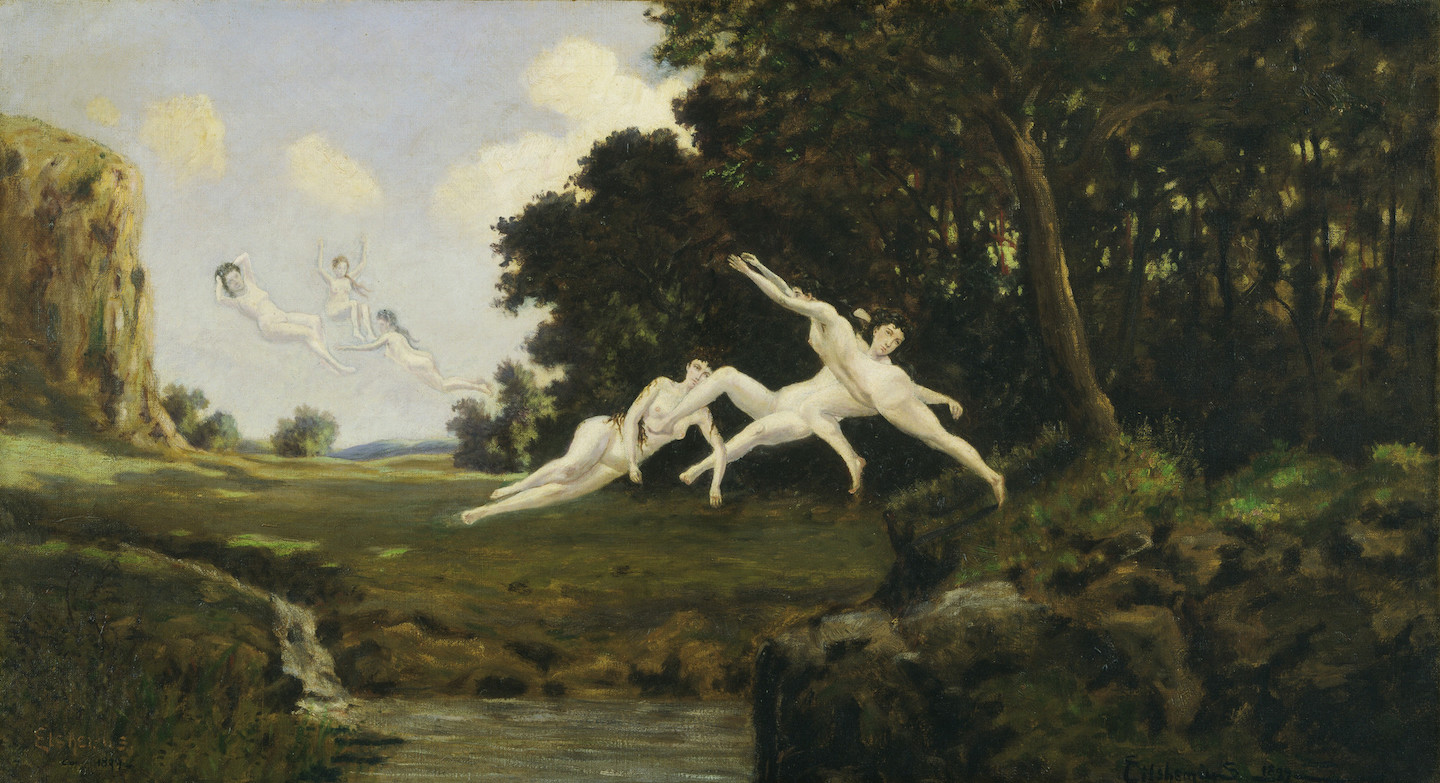
Known for a primitive style that included bizarre scenes of frolicking (or floating) voluptuous nudes, the painter Louis Michel Eilshemius (1864–1941) had a style all his own, and had no trouble telling anyone that his work was better than anything hanging in the finest museums (which would not consider him at all until after his death). In 1931 he began calling himself “Mahatma,” hence the title of this profile by Milton MacKaye (illustration by Hugo Gellert). Some brief excerpts:

IRASCIBLE RASCAL…Clockwise, from top left, Louis Michel Eilshemius in 1913; Standing and Reclining Nymphs (1908), Self-portrait (1915); Nymphs Sleeping (1920). Known for his numerous and vitriolic letters to newspaper editors, his letterheads would proclaim such accomplishments as “Educator, Ex-actor, Amateur All-around Doctor, Mesmerist-Prophet and Mystic, Reader of Hands and Faces, Linguist of 5 languages, Spirit-Painter Supreme.” He also claimed to be a world-class athlete and marksman as well as a musician who rivaled Chopin. (Wikipedia/Smithsonian American Art Museum/National Portrait Gallery)

Eilshemius regularly visited art galleries, loudly condemning the works on display. No wonder museums would not consider his odd paintings, which were probably best received by the French, including the artists Henri Matisse and Marcel Duchamp; the latter invited Eilshemius to exhibit with him in Paris in 1917.

Eilshemius’ mental stability had deteriorated substantially by the time MacKaye wrote the profile, which concluded with this sad, final accounting of the man’s life.

Eilshemius would die in the psychopathic ward of Bellevue Hospital in 1941. In the years since, his work has gained a wide audience and can be found in such collections as the Smithsonian, The Phillips Collection, MoMA and the Metropolitan Museum of Art.

SINGULAR VISION…Louis Michel Eilshemius, Afternoon Wind, 1899. (MoMA)

 * * *

In Good Company

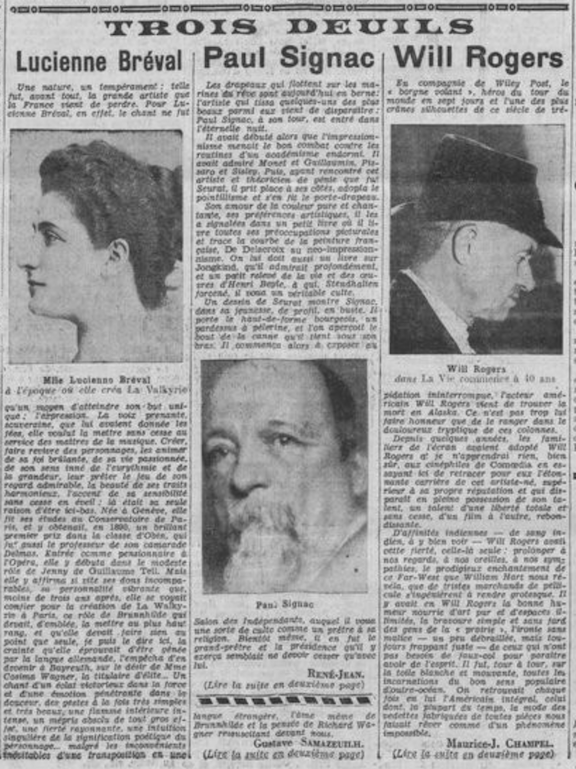
In her “Letter From Paris,” Janet Flanner noted that even the French honored the memory of Will Rogers, who had died in a plane crash with aviator Wiley Post on Aug. 15, 1935.

NOTED AND NOTABLE…As an example of Will Rogers’ worldwide fame, Janet Flanner noted that the Paris entertainment newspaper Comœdia published Rogers’ obituary next to that of famed neoimpressionist painter Paul Signac. The other obituary remembered the renowned Swiss soprano Lucienne Bréval. (gallica.bnf.fr via onlinebooks.library.upenn.edu)

 * * *

At the Movies

Coming down from The 39 Steps, John Mosher also sampled some of latest comedies gracing the silver screen…

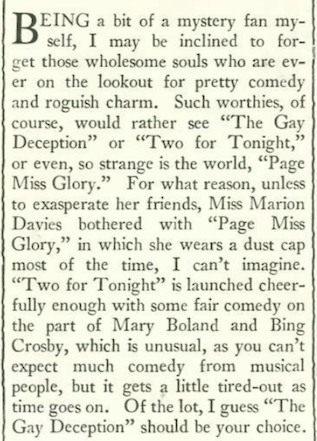
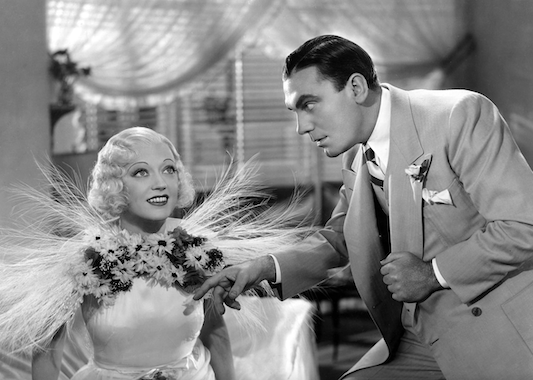
…Mosher didn’t understand why Marion Davies, nearing the end of her film career, even bothered to appear in the romantic comedy Page Miss Glory (although she was also the producer), in which she portrayed a country girl who stumbles into fame while working as a chambermaid in a luxury hotel…

JUST LIKE CINDERELLA…Marion Davies and Pat O’Brien in Page Miss Glory. (IMDB)

Two For Tonight featured a lot of fine crooning from Bing Crosby, and some hijinks, but fizzled out in the end…

Bing Crosby (right) takes aim in Two For Tonight. (IMDB)

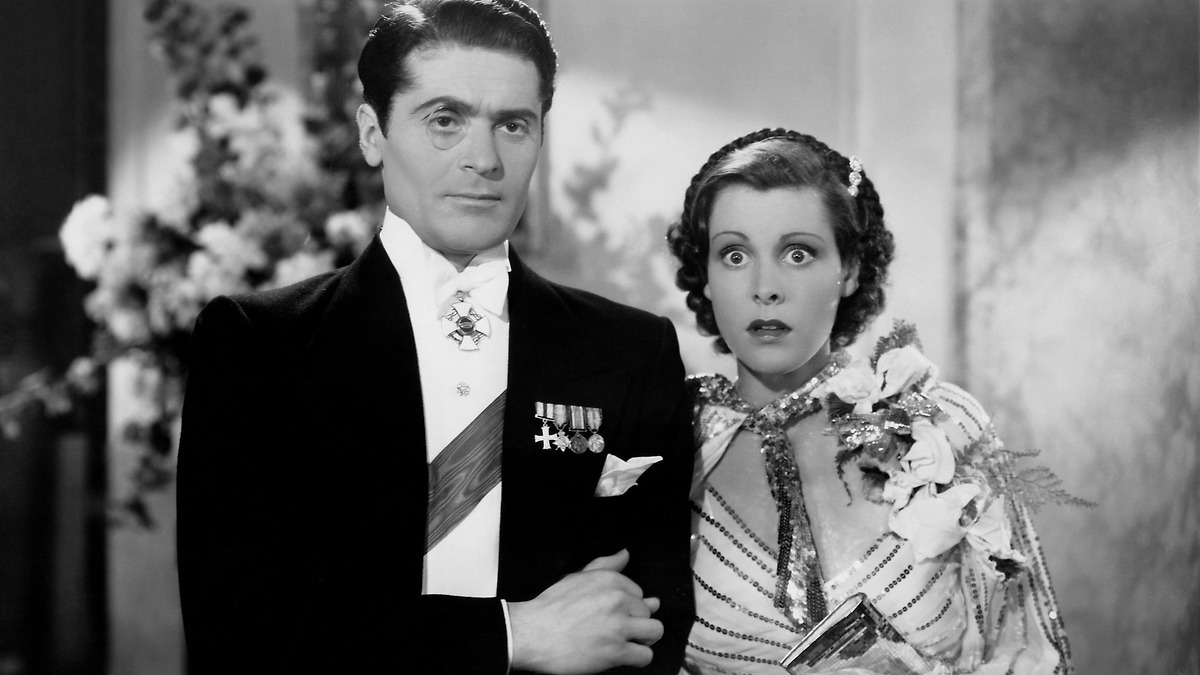
…of the three comedies, Mosher found The Gay Deception to be the most winning. Directed by William Wyler, the film featured a sweepstakes winner pretending to be a rich lady (Frances Dee) who encounters a prince masquerading as a bellboy (Francis Lederer)…hilarity ensued…

THE WYLER TOUCHWilliam Wyler’s The Gay Deception, starring Francis Lederer (left) and Frances Dee, anticipated Wyler’s 1953 Roman Holiday, also a tale about a royal wanting to be a normal person. (letterboxd.com)

 * * *

From Our Advertisers

We welcome fall with the latest fashion from Forstmann Woolens…

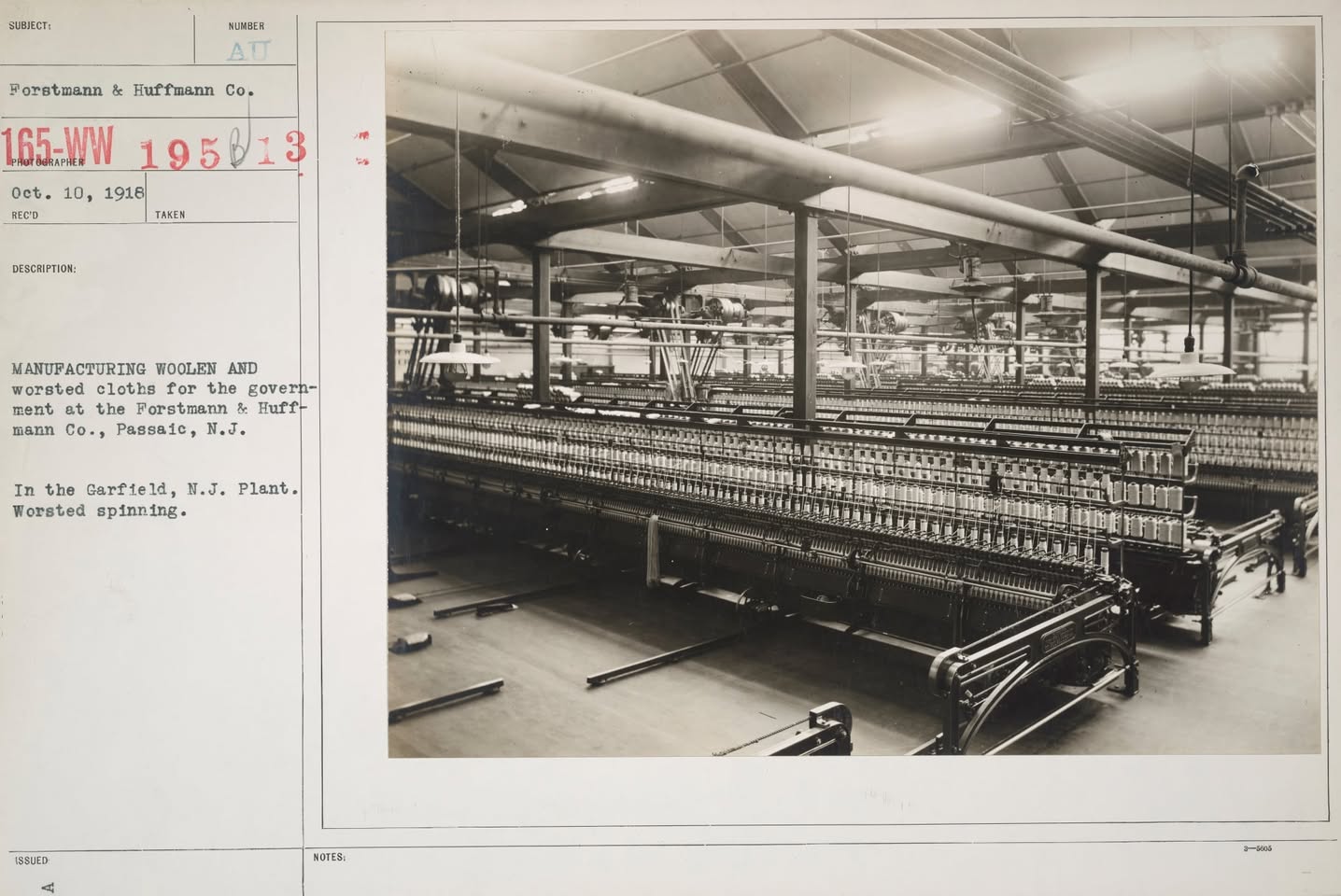
…and here is where those wool dresses were spun…

Image from the National Archives depicts the spinning room at Forstmann & Huffman in Passaic, N.J., 1918. The Passaic plant closed in 1958. (Historical Society of Garfield, NJ)

…the makers of leaded gasoline continued to promote their product in full-color spots…

…General Tire (like competitor Goodyear) played up the safety theme and potential perils to loved ones to tout their “blow-out proof” tires…

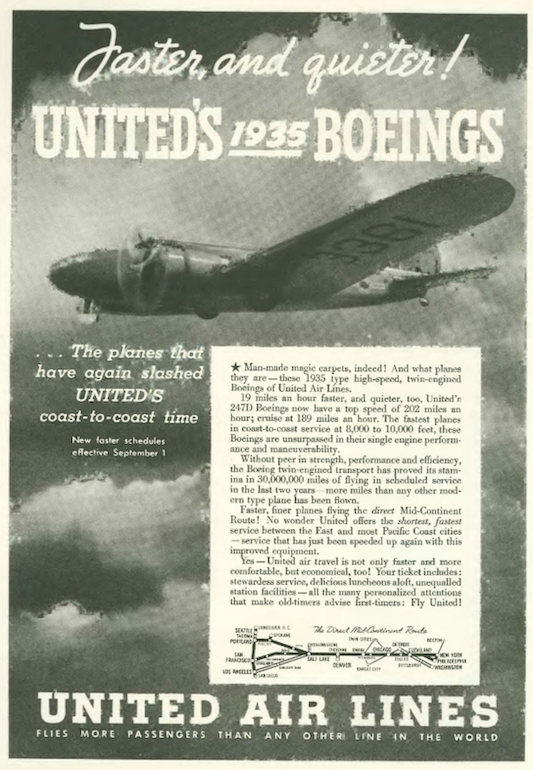
…like many advertisers in The New Yorker, United Air Lines appealed to the affluent, hoping some of them would take to the air, since only they could afford it…

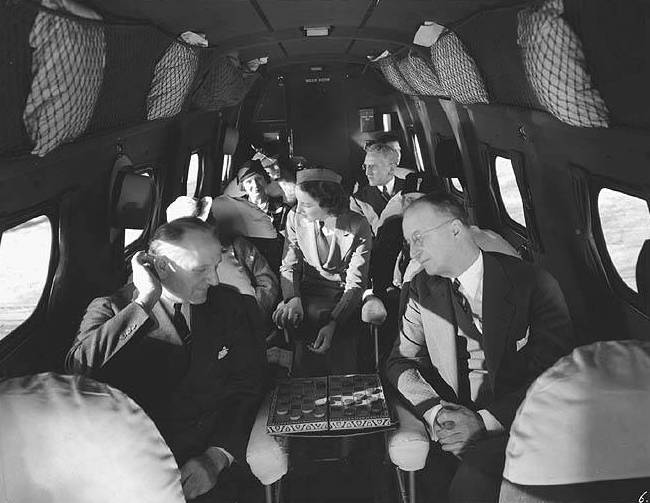
…for reference…

COZY…Interior of the Boeing 247. (Wikimedia Commons)

Abe Birnbaum, who contributed nearly 200 covers to the New Yorker, offered this rendition of Mickey Mouse to Stage magazine…

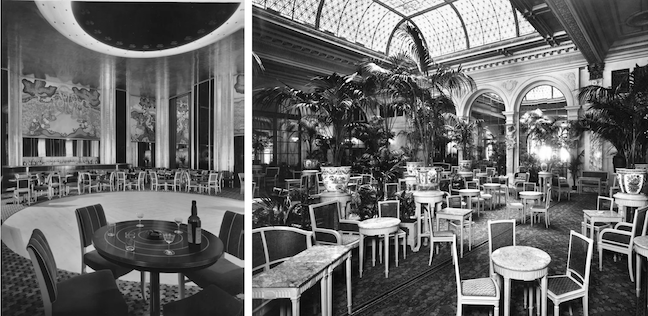
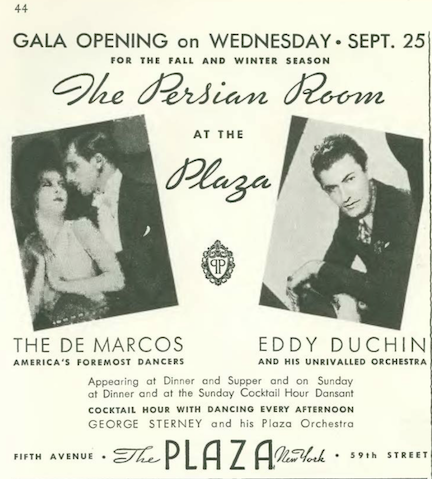
…heading to the back of the book we find the latest in entertainment at the Plaza…

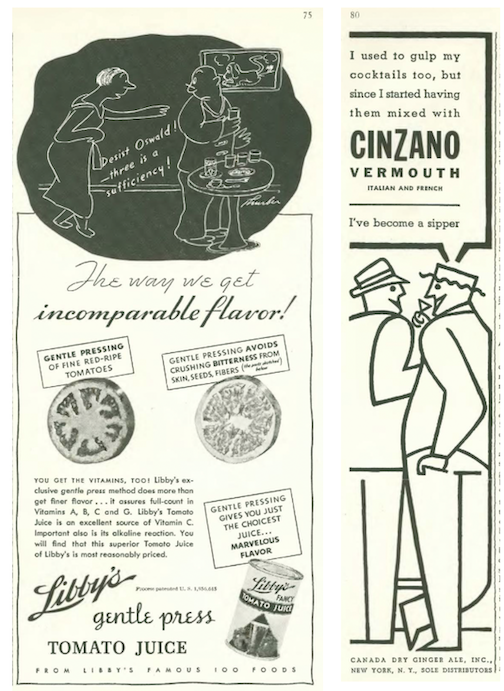
James Thurber contributed the drawing at left (rendered in negative) on behalf of Libby’s tomato juice on page 75, and page 80 featured the spare, modern lines of a Cinzano ad…

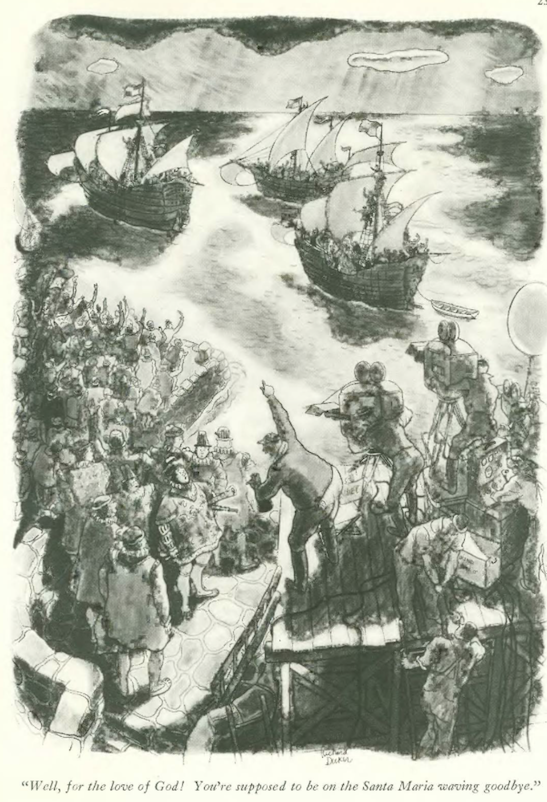
…our cartoonists include Richard Decker, on the set with a missing extra…

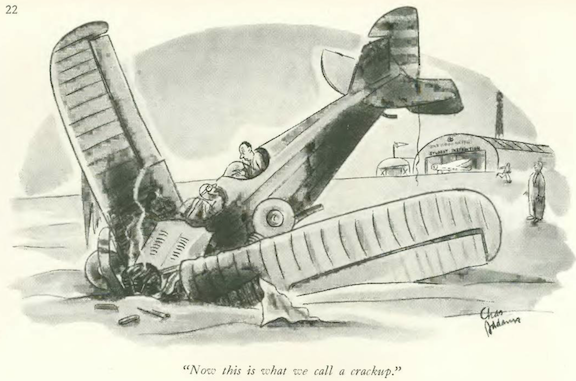
Charles Addams offered a new twist on the Sunday sermon…

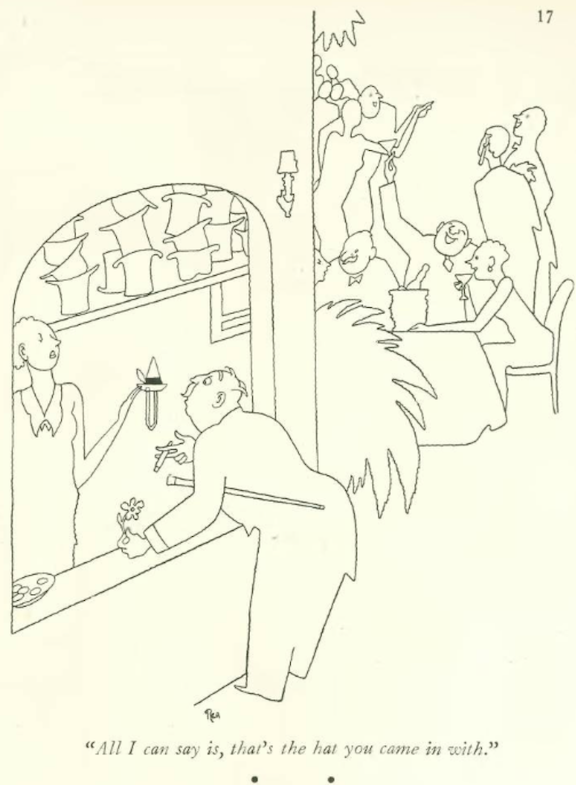
Peter Arno found an epic struggle in the shoe department…

Robert Day offered this energy-saving tip…

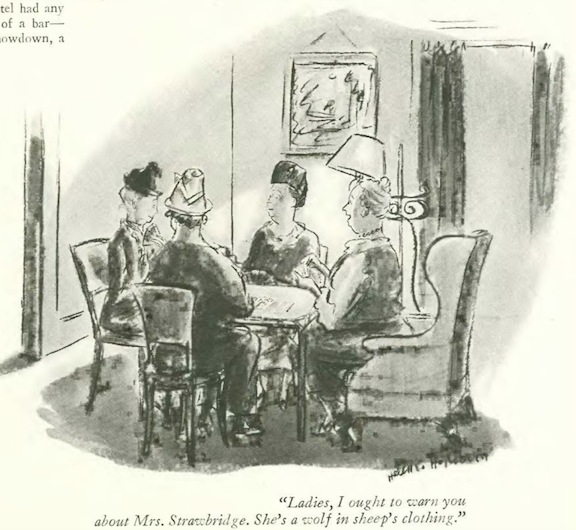
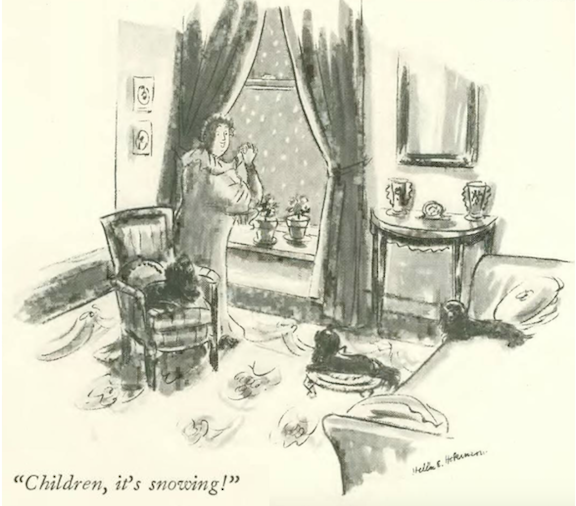
…and we close with Helen Hokinson, and a lively game of charades…

Next Time: All Dogs Go to Heaven…

Thackeray, In Color

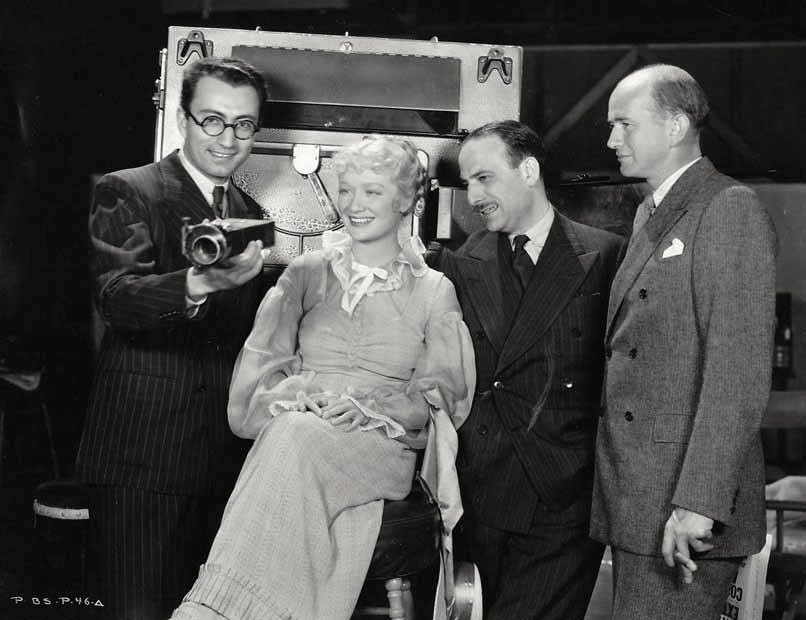
Above: Seated in front of a massive Technicolor camera, Rouben Mamoulian directs Miriam Hopkins (also inset) in Becky Sharp, the first feature shot entirely in three-color Technicolor. The film was based on character from William Makepeace Thackeray's 1848 novel Vanity Fair. (UCLA Film & Television Archive)

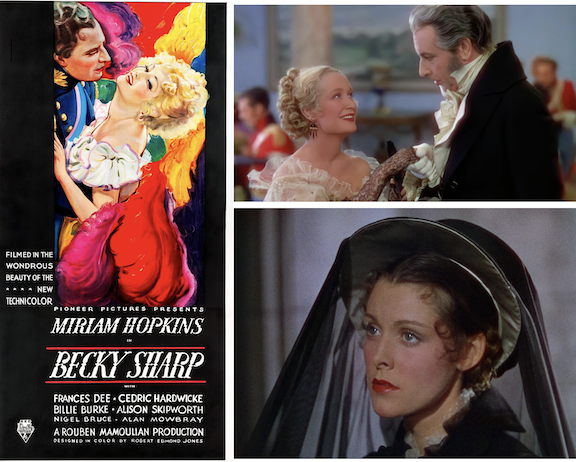
Rouben Mamoulian’s 1935 production of Becky Sharp wasn’t the first color film, but it was the first feature film to use the newly developed three-strip Technicolor process throughout, setting a standard for color films to come.

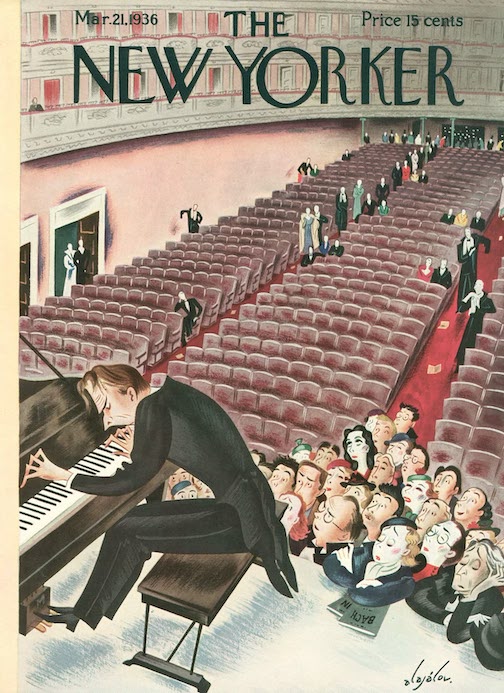
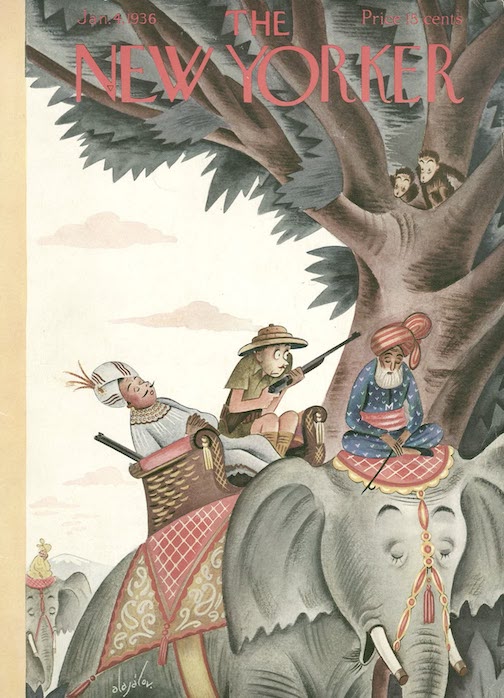
June 22, 1935 cover by Constantin Alajalov. A New Yorker contributor for thirty-four years, Alajalov (1900–1987) illustrated 170 covers for the magazine. Check out the treasure trove at Ink Spill for more on Alajalov and all things New Yorker.

Earlier color processes included films that were hand-tinted. Others used various dyes and techniques that included photographing a black-and-white film behind alternating red/orange and blue/green filters, and then projecting them through red and green filters. The inability to reproduce the full color spectrum, among other issues, had many critics dismissing the idea of color films altogether.

Mamoulian was fascinated by the possibilities of color film; by producing (and later directing) the film, he showcased the advancements in Technicolor. Film critic John Mosher had these observations:

THIS IS A TEST…Considered a landmark in cinema as the first feature film to use the newly developed three-strip Technicolor production throughout, in many ways the film validated this advanced color technology. Top photo, Miriam Hopkins portrayed Becky Sharp, a socially ambitious woman (seen here with Cedric Hardwicke) who climbs the British social ladder with the help of her best friend, Amelia Sedley (Frances Dee, bottom photo). (Wikipedia/Amazon)
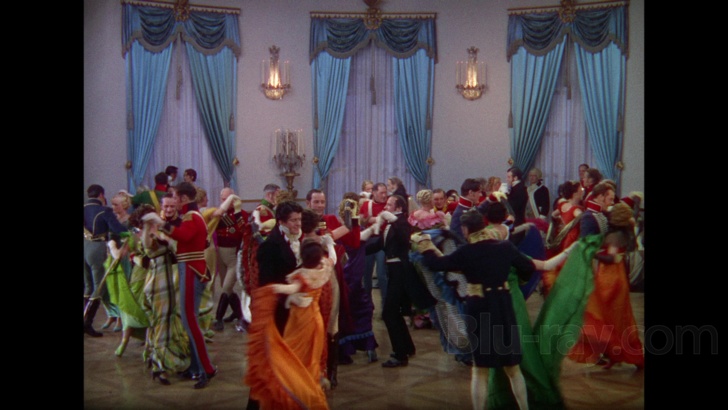
IT WAS FUN ANYWAY…Critic John Mosher was thrilled by the swirl of colors in the ballroom scene, even if flying red cloaks weren’t an aspect of William Makepeace Thackeray’s 1848 novel Vanity Fair. The film, however, was actually based on an 1899 play by Langdon Mitchell, who named his play after one of the characters in Thackeray’s novel. (blu-ray.com)
WHOLE NEW WORLD…Rouben Mamoulian, Miriam Hopkins, visitor Michael Balcon, and Kenneth Macgowan on the set of Becky Sharp. According to film historian Marc Spergel, “Mamoulian was fascinated by color…He saw in the color process another opportunity for innovations that would set a standard for the new technology…His interest lay in choosing color for psychological effect rather than mere realistic reproduction or decorative dividends. With the advent of color processing, particularly Technicolor processing—with its non-realistic, supersaturated color—Mamoulian could approach the film medium like a painter with a palette.” (Wikipedia)

Mosher also checked out the latest from Robert Montgomery and Joan Crawford, who exchanged marital banter in No More Ladies, while George Raft went all gangster in Dashiell Hammett’s The Glass Key.

HIGH FIDELITY…Top photo, socialite Marcia (Joan Crawford) is determined to keep her husband (Robert Montgomery) faithful in No More Ladies; below, George Raft does what he does best (playing a gangster) in The Glass Key. (jacksonupperco.com/notesoncinematograph.blogspot.com)

 * * *

Astor’s Risk

“The Talk of the Town” paid a visit to the Real Estate Exchange, where Vincent Astor re-acquired the St. Regis Hotel for five million and change. He then sunk another $500,000 (roughly $12 million today) into the hotel to further its luxurious status (including adding air-conditioning). The hotel’s famed King Cole Room and the Maisonette Russe restaurant opened in October 1935. Excerpts:

GOOD INVESTMENT…At left, Fifth Avenue facade of the St. Regis as seen in 2022. Right, entrance to the King Cole bar in the 55th Street annex. Thanks in part to the repeal of Prohibition, the hotel’s restaurant business increased by 300 percent between 1935 and 1937. (Wikipedia)

 * * *

School Days

James Thurber recalled his “tough” years at Sullivant School in Columbus, Ohio, in the essay, “I Went to Sullivant.” Brief excerpts:

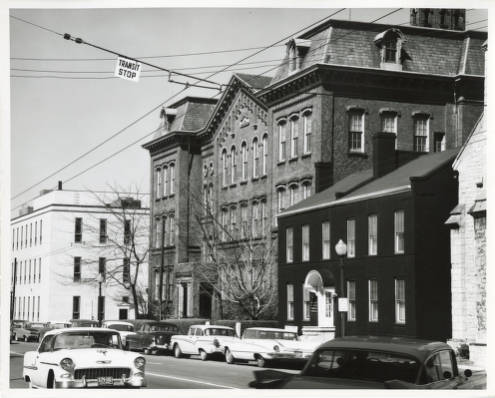
ALMA MATER…The Sullivant School James Thurber attended was completed in 1871 and was a school until 1923 when it became the offices for Columbus City Schools. This photo was taken shortly before it was demolished in 1961. (columbuslibrary.org)

 * * *

Avril en juin

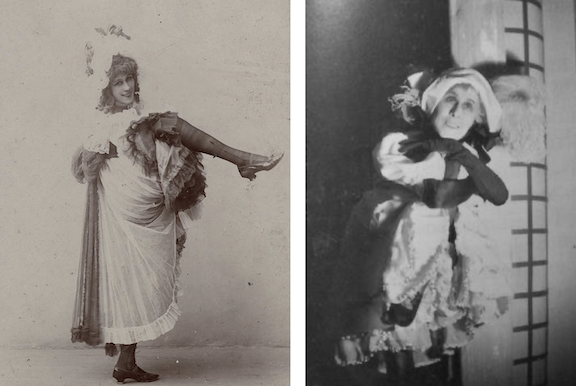
Paris correspondent Janet Flanner gave a rundown on the latest happenings, including the Toulouse-Lautrec costume ball that attracted none other than Jane Avril, the famed French can-can dancer of the 1890s who could still kick up her heels. Flanner gave Avril’s age at 80, but records indicate she was closer to 70.

STILL KICKING…Jane Avril (1868–1943) was a French can-can dancer at the Moulin Rouge in Paris and a frequent subject of painter Henri de Toulouse-Lautrec. The wispy Avril, known for her jerky movements and sudden contortions, was nicknamed La Mélinite, after an explosive. At top left, Avril in her heyday circa 1890s; at right, Avril at the 1935 Toulouse-Lautrec costume ball. Read more about Avril’s strange life at one of my favorite “rabbit hole” sites, Messy Nessy. (messynessychic.com/Pinterest)
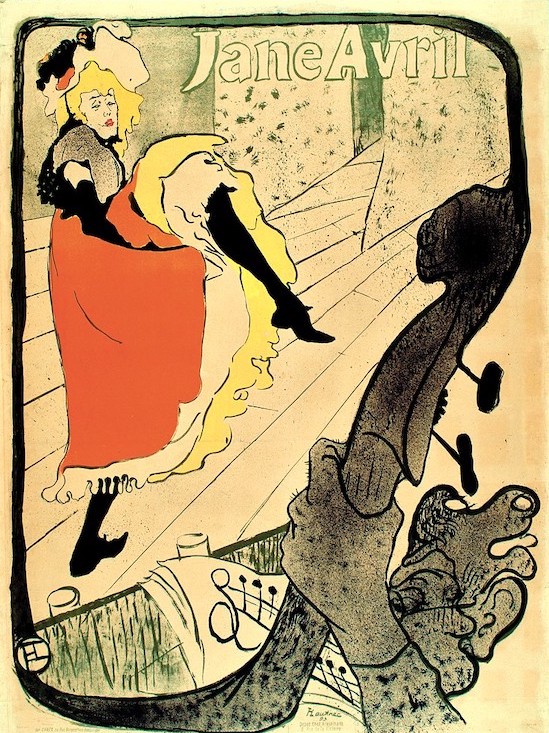
An 1893 Toulouse-Lautrec lithograph featuring Jane Avril, a lifelong friend of the artist. Avril commissioned this print to advertise her cabaret show at the Jardin de Paris. (met museum.org)

 * * *

From Our Advertisers

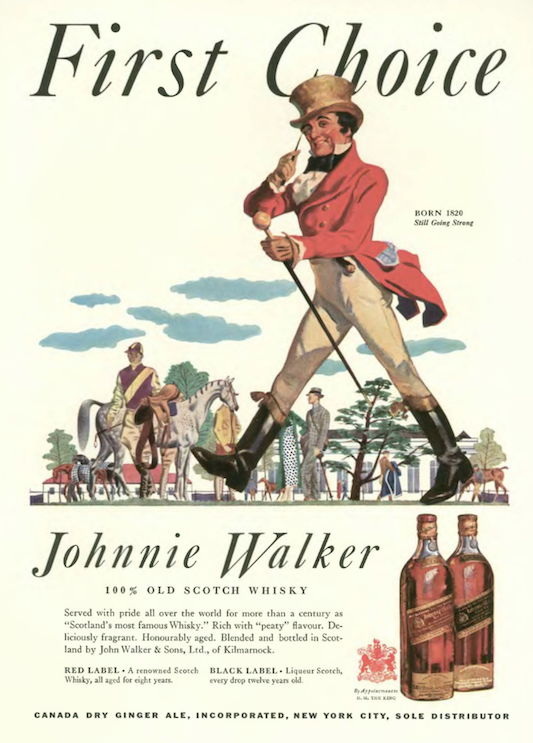
We begin with the inside front cover, Johnnie Walker strutting along at the horse races…

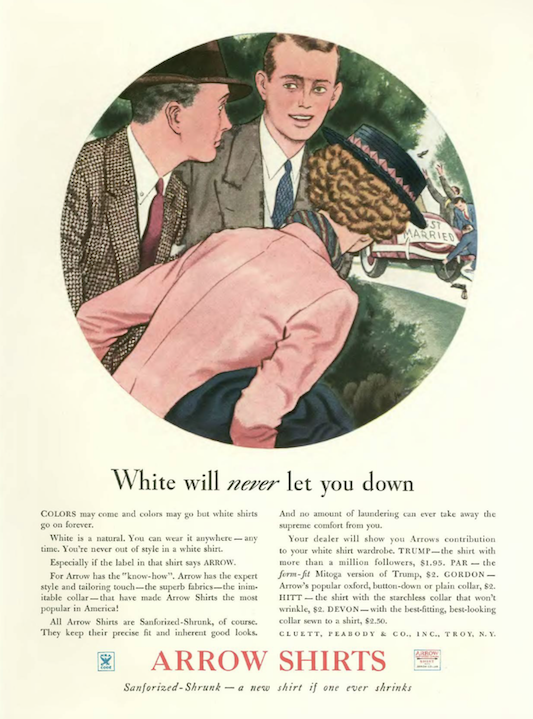
…the inside back cover belonged to Arrow Shirts…

…and no surprise that the back cover featured a stylish woman enjoying a cigarette, in this case a Lucky…

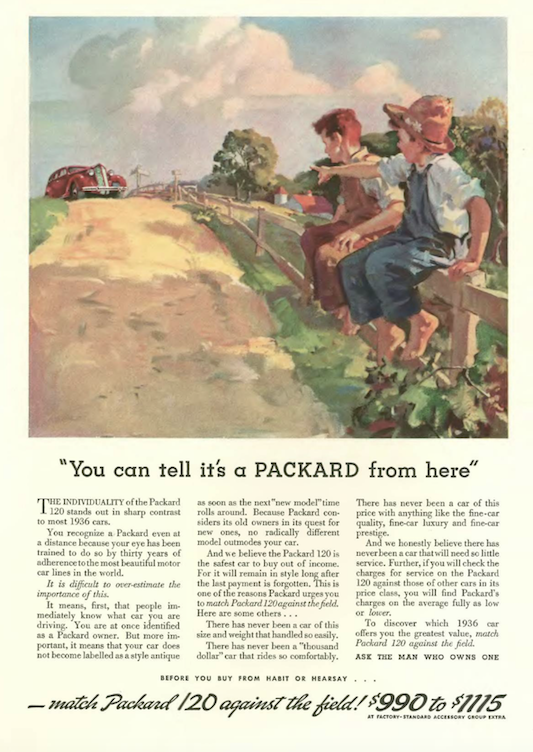
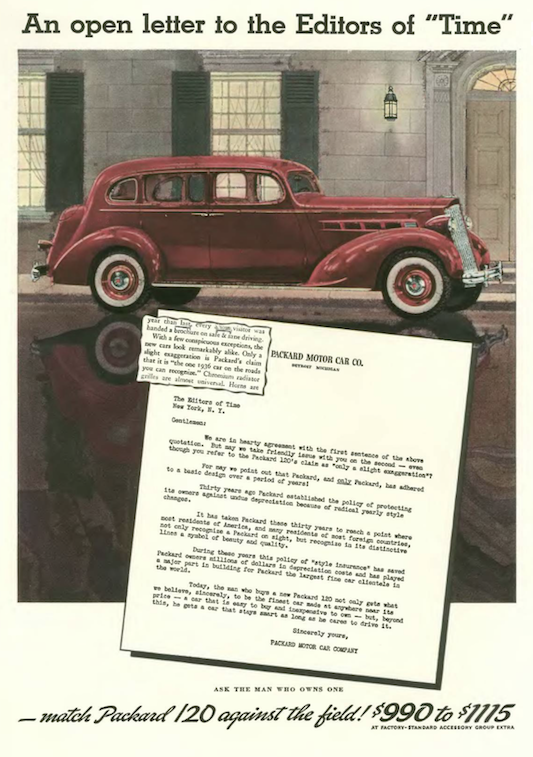
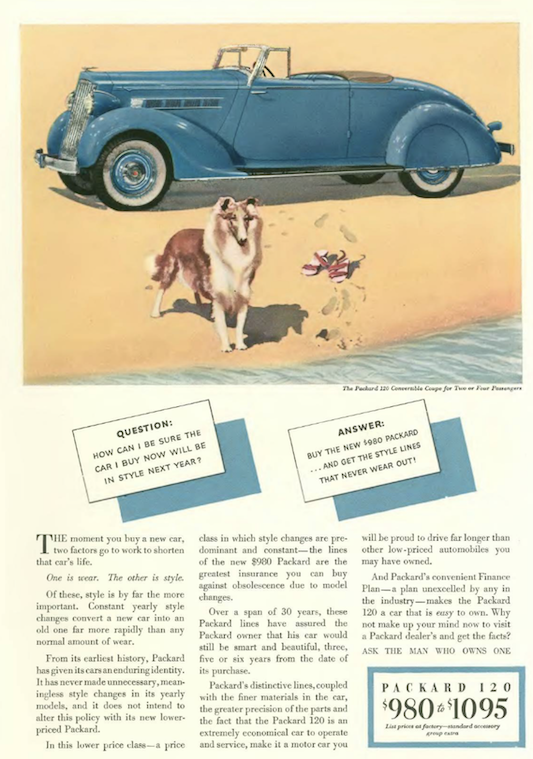
…Packard continued to run these colorful, wordy ads that made the case for owning a lower-priced Packard, which I’m sure was a fine automobile…

John Hanrahan, who early on served as The New Yorker’s policy council and guided it through its lean first years, be­came the publisher of Stage magazine (formerly The Theatre Guild Magazine) in 1932. In 1933 Stage became part of the Ultra-Class Magazine Group’s line-up that included Arts & Decoration and The Sportsman. Stage published its last issue in 1939, and I don’t believe the other two survived the 1930s either…this Mark Simonson site looks at the striking design elements of an issue from 1938…

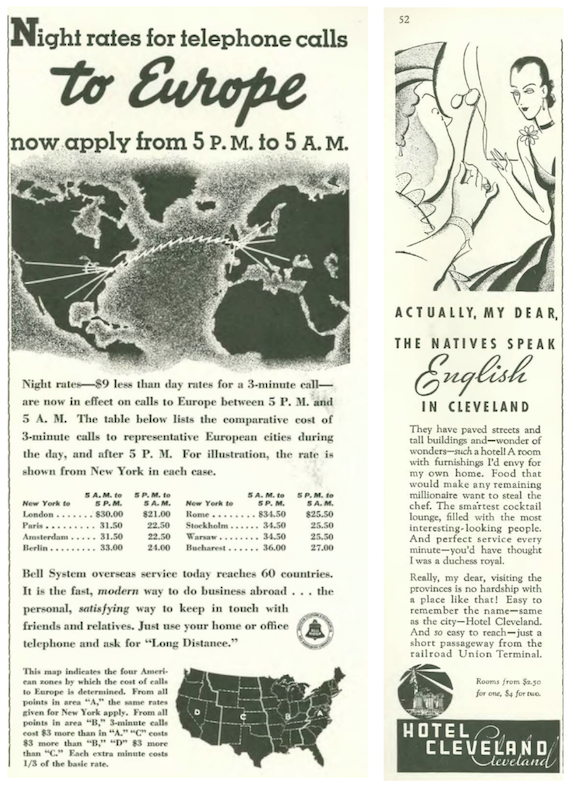
…a couple from back of the book…calling Europe by telephone in 1935 was an impressive feat, however it could cost you roughly $700 in today’s dollars to make a three-minute call to London…the one-column ad at right offered an Anglophilic appeal to those visiting Cleveland…

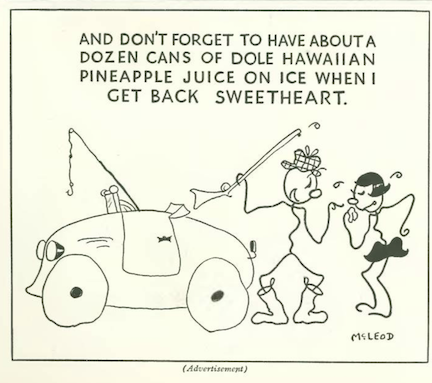
…this simple spot for Dole pineapple juice caught my eye because it was illustrated by Norman Z. McLeod (1898–1964), who drew Christie Comedy title cards during the Silent Era…

McLeod was also an acclaimed director of Marx Brothers comedies Monkey Business (1931) and Horse Feathers (1932), W.C. Fields’ It’s a Gift (1934), Danny Kaye’s The Secret Life of Walter Mitty (1947) and two of the Topper films.

HE GOT AROUND…Clockwise, from top left, director Norman Z. McLeod on the set of 1941’s Lady Be Good with actress Ann Sothern; Young’s familiar stick figure drawings on title cards for the 1928 silent short Loose Change; Cary Grant and Constance Bennett with Roland Young in 1937’s Topper. (TCM.com/silentology.wordpress.com/charlesmatthews.blogspot.com)

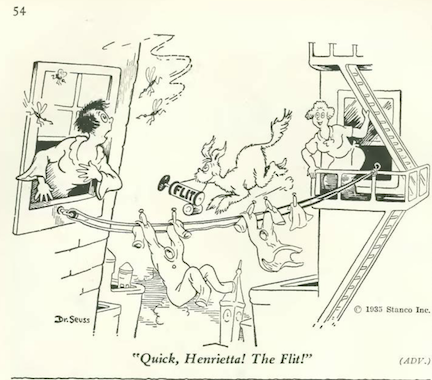
Dr. Seuss was back with his Flit advertisements…

Richard Decker illustrated this ad for Borden’s “Golden Crest” Farm Products…

…which segues into our cartoonists, and this curious spot drawing by James Thurber

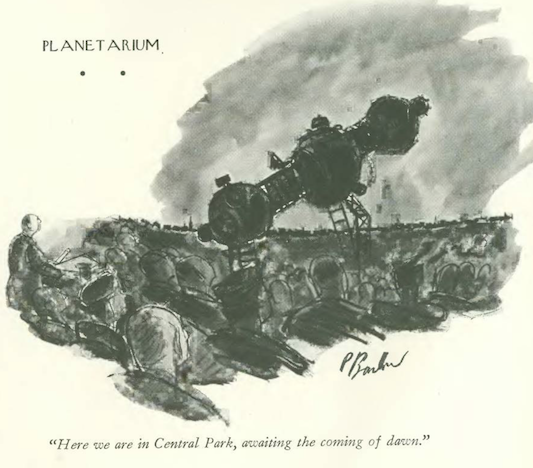
Perry Barlow gave us the early days of the “Bed and Breakfast”…

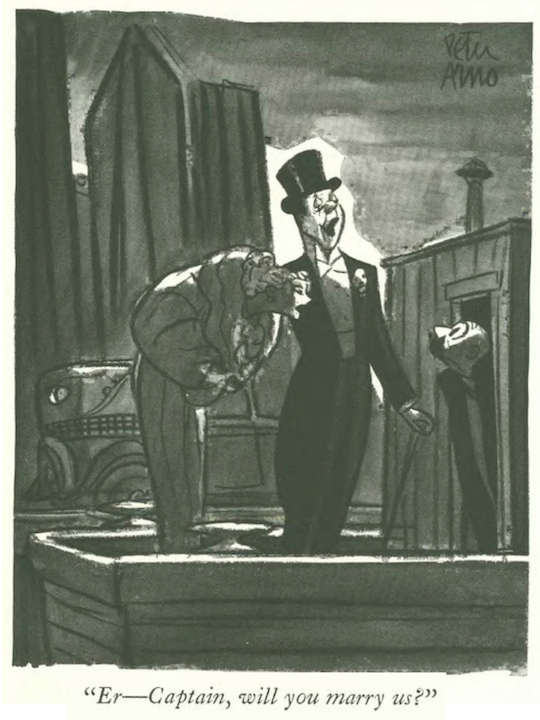
Peter Arno, and no rest for the titans of industry…

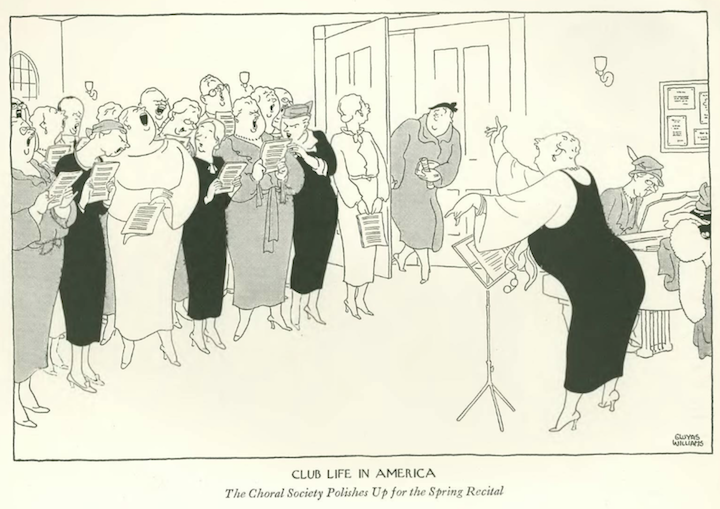
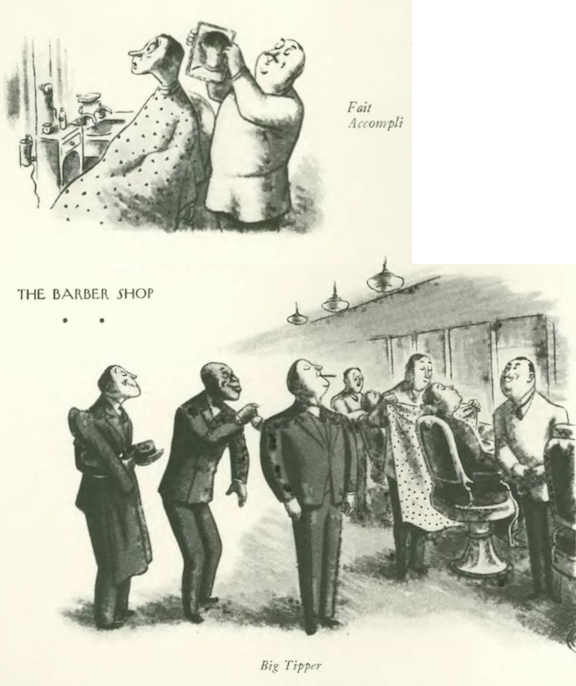
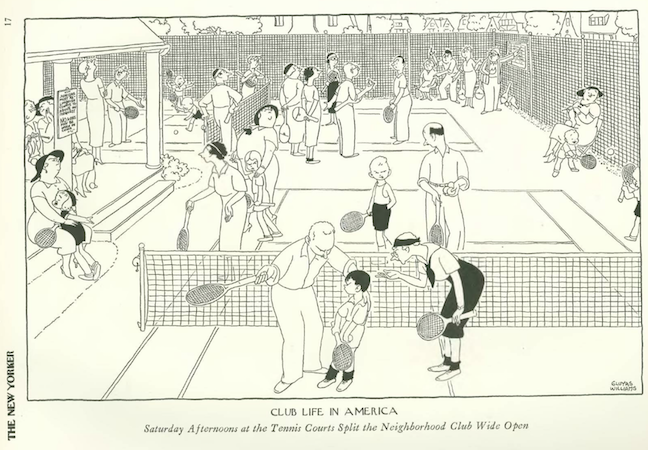
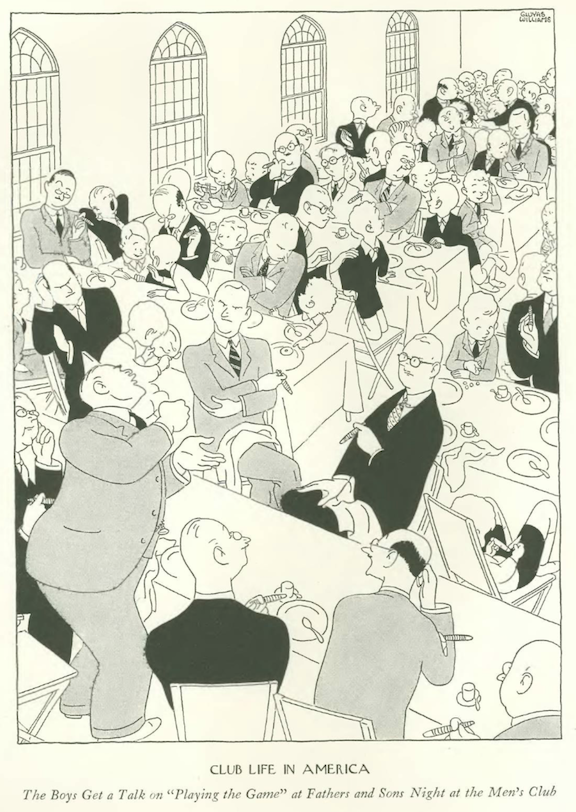
Gluyas Williams continued to take a sideways glance at Club Life in America”…

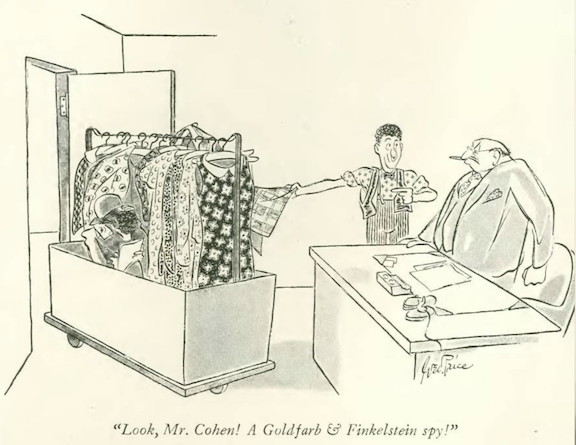
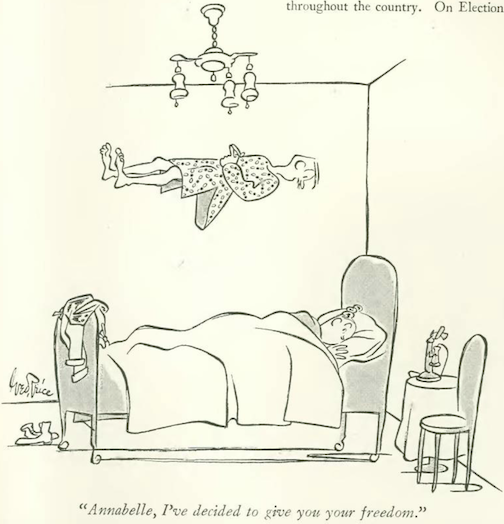
…from George Price…back in the day, tattoos were usually confined to sailors and longshoreman…this particular fellow found himself with some outdated ink…

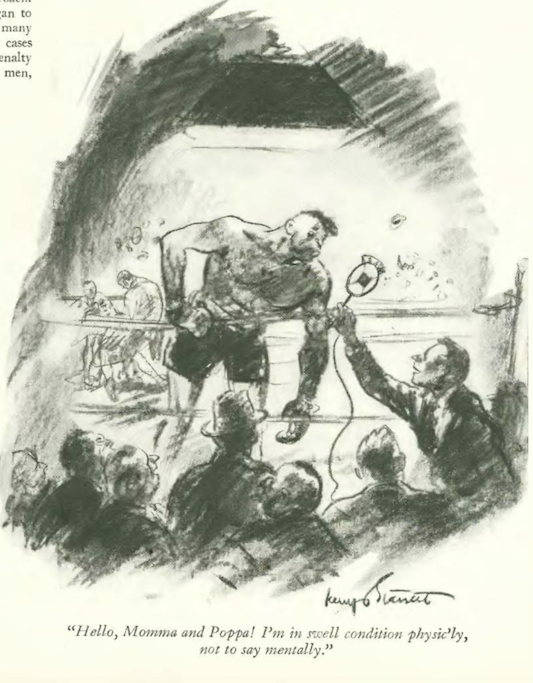
Kemp Starrett took us ringside…

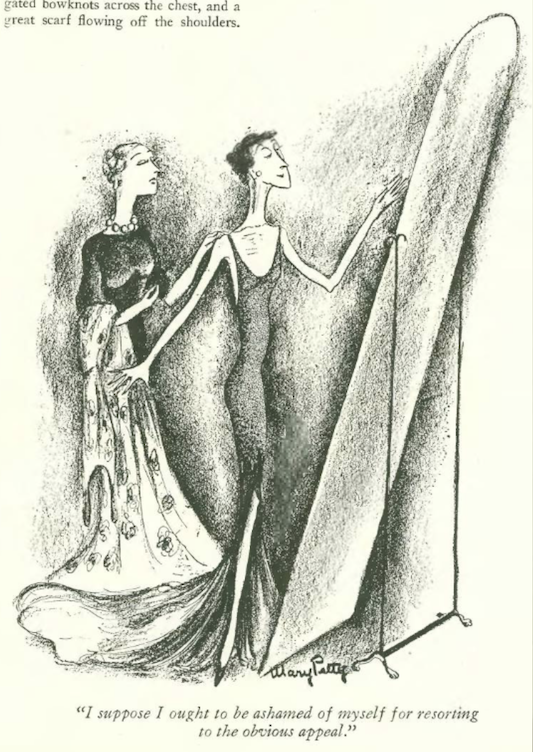
Mary Petty reflected on a bit of narcissism…

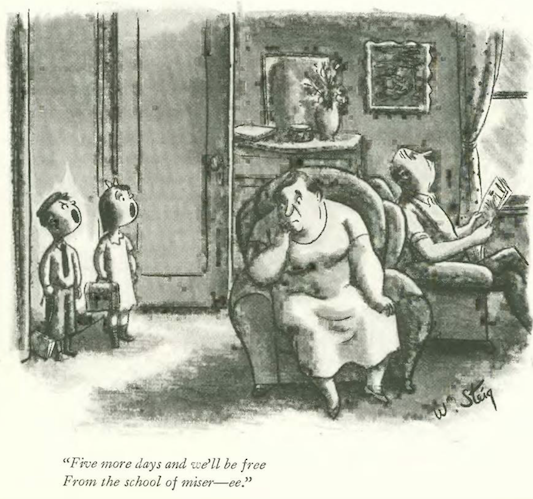
…and we close with William Steig, and mixed feelings about the summer season…

Next Time: Happy Motoring…

Not a Square Deal

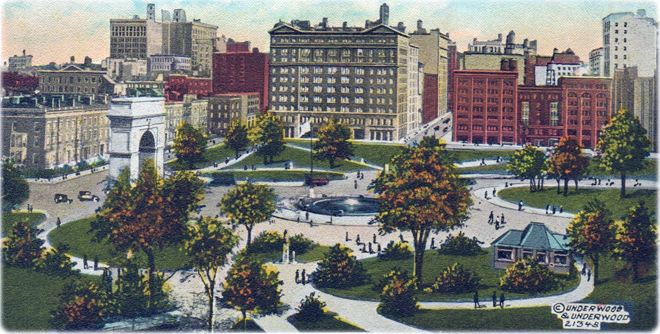
Above: Postcard image of Washington Square Park, circa 1930. (citybeautifulblog.com)

New Yorkers know all about change, and especially during the 1920s and 30s when the city razed everything from Dutch settler houses to the Gilded Age mansions of Fifth Avenue. Landmarks such as the old Waldorf-Astoria were leveled to make way for the Empire State Building, while several blocks—22 acres of residential and commercial buildings—were scraped clean for Rockefeller Center.

June 8, 1935 cover by Harry Brown. This June bride-themed cover was Brown’s fourteenth of the eighteen covers he would create for The New Yorker.

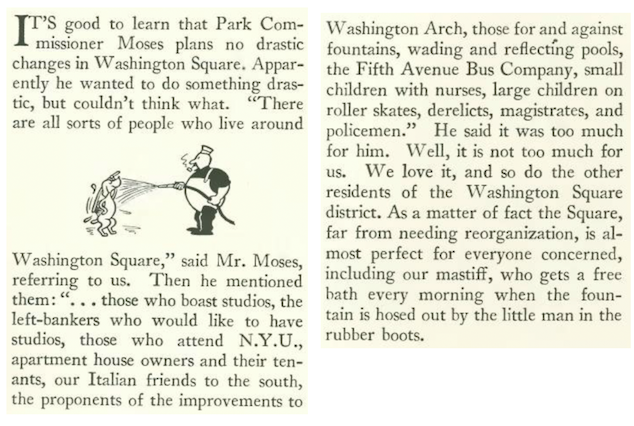
Some things, like Washington Square, were still held dear by city residents. But very little was sacred to the city’s new park commissioner, Robert Moses, who had no problem leveling whole neighborhoods if they stood in way of a road or some other ambitious project.

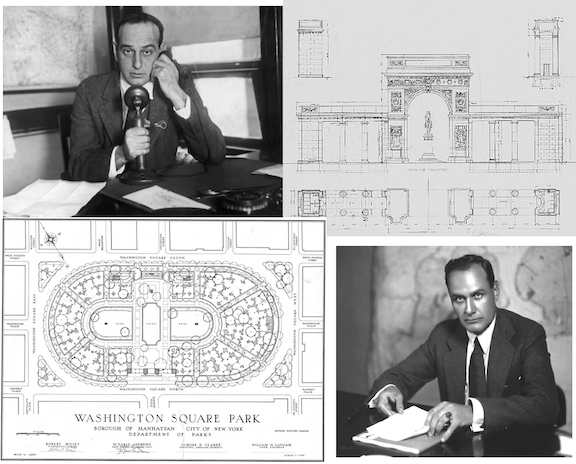
It all seemed well at first when Moses called for the repair of neglected parks, including Washington Square. However, when changes to the park were revealed by the Villager, residents were outraged. Moses’ plan, designed by landscape architect Gilmore Clarke, was a complete reversal of the park’s existing design. In “Notes and Comment,” E.B. White explained:

Village residents organized a “Save Washington Square” committee and successfully blocked Moses from implementing his plan; in true Moses style, he responded by allowing the park to deteriorate.

MAKE NO LITTLE PLANS…Clockwise, from top left, Parks Commissioner Robert Moses; proposal to add colonnades to either side of the arch; landscape architect Gilmore Clarke; Clarke’s plan for the redesign.  (Wikipedia/washingtonsqpark.org)

Moses, however, didn’t give up on Washington Square. Around 1940 he began floating the idea of building a double highway through the park. Local residents again rallied, joining business owners and NYU officials in blocking the audacious scheme.

DOUBLE TROUBLE…Around 1940 Moses began floating the idea of building a double highway through Washington Square Park. This illustration is circa 1950. (MTA Archives)

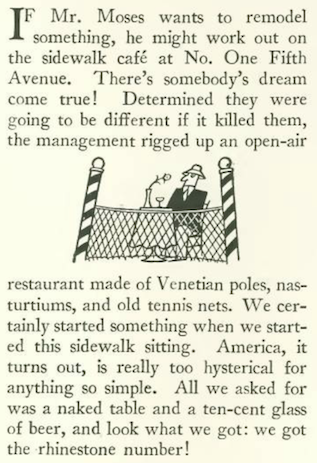
White continued on the theme of city planning, calling on Moses this time to figure out a better plan for sidewalk cafés.

AL FRESCO…Postcard images of sidewalk cafés at 24 Fifth Avenue (top) and 23rd and Lexington, circa 1935. (picryl.com)

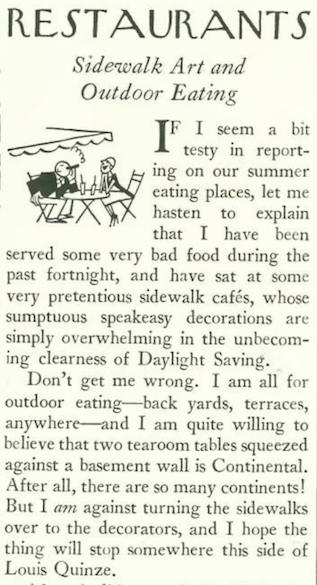
Additional note: The magazine’s June 15, 1935 issue featured Lois Long’s criticisms of sidewalk cafés in Manhattan:

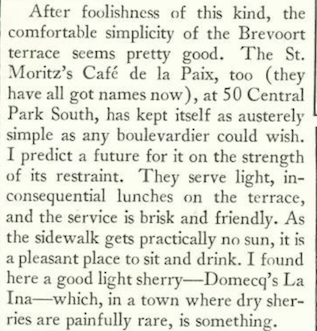
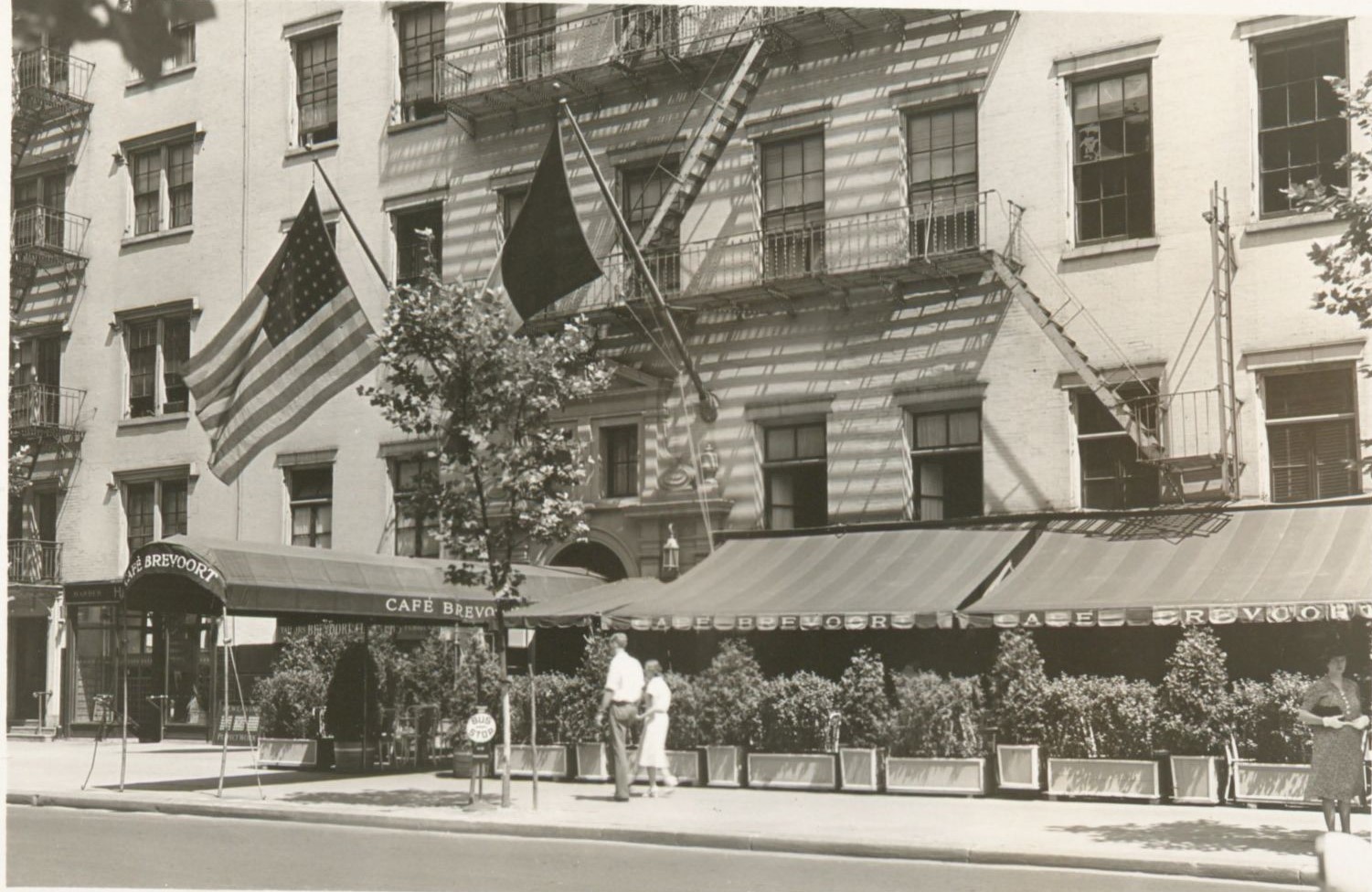
Long did offer, however, a couple of recommendations for sidewalk dining, including the Breevort in Greenwich Village…

If you really wanted to eat outside, Lois Long suggested the Breevort in Greenwich Village. (New York Public Library)

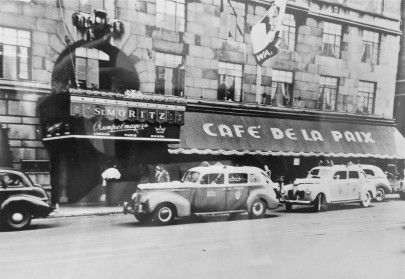
…and the St. Moritz’s Café de la Paix at 50 Central Park South…

The St. Moritz’s Café de la Paix in the 1940s. (blog.bondbrand.com)

 * * *

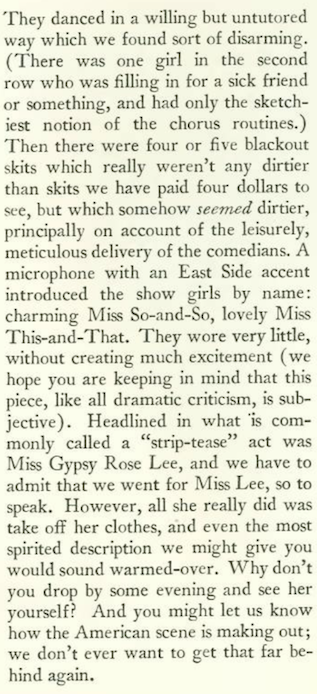
Sexily Danced the Burlesques

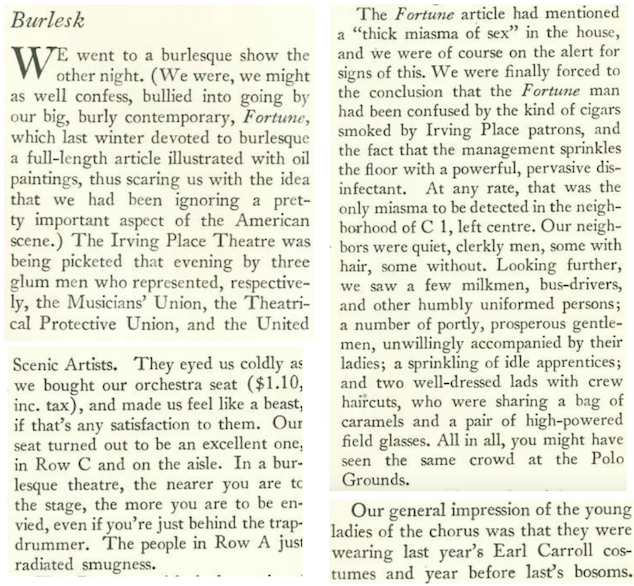
New Yorker writers loved to take shots at Henry Luce, publisher of Time and Fortune. Wolcott Gibbs famously satirized Time’s writing style in a parody profile in 1936: “Backward ran sentences until reeled the mind.” When Fortune decided to take a look behind the curtain at a burlesque show (February 1935), “The Talk of the Town” was ready to pounce.

The Fortune piece featured oil paintings by Stuyvesant Van Veen, including this one depicting the Proscenium at the Irving Place

Fortune images courtesy fulltable.com

…Van Veen got behind the curtain to create this painting (below) of “Burlesque Queens,” and the magazine chastely demonstrated the “cycle of the strip act” with the help of Miss Jean Lee, aka Miss Jess Mack…

The New Yorker also took a sideways glance at Fortune’s stuffy approach to the subject of striptease, suggesting that it was much ado about nothing.

IT’S ALL AN ACT, FELLAS…Gypsy Rose Lee in 1943. (nypl.org)

 * * *

Futures and Fascists

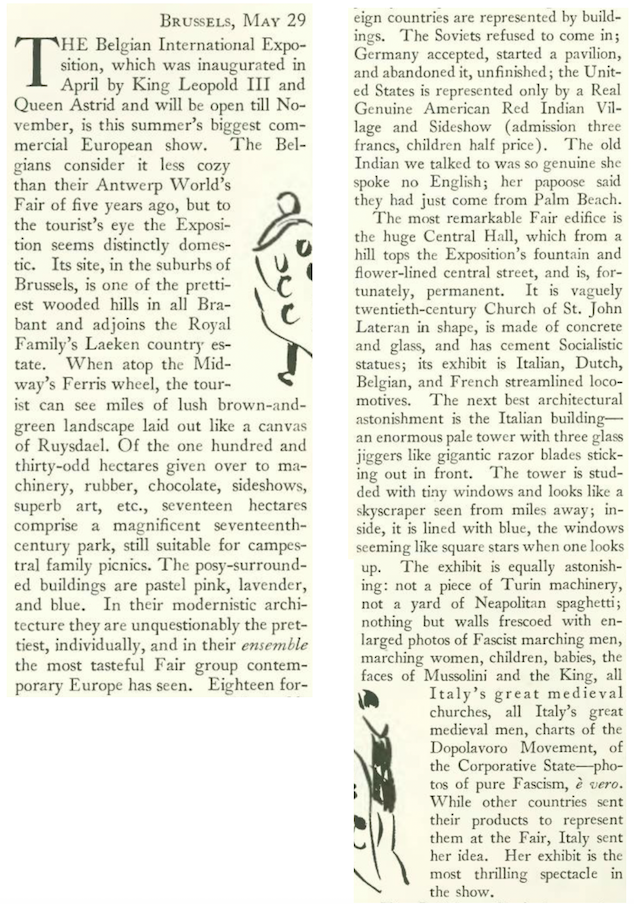
Before the days of television and the Internet, a world’s fair was the place to go to see the latest technologies and other attractions from countries around the world. Paris correspondent Janet Flanner filed a special report on the Brussels International Exposition of 1935, which attracted 20 million visitors in a little over six months.

EURO SPECTACLE…Clockwise, from top left, the menacing facade of the Italian Pavilion—its interior walls featured frescoes of marching fascists; the Palais des Expositions (Grand Palais) still stands today as the Brussels Exhibition Centre; an early demonstration of television; the U.S. featured an “Indian Village” at the Expo. (fomo.be/Wikimedia/en.worldsfairs.info)

 * * *

Matchbox Cars

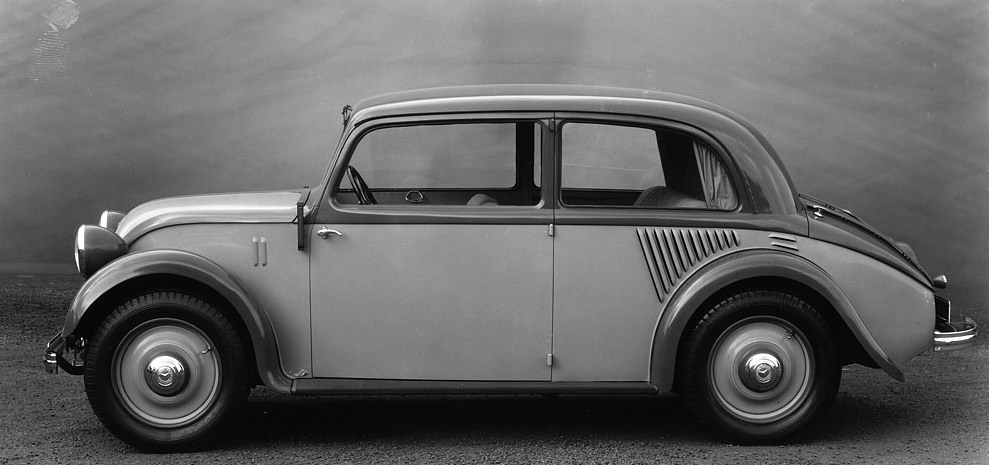
The New Yorker regularly checked the automobile competition from overseas, and found a tiny German car to be “perfectly amazing,” even if it didn’t go over so well with consumers.

IT’S CUTE, BUT…Due to its extreme unbalance of the Mercedes-Benz 130 H (two-thirds of the mass, including the engine, was on the rear axle), the car apparently was awkward to handle. It was discontinued in 1936. (automobile-catalog.com)

 * * *

From Our Advertisers

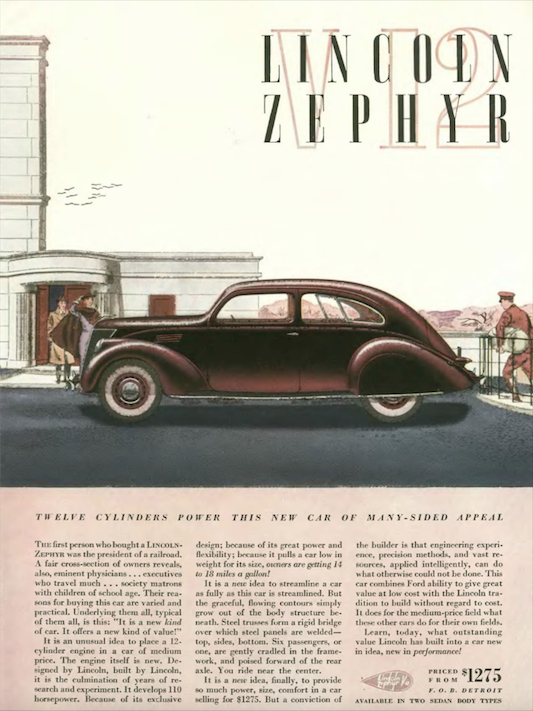
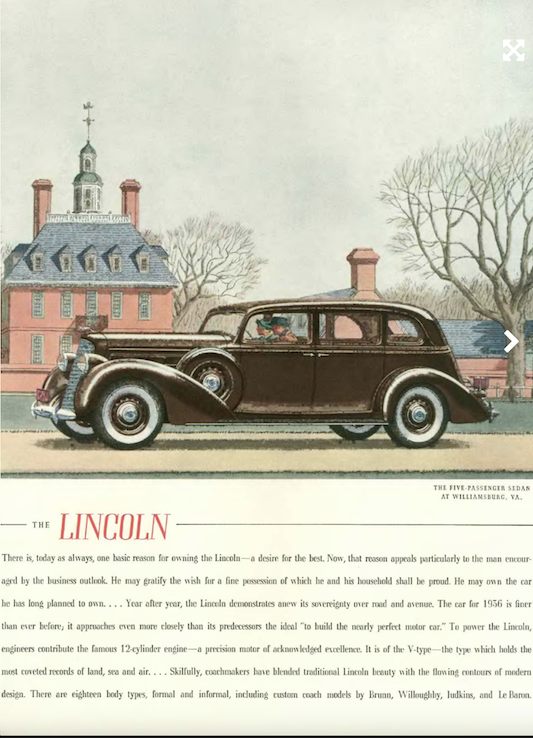
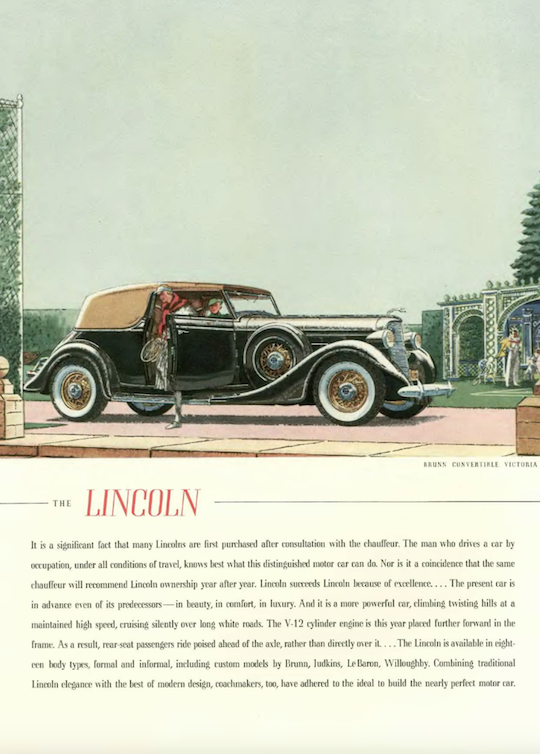
Anyway, most Americans preferred bigger cars, especially ones by luxury makers such as Lincoln, if they could afford them…

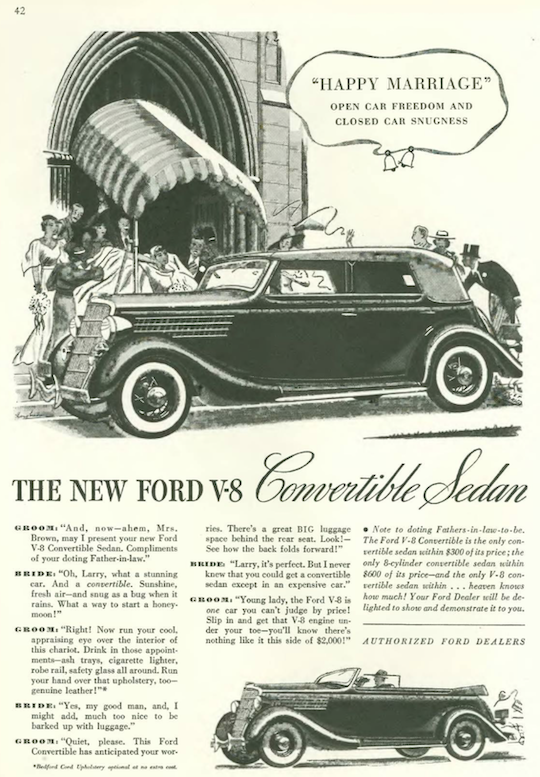
…Lincoln’s parent company, Ford, offered up a more affordable convertible with some flair of its own…automakers were fond of the marriage theme in advertisements, especially in the month of June…

…automakers and related industries were important advertisers during The New Yorker’s first years…

…indeed, the back cover of Issue #1 (Feb. 21, 1925) featured this ad from the United States Rubber Company, promoting its U.S. Royal Cord Balloon Tires…

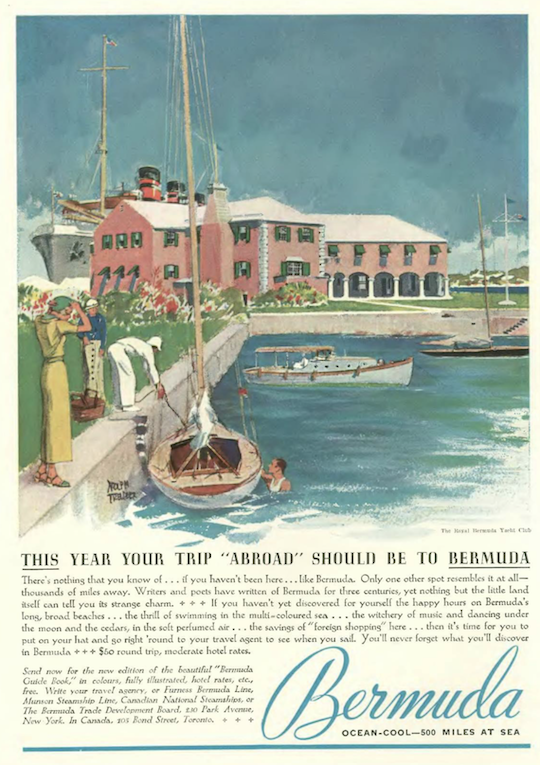
…another faithful advertiser in the magazine’s first decade was the Bermuda Trade Development Board…

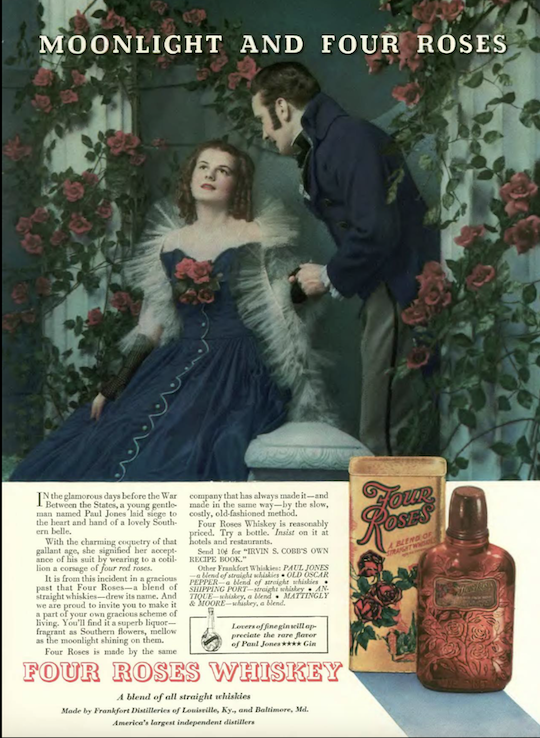
…this ad for Four Roses whiskey recalled “the glamorous days” (ahem) before the Civil War…

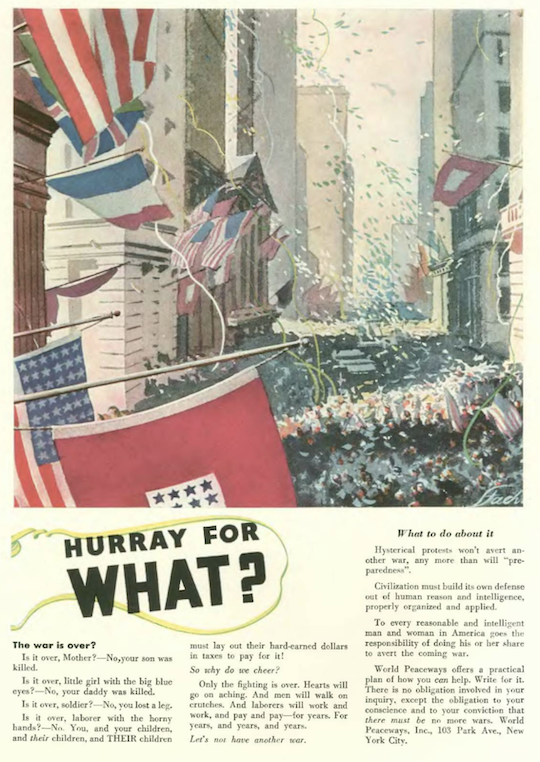
…and this colorful ad from World Peaceways reminded readers there was nothing to celebrate about wars…these ads pulled no punches (read the first few lines)…

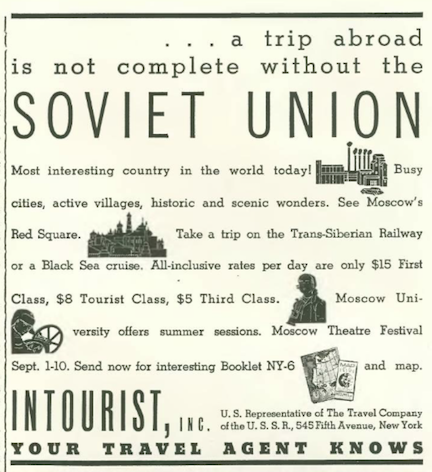
…”most interesting country in the world today!” proclaimed this ad inviting tourists to the Soviet Union…during 1934-35 Joseph Stalin was ruthlessly purging the Party, and local leaders across the country were being annihilated…of the 2.3 million people who had been party members in 1935, just under half were executed or perished in labor camps…this fact probably wasn’t mentioned in the travel folder…

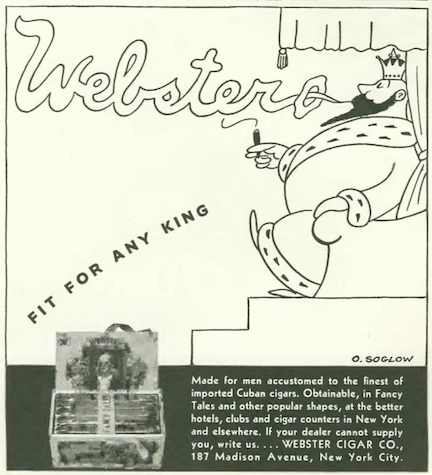
…the Webster Cigar Company hired Otto Soglow to create an ad doubtless based on the popularity of “The Little King,” but this isn’t the diminutive monarch…

…which takes us to our cartoonists, beginning with this spot signed E.S., I believe, or L.S. (anyone know?)…at any rate, its whimsical…

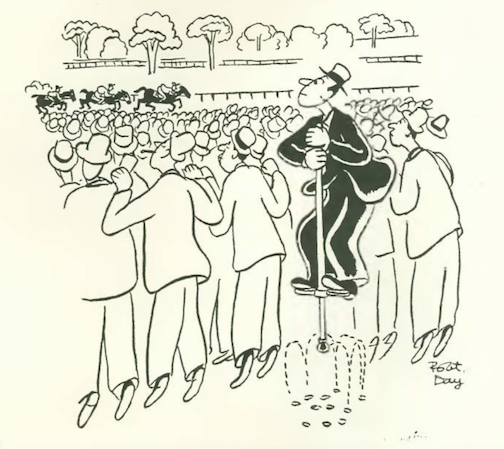
…of course we know Robert Day

…Day again, in a very different style…

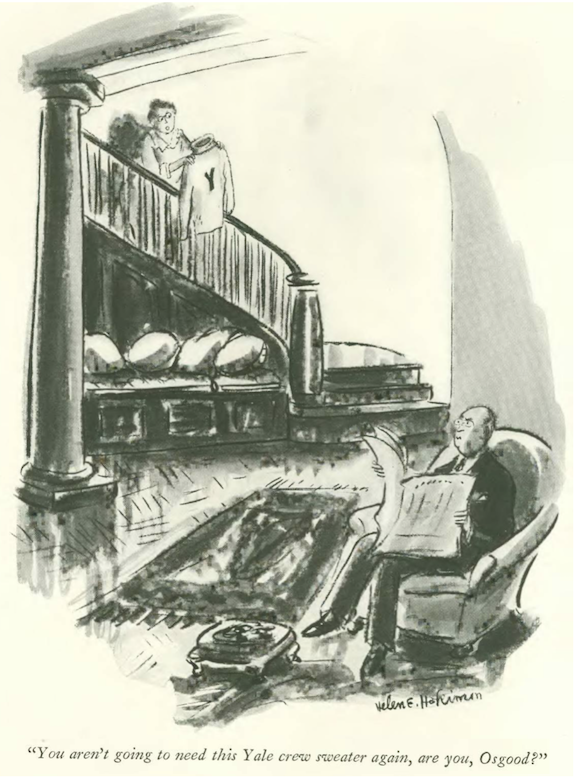
Helen Hokinson, sounding a contemporary note…

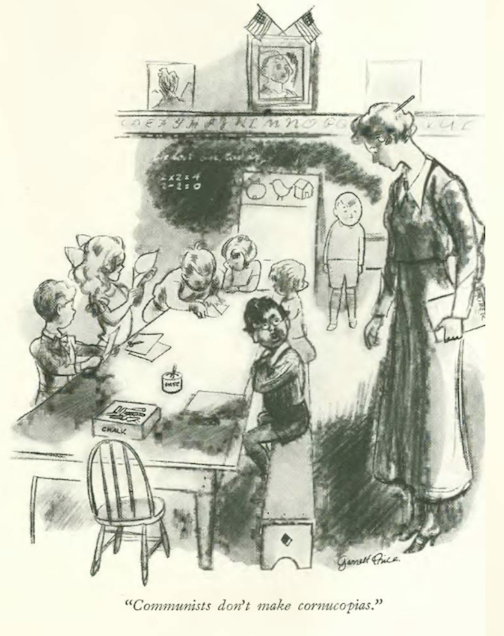
…a kindergarten political standoff, courtesy Garrett Price

Rea Irvin, and the obsolescence of Pan (today she’d have a cell phone)…

Peter Arno, and a clueless, cold, cuckold…

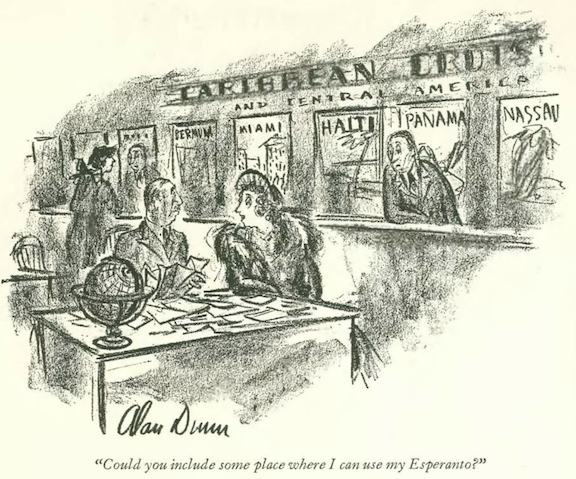
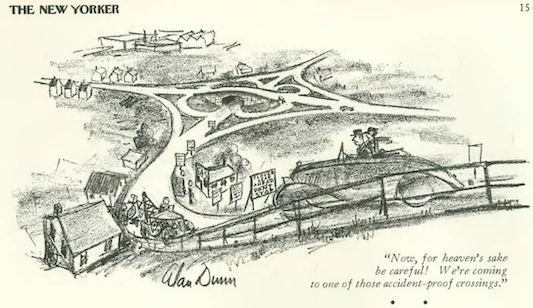
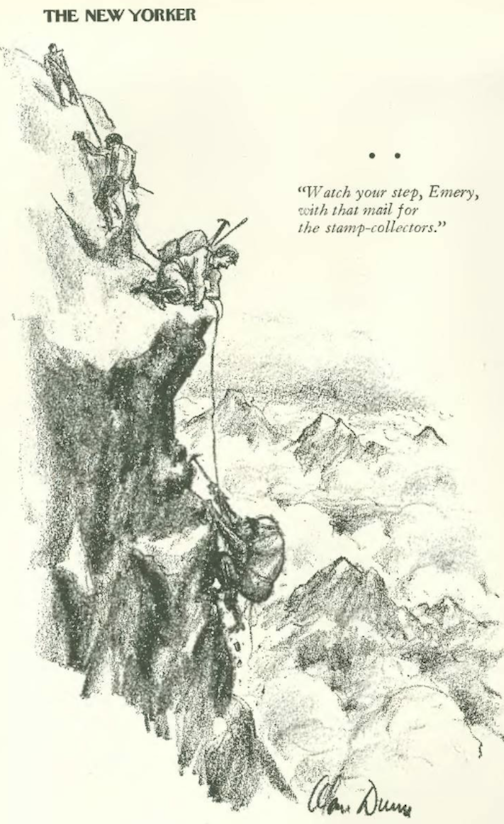
…and we close with Alan Dunn, and the future of transportation…

Next Time: A Return to Coney…

Vive La Normandie

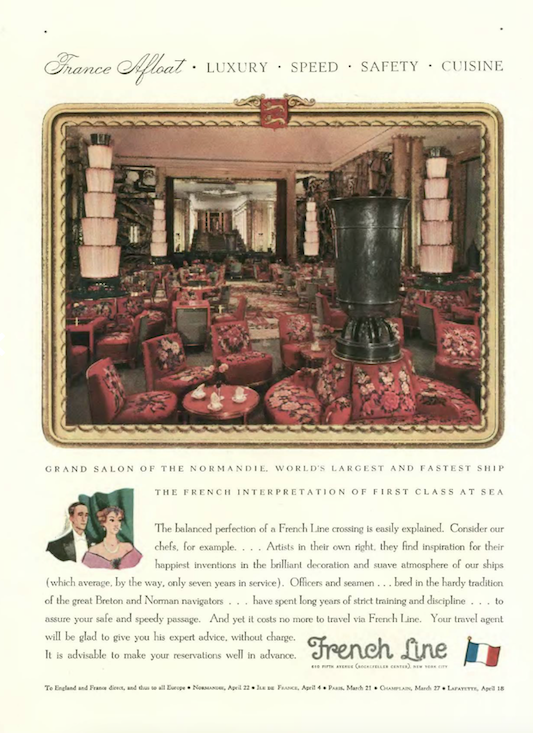
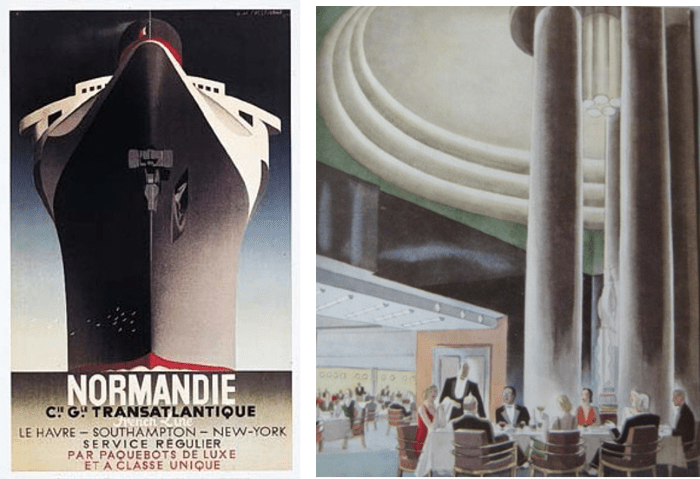
Above: At left, Adolphe Cassandre's famed 1935 depiction of the S.S. Normandie; right, image from a 1935 promotional booklet published by the French Line.

When the S.S. Normandie entered service in 1935, she was the largest and fastest passenger ship afloat, crossing the Atlantic in a little over four days. The ship was so impressive that even the imperturbable Janet Flanner expressed enthusiasm over its launch.

May 25, 1935 cover by Constantin Alajalov.

As Paris correspondent, Flanner was giving New Yorker readers a preview of Normandies May 29 maiden voyage from Le Havre to New York City.

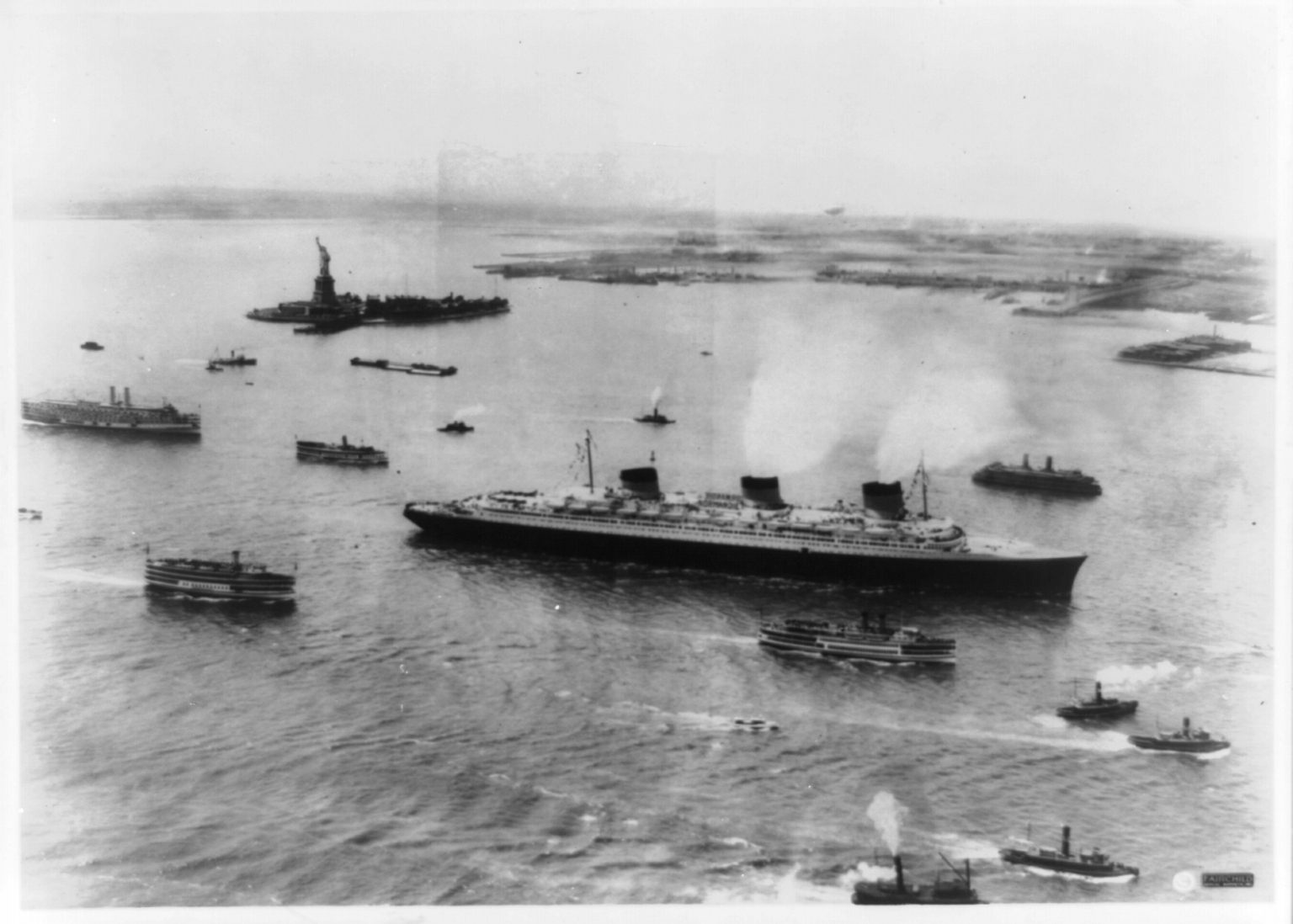
HER ENTOURAGE…The S.S. Normandie was welcomed into New York Harbor on June 3, 1935. (Wikipedia)
IMAGINE THAT…An S.S. Normandie promotional poster from 1935 depicts the ocean liner making an unlikely entrance into Manhattan. The sleek ship measured 1,029 feet (313.6m) in length and carried nearly 2,000 passengers plus 1,345 crew. It was the first ocean liner to exceed 1,000 feet in length. (Museum of the City of New York–MCNY)

To give New Yorkers some idea of the liner’s size, Flanner noted that the Normandie would stretch from 43rd to 47th Street, and if stood on her stern, would stand nearly 180 feet above the RCA Building at Rockefeller Center.

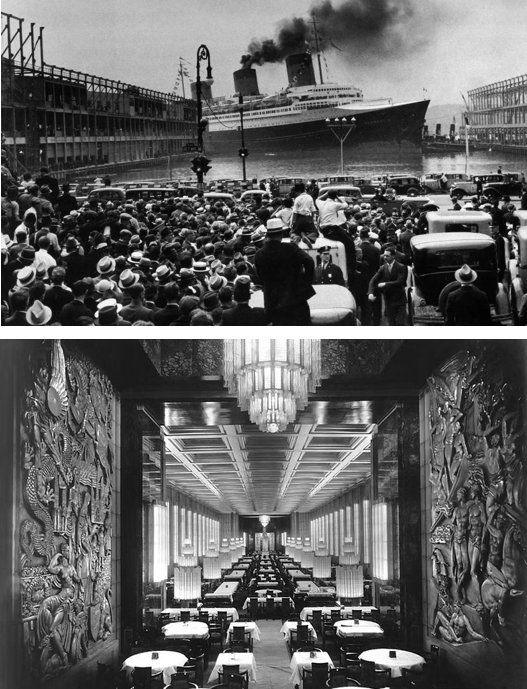
FRENCH TOAST…Top, a crowd cheers the S.S. Normandie as it arrives at New York’s Pier 88 on June 3, 1935; below, the first class dining hall was 305 feet long, 46 feet wide and three decks high. (drivingfordeco.com/MCNY)
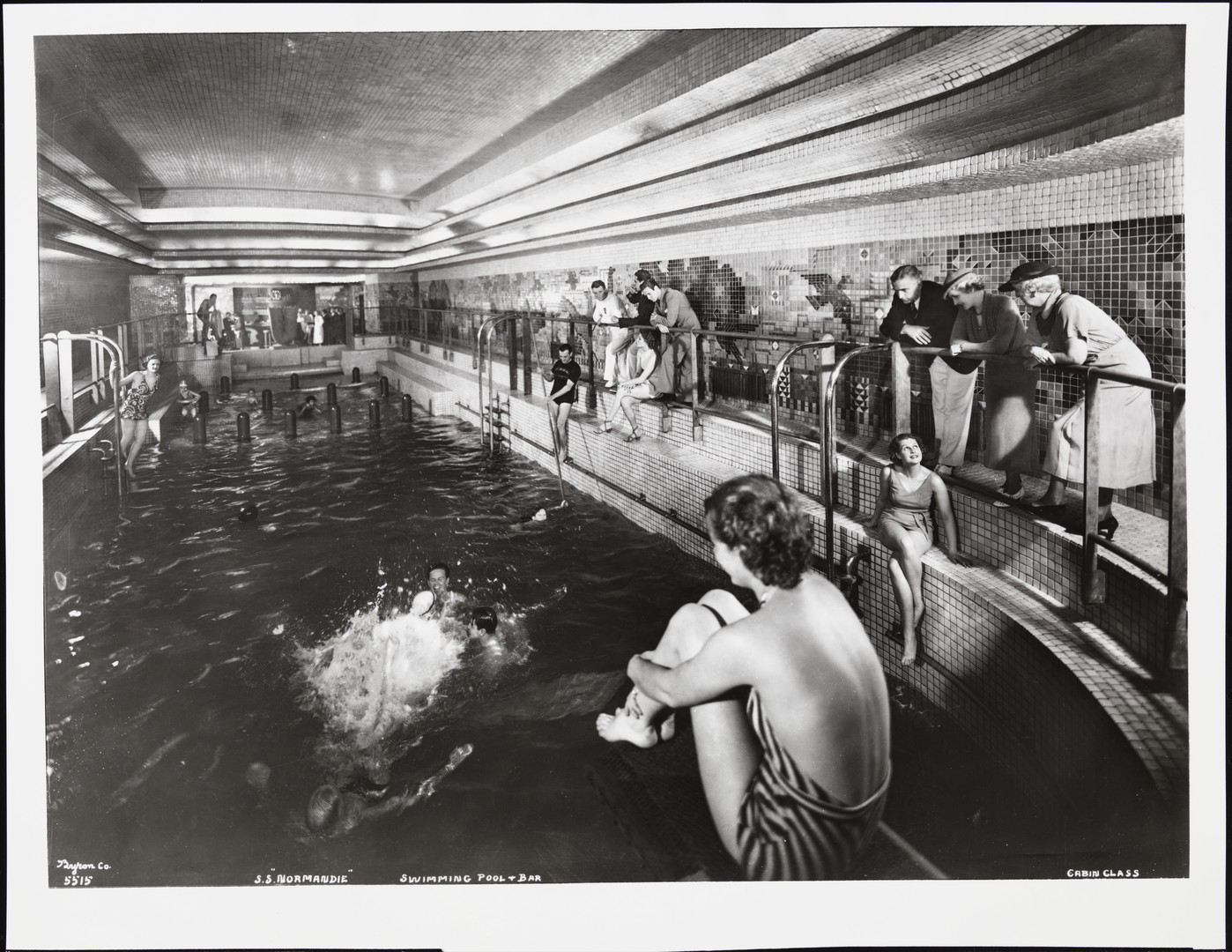
IN, AND ON THE WATER…Passengers take a plunge in the Normandie’s swimming pool, which included a bar at the far end. (MCNY)
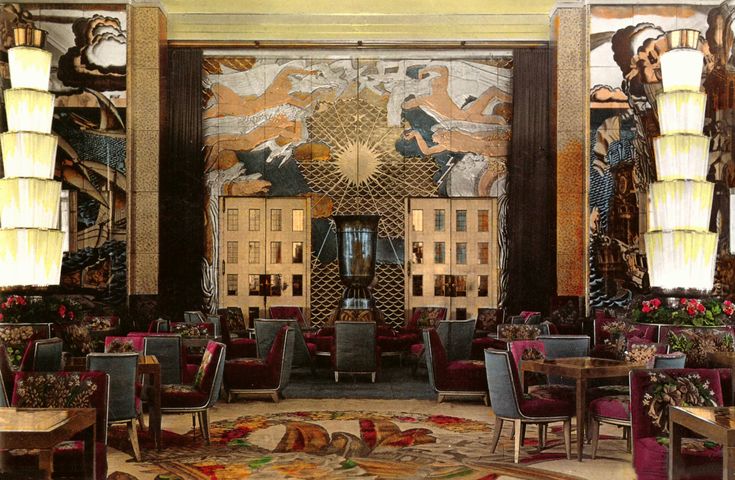
EYE-POPPING…Colorized image of the first-class lounge. (Pinterest)
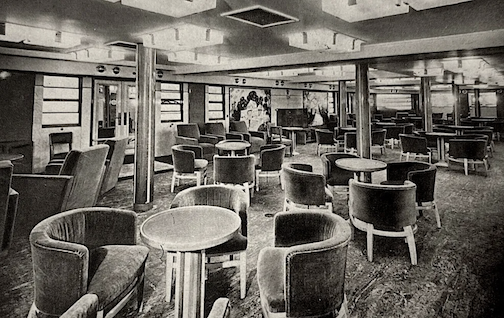
BARGAIN…Accommodations for weren’t too bad, either, for the other classes. Here is the 3rd class salon. (drivingfordeco.com)
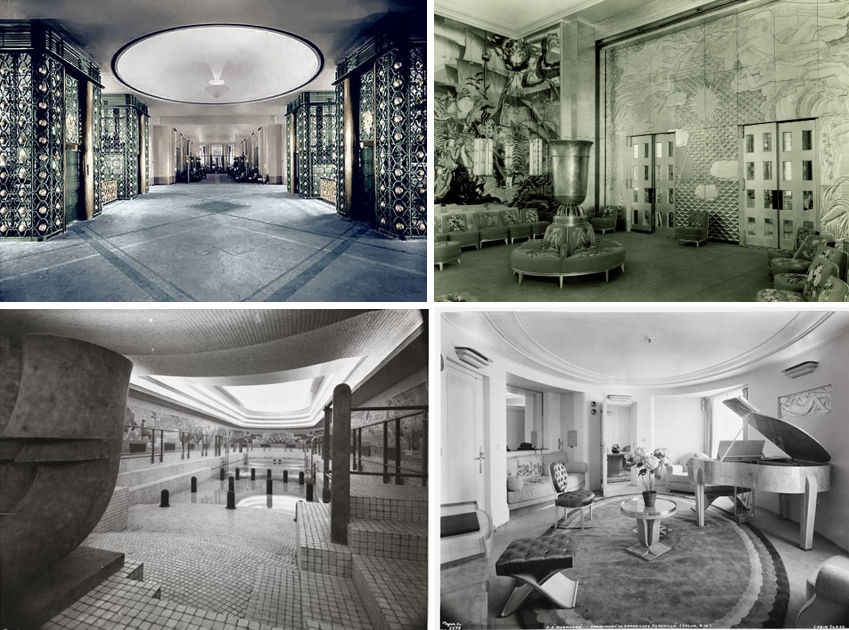
TAKE YOUR PICK…Clockwise from top left, elevators decorated in sea shells; the rear of the Grand Salon; a first class suite; view of the swimming pool. An incredible scale model of the S.S. Normandie is displayed on the Queen Mary, which is permanently docked at Long Beach, CA. (MCNY)

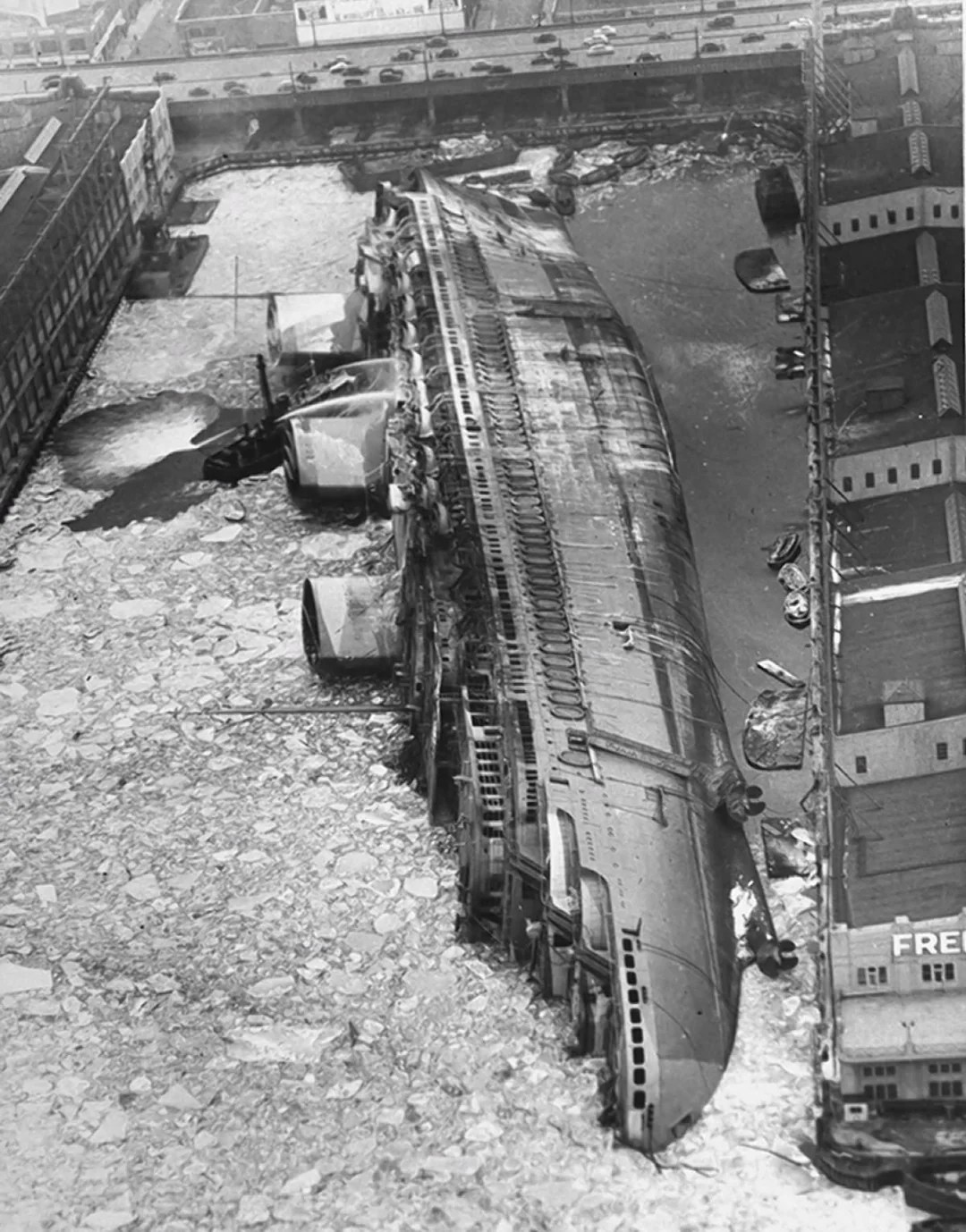
World War II would cut short the Normandie’s life. Seized in New York and renamed USS Lafayette in 1942, she was being converted to a troopship when she caught fire, capsized onto the port side, and came to rest half submerged on the bottom of the Hudson at Pier 88, the same pier where she was welcomed in 1935. She was scrapped in 1946.

THE WAGES OF STUPIDITY…The Normandie after a fire brought her glory days to an end. (Reddit)

 * * *

A Critic Is Born

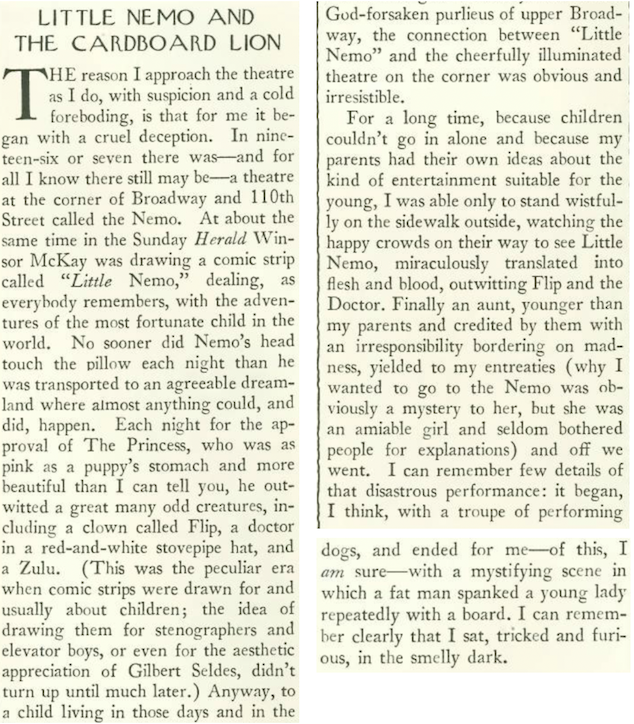
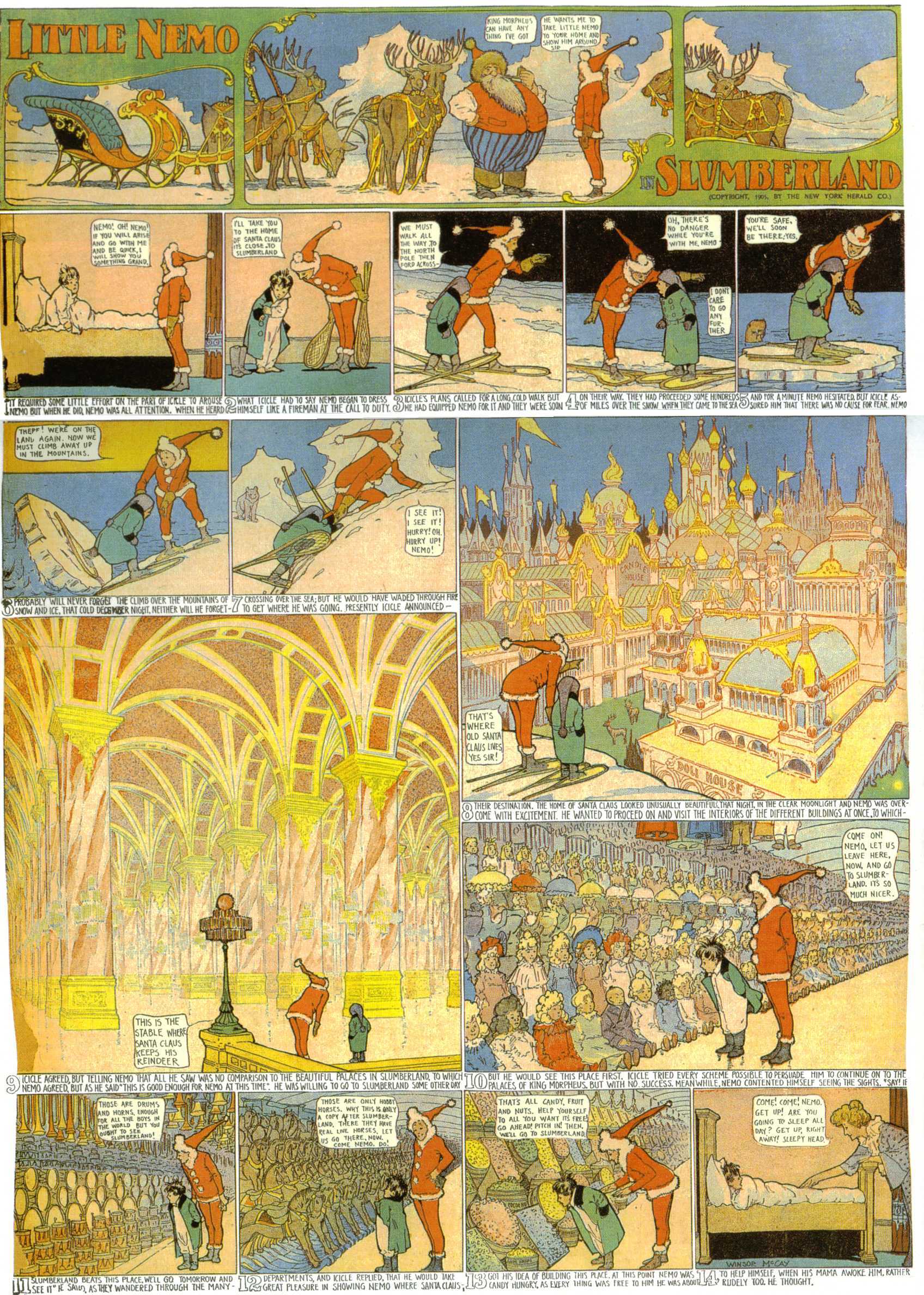
It turns out that Wolcott Gibbs (1902–1958) cut his teeth as The New Yorker’s theatre critic while he was still in short pants. Gibbs recalled his five-year-old self in an essay that described his first experience with the theatre—a play based on the New York Herald’s popular comic strip, Little Nemo in Slumberland, by Winsor McCay. In parallel with Gibbs’ childhood, the strip ran from 1905 to 1911.

As a child, Gibbs was wild about Little Nemo’s adventures, but the stage adaptation left the child disillusioned (and feeling “tricked and furious”). The New York Public Library’s Douglas Reside wrote (in 2015) that the producers, seeking to draw as wide an audience as possible, presented Little Nemo “as a bloated mixture of theatrical styles, including the minstrel show, pantomime, operetta, farce-comedy, vaudeville, revue, and ballet,” featuring three comedians “mostly superfluous to Nemo’s story.” The part of Nemo was played by a 25-year-old actor with dwarfism.

DREAMLAND…The Little Nemo strip from Dec. 17, 1905 depicted the boy’s dream of a visit to Santa’s magical city at the North Pole. (Wikipedia)
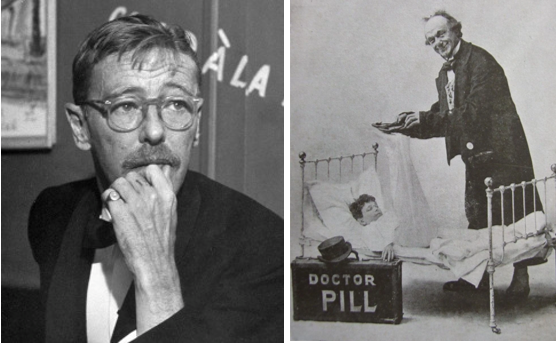
THAT’S SHOWBIZ…As a boy, Wolcott Gibbs (left) was disillusioned by a 1907 theatre adaptation of his favorite comic strip, Little Nemo in Slumberland. The play was dominated by three comedians including Joseph Cawthorn, right, who burlesqued German linguistic and cultural mannerisms for comic effect. He played Dr. Pill, the quack doctor of Slumberland’s royal court. The “boy” in the bed portraying Nemo was 25-year-old “Master” Gabriel Weigel. (Wikipedia/New York Public Library)

 * * *

Humorous Humors

Clarence Day, best known for his Life with Father stories, wrote humorously about his physical ailments and contributed a number of cartoons to The New Yorker that were accompanied by satirical poems. Day would be dead by December—after a bout with pneumonia—however, despite his ailments he would spend his last months arranging publication of his Life with Father book, which was published posthumously.

 * * *

Frankie Got Hitched

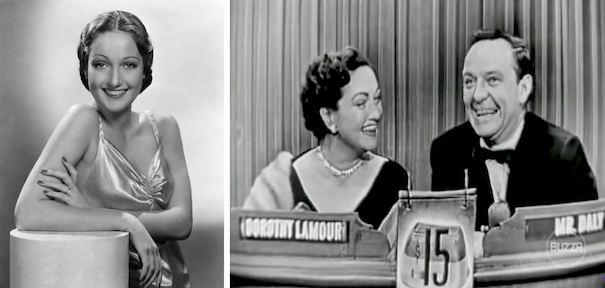
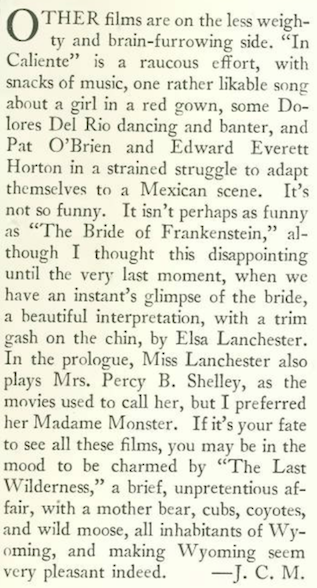
Film critic John Mosher still wasn’t finding much to rave about at the cinema, getting more chuckles from the monster mash-up of Boris Karloff and Elsa Lanchester in The Bride of Frankenstein than he did from the Dolores Del Rio vehicle Caliente.

DATE NIGHT…Top, Elsa Lanchester and Boris Karloff let the sparks fly in The Bride of Frankenstein, while Dolores Del Rio danced and chatted her way through the unfunny musical comedy Caliente. (Wikipedia/TCM)

* * *

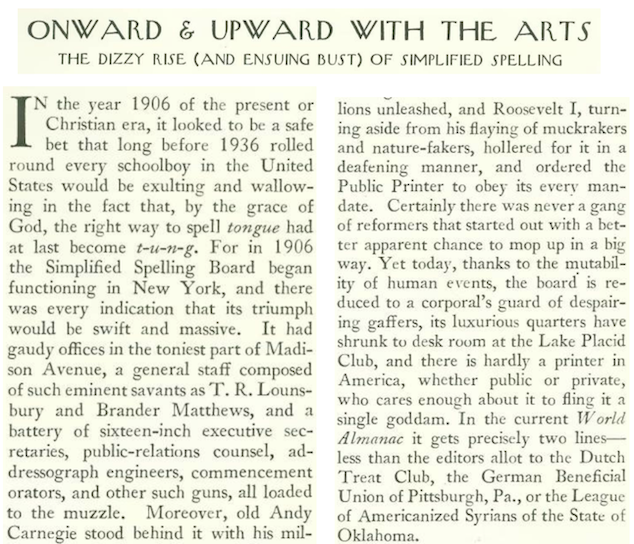
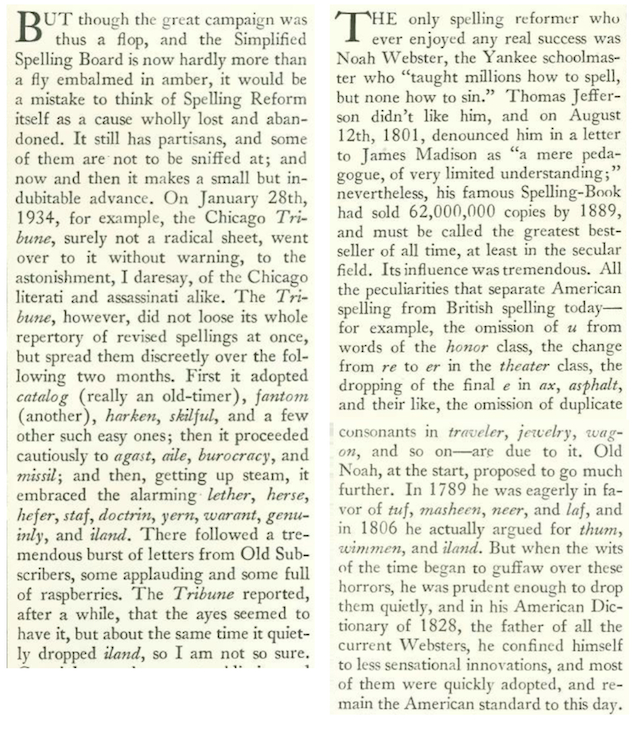
Other features in the May 25 issue included H. L. Mencken’s continuing exploration into the origins of American names…

…and The New Yorker published its first John Cheever story, “Brooklyn Rooming House.” Of Cheever’s 180 short stories, the magazine would publish 121 of them.

A NEW FACE…In spring 1935 The New Yorker bought two John Cheever stories, paying $90 for “The Brooklyn Rooming House” and $45 for “Buffalo.” Fiction editor Katharine White urged the purchase of the stories. Above, Walker Evan’s photo of Cheever, circa 1940s. (metmuseum.org)

 * * *

From Our Advertisers

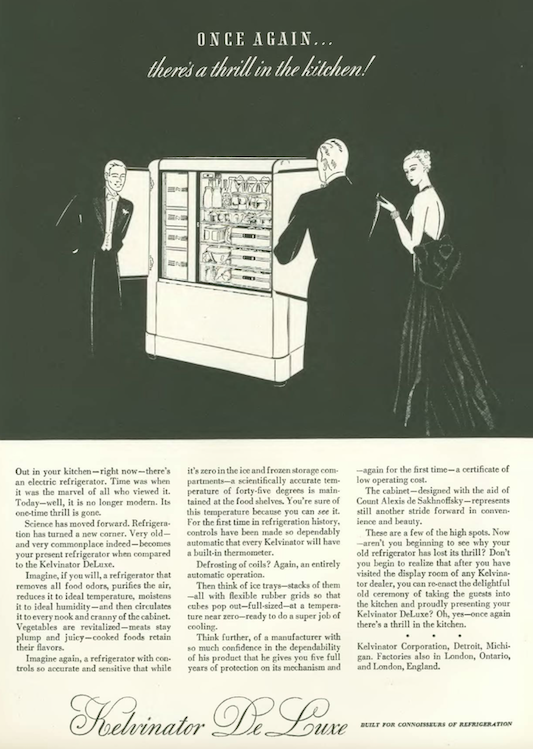
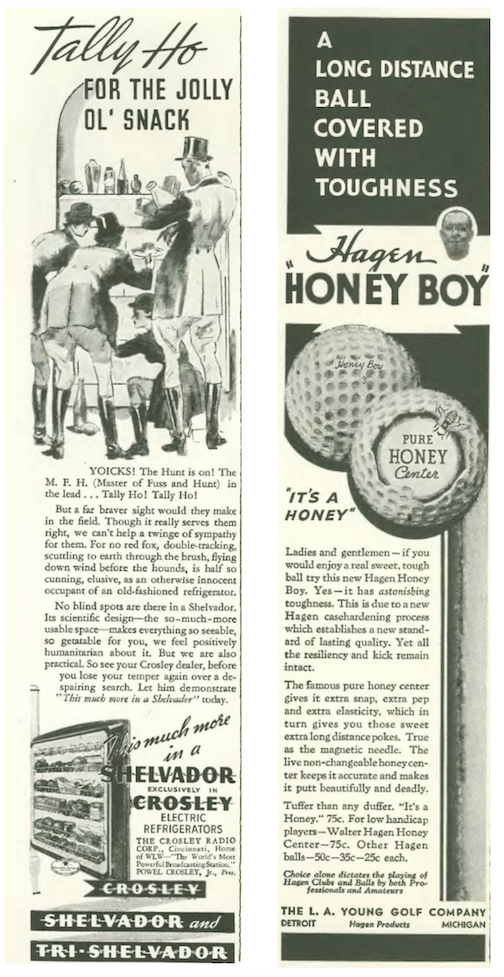
We start with some one-column gems from the back of the book including the latest innovation in electric refrigerators…a shelf in the door!…apparently Crosley was the first to invent this “Shelvador”…the ad to the right is interesting in that it advertises honey-filled golf balls…in the early 20th century some golf balls did contain real honey…apparently it was chosen for its consistent viscosity (or maybe for a quick snack on the ninth hole)…

…and from General Tire, we have another ominous warning from Dad as the teens head out for another night of crooning, or whatever they are dressed for…

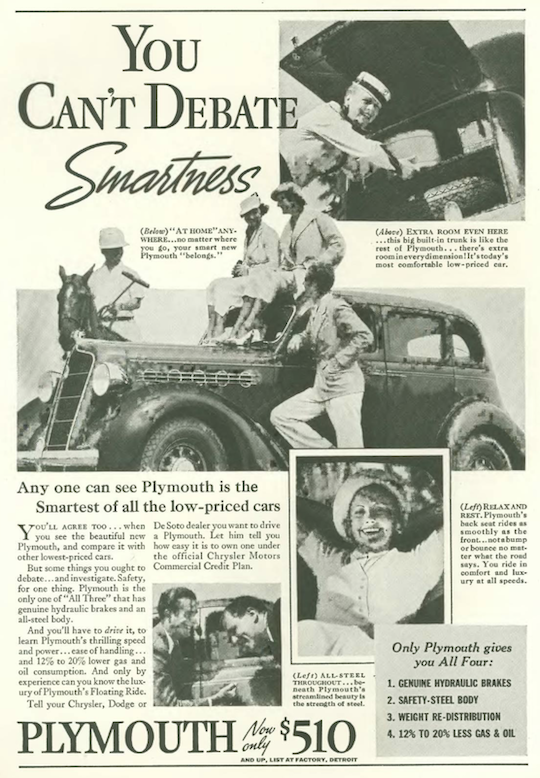
…last week Chrysler was offering its sedans for $745, and this week you could have one of their Plymouths for just 510 bucks…the message: you would be admired by your polo buddies for your smart, thrifty choice…

…where the above ad crammed every square inch with information, the folks at Pierce Arrow offered a restrained, minimal message (suggesting “we can afford to buy a full-page ad and leave much of it blank”)…another class signifier was the absence of a price tag (about $150k in today’s dollars)…but Chrysler-Plymouth would survive the Depression because it sold affordable cars, while Pierce Arrow was on its last legs…

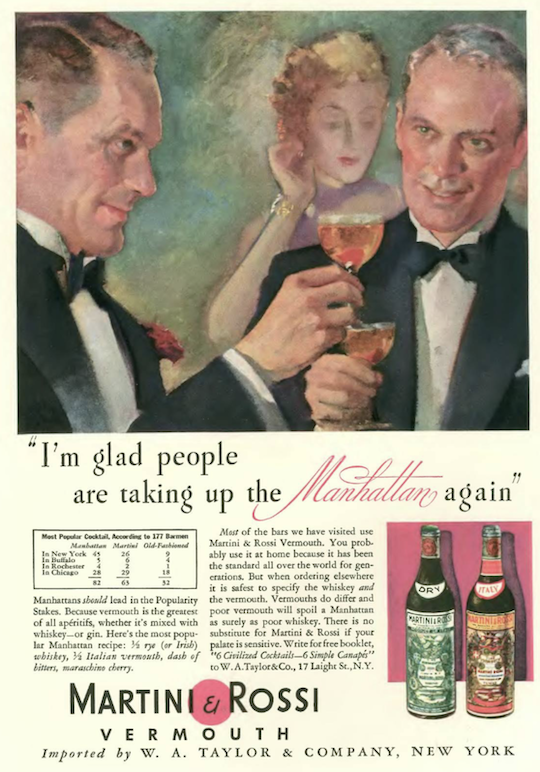
…here’s a couple of Pierce Arrow owners toasting the return of the Manhattan…

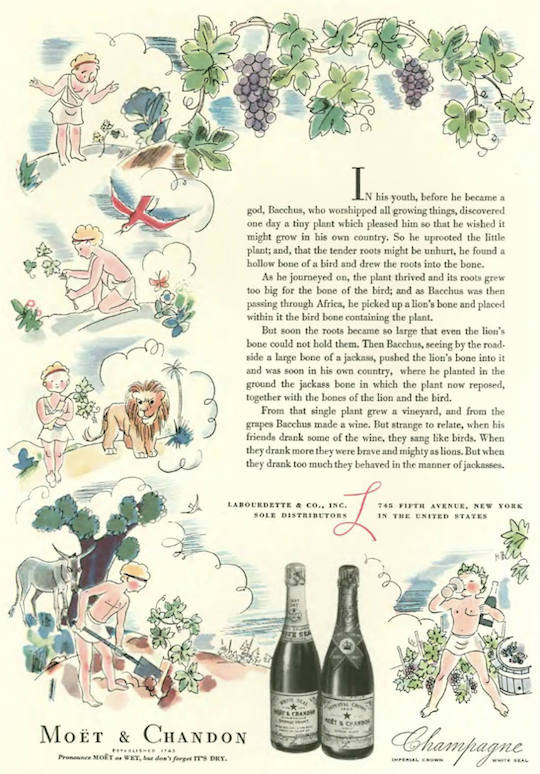
…Moët & Chandon offered up this whimsical tableau from the youth of Bacchus…

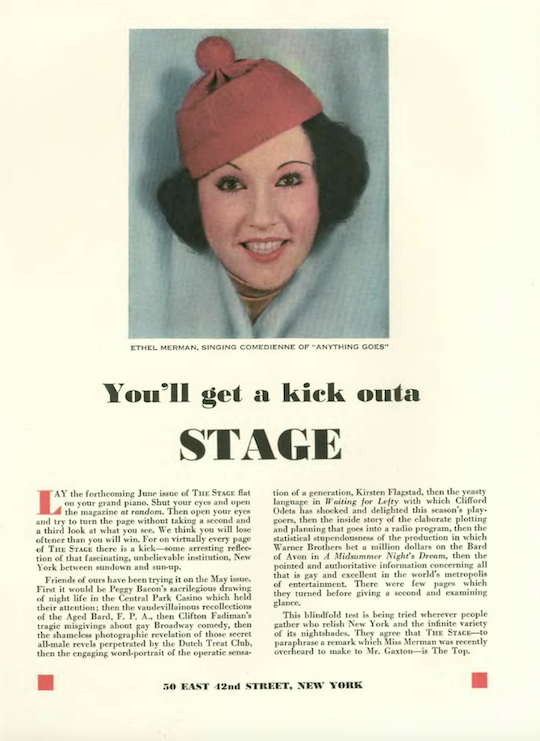
Ethel Merman popped through a curtain on the inside back cover to invite readers to subscribe to The Stage magazine…

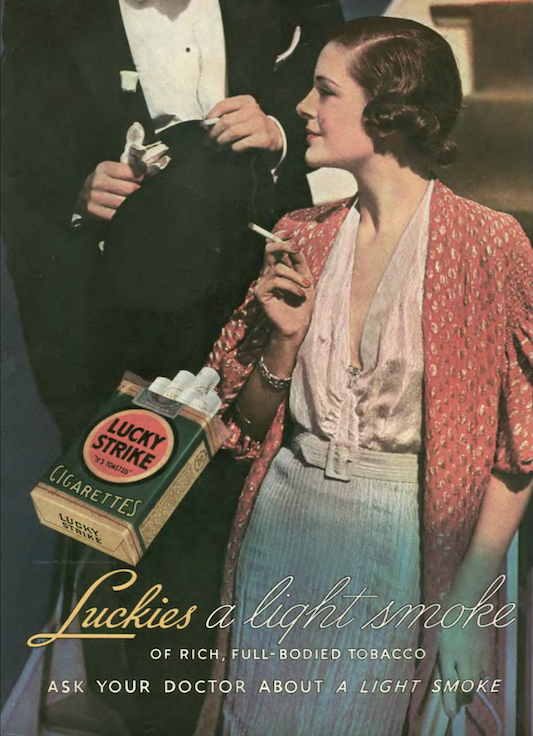
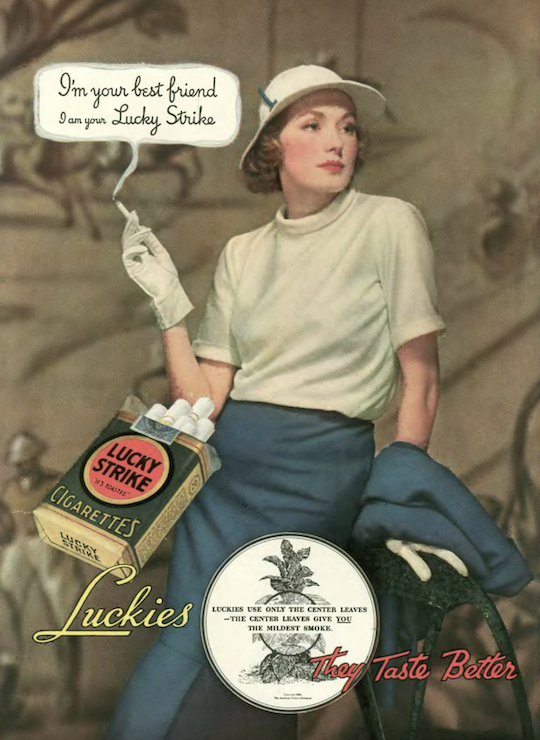
…and Lucky Strike claimed the back cover with another stylish woman and a talking cigarette bent on mind control…

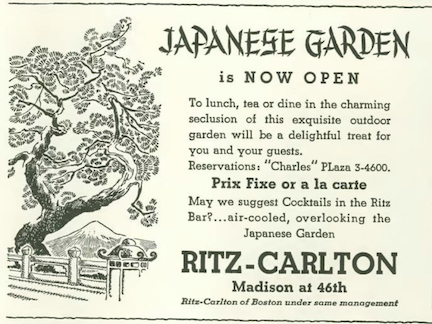
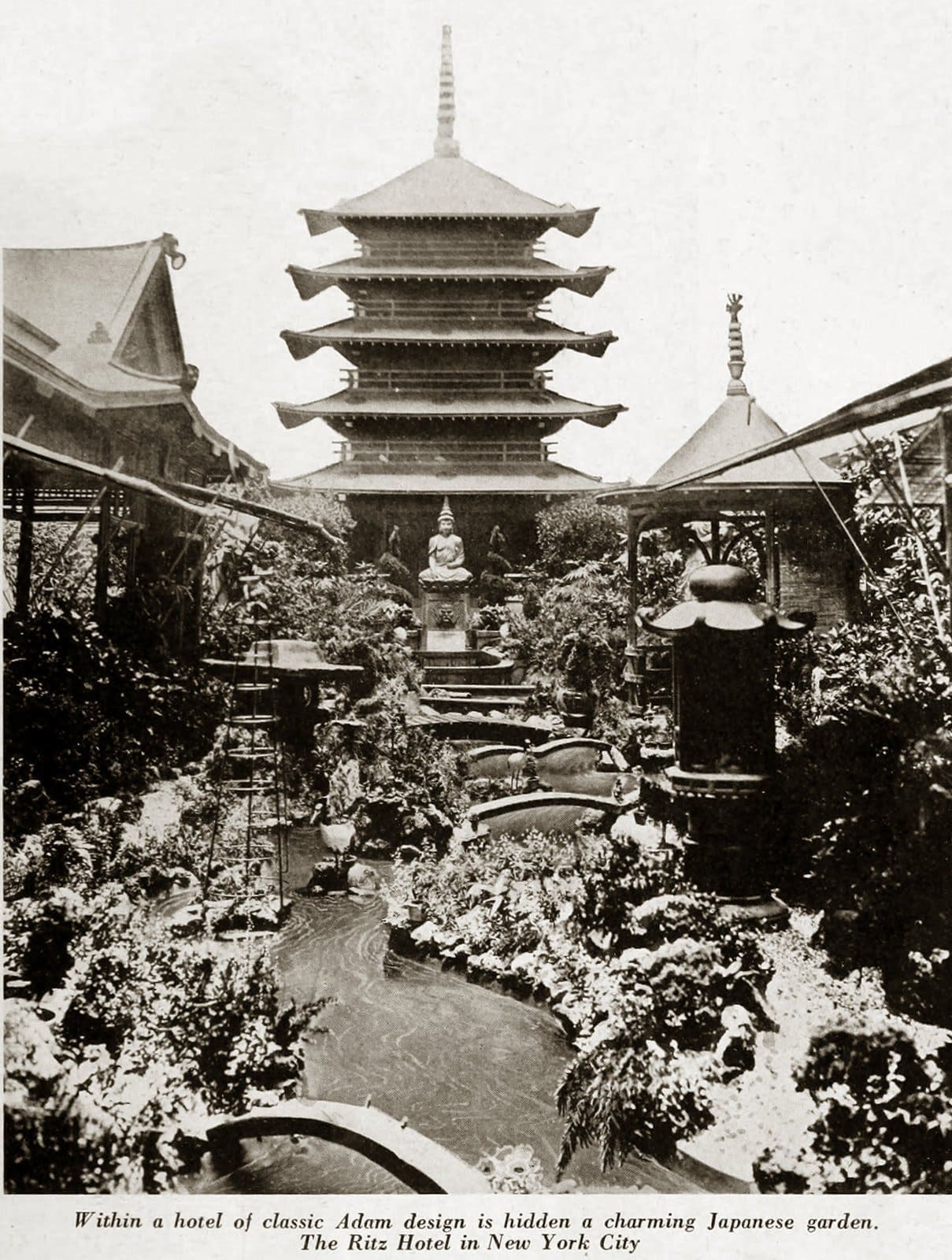
…the Ritz-Carlton announced the spring re-opening of its famed Japanese Garden…

The Japanese Garden in 1924. (clickamericana)

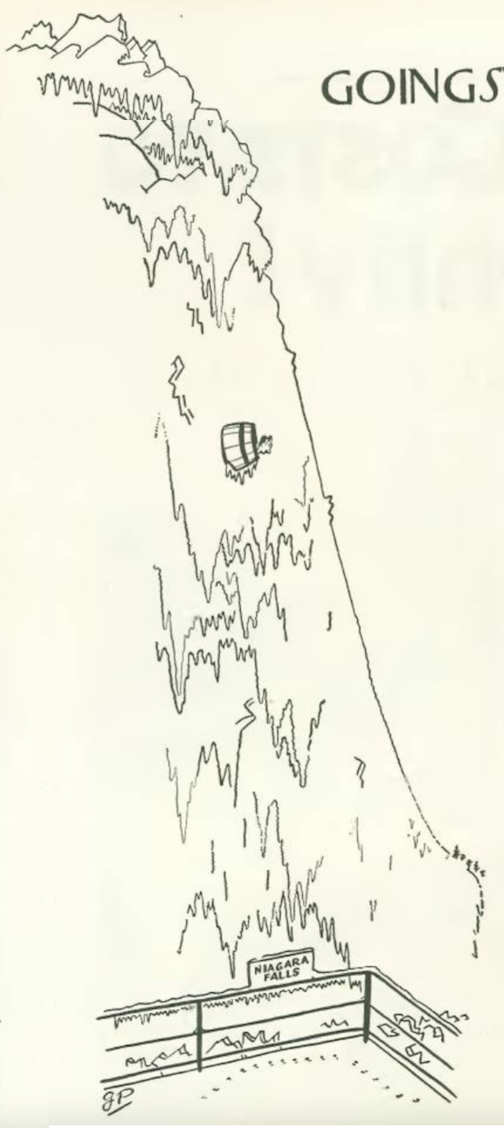
…and we kick off our cartoonists with this “Goings On” topper by D. Krán

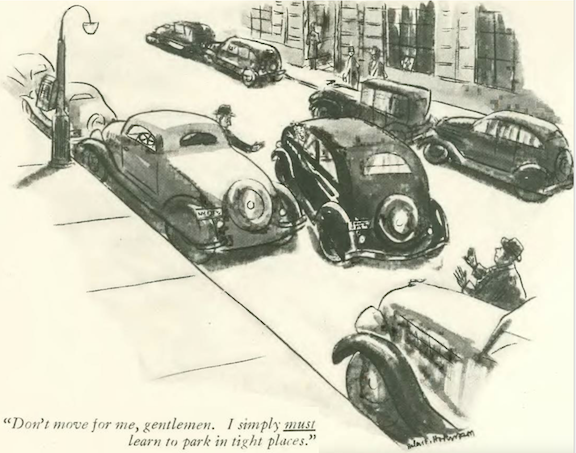
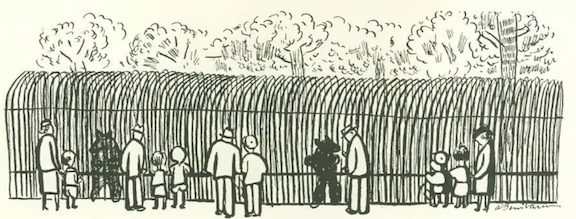
…followed by this visit to the zoo by Abe Birnbaum

James Thurber was up for some fashion criticism…

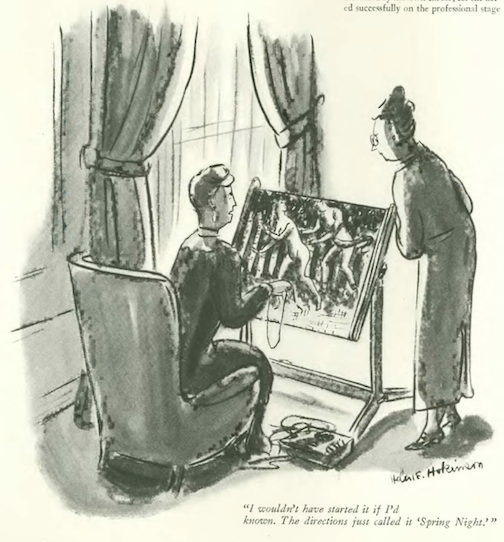
Helen Hokinson found a surprise in a paint-by-numbers kit..

Peter Arno was up for some late night nuptials…

Gluyas Williams continued to examine club life…

...George Price was back in the air…

Alan Dunn gave us some men on a mission…

…and we close with Charles Addams, and some dam trouble…

Next Time: Wining and Dining…


What’s in a Name?

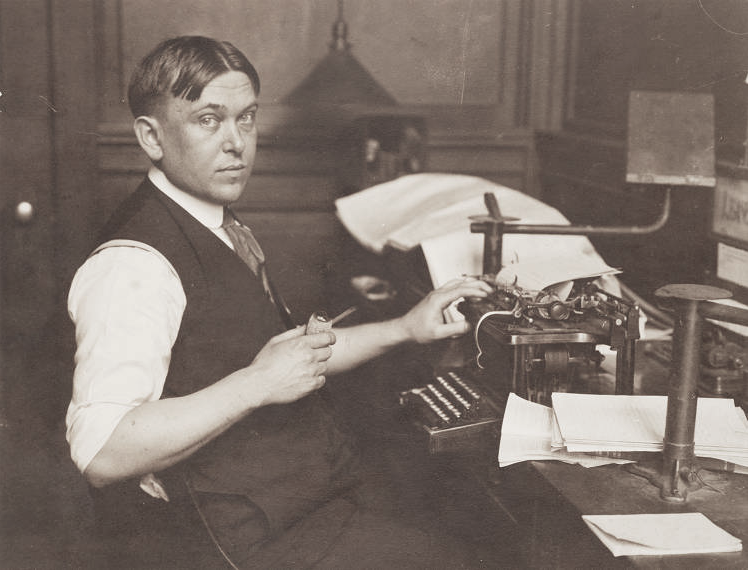
Above: H.L. Mencken at the Baltimore Sun, circa 1930. From April 1934 to September 1949, Mencken contributed more than fifty articles to The New Yorker.

The American journalist Henry Louis Mencken (1880–1956) was well-known as a biting satirist and cultural critic, but he was also a noted scholar of the English language and its various quirks.

May 11, 1935, Mother’s Day cover by William Cotton.

One of those quirks was explored in Mencken’s essay, “The Advance of Nomenclatural Eugenics In the Republic,” for the column “Onward & Upward With The Arts.” Broadly defined, eugenics refers to the discredited belief that selective breeding could be used to improve the human race. Mencken used the term satirically to describe the anglicization of immigrant names, either to conform to English spellings or, in many cases, to avoid racial and ethnic discrimination. An excerpt:

A PERFECT PAIRING, for H. L. Mencken, was a beer and a cigar. Here he is accepting “his first public glass of post-Prohibition beer” at the Rennert Hotel in Baltimore on April 7, 1933. In 1924 Mencken wrote: “Five years of Prohibition have had, at least, this one benign effect: they have completely disposed of all the favorite arguments of the Prohibitionists.” (digitalmaryland.org)

Many Jewish immigrants also abandoned their surnames, seeking to blend in and avoid discrimination. Historian and author Kirsten Fermaglich (A Rosenberg by Any Other Name, 2016) found that persons with Jewish-sounding last names made up 65 percent of all name change requests in New York in the first quarter of the 20th century. Mencken observed:

MEET BERNARD, BETTY, ISSUR AND MARGARITA…Some more famous examples of name changes in the first half of the 20th century. From left, actors (and New Yorkers) Tony Curtis (Bernard Schwartz), Lauren Bacall (Betty Joan Perske), Kirk Douglas (Issur Danielovitch Demsky), and Rita Hayworth (Margarita Carmen Cansino). (Wikipedia)

 * * *

Canada Dry

In his column, “Of All Things,” Howard Brubaker noted the “well-merited spanking” FDR gave to military leaders who were talking about fortifying the border with Canada. Brubaker agreed with FDR’s action, observing how Canadians came to the aid of thirsty Americans during Prohibition.

 * * *

Air France

Paris correspondent Janet Flanner considered the state of French aviation as well as signs of war preparation. She also noted the birthday of German dictator Adolf Hitler, the birth of French television, and the streamlined taxis that had suddenly appeared on the streets of Paris. Excerpts:

SOME ICE CREAM WITH YOUR SLICE OF HATE?…Clockwise, from top left, bakers carefully carry Adolf Hitler’s birthday cake in April 1935; the French, meanwhile, were ramping up war production including the manufacture of the M210 bomber; airplane factory workers fashion sheet metal in a factory in Châteauroux-Déols; streamlined Peugeot 401 taxis hit the Paris streets in 1935. (reddit.com/dassault-aviation.com/imcdc.org)

 * * *

Vamps and Vampires

John Mosher offered mixed reviews of Hollywood’s latest fare, finding Marlene Dietrich’s latest vehicle “fun,” and the singing and dancing of husband/wife Al Jolson and Ruby Keeler “uninspired,” a term he also applied to Bela Lugosi’s latest vampire flick.

TAKE YOUR PICK…Critic John Mosher sampled some very different films including, left, Marlene Dietrich and Lionel Atwill in The Devil Is a Woman; top, Ruby Keeler with her then-husband Al Jolson in Go Into Your Dance; and Bela Lugosi did his vampire schtick with the help of Carroll Borland (who played Dracula’s daughter) in Mark of the Vampire. (MoMA/Pinterest/Instagram)

 * * *

From Our Advertisers

We start off with a bang from Goodyear…tire blowouts were common in the 1930s as tire technology could not keep pace with the increasing speed of automobiles, nor the poor condition of many roads…

…after many weeks, the back cover went to something other than cigarette manufacturers…

…let’s take a look at some of the one-column ads from the back pages…many of them highlighted the various nighttime entertainments, from the rooftop of Hotel Pierre to the air-conditioned lounge at the Savoy-Plaza (plus that weird ad that suggested Corn Flakes as a nightcap)…

…interior designer Elsie de Wolfe rolled out “Iron with Tape” chairs, which might be the first example of what would become the ubiquitous webbed lawn chair…also advertised were apartments in the former Pulitzer mansion…

…the Pulitzer apartments were one happy outcome of the Great Depression, which foiled the plans of investors to demolish the house in 1934 and erect an apartment building…

The Pulitzer mansion still stands today, now divided into high-class coops. (daytoninmanhattan.blogspot.com)

…here’s something new from the Jay Thorpe shop, “noted for unusual sportswear”…

…perhaps inspired by Hollywood…

Ruby Keeler in 1935’s Shipmates Forever. (Reddit)

…illustrator Lyse Darcy created many of these distinctive ads for Guerlain products from the 1930s through the 1950s…

…on to our cartoonists, we begin with spot art from James Thurber

…and Thurber again…

…and we have two from George Price

Otto Soglow continued with his multi-panel tricks…

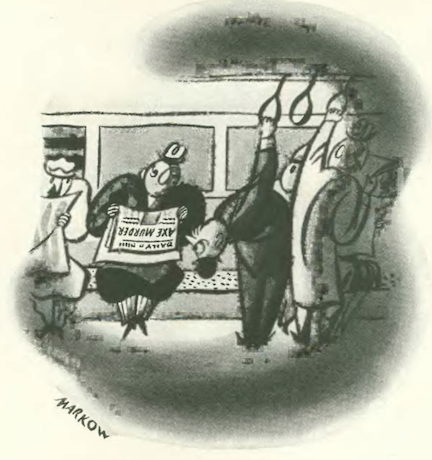
Howard Baer did some eavesdropping on the rails…

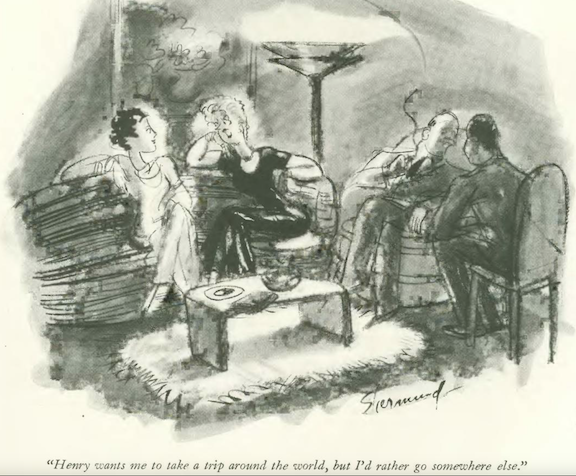
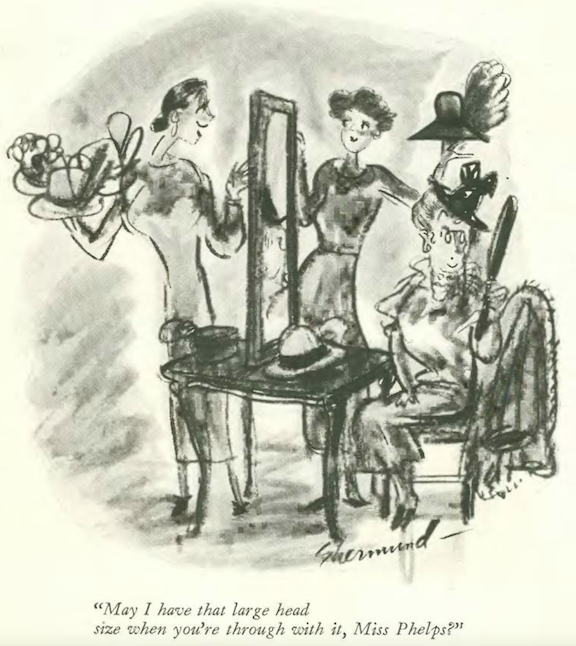
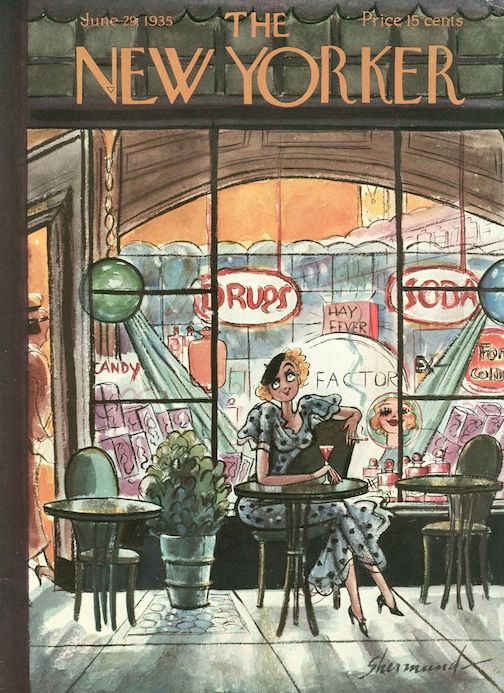
…while Barbara Shermund checked in on her modern women…

Alan Dunn gave us a mother who took care of herself on Mother’s Day…

Peter Arno found some kindly advice in the crowded city…

Al Frueh put the “tennis” back into table tennis…

…and we close with Charles Addams, who had become a regular contributor but was still more than three years away from launching his “Addams Family” cartoons…

Next Time: Settling Down, In a Way…


The Royal Treatment

Above: King George V and Queen Mary posed for portraits by John St Helier Lander to commemorate the king’s Silver Jubilee in 1935. (Wikipedia) 

The British Royal Family has never been my cup of tea, but its hard to deny their influence on world affairs, even if today it is mostly ceremonial. The king and queen were also figureheads back in 1935, however they could still claim to lead a vast empire, albeit one badly fraying at the seams.

May 4, 1935 cover by Ilonka Karasz.

Then as now, the power of the royals lay largely in their ability to boost the political and economic fortunes of their island nation. Such was observed by The New Yorker’s Paris correspondent Janet Flanner, who penned a two-part profile of Queen Mary (nee Mary of Teck or more formally Victoria Mary Augusta Louise Olga Pauline Claudine Agnes; Queen of the United Kingdom and the British Dominions, and Empress of India). Flanner wrote the profile of Queen Mary (1867-1953) in anticipation of the Silver Jubilee of her husband, King-Emperor George V (1865-1936). Excerpts:

A DEB AND A DUKE…In 1886 Mary was a an unmarried British princess who was not descended from Queen Victoria, so she was a suitable candidate for the royal family’s most eligible bachelor, Mary’s second cousin Prince Albert Victor, Duke of Clarence and Avondale. In early December 1891 Albert Victor (left photo) proposed marriage to Mary, but he died six weeks later in the Russian flu pandemic. Less than two years later (July 1893) Albert Victor’s brother, Prince George, Duke of York, would wed Mary—at right, their wedding day photo. (Wikipedia)

Flanner noted that the King George V and Queen Mary were rated by British industrialists as the Empire’s “two best salesmen,” however it was Mary who proved the most influential whether she was buying a hat or a refrigerator. Excerpts:

SILVER AND GOLD…Top photo: to mark the king’s Silver Jubilee on May 6, 1935, King George V and Queen Mary greet their subjects from a balcony at Buckingham Palace with their grandchildren, (from left) Princess Margaret Rose, Hon. Gerald Lascelles, Princess Elizabeth, and Viscount Lascelles. Below, King George V, the Duke and Duchess of York, and Princess Elizabeth take a trip in the royal carriage, 1933. The Duke and Duchess would succeed the throne upon the death of King George in 1936 and the abdication of the Duke’s brother, Edward, that same year. (Reddit/Town & Country)

Naturally, not everyone in the kingdom was thrilled by the Silver Jubilee…

OPPOSING VIEWPOINT…The anti-monarchist cartoonist Desmond Rowney commemorated the Silver Jubilee with this cartoon in the Daily Worker. The public expense for the Silver Jubilee in the midst of a financial depression caused some controversy. (National Archives UK)

 * * *

Corn-fed Canvasses

Critic Lewis Mumford, like many East Coast intellectuals, was allergic to the over-patriotic and the sentimental, so when it came to assessing the work of the regionalist painter Grant Wood (1891-1942), Mumford found himself perplexed but hopeful that Wood would one day “find himself” and produce “first rate” art.

FLANKING THE ICONIC painting American Gothic (1930) are Grant Wood’s Self Portrait (1932) and, at right, Arnold Comes of Age (1930). Lewis Mumford considered American Gothic to be Wood’s best work. (figgeartmuseum.org/whitney.org/sheldonartmuseum.org)

Mumford did not mince words, however, when it came to Wood’s contemporary landscapes, which he called “unmitigatedly bad…If that is what the vegetation of Iowa is like, the farmers ought to be able to sell their corn for chewing gum…”

BUBBLEGUM TREES…From 1919 to 1925, Grant Wood taught junior high art in Cedar Rapids, Iowa. The seasonal nature of teaching allowed Wood to take summer trips to Europe to study art, and his early work showed strong post-impressionist influences, including his impressionistic Vegetable Farm (top) from 1924; below, Mumford thought Grant’s later landscapes looked like they were made of cotton and sponge rubber, including Near Sundown, from 1933. (wikiart.org)
HOPE AND NOPE…Mumford wrote that Wood’s more “hopeful” works included, top left, Death on Ridge Road and, top right, Adolescence. On the other hand, he found the portraiture in Dinner for Threshers (bottom) vacuous, suggesting “a color photograph of a model of Life in Iowa done for a historical museum.” (wikiart.org/figgeartmuseum.org)

 * * *

Daring Young Man

“The Talk of the Town” paid a visit to William Saroyan (1908–1981), an Armenian-American novelist, playwright, and short story writer who would go on to receive a Pulitzer Prize for Drama in 1940 and a 1943 Academy Award for Best Story for the film The Human Comedy. An excerpt:

HIGH WIRE ACT…The Daring Young Man on the Flying Trapeze and Other Stories (1934) was the first collection of 26 short stories by William Saroyan (pictured here in 1940). The book became an immediate bestseller. (Wikipedia)

 * * *

Not Long For Long

In his column “Of All Things,” Howard Brubaker noted that the “loose talk” of Huey Long, a U.S. Senator from Louisiana and prominent critic of the New Deal, could be squelched by a Senate vote. As it turned out, it wouldn’t be necessary; Long was felled by an assassin’s bullet four months later.

 * * *

Ode to Abode

E.B. White turned to verse to offer his thoughts on where one should live:

 * * *

Tough Guys

After a musical comedy, a Shakespeare adaptation (A Midsummer Night’s Dream), and another comedy, James Cagney returned to familiar form with an exciting crime drama, G Men. Critic John Mosher was pleased that Cagney was back to tap-dancing with machine guns rather than showgirls.

CRIME PAYS…AT THE BOX OFFICE… James Cagney takes aim at his new role as a federal agent James “Brick” Davis in G Men. With the Hays Code in force, Warner Brothers made the film to counteract what many leaders claimed was a disturbing trend of glorifying criminals in gangster films. (Still from film)

 * * *

From Our Advertisers

According to General Motors’ Fischer division, good taste was in order whether you were choosing a spouse or an automobile…

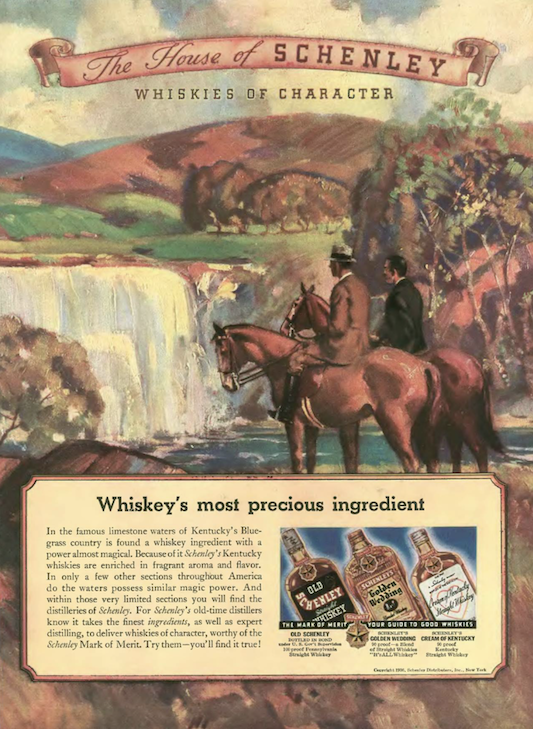
New Yorker ads continued to display bright colors to sell everything from cars to whiskey to sparkling water (with apparent health benefits)…

…the shadowy Dubonnet mascot was back, here making the claim (against the wisdom of the ages) that a lunchtime drink will clear your head for the afternoon ahead…

…no health claims here from Penn Maryland, just pure magic as depicted by Otto Soglow

…and what goes better with whiskey than the Kentucky Derby…

…the 1935 Kentucky Derby was won by Omaha, a three-year-old Thoroughbred; he was the third horse to ever win the Triple Crown (Omaha was the son of Gallant Fox, the 1930 U.S. Triple Crown winner)…

Omaha in 1935 (Wikipedia)

…on the subject of Thoroughbreds, Camel offered up testimonials from top athletes in a variety of sports…they all agreed that the cigarettes “don’t get your wind”…so what did that mean?…according to R.J. Reynolds, “It means you can smoke Camels all you want”…

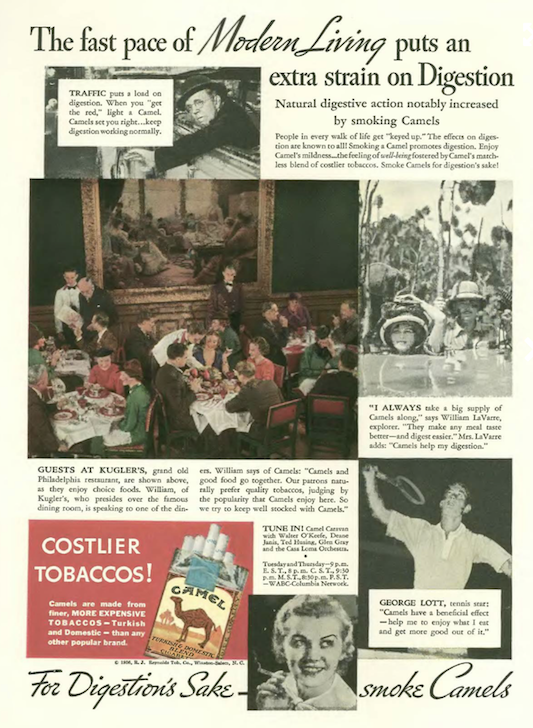
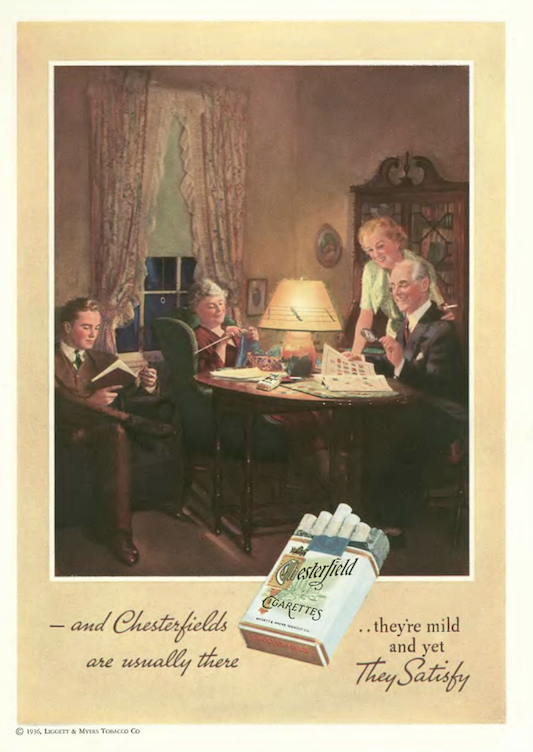
…Camels also calmed the nerves, and so apparently did Chesterfields…

…on to our cartoonists, we begin with a spot by Charles Addams at the top of page 2…

…later in the issue James Thurber contributed this drawing to stretch across the bottom of page 62 (“On and Off the Avenue”)…

…Thurber again, with the life of the party…

William Steig offered up a page-full of wits…

…plus one more on the preceding page…

Gluyas Williams continued to follow the strange ways of club life in America…

…and we close with Alan Dunn, and service with a smile…

Next Time: What’s In a Name?…


Broadacre City

Above: Detail from Spanish architect David Romero's computer-generated model of Frank Lloyd Wright's Broadacre City, complete with an "aerotor" flying car.

To be sure, architect Frank Lloyd Wright was a visionary, creating a uniquely American vernacular that influences architecture and design to this day. That might also true for his Broadacre City concept, which demonstrated how four square miles (10.3 km2) of countryside might be settled by 1,400 families. Wright unveiled this escape to the countryside in the middle of Manhattan.

April 27, 1930 cover by Reginald Marsh.

On April 15, 1935, the Industrial Arts Exposition opened at Rockefeller Center, and Wright (1867-1959) was front and center with his audacious proposal to resettle the entire population of the United States onto individual homesteads. Critic Lewis Mumford observed that Wright “carries the tradition of romantic isolation and reunion with the soil” by putting every American family on a minimum of five acres of land.

FLAT EARTH…Clockwise, from top left, cover of Rockefeller Center Weekly featuring the Industrial Arts Exposition—the model on the cover is identified as “Miss Typical Consumer”; detail from the magazine depicting a “streamlined farmstead” in Broadacre City; Frank Lloyd Wright examining the Broadacre City model, circa 1935; Wright students who crafted the 12×12-foot model, circa 1935. (digital.hagley.org/franklloydwright.org)

Wright first presented the idea of Broadacre City in his book The Disappearing City in 1932…

ROMANTIC ISOLATION…Broadacre City as depicted in Wright’s 1932 book The Disappearing City. (Wikipedia)

…note how the above drawing is reflected in one of Wright’s last designs, the Marin County Civic Center:

(visitmarin.org)

A detailed 12×12-foot scale model of Broadacre City—crafted by Wright’s student interns at Taliesin, was unveiled at the Industrial Arts Exposition:

GREEN ACRES…The 12×12-foot model (top images) crafted by student interns who worked for Wright at Taliesin is now housed at the Museum of Modern Art (MoMA); bottom right, Wright’s rendering of Broadacre City, and at left, detail from Spanish architect David Romero’s computer-generated model of Broadacre City (more images below). (MoMA/David Romero via Smithsonian)

For the most part Mumford reacted favorably to Wright’s vision, which is no surprise considering that Mumford derided the dehumanizing skyscrapers popping up all over his city (including Rockefeller Center).

Despite his patrician demeanor, Wright envisioned an egalitarian Broadacre City, with every family having access to cars, telephones and other appliances. Power would come from solar and electric energy, and any technological advances would be applied at a local level toward the common good.

VIRTUAL REALITY…In 2018 Spanish architect David Romero created computer-generated models to see what Wright’s unrealized structures might have looked like. At left, cars (based on Wright concepts) in Broadacre City, and an aerial view featuring a tower that bears a strong resemblance to Wright’s 1956 Price Tower in Bartlesville, Oklahoma. Modeling Broadacre took Romero more than eight months to complete—it contains more than one hundred detailed buildings, one hundred ships, two hundred “aerotors” (based on the autogyros of the day), 5,800 cars, and more than 250,000 trees. (David Romero via Smithsonian and openculture.com)

What Mumford (and perhaps Wright) didn’t fully anticipate was the urban sprawl such a vision would help inspire, the suburban and exurban landscape that would lead to a car-dominated world of congested, multi-lane highways and housing developments that continue to encroach on our woodlands and wetlands. And we didn’t get those groovy aerotors either.

(Christoph Gielen, webcolby.edu)

 * * *

Little House on the Avenue

E.B. White, in his “Notes and Comment,” also offered some observations on housing trends, noting the manufactured “Motohome” displayed at Wanamaker’s as well as “America’s Little House,” plopped down at the corner of 39th and Park Avenue.

SETTING A STANDARD…Above, the factory-manufactured Motohome (above) was touted as the solution to the nation’s housing shortage. The federal Better Homes in America organization built a model house (“America’s Little House,” below) at 39th and Park Avenue to illustrate how standardized components and methods could make home improvement easier. (Google Books/Johns Hopkins)

* * *

Horsing Around

Although known for their nonchalance, New Yorkers could still find some enthusiasm when the circus came to town. “The Talk of the Town” looked in on the star of the circus, Dorothy Herbert (1910-1994), a trick rider with the Ringling Bros. and Barnum & Bailey Circus.

WHOA NELLY…One of Dorothy Herbert’s signature moves was her layback on a rearing horse. Here she demonstrates the move in 1939. (equineink.com)
HOT STUFF…Circus poster touts Herbert’s ride over flaming hurdles in the company of twelve riderless horses. (circushistory.org)

 * * *

Don’t Call Him ‘Tiny’

He was known as “The Little Napoleon of Showmanship,” but there was nothing small about Billy Rose’s accomplishments as an impresario, theatrical showman, composer, lyricist and columnist. Here are excerpts from Alva Johnston’s profile:

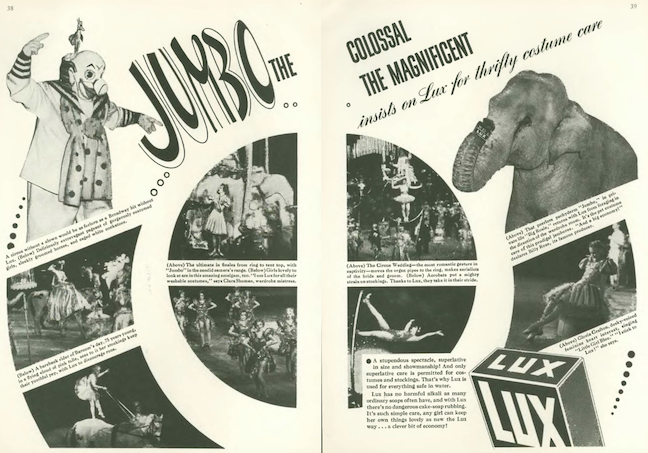
JUMBO-SIZED ENTERTAINMENT…Clockwise, from top left, Billy Rose and his first wife, comedian-actress Fanny Brice; illustration of Rose for the profile; poster announcing Rose’s 1935 stage spectacle Jumbo at the Hippodrome; described as more circus than musical comedy, Jumbo was one of the most expensive theatrical events of the first half of the 20th century. (jacksonupperco.com)

 * * *

On Guard

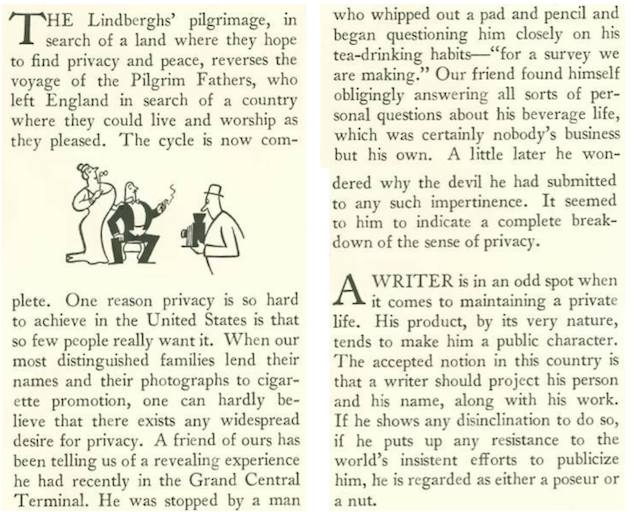
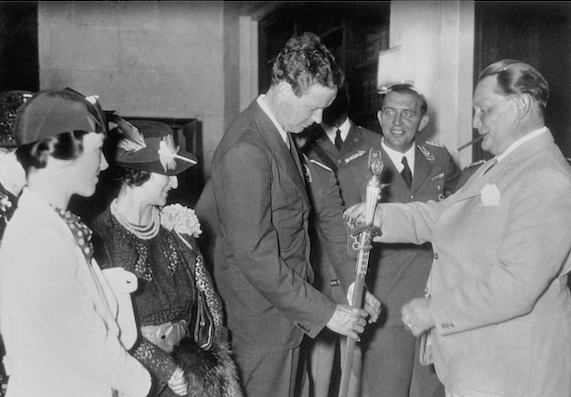
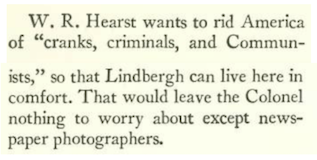
We shift gears and turn to more sobering events of the 1930s, namely the rise of fascism in Europe. In his column “Of All Things,” Howard Brubaker pondered the possibilities of fascism in his own country…

…meanwhile, Paris correspondent Janet Flanner was finding nothing funny about the uneasy calm among Parisians as war with Germany seemed likely.

C’EST LA VIE…Janet Flanner found Parisians resigned to whatever fate awaited them in 1935. (unjourdeplusaparis.com)

Flanner also remarked on Leni Riefenstahl’s Nazi propaganda film Triumph des Willens (Triumph of the Will). Flanner’s assessment of this “best recent European pageant” wryly underscored the horrors the film portends.

 * * *

News From An Old Friend

Longtime readers may recall one of my earliest entries on Queen Marie of Romania (1875-1938); the March 14, 1925 edition of The New Yorker (issue #4) found New Yorkers “agog” over her planned 1926 visit to the city. Her comings and goings were followed for a time (she also appeared in a Pond’s Cold Cream ad in the June 6, 1925 issue), but then she abruptly disappeared. Here she is again, courtesy of a glowing book review by Clifton Fadiman. An excerpt:

A PROGRESSIVE THINKER for her time, Marie of Romania was immensely popular in America. Born into the British royal family, she was the last queen of Romania from 1914 to 1927. At left, portrait from 1920; at right, during her 1926 visit to the States, Marie received a headdress from two American Indian tribes. They named her “Morning Star” and “Winyan Kipanpi Win”—“The Woman Who Was Waited For.” (Wikipedia/brilliantstarmagazine.org)

 * * *

From Our Advertisers

Although we’ve seen plenty of ads from prestige automakers such as Packard, it was clear that companies found their sweet spot in lower-priced models that still suggested “prestige”…here’s an example from Cadillac’s budget line LaSalle…

…for less than half the price of a LaSalle you could get behind the wheel of Hudson, its makers suggesting that prestige doesn’t preclude thrift…this ad seems to have been hastily produced–note the right side of ad, with just a slice of some toff squeezed next to the copy…

…this advertisement would only appeal to those who were among the tiny minority who could afford to fly…from 1924 to 1939 this early long-range airline served British Empire routes to South Africa, India, Australia and the Far East…

…for reference, detail below of a Scylla-class airliner used by Imperial Airways…

…and what would the back cover be without a photo of a stylish woman having a smoke?…

…a few advertisers referenced the circus in town to drum up business…

…and we segue to our cartoonists and illustrators, and this circus-themed spot from an illustrator signed “Geoffrey”…

…a more familiar name is found at the bottom of page 4…namely Charles Addams…the milk order outside the tomb hints at things to come…

…Addams again, going from Bacchus to beige…

George Price, and well, you know…

Robert Day was aloft with a speculative builder…

William Steig typecast his Small Fry…

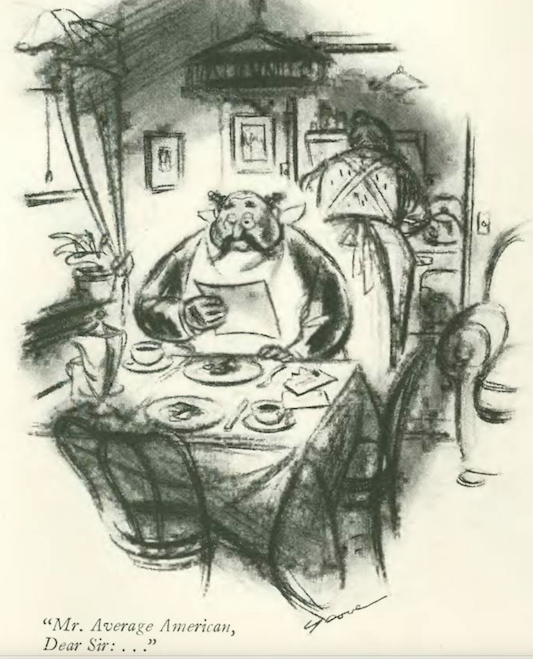
Leonard Dove made a sudden exit…

Gilbert Bundy found one old boy unaffected by spring fever…

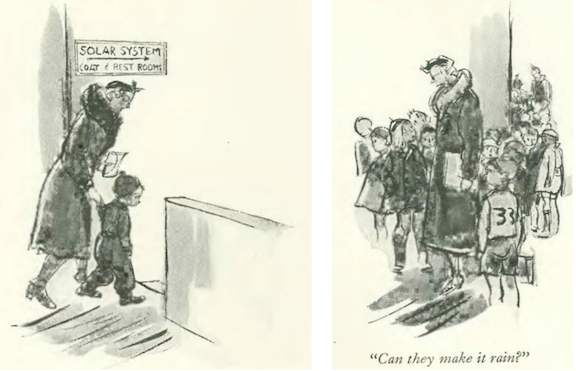
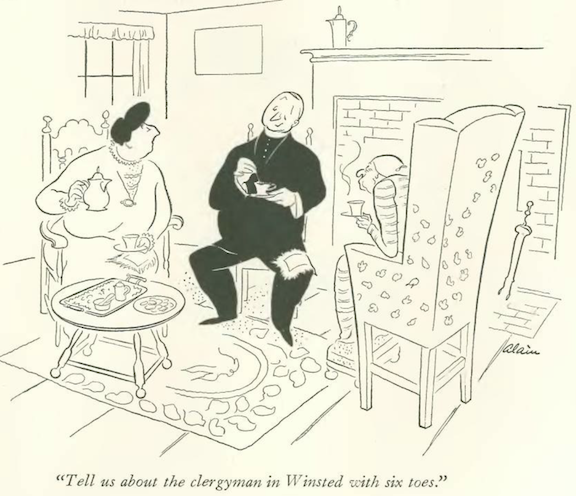
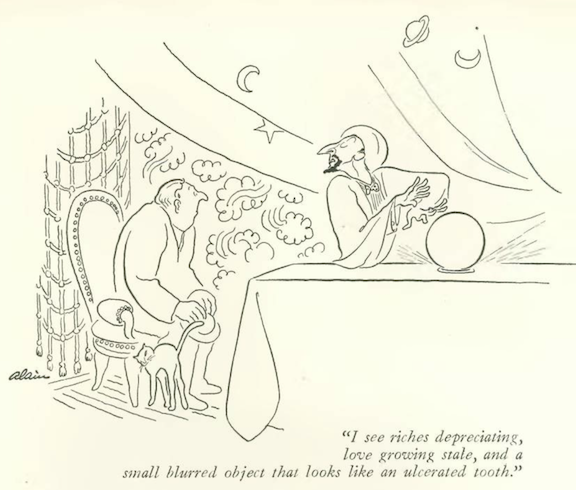
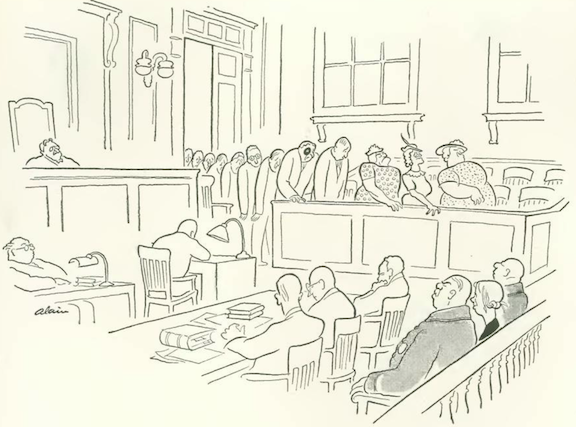
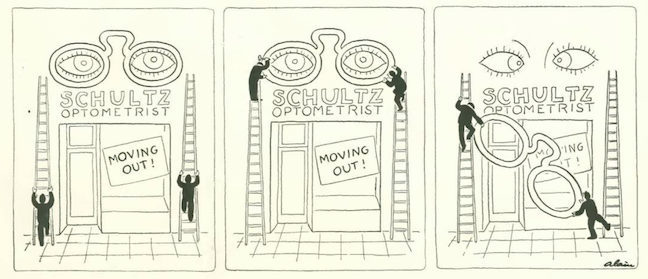
Alain channeled Barbara Shermund to give us this gem…

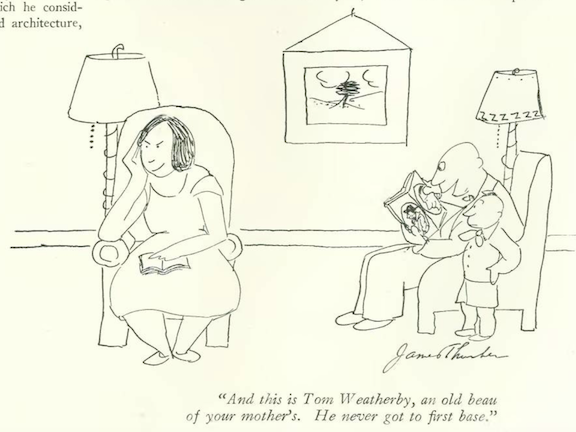
…and we close with a typical day in James Thurber’s world…

Next Time: The Royal Treatment…


Legitimate Nonchalance

Above: W.C. Fields was a well-known juggler and vaudeville performer decades before he became even more famous in the movies of the 1930s.

William Claude Dukenfield was a vaudeville juggler who distinguished himself from other “tramp acts” by adding sarcastic asides to his routines. Internationally known for his juggling skills, by the turn of the century the man who billed himself as “The Eccentric Juggler” would become much better known by another name: W.C. Fields.

Feb. 2, 1935 cover by Roger Duvoisin.

In the first of a three-part profile, Alva Johnston pondered the secret behind Fields’ genius, an “inborn nonchalance” that he considered “the rarest of gifts.” Johnston surmised that some of that genius derived from the volatile relationship Fields had with his father, and the street-smarts he gained as a runaway at age eleven. It is no surprise, however, that these childhood stories of hardship were significantly embellished by the great wit himself.

A STAR IS FORMED…Clockwise, from top left, W.C. Fields in his youth; Fields was an internationally known juggler, seen here in his vaudeville days in the early 1900s; Fields made his screen debut in 1915, seen here in his second film, Pool Sharks (1915); Fields with Carol Dempster in Sally of the Sawdust, a 1925 silent comedy film directed by D. W. Griffith. (Pinterest/YouTube)

Johnston also described Fields’ acting style and demeanor, noting that the actor’s asides were likely inspired by his mother, Kate Spangler Felton, who was known for her doorstep witticisms.

NINETEEN THIRTY-FIVE WAS A GOOD YEAR for W.C. Fields, who starred in It’s a Gift (right), released the previous December, and in the 1935 screen adaptation of Charles Dickens’s David Copperfield, as the character Wilkins Micawber. (MGM/IMDB)

 * * *

Macabre Diversions

In the days before television and the internet, folks got their dose of the sensational and macabre from the tabloids, or, on occasion, in real life. Before crime or accident scene investigations became more sophisticated, it was not uncommon for crowds to mob grisly death scenes, including the car containing the bullet-riddled bodies of notorious bank robbers Bonnie Parker and Clyde Barrow. Their Ford automobile, pocked with 112 bullet holes, became a popular traveling attraction at fairs, amusement parks, and, in February 1935, at a car dealer’s showroom in Missouri. E.B. White explained:

BEFORE THE INTERNET, folks got their ghoulish thrills by rubbernecking at famous crime scenes. At left, a crowd gathers around the bullet-riddled car belonging to Bonnie and Clyde. According to one account, at the scene of the police ambush on Louisiana State Highway 154, nearly everyone collected souvenirs including shell casings and bloody pieces of clothing from Bonnie and Clyde. One man even tried to collect Clyde’s left ear with a pocket knife; at right, unidentified man standing next to the “death car.” (KXAN/unt.edu)

 * * *

Saar Kraut

Janet Flanner mused on the recent plebiscite in the Saarland, which following World War I was seized from Germany and placed under the governance of a League of Nations commission. Much to the dismay of the French, the majority German population voted to return the Saar region to Germany, and its Nazi leadership.

 * * *

Over the Rainbow

In a previous column, Lois Long took aim at the Rockefeller Center’s new Rainbow Room, dismissing it as a tourist trap filled with interminable strains of organ music. In her latest column, Long retracted some of that vitriol, finding the entertainment (and, one supposes, the food) more to her liking.

THE ‘INCORRIGIBLE’ Beatrice Lillie (left) delighted Lois Long and audiences in the Rainbow Room on the 65th floor of Rockefeller Center; at right, ballroom dancers Lydia and Joresco take to the floor in the then newly opened Rainbow Room, 1934. (Pinterest/#rainbowroomnyc)

 * * *

From Our Advertisers

As Lois Long mentioned in “Tables for Two,” British actress and singer Beatrice Lillie was appearing at in the Rainbow Room on the 65th floor of Rockefeller Center; according to the ad below, also featured were ballroom dancers Lydia and Joresco and bandleader Jolly Corburn

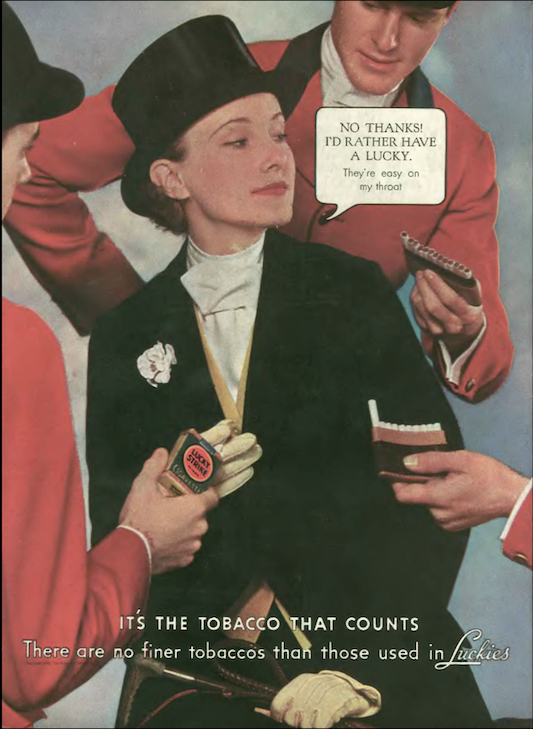
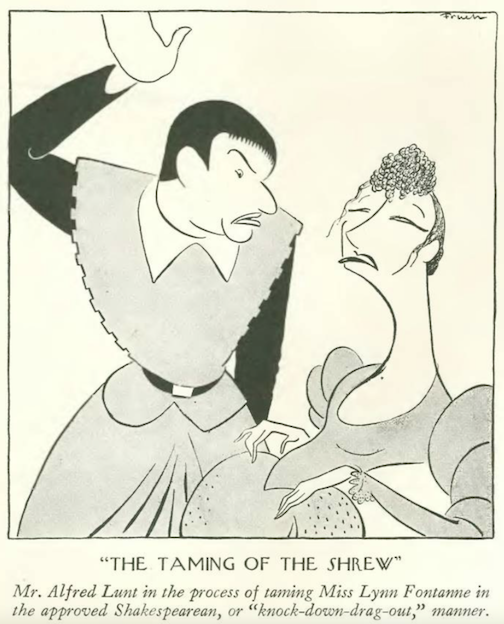
…at first I though this was Alfred Lunt and Lynn Fontanne shilling for Luckies, but the resemblance isn’t quite there, plus I’m not aware of the Broadway legends ever endorsing any product, let alone cigarettes…

…the folks at Hormel continued to feature notable Frenchmen who were known to enjoy French onion soup, although this particular image doesn’t do much for one’s appetite…

…the Bermuda Trade Development Board continued to feature colorful ads that enticed New Yorkers away from the late winter blahs…

…this ad for Schaefer is a bit odd…I guess the artist wanted to suggest a handbill, and therefore tilted the image it at an angle, unsuccessfully, one might add…

…The Theatre Guild once again called upon the talents of James Thurber to advertise their latest production…

…which segues into our cartoons, with Thurber once more…

Al Frueh did his part to promote the stage with this illustration for the theatre section…

Otto Soglow offered his spin on pairs figure skating…

Gardner Rea explored the world of art appreciation…

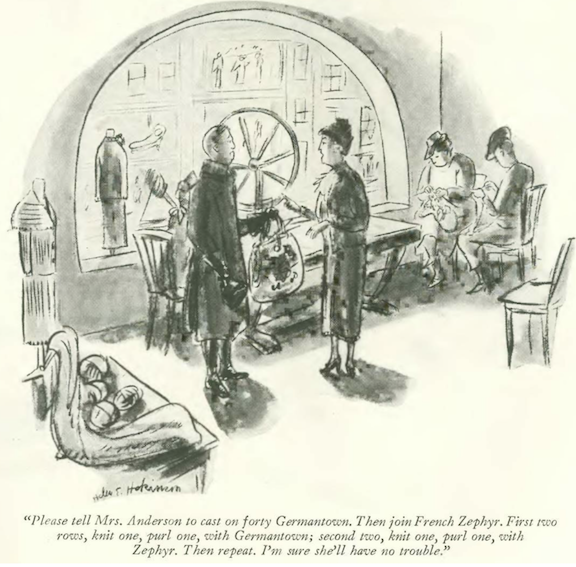
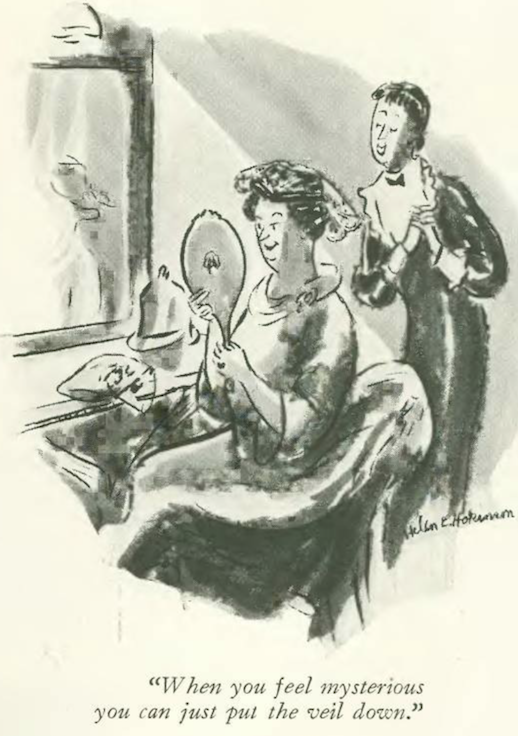
Helen Hokinson aptly supplied this cartoon for Lois Long’s fashion column…

Whitney Darrow Jr. showed us the consequences of classified advertising…

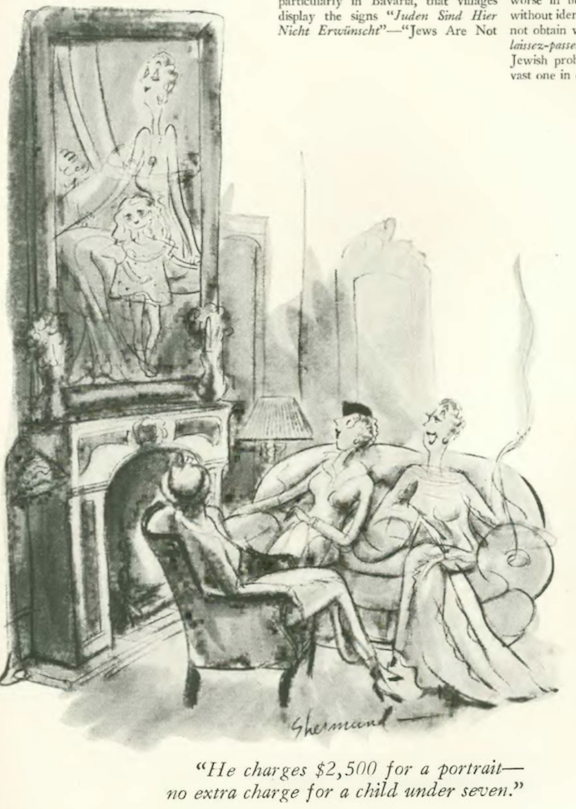
Barbara Shermund clued us in on the latest gossip…

…and we close with Peter Arno, and one butcher’s cold greeting…

Next Time: A Decade of Delights…


Everything’s Jake

Lois Long employed the Prohibition-era slang term “Everything’s Jake” (“it’s all good”) to headline her latest installment of “Tables for Two.” If you’ve been following the exploits of our nightlife correspondent in this blog, you might recall that for a time in the early thirties she found the New York club scene lackluster, without the daring and grit of the speakeasy era. Lately, however, she was finding some new adventures after dark.

Jan. 19, 1935 cover by Constantin Alajalov.

Long checked out the Revue Folies Bergère at the Earl Carroll Theatre, which had been renamed the French Casino, as well as the cavernous Flying Trapeze and the refurbished Hollywood Restaurant, headlined by crooner Rudy Vallée.

FROLIC AND FOLLY…Clockwise, from top left, a Dec. 24, 1934 Herald-Tribune advertisement for the Revue Folies Bergère, the show that opened the new French Casino; a bubble dance as part of the revue, circa 1936; the interior of the French Casino, view from the stage; interior view of former lounge underneath the balcony converted to a cocktail lounge for the French Casino. (Images from Chris Arena and Anthony L’Abbate via drivingfordeco.com/MCNY)
THE SERPENTINE WRITHINGS of dancers Harald and Lola (Harold Liebmann and Lola Werbesz) dazzled Lois Long during a Folies Bergère performance at the French Casino…They are seen here performing at New York’s Shubert Theatre during their first U.S. tour in 1932. (roosvt.com)
OTHER NIGHTLY DISTRACTIONS…Clockwise, from top left, postcard image of the cavernous Flying Trapeze Restaurant; Lois Long missed Sally Rand’s bubble dance at the Paradise, but she did catch a swell show at the Hollywood Cabaret at 48th and Broadway featuring Rudy Vallee, seen here on a 1935 postcard; exterior of the Hollywood Cabaret, circa 1935. (Pinterest)
NAUGHTY OR NICE…Lois Long was astonished by the female impersonators at the “naughty” Club Richmond…the club’s performers included Harvey Lee. (ualr.edu)

Long also checked out the “naughty” Club Richmond, and returned to the Central Park Casino, which was not long for the world.

 * * *

The Cost of Living

In 1934 Gloria Morgan Vanderbilt famously lost custody of her daughter, Gloria Laura Vanderbilt, to her sister-in-law Gertrude Vanderbilt Whitney. Granted limited parental rights, Gloria Morgan was allowed to see her daughter on weekends in New York, but the court had removed GMV as administrator of her daughter’s trust fund, her only source of support. Howard Brubaker had this to say in his column “Of All Things.”

WHAT’S A MOTHER TO DO? Gloria Morgan Vanderbilt in a 1933 photo. Inset, daughter Gloria Laura Vanderbilt in 1935. (Duke University)

 * * *

Too Much of a Good Thing

The French automaker Citroën established its reputation for innovation with the 1934 Traction Avant—the first car to be mass-produced with front-wheel drive, four-wheel independent suspension, and unibody construction. However, the cost of making all of these swell improvements—including the tearing down and rebuilding of company’s factory in just five months—led to the financial ruin of the company. After Citroën filed for bankruptcy in December 1934, its largest creditor, the tire-making giant Michelin, swept in to become the principal shareholder

Not only did Citroën lose control of its car company, it also lost its claim to the world’s largest advertising sign. Four nine years Citroën had its brand name emblazoned on the Eiffel Tower, but with bankruptcy (high electricity bills didn’t help) the company was forced to turn off the sign. Paris correspondent Janet Flanner had this observation:

CAN’T MISS IT…From 1925 to 1934, 125,000 glowing lights advertised the Citroën brand on the Eiffel Tower. At right, the company’s innovative 1934 Traction Avant. (Pinterest)

 * * *

From Our Advertisers

The National Motor Boat Show replaced the New York Auto Show as the main attraction at the Grand Central Palace…

…the folks at Pond’s found another Vanderbilt to shill for their cold cream, Muriel Vanderbilt, a socialite and noted thoroughbred racehorse owner…she is joined here by Washington Debutante Katrina McCormick, who was also a fancier of the horse circuit…

…the famed slogan Guinness is Good for You was launched in 1929, and apparently there is some truth to the claim (antioxidants, according to a University of Wisconsin study), and no doubt it was kinder to one’s morning head than other libations…

…if you preferred the stronger stuff, you could take the advice of cartoonist Peter Arno and Penn Maryland Whiskey, here making a play on words with the title of the 1925 novel (and Broadway play) Gentleman Prefer Blondes…

…here’s Arno again, with a touching moment among the upper crust…

Mary Petty also looked in on the gilded set, and a callous young toff…

…but down in the lower classes, George Price found the youth quite engaging…

Alain looked in on a formidable ping-pong opponent…

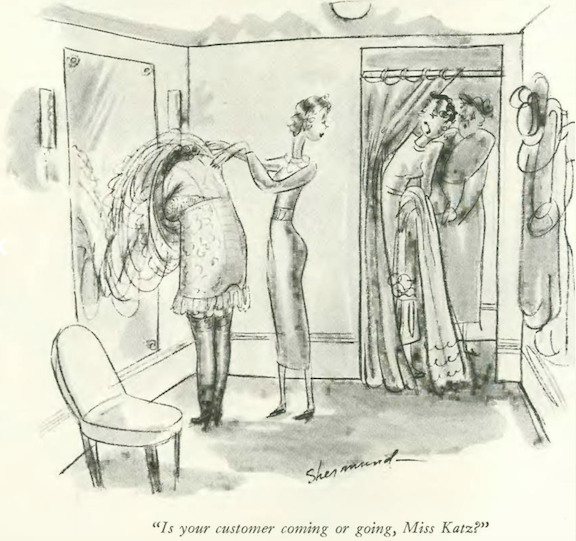
Barbara Shermund was evesdropping backstage at a Broadway revue…

…and we close with James Thurber, and a polite suggestion…

Next Time: Mary Quite Contrary…