You’ve Come a Long Way, Baby

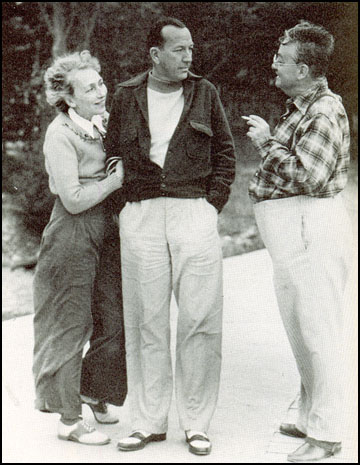
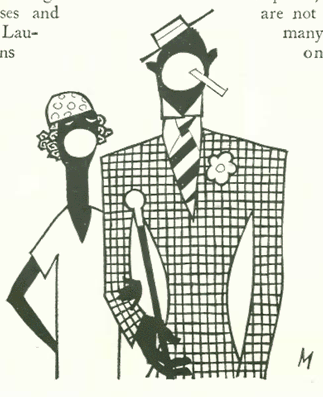
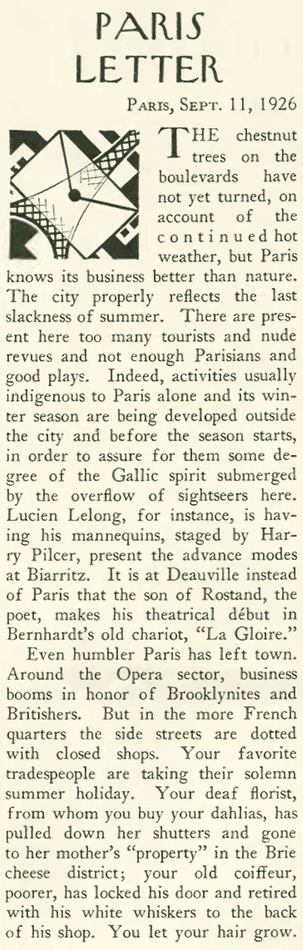
Above: Noël Coward and Gertrude Lawrence in a 1930 performance of Coward's Private Lives. Encyclopedia Britannica.

Those of us who still remember cigarette ads on television will recognize the tagline that heads this blog–“You’ve come a long way, baby,” was the jingle for Virginia Slims–which in 1968 was a new, thin cigarette from Phillip Morris marketed specifically to women.

9983e8cd5c5a373ecc556a6012f32c9a
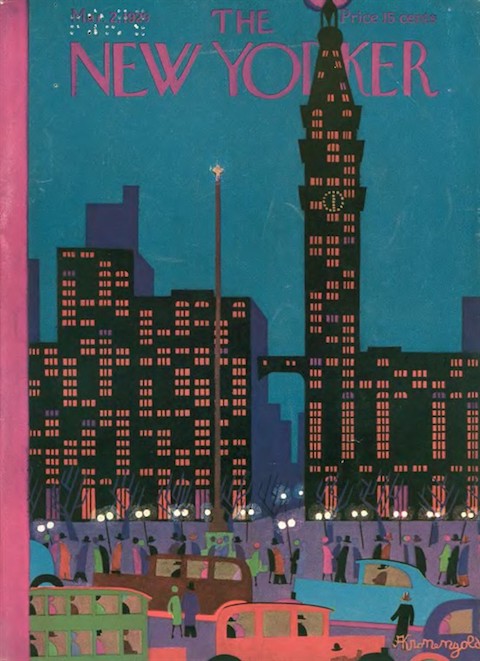
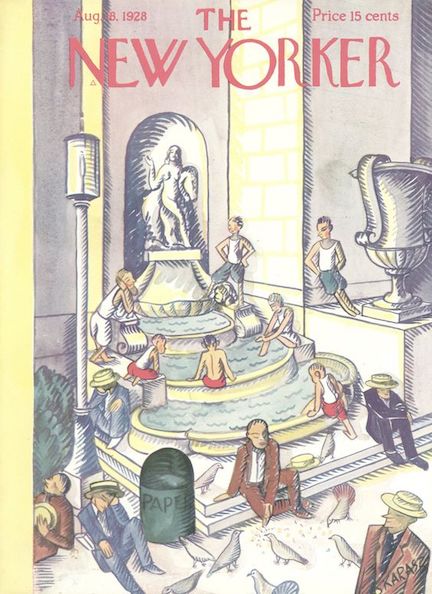
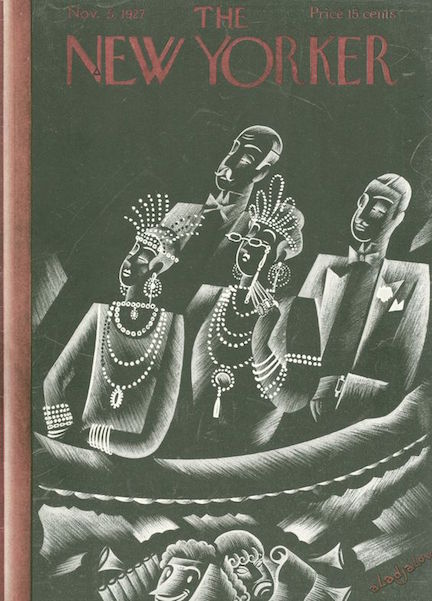
October 29, 1927 cover by Julian de Miskey.

The campaign launched by the Leo Burnett Agency sought to make Virginia Slims an “aspirational” brand for the liberated woman of the Swinging 60s…

1968-virginia-slims-ad
These ads from 1968 announced a new cigarette for the liberated woman. (flashbak.com)

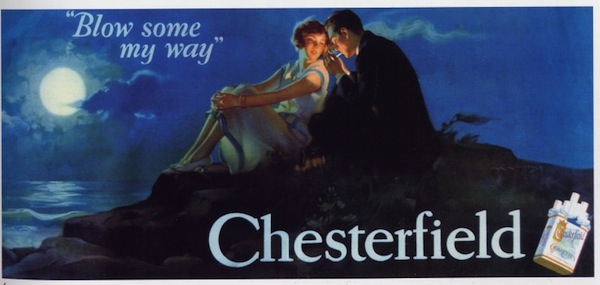
Forty years earlier, the folks at Liggett & Myers Tobacco Company also thought they could trade on the image of the Jazz Age’s liberated woman with this famous ad from 1926:

154997-chesterfield2
(History News Network)

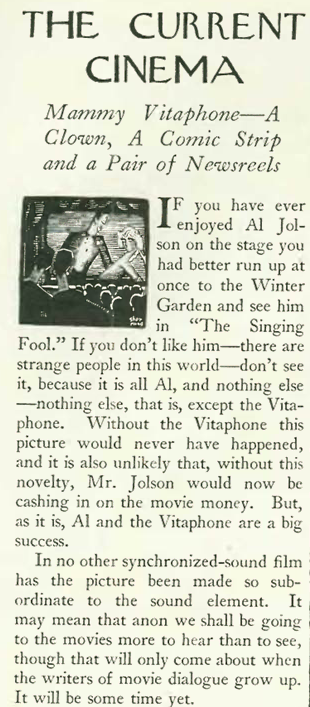
Although the woman in the ad was not smoking, a taboo had been broken by merely suggesting she might be a smoker. The New Yorker first explored this topic in their July 24, 1926 issue, with this item in “The Talk of the Town”…
Screen Shot 2016-01-20 at 5.48.13 PM

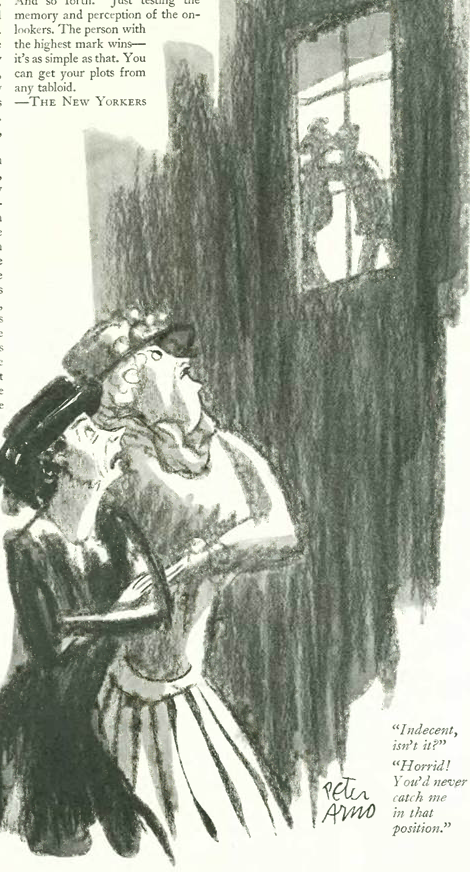
In the Oct. 29, 1927 issue they returned to the topic in the “Talk” column, now that advertisers had gone a step further and actually depicted women with lighted cigarettes between their fingers:

screen-shot-2017-01-04-at-11-07-15-am

screen-shot-2017-01-04-at-3-17-10-pm
BRAZEN…Ads from 1927 depicting women smoking Old Gold and Marlboro cigarettes.

The Oct. 29, 1927, The New Yorker itself featured ads with women smokers, including this installment in a series for Old Gold by cartoonist Clare Briggs

screen-shot-2017-01-04-at-11-30-32-am

…and this ad for the tipless Smokador ashtray, which was featured in many issues of The New Yorker

screen-shot-2017-01-04-at-11-31-24-am

What Flattery Will Get You

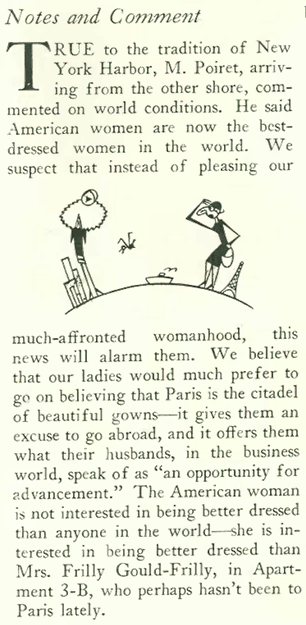
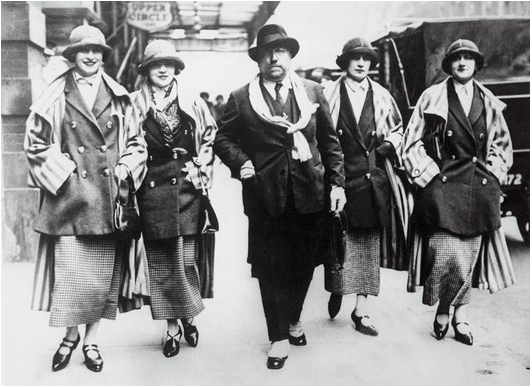
In addition to women smokers, The New Yorker was also agog about a visit to the city by the great French fashion designer Paul Poiret (1879–1944), who upon his arrival proclaimed American women to be the best-dressed in the world:

screen-shot-2017-01-04-at-11-09-18-am

screen-shot-2017-01-04-at-4-00-32-pm
THE LIBERATOR…Paul Poiret on a stroll with models, circa 1930. Poiret led a fashion renaissance that introduced free-flowing dresses and “harem pants.” He is often credited with liberating women from the corset. (trendmano.blog.hu)

Perhaps Poiret’s flattery of American women could be attributed to the fact that his designs had lost popularity in France after World War I, and his fashion empire was on the brink of collapse. (Indeed, his fashion house would close in 1929). However today he is recognized as the first great modernist in fashion design, often compared to Pablo Picasso in terms of the contributions he made to his field.

The New Yorker took advantage of his visit to the city by featuring him in a lengthy profile in the Oct. 29 issue, written by Paris correspondent Janet Flanner under the pseudonym “Hippolyta.” Despite Poiret’s diminished presence in France, Flanner nevertheless understood his enormous contribution to modern fashion design. She concluded her profile with this observation:

screen-shot-2017-01-04-at-11-15-10-am

Something Fishy

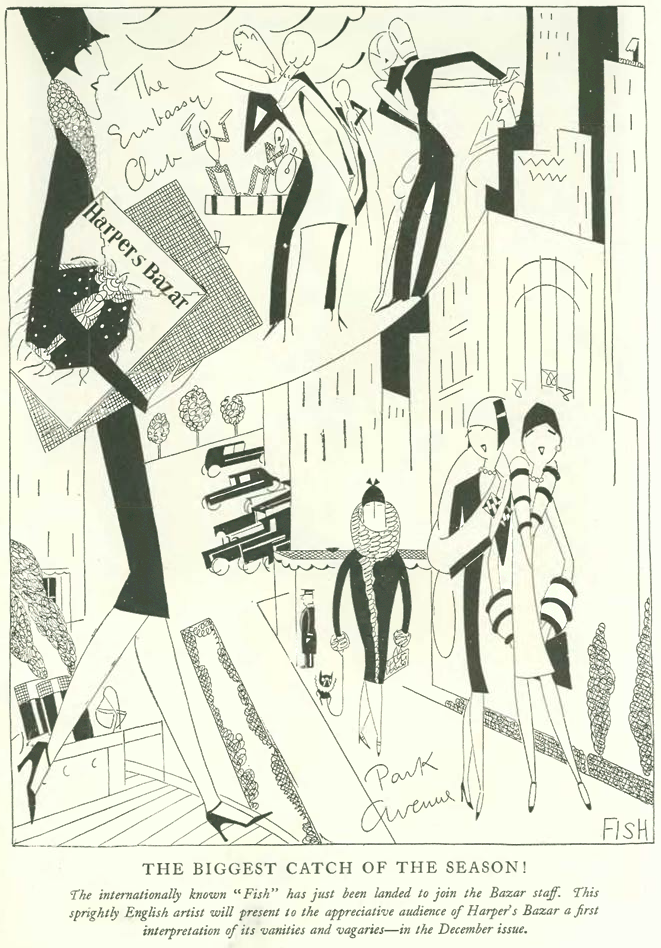
The New Yorker appealed to young, upscale urban dwellers, so it was no wonder that Harper’s Bazar advertised in the magazine, including this ad in the Oct. 29, 1927 issue that announced the debut in its pages of the English artist known as “Fish”…

screen-shot-2017-01-04-at-11-05-54-am

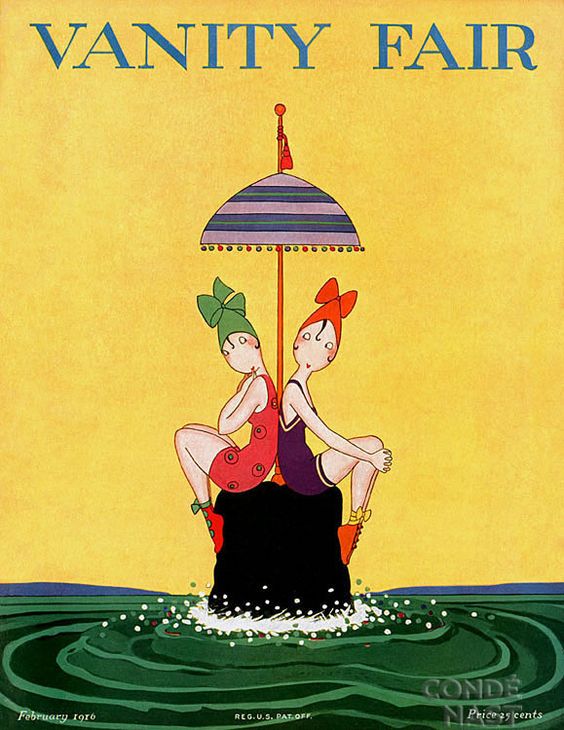
Anne Harriet Fish (1890-1964) was famed for her witty depictions of high society in Condé Nast’s Vanity Fair and The Tatler, where she began work in 1914. A rival “smart set” magazine, Harper’s Bazar, was eager to boast that it had finally “landed” the Fish.

6fb43ab16b45d6f41329fef80bd1baf0
A February 1916 Vanity Fair cover by A. H. Fish. (Condé Nast)

 *  *  *

Broadway Ballet

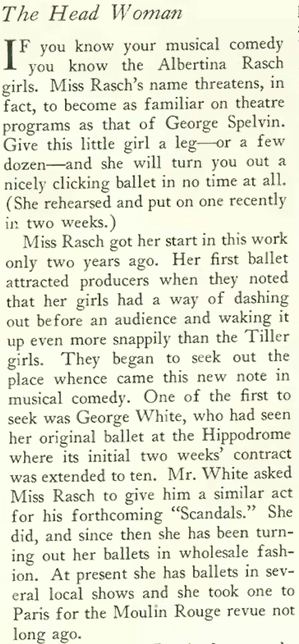
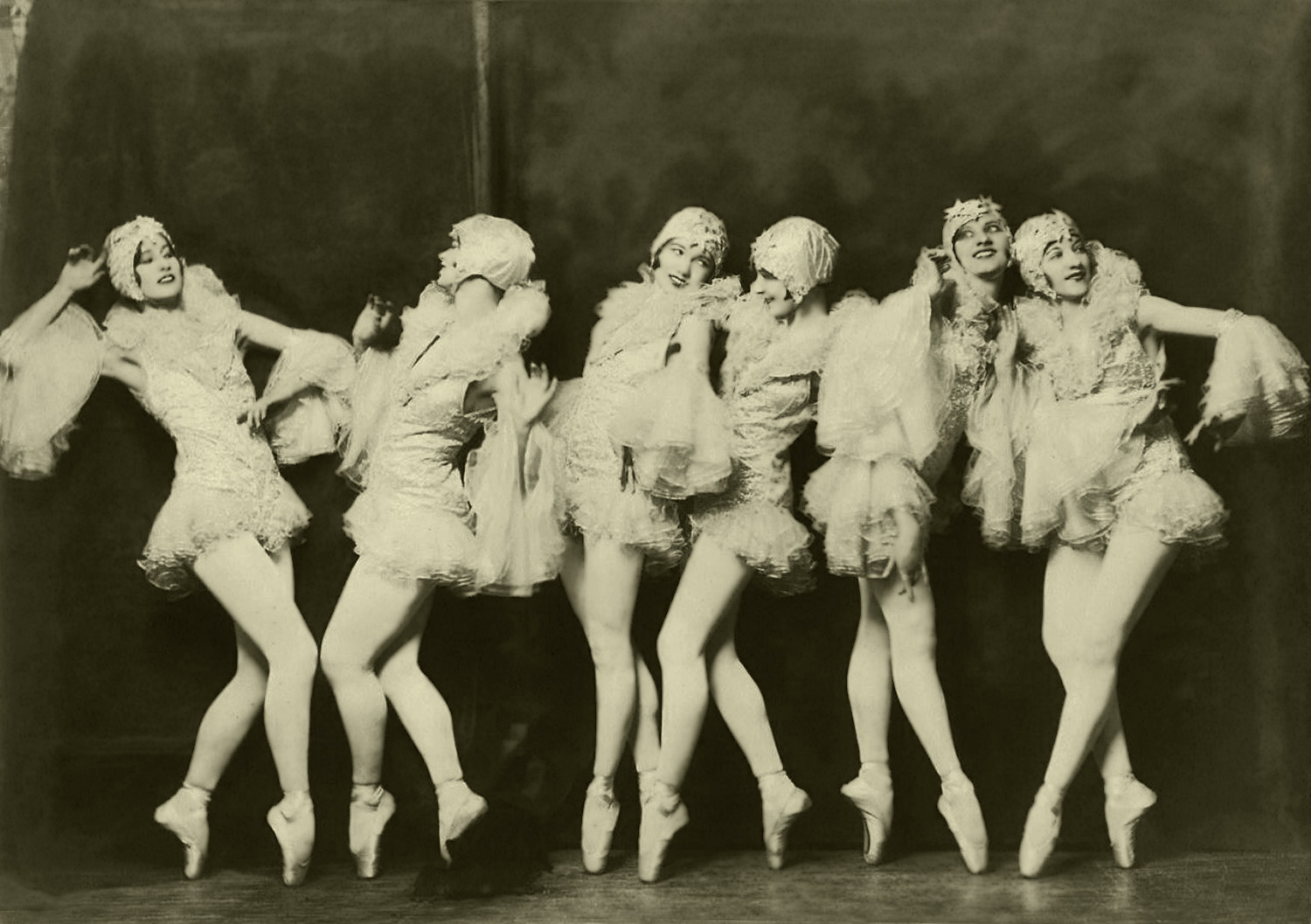
The Oct. 29 “Talk of the Town” noted that Albertina Rasch and her ballet dancers were making quite a splash on Broadway. Her success in staging dances for Flo Ziegfeld’s “Follies” and George White’s “Scandals” would lead to a career in Hollywood, where she would be instrumental in elevating the role of dance director to what we now call a choreographer. Among her many firsts, she is credited with helping to establish Cole Porter’s “Begin the Beguine” as a popular standard by incorporating it into a dance in the 1935 film Jubilee.

screen-shot-2017-01-04-at-11-11-00-am

The Albertina Rasch Dancers in costume for Rio Rita (1927). (songbook1.wordpress.com)

 *  *  *

Where Were You Last Year?

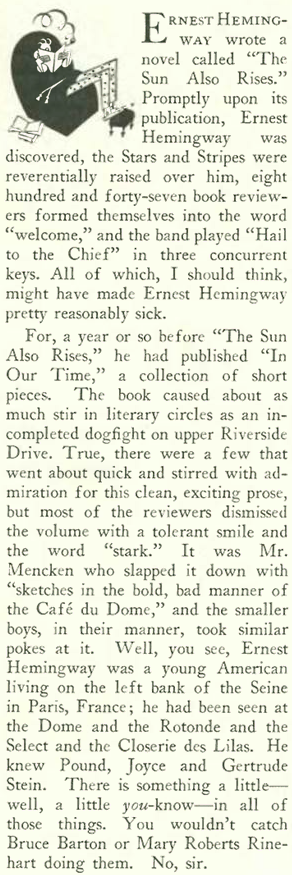
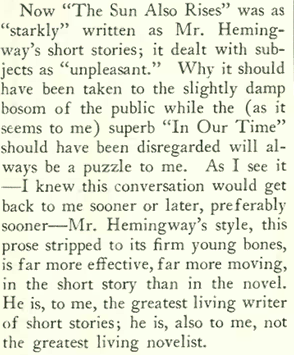
Writing under the pseudonym “Constant Reader,” Dorothy Parker penned a vigorous defense of Ernest Hemingway’s short fiction in the “Books” section of the Oct. 29 issue. Specifically she took issue with critics who continued to rave about Hemingway’s novel The Sun Also Rises, but mostly ignored a collection of short stories he had previously published under the title In Our Time.

screen-shot-2017-01-05-at-1-19-48-pm
HE’S PRETTY GOOD…Ernest Hemingway in 1927, shortly after publication of his novel The Sun Also Rises. At right, Dorothy Parker in the 1920s. (AP/Bookriot)

screen-shot-2017-01-04-at-11-38-39-am

constant-reader

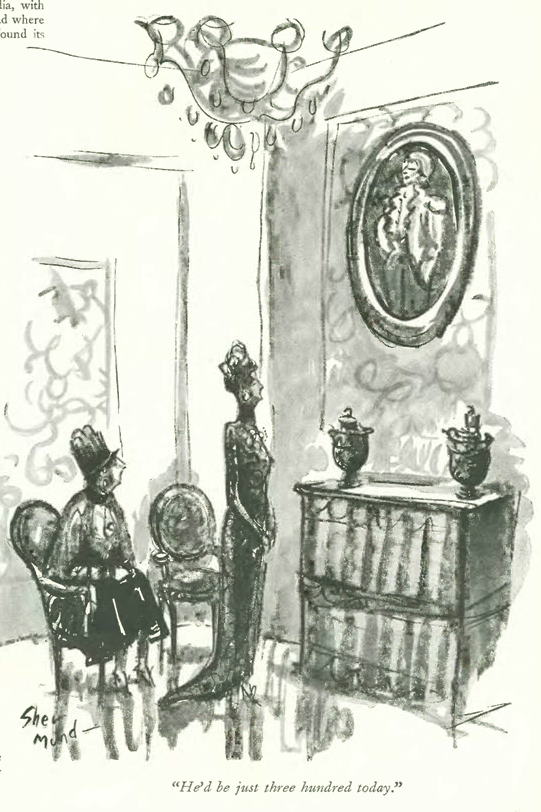
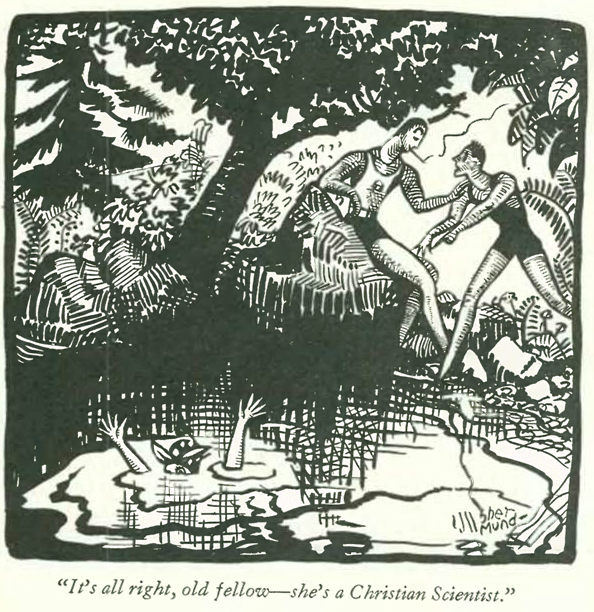
And finally, Barbara Shermund explored the intersection of high culture and flapper culture in this cartoon…

screen-shot-2017-01-04-at-11-13-56-am

Next Time: Death Avenue Days…
8b6d47f5480e534755b5a03ab5ea97a4

Age of the Talkies

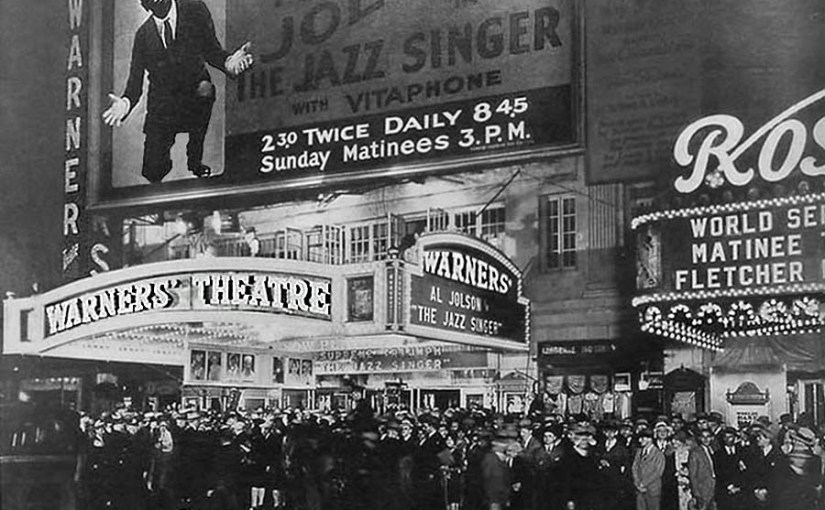
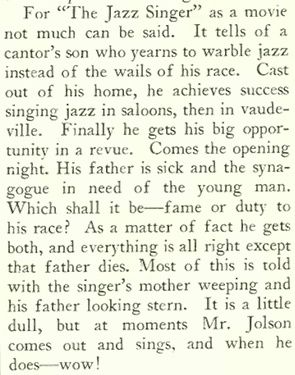
The Oct. 15, 1927 issue featured the premiere of the film The Jazz Singer. Although The New Yorker found the story a bit dull, it also recognized that the film’s use of sound marked a significant turning point in the short history of cinema.

cca81fb3c6aeb61c01f52c8dc5c3c05b
October 15, 1927 cover by Theodore G. Haupt.

The Jazz Singer was not the first film to employ sound, but as the New Yorker review pointed out, it was the first to effectively use synchronized sound (the industry standard Vitaphone technique) in a way that improved the motion picture.

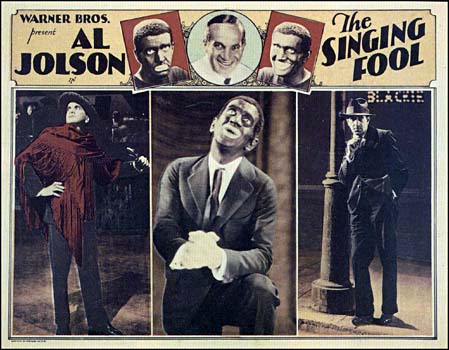
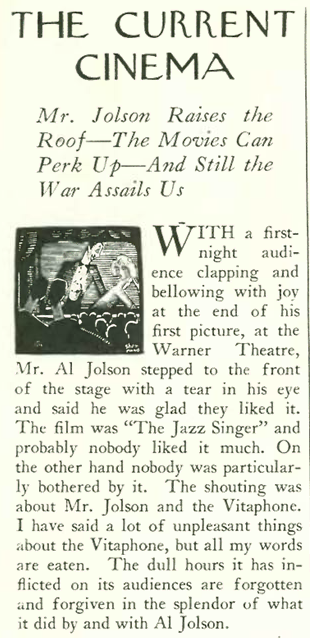
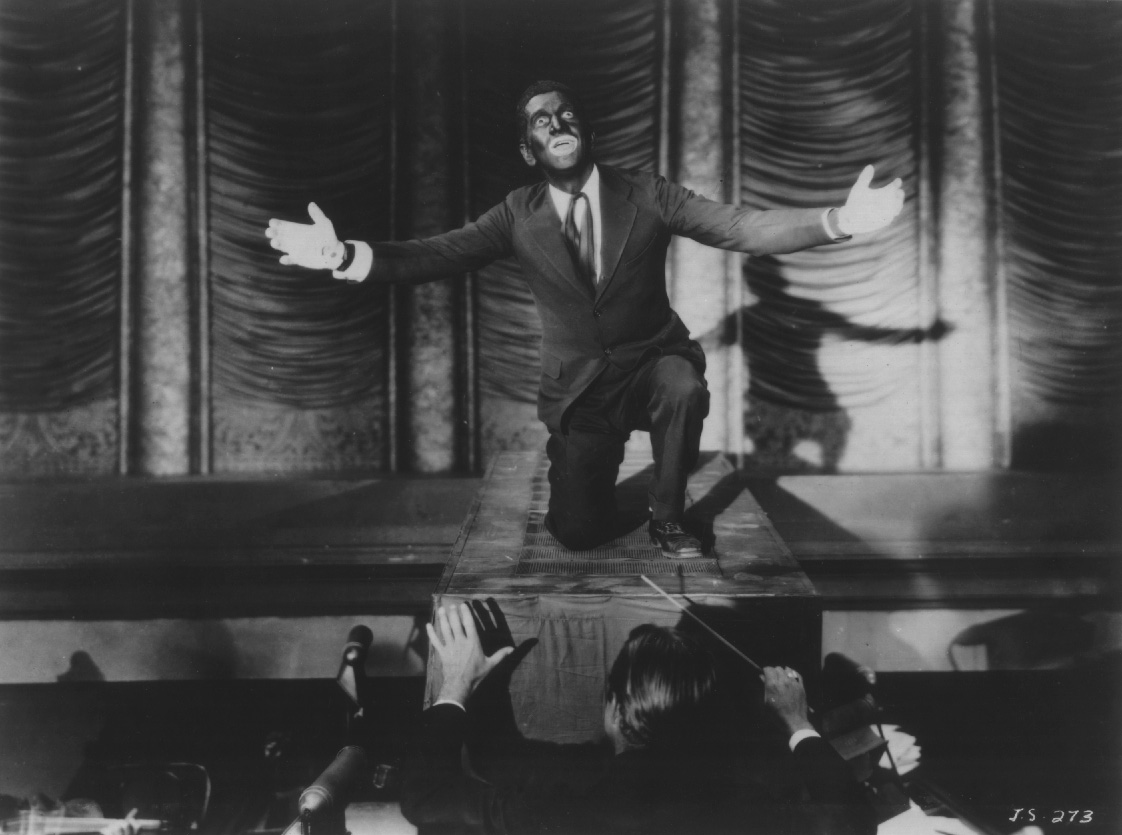
The film featured only two minutes worth of sound dialogue, so most of the spoken lines were still presented on intertitle cards commonly used in silent films. But it was Al Jolson’s recorded voice, belting out popular tunes including “Toot, Toot, Tootsie,” that really wowed audiences. At the end of the film Jolson himself appeared on stage before an audience “clapping and bellowing with joy”…

jazz-siner-1

jazz-singer2

jazz_singer_f
IT SINGS! IT TALKS!!!…Al Jolson as Jack Robin and Eugenie Besserer as his mother, Sara Rabinowitz, in The Jazz Singer. One attendee at the premiere recalled that when Jolson and Besserer began their dialogue scene, “the audience became hysterical.” (wired.com)

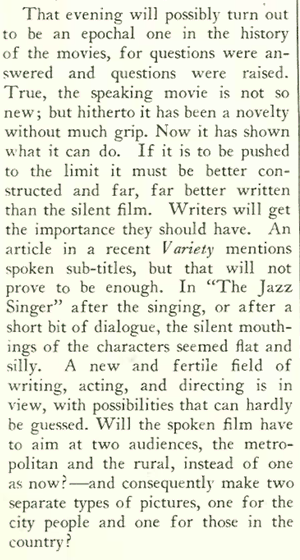
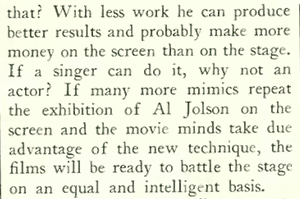
It is interesting that as early as 1927, and even with the relatively crude sound of Vitaphone, The New Yorker was already predicting the advent of a new kind of star (and the decline of the stage actor)…

screen-shot-2016-12-09-at-12-26-53-pm

screen-shot-2016-12-09-at-12-27-04-pm

VitaphoneDemo
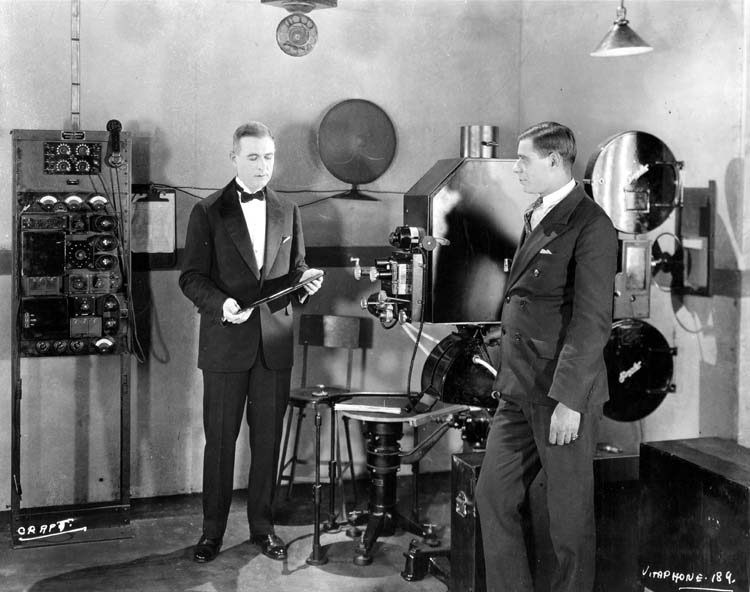
BLACK TIE EVENT…A Vitaphone projection setup at a 1926 demonstration. Western Electric engineer E. B. Craft, left, is holding a soundtrack disc, which was essentially a phonograph record. The turntable, on a thick tripod base, is at lower center. (Wikipedia)

As for the movie itself, well, there was Jolson, beloved by many. Perhaps it’s the sound quality, or the 89 years of changing tastes, but I cannot for life of me understand what audiences (or The New Yorker) saw that was so appealing about the hammy Jolson as a performer.

screen-shot-2016-12-09-at-12-27-12-pm

017-the-jazz-singer-theredlist
THAT WAS THEN…Al Jolson as Jack Robin in The Jazz Singer. Although performing in blackface is considered racist today, Jolson’s use of blackface was integral to the film in that it was tied to Jack’s own Jewish heritage and his struggle for identity. Of course that doesn’t make it any less offensive. (YouTube clip)

*  *  *  *  *

Absent-minded Ambassador

The New Yorker’s “Talk of the Town” offered some curious observations about the new ambassador to Mexico, Dwight Morrow.

morrows_1931
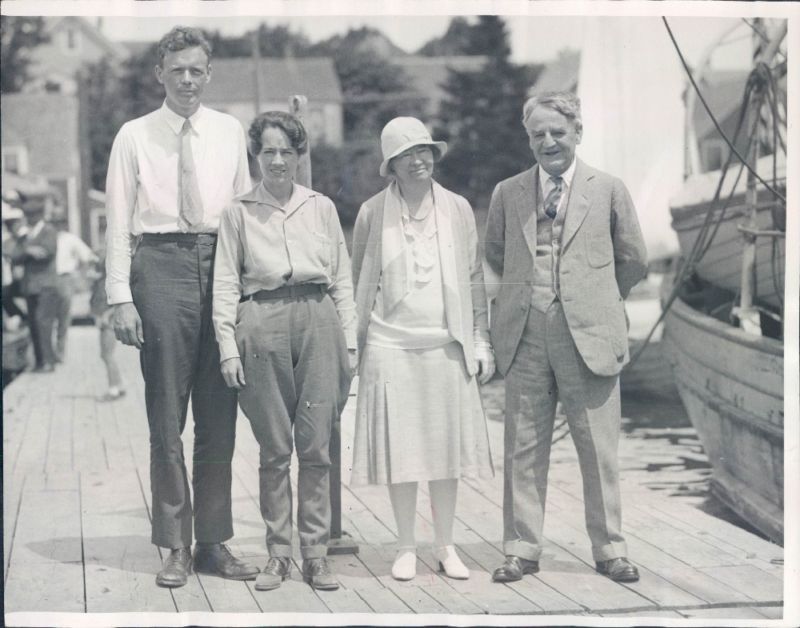
SON-IN-LAW…Aviator Charles Lindbergh would marry Dwight Morrow’s daughter, Anne, in 1929. in this photo from 1931 are, from left, Charles Lindbergh, Anne Morrow Lindbergh, Elisabeth Morrow, and Dwight Morrow. (kaiology.wordpress.com)

Morrow has been widely hailed as a brilliant ambassador with a keen intellect. The New Yorker, however, offered some additional perspective on the man:

screen-shot-2016-12-09-at-11-59-33-am

screen-shot-2016-12-09-at-11-59-38-am

Flight of Fancy

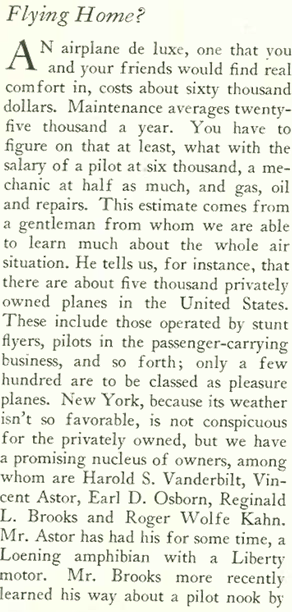
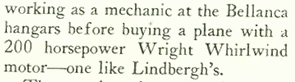
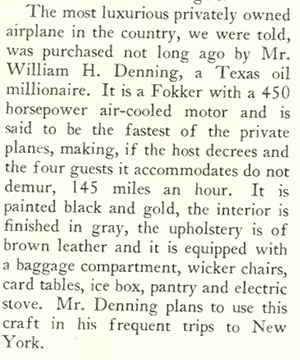
In the wake of Charles Lindbergh’s famous flight, The New Yorker (and the rest of the country) continued its fascination with air travel, which at this point was confined to military and commercial pilots, stunt flyers and the well-to-do.

screen-shot-2016-12-09-at-11-55-12-am

screen-shot-2016-12-09-at-11-55-19-am

screen-shot-2016-12-09-at-11-55-28-am

f7a-2a

f12cabindown
EXTRA LEGROOM…The Fokker F.VII pictured above is likely the same plane or very similar to the one owned by Texas oilman William Denning. The interior depicted below is also similar to what is described in The New Yorker. (aviation-history.com)

 *  *  *  *  *

RIP Isadora Duncan

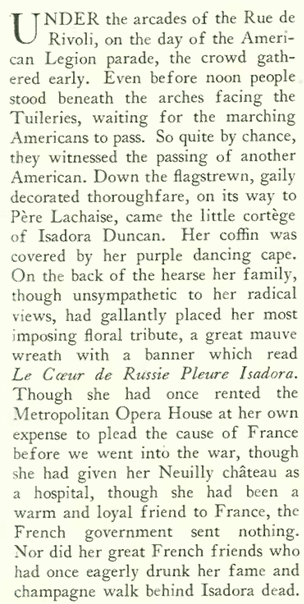
The New Yorker’s Paris correspondent, Janet Flanner, wrote about the funeral of famed modern dancer Isadora Duncan in her column, “Letter from Paris.” Duncan was killed in a freak accident on the night of Sept. 14, 1927, when her silk scarf, draped around her neck, became entangled around the open-spoked wheels of the car in which she was riding, breaking her neck.

screen-shot-2016-12-09-at-12-23-34-pm

screen-shot-2016-12-09-at-12-24-54-pm

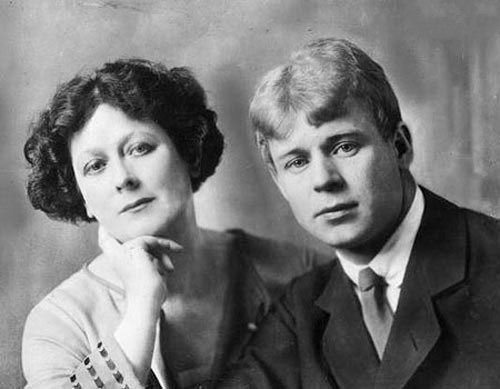
Isadora Duncan with her husband, poet Sergei Esenin, in 1922. (Wikimedia)

Other items of note from the Oct. 15 issue, E.B. White contributed this ditty…

screen-shot-2016-12-09-at-12-13-06-pm

…and Corey Ford, who gave the fictional Eustace Tilley his persona, wrote of Tilley’s feat crossing Broadway in a parody of adventure stories popular at the time. An excerpt:

croey-ford

And finally, Peter Arno explored childhood angst among the smart set (note reference to “Uncle Thurber”)…

screen-shot-2016-12-09-at-12-08-56-pm

Next Time: Electric Wonders…

6ed825c70c3fd789a666a63ecc376b5d


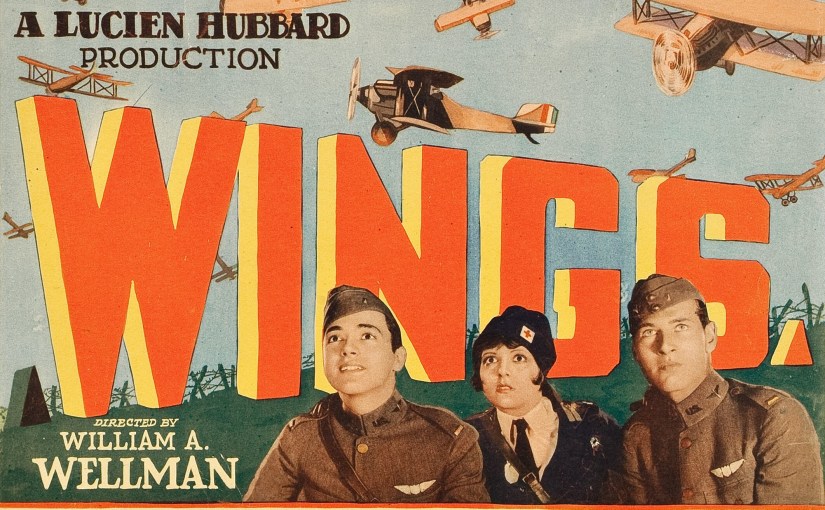
The Movies Take Wing

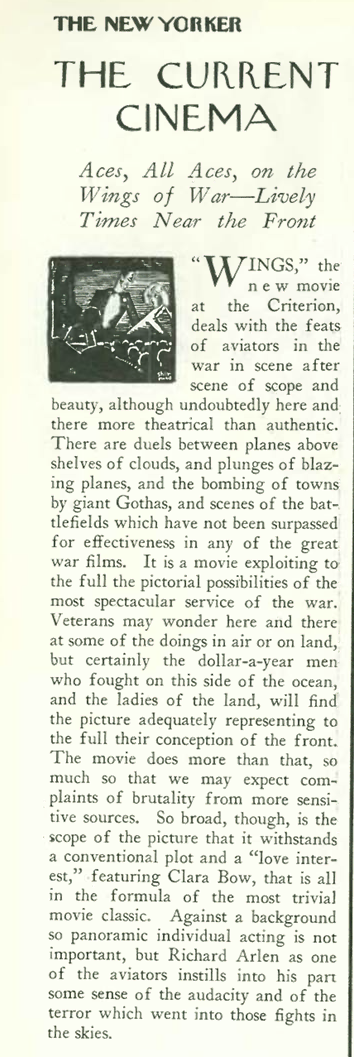
The First Academy Award for Best Picture went to Wings, a romantic action-war picture directed by William Wellman and featuring Paramount’s biggest star at the time, the “It Girl” Clara Bow and a young Gary Cooper in a role that would launch his Hollywood career.

31163f0a903d36d43f89b8495fe4e9a4
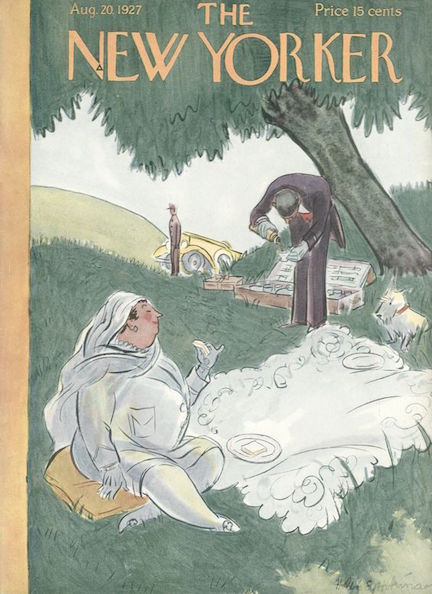
August 20, 1927 cover by Helen Hokinson.

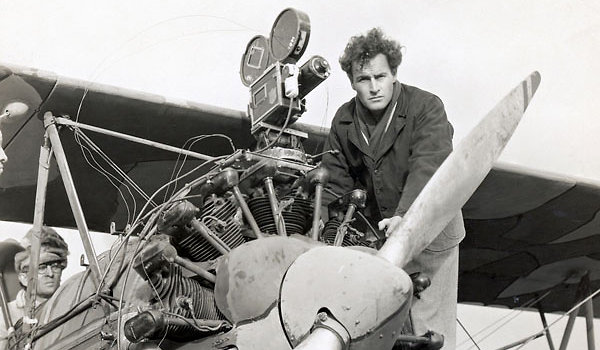
The film was shot on location at Kelly Field in San Antonio, Texas, on a budget of $2 million (about $27 million today). About 300 pilots were involved in filming  realistic (and dangerous) air-combat sequences using both mounted and hand-held cameras.

_57942979_wings_pose_hi
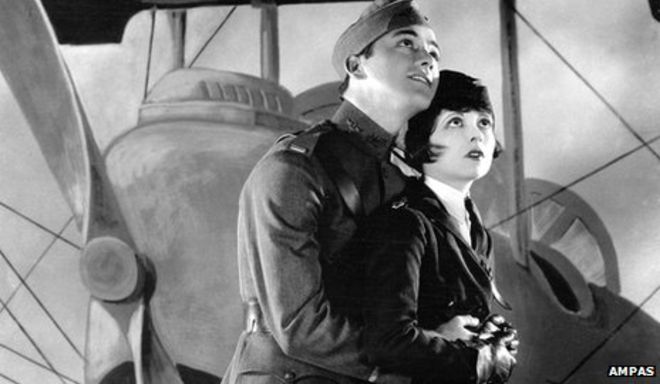
LOFTY AMBITIONS…Charles “Buddy” Rogers and Clara Bow in Wings, 1927. (BBC)

wings

william-wellman
NO CGI HERE…Director William Wellman, during production of Wings, 1927. (Paramount Pictures via New York Times)
photo33chic_0632
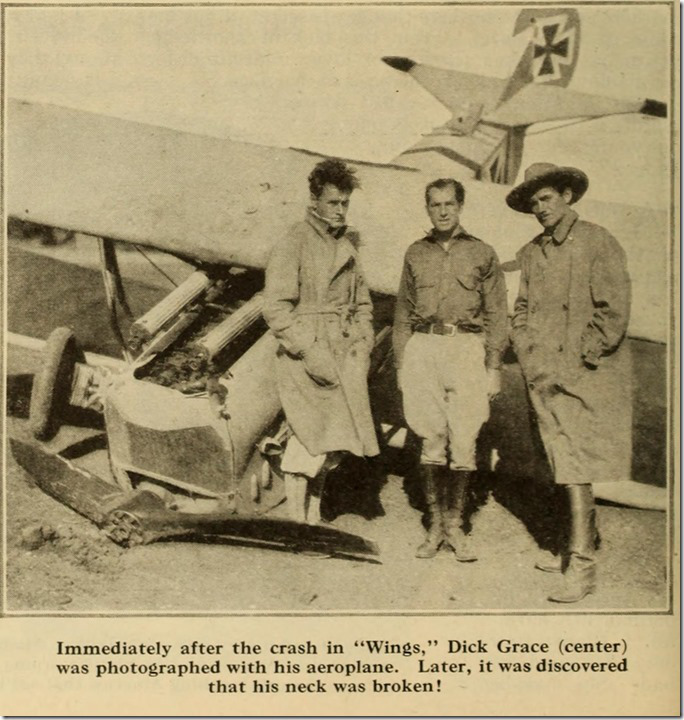
INSURANCE RISK…Stunt pilot Dick Grace specialized in crashing planes for films, and was one of the few stunt pilots who died of old age. (ladailymirror)

 *  *  *

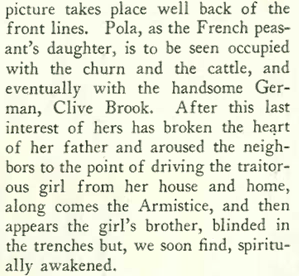
We leave the skies for the trenches in another World War I film–Barbed Wire–that was entertaining New Yorkers in 1927…

barbed-wire-1927-image-10
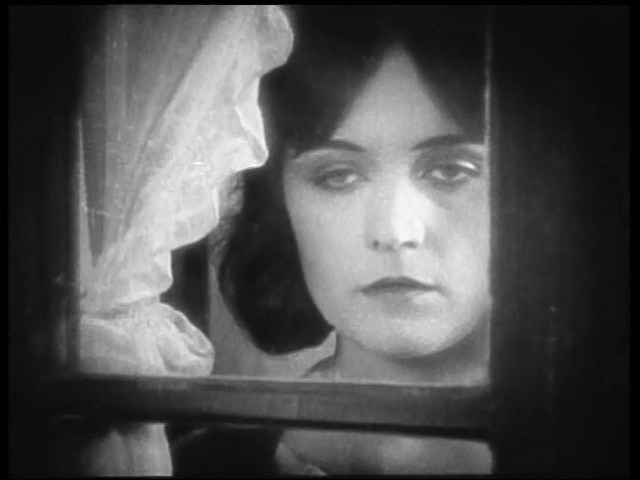
LOOKS MORE INTERESTING OUT THERE…Pola Negri watches the Germans in Barbed Wire, 1927. (Wikipedia)

screen-shot-2016-11-15-at-12-53-17-pm

screen-shot-2016-11-15-at-12-53-28-pm

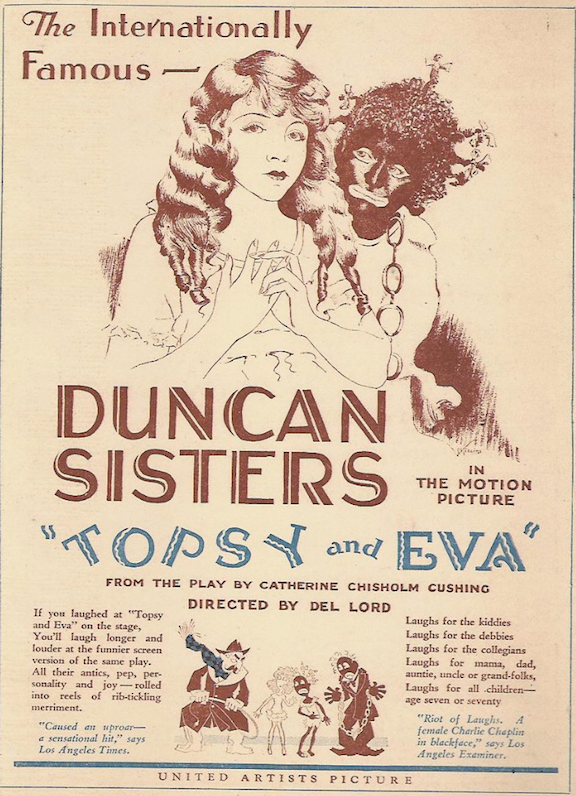
The Duncan Sisters were back, this time on the silver screen in an adaptation of their Broadway hit play, Topsy and Eva. One of the sisters performed in blackface, which was acceptable to white audiences of the time (including New Yorker critics). You can read more about this duo in my recent blog entry, Fifteen Minutes is Quite Enough.

screen-shot-2016-11-21-at-4-24-40-pm
Advertisement for the film, Topsy and Eva, 1927. (nilsasther.blogspot.com)

screen-shot-2016-11-15-at-12-53-42-pm

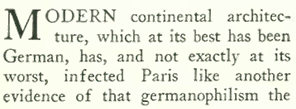
Meanwhile, Paris correspondent Janet Flanner was noting some modern influences in the city thanks to the influence of the German Bauhaus…

screen-shot-2016-11-15-at-12-55-16-pm

genet-mod-arch

002_mallet_stevens_rue_mallet_stevens_paris_theredlist
Rue Mallet Stevens was designed by Paris-based architect, designer and production designer Robert Mallet-Stevens, who founded the Union of Modern Artists (UAM) in 1929. (theredlist.com).

*  *  *

From the “they couldn’t see it coming” department, this item in “The Talk of the Town” caught my eye. We have since learned that carbon emissions are indeed taking a toll on human life…

screen-shot-2016-11-15-at-12-39-27-pm

screen-shot-2016-11-15-at-12-39-36-pm

…and a couple of cartoons from this issue, this one courtesy of Barbara Shermund

screen-shot-2016-11-15-at-12-40-32-pm

…and this from an unidentified cartoonist (Dussey?) that gives us a glimpse of the world to come thanks to merger of technology and tedious, proud parents…

screen-shot-2016-11-15-at-12-46-17-pm

*  *  *

And to end on a “Wings” theme, the following week’s issue…

029648b8835cd8a9600d9dc4caf29b32
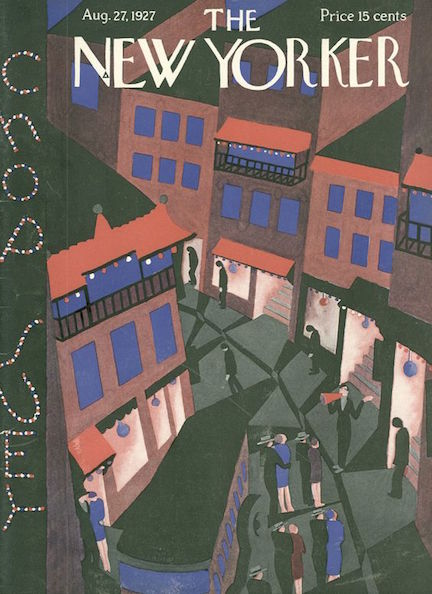
August 27, 1927 cover by Theodore G. Haupt.

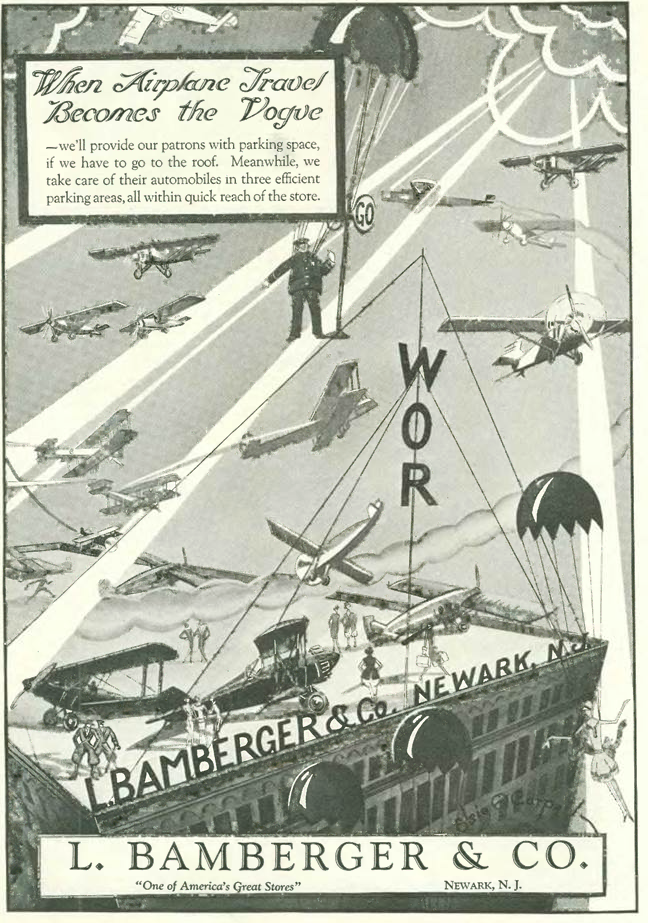
…offered this advertisment from L. Bamberger & Co. that gave us a tongue-in-cheek glance at the future of aviation…

screen-shot-2016-11-15-at-12-58-09-pm

Next Time: The Wages of Beauty…

The Flying Fool

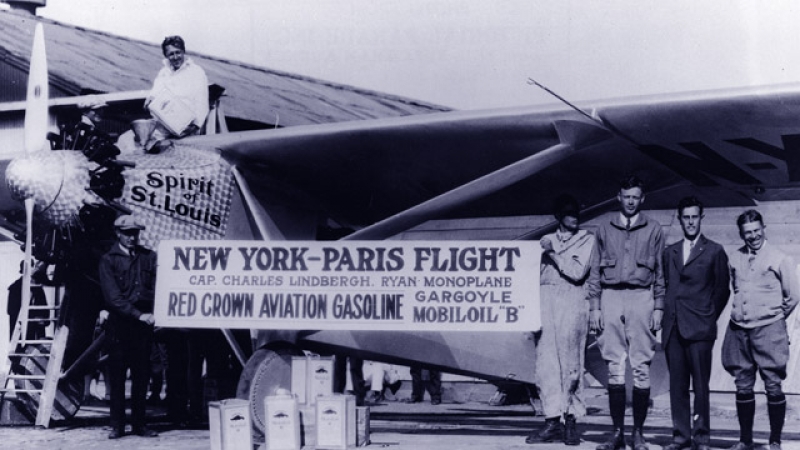
Charles Lindbergh was “The Flying Fool” no more after flying nonstop across the Atlantic to worldwide acclaim. The New Yorker shared in the enthusiasm, although it tried its best to appear not too impressed by the feat. But as we shall see in subsequent issues, The New Yorker, along with the rest of the media, couldn’t get enough of the man with a new title, “Lucky Lindy.”

may-28
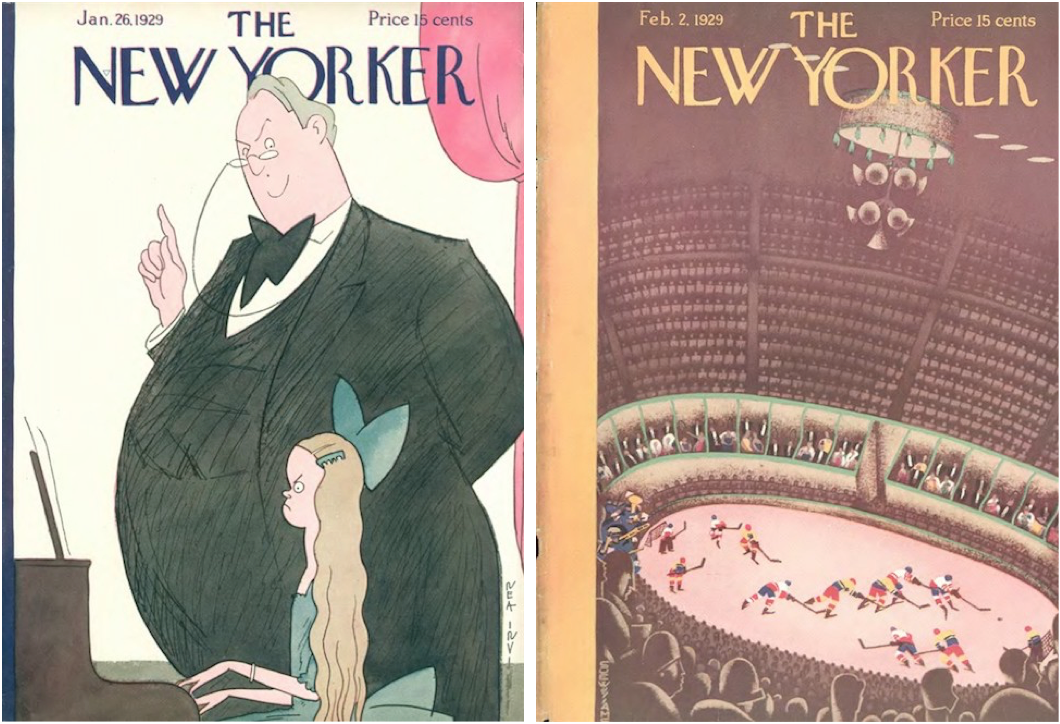
May 28, 1927, cover by Ilonka Karasz.

But that’s in the future. Here’s what the New Yorker had to say following Lindbergh’s famous flight in “Talk of the Town…”

screen-shot-2016-10-05-at-8-43-05-am

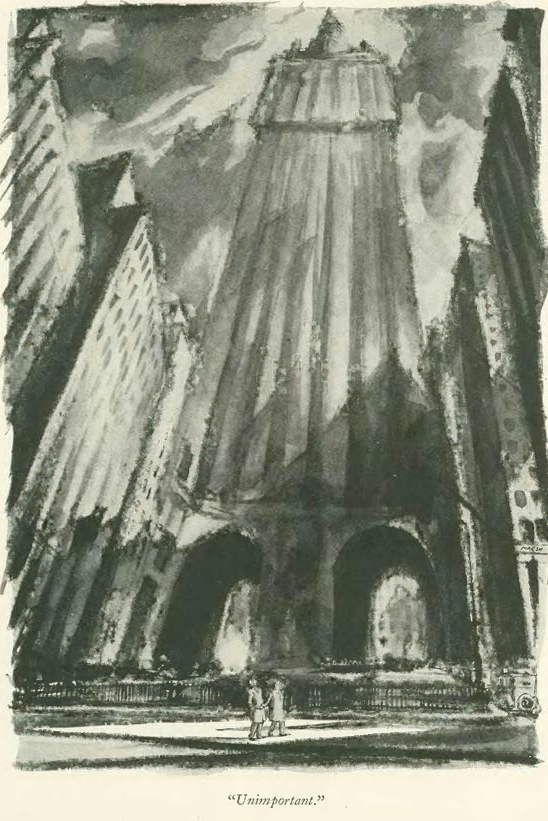
And from its distant perch the magazine also took some shots at the media hype surrounding Lindbergh, and the usual retinue of money-changers (see title image above)…

screen-shot-2016-10-05-at-8-43-15-am

So what was the New Yorker saying about the historic moment? Well, for most of us, life goes on…

screen-shot-2016-10-05-at-8-43-50-am

screen-shot-2016-10-07-at-4-48-14-pm
HE’S A GOOD BOY…Still from Movietone newsreel showing Charles Lindbergh with his mother, Evangeline Lodge Land, before the historic flight. (Movietone)

…and for those who missed it on TV (because it wasn’t invented yet), they could catch a newsreel of Lindbergh at the Roxy, complete with crude sound effects:

screen-shot-2016-10-07-at-1-43-36-pm

air_and_space_museum_paris_lindbergh
OH CALM DOWN…A gendarmerie links arms in a futile attempt at crowd control as a mob closes in on the just-landed Spirit of St. Louis at Le Bourget airport in Paris. (parisdigest.com)

 * * *

On the other side of the pond, Paris correspondent Janet Flanner wrote about the Paris media’s complete denial or ignorance of the deaths of their own Atlantic flyers, Charles Nungesser and Francois Coli, who were lost at sea in their crossing attempt.

screen-shot-2016-10-07-at-1-39-30-pm

 * * *

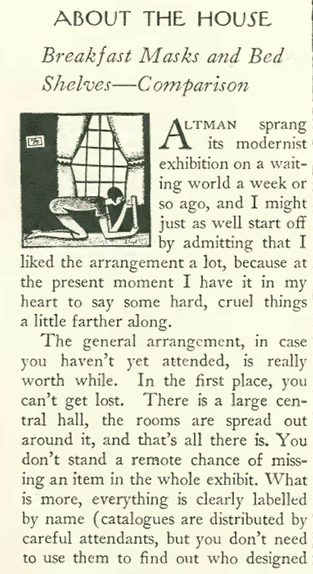
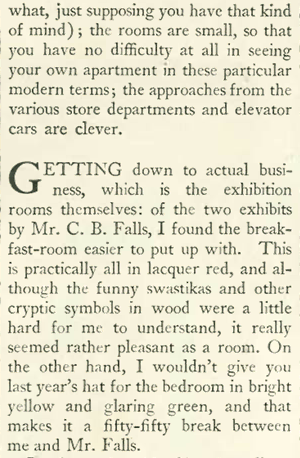
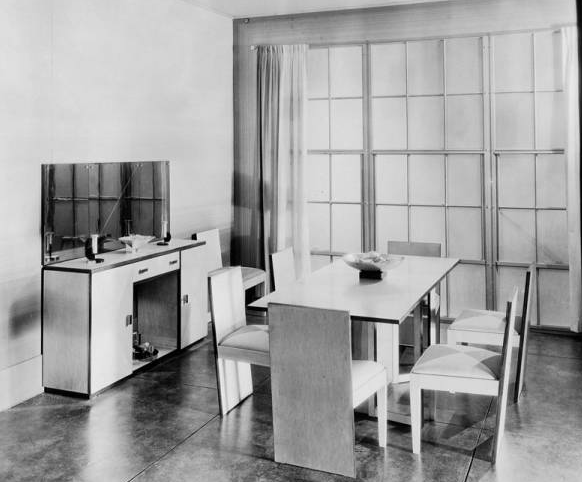
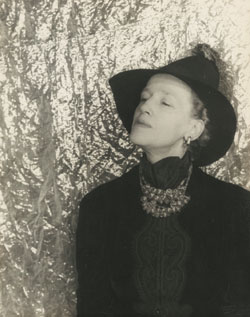
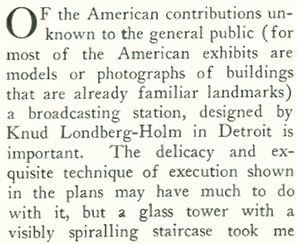
The New Yorker offered more observations on the Machine-Age Exposition, this time in a column titled “About the House,” by “Repard Leirum,” or Muriel Draper spelled backwards. Under this pseudonym Draper served as interior decoration critic for The New Yorker—she was one of the most influential personalities in the American interior decorating in the early 20th century.

1013583
Muriel Draper, as photographed by Carl Van Vechten on July 30, 1934. (Muriel Draper Papers, Yale)

screen-shot-2016-10-05-at-9-25-08-am

screen-shot-2016-10-05-at-9-25-23-am

klh_36_hr-web
This model of a radio station by Knud Londberg-Holm was displayed at the Machine-Age Exposition in New York City May 16-28, 1927. (artblart.com)

About Muriel Draper: Although she wrote on interior design for The New Yorker during the late 1920s, she was more widely known as a “culture desk” writer, and was prominent in promoting the Harlem Renaissance. She became active in left wing politics after a trip to the Soviet Union in 1934, and in 1949 she was investigated by the U.S. House Un-American Activities Committee and thereafter ceased her political activities.

The Machine-Age Exposition Draper visited had a decidedly socialist flavor with its prominent inclusion of the Soviet Union and its touting of the International Style of architecture. Before it was appropriated by post-war corporate America, the International Style was developed as housing and workspaces for the masses.

A side-note: The Exposition was initiated by Jane Heap, who like Draper was a follower of the charismatic Russian mystic G. I. Gurdjieff (among Gurdjieff’s other followers were architect Frank Lloyd Wright, the writer P. L. Travers (Mary Poppins) and 1960s counterculture figure Timothy Leary).

georges_gurdjieff
George Ivanovich Gurdjieff, circa 1925-35 (Library of Congress)

Marxists with spiritual yearnings—and especially guild socialists—were attracted to Gurdjieff’s ideas about something he called “The Work,” in which crafts and community life provided ways to cultivate a deeper understanding of ourselves and our purpose amidst the activities of daily life.

 *  *  *

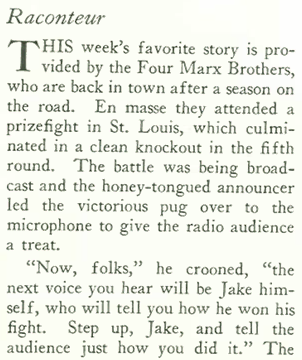
And now on to a different kind of Marxism…this odd little item from the “The Talk of the Town”…

screen-shot-2016-10-05-at-9-07-51-am

screen-shot-2016-10-10-at-10-38-34-am

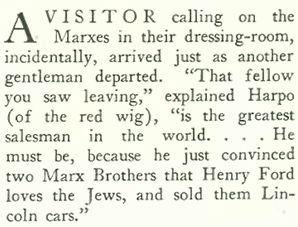
In 1927 the Marx Brothers were still known as a traveling vaudeville act—their first feature film was still two years away. But thanks to the vaudeville circuit of the day, an astonishing number of people in cities large and small across the country would see them perform. The “Talk” item concludes with this story that references Henry Ford’s well-known anti-semitism:

screen-shot-2016-10-05-at-9-08-01-am

mte5ndg0mdu0nty4njy2njm5
OH THE MOVIES THEY WILL MAKE…The Marx Brothers, from left, Chico, Zeppo, Groucho and Harpo. (biography.com)

Next Time: The Age of Innocence…

fe856464214bef0718e3c838d3a54ab2

Mode de Vie

We cross the pond for the May 14, 1927 issue, for a look at all things French. As I’ve previously noted, New Yorker readers of the 1920s had a decidedly Francophile bent when it came to food, fashion and general joie de vivre.

304b9308de906b0c02f50b14add69c6d
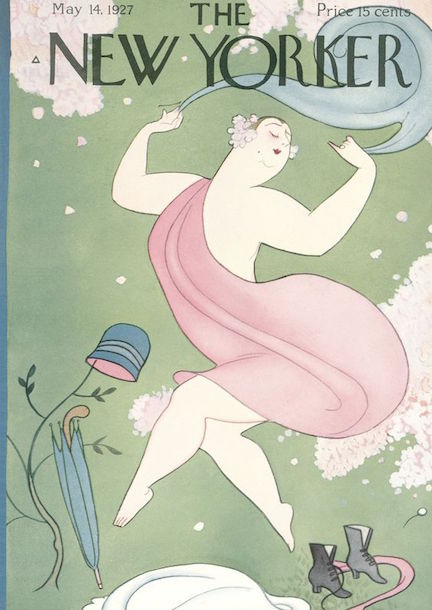
May 14, 1927 cover by Rea Irvin.

In fact, readers were so enamored with France that the country merited its own New Yorker correspondent, Janet Flanner, who wrote under the nom de plume “Genêt.”

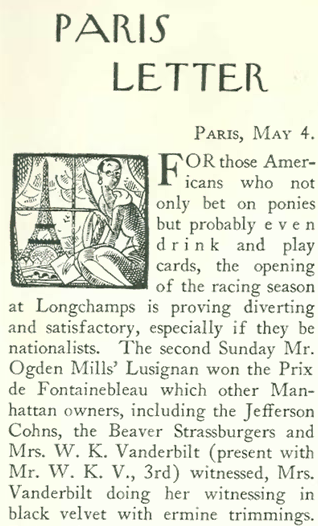
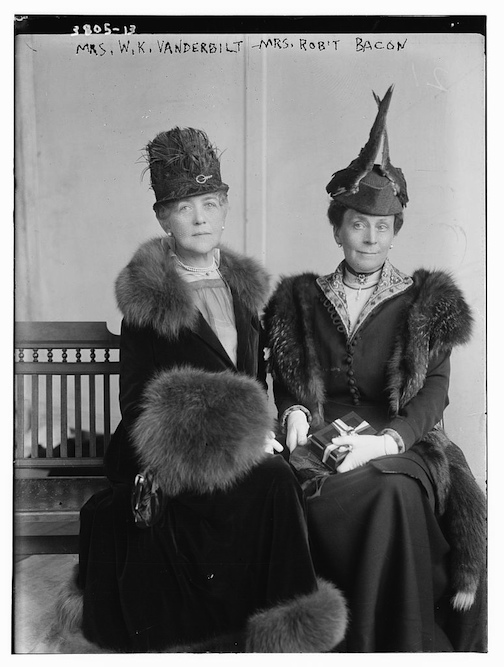
In the May 14 issue Flanner casually mused about the racing season at Longchamps, which attracted the likes of Anne Harriman Vanderbilt (identified here as Mrs. W. K. Vanderbilt), who was well-known in France for her philanthropic work during World War I, including her founding of an ambulance service and a hospital at Neuilly. Vanderbilt received the class of the Legion of Honor in 1919 in recognition of her war work, and in 1931 she was made an officer of the legion.

screen-shot-2016-09-21-at-9-04-27-am

11733033805_35c6a9f8d5_b
BLUE BLOODS…Anne Harriman Vanderbilt (left) with Martha Waldron Cowdin Bacon, circa 1915-1920. Bacon served as chairman of the American Ambulance Committee. (Library of Congress)

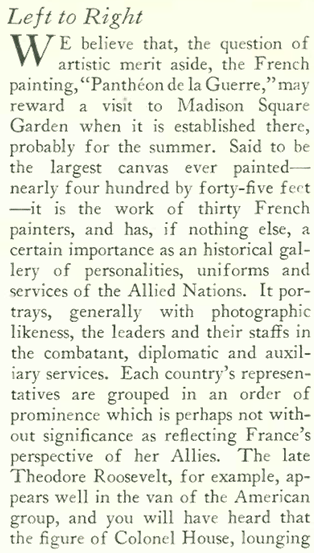
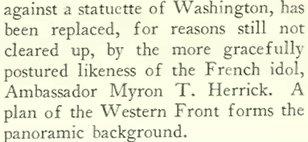
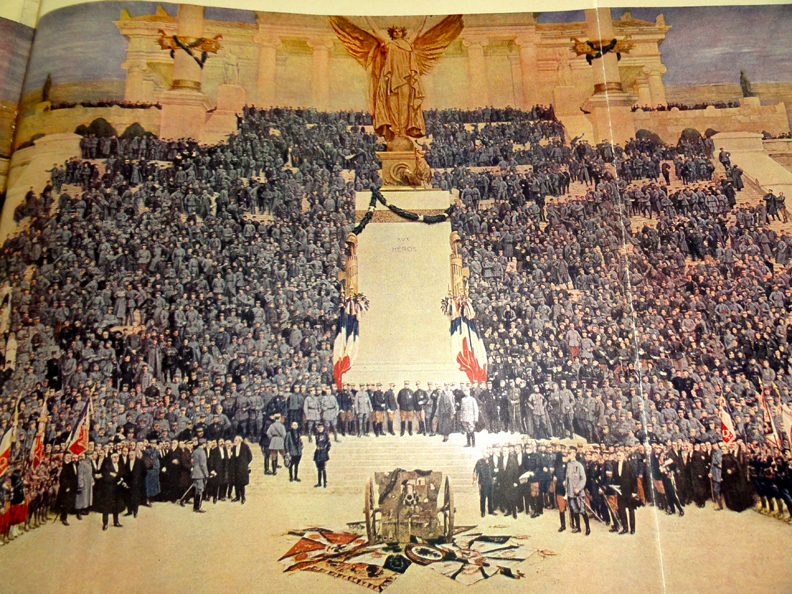
In “Talk of the Town,” the editors suggested that readers go to Madison Square Garden and check out the world’s largest canvas painting, Panthéon de la Guerre, more for the spectacle than for any artistic merit:

pantheon_de_la_guerre_panorama_smaller
Section of Panthéon de la Guerre showing allies of World War I, now in Memory Hall, Liberty Memorial, Kansas City, Missouri. (theworldwar.com) Click to enlarge

screen-shot-2016-09-21-at-8-57-10-am

screen-shot-2016-09-21-at-8-57-22-am

Panthéon de la Guerre was painted during World War I as a circular panorama—402 feet in circumference and 45 feet high—displayed in Paris in a specially built building next to the Hôtel des Invalides. It was visited by an estimated eight million people between 1918 and 1927.

The painting was acquired by American businessmen in 1927 and exported to New York, where it was displayed at Madison Square Garden. Some changes were made to the painting for the benefit of an American audience, including the addition of an African-American soldier. The work later toured the U.S.—from 1932 to 1940 it went to Washington DC, Chicago, Cleveland, and San Francisco. It was then acquired by restaurant entrepreneur William Haussner for $3,400.

In 1956 Haussner donated the work to Leroy MacMorris to be adapted for display at the Liberty Memorial in Kansas City. MacMorris drastically reduced the size of the work and modified it to emphasize America’s contribution to WWI: Only seven percent of the original work was retained, and large French sections were left out. MacMorris likened it to “whittling down a novel to Reader’s Digest condensation.” And he didn’t stop there. He also modified some figures to represent post-WWI figures such as Presidents Franklin Roosevelt and Harry Truman.

exhibithall
A BIT OF THIS, A DASH OF THAT…Figure of Victory from the Temple to Glory cut to fit above a doorway at Memory Hall, Liberty Memorial, Kansas City, Missouri, with the staircase of heroes to either side. Compare to original below:
129-2
(trenchartcollection.com)

To reduce and reconfigure the painting, MacMorris first photographed it in detail, then cut out the figures in the photos and used them like puzzle pieces to work out his new condensed version, which was dedicated on Nov. 11, 1959.

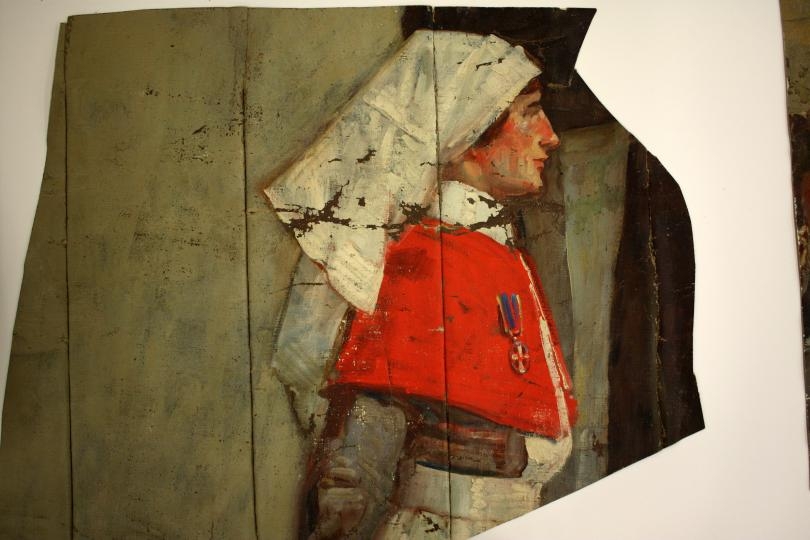
As for the unused portions, what MacMorris did not use he threw away, sending several of the larger excised passages back to Haussner for display in his Baltimore restaurant. MacMorris also gave pieces to the art students who helped him reconfigure the painting and to a number of prominent Kansas Citians.

2qaatdogmghsne7v2y1e
Fragment from Panthéon de la Guerre depicting a British nursing sister. (theworldwar.org)

The National World War I Museum and Memorial in Kansas City recently held an exhibition on the painting and its recovered fragments.

 * * *

Lois Long had returned from Paris and advised readers on where to shop in the City of Light. Her fashion column, “On and Off the Avenue,” featured recommendations for many stores and bargains. It began with a brief note from “Parisite,” aka Elizabeth Hawes, who occasionally contributed to Long’s column with cables sent from Paris).

screen-shot-2016-09-21-at-9-01-58-am

And now for the advertisements, all from the May 14 issue, featuring various French themes, such as this one for Krasny makeup that evokes the glamour of Paris and the intrigue of Russian women…

screen-shot-2016-09-21-at-8-48-43-am

…or exotic perfumes for only the most exclusive set…

screen-shot-2016-09-21-at-8-54-15-am

…or the chic look of Revillon Freres spring coats and wraps…

screen-shot-2016-09-21-at-8-55-10-am

…or fake vermouth…this odd little illustration in the back pages for non-alcoholic vermouth, served by a dutiful French maid to what appears to be a giant. You have to feel sorry for the writers of such ads during Prohibition, trying so hard to make this sad libation appealing to thirsty New Yorkers…

screen-shot-2016-09-21-at-9-08-34-am

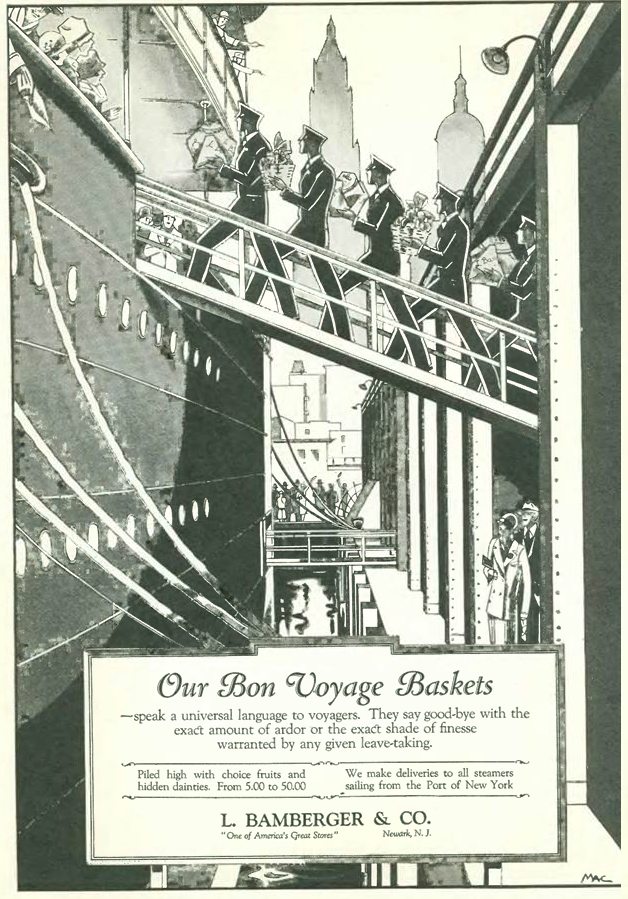
…but there were those lucky few who could actually travel to France and drink the real stuff, you could get a really swell send-off with a “Bon Voyage Basket” from L. Bamberger & Co…

screen-shot-2016-09-21-at-8-54-37-am

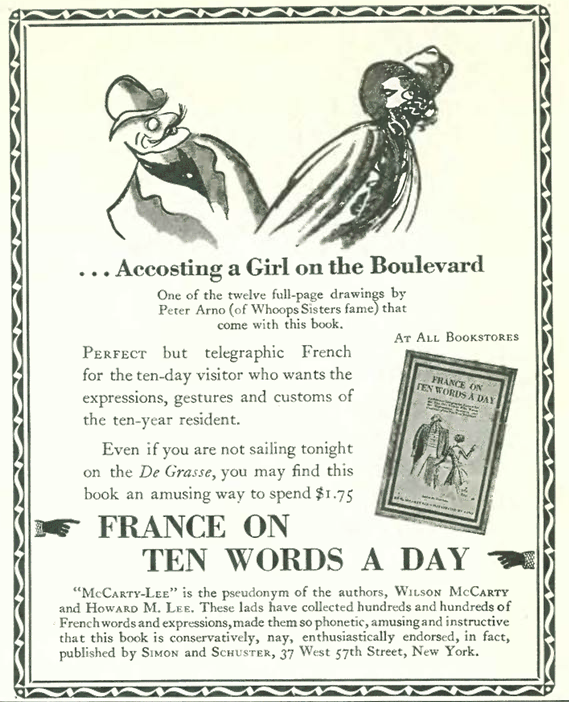
…and while you were in France (at least for the men), Peter Arno could show you how to give the glad eye to the mesdemoiselles…

screen-shot-2016-09-21-at-9-09-42-am

Next Time: Shock of the New…

may-21


Fight Night in Philly

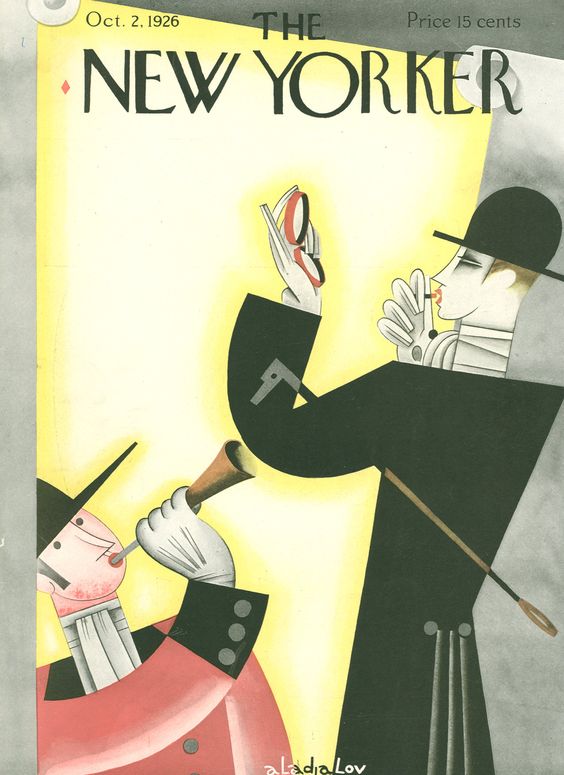
We skip ahead to the Oct. 2, 1926 issue to look at one of the big events of that year–the Dempsey-Tunney heavyweight prize fight (I’m not skipping issues…Sept. 25 appears later in this blog).
652f917918402a71eb86f6671c9f228a
Oct. 2, 1926 – Issue # 85 – Cover by Constantin Alajalov. (Once again, note the ongoing comic reference to androgyny in 20’s fashion)
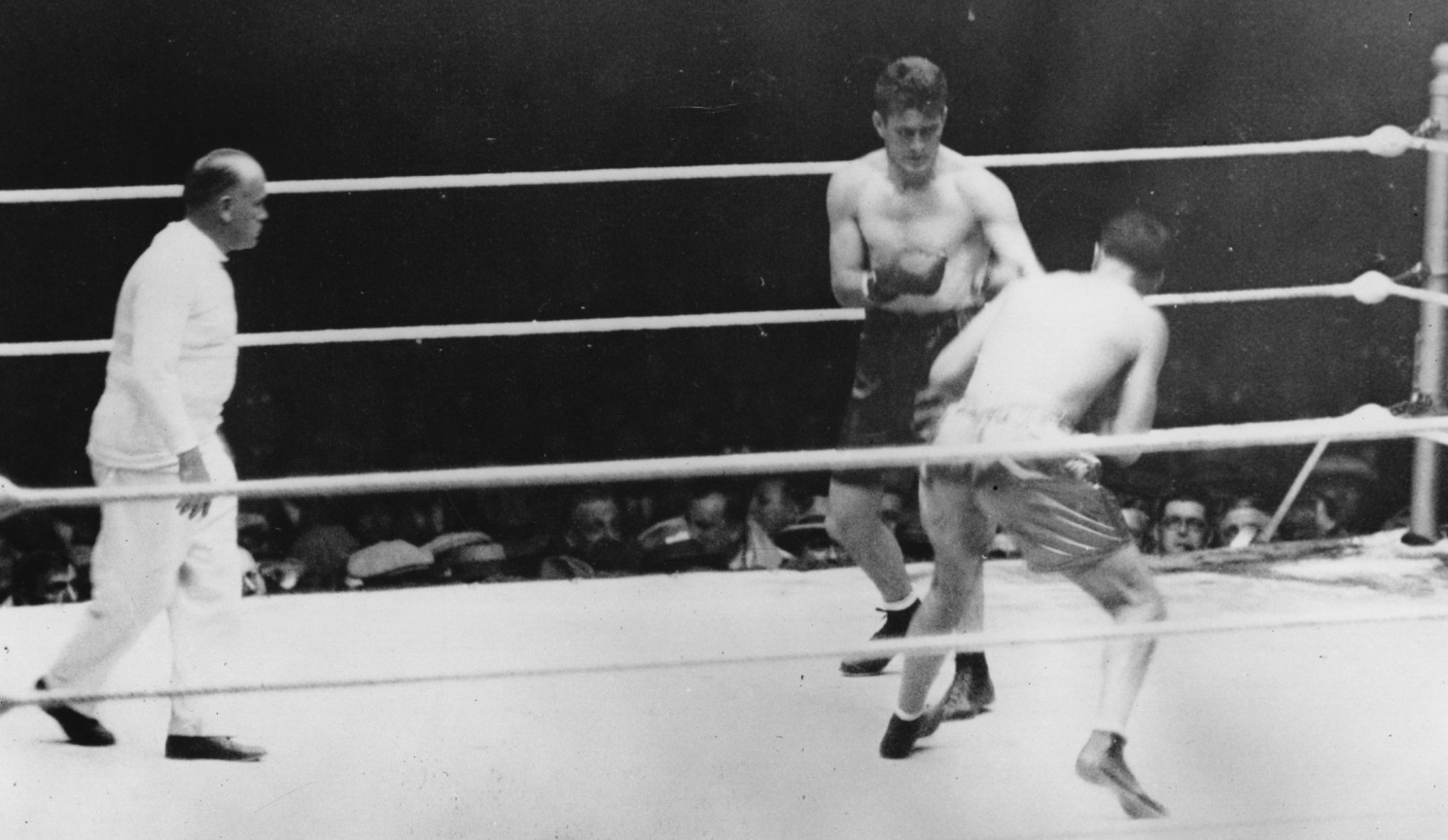
Heavyweight boxing was a big part of the American sports scene in the 1920s, and two giants of the sport, Jack Dempsey and Gene Tunney, dominated the headlines in the late 1920s thanks to much-heralded bouts in Philadelphia in 1926 and a rematch in Chicago the following year (which would include the famous “long count” incident).
Screen Shot 2016-02-26 at 12.30.40 PM
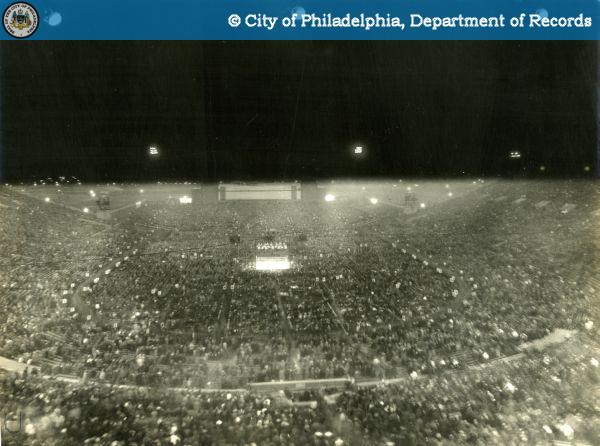
An estimated 135,000 fans packed Sesquicentennial Stadium in Philadelphia for the Dempsey-Tunney bout. (NYTimes)
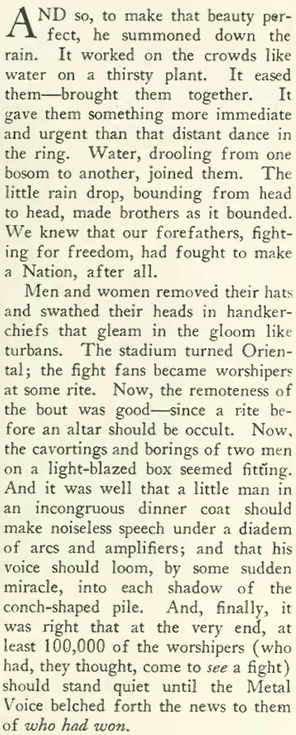
The New Yorker joined in on the hoopla, publishing a lengthy account of the match by Waldo Frank (aka “Search-light”), who trained his jaded eye on the whole affair:
Screen Shot 2016-02-25 at 4.28.32 PMScreen Shot 2016-02-25 at 4.28.39 PM
MediaStream.ashx
VIEW FROM THE CHEAP SEATS…a rain-soaked throng at the Dempsey-Tunney fight in Philadelphia. (City of Philadelphia)
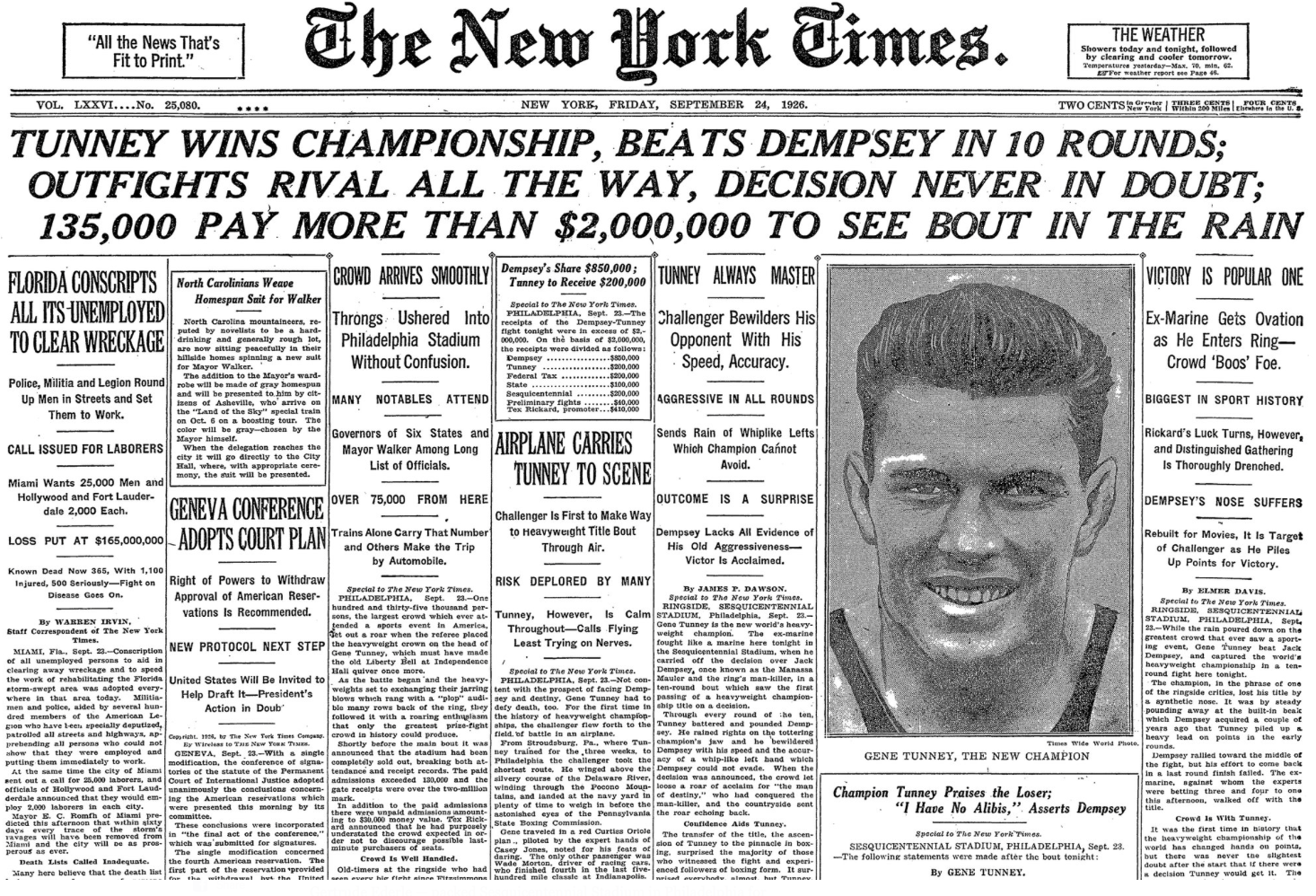
According to the New York Times, the crowd included such notables as Charlie Chaplin, cowboy movie star Tom Mix and the English Channel swimmer Gertrude Ederle.
Screen Shot 2016-02-26 at 12.13.08 PM
Coverage of Tunney’s victory by unanimous decision took up three-quarters of the front page of The New York Times, and also filled most of pages 2 through 7. (The New York Times)
But in typical fashion, Waldo was less than dazzled, finding the rain an apt metaphor for a spectacle mostly unseen by those in attendance:
Screen Shot 2016-02-25 at 4.27.50 PM
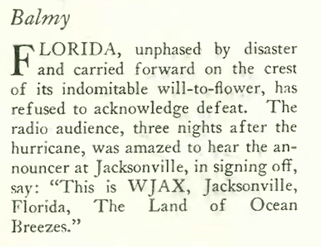
Never one to wallow in tragedy, the magazine made a brief (and oddly droll) reference in “The Talk of the Town” to a hurricane that hit Miami and its environs (it killed 372 people and injured more than 6,000):
Screen Shot 2016-02-25 at 4.16.52 PM
Other items of note in the issue included this examination of country vs. city life by cartoonist Barbara Shermund
Screen Shot 2016-02-25 at 4.21.56 PM
…and this cartoon by Al Frueh commenting on the challenges of Manhattan’s rapidly changing cityscape:
Screen Shot 2016-02-25 at 4.18.53 PM
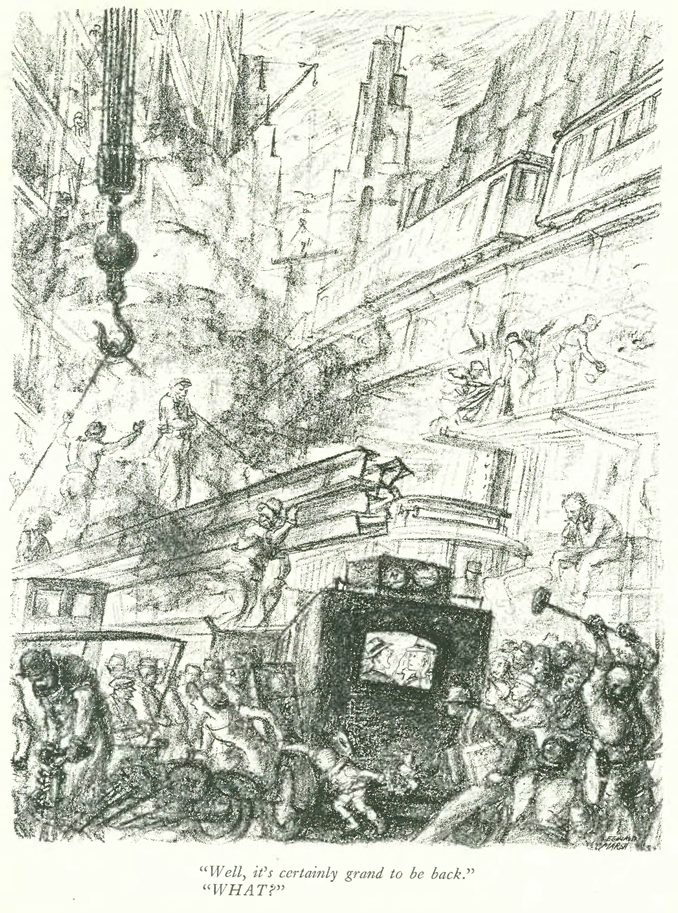
The changing city was also on the mind of Reginald Marsh in this illustration he contributed to the Sept. 25, 1926 issue of the magazine:
Screen Shot 2016-02-25 at 4.02.32 PM
Back to the Sept. 25 issue, which featured an update from Paris correspondent Janet Flanner
d9f3d5507a7bade4fc28276d12a63260
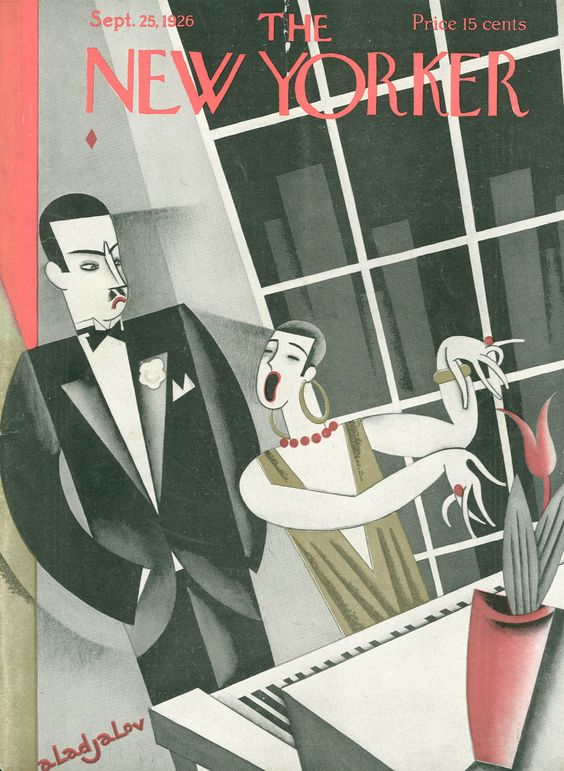
Sept. 25, 1926 – Issue # 84 – Cover by Constantin Alajalov.
…who commented on the large number of American tourists crowding the city just as the locals were fleeing for their long, late summer holidays:
Screen Shot 2016-02-25 at 4.07.13 PM
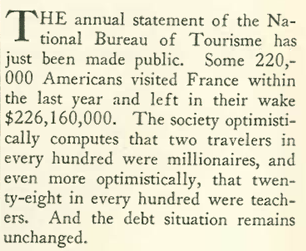
She offered some numbers to back up her observations:
Screen Shot 2016-02-25 at 4.07.43 PM
3333095832_f6a6fd78cb_o
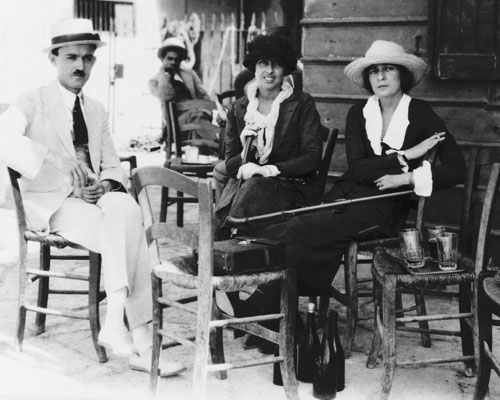
Janet “Genêt” Flanner (right) and longtime companion Solita Solano (center) in Paris, 1921. Solano was a well-known writer and drama critic for the New York Tribune. (Vintage Everyday)

And finally, a cartoon by Rea Irvin exploring the trials of the idle rich:

Screen Shot 2016-02-25 at 4.01.32 PM
 Next Time: Do Gentlemen Prefer Blondes?
848d031119e0d470956ce963e6e7fb62

Parisians & Puritans

In her latest dispatch from Paris, correspondent Janet Flanner offered New Yorker readers a glimpse into the French mind, its fear of “Americanization” and its perception of America’s Puritanical attitudes behind Prohibition.

Screen Shot 2015-11-13 at 2.25.59 PM
April 3, 1926 cover by Rea Irvin.

All the more reason the French were bemused by reports that American and English citizens led the lists of reported drug raids in the City of Light…

Screen Shot 2015-12-01 at 11.56.02 AM

or that somehow Prohibition was a question of theological differences:

Screen Shot 2015-12-01 at 11.56.11 AM

The April 3, 1926 issue also offered up some curious advertisements. Aiming square at the grasping Anglophilia of New Yorker readers, here’s a pitch for a used Rolls Royce:

Screen Shot 2015-12-01 at 11.38.46 AM

And with the money left over from your savings on the used Rolls, you could buy this 47-foot cruiser from the American Car and Foundry Company:

Screen Shot 2015-12-01 at 11.57.04 AM

Moving along to the April 10, 1926 issue (cover designed by H.O. Hofman)…

Screen Shot 2015-12-01 at 11.57.38 AM
April 10, 1926 cover by H.O. Hofman.

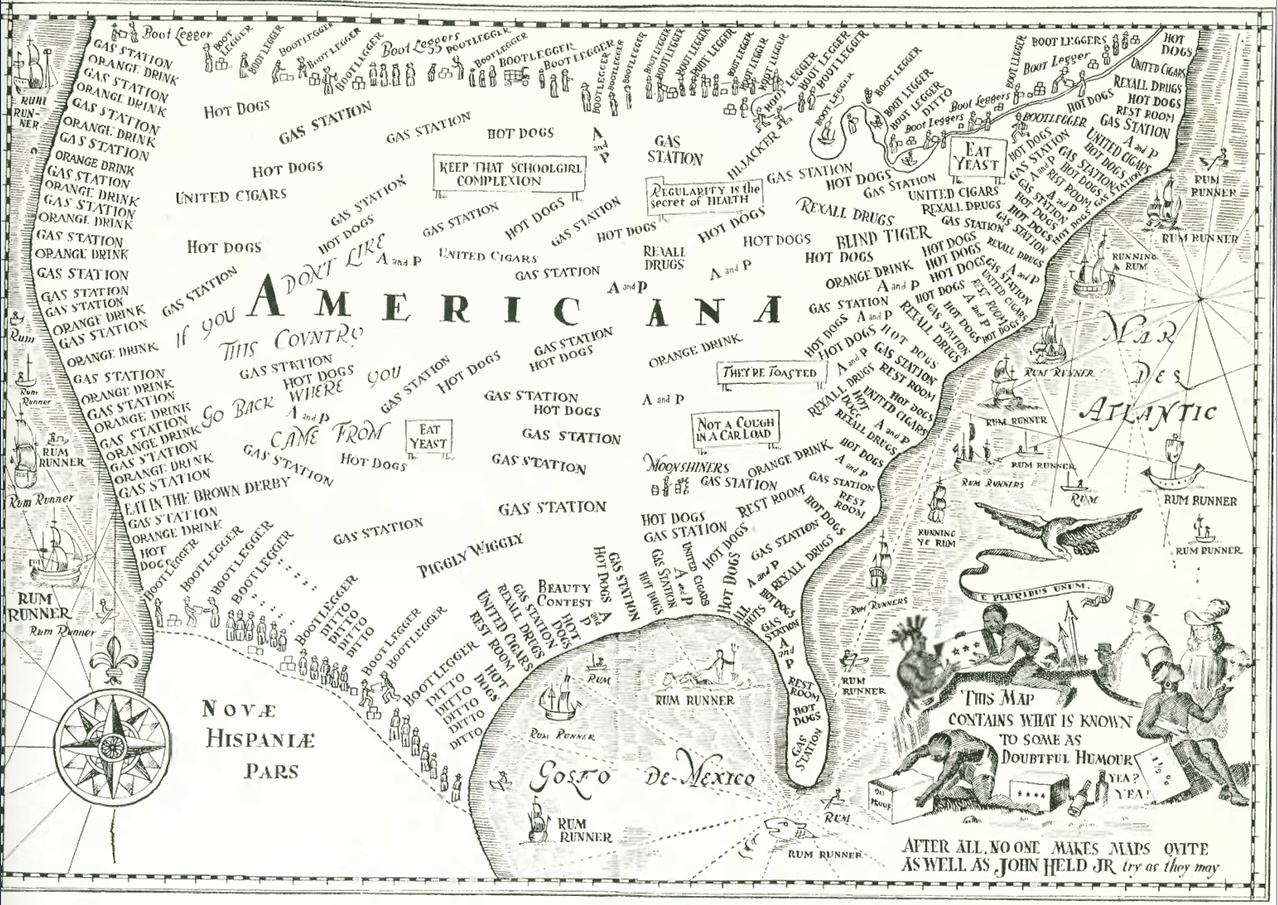
…I discovered this clever “map” by John Held Jr. For fans of “Boardwalk Empire” or other 1920s gangster-themed fare, Held’s map confirms it was no secret that Atlantic City was a major port for rum runners:

Screen Shot 2015-12-01 at 12.06.44 PM

Also on the theme of Prohibition, cartoonist James Daugherty (Jimmy the Ink) had some fun with New Yorker colleague Lois Long (aka Lipstick) by pairing her with New York’s top Prohibition prosecutor Emory Buckner in this unlikely scenerio:

Screen Shot 2015-12-01 at 12.08.38 PM

Note the lock on the fire hydrant. Padlocking restaurants and clubs suspected of selling alcohol was a favorite tactic of Buckner and his agents. Long famously took him task in her Oct. 31, 1925 “Tables for Two” column. You can read about it here in my previous post, “How Dry I Am.”

Next Time: The Great American Novelist…

Screen Shot 2015-12-01 at 12.12.47 PM

Party With Gentleman Jimmy

Screen Shot 2015-07-23 at 12.08.59 PM
Nov. 21, 1925 cover by Stanley W. Reynolds.

Mayor Jimmy Walker wasn’t known for being cerebral. But as the voters’ choice to lead the City of New York, he could not have been more well-suited (pun intended) to the zeitgeist of the final, dizzying, roaring years of The Jazz Age.

Walker was a flamboyant man-about-town, a clothes horse who was no stranger to speakeasies or the backroom politics of Tammany Hall.

As Jonathan Mahler wrote in New York magazine (April 1, 2012), Gentleman Jimmy “perfectly embodied that moment of indulgence: the public servant who favored short workdays and long afternoons at Yankee Stadium, who was loath to miss a big prizefight or Broadway premiere, who left his wife and Greenwich Village apartment for a chorus girl and a suite at the Ritz-Carlton.”

Not that there weren’t some concerns. “The Talk of the Town” offered this early observation of the incoming mayor:

Screen Shot 2015-07-24 at 9.38.52 AM

Screen Shot 2015-07-24 at 1.01.10 PM
New York City Mayor Jimmy Walker during a visit to Boston. (Boston Public Library)

Mahler quoted a columnist from Walker’s time, who noted that “No man could hold life so carelessly without falling down a manhole before he is done.” And Walker would fall to scandal by 1932. But we will get to that. For now, it’s party time in Gotham.

The New Yorker continued to have fun with President Calvin Coolidge, publishing this cartoon by Isadore Klein that took a poke at Coolidge’s Thanksgiving Day Proclamation, in which Coolidge spoke at length about the nation’s abundance:

Screen Shot 2015-07-24 at 9.51.44 AM

Talk also reported the latest bootleg prices in “The Liquor Market…”

Screen Shot 2015-07-24 at 9.52.59 AM

“Profiles” examined the life of New York Times owner Adolph Ochs. The writer Elmer Davis observed that “More than any other newspaper owner, he is his paper, and his paper is himself…”

Screen Shot 2015-07-24 at 12.23.11 PM
Detail from a lantern slide depicting Basil Sydney as Hamlet and Charles Waldron as Claudius in the Booth Theatre’s 1925 production of Hamlet in “modern dress.” (Graphic Arts Collection, Princeton)

In “The Theatre,” critic Herman J. Mankiewicz addressed criticisms of the Booth Theatre’s new approach to Hamlet, which was presented “in modern dress.” Mankiewicz wrote that the departure from traditional Elizabethan costumes had brought the play “into the open,” and that Basil Sydney was a “splendid” Hamlet.

In “Books,” reviewer Harry Este Dounce recommended Ford Madox Ford’s No More Parades (“a fine display of virtuoso writing”) and Arthur Schnitzler’s Fraulein Else (“a scintillant little firework”).

tumblr_mqej7s8XOl1qzx4bjo1_1280
Lilyan Tashman, left, and Pauline Starke in Robert Z. Leonard’s Bright Lights, 1925 (Tumblr)

In “Motion Pictures,” Theodore Shane panned the movie Lord Jim (based on the Joseph Conrad novel), but he enjoyed the “simple hokum tale” of Bright Lights and the “restrained” performance of Pauline Starke, “a perfect miniature Gloria Swanson.”

In “Tables for Two,” Lois Long despaired of finding a decent “swank dinner” on a rainy autumn evening, and finally headed to a Viennese restaurant (Frau Greta’s) for some German comfort food. The rain turned to torrents as she then headed out for some nightlife:

Screen Shot 2015-07-24 at 10.19.47 AM

Long concluded her “Tables” column with this peevish note on “grammar:”

Screen Shot 2015-07-24 at 10.21.43 AM

In her other column, “On And Off The Avenue,” Long wrote about the increasing popularity of New Yorkers traveling to Florida for the winter, and in anticipation of the Christmas holiday, offered this advice on what not to give as gifts:

Screen Shot 2015-07-24 at 10.27.34 AM

Screen Shot 2015-07-24 at 10.27.47 AM

In her report from Paris, Janet Flanner commented on the popularity of Josephine Baker at the Champs Elysees Theater:

Screen Shot 2015-07-24 at 12.09.00 PM

Josephine Baker in 1927. (Wikimedia Commons)

Flanner also commented on the growing appreciation of paintings by Henri Rousseau, who just a decade or so earlier was considered something of a joke among art circles:

Screen Shot 2015-07-24 at 12.09.43 PM

60.1583
Henri Rousseau’s The Football Players, 1908. Today even Rosseau’s lesser-known works are valued in the millions (Wikimedia)

And finally, Julian de Miskey’s take on The Big Game:

Screen Shot 2015-07-24 at 9.58.04 AM

Next Time: A Debutante’s Diatribe…

Screen Shot 2015-07-24 at 9.36.48 AM


Oh Those French

Screenshot 2015-07-10 16.32.07
Oct. 24 cover by Max Ree.

Apparently even Parisians have fashion lapses from time to time. Janet Flanner (Genêt) reported with some alarm a “curious phenomenon” from Paris in the Oct. 24, 1925 issue of The New Yorker.

It seemed that the otherwise fashionable Parisians were slumming it a bit and had adopted a dowdy look previously associated with residents of the British Isles. (The un-dowdy image at the top of the page is French designer Sonia Delaunay and her matching Citroen in 1925).

Apparently such pedestrian tastes had also caused a shift from formerly fashionable travel destinations on the Atlantic coasts to Mediterranean destinations:

Screenshot 2015-07-14 10.25.03

And to top things off, the French were agog over the latest Charlie Chaplin film, The Gold Rush (another French favorite of American clown-dom, Jerry Lewis, would be born the following year):

Screenshot 2015-07-14 10.25.26

But then there was another new distraction in town, the Autumn Salon:

Screenshot 2015-07-14 10.26.17

6865003683_3b4a1952df
Pavel Tchelitchew, self-portrait, 1925 (Flickr)

Pavel Tchelitchew was known as a leader of “mystical surrealist” painting. He left his native Russia in 1920 and lived in Berlin before moving to Paris in 1923. There he became acquainted with Gertrude Stein and Edith Sitwell, the latter with whom he had a long-standing friendship.

The French were also on display in a comic piece by Theodore Shane, who also served as the magazine’s movie critic.

Shane wrote a piece titled “Fra~nce” in a style that suggested he was teaching children about France by dividing words into syllables (it was similar to a piece about Russia (“Rus~sia”) in the Aug. 29 issue, signed “Freudy”) Here’s a sample:

Screenshot 2015-07-13 16.18.19

A full-page ad on the Page 1 announced the “The Midnight Open” event at The 19th Hole Club in the Hotel Roosevelt, with an impressive lineup of golf professionals such as Walter Hagen and Gene Sarazen and even “prominent amateurs” including Bobby Jones.

41864_172_z
The Roosevelt Hotel, which opened in 1924 (Expedia)

I was surprised that the annual membership fee was advertised as only $10, which would roughly translate to $135 today—a bargain compared to what it costs today to join even the lowliest golf club.

Screenshot 2015-07-13 12.13.32

“Talk of the Town” welcomed news from Boston that “ladies are to be allowed to smoke in the open” in that city (drawing by Johan Bull):

Screenshot 2015-07-13 12.17.13

Screenshot 2015-07-13 12.17.05

In a feature “Our Collegiate Hilltop,” Elmer Davis wrote about the droves of college students who had taken over much of the available housing along Morningside, “a ghetto for the Nordic native-born.” Davis offered this lament about Columbia’s continued creep into the surrounding neighborhoods (with accompanying art by Helen Hokinson):

Screenshot 2015-07-13 12.27.15

Screenshot 2015-07-13 12.37.51

“Profiles” examined the life of “A Kind Man,” William Lyon Phelps. That title was not meant as a complement from writer Waldo Frank, but rather it was his “kindness” toward authors that caused him to praise books that were not worthy of praise and made him the personification of the “most American of disasters: the disaster of Good Intentions, when they are not fortified by intellectual hardness, when they are not drained of all sentimental juices.”

ethel-27
Ethel Barrymore in 1925 as Ophelia in Walter Hampden’s Production of Hamlet. (barrymorefamily.com)

In “The Theatre” Elsie Ferguson and Basil Rathbone were appearing in The Grand Duchess and the Waiter at the Lyceum (“an agreeable piece of work”), while Ethel Barrymore “wowed” critic Herman J. Mankiewicz with her performance as Ophelia in a revival of Hamlet at Walter Hampden’s Theatre.

Or at least I think she wowed him. Mankiewicz knew and worked with the Barrymore family, and I wonder if his over-the-top style here is a wink to the fact that a 45-year-old Ethel was playing the part of a young virgin. Here’s an excerpt from the review:

Screenshot 2015-07-14 15.05.43

I hate to jump ahead, but in the Nov. 14 issue, “Talk of the Town” offered this humorous anecdote from one of Barrymore’s performances:

Screen Shot 2015-07-22 at 4.48.09 PM

In sporting news, John R. Tunis continued his coverage of rivalry matches staged at Yankee Stadium, this time the fiercely competitive Notre Dame vs Army matchup. Despite Notre Dame’s renown under Knute Rockne, Army was a worthy foe in the 1920s and in this particular matchup the Cadets blanked the Irish 27-0. The matchup between these teams was so popular that it was played at Yankee Stadium until 1947.

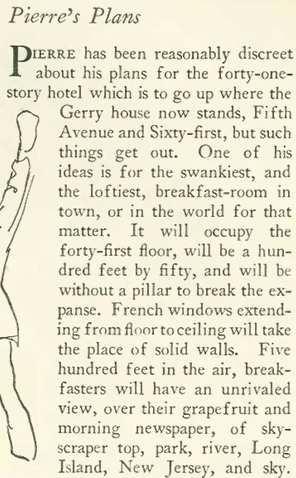
And finally, Lois Long sharpened her pencil and offered her thoughts on a dull dinner crowd at Pierre’s:

Screenshot 2015-07-14 10.21.39

A drawing by Peter Arno (who would marry Long in 1927) in another section of the magazine seemed to refer to Long’s lament:

Screenshot 2015-07-13 16.10.04

Long also offered some criticisms of a “new negro revue” that decidedly differed from the mainstream:

Screenshot 2015-07-14 10.20.34

A great illustration by Julian de Miskey of the Bellows exhibition at the Met:

Screenshot 2015-07-13 16.08.51

Next Time: Short-tempered about Temperance…

Screenshot 2015-07-14 10.28.30

Autumn in Paris

Screenshot 2015-07-06 16.39.29
Oct. 10 cover by Ilonka Karasz.

The Oct. 10, 1925 issue marked Janet Flanner’s first “Paris Letter” signed under the pen name Genêt.

The column, dated Sept. 25, noted that droves of American tourists were heading for the northern ports “carrying everything away that’s portable, and the American Express is hard pressed to find crates enough to house the antiques that are on their way to make American homes beautiful.”

Flanner also noted the huge attendance numbers at the Exhibition of the Decorative Arts, but she was no fan of the teeming masses: “More than ten million people have attended which, by the way, if you have been there, you will know, has been nine million nine hundred thousand too many for comfort.”

2596924971_16b1cd6a78_o
Postcard image of the International Exposition of Modern Industrial and Decorative Arts. The term “Art Deco,” which would be used to describe a prevailing design style of the Jazz Age, was derived by shortening the words Arts Décoratifs. (Flickr)
3_janet_flanner(1)
Janet “Genêt” Flanner in Paris, 1928, in a photo by Berenice Abbott. (Wikipedia)

Persistent rainstorms that ruined the French wheat crop and inflicted major damage on the wine growing regions had also dampened the spirits of the French and tourists alike, so Flanner looked forward to the Autumn Salon which was “still to come as the big Fall event.” She also noted that James Joyces’s novel Ulysses, banned in the U.S., was already into its sixth French edition.

According to Ben Yagoda (About Town: The New Yorker and the World it Made), Flanner had first come to the attention of editor Harold Ross through his wife, Jane Grant, who was a friend of Flanner’s from the Lucy Stone League, an organization that fought for women to preserve their maiden names after marriage. Flanner would go on to work for The New Yorker for the next five decades.

In “The Talk of the Town,” it was reported that Patricia Salmon was returning to Broadway “a more confident person” after enlarging her fame with performances “in the hinterland.” And in other show-biz news, the Masonic Order’s new Mecca Temple announced that it would open with an American program led by John Philip Sousa. It was also noted that the great Sousa had succumbed to the lure of jazz music:

Screenshot 2015-07-09 12.18.32

Screenshot 2015-07-09 12.18.39

MeccaTempleExt
The Mecca after its completion in late 1924. Known today as New York City Center, it is now home to the Alvin Ailey American Dance Theater, Manhattan Theatre Club, The Flamenco Festival, and the Martha Graham Dance Company among other groups. (nycago)

“Profiles” featured publisher and stage producer Horace B. Liverwright, the piece defiantly titled “One Hundred Per Cent American.” The social activist Waldo Frank (“Search-light”) wrote admiringly about this vocal campaigner against strict literary censorship, and observed that Liverwright possessed the soul of a poet who does what he likes, and this is what he likes above all: “that no hour be heavy, that no day and no deal be without its radiant wings.”

Morris Markey explored the Shenandoah airship disaster in greater detail in his “In the News” section, and hoped that the Navy’s inquiry into the crash would not deter further developments in airship travel:

Screenshot 2015-07-09 12.31.03

In “Sports of the Week,” John R. Tunis wrote what would be the first of many articles in the magazine on college football, which featured prominently in the fall issues thanks to an ailing Babe Ruth and the slumping Yankees.

The lengthy article was an account of Nebraska’s 14-0 victory over Illinois in the Illini’s gleaming new stadium in Champaign. The match was billed as one of the major contests of the season, bringing together two All-American captains in a defensive slugfest: Red Grange of Illinois and Ed Weir of Nebraska.

Screenshot 2015-07-09 14.35.52
Famed Illinois running back Red Grange (left) was held scoreless by fellow All-American Ed Weir and his Nebraska Cornhuskers in a much ballyhooed matchup of 1925.

Next time: Ode to a Real American Artist…

Screenshot 2015-07-09 11.55.39