As a book reviewer for The New Yorker, Dorothy Parker could eviscerate any writer with the tip of her pen, and often did so.
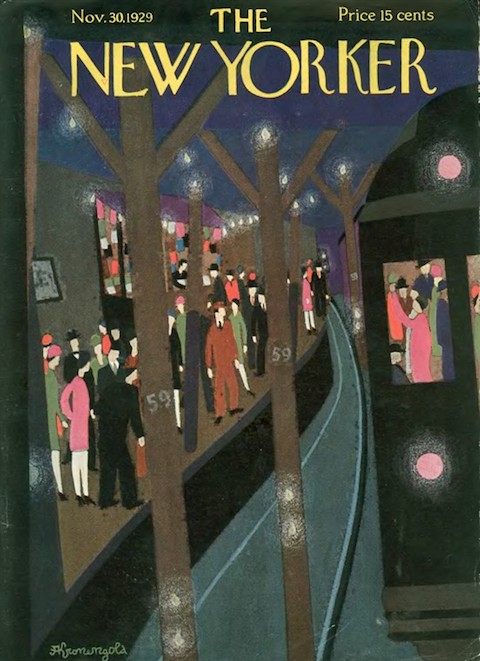
Nov. 30, 1929 cover by Adolph K. Kronengold.
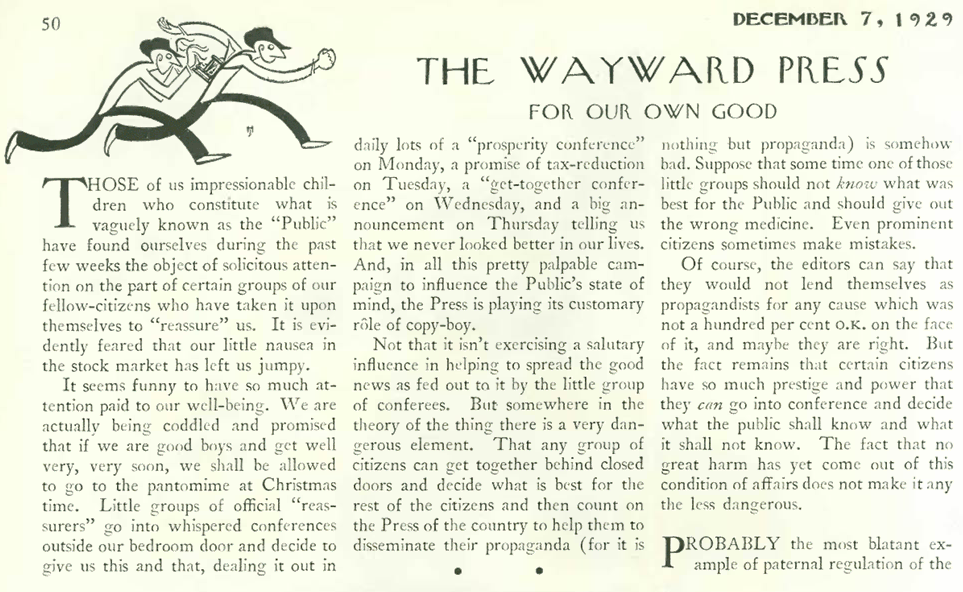
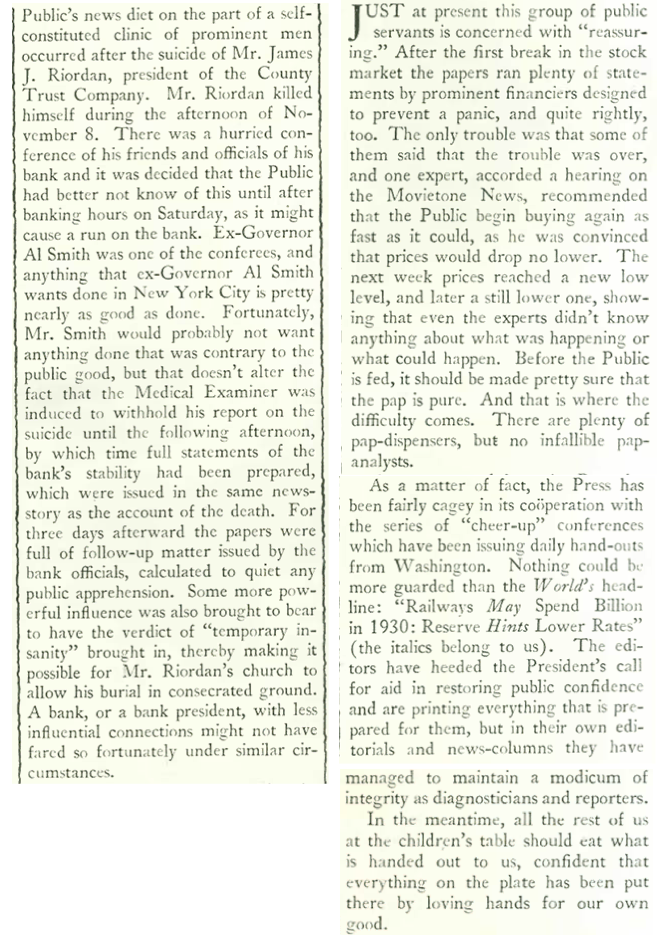
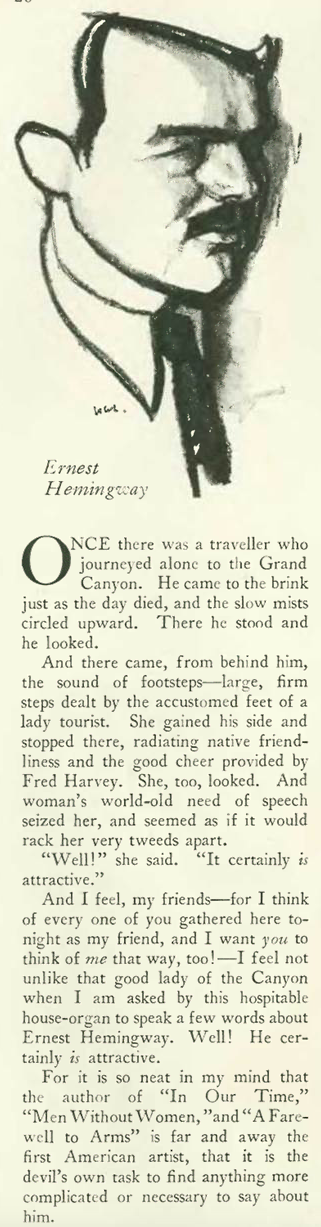
One writer, however, who received consistent praise from Parker was Ernest Hemingway, whom she first met in 1926. In the pages of the 1920s New Yorker, Parker particularly lauded Hemingway’s short story collections, In Our Time (1925) and Men Without Women (1927), which bookended his 1926 novel The Sun Also Rises (which Parker thought OK but overly hyped). When The New Yorker profiled Hemingway in the Nov. 30, 1929 issue, it naturally turned to Parker to do the honors (although Robert Benchley, a good friend of Hemingway’s, could have offered his own take on the author) :
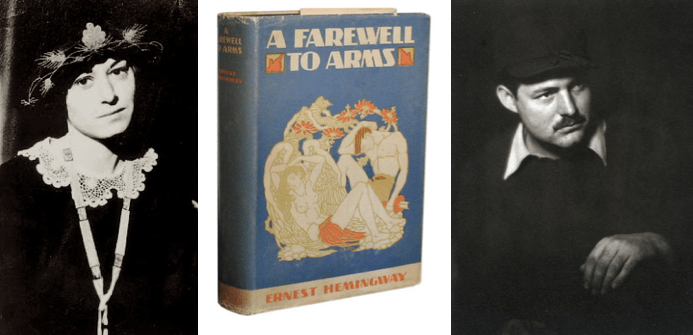
SHE’S A FAN…Dorothy Parker was a long-time admirer of the work of Ernest Hemingway. His last work of the 1920s, A Farewell to Arms, was serialized in Scribner’s Magazine and published in September 1929. The success of that book made Hemingway financially independent. (Mugar Library/Wikipedia)
During Hemingway’s Paris years Parker actually took a boat with him to France (in 1926, along with mutual friend Robert Benchley) and so got a firsthand taste of his bohemian adventures. By the time The New Yorker profiled Hemingway, the Jazz Age was dead and Paris’s so-called “Lost Generation” was a thing of the past. Indeed, Hemingway had already been in the States for more than a year, returning in 1928 with his second wife, Pauline Pfeiffer.
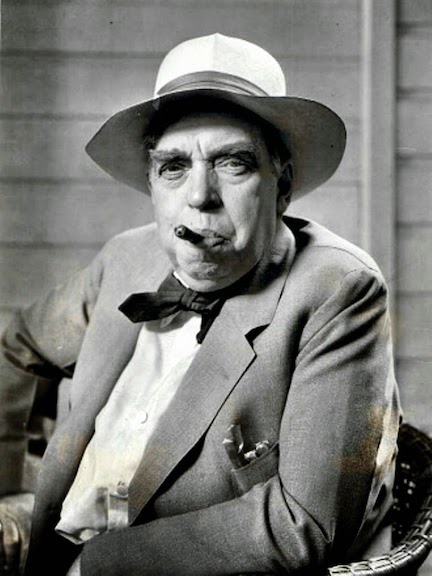
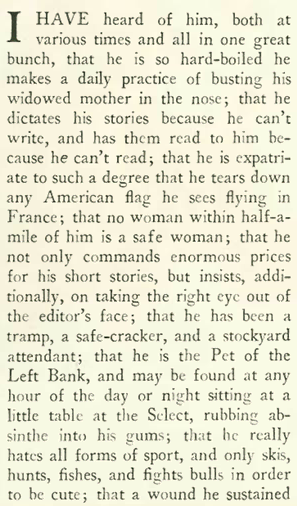
Biographer Jeffrey Meyers notes in his book Hemingway: A Biography, that Hemingway of the early Paris years was a “tall, handsome, muscular, broad-shouldered, brown-eyed, rosy-cheeked, square-jawed, soft-voiced young man,” features that were not lost on Parker:
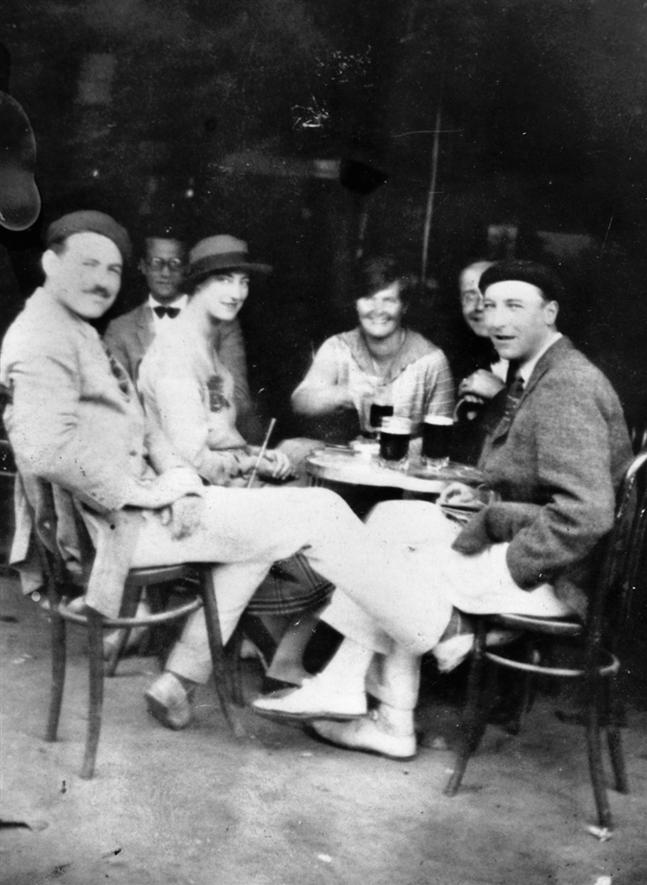
HE’S TAKING NOTES…Ernest Hemingway (left), with Harold Loeb, Lady Duff Twysden (in hat), Hemingway’s first wife Hadley Richardson, Donald Ogden Stewart (obscured), and Pat Guthrie (far right) at a café in Pamplona, Spain, July 1925. The group formed the basis for the characters in The Sun Also Rises: Twysden as Brett Ashley, Loeb as Robert Cohn, Stewart as Bill Gorton, and Guthrie as Mike Campbell. (Wikipedia)
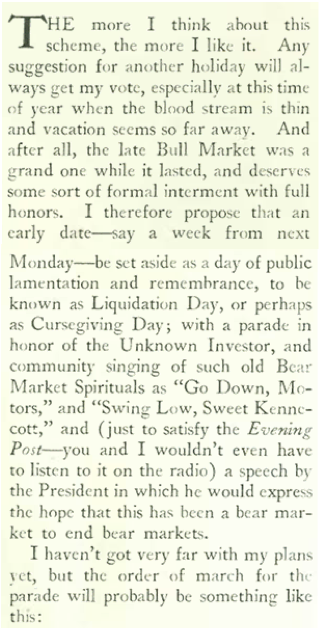
…more from Parker on Hemingway’s magnetic appeal…
MAN ABOUT TOWN…Ernest Hemingway (far right) in 1926 in Paris, outside the city’s famous Shakespeare and Company bookshop. He is pictured here with Sylvia Beach (on his right), the shop’s founder. (Collection Lausat/Keyston-France/parisinsidersguide.com)
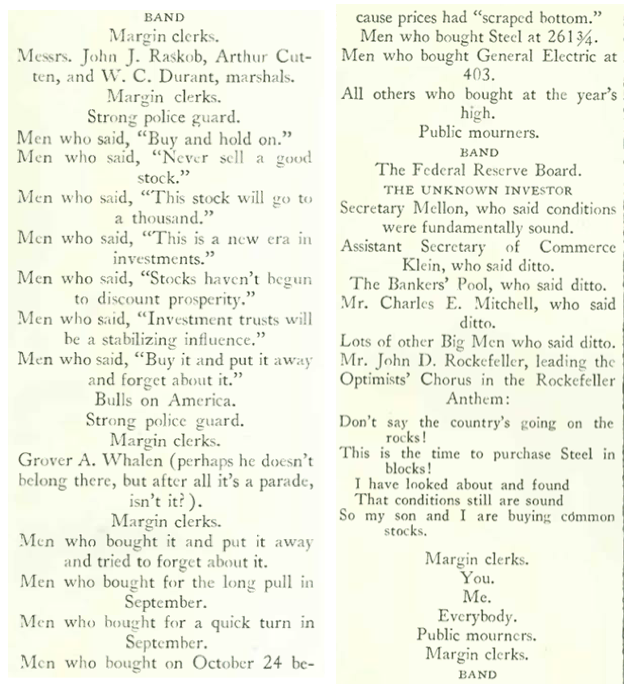
Although Hemingway remains widely read and revered, such a hagiography — especially from someone as reliably critical as Parker — would be unlikely today. From his safari massacres of countless animals (in pursuit of his manhood) to his mistreatment of four wives and general misogyny, he is a far more complex and controversial figure today. One thing Parker got right: his short stories have held up much better than his novels. As for the profile, Parker concluded:
* * *
Meet the Fokkers
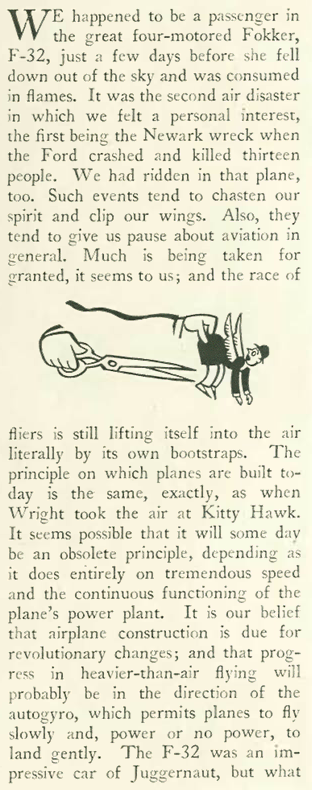
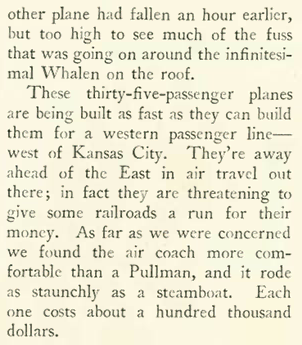
In previous blogs we have established that E.B. White was an aviation enthusiast. He seems never to have missed an opportunity to catch a ride into the skies, so when pilots were conducting test flights of a prototype Fokker F-32 at New Jersey’s Teterboro field, he was there to file this brief for “The Talk of the Town”…
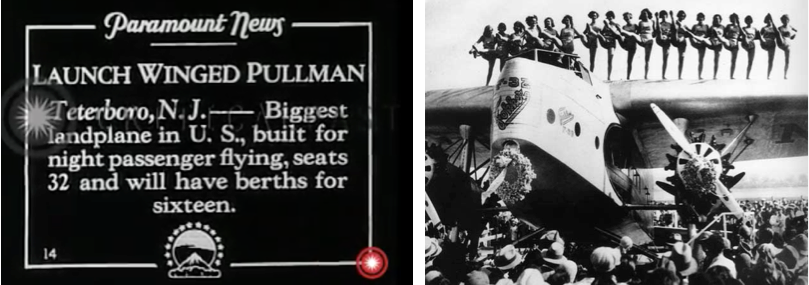
SKYTRAIN…Title card from a silent Paramount newsreel reporting on a November 1929 flight of the Fokker F-32 at Teterboro. Note how the title card uses a railroad reference (“Pullman”) as a descriptive for the passenger cabin. Indeed, early airplane passenger cabins were very much designed along the lines of Pullman cars. At right, a circa 1930 photo, possibly of a celebration of the plane’s arrival in Los Angeles. I imagine the FAA would not look kindly on this behavior today. (YouTube/petersonfield.org)
White’s enthusiasm for the aviation age is palpable in his description of the Fokker as it took off and climbed to a thousand feet:
ROUGHING IT…Passengers in Washington D.C. prepare to board what was perhaps the same plane White flew on at Teterboro. Note how they were required to walk across a muddy field to reach the plane’s entrance. The Fokker was the first four-engine commercial aircraft built in America and the largest land plane in the world at the time (there was a much larger amphibious German plane). At right, the plane’s four engines were configured back-to-back. (Wikipedia/petersonfield.org) click to enlarge
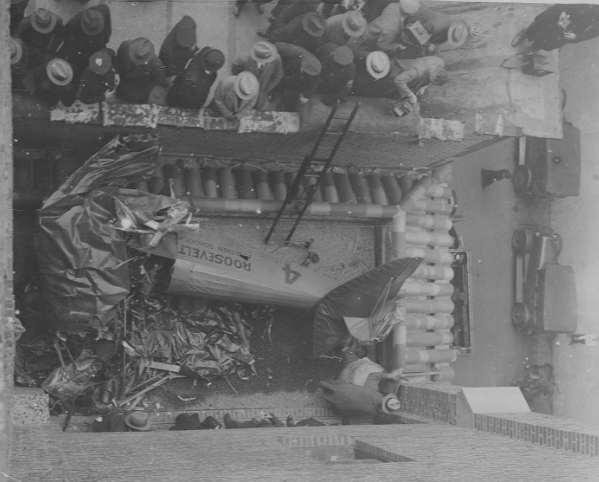
In line with The New Yorker’s stance of keeping things light, White described a scene just north of midtown, where a crowd had gathered near the site a plane crash. The pilot was killed, but a passenger managed to parachute to safety.
DOWN TO EARTH…Pilot Charles Reid died instantly when his plane slammed into a YMCA on 64th Street on Nov. 20, 1929. His passenger parachuted to safety. E.B. White referred to the crash in his “Talk” article. (digital-hagley-org)Excerpt from a Nov. 21, 1929 New York Times account of the crash. (NYTimes archives)
Speaking of crashes, the Fokker on which E.B. White was a passenger crashed a week later (Nov. 27, 1929) during a certification flight from Roosevelt Field to Teterboro Airport. No one was killed, but the aircraft was destroyed. The design itself didn’t last much longer — considered underpowered for its size, and too expensive at the dawn of the Depression, it was phased out by the end of 1930.
Perhaps after all of that flying, White needed something to calm the nerves, a subject he addressed in his “Notes and Comment” column:
THE WOMAN’S HOUR, according to E.B. White in his “Notes and Comment” column. (vinepair.com)
* * *
The Little Gallery That Could
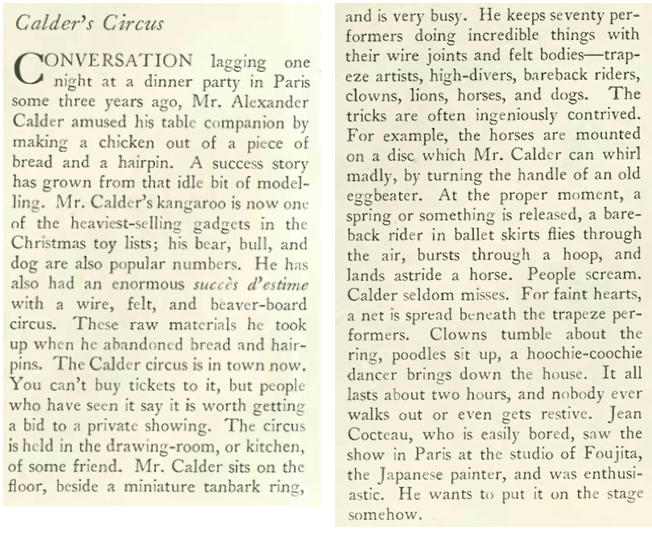
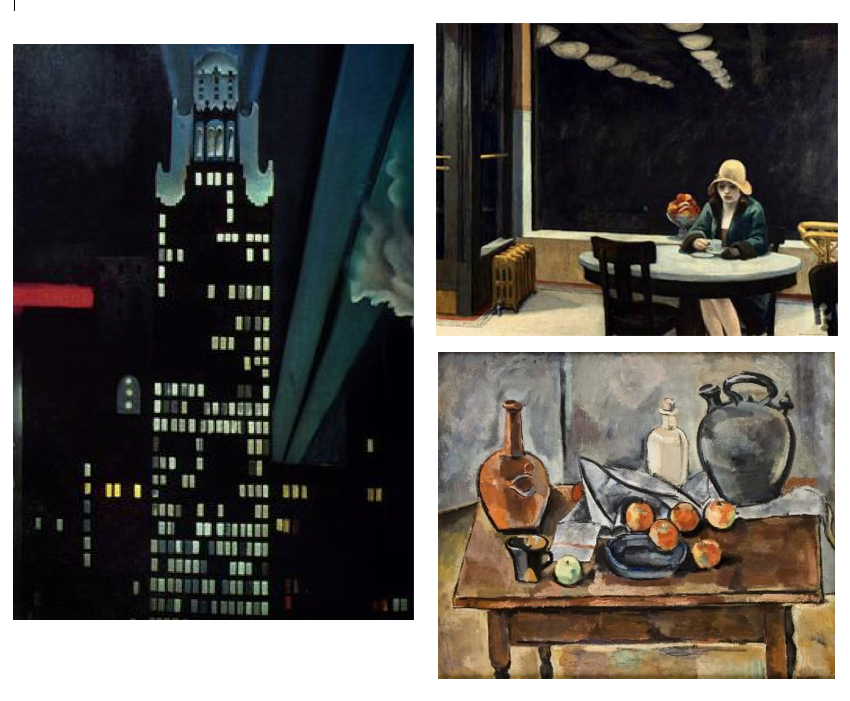
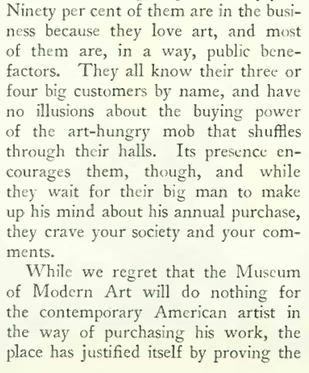
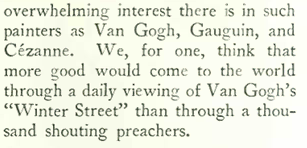
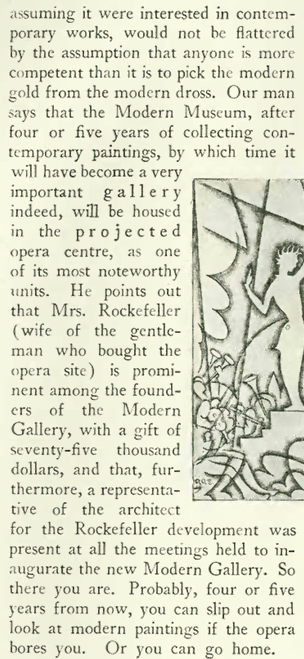
“Talk,” via art critic Murdock Pemberton, had more to say about the new Museum of Modern Art, that is, not taking it very seriously…
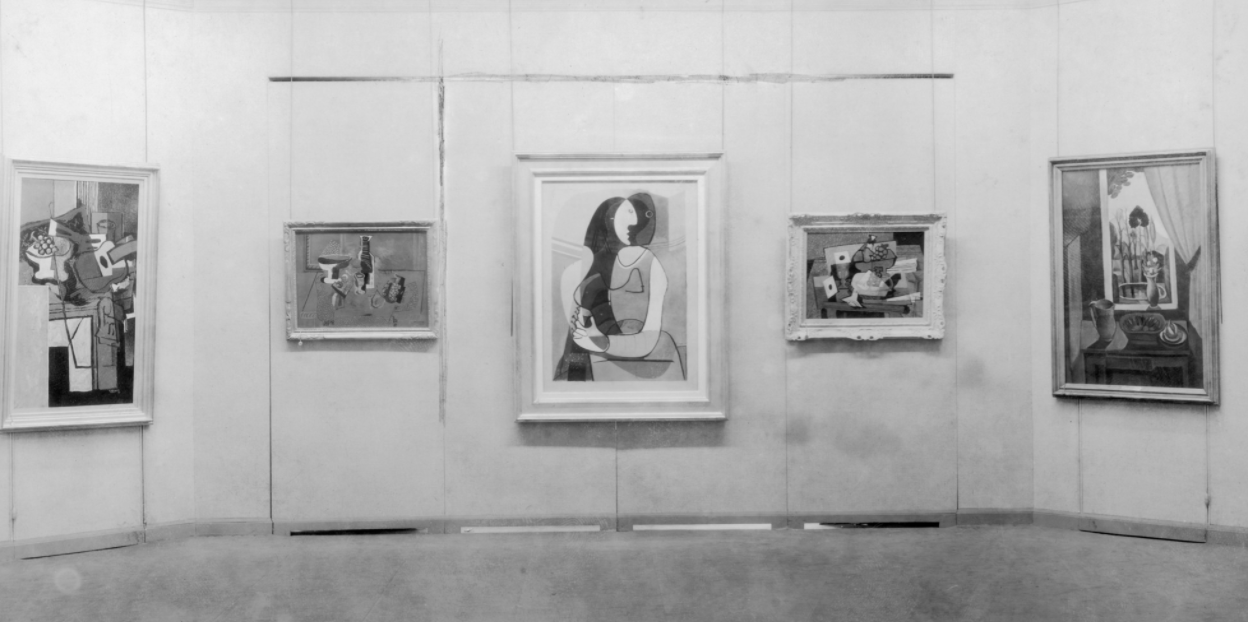
UPSTART…Although New Yorker art critic Murdock Pemberton seemed dismissive of the new Museum of Modern Art, its first month’s attendance was more than 47,000 visitors. Image above from the MoMA exhibition Painting in Paris, Jan. 19-March 2, 1930. (MoMA)
* * *
Welcome to Thurber’s World
In 1931 James Thurber published his second book, The Owl in the Attic and Other Perplexities, which consisted of pieces he had done for the New Yorker, including eight stories (from Dec. 29, 1928 to Aug. 9, 1930) that featured the marital escapades of a couple in their middle thirties, the Monroes, modeled on Thurber’s real-life marriage to his wife, Althea.
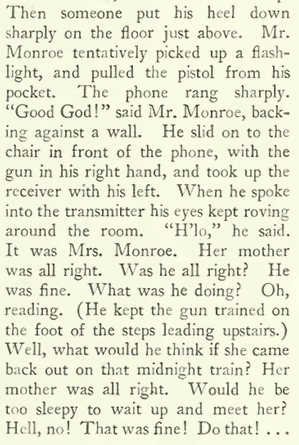
The Nov. 30, 1929 issue included Thurber’s fifth installment of the Monroe saga, “Mr. Monroe Holds the Fort,” in which a fearful Mr. Monroe, left home alone (his wife was visiting her mother), imagines there are burglars in the house:
…like his famous character Walter Mitty, which Thurber would introduce in 1939, Mr. Monroe had an equally lively imagination…
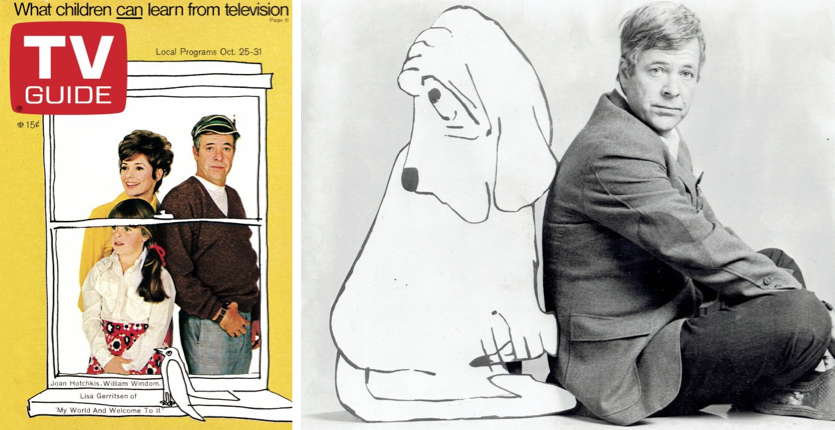
The character of Mr. Monroe would see new life in the fall of 1969 when NBC debuted My World… and Welcome to It, a half-hour sitcom based on James Thurber’s stories and cartoons. The actor William Windom portrayed John Monroe, a writer and cartoonist who worked for a magazine called The Manhattanite. In the show, Monroe’s daydreams and fantasies were usually based, if sometimes loosely, on Thurber’s writings.
THURBER AS A SITCOM…The actor William Windom portrayed John Monroe, a writer and cartoonist who worked for a magazine called The Manhattanite, on the 1969-70 NBC sitcom My World… and Welcome to It. Joan Hotchkis played his wife Ellen, and Lisa Gerritsen portrayed his inquisitive daughter Lydia. (tvguidemagazine.com/sitcomsonline.com)HOME SWEET HOME…Left, the opening credits for My World… and Welcome to It featured actor William Windom (as John Monroe) entering a animated house based on James Thurber’s famous “House and Woman” cartoon, which was originally featured in the March 23, 1935 issue of The New Yorker. (mikelynchcartoons.blogspot.com)
My World… and Welcome to It was cancelled after one season. Nevertheless, it would win two Emmys: one for Windom and another for Best Comedy Series.
* * *
Thank Heaven for Maurice
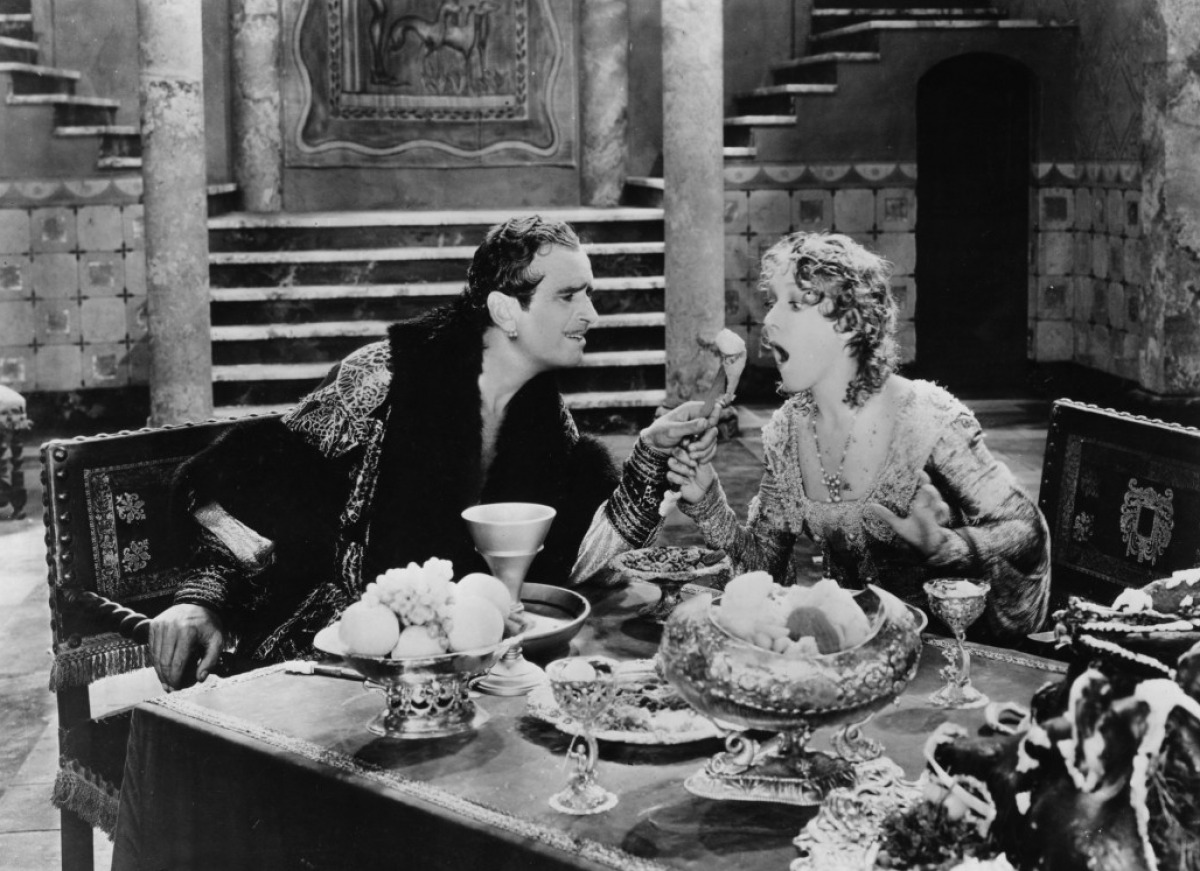
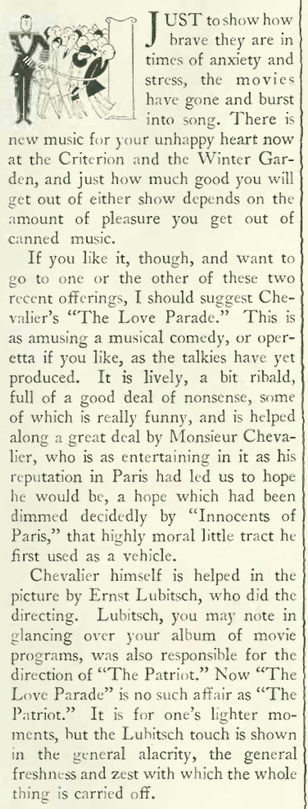
Things were looking up a bit in the talking movie department thanks to the Ernst Lubitsch-directed The Love Parade, featuring recent French import Maurice Chevalier and Jeannette MacDonald. Film critic John Mosher observed:
MUCH-NEEDED LAUGHS…Jeannette MacDonald and Maurice Chevalier in The Love Parade (1929), directed by Ernst Lubitsch. (MoMA)
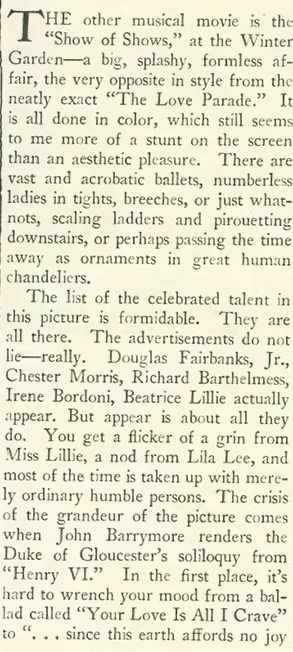
Mosher was much less impressed by another musical, Show of Shows, featuring an all-star cast and Technicolor that added up to little more than a “stunt”…
IS THAT ALL?…Warner Brothers Show of Shows offered “77 Hollywood Stars” and “1000 Hollywood Beauties” — 80 percent of it in Technicolor, but that wasn’t enough to impress The New Yorker’s film critic John Mosher. At right, Arte Frank Fay (l) and comic Sid Silvers in a color scene from the film. (IMDB)
* * *
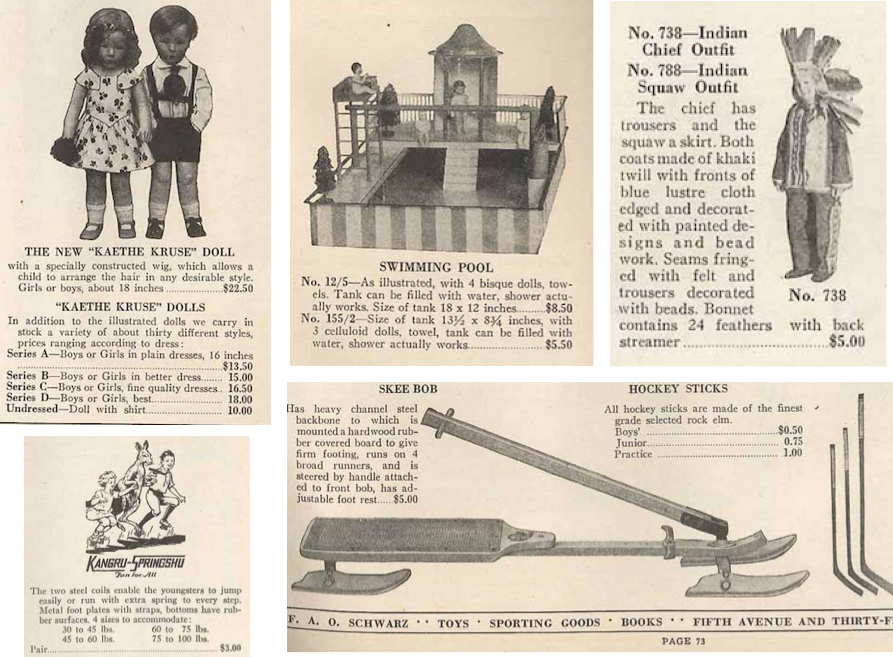
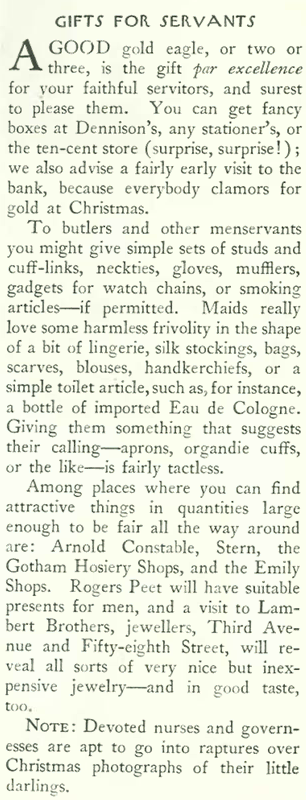
A Guide to Christmas Shopping, 1929
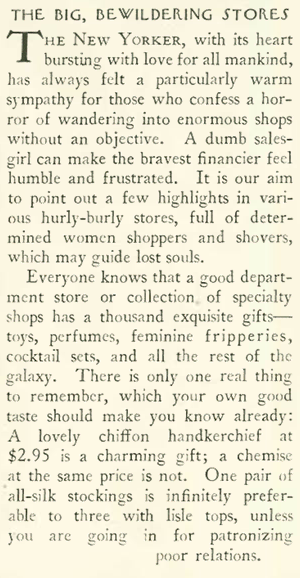
Lois Long’s fashion column, “On and Off the Avenue,” predictably grew in length as the Christmas holiday approached, and in the Nov. 30 issue she offered advice on how to go about one’s shopping duties. Some brief excerpts:
TRAILBLAZER…Lois Long guided New Yorker readers through a list of “big, bewildering stores” in her “On and Off the Avenue” column. At left, the B. Altman department store, circa 1920s. (thedepartmentstoremuseum.org/PBS)
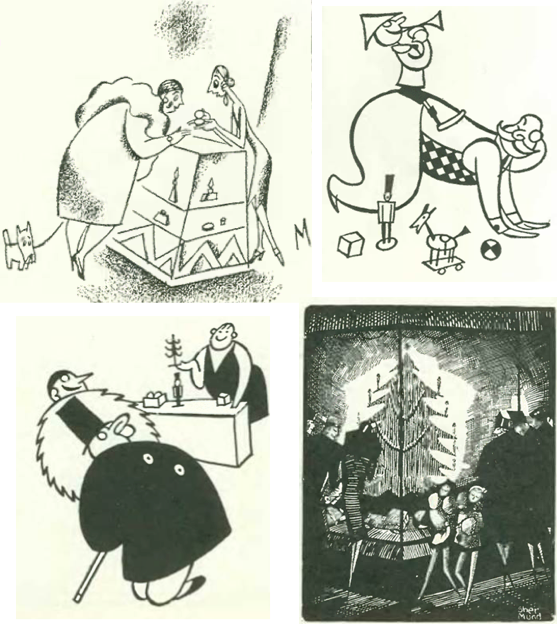
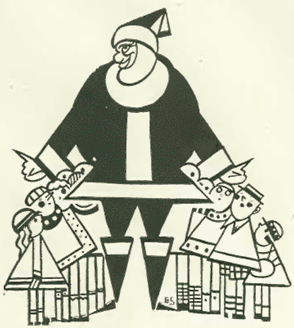
…Long’s column was peppered with holiday-themed spots, including this one by Julian DeMiskey…
From Our Advertisers
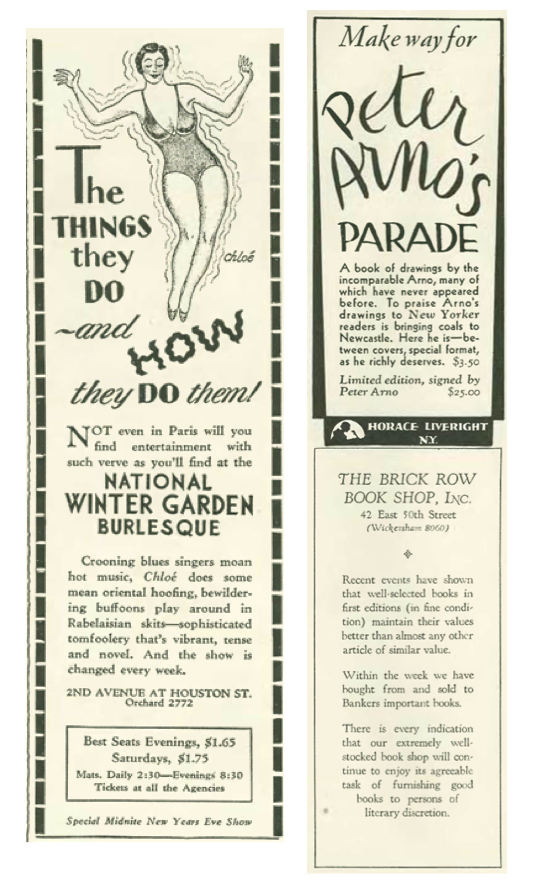
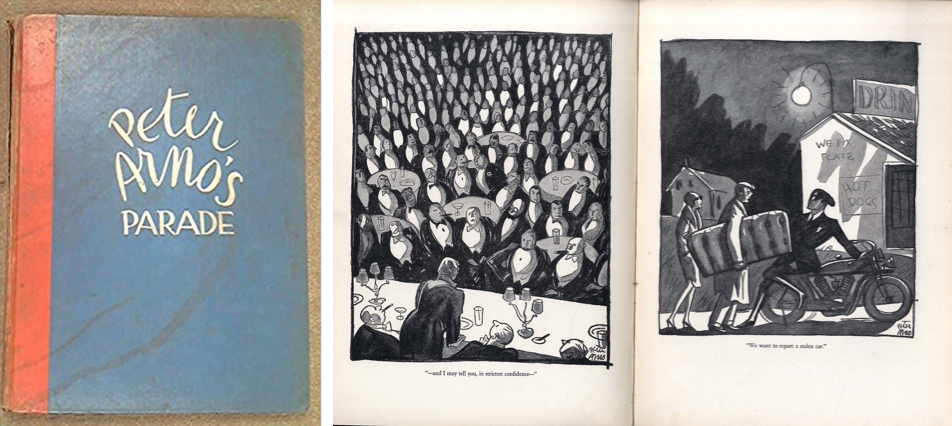
…we start with a couple of back page ads, including one from the National Winter Garden’s burlesque show and an ad announcing the imminent arrival of Peter Arno’sParade (just $3.50, or signed by Arno himself for $25)…
Cover and inside pages from Peter Arno’sParade. (Amazon)
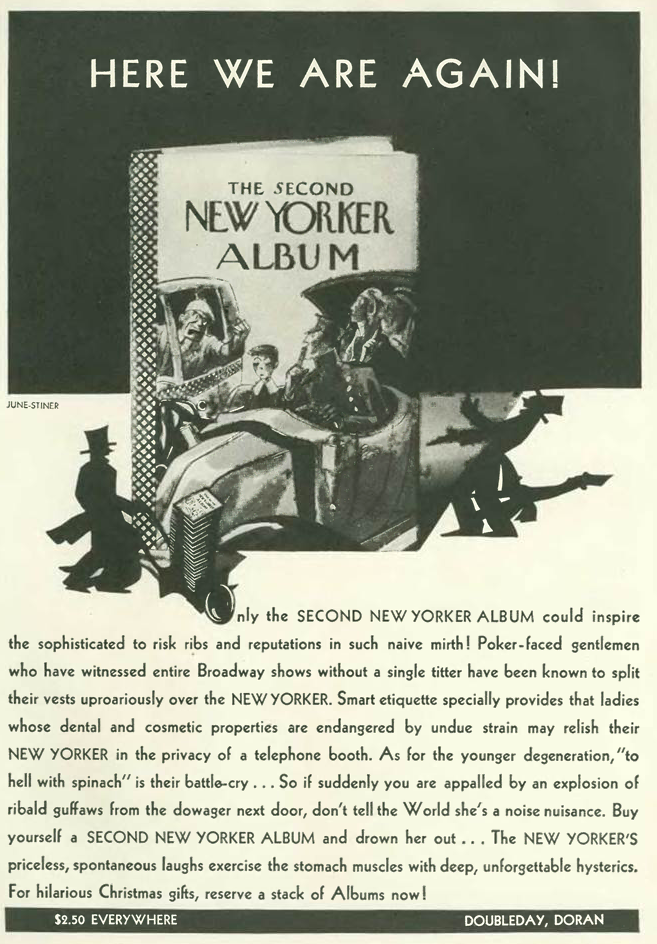
…another ad hailed the arrival of The New Yorker’s second album (read more about it here at Michael Maslin’s excellent Ink Spill)…
The first and second New Yorker albums. (pbase.com/michaelmaslin.com)
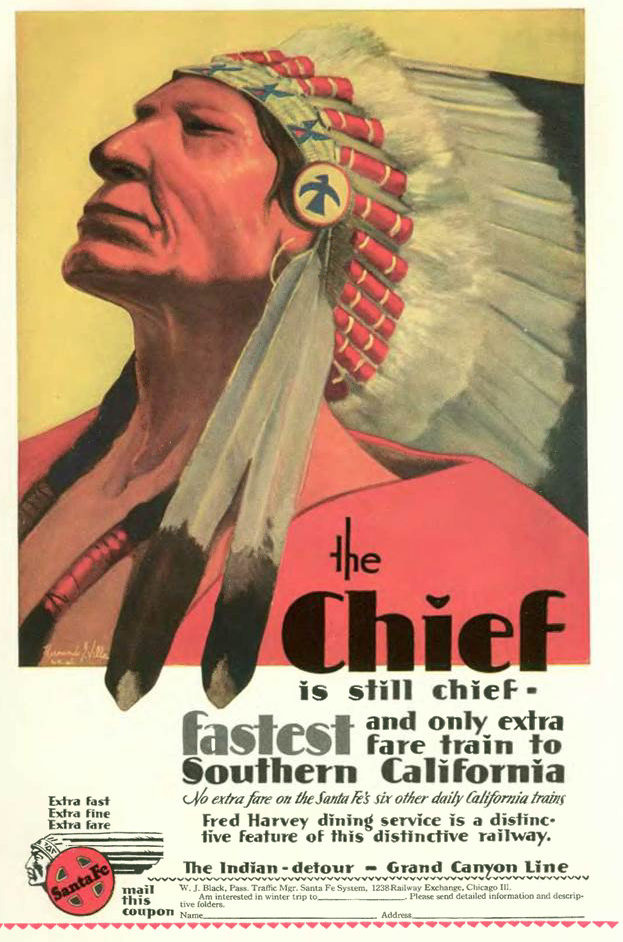
…other ads, in full color, featured cultural appropriation by the Santa Fe railroad…
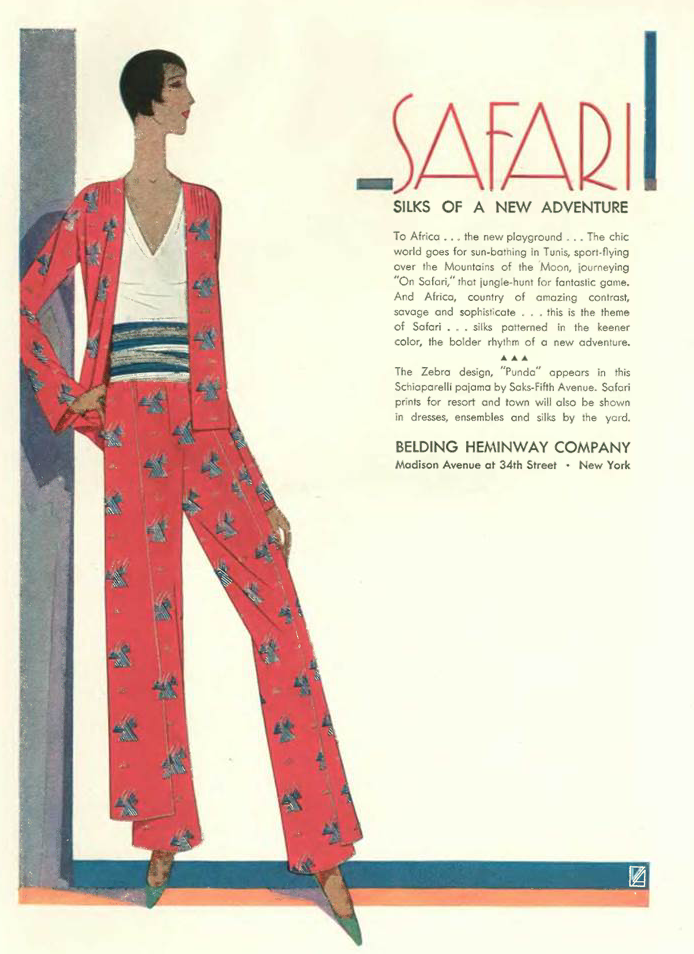
…bright silks available at the Belding Hemingway Company…
…silk stockings from Blue Moon…
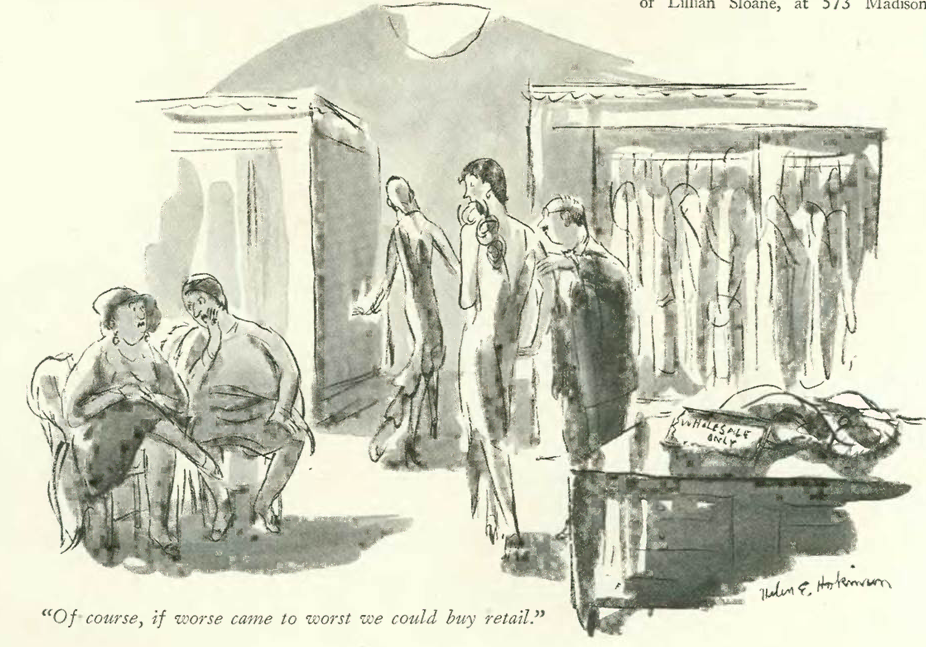
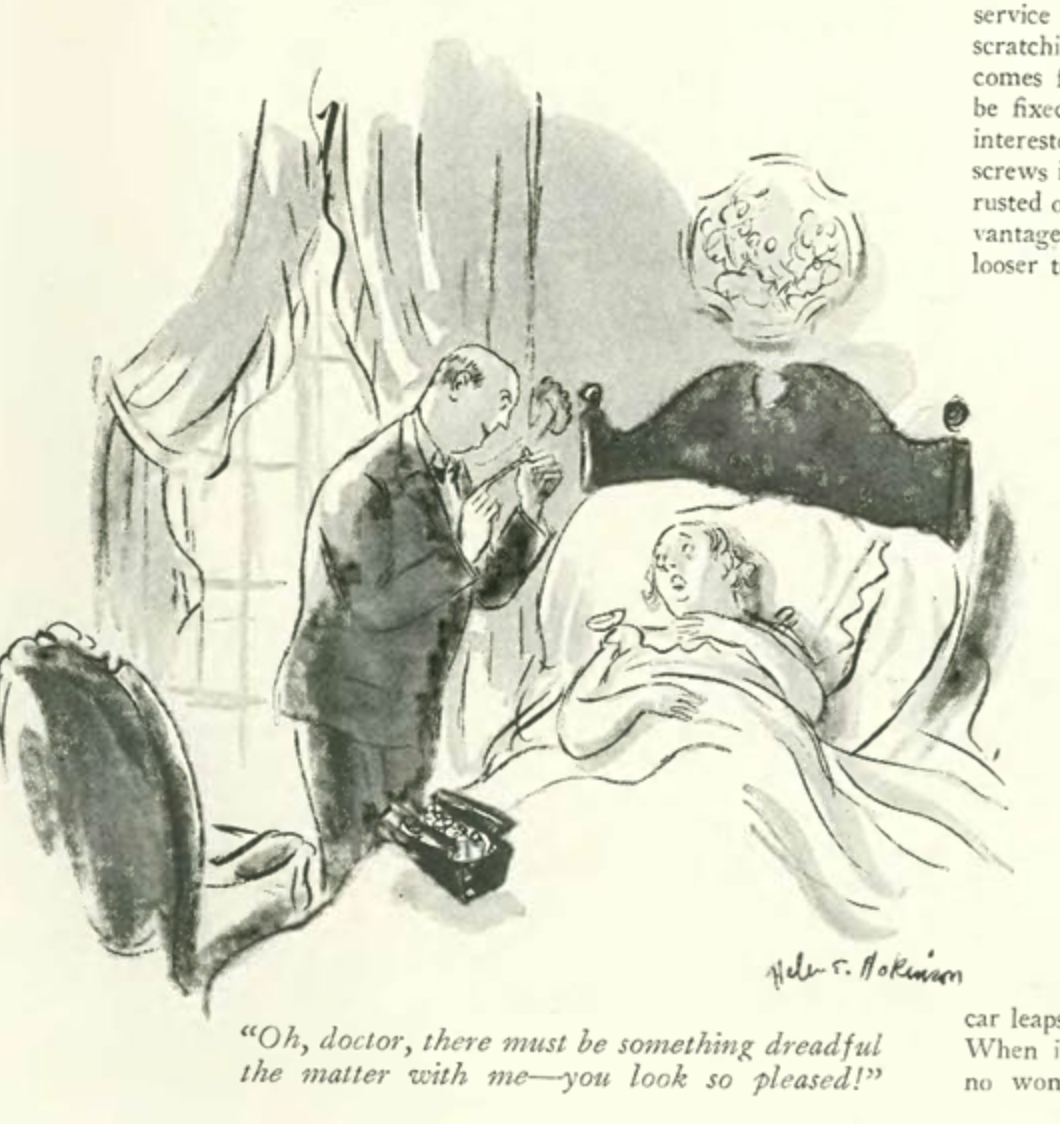
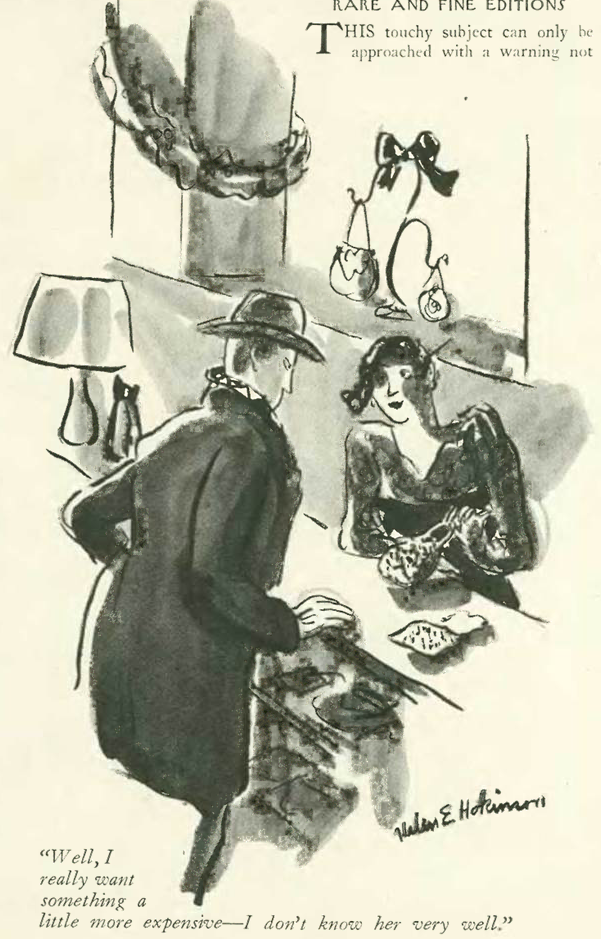
…for our cartoons, Helen Hokinson on the challenges of holiday shopping…
…Hokinson again, at tea with her ladies…
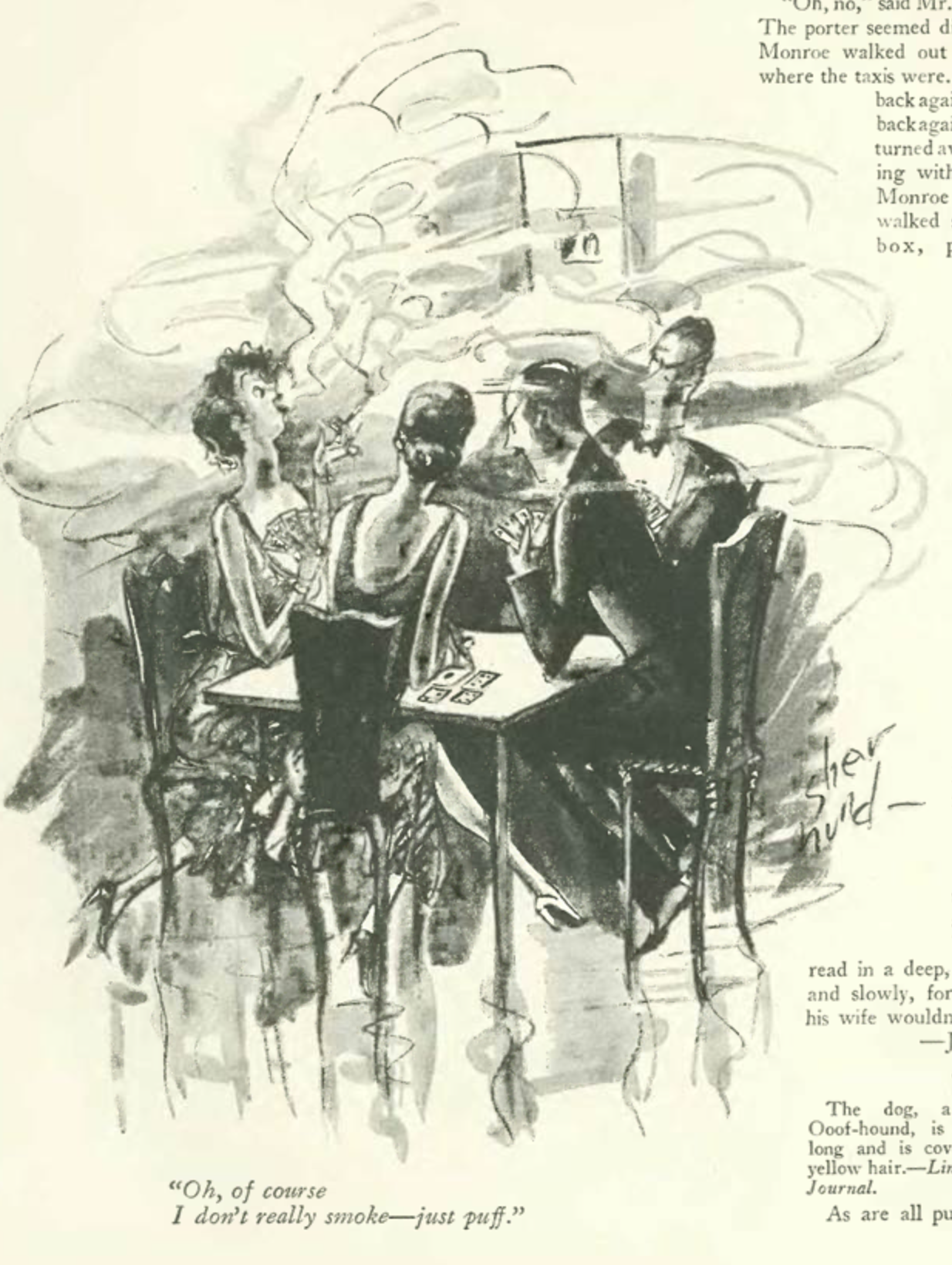
…Barbara Shermund, and the miracle of broadcast radio crossed with the nuances of a dinner party…
…and Shermund again, with a hapless friend of a clueless family…
Just nine days after the stock market crash, three women opened a new museum on Fifth Avenue that would play a major role in defining the type of city that would emerge from the other side of the Depression and World War II.
Nov. 23, 1929 cover by Theodore Haupt.
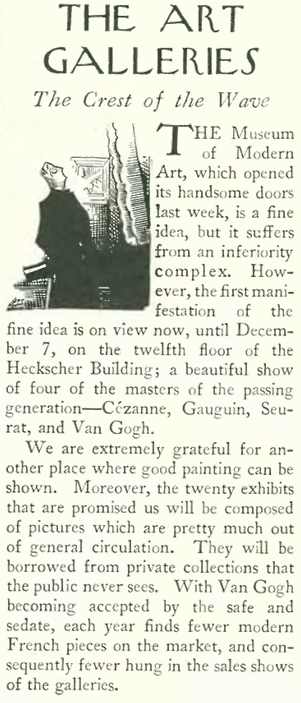
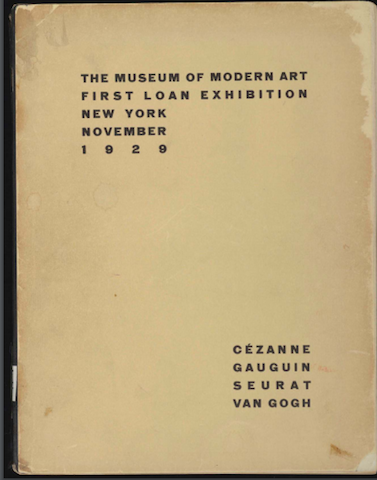
These visionary women would borrow works from modernists of the past century — the post-impressionists — to stage the first-ever exhibit of the Museum of Modern Art. Abby Aldrich Rockefeller, along with her friends Lillie P. Bliss and Mary Quinn Sullivan, had rented six rooms on the 12th floor of the Heckscher Building, and on Nov. 7, 1929, they opened the doors to the museum’s first exhibition, simply titled Cézanne, Gauguin, Seurat, Van Gogh. The New Yorker’s art critic Murdock Pemberton was on hand for the opening:
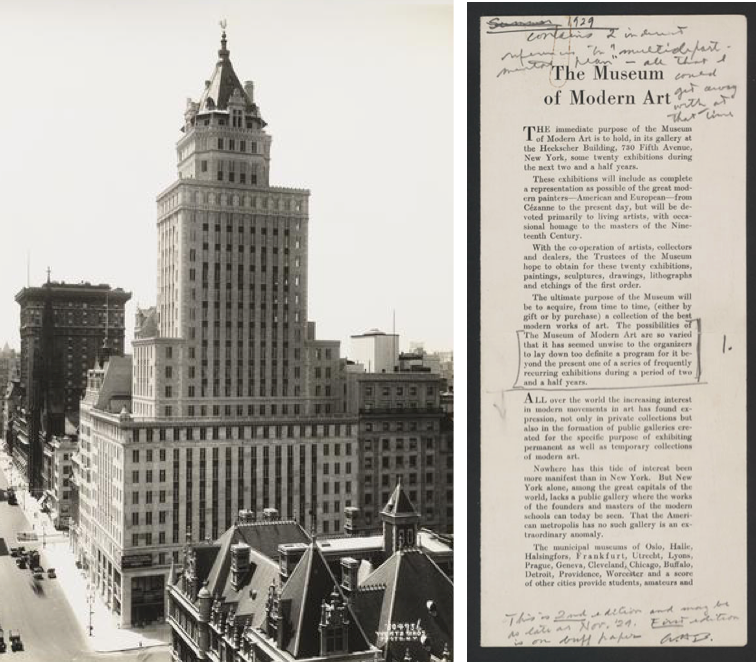
THE FOUNDERS…Mary Sullivan, Lillie Bliss and Abby Rockefeller, known socially as “the daring ladies,” founded the Museum of Modern Art in 1929. (virginiafitzgerald.blogspot.com/MoMA)OLD AND NEW…The 12th floor of the Heckscher Building (now called the Crown Building) at Fifth Avenue and 57th Street served as the first location of the Museum of Modern Art. The 1921 building was designed by Warren and Wetmore, the same architects who designed Grand Central Terminal. Note in the foreground the rooftop of the Vanderbilt mansion, demolished in 1926 to make way for the Bergdorf Goodman department store; at right, a page from the new museum’s brochure. (Museum of the City of New York/MoMA)
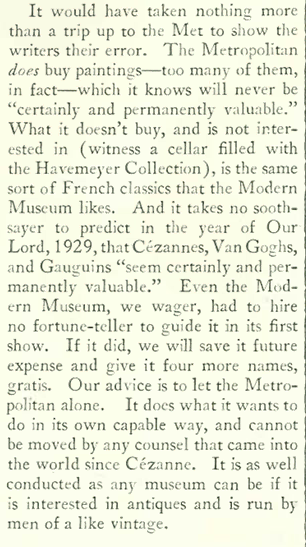
The gallery rooms in the Heckscher were modest — although Abby’s husband was John D. Rockefeller Jr., she had to find funding on her own (he was opposed to the museum, and to modern art). In his review, Pemberton noted the “inferiority complex” that had already set in at the new museum, which took a preemptive swipe at the Met in its pamphlet (pictured above):
AMBITIOUS…Although the museum was small and had no curatorial departments, MoMA produced a 157-page exhibition catalogue for its first show. (Image and text courtesy MoMA)MODEST BEGINNINGS…MoMA’s first gallery spaces on the 12th floor of the Heckscher Building were indeed modest, as these photos of the first exhibition attest. (MoMA)HOW THEY LOOKED IN COLOR…Works featured in MoMA’s first exhibition included The Bedroom (1889) by Vincent Van Gogh, and Pines and Rocks (c. 1897), by Paul Cézanne. (Art Institute of Chicago/MoMA)
Pemberton attempted to set MoMA straight regarding the Met’s reputation:
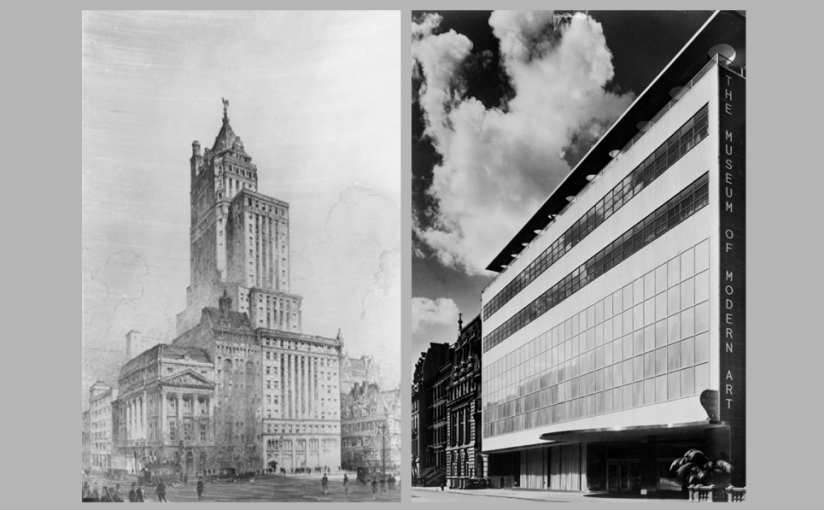
HOME AT LAST…After moving three times over the course of ten years, the Museum of Modern Art finally found a permanent home in Midtown in 1939. Although Abby Rockefeller’s husband, John D. Rockefeller Jr., was initially opposed to the museum, he eventually came around and donated the land for the 1939 museum (designed by Philip L. Goodwin and Edward Durell Stone) and became one of the museum’s biggest supporters. (MoMA)
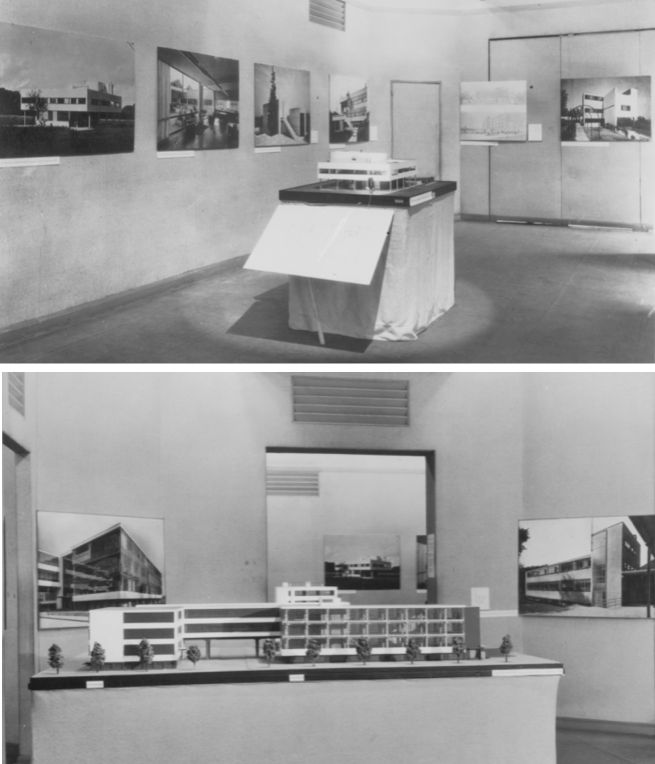
Less than three years later, the museum would point to the world to come in 1932’s Modern Architecture: International Exhibition, curated by Philip Johnson and Henry-Russell Hitchcock. The exhibition showcased an emerging architectural style that would dominate the New York skyline in the postwar years.
Top, model of Le Corbusier’s Villa Savoye from MoMA’s 1932 Modern Architecture: International Exhibition; below, model and photographs of works by Walter Gropius. Both architects would have major influences on the postwar New York skyline. (MoMA)
A footnote: The Museum of Modern Art hosts a remarkable website that features photographs of 4,875 exhibitions (plus images of catalogs and other materials) from 1929 to the present.
* * *
That’s Entertainment?
Theater critic Robert Benchley was looking for something to take his mind off the economic collapse, but he wasn’t finding it on Broadway. He found the drama Veneer to be depressing, and apparently so did a lot of other theatergoers; it closed the next month after just 31 performances at the Sam Harris Theatre:
NO LAUGHS HERE, EITHER…Joanna Roos and Osgood Perkins during a 1930 performance of the Chekhov play Uncle Vanya at the Cort Theatre. Roos was also in 1929’s Veneer, and she was singled out for praise by critic Robert Benchley, who otherwise found the play depressing. (New York Public Library)
Benchley also found little cheer in the play Cross Roads, which also closed the next month after just 28 performances at the Morosco Theatre:
FOR CRYING OUT LOUD…Actress Sylvia Sidney bawled out her lines in Cross Roads. (Photoplay, 1932)
Benchley finally found something to laugh about at the Alvin Theatre, which featured the musical comedy Heads Up! Tellingly, it ran much longer than its more somber competition: 144 performances…
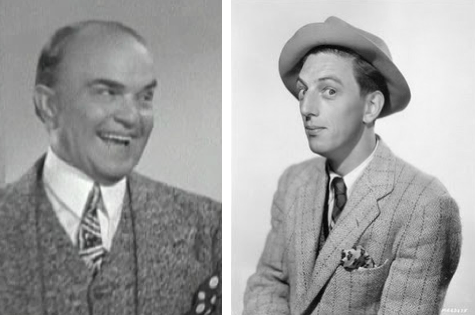
CLOWNS…Victor Moore, left, and Ray Bolger delivered comic relief in Heads Up! Both actors provided much-needed levity on the Broadway stage during the Depression. (movie-mine.com/Pinterest)
* * *
Ideas for a Post-Crash Christmas
Creighton Peet (1899-1977) was best known as an author of books for young people with titles ranging from Mike the Cat (1934) to How Things Work (1941). A regular contributor to The New Yorker from 1925 to 1957, in the Nov. 23 issue Peet offered up some suggestions for a post-crash Christmas in a short piece titled “Helpful Hints for Marginaires.” An excerpt:
The recent market crash was also on the mind of Howard Brubaker. In his weekly column, “Of All Things,” he looked for divine guidance…
CAN YOU PUT IN A GOOD WORD? James Cannon Jr. was a bishop of the southern Methodist Church and a relentless advocate of Prohibition. (encyclopediavirginia.org)
…in the wake of recent elections, Brubaker also made this observation about voting rights in the South…
* * *
Solace of the Silver Screen
Americans would turn to the movies for a much-needed distraction from their economic woes, and critic John Mosher found a couple of mild diversions starring Greta Garbo and Clara Bow…
MUM’S THE WORD…Greta Garbo and Lew Ayres in The Kiss. The film was a rare silent in the new age of the talkies (although it did feature a Movietone orchestral score and sound effects). Audiences would have to wait until 1930’s Anna Christie to hear the voice of Garbo. (IMDB)PLEASE PASS THE BITTERS, DEAR…Greta Garbo and Anders Randolf trapped in a loveless marriage in The Kiss. (IMDB)
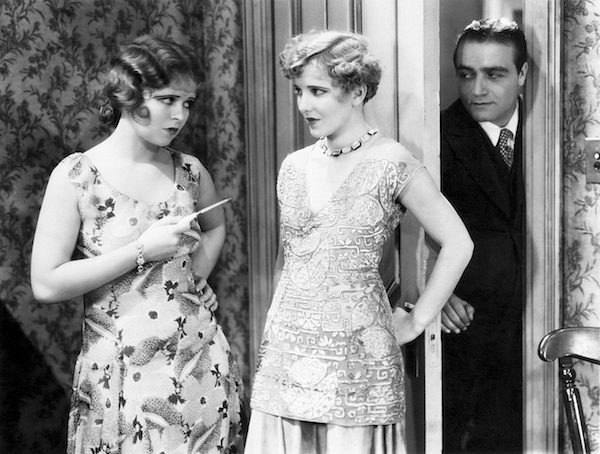
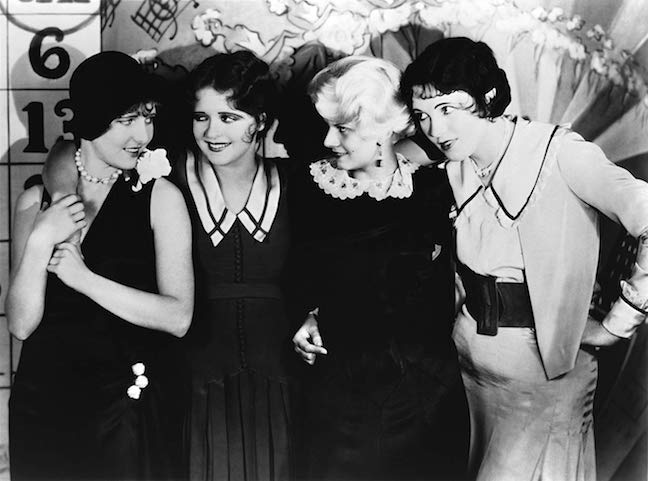
For a few laughs, moviegoers could check out Clara Bow’s second talkie, The Saturday Night Kid. A sex symbol of the Roaring Twenties, Bow’s career began to wane with the advent of the talkies and the onset of the Depression. Her kind would be eclipsed by a new type of sex symbol — the platinum blonde — embodied by the likes of Jean Harlow, who also appeared in The Saturday Night Kid, her first credited role…
SIBLING RIVALRY…Sisters Mayme (Clara Bow) and Janie (Jean Arthur) vie for the affections of next door neighbor William (James Hall) in a scene from The Saturday Night Kid. (doctormacro.com)SATURDAY NIGHT FEVER…Jean Arthur, Clara Bow, Jean Harlow and Leone Lane in a publicity photo for The Saturday Night Kid. (IMDB)
* * *
From Our Advertisers
We begin with a couple of ads featured on back-to-back pages of products that no longer exist — the first promotes the use of Ethyl gasoline to increase performance and eliminate engine knock. Ethyl (tetraethyl lead) — a big contributor to soil, air and water lead pollution — was removed from gasoline beginning in the 1970s…the Marmon Motor Car Company introduced a more affordable (under $1,000) car to New Yorker readers in 1929, but it was too late for the struggling company, which due to the Depression folded in 1933…
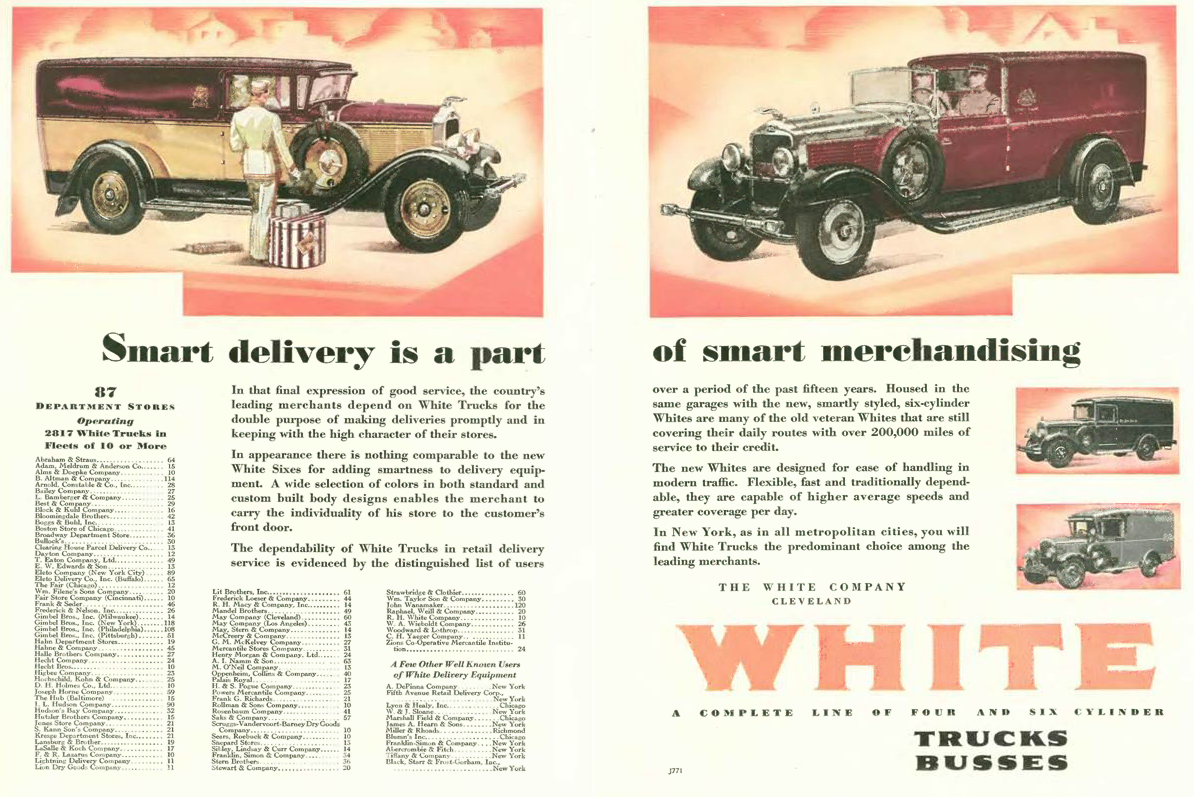
…this seems an unusual ad for the New Yorker, but then again perhaps the White Company hoped to reach well-heeled readers who were also owners of companies in need of such things, although it is doubtful a lot of truck-buying was taking place after the crash…
…the 1920s are considered a golden age for American road-building, but if you wanted to travel across country, the national highway system was limited to just a few, mostly two-lane routes…
…with their frayed nerves, folks were doubtless smoking like chimneys…the makers of Fatima cigarettes acknowledged the pain felt by the market crash, while nevertheless justifying the higher cost of their brand…
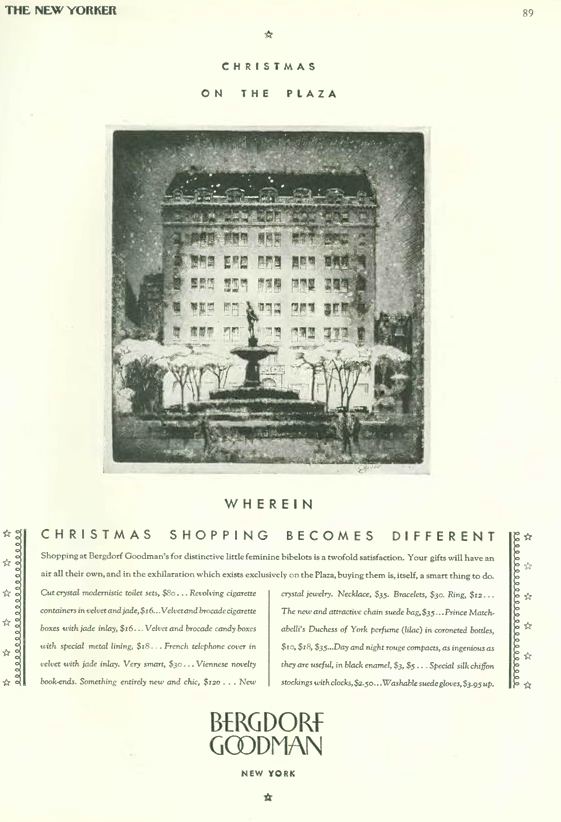
…the holiday season was fast-approaching, and Bergdorf Goodman was ready to set the mood…
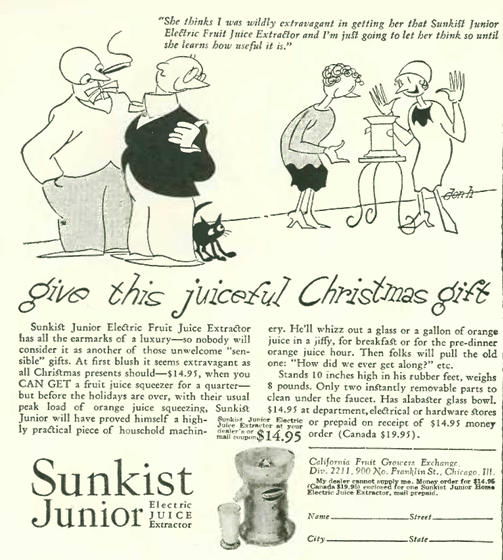
…on the lower end of the scale, the California Fruit Growers offered up this dandy “juice extractor” as the gift to delight a loved one (with illustration by Don Herold)…
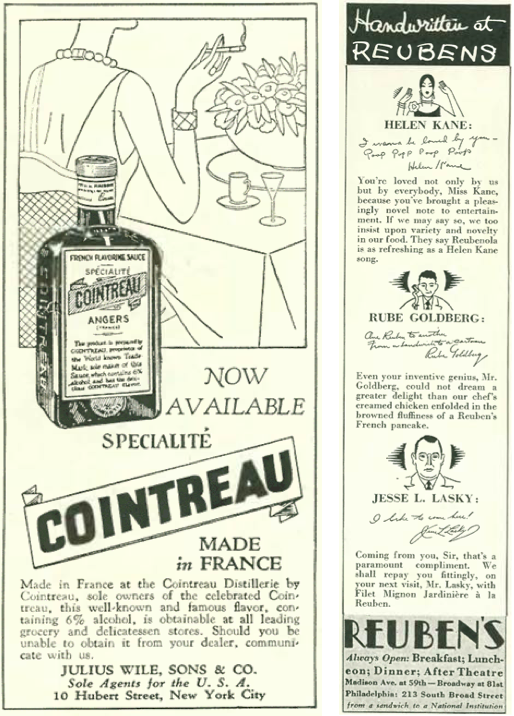
…I suppose given its quasi-medicinal (digestif) qualities, Cointreau was able to sell their product at 6% alcohol content to dry Americans (although the full- strength Cointreau, not legally available to Americans, was rated at 40%)…at right, another back page ad from Reuben’s restaurant, with more handwritten endorsements from stars including singer Helen Kane (Boop-Boop-a-Doop), cartoonist Rube Goldberg, and Paramount Studio co-founder Jesse Lasky…
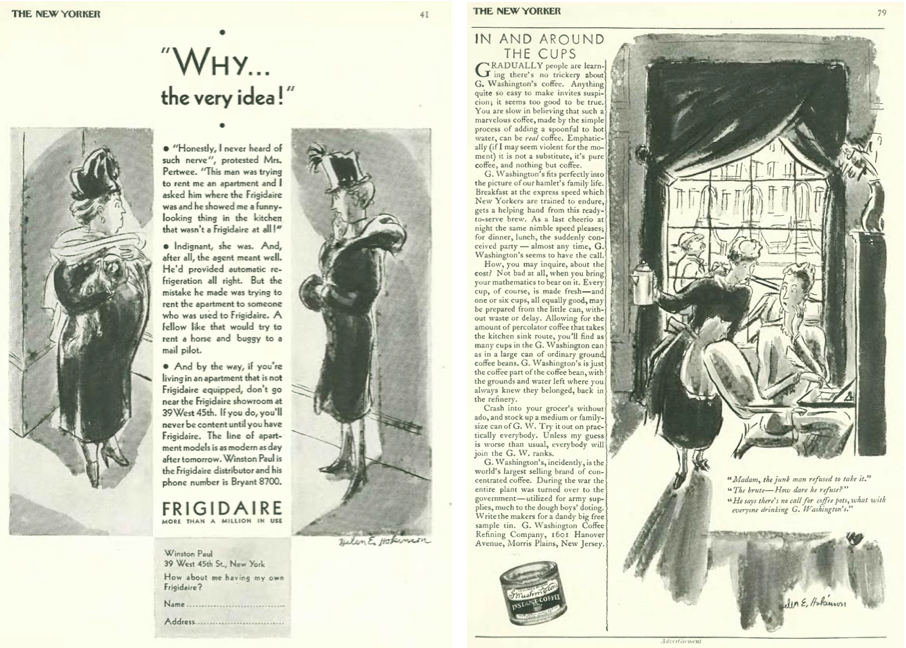
…Helen Hokinson’s society women were featured in two separate ads in the Nov. 23 issue…
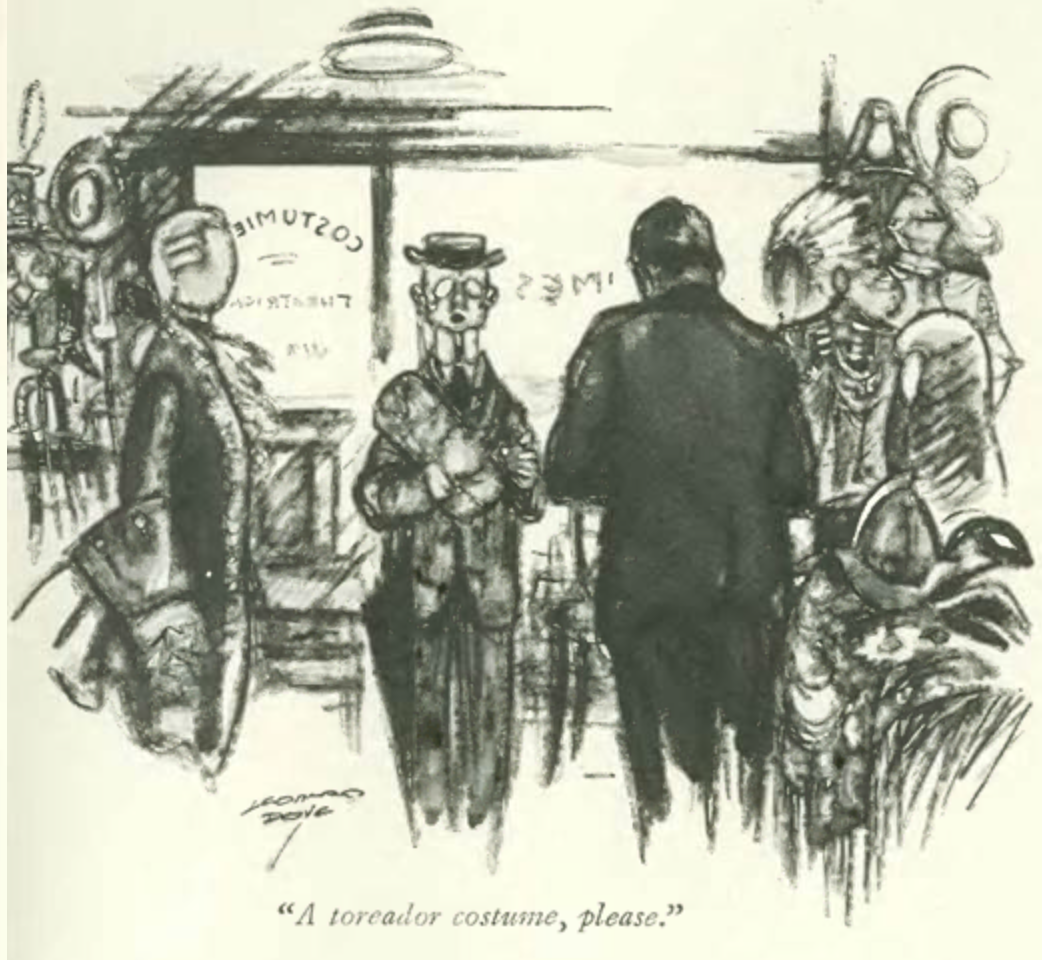
…and the folks at Frigidare got an extra plug thanks to Leonard Dove…
…Lois Long’s “On and Off the Avenue” column began to grow in length as the holiday season approached, peppered with spot drawings including these two by Julian De Miskey and Barbara Shermund…
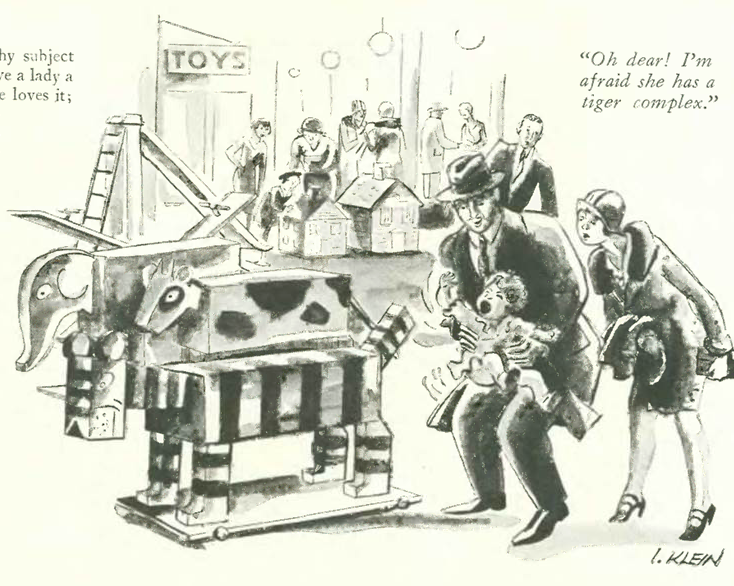
…and Isadore Klein offered his own take on the holiday shopping scene…
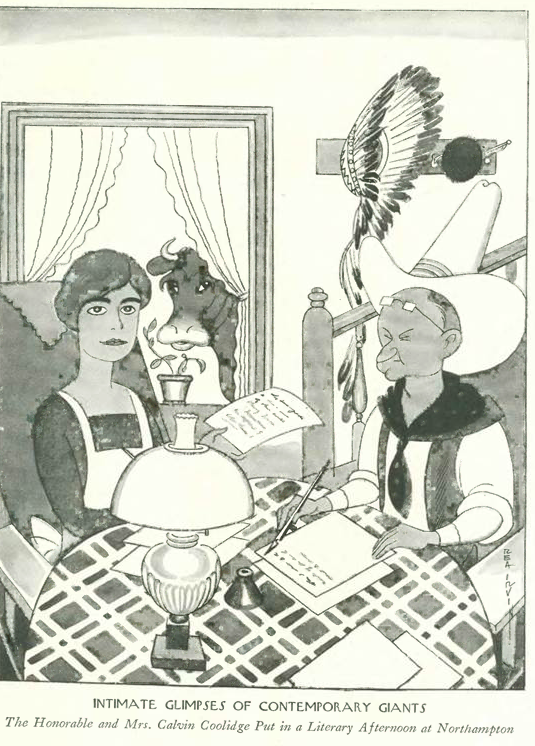
…Rea Irvin reprised his folk-satirical approach to life at the Coolidge house…
…John Reynolds found more humor in the clash of cultures…
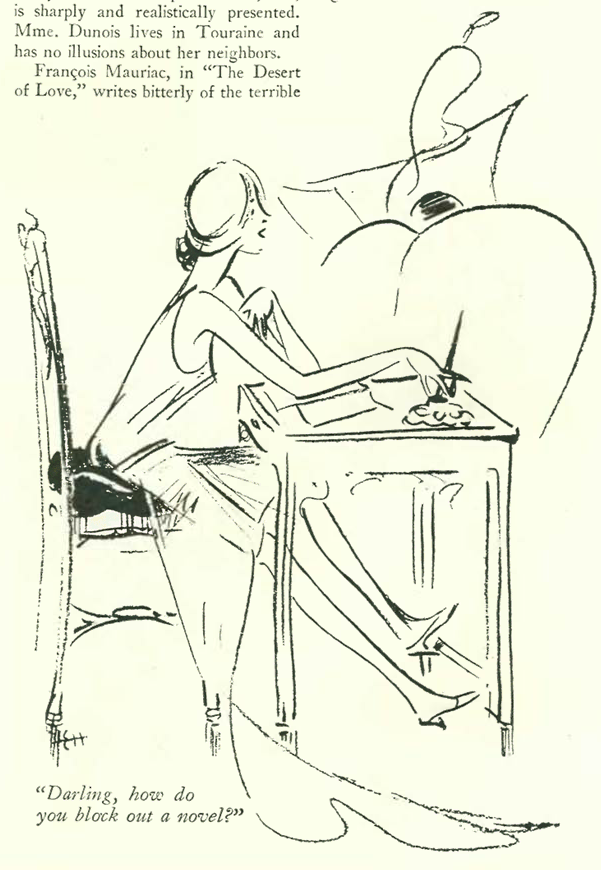
…Helen Hokinson contributed this very modern rendering of writer’s block…
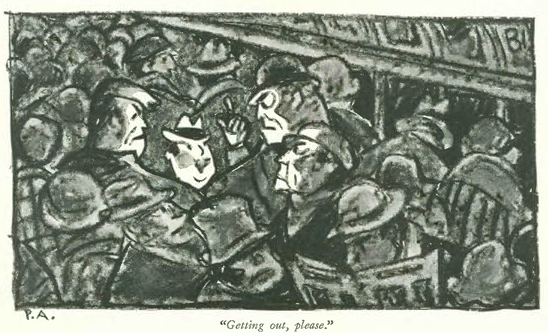
…and Peter Arno looked in on the challenges of commuting…
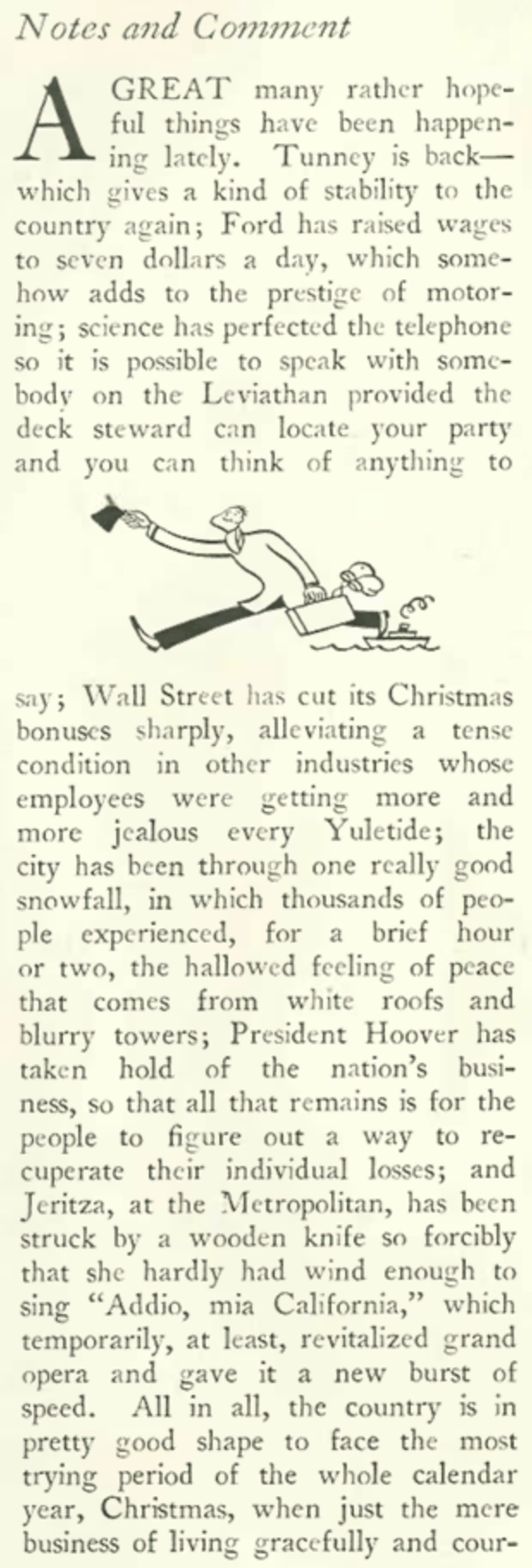
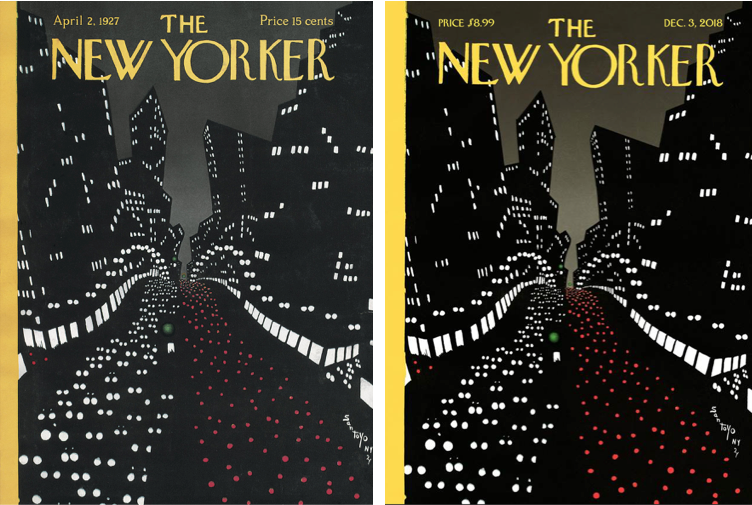
…and a quick note regarding a recent issue of The New Yorker (Dec. 3, 2018)…the cover featured a reprint of a Matias Santoyo cover from April 2, 1927…very cool…
Two weeks had passed since the “Black Tuesday” collapse of share prices on the New York Stock Exchange, but the New Yorker went about business as usual, E.B. White opening his “Notes and Comment” with a complaint — not about the economy — but about a marketing ploy that had New York University shilling magazines on behalf of Funk & Wagnalls.
Nov. 16, 1929 cover by Peter Arno. No doubt Arno drew inspiration from his own domestic situation (with wife and New Yorker columnist Lois Long and their infant daughter Patricia Arno).
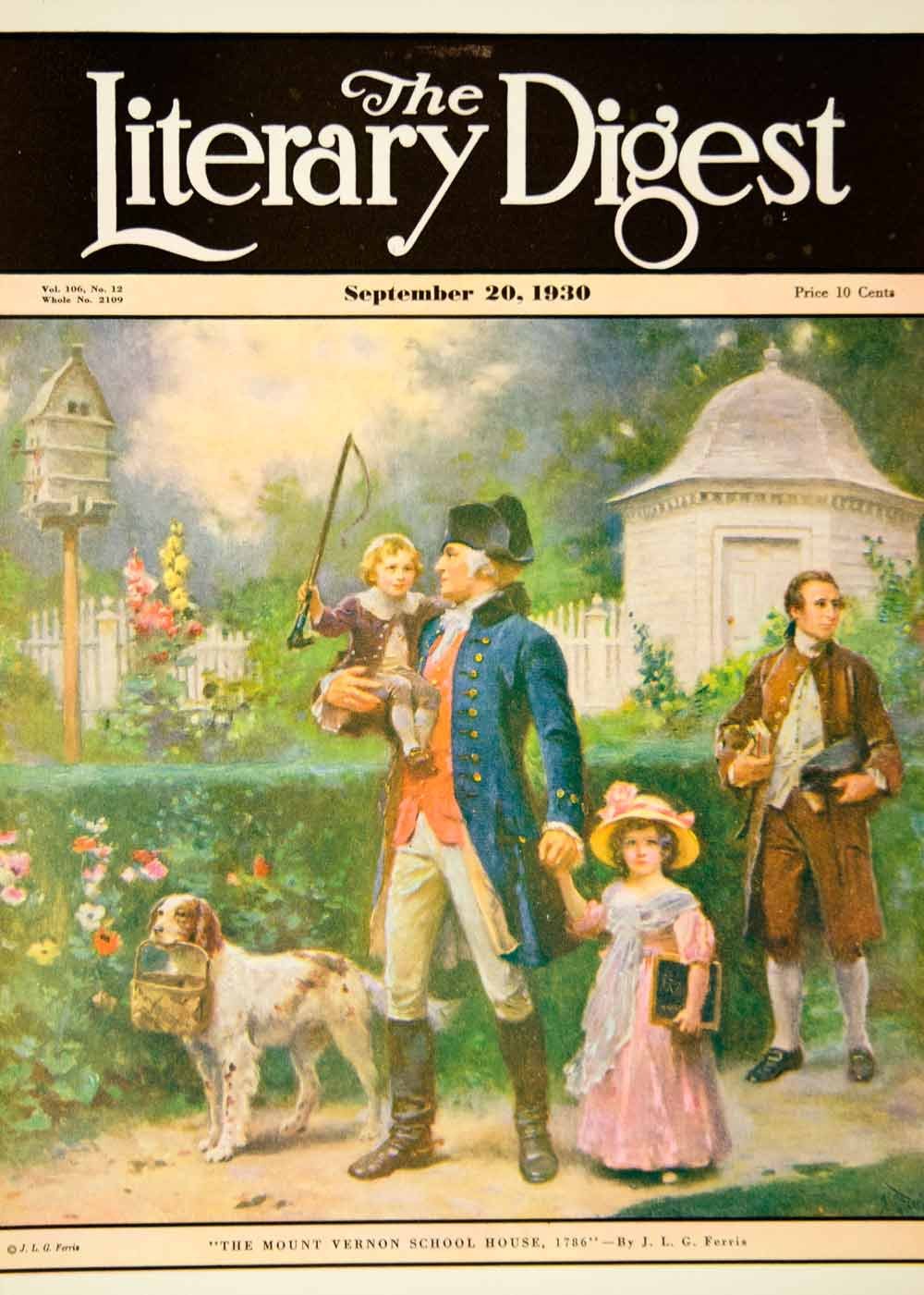
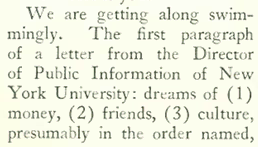
White mocked the contents of a letter from NYU that promised a “free” education to subscribers of Funk & Wagnalls’ middlebrow Literary Digest.
EASY-CHAIR EDUCATION…Founded in 1890 by Isaac Funk (of Funk & Wagnalls fame), the Literary Digest offered readers condensed articles from various American and European publications. The weekly magazine surpassed the one million circulation mark in 1927, but declined precipitously in 1936 after its famed (and usually reliable) presidential poll picked Alf Landon over FDR. It folded in 1938. (Pinterest)
White detailed how NYU’s director of public information promised untold riches to potential Literary Digest subscribers…
YOU CAN BE FAMOUS, FOR JUST PENNIES A DAY…E.B. White mocked an NYU letter that promoted its “hook-up” with the Literary Digest, wryly suggesting that recognition in NYU’s Hall of Fame for Great Americans was within reach of magazine subscribers. The photo above (circa 1935) shows the Hall of Fame’s colonnade, which half-encircled the university library (both designed by Stanford White) and housed 98 bronze busts. A financially strapped NYU sold its University Heights Campus, along with the Hall of Fame and library, to the City University of New York in 1973. (WPA photo via boweryboyshistory.com)
…and the not so subtle revelation that the “free” education came with a price:
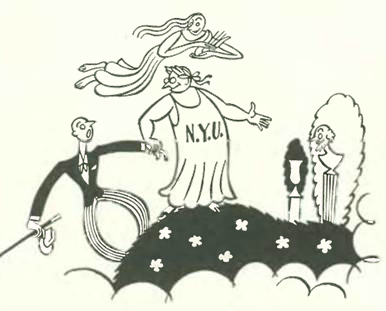
Here’s Julian De Miskey’s illustration that accompanied White’s “Notes”…
* * *
The Lighter Side of Bankruptcy
Evidence of the recent stock market crash was scant in the Nov. 16 issue, save for this blurb from Howard Brubaker…
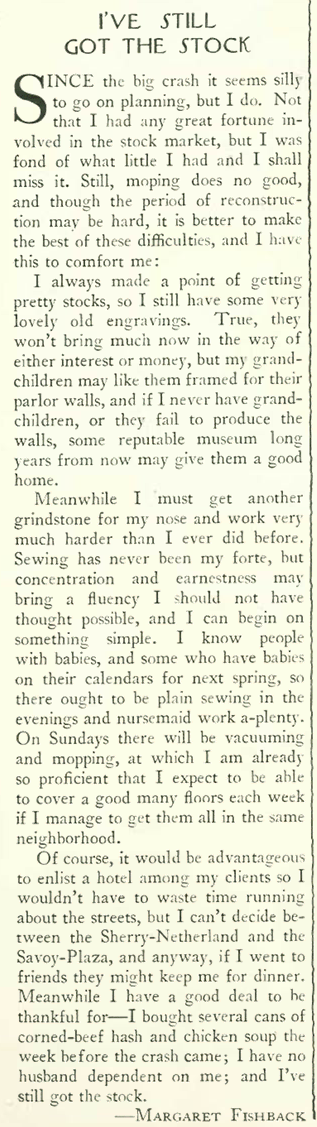
…and this short piece by Margaret Fishback, who took a characteristically lighthearted approach to the devastating news:
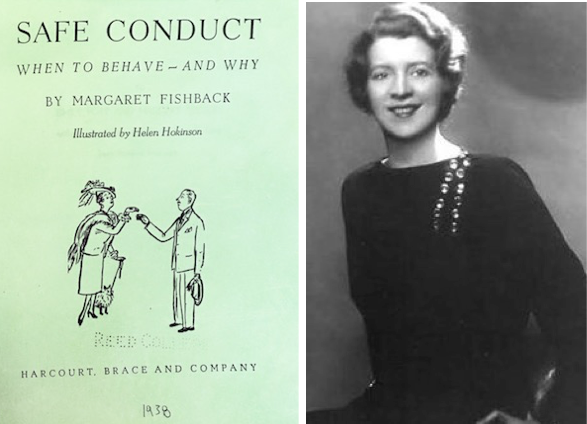
Fishback (1900-1985), a widely published poet and prose author from the late 1920s to the 1960s, was also a successful advertising copywriter for Macy’s and a number of other companies.
A WAY WITH WORDS…Margaret Fishback wrote a number of poetry and prose books, including Safe Conduct: When to Behave–and Why, a book of etiquette illustrated by The New Yorker’sHelen Hokinson. During the 1930s Fishback was reputed to be the world’s highest-paid female advertising copywriter. (necessaryfiction.com/Wikipedia)
* * *
We Stand Corrected
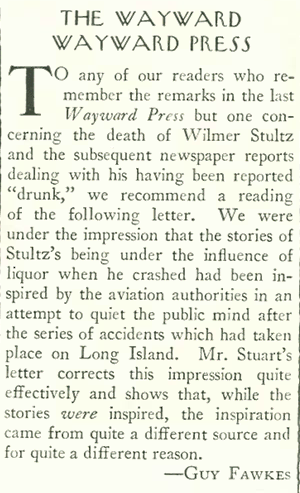
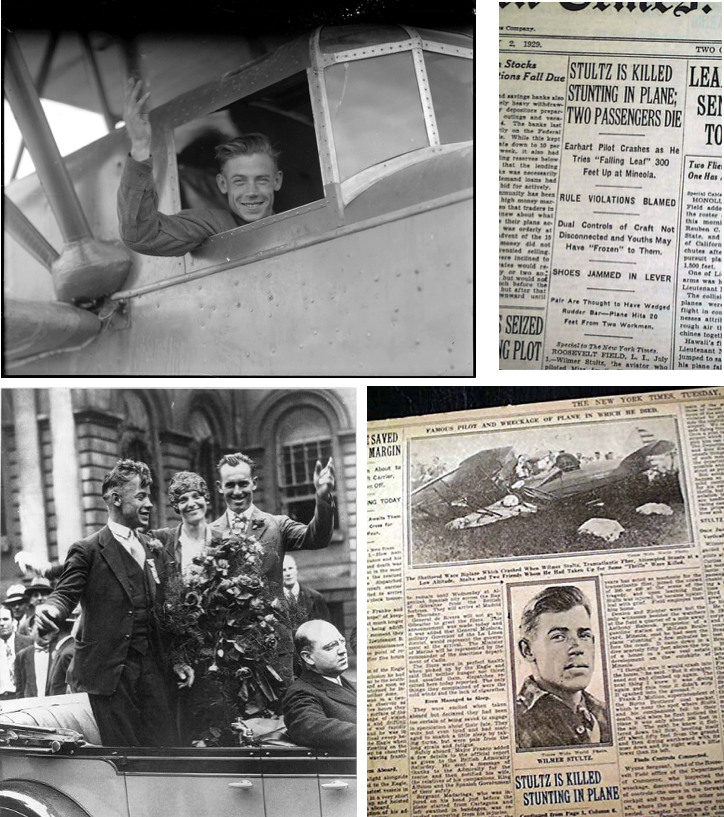
A correction of sorts was offered by Robert Benchley (aka “Guy Fawkes”) regarding one of his recent “Wayward Press” columns, in which the fatal crash of famed aviator Wilmer Stultz’s stunt plane was misattributed to drunkenness:
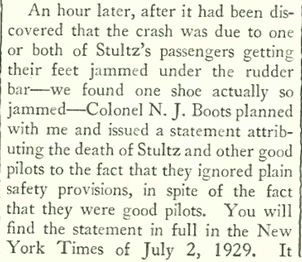
Following the above intro, Benchley included this letter from a representative of the Roosevelt Flying Corporation, John McK. Stuart, in which Stuart explained the real reason for the pilot’s fatal crash, and the source of a vicious rumor:
The cause of the crash, as reported in The New York Times, was attributed to two young men who begged for a ride on Stultz’s stunt plane, a Waco Taperwing, in the early afternoon of July 1, 1929. An investigation of the wreckage found shoes from both passengers jammed under a bar connected to the rudder, rendering it inoperable. In his letter, Stuart explained:
Apparently Stultz’s passengers had braced themselves during stunt maneuvers by jamming their feet under the rudder bar. According to the Times, after a couple of rolling stunts the plane began to climb again from about 200 feet when it rotated nose down and plunged into the ground. Both passengers were killed instantly. Stultz died shortly thereafter at a Long Island hospital.
BRIEF FLIGHT THROUGH LIFE…Clockwise, from top left, Wilmer Stultz (1900-1929) in undated photo; coverage of the fatal crash in the July 2, 1929 New York Times; Stultz, Amelia Earhart, and Lou Gordon feted in front of City Hall, New York City, following their successful flight across the Atlantic in June 1928. Stultz was the pilot of the Fokker Trimotor “Friendship,” aboard which Earhart became the first woman passenger to cross the Atlantic by airplane. Gordon served as the flight’s on-board mechanic. (Boston Public Library/New York Times/Amazon)
* * *
Cowardly Attack
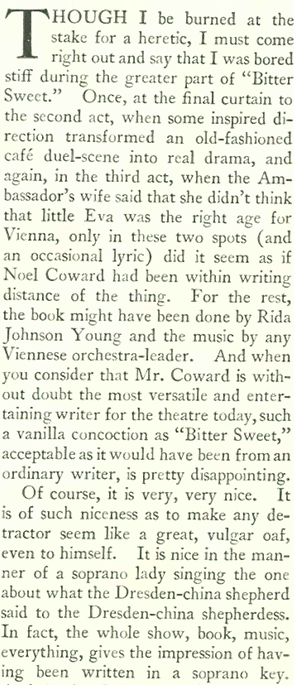
The acclaimed English playwright and composer Noël Coward was much beloved by The New Yorker, so it pained Robert Benchley to write an unflattering review of Coward’s operetta, Bitter Sweet:
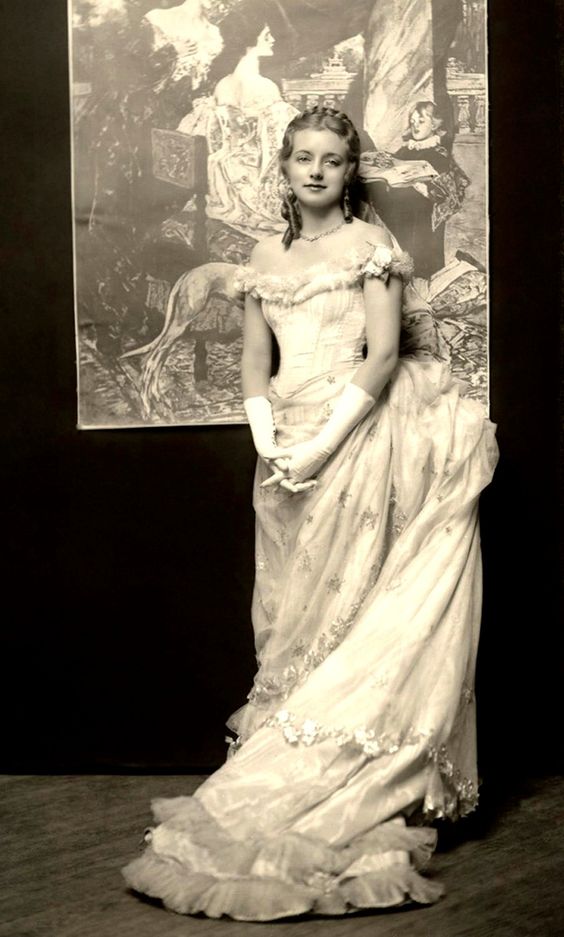
IN THE SOPRANO KEY…British musical star Evelyn Laye (1900-1996) played the leading role of Sari in Noël Coward’s Broadway production of Bitter Sweet. (From The Bygone)
* * *
Hat Shop Heroine
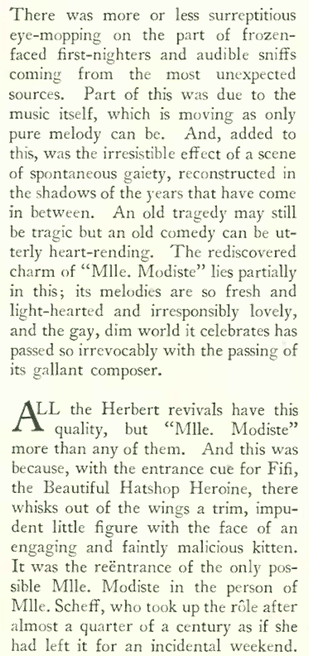
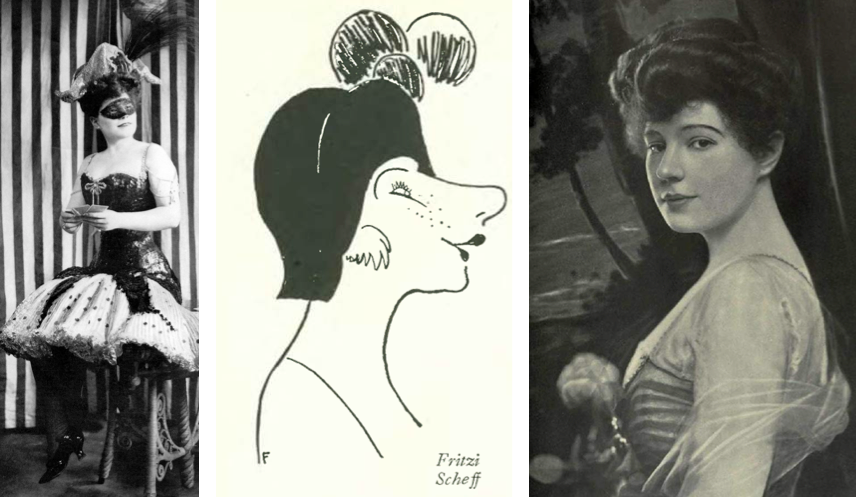
Another operetta — Mlle. Modiste — was getting a Broadway revival at Jolson’s 59th Street Theatre. Its star, Fritzi Scheff (1879-1954), was the subject of a short profile penned by Alison Smith. The operetta, written expressly for Scheff, premiered on Broadway in 1905 at the Knickerbocker Theatre, and enjoyed many revivals. Smith found that after nearly 25 years, Scheff still embodied the role of the hat shop girl who dreamed of being an opera singer. An excerpt:
From left, Fritzi Scheff in Mlle. Modiste (1905); Al Frueh’s caricature of Scheff for the profile; Scheff circa 1910. (Wikipedia/IMDB)
* * *
Best of Both Worlds
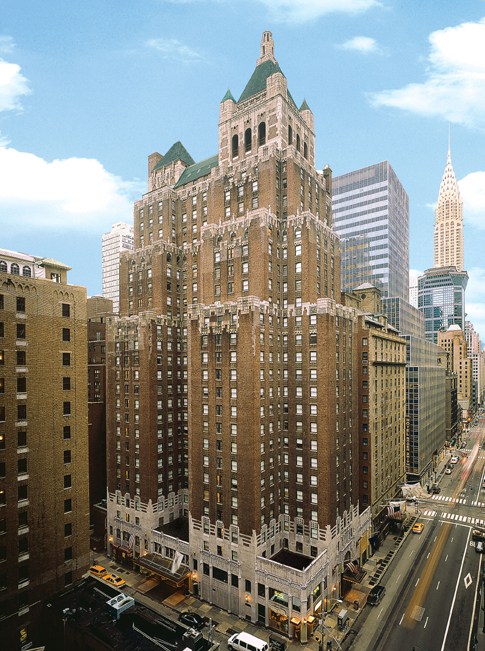
Although the Gothic style was quickly falling out of fashion in the age of Art Deco, architecture critic George S. Chappell found much to admire in Schultze & Weaver’s new Hotel Lexington, part of the hotel construction boom in New York’s Midtown:
STILL ATTACHED TO THE EARTH…The Lexington today, now a Marriott property, at 511 Lexington Avenue and 48th Street. (ohrllc.com)
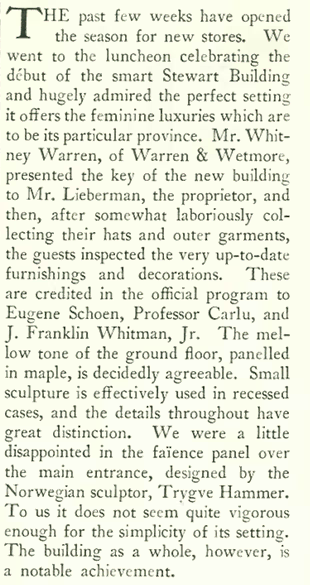
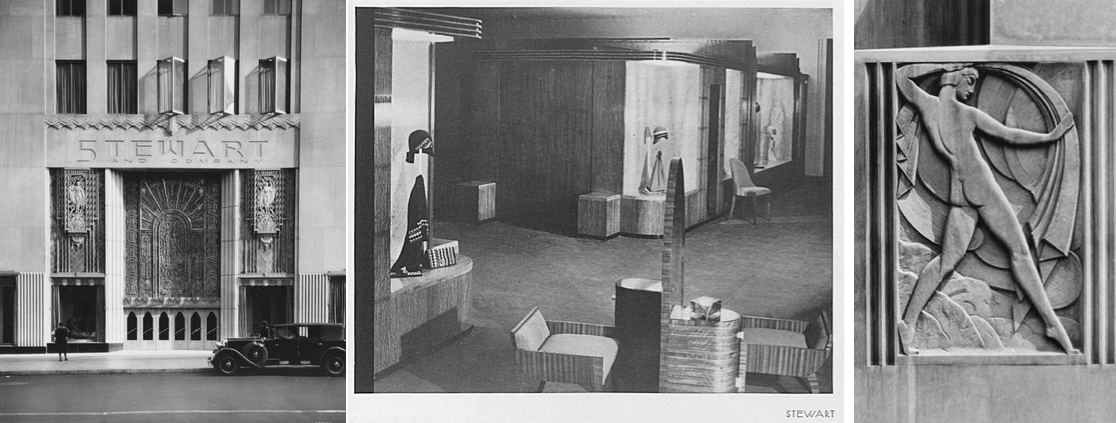
Chappell also admired the “smart” new Stewart Building, calling it the perfect setting for “feminine luxuries”…
Sadly, the Stewart Company folded just months after the opening of its new building, an early victim of the Depression. Bonwit Teller took over the building in 1930 and stayed until 1979. It was demolished in 1980 to make way for Trump Tower.
BYGONE ELEGANCE…Stewart and Company’s metal and ceramic 5th Avenue entrance, detail, 1929; Stewart Millinery Shop, 1929 (image from Vogue); detail from ornamental frieze above the 8th story, 1929. The building was demolished in 1980 to make way for Trump Tower. Neither the frieze nor the ornate ironwork were saved. (Museum of the City of New York/Vogue via drivingfordeco.com)
* * *
A Survivor’s Tale
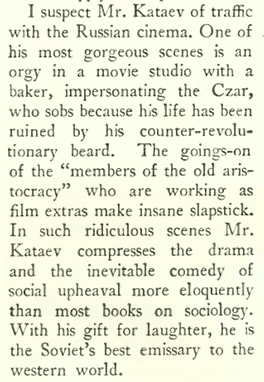
The New Yorker hailed Soviet writer Valentine Kataev’s debut novel, The Embezzlers, as “the first hearty and sane laugh that has been heard over the noise of Russian propaganda.” Published in 1926 and translated into English in 1929, the novel was a satire of bureaucracy in the new Soviet state. Remarkably, Kataev (1897-1986) was able to write challenging, satirical works throughout his long life and career without running afoul of Soviet authorities, or falling victim to Stalin’s terror campaigns:
SATIRICAL SOVIET…Valentine Kataev circa 1930. His 1926 debut novel, The Embezzlers, was a satire of Soviet bureaucracy. (russkiymir.ru)
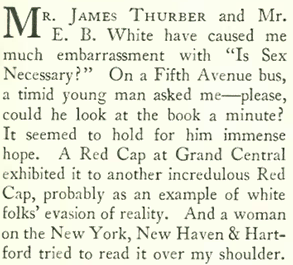
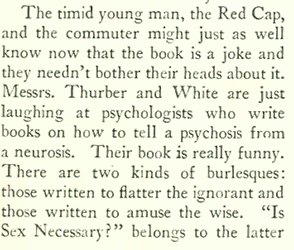
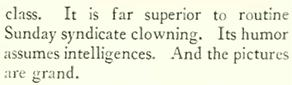
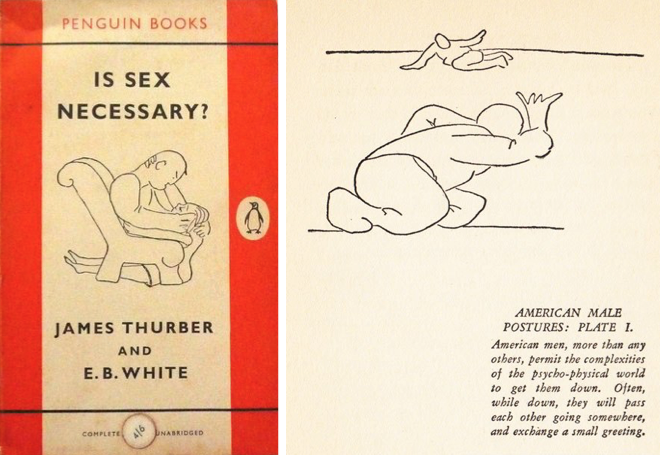
Another title receiving a favorable review, Is Sex Necessary? — a spoof of popular sex manuals and how-to books — was co-written by The New Yorker’sJames Thurber and E.B. White, with illustrations provided by Thurber.
HE CAN DRAW, TOO…Although James Thurber had yet to publish one of his drawings in The New Yorker, the book Is Sex Necessary? featured 42 of them, including the illustration at right that demonstrated the male greeting posture, and below, the posture of a man who could not discern the difference between love and passion. (brainpickings.org)
* * *
Old News
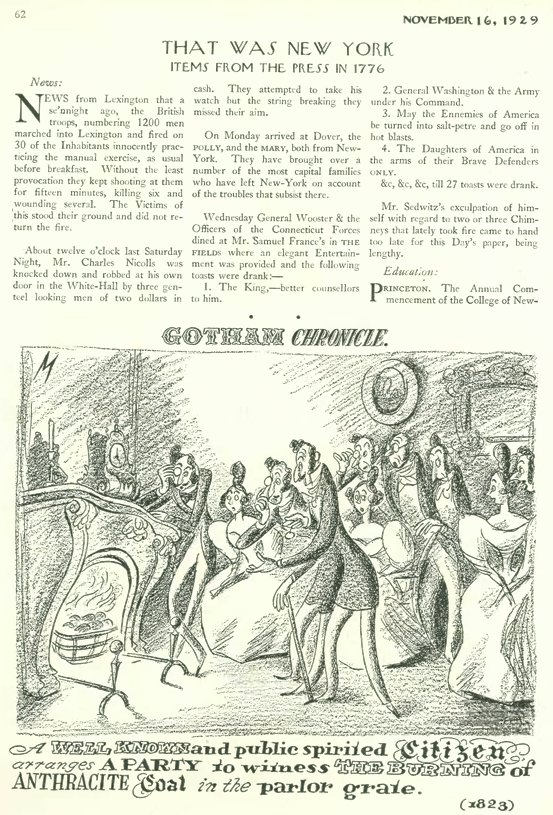
Writer (and later screenwriter) David Boehm temporarily took over the history column “That Was New York” from playwright Russell Crouse and contributed the first in a series of articles featuring clippings from 18th century newspapers (with illustration by Julian De Miskey):
* * *
From Our Advertisers
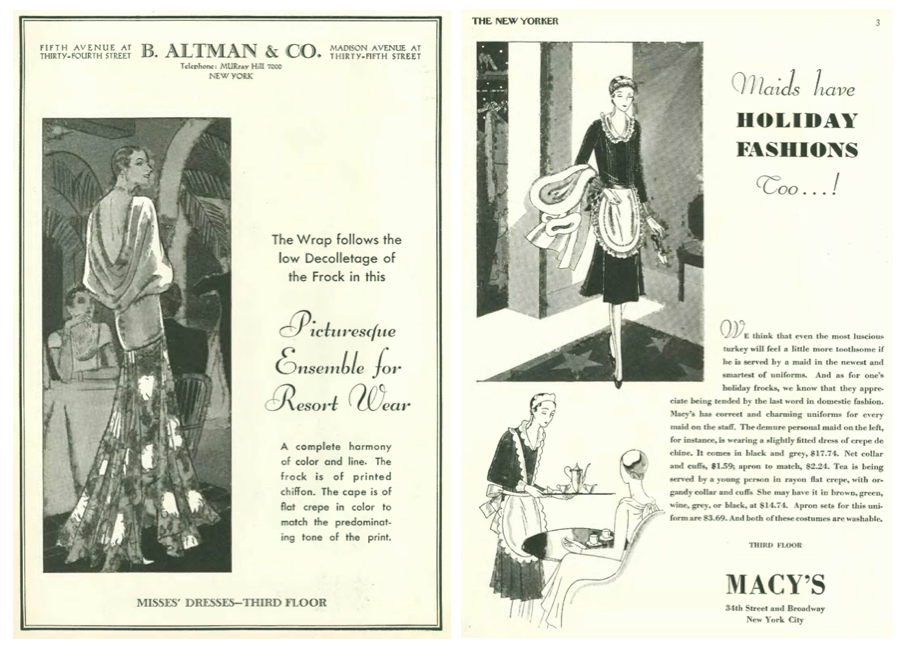
The Depression was coming, but you wouldn’t know it by the ads that appeared in the Nov. 16 issue, which featured the latest in resort wear, and holiday fashions for the maid…
…the Jay Thorpe store assumed some readers had $1,250 to spare for this coat and muff (equivalent to about $18,000 today), while Udall and Ballou jewelers offered a brooch for $9,000 (or nearly $130,000 today)…
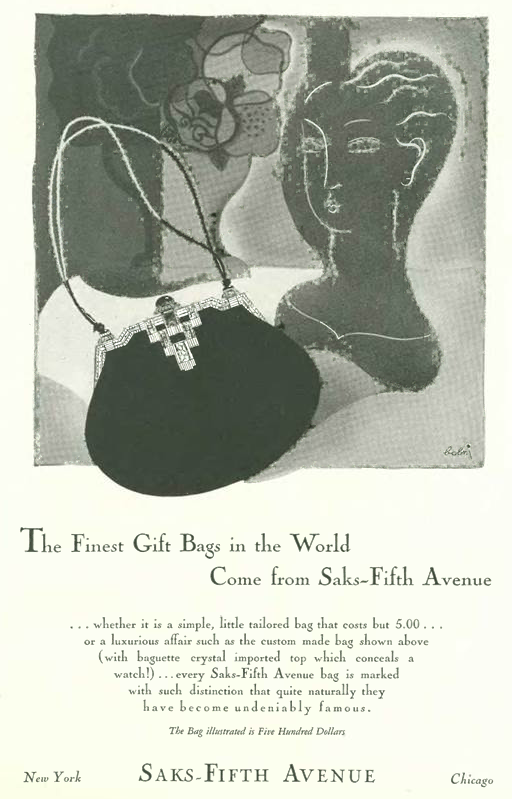
…Saks offered a “simple little tailored bag” for $5, although the one pictured in the ad would set you back $500 ($7,200 today)…
…in this clever ad for Kayser silk hosiery, illustrator Ian Oliver drew a shelf from negative space to allow the model some room to lean…
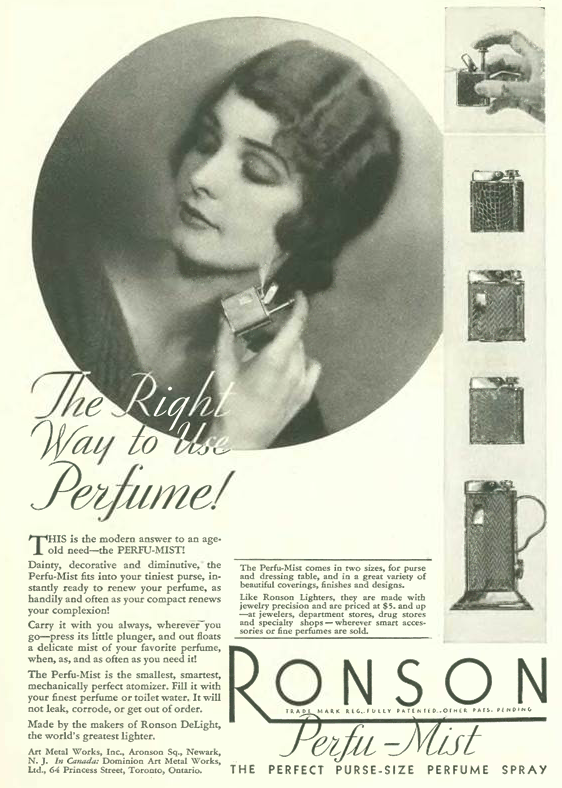
…makers of the Ronson cigarette lighter found a new use for their product, adapting it to serve as a perfume atomizer…I wonder how many women accidentally lit their hair on fire, or took a shot of perfume to the eyes when they wished to have a smoke…
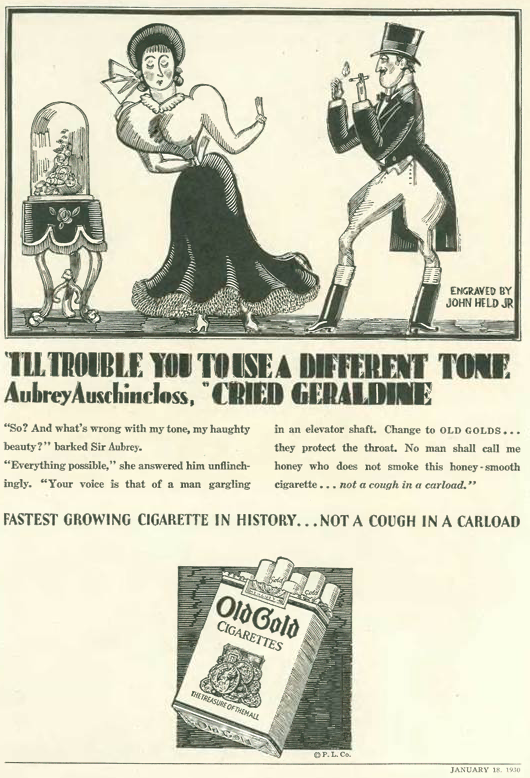
…while you had the lighter handy, you could light up an Old Gold, and thanks to the lack of truth-in-advertising standards, you could do it believing that you were also warding off a winter cold…
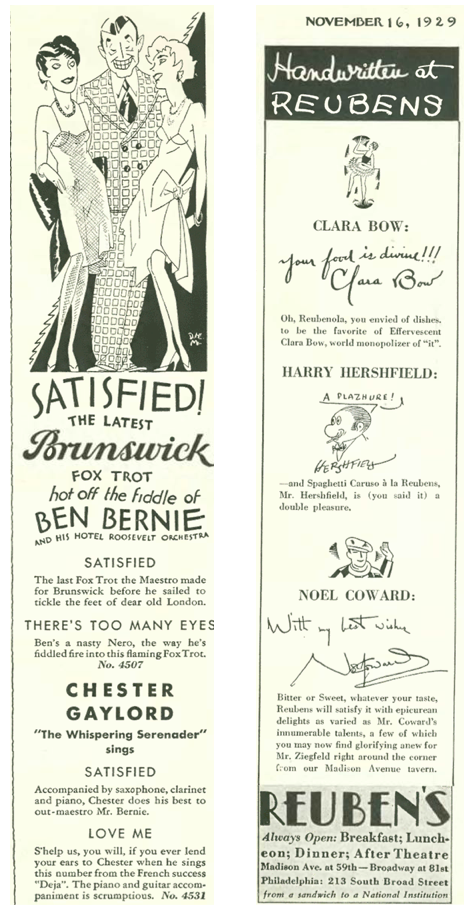
…from the back pages we have these gems from Brunswick records, and Reuben’s restaurant, which featured written testimonials from famous clientele including the “It Girl” actress Clara Bow, cartoonist Harry Hershfield, and playwright Noël Coward …
…Dr. Seuss offered his latest take on the uses of Flit insecticide, here sprayed directly into a user’s face for maximum benefit…
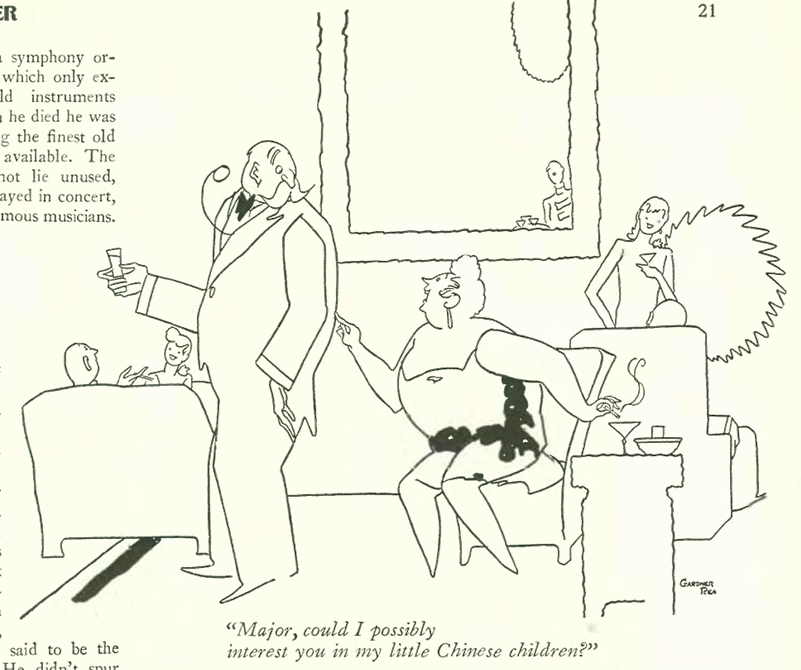
…our cartoons come courtesy of Gardner Rea, who looked in on an act of charity…
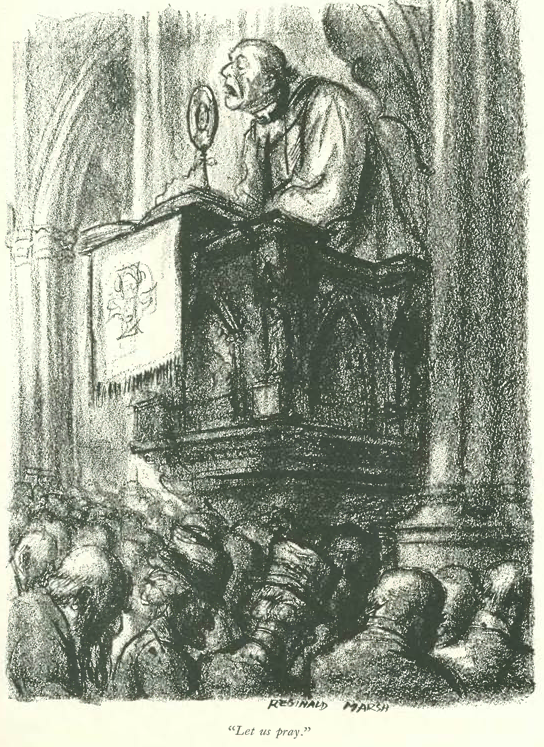
…Reginald Marsh illustrated a new use for broadcast radio…
…Barbara Shermund put the “idle” in “idle rich”…
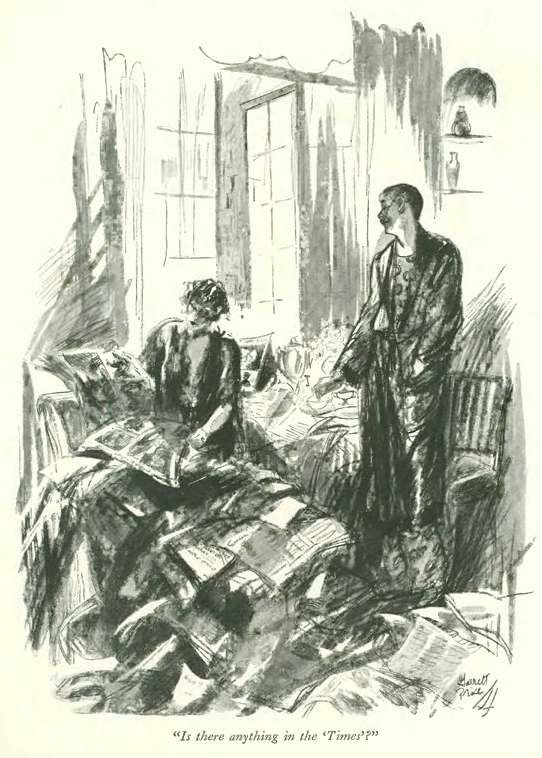
…Garrett Price gave us this lovely illustration of a casual reader…
…and Helen Hokinson went shopping with one of her society women…
The cover of the Nov. 9, 1929 issue belied the mood of New Yorkers still reeling from the stock market crash. But then again, football games and other entertainments would grow in importance as much-needed distractions from the harsh realities that lay ahead.
Nov. 9, 1929 cover by Theodore G. Haupt. The title image is by James Montgomery Flagg, published in Life, November 15, 1929.
The New Yorker editors and writers were as bewildered as anyone in the aftermath of the crash. “The Talk of the Town” only gave it passing mention:
Robert Benchley, writing under the pseudonym “Guy Fawkes,” also looked at the market crash from the angle of the newspapers in “The Wayward Press” column. Naturally, Benchley tried to find humor in the midst of the disaster, noting that the crash provided some relief from tedious election coverage:
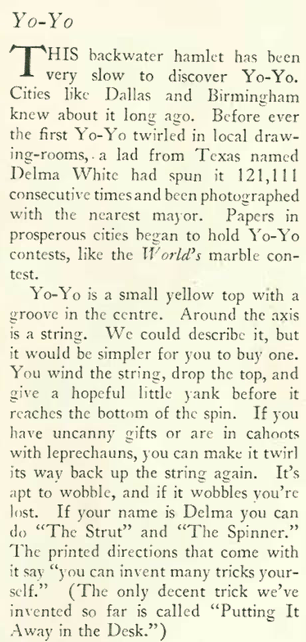
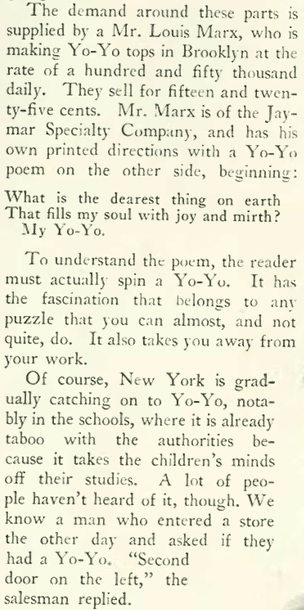
When the Nov. 9 New Yorker went to press, the stock market crash was viewed as a serious setback (in the sixth paragraph Benchley mentioned numerous reports of suicides), but not something that would result in worldwide depression. Indeed, much of the issue was devoted to lighter fare, including a rather lengthy piece in “Talk” about the latest craze among the nation’s youth — the yo-yo:
The Lumar 33, made of tin, was one of the original yo-yos produced by Louis Marx beginning in 1929. Hugely popular, it helped launch the Marx toy company empire. (WorthPoint)
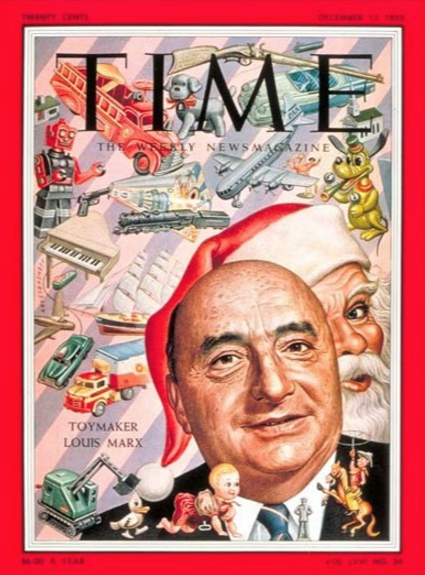
BUT HE’S NO YO-YO…Louis Marx’s version of the yo-yo would help him launch a toy empire and land him on the cover of Time magazine, Dec. 12, 1955. (Time)
* * *
Just Wait Until They Get iPads
The New Yorker showed less enthusiasm for a plan by Fox studios to introduce talking pictures into schools, hospitals and churches. Writing for “Talk,” E.B. White observed:
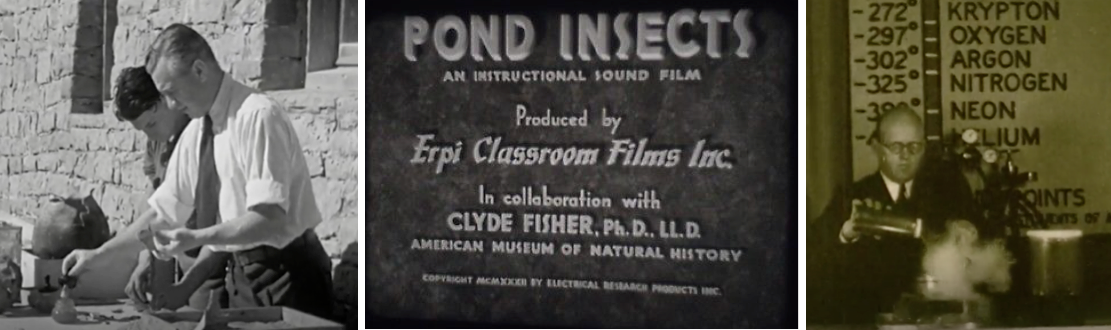
TECHNOLOGY INVADES THE CLASSROOM…Left to right, a still from a 1930 educational film showing archeologist Earl Morris gluing together pottery shards at a dig near Mesa Verde National Monument; ca. 1932 title card for a science film; detail from a ca. 1930 educational film demonstrating the wonders of liquid nitrogen. (archive.org)
* * *
And Then There Was Light
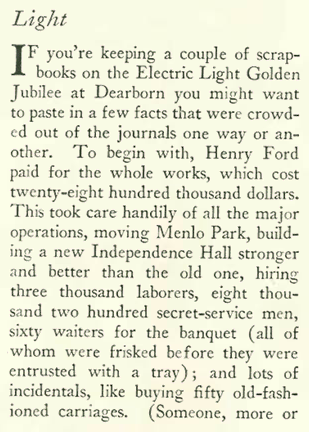
The introduction of talking pictures in the classroom owed something to Thomas Edison (1847-1931), inventor of the incandescent light bulb and a pioneer in the development of motion pictures, among many other things. The invention of the light bulb was commemorated at a “Golden Jubilee” celebration in Dearborn, Michigan, and “The Talk of the Town” offered these observations on the occasion:
GIVING THEIR TWO CENT’S WORTH…Lights were ablaze in Dearborn, Mich., to commemorate the 50th anniversary of the light bulb’s invention. “Light’s Golden Jubilee” was staged by public relations guru Edward Bernays on behalf of General Electric; below, commemorative postage stamp for the occasion. (prmuseum.org/Wikipedia)
The jubilee was the brainchild of Edward Bernays (1891-1995), often referred to as “the father of public relations.” The author of the 1928 book Propaganda, Bernays worked for dozens of corporations, and is known for his efforts in 1929 to promote cigarette smoking among women (branding them “torches of freedom”). Ironically, a man that helped many women develop a habit that led to their early deaths himself lived to the ripe age of 103.
Albert Einstein sent his best wishes from Berlin via transatlantic radio (see below), and special guests at the Jubilee included Henry Ford and Harvey Firestone, seen here talking with the nearly-deaf Thomas Edison about the development of radio in this short “talkie” filmed at the Jubilee on Oct. 21, 1929:
* * *
Please Release Me
Nunnally Johnson (1897-1977) was a journalist and film critic before breaking into the movies himself in the mid-1930s as a writer, producer and director of such films as The Grapes of Wrath (writer, producer) and The Man in the Gray Flannel Suit (writer, producer, director). As a critic Johnson learned what he didn’t like, including Al Jolson’s The Singing Fool, an early talking film that featured Jolson crooning the tear-jerker hit “Sonny Boy” to child actor Davey Lee, who portrayed his dying son. Nunnally responded with this parody titled “Sonny Boy’s Diary.” Some excerpts:
HOLD THE SCHMALTZ, AL…Nunnally Johnson, left, parodied the sentimental scenes Al Jolson shared with child actor Davey Lee in The Singing Fool. Johnson would go on to become a successful screenwriter, producer and director. (in.bookmyshow.com/virtual-history.com)
* * *
Dream Space
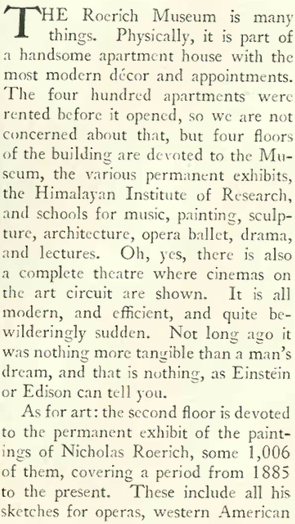
New Yorker art critic Murdock Pemberton hailed the opening of a new museum, the Roerich, on the lower floors of the 27-story art deco Master Apartment Building. The building also housed the Master Institute of United Arts, founded in 1920 by Nicholas and Helena Roerich.
The art deco landmark Master Building on Riverside Drive (left, in 1929) originally housed the Roerich Museum in its lower floors. Today the Roerich is located in this brownstone at 319 West 107th. (Wikipedia)
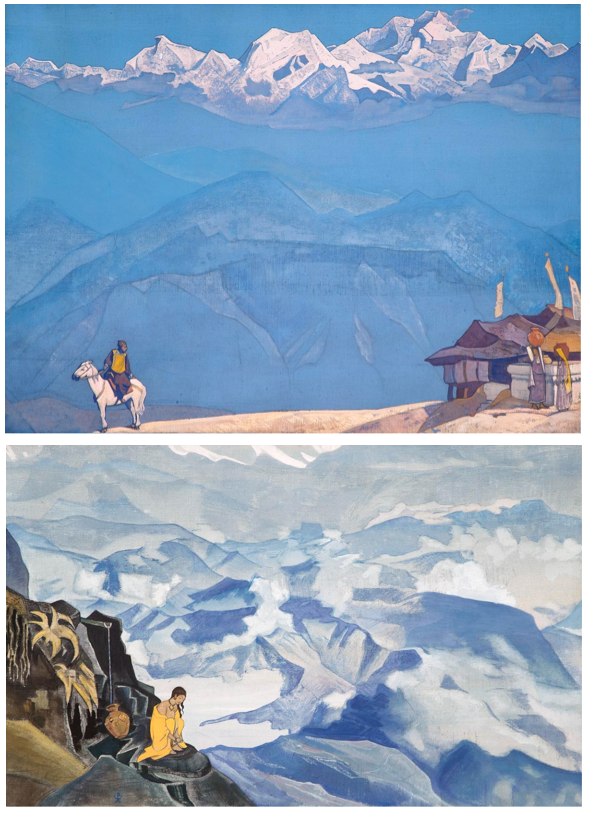
FOOTNOTES FROM A FULL LIFE…Two of Nicholas Roerich’s paintings from the 1920s: at top, Remember, 1924; below, Drops of Life, 1924. (roerich.org)
* * *
A Tenor for the Times
The crooner Rudy Vallée (1901-1986) became an overnight sensation after his Oct. 24, 1929 debut on national radio. Already a popular New York bandleader (and sometime local radio personality), his appearance on NBC’s Fleischmann’s Yeast Radio Hour made him a national sensation, especially among young women. According to Ian Whitcomb in his book, The Coming of the Crooners, Vallée’s thin, wavering tenor was not well-suited to the stage (especially in pre-microphone days when booming voices prevailed) but it worked magic on the radio, soft voices ideal for this more intimate medium (Bing Crosby, Frank Sinatra and other popular crooners would soon follow). The New Yorker’s “On The Air” column (signed “A.S.”) had this to say about Vallée’s return:
BALM FOR WEARY SOULS…Rudy Vallée’s soothing voice and easy-going manner were just what the nation needed days after the stock market crash. According to Anthony Rudel of Old Time Radio, “At 8 pm on the night of October 24th, 1929, just after the ubiquitous Graham McNamee introduced him, Vallée became a national radio star.” It was the debut of NBC’s Fleischmann’s Yeast Radio Hour, which soon came to be known as the Rudy Vallée Show. (Fleischmann was also a major benefactor of the New Yorker). Photo at left, Vallée with McNamee; at right, child actor Dorothy Gray and Vallée in the comedy talkie, The Vagabond Lover (1929). (otrcat.com/IMDB)
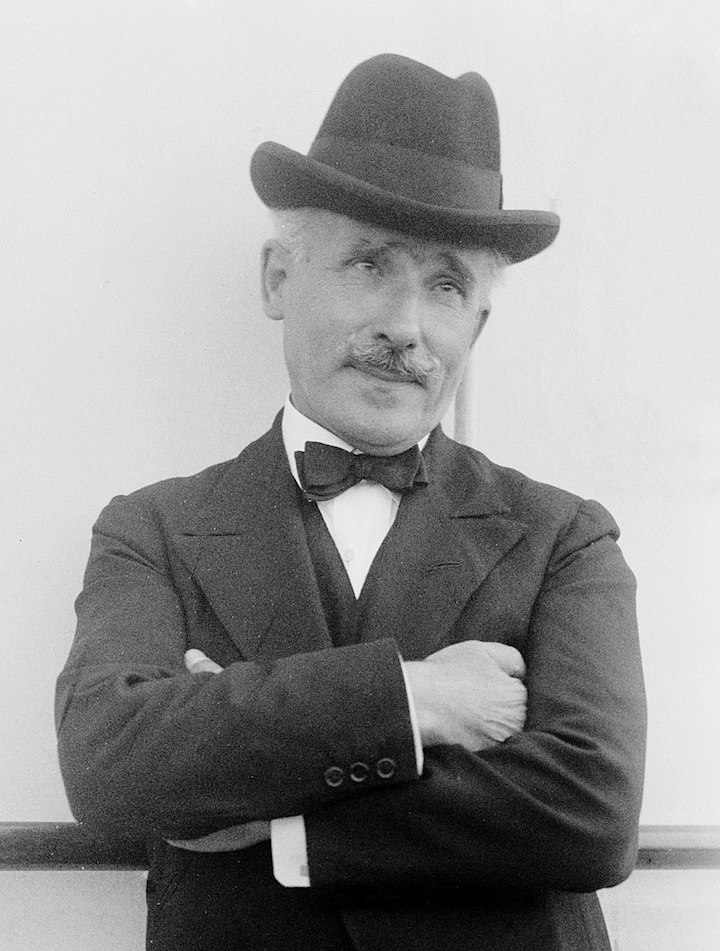
A giant among conductors of the 20th century, Arturo Toscanini (1867-1957) was already well-known to live audiences in New York, having conducted at both the Metropolitan Opera and the New York Philharmonic. Unlike Vallée, the Italian conductor’s radio broadcast was limited to the range of the New York radio station WOR. Toscanini would make his national radio debut in the States in 1937, with the NBC Symphony Orchestra.
THE MAESTRO…Arturo Toscanini, renowned for his intensity and perfectionism, was said to have perfect pitch. After leaving fascist Italy in 1936, he became a household name across the US thanks to the NBC Symphony Orchestra’s presence both on national radio (beginning in 1937) and television (1948-1952). (Library of Congress)
The New Yorker also noted the successful transmission of three transatlantic broadcasts, including remarks spoken by Albert Einstein from Berlin to the Electric Light Golden Jubilee in Dearborn, Michigan:
RELATIVELY SPEAKING…Albert Einstein prepares to congratulate Thomas Edison via transatlantic radio on the 50th anniversary of the incandescent light bulb, Oct. 21, 1929. (UT College of Liberal Arts)
* * *
From Our Advertisers
Now that we are post-market crash, we will be seeing the effects of that crash on New Yorker advertisers. Here are three advertisers from the Nov. 9 issue not long for the world: from left, the high-fashion salon Stewart & Company would file for bankruptcy and go out of business by the spring of 1930; Pierce-Arrow, maker of rolling status symbols for the wealthy, ceased car production in 1933; Hanan & Son, a leader in the mass production of shoes, would go bankrupt and fold by 1935.
Already at this early date advertisers were responding to tightening belts — this appeal from the Cuban Tourism Commission offered “an opportunity to forget business” while traveling on the cheap…
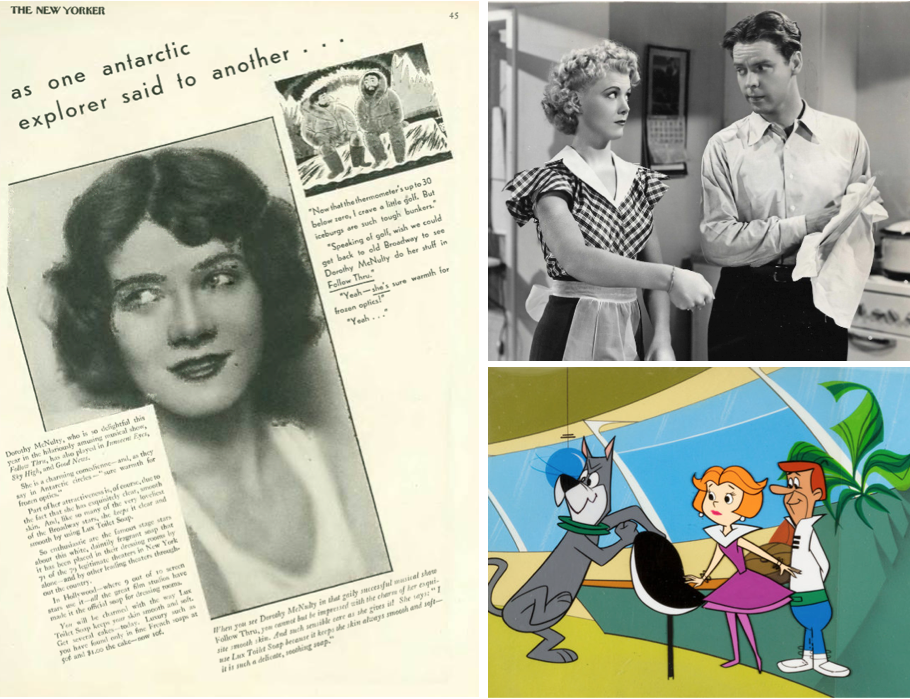
…other ads were the usual fare, this one from Lux Toilet soap featured its latest young celebrity, Dorothy McNulty (1908-2003), who changed her name to Penny Singleton in 1937 before starring in more than two-dozen Blondie-themed comedies (based on the Chic Young comic strip) with co-star Arthur Lake (who portrayed Dagwood Bumstead). She dyed her naturally brunette hair (as seen in the ad) blonde for the first Blondie movie in 1938, and continued to do so for the rest of her long life. A career that truly spanned several generations, she also provided the voice for Jane Jetson in The Jetsons in its original airing in the early 1960s and in later revivals through 1990…
THE MANY FACES OF PENNY SINGLETON…At left, before she was the film star Penny Singleton,Dorothy McNulty was a popular star on Broadway, as this ad from the Nov. 9 New Yorker attests. At top, Singleton with Blondie co-star Arthur Lake in the first installment of that popular 27-film series, 1938; a still from The Jetsons 1962-63, for which Singleton provided the voice of Jane Jetson. (IMDB/Hanna-Barbera)
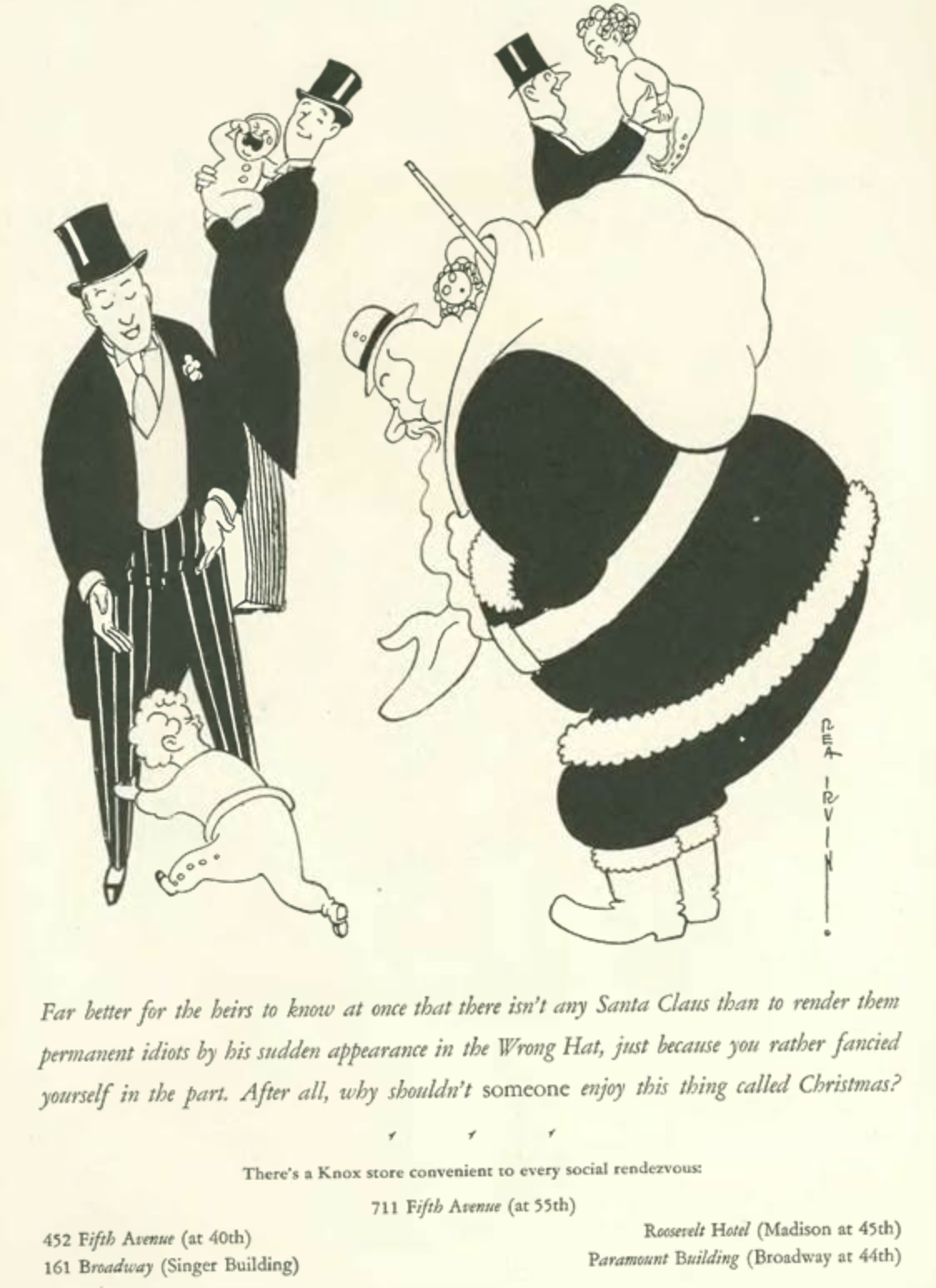
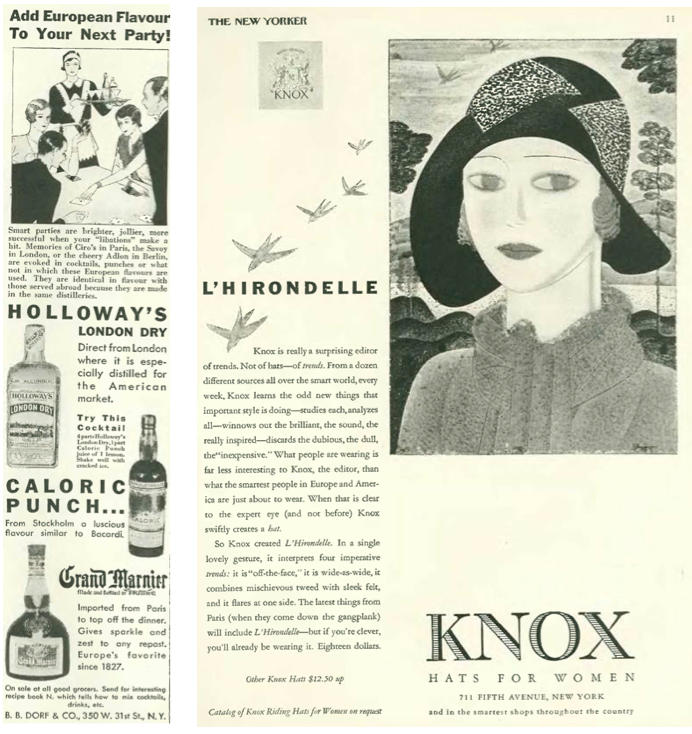
…on to other ads, the one on the left is another sad example of how manufacturers of spirits tried to market non-alcoholic versions of their libations to Prohibition-starved Americans (“especially distilled for the American market”)…at right, an ad from Knox hatters, with a somber rendering of a young woman (maybe she’s headed to the party in the other ad) wearing a fashion that would be popular in the early Thirties…the old flapper hat, along with the Jazz Age, was dead as a doornail…
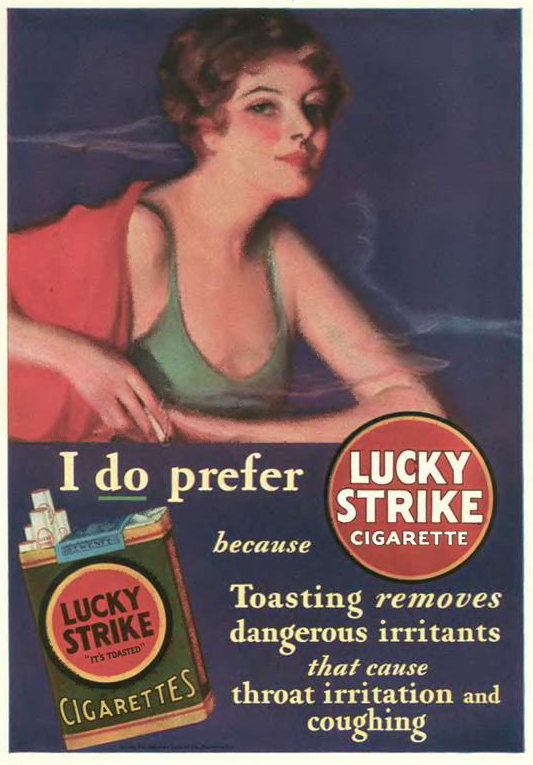
…oh well, at least you could stay healthy by smoking lots of cigarettes…
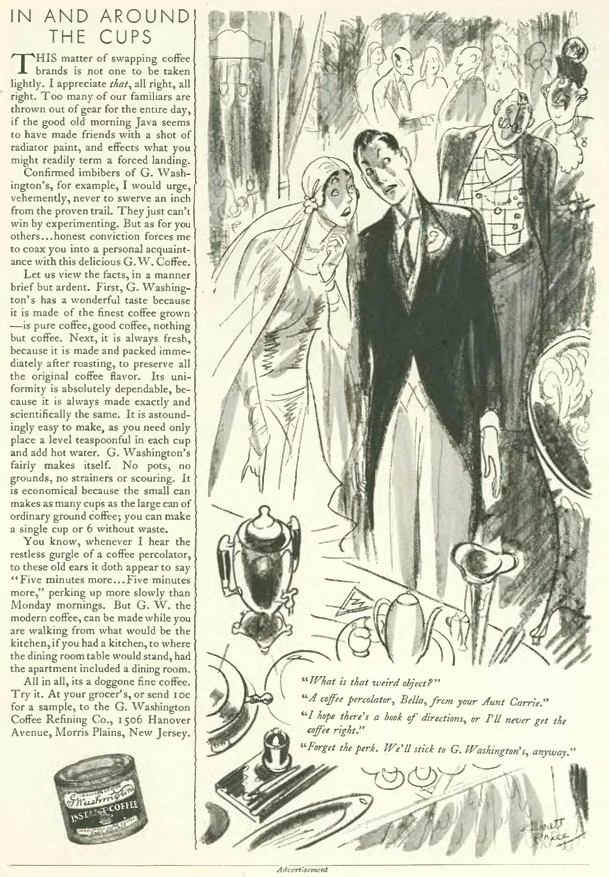
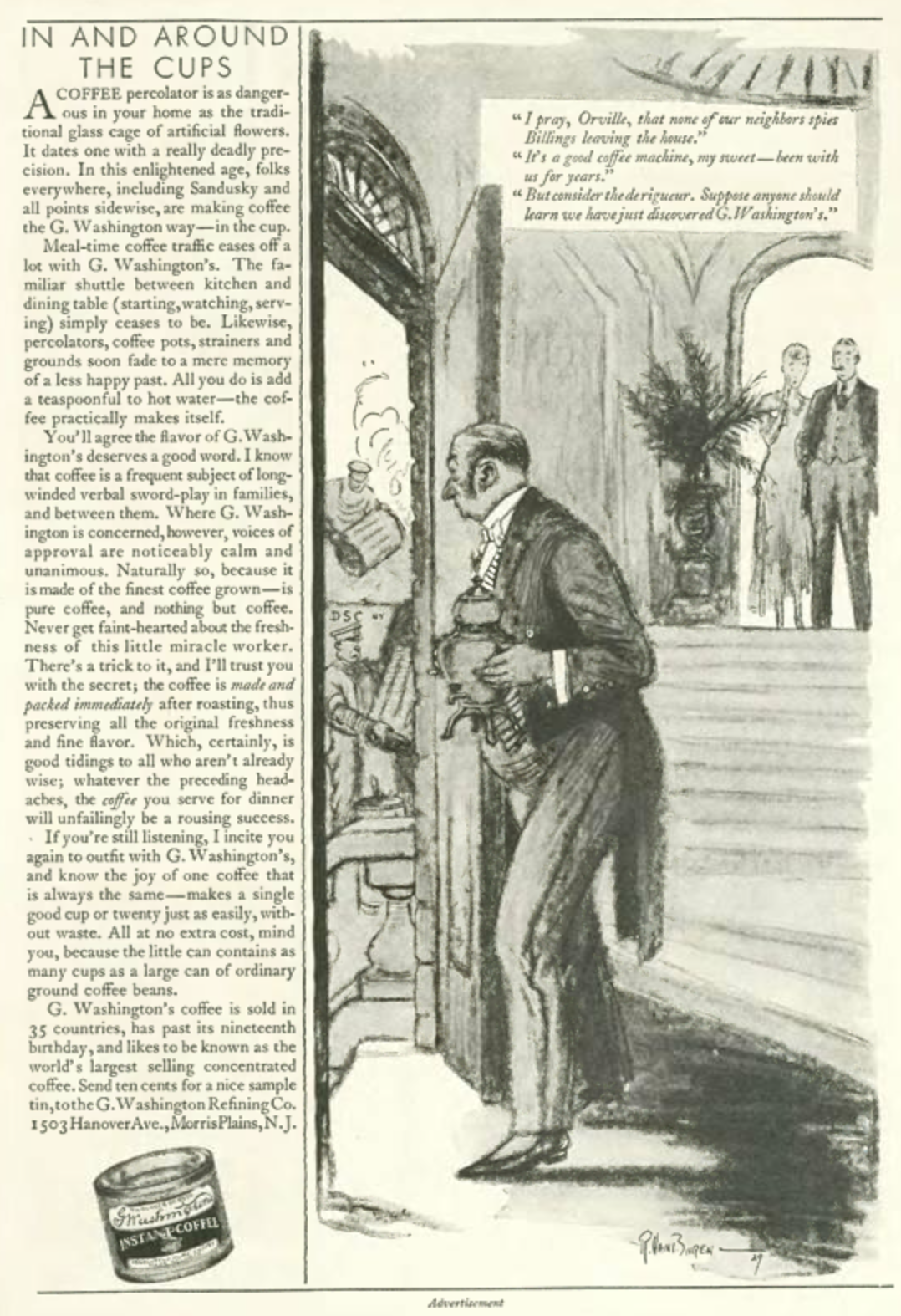
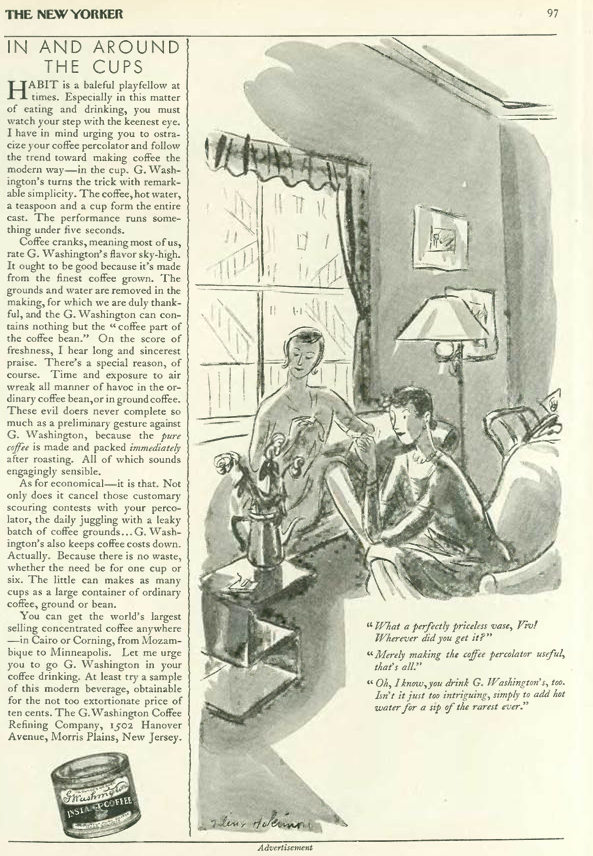
…we’ve seen ads illustrated by other New Yorker cartoonists including Peter Arno, Rea Irvin, and Julian De Miskey;Helen Hokinson got in on the action with this ad touting G. Washington instant coffee…the first instant coffee to be produced on a mass scale, G. Washington was so well known it was referred to as a “cup of George.” The brand was discontinued in 1961…
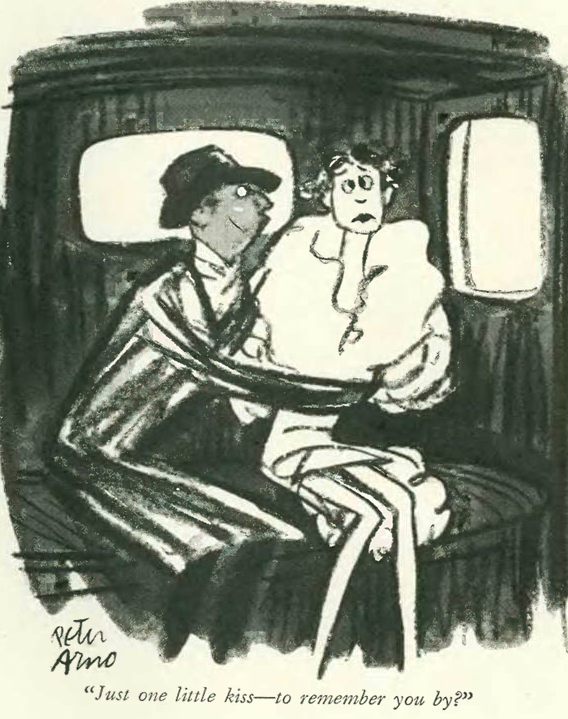
…on to our comics, an awkward moment courtesy Peter Arno…
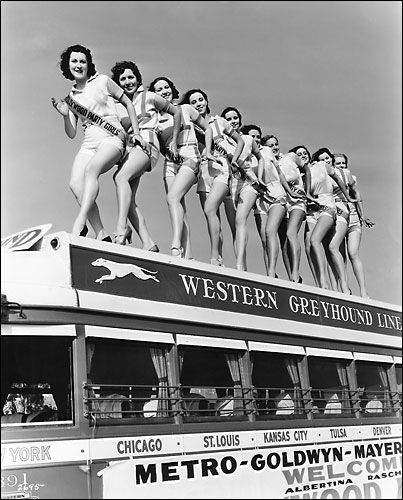
…W.P. Trent illustrated a backstage exchange regarding the ado over a popular dance troupe, the Albertina Rasch Girls…
…for reference…
MGM publicity photo from 1929 of the Albertina Rasch Girls, who traveled to Hollywood to appear in the Technicolor finale of the film Hollywood Revue of 1929. (dimitritiomkin.com)
…and John Reynolds explored the clash of the Old World and the New…
Almost ninety years after the lights went out on the Roaring Twenties, our collective imagination of New York City still harks back to that time…the sights and sounds of nightclubs and speakeasies and Broadway lights set to the tune of the Jazz Age.
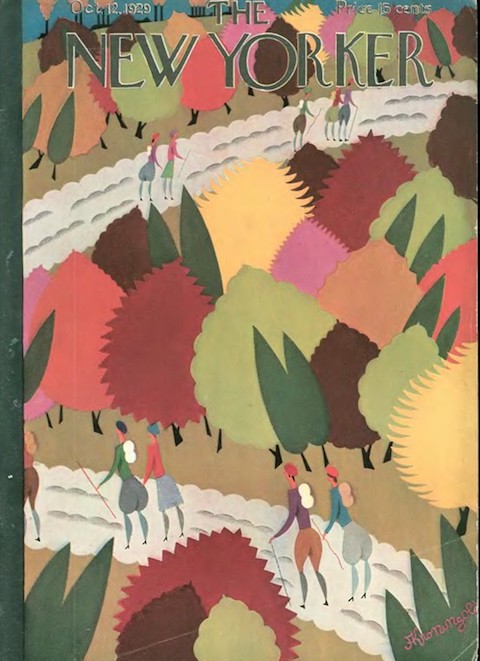
Oct. 12, 1929 cover by Adolph K. Kronengold.
And no wonder, since that decade made the city what it is today. Changing social mores, along with labor-saving electrical appliances and the ubiquitous automobile, altered the tempo of life. And this quickened pace was also reflected in the built environment, old landmarks reduced to rubble while gleaming skyscrapers rose up in their place seemingly overnight. A Victorian edifice like the Waldorf-Astoria — little more than 30 years old — seemed positively ancient to Jazz Age New Yorkers, who unceremoniously knocked it down to make way for what would become the city’s most iconic landmark.
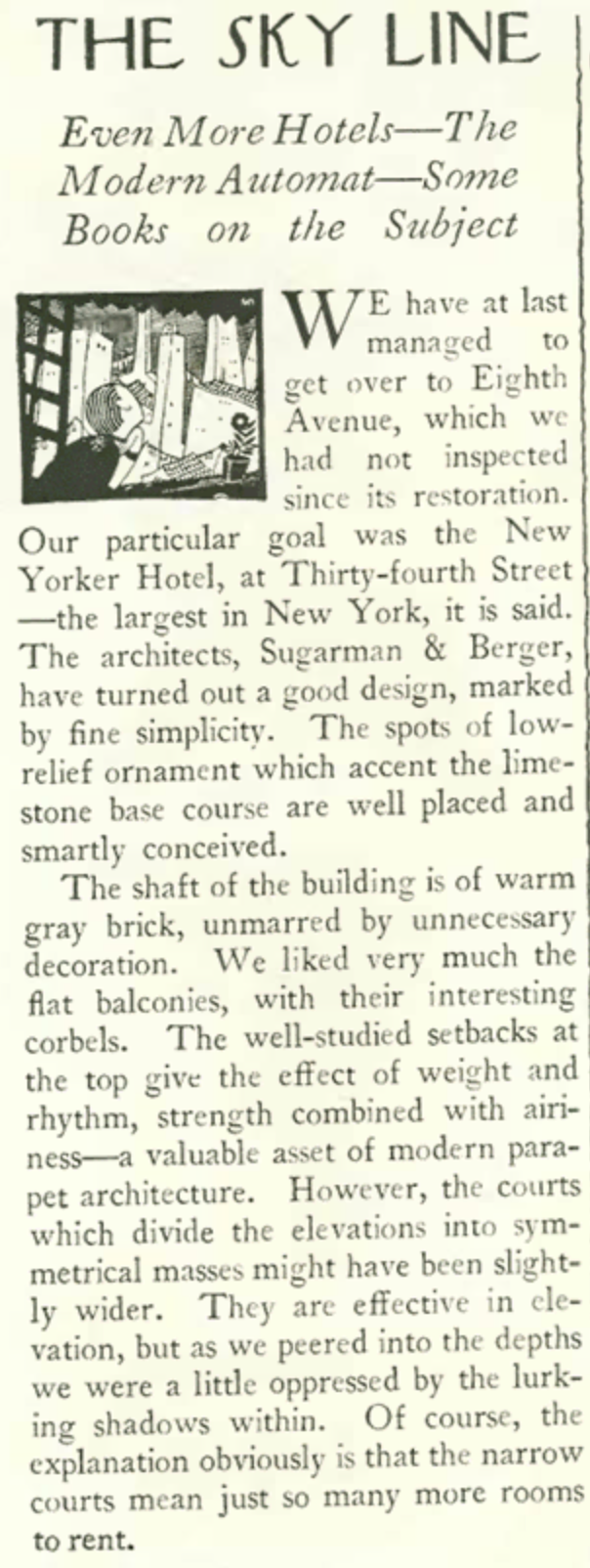
New Yorker architecture critic George S. Chappell (aka “T-Square”) sensed that something big was on the horizon with his regular “Sky Line” updates on the city’s “tallest-building-in-the-world” contest. In the Oct. 12, 1929 issue he looked on admiringly as the Chrysler Building’s distinctive dome began to take shape:
IT’LL BE A SURPRISE…The Chrysler Building still lacked its gleaming art deco dome in this photo taken in the fall of 1929. At left is the Chanin Building, completed earlier that year. (reddit/adamunderhill.wordpress.com)
Chappell observed that the Chrysler Building’s claim as the world’s tallest would be short-lived, as plans for the Waldorf-Astoria site called for a much taller structure…
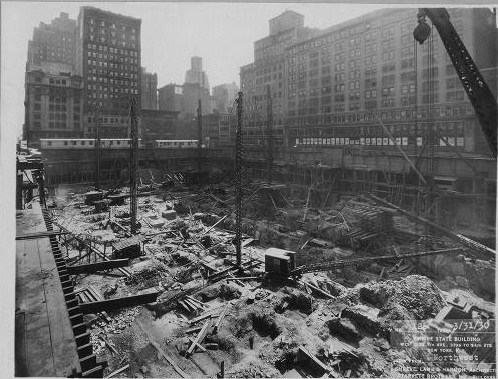
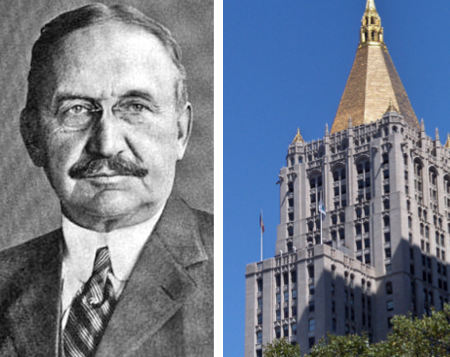
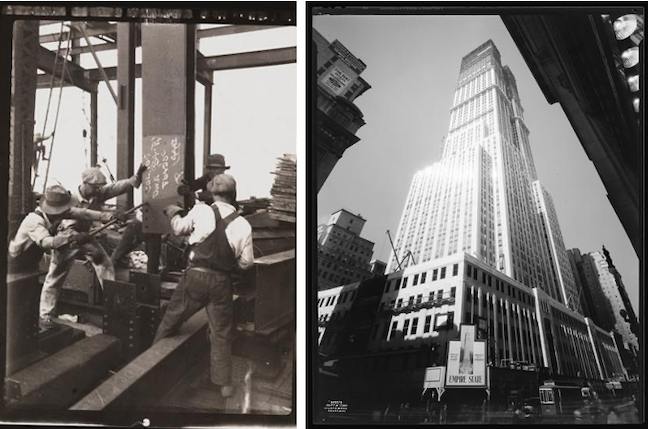
DOOMED…The old Waldorf-Astoria hotel (left), completed in 1897, was scarcely more than 30 years old when it was demolished to make way for the Empire State Building. The former governor of New York, Al Smith (inset) led the corporation that knocked down the old hotel and erected the world’s tallest building on the site. Demolition of the hotel began on October 1, 1929 (images at right). In his 2014 book The Empire State Building: The Making of a Landmark,John Tauranac observes the demolition was an arduous process, as the hotel had been constructed using more rigid material than what was found in earlier buildings. Those materials — granite, wood, and metals such as lead, brass, and zinc — were not in high demand. Most of the wood was deposited into a woodpile on nearby 30th Street or burned in a swamp. Other materials, including the granite and bronze, were dumped into the Atlantic near Sandy Hook, NJ. (New York Historical Society/New York Public Library Digital Gallery)RISING FROM THE RUBBLE…The Empire State Building under construction in 1930. When completed in 1931, the 1,250 foot (1,454 with antenna) building would claim the title as the world’s tallest. It was something of a definitive victory, as the building held that record for nearly forty years. (Museum of the City of New York)
Although Al Smith’s building seemed assured to win the “world’s tallest” title, another giant was taking shape on the drawing boards…
LAND OF THE GIANTS…City Bank-Farmers Trust Building (left), now known as 20 Exchange Place, was originally designed in 1929 to be the world’s tallest building at 846 feet, but the realities of the Depression brought it down to a more modest 741 feet, making it the fourth-tallest building in New York when it was completed in 1931. At right, the 22-year-old Century Theatre on Central Park West was demolished to make way for Irwin Chanin’s Century Apartments, also completed in 1931. (Museum of the City of New York/nyc-architecture.com)
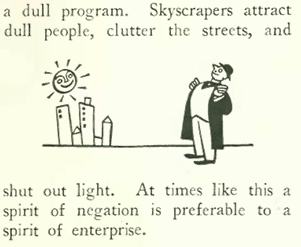
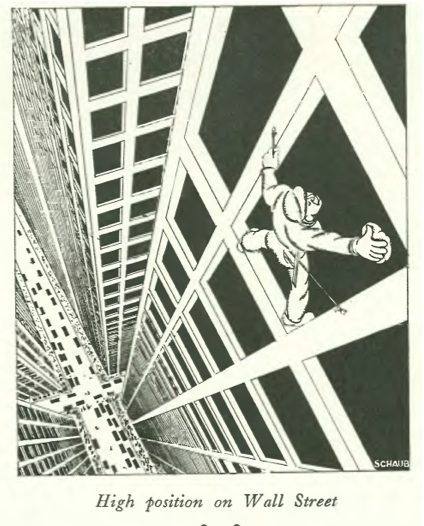
…while we are on the subject of skyscrapers, The New Yorker reprinted this illustration by Andre De Schaub to fill in a space at the bottom of page 54 in the Oct. 12 issue…
…the drawing originally appeared in the magazine three years earlier, as a cartoon in the October 16, 1926 issue. It included a caption: “High position on Wall Street” (thanks to Michael Maslin’s invaluable Ink Spill for helping me track this one down)…
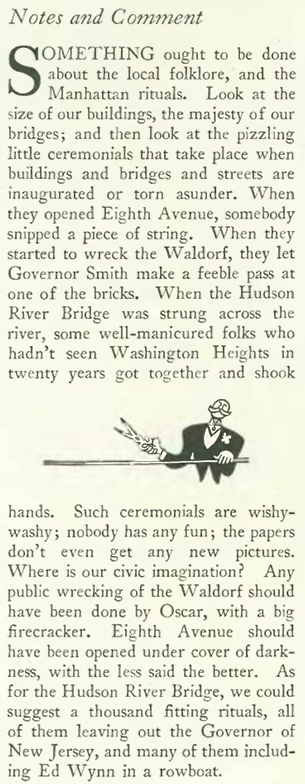
As the demolition crews picked apart the old Waldorf, E.B. White wondered why more fanfare wasn’t attached to such occasions, whether they be demolitions or ribbon-cuttings…
NEEDS MORE HOOPLA…Al Smith with his wife Catherine Dunn Smith, and two of his grandchildren at the opening ceremony of the Empire State Building, May 1, 1931. President Herbert Hoover officially dedicated the building by pressing a button in the White House that turned on the building’s lights (it was merely symbolic; they were actually turned on by some unknown maintenance worker in New York). (Museum of the City of New York)
* * *
A Novel Idea
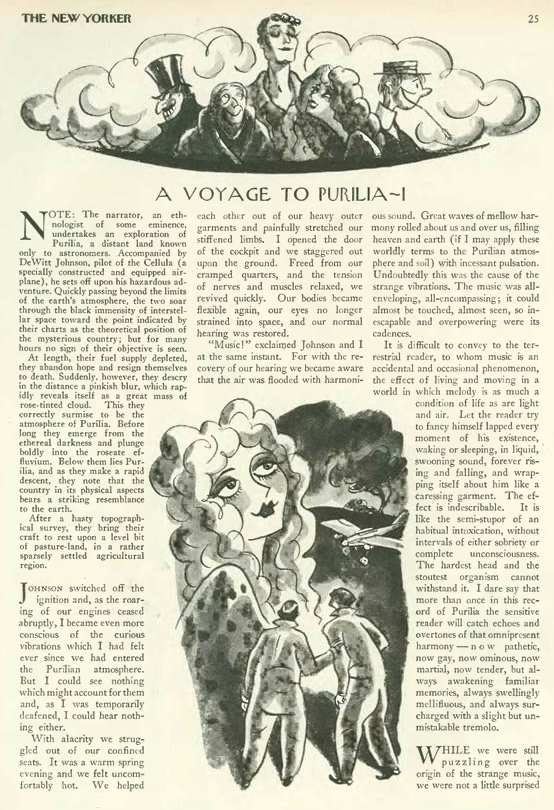
My last post featured a brief excerpt of an Oct. 5 theater review by Robert Benchley, who sized up Elmer Rice’s new play, See Naples and Die. Rice pops up again in the Oct. 12 issue, this time as the author of A Voyage to Purilia, the first novel serialized in The New Yorker. The novel was a satire on the silent film industry, set in the fictional land of Purilia. Here is the first page of the piece, with illustrations provided by Peter Arno:
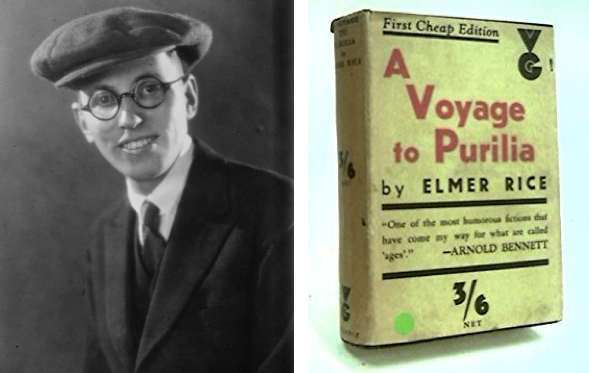
SENDING UP THE SILENTS…Elmer Rice in 1920; his satirical novel about the silent film industry, A Voyage to Purilla, was serialized in The New Yorker in 1929 and published the following year. It was re-published in the 1950s as a science fiction novel. (Wikipedia/Amazon)
* * *
Siren Song
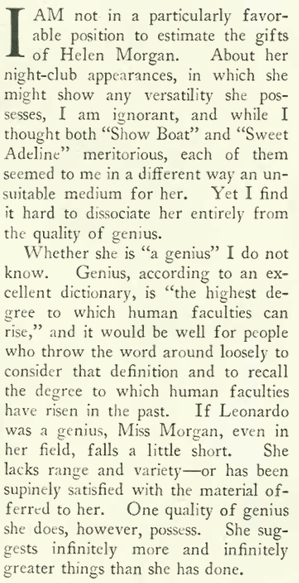
Writer and cultural critic Gilbert Seldes trained his discerning eye on the famed torch singer and speakeasy denizen Helen Morgan, attempting to understand the hard-living singer’s allure…
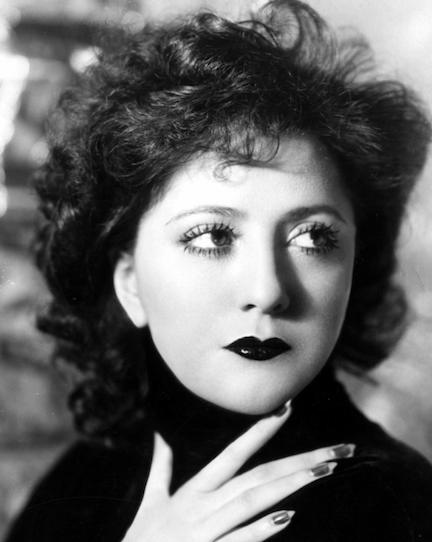
Helen Morgan, circa 1930. (masterworksbroadway.com)
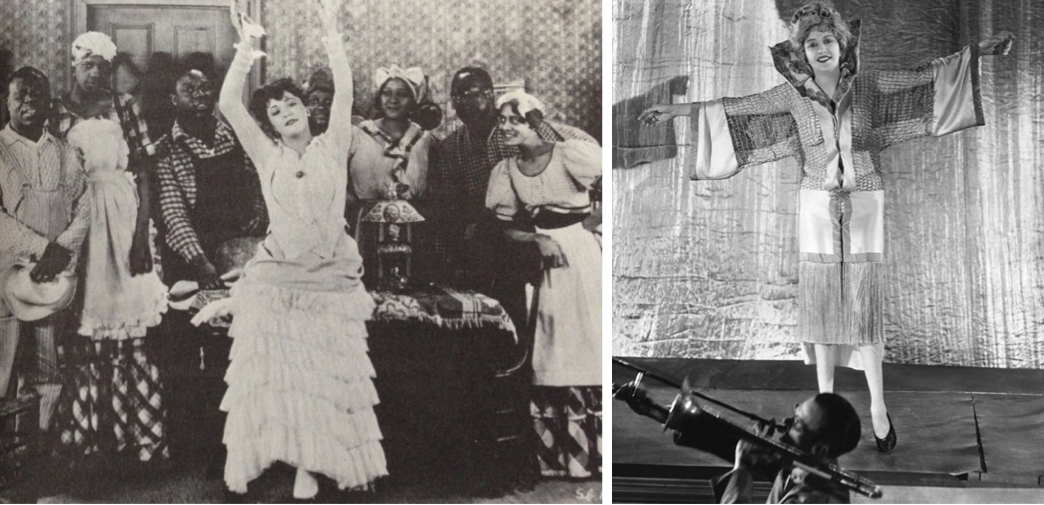
RIGHT AT HOME…Helen Morgan made the draped-over-the-piano look of a torch singer her signature style. (Pinterest.UK)LIGHTING UP BROADWAY…Helen Morgan (left) as Julie LaVerne in the original Broadway cast of Show Boat, 1927. It was her best-known role. At right, Morgan in Applause, 1929. (Pinterest/IMDB)
Seldes struggled to understand Morgan’s appeal, which seemed to draw from an assemblage of personas…
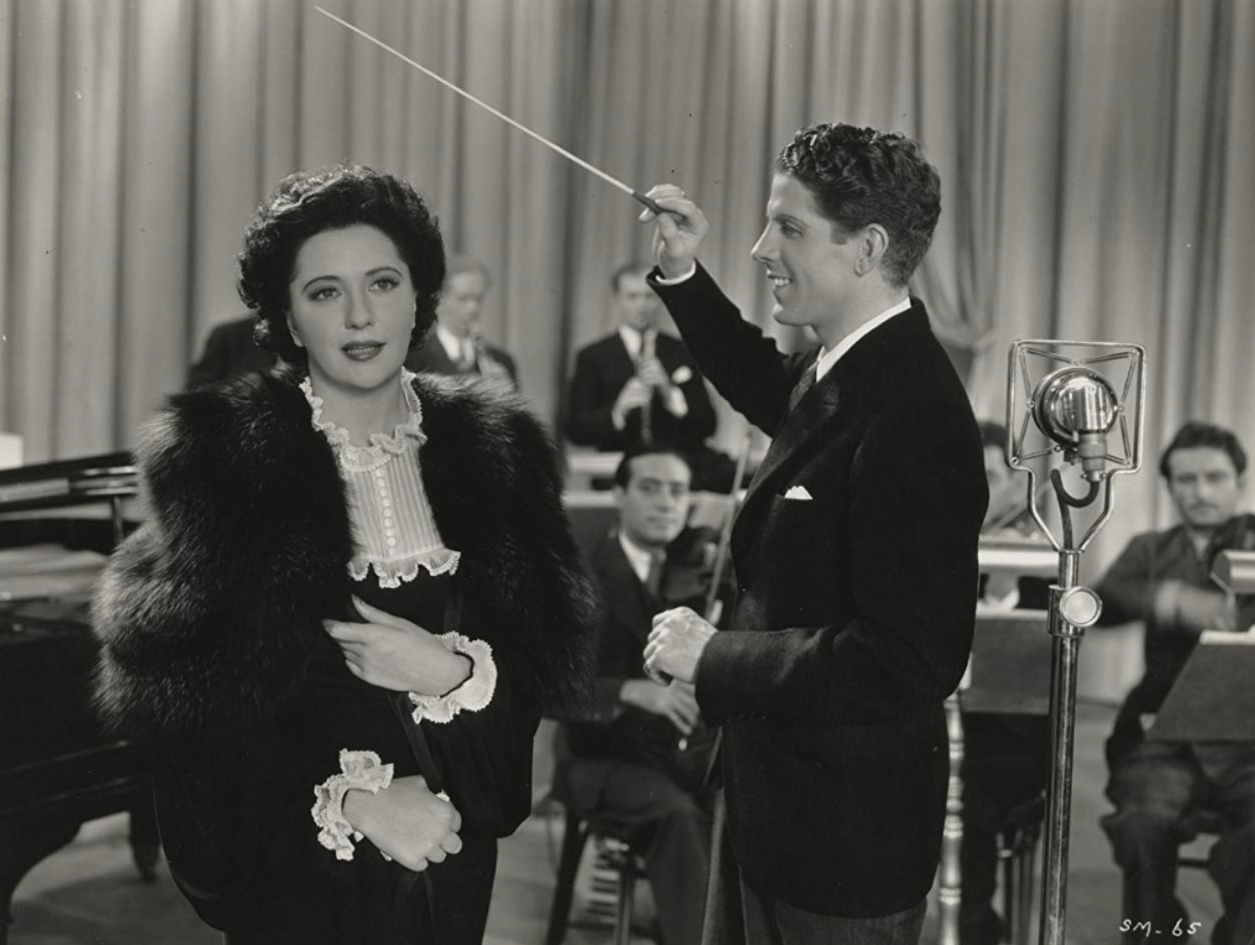
PLUMBING EMOTIONAL DEPTHS…Helen Morgan and Rudy Vallee in Sweet Music, 1935. (IMDB)
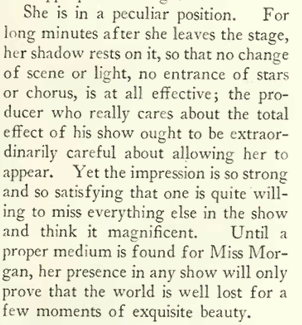
Seldes concluded that Morgan belonged with other artistic greats in her ability to create a sense of expectancy…
* * *
The Invention of Distracted Driving
Writing in his “Motors” column, Nicholas Trott noted the advent of the car radio, a “new complication” to an “already over-elaborate existence.” Note that Trott viewed the car radio as something to be listened to while parked — car radios were fairly controversial back then, akin to driving while texting today.
EASY TO INSTALL…New Yorker automotive critic Nicholas Trott observed that cars were now being wired to receive radio sets (you still had to buy one and install it yourself). The system above featured battery-powered vacuum tubes, a dash-mounted dial and mono speaker. (hemmings.com)
* * *
From Our Advertisers
To the refined owner of a Pierce-Arrow, a car radio would have been a crass novelty. After all, your driver was there to drive, and listen to your orders…
…unlike the Pierce-Arrow, which took pride in its heritage, the folks at Chrysler were known for their forward-thinking in design and technical innovation…
…on to some of the back page ads, we find appeals to flee the oncoming winter and escape to the golden sands of Waikiki…note the second ad, and its rather democratic invitation…
…and then we have the ads that hoped to catch the eye of the grasping Francophile, with delicacies from Louis Sherry or mock bubbly from the makers of applesauce…the second ad is particularly heartbreaking, the copy writer trying his or her best to conjure the glamour of Champagne from a bottle of apple juice. Zut!…
…fake Champagne isn’t for you? Well Leonard Dove offered us a salesman doing his best to sell a bottle of mock gin…
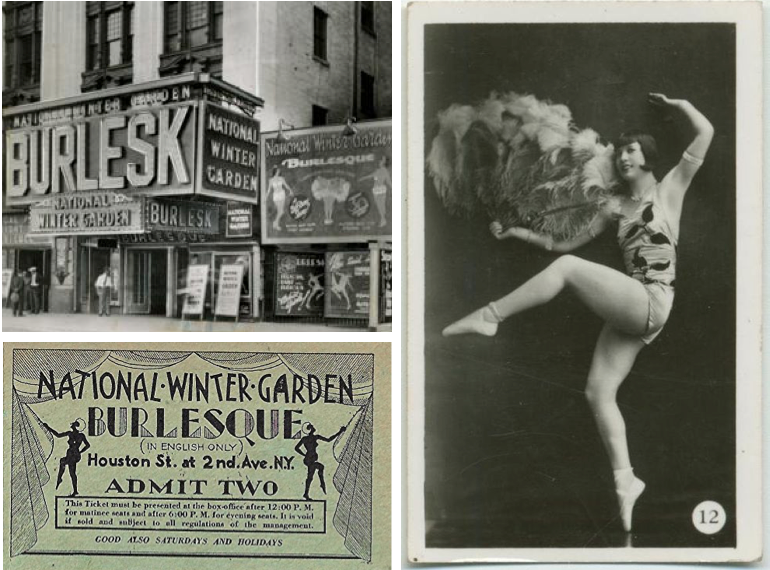
…returning to the ads, here’s one more from the back pages that references Harold Ross’s original prospectus for his magazine: “The New Yorker will be the magazine which is not edited for the old lady in Dubuque.” The ad is for Billy Minsky’s National Winter Garden, where the art of burlesque got its start. Despite the cheapness of the ad and the implied salaciousness, uptown New Yorkers loved “slumming” at Minsky’s burlesque, including artists and writers (Hart Crane even wrote a poem called “National Winter Garden”). No doubt a few New Yorker staffers found their way inside as well…
Clockwise from top left, Billy Minsky’s National Winter Garden; a 1920’s burlesque performer; a ticket for two to the show. (New York Post/Amazon/Pinterest)
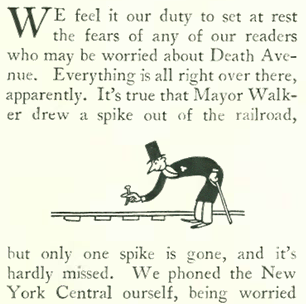
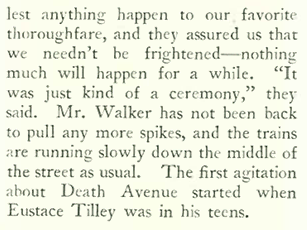
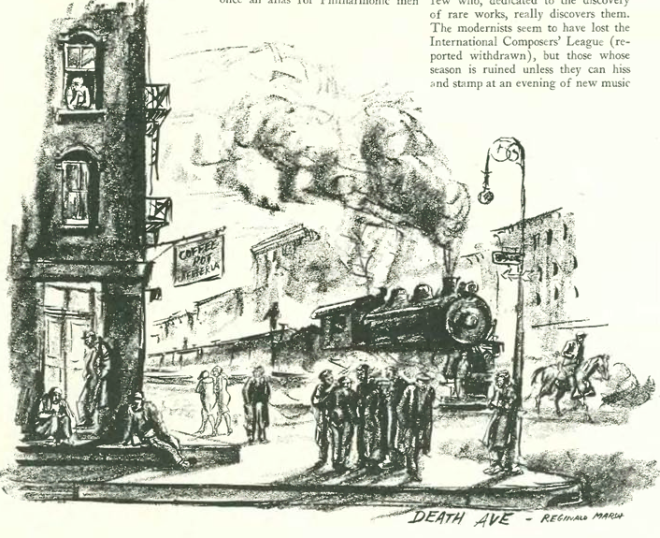
…on to the illustrators and cartoonists, a nice street scene by Reginald Marsh…
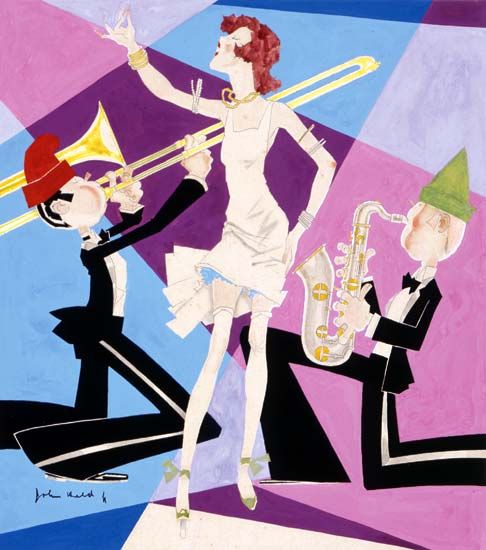
…John Held Jr. contributed one of his famed “woodcuts” to the Oct. 12 issue. Held was an old childhood friend of New Yorker founding editor Harold Ross. It was Ross who encouraged Held to deviate from his popular flapper caricatures — he recalled how his friend had produced clever woodcuts in high school, and wanted something similar for his magazine…
A John Held Jr. illustration for Life magazine, 1927. (Library of Congress)
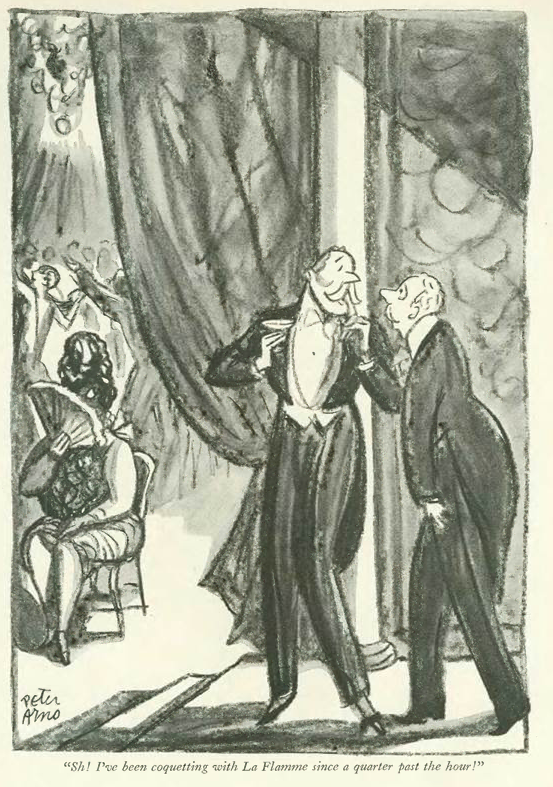
…Peter Arno went behind the scenes at a posh nightclub (a familiar setting for Arno)…
…Helen Hokinson found confusion at the elections…
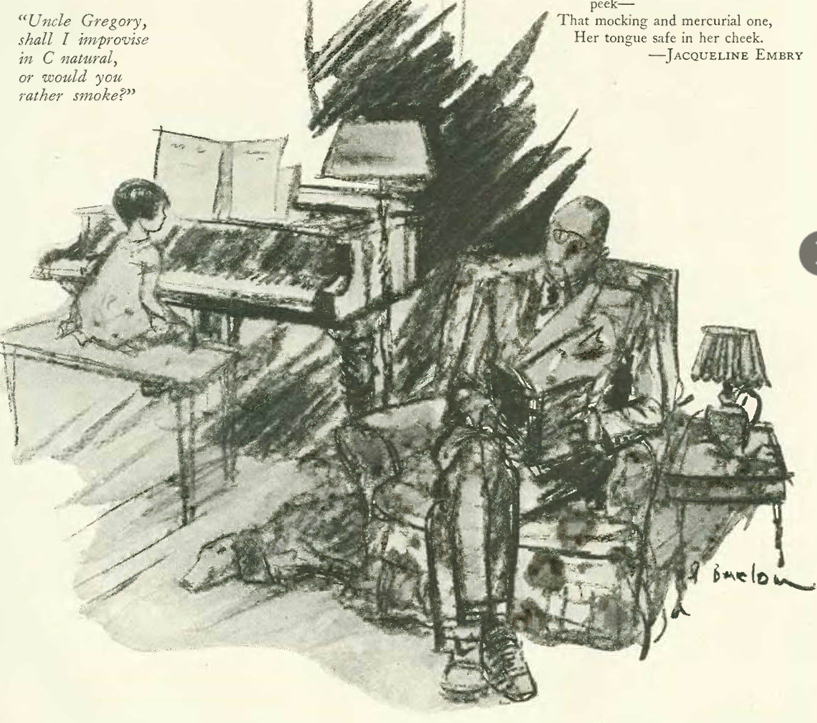
…Perry Barlow offered up this sweet slice of family life…
…and Denys Wortman illustrated the power of the pen…
James Thurber and E.B. White shared an office at the New Yorker that has been described as “the size of a hall bedroom.” This proximity doubtless supported a rich exchange of ideas that coalesced in their 1929 bestseller, Is Sex Necessary? Or, Why You Feel the Way You Do.
Sept. 28, 1929 cover by Julian De Miskey.
A spoof of popular sex manuals and how-to books that dealt with Freudian theories, the book featured chapters (alternately written by Thurber and White) that delved into pseudo-sexual conditions such as “Frigidity in Men” — the title of a chapter by White excerpted in the Sept. 28, 1929 issue of The New Yorker…
Expanding on the condition known as “recessive knee,” White coined the term “Fuller’s retort,” and claimed it was “now a common phrase in the realm of psychotherapy”…
THE ARTIST EMERGES…Although James Thurber had yet to publish one of his drawings in The New Yorker magazine, Is Sex Necessary? featured 42 of them, including the illustration at right that demonstrated the male greeting posture. (brainpickings.org)
No other editor besides founder Harold Ross did more to give The New Yorker its shape and voice than Katharine Angell, who recommended to Ross the hiring of both White and Thurber. It is worth noting that White would marry Angell in the same month, November 1929, as the publication of Is Sex Necessary? In their case, sex was necessary, as Katharine would give birth to their son, Joel White, the following year.
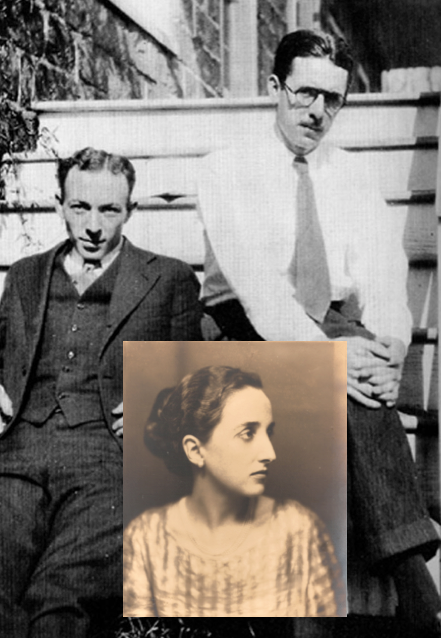
DYNAMIC TRIO…Katharine Angell (inset) would be instrumental in bringing both E.B. White (left) and James Thurber to The New Yorker. (Pinterest/Wikipedia)
* * *
A New Rabbit Hole
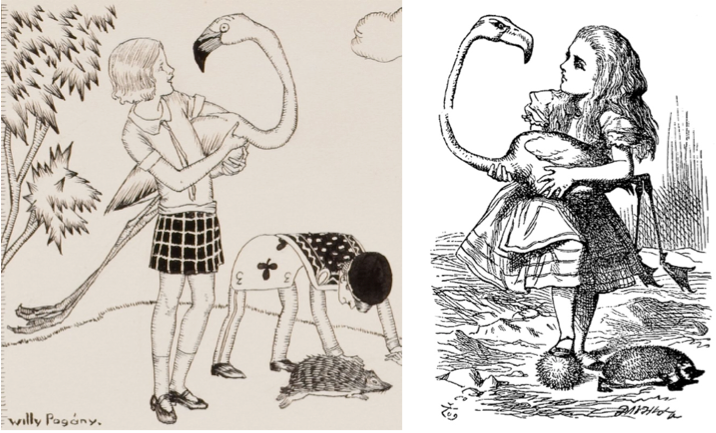
In other news from the world of publishing, “The Talk of the Town” (also largely a product of Thurber and White) noted the publication of a new edition of Alice in Wonderland that featured a re-drawn Alice with bobbed hair and the slender profile of a 1920s flapper. White mused:
NEW ALICE, MEET OLD ALICE…A 1929 edition of Alice and Wonderland featured a Jazz Age Alice (left) as rendered by Willy Pogany. At right, Sir John Tenniel’s original Alice, from the 1866 edition. (comicartfans.com/girlmuseum.org)
* * *
Rise of the Boob Tube
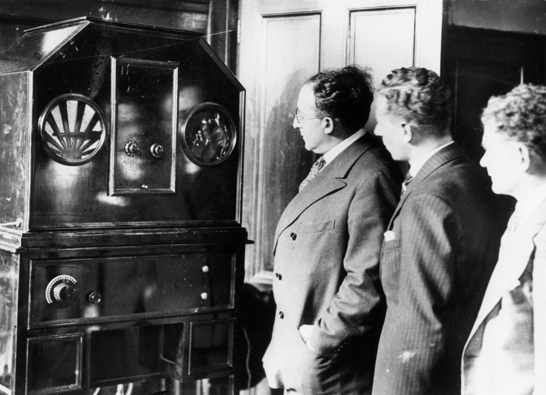
Also in “Talk,” it was reported that the BBC would be putting television on the air “five times a week for a half an hour.” The broadcasts, on a single channel, featured speeches, comic monologues and popular songs. The technology did not allow sound and image to be transmitted together, so “viewers” (there were only a handful of sets) first heard each piece in audio, followed by a mute moving image:
COMMERCIAL-FREE…Early television promotor Sydney Moseley (left) and two employees of the Baird Television Development Co. watch the inaugural television broadcast on a “Noah’s Ark Televisor,” Sept. 30, 1929. The televisor was the invention of British TV pioneer John Logie Baird (1888-1946). (scienceandmediamuseum.org.uk)
* * *
Mutt & Jeff & Peggy
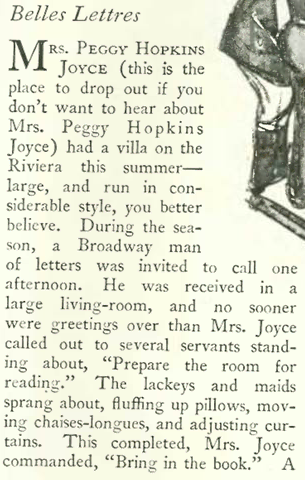
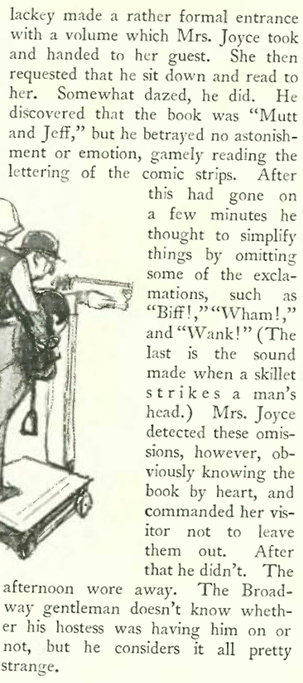
This odd little item in “Talk” focused on the literary interests of Peggy Hopkins Joyce, an actress and dancer best known for her lavish lifestyle and multiple marriages and affairs. She was a Kardashian of her day — famous for being famous. Despite her flamboyant ways, Joyce seemed to have some rather pedestrian tastes, at least when it came to her reading pleasure…
JEEVES, BRING ME SOME LIGHT READING…Peggy Hopkins Joyce (left) might have preferred the high life, but her tastes in reading seemed more of the rabble. She is pictured here in her Hollywood debut, the 1926 silent film The Skyrocket. The film bombed, and Joyce made just one more screen appearance before moving on to other things. (Bizarre Los Angeles/mycomicshop.com)
* * *
Ring Cycle
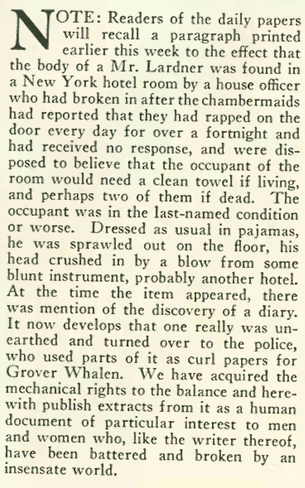
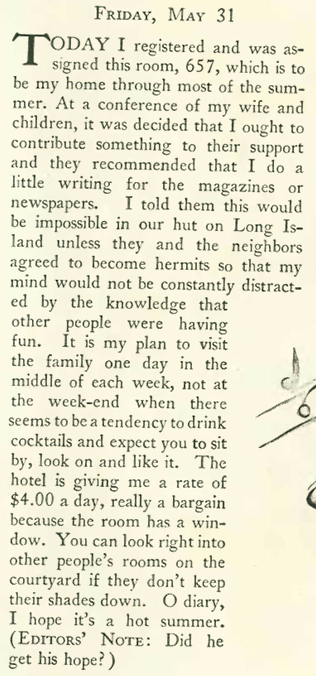
Ring Lardner contributed a casual titled “Large Coffee,” in which he checks into a hotel to escape life’s distractions and get some writing done. The piece consisted of diary entries largely concerned with Lardner’s inability to get a proper order of coffee. He began with an editor’s note that described how his corpse was found in the room, along with the diary. Some excerpts:
COFFEE AND CIGARETTES helped fuel the genius of writer Ring Lardner. (Brittanica)
* * *
Master of the Screwball
Preston Sturges (1898-1959) was known for taking the screwball comedy and turning into something more than a simple farce. Reviewer Robert Benchley saw the potential in this young Broadway producer, whose second play, Strictly Dishonorable, opened to great acclaim:
KEEPING IT LIGHT…Tullio Carminati as Count Di Ruvo and Muriel Kirkland as Isabelle Parry in Broadway’s Strictly Dishonorable, 1929. Producer Preston Sturges reportedly wrote the hit play in just six days. (Museum of the City of New York)
* * *
Have No Fear
Morris Markey (1899-1950) often took on the lurid and sensationalist reporting of his day in a column he established at The New Yorker titled “Reporter at Large.” In his Sept. 28 column titled “Fear, Inc.” Markey chided everyone from the newspapers and Hollywood to the headline-grabbing NYC Police Commissioner Grover Whalen, and painted a picture of organized crime that was less violent and glamorous, and a lot more mundane…
MAKE SURE YOU GET MY GOOD SIDE…NYC Police Commissioner Grover Whalen loved to make headlines with his “get tough on crime” approach. He was was famously quoted as saying, “There is plenty of law at the end of a nightstick.” (wnyc.org)
Markey suggested that rather than screeching tires and blazing Tommy guns, most of the crime in the city was just the humdrum of making money…
Sadly, Markey himself would meet a violent end, dying of a gunshot wound at the age of 51. It is unclear whether it was self-inflicted.
* * *
The Last Laugh
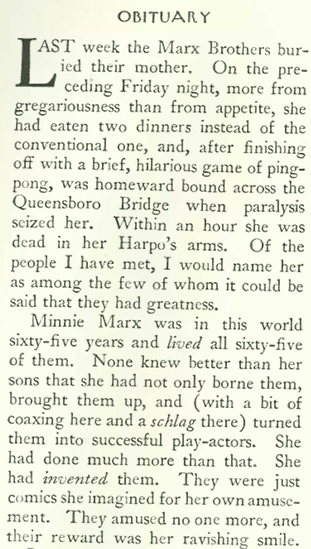
The year 1929 saw the passing of Minnie Marx, the beloved mother of the Marx Brothers comedy troupe. Alexander Woollcott offered this tribute in his “Shouts and Murmurs” column…
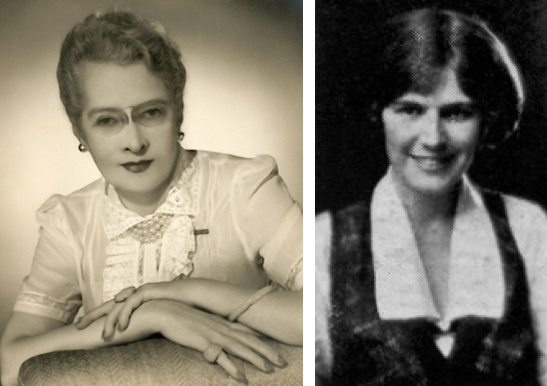
MY LITTLE CLOWNS…Minnie Marx with her sons, The Marx Brothers, circa 1920. (Find a Grave)
* * *
From Our Advertisers
Harper’s Bazar began weekly publication in 1867, catering to women in the middle and upper classes. The magazine was a frequent advertiser in the upstart New Yorker, no doubt perceiving a considerable overlap among its readers. This full page ad in the Sept. 28 issue of the New Yorker featured a column by the Bazar’s Paris fashion correspondent, Marjorie Howard…
…no doubt The New Yorker’s own fashion editor, Lois Long (1901-1974), read her rival’s column with great interest, and, like the magazine she wrote for, Long was the young upstart compared to the veteran Howard (1878-1958). However, according to future New Yorker editor William Shawn, Long was the superior writer. Upon Long’s death in 1974, Shawn said “Lois Long invented fashion criticism,” adding that she “was the first American fashion critic to approach fashion as an art and to criticize women’s clothes with independence, intelligence, humor and literary style.” Here is a brief excerpt from Long’s fashion column, “On and Off the Avenue,” in the Sept. 28 issue…
OF A FASHION…Majorie Howard (left) served as fashion editor for Harper’s Bazar in the late 1920s and 1930s. Lois Long (right) wrote the New Yorker fashion column, “On and Off the Avenue,” from 1927 to 1970. (findagrave.com/Vassar College)
…looking at some of the ads from the magazine’s back pages, here’s one from Scribner’s announcing the publication of A Farewell to Arms (a first edition for only $2.50)…
…the back pages of The New Yorker near the theater section were filled with signature ads promoting various entertainments…
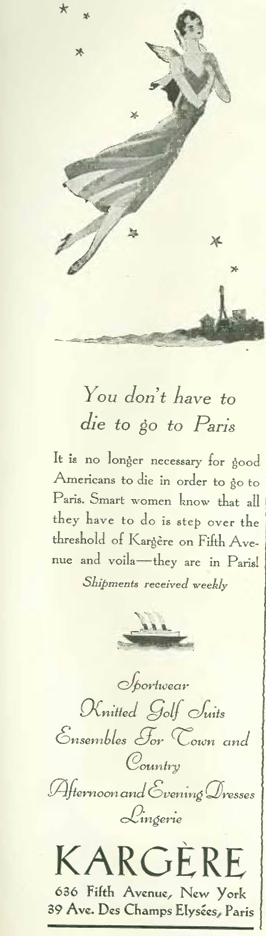
…this ad from Kargère referenced an exchange from Oscar Wilde’sThe Picture Of Dorian Gray: “They say that when good Americans die they go to Paris,” chuckled Sir Thomas…” Really! And where do bad Americans go to when they die?” inquired the Duchess. “They go to America,” murmured Lord Henry…
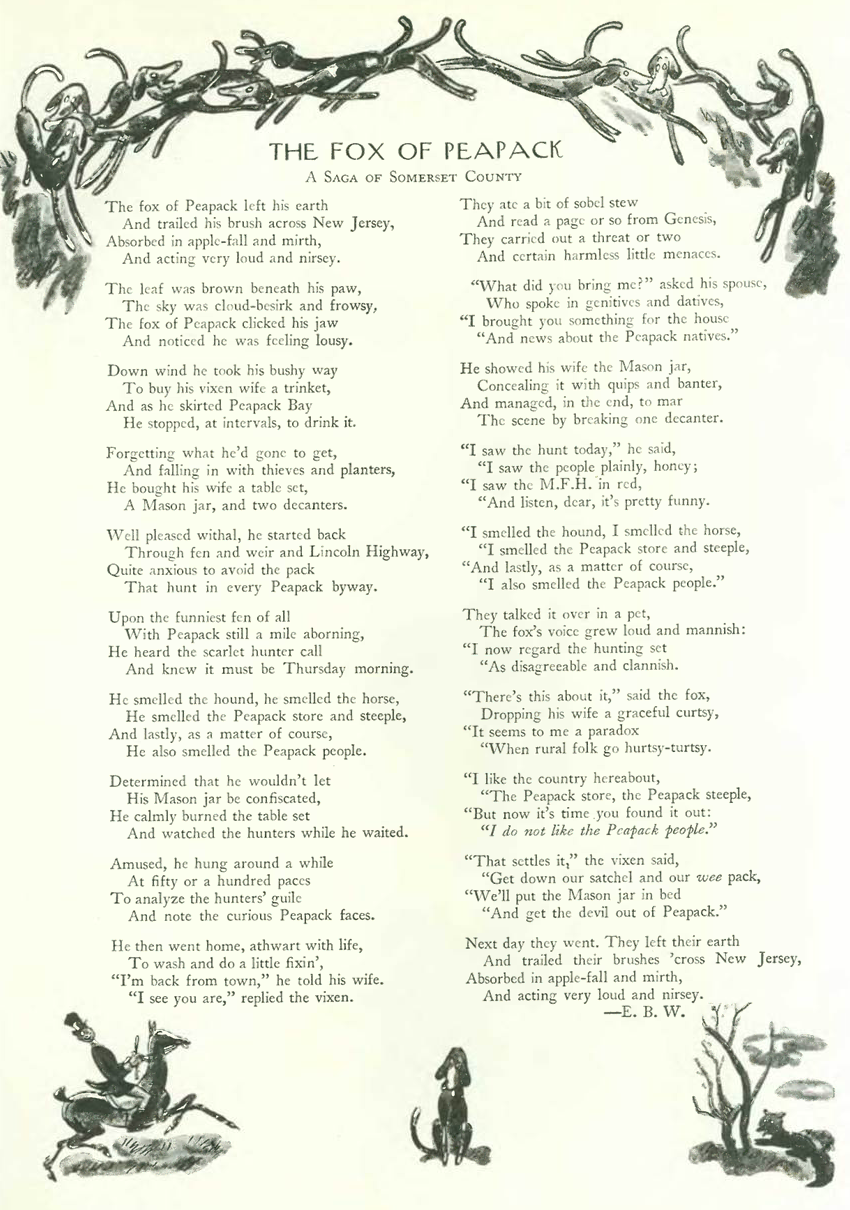
…several ads and filler illustrations from the Sept. 28 issue featured posh folks dressed for fox hunting season, the makers of Spud cigarettes among them…
…this ad from Frigidaire featured an illustration by Herbert Roese, whose style at the time somewhat resembled Peter Arno’s…
and Arno’s full-page contribution to the Sept. 28 issue…
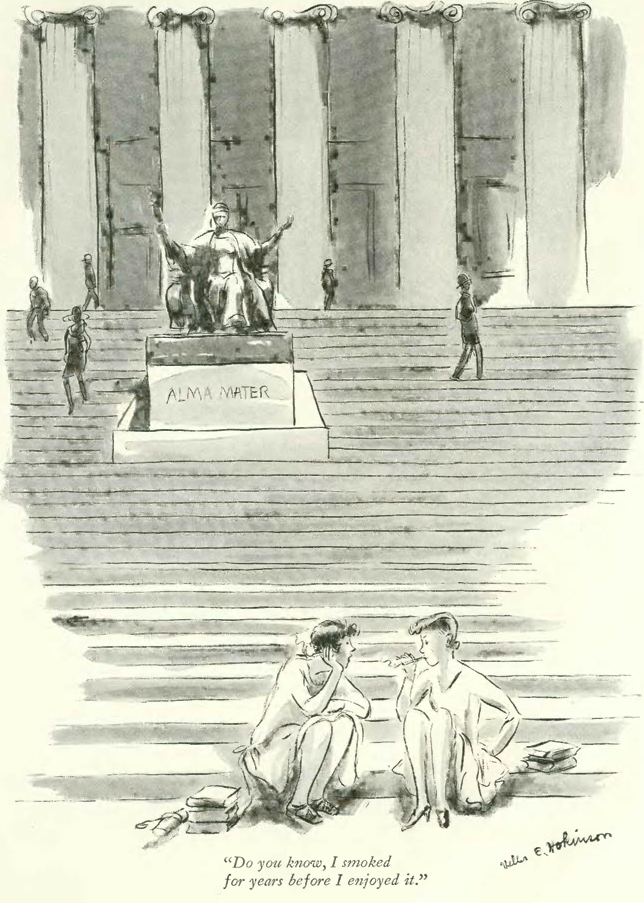
…another artist at The New Yorker who along with Arno often received a full page for her work was Helen Hokinson, here looking in on life at Columbia U…
…and there were artists who were lucky to get any space at all, including Kent Starrett, who probably drew on his own experiences at The New Yorker’s front office for this entry…
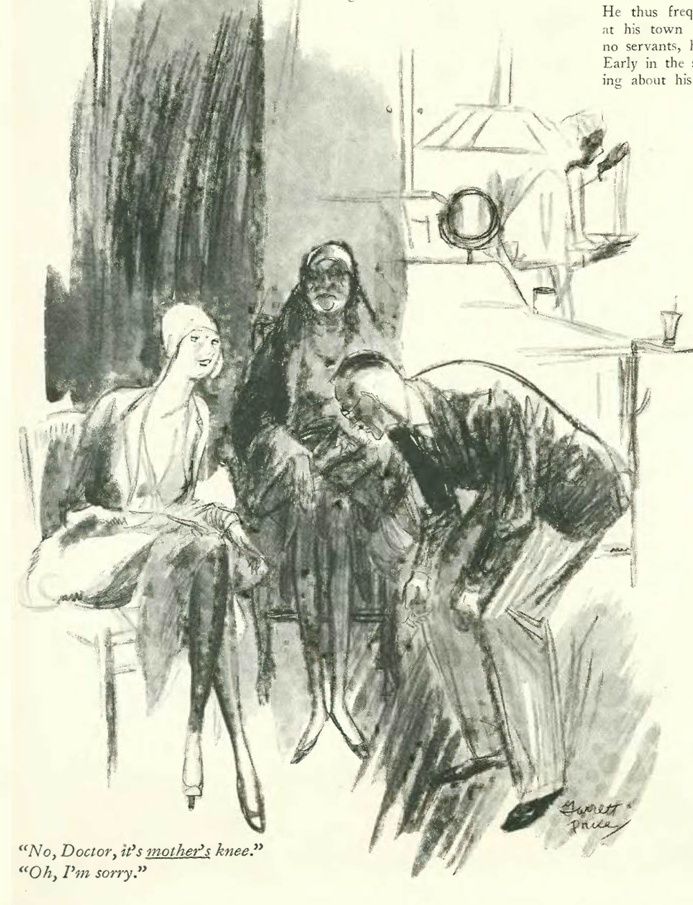
…and finally, Garrett Price illustrated the challenges of the “house call”…
Avery Hopwood’s 1919 Broadway hit, The Gold Diggers, was among cultural events of the late teens that signaled the dawn of new age; namely, the Jazz Age.
Sept. 7, 1929 cover by Sue Williams.
So it seems appropriate that the play, when adapted to the screen in 1929 as a Technicolor talkie, would also signal the end of that age. As the New Yorker’s film critic John Mosher observed in his review of The Gold Diggers of Broadway, the themes that seemed new and daring a decade earlier had been played out, the “general humors” of the picture having “become very familiar”…
The film featured Nancy Welford, Winnie Lightner and Ann Pennington as three chorus girls who try to entice a wealthy backer to invest money in their struggling Broadway show. The film was a big hit, and it made a star of Winnie Lightner (1899-1971), who played the boldest “Gold Digger” of the trio.
PROSPECTORS…Clockwise from top left, Ina Claire as the original “Gold Digger” with Bruce McRae in the 1919 Broadway play The Gold Diggers; lobby card for the 1929 film Gold Diggers of Broadway; image from the film’s “Tiptoe Thru the Tulips” song-and-dance number; Winnie Lightner works her charms on Albert Gran in a scene from the film. (Wikipedia/IMDB/TCM-YouTube)IT’S FUN MAKING PICTURES…Helen Foster, Ann Pennington, Nancy Welford and William Bakewell in a publicity photo from 1929’s Gold Diggers of Broadway. (IMDB)
Lightner wasn’t the only actor to steal the show. The film also proved a winner for crooner Nick Lucas (1897-1982), who performed two hit songs written for the movie — “Painting the Clouds with Sunshine” and “Tiptoe through the Tulips.” Yes, that second song was the very same tune Tiny Tim rode to fame nearly 40 years later.
TIPTOE THROUGH HISTORY…At left, Nick Lucas sings what would be become his signature song “Tiptoe through the Tulips” to Lilyan Tashman in the Gold Diggers of Broadway. At right, forty years later, Lucas sang the song on The Tonight Show With Johnny Carson (apparently using the same guitar) on the occasion of singer Tiny Tim’s televised wedding to Victoria Mae Budinger (“Miss Vicky”). Tiny Tim (inset) also made “Tiptoe through the Tulips” his signature song, although his was a campier version, sung in a falsetto, vibrato voice accompanied by his trademark ukulele. (YouTube)
The Gold Diggers of Broadway was a “pre-code” film, that is, a film made during a brief period of the early sound era (roughly 1929 through mid-1934) when censorship codes were not enforced and many films openly depicted themes ranging from promiscuity and prostitution to amoral acts of violence.
A LEG UP ON THE CENSORS…Warner Brothers publicity photo of Dorothy Mackaill, who played a secretary-turned-prostitute in 1931’s Safe in Hell. (Wikipedia)
Those unenforced codes had their origins in the early 1920s. In response to outcries from preachers and politicians alike over the immortality of Hollywood (both on- and off-screen), the president of Paramount Pictures, Adolph Zukor — fearing that cries for censorship would cut into his profits — called a February 1921 meeting of his studio rivals at Delmonico’s restaurant on 5th Avenue. At the meeting Zukor (1873-1976) distributed a set of 14 rules that would guide every Paramount production (Zukor’s studio at that time was actually known as Famous Players-Lasky). The rules covered everything from “improper sex attraction” to “unnecessary depictions of bloodshed.”
It was also Zukor’s idea to appoint the former U.S. Postmaster General, Will Hays, as President of the Motion Picture Producers and Distributors of America. It would be Hays’ job to enforce the code and generally “clean up” Hollywood. However, until mid-1934 both Hays and the code served mostly as publicity ploys to keep the preachers and politicians off the backs of studio execs.
Zukor was profiled by Niven Busch, Jr. in the Sept. 7 issue (with portrait by George Shellhase). In his opening paragraph, Busch commented on “Pop” Zukor’s efforts to stave off the censors:
* * *
Delmonico’s Redux
The famed Delmonico’s restaurant that provided the setting for Adolph Zukor’s “14 rules” meeting in 1921 closed its doors in 1923, a victim of Prohibition (more people dined at home, where they could still drink). Writing in the Sept. 7 “Talk of the Town,” Bernard A. Bergman described plans for the long-awaited opening of a new Delmonico’s in a skyscraper bearing the same name…
RICH DESSERTS…Dinner in honor of French Navy Admiral Paul Campion at the old Delmonico’s in 1906. (Wikipedia/Library of Congress)AND SALAD DAYS…Delmonico’s wait staff pose for a photograph in 1902. (Museum of the City of New York)
A former Delmonico’s chef, Nicholas Sabatini, hoped to bring back some of old waiters and cooks from the restaurant’s glory days, but it seemed most were far too long in the tooth. It is unclear if he ever got his dream off the ground, or if the grill room was able to crank out fare comparable to that of the old Delmonico’s. Probably not…
THE KITCHEN IS CLOSED…The 1928 Hotel Delmonico, as shown in a 1937 photograph. It was purchased by Donald Trump in 2002 and converted into luxury condominiums. It would not host a great restaurant, but the Beatles would stay there in 1964. (New York Public Library)
* * *
Relax. You’re in Omaha
E.B. White’s “Notes and Comment” entry in the Sept. 7 “Talk of the Town” described travel on the Union Pacific’s Overland Limited, and the “mystic dividing line” that separated laid-back Westerners from buttoned-up Easterners:
MIND YOUR MANNERS, AT LEAST UNTIL YOU LEAVE CHICAGO…Tinted photo postcard depicting the dining car on a Union Pacific train that traveled the Chicago to Denver route in the 1920s. (myutahparks.com)
* * *
Write What You Know
The Wisconsin-born Marion Clinch Calkins (1895 – 1968) often wrote humorous rhymes for The New Yorker under the pen name Majollica Wattles. While many writers reveled in the party atmosphere of the Roaring Twenties, Calkins worked as a vocational counselor and social worker at Lillian Wald’s Henry Street Settlement. This experience doubtless led her to more serious writing after the 1929 market crash — her critically acclaimed book, Some Folks Won’t Work (1930), is considered a seminal document on the Great Depression.
But in September 1929, Calkins was still in a humorous vein, and published this satirical piece on the role of an ideal housewife in the Sept. 7 issue. Excerpts:
CALL ME CLINCH…Marion Clinch Calkins circa 1905 and 1945. She wrote under the name of Clinch Calkins because she wanted her authorship to be gender-neutral. (evansvillehistory.net/NEH)
* * *
Information Please
The New Yorker’s art critic Murdock Pemberton did not suffer fools gladly, and whenever the local museums seemed less than up to snuff, he was there to provide some correctional advice…
NEED AN AUDIO GUIDE? STILL WORKING ON THAT…The Metropolitan Museum of Art’s H.O. Havemeyer Collection, 1930. (The Metropolitan Museum of Art)
* * *
From Our Advertisers
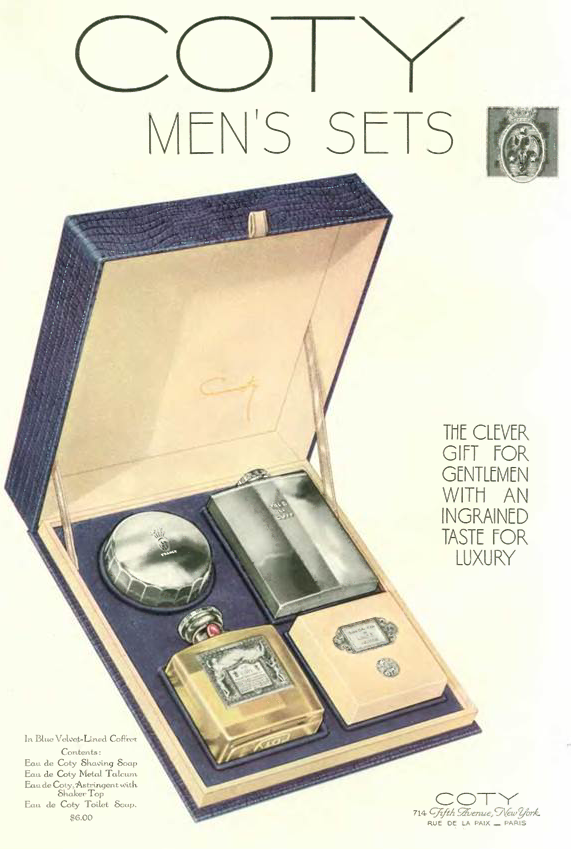
Despite the advances made by women in the 1920s, they still lived under a patriarchy, especially when it came to the patrician classes. And so the young bride of Gifford Pinchot II was identified only as a “Mrs.” in the headline for this Pond’s cold cream ad…
…Mrs. Gifford Pinchot II was actually Janine Voisin (1910-2010). She must have had more than a healthy complexion, as she lived 100 years…
Janine Voisin Pinchot in 1933. (history.blogberth.com)
Another woman known for her beauty in the 1920s was the model Marion Morehouse (who was married to poet E.E. Cummings from 1934 until his death in 1962). Considered by some to be the first “supermodel,” I include an image of Morehouse below (right) to demonstrate how artists exaggerated the female form in fashion ads of the day…
…the body wasn’t the only thing subject to exaggeration, or hyperbole, as this ad from Harper’s Bazar attested in defining the exclusivity of its readership…
…the New York Sun also appealed to social mores in an attempt to sell more newspapers…
…the Curtiss Robin Flying Service touted their latest achievement — the St. Louis Robin being refueled during its flight to a new world’s endurance record of 420 hours — greatly surpassing the record of 150 hours set by the Army’s “Question Mark” airplane at the beginning of 1929…
…our cartoonists from the Sept. 7 issue include Gluyas Williams, who had some fun at the expense of Alice Foote MacDougall, who was the “Starbucks” of her day, at least in New York…
…MacDougall turned her coffee business into a restaurant empire in the 1920s. She opened several restaurants in Manhattan, all decorated in a signature style meant to evoke European cafés…
EURO AMBIENCE…Interior of Alice Foote MacDougall’sFirenze, 6 West 46th Street, New York City, 1925. (New York Historical Society)
…other cartoons included this commentary on public advertising by Leonard Dove…
…Peter Arno’s unique take on the seafaring life…
…Helen Hokinson eavesdropped on some tween talk…
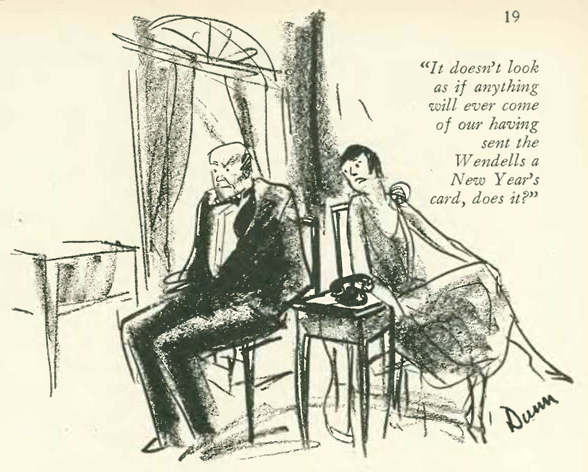
…and Alan Dunn gave us some perspective on the fast pace of city life…
When Charles Lindbergh gunned his Wright Whirlwind engine on Roosevelt Field and took to the skies on his historic flight, he sparked such an interest in flying that just two years later that very same field was hosting huge weekend crowds that came to marvel at the airborne wonders of a new age.
August 31, 1929 cover by Theodore Haupt.
Writing for “The Talk of the Town,” James Thurber was on hand to take in the spectacle, noting how the announcer sold air-mindedness to the mob “in great clamorous phrases and resonant assurances.” Among those taking their first flight was a “Mr. Galleger, aged 101.” Thurber also observed:
AIRBORNE SPECTACLES…Clockwise, from top, a 1931 aerial view looking southeast at a group of Army twin-engine biplane bombers overflying Roosevelt Field; parachute records were broken when 14 men and 2 women leaped from a Sikorsky bombing plane at Roosevelt Field in November 1929 (in the photo they seem to be standing precariously close to the plane’s whirling blades); Jack Cope waved to onlookers in Chicago before he performed a 15,000 foot jump in 1929. (tripod.com/Worthpoint/Chicago Tribune)
Although there were thrills galore up in the sky, Thurber seemed equally impressed by the spectacle on the ground…
THE SUN GOD…Clockwise, from top, a 1928 photo of biplanes lined up by a row of hangars at Roosevelt Field; the spectacle of mid-air refueling was demonstrated above Roosevelt Field by Texaco Oil’s Spokane Sun God. (Tom Heitzman/barnstmr.blogspot.com/Wikipedia)
One of the big attractions was Texaco Oil’s Spokane Sun God, which traveled around the country to demonstrate the art of mid-air refueling. Note in the excerpt below (second paragraph) how the Sun God’s pilot communicated with his ground crew: He tossed some notes—tied to a heavy piece of lead(!)—out of the airplane’s window. It nearly landed in a crowd of onlookers…
AND HOW WAS YOUR DAY?…For some perspective, the first attempt at refueling in mid-air was made in 1921. In the photo above, Wesley May climbs from the lower biplane to the upper while carrying a 5-gallon can of fuel strapped to his back. After lifting himself onto the wing, he worked his way between the wings and into the cockpit. He then poured the fuel into the engine. (Seattle Museum of Flight)
* * *
Falling Short
As I noted in a previous post (The Last Summer), the race to build the tallest building was erroneously reported by The New Yorker as a man against himself (namely, architect William Van Allen). In the Aug. 31 issue, the magazine’s “Talk of the Town” corrected the error, and added another curious note about another plan to build an “airplane lighthouse” taller than the Eiffel Tower…
As noted above, Col. Edward Howland Robinson Green (son of the notorious miser Hetty Green) wanted to build a thousand-foot tower on his estate in Massachusetts. Here is what he settled for instead:
WORK-LIFE BALANCE…Edward Green, radio enthusiast and son of the miserly Hetty Green, erected huge radio towers at his Massachusetts estate in the 1920s to operate an early broadcast station, WMAF. (Wikipedia)
* * *
When Trains Fly
Cashing in on the enthusiasm over aviation, the City of New York promoted its elevated train system as an “Air Line.” According to “Talk”…
Click on the video below to take a ride on the “L”. Most of the 1929 footage begins at 4:47…
* * *
Haw Haw
One more “Talk” item: a self-referential piece in which The New Yorker pondered its “mission” as a humor magazine…
* * *
Audax Minor
For more than five decades, George Francis Trafford Ryall (1887-1979) wrote the horse racing column for the New Yorker under the pseudonym Audax Minor. He published his first column on July 10, 1926, and his last on Dec. 18, 1978. He was the writer of longest record at the magazine when he died at age 92 in 1979 (52 years, a record that has been shattered by the nearly 98-year-old Roger Angell, who has published in the New Yorker from 1944 to 2018).
According to Ryall’s obituary in the New York Times, he adopted the nom de plume Audax Minor in a nod to Arthur F. B. Portman, who wrote about racing in England under the name of Audax Major. Ryall’s writing was so entertaining that many of his readers had never even been to a racetrack. According to Brendan Gill in his book, Here at the New Yorker, “(Ryall’s) world is a romantic fiction and they (the readers) are grateful when they learn that, with his green tweeds, his binoculars hung smartly athwart his chest, and his jaunty stride, Ryall resembles a character out of some sunny Edwardian novel.” An excerpt of his column from the Aug. 31 issue, with illustrations by Johan Bull:
A DAY AT THE RACES…At left, a crowded second floor dining area in the clubhouse at Saratoga, 1929; a postcard image of the track, with expanded clubhouse at left, circa 1929. (Saratoga Springs Historical Museum/Boston Public Library)
* * *
Shut Out
As I’ve noted before, the New Yorker covered nearly every imaginable sport except baseball. Here is a rare mention of the game in Howard Brubaker’s “Of All Things” column:
The Cubs would win the NL pennant, but they would fall to the Philadelphia Athletics in the 1929 World Series.
Rough and Ready
When Fiorello La Guardia challenged incumbent Jimmy Walker for New York City mayor in 1929, the city’s voters were presented with two colorful candidates who could not have been more different in their styles. Walker, a product of Tammany Hall, was a svelte dandy with a taste for the refined, whereas the reform-minded La Guardia was often coarse and unkempt. If they had anything in common, it was their dislike of Prohibition. La Guardia was featured in the Aug. 31 profile, written by Henry F. Pringle. Some excerpts:
JUST TRY TO STOP ME…Congressman Fiorello La Guardia pouring beer in his office during Prohibition, when he served New York’s 20th district in U.S. House of Representatives. (La Guardia Wagner Archives)
* * *
Praise for the King
TheNew Yorker’s film critic John Mosher found most of Hollywood’s output to be pedestrian, but occasionally he saw a bright spot, including King Vidor’s latest production, Hallelujah:
William E. Fountaine, Nina Mae McKinney and Daniel Haynes in Hallelujah. The 17-year-old McKinney was the first African-American actress to hold a principal role in a mainstream film, and the first African-American actor to sign a long-term contract with a major studio—MGM. (IMDB)
As for another film, Paramount’s The Sophomore, Mosher probably felt a bit obligated to say something nice, since it was a derived from a story by humorist Corey Ford, an early contributor to The New Yorker and part of the Algonquin Round Table orbit:
BOY MEETS GIRL…Lobby card for The Sophomore. (IMDB)
* * *
A Bright Interval
The New Yorker gave a brief but approving mention of Nancy Hoyt’s latest book, Bright Intervals, in its book review section…
Hoyt was a member of a socially prominent but deeply troubled family that included her recently deceased sister, the poet and writer Elinor Wylie (I wrote about the Hoyt family in my post Generation of Vipers). Characters in Hoyt’s novels often resembled the women in her family.
Nancy Hoyt in an undated photo by Sherril Schell. (Conde Nast/Amazon)
* * *
From Our Advertisers
It was back to college time, and Macy’s had a thrifty new fall lineup ready for the “Junior Deb”…
…and on the less thrifty side, Best & Company offered these new looks for fall…
…note in the above ad that the first model is Virginia Maurice, the very same model we encountered in a recent post (The Last Summer) posing for Chesterfield cigarettes…
Model Virginia Maurice posed for this 1929 Chesterfield ad, illustrated by artist Charles Edward Chambers.
…the other model in the Best & Company ad, Babs Shanton, also wasn’t averse to taking money from the tobacco companies…
Undated newspaper ad for Lucky Strikes featuring Babs Shanton, a sometime performer with the Ziegfeld Follies and a singer with the Lucky Strike Dance Orchestra. (Stanford University)
…the makers of Studebakers tried to add sex appeal in this ad for their President Roadster. The artist was obviously challenged to work all of the necessary elements into the picture—car, swimming pool, diving board—not to mention the block of superfluous text where the steps to this impossibly long diving board should have been located…
…and sex not only sold cars…its also sold printing services…
…instead of sex, the promoters of Tudor City chose strangulation to get their pitch across, equating a man’s daily train commute to death at the gallows (“Danny Deevers” refers to a character in a Rudyard Kipling poem who is hanged for murder)…
…the gawkers at Roosevelt Field weren’t the only folks with their heads in the clouds…an ad for Flit insecticide by Dr. Seuss…
…this ad for Raleigh cigarettes, which appeared on the back cover of the Aug. 31 issue, assumed that folks were so familiar with their mascot that no further explanation was needed…
…here is a 1929 ad from House Beautiful that featured the same mascot with the Van Dyke beard…both ads were rendered by French illustrator Guy Arnoux…
…on to our cartoonists…Helen Hokinson contributed this two-page spread on the challenges of visiting an old friend (click to enlarge)…
…Peter Arno looked in on a cheapskate at a posh restaurant…
…Bruce Bairnsfather visited the talkies…
…Justin Herman examined the literary life of the street…
…Carl Kindl explored an awkward moment from the annals of technological advancements…
…and Isadore Klein illustrated the hazards of the tonsorial trade…
Winding down the last summer of the 1920s — an unusually hot one — one detects subtle changes in The New Yorker’s mood; weary from the decade-long party known as the Roaring Twenties, a bit more mature, and more confident in its voice thanks to the regular writings of James Thurber, E.B. White and Lois Long and copious cartoons and illustrations by such notables as Peter Arno, Barbara Shermund and Helen Hokinson that gave the magazine a distinctively modern feel as it headed into the 1930s.
Aug. 10, 1929 cover by Theodore Haupt; Aug. 17 cover by Peter Arno.
The exuberance associated with the rapidly changing skyline was still there, however, as the Aug. 17 “Talk of the Town” speculated on the race for the world’s tallest building. The article not only anticipated an architect’s sleight of hand, but also a Zeppelin docking station that in the end would top the world’s tallest building:
As it turned out, William Van Alen did not have to compete against himself, the commission for One Wall Street instead going to Ralph Walker, who would design a beautiful art deco landmark that, at 50 stories, would not vie for the title of the world’s tallest building. Unbeknownst to The New Yorker, and perhaps Van Alen, the challenger would instead be 40 Wall Street, which would hold the crown as world’s tallest for about a month. Thanks to some sleight of hand (see caption below) the Chrysler building would quickly surpass 40 Wall Street and hold the title for just eleven months, bested in the end by the Empire State Building (which would sport a “Zeppelin superstructure”).
DECO DELIGHTS…40 Wall Street (left) vied with the Chrysler Building for the title of the world’s tallest building. The 927-foot 40 Wall Street would claim the title in late April 1930. One month later, the Chrysler building would sprout a needle-like spire (secretly constructed inside the building) bringing its total height to 1,046 feet. The builders of 40 Wall Street cried foul and claimed that their building contained the world’s highest usable floor, whereas the Chrysler’s spire was strictly ornamental and inaccessible. Less than a year later the point was made moot when the Empire State Building soared above them both. (Wikipedia/The Skyscraper Museum)ERECTILE DYSFUNCTION…Clockwise, from top left, progression of designs for the Chrysler Building; the building’s architect, William Van Alen; drawing from Popular Science Monthly (Aug. 1930) revealed the inner workings of the spire’s clandestine construction; Zeppelin docking station for the Empire State Building as imagined in a composite (faked) photograph. At 1,250 feet, the wind-whipped mooring mast proved not only impractical, but downright dangerous. In September 1931 a dirigible briefly lashed itself to the mast in 40 mph winds, and two weeks later the Goodyear Blimp Columbia managed to deliver a stack of Evening Journals to a man stationed on the tower. Contrary to the faked photograph, no passengers ever transferred from the tower to a Zeppelin. (Skyscraper City/Wikipedia/NY Times)
* * *
What, Me Worry?
The famously flamboyant New York City Mayor Jimmy Walker lived the easy life during his initial years as Hizzonner, riding a booming economy, partying with the rich and famous (while flaunting Prohibition laws), carousing with his mistress (Ziegfield dancer Betty Compton) and sleeping until noon. When reform-minded Fiorello La Guardia challenged Walker’s reelection bid in 1929, Walker left the dirty work to his Tammany Hall cronies and continued to charm the public, and The New Yorker. The Aug. 17 “Talk of the Town” observed:
IT’S EASY BEING ME…Mayor Jimmy Walker accompanied actress Colleen Moore to the October 1928 premiere of her latest film, Lilac Time. (konreioldnewyork.blogspot.com)I HAVE MY EYE ON YOU…Reform-minded Fiorello La Guardia (right) detested Jimmy Walker and his Tammany cronies, but that wasn’t enough to get him elected in 1929. The Great Depression would soon turn the tables. (Wikipedia)
Howard Brubaker, in his Aug. 17 “Of All Things” column, suggested that La Guardia had a zero chance of getting elected. Just three years later, Walker would resign amid scandal and flee to Europe. La Guardia, on the other hand, would be elected to the first of his three terms as mayor in 1933, riding the wave of the New Deal.
* * *
Peek-A-Boo
Politics might have been business as usual, but in the world of fashion the vampish hat styles associated with flappers were giving way to a new rolled-brim look that seemed to suggest an aviator’s helmet. In her Aug. 17 fashion column “On and Off the Avenue,” Lois Long reported:
FACING THE FUTURE…Vampish hats of 1928, pictured at top, gave way to the rolled-brim or flare look of 1929. (Images gleaned from magazine/catalog images posted on Pinterest)
Long seemed to welcome the idea that women should once again bare their foreheads…
* * *
Twain Wreck
Jumping back to the Aug. 10 issue, “The Talk of the Town” reported on the possible remodeling or demolition of a house once occupied by Samuel Clemens, aka Mark Twain. The house in question was a lavish old mansion built by Henry Brevoort, Jr. in 1834, at the northwest corner of Fifth Avenue and 9th Street. Twain lived in the house from 1905 to 1908, and it was there that Twain’s biographer Albert Paine conducted interviews with the author and wrote the four-volume Mark Twain, a Biography; The Personal and Literary Life of Samuel Langhorne Clemens. When millionaires abandoned their Fifth Avenue mansions in the 1920s and high-rise apartments took their place, there was pressure to either convert an old mansion like the Breevoort house at 21 Fifth Avenue to apartments or demolish it altogether.
LOOKING GOOD AFTER A CENTURY…At left, Berenice Abbott took this photograph of No. 21 Fifth Avenue in 1935. At right, in a close-up shot from the same period, the 1924 plaque from the Greenwich Village Historical Society is visible on the side of the house. (Museum of the City of New York/Greenwich Village Historical Society)A NOW FOR SOMETHING COMPLETELY DIFFERENT…A proposed 1929 remodeling (left) moved the front door of the old Brevoort mansion to the center and lowered it to street level. At right, today the 1955 Brevoort apartment house occupies the site. (daytoninmanhattan.blogspot.com)
The Greenwich Village Historical Society did what it could to save the house, and in 1924 affixed a bronze plaque to a side wall noting that both Twain and Washington Irving were once occupants. When the house was slated for demolition in 1954, the Society appealed to New Yorkers to raise the $70,000 needed to move the building, but only a fraction of that amount was secured. No. 21 was demolished in 1954 along with the rest of the houses on that block.
* * *
Charles Edward Chambers was an American illustrator probably best known for his Chesterfield ads, although he also illustrated stories for a number of popular magazines from the early 1900s until his death in 1941. The Aug. 10 “Talk of the Town” looked in on his work with model Virginia Maurice:
QUICK…THROW THAT MAN A CIGARETTE!…Examples of Charles Edward Chambers’ Chesterfield ads from 1929 featuring model Virginia Maurice. Note that Maurice is wearing the latest “rolled brim” hat style in the upper image. (Pinterest)HIS NONSMOKING SECTION…A 1919 Harper’s cover illustration by Charles Edward Chambers. (Wikipedia)
* * *
Mama’s Boy
Lou Gehrig rivaled Babe Ruth as a top Murderer’s Row slugger for the 1929 Yankees, yet he couldn’t be more opposite in his lifestyle. A teetotaler and nonsmoker, Gehrig was completely devoted to mom (pictured below in 1927). Niven Busch Jr. submitted this profile of Gehrig for the Aug. 10 issue. Excerpts:
* * *
After appearing as Al Jolson’s dying son in The Singing Fool (1928), the child actor Davey Lee returned to the screen for yet another Jolson weeper, 1929’s Say It With Songs. Once again portraying Jolson’s son—this time crippled and rendered dumb after being hit by a truck—he miraculously recovers at the end of the film. The New Yorker wasn’t having any of this sentimental treacle, especially served up for a second time…
LET’S PRAY FOR A BIG BOX OFFICE…Davey Lee and Al Jolson in Say It With Songs. (IMDB)
…and the magazine hoped for something a bit less somber from Jolson in the future, suggesting that he “give the tragic muse the air”…
In the same issue of The New Yorker, this advertisement touted Jolson’s recording of “Little Pal” from Say It With Songs (note the blackface image of Jolson—his unfortunate trademark back in the day)…
…happily, there were other movies that offered less schmaltzy diversions, including Norma Shearer’s comedy-drama The Last of Mrs. Cheyney, in which Shearer portrayed the jewel thief Fay Cheyney…
OH BASIL YOU ANIMAL…Theatre card for The Last of Mrs. Cheyney. (IMDB)
…often cast as a heavy in silent films, it was the “talkies” that made William Powell a star, his pleasant voice more suited to a hero or leading man than a villain. In The Greene Murder Case, Powell portrayed amateur detective Philo Vance, a role that he played in another 1929 release, The Canary Murder Case (originally filmed as a silent in 1928), both based on mystery novels by S.S. Van Dine. Powell would portray Philo Vance in three more films from 1930 to 1933 until he took on the role of another amateur detective, Nick Charles, in 1934’s The Thin Man (a role he would reprise five times from 1936 to 1947)…
WHODUNNIT? YOUDUNNIT!…William Powell as detective Philo Vance, Florence Eldridge as Sibella Greene, and Jean Arthur as Ada Greene in 1929’s The Greene Murder Case. (IMDB)KEEPING IT QUIET…William Powell as Philo Vance and Louise Brooks as “the Canary,” a scheming nightclub singer, in The Canary Murder Case. Brooks was a huge star in the silent era and the iconic flapper. According to IMDB, the film was shot as a silent in 1928, but producers decided to rework it as a more profitable “talkie.” When Brooks refused to return from Germany (where she was filming Pandora’s Box) to dub the movie, Paramount spread the word that Brooks’ voice was not suited to sound film, although later productions made by Brooks proved this to be wrong. Actress Margaret Livingston ultimately supplied Brooks’ voice for Canary. (IMDB)
* * *
From Our Advertisers
We look at some advertisements from the August 17 issue, including this one from Past Blue Ribbon. Note that nowhere in the ad is the word “beer” used, this being a “near-beer” with less than 1% alcohol content by volume. In addition to making cheese (a Velveeta-like product), Pabst hoped to keep its company alive by selling this “brew” during the unusually hot summer of 1929…
…and with that blazing sun advertisers also promoted a number of face creams and powders to those “enjoying the sunny outdoor life,” including this two-page spread from Richard Hudnut and Poudre Le Début…
…the outdoor life could also be enjoyed in a convertible Packard 640, a car that was a cut above a Lincoln or Cadillac, and was considered by some to be America’s answer to the Rolls Royce…
A 1929 Packard 640 Convertible. This particular model can be had today for about $130,000. (Hemmings Motor News)
…I found this ad in the back pages interesting for its crude design yet overt appeal to snobbishness with this haughty pair…
…and here is what the Park Lane looked like when it opened in 1924…
Circa 1924 advertisement from the Sargent lock and hardware company touting its fixtures in the new Park Lane hotel apartments. At right, circa 1924 image from The American Architect depicting the Park Lane’s dining room. The building is long gone, razed some time in the 1960s to make way for an office tower. (Pinterest)
* * *
This week’s featured illustration is by Constantin Alajalov, who depicted a summer scene from the Southampton Beach Club…click to enlarge…
…our cartoonists from the Aug. 10 issue include Helen Hokinson, who looked at the challenges of Americans abroad…
…Isadore Klein observed the changing mores of movie houses (a couple of “damns” were apparently uttered in the talking pictures of 1929)…
…and Leonard Dove offered up a double entendre of sorts…
…cartoons for the Aug. 17 issue included a peek behind the scenes at a motivational speaker courtesy Peter Arno…
…Carl Kindl had some fun with the juxtaposition of a matron and a flapper hat…
…and for reference, the cloche hat called a “Scalawag” was featured in this ad by Knox in the March 30, 1929 New Yorker…drawing by Carl “Eric” Erickson…
…Garrett Price portrayed the antics of an ungrateful trust fund brat, who probably did not have that million dollars after the market crash…
…and this fellow, depicted by Mary Petty, who doubtless would be less nonchalant come Oct. 28, or what we know as “Black Monday”…
In July of 1928, war was officially banned from the earth. Or so it was hoped when the Kellogg–Briand Pact became effective on July 24, 1929.
Aug. 3, 1929 cover by Gardner Rea.
Also known as the “Pact of Paris” and more officially the “General Treaty for Renunciation of War as an Instrument of National Policy,” its authors, United States Secretary of State Frank B. Kellogg and French foreign minister Aristide Briand, gathered world powers in Paris on Aug. 28, 1928 to sign a treaty that denounced the use of war and called for the peaceful settlement of all future disputes. The New Yorker, in the opening “Notes and Comment” section of “The Talk of the Town,” took its usual “What, Me Worry?” approach to world affairs, finding the whole thing unnecessary given that (in its view) Europe was already a peaceful, even benign continent:
GIVE PEACE A CHANCE…French foreign minister Aristide Briand, Myron T. Herrick (U.S. ambassador to France), and U.S. Secretary of State Frank B. Kellogg meet in the French Foreign Office for the signing of the General Treaty for Renunciation of War as an Instrument of National Policy, August 1928; at right, Briand speaking to the assembly. (theinternationalistsbook.com//Wikipedia)
In January 1929 the U.S. Senate officially ratified the Kellogg–Briand Pact with a nearly unanimous vote, 85-1. John James Blaine, senator from Wisconsin, cast the lone dissenting vote (although four years later Blaine would author another piece of legislation that would have a much greater impact, at least at the time: the 21st Amendment, which ended Prohibition).
SURE, WHY NOT?…The U.S. Senate approved the Kellogg–Briand Pact on Jan. 15, 1929. The treaty went into effect later that year on July 24. (The New York Times)
Another item in “The Talk of the Town” made further reference to the pact…
…and Howard Brubaker, in his column “Of All Things,” made special mention of the Sino-Soviet border conflict in referencing the pact:
Brubaker mockingly suggested that the pact marked the beginning of a thousand years of peace, an inadvertently prescient remark considering that in less than four years Hitler would seize power in Germany and announce the beginning of his “Thousand Year Reich” — which we know was quite the opposite of peace. Brubaker was also off the mark with this crude observation:
Just two years after Brubaker wrote those words, Japan would invade Manchuria. And only a decade would pass before Germany and Russia would invade Poland and ignite the biggest war of all time.
PARTY POOPERS…TheNew Yorker wasn’t alone in poking fun at the Kellogg–Briand Pact. At left, the pact is mocked during the Paris Carnaval in 1929; at right, British cartoonist Sidney Conrad Strube reminded readers of the outcome of America’s earlier efforts at world peace. (Wikipedia/Pinterest) click to enlarge.WE JUST CAME TO SAY HELLO…Germany, the first signatory to the Kellogg-Briand Pact banning all war, invaded Poland just ten years after that treaty went into effect. Above, German troops parade through Warsaw after the invasion, September 28-30, 1939. (National Archives and Records Administration)
Although the pact was ridiculed for its perceived naïveté, and for the fact that it did not prevent the largest war in human history, some modern scholars see otherwise. Political scientists Oona A. Hathaway and Scott J. Shapiro observed (in 2017) that the pact “catalyzed the human rights revolution, enabled the use of economic sanctions as a tool of law enforcement, and ignited the explosion in the number of international organizations that regulate so many aspects of our daily lives.” In his recent book Enlightenment Now,Steven Pinker notes “virtually every acre of land that was conquered after 1928 has been returned to the state that lost it. Frank Kellogg and Aristide Briand may deserve the last laugh.”
* * *
Gallows Humor
Other items in “The Talk of Town” included this brief anecdote, which I doubt many would find humorous today:
* * *
On The Bowery
In the “Reporter at Large” column, Niven Busch Jr. paid a visit to “The Yellow Bowery,” as the piece was titled. Notable in this article (and in Brubaker’s quip above) is the use of term “Chinaman,” a term considered offensive today but in the 1920s was used indiscriminately for East Asians. Here it seems pejorative:
THE BLOODY ANGLE…Clockwise, from top, this bend in Chinatown’s Doyer Street was known as “The Bloody Angle” due to the numerous killings among the Tong gangs that lasted into the 1930s. Hatchets were a popular weapon of choice, leading to the creation of the expression, “hatchet man”; another perspective of Doyer Street from 1932; the street was also the site of the first Chinese language theater in New York City. (boweryboyshistory.com/Museum of the City of New York/Wikipedia)
Busch’s piece was rife with stereotypes…
…and referenced the unsolved Bowery murder of 19-year-old Elsie Sigel, a missionary in Chinatown who was found in a trunk, strangled, in 1909…
THE OTHER SIDE OF THE TRACKS…2 Doyer Street was the address of the Chinese Tuxedo Restaurant. It attracted non-Chinese patrons, particularly those who considered themselves ‘Bohemians’ as well as businessmen looking for an ‘exotic’ night on the town. And it helped that the Tuxedo was near the elevated train. (Courtesy Flickr/straatis/thelodownny.com)
* * *
It Grows on You
The rapid demolition of old New York was a recurring theme in The New Yorker of the 1920s, the magazine often wavering between nostalgia and the thrill of the new. No place was perhaps more sacred than the stately row houses of Washington Square. When news circulated that a section consisting of the old Rhinelander mansion would soon fall (for the sake of a new apartment building), “Talk” tried its best to process the change:
IT LOOMS, BUT WE GOT USED TO IT…The New Yorker once resented the intrusion of the One Fifth Avenue building (built in 1927), looming above the cobbles of the early 19th century Washington Mews. (newyorkitecture.com/Viola Mai, Washington Square News)MIND THE GAP…Clockwise, from top, just east of this row of houses stood the mansion of William Rhinelander; although TheNew Yorker noted that its demolition was imminent in 1929, the mansion stood until 1951, when it was demolished and replaced by the 20-story 2 Fifth Avenue; next to the gap between the old row houses and the apartment stands the Roger Shattuck House, No. 19 Washington Square North. The Shattuck House was the scene of one of most sensational robberies in the city’s history—in 1922. (nyc-architecture.com/Google Maps)
* * *
Old Boy
In one of my recent posts (Not Your Grandpa’s Tammany Hall) I noted a “Talk” item that described the new Tammany headquarters. In the August 3 issue the magazine introduced the patriotic society’s new leader, John Francis Curry, in a profile written by Henry F. Pringle. In the piece, titled “Local Boy Makes Good,” Pringle suggested that Curry’s old-fashioned approach to politics stood in contrast to the new image Tammany Hall was attempting to project:
Curry’s tenure would end abruptly in 1934 — the first Tammany boss to be booted out by his own followers. Curry made some bad decisions during a time when the political winds were shifting away from machine politics. It was under his leadership that Tammany backed Al Smith over the reform-minded Franklin Roosevelt for the 1932 Democratic presidential nomination. That same year, Tammany-backed New York Mayor Jimmy Walker would be forced from office amid scandal.
* * *
Well, She Didn’t Write the Script
We all know Greta Garbo as one of the greatest film stars of classic Hollywood. Her mysterious aura and subtlety of expression are still lauded by film critics today. The New Yorker, however, never seemed particularly enamored of the star’s performances. Here is a review of her 1929 silent film, The Single Standard:
THE KID STAYS IN THE PICTURE…Little Wally Albright played Greta Garbo’s son in The Single Standard. We just saw four-year-old Wally in my last post, in which he also appeared as Peggy Wood’s son in Wonder of Women. Apparently when a director needed a cute, curly head kid, they went for Wally—he appeared in seven films in 1929 alone. (Rotten Tomatoes)
* * *
From Our Advertisers
Our first advertisement (image at right) is from the back pages of the Aug. 3 issue. It announced the opening of Long Island’s Atlantic Beach Club, which featured the entertainment of Rudy Vallée and his orchestra…
CAN YOU HEAR ME NOW? Images, top to bottom, aerial view of The Atlantic Beach Club; Rudy Vallée performing with emblematic megaphone, 1929; postcard image of the Nautilus Hotel on the Boardwalk of Atlantic Beach, Long Island. (longbeachlibrary.org/YouTube)
…a brand-new car—The Ruxton— was introduced to New Yorker readers in this color advertisement that spanned four pages (click image to enlarge)…
…produced in 1929-30 by the New Era Motors company of New York, the car was marketed for its innovative front-wheel drive and its distinctive low profile (a feat accomplished by eliminating the drive shaft to the rear wheels). While most cars in the late 1920s had an average height of 6 feet (1.8 meters); the Ruxton was less than 4 and half feet (1.3 meters) high. Producers of the car hoped to sell the rights of the Ruxton to an established car manufacturer. Moon Motors of St. Louis built just 96 of the cars during regular production (from June to October, 1930) before the whole deal fell apart…
SHORT RUN…Clockwise, from top left, Ruxton logo affixed to grille; dancer Rita La Roy poses with her Ruxton, 1930; some models sported Joseph Urban color schemes designed to lengthen the appearance of the car. (allcarcentral.com/Pinterest/hemmings.com)
…if you were one of the fortunate few to own a Ruxton, you might take it for a spin on the Lincoln Highway…or maybe not. Despite the appearance of this ad, a fully paved, transcontinental highway was still an incomplete dream in 1929. Although sections of the road were quite smooth from New York to Omaha, further west things could get a bit bumpy, especially on the unpaved stretches. However, as the ad claims, what really made the road viable was the availability of regularly spaced gas stations along the way…
…I liked this ad for its sheer complexity…
…and then we have this ad from Saks, which somehow conflated new shoes with an intimate encounter with Aphrodite.,,
…on to our cartoonists, we have Helen Hokinson’s observations at “Old Narragansett…
…while out to sea, Alan Dunn found humor in a sensitive swabbie…
…Alice Harvey observed those still skeptical of human flight…
…Perry Barlow peeked in on a moonstruck woman…
…and finally, Isadore Klein visited an antique shop…