Above: W.C. Fields was a well-known juggler and vaudeville performer decades before he became even more famous in the movies of the 1930s.
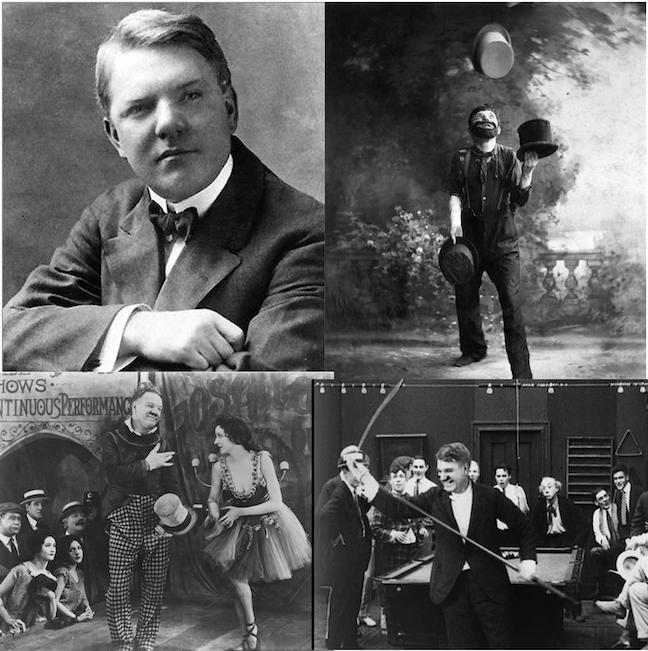
William Claude Dukenfield was a vaudeville juggler who distinguished himself from other “tramp acts” by adding sarcastic asides to his routines. Internationally known for his juggling skills, by the turn of the century the man who billed himself as “The Eccentric Juggler” would become much better known by another name: W.C. Fields.
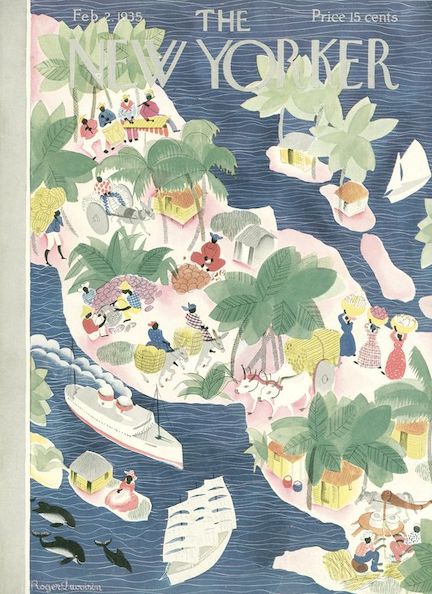
Feb. 2, 1935 cover by Roger Duvoisin.
In the first of a three-part profile, Alva Johnston pondered the secret behind Fields’ genius, an “inborn nonchalance” that he considered “the rarest of gifts.” Johnston surmised that some of that genius derived from the volatile relationship Fields had with his father, and the street-smarts he gained as a runaway at age eleven. It is no surprise, however, that these childhood stories of hardship were significantly embellished by the great wit himself.
A STAR IS FORMED…Clockwise, from top left, W.C. Fields in his youth; Fields was an internationally known juggler, seen here in his vaudeville days in the early 1900s; Fields made his screen debut in 1915, seen here in his second film, Pool Sharks (1915); Fields with Carol Dempster in Sally of the Sawdust, a 1925 silent comedy film directed by D. W. Griffith. (Pinterest/YouTube)
Johnston also described Fields’ acting style and demeanor, noting that the actor’s asides were likely inspired by his mother, Kate Spangler Felton, who was known for her doorstep witticisms.
NINETEEN THIRTY-FIVE WAS A GOOD YEAR for W.C. Fields, who starred in It’s a Gift (right), released the previous December, and in the 1935 screen adaptation of Charles Dickens’sDavid Copperfield, as the character Wilkins Micawber. (MGM/IMDB)
* * *
Macabre Diversions
In the days before television and the internet, folks got their dose of the sensational and macabre from the tabloids, or, on occasion, in real life. Before crime or accident scene investigations became more sophisticated, it was not uncommon for crowds to mob grisly death scenes, including the car containing the bullet-riddled bodies of notorious bank robbers Bonnie Parker and Clyde Barrow. Their Ford automobile, pocked with 112 bullet holes, became a popular traveling attraction at fairs, amusement parks, and, in February 1935, at a car dealer’s showroom in Missouri. E.B. White explained:
BEFORE THE INTERNET, folks got their ghoulish thrills by rubbernecking at famous crime scenes. At left, a crowd gathers around the bullet-riddled car belonging to Bonnie and Clyde. According to one account, at the scene of the police ambush on Louisiana State Highway 154, nearly everyone collected souvenirs including shell casings and bloody pieces of clothing from Bonnie and Clyde. One man even tried to collect Clyde’s left ear with a pocket knife; at right, unidentified man standing next to the “death car.” (KXAN/unt.edu)
* * *
Saar Kraut
Janet Flanner mused on the recent plebiscite in the Saarland, which following World War I was seized from Germany and placed under the governance of a League of Nations commission. Much to the dismay of the French, the majority German population voted to return the Saar region to Germany, and its Nazi leadership.
* * *
Over the Rainbow
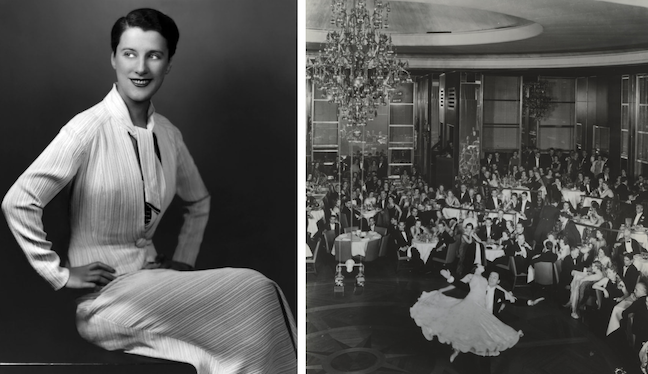
In a previous column, Lois Long took aim at the Rockefeller Center’s new Rainbow Room, dismissing it as a tourist trap filled with interminable strains of organ music. In her latest column, Long retracted some of that vitriol, finding the entertainment (and, one supposes, the food) more to her liking.
THE ‘INCORRIGIBLE’ Beatrice Lillie (left) delighted Lois Long and audiences in the Rainbow Room on the 65th floor of Rockefeller Center; at right, ballroom dancers Lydia and Joresco take to the floor in the then newly opened Rainbow Room, 1934. (Pinterest/#rainbowroomnyc)
* * *
From Our Advertisers
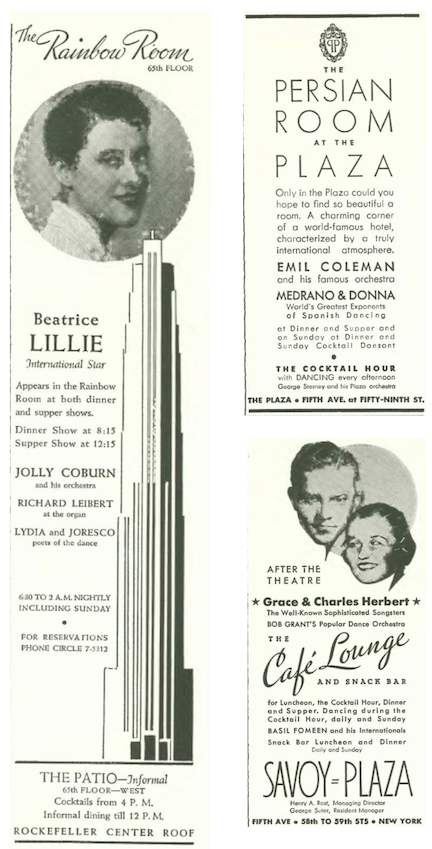
As Lois Long mentioned in “Tables for Two,” British actress and singer Beatrice Lillie was appearing at in the Rainbow Room on the 65th floor of Rockefeller Center; according to the ad below, also featured were ballroom dancers Lydia and Joresco and bandleader Jolly Corburn…
…at first I though this was Alfred Lunt and Lynn Fontanne shilling for Luckies, but the resemblance isn’t quite there, plus I’m not aware of the Broadway legends ever endorsing any product, let alone cigarettes…
…the folks at Hormel continued to feature notable Frenchmen who were known to enjoy French onion soup, although this particular image doesn’t do much for one’s appetite…
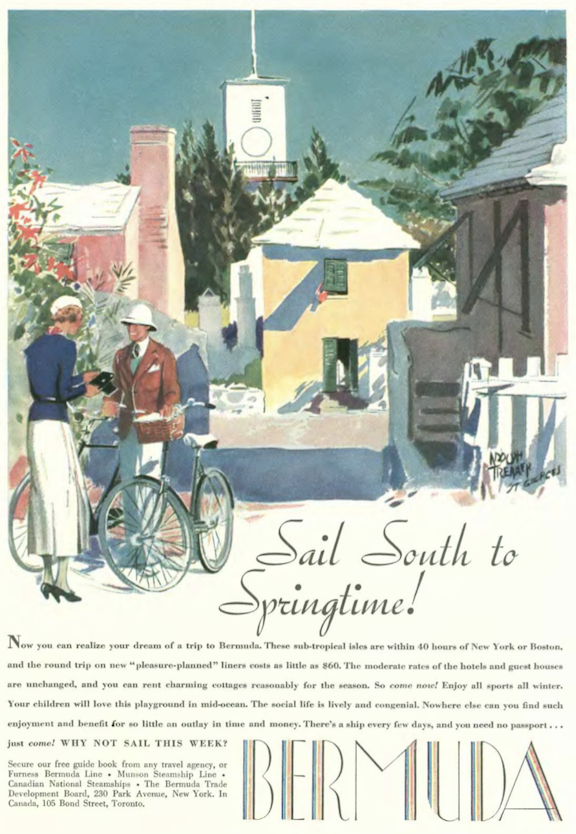
…the Bermuda Trade Development Board continued to feature colorful ads that enticed New Yorkers away from the late winter blahs…
…this ad for Schaefer is a bit odd…I guess the artist wanted to suggest a handbill, and therefore tilted the image it at an angle, unsuccessfully, one might add…
…The Theatre Guild once again called upon the talents of James Thurber to advertise their latest production…
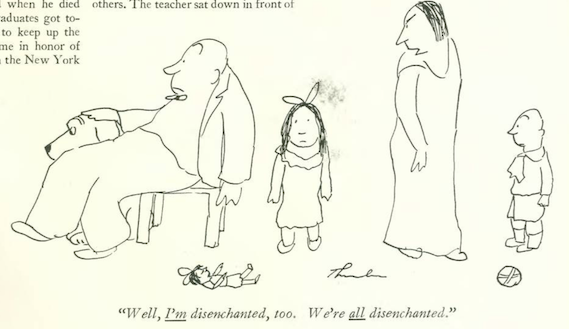
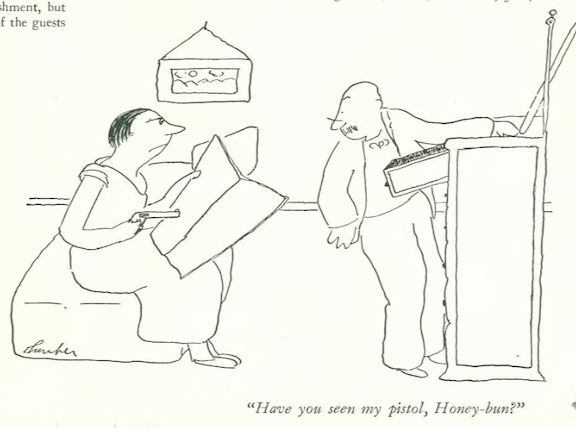
…which segues into our cartoons, with Thurber once more…
…Al Frueh did his part to promote the stage with this illustration for the theatre section…
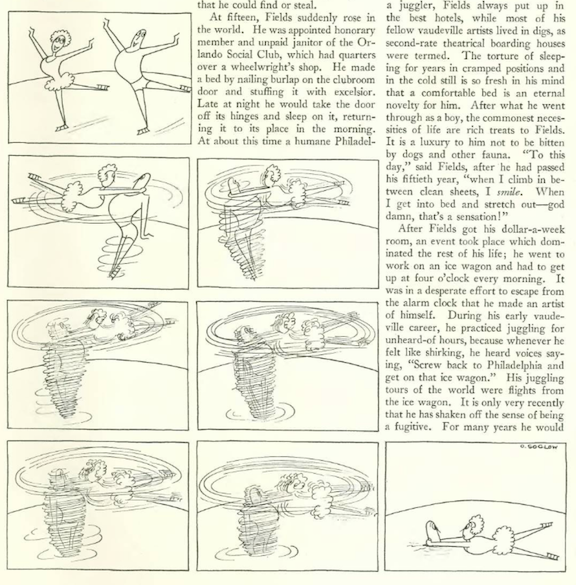
…Otto Soglow offered his spin on pairs figure skating…
…Gardner Rea explored the world of art appreciation…
…Helen Hokinson aptly supplied this cartoon for Lois Long’s fashion column…
…Whitney Darrow Jr. showed us the consequences of classified advertising…
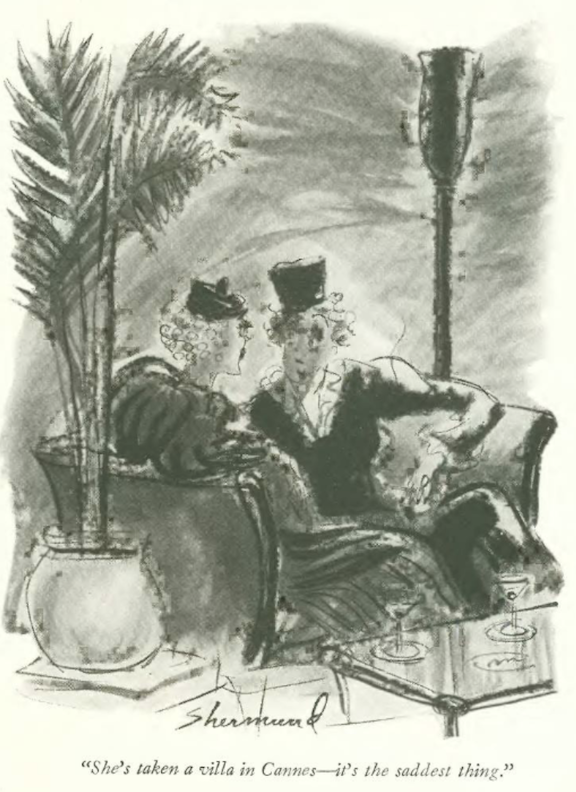
…Barbara Shermund clued us in on the latest gossip…
…and we close with Peter Arno, and one butcher’s cold greeting…
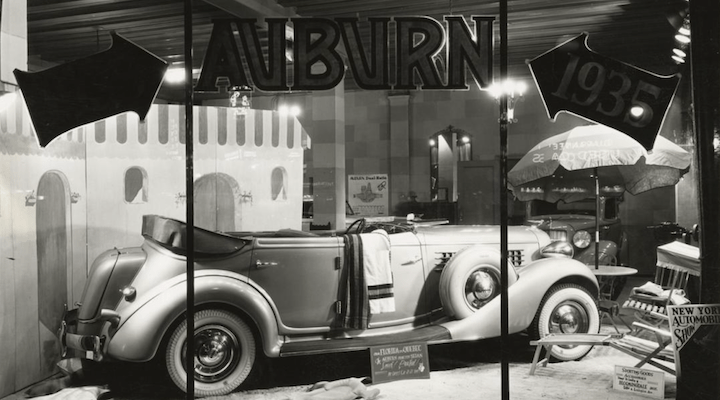
Above: Manhattan auto dealer's window display promoting the 1935 Auburn's appearance at the New York Automobile Show. (Detroit Public Library)
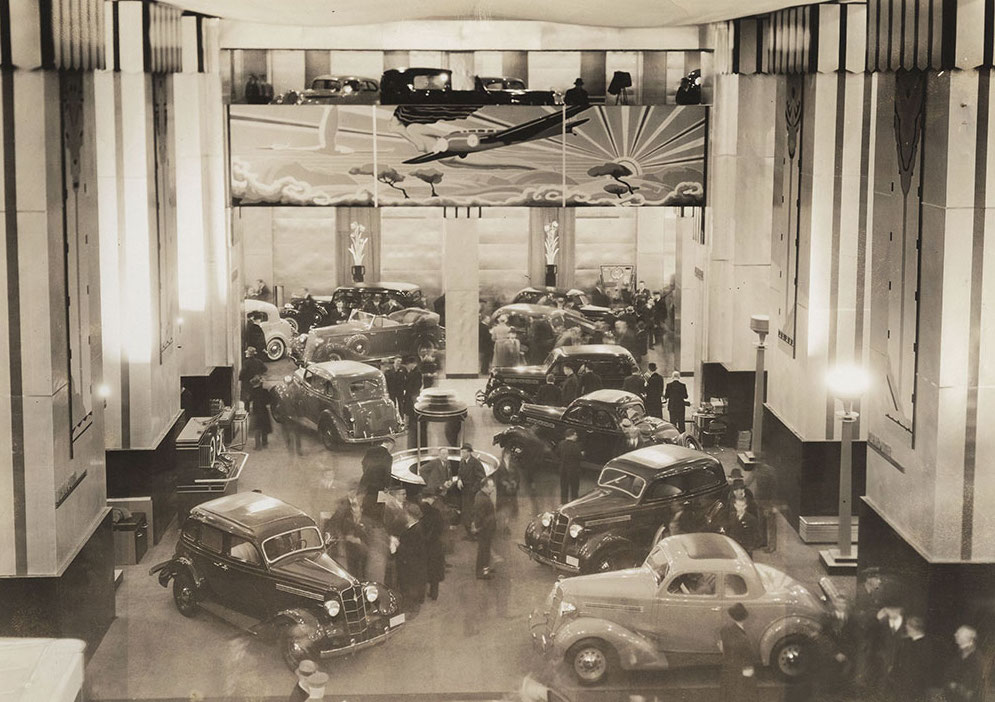
Manhattan’s first big event of 1935 was the annual automobile show at the Grand Central Palace, where New Yorkers chased away the winter blues (and the lingering Depression) in a dreamscape crammed with gleaming new cars.
January 5, 1935 cover by Rea Irvin.
The exhibition included mostly domestic models with wider bodies and, in the case of Chrysler, a dialing back of a radical, streamlined design that was too advanced for American tastes in the 1930s.
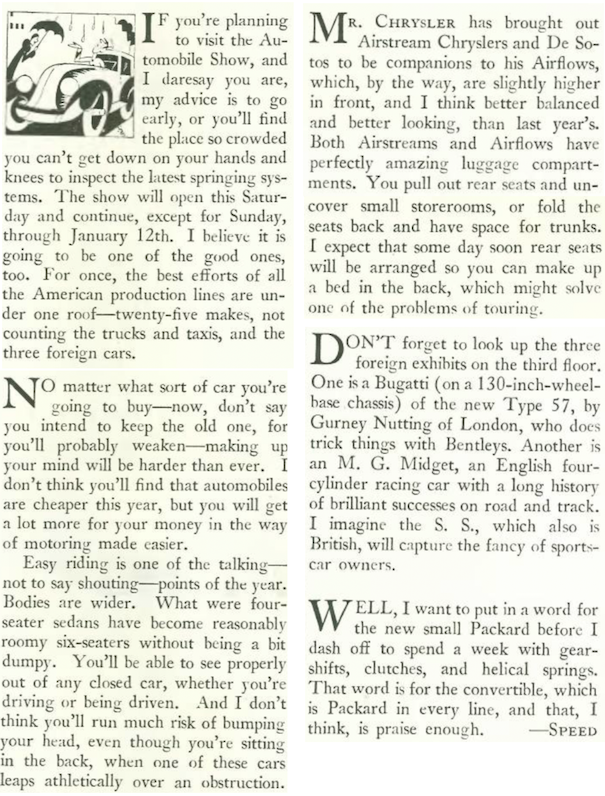
CROWD SOURCING…New Yorker correspondent “Speed” observed that the Grand Central Palace was so crowded with new cars that “you can’t get down on your hands and knees to inspect the latest springing systems.” (forums.aaca.org)SAFE ROOM…This Ford dealer postcard touted safety, durability and roominess rather than style to market a V-8 sedan to Depression-strapped car buyers. (Pinterest)BACK TO BASICS…The DeSoto display showcased more traditional designs (top) after the disappointing debut of the 1934 Airflow. Below, three foreign makes were on display, including Great Britain’s sporty MG Midget. (forums.aaca.org)
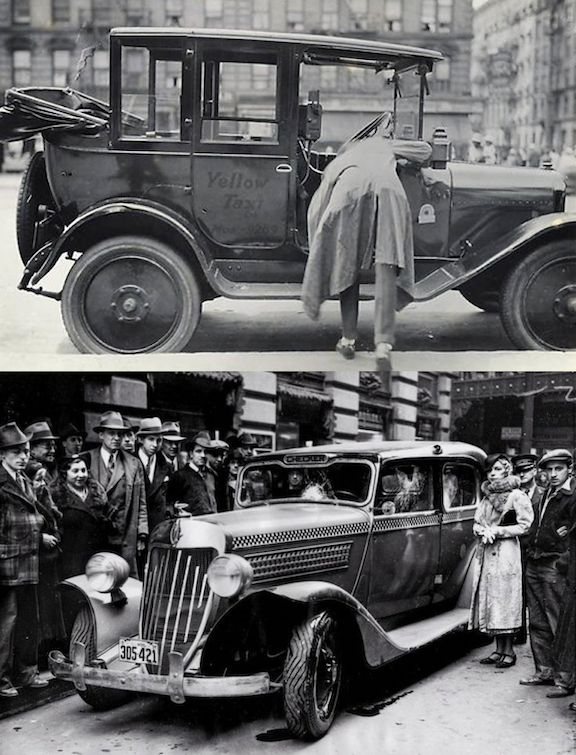
It is no surprise that E.B. White was once again disappointed with new line of cars, still preferring the boxy Model T to the lower-slung streamlined models. That distaste extended to the new taxi cabs hitting the streets of Manhattan, where White saw absolutely no need for wind resistance. An excerpt from his “Notes and Comment:”
IF IT AIN’T BROKE…E.B. White preferred to old Yellow Taxis (seen at top, circa 1932), to the new streamlined Model Y Checker Cabs that were introduced to the streets of Manhattan in 1935. (Metropolitan Museum of Art/Pinterest)
* * *
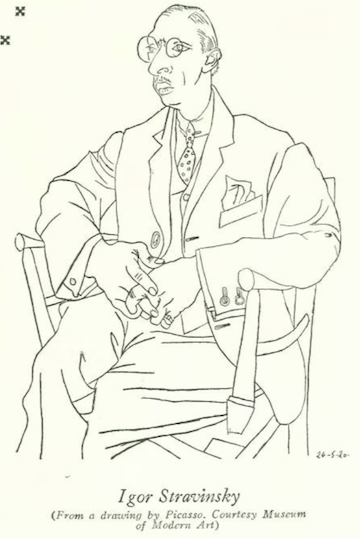
Elsewhere, The New Yorker added a new twist to its “Profile” section by featuring an illustration derived from a drawing by Pablo Picasso…
* * *
From Our Advertisers
The New Yorker’s advertising department padded its revenue from the Christmas season with a slew of ads from automobile companies touting the wonders of their latest models, which were on display at the New York Auto Show…former makers of horse-drawn carriage bodies, the Fisher brothers (Fred and Charles) began making bodies for automobiles in 1908, and the company was later incorporated as part of General Motors…as noted earlier, safety and durability (rather than style) were the calling cards of many automakers during the Depression…
…as is also evidenced here in this ad from Plymouth, part of a continuing series that touted the crash-worthiness of their sedan…
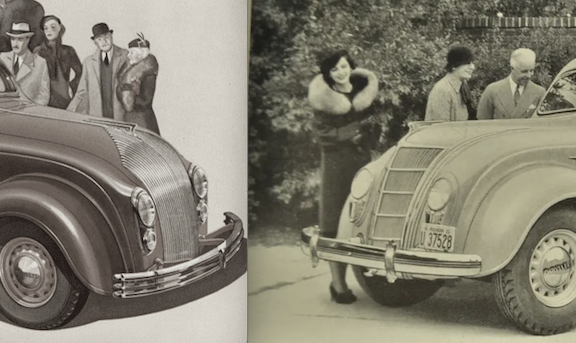
…Plymouth’s parent company Chrysler, still stinging from the lack of consumer interest in their boldly aerodynamic Airflow (introduced in 1934), made modifications to the Airflow’s body, replacing the bold “waterfall” grille with a more traditional peaked unit…the company also offered an even more traditional “Airstream” model that outsold the Airflow 4 to 1…
Consumers in 1934 found the Chrysler Airflow’s bold design (left) too advanced for the times, so Chrysler responded by making the grille on the 1935 model (right) a bit more traditional. That didn’t help sales, either.
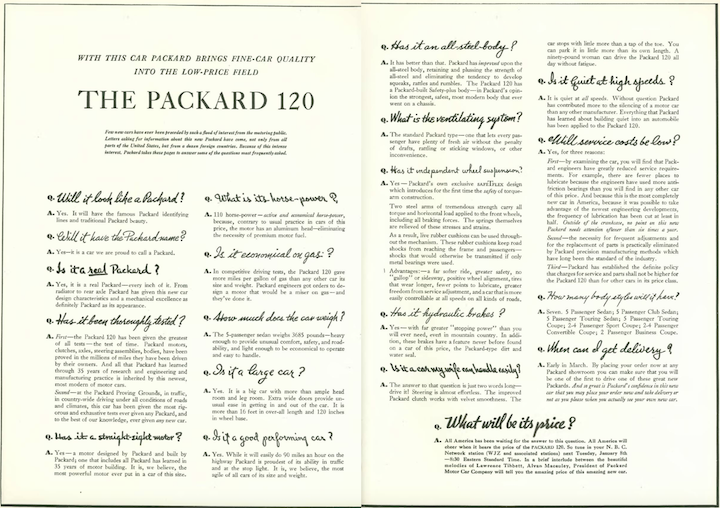
…luxury car maker Packard addressed the challenges of the Depression by introducing a low-priced car (under $1,000) named the 102…it was teased here on the first page of a three-page ad…
…that provided some answers to a “flood” of questions the folks at Packard claimed they had received from across the country and around the world…
…but the ad kept readers in suspense about the car’s actual cost, which was to be announced during Lawrence Tibbett’s NBC radio program…
…Hupmobile was still hanging in there with the innovative, Raymond Loewy-designed Model J, but behind the scenes the company, already beset with sagging sales, was fighting a hostile takeover and would stop making cars altogether by 1938…
…Auburn was also on its last legs, its cars known more for being fast, good-looking and expensive rather for being than safe and economical…although the supercharged Speedster shows here would become a legend in automotive history, and although Auburn began selling more affordable models, the Depression had already taken its toll…
…other luxury brands, such as Cadillac, could survive because they were buoyed by the scale and largesse of a huge corporation, in this case General Motors…
…the folks at Hudson marketed their “Terraplane” with this cartoon ad that quite possibly was illustrated by Wesley Morse, who in 1953 would create the Bazooka Joe comic strip for Topps…
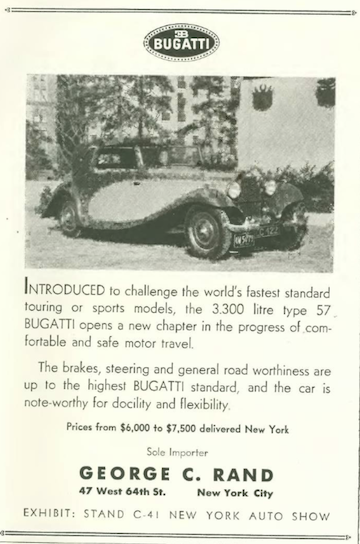
…only three foreign makes were displayed at the exhibition, including Bugatti, which promoted its type 57 in this modest ad placed by a local dealer…at prices ranging as high as $7,500 (nearly $170k today), it was a definitely not a car for the thrifty minded…
…some non-car ads included beachwear from Bonwit Teller…
…while Burdine’s offered men’s suits men that apparently could be worn comfortably while relaxing on the sand…
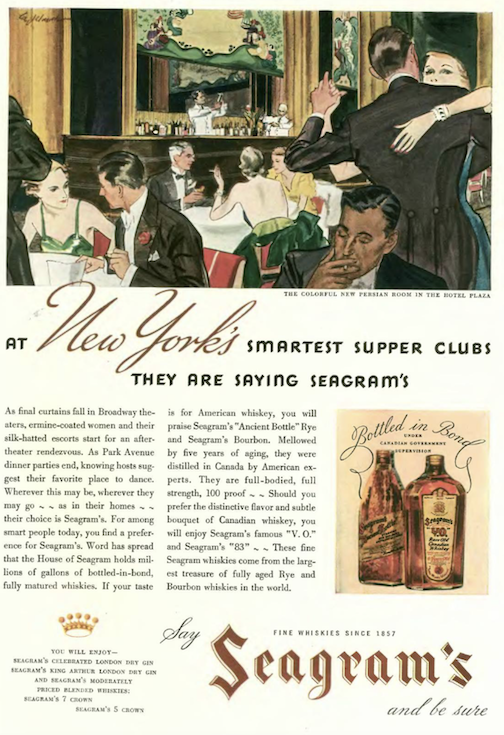
…besides the car companies, others who possessed the means to run full-page color ads included the makers of spirits…
…chewing gum…
…and, of course, cigarettes…
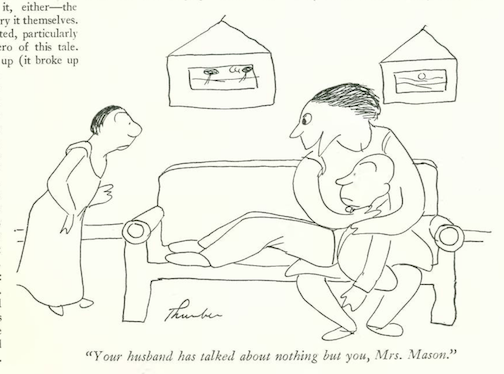
…on to our cartoons, we begin with a spot and a panel by James Thurber…
…Al Frueh, whom we haven’t seen in awhile, gave us an elaborate joke conjured up by some bored astronomers…
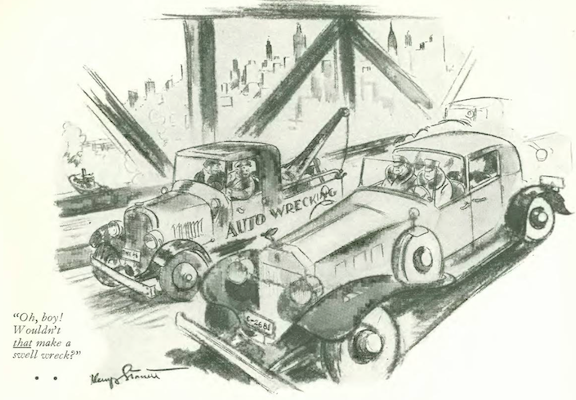
…Kemp Starrett looked in on an unlikely Packard customer…
…Perry Barlow predicted a hot time for these two young lads…
…and to close, Gardner Rea offered a cure for a New Year’s hangover…
Claudette Colbert and Henry Wilcoxon in 1934's "Cleopatra." (cecilbdemille.com)
New Yorker film critic John Mosher was in the mood for one of Cecil B. DeMille’s big, splashy epic movies, but was disappointed to find a relatively restrained effort in DeMille’s latest flick, Cleopatra.
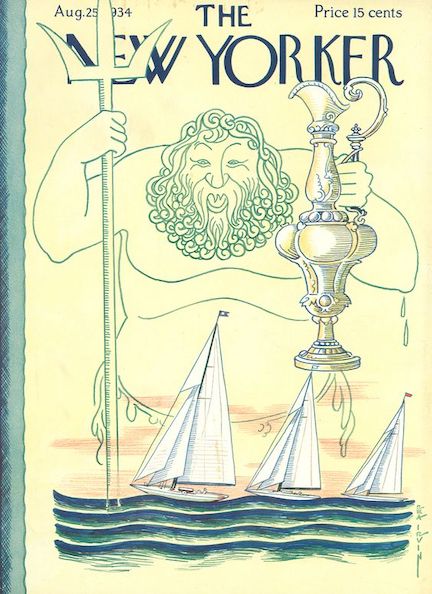
August 25, 1934 cover by Rea Irvin.
Perhaps Mosher would have preferred a silent version of the film, finding the dialogue “the worst I have ever heard in the talkies.” Among examples cited by Mosher was Warren William’s Caesar, who utters the word “Nope” to one of his senators.
CLEO BRIO…Clockwise, from top left, Paramount’s trailer for Cleopatra made a bold claim; Cleopatra (Claudette Colbert) hails Caesar after emerging from a rolled up rug that had been presented to the Roman court; Julius Caesar (Warren William) acts unimpressed, but eventually falls for the Egyptian queen before meeting his demise; Marc Antony (Henry Wilcoxon) is the next to fall for Cleopatra’s seductions. It ends badly for both of them. (pre-code.com/obscurehollywood.net)
Despite Mosher’s grumbles, Cleopatra would receive five Academy Award nominations (winning for Best Cinematography) and would become the highest-grossing film released in North America in 1934. That year Claudette Colbert (1903-1996) would appear in three films that were all nominated for the Academy Award for Best Picture—she is the only actress ever to do so.
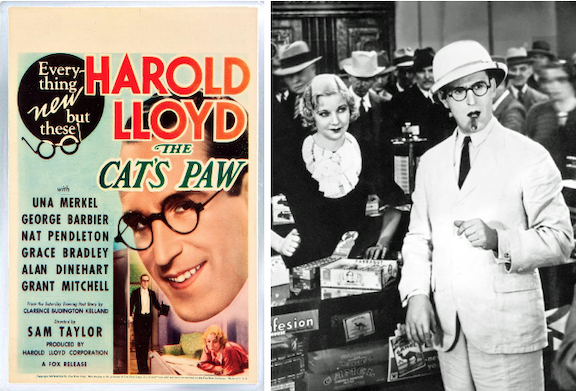
On the lighter side, Mosher took a liking to Harold Lloyd’s latest picture, The Cat’s Paw, which marked a sharp departure from Lloyd’s trademark slapstick. Lloyd adopted to a calmer pace, “touched with the delicate bloom of satire.”
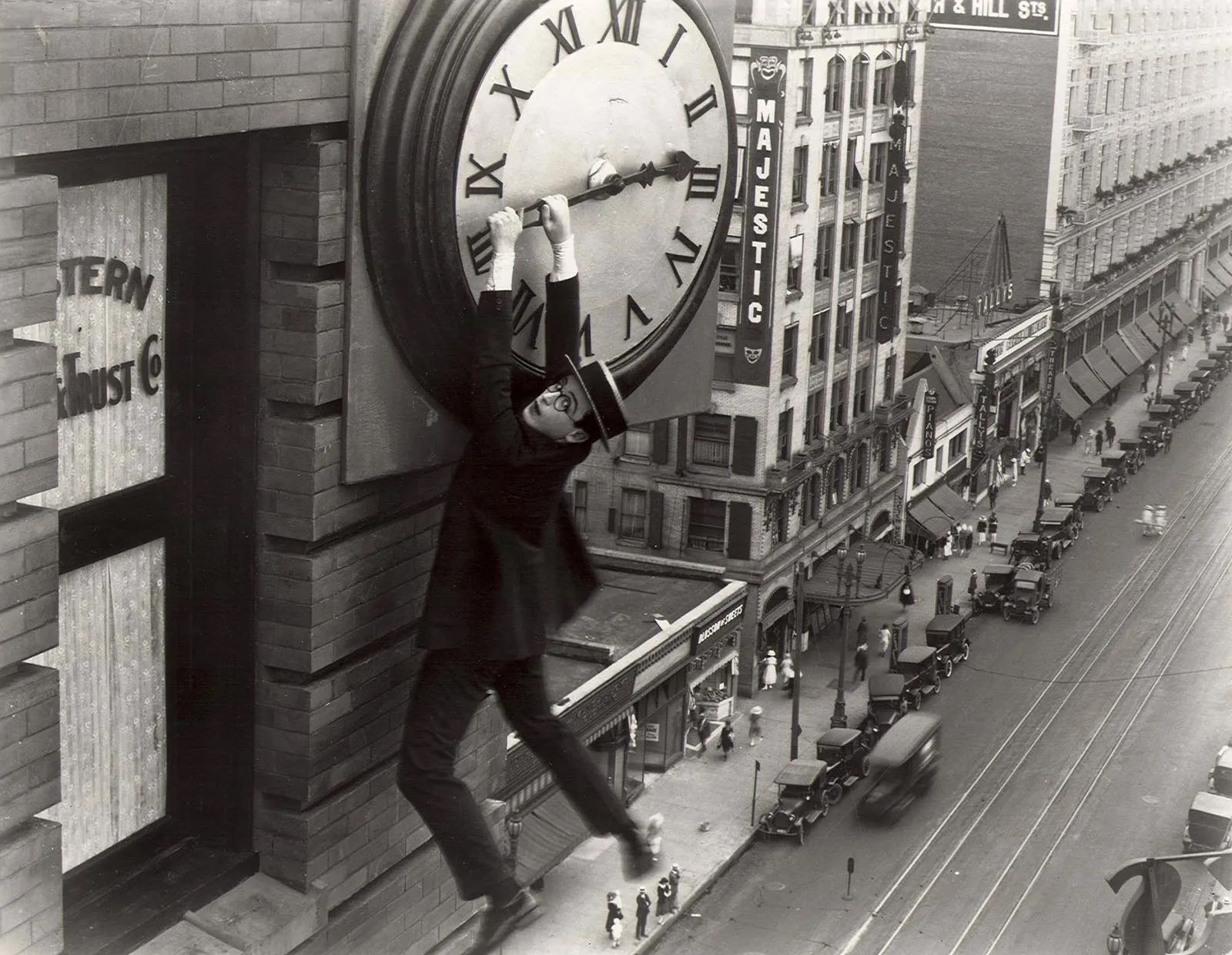
Moviegoers who associated Lloyd with such pictures as 1923’s Safety Last…
(britannica.com)
…would have to settle for this new version of Lloyd, which was even touted on the movie’s promotional poster…
STAYING ON HIS FEET…Fox Pictures touted a “new” Harold Lloyd (except for his trademark glasses) in The Cat’s Paw. At right, Lloyd with co-star Una Merkel. (IMDB/criterionchannel.com)
* * *
Fun With Philately
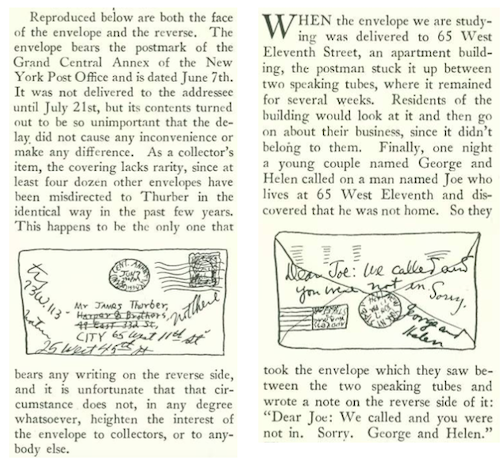
After reading a column in The Herald Tribune that concerned interesting stamps and envelopes…
…James Thurber found himself inspired to make a brief examination of the “Thurber envelope”…
…which proved to be neither interesting nor unusual (excerpts):
* * *
From Our Advertisers
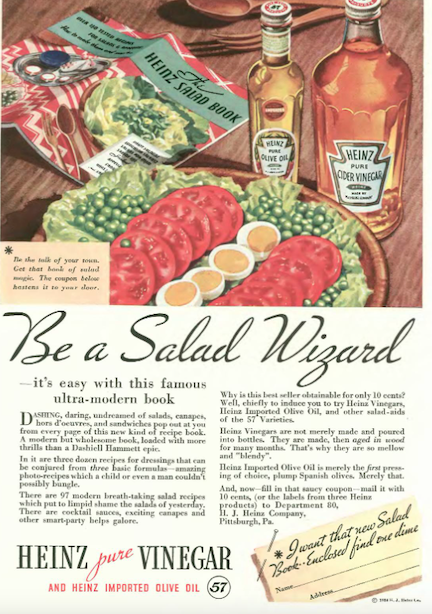
A couple of colorful advertisements, the first from the folks at Heinz, who invited New Yorker readers to become “Salad Wizards”…
…if being a salad wizard wasn’t good enough, you could pop open a bottle of Cora vermouth and feel downright aristocratic…
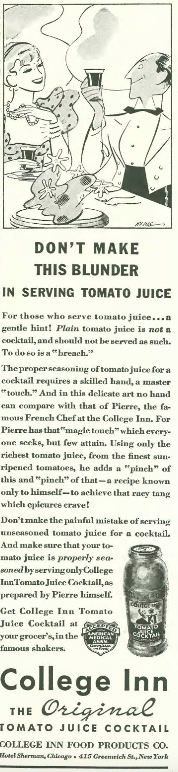
…and if you wanted to maintain that aristocratic pose, you’d better know how to serve your tomato juice, and make sure it is prepared by a “famous French Chef”…
…more libations in the back pages…here’s a sampling of three…there must have been a reason why all of the one-column ads featured mixers and spirits on the top and ads for hotels and apartments on the bottom…
…and before we jump into the cartoons, a brief look at illustrator Mildred Oppenheim, who worked under the pseudonym “Melisse.” Her work was seen in the early New Yorker mostly in ads for Lord & Taylor, however she also did work for others including the makers of Cannon towels (seen below). In 1931 The New York Times described her as “a wicked and telling satirist—almost a feminine counterpart of Peter Arno”…
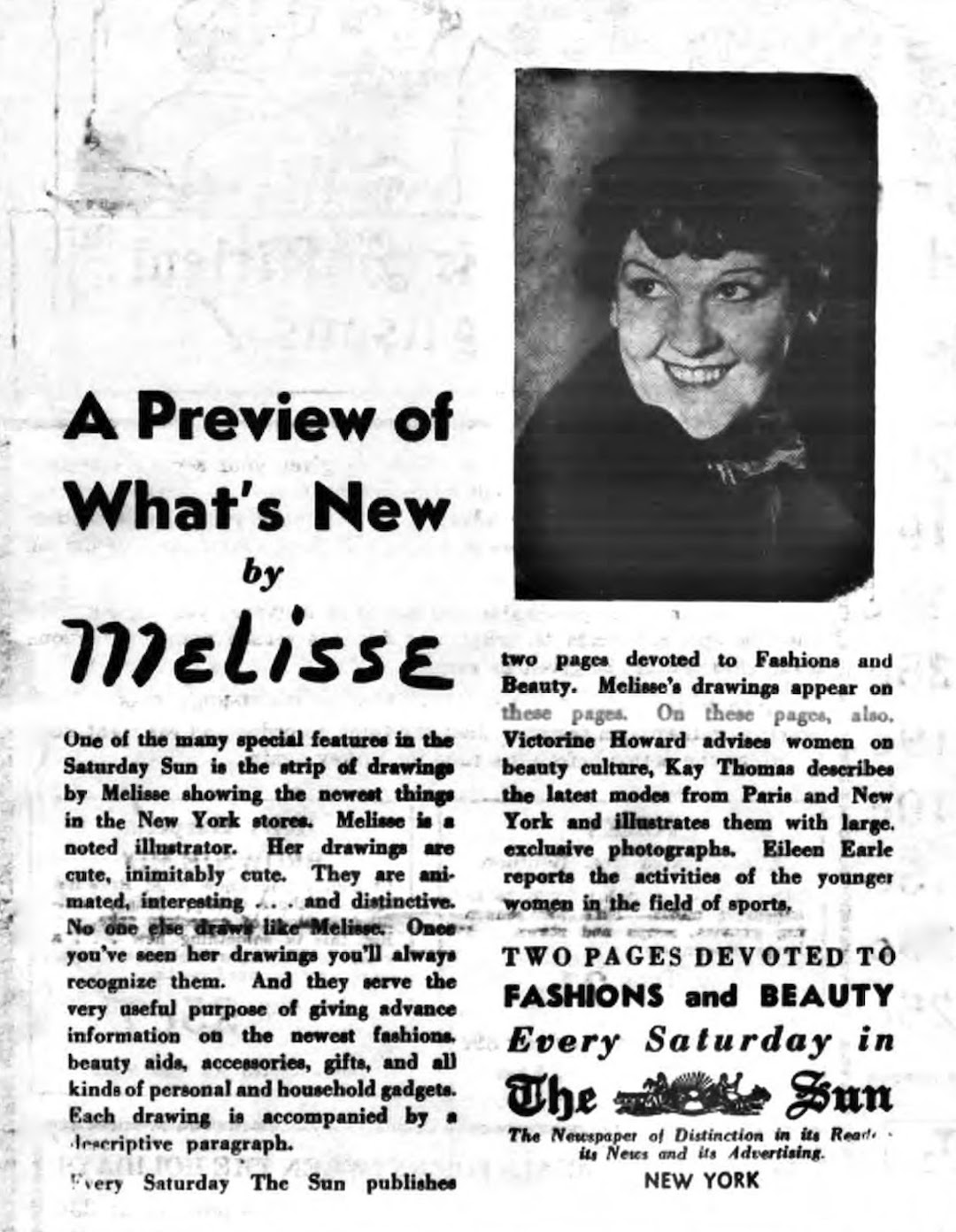
…Melisse ran a cartoon strip, “Real News of New York…A Preview of What’s New,” in the New York Sun from 1933 to 1935. Melisse seemed to be flying high, but in 1940 she declared bankruptcy. However she quickly rebounded in 1941 with an advertising panel for Orbachs—“Around Town…with Melisse”—which became a nationally syndicated feature:
(strippersguide.blogspot.com)
…in the 1940s Melisse also produced a variety of drawings and paintings, designed mannequins for window and counter displays, and even produced designs for handkerchiefs and other clothing items. But for all her fame as a commercial illustrator, very little is known about her personal life, or what became of her after 1950. According to Alan Jay of the Stripper’s Guide, Melisse was born in Newark in 1905 and died in Miami in 1993, and was briefly married to another commercial artist in the early 1930s. A December 14, 1934 ad for her “Real News” strip in the Pelham Sun featured her photo:
(strippersguide.blogspot.com)
…on to our well-known New Yorker cartoonists, we begin with the stalwart Rea Irvin…
…accompanying part two of a three-part profile of New Deal Administrator Hugh Samuel Johnson was this terrific caricature by Miguel Covarrubias…
…never too early to get ready for winter…spot drawing in the opening pages by Alan Dunn…
…but there was enough summer left for William Steig’s “Small Fry” to enjoy some leisurely pursuits…
…William Crawford Galbraith continued to ply his familiar waters…
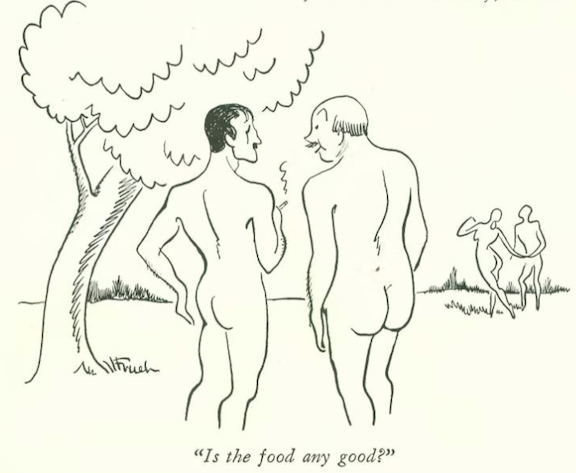
…while Al Frueh turned in this gem…
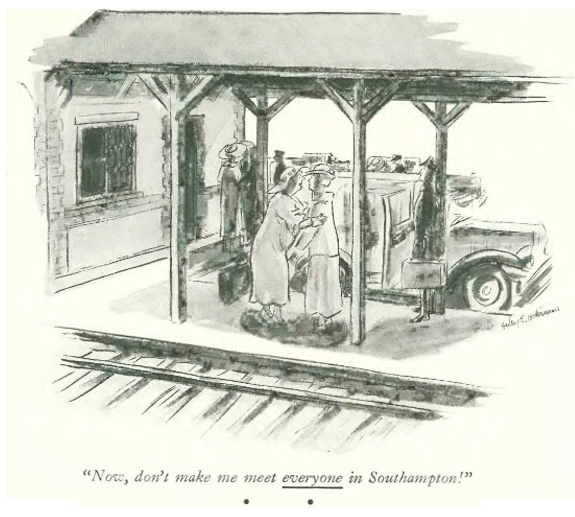
…Helen Hokinson found some lively anticipation at the train station…
…Garrett Price took us to the seashore…
…while Barbara Shermund kept us abreast of current events…
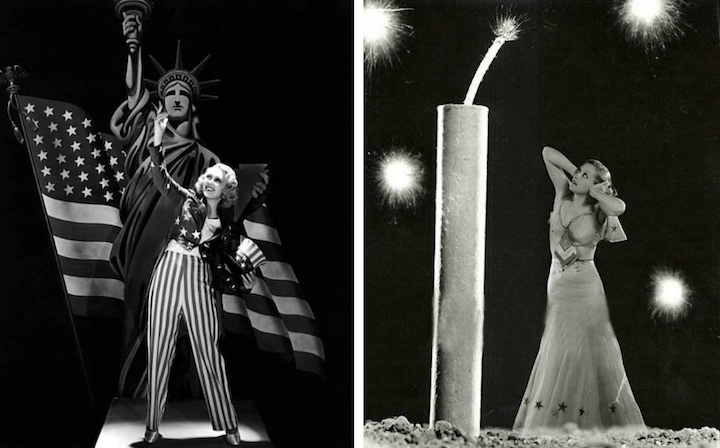
Above: For this Hollywood-heavy post we feature stars of the 1930s—the two Joans, Joan Blondell (left) and Joan Crawford, marking the Fourth of July holiday.
The New Yorker marked the Fourth of July with this William Steig cover featuring a patriotic “strap” along the binding and one of his precocious “Small Fry”…
June 30, 1934 cover by William Steig.
We’ve been looking at ways New Yorkers kept their cool in the hot summer of 1934, and one way to beat the heat was to escape into the air-conditioned darkness of a movie theater. It was not uncommon for folks to remain seated after the credits rolled and watch the feature all over again, just enjoy some cold comfort.
Film critic John Mosher no doubt enjoyed this particular perk, and perhaps this made him a bit more agreeable to whatever was playing on the big screen, including three rather dull pictures featuring actresses Marion Davies, Kay Francis and Elissa Landi.
Marion Davies (1897–1961) was the veteran of the group, beginning her film career in 1917 and appearing in thirty silent films before breaking into sound movies. Sadly, her talents as an actress and comedian were overshadowed by her reputation as William Randolph Hearst’s mistress. Known for her aristocratic bearing, Austrian-American actress Elissa Landi (1904–1948) appeared in several British silents and on Broadway before signing with Fox Films in 1931. Kay Francis (1905–1968) began her film career with the advent of sound movies in 1929. A major box-office draw for Warner Brothers, by 1935 Francis was one of Hollywood’s highest-paid actors (she was also a former roommate and longtime friend of The New Yorker’s Lois Long).
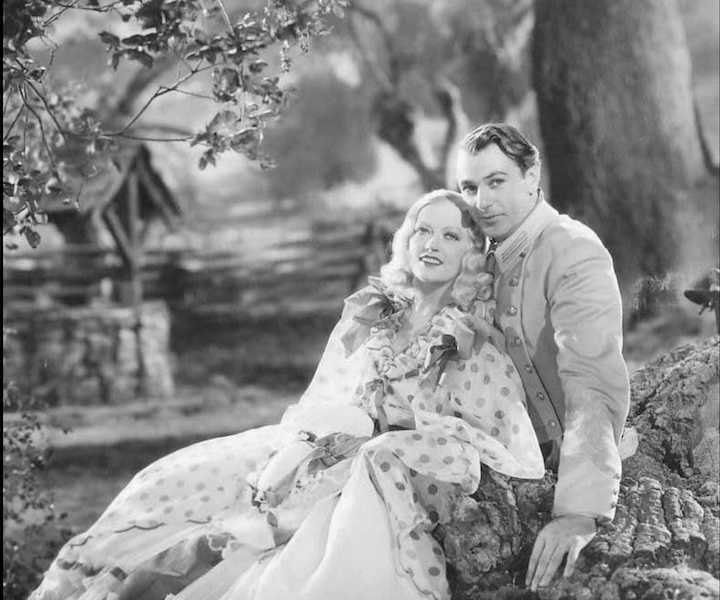
BEFORE SCARLETT AND RHETT…Gary Cooper and Marion Davies as star-crossed lovers in the 1934 Civil War drama Operator 13. Davies portrayed actress Gail Loveless, recruited by the Union to infiltrate a Confederate camp, where she falls for Capt. Jack Gailliard, a Confederate officer played by Cooper. (IMDB)
Perhaps one of the more notorious examples of a white actor in blackface, Operator 13 featured Davies as a Union spy who poses as a Black maid to infiltrate a Confederate camp…
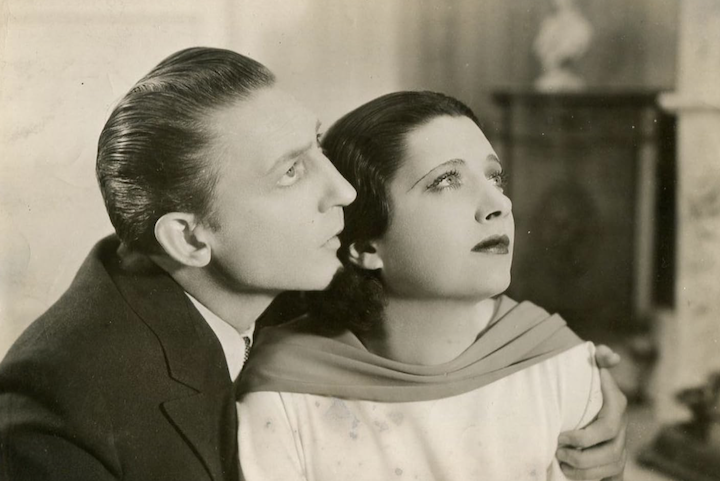
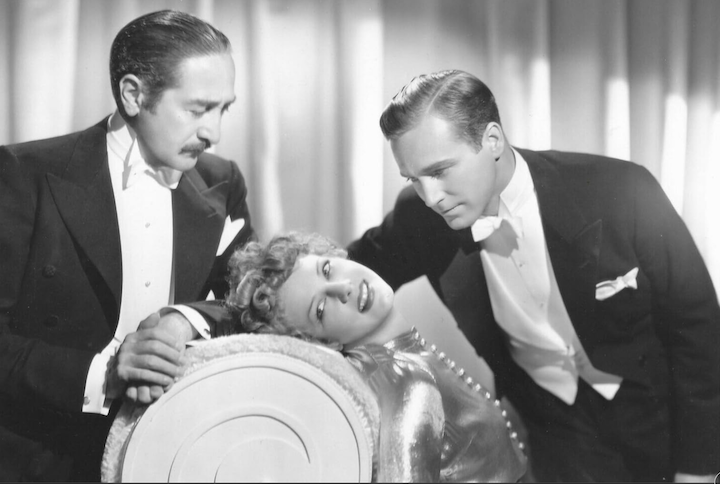
FOOLING NO ONE…Marion Davies, in blackface, with Sam McDaniel in Operator 13. (IMDB)PLAYING DOCTOR…Kay Francis and Warren William in the 1934 Pre-Code drama Dr. Monica. (IMDB)JUST KEEP PRETENDING UNTIL THE CREDITS…From left, Adolphe Menjou, Elissa Landi, and David Manners in the 1934 romantic comedy The Great Flirtation. (IMDB)
* * *
Sentimental Journey
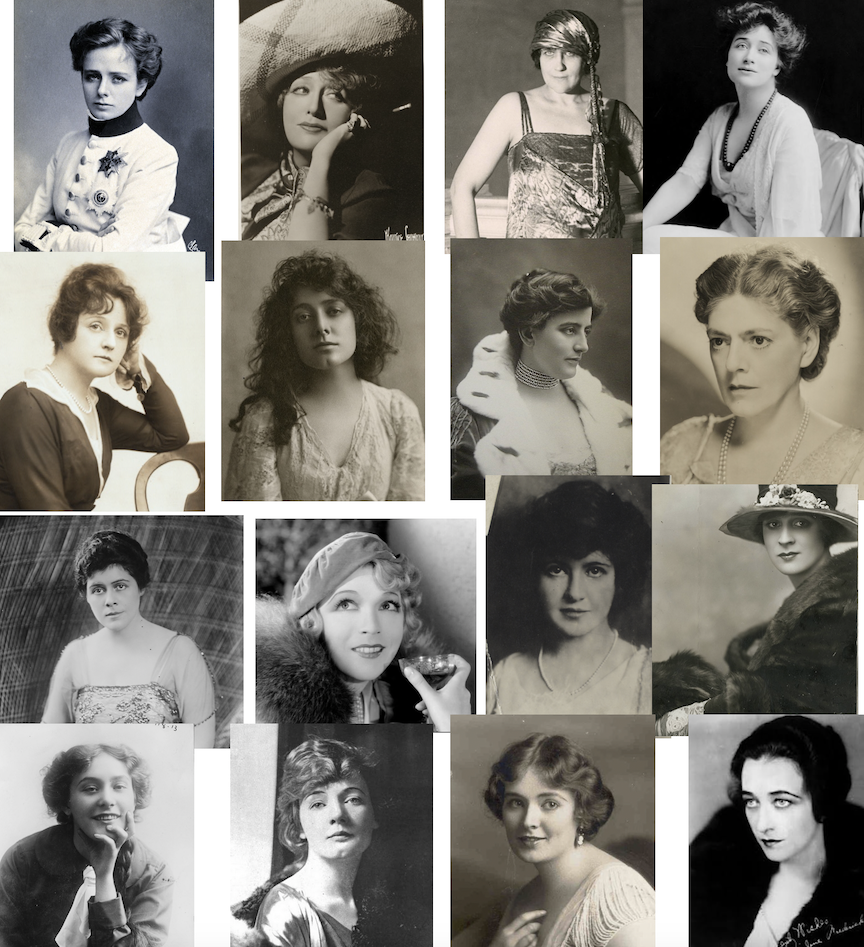
Another critic enjoying the cool of the theater was Robert Benchley, who used this break in the Broadway season to reveal his passions regarding a number of stage actresses. An excerpt:
BENCHLEY’S BROADWAY…Robert Benchley’s all-time favorite Broadway actresses included, from top row, left to right, Maud Adams, Florence Reed, Gladys Hanson, and Charlotte Walker; second row, from left, Laura Hope Crews, Julia Marlowe, Maxine Elliott, and Ethel Barrymore; third row, Janet Beecher, Ina Claire, Marguerite Clark, and Jane Cowl; fourth row, Elsie Ferguson, Martha Hedman, Marjorie Rambeau, and Pauline Frederick. (NYPL/Wikipedia/IMDB)
* * *
A Poke at Palooka
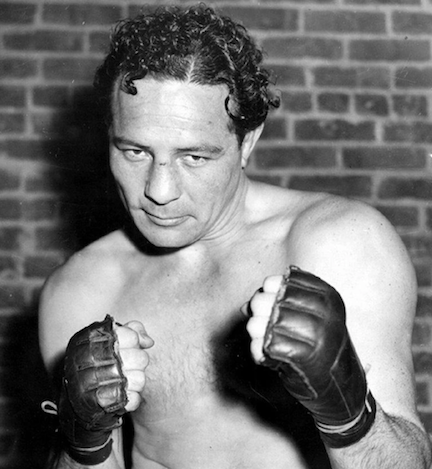
In his column “Of All Things,” Howard Brubaker took a shot below the belt at the new heavyweight boxing champ, Max Baer.
WHO SEZ I CAN’T READ?…Max Baer in the 1930s. (boxing.fandom.com/wiki)
* * *
From Our Advertisers
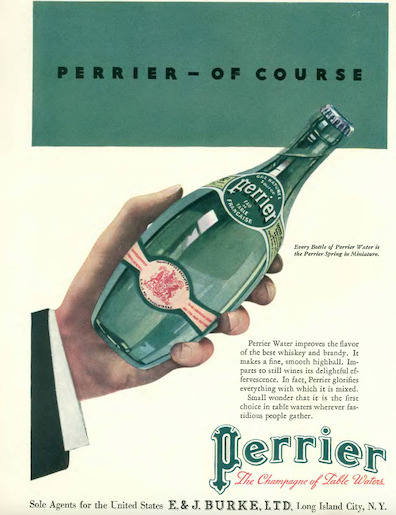
It was hot outside, folks were cooling off with their favorite beverages, and advertisers responded in kind…we begin with a familiar green bottle, and with apologies to Max Baer, you didn’t need to know how to read to know this was a bottle of Perrier…
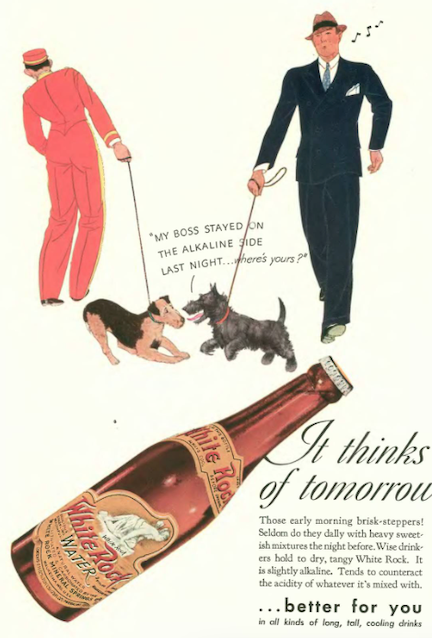
…if your taste was more on the domestic side, there was White Rock…
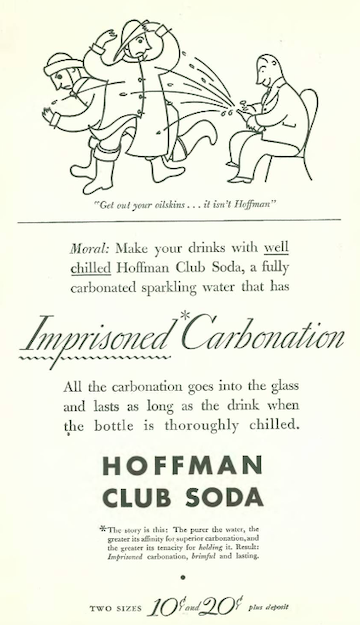
…a series of Hoffman Club Soda ads sought to convince consumers about their superior carbonation…
…or how about a brandy, perhaps lightly chilled, especially if it’s late in the evening, and you happen to be sitting on a breezy hotel rooftop…
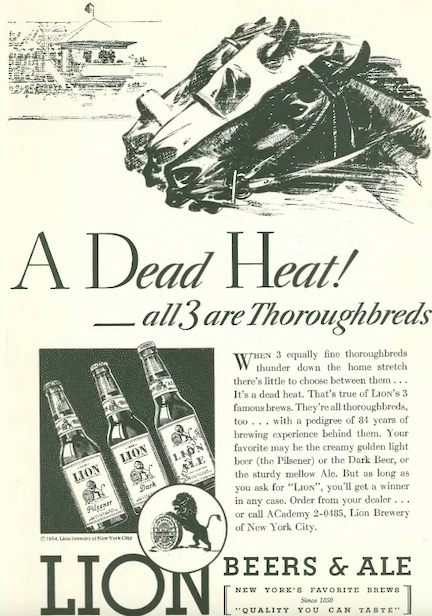
…or you could cool down with a Lion beer…considered a heritage brewery, Lion Brewery is one of only ten pre-Prohibition breweries that has independently and continuously operated since the repeal of Prohibition…
…a fairly new brand of cigarettes, Marlboro, was still taking out these bargain-sized ads to build brand recognition…Flit insecticide, on the other hand, was well-known thanks to these ubiquitous Dr. Seuss ads…
…the folks at General Tire & Rubber were the latest advertiser to tie their product to the glamour of aviation…
…and on to our cartoons, we begin with another installment of native birds via Rea Irvin…
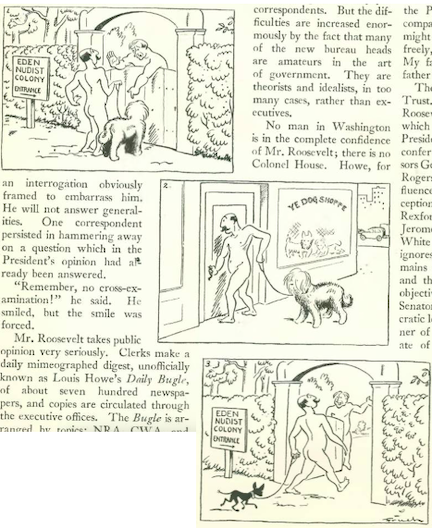
…Al Frueh chimed in with this three-panel encounter at a nudist colony…
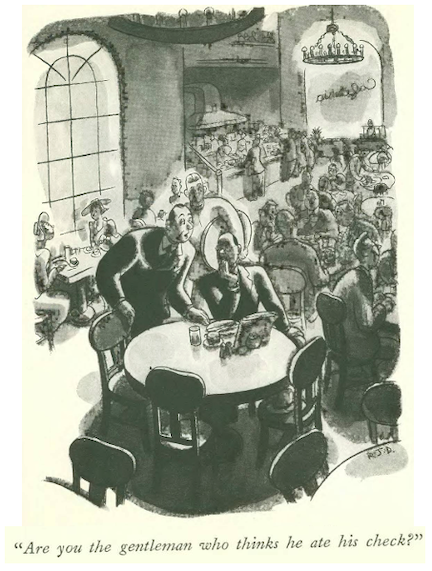
…Robert Day presented a case of indigestion…
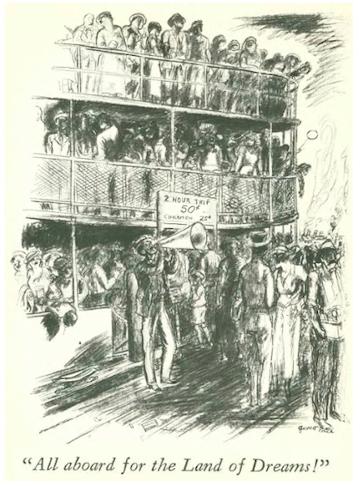
…Garrett Price welcomed us aboard a dream cruise…
…George Price gave us this gem in the “Goings On About Town” section,,,
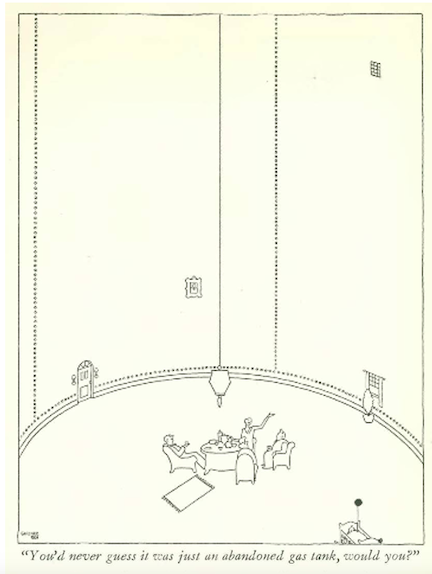
…Gardner Rea gave us his spare line to illustrate an enormous space…one of his specialties…
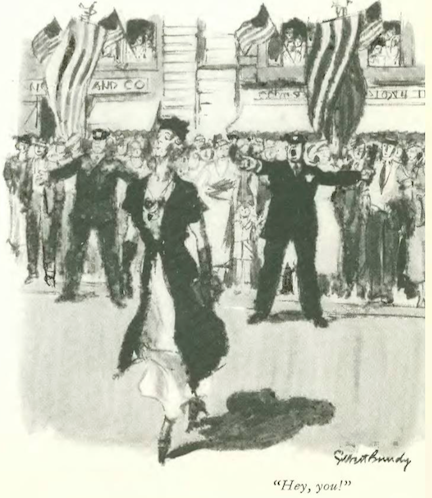
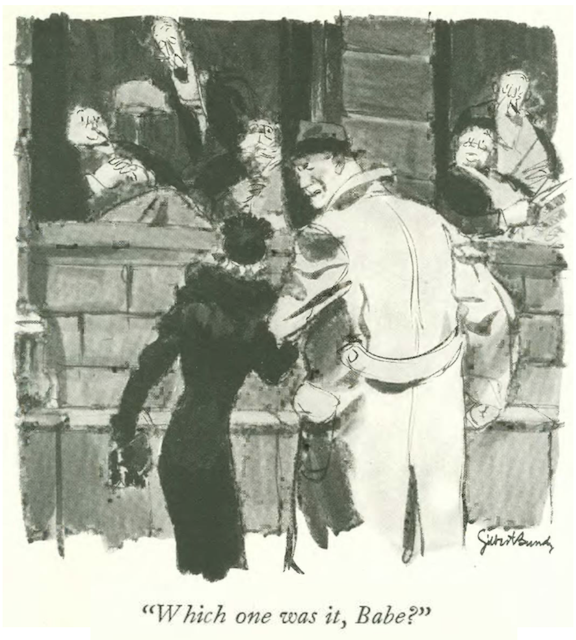
…Gilbert Bundy marked the Fourth with an entitled jaywalker…
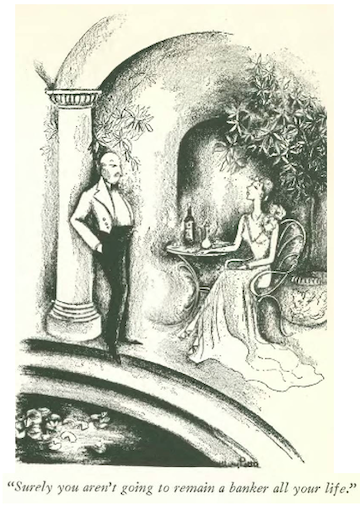
…and we close with Mary Petty, and a banker’s contentment…
Above, at left, self-aligning ball bearing from SKF Industries, featured in MoMA's 1934 Exhibition of Machine Art; at right, judges for the exhibit were aviator Amelia Earhart and professors John Dewey and Charles R. Richards, holding first, second and third prizes, respectively. (MoMA)
The notion that machine-made objects have aesthetic value has been with us for some time, dating back to avant-garde movements of the early 20th century such as Futurism, which influenced other schools, including the Bauhaus and De Stijl. However, the idea that a museum would display a propeller or a vacuum cleaner as a work of art was startling to many in 1934.
March 17, 1934 cover by Rea Irvin.
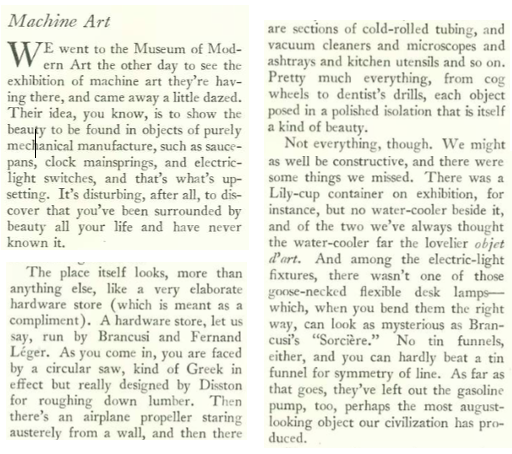
It had been a little over twenty years since New York art patrons experienced their first shock of the new at the 1913 Armory Show. By 1929 the city had established the Museum of Modern Art, which opened the exhibition Machine Art on March 5, 1934, at MoMA’s second location—the old Barbour mansion at 11 West 53rd Street (razed in the late 1930s and replaced by today’s museum).
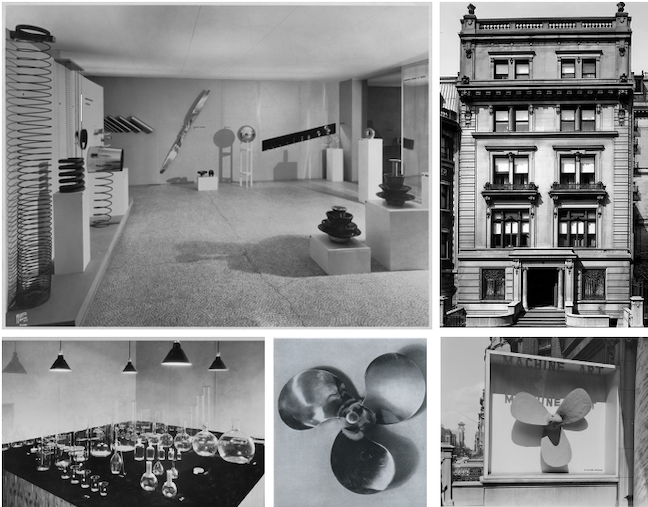
Novelist and art critic Robert M. Coates (1897–1973) paid a visit to the Machine Art exhibition and wrote of the experience in “The Talk of the Town.” Coates was no stranger to the avant garde, having himself embraced literary innovation and experimentation as a novelist. James Thurber is credited with bringing Coates to TheNew Yorker in 1927—the two became close friends—and Coates would stay forty years with the magazine. Excerpts:
EXTRAORDINARY ORDINARY…Clockwise, from top left: According to MoMA director Alfred H. Barr, Jr, the 1934 Machine Art exhibition celebrated the machine’s abstract and geometric beauty; MoMA found its second home—the Barbour mansion at 11 West 53rd Street—in 1932; sign on West 53rd advertising the exhibition; outboard propeller by Aluminum Company of America (Alcoa); collection of scientific beakers and flasks from Corning Glass Works. (MoMA)KA-CHING!…Machine Art featured Model 1934 from National Cash Register; at right, Electrochef range, model B-2, designed by Emil Piron for Electromaster Inc. Objects featured in the exhibition were selected by noted architect Phillip Johnson, who was the founding chairman (1932-34) of the museum’s Department of Architecture. (MoMA)IN A NEW LIGHT…Springs and wires took on new perspectives at the Machine Art exhibition. From left, the apparent first-prize winner (based on the photo of Earhart at the top of this entry)—a section of a large spring; cross-section of wire rope; and typewriter carriage and motor springs, all produced by American Steel & Wire Company, a subsidiary of US Steel. (MoMA)
* * *
Salad Days
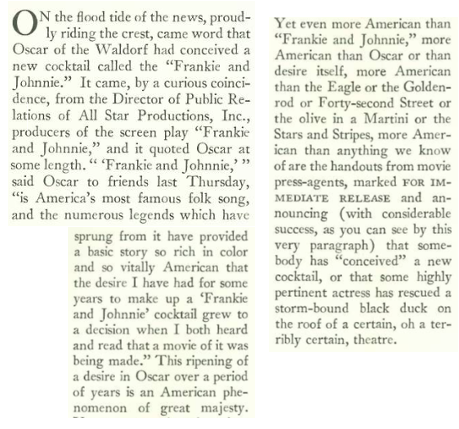
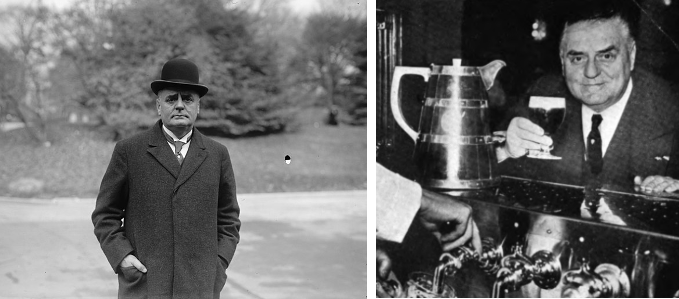
Swiss-American restaurateur Oscar Tschirky (1866-1943), who was known throughout the world as Oscar of the Waldorf, worked as maître d’hôtel of the Waldorf Astoria in New York City from 1893 to 1943. He is credited with having created the Waldorf salad, along with any number of cocktail recipes. “The Talk of the Town” noted his latest concoction:
WINNING OSCAR…From 1893 to 1943 Oscar Tschirky was the Waldorf-Astoria’s public face and a gracious host who made both the great and the not-so-great feel welcome. At left, in 1923; at right, Tschirky samples the first shipment of beer to arrive at the Waldorf-Astoria when the brew became legal again in April 1933. (Library of Congress/Karl Schriftgiesser)
* * *
Unburdened
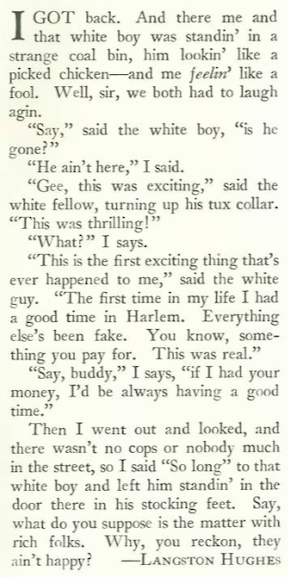
In the March 17 issue, writer and poet Langston Hughes (1901–1967) published the first of three fiction pieces that would appear in The New Yorker (one posthumously in 2016). In the short story “Why, You Reckon,” Hughes tells the tale of two hungry Black men who rob a rich white man by pushing him into a basement coal bin—one of the Black men takes the white man’s money, jewelry, shoes and overcoat, then rushes off, leaving his companion without any of the loot. To the companion’s surprise and befuddlement, the white man is left excited by the incident, because it is the first real thing that has happened to him. Here are the final lines of the story:
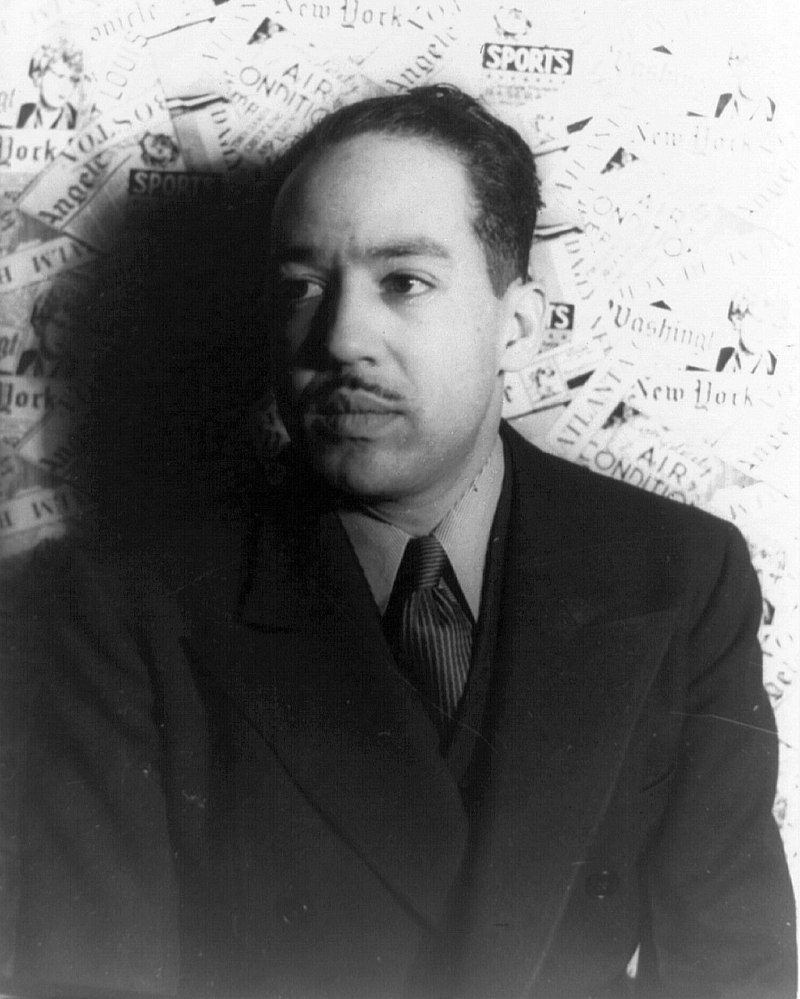
HARLEM RENAISSANCE LEADER Langston Hughes in a 1936 photo by Carl Van Vechten. A prolific writer and poet, Hughes published three short stories and three poems in The New Yorker. (Wikipedia)
* * *
From Our Advertisers
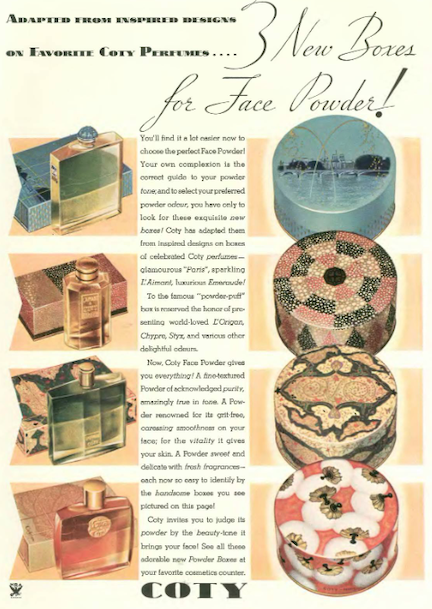
New Yorker ad sales were booming, and blooming with color…we kick it off with this ad from Coty touting “3 New Boxes for Face Powder!”…so why are there four boxes in the ad?…
…the obvious answer to the question posed below would be “wealth and privilege…and youth”…the “Eleanor Roosevelt” featured in this Pond’s ad is obviously not the wife of FDR, but rather Eleanor Katherine Roosevelt, the teenaged daughter of Assistant Secretary of the Navy Henry Latrobe Roosevelt…
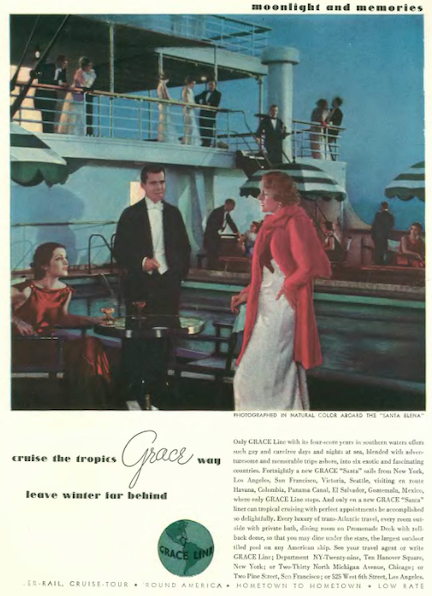
…speaking of the high seas, I have to admit I sigh a little when I see ads like this, obviously staged, but suggest a style of travel that is as extinct as the T. Rex…
…perhaps those folks on the boat were enjoying a splash of Perrier in their evening cocktails…
…or maybe the domestic White Rock was on ice…why is the rich old coot so much shorter than his wife?…I guess it emphasizes her relative youthfulness and her maternal obligations to a child-like older man…
…their proportions are similar to Jiggs and Maggie, but that’s another story…
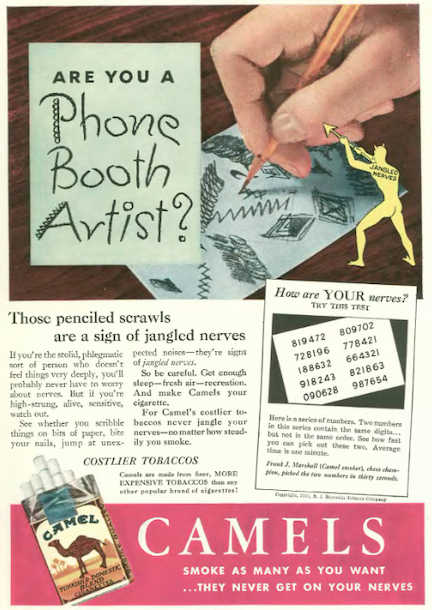
…R.J. Reynolds was back with their “jangled nerves” theme on behalf of Camel cigarettes…
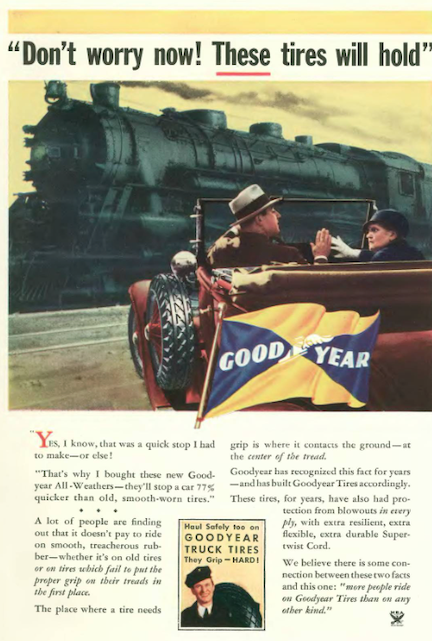
…maybe your tires will hold, but have you checked your brakes lately?…
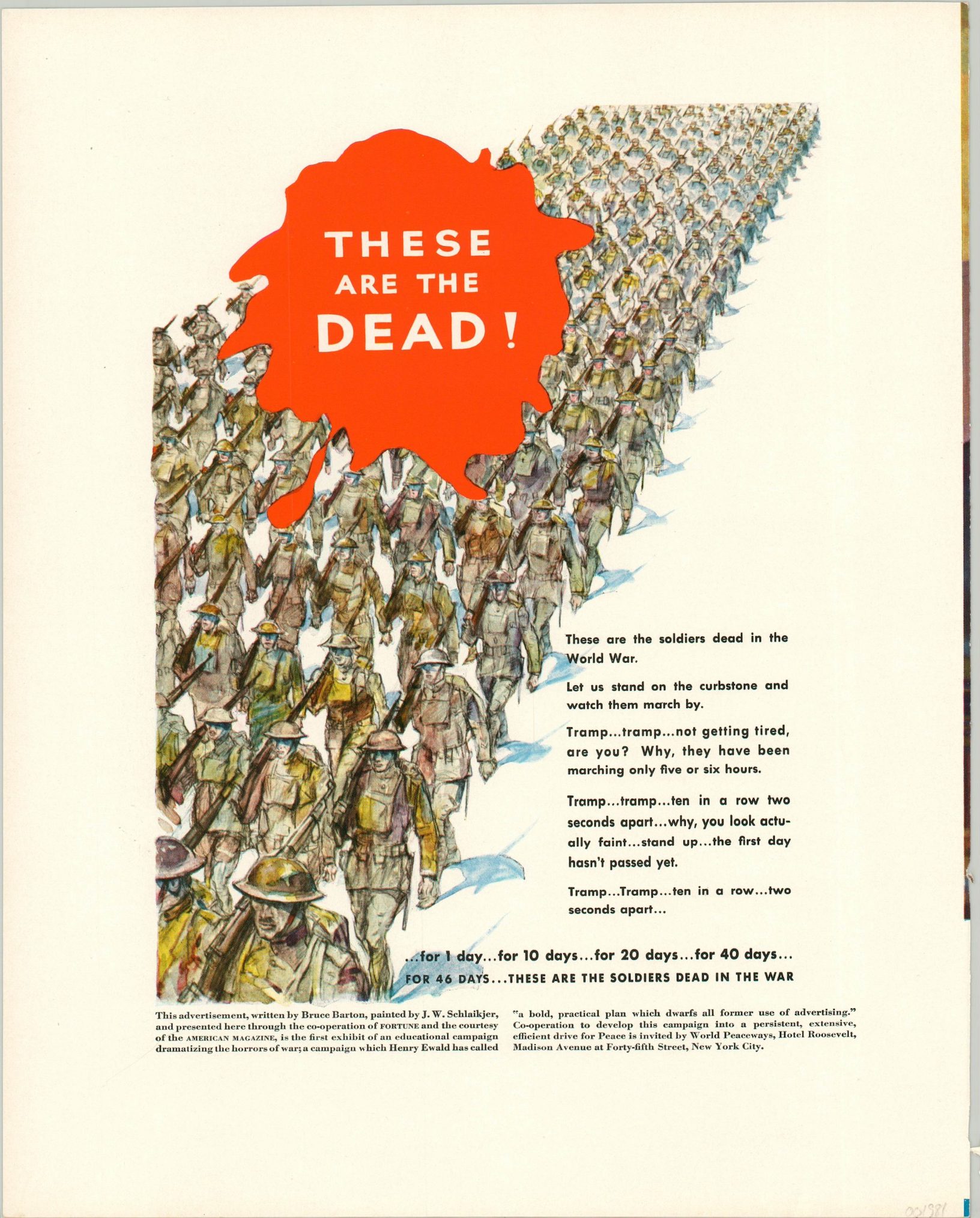
…in the 1930s the anti-war organization World Peaceways ran a series of provoking ads on the artificial glories of war…some magazines, including The New Yorker, ran these ads free of charge or at reduced rates…
…a closer view of the explanatory copy at the bottom of the ad…
…speaking of war, James Thurber opens our cartoons on a Connecticut battlefield…
…Al Frueh contributed this illustration for a two-part profile of entertainer and theatrical producer George M. Cohan…
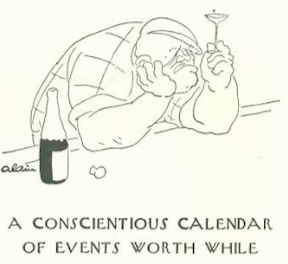
…Alain (Daniel Brustlein) offered this spot art for the opening calendar section…
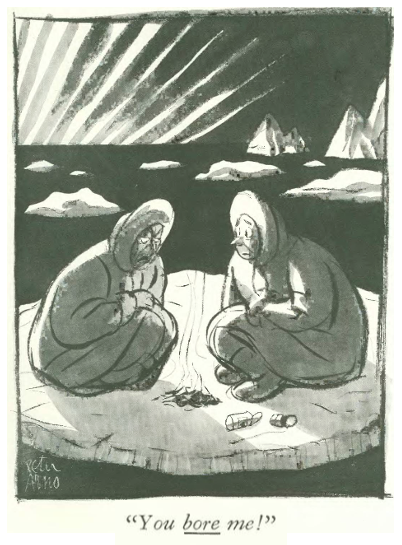
…Peter Arno gave us two fellows on thin ice…
…cartoonist Gregory d’Alessio made his first appearance in The New Yorker…
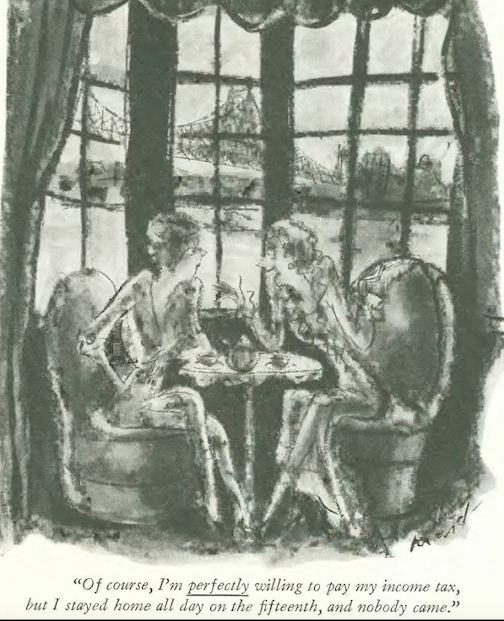
…Barbara Shermund was back with some tax advice…
…which this gentleman (by Alain) might have found useful…
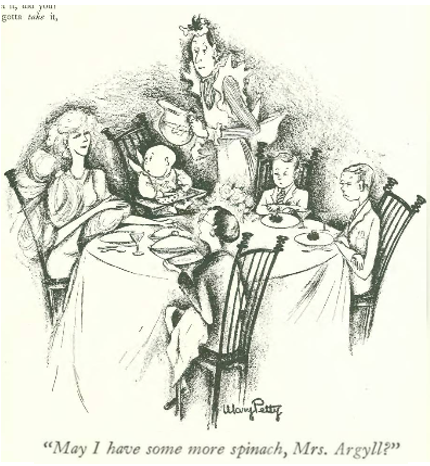
…and we close with Mary Petty, and a little brown-noser with a taste for greens…
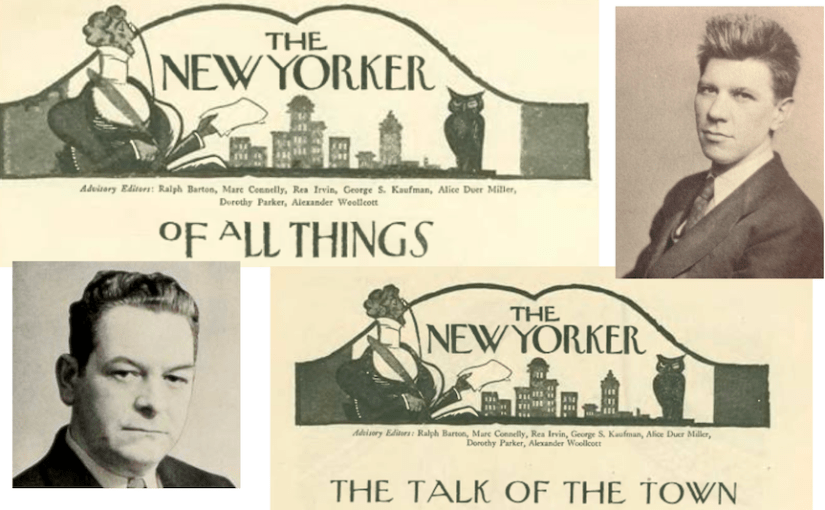
Above: It took a few issues for the editors to sort out regular features and their order of appearance. The opening section of Issue No. 1 featured the famous Rea Irvin masthead that would introduce “The Talk of Town” for many issues to come. In Issue No. 1, however, “Of All Things” appeared first under the masthead, followed by “The Talk of the Town." Let us hope the magazine restores the original Rea Irvin masthead for its 100th anniversary.
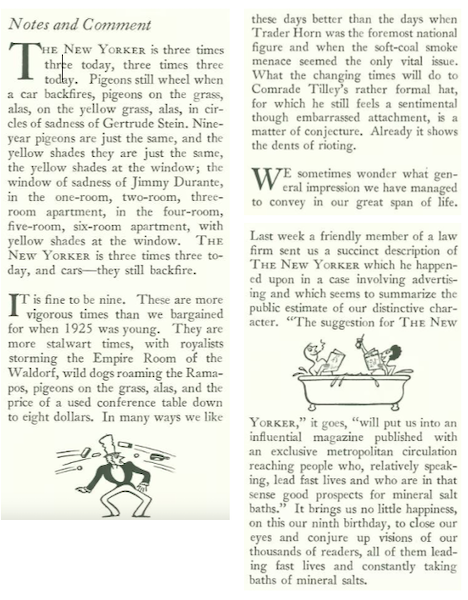
Despite the lingering Depression The New Yorker entered its ninth year on strong financial footing. With nearly equal numbers of subscribers and single copy sales, circulation would approach 125,000 in 1934, with more than $2.2 million in advertising income.
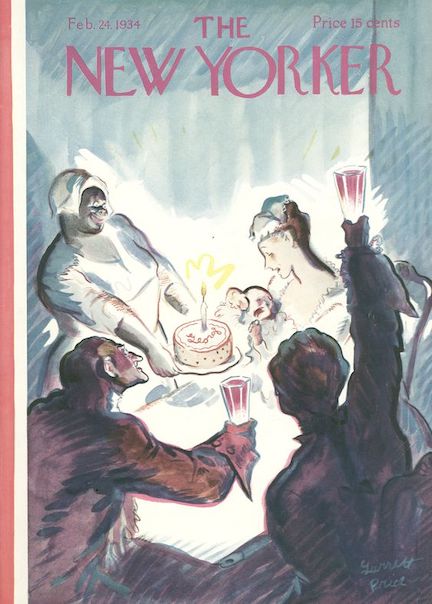
Feb. 17, 1934 cover by Rea Irvin (naturally).
In his “Notes and Comment,” E.B. White commented on the “more vigorous times” the magazine was enjoying, declaring “it is fine to be nine.”
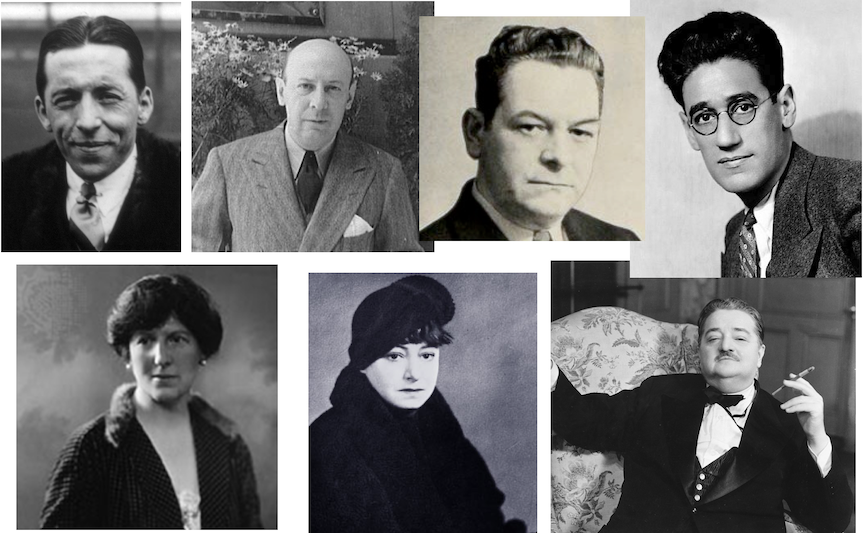
THE NEW YORKER SEVEN…In 1924, baking product heir Raoul Fleischmann put up $25,000 to help Harold Ross get his new magazine off the ground. To assuage Fleischmann’s doubts regarding his investment, Ross persuaded some of his Algonquin Round Table cronies to appear on the magazine’s purely ceremonial masthead. The seven who appeared on the first masthead were, from top left, Ralph Barton, Marc Connelly, Rea Irvin, and George S. Kaufman; bottom row, from left, are Alice Duer Miller, Dorothy Parker, and Alexander Woollcott.
* * *
Daffy Dilettante
Another Algonquin Round Table crony, Harpo Marx, was a skilled artist when it came to comedy, pantomime, or the harp, but when he decided to take up a brush and palette he struggled to properly paint a female nude. In this account from “The Talk of the Town,” Harpo eventually abandoned his painting and switched places with the model.
BRUSHING UP ON HIS ART…Undated photo of Harpo Marx putting finishing touches on his painting of an accordion player; Harpo was a one of the Algonquin Round Table originals: a 1919 photo features (standing, left to right) Art Samuels and Harpo Marx; (sitting) Charles MacArthur, Dorothy Parker, and Alexander Woollcott. (Twitter/Wikipedia)
* * *
Ode to Faraway Lands
A renowned author of children’s poetry, David McCord (1897-1997), was also a frequent contributor to The New Yorker for thirty years (1926-56). For the Feb. 17 issue he penned these sonnets to the Baedeker travel guide.
* * *
Wimpy Vernacular
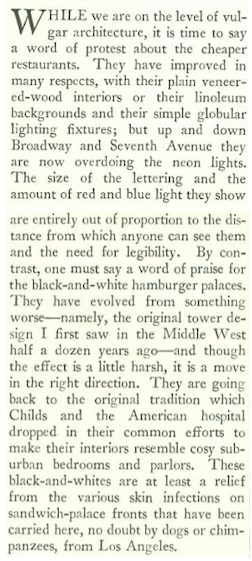
Architecture, art and cultural critic Lewis Mumford paused in his criticism of everything from liquor stores to cheap restaurants to offer some surprising praise to his city’s “black-and-white hamburger palaces.”
RED MEAT RIVALS White Tower and White Castle vied for customers in 1930s New York. Above, a 1933 photo of a White Tower in the 200 block of 2nd Avenue; below, a circa 1930 photo of a White Castle in the Bronx. (gothamist.com/Cision)
* * *
From Our Advertisers
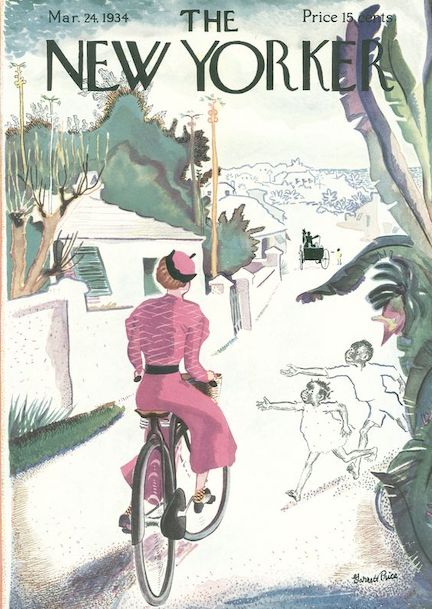
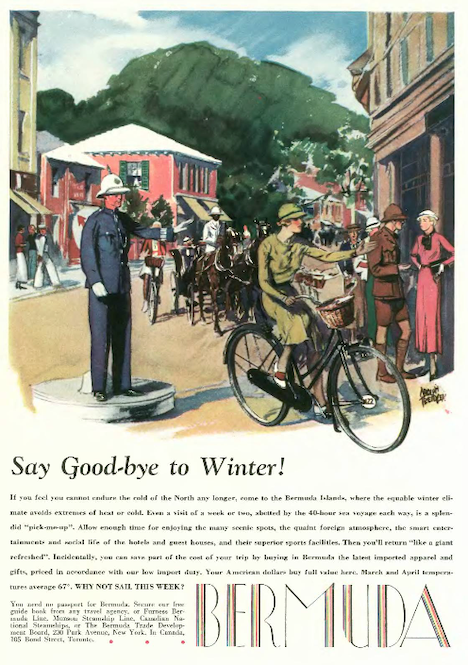
Advertising income reached an all-time high at The New Yorker in 1934, and it showed with the numerous color ads enticing travel to Bermuda…
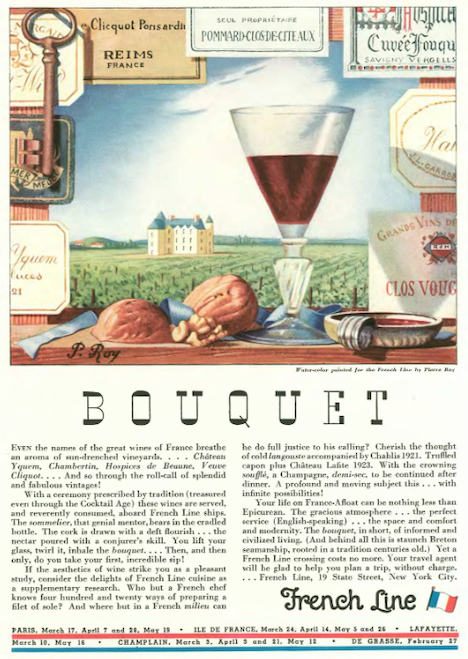
…or to the French wine country…
…Hiram Walker presented their Canadian Club whisky on what appeared to be a cloth napkin…
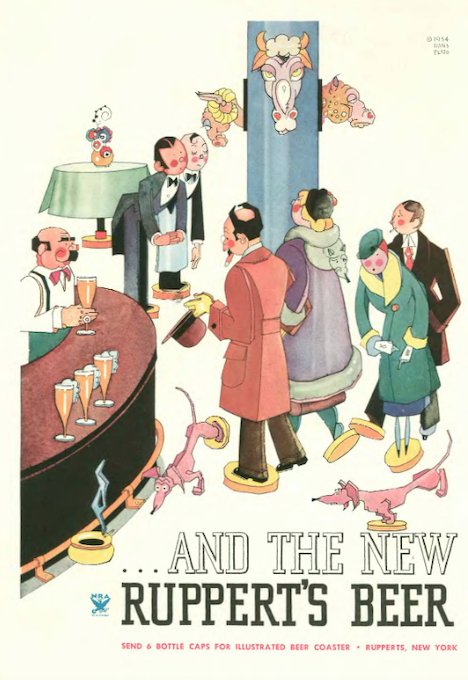
…artist Hans Flato continued his unusual Ruppert’s Beer series of mannequin people (and dogs) going about their lives stuck to yellow discs…
…according to the Ruppert’s ad, for six bottle caps you could get a tin coaster like those pictured below…
(1stdibs.com)
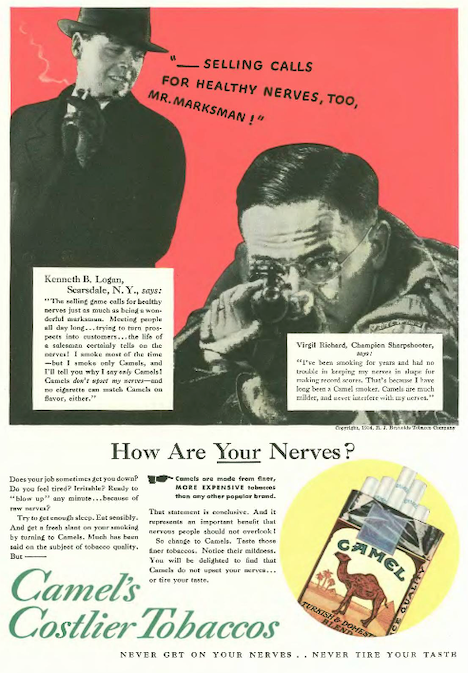
…from magicians and salesmen to sportsmen and high society, the folks pushing Camel cigarettes seemed to try every angle to get their product into the mouths of as many consumers as possible…
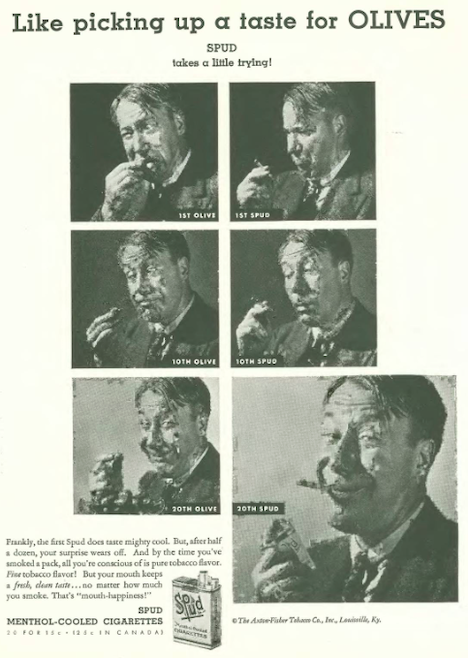
…the makers of Spud menthol cigarettes, on the other hand, tried a little humor to get smokers hooked on their “mouth happiness”…
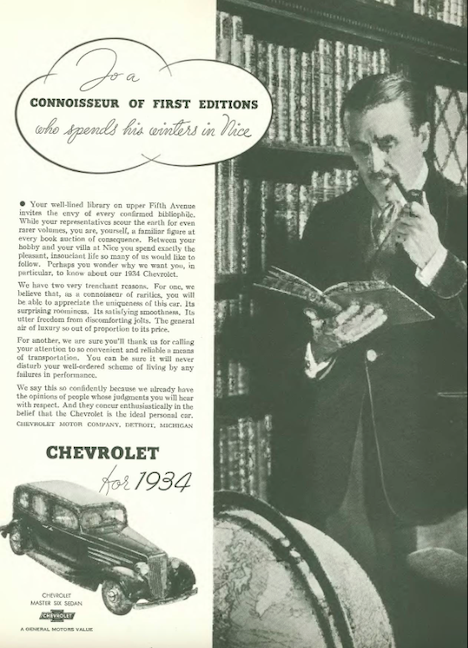
…as one of the world’s most popular car brands, Chevrolet has long been considered a car for the masses, although this ad campaign launched in 1934 suggested that the ubiquitous Chevy was just the car for a connoisseur of the finer things…
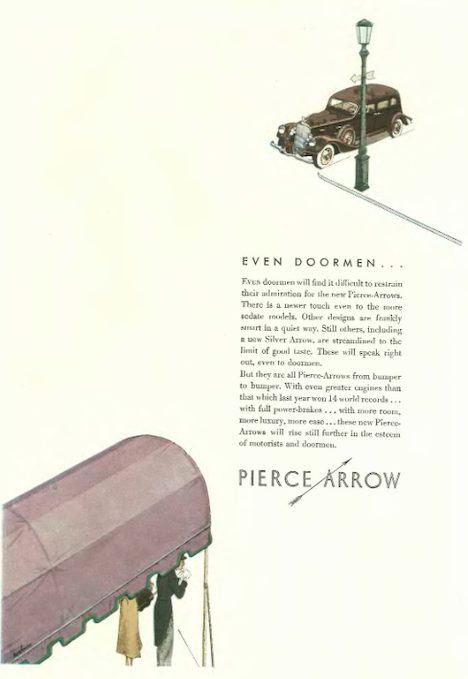
…the staid luxury auto maker Pierce Arrow broke with tradition by placing this very modern, minimalist ad…
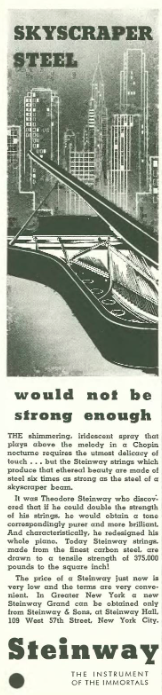
…the folks at Steinway also adopted a modern look with this single column ad touting the durability of their grand pianos…
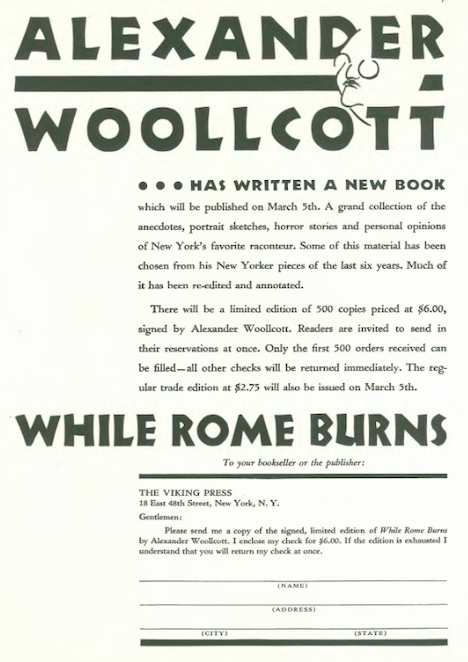
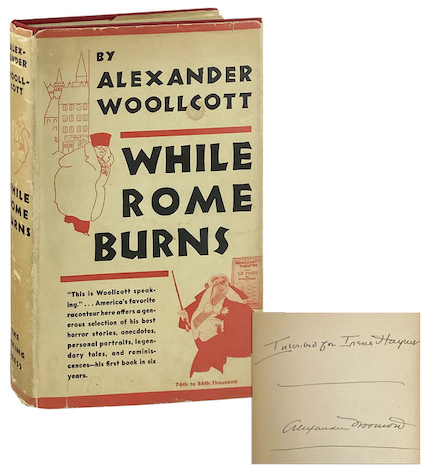
…The Viking Press took out this full-page ad to announce the publication of Alexander Woollcott’sWhile Rome Burns, a collection of some of Woollcott’s writings for TheNew Yorker and other magazines…
…according to the ad, for six bucks you could get one of 500 limited edition signed copies…as of this writing, the inscribed and signed edition below was available for $350…
(capitolhillbooks-dc.com)
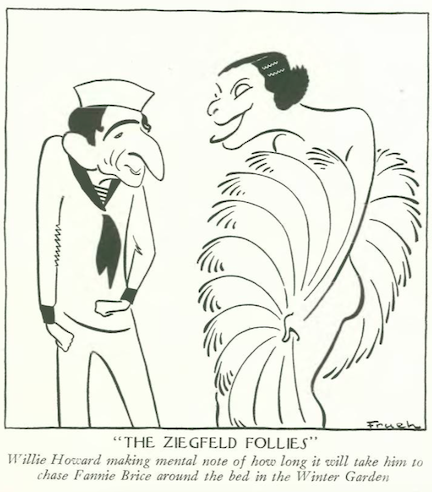
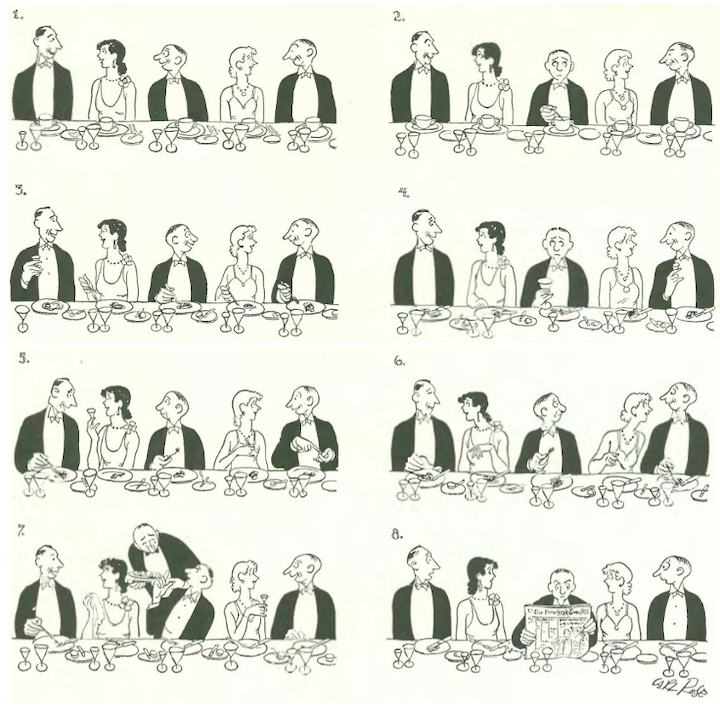
…on to our cartoonists, Al Frueh offered up this interpretation of Ziegfeld entertainers Willie Howard and Fannie Brice…
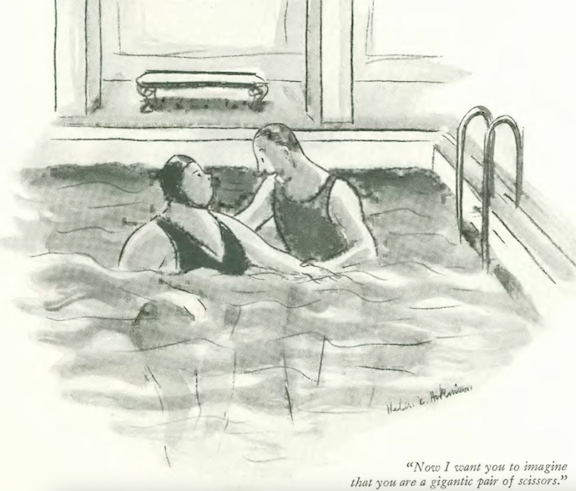
…Helen Hokinson took the plunge with 1930s water aerobics…
…Kemp Starrett demonstrated how beauty is in the eye of the beholder…
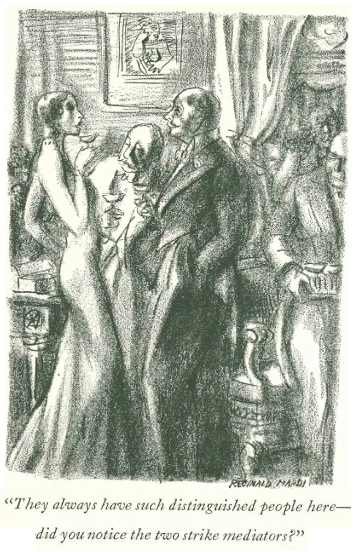
…Reginald Marsh returned, taking temporary leave from life on the streets to look at life above the streets…
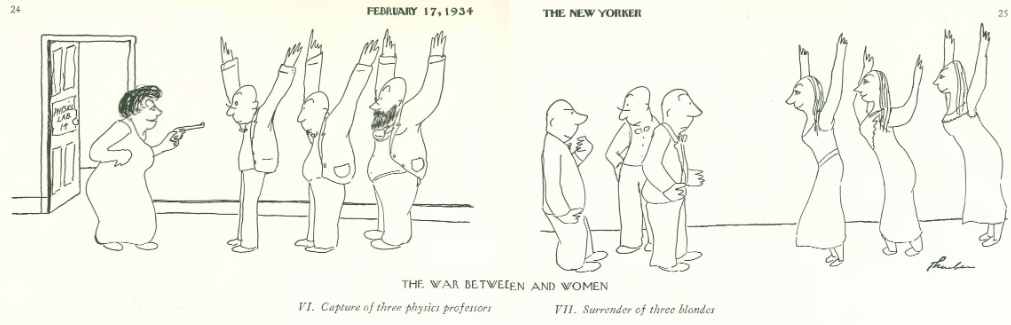
…James Thurber’s “War Between Men And Women” took some new twists…
…and we end with Carl Rose, and one man’s solution to being stuck in the middle…
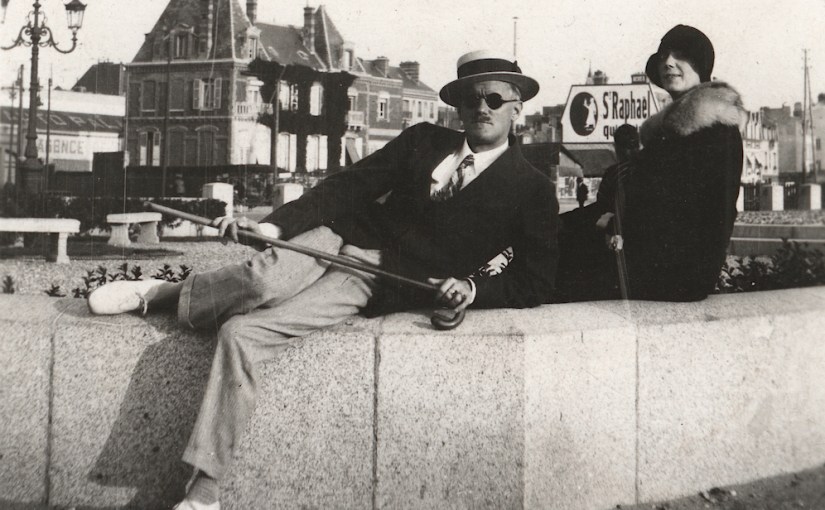
Above, James Joyce and his longtime partner Nora Barnacle, in Zurich, 1930. They would marry the following year when Joyce established residency in the UK. (SUNY Buffalo)
It began 103 years ago when the American literary magazine The Little Review published its latest installment of James Joyce’s landmark novel Ulysses—a chapter that featured an account of a wanker on a beach.
Jan. 20, 1934 cover by Adolph K. Kronengold.
More specifically, the passage described the novel’s main character, Leopold Bloom, pleasuring himself while gazing at a teenage girl. It didn’t take long for the pearl-clutchers at the New York Society for the Suppression of Vice to go after the editors of The Little Review, who were ultimately fined for obscenity and banned from publishing the remainder of the novel, which, by the way, Joyce had structured along the lines of Homer’s epic poem, the Odyssey.
Scenes in the novel that frankly described sexual acts and mocked rituals of the Catholic Church kept the book off American shelves until 1934, when District Judge John M. Woolsey ruled that the book was neither pornographic nor obscene. One wonders if Judge Woolsey took a cue from the end of Prohibition.
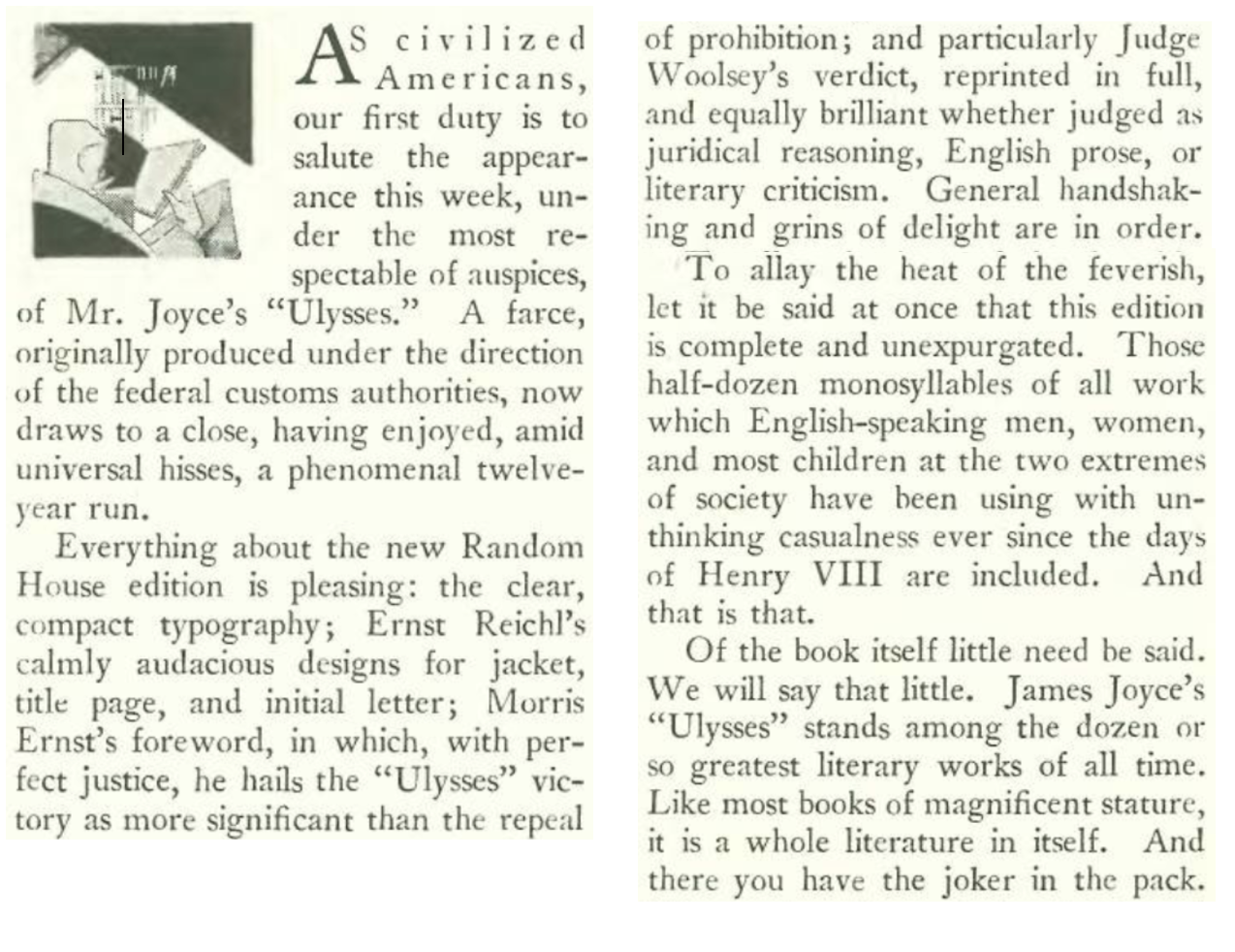
Lovers of literature, including New Yorker book reviewer Clifton Fadiman, rejoiced at the judge’s decision. We skip ahead to the Jan. 27 issue for Fadiman’s thoughts on the matter:
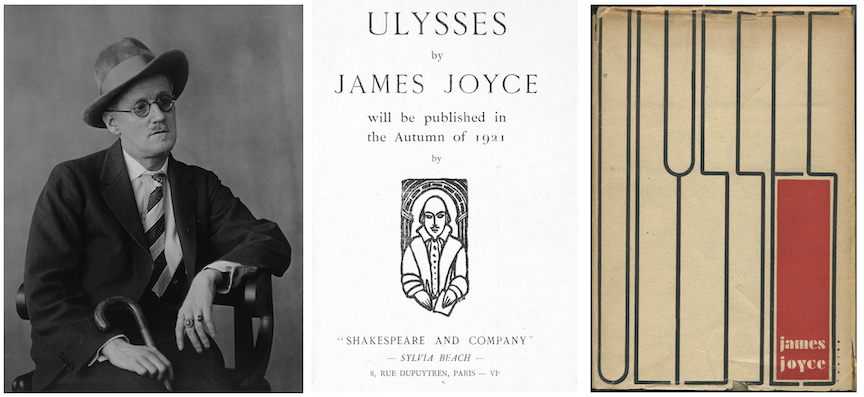
DUBLINER…James Joyce in 1928, as photographed by Berenice Abbott; announcement by Shakespeare & Company (Paris) of the first publication of Ulysses, 1921; cover of the American first edition, 1934, with Ernst Reichl’s “calmly audacious” jacket design. (Wikipedia/Abe Books)
* * *
Pleasurable Diversion
We now turn to the Jan. 20 issue, in which Robert Benchley concluded his stage reviews with a generous nod to his dear friend and colleague, Dorothy Parker, whose short stories were being performed as sketches at the Barbizon-Plaza Hotel, the first fully-equipped music and arts residential center in the U.S.
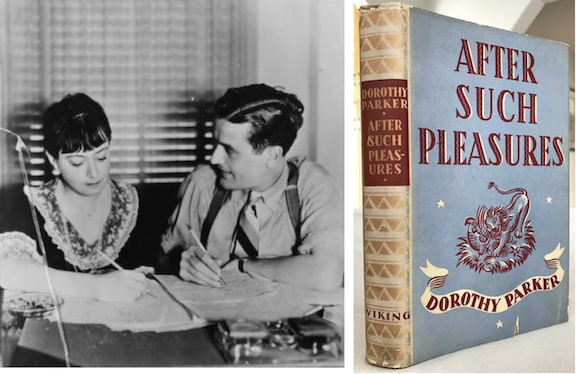
INCIDENTAL ATTRACTION…Stories from Dorothy Parker’s 1933 collection After Such Pleasures were performed as sketches at the Barbizon-Plaza Hotel; at left, Parker with her husband, actor/author Alan Campbell. (Pinterest/Biblio)
* * *
Une Séduction Américaine
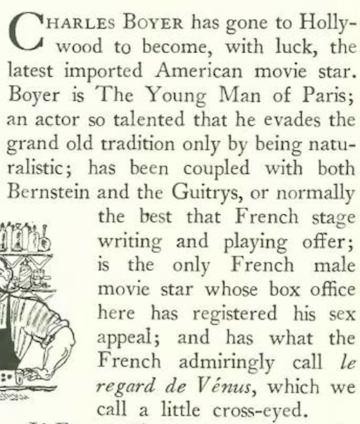
Janet Flanner began writing her weekly New Yorker column “Letter from Paris” in September 1925, keeping readers informed on a variety of subjects ranging from arts and culture to politics and crime. In the Jan. 20 issue she introduced readers to French actor Charles Boyer (1899–1978), who was preparing to try his luck in Hollywood. Actually, Boyer made his first trip to Tinseltown in 1930, but his return would mark the beginning of a successful run in American cinema, including the 1944 mystery-thriller Gaslight and the 1967 romantic-comedy Barefoot in the Park.
MAKING BEAUTIFUL MUSIC…Charles Boyer as the ” gypsy” vagabond Latzi, with Jean Parker (center) and Loretta Young in 1934’s Caravan. (MoMA)
* * *
The Way Of All Flesh
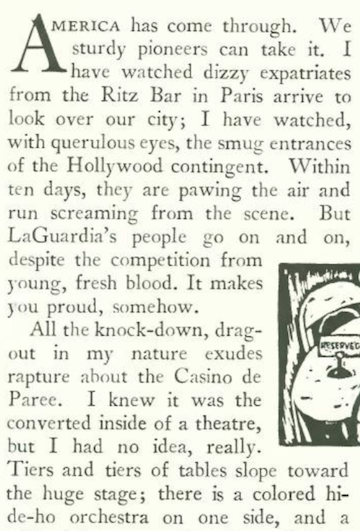
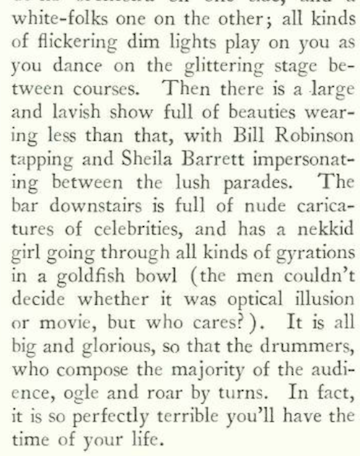
Lois Long continued to chronicle New York nightlife in her “Tables for Two” column, exuding “rapture” over the new theatre/restaurant Casino de Paree, which featured ample nudity as well as top performers dancer Bill “Bojangles” Robinson and comedienne Sheila Barrett.
The Casino de Paree featured revues, dancing, and side shows such as fire-eaters and animal acts. It closed in 1937, and the building later became home to the trendy 80s–90’s hot spot Studio 54.
CLOTHES OPTIONAL…A 1934 brochure offered glimpses of the entertainment to be had at the new theatre/restaurant Casino de Paree.
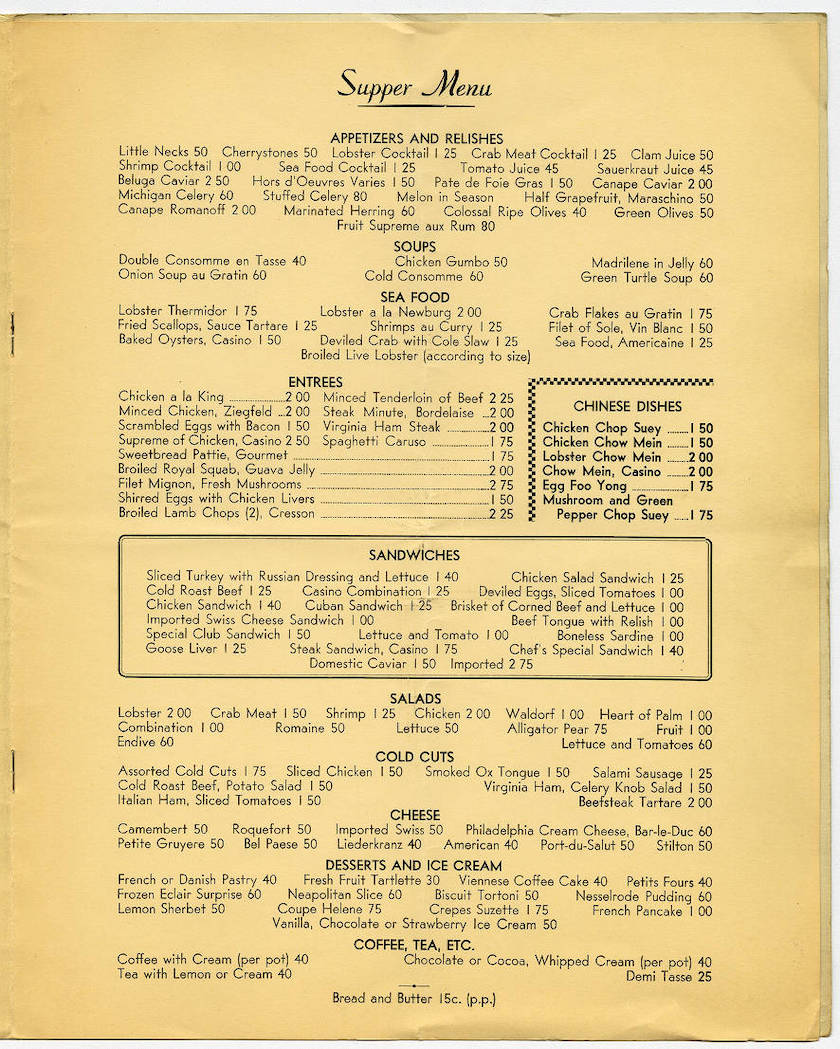
The Casino de Paree’s menu gave patrons some idea of what could be expected on the stage…
(The Culinary Institute of America Menu Collection)
…but if food and drink was the only thing on your mind, you could enjoy lobster thermidor for a buck seventy-five…
(The Culinary Institute of America Menu Collection; Craig Claiborne Menu Collection)
* * *
From Our Advertisers
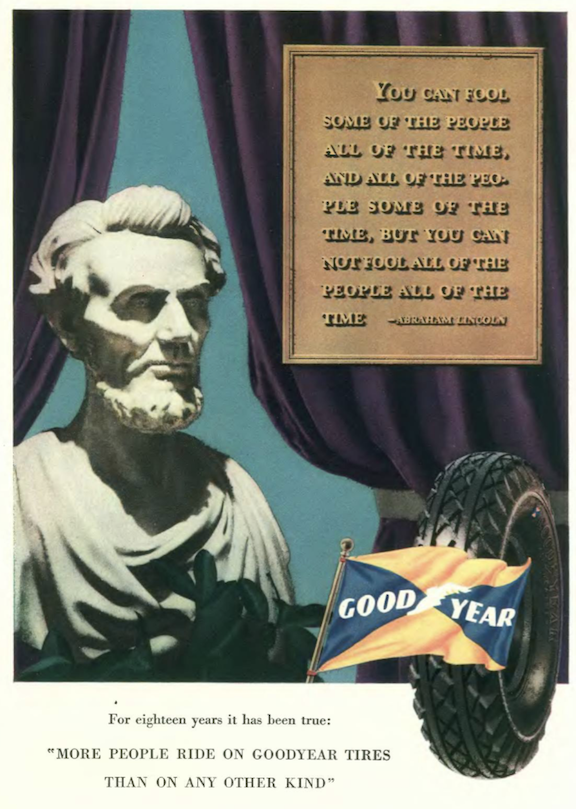
How reliable were Goodyear’s tires? Hopefully more reliable than this adage, which Abraham Lincoln apparently never uttered…
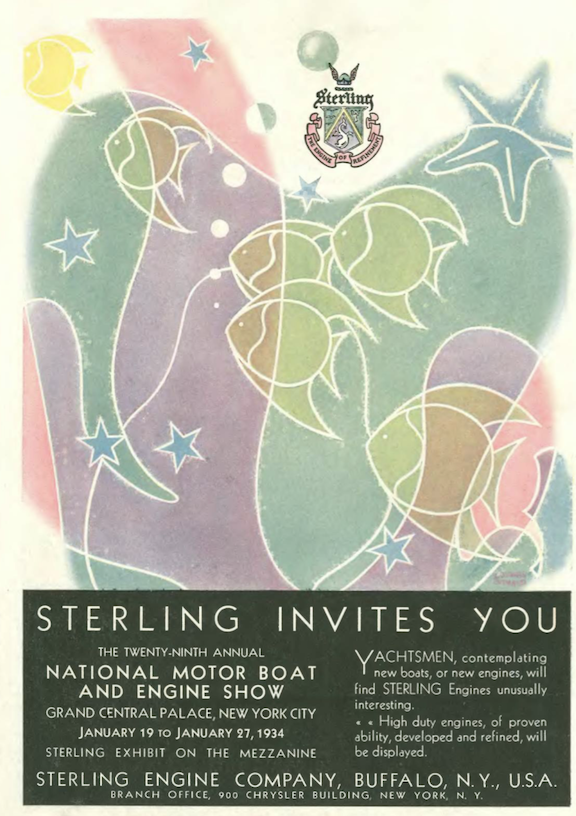
…major exhibitions at the Grand Central Palace changed like the seasons, the National Automobile Show ceding to the National Motor Boat & Engine Show…
…if you’d rather have someone else do the sailing, the Bermuda line could take you on a round-trip cruise for as little as $60…
…with the end of Prohibition, the folks at White Rock were doubtless pleased to overtly advertise their product as a cocktail mixer…
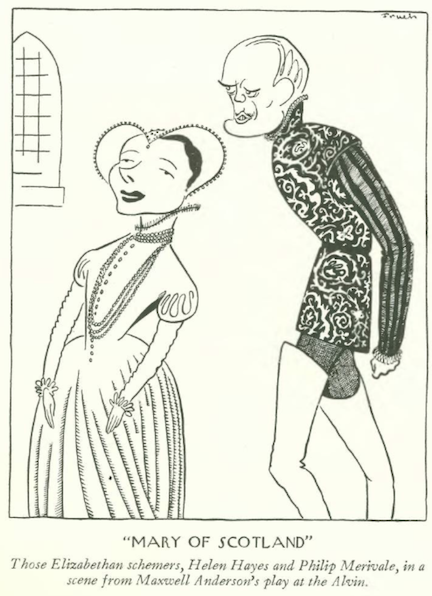
…on to our cartoonists, Al Frueh contributed this rendering for the theatre review section…
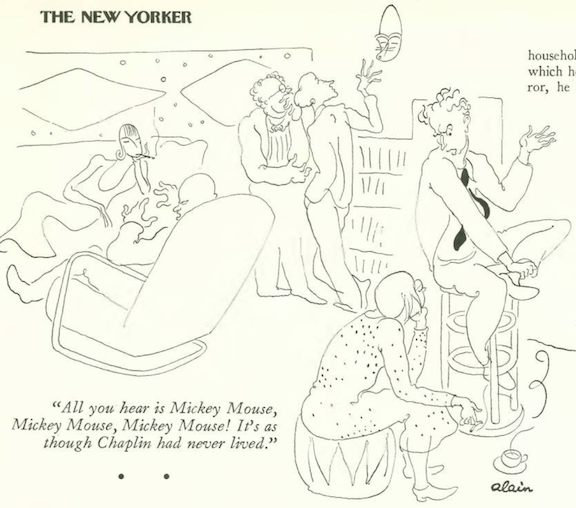
…Daniel ‘Alain’ Brustlein found this salon conversation a bit Mickey Mouse…
…Helen Hokinson explored the results of family planning…
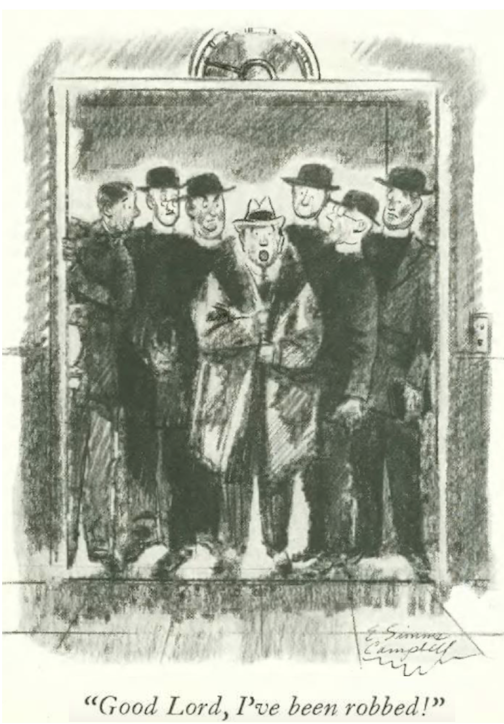
…E. Simms Campbell gave us an unlikely den of thieves…
…Gilbert Bundy had us wondering what ensued at this gentlemen’s club…
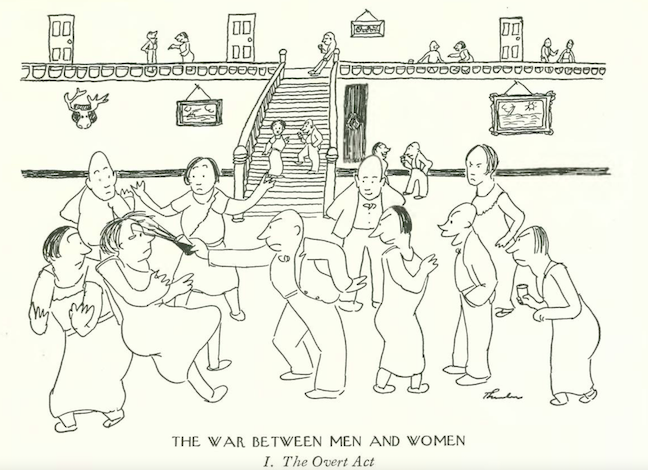
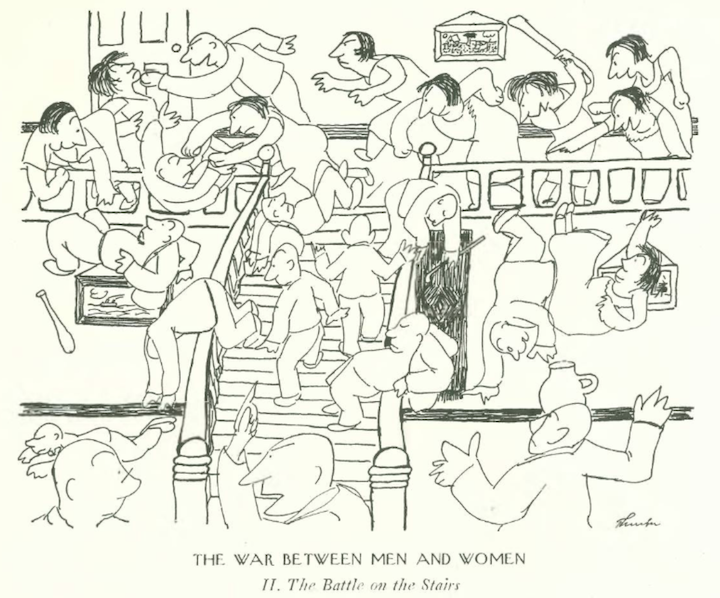
…and James Thurber fired the first shot in The War Between Men And Women…
…on to Jan. 27, 1934…
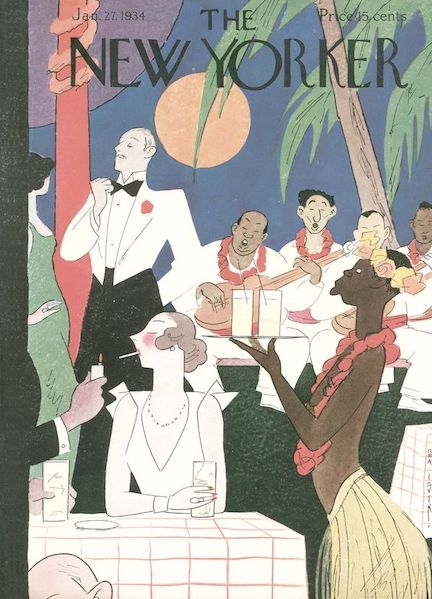
Jan. 27, 1934 cover by Rea Irvin.
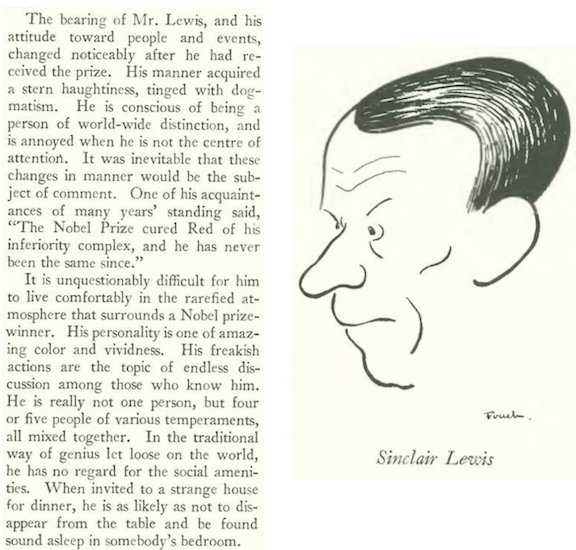
…where writer W.E. Woodward profiled Sinclair Lewis (1885-1951), whose manner had changed noticeably after receiving the Nobel Prize. An excerpt (with caricature by Al Frueh):
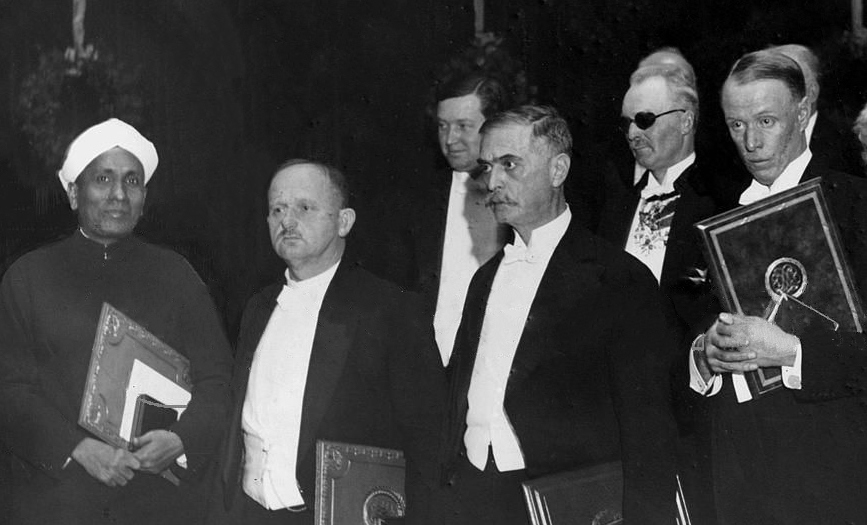
I’M SOMEBODY NOW…Sinclair Lewis (far right) with his 1930 Nobel Prize for literature. Other 1930 prize winners were, from left, Venkata Raman (physics), Hans Fischer (chemistry), and Karl Landsteiner (medicine).
* * *
More From Our Advertisers
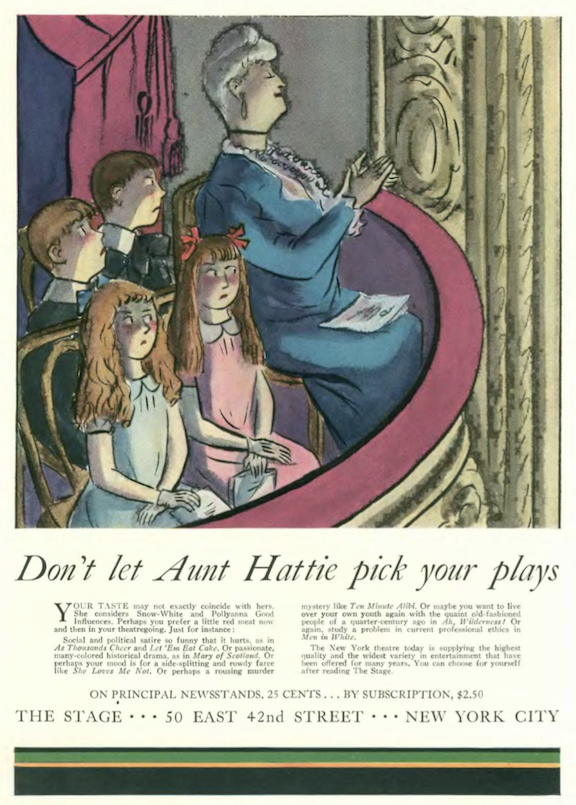
We begin with this lovely color illustration by Helen Hokinson, which also graced the cover of the January 1934 issue of The Stage…
…the vintners at Moët & Chandon let New Yorkers know that their fine Champagne could be had from sole distributors Labourdette and Company…
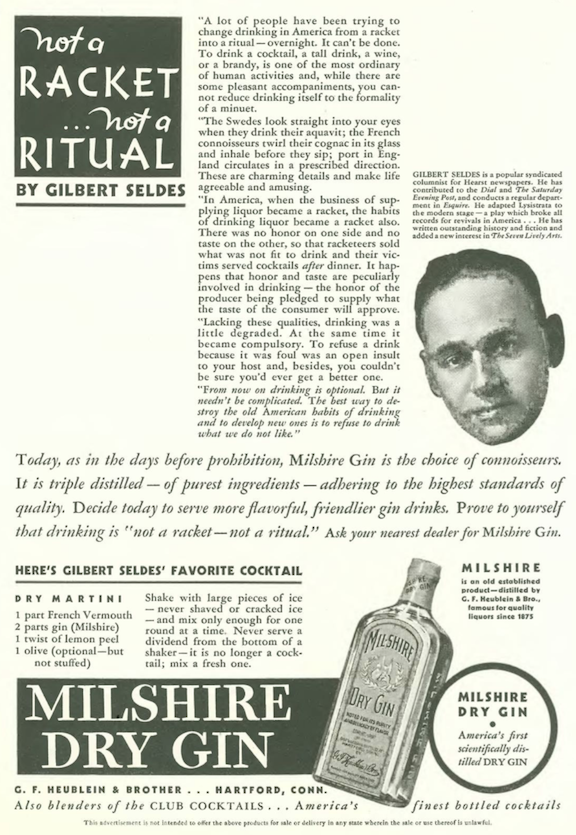
…cultural critic Gilbert Seldes advised drinkers to abandon their degraded ways and return to the civilized consumption of an old favorite…
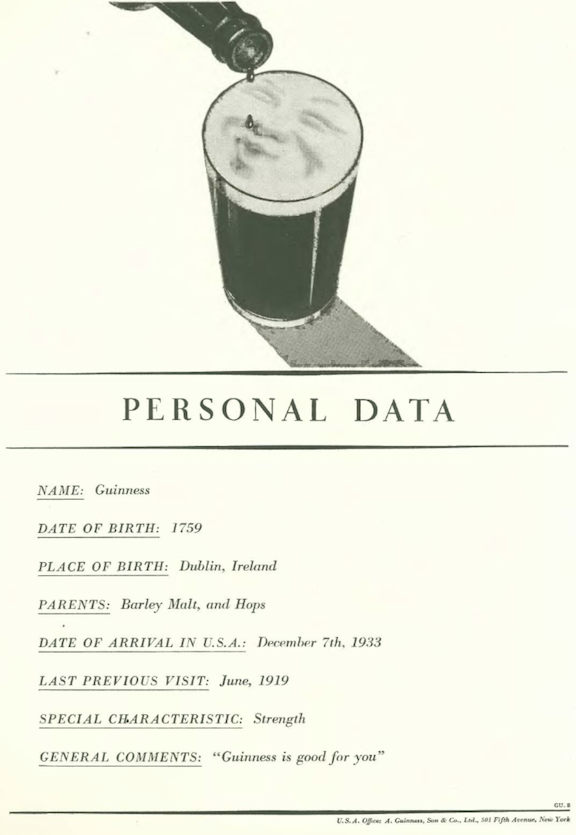
…while the folks at Guinness reminded us of their product’s deep history as well as its health benefits…
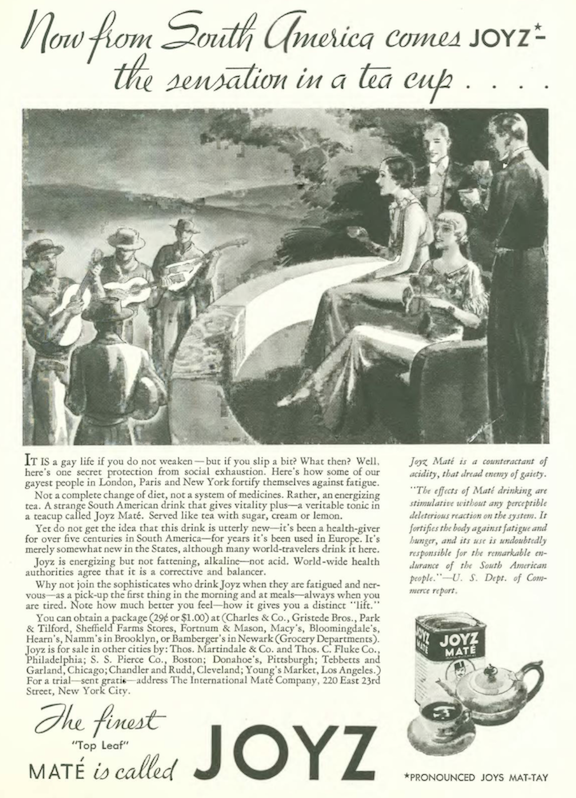
…and for the teetotalers the purveyors of Joyz Maté encouraged Yankees to take up this “strange” South American drink…the ad claimed it “fortifies the body against fatigue” (thanks to the generous amount of caffeine) and acts as a “corrective and a balancer” (it helped stimulate bowel movements)…
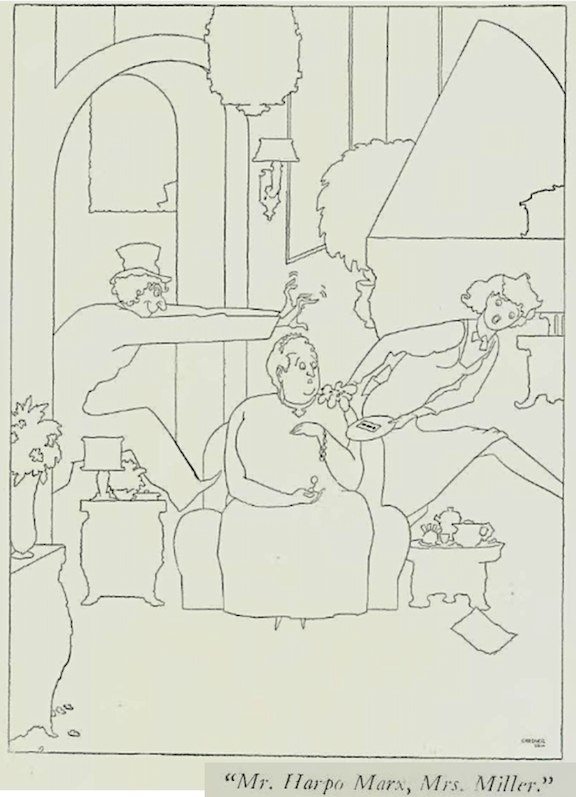
…on to our cartoons, we begin with Gardner Rea, borrowing from a running gag in the Marx Brothers’ 1930 film Animal Crackers, which featured Harpo chasing a sexy blonde around a mansion (apologies for the poor reproduction quality—the archival image was quite faint)…
…Gilbert Bundy gave us a couple confronting the subtleties of Times Square…
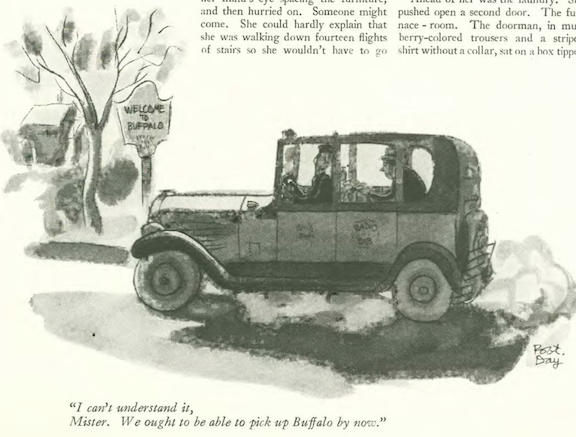
…Robert Day commented on the latest trend in taxicab conveniences: coin-operated radios for passengers…
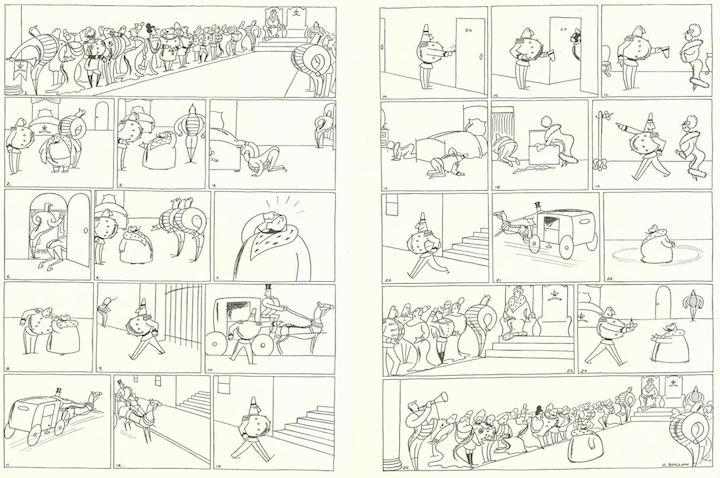
…this two-page Little King cartoon by Otto Soglow revealed another side to our diminutive potentate…
…and the war between the sexes raged on, with James Thurber…
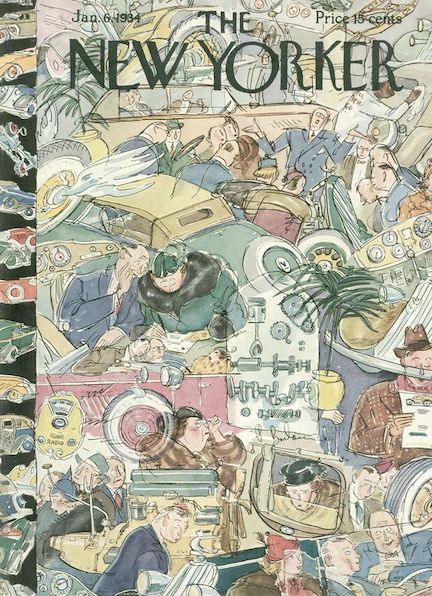
New York’s first big event of the new year was the annual National Auto Show centered at the Grand Central Palace.
Jan. 6, 1934 cover by Perry Barlow.
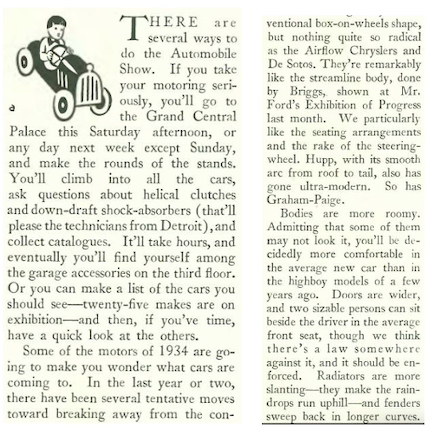
The year 1934 was all about aerodynamic design, with Chrysler leading the way with its ill-fated Airflow, a bit too ahead of its time. Other companies followed suit in more subtle ways, especially smaller manufacturers looking for novel ways to grab a cut of market share.
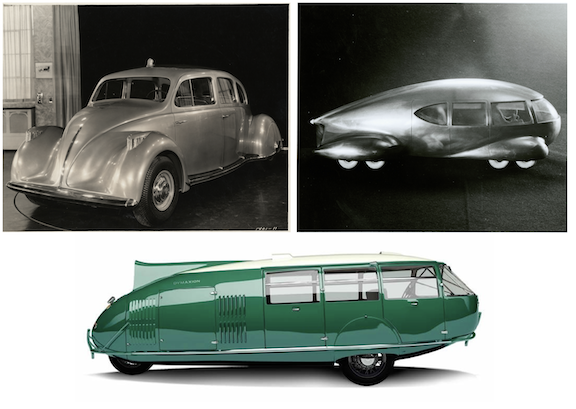
The trend in streamlining was inspired by such designers as Norman Bel Geddes, R. Buckminster Fuller and John Tjaarda…
SLIPPERY SEDANS…Top left, a 1933 Briggs concept car, designed by John Tjaarda, on display at the Ford Exposition of Progress in Detroit; right, a 1932 concept model of Motorcar No. 9 by Norman Bel Geddes; below, a reproduction of R. Buckminster Fuller’s 1933 Dymaxion car. (detroitpubliclibrary.org/Harry Ransom Center/Wikipedia)
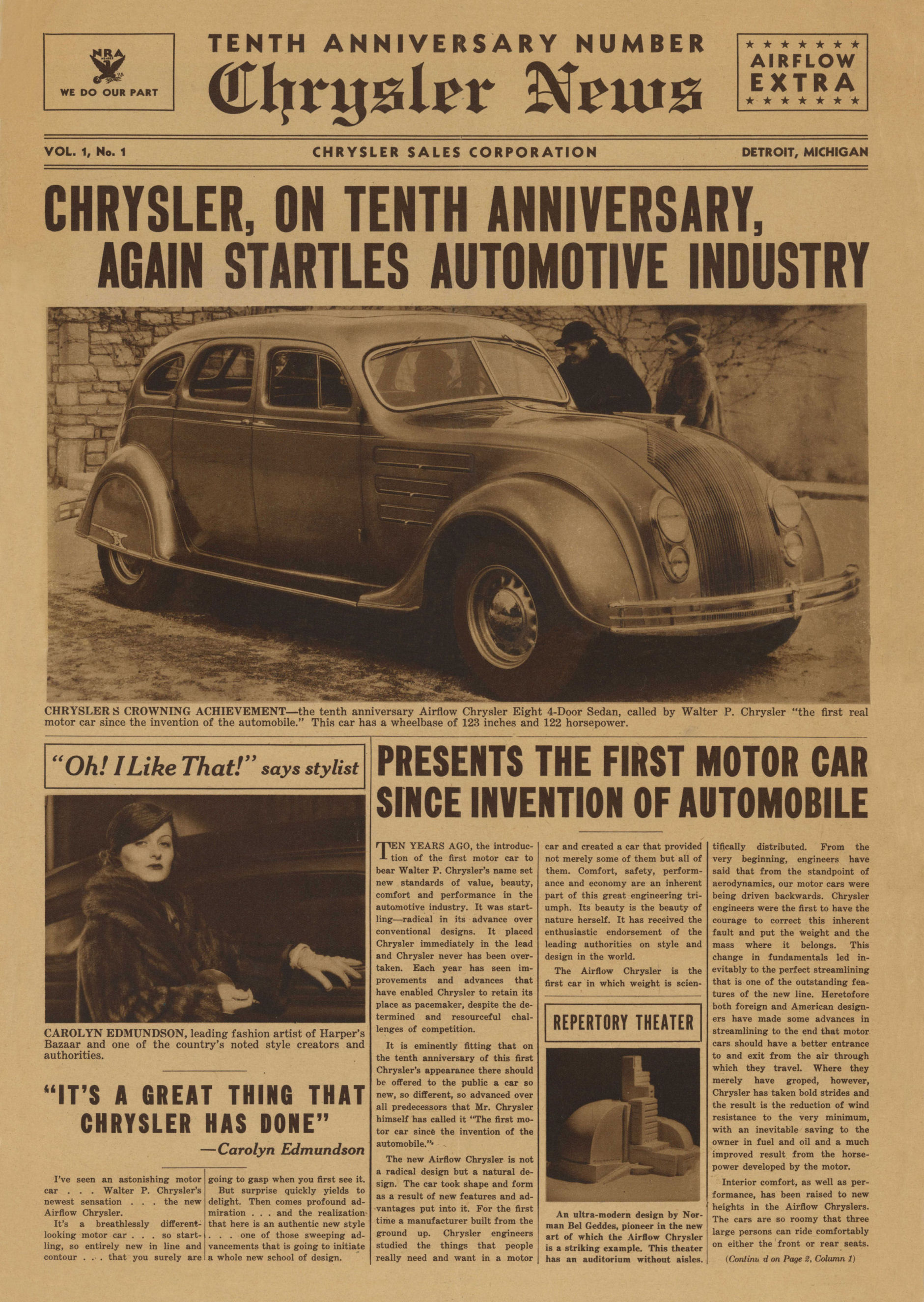
Chrysler pulled out all stops to promote its radical new design at the National Auto Show, even producing a special seven-page newspaper, Chrysler News, to promote the car’s many wonders…
…the inside pages featured TheNew Yorker’sAlexander Woollcott marveling over the Airflow’s design (at the time Woollcott was a Chrysler pitchman).
Although other manufacturers didn’t go as far as Chrysler, the streamlining trend was seen in slanting radiators and sweeping fenders.
LAIDBACK DESIGN…Clockwise, from top left, 1934 Hudson Terraplane K-coupe; 1934 Studebaker President Land Cruiser; 1934 Graham-Paige; 1934 Hupmobile. (hemmings.com/auto.howstuffworks.com/YouTube)
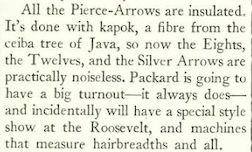
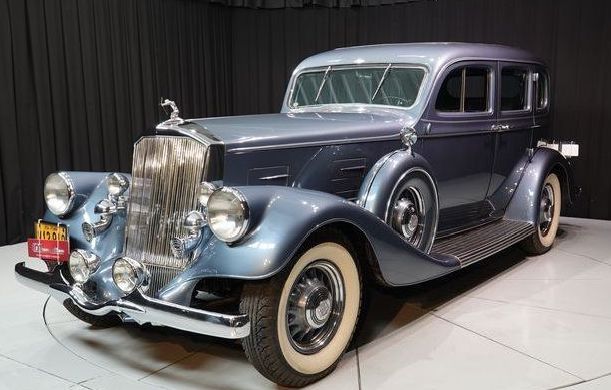
The review also noted the novel way Pierce-Arrow sound-insulated their motorcars:
IT’S STUFFY IN HERE…For sound insulation, luxury carmaker Pierce Arrow used kapok, a fine, fibrous, cotton-like substance that grows around the seeds of the tropical ceiba tree. (Pinterest)
* * *
Wearing the Pants
In 1934 it was still something of a scandal for a woman to wear trousers. Like Marlene Dietrich, Greta Garbo was an actress who could and would defy gender boundaries, and in Queen Christina she effortlessly portrayed the Swedish queen, who in real life was given an education and responsibilities expected of a male heir and often dressed as a man. The film was a critical success, although John Mosher felt Garbo overwhelmed the movie.
READY FOR HER CLOSEUP…Clockwise, from top left, in one of cinema’s most iconic scenes, Queen Christina (Greta Garbo) stands as a silent figurehead at the bow of a ship as the camera moves in for a tight close-up; Garbo with co-star and real-life romantic partner John Gilbert—it was the last of the four films the two would make together; Christina kisses her handmaiden Ebba (Elizabeth Young)—some have suggested Garbo was portraying the queen as bisexual, however the kisses with Ebba were quite chaste; MGM film poster. (moviemaker.com/pre-code.com/IMDB)
* * *
She Also Wore Pants
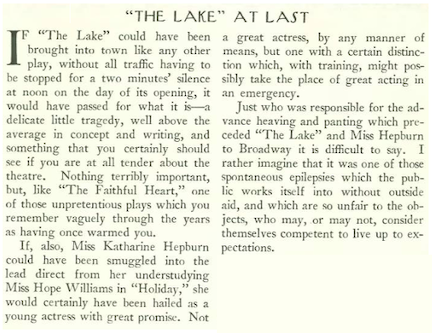
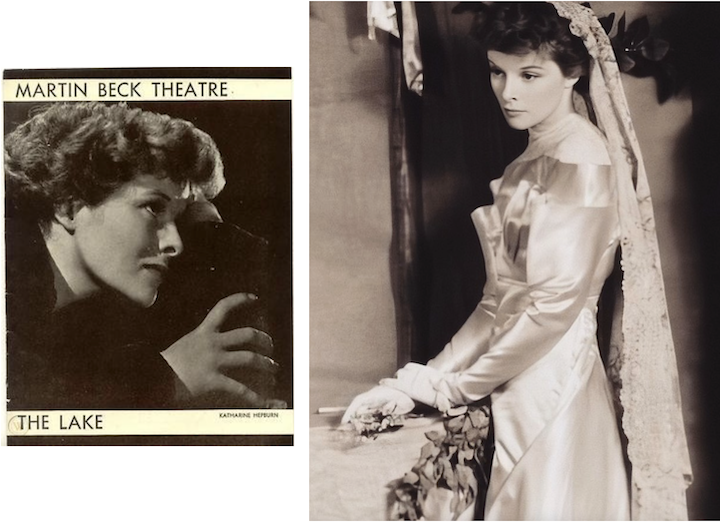
Katharine Hepburn quickly took Hollywood by storm, earning her first Oscar at age 26 for her performance in 1933’s Morning Glory. However, New Yorker drama critic Robert Benchley didn’t see that talent necessarily translating to the Broadway stage, at least not in The Lake:
A RARE FLOP…Robert Benchley thought it was “almost cruel” to foist Katharine Hepburn’s stardom onto the stage in a flop like The Lake. At left, cover of the Playbill; at right, Hepburn in one of the costumes for the production. (Playbill/Facebook)
Benchley correctly surmised that the play’s producer, Jed Harris, was trading on the young star’s “meteoric” film success, but Hepburn’s beauty and intelligence were not enough to save this critical flop, which closed after 55 performances.
* * *
On the Town
The chronicler of New York fashion and nightlife, Lois Long, detested Prohibition but after repeal also missed the intimacy of speakeasy life. In her latest “Tables for Two” column Long seemed to be settling into a routine and finding new favorites, like the Waldorf’s Sert Room and Peppy de Albrew’s Chapeau Rouge.
THIS WILL DO NICELY…Lois Long sipped Casanova ’21 champagne while enjoying the music of Catalonian violinist Enric R. Madriguera (bottom left) amid the murals of Madriguera’s countryman Josep Maria Sert (right images) in the Waldorf-Astoria’s Sert Room. (waldorfnewyorkcity.com/Wikipedia)FAMILIAR FACES…No doubt Lois Long knew Argentine dancer Abraham “Peppy” de Albrew (left) from his days at Texas Guinan’s notorious 300 Club; Long found de Albrew’s new club, Chapeau Rouge, to be a welcoming slice of Paris, enlivened by the dancing of Antonio and Renee de Marco, pictured at right with their dogs in front of San Francisco’s Fairmont Hotel, circa 1937. (Wikipedia/digicoll.lib.berkeley.edu)
* * *
From Our Advertisers
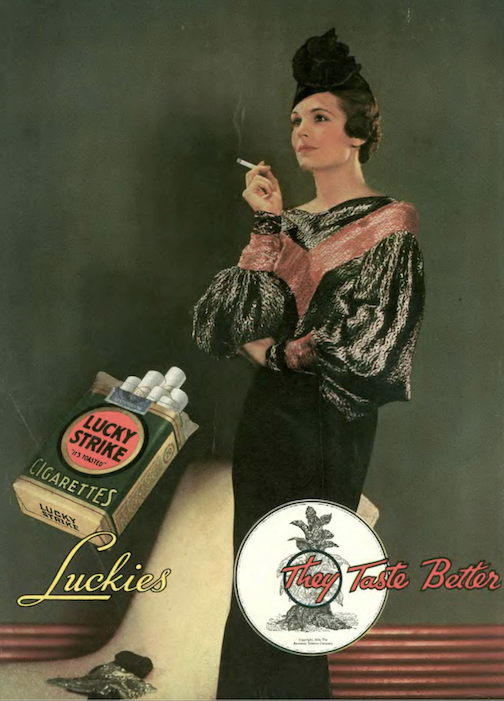
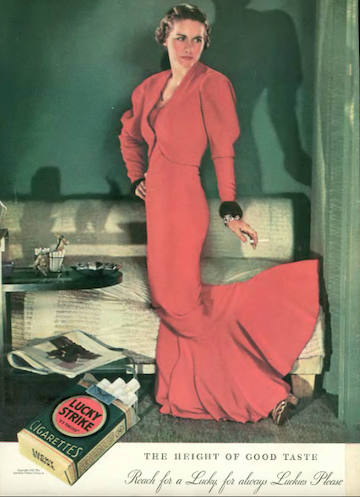
Thanks to the auto show The New Yorker was raking in a lot of advertising dollars on top of the steady income from tobacco companies and the new infusion of revenue from purveyors of adult beverages…Lucky Strike grabbed the back cover for this striking ad…
…and contrary to the wisdom of the ages, American speed skater Irving Jaffee (who won two gold medals at the 1932 Winter Olympics) credited his athletic prowess in part to smoking unfiltered cigarettes…
…finally, real French Champagne was arriving on American shores…
…as was authentic Scotch whisky…
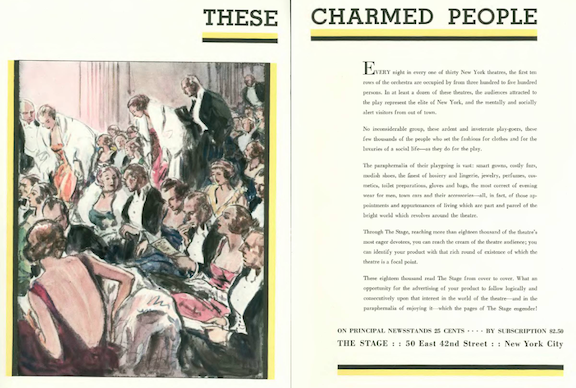
…John Hanrahan was The New Yorker’s policy counsel from 1925 to 1938 and is credited with putting the magazine on firm financial footing during its infancy…in 1931 Hanrahan rebranded the Theatre Guild’s magazine, renaming it The Stage and filling it with the same splashy ads he was also able to bring to The New Yorker…the Depression was a tough time to launch a magazine, and even though Hanrahan added articles on motion pictures and other forms of entertainment in 1935, the magazine folded in 1939…
…and with the National Auto Show in town, car manufacturers filled The New Yorker’s pages with expensive ads…we’ll start with Walter Chrysler’s long-winded appeal on behalf of the Airflow…
…the folks at the usually staid Packard tossed in some unexpected color…
…Pierce-Arrow, at the time America’s top luxury car, offered this sneak peak of its 1934 Silver Arrow…
…Cadillac bought this spread to announce both its luxury and down-market brands…
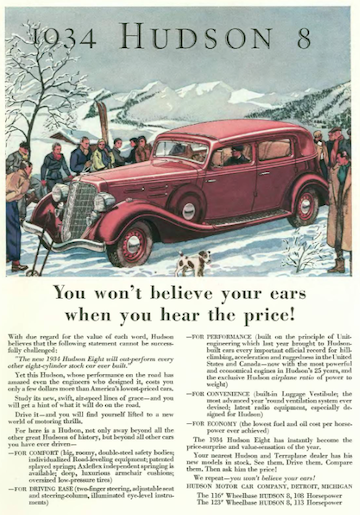
…Hudson Motor Car Company invested in three color pages to announce the rollout of their 1934 Hudson 8…
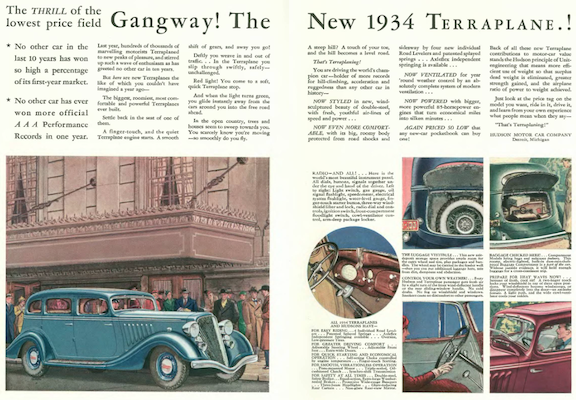
…and their low-priced yet powerful Terraplane…
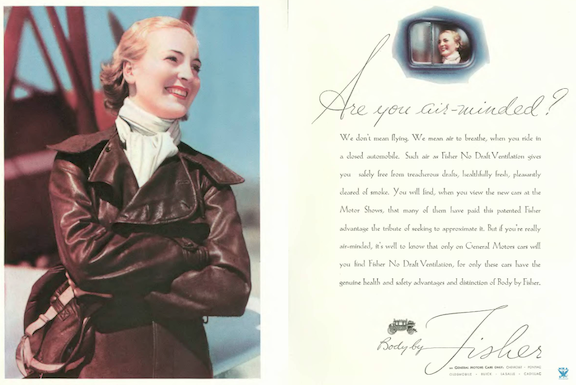
…Fisher, which made car bodies for General Motors, offered up this color photo of a pretty aviatrix to suggest their interiors were as fresh and clean as the clear skies above…
…Studebaker also paired flying with their latest models…
…Nash employed cartoonist Wayne Colvin for a series of six ads sprinkled across the back pages…here are two examples…
…on to our cartoonists, Perry Barlow used the auto show as inspiration for this cartoon, which appeared along with the review…
…Al Frueh drew up these images for the theatre section…I believe this is the first appearance of Bob Hope in the magazine…
…some housekeeping…I accidentally included this James Thurber cartoon and…
…this Rea Irvin cartoon in my post for the Dec. 30, 1933 issue…they belong with the Jan. 6 issue…
…Robert Day offered up a roving reporter…
…Carl Rose looked in on a wine connoisseur…
…and we close with a steamy image, courtesy Alan Dunn…
It’s hard to believe in this day and age that a theoretical physicist could enjoy rock star status, but then Albert Einstein wasn’t your everyday theoretical physicist.
Dec. 2, 1933 cover by Helen Hokinson.
A two-part profile of Einstein (1879–1955) by Alva Johnston (with terrific caricature by Al Frueh) examined the life and “idol” status of a man who would define the idea of genius in the 20th century. Although Einstein desired to live an almost reclusive existence at Princeton University, Johnston noted that he had become “fairly reconciled to the occupation of popular idol.”
Einstein was at Princeton thanks to the rise of Adolf Hitler, who came to power in Germany in early 1933 while Einstein was visiting the United States. Returning to Europe that March, Einstein knew he could not return to his home country (indeed, the Gestapo had raided his Berlin apartment and eventually seized all of his property), so when Einstein landed in Antwerp, Belgium on March 28, 1933, he immediately went to the German consulate and surrendered his passport, formally renouncing his German citizenship.
I’M OUTTA HERE…Albert Einstein with a Zionist delegation from France, Belgium, and England upon leaving the SS Belgenland in Antwerp, Belgium, 1933. (United States Holocaust Memorial Museum)
After some time in Europe and Great Britain, in October 1933 Einstein accepted an offer made earlier by from the Institute for Advanced Study in Princeton, New Jersey to serve as a resident scholar. When he arrived with his wife, Elsa, he said he would seclude himself at the Institute and focus on his teaching and research.
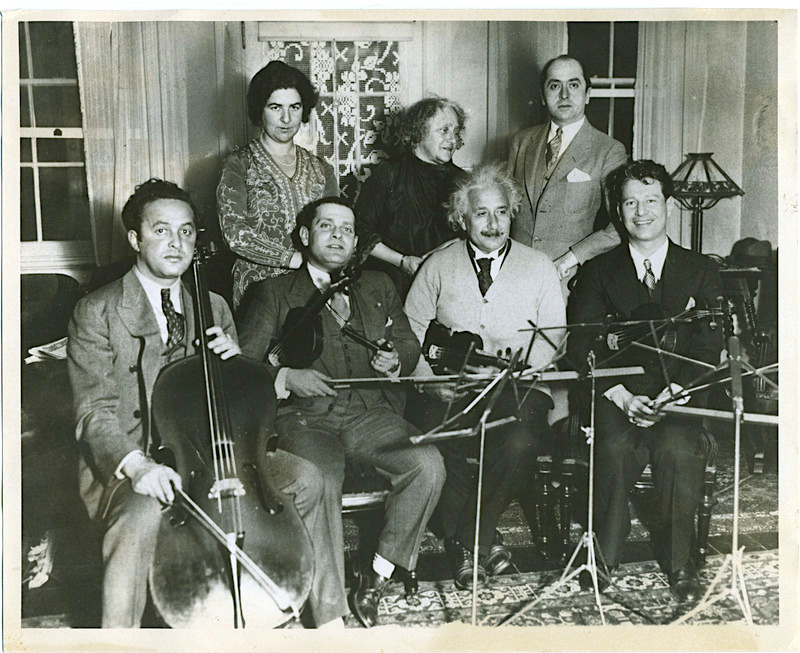
(NY Times, Oct. 18, 1933)EINSTEIN WASN’T FIDDLIN’ AROUND when he played his cherished violin—he once said that if he hadn’t been a scientist, he would have been a musician. This photo was taken at Einstein’s Princeton home in November 1933—he and fellow members of a string quartet were practicing for a December concert at the Waldorf-Astoria to raise money for German-Jewish refugees. From left to right, sitting: Arthur (Ossip) Giskin, Toscha Seidel, Albert Einstein, and Bernard Ocko; standing: Estelle Manheim (Seidel’s wife), Elsa Einstein and unidentified man. (Leo Baeck Institute)
* * *
Stop and Go
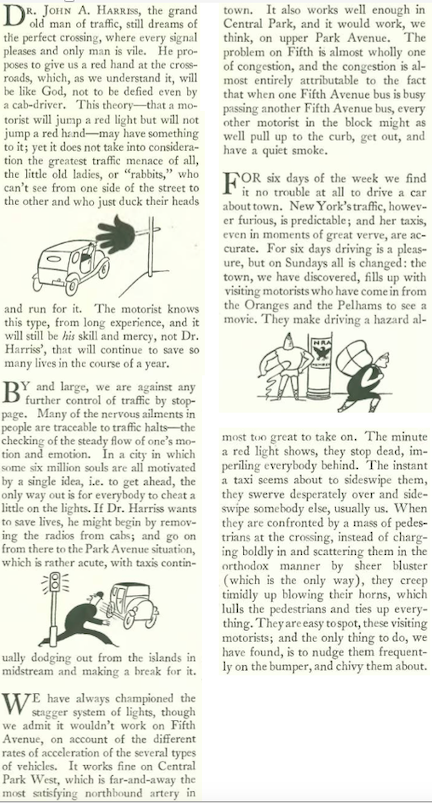
E.B. White devoted his “Notes and Comment” to Manhattan’s traffic situation, which he found manageable as long as tourists stayed out of the way…
White also noted the perils of Park Avenue, especially the taxi drivers (distracted by those newfangled radios) darting between the islands…
Park Avenue in the 1930s. (geographicguide.com)
…and then there was Fifth Avenue, notorious for traffic jams, made worse on weekends by the tourist traffic…
Fifth Avenue in 1932. (New York State Archives)
…later in “The Talk of the Town” White continued his thoughts on New York taxis, namely the introduction of coin-operated radios installed for use by passengers…
* * *
Fly Newark
Albert L. Furth took us off the mean streets and into the air when he filed this account about the Newark Metropolitan Airport for “A Reporter at Large.” Furth seemed put off by the cachet of European airports and their many amenities, given that the Newark airport—although admittedly utilitarian—was the busiest in the world. An excerpt:
FREQUENT FLIER…Albert Furth noted that Newark Municipal Airport logged a landing or departure every thirteen-and-a-half minutes. Above, passengers boarding a Boston-bound American Airlines Condor at Newark Airport in 1930. In those simpler times, passengers just walked to the runway and climbed on board. The airport had opened two years earlier on 68 acres of reclaimed swampland along the Passaic River. It was the first major commercial airport in the New York metro area and the first anywhere with a paved runway. (njmonthly.com)
* * *
Goodnight, Speakeasy
Lois Long was an 17-year-old Vassar student when Prohibition went into effect in 1919, so when she started her career in New York in 1922 the only nightlife she knew revolved around speakeasies. Although she held Prohibition officers in disdain, she also believed that the repeal of the 18th Amendment would lower the quality of New York nightlife—the food, the “adroit service,” and the “genial din” of the speakeasy. Excerpts:
FROM LOUCHE TO LEGAL…Lois Long was saying a sad goodbye to her beloved speakeasies; perhaps the Algonquin Hotel (here, circa 1930) would offer some cheer. (Pinterest)
* * *
From Our Advertisers
Abercrombie & Fitch (then an outfitter for the elite outdoorsman) was offering holiday shoppers everything from multi-tool knives to cocktail shakers…
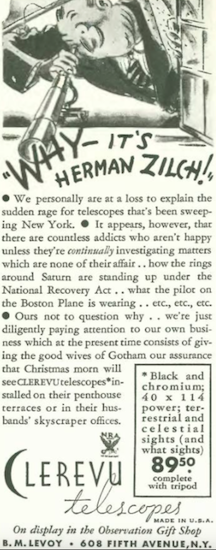
…while the folks at Clerevu telescopes found a growing market for folks who used their product for anything but stargazing…
…with Repeal just days away, the Pleasant Valley Wine Company of New York hoped folks would pop a few of their corks before the good stuff arrived from France…
…the British were coming to the rescue via the Berry Brothers, who were overseeing the importation of liquor from their offices at Rockefeller Center’s British Empire Building…
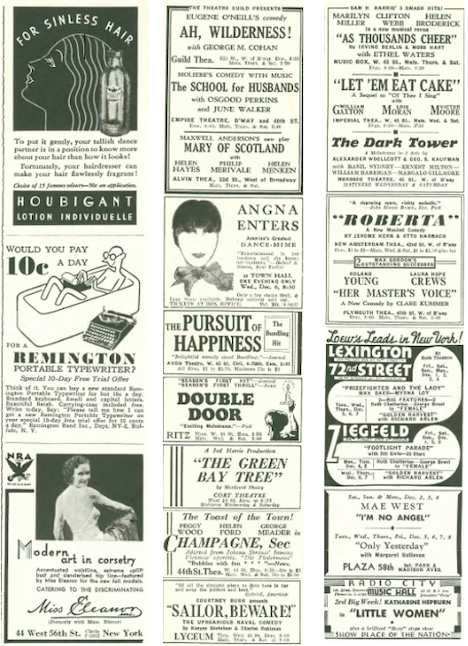
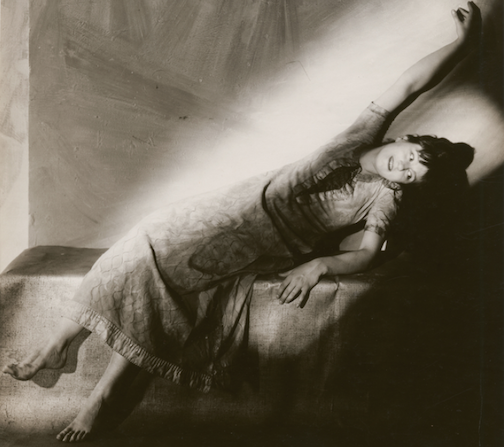
…let’s look at an assortment of one-column ads…the center strip features an ad promoting Angna Enters’ appearance for “one evening only” at The Town Hall (123 West 43rd Street)…Enters (1897–1989) was an American dancer, mime, painter and writer who likely performed her piece Moyen Age…
FEEL THAT STRETCH…Angna Enters performing Moyen Age, circa early 1930s. (NYPL)
…we begin our cartoons with Gardner Rea, and a dedicated bell ringer…
…Otto Soglow showed us a softer side of The Little King…
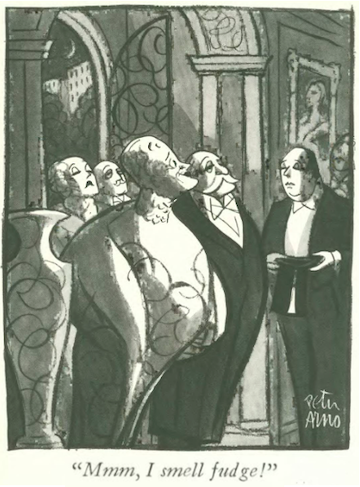
…Peter Arno revealed the human side of the posh set…
…and we close the Dec. 2 issue with this classic from James Thurber…
…on to Dec. 9, 1933, and a cover by an artist we haven’t seen in awhile, Ilonka Karasz…
Dec. 9, 1933 cover by Ilonka Karasz.
…and we open with this comment by E.B. White, who along with critic Lewis Mumford had once voiced displeasure over the massive Rockefeller Center project. However, while viewing the floodlit tower by night, he decided that he would have to eat his words, observing how “the whole thing swims up tremendously into the blue roxyspheres of the sky”…
MEA CULPA…E.B. White gained a new perspective on Rockefeller Center, pictured here in December 1933. (Wikipedia)
…we continue with White, who also offered his thoughts on something heretofore unthinkable—a proposal to start putting beer in cans…
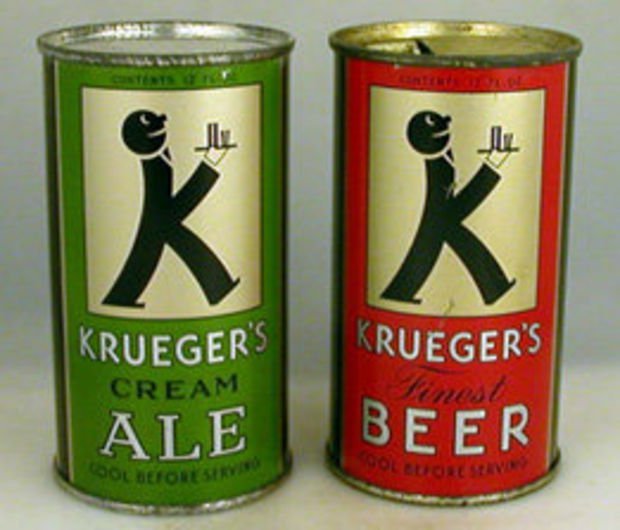
…it would happen about a year later…on Jan. 24, 1935, the Gottfried Krueger Brewing Company, in partnership with the American Can Company, delivered 2,000 cans of Krueger’s Finest Beer and Krueger’s Cream Ale to drinkers in Richmond, Virginia…
(seletyn.com)
…and despite White’s doubts, apparently ninety-one percent of the first drinkers of the product approved of the canned beer, although when Krueger’s launched their ad blitz they had to include instructions (and a new tool) to open the darn things…
(seletyn.com)
* * *
Dreamscapes
Critic Lewis Mumford offered his thoughts on a recent exhibit by a young surrealist named Salvador Dali…
MIDDLEBROW SURREALIST…The Triangular Hour by Salvador Dali, 1933. (wikiart.org)
…and we move along to moving pictures, where John Mosher was showing some appreciation for Joan Crawford (1906–1977) in the pre-Code film Dancing Lady…
SHE HAD IT ALL…Audiences and critics alike were wowed by Joan Crawford’s performance in Dancing Lady, which featured a star-studded and eclectic cast. Clockwise from top left, Clark Gable plays a Broadway director who becomes Crawford’s love interest; Crawford displays her dancing talent in a Broadway rehearsal; Dancing Lady featured an early film appearance by The Three Stooges, pictured here with Gable and the Stooges’ leader at the time, Ted Healy; Crawford with Stooge Larry Fine—in the original film, Fine completes his jigsaw puzzle only to discover (to his disgust) that it’s a picture of Adolf Hitler. The Hitler scene was removed by the Production Code; its enforcers claimed it insulted a foreign head of state. (IMDB)
In addition to Crawford, the star-studded cast included Clark Gable, Fred Astaire (in his film debut), Franchot Tone (who was married to Crawford from 1935-39 and made seven movies with her), The Three Stooges, Nelson Eddy, and Robert Benchley, who played a reporter in the film.
Dancing Lady was the film debut of Astaire, making Crawford the first on-screen dance partner of the famed hoofer…
(IMDB)
* * *
More From Our Advertisers
We begin with this full-page advertisement from Heinz, which went to great lengths and expense to make their ad appear to part of The New Yorker’s editorial content, even featuring a Perry Barlow cartoon of a boy making a mess with their product…
…another New Yorker contributor who occasionally went over to the advertising side was Alexander Woollcott, here shilling for Chrysler…
…Kayser, purveyor of women’s hosiery and underthings, was going for some humorous holiday cheer, but the effect is a bit unsettling…
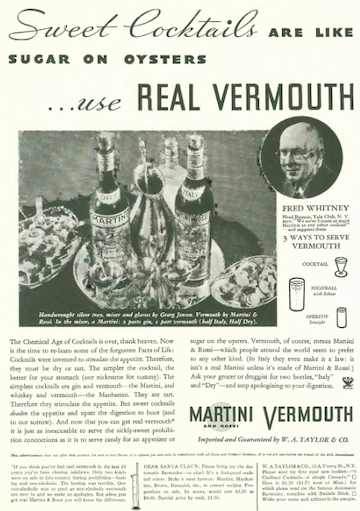
…liquor-related ads began to proliferate with the end of the Prohibition…this one from Martini & Rossi…
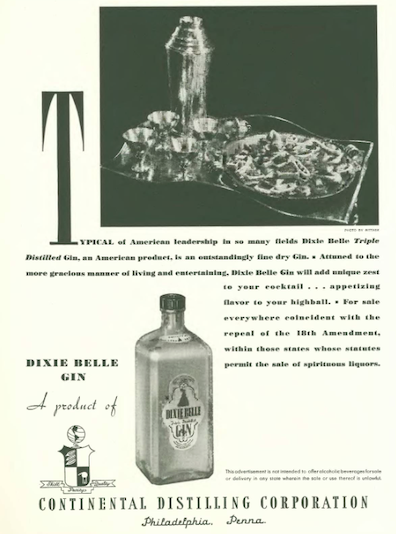
…Continental Distilling was hoping to grab its share of gin sales with its Dixie Belle American gin…
…from the same folks who brought us Fleishmann’s yeast (and kept The New Yorker afloat in its early lean years) came this American dry gin…
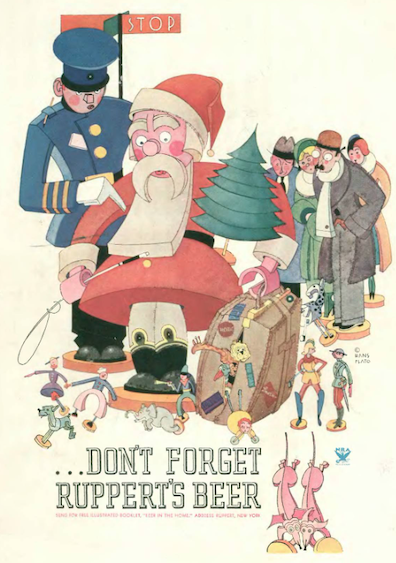
…Ruppert’s Beer was back with another full-page color ad by Hans Flato…
…on to our cartoons, and Santa again, this time besieged by an aggressive tot as rendered by Helen Hokinson…
…Carl Rose found an unlikely customer at a newsstand…
…here is the last of four cartoons Walter Schmidt published in the New Yorker between 1931 and 1933…
…Peter Arno left his glamorous world of nightclubs and high society parties to look in on life at a boarding house…
…and we close with the delightful Barbara Shermund…
There’s a good reason why Americans celebrate National Beer Day on April 7.
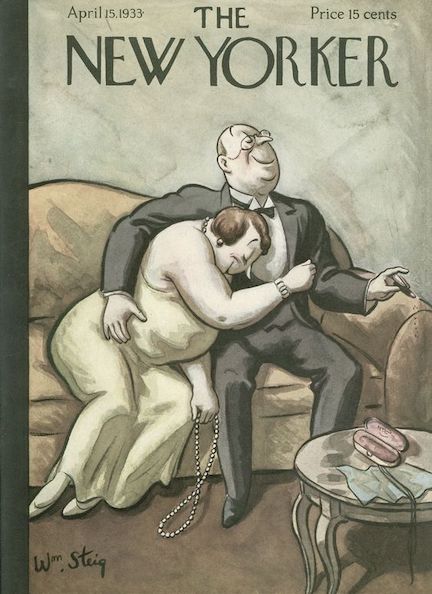
April 15, 1933 cover by William Steig.
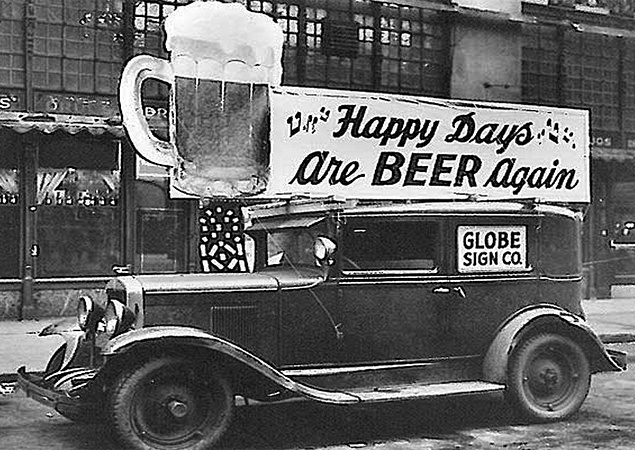
It was on that day in 1933 that the Cullen-Harrison Act went into effect; after nearly 13 years of Prohibition, folks were allowed to buy and drink low-alcohol content beer. The act not only promised to wet their whistles on the hot summer days ahead, but it also signaled the eventual doom of 18th Amendment. E.B. White opened his column with musings on the Easter holiday, but soon turned his attention to the big news of the day.
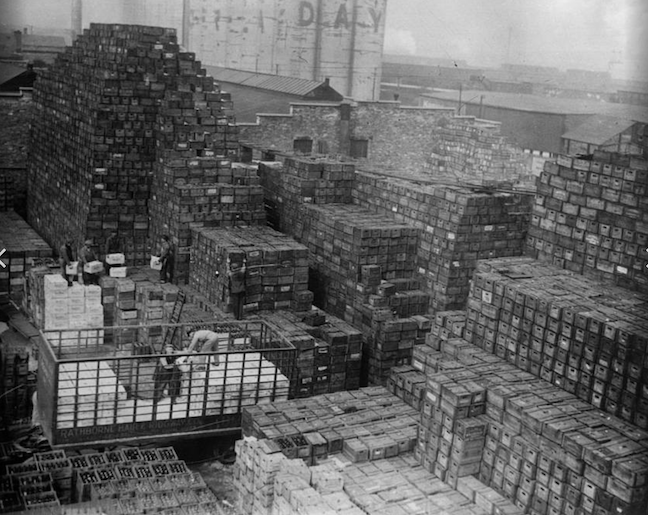
THINK THIS WILL BE ENOUGH?…Workers at a New York brewery unload thousands of crates of beer, getting ready for the return of legal beer in April 1933. (allthatsinteresting.com)
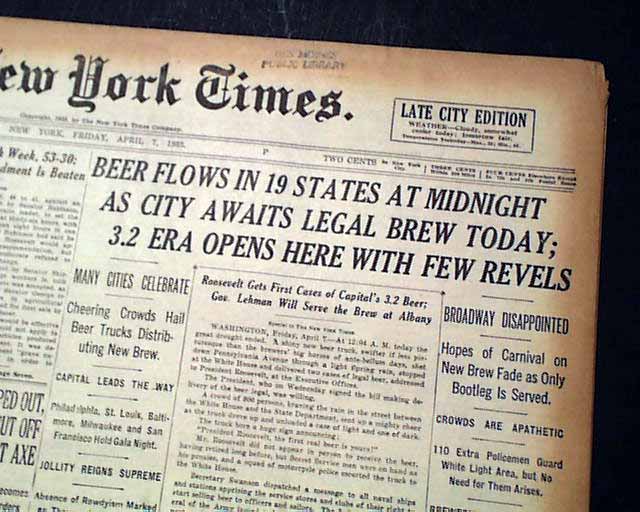
FRONT PAGE NEWS…The New York Times proclaimed the return of legal beer in this April 7, 1933 edition.
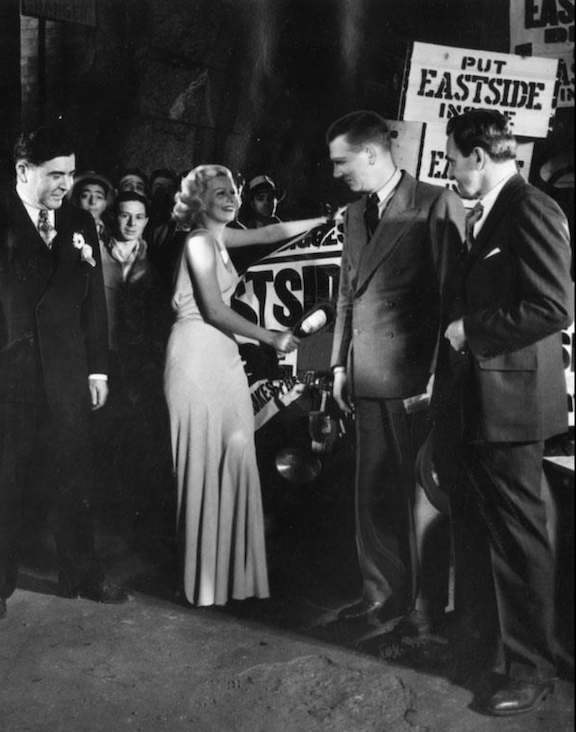
BLONDE’S BOMBSHELL…While on the other side of the Lower 48, actress Jean Harlow christened the first legal bottle of beer at midnight in Los Angeles, April 6, 1933. (Los Angeles Public Library)
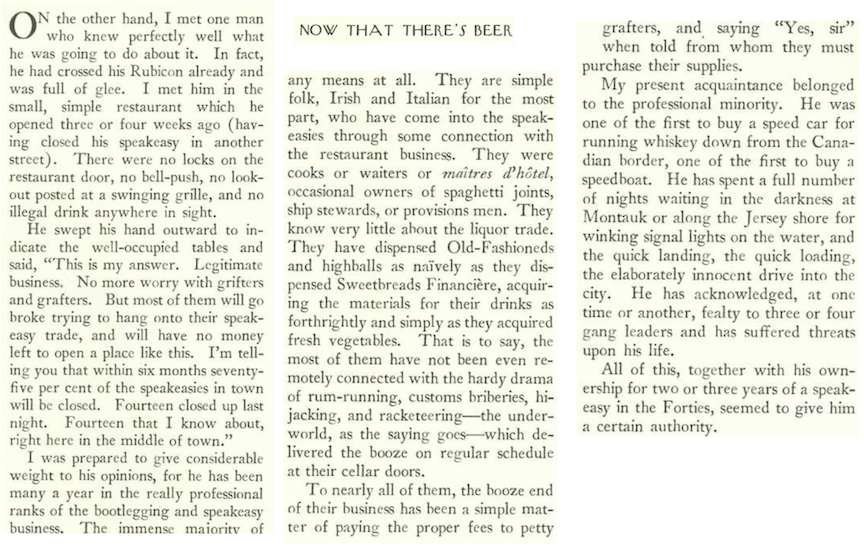
In his “A Reporter at Large column,” Morris Markey looked in on a former speakeasy owner who was more than happy to go legit, and who also predicted the demise of his fellows who still lingered in the underground liquor trade. An excerpt from “Now That There’s Beer”…
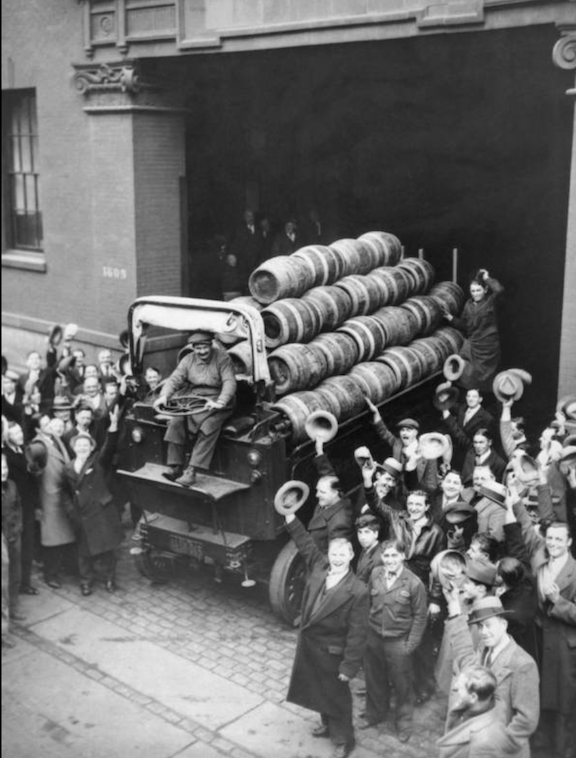
CHEERS!…The first truckload of beer to leave New York exits the Jacob Ruppert Brewery in New York in 1933. (allthatsinteresting.com)
The subject of Markey’s column explained why speakeasies would soon be a thing of the past. Markey also observed that theatre owners would soon feel the pinch as folks would forgo movies for summer evenings at a beer garden.
* * *
No Laughing Matter
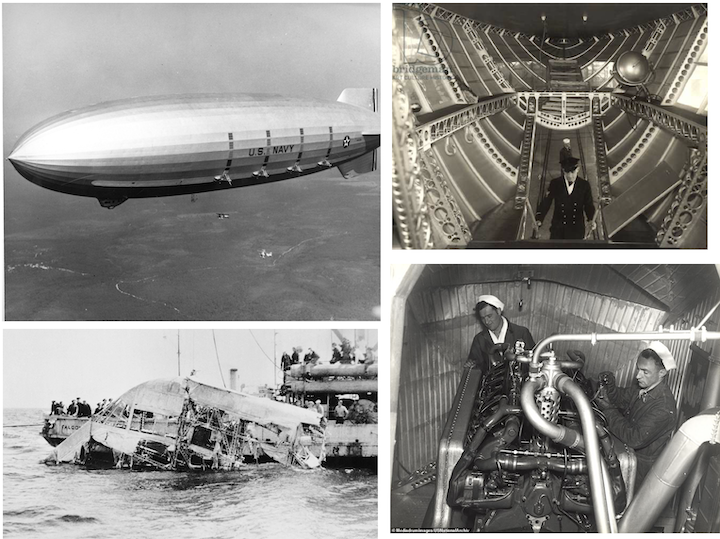
Writers and editors at The New Yorker did their best to keep things as light and witty as possible, but sometimes the headlines could not be ignored, and tragedy was acknowledged, albeit briefly. “The Talk of the Town” had this to say about history’s deadliest airship disaster:
NATURE’S FURY…The U.S. Navy’s 785-foot dirigible, the USS Akron, plunged into the Atlantic Ocean during a violent storm shortly after midnight on April 4, 1933, claiming the lives of 73 crewmen. Clockwise, from top left, the Akron on a routine flight; men in a rear control car; servicemen in the dirigible’s engine room; April 23, 1933 photo of wreckage recovered off the coast of New Jersey. Because the ship had no life vests and one rubber raft, only three crew members survived the disaster, which heralded the end the Navy’s dirigible fleet. (howstuffworks.com/AP/Daily Mail)
In his “Of All Things” column, Howard Brubaker had this to add:
* * *
Alex at the Movies
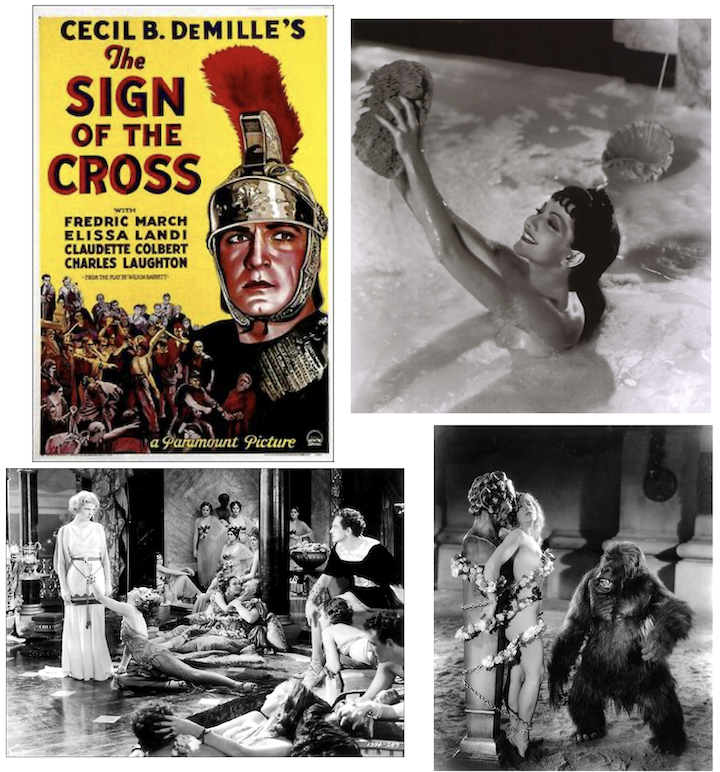
It wasn’t every day you got to read a movie review by Alexander Woollcott, but he did just that in the opening lines of his “Shouts and Murmurs” column, calling Cecil B. DeMille’sThe Sign of the Cross an “unpleasing mess drooled on to the brobdingnagian bib” of the director.
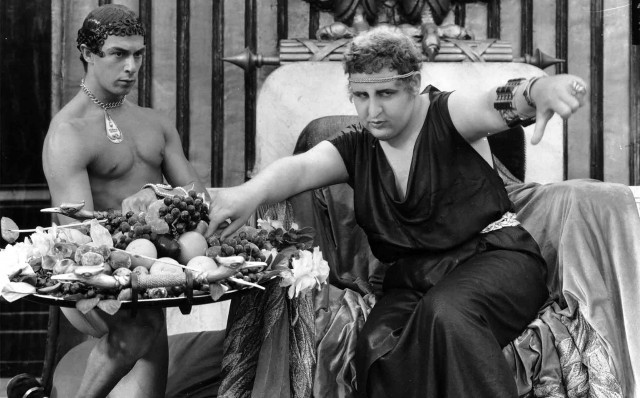
Woollcott, who doubtless related to Nero’s bacchanalian ways, singled out Charles Laughton’s campy performance as the Roman emperor.
ANIMAL HOUSE…Charles Laughton camped it up as the Emperor Nero in Cecil B. DeMille’sThe Sign of the Cross. (IMD
Besides Laughton’s performance, the pre-Code film is perhaps best known for Claudette Colbert’s revealing milk bath scene, which took several days to shoot—the powdered cow’s milk eventually turned sour, making it a very unpleasant experience for all involved.
IT STINKS…that was Alexander Woollcott’s assessment of The Sign of the Cross. Clockwise, from top left, studio poster for the film; Claudette Colbert’s famous bath scene; an actress portraying a Christian being thrown to the lions (as well as crocodiles and gorillas) was the famed burlesque dancer Sally Rand, who left little to the imagination in her uncredited appearance; an orgy scene. Although Paramount marketed the film to churches, it was attacked by the Catholic Legion of Decency: a re-release of the film was censored after the Hays Code went into effect in 1934—a “lesbian dance,” violent gladiator scenes and sequences with naked women being attacked by crocodiles were cut and wouldn’t be restored until a 1993 video release. (Wikipedia/IMDB)
As for film critic John Mosher, the remaining Hollywood fare was even worse—like The Sign of the Cross, these pictures used faith-based themes, a seemingly new trend in Hollywood scenarios, to poor effect.
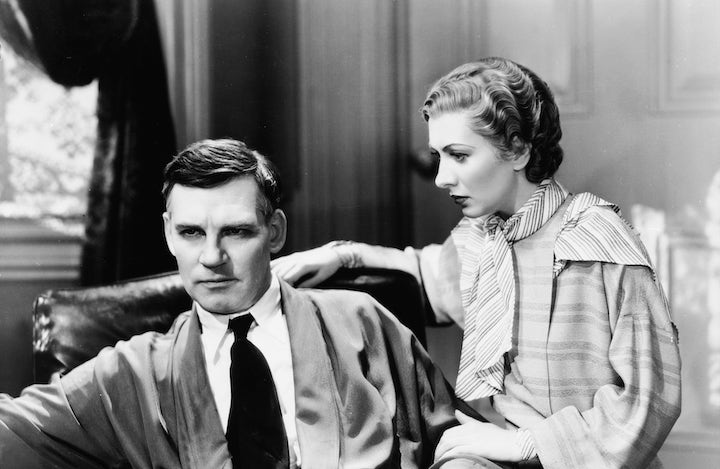
Gabriel Over the White House starred Walter Huston as a politically corrupt president who, after a near-fatal car accident, comes under the divine power of the Archangel Gabriel and the spirit of Abraham Lincoln…
I SEE DEAD PEOPLE…Walter Huston and Karen Morley in Gabriel Over the White House. (TCM)
…the pre-Code drama Destination Unknown also summoned supernatural forces to tell the tale of a stranded ship saved by a stowaway who turns wine into water and heals a crippled man.
NEEDING A MIRACLE…Pat O’Brien and Betty Compson in Destination Unknown. (IMDB)
* * *
From Our Advertisers
Considering that Adolf Hitler gave Nazi paramilitary units control of German streets in January 1933, the words “Appeasing refuge” don’t readily come to mind…
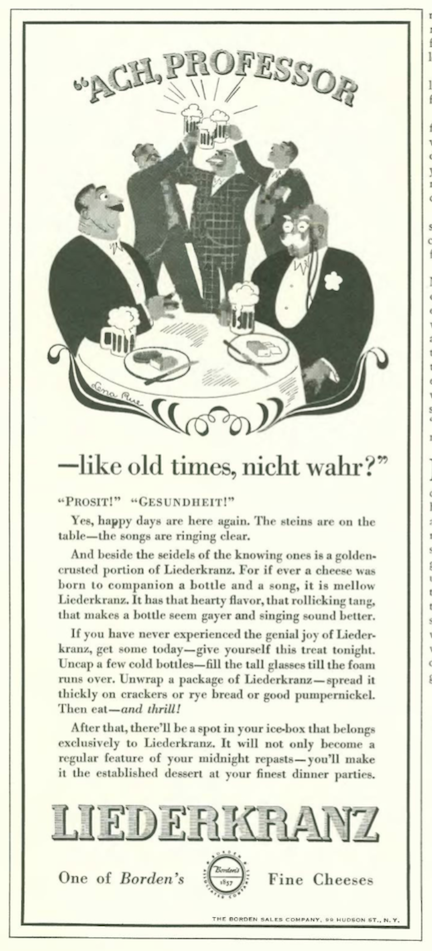
…if you liked all things German but wanted to avoid getting a jackboot to the groin, you could remain stateside, drink some 3.2 beer, and chew on some Liederkranz…
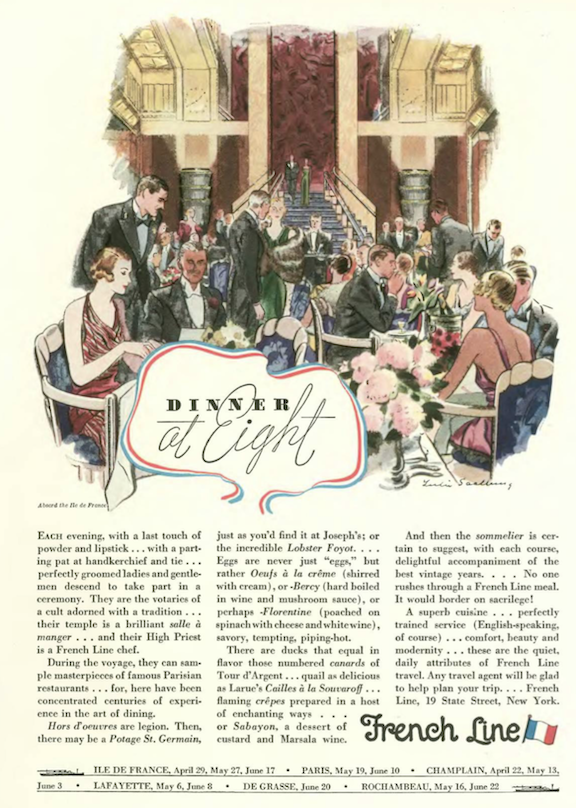
…actually this looks more preferable, especially as rendered by fashion illustrator Leslie Saalburg…
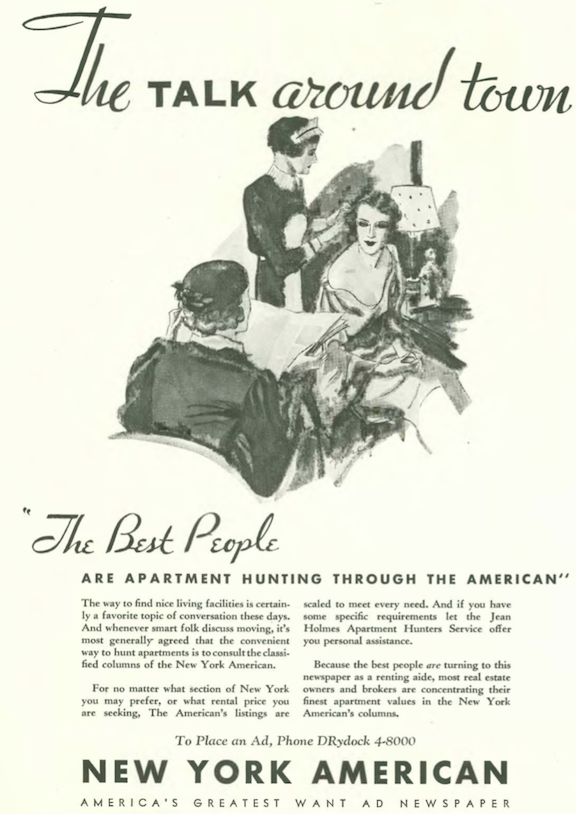
…before Zillow or Craigslist you could look for some digs in the New York American, which merged with the New York Journal in 1937…
…the makers of leaded gasoline urged on a stereotypical country doctor, even though the stork seemed to have things under control…
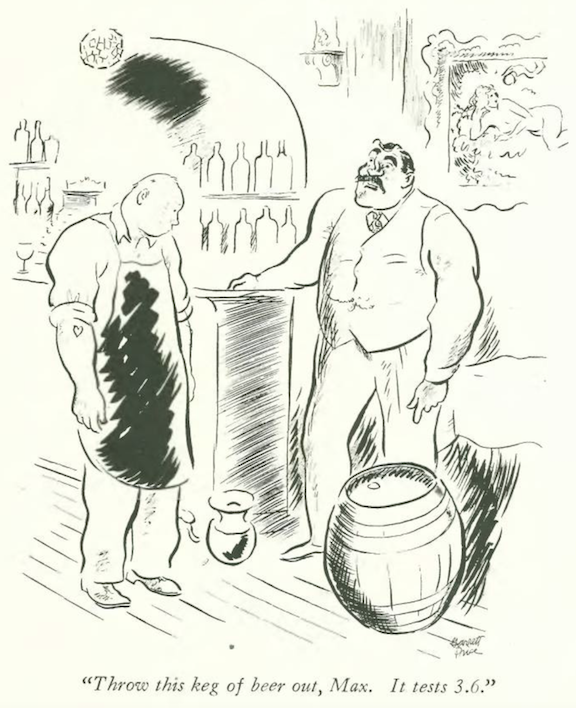
…on to our cartoonists, Garrett Price illustrated the limits of legal beer…
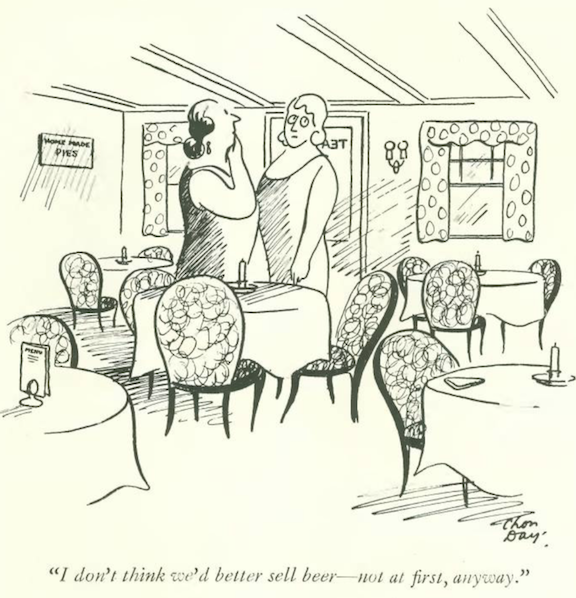
…while Chon Day explored the same problem at this tea room…
…here’s a trio of The New Yorker’s early women cartoonists…Barbara Shermund…
…Mary Petty…
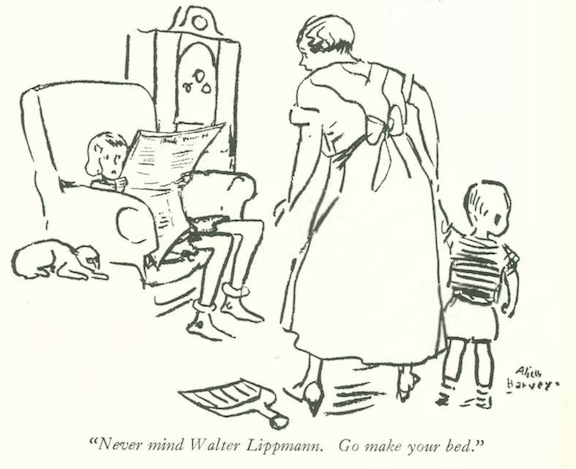
…and Alice Harvey…
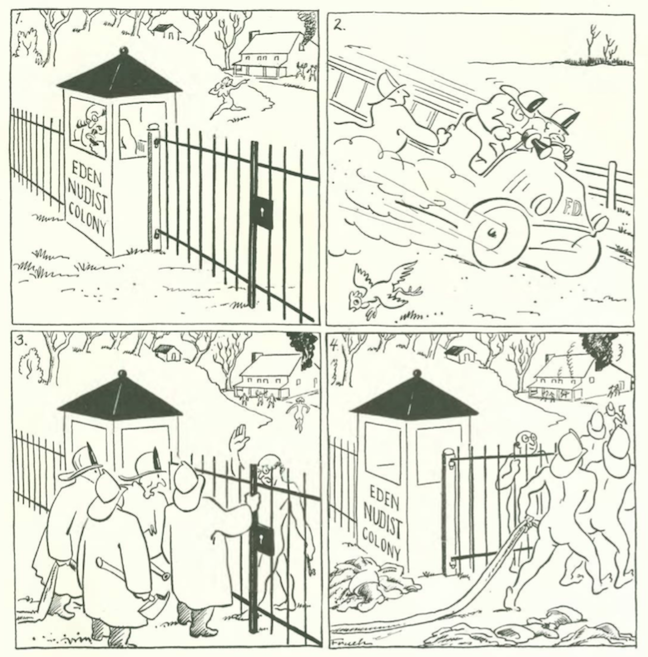
…and we close with Al Frueh, and some brave firefighters…












































































































 A New Yorker State of Mind