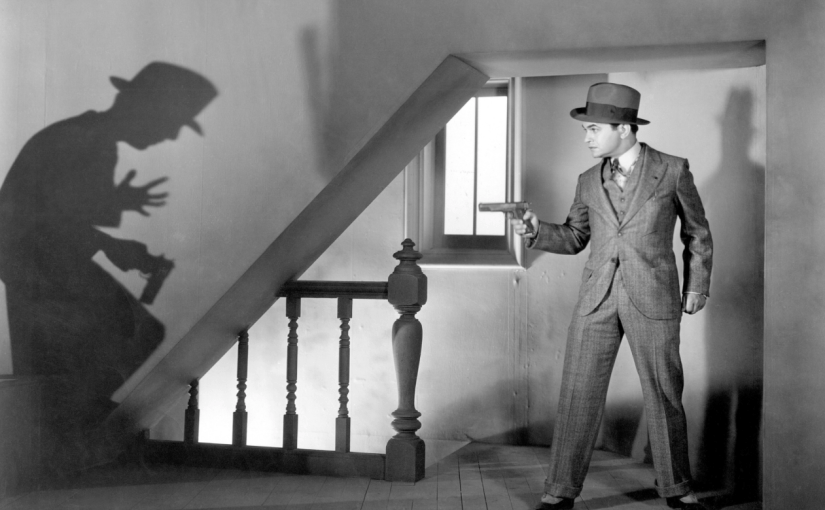
During the early years of the Depression and before censorship guidelines were imposed by the Hays Code, Hollywood cranked out a slew of “Pre-Code” films filled with sex and violence, including 1931’s Little Caesar, the first “talkie” gangster film that defined the genre for decades to come.
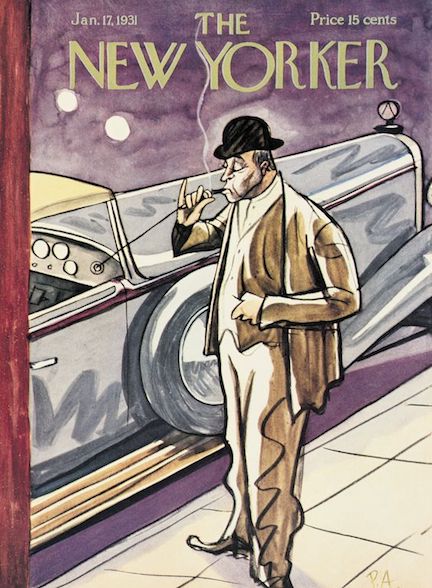
Jan. 17, 1931 cover by Peter Arno.
It also propelled the career of Edward G. Robinson (1893-1973), who portrayed “Little Caesar” Rico Bandello—it was a breakout role for the actor, leading to a 50-year career of playing tough guys among other roles. Although the film today is considered a classic and well-regarded by critics, The New Yorker’sJohn Mosher was not entirely bowled over; he did, however, see the talent potential of the 33-year-old Robinson:
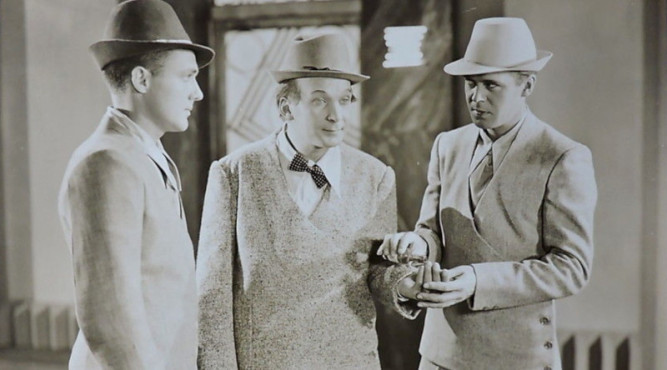
OUCH…Clockwise, from top left, Rico Bandello (Edward G. Robinson) catches some lead from a rival gangster in Little Caesar; Rico has little patience for his partner Joe (Douglas Fairbanks Jr.) and his love interest Olga (Glenda Farrell); Rico and his boys doing a little banking business; Rico up to no good with his sidekick Otero (George E. Stone). (Britannica/moviestillsdb.com/MoMA/IMDB)
Mervyn LeRoy’sLittle Caesar would kick off a series of Warner Brothers gangster films that would help launch the careers of other actors including James Cagney (The Public Enemy, Angels With Dirty Faces) and Humphrey Bogart (The Petrified Forest). Here’s Warner’s trailer for Little Caesar:
* * *
You Dirty Rat
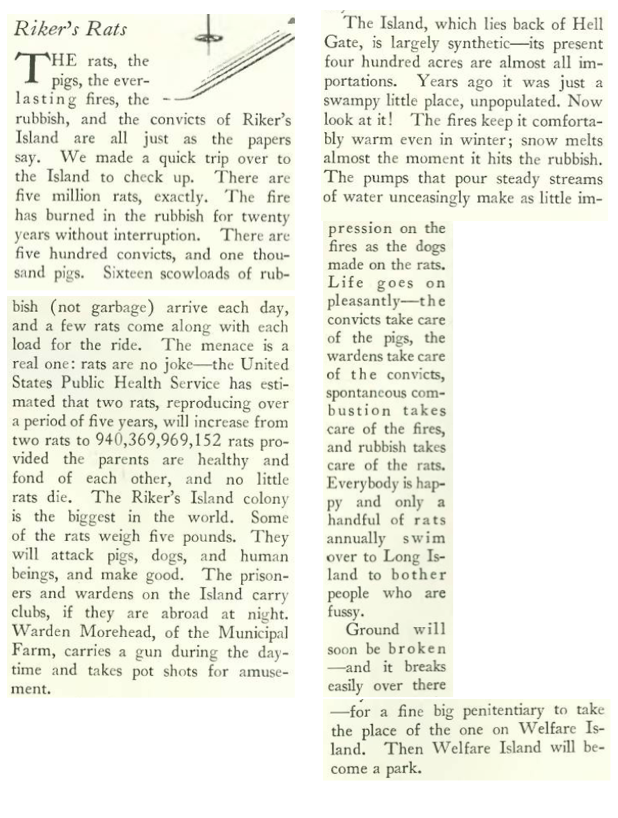
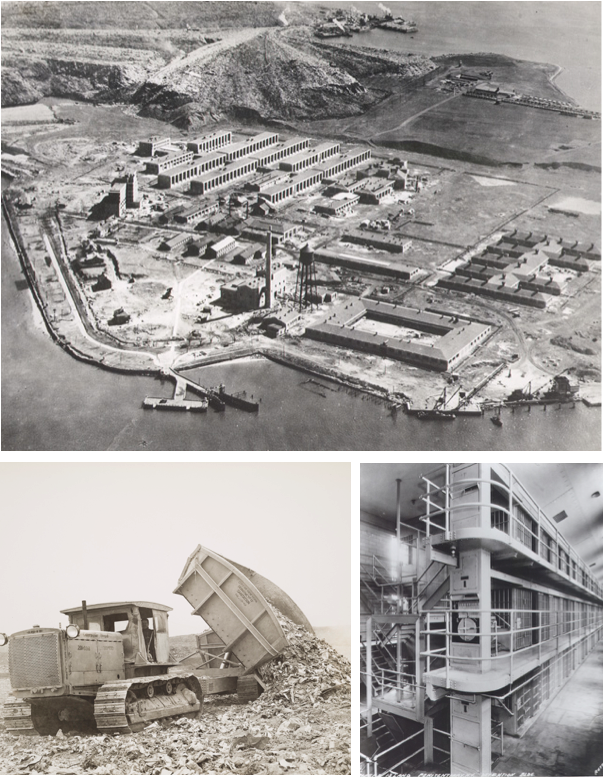
The Jan. 17 “Talk of the Town” looked in on the growing rat infestation at Riker’s Island, a swampy little island that expanded more than four times its original size thanks to the mountains of garbage dumped there in the early 20th century. Much of it was coal ash, which caused the spontaneous fires referred to in the following “Talk” article. Of course the garbage also attracted legions of rats, which officials tried to counter by releasing vicious dogs and pigs on the island. It only seems fitting that such a place would become home to one of America’s most hellish prisons:
RAT TRAP…Clockwise, from top, aerial view of the Riker’s Island Penitentiary, which opened in 1932. Mountains of garbage, some 130 feet high, are visible in the background. The garbage heaps were prone to spontaneous combustion. In 1934 a prison warden described his nighttime view as a “whole hillside lit up with little fires. … It was beautiful”; view of a cellblock; adding to the mountain of garbage in 1937. (correction history.org)
* * *
Sign of the Times
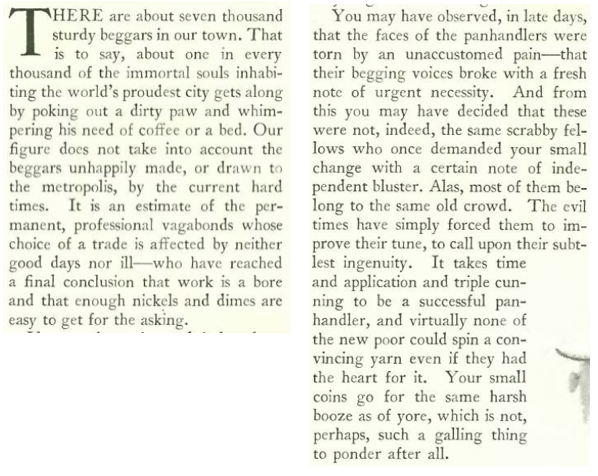
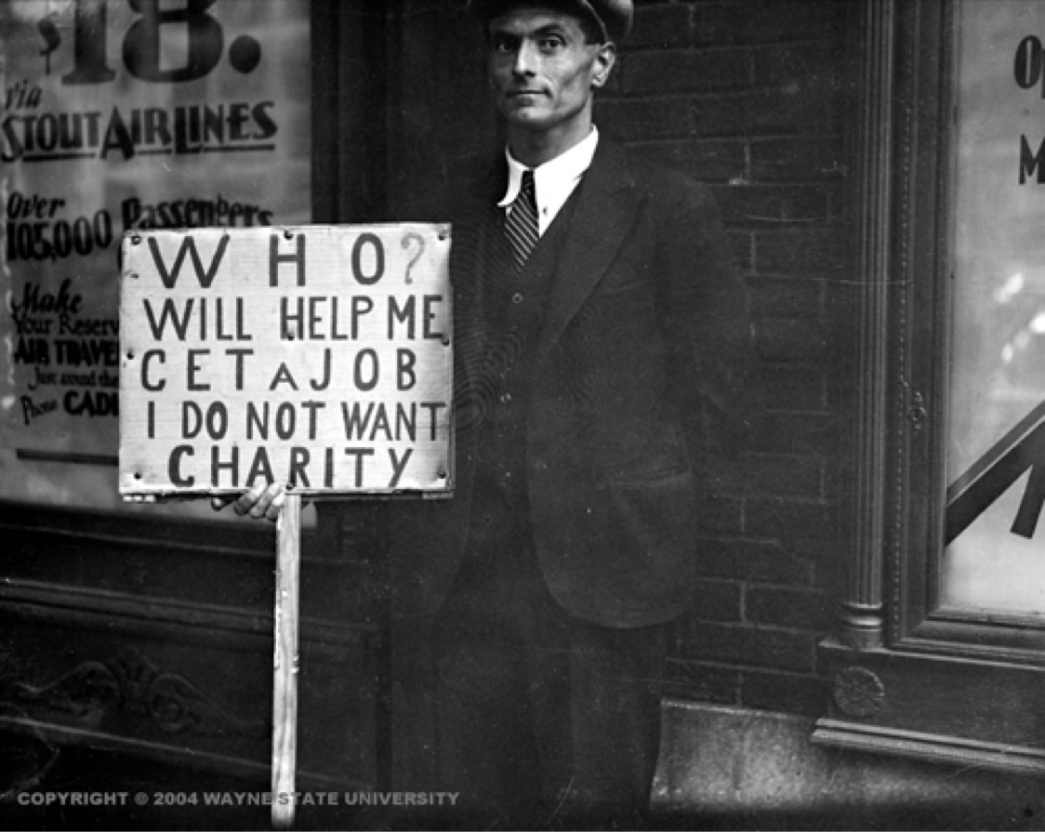
No doubt some of the folks who ended up at Riker’s were desperate souls who were reduced to begging on the streets of Manhattan. Morris Markey, in his “A Reporter at Large” column, looked in on some of the city’s “Vagabonds,” noting that the Depression had added some new faces among the panhandlers, faces “torn by an unaccustomed pain.” An excerpt:
HARD TIMES…An unemployed man seeks work in the 1930s. (Wayne State University)
* * *
Grim for the Reaper
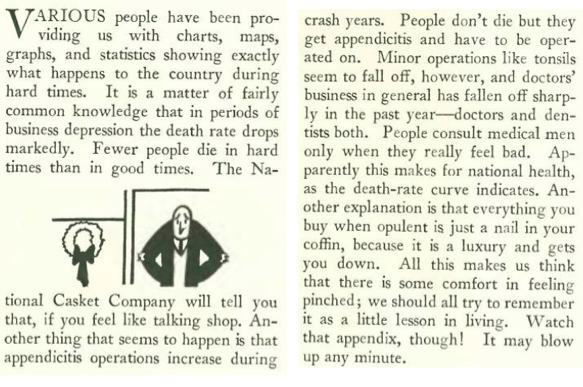
The Depression, it seems, was even hard on the nation’s undertakers, according to E.B. White in “Notes and Comment”…
NEED A LIFT?…A hearse and undertaker in 1930. Business was surprisingly slow in hard times. (my101years.com)
* * *
Work is Fun When You Don’t Need It
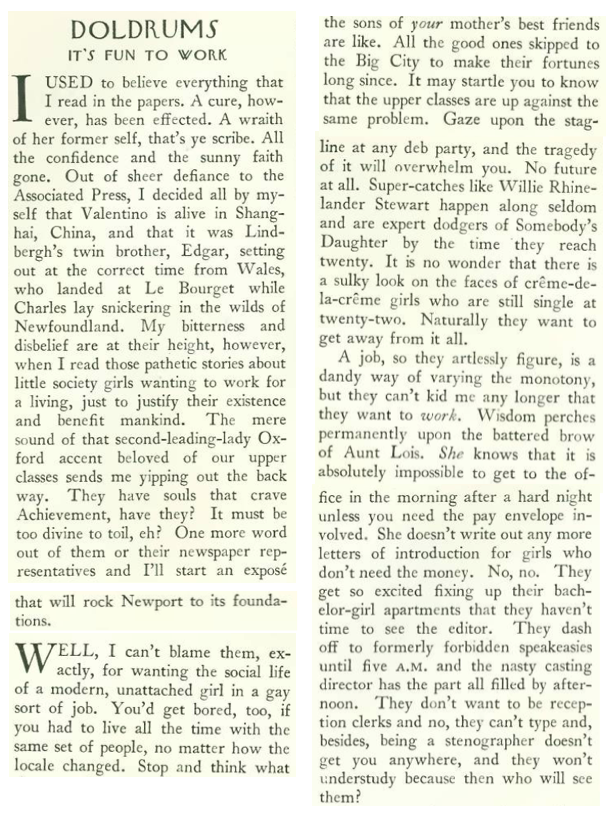
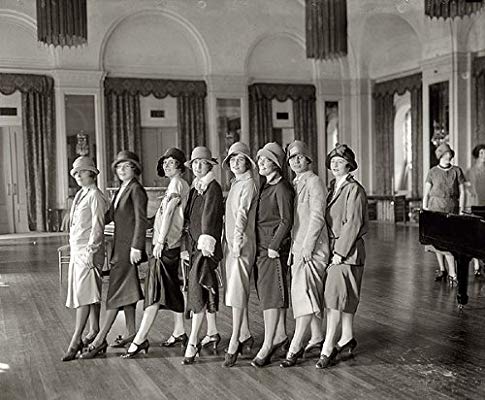
Lois Long filed another installment in her “Doldrums” series, in which she commented on the desires of the city’s debutantes to find some purpose in life…
PUTTING THEIR BEST FEET FORWARD…Debutantes pose in Washington, D.C., circa 1930. (Pinterest)
* * *
Pablo Who?
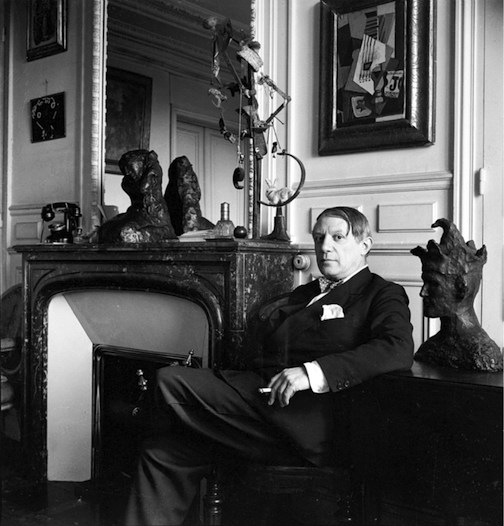
New York’s Valentine Gallery was offering a showing of works by Pablo Picasso, who was famous enough to create as he wished, but not quite ready for canonical consideration…
I’LL DO AS I PLEASE…Pablo Picasso in 1931, in a portrait by Cecil Beaton. (oscarenfotos.com)
* * *
Order Restored
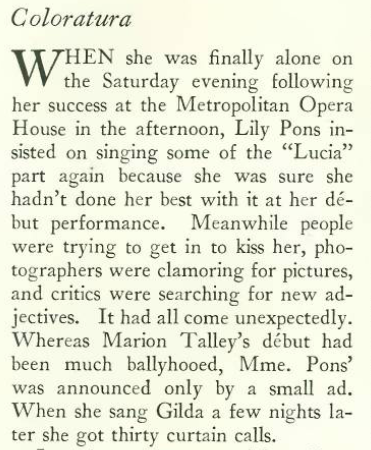
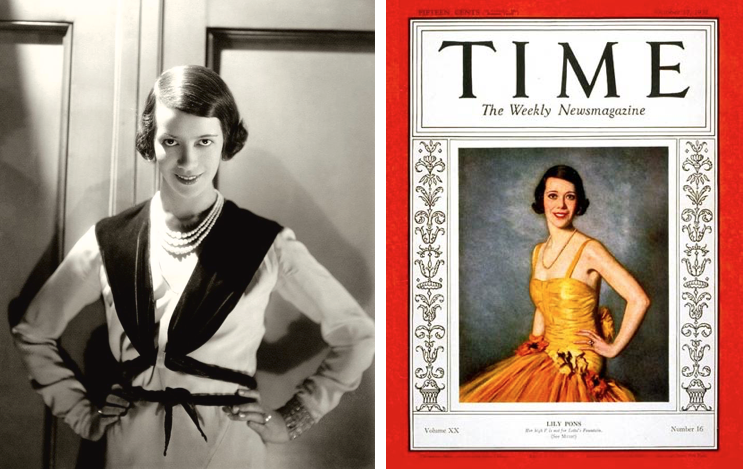
After its Marion Talley debacle, the Metropolitan Opera stage welcomed French soprano Lily Pons (1898-1976) to its stage. “The Talk of Town” noted that although Pons’ debut was far less hyped than Talley’s, her reception by New York audiences was far more enthusiastic. While Talley’s career would sputter and fade, Pons would enjoy a long association with the Metropolitan Opera, where she performed nearly 300 times between 1931 and 1960.
A BREATH OF FRESH AIR…One of the most popular prima donnas of her time, French soprano Lily Pons would grace the Metropolitan Opera stage for 30 years. From right, a 1931 portrait of Pons by Cecil Beaton; on the cover of Time, Oct. 17, 1932. (CondeNast/Time)
* * *
From Our Advertisers
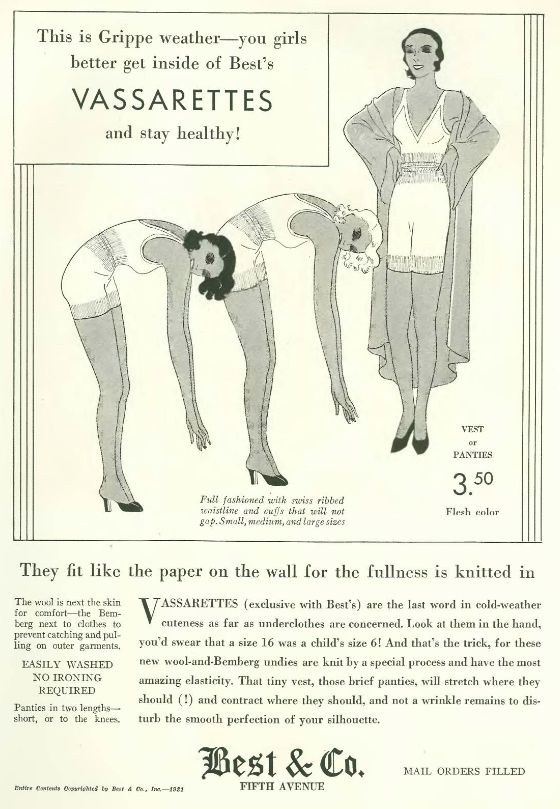
Best & Company looked out for the welfare of New York’s young women by offering a selection of wool “Vassarettes” to stave off the “Grippe” weather…
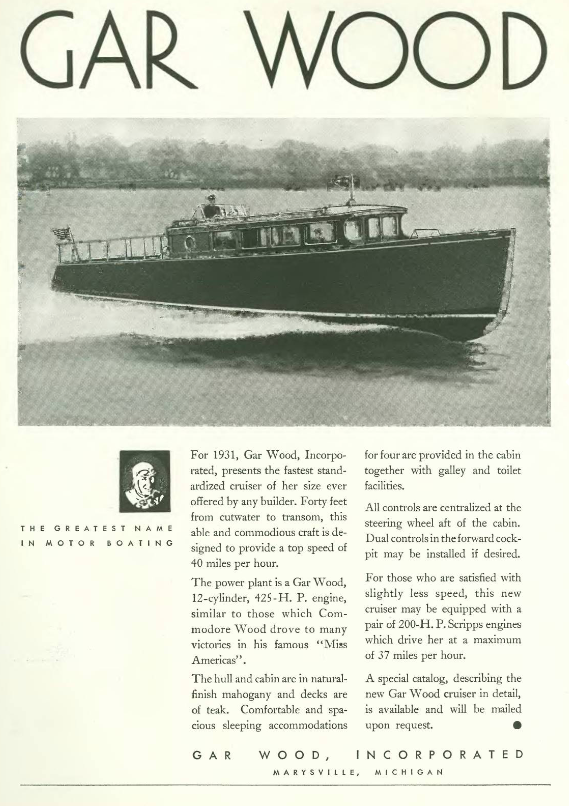
…with the annual Motor Boat Show at the Grand National Palace, several ads called readers’ attention to expensive toys fewer and fewer could afford to own…
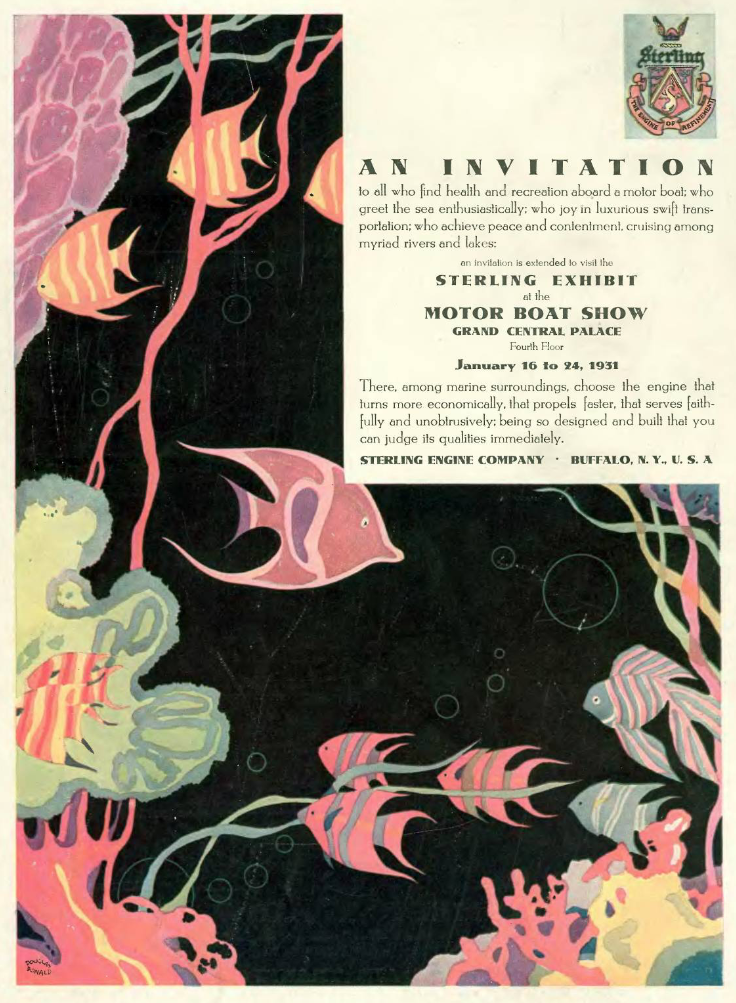
…the makers of Sterling boat motors shelled out the big bucks for this full-color, back-page ad…overall, the number of boat ads were down from previous years…
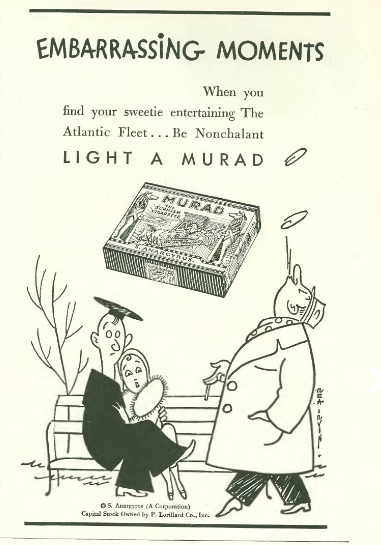
…Rea Irvin continued to pick up some extra income with an ongoing series of cartoons promoting Murad cigarettes…
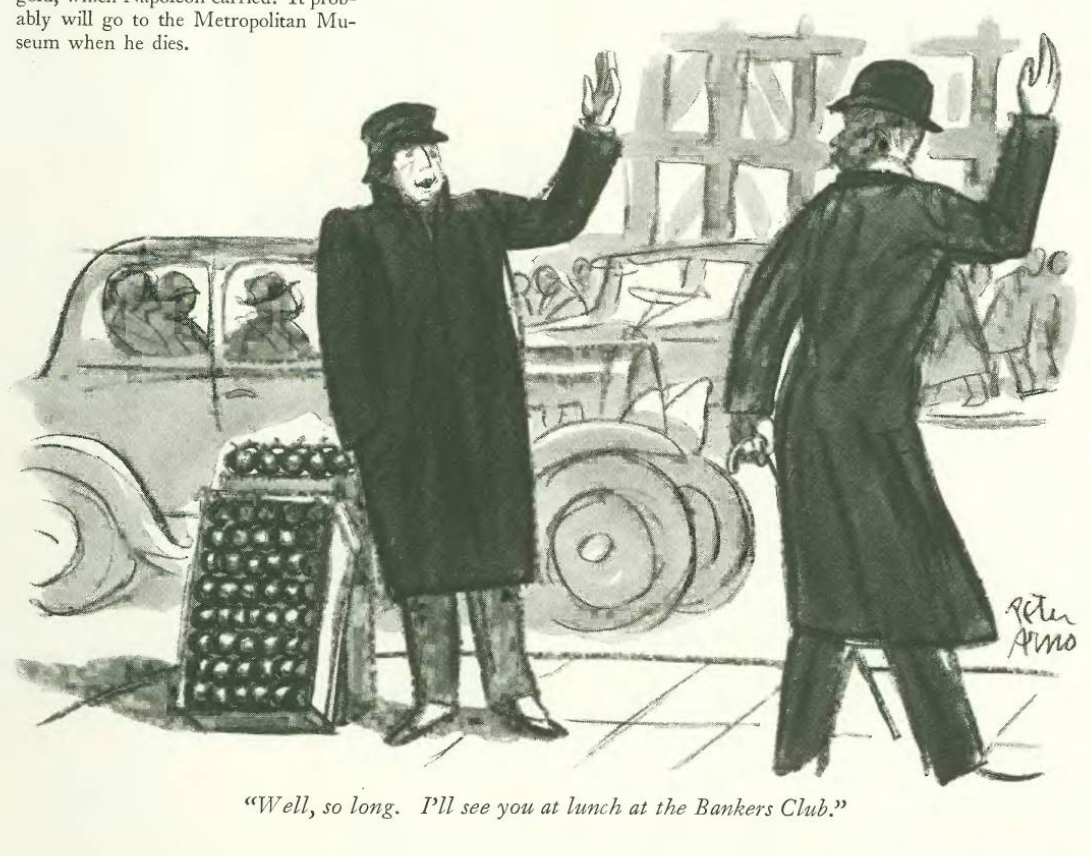
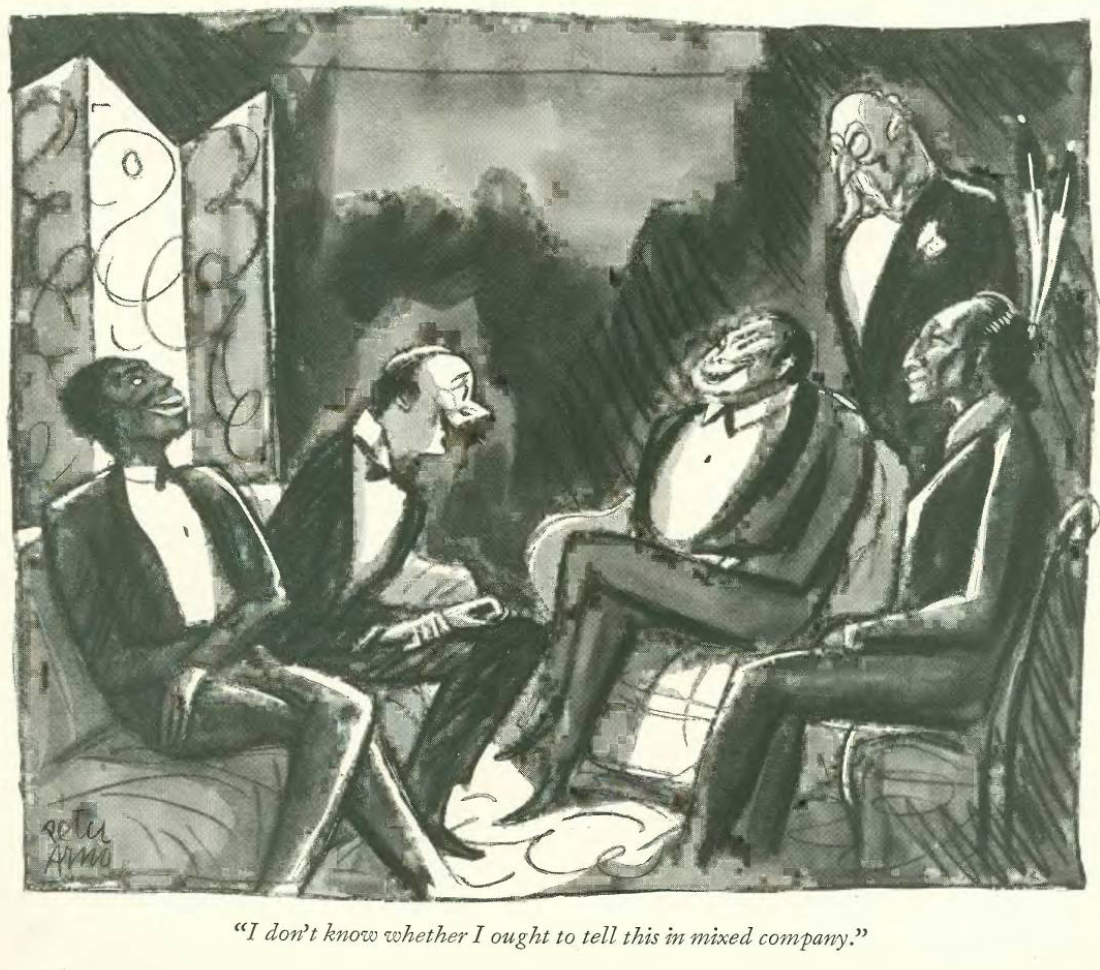
…on to Irvin’s fellow cartoonists, we have Peter Arno’s look at the new economy…
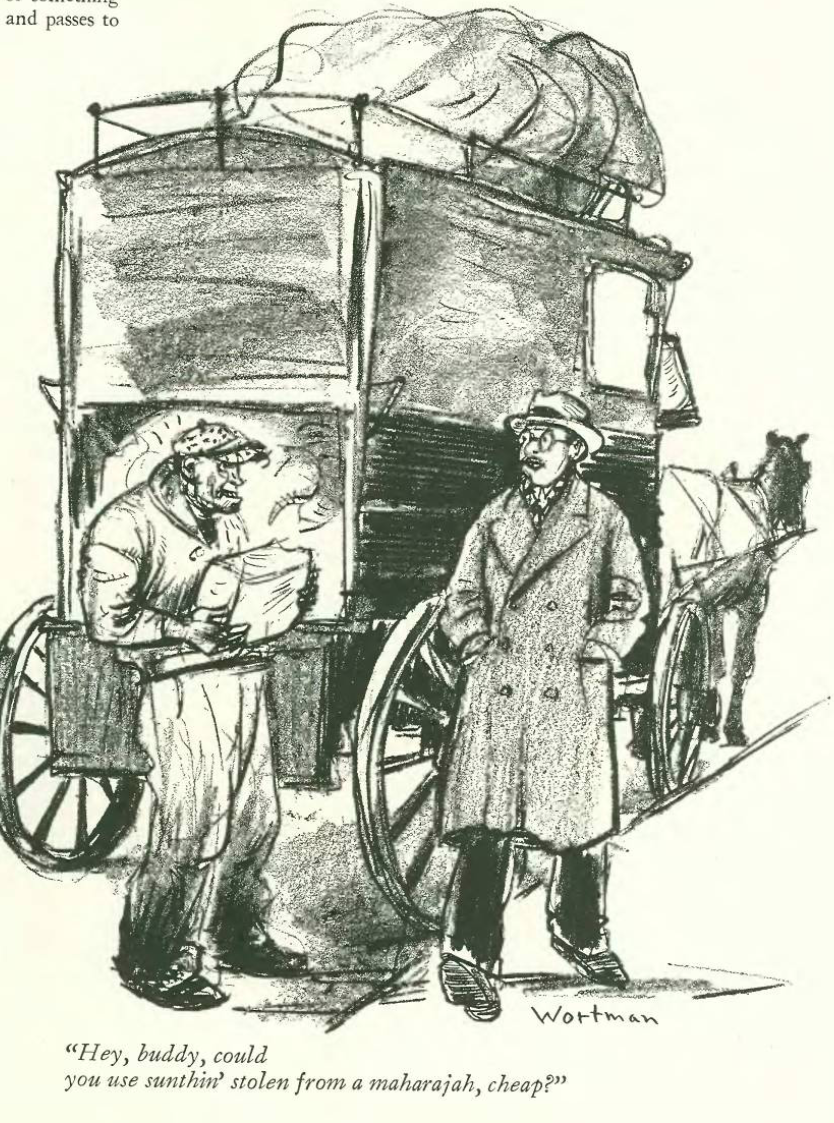
…likewise Denys Wortman…
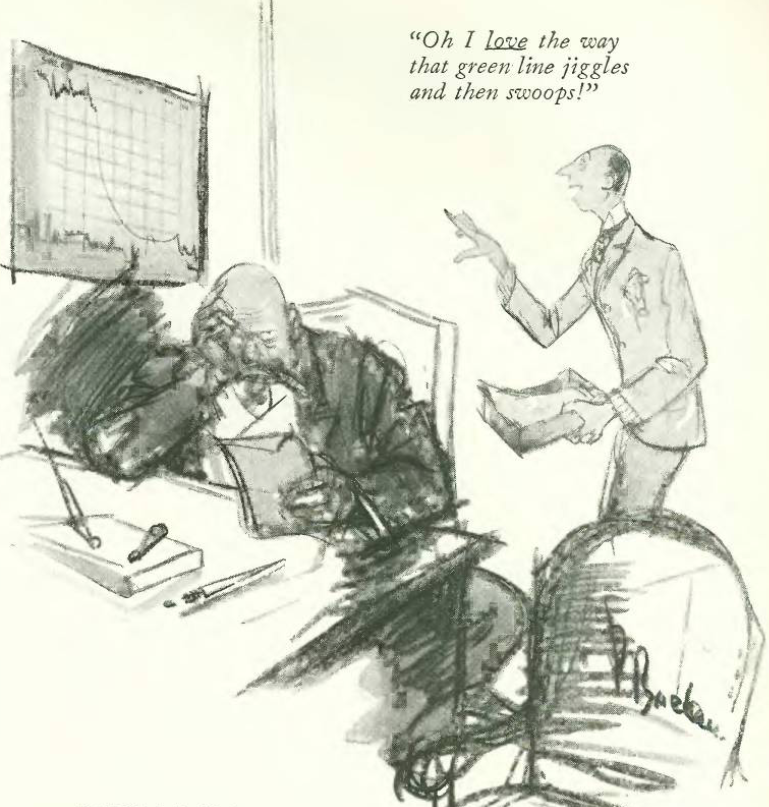
…and Perry Barlow…
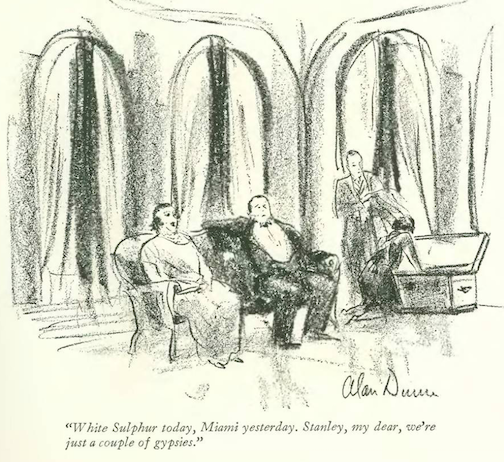
…while Alan Dunn checked in on the challenges of those who still had means…
…Barbara Shermund was still the life of the party…
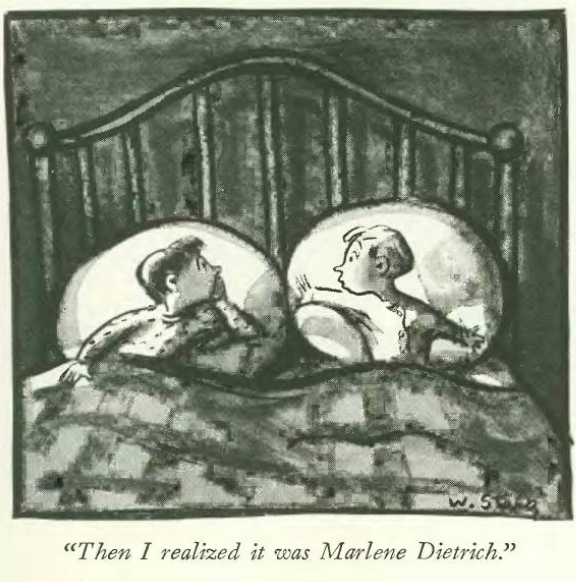
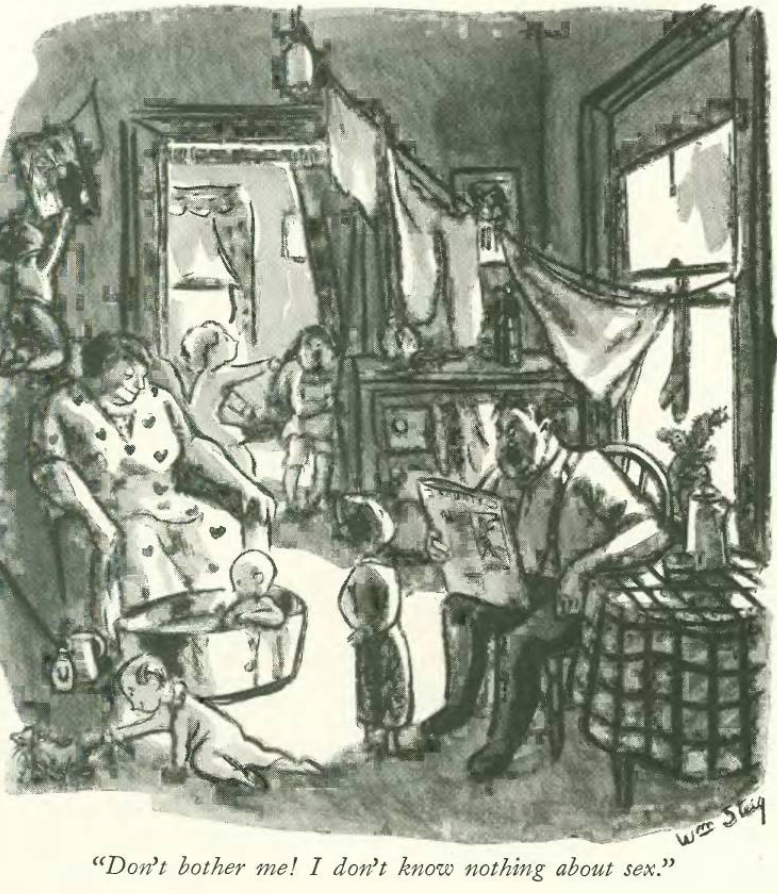
…and William Steig was beginning to establish himself in the stable of cartoon regulars (and offer a preview of his famed “Small Fry”)…
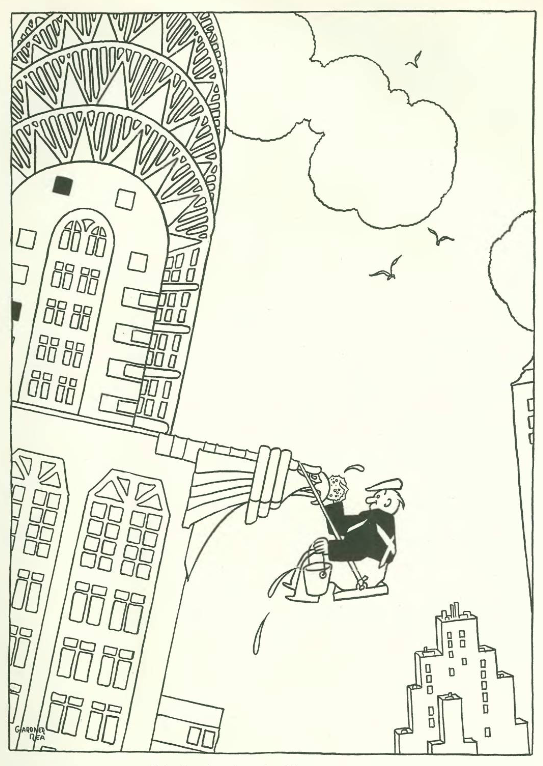
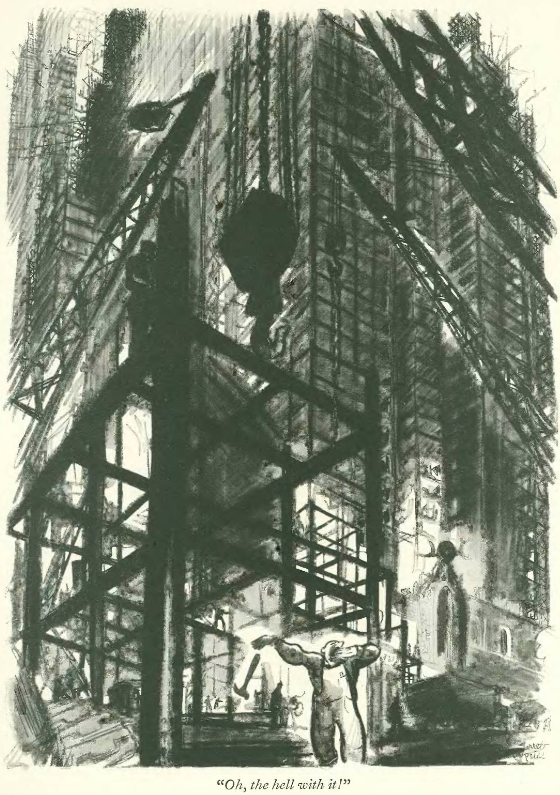
…and finally, a new perspective on the Chrysler Building, from Gardner Rea…
The Vassar-educated Lois Long was an icon of the flapper generation and a reigning voice—witty and smart—of New York nightlife in the Roaring Twenties.
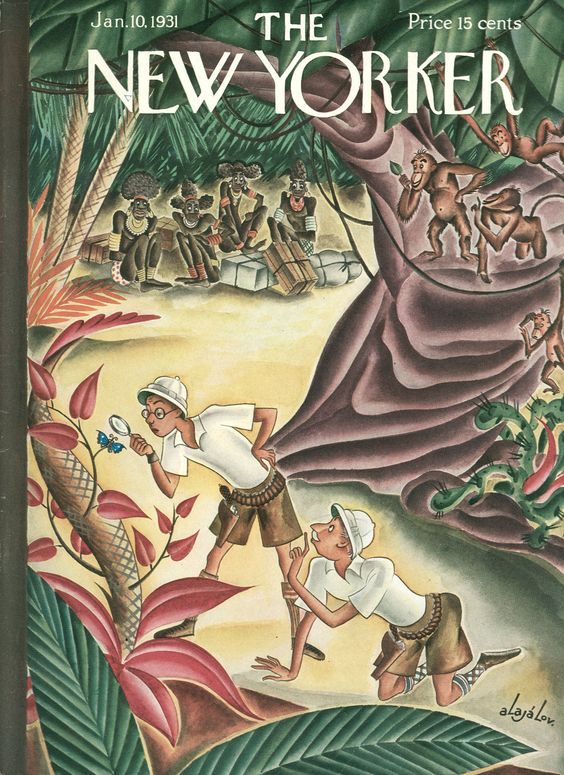
Jan. 10, 1931 cover by Constantin Alajalov.
In one of her early “Tables for Two” columns, the famously hard-partying Long made this request of her New Yorker readers: “Will someone do me a favor a get me home by eleven sometime? And see that nobody gives a party while I am catching up? I do so hate to miss anything.”
DONT START THE PARTY WITHOUT ME…Carefree days at your neighborhood speakeasy. (Manchester’s Finest)
By the dawn of 1931 few were in the mood for a party, including the 29-year-old Long, who was mother to a toddler and would soon divorce husband and New Yorker cartoonist Peter Arno.
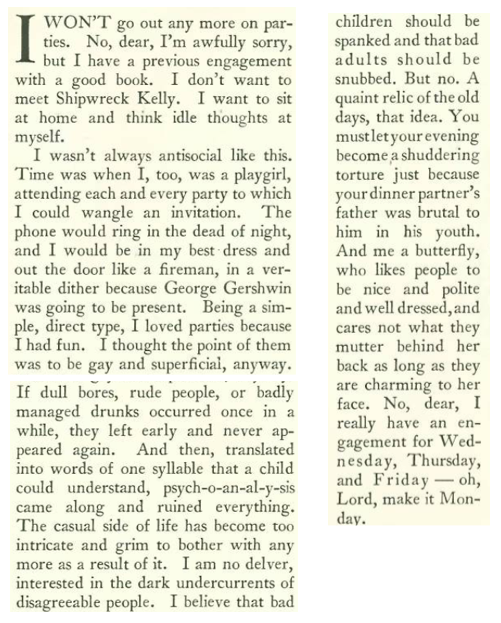
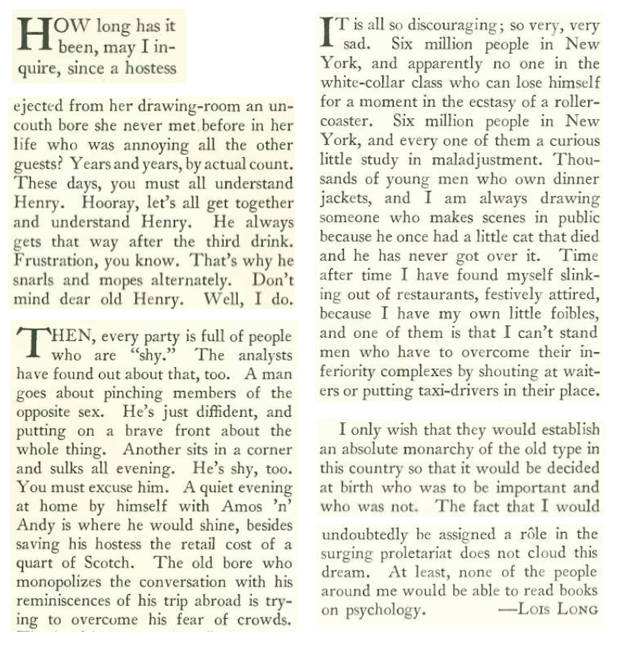
But it wasn’t motherhood or a tempestuous marriage that soured Long on the party scene. Rather, blame fell to the whiny, self-absorbed crowd that had displaced her fun-loving Jazz Age revelers. In the Jan. 10, 1931 issue Long began to assess the decade ahead in a six-part series titled “Doldrums.” The first installment, “Bed of Neuroses,” suggests Long missed the joie de vivre that characterized the previous decade:
“It is all so discouraging; so very, very, sad. Six million people in New York, and apparently no one in the white-collar class who can lose himself for a moment in the ecstasy of a roller-coaster. Six million people in New York, and every one of them a curious little study in maladjustment. Thousands of young men who own dinner jackets, and I am always drawing someone who makes scenes in public because he once had a little cat that died and he has never got over it.”
With that, Long’s partying days were officially over. Some excerpts from “Bed of Neuroses”…
SALAD DAYS…Clockwise, from top left, Lois Long relaxing on the beach in a image captured from a 1920s home movie; silent film star Charlie Chaplin,Vanity Fair editor Frank Crowninshield, sculptor Helen Sardeau, Lois Long and screenwriter Harry D’Arrast pose in a Coney Island photo booth, 1925; Long with husband Peter Arno and daughter Patricia, 1929; Long at the office in a classic flapper pose, circa 1925. (PBS/Joshua Zeitz/Patricia Long/Wikipedia)
Long recalled the days when one could hold his or her liquor…
There has been a trend among the bright young drinkers toward a glass of sherry before meals instead of cocktails, a bottle of wine during dinner, port with the cheese, a liqueur with the coffee — instead of one highball after another.
…and when one’s personal hang-ups remained personal, and were not subject to tedious public display:
Long’s nightlife column, “Tables for Two” folded a few months after the 1929 stock market crash, but she would continue to make unsigned contributions to the “Comments” and “The Talk of the Town” sections into the 1950s. Her main focus at the magazine, however, would be her fashion column, “On and Off the Avenue,” which she would write until 1968. Upon her death in 1974, New Yorker editor William Shawn remarked that Long “was the first American fashion critic to approach fashion as an art and to criticize women’s clothes with independence, intelligence, humor and literary style.”
* * *
The Age of Giants
Architecture critic George S. Chappell took in the grandeur of the nearly completed Empire State Building, which rose from the rubble of the old Waldorf-Astoria hotel and perhaps more than any building served as a giant exclamation point for the 20th century metropolis. Chappell did not buy developers’ claims regarding the building’s “mooring mast,” calling it a “silly gesture” that the building would have been better served without. Looking back from our time, however, it is hard to imagine the building without its distinctive spire:
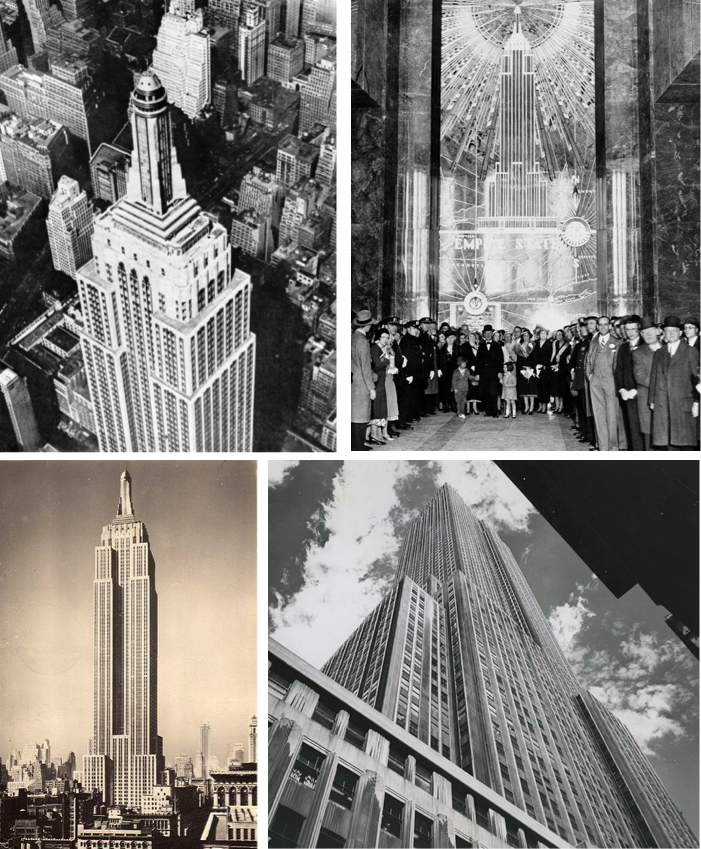
DIZZY HEIGHTS…Completed in 1931, the Empire State Building stood as the world’s tallest until 1970. Clockwise, from top left, New Yorker critic George Chappell viewed the “mooring mast” as a publicity stunt, and believed the building would have been better without it; interior of the building at its grand opening in May 1931; ground-level view of the setbacks Chappell admired; the completed tower in 1931. (lajulak.org/Associated Press/Acme/Pinterest)
Chappell also made note of a neo-Georgian style building designed by Joseph Freedlander for the Museum of the City of New York:
HISTORY’S HOME…The main facade of the Museum of the City of New York facing Fifth Avenue. (Wikipedia)
* * *
Ignoble Deeds
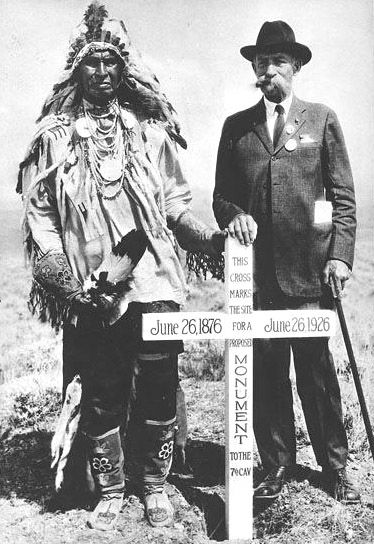
“The Talk of the Town” looked in on some aging veterans of the 19th century “Indian Wars” and found the old coots reminiscing about the massacre of various North American tribes…
NO HARD FEELINGS?…Crow warrior White Man Runs Him poses with 82-year-old Gen. Edward Settle Godfrey, a survivor of the Battle of Little Bighorn, at the 50th Anniversary of the battle in 1926. (Wikipedia)
* * *
Cheeky
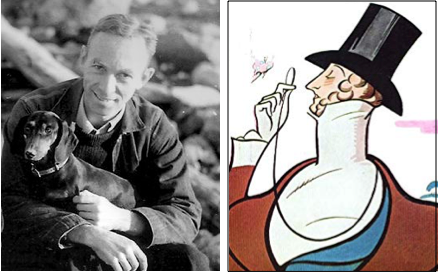
E.B. White assumed the nom de plume “Eustace Tilley” to answer an earnest query letter from Leslie Fulenwider of Famous Features Syndicate. Fulenwider probably didn’t know what he was in for…
ALTER EGO…E.B. White periodically assumed the role of New Yorker mascot Eustace Tilley in handling magazine correspondence.
* * *
Too Cool for School
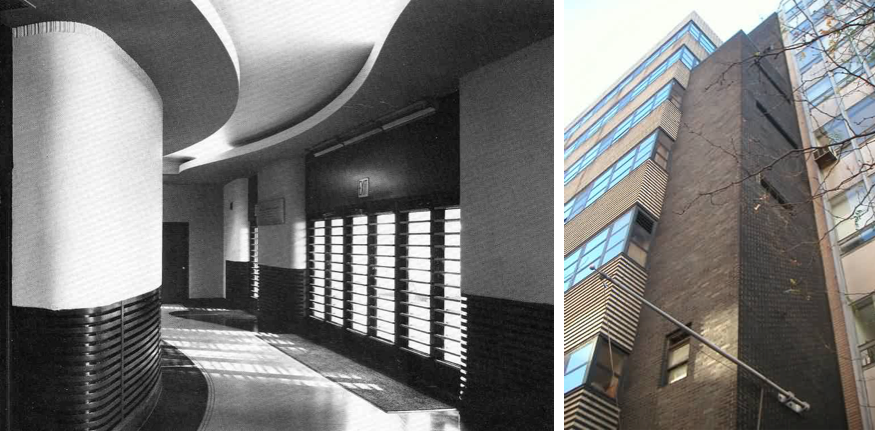
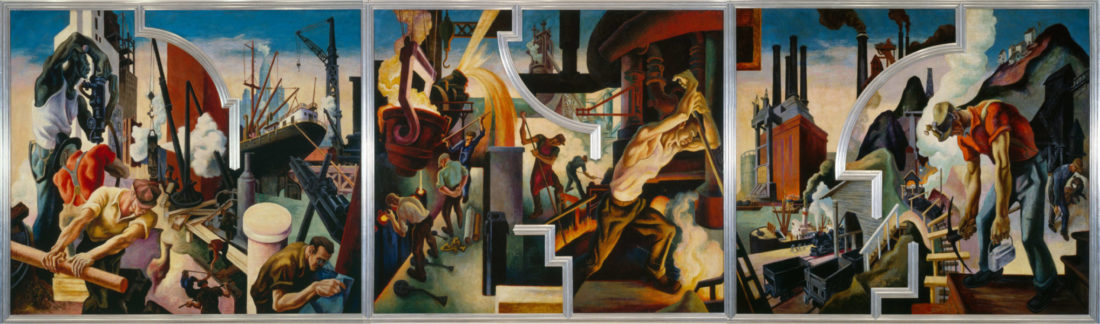
In his weekly art gallery column, Murdock Pemberton noted the New Year’s Day opening of the New School for Social Research in a “timid landmark” designed by Joseph Urban of theatrical design fame. The school’s boardroom featured a series of murals by realist painter Thomas Hart Benton.
NEW LOOK FOR NEW SCHOOL…Joseph Urban’s interpretation of the International Style for the New School for Social Research at 66 West 12th Street.AMERICAN TABLEAU…Three panels from Thomas Hart Benton’s ten-panel mural, America Today. Originally installed in the New School’s boardroom, it is now housed at the Metropolitan Museum of Art. (charlesmcquillen.com)
* * *
From Our Advertisers
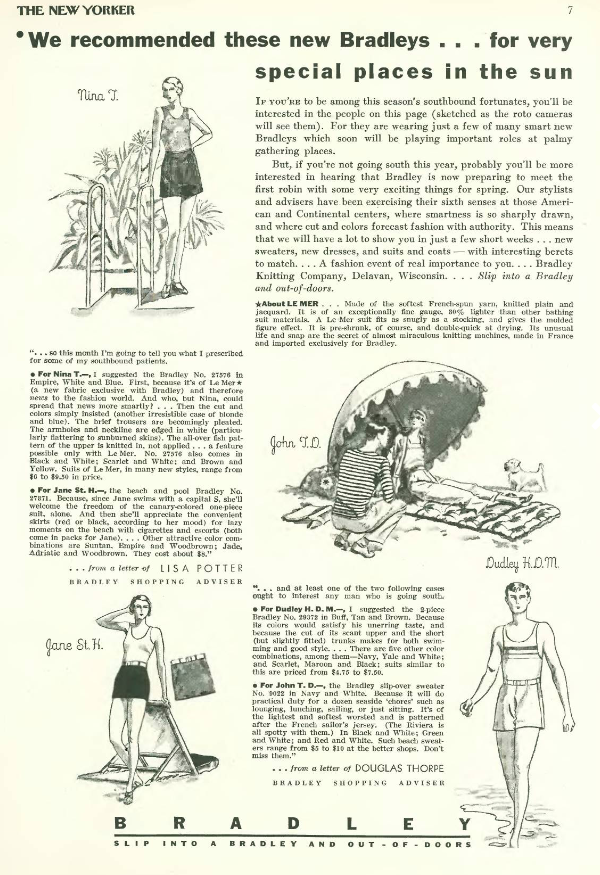
“If you’re to be among this season’s southbound fortunates,” as this ad begins, you’ll want to check out these Bradley bathing suits designed for a variety of privileged personalities…
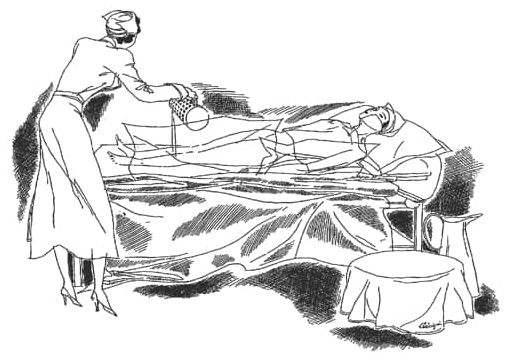
…but before you hit the beach, you might consider an “Ardena Bath” to take away some of that winter fat…
…this 1932 illustration (below) demonstrates how a full-body, Ardena paraffin wax bath works. An Elizabeth Arden advertisement described the procedure thus: You step into a tub lined with waxed paper. Over you they pour a warm liquid paraffin which slowly hardens until you are encased in a paraffin shell. Your face becomes pink. You are permeated in a sense of well-being. Suddenly, the perspirations bursts from you, for the shell forms a vacuum which causes the pores to open and, consequently, impurities are drawn away…
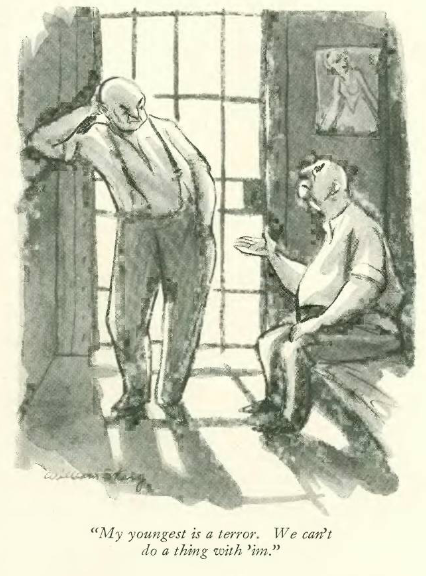
…on to our cartoons, we have two from William Steig, who produced 2,600 drawings and 117 covers for The New Yorker and whose work would span two centuries, delighting both adults and children alike, most notably the picture book Shrek! that would lead to a hugely successful movie series. According to The Numbers: Where Data and the Movie Business Meet, “after the release of Shrek 2 in 2004, Steig became the first sole-creator of an animated movie franchise that went on to generate over $1 billion from theatrical and ancillary markets after only one sequel.”
Here is Steig’s first New Yorker cartoon, from the Aug. 9, 1930 issue:
…and back to the Jan. 10, 1931 issue, in which Steig offered these glimpses into city life…
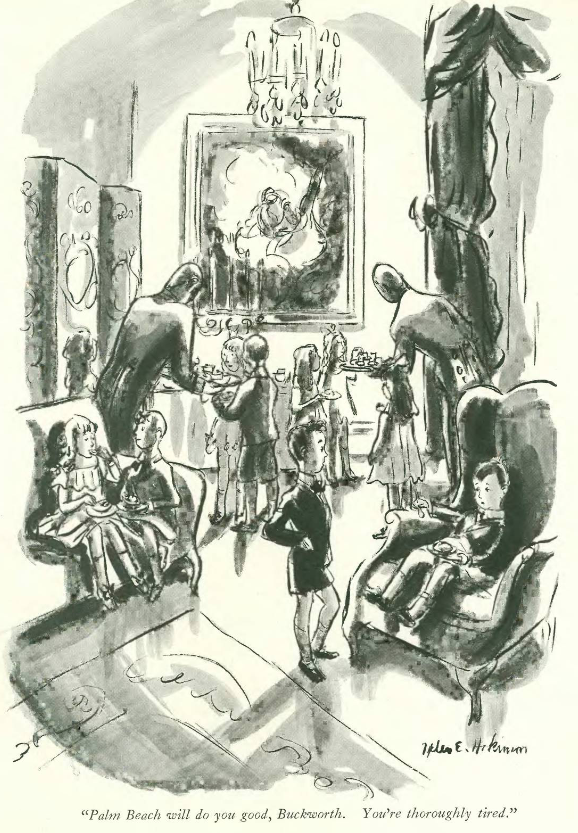
…and then have a look into the posh set from New Yorker stalwart Helen Hokinson…
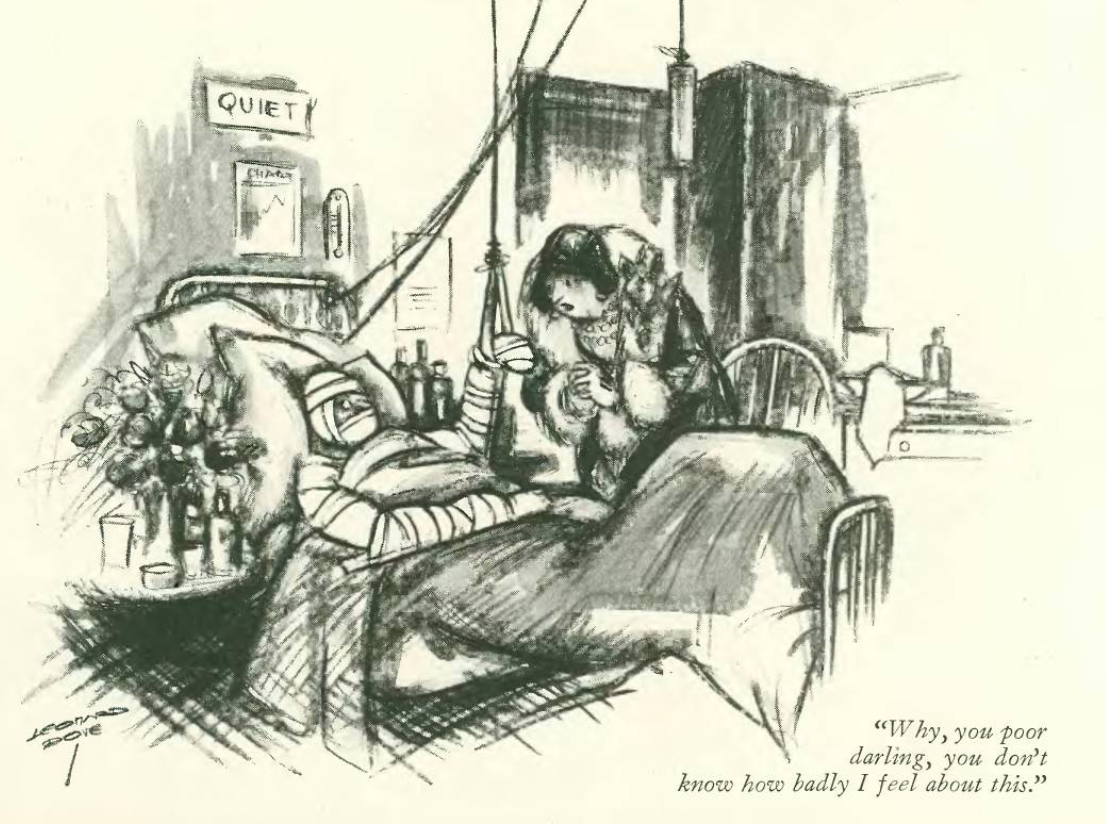
…some bedside manner with Leonard Dove…
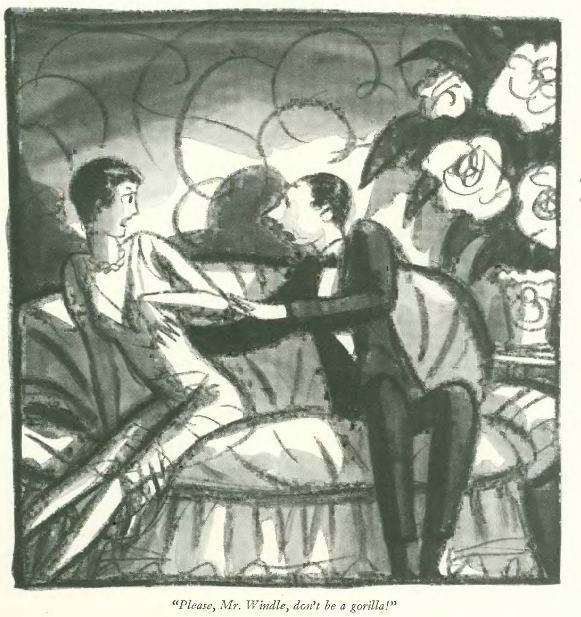
…Peter Arno continued to explore the complexities of love…
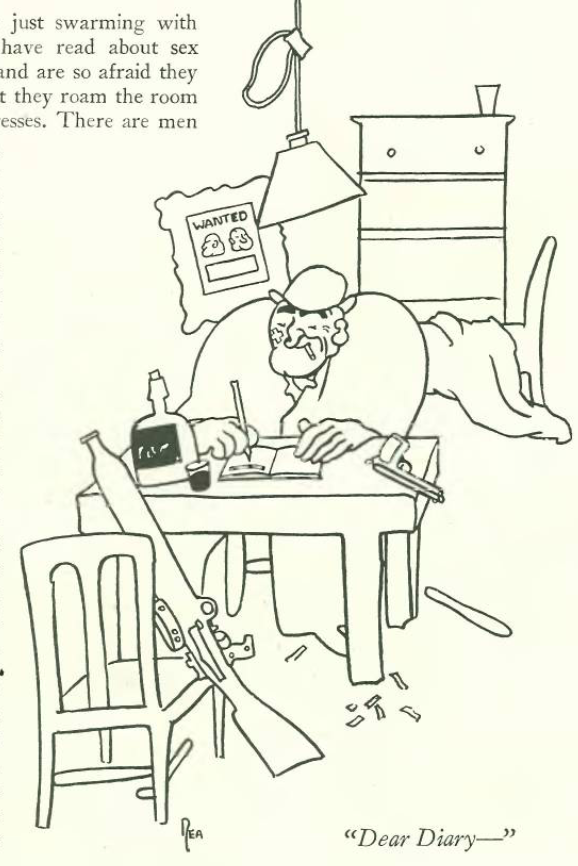
…and Gardner Rea showed us the softer side of a hardened criminal…
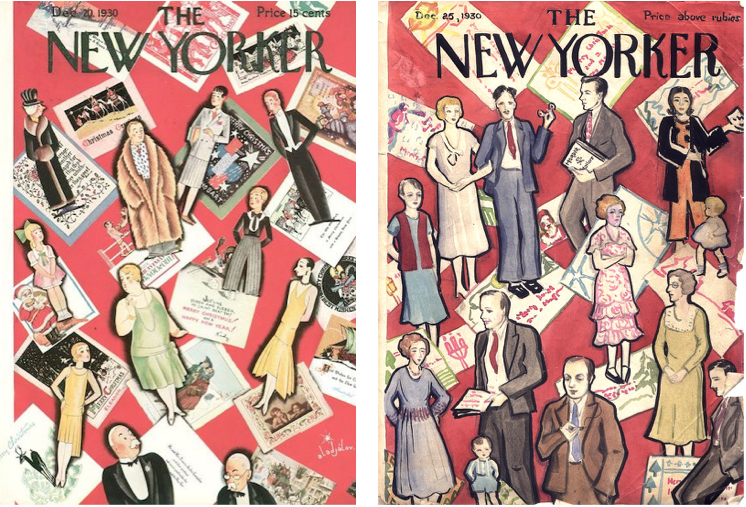
…and before we close I want to bring to your attention to this wonderful New Yorker parody that Peter Binkley recently shared with me. Binkley writes that the Dec. 20, 1930 cover “was the model for a parody issue that friends of my grandparents in the Village made for them when they visited for the holidays. My grandparents had lived in New York for a couple of years but moved away in 1929. They and this group of friends lived in the same building on Morton St., and were fervent New Yorker readers. The parody is interesting, I think, for giving a glimpse of what New Yorker fans below the top-hat-wearing class enjoyed about it at the time.”
Below, left, is the cover of the Dec. 30 issue by Constantin Alajalov, and next to it the terrific parody cover.
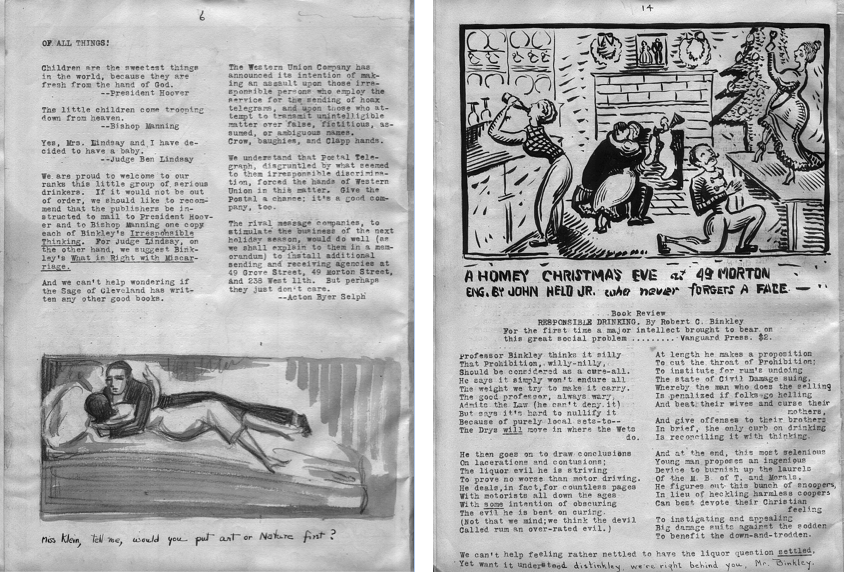
…and a couple of the interior pages, with parodies of cartoons by Peter Arno and John Held Jr….
Happy Holidays to readers of A New Yorker State of Mind! We open with an image of Christmas shoppers at 34th and Broadway, circa 1930, and peruse the Dec. 20, 1930 issue of the world’s greatest magazine.
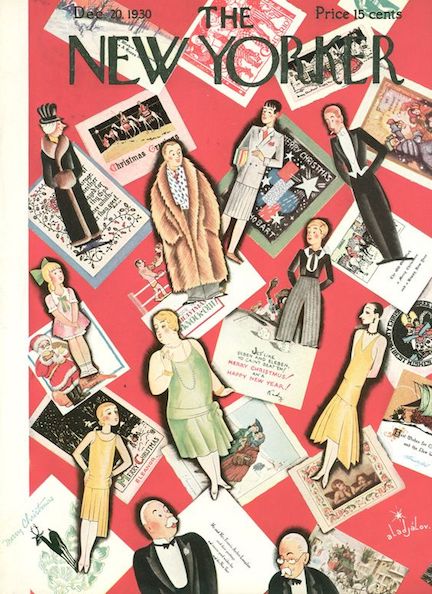
Dec. 20, 1930 cover by Constantin Alajalov.
“Notes and Comment” began with a Christmas message of sorts from E.B. White, his holiday cheer tempered by the Great Depression and the lingering effects of Prohibition…
…Howard Brubaker seconded White’s mood in his “Of All Things” column…
…keeping things on the lighter side was Margaret Fishback, who turned her talents as a poet into a successful career as an ad writer for Macy’s. By the 1930s she was one of the world’s highest-paid female advertising copywriters. For the Dec. 20 issue she offered this holiday ditty:
THANKS MARG...Margaret Fishback, circa 1930s. (Wikipedia)
* * *
More Marlene
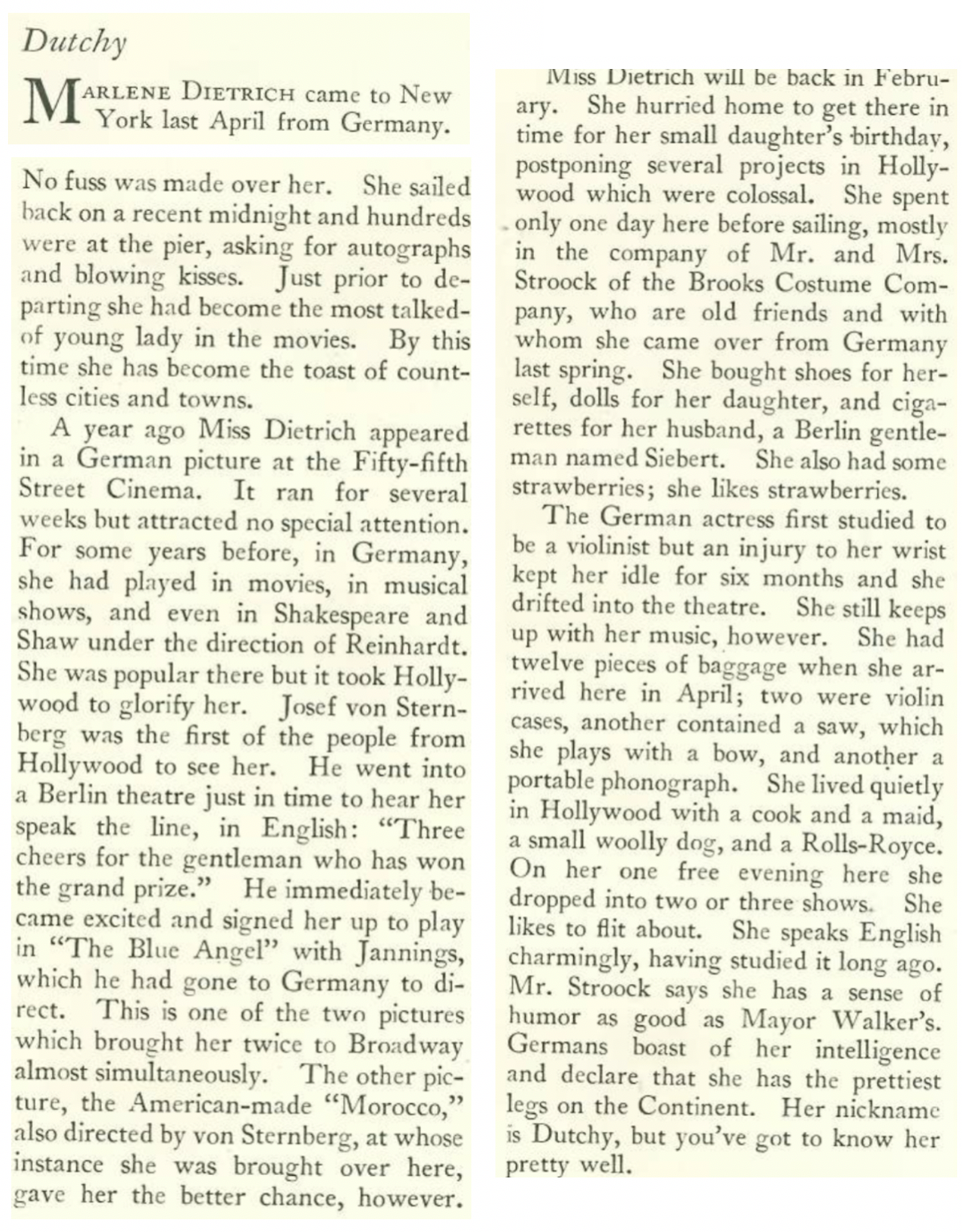
Last week we looked at Marlene Dietrich’s breakout performance in The Blue Angel (reviewed by John Mosher in the Dec. 13, 1930 issue) that launched her into international stardom. Although Mosher had some gripes about the film’s dialogue, Dietrich’s performance nevertheless created enough of an impression to warrant a lengthy note on the German star in the Dec. 20 “Talk of the Town”…
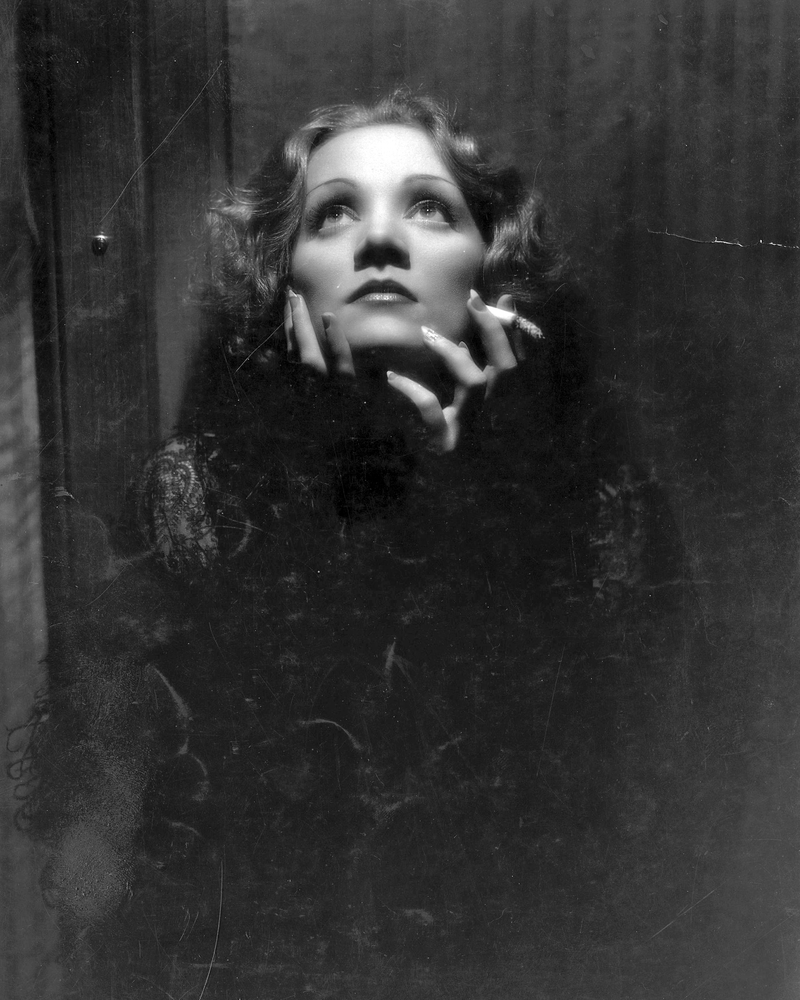
I’LL BE BACK…Marlene Dietrich in a still from Shanghai Express, 1932. (Wikipedia)
Even though John Mosher gave a rather tepid review of The Blue Angel in the Dec. 13 issue, he obviously couldn’t shake it (or Dietrich) from his head, returning to the film and its star in the opening paragraphs of his Dec. 20 cinema column.:
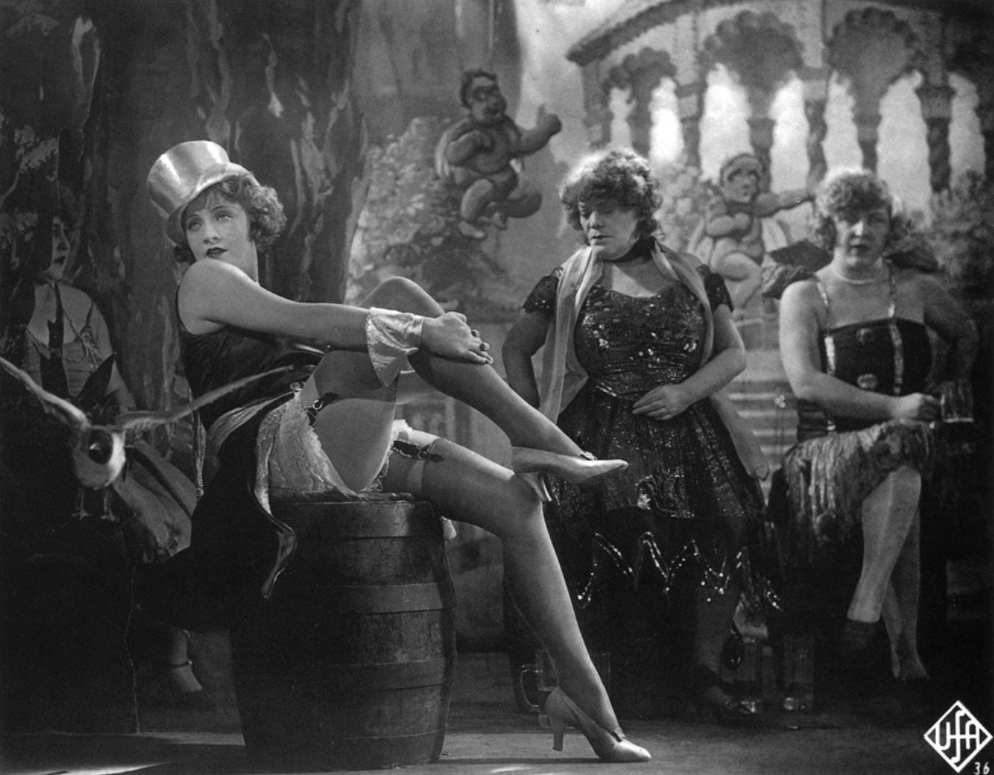
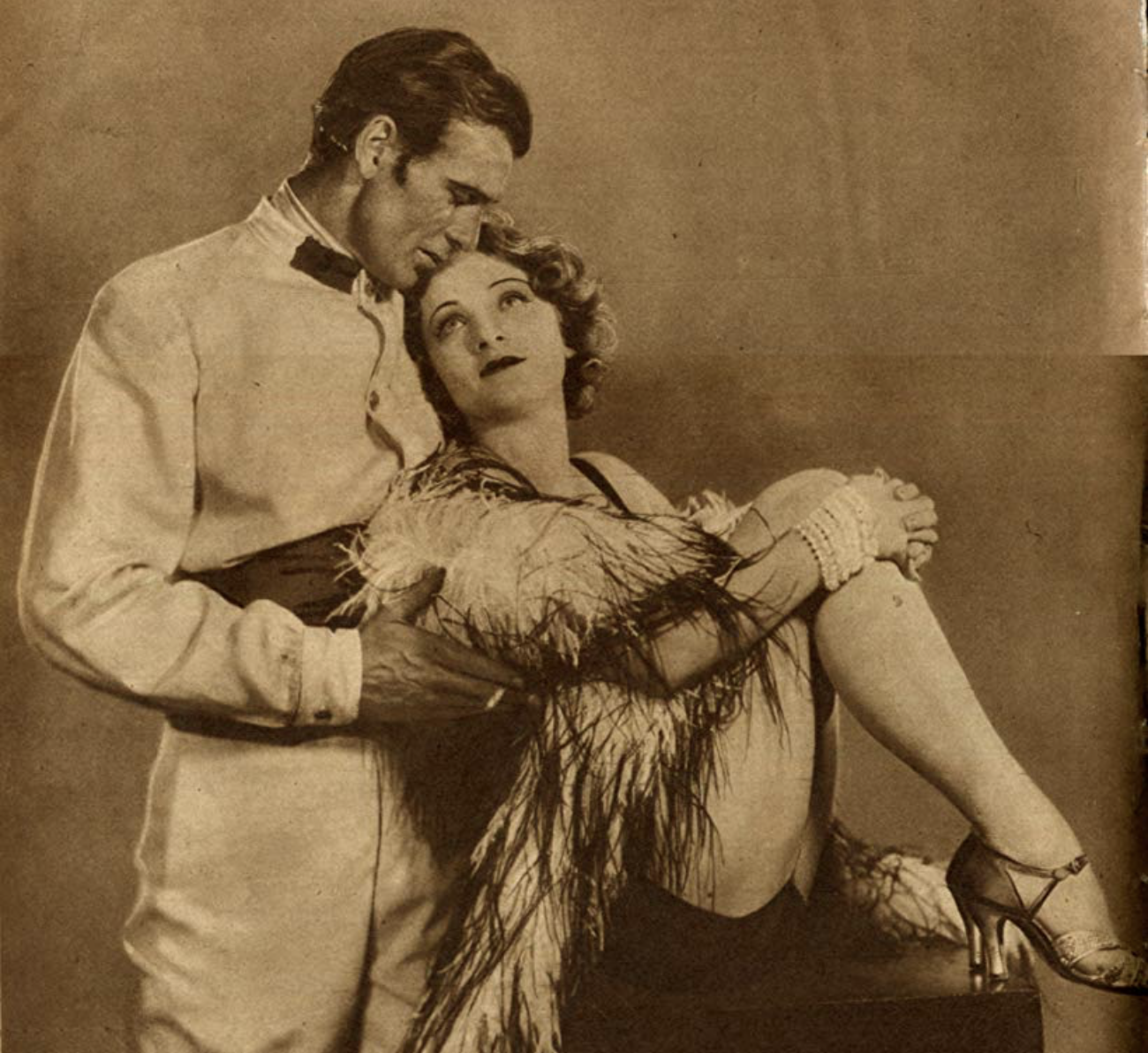
Mosher also observed that new Hollywood version of Dietrich (in 1930’s Morocco) was “far prettier” than the German version. You decide:
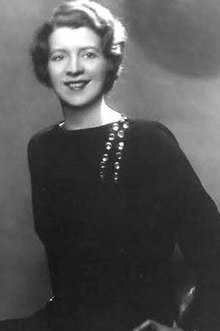
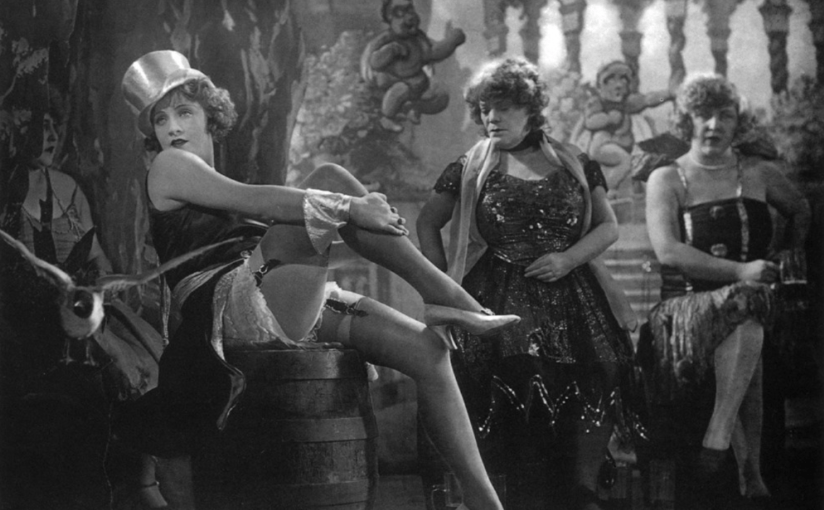
The German Marlene Dietrich in Ufa’s The Blue Angel…
…and the Hollywood Dietrich in Paramount’s Morocco (with Gary Cooper)…
(both images IMDB)
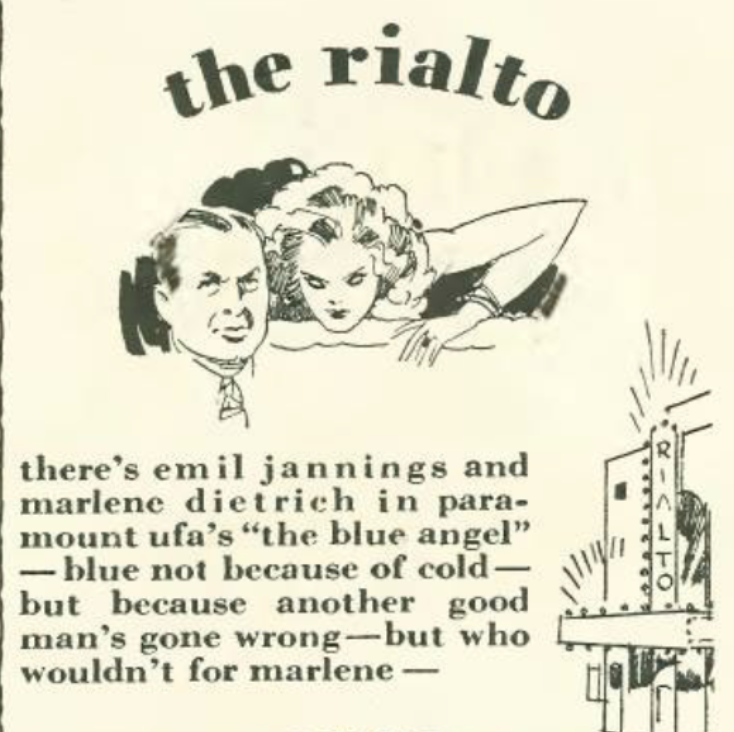
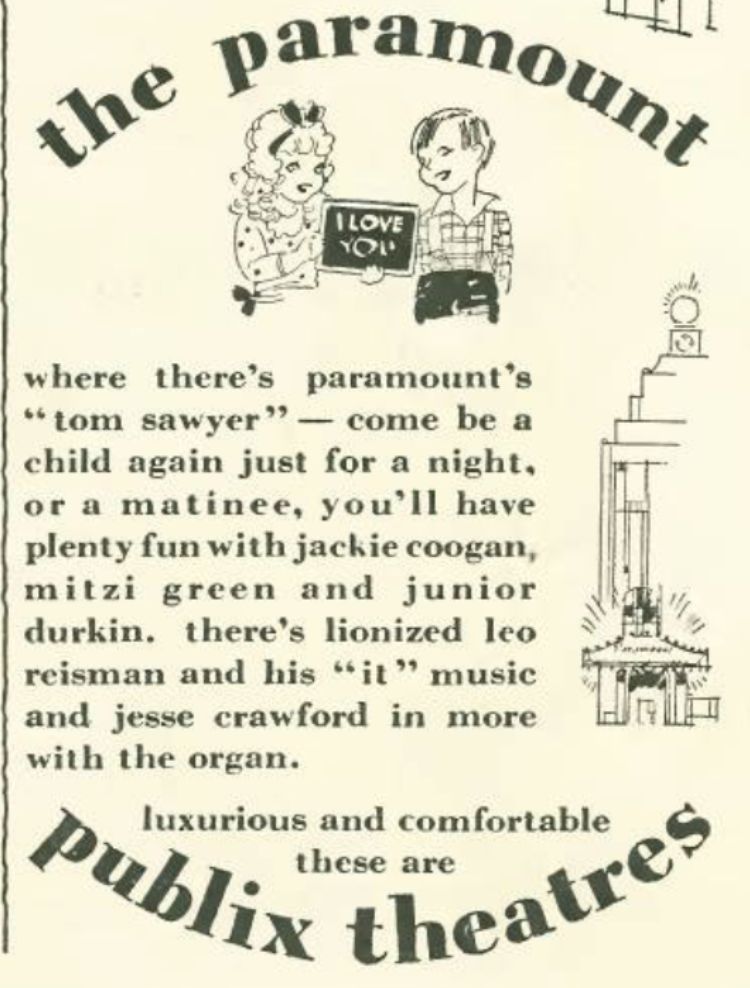
…on to our advertising…Dietrich pops up again in this ad for Publix Theatres (which were owned by Paramount)…
…the same ad block also featured light fare, such as 1930’s Tom Sawyer…
AIN’T THEY CUTE?...Mitzi Green as Becky Thatcher and Jackie Coogan as Tom Sawyer in 1930’s Tom Sawyer. Jackie was a famous star by 1930, thanks to his co-starring performance with Charlie Chaplin in 1921’s The Kid. In adult life Coogan would play Uncle Fester in TV’s The Addams Family. Green would have less success, and retire from films in the 1950s. (IMDB)
…not all advertisers were thinking about Christmas, but rather were turning their sights to the southern climes and the fashions they would require…here’s an appeal from Burdine’s of Miami…
…and Fifth Avenue’s Bonwit Teller…
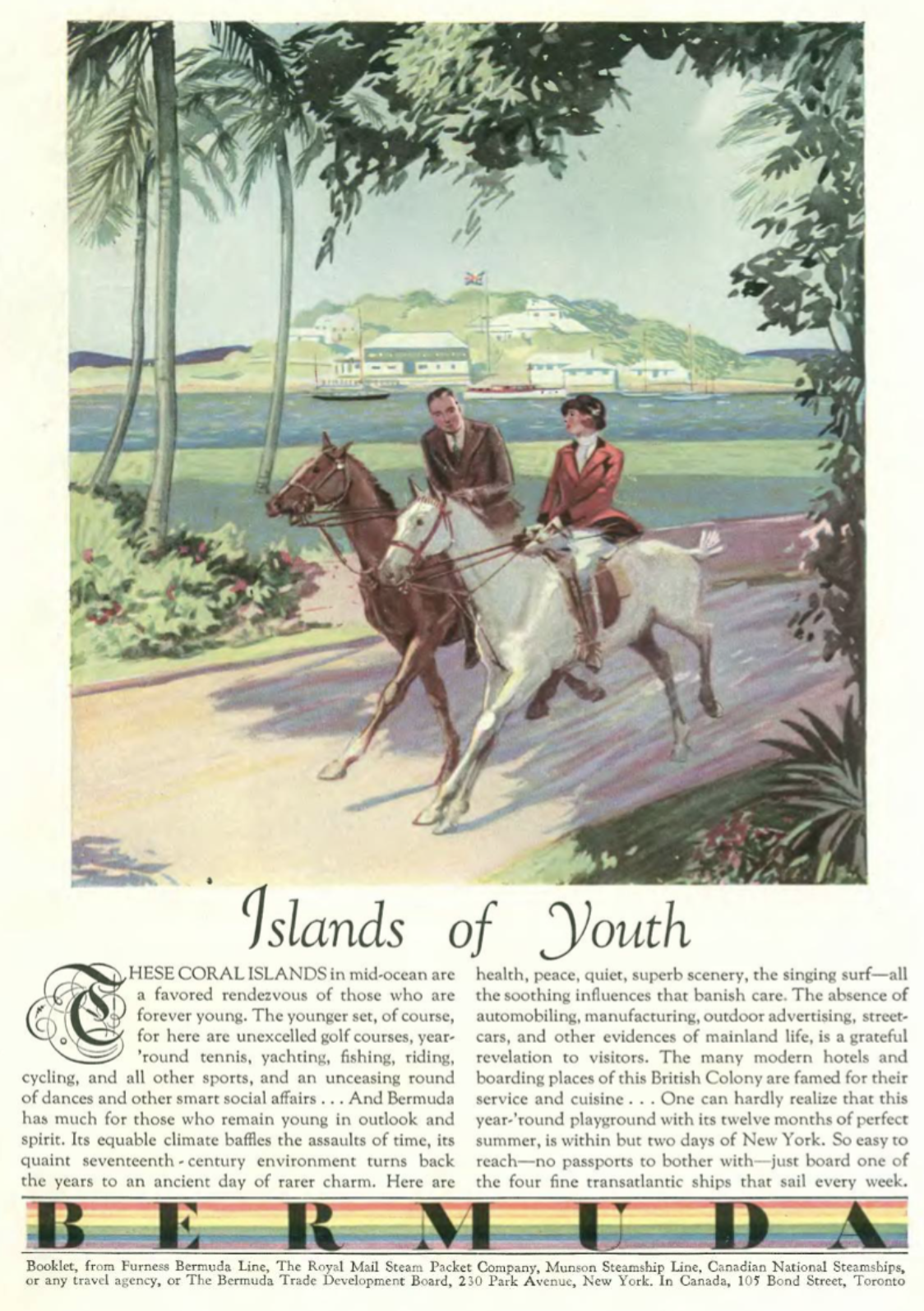
…travel agencies created enticing scenes such as this to lure snowbirds to places like Bermuda…
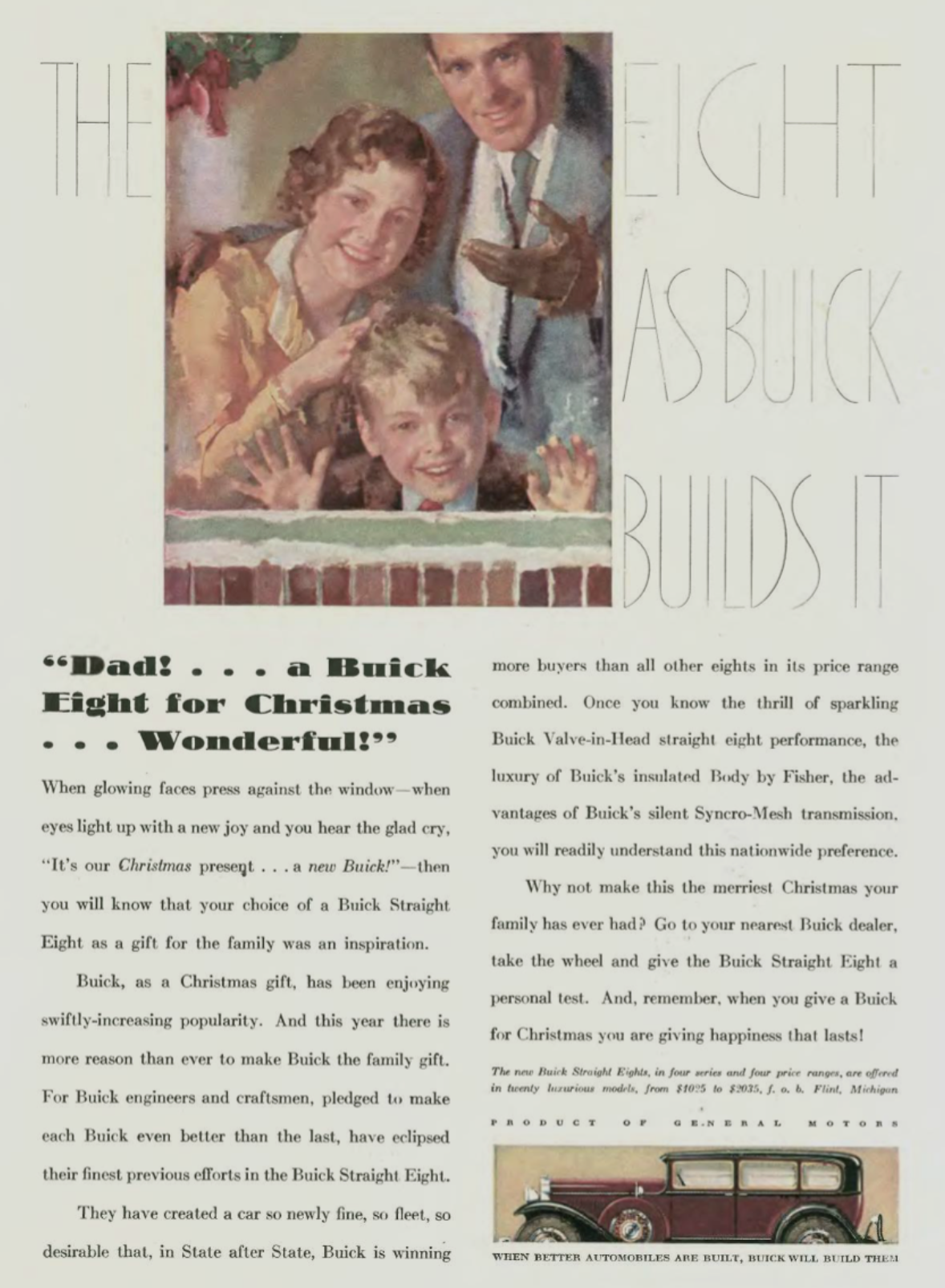
…of course in those depressed times you had to be a person of means to spend your winters in the Caribbean, or to surprise your family with a new Buick for the holidays…
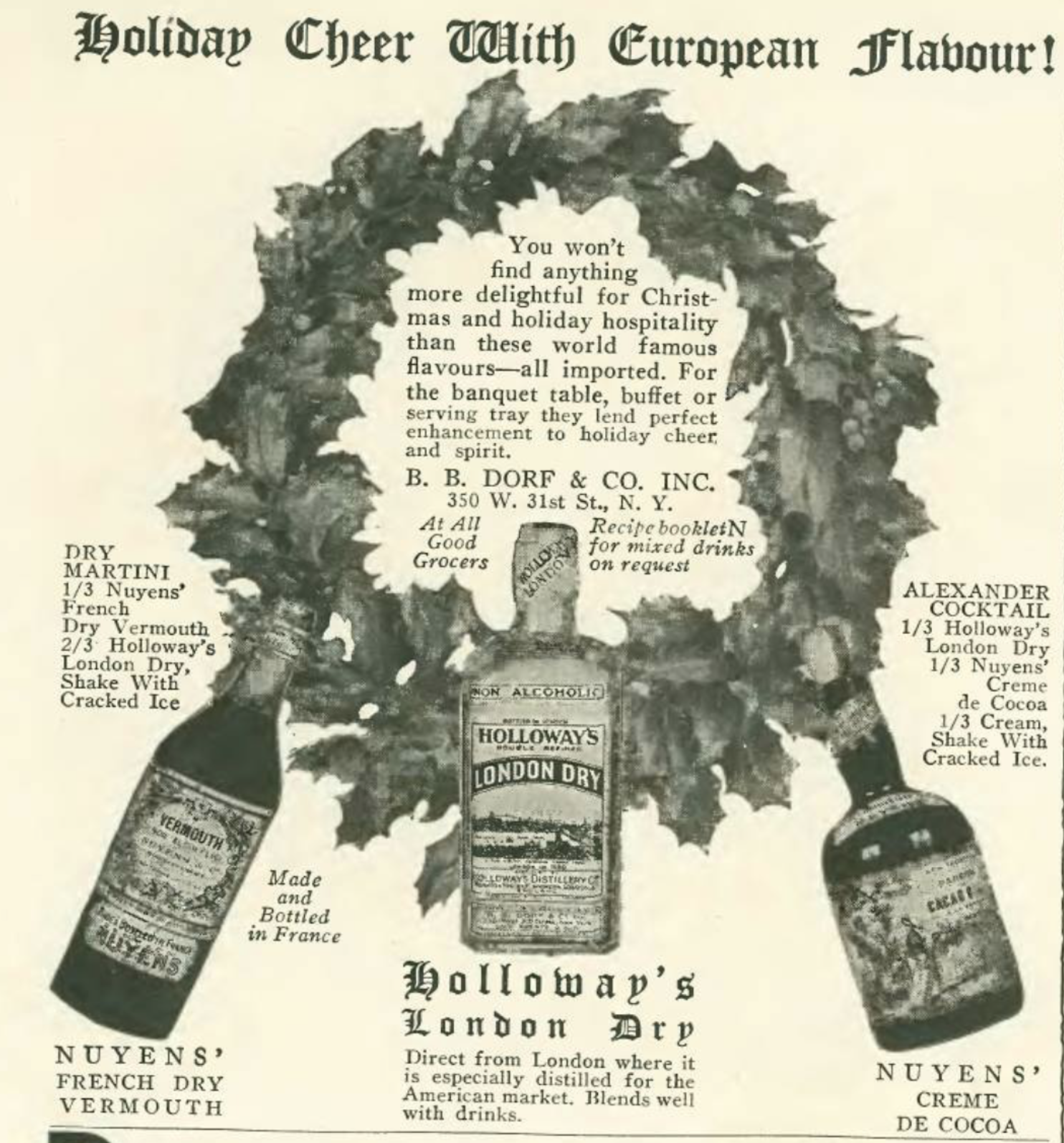
…and for those stuck at home, they had to console themselves with bootleg liquor, perhaps jazzed up with one of these “flavors”…
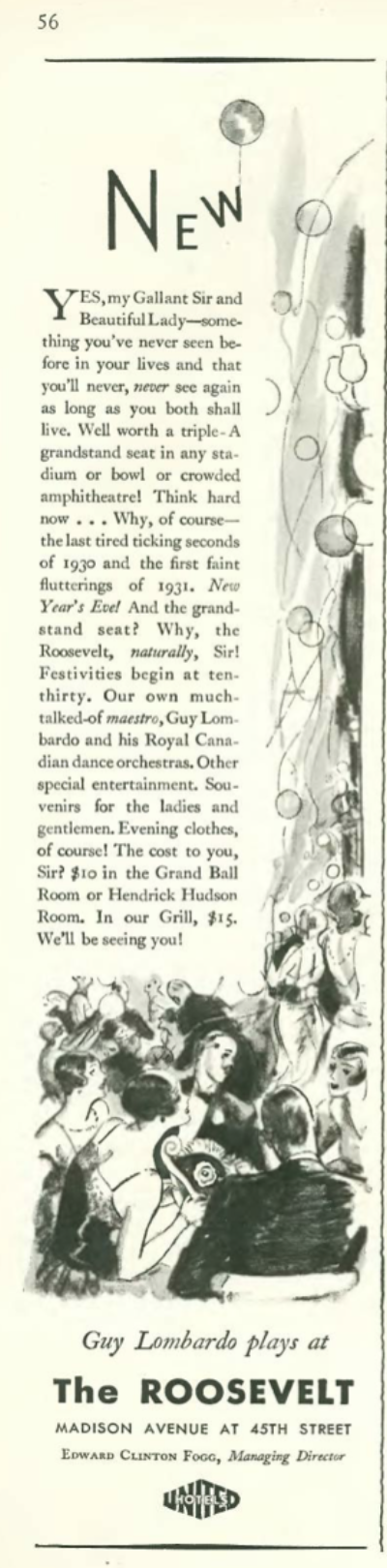
…but if you were in the holiday spirit, you might head to the Roosevelt for New Years Eve with Guy Lombardo…
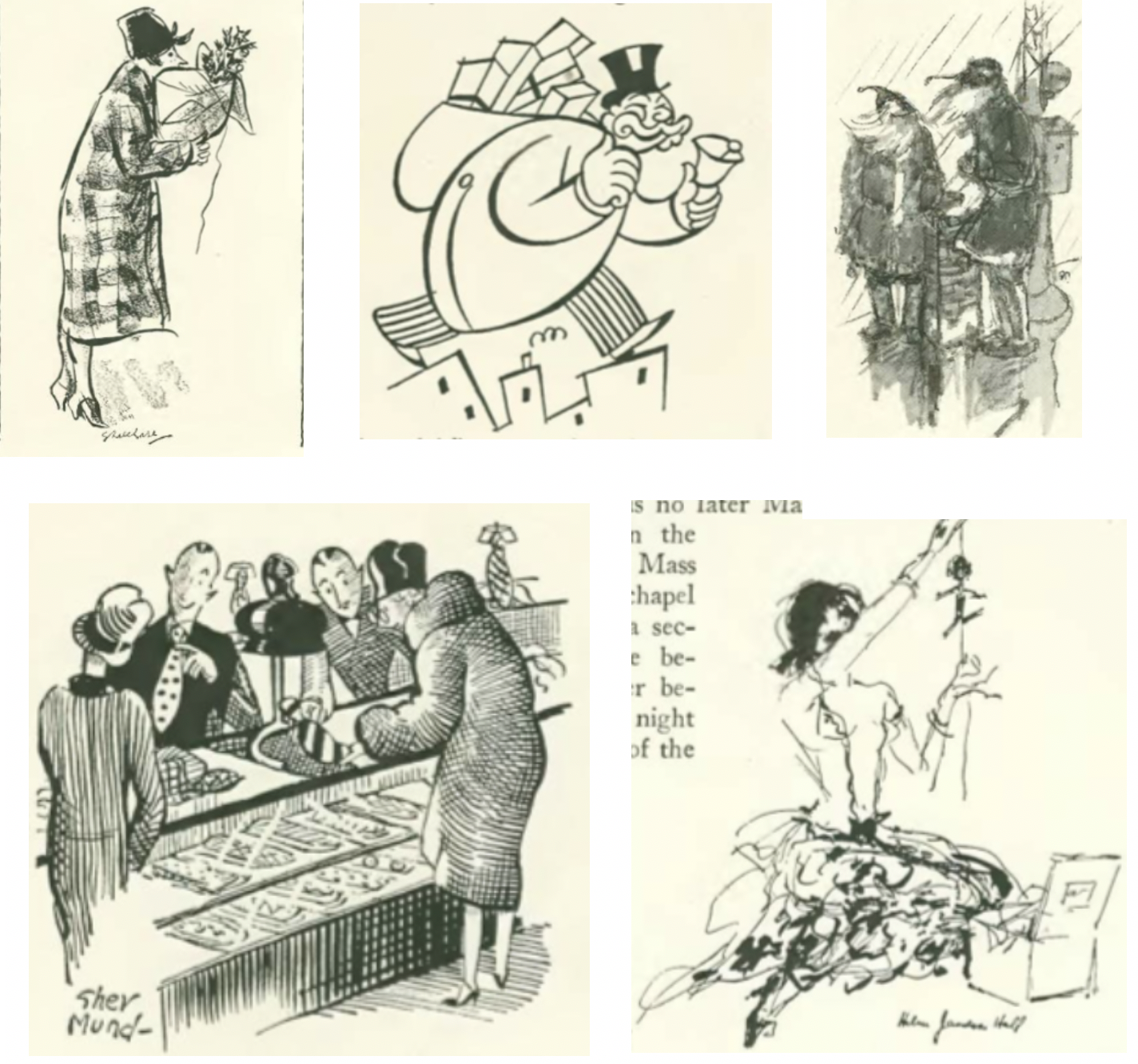
…once again, the issue was sprinkled with spot drawings on the holiday theme…
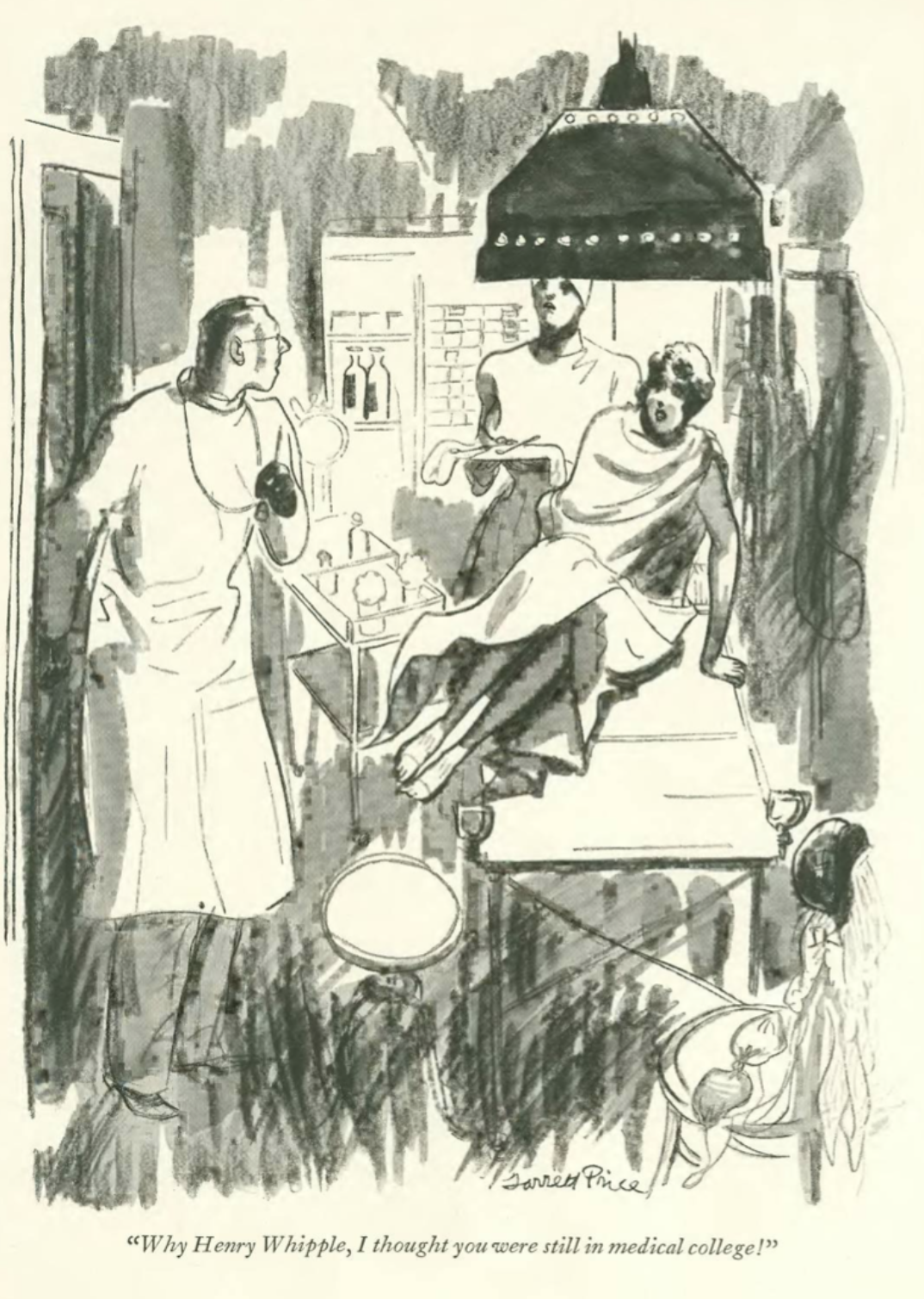
…and our cartoonists, Garrett Price at the doctor…
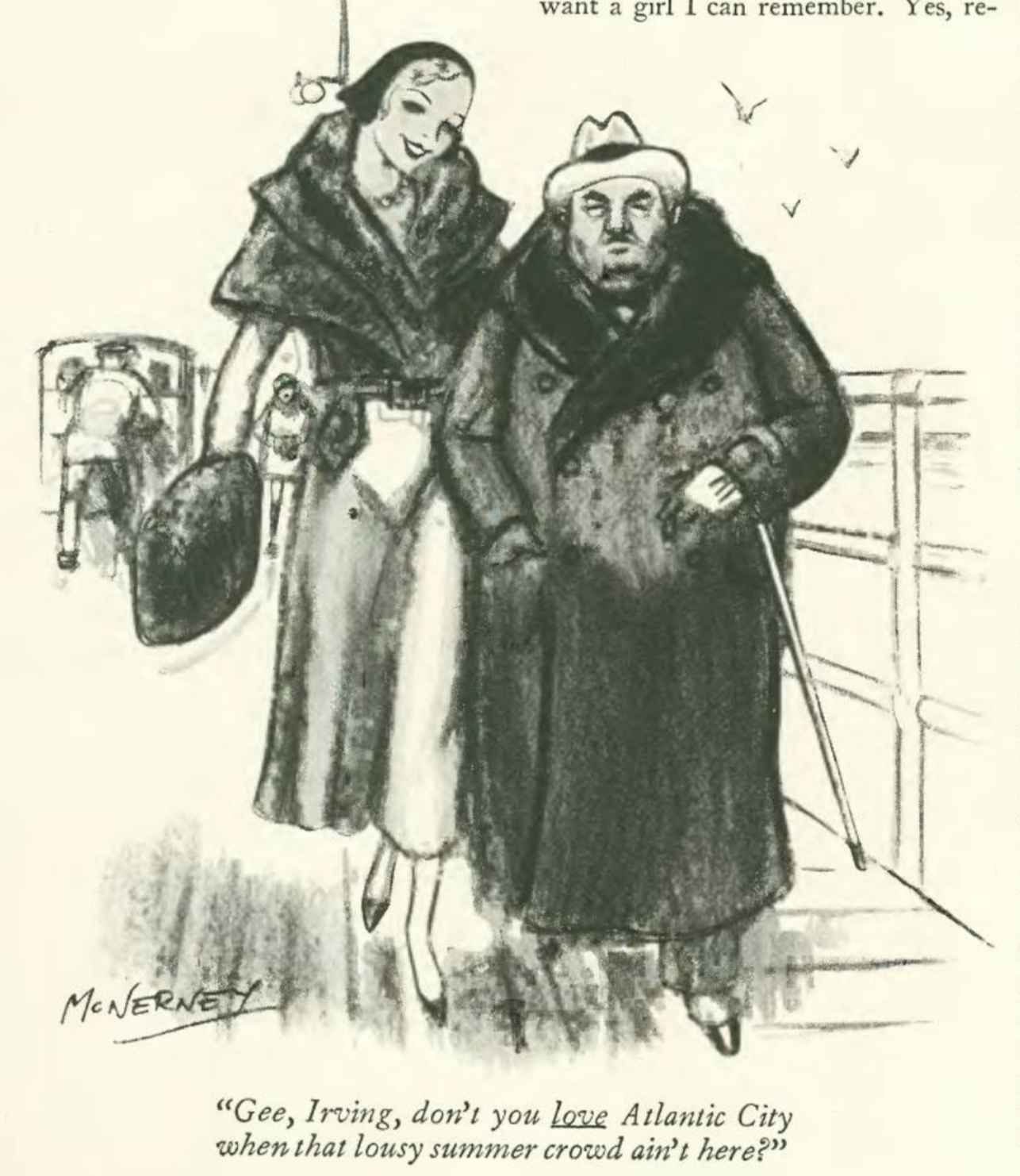
…E. McNerney in Atlantic City during off-season…
…Al Frueh, and the clash of modern aesthetics with Christmas traditions…
…and for those in that last, desperate holiday crush, we close with Alan Foster…
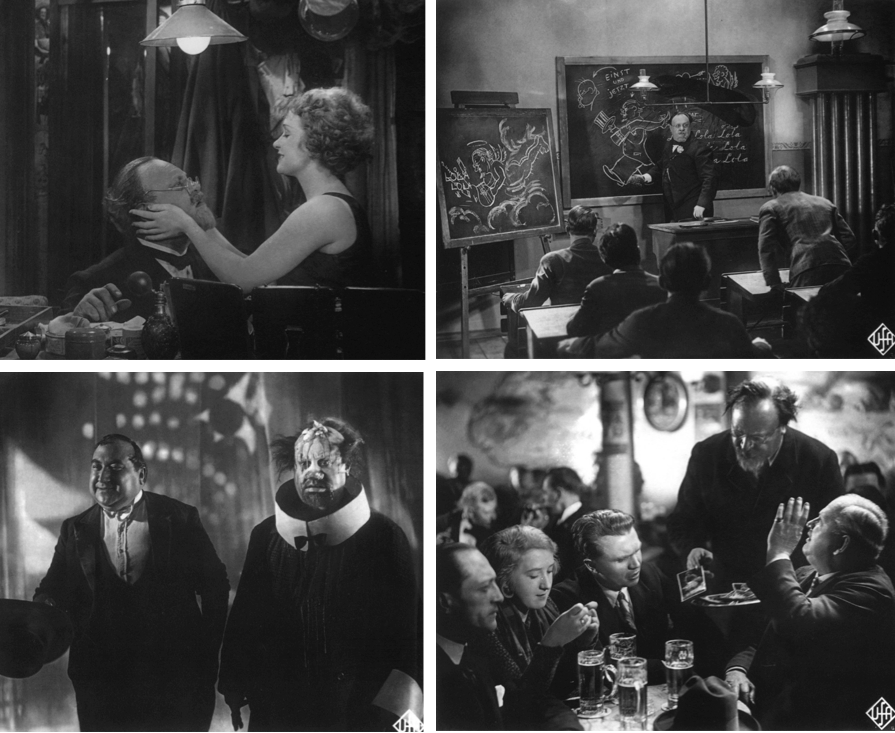
The German actor Emil Jannings was well-known to American audiences when The Blue Angel(Der blaue Engel) premiered at New York’s Rialto Theatre. Although the film was created as a vehicle for the Academy Award-winning Jannings (he won the Academy’s first-ever best actor award in 1929), it was the little-known Marlene Dietrich who stole the show and made it her ticket to international stardom.
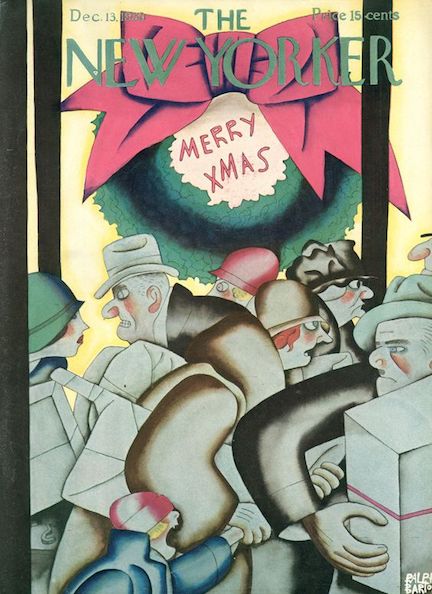
Dec. 13, 1930 cover by Ralph Barton, surprisingly his only cover for The New Yorker. The illustration sadly belies Barton’s state of mind at the time; he would take his own life the following spring.
New Yorker film critics, including John Mosher, generally found foreign films, particularly those of German or Russian origin, to be superior to the treacle produced in Hollywood, and Jannings was a particular favorite, delivering often heart-wrenching performances in such silent dramas as The Last Laugh (1924) and The Way of All Flesh (1927). In those films he depicted once-proud men who fell on hard times, and such was the storyline for The Blue Angel, in which a respectable professor falls for a cabaret singer and descends into madness.
NO CONTEST…Emil Jannings had star billing for the English language version of Josef von Sternberg’sThe Blue Angel, but it was Marlene Dietrich’s portrayal of cabaret singer Lola Lola that stole the show. (IMDB)
I was surprised by Mosher’s somewhat tepid review of this landmark film, which was shot simultaneously in German and English (with different supporting casts in each version). He referenced “bum dialogue,” which was doubtless the result of German actors struggling with English pronunciations. Filmed in 1929, it is considered to be Germany’s first “talkie.”
PRIDE BEFORE THE FALL…A proud and stern schoolmaster named Immanuel Rath (Emil Jannings) falls for cabaret singer Lola Lola (Marlene Dietrich), and from there his life unravels; he loses the respect of his pupils, then resigns his post to marry Lola. To make ends meet, Rath tries to sell racy photos of his wife, and then becomes a clown in her troupe and is regularly humiliated on stage. Destitute, he dies at the end of the film. (IMDB)
* * *
All Wet
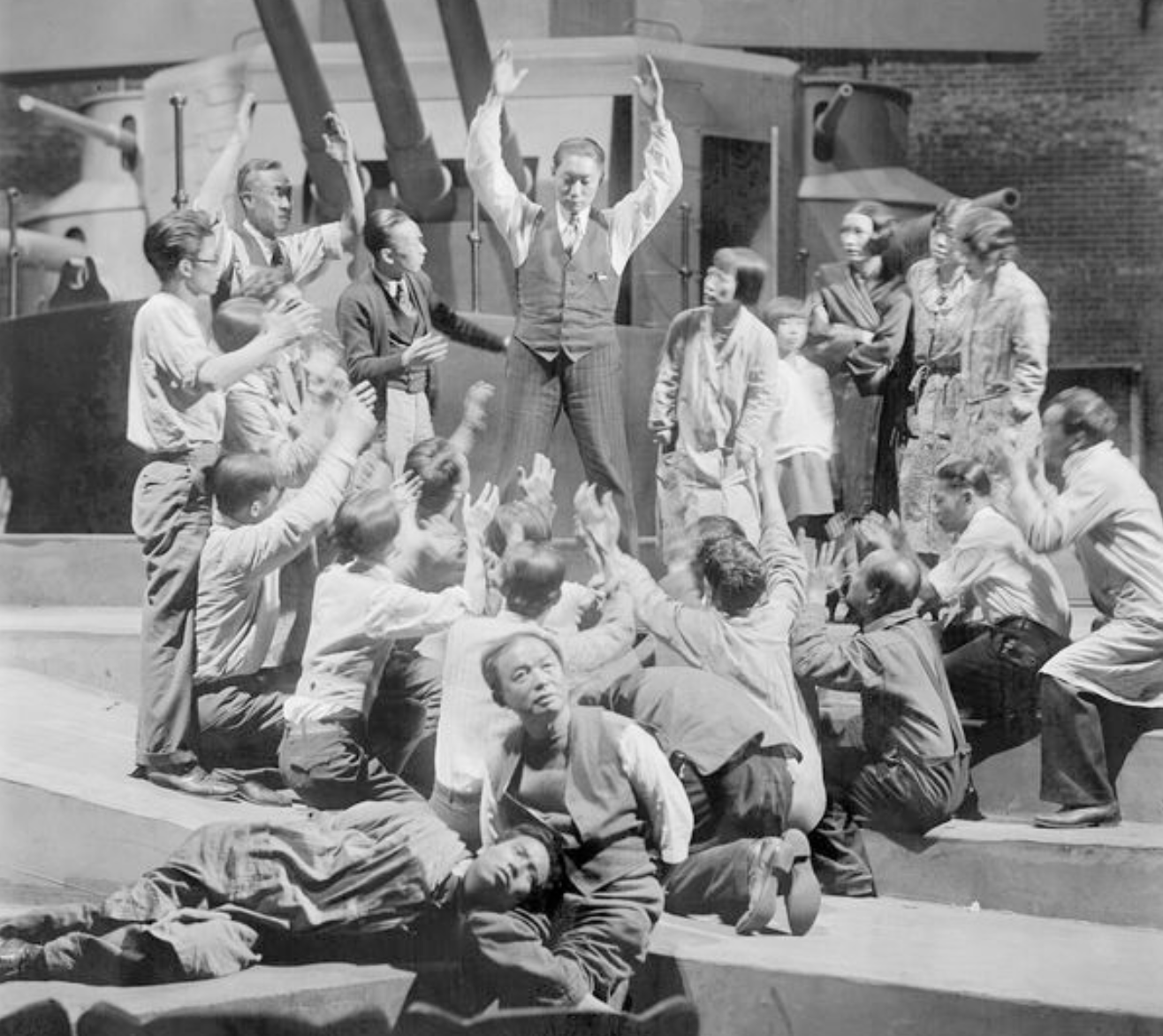
Sergei Tretyakov’s avant-garde play Roar China made an impression on The New Yorker for the striking realism of its set, which featured an 18,000-gallon tank of water onstage at the Martin Beck Theatre. “The Talk of the Town” described some of the demands of the production:
STAYING AFLOAT…The elaborate set for Roar China featured a model battleship in 18,000 gallons of water.ROAR CHINA! was an anti-imperialist play depicting the Wanhsien Incident during the Chinese Civil War. Many in the Chinese cast members were non-professional actors. (New York Public Library)
* * *
By Any Other Name
Like many college football teams in first decades of the 20th century, Notre Dame was referred to by a number of nicknames, including the “Fighting Irish.” In this “Talk of the Town” item, however, the team was known as the “Ramblers.” According to the University of Notre Dame, this nickname (along with “The Rovers”) was considered something of an insult: “(Knute) Rockne’s teams were often called the Rovers or the Ramblers because they traveled far and wide, an uncommon practice before the advent of commercial airplanes. These names were also an insult to the school, meant to suggest it was more focused on football than academics.”
RAMBLERS NO MORE…The 1930 National Champion Notre Dame football team. (nd.edu)
* * *
The Wright Stuff
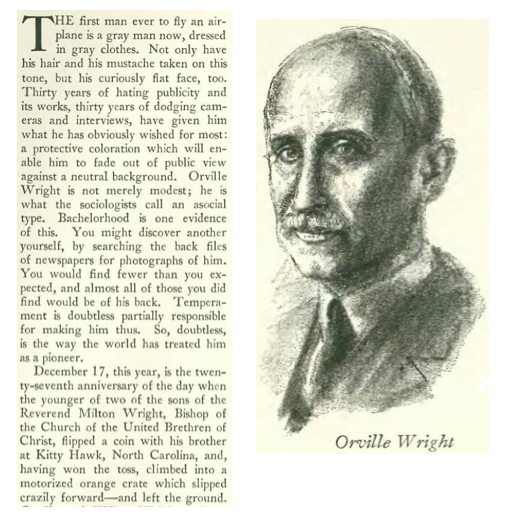
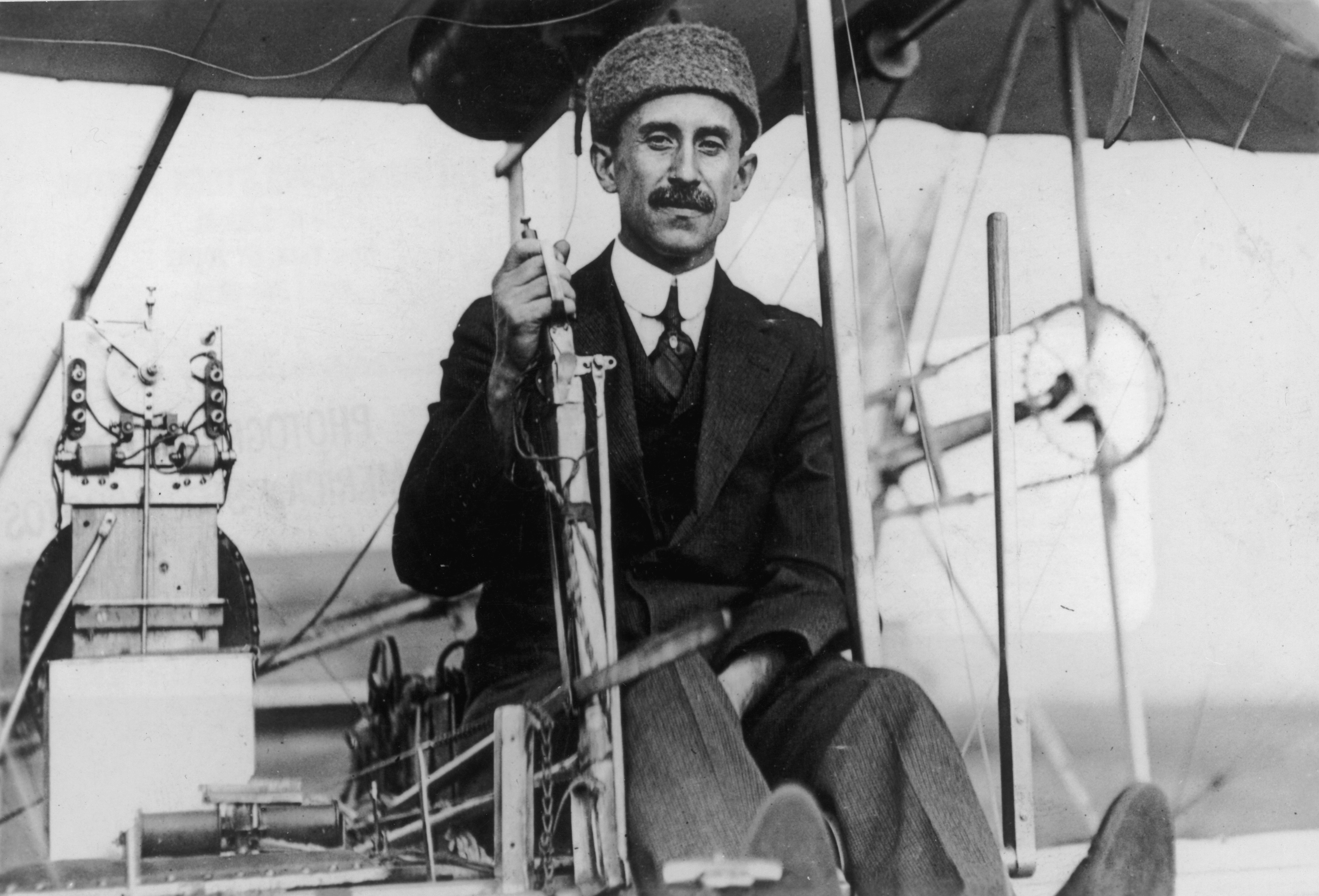
Eric Hodgins penned a profile of aviation pioneer Orville Wright, who just 27 years earlier made a historic “first flight” with his brother, Wilbur, at Kitty Hawk, North Carolina. An excerpt:
DRESSED FOR SUCCESS: Aviation pioneer Orville Wright (1871 – 1958) sits in one of his biplanes dressed in a three-piece suit and a cap, Dayton, Ohio, 1909. (ge.com)
* * *
No Love Parade, This
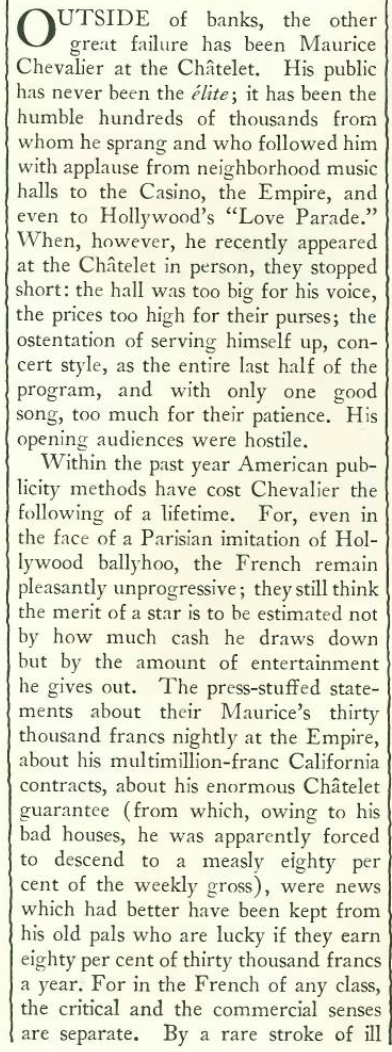
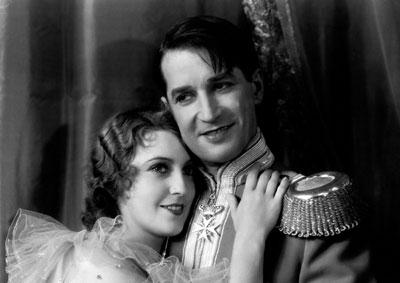
French singer and actor Maurice Chevalier made his Hollywood debut in 1928 and quickly soared to stardom in America. French audiences, however, were not so easily swayed, especially the elite patrons Chevalier faced, alone on the stage, at the cavernous Théâtre du Châtelet. Janet Flanner explained in this dispatch from Paris:
THEY LIKE ME IN TINSELTOWN…Jeanette MacDonald and Maurice Chevalier in The Love Parade (1929). (IMDB)GULP…Maurice Chevalier faced a tough crowd — his compatriots — at Paris’s Théâtre du Châtelet. (en.parisinfo.com)
* * *
Man’s Best Friend
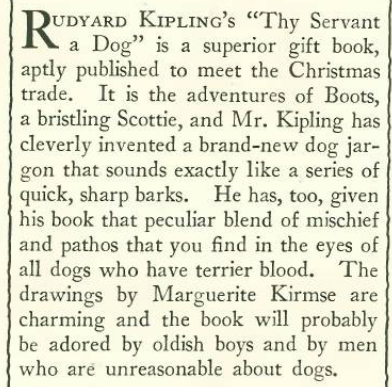
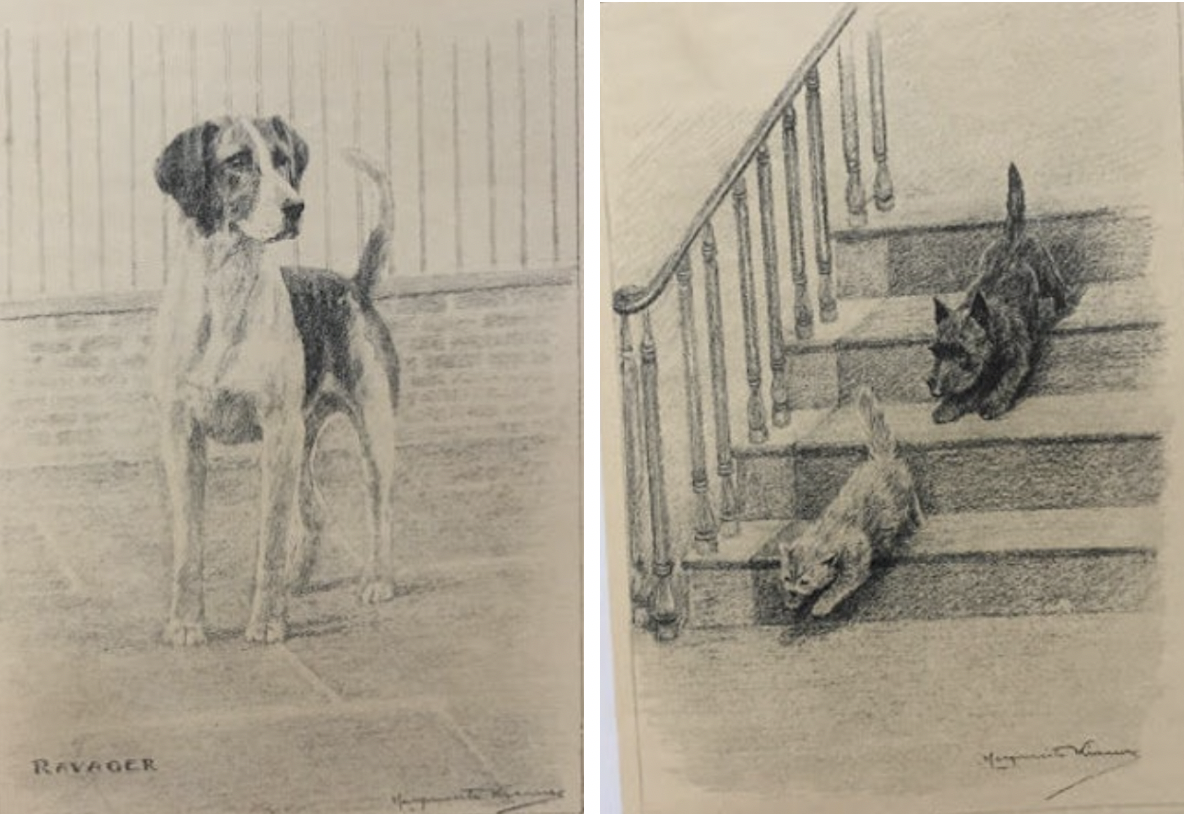
The New Yorker’s book section recommended the latest from Rudyard Kipling,Thy Servant a Dog…
WOOF…Illustrations for Rudyard Kipling’sThy Servant a Dog, by Marguerite Kirmse. (Etsy)
* * *
Fun and Games
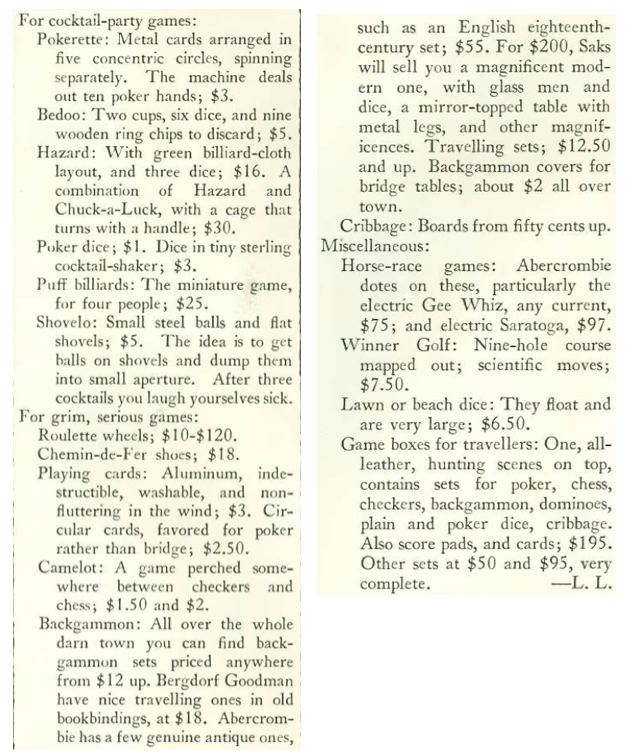
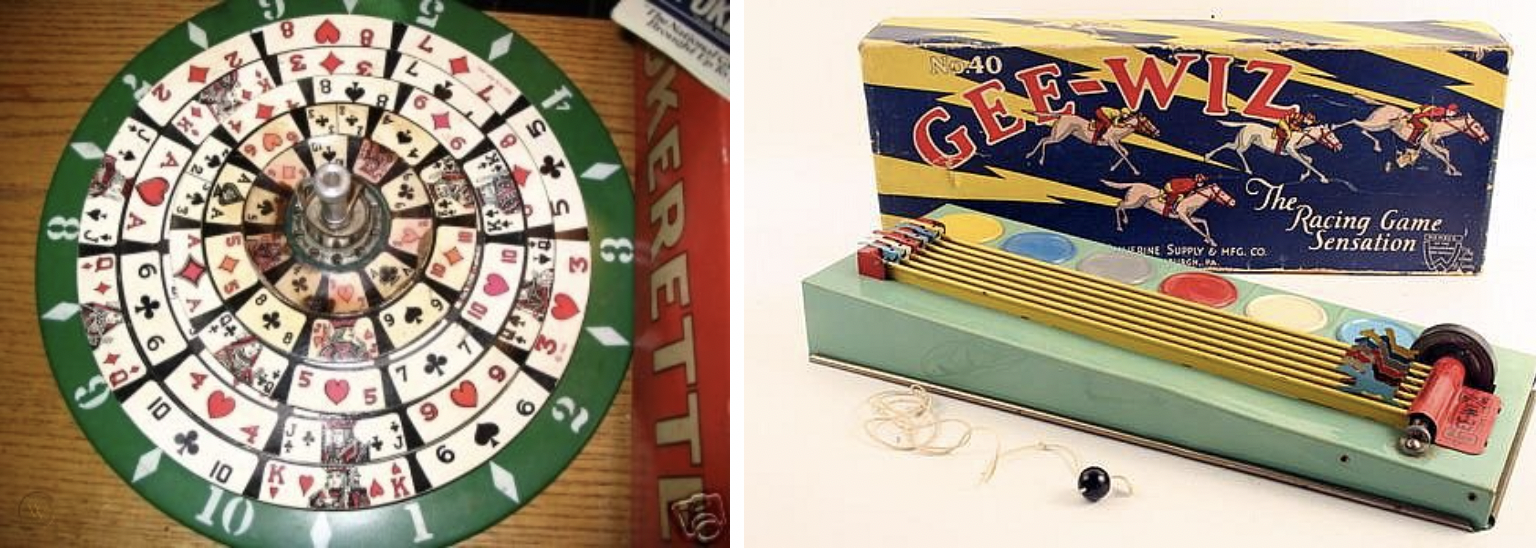
As an extension to her fashion column, Lois Long shared some recommendations for holiday cocktail-party games:
KEEPING THINGS MERRY…Pokerette and Gee-Wiz were popular cocktail party diversions during the Christmas season of 1930. (Worthpoint/Invaluable)
* * *
From Our Advertisers
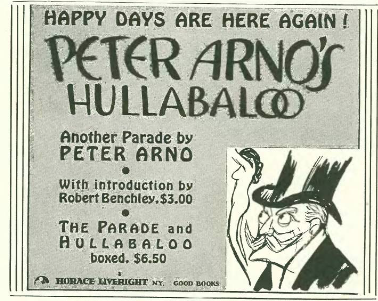
We start with this ad from Horace Liveright promoting Peter Arno’s third cartoon collection, Hullaballoo, featuring one of Arno’s leering old “Walruses”…
…Doubleday Doran offered a few selections for last-minute Christmas shoppers, led by the Third New Yorker Album…
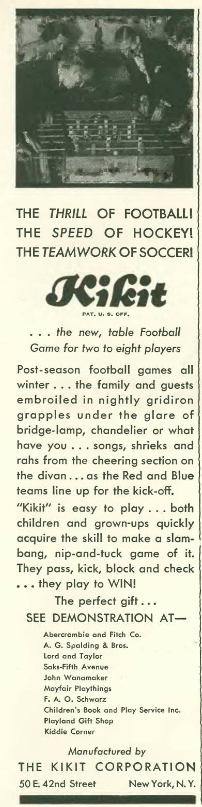
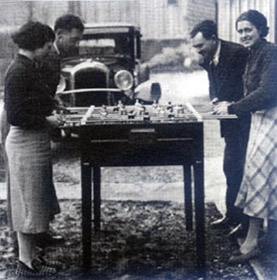
…The UK’s Harold Searles Thorton invented the table top game we now call “foosball” in 1921 and had it patented in 1923. Below is possibly the game’s first appearance in the U.S. — an ad for a “new” game called “Kikit.” Foosball would be slow to catch on, but would rapidly gain popularity in Europe in the 1950s and in the U.S. in the 1970s…
Early foosball players circa 1930. (foosball.org)
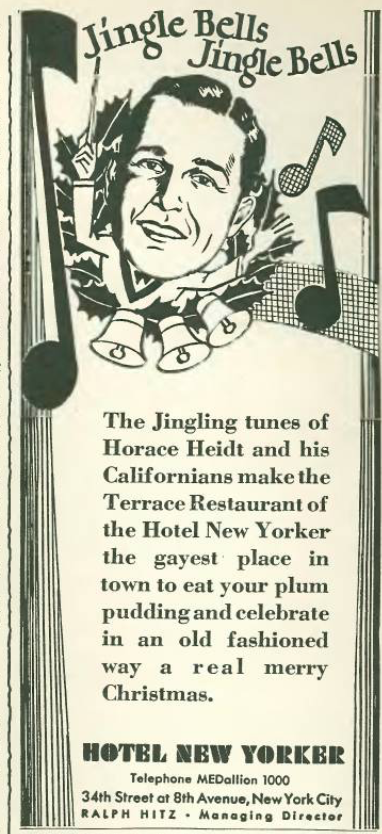
…Horace Heidt and his Californians were doing their best to make the season bright at the Hotel New Yorker…
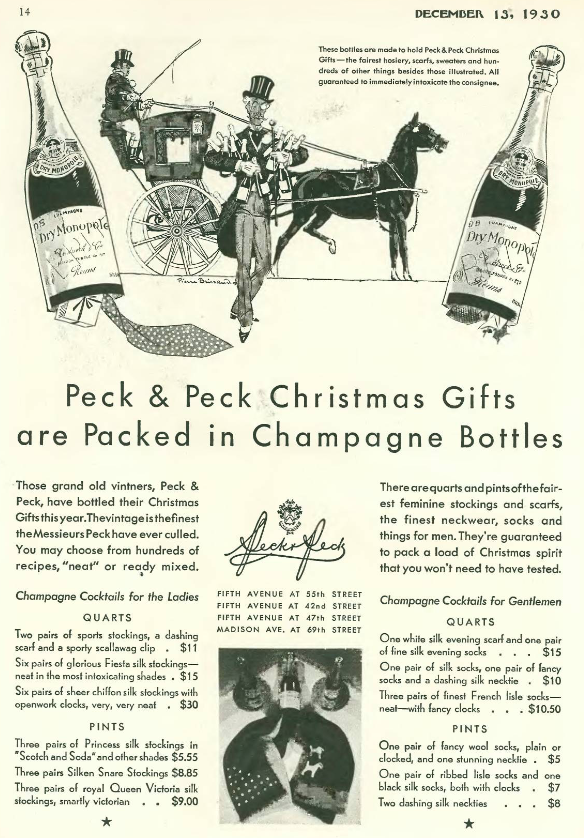
…Peck & Peck tried to make the most of Prohibition by stuffing scarves and other wares into empty Champagne bottles…
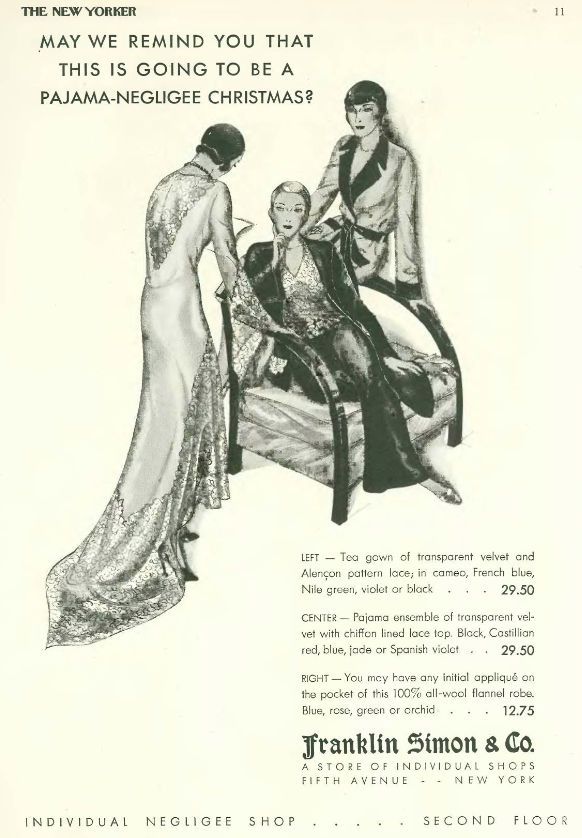
…and Franklin Simon reminded readers that it would be a “Pajama-Negligee Christmas,” whatever that meant…
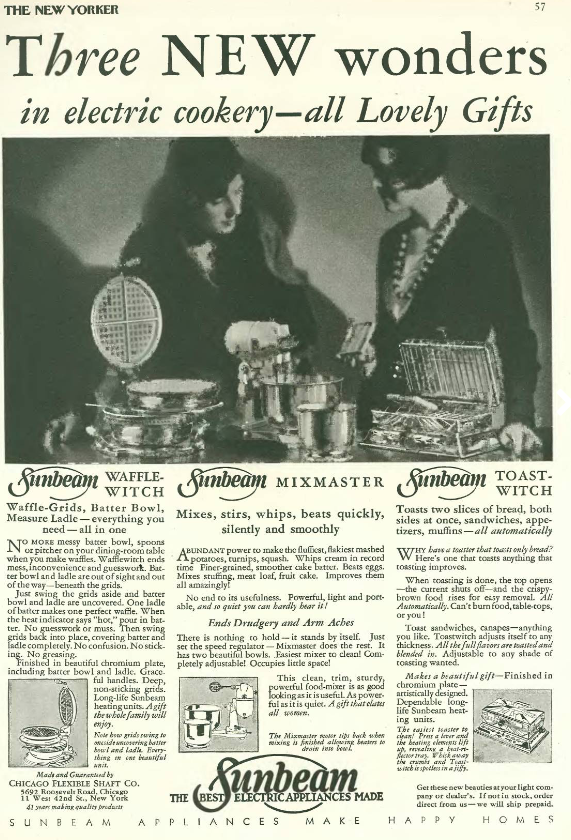
…pajamas and negligees were doubtless preferable, and more romantic, than this array of kitchen appliances…
…whatever the holiday revelry, the makers of Milk of Magnesia had our backs…
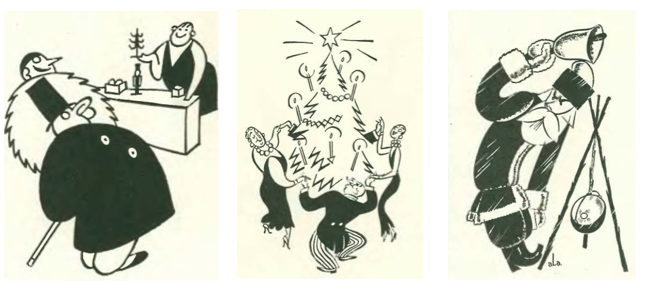
…on to our cartoonists, Julian De Miskey and Constantin Alajalov contributed spot drawings to mark the season…
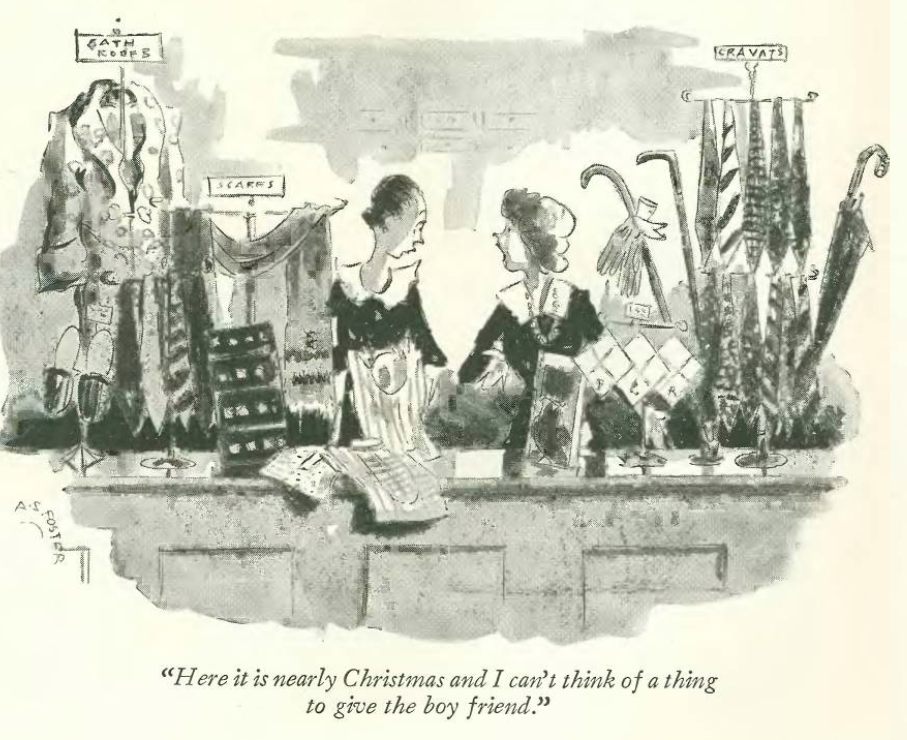
…A.S. Foster contributed two cartoons to the issue…
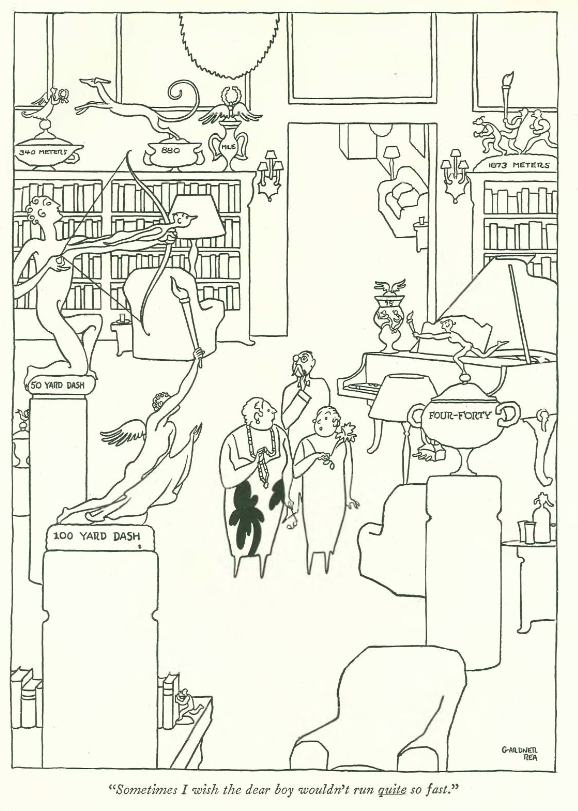
…Gardner Rea, a full-pager…
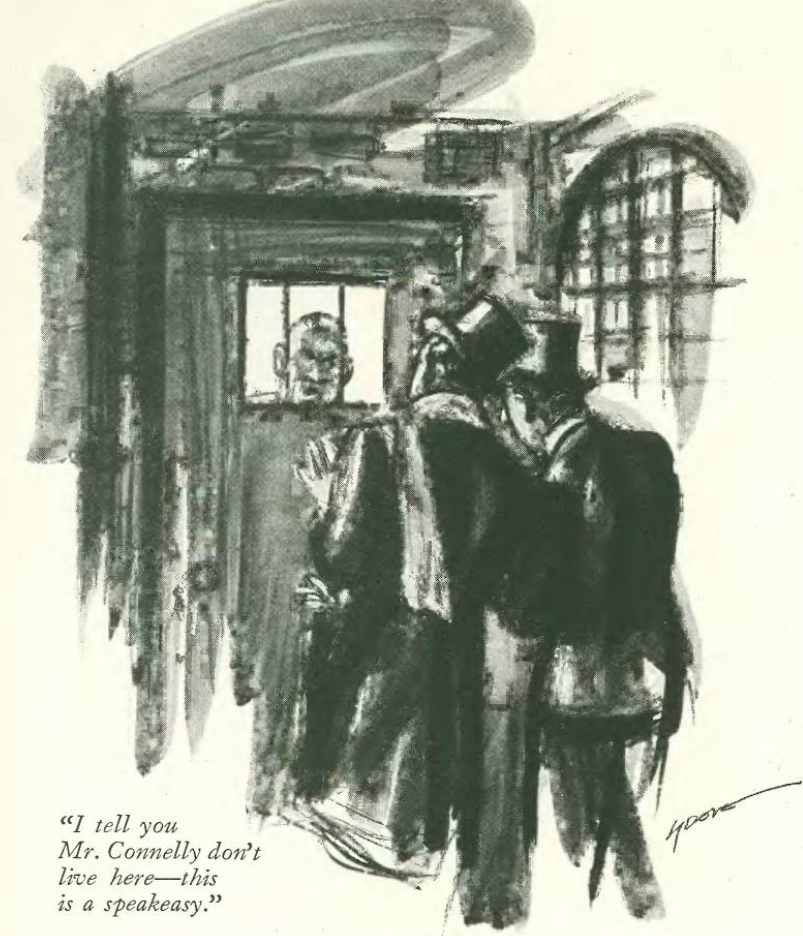
…Leonard Dove, possibly having some fun with playwright Marc Connelly…
…Isadore Klein demonstrated the fun to be had with a kiddie scooter, before they had motors…
…and we close with John Reynolds, and some bad table manners…
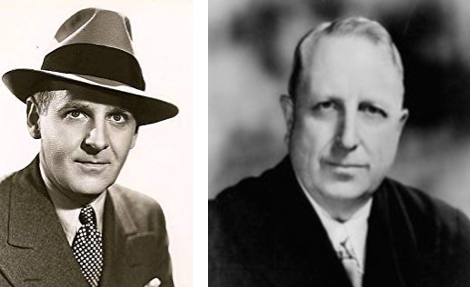
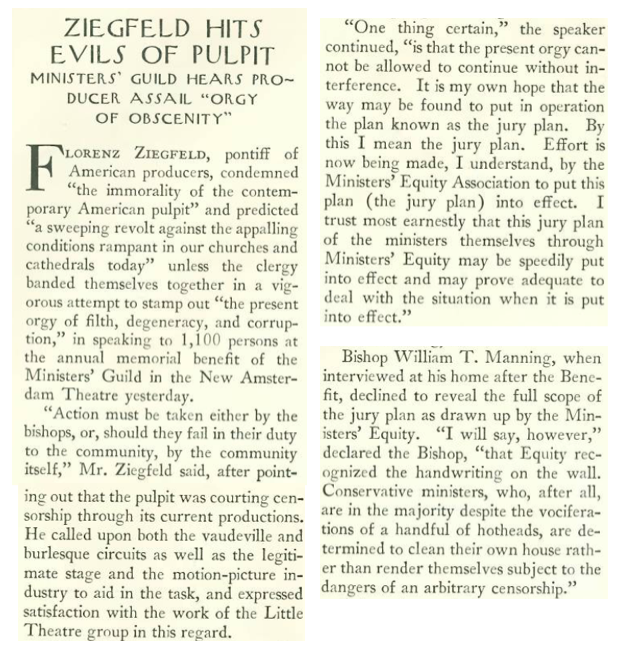
Broadway impresario Florenz Ziegfeld Jr knew how to pack a Broadway theater, and from 1907 to 1932 he staged a number of revues and plays (most notably Showboat) that featured lavish costumes and a bevy of chorus girls.
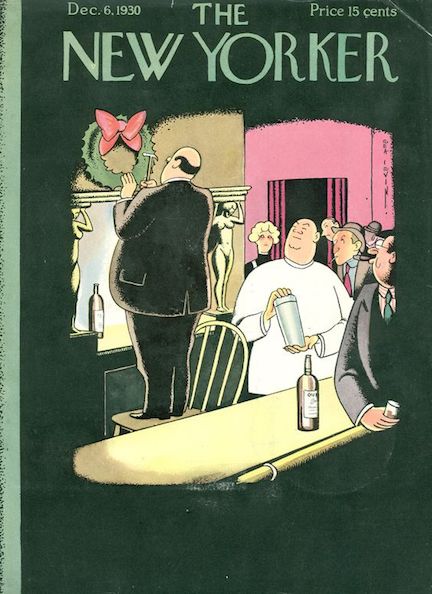
Dec. 6, 1930 cover by Rea Irvin, depicting a peephole view of a speakeasy during the holidays.
When his latest show, Smiles, hit the stage of the Ziegfeld Theatre on Nov. 18, 1930, it was greeted by an audience that had endured the first year of the Great Depression. Ziegfeld’s entertainments, on the other hand, were more associated with the high times of the Roaring Twenties. So even the popular brother-sister dance team from Omaha — Fred and Adele Astaire — seemed a bit old hat.
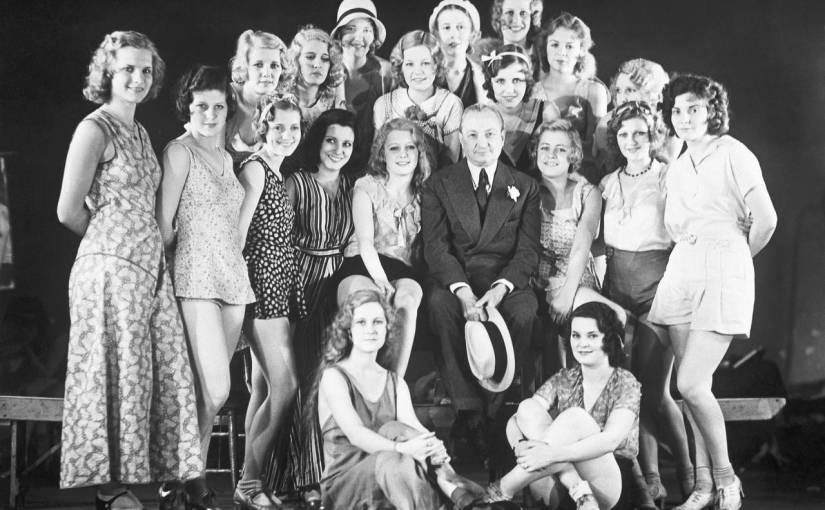
GO WITH THE FLO…Broadway impresario Florenz “Flo” Ziegfeld Jr with his Follies cast, 1931. (Wall Street Journal)
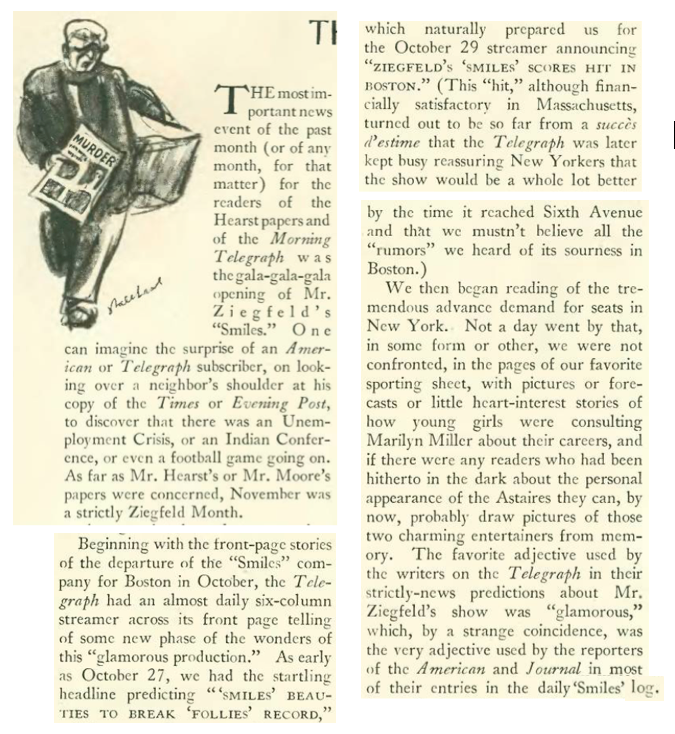
Or so it seemed to Robert Benchley, who observed in “The Wayward Press” that most of his readers could draw pictures of the Astaires from memory. But what really irked Benchley was the way William Randolph Hearst manipulated his mighty newspaper empire to promote Ziegfeld’s Smiles in a way that made the show appear to be the biggest hit of the year.
Ziegfeld Theatre was built with Hearst’s financial backing, so the media mogul was determined that the show would be a success, commanding his editors and writers to lavish praise on the tepid production, which would close in less than two months as a box office failure.
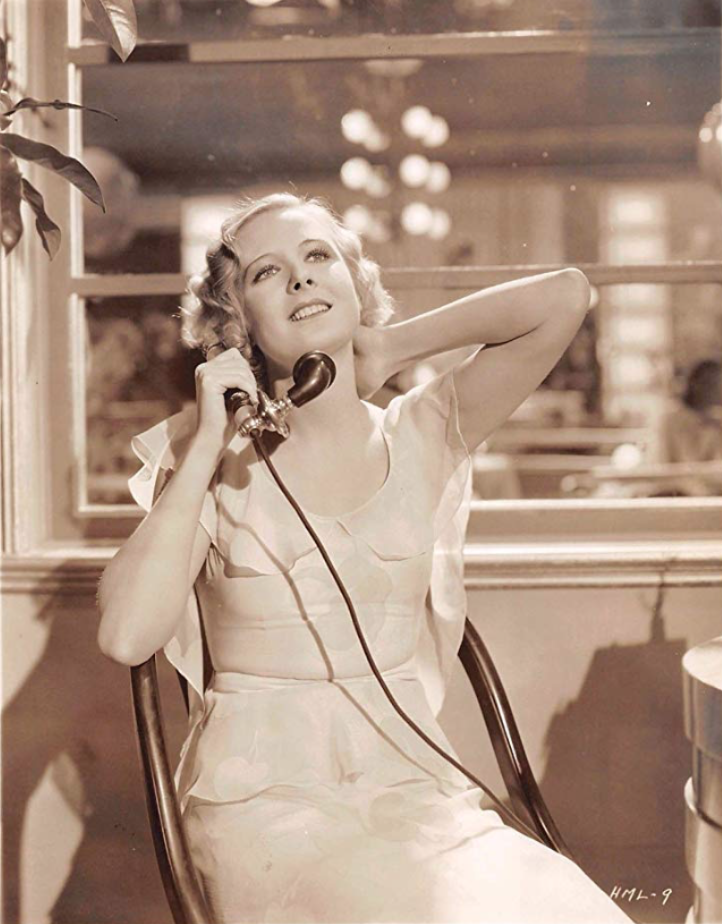
SAY CHEESE…Program for Smiles featuring Fred Astaire, Marilyn Miller and Adele Astaire. At right, publicity photo for Smiles featuring Fred and Marilyn. (Playbill/Pinterest)
For the Astaires, they were nearing the end of their 27-year collaboration — Adele would retire from the stage in 1932 to marry Lord Charles Cavendish, and in 1934 Fred would pair up with Ginger Rogers for the first of nine films they would make together for RKO. Marilyn Miller, one of the most popular Broadway stars of the 1920s and early 1930s, would also seek her fortune in films, but would only make three. Alcoholism and persistent sinus infections would cut her life short in 1936 — she would die at age 37 from complications following nasal surgery.
BRIEF CAREER…Marilyn Miller in 1931’s Her Majesty, Love, one of just three films she would make before her death in 1936. (IMDB)
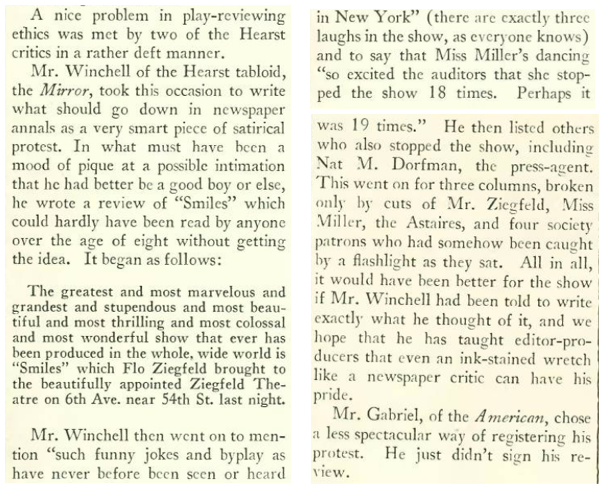
Benchley revealed how some of Hearst’s reporters responded to the edict from their boss:
TWEAKING HIS NOSE…Walter Winchell, left, registered his protest against his boss, William Randolph Hearst, by laying it on thick in his column. (IMDB/BBC)THE FOLLY OF FOLLIES…Robert Benchley (left) cried foul regarding Hearst’s attempt to prop up a lousy show; Ogden Nash (right) found humor in the “immorality” of Ziegfeld’s productions. (Wikipedia/Notable Biographies)
On a related note, Ogden Nash also zeroed in on Ziegfeld’s latest show, turning the tables on religious zealots who found the Follies immoral. An excerpt:
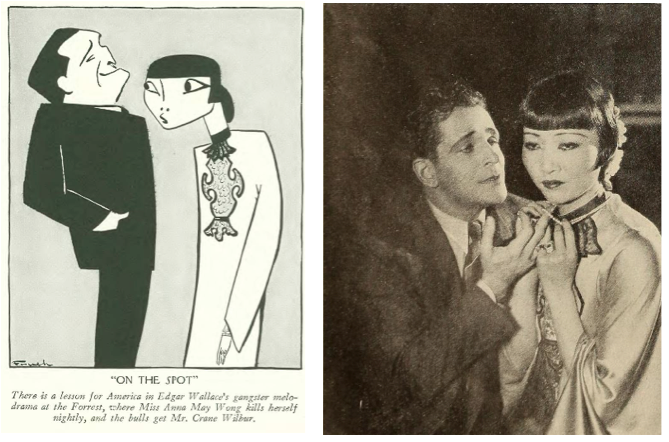
And finally, one more theater-related item: a drawing by Al Frueh highlighting the melodrama On The Spot, which ran from Oct. 29, 1930 through March 1931 at the Forrest Theatre.
BETTER THAN ZIEGFELD, THIS…At right, Crane Wilbur and Anna May Wong in the melodrama On The Spot, which opened Oct. 29, 1930 at the Forrest Theatre. (New Yorker/Pinterest)
* * *
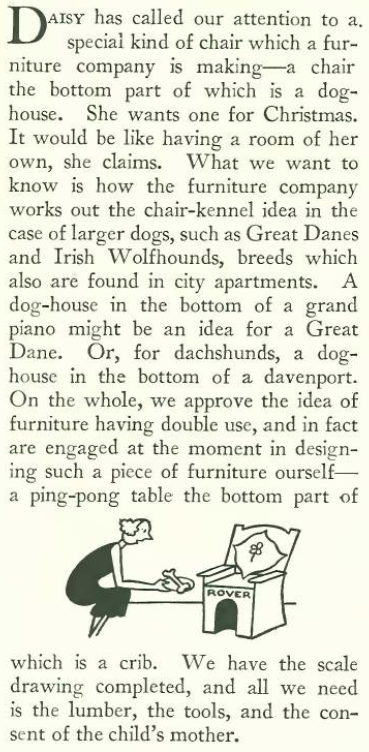
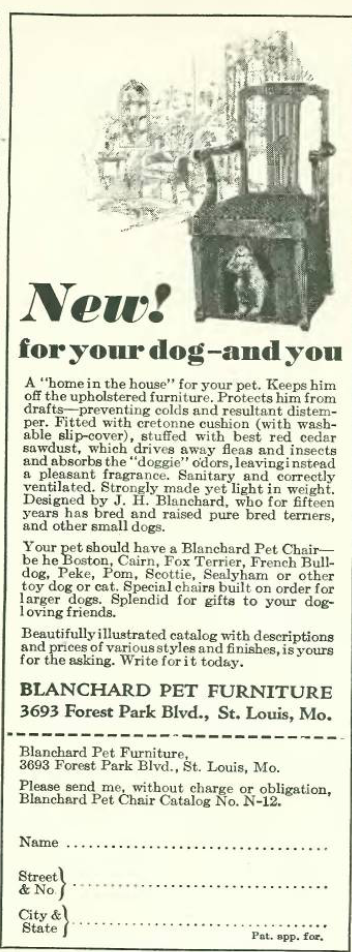
In the Dec. 6, 1930 “Notes and Comment,” E.B. White shared his observations on a new type of chair that doubled as a dog house…
…and he wasn’t making it up, because the chair he described was featured in this ad from the same issue…
* * *
Drunk History
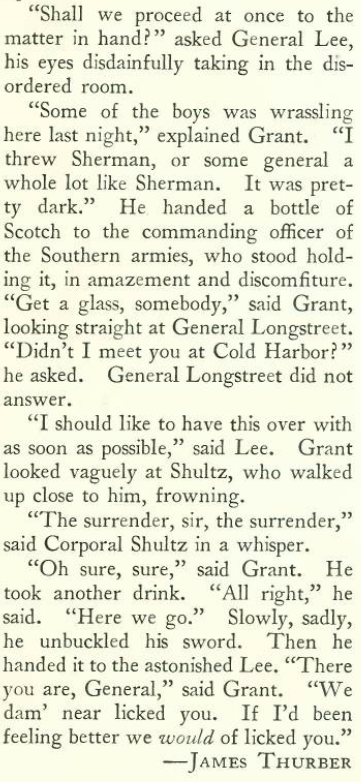
In the fall of 1930 Scribner’s magazine published a series of three articles titled “If Booth Had Missed Lincoln,” If Lee Had Not Won the Battle of Gettysburg,” and “If Napoleon Had Escaped to America.” The New Yorker’sJames Thurber claimed to be the author of a fourth article, “If Grant Had Been Drinking At Appomattox.” An excerpt:
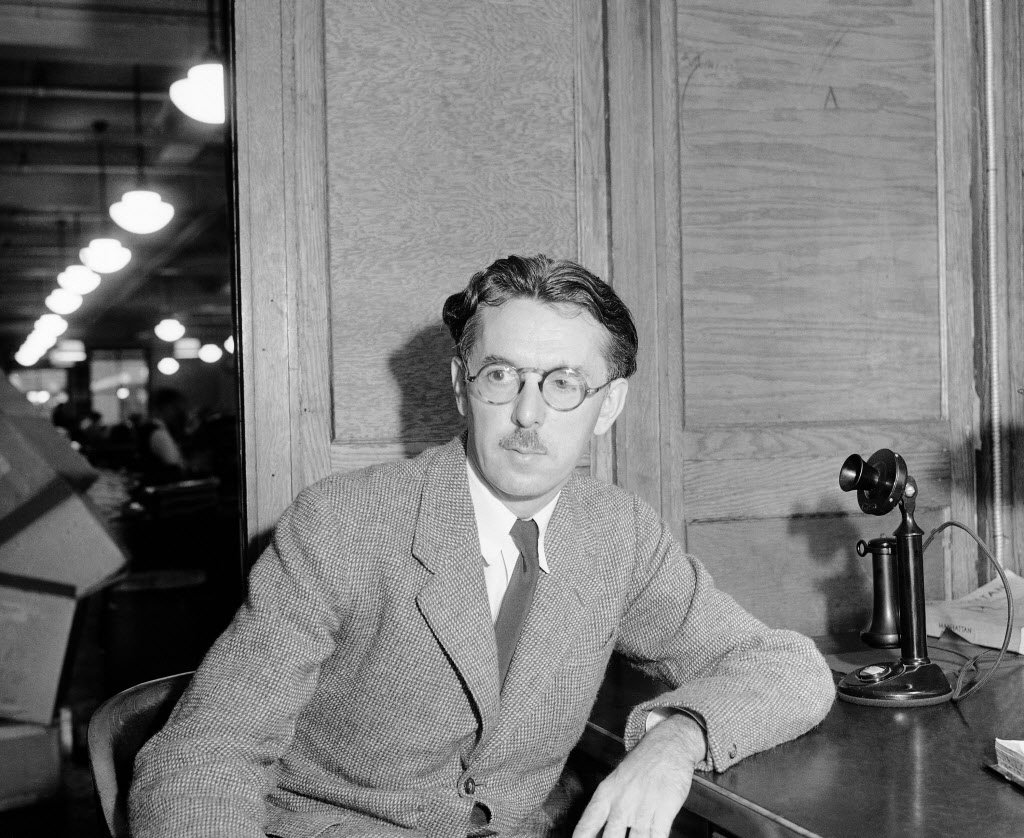
REVISIONIST…James Thurber circa 1930. (thurberhouse.org)
* * *
From Our Advertisers
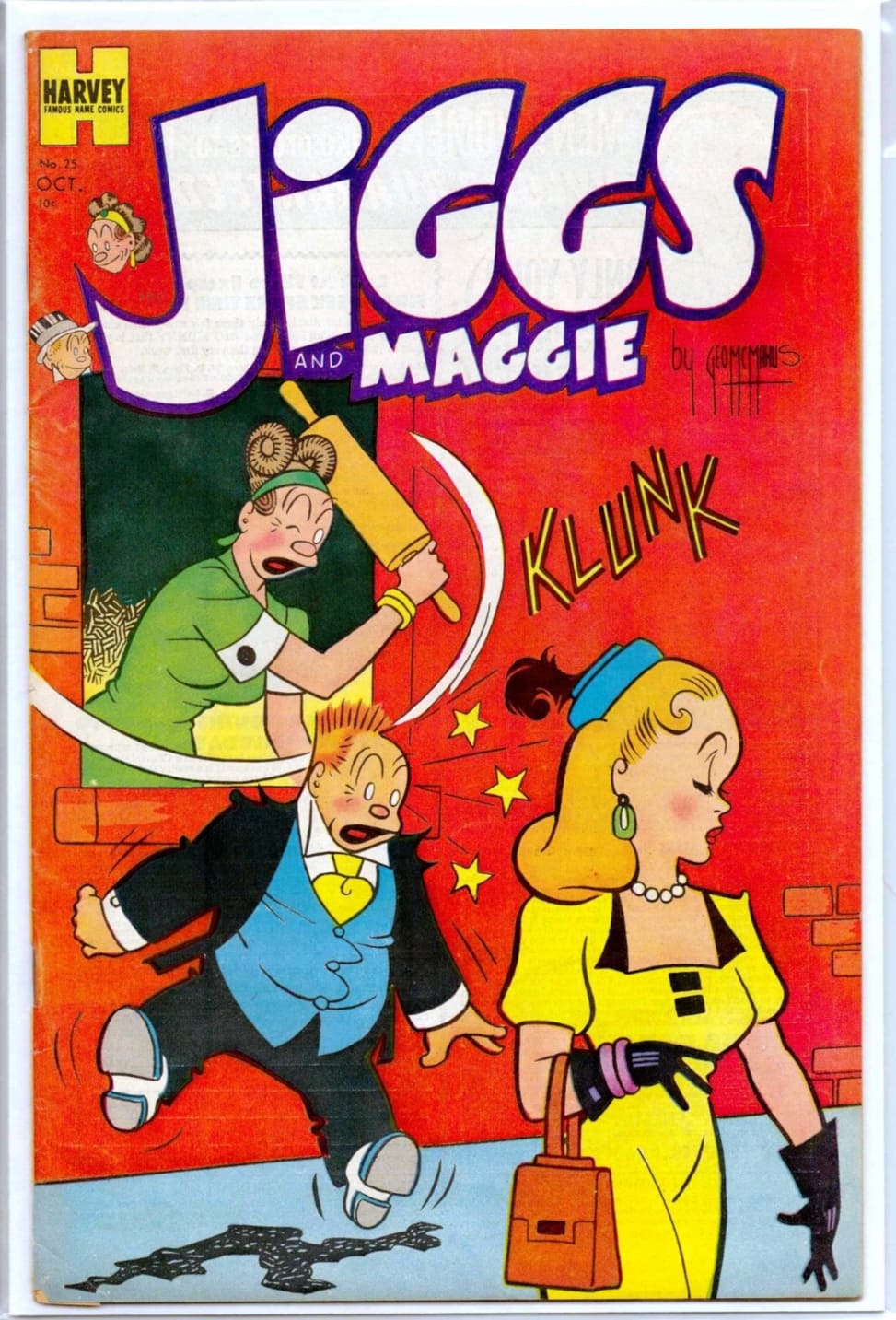
The rolling pin was often deployed as a prop — especially in the comics — to illustrate marital discord; the makers of Hoffman ginger ale used the common trope to sell their fizzy drink…
…for reference, Maggie gives it to Jiggs in this comic book cover from 1953…
(Good Girl Comics)
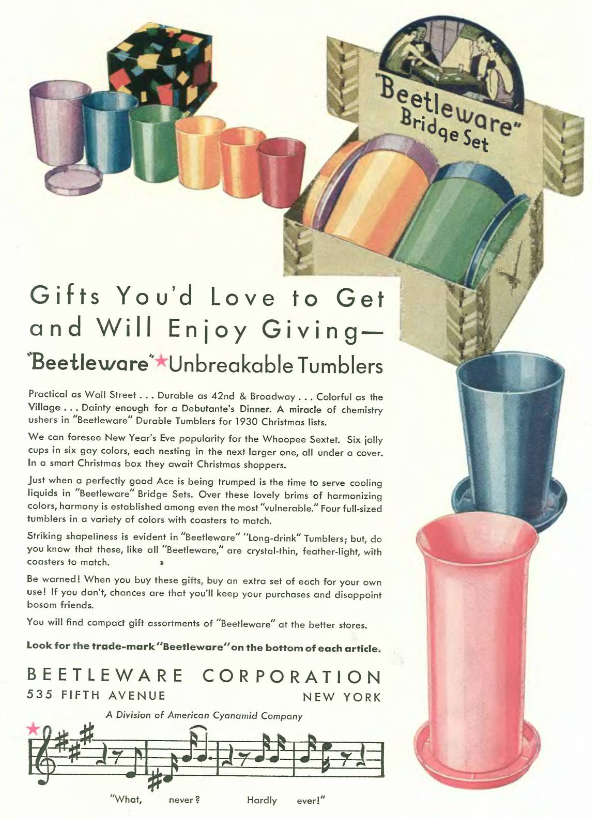
…the issue was stuffed with ads for Christmas shoppers, ranging from colorful plastic tumblers…
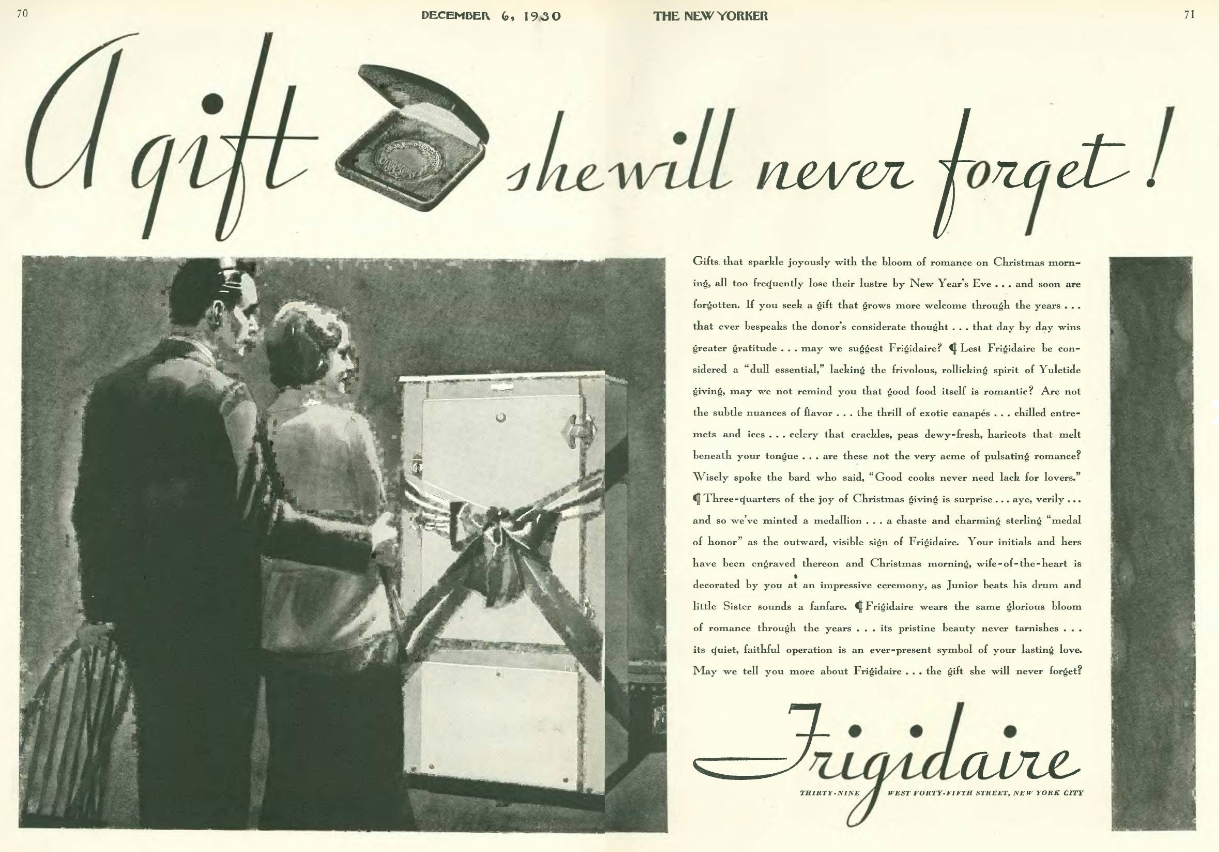
…to “unforgettable” appliances…
…to a variety of accessories at Wanamaker’s…
…Macy’s offered this pajama and robe combination for (insufferable) little boys who “strive for sartorial effect”…
…while Burdine’s of Miami urged snowbirds to purchase multiple wardrobes to remain fashionable throughout the winter season…
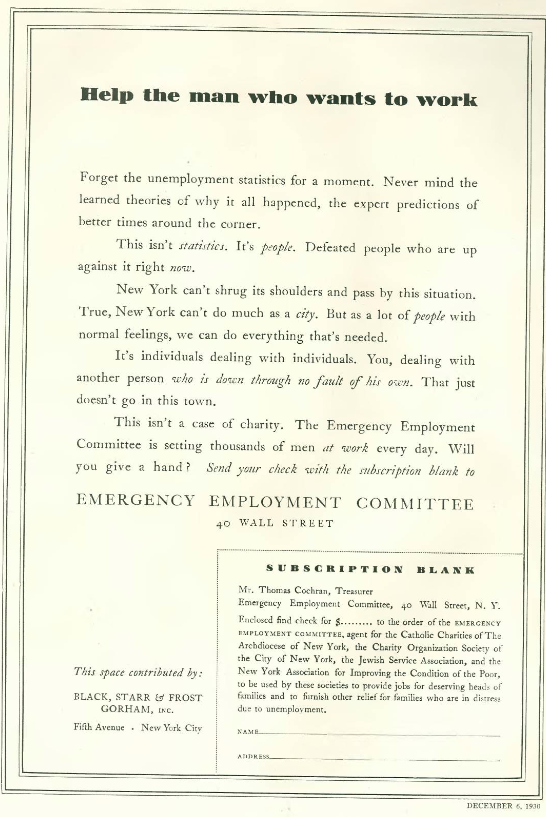
…and in stark contrast, this ad appealed for donations to help the jobless…
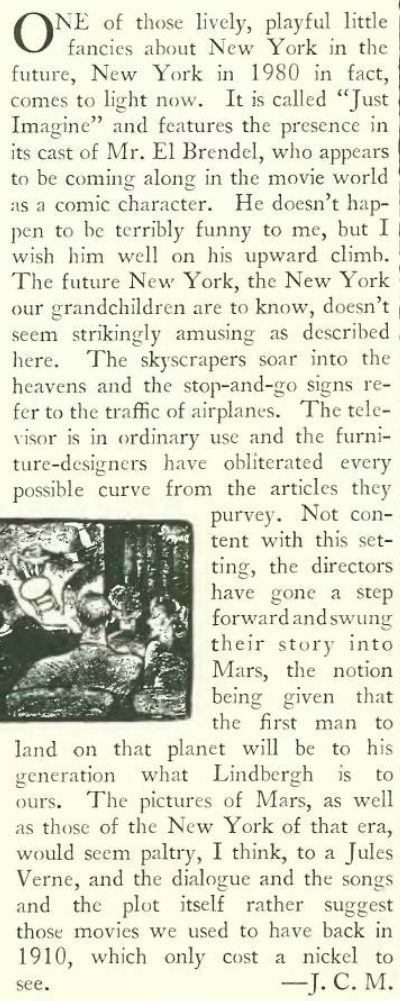
One of the most expensive movies of 1930 was a sci-fi musical comedy titled Just Imagine, a silly mash-up of great sets, terrible acting, and a vision of the future fifty years hence that was way off the mark.
Nov. 29, 1930 cover by Victor Bobritsky.
Not that the film ever set out to be an accurate prediction of the future. Nevertheless, it is instructive (or, at the least, amusing) to look back on “yesterday’s tomorrows” to understand the American mind in the first year of the Great Depression.
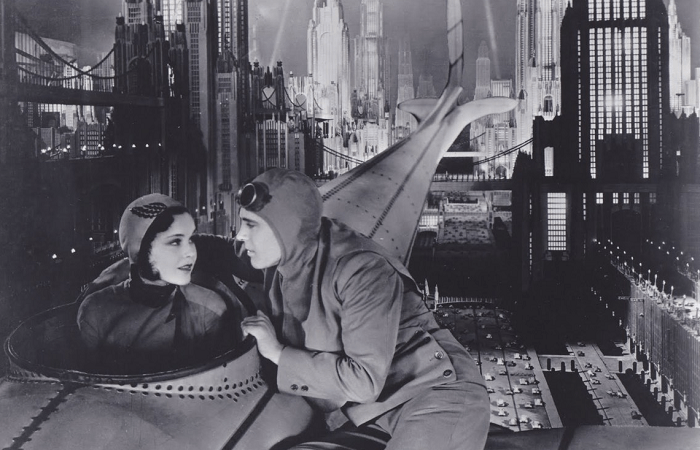
COME FLY WITH ME…Clandestine lovers LN-18 (Maureen O’Sullivan) and J-21 (John Garrick) share a romantic moment high above the streets of 1980 New York City. (scifist.net)
Just Imagine borrowed some of its look from Fritz Lang’sMetropolis (1927), a dystopian vision of the future that reflected the contentious years of Germany’s Weimar Republic. Just Imagine similarly reflected its time and place — the early years of the Depression — Hollywood responding not with gloom and doom but rather with uplifting fare — comedies, musicals, and escapist fantasies (Flash Gordon came along in 1936). The producers of Just Imagine rolled all of it into one film, and The New Yorker’sJohn Mosher tried to make sense of the mess:
EYE IN THE SKY…In Just Imagine, technology is advanced enough to have a traffic cop floating in the sky, but he still must rely on his arms and mechanical signals to keep the skyways in order. (YouTube clip)
The floating traffic cop is just one example of the film’s attention to set design. The New York skyline, featured in the opening scene, was constructed in a giant hangar at enormous cost…
(IMDB)
In one of the films weirder twists, vaudeville comedian El Brendel is brought back to life with an electric beam…
SMOKED HAM…Vaudeville comedian El Brendel is zapped back to life to provide the world of 1980 with comic relief. Some of the electrical equipment assembled by set designer Kenneth Strickfaden would be seen again in 1931’s Frankenstein. (scifist.net)
…and Brendel (below, center), proceeds to get drunk on booze pills and spew a series of really bad jokes throughout the duration of the film…
WE SHOULD HAVE LEFT HIM DEAD…Frank Albertson, El Brendel and John Garrick in Just Imagine. (scifist.net)MARS ATTACKS…The film also took audiences to the surface of Mars via a phallus-shaped spaceship that would later be used in Flash Gordon serials. Clockwise, top left, the spaceship blasts off surrounded by a crowd of men in fedoras; aboard the spaceship; landing site on Mars; J-21 (John Garrick) encounters the Martian Queen (Joyzelle Joyner). (YouTube/scifist.net)
The movie flopped at the box office, but producers were able to recoup some of the costs by farming out clips of the futuristic sets, and some of the props, to other sci-fi films of the 1930s including the Flash Gordon and Buck Rogers serials.
* * *
Toys For Tots
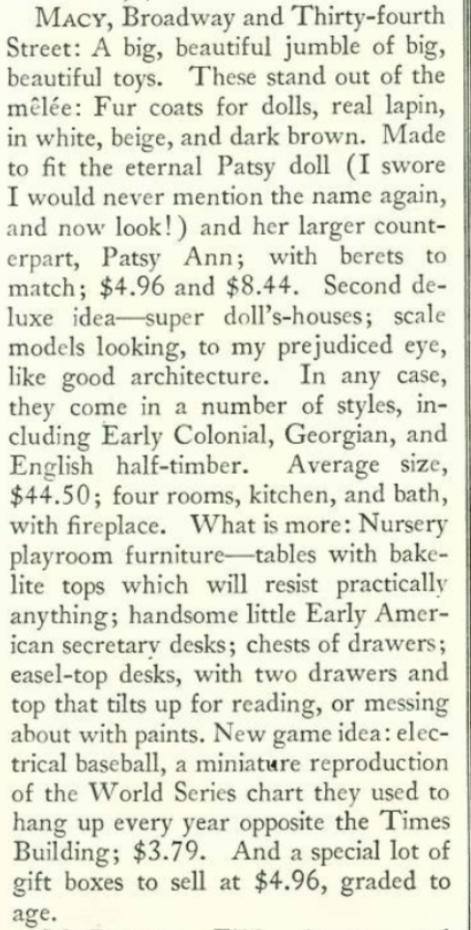
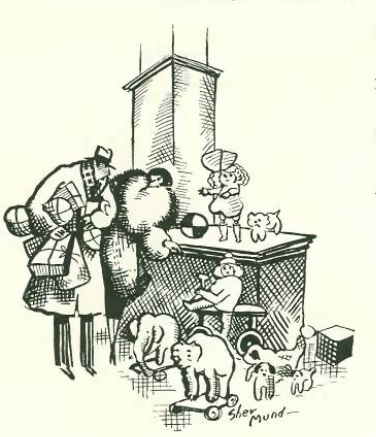
By mid-November The New Yorker’s “On and Off the Avenue” column had lengthened to include ideas for Christmas shoppers. The Nov. 29 issue offered these ideas for children’s toys from Macy’s…
XMAS IS COMING…Patsy Ann dolls in smart berets, and dollhouses in various styles (a 1930 Tudor dollhouse at right) could be had at Macy’s Herald Square flagship store. (Pinterest)
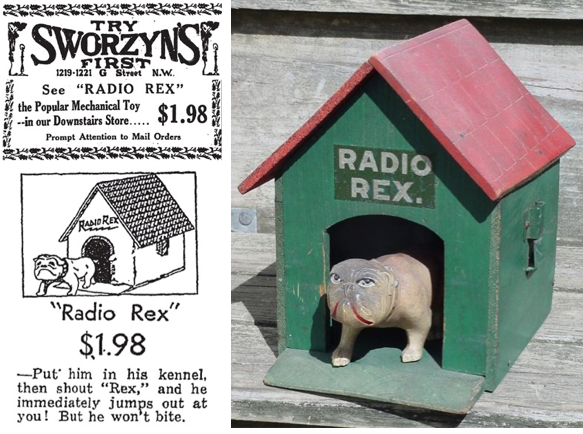
GRRRR…First introduced in 1922, the revival of “Radio Rex” proved popular to the kiddies in 1930. It was the “high tech” toy of its day, the first to respond to voice commands. Rex the dog would spring out of his doghouse at the sound of the word “Rex,” thanks to a sound-sensitive electromagnet. (ctinventor.wordpress.com)
* * *
A Century-old-Problem
Traffic woes have been around almost as long as there have been cars. In an excerpt from “A Reporter at Large,” Morris Markey explained the challenges facing the city’s police department:
IF YOU BUILD IT, THEY WILL COME…Traffic clogs Fifth Avenue near 42nd Street in 1930. (digitalcollections.archives.nysed.gov)
* * *
Speaking of cars, this ad in The New Yorker announced the opening of the annual Automobile Salon at the Commodore Hotel…
…and the magazine was on hand to describe its various wonders. Some excerpts:
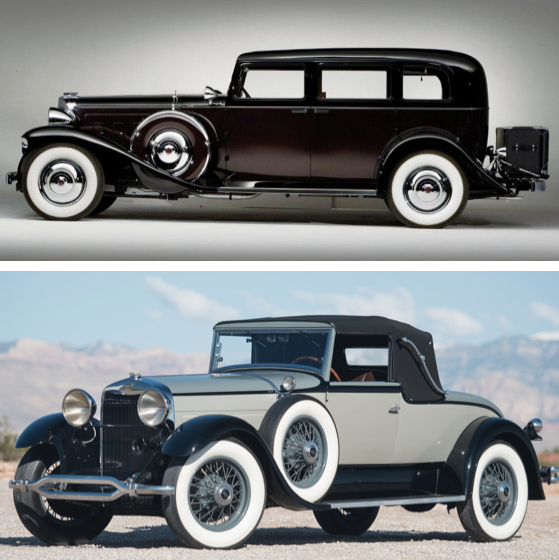
POETRY IN MOTION…Top, the Walter Dorwin Teague-designed Marmon 16-cylinder wowed crowds at the Salon, even if few could afford it. The Great Depression limited the production of the luxury Marmon, and less than 400 were produced. The company abandoned the car business altogether in 1933. Below, the sporty Ford Model L Roadster, designed by Raymond Dietrich. (supercars.net/Sotheby’s)
* * *
Maestro Politician
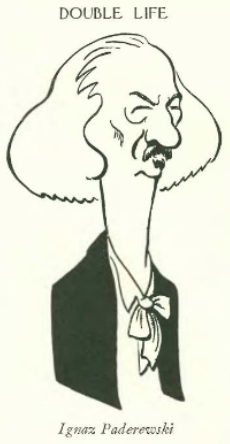
TheNew Yorker profiled pianist, composer and statesman Ignacy Jan Paderewski (1860-1941). Paderewski served as Poland’s prime minister in 1919, negotiated on behalf of his country at the Treaty of Versailles, and had a 60-year career as a virtuoso pianist. A brief excerpt:
* * *
Not For the Moneychangers
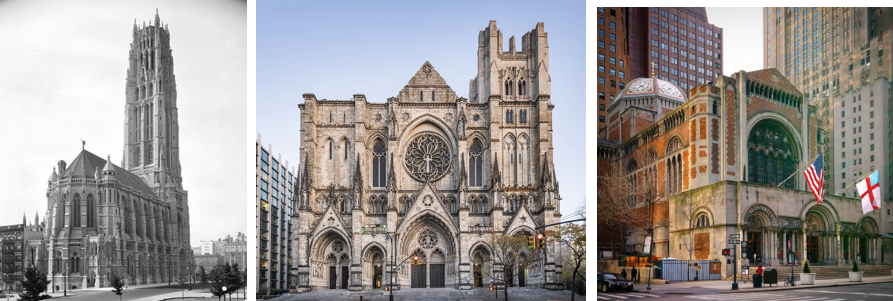
Architecture critic George S. Chappell checked in on the progress of three prominent Manhattan cathedrals in his “Sky Line” column:
LANDMARKS ALL…From left, Riverside Church, the still yet-to-be completed St. John the Divine, and St. Bartholomew’s. (MCNY/masonrymagazine.com/dtjoyce.com)
* * *
The theater review section included this illustration of a new play, Roar China, that opened Oct. 27, 1930 at the Beck Theatre.
The staging of Roar China included this reconstruction of the bow of the H.M.S. Europa on the Beck Theatre stage…
(messynessychic.com)
* * *
From Our Advertisers
The holiday season was in the air, and retailers were taking various approaches to entice Depression-era shoppers to consider their wares. The ads have a more conservative bent, when compared to late 1920s, and in the case of Wanamaker’s and B. Altman’s, an appeal to simpler times…
…Macy’s, on the other hand, looked to sell rather expensive lighters “to arouse the youthful enthusiasm among veteran smokers”…
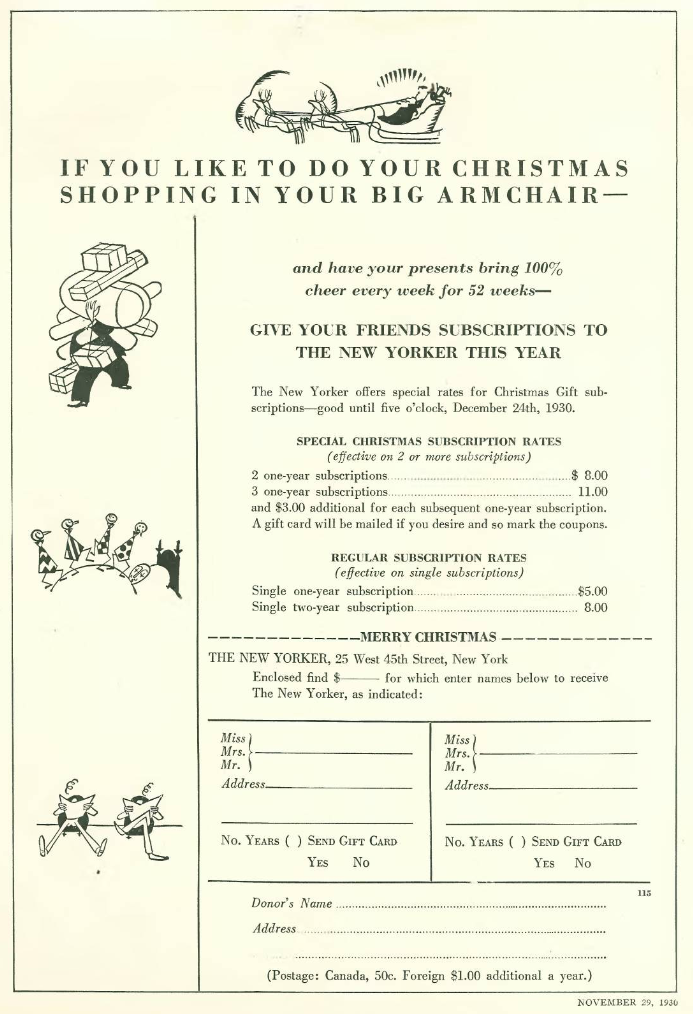
…despite the Depression, New Yorker subscriptions continued to steadily increase — the magazine had nearly 45,000 subscribers in 1930, and by the end of the decade the number would approach 100,000 — below, a house ad designed to entice new subscribers…
…our cartoons include this holiday spot illustration by Barbara Shermund…
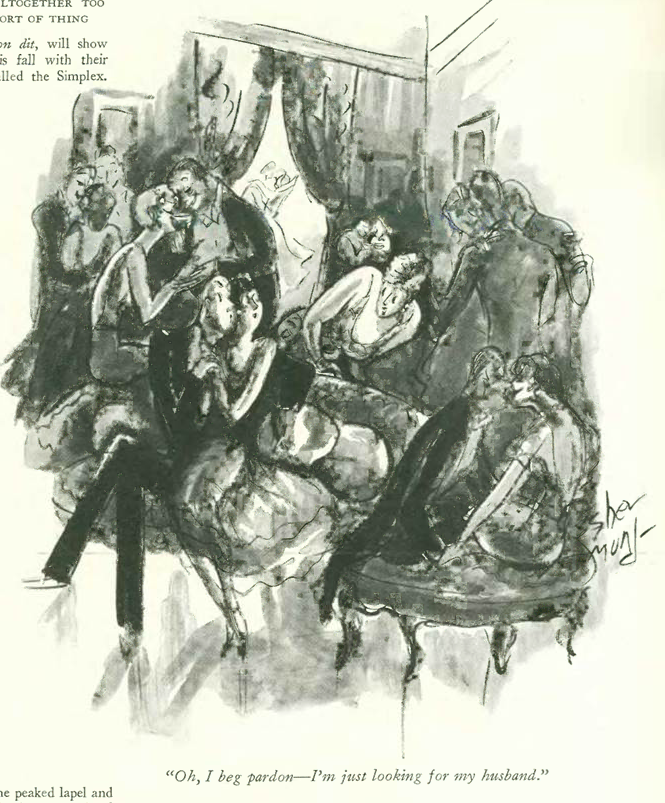
…and another by Shermund of her parlor room crowd…
…Otto Soglow amused us with a couple of tots…
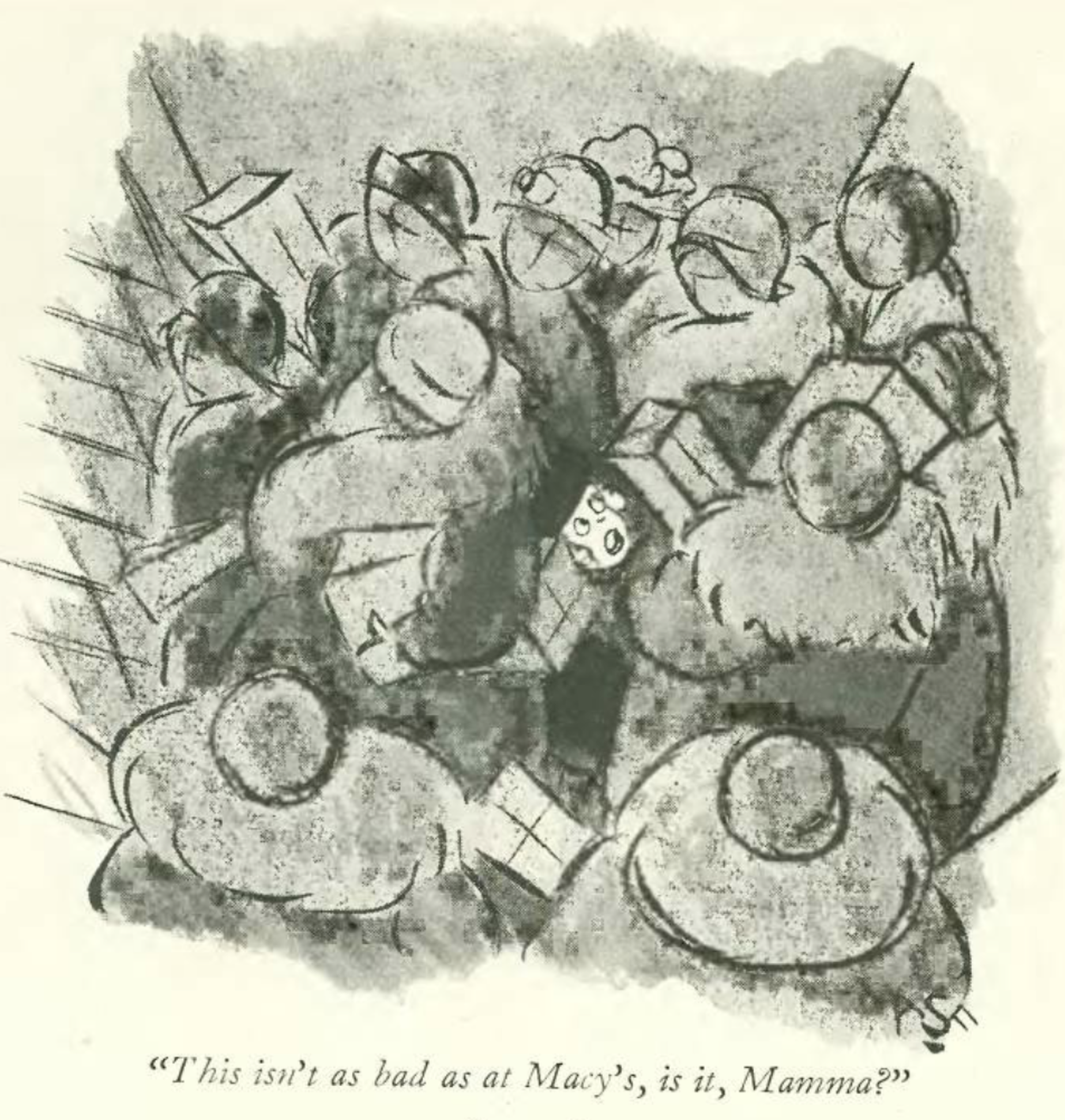
…Gardner Rea imagined a confrontation between a Macy’s Thanksgiving Day Parade balloon and Italy’s Fascist dictator Benito Mussolini…
…the balloon Rea illustrated was “The Captain” from the popular Katzenjammer Kids comic strip. Along with his “family,” the Captain appeared in the parade in 1929 and 1930 (and possibly 1931). They were the first licensed character balloons in the parade’s history…
(The New York Times)
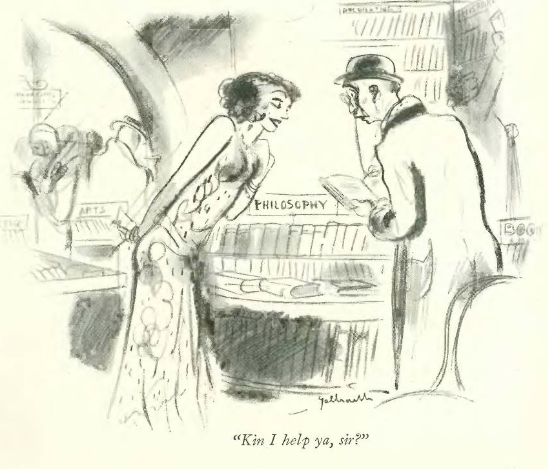
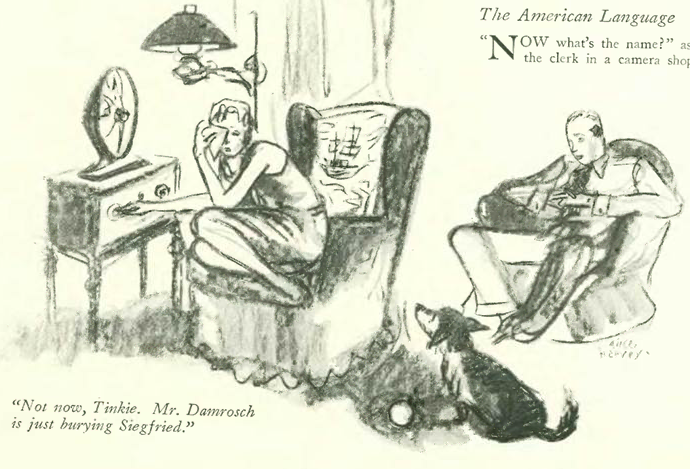
…back to cartoons, book shopping with William Crawford Galbraith…
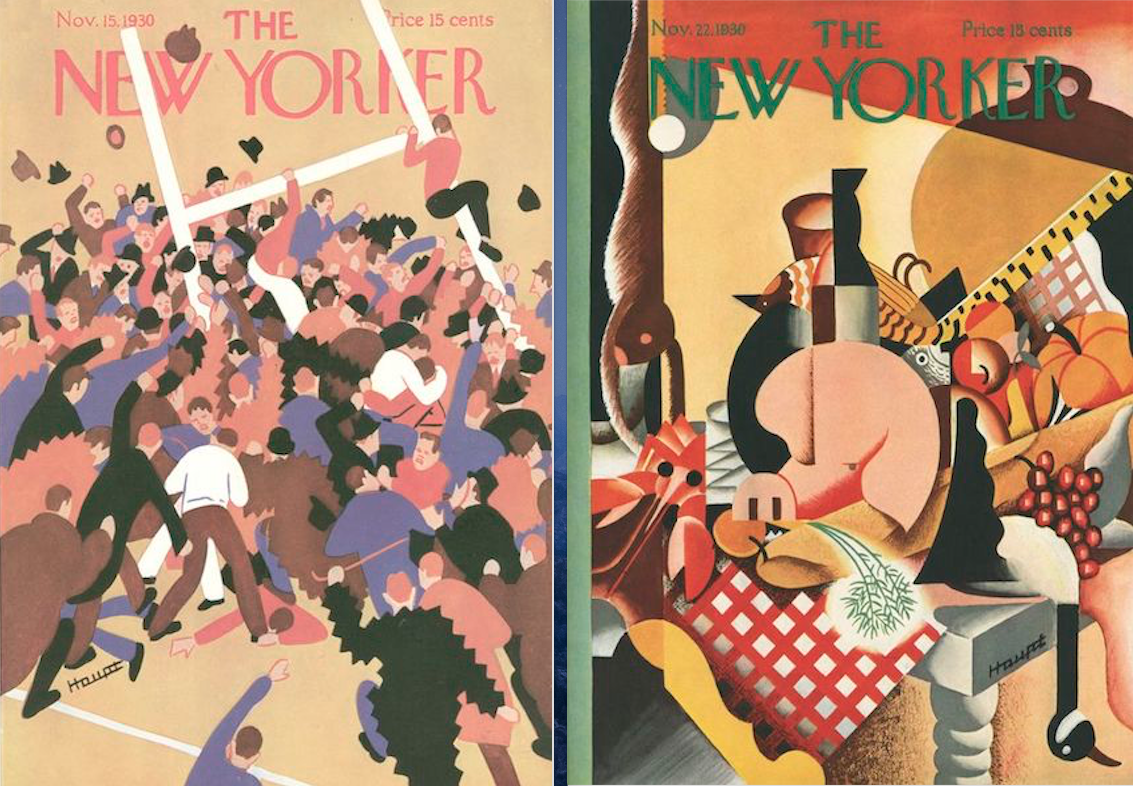
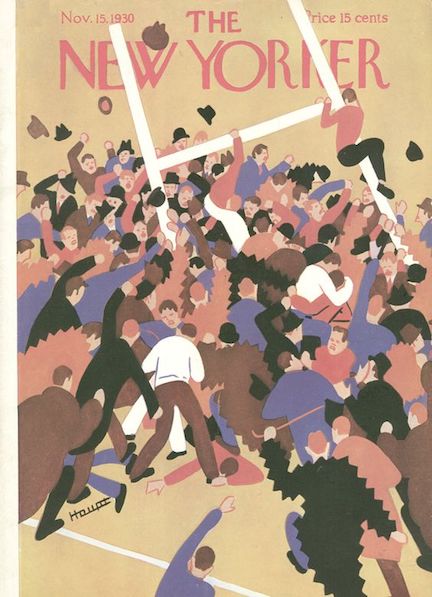
For this installment we look at two issues, Nov. 15 and 22, both featuring covers by Theodore Haupt that celebrated two autumn rituals: football and Thanksgiving.
Let’s begin with the Nov. 22 issue, which climbed to the highest place in Manhattan — no, not the Chrysler Building, but the nearby Empire State Building — with E.B. White admiring the commanding view:
Before the Empire State Building could go up, the old Waldorf-Astoria hotel had to come down. As White observed, the old hotel was built so soundly that it was too costly to deconstruct and salvage. Most of it ended up on the bottom of the ocean.
DOWN IN DAVY JONES’ LOCKER lie the remains of the old Waldorf-Astoria Hotel, which stood for just 36 years before it was razed to make room for the Empire State Building. At right, one of the hotel’s lobbies, and the Grand Ballroom. (nyc-architecture.com/Pinterest)A LOT OF HOT AIR…Top images: The fabled “mooring mast,” described by E.B. White in his New Yorker brief, as imagined in composite images (old-time Photoshop). In reality, the morning mast never worked; bottom right, a cutaway view of the mast featured in Popular Mechanics; bottom left, New York Times photo from March 22, 1931, announcing the completion of the Empire State Building, just 17 months after the Waldorf-Astoria began coming down. (Keith de Lellis Gallery, rarehistoricalphotos.com/Google Books/The New York Times)SURVEYING THEIR KINGDOM…Most visitors to the Empire State Building can only go as high as the 86th floor observation deck. However, if you are a VIP like Serena Williams or Taylor Swift, you can get your picture snapped on the 103rd. (Associated Press/Empire State Building/Evan Bindelglass, CBSNewYork)
* * *
Sore Winner
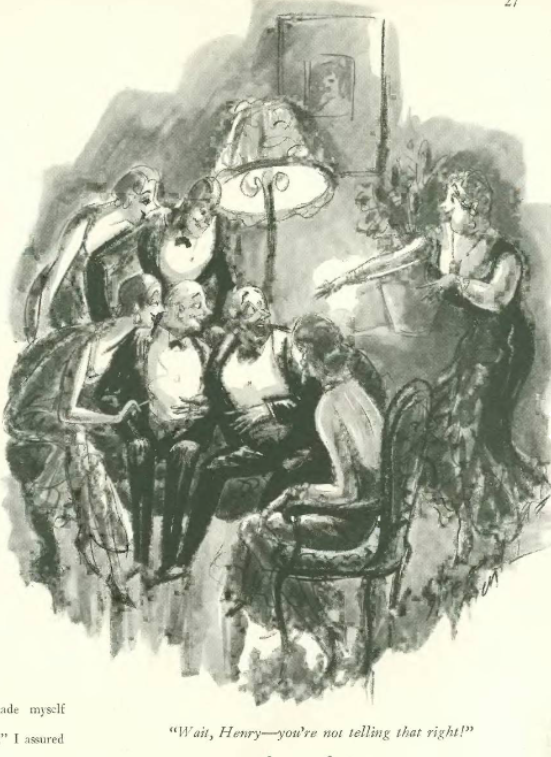
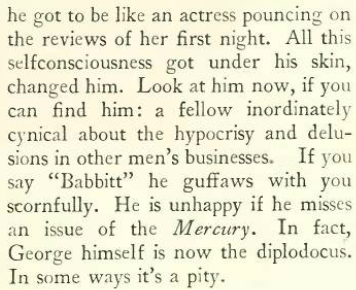
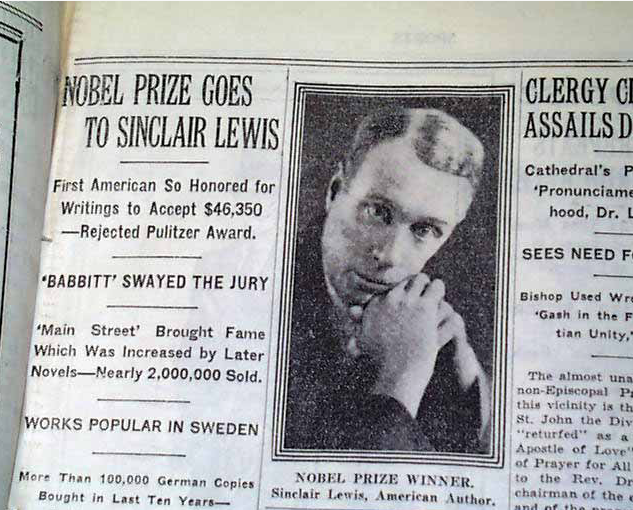
Sinclair Lewis famously declined the Pulitzer Prize for his 1925 novel Arrowsmith, upset that his 1920 novel Main Street had not previously won the prize. But when the Swedish Academy came calling with a Nobel Prize in Literature in 1930, he happily accepted. According to “The Talk of the Town,” this award also seemed a bit tardy, since Lewis’s small town booster archetype, George F. Babbitt, did not fit the dour days of the Great Depression. But it turned out that the 1922 novel Babbitt was ultimately what swayed the Nobel jury:
BOOST FROM A BOOSTER…George F. Babbitt helped make Sinclair Lewis famous, and landed him a Nobel. (NYT, NOVEMBER 6, 1930)
* * *
Not So Sweet
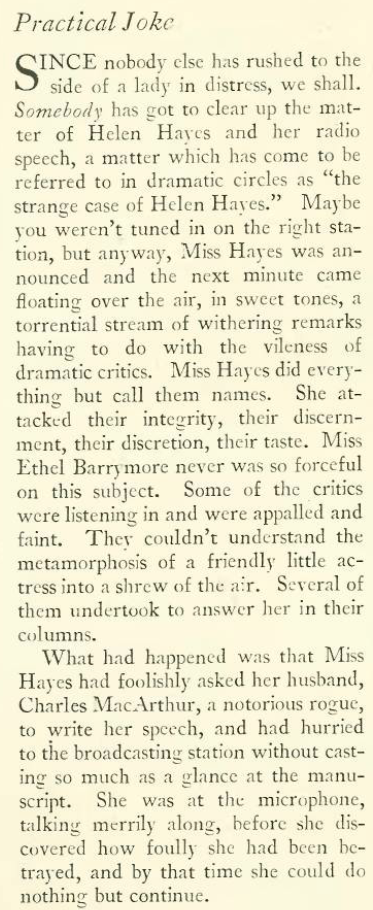
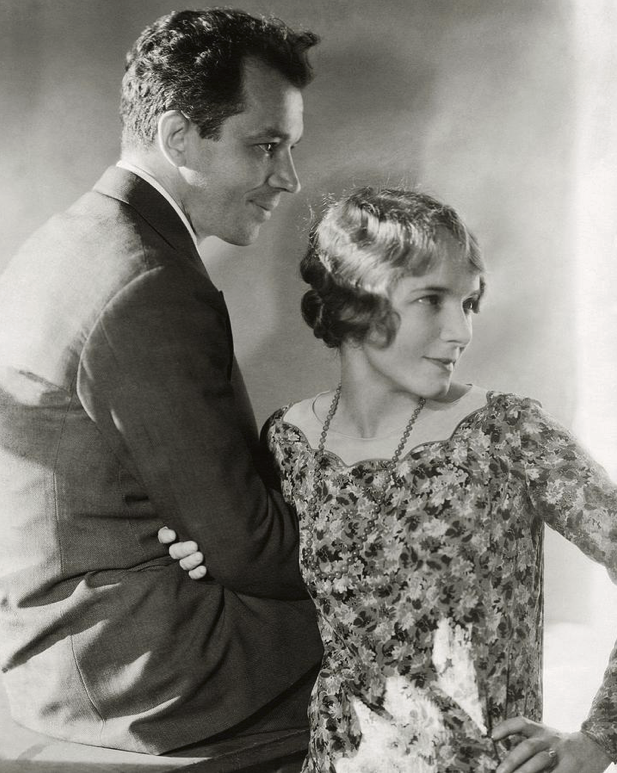
Those of a certain age might remember Helen Hayes as a sweet old lady who appeared on a number of TV shows in the 1970s and 80s, or as the mother in real life of James MacArthur, Disney teen star and later the portrayer of Danny “Book ’em Danno” Williams on the original Hawaii 5-0 TV series. Hayes was married to playwright Charles MacArthur, and “The Talk of the Town” takes it from there…
CREATIVE TYPES…The engaged couple Charles MacArthur and Helen Hayes posed for photographer Edward Steichen for this Jan. 1, 1929 image featured in Vanity Fair magazine. (Condé Nast)
* * *
Ain’t It Grand
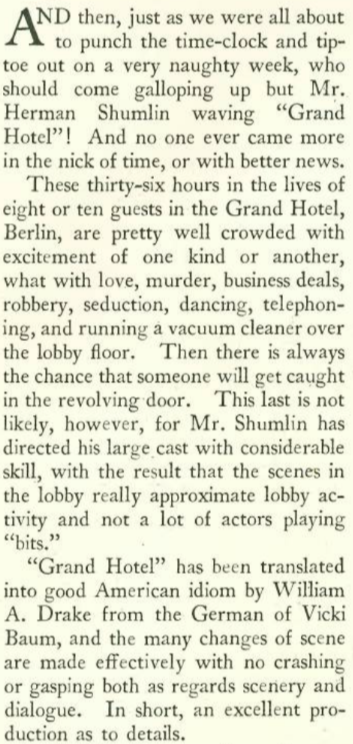
Grand Hotel opened at the National Theatre on Nov. 13, 1930 to strong reviews, including the one below by Robert Benchley that he filed for The New Yorker. The play, adapted from the 1929 novel Menschen im Hotel by Austrian writer Vicki Baum, would prove to be a smash on Broadway and again on the silver screen in a star-studded 1932 film featuring Greta Garbo, John Barrymore, and Joan Crawford.
THE STARS ALIGN…Left, promotional photograph of the original Broadway production of Grand Hotel. At right, Eugenie Leontovich portrayed fading Russian ballerina Grusinskaya in the play. The role would go to Greta Garbo in the 1932 film adaptation. (Theatre Magazine, February 1931/Wikipedia)
…and while we are on the subject of Broadway, the theater review section also featured this Al Frueh illustration promoting a noted production of Twelfth Night at the Maxine Elliott…
Program for the production featuring Jane Cowl. (Playbill)
* * *
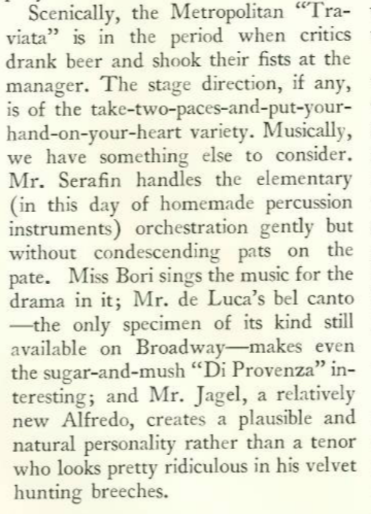
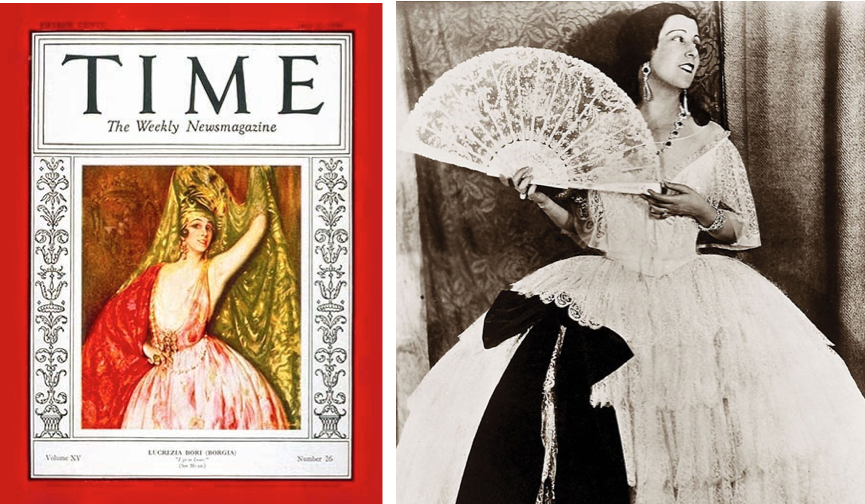
There were also big doings at the Met, where Spanish lyric soprano Lucrezia Bori (1887-1960) wowed audiences with her portrayal of Violetta in La Traviata.
SHE HAD SOME PIPES…right, lyric soprano Lucrezia Bori on the cover of the June 30, 1930 edition of Time magazine. At right, promotional photo of Bori circa 1930. (Time/Wikipedia)
* * *
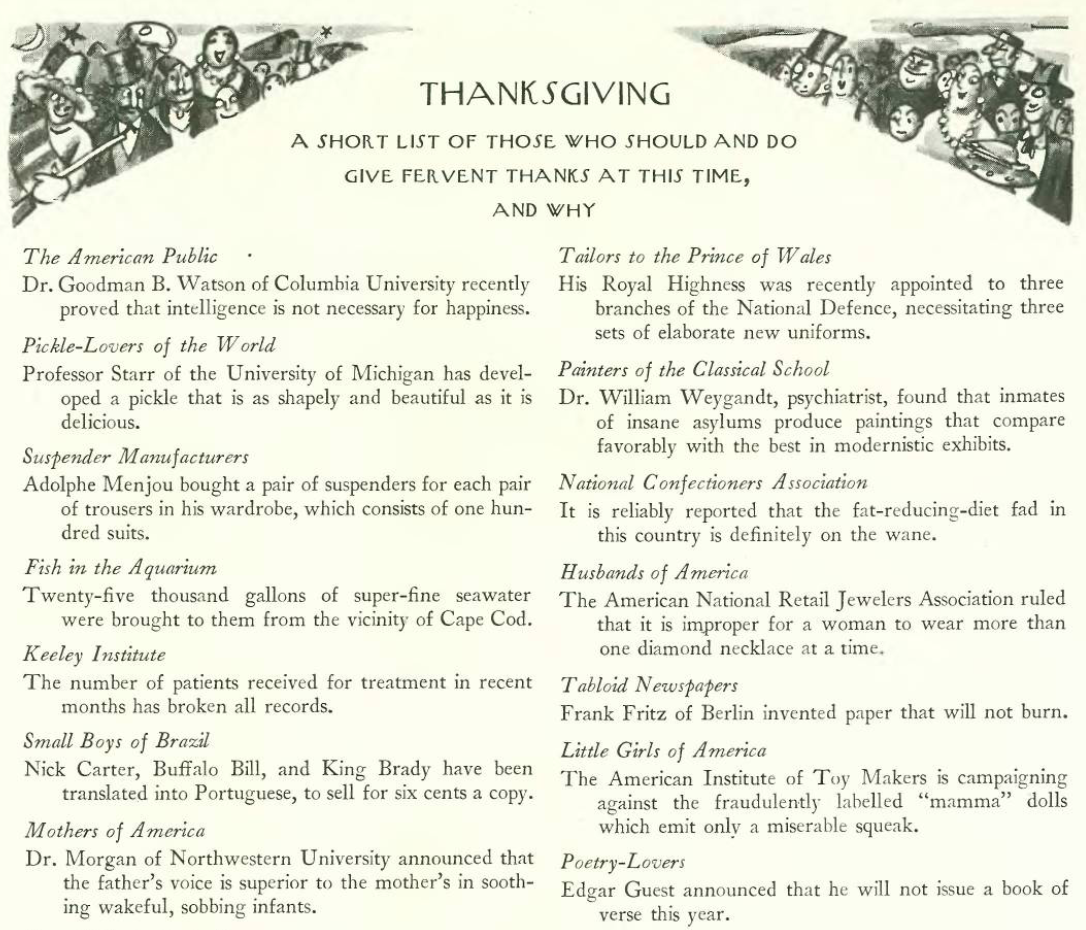
Bounty of Blessings
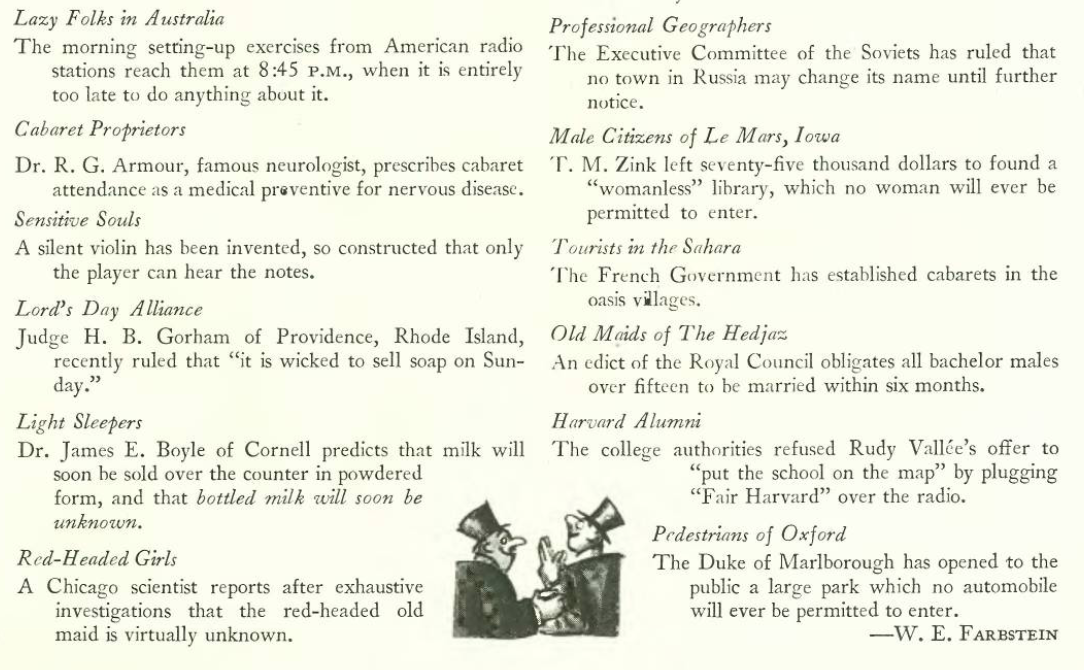
Humorist W. E. Farbstein gave readers plenty to be thankful for in this tribute to the Thanksgiving holiday…
* * *
From Our Advertisers
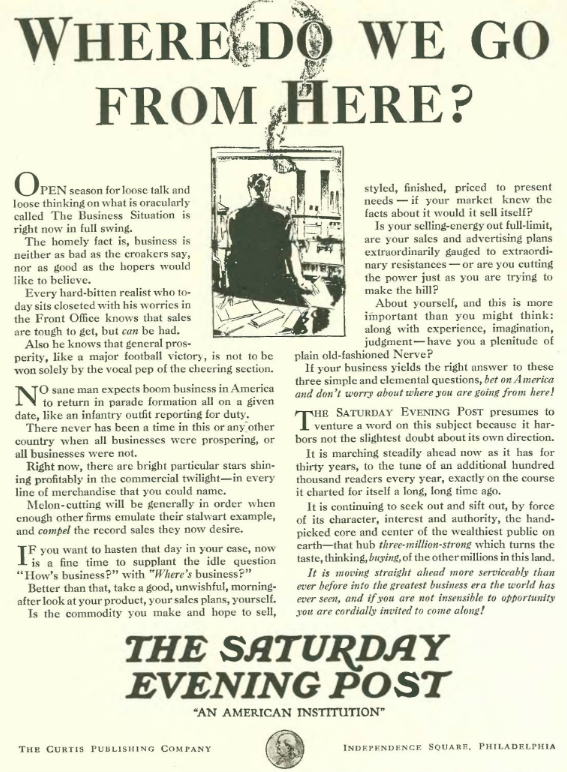
Occasionally advertisements acknowledged the reality of the Great Depression, including this one from The Saturday Evening Post that offered encouraging words to prospective readers…
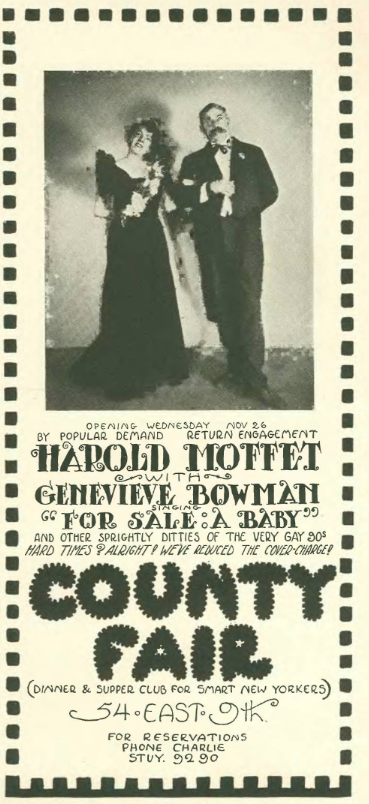
…County Fair, a Greenwich Village country-themed nightclub, offered the diversion of Moffatt and Bowman to take audiences’ minds off of hard times…
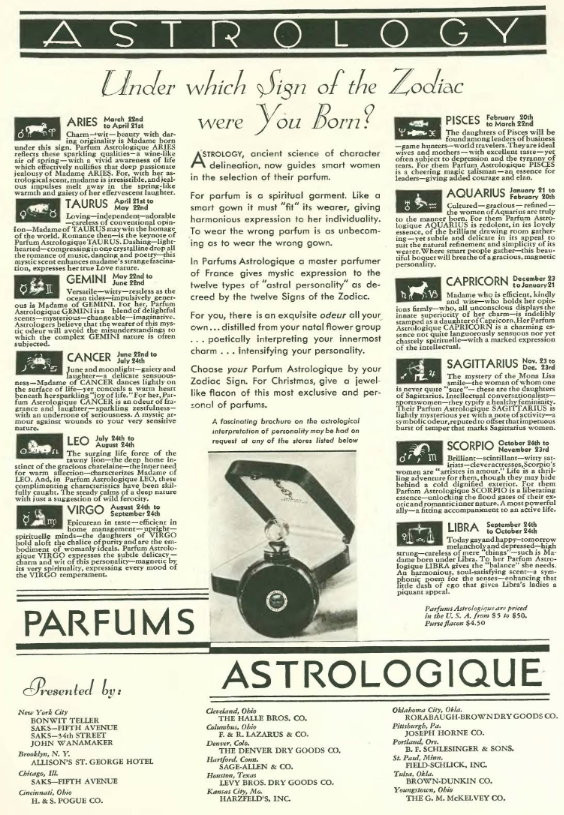
…and for all the supposed sophistication of New Yorker readers, there were still plenty of back page ads offering nostrums laced with superstition…
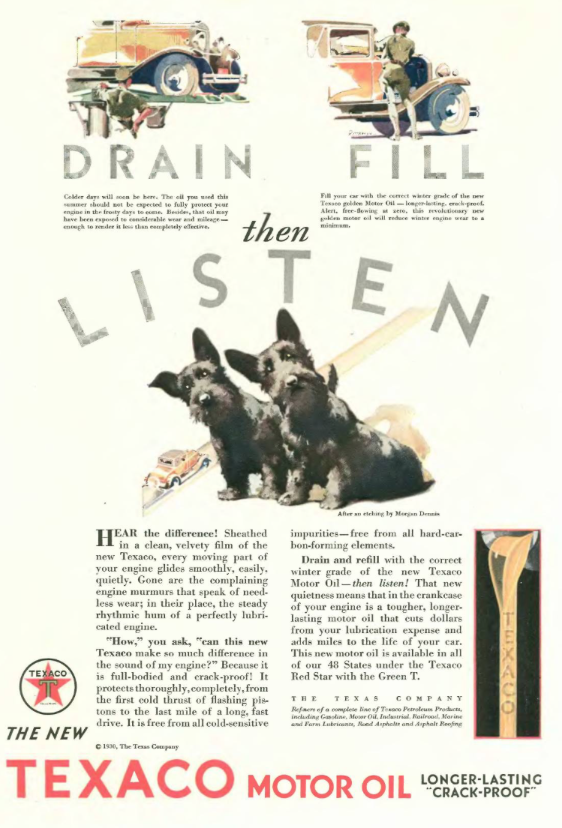
…some of the more colorful, spritely ads from the era were offered up by the producers of Texaco Motor Oil…
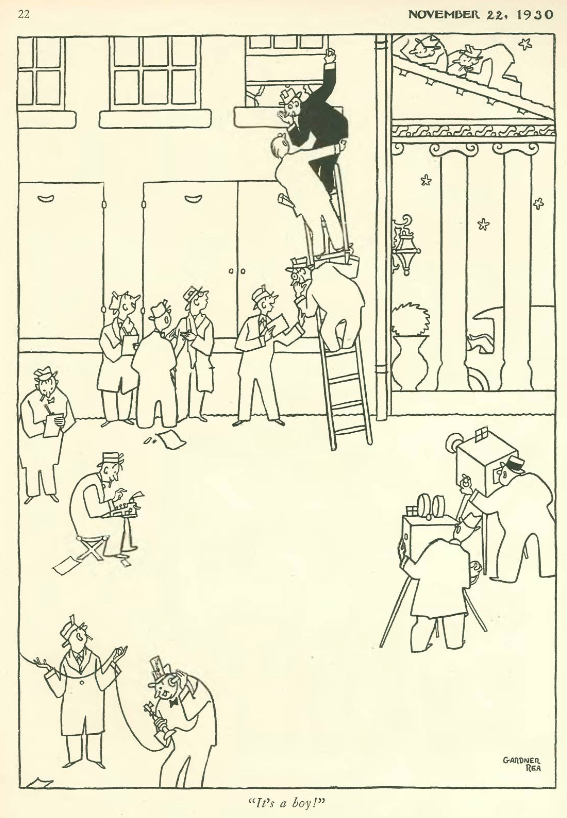
…our cartoons are by Gardner Rea…
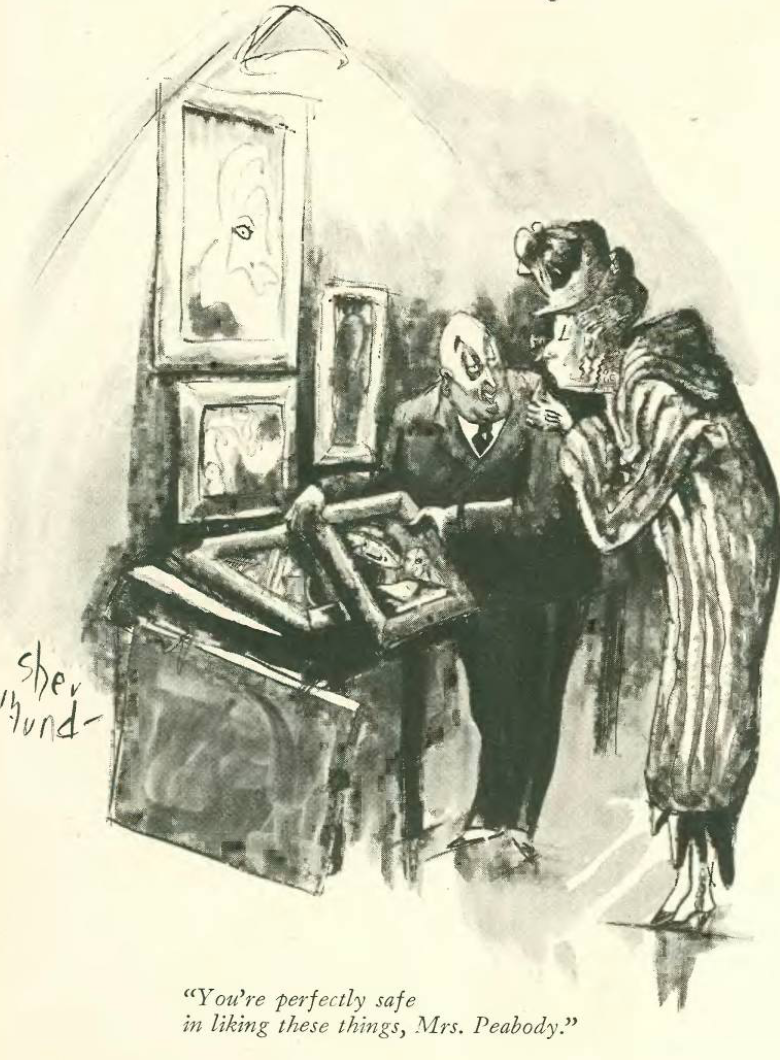
…Barbara Shermund…
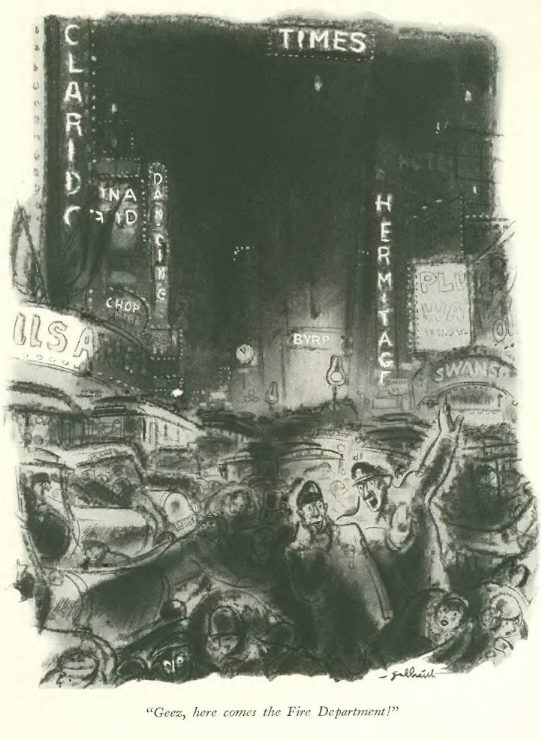
…William Crawford Galbraith…
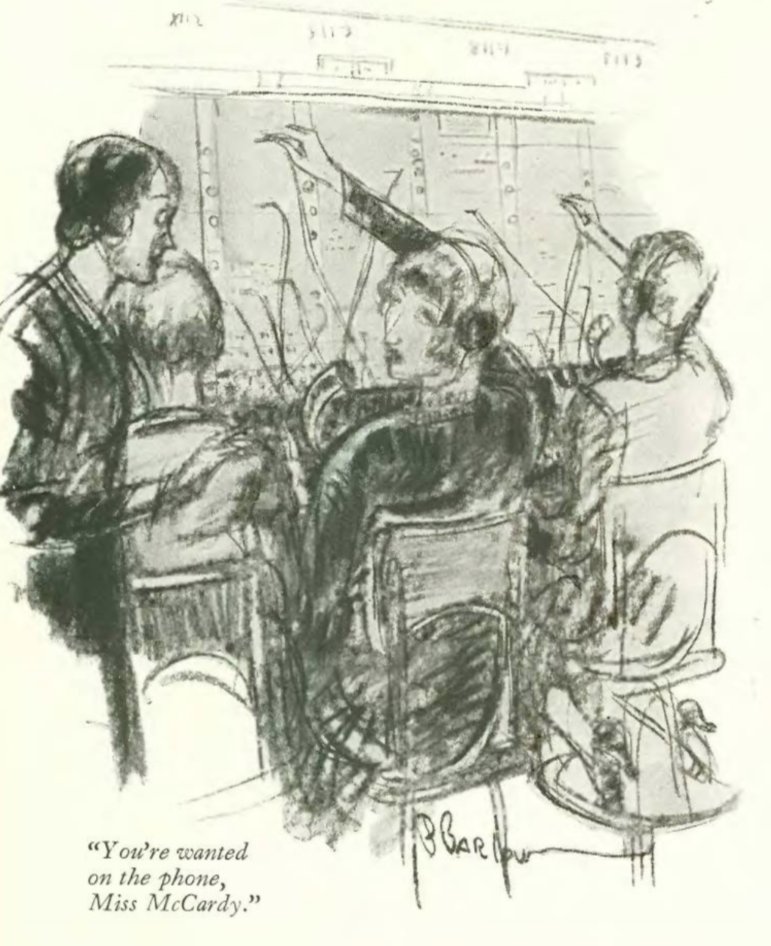
…and Perry Barlow…
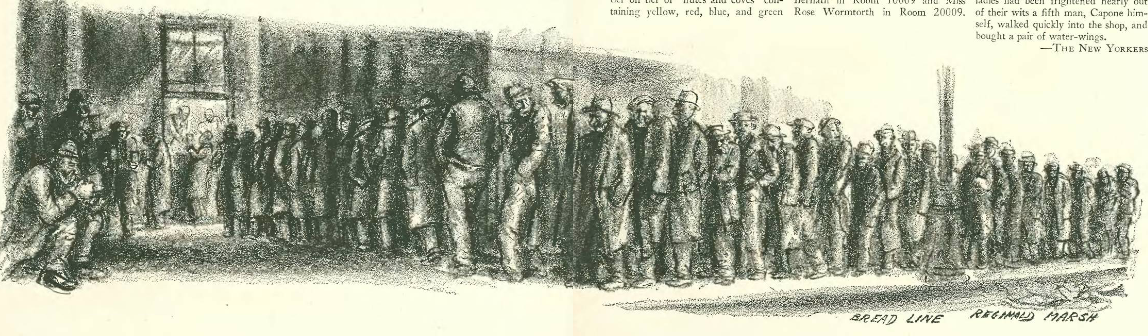
…and for another reminder of reality in the city, this sketch that ran along the bottom of “The Talk of the Town,” by Reginald Marsh…
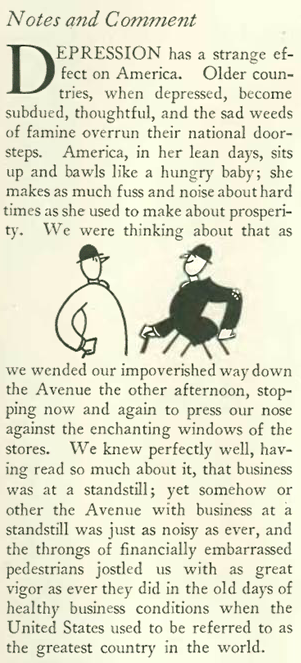
…and now we step back to the Nov. 15 issue, where E.B. White offered a less somber take on the Great Depression…
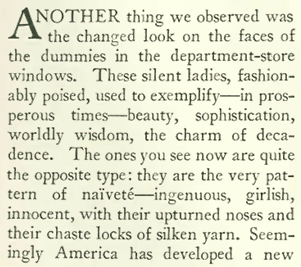
…White also noted a change on the faces of storefront mannequins…
YIN AND YANG…The worldly pose of a Roaring Twenties mannequin, and a more wholesome look for the leaner times in the 1930s. (Pinterest)
* * *
Playing Telephone
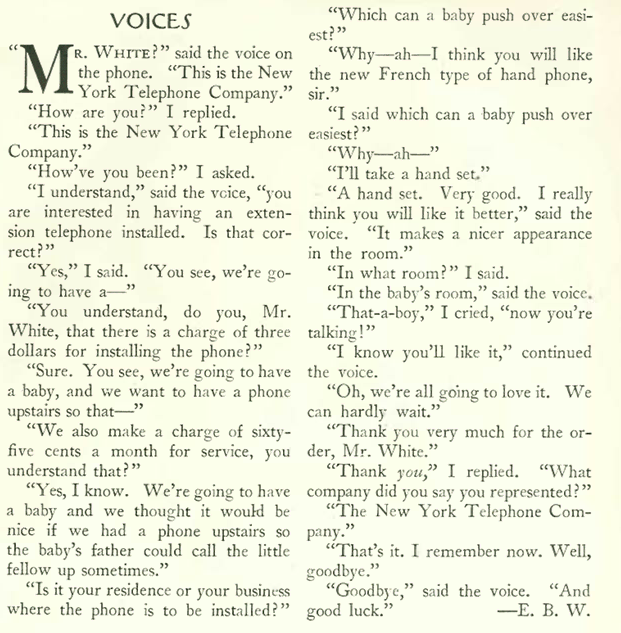
Long, long before cell phones, telephones were heavy stationary devices that required a certain amount of planning before installation, as E.B. White explains:
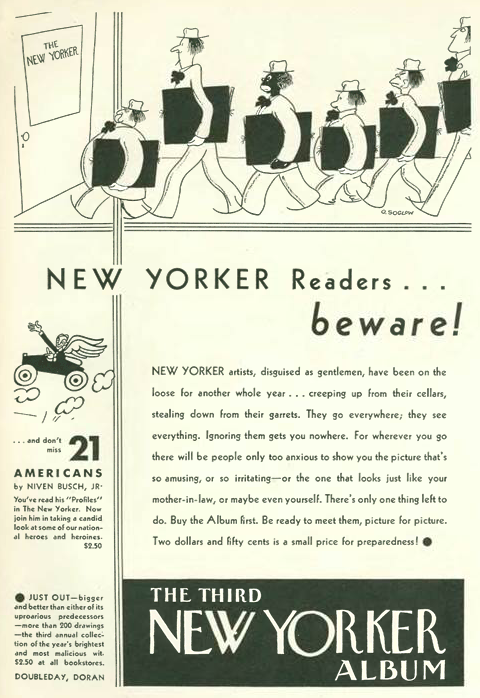
On to our Nov. 15 ads, we have this announcement for The Third New Yorker Album…with illustration by Otto Soglow…
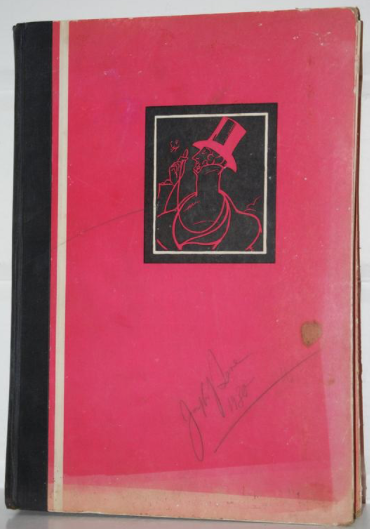
…here is what the album looked like…
…and a couple of inside pages…
(Etsy)
…one of the contributors to the album was Rea Irvin, founding illustrator for The New Yorker, here doing some business with Murad cigarettes…also another Flit insecticide ad by Dr. Seuss…
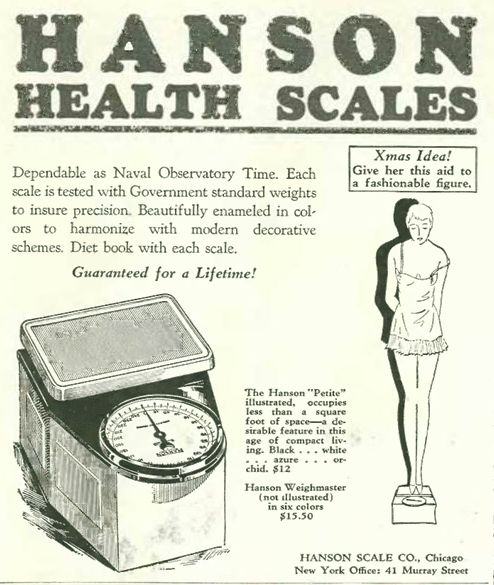
…Christmas ads began appearing in the magazine, including this one for Hanson scales…pity the poor chap (and his wife) who actually thought this might be a suitable present for Christmas, or any occasion for that matter…
…and with Prohibition still in force, advertisers found other uses to promote their products…
…on to our cartoons, Leonard Dove illustrated a couple who didn’t get away with the ruse…
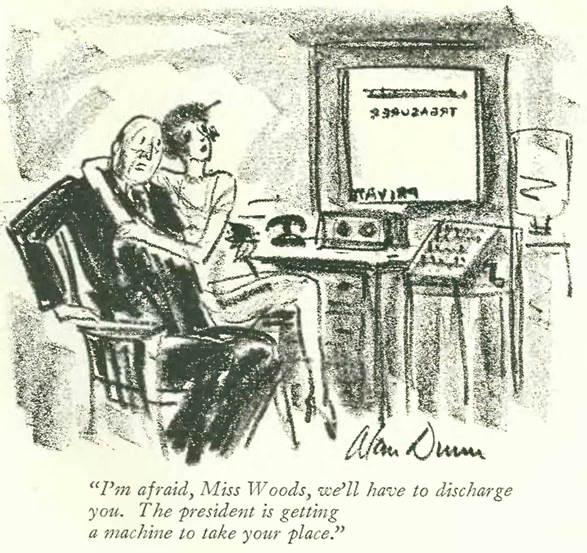
… Alan Dunn depicted what was considered typical office behavior in the 1930s…
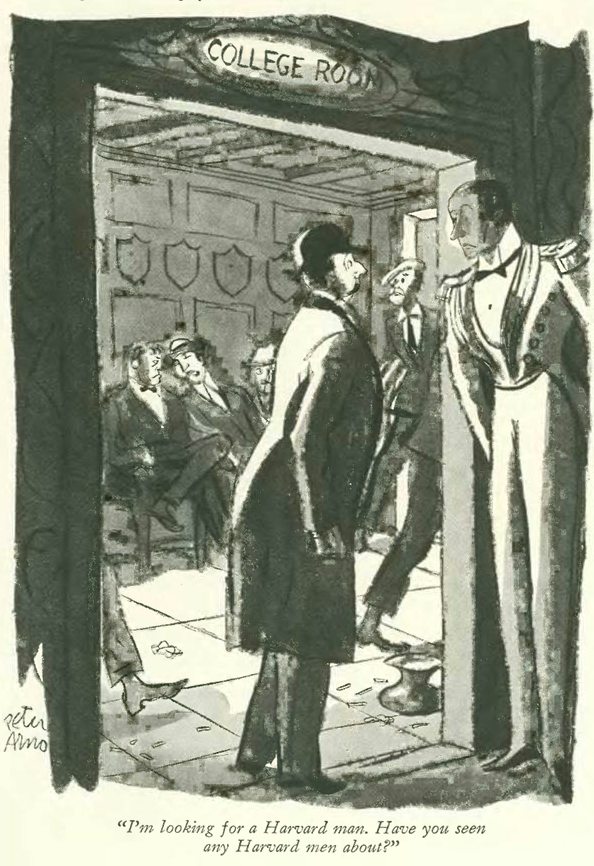
...Peter Arno visited the Harvard Club…
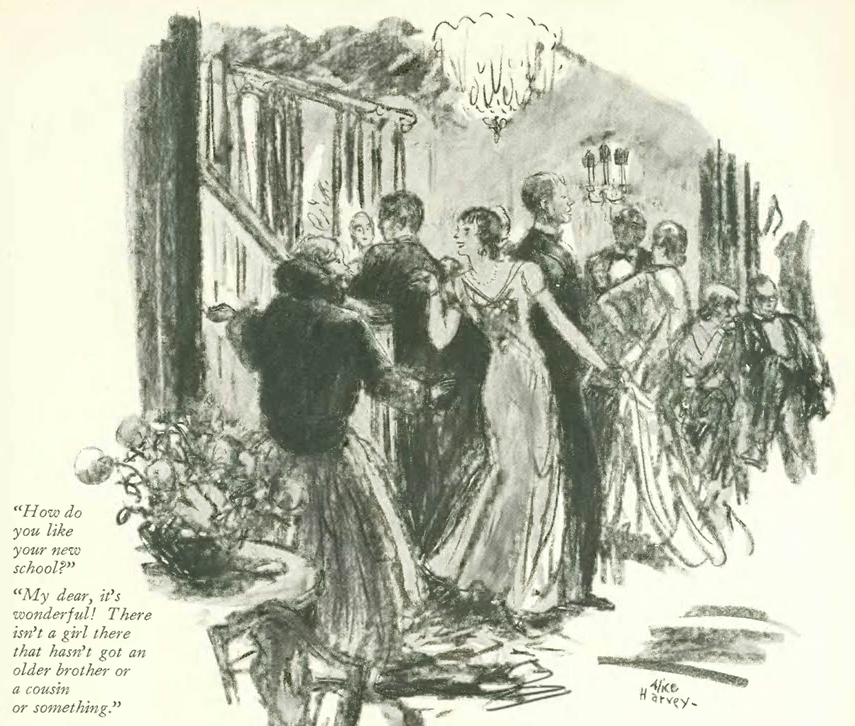
…Alice Harvey also explored the college scene…
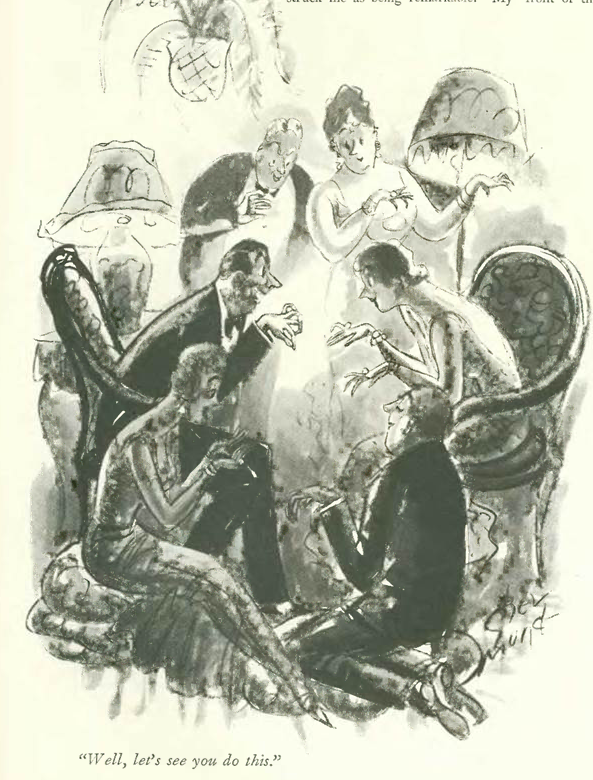
…some parlor games with Barbara Shermund…
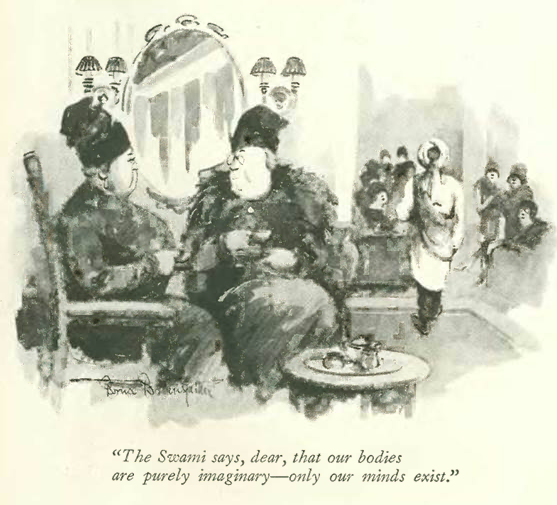
……Bruce Bairnsfather, and some existentialist chat at tea time…
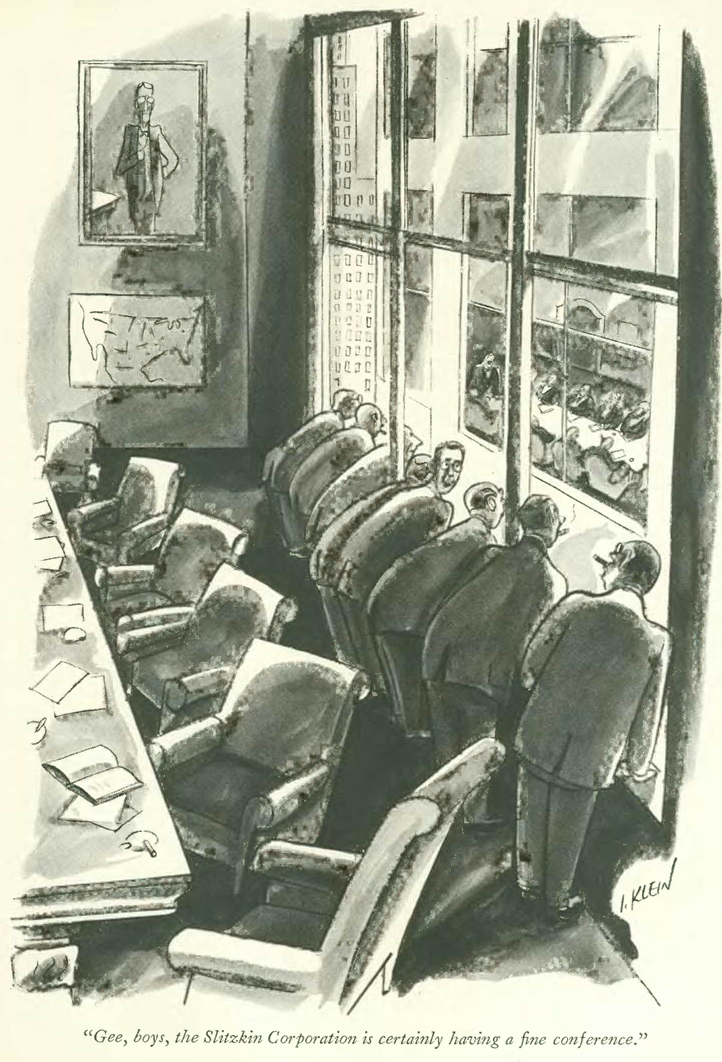
…and we close with Isadore Klein, and the world of corporate competition…
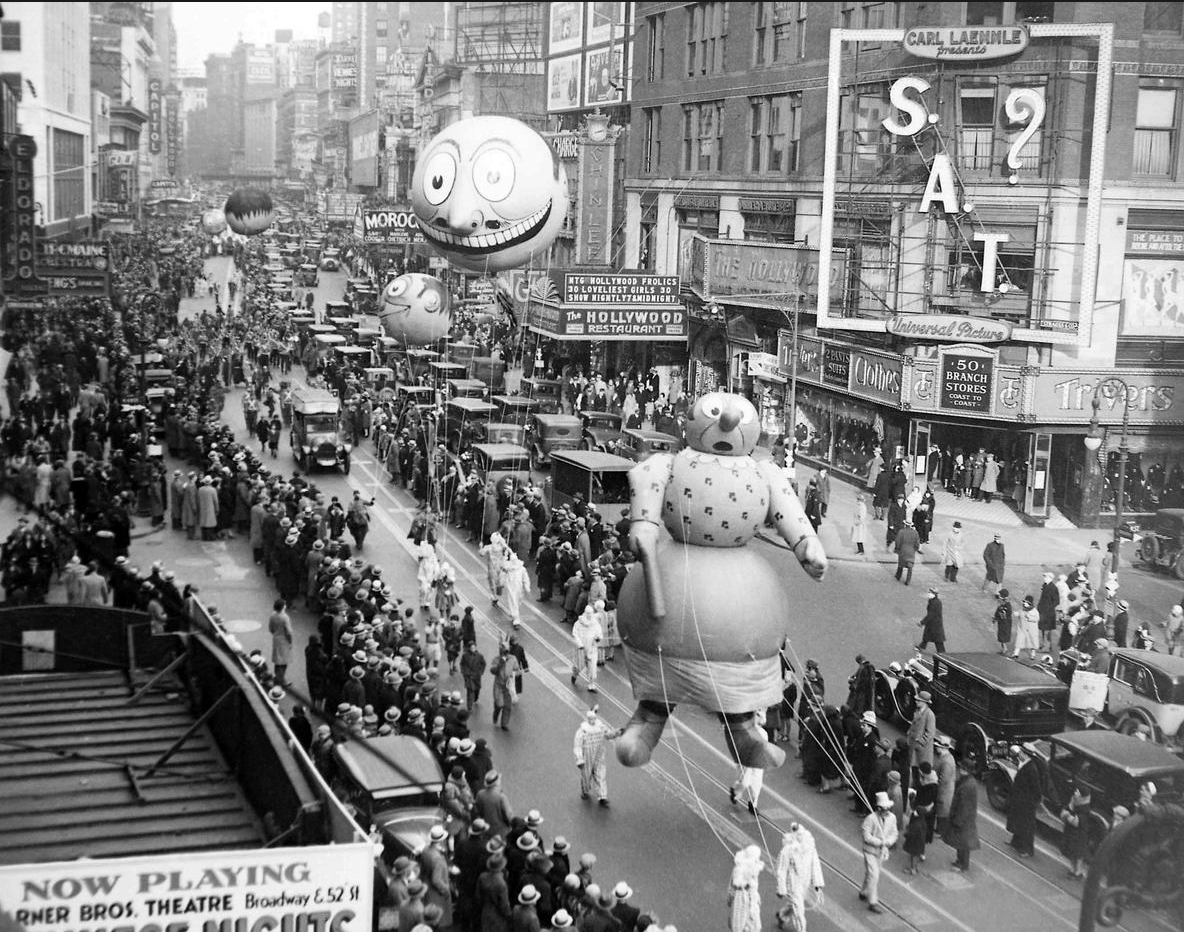
…and a Happy Thanksgiving, from the Macy’s Thanksgiving Parade 89 years ago, Nov. 27, 1930…
After completing a major in French in just three years, 19-year-old Libby Holman became the youngest woman to graduate from the University of Cincinnati in 1923. But it was her unique style of torch-singing—a trademark throaty mumble—that would launch a career on Broadway and a life of seemingly endless scandal.
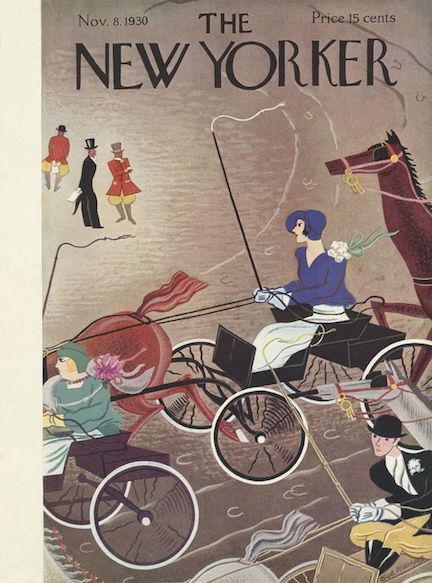
Nov. 8, 1930 cover by Sue Williams.
After performing in the The Greenwich Village Follies, Holman (1904–1971) landed her first big role in 1925 in the Rodgers and Hart production of Garrick Gaieties. But it was a signature song, “Moanin’ Low,” from Clifton Webb’sThe Little Show that would make her a star. When Three’s a Crowd (by Howard Dietz and Arthur Schwartz) opened at the Selwyn Theater on October 15, 1930, Holman was well-known to audiences not only for her voice but also for her unconventional lifestyle.
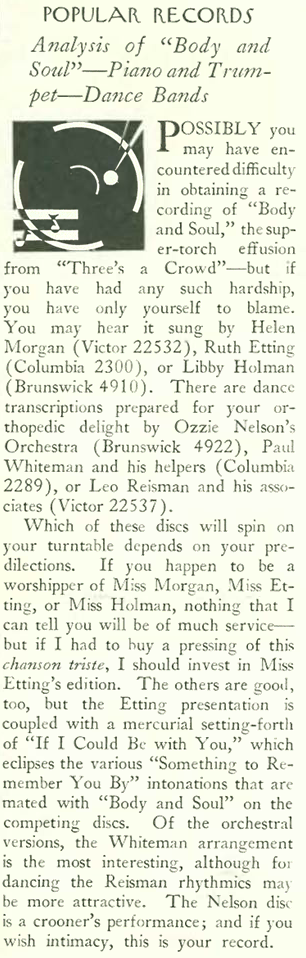
Three’s a Crowd proved to be a hit for Holman, and it gave her another hit song, “Body and Soul,” which was banned from the radio for “obscenity” but nevertheless became one of the year’s most popular songs. So popular, in fact, that it was recorded by Holman as well as by fellow torch singer Helen Morgan and Ziegfeld star Ruth Etting. This was the age of the Great American Songbook, when the song itself, and not necessarily its performer, reigned supreme. So when sheet music was distributed from a popular stage show, any number of entertainers would record it.
NAME THAT TUNE…From top to bottom, Helen Morgan, Ruth Etting and Libby Holman all recorded versions of “Body and Soul,” but Holman would make it one of her signature numbers. (YouTube/ruthetting.com/Wikipedia)
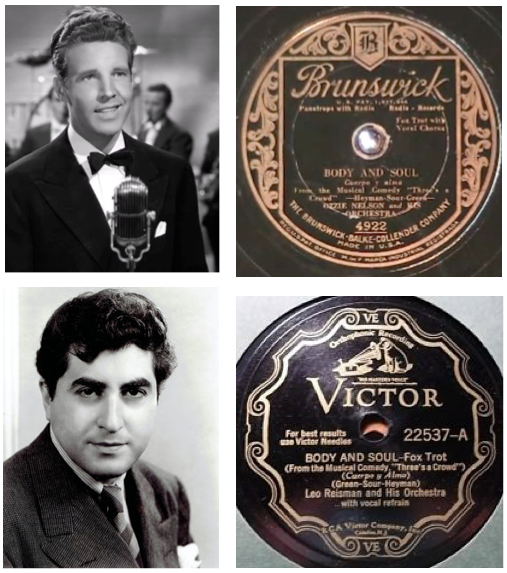
…for the hoofers, there were also a couple of dance versions of “Body and Soul” created by bandleaders Ozzie Nelson and Leo Reisman…
GOOD BEAT, EASY TO DANCE TO…Bandleaders Ozzie Nelson and Leo Reisman recorded dance versions of “Body and Soul.” (YouTube)
Openly bisexual, Holman partied hard and swore like a sailor, and during her life she would lose one husband in a suspected murder (Holman herself was briefly a suspect) and another to suicide. She would take her own life in 1971. You can read more about Holman’s colorful, tragic life in the Jewish Women’s Archive.
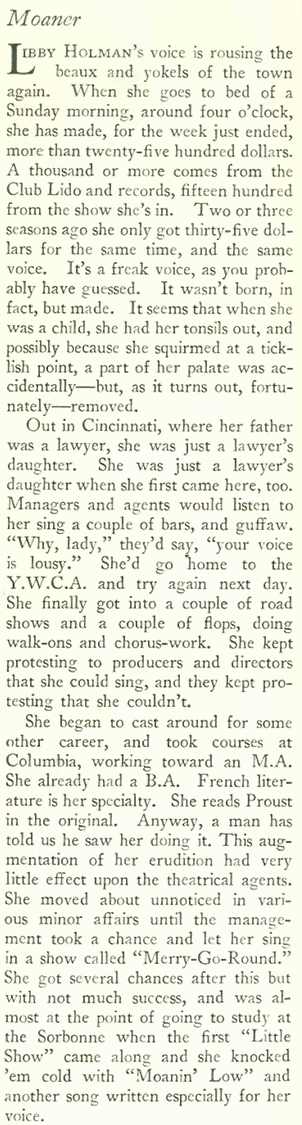
We temporarily skip to the next issue of The New Yorker (Nov. 15, 1930), which featured Holman in a “Talk of the Town” brief, and some insight into her unique singing style. An excerpt:
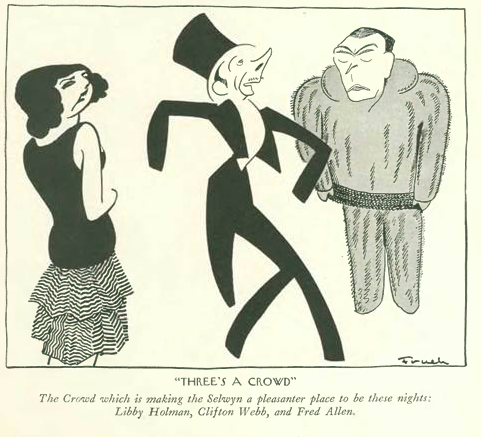
The same issue also featured this drawing of the “Three’s a Crowd” cast by Al Frueh in the theater review section:
and finally, a publicity photo of the cast from 1930-31:
A FUN CROWD…Clifton Webb, Libby Holman and Fred Allen in Three’s a Crowd. At right, undated publicity photo of Holman. (performerstuff.com)
* * *
Horsin’ Around
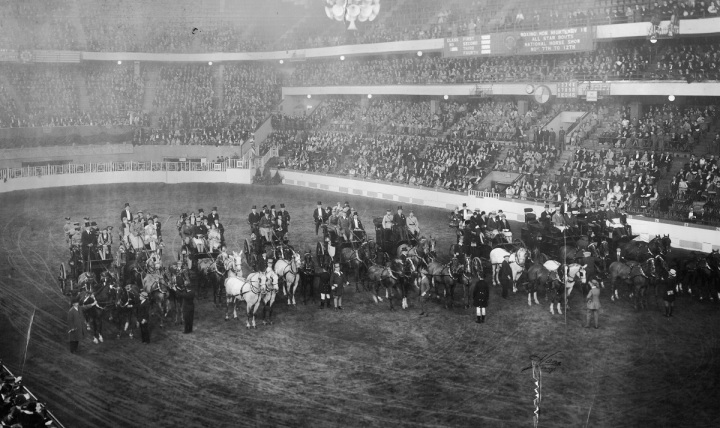
The National Horse Show was a major event on New York’s social calendar, first held at the original Madison Square Garden in 1883 before moving to the second Madison Square Garden in 1890 and again to the third Madison Square Garden in 1926. This account in the Nov. 8, 1930 New Yorker noted how the horse show’s patrician air contrasted with the rodeo held at MSG the previous week.
NOT FOR GOAT-ROPERS, THIS…The coaching parade on display at the 1927 National Horse Show in Madison Square Garden. (National Sporting Library & Museum)SOON WE’LL BE FIGHTING EACH OTHER…The National Horse Show began including a military competition in 1925. This photo from the Nov. 6, 1930 New York Times featured some international guests at the 1930 show. (NY TIMES)
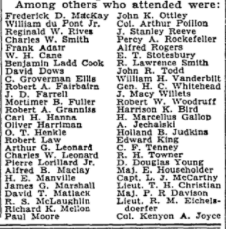
Along with the above photo, the Times included this partial lists of guests to the Horse Show Luncheon, a who’s who of New York society. Indeed, the National Horse Show’s 1887 directory provided the basis for the first New York Social Register.
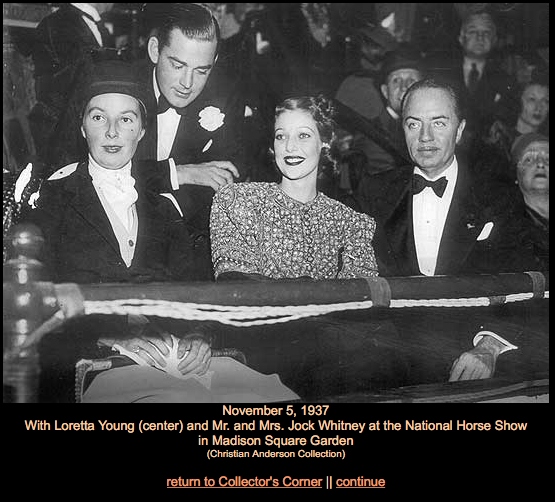
DRESSING UP FOR THE HORSES…Champion horsewoman Mary Elizabeth Whitney (left) with actors Loretta Young and William Powell at the National Horse Show in Madison Square Garden, Nov. 5, 1937. Standing behind Mary Elizabeth is her husband, Jock Whitney, a noted ambassador, art collector, philanthropist and investor. (Christian Anderson Collection)HIGH STEPPIN’…After a brief stint in Florida, the National Horse Show moved to Kentucky in 2011. Perhaps a tad less formal, it nevertheless remains an important society event. Above, noted horsewoman Misdee Wrigley Miller rides World Grand Champion Grande Gil at the 2012 National Horse Show. (Doug Shiflet)
* * *
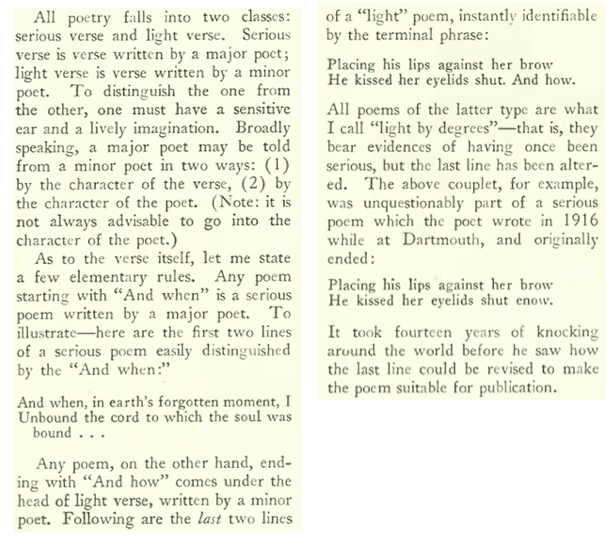
A Lesson in Poetry
In a casual for the Nov. 8 issue, E.B. White instructed readers on how to “Tell a Major Poet From a Minor Poet.” An excerpt.
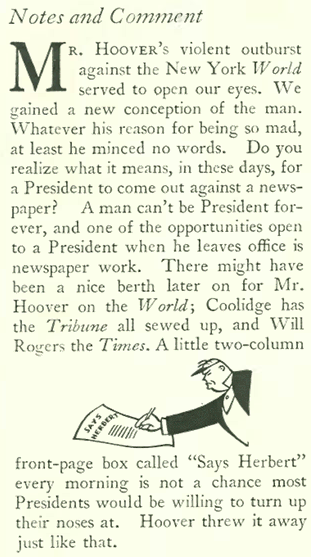
And in his “Notes and Comment,” White suggested that criticism of the press was a major no-no for a sitting U.S. President:
Christmas shopping suggestions began to trickle into Lois Long’s section on fashion, house and home, including this bit of advice that reminds us just how distant 1930 is from our own time:
* * *
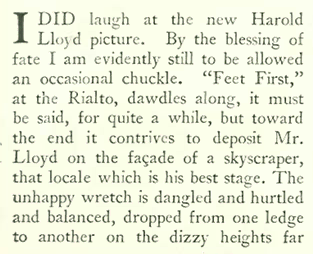
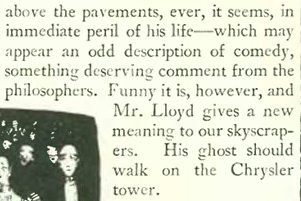
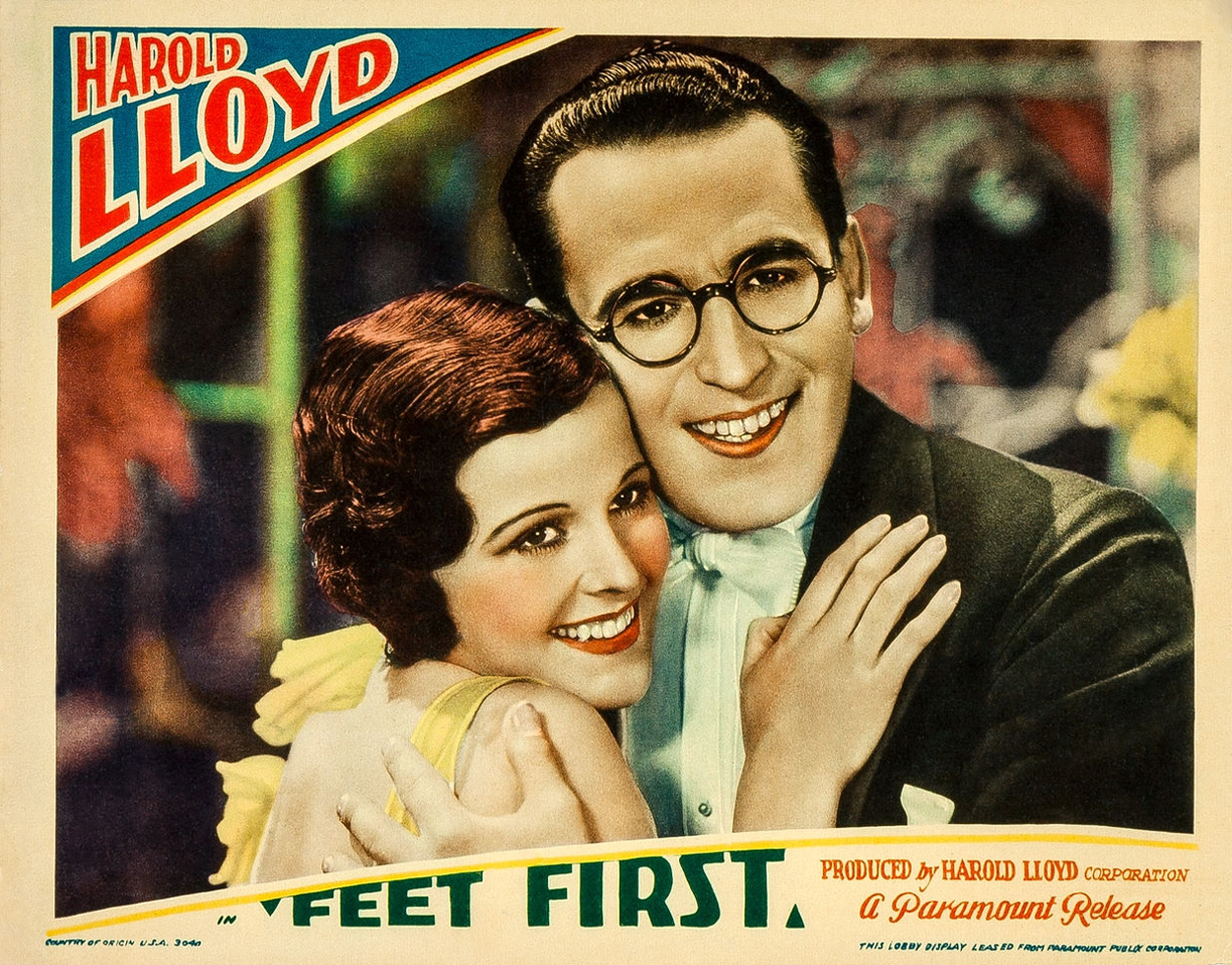
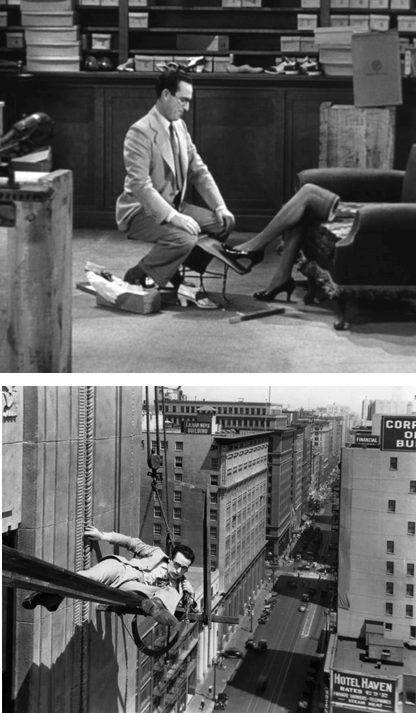
Film critic John Mosher took in the latest offering from silent film star Harold Lloyd, who was making his second foray into the talkies with his portrayal of a hapless shoe salesman in Feet First…
TEETH FIRST…Theater card for 1930’s Feet First featuring Barbara Kent and Harold Lloyd. (IMDB)GETTING A LEG UP…Top, Harold Lloyd practices the art of shoe salesmanship with a pair of dummy legs in Feet First; below, Lloyd once again finds himself in a precarious situation high above a city street. (IMDB)
* * *
From Our Advertisers
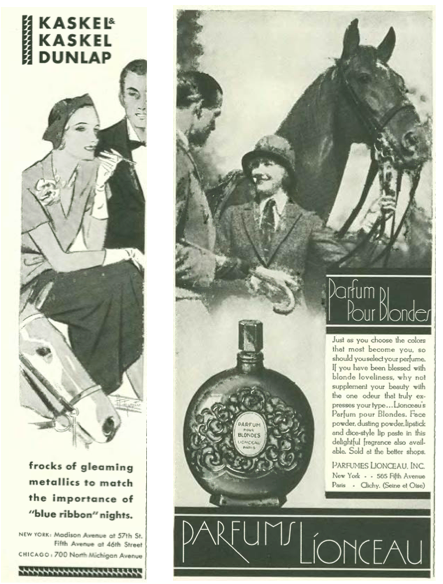
The National Horse Show was on the minds of several advertisers in The New Yorker, including these fashion merchants targeting the patrician set…
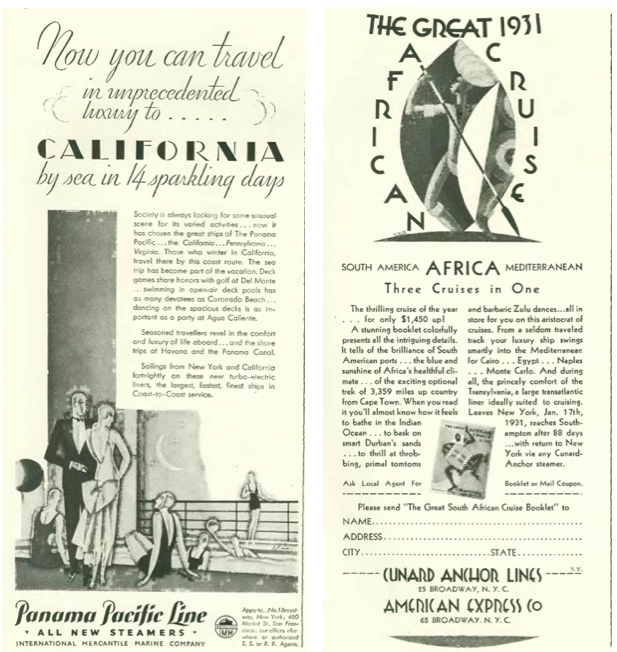
…speaking of the well-heeled, with winter approaching travel agencies enticed those with means to take a steamer through the Panama Canal to California, or for the more adventurous, a three-continent tour package…
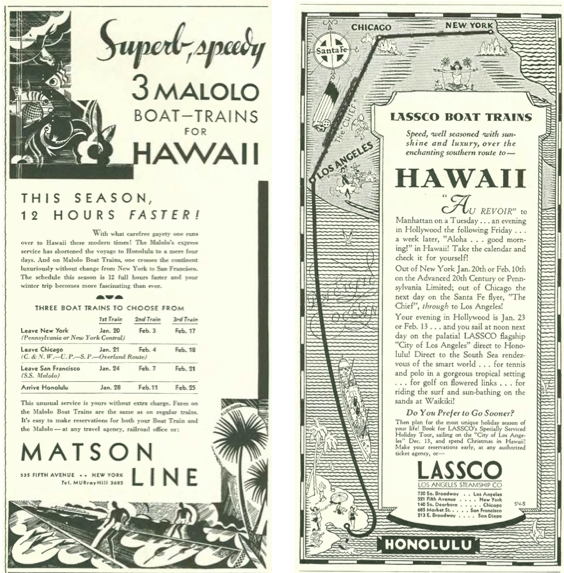
…and of course Hawaii beckoned snowbirds, who could make their way across the Lower 48 by train and then hop a boat to the islands…
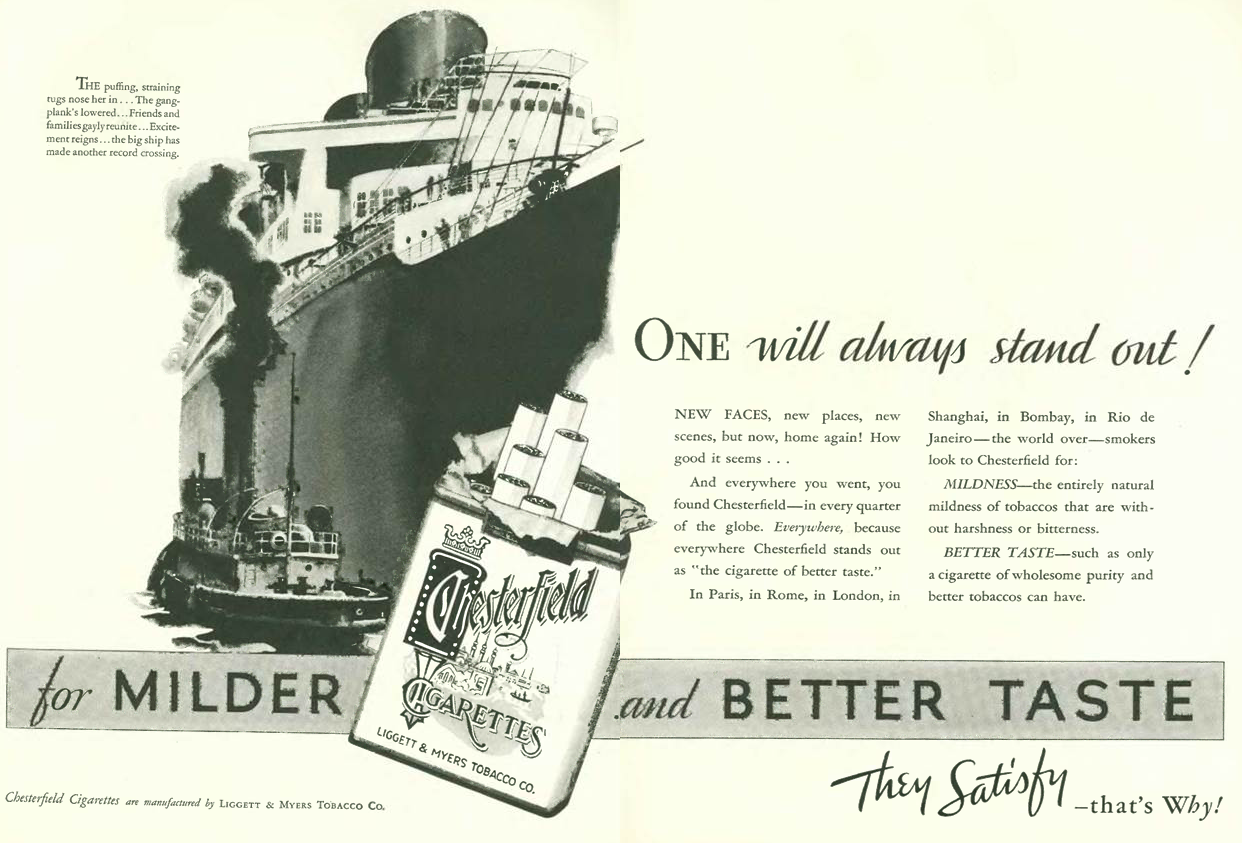
…the makers of Chesterfield cigarettes were on board with the travel theme…
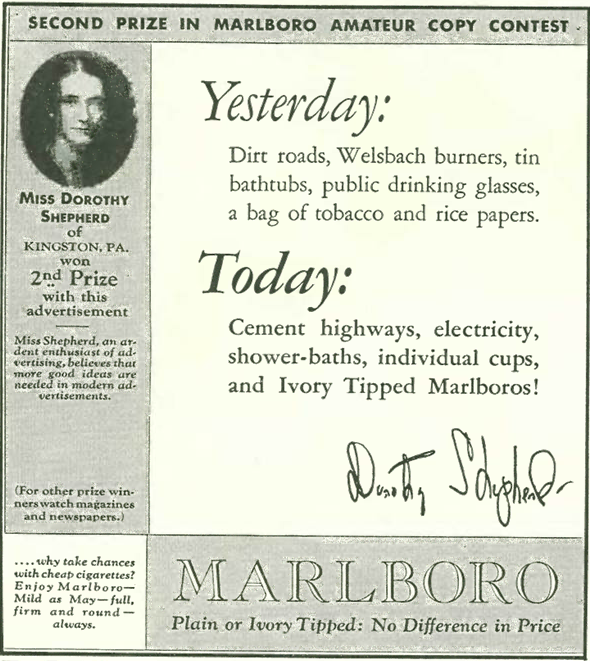
…while the folks at Marlboro stuck with their dopey handwriting and jingle contests to push their smokes…
…as the luxury market grew ever tighter in the Depression, the sellers of finer things sought to distinguish their wares from competitors. L.P. Hollander kicked off a series of wordy ads regarding the provenance of their hats, gloves and other accessories (in short, they ain’t cheap copies)…
…no doubt the folks at L.P. Hollander were looking down their noses at the likes of Russeks, which offered copies of Lucien Lelong gowns. Apparently old Lucien was okay with this, as this “Radiogram” purportedly attests…
…Lucien pops again in another ad, this one for his perfume line…
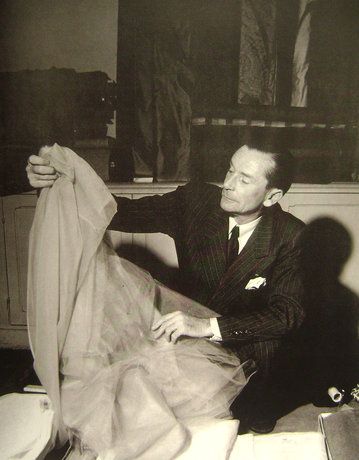
…and for reference, here’s a photo of Monsieur Lelong, circa 1940…
(comm396-s16.ascjclass.org)
…on to our cartoonists, the Nov. 8 issue featured these great spot illustrations by Constantin Alajalov, the first, running along the bottom of “The Talk of the Town,” referenced the horse show at Madison Square Garden…
…Alice Harvey listened in on a radio soap…
…William Crawford Galbraith found some admirers of art…
…Barbara Shermund continued to share her sharp observations of parlor hijinks…
…Garrett Price illustrated the challenges of modern design…
…and we end with Peter Arno, and a stomach-turning moment…
The Irish American gangster Jack “Legs” Diamond was often referred to as the “clay pigeon of the underworld” due to surviving several attempts on his life.
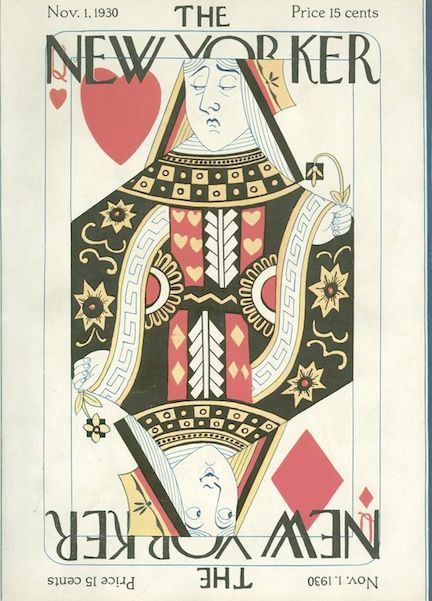
Nov. 1, 1930 cover by Rea Irvin.
In his “Reporter at Large” column, Morris Markey checked up on the fleet-footed bootlegger, adored by the public for his various brushes with the law and escapes from sure death. In his opening paragraph, Markey referred to one of the attempts on Diamond’s life: On October 12, 1930, he survived being shot five times at Manhattan’s Hotel Monticello:
Markey’s column attempted to remove some of the glamour from Diamond’s flamboyant life, a life that would be cut short about a year later in an Albany rooming house…
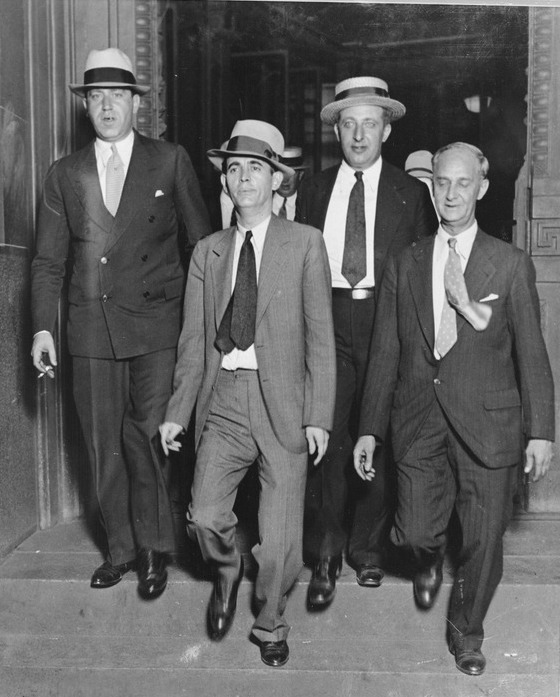
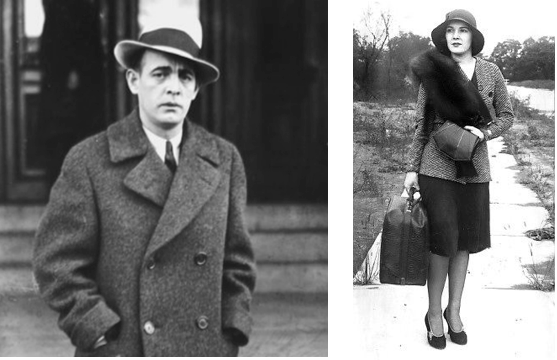
OUT WITH THE BOYS…Legs Diamond leaves the federal court in New York with his attorney and a couple of cronies on Aug. 8, 1931, after being convicted of owning an unlicensed still and conspiring to violate Prohibition laws. (digitalcommonwealth.org)BEDFELLOWS…Legs Diamond had a number of mistresses, but the best known was Marion “Kiki” Roberts, who was with Diamond shortly before he was slain. (The Mob Museum/Pinterest)DEADLY TRIO…Clockwise, from top left, Legs Diamond is comforted by his wife, Alice Kenny Diamond, after being shot three times at a roadhouse near Cairo, NY, on April 27, 1931. His enemies finally succeeded in killing him on Dec. 18, 1931, shooting him three times in the back of the head in an Albany rooming house. Alice would be shot and killed less than two years later, possibly by Diamond’s enemies to keep her quiet. And sadly, The New Yorker’s “Reporter at Large” columnist Morris Markey would also meet a violent end, dying of a gunshot wound to the head in 1950. Whether it was by his hand or another’s, it was never determined. (Albany Archives/NY Times)
An afternote: Enemies would finally catch up to Legs Diamond and kill him on Dec. 18, 1931. Diamond’s wife, Alice Kenny Diamond, would be shot and killed less than two years later. Diamond’s mistress and former Ziegfeld Follies performer Marion “Kiki” Roberts would return to the stage and cash in on her notoriety. In 1937 it was reported she was the big draw in a touring “Crazy Quilt” burlesque revue. And according to the writer William Kennedy, who wrote about Diamond in his 1975 novel Legs, the last record of Kiki Roberts was in Boston in the 1940s, where “she was still appearing as ‘Jack (Legs) Diamond’s Lovely Light o’ Love.’ ”
Here is newsreel footage of Diamond’s mistress Marion “Kiki” Roberts, shortly after the gangster’s death. In this brief interview with a Boston reporter (and with her mother at her side) Roberts advises girls to “live good clean lives and obey their parents wishes.” Note how it appears she is reading from cue cards.
* * *
Chitty Chitty Bang Bang
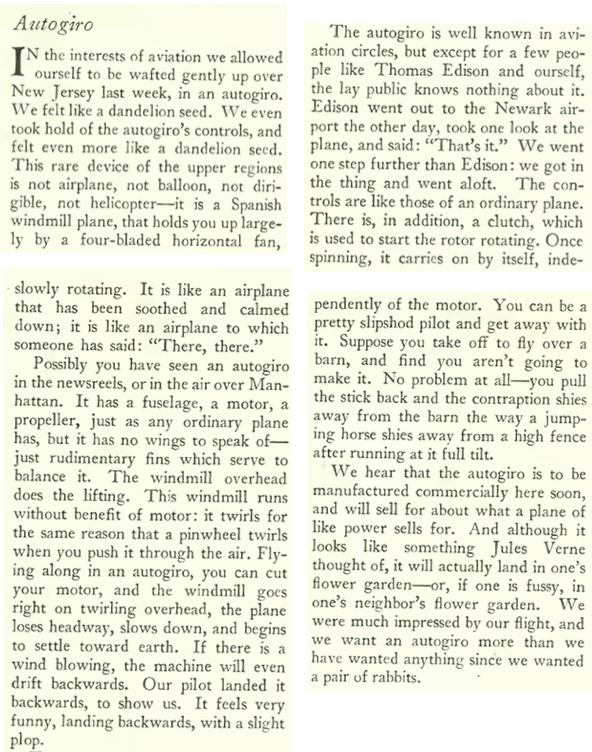
A precursor to the helicopter, the autogyro was considered by many to be the next logical step in aircraft development, and especially in the development of smaller craft that could serve as safe, affordable transportation options for commuters. TheNew Yorker’sE.B. White, an aviation enthusiast, demonstrated to readers the wonders of this aircraft:
EASY AS PIE…A Cierva Autogiro C30 takes flight circa 1933. (findmypast.co.uk)
* * *
Baker’s Big Show
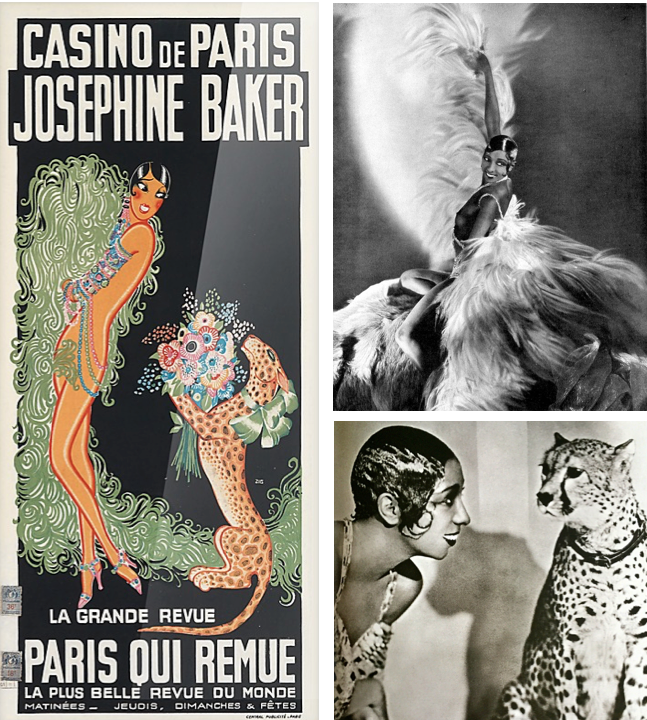
Nineteen-year-old American-born French entertainer Josephine Baker became an instant symbol of Jazz Age Paris when she starred in La Revue Nègre in October 1925. Her erotic dance routines wowed Paris audiences, and she quickly moved on to the famed Folies Bergère. In 1930 she opened a new show at the Casino de Paris that also featured her pet cheetah, Chiquita. The New Yorker’sJanet Flanner was there to take it all in:
HEAR THE THUNDER…Nineteen-year-old Josephine Baker took Paris by storm when she appeared in La Revue Nègre at the Théâtre des Champs-Élysées in October 1925. (harleminmontmartre.paris/artphotolimited.com)HEAR ME ROAR…The New Yorker’sJanet Flanner was wowed by Josephine Baker’s newest show at the Casino de Paris that also featured her pet cheetah, Chiquita. (pictorem.com/vam.ac.uk/artphotolimited.com)
* * *
Grim Reminder
Despite the deepening Depression across the country, few mentions of it were made in the pages of TheNew Yorker.Howard Brubaker, in his “Of All Things” column, offered this not-so-gentle reminder:
* * *
From Our Advertisers
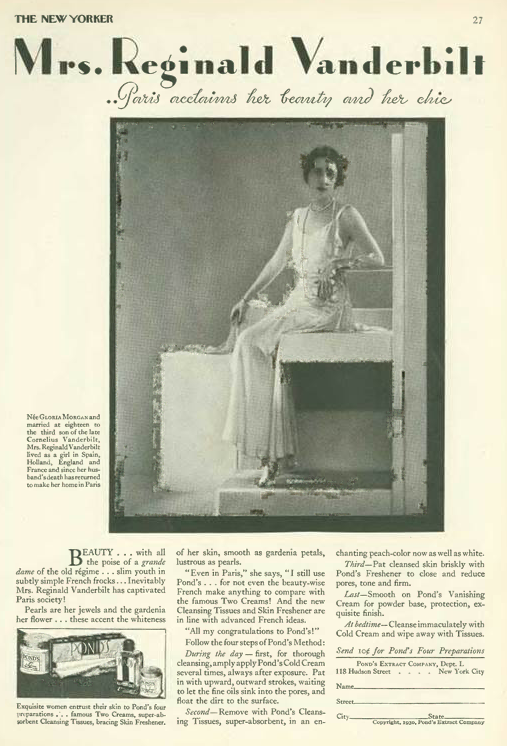
We feature Gloria Morgan Vanderbilt, a Swiss-born American socialite shilling for Pond’s cold cream. At the time of this ad she was the mother of six-year-old Gloria Vanderbilt (who would become a famous fashion designer and artist and the mother of CNN’s Anderson Cooper)…
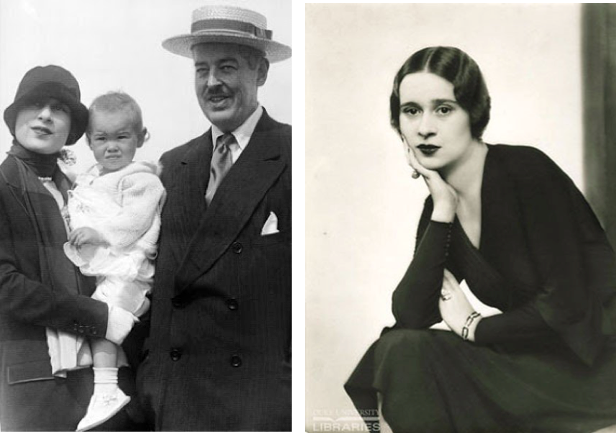
POOR LITTLE RICH GIRLS…Gloria Morgan Vanderbilt and her husband, Reginald Claypoole Vanderbilt with daughter Gloria, circa 1924-25. Reginald died in 1925, and a famous custody battle over little Gloria (who recently died at age 95) would take place in 1934. At right, portrait of Gloria Morgan Vanderbilt by Dorothy Wilding, 1933. (Perkins Library, Duke University)
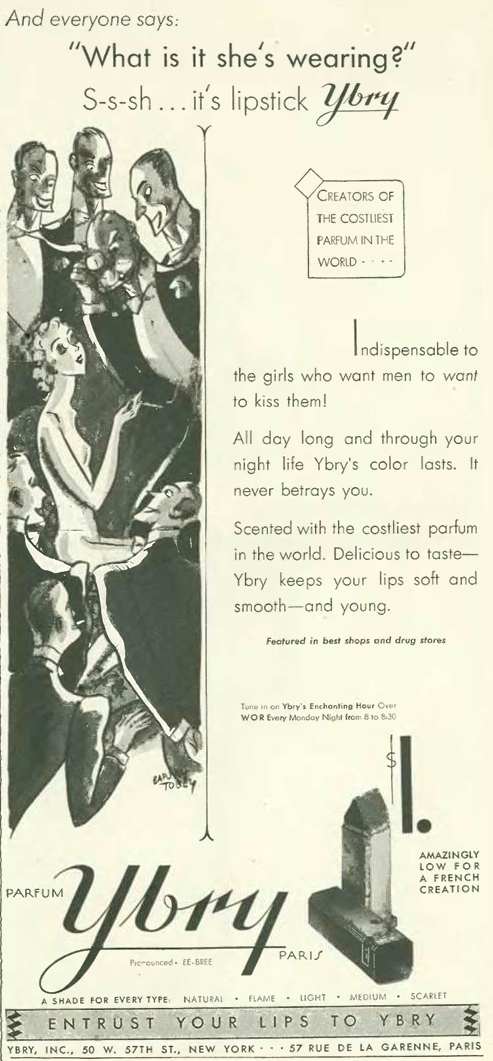
…the makers of Ybry lipstick apparently did not have the budget to garner a patrician endorsement, so they settled for this illustration by New Yorker cartoonist Barney Tobey…
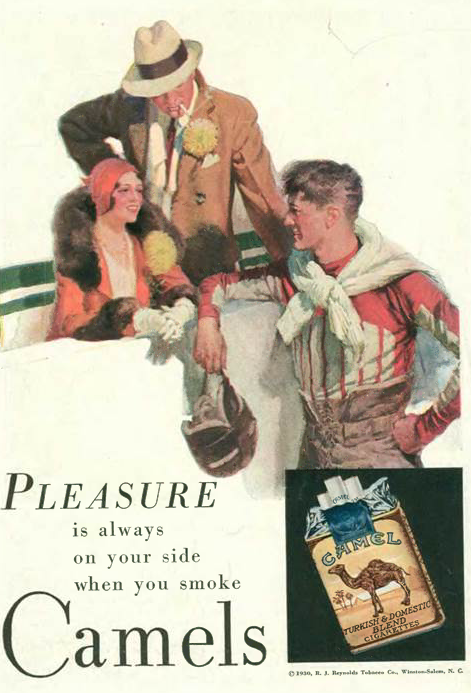
…and we have another lovely color ad from R.J. Reynolds, once again linking cigarettes to athletic prowess…
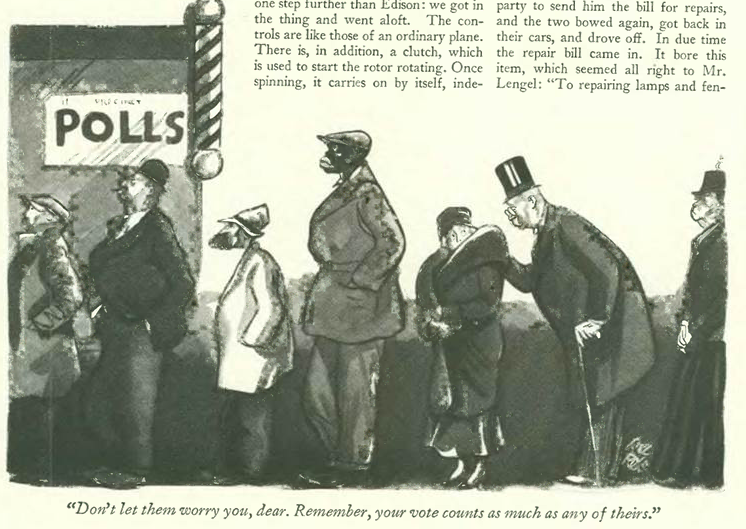
…on to our cartoons, we mark election season with Carl Rose…
…Barbara Shermund explored the generation gap…
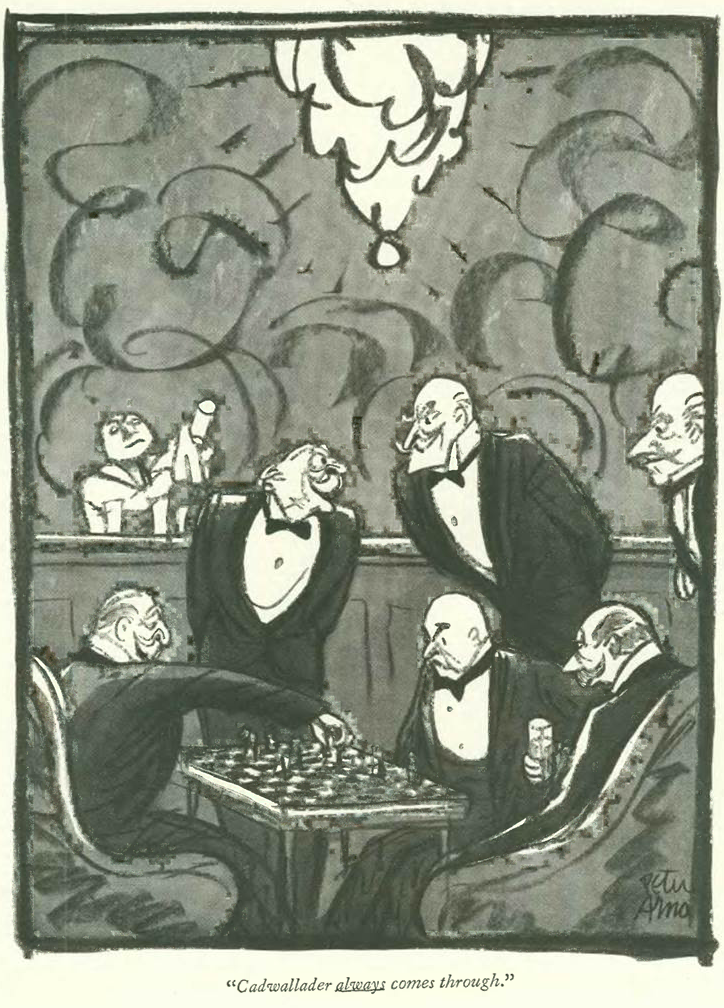
…Peter Arno gathered his sugar daddies for a game of chess…
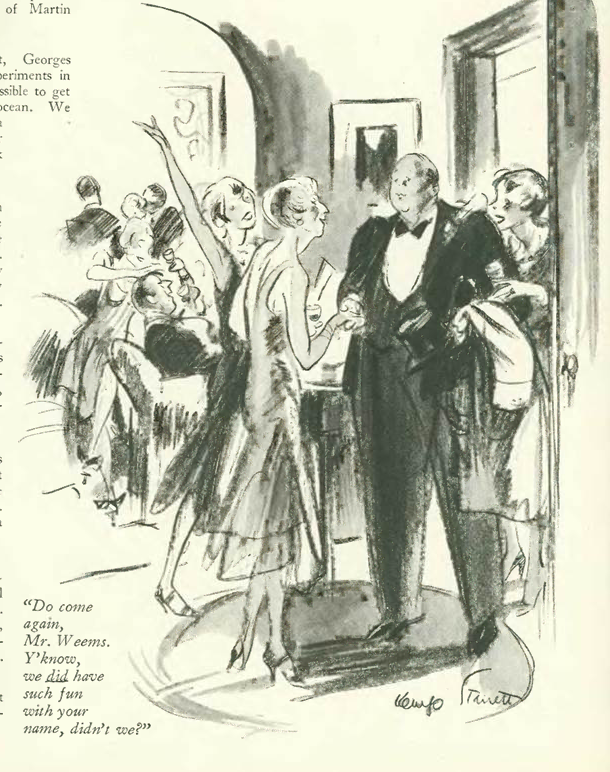
…Kemp Starrett introduced us to an unlikely life of the party…
…Alan Dunn examined the influences of popular cinema…
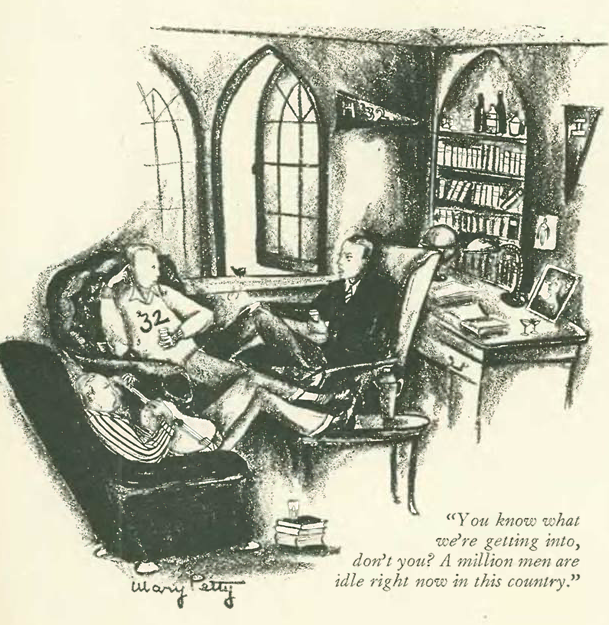
…Mary Petty gave us an Ivy League perspective of the Great Depression…
…and Arno again, with a cartoon that was featured along with The New Yorker’s “Wayward Press” column…
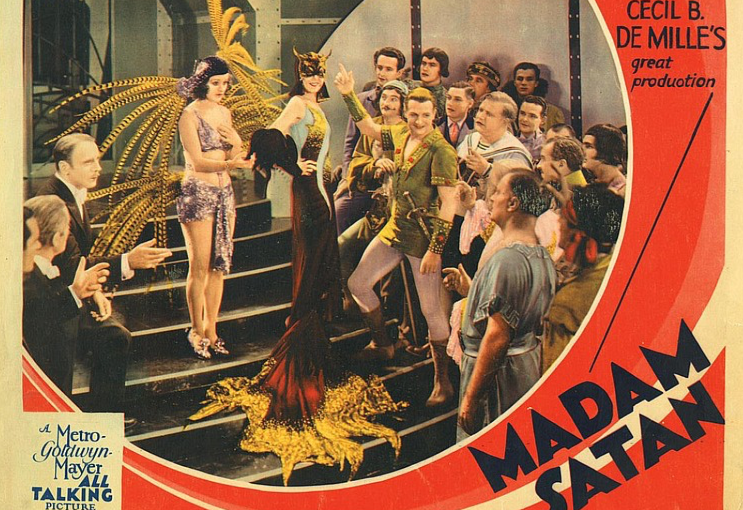
Cecil B. DeMille was known for his epic films (e.g. The Ten Commandments, 1923 and 1956) and cinematic showmanship, but in 1930 he puzzled his audiences with a very weird pre-Code musical, Madam Satan.
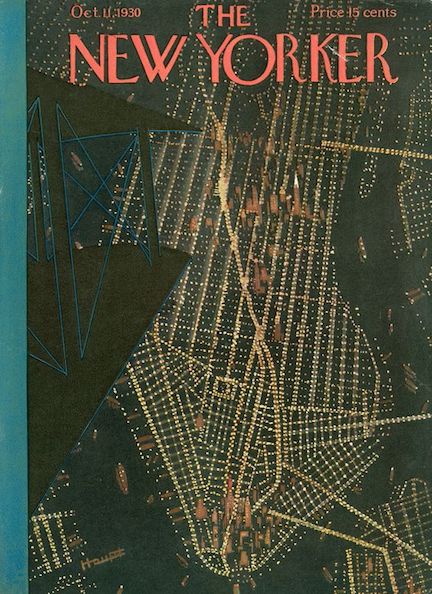
Oct. 11, 1930 cover by Theodore Haupt.
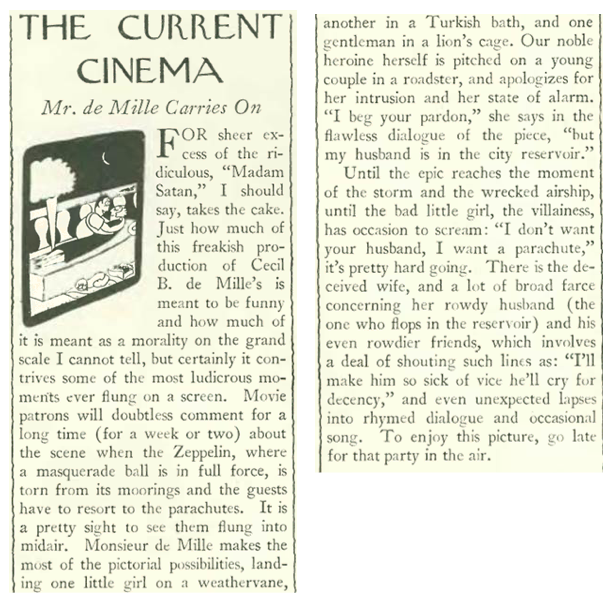
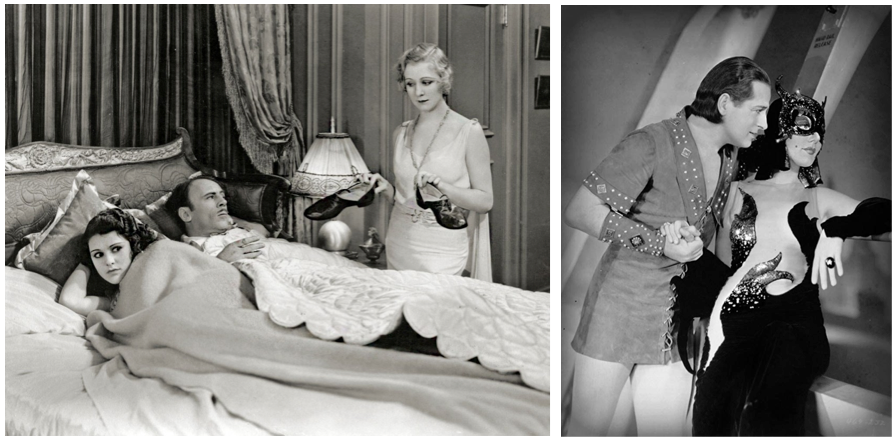
The film centered on a wealthy couple, Angela and Bob Brooks (played by Kay Johnson and Reginald Denny). Bob is unfaithful to his wife (a common pre-Code theme), and she attempts to lure him back by disguising herself as a mysterious devil woman at a masquerade ball held aboard a dirigible. Quite a plot indeed. Here’s what The New Yorker’sJohn Mosher had to say about it.
(IMDB)
PAJAMA GAMES…Lillian Roth, Roland Young, and Kay Johnson in Madam Satan. At right, Reginald Denny falls for the charms of his wife (Kay Johnson), disguised as a devil woman at a masked ball held aboard a giant dirigible. (IMDB/cecilbdemille.com)AIRHEADS…Via a giant mooring mast, partygoers board a dirigible for the masquerade ball in Madam Satan. Curiously, developers of the Empire State Building (which was under construction) envisioned a similar use for the mast that would top out their tower. In reality, winds that whipped around high towers would have prevented this type of boarding. (twitter.com)SOMEONE CALL THE FAA…At right, the lavish masquerade ball aboard a giant dirigible in Madam Satan. At right, the dirigible is damaged by lightning in a scene that foreshadowed the Hindenberg disaster of 1937. (cecilbdemille.com/precode.com)SEEMS PLAUSIBLE…In a silly ending to a silly film, partygoers float on parachutes away from the damaged dirigible. (twitter.com)
* * *
Let Them Eat Cake
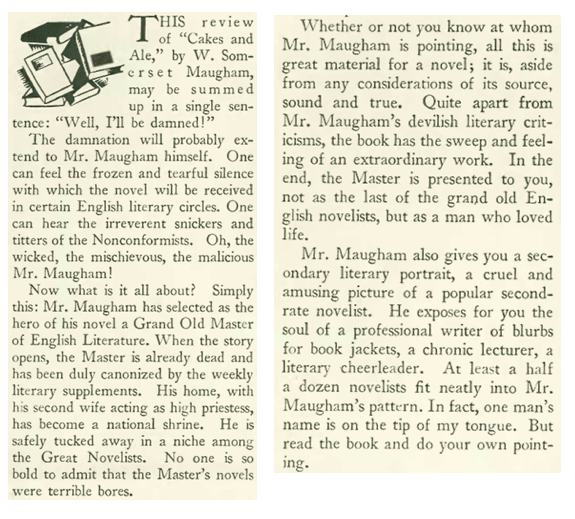
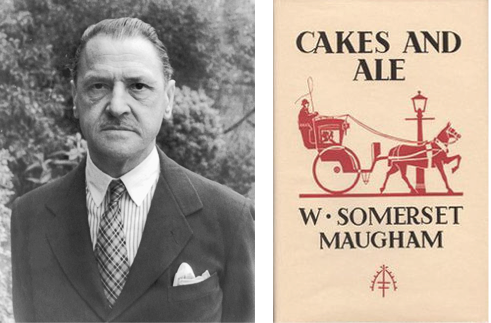
Somerset Maugham regarded his comic novel, Cakes and Ale, to be his favorite. The book took aim at snobs as well as at the legacy of one overrated, late-Victorian writer—a character many believe was based on the recently departed Thomas Hardy (Maugham denied the inspiration). The New Yorker had this to say about Cakes and Ale:
THROW HARDY INTO THE DUSTBIN…Somerset Maugham as photographed by Carl Van Vechten in 1934. (Wikipedia)
* * *
He Meant What He Said
Howard Brubaker, in his “Of All Things” column, found humor in the words of a rising figure in German politics, you know who…
* * *
Throw Him a Softball
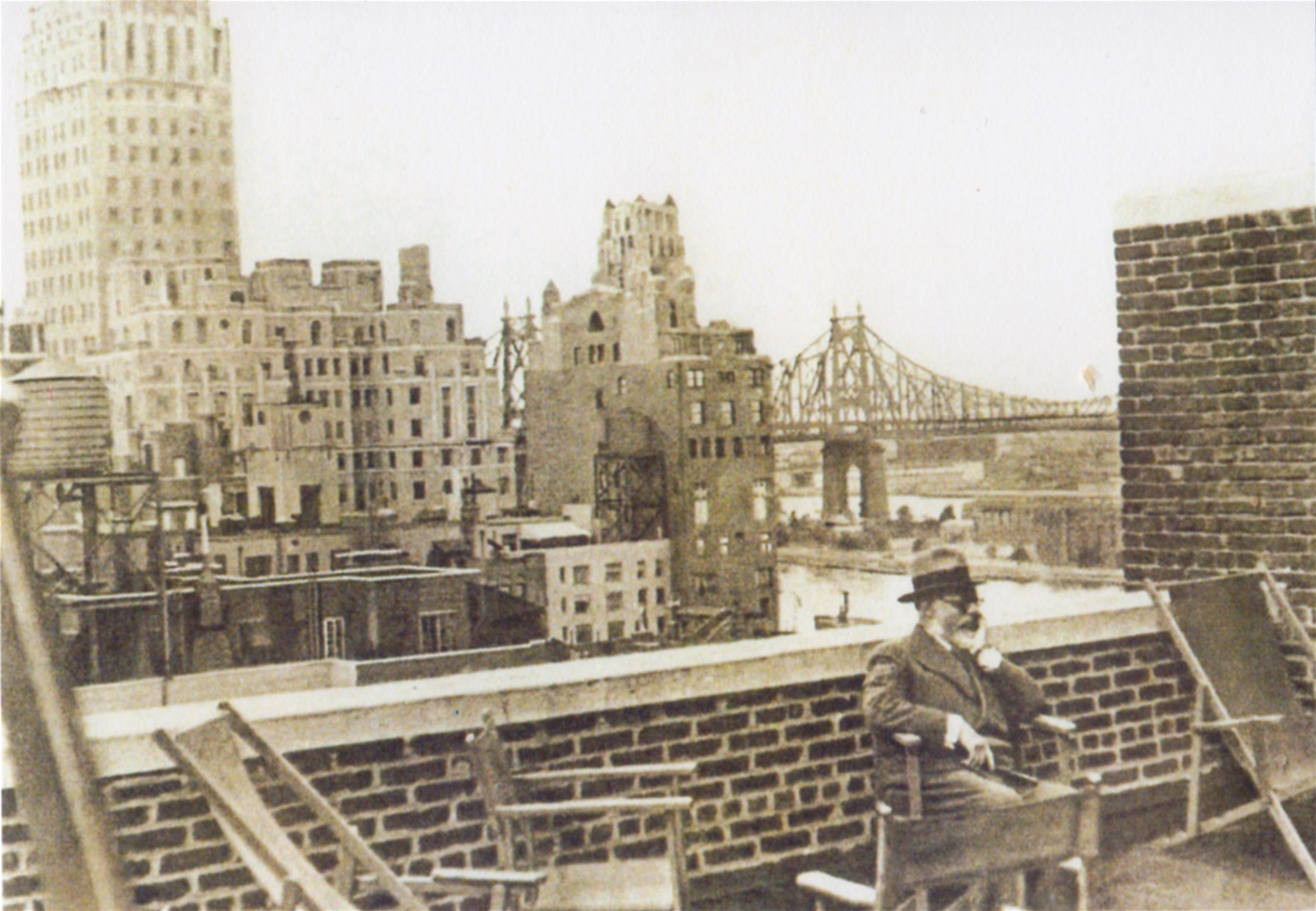
The famed French artist Henri Matisse paid a visit to New York City, and according to this account in “The Talk of Town,” seemed to be seeking some peace of mind…
AN OPPOSITE VIEW…Henri Matisse struck a thoughtful pose atop a Manhattan apartment at 10 Mitchell Place in 1930. The Queensboro Bridge can be glimpsed in the background. (ephemeralnewyork.wordpress.com)
* * *
Still Barred From the Bar
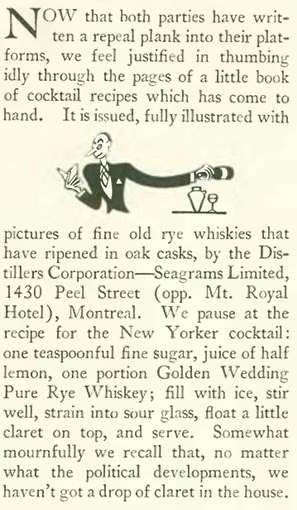
We are still about three years away from the official repeal of the 18th Amendment, but as we know the partying continued in houses and speakeasies across the great city. E.B. White, in his “Notes and Comment,” wistfully recalled the days when good booze was legal:
White did find some cheer in the pro-wet platforms of the two major parties…
A GIMLET IN EVERY POT…The major political parties in 1932’s U.S. presidential race were represented by incumbent Herbert Hoover (Republican) and Franklin D. Roosevelt (Democratic). Both favored repeal of the 18th Amendment. Pictured at the center, a New Yorker cocktail, the object of E.B. White’s longing. (Wikipedia)
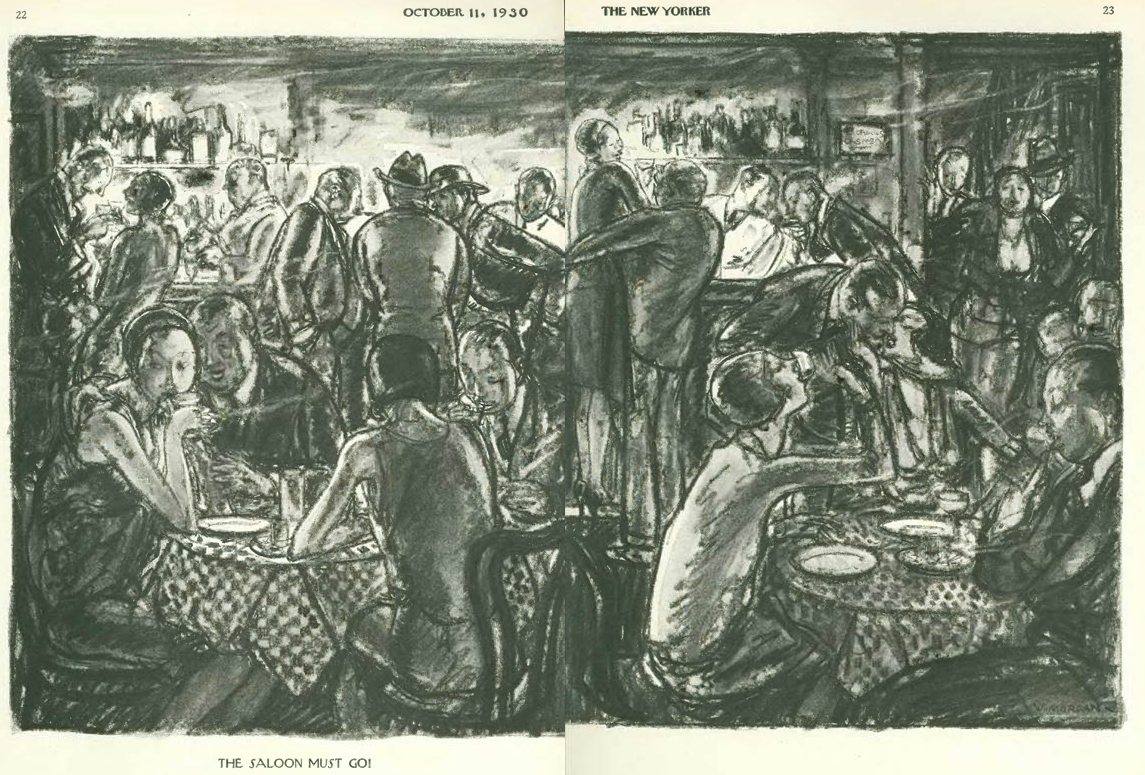
And while we are on the subject, we have this Wallace Morgan illustration of a lively speakeasy with the ironic caption, “The Saloon Must Go!” — referencing an old Anti-Saloon League Slogan.
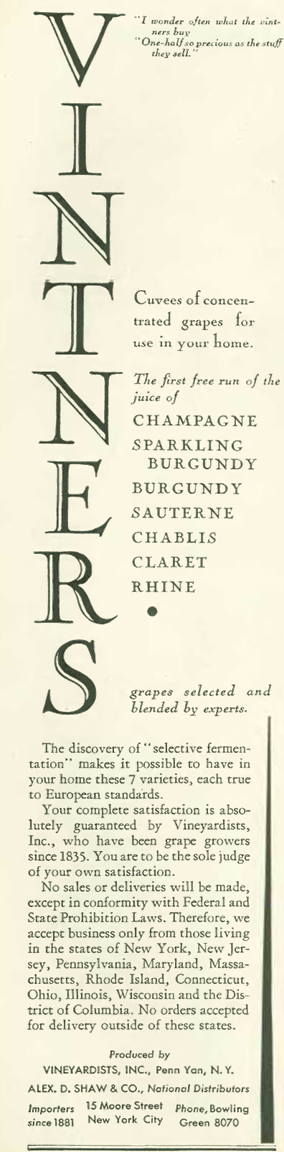
You didn’t have to go to a speakeasy if you wanted a glass of wine. During Prohibition American winemakers found a lucrative loophole by selling perfectly legal concentrated grape juice (called “wine bricks”) to home brewers and bootleggers alike.
According to an article in the Smithsonian, winemakers marked the wine bricks with warnings that they were “for non-alcoholic consumption only.” However, the package would also bear a note explaining how to dissolve the brick in a gallon of water, and yet another “warning” instructing the buyer not to leave the jug in a cool cupboard for 21 days, lest it turn into wine.
Here’s an ad in the Oct. 11, 1930 New Yorker that not-so-subtly offered a selection of varietals…
Here’s what a wine brick looked like:
A wine brick from San Francisco’s Vino Sano company. The label reads: “Each Brick dissolve in one gallon of water. To prevent fermentation, add 1-10% Benzoate of Soda.” Yeah right. (vinepair.com)
* * *
From Our Advertisers
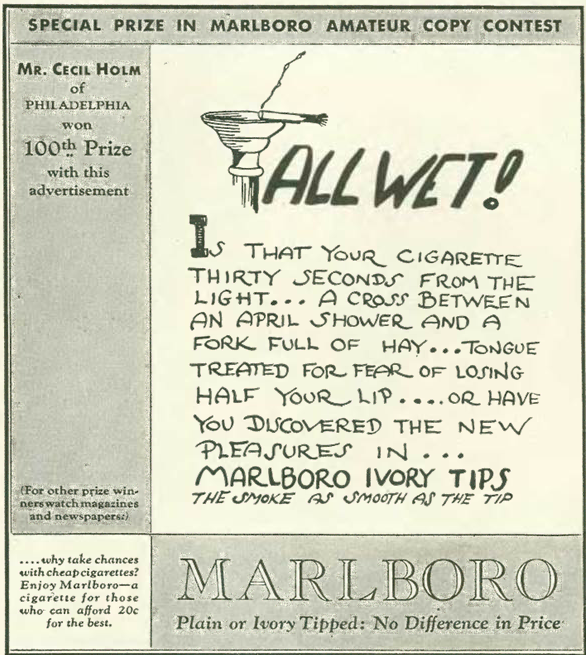
No doubt Prohibition caused more than a few people to take up smoking. Women adopted the habit in droves during the Roaring Twenties, and by the Depression it seemed everyone was lighting up. Advertisers explored various ways to market cigarettes, and long before the Marlboro Man made the scene, that brand pushed its product through a series of dopey handwriting and essay contests,,,
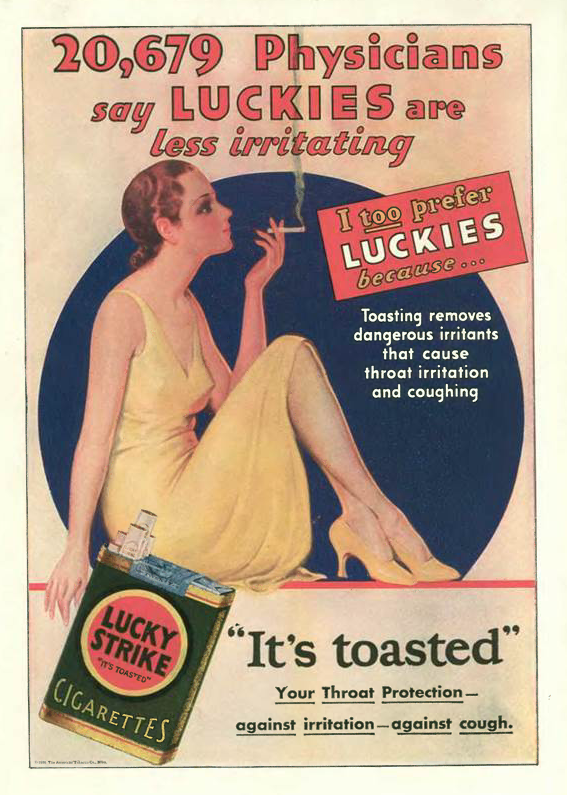
…the makers of Luckies used a combination of sex and bogus health claims to sell their products…
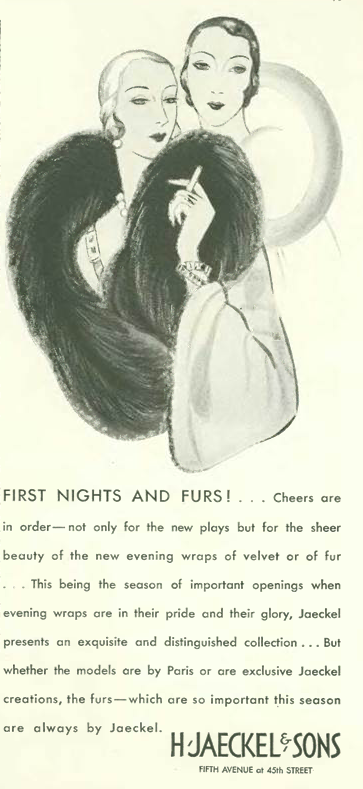
…cigarettes were not confined to ads by tobacco companies; here they are accessories to fine furs…
…even The New Yorker’s spot illustrations (this by Frank McIntosh) featured smokers…
…as did cartoons, such as this one by Barbara Shermund in the Oct. 4 issue…
…and we have one more ad, this one from Chrysler, which acknowledged the new world of the Great Depression, but only through use of careful euphemisms (The New Yorker editorial side practiced much of the same)…
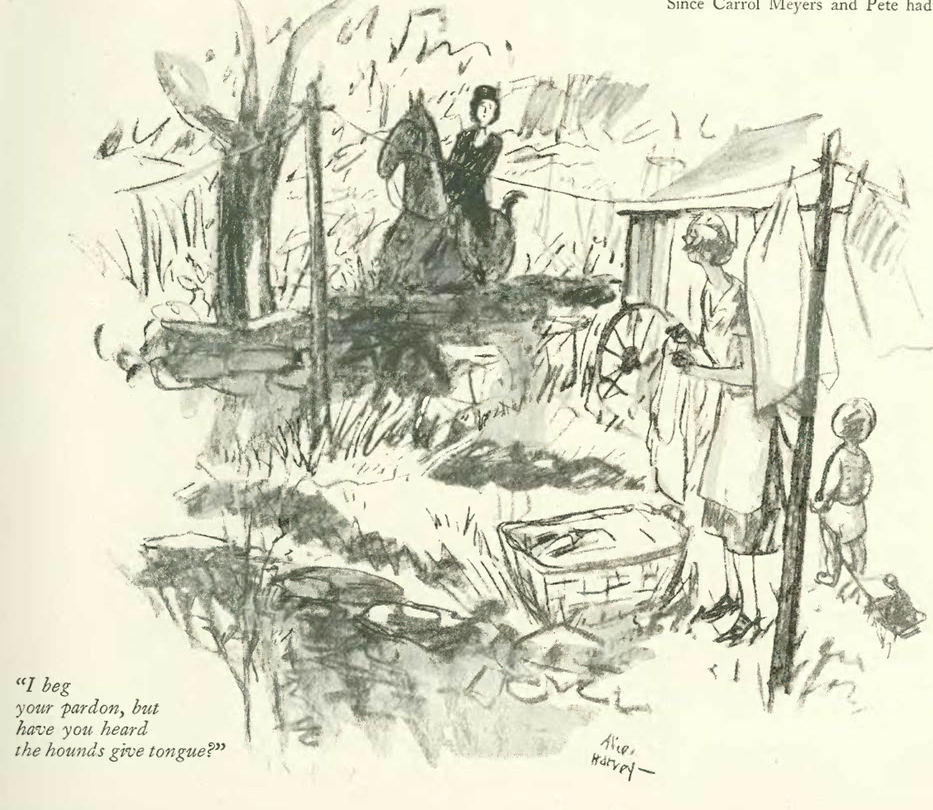
…on to our cartoons, beginning with an exploration of city vs. country life, by Alice Harvey…
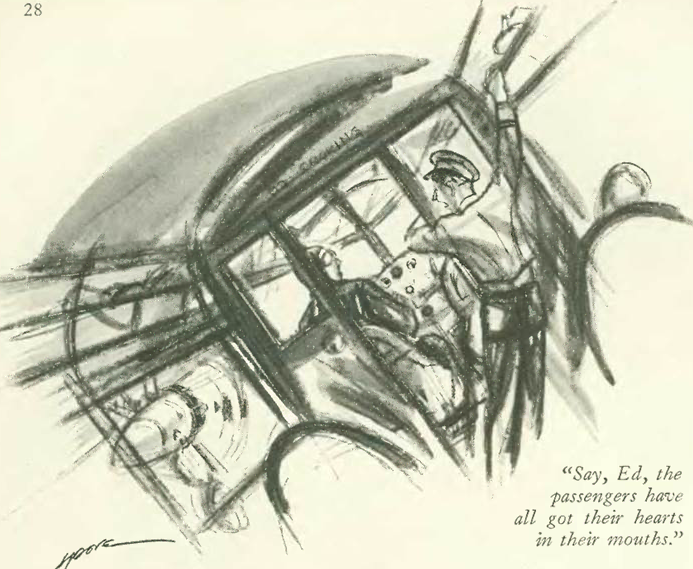
…a depiction of what commuter flying was actually like in 1930, thanks to Leonard Dove…
…a glimpse at modern parenting, with Helen Hokinson…
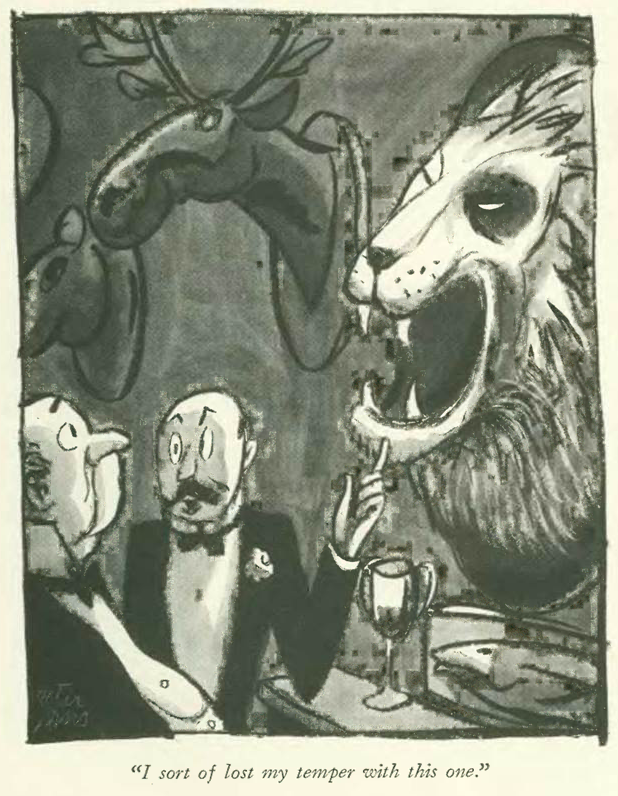
…humor in a gentleman’s drawing room, courtesy Peter Arno…
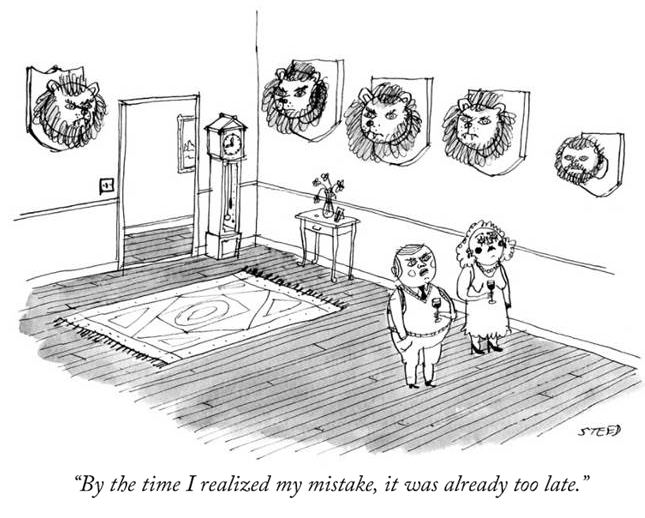
…and 89 years later, a hilarious update on the subject by Edward Steed in the Sept. 9, 2019 issue…
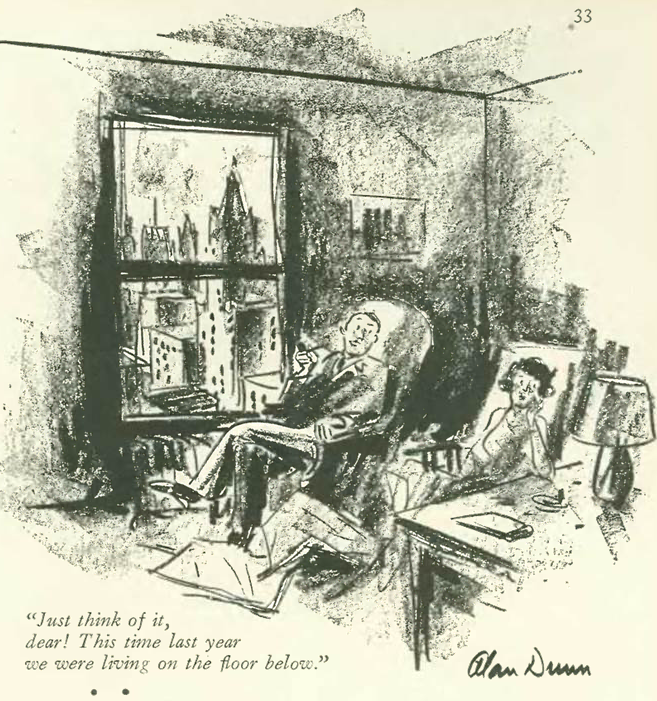
…and finally, the joys of urban life brought to us by Alan Dunn…











































































































 A New Yorker State of Mind