On March 1, 1930, the Empire State Building was still just a bunch of sketches and blueprints, as was much of the yet-to-be-built modern cityscape of Manhattan. But as the Depression slowly worked its gnarled fingers into the American landscape, some still dreamed of the sleek, streamlined world to come.
March 1, 1930 cover by Rea Irvin.
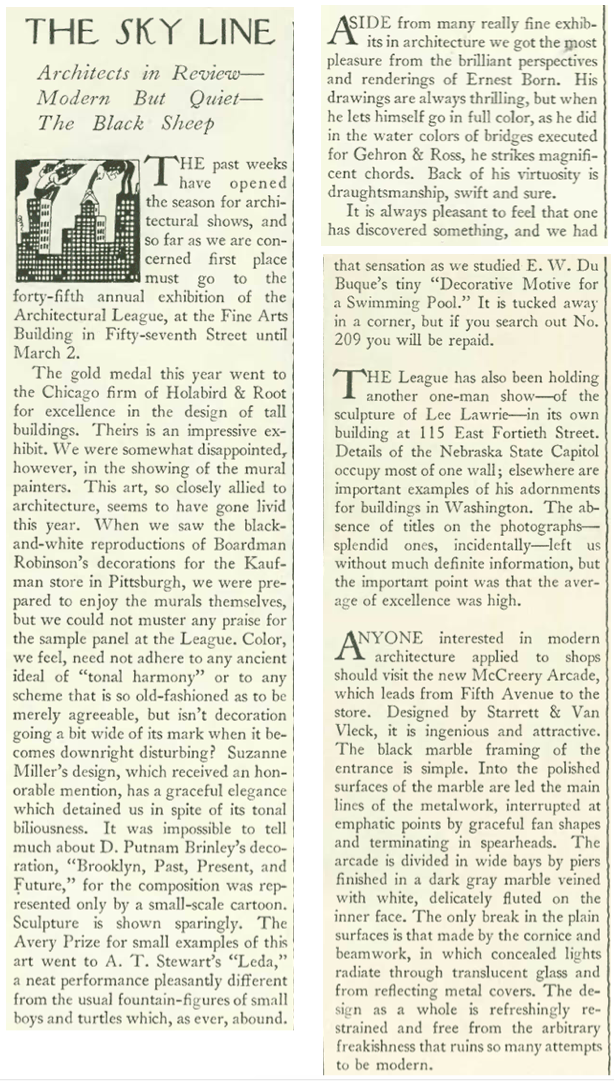
The New Yorker’s architecture critic, George S. Chappell, kept readers apprised of changes on the city’s skyline, as well as of the trends in modern design that were being displayed at various exhibitions including one held annually by the city’s Architectural League. Chappell observed:
A GLIMPSE INTO THE FUTURE…Opening pages of the Architectural League’s 45th Annual Exhibition, featuring an image of the Empire State Building. Construction had just begun on the iconic building at the site of the old Waldorf-Astoria Hotel. (mullenbooks.com)
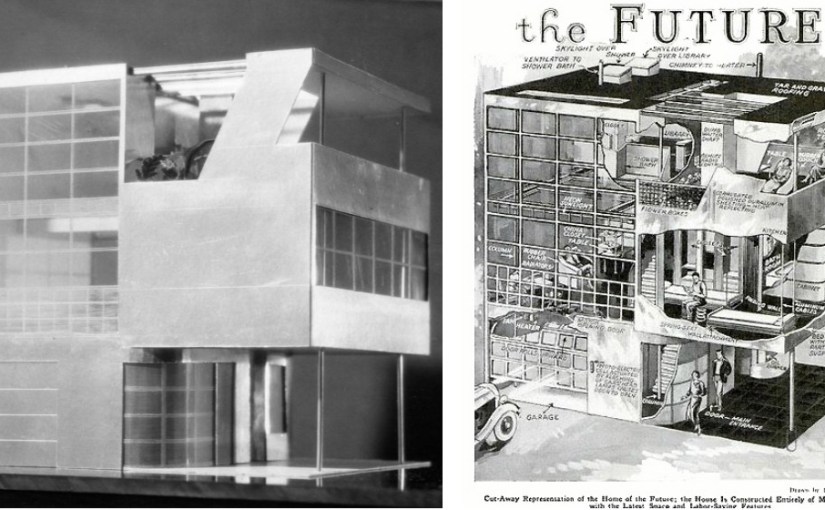
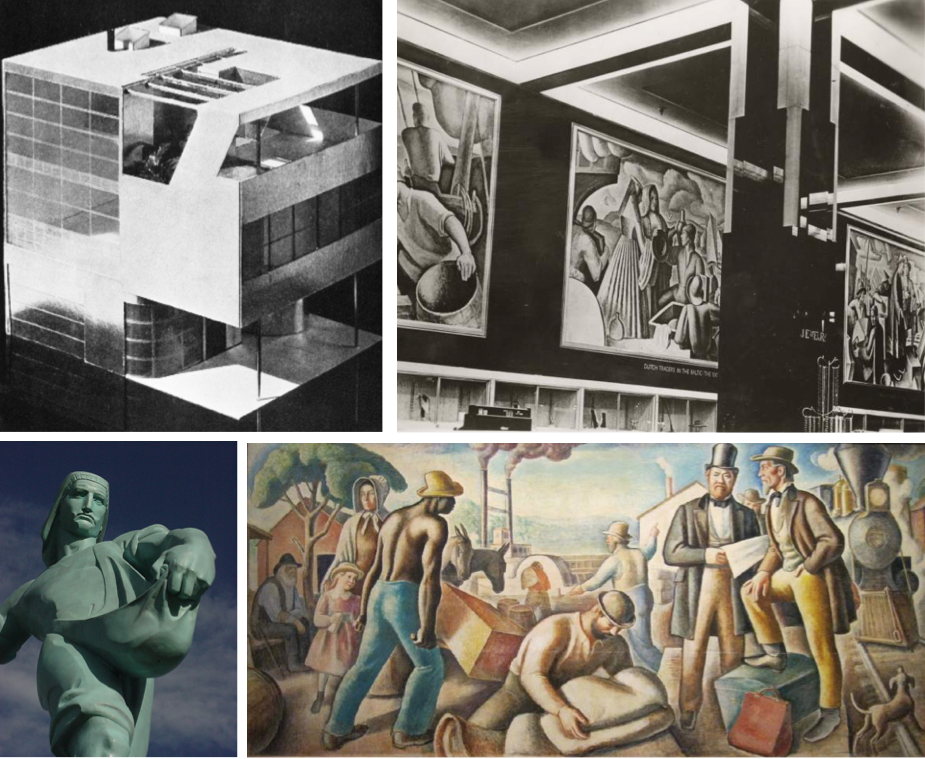
The exhibition featured a variety of projects, from the Aluminaire House in Long Island to Boardman Robinson’s murals in Pittsburgh to Bertram Goodhue’s Nebraska State Capitol featuring Lee Lawrie’s sculptures and friezes…
ECLECTIC…Model of the Aluminaire House erected in full scale for the 45th Annual Exhibition of the Architectural League of New York; Boardman Robinson’sThe History of Trade murals in Kaufmann’s Department Store, Pittsburgh; detail of one of Boardman’s 10 murals displayed at Kaufmann’s; Lee Lawrie’s “The Sower,” a 19-foot-tall bronze statue mounted on top of Bertram Goodhue’s Nebraska State Capitol in Lincoln. In 1937 Lawrie would install his “Atlas” sculpture in front of Rockefeller Center. (archleague.org/archive.triblive.com/capitol.nebraska.gov)
* * *
And Now For Something Old
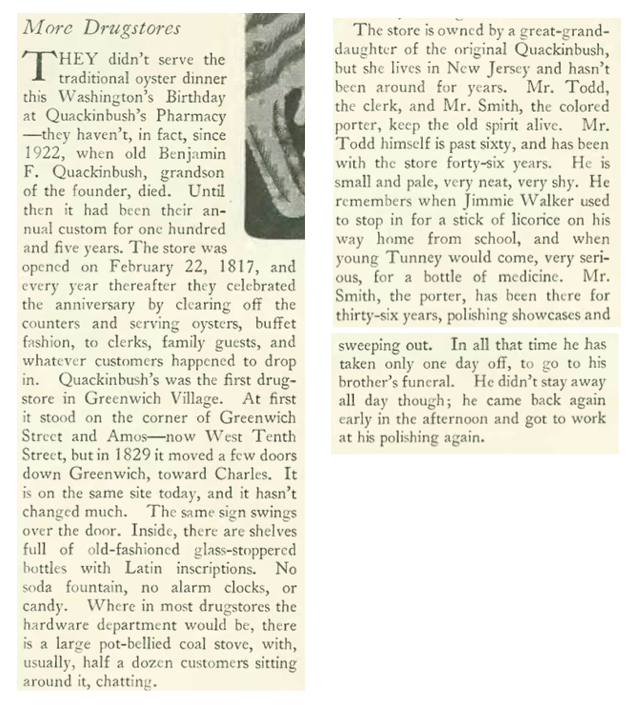
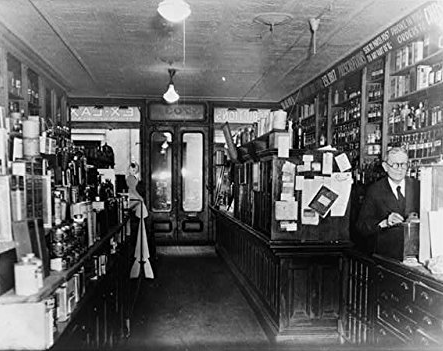
While George Chappell contemplated the world to come, “The Talk of Town” looked back in time to Greenwich Village’s oldest drugstore…
FORM FOLLOWED FUNCTION…Quackenbush Pharmacy in 1930. Manager James Todd at right. (Library of Congress)
* * *
Pet Project
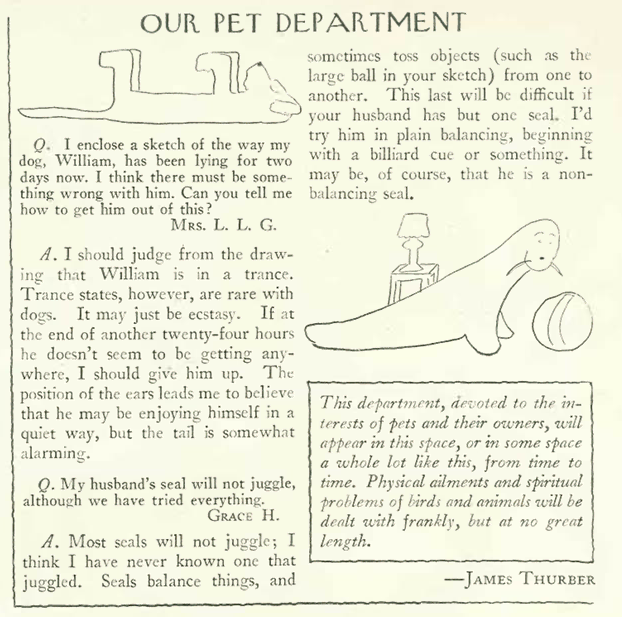
The March 1 issue featured James Thurber’s second installment of “Our Pet Department”…
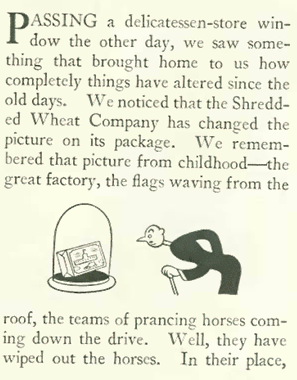
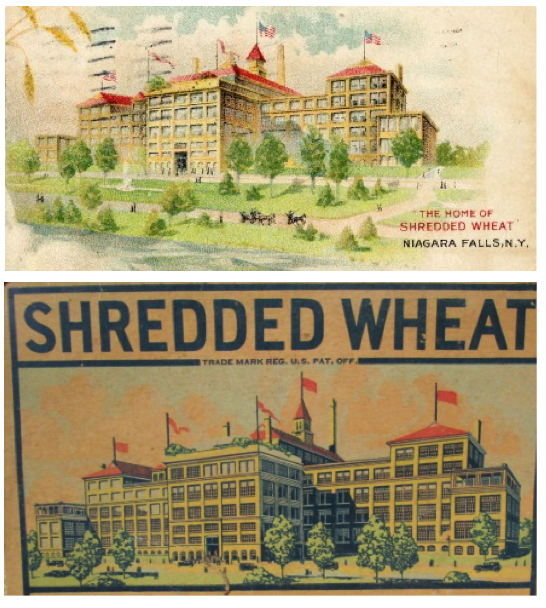
And while Thurber was doling out pet advice, his pal E.B. White was worrying over changes to the design of the Shredded Wheat box…
HORSELESS CARRIAGES replaced animal power on the packages of Shredded Wheat, much to the dismay of E.B. White. (oldshopstuff.com)
* * *
A Prince of a Guy
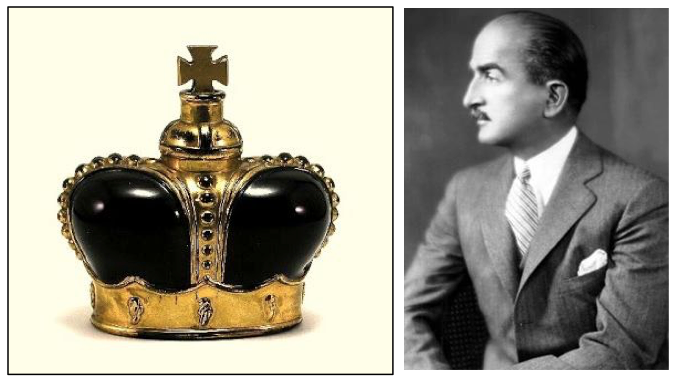
A refugee from the Bolshevik Revolution, the Georgian Prince Matchabelli (Guéorgui Vassilievitch Matchabelli) was penniless when he landed on American shores in 1924. Two years later he launched a perfume business with three scents — Ave Maria, Princess Norina, and Queen of Georgia — sold in bottles that were said to be small replicas of the Prince’s lost Georgian crown. “The Talk of the Town” paid the royal perfumer a visit for the March 1 issue:
HIS CROWNING ACHIEVEMENT…A bottle of Princess Norina perfume from 1926, and its creator, Prince Matchabelli. (Pinterest/Wikipedia)
Those who were around the late 1970s and 1980s no doubt recall the Prince Matchabelli Windsong Perfume commercials and the catchy tune that kind of stuck in your head (for better or worse)…
* * *
Low Life Revue
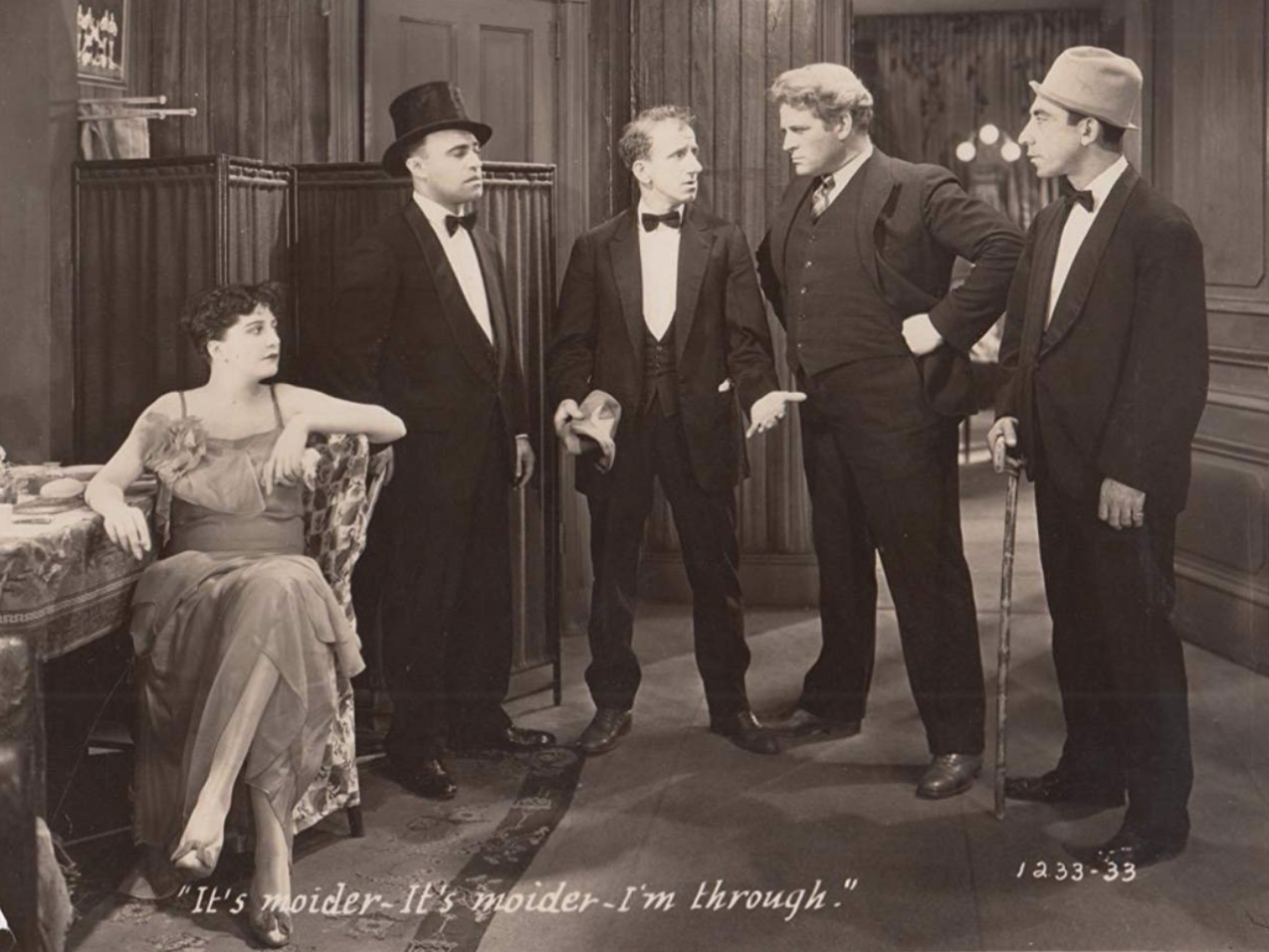
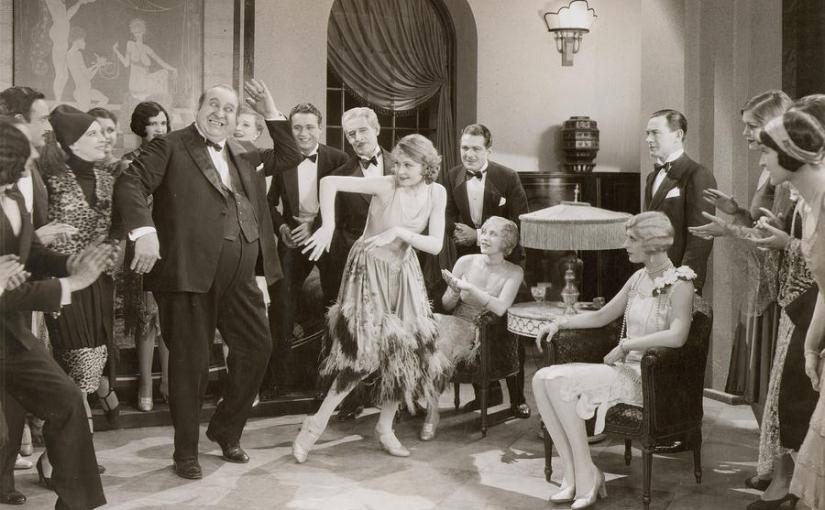
Ben Hecht continued his exploration of the hardboiled world of journalists, bootleggers, nightclub singers and other lowlifes in his screenplay for Roadhouse Nights, a film that was apparently enjoyed by New Yorker film critic John Mosher. As for Hecht, an erstwhile member of the Algonquin Round Table and occasional contributor to The New Yorker in the 1920s, the film was just one of many to follow in a Hollywood career that the former Chicago journalist held in some disdain (see recent New Yorker article by David Denby)…
IT’S MOIDER, I SAY…Helen Morgan, Eddie Jackson Jimmy Durante, Fred Kohler, and Lou Clayton in 1930’s Roadhouse Nights. (IMDB)
* * *
The Winds of Wynn
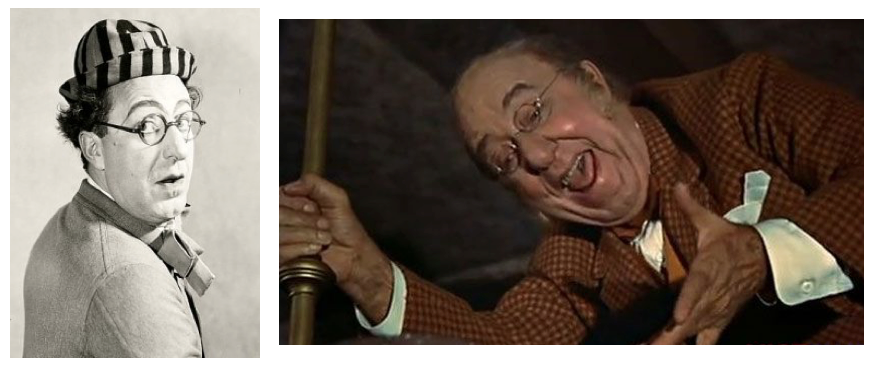
Ed Wynn wowed theater critic Robert Benchley in his portrayal of “Simple Simon” at the Ziegfeld Theatre. Wynn was one of the most popular comedians of his time, but is best known today for his portrayal of “Uncle Albert” in the 1964 Disney film Mary Poppins…
AGELESS…Ed Wynn in Simple Simon, 1930; at right as Uncle Albert in 1964’s Mary Poppins. (secondhandsongs.com/Pinterest)
* * *
He Was No Palooka
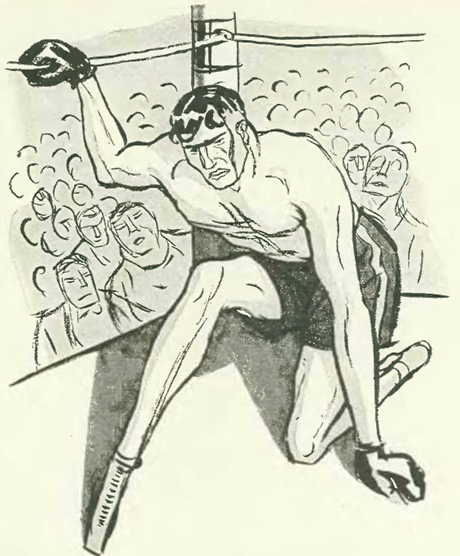
The March 1 and 9 issues of The New Yorker gave considerable ink to Niven Busch Jr’s success story of a middleweight prizefighter. Titled “K.O. Middleweight,” the two-part article was about Stanislas Kalnins, who went by the name K.O. Keenen because it would go over better with the large majority of Irishmen at the fights. Peter Arno provided the art for the piece:
From Our Advertisers
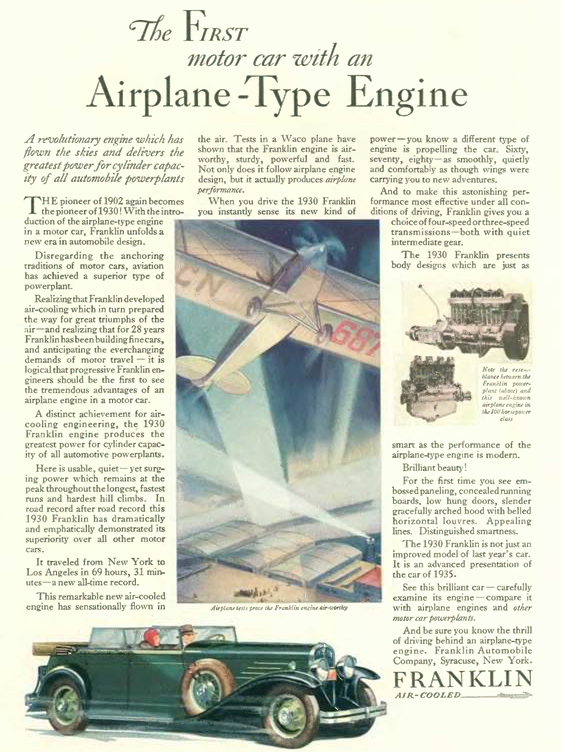
We have another ad from the Franklin motorcar company touting its air-cooled engines, which thanks to the Depression were not long for the world…
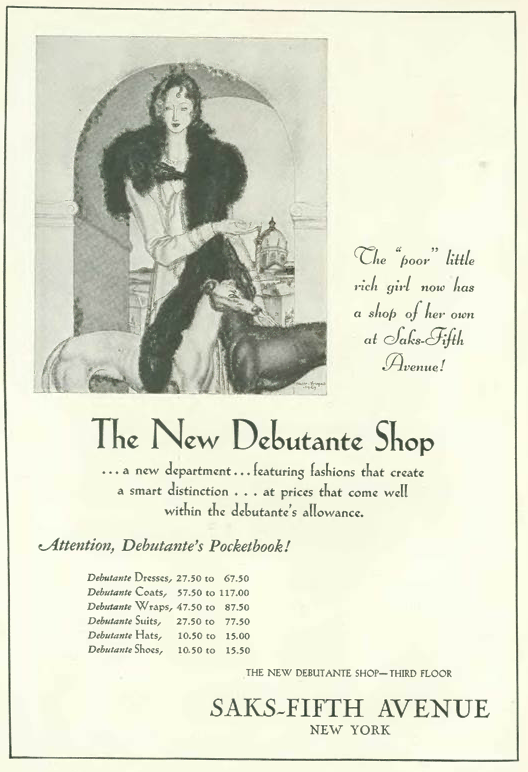
…Saks shamelessly appealed to the “poor” little rich girl in this ad aimed at aspiring debutantes…
…Lenthric perfumes offered this all-French ad to those seeking Continental refinement…
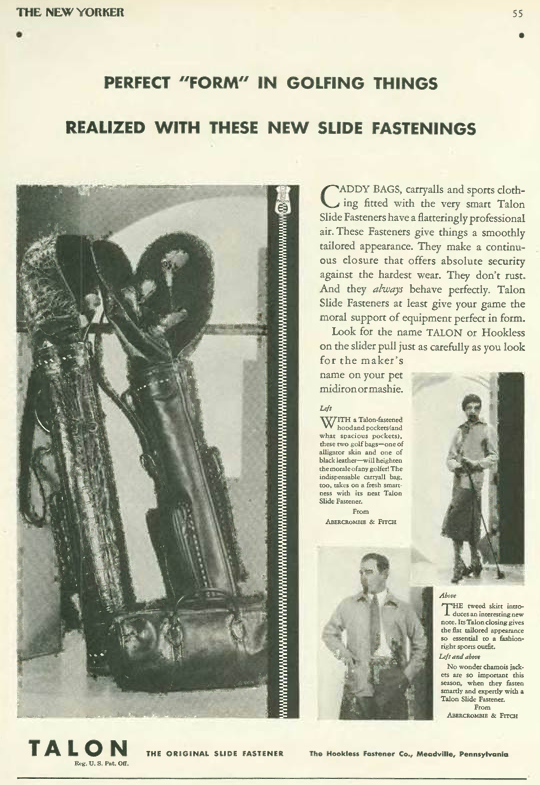
…and this ad from Talon, advertising “Slide Fasteners” before the word “zipper” came into common use…
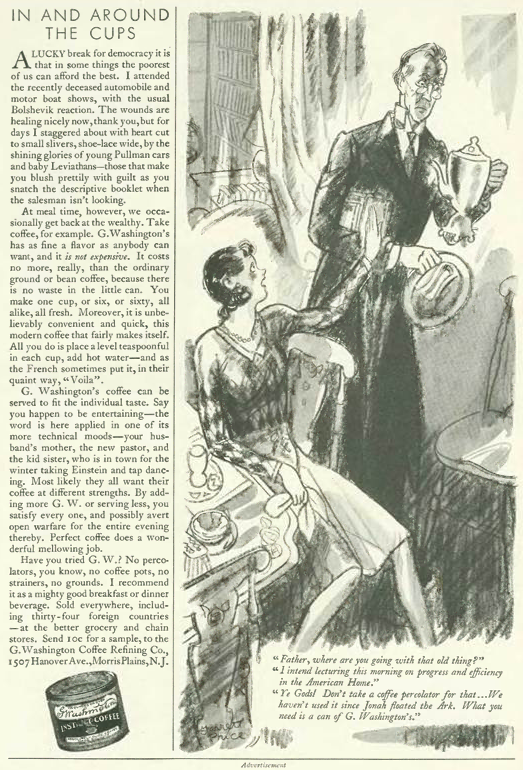
…Garrett Price was the latest New Yorker cartoonist to pick up some extra cash from G. Washington instant coffee…
…while John Held Jr. even lent his image (along with some drawings) to promote Chase and Sanborn’s coffee…
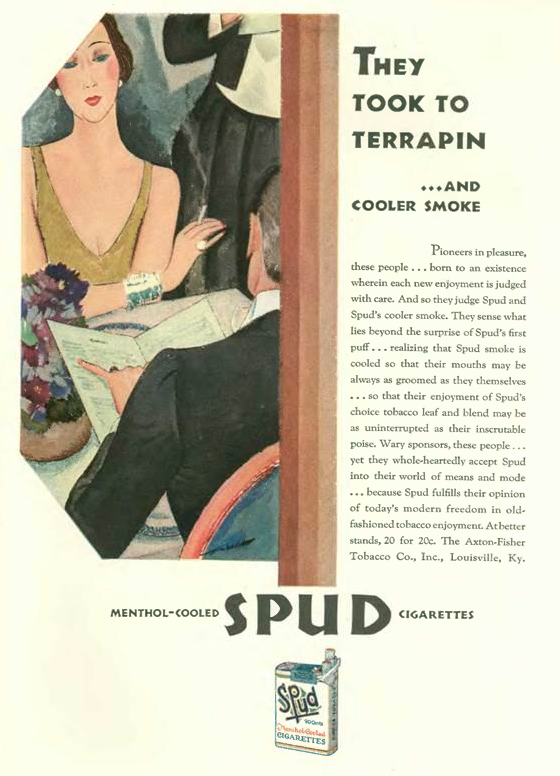
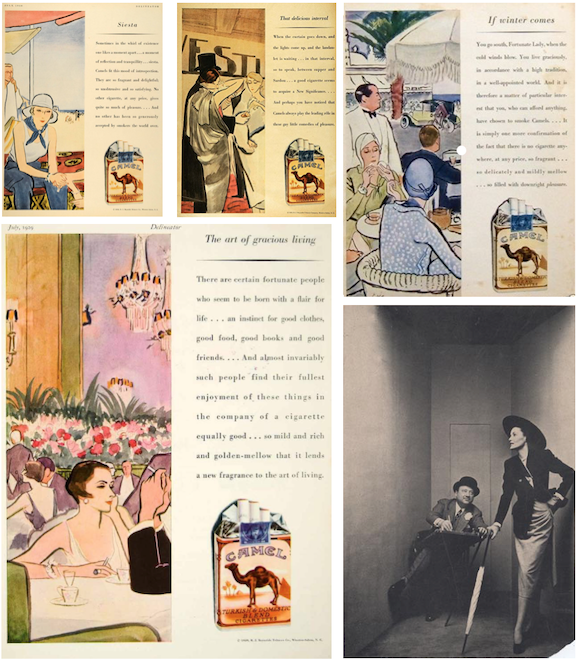
…this artist for Spud cigarettes borrowed Carl Erickson’s style from his famed Camel ads (see examples below)…
…examples of Carl “Eric” Erickson’s Camel ads from the late 1920s…
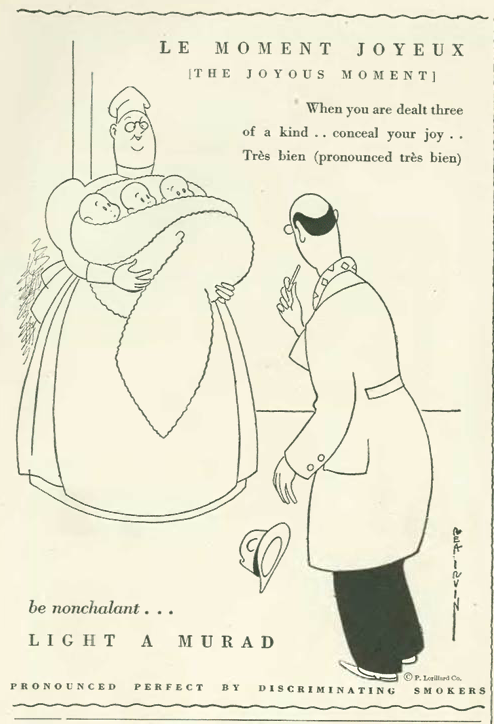
…and here we have another New Yorker cartoonist, Rea Irvin, helping the makers of Murad cigarettes move their product…
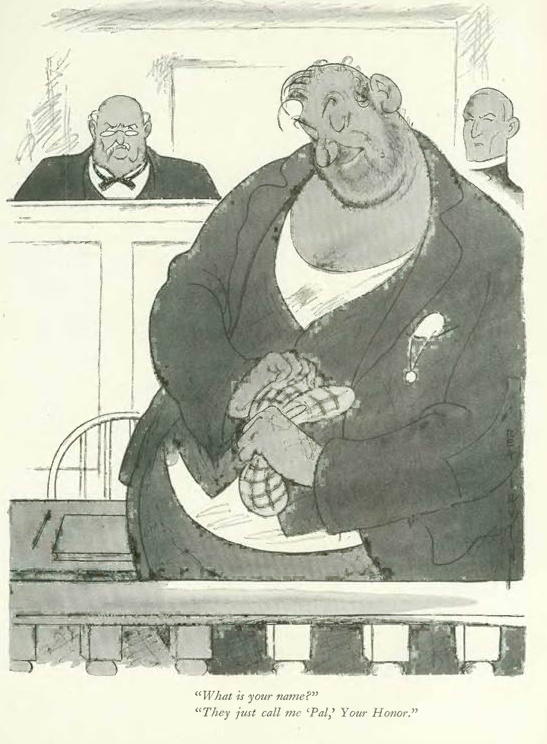
…Irvin also illustrated this cartoon for the March 1 issue…
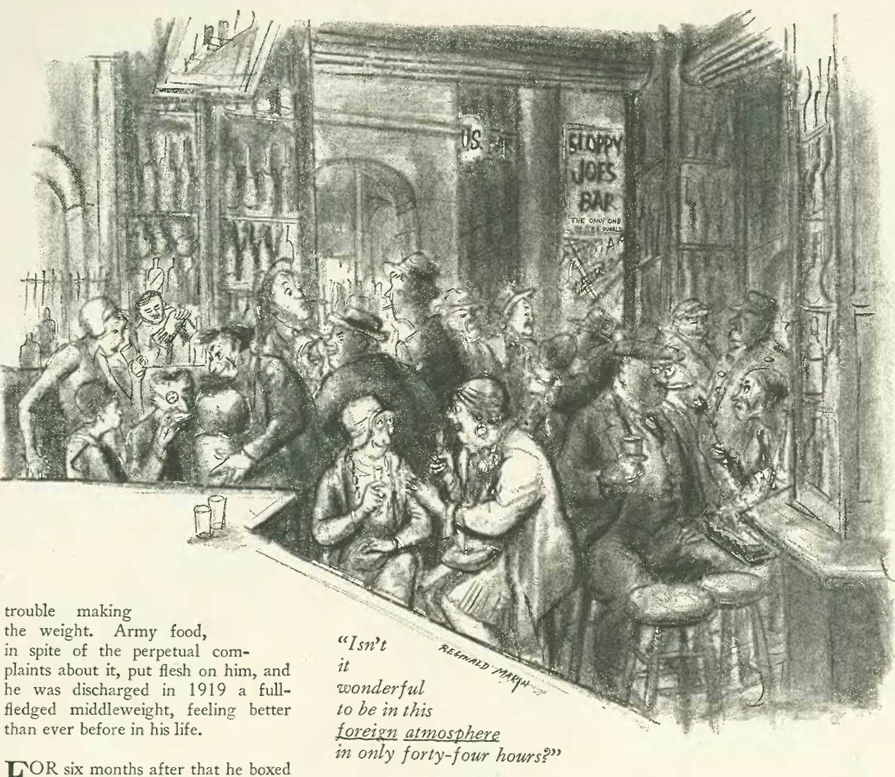
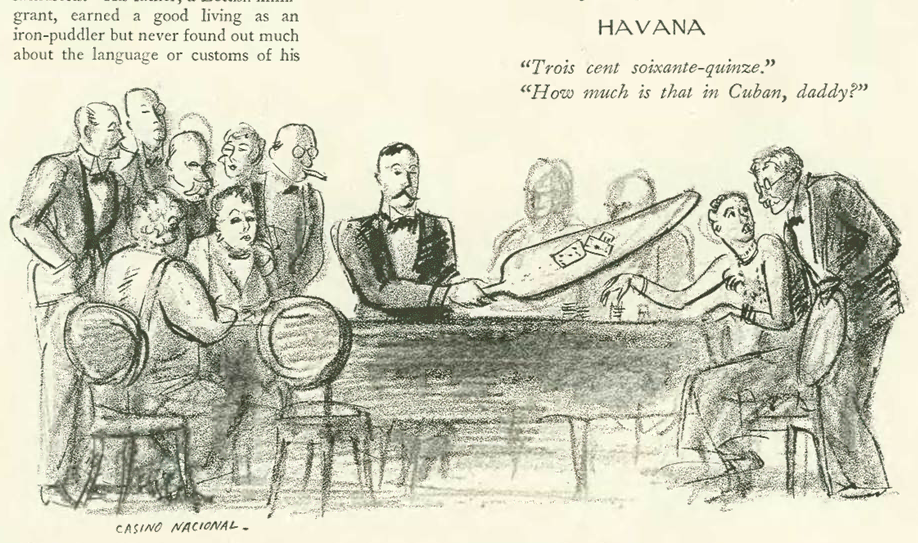
…Reginald Marsh contributed these cartoons, no doubt based on a recent winter stay in sunny Havana (I’ve been to Sloppy Joe’s, and still looks pretty much like this)…
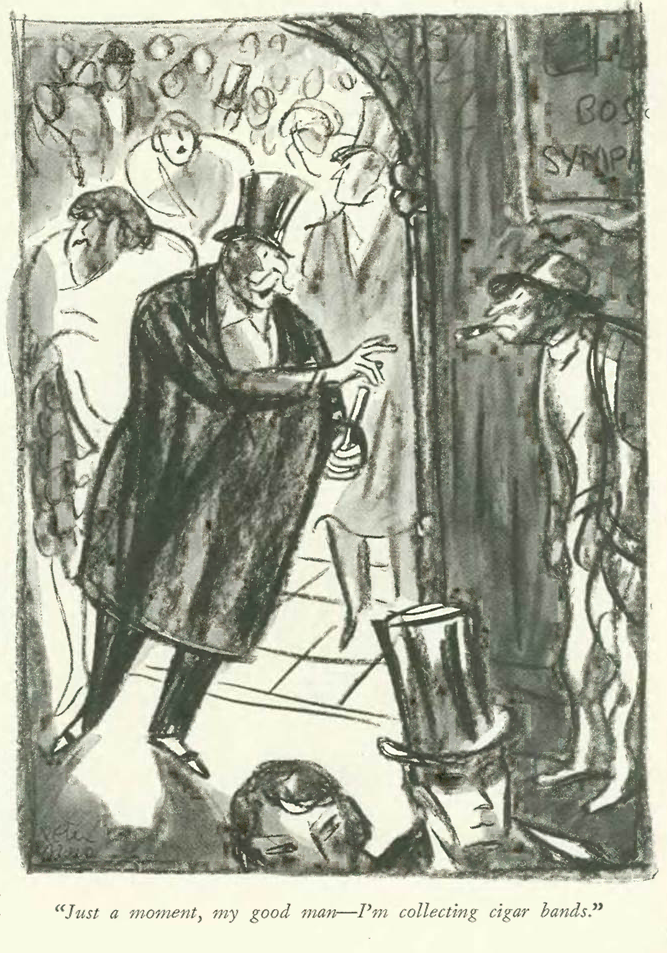
…back stateside, Peter Arno looked in on a cultural exchange…
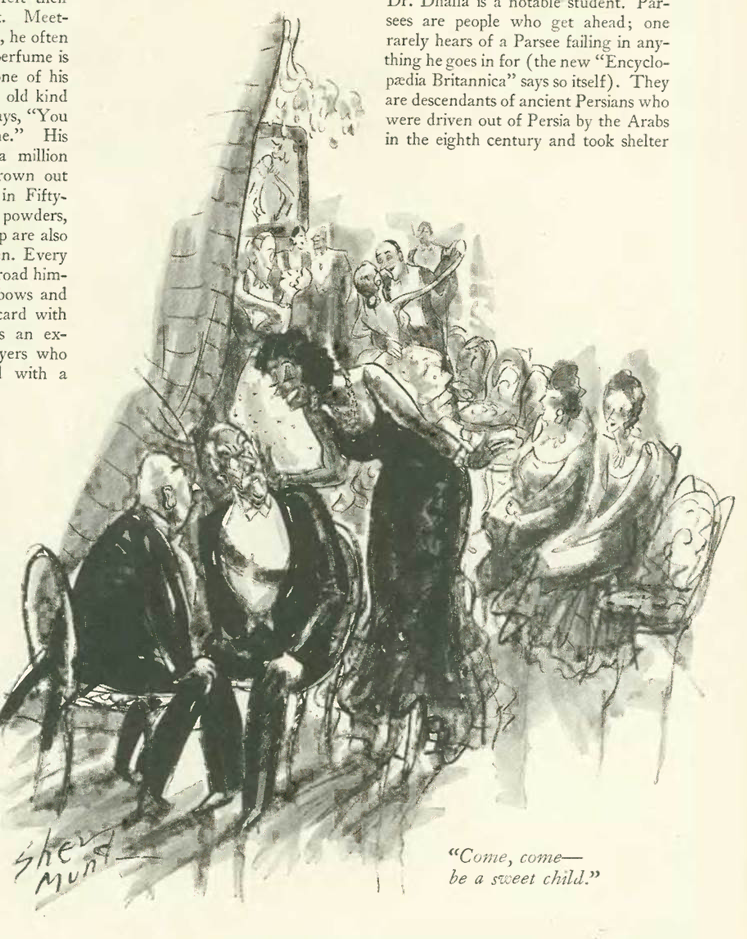
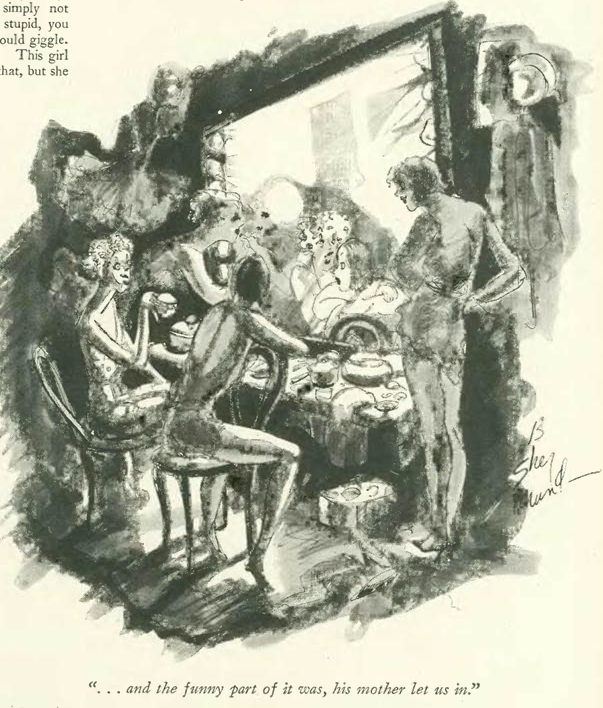
…and we close with two from the issue by Barbara Shermund…
When the fifth anniversary issue of The New Yorker hit the newsstands in February 1930, the magazine was also setting down another milestone: its first-ever publication of a James Thurber cartoon* (*see comment section).
Feb. 22, 1930 cover by Rea Irvin.
Inserted into the top corner of page 25 (next to a short fiction piece by Emily Hahn), was Thurber’s first installment of his spoof on newspaper pet columns titled “Our Pet Department.”
Seeming a bit quizzical about his debut as a cartoonist, in February 1930 Thurber wrote to his friend Minnette Fritts Proctor (for whom he held lifelong romantic yearnings) that his drawings were “now coming into a strange sort of acclaim… The New Yorker is going to run a series of my animal pictures…and a concern wants me to do ads for it. Imagine!…I’m enclosing a few (pictures), which you can throw away. They’ll alarm you.”
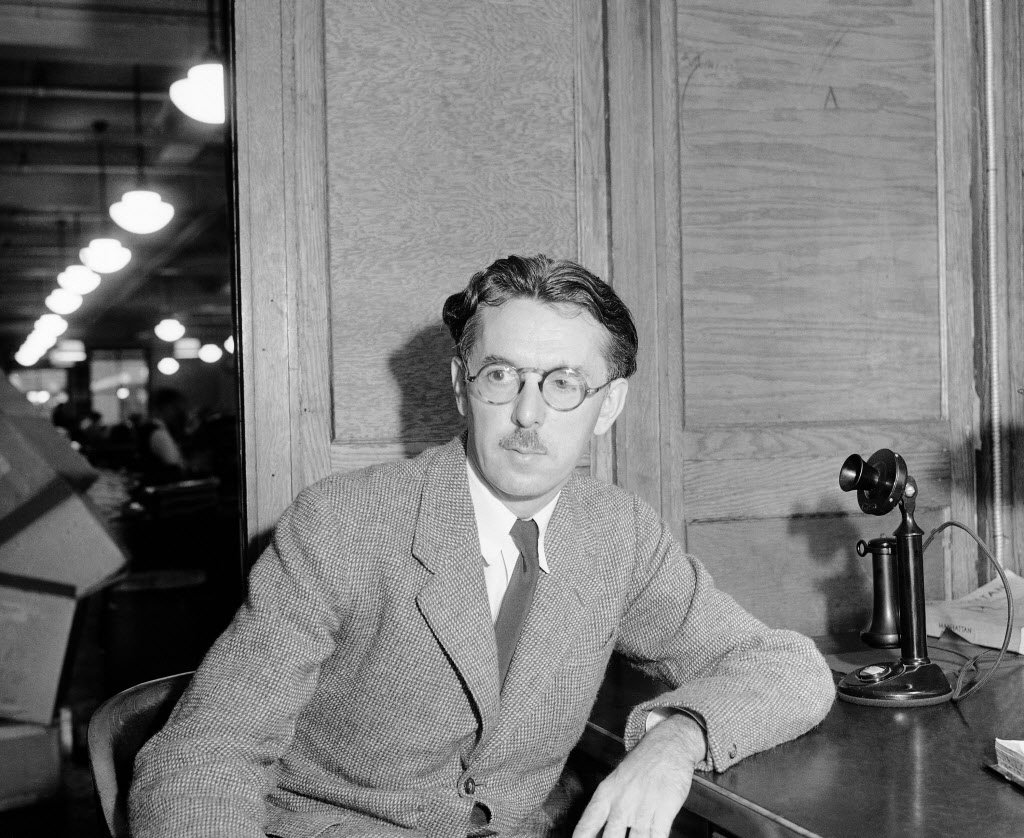
PET WHISPERER…James Thurber, already well established as a writer at The New Yorker, made his debut as a cartoonist for the magazine in its fifth anniversary issue. The brilliant “Our Pet Department” would run through the spring in the 14 installments. (thurberhouse.org)
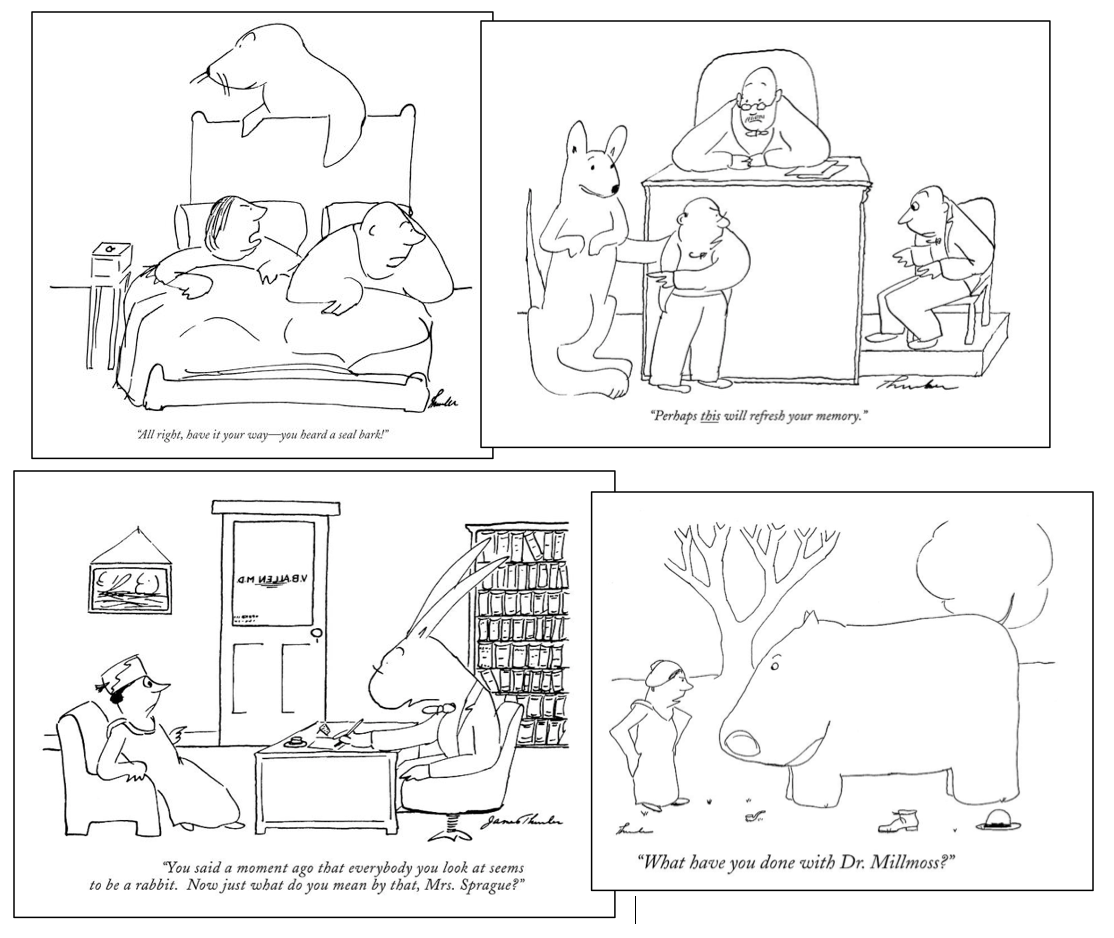
Animals of all sorts would pop up in Thurber’s cartoons throughout the 1930s…
Clockwise from top left, cartoons from the following issues: Jan. 30, 1932; April 6, 1935; July 14, 1934; and Feb. 13, 1937.
…and his famous dogs would make frequent appearances, including on their own cover in 1946 to coincide with that year’s Westminster Kennel Club Dog Show…
Office mate, co-author and friend E.B. White, on the other hand, assumed his usual duty of marking the magazine’s anniversary in “Notes and Comment”…
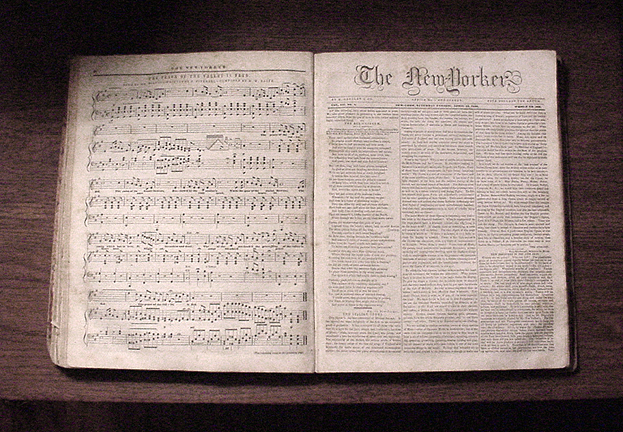
FOOD FOR THOUGHT…As E.B. White pointed out in his “Notes and Comment,” there was another, earlier New Yorker published nearly a century earlier in the 1830s by Horace Greeley, who described his periodical as “A Weekly Journal of Literature, Politics, Statistics and General Intelligence.” Greeley published his New Yorker from 1834 to 1841. (rickgrunder.com)
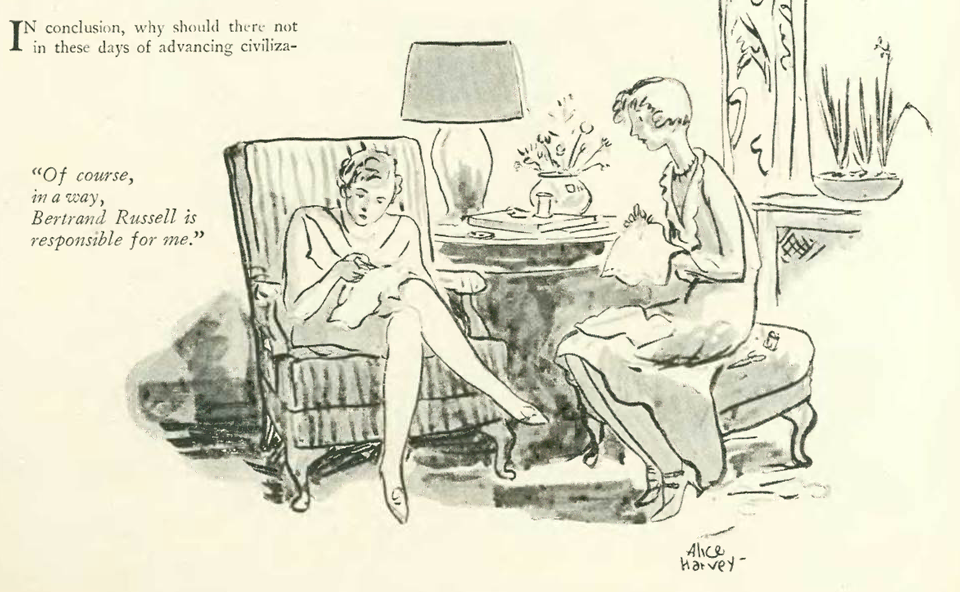
…and contemplated his own magazine’s contributions to the advancement of civilization…
…and as E.B. White continued his tradition of marking the magazine’s anniversary, so too did Rea Irvin continue to mark the passage of time with a tip of the hat from Eustace Tilley…
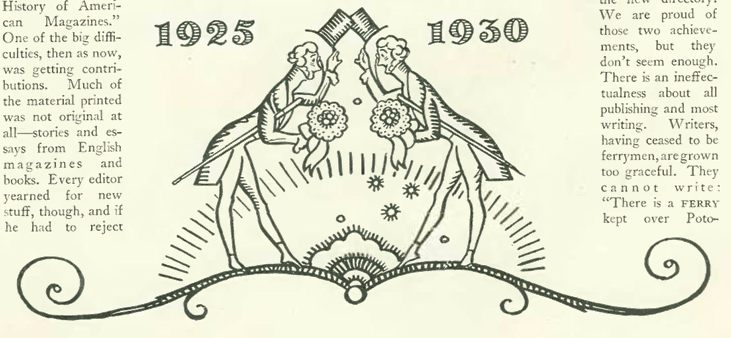
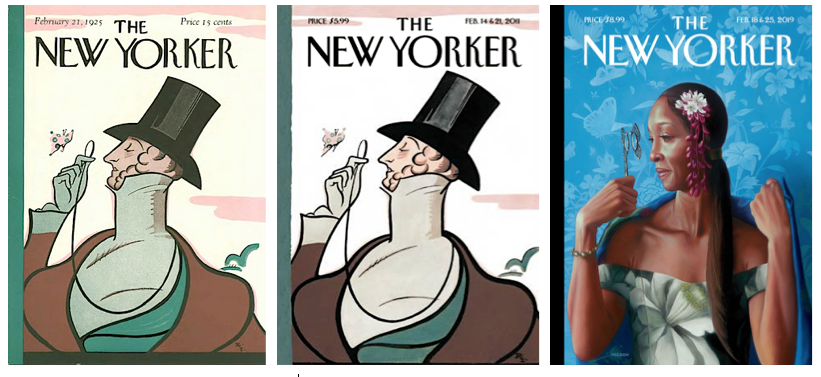
…and most prominently The New Yorker marked each anniversary with a repeat of the original Rea Irvin cover (later with some slight alterations), a tradition that continued unbroken until 1994, when a series of parodied versions of Eustace Tilley began to appear on the cover. The classic Tilley cover reappeared in the 2000s and ran frequently during that decade, but sadly made its last appearance in 2011 (see below covers from the first issue and anniversary covers from 2011 and 2019). I hope to see the Irvin cover return next year, and most certainly for the 100th anniversary in 2025. You can read more about cover’s history in Michael Maslin’s indispensable Ink Spill.
* * *
Drama Queen
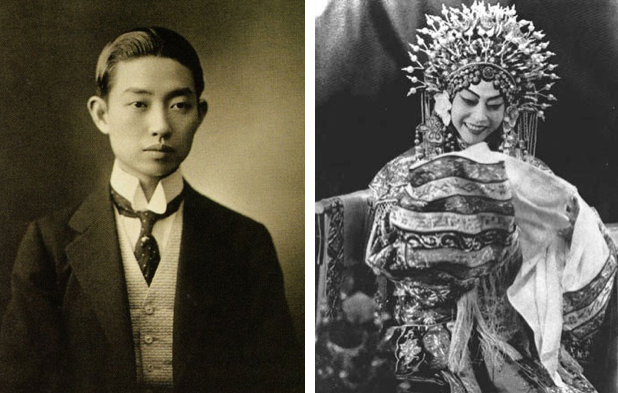
Chinese opera star Mei Lanfang (1894-1961) was known as “Queen of Peking Opera” for his graceful stage portrayals of young and middle-aged women. Considered one of China’s greatest “Dan” performers (Dan is the general name for female roles), Mei had many admirers outside of China including Charlie Chaplin, Mary Pickford and Douglas Fairbanks, who welcomed Mei to Hollywood when he toured the U.S. in 1930. The New Yorker paid Mei a visit during his stay at the Plaza Hotel in Manhattan, recounted in these excerpts from “The Talk of the Town”…
QUEEN OF PEKING OPERA, Mei Lanfang, circa 1920, and as a “Dan” in Chinese opera, circa 1930s. (people.chinesecio.com/Wikimedia)
HE’S A FAN…Charlie Chaplin greets Mei Lanfang during a 1930 visit to Hollywood. At right, Mei with his family in the early 1940s. (thatsmags.com/Wikipedia)
* * *
A Kitty With Claws
“The Talk of the Town” also featured Kitty Marion (1871-1944) in a mini-profile. The German-born Marion moved to London at age 15, where she gained some prominence as a music hall singer. She found greater fame, however, as an activist, first standing up for the rights of fellow women performers and later crusading for voting rights. In response to attacks on women protestors by police officers, Marion embraced militant activism, throwing bricks through the windows of offices and handling a number of arson and bombing attacks that were intended to harm property, not people. Arrested numerous times (and enduring 232 force-feedings while on hunger strikes) she emigrated to the U.S. after World War I and joined forces with birth control advocate Margaret Sanger. The New Yorker takes it from there…
TRANSATLANTIC ACTIVIST…A British Criminal Record Office mugshot of Kitty Marion, circa 1912; cover of Margaret Sanger’sBirth Control Review, November, 1923; Marion handing out copies of the Review on the streets of New York, 1915. (Wikipedia/Smith College/British Library)
* * *
Going Deep With Noguchi
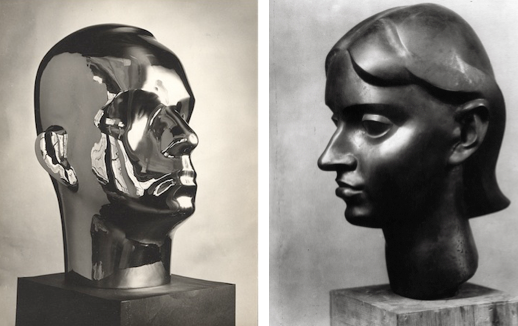
It’s hard to imagine modern decor without the influence of Isamu Noguchi, but before he inspired everything from coffee tables to lamps, he was a noted sculptor, and in 1930 he was best known for his portrait busts. New Yorker art critic Murdock Pemberton observed:
TWO HEADS ARE BETTER…Left to right, Isamu Noguchi’s portraits of architect/inventor Buckminster Fuller (1929, chrome-plated bronze) and the painter Marion Greenwood (1929, cast iron). Despite being three years short of the age requirement for a Guggenheim Fellowship, Noguchi was nevertheless awarded the grant to study stone and wood cutting and to gain “a better understanding of the human figure.” It appears the grant paid off handsomely. (noguchi.org/Smithsonian)MODERN MASTER…Collection of Noguchi lamps available from the Noguchi Museum. At right, 1947 coffee table by Herman Miller, inspired by a 1939 Noguchi design. (noguchi.org/Wikipedia)
* * *
From Our Advertisers
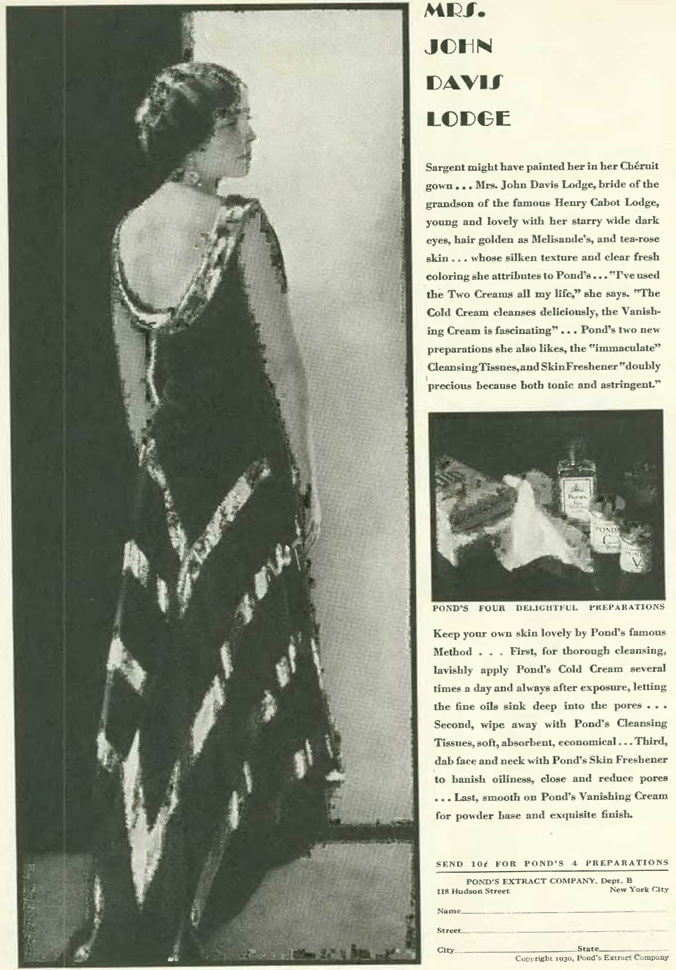
The makers of Pond’s Cold Cream continued to roll out endorsements from society figures, including a “Mrs. John Davis Lodge” (Francesca Bragiotti), described in this advertisement as possessing “starry wide dark eyes, hair golden as Melisande’s, and tea-rose skin”…
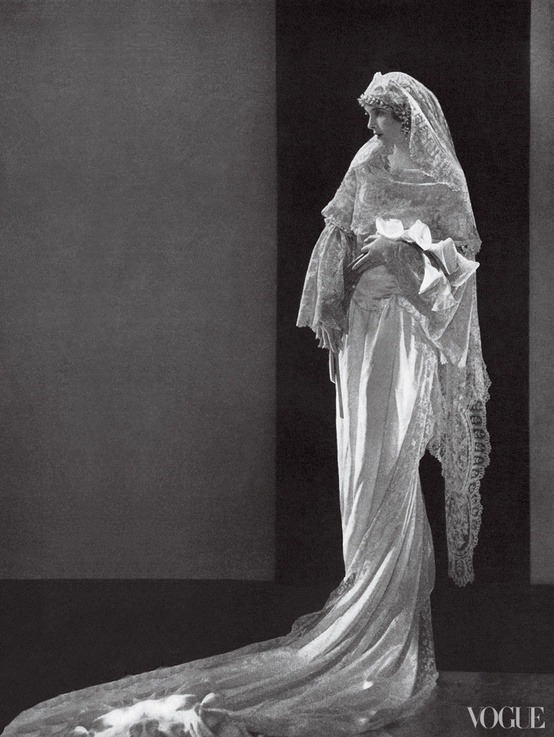
…for reference, Francesca Bragiotti’s wedding portrait, as featured in Vogue magazine, 1929…
…Doubleday Doran targeted the appropriate audience for its publication of The Second New Yorker Album, with cover illustration by Peter Arno…
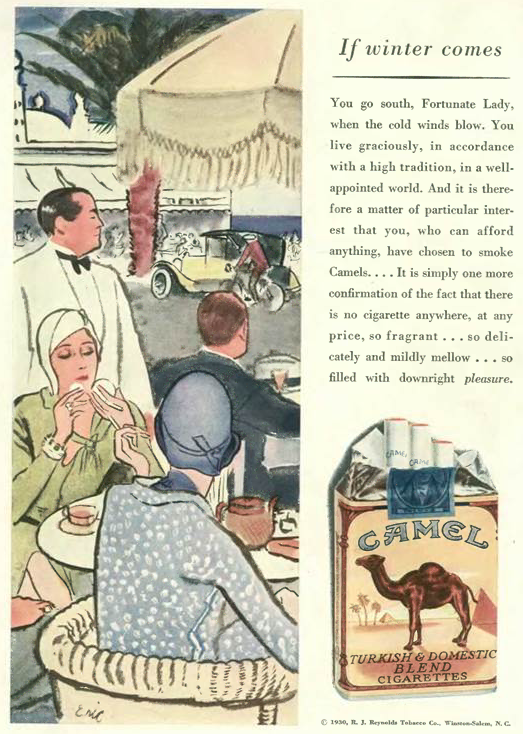
…and we have another lovely Camel ad from illustrator Carl “Eric” Erickson, who conjured up more Continental imagery as an inducement to take up a bad habit…
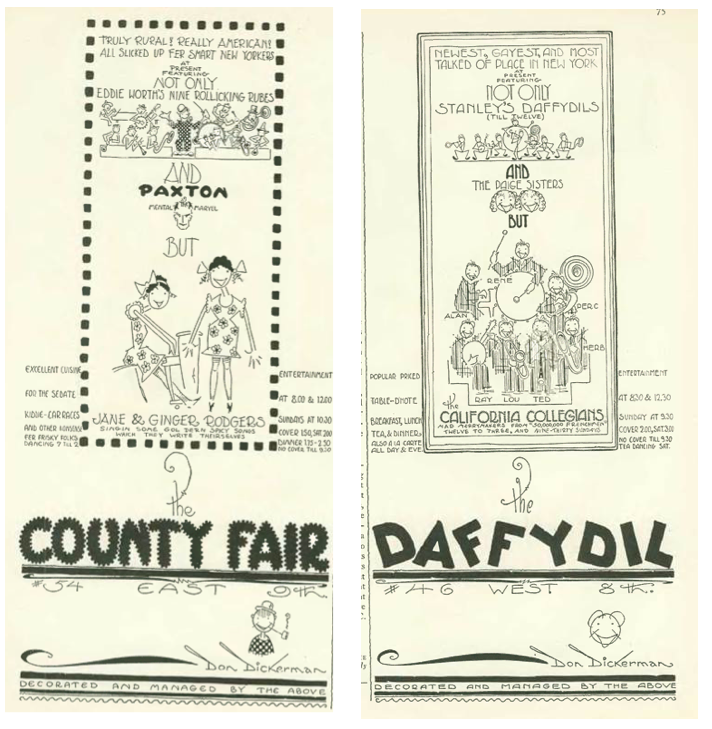
…in a recent post we looked at Don Dickerman, who operated themed restaurants in Greenwich Village. In the Feb. 22 issue he promoted his four restaurants in a series of ads (illustrated by Dickerman himself) that ran on four consecutive pages (72-75)…
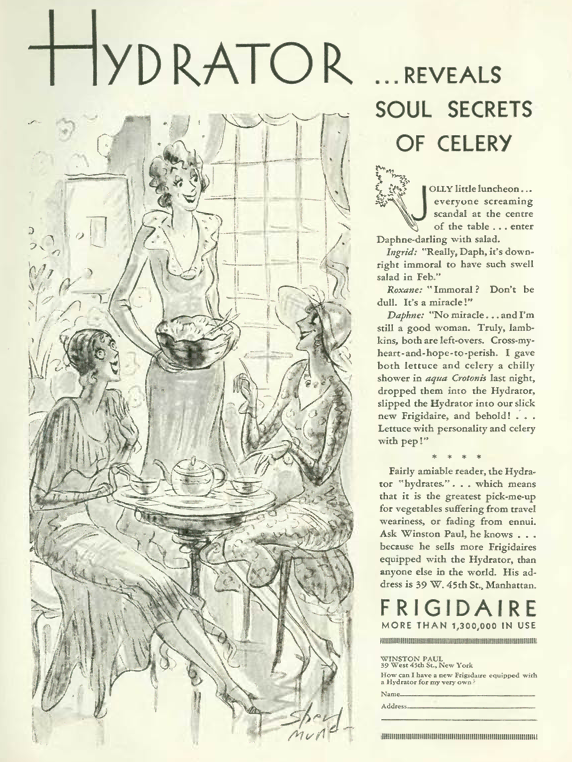
…and Barbara Shermund illustrated this ad for Frigidare…
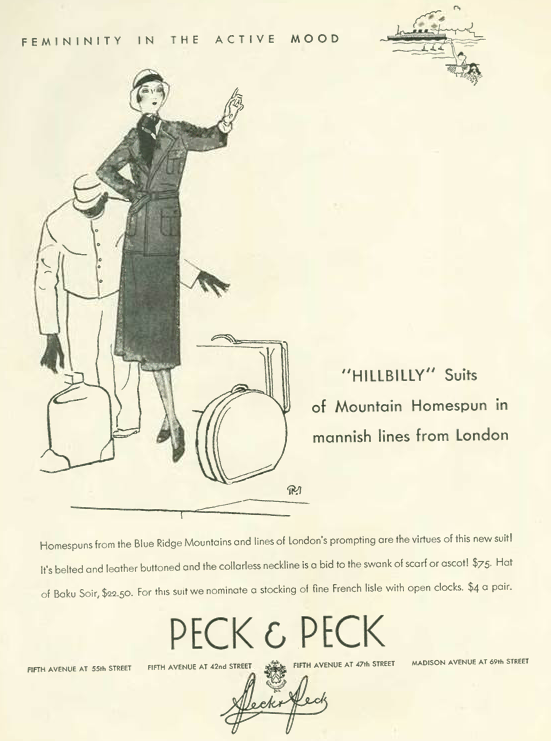
…Peck & Peck touted the “mannish lines” of its “Hillbilly” suits…
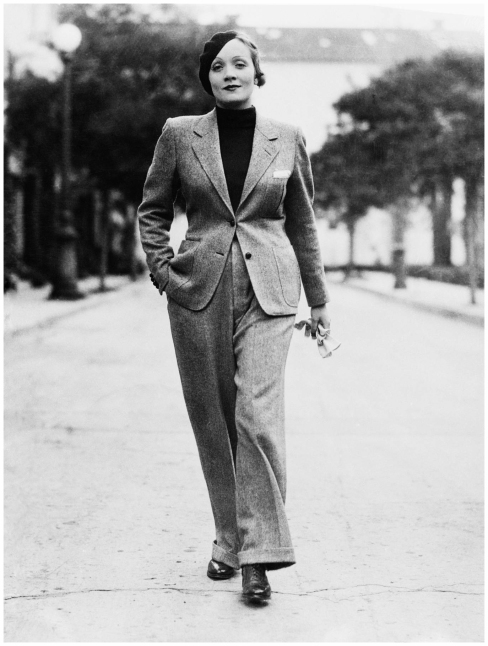
…no doubt influenced by trendsetters like Marlene Dietrich.
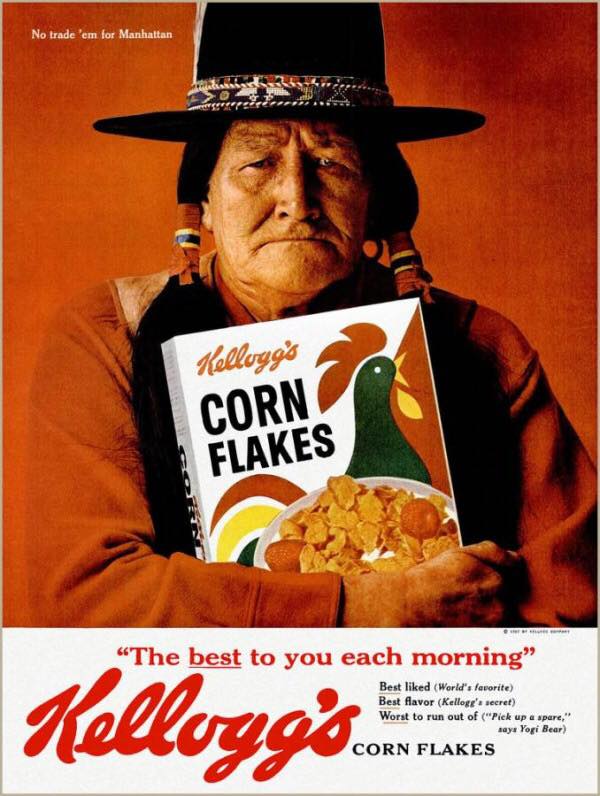
…and lest we forget that it’s 1930, a “Cowboys and Indians” mentality was rife in the advertising business, as seen in this ad from Mendel Trunx, proud of 20th century progress (“we’ve come a long way…”) and yet…well, read on…
…the mentality was still alive and well 30 years later, as seen in this ad from 1962…
…and coincidently, in the same issue we have this scene illustrated by Peter Arno mixing “Redskins” and luggage, in this case, a matron who means to summon the aid of a “red cap” baggage handler…
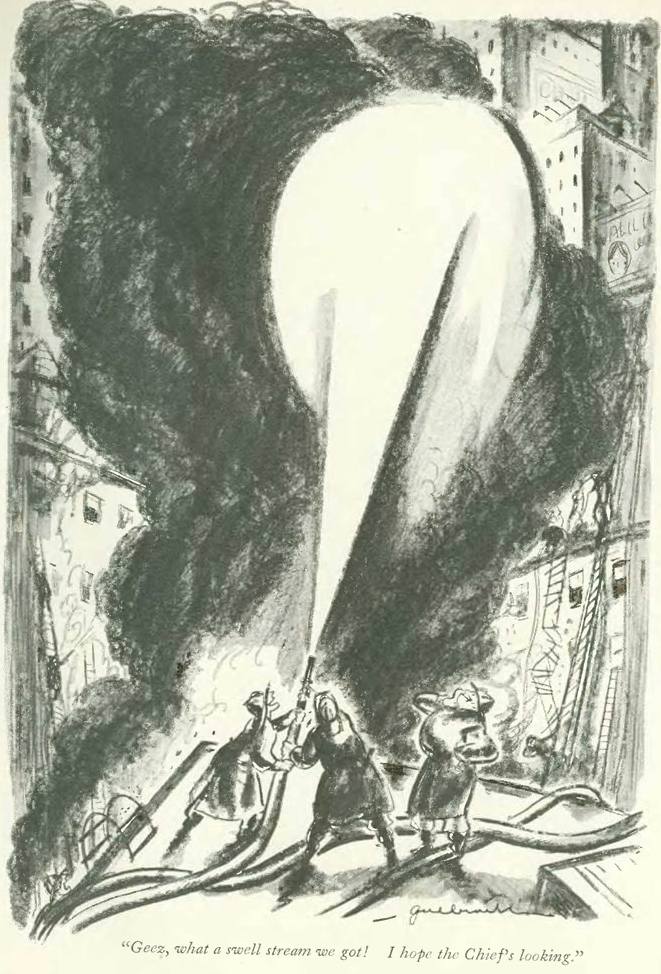
…other cartoons included this dramatic scene courtesy William Crawford Galbraith…
…a rustic, slightly naughty woodcut by John Held Jr…
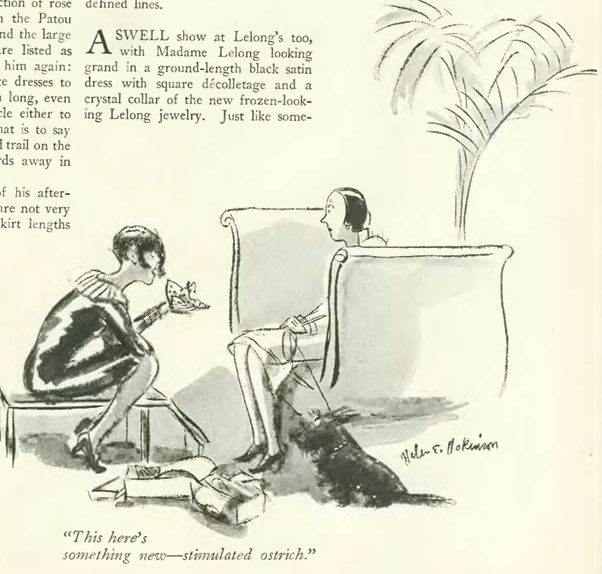
…a peek at fashion trends by Helen Hokinson…
…a look at social mores…from Alan Dunn…
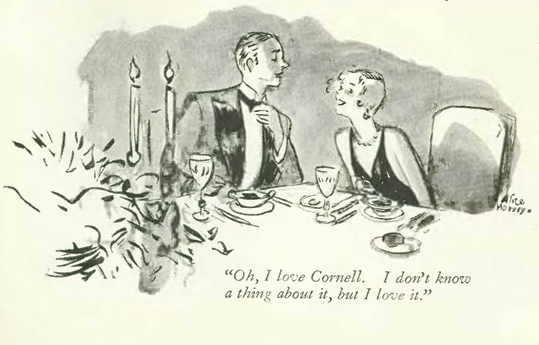
…and Alice Harvey…
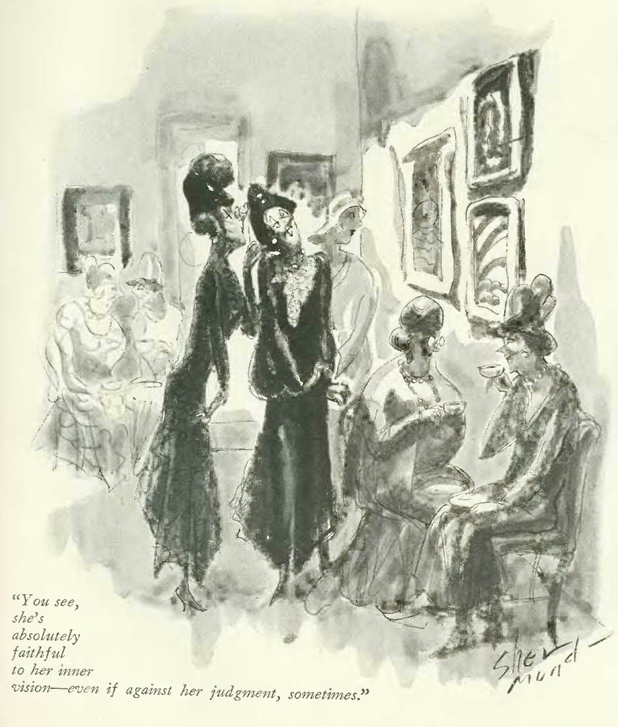
…and we end with Barbara Shermund, and a moment of art appreciation…
The October 1929 stock market crash took most people by surprise, but one man, Roger Babson, knew all along it was coming…thanks to Sir Isaac Newton…
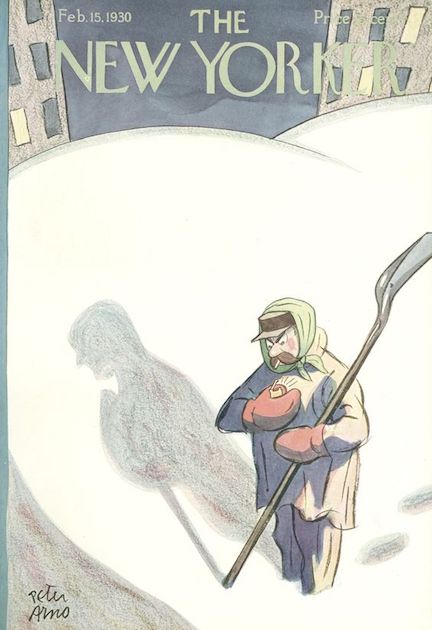
Feb. 15, 1930 cover by Peter Arno.
Babson (1875-1967) is perhaps best known today as the man who predicted the market crash and the Great Depression that followed. He employed an economic assessment tool called the “Babsonchart” that was based on Newton’s Third Law: For every action, there is an equal and opposite reaction. In the Feb. 15, 1929 “Profile” (titled “Prophet of Doom”) Henry Pringle tried to make sense of this eccentric businessman, who would go on to wage war against gravity itself:
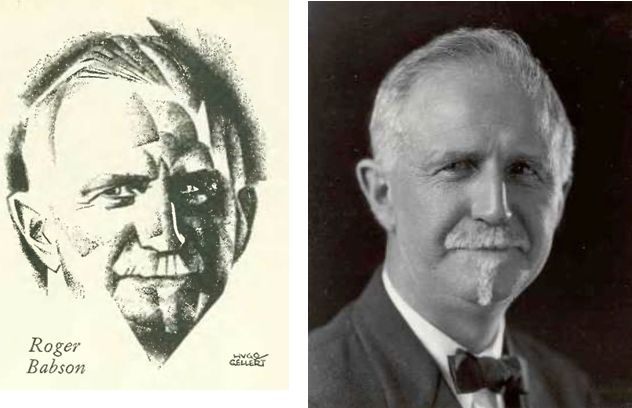
TOLD YOU SO…Illustration by Hugo Gellert for the profile on Roger Babson, who famously predicted the stock market crash; at right, Babson circa 1930. (Gravity Research Foundation)BIG THINKER…Roger Babson dedicates the world’s largest spinning globe at Babson College in 1955; at right, the globe as it appears today. Founded by Babson in 1919, Babson College is often ranked as the most prestigious entrepreneurship college in the U.S. (babson.edu/Wikipedia)
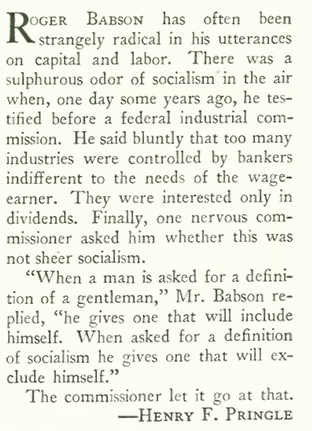
Pringle concluded his profile on a confused note, wondering if his subject — a product of sober New England stock — could possibly be a socialist in disguise…
In any case, it is difficult to assign Babson to any one category. Some considered him a genius and visionary, while others thought him a crackpot, particularly in the late 1940s when, following the death of a grandson by drowning, he began to wage war against gravity itself. In 1948 essay “Gravity – Our Enemy Number One,” he wrote: “Broken hips and other broken bones as well as numerous circulatory, intestinal and other internal troubles are directly due to the people’s inability to counteract Gravity at a critical moment.”
That same year Babson founded the Gravity Research Foundation to expedite the discovery of a “gravity shield.” The foundation is still in operation, but rather than seeking to block gravity it works to better understand it. It continues to hold an annual essay prize contest — remarkably, five of its winners have gone on to win the Nobel Prize in physics. The essay contest’s 1971 winner was none other than physicist Stephen Hawking.
ROCK STAR…Clockwise, from top left: Roger Babson at home with a portrait of Sir Isaac Newton; Babson was the Prohibition Party’s candidate for President of the United States in 1940; Babson provided charitable assistance to unemployed stonecutters in Gloucester, Mass., during the Great Depression, commissioning them to carve inspirational inscriptions on more than 20 boulders near the abandoned settlement of Dogtown. (centennial.babson.edu/Wikipedia)
* * *
An Imperfect Romance
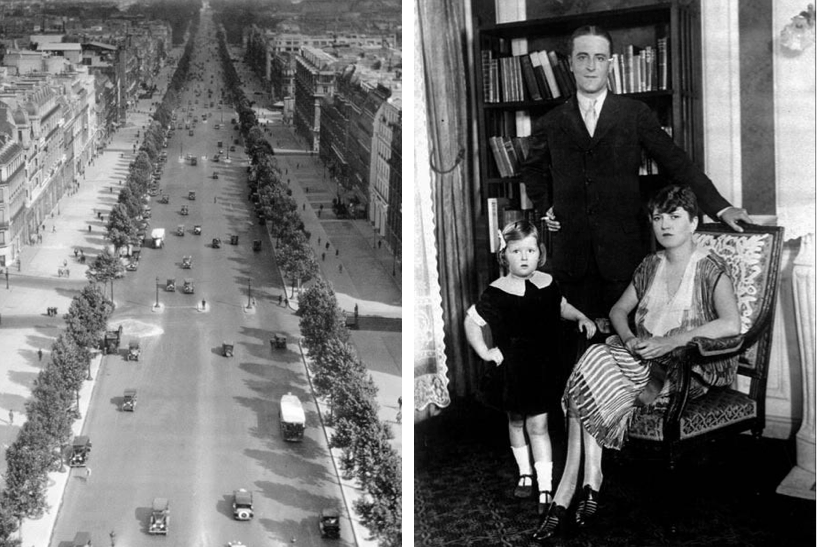
Born in the midst of the Jazz Age, it would seem that The New Yorker would have been a perfect fit for the most prominent chronicler of that era, F. Scott Fitzgerald. But it was mostly not to be: Fitzgerald would publish just two poems and three humorous shorts in The New Yorker between 1929 and 1937, including “Salesmanship in the Champs-Élysées” in Feb. 15 issue.
In all fairness, The New Yorker wasn’t exactly enamored of the young author. In its book review section for the May 23, 1925 issue, the magazine singled out three books for review, the first (and longest) review was devoted to James Boyd’s historical novel Drums. This was followed by a brief review of Fitzgerald’s The Great Gatsby, the reviewer writing that the book revived his interest in the author but “not in a Byronic promise he probably never had,” and referred to the character of Jay Gatsby as “a good deal of a nut.”
The following year Fitzgerald was the subject of a New Yorker profile titled “That Sad Young Man.” In the magazine’s March 12, 2017 issue, Erin Overbey and Joshua Rothman note that the profile (by John Mosher) would be called “snarky” in today’s lingo. They also point out that “Fitzgerald, for his part, appeared to take a rather snobbish view of Harold Ross’s new publication, referring to the short stories he published in it as “hors d’oeuvres.”
With that, here is one of F. Scott Fitzgerald’s “hors d’oeuvres” … “Salesmanship in the Champs-Élysées.”
SOUR GRAPES…The Champs-Elysées in 1929; F. Scott Fitzgerald with his daughter, Scottie, and wife Zelda in Paris in 1925. Despite being products of the Jazz Age, the author and The New Yorker were mostly at odds. In a letter to his daughter, Scottie, Fitzgerald advised that she expand her knowledge of literature “instead of skimming Life + The New Yorker.” (fr.wikibooks.org/Associated Press)
* * *
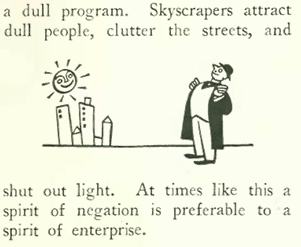
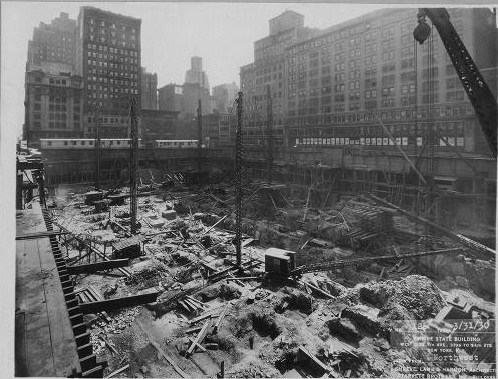
The Empire-less State
In his “Notes and Comment,” E.B. White pondered the possibilities of a large lot at the corner of Fifth Avenue and 34th Street previously occupied by the Waldorf-Astoria hotel. Although construction of the Empire State Building would soon commence at the site, White mused about other possibilities…
LIGHT THERE BE LIGHT…E.B. White found the newly excavated space at Fifth Avenue and 34th Street (former site of the Waldorf-Astoria) to be a refreshing change. It would be short-lived, as the first beams of the Empire State Building would begin to rise from the site in March 1930. (NYPL Digital Gallery)
* * *
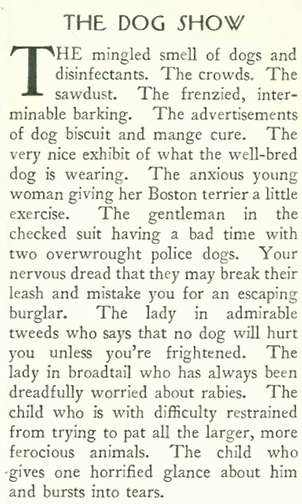
Westminster People Show
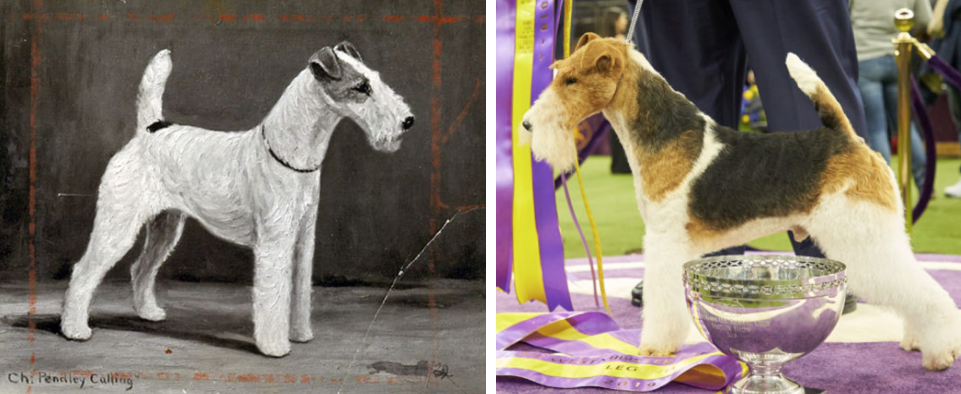
Although it’s now customary to retire Westminster Kennel Club Dog Show winners, back in 1930 a wire terrier called Pendley Calling of Blarney won Best of Show in 1930 and won the title again the following year. Alice Frankforter was on hand for the event, but found the people at the show every bit as diverting as the animals. Some excerpts…
DOGGONE FUN…The 1932 Westminster Kennel Club Dog Show at Madison Square Garden. (westminsterkennelclub.org)
REIGN OF TERRIER…Wire Fox Terrier Pendley Calling of Blarney, left, won back-to-back Westminster Kennel Club Best of Show titles in 1930-31. At right, King’s Best of Show win in February 2019 made him the 15th Wire Fox Terrier in Westminster history to earn the top prize. Terriers are by far the winningest breed at Westminster. (aka.org)
* * *
Why Can’t We Be Friends?
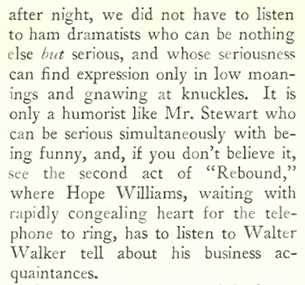
Robert Benchley struck a pre-emptive pose in his review of a new Broadway play titled Rebound — written by his good friend (and fellow Algonquin Round Table alumnus) Donald Ogden Stewart (1894-1980) — and responded to “a chorus of yawps” that accused him of log-rolling…
A FRIEND INDEED…Robert Benchley (right) said his friendship with playwright and screenwriter Donald Ogden Stewart (left) had no influence over his review of Stewart’s latest play, Rebound. It seems Benchley was in safe territory here, since Stewart’s output was generally high in quality. Indeed, in 1940 Stewart would win an Academy Award for Best Adapted Screenplay for the The Philadelphia Story. (IMDB/theattic.space)
* * *
Georgia On His Mind
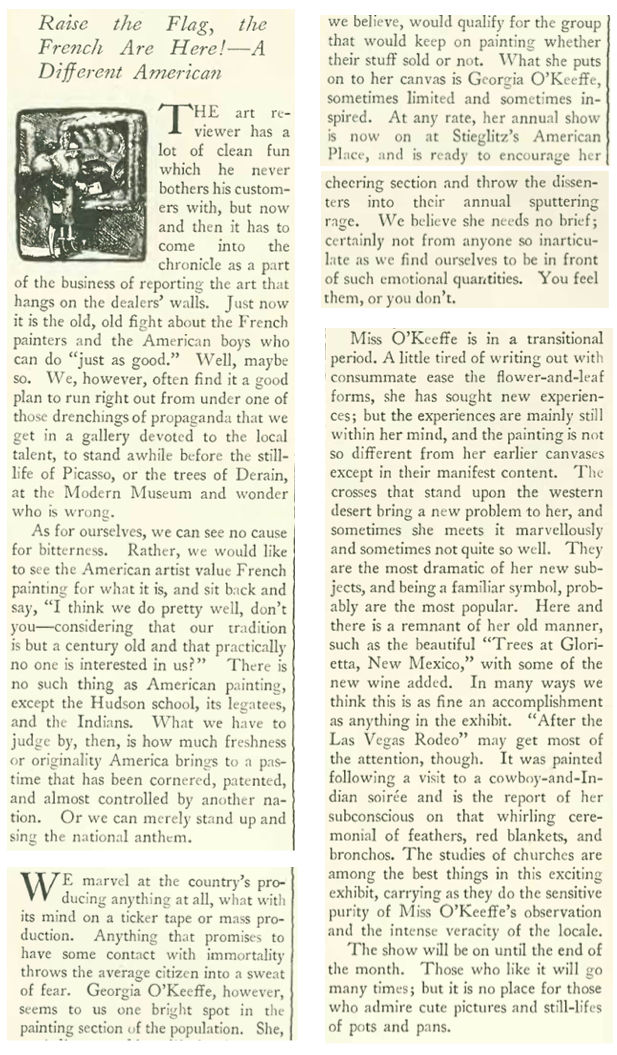
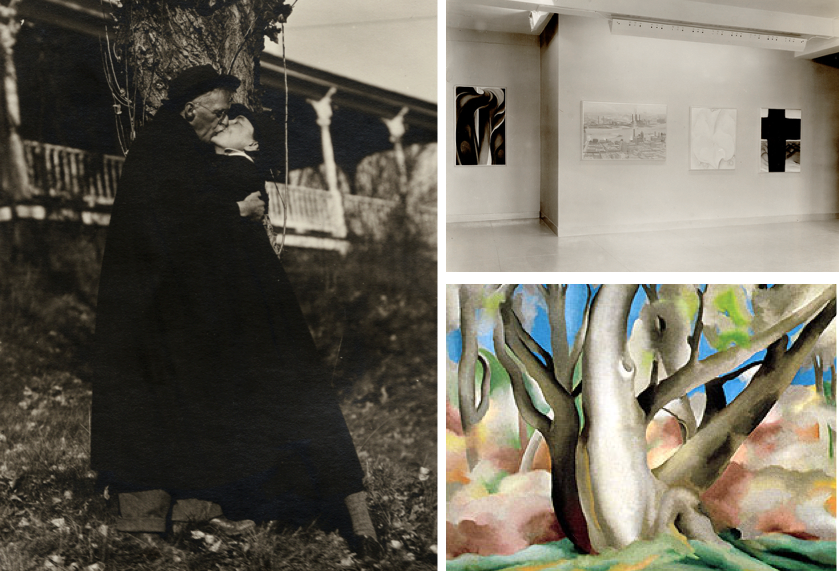
The opening of the Museum of Modern Art in late 1929 had a profound effect on The New Yorker’s art critic MurdockPemberton. In the beginning he dismissed the museum as just another place for the old money crowd to throw parties, but with the opening of its third exhibition, “Painting in Paris” — which featured an extensive display of the works of French modernists — Pemberton began to come around to the idea that this new MoMA was a place to see groundbreaking works of art. In his Feb. 15 column Pemberton looked beyond France for signs of talented modernists in the States, and found only one who stood out — GeorgiaO’Keeffe.
MOD COUPLE…Clockwise, from left, Alfred Stieglitz attached this photograph to a letter for Georgia O’Keeffe, dated July 10, 1929; Georgia O’Keeffe Exhibition of Paintings (1919-1934), at Stieglitz’s An American Place gallery, 1935; O’Keeffe’s Trees at Glorieta, New Mexico, 1929. (Beinecke Library, Yale/Georgia O’Keeffe Foundation)
* * *
From Our Advertisers
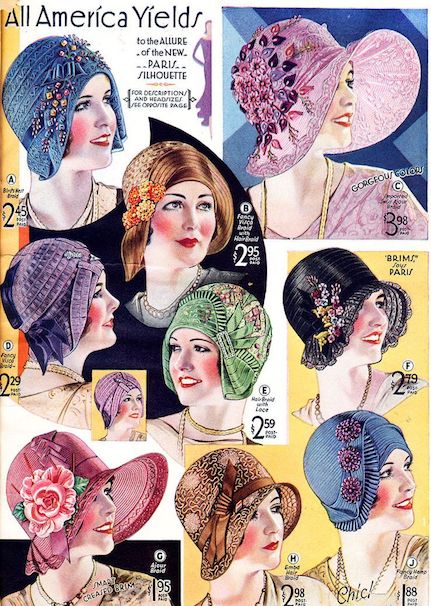
Just as hemlines were dropping after the stock market crash, so were the brims of women’s hats — the flapper caps of the 1920s now sprouted droopy ears…
…this ad for Chase and Sanborn coffee featured a weirdly distended image of the writer and humorist Irvin Cobb…
…Cobb as he actually appeared, circa 1930…
(talesofmytery.blogspot.com)
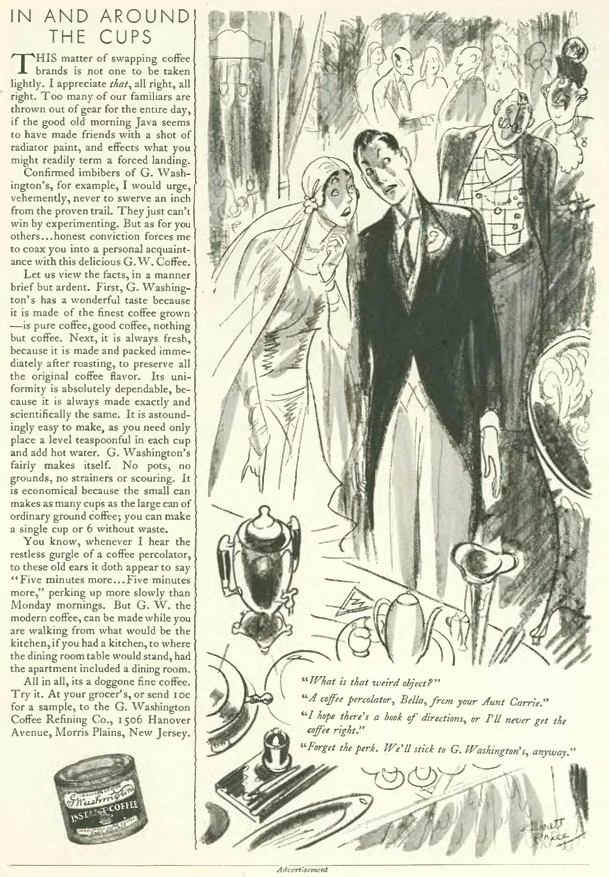
…G. Washington coffee, on the other hand, continued to draw from The New Yorker’s stable of cartoonists, including Garrett Price, for its illustrated ads…
…I was surprised to see this ad for two reasons: I wasn’t aware floss was in common use 90 years ago, or that it once came in the handle of a toothbrush…
…and then we have this sad little back page ad (just above a tiny ad for piano lessons) promoting Peggy Joyce’s ghostwritten “tell all” — Men, Marriage and Me. A former Ziegfeld girl and occasional actress who cultivated fame for fame’s sake, Joyce (1893-1957) was mostly known for her six marriages and extravagant lifestyle. By feeding the media a steady stream of scandals and other adventures (she often received reporters in her bedroom, dressed in a see-through negligee) she remained in the celebrity spotlight throughout the 1920s…
Peggy Joyce in 1923; cover of the first edition of her “tell all” — Men, Marriage and Me. Celebrated in the 1920’s as a swinging golddigger, her fame quickly evaporated into the mists of the Great Depression. (Wikipedia/Abe Books)
…speaking of celebrity, advertisers were so eager for endorsements of the famous that even “Mrs. Ring Lardner” (Ellis Abbott) got a piece of the action…
…as travel by airplane became more fashionable, automobile manufacturers increasingly paired their products with flying machines…
…for those who wished to stay on the ground, the Pickwick-Greyhound bus system featured “Nite Coaches” with 14 sleeping compartments (for 28 passengers), hot and cold water in each compartment, and hot meals served by stewards…
…on to our comics, IsadoreKlein illustrated the excitement of heavyweight boxing…
…PerryBarlow paid a visit to a writer and his dimwitted visitor…
…HelenHokinson looked in on a prep school dance…
…BarbaraShermund demonstrated the finer points of beauty…
…and we end with PeterArno, and one woman’s plan for a costume party…
In his 2006 book, Flapper, Joshua Zeitz refers to The New Yorker’sLois Long as the epitome of the 1920s flapper, an “absolutely a wild woman” who wrote about Jazz Age nightlife “with a wicked sort of sexual sense of humor.”
Feb. 8, 1930 cover by Theodore Haupt (the annual Westminster Kennel Club dog show was in town…)
This Vassar-educated daughter of a Congregational minister began her New Yorker career in the summer of 1925, at age 23. She took over Charles Baskerville’s rather dry column, “When Nights are Bold,” renamed it “Tables for Two,” and using the pen name “Lipstick” plunged into the nightlife scene with considerable brio.
TIMES CHANGE…At left, in a still image from a 1920s home movie, Lois Long relaxes on a beach; at right, Long with newborn daughter Patricia Arno in 1929. (PBS/Patricia Arno)
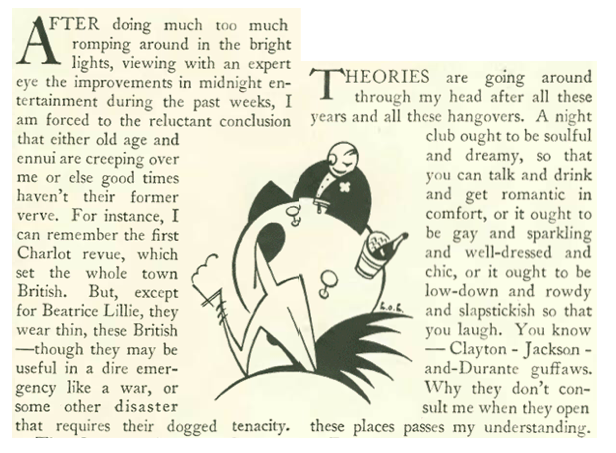
Two years later she would marry cartoonist Peter Arno, and in 1929 would give birth to a daughter, Patricia. During this time the almost weekly “Tables” column would appear infrequently as Long turned her attentions to her family and her fashion column, “On and Off the Avenue.” But as I’ve noted before, Long, along with many of her New Yorker colleagues, had grown weary of the Roaring Twenties many months before they were over. She would put an end (for awhile) to the “Tables” column in June 1930; the good times, as Long noted in her Feb. 8 column, had lost their “verve”…
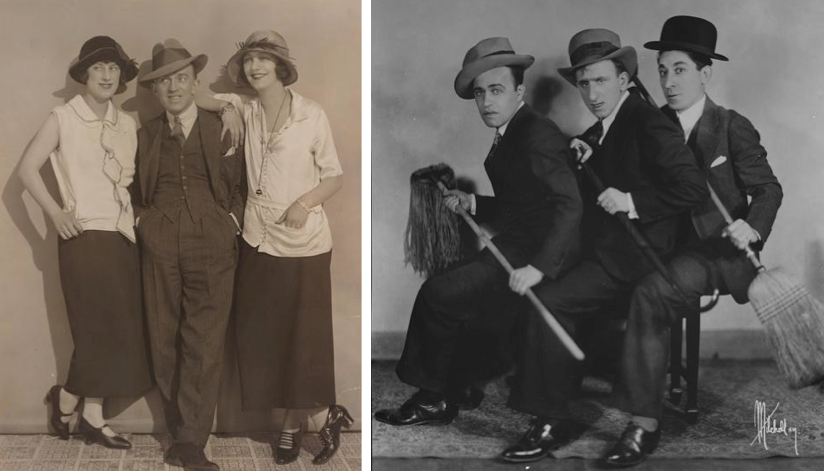
BRITS AND TWITS…Lois Long recalled the nightlife entertainments of the past and present in one of her last “Tables for Two” columns. Photo at left (from left to right), Beatrice Lillie, Nelson Keys, and Gertrude Lawrence in Andre Charlot’s Revue of 1924. At right, the comedy trio Eddie Jackson, Jimmy Durante and Lou Clayton. (Museum of the City of New York/Herbert Mitchell Collection)
…Long found Don Dickerman’s latest themed restaurant, the Daffydil, to be a mildly amusing distraction…
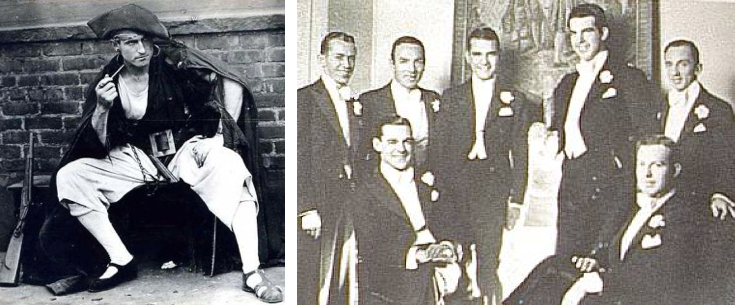
HE WAS AN ARRRTIST…Greenwich Village personality and pirate aficionado Don Dickerman (left) failed to make a living as an artist, but found success with his various themed restaurants including the Pirate’s Cove, the Blue Horse, the Heigh-Ho (where Rudy Vallee started out), the County Fair and the Daffydil (which was financed by Vallee). At right, singing at the Daffydil were the California Collegians, a group that included actor Fred MacMurray (tallest in the photo). (Restaurant-ing through history)
…and she also looked to Harlem for some nighttime diversions, but the ex-flapper just wasn’t up for a rowdy scene…
FOR THE YOUNG AT HEART…Dancing the Lindy Hop at the Savoy in Harlem, circa 1930. (Pinterest)
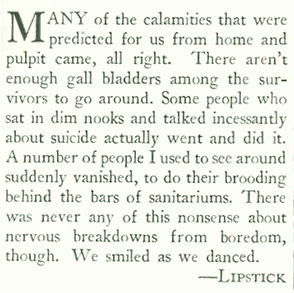
…ten years later, in The New Yorker’s fifteenth anniversary issue (Feb. 17, 1940), the 38-year-old Long would look back to the Roaring Twenties in the column “That Was New York,” reprising her signature “Lipstick” as she recalled the days when “Harlem was a thrill” and “we smiled when we went dancing in 1925 even though there wasn’t a candid camera within miles. In those days people frequently laughed out loud in public.” She concluded the piece with this observation:
* * *
Rise of the Débutantes
New York’s débutantes and The New Yorker had something of a symbiotic relationship during the magazine’s early days, beginning with a piece written by 22-year-old Ellin Mackay for the Nov. 28, 1925 issue that served as a manifesto of sorts for a new kind of débutante. Mackay’s essay explained why modern women were abandoning the forced social matchmaking of débutante balls in favor of the more egalitarian (and fun) night club scene.
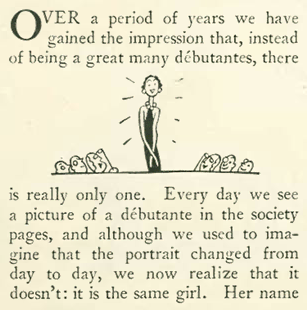
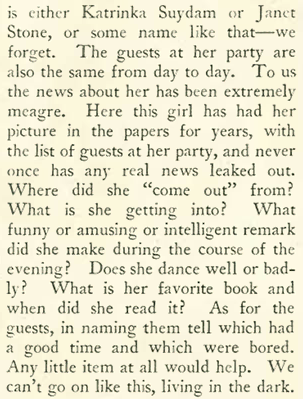
Mackay’s piece provided a huge boost to The New Yorker’s circulation, the magazine barely staying afloat at the time. Nevertheless, its writers couldn’t resist taking occasional shots at the seemingly frivolous existence of debs, including E.B. White, who called out a one Katrinka Suydam in his “Notes and Comment” column for Jan. 4, 1930:
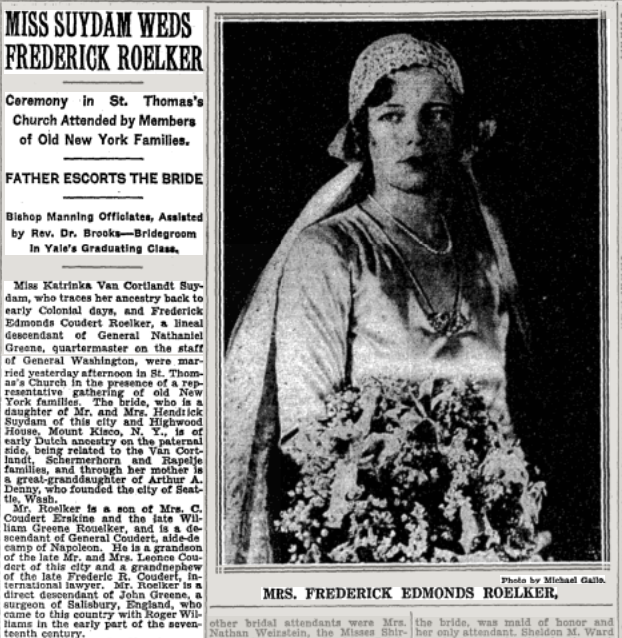
Perhaps White came across Suydam’s name in the Sept. 7, 1929 New York Times:
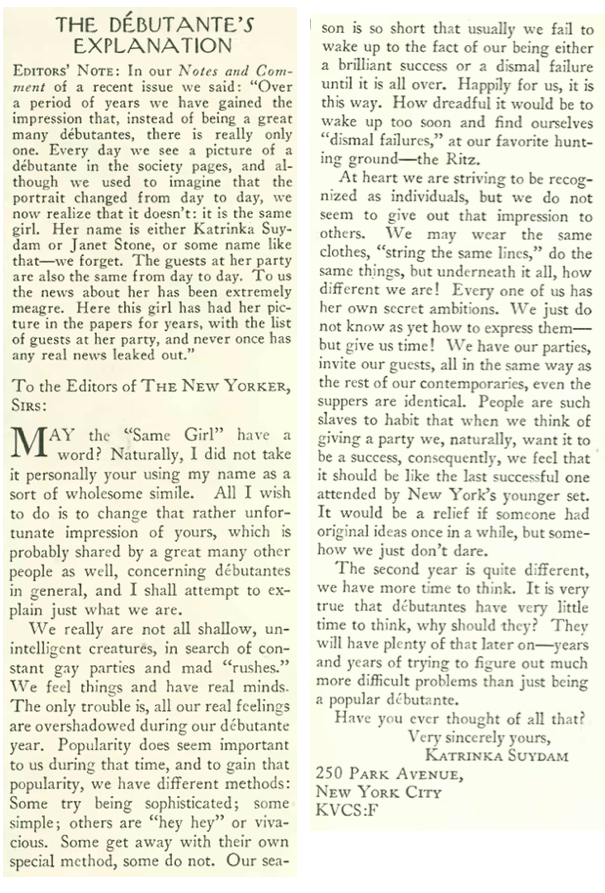
What he probably didn’t expect was a reply from Suydam herself, an act that seemed to impress the magazine’s editors, who printed the proud débutante’s letter in full on page 32:
Suydam would go on to marry Frederick Roelker later that June. Note in this excerpted wedding write-up how the couples’ European and colonial pedigrees were carefully detailed in the first paragraphs, distinguishing their union from couplings enjoyed by the unwashed masses…
Katrinka Suydam’s wedding as reported in the June 12, 1930 issue of The New York Times.
* * *
Skirt Stakes
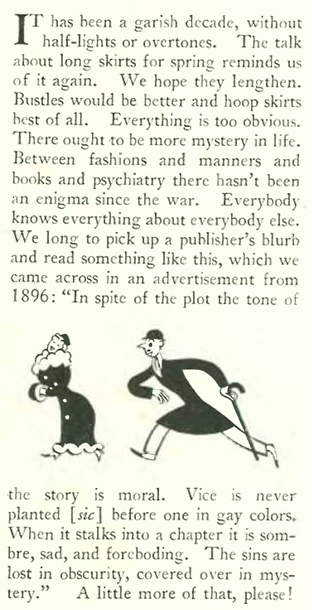
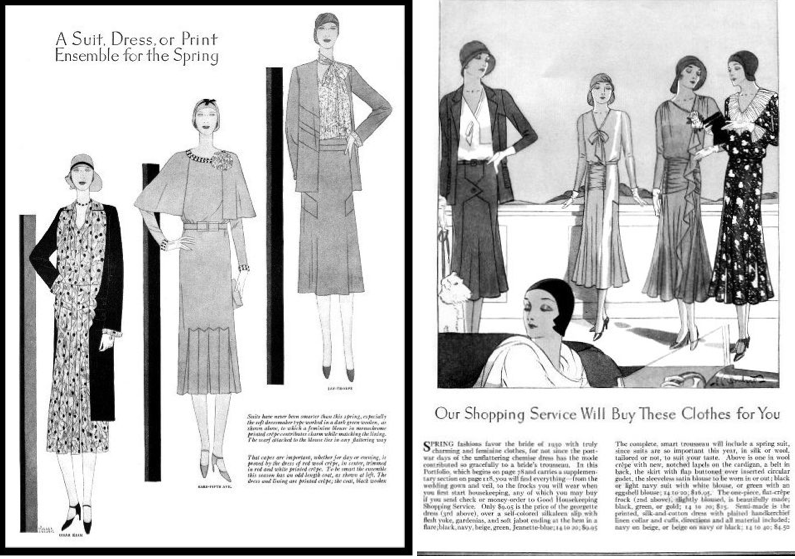
In 1930 hemlines plummeted along with the stock market. E.B. White, in “Notes,” welcomed the return of “mystery” to women’s fashions:
THEY DROPPED WITH THE MARKET…Women’s spring fashions with lowered hemlines on display in the April 1930 issue of Good Housekeeping. (fashion-era.com)
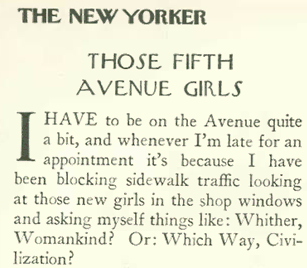
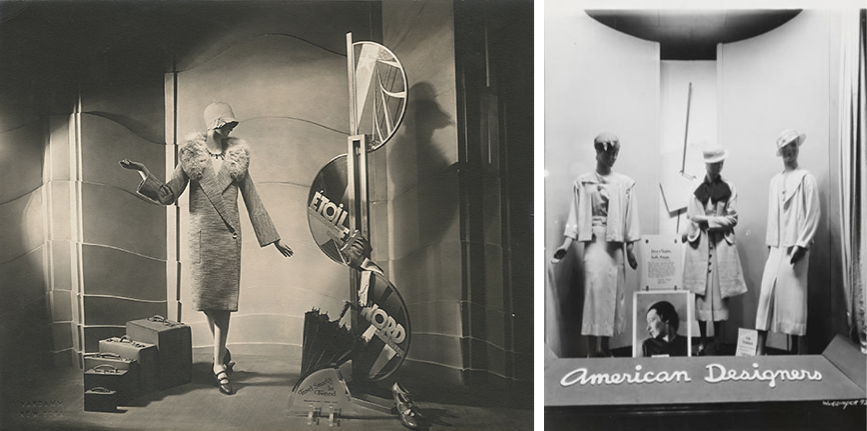
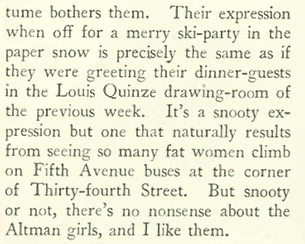
Frederick Lewis Allen, on the other hand, was having difficulty understanding the modern woman, circa 1930, based on what he was seeing in the display windows along Fifth Avenue. Excerpts:
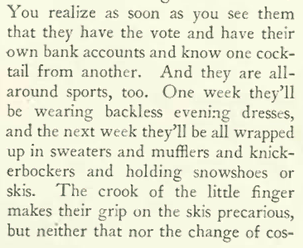
NO NONSENSE WOMEN…Window displays on Fifth Avenue included (left) this “Travel Smartly in Tweed” window display for Franklin Simon (1929-30); and right, a window at Lord & Taylor, 1933. (Harry Ransom Center/Museum of the City of New York)
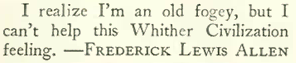
Allen noted that the “snooty” mannequins on display along Fifth Avenue represented a certain type who wouldn’t be caught dead riding a bus…
Whether or not he liked the Altman girls, the 39-year-old Allen felt like an “old fogey” in the presence of these “no nonsense” women:
* * *
Get A Room
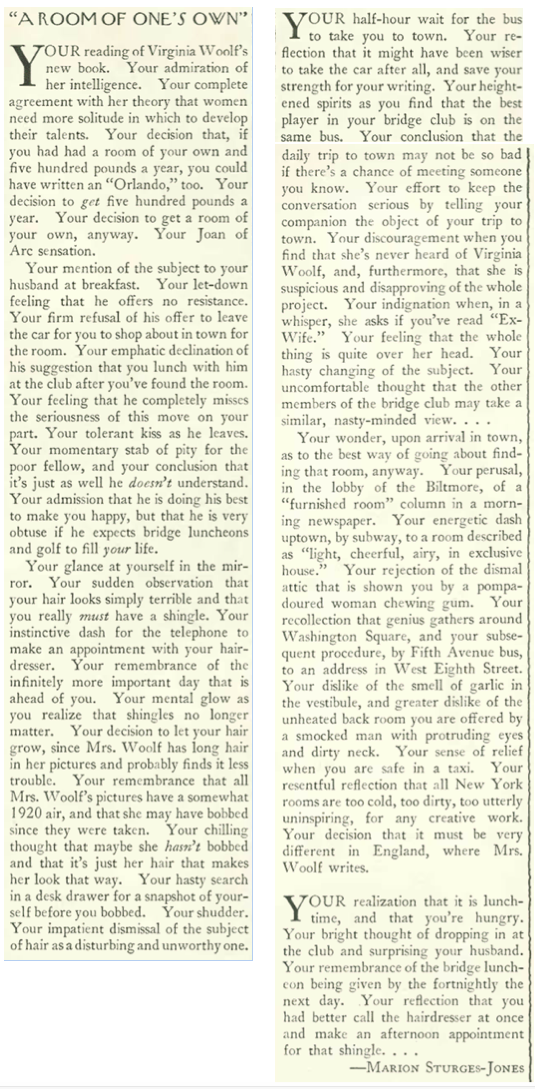
Marion Sturges Jones pondered the life of another kind of modern woman, namely that of Virginia Woolf, who had recently published the extended essay A Room of One’s Own. Jones discovered that finding such a room was easier said than done…
IN HER ROOM…Virginia Woolf at Monk’s House in East Sussex, 1932; dust jacket of the first edition of A Room of One’s Own. (kaykeys.net/Beinecke Library, Yale)
* * *
The Way You Really Look
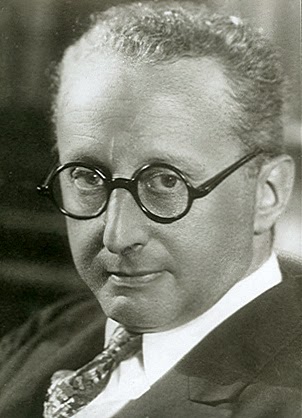
Franklin P. Adams penned a profile of the legendary songwriter and stage producer Jerome Kern, who created dozens of Broadway musicals and Hollywood films and wrote a substantial chunk of the American songbook (more than 700 songs) with such hits as “Ol’ Man River”, “A Fine Romance”, “Smoke Gets in Your Eyes”, and “The Way You Look Tonight.” Peter Arno provided this less-than-flattering caricature of the man…
…and this is how Kern actually looked, circa 1930…
(bloggingtonybennett.com)
* * *
At the Talkies
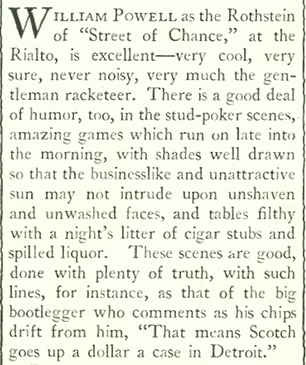
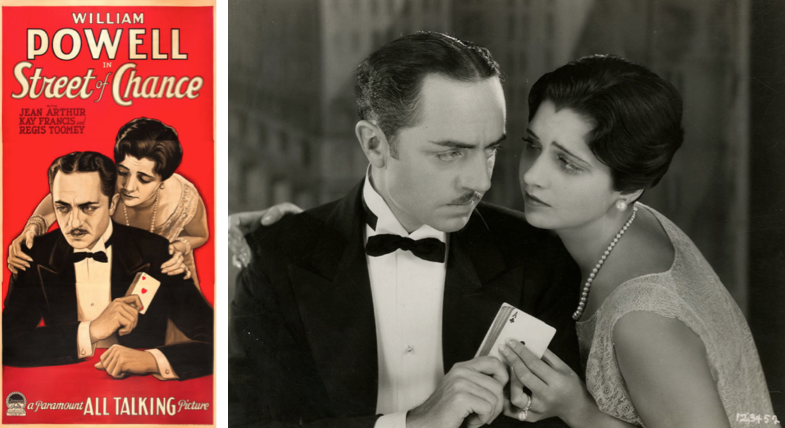
Speaking of showbiz, New Yorker film critic John Mosher offered high praise for William Powell’s latest film, Street of Chance. Although Powell is often linked professionally to actress Myrna Loy thanks to their six Thin Man films (1934 – 1947), from 1930 to 1932 he also appeared with Kay Francis in six films, including Street of Chance. Both Powell and Francis would become major stars of the 1930s, and between 1930 and 1936 Francis would be the number one female star at Warner Brothers and the highest-paid American film actress. Francis was no stranger to wild living — she was a longtime friend of Lois Long’s (see above) and also shared an apartment with her at 381 Park Avenue before Long married Peter Arno. Mosher’s review:
TOUGH ODDS…William Powell and Kay Francis in Street of Chance (1930). Francis was a longtime friend of New Yorker columnist Lois Long. (IMDB)
* * *
From Our Advertisers
We have an advertisement from the aforementioned County Fair, one of the themed restaurants operated by Greenwich village artist and personality Don Dickerman, who illustrated his own ads…
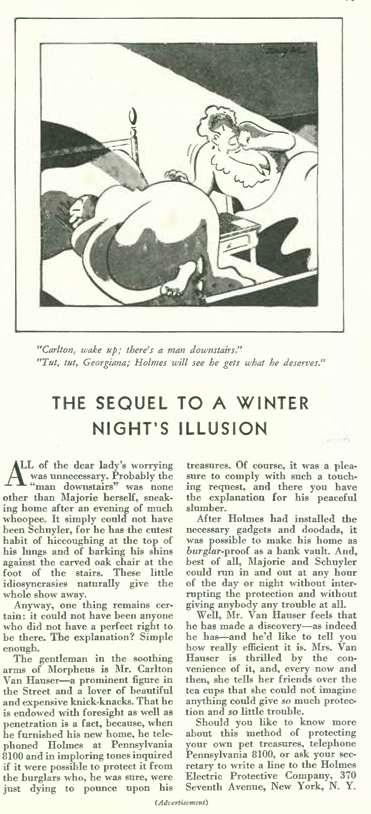
…I’m not sure who drew this Arno-esque illustration below for the Holmes Electric Protective Company, but I can tell you that the name Holmes was synonymous with home security in 1930…in 1857 Edwin Holmes bought a patent for an electric burglar alarm (invented in 1853 by Augustus Pope) and went on to successfully commercialize and popularize the electromagnetic burglar alarm. Holmes is also credited with creating the first large-scale alarm network in the United States…
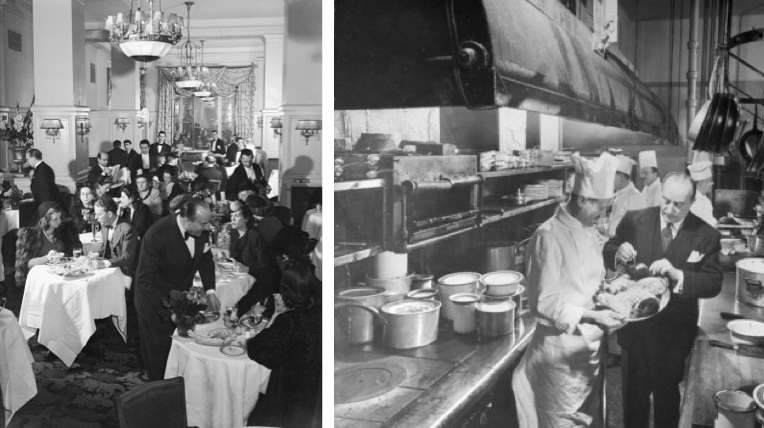
…but I do know that Abe Birnbaum contributed this drawing (in “Talk of the Town”) of the beloved Colony restaurant owner Eugene Cavallero…
A PLACE TO SEE AND BE SEEN…From the 1920s to the 1960s New York’s smart set dined at the Colony. Rian James, in Dining In New York (1930) wrote “the Colony is the restaurant of the cosmopolite and the connoisseur; the rendezvous of the social register; the retreat of the Four Hundred.” Critic George Jean Nathan said the Colony was one of “civilization’s last strongholds in the department of cuisine.” Photo at left of the dining room around 1940; at right, owner Eugene Cavallero consults with a chef. (lostpastremembered.blogspot.com)
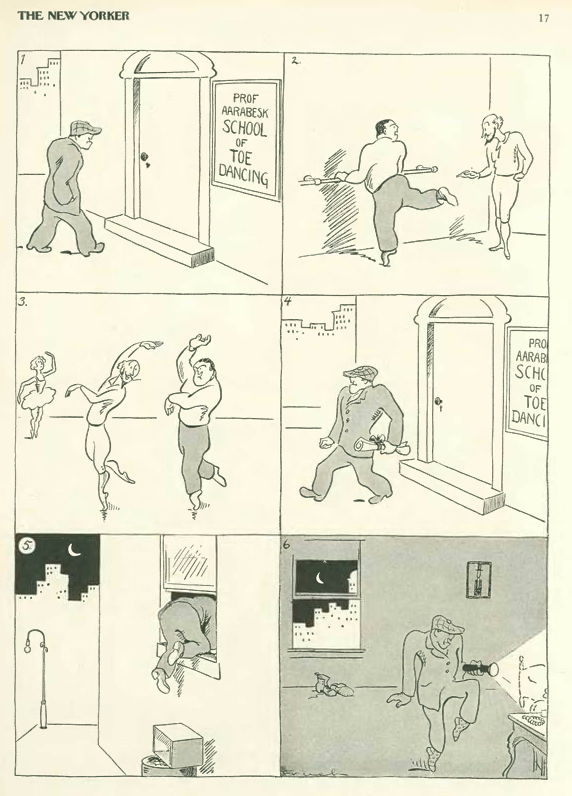
…on to our cartoons, we have a full page from Al Frueh…
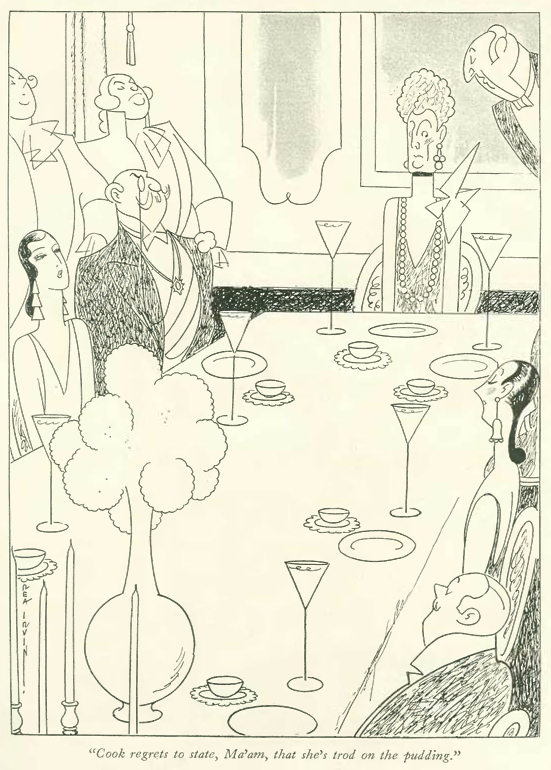
…and another full-page from Rea Irvin…
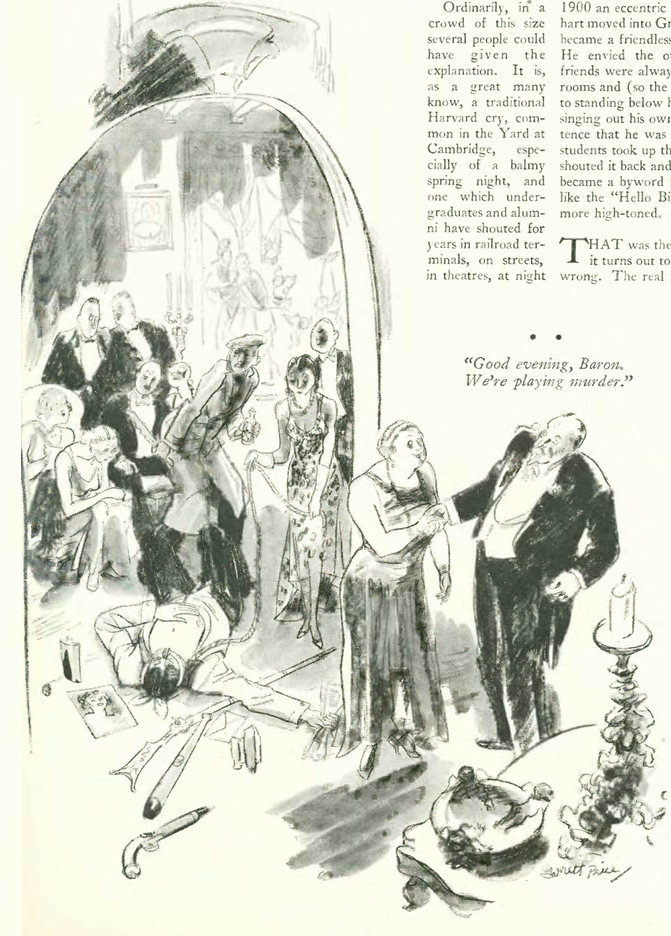
…this terrific party scene courtesy Garrett Price…
A host of nature programs from Mutual of Omaha’s Wild Kingdom to Planet Earth owe their origins to a few intrepid filmmakers who 100 years ago gave Americans some of their first glimpses of life in exotic, remote regions of the world.
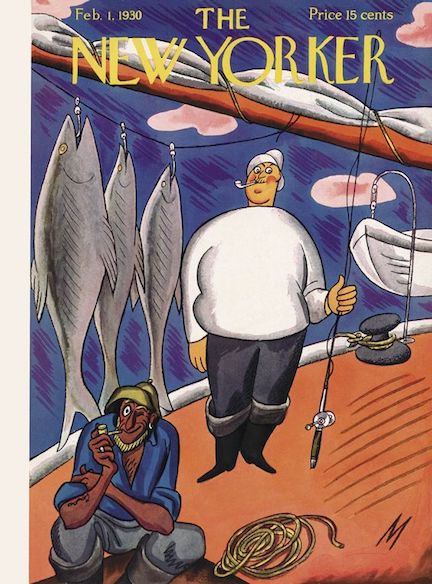
Feb. 1, 1930 cover by Julian De Miskey.
Among the first to do it were a couple from Kansas, Osa and Martin Johnson, who together explored unknown lands and brought back footage of the wildlife and peoples of the African continent, the South Pacific Islands and British North Borneo. Their first film, Among the Cannibal Isles of the South Seas (1918), was followed by several more, including Across the World with Mr. and Mrs. Johnson, which was released in early 1930.
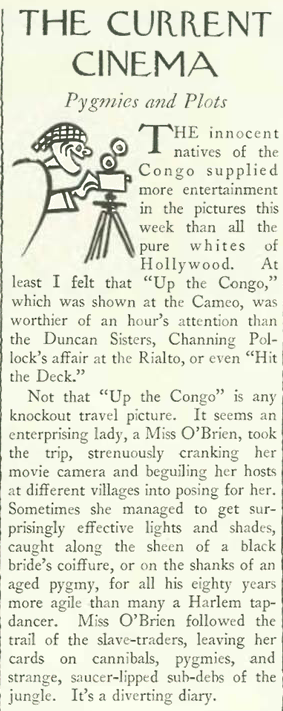
The New Yorker film critic John Mosher was as eager as any audience to take in the adventures of the Johnsons, or even of someone who was inspired by the Johnsons, in this case a “Miss O’Brien” who had just released a “diverting diary” called Up the Congo. Mosher wrote about it in the Jan. 25 issue:
CONTACT…Image of a family from an unidentified Pygmy tribe posing with a European explorer in a 1921 Collier’s New Encyclopedia entry; a group of Mbuti posing with explorer Osa Johnson in 1930. (Wikipedia)
I can find no record of the film UptheCongo, however the exploits of the Johnsons are well documented thanks to the Martin and Osa Johnson Safari Museum in Chanute, Kansas, which has a treasure trove of photos and other information on the explorers.
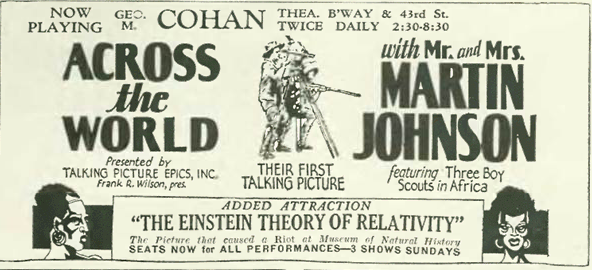
The ad in the Feb. 1, 1930 New Yorker promoting Across the World with Mr. and Mrs. Johnson included an interesting “added attraction”…a film about Einstein’s theory of relativity that had caused a Jan. 8 “riot” at the American Museum of Natural History. That particular screening was intended for members of the Amateur Astronomers Association, but word got out and three times the invited number showed up at the museum, breaking down the lobby gates. Hard to imagine a mob today clamoring to view a science film…
Although the Johnsons made their movies under the auspices of the American Museum of Natural History, much of the footage was staged or edited to maximize the thrills (Mutual of Omaha’s Wild Kingdom did this in the 1960s and 70s, as did producers of Disney’s nature films from the 50s and 60s. The practice continues to this day on cable television).
The Johnsons also didn’t hesitate to gun down animals in the course of their movie-making…
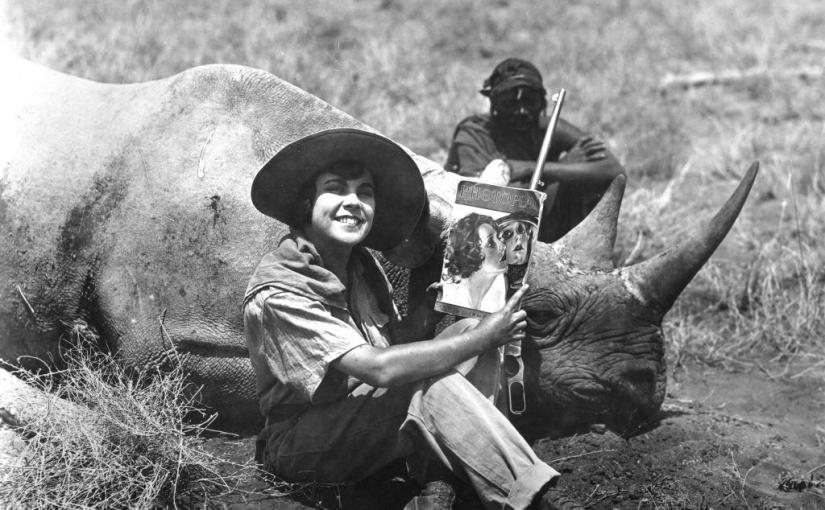
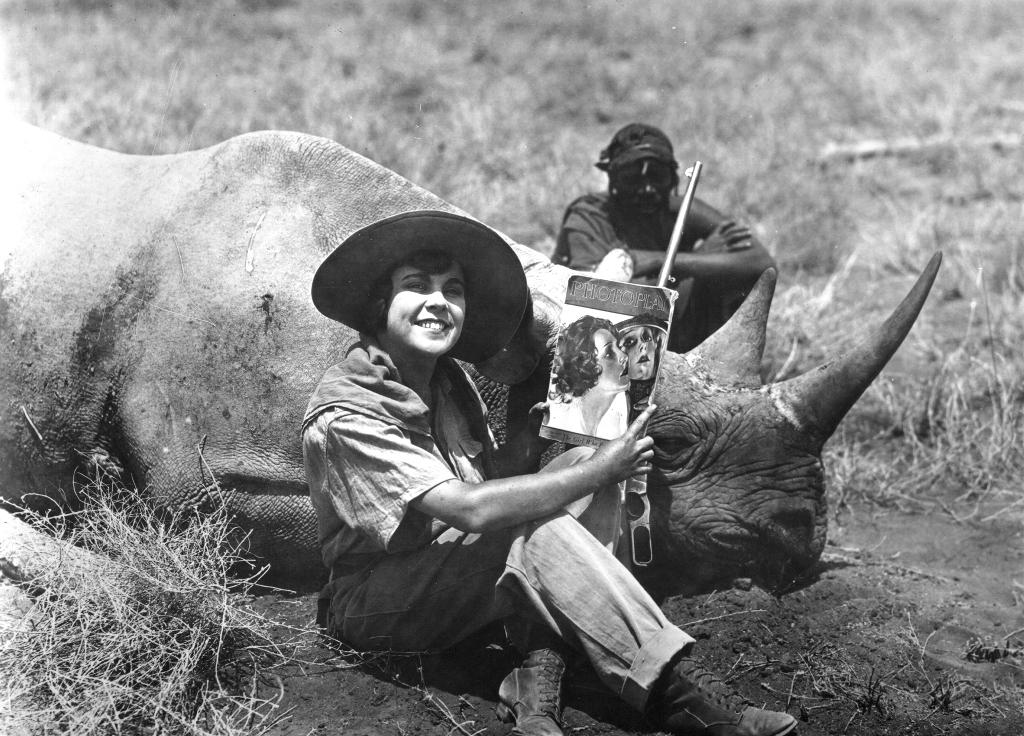
YEP, THAT’S JUXTAPOSITION…Osa Johnson poses with a Photoplay magazine, a dead rhino, and a tribesman, circa 1930. (columbia.edu)
According to a 2011 review from Wild Film History, “in stark contrast to the conservation-themed wildlife films of today, the Johnsons approached their subjects armed with both camera and rifle, with the production including provoked behaviour, staged confrontations and animals shot to death on film. Relying heavily on cutting in kills from professional marksmen, numerous hunting scenes culminate in a heart-stopping sequence where, with the use of clever editing, the adventurous Mrs Johnson appears to bring down a charging rhinoceros with one well-aimed shot.”
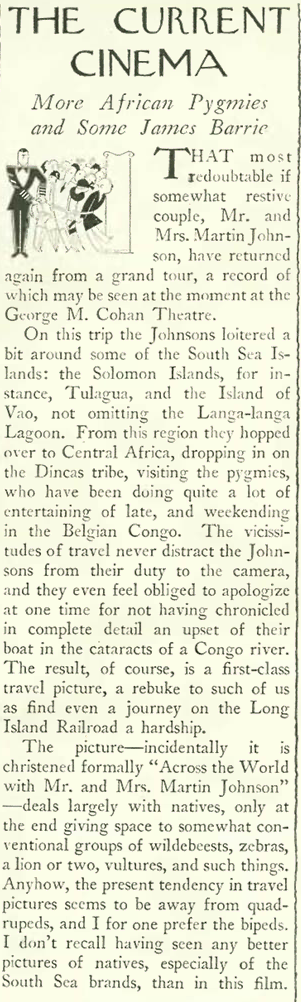
Across the World with Mr. and Mrs. Johnson is presented as if the Johnsons were showing their film to a few friends in their New York City apartment. The film is a “silent with sound,” that is, scenes in the field are silent, but the cocktail party “home movie” opening has sound, including “mood music” Osa provides by turning on the radio as the film begins. For all of their film experience, the acting between Osa and Martin is wooden, as is Martin’s narration. The critic John Mosher, however, enjoyed the ride, writing in his Feb. 1 column:
If you are curious, you can watch some of the film here, including the opening home movie scene with Osa and Martin in cocktail attire…
* * *
My Kinda Town
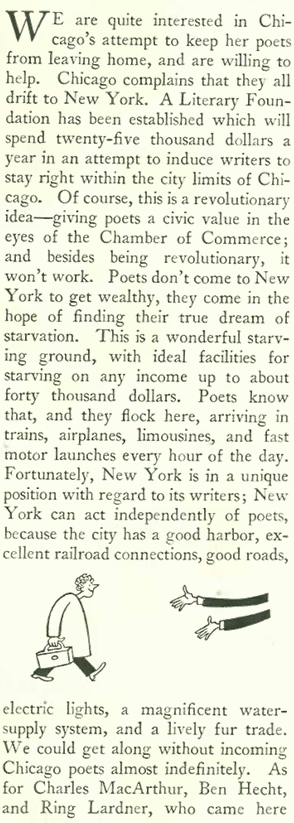
TheNew Yorker occasionally enjoyed taking potshots at the Second City, as well as some good-natured jabs at a few of its former residents who were also denizens of the Algonquin Round Table. Here is E.B. White in the Feb. 1 “Notes and Comment”…
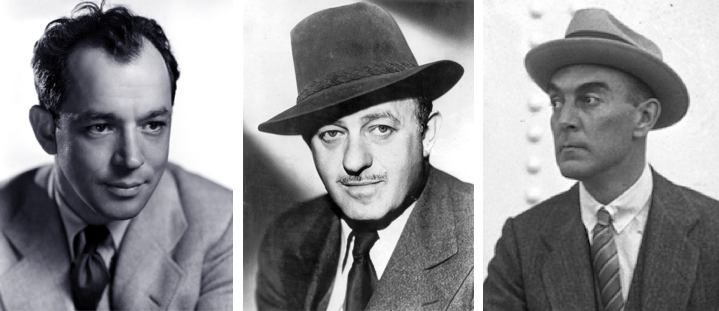
WINDY WITS…Chicagoans Charles MacArthur, Ben Hecht and Ring Lardner were well-known to The New Yorker crowd. (Wikipedia)
* * *
Not In This Century
This item from the Feb. 1 “Talk of the Town” is noteworthy for placing its admiration of technical achievement over any concerns for a child’s welfare. Today the couple would be arrested for this…
* * *
ThePerilsofAging
Irish-American actress and writer Patricia Collinge (1892-1974) wrote a series of short stories for The NewYorker, including this piece for the Feb. 1 issue written when she was 37 years old. It is a sad story about an older actress (37) who hoped to land the part of a younger woman. Some excerpts…
…the actress in the story is led to believe the part was intended for a woman of 28, and is crushed to learn that the agent was looking for “a young twenty-two”…
OH TO BE YOUNG…At left, Gladys Cooper, Alexandra Carlisle and 20-year-old Patricia Collinge in the Drury Lane production of Everywoman (1912); at right, Collinge in 1941. Unlike the sad actress in her short story, Collinge’s career spanned more than 60 years. (Wikipedia)
* * *
ComingAround
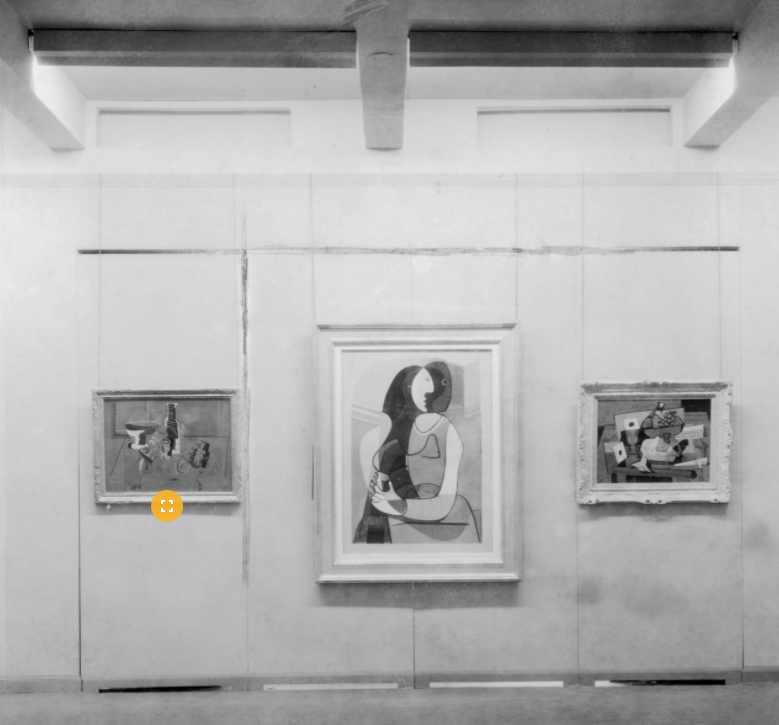
In previous issues art critic MurdockPemberton expressed skepticism about the new Museum of Modern of Art, founded by wealthy society women in November 1929. Pemberton held egalitarian views about art, and wondered if the old money set could create a venue for true modern artists. His review of “Painting in Paris,” MoMA’s third exhibition, seemed to allay his concerns…
PAINTING IN PARIS was the title of the Museum of Modern Art’s third exhibition featuring works by Georges Braque, Georges Rouault, Pablo Picasso, Joan Miró, Marc Chagall, Robert Delauney, Fernand Leger, Henri Matisse and Andre Derain among others. Image above is from the original exhibition at MOMA’s first home in the Heckscher Building at 730 Fifth Avenue. (MOMA)
Images above in color, from left, Pablo Picasso’sGreen Still Life Avignon (1914) and Seated Woman (1927); Georges Braque’sStill life (1927). (MOMA/WikiArt)
Pemberton expressed enthusiasm for the show’s new works that contained few traces of the familiar…
* * *
The King’s Speech
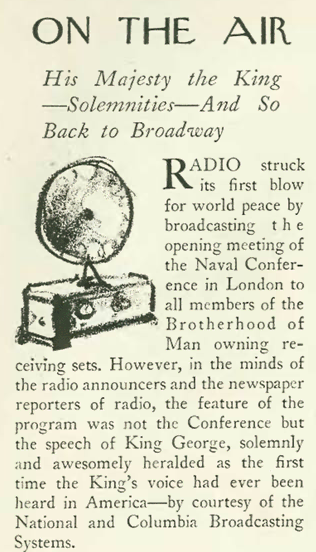
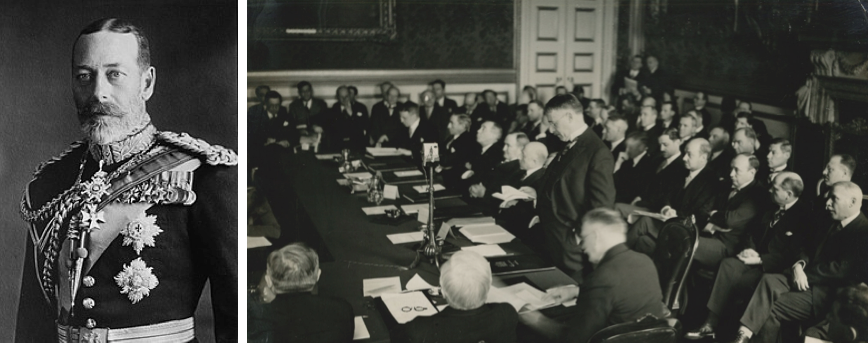
KingGeorgeV was not known for his public speaking, but when he addressed the third meeting of the London Naval Conference it was a big deal, even to American listeners who for the first time heard his voice over broadcast radio, still a very new medium in 1930…
ON THE AIR…The voice of King George V (pictured here in 1923) was broadcast across the Atlantic for the opening of the London Naval Conference at St. James’s Palace in 1930. The third in a series of five meetings, the conference was formed with the purpose of placing limits on the naval capacity of the world’s largest naval powers. (Wikipedia/Churchill Archives Centre)
* * *
Good Clean Fun?
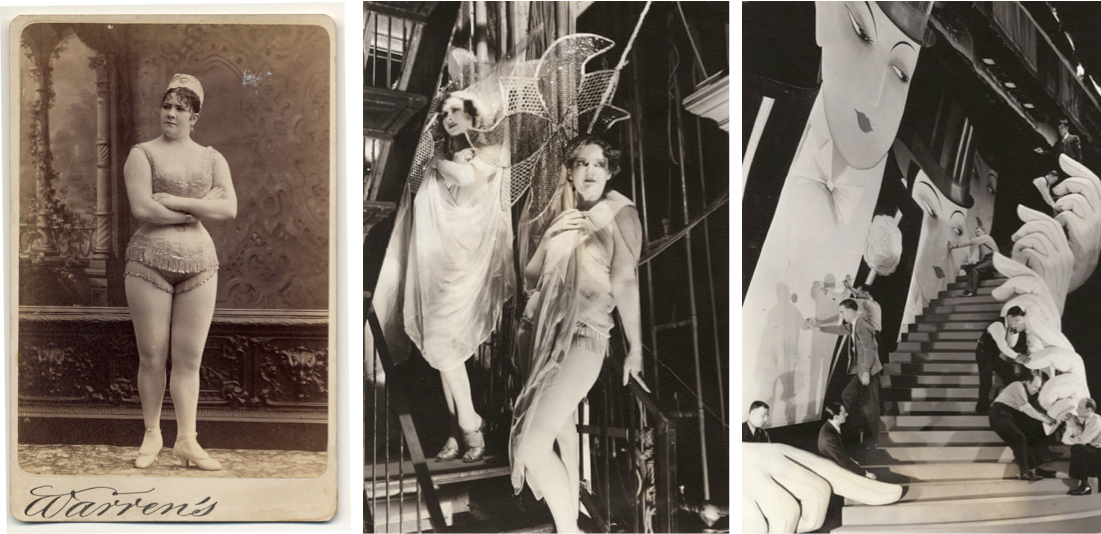
In his theater review column, RobertBenchley lamented the state of burlesque shows at the National Winter Garden, where “leviathans of an earlier day” were being displaced by “agile wisps” in third-rate Broadway productions…
ON THE SHOULDERS OF GIANTS…from left, Viola Clifton, a fuller-figured 1890s burlesque dancer; center and right, Margaret Bourke-White photos from Minsky’s National Winter Garden, 1936. Theater critic Robert Benchley wrote that he missed the “leviathans” of an earlier age, who were replaced by girls who were nothing but “agile wisps.”(mashable.com/theguardian.com)
* * *
From Our Advertisers
Just a couple of ads from the Feb. 1 issue, including this entry from the Shelton Looms offering advice on how one should appear among the Havana social set…
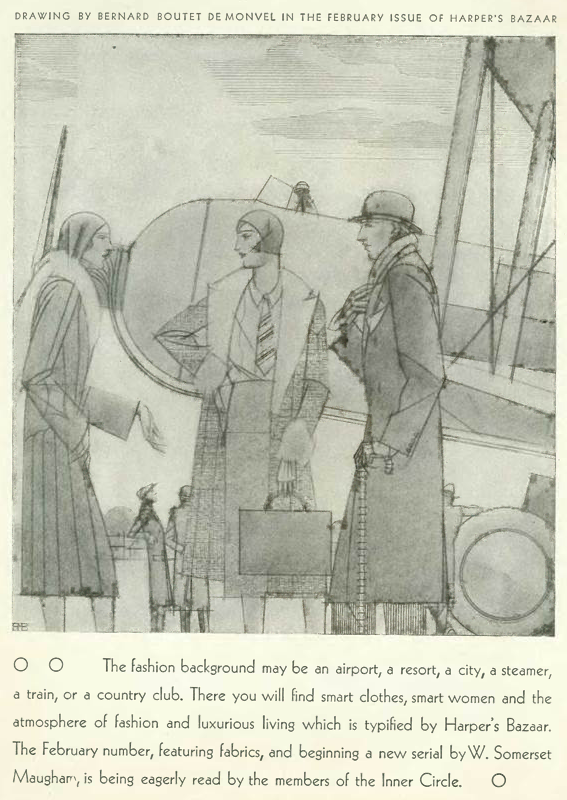
…and this ad from Harper’s Bazaar, also appealing to the smart set…
…our cartoons include this two-page illustration by ReaIrvin…
…AlanDunn’s look into the challenges of running a power plant…
…at the opera with PerryBarlow…
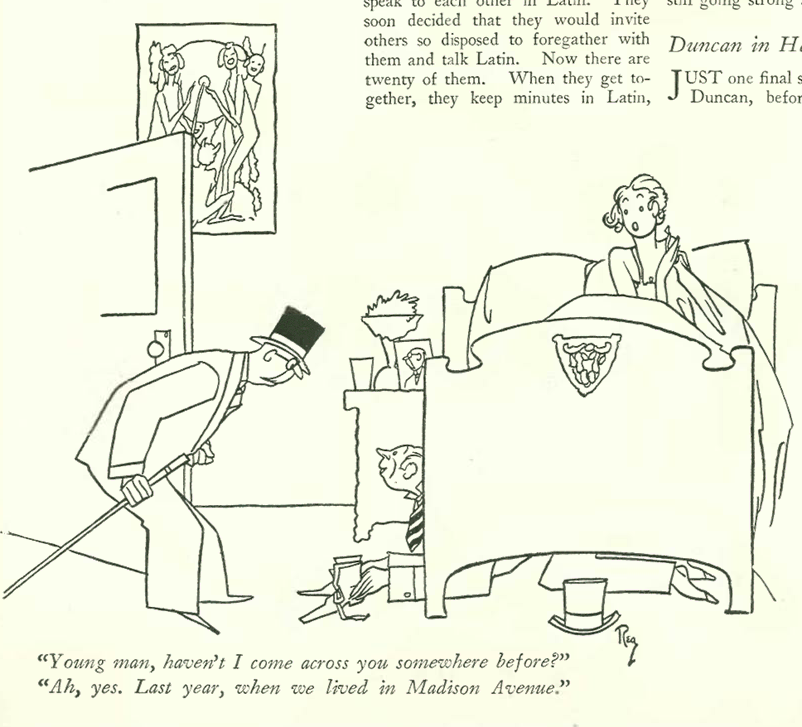
…GardnerRea and some bedroom hinjinks…
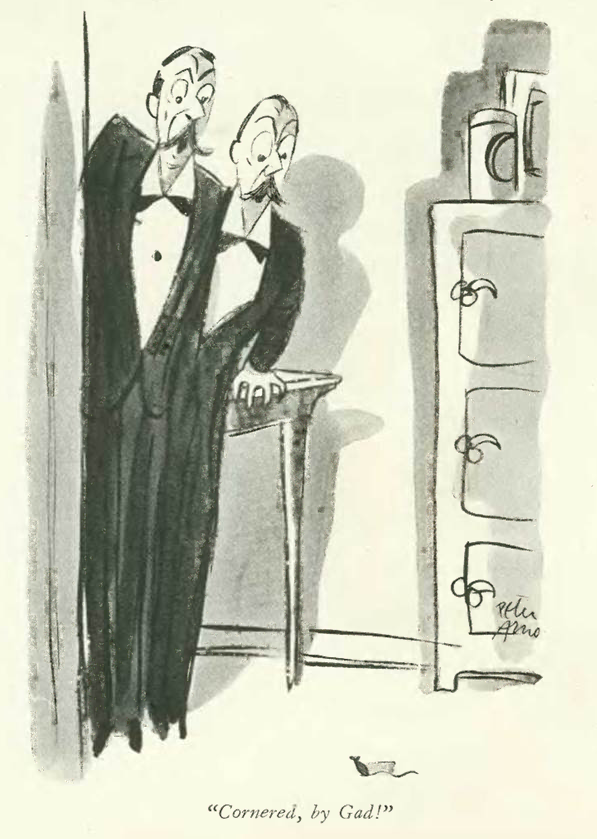
…man vs. mouse, by PeterArno…
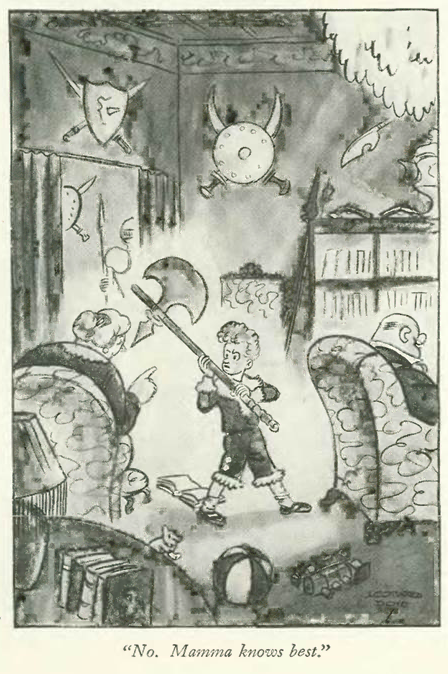
…and this by LeonardDove, seemingly anticipating the work of CharlesAddams…
Before we launch into the Jan. 25 issue, the rendering of the old New York Aquarium in this Sue Williams cover bears some consideration.
Jan. 25, 1930 cover by Sue Williams.
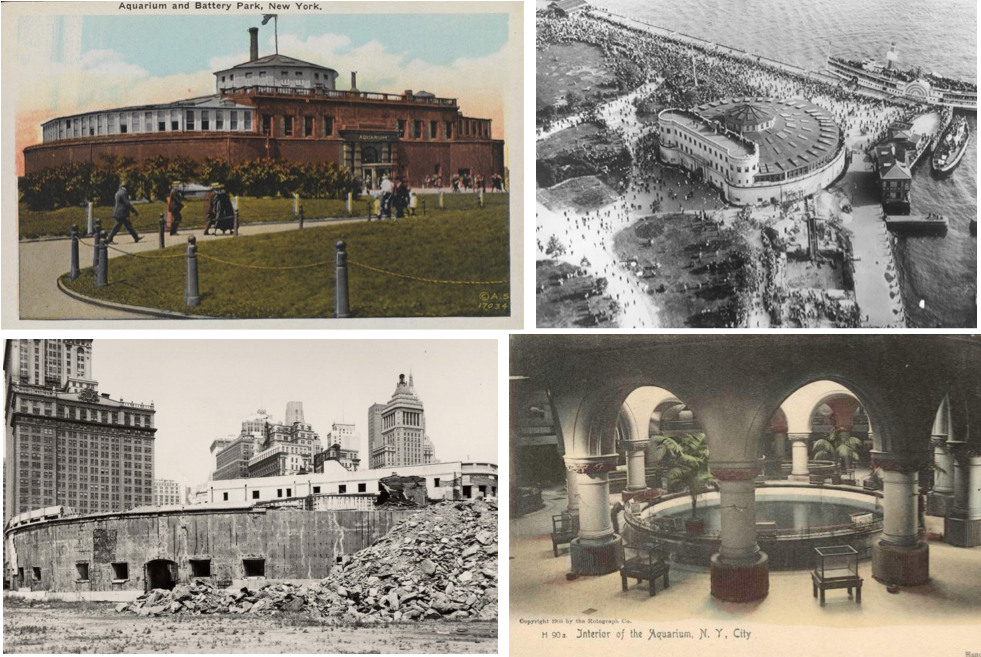
The aquarium was housed within the historic walls the South West Battery, constructed off the tip of Manhattan between 1808 and 1811 as a defense against the British. Renamed Castle Clinton in 1817 (in honor of former Mayor/Governor Dewitt Clinton), it was deeded to the city in 1823 to be used as an entertainment center. From 1855 to 1890 it served as an immigrant landing depot, then remodeled in 1896 (by the architectural firm McKim, Mead, and White) to become the popular New York City Aquarium.
FISH OUT OF WATER…Postcard image of the New York City Aquarium from the early 1900s; aerial view of the aquarium circa 1934; postcard image of aquarium interior; demolition of the aquarium in 1941, on orders from city planner Robert Moses. (thebattery.org/nycgovparks.org)
Although the aquarium proved to be a cultural and educational magnet, it stood in the way of master planner Robert Moses’s designs to build a bridge from The Battery to Brooklyn. After residents, preservationists and even Eleanor and President Franklin Roosevelt protested, the city opted instead to construct a tunnel under the East River. Nevertheless, Moses managed to get the aquarium knocked down before demolition was halted by the outbreak of World War II. After the war, Congress passed a bill declaring the site a National Monument, and preserved the walls of Castle Clinton.
HIGH AND DRY…Until it was demolished in 1941, the New York City Aquarium occupied the space in the center of Castle Clinton, which was added to National Register of Historic Places in 1966. (nps.gov)
* * *
Now, About That Band…
A play that satirized America’s enthusiasm for war—Strike Up the Band—was loved by critics but spurned by audiences when it opened in Philadelphia in 1927. Written by George S. Kaufman, with music and lyrics by George and Ira Gershwin, the play had the pedigree for success, but audiences weren’t quite ready for a show that poked fun at the U.S. military just nine years after the end of World War I (in the original play, America is goaded into declaring war on Switzerland by an American cheese tycoon).
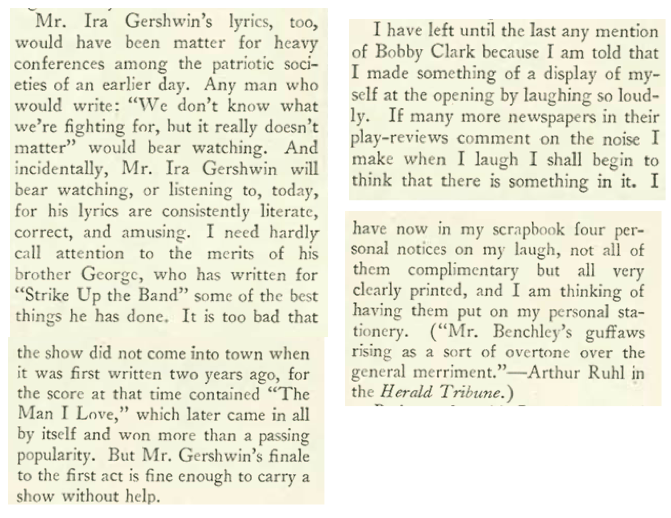
Enter lyricist Morrie Ryskind, who reworked the script, softening its political message and remaking the war plot into a dream sequence. The revised play proved to a be hit, running for 191 performances at the Times Square Theatre. It also introduced a number of popular songs, including “The Man I Love” and “Strike Up the Band.” Robert Benchley was on hand for opening night:
TEAMWORK…Clockwise, from top, Ira (left) and George Gershwin at work circa 1930; lyricist Morrie Ryskind, who softened the tone of George S. Kaufman’s original script. (U of Michigan/Wikipedia)
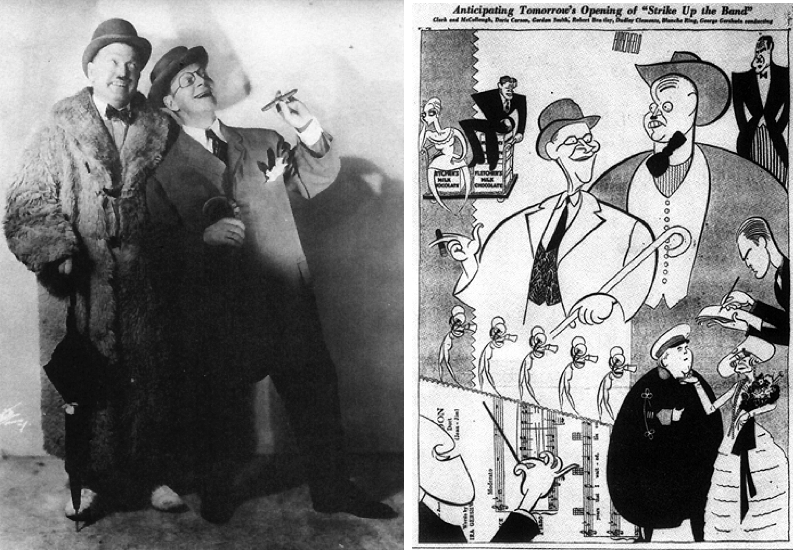
Benchley noted that the antics of comedian Bobby Clark caused him to laugh so loud that his guffaws were even noted in the Herald Tribune’s review:
MAKE ‘EM LAUGH…The comedy team of Paul McCullough (left) and Bobby Clark were one of the play’s big draws. At right, Herald-Tribune illustration by Al Hirschfeld announcing the Broadway opening of Strike Up the Band. (aaronneathery.org)
* * *
Duncan Yo-Yos
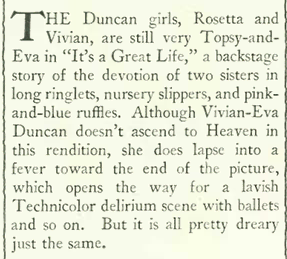
We’ve seen the Duncan Sisters (Rosetta and Vivian) before in this blog, the sister vaudeville act that became famous with the 1923 hit musical Topsy and Eva, which inspired a silent 1927 film starring the duo. They were back on the screen in late 1929 with It’s a Great Life, which TheNew Yorker’sJohn Mosher found to be “pretty dreary”…
NOT SO GREAT, THIS…Clockwise from top, promotional poster for It’s a Great Life; a scene from a dance number in the film; Rosetta (in blackface) and Vivian Duncan as Topsy and Eva (characters derived from the novel Uncle Tom’s Cabin). It’s a Great Life flopped at the box office, along with the Duncan’s brief movie careers. In the years to follow the duo would became popular nightclub entertainers and would continue to perform their Topsy and Eva routine even though appearing in blackface was increasingly considered offensive. (Wikipedia/freewebs.com)
* * *
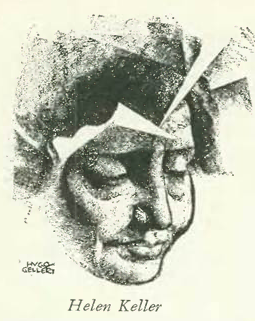
Miracle Worker
TheNew Yorker profile, written by Robert Coates, featured Helen Keller (with illustration by Hugo Gellert). A brief excerpt:
* * *
From Our Advertisers
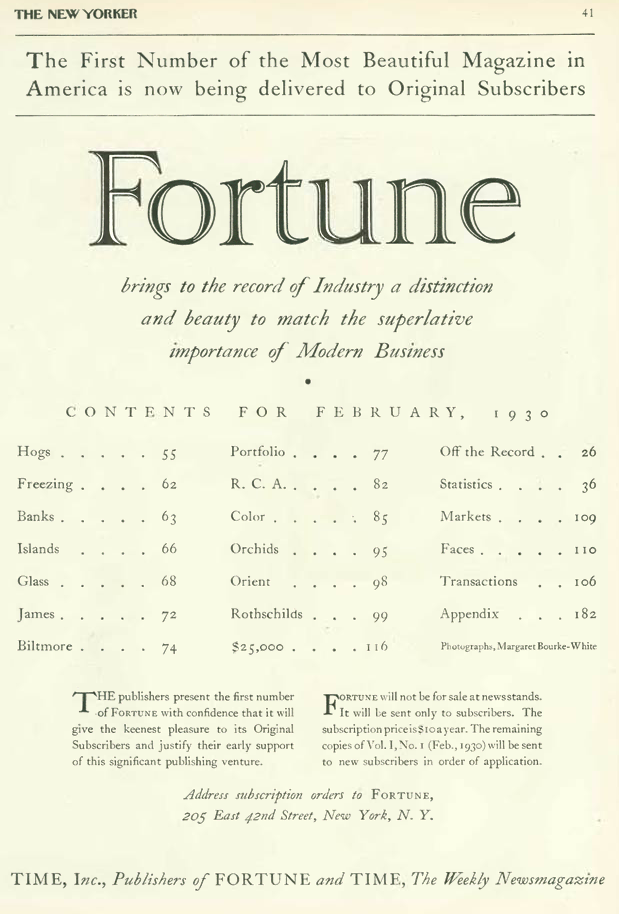
Advertisers in the Jan. 25 issue included the new Fortune magazine, which announced its first issue with this full-page ad:
…the table of contents is fascinating, spare in descriptions of everything from “Hogs” to “Orchids”…
From left, issue No. 1, February 1930; table contents for the issue; a prototype of the magazine, September 1929. (Fortune)
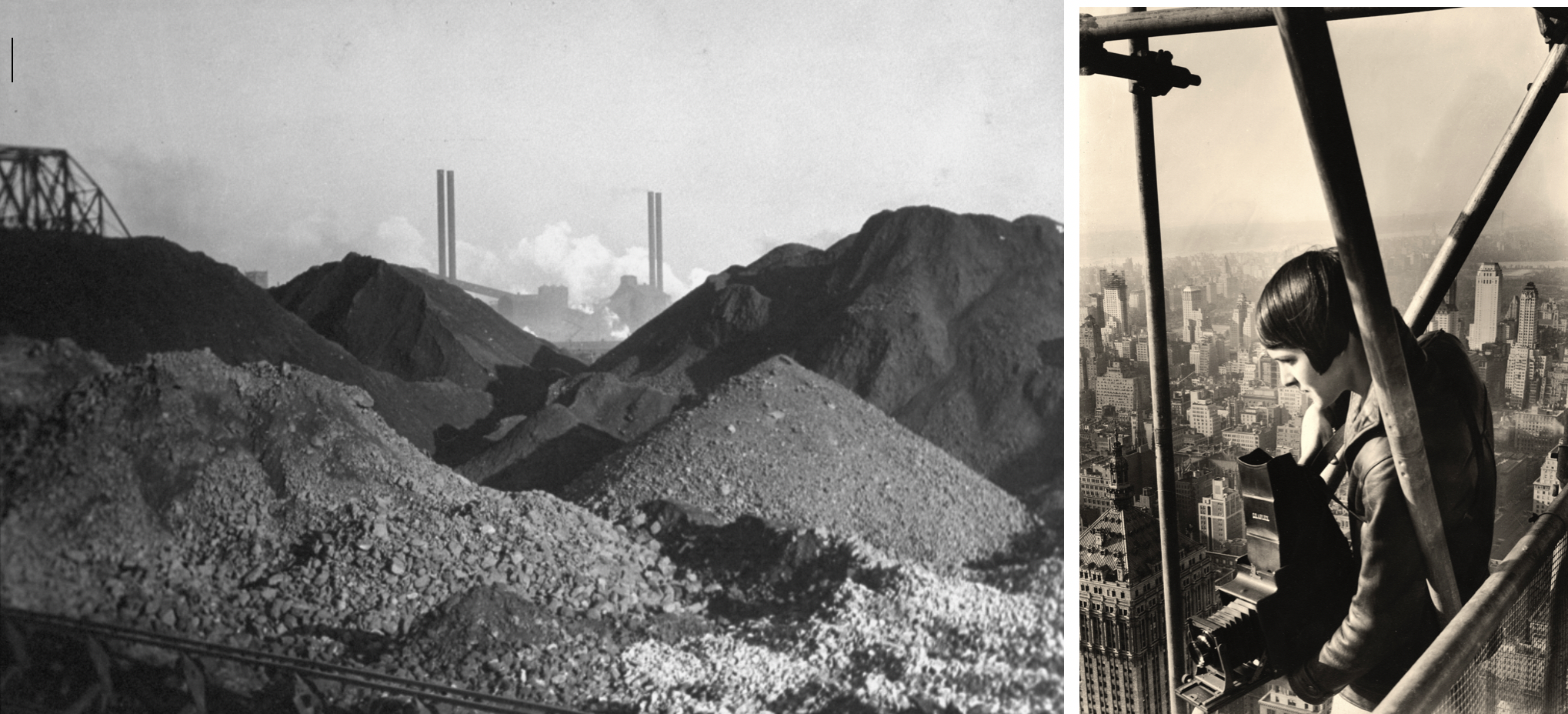
…also listed in the new magazine’s table of contents was the name of a 24-year-old photographer, Margaret Bourke-White…
A photo of coal piles by Margaret Bourke-White in the first issue of Fortune magazine. At right, Bourke-White photographing atop a skyscraper circa 1930. (Fortune)
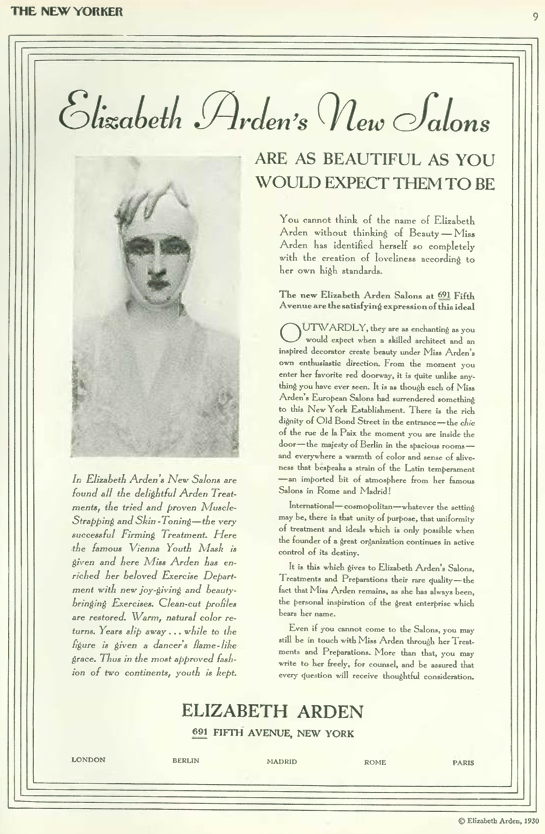
…on to our other advertisements, we have this entry from Elizabeth Arden…ads from this salon chain in the 1920s and 30s featured this ubiquitous image of a woman with a distant stare, her head tightly bound — mummy-like — as part of a firming treatment called “muscle-strapping”…
…in contrast to the rather cold, clinical look of the Elizabeth Arden ad, the Primrose House appealed more to social climbing than skin toning…
…while the makers of Pond’s cold cream continued to draw from their stable of debutantes and society ladies to move their product…
…long before there was Joe Camel, R.J. Reynolds also appealed to social climbers with a series of ads beautifully illustrated by fashion artist Carl Erickson…
…society’s smokers were advised to pack a tube of Bost toothpaste, or have their French maid do it for them…
…and once again we have an ad by Dr. Seuss for Flit insecticide that is very much of its time…
…as is this cartoon by Isadore Klein, perhaps the first in The New Yorker that depicted African Americans as something other than minstrel show stereotypes. Nevertheless, the rendering is still a bit crude — especially the boy’s face — as is the idea behind the “joke” — that a black boy could actually aspire to be a great violinist like Jascha Heifetz…
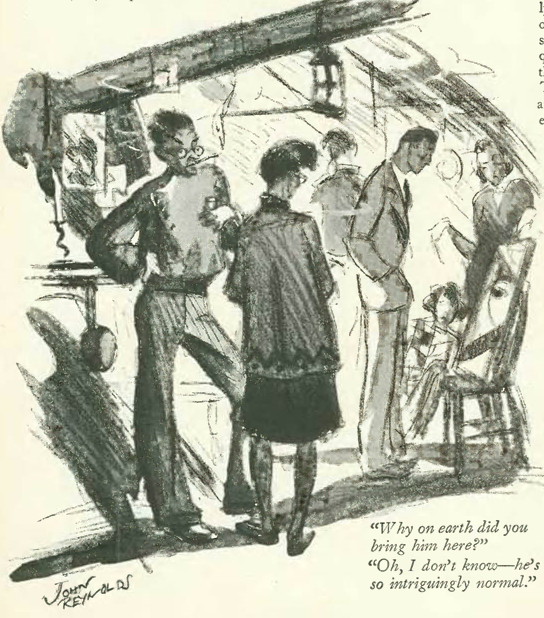
…John Reynolds explored a less troubling juxtaposition among the bohemian set…
…and we end with this peek into society life courtesy Barbara Shermund…
For nearly 100 years, giant steam locomotives (and later diesels) rumbled through the streets of Manhattan’s West Side, serving warehouses and industries via a route known as “Death Avenue.”
Jan. 18, 1930 cover by Constantin Alajalov (who apparently had just visited St. Moritz, home of the 1928 Winter Olympics).
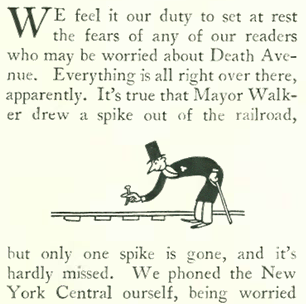
Beginning in 1846, freight trains began operating at street level along 10th, 11th and 12th avenues. When mixed with an ever-growing crush of pedestrians, wagons, cars and trucks — hundreds were killed or mutilated, many of them schoolchildren. One of these streets, 10th Avenue, earned the moniker “Death Avenue” for its large share of fatalities. Although protests over the unsafe rail lines had been going on for decades, it wasn’t until 1929 that an agreement was reached to build an elevated rail system (which is now the popular High Line elevated park). In late December 1929 Mayor Jimmy Walker pried out the first spike at 11th Avenue and 60th Street. In “Notes and Comment,” E.B. White wryly observed:
GOOD OLD DAYS…Freight trains were introduced to the west side warehouse district in 1846. Block-long trains would run through cross streets and congested traffic, maiming and killing along the way (image at left circa 1920). At some point in the late 19th century trains were required to send a man ahead on horseback waving a red warning flag (see images at right, circa 1900); nevertheless, in the decade 1890-1900 nearly 200 deaths were recorded, mostly schoolchildren from nearby tenements. WESTSIDE COWBOYs…Clockwise, from top left, a steam locomotive rumbles down 11th Avenue near 41st Street in the 1920s; men on horseback, known as the West Side Cowboys, rode ahead of the trains to warn pedestrians. Image at top right is of cowboy William Connolly on 11th Avenue in 1932; the last ride — George Hayde led the final ride of the West Side cowboys up 10th Avenue on March 24, 1941; aerial view of the High Line from 18th Street heading north. Opened in 1934, the elevated track lifted most freight train traffic 30 feet in the air. Today the High Line serves as a mile-and-a-half-long elevated park, and is one of New York’s biggest tourist draws. (Forgotten New York/Associated Press/New York Times/thehighline.org)
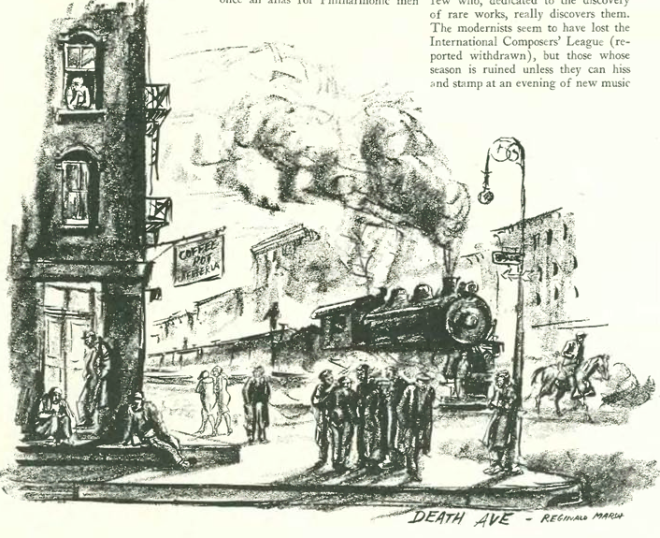
A New Yorker illustrator/cartoonist who spent a lot of time hanging around the working class neighborhoods on the West Side was Reginald Marsh. One of the first cartoonists employed by The New Yorker, Marsh was also a “Social Realist” painter who had studied with the Art Students League. The prevailing theme at the League was life among the working poor, the unemployed, and the homeless, especially after the market crash of 1929. For the Jan. 18 issue Marsh contributed this cartoon featuring a Death Avenue subject…
…more than two years earlier (the Nov. 5, 1927 issue) Marsh provided this illustration of life on Death Avenue…
* * *
Birds of a Feather
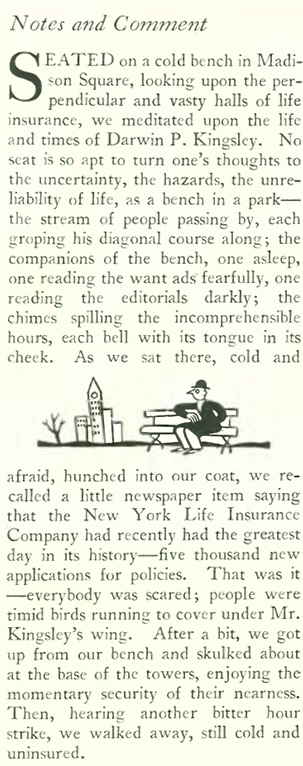
And speaking of the down and out, E.B. White commented on the thousands of panicked citizens who had flocked to the New York Life Insurance Company in search of some peace of mind under the wing of its leader Darwin P. Kingsley (1857-1932). Kingsley steered the company through the market crash relatively unscathed, thanks to its investments in government bonds and real estate, and not in common stocks.
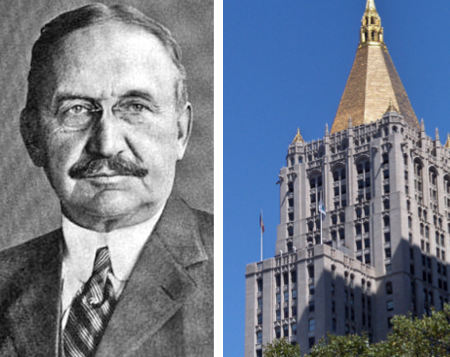
DARWIN’S LAW…Darwin P. Kingsley saw the New York Life Insurance Company through the stock market crash. The company’s assets weathered the crash thanks to investments in government bonds and real estate, and not common stocks. At right, the New York Life Building at 51 Madison Avenue, designed by architect Cass Gilbert and opened in December 1928.(retropundit.wordpress.com)
* * *
Oh Dear Me
As I’ve noted before, The New Yorker loved taking swipes at The New York Times, especially when the somewhat puritanical “Old Gray Lady” found it challenging to cover the more salacious side of life. In this case, according to E.B. White, it was the subject matter of a 1930 Broadway play Waterloo Bridge…
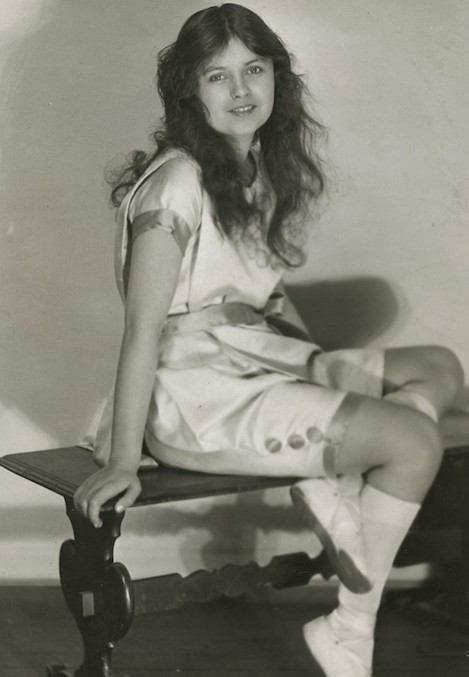
LES BELLES IMPURES…Actress June Walker (pictured here circa 1920) portrayed chorus girl Myra Deauville in the 1930 Broadway play Waterloo Bridge. In the play Myra finds herself out of work and stuck in London during World War I. She resorts to, um, prostitution, to support herself. (IBDB)
* * *
Nerd Alert
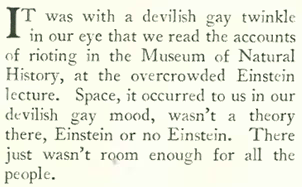
White also got a kick from reading accounts (presumably in the Times) about Albert Einstein’s “lecture” at the American Museum of Natural History. According to The New York Times’Michael Pollak (F.Y.I., Aug. 10, 2012), “an unruly crowd of 4,500 stampeded through the (museum) to see a movie about Einstein’s work…it became known—relatively speaking—as the “Einstein riot.”
JUST CHILLIN’…Albert Einstein circa 1930. The scientist was safely elsewhere when a science-crazed mob stormed the doors of the American Museum of Natural History, which was screening a film on the theory of relativity. (AP)
* * *
Not Ready For My Closeup
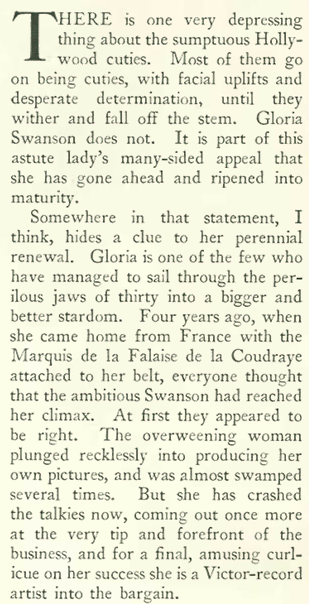
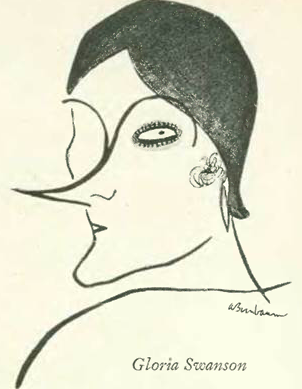
The actress Gloria Swanson (1899-1983) was a major star during the silent era who saw her career wane with the advent of the talkies, and then suddenly soar again with her unforgettable portrayal of reclusive silent film star Norma Desmond in the 1950 film Sunset Boulevard. In her profile of the actress, Helena Huntington Smith seemed to suggest that Swanson was something of an ugly duckling who managed to transcend her looks through a process of graceful maturation (Abe Birnbaum’s caricature notwithstanding). Some excerpts:
GLORIOUS FACES…Abe Birnbaum no doubt drew from images like these for his caricature of Gloria Swanson. From left, Swanson in a cloche hat in an undated photo; publicity photo for her 1928 film Sadie Thompson; publicity photo for 1929’s The Trespasser, Swanson’s first all-talking picture. (Pinterest/pixels.com)
* * *
Good-Bye and Good Luck
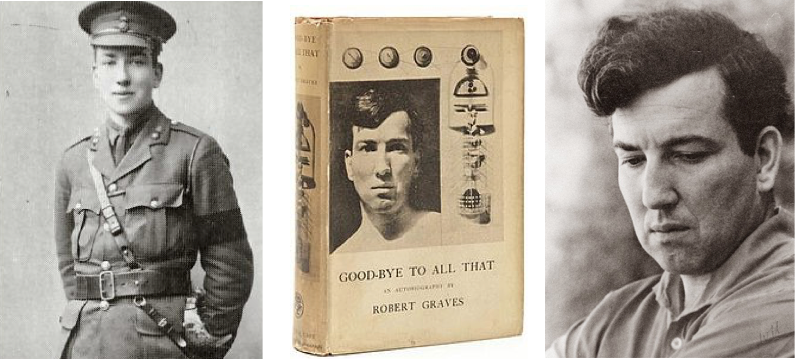
Not too many 33-year-olds write autobiographies, but then again Robert Graves was no typical 33-year-old. Good-Bye to All That, which Graves later described as “my bitter leave-taking of England,” was reviewed in the Jan. 18 “Recent Books” column. Note in the first paragraph how the reviewer (A.W.S.) suggested that writing about World War I (which ended less than 12 years earlier) was getting better “as the shock of the actual catastrophe wears off.” This is not unlike the writings (and films) about Viet Nam that began to emerge in the 1980s and 90s. An excerpt:
A LOT ON HIS MIND…from left, Robert Graves served in the 3rd Battalion of the Royal Welch Fusiliers in World War I (photo is probably from 1915); first edition of his autobiography Good-Bye to All That, which he published at age 33; Graves in 1935. (Oxford U/Wikipedia/fundaciorobertgraves.org)
* * *
From Our Advertisers
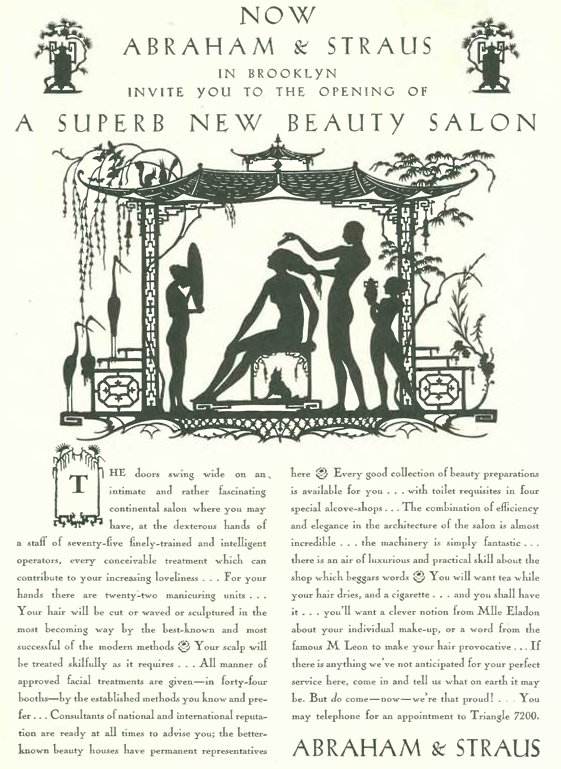
We begin with this elegant ad for a new art deco beauty salon at the Abraham & Straus department store on Fulton Street in Brooklyn…
…for reference, a photo of salon, from 1930…
…the Jan. 18 issue contained a slew of ads enticing New Yorkers to flee the winter and head south — smartly attired, of course — like the couple in the upper right hand corner who look fashionably disinterested as they head out for some “playtime” in Havana (love the man’s combo black tie and bucket hat)…
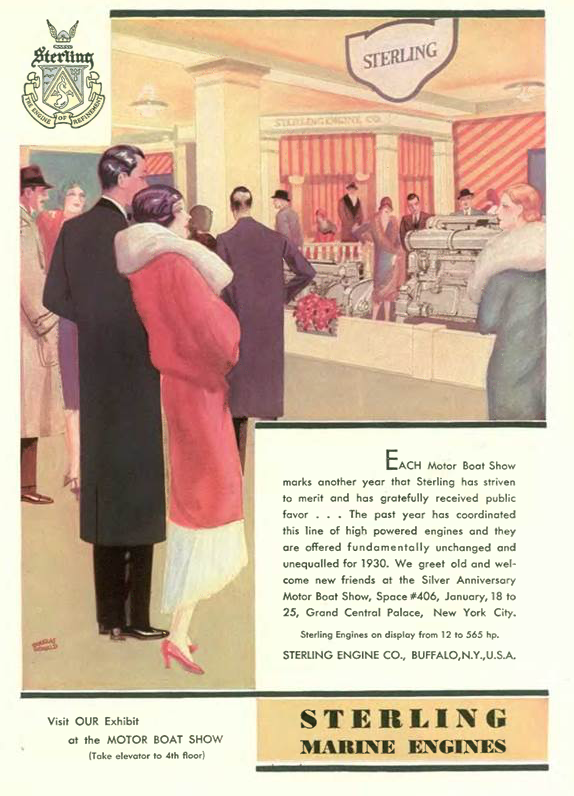
…and you have to hand it to the folks at Sterling, who put the chic into high-powered boat engines…
…this has to be one of the very few times, perhaps the only time, that a toilet seat was advertised in The New Yorker…note how the folks at the Church company played on consumers’ social anxieties, proffering the suggestion that an old toilet seat might be the one thing that lingers in the memories of your houseguests…
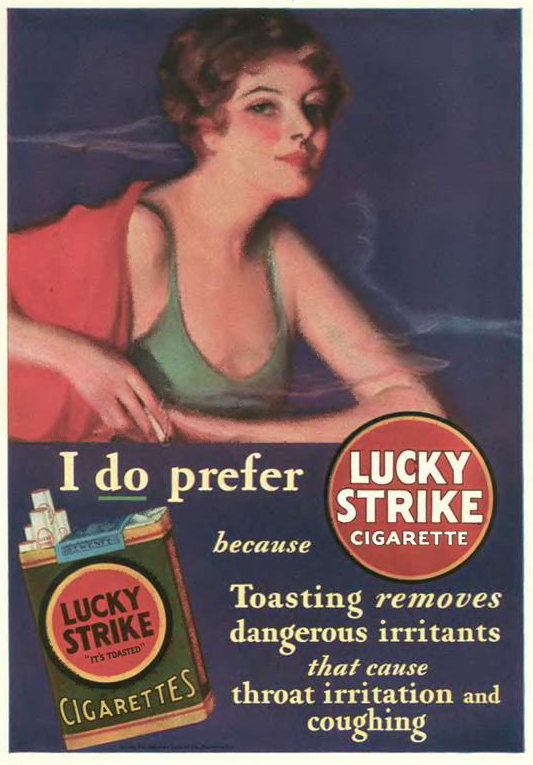
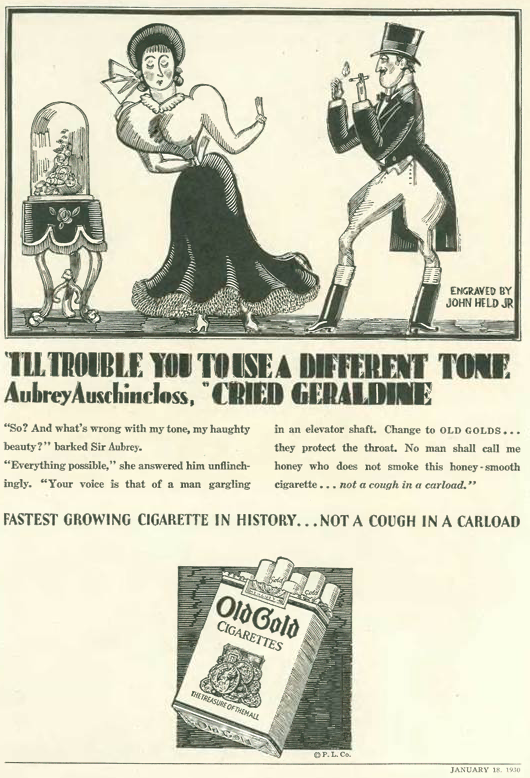
…of course a lot of people eased their anxieties by lighting up, something they didn’t have to worry about because they were told it was actually good for their health (the manufacturers of Old Golds, for example, claimed their cigarettes created a “smoke screen” that kept away colds and other “throat dangers”). Not to be left behind, the makers of Lucky Strikes claimed their “toasting” process removed “dangerous irritants”…
…speaking of Old Golds, cartoonist John Held Jr. picked up some extra pocket change with this “woodcut” illustration for the brand…
…as for Held’s fellow New Yorker cartoonists, we have some more social anxiety courtesy of Alan Dunn…
…a bit of chit chat among society ladies…Barbara Shermund looked in on a pair down in Palm Springs…
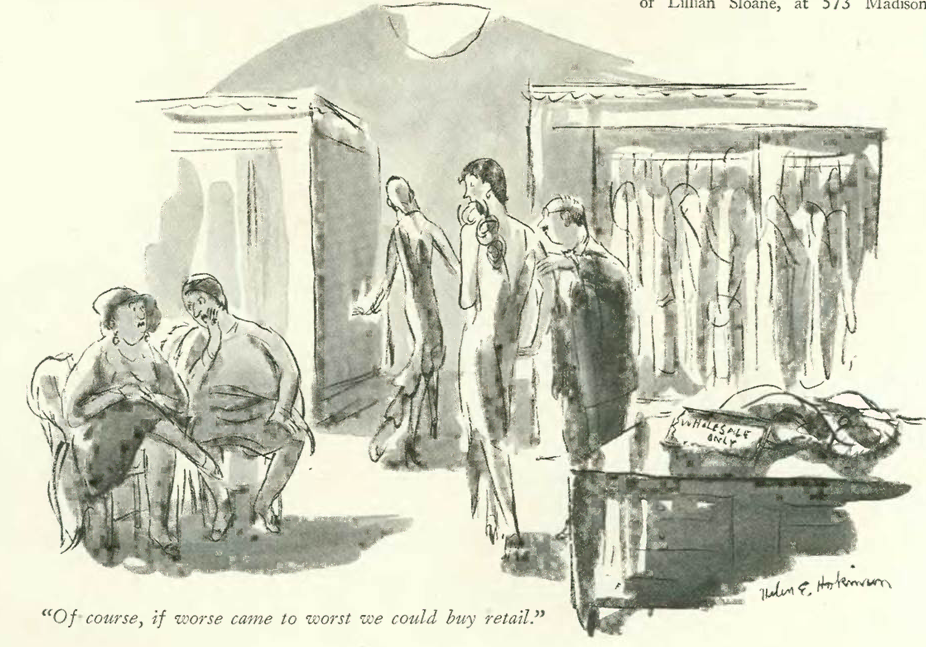
…while Helen Hokinson found her ladies contemplating new economic realities…
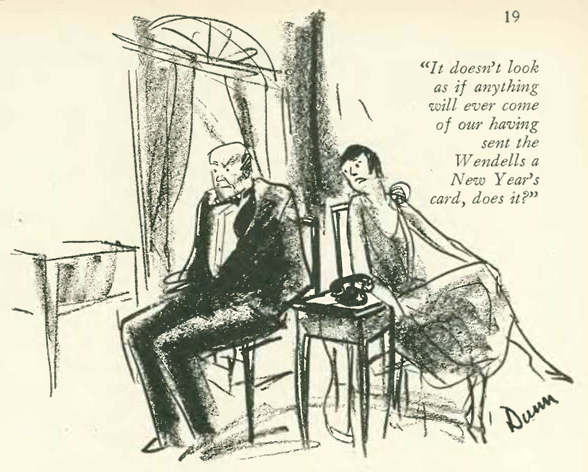
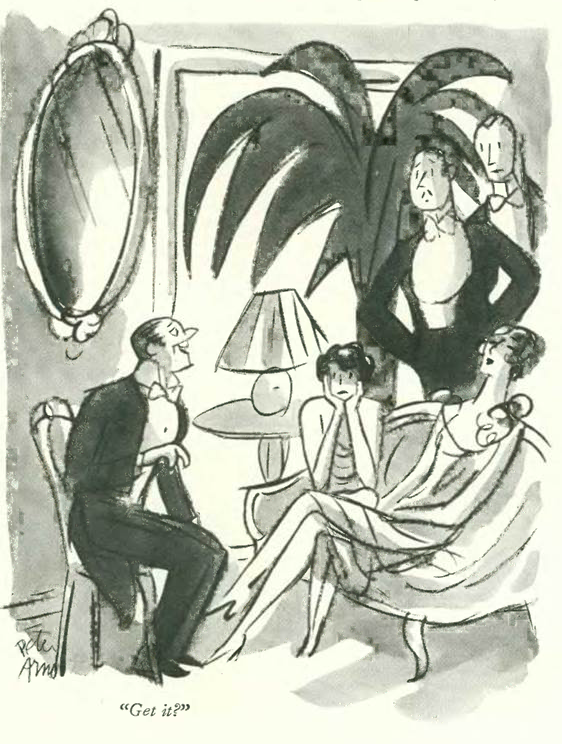
…and finally we have Peter Arno, and a punch line that failed to land…
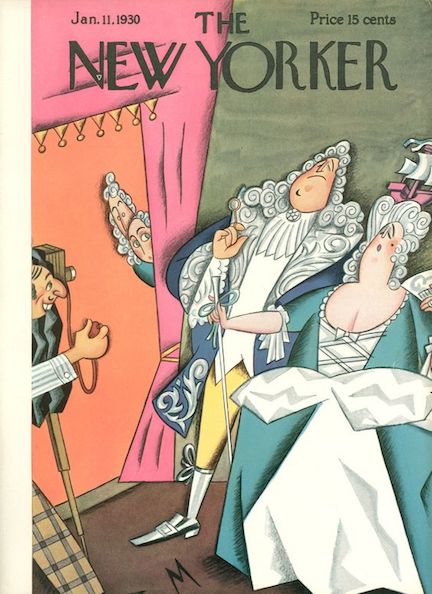
With the 1920s ending with a crash, few seemed interested in looking back to that decade. Indeed, just days into the 1930s the Jazz Age seemed to belong to a distant, frivolous past.
Jan. 11, 1930 cover by Julian De Miskey.
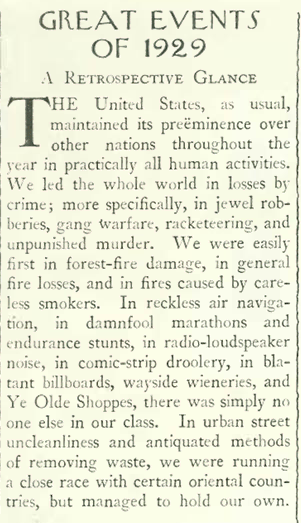
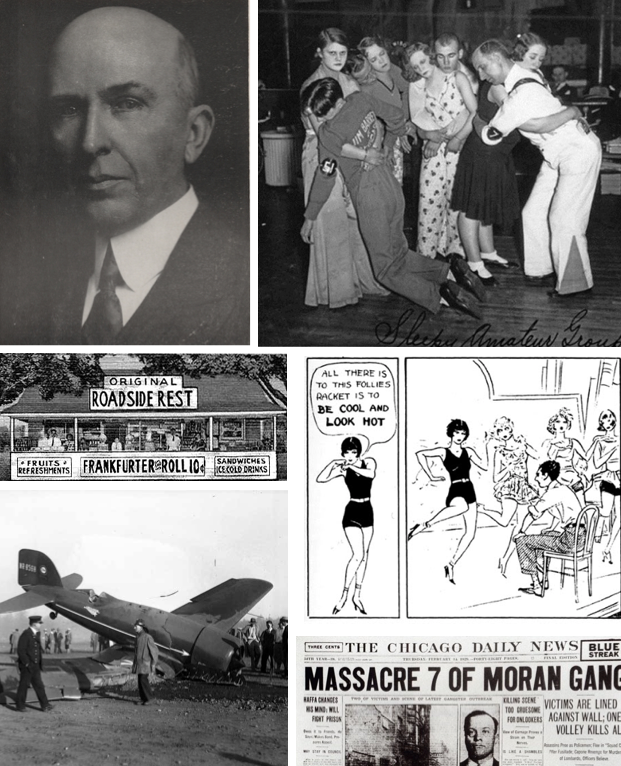
Or at least that is how popular historian Alvin F. Harlow (1875-1963) saw it, penning this somewhat cynical, tongue-in-cheek retrospective on the “great events” of the previous year…
FLASHBACK…Historian Alvin F. Harlow (top left) recalled some of the “great events” of 1929, including (clockwise, from top right) “damnfool” dance marathons; “comic strip droolery” (clip is from Dixie Dugan, 1929); gang warfare; reckless air navigation and wayside wieneries. (jstor.org/News dog Media/nitrateville.com/Chicago/U of Washington/Nathan’s)
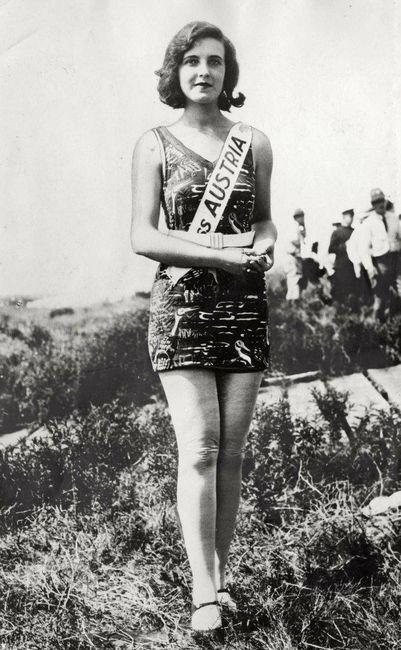
…Harlow continued to list the various ways folks sought relief “from the monotony of existence” in 1929…
TOO THIN?…Miss Austria, Lisl Goldarbeiter, was crowned the first Miss Universe at the “International Pageant of Pulchritude” in Galveston, Texas in 1929. The pageant actually was one of year’s big events, garnering worldwide attention. (bashny.net)
…as well as the persistence of superstition and quackery…
* * *
A Byrd Takes Wing
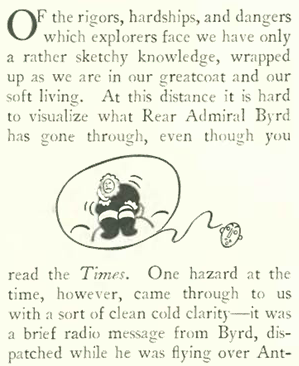
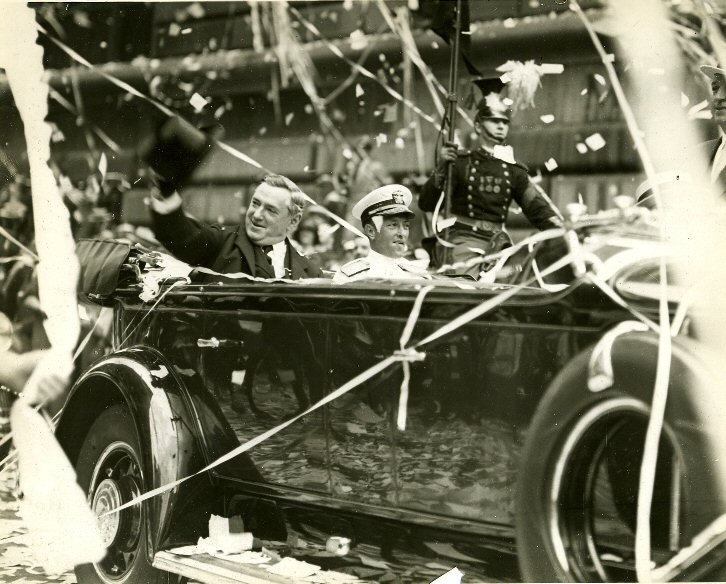
In 1928 and 1929 the name Richard Byrd popped up quite a bit in the pages of The New Yorker, and for good reason. In 1928 Byrd — already known for his exploits at the North Pole — began his first expedition to the Antarctic, a land that was as remote to explorers in the 1920s as the moon was to us in the 1960s. On Nov. 28-29, 1929, Byrd — along with pilot Bernt Balchen, co-pilot/radioman Harold June, and photographer Ashley McKinley — flew a Ford Trimotor to the South Pole and back in 18 hours, 41 minutes. It was such a feat that Byrd was promoted to the rank of rear admiral by a special act of Congress on December 21, 1929, making the 41-year-old Byrd the youngest admiral in the history of the United States Navy. In his “Notes and Comment,” E.B. White was still awaiting details of the heroic adventure:
ROUGHING IT…Once the expedition arrived by ship on the Antarctic coast, planes were assembled at the “Little America” base camp on the Ross Ice Shelf. This image shows Richard Byrd and his dog Igloo unpacking crates. The ships that brought the plane and other supplies can be seen in the background. (library.osu.edu)LIKE A MOONSHOT…Clockwise, from top left, a Ford Trimotor (named Floyd Bennett after the recently deceased pilot of a previous expedition) was one of three planes brought on the expedition. It sits assembled and ready to go before its historic flight over the Pole; flying over the pass near Liv’s Glacier enroute to the Pole; Richard Byrd in the library of Little America prior to the flight, with a stone from Floyd Bennett’s grave. Byrd dropped the stone, wrapped in a small American flag, over the South Pole in honor of the pilot of his 1926 North Pole expedition; the geological party (Byrd is second from right) upon returning to Little America, January, 1930; Little America in 1928, soon to be covered in snow. (library.osu.edu)
In his “Wayward Press” column, Robert Benchley commented on Byrd’s promotion, and took a shot at The New York Times (the Gray Lady was a favorite New Yorker target) for monopolizing the news of the South Pole expedition:
SNOWFALL OF A DIFFERENT SORT…Adm. Richard Byrd received a hero’s welcome in 1930 when he returned to the U.S. from Antarctica. Here he is shown being feted at a ticker tape parade in Boston. (library.osu.edu)
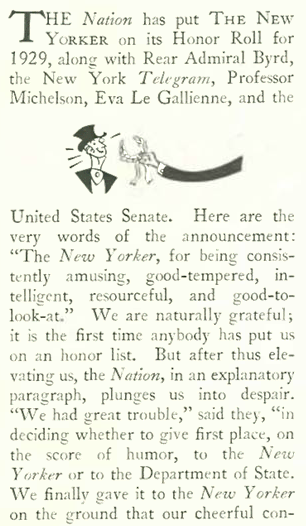
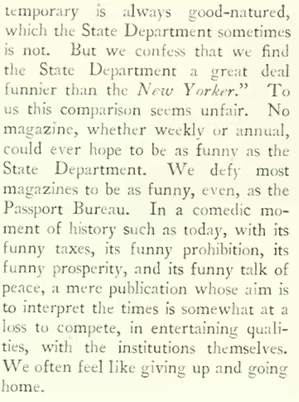
E.B. White also touted an endorsement by the venerable magazine The Nation, which included both Adm. Byrd and The New Yorker in its Honor Roll for 1929:
* * *
Bitter and Sweet
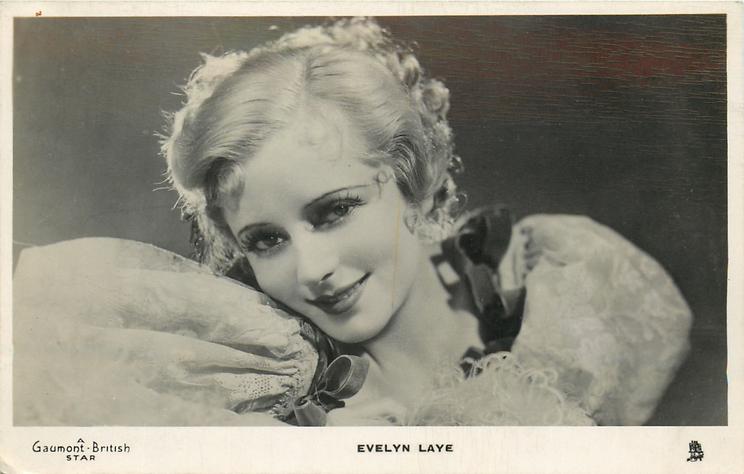
“The Talk of the Town” looked in on English light opera actress Evelyn Laye (1900-1996), who had just arrived in town to make her Broadway debut in the American première of Noël Coward’sBitter Sweet. “Talk” discovered that Laye “had her own notions” about how a stage actress should conduct herself:
MOSTLY SWEET…Postcard image of Evelyn Laye, circa 1933. (tuckdb.org)
Although Laye refused star billing in Bitter Sweet, she had no problem appearing in this two-page ad for Lux soap in The New Yorker’s Jan. 18. issue, hers the only full-page portrait in the ad:
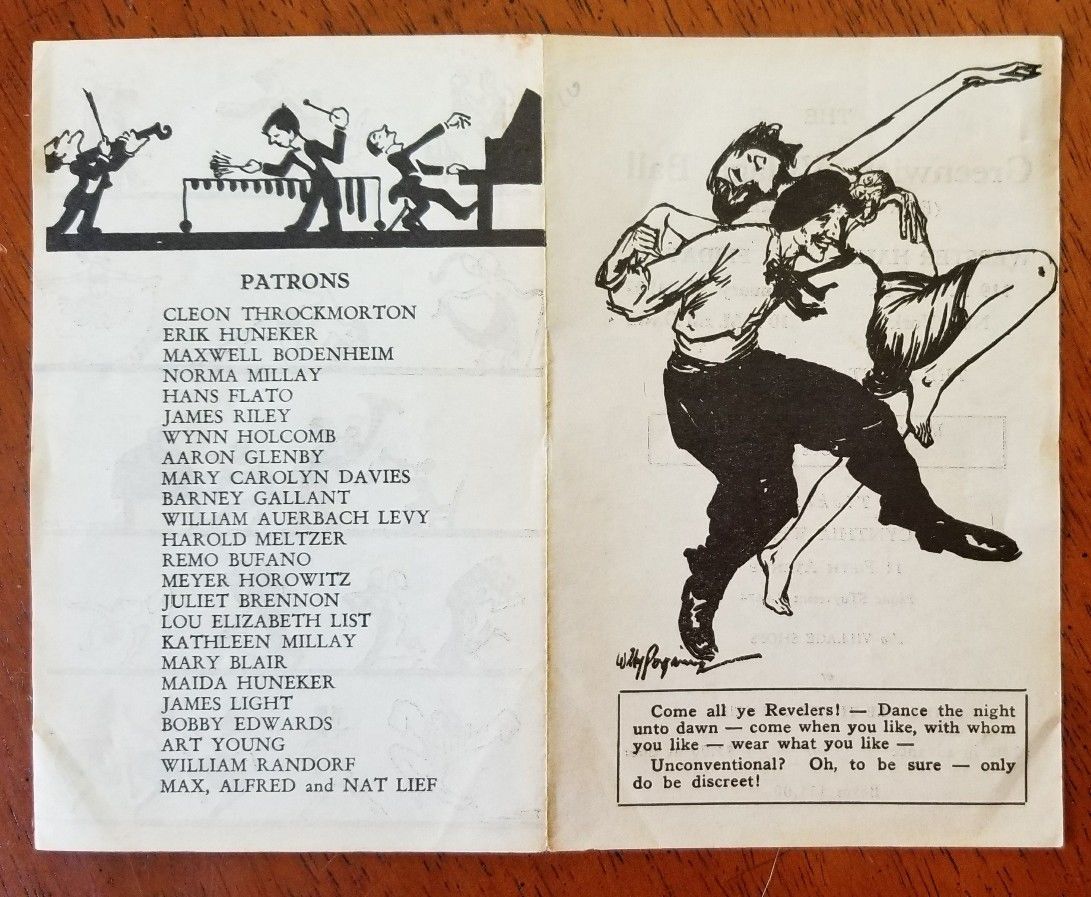
…and so we segue into the ads for Jan. 11, where we find all sorts of diversions in the back pages, including an appeal to revelers for the Greenwich Village Ball (top left corner). The ad copy reads “come when you like, with whom you like—wear what you like…” and asks the question “Unconventional? Oh, to be sure—only do be discreet!”
…for reference, here is an invitation from the 1932 Greenwich Village Ball, with a list of patrons printed on the inside cover, including the “King of Greenwich Village Bohemians,” Maxwell Bodenheim, and poet Edna St. Vincent Millay’s two sisters Norma and Kathleen…
(hobohemiadotblog.wordpress.com)
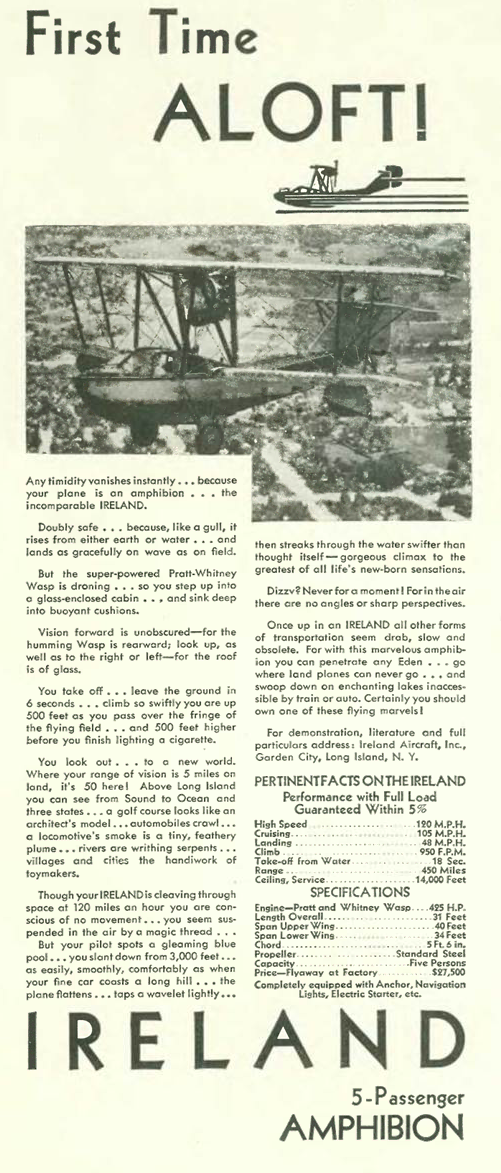
…ads for private airplanes were a regular feature in The New Yorker, aviation companies assuming that at least some readers had the means to consider such a purchase…the copy in this ad emphasized the ease of flying—here is a sample from the fifth paragraph: “You take off…leave the ground in 6 seconds…climb so swiftly you are 500 feet as you pass over the fringe of the flying field…and 500 feet higher before you finish lighting a cigarette…”
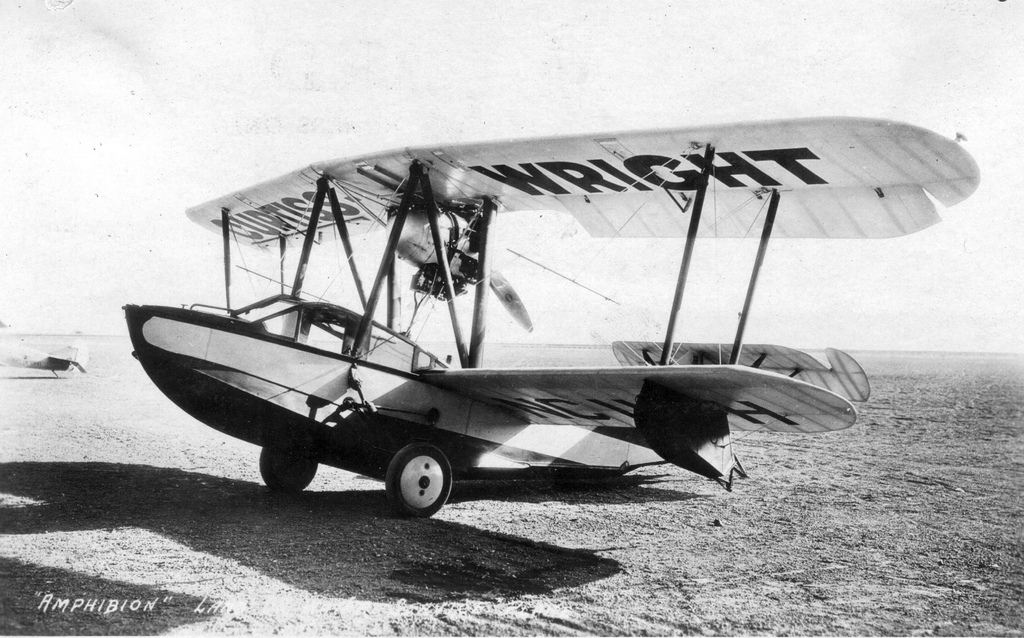
…here’s a better view of the Ireland Amphibion…
(San Diego Air and Space Museum Archive)
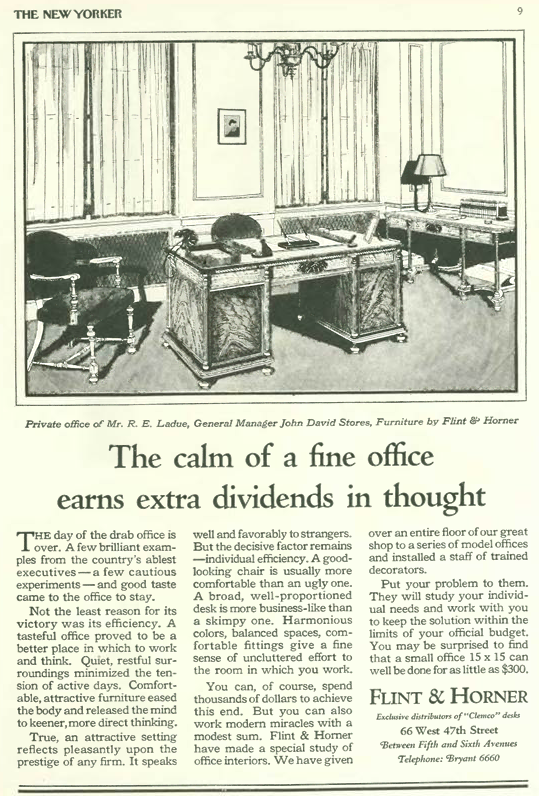
…but for those who remained firmly on the ground, respite could be found in a nice, quiet (and affordable) office, a place where one could, perhaps, start rebuilding from the ashes of the market crash…
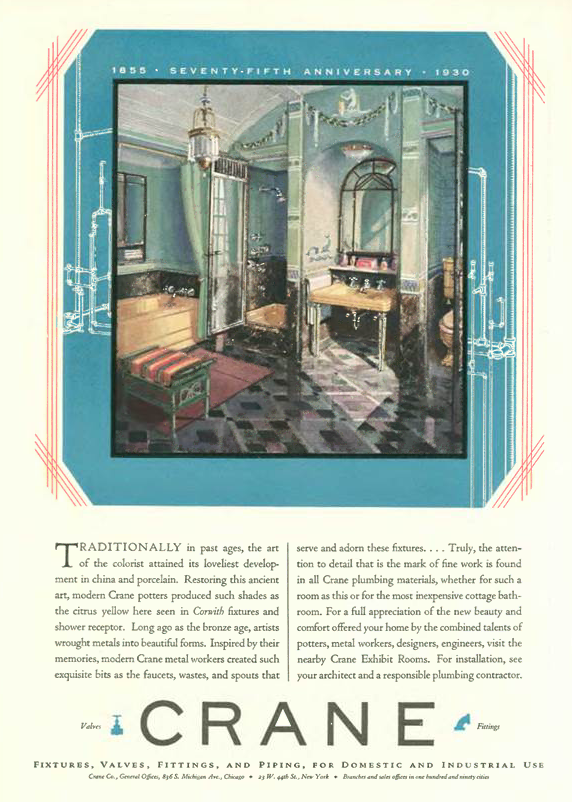
…and for those with a little extra scratch, they could treat themselves to the patrician comforts of a nice bathroom…
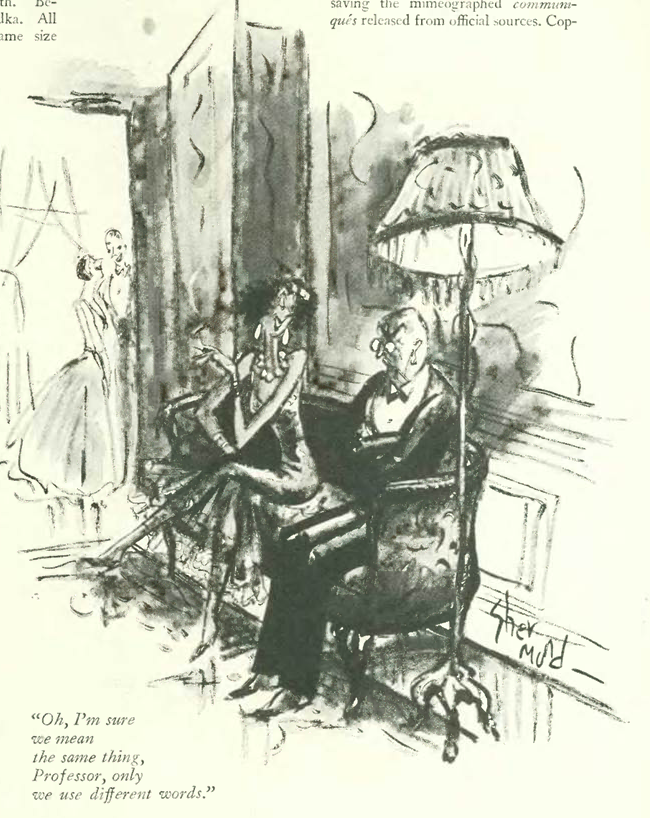
…on to our cartoons, we have a nice little culture clash courtesy of Barbara Shermund…
…Carl Rose illustrated a clash of a different sort…
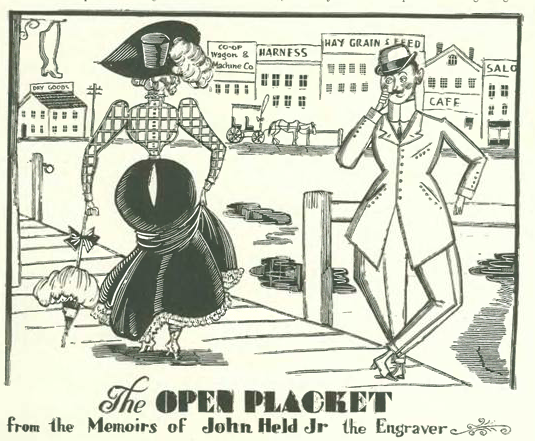
…John Held Jr. was back with one of his slightly naughty “engravings”—these were favorites of founding editor Harold Ross, with his rustic tastes…
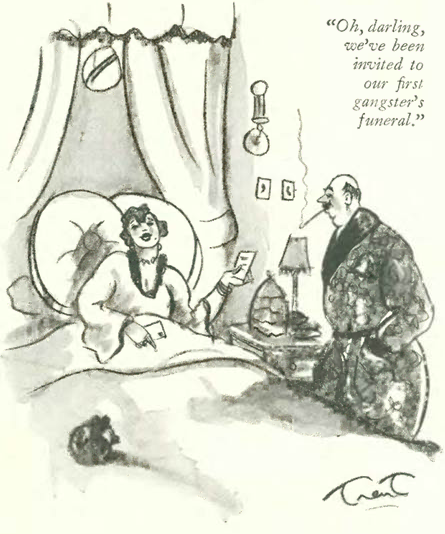
…W.P. Trent explored the strange ways of social status…
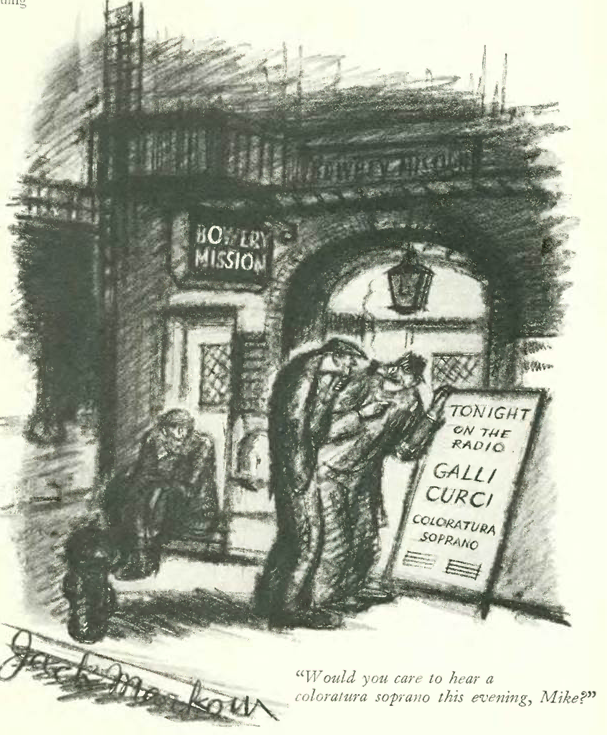
…Jack Markow looked in on life on the skids, a theme that would become more frequent as the Depression deepened…
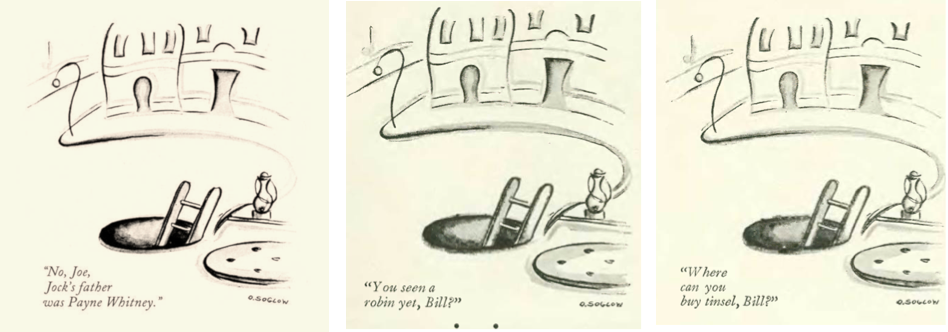
…and after thirty installments throughout 1929, Otto Soglow’s manhole series — a one-panel gag featuring dialogue from unseen workers Joe and Bill…
…came to an end when Joe and Bill finally emerged…
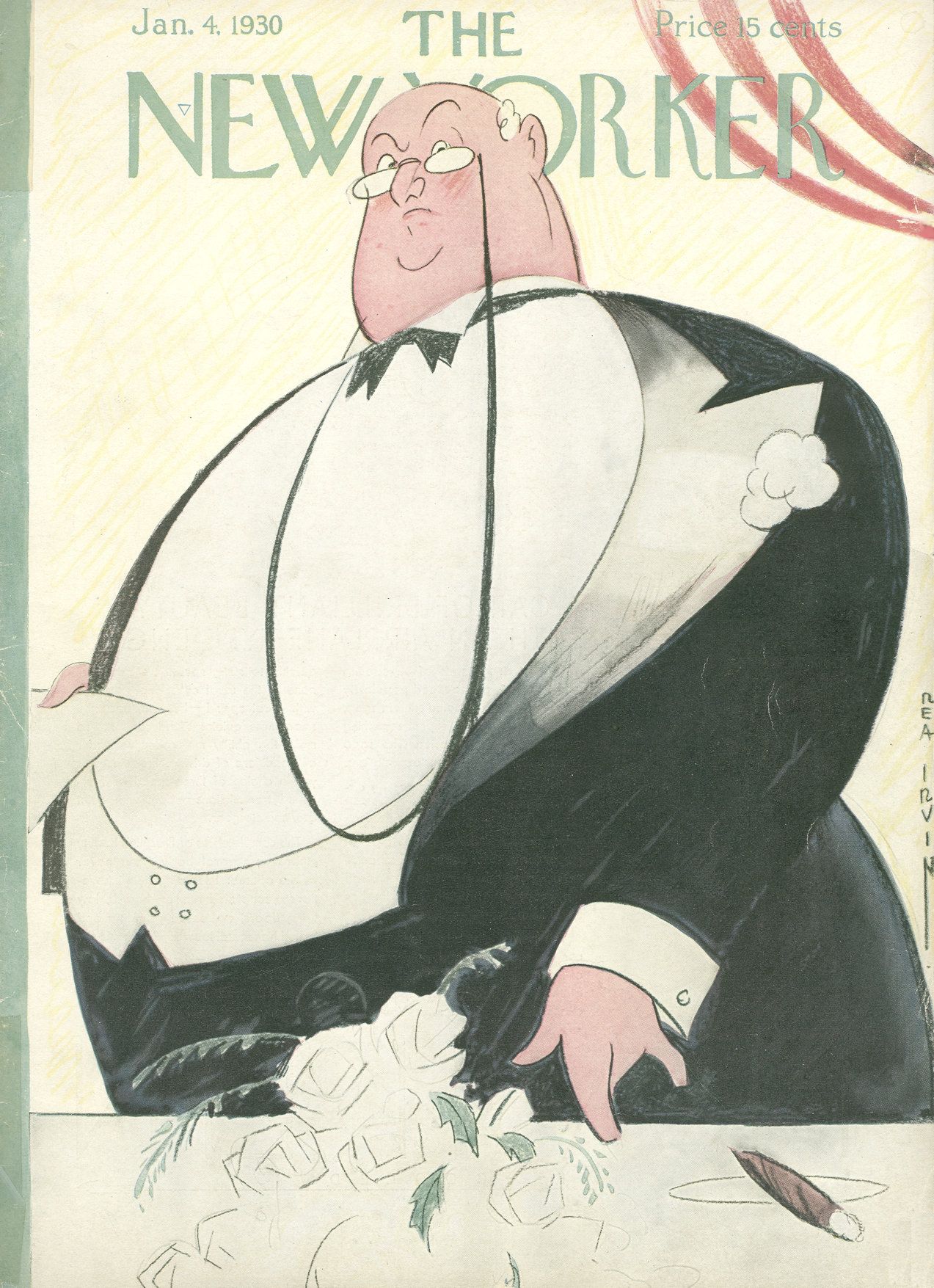
The imposing of image of a fat, fearsome banker greeted readers of the Jan. 4, 1930 issue of TheNew Yorker, an apt symbol for the dawn of a new decade in a country whose fate seemed wholly in the hands of the old moneymen.
Jan. 4, 1930 cover by Rea Irvin.
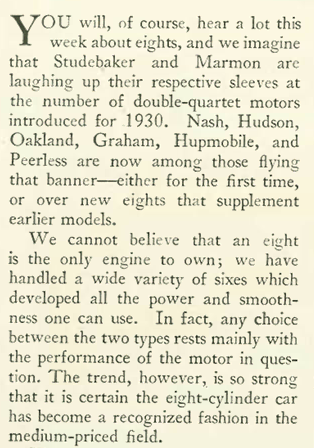
However bleak the outlook, the show still had to go on, and automakers did their best to entice crowds to the National Automobile Show at the Grand Central Palace. TheNew Yorker’sNicholas Trott wrote of a “tentative modernism” on display at the show as automobile styles continued to transition from “horseless carriages” to something that looked decidedly modern. Trott’s column, illustrated by Peter Arno…
…made note of the modern angles of Art Deco that were creeping into the designs…
DAZZLING DASHES…Clockwise, from top left, the 1930 Essex sported an Art Deco instrument panel, as did the 1930 Hudson Great Eight Sedan. (hemmings.com/Free Library of Philadelphia)
…Trott also noted the increasing popularity of eight-cylinder cars (as evidenced in ads featured later in this blog post)…
TEMPLE OF TRANSPORTATION…Top left, postcard image of the Grand Central Palace exhibition building, circa 1916. At right and below, new automobiles on display at the Palace in the early 1930s. (Wikipedia/NY Daily News)
* * *
Flappers Get Flappy
Automobile designs weren’t the only changes seen on the streets of New York. In “Notes and Comment,” E.B. White lamented the introduction of “ear flaps” on women’s hats…
THEY FLOP, JUST LIKE THE STOCK MARKET…A selection of women’s hats from a 1930 Chicago Mail Order Company catalog. (elfsacks.com)
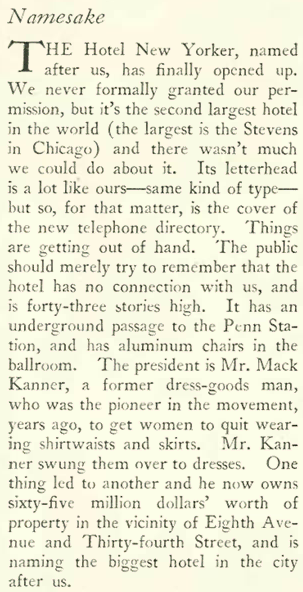
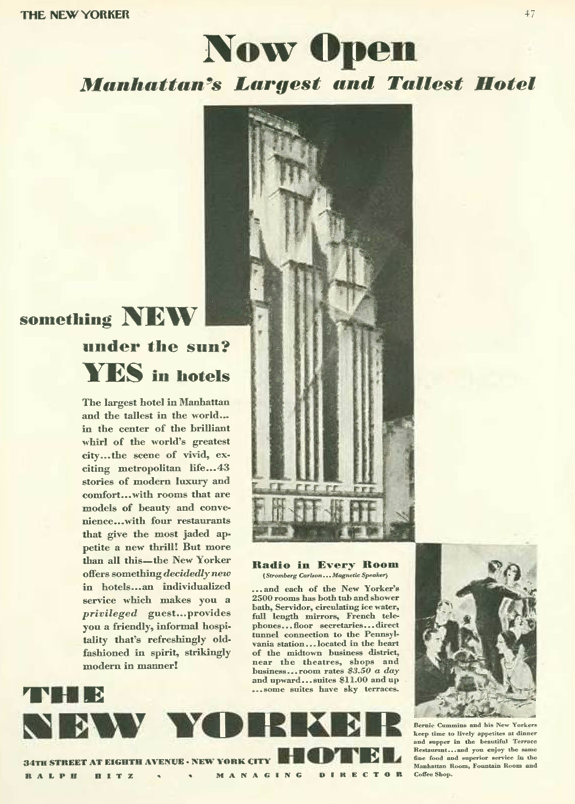
…while on the other hand, in “The Talk of the Town” White welcomed the addition of a namesake hotel to the New York skyline…
NAMESAKE…The 43-story Hotel New Yorker at 481 Eighth Avenue, by architects Sugarman and Berger, opened on January 2, 1930, with more than 2,500 rooms starting at $3.50 a night. At left, the hotel following its completion; top right, construction on the hotel began just 22 months earlier; bottom right, the Terrace Room nightclub was a popular spot for dancing in the 1930s and 40s. (The New Yorker Hotel/americanfoodroots.com)
…White noted that the “New Yorker” name seemed to be popping up everywhere…
A NEW LEASE ON LIFE…The hotel as it appears today. With the decline of train travel (the hotel was near Penn Station), the Hotel New Yorker closed in 1972 and was purchased by the Unification Church in 1975. Subsequently much of the original Art Deco detailing was lost, and the hotel’s famed Louis Jambor murals were painted over. Beginning in the mid-1990s the New Yorker Hotel Management Company launched a $100 million capital improvement project (top right). Fortunately, the Art Deco doors of the Manufacturers Trust Company offices (below) were preserved, as was company’s lobby. (Wikipedia/Daytonian in Manhattan)
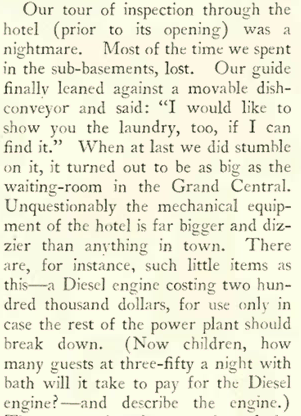
…and White marveled at the building’s massive scale…
WHAT LIES BENEATH…Popular Science (April 1930) offered a view into the bowels of Hotel New Yorker, 78 feet below street level. (tparents.org)
According to Tom Miller’s excellent blog Daytonian in Manhattan, the New Yorker was the largest hotel in city: “it boasted 2,500 rooms, murals by renowned artist Louis Jambor, the largest barber shop in the world (42 chairs and 20 manicurists), 155 chefs and cooks for the five restaurants. Employing 92 telephone operators, the hotel had one of the largest switchboards in the country…Its basement power plant was the largest private plant in the United States. The Great Depression apparently never heard of the New Yorker Hotel as satin-gowned movie stars and top-hatted politicians crossed its marble-floored lobby.” (Inventor Nikola Tesla spent the last ten years of his life in near-seclusion in Suite 3327).
The Unification Church purchased the building in 1975, removing Art Deco details and painting over the Jambor murals. In 1994 the New Yorker Hotel Management Company launched what would be a $100 million capital improvement project. Miller writes that during the renovation “the original marble floors were exposed from under yards of threadbare carpeting.” And happily, “when the doors to the old Manufacturer’s Trust Company were opened, the old 1929 lobby was intact…the Jambor murals (in the Trust’s lobby) survived. The Art Deco terrazzo floors remained. And the tiled corridor to Penn Station still stretches diagonally beneath 8th Avenue, now used as storage for security reasons.”
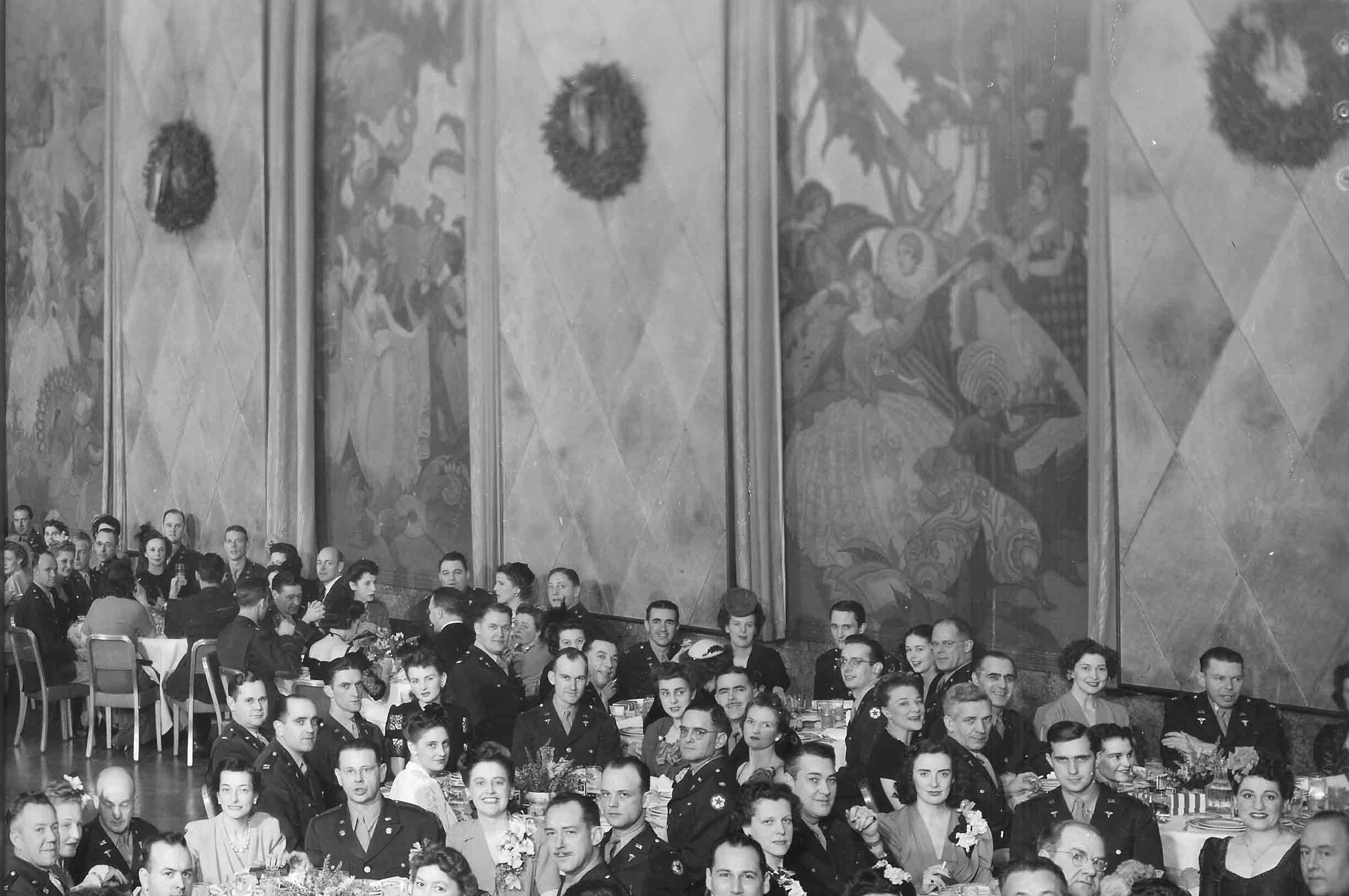
EPHEMERAL ART…Murals by renowned artist Louis Jambor, seen in this photo of the ballroom in the 1940s. The murals were painted over in the 1970s after the hotel was acquired by the Unification Church. (The New Yorker Hotel)
* * *
Ways of Seeing
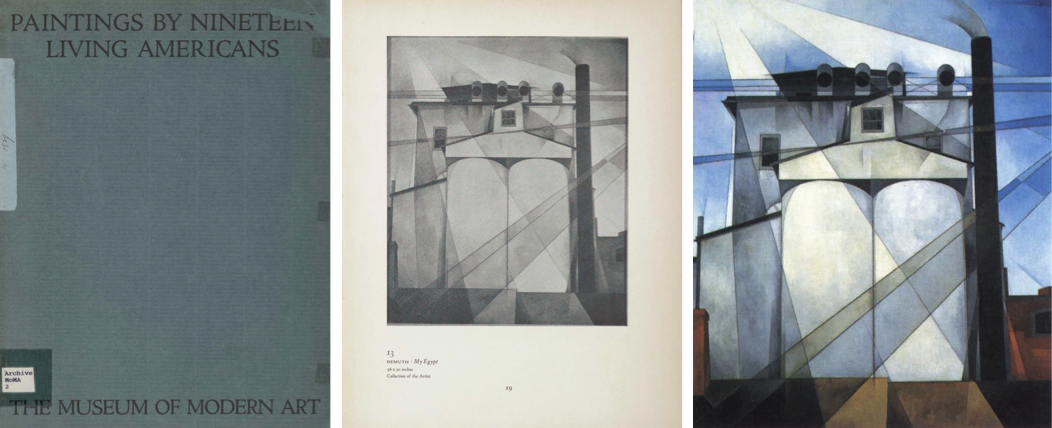
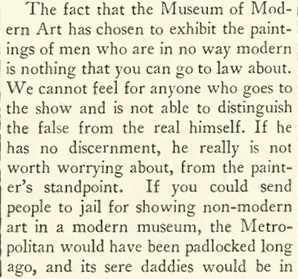
Art critic Murdock Pemberton (1888-1982) continued to ponder the meaning of the new Museum of Modern Art, which was staging its second-ever exhibition in its galleries on the 12th floor of the Heckscher Building on Fifth Avenue:
ARE WE NOT MODERN? Charles Demuth’s My Egypt, (oil on composition board, 1927) was among works featured in the Museum of Modern Art’s second exhibition, Paintings by Nineteen Living Americans. From left, cover of the exhibition catalog, a page from the catalog featuring Demuth’s painting, and as the work appears in color. (MoMA/WikiArt)
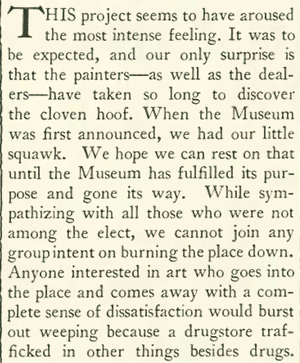
No doubt Pemberton, who came from humble Kansas roots, found it difficult to warm up to a gallery founded in November 1929 by three society women — Mary Sullivan, Lillie Bliss and Abby Rockefeller…
…and wryly suggested that perhaps another museum could be founded, “The Modernest Modern Museum,” for those who lacked clout or patronage with MoMA’s well-heeled board of directors…
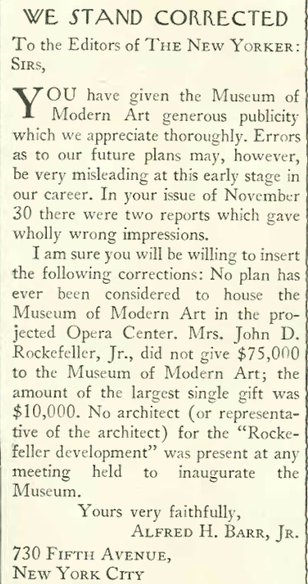
Pemberton’s grumblings caught the attention of Alfred Barr Jr., the first director of the Museum of Modern Art, who sought a correction (printed in the back pages of the Jan. 4 issue) regarding some of Pemberton’s earlier observations of the museum. No doubt Barr was feeling some Rockefeller heat as well:
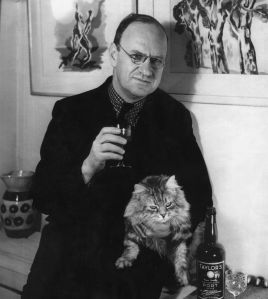
HERE’S MUD IN YOUR EYE…Murdock Pemberton, apparently endorsing Taylor’s Port in 1937. (observer.com)
For some insight into Pemberton’s populist views (the old meaning of the word, not the new one), the critic’s granddaughter, Sally Pemberton, had this to say in a 2012 New Yorkerinterview:
“Being from humble roots in Kansas and having worked to help support his family since he was a young boy, Murdock had a love-hate relationship with the upper echelon of society. He visited “plush hung galleries” and saw how museums treated art and artists in the nineteen-twenties and thirties, and he wanted art to be more accessible. He asked that the Met set aside a room for the work of living artists. He called for art to be displayed in libraries and universities, and in some cases to be sold in department stores. He wrote about what a wonderful thing it was when the W.P.A. put murals in post offices around the country and how that changed the American public’s perception of art.”
Ms. Pemberton is the author of Portrait of Murdock Pemberton: The New Yorker’s First Art Critic.
* * *
From Our Advertisers
More ink for the newly opened Hotel New Yorker in this advertisement on page 47…
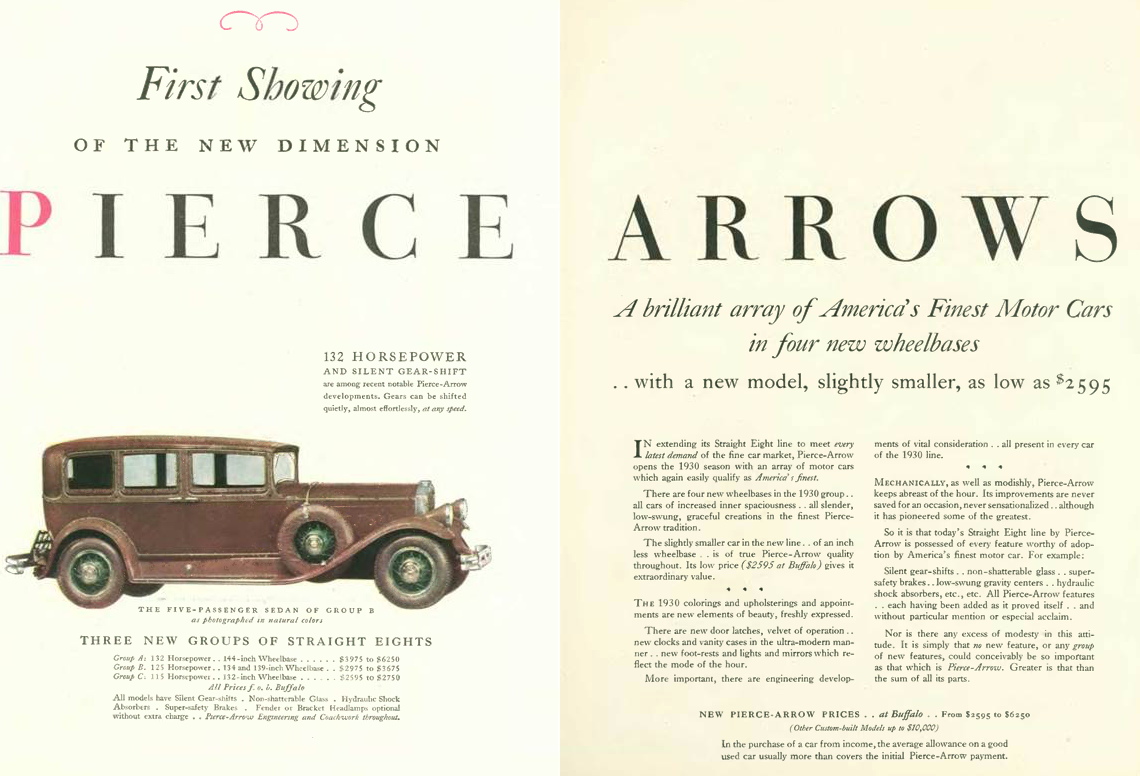
…and with the automobile show in town, the magazine was filled with numerous splashy car ads…Franklin with its air-cooled engine, Hupmobile with its powerful eight, and Pierce-Arrow—America’s answer to Rolls Royce—would all fall victim in the 1930s to the Great Depression…
…the magazine also featured numerous ads beckoning the well-heeled to warmer southern climes, including society snowbirds seeking respite at Palm Beach…
…this ad from Flit (drawn by Dr. Seuss) seemed to recall the old filler joke from the first issues of The New Yorker, a riddle told backwards:
POP: A man who thinks he can make it in par. JOHNNY: What is an optimist, pop?
…Peter Arno offered his talents in this illustration for the theater review section…
…and this cartoon peek into society night life…
…glimpses of domestic life were provided by Perry Barlow…
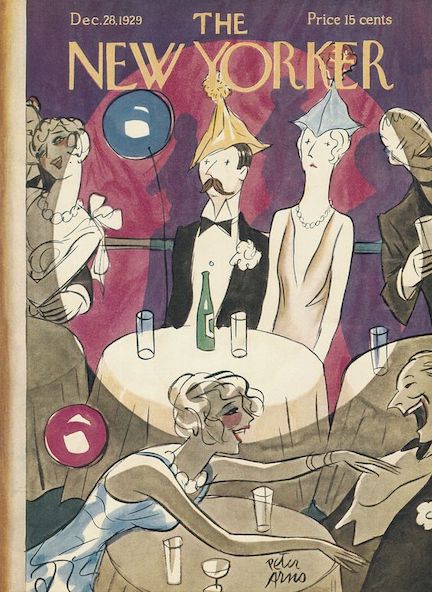
PeterArno’s cover illustration for The NewYorker’s final issue of 1929 aptly captured the mood of that decade’s last days.
Dec. 28, 1929 cover by Peter Arno.
As we’ve seen in the pages of the magazine in 1928 and 1929, people were growing weary of Jazz Age frivolity even before the great crash. For example, LoisLong’s weekly “Tables for Two” column, which deftly captured the nightlife scene of speakeasies and flappers, appeared infrequently in the decade’s last years, and would disappear altogether in 1930. Once herself the epitome of the carefree flapper, Long was now a mother with a one-year-old toddler.
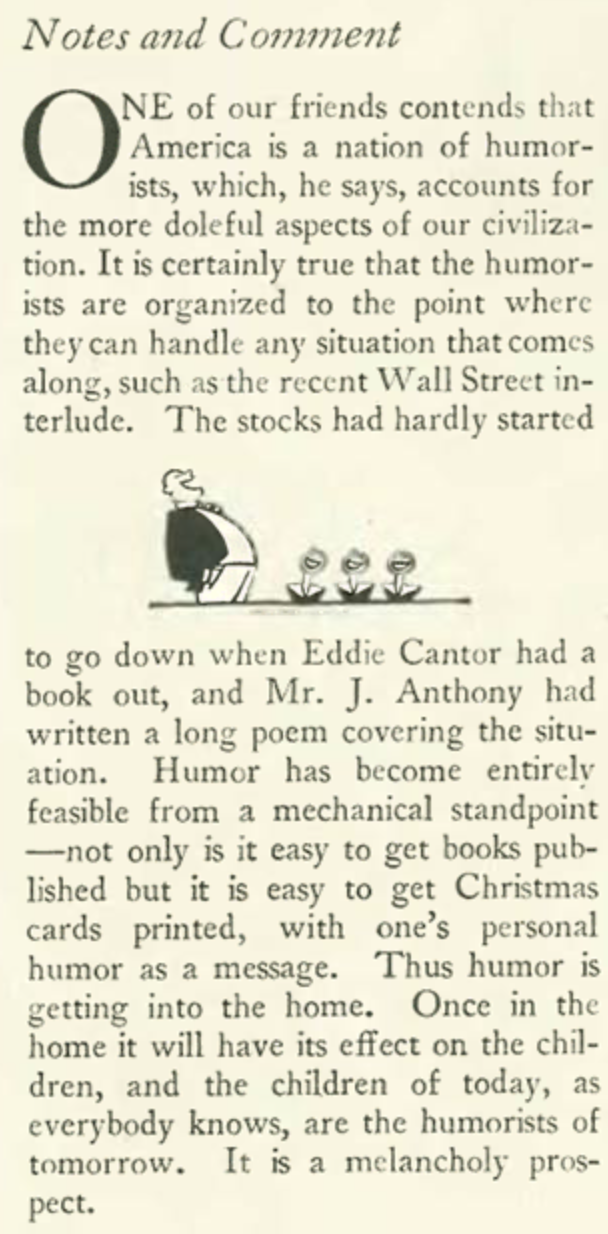
In his “Notes and Comment” column, E.B. White ended the decade on a humorous, if somewhat doleful note:
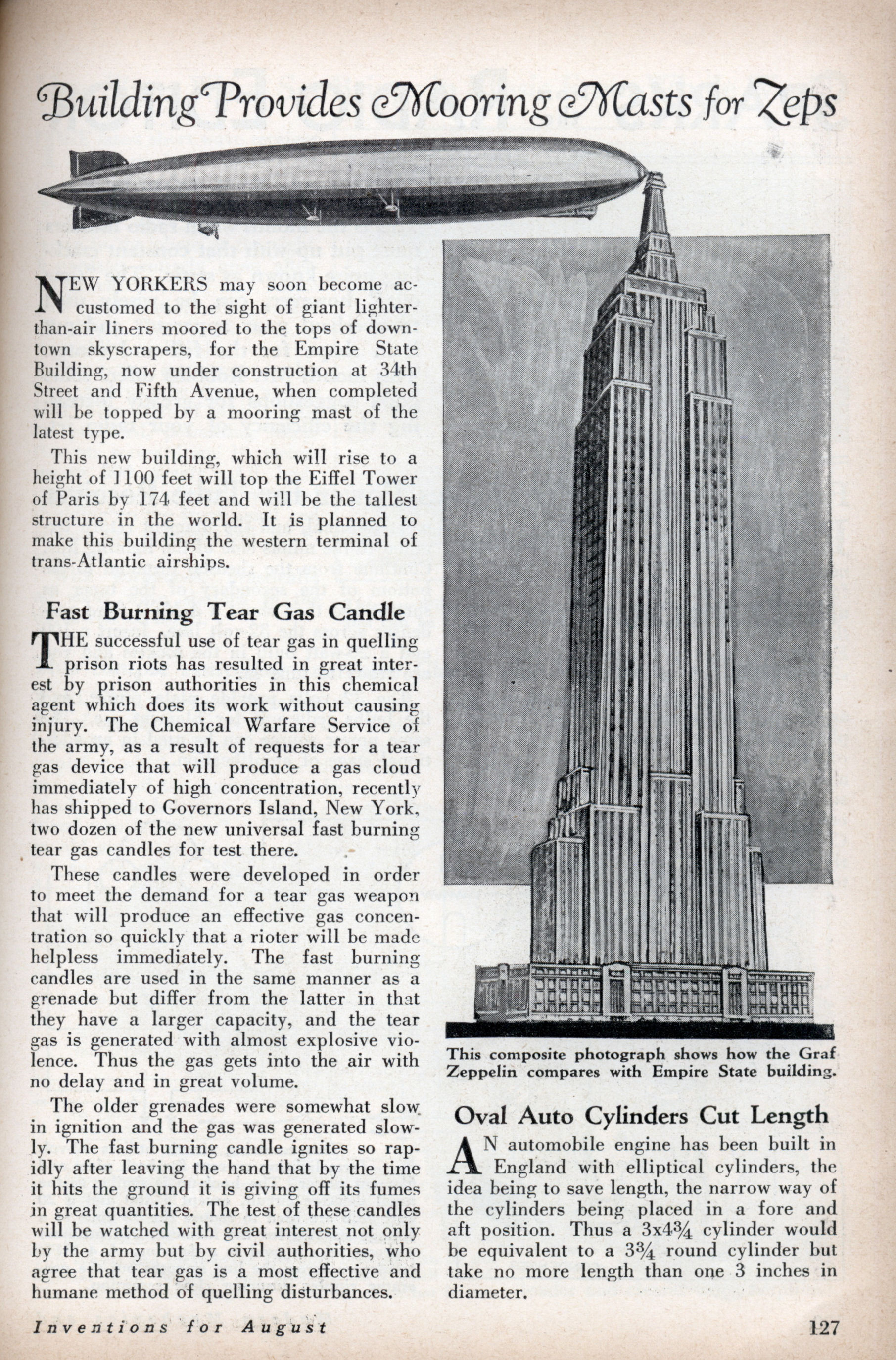
In “The Talk of the Town,” White also looked to the new year, which would see AlSmith’s Empire State Building rise into the air and forevermore define the city’s skyline, even if his dirigible mooring mast proved to be more of a marketing stunt than a working feature of the new skyscraper:
A LOT OF HOT AIR…Image from the August 1930 issue of ModernMechanix. The idea of transatlantic dirigibles ferrying passengers to skyscrapers seemed plausible in 1930, but in reality giant bags of flammable hydrogen, attached to wind-whipped masts above densely populated areas, proved impractical, if not downright insane. (Modern Mechanix)
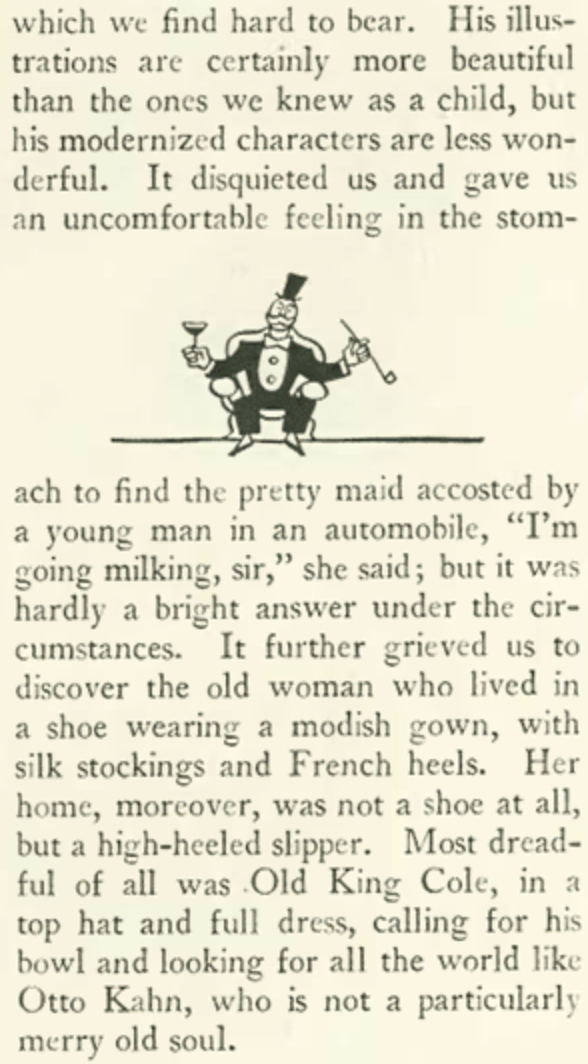
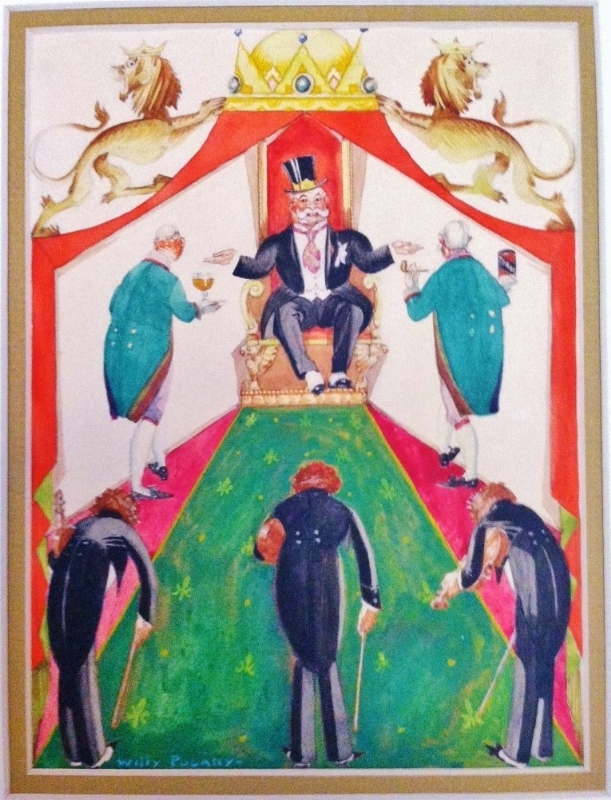
“Talk” (via E.B. White) took another shot at illustrator WillyPogany, who had recently updated the drawings in AliceinWonderland, transforming little Alice into a tween flapper. This time Pogany was “taking liberties” with dear old Mother Goose:
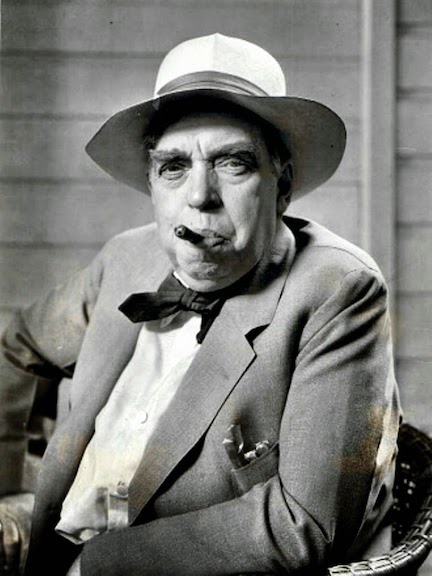
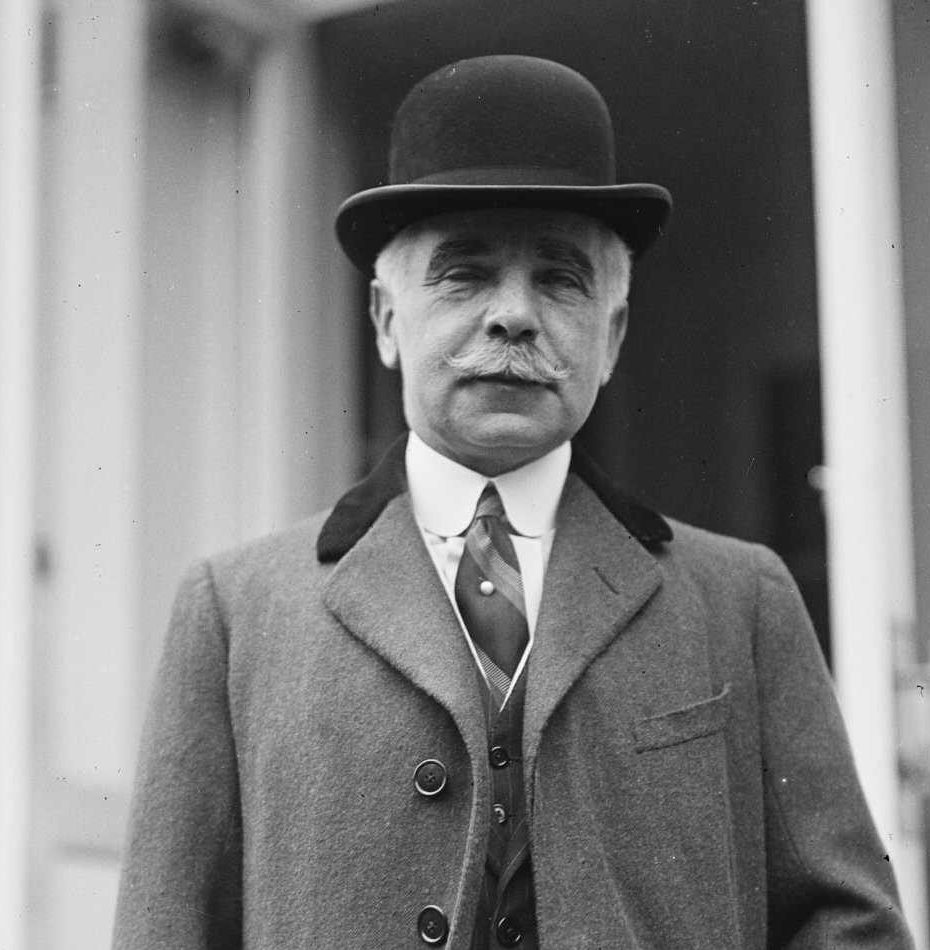
BIG DADDY…WillyPogany’s rendering of Old King Cole left something to be desired, according to E.B. White, who found the resemblance to investment banker OttoKahn (below) rather unsettling.(comic art fans.com/thoughtco.com)
* * *
Historian FrederickLewisAllen, who would go on to write the definitive history of the 1920s in his bestselling Only Yesterday (1931), offered some tongue-in-cheek advice on how the average American could contribute to renewed economic prosperity. An excerpt:
HowardBrubaker also finished the decade on a wry note, his “Of All Things” column ending thusly:
The Dec. 28 profile (titled “The Wizard”) featured ThomasEdison, the first in a three-part series written by AlvaJohnston (with illustration by HugoGellert):
* * *
The New Hollywood
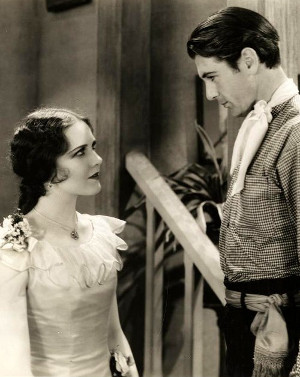
The decade would begin with a new crop of “talkie” stars that would signal a new era for Hollywood. Among the emerging stars was the young GaryCooper…
SHE LIKES THE SILENT TYPE…MaryBrian as Molly Wood and GaryCooper as the Virginian in the Victor Fleming-directed film TheVirginian. (1929) (onceuponatimeinawestern.com)
FromOurAdvertisers
The Dec. 28 issue was filled with ads that enticed readers to escape the cold of winter and head south…
…and given the new economic climate, grasping social climbers could travel to nearby Havana and still claim to have visited a foreign land…
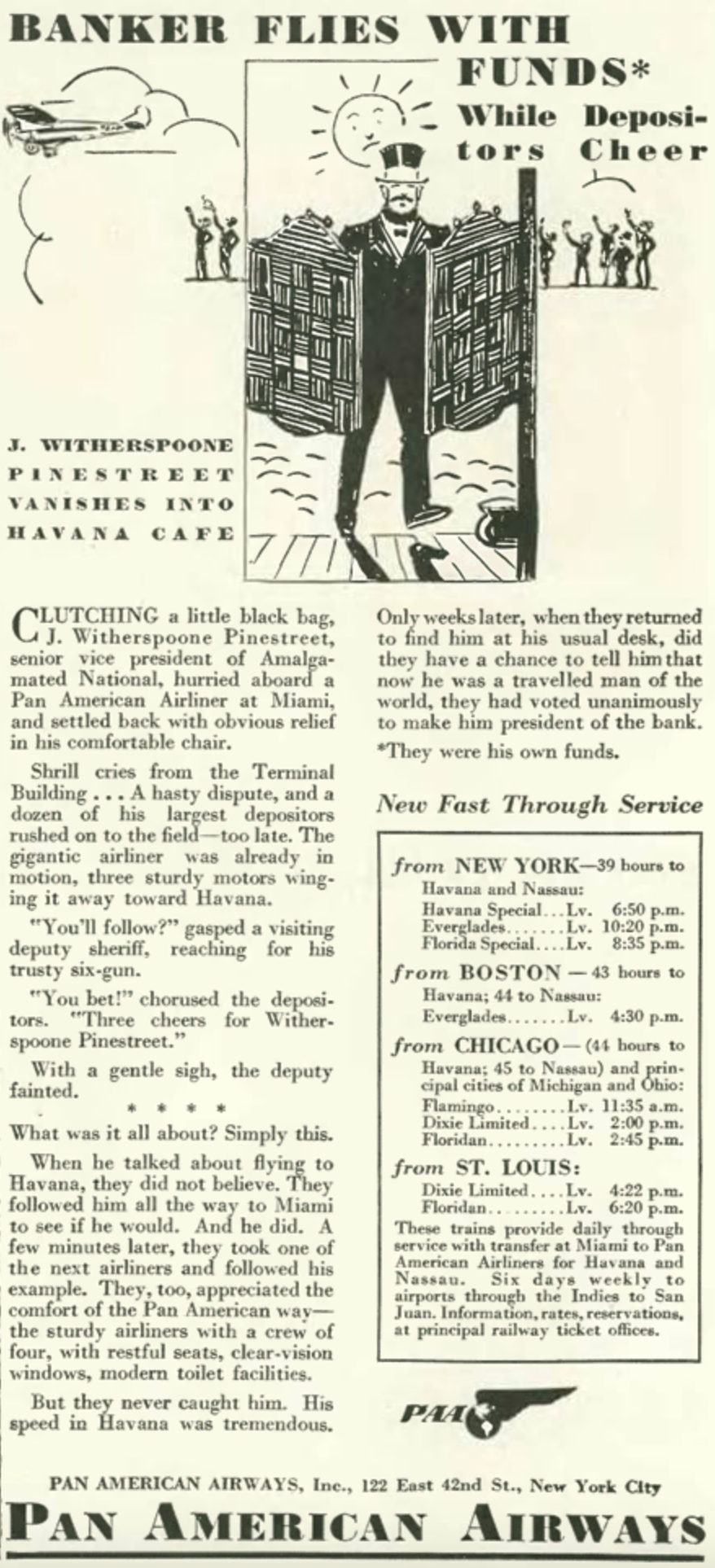
…and Pan American Airlines offered this unique take on the market crash to entice readers to sunny Havana…
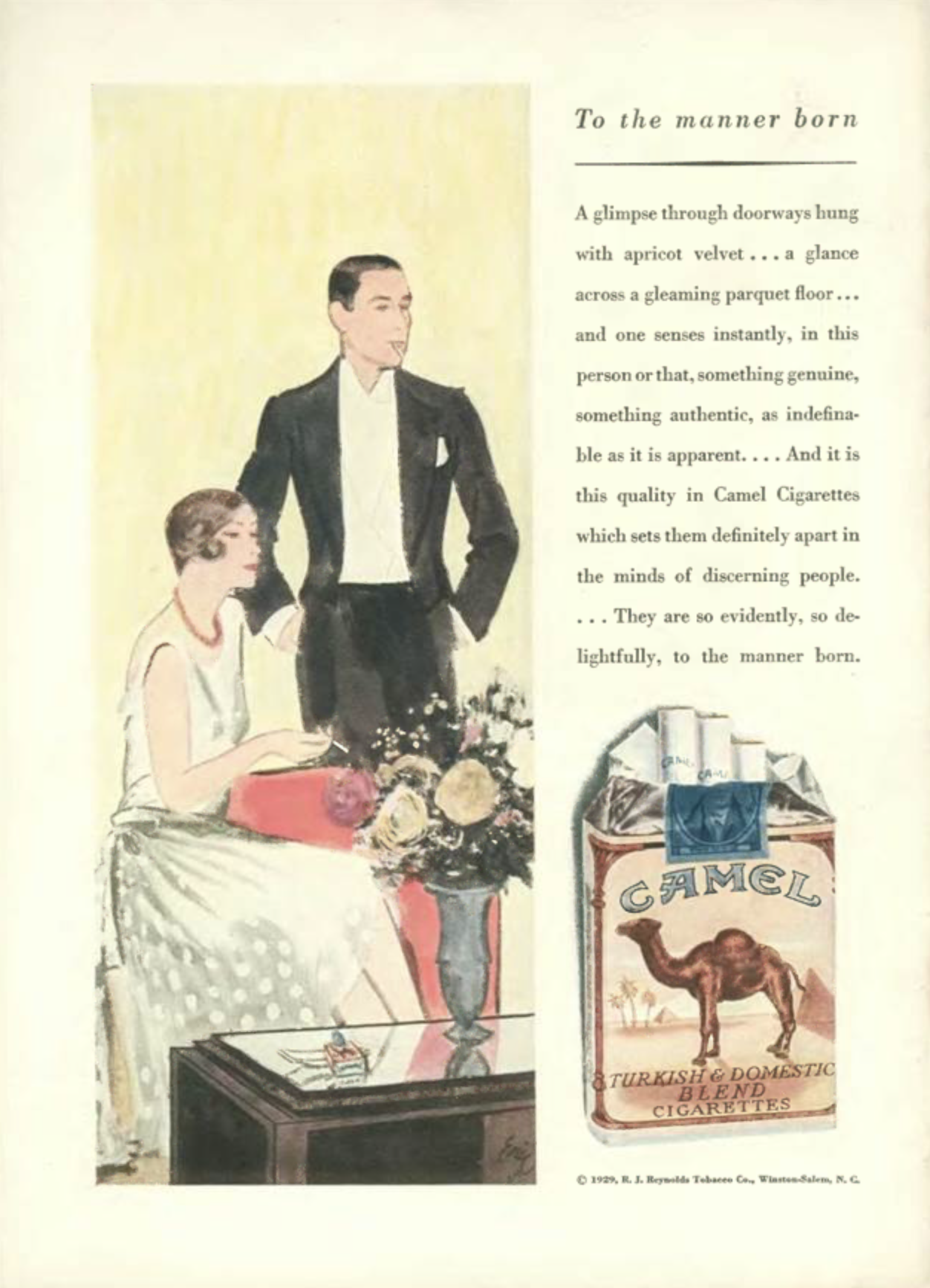
…despite the crash, the folks at R. J. Reynolds Tobacco Company still clung to the fantasy of the posh set…you might be flat broke, but you could keep a stiff upper lip while you sucked on a Camel, old sport…
…on to our illustrators, MiguelCovarrubias contributed this drawing for the theater review section…
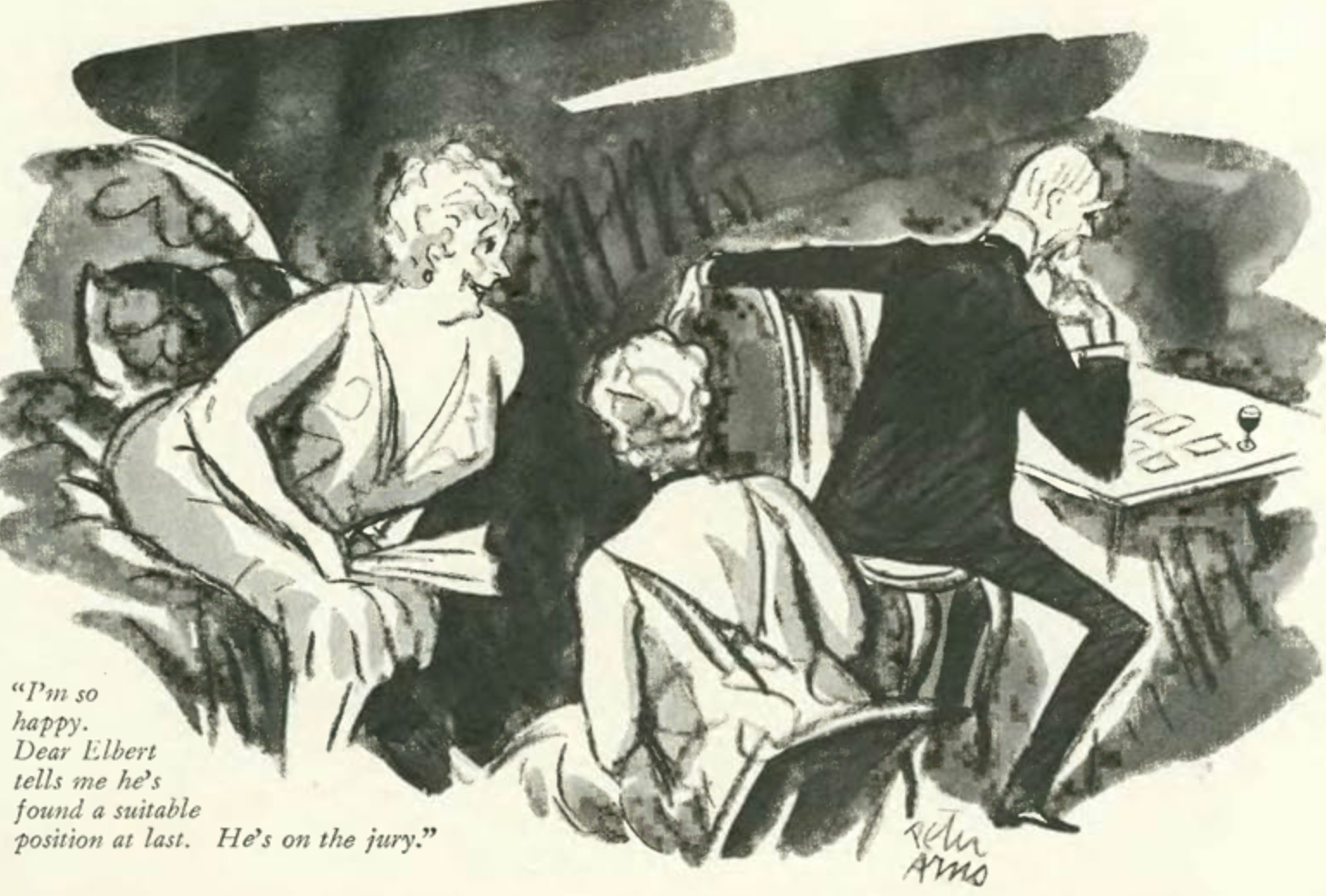
…and our cartoons are by PeterArno…
…JohnReynolds…
…and IsadoreKlein, who gave us an appropriate image for the turn of a decade…
























































































































 A New Yorker State of Mind