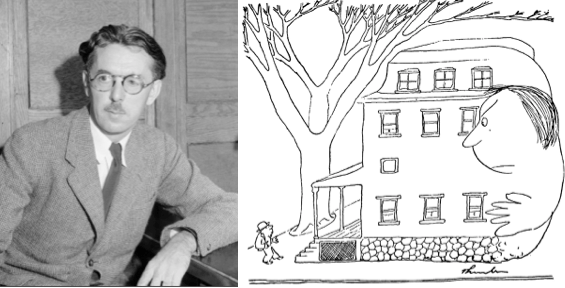
Whether probing the battle of sexes or exposing the secret lives of daydreamers like Walter Mitty, James Thurber (pictured above) had a knack for revealing the frustrations and various tics that plagued ordinary people.
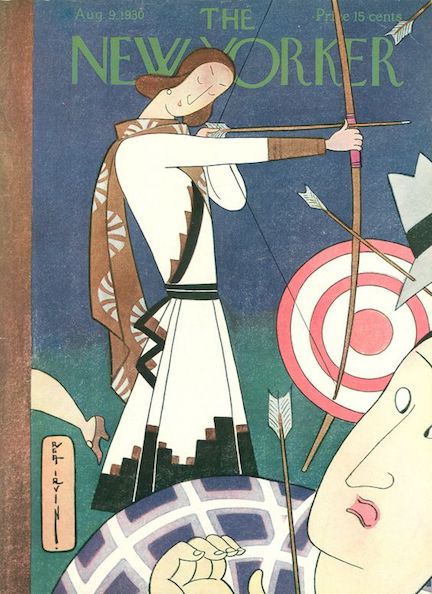
Aug. 9, 1930 cover by Rea Irvin.
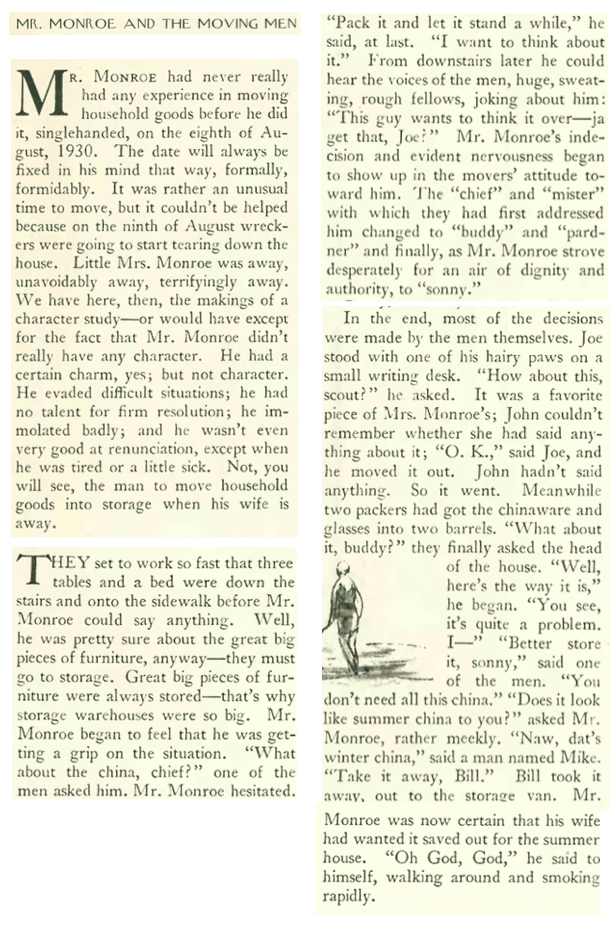
That included the fictional John Monroe, whom Thurber placed in various awkward situations in a series of humorous stories, including this encounter with some moving men that required the rather inept Monroe to make a series of decisions usually left to his wife, Ellen. Some excerpts from the Aug. 9 issue:
ODD COUPLES…Sue Randall and Orson Bean portrayed Ellen and John Monroe on a 1961 episode of The DuPont Show with June Allyson. (findagrave.com/Wikipedia)…a decade later, William Windom, left, and Joan Hotchkis portrayed John and Ellen Monroe on the Thurber-inspired (and award-winning) NBC comedy My World and Welcome to It (1969-70). (TV Guide)
* * *
Beats the Heat
In the hot August of 1930, film critic John Mosher probably found the air-conditioned theaters to be the best feature of the cinema, given the generally mediocre quality of the summer movies. Mosher also noted the new trend of adapting Broadway plays to the screen, a practice that continues to this day.
THE SOUND OF 1930…Joan Crawford (left) examines a boom microphone on the set of Our Blushing Brides. Although most films were produced with sound in 1930, it was still something of a novelty to actors who began their careers in the silent era; at right, Douglas Fairbanks Jr. and Anita Page in Little Accident. (IMDB)
* * *
From Our Advertisers
Well, who doesn’t love a whole chicken in jar, ready to “fry or cream” in just 20 minutes? This was actually a big deal in 1930, given that chicken dinners were not as common back in the days before factory farms and Chick-fil-A…
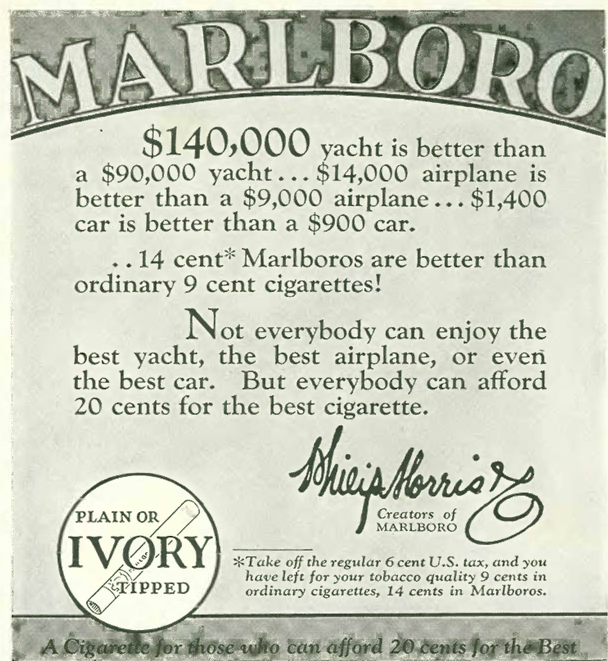
…the makers of Marlboro cigarettes abandoned their essay and penmanship contests and took another direction with their drab, back-page ads, appealing to a vague sense of status in the prospective smoker…
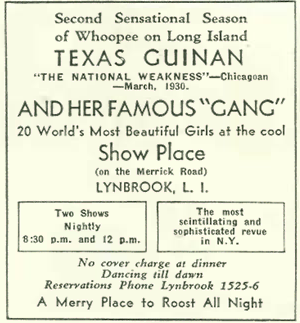
…this sad little bottom-of-the-page ad enticed readers to take a drive in the country to see Texas Guinan and her “Famous Gang” still whooping it up like it was 1925. The venture was short-lived…
…on to our cartoons, Peter Arno looked in on nightlife in the city…
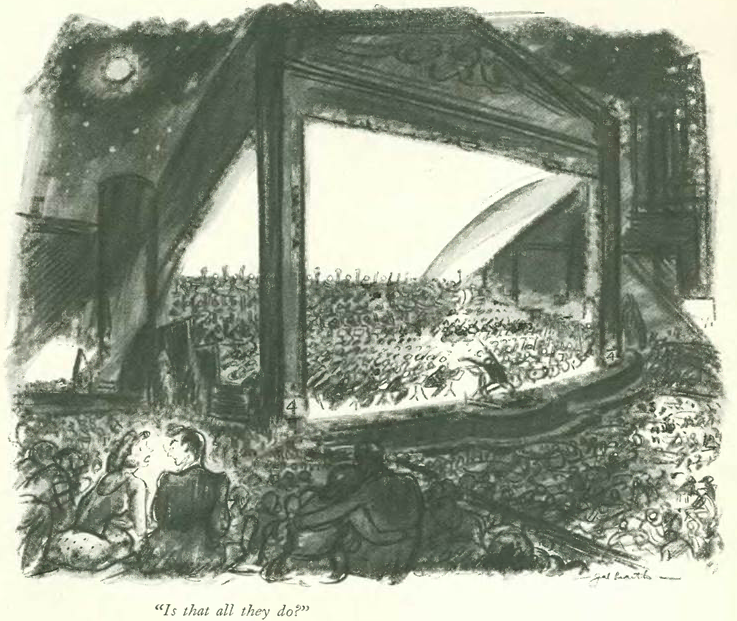
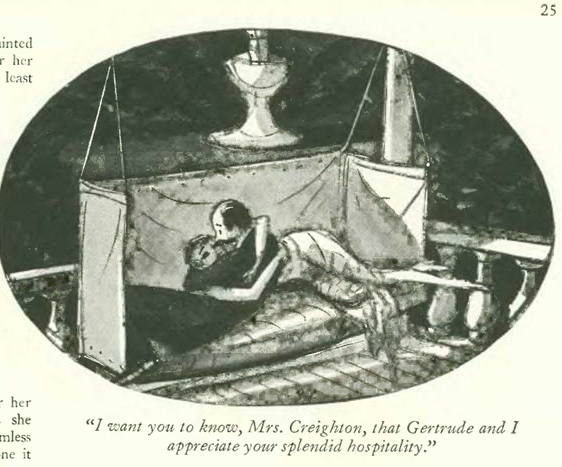
…William Crawford Galbraith took in an outdoor concert…
…Ralph Barton offered his comic skills to a glimpse of domestic life…
…Garrett Price observed some boaters on an outing that would be frowned upon today (or at least I hope so)…
…and Constantin Alajalov examined the pitfalls of modern art…
* * *
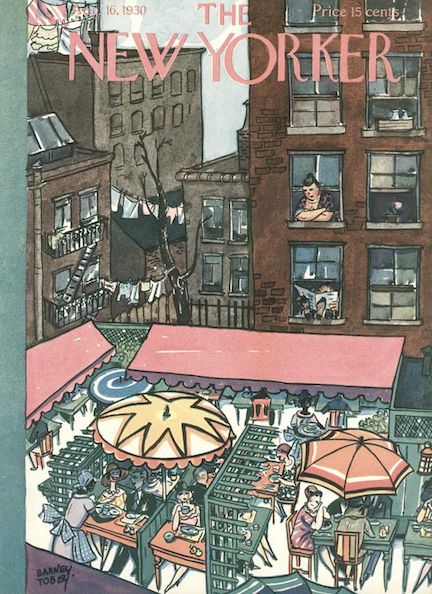
Speaking of art, we move on the Aug. 16, 1930 issue…
Aug. 16, 1930 cover by Barney Tobey.
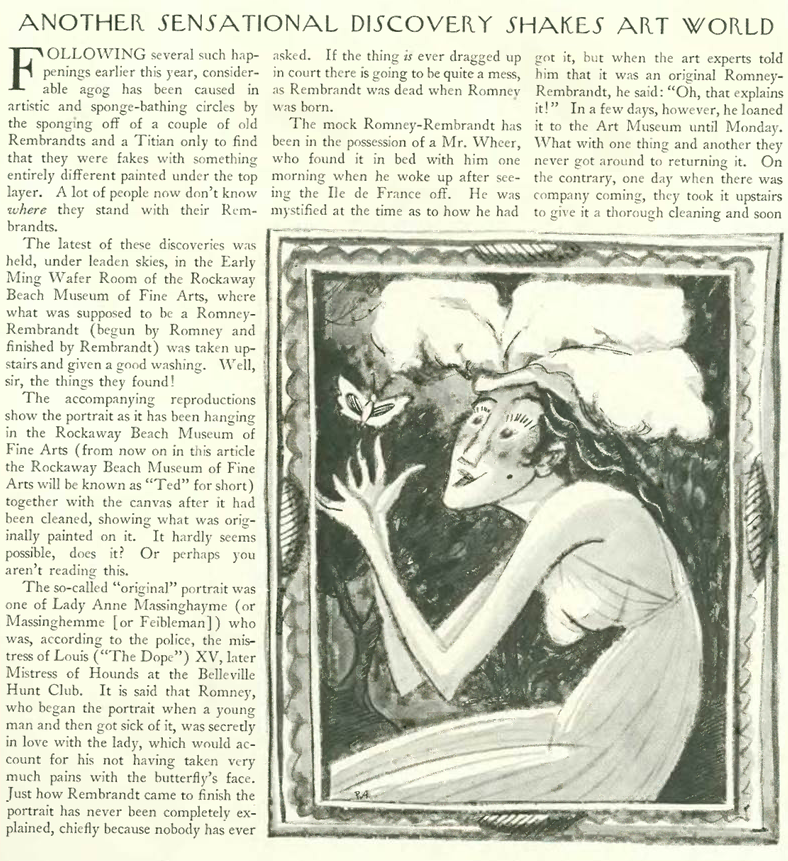
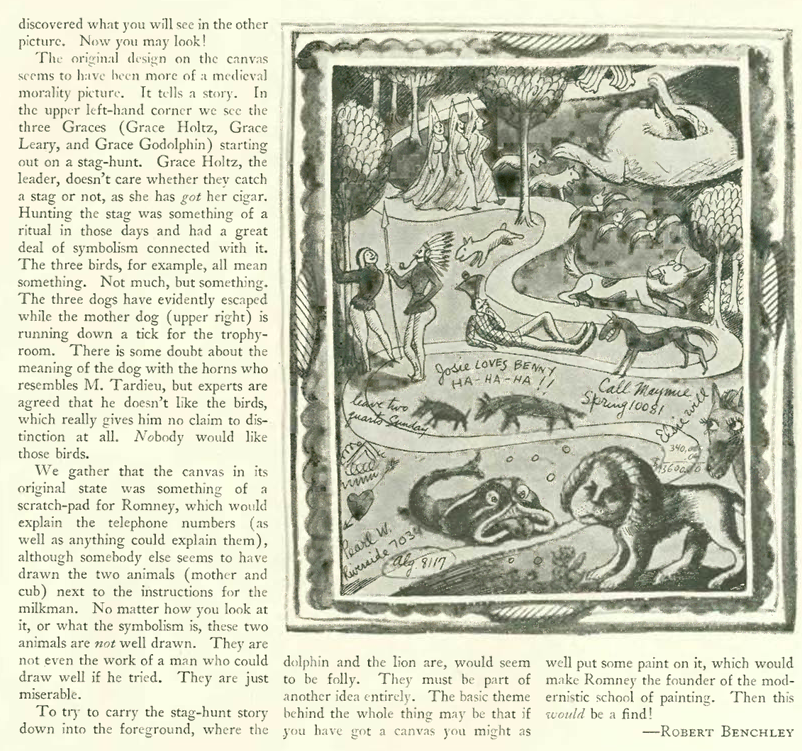
…in which Robert Benchley has fun with the foibles of the art world…
* * *
Rough Riders
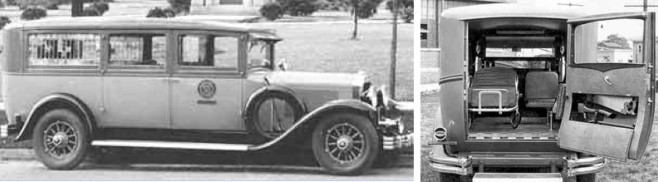
In his “Reporter at Large” column, Morris Markey looked in on the working world of one chain-smoking ambulance driver…some excerpts…
SLIDE ‘EM IN…1930s Flexible ambulance and its rather cramped interior. (coachbuilt.com)
* * *
From Our Advertisers
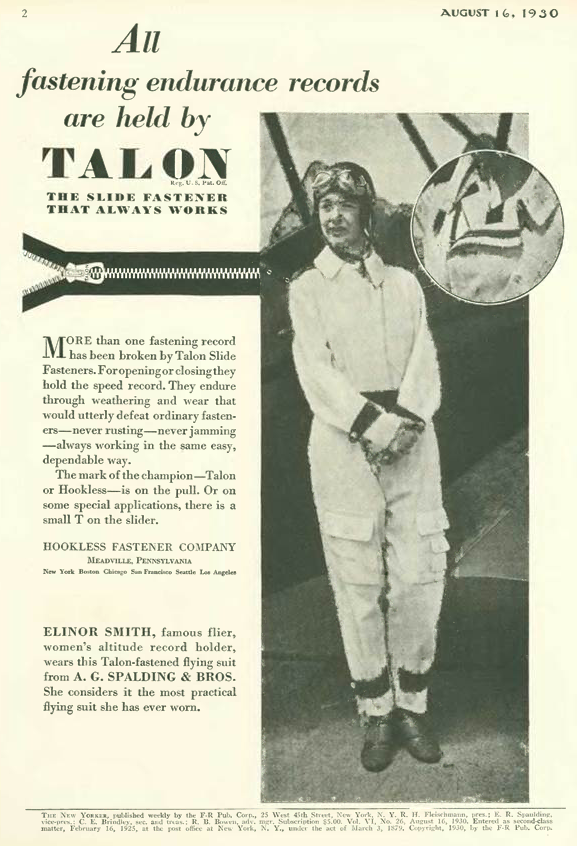
Hard to believe that zippers were a novel invention just 90 years ago…in this ad from the leading manufacturer, Talon, this “hookless” wonder was still referred to as a “slide fastener”…
…the Chrysler Corporation was never the biggest car company in America, but it was always known as a leader in both technology and design, as in these graceful lines that flowed over its new “Straight Eight” models…
…the makers of Camel cigarettes continued to push their product as a sound way to stay fit and trim…
…in the cartoons for Aug. 16, this drawing by Peter Arno appeared for the fifth time in the magazine, always with a different caption (the others appeared in three consecutive issues — June 5, 12 and 19, and on Aug. 2, 1930)…
…William Crawford Galbraith detected some wet vs. dry tension at the country club…
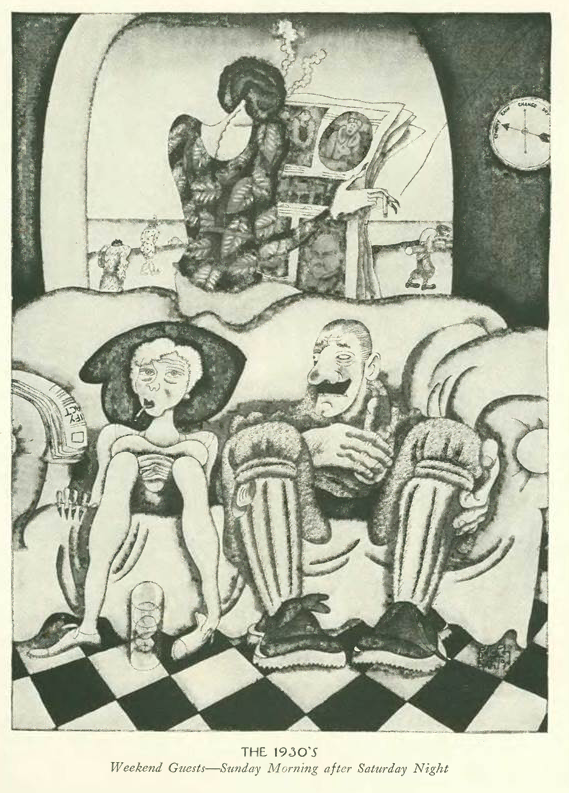
…Ralph Barton returned with another full-page illustration of a weekend domestic scene…
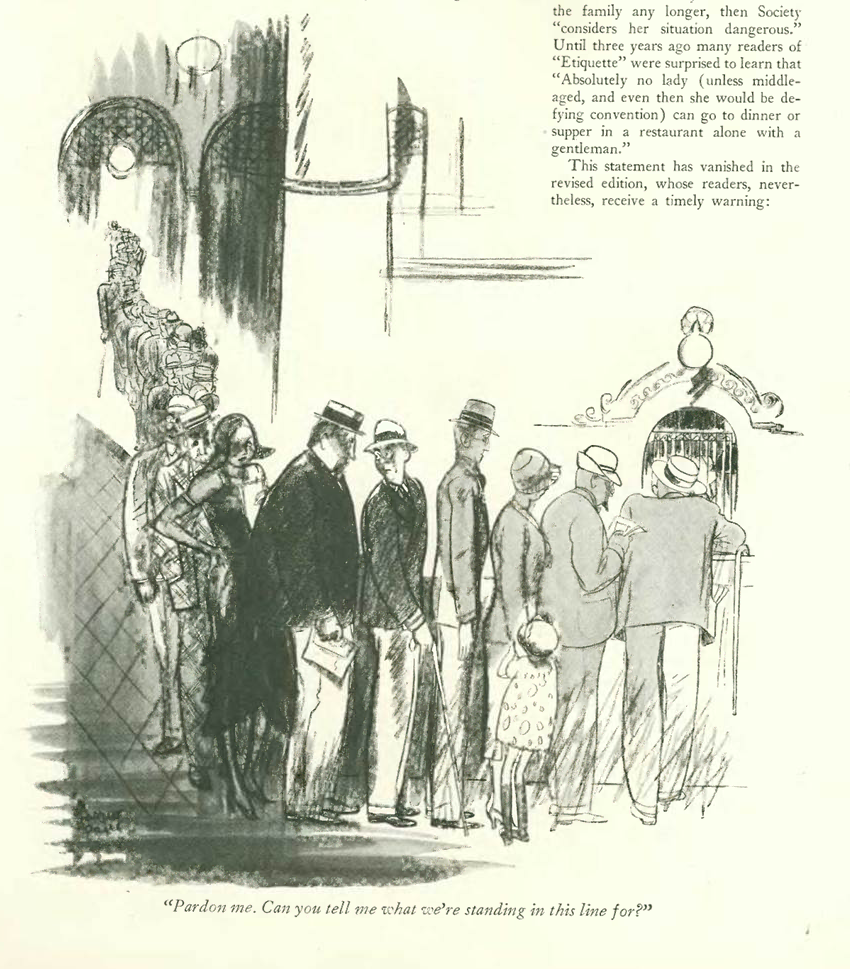
…Garrett Price found confusion in a lengthy queue…
…and Kemp Starrett gave us a bird’s eye view of a future New Yorker…
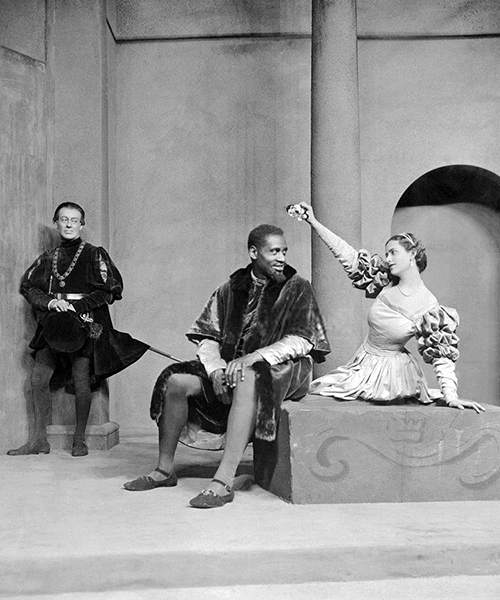
In 1930s America there were few if any opportunities for black actors to perform in mainstream stage or screen productions unless they conformed to racial stereotypes. An exception was Paul Robeson.
June 21, 1930 cover by Gardner Rea.
In 1930 Robeson (1898-1976) won rave reviews for his performance in Shakespeare’s Othello. That performance, however, took place in London, not New York, which London correspondent Anthony Gibbs took pains to point out in his dispatch for the June 21, 1930 New Yorker.
English actress Peggy Ashcroft as Desdemona and Paul Robeson as Othello in London’s Savoy Theatre production of Othello in 1930. Although only 22 at the time, Ashcroft was an established Shakespearean actress. The 32-year-old Robeson was already famous as both an athlete and actor. He was twice named a consensus All-American in football (Rutgers) and was the class valedictorian. He also received a law degree from Columbia while playing in the NFL. In 1930 he was already known to London audiences, having previously appeared in a 1928 London production of the American musical Show Boat. (theshakespeareblog.com)CENTER STAGE…Left to right: Maurice Browne (Iago), Paul Robeson (Othello) and Peggy Ashcroft (Desdemona) in Othello at the Savoy Theatre, 1930. Maurice Browne was also the play’s producer; his over-the-top portrayal of Iago and his wife’s incompetent stage direction hurt the production, but Robeson nevertheless received high praise for his performance. (britishstageandscreen.tumblr.com)
Although the performance was a triumph for Robeson, the production itself was a mess. The play’s producer, Maurice Browne, enlisted his wife, Ellen van Volkenburg, to direct (Peggy Ashcroft later called her “a pretentious dud”). Writing in The Guardian (Sept. 3, 2003), Samantha Ellis observes: “Recognising that his Othello transcended the ropey production, the audience gave Robeson 20 curtain calls. He reprised the role all over the world and never lost his pleasure in it. For Robeson, it was more than just a part: it was, as he once said, “killing two birds with one stone. I’m acting and I’m talking for the negroes in the way only Shakespeare can.”
Robeson’s Othello would not make it to New York until 1943. It would run for almost 300 performances, setting an all-time record run for a Shakespearean play on Broadway.
* * *
Restoring Order
In the aftermath of Grover Whalen’s disastrous (and sometimes violent) run as New York City Police Commissioner, E.B. White and his fellow New Yorkers welcomed the steady hand of Edward P. Mulrooney (1874-1960) to the helm:
THE COMMISH…Edward P. Mulrooney in a 1930s portrait by Edward Steichen. (Conde Nast)
* * *
The Commander
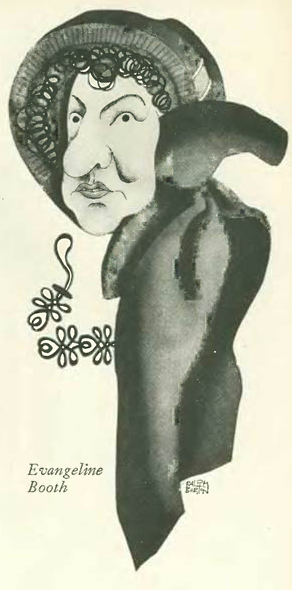
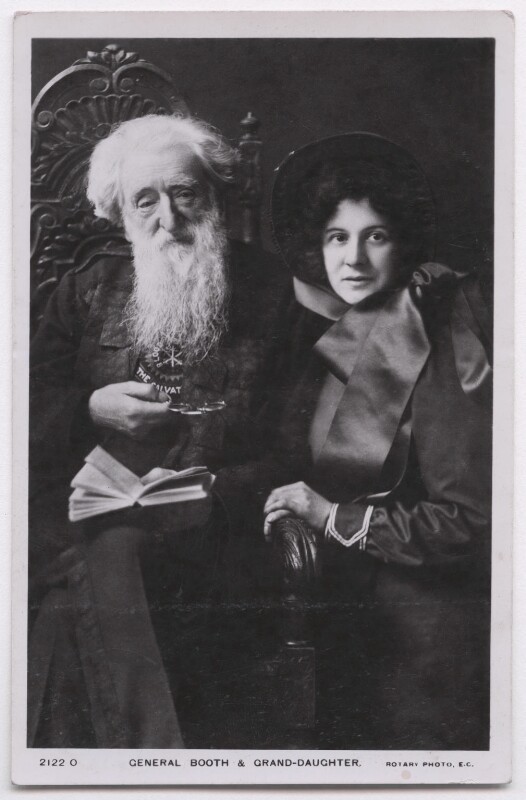
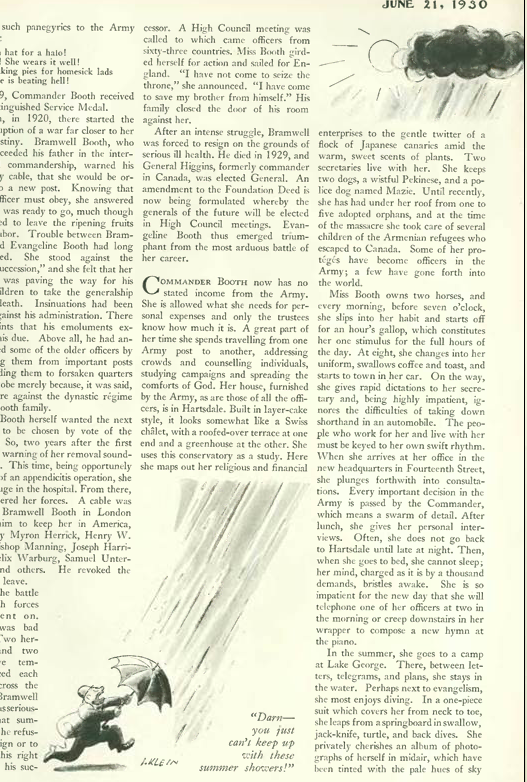
American author and lecturer Virgilia Peterson Ross profiled Evangeline Cory Booth (1865 – 1950), who would become the fourth General of the Salvation Army in 1934. She was the first woman to hold that post. An excerpt:
…Ralph Barton returned to provide this caricature for the profile, one of the last works he would create for The New Yorker before his untimely death…
HEIRESS TO A LEGACY…William Booth, an English Methodist preacher who founded The Salvation Army and became its first General, poses with his grand-daughter Evangeline Cory Booth in this 1908 postcard image. (National Portrait Gallery)
* * *
Home of the Dome
Architecture critic George “T-Square” Chappell was gladdened by the sight of scaffolding atop St. Bartholomew’s Church, which would finally get its dome to complete architect Bertram Goodhue’s vision…
NOW YOU SEE IT…Clockwise, from top left, St. Bartholomew’s Church at 325 Park Avenue, sans dome, in 1928; the church with dome in the 1950s; interior and exterior views of dome. (nyago.com/bostonvalley.com)
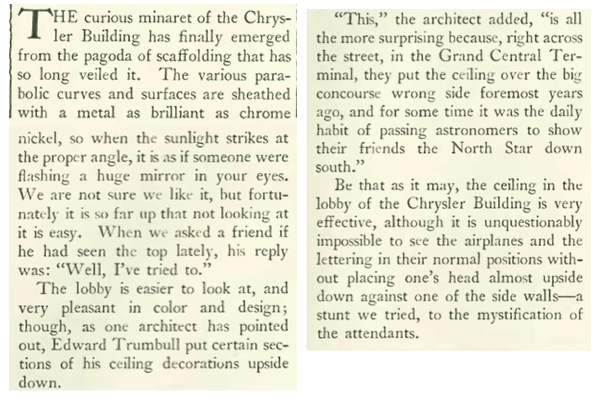
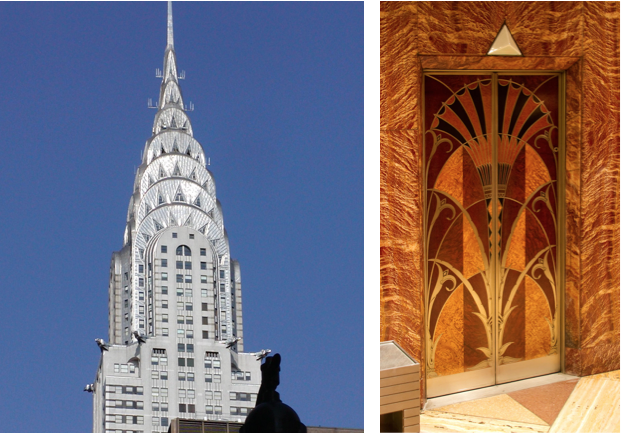
…Chappell also commented on the emergence of the Chrysler Building’s blindingly shiny dome and interior appointments…
BLINDED BY THE LIGHT…The Chrysler Building’s gleaming spire emerged in all its glory in June 1930. At right, an elevator in the building’s lobby. (Wikipedia)
* * *
Below the Belt
It wasn’t Dempsey-Tunney, but the bout between Max Schmeling (1905-2005) and Jack Sharkey (1902-1994) was the next best thing for boxing fans. The World Heavyweight Championship had been vacant since Gene Tunney’s retirement in 1928, and Sharkey and Schmeling had emerged as the sport’s No. 1 and 2 contenders.
The bout ended in a controversial decision: Although Sharkey won the first three rounds, he was disqualified after he landed a punch below the belt late in the fourth round. Schmeling became the first boxer to win the World Heavyweight Championship on a foul. The New Yorker’sNiven Busch Jr. (with illustration by Johan Bull) offered these thoughts on the fight’s disappointing outcome:
LOW BLOW…Although Jack Sharkey (far right) led after three rounds, a low blow in the fourth delivered the World Heavyweight Championship to German boxer Max Schmeling (left). Sharkey would claim the title two years later in a rematch with Schmeling. Although boxing isn’t the healthiest pursuit, both men lived into their 90s; Schmeling died in 2005 just shy of his 100th birthday. (Wikipedia/boxrec.com/thefightcity.com)
* * *
One Of Ours
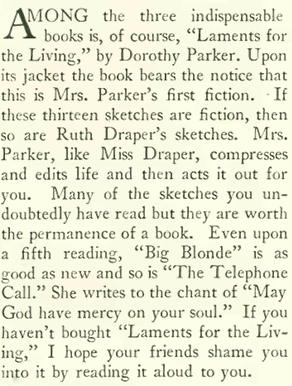
The New Yorker included this brief review of a collection of short fiction pieces by Dorothy Parker, herself a literary critic of some renown at the magazine…
DOROTHY’S LAMENTATIONS…The New Yorker’sDorothy Parker published this collection of short fiction in 1930.
…and on to our advertisers, this ad appeared on the opposite page of the review…
…speaking of ads, the makers of Marlboro cigarettes continued to sponsor gimmicky penmanship and writing contests to promote their deadly product…
…while promoters of the Empire State Building (still under construction) continued to draw on the historical significance of the building’s Midtown location…
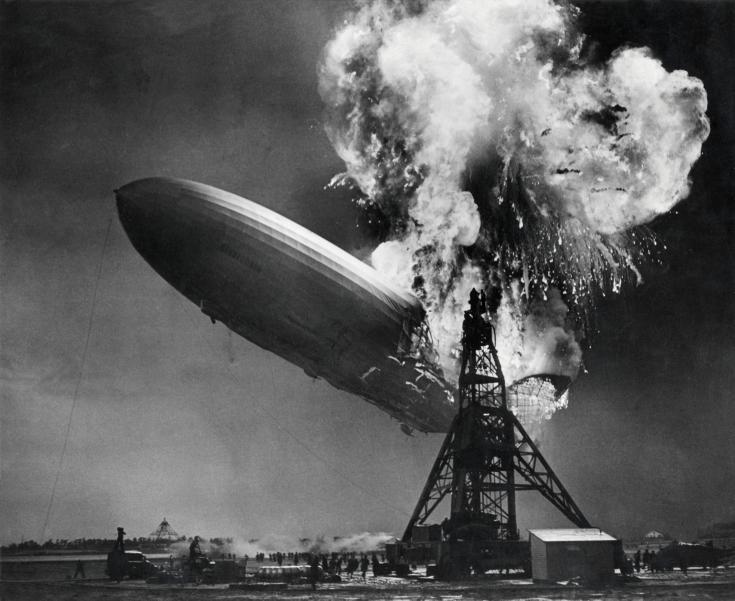
…on to our cartoons, Garrett Price pondered the very real challenge of guiding a massive Zeppelin to the planned mooring mast atop the Empire State…
…a portent of what would happen to the Hindenburg just seven years later…
…The New Yorker’s typesetter Popsy Whitaker made clever use of his columns for this Isadore Klein entry…
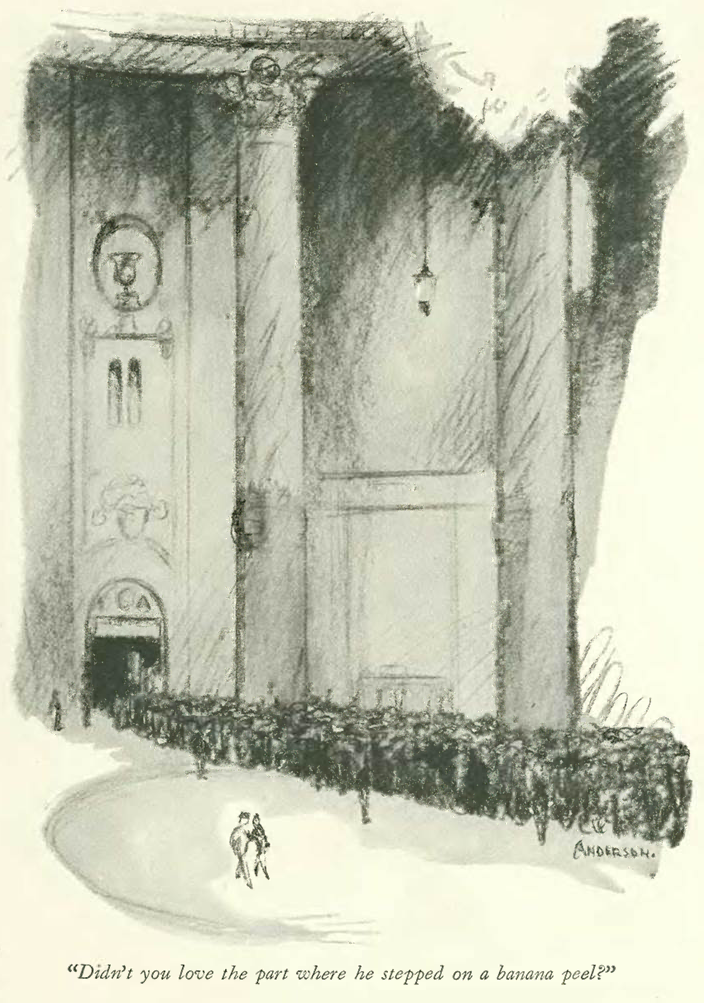
…John Murray Anderson found humor in contrasting the grand with the mundane…
…Carl Kindl eavesdropped on the small talk of a couple of ash haulers…
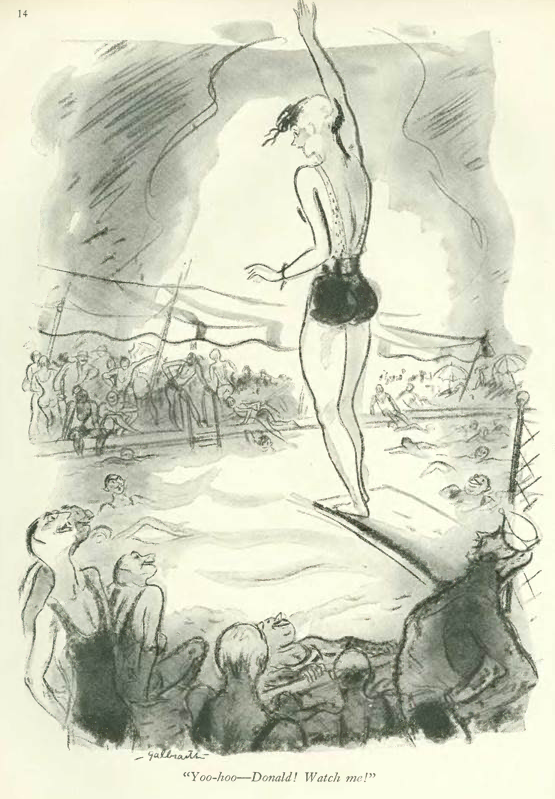
…and William Crawford Galbraith found humor at the public pool…
* * *
On to the June 28 issue, with a cover featuring a satirical kakemono-style illustration by Rea Irvin, who was fond of Japanese scroll art…
June 28, 1930 cover by Rea Irvin.
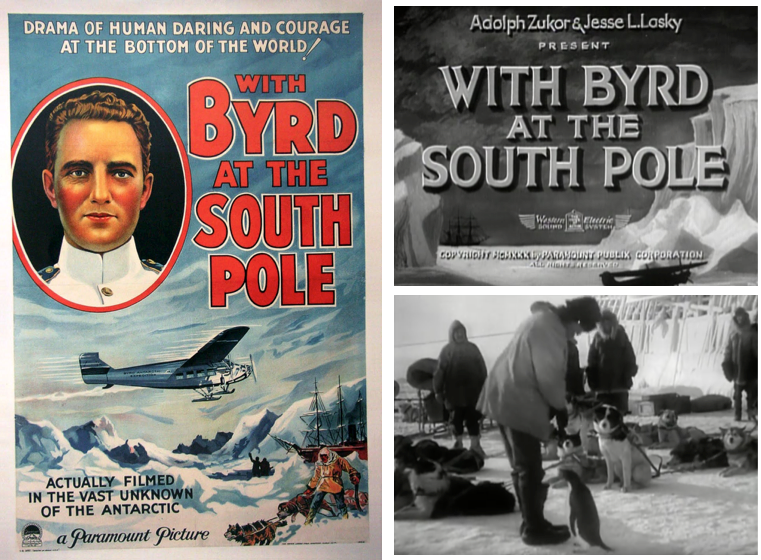
Film critic John Mosher checked out the new documentary on Admiral Richard Byrd’s expedition to the South Pole…
A BYRD WITH WINGS…A Paramount Pictures movie poster promoting the 1930 documentary With Byrd at the South Pole; still images from the film at right. (Wikipedia/YouTube)
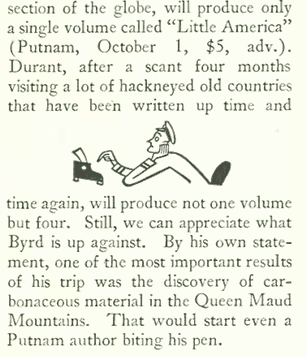
“The Talk of the Town” also made note of Byrd’s expedition and homecoming, contrasting his upcoming book, Little America, with the four-volume historical work planned by popular historian Will Durant.
In collaboration with his wife, Ariel, Durant would end up publishing an eleven-volume history of civilization (four million words across nearly 10,000 pages), written between 1935 and 1975. Will Durant was at work on a twelfth volume when he died in 1981 at age 96.
Admiral Richard Byrd’s Little America, left, and the 11-volume The Story of Civilization, by Will and Ariel Durant.
* * *
American Lenin
The June 28 profile, written by Alva Johnston, featured radical American labor organizer and Marxist politician William Z. Foster. Despite Johnston’s portrayal of Foster as something of a genial pinko, in reality Foster was a strong supporter of Joseph Stalin and a dedicated and loyal ally of the Soviet Union’s Communist Party until his death in 1961. The Soviets even gave him a state funeral, with Nikita Khrushchev personally heading an honor guard in Red Square. An excerpt of Johnston’s profile:
RED AS A ROSE…Left, a campaign photo of William Z. Foster when he headed the Communist Party ticket in the 1928 U.S. presidential election; at right, illustration of Foster for the profile, by Abe Birnbaum.
* * *
And to close…a colorful advertisement in the June 28 issue from Rex Cole…from the signature it appears to be the work of Mario Cooper, but this doesn’t look at all like his other work…
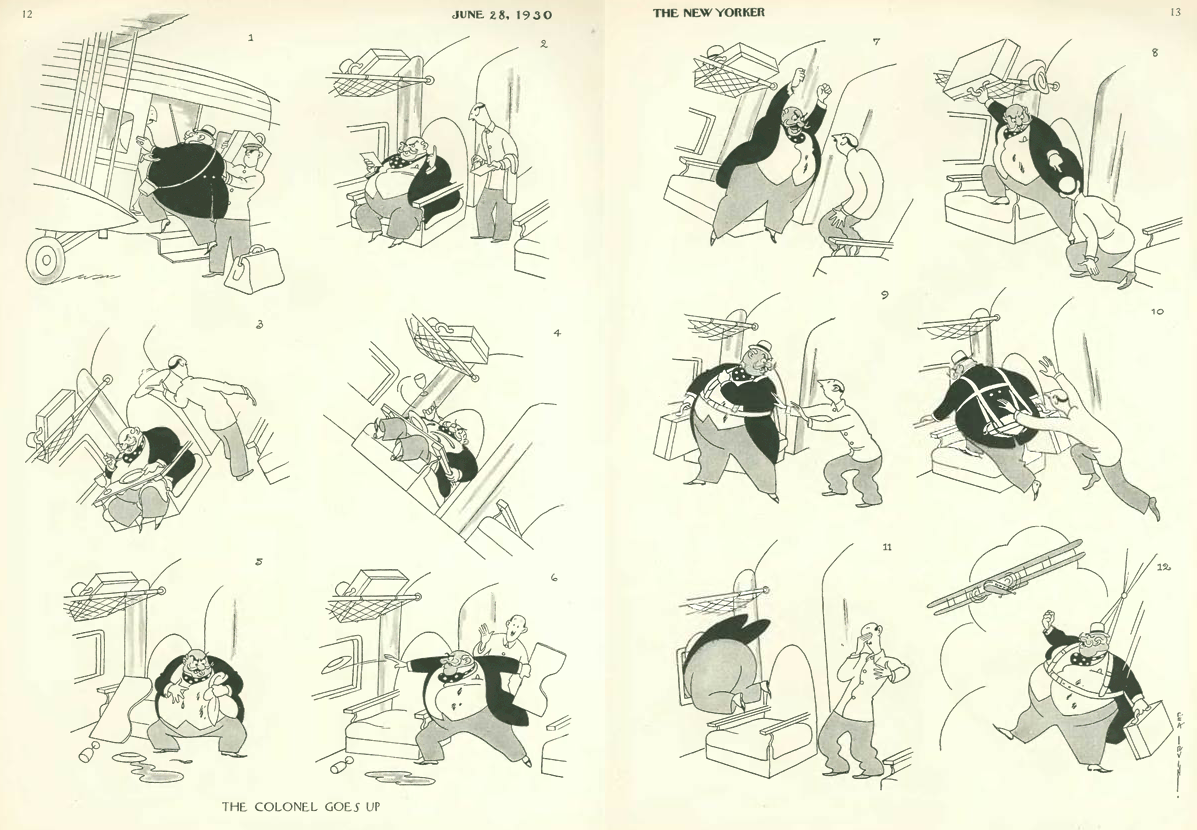
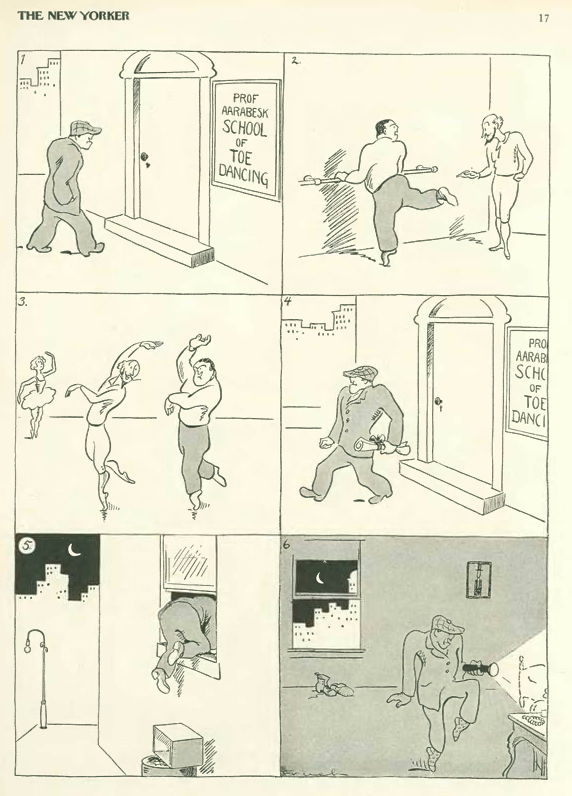
…and a two-page Rea Irvin cartoon, which demonstrates his visual storytelling skills…
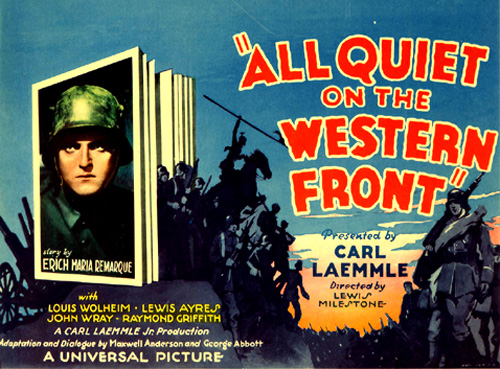
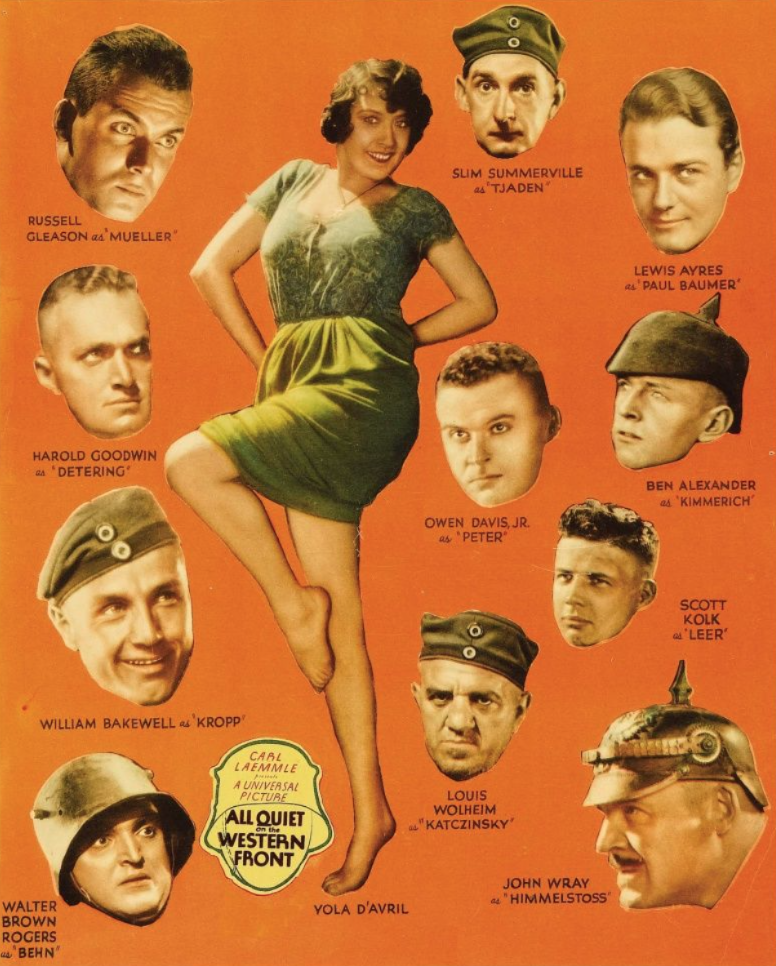
Still considered one of the greatest anti-war films ever made, All Quiet on the Western Front opened in New York on April 29, 1930 to strong reviews. Based on Erich Maria Remarque’s novel of the same name, the film’s depictions of the horrors of war were so realistic and harrowing that it was banned in a number of countries outside of the U.S.
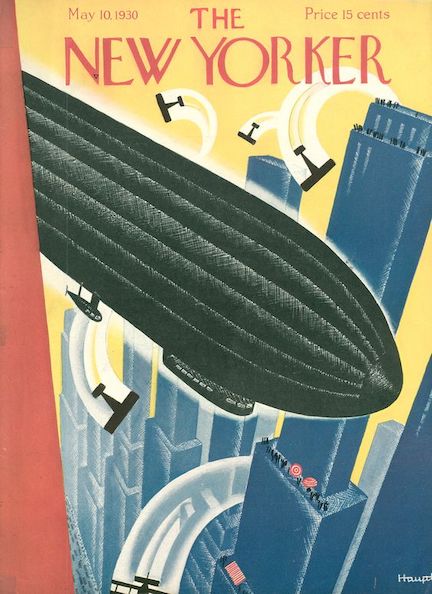
May 10, 1930 cover by Theodore Haupt.
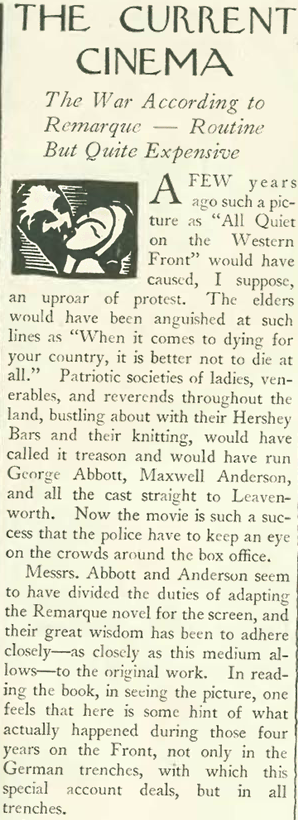
Banned, that is, by nations gearing up for war. In Germany, Nazi brownshirts disrupted viewings during its brief run in that country, tossing smoke bombs into cinemas among other acts of mayhem. Back in the U.S., The New Yorker’sJohn Mosher attended a screening at a “packed” Central Theatre:
WAR IS HELL…Clockwise, from top left, movie poster for 1930’s All Quiet on the Western Front; German soldier Paul Bäumer (Lew Ayres), falls into a shell crater with a French soldier and draws his knife; in one of the most moving scenes in cinema, Bäumer is forced to spend the night in the crater, where he vainly tries to safe the life of the Frenchman he has mortally wounded; a German soldier crawls through the mud in a German training camp. (IMDB/Universal).
Mosher found the film’s adaption from the novel wanting in places, but overall praised the acting and the quality of the picture…
…and just in case some audiences were put off by the blood and guts, Universal promoted other themes on its lobby cards…
(IMDB)
* * *
More Than a Stunt
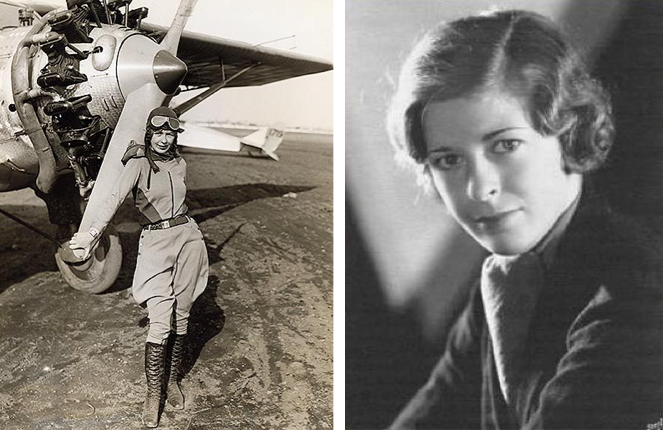
In her profile of aviator Elinor Smith (1911-2010), writer Helena Huntington Smith took great pains to distinguish Elinor from other “lady fliers” who were little more than passengers in various flying exploits. Like Amelia Earhart, Smith had the bona fides of a true aviator: in 1927 she become the youngest licensed pilot in the world at age 16, learning stunt flying at an early age. When she was 17 she smashed the women’s flying endurance record by soloing 26½ hours, and in the following month set a woman’s world speed record of 190.8 miles per hour. In March 1930 she set a women’s world altitude record of 27,419 feet (8,357 m), breaking that record in 1931 with a flight reaching 32,576 feet. Smith would continue to fly well into old age. In 2000 she flew NASA’s Space Shuttle vertical motion simulator and became the oldest pilot to succeed in a simulated shuttle landing. In 2001 (at age 89) she would pilot an experimental flight at Langley AFB. An excerpt from the profile:
HEAD IN THE CLOUDS…Elinor Smith’s flying career would extend from age 16 and into her 90s. At left, Smith poses in Long Island with the Bellanca monoplane she used to beat the solo flight record in 1929. Right, portrait of Smith circa 1930s. (findagrave.com)
* * *
I’d Rather Be in Philadelphia
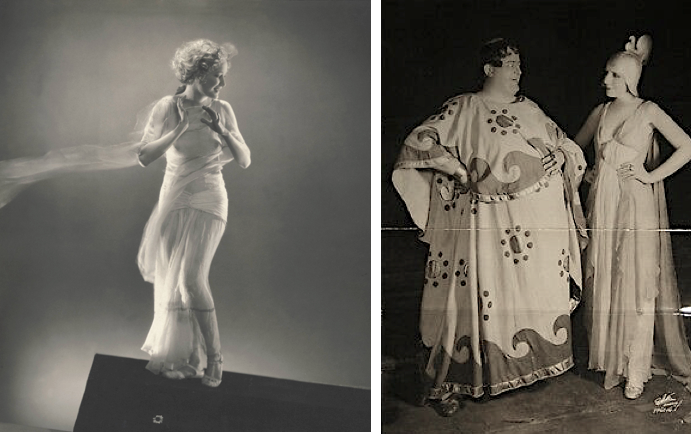
Theatre critic Robert Benchley was over the moon regarding a performance of Lysistrata staged by the Philadelphia Theatre Association. Benchley suggested the Philadelphians had “put New York to shame” in staging such a “festival of beauty and bawdiness…never seen on an American stage before.”
NO MORE HANKY PANKY…Left, actress Miriam Hopkins in Aristophanes’ Lysistrata, as photographed by Edward Steichen; at right, Sydney Greenstreet with unidentified actress from the 1930 Philadelphia production of Lysistrata. (timeline.com)
Benchley praised the seemingly advanced tastes of Philadelphia audiences as he continued to the lament the fact that the City of Brotherly Love had beaten New York to the punch with the staging of the play. He needn’t have worried much longer; the play would open on Broadway on June 5, 1930, at the 44th Street Theatre.
LOVER COME BACK…Production photograph for Norman-Bel Geddes’s staging for Lysistrata, titled “the women of Greece return to their men.” (hrc.utexas.edu)
While we are on the subject of theater, Constantin Alajálov provided this lovely illustration of Anton Chekhov’sUncle Vanya for The New Yorker’s theater review section…
* * *
Make ‘Em Dance, Boys
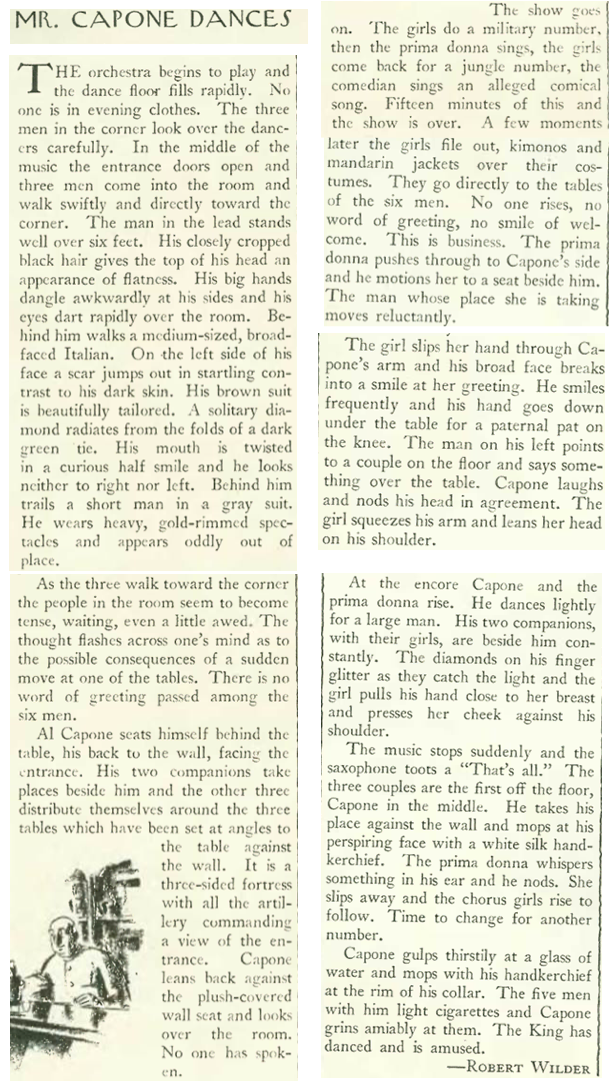
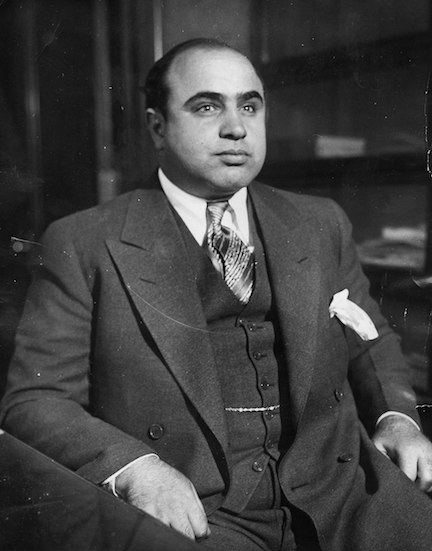
The author Robert Wilder contributed this interesting casual about the appearance of gangster Al Capone at a Chicago nightclub. Excerpts:
LIGHT ON HIS FEET…Al Capone in 1930. (Wikipedia)
* * *
You Say You Want a Revolution?
Alva Johnston offered his thoughts on how America could stage its own “Red Revolution,” given that Russia and several European countries had already experienced communist uprisings of their own, and also given that New York Police Commissioner Grover Whalen, always in search of problems that didn’t exist, had announced a new “Red Scare” in his fight against communism.
Tongue firmly in cheek, Johnston suggested how American know-how could be brought to bear in inciting a Red Terror. An excerpt:
YANKEE INGENUITY…Alva Johnston, left, offered some innovative ideas for a uniquely American “Red Revolution.” At right, soldiers stand behind a barricade during Germany’s communist Spartacist uprising of January 1919. (Wikipedia)
* * *
Speaking of Revolutionaries
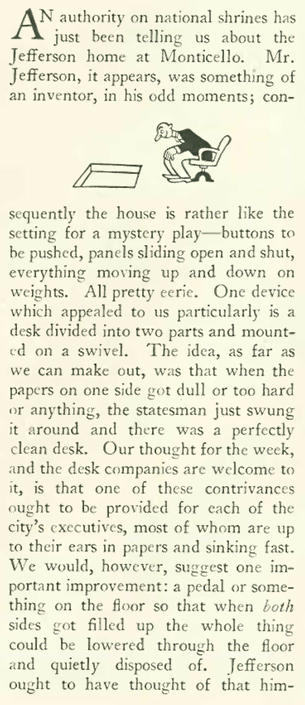
Thomas Jefferson’s home at Monticello is one of America’s most-visited historical sites, but in 1930 it was still something of a regional curiosity, having only been acquired in 1923 for the purposes of turning it into a public museum. Although Jefferson is well known today for his various inventions at Monticello, E.B. White was just learning about this side of the president in his weekly “Notes and Comment” dispatch:
THIS OLD HOUSE…Left, a combination of neglect and Civil War vandalism left Thomas Jefferson’s Monticello enmeshed in weeds and in a state of near collapse by the 1870s. At right, students of the University of Virginia pose outside Monticello in 1930. (UVA/Hulton Archive)
* * *
Play Ball?
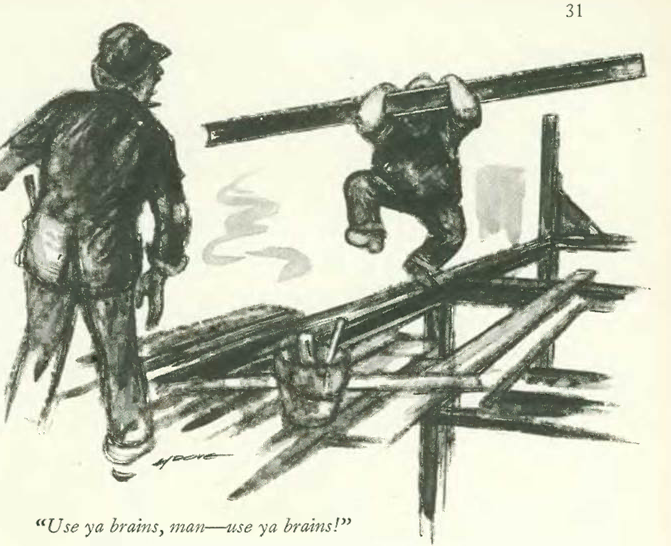
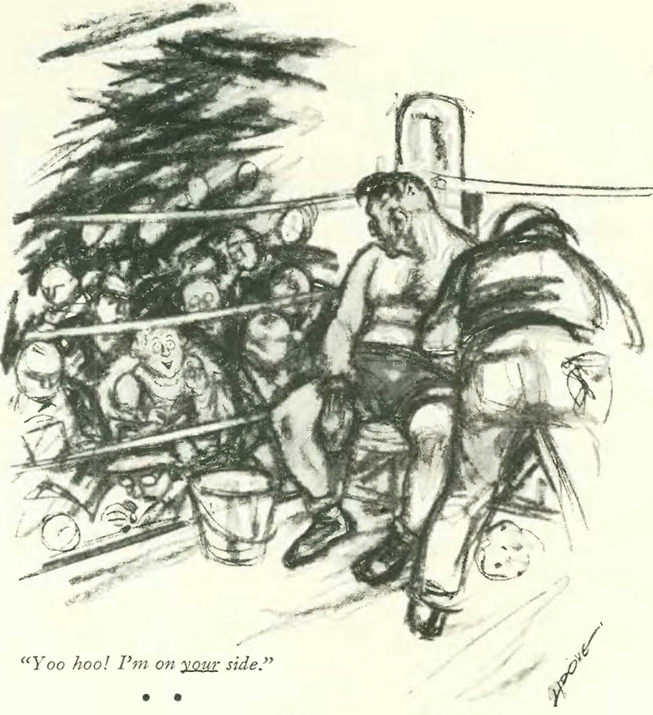
We are well into the spring of 1930, yet The New Yorker stood firm in its complete lack of baseball coverage. As I’ve noted before, the magazine covered virtually every sport from horse racing to rowing to badminton, and even lowered itself to regular features on college football and professional hockey, but not a line on baseball, save for an occasional note about the antics of Babe Ruth or the homespun goodness of Lou Gehrig. There were signs, however, that baseball was being played in a city blessed with three major league teams; we do find game times in the “Goings On About Town” section, as well as occasional baseball-themed filler art, and a comic panel in the May 10 issue by Leonard Dove:
From Our Advertisers
We begin with an endorsement for Chase & Sanborn coffee by the soprano Alma Gluck, wife of famed violinist and composer Efrem Zimbalist Sr. Originally I thought she was enjoying coffee with a sister in law named “Mrs. Zimbalist,” but as reader Frank Wilhoit astutely points out, the “Alma Gluck” (celebrity) and “Mrs. Zimbalist” (housewife) are alternate personae of the same individual. And now that I look at the ad again, the clothes and hair styles are identical. I will try to locate a clearer image of the ad…
…and from the makers of White Rock we have a group of swells and their airborne friends enjoying some bubbles that are doubtless mixed with illegal hootch…
…Dr. Seuss continued to offer his artistry on behalf of Flit insecticide…
…and on to our cartoons, Peter Arno illustrated the hazards of the road…
…while Leonard Dove explored the hazards high above the streets of Manhattan…
…Constantin Alajálov explored an odd encounter in a park…
…Isadore Klein mused on the tricks of mass transit…
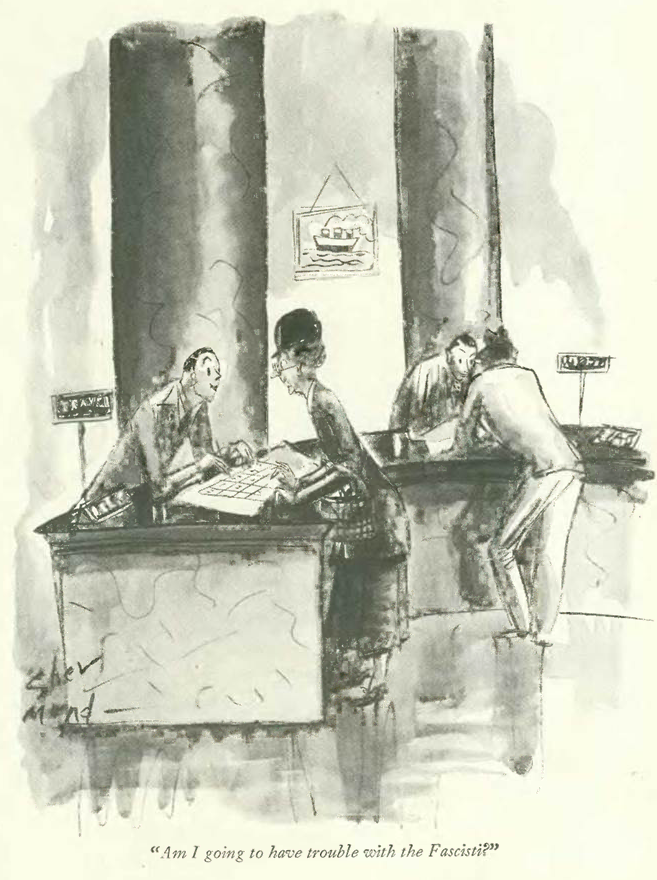
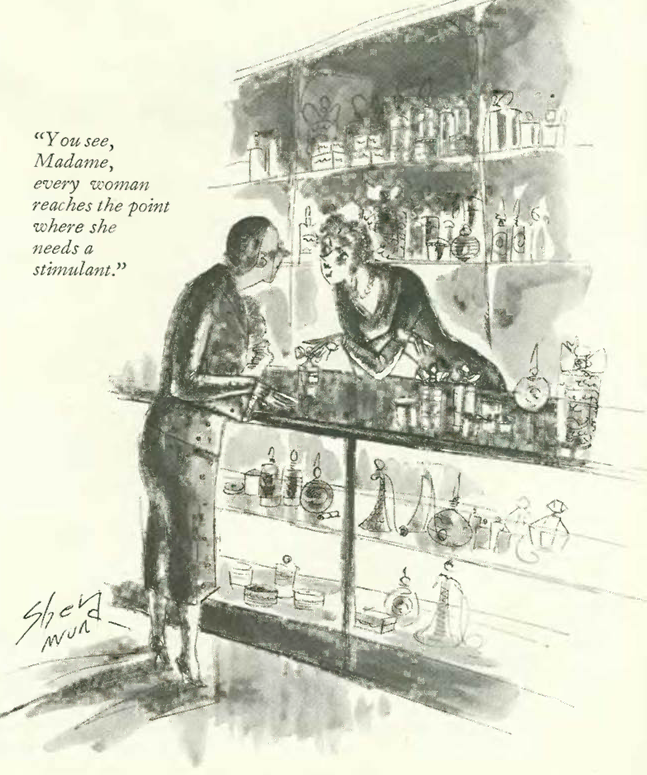
…and two from Barbara Shermund, who looked in on one tourist’s plans for a trip to Mussolini’s Italy…
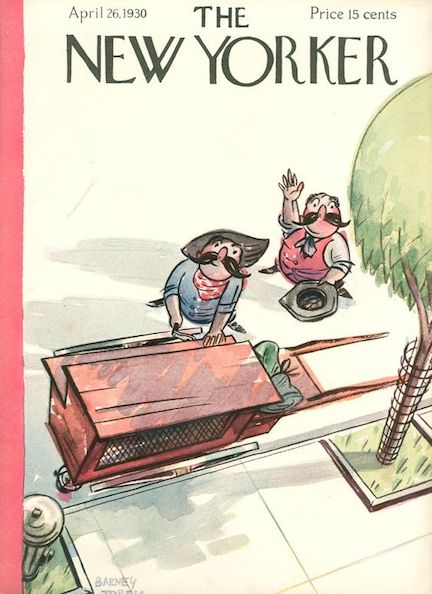
Before we launch into the latest offering from Tinseltown, a note about the cover artist for the April 26, 1930 issue.
April 26, 1930 cover by Barney Tobey.
Barney Tobey (1906-1989) was known for gently humorous cartoons that appeared in The New Yorker for more than fifty years. He also contributed four covers, the first of which appears above. In the Sept. 21, 1998 issue, illustrator Richard Merkin offered this remembrance:
* * *
Star-spangled Banter
All-star musicals were all the rage in the early sound era, as they gave studios the opportunity to showcase contract players (who were virtually owned by the studios) doing things they usually didn’t do on screen. Following the success of MGM’s Hollywood Revue of 1929, Paramount Studios released Paramount on Parade in April 1930, much to the liking of New Yorker critic John Mosher, who also praised the film’s accompanying cartoon, 1929’s The Prisoner’s Song:
You can watch Max Fleischer’s The Prisoner’s Song here (and ponder how far animation has advanced)…
Mosher also praised a number of Paramount’s contract players, and especially actors Jack Oakie and Maurice Chevalier…
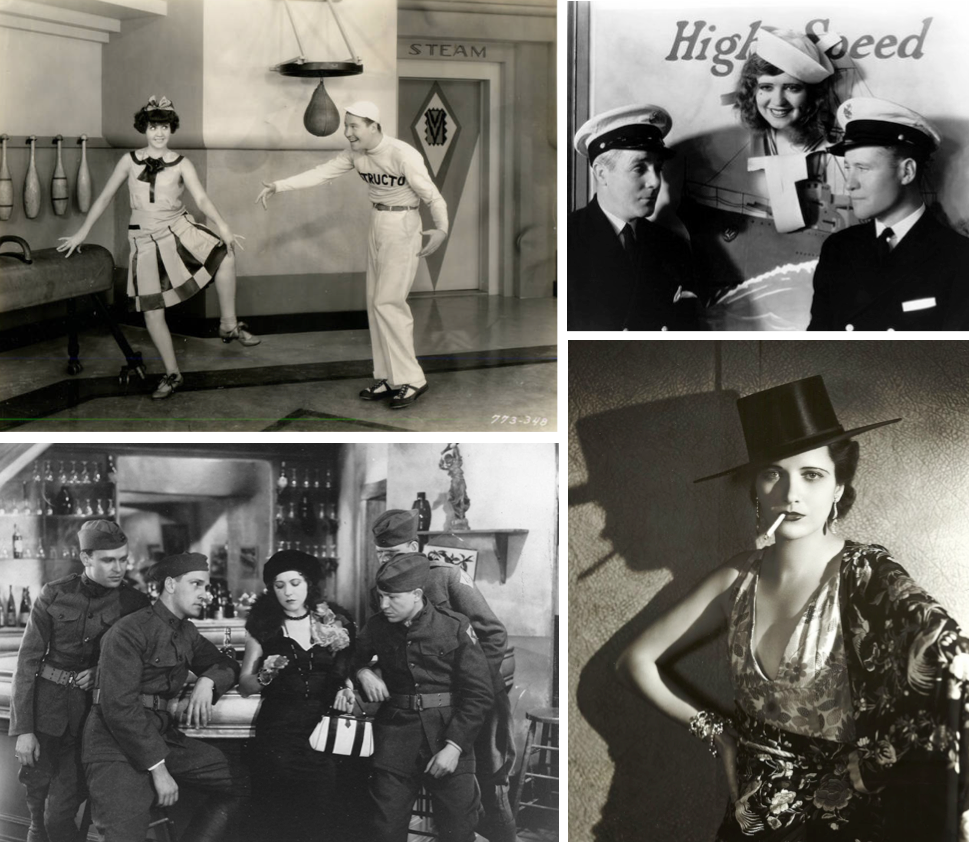
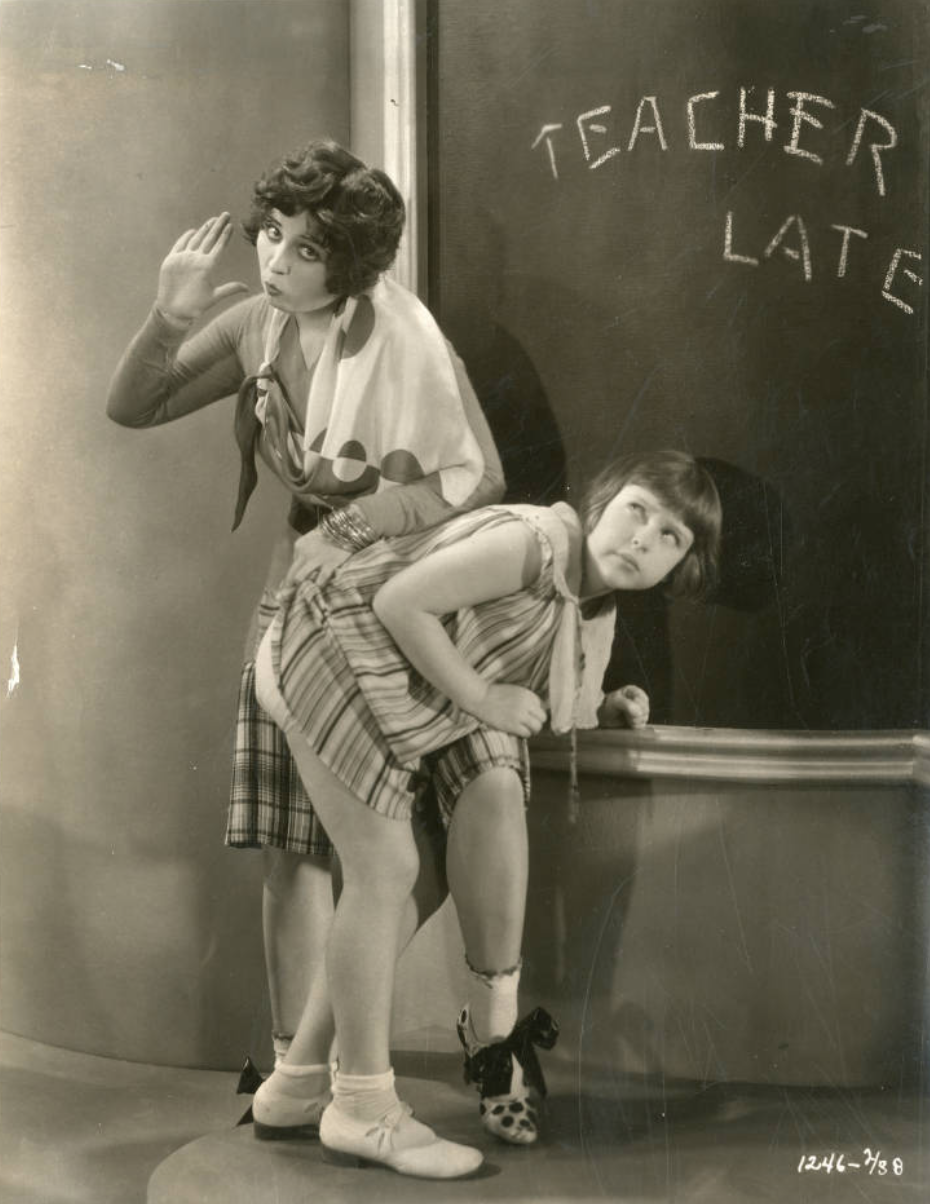
MUCH ADO…A great crowd gathers for the premiere of “Paramount on Parade” at the New York’s Rialto Theatre in April 1930. (cinematreasures.org)SEEING STARS…Clockwise, from top left, Helen Kane (possibly the inspiration for the cartoon character “Betty Boop”) and Jack Oakie do a little footwork; Clara Bow, Hollywood’s “It Girl,” pops through a Navy recruitment poster at the beginning of her song and dance number (with Stuart Erwin and Richard ‘Skeets’ Gallagher); one of Hollywood’s top actresses in 1930, Kay Francis, portrays “Carmen” in the revue; Ruth Chatterton entertains doughboys Stuart Erwin, Fredric March, Jack Oakie, and Stanley Smith in Paramount on Parade. (IMDB)BOOP GIVES A BOP…Helen Kane (left) and child star Mitzi Green in a sketch from Paramount on Parade. (IMDB)
* * *
Lost In the Crowd
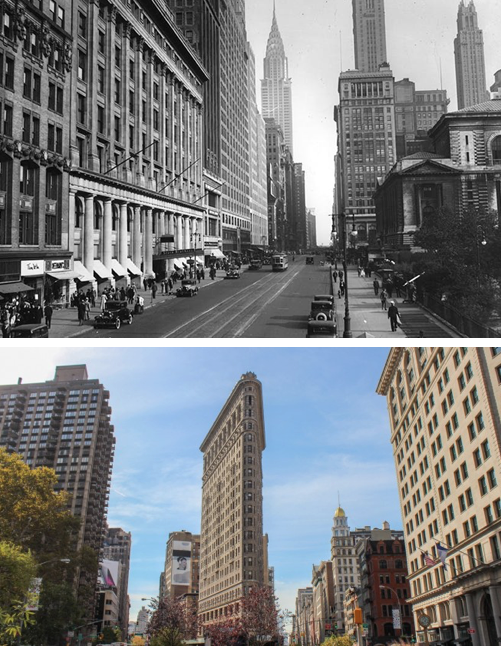
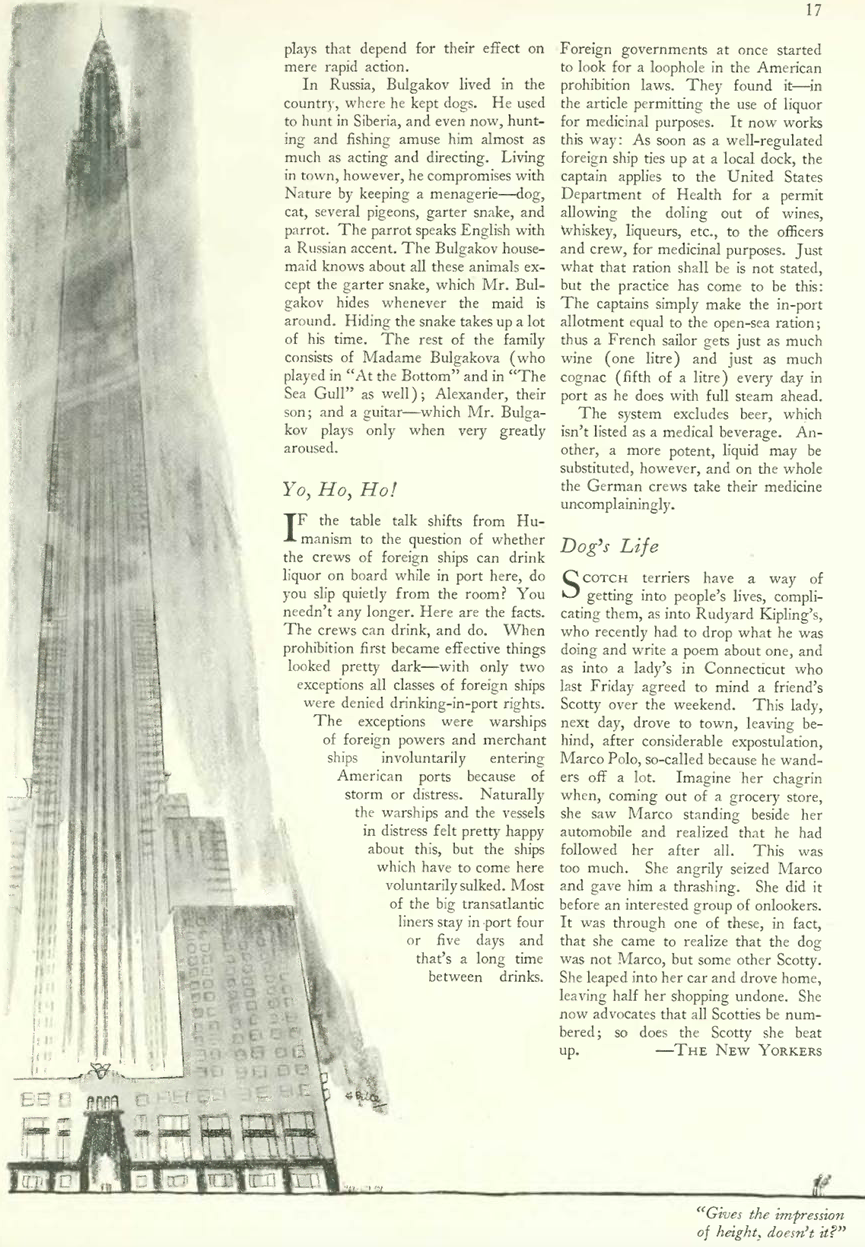
In his “Notes and Comment,” E.B. White lamented the fact that the world’s tallest building appeared less than lofty, since neighboring skyscrapers were nullifying its grandeur:
DOWN IN FRONT…E.B. White found the streetview of the world’s tallest building wanting after it was completed in 1930; the iconic Flatiron Building, however, enjoys some elbow room even today. (spectator.co.uk/walksofnewyork.com)
* * *
Full of Hot Air
That was another opinion shared by E.B. White, this time regarding the Empire State Building’s top promotor, former New York Governor Al Smith, who spoke of plans to attach a mooring mast to the top of his skyscraper (which would eclipse the Chrysler as the world’s tallest in 1931):
* * *
View From the Top
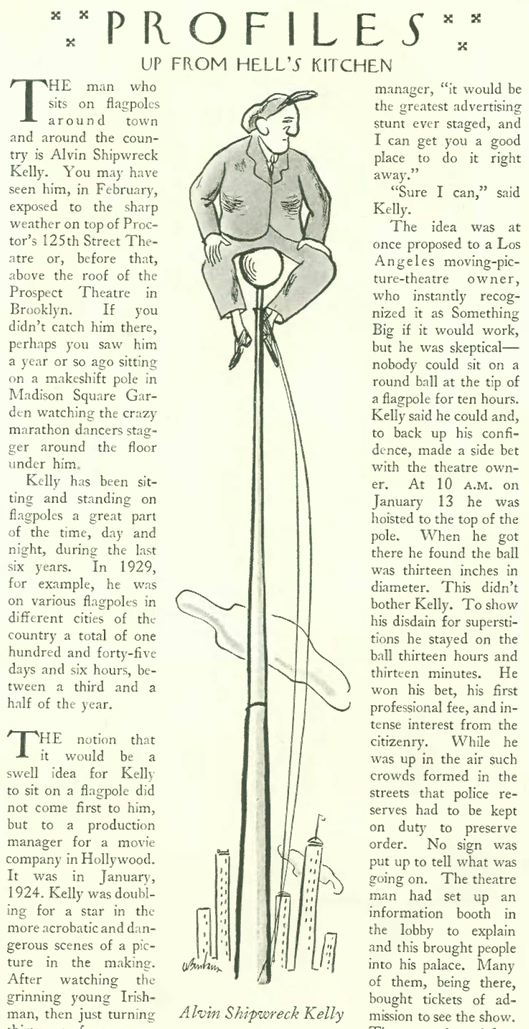
The New Yorker featured a profile of Aloysius Anthony Kelly (1893?-1952), better known as the Roaring Twenties most famous pole-sitter, “Shipwreck” Kelly. He achieved his greatest fame in the 1920s and 1930s, sitting for days at a time on elevated perches — often atop buildings — throughout the U.S.
Kelly’s fame was already on the wane when this profile appeared, and by 1934 he was reportedly working as a dance hall gigolo. Kelly’s last flagpole stunt was at a 1952 event sponsored by a Lion’s Club in Orange, Texas — he suffered two heart attacks while sitting atop their 65-foot flagpole. After climbing down he announced, “This is it. I’m through.” He died one week later after he was struck by car on West 51st Street in Manhattan.
LOFTY AMBITIONS…Alvin ‘Shipwreck’ Kelly atop a flagpole near College Park, Maryland, in October 1942. At right, undated photo circa 1940s. (CSU Archives/Digital Commonwealth)
* * *
Brand X
Folks were still abuzz about the discovery of a ninth planet in the solar system, soon to be dubbed “Pluto” by an English schoolgirl. Howard Brubaker, in “Of All Things,” observed…
…and Carl Kindl illustrated the problem a new planet posed for astrologers…
* * *
I Beg Your Pardon
Will Rogers was a beloved comedian with a few rope tricks up his sleeve, but I’ve never known him for working blue. However, one critic for The New Yorker (“A.S.”– not sure who this is) found Rogers’ new radio show both humorless and gauche…
CAN YOU TAKE A JOKE?…In photo above, Will Rogers debuts his new radio show in April 1930. It would become the most popular Sunday evening radio show, and Rogers would prove to be the second biggest motion picture box office draw in the U.S. before his death in 1935. (Will Rogers Memorial Museum)
* * *
Before He Got Axed
Ten years before he was murdered by one of Stalin’s NKVD agents, Leon Trotsky published an autobiography that was written in his first year of exile in Turkey. The review is signed “G.H.” so I am assuming the author is Geoffrey Hellman, who contributed for decades to The New Yorker’s “Talk of the Town.” Excerpts from the review:
RED ALERT…Leon Trotsky wrote his autobiography, My Life, while exiled in Turkey. (Wikimedia)
* * *
From Our Advertisers
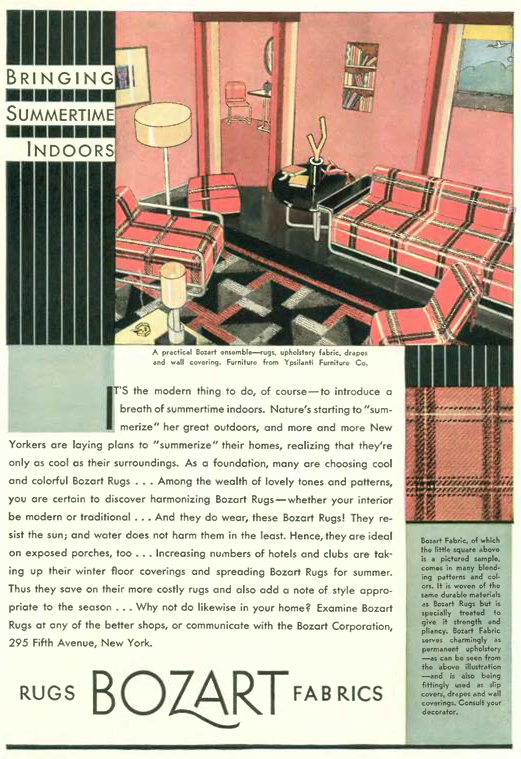
The makers of Bozart rugs and fabrics invited New Yorker readers to “introduce a breath of summertime indoors”…
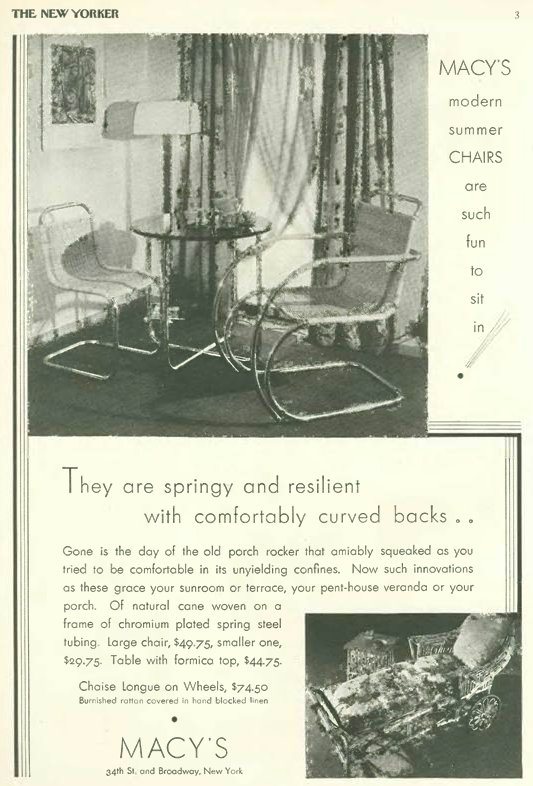
…while Macy’s urged the same by gracing a sunroom or terrace with one of their Marcel Breuer-inspired chairs…
…Colonial Airways touted an early form of radar — an “invisible pilot” — as the latest safety feature in its airplanes…
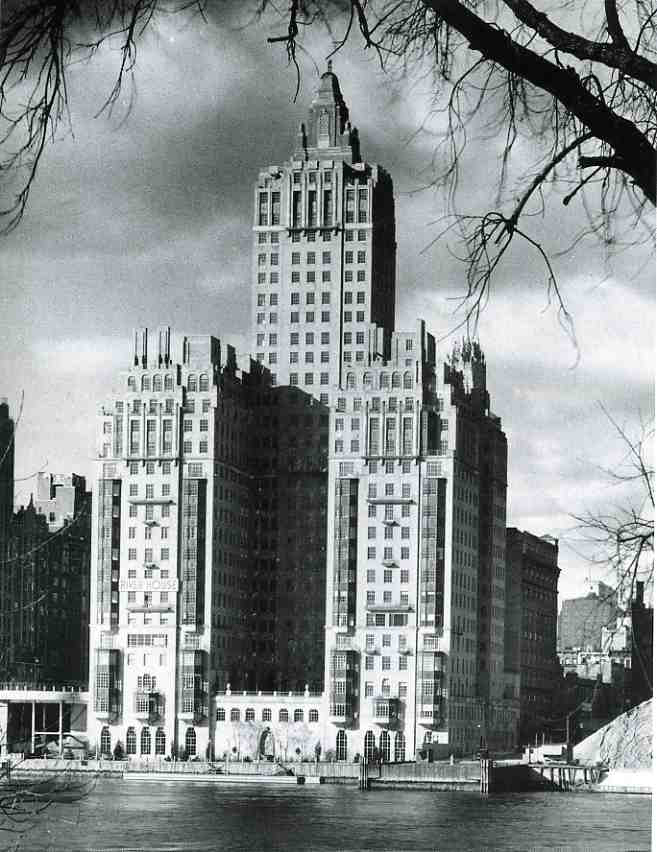
…the Douglas L. Elliman company promoted its yet unbuilt River House, which would feature a pier where residents could dock their yachts…
The 26-story River House in the 1930s. Originally, the Art Deco building featured a pier where residents could dock their yachts, but that feature was lost with the construction of FDR Drive in the early 1950s, effectively sealing the building off from the water. The building has been home to author Barbara Taylor Bradford, US Secretary of State Henry Kissinger, and actress Uma Thurman. (observer.com)
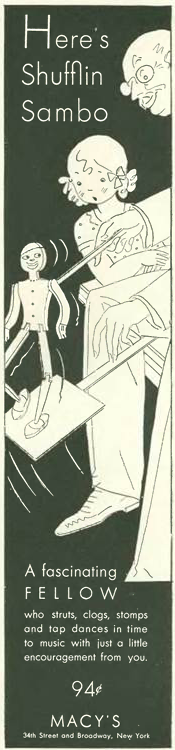
…and then we have our more unfortunate ads, such as this one from Macy’s that shows grandpa passing along his racist tendencies to a grandchild…
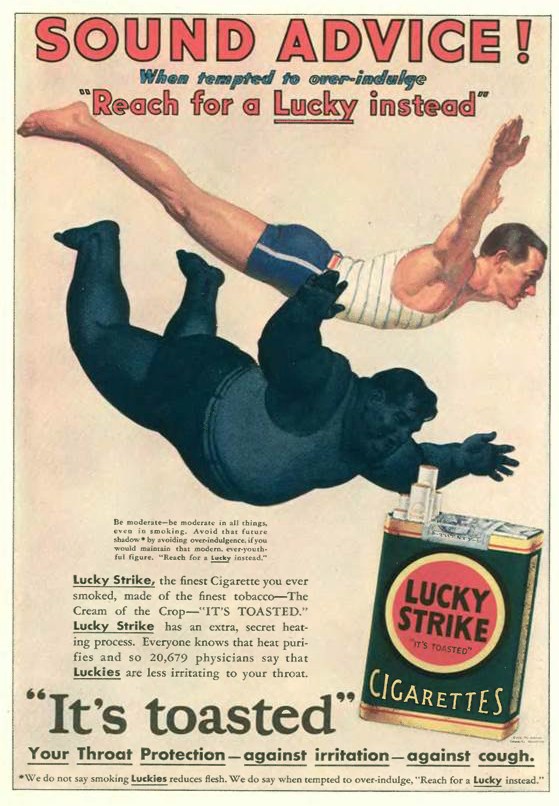
…and this sad appeal from the makers of Lucky Strike to keep puffing and avoid that hideous double chin…
…our cartoons include Garrett Price and thoughts of spring…
…Barbara Shermund eavesdropped on tea time…
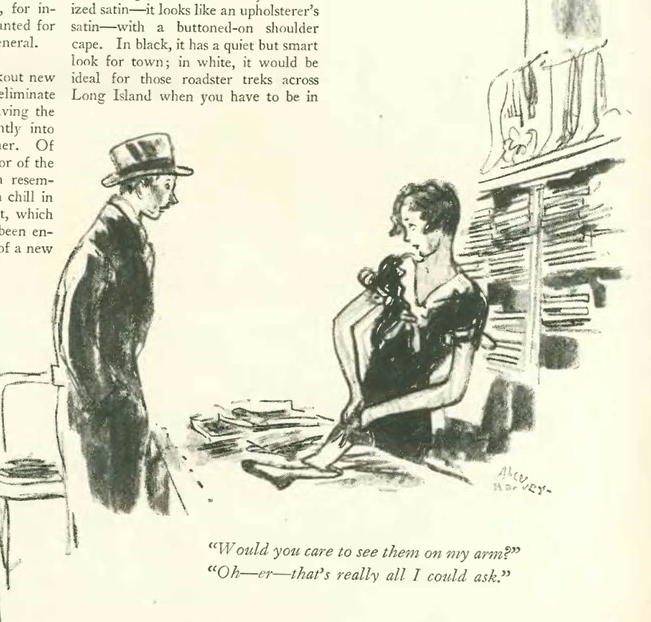
…Alice Harvey found an awkward moment in a hosiery department…
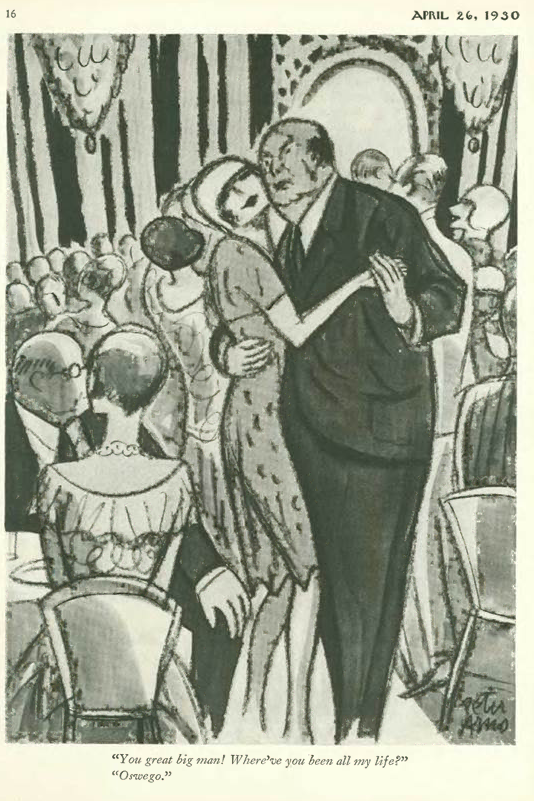
…Peter Arno revisits a familiar theme — chorus girls and sugar daddies…
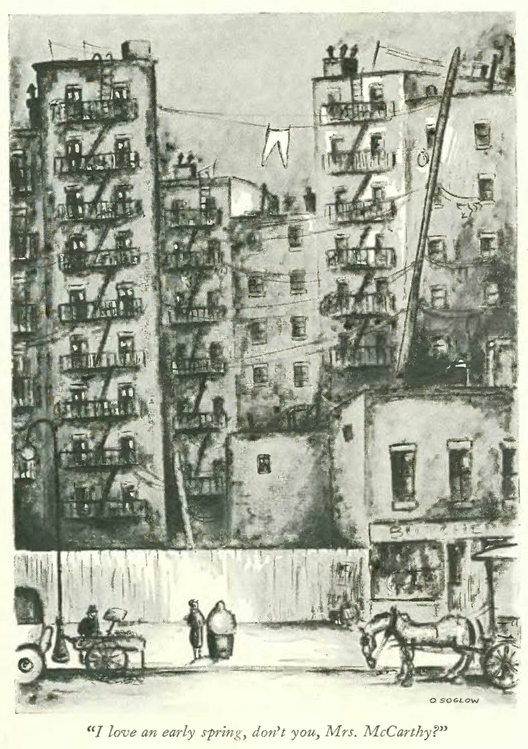
…and Otto Soglow looked in on a fat cat’s moment of pride…
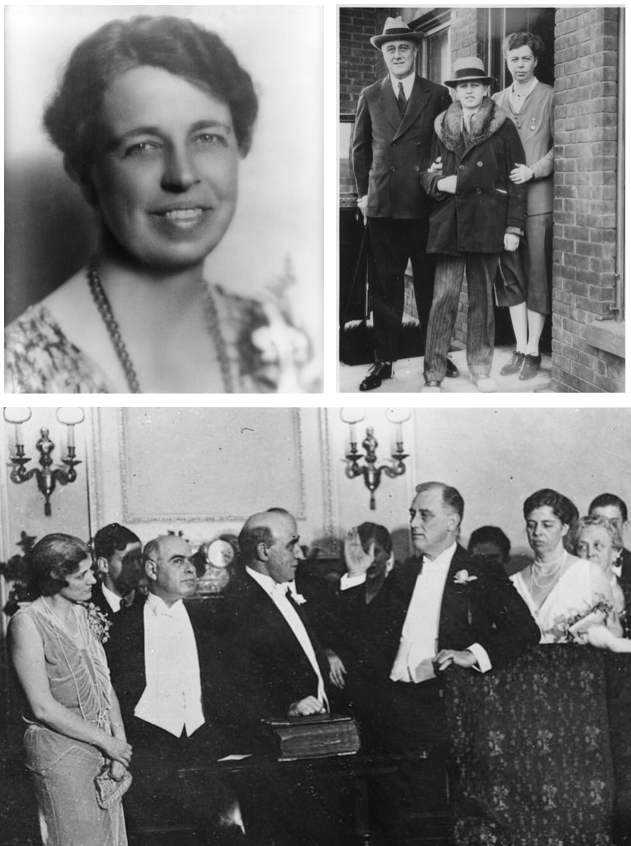
Just three years before she would enter the White House as First Lady, Eleanor Roosevelt was familiar to some New Yorkers for her social work, but was known to most as the wife of the Governor of New York, Franklin D. Roosevelt.
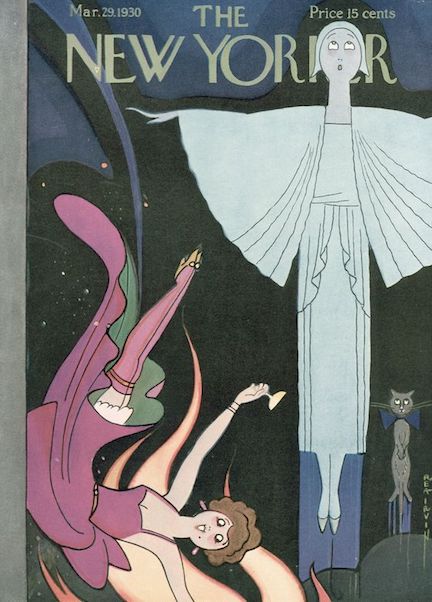
This week we look at two issues, March 29 and April 5, 1930, both with covers by Rea Irvin.
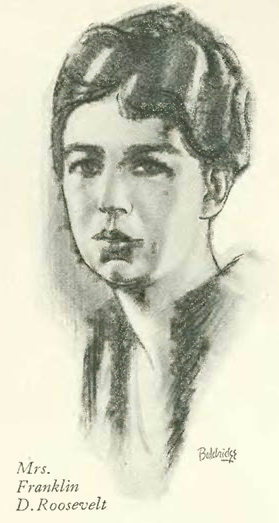
In a profile featured the April 5 New Yorker, Helena Huntington Smith looked at the life of a woman who was a niece to former President Theodore Roosevelt and a fifth cousin (once removed) to her husband Franklin. A somewhat reluctant mother (who nevertheless had six children) in a marriage that was mostly a political arrangement, Eleanor devoted considerable time and energy to social causes. Below is a brief excerpt, accompanied by an illustration of Eleanor by Cyrus Baldridge.
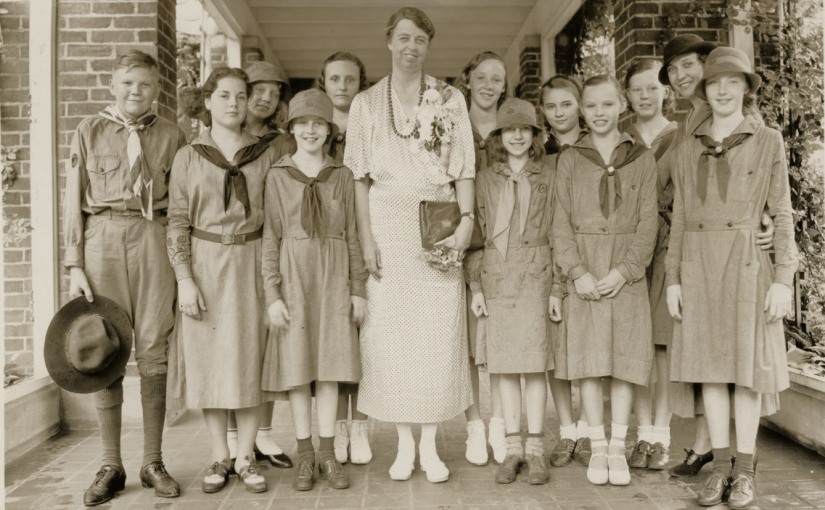
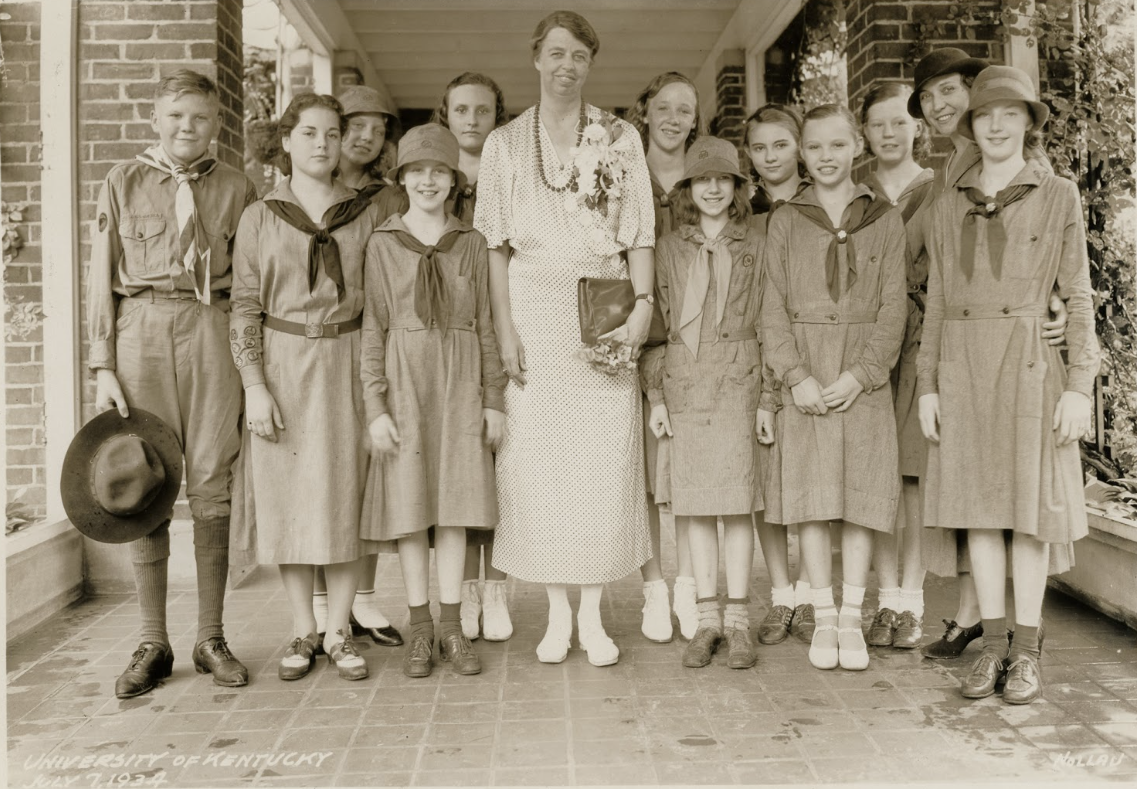
ALBANY DAYS…Clockwise, from top left: Eleanor Roosevelt in 1933; Gov. Franklin Roosevelt, Eleanor, and their youngest son, John, in Albany in 1930; FDR being sworn in as Governor of New York, January 1929. (Wikipedia/Albany Group Archive)IN HER ELEMENT…Eleanor Roosevelt with boy and girl scout volunteers at the University of Kentucky, July 1934. (eleanorroosevelt.org)
* * *
No Laughing Matter
In a surprising twist, James Thurber took a hand at writing the “A Reporter at Large” column (titled “Cop Into College Man”) in the March 29 issue, visiting a new “Police College” in New York City. In this engaging piece, Thurber seemed thoroughly engrossed in the operation…
…and particularly in the mugshots of some of the city’s most notorious criminals, including gangster Jim Flanagan, “debonair in a Bangkok hat”…
…and in the college’s museum, filled with all manner of deadly implements…
PREPPING FOR PERPS…The April 1930 edition of Popular Science featured the opening of New York’s new Police College. (Modern Mechanix)
* * *
Pluto’s Salad Days
In was something of a sensation in February 1930 when Clyde Tombaugh (1906-1997) discovered the then-planet Pluto at the Lowell Observatory in Arizona. Howard Brubaker in “Of All Things” (March 29) had this to say about the achievement:
JUST A SPECK…Clyde Tombaugh poses with the telescope through which he discovered the planet Pluto at the Lowell Observatory on Observatory Hill in Flagstaff, Ariz., 1931. At right, images of the planet (specks indicated by arrows) were all the proof Tombaugh needed to confirm his discovery. (AP/NASA)
Thanks to a 2015 flyby by NASA’s New Horizons spacecraft, we now have a better idea of what Pluto, now classified as a “dwarf planet,” actually looks like…
* * *
Dandy Doodle Mayor
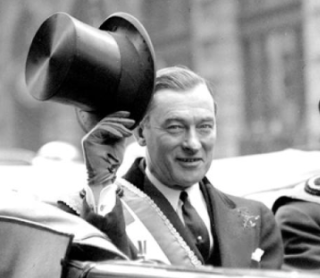
Fillmore Hyde, author (and four-time national amateur squash tennis champion), penned this ditty in the March 29 issue in tribute to New York City’s dandyish mayor…
HAT’S OFF…Mayor Jimmy Walker.
* * *
Back for More
Also for the March 29 issue art critic Murdock Pemberton was back at the Museum of Modern Art — a new institution he met with skepticism when it opened in late 1929, but a place that was definitely growing on him as a destination to revel in the work of some of the world’s top modern artists, including the American Max Weber (1881-1961), whose retrospective was supposed to the big draw of MoMA’s latest show, but Pemberton seemed more impressed by French artist Aristide Maillol (1861-1944) and particularly by the Swiss-German Paul Klee (1879-1940).
AMERICAN CUBIST…Max Weber’sThe Cellist, 1917, oil on canvas, was featured in Weber’s 1930 retrospective exhibition at the Museum of Modern Art; at right, Weber seated in front of Interior with Music (1930). (Brooklyn Museum/Smithsonian)Aristide Maillol’sCrouching Woman, bronze, 1930. (MoMA)
Pemberton wrote that Klee’s show gave you “quite a feeling”…
Catalogs from Max Weber’s retrospective and Paul Klee’s exhibit at the Museum of Modern Art. (MoMA)
…and when he compared Klee’s work to that of the other artists, Pemberton saw something “more potent even than electricity…signposts toward a glorious future”…
A GLIMPSE OF THE FUTURE…From left, Paul Klee’sActor’s Mask, 1924, oil on canvas mounted on board; Josef Albers’ 1929 photographic portrait of Klee, 1929; Klee’s In the Grass, 1930, oil on canvas. (MoMA/Guggenheim.org)
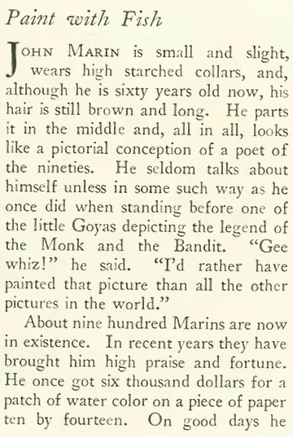
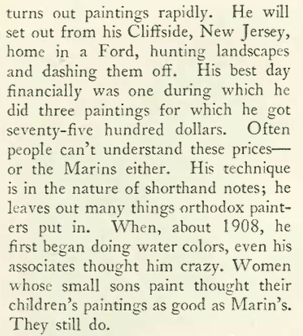
A week later, writing for the April 5 issue, Pemberton penned this piece for “The Talk of Town” about the work habits of artist John Marin…
OLD MAN AND THE SEA…John Marin in 1921, in a photograph by Alfred Stieglitz; Marin’s Bathers, 1932, oil on canvas. (mfa.org/Dallas Museum of Art)
* * *
Who Needs a Vet?
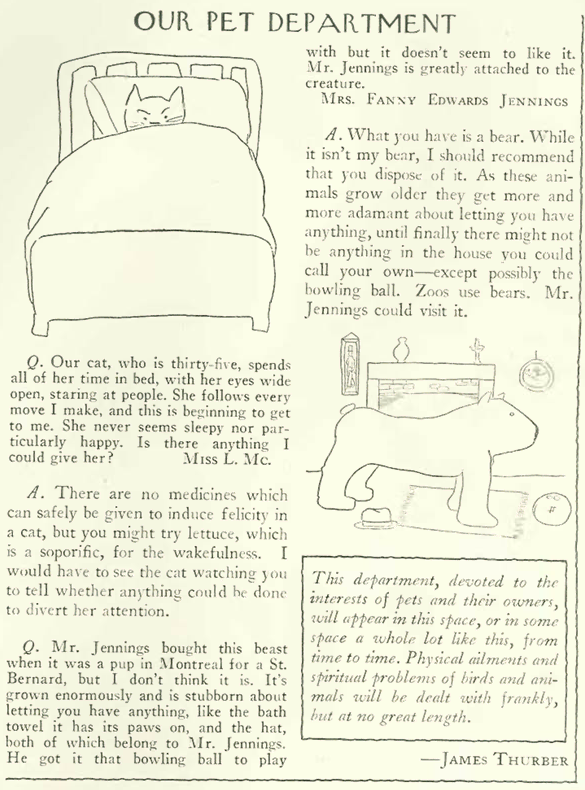
The April 5 issue featured James Thurber’s latest installment of “Our Pet Department…
* * *
Spend It Quickly
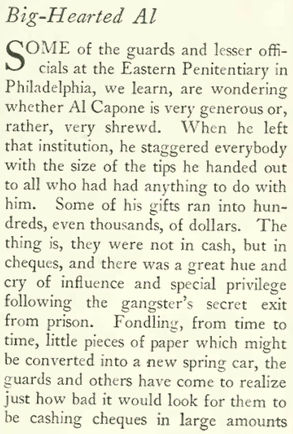
April 5’s “Talk” also featured this item about Al Capone’s release from prison in Philadelphia, lavishing money and gifts on prison employees as he made his exit from Eastern Penitentiary…
…it was no wonder, because officials at the prison didn’t treat Capone like some ordinary prisoner…
SALUTARY CONFINEMENT…Arrested outside a Philadelphia movie theater for carrying a concealed, unlicensed .38 caliber revolver, Al Capone was sentenced to a year in Eastern State Penitentiary. His last seven months were served in a cell (right) with fine furniture, oriental rugs, paintings, and a console radio, among other frills. (easternstate.org)
* * *
This Al Could Sing
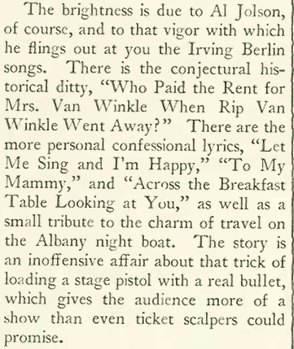
Upon the DVD release of Al Jolson’s 1930 film, Mammy,Dave Kehr of The New York Times wrote that Jolson was “Simultaneously one of the most significant and most embarrassing show business figures of the 20th century.”
That was not view of most audiences 89 years ago, when Jolson reigned as one of America’s most famous entertainers. In his review of Mammy for the April 5, 1930 issue of The New Yorker, critic John Mosher admitted that he didn’t care for minstrel shows depicted in the film, but not for any of the reasons we would cite today…
UGH…Clockwise from top left, Al Jolson and Lois Moran in Mammy; a studio promotional poster; Jolson as a minstrel performer in the film. (IMDB)
* * *
From Our Advertisers
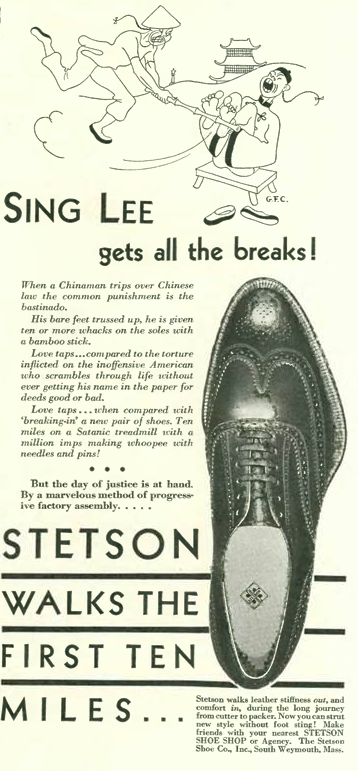
We have more racial stereotypes, this time to sell Stetson shoes…
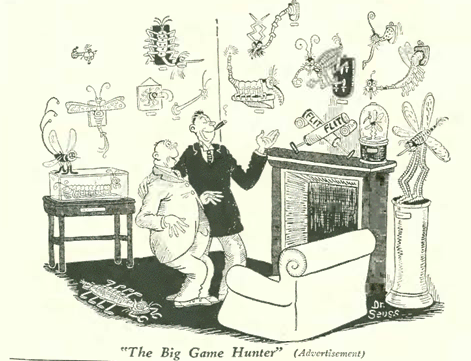
…Theodore Geisel (Dr. Seuss) continued to pay the bills by illustrating ads for Flit insecticide…
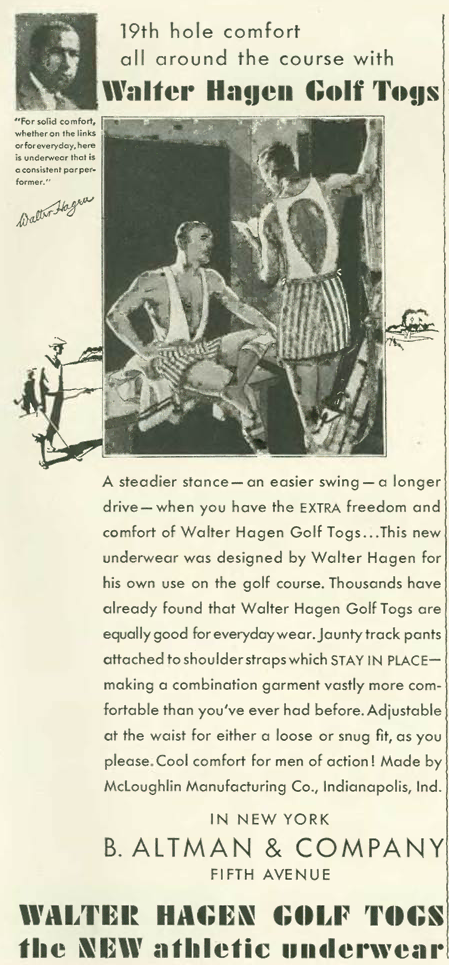
…while professional golfer Walter Hagen picked up some extra cash by launching his own line of golf underwear…
…Walter has been gone for fifty years, but you can still get his branded clothing from Dick’s Sporting Goods…
…Julian De Miskey picked up some extra work illustrating this house ad for The New Yorker…
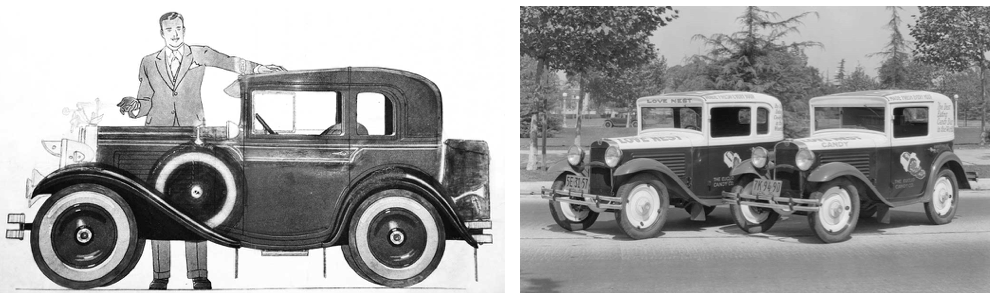
…and then we have this spot from the American Austin Car Company, which produced cars licensed from the British Austin Motor Company from 1930 through 1934…interestingly, the ad doesn’t feature the car itself…
…which looked like this…
(theoldmotor.com)
…on to our cartoons, Alan Dunn looked in on a devoted listener of S. Parkes Cadman’s Sunday radio broadcast…Cadman (1864-1936) was a British-born clergyman whose NBC radio broadcasts reached millions of listeners across America…
…signs of spring were noted by Otto Soglow…
…Don Herold shared an observation on stage entertainments…
…William Crawford Galbraith found unrequited love at the circus…
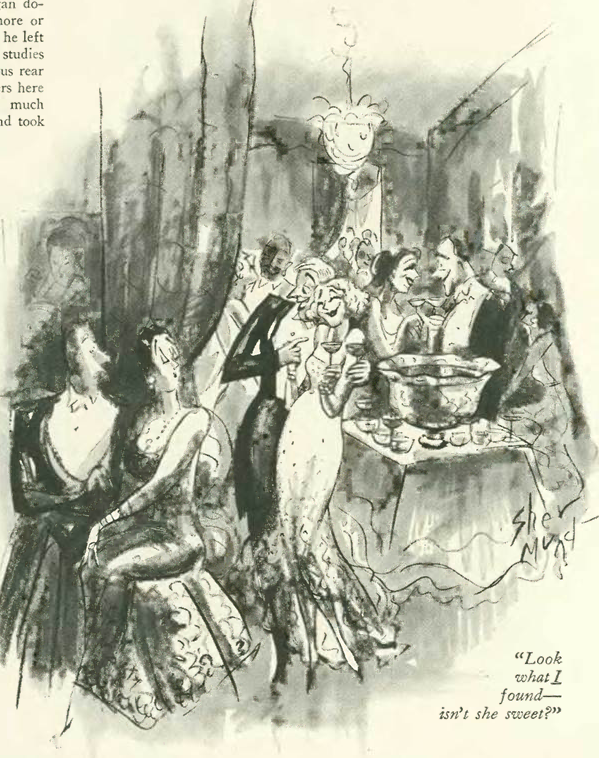
…while Barbara Shermund found a more agreeable pairing at a Manhattan cocktail party…
…Garrett Price found humor in the growing numbers of the down and out…
…and Peter Arno turned in this epic two-pager that illustrated the challenges of filming in nature…(caption: “Well, we can’t start till we get that robin out of there.”)
Imagine your favorite Hollywood actress, maybe someone like Julia Roberts,Meryl Streep or Judi Dench. You’ve followed their careers and watched most of their movies, but you’ve never heard their voices.
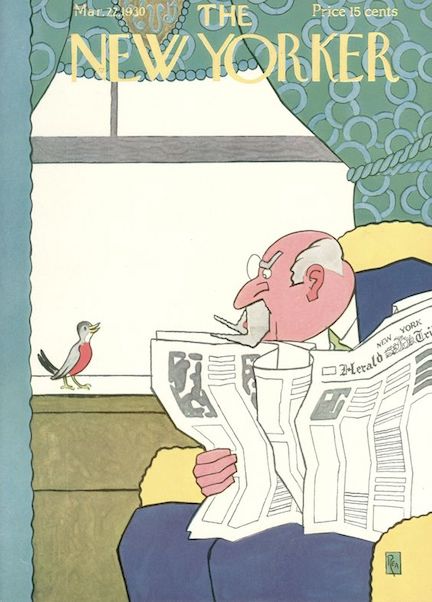
March 22, 1930 cover by Gardner Rea.
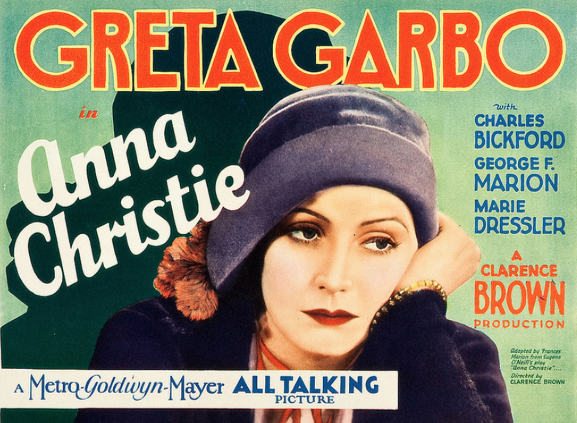
That’s what it was like for Greta Garbo fans before March 1930, when she spoke her first onscreen words in the 1930 MGM drama Anna Christie, which was adapted from a 1922 play by Eugene O’Neill.
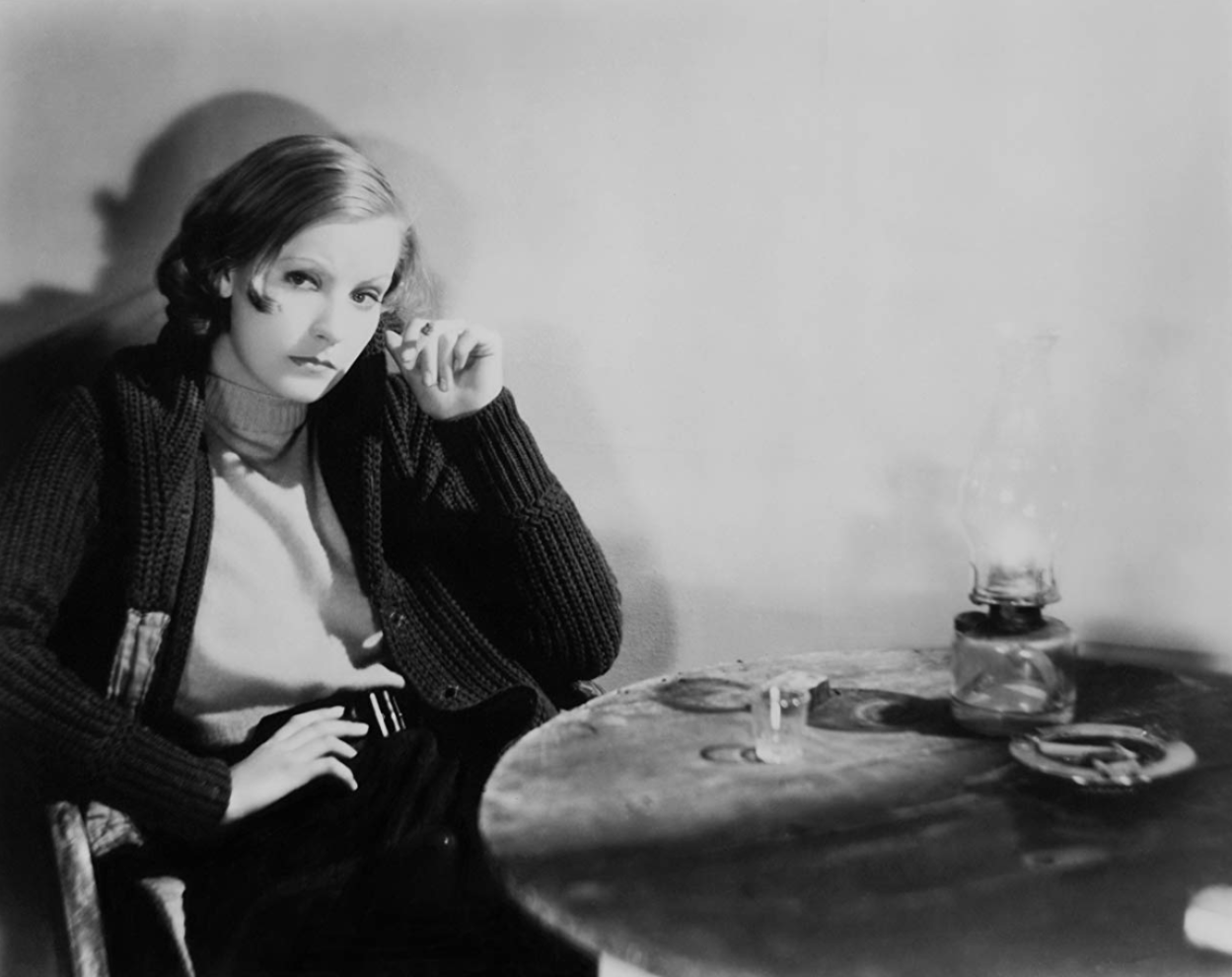
SWEDISH SPHINX…Greta Garbo’s mask-like qualities on display in this publicity still for Anna Christie. (IMDB)
The New Yorker’s film critic John Mosher, not always a fan of Garbo’s silent work, found a “special kind of glamour” in her first talking picture, even tossing out the word “legend” to describe this Swede who avoided publicity like a bad cold…
No doubt a few moviegoers saw the movie just to finally hear that voice, which Mosher described as “a surprise…a deep, low voice, a boy’s voice really, rather flat, rather toneless, yet growing more attractive as the picture advances”…
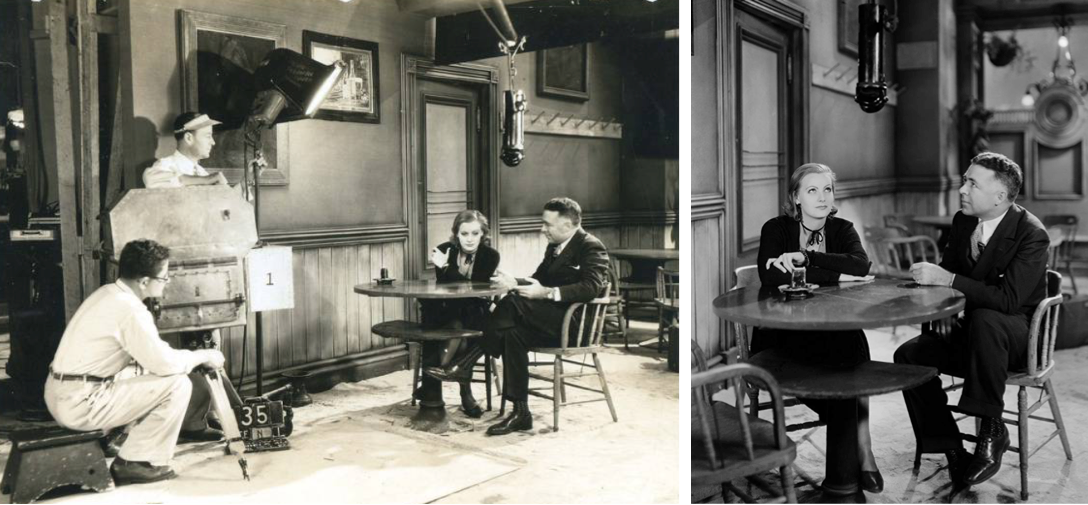
Director William H. Daniels (seated, left) with unidentified cameraman filming a scene from Anna Christie with actors Greta Garbo and Clarence Brown; at right, the actors contemplate the microphone hovering above them. Note how the camera in the first photo is contained in a soundproof case. (IMDB)
Publicized with the tag line “Garbo talks!,” Anna Christie premiered in New York City on Feb. 21 and would become the highest-grossing film of 1930. Later that year a German language version would be filmed featuring Garbo but with a different director and supporting cast.
SOUND DEBUT…Clockwise, from top left, Greta Garbo and Marie Dressler in Anna Christie; an MGM ad touting the film as one of the best pictures of the year (it would be the year’s highest-grossing, and Garbo would receive an Academy Award nomination); studio portraits of Garbo used in the film’s promotion. (IMDB)
* * *
Chicken and Cocktails
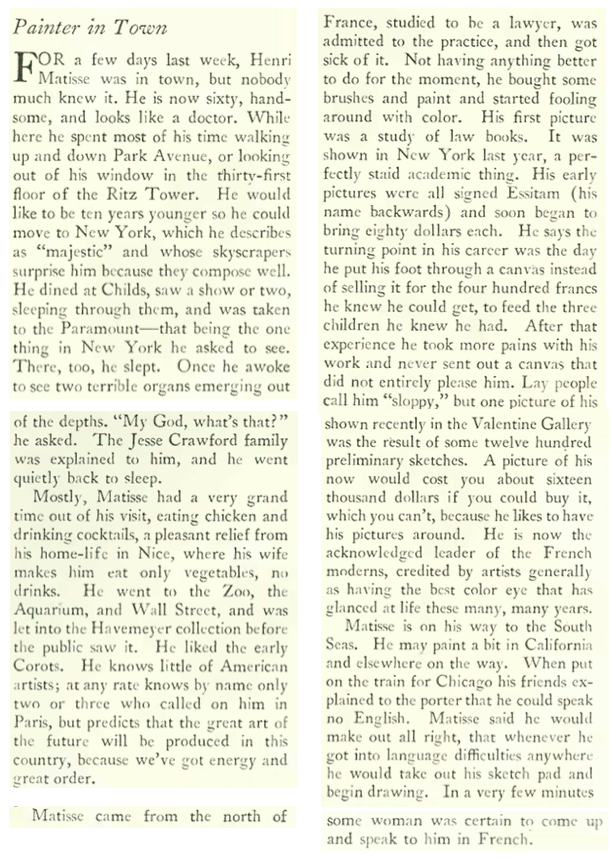
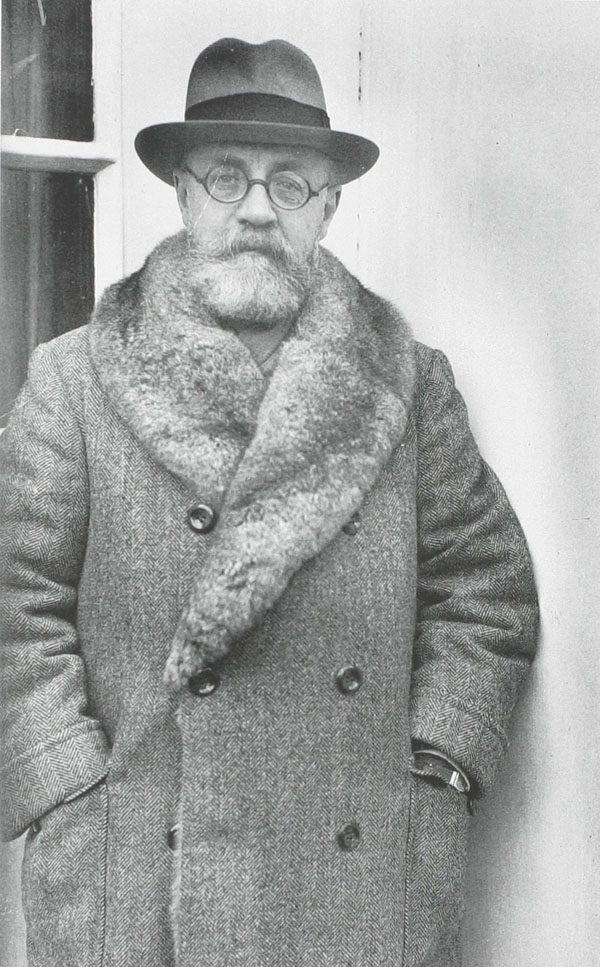
En route to the South Seas, the French artist Henri Matisse (1869-1954) paid a visit to New York City, and by all accounts had a good time there. His visit was described by Murdock Pemberton in “The Talk of the Town”…
I ♥ NEW YORK…Henri Matisse arriving in New York City on the RMS Mauretania December 15, 1930. He described the city as “majestic.” (artistandstudio.tumblr.com)NICE PLACE, THIS…Henri Matisse sitting on the brick roof terrace of 10 Mitchell Place (formerly Stewart Hall), the Queensboro Bridge glimpsed in the background. The photo was taken in 1930 by his son, Pierre Matisse, who was living in New York. At right, 10 Mitchell Place today. A framed photograph of Matisse sitting on the rooftop hangs on the wall of the building’s lobby. (Henri-matisse.net/Ephemeral New York)
* * *
The Last Page
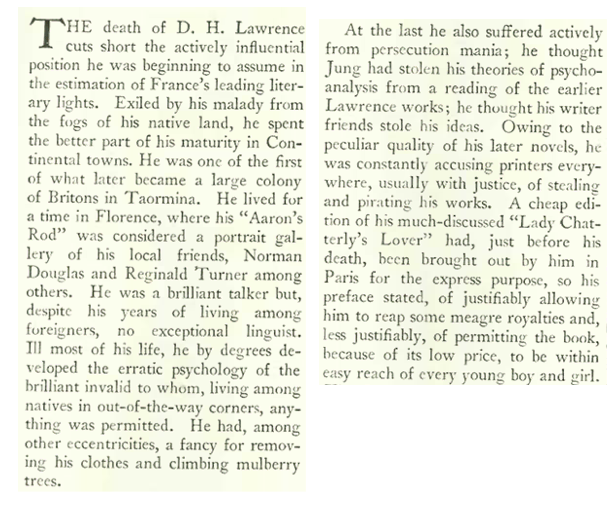
The death of author D.H. Lawrence (1885-1930) was reported to New Yorker readers by Janet Flanner, the magazine’s Paris correspondent, who briefly detailed the writer’s rather sad decline…
FLEETING DAYS…D. H. Lawrence (right) with fellow writer Aldous Huxley at Bandol, in the South of France, 1929. (Topham Picturepoint)
* * *
What Depression?
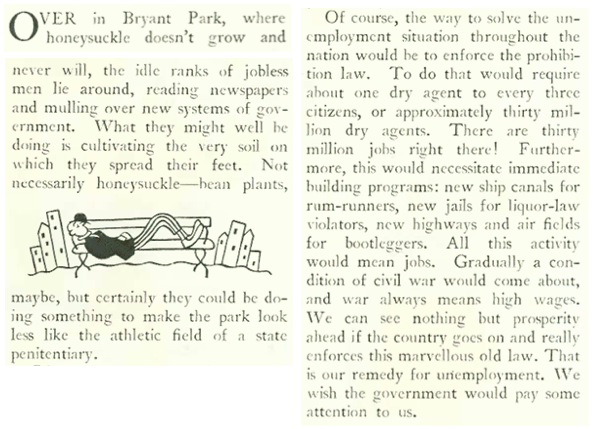
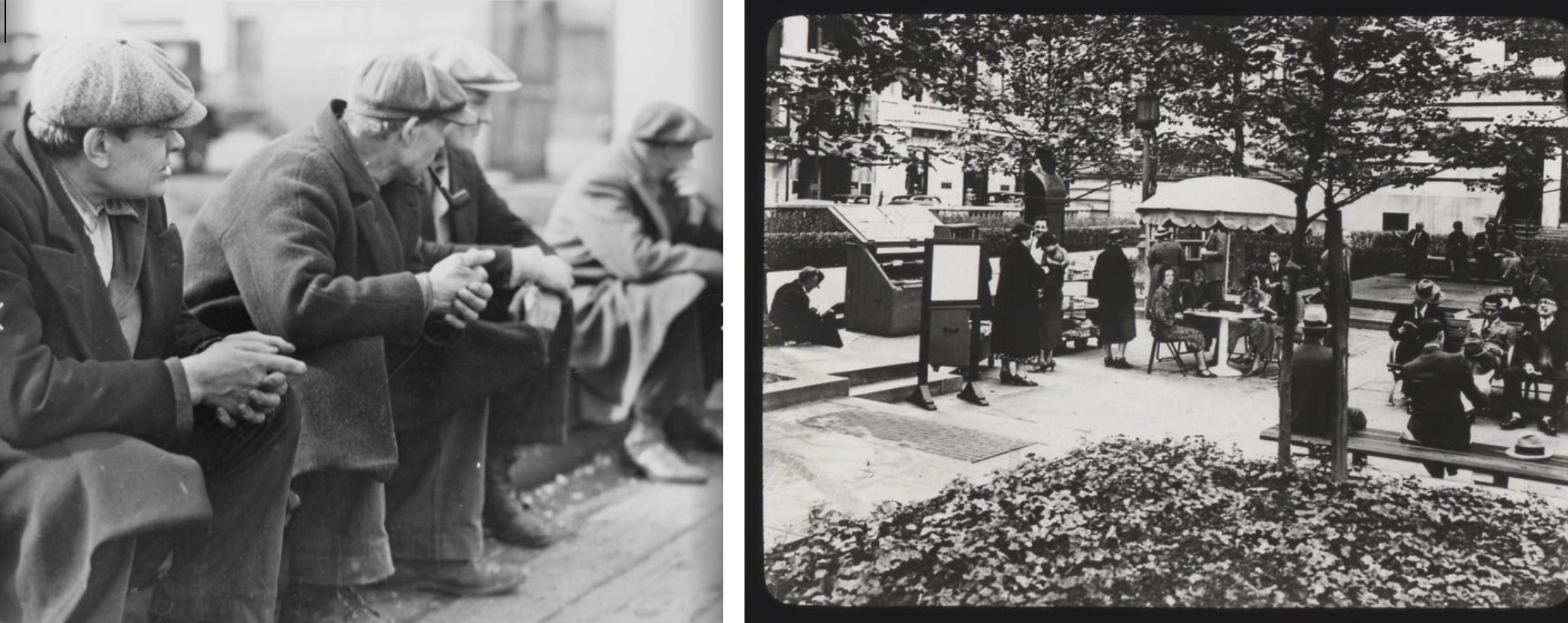
We are nearly five months into the Great Depression, yet there is little evidence in The New Yorker of the catastrophe that was unfolding across the land. And true to form, the approach to the topic was made with humor, via E.B. White in “Notes and Comment”…
KNOW ANY GOOD JOKES?…At left, unemployed New York dockworkers; at right, folks enjoying the New York Public Library’s outdoor reading room in Bryant Park, 1930s. (Lewis Hine/National Archives and Records Administration/New York Public Library)
* * *
Cathedrals of Commerce
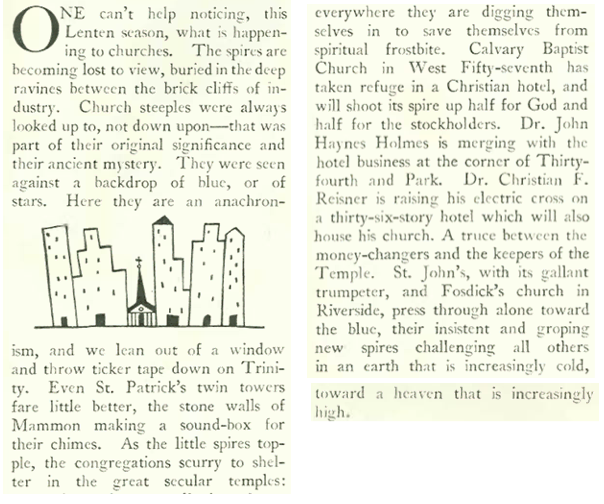
E.B. White also observed the changing skyline, and how the towering skyscrapers were quickly overshadowing the once prominent steeples of the city’s churches…
REACHING TO THE HEAVENS…Clockwise, from top left, Trinity Church Wall Street and St. Patrick’s have been eclipsed by the towers of Mammon, but St. John’s and Riverside still dominate their surroundings. (Wikipedia/St. John’s/Riverside)
* * *
The Other House of Worship
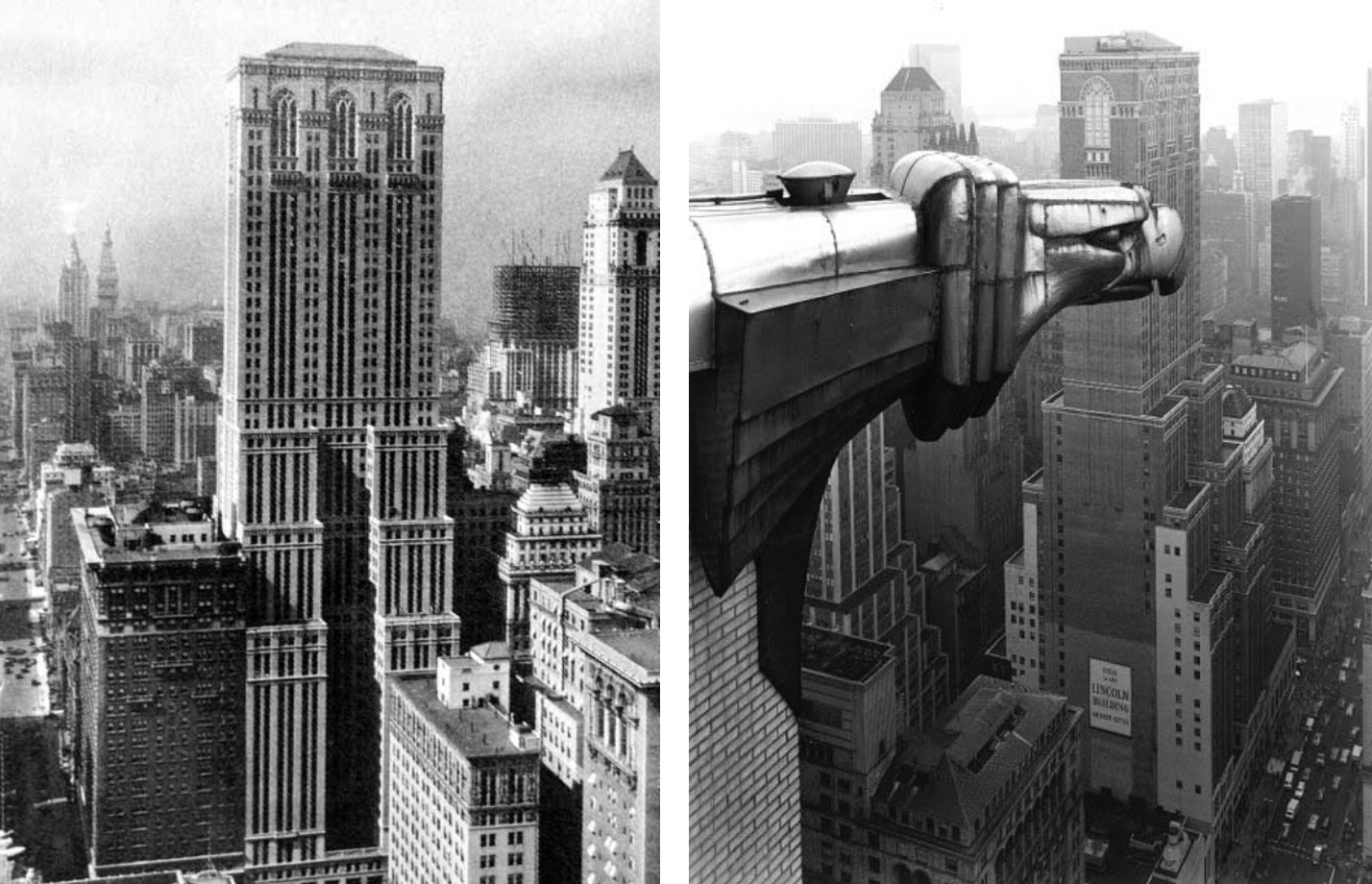
Perhaps a certain skyscraper ennui settled in, as architecture critic George S. Chappell was not all that impressed by the “huge” Lincoln Building (which today still seems huge)…
SIZE DOESN’T MATTER…Although the new Lincoln Building proved to be a massive addition to the New York skyline, its style seemed outdated in contrast to its flashy new neighbor, the Chrysler Building — one of its gargoyles, at right, seems poised to devour the Lincoln Building. (nyc-architecture.com)
* * *
From Our Advertisers
We have a bit more evidence of the Depression in the ads, including this one from Abercrombie & Fitch, with two sporting gents opting to go fishing to take their minds off the markets…
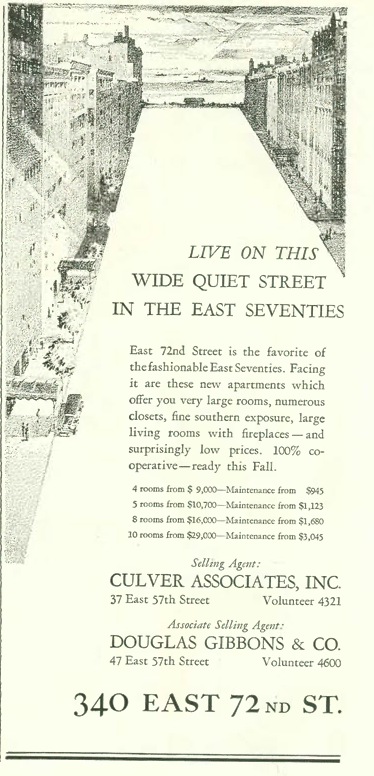
…if fishing wasn’t your thing, perhaps you just wanted to escape into the “quiet” of the wide streets in the East Seventies…
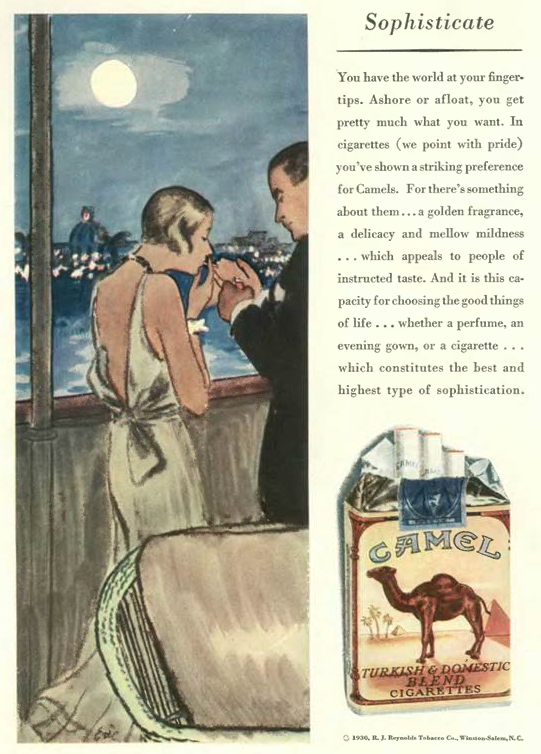
…or relax with a smoke, which artist Carl Erickson made so appealing with his Camel ad illustrations…
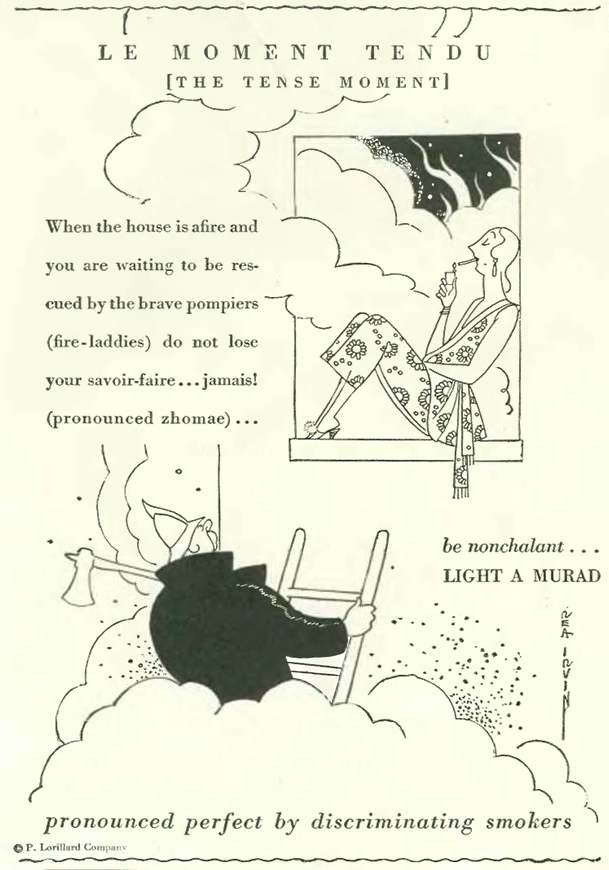
…or take the humorous route to a relaxing smoke, with this ad for Murad as illustrated by Rea Irvin…
…on to our cartoonists, Garrett Price captured the mood of the times…
…while Alfred Krakusin captured an altogether different mood…
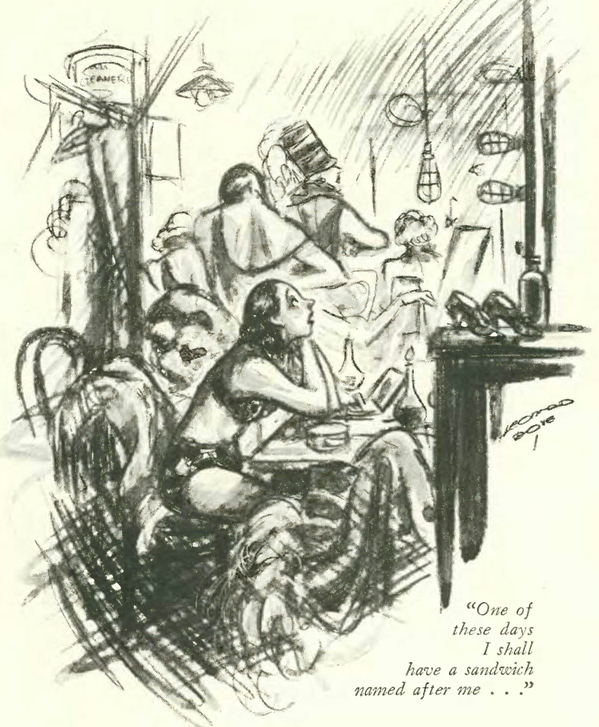
...Leonard Dove examined the path to stardom…
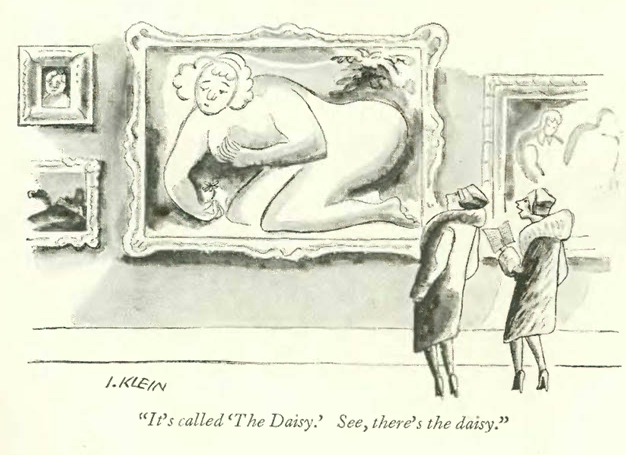
…Isadore Klein pondered modern art…
…William Crawford Galbraith found an unlikely victim of religious zeal…
…Mary Petty gave us a glimpse of a doctor’s office…
In his 2006 book, Flapper, Joshua Zeitz refers to The New Yorker’sLois Long as the epitome of the 1920s flapper, an “absolutely a wild woman” who wrote about Jazz Age nightlife “with a wicked sort of sexual sense of humor.”
Feb. 8, 1930 cover by Theodore Haupt (the annual Westminster Kennel Club dog show was in town…)
This Vassar-educated daughter of a Congregational minister began her New Yorker career in the summer of 1925, at age 23. She took over Charles Baskerville’s rather dry column, “When Nights are Bold,” renamed it “Tables for Two,” and using the pen name “Lipstick” plunged into the nightlife scene with considerable brio.
TIMES CHANGE…At left, in a still image from a 1920s home movie, Lois Long relaxes on a beach; at right, Long with newborn daughter Patricia Arno in 1929. (PBS/Patricia Arno)
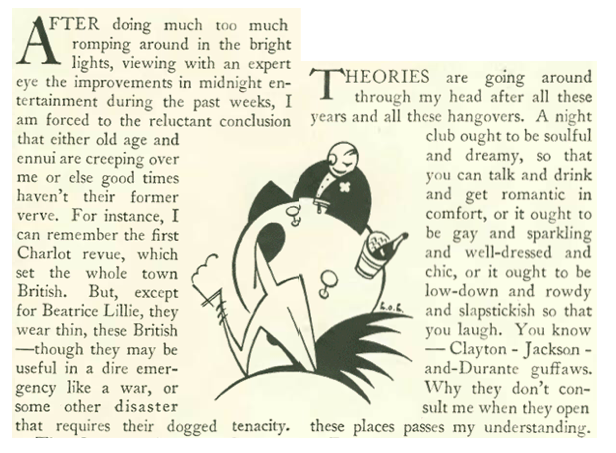
Two years later she would marry cartoonist Peter Arno, and in 1929 would give birth to a daughter, Patricia. During this time the almost weekly “Tables” column would appear infrequently as Long turned her attentions to her family and her fashion column, “On and Off the Avenue.” But as I’ve noted before, Long, along with many of her New Yorker colleagues, had grown weary of the Roaring Twenties many months before they were over. She would put an end (for awhile) to the “Tables” column in June 1930; the good times, as Long noted in her Feb. 8 column, had lost their “verve”…
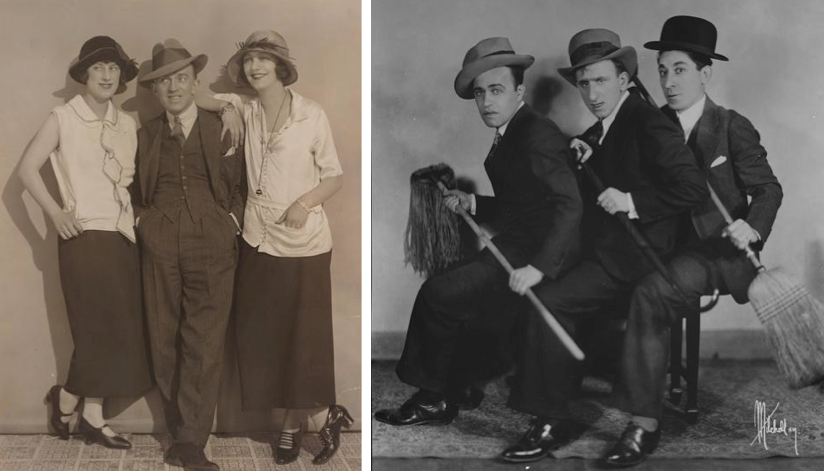
BRITS AND TWITS…Lois Long recalled the nightlife entertainments of the past and present in one of her last “Tables for Two” columns. Photo at left (from left to right), Beatrice Lillie, Nelson Keys, and Gertrude Lawrence in Andre Charlot’s Revue of 1924. At right, the comedy trio Eddie Jackson, Jimmy Durante and Lou Clayton. (Museum of the City of New York/Herbert Mitchell Collection)
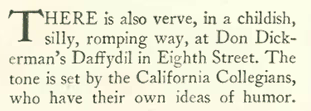
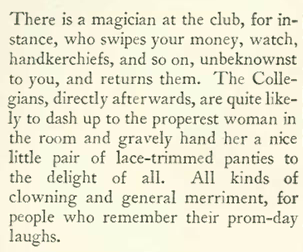
…Long found Don Dickerman’s latest themed restaurant, the Daffydil, to be a mildly amusing distraction…
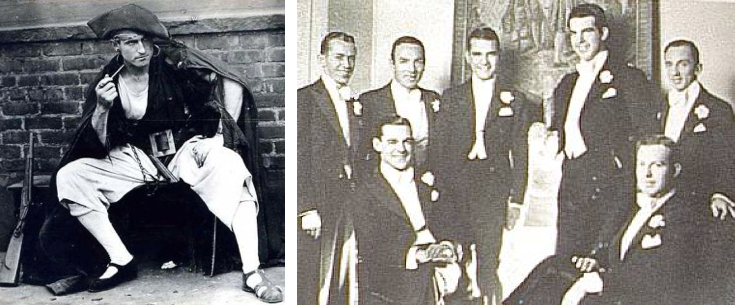
HE WAS AN ARRRTIST…Greenwich Village personality and pirate aficionado Don Dickerman (left) failed to make a living as an artist, but found success with his various themed restaurants including the Pirate’s Cove, the Blue Horse, the Heigh-Ho (where Rudy Vallee started out), the County Fair and the Daffydil (which was financed by Vallee). At right, singing at the Daffydil were the California Collegians, a group that included actor Fred MacMurray (tallest in the photo). (Restaurant-ing through history)
…and she also looked to Harlem for some nighttime diversions, but the ex-flapper just wasn’t up for a rowdy scene…
FOR THE YOUNG AT HEART…Dancing the Lindy Hop at the Savoy in Harlem, circa 1930. (Pinterest)
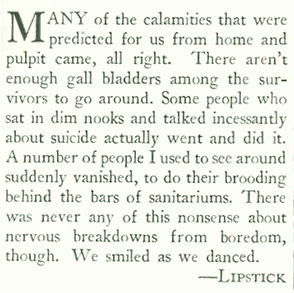
…ten years later, in The New Yorker’s fifteenth anniversary issue (Feb. 17, 1940), the 38-year-old Long would look back to the Roaring Twenties in the column “That Was New York,” reprising her signature “Lipstick” as she recalled the days when “Harlem was a thrill” and “we smiled when we went dancing in 1925 even though there wasn’t a candid camera within miles. In those days people frequently laughed out loud in public.” She concluded the piece with this observation:
* * *
Rise of the Débutantes
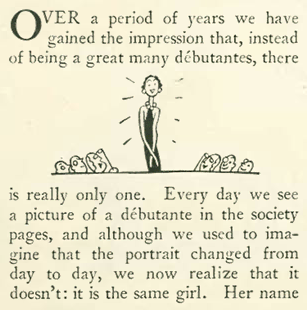
New York’s débutantes and The New Yorker had something of a symbiotic relationship during the magazine’s early days, beginning with a piece written by 22-year-old Ellin Mackay for the Nov. 28, 1925 issue that served as a manifesto of sorts for a new kind of débutante. Mackay’s essay explained why modern women were abandoning the forced social matchmaking of débutante balls in favor of the more egalitarian (and fun) night club scene.
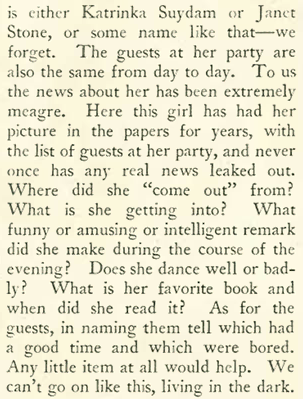
Mackay’s piece provided a huge boost to The New Yorker’s circulation, the magazine barely staying afloat at the time. Nevertheless, its writers couldn’t resist taking occasional shots at the seemingly frivolous existence of debs, including E.B. White, who called out a one Katrinka Suydam in his “Notes and Comment” column for Jan. 4, 1930:
Perhaps White came across Suydam’s name in the Sept. 7, 1929 New York Times:
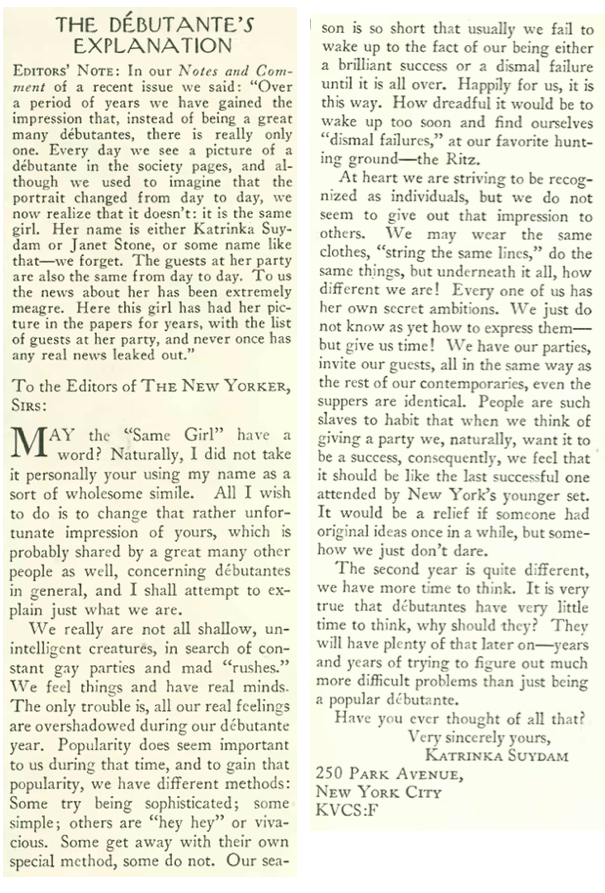
What he probably didn’t expect was a reply from Suydam herself, an act that seemed to impress the magazine’s editors, who printed the proud débutante’s letter in full on page 32:
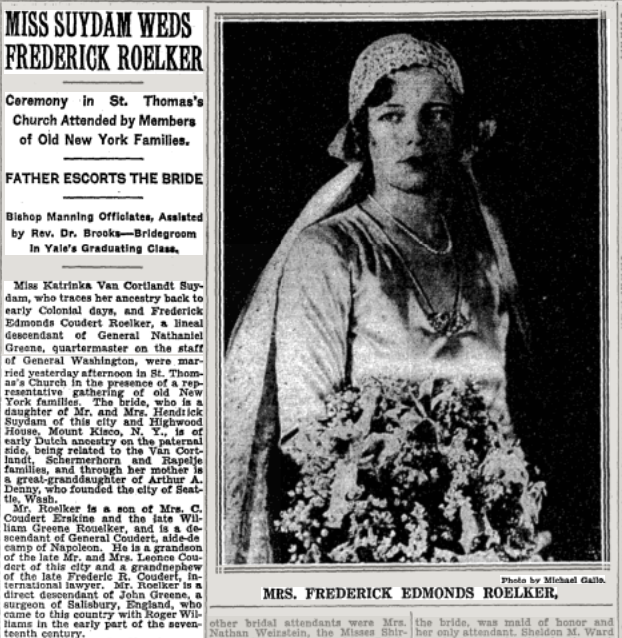
Suydam would go on to marry Frederick Roelker later that June. Note in this excerpted wedding write-up how the couples’ European and colonial pedigrees were carefully detailed in the first paragraphs, distinguishing their union from couplings enjoyed by the unwashed masses…
Katrinka Suydam’s wedding as reported in the June 12, 1930 issue of The New York Times.
* * *
Skirt Stakes
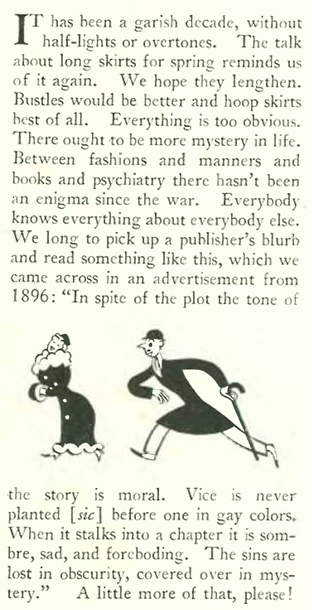
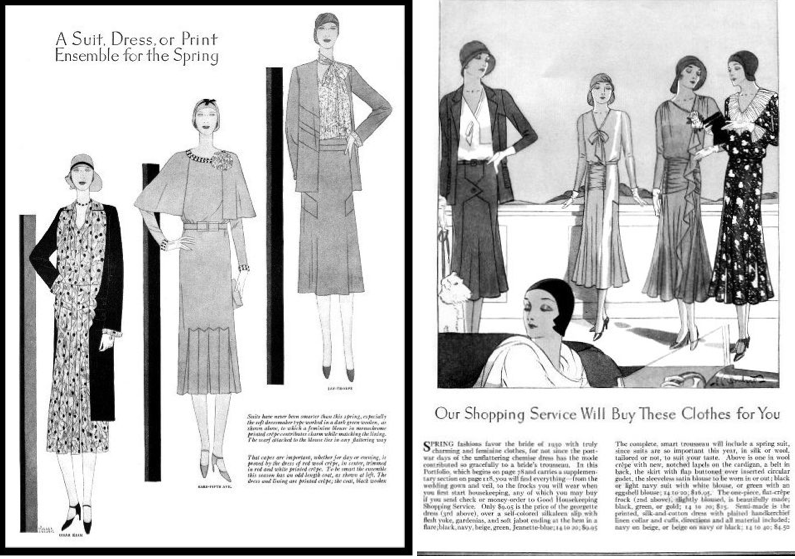
In 1930 hemlines plummeted along with the stock market. E.B. White, in “Notes,” welcomed the return of “mystery” to women’s fashions:
THEY DROPPED WITH THE MARKET…Women’s spring fashions with lowered hemlines on display in the April 1930 issue of Good Housekeeping. (fashion-era.com)
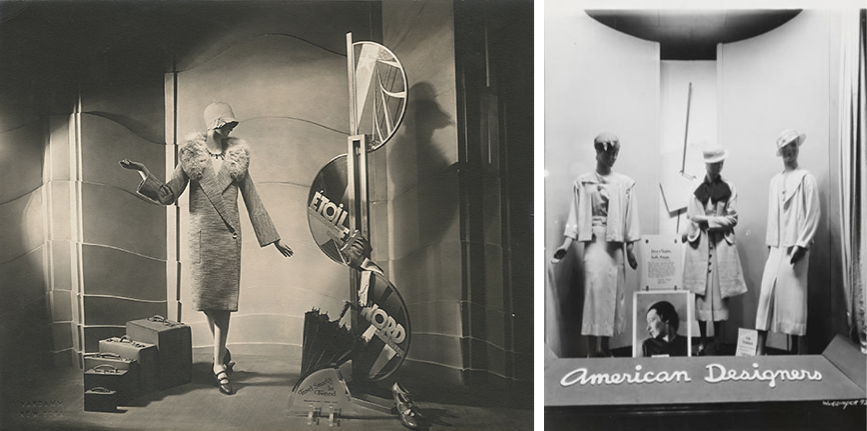
Frederick Lewis Allen, on the other hand, was having difficulty understanding the modern woman, circa 1930, based on what he was seeing in the display windows along Fifth Avenue. Excerpts:
NO NONSENSE WOMEN…Window displays on Fifth Avenue included (left) this “Travel Smartly in Tweed” window display for Franklin Simon (1929-30); and right, a window at Lord & Taylor, 1933. (Harry Ransom Center/Museum of the City of New York)
Allen noted that the “snooty” mannequins on display along Fifth Avenue represented a certain type who wouldn’t be caught dead riding a bus…
Whether or not he liked the Altman girls, the 39-year-old Allen felt like an “old fogey” in the presence of these “no nonsense” women:
* * *
Get A Room
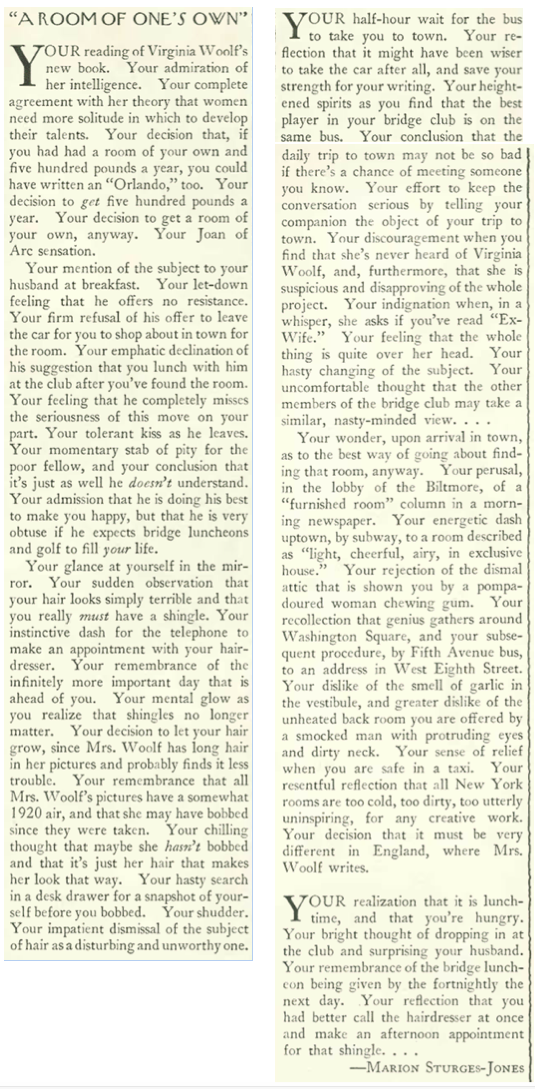
Marion Sturges Jones pondered the life of another kind of modern woman, namely that of Virginia Woolf, who had recently published the extended essay A Room of One’s Own. Jones discovered that finding such a room was easier said than done…
IN HER ROOM…Virginia Woolf at Monk’s House in East Sussex, 1932; dust jacket of the first edition of A Room of One’s Own. (kaykeys.net/Beinecke Library, Yale)
* * *
The Way You Really Look
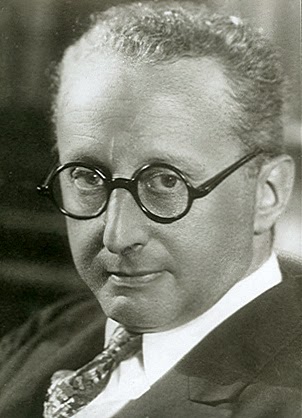
Franklin P. Adams penned a profile of the legendary songwriter and stage producer Jerome Kern, who created dozens of Broadway musicals and Hollywood films and wrote a substantial chunk of the American songbook (more than 700 songs) with such hits as “Ol’ Man River”, “A Fine Romance”, “Smoke Gets in Your Eyes”, and “The Way You Look Tonight.” Peter Arno provided this less-than-flattering caricature of the man…
…and this is how Kern actually looked, circa 1930…
(bloggingtonybennett.com)
* * *
At the Talkies
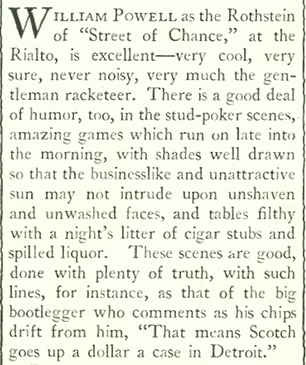
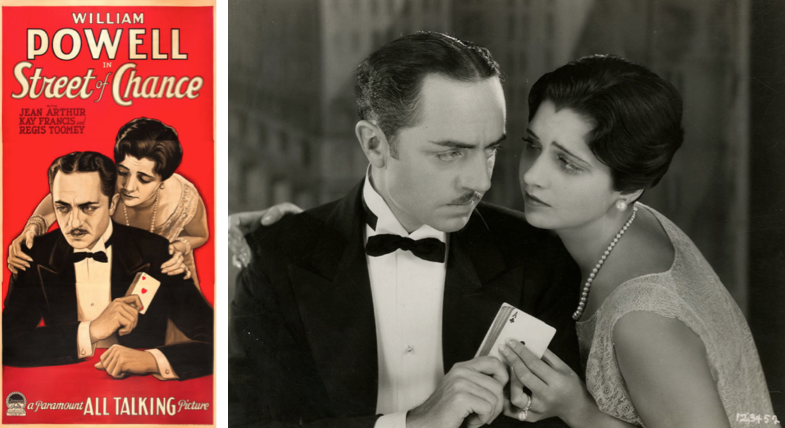
Speaking of showbiz, New Yorker film critic John Mosher offered high praise for William Powell’s latest film, Street of Chance. Although Powell is often linked professionally to actress Myrna Loy thanks to their six Thin Man films (1934 – 1947), from 1930 to 1932 he also appeared with Kay Francis in six films, including Street of Chance. Both Powell and Francis would become major stars of the 1930s, and between 1930 and 1936 Francis would be the number one female star at Warner Brothers and the highest-paid American film actress. Francis was no stranger to wild living — she was a longtime friend of Lois Long’s (see above) and also shared an apartment with her at 381 Park Avenue before Long married Peter Arno. Mosher’s review:
TOUGH ODDS…William Powell and Kay Francis in Street of Chance (1930). Francis was a longtime friend of New Yorker columnist Lois Long. (IMDB)
* * *
From Our Advertisers
We have an advertisement from the aforementioned County Fair, one of the themed restaurants operated by Greenwich village artist and personality Don Dickerman, who illustrated his own ads…
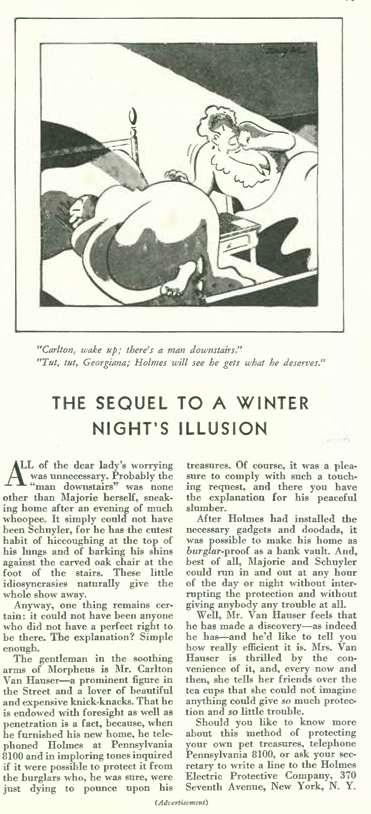
…I’m not sure who drew this Arno-esque illustration below for the Holmes Electric Protective Company, but I can tell you that the name Holmes was synonymous with home security in 1930…in 1857 Edwin Holmes bought a patent for an electric burglar alarm (invented in 1853 by Augustus Pope) and went on to successfully commercialize and popularize the electromagnetic burglar alarm. Holmes is also credited with creating the first large-scale alarm network in the United States…
…but I do know that Abe Birnbaum contributed this drawing (in “Talk of the Town”) of the beloved Colony restaurant owner Eugene Cavallero…
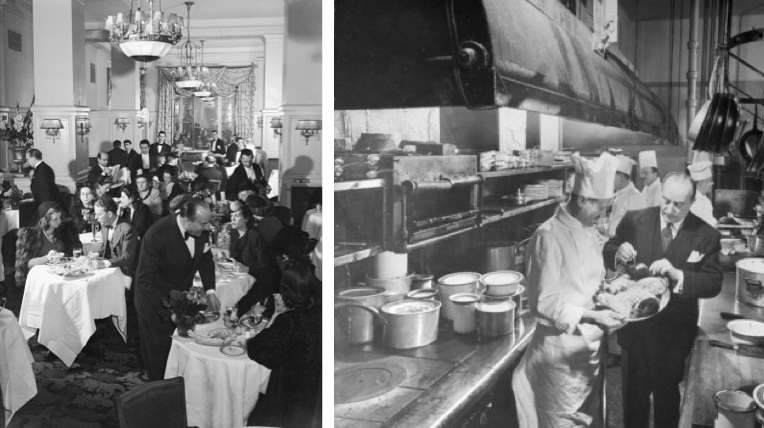
A PLACE TO SEE AND BE SEEN…From the 1920s to the 1960s New York’s smart set dined at the Colony. Rian James, in Dining In New York (1930) wrote “the Colony is the restaurant of the cosmopolite and the connoisseur; the rendezvous of the social register; the retreat of the Four Hundred.” Critic George Jean Nathan said the Colony was one of “civilization’s last strongholds in the department of cuisine.” Photo at left of the dining room around 1940; at right, owner Eugene Cavallero consults with a chef. (lostpastremembered.blogspot.com)
…on to our cartoons, we have a full page from Al Frueh…
…and another full-page from Rea Irvin…
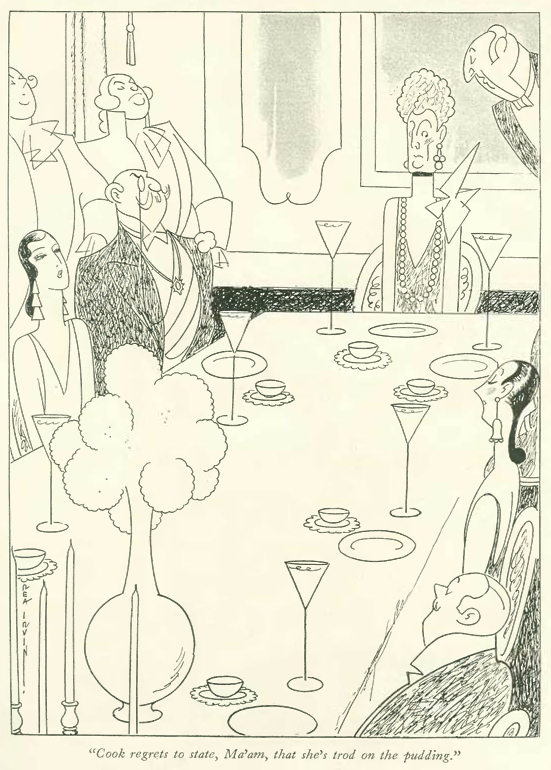
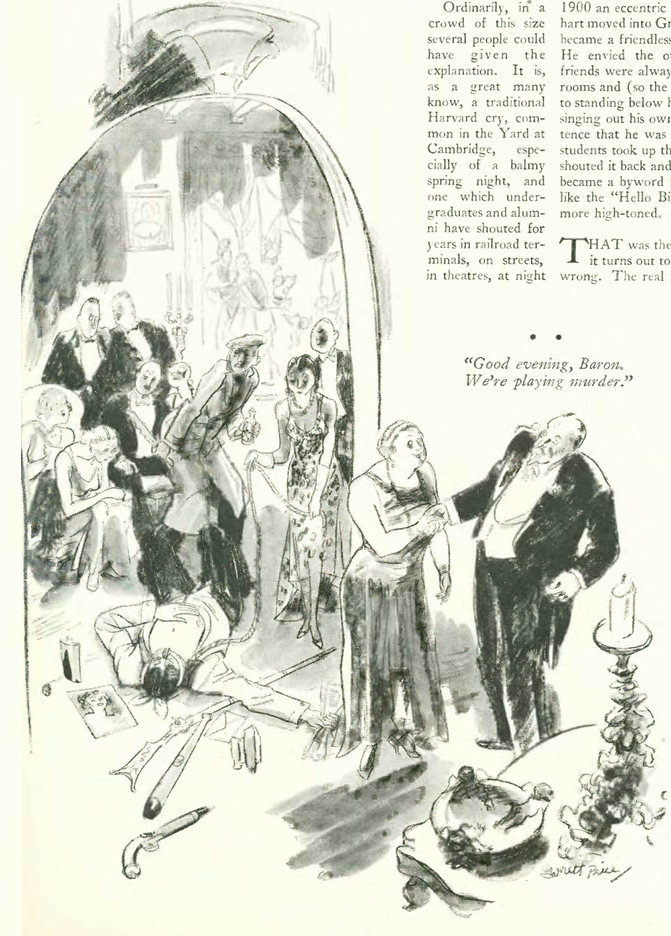
…this terrific party scene courtesy Garrett Price…
A host of nature programs from Mutual of Omaha’s Wild Kingdom to Planet Earth owe their origins to a few intrepid filmmakers who 100 years ago gave Americans some of their first glimpses of life in exotic, remote regions of the world.
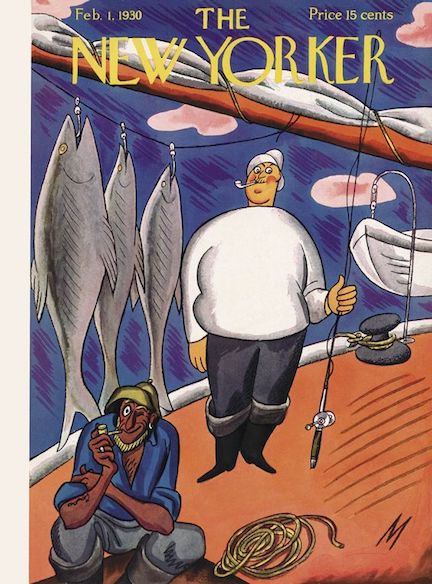
Feb. 1, 1930 cover by Julian De Miskey.
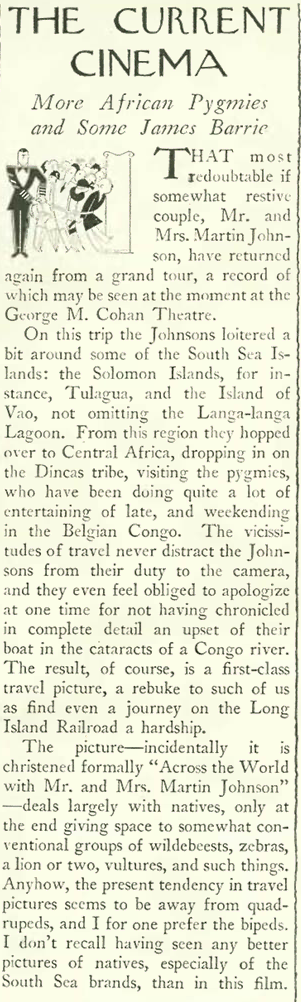
Among the first to do it were a couple from Kansas, Osa and Martin Johnson, who together explored unknown lands and brought back footage of the wildlife and peoples of the African continent, the South Pacific Islands and British North Borneo. Their first film, Among the Cannibal Isles of the South Seas (1918), was followed by several more, including Across the World with Mr. and Mrs. Johnson, which was released in early 1930.
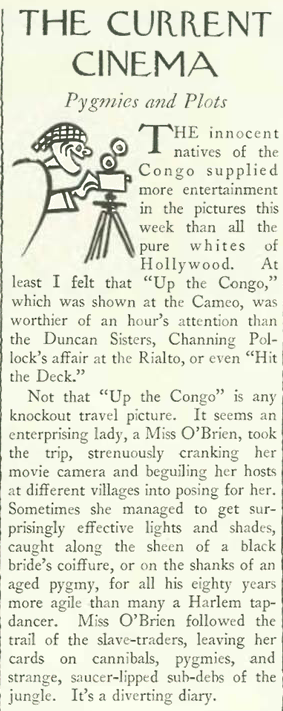
The New Yorker film critic John Mosher was as eager as any audience to take in the adventures of the Johnsons, or even of someone who was inspired by the Johnsons, in this case a “Miss O’Brien” who had just released a “diverting diary” called Up the Congo. Mosher wrote about it in the Jan. 25 issue:
CONTACT…Image of a family from an unidentified Pygmy tribe posing with a European explorer in a 1921 Collier’s New Encyclopedia entry; a group of Mbuti posing with explorer Osa Johnson in 1930. (Wikipedia)
I can find no record of the film UptheCongo, however the exploits of the Johnsons are well documented thanks to the Martin and Osa Johnson Safari Museum in Chanute, Kansas, which has a treasure trove of photos and other information on the explorers.
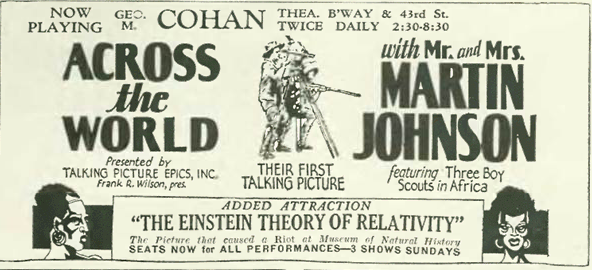
The ad in the Feb. 1, 1930 New Yorker promoting Across the World with Mr. and Mrs. Johnson included an interesting “added attraction”…a film about Einstein’s theory of relativity that had caused a Jan. 8 “riot” at the American Museum of Natural History. That particular screening was intended for members of the Amateur Astronomers Association, but word got out and three times the invited number showed up at the museum, breaking down the lobby gates. Hard to imagine a mob today clamoring to view a science film…
Although the Johnsons made their movies under the auspices of the American Museum of Natural History, much of the footage was staged or edited to maximize the thrills (Mutual of Omaha’s Wild Kingdom did this in the 1960s and 70s, as did producers of Disney’s nature films from the 50s and 60s. The practice continues to this day on cable television).
The Johnsons also didn’t hesitate to gun down animals in the course of their movie-making…
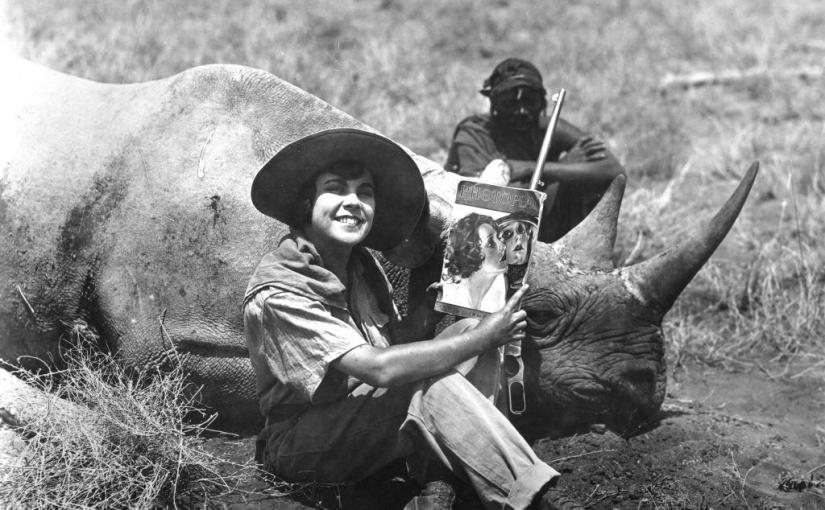
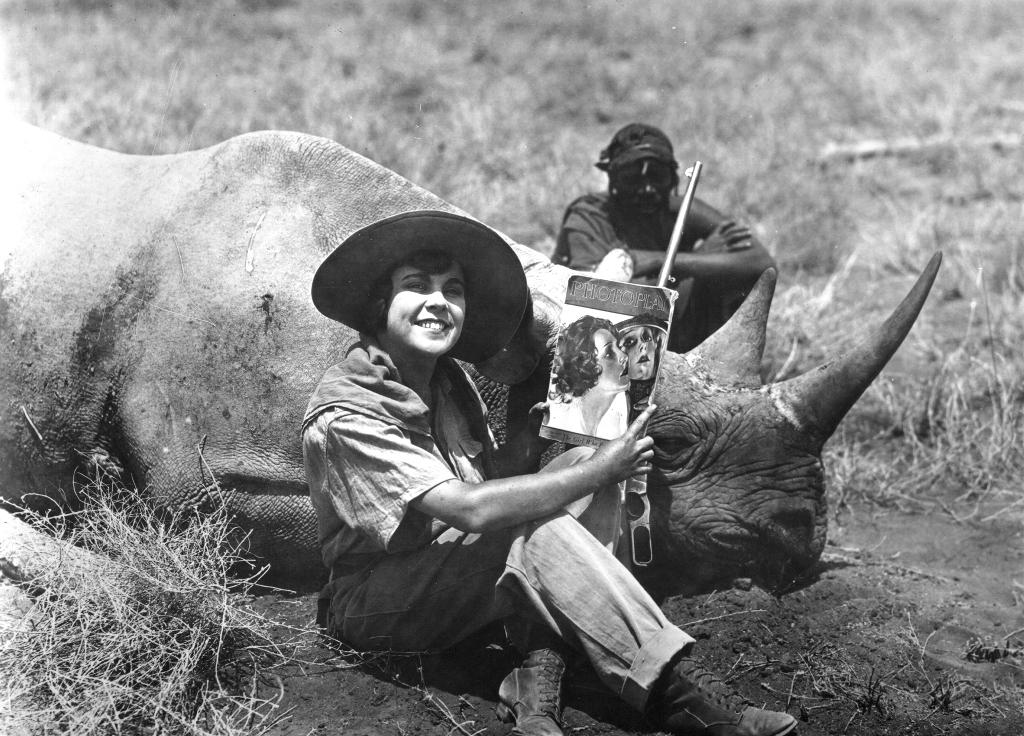
YEP, THAT’S JUXTAPOSITION…Osa Johnson poses with a Photoplay magazine, a dead rhino, and a tribesman, circa 1930. (columbia.edu)
According to a 2011 review from Wild Film History, “in stark contrast to the conservation-themed wildlife films of today, the Johnsons approached their subjects armed with both camera and rifle, with the production including provoked behaviour, staged confrontations and animals shot to death on film. Relying heavily on cutting in kills from professional marksmen, numerous hunting scenes culminate in a heart-stopping sequence where, with the use of clever editing, the adventurous Mrs Johnson appears to bring down a charging rhinoceros with one well-aimed shot.”
Across the World with Mr. and Mrs. Johnson is presented as if the Johnsons were showing their film to a few friends in their New York City apartment. The film is a “silent with sound,” that is, scenes in the field are silent, but the cocktail party “home movie” opening has sound, including “mood music” Osa provides by turning on the radio as the film begins. For all of their film experience, the acting between Osa and Martin is wooden, as is Martin’s narration. The critic John Mosher, however, enjoyed the ride, writing in his Feb. 1 column:
If you are curious, you can watch some of the film here, including the opening home movie scene with Osa and Martin in cocktail attire…
* * *
My Kinda Town
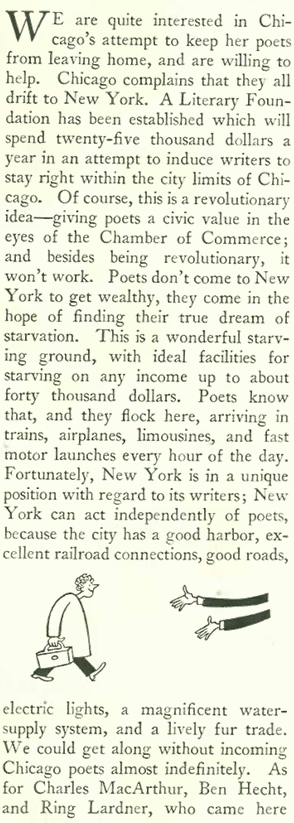
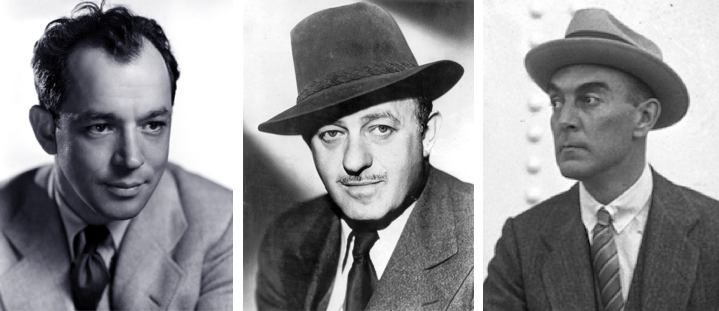
TheNew Yorker occasionally enjoyed taking potshots at the Second City, as well as some good-natured jabs at a few of its former residents who were also denizens of the Algonquin Round Table. Here is E.B. White in the Feb. 1 “Notes and Comment”…
WINDY WITS…Chicagoans Charles MacArthur, Ben Hecht and Ring Lardner were well-known to The New Yorker crowd. (Wikipedia)
* * *
Not In This Century
This item from the Feb. 1 “Talk of the Town” is noteworthy for placing its admiration of technical achievement over any concerns for a child’s welfare. Today the couple would be arrested for this…
* * *
ThePerilsofAging
Irish-American actress and writer Patricia Collinge (1892-1974) wrote a series of short stories for The NewYorker, including this piece for the Feb. 1 issue written when she was 37 years old. It is a sad story about an older actress (37) who hoped to land the part of a younger woman. Some excerpts…
…the actress in the story is led to believe the part was intended for a woman of 28, and is crushed to learn that the agent was looking for “a young twenty-two”…
OH TO BE YOUNG…At left, Gladys Cooper, Alexandra Carlisle and 20-year-old Patricia Collinge in the Drury Lane production of Everywoman (1912); at right, Collinge in 1941. Unlike the sad actress in her short story, Collinge’s career spanned more than 60 years. (Wikipedia)
* * *
ComingAround
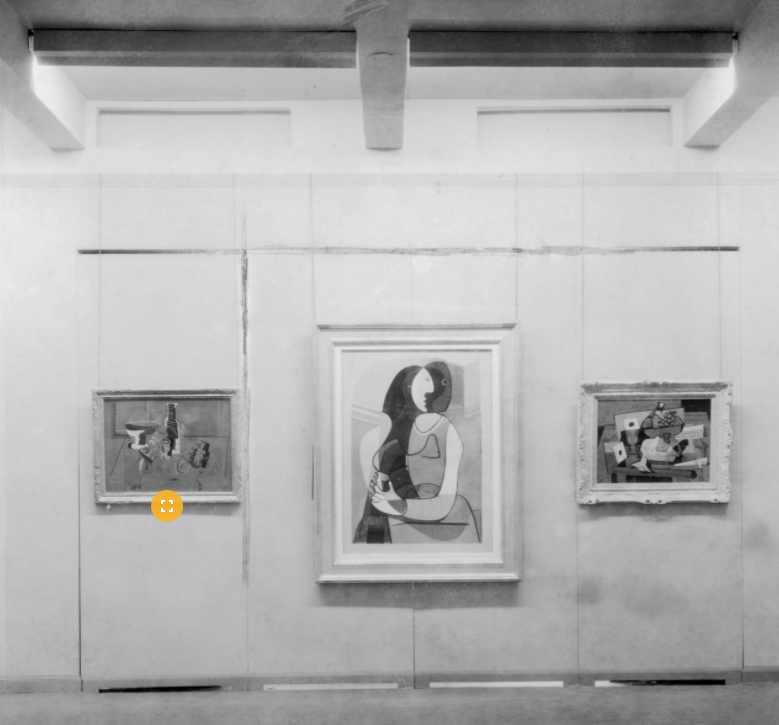
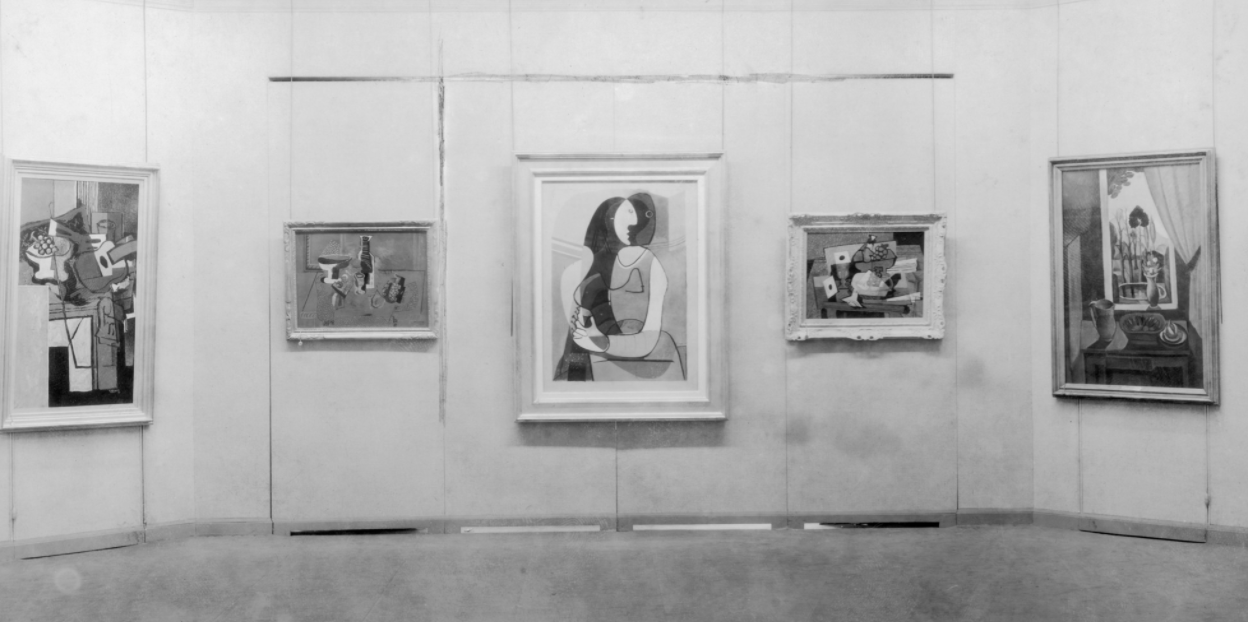
In previous issues art critic MurdockPemberton expressed skepticism about the new Museum of Modern of Art, founded by wealthy society women in November 1929. Pemberton held egalitarian views about art, and wondered if the old money set could create a venue for true modern artists. His review of “Painting in Paris,” MoMA’s third exhibition, seemed to allay his concerns…
PAINTING IN PARIS was the title of the Museum of Modern Art’s third exhibition featuring works by Georges Braque, Georges Rouault, Pablo Picasso, Joan Miró, Marc Chagall, Robert Delauney, Fernand Leger, Henri Matisse and Andre Derain among others. Image above is from the original exhibition at MOMA’s first home in the Heckscher Building at 730 Fifth Avenue. (MOMA)
Images above in color, from left, Pablo Picasso’sGreen Still Life Avignon (1914) and Seated Woman (1927); Georges Braque’sStill life (1927). (MOMA/WikiArt)
Pemberton expressed enthusiasm for the show’s new works that contained few traces of the familiar…
* * *
The King’s Speech
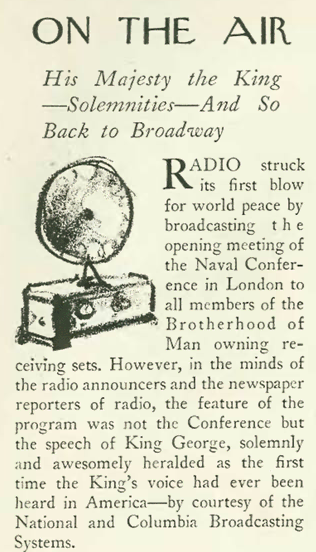
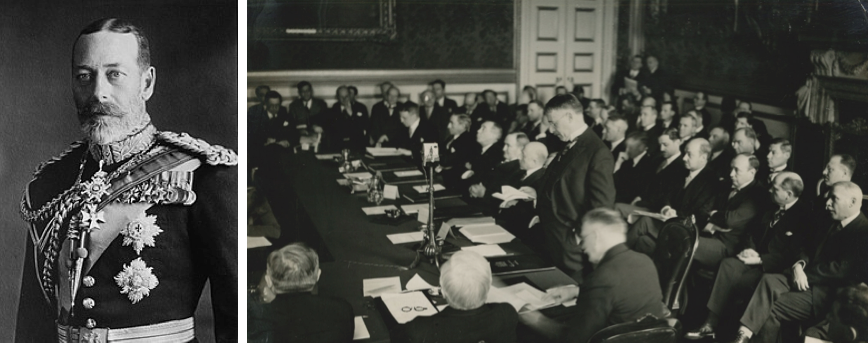
KingGeorgeV was not known for his public speaking, but when he addressed the third meeting of the London Naval Conference it was a big deal, even to American listeners who for the first time heard his voice over broadcast radio, still a very new medium in 1930…
ON THE AIR…The voice of King George V (pictured here in 1923) was broadcast across the Atlantic for the opening of the London Naval Conference at St. James’s Palace in 1930. The third in a series of five meetings, the conference was formed with the purpose of placing limits on the naval capacity of the world’s largest naval powers. (Wikipedia/Churchill Archives Centre)
* * *
Good Clean Fun?
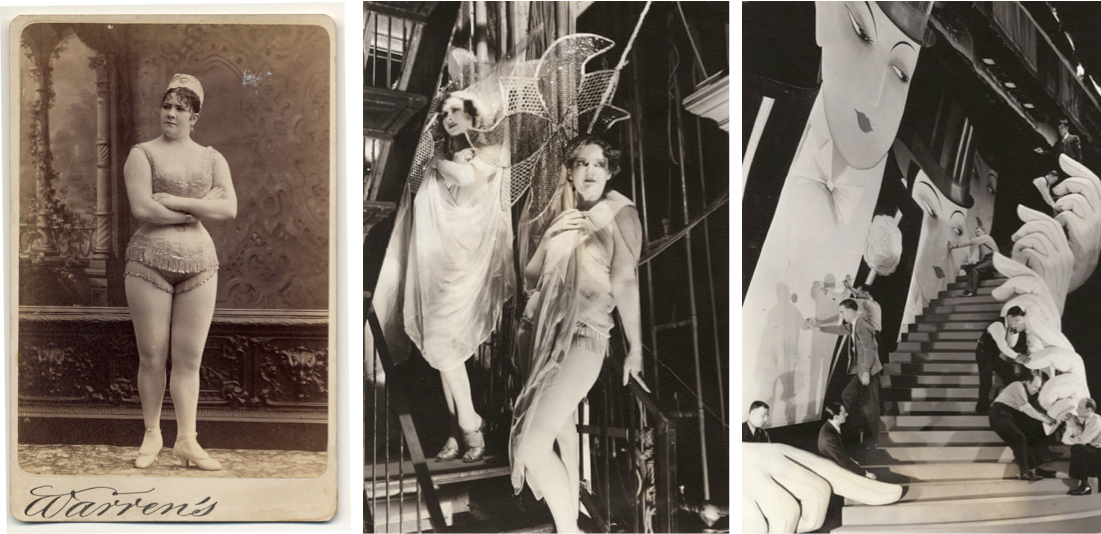
In his theater review column, RobertBenchley lamented the state of burlesque shows at the National Winter Garden, where “leviathans of an earlier day” were being displaced by “agile wisps” in third-rate Broadway productions…
ON THE SHOULDERS OF GIANTS…from left, Viola Clifton, a fuller-figured 1890s burlesque dancer; center and right, Margaret Bourke-White photos from Minsky’s National Winter Garden, 1936. Theater critic Robert Benchley wrote that he missed the “leviathans” of an earlier age, who were replaced by girls who were nothing but “agile wisps.”(mashable.com/theguardian.com)
* * *
From Our Advertisers
Just a couple of ads from the Feb. 1 issue, including this entry from the Shelton Looms offering advice on how one should appear among the Havana social set…
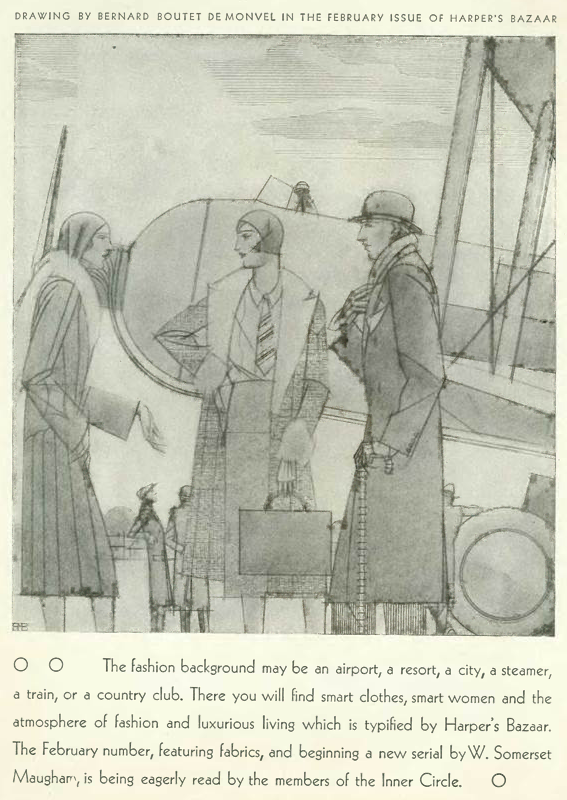
…and this ad from Harper’s Bazaar, also appealing to the smart set…
…our cartoons include this two-page illustration by ReaIrvin…
…AlanDunn’s look into the challenges of running a power plant…
…at the opera with PerryBarlow…
…GardnerRea and some bedroom hinjinks…
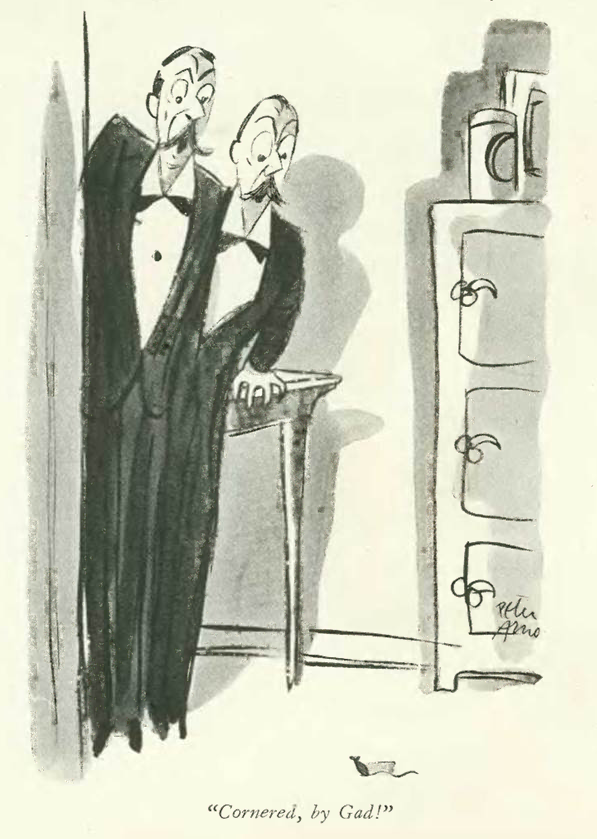
…man vs. mouse, by PeterArno…
…and this by LeonardDove, seemingly anticipating the work of CharlesAddams…
The effects of the October stock market crash were finally beginning to show in the pages of the New Yorker in the last month of the 1920s.
Dec. 7, 1929 cover by Julien De Miskey.
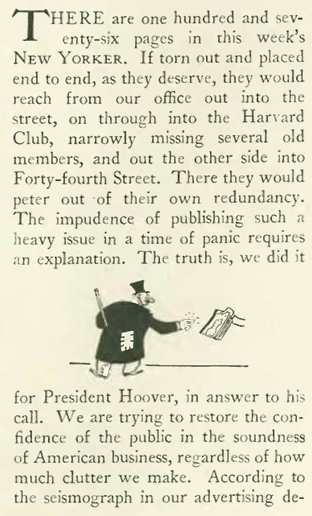
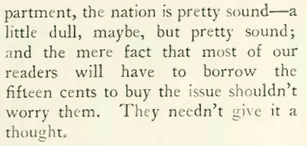
E. B. White was doing his best to keep things light, stating in his “Notes and Comment” column that despite the “time of panic,” the ad-packed Dec. 7 issue contained a whopping 176 pages…
Advertising income for The New Yorker would drop a bit in 1930 (from $1,929,000 to $1,922,000) and would continue to decline through 1932 (down to $1,448,000) before recovering slightly in 1933 and then really taking off again in 1934. And as White noted, even if they had to borrow the 15 cents, folks would still buy the magazine: circulation would top 100,000 in 1930, and except for a dip in 1932 would steadily grow past 150,000 by decade’s end.
KEEP CALM AND CARRY ON…E.B. White in 1946. (National Endowment for the Humanities)
The magazine was stuffed with ads as well as an extended “On and Off the Avenue” —which offered advice to holiday shoppers — and the continued serialization of Elmer Rice’s novel A Voyage to Purilia (installment No. 9).
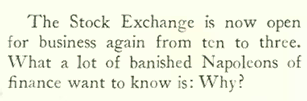
But not all was sweetness and light. The biggest economic collapse in U.S. history was simply too pervasive to ignore, and even a feeling of hopelessness was creeping into magazine — here’s an observation by Howard Brubaker in his “Of All Things” column…
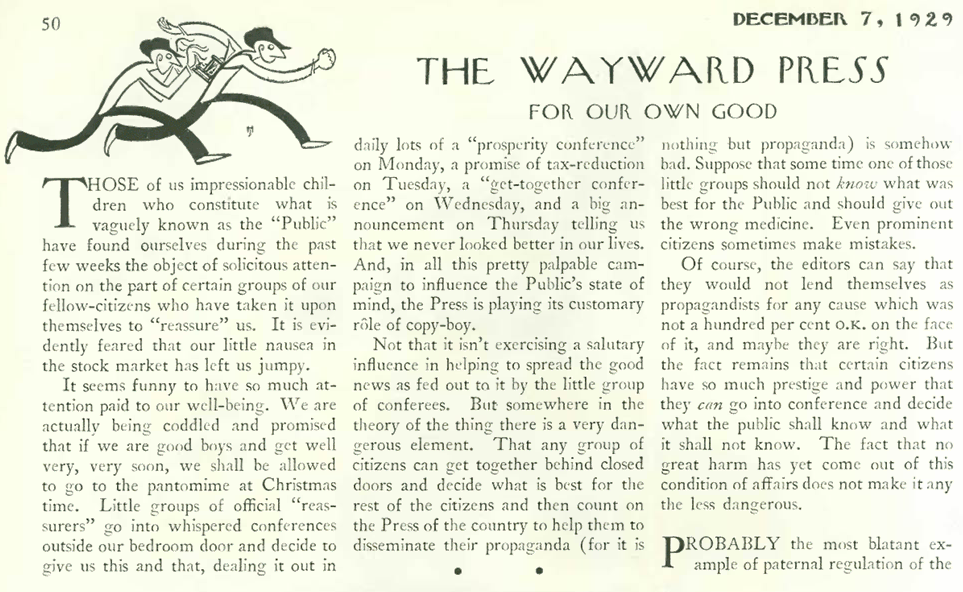
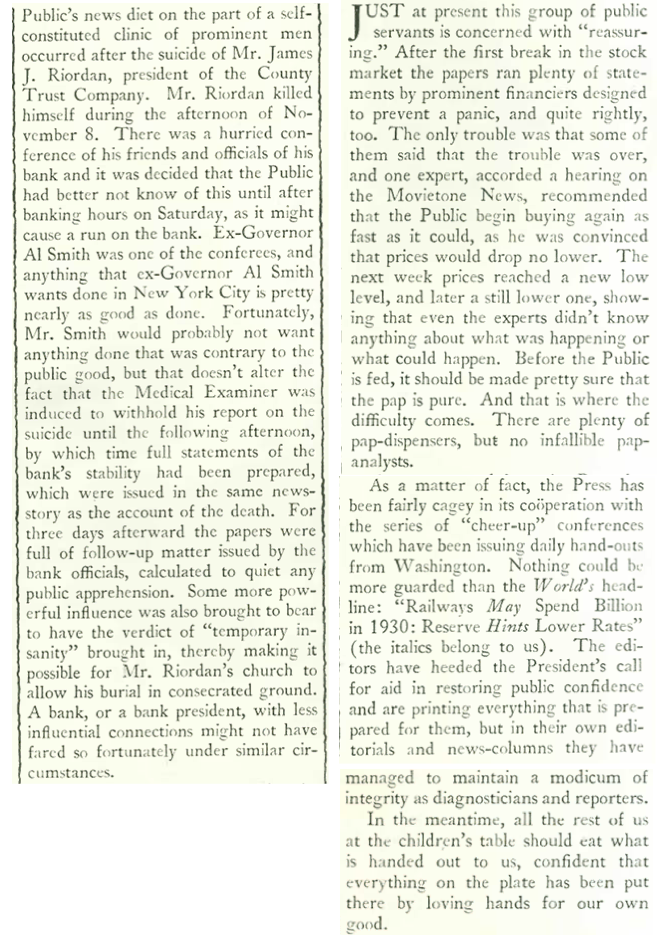
…and writing under the pseudonym “Guy Fawkes,” humorist Robert Benchley found little to laugh about in his “The Wayward Press” column. He chided the media for giving the public false hopes (which he labeled “propaganda”) regarding the state of the economy, and for concealing the suicide of prominent New York banker James J. Riordan, whosedeath announcement was postponed until Riordan’s bank closed for the weekend…
MARKET CASULTY…News of the suicide of prominent New York banker James J. Riordan (left) was suppressed to avoid a run on his County Trust Company. Robert Benchley (right) criticized the newspapers for working with power brokers to feed positive economic news to the masses. (NY Daily News/amsaw.org)
The following account excerpted from the Nov. 10, 1929 New York Times reveals how a nervous banking community responded to the market crash-related suicide of Riordan:
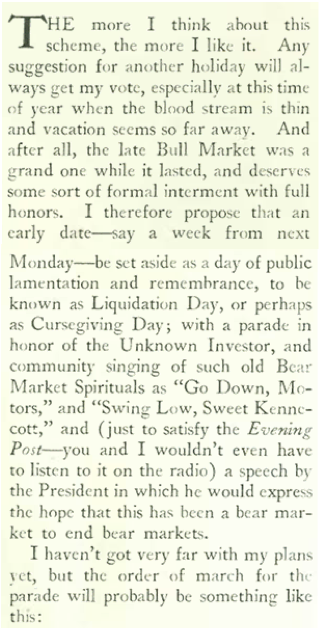
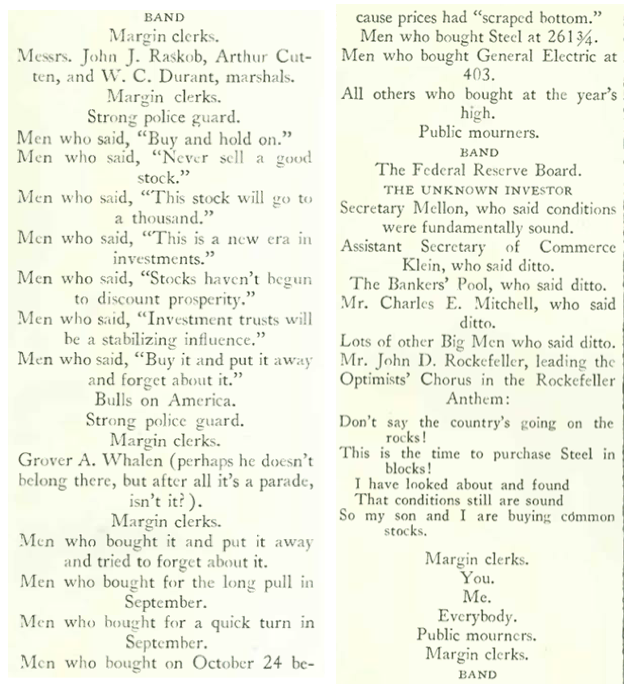
The popular historian Frederick Lewis Allen (1890 – 1954) offered a more lighthearted take on the events surrounding the market crash in his tongue-in-cheek casual, “Liquidation Day Parade,” in which he proposed a holiday to commemorate the end of the Big Bull Market.
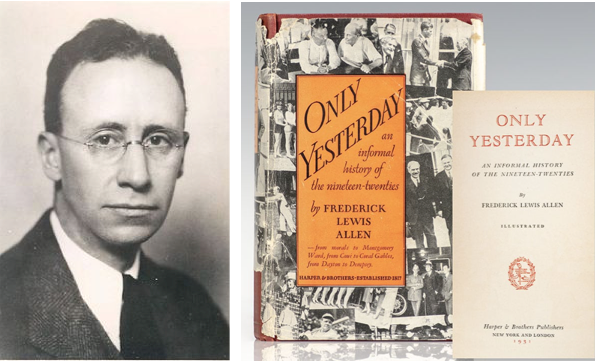
Allen, who also served as editor of Harper’s Magazine, would go on to write Only Yesterday, which chronicled American life in the Roaring Twenties. The 1931 book was a huge bestseller at the dawn of the Depression, and critically acclaimed, both then and now. Writing for the WashingtonPost (Nov. 28, 2007), book critic Jonathan Yardley observed: “It is testimony to both the popularity and the staying power of Only Yesterday that for more than three-quarters of a century it has remained steadily in print, and to this day enjoys sales that would please plenty of 21st-century writers.”
I CAN SEE CLEARLY NOW…in a little more than year after the Roaring Twenties came to a close, historian Frederick Lewis Allen would chronicle that decade in Only Yesterday, his most famous book. (Wikipedia/raptisrarebooks.com)
* * *
Clipped Wings
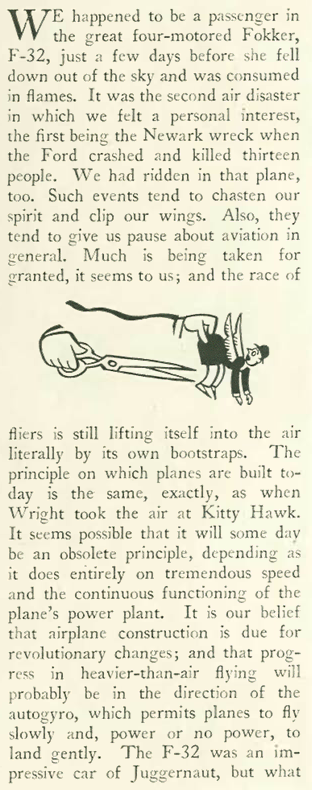
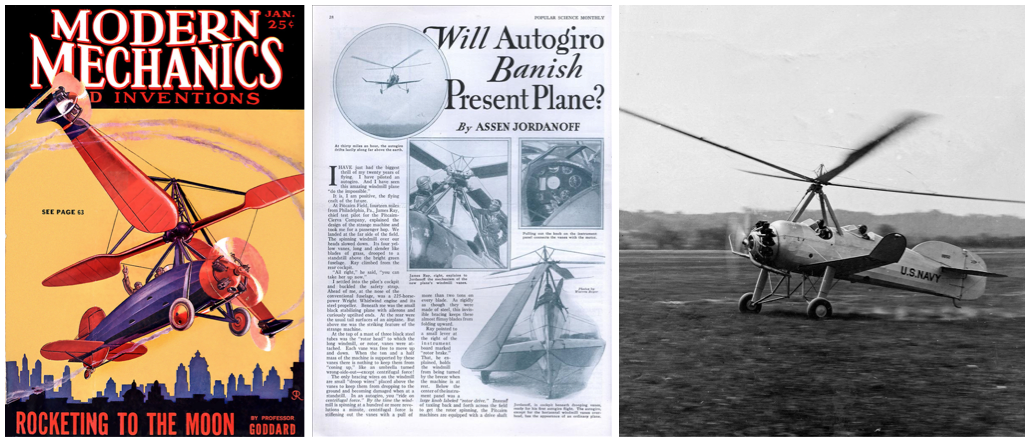
We turn back to E.B. White, The New Yorker’s most enthusiastic proponent of the aviation age. In the previous issue (Nov. 30) White had rhapsodized about a flight he took on a huge, new Fokker F-32. In the Dec. 7 “Talk of the Town” White reported that the very same plane had crashed and burned (and also noted that another plane on which he had been a passenger, a Ford Trimotor, had crashed earlier that year in Newark). White speculated that aviation would soon head in a different, safer, direction along the lines of the autogyro, a flying contraption that was widely favored by futurists of the day:
IT’S A BIRD, IT’S A PLANE…In the 1920s and 30s the autogyro — part airplane, part helicopter — was seen as the future of air transportation. From left, cover of ModernMechanics magazine from January 1930; an article on the autogyro from the March 1931 issue of Popular Science; an XOP-1 autogiro at the Naval Air Station Anacostia in Washington D.C., 1931. (modernmechanix.com/navalaviationmuseum.org) Click image to enlarge
* * *
Wonders Never Cease
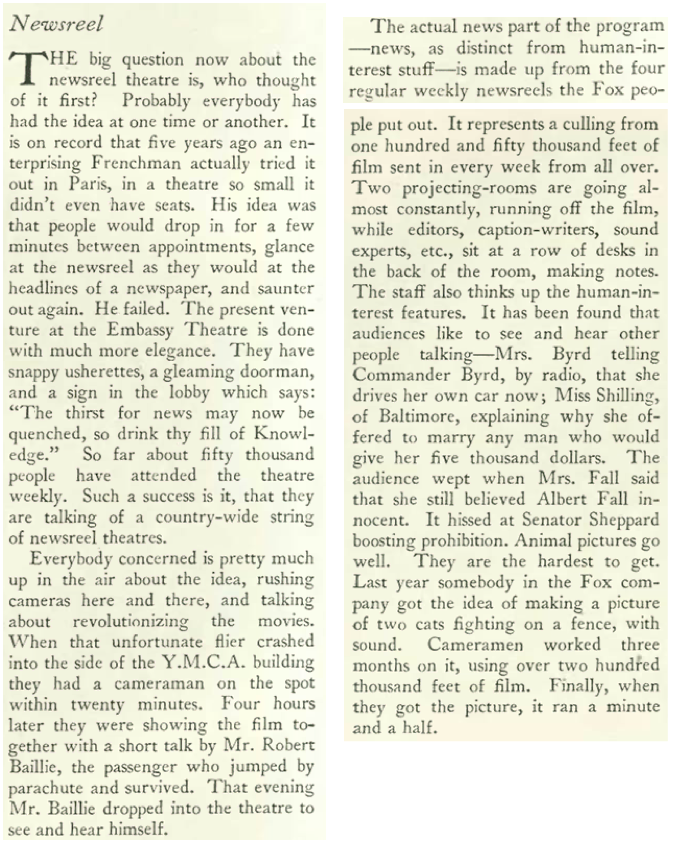
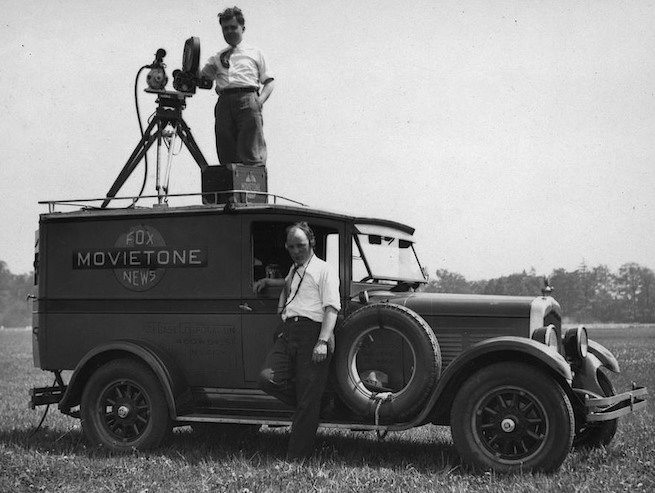
“Talk” also reported the growing popularity of newsreel theaters, and marveled at the speed with which camera crews could deliver their finished product to movie screens. An example was the crash of a small plane onto the side of a YMCA (an incident also noted by White in the previous issue); a newsreel crew was able to go from scene to screen in about four hours:
BEFORE GERALDO…Fox Movietone news crew in 1930. (City of Toronto archives)
* * *
High Wire Act
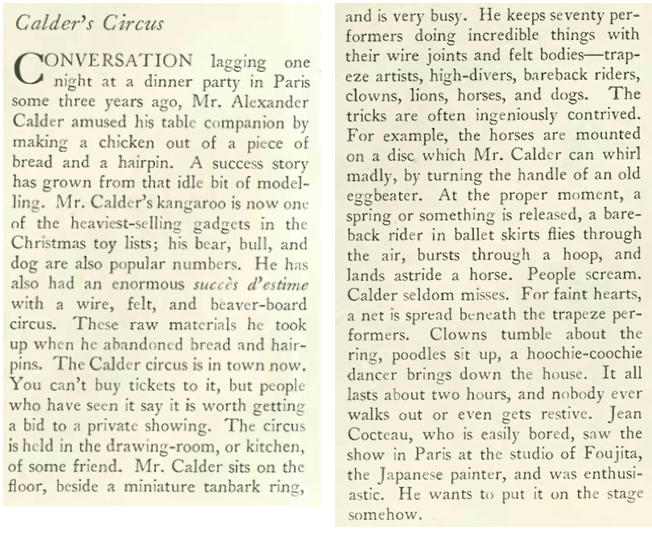
The artist Alexander Calder was already well known for his wire sculptures (his colorful mobiles would come later) when he embarked on his Cirque Calder in Paris in 1926. He brought “the show” to New York in 1929, where he used everything from eggbeaters to balloons to bring his wiry performers to life. Presumably art critic Murdock Pemberton wrote this account for “Talk of the Town”…
UNDER THE TINY TOP…Invitation to a performance of Cirque Calder (1926–31) at the Hawes-Harden apartment, August 28, 1929; AlexanderCalder with Cirque Calder (1926–31), 1929; Lion Tamer and Lion from Cirque Calder (1926–31). (calder.org)
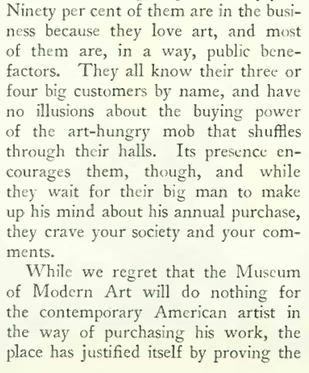
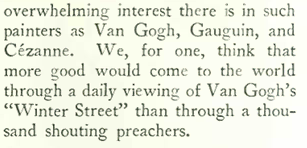
And we also have Pemberton over at his art column, where once again he tried to make sense of the new upstart Museum of Modern Art. He seemed to be surprised by the large crowds drawn to the new museum as he pondered its next show…
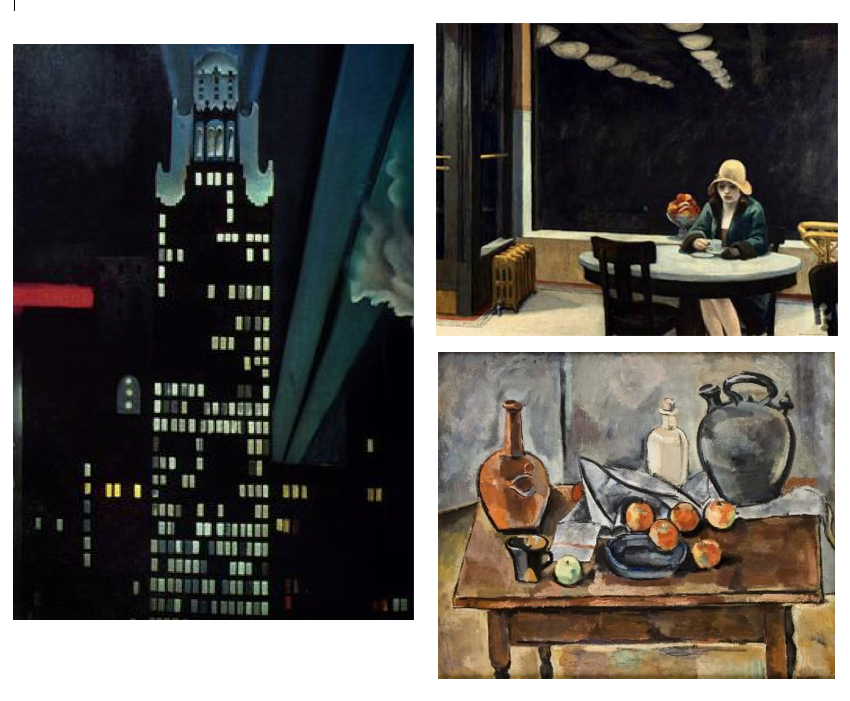
AMERICAN MODERN…Among works featured at MoMA’s second exhibition, Paintings by Nineteen Living Americans, were, at left, Georgia O’Keefe’sRadiator Building (1927); top right, Edward Hopper’sAutomat (1927); and Max Weber’sThree Jugs (1929). (Wikipedia/theartstack.com)
Pemberton had yet to see MoMA’s stunning second exhibition, Paintings by Nineteen Living Americans, but had to (grudgingly) conclude that the museum was filling a need…
* * *
The Toy Bazaar
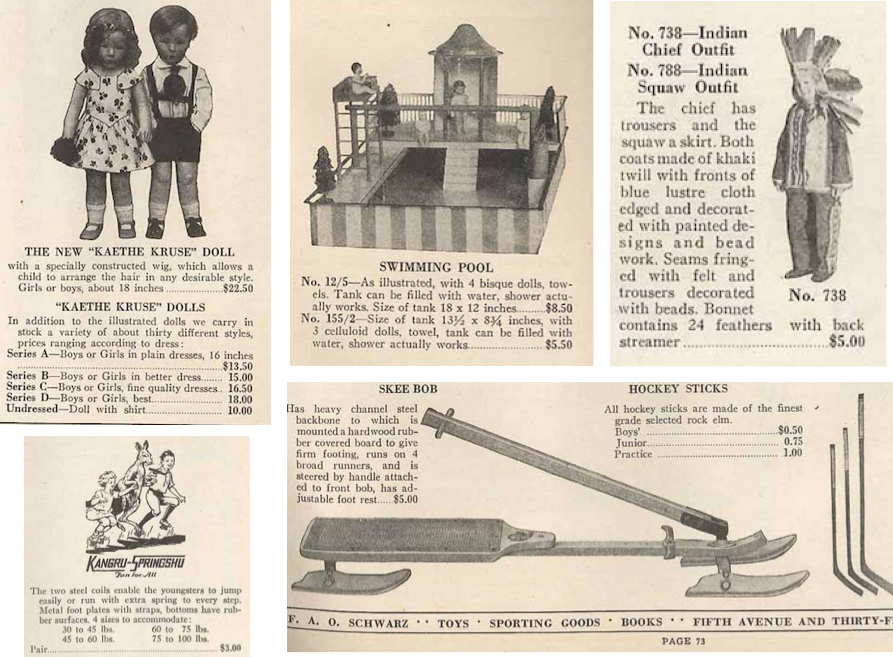
From its beginnings in 1862 until the end of the 19th century, the F.A.O. Schwarz toy store was known to New Yorkers as the “Toy Bazaar,” and by 1929 was something of an institution. As part of a lengthy column featuring ideas for Christmas shoppers, The New Yorker offered some tips on what shoppers might find at the famed toy store:
FUNLAND…Left, the cover the 1929 F.A.O. Schwarz Christmas catalog; at right, the store’s location in 1929, 303 Fifth Avenue. (oldwoodtoys.com)
Some of the toys mentioned in The New Yorker article, from the 1929 F.A.O. Schwarz Christmas catalog. There’s nothing plastic here — plastics as we know them, such as polypropylene, would be developed in the 1950s:
The 1929 F.A.O. Schwarz Christmas catalog also featured a color spread of its stock of Lionel Electric Trains:
If you want to look at the entire 1929 F.A.O. Schwarz Christmas catalog, you can find it at this terrific site.
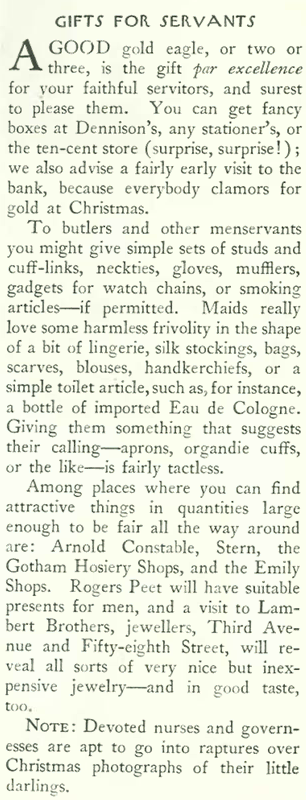
The column also offered advice on “gifts for servants,” at least for those who weren’t getting laid off due to the market crash. Note the somewhat patronizing tone, especially the final paragraph regarding nurses and governesses:
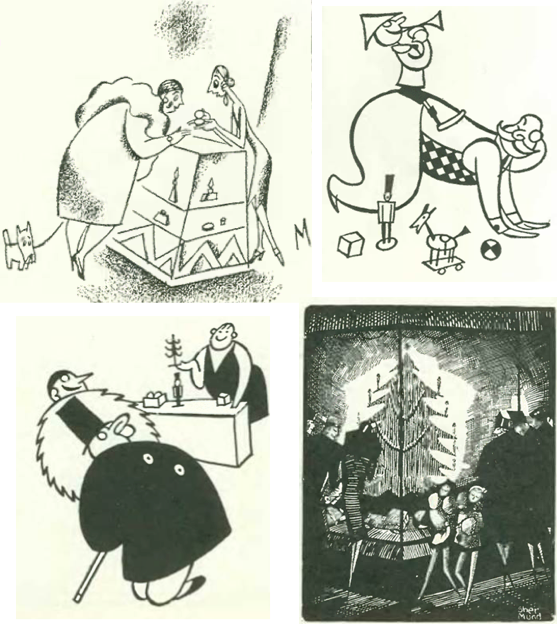
As usual, the shopping column was sprinkled with spot drawings celebrating the season: here are three from Julian De Miskey and one from Barbara Shermund:
* * *
The Bard Does the Talkies
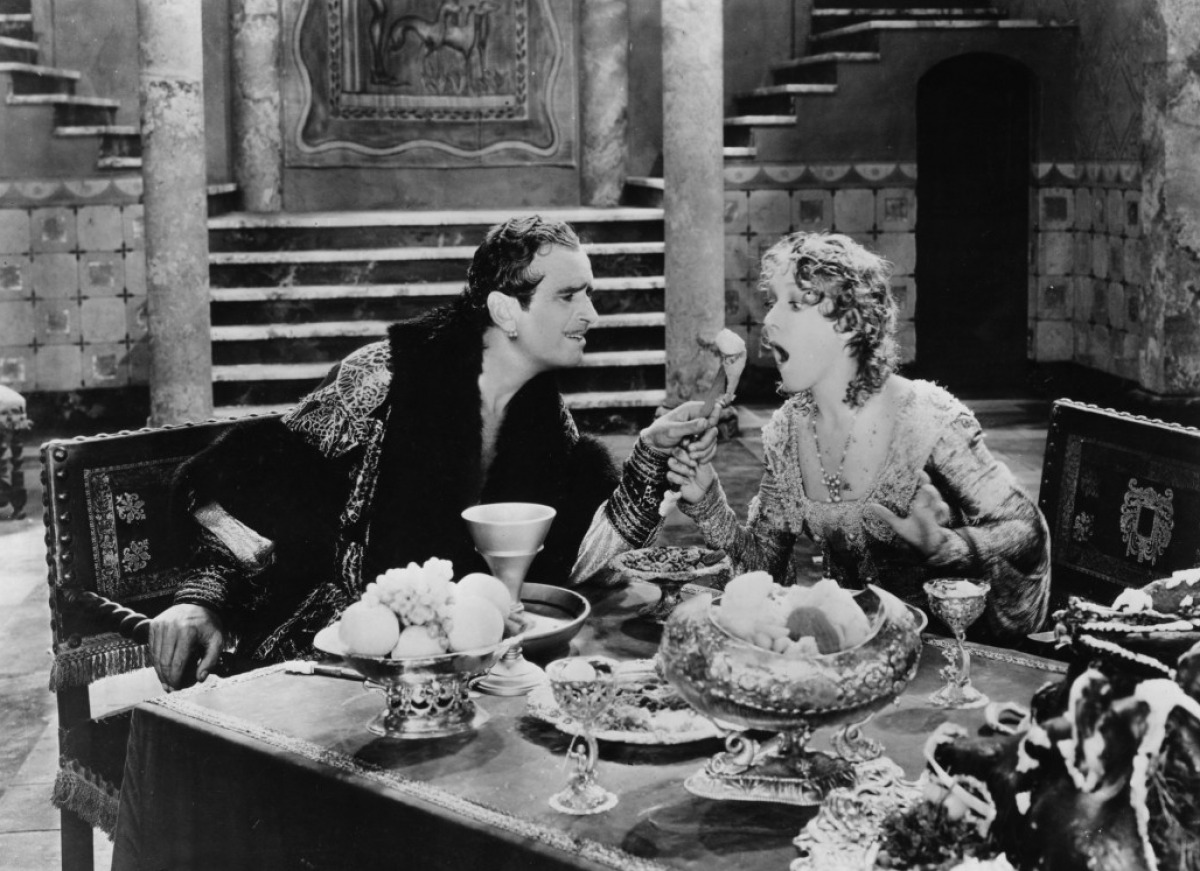
At the movies, critic John Mosher found much to like at the Rivoli, which was screening The Taming of the Shrew featuring the husband/wife team of Douglas Fairbanks and Mary Pickford:
WILD AT HEART…Douglas Fairbanks and Mary Pickford in 1929’s The Taming of the Shrew. (IMDB)
* * *
Somerset Saga
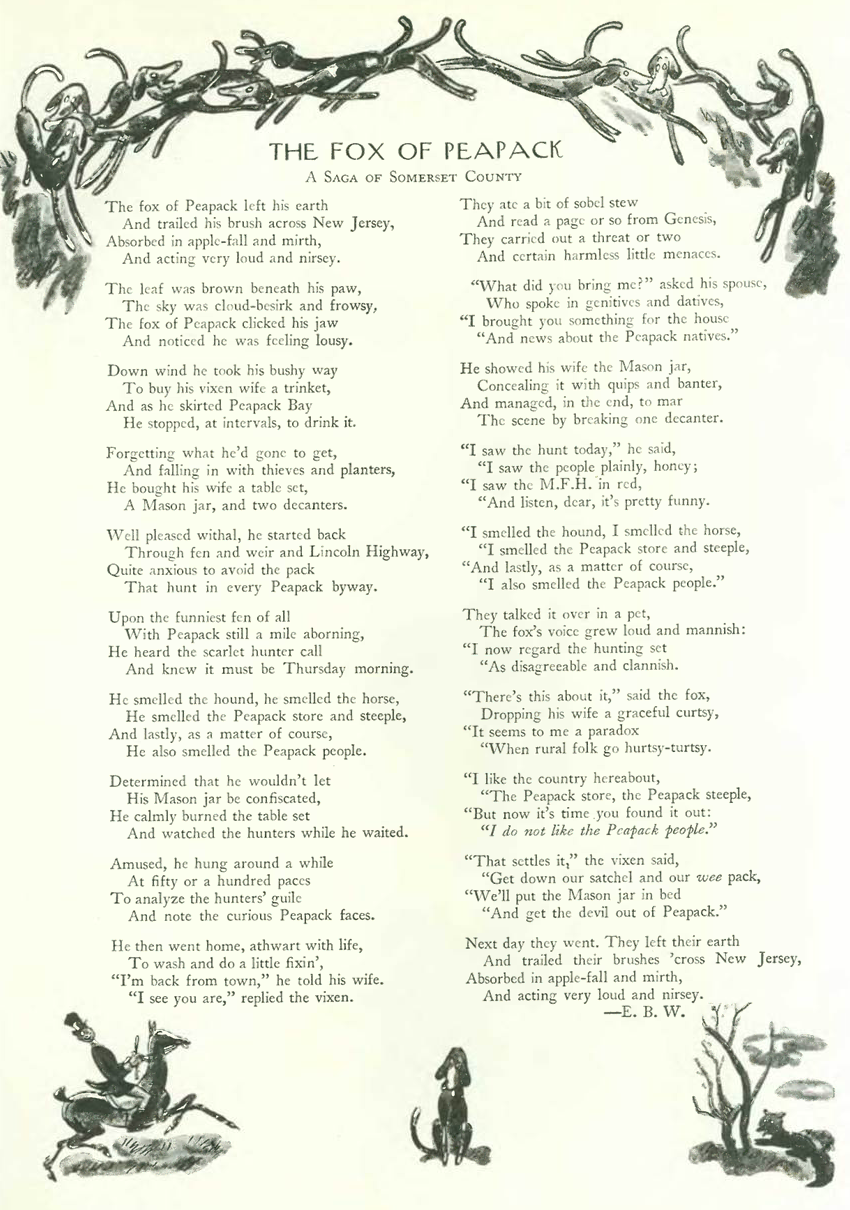
When I first spotted this I thought it was an early edition of The New Yorker’s famed Christmas poem, but those were started by Frank Sullivan in 1932. Nevertheless, here is a clever “Saga of Somerset County” from our dear E.B. White:
* * *
From Our Advertisers
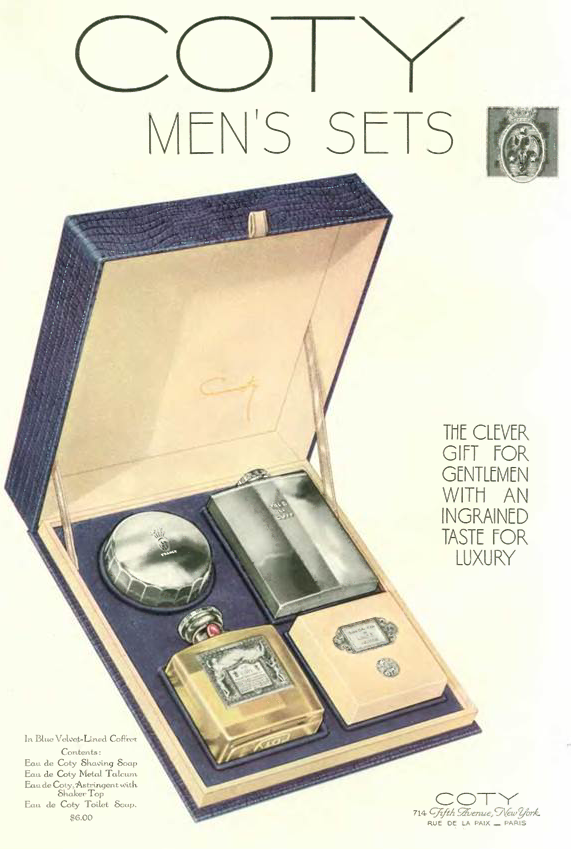
For men who hadn’t lost their shirts and had an “ingrained taste for luxury,” here was a men’s toilet set from Coty featuring a talcum shaker that would have doubled as a fine whiskey flask…
…did the folks at Bergdorf Goodman miss the news of the market crash? Read the fine print about the coming “revolution in fur fashion”…
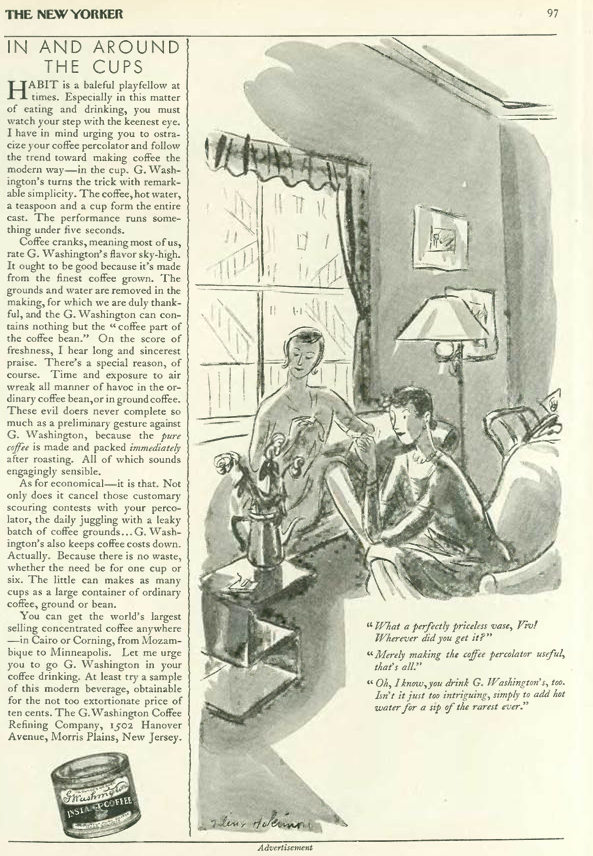
…Helen Hokinson illustrated another ad for G. Washington instant coffee…
…Atwater Kent offered up this sumptuous appeal to holiday shoppers…
…at first glance I thought this was an ad for a luxury apartment…the copy is almost identical, save for a couple of words like “death” and “crypt”…
…on to our artists, here is a spot by Constantin Alajalov that ran along the bottom of “Talk of the Town”…
…and a sight that would become more familiar as the Depression deepened, a look at an estate sale, courtesy Helen Hokinson…
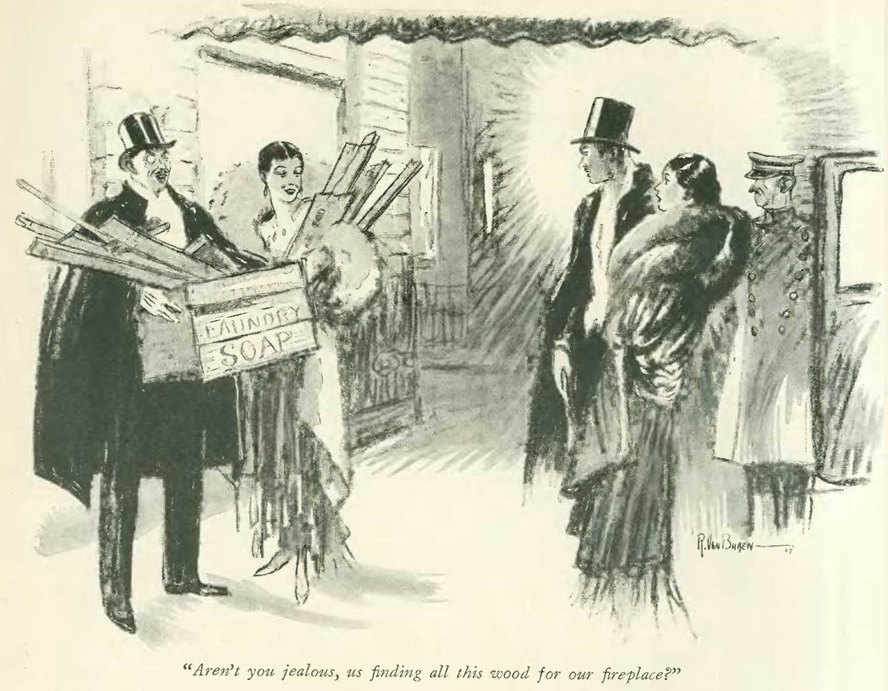
…signs of the economic collapse were starting to creep into the cartoons, including offerings by Raeburn Van Buren…
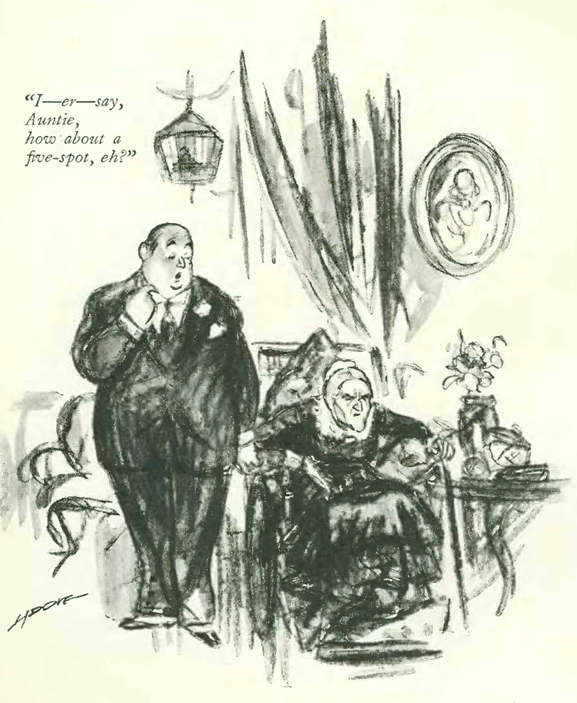
…Leonard Dove…
…and Paul Webb…
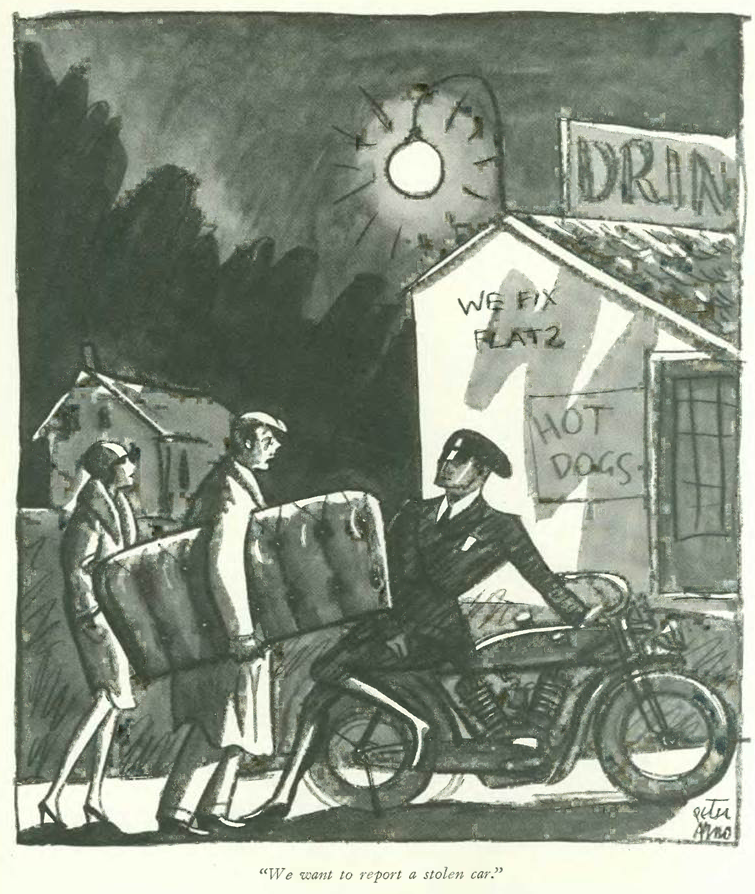
…while the economy was headed into the pits, cartoonist Peter Arno saw his fortunes soaring as he headed into a new decade. In his excellent 2016 biography, Peter Arno: The Mad Mad World of The New Yorker’s Greatest Cartoonist,Michael Maslin writes, “By the time The New Yorker’s December 7, 1929 issue hit the newsstands, its readership had, within the year, seen three Arno covers and fifty-seven of his drawings.” Maslin notes that drawing number fifty-eight, which appears below, “ended the 1920s with a bang (so to speak).” The drawing, writes Maslin, “became a lightning rod for two New Yorker camps: the (James) Thurber camp, who chose to believe Harold Ross (the magazine’s founding editor, who forbade sex as a subject) was naive in sexual matters, and the (E.B.) White camp, convinced Ross would never have let the drawing appear in the magazine if he hadn’t understood its meaning.” If you enjoy Arno’s work, or are a fan of The New Yorker, Maslin’s book is a must-read…
As a book reviewer for The New Yorker, Dorothy Parker could eviscerate any writer with the tip of her pen, and often did so.
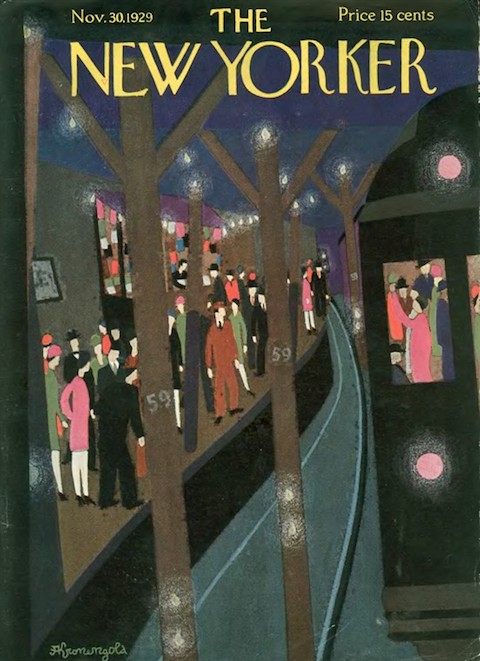
Nov. 30, 1929 cover by Adolph K. Kronengold.
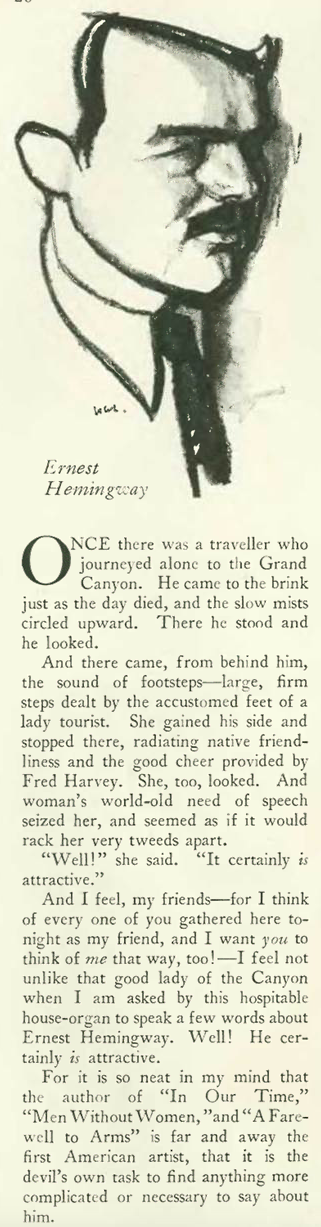
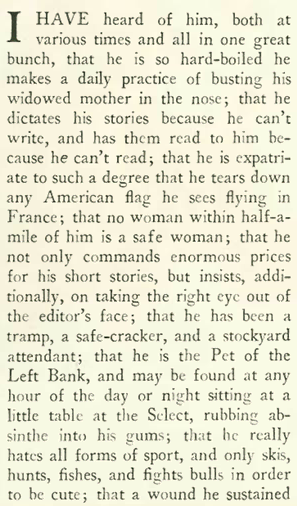
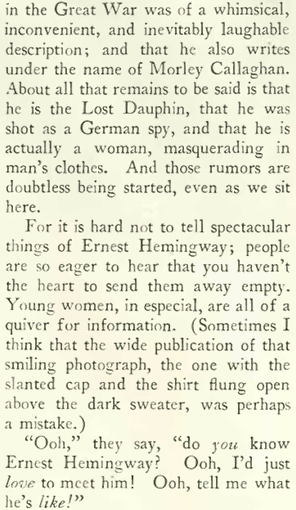
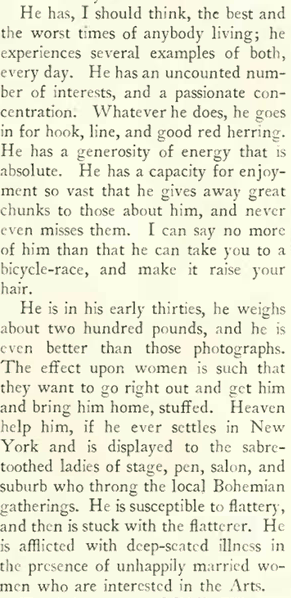
One writer, however, who received consistent praise from Parker was Ernest Hemingway, whom she first met in 1926. In the pages of the 1920s New Yorker, Parker particularly lauded Hemingway’s short story collections, In Our Time (1925) and Men Without Women (1927), which bookended his 1926 novel The Sun Also Rises (which Parker thought OK but overly hyped). When The New Yorker profiled Hemingway in the Nov. 30, 1929 issue, it naturally turned to Parker to do the honors (although Robert Benchley, a good friend of Hemingway’s, could have offered his own take on the author) :
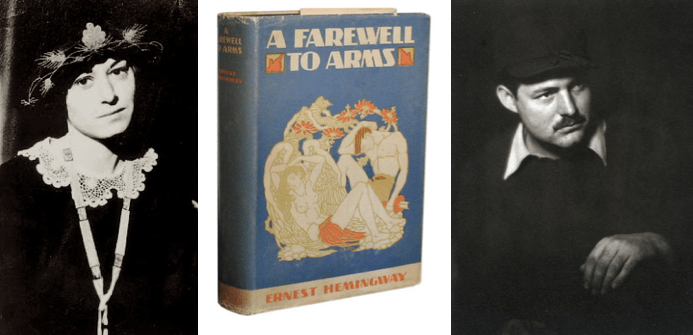
SHE’S A FAN…Dorothy Parker was a long-time admirer of the work of Ernest Hemingway. His last work of the 1920s, A Farewell to Arms, was serialized in Scribner’s Magazine and published in September 1929. The success of that book made Hemingway financially independent. (Mugar Library/Wikipedia)
During Hemingway’s Paris years Parker actually took a boat with him to France (in 1926, along with mutual friend Robert Benchley) and so got a firsthand taste of his bohemian adventures. By the time The New Yorker profiled Hemingway, the Jazz Age was dead and Paris’s so-called “Lost Generation” was a thing of the past. Indeed, Hemingway had already been in the States for more than a year, returning in 1928 with his second wife, Pauline Pfeiffer.
Biographer Jeffrey Meyers notes in his book Hemingway: A Biography, that Hemingway of the early Paris years was a “tall, handsome, muscular, broad-shouldered, brown-eyed, rosy-cheeked, square-jawed, soft-voiced young man,” features that were not lost on Parker:
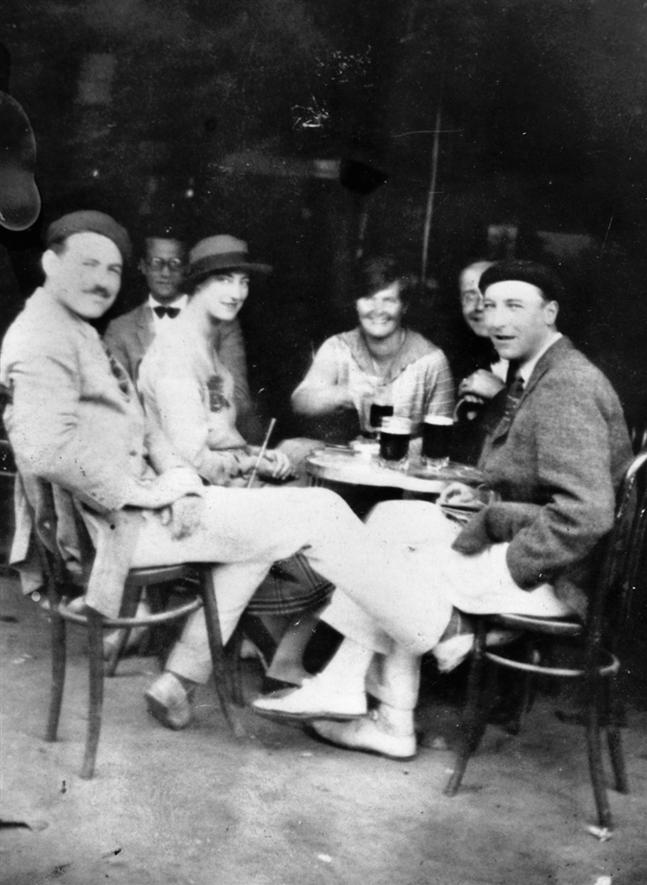
HE’S TAKING NOTES…Ernest Hemingway (left), with Harold Loeb, Lady Duff Twysden (in hat), Hemingway’s first wife Hadley Richardson, Donald Ogden Stewart (obscured), and Pat Guthrie (far right) at a café in Pamplona, Spain, July 1925. The group formed the basis for the characters in The Sun Also Rises: Twysden as Brett Ashley, Loeb as Robert Cohn, Stewart as Bill Gorton, and Guthrie as Mike Campbell. (Wikipedia)
…more from Parker on Hemingway’s magnetic appeal…
MAN ABOUT TOWN…Ernest Hemingway (far right) in 1926 in Paris, outside the city’s famous Shakespeare and Company bookshop. He is pictured here with Sylvia Beach (on his right), the shop’s founder. (Collection Lausat/Keyston-France/parisinsidersguide.com)
Although Hemingway remains widely read and revered, such a hagiography — especially from someone as reliably critical as Parker — would be unlikely today. From his safari massacres of countless animals (in pursuit of his manhood) to his mistreatment of four wives and general misogyny, he is a far more complex and controversial figure today. One thing Parker got right: his short stories have held up much better than his novels. As for the profile, Parker concluded:
* * *
Meet the Fokkers
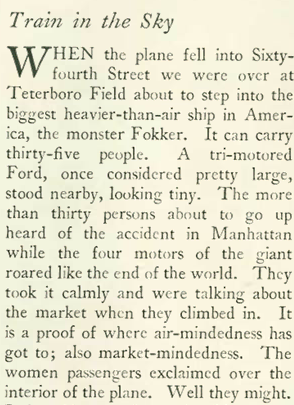
In previous blogs we have established that E.B. White was an aviation enthusiast. He seems never to have missed an opportunity to catch a ride into the skies, so when pilots were conducting test flights of a prototype Fokker F-32 at New Jersey’s Teterboro field, he was there to file this brief for “The Talk of the Town”…
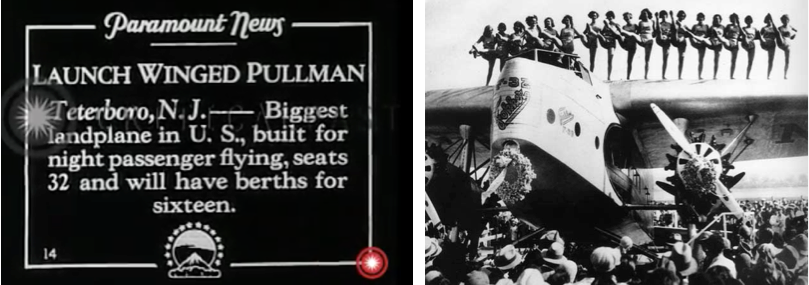
SKYTRAIN…Title card from a silent Paramount newsreel reporting on a November 1929 flight of the Fokker F-32 at Teterboro. Note how the title card uses a railroad reference (“Pullman”) as a descriptive for the passenger cabin. Indeed, early airplane passenger cabins were very much designed along the lines of Pullman cars. At right, a circa 1930 photo, possibly of a celebration of the plane’s arrival in Los Angeles. I imagine the FAA would not look kindly on this behavior today. (YouTube/petersonfield.org)
White’s enthusiasm for the aviation age is palpable in his description of the Fokker as it took off and climbed to a thousand feet:
ROUGHING IT…Passengers in Washington D.C. prepare to board what was perhaps the same plane White flew on at Teterboro. Note how they were required to walk across a muddy field to reach the plane’s entrance. The Fokker was the first four-engine commercial aircraft built in America and the largest land plane in the world at the time (there was a much larger amphibious German plane). At right, the plane’s four engines were configured back-to-back. (Wikipedia/petersonfield.org) click to enlarge
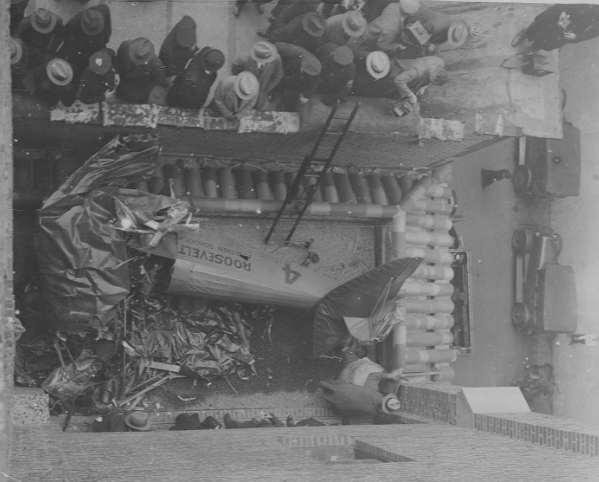
In line with The New Yorker’s stance of keeping things light, White described a scene just north of midtown, where a crowd had gathered near the site a plane crash. The pilot was killed, but a passenger managed to parachute to safety.
DOWN TO EARTH…Pilot Charles Reid died instantly when his plane slammed into a YMCA on 64th Street on Nov. 20, 1929. His passenger parachuted to safety. E.B. White referred to the crash in his “Talk” article. (digital-hagley-org)Excerpt from a Nov. 21, 1929 New York Times account of the crash. (NYTimes archives)
Speaking of crashes, the Fokker on which E.B. White was a passenger crashed a week later (Nov. 27, 1929) during a certification flight from Roosevelt Field to Teterboro Airport. No one was killed, but the aircraft was destroyed. The design itself didn’t last much longer — considered underpowered for its size, and too expensive at the dawn of the Depression, it was phased out by the end of 1930.
Perhaps after all of that flying, White needed something to calm the nerves, a subject he addressed in his “Notes and Comment” column:
THE WOMAN’S HOUR, according to E.B. White in his “Notes and Comment” column. (vinepair.com)
* * *
The Little Gallery That Could
“Talk,” via art critic Murdock Pemberton, had more to say about the new Museum of Modern Art, that is, not taking it very seriously…
UPSTART…Although New Yorker art critic Murdock Pemberton seemed dismissive of the new Museum of Modern Art, its first month’s attendance was more than 47,000 visitors. Image above from the MoMA exhibition Painting in Paris, Jan. 19-March 2, 1930. (MoMA)
* * *
Welcome to Thurber’s World
In 1931 James Thurber published his second book, The Owl in the Attic and Other Perplexities, which consisted of pieces he had done for the New Yorker, including eight stories (from Dec. 29, 1928 to Aug. 9, 1930) that featured the marital escapades of a couple in their middle thirties, the Monroes, modeled on Thurber’s real-life marriage to his wife, Althea.
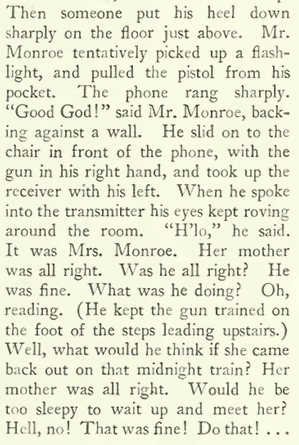
The Nov. 30, 1929 issue included Thurber’s fifth installment of the Monroe saga, “Mr. Monroe Holds the Fort,” in which a fearful Mr. Monroe, left home alone (his wife was visiting her mother), imagines there are burglars in the house:
…like his famous character Walter Mitty, which Thurber would introduce in 1939, Mr. Monroe had an equally lively imagination…
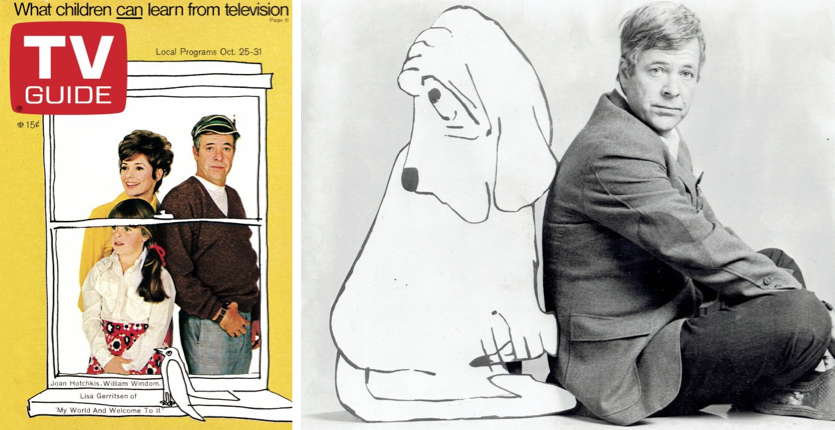
The character of Mr. Monroe would see new life in the fall of 1969 when NBC debuted My World… and Welcome to It, a half-hour sitcom based on James Thurber’s stories and cartoons. The actor William Windom portrayed John Monroe, a writer and cartoonist who worked for a magazine called The Manhattanite. In the show, Monroe’s daydreams and fantasies were usually based, if sometimes loosely, on Thurber’s writings.
THURBER AS A SITCOM…The actor William Windom portrayed John Monroe, a writer and cartoonist who worked for a magazine called The Manhattanite, on the 1969-70 NBC sitcom My World… and Welcome to It. Joan Hotchkis played his wife Ellen, and Lisa Gerritsen portrayed his inquisitive daughter Lydia. (tvguidemagazine.com/sitcomsonline.com)HOME SWEET HOME…Left, the opening credits for My World… and Welcome to It featured actor William Windom (as John Monroe) entering a animated house based on James Thurber’s famous “House and Woman” cartoon, which was originally featured in the March 23, 1935 issue of The New Yorker. (mikelynchcartoons.blogspot.com)
My World… and Welcome to It was cancelled after one season. Nevertheless, it would win two Emmys: one for Windom and another for Best Comedy Series.
* * *
Thank Heaven for Maurice
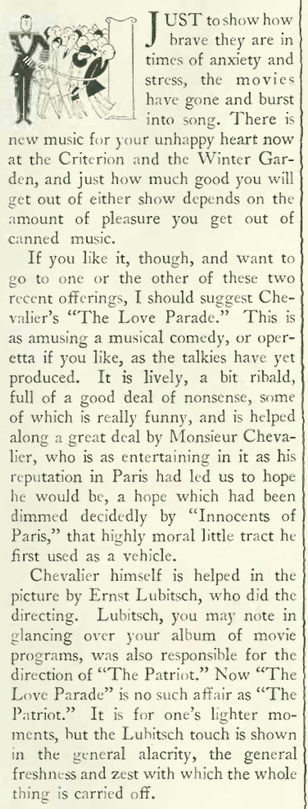
Things were looking up a bit in the talking movie department thanks to the Ernst Lubitsch-directed The Love Parade, featuring recent French import Maurice Chevalier and Jeannette MacDonald. Film critic John Mosher observed:
MUCH-NEEDED LAUGHS…Jeannette MacDonald and Maurice Chevalier in The Love Parade (1929), directed by Ernst Lubitsch. (MoMA)
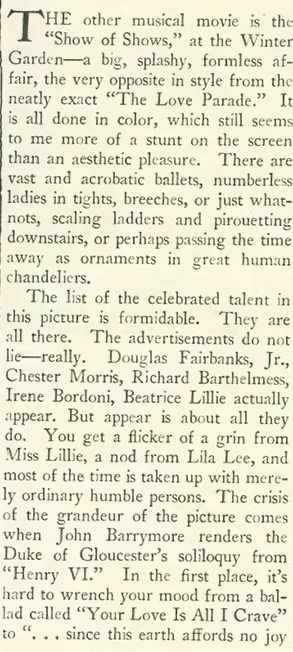
Mosher was much less impressed by another musical, Show of Shows, featuring an all-star cast and Technicolor that added up to little more than a “stunt”…
IS THAT ALL?…Warner Brothers Show of Shows offered “77 Hollywood Stars” and “1000 Hollywood Beauties” — 80 percent of it in Technicolor, but that wasn’t enough to impress The New Yorker’s film critic John Mosher. At right, Arte Frank Fay (l) and comic Sid Silvers in a color scene from the film. (IMDB)
* * *
A Guide to Christmas Shopping, 1929
Lois Long’s fashion column, “On and Off the Avenue,” predictably grew in length as the Christmas holiday approached, and in the Nov. 30 issue she offered advice on how to go about one’s shopping duties. Some brief excerpts:
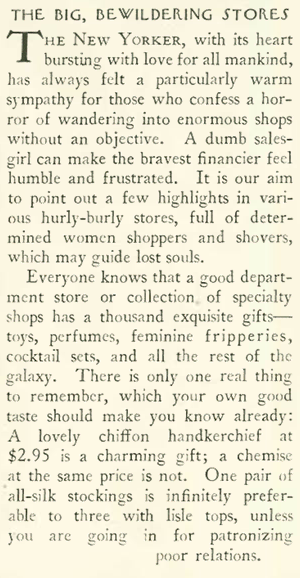
TRAILBLAZER…Lois Long guided New Yorker readers through a list of “big, bewildering stores” in her “On and Off the Avenue” column. At left, the B. Altman department store, circa 1920s. (thedepartmentstoremuseum.org/PBS)
…Long’s column was peppered with holiday-themed spots, including this one by Julian DeMiskey…
From Our Advertisers
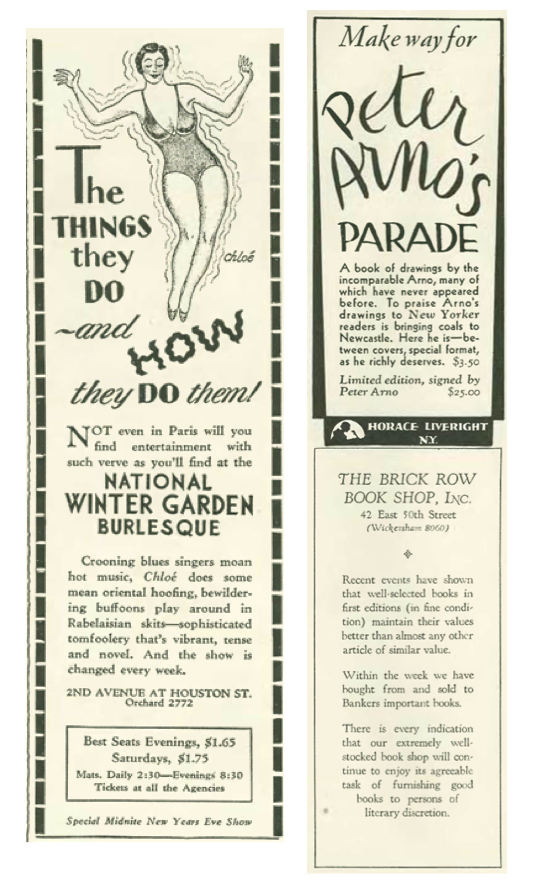
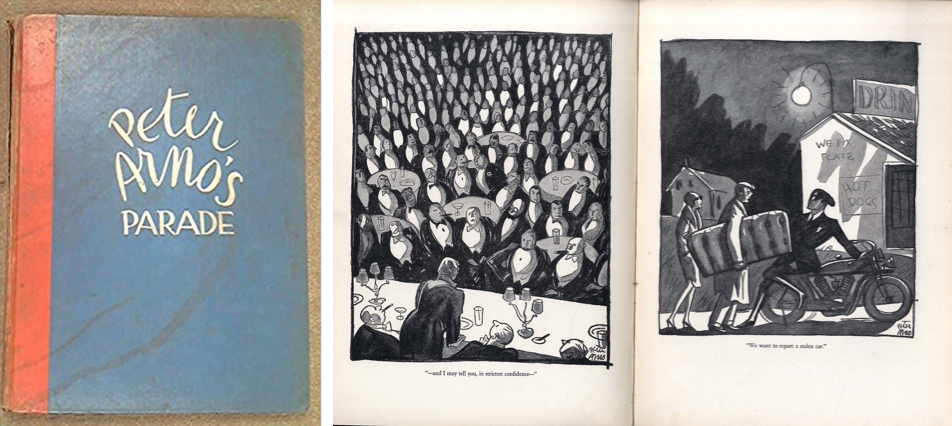
…we start with a couple of back page ads, including one from the National Winter Garden’s burlesque show and an ad announcing the imminent arrival of Peter Arno’sParade (just $3.50, or signed by Arno himself for $25)…
Cover and inside pages from Peter Arno’sParade. (Amazon)
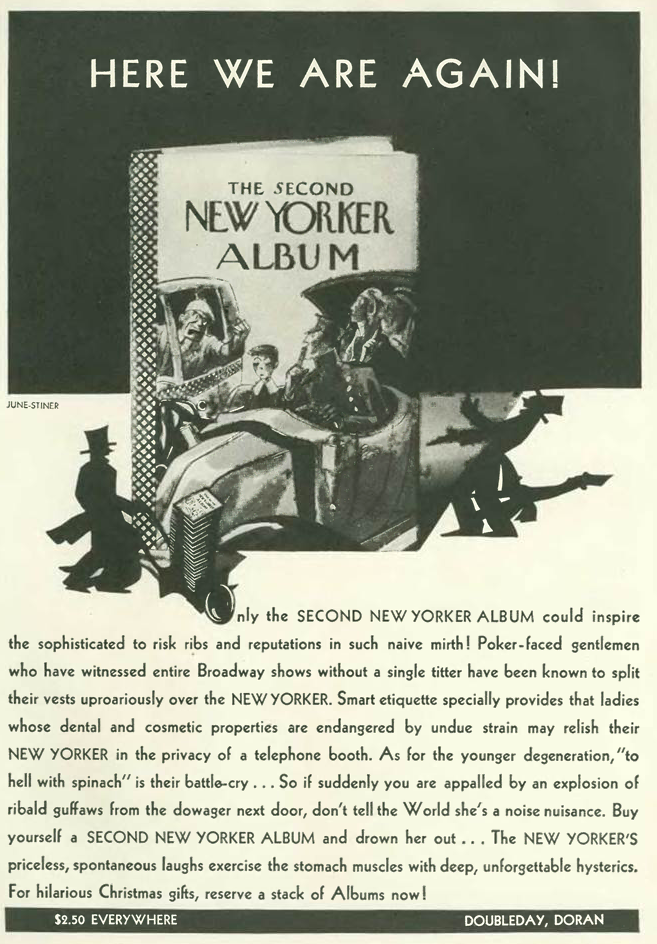
…another ad hailed the arrival of The New Yorker’s second album (read more about it here at Michael Maslin’s excellent Ink Spill)…
The first and second New Yorker albums. (pbase.com/michaelmaslin.com)
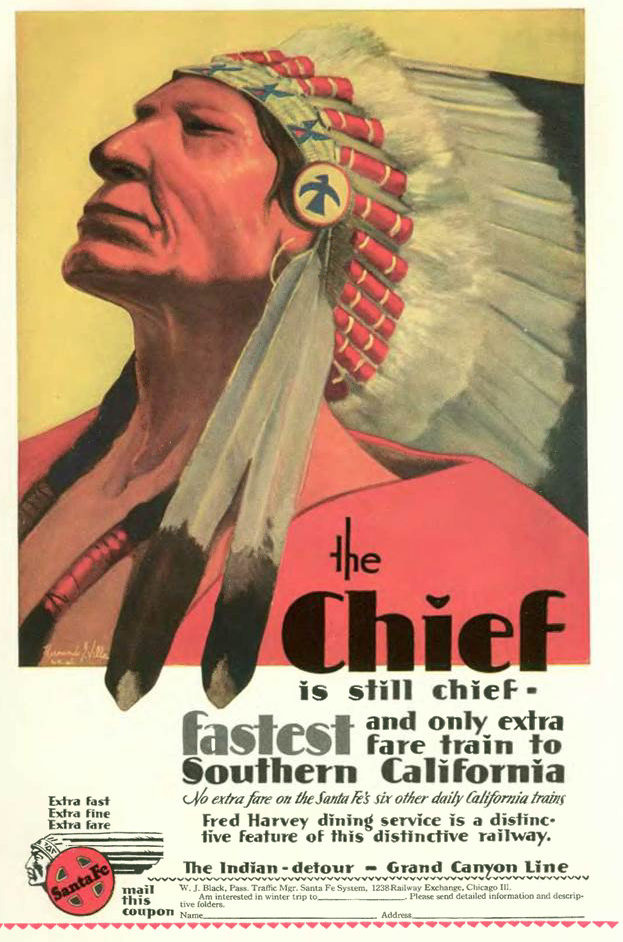
…other ads, in full color, featured cultural appropriation by the Santa Fe railroad…
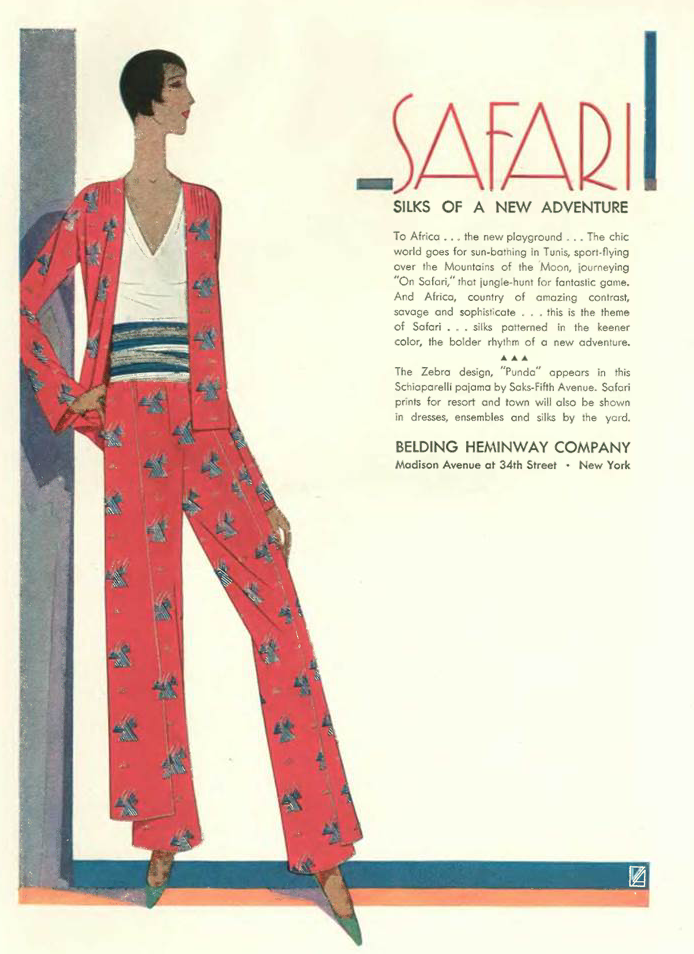
…bright silks available at the Belding Hemingway Company…
…silk stockings from Blue Moon…
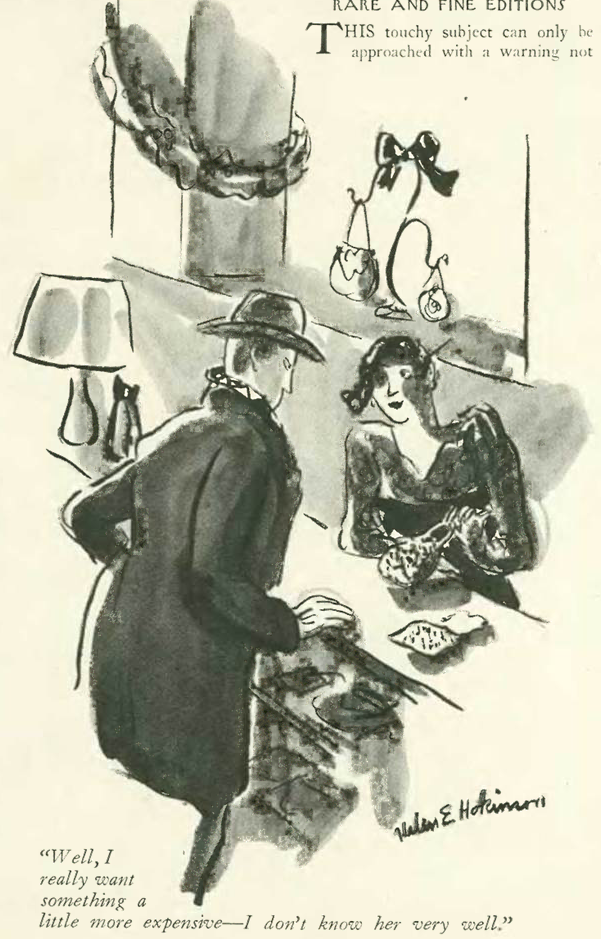
…for our cartoons, Helen Hokinson on the challenges of holiday shopping…
…Hokinson again, at tea with her ladies…
…Barbara Shermund, and the miracle of broadcast radio crossed with the nuances of a dinner party…
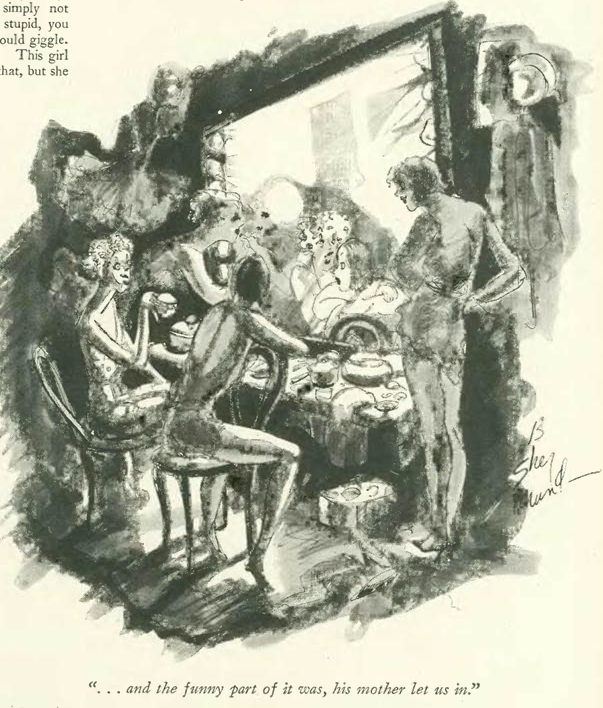
…and Shermund again, with a hapless friend of a clueless family…















































































































































 A New Yorker State of Mind