Robeson’s Othello

In 1930s America there were few if any opportunities for black actors to perform in mainstream stage or screen productions unless they conformed to racial stereotypes. An exception was Paul Robeson.

June 21, 1930 cover by Gardner Rea.

In 1930 Robeson (1898-1976) won rave reviews for his performance in Shakespeare’s Othello. That performance, however, took place in London, not New York, which London correspondent Anthony Gibbs took pains to point out in his dispatch for the June 21, 1930 New Yorker.

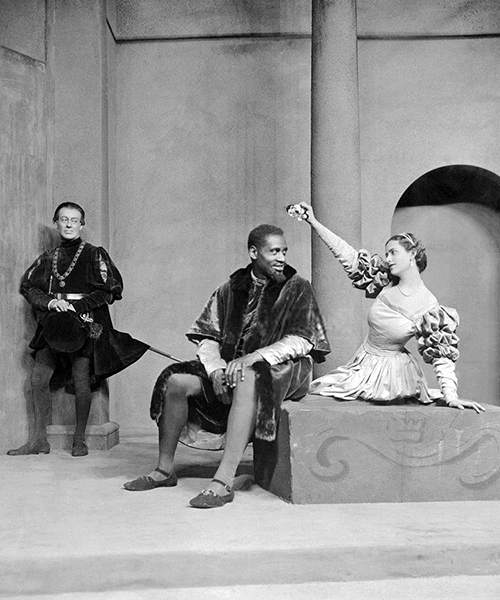
English actress Peggy Ashcroft as Desdemona and Paul Robeson as Othello in London’s Savoy Theatre production of Othello in 1930. Although only 22 at the time, Ashcroft was an established Shakespearean actress. The 32-year-old Robeson was already famous as both an athlete and actor. He was twice named a consensus All-American in football (Rutgers) and was the class valedictorian. He also received a law degree from Columbia while playing in the NFL. In 1930 he was already known to London audiences, having previously appeared in a 1928  London production of the American musical Show Boat. (theshakespeareblog.com)
CENTER STAGE…Left to right: Maurice Browne (Iago), Paul Robeson (Othello) and Peggy Ashcroft (Desdemona) in Othello at the Savoy Theatre, 1930. Maurice Browne was also the play’s producer; his over-the-top portrayal of Iago and his wife’s incompetent stage direction hurt the production, but Robeson nevertheless received high praise for his performance. (britishstageandscreen.tumblr.com)

Although the performance was a triumph for Robeson, the production itself was a mess. The play’s producer, Maurice Browne, enlisted his wife, Ellen van Volkenburg, to direct (Peggy Ashcroft later called her “a pretentious dud”). Writing in The Guardian (Sept. 3, 2003), Samantha Ellis observes: “Recognising that his Othello transcended the ropey production, the audience gave Robeson 20 curtain calls. He reprised the role all over the world and never lost his pleasure in it. For Robeson, it was more than just a part: it was, as he once said, “killing two birds with one stone. I’m acting and I’m talking for the negroes in the way only Shakespeare can.”

Robeson’s Othello would not make it to New York until 1943. It would run for almost 300 performances, setting an all-time record run for a Shakespearean play on Broadway.

 *  *  *

Restoring Order

In the aftermath of Grover Whalen’s disastrous (and sometimes violent) run as New York City Police Commissioner, E.B. White and his fellow New Yorkers welcomed the steady hand of Edward P. Mulrooney (1874-1960) to the helm:

THE COMMISH…Edward P. Mulrooney in a 1930s portrait by Edward Steichen. (Conde Nast)

 *  *  *

The Commander

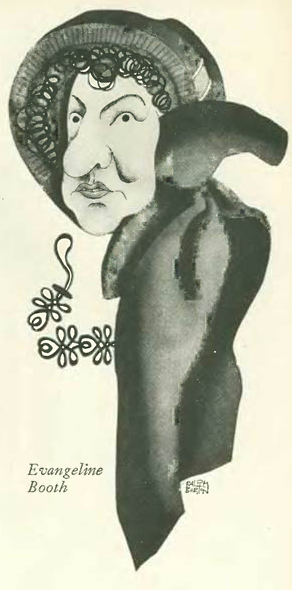
American author and lecturer Virgilia Peterson Ross profiled Evangeline Cory Booth (1865 – 1950), who would become the fourth General of the Salvation Army in 1934. She was the first woman to hold that post. An excerpt:

Ralph Barton returned to provide this caricature for the profile, one of the last works he would create for The New Yorker before his untimely death…
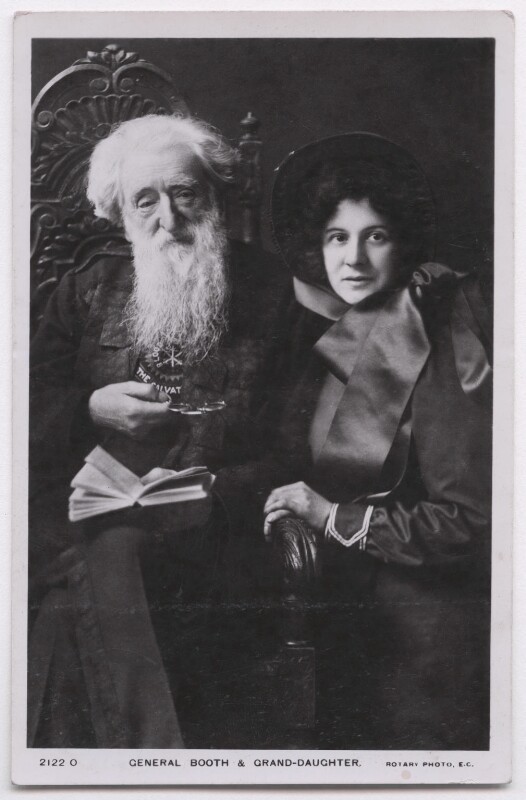
HEIRESS TO A LEGACY…William Booth, an English Methodist preacher who founded The Salvation Army and became its first General, poses with his grand-daughter Evangeline Cory Booth in this 1908 postcard image. (National Portrait Gallery)

 *  *  *

Home of the Dome

Architecture critic George “T-Square” Chappell was gladdened by the sight of scaffolding atop St. Bartholomew’s Church, which would finally get its dome to complete architect Bertram Goodhue’s vision…

NOW YOU SEE IT…Clockwise, from top left, St. Bartholomew’s Church at 325 Park Avenue, sans dome, in 1928; the church with dome in the 1950s; interior and exterior views of dome. (nyago.com/bostonvalley.com)

…Chappell also commented on the emergence of the Chrysler Building’s blindingly shiny dome and interior appointments…
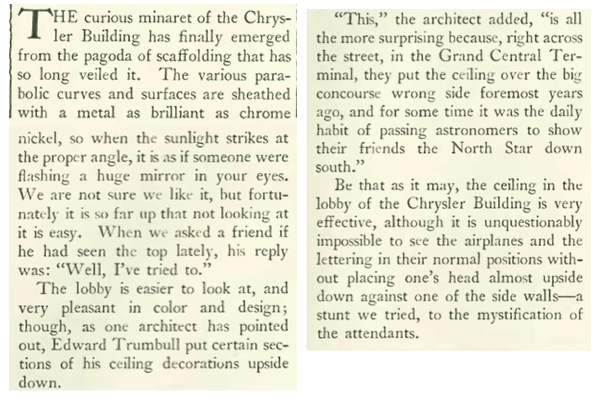
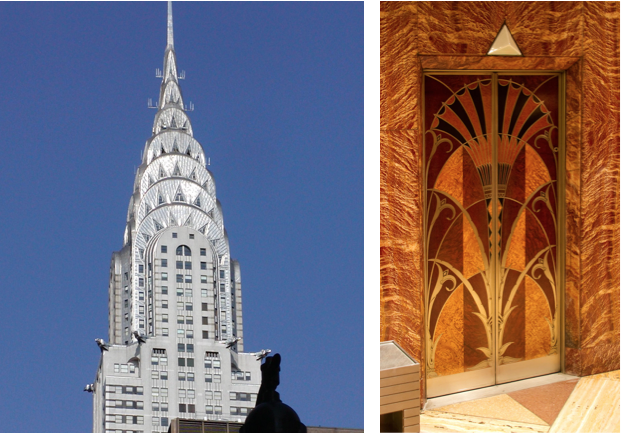
BLINDED BY THE LIGHT…The Chrysler Building’s gleaming spire emerged in all its glory in June 1930. At right, an elevator in the building’s lobby. (Wikipedia)

 *  *  *

Below the Belt

It wasn’t Dempsey-Tunney, but the bout between Max Schmeling (1905-2005) and Jack Sharkey (1902-1994) was the next best thing for boxing fans. The World Heavyweight Championship had been vacant since Gene Tunney’s retirement in 1928, and Sharkey and Schmeling had emerged as the sport’s No. 1 and 2 contenders.

The bout ended in a controversial decision: Although Sharkey won the first three rounds, he was disqualified after he landed a punch below the belt late in the fourth round. Schmeling became the first boxer to win the World Heavyweight Championship on a foul. The New Yorker’s Niven Busch Jr. (with illustration by Johan Bull) offered these thoughts on the fight’s disappointing outcome:

LOW BLOW…Although Jack Sharkey (far right) led after three rounds, a low blow in the fourth delivered the World Heavyweight Championship to German boxer Max Schmeling (left). Sharkey would claim the title two years later in a rematch with Schmeling. Although boxing isn’t the healthiest pursuit, both men lived into their 90s; Schmeling died in 2005 just shy of his 100th birthday. (Wikipedia/boxrec.com/thefightcity.com)

 *  *  *

One Of Ours

The New Yorker included this brief review of a collection of short fiction pieces by Dorothy Parker, herself a literary critic of some renown at the magazine…
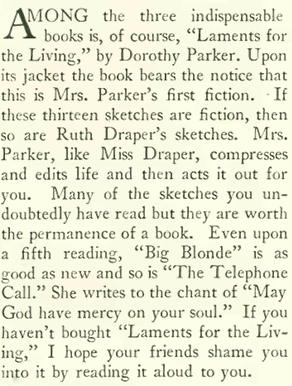
DOROTHY’S LAMENTATIONS…The New Yorker’s Dorothy Parker published this collection of short fiction in 1930.

…and on to our advertisers, this ad appeared on the opposite page of the review…

…speaking of ads, the makers of Marlboro cigarettes continued to sponsor gimmicky penmanship and writing contests to promote their deadly product…

…while promoters of the Empire State Building (still under construction) continued to draw on the historical significance of the building’s Midtown location…

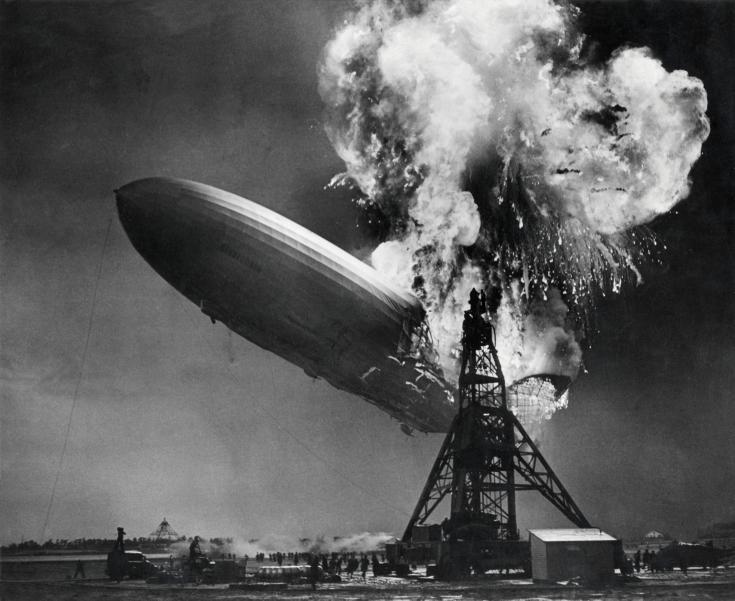
…on to our cartoons, Garrett Price pondered the very real challenge of guiding a massive Zeppelin to the planned mooring mast atop the Empire State…

…a portent of what would happen to the Hindenburg just seven years later…
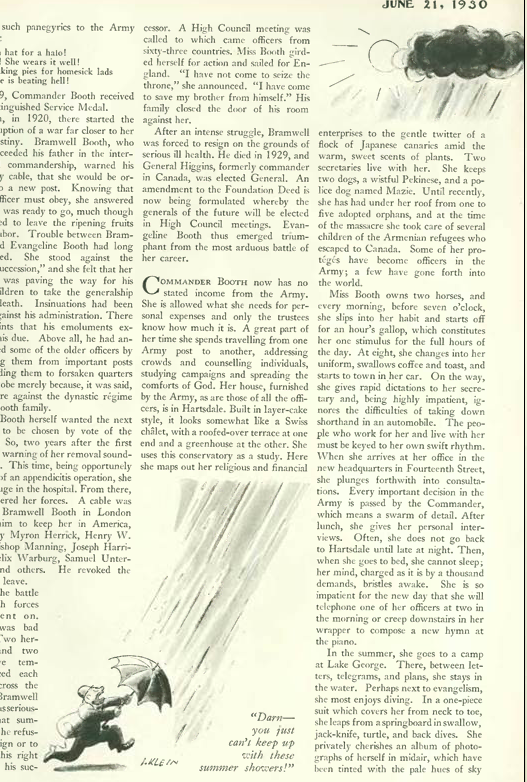
The New Yorker’s typesetter Popsy Whitaker made clever use of his columns for this Isadore Klein entry…
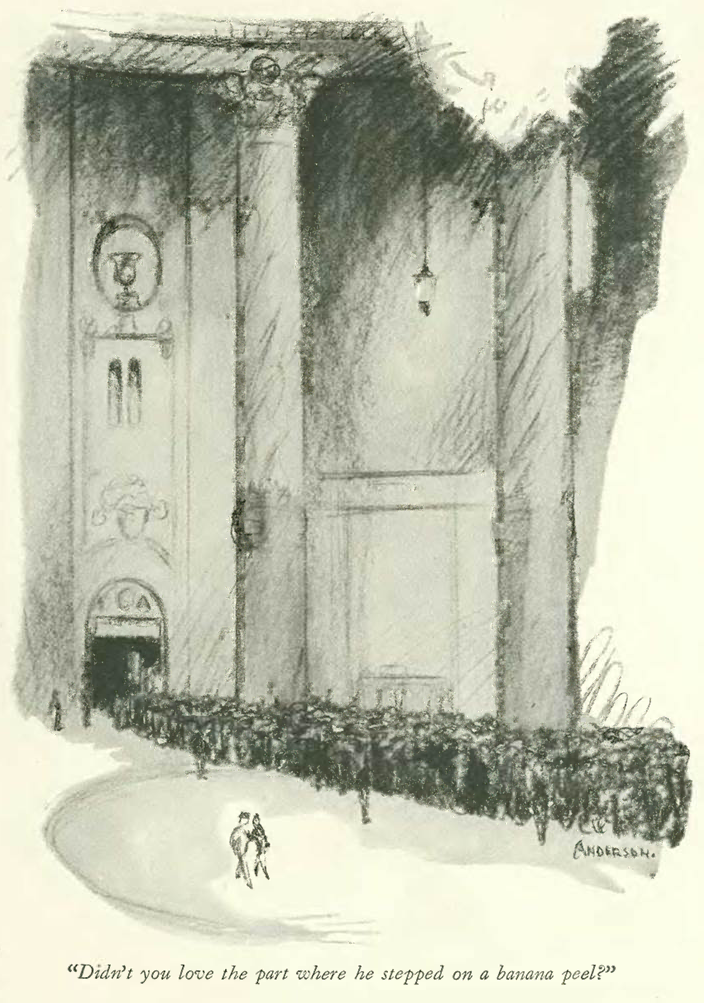
John Murray Anderson found humor in contrasting the grand with the mundane…
Carl Kindl eavesdropped on the small talk of a couple of ash haulers…

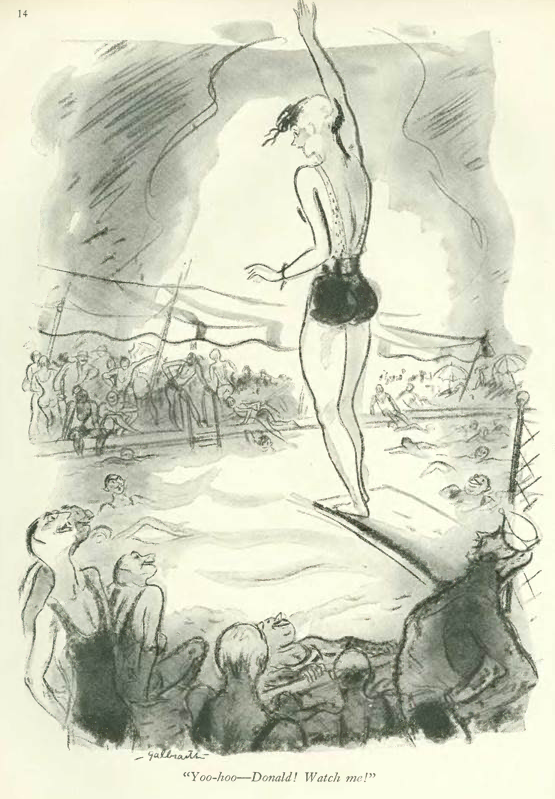
…and William Crawford Galbraith found humor at the public pool…
 *  *  *

On to the June 28 issue, with a cover featuring a satirical kakemono-style illustration by Rea Irvin, who was fond of Japanese scroll art…

June 28, 1930 cover by Rea Irvin.

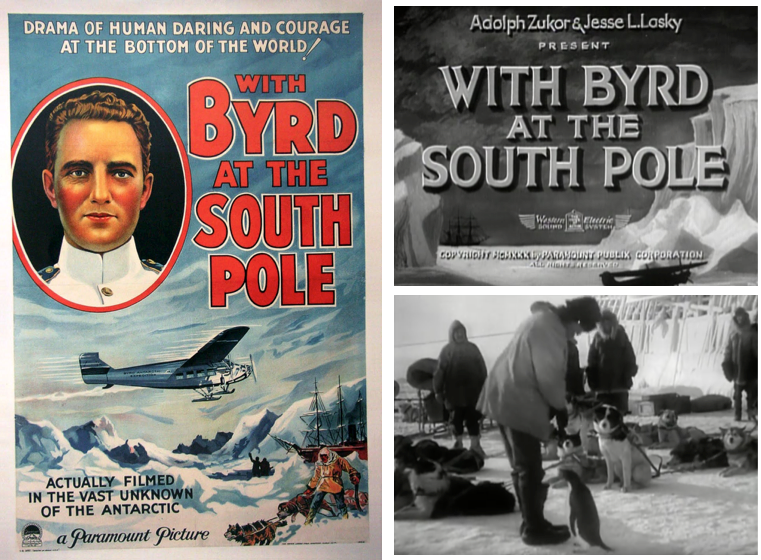
Film critic John Mosher checked out the new documentary on Admiral Richard Byrd’s expedition to the South Pole…

A BYRD WITH WINGS…A Paramount Pictures movie poster promoting the 1930 documentary With Byrd at the South Pole; still images from the film at right. (Wikipedia/YouTube)

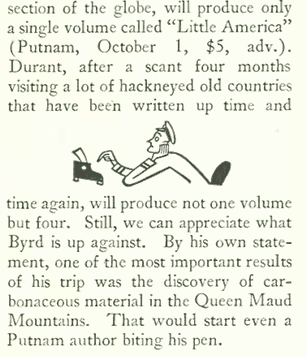
“The Talk of the Town” also made note of Byrd’s expedition and homecoming, contrasting his upcoming book, Little America, with the four-volume historical work planned by popular historian Will Durant.

In collaboration with his wife, Ariel, Durant would end up publishing an eleven-volume history of civilization (four million words across nearly 10,000 pages), written between 1935 and 1975. Will Durant was at work on a twelfth volume when he died in 1981 at age 96.

Admiral Richard Byrd’s Little America, left, and the 11-volume The Story of Civilization, by Will and Ariel Durant.

 *  *  *

American Lenin

The June 28 profile, written by Alva Johnston, featured radical American labor organizer and Marxist politician William Z. Foster. Despite Johnston’s portrayal of Foster as something of a genial pinko, in reality Foster was a strong supporter of Joseph Stalin and a dedicated and loyal ally of the Soviet Union’s Communist Party until his death in 1961. The Soviets even gave him a state funeral, with Nikita Khrushchev personally heading an honor guard in Red Square. An excerpt of Johnston’s profile:

RED AS A ROSE…Left, a campaign photo of William Z. Foster when he headed the Communist Party ticket in the 1928 U.S. presidential election; at right, illustration of Foster for the profile, by Abe Birnbaum.

 *  *  *

And to close…a colorful advertisement in the June 28 issue from Rex Cole…from the signature it appears to be the work of Mario Cooper, but this doesn’t look at all like his other work…

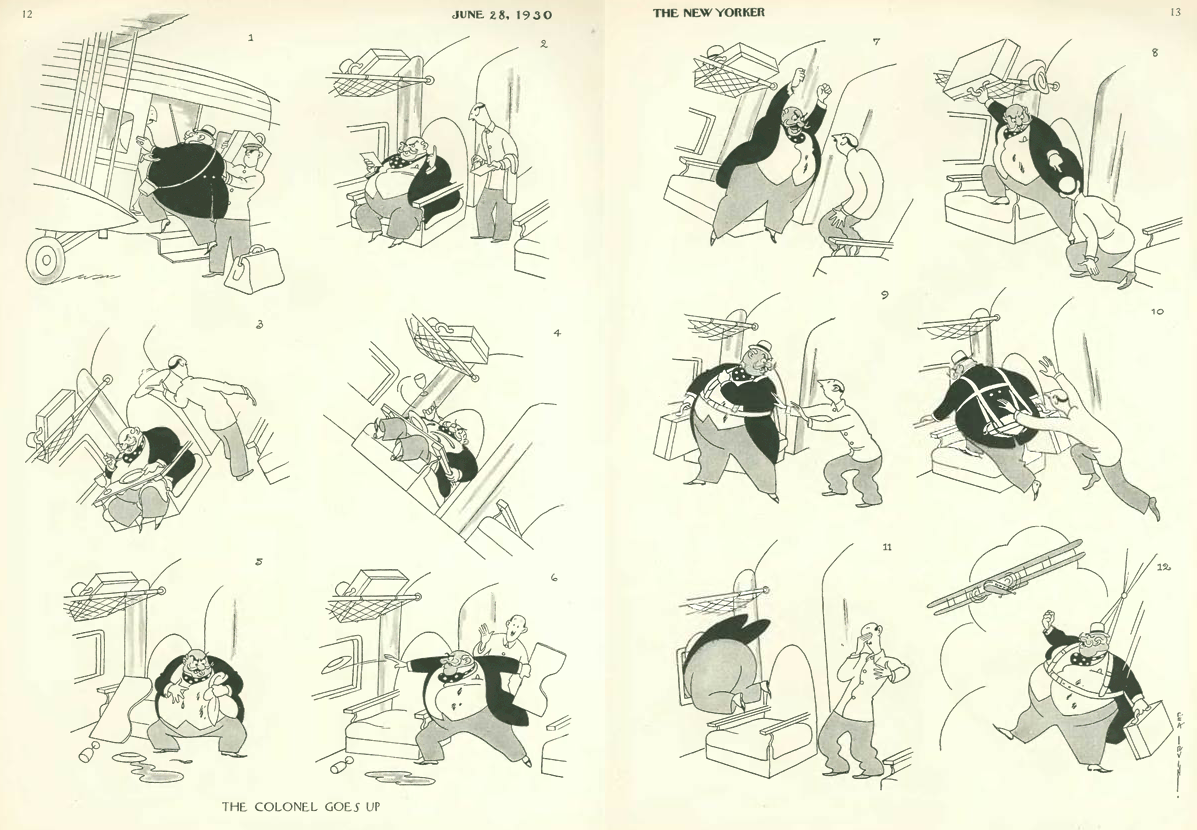
…and a two-page Rea Irvin cartoon, which demonstrates his visual storytelling skills…
Next Time…Happy Fourth!



Son of Hammerstein

The Hammerstein name looms large in the history of both stage and screen, an extended family of theater impresarios and composers descended from the German-born Oscar Hammerstein I (1846 – 1919).

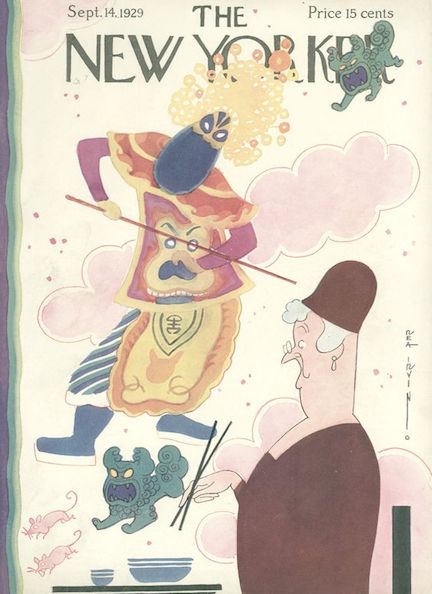
Sept. 14, 1929 cover by Rea Irvin.

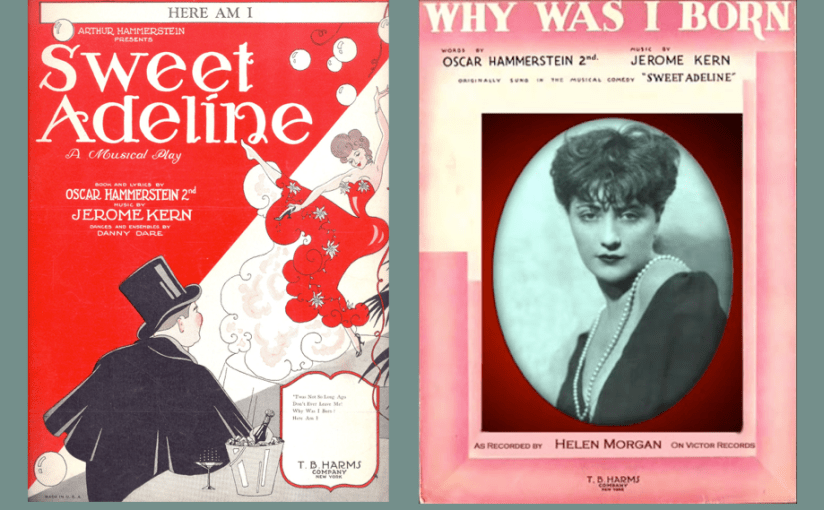
It was Oscar’s son, Arthur Hammerstein (1872 – 1955), who would bring the nostalgic musical Sweet Adeline to the Broadway stage, with music by Jerome Kern. Arthur’s nephew, Reginald Hammerstein, directed, and Reginald’s brother, Oscar Hammerstein II, provided the lyrics (and would later collaborate on such Broadway hits as Oklahoma! and The Sound of Music). Sweet Adeline opened on Sept. 3, 1929 at Arthur’s Hammerstein Theatre (known today as Ed Sullivan Theater), and the New Yorker’s Robert Benchley was on hand for opening night…

The title of the musical was a pun on the famous barbershop quartet song first published in 1903 — a time that seemed quaint to Jazz Agers. To get a sense of how rapidly American society had changed in the 1920s, in the paragraph above, Benchley referred to the musical’s setting (1898) as “old-time.” I’m not sure we would refer to 1987 as “old-time,” but who knows? Benchley continued…

OLD-FASHIONED FUN…Clockwise, from top left, the famed 1920s torch singer Helen Morgan (pictured on sheet music for one of her songs from the musical) starred as “Addie” in 1929’s Sweet Adeline; Arthur Hammerstein in undated photo; stage and screen actress and vaudeville comedian Irene Franklin portrayed a burlesque queen in the musical, while comedic actor Charles Butterworth played the part of a “young rounder.” (YouTube/findagrave.com/Wikipedia/lbarsanti.wordpress.com)

As for the performances by Helen Morgan (who more or less invented the torch singer’s boozy, draped-over-the-piano style), Benchley noted that her personality was “almost oppressively lush at times”…

A note regarding Helen Morgan: She began her career singing in Chicago speakeasies before moving to New York in the mid-1920s, where she continued to sing in nightclubs (including one attached to her name, Chez Morgan) while also performing on Broadway. Morgan became a heavy drinker, and was often drunk during performances (hence Benchley’s comment regarding her “lush personality”). Cirrhosis of the liver would claim Morgan’s life in 1941. The same disease would claim Benchley four years later.

 *  *  *

While we are the topic of Broadway, the Sept. 14 “Talk of the Town” featured a brief profile of John Murray Anderson, (1886 – 1954) who was celebrating the success of his own Broadway musical revue Almanac

HE WORE MANY HATS…John Murray Anderson made his Broadway debut in 1919 as writer, director, and producer of The Greenwich Village Follies, which had a five-year run. At left, a cover for sheet music from a 1920 production. At right, postcard image of the Follies from 1922. (Pinterest)

In this excerpt, “Talk” recounted how Anderson finally hit it big in 1919 with his Greenwich Village Follies. It noted that he had a “genius”…

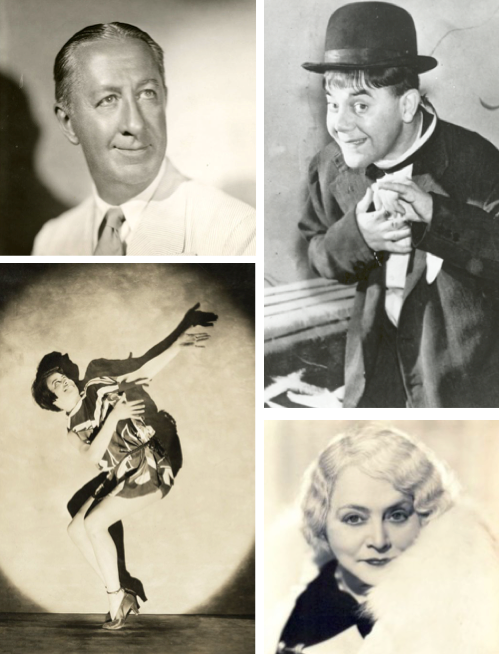
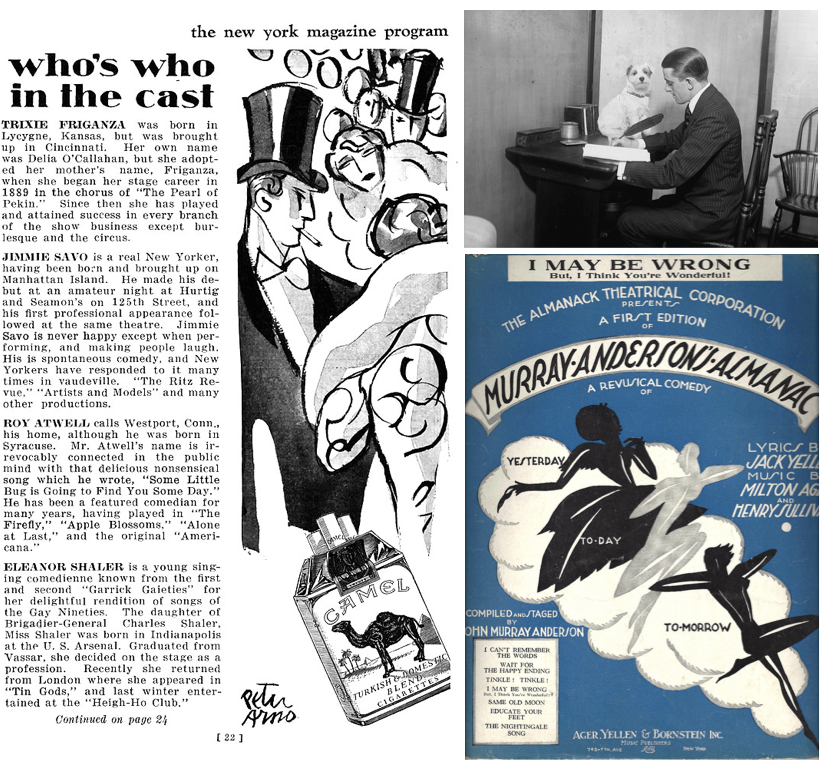
Clockwise from top left, Almanac featured comedians Roy Atwell and Jimmy Savo; singer and comedian Trixie Friganza; and actress Eleanor Shaler. (royatwell.net/American Vaudeville Museum/secondhandsongs.com/Pinterest)

…and a bit more about Anderson…

In Michael Maslin’s terrific book, Peter Arno: The Mad, Mad World of The New Yorker’s Greatest Cartoonist, Maslin notes that Arno “was whisked onto the Manhattan theater scene by Murray Anderson, whose twenty-nine scene Almanac opened to excellent reviews at the two-year-old Erlanger Theater, just off Times Square.” Maslin cites the famed New York columnist O.O. McIntyre, who wrote “Arno was one of several ‘conspirators’ responsible for Broadway backdrops whose ‘exaggerated whimsicalities…in black and white…when unfolded usually get what Variety calls a belly laugh.'”

At left, Peter Arno contributed this advertisement for Camel cigarettes in the Playbill edition for Almanac; top right, John Murray Anderson at work; cover for sheet music from the revue. (attemptedbloggery.blogspot.com / Wikipedia)

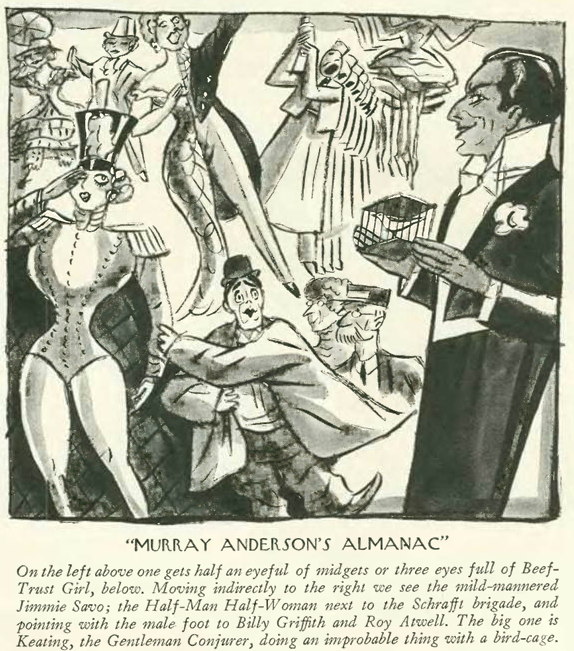
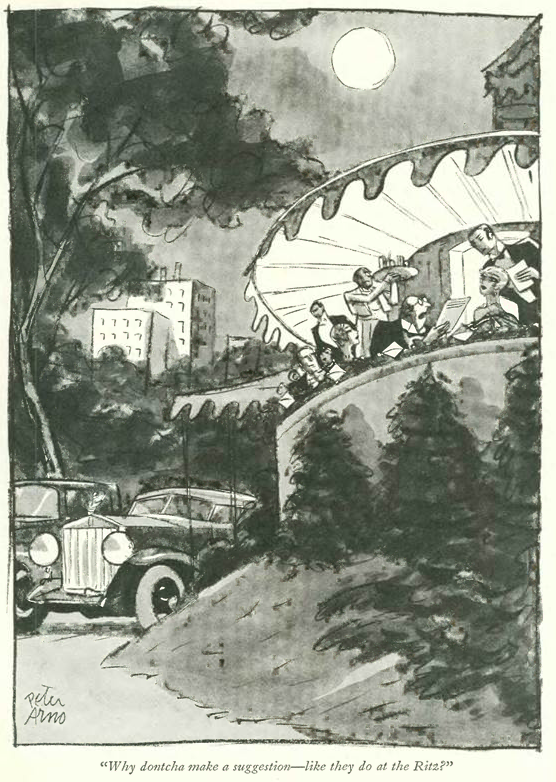
And in the following issue of The New Yorker (Sept. 21), Peter Arno contributed this drawing for the theater review section (it doesn’t entirely look like an Arno, but then again his style at this time seemed to fluctuate almost weekly)…

 *  *  *

Flapper Joan

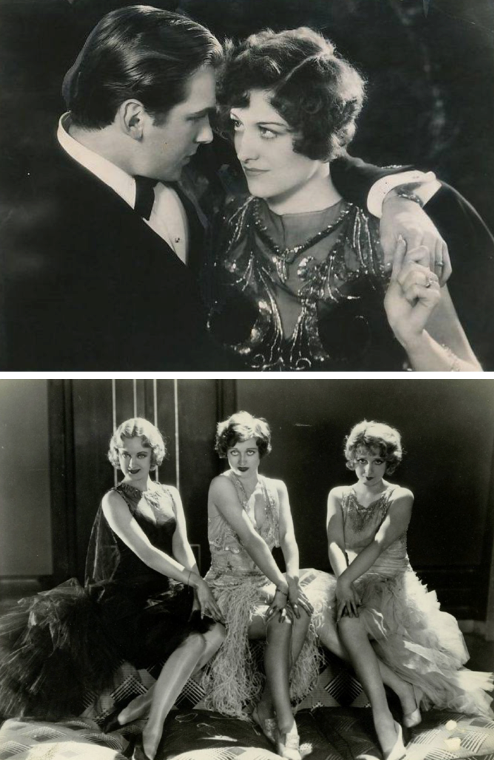
No stranger to Broadway herself, the young actress Joan Crawford was making a name for herself in Hollywood and garnering consistently positive reviews from the New Yorker’s film critic John Mosher, who found that the 25-year-old actress— who portrayed a fun-loving flapper in Modern Maidens — could shine even in the midst of an average screenplay:

THEY’RE NOT ACTING…At top, Douglas Fairbanks Jr. and Joan Crawford in MGM’s Our Modern Maidens (1929). The film led to a widely publicized romance and marriage between the co-stars; below, publicity photo for the film, with (from left) Josephine Dunn, Crawford, and Anita Page. (IMDB/joancrawfordbest.com)

 *  *  *

Silence is Golden

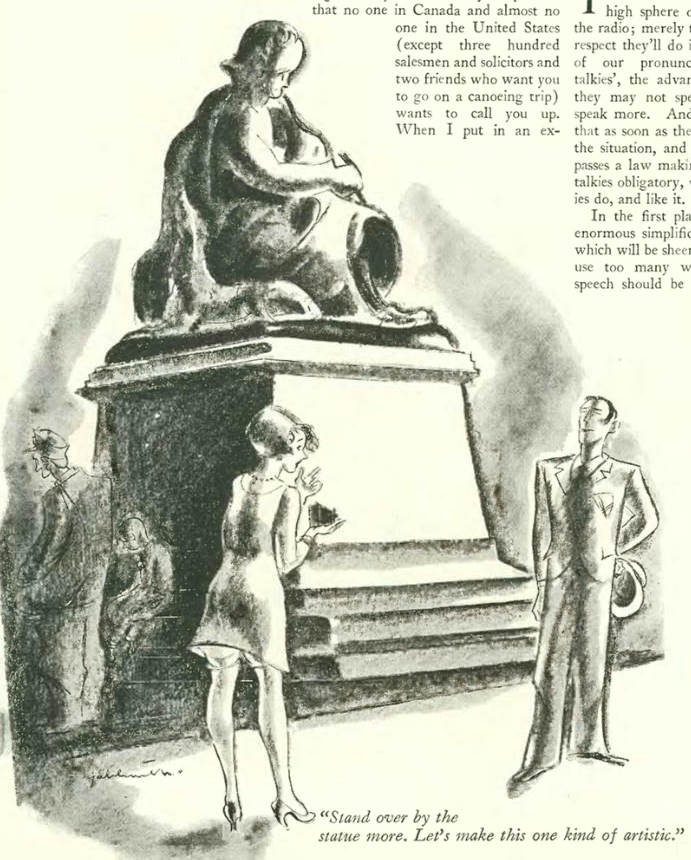
Cultural critic Gilbert Seldes contributed a casual titled “In a Loud Voice With the Tongues of Angels,” joining the chorus of voices at The New Yorker skeptical of (but resigned to) the advent of sound motion pictures. Excerpts:

SOMETHING HAS COME BETWEEN US…a microphone moves in close on Spencer Tracy and Bette Davis in a scene from 1932’s 20,000 Years In Sing Sing. (cinecollage.net)

 * * *

Das Speedboat

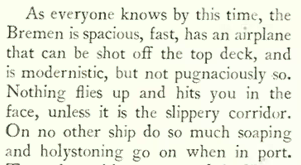
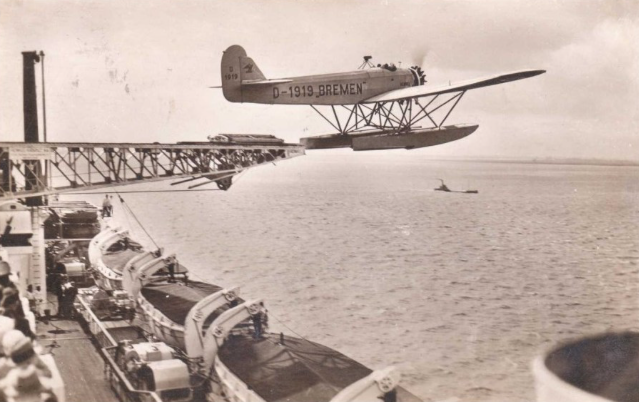
“The Talk of the Town” reported on the fuss created by the German passenger liner Bremen after it completed its maiden voyage to New York. It set a new world record in the process — four days, 17 hours, and 42 minutes later —and captured the westbound “Blue Riband” from the famed Mauretania with an average speed of 27.83 knots (the Blue Riband was an unofficial honor bestowed on the fastest passenger liners crossing the Atlantic)…

LOWRIDER…Top, the low, streamlined profile of the Bremen against the backdrop of the New York skyline. Center and below, among its many unique features, the Bremen had a catapult on the upper deck between the two funnels that launched a small seaplane, which facilitated faster mail service ahead of the ship’s arrival. (YouTube/nnapprentice.com)
(Ebay community post)

 *  *  *

Up In Smoke

Another “Talk” item explored the decline of cigar and pipe smokers thanks to the rise of cigarette advertising (and women smokers) in the 1920s…

…as an aside, it appeared golfer Walter Egan was still a pipe smoker, as this illustration by Johan Bull for the issue’s “Tee and Green” column attested…

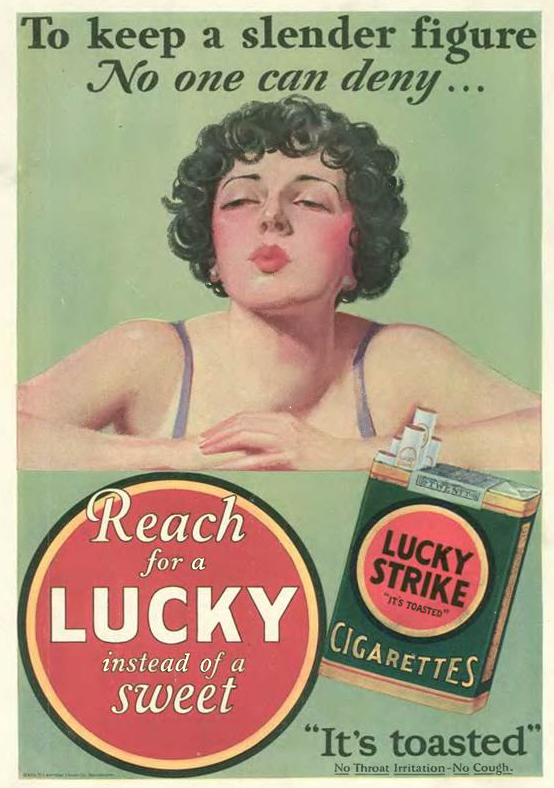
…”Talk” laid the blame (or the credit) on Lucky Strike’s successful ad campaigns that that particularly made a “big impression” on women…

…and to begin our advertising section, a Lucky Strike ad from the same issue:

…the Liggett & Myers tobacco company, on the other hand, promoted their Fatima brand as a higher quality, and slightly more expensive, alternative…

…in this ad for The Shelton Looms we find the elongated style popular in fashion ads of the era…the illustration is by LeBrun, but also evokes the style of Carl “Eric” Erickson, known for his Camel ad illustrations of the same period…

…and now a couple of ads from the back pages: the ad at left promoted a “country style” supper club near Washington Square. I haven’t found a record (yet) for the County Fair, but it was one of the themed restaurants Don Dickerman operated around Greenwich Village before the Depression (Dickerman, an illustrator, also provided the art for the ad)…the ad on the right—for Odorono deodorant— appeared regularly in the back pages of The New Yorker, illustrated by the magazine’s own Julian De Miskey. The ads featured vignettes of unfortunate young women whose B.O. was so bad that it caused all potential suitors to flee…

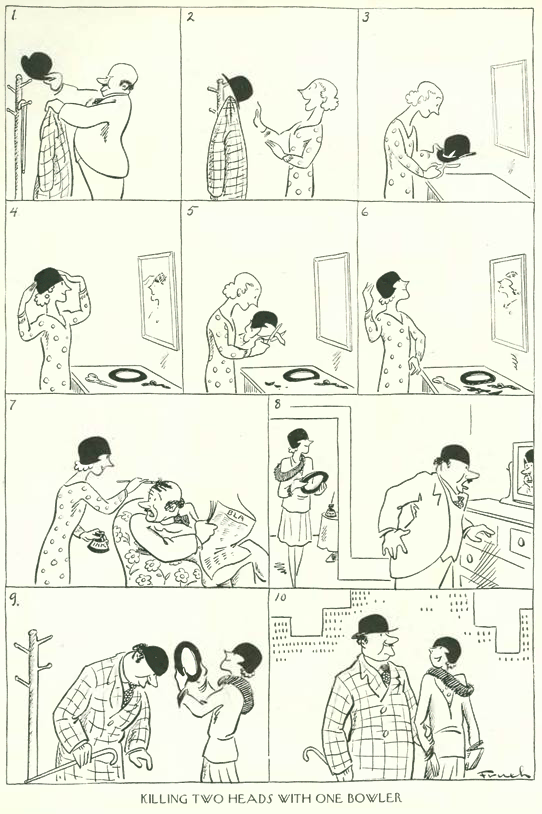
…on to our cartoons, Al Frueh (artist of the first two cartoons in The New Yorker’s first issue)…contributed another of his familiar multi-panel “silent” cartoons…

…I like the modern feel of this cartoon by William Crawford Galbraith

…and we close with a couple of cartoons under the moonlight, by Bruce Bairnsfather…

…and Peter Arno…at the Central Park Casino…

Next Time: Looking Ahead to 1979…


A Carnival in the Air

When Charles Lindbergh gunned his Wright Whirlwind engine on Roosevelt Field and took to the skies on his historic flight, he sparked such an interest in flying that just two years later that very same field was hosting huge weekend crowds that came to marvel at the airborne wonders of a new age.

August 31, 1929 cover by Theodore Haupt.

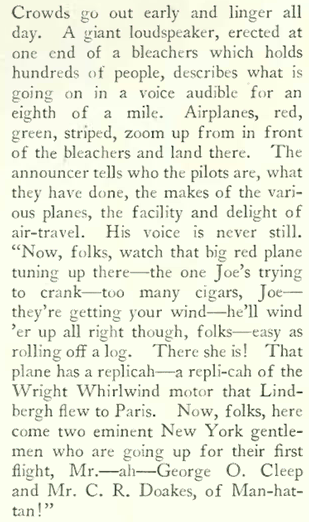
Writing for “The Talk of the Town,” James Thurber was on hand to take in the spectacle, noting how the announcer sold air-mindedness to the mob “in great clamorous phrases and resonant assurances.” Among those taking their first flight was a “Mr. Galleger, aged 101.” Thurber also observed:

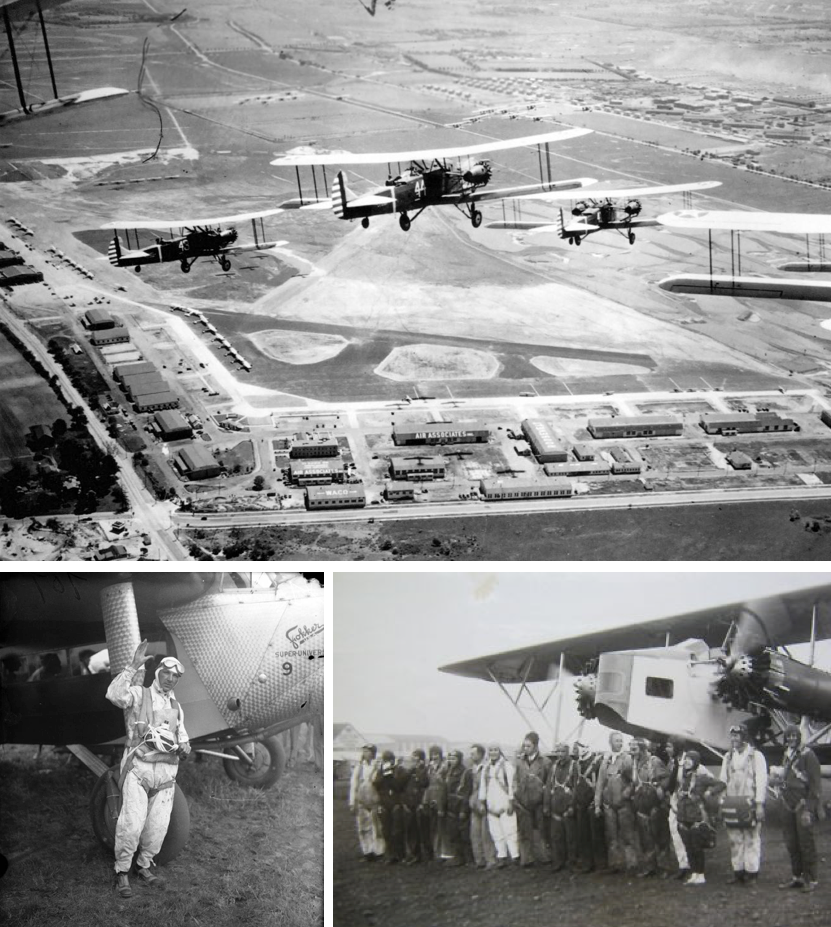
AIRBORNE SPECTACLES…Clockwise, from top, a 1931 aerial view looking southeast at a group of Army twin-engine biplane bombers overflying Roosevelt Field; parachute records were broken when 14 men and 2 women leaped from a Sikorsky bombing plane at Roosevelt Field in November 1929 (in the photo they seem to be standing precariously close to the plane’s whirling blades); Jack Cope waved to onlookers in Chicago before he performed a 15,000 foot jump in 1929. (tripod.com/Worthpoint/Chicago Tribune)

Although there were thrills galore up in the sky, Thurber seemed equally impressed by the spectacle on the ground…

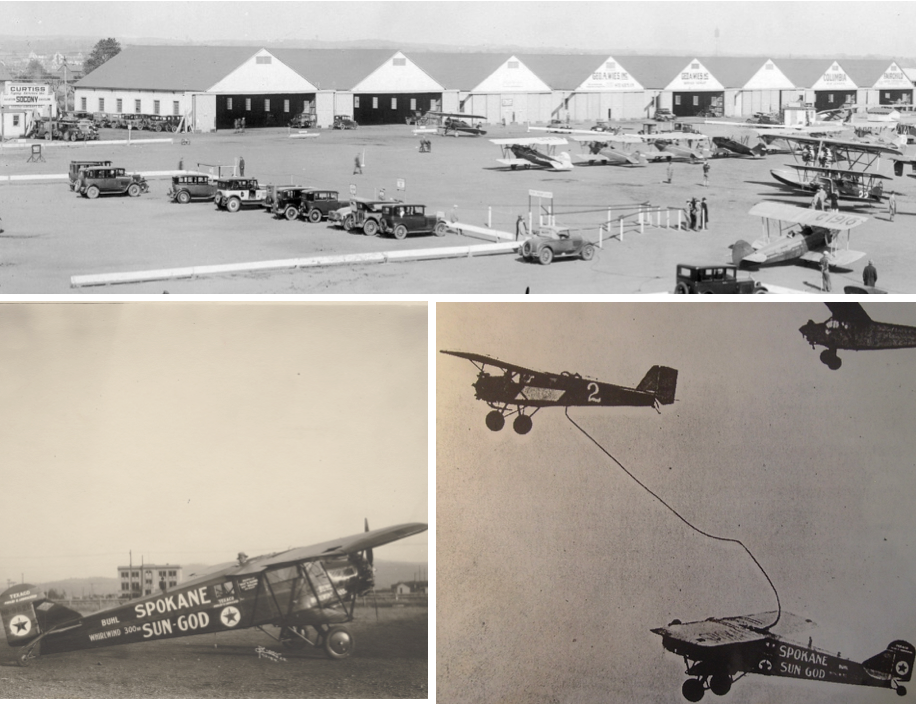
THE SUN GOD…Clockwise, from top, a 1928 photo of biplanes lined up by a row of hangars at Roosevelt Field; the spectacle of mid-air refueling was demonstrated above Roosevelt Field by Texaco Oil’s Spokane Sun God. (Tom Heitzman/barnstmr.blogspot.com/Wikipedia)

One of the big attractions was Texaco Oil’s Spokane Sun God, which traveled around the country to demonstrate the art of mid-air refueling. Note in the excerpt below (second paragraph) how the Sun God’s pilot communicated with his ground crew: He tossed some notes—tied to a heavy piece of lead(!)—out of the airplane’s window. It nearly landed in a crowd of onlookers…

AND HOW WAS YOUR DAY?…For some perspective, the first attempt at refueling in mid-air was made in 1921. In the photo above, Wesley May climbs from the lower biplane to the upper while carrying a 5-gallon can of fuel strapped to his back. After lifting himself onto the wing, he worked his way between the wings and into the cockpit. He then poured the fuel into the engine. (Seattle Museum of Flight) 

*  *  *

Falling Short

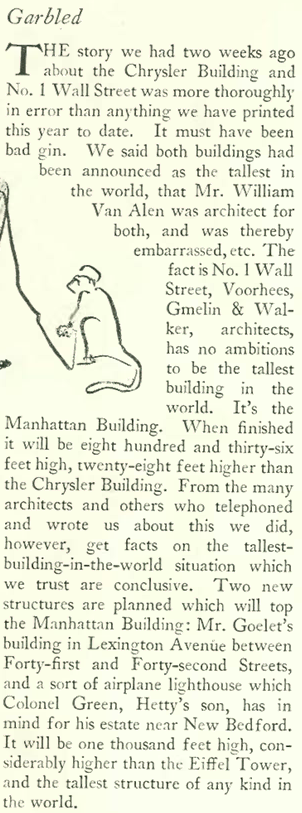
As I noted in a previous post (The Last Summer), the race to build the tallest building was erroneously reported by The New Yorker as a man against himself (namely, architect William Van Allen). In the Aug. 31 issue, the magazine’s “Talk of the Town” corrected the error, and added another curious note about another plan to build an “airplane lighthouse” taller than the Eiffel Tower…

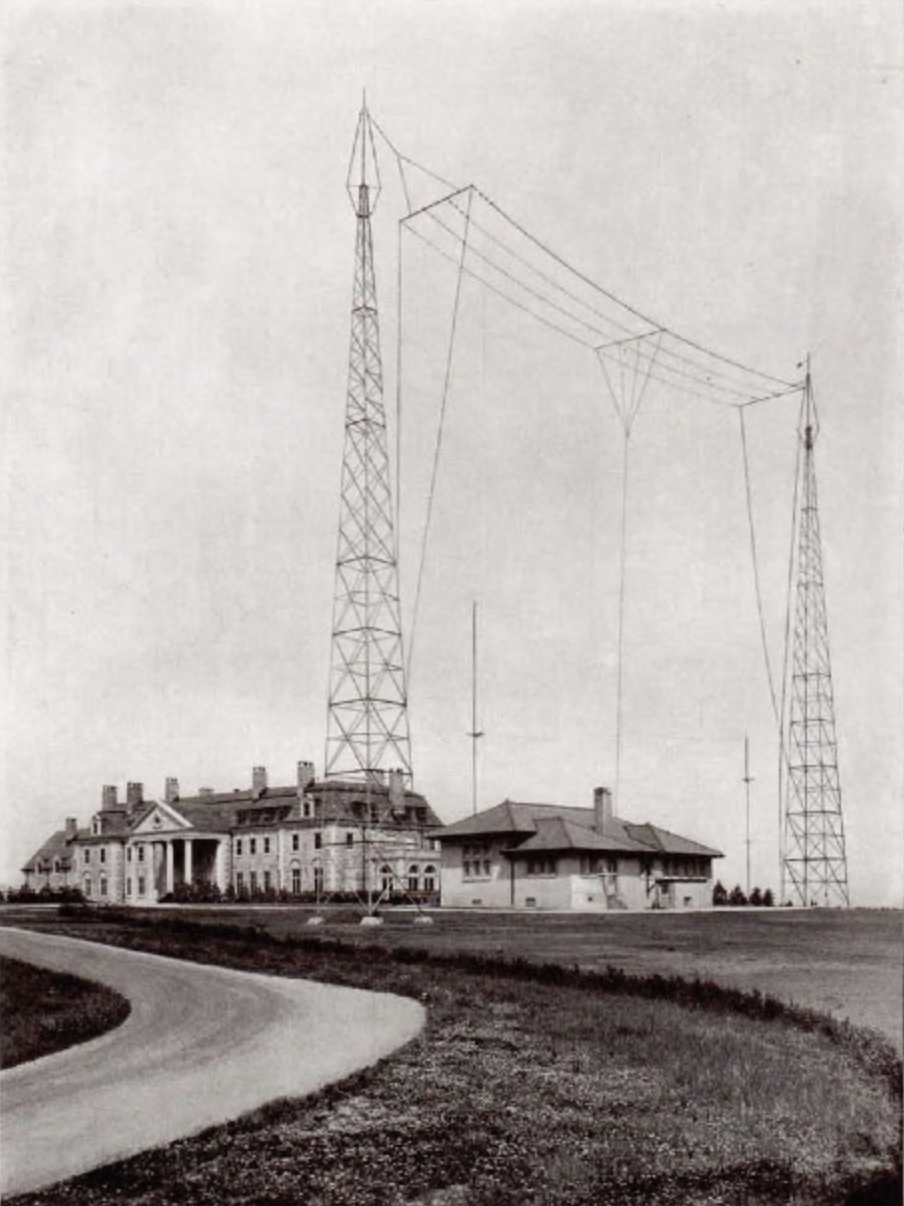
As noted above, Col. Edward Howland Robinson Green (son of the notorious miser Hetty Green) wanted to build a thousand-foot tower on his estate in Massachusetts. Here is what he settled for instead:

WORK-LIFE BALANCE…Edward Green, radio enthusiast and son of the miserly Hetty Green, erected huge radio towers at his Massachusetts estate in the 1920s to operate an early broadcast station, WMAF. (Wikipedia)

 * * *

When Trains Fly

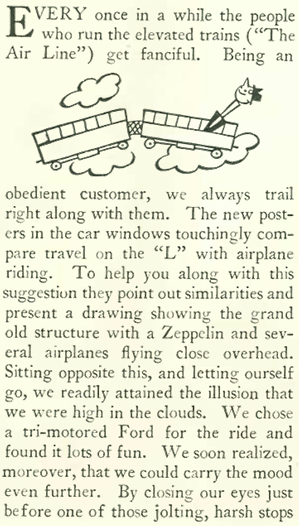
Cashing in on the enthusiasm over aviation, the City of New York promoted its elevated train system as an “Air Line.” According to “Talk”…

Click on the video below to take a ride on the “L”. Most of the 1929 footage begins at 4:47…

* * *

Haw Haw

One more “Talk” item: a self-referential piece in which The New Yorker pondered its “mission” as a humor magazine…

* * *

Audax Minor

For more than five decades, George Francis Trafford Ryall (1887-1979) wrote the horse racing column for the New Yorker under the pseudonym Audax Minor. He published his first column on July 10, 1926, and his last on Dec. 18, 1978. He was the writer of longest record at the magazine when he died at age 92 in 1979 (52 years, a record that has been shattered by the nearly 98-year-old Roger Angell, who has published in the New Yorker from 1944 to 2018).

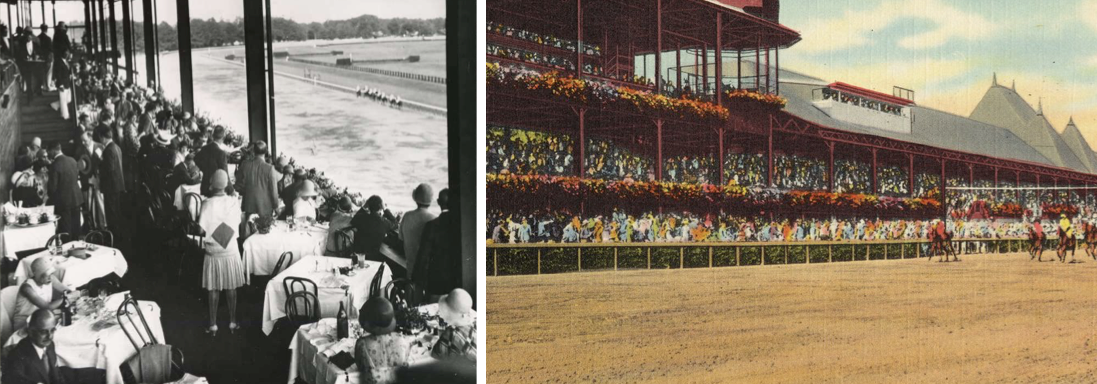
According to Ryall’s obituary in the New York Times, he adopted the nom de plume Audax Minor in a nod to Arthur F. B. Portman, who wrote about racing in England under the name of Audax Major. Ryall’s writing was so entertaining that many of his readers had never even been to a racetrack. According to Brendan Gill in his book, Here at the New Yorker, “(Ryall’s) world is a romantic fiction and they (the readers) are grateful when they learn that, with his green tweeds, his binoculars hung smartly athwart his chest, and his jaunty stride, Ryall resembles a character out of some sunny Edwardian novel.” An excerpt of his column from the Aug. 31 issue, with illustrations by Johan Bull:

A DAY AT THE RACES…At left, a crowded second floor dining area in the clubhouse at Saratoga, 1929; a postcard image of the track, with expanded clubhouse at left, circa 1929. (Saratoga Springs Historical Museum/Boston Public Library)

 *  *  *

Shut Out

As I’ve noted before, the New Yorker covered nearly every imaginable sport except baseball. Here is a rare mention of the game in Howard Brubaker’s “Of All Things” column:

The Cubs would win the NL pennant, but they would fall to the Philadelphia Athletics in the 1929 World Series.

Rough and Ready

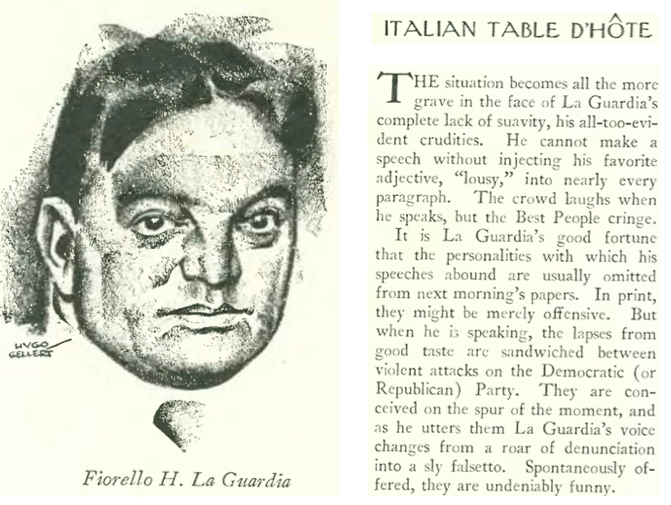
When Fiorello La Guardia challenged incumbent Jimmy Walker for New York City mayor in 1929, the city’s voters were presented with two colorful candidates who could not have been more different in their styles. Walker, a product of Tammany Hall, was a svelte dandy with a taste for the refined, whereas the reform-minded La Guardia was often coarse and unkempt. If they had anything in common, it was their dislike of Prohibition. La Guardia was featured in the Aug. 31 profile, written by Henry F. Pringle. Some excerpts:

JUST TRY TO STOP ME…Congressman Fiorello La Guardia pouring beer in his office during Prohibition, when he served New York’s 20th district in U.S. House of Representatives. (La Guardia Wagner Archives)

 *  *  *

Praise for the King

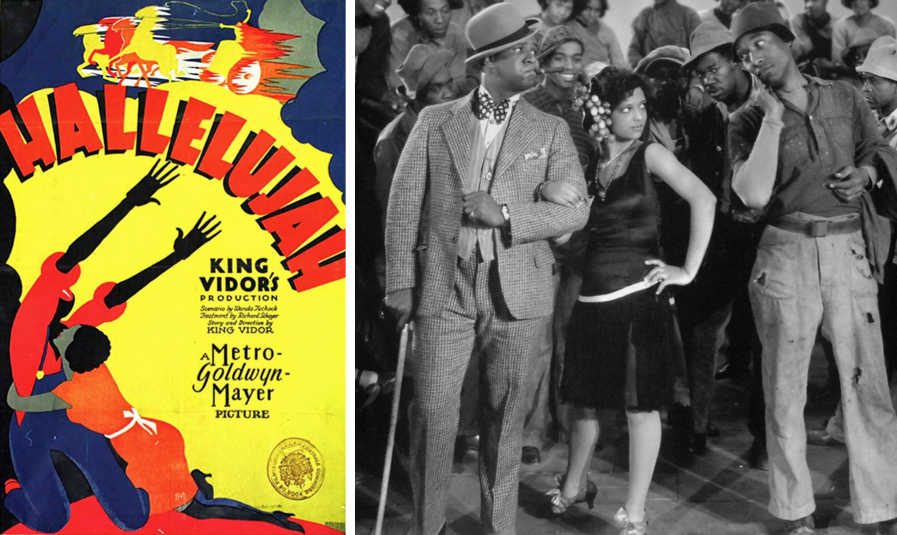
The New Yorker’s film critic John Mosher found most of Hollywood’s output to be pedestrian, but occasionally he saw a bright spot, including King Vidor’s latest production, Hallelujah:

William E. Fountaine, Nina Mae McKinney and Daniel Haynes in Hallelujah. The 17-year-old McKinney was the first African-American actress to hold a principal role in a mainstream film, and the first African-American actor to sign a long-term contract with a major studio—MGM. (IMDB)

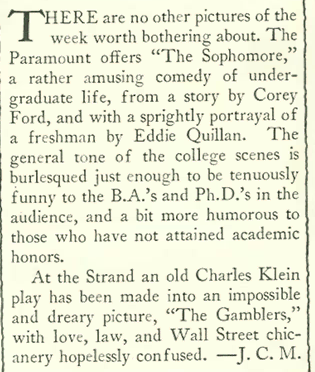
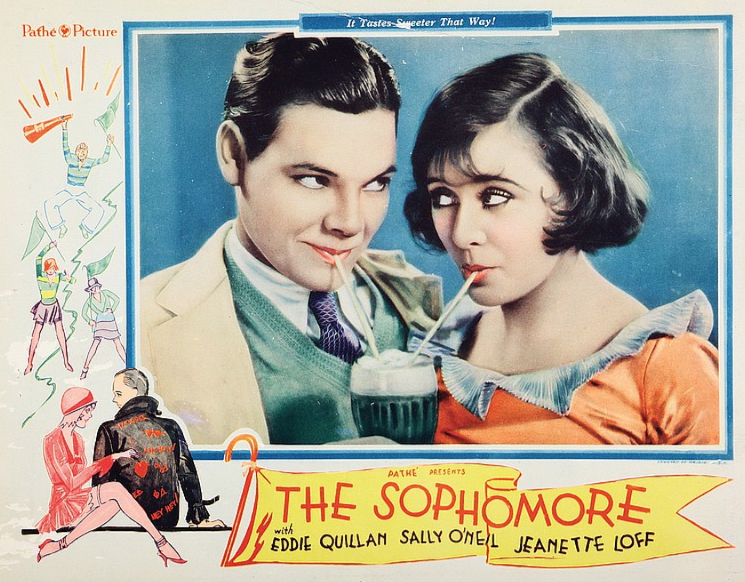
As for another film, Paramount’s The Sophomore, Mosher probably felt a bit obligated to say something nice, since it was a derived from a story by humorist Corey Ford, an early contributor to The New Yorker and part of the Algonquin Round Table orbit:

BOY MEETS GIRL…Lobby card for The Sophomore. (IMDB)

 *  *  *

A Bright Interval

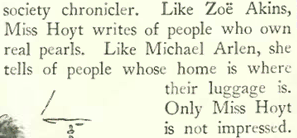
The New Yorker gave a brief but approving mention of Nancy Hoyt’s latest book, Bright Intervals, in its book review section…

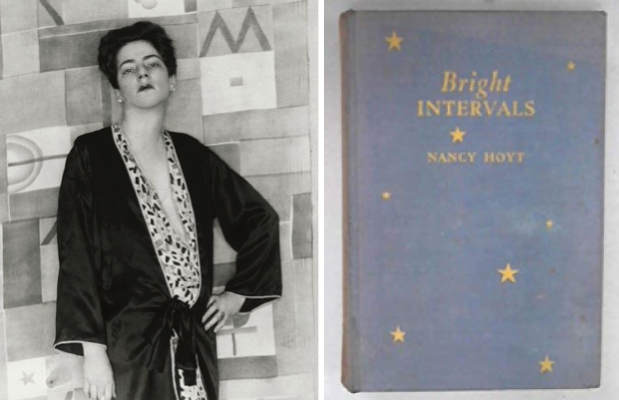
Hoyt was a member of a socially prominent but deeply troubled family that included her recently deceased sister, the poet and writer Elinor Wylie (I wrote about the Hoyt family in my post Generation of Vipers). Characters in Hoyt’s novels often resembled the women in her family.

Nancy Hoyt in an undated photo by Sherril Schell. (Conde Nast/Amazon)

 *  *  *

From Our Advertisers

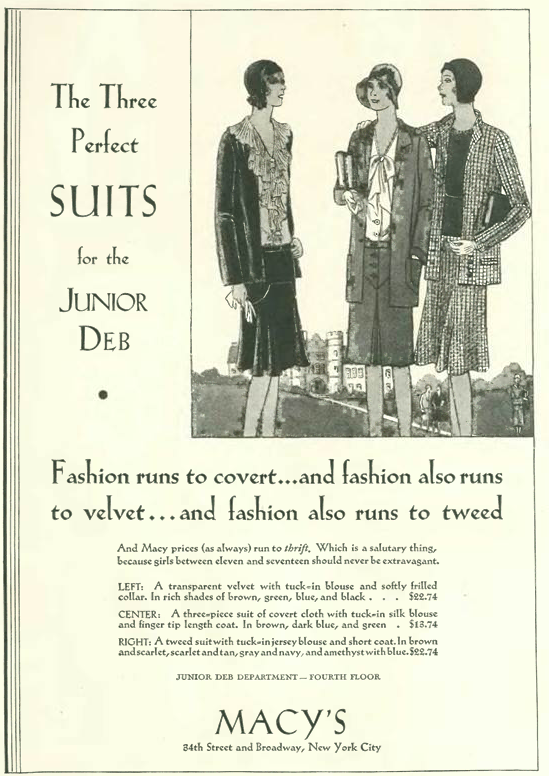
It was back to college time, and Macy’s had a thrifty new fall lineup ready for the “Junior Deb”…

…and on the less thrifty side, Best & Company offered these new looks for fall…

…note in the above ad that the first model is Virginia Maurice, the very same model we encountered in a recent post (The Last Summer) posing for Chesterfield cigarettes…

Model Virginia Maurice posed for this 1929 Chesterfield ad, illustrated by artist Charles Edward Chambers.

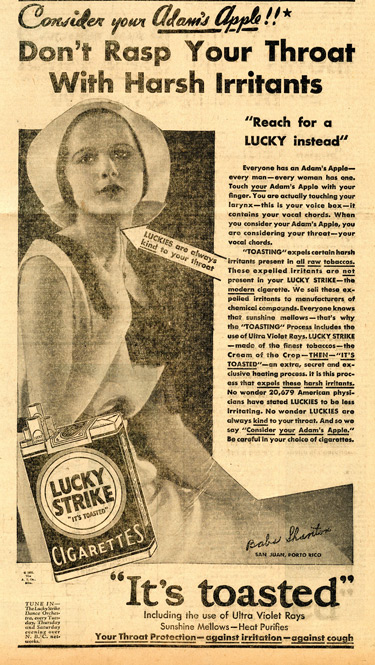
…the other model in the Best & Company ad, Babs Shanton, also wasn’t averse to taking money from the tobacco companies…

Undated newspaper ad for Lucky Strikes featuring Babs Shanton, a sometime performer with the Ziegfeld Follies and a singer with the Lucky Strike Dance Orchestra. (Stanford University)

…the makers of Studebakers tried to add sex appeal in this ad for their President Roadster. The artist was obviously challenged to work all of the necessary elements into the picture—car, swimming pool, diving board—not to mention the block of superfluous text where the steps to this impossibly long diving board should have been located…

…and sex not only sold cars…its also sold printing services…

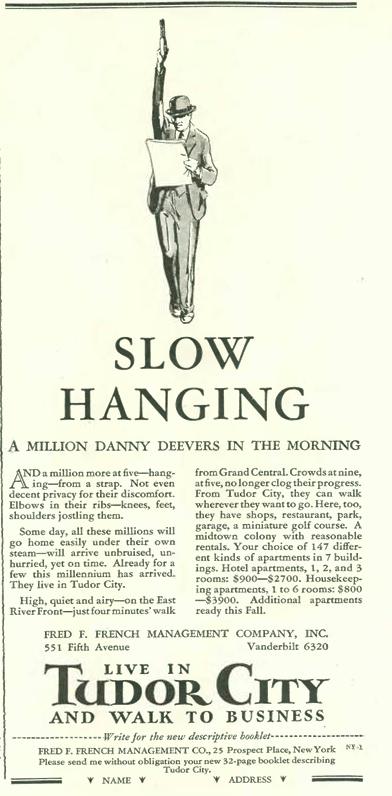
…instead of sex, the promoters of Tudor City chose strangulation to get their pitch across, equating a man’s daily train commute to death at the gallows (“Danny Deevers” refers to a character in a Rudyard Kipling poem who is hanged for murder)…

…the gawkers at Roosevelt Field weren’t the only folks with their heads in the clouds…an ad for Flit insecticide by Dr. Seuss…

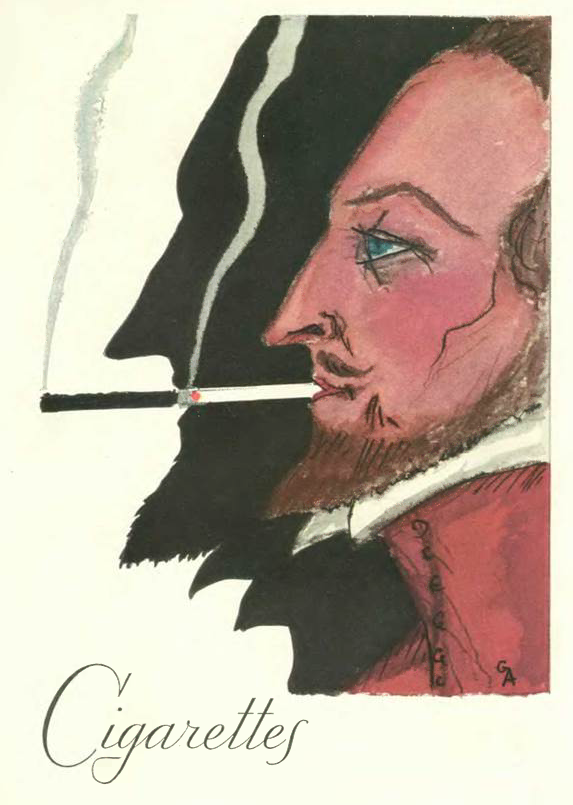
…this ad for Raleigh cigarettes, which appeared on the back cover of the Aug. 31 issue, assumed that folks were so familiar with their mascot that no further explanation was needed…

…here is a 1929 ad from House Beautiful that featured the same mascot with the Van Dyke beard…both ads were rendered by French illustrator Guy Arnoux

…on to our cartoonists…Helen Hokinson contributed this two-page spread on the challenges of visiting an old friend (click to enlarge)

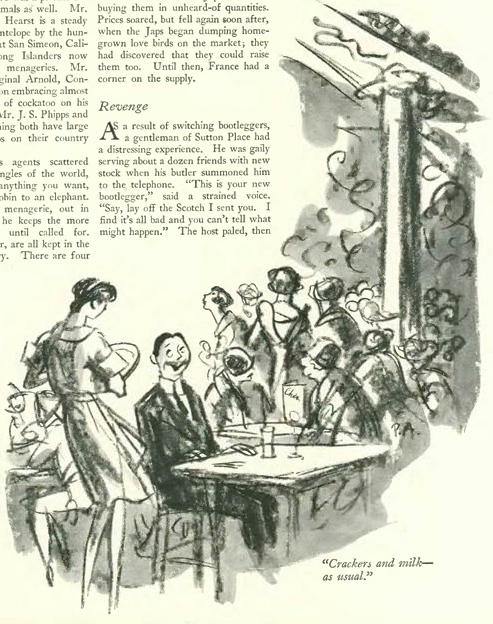
Peter Arno looked in on a cheapskate at a posh restaurant…

Bruce Bairnsfather visited the talkies…

Justin Herman examined the literary life of the street…

Carl Kindl explored an awkward moment from the annals of technological advancements…

…and Isadore Klein illustrated the hazards of the tonsorial trade…

Next Time: The Last Hurrah…

(Another) Fight of the Century

It seems that each generation has its “Fight of the Century,” a phenomenon that emerges from the alchemy of mass marketing, a lust for blood sport, and the madness of crowds. Gene Tunney — a boxer who also wanted to be a public intellectual — was party to at least two of these spectacles in the 1920s.

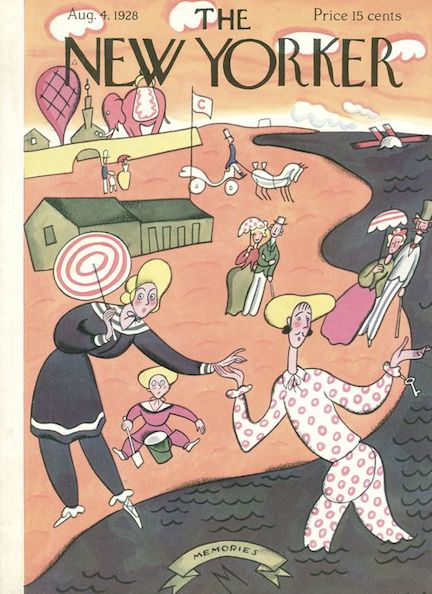
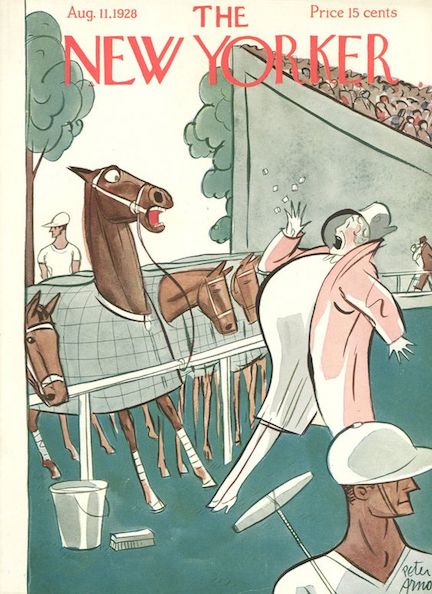
August 4, 1928 cover by Julian de Miskey.

Tunney is most famous for his fights against Jack Dempsey—in some ways they were the Ali–Frazier of their day. Tunney took the heavyweight title from Dempsey in 1926, and again defeated Dempsey in the controversial “long count” rematch one year later, on Sept. 22, 1927. That match was a huge spectacle, staged at Chicago’s Soldier Field in front of 105,000 spectators.

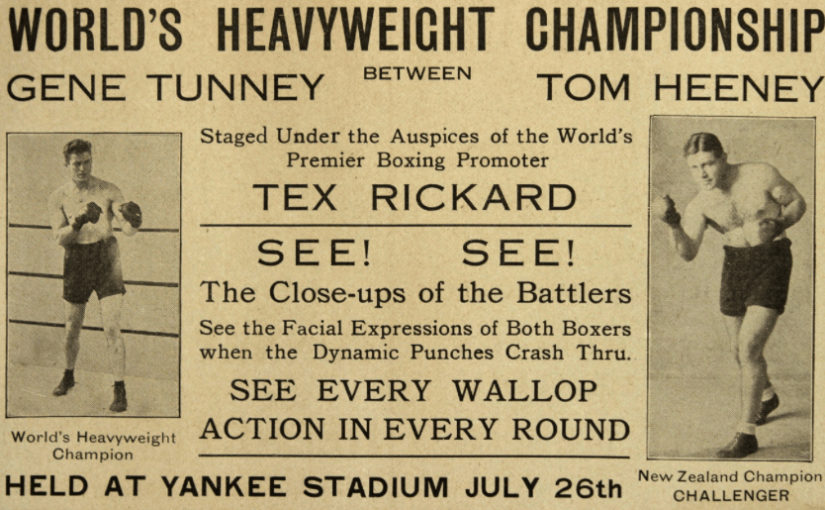
Boxing promoter Tex Rickard saw dollar signs when a scrappy New Zealander named Tom Heeney challenged the champ to a match. Heeney had won the Australian heavyweight title in 1922, and after arriving in the U.S. in 1926 found enough success in the ring to be ranked fourth among the world’s heavyweight boxers.

Writing in his column, “Sports of the Week,” in the July 21, 1928 issue of The New Yorker, Niven Busch Jr. assessed Heeney as a formidable opponent:

NO PALOOKAS HERE…Tom Heeny (left), and Gene Tunney in the late 1920s. (boxrec.com / Alchetron)

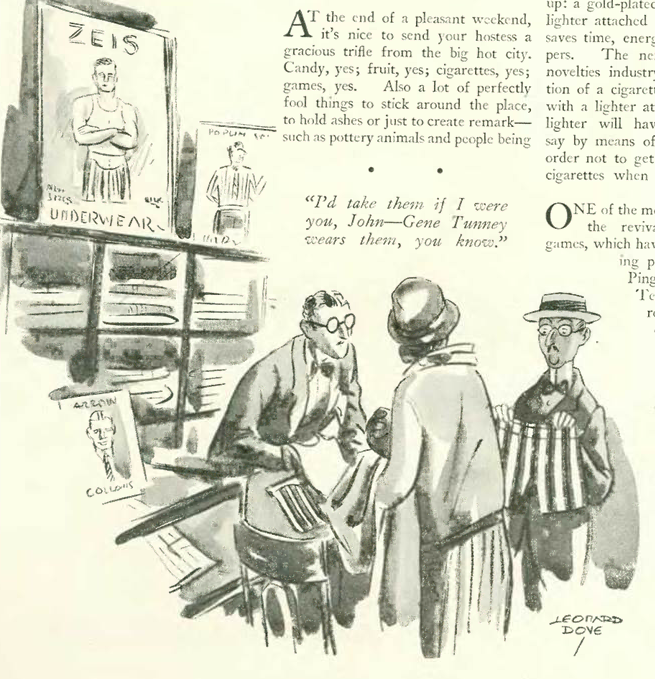
This cartoon by Leonard Dove, also in the July 21 issue, joined in the fun…

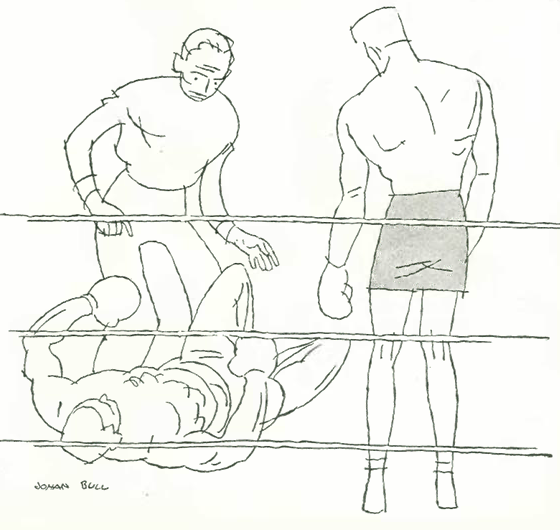
As for the actual fight at Yankee Stadium on July 26, 1928, Tunney won by a TKO in the 11th round. Perhaps the boxer from Down Under wasn’t in such great shape after all, or so surmised Niven Busch Jr in the August 4 issue:

New Yorker illustrator Johan Bull offered this perspective in artwork that accompanied Busch’s article…


Tunney’s winning purse was $525,000 (about $7.3 million today) and Heeney’s was $100,000 ($1.4 million), modest when compared to the recent debacle in Las Vegas that pitted professional boxer Floyd Mayweather Jr. against mixed martial arts champion Conor McGregor.  Mayweather earned a disclosed purse of $100 million while Conor McGregor brought home $30 million.

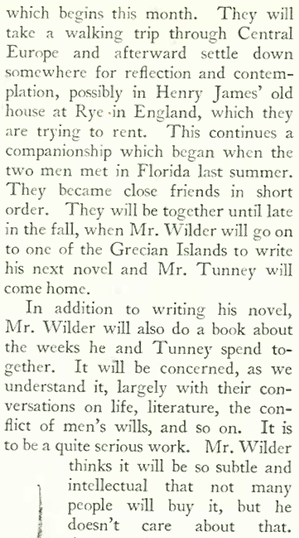
Heeney would remain in the U.S. and fight a few more bouts before retiring to Florida, where he ran a bar and fished with his friend, Ernest Hemingway. Tunney, on the other hand, announced his retirement from boxing just five days after the fight. It was time to finally devote himself to a life of the mind. Norman Klein, writing in the Aug. 4 “Talk of Town,” offered a glimpse into that new life:

BRAIN OVER BRAWN…Boxing champ Gene Tunney, left, and writer George Bernard Shaw on a 1929 vacation to Brioni. (Associated Press)

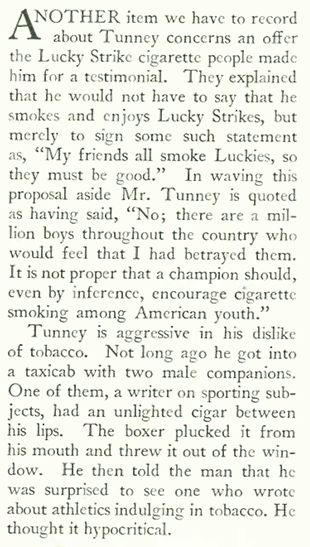
Still not getting enough of The Champ, “Talk” also related this story about Lucky Strike cigarettes, and how that company’s publicists tried unsuccessfully to persuade Tunney to endorse their product:

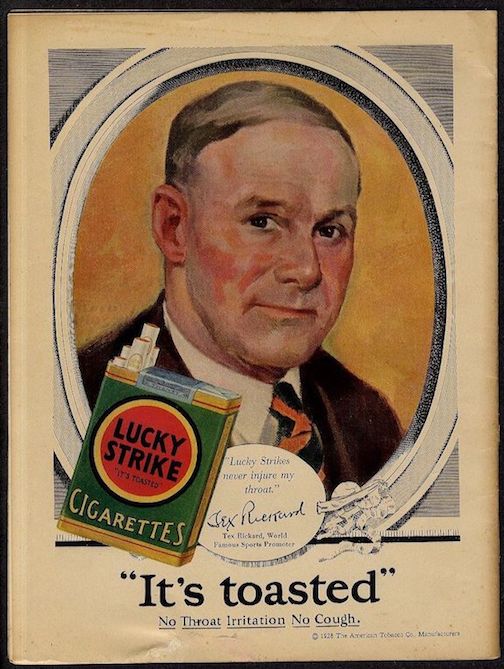
However the promoter of the Tunney–Heeney fight, Tex Rickard, had no problem taking money from the American Tobacco Company:

THEN I’LL TAKE THE MONEY…The promoter of the Tunney – Heeney fight, Tex Rickard, had no problem endorsing Lucky Strikes in this 1928 advertisement. Rickard would die the following year at age 59, from an appendectomy of all things. (eBay)

*  *  *

Tunney Was More Exciting

“The Talk of the Town” cast a jaded eye toward the Ninth Olympic Games in Amsterdam:

Poster from the 1928 games. (www.olympic.org)

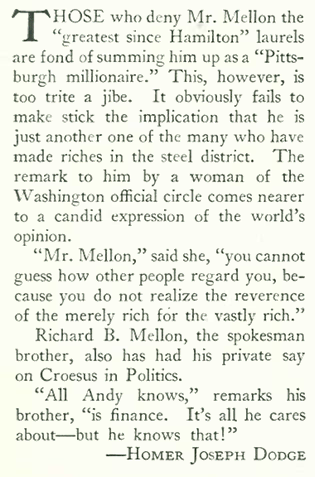
And perhaps even less exciting than the Olympics was the magazine’s “Profile” subject, Andrew W. Mellon, referred to in the title as “Croesus in Politics.” Mellon was no Gene Tunney, but he did ensure his immortal fame through his philanthropy, still expressed today by the Andrew W. Mellon Foundation. Below are the concluding lines of the profile, written by Homer Joseph Dodge:

The article featured this terrific caricature by illustrator Abe Birnbaum

Planned Obsolescence

The magazine’s “Motors” column touted Chrysler’s new “peaked” radiators, which no doubt caused many insecure Chrysler owners to consider junking their non-peaked models of yesteryear:

This ad in the same issue screamed “new, new, new” for what appeared to be mostly the same old, same old…

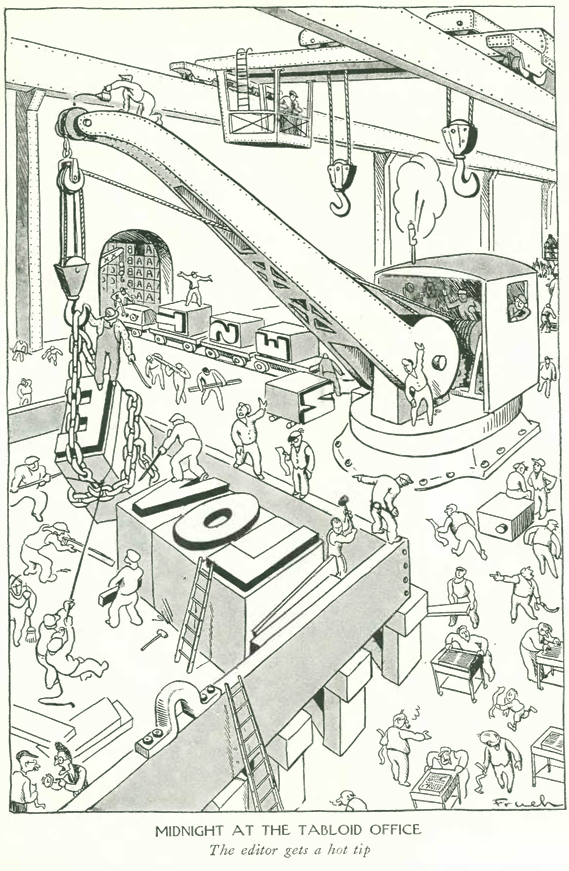
Our comic comes courtesy Al Frueh, who looks in on the workings of a printing press at a celebrity tabloid:

Next Time: Shadows of the South Seas…

The Thurber Effect

We’ve looked at a number of artists and writers who were instrumental in giving The New Yorker its unique look and voice, but few were more influential than James Thurber, who contributed some of The New Yorker’s most memorable writings (“The Secret Life of Walter Mitty”) as well as some of its most enduring cartoons and illustrations.

1ff86ce7dfa34152a1ab0aa892031914
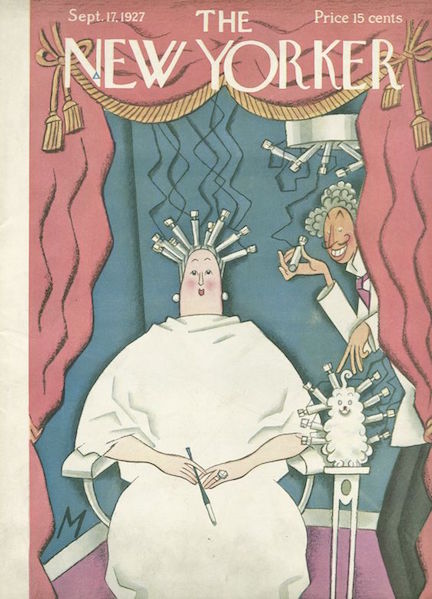
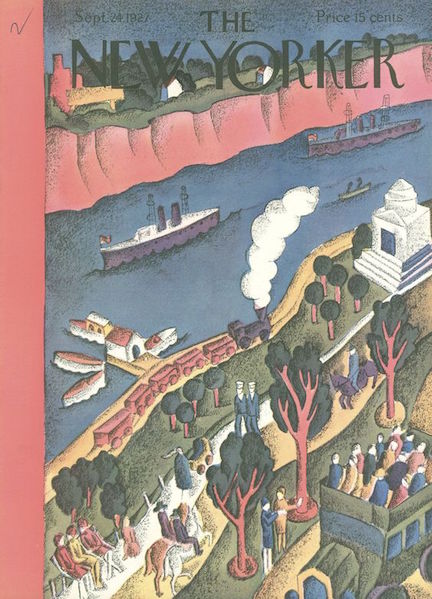
September 17, 1927 cover by Julian de Miskey.

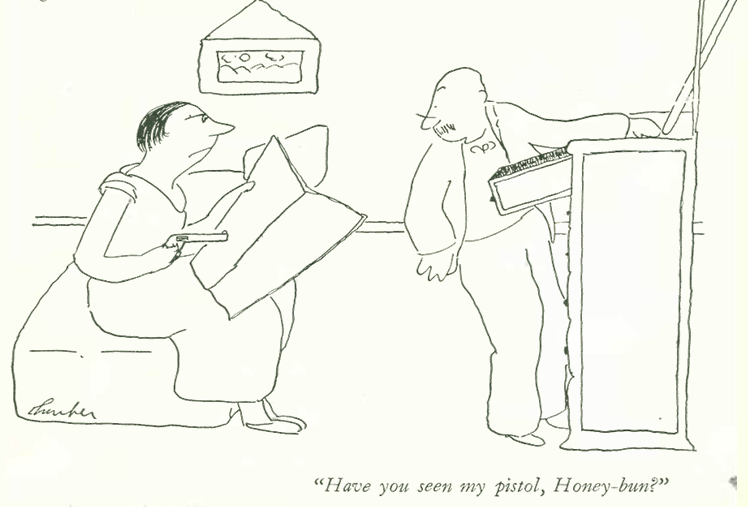
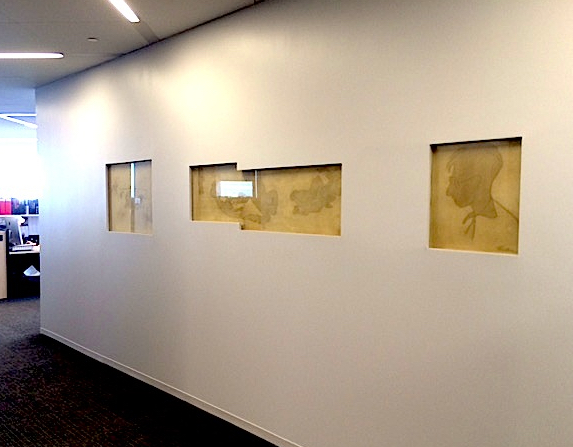
In fact, Thurber’s art is so ingrained in the New Yorker’s culture that the magazine goes to great lengths to preserve some of his office wall drawings, which move along with the magazine each time it relocates. On his website Ink Spill, New Yorker cartoonist Michael Maslin writes “When you move, it’s always reassuring unboxing something you love from the old place and setting it down in the new place.”

thurber-one-world-trade-center-ink-spill
ICONS…James Thurber’s wall drawings installed in The New Yorker offices at One World Trade Center (Michael Maslin, Ink Spill)

In 1991, when The New Yorker prepared to leave its longtime home at 25 West 43rd Street (where Thurber originally doodled on a plaster wall), conservators carved several drawings from the wall and mounted them in protective glass. The drawings were eventually installed at the magazine’s new offices across the street at 20 West 43rd St. They were moved again when The New Yorker relocated to 4 Times Square in 1999 and then once more in 2015 to their current location at One World Trade Center.

thurberwhite
NEW YORKER GIANTS…E.B. White and James Thurber in 1929. The two would share an office and become good friends. In 1929 they would collaborate on a best-selling book spoof, Is Sex Necessary? Or, Why You Feel the Way You Do. (xroads.virginia.edu)

Thurber joined the New Yorker staff in 1927, sharing an office “the size of a hall bedroom” with E. B. White, who had joined the magazine about a year earlier. According to Jon Michaud (in a June 2, 2010 New Yorker article), Thurber arrived at The New Yorker from Columbus, Ohio, via Paris, France, and a brief stint at the New York Evening Post. “Six months after he was hired, Thurber was transferred to ‘The Talk of the Town,’ where he found his feet as a reporter and did for that department what White did for ‘Notes and Comment’—he gave it an identity and a tone, which can still be heard in the magazine today.” This included introducing the convention of using the first person plural in “Talk” items.

james-thurber-2
James Thurber in undated photo. (thefamouspeople.com)

His contribution to the Sept. 17, 1927 issue was not anonymous, however, as Thurber prominently signed his entire name–James Grover Thurber–at the end of a humorous essay, “Polo In The Home.” An excerpt:

james-grover-thurber

 *  *  *  *  *

People in Glass Houses

Writing in her “About the House” column, Muriel Draper examined new uses for glass in modern design and concluded that houses built of glass rather than stone belonged to a distant future.

screen-shot-2016-11-30-at-2-21-10-pm

screen-shot-2016-11-30-at-2-22-12-pm

Well, Muriel was almost right. Philip Johnson built his famous Glass House in New Canaan, Connecticut, in 1949. Muriel Draper died in 1952. I assume she visited the house or at least knew of it, since she and Johnson were in New York social orbits that often aligned, especially around the Harvard modernists.

glasshouse6atnight
PASS THE WINDEX…Architect Philip Johnson’s famed Glass House in New Canaan, Connecticut. (connecticutmag.com)

 *  *  *  *  *

So Much For Golf

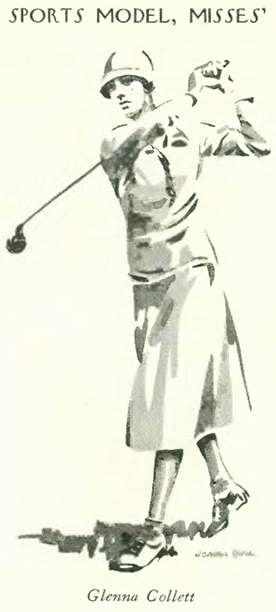
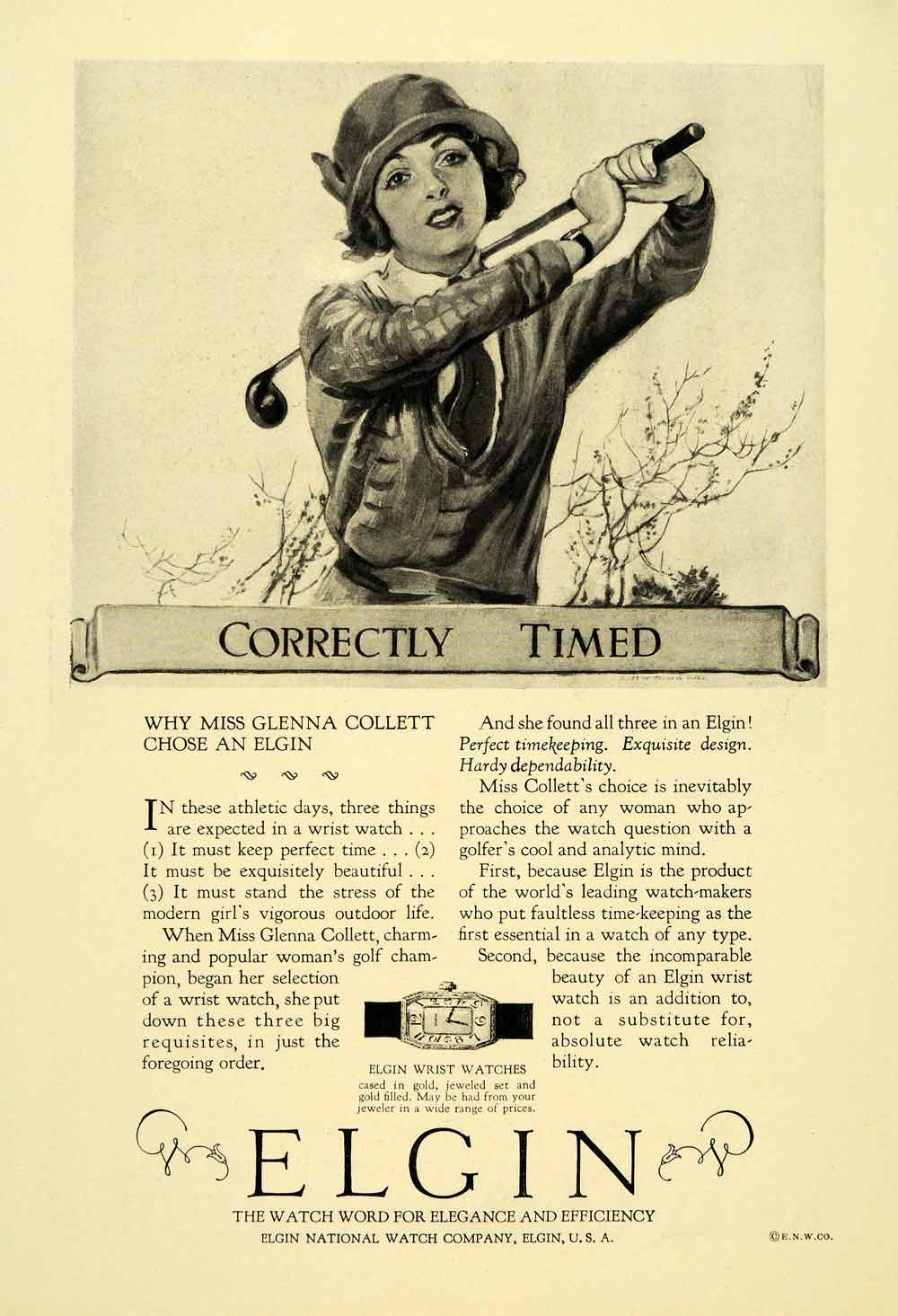
The Sept 17 issue also featured a profile of golfer Glenna Collett. Writer Niven Busch Jr. began by describing how Collett’s physical appearance compared with other women golfers and athletes. Yes, it was 1927. Title IX was still 45 years away. Here are the first two paragraphs, and an illustration for the profile by Johan Bull:

screen-shot-2016-11-30-at-2-19-32-pm

screen-shot-2016-11-30-at-2-19-44-pm

alchetron
I CAN GOLF, TOO…Golfer Glenna Collett in the late 1920s. (golfweek.usatoday.com)

On the topic of physical appearance, it is interesting compare the above photograph of Collett with a rendering used in this 1925 Elgin watch ad (from another magazine). It looks nothing like Collett, not to mention the golf club she is holding would barely reach her knees let alone the ground.

period-paper
LOOK FAMILIAR?…The illustration for this advertisement is by James Montgomery Flagg, who in 1917 created the iconic “I Want You” Uncle Sam illustration for the U.S. Army. 

Finally, another look at the changing cityscape in this cartoon by H.O. Hofman:

screen-shot-2016-11-30-at-2-18-00-pm

Next Time: Flapper Fitness…

fd4accb02ed7d01ae3624ea180d47357


The Wages of Beauty

“The Very Golden Apple” was the title of an essay by E. A. Tosbell in the Sept. 3, 1927 issue that examined the transformation of the Miss America pageant–just seven years old–into a big money concern.

31c2a728e871acb0cd991e761bcb7f76
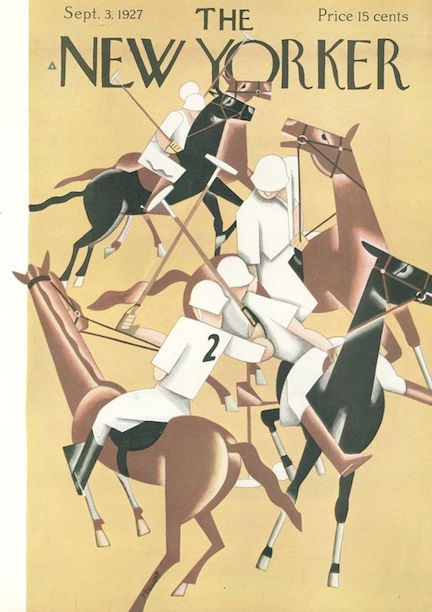
September 3, 1927 cover by Theodore G. Haupt.

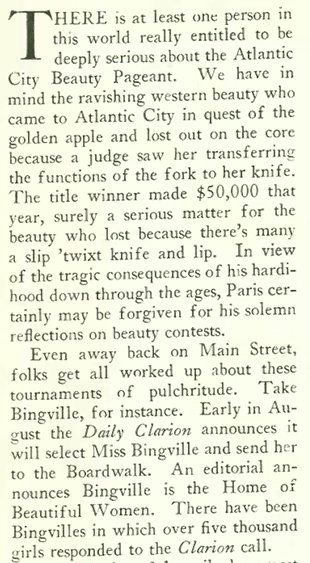
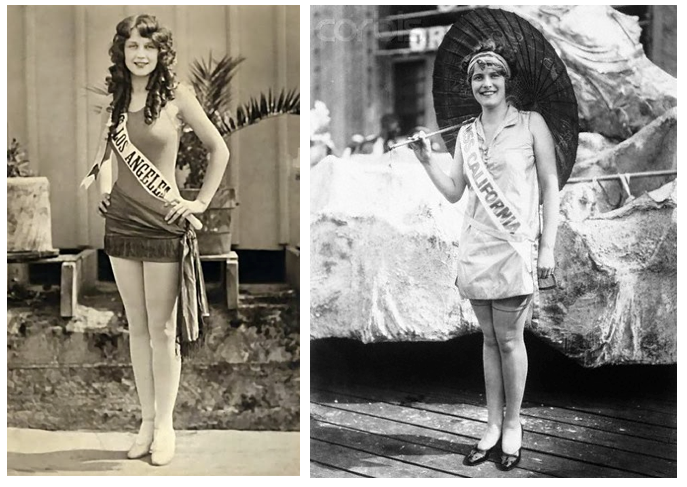
Tosbell opened with the lament that Miss Los Angeles, Adrienne Dore, should have won the 1925 contest save for a lapse in table manners…

screen-shot-2016-11-28-at-9-20-01-am

screen-shot-2016-11-28-at-10-29-38-am
PASS THE SALT, PLEASE…Adrienne Dore, left, was runner-up to fellow Californian Fay Lanphier, who was crowned Miss America in 1925. Dore would go on to a modest movie career through the mid 1930s. (Allure/travsd.wordpress.com)
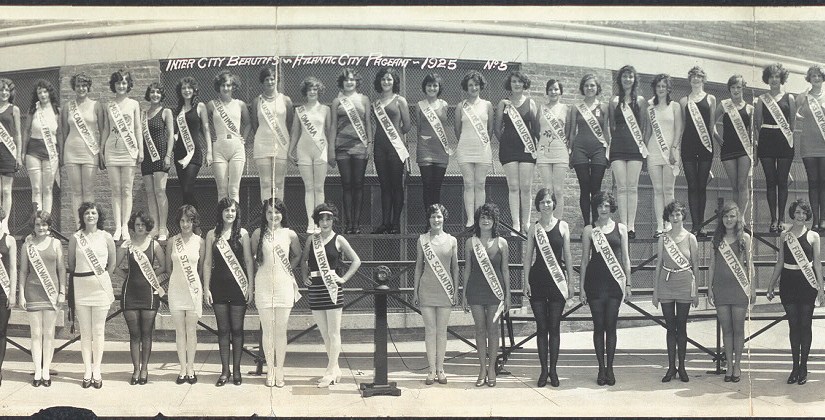
miss_america_contestants_1925
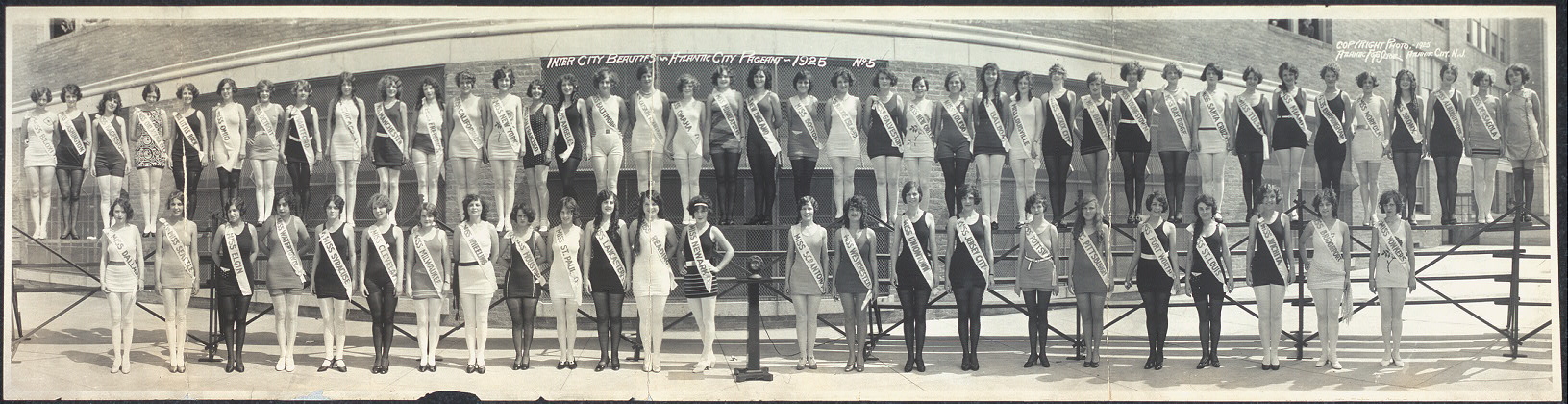
ALL-AMERICAN LINE-UP…Contestants from a hodge podge of states, cities and towns vied for the Miss America crown in 1925. (Wikipedia) Click to Enlarge

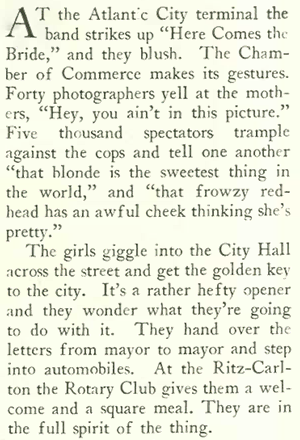
Tosbell offered us a taste of what contestants could expect upon their arrival in Atlantic City…

screen-shot-2016-11-28-at-9-21-54-am

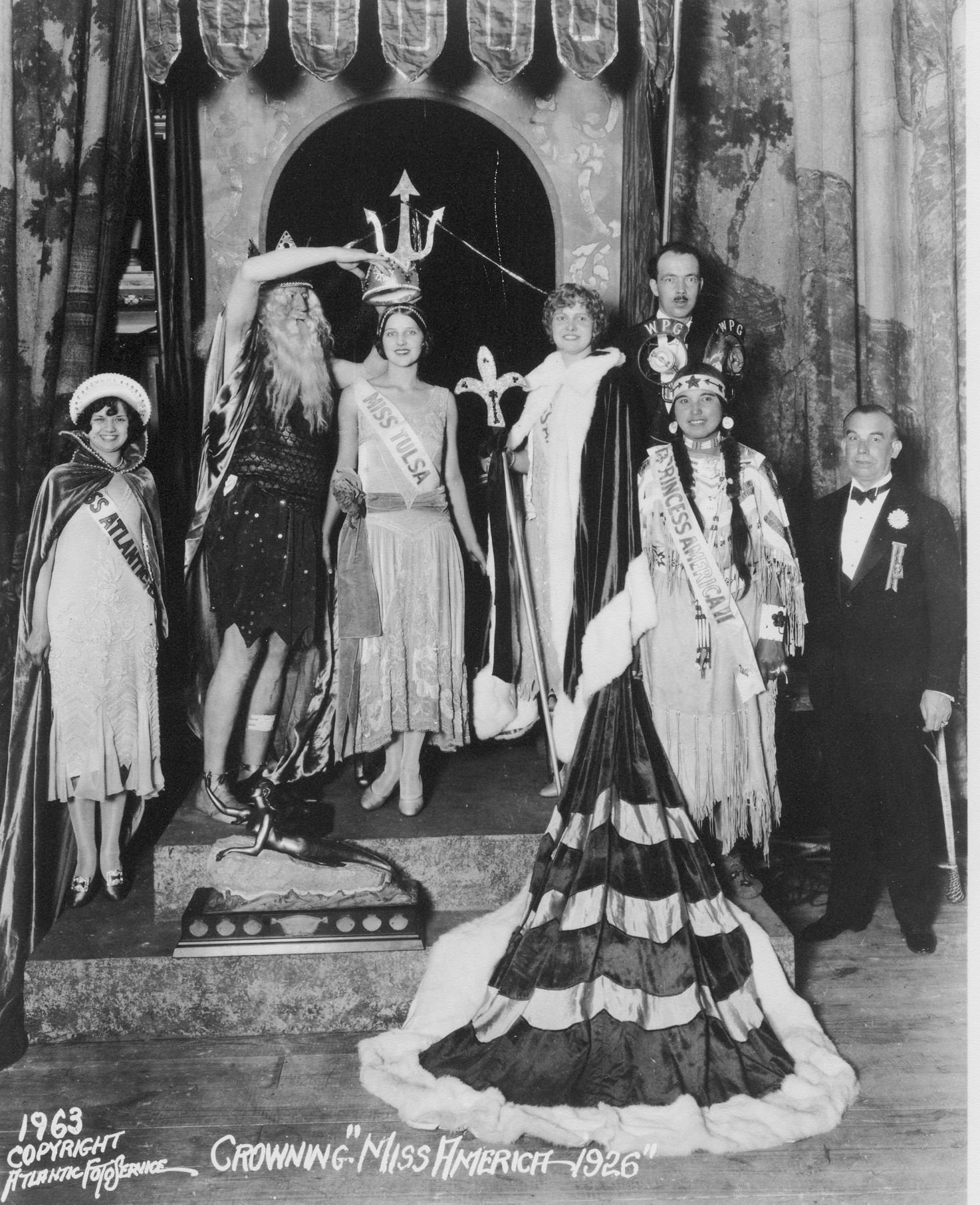
Norma Smallwood from Tulsa, Oklahoma was crowned Miss America 1926, the first Native American to capture the title. Smallwood was highly criticized in the press for her business savvy as she went on to earn $100,000 through personal appearance fees and product endorsements. Tosbell noted:

screen-shot-2016-11-28-at-9-25-25-am

1926-crowned-by-king-neptune1925-looks-on-1
THERE SHE GOES…Norma Smallwood of Tulsa, Oklahoma was crowned Miss America 1926 by “King Neptune” as Miss America 1925 Fay Lanphier (right) held her scepter. (missamerica.org)

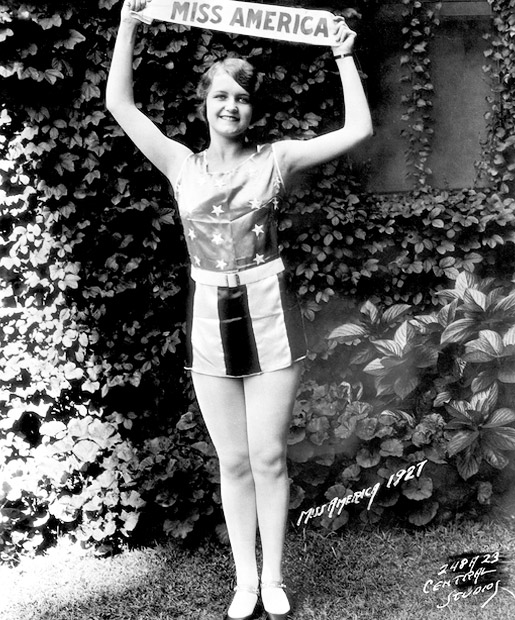
In 1927 Smallwood would again draw criticism when she requested $600 from the pageant for her appearance in crowning the new winner, Lois Delander. Delander was a high school student who won her local contest in Joliet, Illinois by reciting Bible verses. Unlike her predecessors, Delander turned down lucrative offers in show business and returned home to continue her school studies.

missamerica-01_zps22408d2c
IT’S NICE, BUT…Lois Delander of Joliet, Illinois was a most unassuming Miss America of 1927. (Time.com)

In the case of a 1922 Miss America contestant, Georgia Hale, you didn’t have to win the pageant to make it to the Big Time. Hale was chosen by Charlie Chaplin to be his “leading lady” in 1925’s The Gold Rush, and in the following year she would play Myrtle Wilson in the first filmed version of The Great Gatsby. A savvy businesswoman, Hale would become wealthy through real estate investments in Southern California.

screen-shot-2016-11-28-at-9-26-25-am

charlie_and_georgia_hale_original_ending_03_-_the_gold_rush_1925_-_pdvd_036
SHE STRUCK GOLD…Georgia Hale and Charlie Chaplin in The Gold Rush, 1925. (Wikimedia Commons)

*  *  *

The September 3 “Talk of the Town” offered some insights into the dressing habits (and tardiness) of New York’s dandified mayor, Jimmy Walker, who was preparing for an overseas journey. Excerpts:

screen-shot-2016-11-28-at-9-17-14-am

screen-shot-2016-11-28-at-9-17-27-am

screen-shot-2016-11-28-at-9-17-34-am

Screen Shot 2015-07-24 at 1.01.10 PM
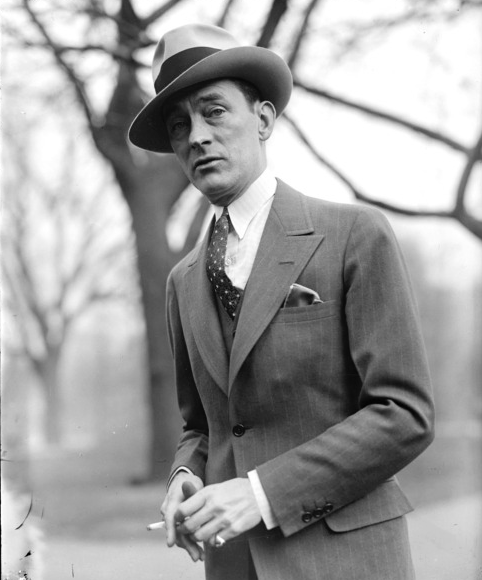
GOTHAM’S CLOTHES HORSE…New York City Mayor Jimmy Walker during a visit to Boston in the late 1920s. (c. Leslie Jones, digitalcommonwealth.org)

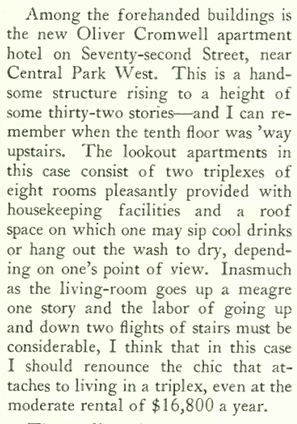
The New Yorker continued its commentary on the changing city skyline as urban residences continued their skyward climb, including the oddly named Oliver Cromwell apartment hotel:

duplex

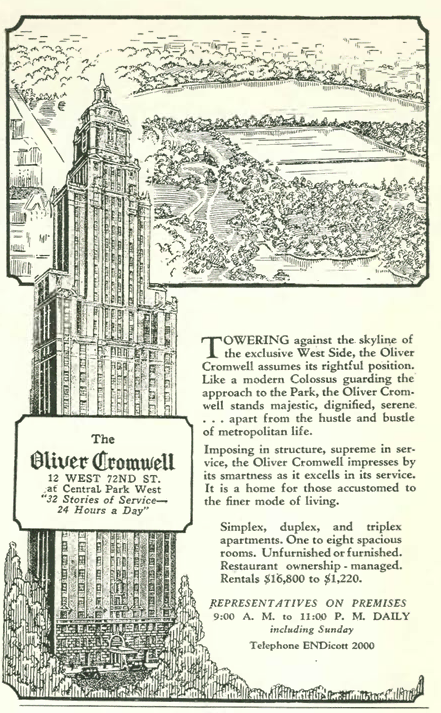
An advertisement in the same issue touted the Cromwell’s serene, park-like setting:

screen-shot-2016-11-28-at-9-30-03-am

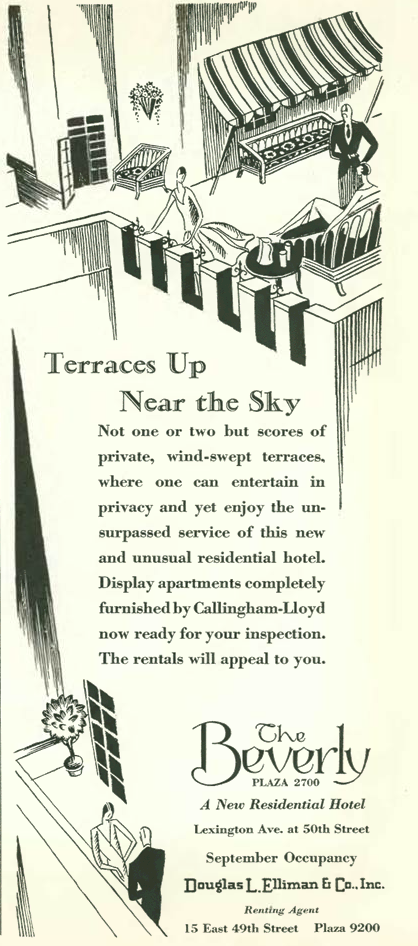
There were numerous advertisements like these in The New Yorker. Another promoted the Beverly’s sky-high “wind-swept terraces…”

screen-shot-2016-11-28-at-9-27-39-am

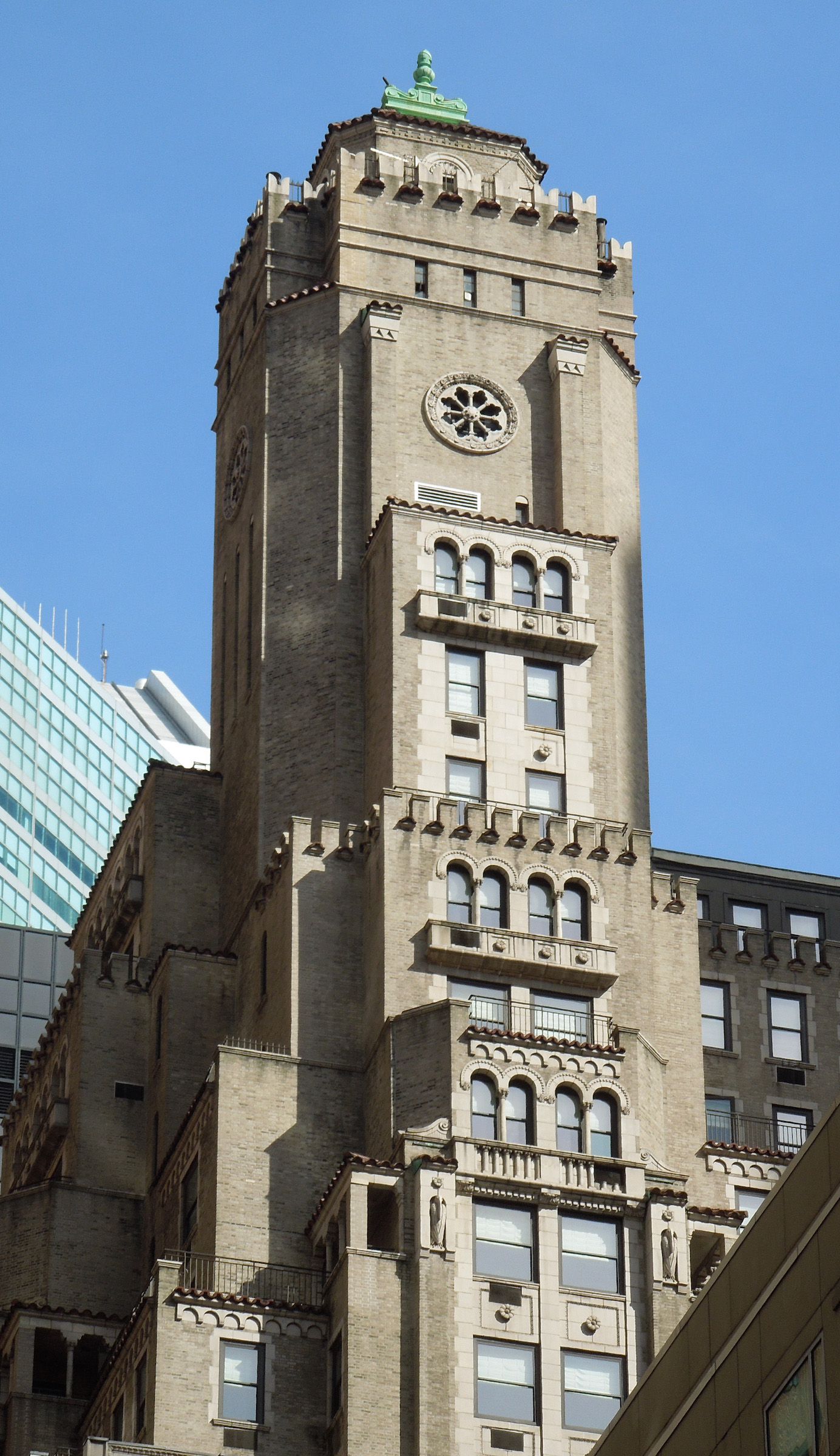
125-east-50th-top
The Beverly today (now the Benjamin Hotel). The 30-story building was designed by Emery Roth with Sylvan Bien and built in 1926-27. Commissioned by Moses Ginsberg to host middle-income visitors to New York City, it was recently submitted for landmark designation as an important fixture in Grand Central Terminal’s “Hotel Alley.” (Historic Districts Council)

 *  *  *

On to the Sept. 10, 1927 issue, and a couple of cartoons that aptly represented the spirit of Roaring Twenties…

e2f69e45ad57152eae57b86f94f11cb8
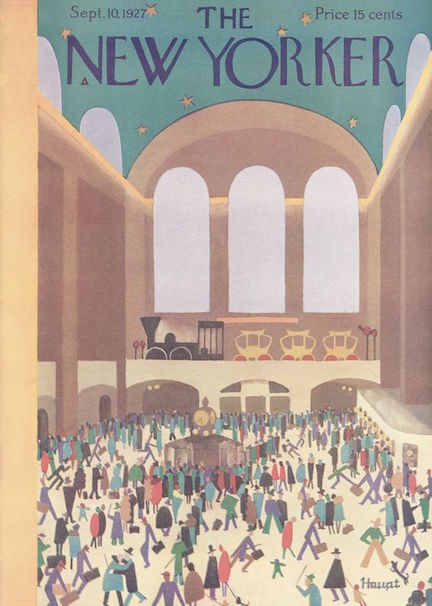
Sept. 10, 1927 cover by Theodore G. Haupt.

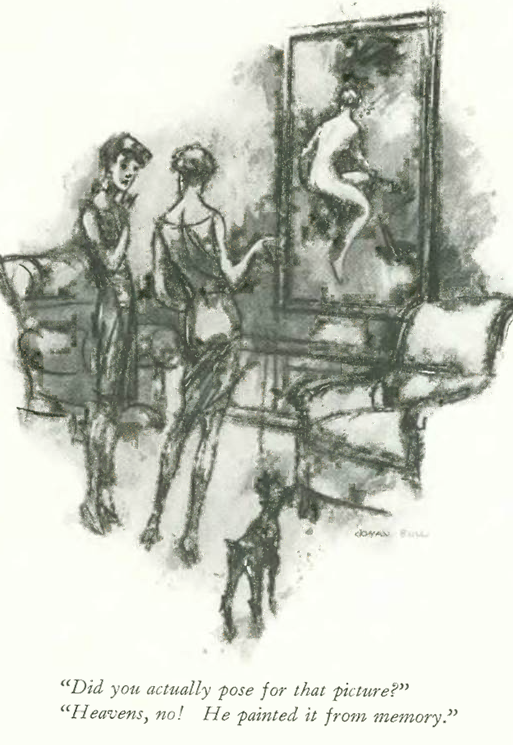
Johan Bull offered a glimpse of the new rich in the realm of culture…

screen-shot-2016-11-28-at-9-32-01-am

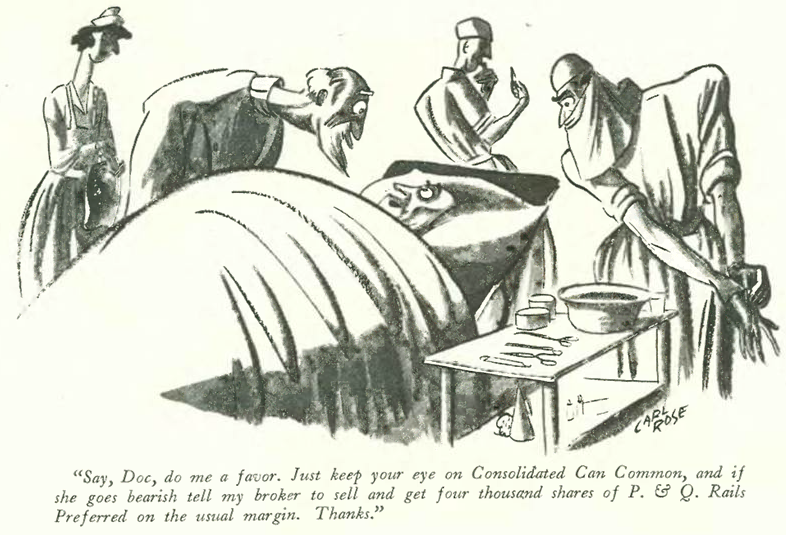
…while Carl Rose captured the spirit of investors during the waning days of the red hot 1920s stock market…

screen-shot-2016-11-28-at-9-34-03-am

Next Time: The Thurber Effect…

1ff86ce7dfa34152a1ab0aa892031914

Île-de-France

On June 22, 1927, the legendary French ocean-liner, the Île-de-France, traveled from Le Havre to New York on its maiden voyage, soon to be greeted by the American media and the thousands who would crowd the docks at New York Harbor to see the great ship.

80c5240bf5ffaaff418de94b7e176525
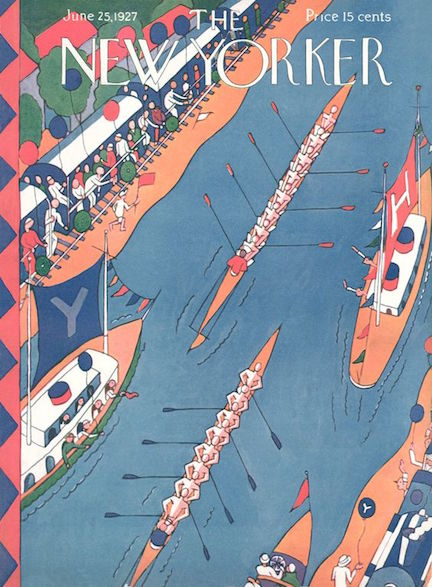
June 25, 1927 cover by Ilonka Karasz.

Among those anticipating the visit was The New Yorker, which offered this account in “The Talk of the Town” for the June 25, 1927 issue:

screen-shot-2016-10-14-at-9-46-05-am

screen-shot-2016-10-14-at-9-46-18-am

screen-shot-2016-10-14-at-9-46-27-am

ss_ile_de_france_c1935
PRIDE OF FRANCE…Postcard image of the Île-de-France from 1935. During a post-war refurbishment, the three funnels were replaced with a pair of stockier, more stylish funnels. (Wikipedia)

The Île-de-France was unique in that it was the first ocean-liner to have an interior design that didn’t imitate “shore-style” interiors that resembled rooms in manor houses or grand hotels. The trend-setting ship sported a modern, art deco look that celebrated the present and the future.

mainfoyer
IN WITH THE NEW…The Main Foyer & Grand Staircase of the Île-de-France,(newyorksocialdiary.com)
c1fe5bedcb3cb40a005ca4aa6672195c
LEAVE YOUR FLIP-FLOPS AT HOME…The first-class dining room in the Île-de-France. (newyorksocialdiary.com)

Note that these photos do not contain images of water slides or all-you-can eat buffets. An ocean voyage, if you could afford it, was an elegant affair. The Île-de-France was especially popular among wealthy Americans who liked its stylish, youthful vibe.

The Île-de-France served as a troop ship during World War II, and in 1956 played a major role in rescuing passengers from the sinking Andrea Doria off the coast of Nantucket.

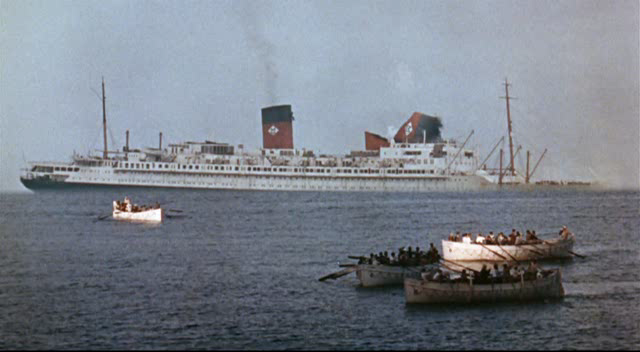
Unfortunately, anything that is youthful soon grows old, and as we all know, style is an ephemeral thing. With the advent of transatlantic jet transport, ships like the Île-de-France fell out of favor, and by 1960 the grand ocean liner was reduced to serving as a floating prop for a disaster movie titled The Last Voyage. The filmmakers partially sunk the poor ship, set fires and detonated explosions in the interior, and in a final act of desecration dropped one for the ship’s smoke stacks onto its deck house.

oceanlinersmagazine
(IMDB)
the-last-votage
NOT A BUFFET IN SIGHT…Still from the 1960 movie, The Last Voyage, shot on board the soon-to-be-scrapped Île-de-France. (Screen shot from movie trailer)
screen-shot-2016-10-20-at-2-20-28-pm
FIERY END…Fires were set in the interior of the Île-de-France during the filming of The Last Voyage. (Screen shot from movie trailer)
the-last-voyage-1960-ship-sinking
BROUGHT TO ITS KNEES…The Île-de-France (named the SS Clarion in the movie) is partially sunk with its forward funnel collapsed in a still from the film, The Last Voyage.

 *  *  *

The Ruth Snyder–Judd Gray murder trial and sentencing captivated Americans in 1927, but another trial and sentencing in the 1920s would bring worldwide attention and spark mass protests.

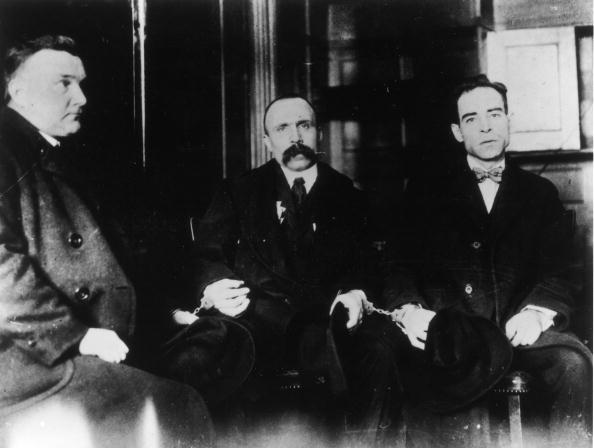
Nicola Sacco and Bartolomeo Vanzetti were Italian-born Americans who were convicted of murdering a paymaster and guard during a robbery of a Boston-area shoe company in 1920. Although convicted of murder the following year, many critics of trial believed Sacco and Vanzetti, who held anarchist views, were innocent of the charges, and the case became one of largest causes célèbres in modern history with protests held on their behalf in major cities across the U.S. and around the world.

Ferdinando Nicola Sacco and Bartolomeo Vanzetti in handcuffs, circa 1920s. (Photo by Fotosearch/Getty Images).
Cause Célèbre…Nicola Sacco and Bartolomeo Vanzetti handcuffed together at the Dedham, Massachusetts Superior Court, 1923. (Boston Public Library).

Sentenced to death in April 1927, they would be executed the following August. The New Yorker, predisposed to look down on Boston as something of a backwater, had this to say about the trial in an article by Gerald Day for the “Reporter at Large” column:

screen-shot-2016-10-22-at-10-18-49-am

The case also rekindled memories of other notorious trials:

screen-shot-2016-10-22-at-10-19-05-am

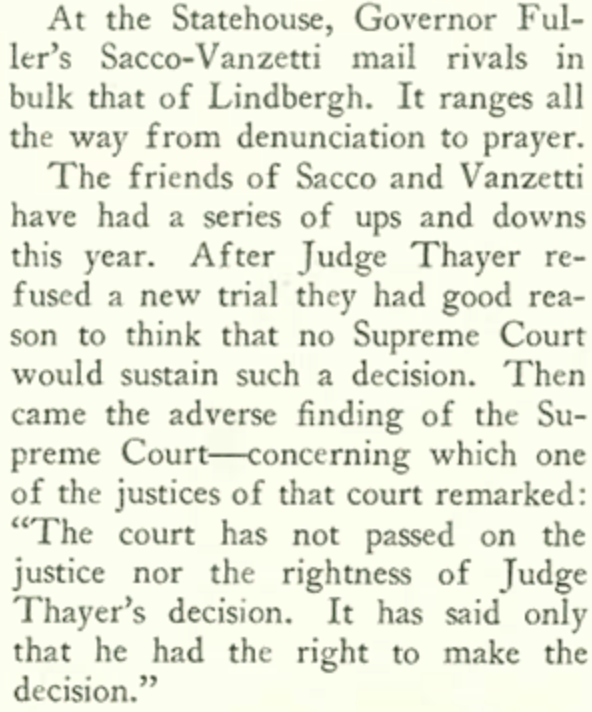
The governor did appoint a commission to review the case, but the final decision was in his hands…

screen-shot-2016-10-22-at-10-19-49-am

And so the only option left for Sacco and Vanzetti was clemency from the governor.

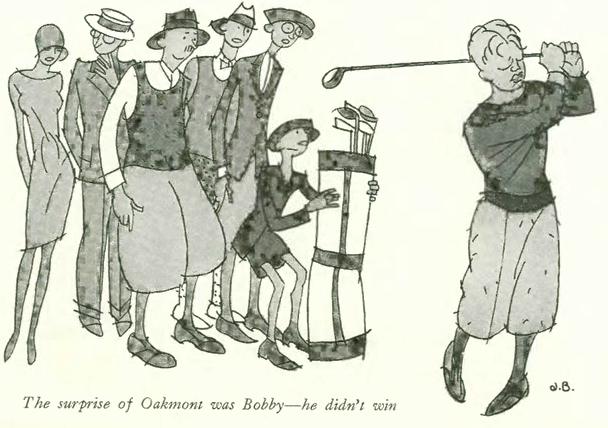
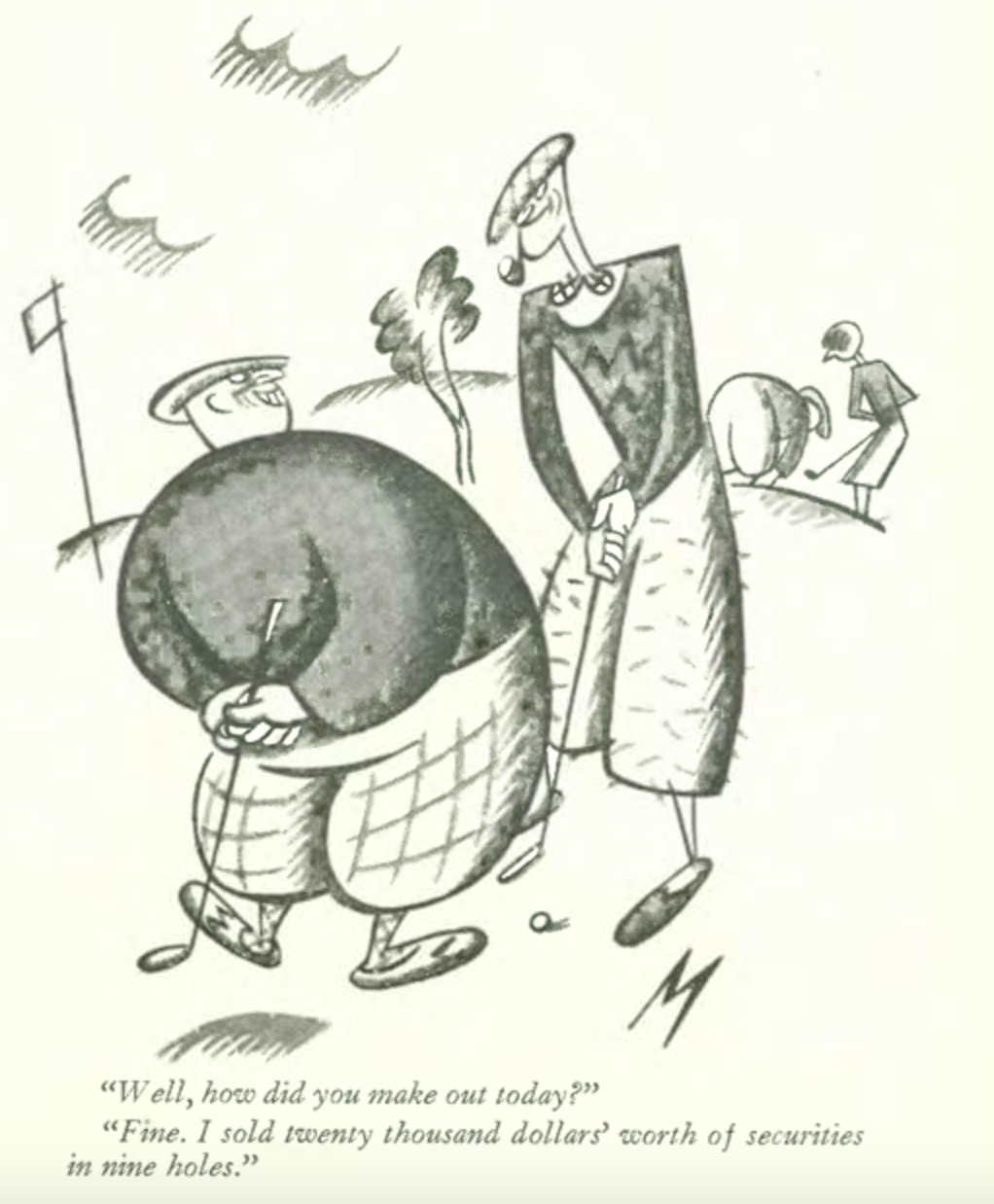
To close, a few illustrations from some of the magazine’s mainstay artists…this one from Johan Bull used to illustrate an article on the U.S. Open featuring amateur Bobby Jones

screen-shot-2016-10-14-at-9-49-23-am

…and keeping with the golf theme, this cartoon by Julian de Miskey

screen-shot-2016-10-22-at-9-36-35-am

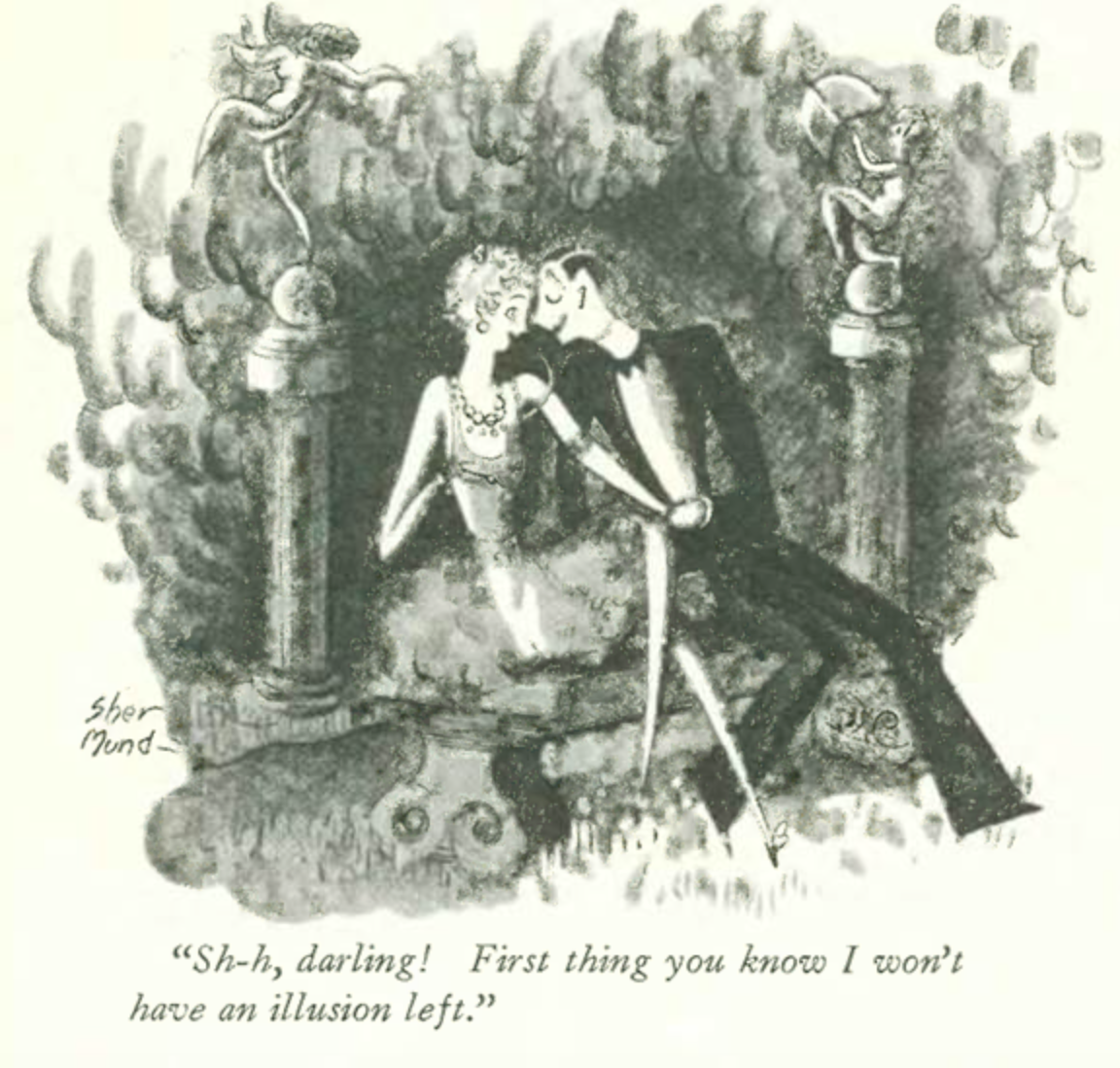
…and finally, a little fun with Barbara Shermund and her comment on social mores of the day:

screen-shot-2016-10-22-at-9-37-14-am

Next Time: Fifteen Minutes is Quite Enough…

7b096a824e274d6b7b7c5e0f1a3e85e7


The Sporting Life

One of the strangest things about the fall 1926 issues of The New Yorker is the almost complete absence of baseball coverage, even though the 1926 Yankees had turned things around from an abysmal 1925 season and found themselves in the 1926 World Series against the St. Louis Cardinals.

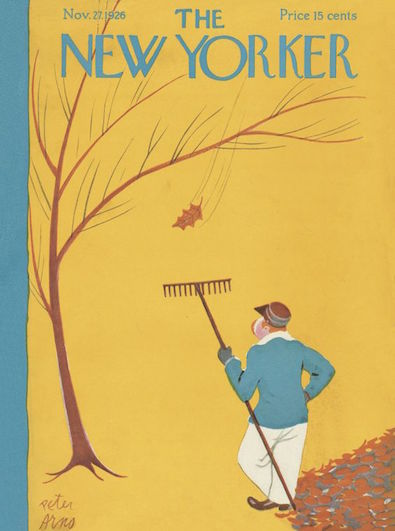
cb57ca46d50ab47f3acf02be954149b6
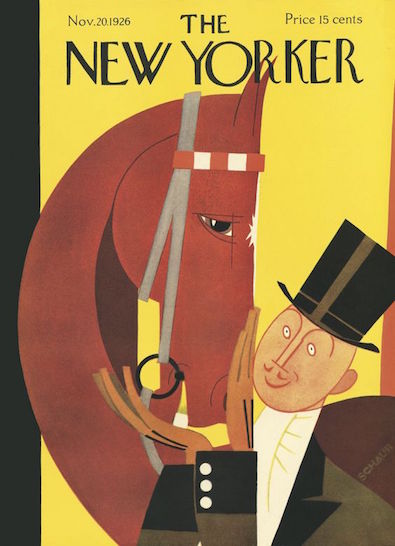
November 20, 1926 cover by Andre De Schaub.

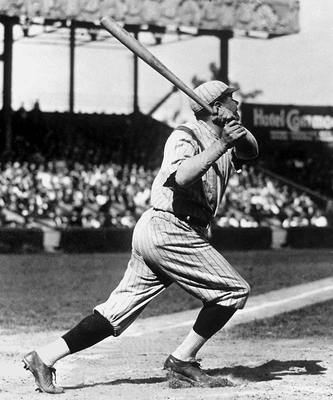
The Yankee’s star Babe Ruth had recovered his health from the previous season and played exceptional all-around baseball in 1926, even setting a World Series record of three homers in the fourth game. According to (now disputed) newspaper reports at the time, Ruth had promised a sickly boy named Johnny Sylvester that he would hit a home run for him in Game 4. The papers reported that after Ruth’s three-homers, the boy’s condition miraculously improved.

babe-ruth2_display_image1
SNUBBED…Babe Ruth knocked in three homers during Game 4 of the exciting 1926 World Series, an event completely ignored by the football-crazed New Yorker. (Bronx Banter)

The Yankees would lose the series in seven games (it would be the first of the Cardinals’ 11 WS championships), but nevertheless the season represented a dramatic turnaround for the team.

But The New Yorker was obsessed with college football, mostly Ivy League contests and the exploits of Knute Rockne and his Notre Dame Fighting Irish.

Screen Shot 2016-04-22 at 9.59.31 AM
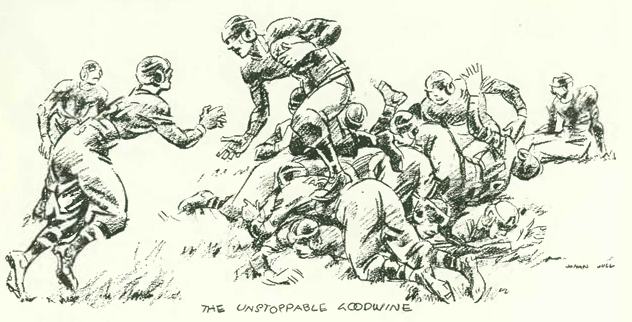
Johan Bull provided lively illustrations for John Tunis’s columns.

Sportswriter John Tunis cranked out lengthy accounts of football games, including the Princeton-Yale contest covered in the Nov. 20, 1926 issue.

The same issue also included an article by Herbert Reed, who wrote about Notre Dame’s victory over Army at Yankee Stadium and proclaimed the Fighting Irish to be the greatest team in the country.

The New Yorker caught the Notre Dame bug the previous season. When attendance dropped at Yankee Stadium due to an ailing Babe Ruth and his team’s losing record, college football took center stage at the stadium that fall, with the fiercely competitive Notre Dame–Army game the marquee match-up (the rivals would continue their annual meeting at Yankee Stadium until 1947).

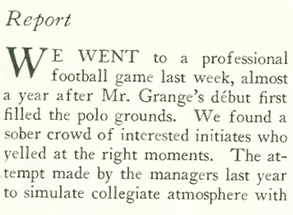
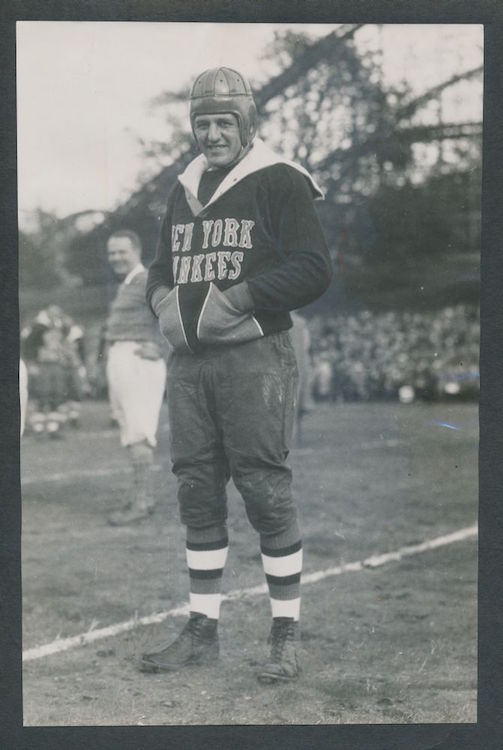
The “other” game–professional football–was still in its infancy, and the editors of “The Talk of Town” made it clear that the college atmosphere was more to their liking. It is interesting that even today when fans compare college to pro football, the same observations are made:

Screen Shot 2016-04-22 at 9.53.30 AM

Screen Shot 2016-04-22 at 9.53.39 AM

226e0194353a39b57345ede7deaf7634
STAR ATTRACTION…After playing his first professional season with the Chicago Bears, in 1926 Red Grange joined the short-lived New York Yankees professional football team. (ourgame.mlb)

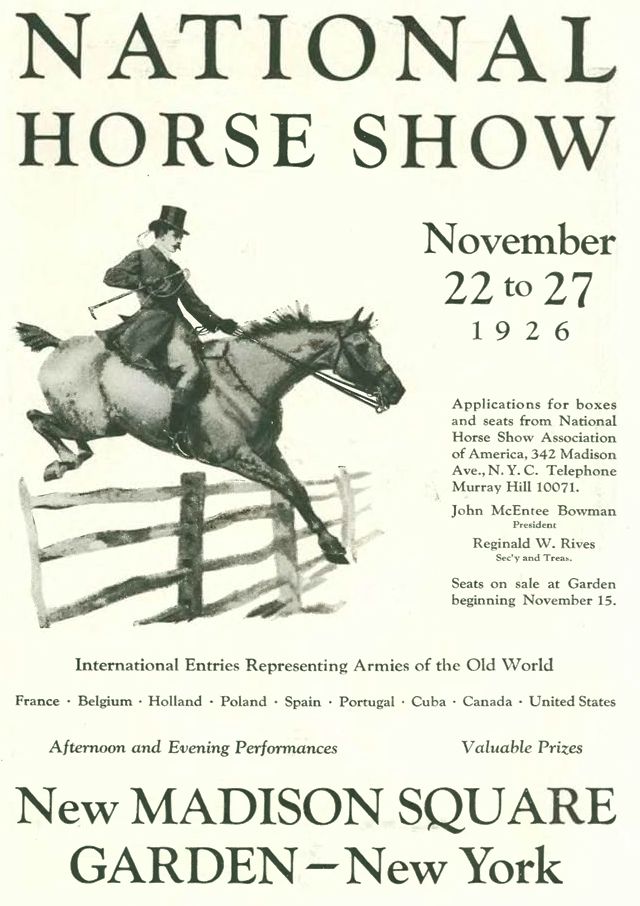
As for other sports, The New Yorker also offered extensive coverage of tennis, golf, and polo in its issues. And there would also be rowing, boat and auto racing, and steeplechase events such as National Horse Show at Madison Square Garden. An advertisement promoting that event appeared on the inside back cover:

Screen Shot 2016-04-22 at 10.06.11 AM

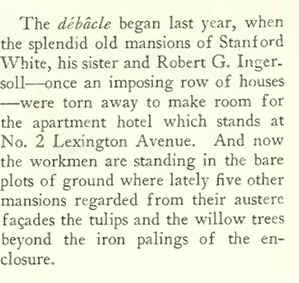
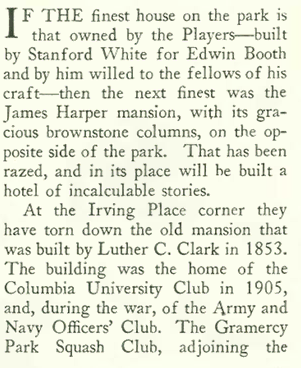
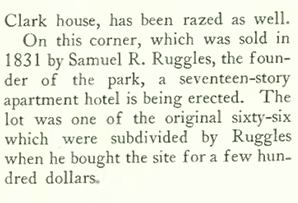
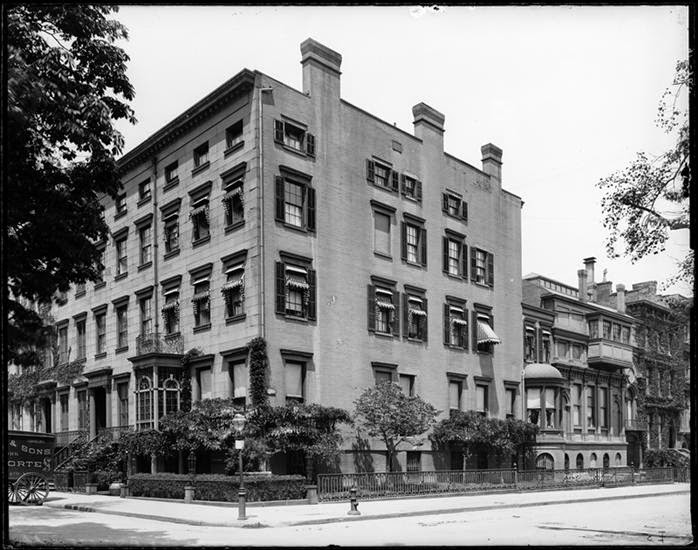
The editors of “Talk of the Town” continued their sad refrain on the city’s changing landscape, the wrecking ball this visiting Gramercy Park:

Screen Shot 2016-04-22 at 9.55.34 AM

Screen Shot 2016-04-22 at 9.55.42 AM

Screen Shot 2016-04-22 at 9.55.48 AM

Screen Shot 2016-04-22 at 9.55.53 AM

white house
The Stanford White house referred to in “The Talk of the Town.” ( Museum of the City of New York)
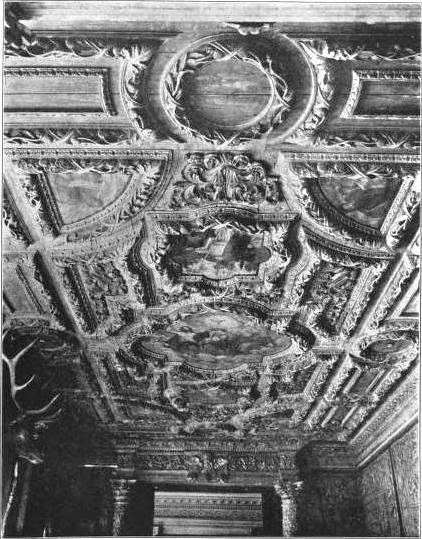
white dining room ceiling
The Dining Room ceiling in the Stanford White House came from a 16th century chapel in Florence. (From the Illustrated Catalogue of the Artistic Furnishings and Interior Decorations of the Residence at No. 121 East Twenty-first Street, New York City, April 1907 (copyright expired)
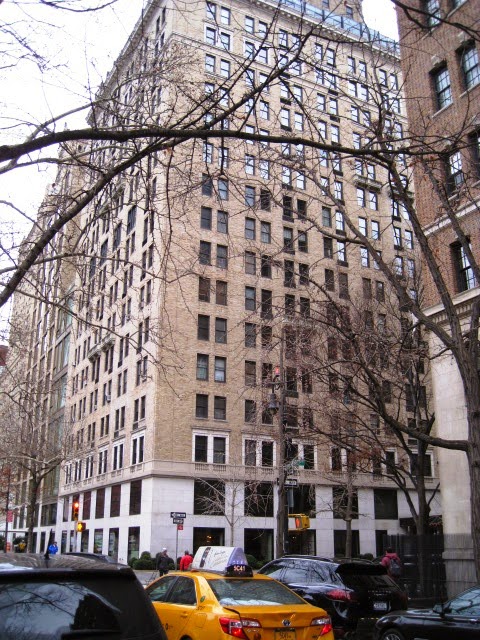
gramercy park hotel
Gramercy Park Hotel on the site today. (A Daytonian in Manhattan)

And to close, this terrific advertisment for the Greenwich Village Inn, illustrated by Hans Flato:

Screen Shot 2016-04-22 at 9.59.10 AM

Next Time: Holiday Shopping…

8912823cfdc5626785b13a431ae590de

Time for a Facelift

It’s the dog days of summer, and the editors of The New Yorker are seeking various distractions to take their minds off of the broiling late season heat.

db2311e2a9fcb89fc253615846207b55
August 21, 1926 cover by H.O. Hofman.

In the Aug. 21, 1926 issue (bearing an appropriate cover image by H.O. Hofman of bathers taking a refreshing dip), “The Talk of the Town” suggested that it was a good time for even the natives to take a boat tour of their beloved island:

Screen Shot 2016-02-09 at 12.35.36 PM

Screen Shot 2016-02-09 at 12.35.46 PM

enhanced-buzz-27796-1367872781-0
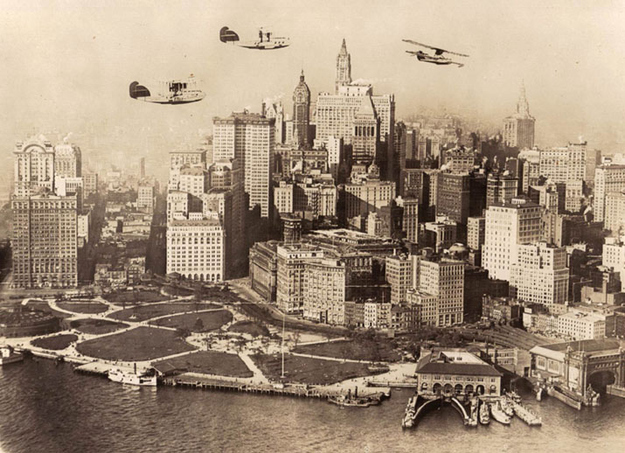
Aerial view of Battery Park Wharf in the early 1920s (Buzzfeed)

In the following Aug. 28 issue, the “Talk” editors ducked out of the sun to visit the American Museum of Natural History.

b3166409b2ab1ea1369e857d009d9b30
Aug. 28, 1926 cover by H.O. Hofman.

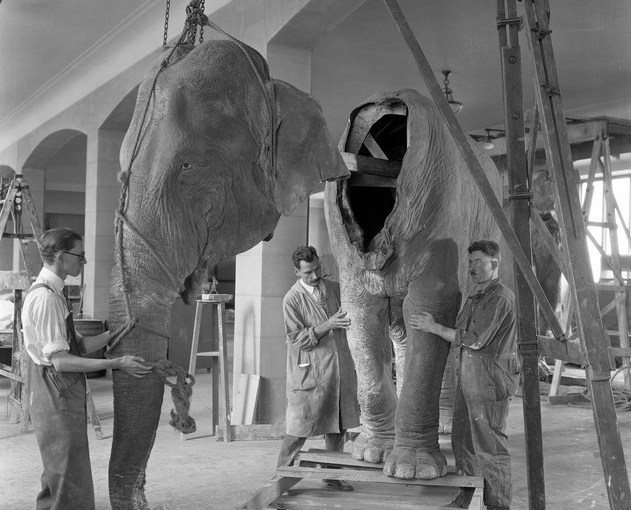
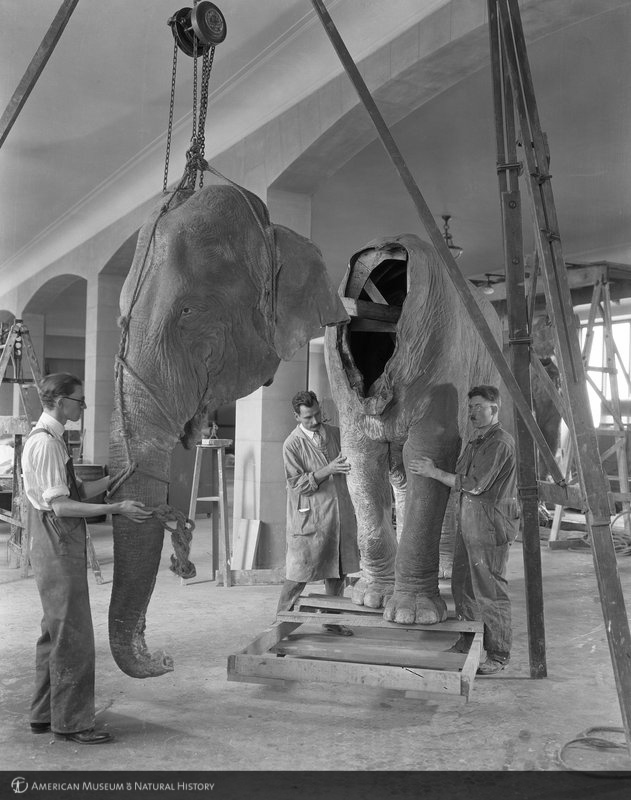
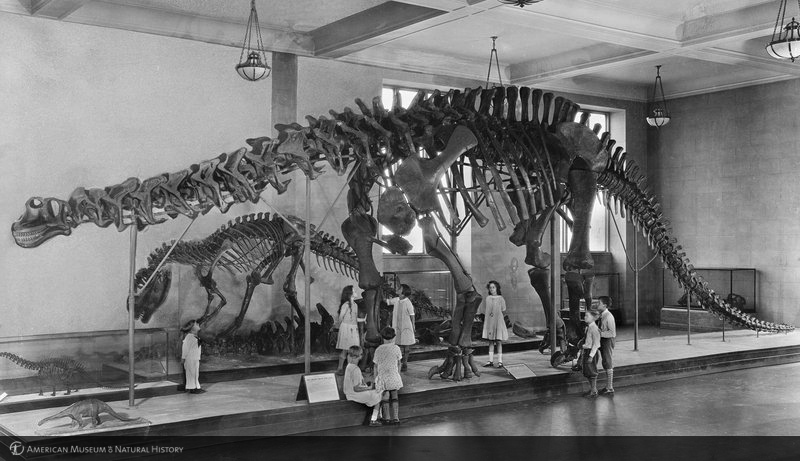
There they found curators busy reorganizing displays of dinosaurs and various stuffed beasts of the wild:

Screen Shot 2016-02-09 at 12.14.22 PM

Screen Shot 2016-02-09 at 12.14.28 PM

311585.tif
AMNH staff joining head to body of female elephant in Indian Elephant Group, 1926. (AMNH Digital Special Collections)
2007 METRO Project | ImageDigitizationSpecifications v1.0 | Epson Perfection V750 Pro
The end result of the 1926 reorganization of displays at the AMNH—children viewing Brontosaurus exhibit in 1927. (AMNH Digital Special Collections)

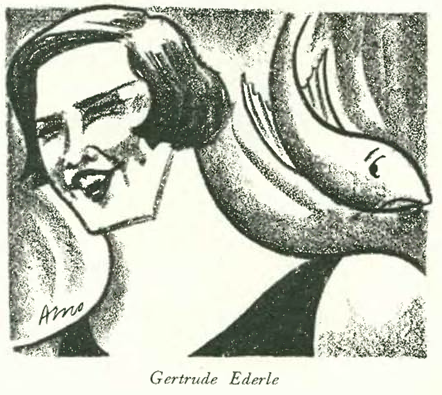
The magazine also profiled New York City native Gertrude Ederle, who became the first woman to swim across the English Channel in August of 1926:

Screen Shot 2016-02-09 at 12.16.16 PM
Gertrude Ederle, as rendered by Peter Arno for the “Profile.”

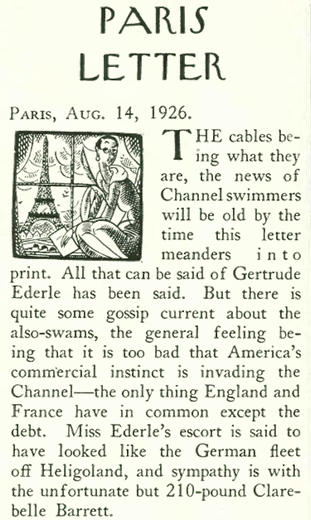
Even Janet Flanner, the magazine’s Paris correspondent, commented on the event, noting Europe’s jealous reaction to an American’s seizing of the record:

Screen Shot 2016-02-09 at 12.28.51 PM

Ederle would return home to a ticker tape parade along the Canyon of Heroes in the Financial District, and would also be feted by 5,000 people who turned out on West 65th Street for a block party in her honor.

getrudeedlerlecrown
WHAT FOLKS DID BEFORE TELEVISION…Block party celebrates Gertrude Ederle as “Queen of the Waves.” (Ephemeral New York)

According to the excellent blog Ephemeral New York, Ederle received offers from Hollywood and Broadway and was deluged by marriage proposals. But she returned to a quiet life, moving to Queens and working as a swimming instructor for deaf children–Ederle’s hearing was seriously damaged in the water of the Channel, but otherwise swimming must have been good for her health. She died at age 98 in 2003.

Keeping with the summertime theme, the magazine covered the Gold Cup Regatta, complete with illustrations by Johan Bull:

Screen Shot 2016-02-09 at 12.19.14 PM

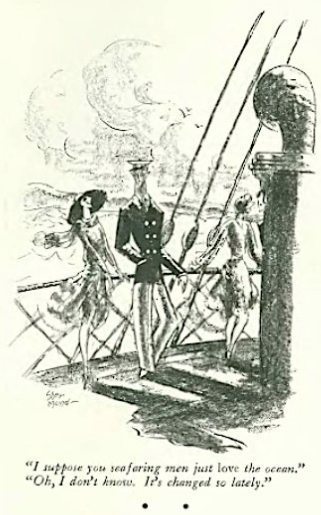
An early Barbara Shermund cartoon, always a delight…

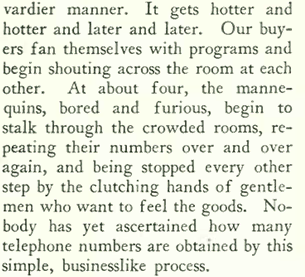
Lois Long took her “On and Off the Avenue” column to Paris, where she cast a jaded eye at the behavior of American buyers of French fashion:

Screen Shot 2016-02-09 at 12.26.32 PM

Screen Shot 2016-02-09 at 12.26.50 PM

Screen Shot 2016-02-09 at 12.27.00 PM

chanel-LBD
Coco Chanel’s “Little Black Dress” debuted in 1926. (homeecologist.com)

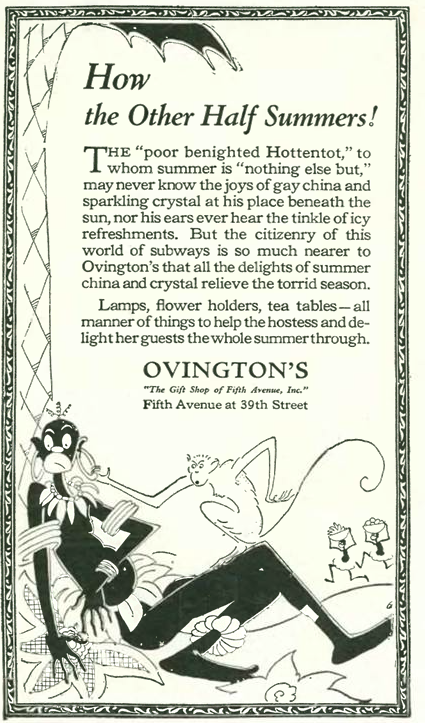
And finally, from the advertising department, this strange ad from Ovington’s, which seemed to be more concerned with promoting racial stereotypes than in selling dinnerware:

Screen Shot 2016-02-09 at 12.27.16 PM

Next Time: Come Fly With Me…

60050ce935d82b28520c52109cd715ce


A Castle in Air

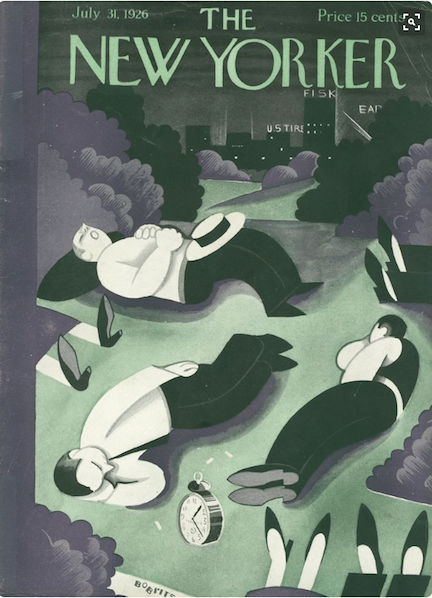
Withering under a July heat wave, The New Yorker editors turned their thoughts to the cooling breezes that could be found blowing across the penthouse garden of real estate developer Robert M. Catts.

Screen Shot 2016-01-26 at 9.24.04 AM
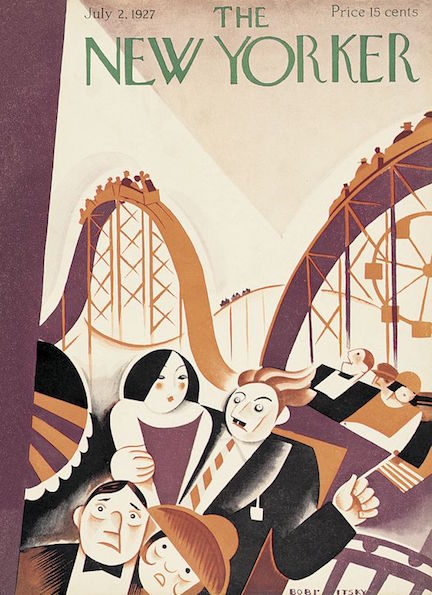
The July 31, 1926 cover by Victor Bobritsky offered its own commentary on the heat wave that gripped the city.
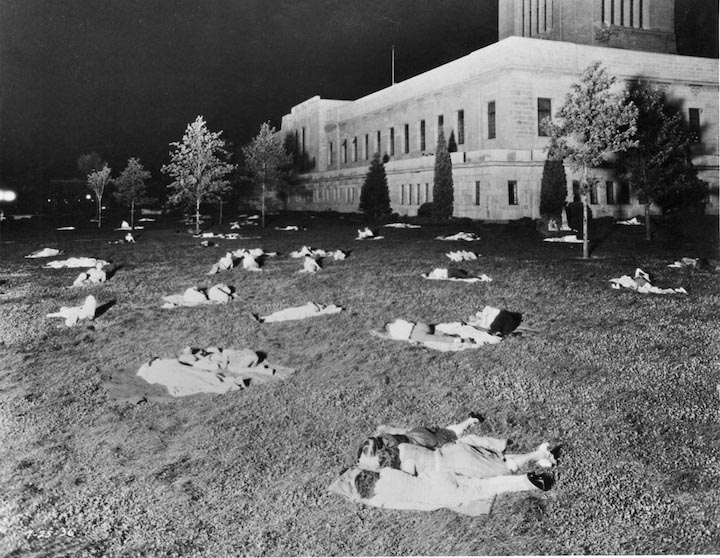
The State Capitol Building, Lincoln, With people in street clothes asleep on the lawn during hot days of the 1930's, Picture July 25, 1936
In case you were wondering, city folk (especially apartment dwellers) actually did sleep on the ground in the days before air conditioning. This photo was taken on July 25, 1936, on the lawn of the Nebraska State Capitol Building in Lincoln. (Nebraska State Historical Society).

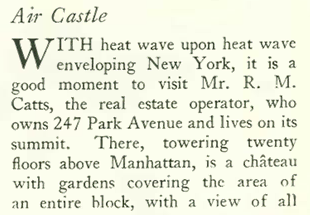
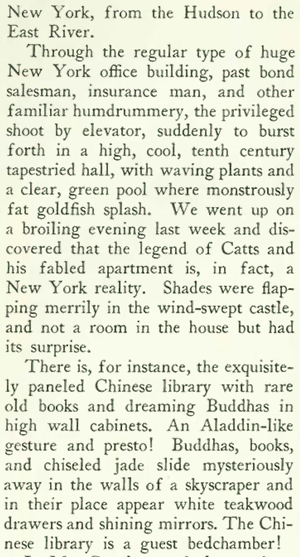
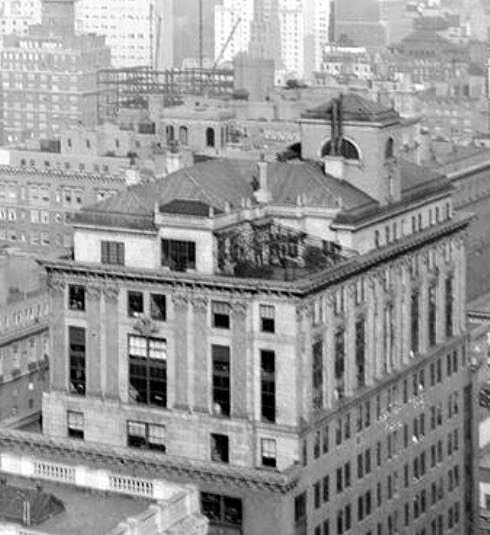
Catts erected the 20-story Park-Lexington office building at 247 Park Avenue in 1922, topping the building with his own penthouse apartment. Located near Grand Central Station, the building was innovative in the way it was built directly over underground railroad tracks leading into the station. The editors of The New Yorker, however, were more impressed by what was on top:

Screen Shot 2016-01-25 at 5.18.08 PM

Screen Shot 2016-01-25 at 5.18.32 PM

CattsNYC50
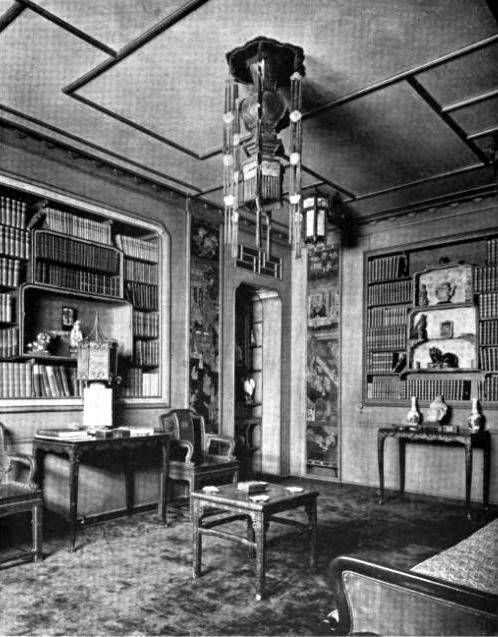
The “Chinese Library” in the apartment of Robert M. Catts atop the Park-Lexington Building. (halfpuddinghalfsauce.blogspot.com)
CattsNYC3
Penthouse apartment of Robert M. Catts atop the Park-Lexington Building. (halfpuddinghalfsauce.blogspot.com)

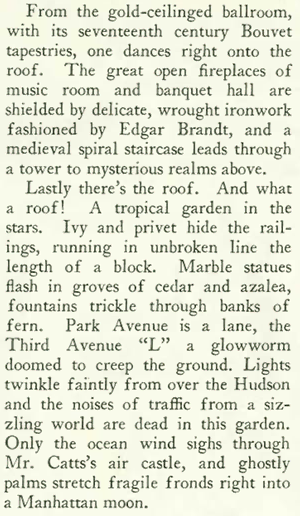
It was the rooftop garden, however, that sent the editors into a swoon:

Screen Shot 2016-01-25 at 5.19.24 PM

Before World War II the apartment would have other notable tenants who would succeed Catts, including the violinist Jascha Heifitz. The apartment, and the building beneath it, were demolished in 1963 along with the adjoining Grand Central Palace building, which was replaced in 1967 with 245 Park Avenue:

1024px-245parkNYC
245 Park Avenue (Wikipedia)

In other news, Arthur Robinson wrote a somewhat sympathetic profile of Babe Ruth, observing that Ruth’s “thousand and one failings are more than offset by his sheer likableness.”

Screen Shot 2016-01-25 at 5.20.19 PM
Illustration for the “Profile” by Johan Bull.

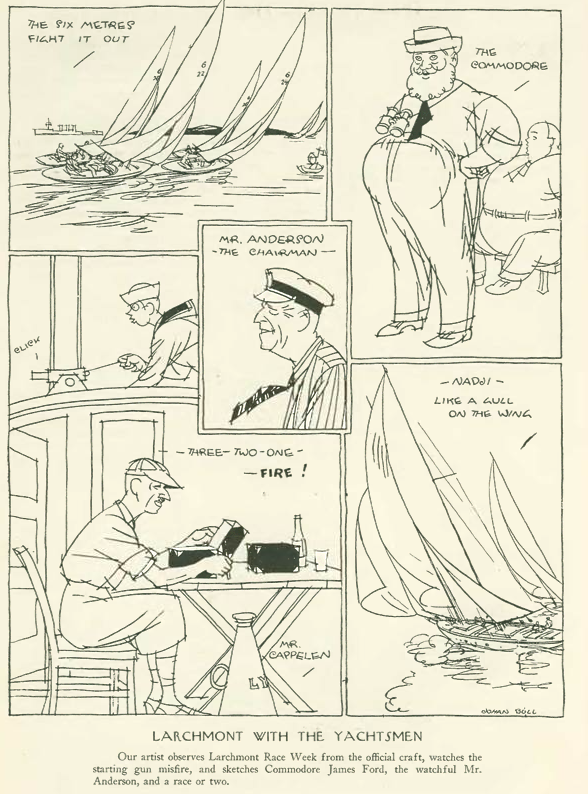
Curiously, the Yankees were having a better year in 1926, but there was scant mention of baseball in the pages of The New Yorker, the magazine preferring to cover classier sports such as golf, polo, tennis and horse racing. Another sport of interest was yacht racing, with Eric Hatch covering the races at Larchmont augmented by Johan Bull’s illustrations:

Screen Shot 2016-01-25 at 5.29.14 PM

The magazine continued to have fun with the androgynous fashion trends of the Roaring Twenties. This appears to be an early Barbara Shermund cartoon:

Screen Shot 2016-01-25 at 5.20.01 PM

Next Time: The Lights of Broadway…

Screen Shot 2016-01-25 at 5.31.10 PM