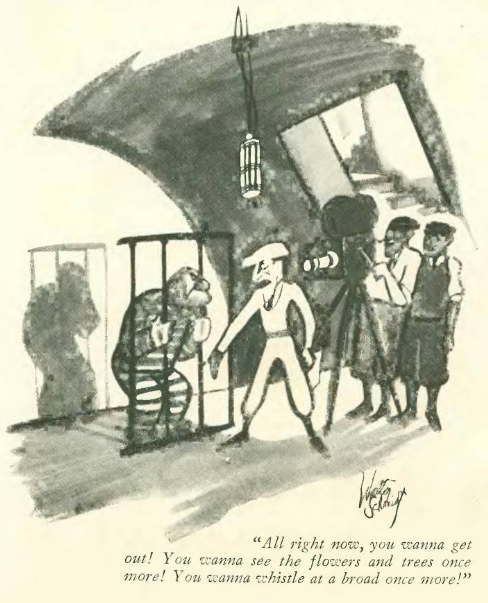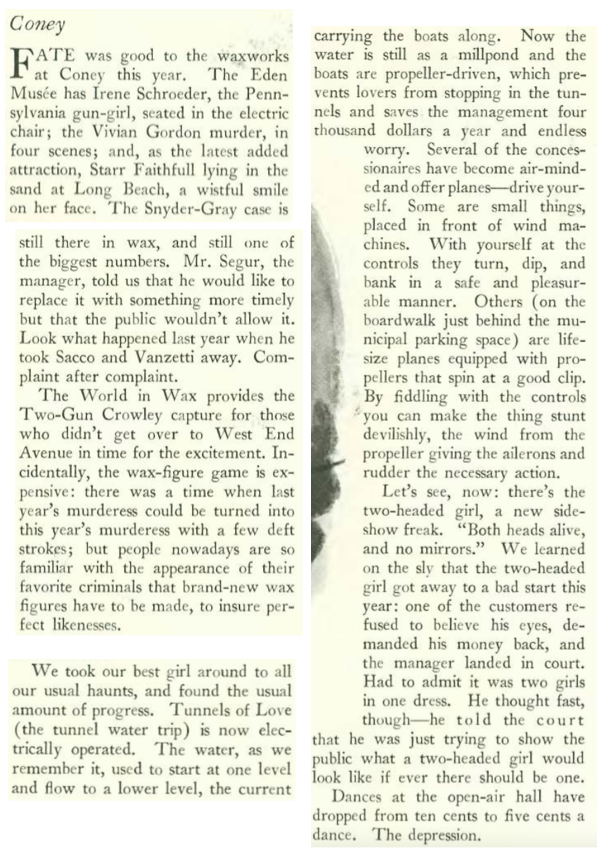
Asphalt Jungle

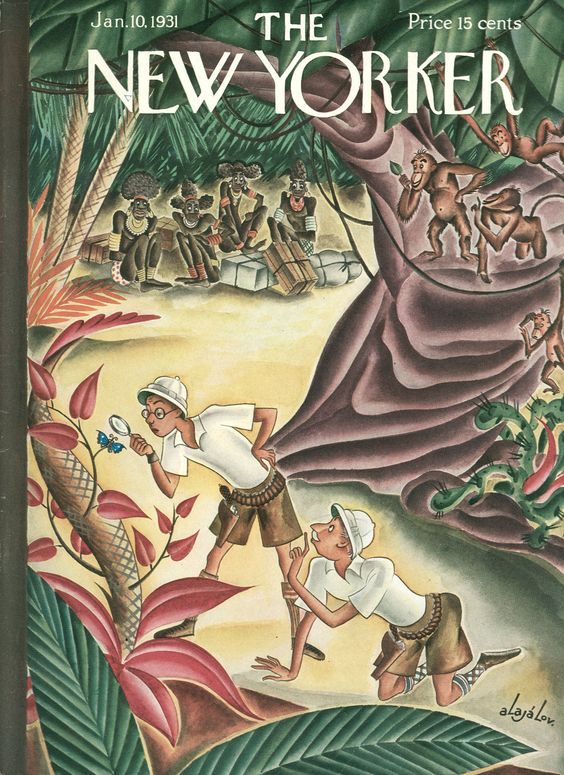
The zoos of yesteryear were joyless places, that is, if you were one of the animals. Children squealed with fear and delight at the sight of a caged lion, and many an adult had fun tossing peanuts at elephants or teasing enraged gorillas locked behind bars; but if you were a zoo animal in 1931, life was endless hours of boredom, sprinkled with moments of terror and humiliation.
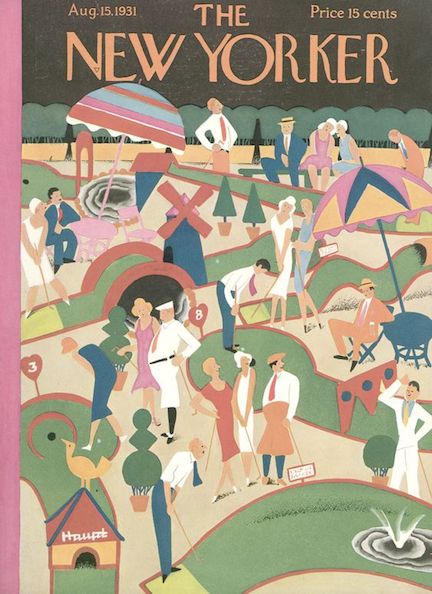
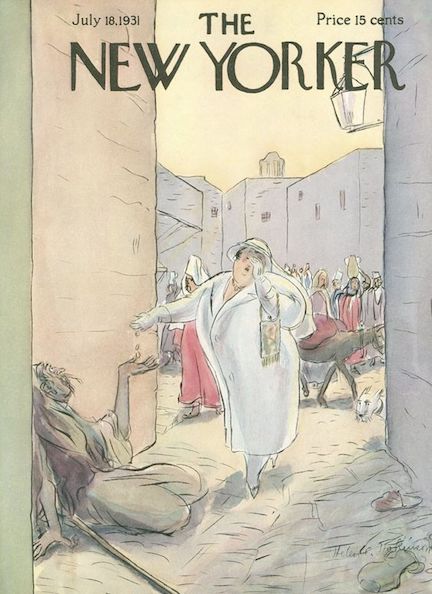
Aug. 15, 1931 cover by Theodore Haupt.

It is instructive to look back 89 years and see how far we’ve come, and how far we still have to go, to see our fellow creatures as more than curiosities and amusements to be captured and gawked at, and to see their environments as something to be preserved, not only for their survival but for ours as well.
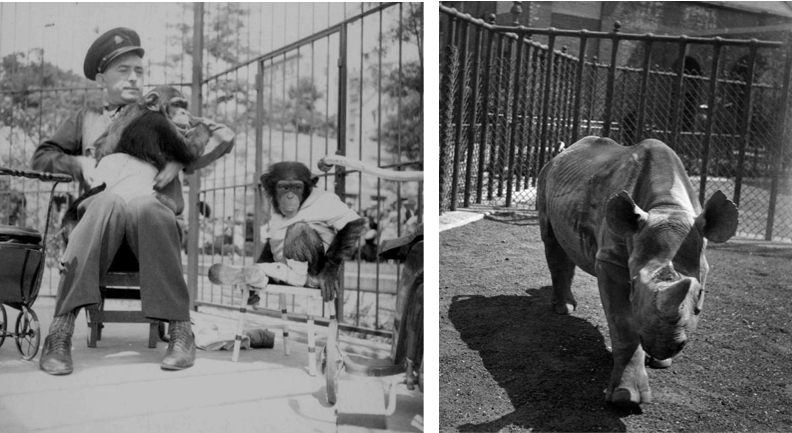
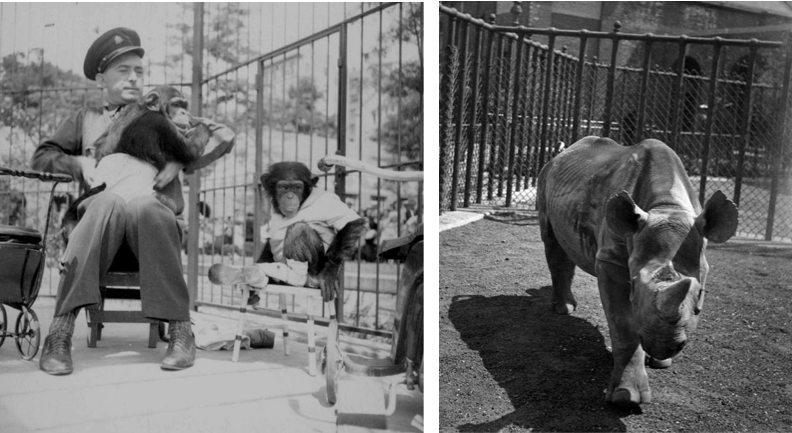
LIFE BEHIND BARS…Left, a zookeeper with chimps at the Central Park Zoo, 1936. Right, a rhino paces in a barred enclosure, 1937. (nycgovparks.org)

E.B. White paid a visit to the Central Park Zoo, and found it wanting in a number of respects:

Many zoos back then were more collections of curiosities than places where you could learn about various habitats. So when David Sarnoff, president of RCA, bagged a live opossum in the South, the critter was given a new home in an antelope enclosure, per this item in the Dec. 20, 1931 New York Times:

The Central Park Zoo was established in the 1860s as a “menagerie” behind the Arsenal, and by the turn of the century attracted millions of visitors to its displays of exotic animals.

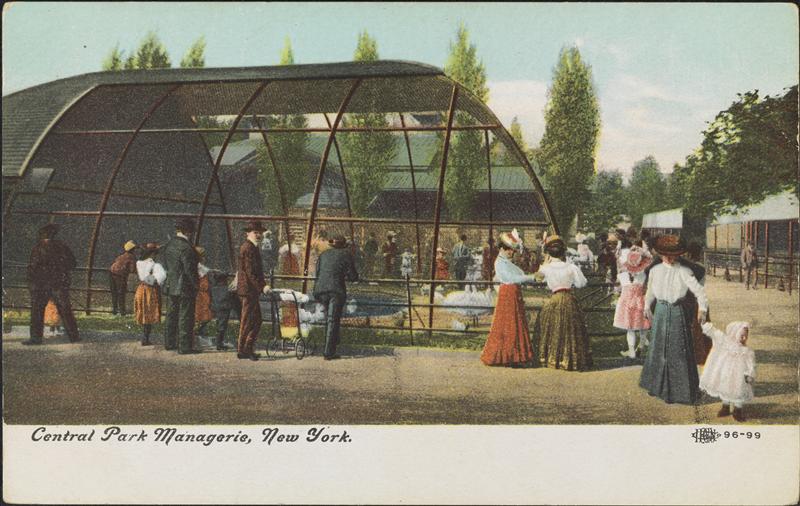
GETTING AWAY FROM IT ALL…Postcard image of the Menagerie in Central Park, New York, 1905. (Museum of the City of New York—MCNY)
ANIMAL ATTRACTION…Postcard image of folks enjoying caged birds at the Menagerie, 1905. (MCNY)
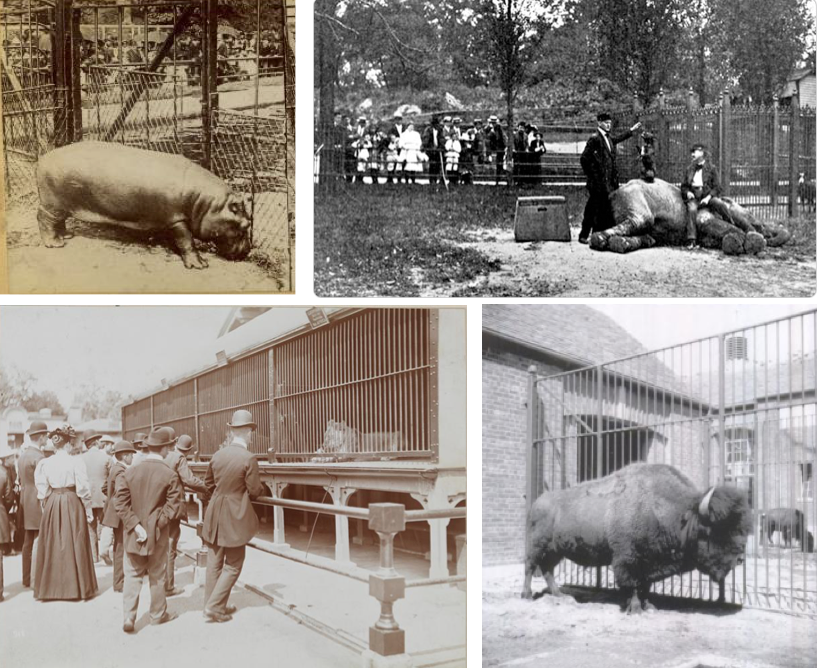
O GIVE ME A HOME…In the early days of zoos, animals were presented in cages and fenced enclosures with no hint as to what their natural habitat might look like. Clockwise, from top left, “Fatima” the hippo, image from an 1896 stereograph card; a 1911 photo of a trainer and a dog perched on top of a hapless elephant; a bull bison around the turn of the century; a group of people observe animals in cages at the Central Park Menagerie, 1895. (Library of Congress/nycgovparks.org/MCNY)

 *  *  *

He’s Your Future

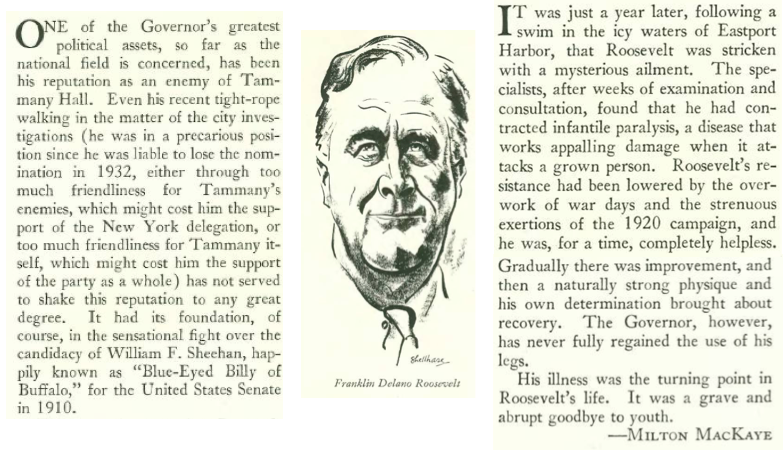
The New Yorker featured two-part profile of the governor of New York, Franklin D. Roosevelt, who unbeknownst to writer Milton MacKaye would soon become the next president of the United States. Two excerpts (not continuous)…
  *  *  *

From Our Advertisers

Ah yes, the first time I visited the Empire State Building’s observation deck (in the 1970s) a heavy smog enveloped the city (the air is much cleaner today). I like how the promoters spin disappointment into an opportunity — “The mysterious beauty of the city has a million constantly changing aspects”…

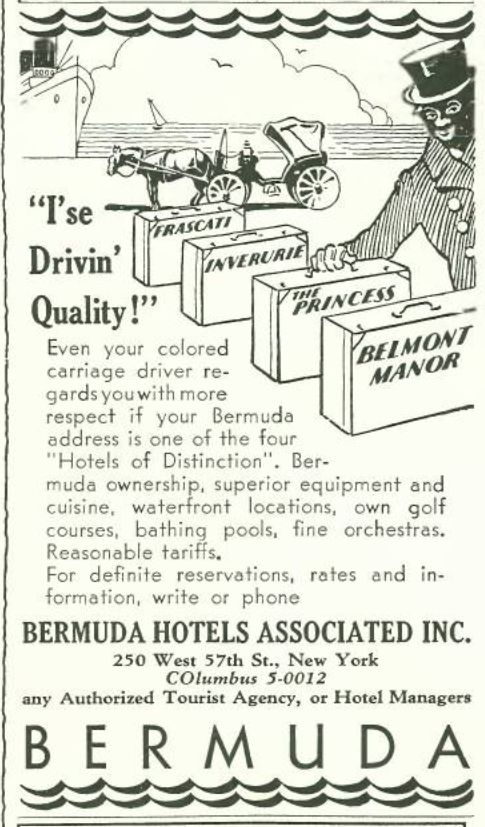
…if you were looking for bluer skies, Bermuda could have been an option if you had the means…

…or you could have stayed closer to home at a Long Island beach resort, as Helen Hokinson illustrated, and as we segue into our cartoons…

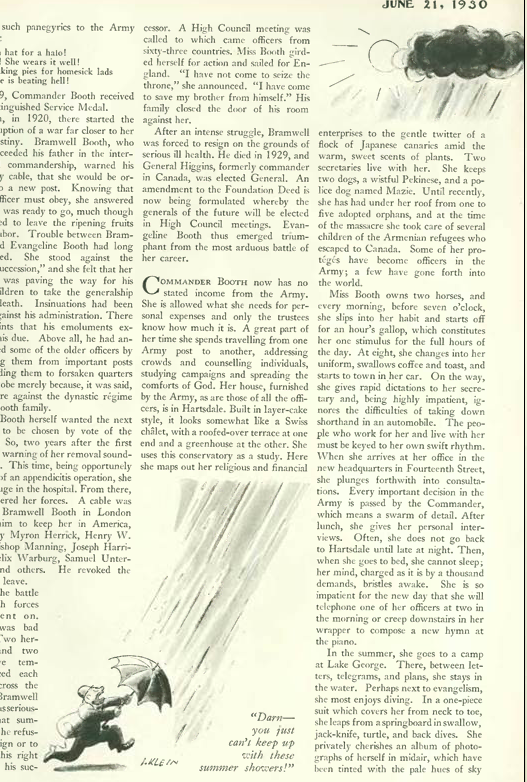
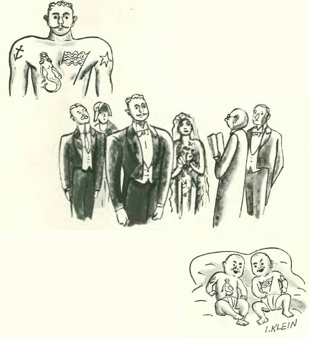
Isadore Klein gave us a very unscientific, albeit humorous view of genetics…
Richard Decker redefined the meaning of “volunteers”…
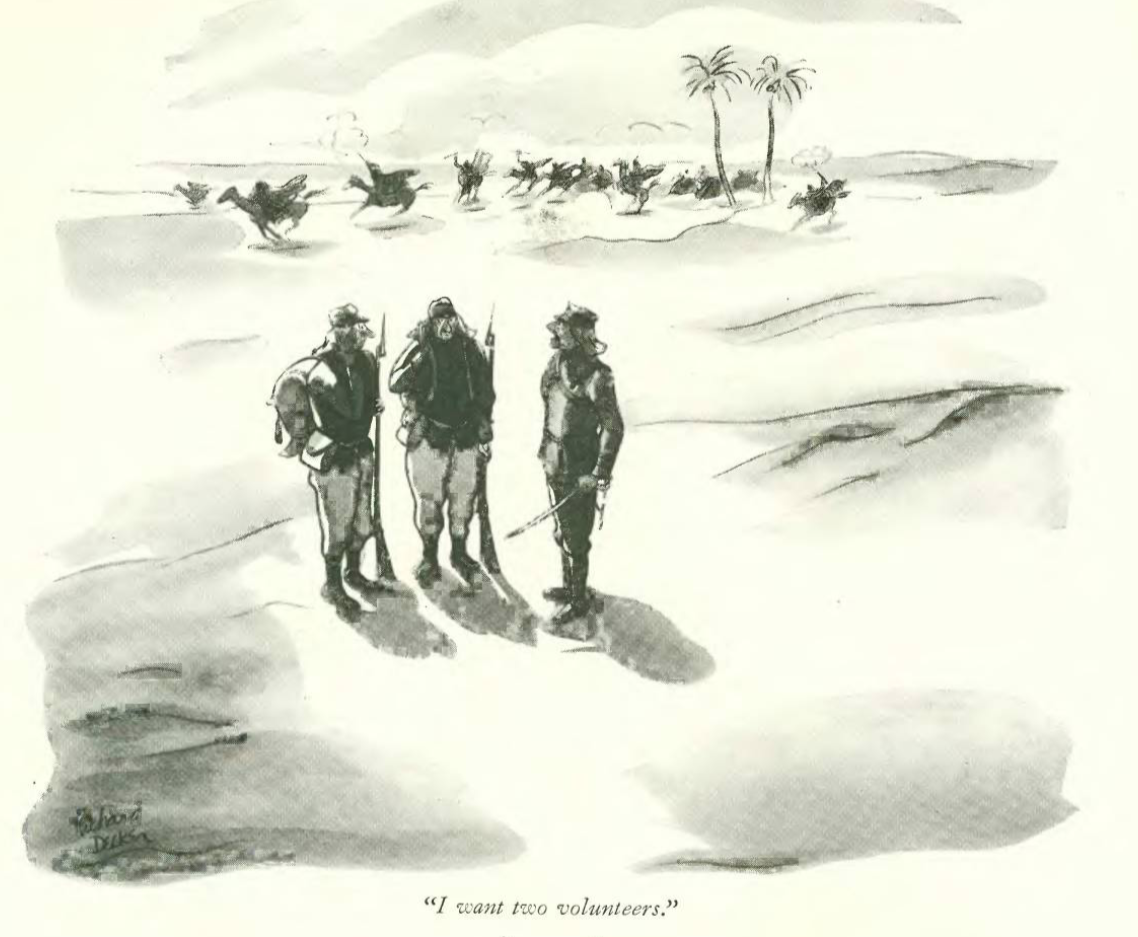
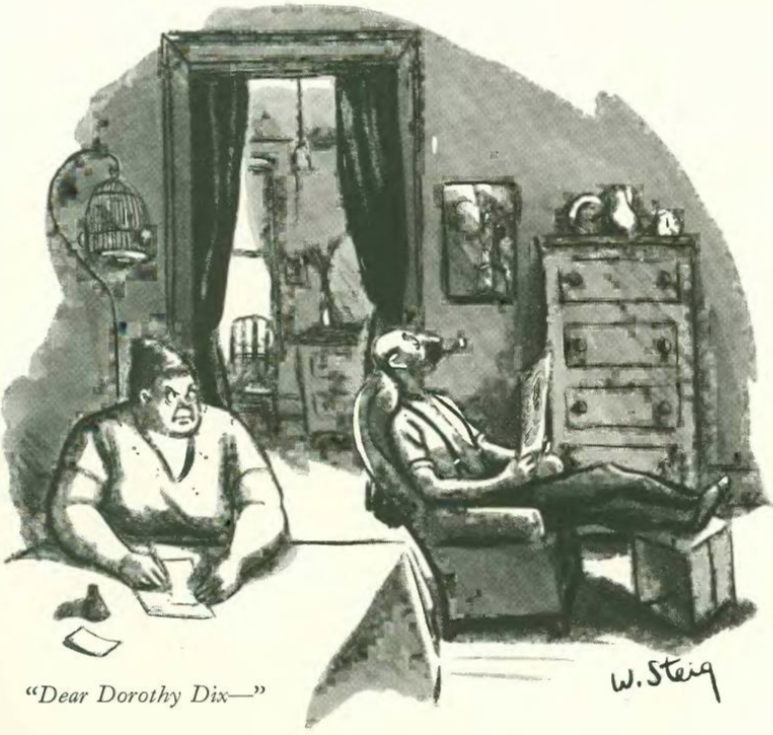
…and William Steig summoned the advice of Dorothy Dix, a forerunner of “Dear Abby” who was the most widely read female journalist of her time…
We move on to the Aug. 22, 1931 issue…
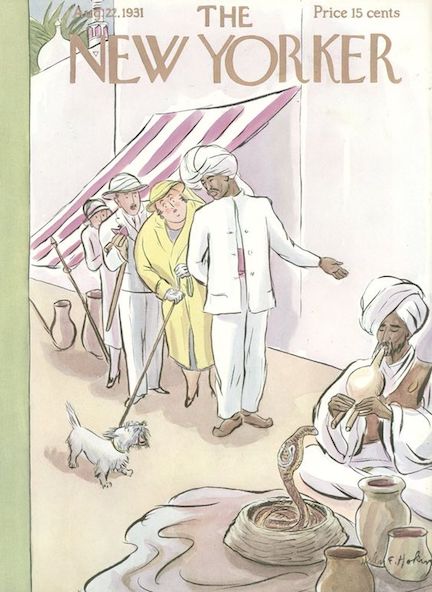
Aug. 22, 1931 cover by Helen Hokinson.

…in which James Thurber wrote about his experience with early television in “The Talk of the Town”…
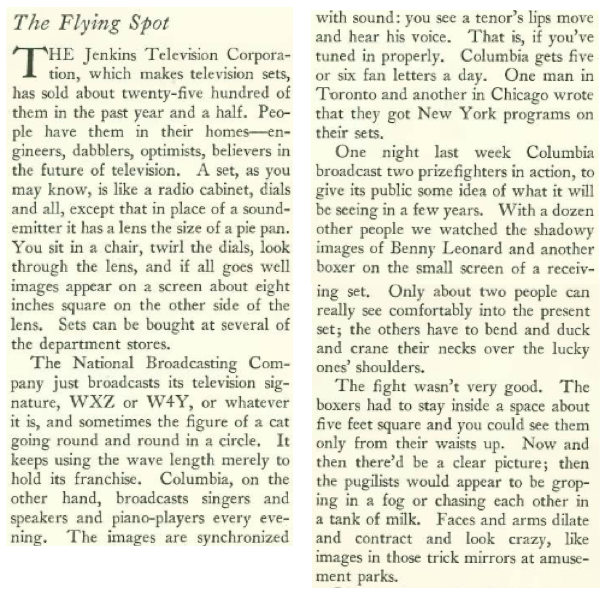
NO CABLE BILL, YET…Charles Francis Jenkins demonstrates his “Radiovisor” console television in 1929. At right, the inner workings featured a rotating disc punctured with tiny holes, each projecting a line across the glass screen to compose an image. As Thurber noted, the pictures commonly were too dark for viewers to see anything more than silhouettes. Not to mention Thurber’s eyesight was also terrible. (earlytelevision.org)

 *  *  *

The Other Moving Pictures

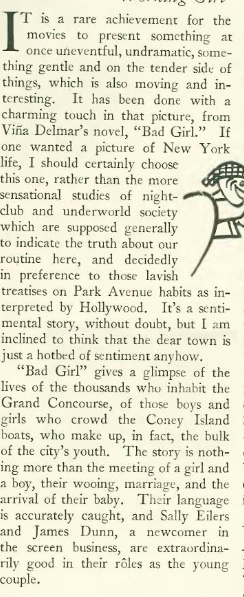
The movies still had nothing to fear from television in 1931, and Hollywood continued to draw large audiences to “Pre-Code” films that featured doses of sex and violence. Novelist Viña Delmar gained famed in 1928 with her suggestively titled book Bad Girl, so when it was adapted into a film, audiences came running—even if the screen adaptation proved to be a bit tamer than the novel that inspired it. Critic John Mosher observed:
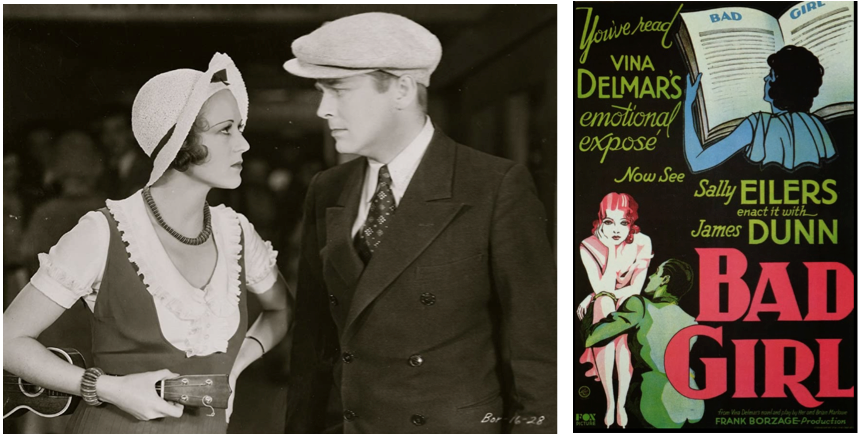
I’M JUST A LITTLE BAD…Sally Eilers played the title character in Bad Girl with co-star James Dunn. The film won two Oscars in 1932 for Best Director (Frank Borzage) and Best Writing, Adaptation (Edwin J. Burke). (IMDB)

 *  *  *

Chic Chapeau

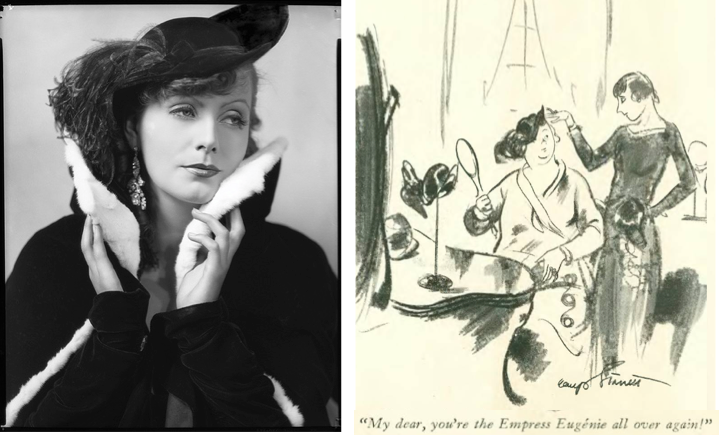
The Empress Eugénie hat was named for 19th century French empress Eugénie de Montijo, who was known as a fashion trendsetter. The hat was revived in 1930 after Greta Garbo was seen wearing a version of one in the popular film Romance. E.B. White was not exaggerating when he noted (in his “Notes and Comment”) that the jaunty hat was seen on “every other head” in the city.
 

LOOK WHAT YOU STARTED…Greta Garbo sported an Empress Eugénie hat in the 1930 film Romance, setting off a fashion craze that persisted through much of the decade. At right, Kemp Starrett referenced the trend in this Aug. 8, 1931 cartoon in The New Yorker. (Pinterest)

 *  *  *

From Our Advertisers

Speaking of trends, these “roughies” were all the rage among the young folks, in the dorms and on the beach…

…one trend I wasn’t aware still persisted in 1931 was a top hat and tails for an evening out among the smart set…
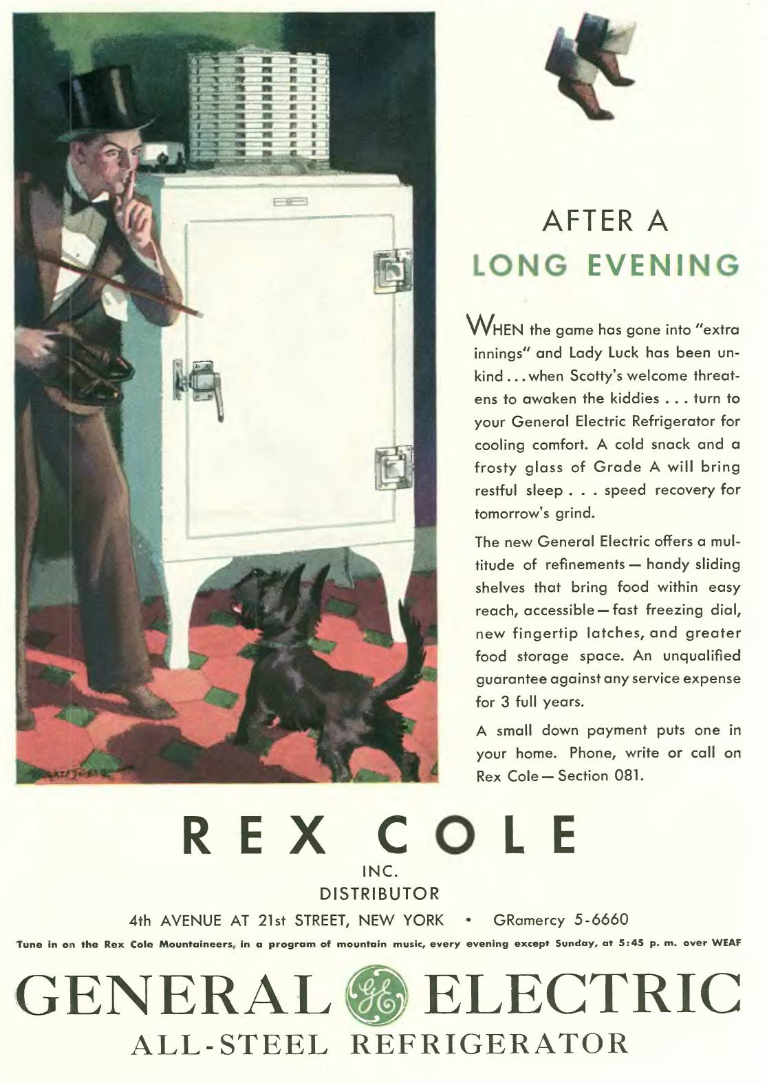
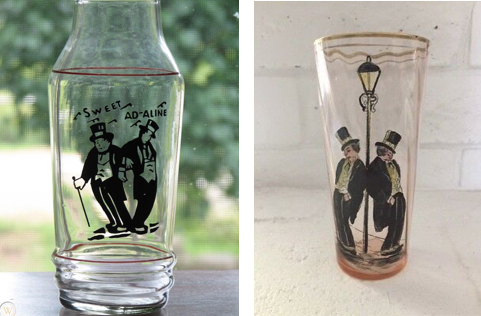
…according to this ad, if you were a “smart” and fashionable New Yorker, then you needed an “Inebriates” themed cocktail set…
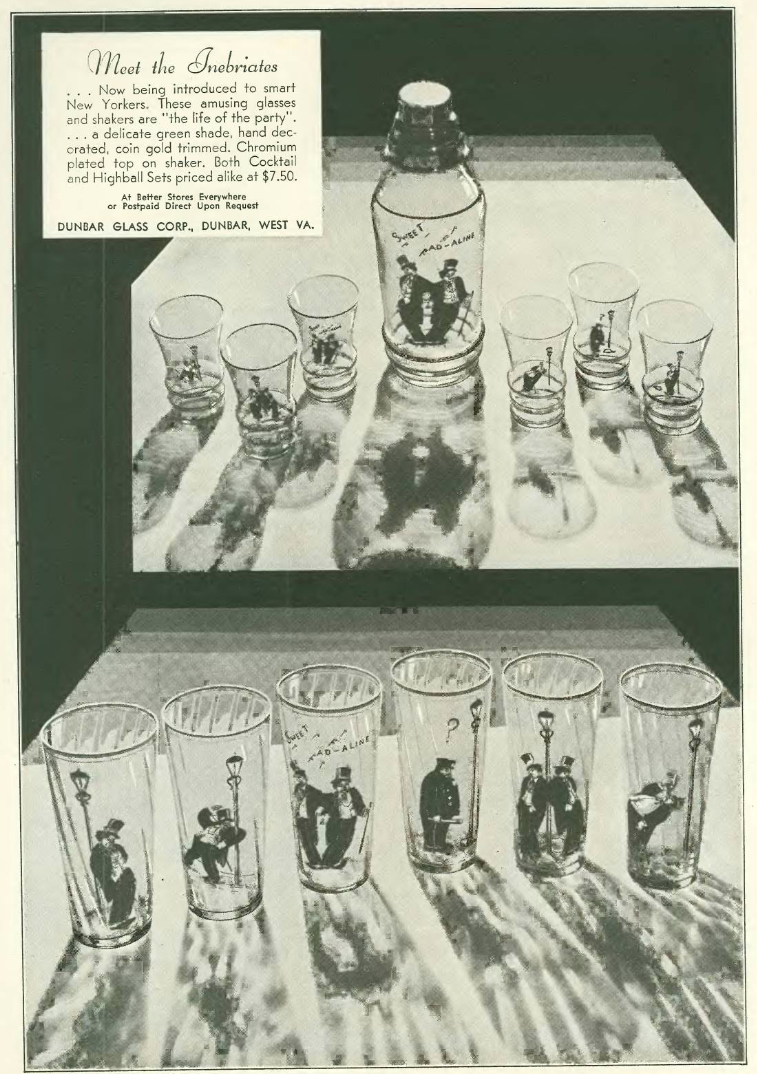
…examples of the glassware for sale on Worthpoint…
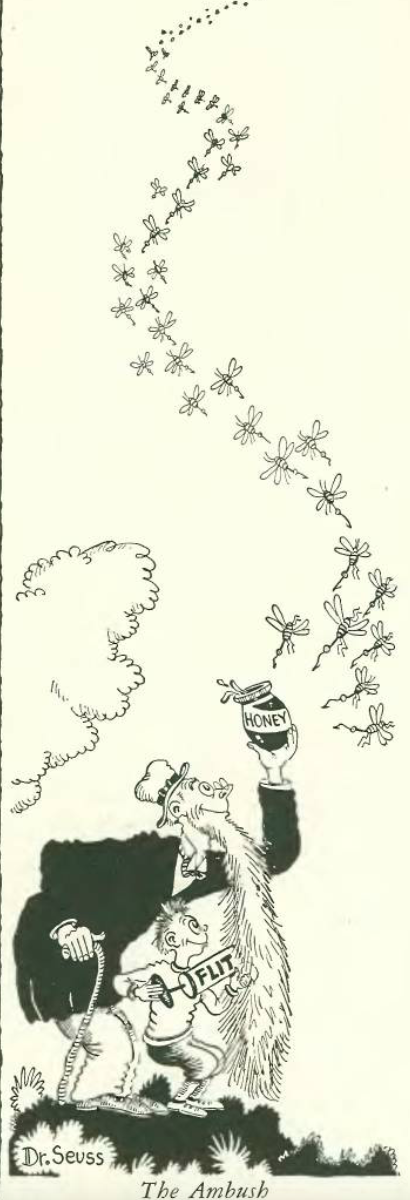
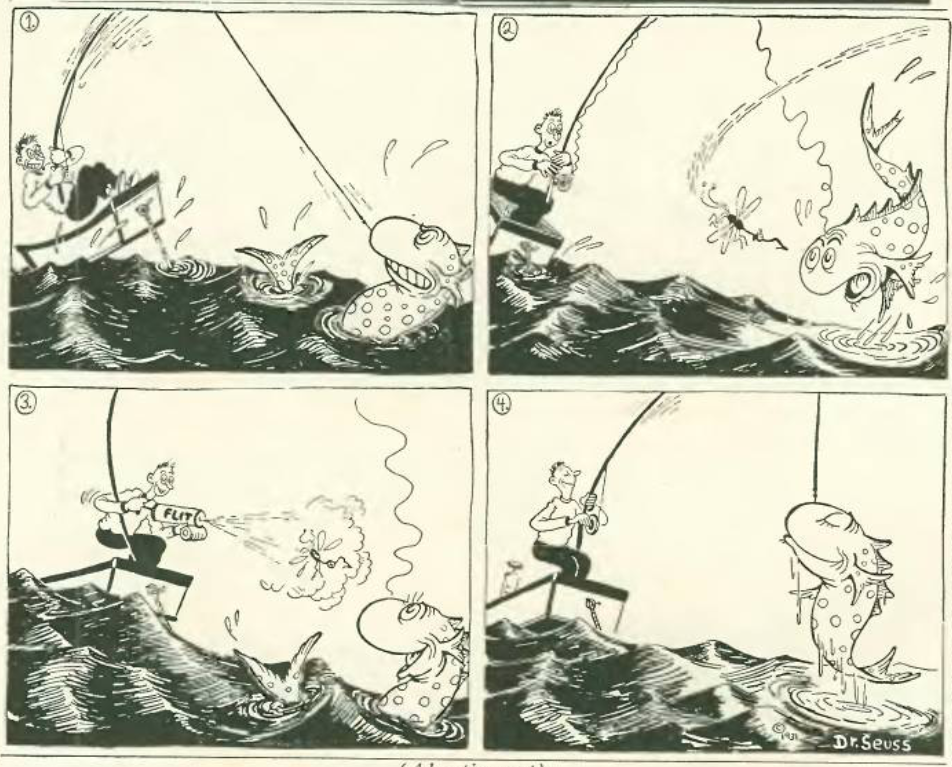
Dr. Seuss was still busy selling pesticide with this four-panel ad…
…on to the cartoons, we start with James Thurber

…and Rea Irvin continued to experiment with various motifs, this time an Egyptian-themed cartoon referencing the “wine bricks” sold by enterprising vineyards during Prohibition…

Peter Arno found a big surprise during a mansion tour…

…and we end with Otto Soglow

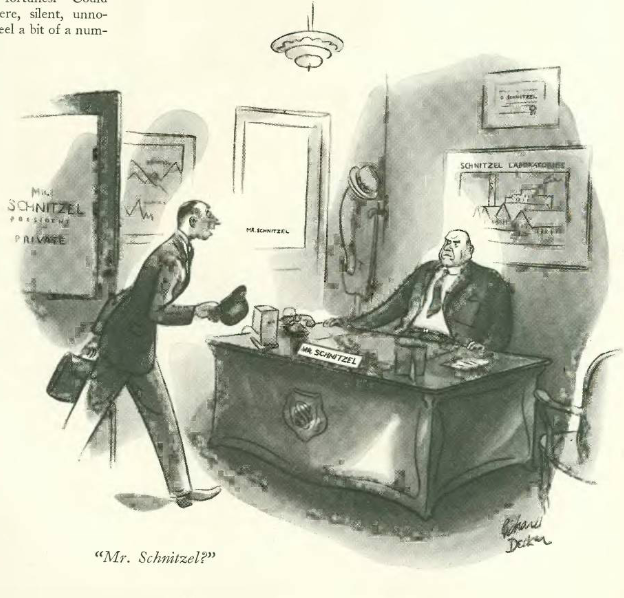
…and Richard Decker…both cartoons reminded me of Al Jaffee’s Snappy Answers to Stupid Questions

…I grew up reading Mad magazine, and always looked forward to Jaffee’s fold-ins…he just retired from Mad at the young age of 99, so we conclude with one of his Snappy Answers panels from Mad #98, Oct. 1965…

Next Time: Unnatural History…


An American Classic

Immigration over the centuries transformed New York City into a cosmopolitan metropolis, with many of those migrants drawn from America’s hinterlands. What they found in the city was not only economic opportunity, but also a place to grow artistically and intellectually.

Aug. 8, 1931 cover by Theodore Haupt.

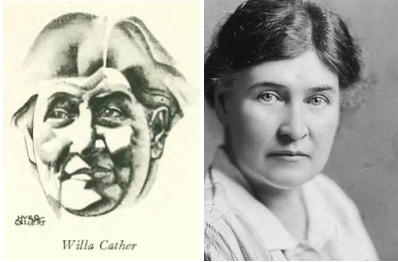
Such was the case of Willa Cather, who while living in New York City would draw on her Nebraska childhood to write a succession of novels about prairie life and its people (including My Antonia and O Pioneers!) that would culminate in a 1923 Pulitzer Prize.

Louise Bogan, in 1931 a new poetry editor for The New Yorker (and a poet herself), wrote a profile of Cather for the Aug. 8 issue. An excerpt:

TWO FACES…Hugo Gellert rendering of Willa Cather for the profile; undated photo at right gives you some idea of the look Cather aimed at the affected behavior of others. (The New York Times)
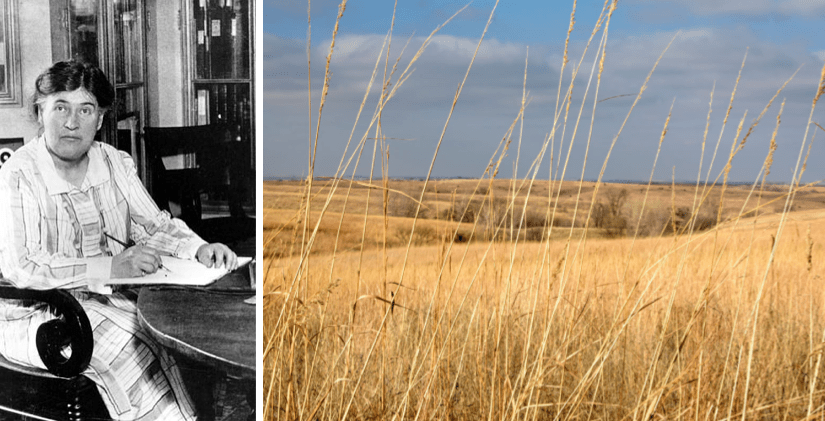
FORMATIVE YEARS…Clockwise, from top left, Willa Cather as a student at the University of Nebraska in the early 1890s; classmates at Nebraska included author and activist Dorothy Canfield Fisher and Alvin Johnson, later a co-founder of New York’s New School. Both Cather and Fisher took fencing lessons from John J. Pershing, who taught military science at Nebraska; Cather’s childhood home in Red Cloud, Neb., and the prairie that inspired much of her writing. (news.unl.edu/Wikipedia/new school.edu/literaryamerica.net)
CITY LIFE…Clockwise, from top: S. S. McClure, Willa Cather, Ida Tarbell, and Will Irvin visit in Washington Square Park, 1924; Cather in the meadow of High Mowing farm near Jaffrey, N.H., where she wrote part of My Antonia; on the cover of Time, Aug. 3, 1931; one of Cather’s New York residences at 82 Washington Place. (Indiana University/Southwick Collection, University of Nebraska/time.com/jschumacher.typepad.com)

Bogan concluded the profile with this note about Lèon Bakst, who was commissioned in 1923 to paint a portrait of Cather while she visiting Paris (image courtesy Omaha Public Library):

My dear late friend Susan Rosowski, who was a preeminent Cather scholar, wrote that Cather was “the first to give immigrants heroic stature in serious American literature.” In these times when immigration is so hotly debated, it is worth revisiting My Antonia and O Pioneers! to recall what once made America truly great.

 *  *  *

One Arm Restaurant

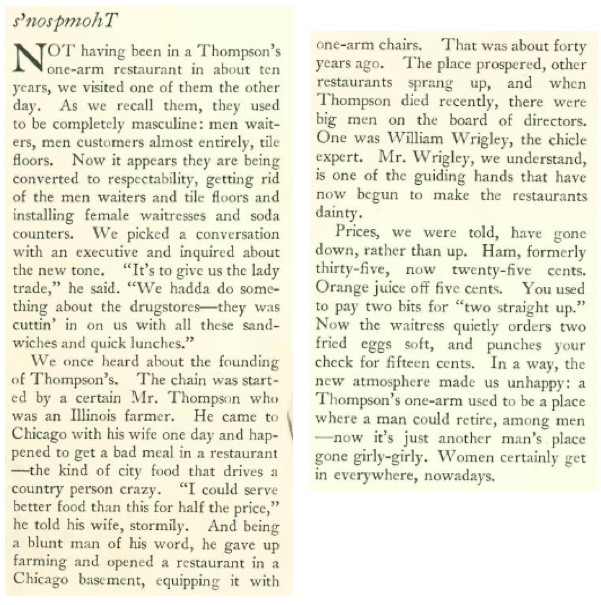
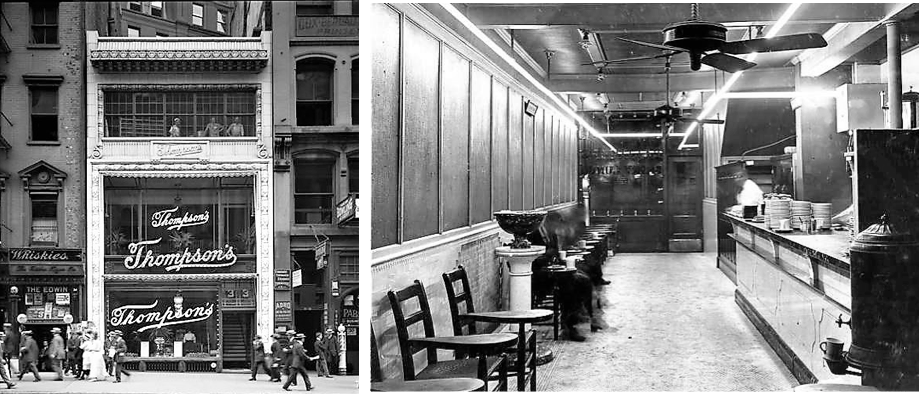
If you wanted to get lunch fast and cheap in 1931 you might have stopped at one of John Thompson’s New York restaurants. According to Tom Miller (daytoninmanhattan.blogspot.com), there were no waiters in Thompson’s restaurants. “Customers purchased foods like cold corned beef, cold boiled ham, smoked boiled tongue or hot frankfurters at a counter. They then took their trays to ‘one arm’ chairs lined up along the wall. There were no tables; instead customers ate at what was similar to turn-of-the-century school desks.” E.B. White stopped in for a visit:

YOU CAN’T MISS IT…John Thompson’s name is emblazoned no less than four times on the front of his restaurant at No. 33 Park Row. No-frills interior featured “one-arm” chairs and a self-service coffee urn. (Museum of the City of New York /daytoninmanhattan.blogspot.com)

 *  *  *

Cinematic Eyeful

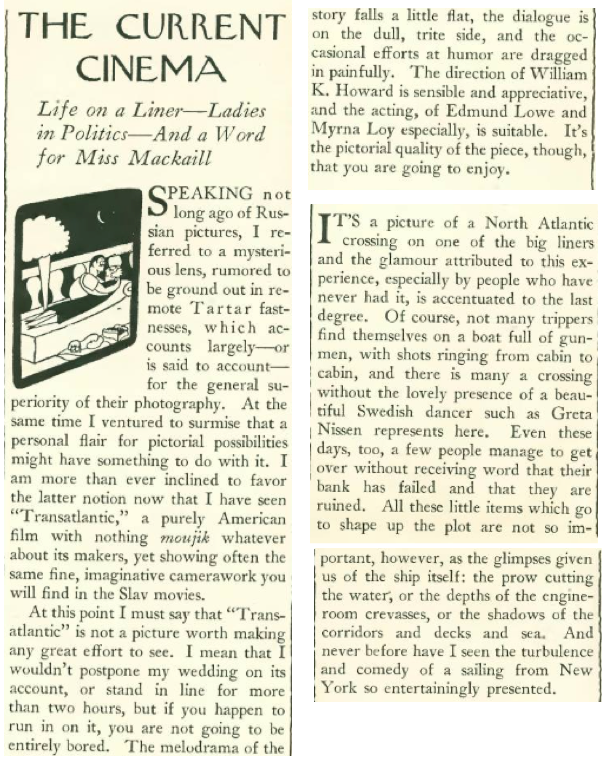
The Pre-Code comedy-drama Transatlantic was light on plot but heavy on deep-focus cinematography (by James Wong Howe) that wowed New Yorker critic John Mosher in 1931…and still wows critics today.

High Seas Hijinks…The pre-code comedy-drama Transatlantic wowed critic John Mosher not so much for its storyline as for its style and cinematography. Clockwise, from left, Edmund Lowe has his hands full with Lois Moran, Greta Nissen and Myrna Loy. (IMDB)
NIFTY NOIR…John Mosher loved the avant-garde, noir-ish stylings of Transatlantic. This film by director William K. Howard and cinematographer James Wong Howe is still admired today. A MoMA cinema site notes that the film’s style anticipates Citizen Kane by ten years. (pre-code.com)

 *  *  *

From Our Advertisers

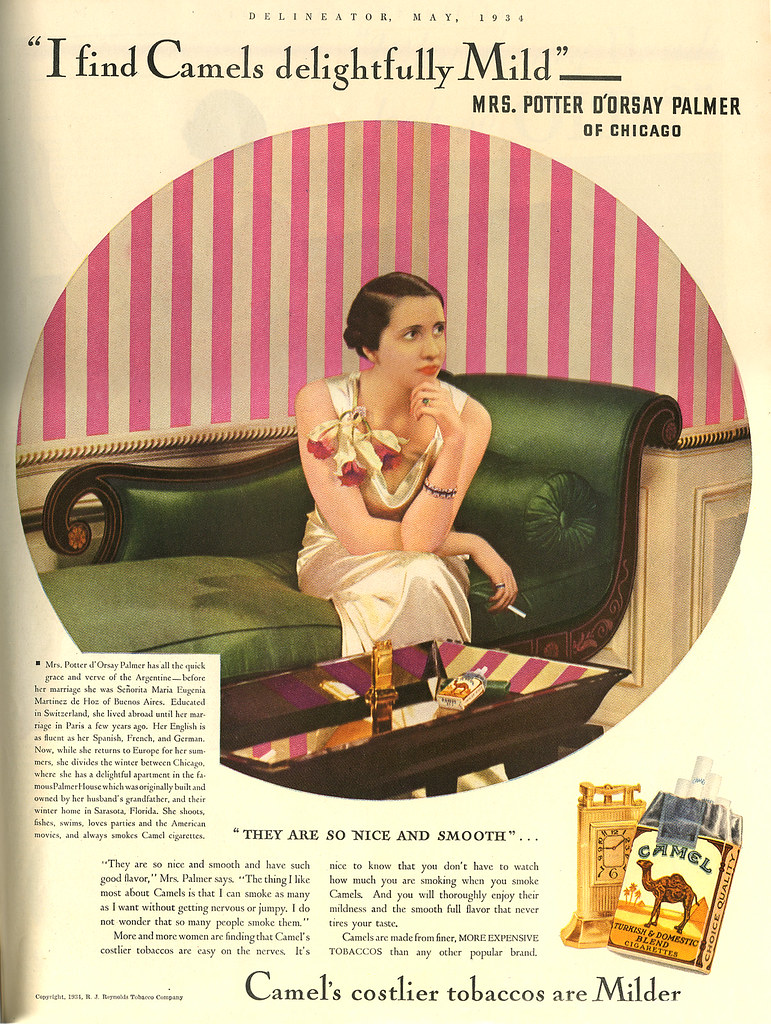
We begin with another socialite endorsing Pond’s Cold Cream — Mrs. Potter d’Orsay Palmer nee Maria Eugenia Martinez de Hoz. She was wife No. 2 of Potter d’Orsay Palmer, son of the wealthy family of Chicago Palmer House fame…they would divorce in 1937, and the playboy Potter would marry two more times before dying of a cerebral hemorrhage in 1939 (the result of a drunken brawl). Maria Eugenia would remarry and return to her homeland of Argentina to raise a family…

…it seems Maria Eugenia didn’t limit herself to endorsing cold cream, as this next ad attests (from the May, 1934 Delineator magazine)…

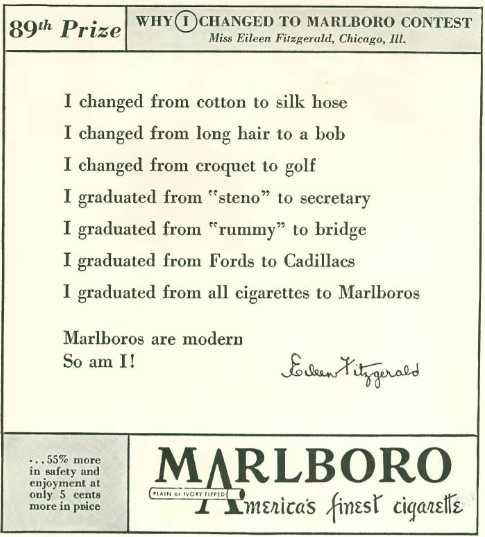
…Maria Eugenia endorsed Camels because they were marketed to women back then, as were Marlboro cigarettes, the makers of which continued their silly handwriting and jingle-writing contests to promote the brand (note the examples “Miss Eileen Fitzgerald” offered of what defined a modern lifestyle)…

…the makers of Chesterfield cigarettes, on the other hand, originally marketed their product to men, but they made sure women were included in the copy beneath the image — “yes, there’s a big woman vote” …

…you may recall the subtle ways Liggett & Myers began to lure women smokers back in 1928 with this ad campaign…

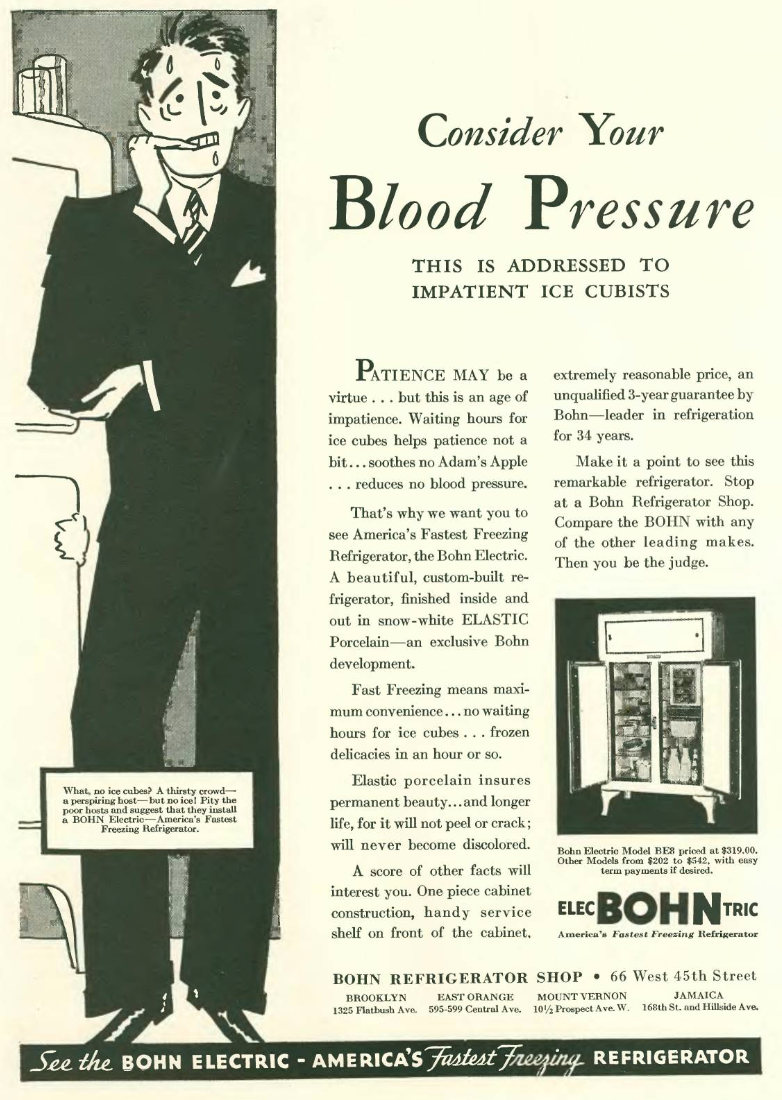
…you see a lot of tobacco ads because cigarette manufacturers were one of the few industries still turning a profit during the first years of the Depression…men and women were smoking like crazy, maybe to calm their nerves over the performance of their refrigerators…

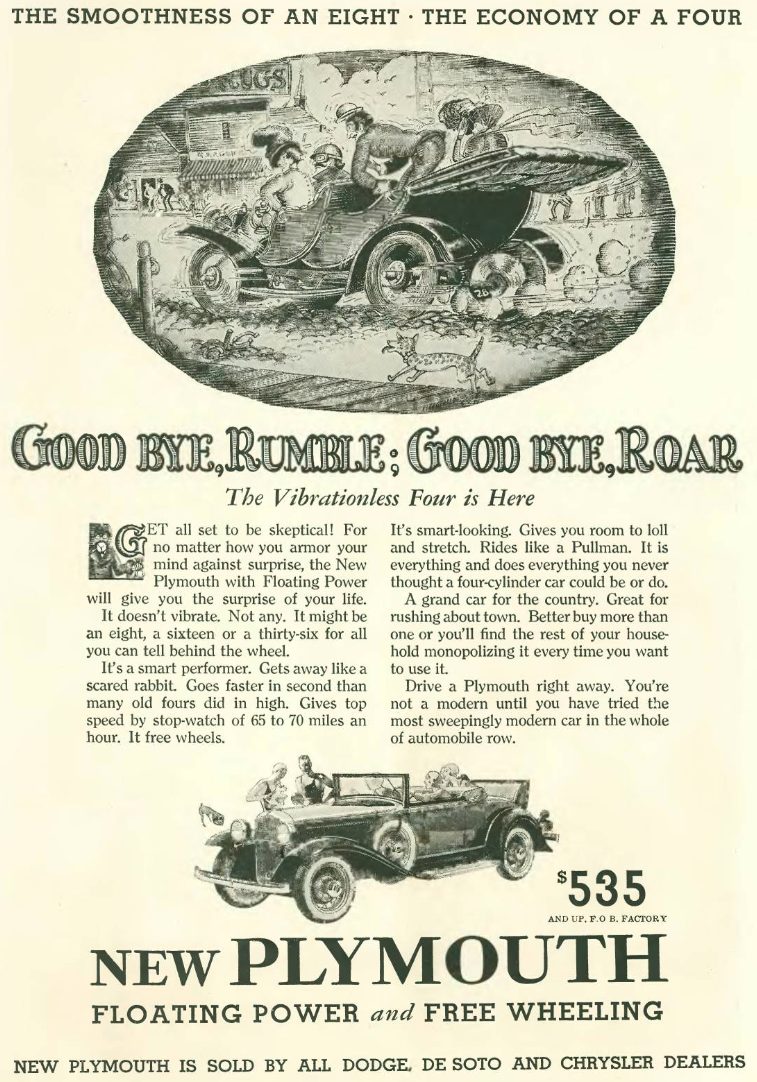
…one could always calm the nerves by taking a spin in a new Plymouth, bargain-priced at just $535…

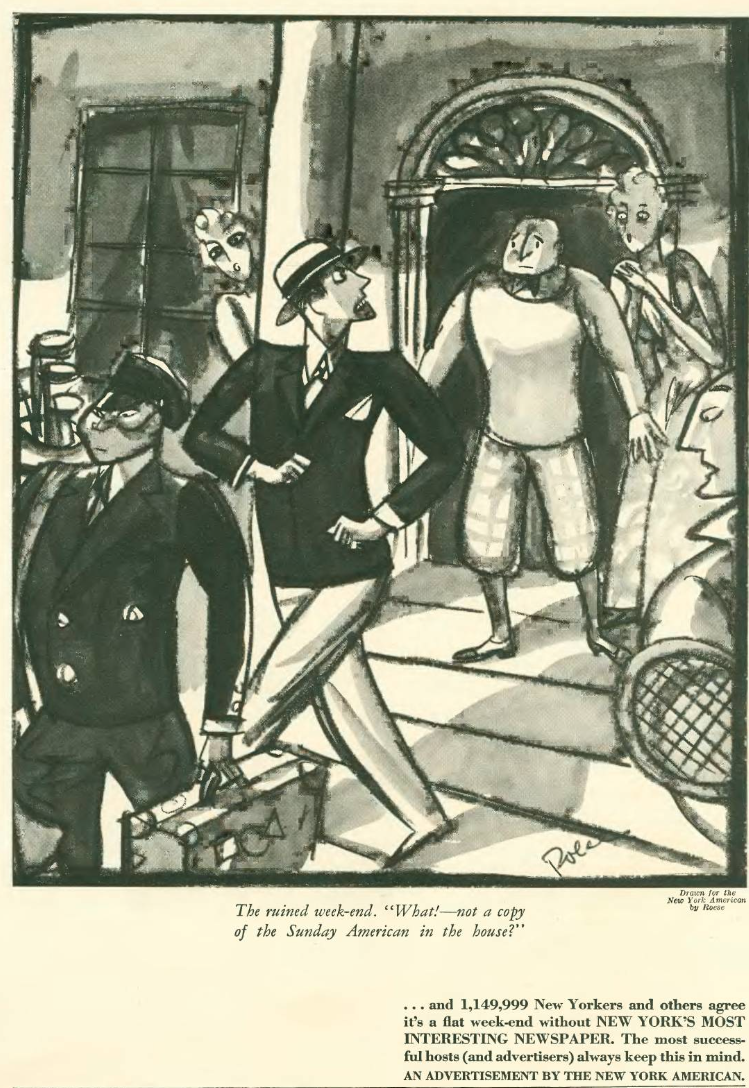
…and we have another Arno-esque ad by Herbert Roese, touting the wonders of “New York’s Most Interesting Newspaper”…

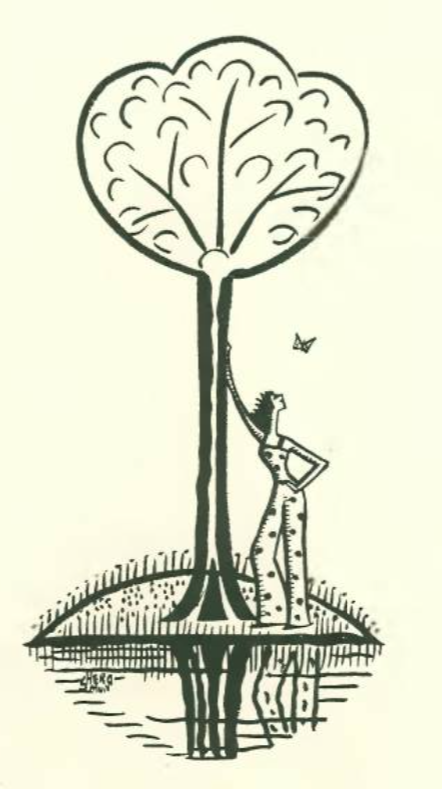
…on to our cartoonists, we begin with this wonderful spot drawing by Barbara Shermund

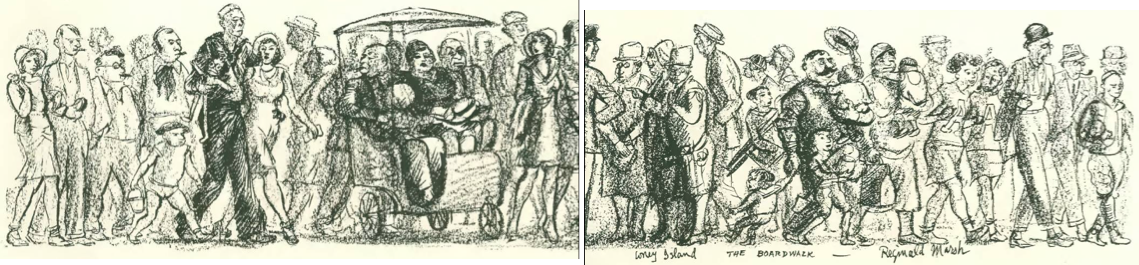
…and an illustration by Reginald Marsh of a Coney Island crowd that graced facing pages in “The Talk of the Town”…

…here’s one of four drawings Walter Schmidt contributed to The New Yorker between 1931 and 1933…

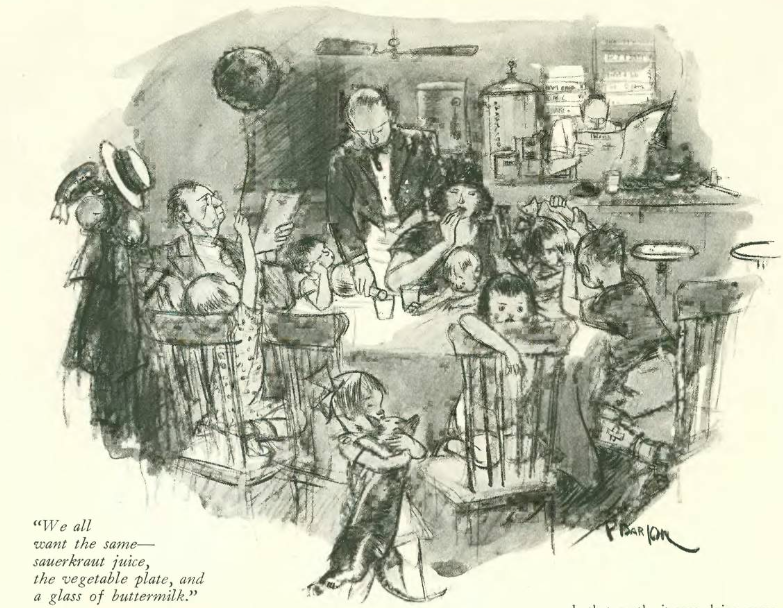
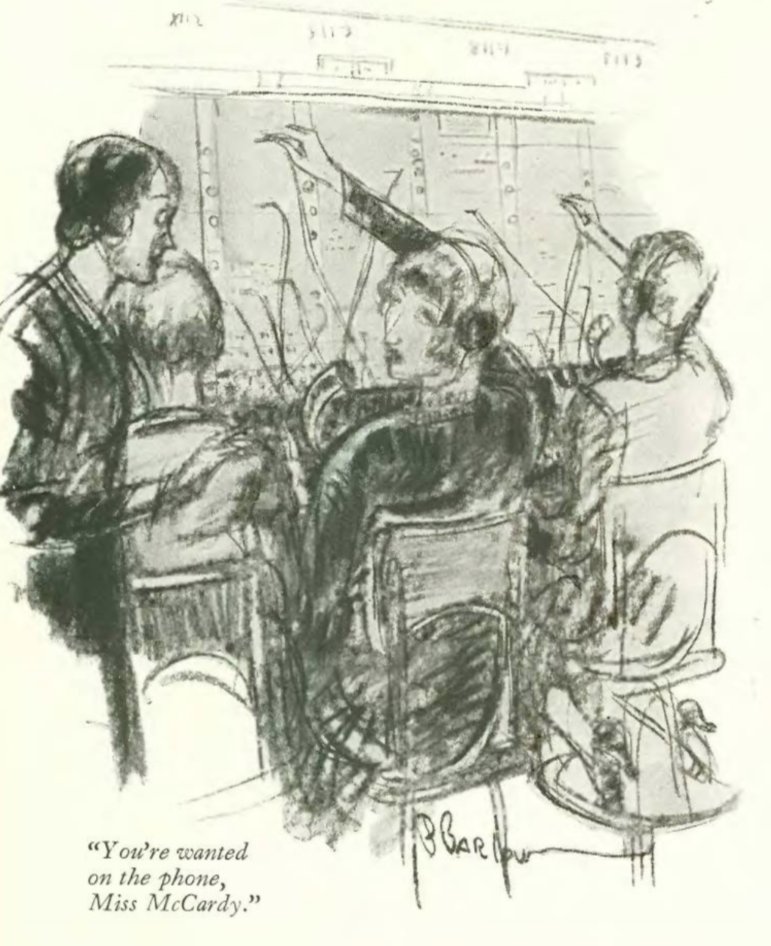
Perry Barlow illustrated the joys of dining out with the kiddies…

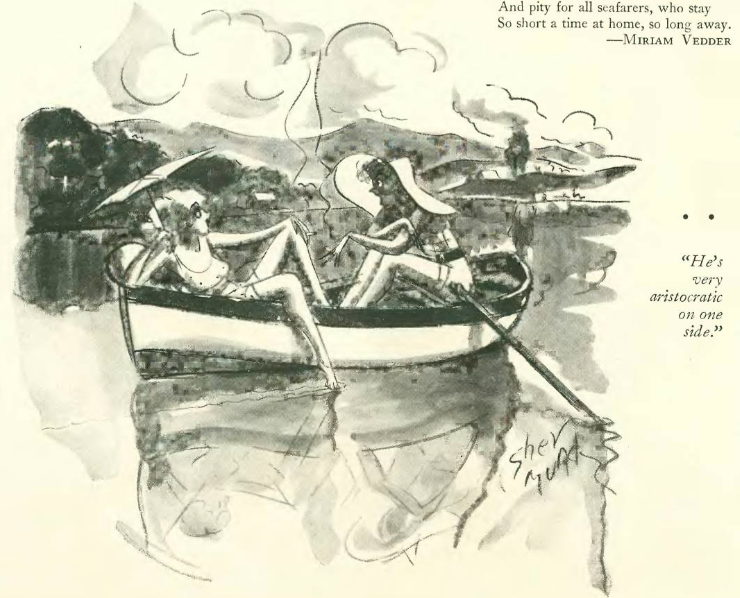
…back to Barbara Shermund, who eavesdropped on her debs…

Kemp Starrett gave us a proud moment at the county fair…

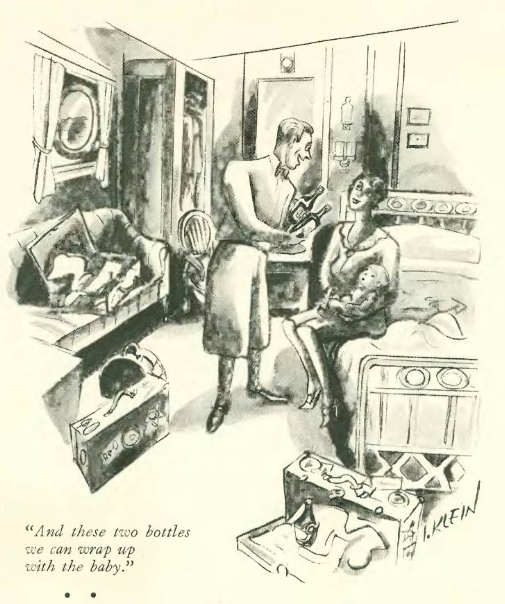
Isadore Klein offered up a new twist on the term “family planning”…

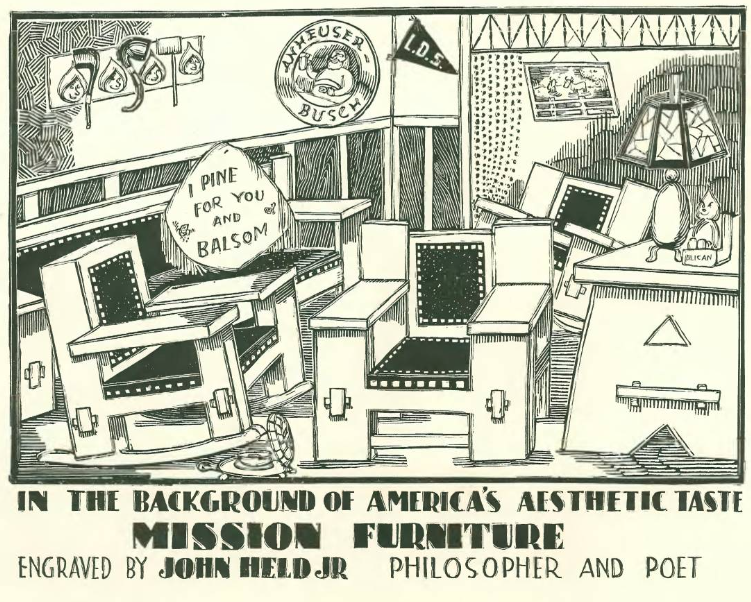
John Held Jr assessed the aesthetic value of chunky mission-style furniture…

…and Peter Arno reappeared in the cartoons with this full-page illustration of some desperate climbers…

Next Time: Asphalt Jungle…

Firecracker Lane

When fireworks were still allowed on the streets of New York City, Firecracker Lane was the place to go for all your pyrotechnic needs.

Theodore Haupt illustrated holiday travelers for the Fourth of July issue in 1931.

By 1931, however, fireworks had been banned across the greater New York City area, so customers visiting Firecracker Lane—a short row of sellers on Park Place between Broadway and Church Street—had to find a friendly burg beyond the metropolis to shoot off their Independence Day arsenals.

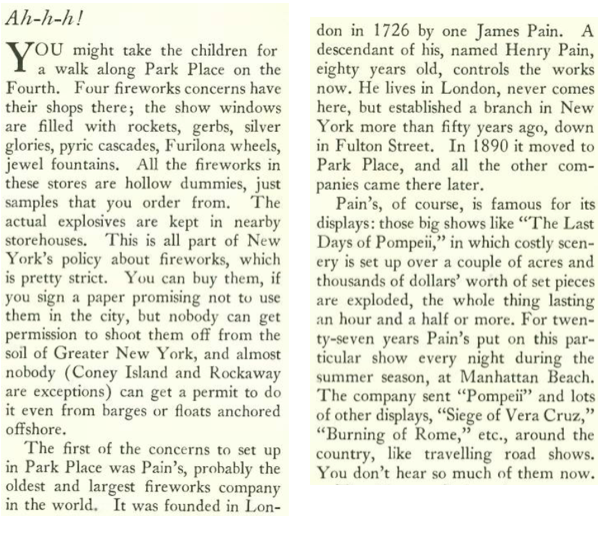
Before the city clamped down on the fun, Firecracker Lane did a bustling trade, and fireworks were even manufactured at sites around the metro area. But after a number of explosions and fires, the city closed down the fireworks factories, and by 1931 Fireworks Lane itself was on its last leg. “The Talk of the Town” visited what remained, and reminisced about the glory days.

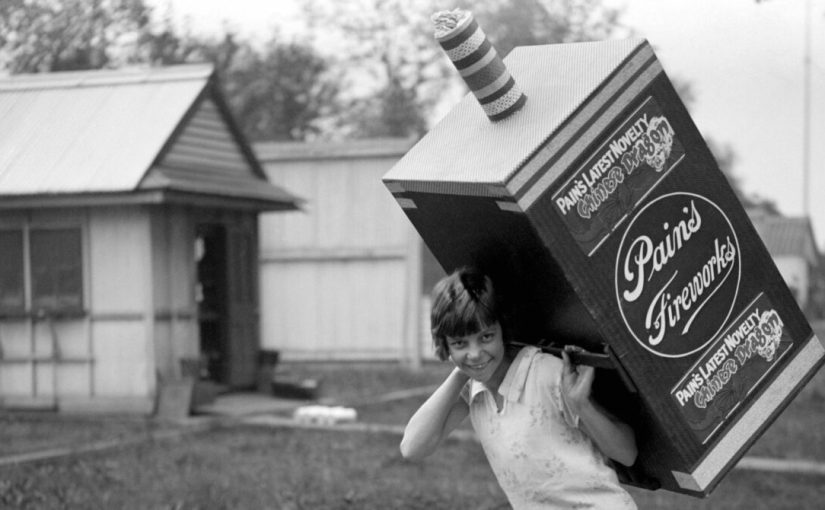
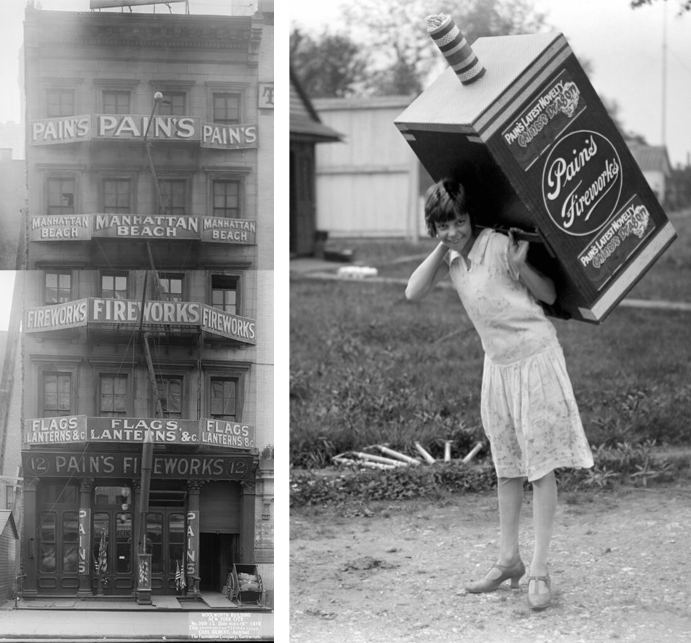
A STREET WITH SOME SIZZLE…The famed Pain’s Fireworks company occupied this building on Firecracker Lane, photo circa 1903. At right, a young woman promoting Pain’s latest novelty, the “Chinese Dragon,” in the 1920s. (Museum of the City of New York)
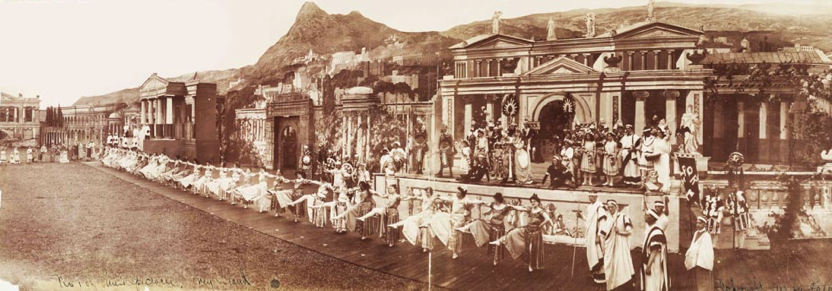
HAVING A BLAST…In the 19th and early 20th centuries, Pain’s staged massive themed fireworks displays, including the incredible The Last Days of Pompeii show on Manhattan Beach, seen here during its 1903 Season. (heartofconeyisland.com)
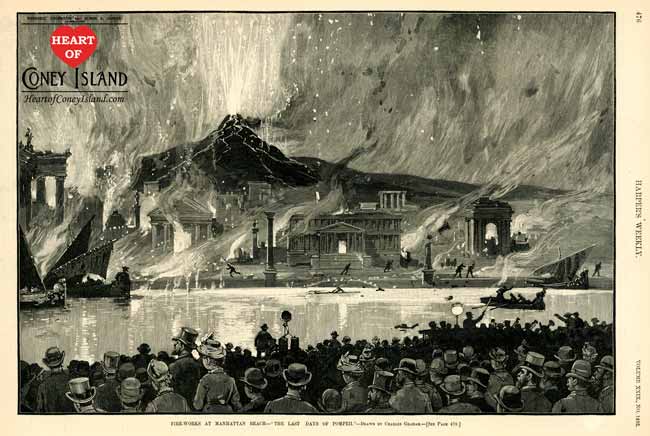
BEFORE THERE WERE MOVIES, entertainment companies were fond of putting on spectacular shows like The Last Days of Pompeii on Manhattan Beach. Illustration from an 1885 edition of Harper’s Weekly. (heartofconeyisland.com)
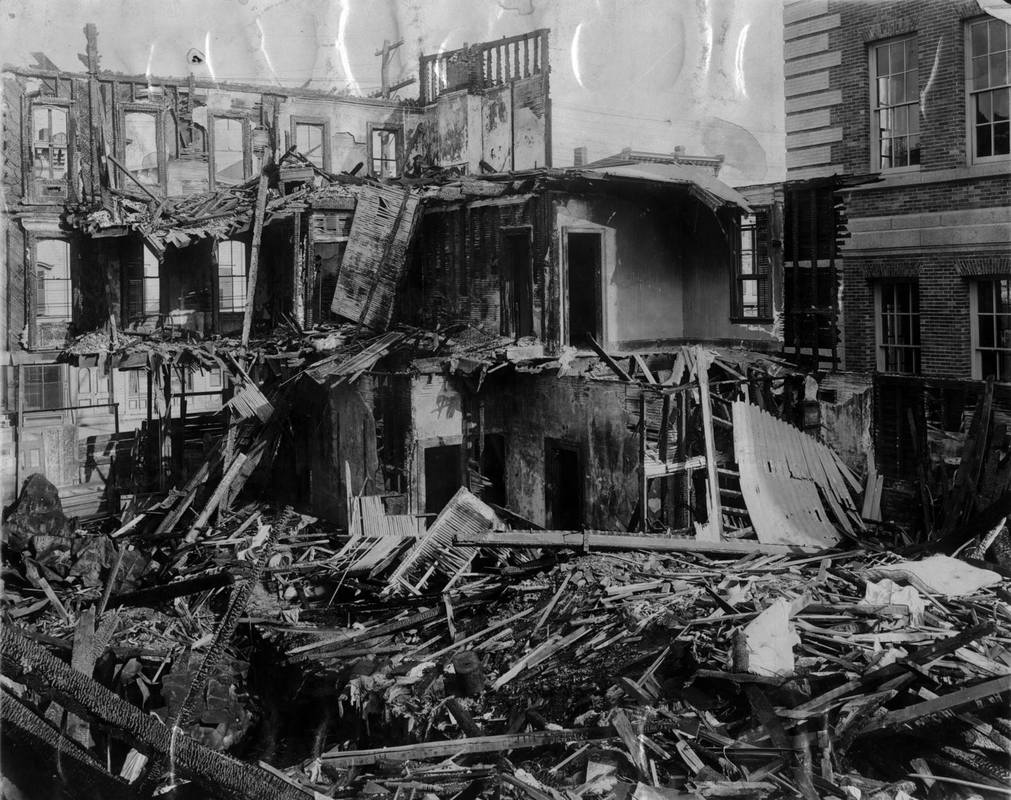
LOCATION, LOCATION…Explosions at fireworks factories in New York and New Jersey put an end to the manufacture of fireworks in the area by 1930. Above, a July 1901 explosion of a fireworks factory in a Paterson, N.J. tenement resulted in the deaths of 17 people who lived above factory. The New York Times reported “So great was the force of the blast, that a boy playing in the street a half a block away was lifted from his feet and hurled against an iron fence, and had one of his legs broken.” (Courtesy Paterson Fire History, via boweryboyshistory.com)

*  *  *

Not Mum on Mumford

In the previous post we were introduced to critic Lewis Mumford, who excoriated plans for the new Radio City, now known as Rockefeller Center. In his “Notes and Comment,” E.B. White added his own two cents:

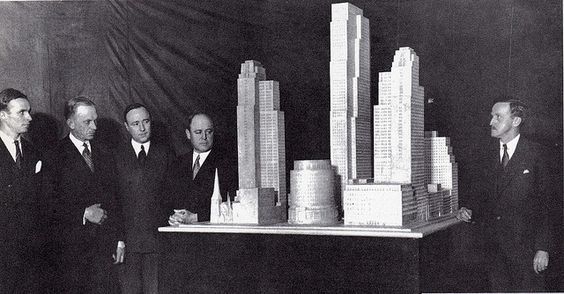
PERHAPS IT SHOULD HAVE BEEN A CAKE…Even the promoters of the Radio City project looked uncertain of their scheme in this March 1931 photo. (drivingfordeco.com)

*  *  *

From Our Advertisers

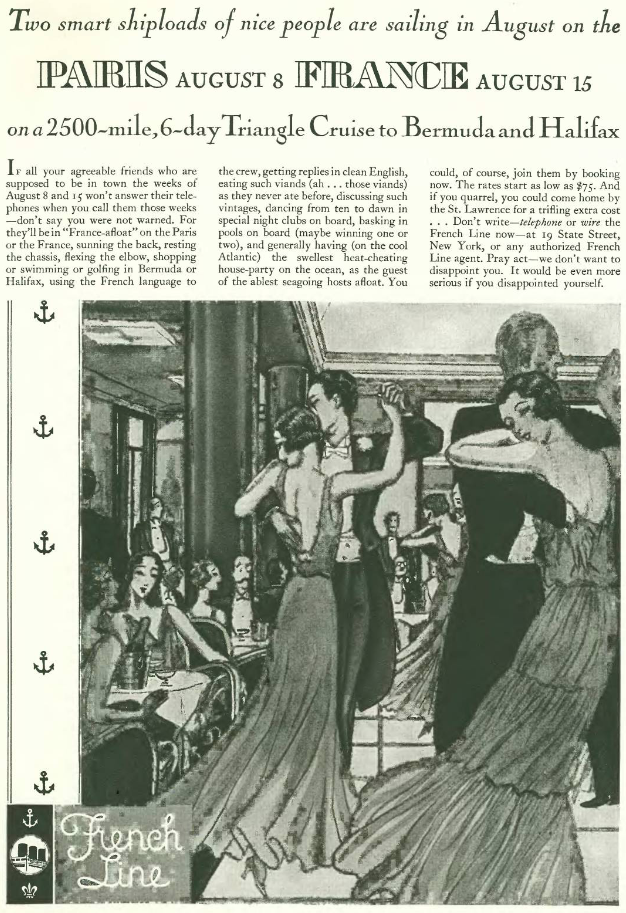
New Yorkers who wanted to get away from the steamy streets of Manhattan (almost no one had air conditioning in 1931) could catch the cooling breezes of the Atlantic on any number of cruise lines that plied the Eastern Seaboard and Canadian Maritimes during the summer…here the French Line offered a six-day “Triangle Cruise”…

…while Cunard offered a similar excursion (employing the cartooning skills of H.O. Hofman) that allowed passengers to “do the ocean” in just four days…

…to earn the ever-shrinking travel dollar during the Depression, both the Red Star and White Star lines offered their giant ocean liners for half- and full-week cruises to the Maritimes, Red Star even throwing in some on-board entertainment, claiming to be the first to do so “on any ocean”…

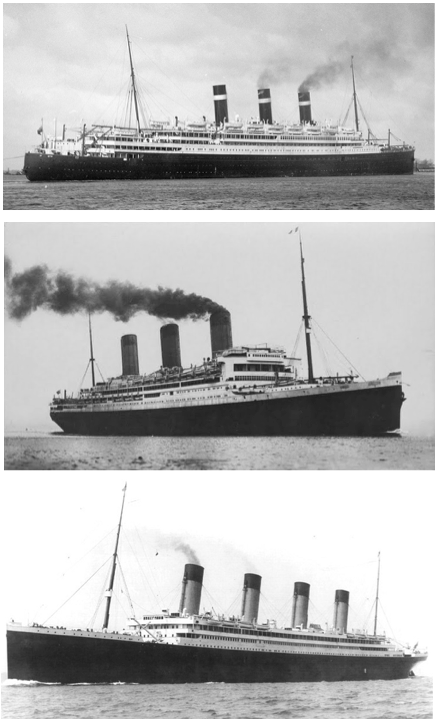
A SCRAPPED LOT…From top, the Belgenland, Majestic and Olympic. These great ships that once ferried passengers in high style between Europe and the States had been reduced to taking folks on short cruises and even one-day excursions due to the Depression. By the mid-1930s the Belgenland and Olympic (once the world’s largest ship) were sold for scrap. The Majestic was scuttled a few years later. (Wikipeda)

…I’m not sure where this pair is headed, but the angle suggests they just drove off a cliff…

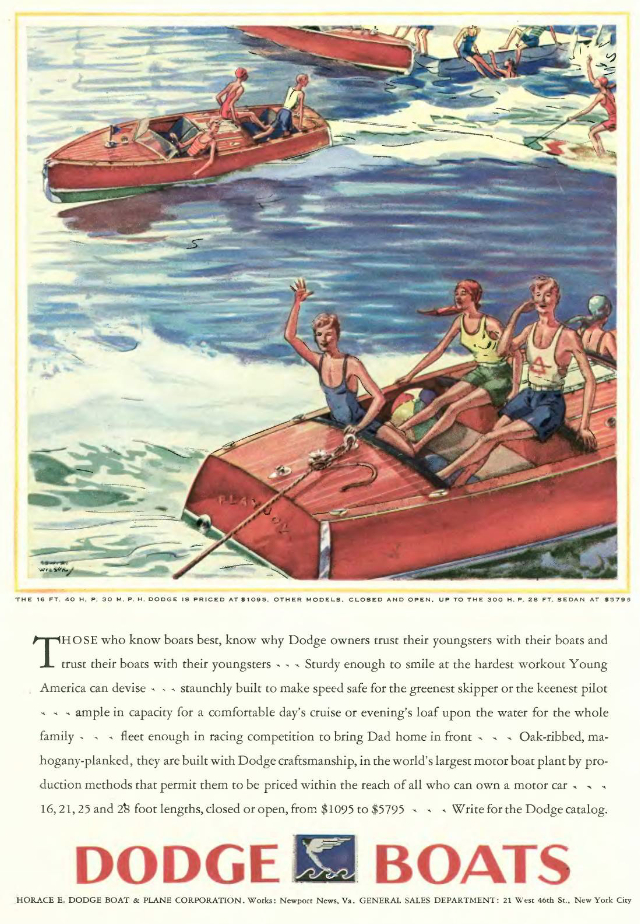
…if cliff diving wasn’t your thing, you could tool around in a bright red Dodge boat…

…or be easily amused like this guy on the right, who gets his jollies from the abundance of ice cubes in his fridge…

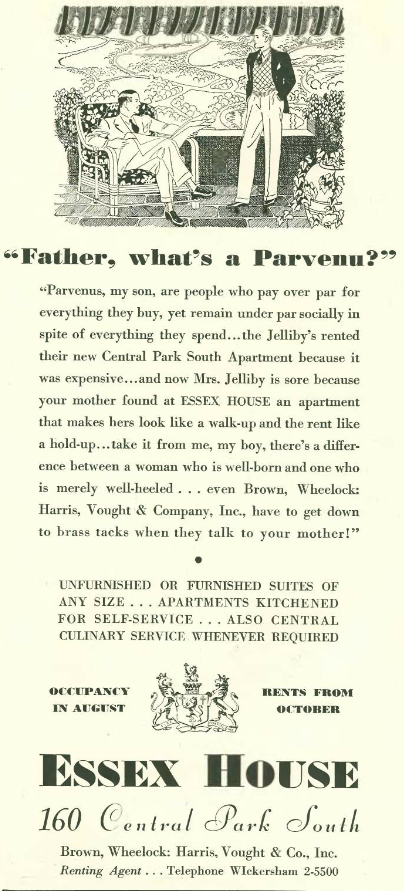
…over at Essex House we find a more reserved scene, the “well-born” father and son gloating over their Central Park view…

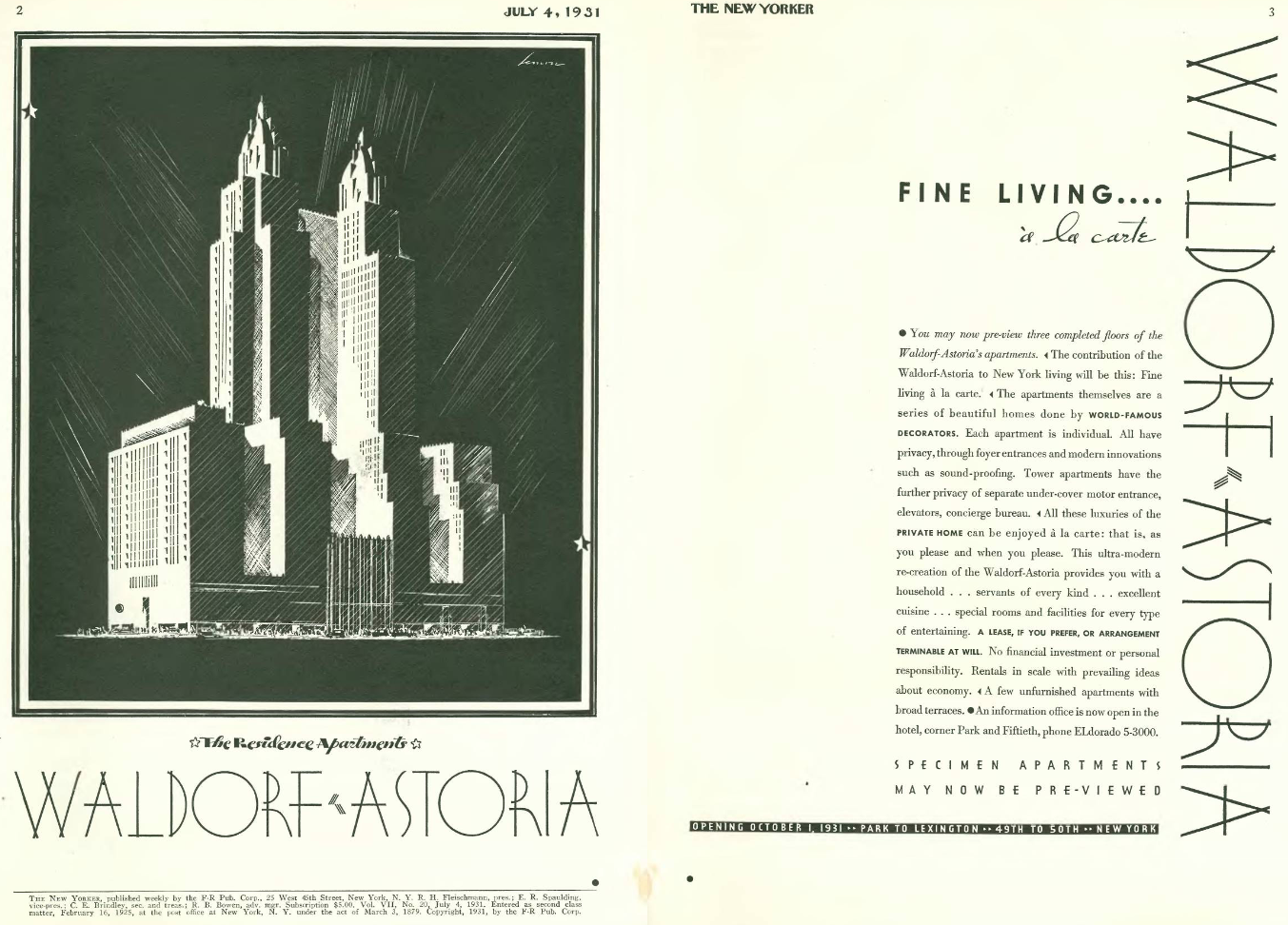
…the Essex House might have been “all that,” but Dad and Junior would have to reconsider their social rank against a newcomer — the Waldorf-Astoria, reborn on Park Avenue…

…on to our cartoons, this couple illustrated by Garrett Price might consider something with a larger balcony…

Otto Soglow’s Little King took his Little Prince out for some air…

Kemp Starrett showed us a chap who contemplated the passing of time along with the passing of his timepiece…

Isadore Klein updated the theme of a damsel in distress…

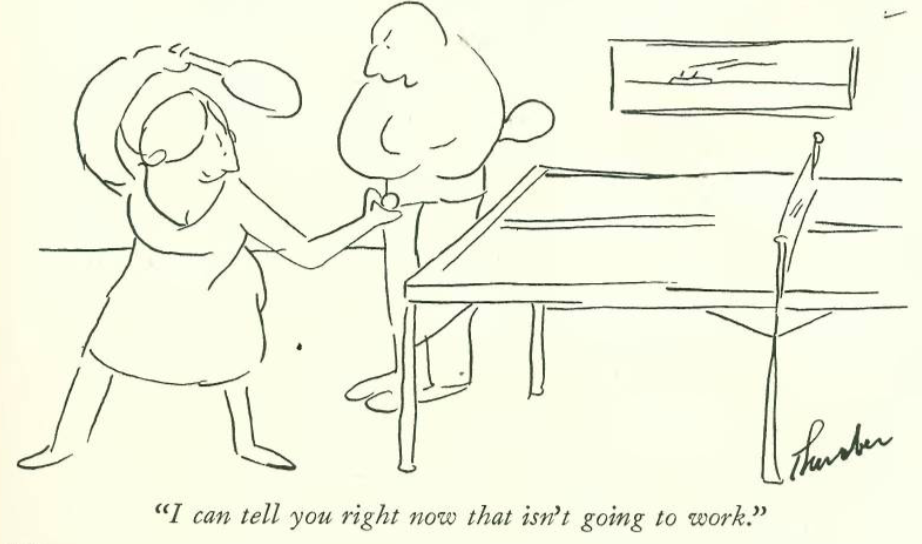
…the growing popularity of Ping-Pong gave James Thurber some material to explore the battle of the sexes…

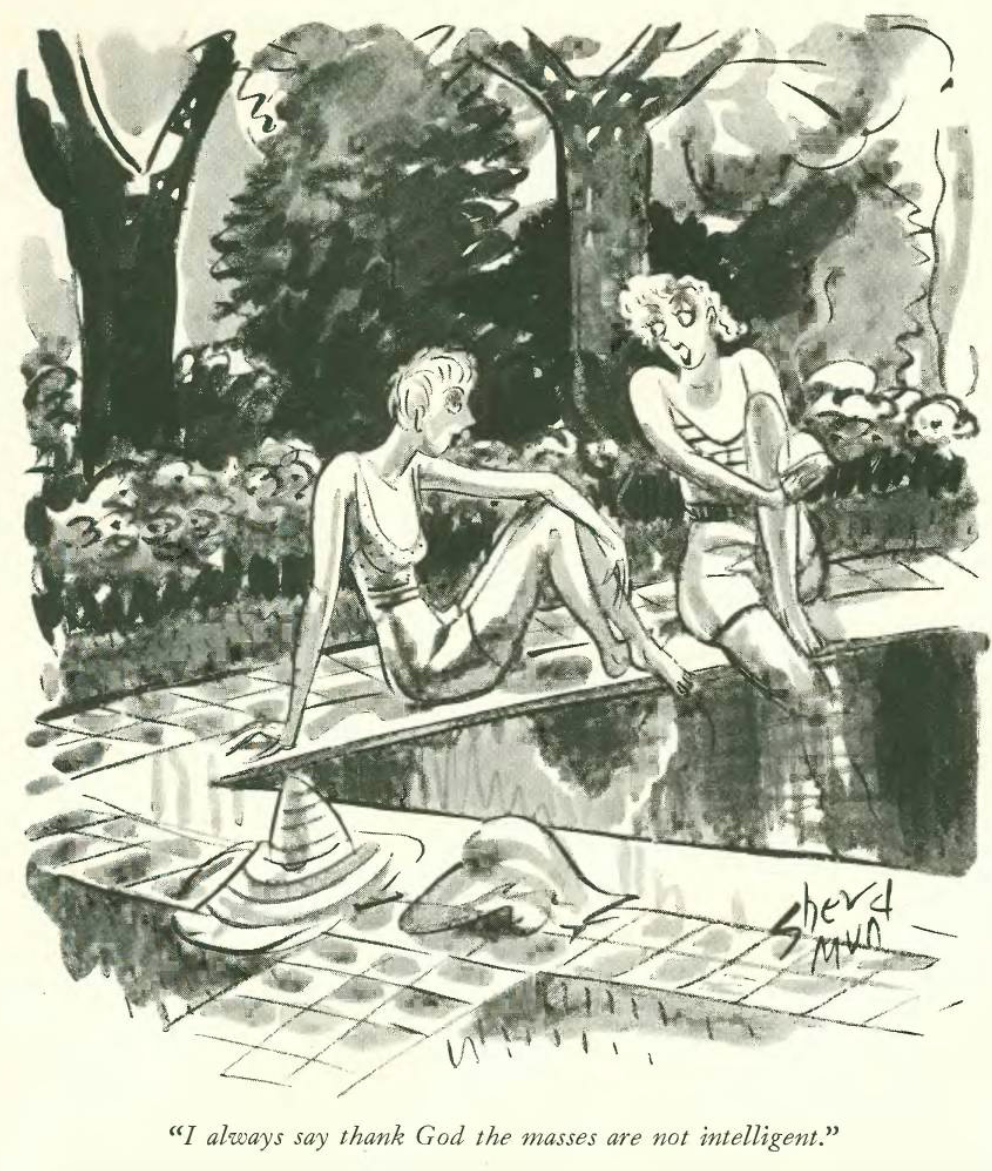
…and Barbara Shermund left us poolside with a couple of eggheads…

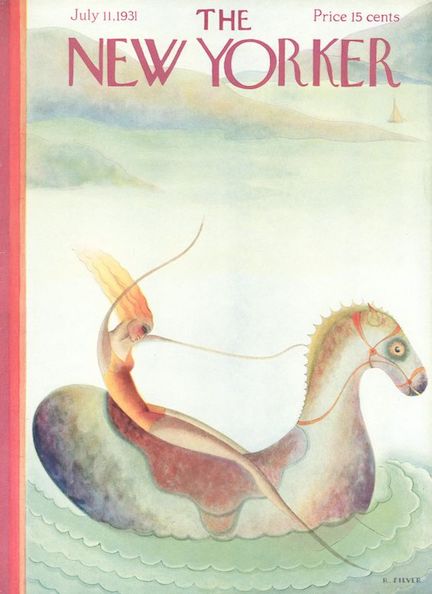
…on to our July 11, 1931 issue…

July 11, 1931 cover by Rose Silver.

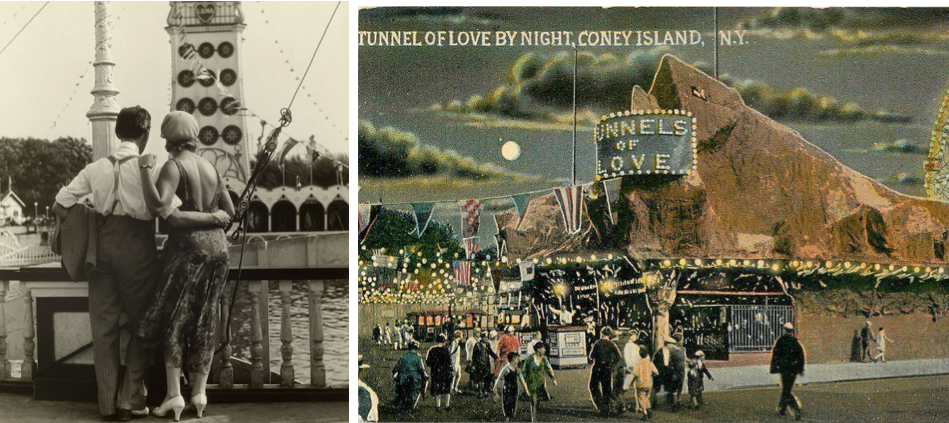
…we find E.B. White taking his sweetheart, Katharine Angell White (referred to here as his “best girl”) out for a date at Coney Island…

A PLACE FOR ROMANCE…It’s not them, but this couple visiting Coney Island in 1928 (photo by Walker Evans) will serve well as our stand-ins for E.B. and Katharine White on their date to Coney. At right, the famous “Tunnels of Love.” (Metropolitan Museum of Art/Pinterest)
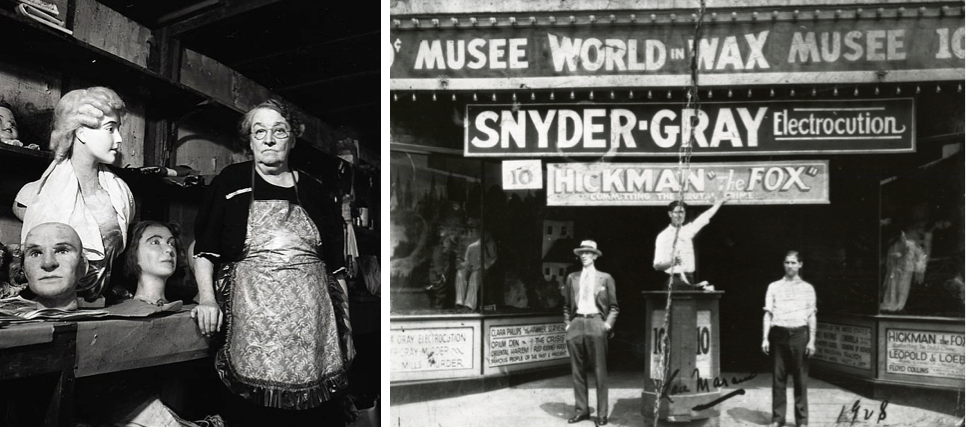
AND OTHER DIVERSIONS…Another famous and rather lurid Coney attraction was the wax museum, which featured dioramas based on headlines of the day. The biggest attractions were those featuring famous crime scenes, gruesome effects included. (Museum of the City of New York)
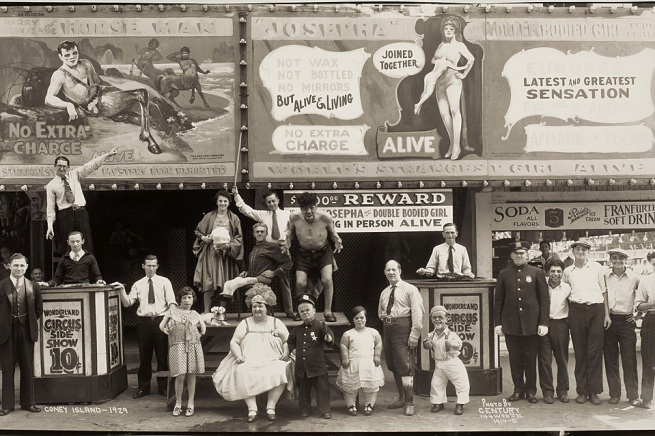
IT WAS A LIVING…Among other big attractions at Coney were the sideshow “freaks” White mentioned in his article. The photo above, from 1929, is by Edward J. Kelty. (artblart.com)

 *  *  *

On the Waterfront

The 1954 film by the same name featured the murderous mob boss Johnny Friendly (Lee J. Cobb) who ruled the waterfront’s stevedores with an iron fist. The reality was just as brutal, if not more so along the Brooklyn waterfront in the early 20th century, where the reign of a crime boss was as short as his life span. Alva Johnston reports:

TOUGH NEIGHBORHOOD…Midcentury view of the Brooklyn waterfront. (thenewyorkmafia.com)

Dinnie Meehan’s widow, Anna Lonergan, had the distinction of being shot at the side of two successive husbands; after Meehan was murdered, Anna married “White Hand” gangster Harry Reynolds. Johnston, who referred to Anna Lonergan as “the Brunhild of the longshore cycle,” concluded his piece with a look at the “last of the great leaders,” Red Donnelly, also known as “Cute Charlie”…

HARD KNOCKS…“Peg Leg” Lonergan was the final leader of the waterfront’s “White Hand Gang.” He was gunned down on Dec. 26, 1925, after a short reign as boss. He was just 25 years old when he died. (Pinterest)

 *  *  *

The Show Must Go On

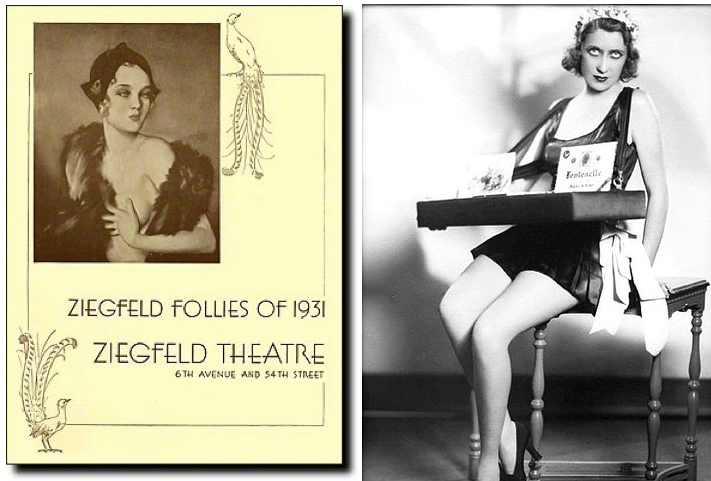
With the glory days of vaudeville quickly receding into the past, Flo Ziegfeld was nevertheless determined to keep his “Follies” alive at his eponymous theatre. Robert Benchley stopped by for a look at the Ziegfeld Follies of 1931.

CARE FOR A SMOKE?…Program cover for the Ziegfeld Follies of 1931. At right, Ziegfeld star Ruth Etting, who portrayed a cigarette girl in the show’s “Club Piccadilly” skit. A note of trivia: Etting and I attended the same high school (but not at the same time!). (Playbill/Wikimedia Commons)
GLORY BE…Inside pages of the program featured some of the “Ziegfeld Beauties” appearing in the show. (Playbill)

 *  *  *

Gross

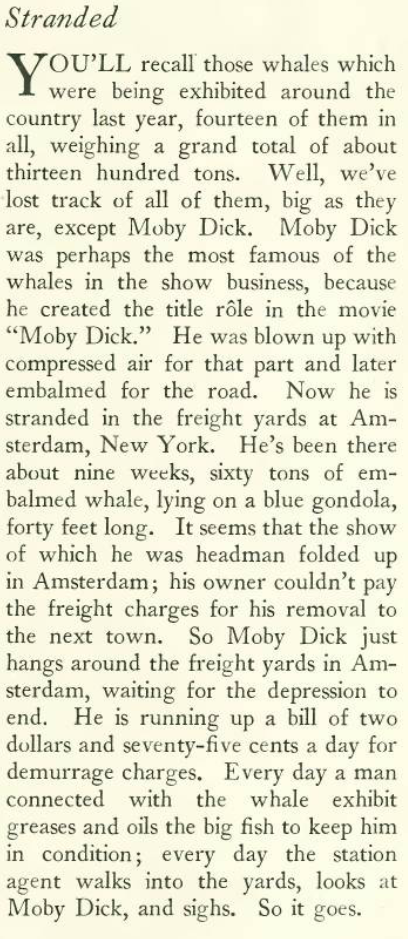
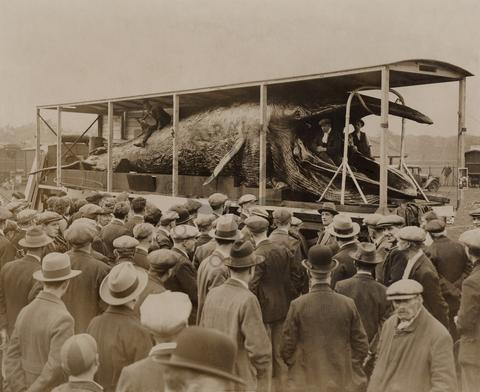
Back in the day some entrepreneurial types would kill a large whale, stuff it full of sawdust and formaldehyde, and then take it on the road to parade in front of gawkers with spare nickels in their pockets. E.B. White observed the fate of one such specimen:

YES, THIS WAS A THING…Before the days of Jacques Cousteau and Animal Planet, this is how some folks got their first and likely only look at a real whale, even if it was pumped full of sawdust and formaldehyde.

 *  *  *

From Our Advertisers

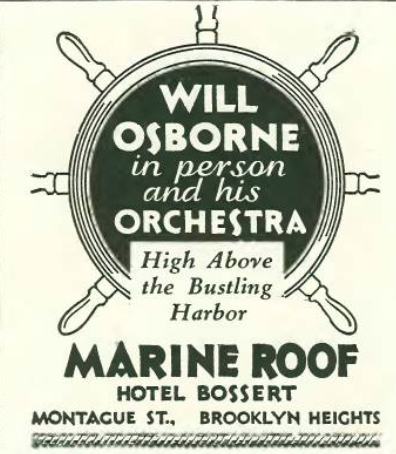
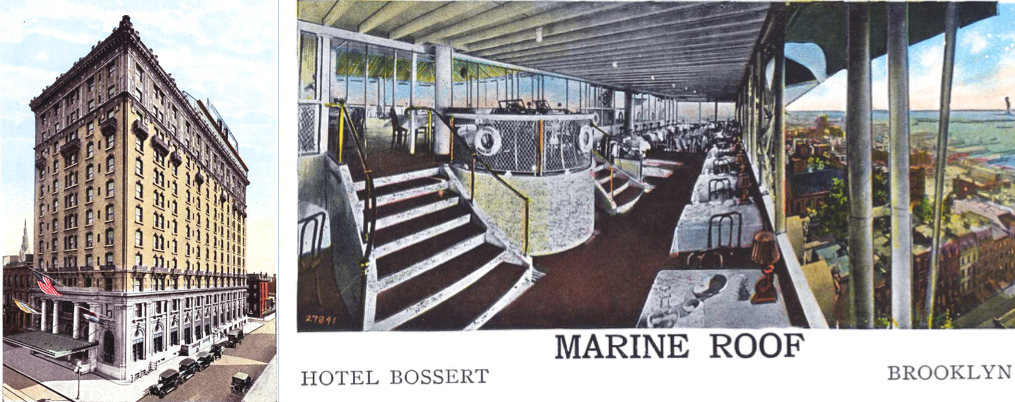
This small back page ad invited New Yorkers to the cooling breezes atop the Hotel Bossert in Brooklyn Heights, once referred to as the “Waldorf-Astoria of Brooklyn”…

Its rooftop restaurant — the Marine Roof — was a famous hangout. When the Brooklyn Dodgers won the World Series in 1955, this is where they celebrated…

(brownstoner.com)

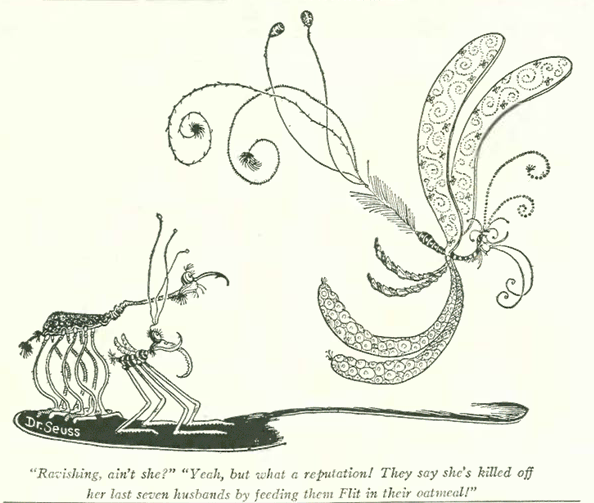
Dr. Seuss was still making a living illustrating advertisements for Flit insecticide…

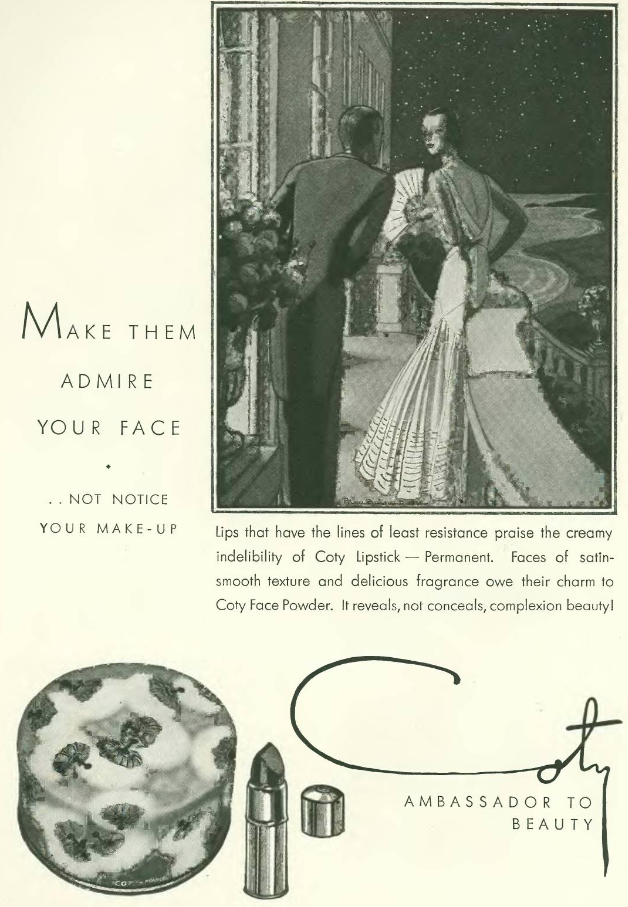
…”my eyes are up here”…says the woman who uses Coty brand lipstick…

…on to our cartoonists, we have Garrett Price also examining the challenges of playing Ping-Pong…

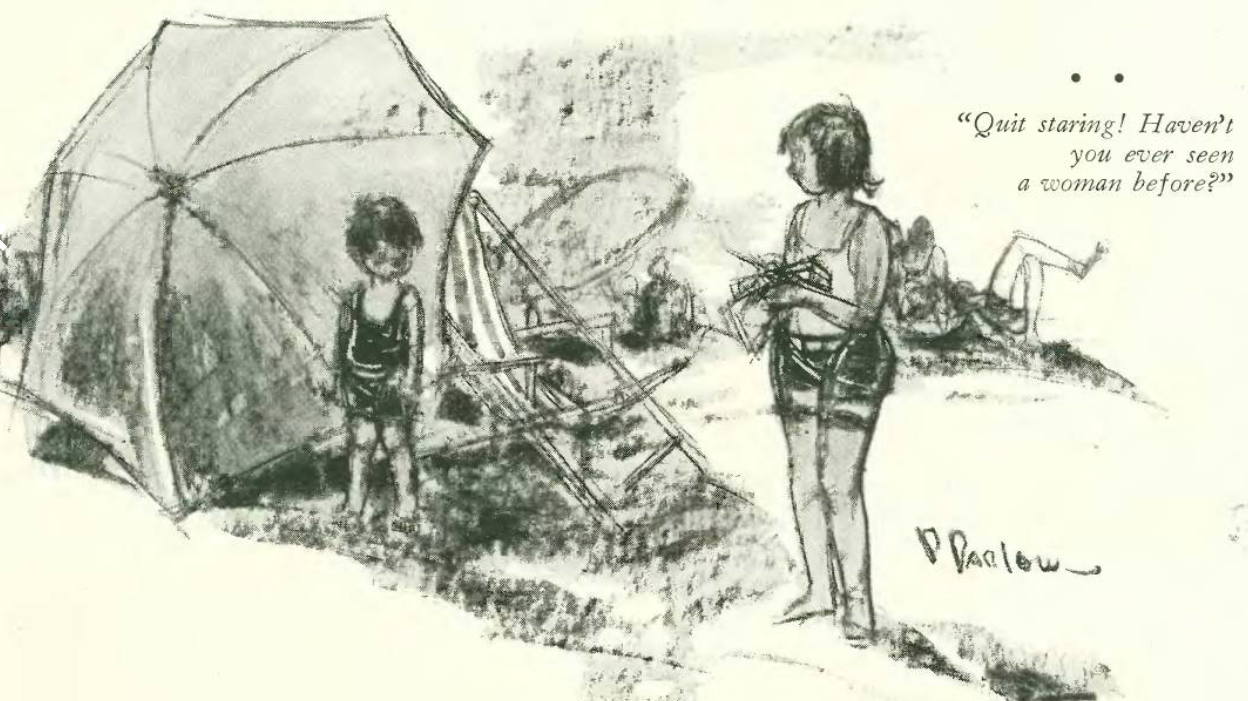
Perry Barlow was at the seaside with a precocious beach-goer…

Carl Rose showed us a Boy Scout after his encounter with the Red Menace…

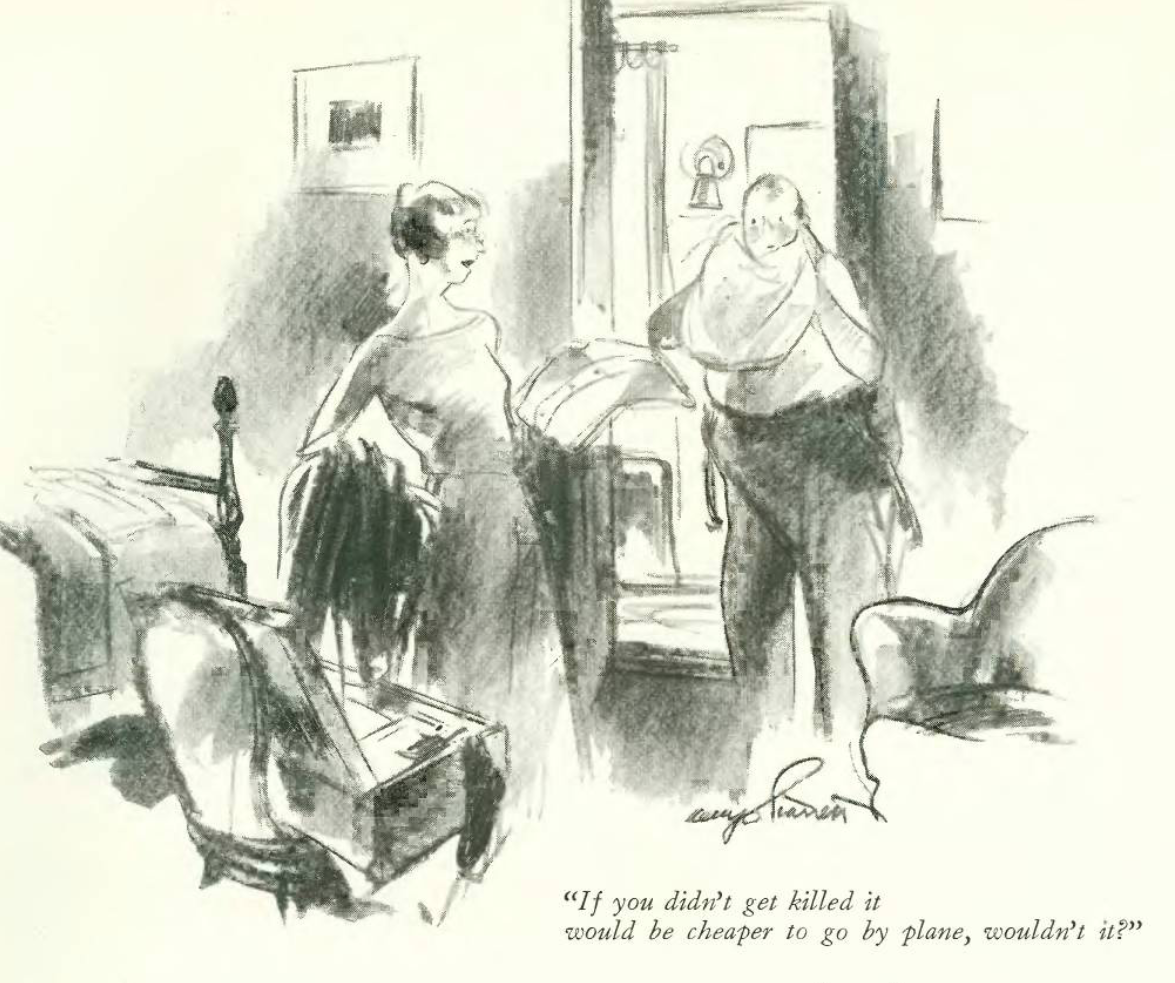
Kemp Starrett weighed the advantages of air travel…

Otto Soglow surprised us with this undercover operation…

…and we end with James Thurber, and the price of literary fame…

Next Time: The Black Eagle…


Ten Cents In Stamps

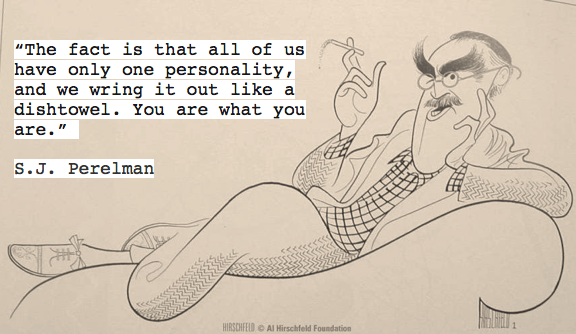
Like E.B. White, James Thurber and Dorothy Parker who came before him, S. J. Perelman was one of those New Yorker writers whose name would become synonymous with the magazine. 

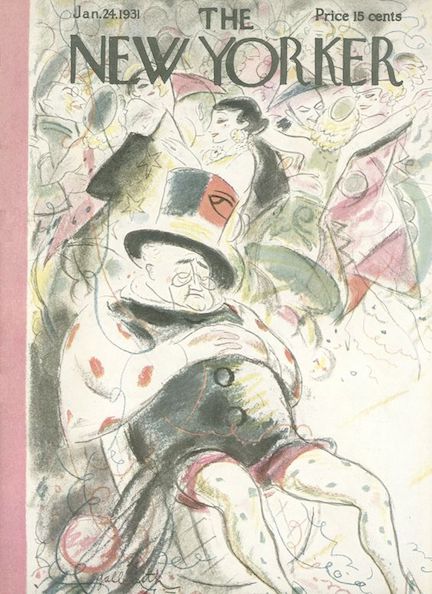
Jan. 24, 1931 cover by William Crawford Galbraith.

Perelman’s first New Yorker article, “Ten Cents in Stamps,” appeared in the Jan. 24, 1931 issue, his subject a collection of self-help and “how to” books he introduced with this Editor’s Note: “Upsetting as it may seem, all the books reviewed in the following article are genuine.”

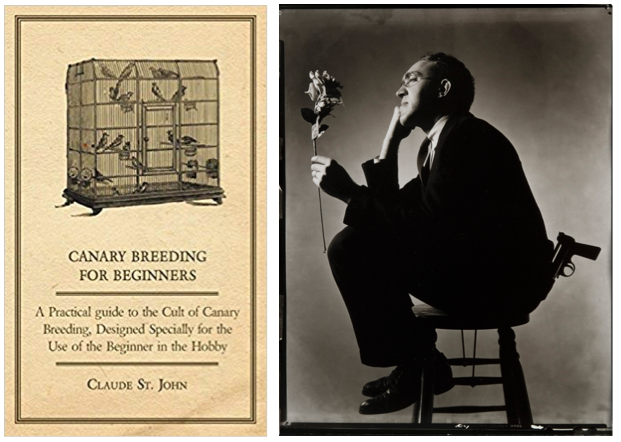
FOR THE BIRDS…S. J. Perelman (1904–1979) sampled Canary Breeding for Beginners among other titles in his first humorous short for The New Yorker. The above 1935 photograph was made by Ralph Steiner, who recalled “when I made this photograph I said ‘this is a foolish thing for two grown men to be doing with their time,’ Perelman answered: ‘We may be the only two men in the world at this moment not doing harm to anyone.'”(amazon/akronartmuseum.org)

Without further ado, some excerpts…

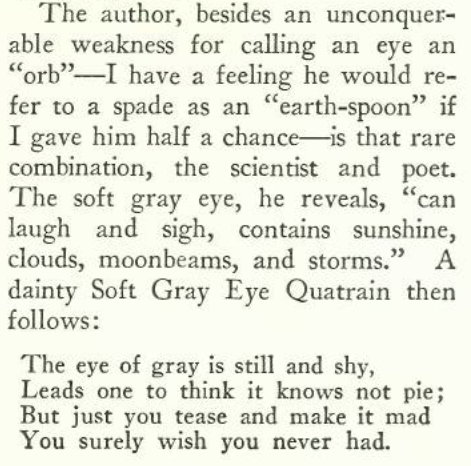
…Perelman offered us a taste of Martini’s poetic gifts…

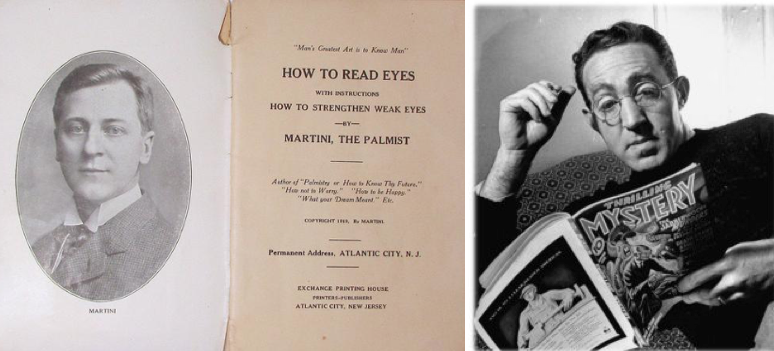
MARTINI WITH A TWIST…S.J. Perelman wanted “a little tighter thinking” from Martini, The Palmist, in his book, How to Read Eyes. (Etsy/johnesimpson.com)

…and also sampled the wisdom of Jacob Penn, who wrote a book titled How to Get a Job Through Help Wanted Advertisements. Perelman zeroed in on the book’s appendix, which contained “Successful Model Letters”…

*  *  *

Dorothy Returns

After a long absence, Dorothy Parker returned to her immensely popular “Reading and Writing” column. Parker had been staying at an alpine sanitorium in Switzerland, providing moral support for her friends Gerald and Sara Murphy while their young son was treated for tuberculosis. Parker had originally fled to Europe (France, specifically) to write her “Great American Novel,” only to end up on the Swiss mountaintop, where she composed a long letter just recently published (2014) under the title Alpine Giggle Week. Back in New York, she returned to her typewriter and released her wit on Charles Noel Douglas, editor of Forty Thousand Sublime and Beautiful Thoughts.

A PENNY FOR YOUR THOUGHTS?…Charles Noel Douglas had 40,000 of them, Dorothy Parker discovered.(amazon/britannica.com)

 *  *  *

A ‘Tables’ Reprise

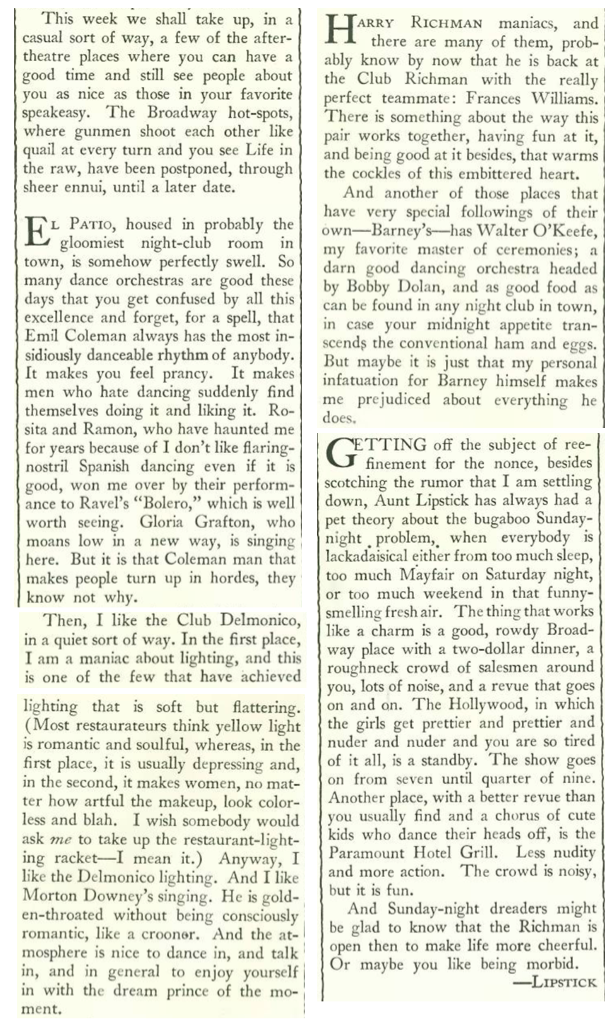
Lois Long was also back, in a way, reviving her “Tables for Two” column for on a one-off on the city’s Broadway hot-spots…

AFTER THE CURTAIN FALLS on Broadway there were plenty of nighttime diversions to keep theater crowds entertained into the wee hours.Clockwise, from top left, singer-dancer Frances Williams worked wonders with Harry Richman and his orchestra at the Club Richman; Bobby Dolan wielded a smart baton at Barney’s; and crooner Morton Downey (pictured with wife and actress Barbara Bennett)… lent his golden tenor to adoring crowds at Club Delmonico. The couple spawned the combative star of 1980s “Trash TV” Morton Downey Jr. (Pinterest)

 *  *  *

From Our Advertisers

We begin with a full page of ads for various Broadway shows…

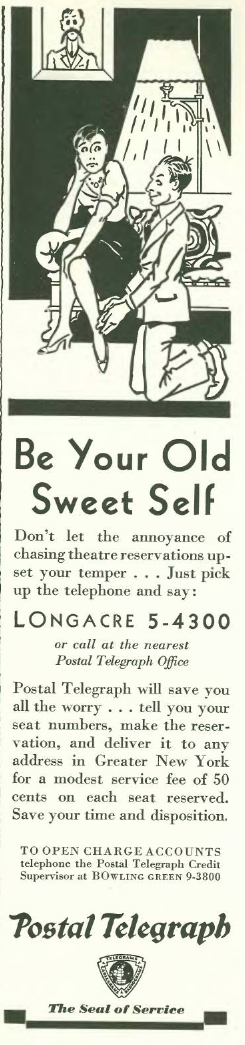
…and if you wanted to get tickets to one of those shows, here is 1931’s version of StubHub…

…and we are reminded that it is indeed 1931 with overtly racist ads such as this…

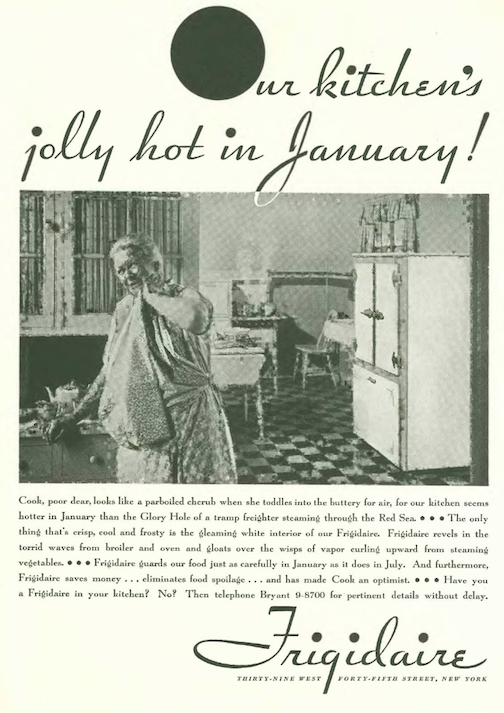
…back home, the help isn’t treated much better. “Cook” can suffer as long as the food remains fresh in the gleaming Frigidaire…

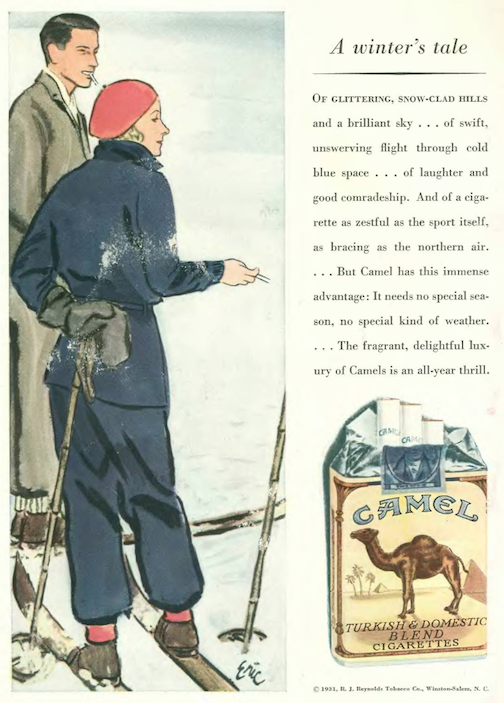
…meanwhile, our stylish Camel smokers (illustrated by Carl “Eric” Erickson) are keeping cool on the slopes…

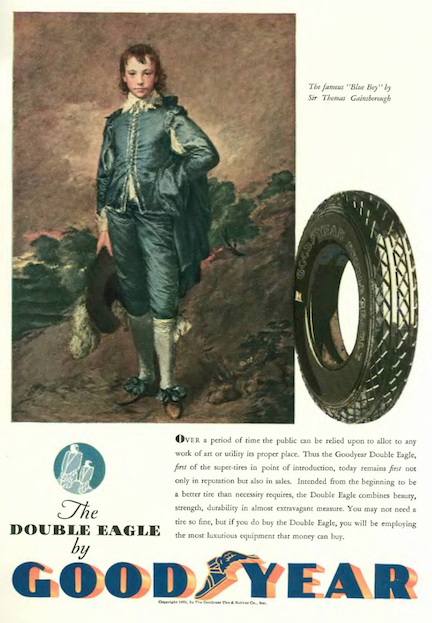
…and perhaps this is the one and only time a painting by Thomas Gainsborough is compared to a tire…

…on to our illustrators and cartoons, the editors tossed in this old spot illustration by H.O. Hofman to fill space on the events page…

…an then we have this spot (sorry, I can’t identify the artist) that imagines disastrous consequences for the Empire State Building’s “mooring mast” (which was never used as such)…

…and Ralph Barton returned to lend his artistry to the theater review section…

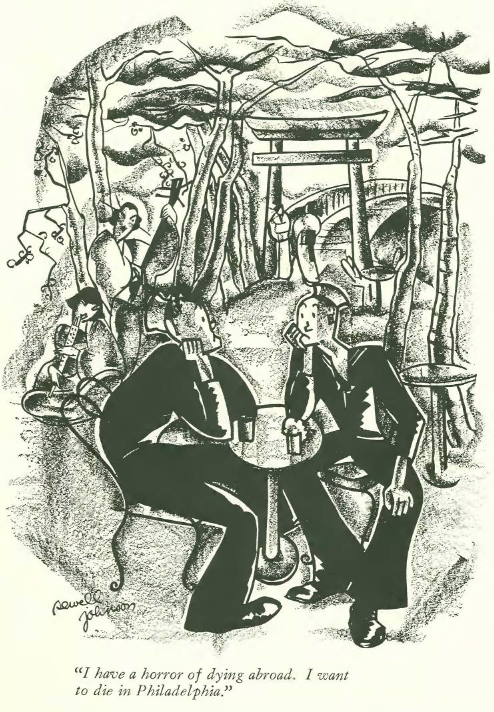
…for our cartoons, we begin with Sewell Johnson’s lone contribution to The New Yorker

Carl Rose was at the movies…

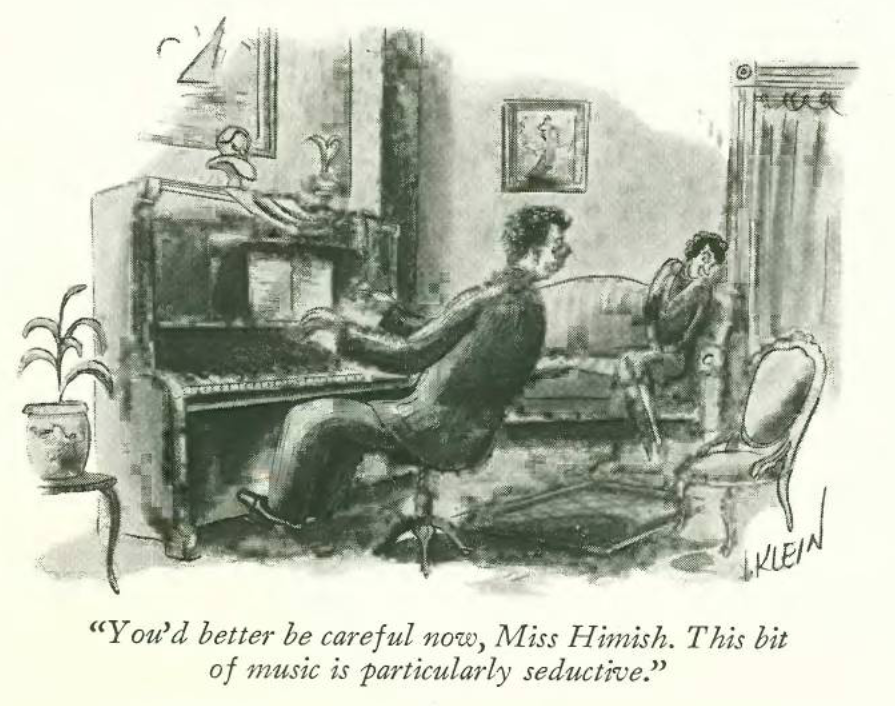
Isadore Klein warmed things up in this parlor scene…

Alan Dunn justified the existence of thriller author Edgar Wallace

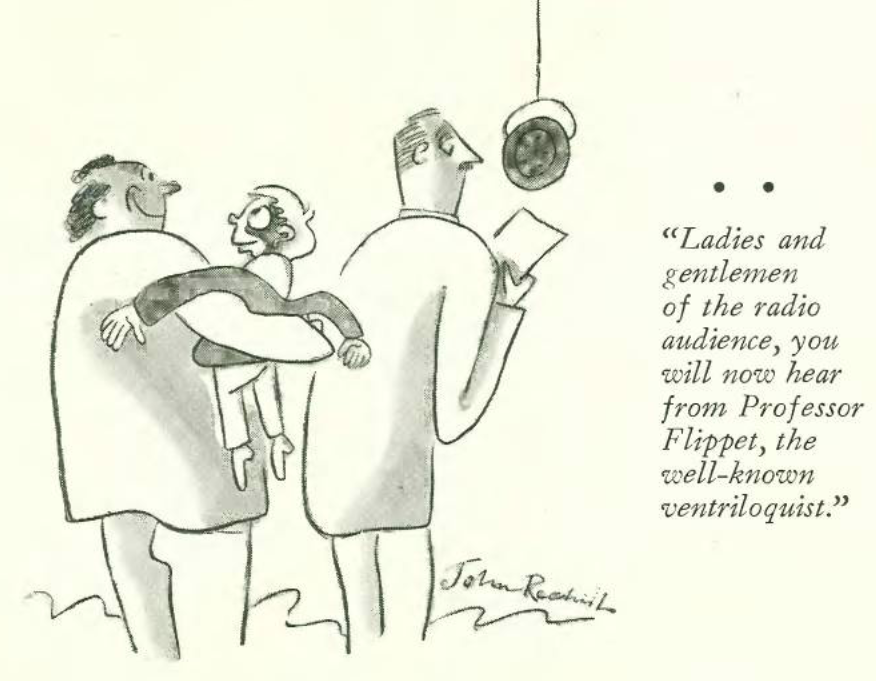
...John Reehill gave us a look at an unlikely radio act (however, from 1936 to 1956 ventriloquist Edgar Bergen and his dummy, Charlie McCarthy, would be hugely popular radio stars)…

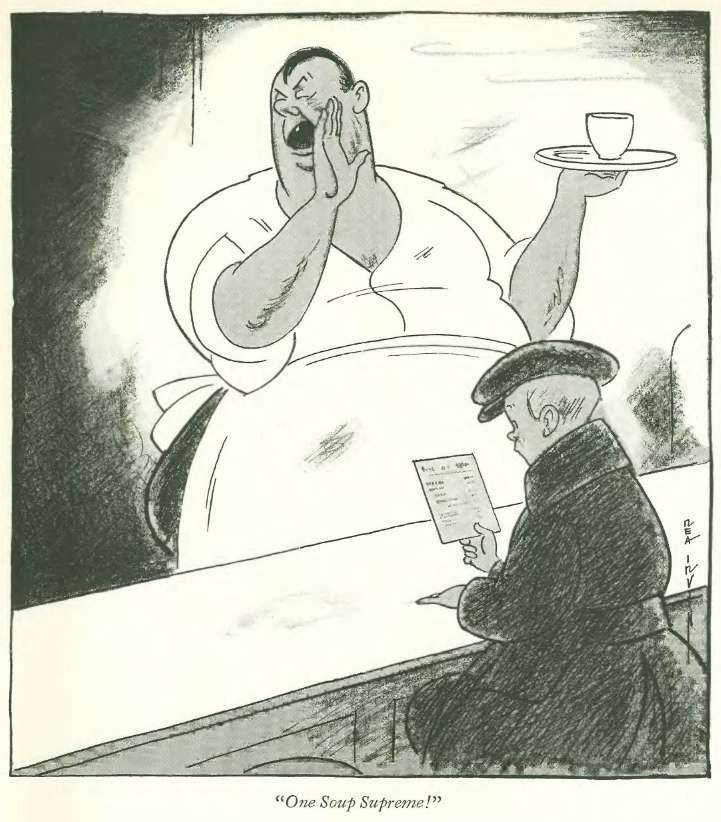
Rea Irvin paid a visit to the diner in this full-page cartoon…

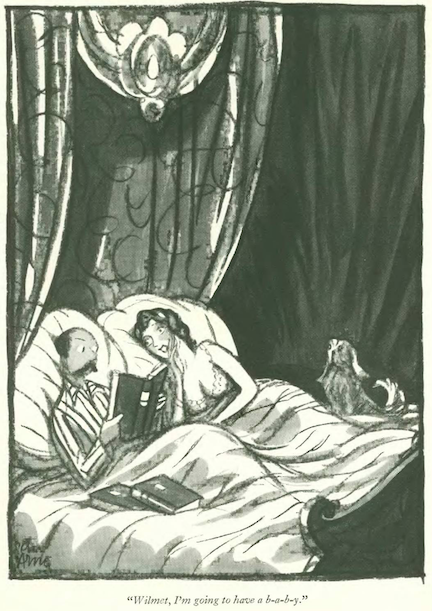
…and another full-page cartoon from Peter Arno, who looked in on an intimate moment…

Next Time: The Wickersham Sham…

The Road to 1931

The New Yorker entered its sixth year in 1931, and despite the deepening Depression managed to stay afloat and even gain new subscribers. Perhaps more than ever folks needed that weekly dose of levity the magazine ably supplied.

Rea Irvin rang out the old and welcomed the new with back-to-back covers for the Dec. 27, 1930 and Jan. 3, 1931 issues. The second cover commemorated the New York Auto Salon, mentioned later in this blog entry.

That isn’t to say the magazine’s contributors donned rose-colored glasses. Rather, they commiserated with their fellow Americans:

CRANKY COUPLETS…Ogden Nash lent his droll verse to the nation’s economic woes. In 1931, while working as an editor at Doubleday, Nash submitted a number of poems to the New Yorker and spent three months working on the magazine’s editorial staff. (poeticous.com)

Over the course of 1930 many Americans, including Ogden Nash, woke to the fact that their business and political leaders were ill-suited to lift them out of the economic mess, and were likely responsible for it in the first place. At the top of the list was President Herbert Hoover, who was profiled in The New Yorker in three installments beginning with the Dec. 27 issue. This brief excerpt gives you a glimpse into a very different White House 89 years ago:

The first installment of the profile was accompanied by a Cyrus Baldridge portrait of the president (left), but the final two installments featured a less-than-flattering Abe Birnbaum rendering that first appeared in The New Yorker in the March 2, 1929 issue:

*  *  *

Vorse Was a Force

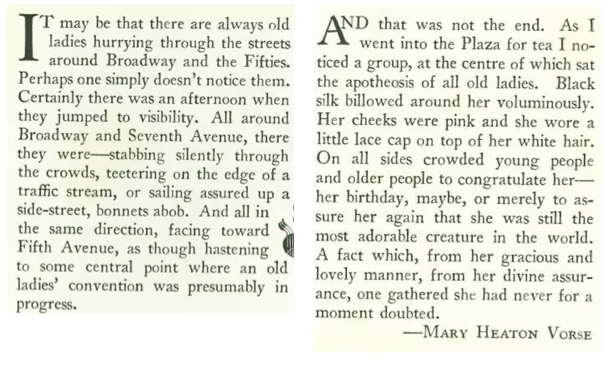
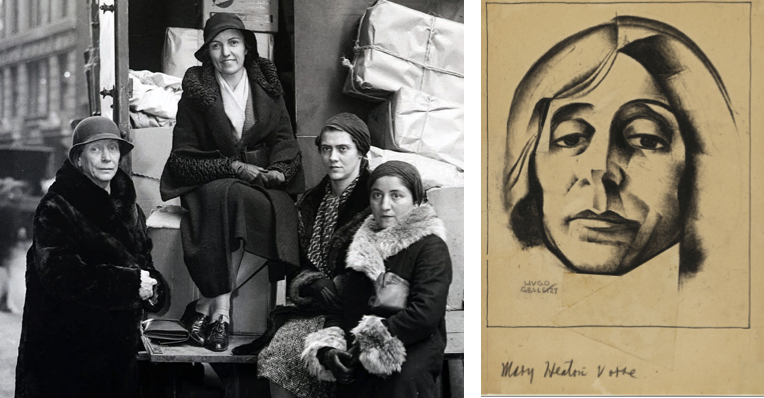
Social critic, labor activist and novelist Mary Heaton Vorse (1874–1966) was no fan of Herbert Hoover or wealthy business tycoons, and in the first decades of the 20th century joined with Lincoln Steffens and other muckraking journalists in advocating for social reform. Vorse, however, also had a background in fiction writing and in observational pieces like the one below (excerpts) in which she commented on the rustic old ladies she found everywhere in the city:

FOR THE CAUSE…Mary Heaton Vorse (left) with fellow activists preparing to leave on a relief expedition to aid striking Kentucky miners, 1932. At right, a 1925 drawing of Vorse by Hugo Gellert. (nysut.org/Smithsonian)

 *  *  *

The Mystic

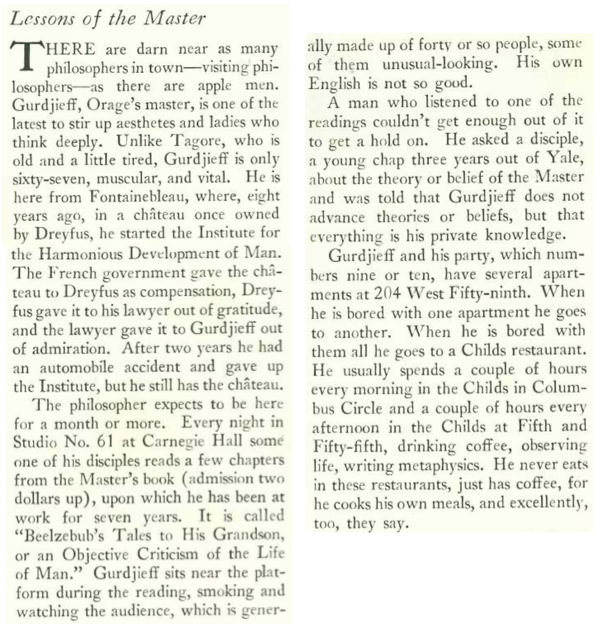
Before the Beatles made the Maharishi Mahesh Yogi a famed Transcendental Meditation guru in the 1960s, there was George Ivanovich Gurdjieff, a Russian/Greek/Armenian spiritual teacher of the “Fourth Way,” which promised a path to a higher state of consciousness and full human potential. Gurdjieff also enjoyed living in a French chateau and taking trips to New York to share his wisdom with eager Americans, including famed architect Frank Lloyd Wright. “The Talk of the Town” had these observations on the visiting mystic:

HE COULD SEE THINGS…George Ivanovich Gurdjieff, in an undated photo.

 *  *  *

Sunny Days

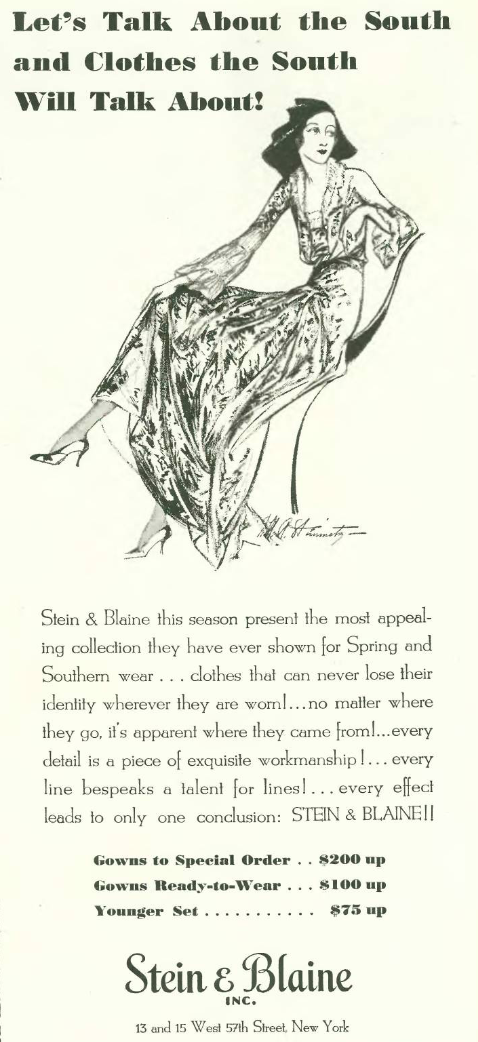
Forget about financial woes or spiritual dilemmas. What are you going to wear next summer? Fashion writer Lois Long (“On and Off the Avenue”) asked the question and looked to the south for some answers:

…numerous ads peppered the Dec. 27 issue urging Manhattan’s snowbirds to dress appropriately for the warmer climes…

…and operators of “PlaneTrains” promised to get them there as quickly as possible…

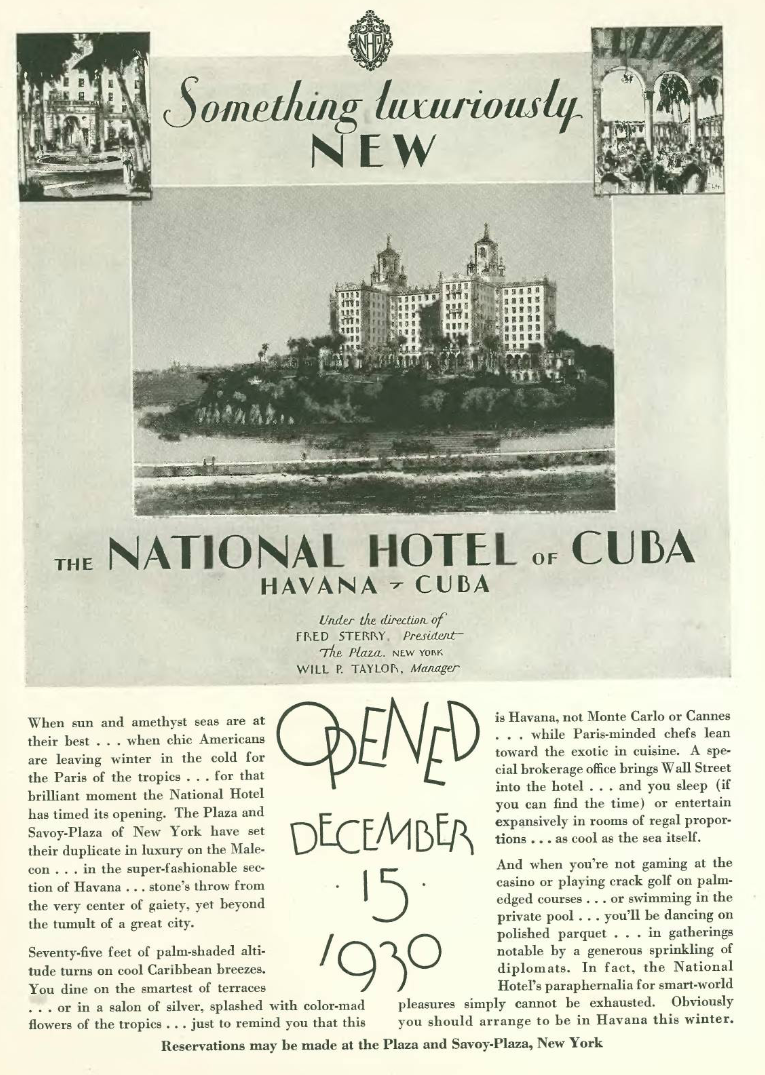
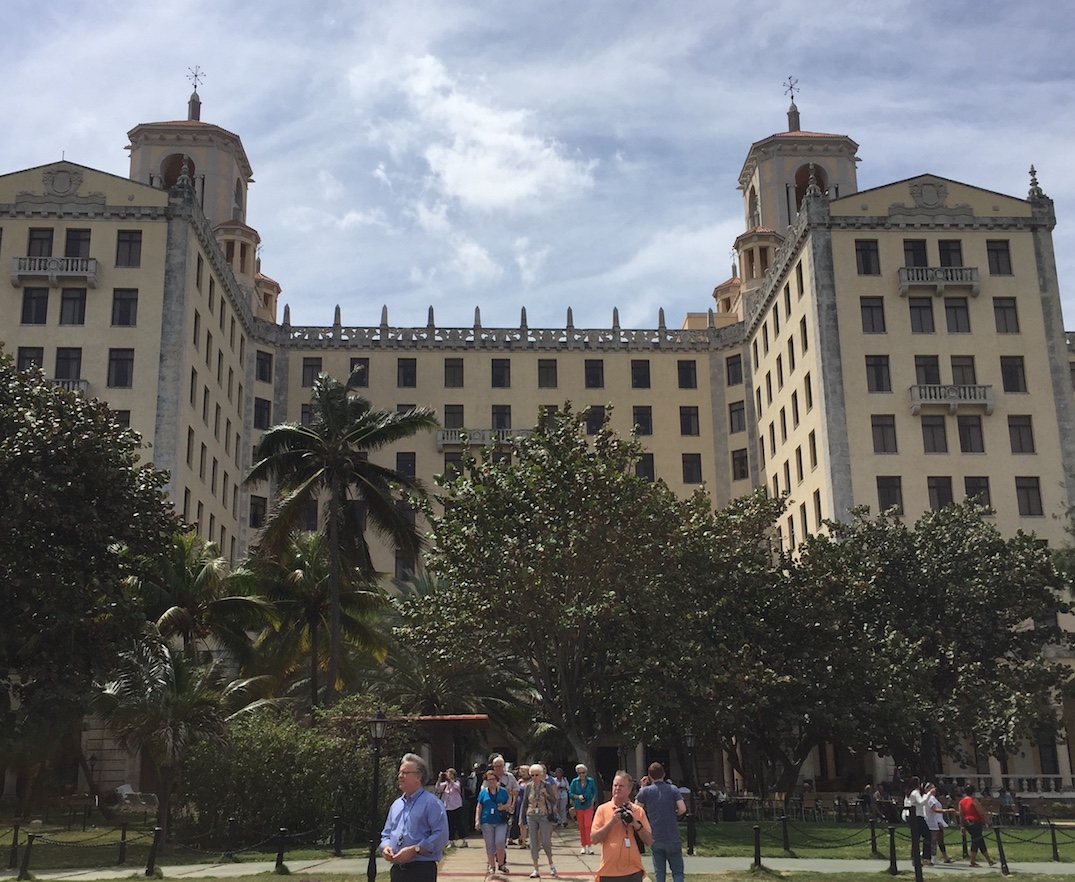
…and if you were headed to Cuba you could stay at the brand new National Hotel…

…here’s what it looked like three years ago when I was in Havana…I can guarantee you the hotel service was WAY better in 1931…

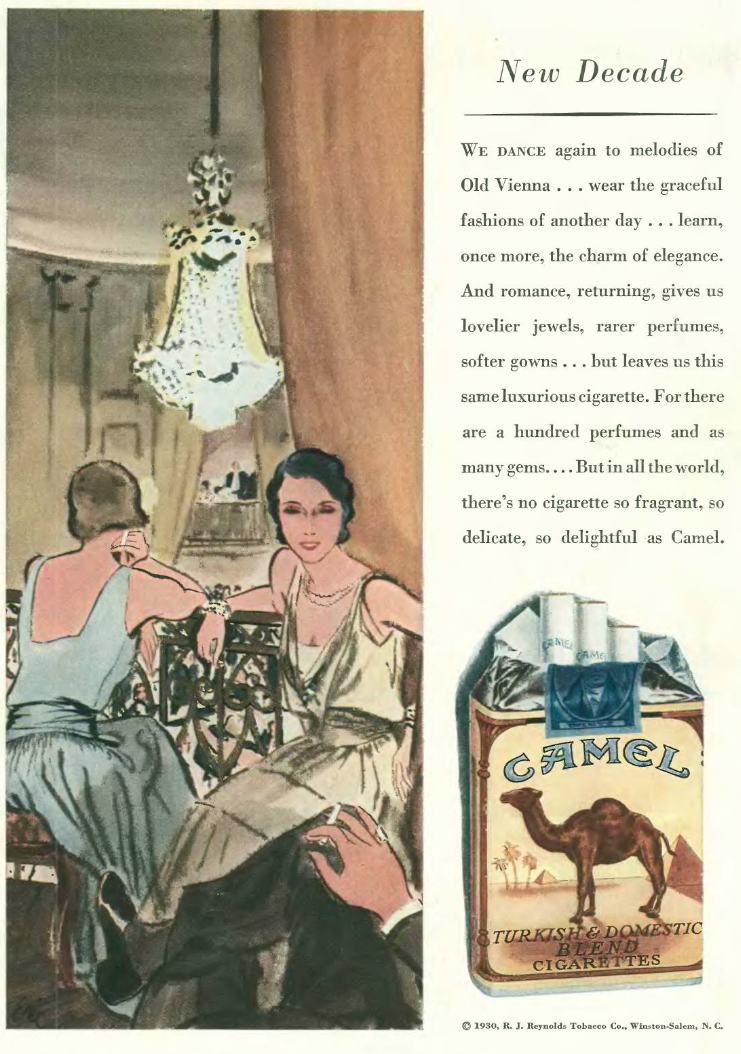
…whether home or abroad, New Yorkers were celebrating the New Year by “dancing to the melodies of Old Vienna” and smoking like chimneys…

…a popular New Year’s Eve destination was the The Roosevelt Hotel, where Guy Lombardo’s orchestra helped ring in the New Year from 1929 (radio’s first nationwide New Year’s Eve broadcast) to 1959…

I stayed at the Roosevelt Hotel in late December, and found Lombardo still presiding over the bar…

…we also find New Year’s revelry in the cartoons, with Mary Petty

Isadore Klein

Otto Soglow...

…and Leonard Dove

…and for those who stayed home, we have this scene of domestic bliss from Don Herold

 *  *  *

On to the Jan. 3, 1931 issue, we have Howard Brubaker (“Of All Things”) waxing sour on the state of the economy…

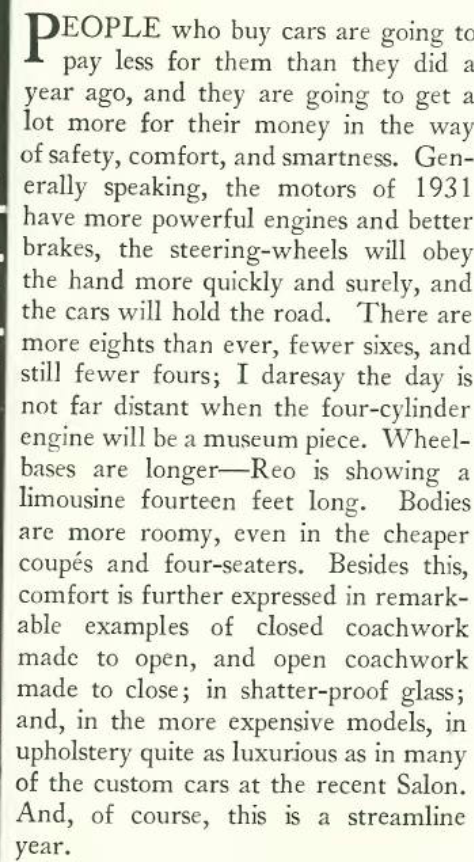
…so what a better way to cheer up than to look at shiny new cars, especially the ones almost no one could afford? The New Yorker paid another visit to the New York Automobile Salon at the Grand Central Palace…

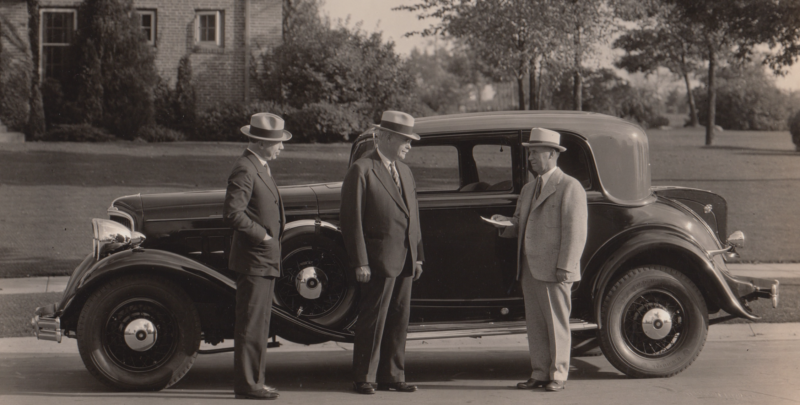
…according to the article, 1931 was “a streamline year,” and leading the way was the REO motor car company, which despite its innovative ways would drop its car line altogether in 1936 — a casualty of the Depression…

FLOWING FENDERS…The 1931 REO Royale was a trendsetter, introducing streamlining designs. The Great Depression would cause REO to abandon the manufacture of automobiles in 1936. (historicvehicle.org)

…over at the Chrysler Building, which served as that corporation’s headquarters from 1930 until the mid-1950s, new cars were on display on the building’s first two floors…

CATHEDRAL OF CARS…The first two floors of the Chrysler Building served as an auto showroom during the building’s first decade. (Wikipedia/thewelcomeblog.com)

…we segue to our advertisements, many from car companies touting their displays at the New York Automobile Salon. Like REO, Marmon was noted for various innovations, including the introduction of the rear-view mirror. It also manufactured a stunning 16-cylinder automobile that was on display at the 1931 Salon. But also like REO, the Depression proved too much for Marmon, and it was defunct by 1933…

SLEEK…The 1931 Marmon Sixteen. (RM Auctions)

…another car company that would fall to the Depression was the luxury brand Pierce Arrow. Without a lower-priced car in its lineup to provide cash flow, the company ceased operation by 1938…

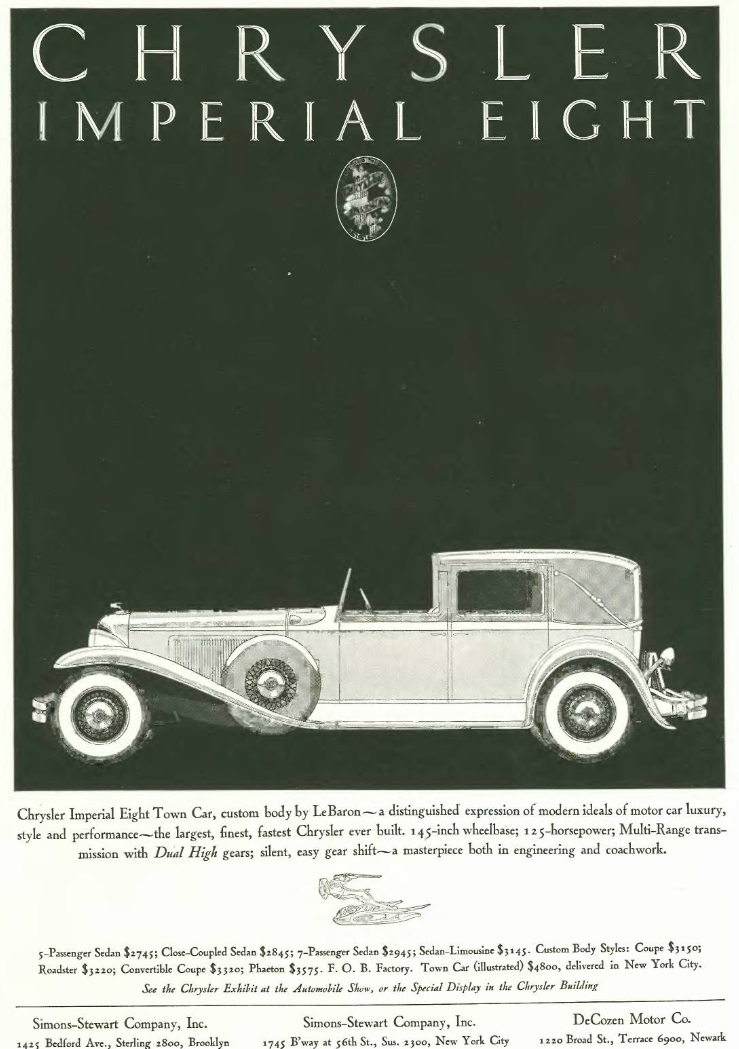
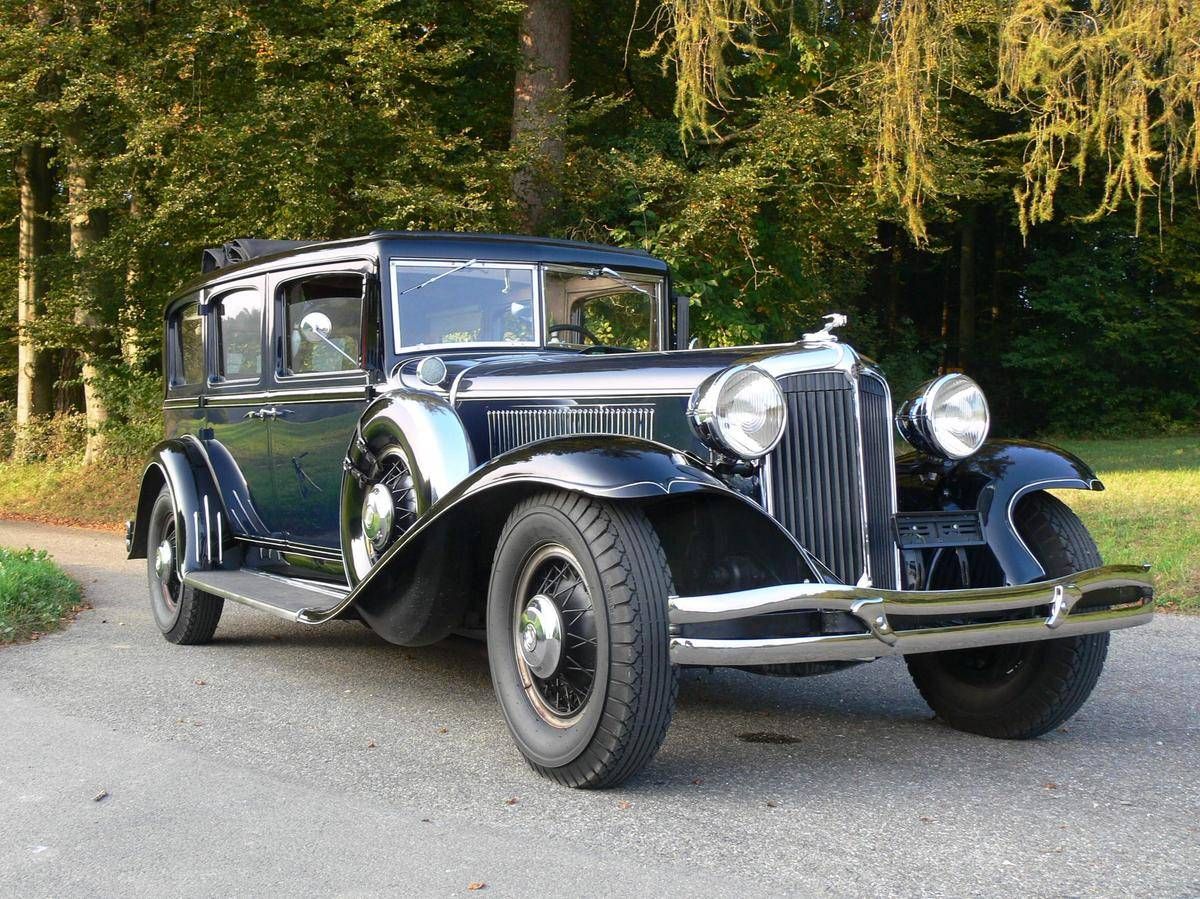
…by contrast, the Chrysler Corporation had several low-priced models to help it survive the lean years and enable it to produce its luxury model, the Imperial…

ANOTHER FIRST…Chrysler was also known for its innovative ways. A custom version of the Chrysler Imperial Eight included a dictaphone. (hemmings.com)

…the Hudson Motor Car Company is long gone, but in 1930 it was the third largest carmaker after Ford and Chevrolet, and instead of luxury it touted the affordability of its cars, especially its low-priced Essex line, priced $1,000 less than its predecessor from ten years earlier. The $595 Essex would be comparable to a $9,000 to $10,000 car today (by comparison, the 1931 Marmon or Imperial would set you back somewhere between $3,000 and $5,000, roughly equivalent to a $46,000 – $78,000 range today)…

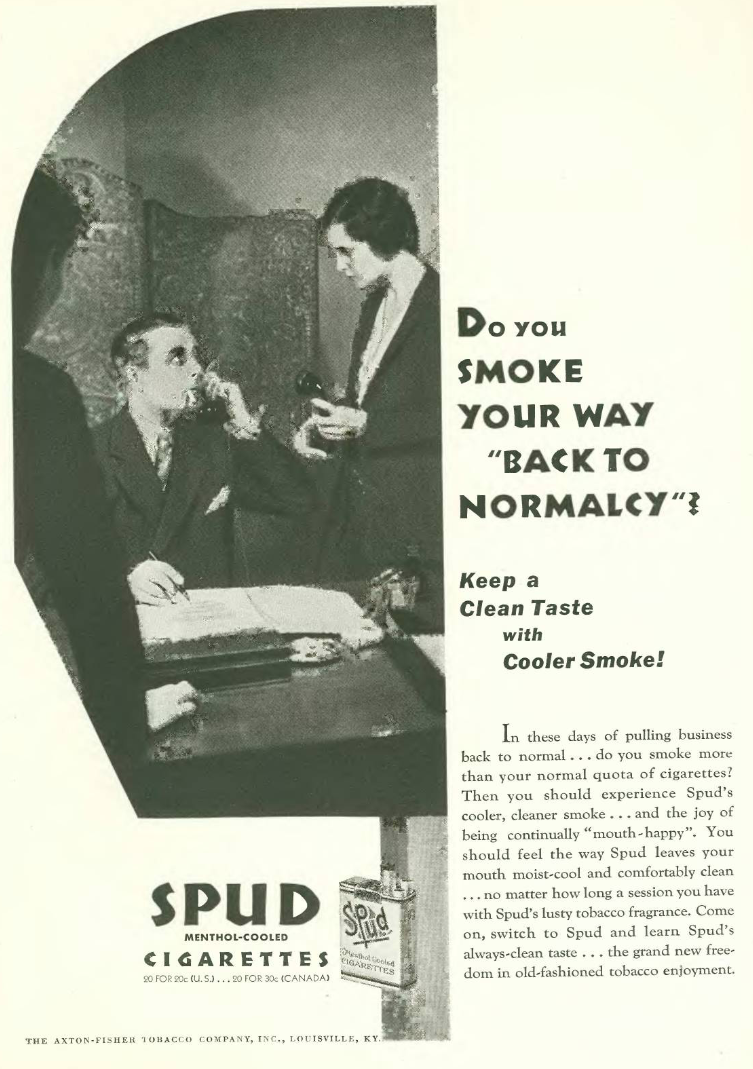
…so let’s say the Depression has wiped you out and you can’t even afford an Essex…well you could try to “smoke your way back to normalcy”…

…or be like this pair, who seem content with their Chesterfields…

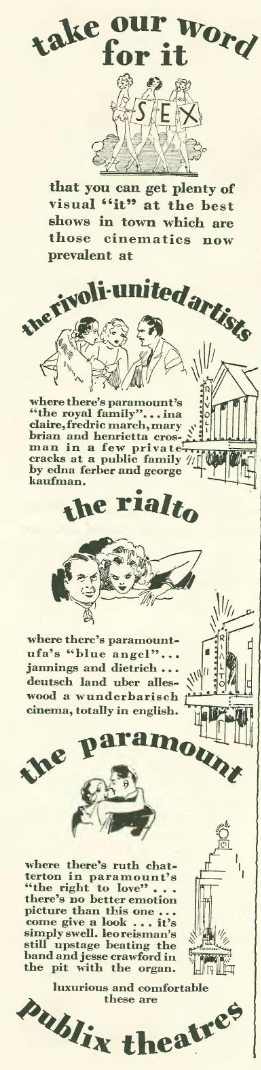
…of course the movies were another means of escape from the cruel world, and Paramount’s Publix Theatres promised plenty of sex to ease troubled minds…

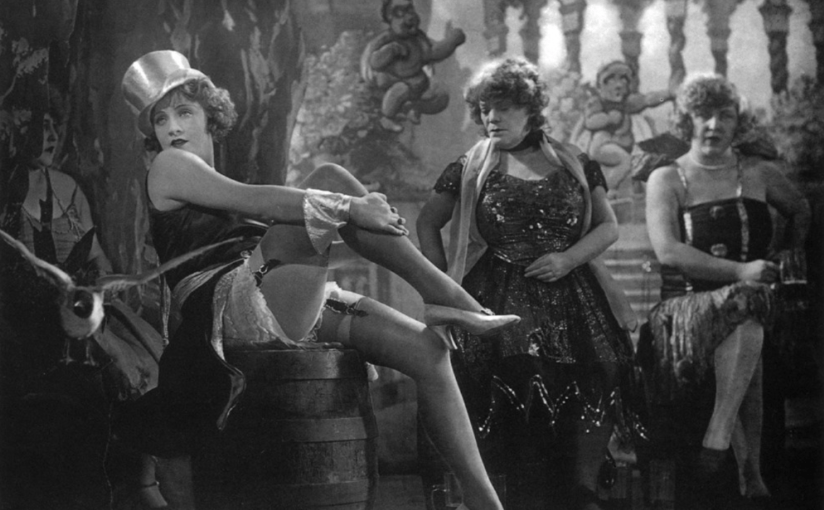
PRE-CODE WORLD…During a brief period of the early sound era, many films used both sex and violence to attract audiences to theaters. The Publix Theatres ad above implied that these three films had plenty of sex, or “it” — clockwise, from top left, Fredric March ran around in his skivvies in The Royal Family of Broadway (1930); Mary Brian and Ina Claire portrayed acting sisters Gwen and Julie Cavendish in The Royal Family of Broadway; David Manners and Ruth Chatterton shared an embrace in The Right to Love (1930); and Marlene Dietrich lured a schoolmaster into a life of madness and despair in The Blue Angel (1929-30).

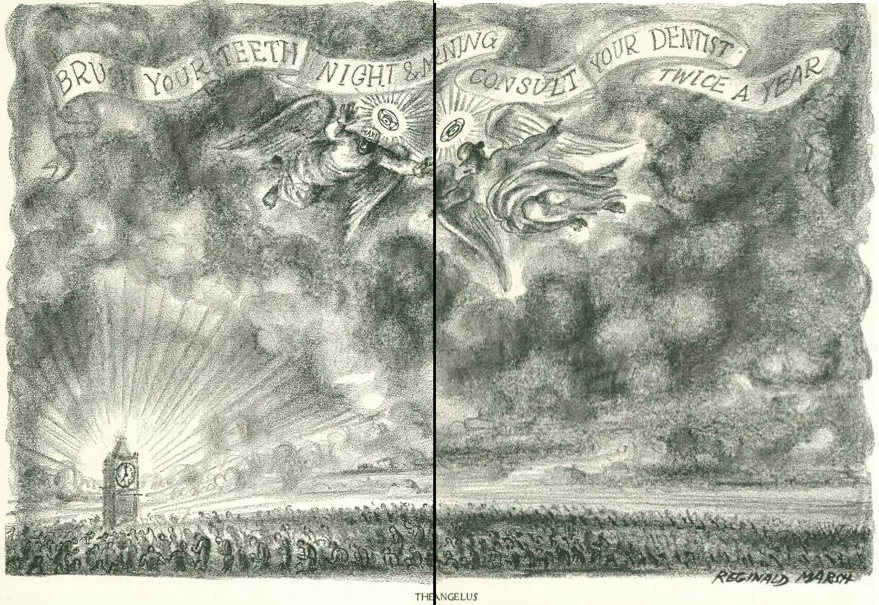
…and we close with our cartoonists…Reginald Marsh heralded the new year with this two-page spread depicting the heavens glorifying dental hygiene…

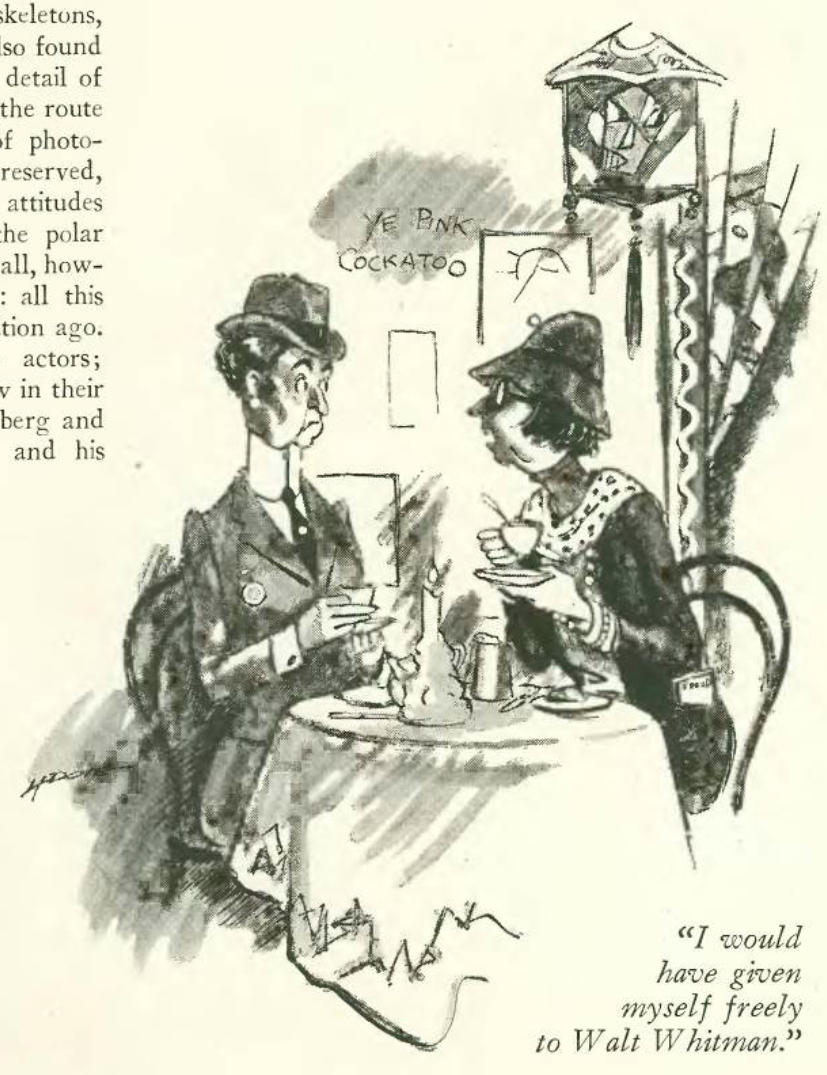
Leonard Dove inked two cartoons featuring table talk…

E. McNerney continued The New Yorker tradition of cartoons featuring sugar daddies and gold diggers…

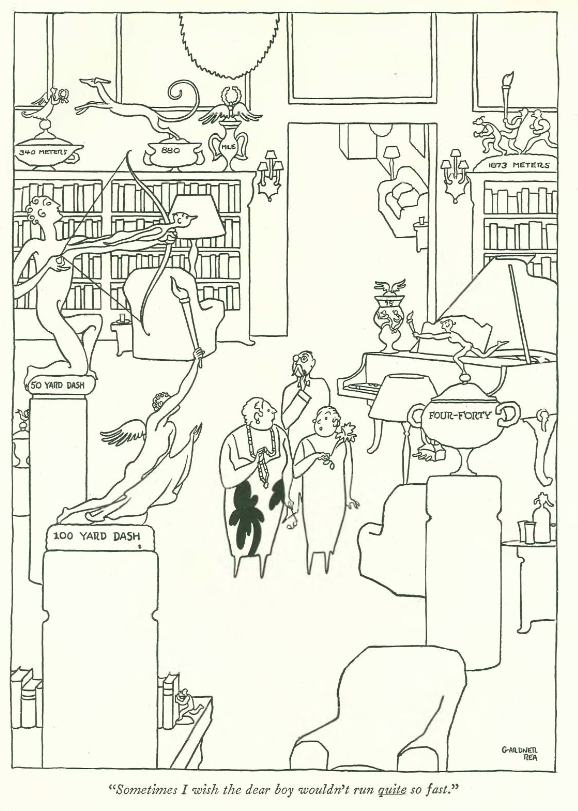
Gardner Rea pondered the value of kitsch in a regal setting…

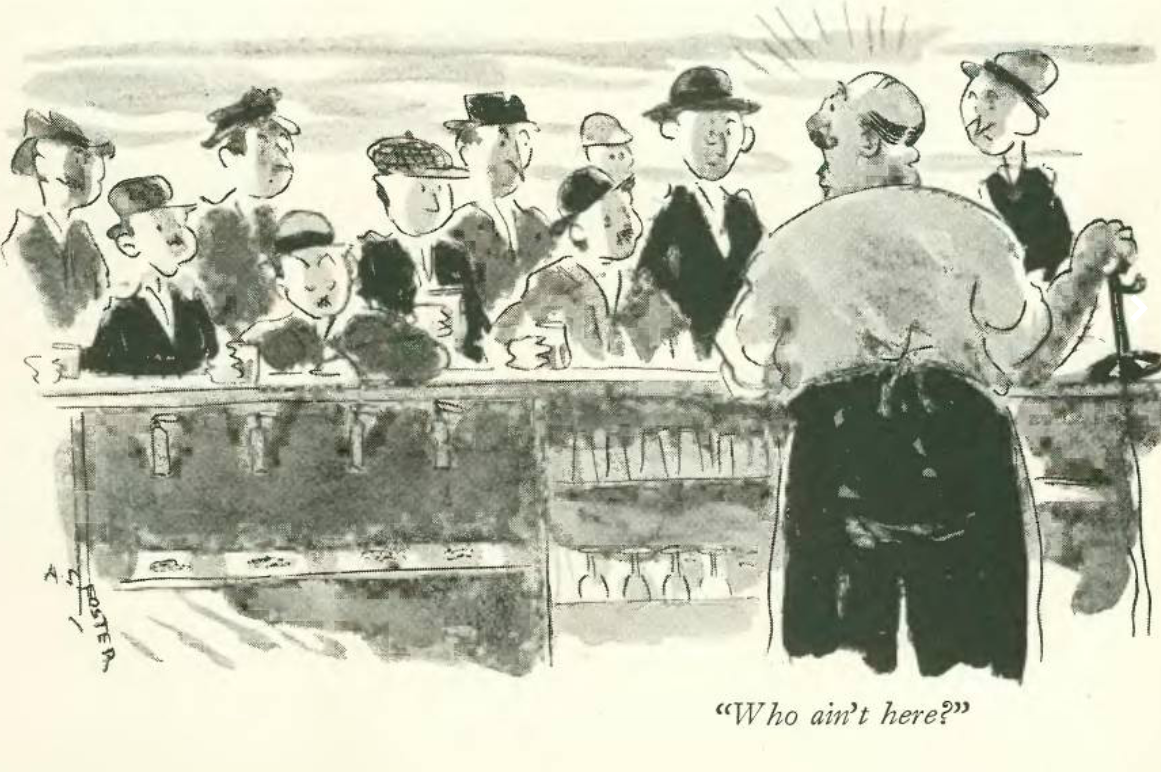
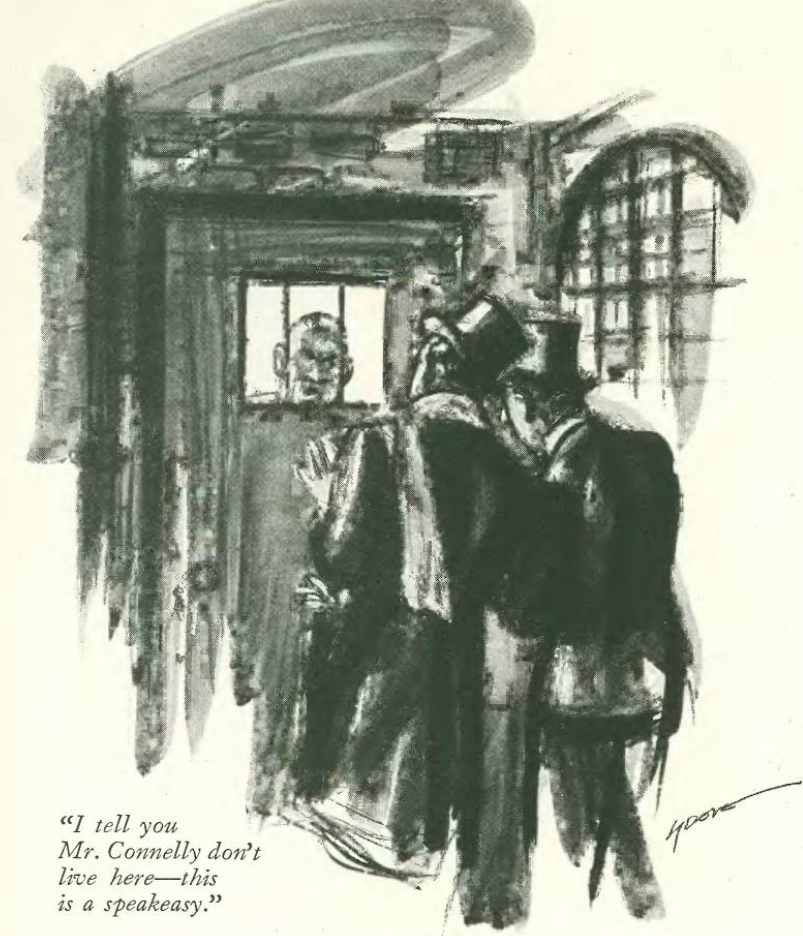
A.S. Foster looked in on a crowd of John Does at a speakeasy…

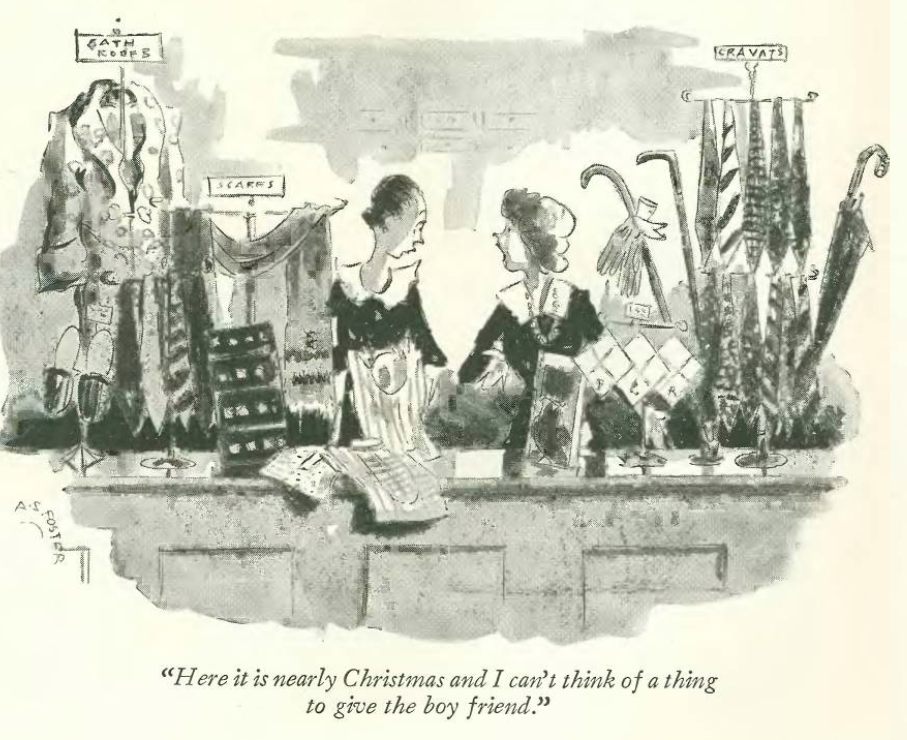
…and Lillian Reed took us shopping with a very specific request…

Next Time: Requiem For the Flapper…


A Blue Angel

The German actor Emil Jannings was well-known to American audiences when The Blue Angel (Der blaue Engel) premiered at New York’s Rialto Theatre. Although the film was created as a vehicle for the Academy Award-winning Jannings (he won the Academy’s first-ever best actor award in 1929), it was the little-known Marlene Dietrich who stole the show and made it her ticket to international stardom.

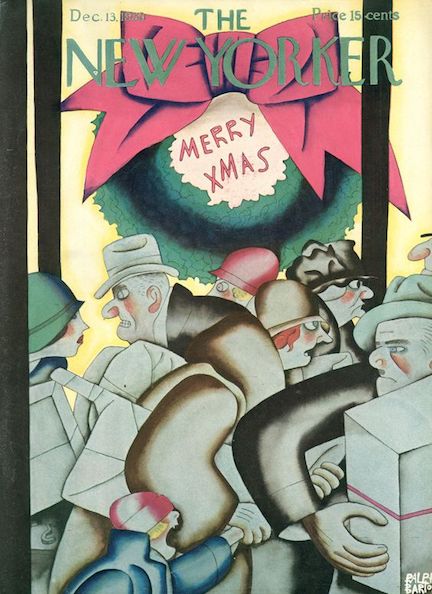
Dec. 13, 1930 cover by Ralph Barton, surprisingly his only cover for The New Yorker. The illustration sadly belies Barton’s state of mind at the time; he would take his own life the following spring.

New Yorker film critics, including John Mosher, generally found foreign films, particularly those of German or Russian origin, to be superior to the treacle produced in Hollywood, and Jannings was a particular favorite, delivering often heart-wrenching performances in such silent dramas as The Last Laugh (1924) and The Way of All Flesh (1927). In those films he depicted once-proud men who fell on hard times, and such was the storyline for The Blue Angel, in which a respectable professor falls for a cabaret singer and descends into madness.

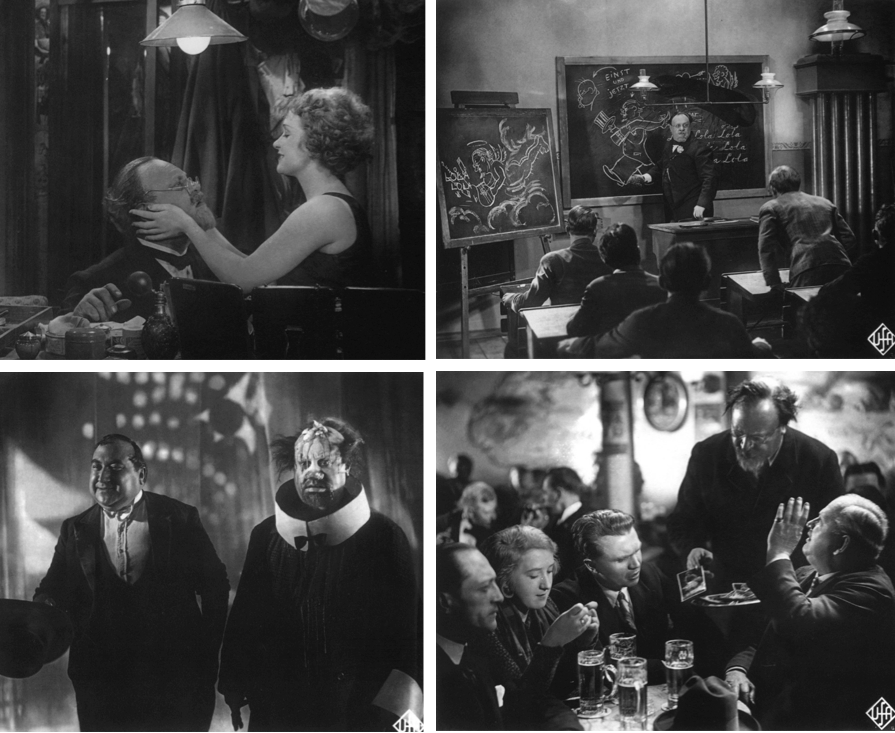
NO CONTEST…Emil Jannings had star billing for the English language version of Josef von Sternberg’s The Blue Angel, but it was Marlene Dietrich’s portrayal of cabaret singer Lola Lola that stole the show. (IMDB)

I was surprised by Mosher’s somewhat tepid review of this landmark film, which was shot simultaneously in German and English (with different supporting casts in each version). He referenced “bum dialogue,” which was doubtless the result of German actors struggling with English pronunciations. Filmed in 1929, it is considered to be Germany’s first “talkie.”

PRIDE BEFORE THE FALL…A proud and stern schoolmaster named Immanuel Rath (Emil Jannings) falls for cabaret singer Lola Lola (Marlene Dietrich), and from there his life unravels; he loses the respect of his pupils, then resigns his post to marry Lola. To make ends meet, Rath tries to sell racy photos of his wife, and then becomes a clown in her troupe and is regularly humiliated on stage. Destitute, he dies at the end of the film. (IMDB)

 *  *  *

All Wet

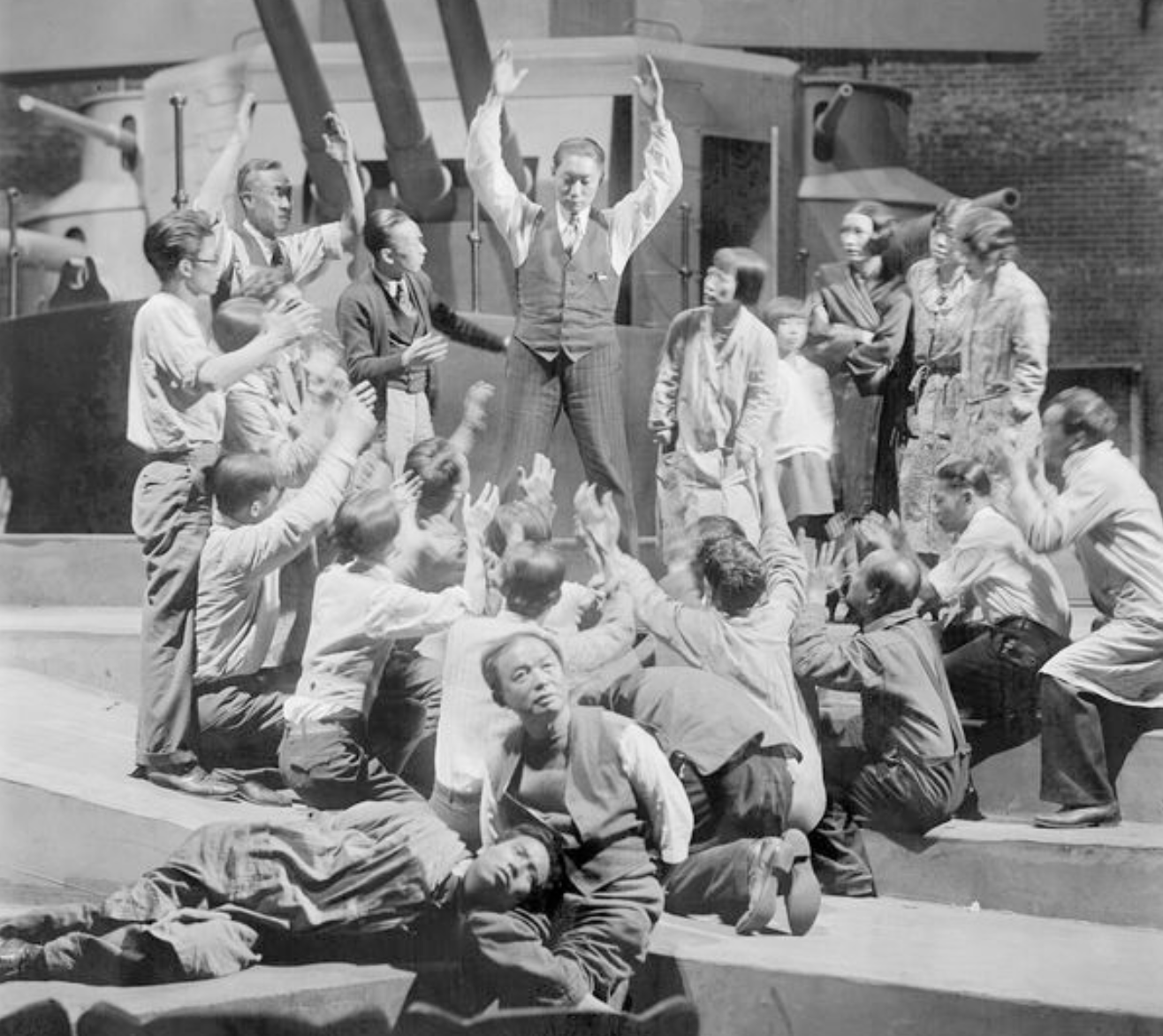
Sergei Tretyakov’s avant-garde play Roar China made an impression on The New Yorker for the striking realism of its set, which featured an 18,000-gallon tank of water onstage at the Martin Beck Theatre. “The Talk of the Town” described some of the demands of the production:

STAYING AFLOAT…The elaborate set for Roar China featured a model battleship in 18,000 gallons of water.
ROAR CHINA! was an anti-imperialist play depicting the Wanhsien Incident during the Chinese Civil War. Many in the Chinese cast members were non-professional actors. (New York Public Library)

  *  *  *

By Any Other Name

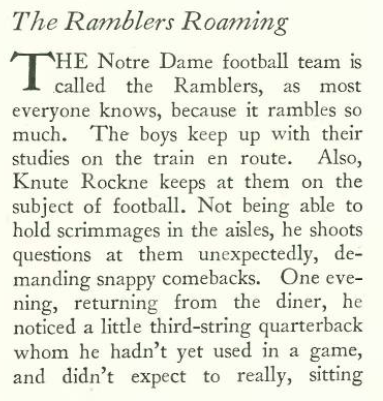
Like many college football teams in first decades of the 20th century, Notre Dame was referred to by a number of nicknames, including the “Fighting Irish.” In this “Talk of the Town” item, however, the team was known as the “Ramblers.” According to the University of Notre Dame, this nickname (along with “The Rovers”) was considered something of an insult: “(Knute) Rockne’s teams were often called the Rovers or the Ramblers because they traveled far and wide, an uncommon practice before the advent of commercial airplanes. These names were also an insult to the school, meant to suggest it was more focused on football than academics.”

RAMBLERS NO MORE…The 1930 National Champion Notre Dame football team. (nd.edu)

 *  *  *

The Wright Stuff

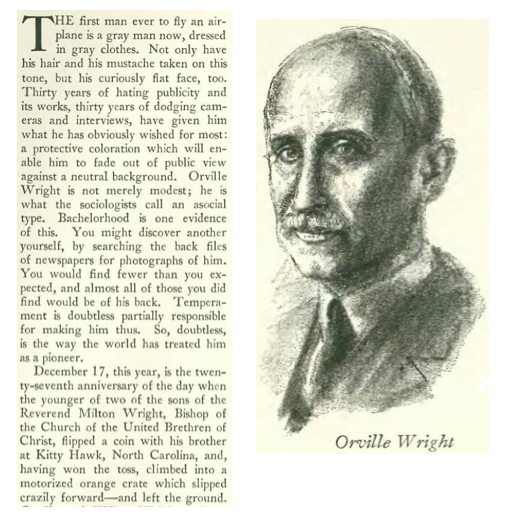
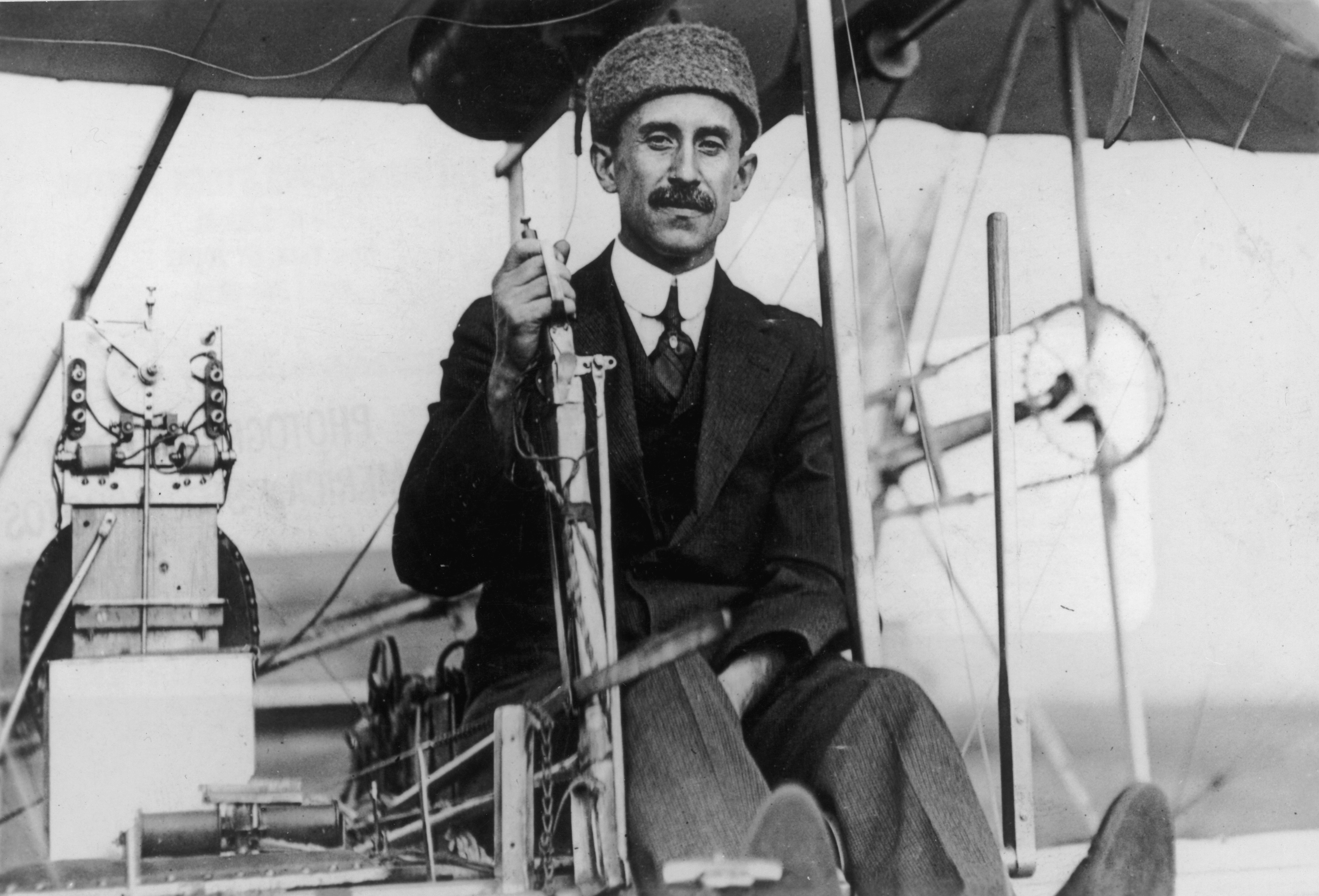
Eric Hodgins penned a profile of aviation pioneer Orville Wright, who just 27 years earlier made a historic “first flight” with his brother, Wilbur, at Kitty Hawk, North Carolina. An excerpt:

DRESSED FOR SUCCESS: Aviation pioneer Orville Wright (1871 – 1958) sits in one of his biplanes dressed in a three-piece suit and a cap, Dayton, Ohio, 1909. (ge.com)

 *  *  *

No Love Parade, This

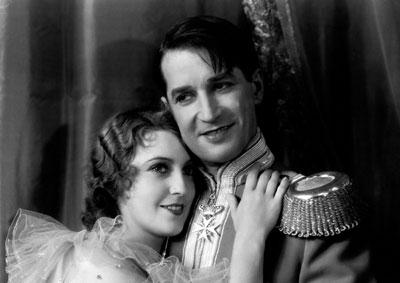
French singer and actor Maurice Chevalier made his Hollywood debut in 1928 and quickly soared to stardom in America. French audiences, however, were not so easily swayed, especially the elite patrons Chevalier faced, alone on the stage, at the cavernous Théâtre du Châtelet. Janet Flanner explained in this dispatch from Paris:

THEY LIKE ME IN TINSELTOWN…Jeanette MacDonald and Maurice Chevalier in The Love Parade (1929). (IMDB)
GULP…Maurice Chevalier faced a tough crowd — his compatriots — at Paris’s Théâtre du Châtelet. (en.parisinfo.com)

 *  *  *

Man’s Best Friend

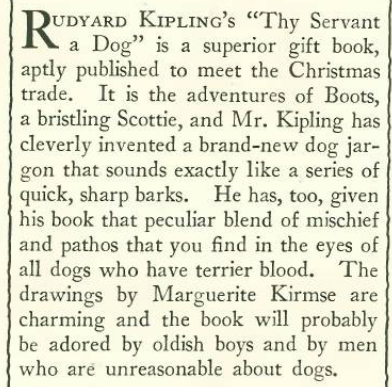
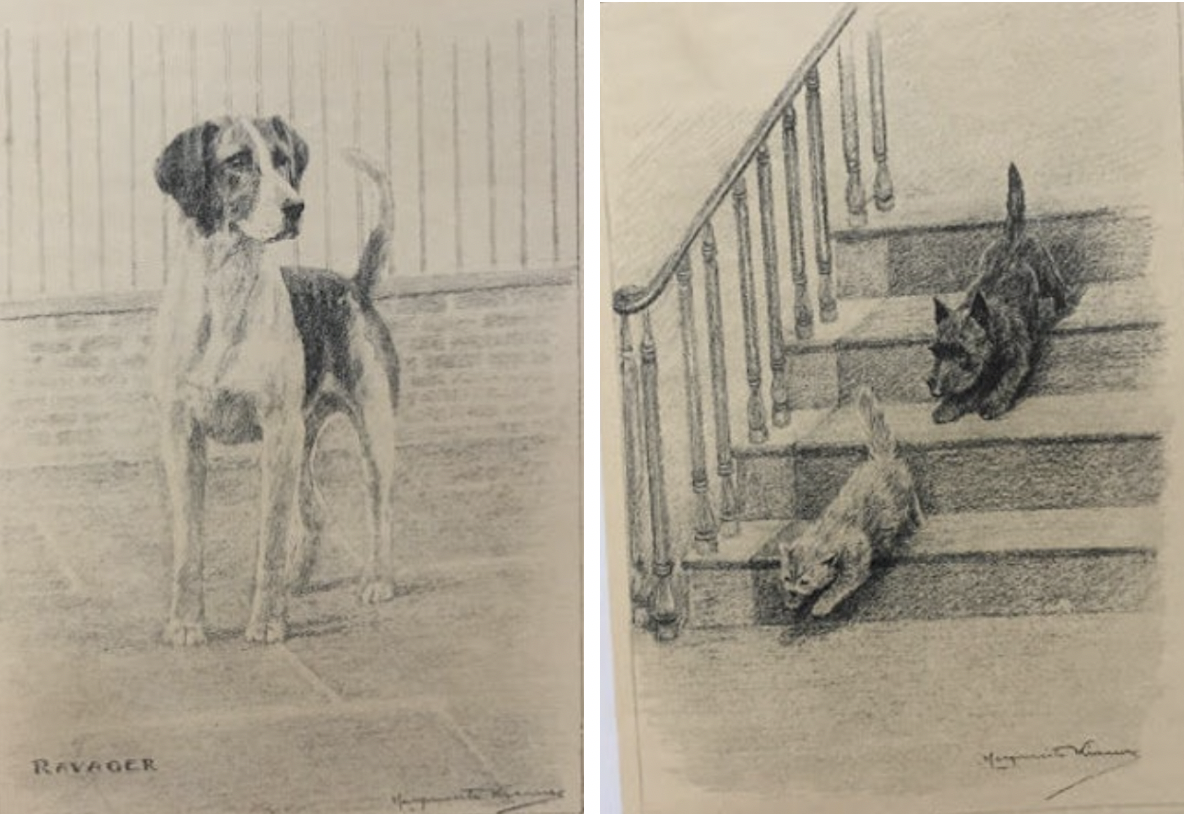
The New Yorker’s book section recommended the latest from Rudyard Kipling, Thy Servant a Dog…

WOOF…Illustrations for Rudyard Kipling’s Thy Servant a Dog, by Marguerite Kirmse. (Etsy)

 *  *  *

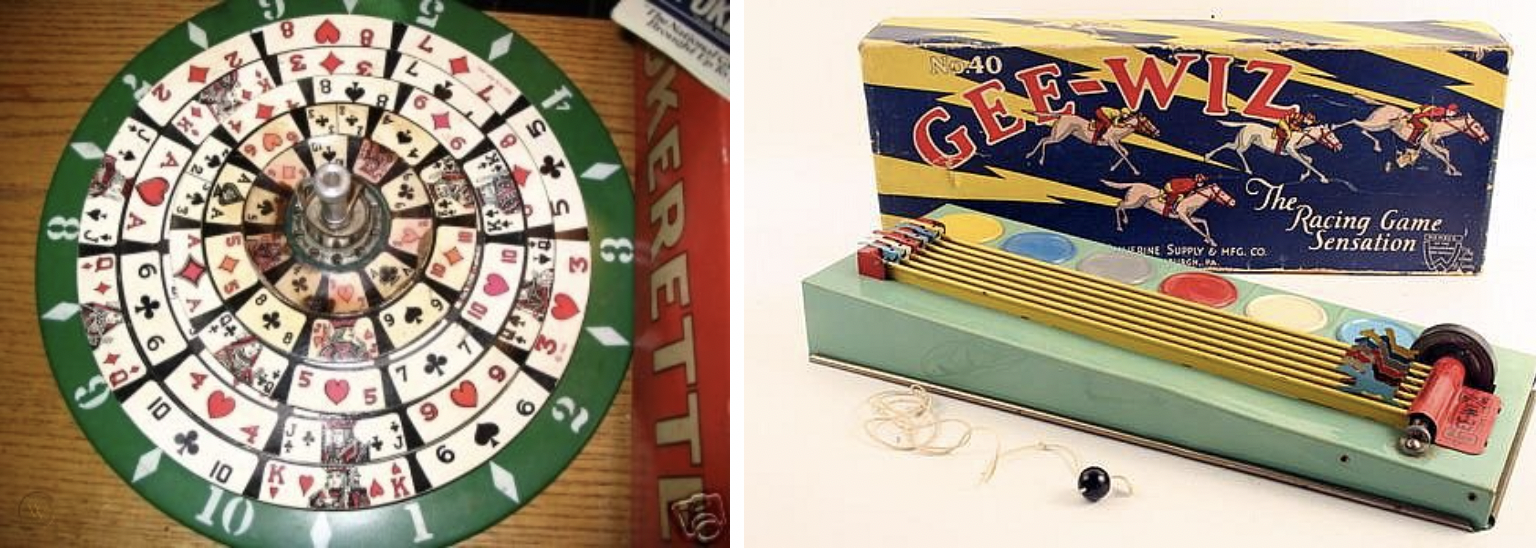
Fun and Games

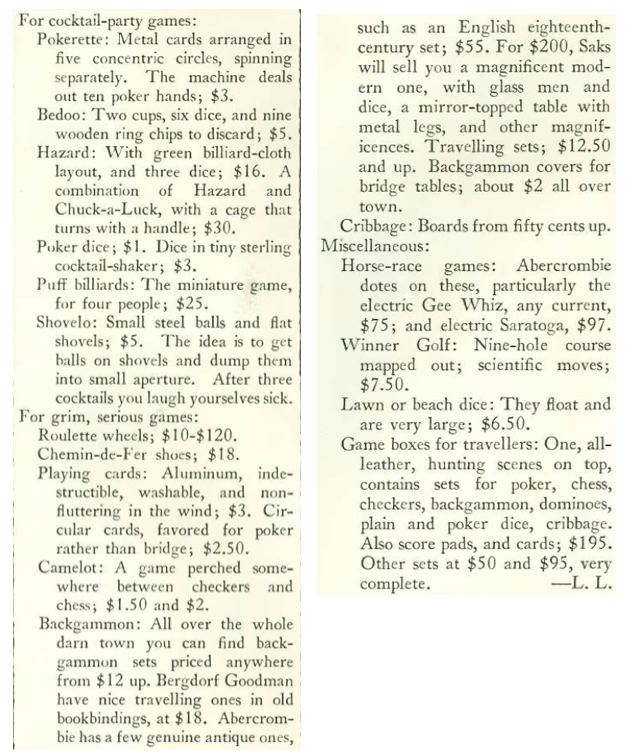
As an extension to her fashion column, Lois Long shared some recommendations for holiday cocktail-party games:

KEEPING THINGS MERRY…Pokerette and Gee-Wiz were popular cocktail party diversions during the Christmas season of 1930. (Worthpoint/Invaluable)

*  *  *

From Our Advertisers

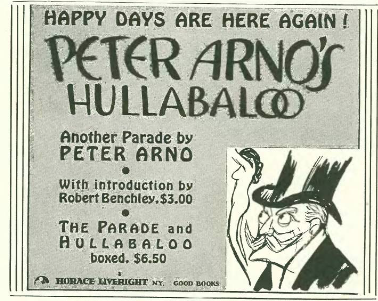
We start with this ad from Horace Liveright promoting Peter Arno’s third cartoon collection, Hullaballoo, featuring one of Arno’s leering old “Walruses”…

…Doubleday Doran offered a few selections for last-minute Christmas shoppers, led by the Third New Yorker Album

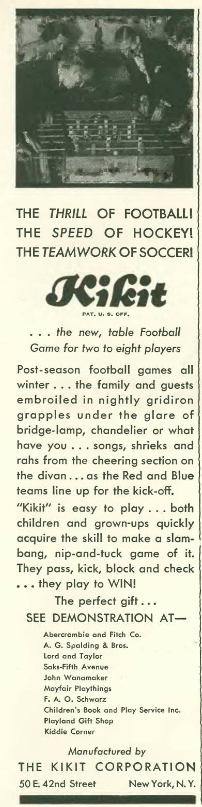
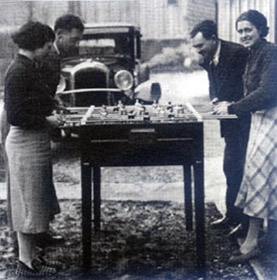
…The UK’s Harold Searles Thorton invented the table top game we now call “foosball” in 1921 and had it patented in 1923. Below is possibly the game’s first appearance in the U.S. — an ad for a “new” game called “Kikit.” Foosball would be slow to catch on, but would rapidly gain popularity in Europe in the 1950s and in the U.S. in the 1970s…

Early foosball players circa 1930. (foosball.org)

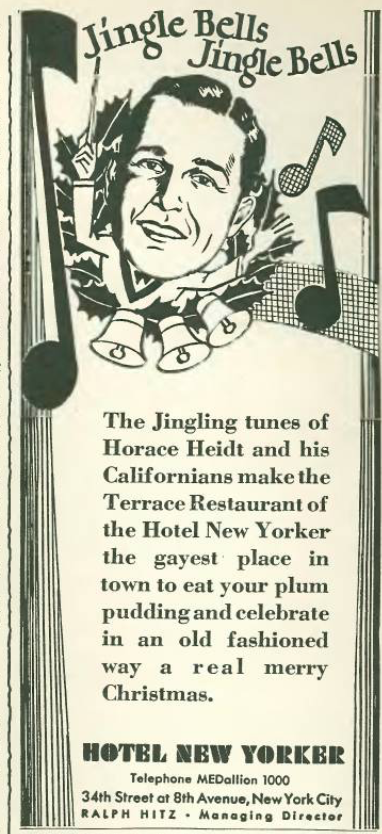
Horace Heidt and his Californians were doing their best to make the season bright at the Hotel New Yorker…

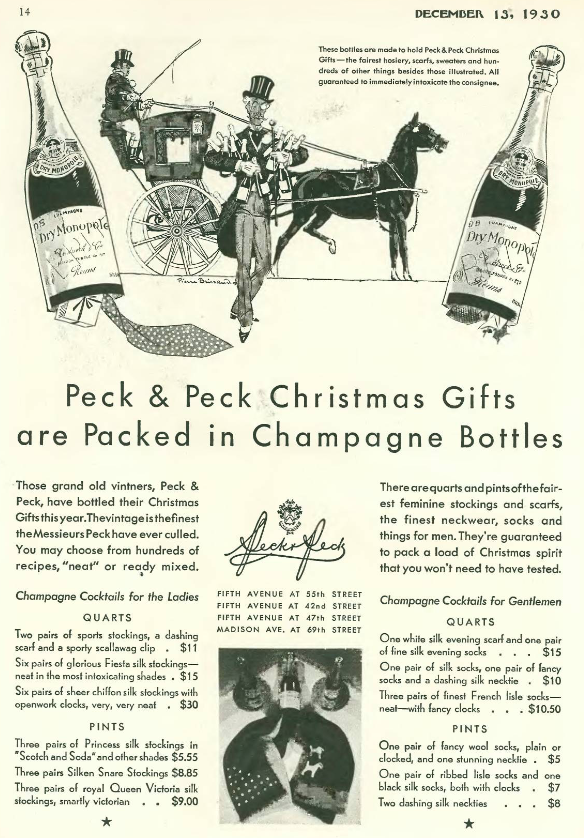
…Peck & Peck tried to make the most of Prohibition by stuffing scarves and other wares into empty Champagne bottles…

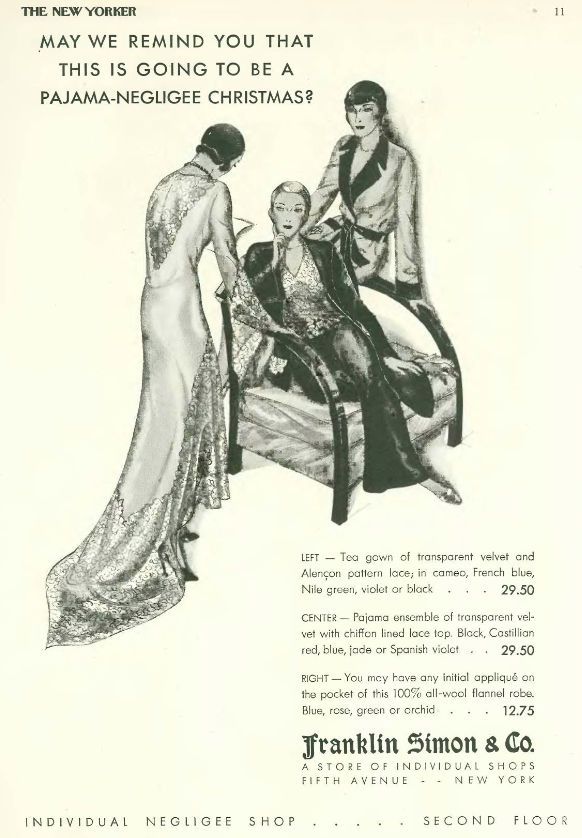
…and Franklin Simon reminded readers that it would be a “Pajama-Negligee Christmas,” whatever that meant…

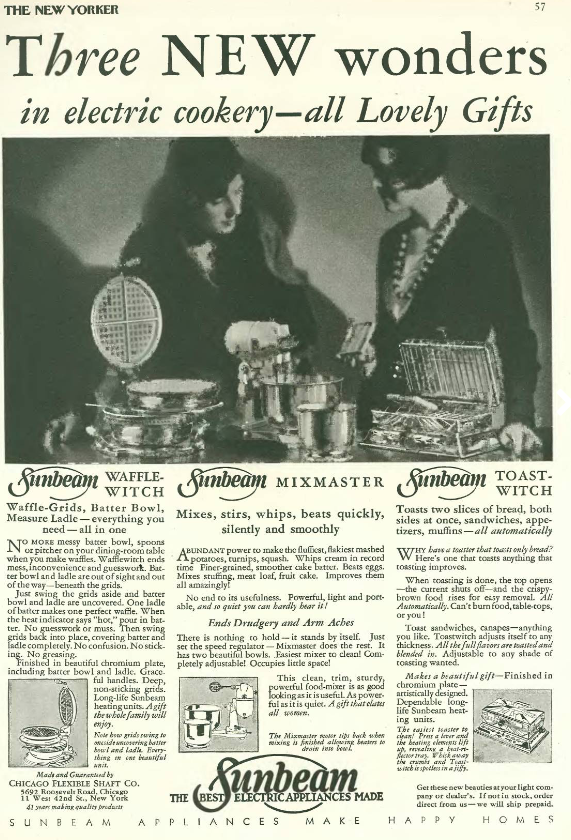
…pajamas and negligees were doubtless preferable, and more romantic, than this array of kitchen appliances…

…whatever the holiday revelry, the makers of Milk of Magnesia had our backs…

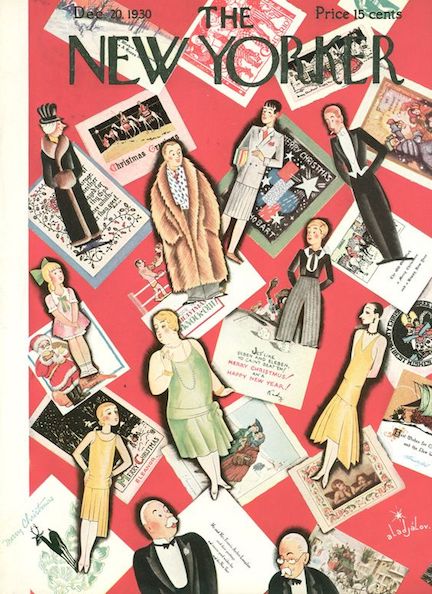
…on to our cartoonists, Julian De Miskey and Constantin Alajalov contributed spot drawings to mark the season…

A.S. Foster contributed two cartoons to the issue…

Gardner Rea, a full-pager…

Leonard Dove, possibly having some fun with playwright Marc Connelly

Isadore Klein demonstrated the fun to be had with a kiddie scooter, before they had motors…

…and we close with John Reynolds, and some bad table manners…

Next Time: Happy Holidays…


The High Place

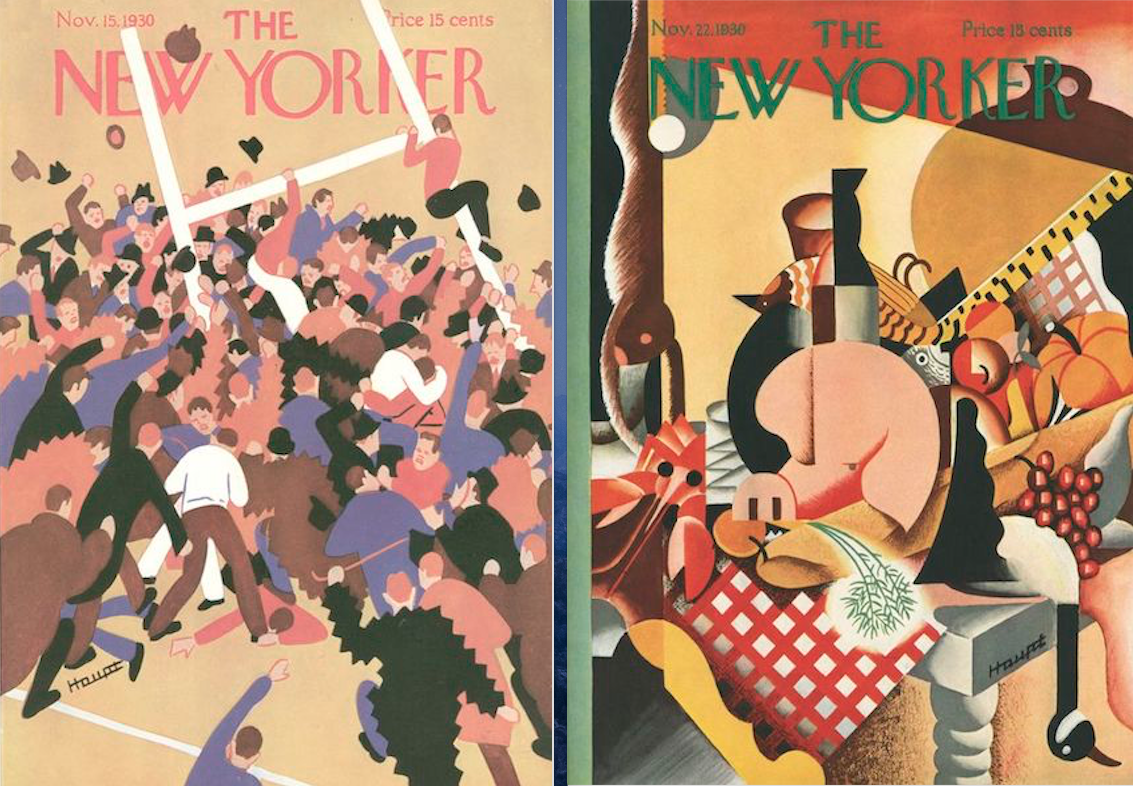
For this installment we look at two issues, Nov. 15 and 22, both featuring covers by Theodore Haupt that celebrated two autumn rituals: football and Thanksgiving.

Let’s begin with the Nov. 22 issue, which climbed to the highest place in Manhattan — no, not the Chrysler Building, but the nearby Empire State Building — with E.B. White admiring the commanding view:

Before the Empire State Building could go up, the old Waldorf-Astoria hotel had to come down. As White observed, the old hotel was built so soundly that it was too costly to deconstruct and salvage. Most of it ended up on the bottom of the ocean.

DOWN IN DAVY JONES’ LOCKER lie the remains of the old Waldorf-Astoria Hotel, which stood for just 36 years before it was razed to make room for the Empire State Building. At right, one of the hotel’s lobbies, and the Grand Ballroom. (nyc-architecture.com/Pinterest)
A LOT OF HOT AIR…Top images: The fabled “mooring mast,” described by E.B. White in his New Yorker brief, as imagined in composite images (old-time Photoshop). In reality, the morning mast never worked; bottom right, a cutaway view of the mast featured in Popular Mechanics; bottom left, New York Times photo from March 22, 1931, announcing the completion of the Empire State Building, just 17 months after the Waldorf-Astoria began coming down. (Keith de Lellis Gallery, rarehistoricalphotos.com/Google Books/The New York Times)
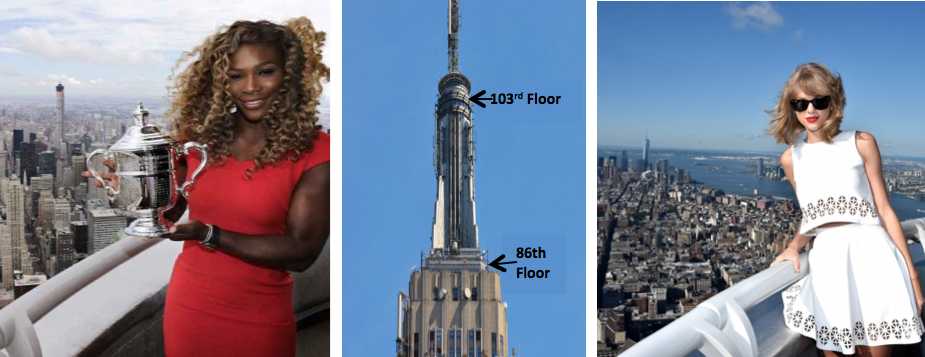
SURVEYING THEIR KINGDOM…Most visitors to the Empire State Building can only go as high as the 86th floor observation deck. However, if you are a VIP like Serena Williams or Taylor Swift, you can get your picture snapped on the 103rd. (Associated Press/Empire State Building/Evan Bindelglass, CBSNewYork)

*  *  *

Sore Winner

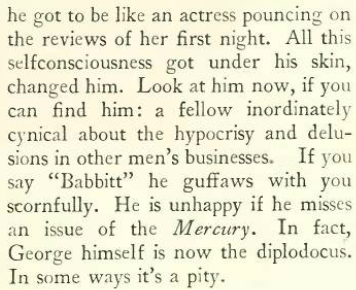
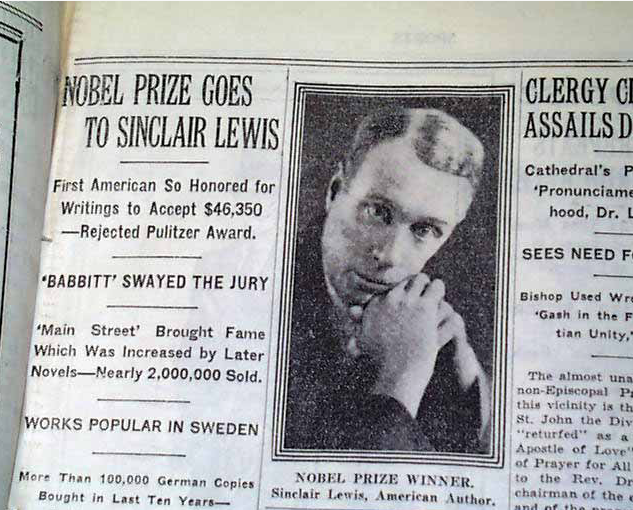
Sinclair Lewis famously declined the Pulitzer Prize for his 1925 novel Arrowsmith, upset that his 1920 novel Main Street had not previously won the prize. But when the Swedish Academy came calling with a Nobel Prize in Literature in 1930, he happily accepted. According to “The Talk of the Town,” this award also seemed a bit tardy, since Lewis’s small town booster archetype, George F. Babbitt, did not fit the dour days of the Great Depression. But it turned out that the 1922 novel Babbitt was ultimately what swayed the Nobel jury:

BOOST FROM A BOOSTER…George F. Babbitt helped make Sinclair Lewis famous, and landed him a Nobel. (NYT, NOVEMBER 6, 1930)

 *  *  *

Not So Sweet

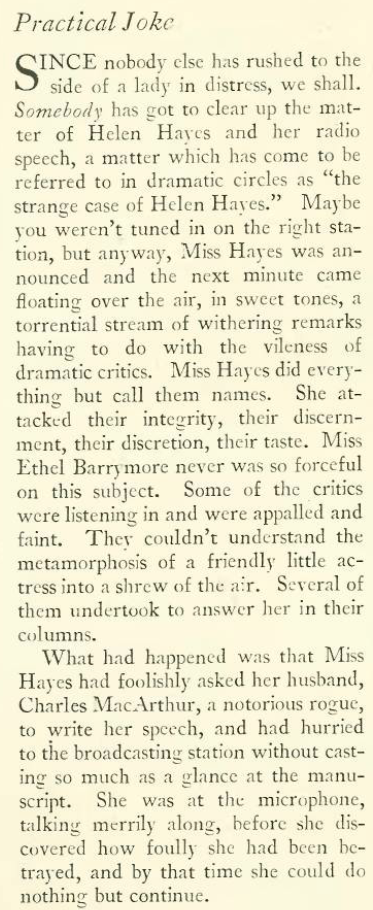
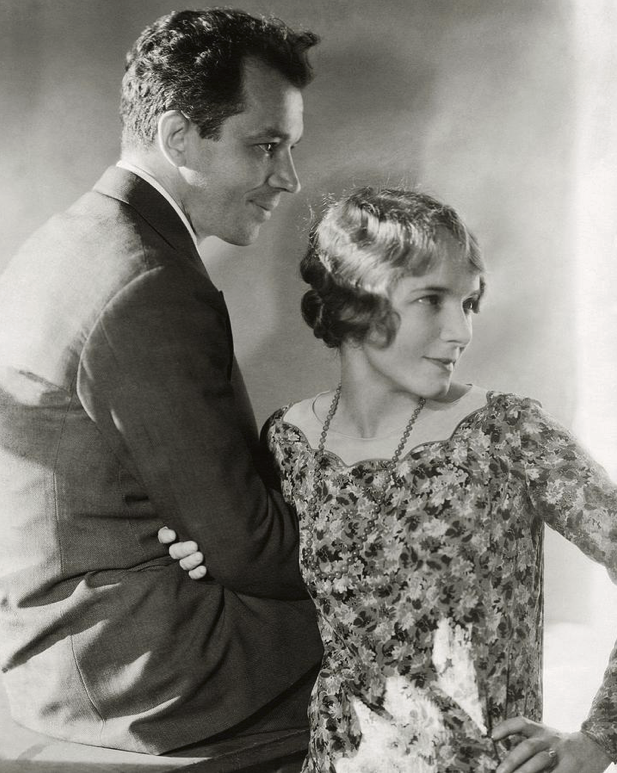
Those of a certain age might remember Helen Hayes as a sweet old lady who appeared on a number of TV shows in the 1970s and 80s, or as the mother in real life of James MacArthur, Disney teen star and later the portrayer of Danny “Book ’em Danno” Williams on the original Hawaii 5-0 TV series. Hayes was married to playwright Charles MacArthur, and “The Talk of the Town” takes it from there…

CREATIVE TYPES…The engaged couple Charles MacArthur and Helen Hayes posed for photographer Edward Steichen for this Jan. 1, 1929 image featured in Vanity Fair magazine. (Condé Nast)

 *  *  *

Ain’t It Grand

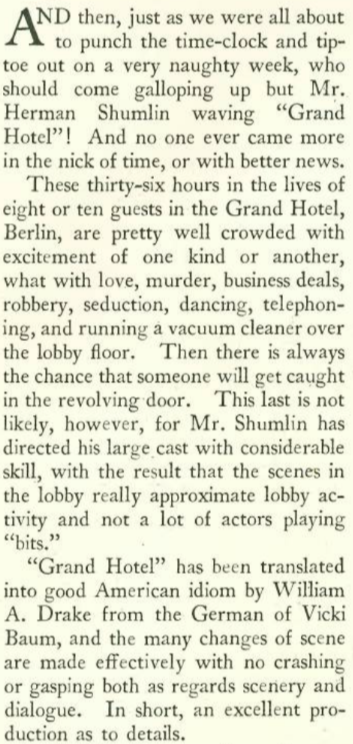
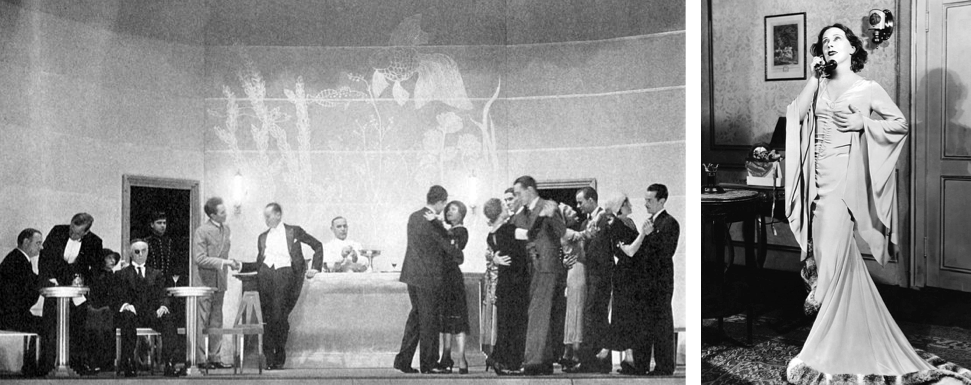
Grand Hotel opened at the National Theatre on Nov. 13, 1930 to strong reviews, including the one below by Robert Benchley that he filed for The New Yorker. The play, adapted from the 1929 novel Menschen im Hotel by Austrian writer Vicki Baum, would prove to be a smash on Broadway and again on the silver screen in a star-studded 1932 film featuring Greta Garbo, John Barrymore, and Joan Crawford.

THE STARS ALIGN…Left, promotional photograph of the original Broadway production of Grand Hotel. At right, Eugenie Leontovich portrayed fading Russian ballerina Grusinskaya in the play. The role would go to Greta Garbo in the 1932 film adaptation. (Theatre Magazine, February 1931/Wikipedia)

…and while we are on the subject of Broadway, the theater review section also featured this Al Frueh illustration promoting a noted production of Twelfth Night at the Maxine Elliott…

Program for the production featuring Jane Cowl. (Playbill)

 *  *  *

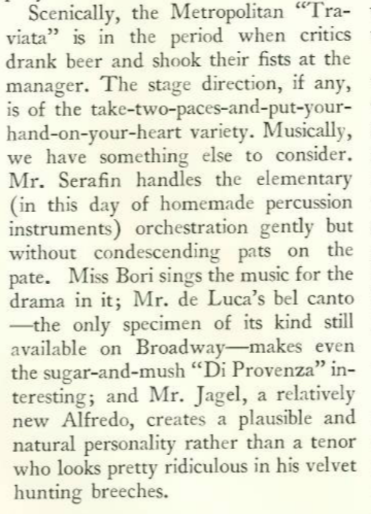
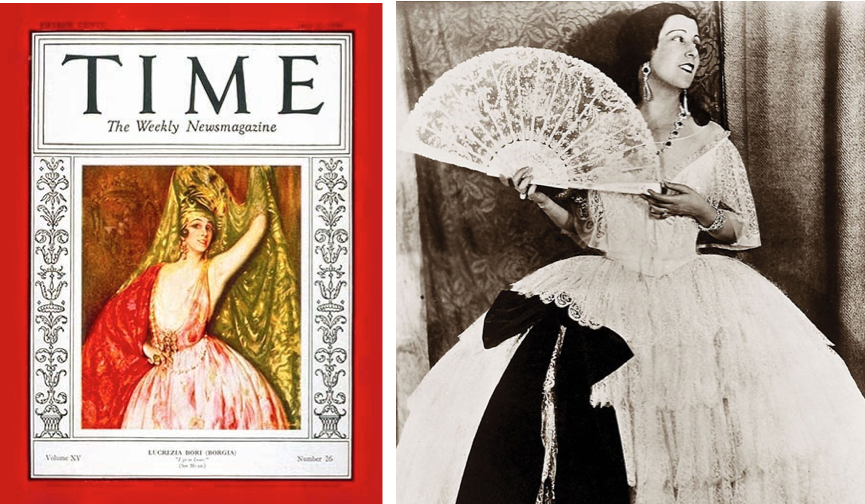
There were also big doings at the Met, where Spanish lyric soprano Lucrezia Bori (1887-1960) wowed audiences with her portrayal of Violetta in La Traviata.

SHE HAD SOME PIPES…right, lyric soprano Lucrezia Bori on the cover of the June 30, 1930 edition of Time magazine. At right, promotional photo of Bori circa 1930. (Time/Wikipedia)

 *  *  *

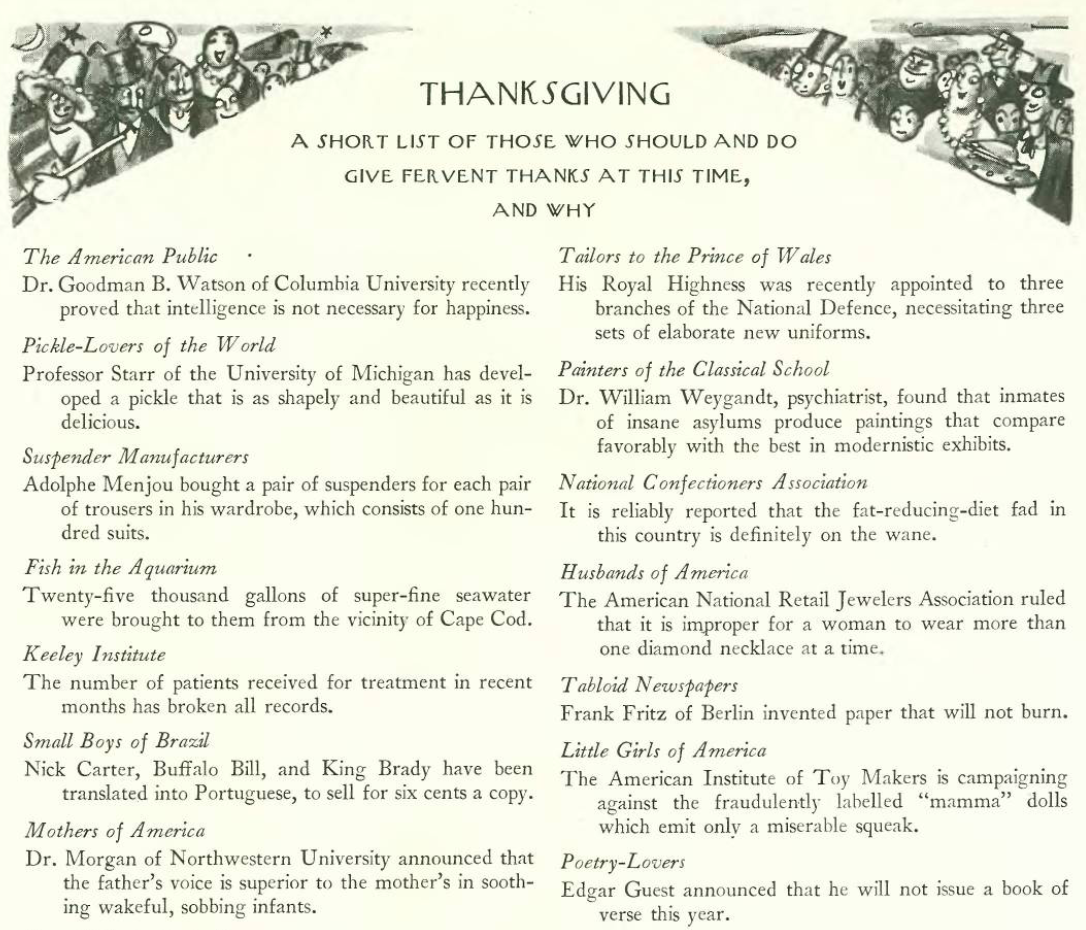
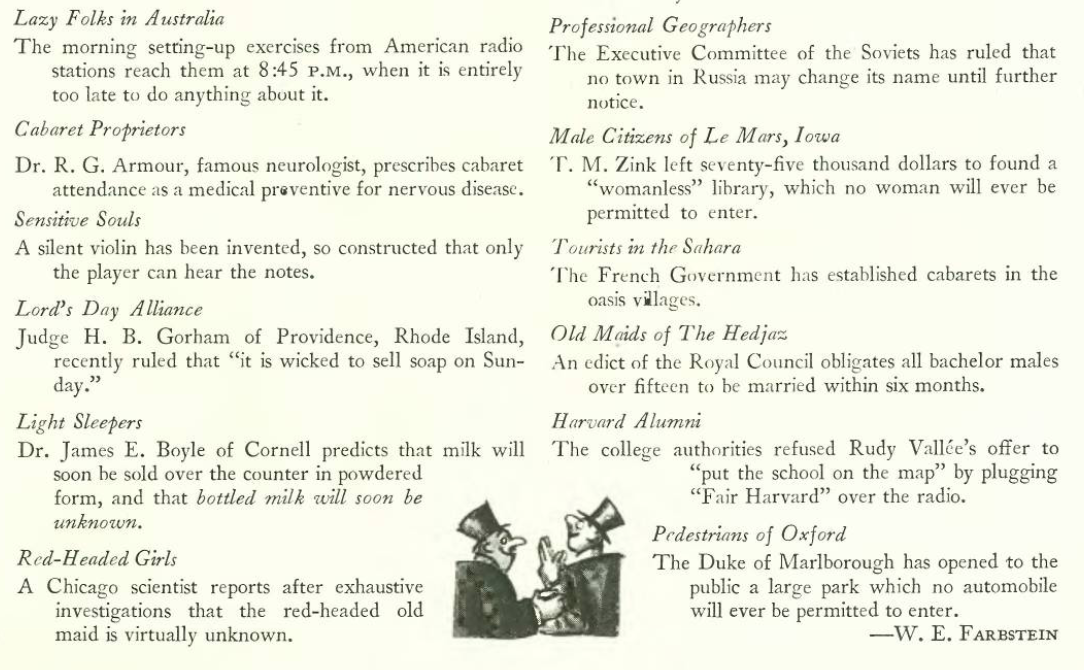
Bounty of Blessings

Humorist W. E. Farbstein gave readers plenty to be thankful for in this tribute to the Thanksgiving holiday…

 *  *  *

From Our Advertisers

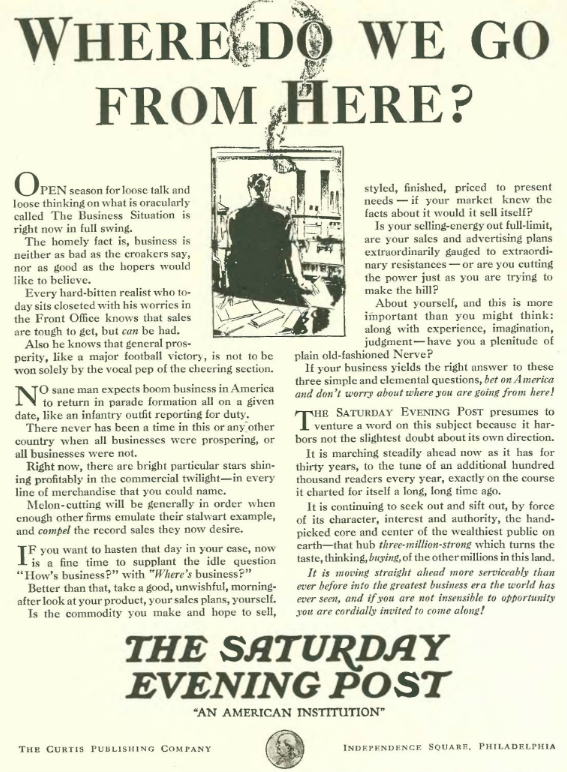
Occasionally advertisements acknowledged the reality of the Great Depression, including this one from The Saturday Evening Post that offered encouraging words to prospective readers…

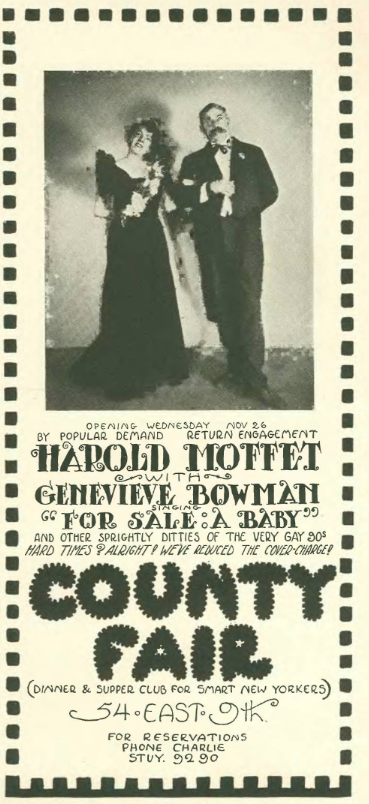
…County Fair, a Greenwich Village country-themed nightclub, offered the diversion of Moffatt and Bowman to take audiences’ minds off of hard times…

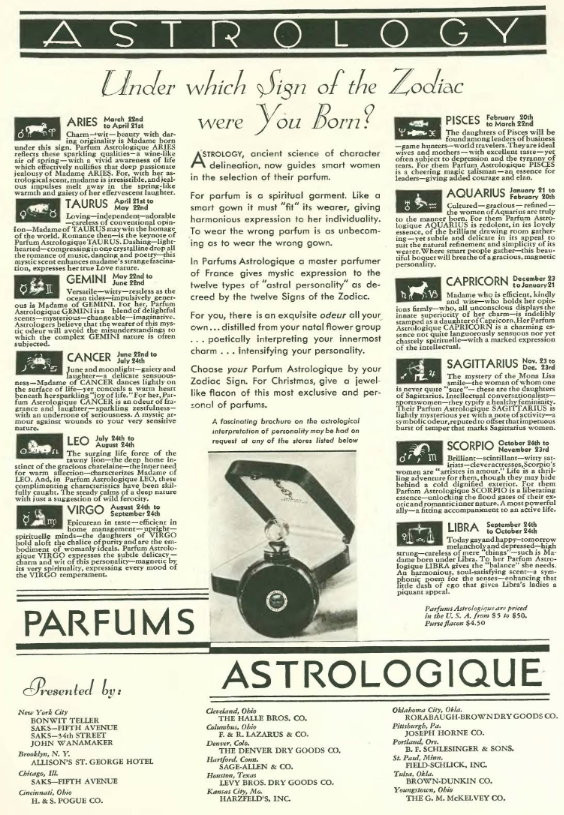
…and for all the supposed sophistication of New Yorker readers, there were still plenty of back page ads offering nostrums laced with superstition…

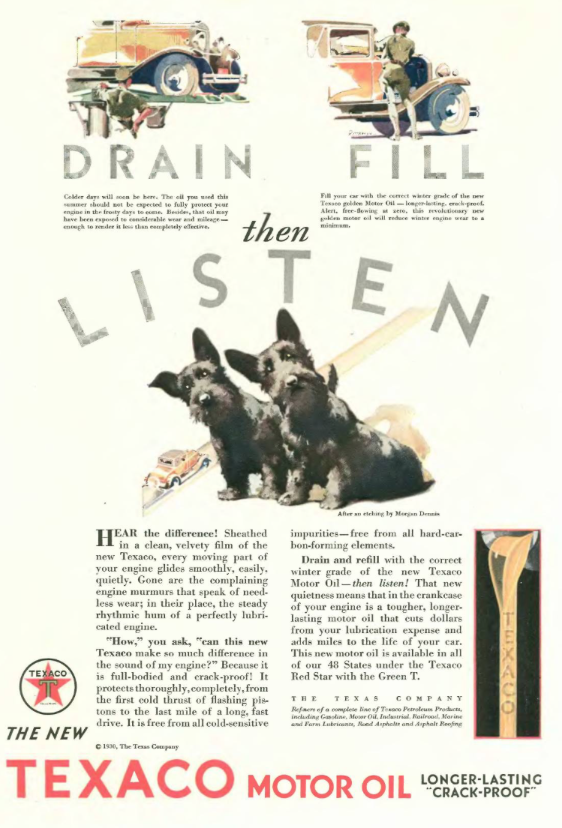
…some of the more colorful, spritely ads from the era were offered up by the producers of Texaco Motor Oil…

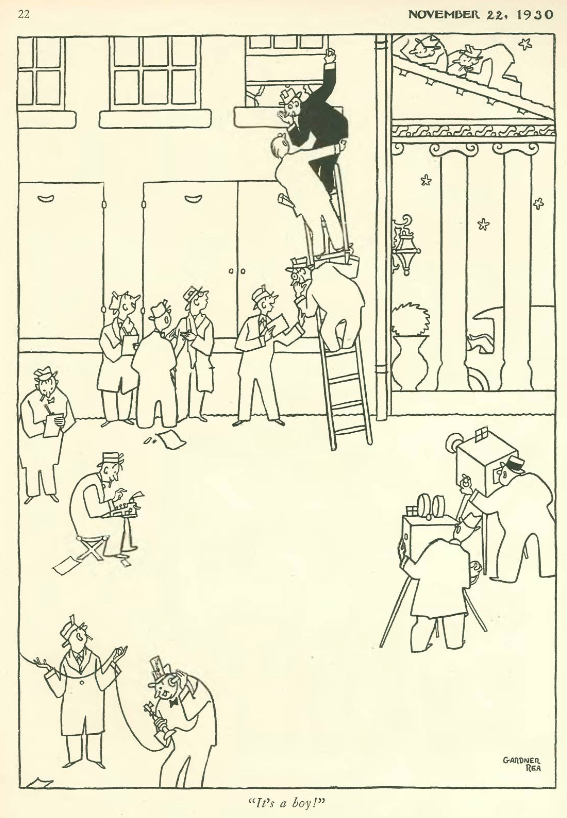
…our cartoons are by Gardner Rea

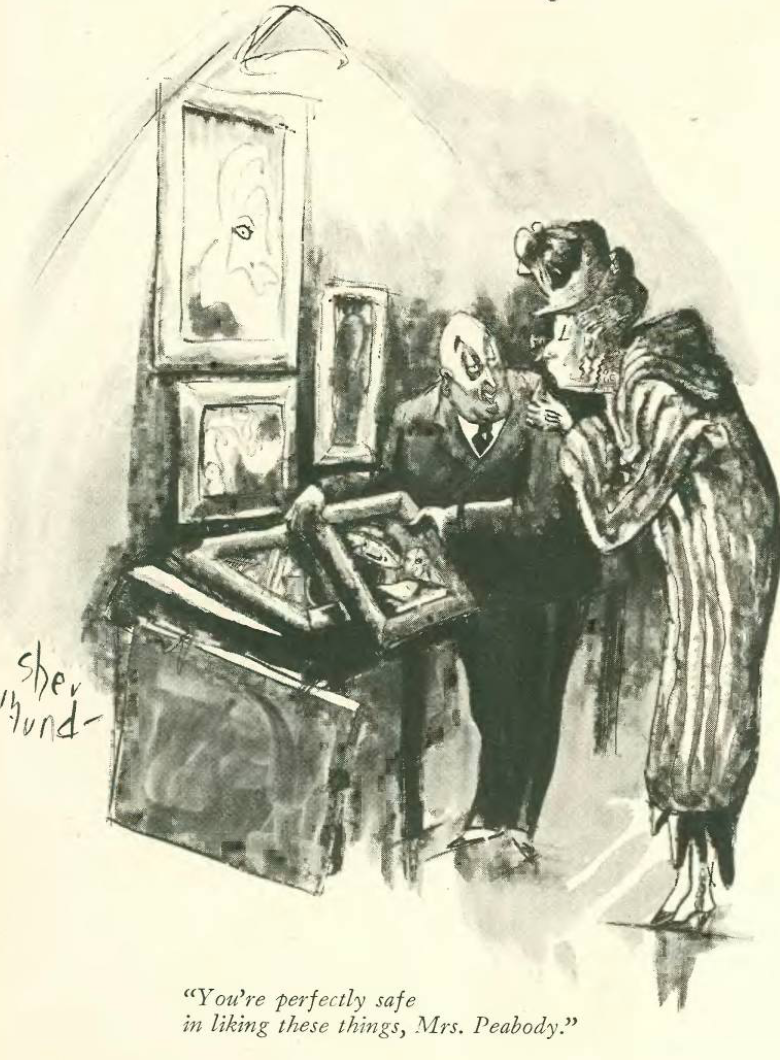
Barbara Shermund

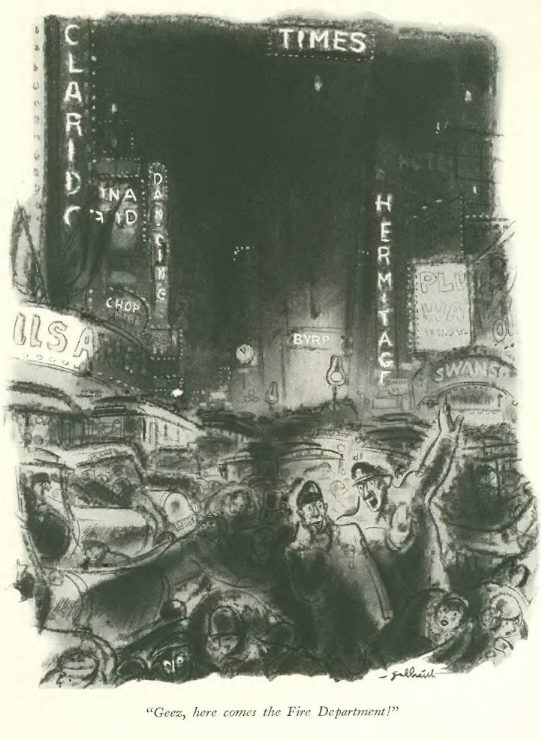
William Crawford Galbraith

…and Perry Barlow

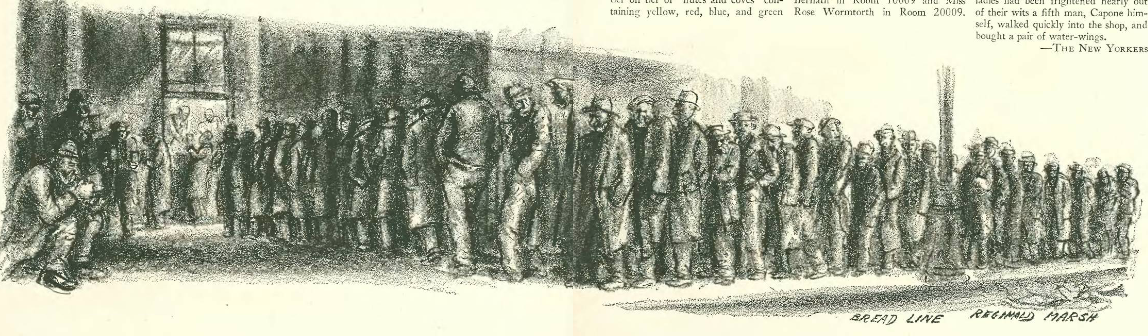
…and for another reminder of reality in the city, this sketch that ran along the bottom of “The Talk of the Town,” by Reginald Marsh

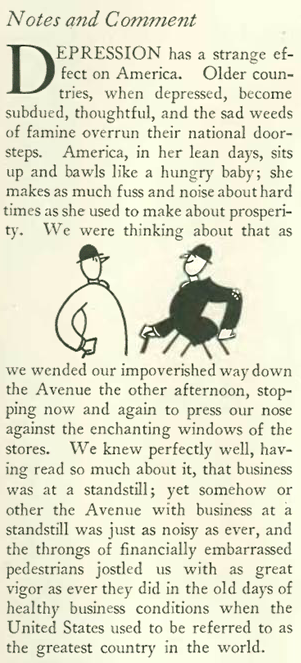
…and now we step back to the Nov. 15 issue, where E.B. White offered a less somber take on the Great Depression…

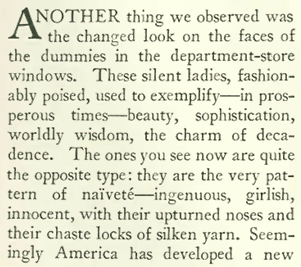
…White also noted a change on the faces of storefront mannequins…

YIN AND YANG…The worldly pose of a Roaring Twenties mannequin, and a more wholesome look for the leaner times in the 1930s. (Pinterest)

 * * *

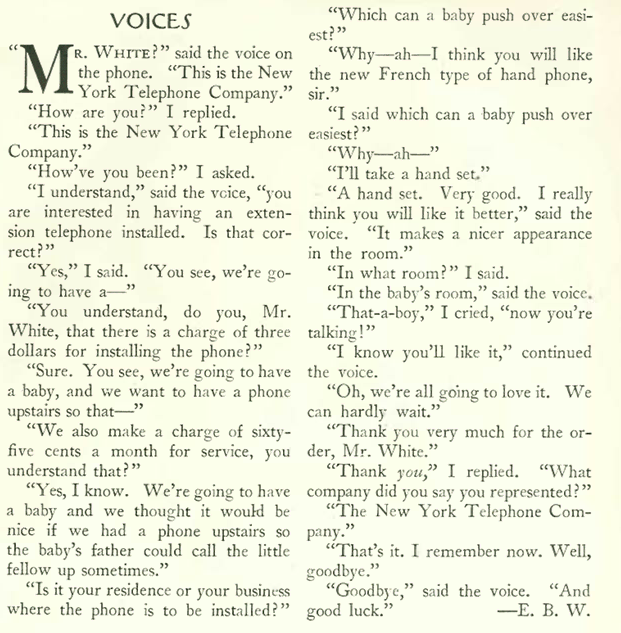
Playing Telephone

Long, long before cell phones, telephones were heavy stationary devices that required a certain amount of planning before installation, as E.B. White explains:

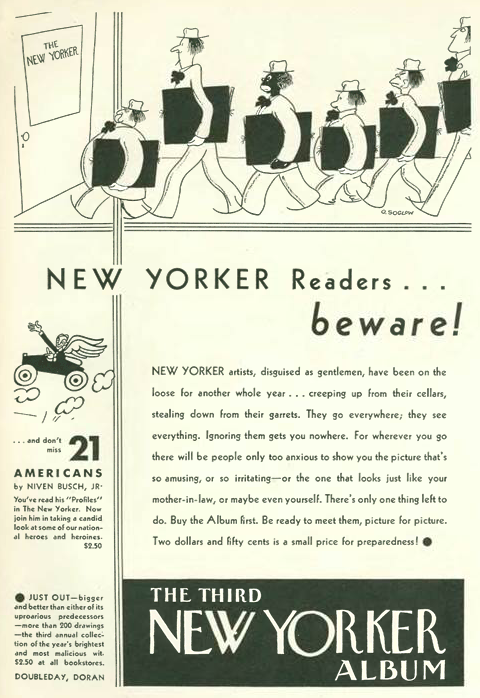
On to our Nov. 15 ads, we have this announcement for The Third New Yorker Album…with illustration by Otto Soglow

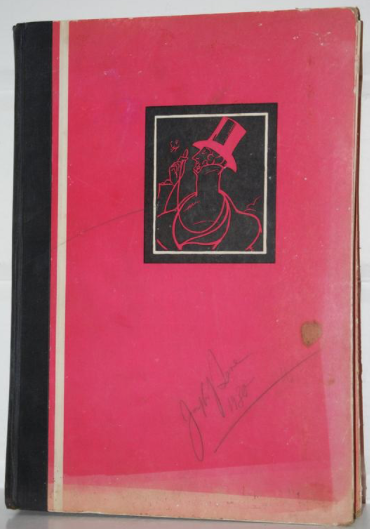
…here is what the album looked like…

…and a couple of inside pages…

(Etsy)

…one of the contributors to the album was Rea Irvin, founding illustrator for The New Yorker, here doing some business with Murad cigarettes…also another Flit insecticide ad by Dr. Seuss

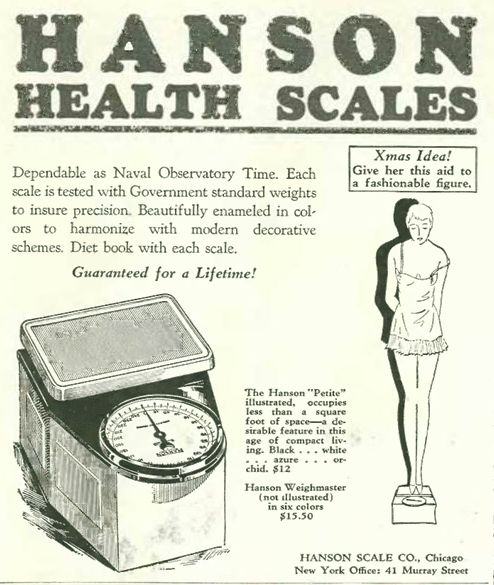
…Christmas ads began appearing in the magazine, including this one for Hanson scales…pity the poor chap (and his wife) who actually thought this might be a suitable present for Christmas, or any occasion for that matter…

…and with Prohibition still in force, advertisers found other uses to promote their products…

…on to our cartoons, Leonard Dove illustrated a couple who didn’t get away with the ruse…

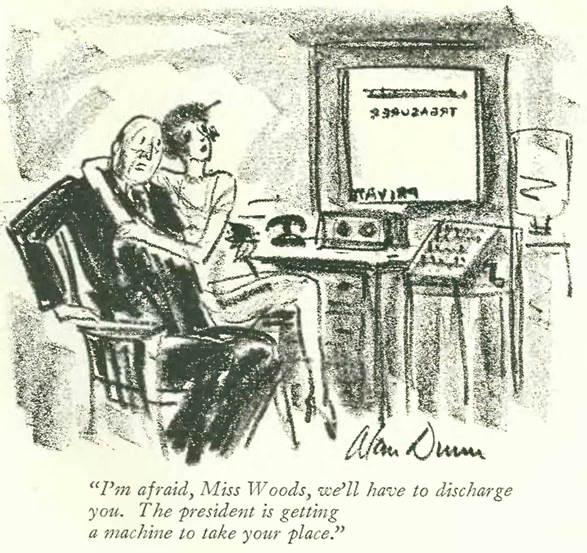
… Alan Dunn depicted what was considered typical office behavior in the 1930s…

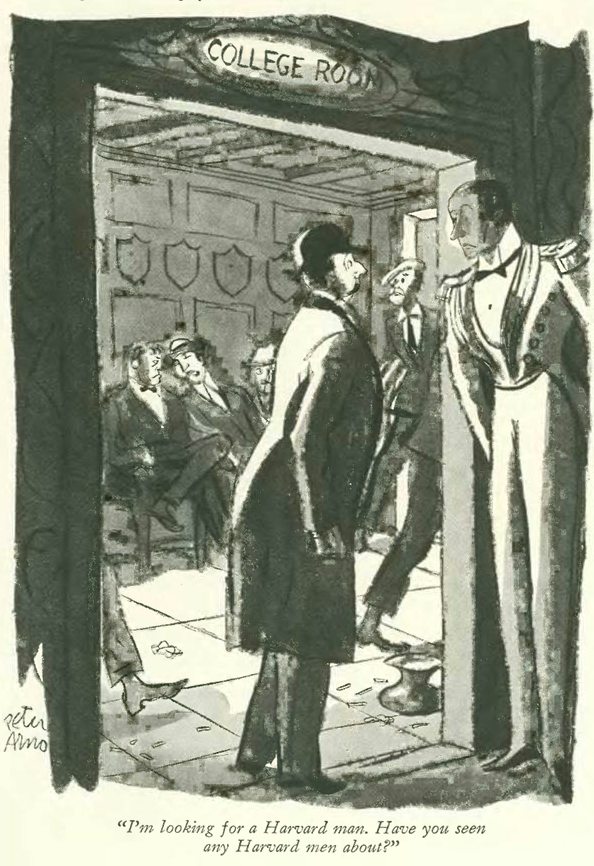
...Peter Arno visited the Harvard Club…

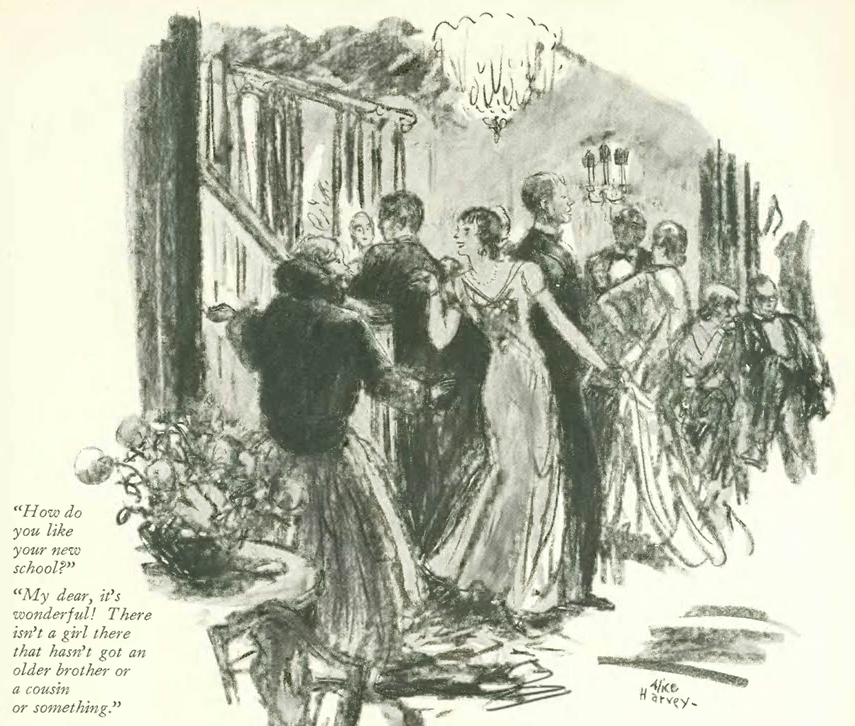
Alice Harvey also explored the college scene…

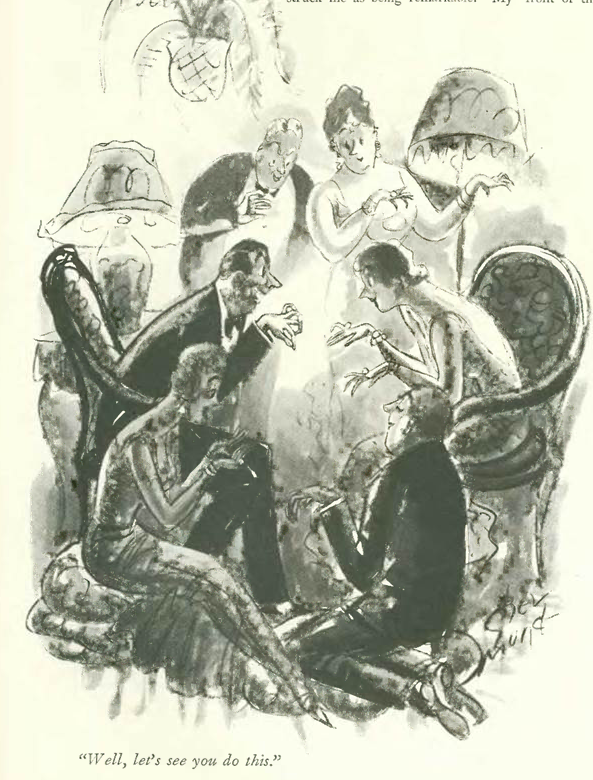
…some parlor games with Barbara Shermund

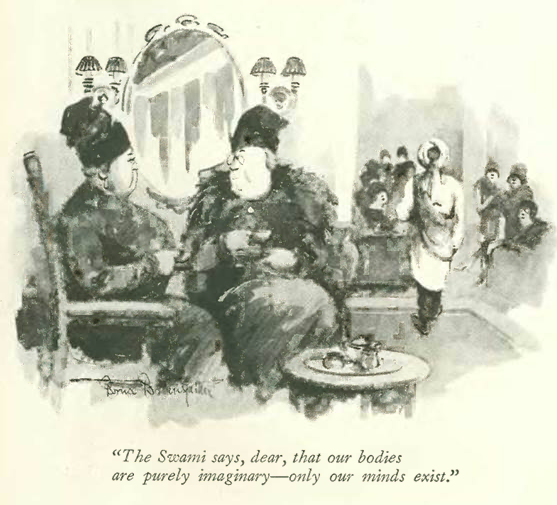
……Bruce Bairnsfather, and some existentialist chat at tea time…

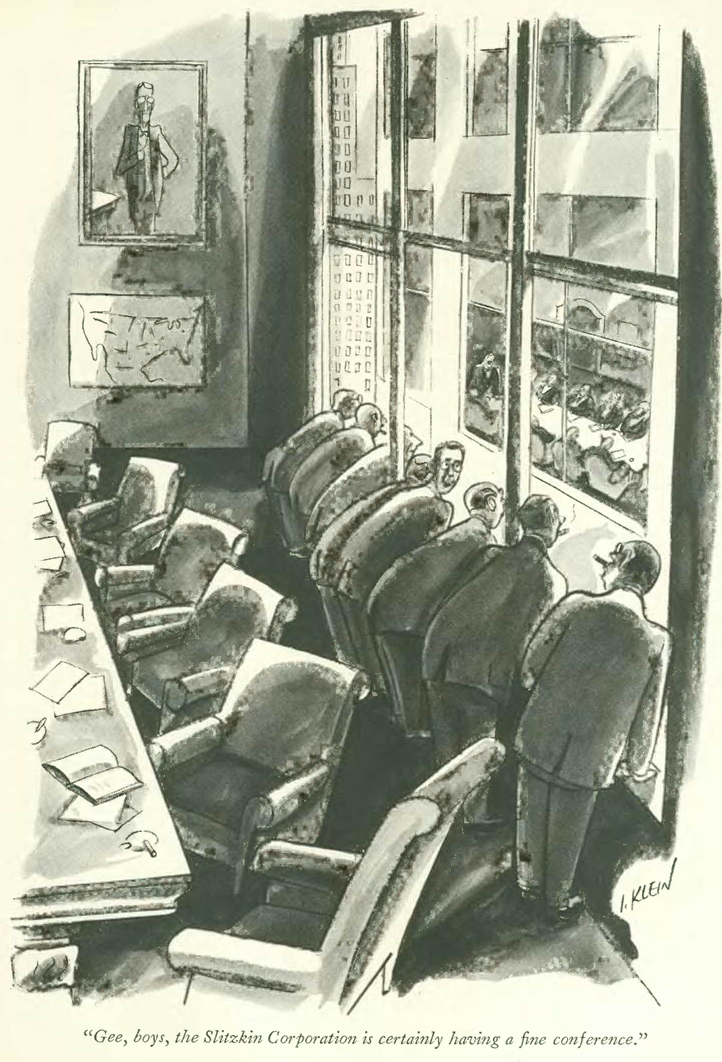
…and we close with Isadore Klein, and the world of corporate competition…

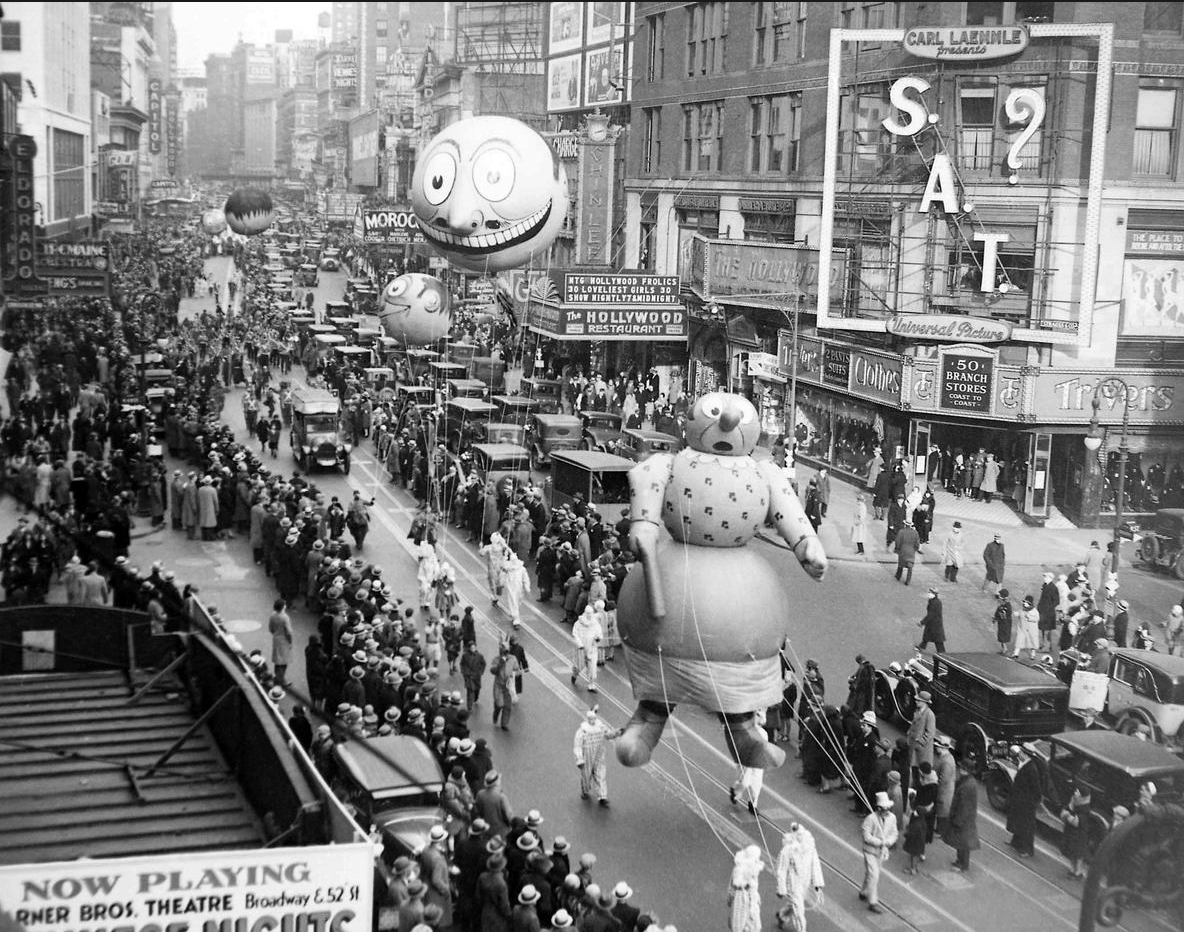
…and a Happy Thanksgiving, from the Macy’s Thanksgiving Parade 89 years ago, Nov. 27, 1930…

(CBS/Associated Press)

Next Time: The Future Was a Silly Place…


Hell’s Angels

Among the films in 1930 that marked a new era in motion pictures was Howard Hughes’s epic war film Hell’s Angels. 

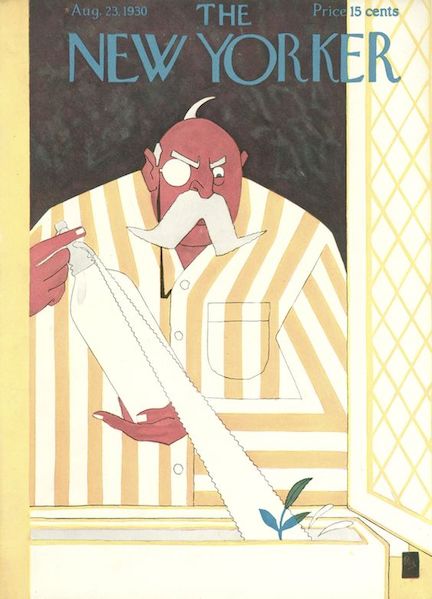
August 23 cover by Gardner Rea.

Originally shot as a silent, Hughes (1905-1976) retooled the film, and over a period of three years (1927-30) poured much of his own money into making what many consider to be Hollywood’s first sound action movie. The film also introduced audiences to 19-year-old Jean Harlow (1911-1937), handpicked by Hughes to replace Norwegian actress Greta Nissen in the lead role (Nissen’s accent posed a problem for the talkies). The film would make Harlow an instant star, propelling her to worldwide fame as the “Platinum Blonde” sex symbol of the 1930s.

Beset by delays due to Hughes’s incessant tinkering, the movie was famously expensive. For example, a total 137 pilots were used in just one flying scene at the end of the film. In addition to monetary costs, the filming also claimed the lives of three pilots and a mechanic, and Hughes himself would fracture his skull during a stunt flying attempt.

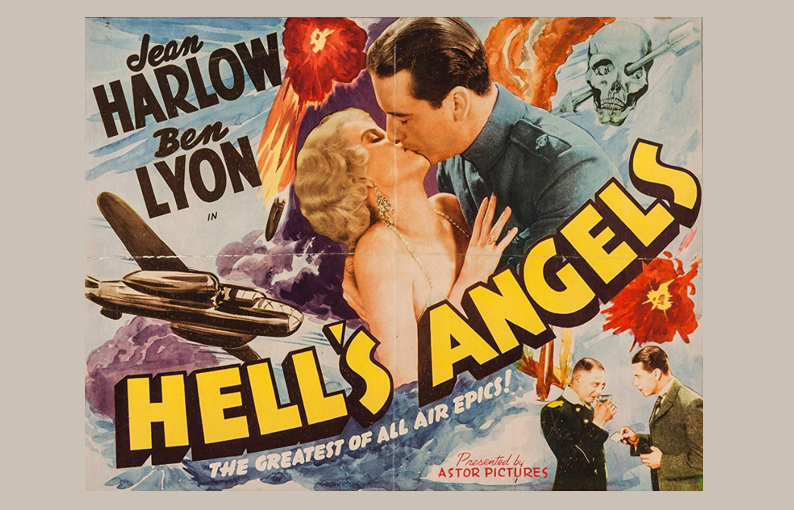
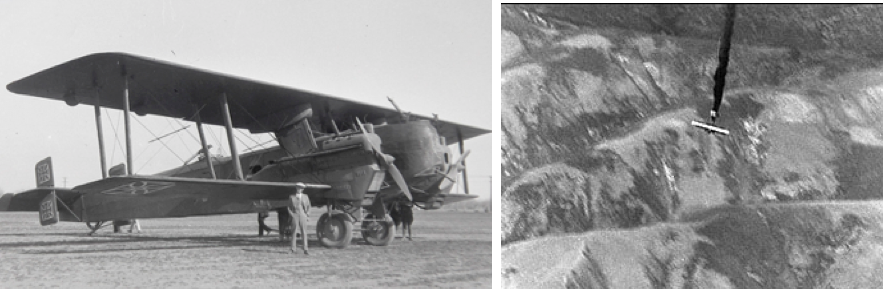
PRE-CODE…Before Will Hays imposed his moral code on Hollywood, films in the early thirties were frank with sexual references, as the image at left attests. When Howard Hughes switched the filming of Hell’s Angels to sound, he replaced Norwegian actress Greta Nissen with 19-year-old Jean Harlow (seen with co-star Ben Lyon). Harlow’s first major film appearance would make her an overnight star; at right, Frank Clarke and Roy Wilson flying an S.E.5A (front) and a Fokker D.VII (back, note camera) in the filming of Hell’s Angels. (Wikipedia)

The New Yorker’s John Mosher found the action scenes enticing, but the acting left something to be desired…

COSTLY VENTURE …This Sikorsky S-29A (left), repainted to represent a German Gotha bomber, would crash into the California hills during filming (right), killing mechanic Phil Jones, who failed to bail out along with the pilot. (Northrop Grumman)
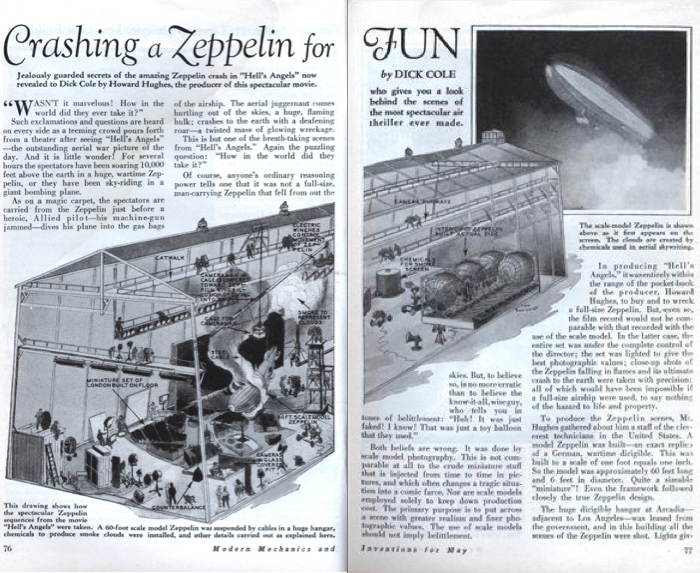
GEE WHIZ…The media often reported on the progress of the film, such as in this May 1930 article in Modern Mechanics and Inventions that detailed a $1 million sequence in which a fighter dives his plane into the top of a Zeppelin, causing it to explode and crash to earth. (Modern Mechanix)

We skip ahead briefly to the Aug. 30 issue, in which “The Talk of Town” featured a mini profile of Howard Hughes and his film. Note how Hughes’s extravagance is described through his frequent use of long-distance telephone calls:

A STAR IS BORN…19-year-old Jean Harlow and Ben Lyon in 1930’s Hell’s Angels. (IMDB/Pinterest)

*  *  *

A Whale of a Movie

Critic John Mosher also took in a film adaptation of Herman Melville’s Moby Dick, a very loose adaptation that excluded the novel’s central character, Ishmael, and invented a love story for the maniacal Capt. Ahab…

A WHALE OF A STORY…From left, Noble Johnson as Queequeg, John Barrymore as Ahab, and Walter Long as Stubbs in 1930’s Moby Dick. At right, top, the whale puts the hurt on a boat; bottom, Joan Bennett as Faith, a contrived love interest for the old salt. (IMDB)

 *  *  *

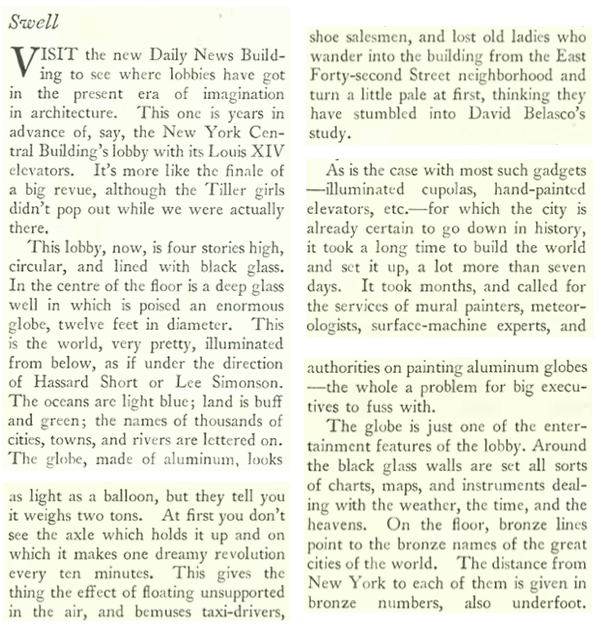
Daily Dazzle

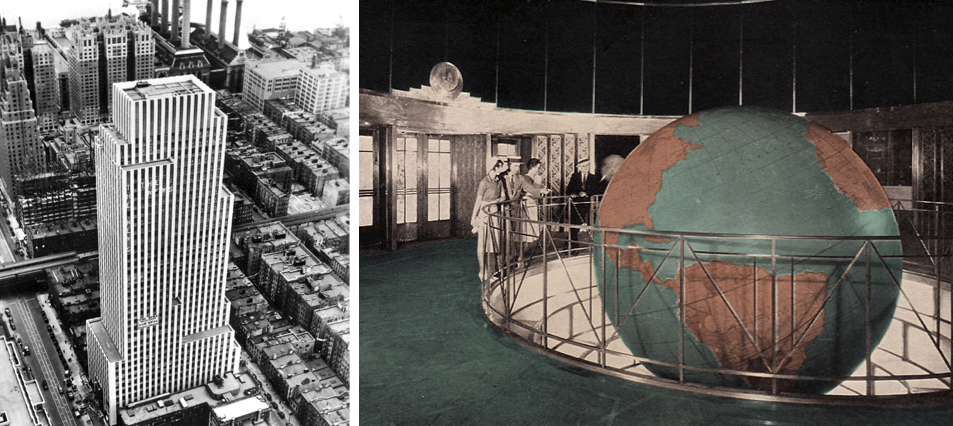
“The Talk of the Town” gushed over the lobby of the new Daily News Building, likening it to the glitz of a Broadway revue:

HOME FOR CLARK KENT…The Daily News Building served as the model for the headquarters of the fictional Daily Planet, the building where Superman worked as mild-mannered Clark Kent; at right, an image from 1941 of the lobby, dominated by the world’s largest indoor globe. (Wikipedia/Public Domain)
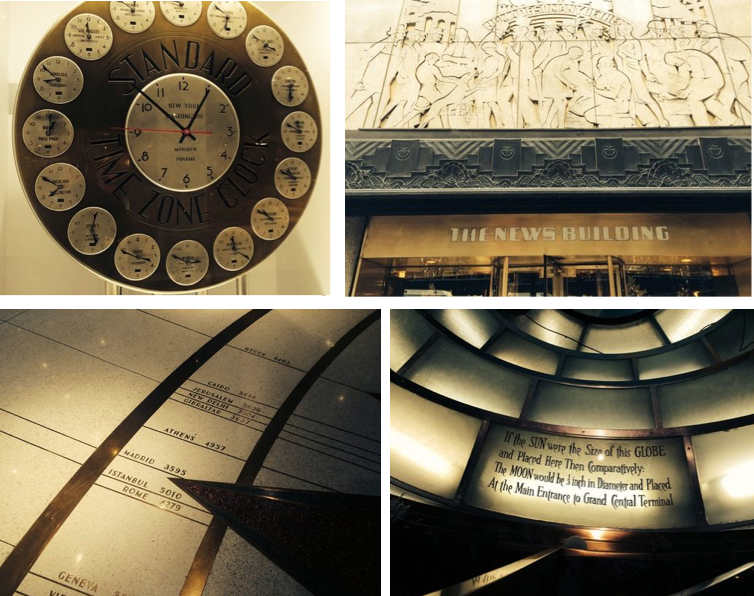
A LOBBY FOR LEARNING…The lobby includes an array of clocks, top left, that give the time in various global destinations. (Luke J. Spencer via atlasobscura.com)

 *  *  *

A Busboy’s Dream

Charles Pierre Casalasco left his life as a busboy in Corsica and studied haute cuisine in Paris before arriving at the shores of Manhattan in the early 1900s. He became a renowned headwaiter who by 1929 garnered enough financial backing from New York’s most powerful families to construct the exclusive Hotel Pierre. Writing under her pseudonym, “Penthouse,” New Yorker columnist Marcia Davenport described the building’s apartments to eager readers:

FUN WHILE IT LASTED…The 41-story, 714-room Hotel Pierre officially opened in October 1930 to great fanfare. The party would be short-lived, as the deepening Depression would force the hotel into bankruptcy just two years later. At right, photo of the Rotunda, before a 2017 remodeling. (New York Public Library)

 *  *  *

So Much For Title IX

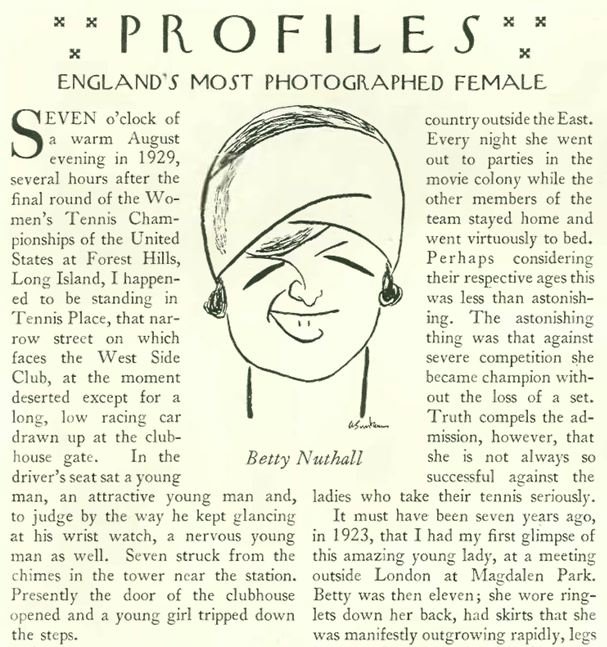
Then as now, women athletes were held to a separate set of standards, not only judged for their athletic abilities, but also for their “sex appeal,” as John Tunis suggests more than a few times in his profile of English tennis champion Betty Nuthall (1911-1983). Excerpts:

HOW’S THAT BACKHAND?…Betty Nuthall greets American tennis star Bill Tilden in September 1930; on the cover of Time after winning the 1930 U.S. Open. (Digital Commonwealth/Time Inc.)

 *  *  *

Free Expression

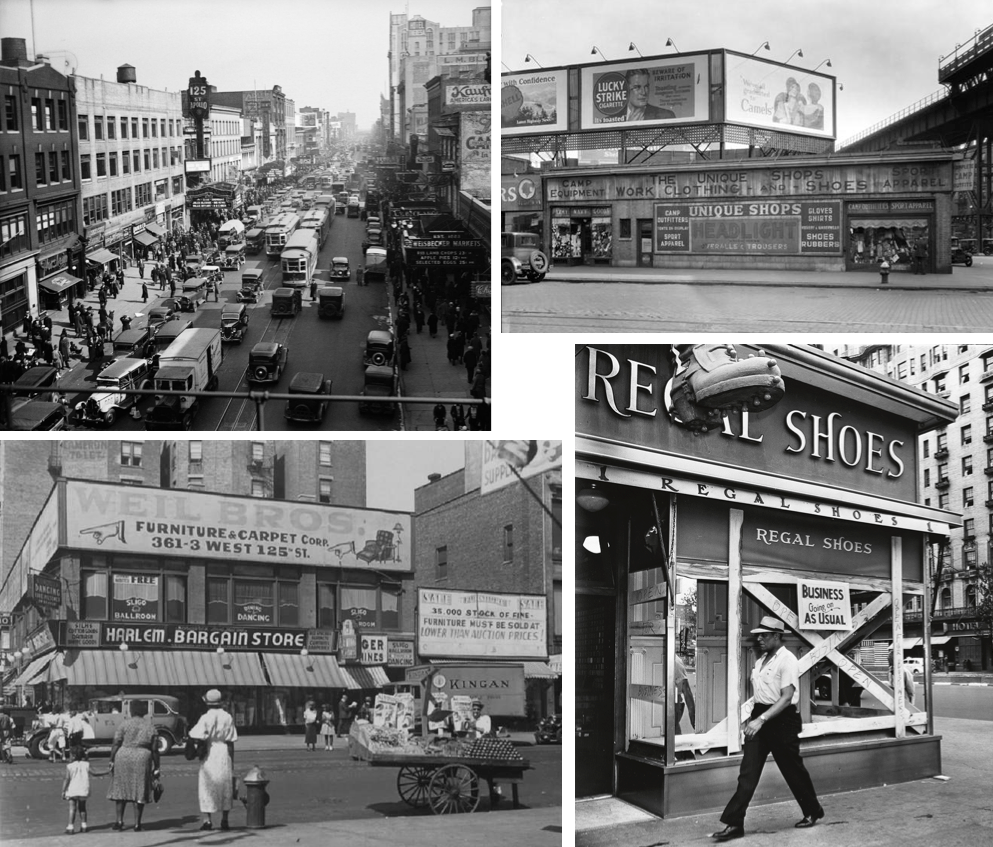
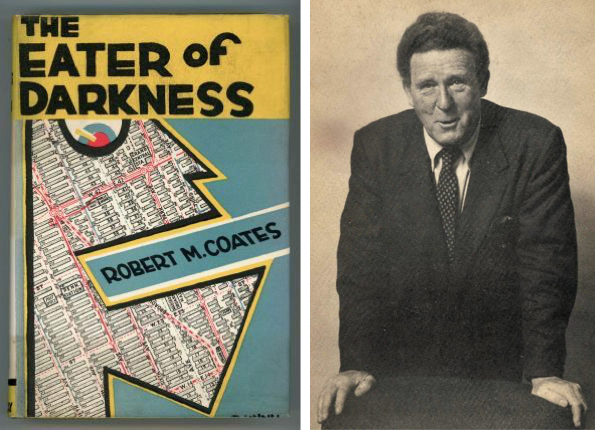
Robert Myron Coates (1897–1973) was a writer of experimental, expressionistic novels who later became a longtime art critic for The New Yorker (he is credited with coining the term “abstract expressionism” in 1946). In the Aug. 23 issue he contributed the first installment of “Dada City,” here describing street life in Harlem. Excerpts:

STREET LIFE…Scenes around Harlem’s 125th Street, clockwise from top left: the Apollo Theatre marquee punctuates a busy street scene in 1935; NW corner of 125th and Broadway, 1930; Regal Shoes storefront, 1940s, photo by Weegee; 125th and St. Nicholas Avenue in 1934. (Skyscraper City/Museum of the City of New York)
AMERICAN ORIGINAL…Robert M. Coates’s The Eater of Darkness (1926) has been called the first surrealist novel in English. (Goodreads)

 *  *  *

From Our Advertisers

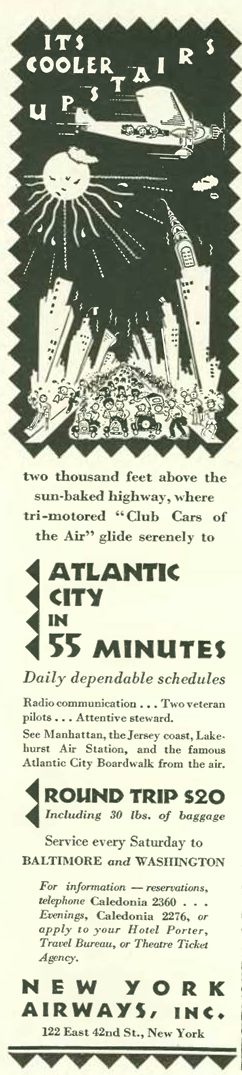
New Yorkers who were still enduring the brutal summer of 1930 could find relief, if they could afford it, on a New York Airways flight…

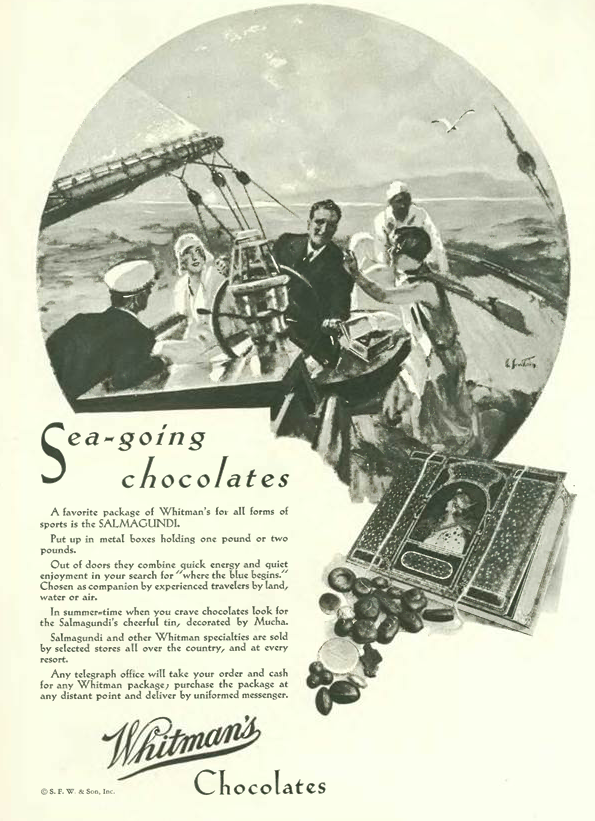
…or if you had the means, you could take your yacht out to sea, like this chap in a coat and tie who calmly steers with one hand while offering a box of chocolates to his guests with the other…

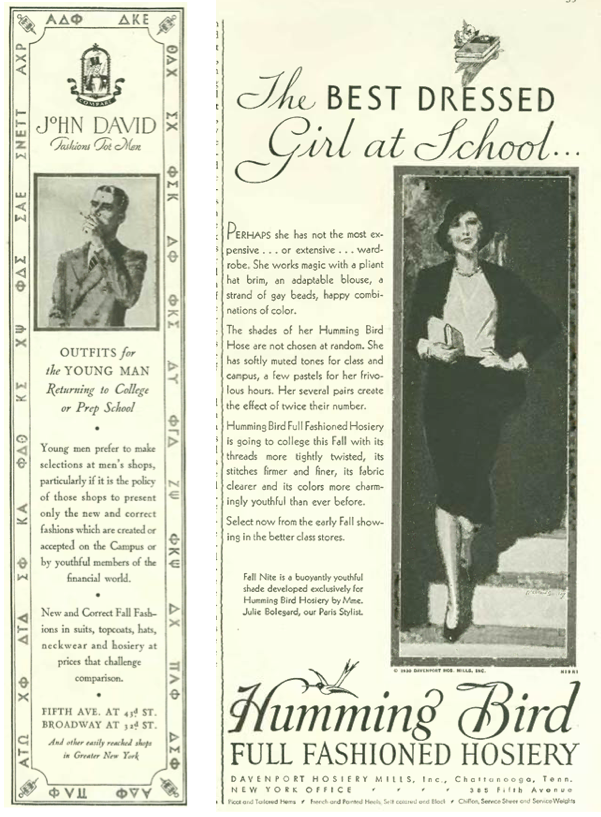
…our sailor wasn’t the only one dressed to nines…here are two ads offering suggestions to young folks returning to college or prep school…

…for comparison, this is how a group of college students at Columbia University dress today…

(Columbia University)

Dr. Seuss continued to crank out drawings on behalf of Flit insecticide…

…and on to cartoons, yet another rerun (the sixth) of this Peter Arno drawing with a new caption (Dorothy Dix was a popular advice columnist)…

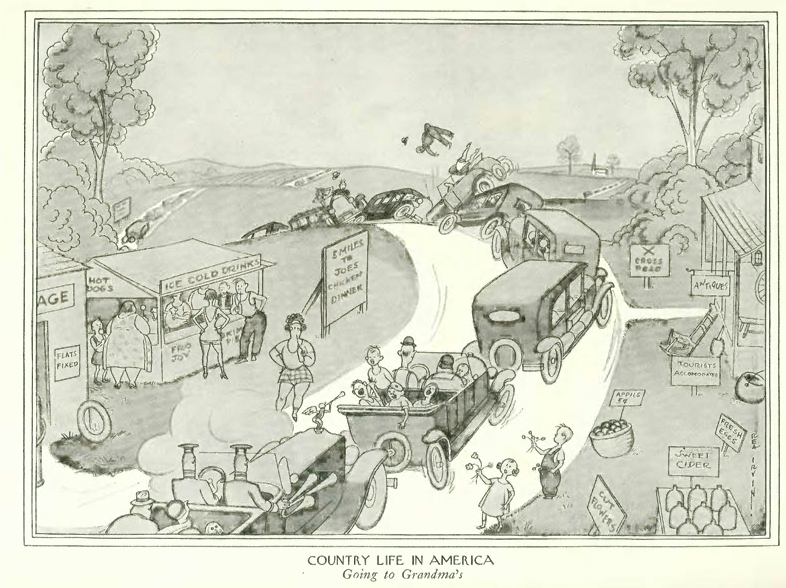
…and another look at country life courtesy Rea Irvin (originally printed sideways on a full page)…

…and another country scene, this time among the toffs, thanks to Garrett Price

…back in the city, some parlor room chatter as depicted by Barbara Shermund

…downtown, Isadore Klein looked at the economic challenges of peep shows…

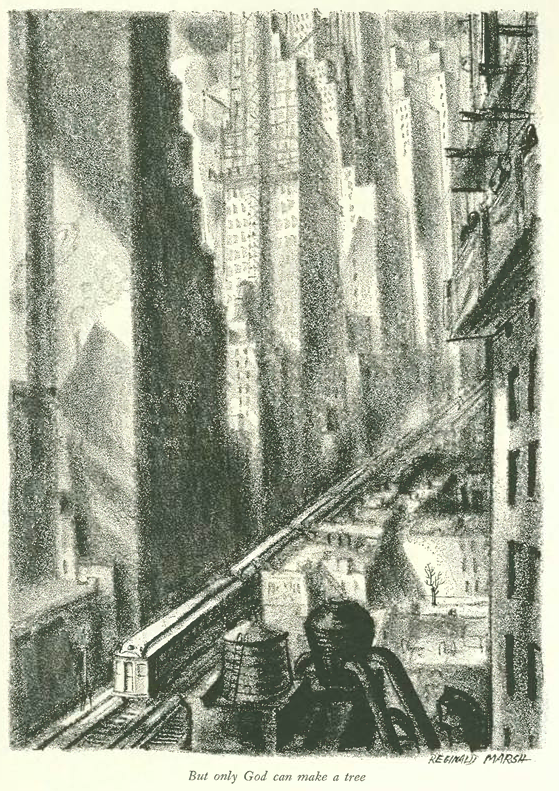
…and we close with this reflection on city life, by Reginald Marsh

Next Time: Marble Halls…

Aleck and Frank at Taliesin

From the late I.M. Pei to Frank Gehry, America has its share of “starchitects,” but only one architect in the history of the profession could claim to be a true household name: Frank Lloyd Wright. 

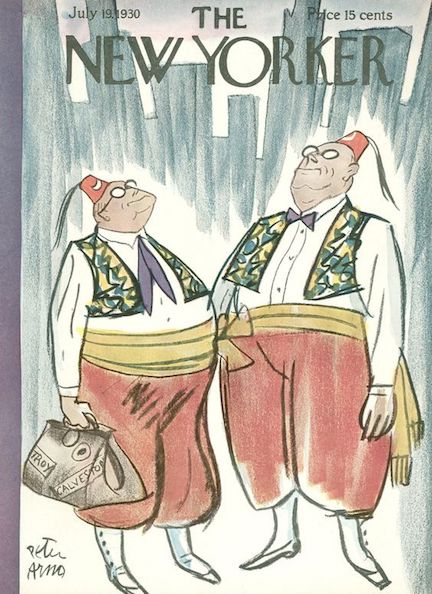
July 19, 1930 cover by Peter Arno.

In a profile titled “The Prodigal Father,” Alexander Woollcott wrote about Wright’s “return” to American acceptance after nearly two decades of scandal and tragedy. Woollcott took great pains to defend Wright’s reputation, marred by his extramarital affair with Mamah Cheney, her murder in 1914 along with six others (including her children) at Wright’s Wisconsin home, Taliesin, and his subsequent remarriage, divorce, and remarriage that followed.

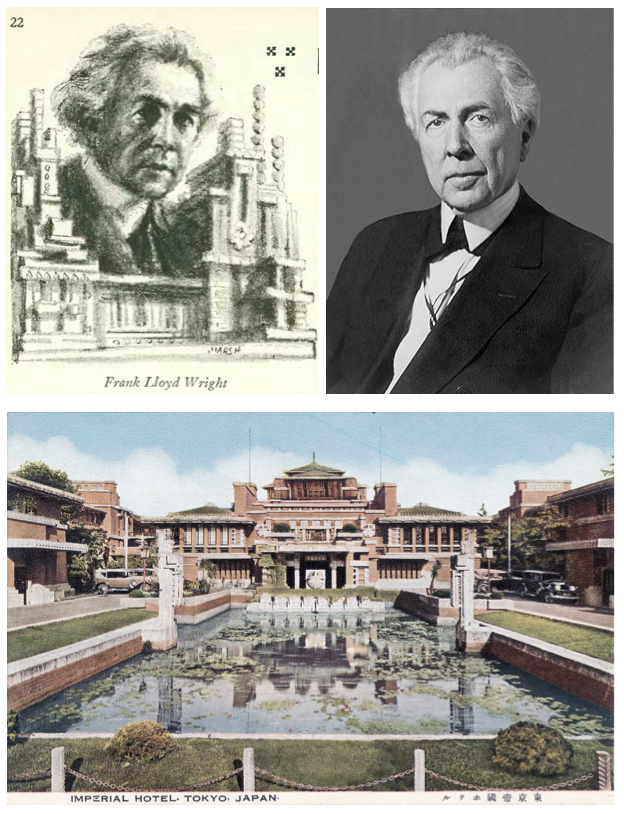
GONE BUT NOT FORGOTTEN…Clockwise, from top left, Reginald Marsh illustration for the profile; Frank Lloyd Wright, circa 1930; Tokyo’s Imperial Hotel, completed in 1923. Designed in the Maya Revival Style Wright favored throughout the 1920s, it was damaged by the 1923 Great Tokyo Earthquake just months after opening. It was demolished in 1967, however the iconic central lobby wing and the reflecting pool were disassembled and rebuilt near Nagoya. (Library of Congress/dezeen.com)

Note: Thanks to a reader’s correction (see comments at the bottom), the following has been revised:

Woollcott also wrote of his visit to Taliesin (the third version of the house, after the first two were destroyed by fires). What stands out about this profile is Woollcott’s praise for the architect, a rare hagiography from a man renowned for his savage wit.

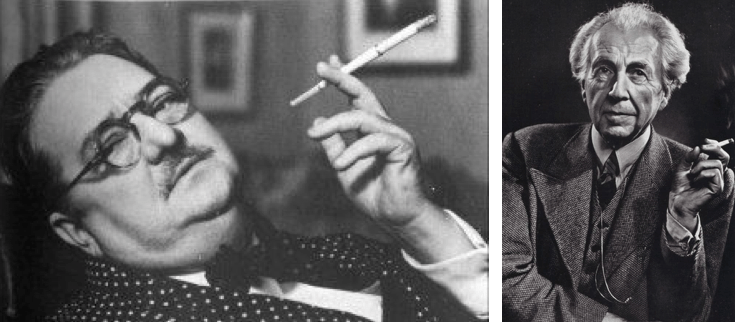
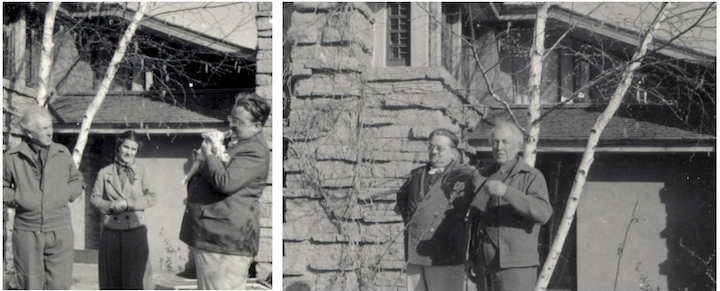
MEETING OF THE MINDS…Above and below are photographs from a autumn visit to Taliesin by Alexander Woollcott. From left are Olgivanna Lloyd Wright, Frank Lloyd Wright and Woollcott. Wright invited Woollcott to the estate in the late 1920s: “This note will be witless as usual, but grateful…. Dear Man, why don’t you come up here? Bring any friend up here with you. Both of you can find an admirable place to work here…” (Avery Architectural & Fine Arts Library, Columbia University, New York)

THIRD TIME’S A CHARM…The third version of Taliesin (built in 1925) is the one Woollcott would have visited in the late 1920s. (Wikipedia/Taliesin Preservation)

*  *  *

No Surprise Endings, Please

Although sometimes confused with Alexander Woollcott because of his first name, the timid, taciturn Wolcott Gibbs was a force at The New Yorker in his own right, perhaps even more so as he served the magazine from 1927 to 1958 as a jack-of-all-trades: copy editor, feature writer, theater critic, and overall wordsmith. So when the editors of The Writer’s Digest posed a question regarding The New Yorker’s policy for submissions, it was Gibbs who was tapped to compose a response, which was a particular challenge given the magazine didn’t have a clear set of editorial requirements. So Gibbs conjured up an “Answers-To-Hard-Questions Department,” and signed it “Mr. Winterbottom.” Some excerpts:

IN HIS ELEMENT…Wolcott Gibbs, left, relaxes at the Algonquin Hotel in 1937. At right is his New Yorker colleague Dorothy Parker. (Time)

 *  *  *

Munitions of Bremen

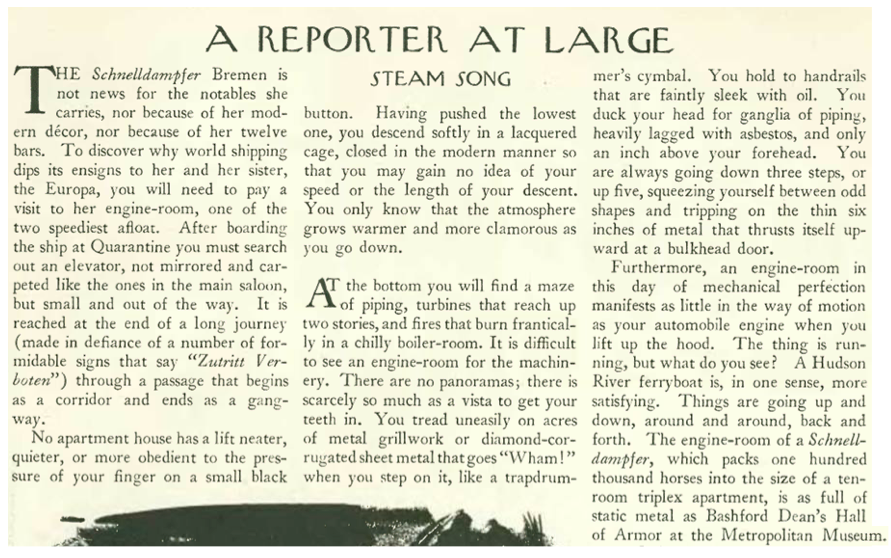
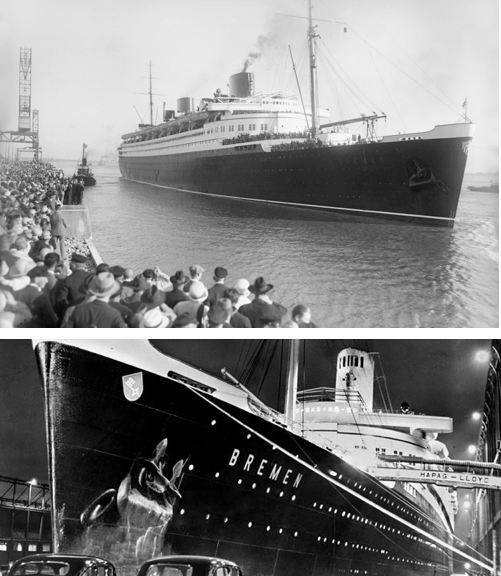
The German Ocean liner SS Bremen was one of the most technologically advanced ocean liners of its day, known for its speed and luxury. Author Eric Hodgins climbed aboard to file a report for the New Yorker, and in the excerpt below marveled at the “mechanical perfection” of the ship’s engine room:

PLOUGHSHARES INTO SWORDS…More than the length of three football fields, the streamlined SS Bremen, launched in 1928, was designed to have a cruising speed of  27.5 knots (50.9 km/h). After a 1941 fire, the ship was largely dismantled, its steel used to manufacture war munitions. (Wikipedia/greatoceanliners.com)

In 1941, while docked in Bremerhaven, a disgruntled crew member set fire to the ship, completely gutting its luxurious interior. During the war the ship was stripped of its steel for use in munitions, and in 1946 what remained was destroyed by explosives.

 *  *  *

From Our Advertisers

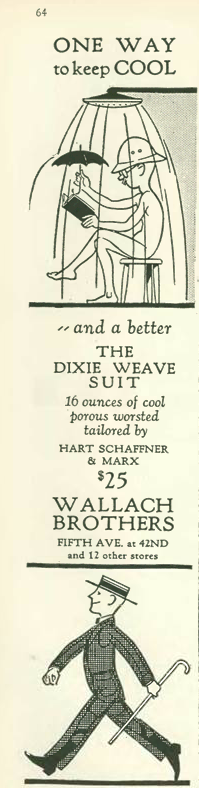
In my readings of recent issues I’ve noted numerous references to hot weather, and for good reason. The summer of 1930 would see record high temperatures and diminished rainfall that would usher in the “Dust Bowl” era of the 1930s. The Wallach Brothers adjusted by offering this “Dixie Weave Suit”…

…the hot weather also called for a tall glass of sparkling soda (mixed with your favorite bootleg beverage, of course)…

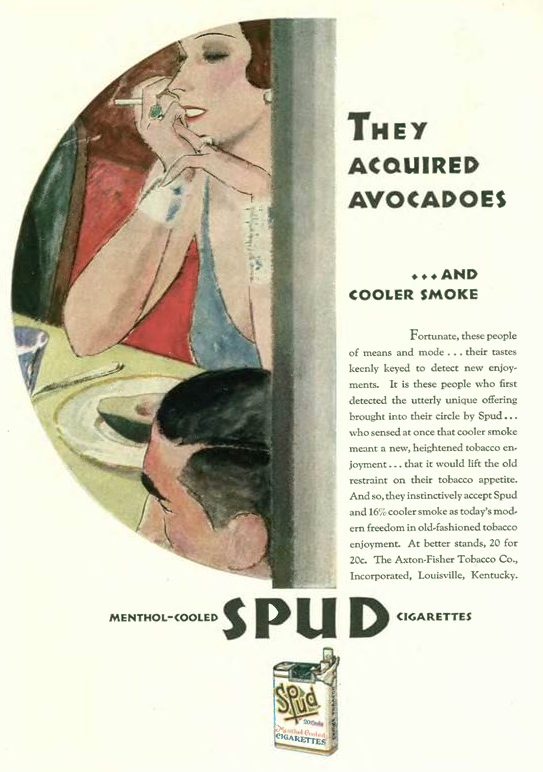
…smokers could keep cool by puffing on a Spud, the first menthol cigarette…

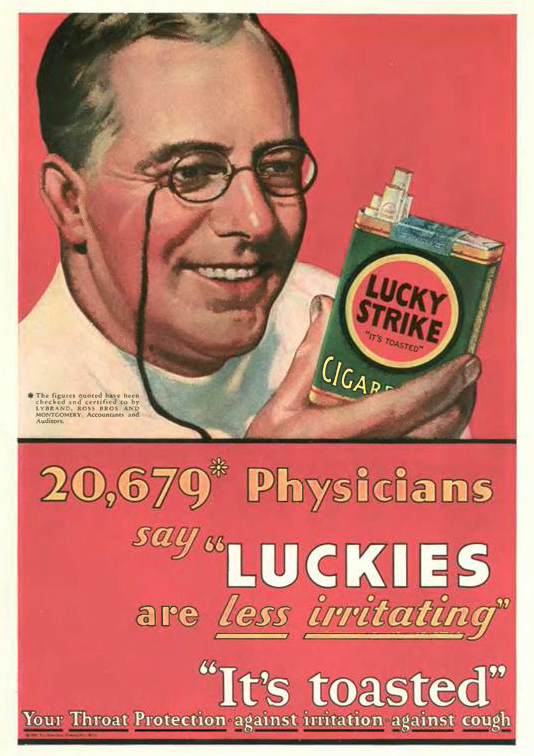
…or you could stick with your Luckies, endorsed by none other than this generic, genial doctor and some bogus survey…

…on to our cartoons…Isadore Klein showed us a downside of Edison’s invention…

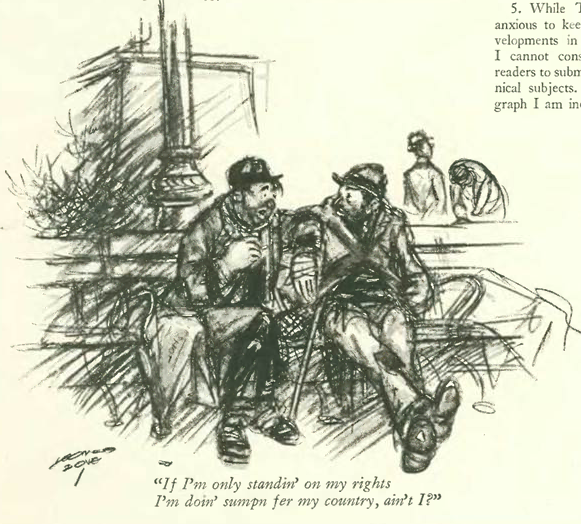
…and Leonard Dove gave us two gentlemen on the skids, a frequent sight in Depression-era New York…

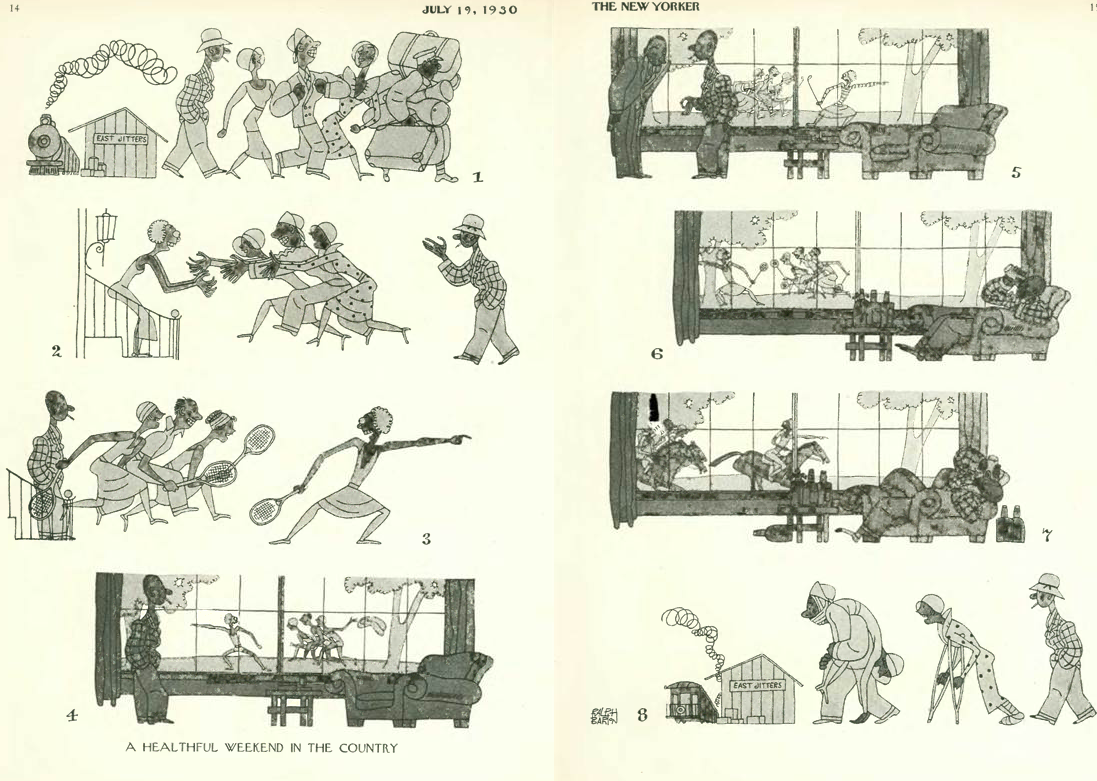
…after a long absence, we see suddenly see a flurry of activity from the pen of Ralph Barton, including this rare sequential cartoon…

…and with the hot summer New Yorkers took to the waters, at Coney Island with Denys Wortman

…and Southampton, with Helen Hokinson

Next Time: For the Byrds…


Robeson’s Othello

In 1930s America there were few if any opportunities for black actors to perform in mainstream stage or screen productions unless they conformed to racial stereotypes. An exception was Paul Robeson.

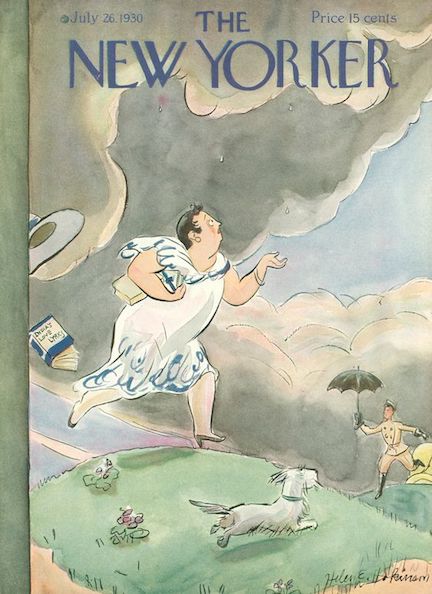
June 21, 1930 cover by Gardner Rea.

In 1930 Robeson (1898-1976) won rave reviews for his performance in Shakespeare’s Othello. That performance, however, took place in London, not New York, which London correspondent Anthony Gibbs took pains to point out in his dispatch for the June 21, 1930 New Yorker.

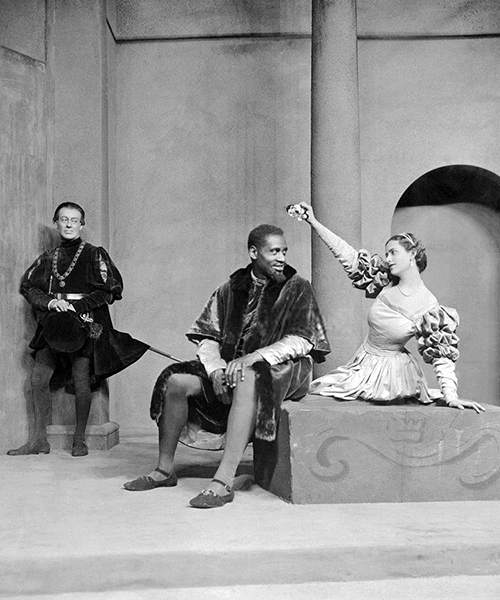
English actress Peggy Ashcroft as Desdemona and Paul Robeson as Othello in London’s Savoy Theatre production of Othello in 1930. Although only 22 at the time, Ashcroft was an established Shakespearean actress. The 32-year-old Robeson was already famous as both an athlete and actor. He was twice named a consensus All-American in football (Rutgers) and was the class valedictorian. He also received a law degree from Columbia while playing in the NFL. In 1930 he was already known to London audiences, having previously appeared in a 1928  London production of the American musical Show Boat. (theshakespeareblog.com)
CENTER STAGE…Left to right: Maurice Browne (Iago), Paul Robeson (Othello) and Peggy Ashcroft (Desdemona) in Othello at the Savoy Theatre, 1930. Maurice Browne was also the play’s producer; his over-the-top portrayal of Iago and his wife’s incompetent stage direction hurt the production, but Robeson nevertheless received high praise for his performance. (britishstageandscreen.tumblr.com)

Although the performance was a triumph for Robeson, the production itself was a mess. The play’s producer, Maurice Browne, enlisted his wife, Ellen van Volkenburg, to direct (Peggy Ashcroft later called her “a pretentious dud”). Writing in The Guardian (Sept. 3, 2003), Samantha Ellis observes: “Recognising that his Othello transcended the ropey production, the audience gave Robeson 20 curtain calls. He reprised the role all over the world and never lost his pleasure in it. For Robeson, it was more than just a part: it was, as he once said, “killing two birds with one stone. I’m acting and I’m talking for the negroes in the way only Shakespeare can.”

Robeson’s Othello would not make it to New York until 1943. It would run for almost 300 performances, setting an all-time record run for a Shakespearean play on Broadway.

 *  *  *

Restoring Order

In the aftermath of Grover Whalen’s disastrous (and sometimes violent) run as New York City Police Commissioner, E.B. White and his fellow New Yorkers welcomed the steady hand of Edward P. Mulrooney (1874-1960) to the helm:

THE COMMISH…Edward P. Mulrooney in a 1930s portrait by Edward Steichen. (Conde Nast)

 *  *  *

The Commander

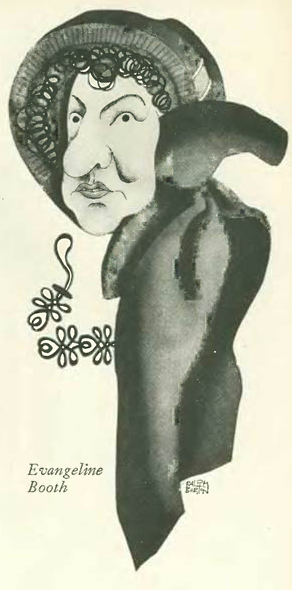
American author and lecturer Virgilia Peterson Ross profiled Evangeline Cory Booth (1865 – 1950), who would become the fourth General of the Salvation Army in 1934. She was the first woman to hold that post. An excerpt:

Ralph Barton returned to provide this caricature for the profile, one of the last works he would create for The New Yorker before his untimely death…

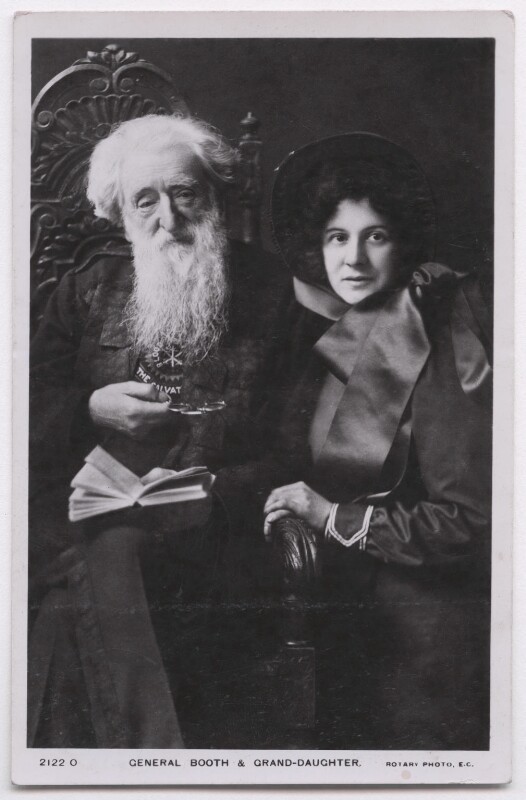
HEIRESS TO A LEGACY…William Booth, an English Methodist preacher who founded The Salvation Army and became its first General, poses with his grand-daughter Evangeline Cory Booth in this 1908 postcard image. (National Portrait Gallery)

 *  *  *

Home of the Dome

Architecture critic George “T-Square” Chappell was gladdened by the sight of scaffolding atop St. Bartholomew’s Church, which would finally get its dome to complete architect Bertram Goodhue’s vision…

NOW YOU SEE IT…Clockwise, from top left, St. Bartholomew’s Church at 325 Park Avenue, sans dome, in 1928; the church with dome in the 1950s; interior and exterior views of dome. (nyago.com/bostonvalley.com)

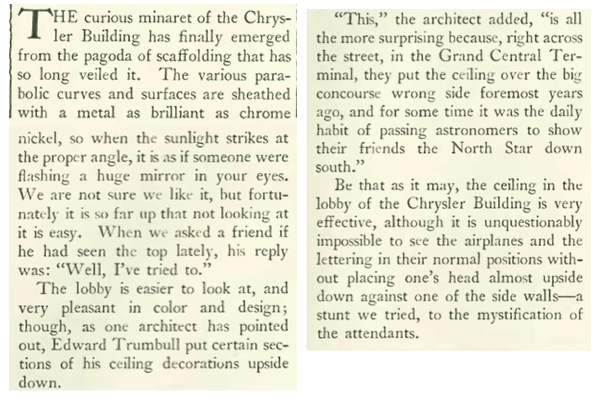
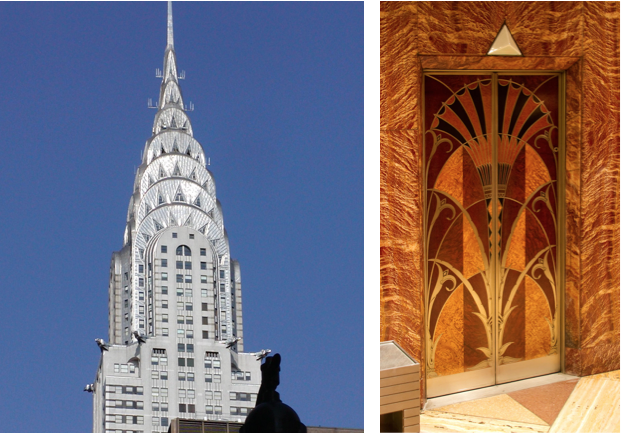
…Chappell also commented on the emergence of the Chrysler Building’s blindingly shiny dome and interior appointments…

BLINDED BY THE LIGHT…The Chrysler Building’s gleaming spire emerged in all its glory in June 1930. At right, an elevator in the building’s lobby. (Wikipedia)

 *  *  *

Below the Belt

It wasn’t Dempsey-Tunney, but the bout between Max Schmeling (1905-2005) and Jack Sharkey (1902-1994) was the next best thing for boxing fans. The World Heavyweight Championship had been vacant since Gene Tunney’s retirement in 1928, and Sharkey and Schmeling had emerged as the sport’s No. 1 and 2 contenders.

The bout ended in a controversial decision: Although Sharkey won the first three rounds, he was disqualified after he landed a punch below the belt late in the fourth round. Schmeling became the first boxer to win the World Heavyweight Championship on a foul. The New Yorker’s Niven Busch Jr. (with illustration by Johan Bull) offered these thoughts on the fight’s disappointing outcome:

LOW BLOW…Although Jack Sharkey (far right) led after three rounds, a low blow in the fourth delivered the World Heavyweight Championship to German boxer Max Schmeling (left). Sharkey would claim the title two years later in a rematch with Schmeling. Although boxing isn’t the healthiest pursuit, both men lived into their 90s; Schmeling died in 2005 just shy of his 100th birthday. (Wikipedia/boxrec.com/thefightcity.com)

 *  *  *

One Of Ours

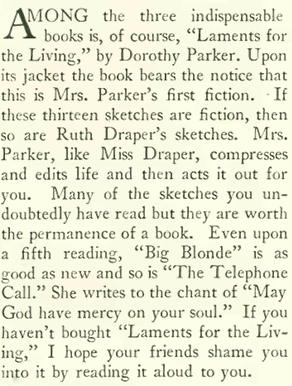
The New Yorker included this brief review of a collection of short fiction pieces by Dorothy Parker, herself a literary critic of some renown at the magazine…

DOROTHY’S LAMENTATIONS…The New Yorker’s Dorothy Parker published this collection of short fiction in 1930.

…and on to our advertisers, this ad appeared on the opposite page of the review…

…speaking of ads, the makers of Marlboro cigarettes continued to sponsor gimmicky penmanship and writing contests to promote their deadly product…

…while promoters of the Empire State Building (still under construction) continued to draw on the historical significance of the building’s Midtown location…

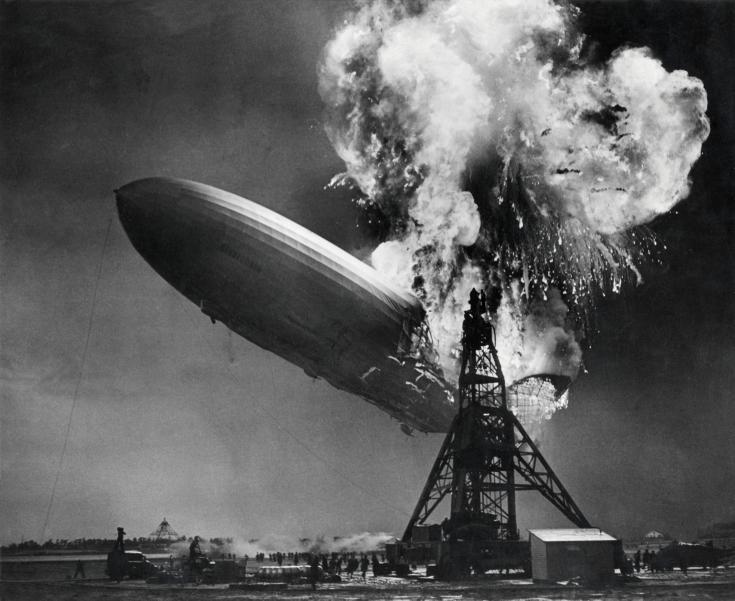
…on to our cartoons, Garrett Price pondered the very real challenge of guiding a massive Zeppelin to the planned mooring mast atop the Empire State…

…a portent of what would happen to the Hindenburg just seven years later…

The New Yorker’s typesetter Popsy Whitaker made clever use of his columns for this Isadore Klein entry…

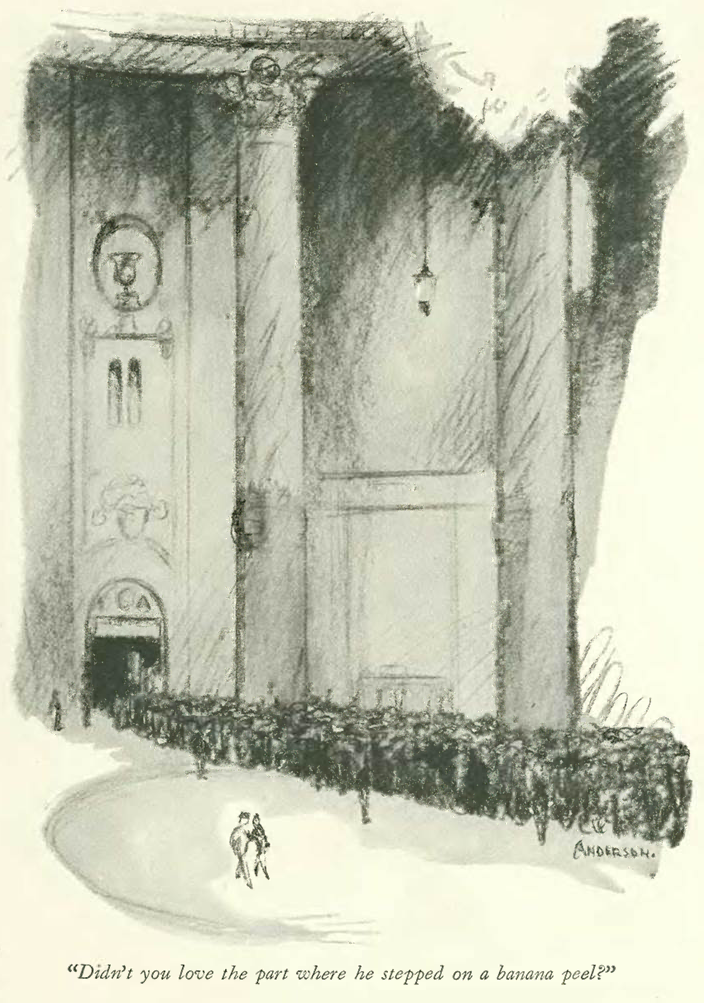
John Murray Anderson found humor in contrasting the grand with the mundane…

Carl Kindl eavesdropped on the small talk of a couple of ash haulers…

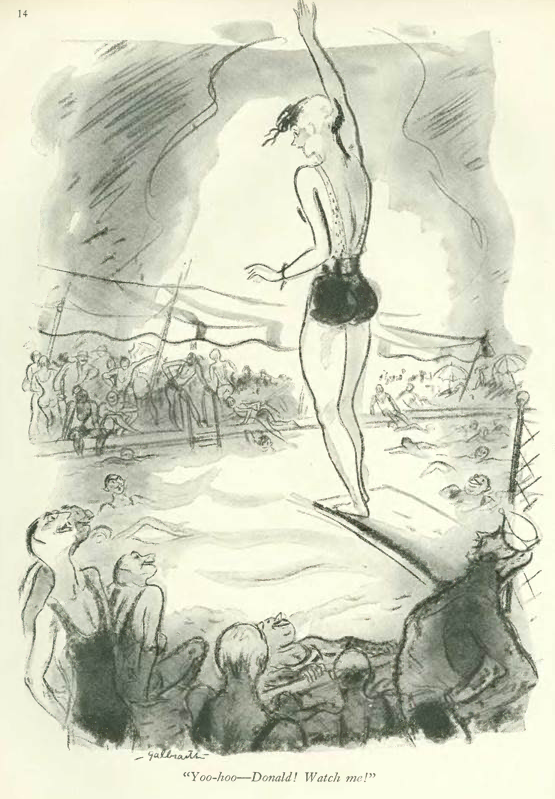
…and William Crawford Galbraith found humor at the public pool…

 *  *  *

On to the June 28 issue, with a cover featuring a satirical kakemono-style illustration by Rea Irvin, who was fond of Japanese scroll art…

June 28, 1930 cover by Rea Irvin.

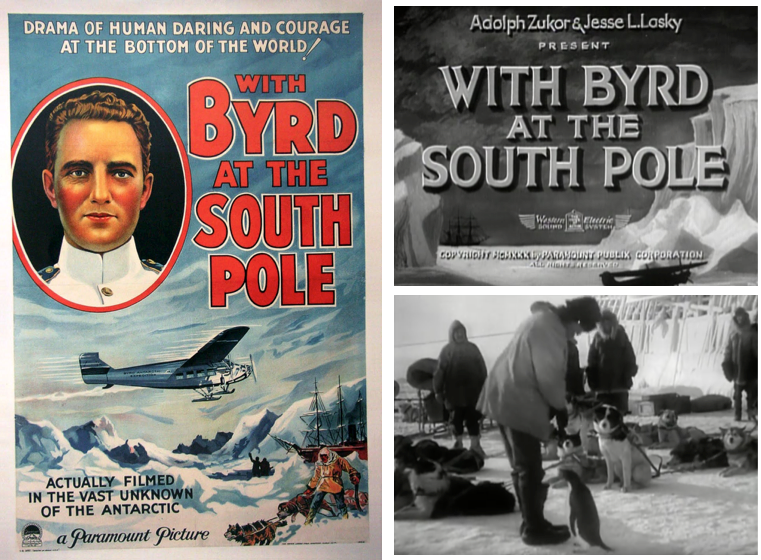
Film critic John Mosher checked out the new documentary on Admiral Richard Byrd’s expedition to the South Pole…

A BYRD WITH WINGS…A Paramount Pictures movie poster promoting the 1930 documentary With Byrd at the South Pole; still images from the film at right. (Wikipedia/YouTube)

“The Talk of the Town” also made note of Byrd’s expedition and homecoming, contrasting his upcoming book, Little America, with the four-volume historical work planned by popular historian Will Durant.

In collaboration with his wife, Ariel, Durant would end up publishing an eleven-volume history of civilization (four million words across nearly 10,000 pages), written between 1935 and 1975. Will Durant was at work on a twelfth volume when he died in 1981 at age 96.

Admiral Richard Byrd’s Little America, left, and the 11-volume The Story of Civilization, by Will and Ariel Durant.

 *  *  *

American Lenin

The June 28 profile, written by Alva Johnston, featured radical American labor organizer and Marxist politician William Z. Foster. Despite Johnston’s portrayal of Foster as something of a genial pinko, in reality Foster was a strong supporter of Joseph Stalin and a dedicated and loyal ally of the Soviet Union’s Communist Party until his death in 1961. The Soviets even gave him a state funeral, with Nikita Khrushchev personally heading an honor guard in Red Square. An excerpt of Johnston’s profile:

RED AS A ROSE…Left, a campaign photo of William Z. Foster when he headed the Communist Party ticket in the 1928 U.S. presidential election; at right, illustration of Foster for the profile, by Abe Birnbaum.

 *  *  *

And to close…a colorful advertisement in the June 28 issue from Rex Cole…from the signature it appears to be the work of Mario Cooper, but this doesn’t look at all like his other work…

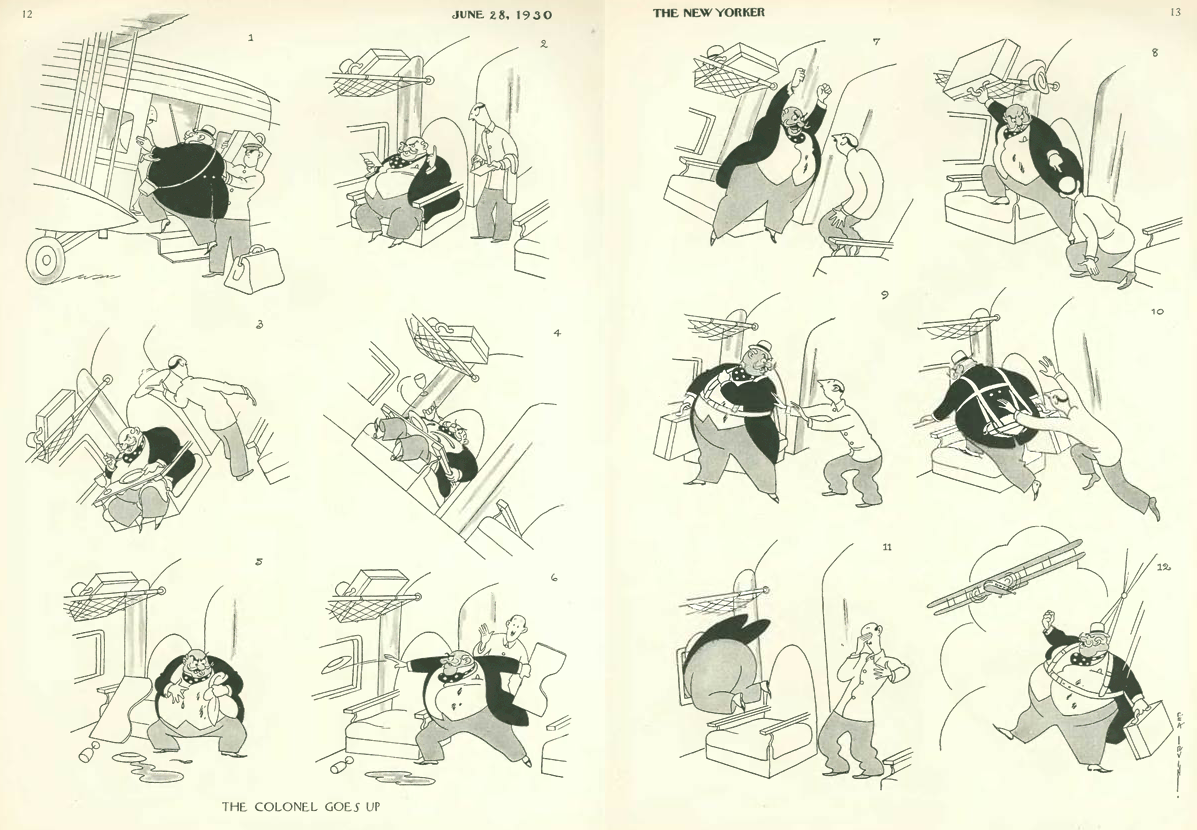
…and a two-page Rea Irvin cartoon, which demonstrates his visual storytelling skills…

Next Time…Happy Fourth!