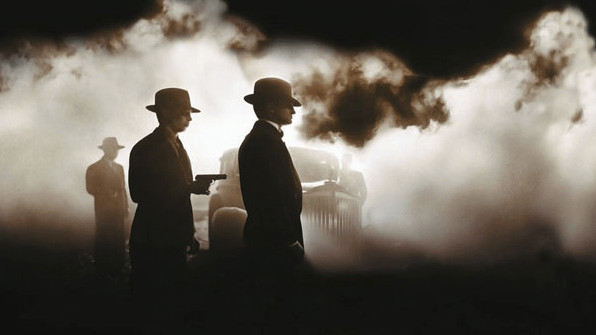
In some ways, the raucous party of the Roaring Twenties was sublimated in the movies of the late 1920s and early 1930s—a brief period at the beginning of the sound era before censorship guidelines were enforced. During those “Pre-code” times everyone from preachers to publishers decried the sex and violence that washed across the silver screen.
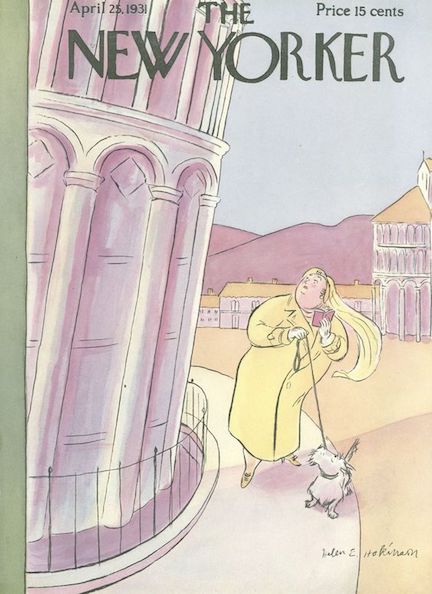
April 25, 1931 cover by Helen Hokinson.
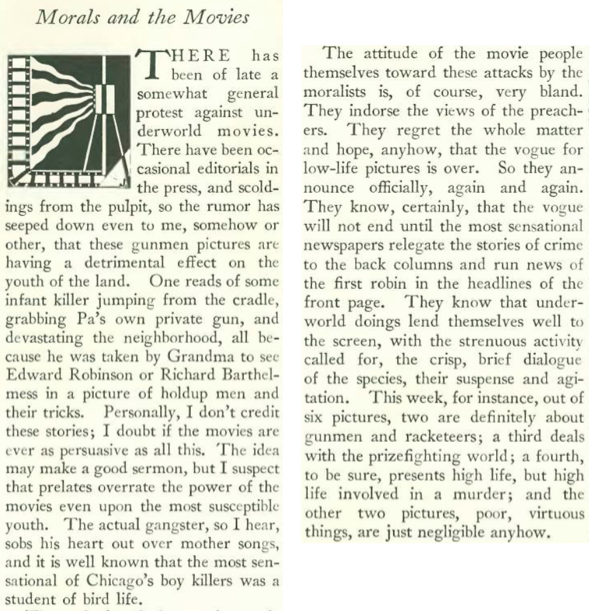
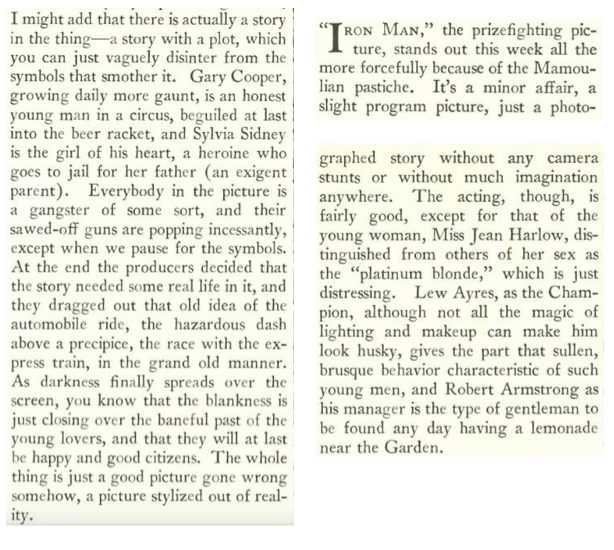
New Yorker film critic John Mosher opened his “Current Cinema” column with some musings about violence and “morals” in underworld films, declaring that until newspapers relegated sensational crime stories to the back pages, the public would be drawn to similar fare at the movies.
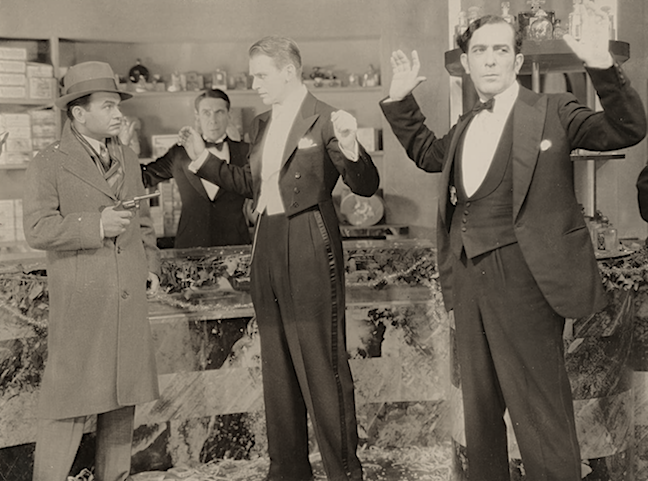
GIVING THE PEOPLE WHAT THEY WANT…Edward G. Robinson (left) played a hoodlum hoping to make the big time in 1931’s Little Caesar, a film that defined the gangster genre for decades to come. (IMDB)
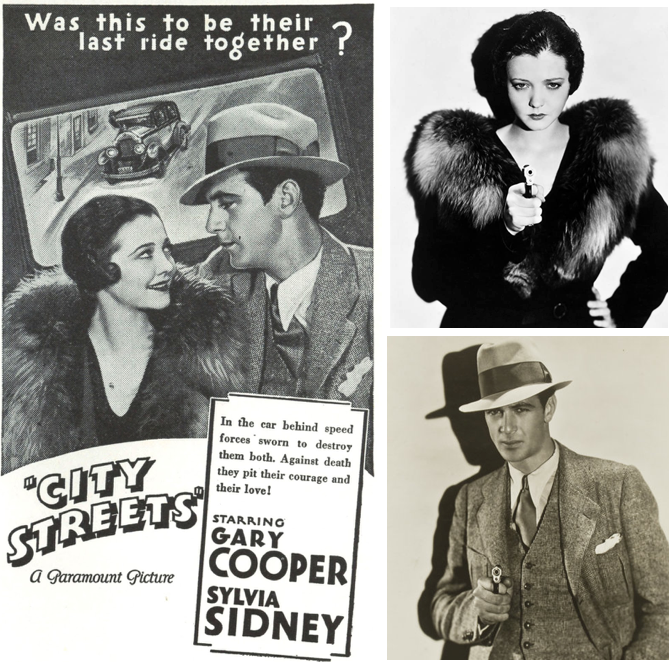
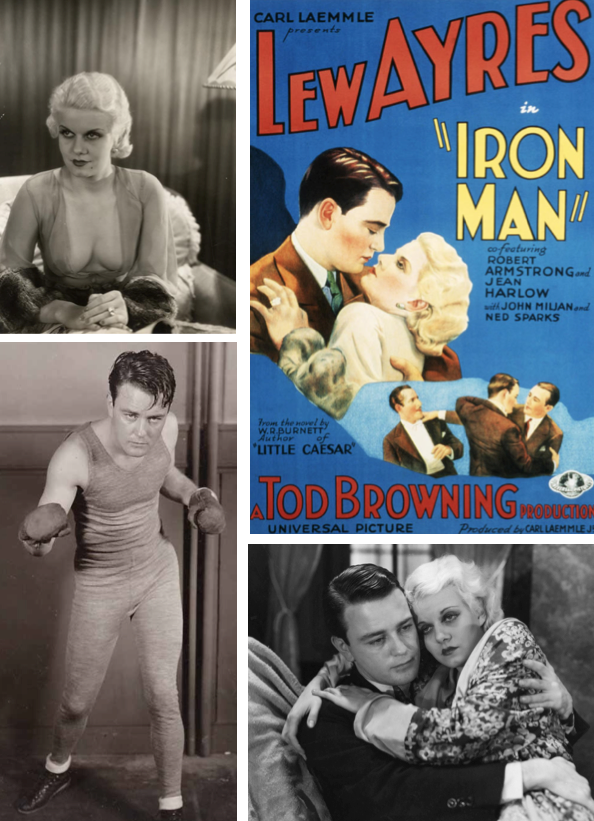
Mosher noted that two of the more prominent gangster films currently making the circuit weren’t much to fuss about—City Streets, the “more pretentious” of the two movies, featured rising stars Gary Cooper and Sylvia Sidney. The prizefighting picture Iron Man featured another popular pair of actors, Lew Ayers and Jean Harlow. Mosher observed that no amount of camera tricks could make the slight Ayers look like a husky fighter. As for Harlow, Mosher found it distressing that it was her “platinum blonde” status, rather than her acting, that landed her in the picture.
WHO CARES?…That was the conclusion of critic John Mosher after sitting through the “pretentious” City Streets. At right, publicity photos for lead actors Sylvia Sidney and Gary Cooper. (IMDB)NO, NOT THAT IRON MAN…Jean Harlow, top, was known for attributes other than her acting, according to critic John Mosher. As for her co-star, Lew Ayers, a few weeks in the gym and some protein shakes might have made for a more plausible prize fighter. (IMDB)
* * *
Fashion of a Different Fashion
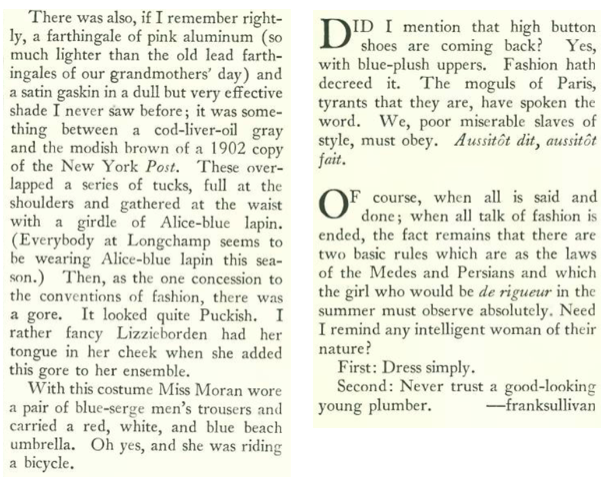
A New Yorker contributor since 1925 and denizen of the Algonquin Round Table, Frank Sullivan was a jolly soul known for his gentle wit and spoofs of cliches. His latest target was Lois Long’s fashion column “On and Off the Avenue,” penning a spoof that was indistinguishable from the original save for the change of one word in the title. Long’s actual column appeared in the magazine a few pages later, so no doubt a few readers started reading Sullivan’s spoof before realizing they had been had. I am among them. Some excerpts:
HE TOOK A FASHION TO FASHION…A wit herself, Lois Long no doubt enjoyed Frank Sullivan’s spoof of her fashion column. (Wikipedia/PBS)
Sullivan probably had a little extra time on his hands after the folding of the New York World newspaper, to which he contributed two or three humor columns a week before the grand old paper folded for good in February 1931. And so we have Sullivan again in the April 25 issue, and his “report” on the annual meeting of the “International Association of Girls Who Have Danced with the Prince of Wales.” Excerpts:
HOOFER…Apparently the Prince of Wales (Edward VIII), shown here in 1924, danced with many a lady before he abdicated the throne and married Wallis Simpson. (Pinterest)
* * *
Getting High in Manhattan
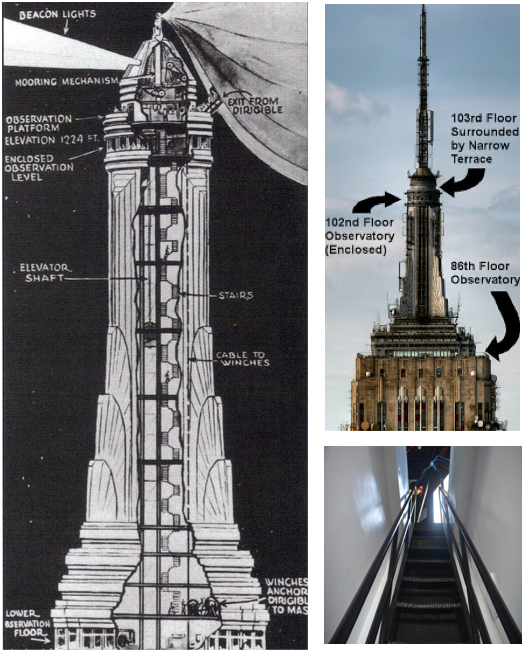
E.B. White enthusiastically embraced many aspects of modern life, from the wonder of air travel to the spectacle of buildings climbing ever higher into the clouds above Manhattan. It seemed whenever someone was needed to report on a flight or check out progress on the latest skyscraper, White was there, eager to climb into cockpits or onto scaffolds to get a better a look at his fair city. In “The Talk of the Town” White recalled his visit to (almost) to the very top of the Empire State Building, which was to open on May 1, 1931.
QUITE A SALTSHAKER…As E.B. White noted, the mooring mast atop the Empire State Building might have looked like a mere “saltcellar” from the ground, but in reality was as tall as a 20-story building, so quite a climb. Image at left shows inner stairwell winding to the top; bottom right, stairs to the 103rd floor of the Empire State Building. (Modern Mechanix/Evan Bindelglass-CBSNewYork)
* * *
From Our Advertisers
With summer on the way B. Altman’s touted its new line of wool bathing suits for the kiddies…I frankly can’t imagine wearing wet wool in the summer, at least not voluntarily…
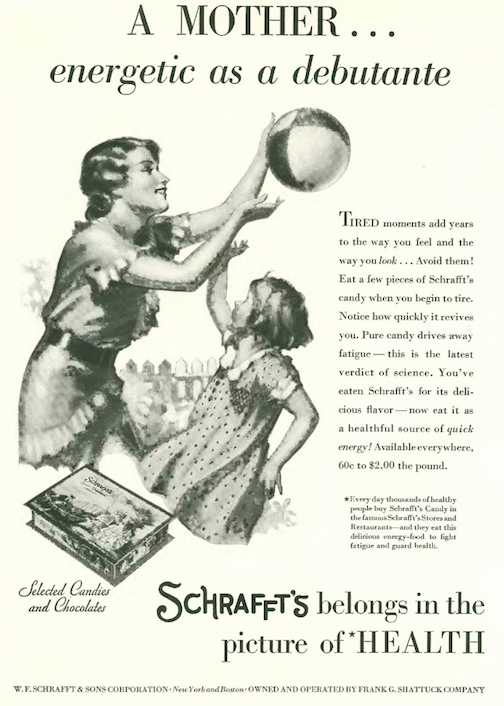
…hey, here’s an idea if you want to keep up with the little brats…eat some candy…according to Schrafft’s, it’s HEALTHY…
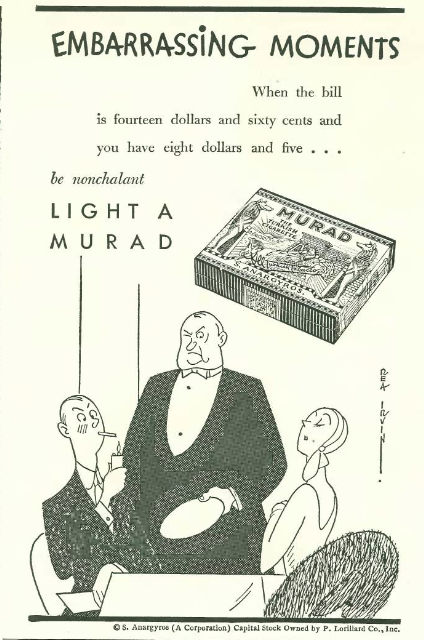
…on to our illustrators and cartoonists, another fine moment in smoking thanks to Rea Irvin…
…Ralph Barton introduced us to his latest “Hero of the Week”…
…and his news summary in graphic form…
…Helen Hokinson observed some subway etiquette…
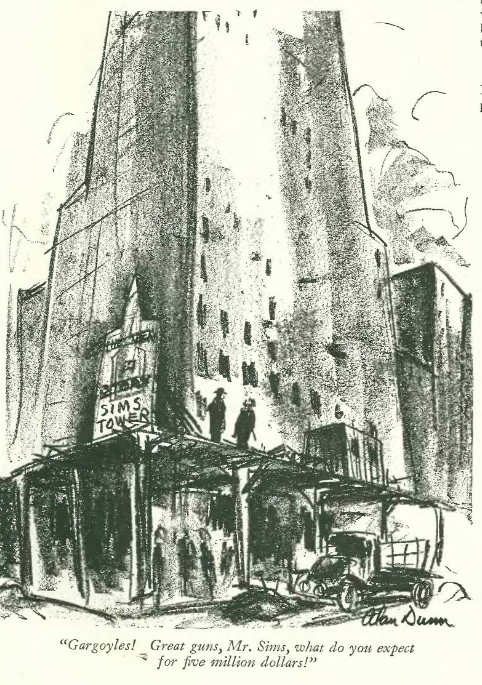
…Alan Dunn found a developer looking for some extras…
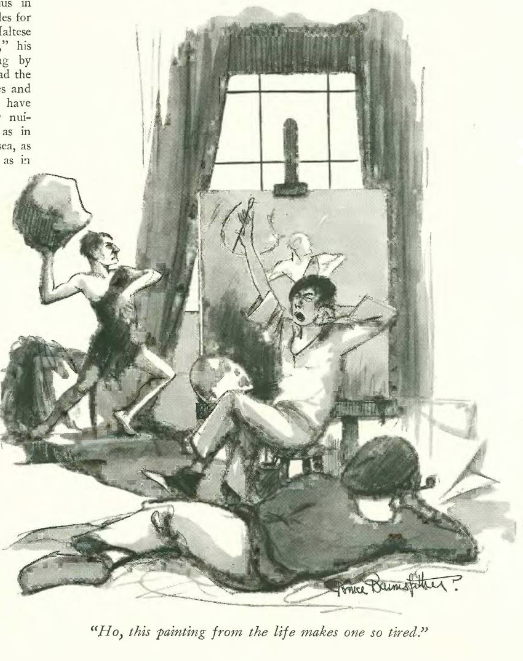
…Bruce Bairnsfather offered a study in contrasts…
…C.W. Anderson, and another example of an artist’s struggle…
…and we end with Otto Soglow and his Little King, a strip that would become a nationally syndicated hit…
The early New Yorker loved two things about modern life — college football and air travel. Tragedy would bring them together on the last day of March 1931.
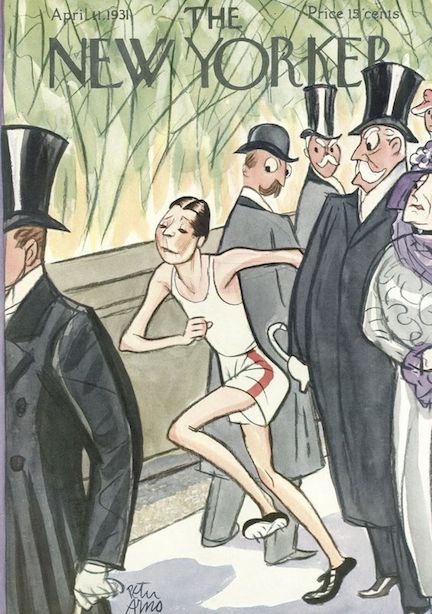
April 11, 1931 cover by Peter Arno. A brilliant cover, contrasting the skinny, lightly clad runner with one of Arno’s stock characters from the Taft era—a millionaire with a walrus mustache.
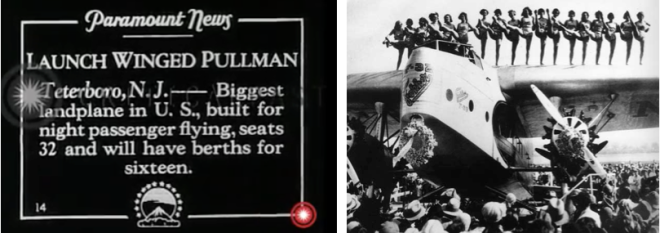
The New Yorker’s sportswriter John Tunis was especially keen on Knute Rockne’s Notre Dame football team, which played an annual rivalry game against Army at Yankee Stadium. Tunis’s colleague, E.B. White, was the flying enthusiast, never missing a chance to hop aboard a plane and marvel at the scene far below. In the Nov. 30, 1929 issue, White was eager to join passengers on a test of the Fokker F-32, and suggested that flying was becoming so routine that one could be blasé about its risks:
WHAT COULD POSSIBLY GO WRONG?…Title card from a silent Paramount newsreel reporting on a November 1929 test flight of the Fokker F-32 at Teterboro, possibly the same flight enjoyed by E.B. White. At right, a celebration of the plane’s arrival in Los Angeles. (YouTube/petersonfield.org)
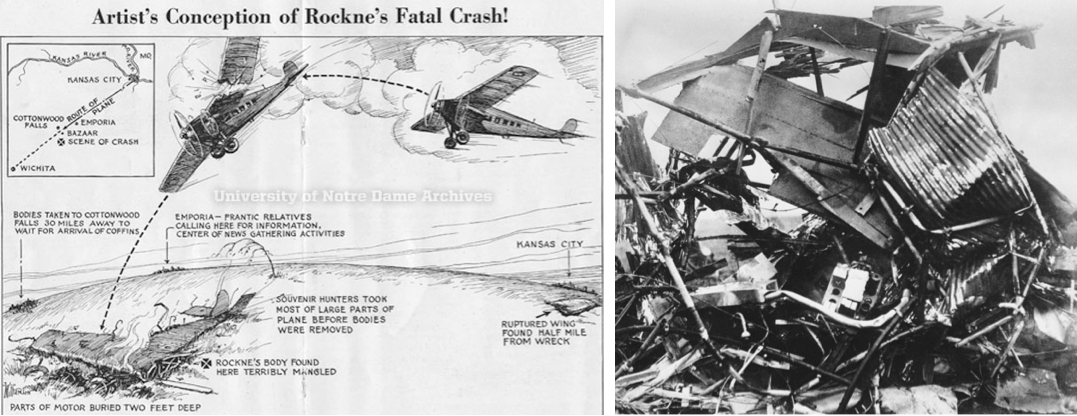
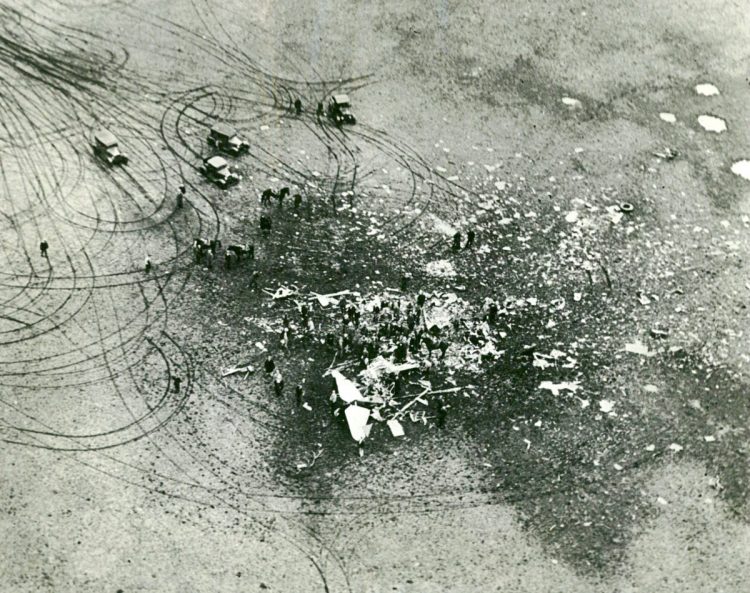
All of that exuberance came crashing down in a Kansas wheat field on March 31, 1931. It was Rockne’s fame—which The New Yorker and countless other magazines and newspapers helped to spread—that put the coach on a TWA flight to Hollywood, where director Russell Mack was filming The Spirit of Notre Dame. Rockne stopped in Kansas City, where he visited his two oldest sons, before boarding a Fokker F-10 destined for Los Angeles. About an hour after takeoff one of the airplane’s wings broke to pieces, sending Rockne and seven others to their deaths.
(University of Notre Dame) click image to enlarge
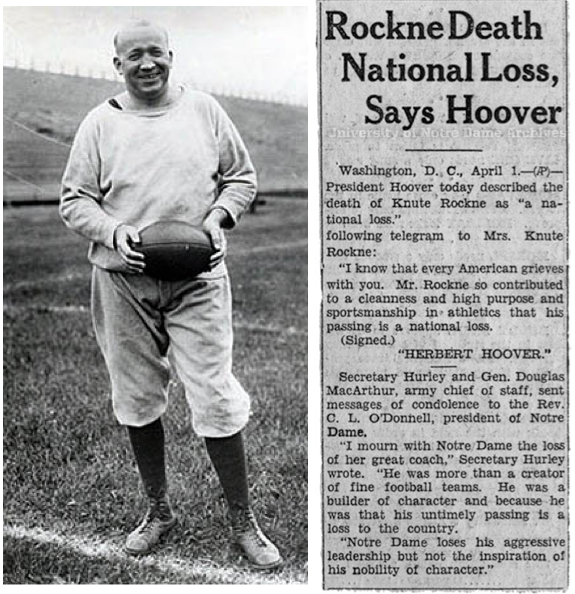
The accident rattled E.B. White. In his April 11, 1931 “Notes and Comment,” White pondered the eulogies Rockne received from President Herbert Hoover and others, calling into question the fame a college football coach could attain while achievements of college faculty go unheralded. White also seemed to have lost some of his faith in the progress of aviation, suggesting that the autogiro (a cross between an airplane and a helicopter) might be the safest way to proceed into the future:
Knute Rockne, in undated photo. (University of Notre Dame)
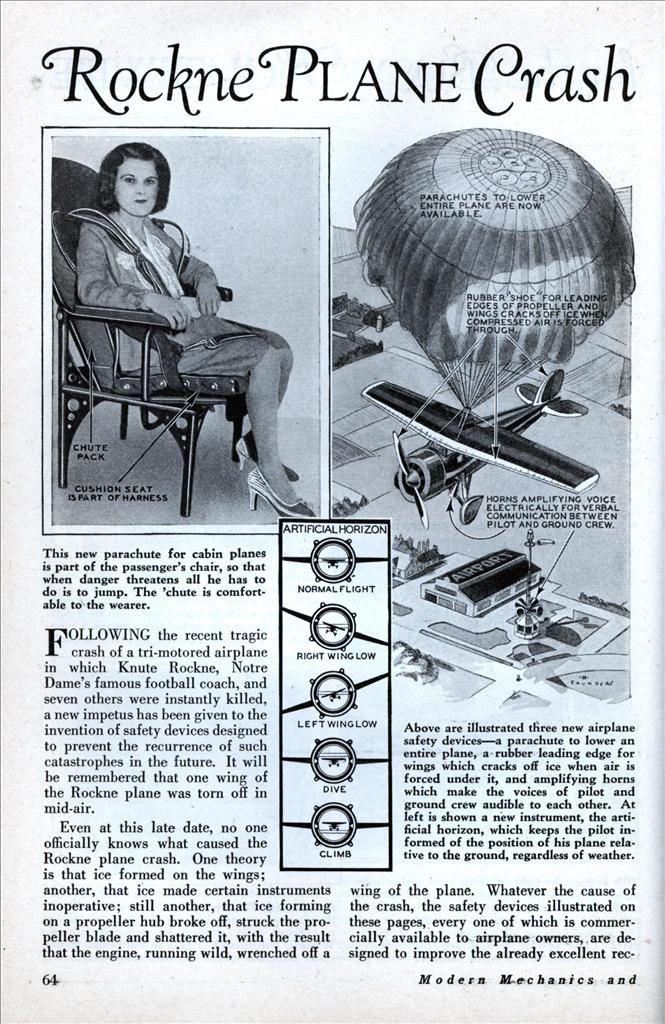
Ironically, it was thanks to Rockne’s fame that the aviation industry began to get serious about safety. A public outcry over the crash led to sweeping changes in everything from design to crash investigation, changes that have helped make flying one of the safest forms of transportation today.
SAFETY FIRST…The crash that claimed the life of Knute Rockne resulted in a public outcry for greater safety in the air. This article in the July 1931 issue of Modern Mechanics suggested parachutes for passengers and for the plane itself. (modernmechanix.com)
As for the cause of crash, it was determined that the plywood covering one of the Fokker F-10’s wings had separated from the wing’s supporting structure — the wing had been bonded together with a water-based glue that likely deteriorated as the result of rainwater seeping into the wing.
Unfortunately, the investigation into the crash was hampered by souvenir-seekers, who carried away most of the large parts of the plane even before the bodies were removed. So much for honest Midwestern values, at least in this case.
(clickamericana.com)
* * *
Give My Regards
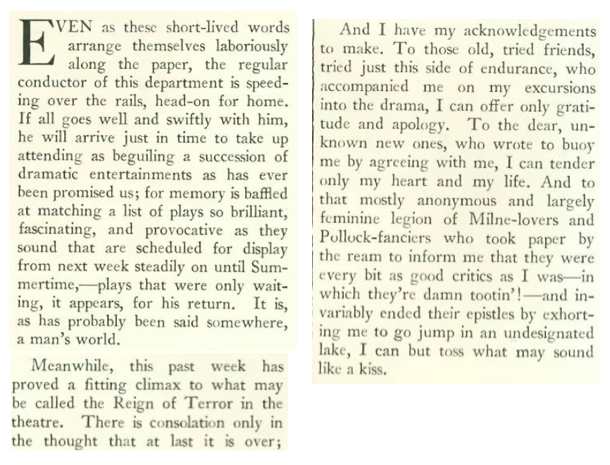
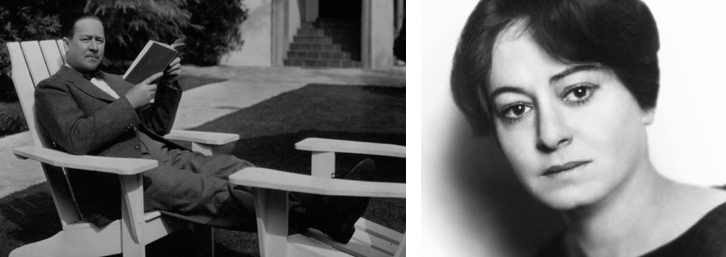
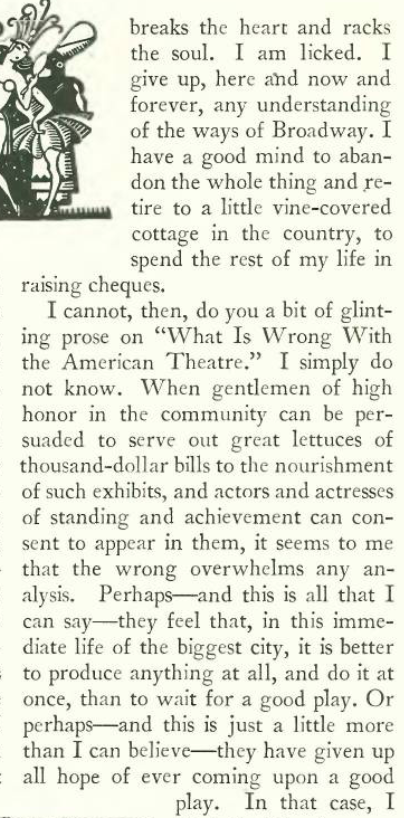
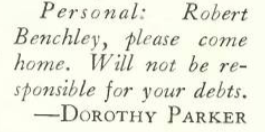
Back in Manhattan, Dorothy Parker was writing a eulogy of her own, bidding farewell to her interim role as theater critic. Parker subbed for Robert Benchley during his extended European vacation, and often noted that it was just her luck to be stuck with a string of plays that likely comprised one of Broadway’s worst spring line-ups.
In an earlier column Parker had alluded to the fact that Benchley was in Europe, no doubt staying part of the time with their mutual friends, Gerald and Sara Murphy, at their fashionable “Villa America” at Cap d’Antibes on the French Riviera.
SIGHT FOR SORE EYES…Dorothy Parker was glad to have her old friend Robert Benchley back at the theater desk, she having endured a “rotten time” reviewing a long string of bad plays. (dorothy parker.com)
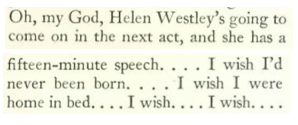
Hopeful to review at least one play of redeeming value before her friend returned, Parker was to be sorely disappointed as evidenced in her final review column. Of the terribly dated Getting Married, a play written by George Barnard Shaw way back in 1908, Parker was more afraid of Getting Bored, especially when Helen Westley (portraying Mrs. George Collins) entered the stage to deliver a 15-minute monologue…
Things got no better with the second play Parker reviewed, Lady Beyond the Moon, a “dull, silly, dirty play” that was frequently interrupted by various sounds from the restless audience — “comments, titters and lip-noises…” The play must have been terrible, because it closed after just fifteen performances.
As for the third play Parker reviewed, the misnamed Right of Happiness, the audience had every excuse “for displayed impatience,” yet conducted itself “like a group of little lambs.” Right of Happiness, observed Parker, “fittingly concluded the horrible little pre-Easter season…” The play closed after just eleven performances.
* * *
Turning Up the Heat
If anyone thought he had a right to happiness it would have been New York Mayor Jimmy Walker, who was preparing to face a grilling from Judge Samuel Seabury. Walker loved the nightlife and left most of his duties to a bunch of Tammany Hall cronies whose activities drew the attention of reformers like Seabury and Gov. Franklin D. Roosevelt. In his “A Reporter at Large” column, Morris Markey observed:
* * *
Walking Tall
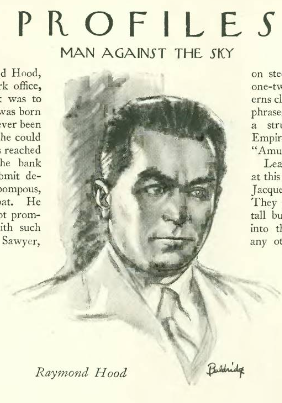
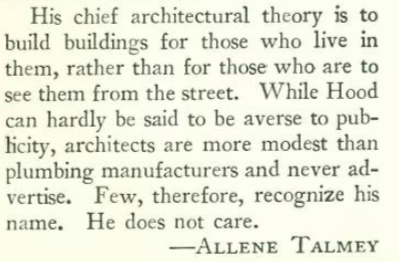
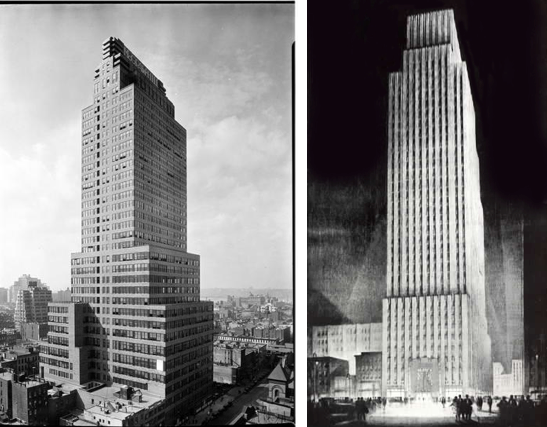
Raymond Hood (1881-1934) might have been short in stature, but he stood tall among the architects of some of New York’s most iconic skyscrapers — Rockefeller Plaza, American Radiator, Daily News, McGraw Hill (Sadly, both his career and his life were cut short when he died in 1934 at age 53 from complications related to rheumatoid arthritis). Allene Talmey, a former reporter for the New York World and managing editor of Conde Naste’s original Vanity Fair, gave Hood his due (see brief excerpt) in a New Yorker profile, with a portrait by Cyrus Baldridge:
LANDMARKS…The 1931 McGraw-Hill Building and the 1929-30 Daily News Building. (MCNY/Wikipedia)And of course, Hood’s 30 Rock. I took this last December before everything shut down.
* * *
From Our Advertisers
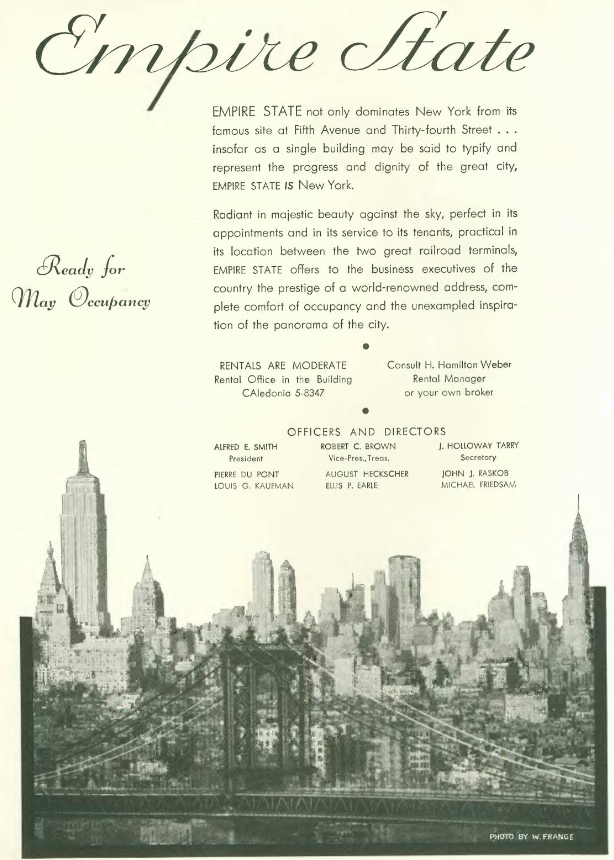
Speaking of big and tall, Al Smith and his gang took out this full page ad to announce the availability of office rentals in the world’s tallest building. Thanks to the Depression, only 23 percent of the available space in the Empire State Building was rented out in its first year. Thankfully, the building was also an instant tourist attraction, with one million people each paying a dollar to ride elevators to the observation decks in 1931, matching what the owners made in rent that year…
…for those who could afford more than a dollar ride up the Empire State’s elevators, the cooling breezes of coastal California beckoned…
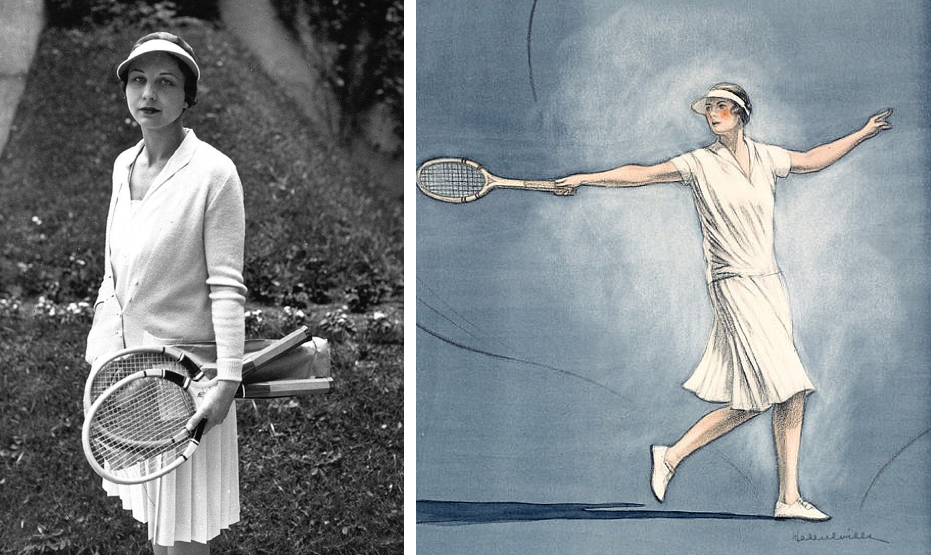
…those with even greater means and leisure time could hop on a boat to Europe…note that you could still cruise on the Olympic, the Titanic’s sister ship…also note that the illustration of the posh couple was rendered by Helen Wills (1905-1998), better known at the time as the top women’s tennis player in the world…
HELEN, MEET HELEN…American tennis star Helen Wills in 1932, and a self-portrait from the same year. Wills was the world’s top women’s tennis player for nine of the years between 1927 and 1938. She played tennis into her 80s, and sketched and painted all of her life. (Wikipedia/invaluable.com)
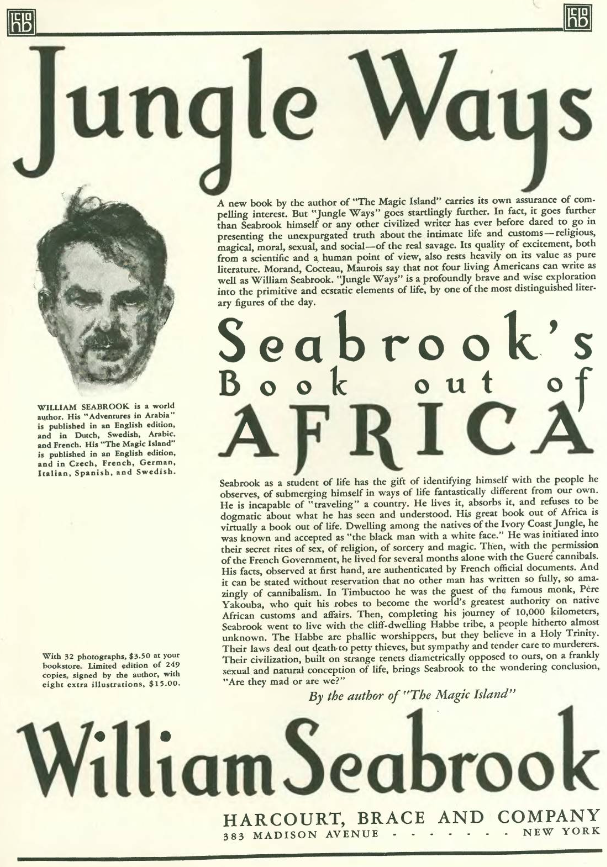
…Guess who’s coming to dinner?…hopefully not William Seabrook, who had just released his latest book on his adventures as an explorer…in Jungle Ways, Seabrook devoted an entire section to cannibalism in the French Sudan and how to cook human flesh; apparently he tried some himself…but then again by most accounts he was a weird dude who dabbled in occultism and possibly believed in zombies…Seabrook’s 1929 book, The Magic Island, is credited with introducing the concept of zombies to popular culture…
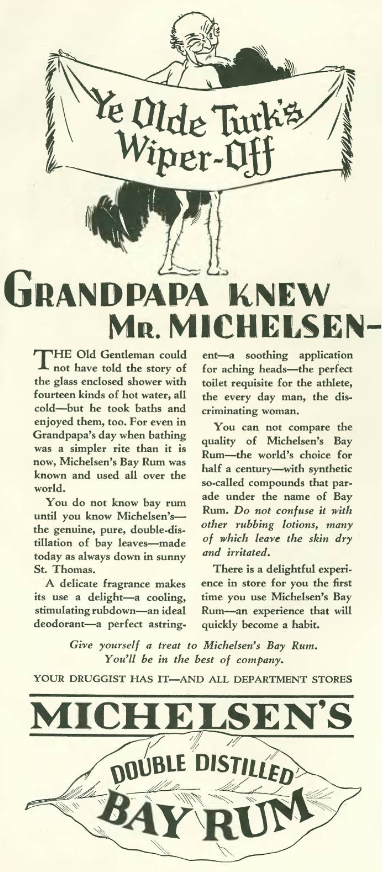
…speaking of weird, an ad for Michelsen’s “Bay Rum” body rub…
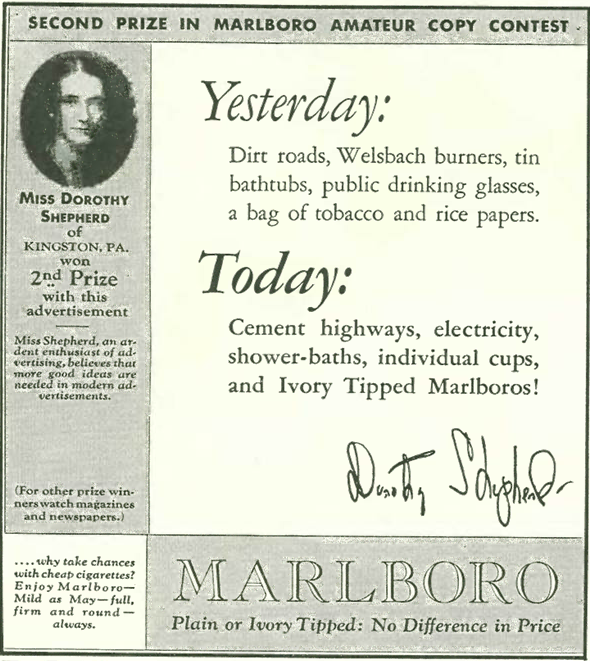
…when Marlboro cigarettes were introduced in the mid-1920s, they were marketed as “luxury” cigarettes and sold mostly at resorts and hotels. In the late 1920s, however, they were marketed as a “lady’s cigarette,” with ads in the New Yorker featuring handwriting and penmanship contests to promote the brand. This ad from November 1930 featured the “second prize” winner of their amateur copywriting contest…
…it appears marketing tactics changed a bit in 1931…still the dopey contest, but instead of real photos of winners, like the schoolmarmish “Miss Dorothy Shepherd” above, this ad featured a rather tawdry image of a model, more gun moll than schoolmarm…
…on to our cartoonists…Ralph Barton, who was with The New Yorker from Day One, had been increasing his contributions to the magazine after a notable absence from spring 1929 to summer 1930…beset by manic-depression, he would take his own life in May 1931, so what we are seeing are Barton’s last bursts of creativity before his tragic end, reviving old favorites like “The Graphic Section”…
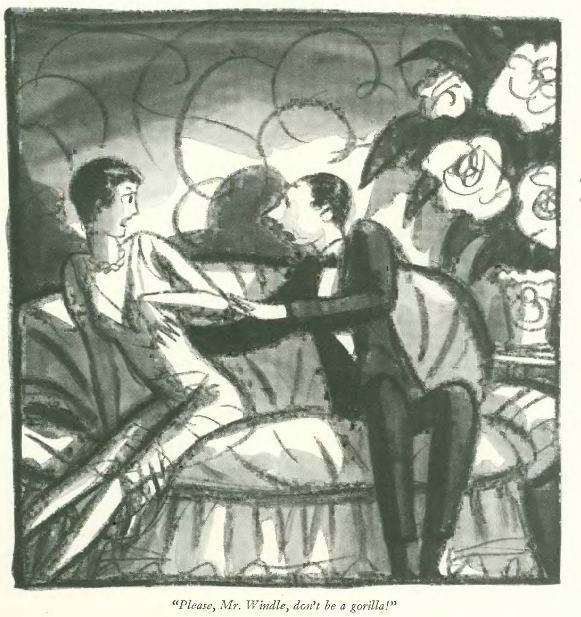
…Barbara Shermund entertained with some parlor room chatter…
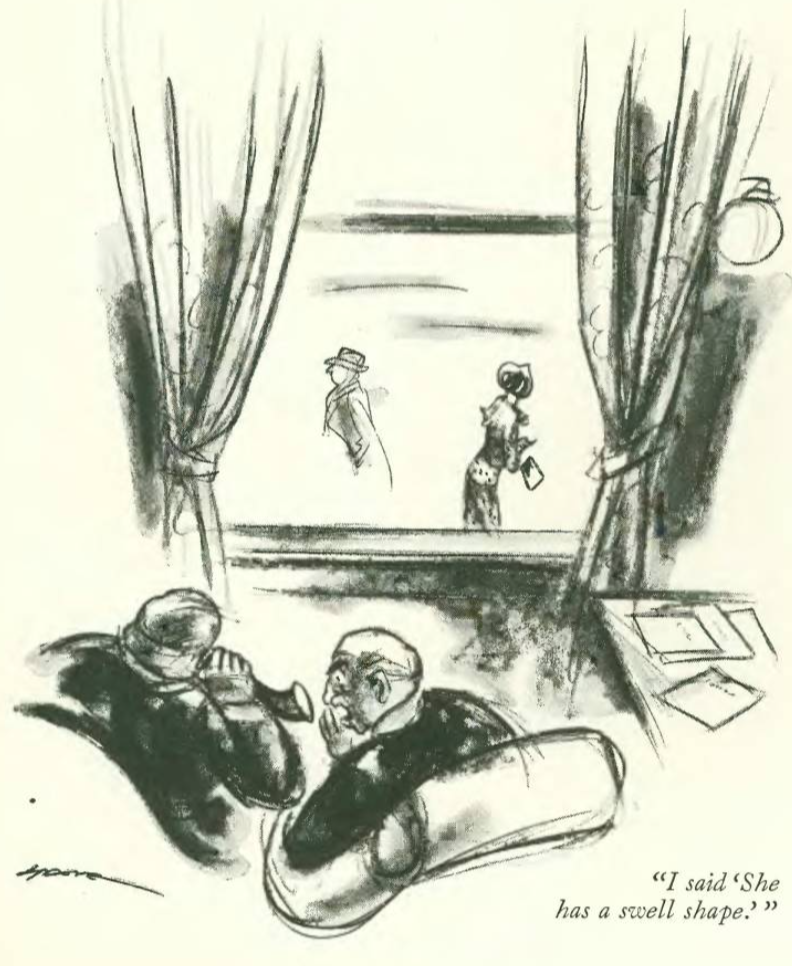
…Leonard Dove looked in on a couple of frisky old duffers…
…William Crawford Galbraith, and a crashing bore…
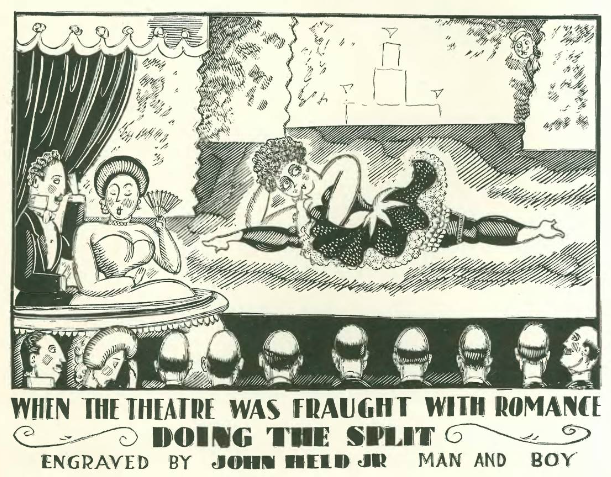
…John Held Jr gave us one of his “naughty” engravings…
…and two by our dear Helen Hokinson, stuck in traffic…
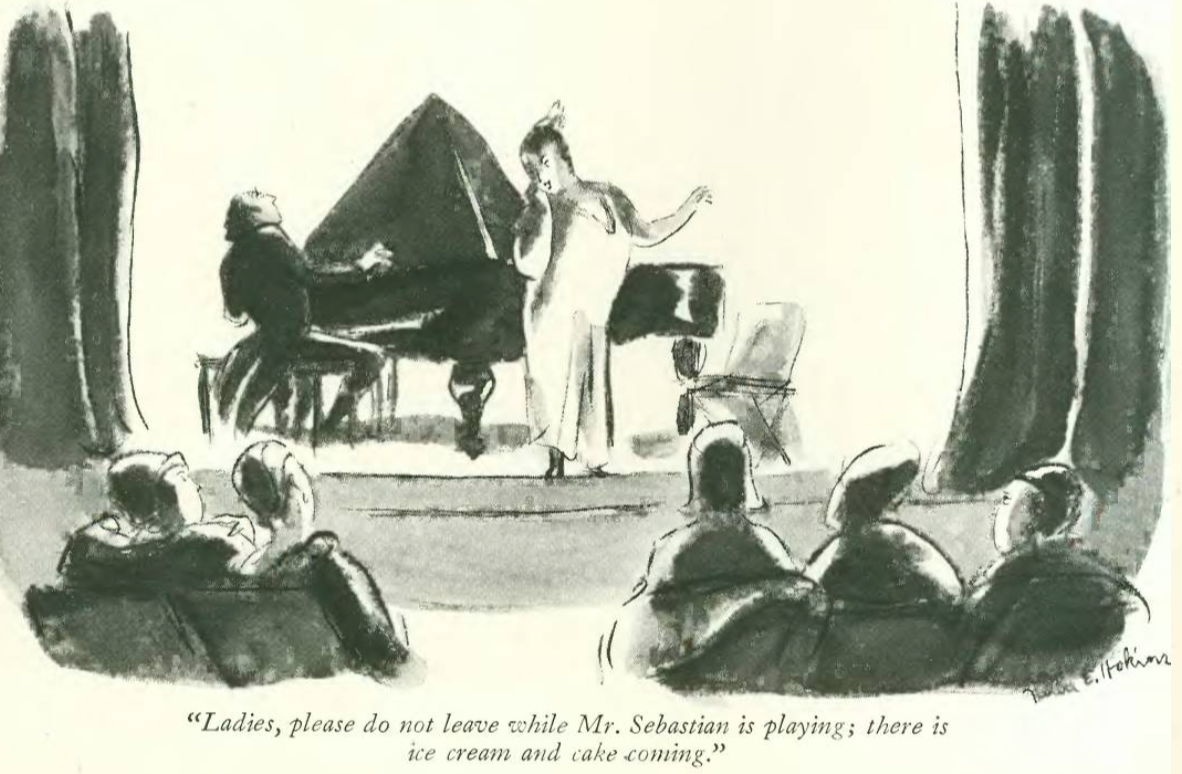
…and enjoying cake and ice cream, with a dab of culture…
The story of Fred Nixon-Nirdlinger isn’t exactly dinner table conversation these days, but in the spring of 1931 his death at the hands of his beauty queen wife had much of America abuzz.
March 21, 1930 cover by Helen Hokinson.
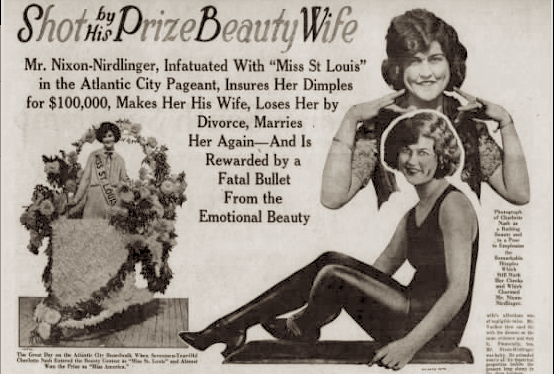
Charlotte Nash, Miss St. Louis of 1923, would have passed into obscurity like so many other beauty contestants if she hadn’t married a wealthy theater owner 30 years her senior, and then divorced and remarried him, and then shot him in the head on the French Riviera.
But first, the reason I am writing about this lurid episode: here’s E.B. White in the March 21, 1931 “Notes and Comment”…
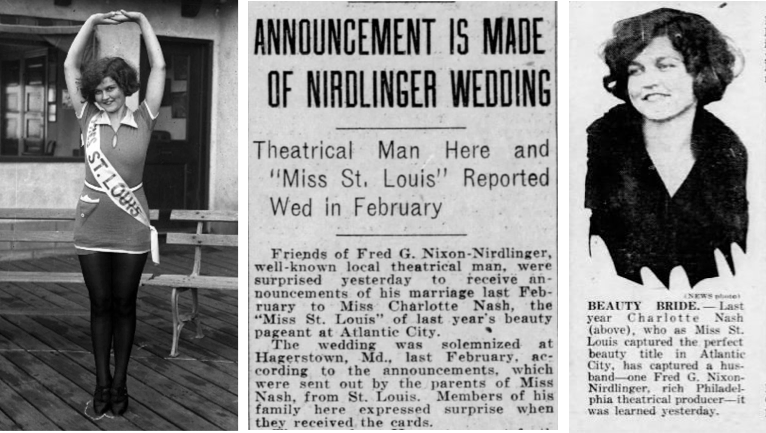
Forty-seven-year-old Fred Nixon-Nirdlinger, wealthy owner of a Philadelphia theater chain, was serving as a judge at the 1923 Miss America competition in Atlantic City when the 17-year-old “Miss St. Louis,” Charlotte Nash, caught his eye and his fancy. By February 1924 they were married…
FANCY STRIKER…Seventeen-year-old Charlotte Nash strikes a pose at the 1923 Miss America pageant in Atlantic City; belated 1924 marriage announcement in the Philadelphia Inquirer; announcement in the New York Daily News. (New York Daily News/Philadelphia Inquirer)
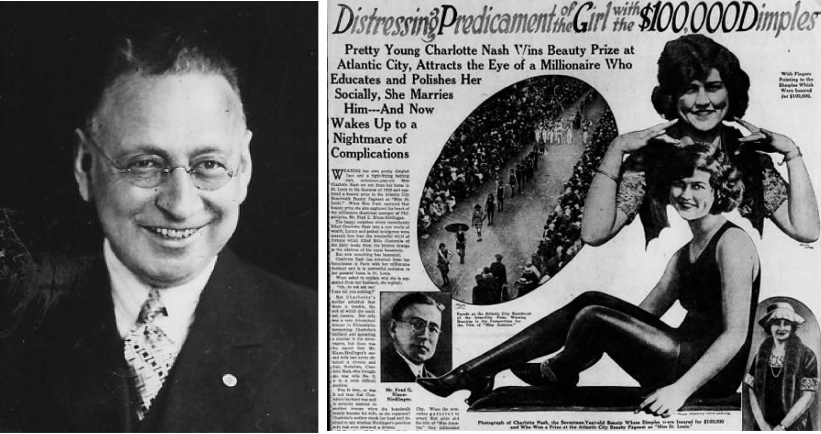
…Fred was furious that Charlotte did not win the title in Atlantic City. He vowed to make her a movie star and sent her off to finishing school to work on her manners and elocution…
CRADLE TO GRAVE…Fred Nixon-Nirdlinger sent his young bride to finishing school for “a touch of polishing here and there.” Little did he know that one day she would finish him too…permanently. (findagrave.com/Pittsburgh Press)
…Unfortunately, Fred forgot to tell his young bride that he already had a wife —news that came to light on a trans-Atlantic voyage to Paris, where Fred and Charlotte had planned to honeymoon. Already pregnant with his child, Charlotte nevertheless divorced Fred, but remarried him some months later after the baby was born (and after considerable wooing and groveling by the theater magnate). Fred rejoined Charlotte in France, but the second honeymoon didn’t last long either. On the evening of March 11, 1931, the intensely jealous Fred accused his young wife of trafficking with “gigilos.” After Charlotte denied the charge, Fred seized her by the neck and threatened to choke her to death.
“At some point Fred went into the kitchen for more whisky. Charlotte used the opportunity to flee to the bedroom, where she slipped a loaded pistol under her pillow. Fred’s last words to her were, “I will kill you rather than let you have an Italian lover.” Charlotte beat him to it, and as she lay on the bed she retrieved her pistol and fired. The first bullet entered just under Fred Nixon-Nirdlinger’s left eye and lodged at the base of his skull. A second bullet hit him in the chest. Two other shots went wild. Fred crumpled in a pool of blood.”
Charlotte was soon in a French jail, now a bigger star than she had ever been, or ever would be…
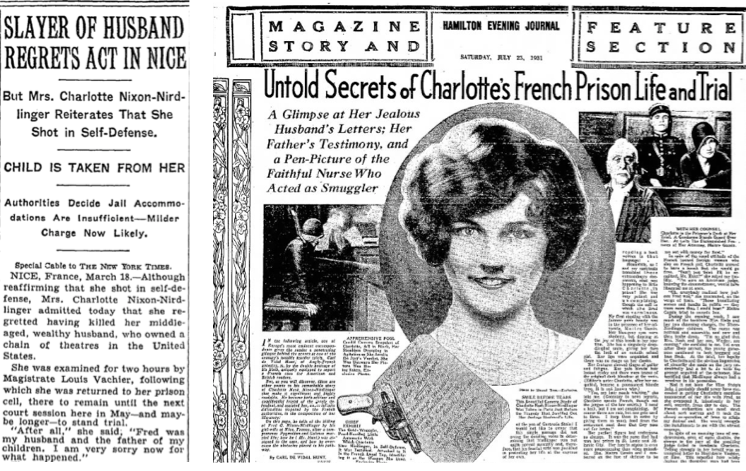
FINALLY GETTING SOME NOTICES…Left, detail of a March 18, 1931 New York Times account of the slaying; right, a more lurid take on the story by the July 18, 1931 edition of the Hamilton (Ohio) Evening Journal. Below, another colorful account from the San Francisco Examiner. (newspaper.com/New York Times)
During the subsequent trial, Charlotte’s defense attorneys argued that the shooting was a clear case of self-defense, and the jury agreed, acquitting the former beauty queen in just nine minutes. When she returned to the United States with her two young children, it appeared she would be entitled to a big chunk of Fred’s fortune…
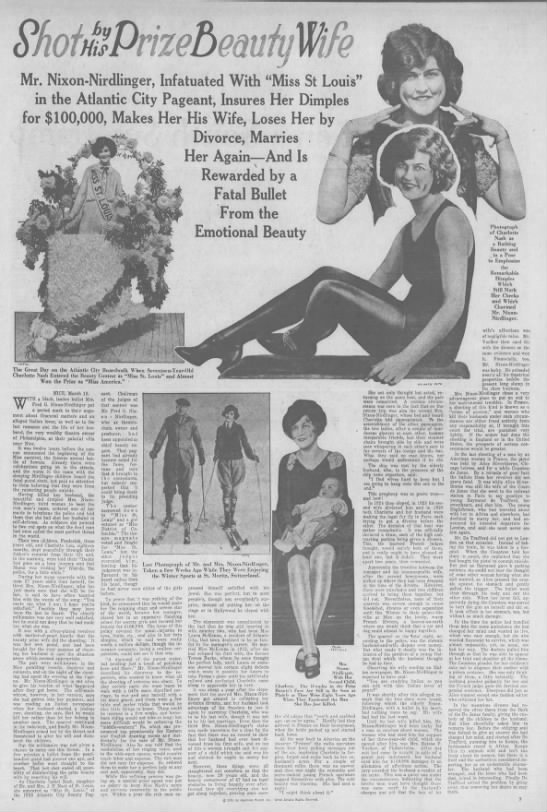
…but in the end the will left her nearly penniless, so she earned what she could by telling her sensational story to the media, including this multi-installment feature she penned for the St. Louis Star and Times:
IT’S A LONG STORY…The 14th and 16th installments of Charlotte Nash’s story of her brush with fame and infamy in the St. Louis Star and Times. (newspaper.com)
Laura James notes that Charlotte might have been better off remaining in France: “The verdict was largely attributed (by the American newspapers at least) to French attitudes toward beautiful women and marriage in general (the jury included eight bachelors). But she returned to St. Louis; learned that her husband’s will left her nearly penniless; and tried to find acting jobs in Hollywood only to be snubbed Lizzie Borden-style, as Hollywood would have none of her. In the end she would declare, ‘Sometimes I’m sorry that I was ever considered beautiful. It brought me more trouble than joy.”‘
But the story doesn’t end there. Charlotte Nash Nixon-Nirdlinger (1905-2009) dropped out of public view, but would live on into the 21st century, dying at age 103 or 104 in her hometown of St. Louis, Missouri, where she rests today.
RIP CHARLOTTE. (findagrave.com)
* * *
Turkey Trot
Dorothy Parker began to detect a pattern as she continued subbing for her friend Robert Benchley’s theater review column. All of the plays she had reviewed to date were found to be uniformly terrible; she found comfort, however, in fellow critics who also viewed Broadway’s spring lineup as a flock of “little turkeys”…
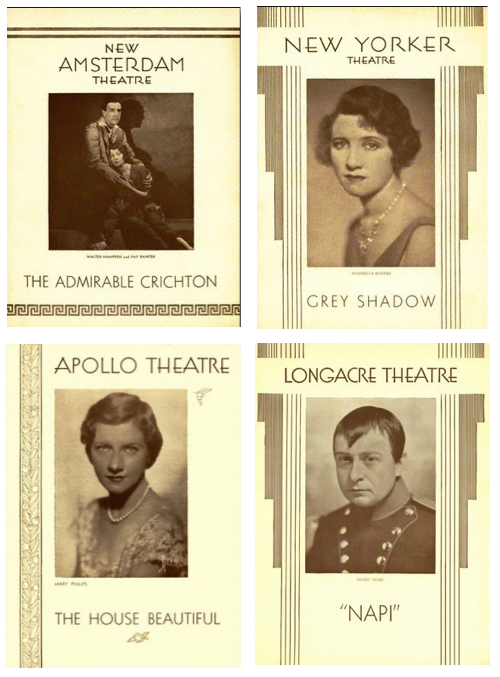
BIRDS OF A FEATHER…Dorothy Parker found Broadway’s spring lineup to be uniformly terrible, and audiences mostly agreed. Clockwise, from top left, The Admirable Crichton ran for two months and 56 performances at the New Amsterdam Theatre; Grey Shadow closed after 39 performances at the New Yorker Theatre; Napi, directed and lead-acted by the diminutive Ernest Truex (pictured) lasted just 21 shows at the Longacre; The House Beautiful bested them all by staying open for 108 performances at the Apollo. A curious side note: Mary Philips, pictured on the Apollo cover, was Humphrey Bogart’s second wife. The marriage lasted ten years — 1928 to 1938. (Playbill)
Of the plays Parker reviewed, she called The Admirable Crichton “piteously dated;” of Grey Shadow, she wrote that it would be as indelicate for her to discuss the play as it would be to “go into details of my appendectomy;” Parker deemed Napi “as grubby and unpleasant a little comedy as you could want to stay away from;” and she did not find The House Beautiful all that beautiful…”The House Beautiful is, for me, the play lousy.”
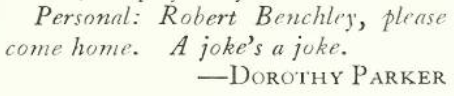
Parker ended the column with her usual plea to Benchley:
* * *
Moses Parts the Swamp
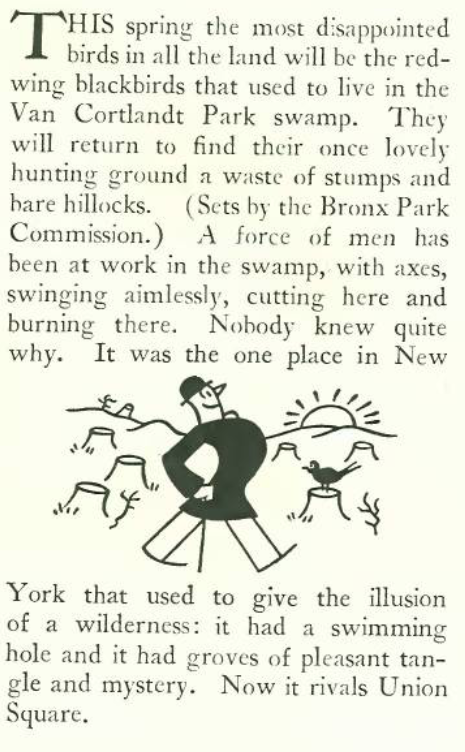
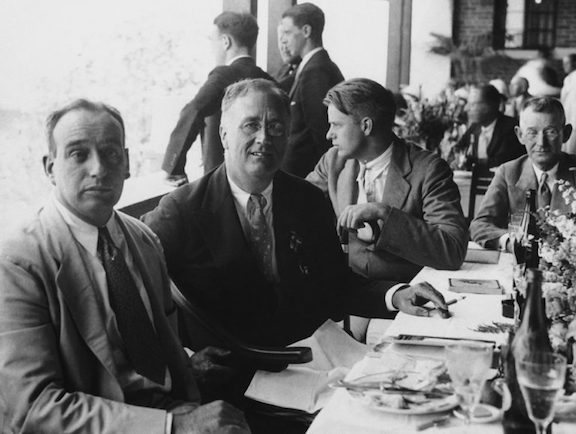
In his “Notes and Comment,” E.B. White noted the destruction of trees and swampland in Van Cortlandt Park. In 1931 Robert Moses was president of the Long Island Park Commission but held political sway over so much more. What White was witnessing were preparations for the construction of the Henry Hudson Parkway and Mosholu Parkway that would split Van Cortlandt into six separate pieces. White was right about the disappearing birds: the last remaining freshwater marsh in the state, Tibbetts Brook, was dredged to accommodate construction.
HE PAVED PARADISE…Governor Franklin D. Roosevelt of New York attends a Jones Beach luncheon on July 26, 1931, as a guest of Robert Moses (far left), who was president of the Long Island Park Commission. (AP Photo)A PARK DIVIDED…The Mosholu Parkway cuts a wide swath through Van Cortlandt Park, 1936. (Museum of the City of New York)
* * *
Those Daring Young Men
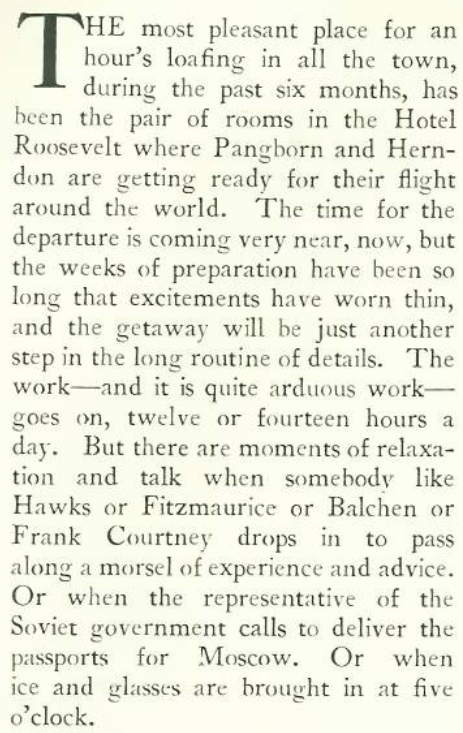
Ever since Charles Lindbergh made his historic transatlantic flight in 1927, Americans were captivated by the derring-do of pilots who competed for various “firsts.” In the case of Clyde Pangborn and Hugh Herndon Jr., the goal was to to fly around the world and break the record of 20 days and 4 hours set by Germany’s Graf Zeppelin in 1929. In his “Reporter at Large” column, Morris Markey noted the many weeks of preparation by the two pilots…
A BIT OF FUN…July 1931 newspaper illustration of Clyde Pangborn, left, and Hugh Herndon Jr., with a map of the route they followed on their attempt to set a new round-the-world flight record. (AP)
Markey noted that the two pilots claimed they were setting out on their dangerous mission “for the fun of it”…
While Pangborn and Herndon were still making flight plans at their Hotel Roosevelt headquarters, Wiley Post and Harold Gatty took to the air and claimed the record of 8 days and 15 hours. Pangborn and Herndon decided to make a go of it anyway, leaving New York on July 28, 1931, in their red Bellanca named the Miss Veedol, but poor weather in Siberia caused them to abandon their quest.
There was, however, a $25,000 prize being offered by the Tokyo newspaper Asahi Shimbun to the first pilots to cross the Pacific non-stop, so Pangborn and Herndon regrouped and successfully flew the Miss Veedol across the Pacific Ocean — in 41 hours and 13 minutes. It wasn’t exactly a smooth flight; three hours after takeoff the device used to jettison the landing gear failed, prompting Pangborn to climb out onto the wing barefoot at 14,000 feet to remove the landing gear props. After several other near-mishaps — including nearly smashing into a mountain — the duo completed their historic flight with a controlled crash landing near Wenatchee, Washington.
NO WHEELS, NO PROBLEM…More than 41 hours after departing Japan, Clyde Pangborn and Hugh Herndon Jr. performed a controlled crash landing near Wenatchee, Washington, completing the first-ever nonstop flight across the Pacific Ocean. (Wired.com)STILL IN ONE PIECE…Hugh Herndon Jr., left, and Clyde Pangborn after crash-landing at Wenatchee, Wash., following their 1931 flight across the Pacific from Misawa, Japan. (Spirit of Wenatchee).
* * *
From Our Advertisers
Herndon and Pangborn made plans for their round-the-world flight while staying at the Roosevelt Hotel in Midtown…I’ve stayed there myself and enjoyed its nubby charms…as for the underground passageway to the Grand Central, it’s still there, but no longer open to the public…
…the makers of Kleenex originally marketed their tissues for makeup removal…by the 1930s, however, they saw a much bigger opportunity…
…if the Roosevelt Hotel wasn’t posh enough for you, the new Waldorf-Astoria might have been your cup of tea…
…and if you could stay at the Waldorf, you might be able to afford a Packard, which in the 1930s was a near-rival to Rolls Royce…
…I toss this one in from Goodyear because it is probably the only time an image of the Taj Mahal was used to sell tires…
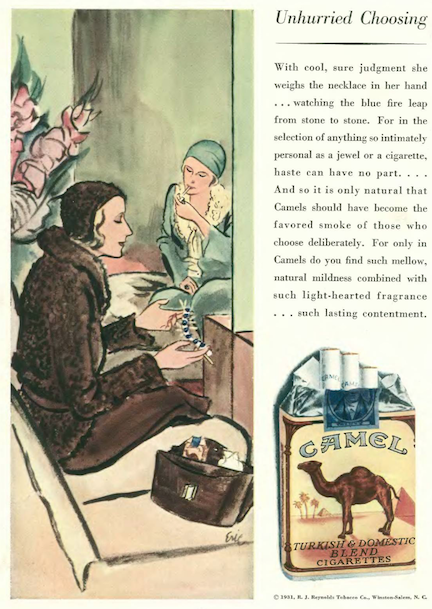
…we have another lovely Carl “Eric” Erickson illustration for Camel…
…and at first glance I thought this was another two-page ad for Chesterfield cigarettes, but it appears the candy manufacturers also wanted to tie their products to exciting lifestyles…in this case, you were urged to eat candy for some quick energy…here it is implied that Schrafft’s candy will give you the energy you need for sailboating and…er…other activities…
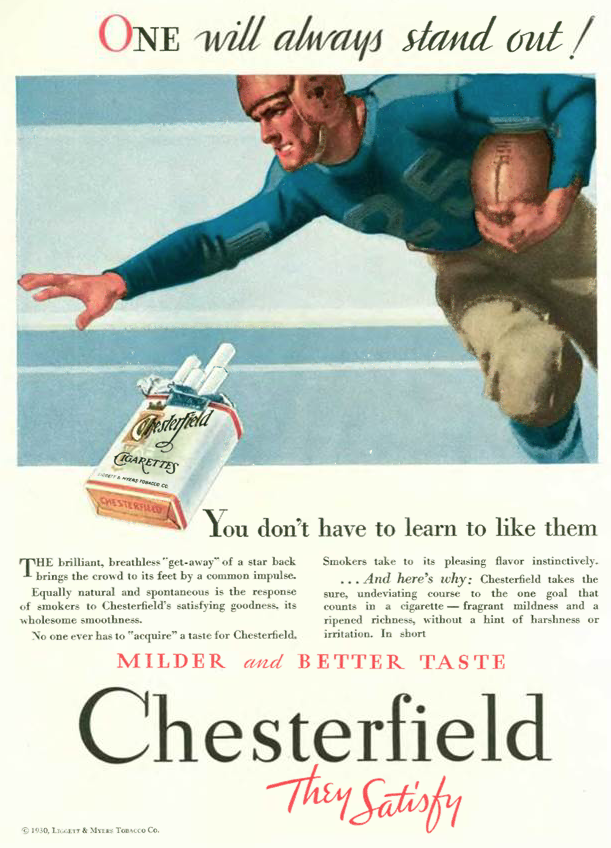
…for comparison, Chesterfield ad from 1930…
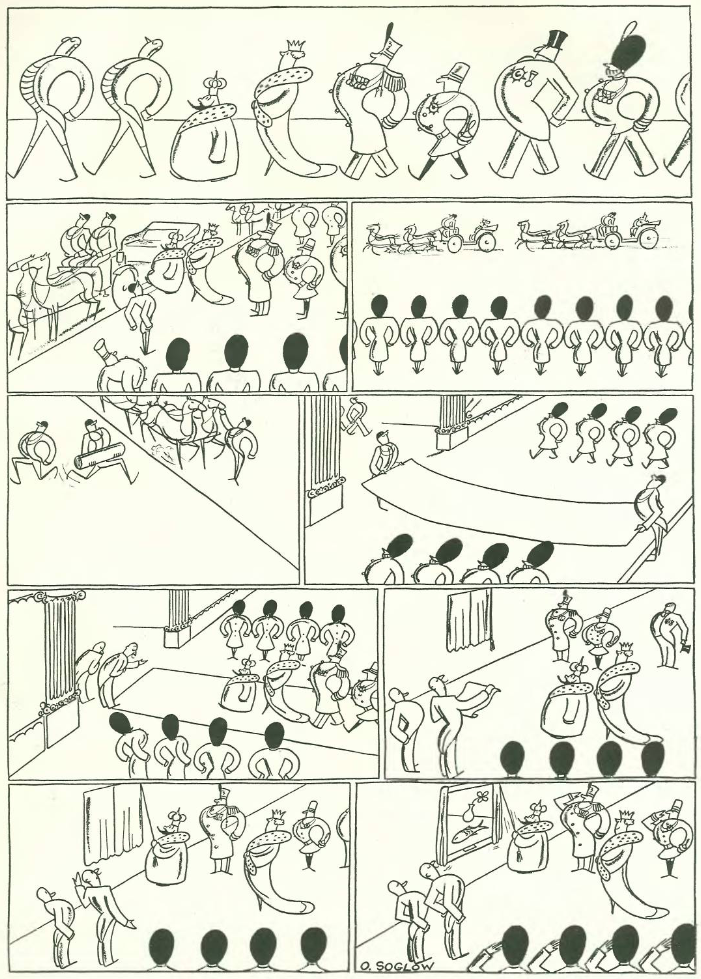
…on to our cartoons…Otto Soglow continued the adventures of the Little King…
…Perry Barlow showed us that war is hell…
…some ringside niceties courtesy E. McNerney…
…Mary Petty reminded us that posh folks weren’t exactly known for their intellect…
…Alan Dunn examined the challenges of buying an older house…
…Helen Hokinson gave us a politically precocious young lad…
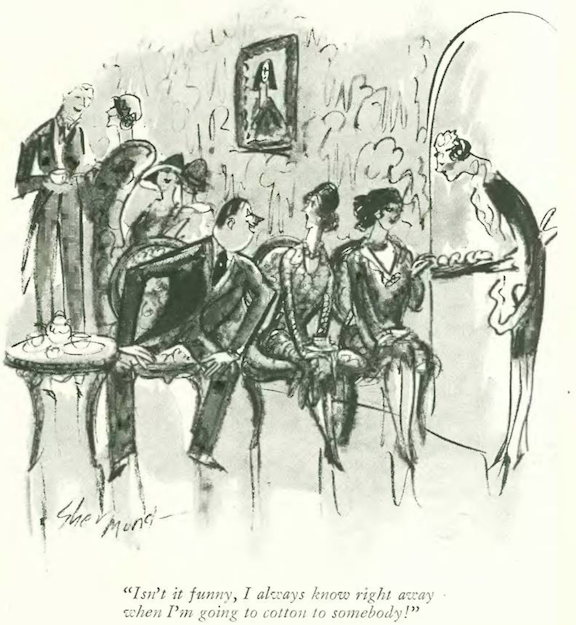
…and two glimpses into high society by Barbara Shermund…
…including their scintillating conversations about such things as ice makers…
In today’s world of endless media options, it is hard to fathom the influence newspapers had over daily life in the 19th and early 20th centuries. There was one news source that many New Yorkers simply could not live without: The New York World.
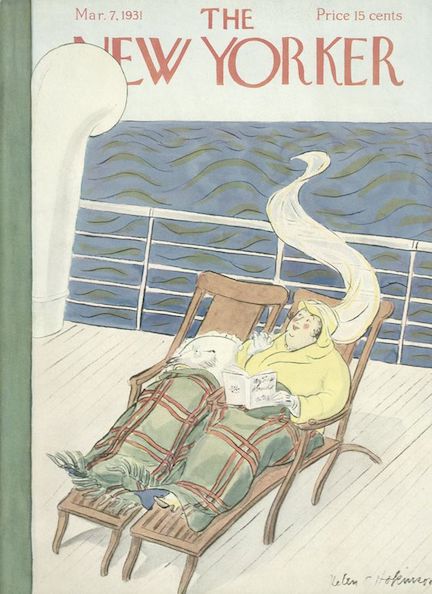
March 7, 1931 cover by Helen Hokinson.
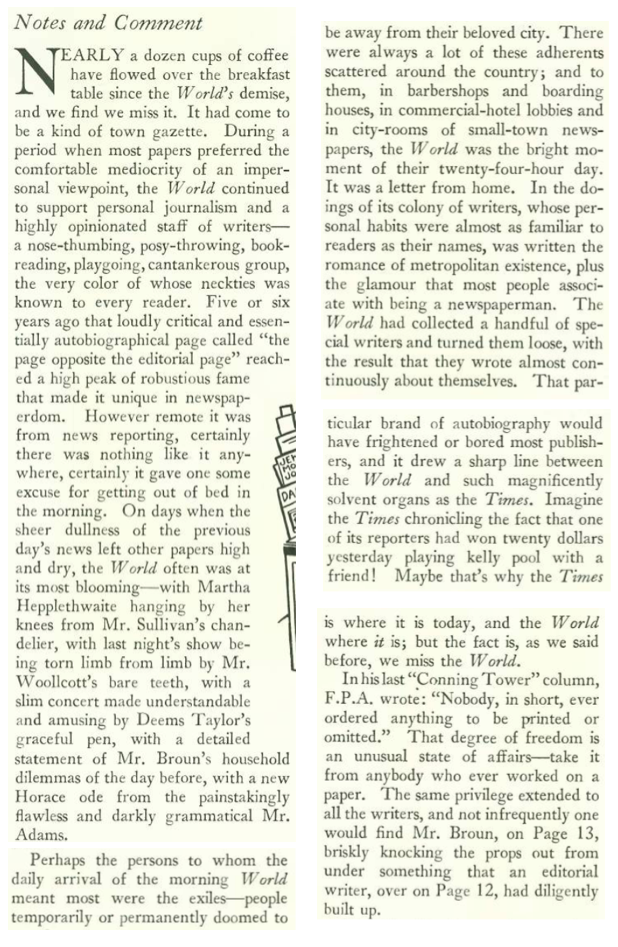
So when the World ceased publication after a 70-year run, many of its readers struggled to come to terms with the loss. Despite the World’s working class appeal and sensationalistic reporting, E.B. White nevertheless counted himself among its mourners, offering a lengthy eulogy in his “Notes and Comment” column (with Otto Soglow illustration)…
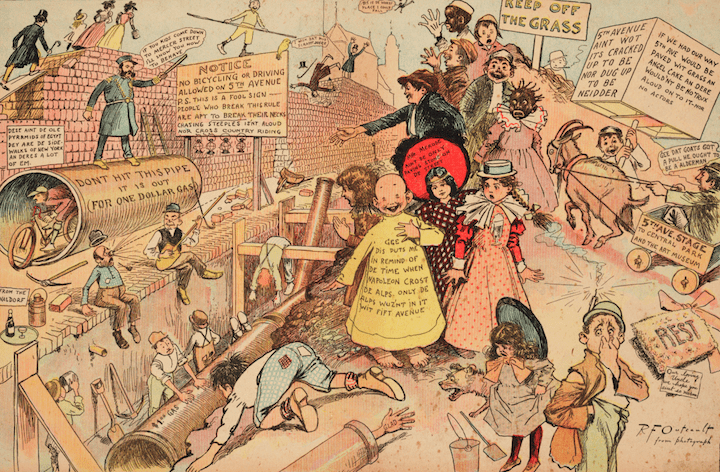
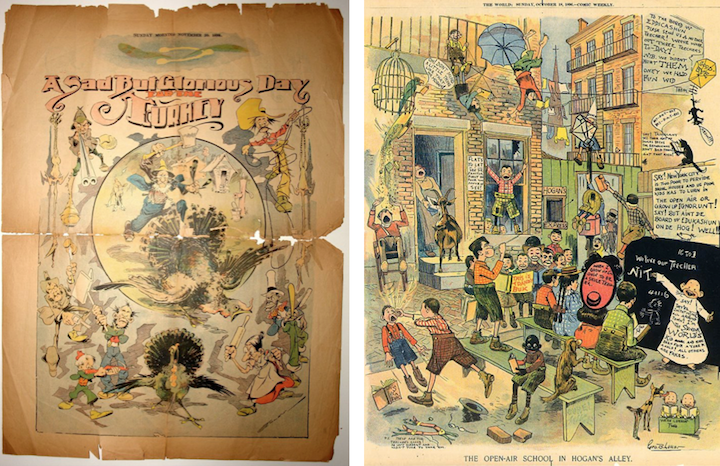
THE COLOR OF MONEY…Under the leadership of Joseph Pulitzer, who bought The World in 1883, the newspaper began an aggressive era of circulation building, and in 1896 enticed readers with pages printed by one of the world’s first four-color printing presses. The World was the first newspaper to launch a Sunday color supplement, which featured “The Yellow Kid” cartoon Hogan’s Alley (above, right). (5dguide.com)
A pioneer of yellow journalism, The World also featured sensational stories and headlines to capture the attention of readers…
…however, The World was also home to a number of prominent journalists, including the famed Elizabeth Cochran Seaman (aka Nellie Bly) and many writers from the social orbit of the Algonquin Round Table who were also early contributors to the fledgling New Yorker.
In his “Notes” essay, White suggests that he found something authentic in The World’s sensational style, and praised it for going after stories that more staid publications, like The New York Times, tended to ignore or downplay. The World’s staff of writers came from the rough and tumble, muckraking world of journalism, the same world in which The New Yorker’s founding editor, Harold Ross, first cut his teeth.
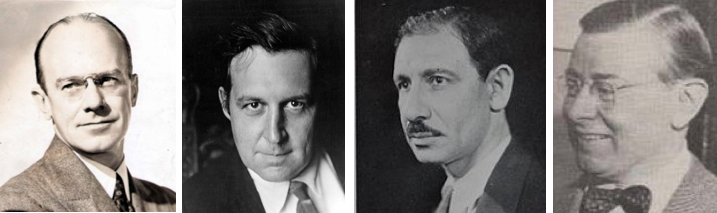
ALL-STAR LINE-UP…Many of The World’s famed writers inhabited the orbit of The New Yorker and the Algonquin Round Table, including, from left, music critic Deems Taylor, journalist and social critic Heywood Broun, “The Conning Tower” columnist Franklin P. Adams, and humorist Frank Sullivan. (deemstaylor.com/britannica.com/Wikipedia)
* * *
Swedish Sphinx?
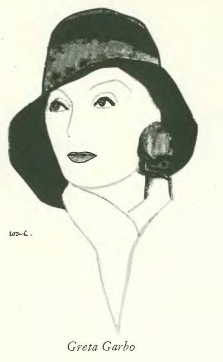
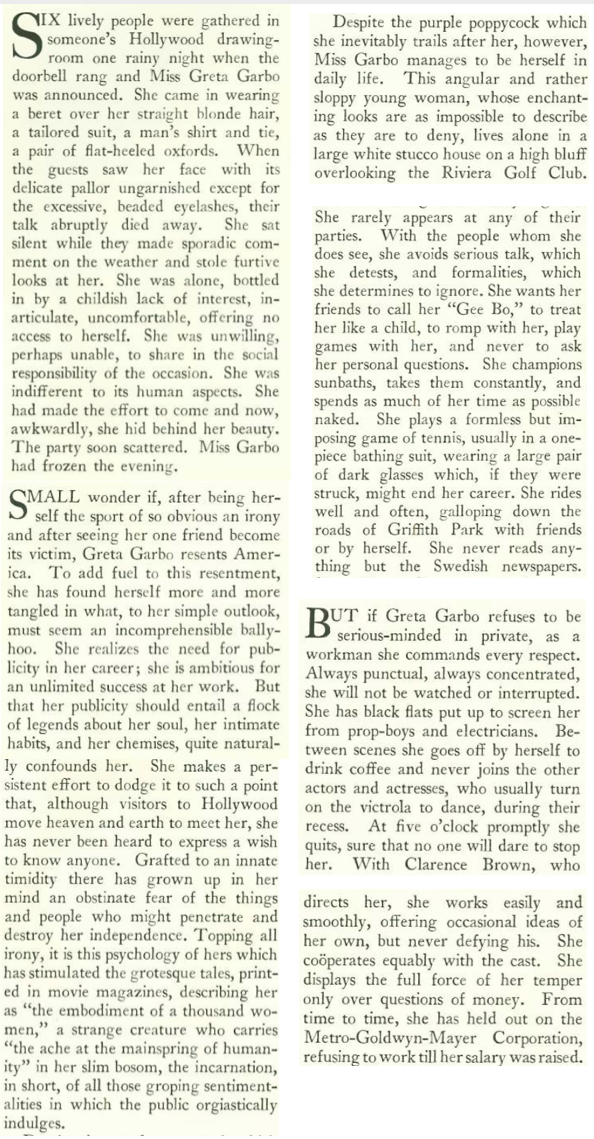
Thirty years after her death, Greta Garbo remains an iconic figure in popular culture, due to her expressive eyes and sensuality, but perhaps even more so due to her elusive air. In her profile of the star for The New Yorker, titled “American Pro Tem,” Virgilia Peterson Ross refused to buy into the mysterious aura that was partly manufactured by Garbo’s handlers at MGM. The other part, however, was genuine Garbo, who detested parties, serious talk, and other formalities.
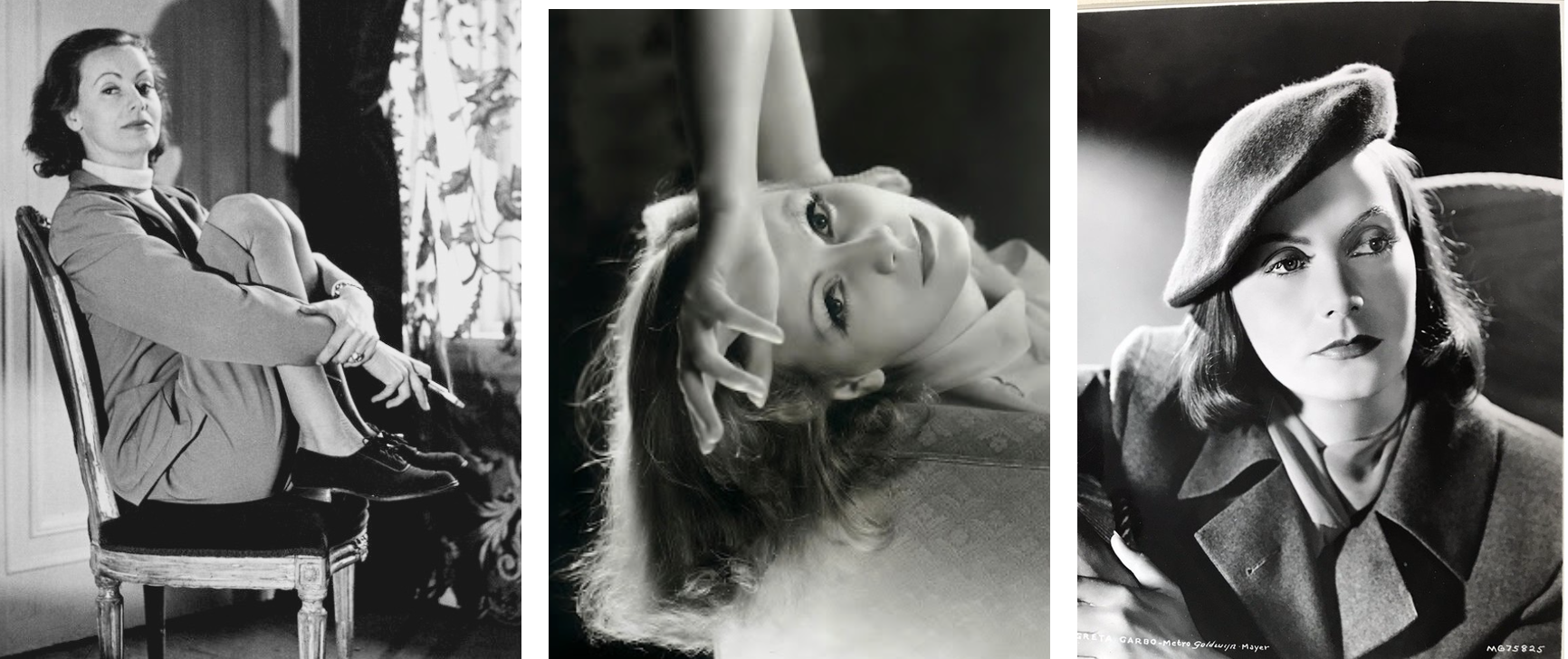
THE FACE…Like her contemporary Marlene Dietrich, Greta Garbo preferred an androgynous look. From left, Garbo wearing the flat-heeled oxfords she favored; publicity photo from 1932; wearing one of her trademark berets in the late 1930s. (garboforever.com)
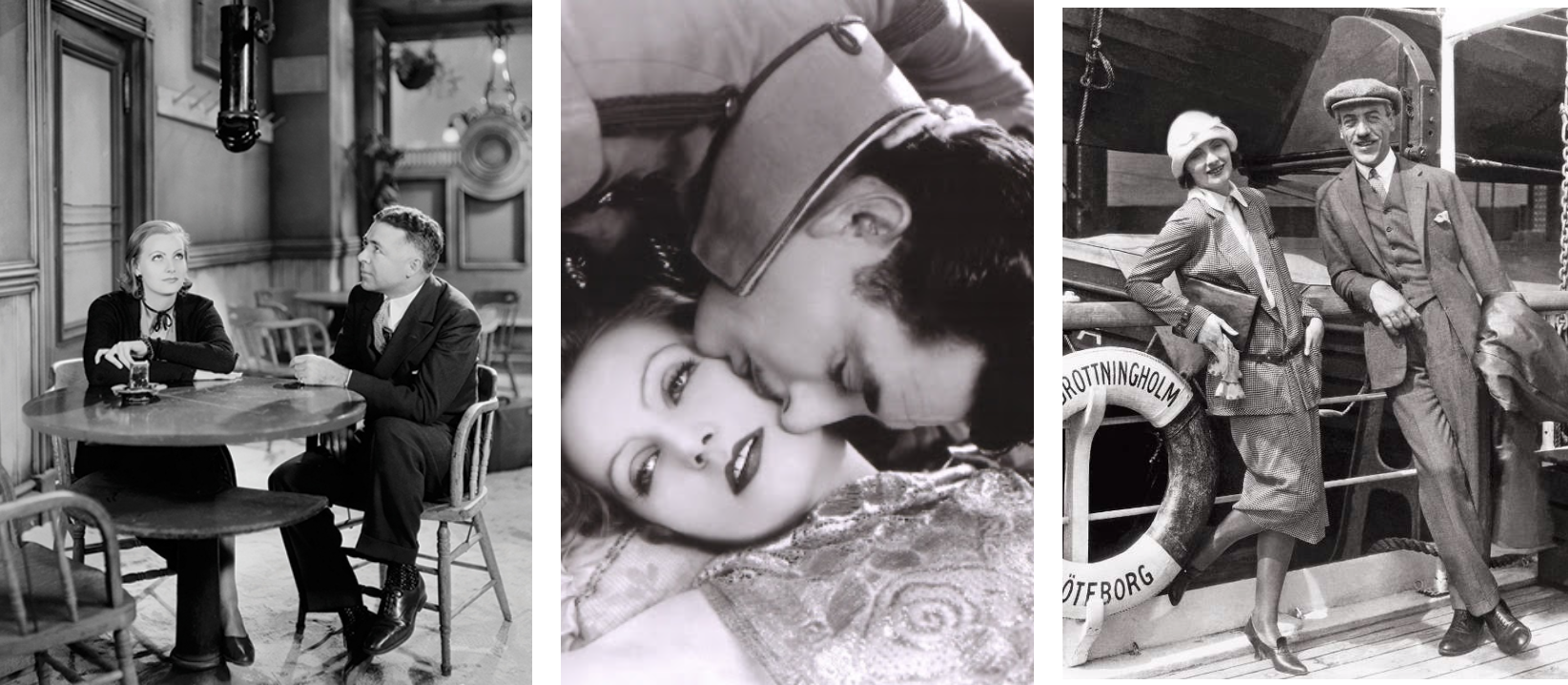
Ross touched on Garbo’s love life—she never married in her 84 years, but she was close to her mentor, Finnish director Mauritz Stiller, who died in 1928, having been eclipsed by his protégé. Garbo’s co-star in the silents, John Gilbert—known as a great lover on the screen—wanted to marry Garbo, but she balked at his frequent proposals. The two lived together intermittently in 1926 and 1927, Gilbert helping Garbo not only with her acting also teaching her how to behave like a star and barter with studio bosses. Garbo later admitted that she was in love with Gilbert, but preferred to remain single because she “always wanted to be the boss.” Drink and despair would send Gilbert to an early grave in 1936. In her profile piece, Ross concluded that Garbo was “not a mystery to be solved,” but rather “a limpid child.”
THE MEN IN HER LIFE…Greta Garbo contemplates a new-fangled microphone with film director Clarence Brown on the set of Garbo’s first talkie, Anna Christie. Brown would direct Garbo in seven different films; Garbo with sometime lover John Gilbert in Flesh and the Devil (1926). They would appear in four films together; Garbo with Finnish director and early mentor Mauritz Stiller, in 1926. (Wikipedia/IMDB/garboforever.com)
* * *
Suffering Artist
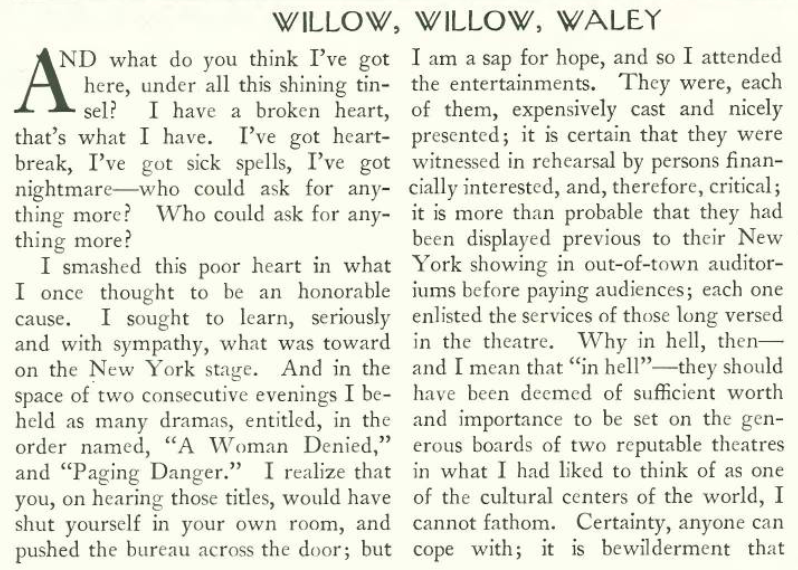
Dorothy Parker continued to sub as theater critic for her friend, Robert Benchley, who was traveling abroad. It was not a task to her liking — during her temporary stint she had yet to see a play that didn’t insult her taste or her intelligence. Her review for the March 7 issue would prove no different.
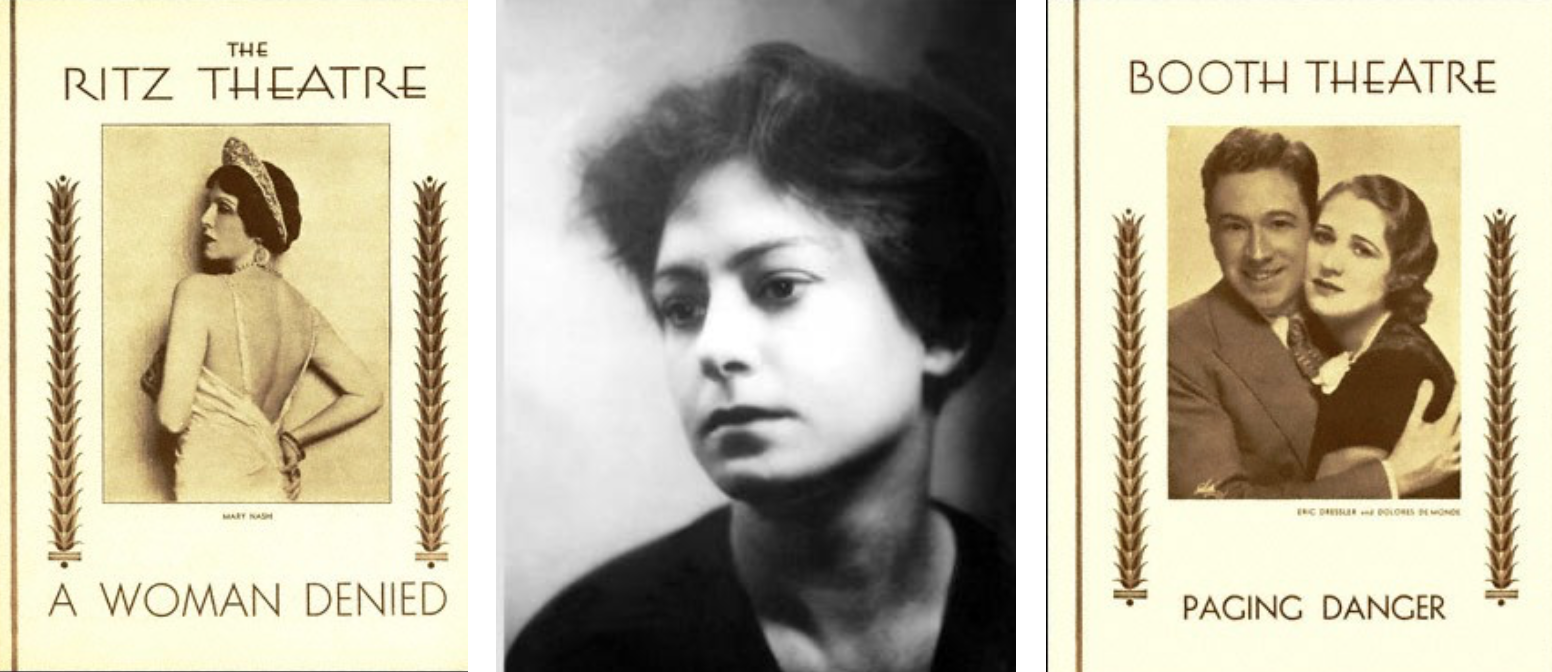
BROADWAY BLAHS…Dorothy Parker had yet to find a play to her liking in her stint as theater critic for the New Yorker. To her credit, she had to sit through a couple of stinkers: A Woman Denied lasted about a month — 37 performances — and Paging Danger closed its curtains for good after just four performances. (Playbill/BBC)
* * *
The Misanthrope
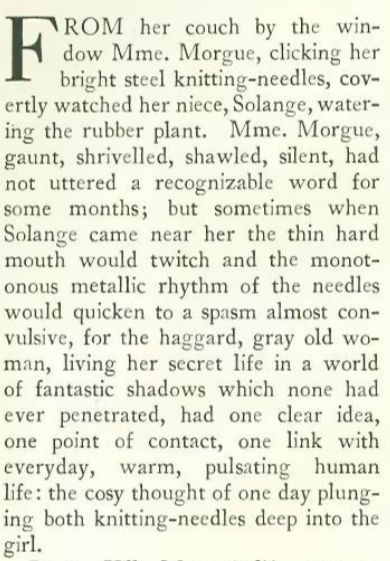
To call Wyndham Lewis a character is an understatement. The English writer, social critic and painter (he founded the cubist-inspired Vorticist movement) managed to offend just about everybody before his death in 1957. He was described by the London Review as “fiercely unsentimental,” and that is how I would describe this opening paragraph from his short story “Dark Party”…
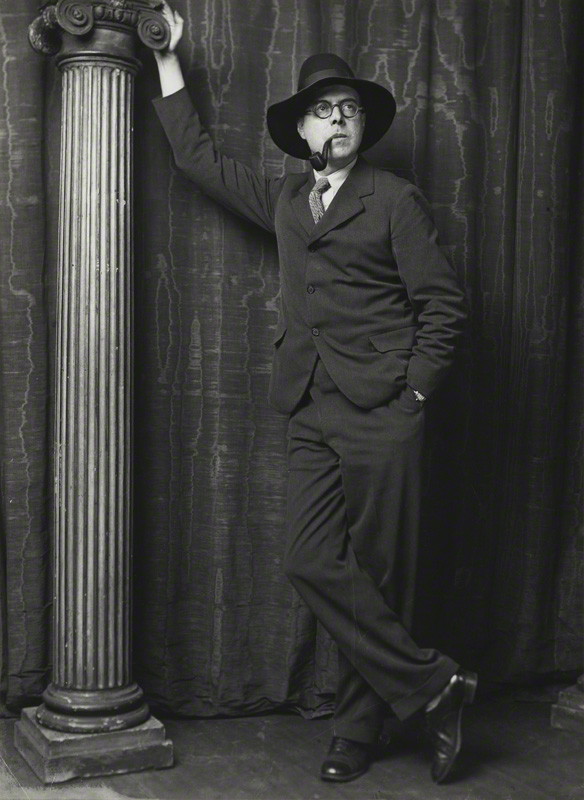
CLASSIC POSE…A 1929 portrait of Wyndham Lewis by photographer George Charles Beresford. (Wikipedia)
* * *
From Our Advertisers
A couple of ads appealing to women readers of the New Yorker, including this elegant bon voyage scene advertising travel clothes…
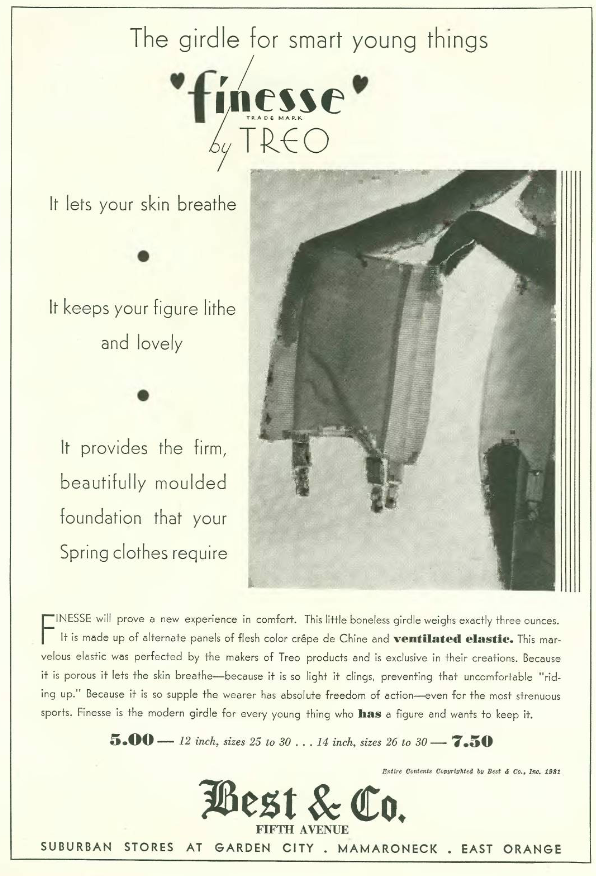
…and something you never see anymore, the “boneless” girdle…replaced today by Spanx and the like…
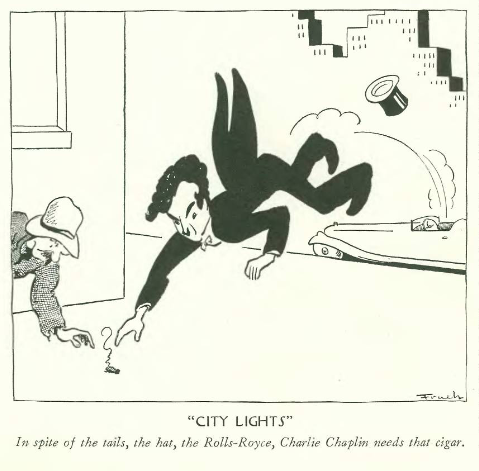
…Before we roll into our cartoons, some cinema-inspired art by Al Frueh…
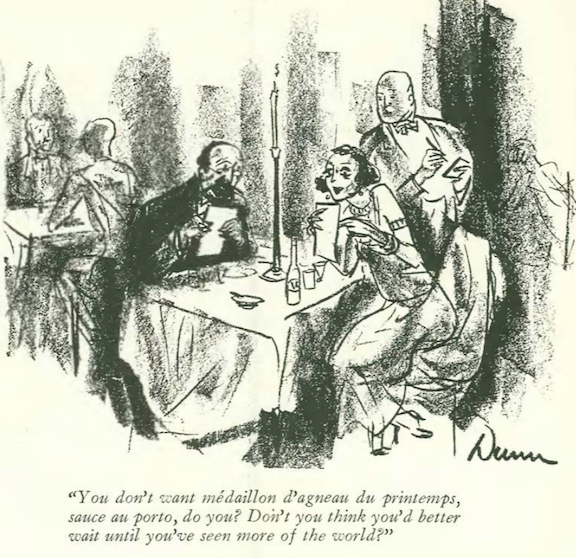
…Alan Dunn went out to dinner…
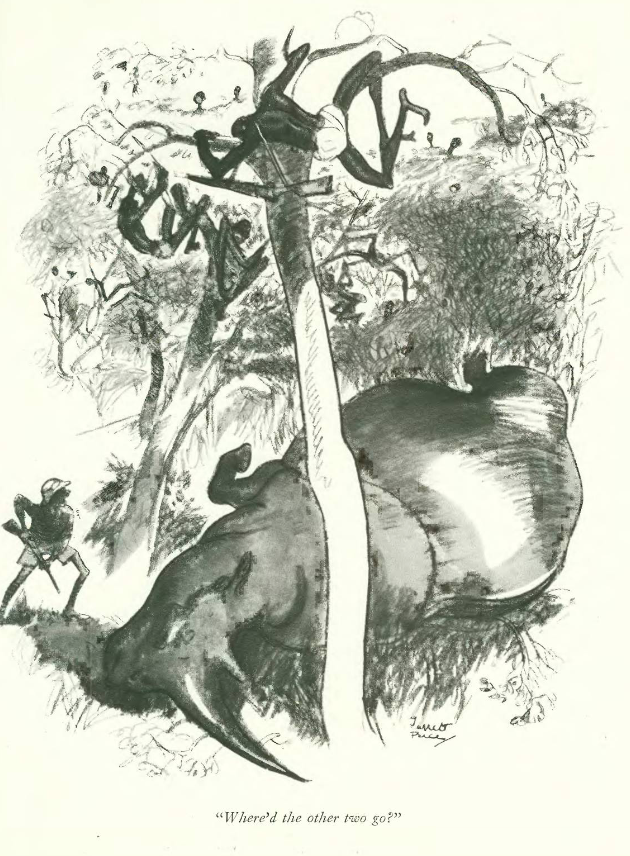
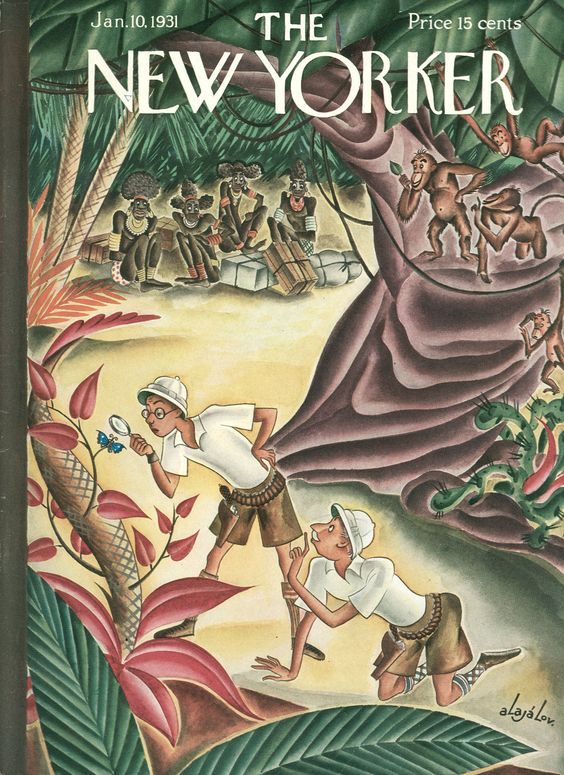
…Garrett Price went on safari…
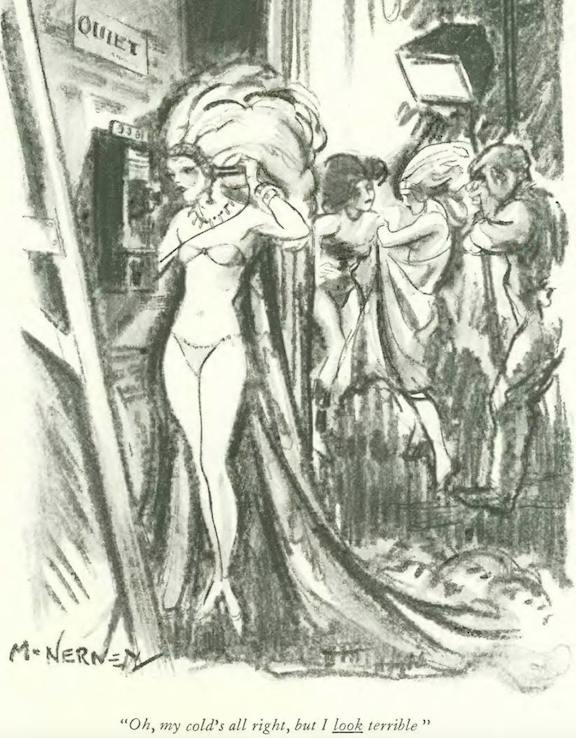
…E. McNerney channelled his inner Arno for this backstage scene…
…and the real Peter Arno gave us this passing scene which recalled his old Whoops Sisters gags…
In the 1920s and 30s the concept of the documentary film was still in its infancy, and beginning with the silent Nanook of the North (1922), the idea that a documentary and a drama were separate things was unknown to filmmakers.
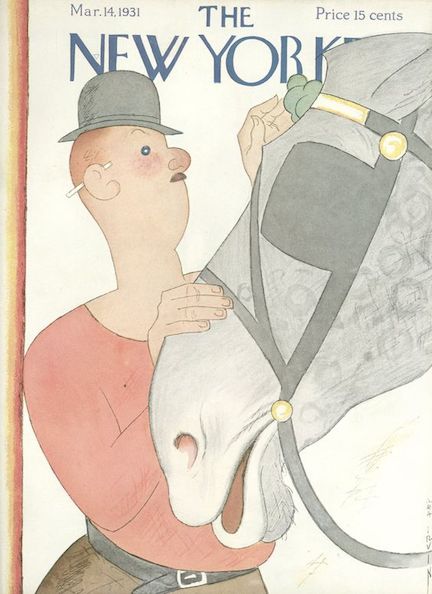
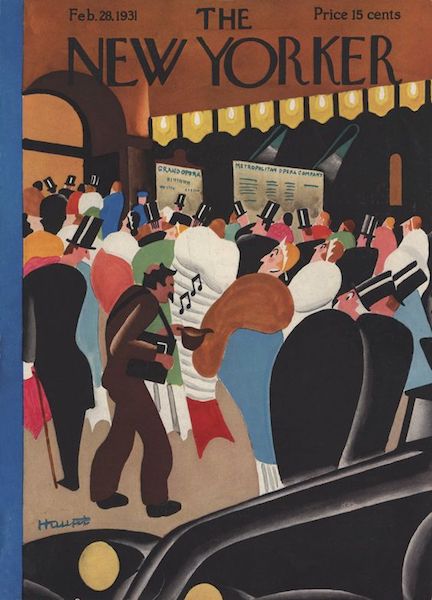
Feb. 28, 1930 cover by Theodore Haupt.
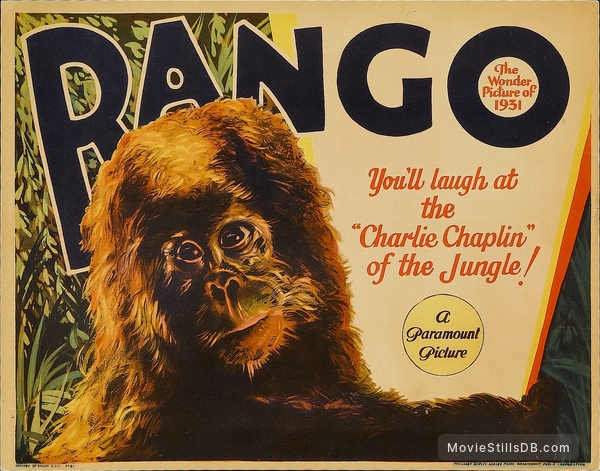
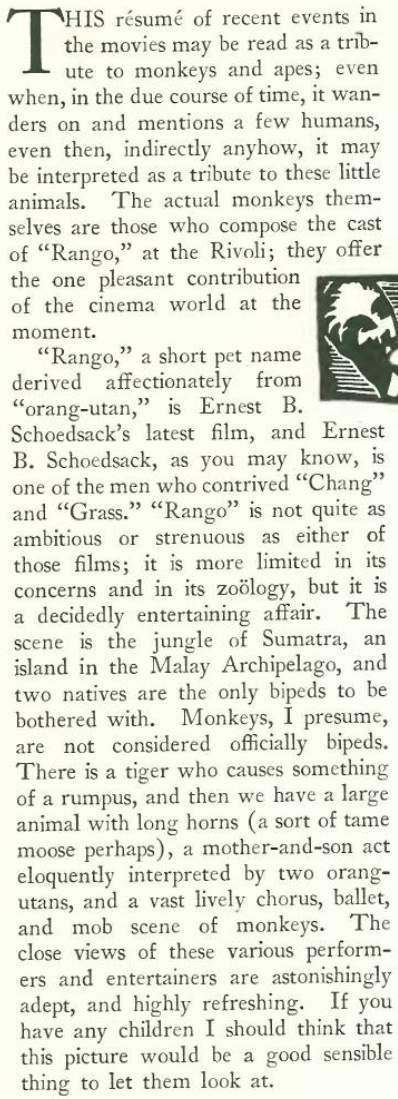
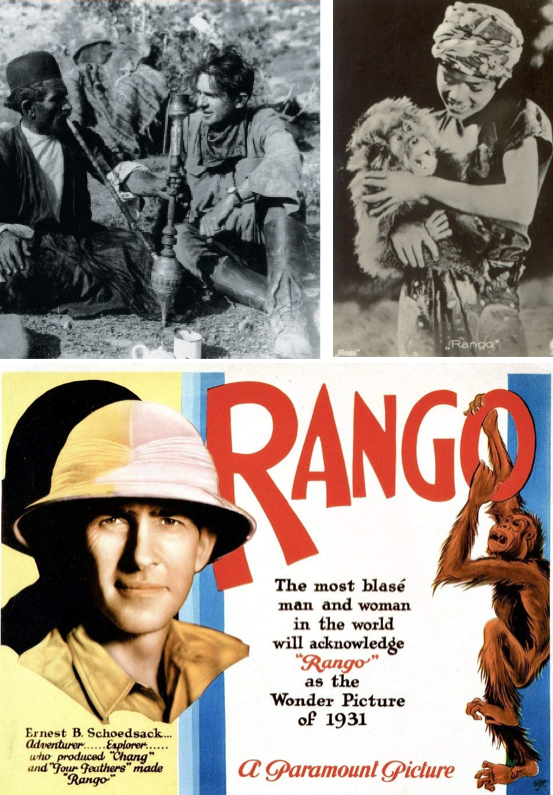
What was known, however, was the box office appeal of films that explored unknown and exotic lands, like Ernest B. Schoedsack’s 1927 blockbuster Chang, which featured a mix of staged events as well as the actual slaughter of wild animals. Audiences (and most critics) seemed little troubled that these films were a mix of fact and fiction. It was a movie, after all, and movies followed a story arc, and they had drama, and sometimes comedy. And so when Schoedsack (1893-1979) introduced audiences to an orangutan named Rango, publicists described the simian star as the “Charlie Chaplin of the Jungle.” The New Yorker’sJohn Mosher found the performances of the various apes “astonishingly adept”…
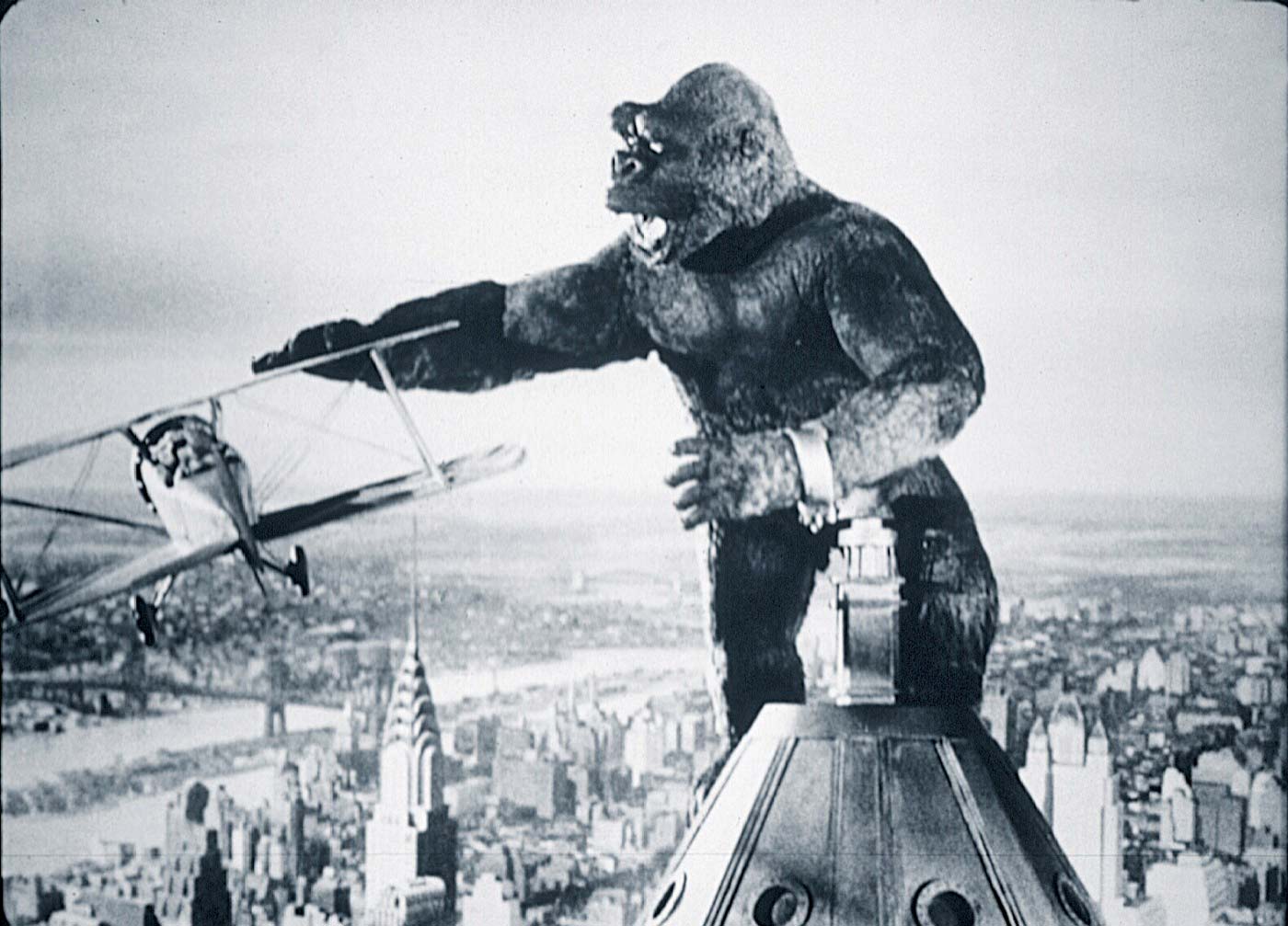
MONKEY BUSINESS…Clockwise, from top left, the Iowa-born Ernest B. Schoedsack cut his filmmaking teeth as a producer/director of quasi-documentaries, beginning with 1925’s Grass, which followed a caravan from Angora to Persia; a young Sumatran boy, Bin, bonds with the orangutan Rango; promotional theater card for the film. (filmaffinity.com)NOT SO CUDDLY…Two years after Rango,Ernest B. Schoedsack would co-produce and co-direct 1933’s King Kong, with Merian C. Cooper. (Britannica)
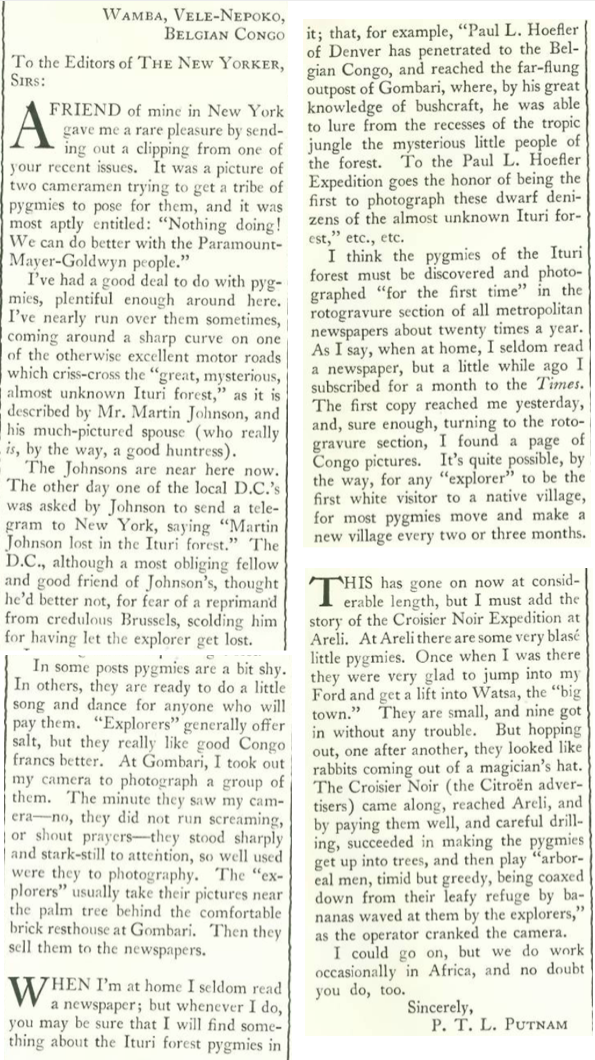
If interpretations of tropical life weren’t accurate in 1931, it wasn’t completely due to filmmakers taking dramatic license. Attitudes toward “exotic” lands and people commonly ranged from naively paternalistic to downright racist. In a letter to The New Yorker, Patrick T.L. Putnam (1904-1953) is decidedly of the former, portraying Congo pygmies as clever, amusing children who hoodwink unsuspecting “explorers”…
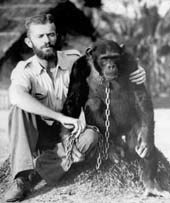
To Putnam’s credit, he showed a genuine interest (and respect for) in the lives of tribal peoples, and particularly the Mbuti of the Congo’s Ituri Forest. He remained in the Congo for the rest of his life. This thumbnail is the only photo I could find of Putnam:
(geni.com)
* * *
Big Bill Turns Pro
In first decades of the 20th century it was still widely believed that athletic competition should be for its own sake rather than as a means for making money, so many top stars competed as amateurs. Professional golf wasn’t established until 1916, and professional leagues in basketball and football first formed in the 1920s. Amateur status was especially prized in tennis — before the “Open Era” began in 1968, only amateurs were allowed to compete in Grand Slam tournaments.
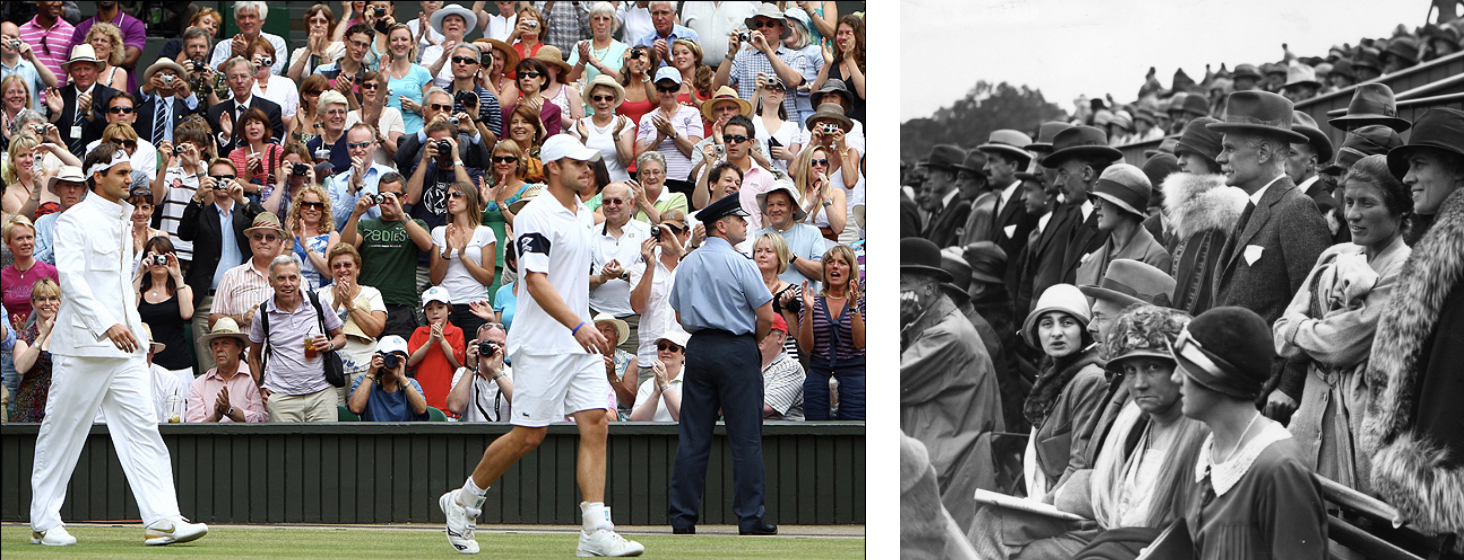
Sports promoter C. C. Pyle established the first professional tennis tour in 1926 with American and French stars playing exhibition matches in front of paying audiences. According to The New Yorker’sJohn Tunis, many in the crowd were finely dressed, with men in top hats and women turned out in the latest high fashion.
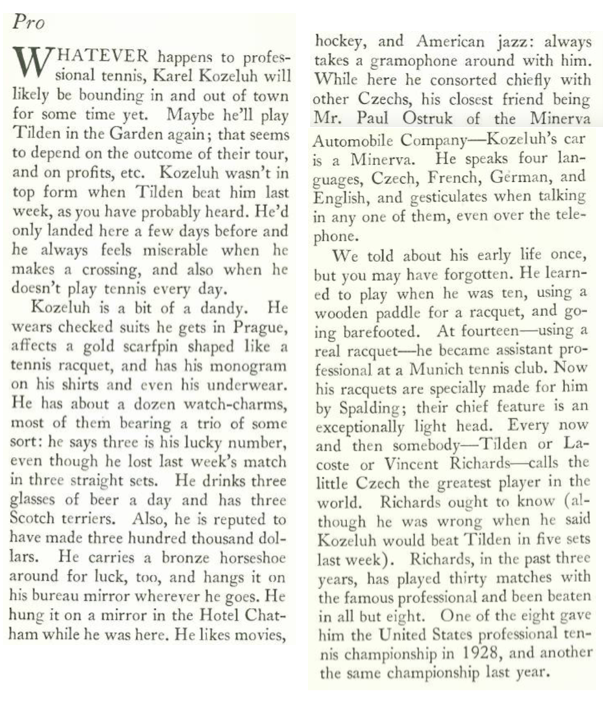
America’s top draw was “Big Bill” Tilden, the world’s number one player from 1920 to 1925 and the first American to win Wimbledon. It caused quite a stir when Tilden went pro on Dec. 31, 1930. He barnstormed across the country, playing one-night stands with a small group of professionals including the top Czech player Karel Koželuh. “The Talk of the Town” had this to say about the fledging game of professional tennis:
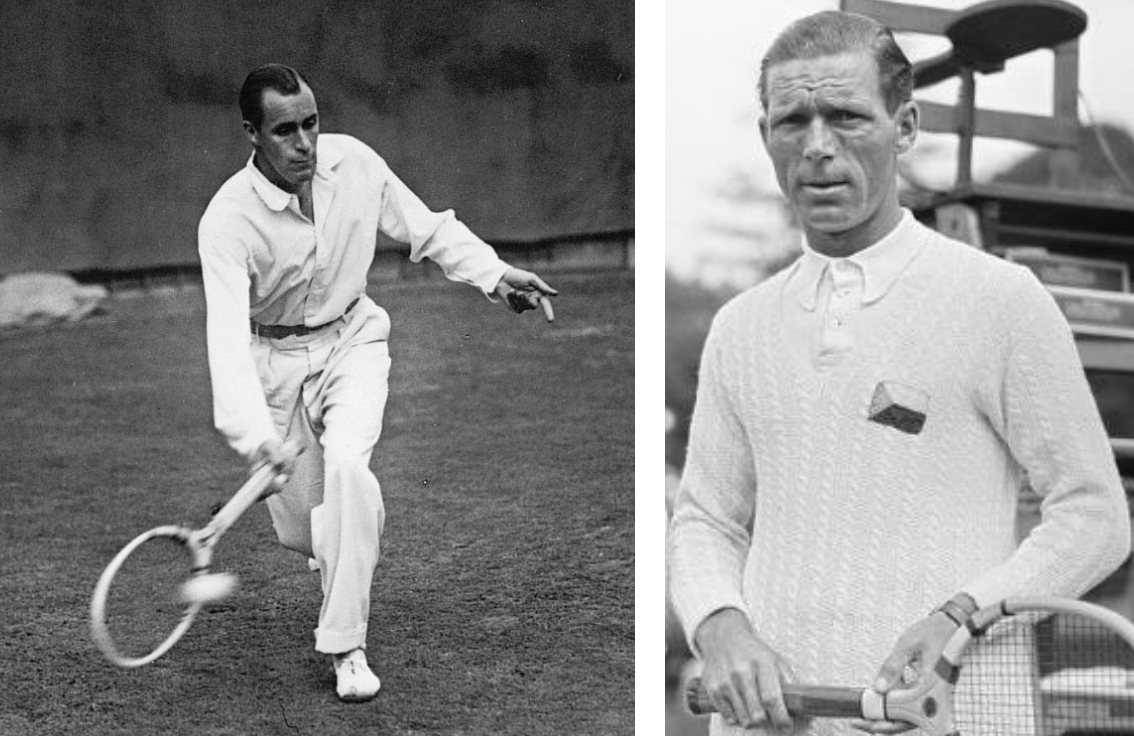
BARNSTORMERS…Bill Tilden (left) and Karel Koželuh toured America and Europe with a handful of other players in a series of exhibition matches in the fledgling professional tennis circuit. (Britannica/cyranos.ch)
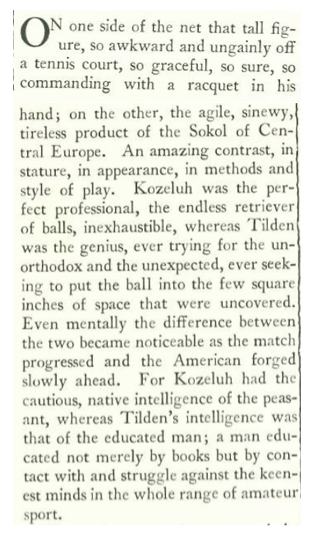
In his sports column, John Tunis offered this description of the competitors:
NOW AND THEN…At left, you can still spot a few neckties at Wimbledon as the audience watches Roger Federer and Andy Roddick enter Centre Court in 2009; at right, Wimbledon crowd in 1925. (BBC/Vintage Every Day)
* * *
Triple Tripe
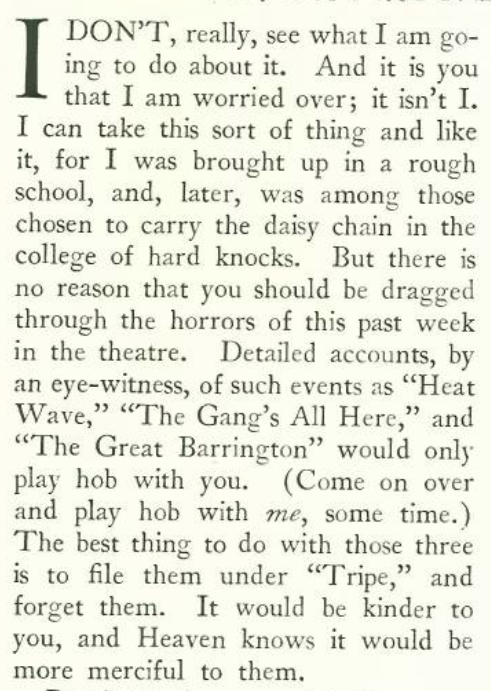
Dorothy Parker continued to sub in the theater column for her friend Robert Benchley, who was traveling abroad. She found little to like on the Great White Way, including three forgettable plays she reviewed in the Feb. 28 issue:
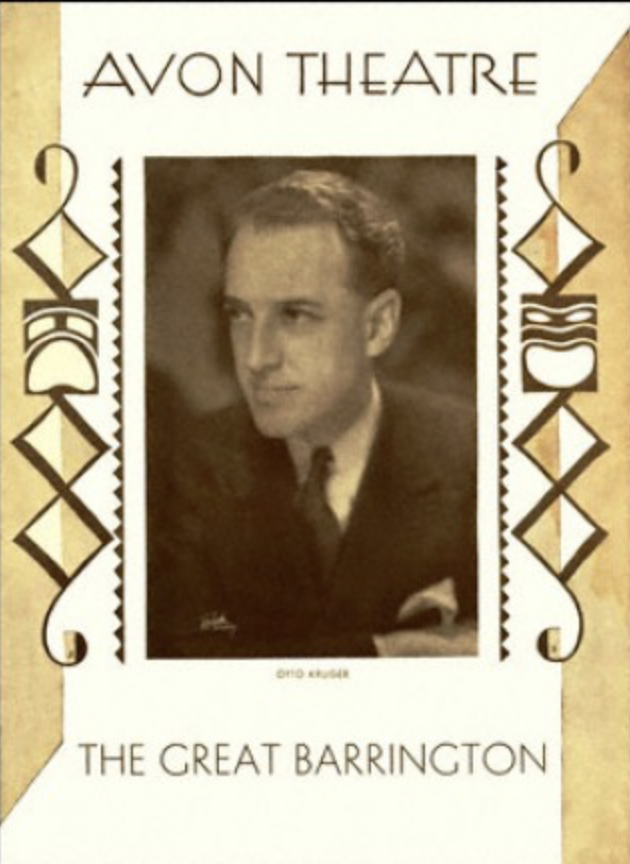
Apparently audiences agreed with Parker’s assessment. The Gang’s All Here closed after just 23 performances, The Great Barrington, after just 16. And Heat Wave was not so hot, closing after a mere 15 performances.
NOT SO GREAT…Program for 1931’s The Great Barrington. It lasted 16 performances. (IBDB)
Parker once again closed the column with a plea to her dear friend:
* * *
To Swash No More
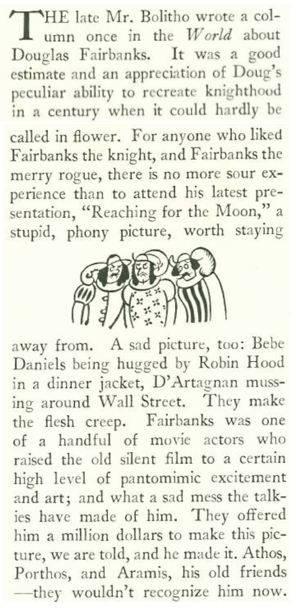
In his “Notes and Comment,” E.B. White lamented the end of Douglas Fairbanks as the swashbuckler of the silents, and rejected the talkie version of the actor in Reaching for the Moon, a film in which Fairbanks portrayed Larry Day, a Wall Street millionaire who later loses his fortune in the 1929 stock market crash.
KEEP YOUR SHIRT ON, DOUG…From left, Douglas Fairbanks in the silent era’s The Thief of Bagdad (1924); Fairbanks on an ocean cruise with Bebe Daniels in Reaching for the Moon. The 47-year-old Fairbanks was still fit enough to pose shirtless, but E.B. White wasn’t having any of it. Despite his fit appearance, Fairbanks would die of a heart attack at the end of the decade. (IMDB)
The film today is perhaps best known for its sumptuous Art Deco sets…
(IMDB)
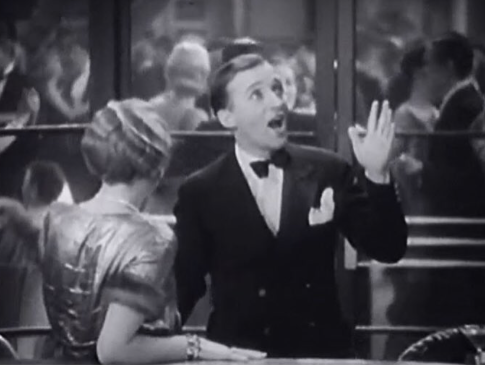
…and for one of Bing Crosby’s earliest film appearances. Reaching for the Moon was originally intended to be a musical featuring numbers by Irving Berlin, however Berlin found director Edmund Goulding difficult to work with, so only one of the original five songs recorded for the film was used, “When the Folks High Up Do the Mean Low Down,” sung by Crosby. It was filmed late at night after he had completed his gig at the Cocoanut Grove.
SINGING WITH BA-BA-BEBE…A young Bing Crosby sings “When the Folks High Up Do the Mean Low Down” with Bebe Daniels in Reaching for the Moon. (IMDB)
* * *
Modern Living
E.B. White also commented on the modern world’s reliance on electric appliances, a habit a mere decade in the making since the gadgets he lists below did not exist before the 1920s:
ELECTRIC SURGE…Prior to the 1920s none of these electric appliances existed. By 1931 many homes were dependent upon them — although many country houses would have to wait for the Rural Electrification Administration (1935) and other New Deal programs get electrical service. (Pinterest)
* * *
From Our Advertisers
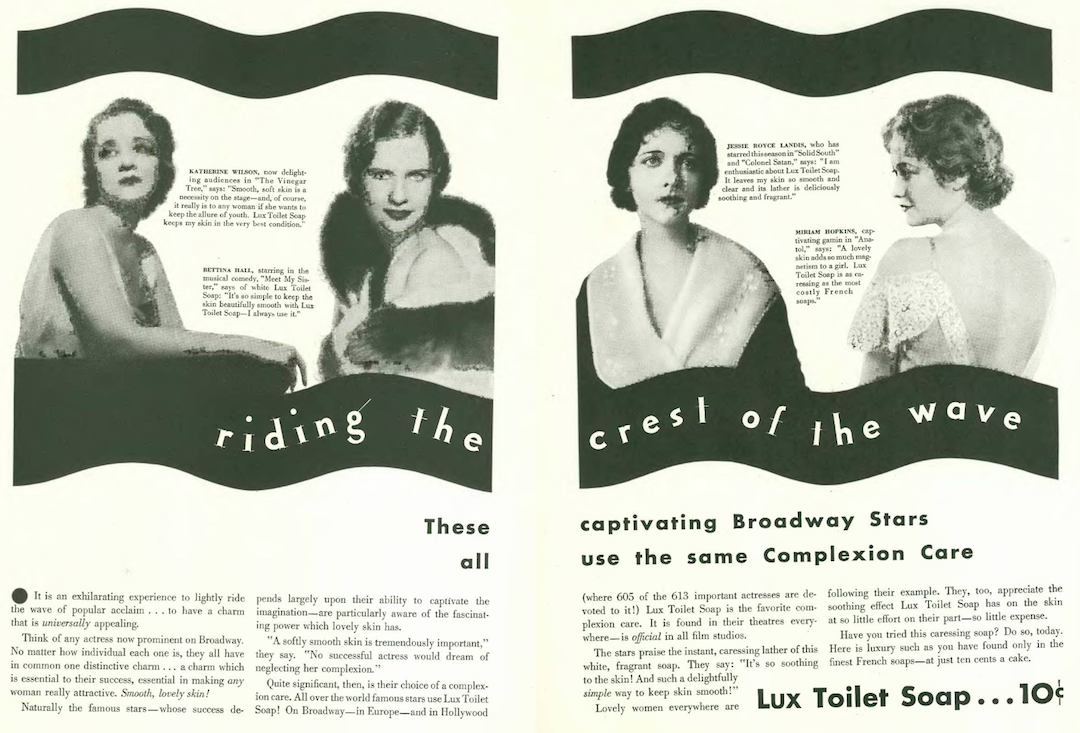
I’ve written before about Lux Toilet Soap’s celebrity-studded ad campaigns, but this two-page ad in the Feb. 28 issue caught my eye because it featured one of my favorite actresses, Jessie Royce Landis…
…who appeared in two of my favorite films, both by Alfred Hitchcock: To Catch a Thief (1955) and North by Northwest (1959).
MATERNAL ROLES…Jessie Royce Landis usually played older than she was in real life. Clockwise, from top left, detail of Lux ad; Landis circa 1930; opposite Cary Grant in 1955’s To Catch a Thief; and again with Grant in 1959’s North by Northwest. In the latter film she played Grant’s mother, but in reality she was only seven years older than Grant. (IMDB)
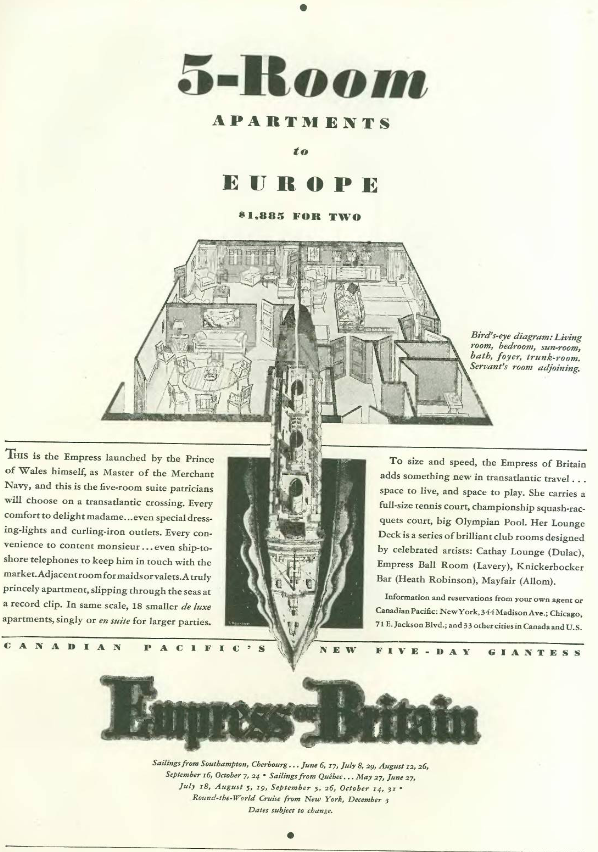
…much of the Douglas Fairbanks/Bebe Daniels film Reaching for the Moon was set on a luxury ocean liner…if the stock market didn’t get you down, you could also afford to travel in style with the Empress of Britain…
…or on one of the fine ships of the French Line fleet…
…the Imperial was one of the luxury cars that could get you to the docks…
…among the stranger ads to appear in The New Yorker was this one by the maker of clay plumbing fixtures…
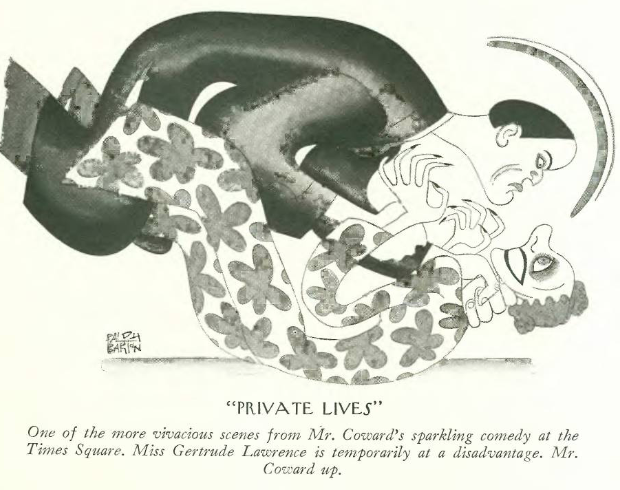
…on to our cartoonists, Ralph Barton returned with this illustration for the theater section…
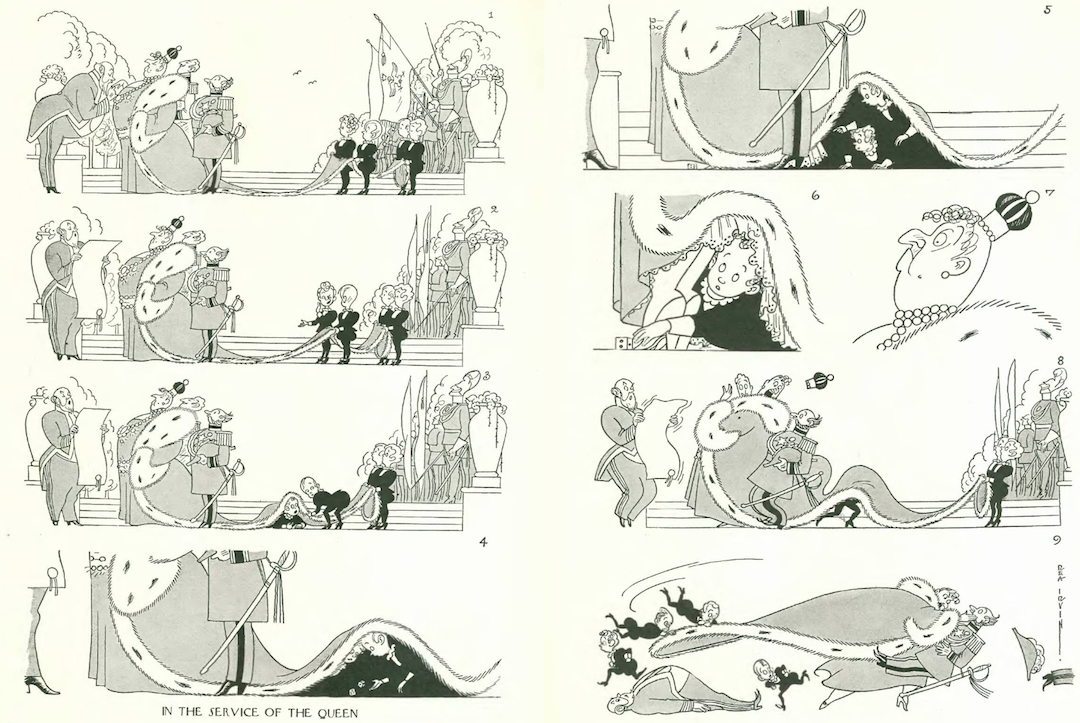
…Rea Irvin brought us another of his two-page series cartoons…
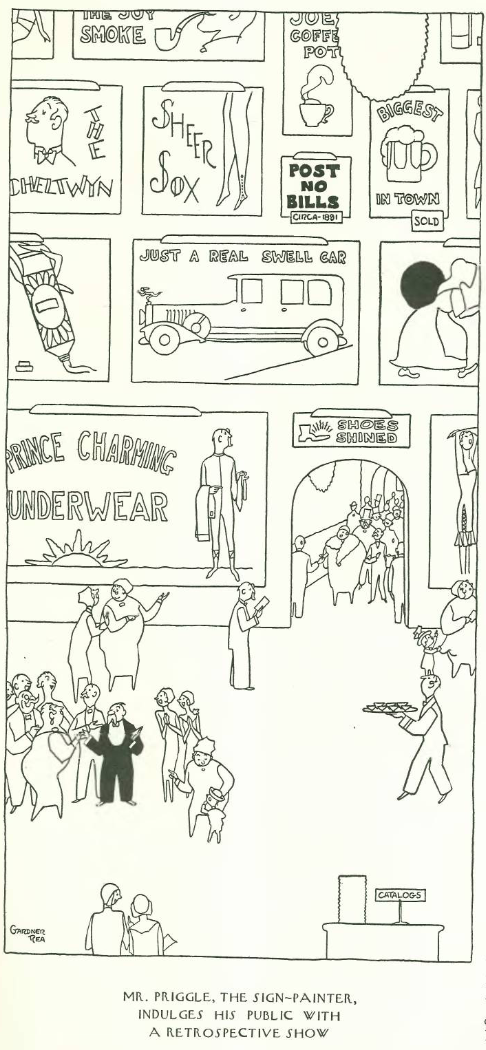
…Gardner Rea commented on the state of the art world…
…Peter Arno peered in on an unfortunate infant…
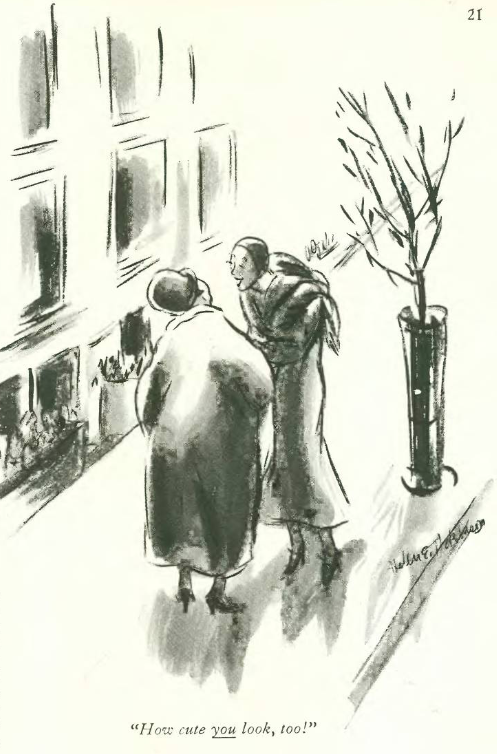
…Helen Hokinson gave us this exchange along a city street…
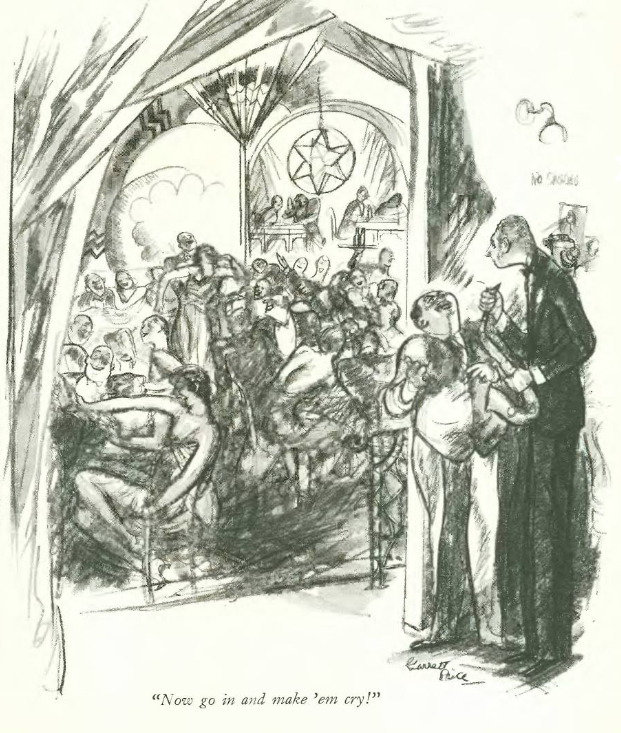
…Garrett Price illustrated a tall order for a blues musician…
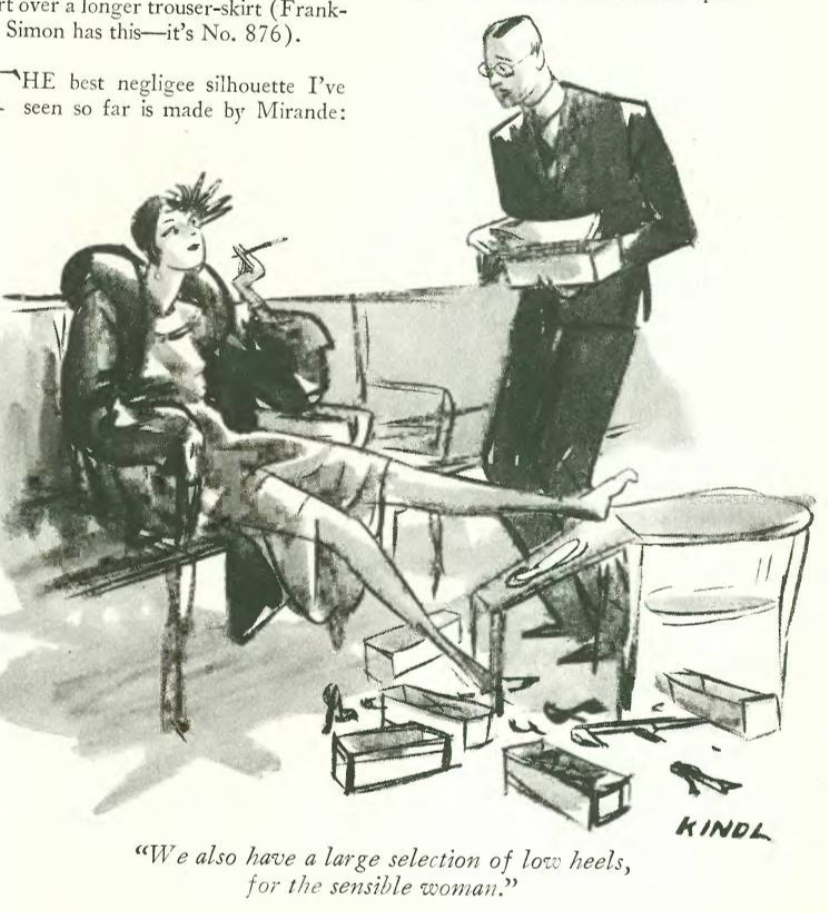
…Carl Kindl found clashing styles in the shoe department…
…and James Thurber returned with a prelude to his battle of the sexes…
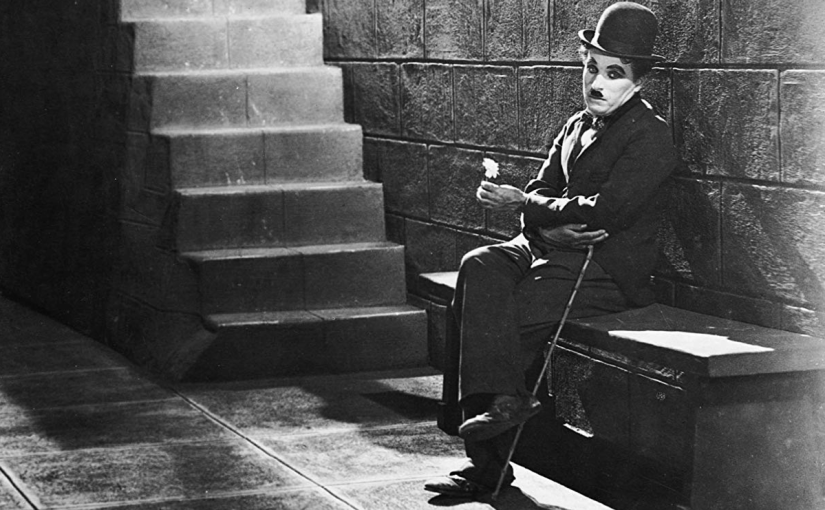
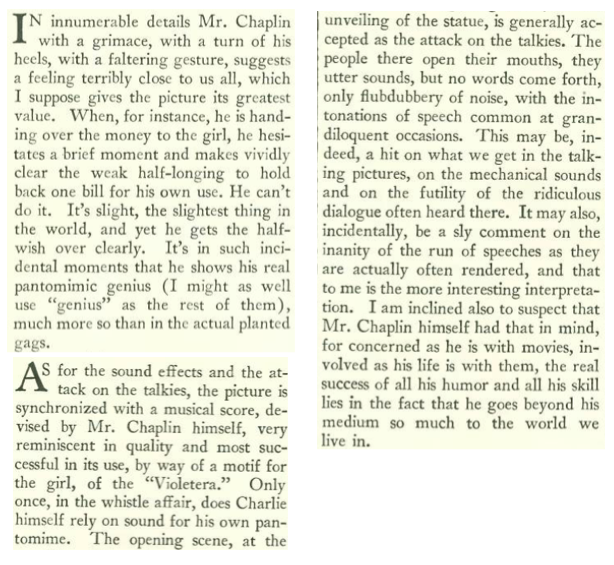
The late film critic Roger Ebert once observed that “if only one of Charles Chaplin’s films could be preserved, City Lights would come the closest to representing all the different notes of his genius.”
Feb. 21, 1931 cover by Rea Irvin, marking the New Yorker’s sixth anniversary.
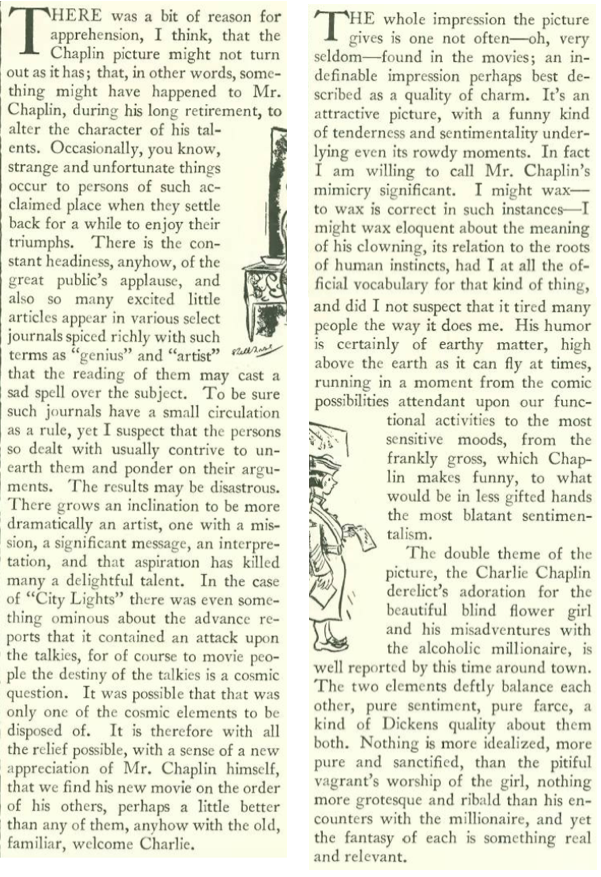
The New Yorker’s film critic in 1931, John Mosher, would have agreed. Before he previewed the picture, however, Mosher feared (along with others) that the great actor and director had seen his best days…
…instead, the film proved a hit with both audiences and critics, and today is regarded as one of the greatest films ever made. It was no doubt a relief to Ebert when the film was selected by the Library of Congress for preservation in the National Film Registry.
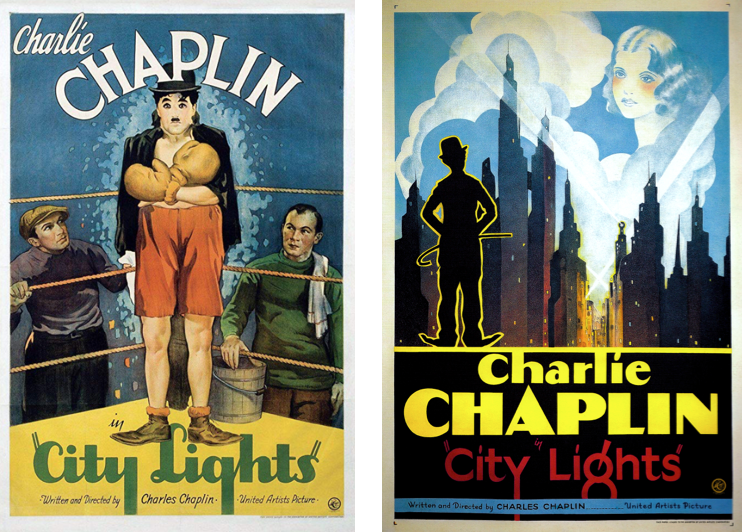
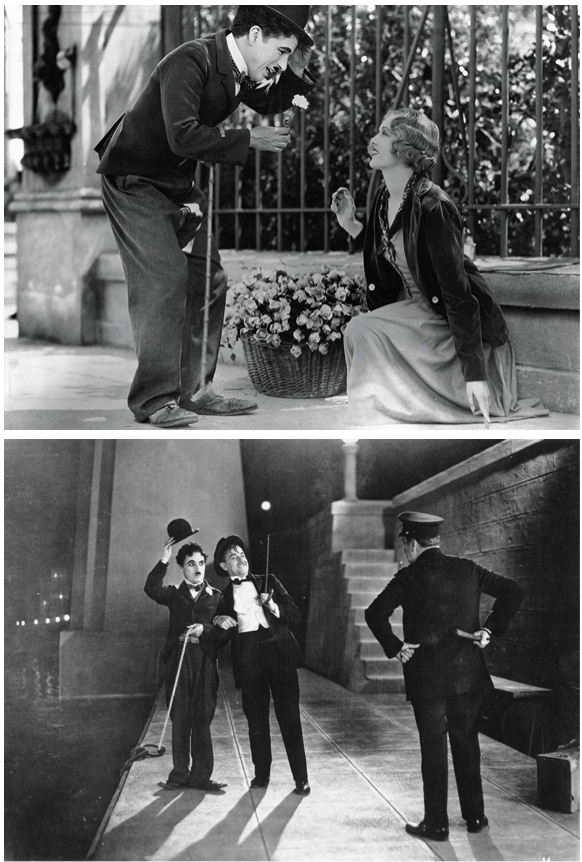
HE DOES IT ALL…United Artists issued several different types of posters to promote the film, including these two. (IMDB)A TENDER FELLOW…The Tramp (Charlie Chaplin) encounters a blind flower girl (Virginia Cherrill) on a street corner and is instantly smitten; later that evening the Tramp saves a drunken millionaire (Harry Myers) from suicide. (IMDB)
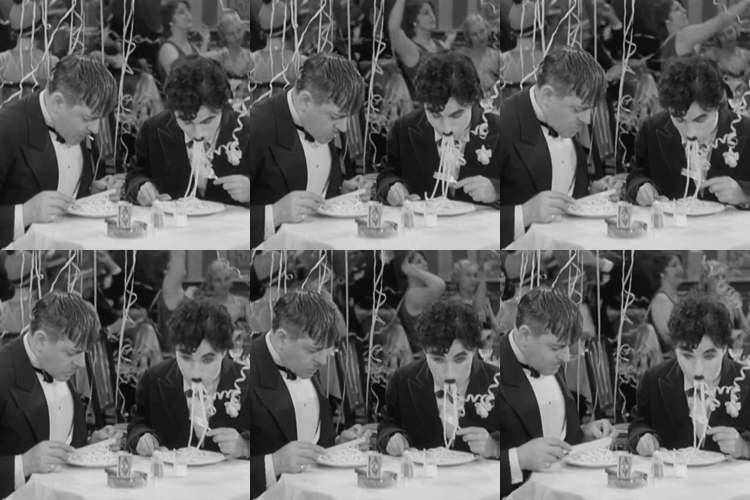
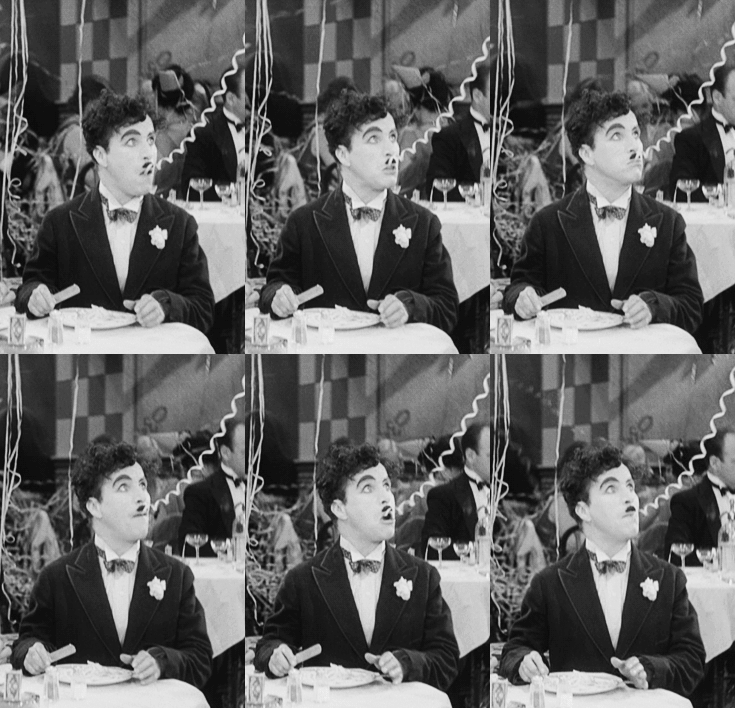
The film has its tender moments, but being a Chaplin production it also had plenty of slapstick, including this famous scene in which the Tramp and his millionaire friend go out on the town and dig into plates of spaghetti…and in the Tramp’s case, some confetti…
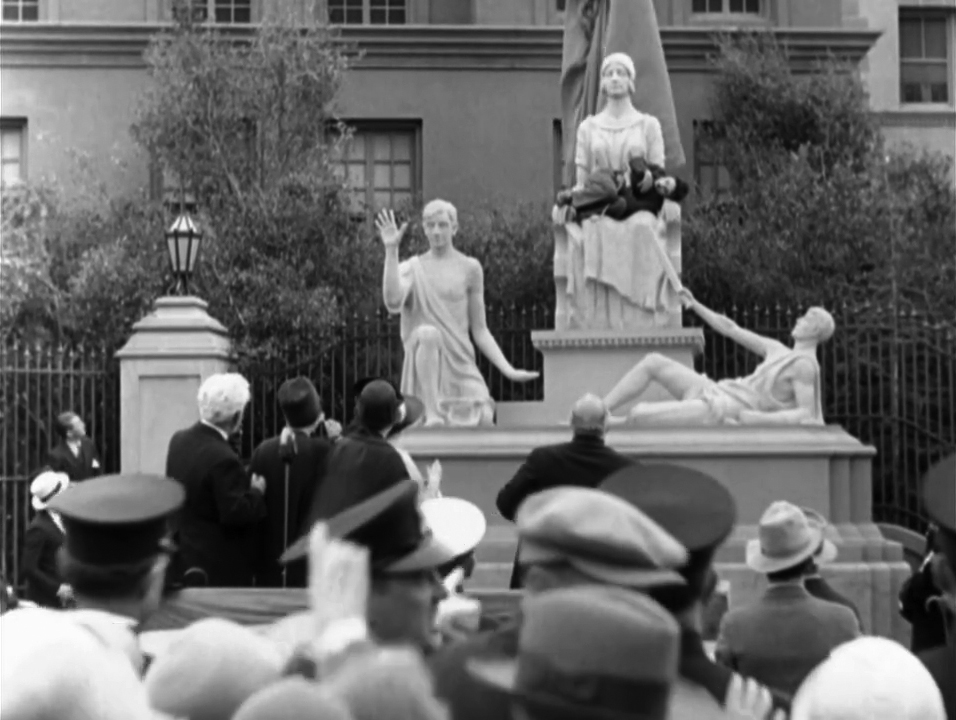
Mosher (and many other critics since) believe the opening scene of the film—in which a statue is unveiled to reveal a sleeping Tramp—was Chaplin’s attack on sound movies:
CAUGHT NAPPING…The Tramp is unveiled along with a statue in the opening scene of City Lights. (IMDB)
Although the film had a full musical score and sound effects, there was no spoken dialogue. Rather, Chaplin poked fun of the tinny-sounding talkies of the day by putting not words, but the sounds of a kazoo, into the mouths of speechifying politicians gathered at the statue’s unveiling…
For all its humor, City Lights was a serious work by a serious actor and director who sought something close to perfection. The scene in which the Tramp encounters a blind flower girl on a street corner required three hundred and forty-two takes with actress Virginia Cherrill, who was a newcomer to film.
Writing in The New Yorker, critic Richard Brody (“Chaplin’s Three Hundred and Forty-Two Takes,” Nov. 19, 2013) noted that “Chaplin didn’t have a mental template that he wanted Cherrill to match; he approaches the scene not quite knowing what he wanted.” Brody observed that the perfection Chaplin sought was one of results, and not of conformity to a preconceived schema. “He sought what provoked, in him, the perfect emotion, the perfect aesthetic response — but he wouldn’t know it until he saw it. He started to shoot in the confidence that the thing — whatever it was — would happen.” Chaplin’s technique can be seen in this clip from the Criterion Collection’s 2013 DVD release of the film. Note that this footage was shot by The New Yorker’s Ralph Barton, a close friend of Chaplin’s:
* * *
Chaplin, Part Two
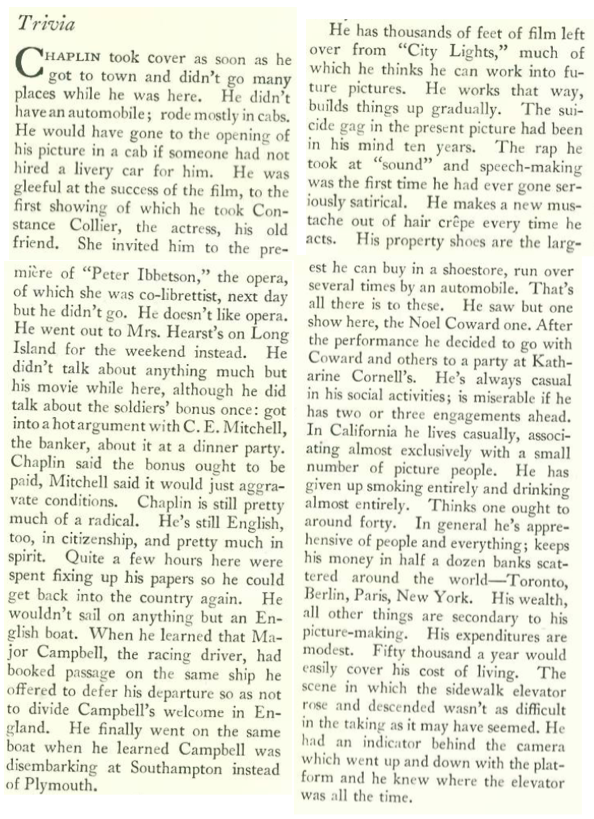
The Chaplin buzz was not confined to the movie section of the magazine, which featured more insights on the star in “The Talk of the Town.”
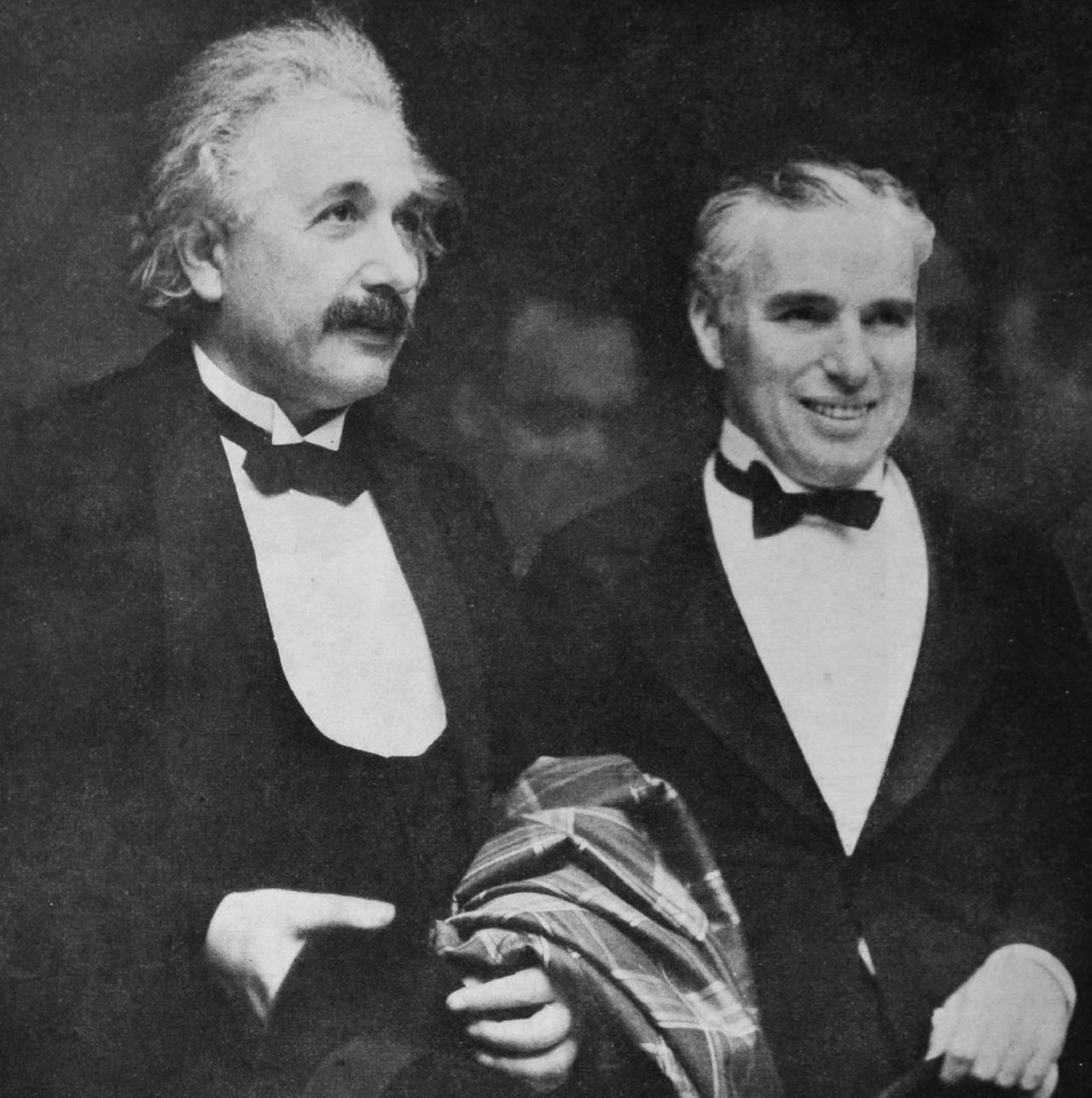
GENIUS LOVES COMPANY…Photo of Albert Einstein and Charlie Chaplin at the Los Angeles premiere of City Lights. Einstein said Chaplin was the only person in Hollywood he wanted to meet. (Wikipedia)
* * *
Funny In a Different Way
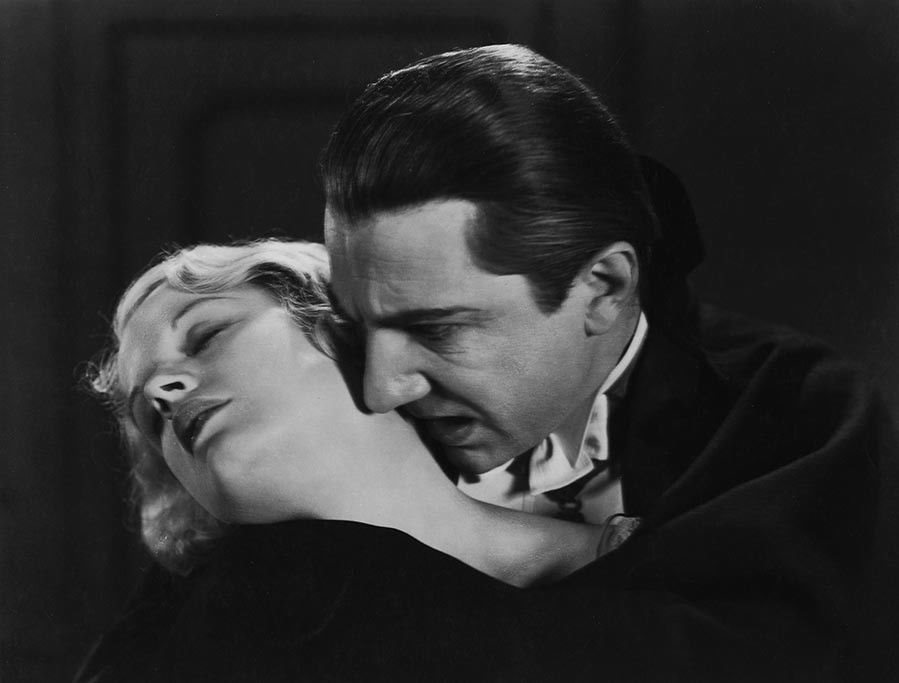
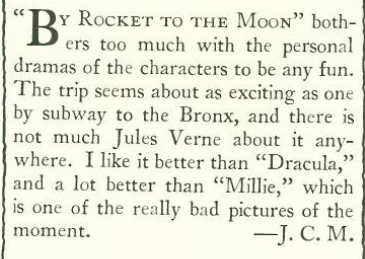
Like City Lights,Tod Browning’sDracula is today considered a classic film. Indeed, Bela Lugosi’s timeless portrayal of the old bloodsucker set a standard for vampire flicks and horror films in general. The New Yorker’s John Mosher, however, would have none of it, dismissing the film in a single paragraph.
PAIN INTHE NECK…Count Dracula (Bela Lugosi) goes for a nibble on the fragile Mina (Helen Chandler) in 1931’s Dracula. (IMDB)
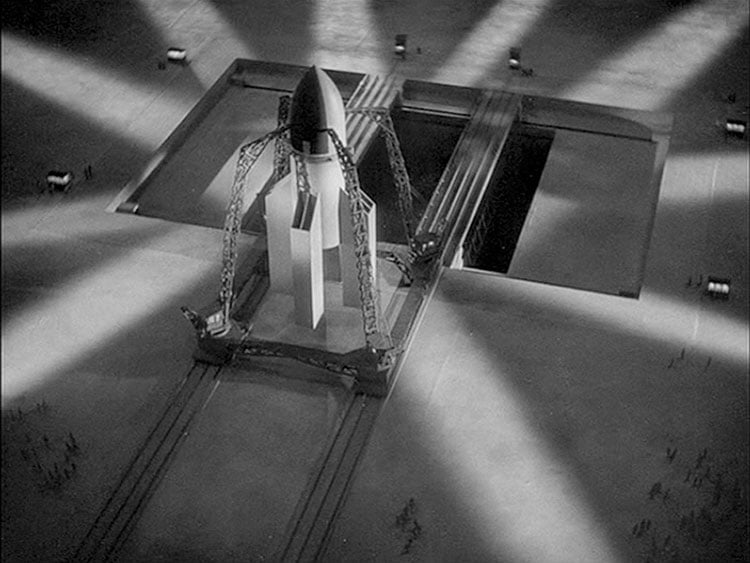
Mosher was also dismissive of Fritz Lang’sBy Rocket to the Moon, originally released in German as Frau Im Mond (Woman in the Moon). The 1929 production is considered one of the first “serious” science fiction movies, anticipating a number of technologies that would actually be used in space travel decades later.
RETRO ROCKET…Fritz Lang’s Woman in the Moon would predict a number of technologies used decades later in actual space flight, including multi-stage rockets. Lang also anticipated the future in the much-acclaimed Metropolis (1927).
* * *
Bored on Broadway
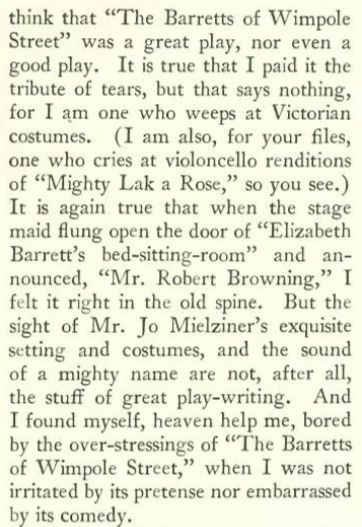
Robert Benchley was visiting friends abroad, so Dorothy Parker did what any pal would do and subbed for his theater column. As it turned out, it was not a happy task, even if she did receive complementary tickets to one of the hottest shows on Broadway:
Having dispatched Katharine Cornell’sBarretts of Wimpole Street, Parker took aim at America’s Sweetheart, based on a book by Herbert Fields with music and lyrics by Richard Rodgers and Lorenz Hart. Parker ended the savaging with a plea to her dear friend and colleague to return home soon:
THEY LAUGHED, THEY CRIED…Katharine Cornell (left) portrayed Elizabeth Barrett in Barretts of Wimpole Street. Dorothy Parker thought Cornell was a first-rate actress, but didn’t think much of her play. As for Inez Courtney (right) in America’s Sweetheart, Parker believed she did what she could, whatever that meant. (Pinterest)
* * *
Lest We Forget
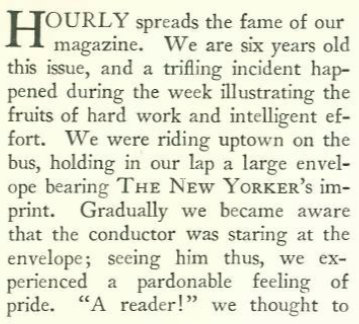
The New Yorker turned six with this issue, and in the life of any magazine, that is something to be celebrated, and especially in hindsight as our beloved publication closes in on its centenary in 2025. Some thoughts from E.B. White:
* * *
From Our Advertisers
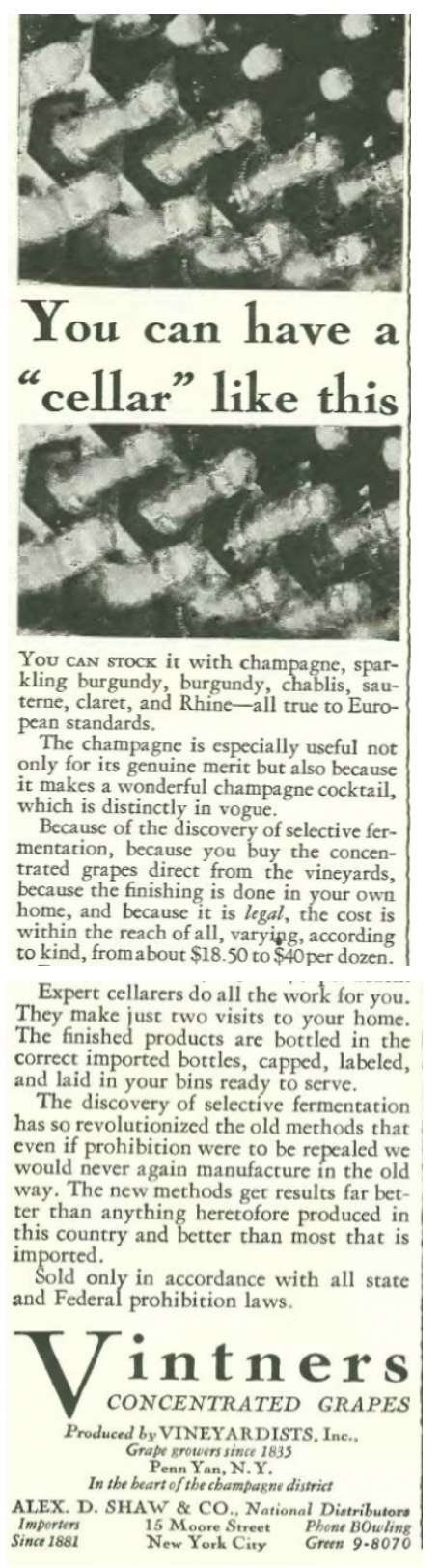
We’ve seen in past ads how Prohibition-era vintners marketed grape juice bricks that could be dissolved in water and fermented in the home. In this ad they took it a step further, sending expert cellarers direct to customers’ homes to help them create their own, perfectly legal, wine cellar…
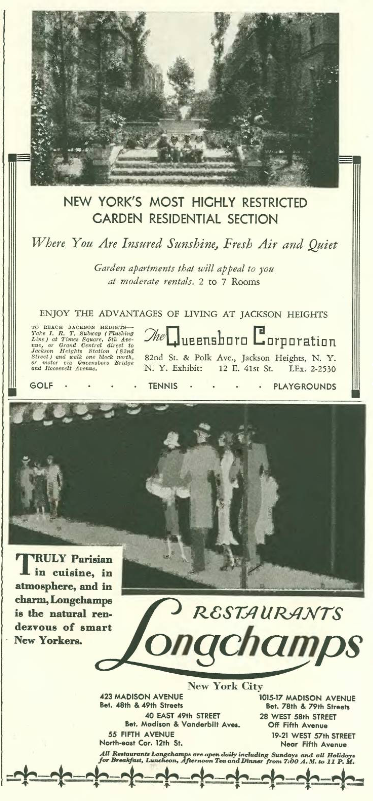
…those with wine cellars might have preferred to live in a “highly restricted” community in Jackson Heights…
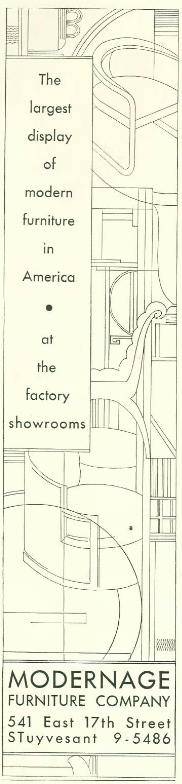
…and furnish their homes with the latest in modern furniture design…
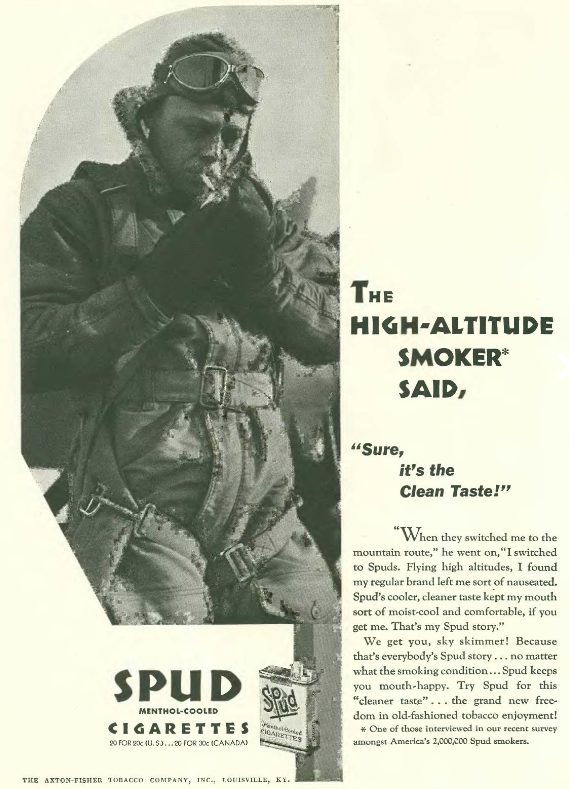
…and here we have an early example of the “macho” smoker, anticipating the arrival of his buddy, the Marlboro Man…
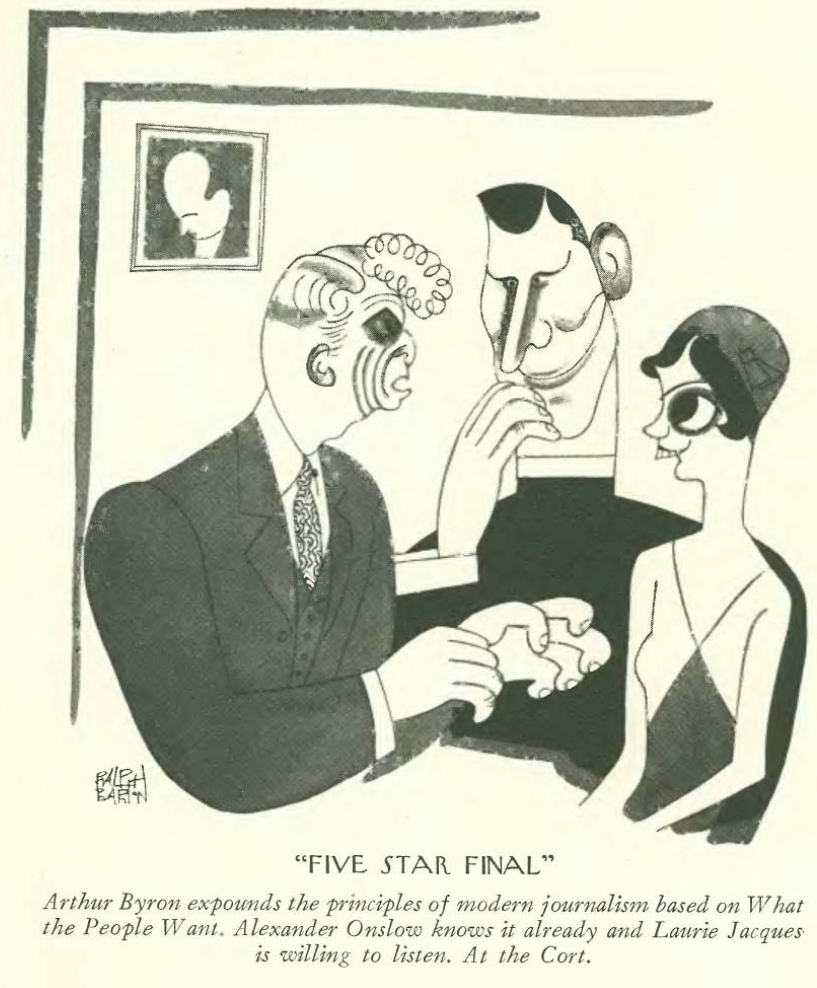
…on to our cartoonists, another theater section entry by one of Charlie Chaplin’s closest friends, Ralph Barton…
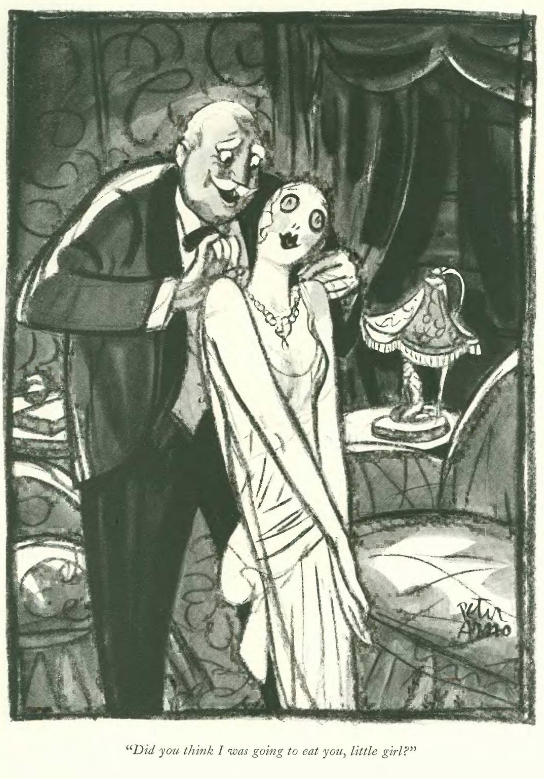
…and cartoons by Peter Arno, who channelled Dracula via his Sugar Daddy…
…Garrett Price, and the burdens of the rich…
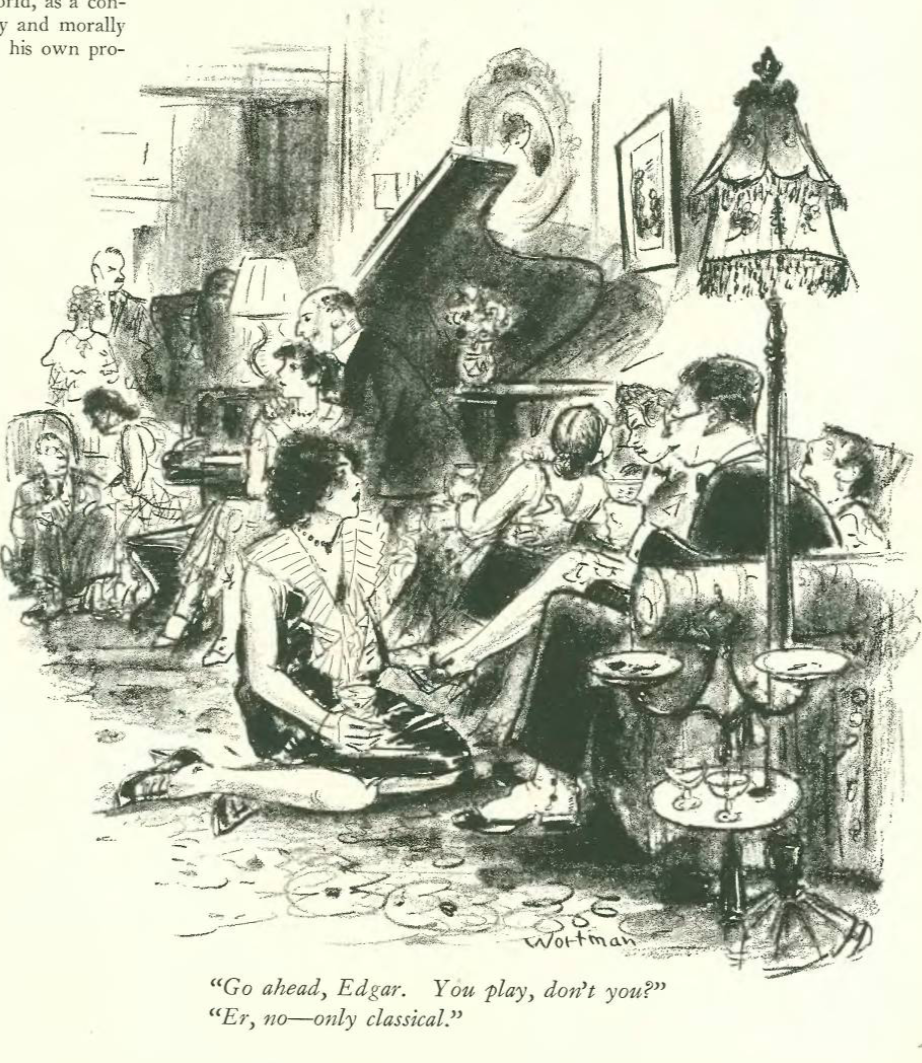
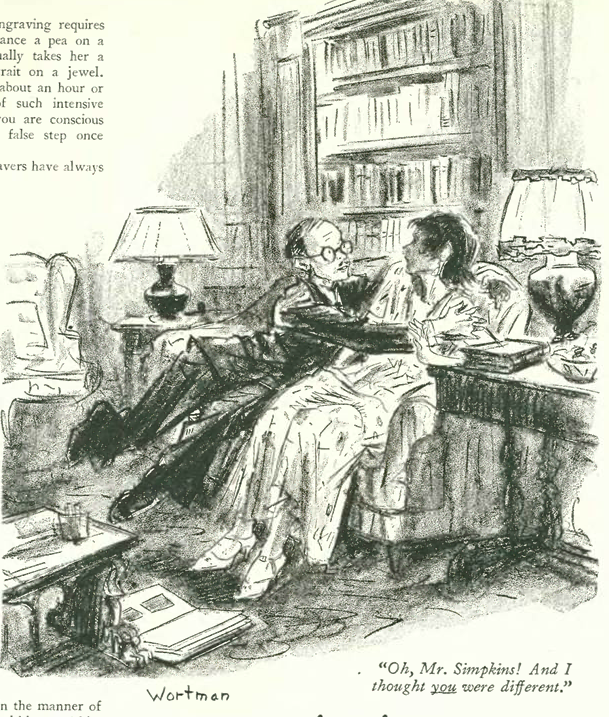
…Denys Wortman examined the follies of youth…
…and we end with dear Helen Hokinson, and the miracle of birth…
The Vassar-educated Lois Long was an icon of the flapper generation and a reigning voice—witty and smart—of New York nightlife in the Roaring Twenties.
Jan. 10, 1931 cover by Constantin Alajalov.
In one of her early “Tables for Two” columns, the famously hard-partying Long made this request of her New Yorker readers: “Will someone do me a favor a get me home by eleven sometime? And see that nobody gives a party while I am catching up? I do so hate to miss anything.”
DONT START THE PARTY WITHOUT ME…Carefree days at your neighborhood speakeasy. (Manchester’s Finest)
By the dawn of 1931 few were in the mood for a party, including the 29-year-old Long, who was mother to a toddler and would soon divorce husband and New Yorker cartoonist Peter Arno.
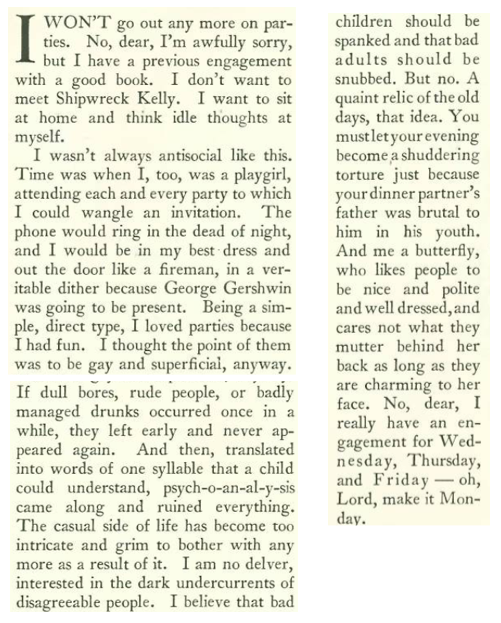
But it wasn’t motherhood or a tempestuous marriage that soured Long on the party scene. Rather, blame fell to the whiny, self-absorbed crowd that had displaced her fun-loving Jazz Age revelers. In the Jan. 10, 1931 issue Long began to assess the decade ahead in a six-part series titled “Doldrums.” The first installment, “Bed of Neuroses,” suggests Long missed the joie de vivre that characterized the previous decade:
“It is all so discouraging; so very, very, sad. Six million people in New York, and apparently no one in the white-collar class who can lose himself for a moment in the ecstasy of a roller-coaster. Six million people in New York, and every one of them a curious little study in maladjustment. Thousands of young men who own dinner jackets, and I am always drawing someone who makes scenes in public because he once had a little cat that died and he has never got over it.”
With that, Long’s partying days were officially over. Some excerpts from “Bed of Neuroses”…
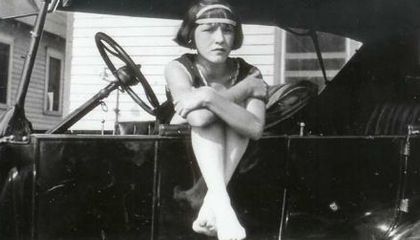
SALAD DAYS…Clockwise, from top left, Lois Long relaxing on the beach in a image captured from a 1920s home movie; silent film star Charlie Chaplin,Vanity Fair editor Frank Crowninshield, sculptor Helen Sardeau, Lois Long and screenwriter Harry D’Arrast pose in a Coney Island photo booth, 1925; Long with husband Peter Arno and daughter Patricia, 1929; Long at the office in a classic flapper pose, circa 1925. (PBS/Joshua Zeitz/Patricia Long/Wikipedia)
Long recalled the days when one could hold his or her liquor…
There has been a trend among the bright young drinkers toward a glass of sherry before meals instead of cocktails, a bottle of wine during dinner, port with the cheese, a liqueur with the coffee — instead of one highball after another.
…and when one’s personal hang-ups remained personal, and were not subject to tedious public display:
Long’s nightlife column, “Tables for Two” folded a few months after the 1929 stock market crash, but she would continue to make unsigned contributions to the “Comments” and “The Talk of the Town” sections into the 1950s. Her main focus at the magazine, however, would be her fashion column, “On and Off the Avenue,” which she would write until 1968. Upon her death in 1974, New Yorker editor William Shawn remarked that Long “was the first American fashion critic to approach fashion as an art and to criticize women’s clothes with independence, intelligence, humor and literary style.”
* * *
The Age of Giants
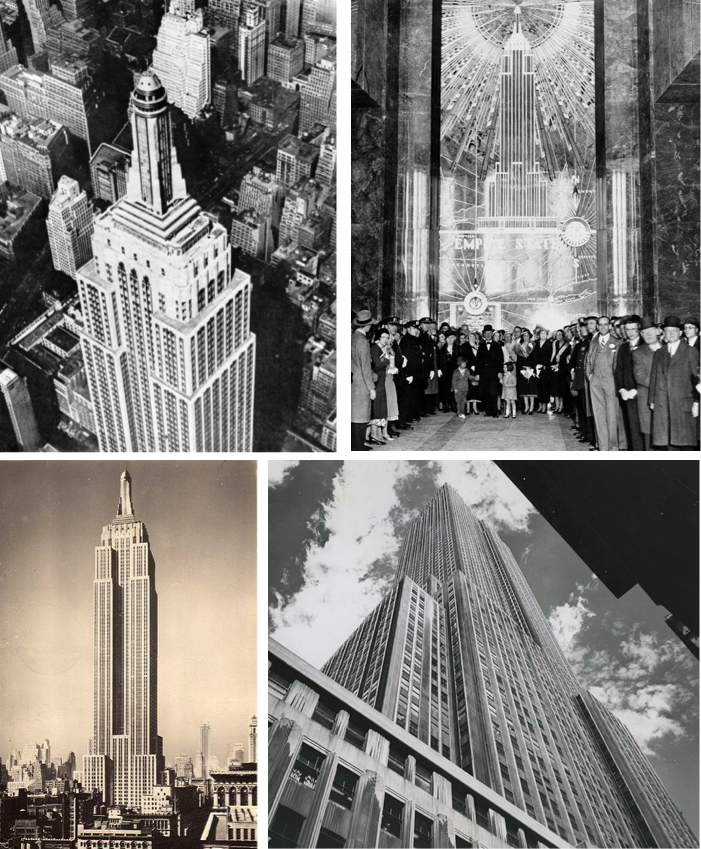
Architecture critic George S. Chappell took in the grandeur of the nearly completed Empire State Building, which rose from the rubble of the old Waldorf-Astoria hotel and perhaps more than any building served as a giant exclamation point for the 20th century metropolis. Chappell did not buy developers’ claims regarding the building’s “mooring mast,” calling it a “silly gesture” that the building would have been better served without. Looking back from our time, however, it is hard to imagine the building without its distinctive spire:
DIZZY HEIGHTS…Completed in 1931, the Empire State Building stood as the world’s tallest until 1970. Clockwise, from top left, New Yorker critic George Chappell viewed the “mooring mast” as a publicity stunt, and believed the building would have been better without it; interior of the building at its grand opening in May 1931; ground-level view of the setbacks Chappell admired; the completed tower in 1931. (lajulak.org/Associated Press/Acme/Pinterest)
Chappell also made note of a neo-Georgian style building designed by Joseph Freedlander for the Museum of the City of New York:
HISTORY’S HOME…The main facade of the Museum of the City of New York facing Fifth Avenue. (Wikipedia)
* * *
Ignoble Deeds
“The Talk of the Town” looked in on some aging veterans of the 19th century “Indian Wars” and found the old coots reminiscing about the massacre of various North American tribes…
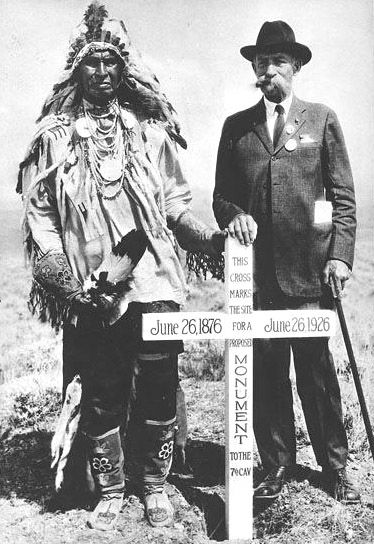
NO HARD FEELINGS?…Crow warrior White Man Runs Him poses with 82-year-old Gen. Edward Settle Godfrey, a survivor of the Battle of Little Bighorn, at the 50th Anniversary of the battle in 1926. (Wikipedia)
* * *
Cheeky
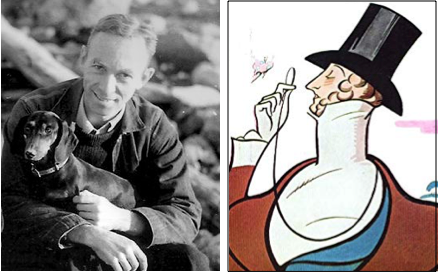
E.B. White assumed the nom de plume “Eustace Tilley” to answer an earnest query letter from Leslie Fulenwider of Famous Features Syndicate. Fulenwider probably didn’t know what he was in for…
ALTER EGO…E.B. White periodically assumed the role of New Yorker mascot Eustace Tilley in handling magazine correspondence.
* * *
Too Cool for School
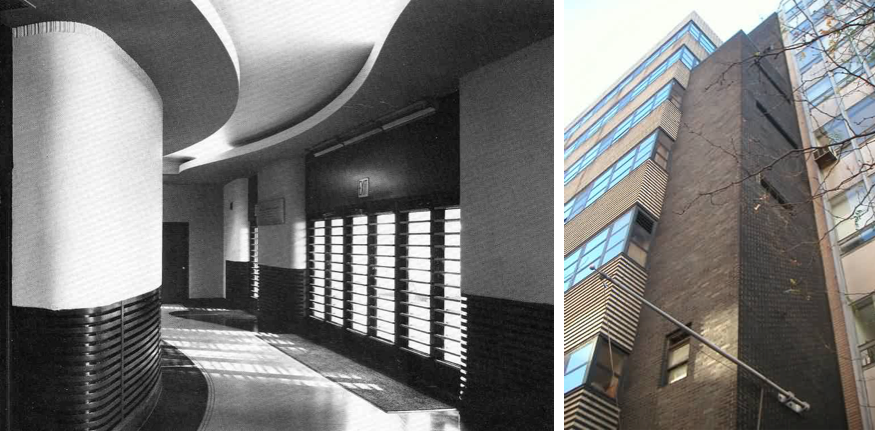
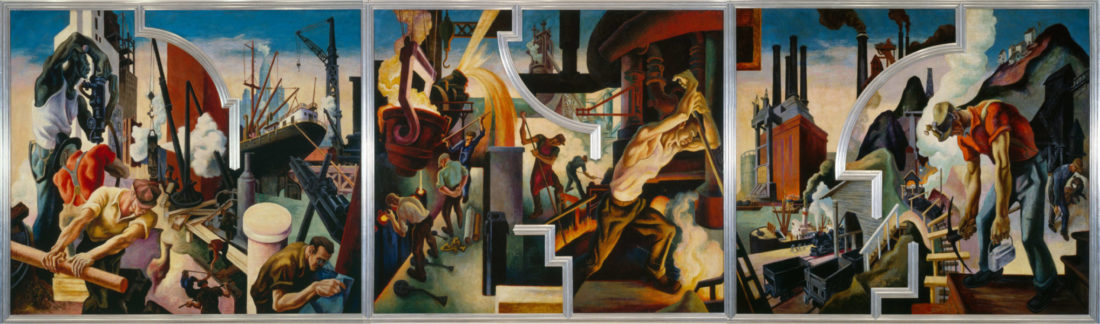
In his weekly art gallery column, Murdock Pemberton noted the New Year’s Day opening of the New School for Social Research in a “timid landmark” designed by Joseph Urban of theatrical design fame. The school’s boardroom featured a series of murals by realist painter Thomas Hart Benton.
NEW LOOK FOR NEW SCHOOL…Joseph Urban’s interpretation of the International Style for the New School for Social Research at 66 West 12th Street.AMERICAN TABLEAU…Three panels from Thomas Hart Benton’s ten-panel mural, America Today. Originally installed in the New School’s boardroom, it is now housed at the Metropolitan Museum of Art. (charlesmcquillen.com)
* * *
From Our Advertisers
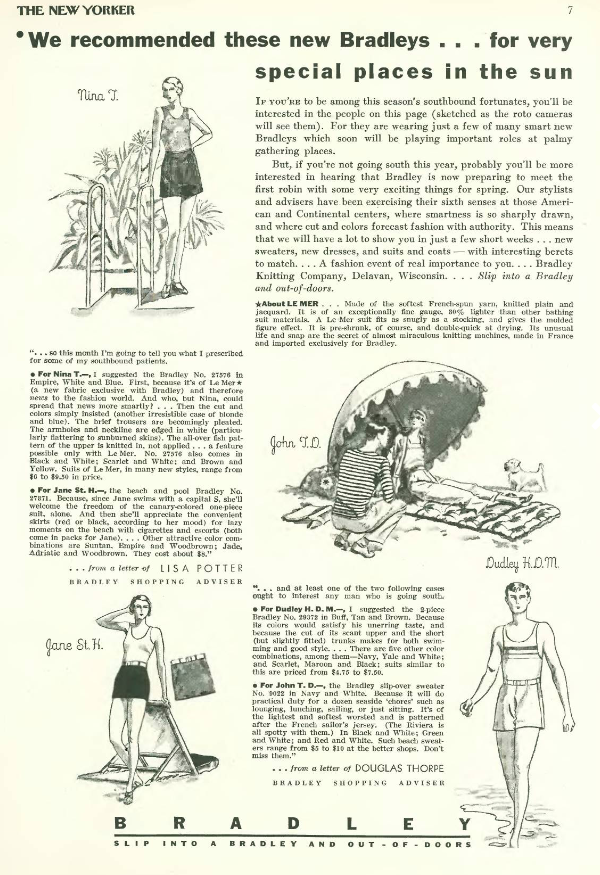
“If you’re to be among this season’s southbound fortunates,” as this ad begins, you’ll want to check out these Bradley bathing suits designed for a variety of privileged personalities…
…but before you hit the beach, you might consider an “Ardena Bath” to take away some of that winter fat…
…this 1932 illustration (below) demonstrates how a full-body, Ardena paraffin wax bath works. An Elizabeth Arden advertisement described the procedure thus: You step into a tub lined with waxed paper. Over you they pour a warm liquid paraffin which slowly hardens until you are encased in a paraffin shell. Your face becomes pink. You are permeated in a sense of well-being. Suddenly, the perspirations bursts from you, for the shell forms a vacuum which causes the pores to open and, consequently, impurities are drawn away…
…on to our cartoons, we have two from William Steig, who produced 2,600 drawings and 117 covers for The New Yorker and whose work would span two centuries, delighting both adults and children alike, most notably the picture book Shrek! that would lead to a hugely successful movie series. According to The Numbers: Where Data and the Movie Business Meet, “after the release of Shrek 2 in 2004, Steig became the first sole-creator of an animated movie franchise that went on to generate over $1 billion from theatrical and ancillary markets after only one sequel.”
Here is Steig’s first New Yorker cartoon, from the Aug. 9, 1930 issue:
…and back to the Jan. 10, 1931 issue, in which Steig offered these glimpses into city life…
…and then have a look into the posh set from New Yorker stalwart Helen Hokinson…
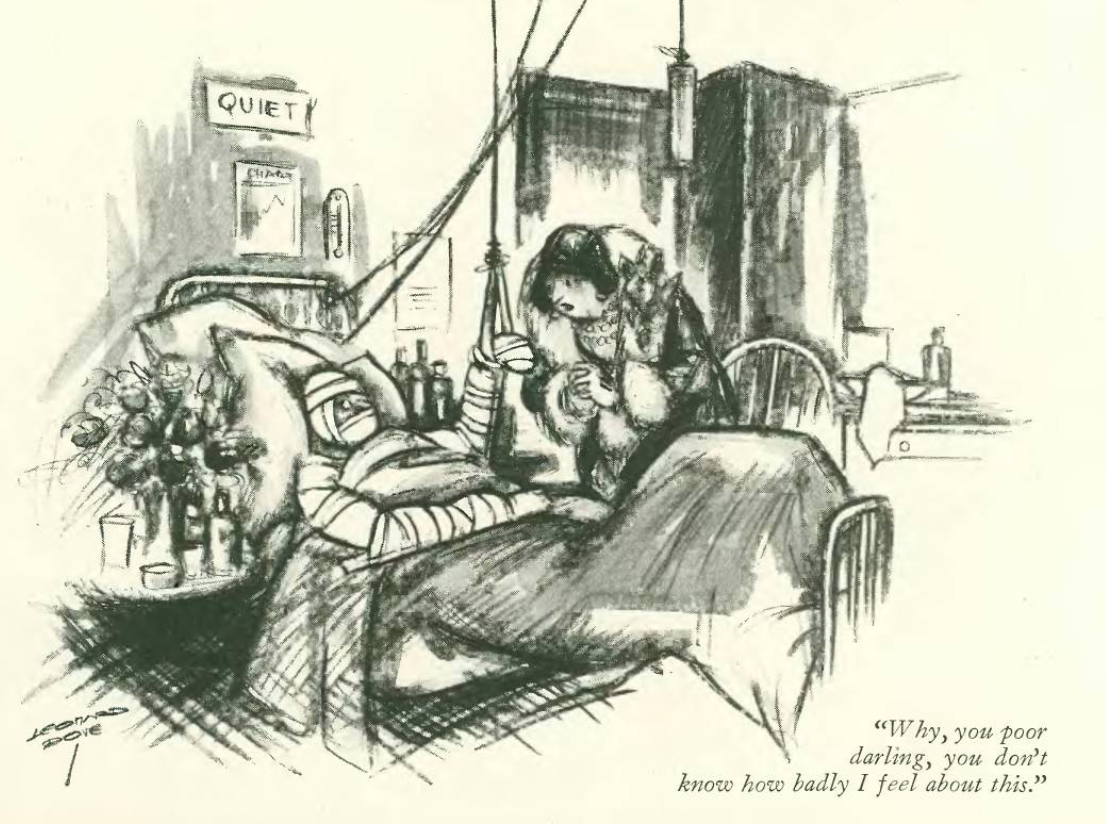
…some bedside manner with Leonard Dove…
…Peter Arno continued to explore the complexities of love…
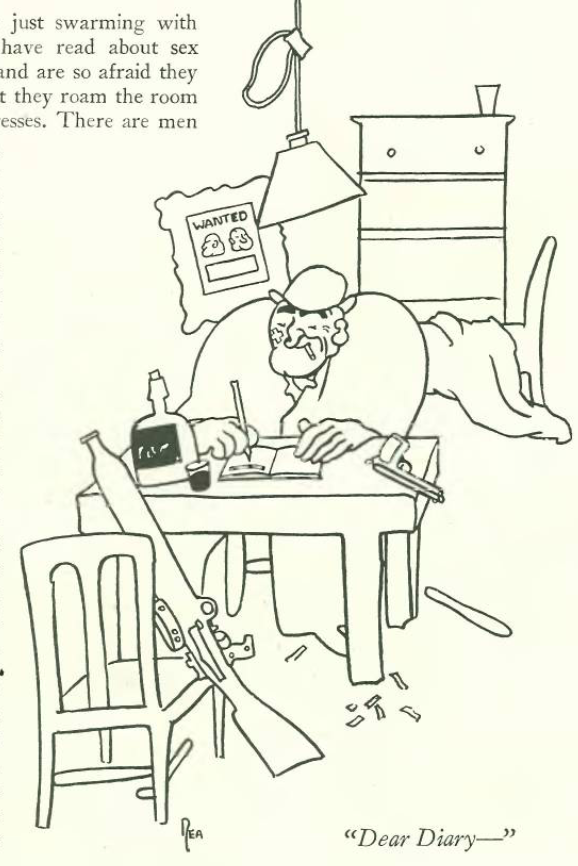
…and Gardner Rea showed us the softer side of a hardened criminal…
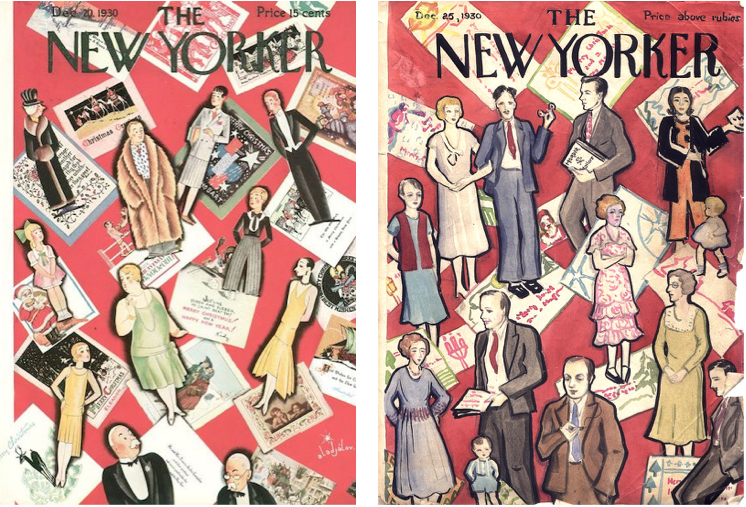
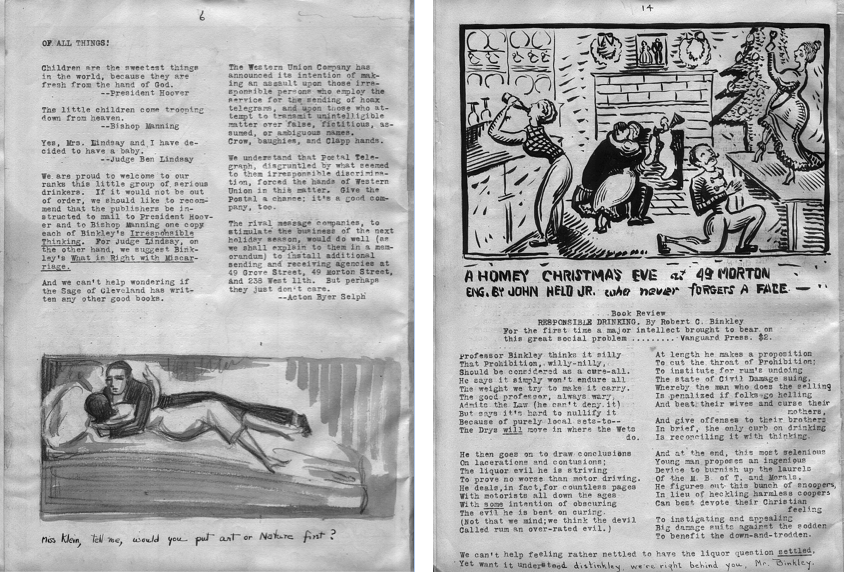
…and before we close I want to bring to your attention to this wonderful New Yorker parody that Peter Binkley recently shared with me. Binkley writes that the Dec. 20, 1930 cover “was the model for a parody issue that friends of my grandparents in the Village made for them when they visited for the holidays. My grandparents had lived in New York for a couple of years but moved away in 1929. They and this group of friends lived in the same building on Morton St., and were fervent New Yorker readers. The parody is interesting, I think, for giving a glimpse of what New Yorker fans below the top-hat-wearing class enjoyed about it at the time.”
Below, left, is the cover of the Dec. 30 issue by Constantin Alajalov, and next to it the terrific parody cover.
…and a couple of the interior pages, with parodies of cartoons by Peter Arno and John Held Jr….
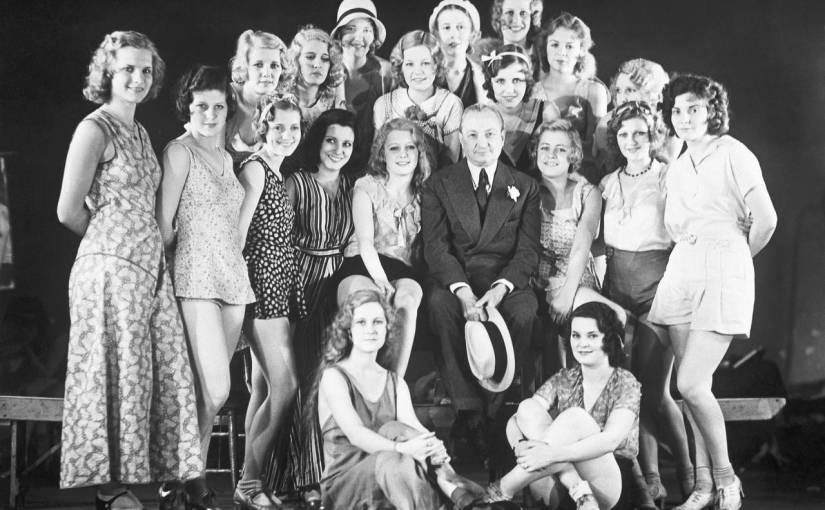
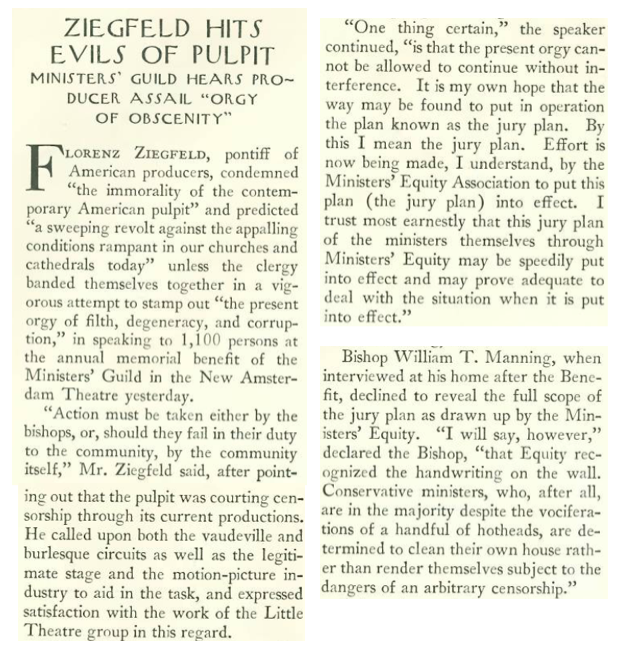
Broadway impresario Florenz Ziegfeld Jr knew how to pack a Broadway theater, and from 1907 to 1932 he staged a number of revues and plays (most notably Showboat) that featured lavish costumes and a bevy of chorus girls.
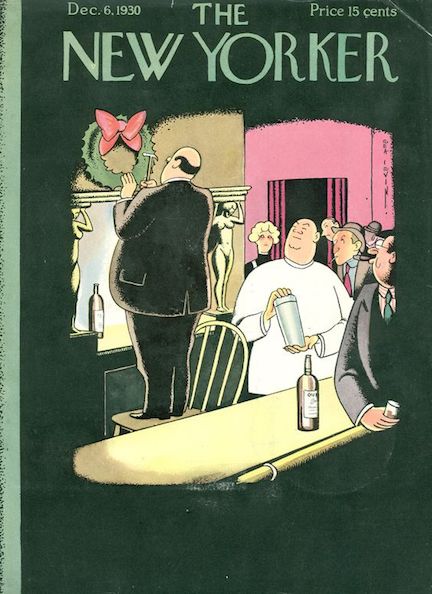
Dec. 6, 1930 cover by Rea Irvin, depicting a peephole view of a speakeasy during the holidays.
When his latest show, Smiles, hit the stage of the Ziegfeld Theatre on Nov. 18, 1930, it was greeted by an audience that had endured the first year of the Great Depression. Ziegfeld’s entertainments, on the other hand, were more associated with the high times of the Roaring Twenties. So even the popular brother-sister dance team from Omaha — Fred and Adele Astaire — seemed a bit old hat.
GO WITH THE FLO…Broadway impresario Florenz “Flo” Ziegfeld Jr with his Follies cast, 1931. (Wall Street Journal)
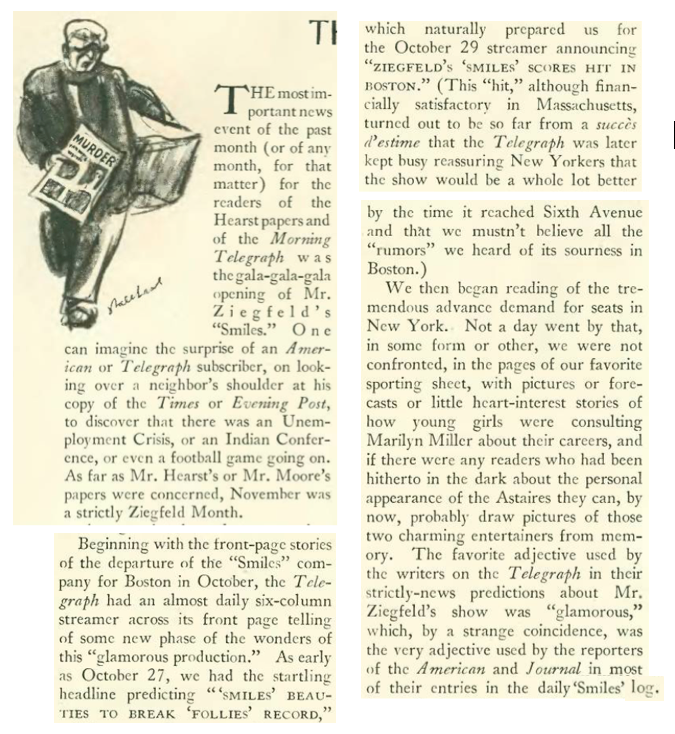
Or so it seemed to Robert Benchley, who observed in “The Wayward Press” that most of his readers could draw pictures of the Astaires from memory. But what really irked Benchley was the way William Randolph Hearst manipulated his mighty newspaper empire to promote Ziegfeld’s Smiles in a way that made the show appear to be the biggest hit of the year.
Ziegfeld Theatre was built with Hearst’s financial backing, so the media mogul was determined that the show would be a success, commanding his editors and writers to lavish praise on the tepid production, which would close in less than two months as a box office failure.
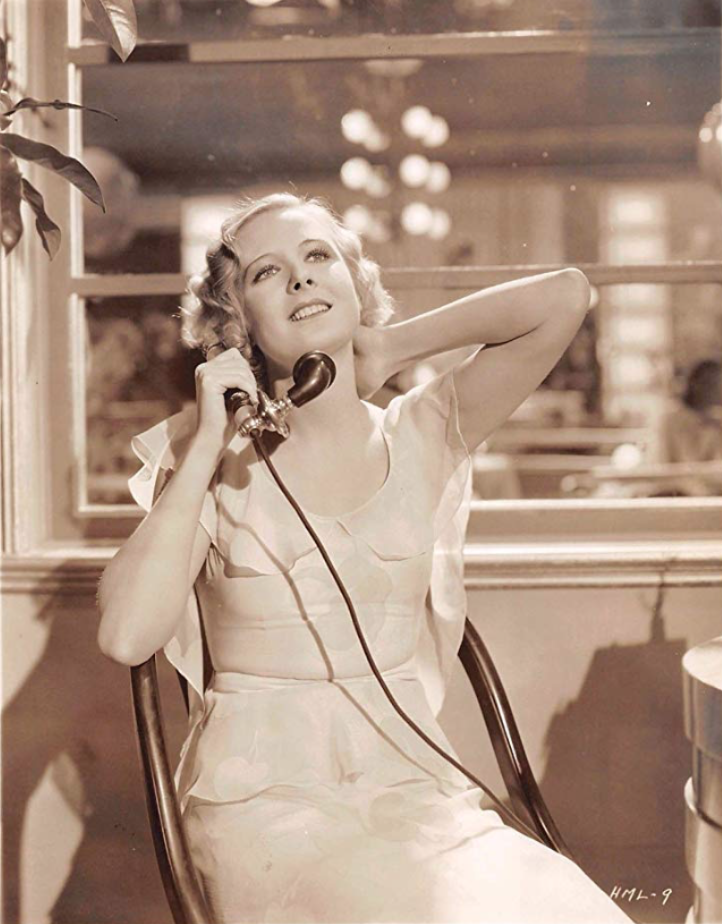
SAY CHEESE…Program for Smiles featuring Fred Astaire, Marilyn Miller and Adele Astaire. At right, publicity photo for Smiles featuring Fred and Marilyn. (Playbill/Pinterest)
For the Astaires, they were nearing the end of their 27-year collaboration — Adele would retire from the stage in 1932 to marry Lord Charles Cavendish, and in 1934 Fred would pair up with Ginger Rogers for the first of nine films they would make together for RKO. Marilyn Miller, one of the most popular Broadway stars of the 1920s and early 1930s, would also seek her fortune in films, but would only make three. Alcoholism and persistent sinus infections would cut her life short in 1936 — she would die at age 37 from complications following nasal surgery.
BRIEF CAREER…Marilyn Miller in 1931’s Her Majesty, Love, one of just three films she would make before her death in 1936. (IMDB)
Benchley revealed how some of Hearst’s reporters responded to the edict from their boss:
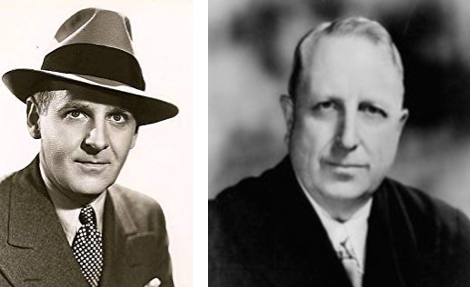
TWEAKING HIS NOSE…Walter Winchell, left, registered his protest against his boss, William Randolph Hearst, by laying it on thick in his column. (IMDB/BBC)THE FOLLY OF FOLLIES…Robert Benchley (left) cried foul regarding Hearst’s attempt to prop up a lousy show; Ogden Nash (right) found humor in the “immorality” of Ziegfeld’s productions. (Wikipedia/Notable Biographies)
On a related note, Ogden Nash also zeroed in on Ziegfeld’s latest show, turning the tables on religious zealots who found the Follies immoral. An excerpt:
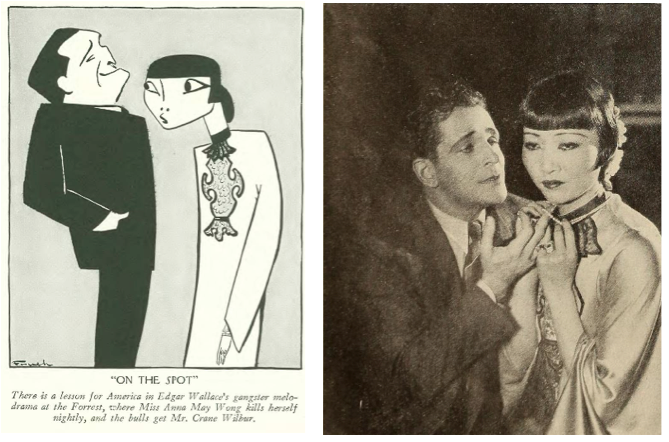
And finally, one more theater-related item: a drawing by Al Frueh highlighting the melodrama On The Spot, which ran from Oct. 29, 1930 through March 1931 at the Forrest Theatre.
BETTER THAN ZIEGFELD, THIS…At right, Crane Wilbur and Anna May Wong in the melodrama On The Spot, which opened Oct. 29, 1930 at the Forrest Theatre. (New Yorker/Pinterest)
* * *
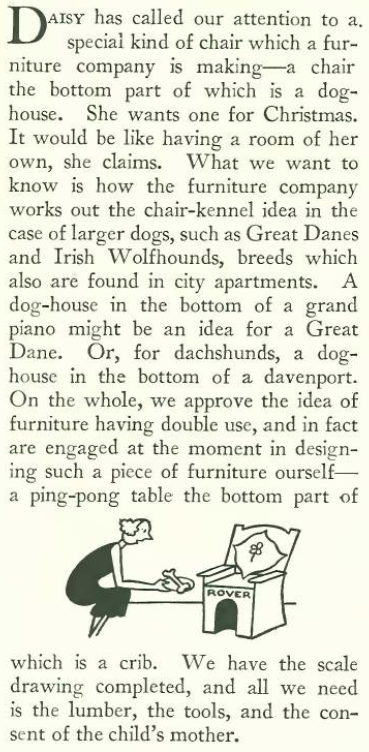
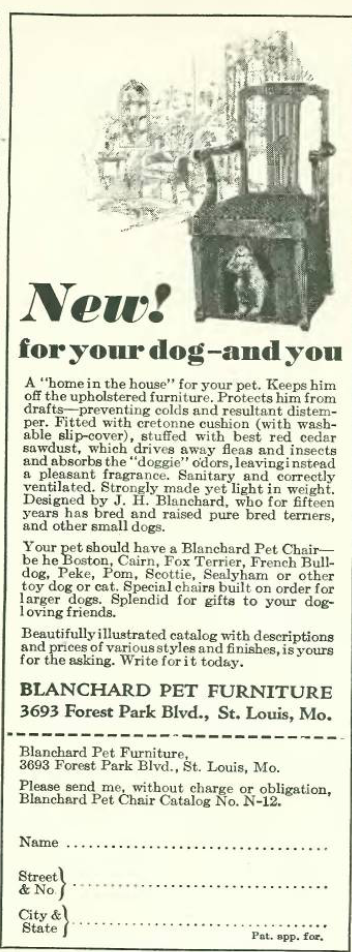
In the Dec. 6, 1930 “Notes and Comment,” E.B. White shared his observations on a new type of chair that doubled as a dog house…
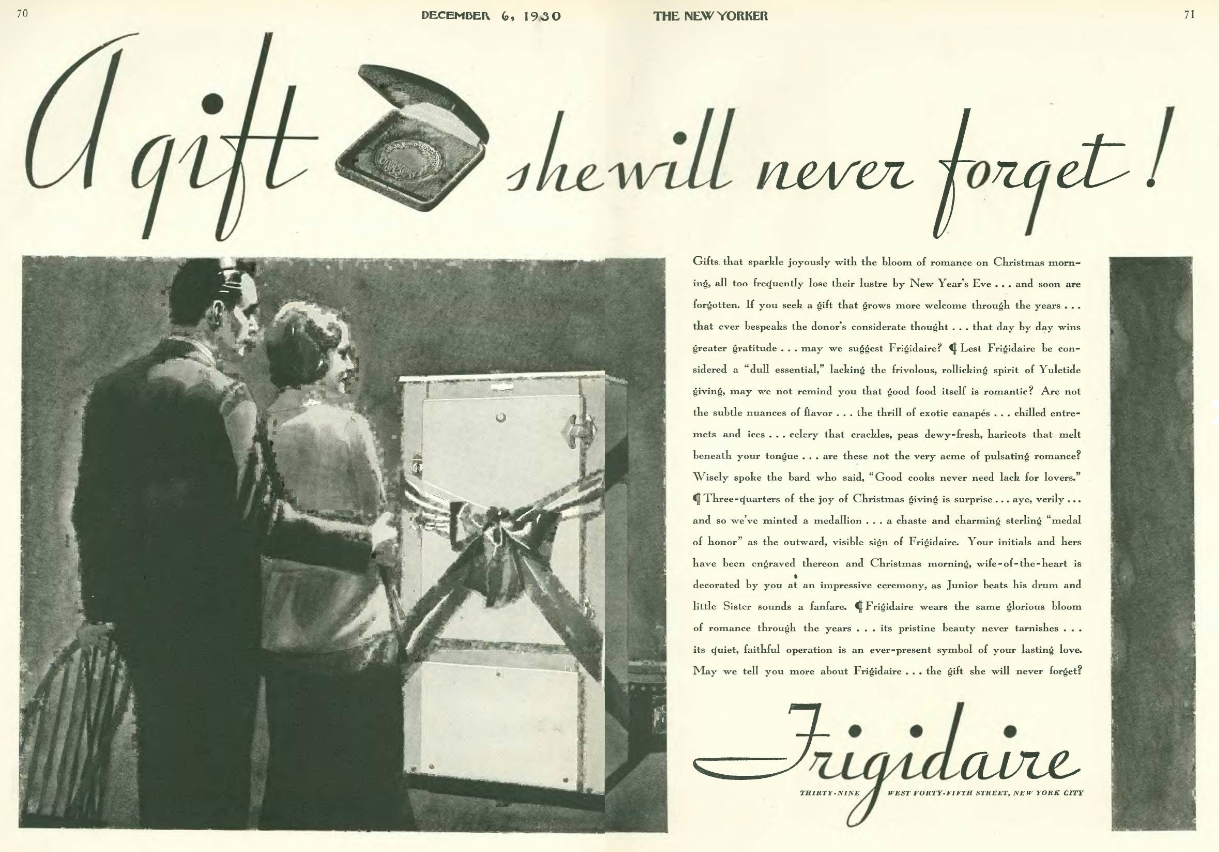
…and he wasn’t making it up, because the chair he described was featured in this ad from the same issue…
* * *
Drunk History
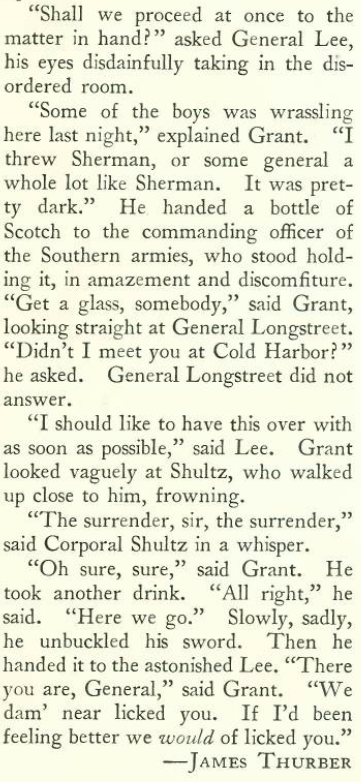
In the fall of 1930 Scribner’s magazine published a series of three articles titled “If Booth Had Missed Lincoln,” If Lee Had Not Won the Battle of Gettysburg,” and “If Napoleon Had Escaped to America.” The New Yorker’sJames Thurber claimed to be the author of a fourth article, “If Grant Had Been Drinking At Appomattox.” An excerpt:
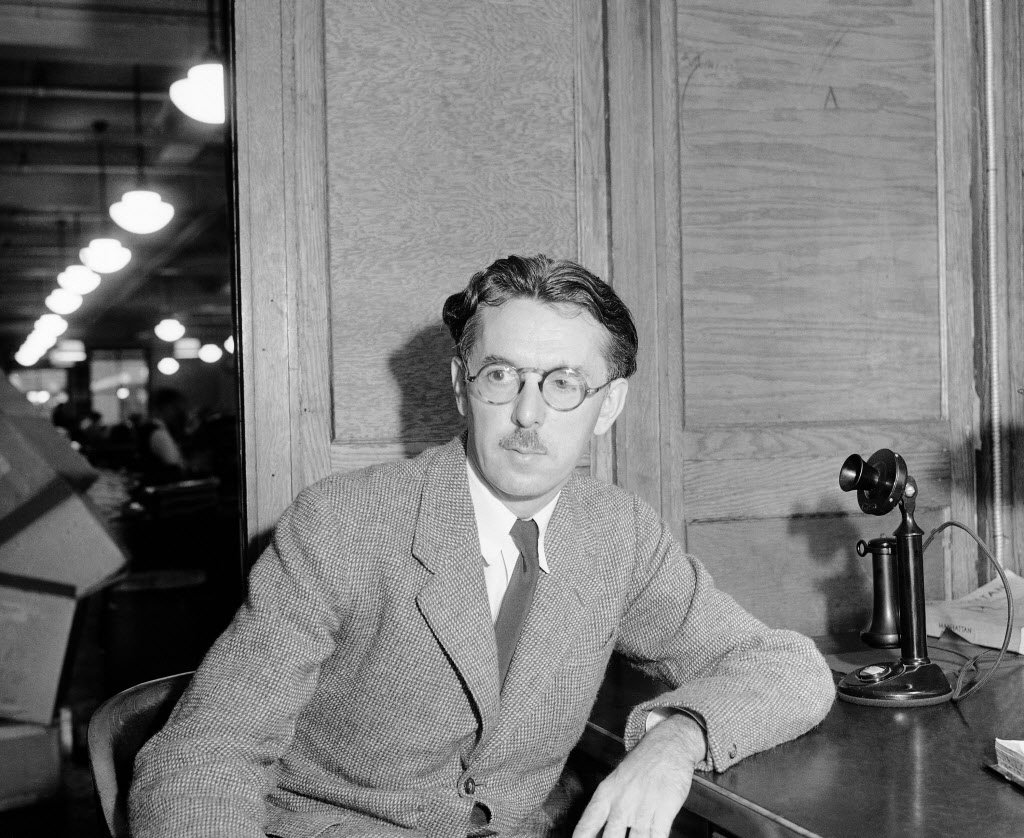
REVISIONIST…James Thurber circa 1930. (thurberhouse.org)
* * *
From Our Advertisers
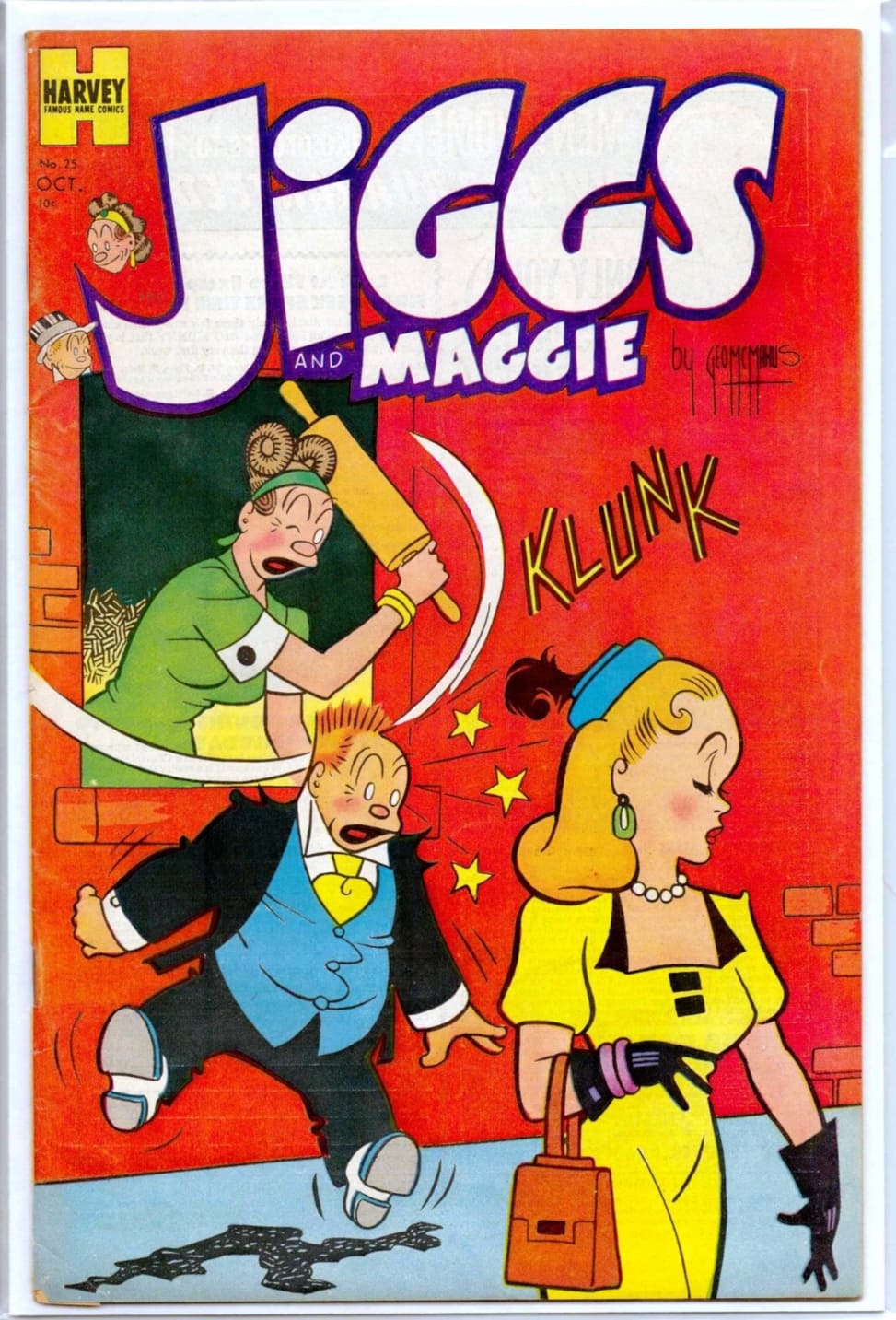
The rolling pin was often deployed as a prop — especially in the comics — to illustrate marital discord; the makers of Hoffman ginger ale used the common trope to sell their fizzy drink…
…for reference, Maggie gives it to Jiggs in this comic book cover from 1953…
(Good Girl Comics)
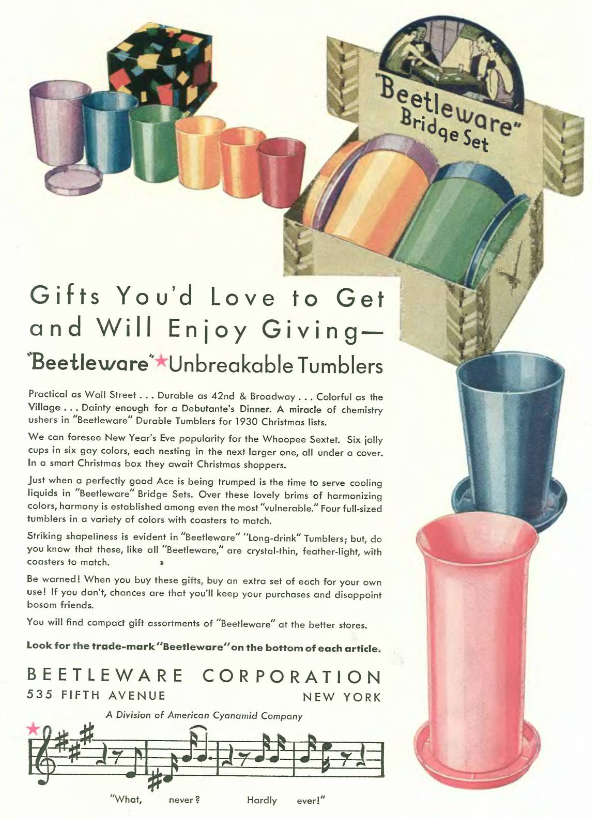
…the issue was stuffed with ads for Christmas shoppers, ranging from colorful plastic tumblers…
…to “unforgettable” appliances…
…to a variety of accessories at Wanamaker’s…
…Macy’s offered this pajama and robe combination for (insufferable) little boys who “strive for sartorial effect”…
…while Burdine’s of Miami urged snowbirds to purchase multiple wardrobes to remain fashionable throughout the winter season…
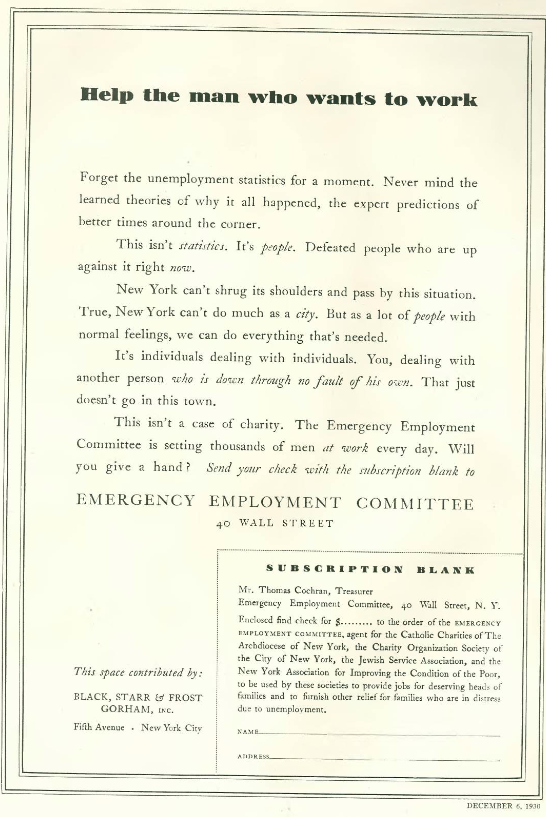
…and in stark contrast, this ad appealed for donations to help the jobless…
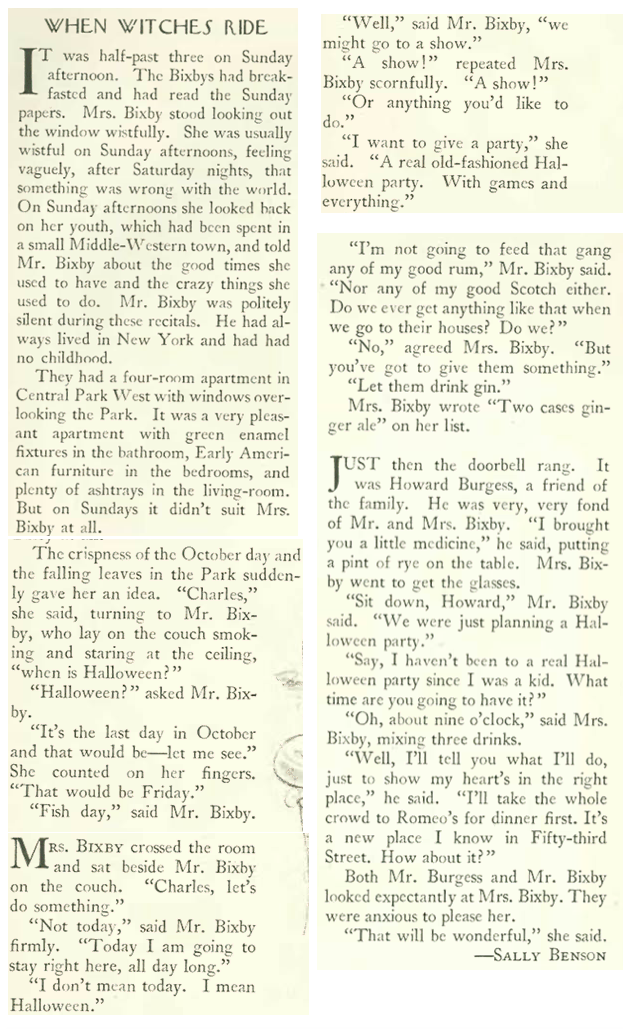
Since I am posting this on the night before All Hallow’s Eve, let’s take a quick look back 89 years at Halloween 1930 through the pages of the Oct. 25, 1930 issue of The New Yorker…
…which featured a short story (excerpted below) by Sally Benson, who would write a series of shorts for The New Yorker in 1941-42 that were later published in her book, Meet Me in St. Louis. Note how Prohibition laws seemed to pose no obstacle to the Bixbys’ party plans:
Benson’s Meet Me in St. Louis would be adapted into a popular 1944 film starring Judy Garland. One of the film’s highlights featured the Halloween hijinks of Tootie and Agnes Smith (Margaret O’Brien and Joan Carroll).
BOO!…Margaret O’Brien and Joan Carroll go trick-or-treating in 1944’s Meet Me in St. Louis. (Comet Over Hollywood)
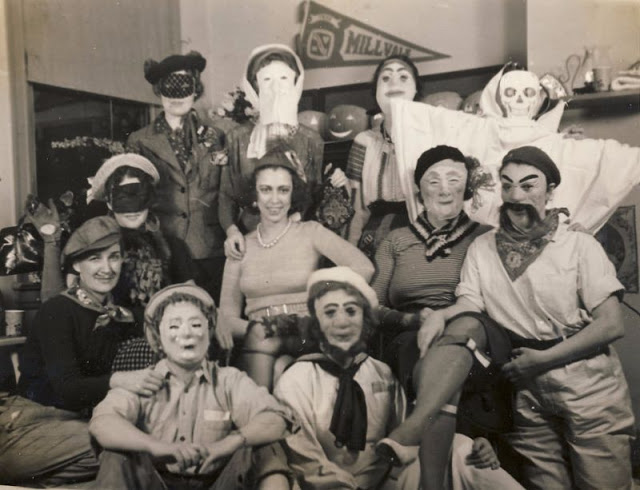
…Halloween revels were also popular with the college kids…
(Vintage Everyday)
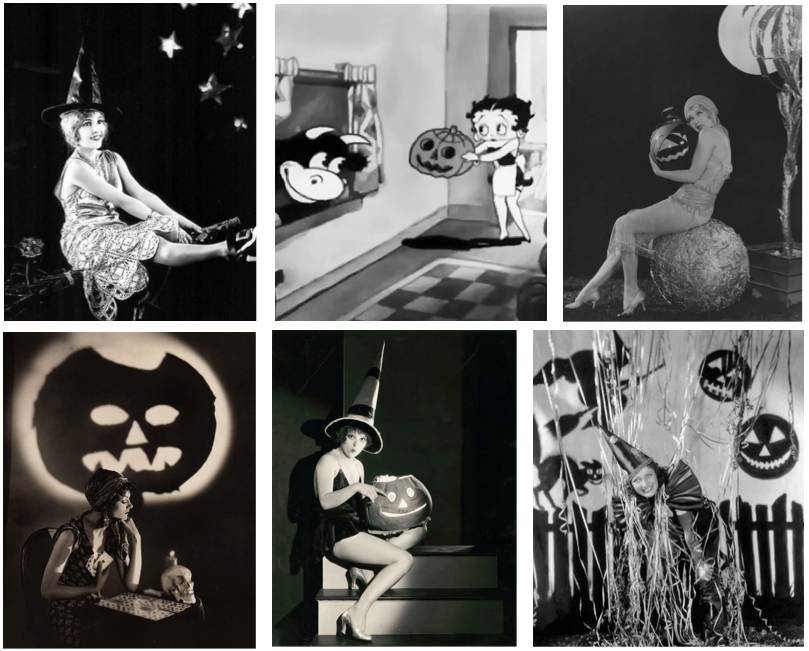
…and of course Hollywood got in on the act, each studio issuing pinup-style images of major female stars to newspapers and magazines …
Clockwise, from top left, Bessie Love (ca. 1920s), a still from a 1933 Betty Boop cartoon, Anita Page, Joan Crawford, Clara Bow, and Myrna Loy. (Vintage Everyday/YouTube)
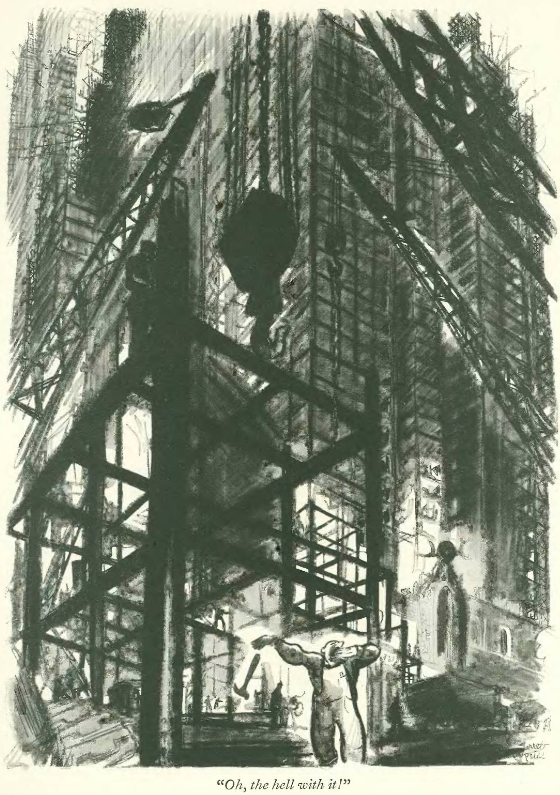
…the pages of the Oct. 25 issue contained other references to the holiday, including these Julian de Miskey spot drawings…
…and there were also ads offering both parties and party treats to those seeking some Halloween fun…
* * *
Not Exactly Whale Watching
On to our issues, the Oct. 15, 1930 edition featured a strange account (in “The Talk of the Town”) of a man who travelled the country with an embalmed whale carcass, which apparently drew large crowds wherever it was displayed.
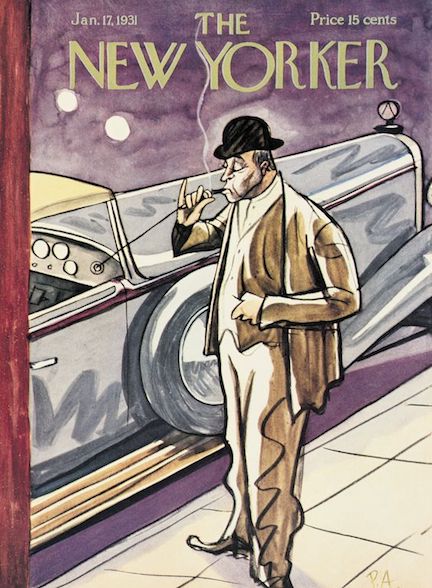
Oct. 15, 1930 cover by Peter Arno. As I noted in my previous post, it seemed everyone was lighting up in the 1930s.
The account is disgusting on a number of levels (the last line: “People simply love whales”). During my research I learned that these “whale tours” continued into the 1970s.
SAVE THE WHALES…in this case, by pumping the animal with gallons of formaldehyde.
For further reading, author Lydia Pyne offers some history on this strange phenomenon at Not Even Past.
* * *
From Our Advertisers
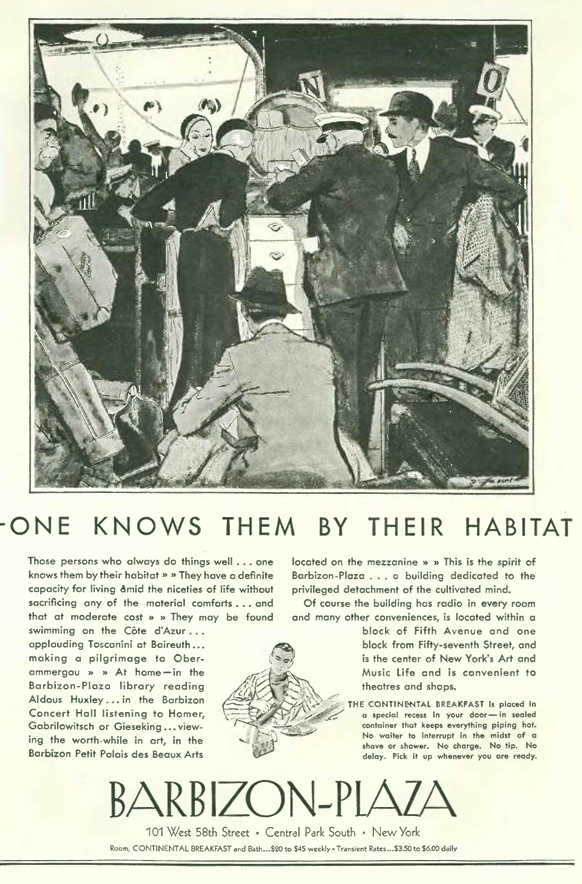
The owners of the new Barbizon-Plaza Hotel at 106 Central Park South tried their best to lure the smart set (especially artists and musicians) to this “habitat” designed especially for them. Unfortunately, artists and musicians were as broke as everyone else, and the property was foreclosed on in 1933…
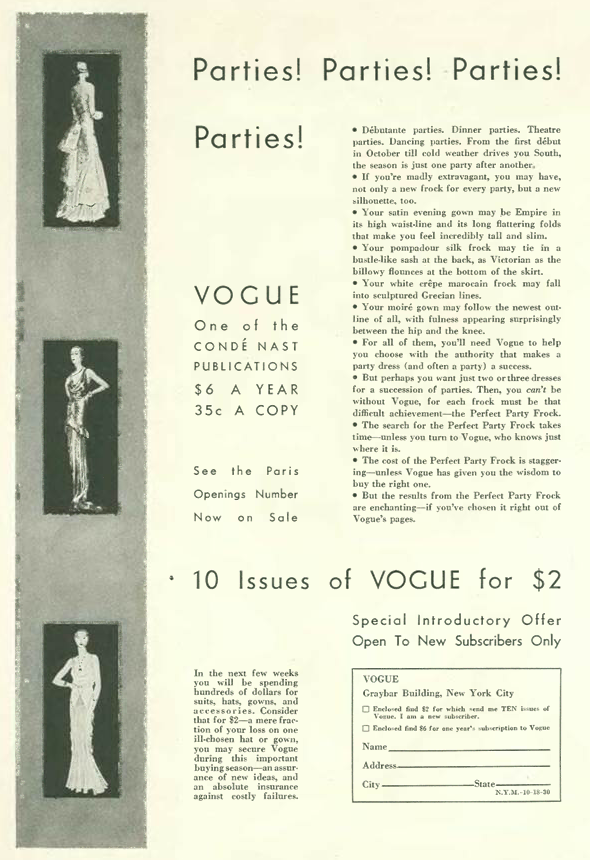
…and we have another appeal to the smart set, this one from the publishers of Vogue magazine (now a sister publication to the New Yorker, as both are now owned by Condé Nast)…
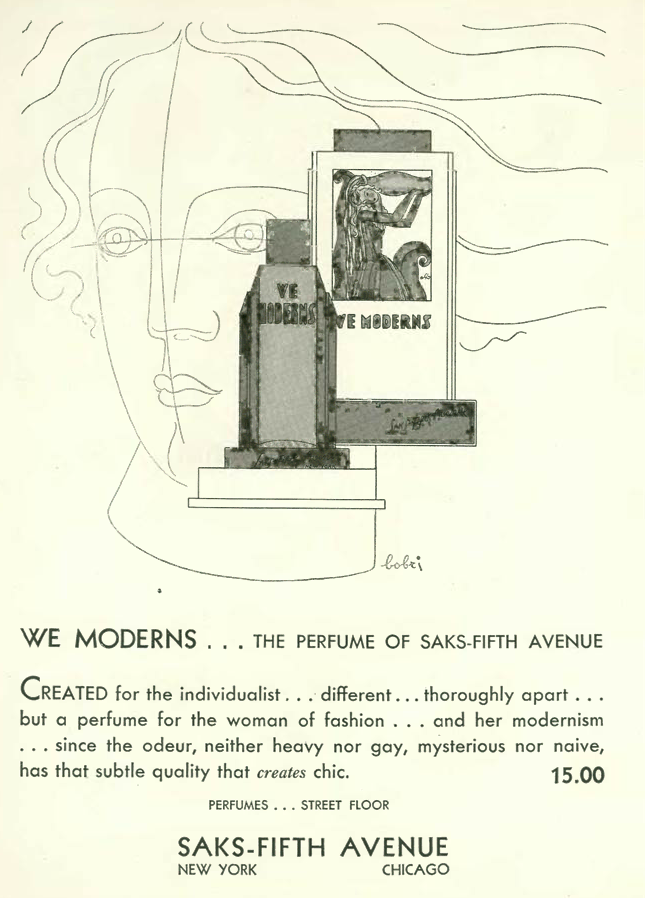
…and one more appeal to fashionable sorts, this time perfume in a bottle shaped like an art deco skyscraper…
…here is what one version of the bottle looked like in 1928, similar to ad above. According to the blog Cleopatra’s Boudoir, the We Moderns perfume was sold from 1928 to 1936 in bottles made in Czechoslovakia. The bottle below was made from glass, enamel (label), and the early plastic Bakelite (cover and base)…
(Perfume Bottles Auction)
…on to our color ads, I like this one because RCA induced the inventor of wireless radio, Guglielmo Marconi, to endorse their “Radiola”…
…and we have a beautiful illustration by Ellis Wilson for Dodge Boats…
…on to our cartoons, we begin with Denys Wortman…
…here’s the art of Rea Irvin on a full page…
…Helen Hokinson kept up the tradition of New Yorkers looking down on those backward Bostonians…
…Alan Dunn, illustrating the sunlamp fad of the 20s and 30s…
…and Jack Markow, checking on the progress of the Empire State Building…
On to the Oct. 25 issue, and the Broadway opening of the comedy Girl Crazy…
Oct. 25, 1930 cover by Rea Irvin.
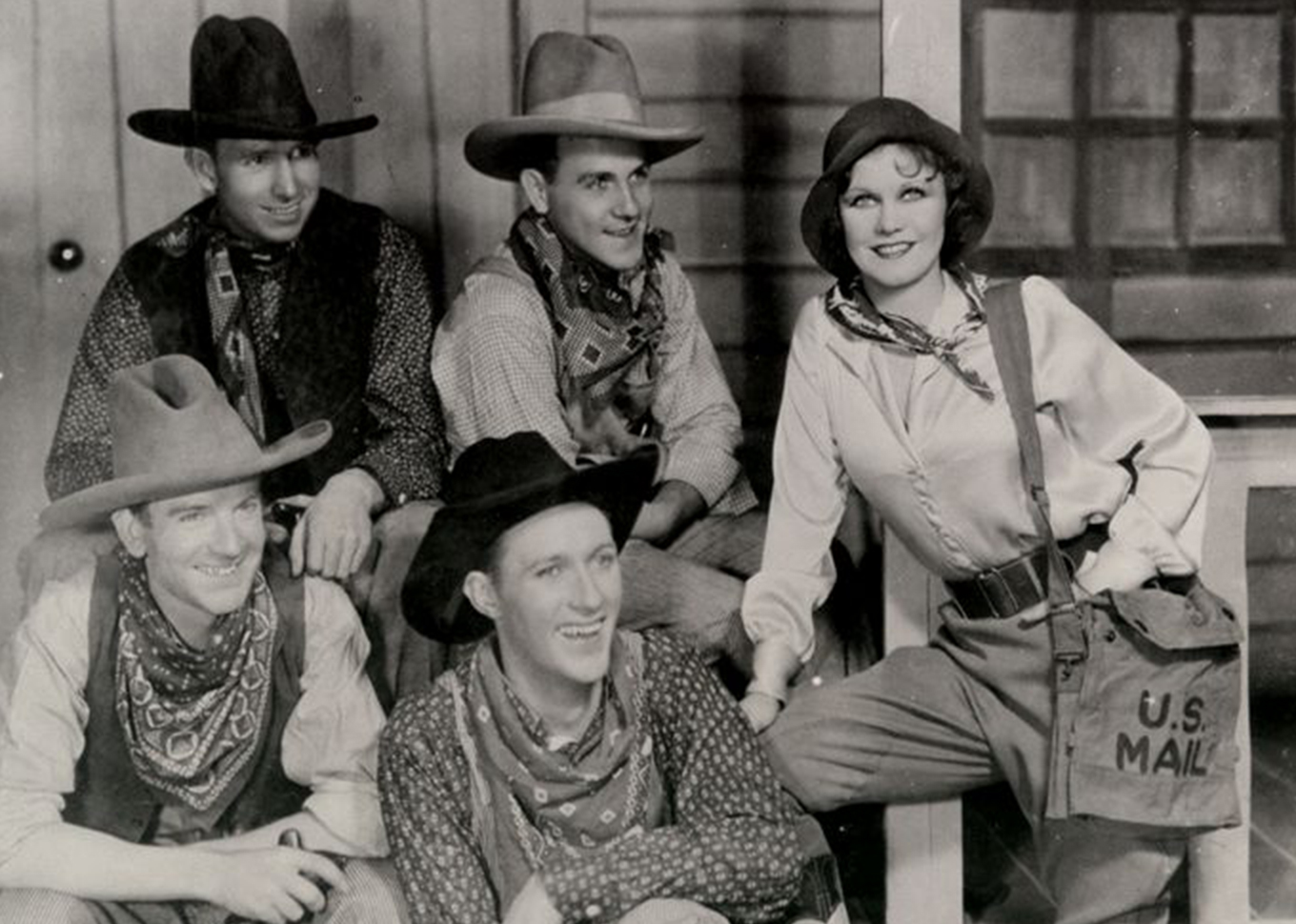
…which featured Ginger Rogers and Ethel Merman introducing the many hits from George Gershwin’s score including “I Got Rhythm” and ‘Embraceable You.” The plot was simple: a young New York playboy is banished by his family to a dude ranch in Arizona to keep him out of trouble…where of course he finds trouble. The orchestra for the Broadway performance included such talents as Benny Goodman, Glenn Miller, Jimmy Dorsey, Jack Teagarden, and Gene Krupa.
THEY SEEM SANE ENOUGH…Above, poster for the Broadway musical Girl Crazy. Below, Ginger Rogers poses with fellow stage actors. (gershwin.com)
* * *
More from Our Advertisers
Ads from the Oct. 25 issue included this recurring one from the promoters of the Empire State Building, marking progress through various historical vignettes…
…the ad accurately depicted the building’s progress, measured against these images below…
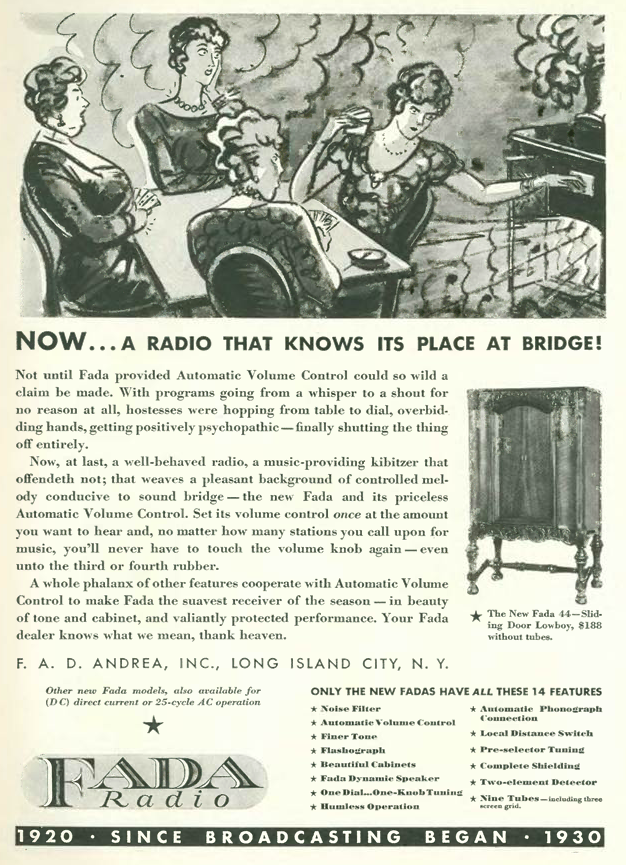
…and we have more radio ads…no endorsement from Marconi here, but the makers of Fada claimed their receiver was far less annoying than their rivals…
…while Atwater Kent touted the convenience of its new “Quick-Vision Dial”…
…as I’ve previously noted, backgammon was all the rage in 1930, so much so that this clothier even advertised a special frock for the game…
…and what would the 1930s be without smoking tied to athletic prowess…
…and remembering friends and family in California in 2019 as they battle wildfires across that great state…
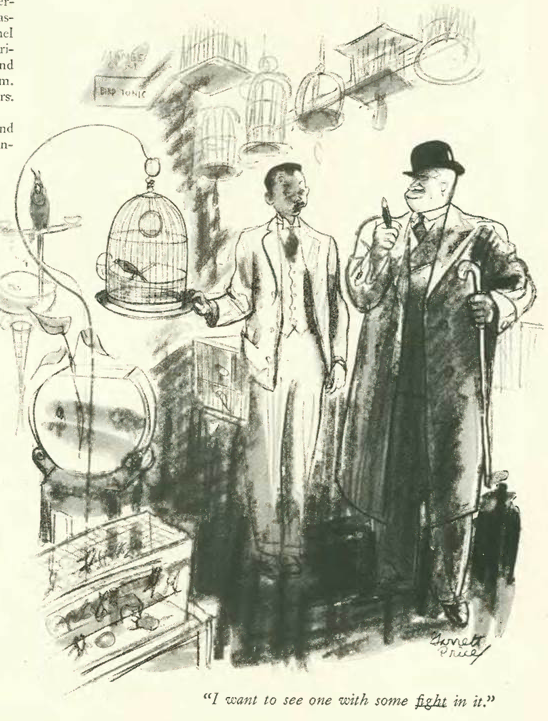
…on to our cartoons, Garrett Price introduced us to a man with a peculiar taste in pet canaries…
…Barbara Shermund illustrated the startling views afforded by rail travel…
…and Peter Arno leaves us in a moment of religious ecstasy…
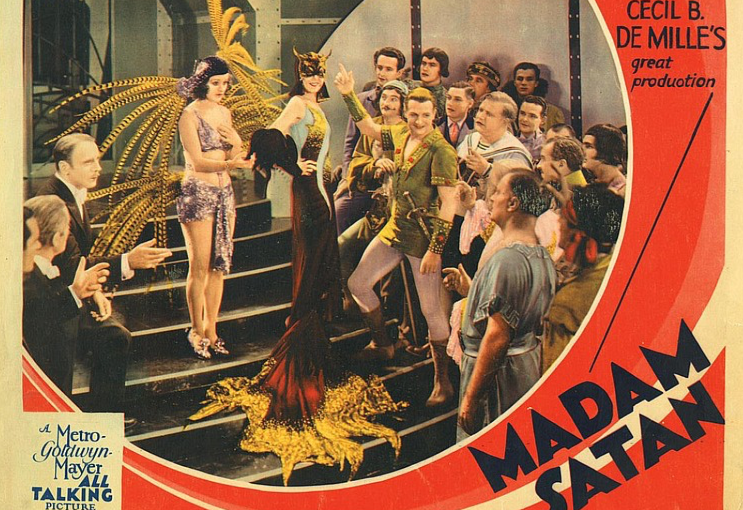
Cecil B. DeMille was known for his epic films (e.g. The Ten Commandments, 1923 and 1956) and cinematic showmanship, but in 1930 he puzzled his audiences with a very weird pre-Code musical, Madam Satan.
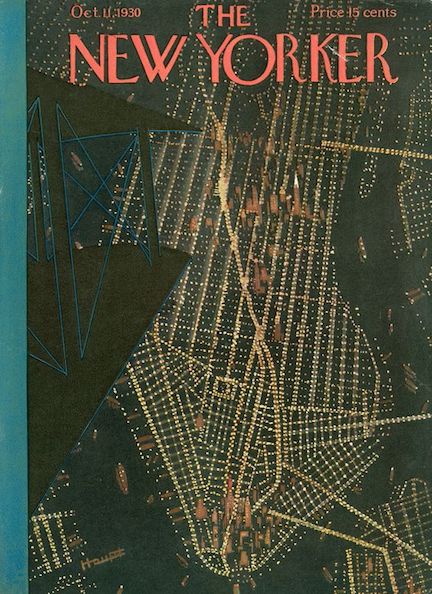
Oct. 11, 1930 cover by Theodore Haupt.
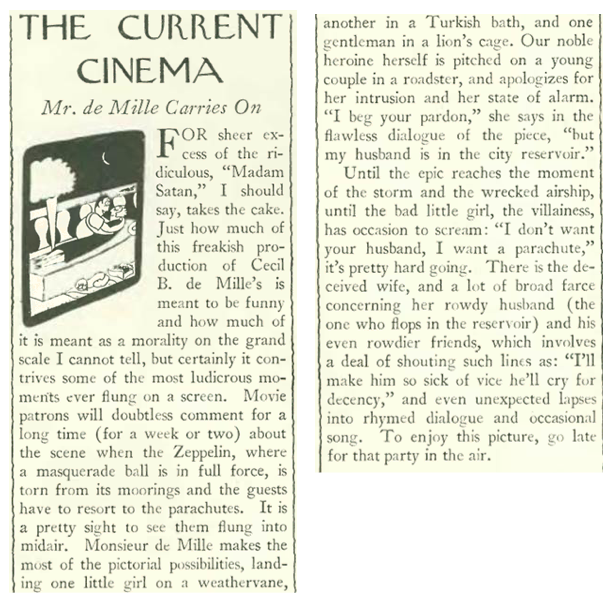
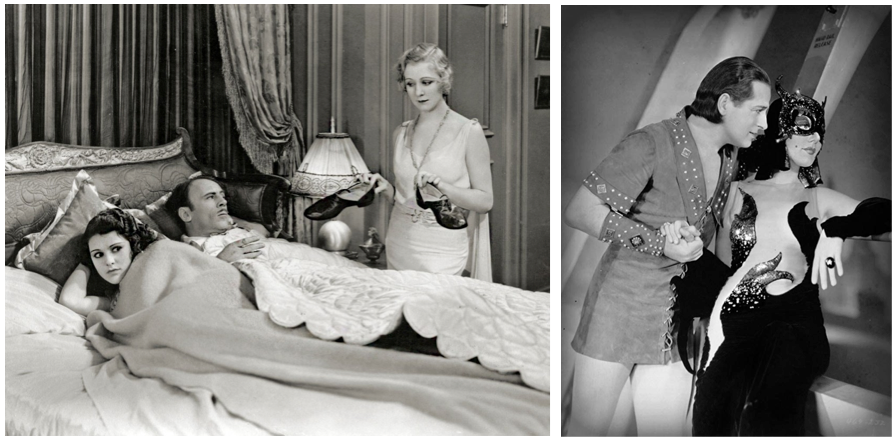
The film centered on a wealthy couple, Angela and Bob Brooks (played by Kay Johnson and Reginald Denny). Bob is unfaithful to his wife (a common pre-Code theme), and she attempts to lure him back by disguising herself as a mysterious devil woman at a masquerade ball held aboard a dirigible. Quite a plot indeed. Here’s what The New Yorker’sJohn Mosher had to say about it.
(IMDB)
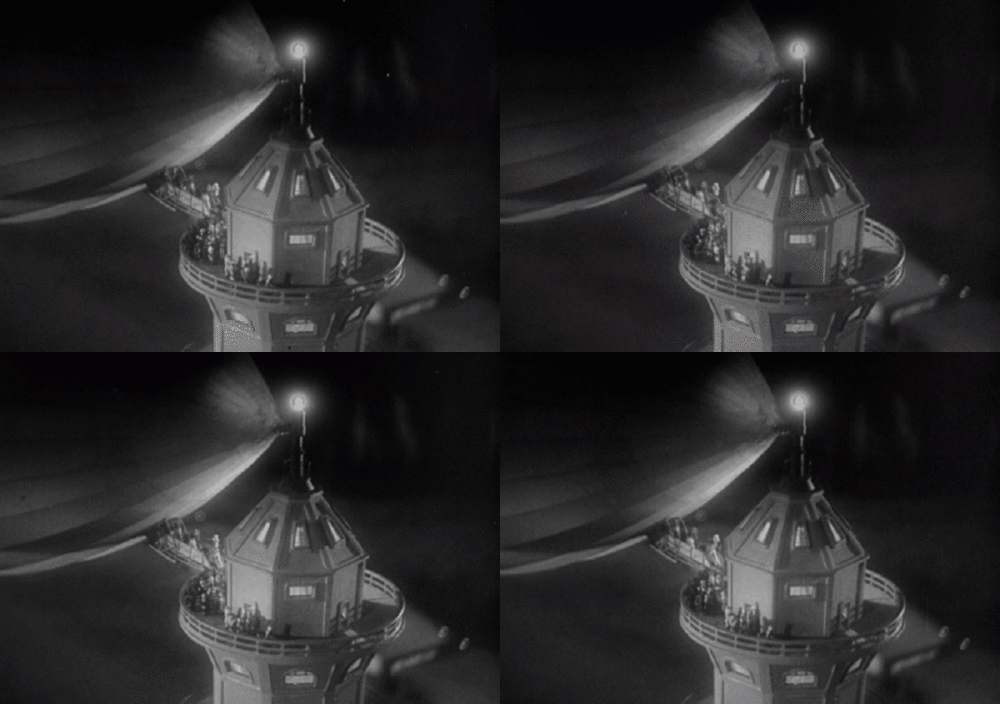
PAJAMA GAMES…Lillian Roth, Roland Young, and Kay Johnson in Madam Satan. At right, Reginald Denny falls for the charms of his wife (Kay Johnson), disguised as a devil woman at a masked ball held aboard a giant dirigible. (IMDB/cecilbdemille.com)AIRHEADS…Via a giant mooring mast, partygoers board a dirigible for the masquerade ball in Madam Satan. Curiously, developers of the Empire State Building (which was under construction) envisioned a similar use for the mast that would top out their tower. In reality, winds that whipped around high towers would have prevented this type of boarding. (twitter.com)SOMEONE CALL THE FAA…At right, the lavish masquerade ball aboard a giant dirigible in Madam Satan. At right, the dirigible is damaged by lightning in a scene that foreshadowed the Hindenberg disaster of 1937. (cecilbdemille.com/precode.com)SEEMS PLAUSIBLE…In a silly ending to a silly film, partygoers float on parachutes away from the damaged dirigible. (twitter.com)
* * *
Let Them Eat Cake
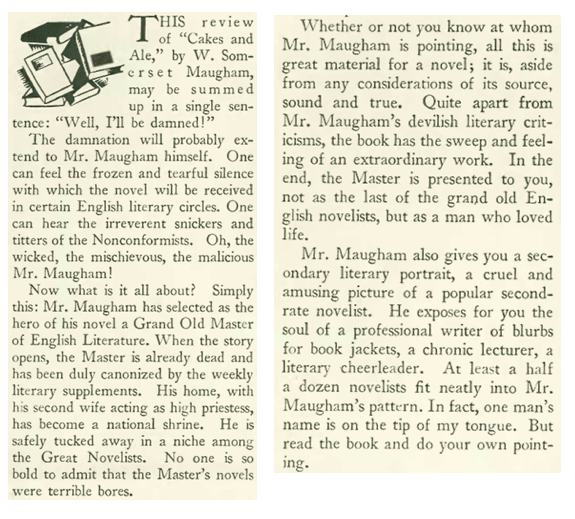
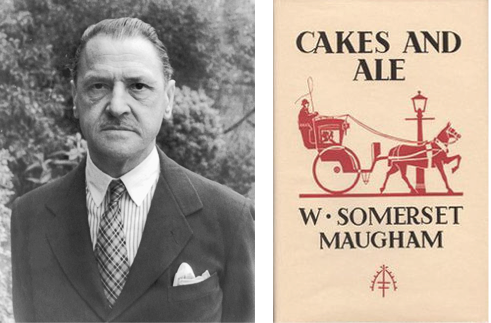
Somerset Maugham regarded his comic novel, Cakes and Ale, to be his favorite. The book took aim at snobs as well as at the legacy of one overrated, late-Victorian writer—a character many believe was based on the recently departed Thomas Hardy (Maugham denied the inspiration). The New Yorker had this to say about Cakes and Ale:
THROW HARDY INTO THE DUSTBIN…Somerset Maugham as photographed by Carl Van Vechten in 1934. (Wikipedia)
* * *
He Meant What He Said
Howard Brubaker, in his “Of All Things” column, found humor in the words of a rising figure in German politics, you know who…
* * *
Throw Him a Softball
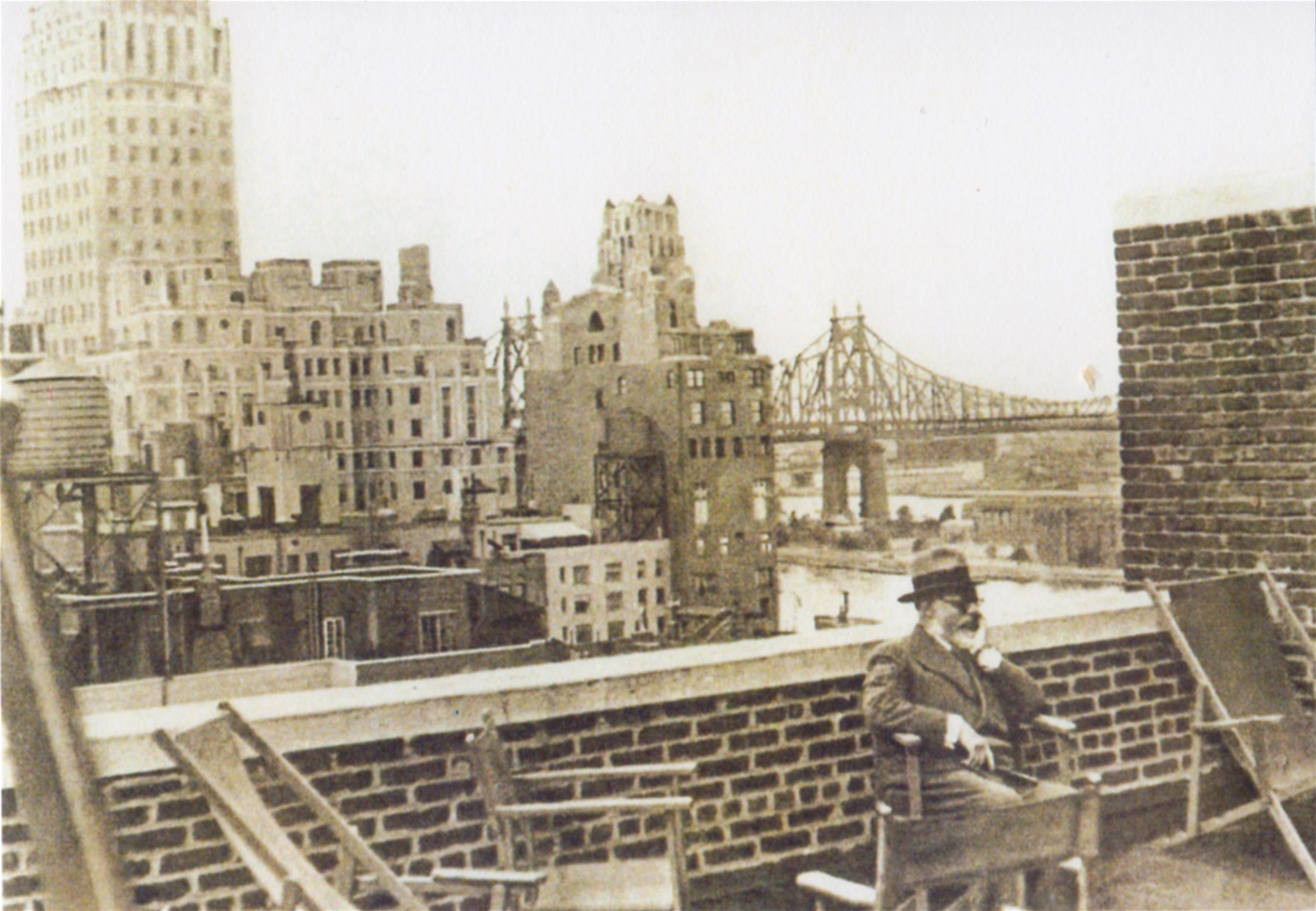
The famed French artist Henri Matisse paid a visit to New York City, and according to this account in “The Talk of Town,” seemed to be seeking some peace of mind…
AN OPPOSITE VIEW…Henri Matisse struck a thoughtful pose atop a Manhattan apartment at 10 Mitchell Place in 1930. The Queensboro Bridge can be glimpsed in the background. (ephemeralnewyork.wordpress.com)
* * *
Still Barred From the Bar
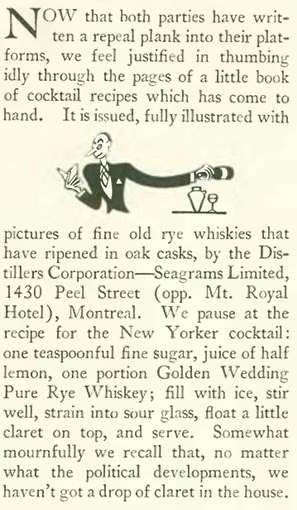
We are still about three years away from the official repeal of the 18th Amendment, but as we know the partying continued in houses and speakeasies across the great city. E.B. White, in his “Notes and Comment,” wistfully recalled the days when good booze was legal:
White did find some cheer in the pro-wet platforms of the two major parties…
A GIMLET IN EVERY POT…The major political parties in 1932’s U.S. presidential race were represented by incumbent Herbert Hoover (Republican) and Franklin D. Roosevelt (Democratic). Both favored repeal of the 18th Amendment. Pictured at the center, a New Yorker cocktail, the object of E.B. White’s longing. (Wikipedia)
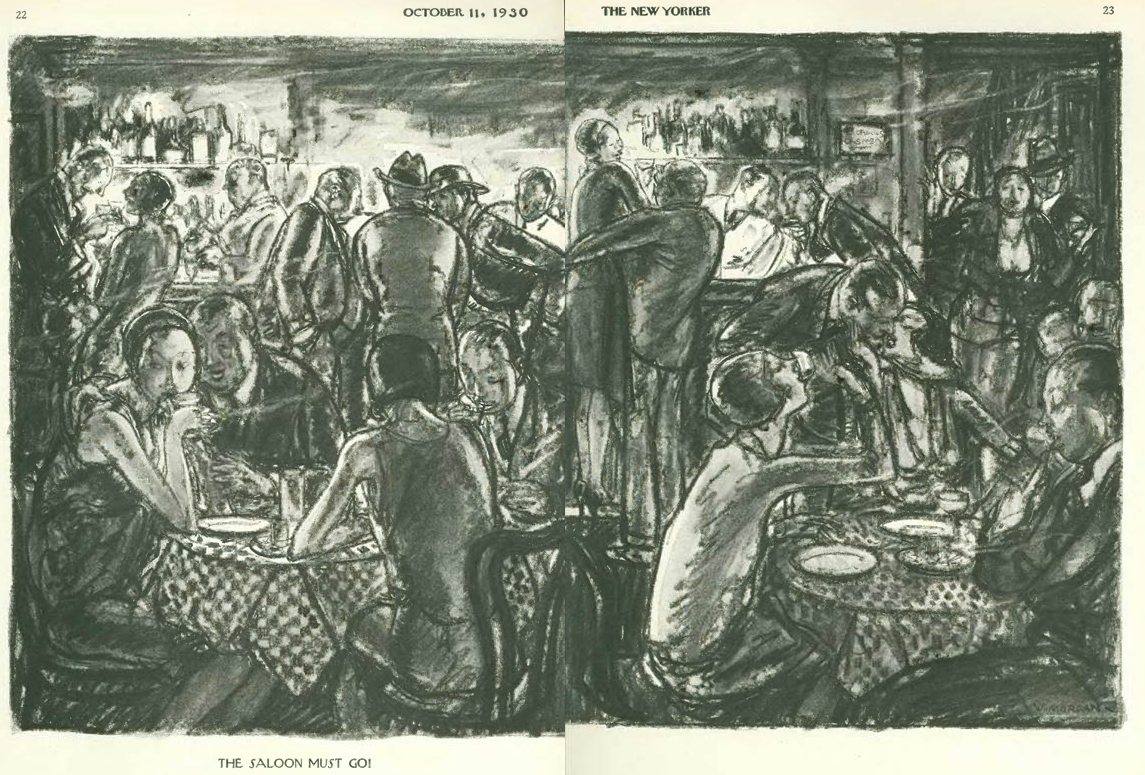
And while we are on the subject, we have this Wallace Morgan illustration of a lively speakeasy with the ironic caption, “The Saloon Must Go!” — referencing an old Anti-Saloon League Slogan.
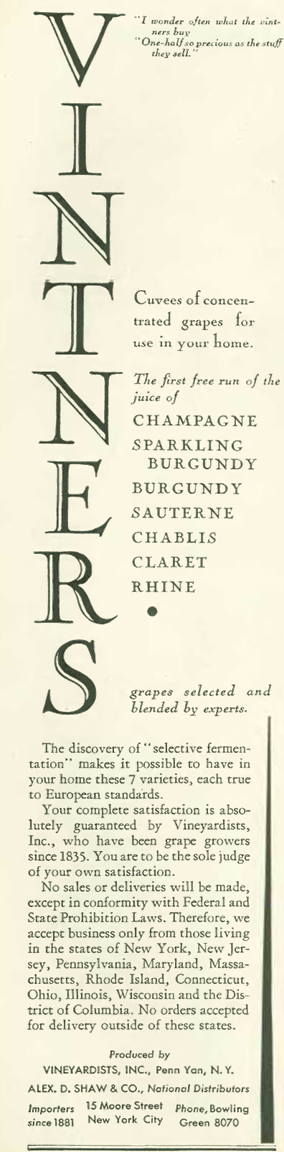
You didn’t have to go to a speakeasy if you wanted a glass of wine. During Prohibition American winemakers found a lucrative loophole by selling perfectly legal concentrated grape juice (called “wine bricks”) to home brewers and bootleggers alike.
According to an article in the Smithsonian, winemakers marked the wine bricks with warnings that they were “for non-alcoholic consumption only.” However, the package would also bear a note explaining how to dissolve the brick in a gallon of water, and yet another “warning” instructing the buyer not to leave the jug in a cool cupboard for 21 days, lest it turn into wine.
Here’s an ad in the Oct. 11, 1930 New Yorker that not-so-subtly offered a selection of varietals…
Here’s what a wine brick looked like:
A wine brick from San Francisco’s Vino Sano company. The label reads: “Each Brick dissolve in one gallon of water. To prevent fermentation, add 1-10% Benzoate of Soda.” Yeah right. (vinepair.com)
* * *
From Our Advertisers
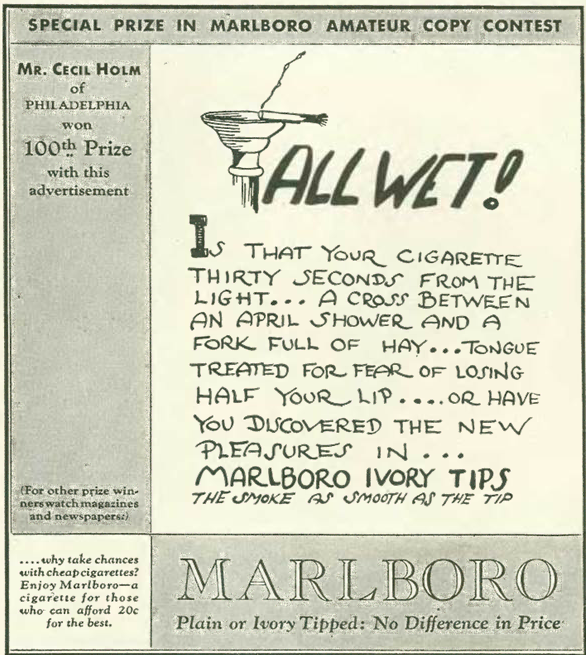
No doubt Prohibition caused more than a few people to take up smoking. Women adopted the habit in droves during the Roaring Twenties, and by the Depression it seemed everyone was lighting up. Advertisers explored various ways to market cigarettes, and long before the Marlboro Man made the scene, that brand pushed its product through a series of dopey handwriting and essay contests,,,
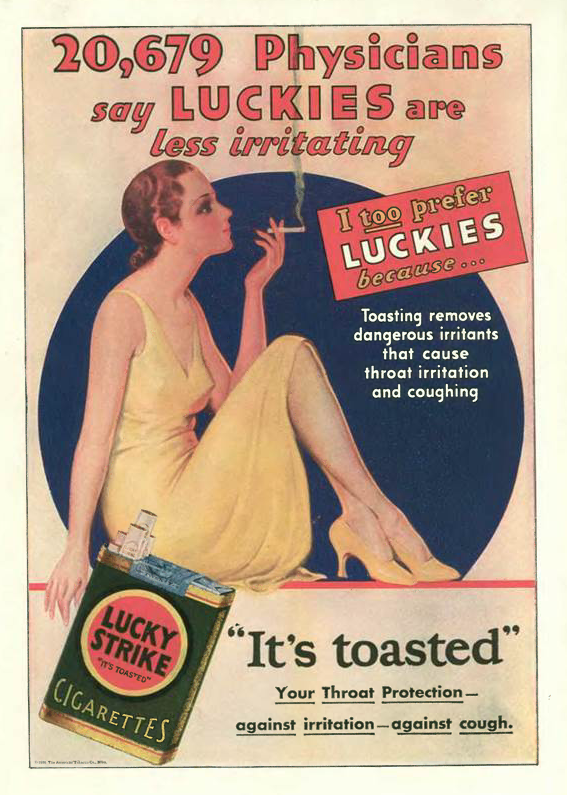
…the makers of Luckies used a combination of sex and bogus health claims to sell their products…
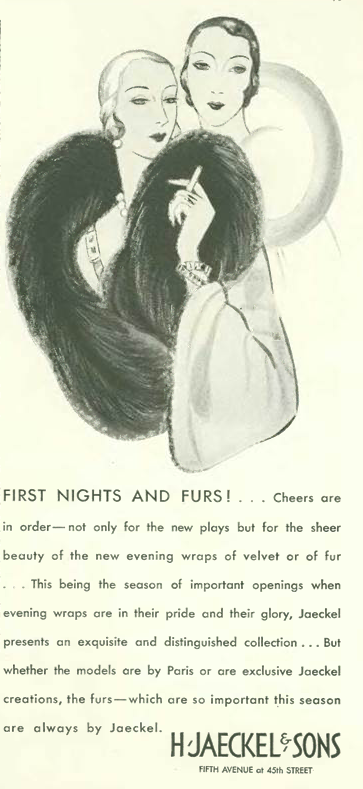
…cigarettes were not confined to ads by tobacco companies; here they are accessories to fine furs…
…even The New Yorker’s spot illustrations (this by Frank McIntosh) featured smokers…
…as did cartoons, such as this one by Barbara Shermund in the Oct. 4 issue…
…and we have one more ad, this one from Chrysler, which acknowledged the new world of the Great Depression, but only through use of careful euphemisms (The New Yorker editorial side practiced much of the same)…
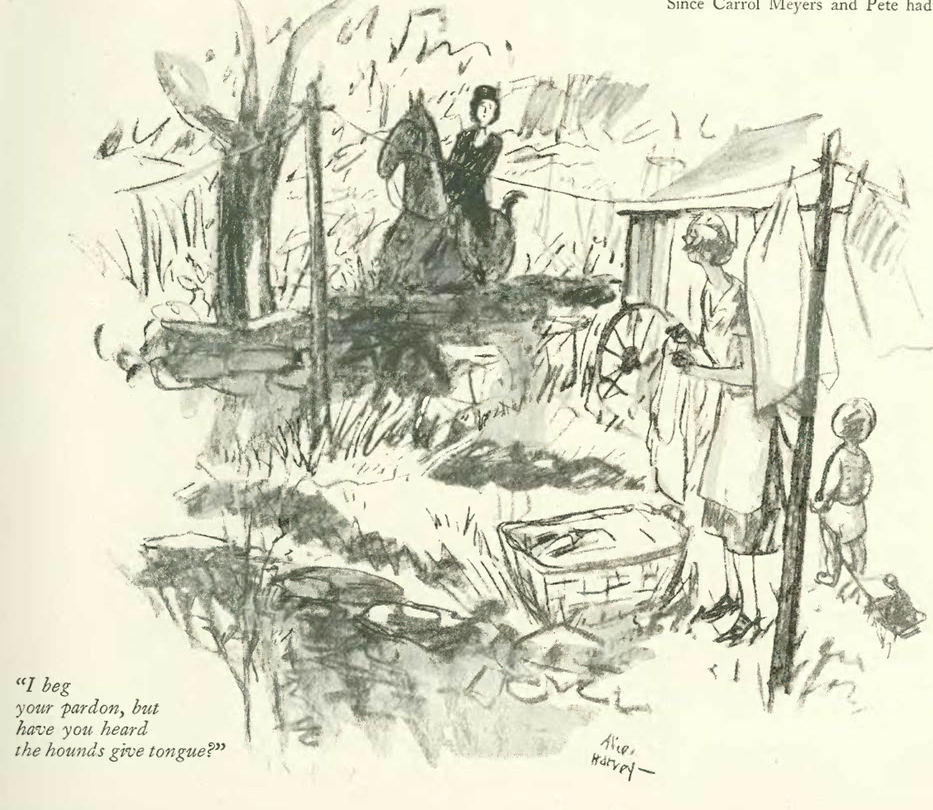
…on to our cartoons, beginning with an exploration of city vs. country life, by Alice Harvey…
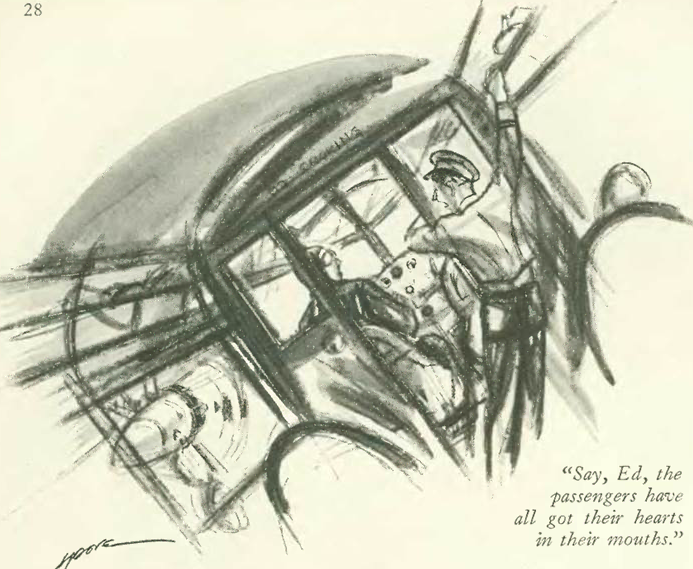
…a depiction of what commuter flying was actually like in 1930, thanks to Leonard Dove…
…a glimpse at modern parenting, with Helen Hokinson…
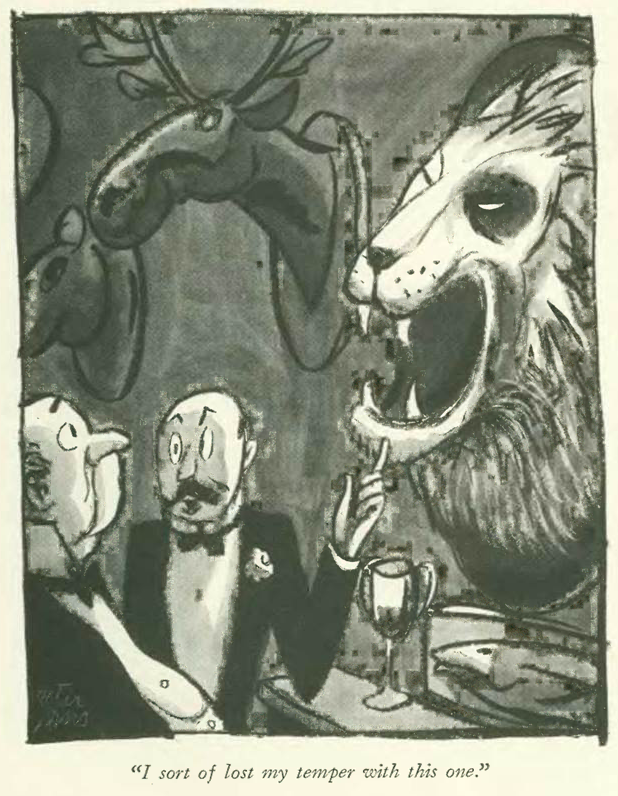
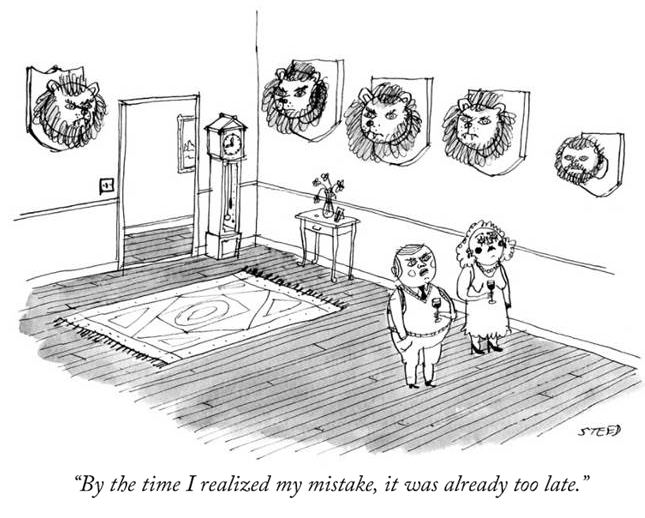
…humor in a gentleman’s drawing room, courtesy Peter Arno…
…and 89 years later, a hilarious update on the subject by Edward Steed in the Sept. 9, 2019 issue…
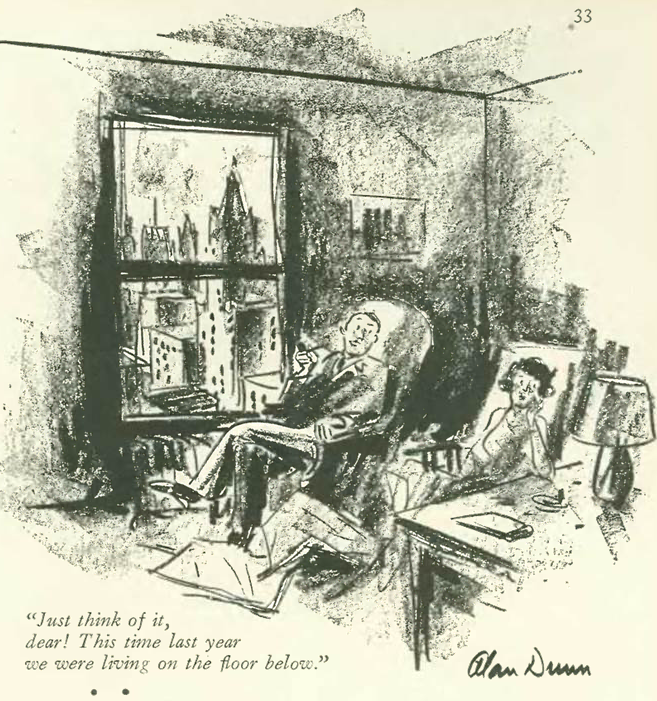
…and finally, the joys of urban life brought to us by Alan Dunn…





























































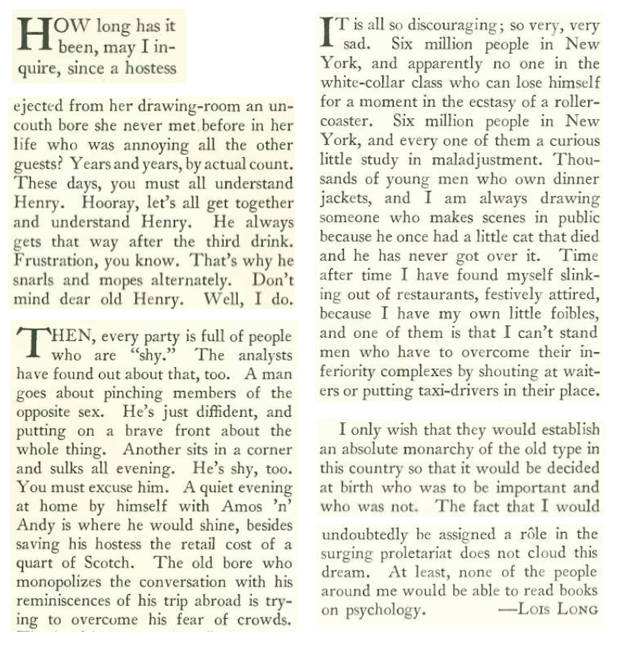









































 A New Yorker State of Mind