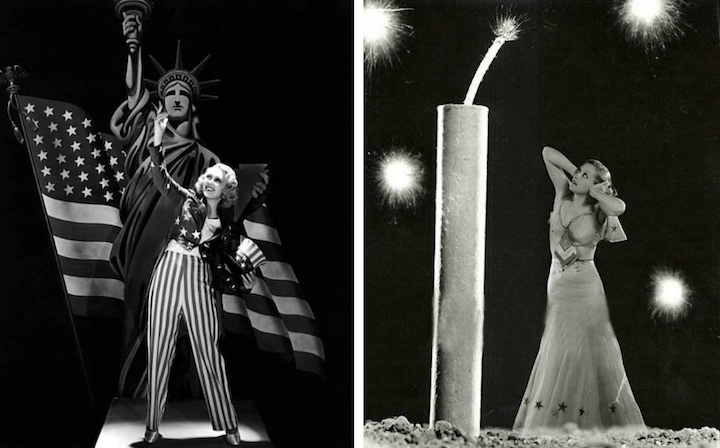
Above: For this Hollywood-heavy post we feature stars of the 1930s—the two Joans, Joan Blondell (left) and Joan Crawford, marking the Fourth of July holiday.
The New Yorker marked the Fourth of July with this William Steig cover featuring a patriotic “strap” along the binding and one of his precocious “Small Fry”…
June 30, 1934 cover by William Steig.
We’ve been looking at ways New Yorkers kept their cool in the hot summer of 1934, and one way to beat the heat was to escape into the air-conditioned darkness of a movie theater. It was not uncommon for folks to remain seated after the credits rolled and watch the feature all over again, just enjoy some cold comfort.
Film critic John Mosher no doubt enjoyed this particular perk, and perhaps this made him a bit more agreeable to whatever was playing on the big screen, including three rather dull pictures featuring actresses Marion Davies, Kay Francis and Elissa Landi.
Marion Davies (1897–1961) was the veteran of the group, beginning her film career in 1917 and appearing in thirty silent films before breaking into sound movies. Sadly, her talents as an actress and comedian were overshadowed by her reputation as William Randolph Hearst’s mistress. Known for her aristocratic bearing, Austrian-American actress Elissa Landi (1904–1948) appeared in several British silents and on Broadway before signing with Fox Films in 1931. Kay Francis (1905–1968) began her film career with the advent of sound movies in 1929. A major box-office draw for Warner Brothers, by 1935 Francis was one of Hollywood’s highest-paid actors (she was also a former roommate and longtime friend of The New Yorker’s Lois Long).
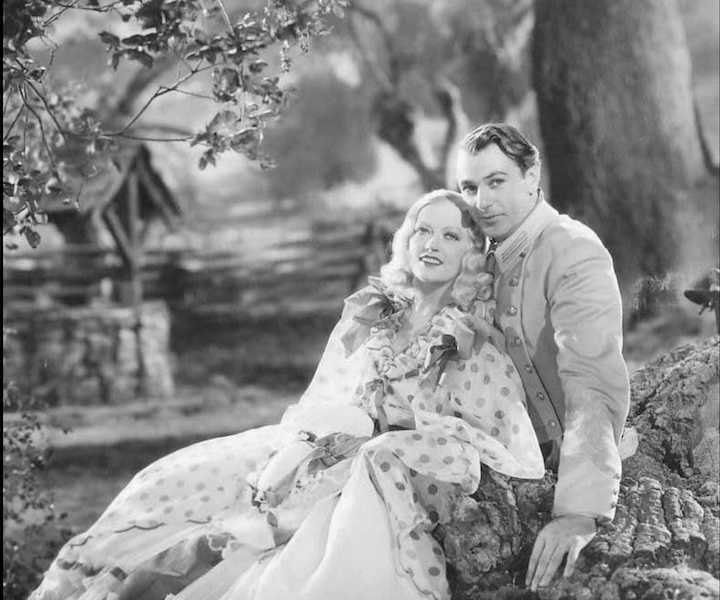
BEFORE SCARLETT AND RHETT…Gary Cooper and Marion Davies as star-crossed lovers in the 1934 Civil War drama Operator 13. Davies portrayed actress Gail Loveless, recruited by the Union to infiltrate a Confederate camp, where she falls for Capt. Jack Gailliard, a Confederate officer played by Cooper. (IMDB)
Perhaps one of the more notorious examples of a white actor in blackface, Operator 13 featured Davies as a Union spy who poses as a Black maid to infiltrate a Confederate camp…
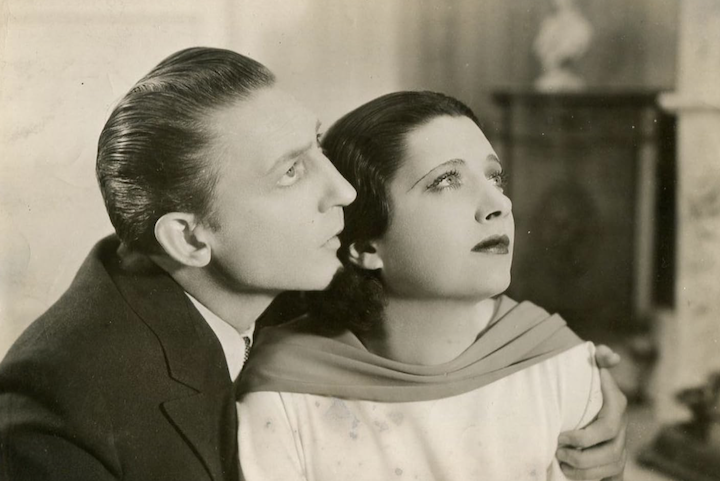
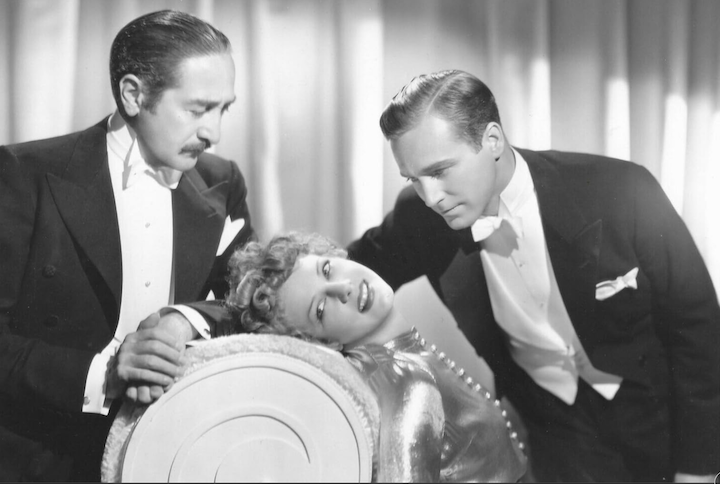
FOOLING NO ONE…Marion Davies, in blackface, with Sam McDaniel in Operator 13. (IMDB)PLAYING DOCTOR…Kay Francis and Warren William in the 1934 Pre-Code drama Dr. Monica. (IMDB)JUST KEEP PRETENDING UNTIL THE CREDITS…From left, Adolphe Menjou, Elissa Landi, and David Manners in the 1934 romantic comedy The Great Flirtation. (IMDB)
* * *
Sentimental Journey
Another critic enjoying the cool of the theater was Robert Benchley, who used this break in the Broadway season to reveal his passions regarding a number of stage actresses. An excerpt:
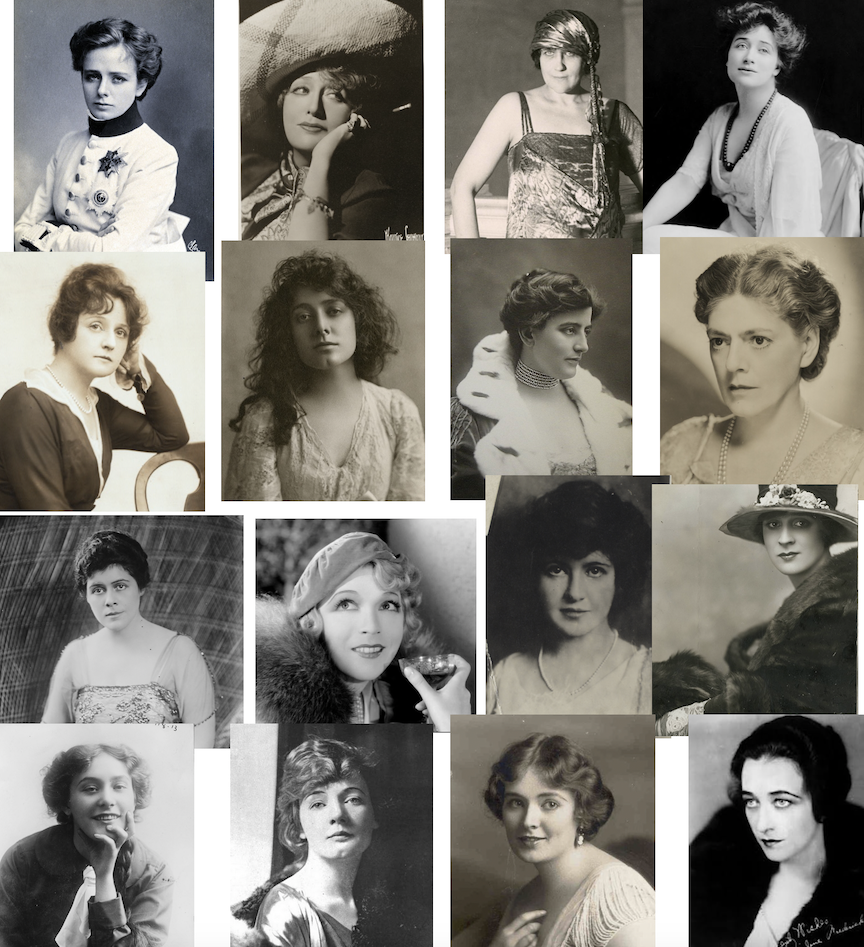
BENCHLEY’S BROADWAY…Robert Benchley’s all-time favorite Broadway actresses included, from top row, left to right, Maud Adams, Florence Reed, Gladys Hanson, and Charlotte Walker; second row, from left, Laura Hope Crews, Julia Marlowe, Maxine Elliott, and Ethel Barrymore; third row, Janet Beecher, Ina Claire, Marguerite Clark, and Jane Cowl; fourth row, Elsie Ferguson, Martha Hedman, Marjorie Rambeau, and Pauline Frederick. (NYPL/Wikipedia/IMDB)
* * *
A Poke at Palooka
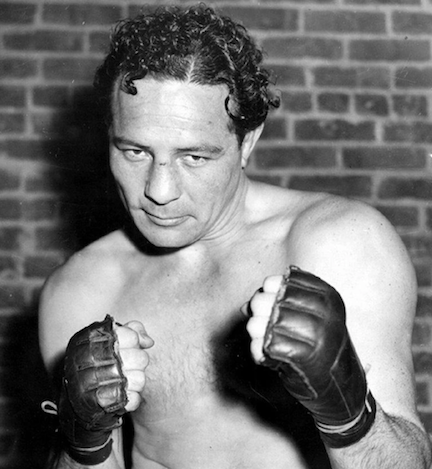
In his column “Of All Things,” Howard Brubaker took a shot below the belt at the new heavyweight boxing champ, Max Baer.
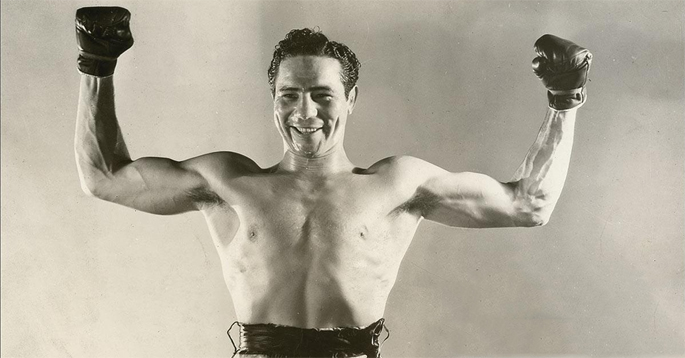
WHO SEZ I CAN’T READ?…Max Baer in the 1930s. (boxing.fandom.com/wiki)
* * *
From Our Advertisers
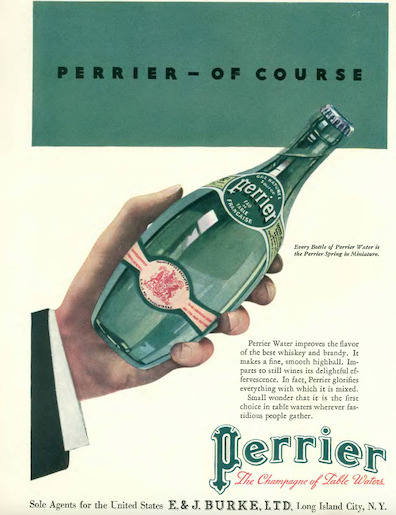
It was hot outside, folks were cooling off with their favorite beverages, and advertisers responded in kind…we begin with a familiar green bottle, and with apologies to Max Baer, you didn’t need to know how to read to know this was a bottle of Perrier…
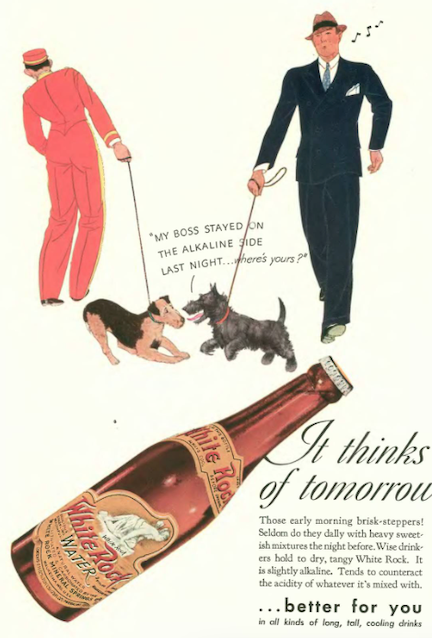
…if your taste was more on the domestic side, there was White Rock…
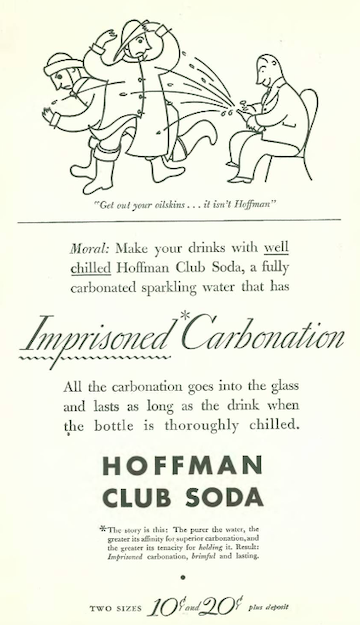
…a series of Hoffman Club Soda ads sought to convince consumers about their superior carbonation…
…or how about a brandy, perhaps lightly chilled, especially if it’s late in the evening, and you happen to be sitting on a breezy hotel rooftop…
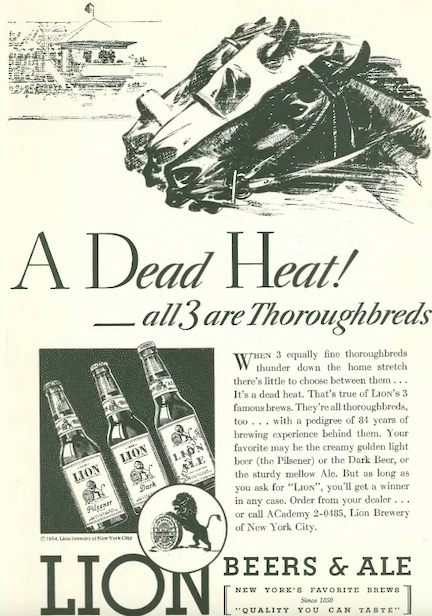
…or you could cool down with a Lion beer…considered a heritage brewery, Lion Brewery is one of only ten pre-Prohibition breweries that has independently and continuously operated since the repeal of Prohibition…
…a fairly new brand of cigarettes, Marlboro, was still taking out these bargain-sized ads to build brand recognition…Flit insecticide, on the other hand, was well-known thanks to these ubiquitous Dr. Seuss ads…
…the folks at General Tire & Rubber were the latest advertiser to tie their product to the glamour of aviation…
…and on to our cartoons, we begin with another installment of native birds via Rea Irvin…
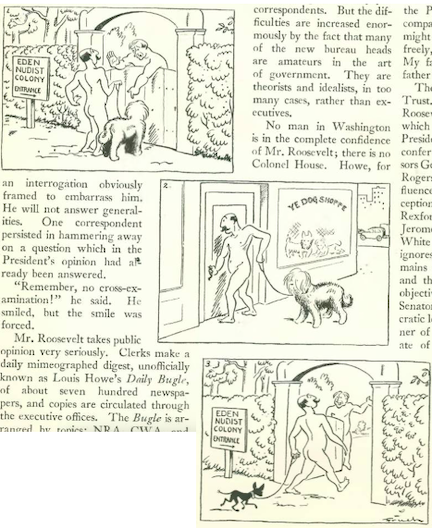
…Al Frueh chimed in with this three-panel encounter at a nudist colony…
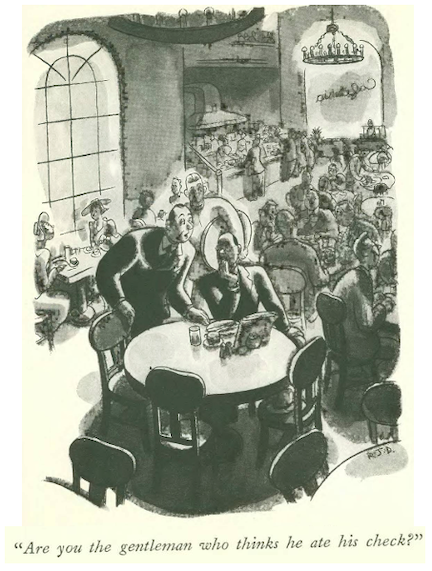
…Robert Day presented a case of indigestion…
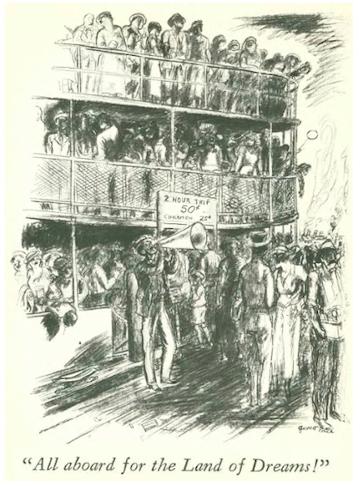
…Garrett Price welcomed us aboard a dream cruise…
…George Price gave us this gem in the “Goings On About Town” section,,,
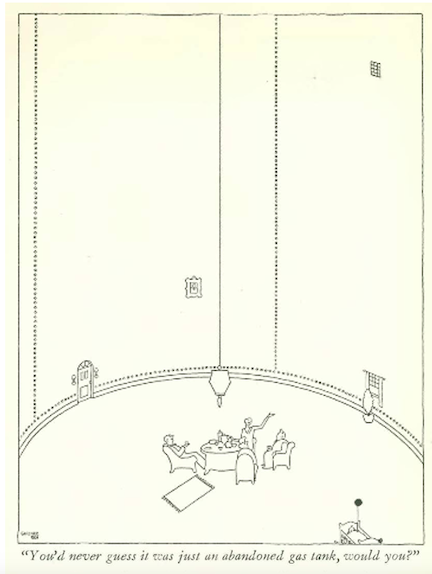
…Gardner Rea gave us his spare line to illustrate an enormous space…one of his specialties…
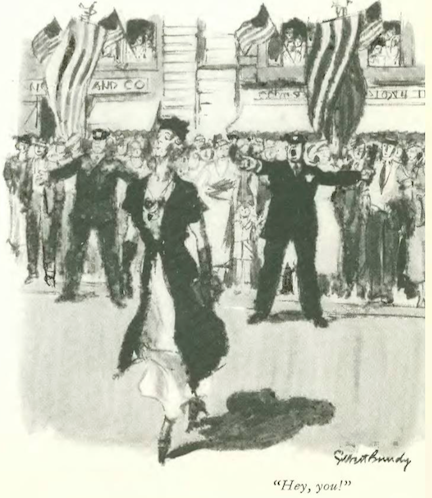
…Gilbert Bundy marked the Fourth with an entitled jaywalker…
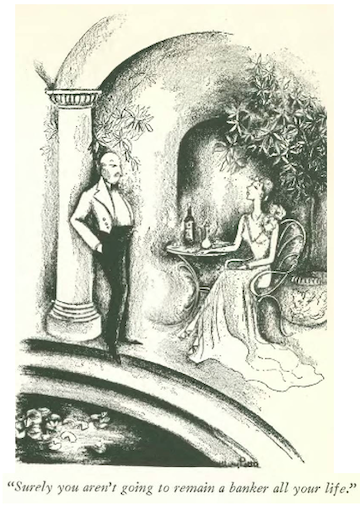
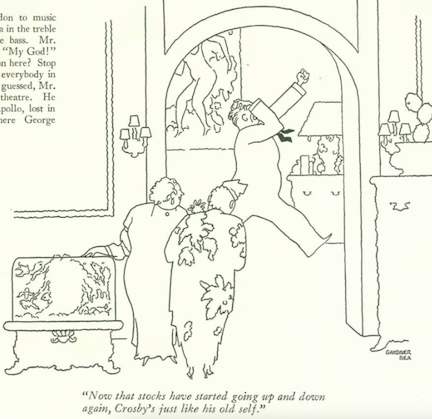
…and we close with Mary Petty, and a banker’s contentment…
Back in the days before we had a zillion different entertainment options, almost anyone with a pair of ears would tune in to hear the radio broadcast of a heavyweight title fight.
June 23, 1934 cover by Rea Irvin.
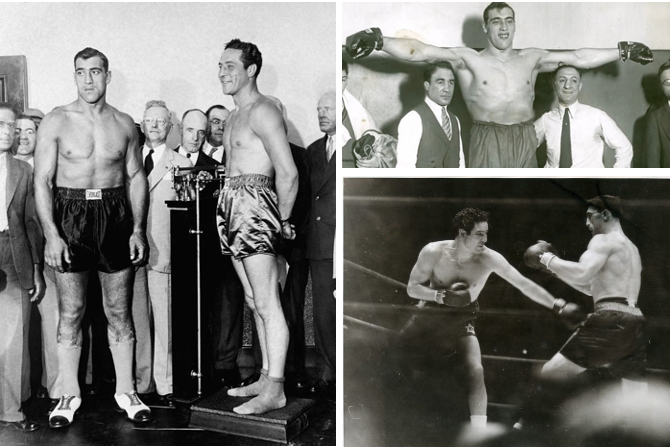
Jack Dempsey and Gene Tunney dominated the late 1920s, while Joe Louis, Max Schmeling and Jack Sharkey were marquee names in the 1930s along with Max Baer and Primo Carnera, who met on June 14, 1934 at the outdoor Madison Square Garden Bowl in Long Island City. The reigning champ Carnera (1906–1967), who stood six-and-a-half feet tall and weighed in at 260 pounds, had won more fights by knockout than any other heavyweight champion. But Baer (1909–1959) was known as a knockout puncher who beat one opponent so savagely that he died the following day.
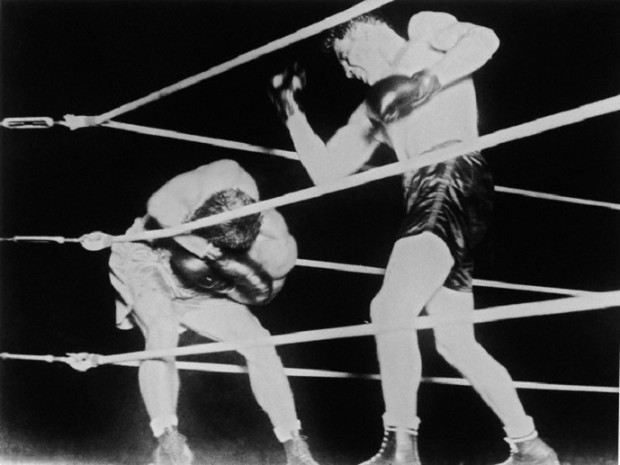
DEADLY DUEL…Max Baer (right) fought Frankie Campbell on Aug. 25, 1930, in San Francisco for the unofficial title of Pacific Coast champion. In the fifth round Baer got Campbell against the ropes and hammered him senseless. Campbell died the next day. An autopsy revealed that Campbell’s brain was “knocked completely loose from his skull.” Baer was profoundly affected by Campbell’s death, and donated purses from succeeding bouts to Campbell’s family. (thefightcity.com)
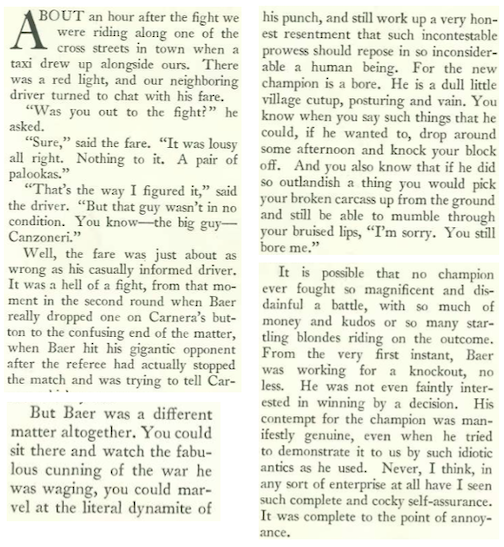
Baer was also something of a showboater, a quality Morris Markey found distasteful when he wrote about the Baer–Carnera bout in “A Reporter at Large.”
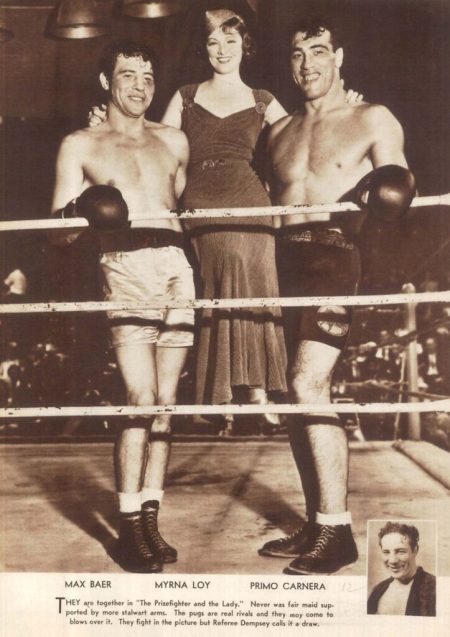
ALL SMILES…A year before their championship bout Max Baer (left) and Primo Carnera starred with Myrna Loy in The Prizefighter and the Lady. (theusaboxingnews.com)
GIANT SLAYER…The Italian prizefighter and wrestler Primo Carnera, nicknamed the “Ambling Alp,” was the reigning heavyweight champion when he faced Max Baer on June 14, 1934 at the Madison Square Garden Bowl. Baer felled the champion eleven times before the fight was stopped in the eleventh round. Baer would only hold the title for a year, losing to James J. Braddock on June 13, 1935, in what has been called one of the greatest upsets in boxing history. (theusaboxingnews.com)
Markey further explained why Baer’s behavior in the ring was so bothersome, and how it differed from the comic antics of other famous athletes:
RETIRING TYPES…Both Primo Carnera and Max Baer acted in films during their boxing careers, and continued acting after their retirements (Carnera in 1944, Baer in 1941). At left, Carnera with Bob Hope in the 1954 American comedy Casanova’s Big Night (Carnera appeared in eleven Italian films and in a half-dozen American films); at right, Max Baer and brother Buddy Baer (also a boxer) with Lou Costello in the 1949 comedy Africa Screams. Baer would appear in more than 20 films.(theusaboxingnews.com/monstermoviemusic.blogspot.com)
Complications from diabetes would take Carnera down for good at age 60. Baer would die even younger, from a heart attack, at age 50. His last words reportedly were, “Oh God, here I go.” Baer’s son, actor and director Max Baer Jr. (best known as Jethro Bodine from TV’s The Beverly Hillbillies) is still with us, at age 85.
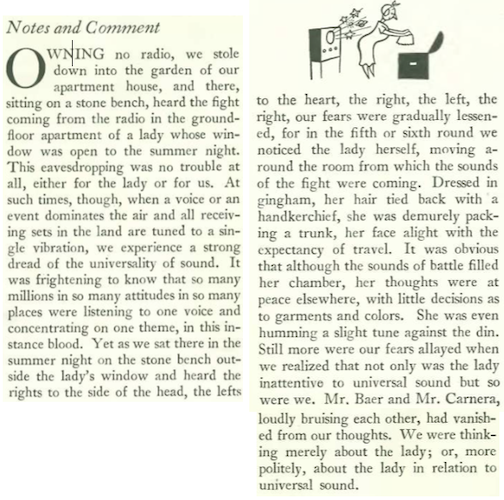
We aren’t quite finished with the Baer–Carnera fight…E.B. White led his “Notes and Comment” with this observation regarding the fight’s mass appeal and seeming universality:
* * *
Apologies to Ms. Winslow
I seem to have given short shrift to author Thyra Samter Winslow (1886–1961) who published more than 200 stories during her career in magazines such as The Smart Set and The American Mercury. She published more than thirty in TheNew Yorker, from 1927 to 1942, including the serialization of her short story collection, My Own, My Native Land. The story “Poodles” was featured in the June 23 issue.
According to the Encyclopedia of Arkansas, Winslow’s early life in Fort Smith (Ark.) “provided background for her view of small towns as prejudiced, hypocritical, and suffocating places…many stories expose the hypocrisy, prejudice, and carefully maintained social structures of both small town and urban life. She was particularly adept at portraying women of every social class, often in an unfavorable light. Money, especially the pursuit of it as a means to happiness or status, is an important theme throughout her work.”
THE PURSUIT OF HAPPINESS…Thyra Samter Winslow with friend, 1937. (findagrave.com)
* * *
Hot Enough For Ya?
So what did New Yorkers do when the summer heat set in? The next few items offer some clues, beginning with this poem by E.B. White:
SUMMER STOCK…Theatergoers fled to shady villages in New York, New Jersey and New England in the 1920s and 30s when summer stock theater was at its height. The above photo shows theatergoers leaving a performance at the Lakewood Theatre near Skowhegan, Maine. The theater was claimed to be the oldest and finest summer stock company in America with a Broadway cast. Nearby Lakewood Inn provided recreation, camping, and tourist bungalows. (mainememory.net)
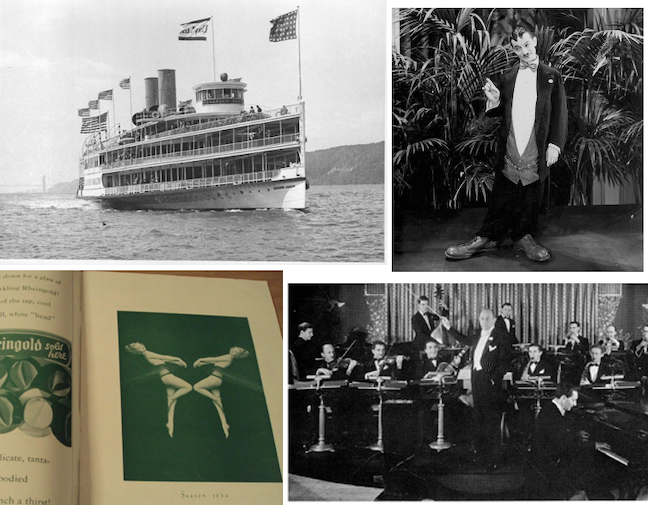
You could also take in some entertainment while enjoying the cooling breezes of the Hudson River. Robert Benchley hopped aboard the Alexander Hamilton to enjoy Bobby Sanford’s showboat revue:
SOME REAL SHOWBOATING…Clockwise, from top left, the steamboat Alexander Hamilton hosted Bobby Sanford’s showboat revue; comedian Lester Allen served as emcee for the show; the Meyer Davis Orchestra supplied the music; the revue featured the “exotic” DuVal sisters (image from program) among other diversions. (Hudson River Maritime Museum/IMDB/vintagebandstand.blogspot.com/Worthpoint)
“Tables for Two” took a look at summer dining options, from sidewalk cafes to hotel rooftops featuring dinner and dancing—this “Tables” was not written by Lois Long, but by Margaret Case Harriman, who knew a thing or two about nightlife (she was the daughter of the Hotel Algonquin’s owner, Frank Case)…
DANCING WITH THE STARS…The Waldorf-Astoria’s “Starlight Roof” was a popular summer restaurant for dining and dancing. Image from a 1935 publication The Waldorf-Astoria by Richard Averill Smith. (The Waldorf-Astoria)
* * *
Doing Swimmingly
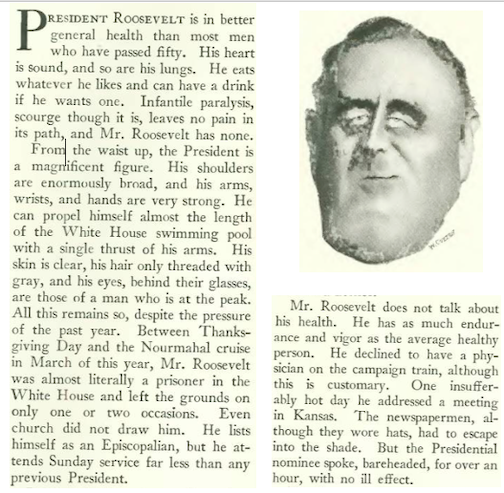
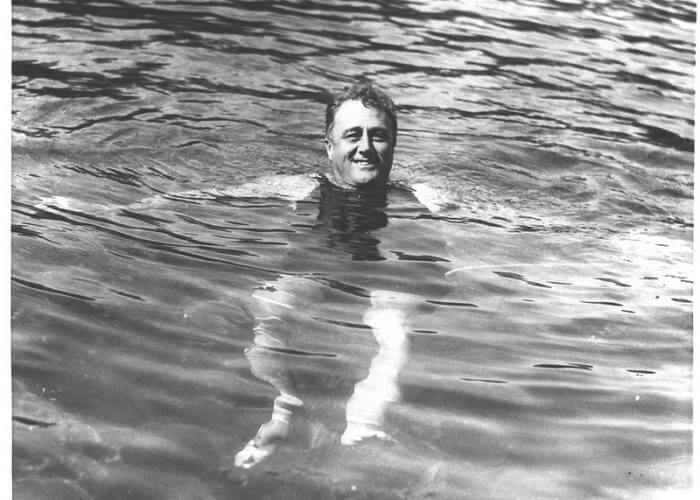
Historian Henry F. Pringle published part two of his series on President Franklin D. Roosevelt, here marveling at the president’s health despite his serious bout with polio (drawing by William Cotton).
TAKING THE WATERS…President Franklin D. Roosevelt took to swimming for therapy and exercise. (FDR Presidential Library and Museum)
* * *
Get Yourself to Chi-Town
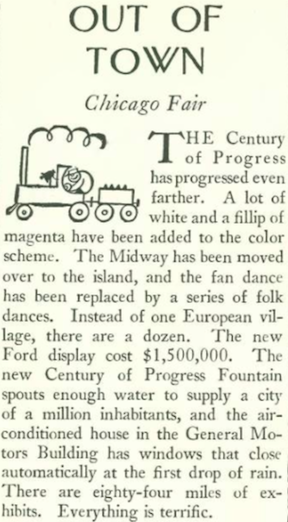
The Chicago World’s Fair (The Century of Progress) was in its second and final year, and The New Yorker found everything “terrific.” Excerpt:
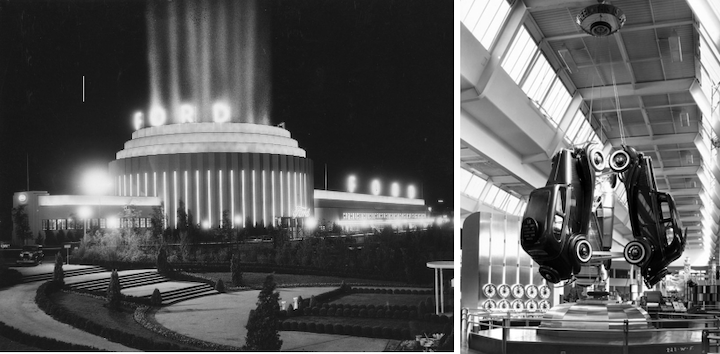
MAKING A SPECTACLE OF ITSELF…The 11-acre Ford Motor Company exhibit at Chicago’s Century of Progress became the most talked-about exhibit of 1934, featuring a central rotunda designed to simulate graduated clusters of gears. At right, Proof of Safety Exhibit in the Ford Building. (chicagology.com)
* * *
From Our Advertisers
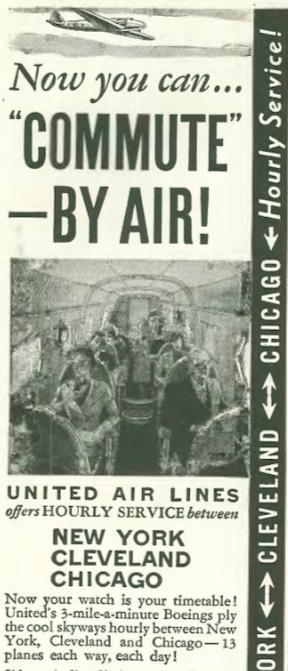
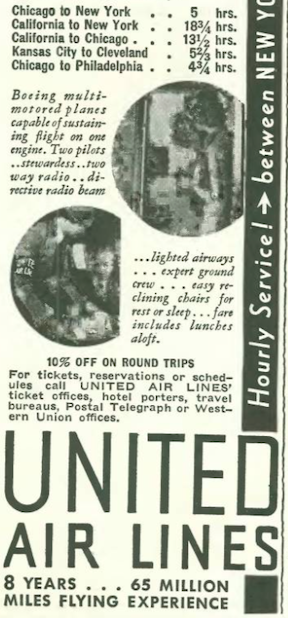
Just a couple of entries this week…You could take a plane to the Chicago World’s Fair on a United Airlines Boeing 247…
…the lower section of the ad claimed you could fly to Chicago in about five hours in planes featuring “Two pilots…stewardess…two-way radio…directive radio beam”…
TSA? WHAT’S A TSA?…United Airlines Boeing 247-D at an airport terminal with passengers and crew. (digitalcollections.lib.washington.edu)COZY CONFINES…Passengers enjoy a game of checkers aboard a Boeing 247 in 1933. (digitalcollections.lib.washington.edu)
…and what would our advertising section be without two fashionable people lighting up?…
…on to our cartoonists, we begin with Reginald Marsh’s illustration of a Rep Theatre production…
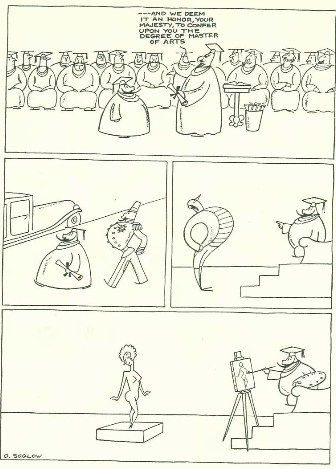
…Otto Soglow’s Little King found his artistic side…
…Rea Irvin continued his examination of native fauna…
…Gardner Rea correctly predicted the global domination of Mickey Mouse…
…Peter Arno showed the dizzying effects of a Coney Island ride…
…however at the altar the thrill was gone, per Garrett Price…
…another take on the ways of love, with Barbara Shermund...
…the newfangled diagonal bathtub continued to dazzle, with George Price…
…Gardner Rea offered up some subtle irony on the farm…
…and we close with James Thurber, in a poetic moment…
Above: British architect Norman Foster's 2010 recreation of R. Buckminster Fuller's 1933 Dymaxion car. (Wikipedia)
Despite the limitations of 1930s technology, a few architects and designers were hell-bent on building a streamlined future that until then was mostly the stuff of movies and science fiction magazines.
May 5, 1934 cover by Rea Irvin.
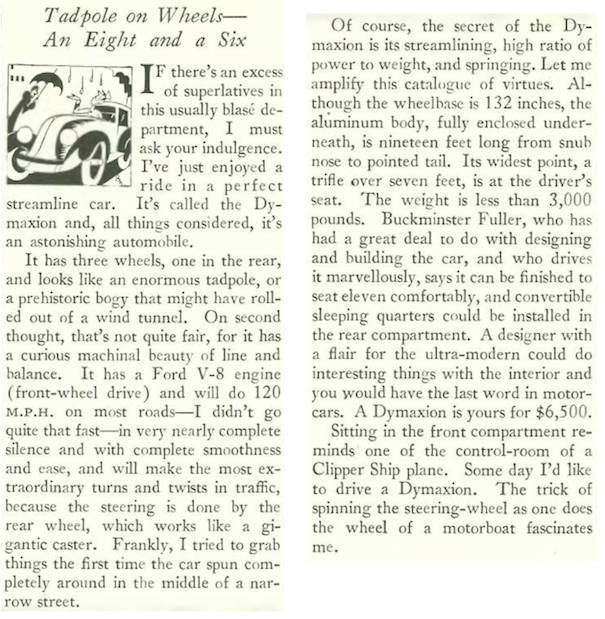
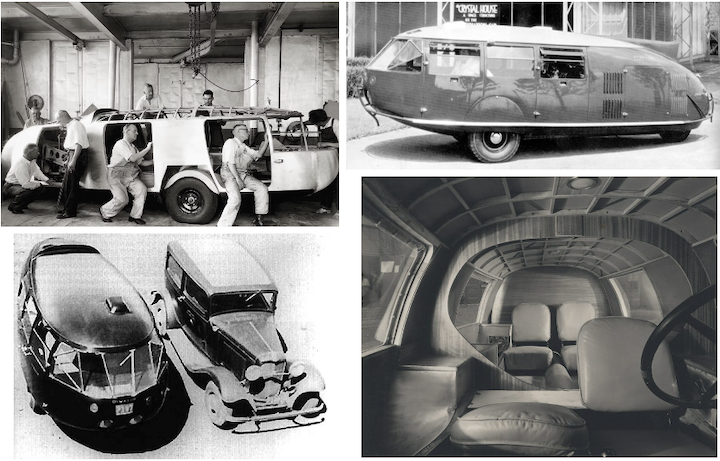
One of them was R. Buckminster Fuller (1895–1983), architect, designer, and futurist probably best known today as the inventor of the geodesic dome (think Disney’s Epcot Center). In the 1930s Fuller was all about a concept he called Dymaxion. Derived from the words dynamic, maximum, and tension, when applied to architecture and design it would supposedly deliver maximum gain from minimal energy input. The writer of the New Yorker article (pseud. “Speed”) was fascinated by the Dymaxion’s motorboat-type steering, no coincidence since Fuller intended to adapt his futuristic car for use on and under the water, as well as in the air.
THE SHAPE OF THINGS TO COME…Clockwise, from top left: Workers at a Bridgeport, Conn., plant creating the first of three Dymaxion cars; the Dymaxion at Chicago’s 1933 Century of Progress exposition—the car was involved in a fatal accident at the fair; interior view of the Dymaxion; using the same engine and transmission as a Ford sedan (pictured), the Dymaxion offered three times the interior volume with half the fuel consumption and a 50 percent increase in top speed. (Buckminster Fuller Institute/Poet Architecture)THINKING WITHOUT THE BOX…In 1927 R. Buckminster Fuller (pictured) developed a Dymaxion House, a “Dwelling Machine” that would be the last word in self-sufficiency. Although the aluminum house was intended to be mass-produced, flat-packaged and shipped throughout the world, the design never made it to market (however its ideas influenced other architects); at right, a Fuller geodesic dome at Disney’s Epcot Center in Florida. (archdaily.com/Wikipedia)
The 1933 Century of Progress exposition in Chicago was supposed to be a major showcase for Fuller, but when professional driver Francis Turner was killed while demonstrating the first prototype of the Dymaxion, the car’s prospects dimmed considerably. According to an article by Stephanie d’Arc Taylor (cnn.com Oct. 30, 2019), during the demonstration a local politician tried to drive his own car close to the Dymaxion—to get a better look—and ended up crashing into the unwieldy prototype, which rolled over, killing the driver and injuring its passengers. “The politician’s car was removed from the fracas before police arrived, so the Dymaxion was blamed for the accident,” writes Taylor, who notes that the rear wheel–powered car, though unconventional, was not necessarily the problem. However, “the thing that made the Fuller death-mobile singularly deadly was the fact it was also steered by the rear wheel, making it hard to control and prone to all kinds of terrifying issues.”
That history did not stop architect Norman Foster from building a replica of the Dymaxion in 2010. Foster worked with Fuller from 1971 to 1983, and considers Fuller a design hero.
GIVING IT ANOTHER GO…Architect Norman Foster with his 2010 recreation of the Dymaxion. To build a new Dymaxion, Foster sent a restorer to the National Automobile Museum in Reno, Nevada (home of the only surviving Dymaxion, Car No. 2), and after thousands of photos and measurements Foster had the car recreated using only materials available in 1933: Foster’s Dymaxion consists of an ash frame sheathed in hand-beaten aluminum, mounted on the chassis of an old 1934 Ford Tudor Sedan. (CNN/The Guardian)
According to Taylor, Foster cleaved so closely to Fuller’s original designs that he refers to his creation as a fourth genuine Dymaxion—not a replica. “The car is such a beautiful object that I very much wanted to own it, to be able to touch as well as contemplate the reality for its delight in the same spirit as a sculpture,” said Foster. “Everything in (the car) was either made in 1934, or recreated using techniques and materials that Bucky would have had access to in that period.”
* * *
Meanwhile, At The Tracks…
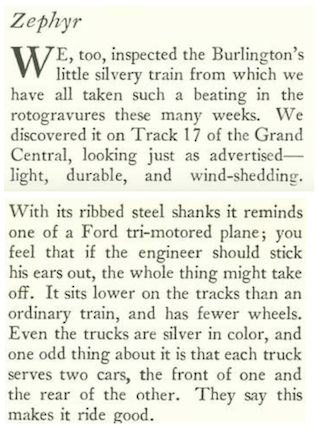
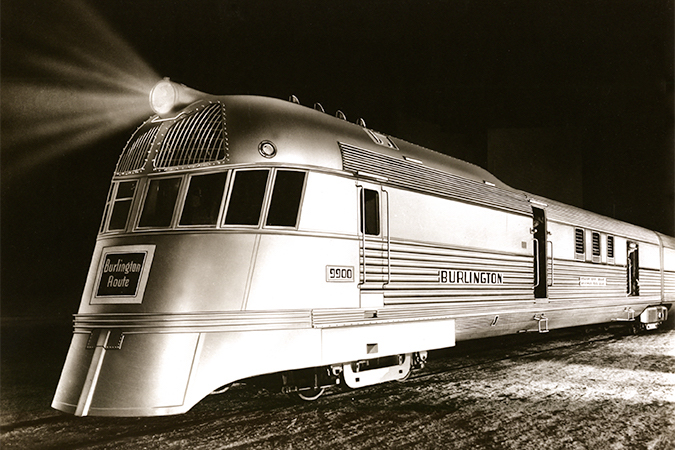
If Fuller’s attempt at the streamlined future was a bit of bust, the Burlington railroad was making a splash with its gleaming new Zephyr. E.B. White reported:
ZOOM ZOOM…The Burlington Zephyr set a speed record for travel between Denver and Chicago when it made a 1,015.4-mile (1,633 km) non-stop “Dawn-to-Dusk” dash in 13 hours 5 minutes at an average speed of almost 78 mph (124 km/h). In one section of the run it reached a speed of 112.5 mph. Following a promotional tour that included New York, it was placed in regular service between Kansas City, Missouri, and Omaha and Lincoln, Nebraska, on November 11, 1934. Other routes would be added later in the Midwest and West. (BNSF)
…we continue with E.B. White, here with some observations regarding Mother’s Day and bank robber/murderer John Dillinger, who had escaped from prison in March 1934 and was on the FBI’s Most Wanted List…
I REMEMBER MAMA…John Dillinger posed with Lake County prosecutor Robert Estill, left, in the jail at Crown Point, Ind. while he awaited his trial for murder in January 1934. Dillinger would escape from the jail in March and would be on the lam until July, when FBI agents would gun him down outside a Chicago movie theatre. (NY Daily News)
…and a last word from White, about an important change at Radio City:
* * *
Voice In The Wilderness
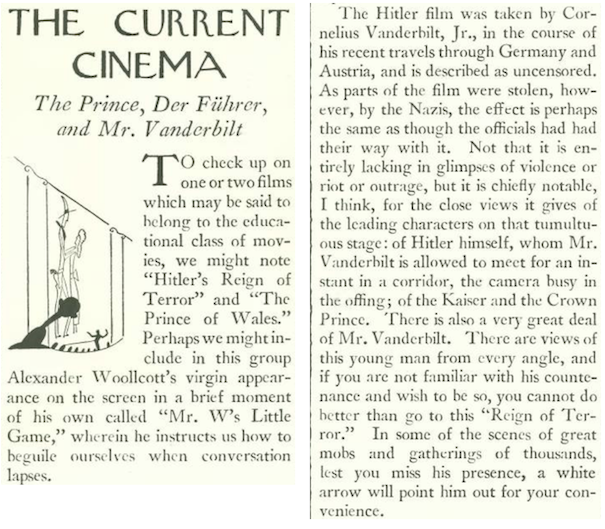
A combination of newsreel footage, documentary, and reenactment, Cornelius Vanderbilt Jr’sHitler’s Reign of Terror played to capacity crowds for two weeks in New York City, despite the refusal of the state’s censor to license the film. Disinherited by his parents when he became a newspaper publisher, Vanderbilt was a determined journalist, covertly filming scenes in Nazi Germany and even briefly encountering Adolf Hitler outside the Reichstag, where Vanderbilt yelled to Der Führer, “And what about the Jews, Your Excellency?” (Hitler ignored the question and referred Vanderbilt to one of his lackeys). Unfortunately, Vanderbilt wasn’t much of a filmmaker, and although he warned Americans about the emerging threat in Germany, few took the film, or his warning, seriously, including John Mosher:
UNHEEDED…Audiences flocked to see Cornelius Vanderbilt Jr’sHitler’s Reign of Terror, but critics dismissed the rather amateurish film—Film Daily scoffed at the film’s prediction that Hitler’s Germany was a future threat to world peace; at right, in the film Vanderbilt confronted “Hitler” in a recreation. (TMDB/Library of Congress)
* * *
From Our Advertisers
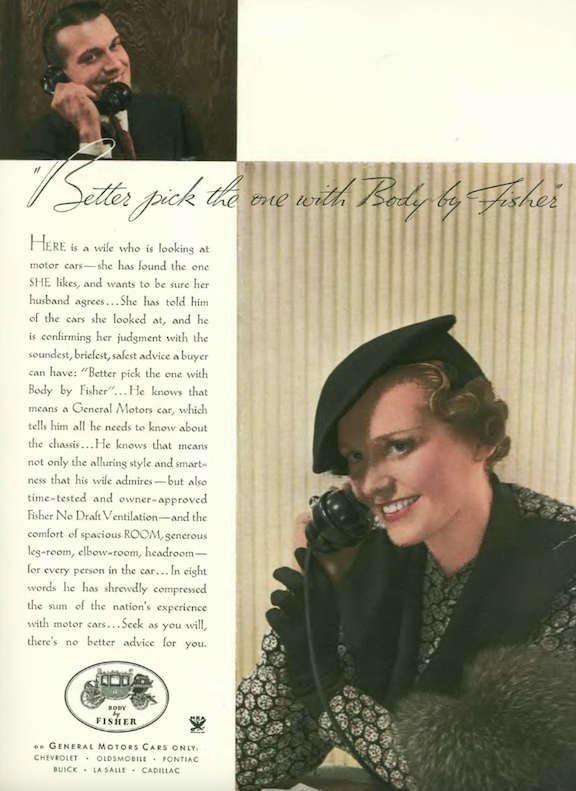
It wouldn’t seat eleven people like a Dymaxion, but a Body by Fisher (coach builder to General Motors) certainly impressed this young woman…but better check with the hubby just in case…
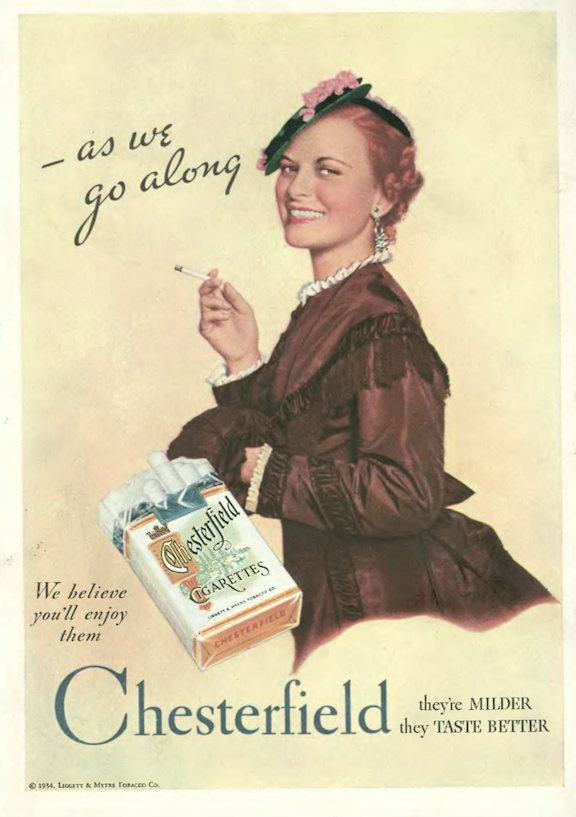
…in this next ad, we find what looks like the same woman, perhaps celebrating her decision with a nice smoke…
…this spot seems out of place in the New Yorker, like it snuck over from Better Homes & Gardens...
…on to our cartoons…with James Thurber’s war of the sexes over, life returned to normal…
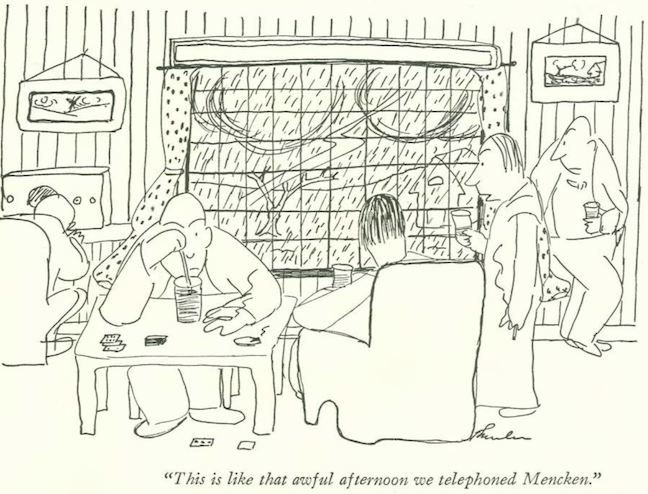
…and both sides shared in the gloom of a rainy afternoon…
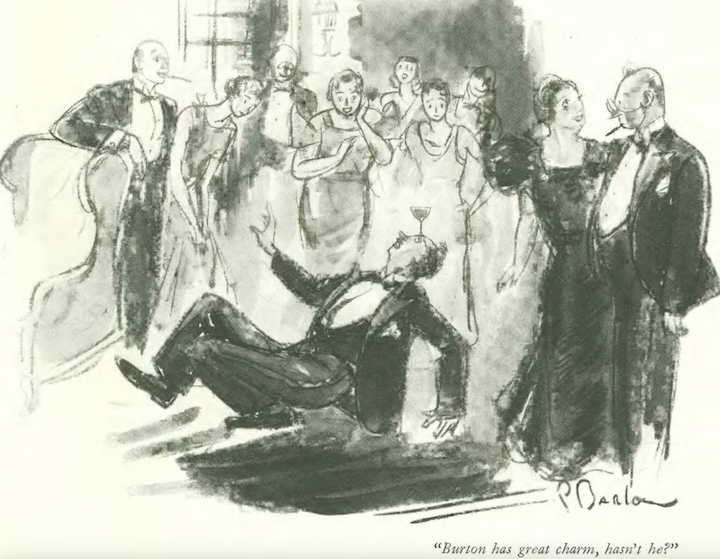
…by contrast, Perry Barlow brightened things up with this life of the party…
…but a good time doesn’t always translate over the airwaves, per George Price…
…Alain illustrated the consequences of losing one’s nest egg…
…Peter Arno didn’t leave any room for dessert…
…and Charles Addams returned, a macabre cast of characters still percolating in his brain…
…on to May 12, 1934…
May 12, 1934 cover by Leonard Dove.
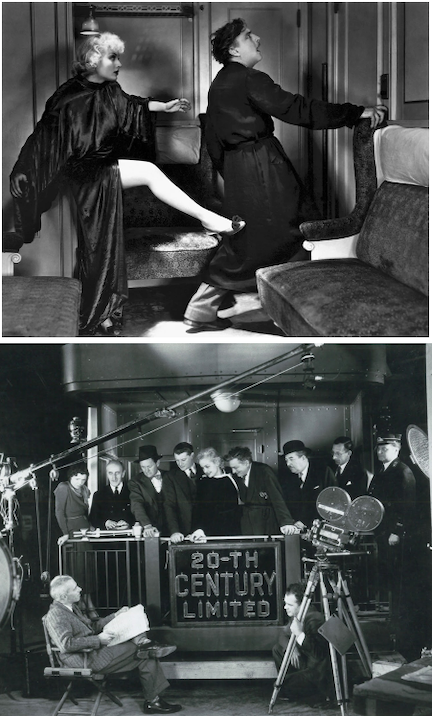
…and back to the movies, this time critic John Mosher found more cheery fare in 20th Century, a pre-Code screwball comedy directed by Howard Hawks and starring John Barrymore and Carole Lombard. Battling alcohol abuse since age 14, Barrymore nevertheless managed to display his rare genius as a comedian and turned in what is considered to be his last great film performance.
GETTING HER KICKS…Top, Carole Lombard delivers a swift one to John Barrymore in the screwball comedy 20th Century. Below, director Howard Hawks with the cast. (greenbriarpictureshows.blogspot.com)
* * *
Playing the Ponies
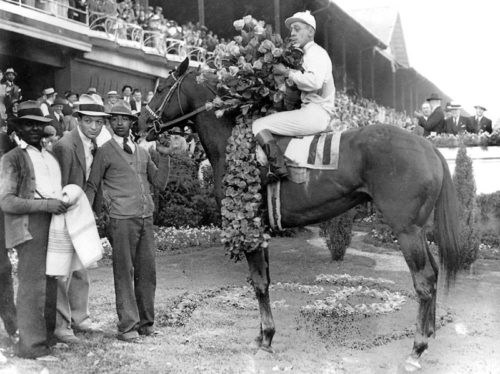
Horse racing correspondent George F. T. Ryall (pseud. “Audax Minor”) considered a losing wager at the Kentucky Derby in his column, “The Race Track.”
A HORSE OF COURSE…Jockey Mack Garner rode Cavalcade to victory at the 1934 Kentucky Derby. (Appanoose County Historical Society)
* * *
More From Our Advertisers
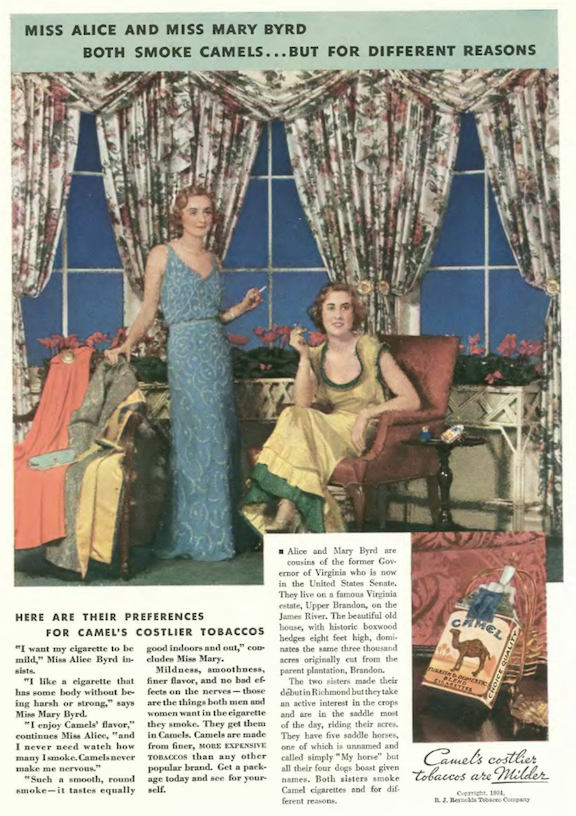
We begin with Camel cigarette endorsers Alice and Mary Byrd, residents of Virginia’s famous Brandon plantation and cousins of Virginia Senator and Governor Harry F. Byrd, known for his fights against the New Deal and his “massive resistance” to federally mandated school desegregation...
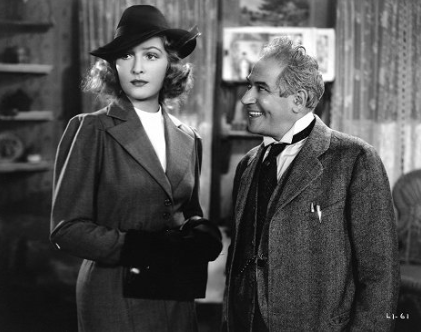
…also to the manor born, Whitney Bourne, a New York deb who would go on to a brief stage and film career that would end when she married her first husband (diplomat Stanton Griffis) in 1939…
AN EYE FOR STYLE…Whitney Bourne in a scene with Solly Ward in 1937’s Flight From Glory. Named in 1933 as one of America’s best dressed women, Bourne was a noted New York socialite, skier, golfer and tennis player as well as an occasional actress.
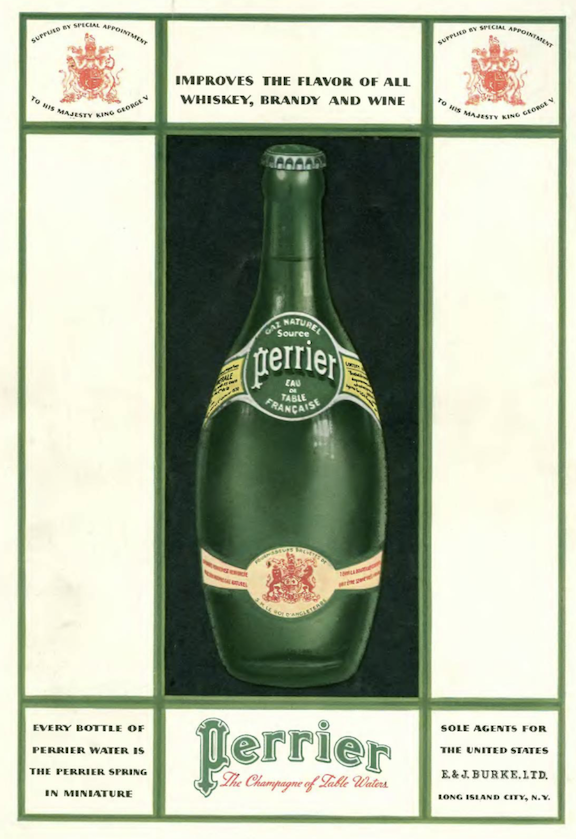
…we move along from the effervescent Whitney Bourne to the sparkling waters of Perrier…
…Gardner Rea followed other New Yorker cartoonists by illustrating an ad for Heinz…
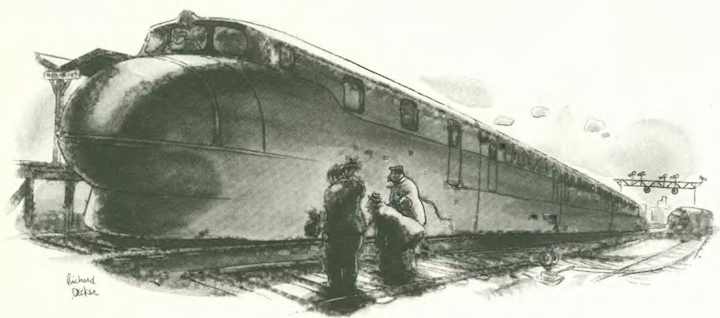
…which brings is to more cartoons, where according to Richard Decker, the move to streamlined trains wasn’t welcomed by everyone…
…Carl Rose illustrated this two-page spread with an imagined right-wing response to the recent left-wing May Day parades…
…William Steig eavesdropped onto a saucy little conversation…
…Barbara Shermund continued her explorations into the trials of the modern woman…
…James Thurber was back to his old tricks…
…and we conclude our cartoons with Eli Garson, and a new perspective…
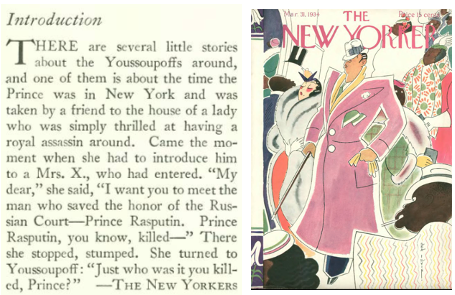
Before I close, a bit of housekeeping. The first issues in 1925 sometimes ended “The Talk of the Town” with…
…but on May 23, 1925, “Talk” signed off with —The New Yorkers. That continued until the March 31, 1934 issue (below), the last time the New Yorker signed off “The Talk of the Town” with —The New Yorkers:
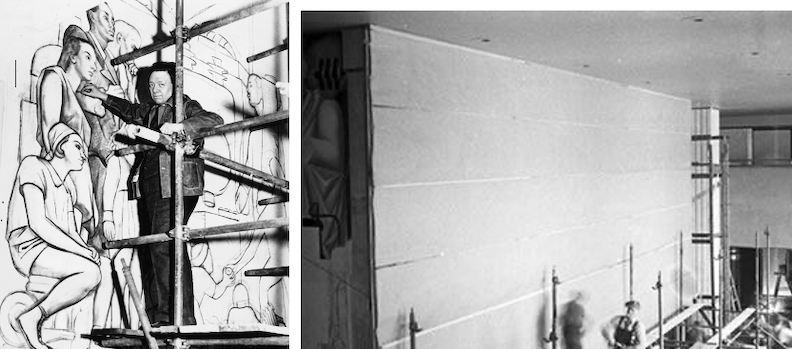
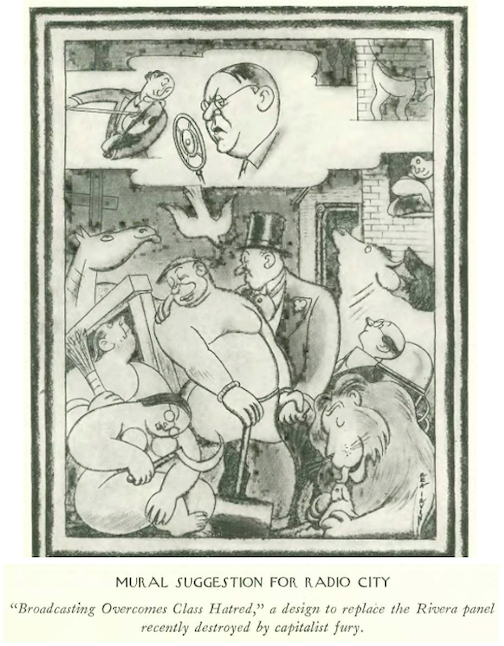
On April 28, 1933, just two days before the RCA Building was to open to new tenants, artist Diego Rivera added a portrait of Vladimir Lenin to the mural he was painting in the building’s lobby.
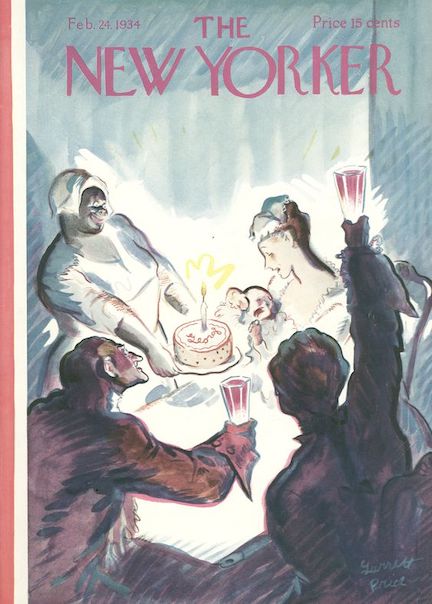
Feb. 24, 1934 cover by Garrett Price.
When Nelson Rockefeller asked Rivera to replace Lenin with a portrait of an “everyman,” Rivera refused, stating that he would prefer to see the whole mural destroyed than to alter it. Two weeks later Rivera was paid and dismissed from the job; carpenters immediately covered the mural in a white cloth. Fast forward to Saturday, February 10, 1934, when workers showed up late in the evening and began chipping away at the plaster bearing the mural, reducing Rivera’s artwork to dust. E.B. White, in his “Notes and Comment,” had this to say about that fateful night:
DUST TO DUST…Diego Rivera working on his mural, Man at the Crossroads, in the RCA Building lobby in 1933. At right, workers quickly covered up the mural after Rivera was dismissed from the job. One of Rivera’s artist assistants, Lucienne Bloch, clandestinely took the photo before she was escorted from the building. (Wikipedia/6sqft.com)ARTEM INTERRUPTUS…Mexican artist Diego Rivera stands with a copy of the mural he painted at Rockefeller Center that was eventually destroyed. (A. Estrada /Courtesy of Museo Frida Kalho)
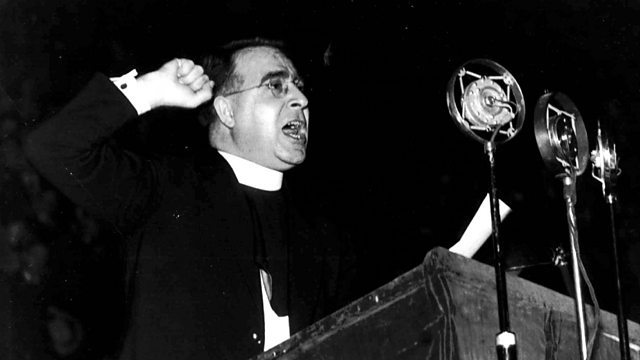
Rea Irvin shared his own thoughts on the issue with this illustration below, which referenced the hateful rhetoric of Charles Coughlin, a Canadian-American Catholic priest and populist leader and one of the first public figures to make effective use of the airwaves to spew his invective.
FAMILIAR RING…Charles Coughlin, a Catholic priest and populist leader, promoted antisemitic and pro-fascist views while also acting as a champion to the poor and a foe of big business. In the midst of the Depression he spoke to the hopes and fears of lower-middle class Americans throughout the U.S. One supporter recalled: “When he spoke it was a thrill like Hitler. And the magnetism was uncanny. It was so intoxicating, there’s no use saying what he talked about…” (BBC/NPR)
* * *
Dog Days
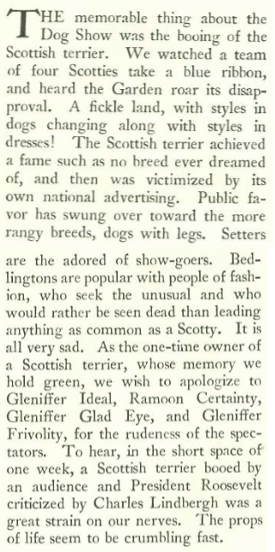
E.B. White also chimed in about boorish behavior he witnessed at the Westminster Kennel Club show at Madison Square Garden. Terriers had dominated Westminster; the fox terrier that ultimately won the 1934 competition represented the 21st terrier of any type to win Best of Show since that category was introduced in 1907.
YOU AGAIN? Ch Flornell Spicy Bit of Halleston, a Wire Fox Terrier, took Best of Show at Madison Square Garden in 1934. (westminsterkennelclub.org)
* * *
Anybody Home?
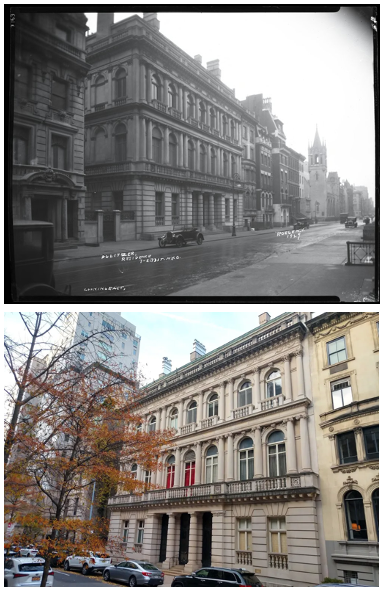
After the wealthy owner of the New York World, Joseph Pulitzer, died in 1911, his family moved out of his lavish East 73rd Street mansion, which was designed by Stanford White to resemble an Italian palazzo. The building sat empty until 1930, when investors planned to knock it down and replace it with an apartment building. The Depression foiled their plans, and another attempt to raze the mansion in the 1950s also miraculously failed, and the building was eventually converted into a co-op with sixteen apartments. Writing in “The Talk of the Town,” James Thurber pondered the Pulitzer mansion’s expected fate. An excerpt:
THEN AND NOW…With so many buildings reduced to dust these days in NYC, it’s good to see the Pulitzer mansion still standing. You can buy one of its sixteen apartments for roughly $6 million, if and when they become available. (ephemeralnewyork.wordpress.com)
* * *
From Our Advertisers
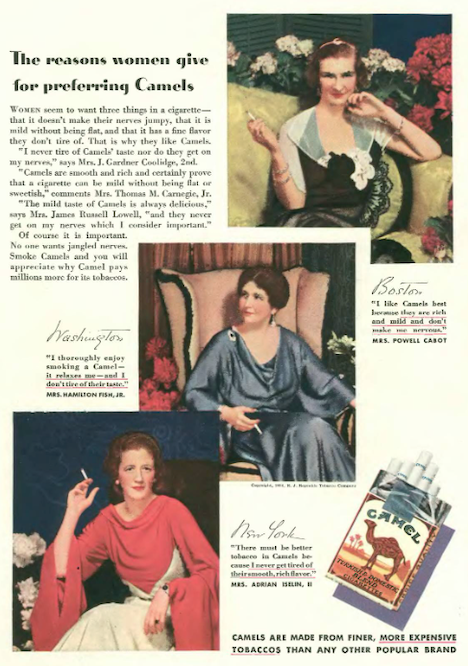
The makers of Camel cigarettes combined three previous ads into one, featuring endorsements from society matrons in Boston, Washington, D.C., and New York…
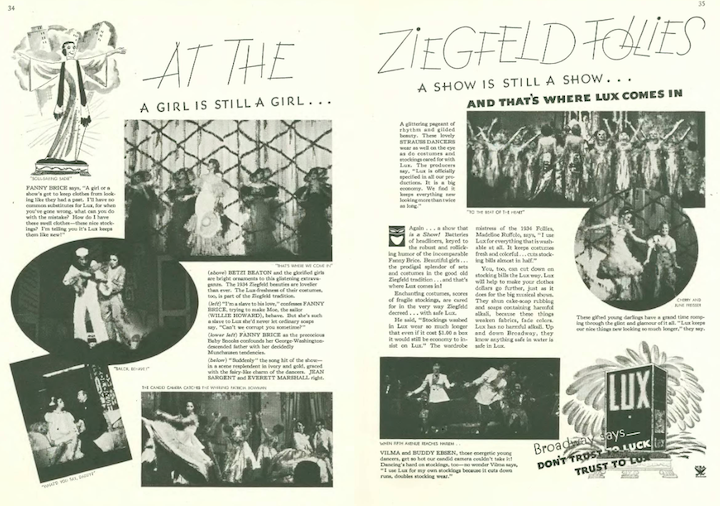
…while Fanny Brice and the cast of the 1934 Ziegfeld Follies offered a chorus of endorsements for Lux detergent in this two-page spread…
…the Graham-Paige Motors Corporation is long gone, but in the early 1930s the company was still going strong, introducing many innovations (described in the ad below) that would be copied by other carmakers…
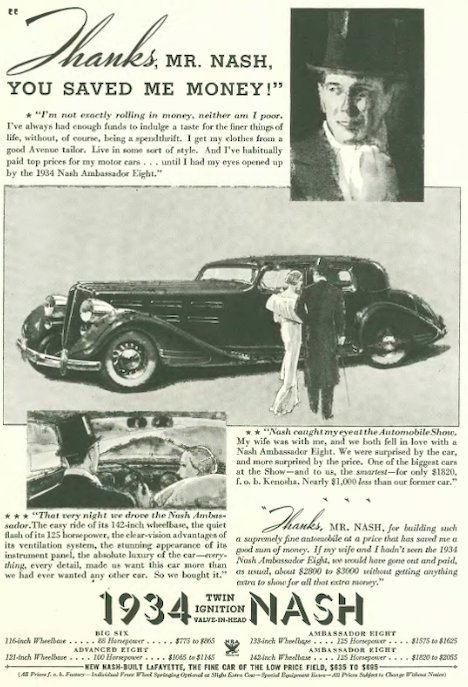
…in the 1930s an exiled Russian noble, Count Alexis de Sakhnoffsky, was known for his streamlined automobile designs…he influenced the look of the 1934 Nash Ambassador Eight, which was touted here as the choice of the budget-minded toff…note how the illustrator exaggerated the car’s length in this ad…
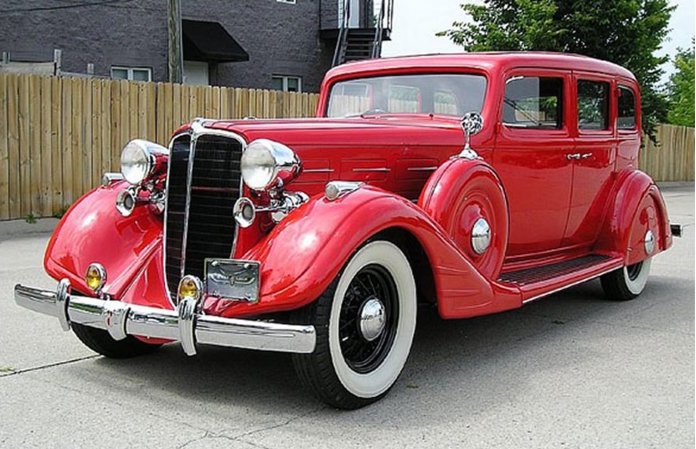
…as compared to an actual model of a Nash Eight…
A restored 1934 Nash Ambassador Eight. (classiccars.com)
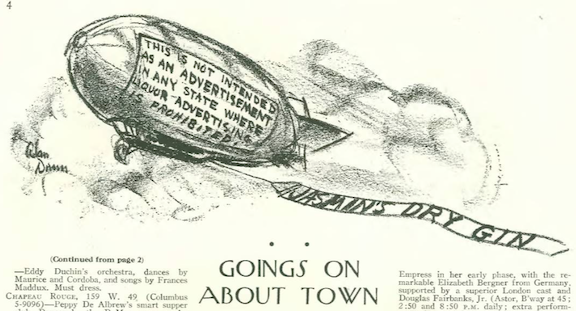
…on to our cartoonists, Alan Dunn floated above the “Goings On About Town” section…
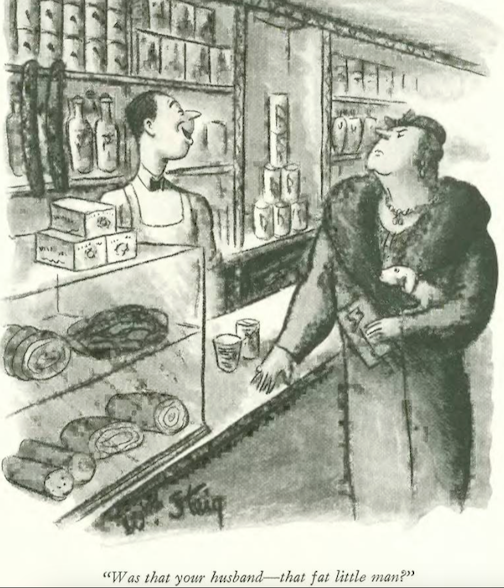
…William Steig gave us a tactless grocer…
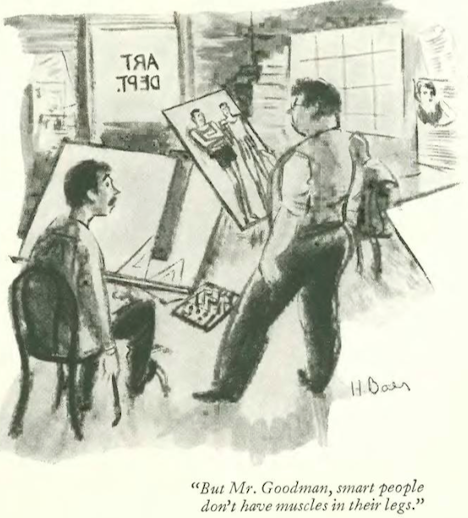
…Howard Baer offered up some finer points from Madison Avenue…
…Gardner Rea illustrated a very special delivery…
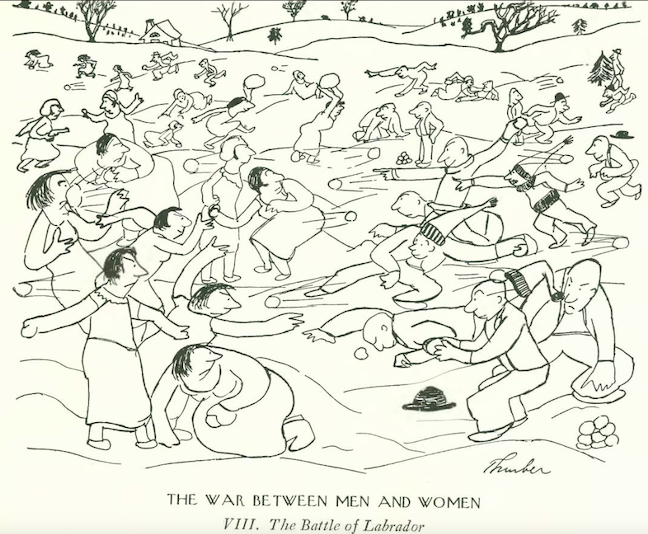
…and James Thurber’s war continued to be waged on a snowy battlefield…
…on to our March 3, 1934 issue…
March 3, 1934 cover by Harry Brown.
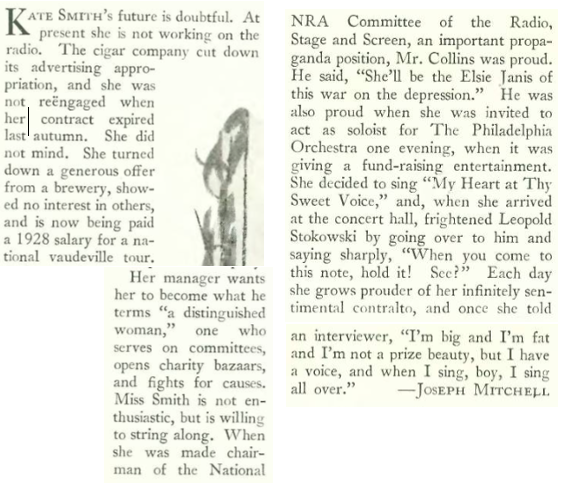
…which featured a profile of singer Kate Smith (1907–1986), written by none other than Joseph Mitchell (1908-1996), who began his career at The New Yorker in 1933. Smith was an American contralto often referred to as “The First Lady of Radio,” well known for her renditions of When the Moon Comes over the Mountain and Dream a Little Dream of Me. She was enormously popular during World War II for her rendition of God Bless America among other patriotic tunes.
Smith got her start in New York in 1926 when she appeared on Broadway in Honeymoon Lane. That year also saw the emergence of countless humiliating wisecracks about her weight that would dog her long career. A reviewer in The New York Times (Oct. 31, 1926) wrote, “A 19-year-old girl, weighing in the immediate neighborhood of 200 pounds, is one of the discoveries of the season…” In 1930, when Smith appeared in George White’sFlying High, she served as the butt of Bert Lahr’s often cruel jokes about her size.
An excerpt from the opening lines of Mitchell’s profile:
RISING STAR…At left, Kate Smith performing in the 1932 Paramount Pictures musical, Hello Everybody!; at right, on the cover of the October 1934 issue of Radio Mirror. (medium.com)
Toward the conclusion of the profile Mitchell suggested that Smith’s future was “doubtful.” She would prove that prediction wrong, however…
…23 years after her death her rendition of God Bless America would be discontinued pretty much everywhere when it was revealed that in the early 1930s she recorded such songs as That’s Why Darkies Were Born and Pickaninny Heaven (which was featured in Hello, Everybody!).
CANCELLED STAR…Since the late 1960s a rendition of God Bless America by Kate Smith served as a good luck charm for the Philadelphia Flyers hockey team. “The team began to win on nights the song was played,” The New York Times wrote in Smith’s 1986 obituary. Smith sang the tune live during game six of the 1974 Stanley Cup finals, which the Flyers went on to win against the Boston Bruins. When Smith’s racist songs were rediscovered in 2019, a statue of the singer that stood outside the Flyers’ arena was covered and ultimately removed. (Daily Mail)
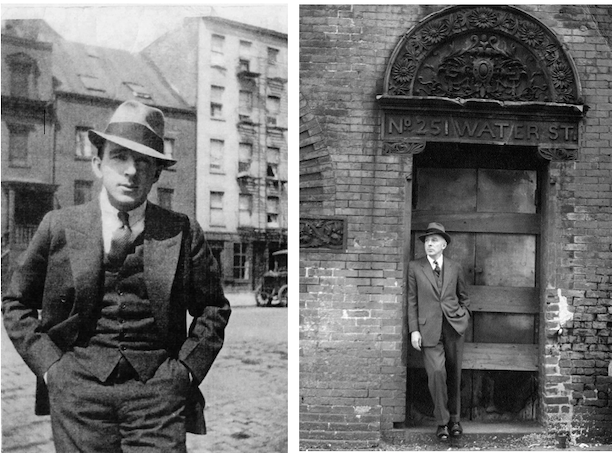
A note on Joseph Mitchell, whose first credited piece in The New Yorker was a Nov. 11, 1933 “A Reporter at Large” column titled “They Got Married in Elkton.” The article described a small Maryland border town that became known for discrete “quicky” marriages. Mitchell would become known for his finely crafted character studies and expressive stories found in commonplace settings. His 1943 McSorley’s Wonderful Saloon is a prime example.
MAN ABOUT TOWN…At left, Joseph Mitchell circa 1930, wearing a brown fedora he was rarely seen without; at right, Mitchell in Lower Manhattan near the old Fulton Fish Market, as photographed by his wife, Therese Mitchell, circa 1950. (Estate of Joseph Mitchell)
* * *
Acquired Taste
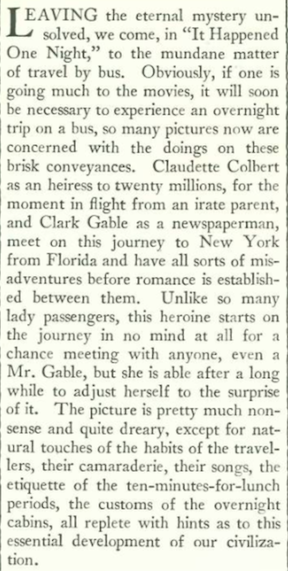
Occasionally New Yorker film critic John Mosher found himself at odds with other reviewers, and such was the case when Mosher sat down to watch Frank Capra’s It Happened One Night. While he described the 1934 pre-Code romantic comedy as “nonsense” and “dreary,” other critics found it generally enjoyable, and although it took audiences awhile to catch on, the film eventually became a smash hit.
In all fairness to Mosher, even the film’s co-star, Claudette Colbert, complained to a friend after the film wrapped, “I just finished the worst picture in the world.” As it turned out, It Happened One Night became the first of only three films to win all five major Academy Awards: Best Picture, Best Director, Best Actor, Best Actress, and Best Adapted Screenplay. It is now widely considered one of the best films ever made. Go figure.
Back to Mosher, who thought so little of the film he didn’t even lead his column with the picture’s review:
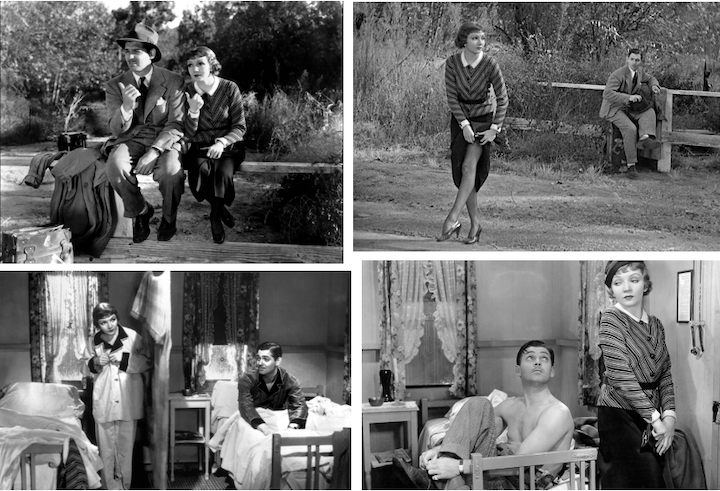
PRE-CODE AND TOPLESS…An heiress (Claudette Colbert) and a reporter (Clark Gable) find themselves hitchhiking (and sharing a motel room) after their bus breaks down in It Happened One Night. The film famously featured a scene in which co-star Gable undresses for bed and takes off his shirt to reveal that he is bare-chested. An urban legend claims that, as a result, sales of men’s undershirts declined noticeably. (IMDB)
* * *
More From Our Advertisers
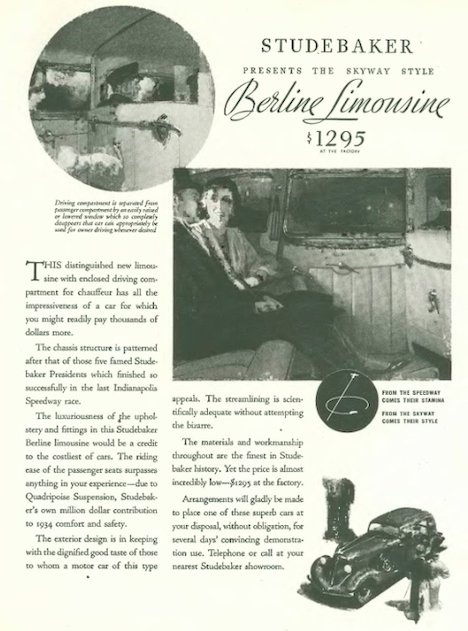
If you wanted luxury with the price, you could buy a Nash Ambassador Eight for $1,800 (about thousand less than other luxury models) or opt for Studebaker’s Berline Limousine, practically a steal at $1,295…
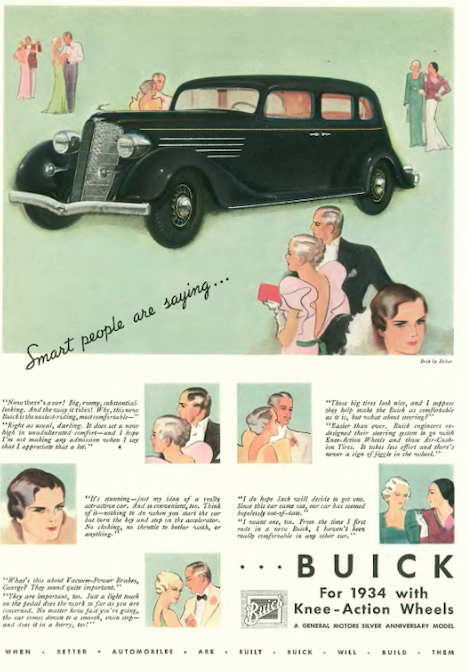
…or you could opt for this fancy-looking Buick with “Knee-Action wheels”…Knee Action was a GM marketing term for independent front suspension, which made for a smoother ride…
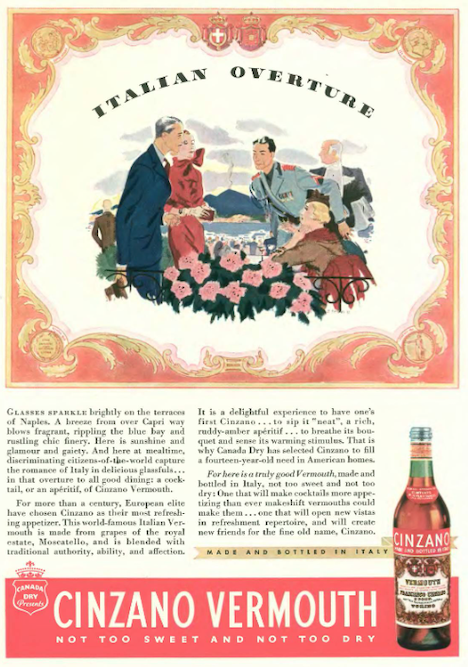
…always colorful, the makers of Cinzano vermouth made their splash in The New Yorker…
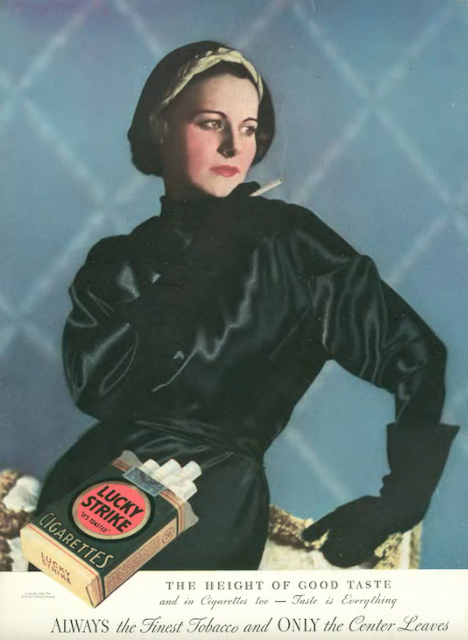
…the folks at Lucky Strike continued their theme of colorful ads featuring attractive women enjoying their cigs…
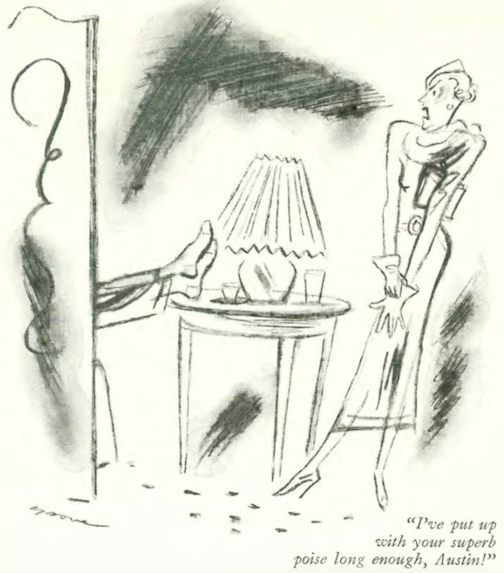
…on to our cartoonists, Leonard Dove illustrated a domestic spat…
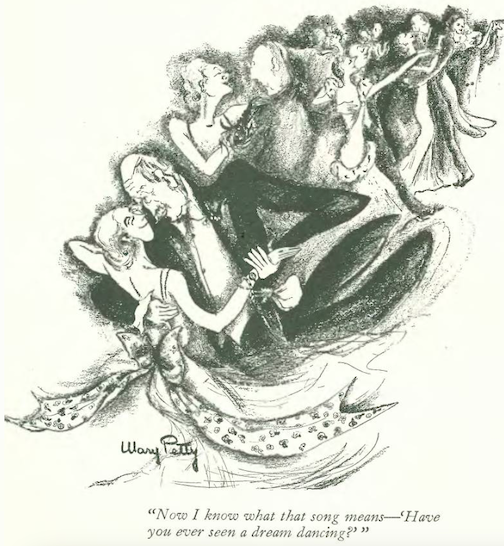
…Mary Petty captured a romantic interlude on the dance floor…
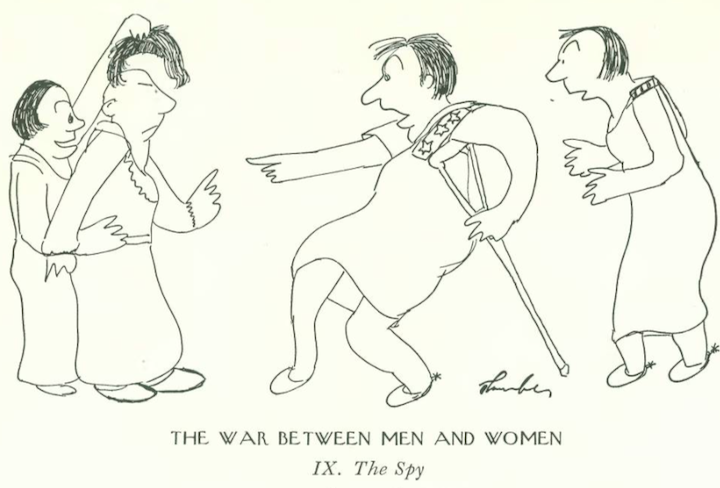
…and James Thurber introduced a new twist—espionage—into his “war”…
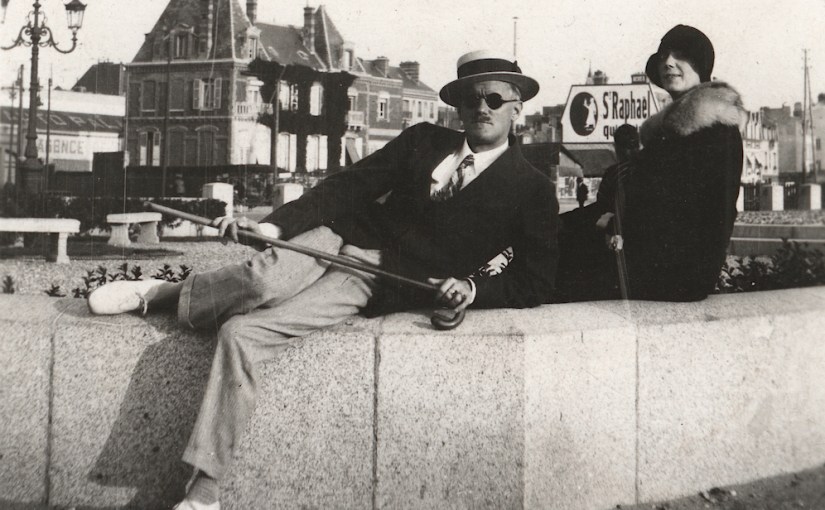
Above, James Joyce and his longtime partner Nora Barnacle, in Zurich, 1930. They would marry the following year when Joyce established residency in the UK. (SUNY Buffalo)
It began 103 years ago when the American literary magazine The Little Review published its latest installment of James Joyce’s landmark novel Ulysses—a chapter that featured an account of a wanker on a beach.
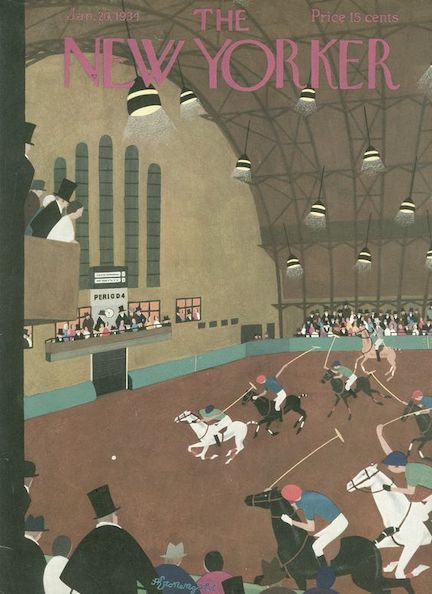
Jan. 20, 1934 cover by Adolph K. Kronengold.
More specifically, the passage described the novel’s main character, Leopold Bloom, pleasuring himself while gazing at a teenage girl. It didn’t take long for the pearl-clutchers at the New York Society for the Suppression of Vice to go after the editors of The Little Review, who were ultimately fined for obscenity and banned from publishing the remainder of the novel, which, by the way, Joyce had structured along the lines of Homer’s epic poem, the Odyssey.
Scenes in the novel that frankly described sexual acts and mocked rituals of the Catholic Church kept the book off American shelves until 1934, when District Judge John M. Woolsey ruled that the book was neither pornographic nor obscene. One wonders if Judge Woolsey took a cue from the end of Prohibition.
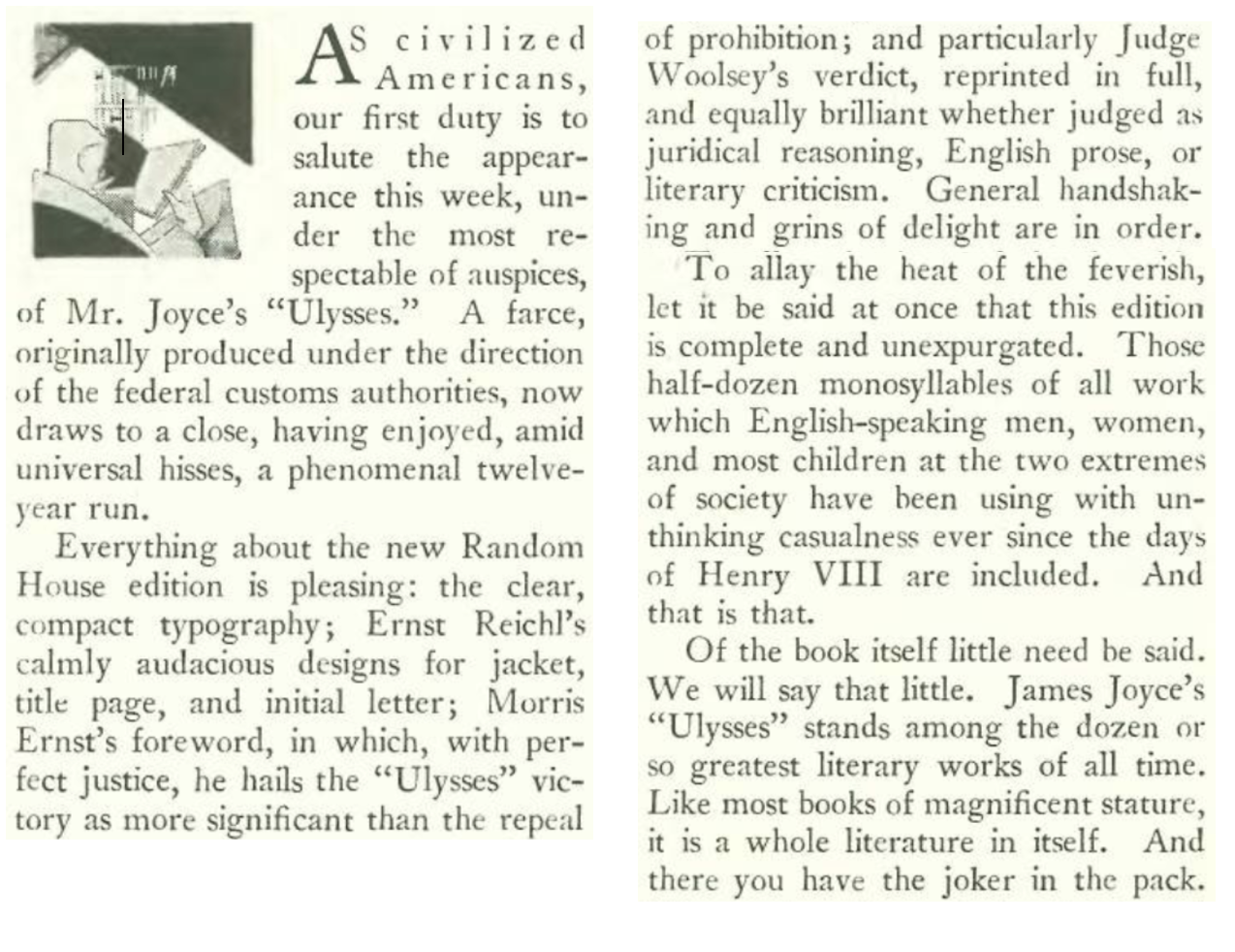
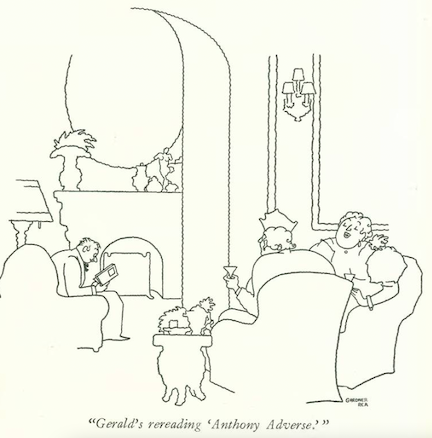
Lovers of literature, including New Yorker book reviewer Clifton Fadiman, rejoiced at the judge’s decision. We skip ahead to the Jan. 27 issue for Fadiman’s thoughts on the matter:
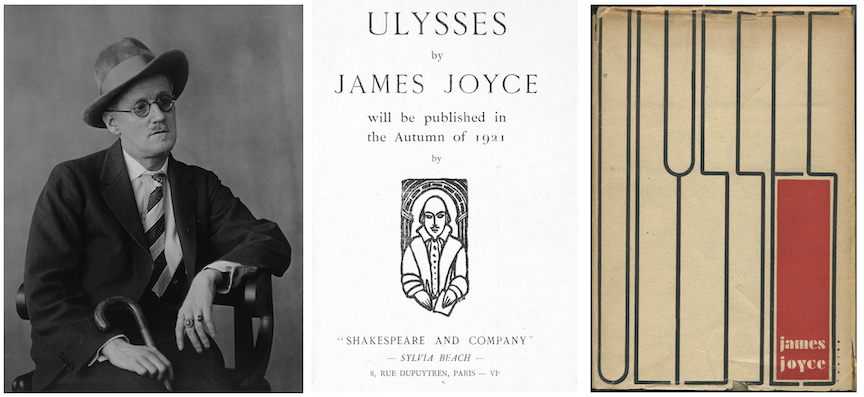
DUBLINER…James Joyce in 1928, as photographed by Berenice Abbott; announcement by Shakespeare & Company (Paris) of the first publication of Ulysses, 1921; cover of the American first edition, 1934, with Ernst Reichl’s “calmly audacious” jacket design. (Wikipedia/Abe Books)
* * *
Pleasurable Diversion
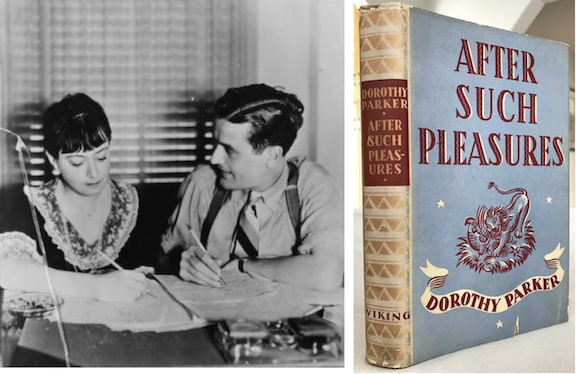
We now turn to the Jan. 20 issue, in which Robert Benchley concluded his stage reviews with a generous nod to his dear friend and colleague, Dorothy Parker, whose short stories were being performed as sketches at the Barbizon-Plaza Hotel, the first fully-equipped music and arts residential center in the U.S.
INCIDENTAL ATTRACTION…Stories from Dorothy Parker’s 1933 collection After Such Pleasures were performed as sketches at the Barbizon-Plaza Hotel; at left, Parker with her husband, actor/author Alan Campbell. (Pinterest/Biblio)
* * *
Une Séduction Américaine
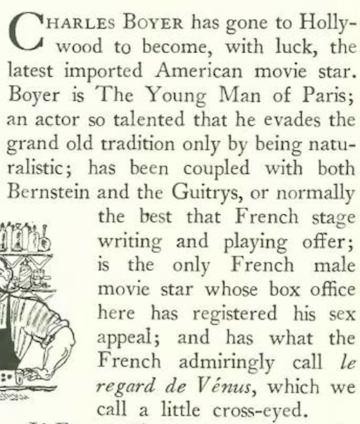
Janet Flanner began writing her weekly New Yorker column “Letter from Paris” in September 1925, keeping readers informed on a variety of subjects ranging from arts and culture to politics and crime. In the Jan. 20 issue she introduced readers to French actor Charles Boyer (1899–1978), who was preparing to try his luck in Hollywood. Actually, Boyer made his first trip to Tinseltown in 1930, but his return would mark the beginning of a successful run in American cinema, including the 1944 mystery-thriller Gaslight and the 1967 romantic-comedy Barefoot in the Park.
MAKING BEAUTIFUL MUSIC…Charles Boyer as the ” gypsy” vagabond Latzi, with Jean Parker (center) and Loretta Young in 1934’s Caravan. (MoMA)
* * *
The Way Of All Flesh
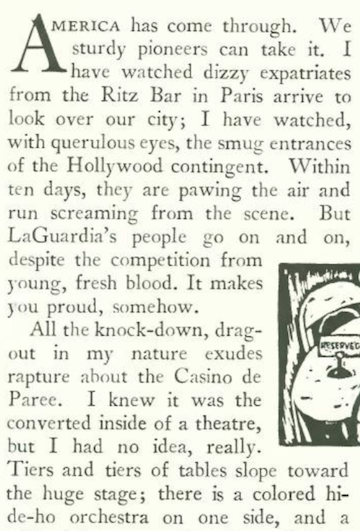
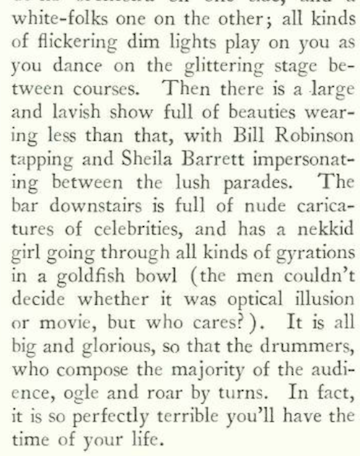
Lois Long continued to chronicle New York nightlife in her “Tables for Two” column, exuding “rapture” over the new theatre/restaurant Casino de Paree, which featured ample nudity as well as top performers dancer Bill “Bojangles” Robinson and comedienne Sheila Barrett.
The Casino de Paree featured revues, dancing, and side shows such as fire-eaters and animal acts. It closed in 1937, and the building later became home to the trendy 80s–90’s hot spot Studio 54.
CLOTHES OPTIONAL…A 1934 brochure offered glimpses of the entertainment to be had at the new theatre/restaurant Casino de Paree.
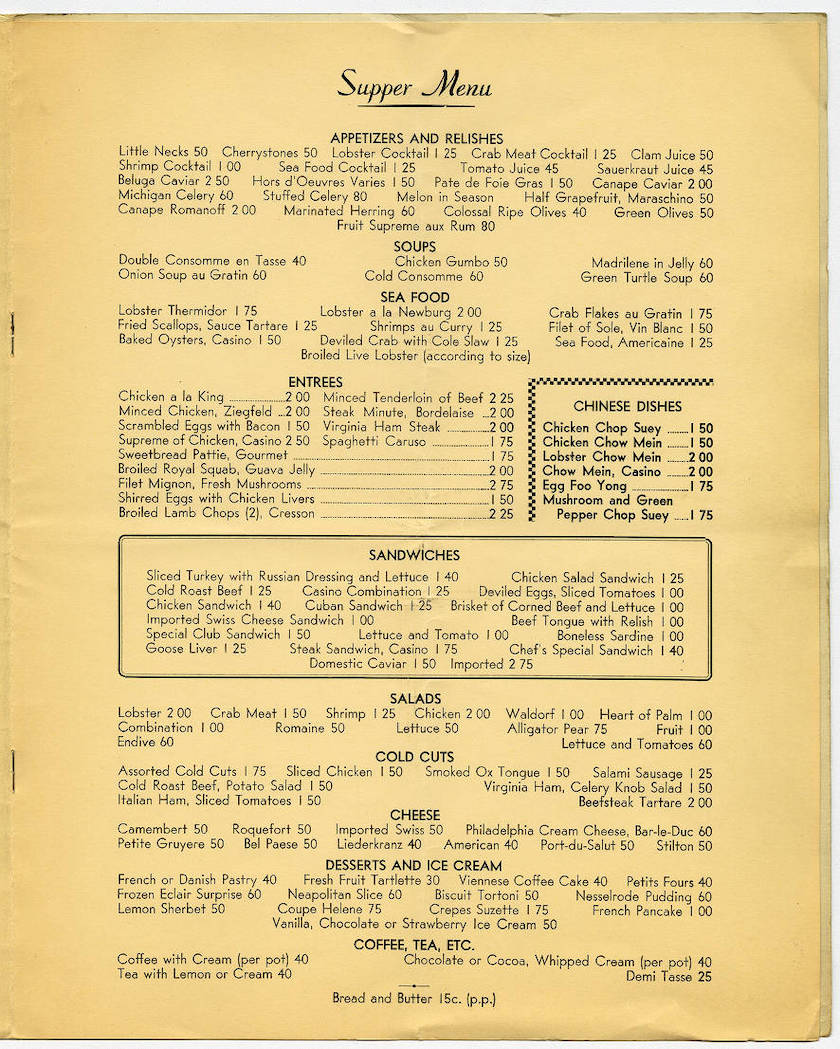
The Casino de Paree’s menu gave patrons some idea of what could be expected on the stage…
(The Culinary Institute of America Menu Collection)
…but if food and drink was the only thing on your mind, you could enjoy lobster thermidor for a buck seventy-five…
(The Culinary Institute of America Menu Collection; Craig Claiborne Menu Collection)
* * *
From Our Advertisers
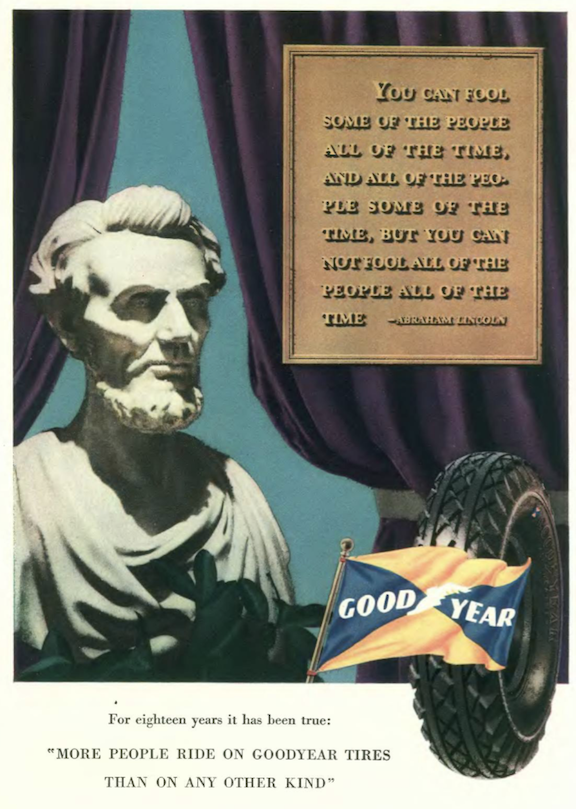
How reliable were Goodyear’s tires? Hopefully more reliable than this adage, which Abraham Lincoln apparently never uttered…
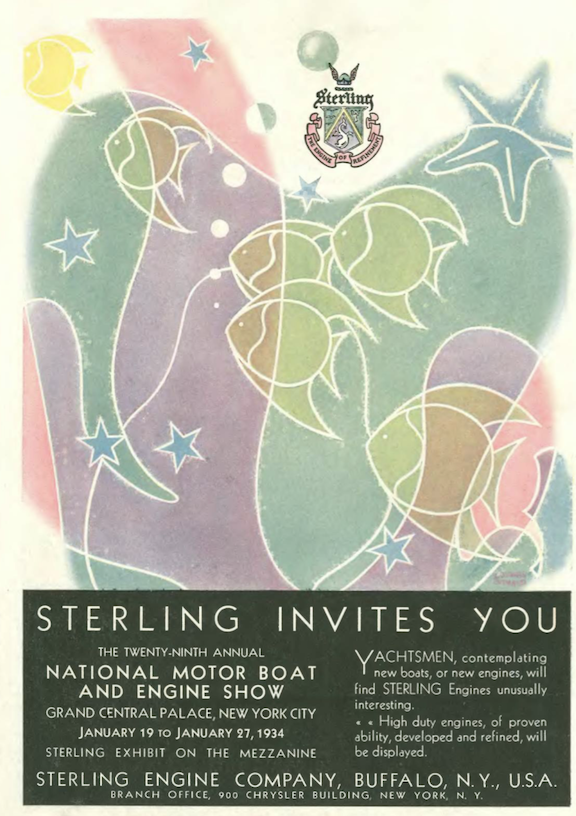
…major exhibitions at the Grand Central Palace changed like the seasons, the National Automobile Show ceding to the National Motor Boat & Engine Show…
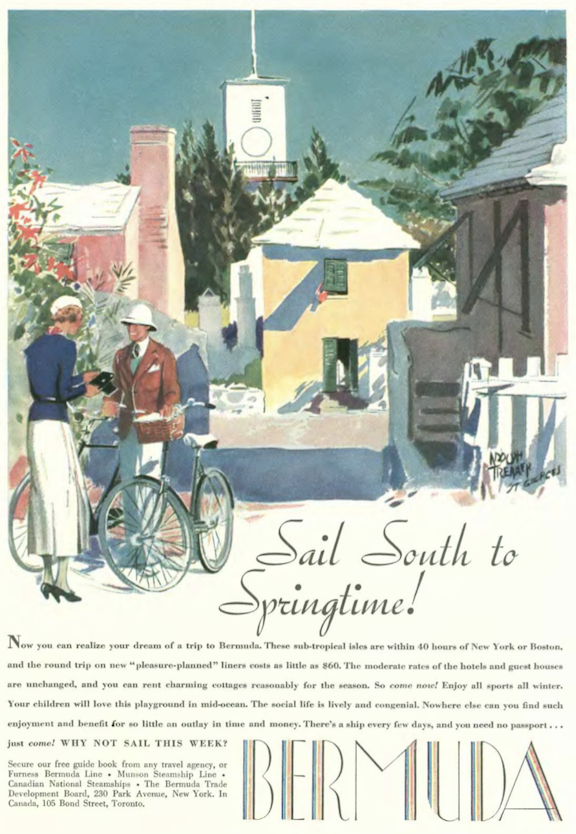
…if you’d rather have someone else do the sailing, the Bermuda line could take you on a round-trip cruise for as little as $60…
…with the end of Prohibition, the folks at White Rock were doubtless pleased to overtly advertise their product as a cocktail mixer…
…on to our cartoonists, Al Frueh contributed this rendering for the theatre review section…
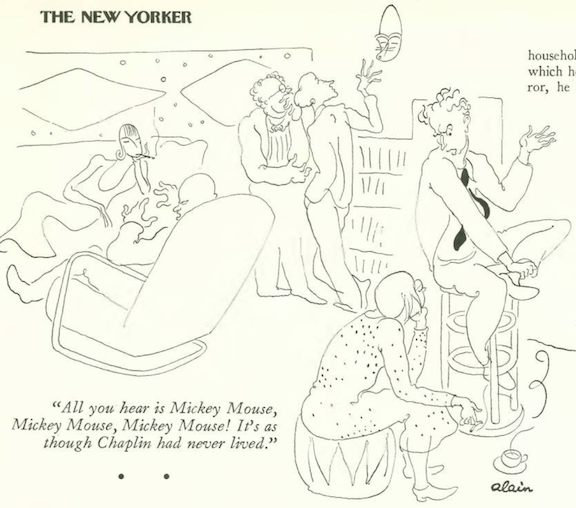
…Daniel ‘Alain’ Brustlein found this salon conversation a bit Mickey Mouse…
…Helen Hokinson explored the results of family planning…
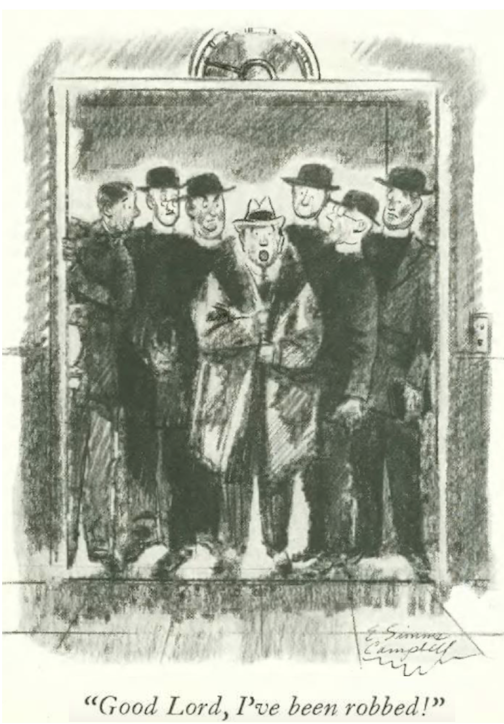
…E. Simms Campbell gave us an unlikely den of thieves…
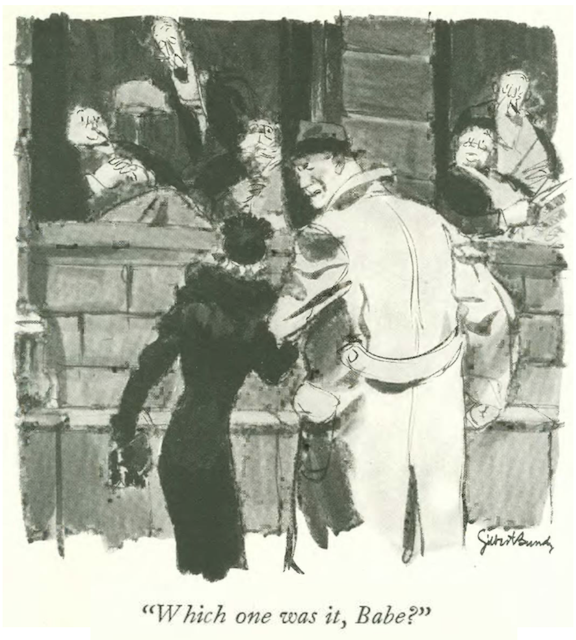
…Gilbert Bundy had us wondering what ensued at this gentlemen’s club…
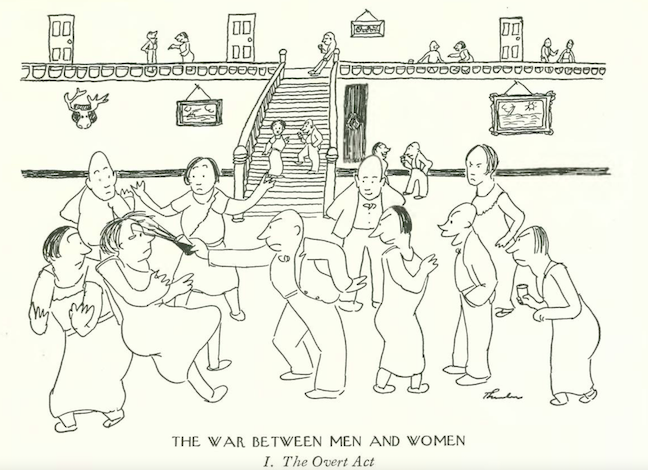
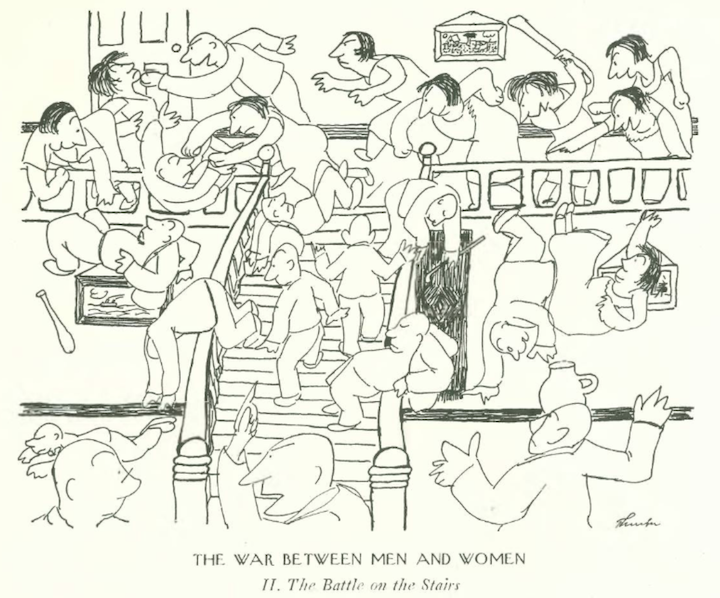
…and James Thurber fired the first shot in The War Between Men And Women…
…on to Jan. 27, 1934…
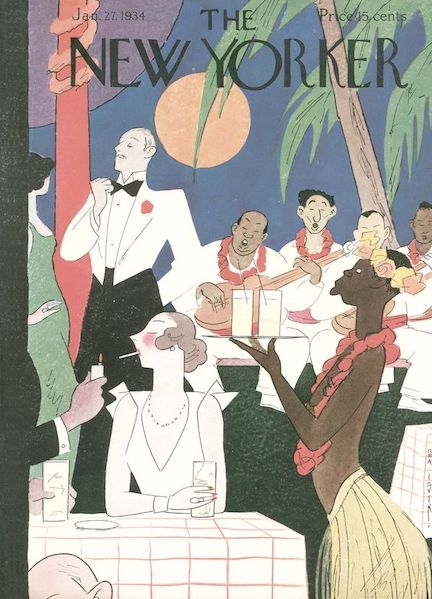
Jan. 27, 1934 cover by Rea Irvin.
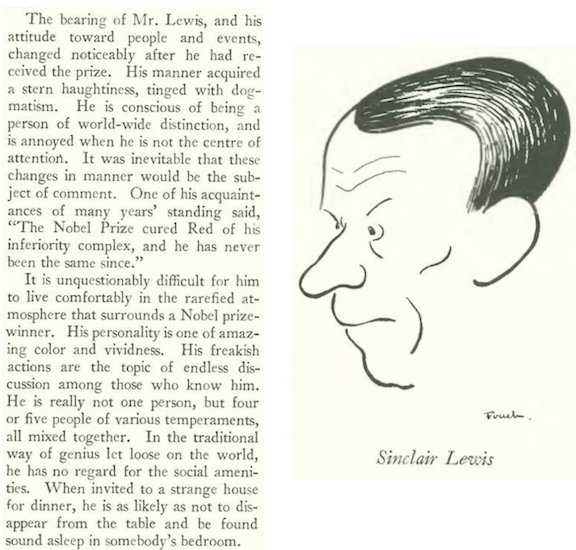
…where writer W.E. Woodward profiled Sinclair Lewis (1885-1951), whose manner had changed noticeably after receiving the Nobel Prize. An excerpt (with caricature by Al Frueh):
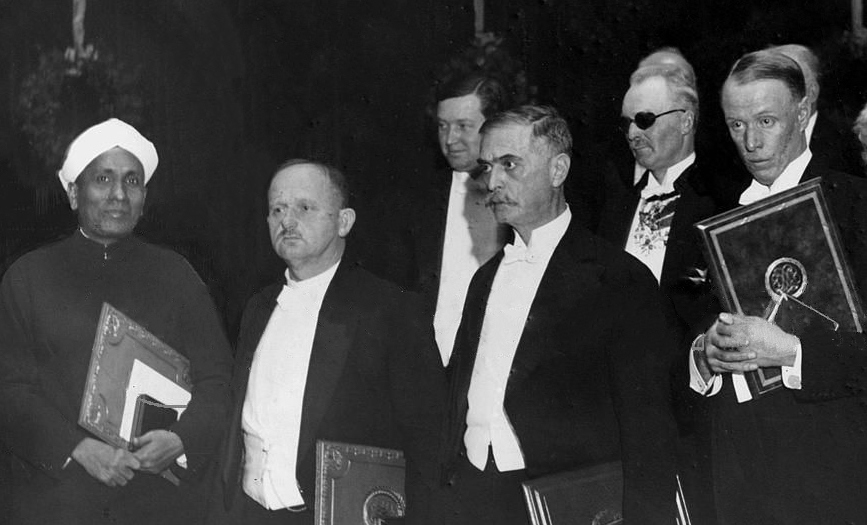
I’M SOMEBODY NOW…Sinclair Lewis (far right) with his 1930 Nobel Prize for literature. Other 1930 prize winners were, from left, Venkata Raman (physics), Hans Fischer (chemistry), and Karl Landsteiner (medicine).
* * *
More From Our Advertisers
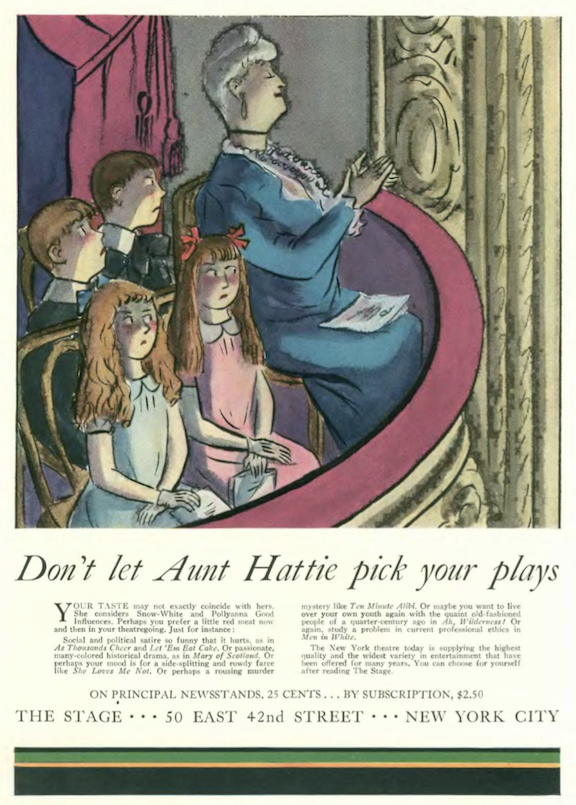
We begin with this lovely color illustration by Helen Hokinson, which also graced the cover of the January 1934 issue of The Stage…
…the vintners at Moët & Chandon let New Yorkers know that their fine Champagne could be had from sole distributors Labourdette and Company…
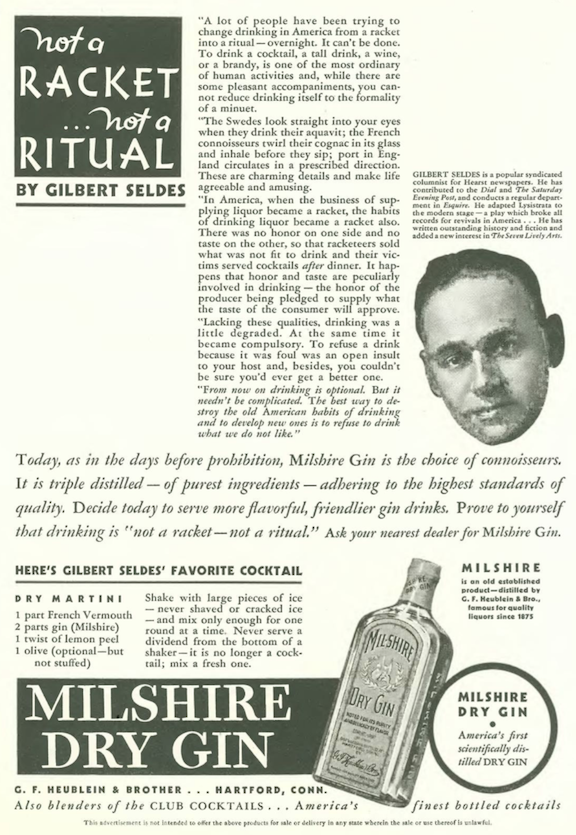
…cultural critic Gilbert Seldes advised drinkers to abandon their degraded ways and return to the civilized consumption of an old favorite…
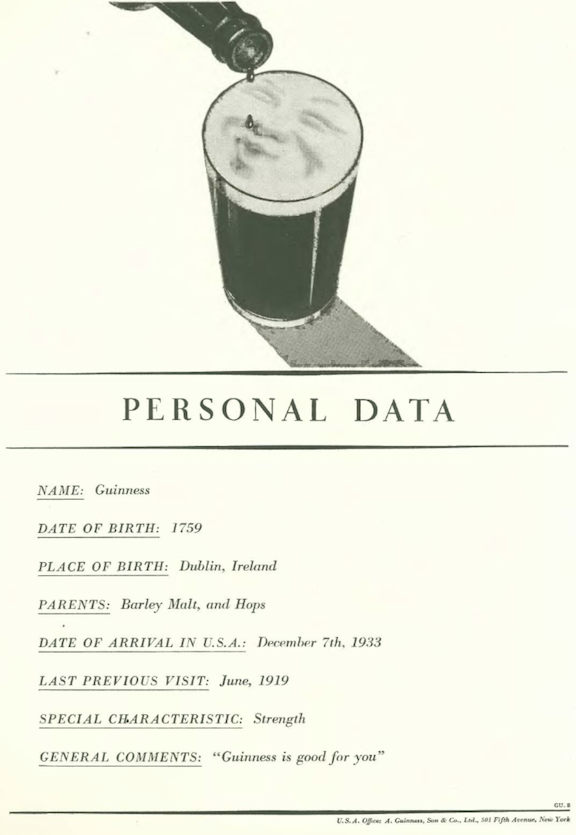
…while the folks at Guinness reminded us of their product’s deep history as well as its health benefits…
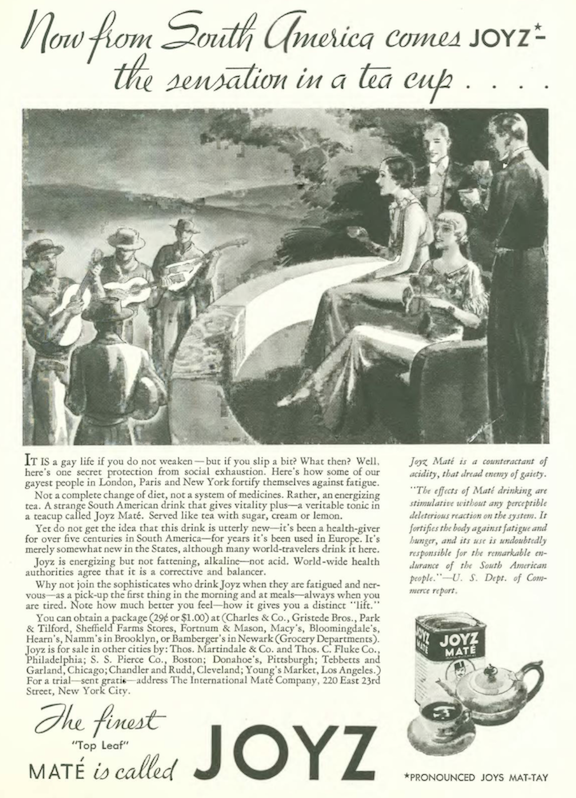
…and for the teetotalers the purveyors of Joyz Maté encouraged Yankees to take up this “strange” South American drink…the ad claimed it “fortifies the body against fatigue” (thanks to the generous amount of caffeine) and acts as a “corrective and a balancer” (it helped stimulate bowel movements)…
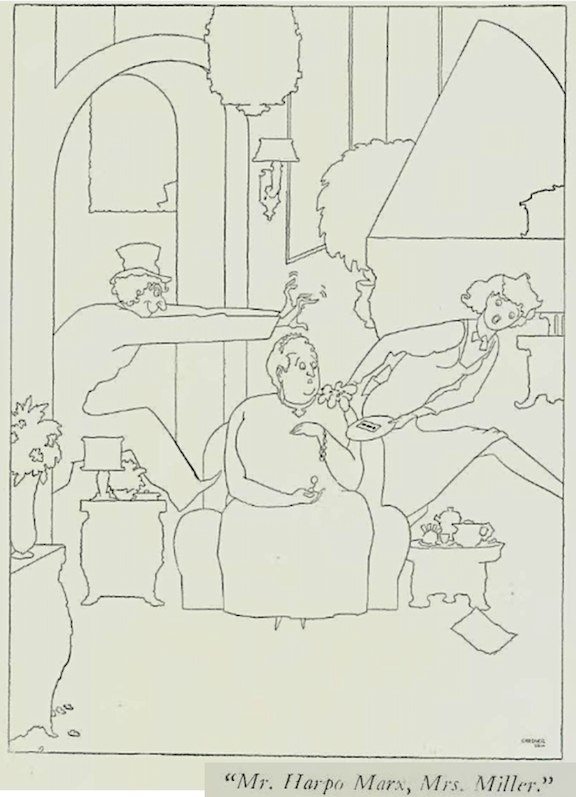
…on to our cartoons, we begin with Gardner Rea, borrowing from a running gag in the Marx Brothers’ 1930 film Animal Crackers, which featured Harpo chasing a sexy blonde around a mansion (apologies for the poor reproduction quality—the archival image was quite faint)…
…Gilbert Bundy gave us a couple confronting the subtleties of Times Square…
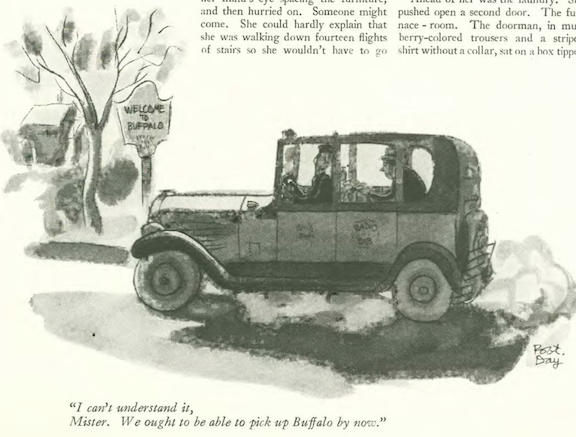
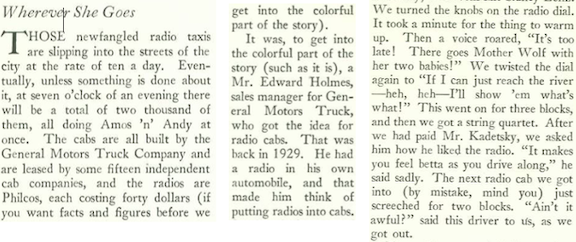
…Robert Day commented on the latest trend in taxicab conveniences: coin-operated radios for passengers…
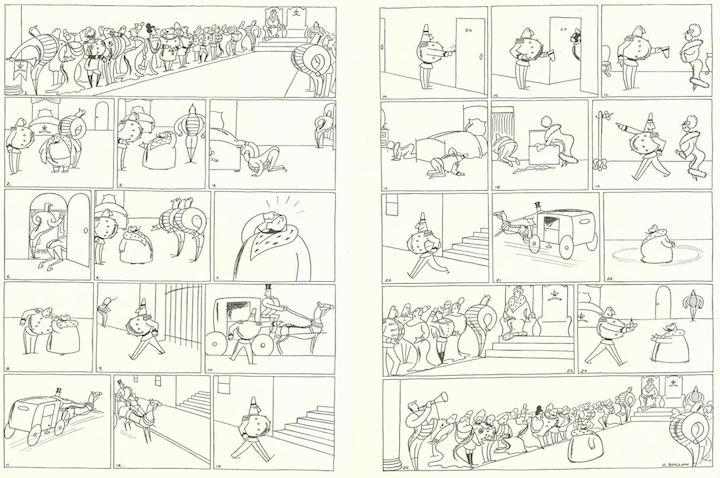
…this two-page Little King cartoon by Otto Soglow revealed another side to our diminutive potentate…
…and the war between the sexes raged on, with James Thurber…
When Rockefeller Center’s design was unveiled in 1931, New Yorker architecture critic Lewis Mumford wrote that it followed ”the canons of Cloudcuckooland.”
Dec. 23, 1933 cover by Helen Hokinson.
Today we know 30 Rock as one of the most iconic and beloved places in Manhattan, but after Mumford saw the plans for this future “Radio City” he went into exile in upstate New York, upset over the “weakly conceived, reckless, romantic chaos” of the project. Mumford wasn’t alone in his opinion; indeed it was his commentary that helped fuel negative reactions from citizens and newspapers alike.
No doubt the scale of the project bothered a lot of people, as it was slated to replace four- and five-story brownstones and other smaller buildings with a series of massive structures (for Mumford, it was rare that any skyscraper found his favor—to him they were oversized symbols of corporate tyranny).
IMMODEST PROPOSAL…In the fall of 1928 John D. Rockefeller leased this property from Columbia University for the future site of Rockefeller Center. The project covered nearly all of the area in the three square blocks bordered by Fifth Avenue, Sixth Avenue, and 48th and 51st Streets. (ephemeralnewyork.wordpress.com)
As the Rockefeller Center towers rose, some softened their criticisms, including E.B. White—in the Dec. 9 issue he said he would eat his words after viewing the floodlit 30 Rock by night: “the whole thing swims up tremendously into the blue roxyspheres of the sky.”
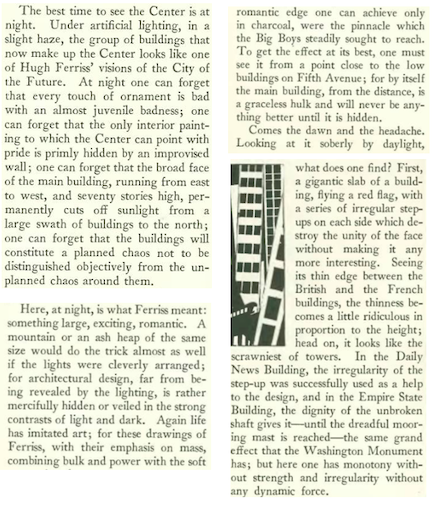
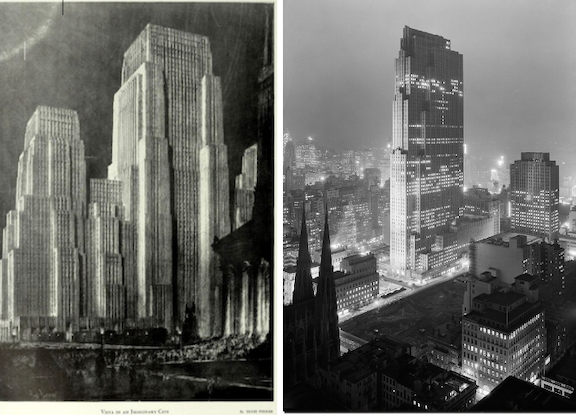
Two weeks later, in his Dec. 23 “Sky Line” column, Mumford agreed that the floodlit buildings looked impressive, recalling Hugh Ferriss’ romantic, futuristic visions of the city; however, the darkness also concealed a decorative scheme that was ”bad with an almost juvenile badness.”
A MATTER OF PERSPECTIVE…Lewis Mumford thought the RCA tower looked “scrawny” when viewed in broad daylight between the British and French empire buildings. (smarthistory.com/Pinterest)NIGHT VISION…In his 1929 book, The Metropolis of Tomorrow, Hugh Ferriss published the image at left of an imaginary city of the future (left). Ferriss was an architect, illustrator, and poet who explored the psychological condition of urban life, and was known for his conte crayon drawings of skyscrapers—nighttime scenes from a futuristic Babylon that are influential in popular culture (e.g. Tim Burton’s vision for Gotham in 1989’s Batman). (archive.org/Wikipedia)
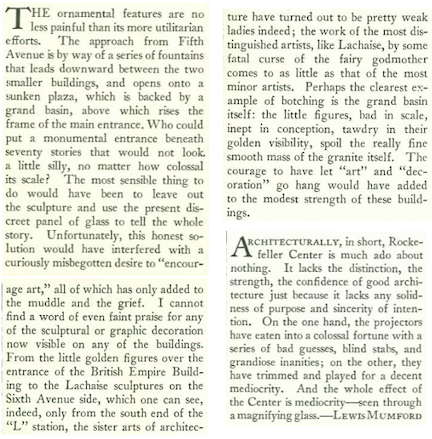
Having finished his excoriation of the buildings’ scale and placement, Mumford proceeded to carve up the ornamental features, including the sunken plaza (today an iconic site for ice skating), which he thought looked “a little silly” in relation to the mass of the RCA building.
TRAINED EYE…Lewis Mumford believed the work of the great Gaston Lachaise was diminished in the Rockefeller Center concept, noting that the Lachaise sculptures on Sixth Avenue (top and right photos) were only visible from the “L” station (Mumford doesn’t mention that the elevated placement of the sculptures was deliberate—they were put there so train riders on the “L” could see them); below, Mumford found the sunken plaza to be out of scale with the RCA tower—for decades it has been one of Manhattan’s most iconic sites. (Wikipedia/Vincent Tullo for The New York Times)
Revisiting Rockefeller Center in his May 4, 1940 “Sky Line” column, Mumford wouldn’t exactly eat his words, but he did admit that the collection of structures formed “a composition in which unity and coherence have to a considerable degree diminished the fault of overemphasis. In other words, they get by.” Mumford still believed 30 Rock was too tall—he would have preferred 32 stories, less than half its actual size: “Good architecture is designed for the human beings who use or view the buildings, not for publicity men or photographers.”
I have to disagree. Every time I look up at 30 Rock I feel my heart soar.
* * *
Yule Like This
The Dec. 23 issue marked the return of Frank Sullivan’s annual holiday poem, “Greetings, Friends!” Sullivan published his first holiday poem in 1932 and faithfully continued the tradition until 1974; after his death in 1976, New Yorker editor William Shawn asked the late Roger Angell to take on the poem. In 2012 Angell passed the duty along to Ian Frazier, the magazine’s current Yuletide bard (Frazier’s latest poem can be found in the Dec. 26, 2022 issue).
* * *
Success, In Spite of it All
“The Talk of the Town” looked in on singer Ethel Waters, who apparently wasn’t brooding over the difficulties of her past life, given that she was seeing so much success as a recording artist and as a Broadway star in As Thousands Cheer. Although her material life was better, she still faced racism wherever she went, including on stage—although she received equal billing, she was segregated from her co-stars in As Thousands Cheer.
BORN INTO THE BLUES…Raised in crushing poverty, Ethel Waters became a major singing star in the 1930s. She was one of the first singers to confront racism in a popular 1933 song, “Suppertime.” (Facebook)
* * *
Enigma
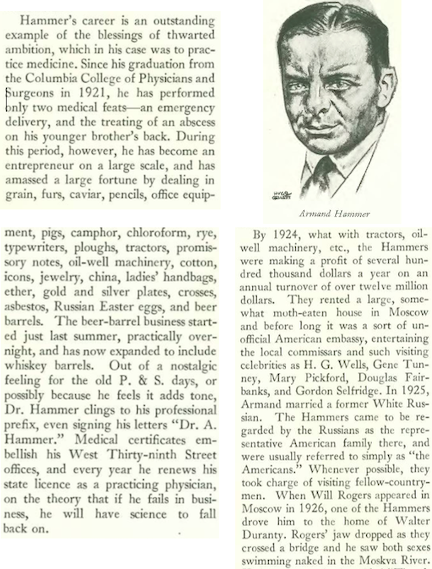
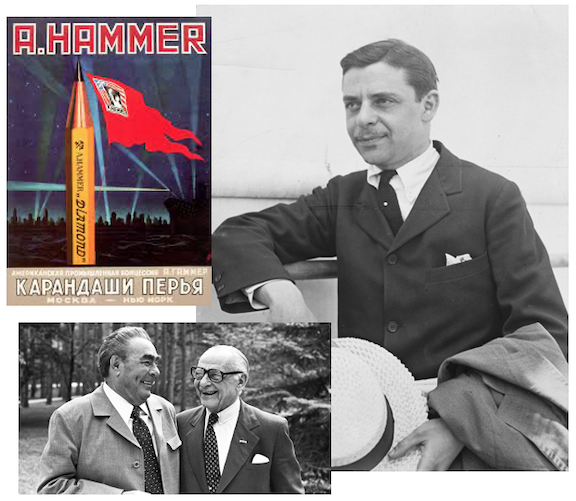
Geoffrey T. Hellman examined the life of American entrepreneur Armand Hammer in a profile titled “Innocents Abroad.” Hammer’s business interests around the world helped him cultivate a wide network of friends and associates. Called “Lenin’s chosen capitalist” by the press, Hammer (1898-1990) started a pencil factory in the Soviet Union in 1926 and later became head of Occidental Petroleum. Throughout his career he maintained close ties with Soviet leaders—which raised many suspicions in the West—but Hammer also served as a citizen diplomat for the U.S., an important go-between during the Cold War. An excerpt:
PROLETARIAN PENCILS…Clockwise, from top left: A 1928 Soviet advertising poster for “A. Hammer” pencils. The factory began work in Moscow in April 1926 as a private American industrial concession; Armand Hammer in the 1920s; Hammer (at right) shares a laugh with Soviet leader Leonid Brezhnev in the 1970s. Hammer is also the great-grandfather of American actor Armie Hammer. (crwflags.com/The New York Times)
* * *
From Our Advertisers
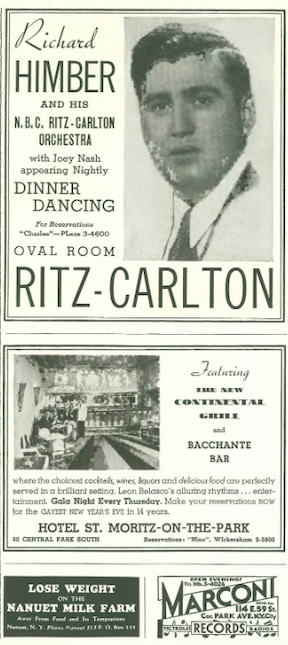
With Prohibition over, New Yorkers were looking forward to celebrating the holidays with Richard Himber and his orchestra at the Ritz-Carlton or enjoying a cocktail at the new Continental Grill and Bacchante Bar at the Hotel St. Moritz…
…and no less of an authority than Santa was advising shoppers to give tobacco products to their loved ones this holiday season…
…or perhaps you could be persuaded by elegant holiday wishes from the owners of Lucky Strike, who included their cigarettes among “the best of good things”…
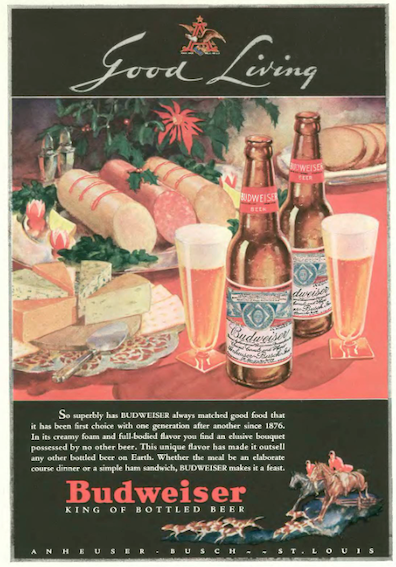
…good living, apparently, could also be found in a bottle of Bud…
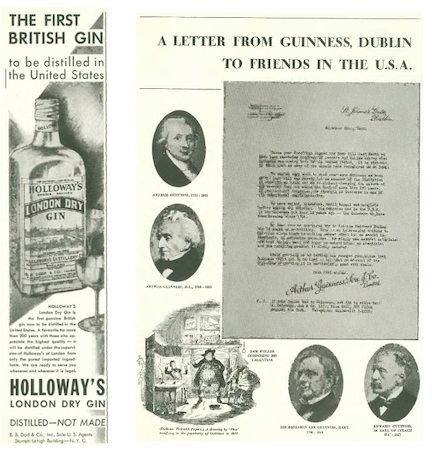
…or in American-distilled “London Dry Gin”…or in a pint of Guinness…
…our cartoons begin with Gardner Rea, and a course in mixology…
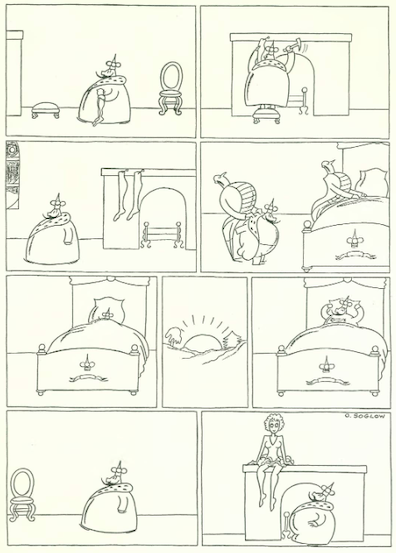
…Otto Soglow’s Little King found a surprise in his Christmas stockings…
…Helen Hokinson offered some passing holiday cheer…
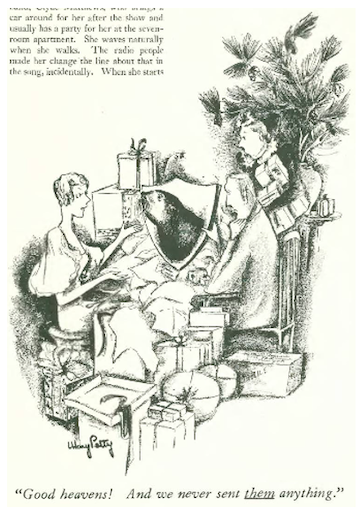
…Mary Petty gave us this unusual Christmas seal…
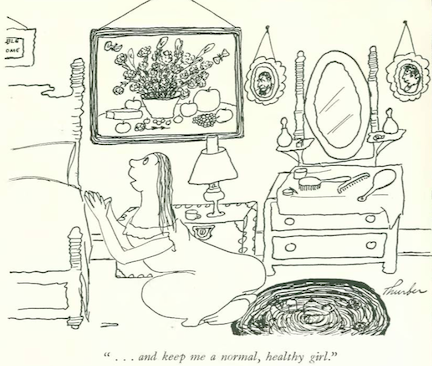
…and from James Thurber, this earnest prayer…
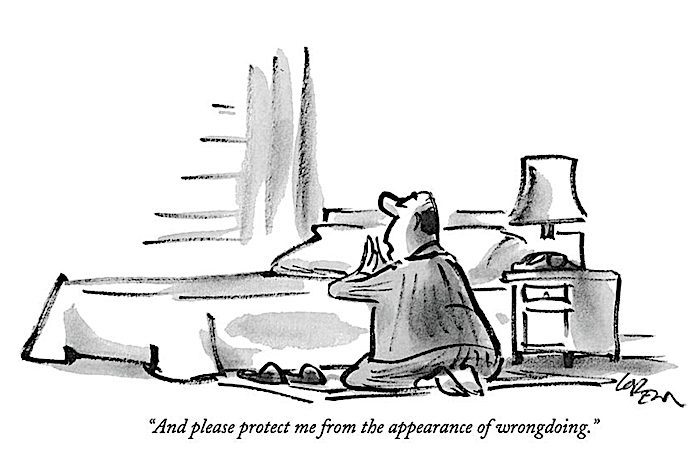
…and we close with another prayer-themed cartoon from Jan. 4, 1982—Lee Lorenz, who died Dec. 8 at age 90, joined the New Yorker staff in 1958, the same year his first cartoon appeared in the magazine’s pages. He also served as art editor (1973–1993) and cartoon editor (1993–1997) for the New Yorker. Michael Maslin penned an appreciation on his Ink Spill site.
…Happy Holidays one and all, as we end with this GIF from Disney’s 1933 short, The Night Before Christmas…
…and this scene from December 1933, when Rockefeller Center decided to make the Christmas Tree an annual tradition and held the very first tree lighting ceremony…
At left, image from December 1933—the very first tree lighting ceremony at 30 Rock, when the Christmas Tree became an annual tradition; at right, the tree on the Plaza in 1934, before ice skaters occupied the space. (rockefellercenter.com/Museum of the City of New York)
It’s hard to believe in this day and age that a theoretical physicist could enjoy rock star status, but then Albert Einstein wasn’t your everyday theoretical physicist.
Dec. 2, 1933 cover by Helen Hokinson.
A two-part profile of Einstein (1879–1955) by Alva Johnston (with terrific caricature by Al Frueh) examined the life and “idol” status of a man who would define the idea of genius in the 20th century. Although Einstein desired to live an almost reclusive existence at Princeton University, Johnston noted that he had become “fairly reconciled to the occupation of popular idol.”
Einstein was at Princeton thanks to the rise of Adolf Hitler, who came to power in Germany in early 1933 while Einstein was visiting the United States. Returning to Europe that March, Einstein knew he could not return to his home country (indeed, the Gestapo had raided his Berlin apartment and eventually seized all of his property), so when Einstein landed in Antwerp, Belgium on March 28, 1933, he immediately went to the German consulate and surrendered his passport, formally renouncing his German citizenship.
I’M OUTTA HERE…Albert Einstein with a Zionist delegation from France, Belgium, and England upon leaving the SS Belgenland in Antwerp, Belgium, 1933. (United States Holocaust Memorial Museum)
After some time in Europe and Great Britain, in October 1933 Einstein accepted an offer made earlier by from the Institute for Advanced Study in Princeton, New Jersey to serve as a resident scholar. When he arrived with his wife, Elsa, he said he would seclude himself at the Institute and focus on his teaching and research.
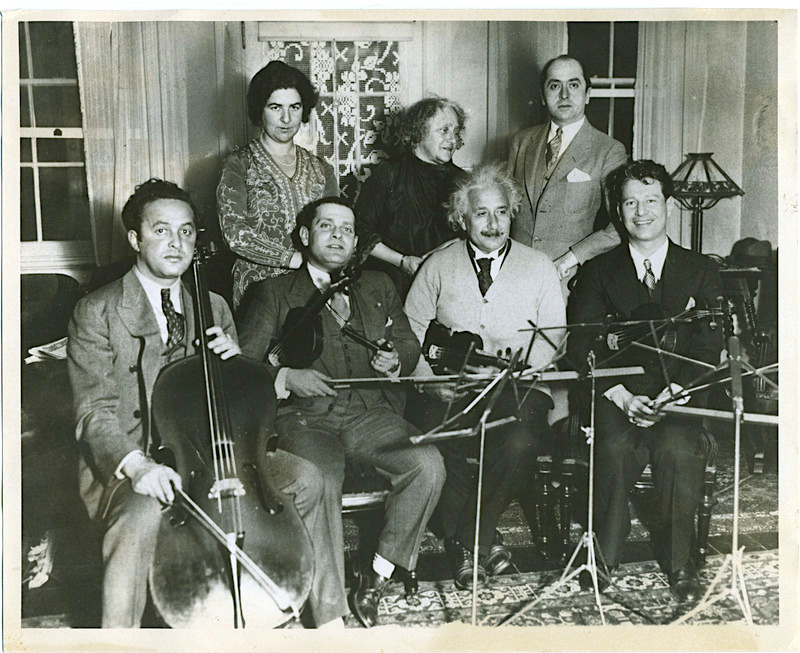
(NY Times, Oct. 18, 1933)EINSTEIN WASN’T FIDDLIN’ AROUND when he played his cherished violin—he once said that if he hadn’t been a scientist, he would have been a musician. This photo was taken at Einstein’s Princeton home in November 1933—he and fellow members of a string quartet were practicing for a December concert at the Waldorf-Astoria to raise money for German-Jewish refugees. From left to right, sitting: Arthur (Ossip) Giskin, Toscha Seidel, Albert Einstein, and Bernard Ocko; standing: Estelle Manheim (Seidel’s wife), Elsa Einstein and unidentified man. (Leo Baeck Institute)
* * *
Stop and Go
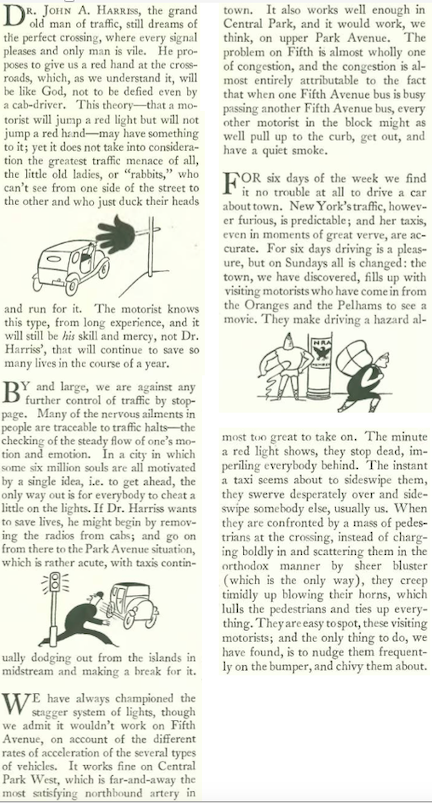
E.B. White devoted his “Notes and Comment” to Manhattan’s traffic situation, which he found manageable as long as tourists stayed out of the way…
White also noted the perils of Park Avenue, especially the taxi drivers (distracted by those newfangled radios) darting between the islands…
Park Avenue in the 1930s. (geographicguide.com)
…and then there was Fifth Avenue, notorious for traffic jams, made worse on weekends by the tourist traffic…
Fifth Avenue in 1932. (New York State Archives)
…later in “The Talk of the Town” White continued his thoughts on New York taxis, namely the introduction of coin-operated radios installed for use by passengers…
* * *
Fly Newark
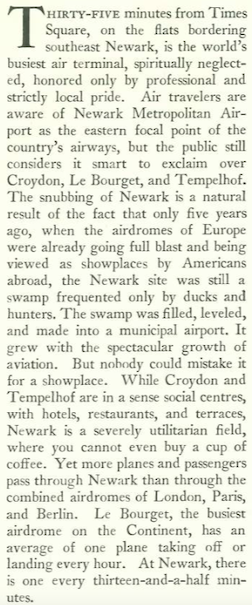
Albert L. Furth took us off the mean streets and into the air when he filed this account about the Newark Metropolitan Airport for “A Reporter at Large.” Furth seemed put off by the cachet of European airports and their many amenities, given that the Newark airport—although admittedly utilitarian—was the busiest in the world. An excerpt:
FREQUENT FLIER…Albert Furth noted that Newark Municipal Airport logged a landing or departure every thirteen-and-a-half minutes. Above, passengers boarding a Boston-bound American Airlines Condor at Newark Airport in 1930. In those simpler times, passengers just walked to the runway and climbed on board. The airport had opened two years earlier on 68 acres of reclaimed swampland along the Passaic River. It was the first major commercial airport in the New York metro area and the first anywhere with a paved runway. (njmonthly.com)
* * *
Goodnight, Speakeasy
Lois Long was an 17-year-old Vassar student when Prohibition went into effect in 1919, so when she started her career in New York in 1922 the only nightlife she knew revolved around speakeasies. Although she held Prohibition officers in disdain, she also believed that the repeal of the 18th Amendment would lower the quality of New York nightlife—the food, the “adroit service,” and the “genial din” of the speakeasy. Excerpts:
FROM LOUCHE TO LEGAL…Lois Long was saying a sad goodbye to her beloved speakeasies; perhaps the Algonquin Hotel (here, circa 1930) would offer some cheer. (Pinterest)
* * *
From Our Advertisers
Abercrombie & Fitch (then an outfitter for the elite outdoorsman) was offering holiday shoppers everything from multi-tool knives to cocktail shakers…
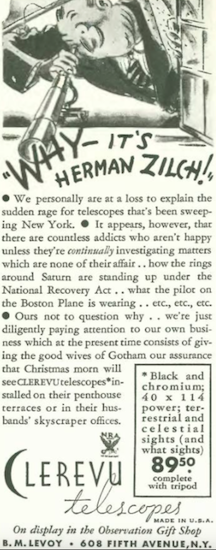
…while the folks at Clerevu telescopes found a growing market for folks who used their product for anything but stargazing…
…with Repeal just days away, the Pleasant Valley Wine Company of New York hoped folks would pop a few of their corks before the good stuff arrived from France…
…the British were coming to the rescue via the Berry Brothers, who were overseeing the importation of liquor from their offices at Rockefeller Center’s British Empire Building…
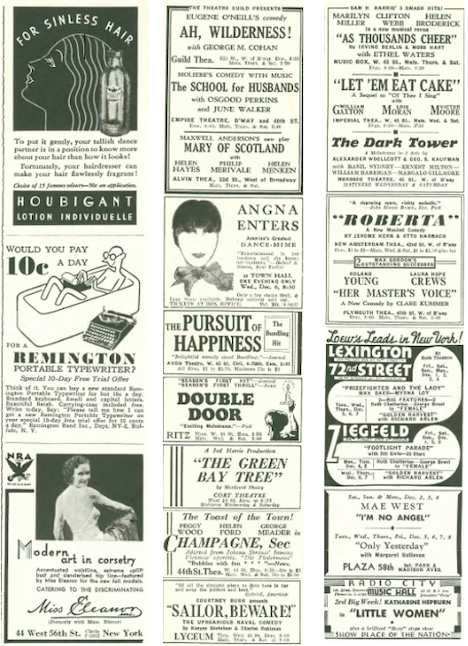
…let’s look at an assortment of one-column ads…the center strip features an ad promoting Angna Enters’ appearance for “one evening only” at The Town Hall (123 West 43rd Street)…Enters (1897–1989) was an American dancer, mime, painter and writer who likely performed her piece Moyen Age…
FEEL THAT STRETCH…Angna Enters performing Moyen Age, circa early 1930s. (NYPL)
…we begin our cartoons with Gardner Rea, and a dedicated bell ringer…
…Otto Soglow showed us a softer side of The Little King…
…Peter Arno revealed the human side of the posh set…
…and we close the Dec. 2 issue with this classic from James Thurber…
…on to Dec. 9, 1933, and a cover by an artist we haven’t seen in awhile, Ilonka Karasz…
Dec. 9, 1933 cover by Ilonka Karasz.
…and we open with this comment by E.B. White, who along with critic Lewis Mumford had once voiced displeasure over the massive Rockefeller Center project. However, while viewing the floodlit tower by night, he decided that he would have to eat his words, observing how “the whole thing swims up tremendously into the blue roxyspheres of the sky”…
MEA CULPA…E.B. White gained a new perspective on Rockefeller Center, pictured here in December 1933. (Wikipedia)
…we continue with White, who also offered his thoughts on something heretofore unthinkable—a proposal to start putting beer in cans…
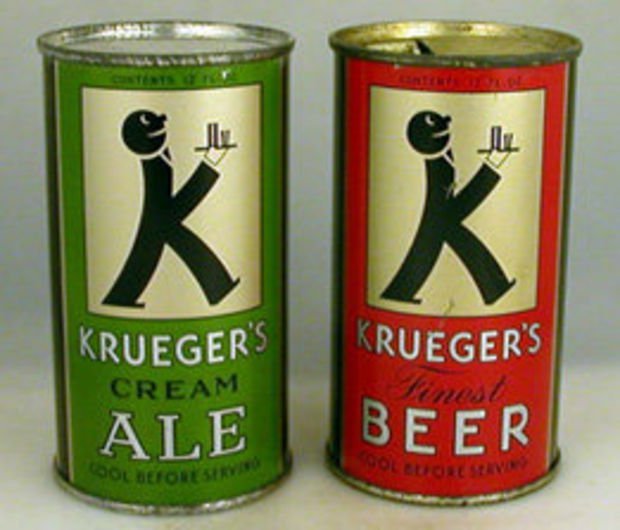
…it would happen about a year later…on Jan. 24, 1935, the Gottfried Krueger Brewing Company, in partnership with the American Can Company, delivered 2,000 cans of Krueger’s Finest Beer and Krueger’s Cream Ale to drinkers in Richmond, Virginia…
(seletyn.com)
…and despite White’s doubts, apparently ninety-one percent of the first drinkers of the product approved of the canned beer, although when Krueger’s launched their ad blitz they had to include instructions (and a new tool) to open the darn things…
(seletyn.com)
* * *
Dreamscapes
Critic Lewis Mumford offered his thoughts on a recent exhibit by a young surrealist named Salvador Dali…
MIDDLEBROW SURREALIST…The Triangular Hour by Salvador Dali, 1933. (wikiart.org)
…and we move along to moving pictures, where John Mosher was showing some appreciation for Joan Crawford (1906–1977) in the pre-Code film Dancing Lady…
SHE HAD IT ALL…Audiences and critics alike were wowed by Joan Crawford’s performance in Dancing Lady, which featured a star-studded and eclectic cast. Clockwise from top left, Clark Gable plays a Broadway director who becomes Crawford’s love interest; Crawford displays her dancing talent in a Broadway rehearsal; Dancing Lady featured an early film appearance by The Three Stooges, pictured here with Gable and the Stooges’ leader at the time, Ted Healy; Crawford with Stooge Larry Fine—in the original film, Fine completes his jigsaw puzzle only to discover (to his disgust) that it’s a picture of Adolf Hitler. The Hitler scene was removed by the Production Code; its enforcers claimed it insulted a foreign head of state. (IMDB)
In addition to Crawford, the star-studded cast included Clark Gable, Fred Astaire (in his film debut), Franchot Tone (who was married to Crawford from 1935-39 and made seven movies with her), The Three Stooges, Nelson Eddy, and Robert Benchley, who played a reporter in the film.
Dancing Lady was the film debut of Astaire, making Crawford the first on-screen dance partner of the famed hoofer…
(IMDB)
* * *
More From Our Advertisers
We begin with this full-page advertisement from Heinz, which went to great lengths and expense to make their ad appear to part of The New Yorker’s editorial content, even featuring a Perry Barlow cartoon of a boy making a mess with their product…
…another New Yorker contributor who occasionally went over to the advertising side was Alexander Woollcott, here shilling for Chrysler…
…Kayser, purveyor of women’s hosiery and underthings, was going for some humorous holiday cheer, but the effect is a bit unsettling…
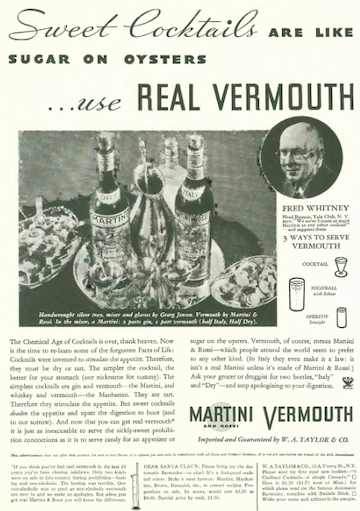
…liquor-related ads began to proliferate with the end of the Prohibition…this one from Martini & Rossi…
…Continental Distilling was hoping to grab its share of gin sales with its Dixie Belle American gin…
…from the same folks who brought us Fleishmann’s yeast (and kept The New Yorker afloat in its early lean years) came this American dry gin…
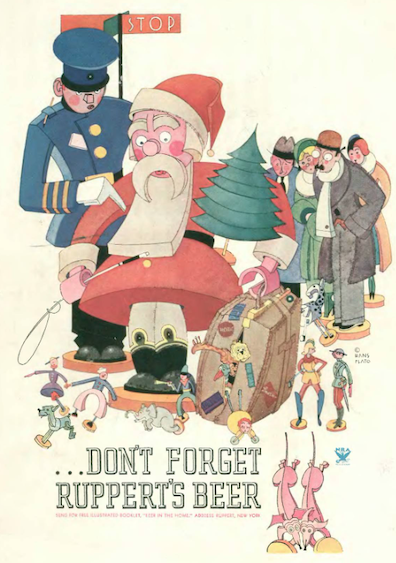
…Ruppert’s Beer was back with another full-page color ad by Hans Flato…
…on to our cartoons, and Santa again, this time besieged by an aggressive tot as rendered by Helen Hokinson…
…Carl Rose found an unlikely customer at a newsstand…
…here is the last of four cartoons Walter Schmidt published in the New Yorker between 1931 and 1933…
…Peter Arno left his glamorous world of nightclubs and high society parties to look in on life at a boarding house…
…and we close with the delightful Barbara Shermund…
British actor Claude Rains made his American film debut in a 1933 movie where the actor’s face isn’t revealed until the final scene.
Nov. 25, 1933 cover by Gardner Rea.
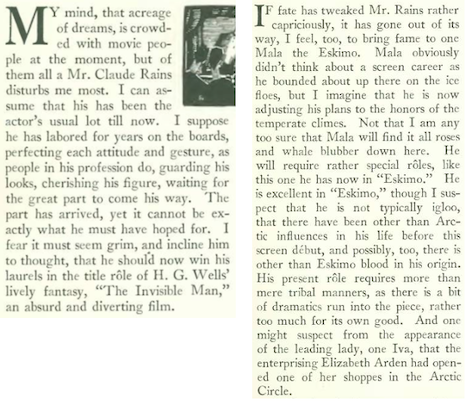
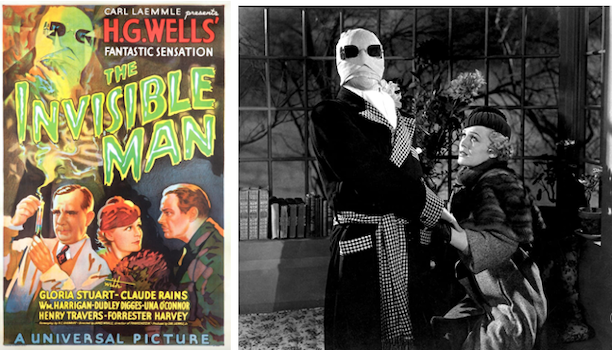
Although praised by critics in 1933 and today, The New Yorker’sJohn Mosher had but a paragraph to offer on the The Invisible Man, calling it a “bright little oddity” and an “absurd and diverting film.” Mosher also reviewed the Arctic adventure Eskimo, a film he found to be less than convincing about life on the frozen tundra.
FROM A TEST TUBE, BABY…Dr. Jack Griffin (Claude Rains) develops a secret formula that renders him invisible, much to the distress of his former fiancée Flora Cranley (Gloria Stuart). Some of you may recall Stuart from 1997’s Titanic, in which she portrayed the 100-year-old Rose. In real life Stuart had a career spanning nearly eighty years. And wouldn’t you know, she died in 2010 at age 100. (IMDB)NOW YOU SEE HIM…Special effects in 1933 were no mean feat. To create the effect of invisibility, Rains was covered head to foot with black velvet tights and wore whatever clothes he required for the scene. The invisibility scenes were then shot against a black set, the negative areas later manually masked to create the effect of invisibility. (IMDB)
…on to our other film, Eskimo…Mosher had doubts about the authenticity of the Eskimo family portrayed in the movie, suggesting (rather unkindly) that the lead actress, Lotus Long, looked like a client of the noted beautician Elizabeth Arden. The film was well-received by critics, but did poorly at the box office. However, it did receive the first-ever Oscar for Best Film Editing.
ICEBREAKER…Although MGM publicists portrayed Eskimo as a steamy love story set against a backdrop of adventure in the wild, the film was ahead of its time in some ways, including the use of Inuit dialogue, which was translated in English intertitles. Directed by W.S. Van Dyke, who also directed 1932’s Tarzan the Ape Man, the cast included (top photo, from left), Ray Mala and Lulu Long Wing (older sister of famed Hollywood actress Anna May Wong) with unidentified child actors. Bottom right, Mala with actress Lotus Long. (IMDB)
* * *
Numbers Racket
Little known today, the sliding number puzzle “Imp” was hugely popular in the late 19th and early 20th centuries. Plastic versions were produced following World War II—I recall one of them being quietly deployed from my mother’s purse during church, to keep me occupied during lengthy sermons.
* * *
Hammered and Sickled
“The Talk of the Town” commented on a Union Square riot in which American communists attacked a group of Ukrainians protesting the Soviet-imposed mass starvation in their country. Following is an excerpt from a longer piece that also noted the arrival of New York police, who “charged into the Square, riding their horses into the crowd and taking a crack at a head here and there.”
SEE NO EVIL…American Communists attack a group of Ukrainians protesting the Soviet-caused Holodomor famine in 1933, which killed at least four million Ukrainians. (Public domain)
* * *
Party Girl
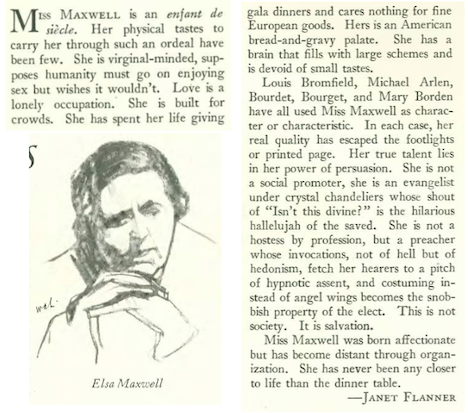
Elsa Maxwell (1883–1963) was an Iowa girl who grew up to become a gossip columnist and a hostess of high society parties—throughout the 1920s she was known for throwing lavish affairs for Europe’s wealthy and entitled. A 1963 Time magazine obituary noted that Maxwell developed a gift for staging games and diversions for the rich, making a living devising treasure-hunt parties, including a 1927 Paris scavenger hunt that created disturbances all over the city. Excerpts from a profile by Janet Flanner:
GETTING AN EARFUL…Elsa Maxwell hobnobbing with actress Constance Bennett and producer Darryl Zanuck in 1939. (Pinterest)
* * *
Masked Man
Novelist Sherwood Anderson offered his impressions of the late Ring Lardner in a piece titled “Meeting Ring Lardner.” Anderson wrote that although Lardner “seemed surrounded by a little halo of something like worship wherever he went,” he had no satisfaction in his achievements. Anderson recounted Lardner’s encounter with a shy banker, when for a moment Lardner dropped the “mask” that he often wore to shield himself from humanity. Excerpts:
SPHINX…Sherwood Anderson (right) wrote of Ring Lardner: “You wanted him not to be hurt, perhaps to have some freedom he did not have.” (AP/hilobrow.com)
* * *
Phooey on Huey
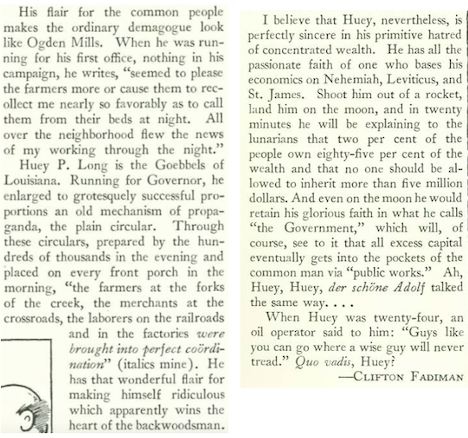
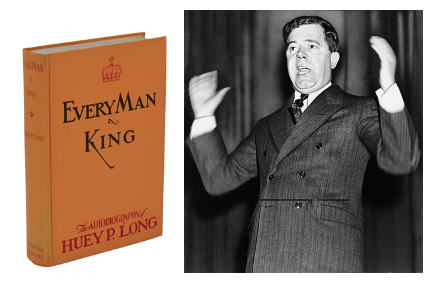
When Louisiana Senator and former Governor Huey Long published his autobiography, Every Man a King, the reaction from the press was resoundingly negative; in the Saturday Review,Allan Nevins wrote that Long “is unbalanced, vulgar, in many ways ignorant, and quite reckless.” The New Yorker’sClifton Fadiman went further, calling him the “Goebbels of Louisiana” and compared the senator to Adolf Hitler. Excerpts:
IT’S ALL ABOUT ME, REALLY…Huey Long’s 1933 autobiography, Every Man a King, was excoriated by the press, which largely viewed the senator as a fascistic demagogue. Long was assassinated in 1935. (Wikipedia)
* * *
From Our Advertisers
Christmas was coming, and parents with the means could consider buying a “Skippy” brand racer for their little tykes. The cartoon character at the top of the ad—Skippy—was the star of one of the most popular American comic strips of its day…
…written and drawn by Percy Crosby (1891–1964) from 1923 to 1945, the Skippy comic was a big influence on later cartoonists including Charles Schulz (Peanuts) and Bill Watterson (Calvin and Hobbes)…note the football gag below later made famous by Schulz’s Lucy and Charlie Brown…
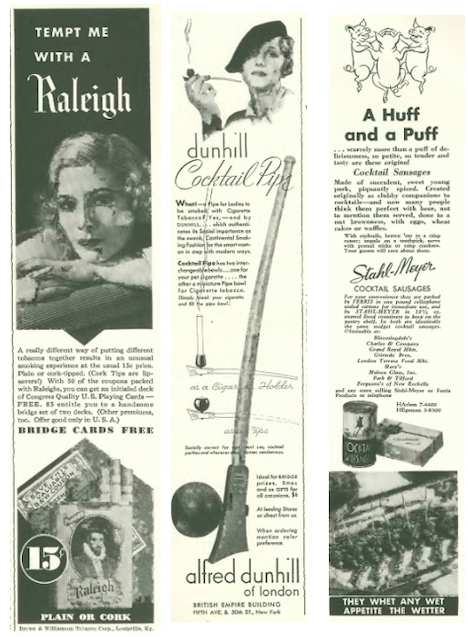
…on to some of our one-column ads…Raleigh cigarettes were promoted to the growing women’s market, while Dunhill touted a “cocktail pipe” that allowed women to get in on the fun of pipe smoking…and with Disney’s Three Little Pigs penetrating every nook and cranny of America, the makers of Stahl-Meyer sausages decided to join in the fun…
…I include this razor ad mainly for the bold typography…advertisers were in a transitional phase, experimenting with new forms and more white space, but still holding on text-heavy pitches…
…in the case of Goodyear, if you wanted to inspire confidence in your product, you propped an old codger in a rocking chair and offered some homespun wisdom…
…here is a closer look at the old-timer’s advice…
…another tobacco ad, this one displaying the glorious blooms of a tobacco plant…how could something so lovely be bad for you?…
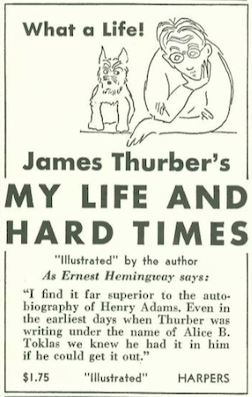
…a small back page ad announced a big-time book for James Thurber, including a satirical blurb from Ernest Hemingway…
…and that makes a nice segue to our cartoons, with Thurber again…
…Otto Soglow demonstrated the unexpected effectiveness of hair tonic…
…Perry Barlow gave us a look at the posh and precocious set…
…and we close with George Price, and 1933’s version of Black Friday…
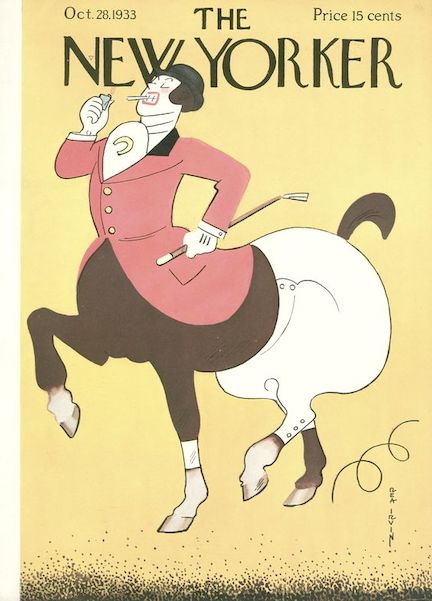
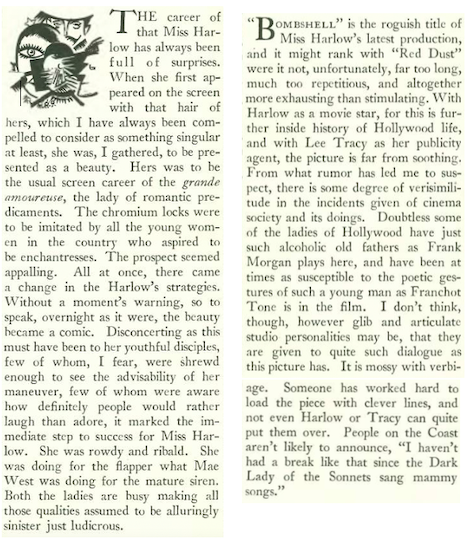
Much like Marilyn Monroe in the 1950s, Jean Harlow occupied a brief period in Hollywood history, but her star shone long after her untimely death.
Oct. 28, 1933 cover by Rea Irvin.
Adam Victor’s The Marilyn Encyclopedia draws all sorts of weird parallels between the actresses: both raised by strict Christian Scientists, both married three times, both left school at sixteen to marry their first husbands, both acted opposite Clark Gable in the last film each ever made. Most importantly, Monroe idolized Harlow, so it was no coincidence that she sported her own version of “platinum blonde” hair.
ART IMITATES LIFE…In 1958 Marilyn Monroe posed as Jean Harlow for photographer Richard Avedon in a Life magazine feature. (Flickr)
The term “Bombshell” was affixed to the 22-year-old Harlow after the 1933 film’s release, and was later used to describe Monroe and other sex symbols of the 1950s and early 60s.
Harlow’s character in Bombshell, Lola Burns, satirized the stardom years of the silent era sex symbol Clara Bow, who was director Victor Fleming’s fiancée in 1926. Although critical reviews were mostly positive, New Yorker critic John Mosher found the film “mossy with verbiage.”
TAKE A BOW, CLARA…Bombshell satirized the stardom years of silent era sex symbol Clara Bow, who was director Victor Fleming’s fiancée in 1926 (photo at left is of the couple on the set of 1926’s Mantrap); in BombshellJean Harlow portrayed a sex symbol who, like Bow, wanted to live a normal life. In real life, Bow made her last film in 1933 and retired to a ranch at age 28. (IMDB)
A STAR IS BORED…In Bombshell, movie star Lola Burns (Jean Harlow) dislikes her sexy vamp image and wants to live a normal life, but her studio publicist E. J. “Space” Hanlon (Lee Tracy) insists on feeding the press endless provocative stories about her. Clockwise, from top left: Lee Tracy and Louise Beavers in a scene with Harlow; Harlow and Una Merkel, who portrayed Lola’s assistant, Mac; Harlow in a scene with Mary Forbes, C. Aubrey Smith, and Franchot Tone; Harlow in a scene with Ruth Warren and Frank Morgan—the latter portrayed Lola’s pretentious, drunken father. (IMDB)
Harlow would die at age 26 on June 7, 1937. Her heavy drinking didn’t help, but neither did the misdiagnosis she received as her kidneys were rapidly failing. While filming Saratoga with Clark Gable, Harlow was stricken with what she believed was the flu, and her persistent stomach pain was misdiagnosed as a swollen gallbladder. Just two days before her death another doctor finally diagnosed her kidney disease, but in 1937 nothing could be done—kidney dialysis would not be available for another decade, and transplants would not be an option until the mid-1950s.
* * *
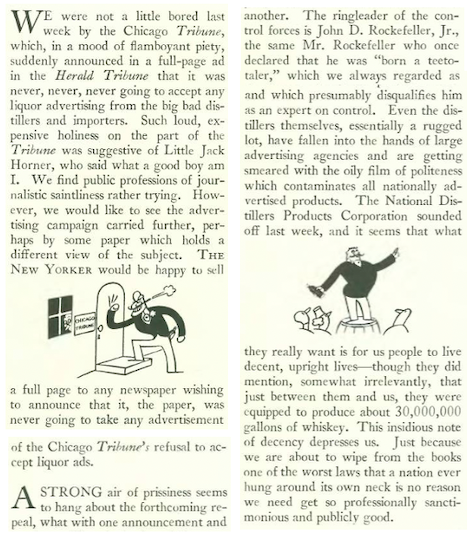
Second City Sanctimony
The New Yorker rarely missed an opportunity to take a dig at the square-toed ways of the Second City and its flagship newspaper, the Tribune. In his “Notes and Comment,” E.B. White (who enjoyed gin martinis) found the newspaper’s sanctimonious stance tedious:
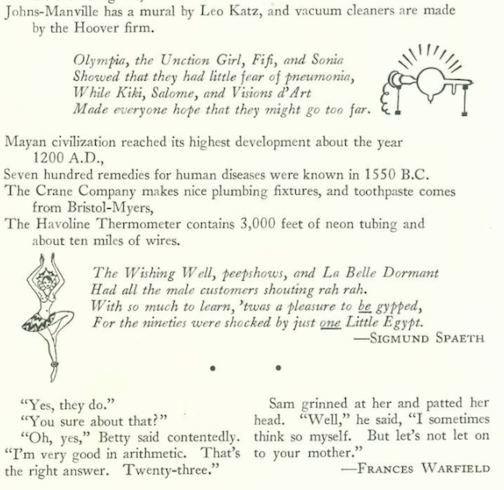
The 1933 Chicago World’s Fair, aka “A Century of Progress,” received scant attention from The New Yorker, unless it provided opportunities for parody. Musicologist Sigmund Spaeth (1885-1965), well-known in the 1930s and 40s for his NBC radio programs, offered this take on the Windy City’s exposition:
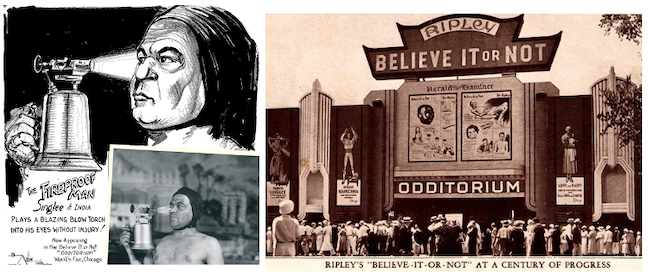
WONDERS NEVER CEASE…In addition to its more high-minded attractions, the Chicago World’s Fair also featured such sideshow attractions as Ripley’s Odditorium, which featured “The Fireproof Man” among other novelties. (pdxhistory.com)
* * *
Big, Bad Earworm
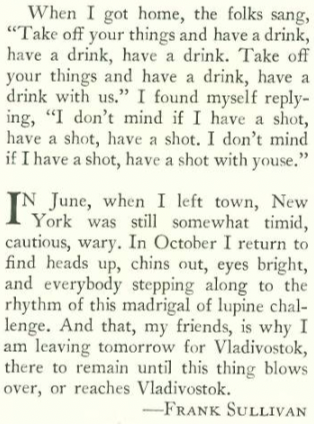
It seems quaint that nearly 90 years ago one of the most popular songs in America was “Who’s Afraid of the Big Bad Wolf?” To Frank Sullivan, there was no escaping “that lilting tune”…
SIMPLER TIMES…”Who’s Afraid of the Big Bad Wolf?” was a huge hit during the second half of 1933. One of the most well-known Disney songs, it was covered by numerous artists and musical groups.
Sullivan concluded that a trip to Vladivostok might be the only way to escape the catchy melody…
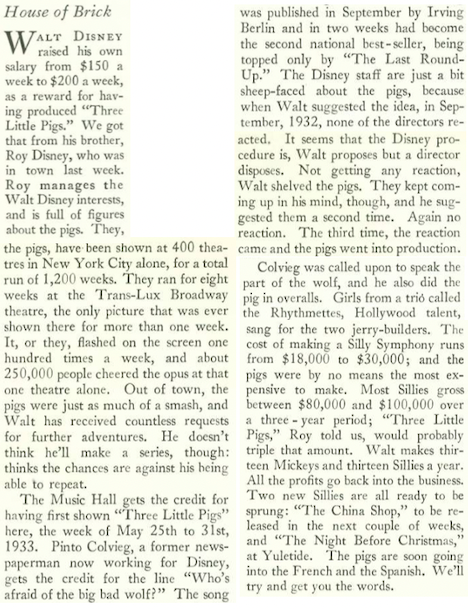
Briefly jumping to the Nov. 4 issue, “The Talk of Town” took a closer look at the song and the 1933 Disney Silly Symphonies cartoon in which it was featured—Three Little Pigs. Written by Frank Churchill and Ann Ronell, the song launched a market for future Disney tunes, with Irving Berlin securing the sheet music rights over Mickey Mouse and the Silly Symphonies.
WE’RE IN THE MONEY…The 1933 Disney Silly Symphonies cartoon Three Little Pigs helped to launch the Disney juggernaut nearly 90 years ago.
* * *
Polymath
Le Corbusier, aka Charles-Édouard Jeanneret (1887–1965), was known as a pioneer of modern architecture and design in the early and mid-20th century, but as this review by Lewis Mumford suggested, he was also a talented modernist painter.
WAYS OF SEEING…Le Corbusier’s early paintings followed the ideas of something he called “purism”—at left is an example from 1920, Still Life. Later on his work become more abstract, including Menace, at right, from 1938. The horse head in the painting seems to reference Pablo Picasso’s 1937 painting, Guernica. (Wikipedia/Art Basel)
* * *
Dear Papa
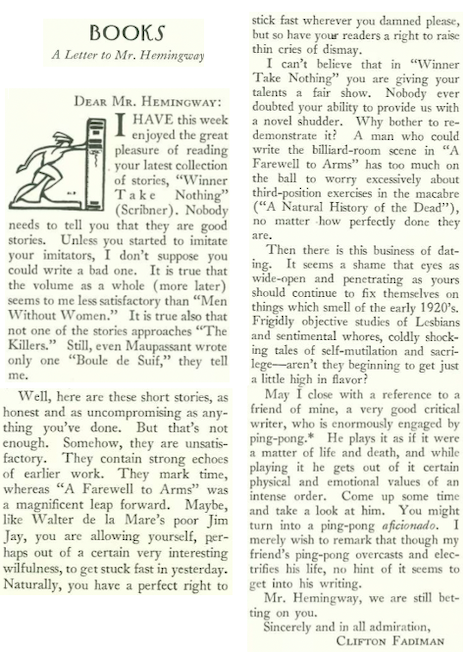
Following the high praise Ernest Hemingway received in 1926 for The Sun Also Rises, Dorothy Parker feared for the novelist’s next book: “You know how it is—as soon as they all start acclaiming a writer, that writer is just about to slip downward.” Seven years later Parker’s colleague Clifton Fadiman detected some slippage, finding Hemingway’s latest output a bit stale. Rather than pen a negative review, Fadiman shared his concerns by way of an open letter:
PHONING IT IN…Clifton Fadiman (right) found Ernest Hemingway’sWinner Take Nothing to be “stuck fast in yesterday.” (AP/Wikipedia/Pinterest)
* * *
From Our Advertisers
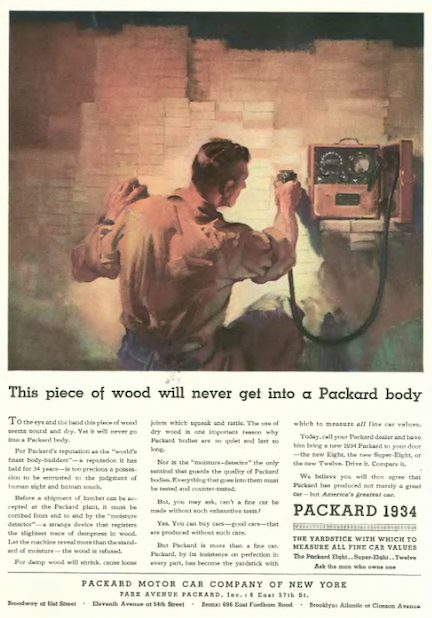
Until the 1920s all car bodies were framed in wood, preferably ash, but by the end of the 1930s all-steel car bodies became the standard…Packard made the switch beginning around 1938…
…ah, the good old days when you could smoke in the “rarefied atmosphere” of an airplane, the pilot so close by you could tap him on the shoulder…
…Brooklyn’s Hittleman-Goldenrod Brewery opened in late 1933 promising beer in the finest English tradition…sadly, it closed in 1937…
…the Waldorf-Astoria announced the re-opening of its Empire Room with entertainment by Xavier Cugat and his tango orchestra, featuring the dancer Margo…this was just the sort of “juvenile” entertainment Lois Long detested (see my previous post)…
…according to this ad, “His Lordship” drank a pot of decaf Sanka at midnight “and never winked an eye all night”…it doesn’t mention that he probably also wet the bed…
…on to our cartoons, we begin with Peter Arno and the woes of the monied classes…
…on to Helen Hokinson, and the charms of the precocious…
…Gardner Rea gave us a toff absorbed in historical fiction…
…Alain (aka Daniel Brustlein) offered up a flautist who found beauty in his routine life…
…and we close with Perry Barlow, and motherhood among the smart set…
Proposed by the 72nd Congress on February 20, 1933, the 21st Amendment to end national prohibition needed ratification from at least thirty-six states—by the end of October twenty-nine had ratified the amendment, and with passage seeming imminent…
Oct. 21, 1933 cover by Harry Brown.
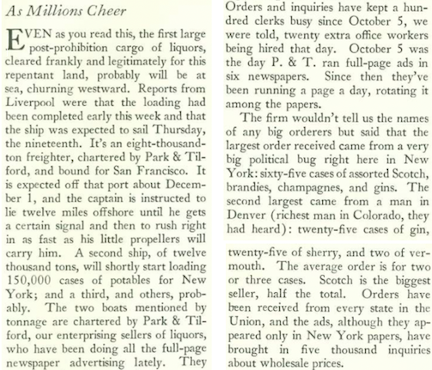
…Manhattan’s venerable grocer turned national wine and spirits distributor Park & Tilford began shipping tens of thousands of cases of “potables” to New York, according to “The Talk of the Town.” Excerpt:
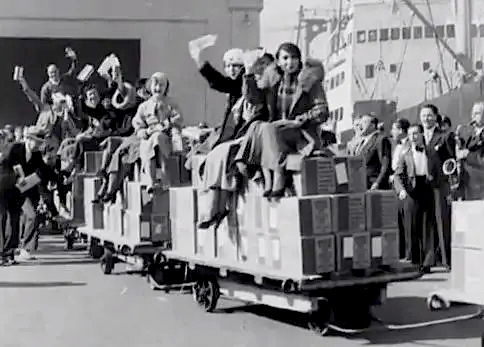
ON THE OFF WAGON…Parched, jubilant Americans ride on carts loaded with liquor prepared for distribution at the end of Prohibition. (Still from Universal News)
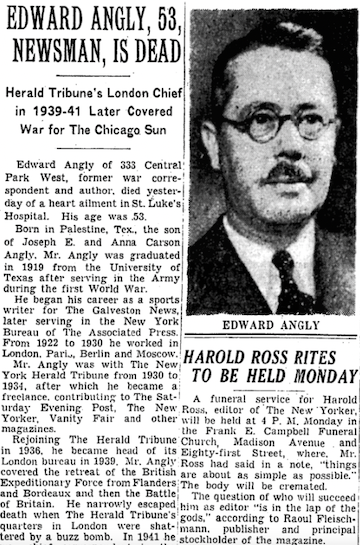
Edward Angly, who at the time was a journalist at the Herald-Tribune, tempered the celebratory mood in “A Reporter at Large” by considering the supply and demand issues (and higher prices) consumers would likely face upon ratification.
In early 1934 the Washington Post reported cocktail prices ranged from twenty-five cents (roughly $5.50 today) to forty cents. Whisky by the drink was selling from fifteen cents for blends to twenty-five cents for bonded varieties. One of the “higher priced” stores quoted a price of $3.80 for a quart of Four Roses (roughly eighty bucks today) while you could grab a quart of Crab Orchard straight Bourbon whisky for $1.40.
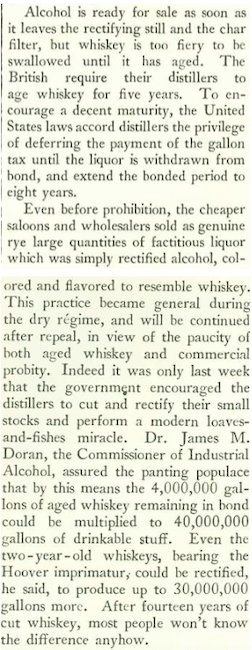
Until supplies could satisfy demand, distillers were encouraged to perform a “modern loaves-and-fishes miracle” and rectify their small stocks by cutting them with colored and flavored straight alcohol.
YOU CAN COME OUT NOW…With the end of Prohibition, bootleggers considered other career options. (floridamemory.com)
Who else would feel the pinch? In addition to the thousands of speakeasies that would close shop, legions of bootleggers would have to go legit or find another line of vice to keep themselves fed and occupied.
…before I close out this lead story, I came across this obituary for Edward Angly in the Dec. 8, 1951 edition of The New York Times. Note that this clip also features the funeral notice for New Yorker founding editor Harold Ross.
* * *
Name Your Fears
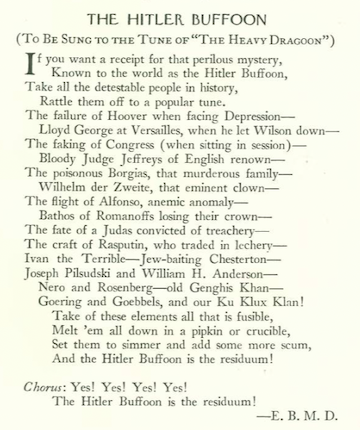
Irish writer and critic Ernest Boyd was for a time connected to the consular service and probably had a pretty good sense of what was to come in Europe. Turning to verse he pondered the origin of the Hitler curse.
* * *
Fat and Happy
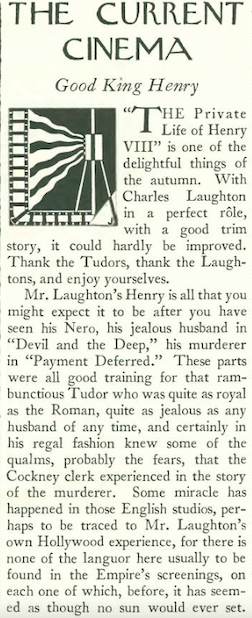
Premiered to record-breaking crowds at New York’s Radio City Music Hall, The Private Life of Henry VIII was a smash hit in both the UK and the US and established Charles Laughton as a box office star. Although the film played fast and loose with the historical record, it was a critical success for director/producer Alexander Korda. The New Yorker’s John Mosher was among those praising the British film.
SINKING HIS TEETH INTO A ROLE…Charles Laughton’s portrayal of Henry VIII in The Private Life of Henry VIII is credited with creating the popular image of the king as a fat, lecherous glutton. Top photo features Wendy Barrie as Jane Seymour (wife #3); below, Binnie Barnes as Katherine Howard (wife #5). (moma.org/tcm.com)
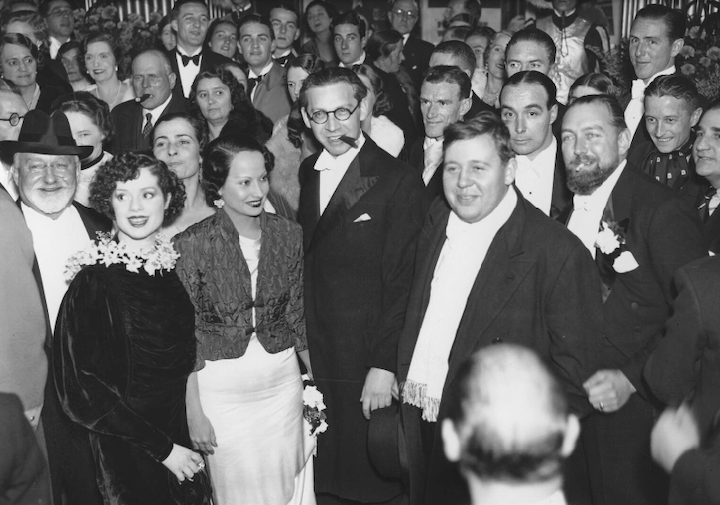
HAIL TO THE KING…Opening night in London for The Private Life of Henry VIII, Oct. 24, 1933. From left are Elsa Lanchester, who portrayed wife #4 Anne of Cleves; Merle Oberon (who portrayed wife #2 Anne Boleyn), producer/director Alexander Korda, and Charles Laughton. (Science & Society Picture Library / National Portrait Gallery, London)
* * *
Kid’s Stuff
In her latest “Tables for Two” column, Lois Long bemoaned the state of ballroom dancing, which seemed to be appealing more to juvenile tastes.
SUITABLE FOR ADULT AUDIENCES…Lois Long recalled the cool allure of dancers Leonora Hughes (at left, with dance partner Maurice Mouvet in 1924) and Irene Castle (in a 1929 photo). Both photographs by Edward Steichen for Vanity Fair. (Conde Nast)
* * *
From Our Advertisers
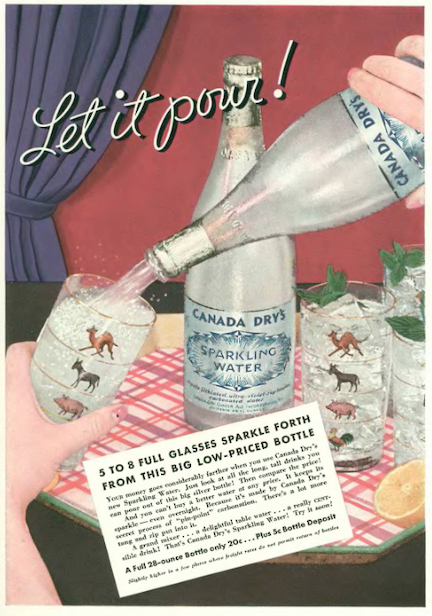
Let it pour indeed, as advertisers anticipated the end of Prohibition…
…Brooklyn-based Piel’s joined other brewers in targeting women as a new growth market, and as in previous New Yorker ads also appealed to those who fancied themselves among the smart set…
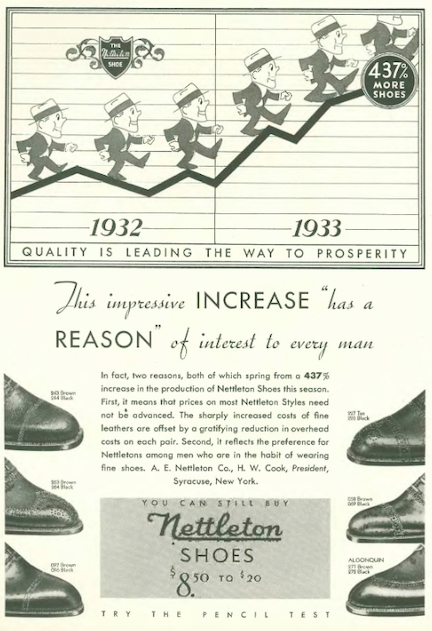
…looking for signs of optimism after four years of economic depression? Look no further than luxury shoemaker Nettleton…
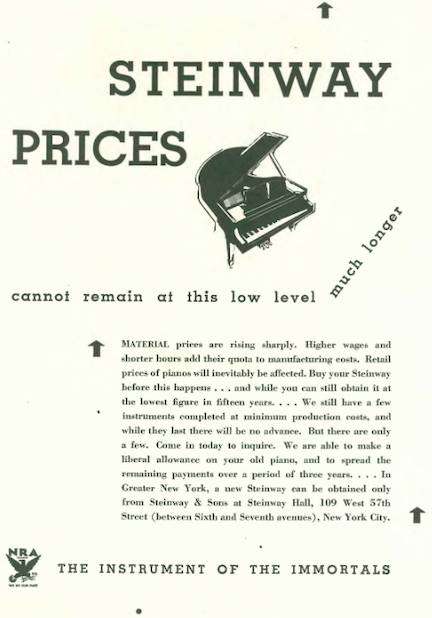
…while Nettleton held steady on its prices, the makers of Steinway pianos posted this gentle reminder about rising material costs, but what can you expect if you are purchasing “The Instrument of the Immortals”…
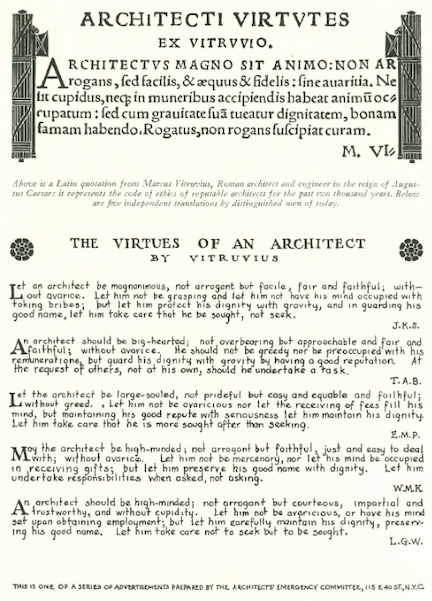
…the Architect’s Emergency Committee continued its campaign to promote the hiring of unemployed architects…in this ad the committee went back to the profession’s ancient origins, Marcus Vitruvius’Virtues of an Architect…
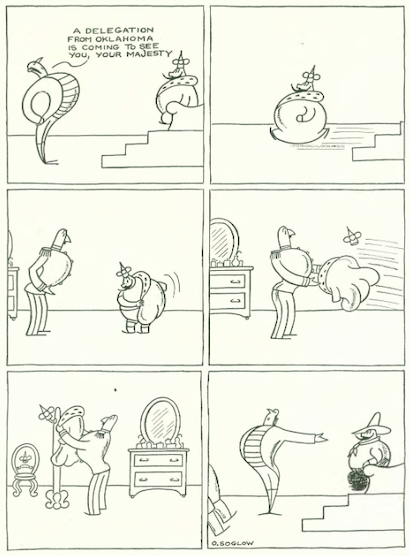
…on to our cartoonists, we begin with more adventures of The Little King, courtesy Otto Soglow…
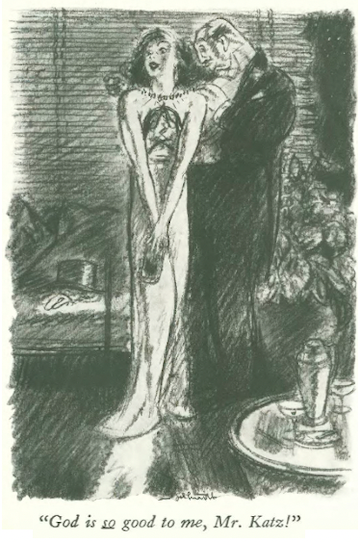
…William Crawford Galbraith was still stuck on his theme of seductive women either paired with sugar daddies or clueless suitors…
…speaking of clueless, James Thurber gave us this party pooper…
…Gardner Rea checked the economic temperature of the upper crust…
…and we close with William Steig, and an enterprising paperboy…



































































































































 A New Yorker State of Mind