Rumors of War

Above: German Panzer tanks on parade in the early 1930s. (alternativefinland.com)

The year 1933 marked a shift in the political winds, starting with Adolf Hitler’s rise to the chancellorship of Germany in 1933. By October he withdrew from the League of Nations and the Geneva Peace Conference, all the while clandestinely building up his war machine.

Sept. 16, 1933 cover by Harry Brown. The scene depicts the West Side’s infamous “Death Avenue,” where New York Central Railroad freight trains mixed with a jumble of automobiles, wagons and pedestrians amid factories and warehouses. Beginning in the 1850s “West Side Cowboys” rode in front of trains as a safety precaution. Still, there were hundreds of casualties until the rail was elevated in 1934—today’s High Line.

While some sounded alarms, most people, along with their nations, turned inward, focusing on domestic issues—FDR was busy with his New Deal agenda, Britain was dealing with its own economic woes, and Germany, Italy and Japan were keeping their populations in line by stoking the flames of nationalism. Few paid much attention to a 420-page book titled What Would Be the Character of a New War?, which accurately predicted the nature of the war to come. New Yorker critic Clifton Fadiman offered this sobering assessment (wryly titled “To the Gentler Reader”) of the work:

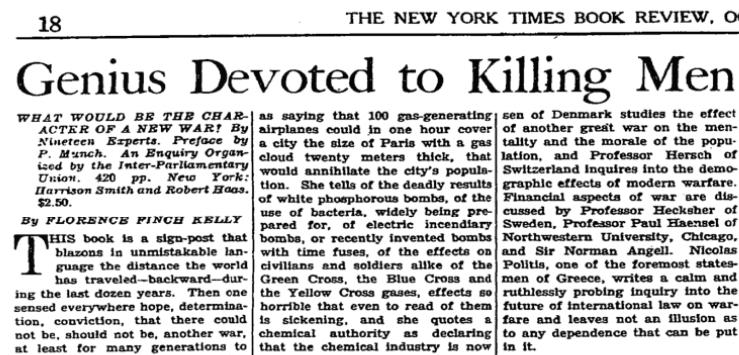
The book’s prescient warnings could be attributed in part to the experiences of the Inter-Parliamentary Union’s 19 authors—nearly half of them soldiers from Great Britain, Sweden, Germany and France, the others mostly scientists along with a statesman or two. In her Oct. 22, 1933, New York Times Book Review article, Florence Finch Kelly noted the authors’ general agreement as to the “utter uselessness” of international peace agreements. “This book is a sign-post that blazons in unmistakable language the distance the world has traveled—backward—during the last dozen years,” she wrote, concluding “the world very greatly needs this book…For it is the most ghastly, the most horrifying book about war that has ever been written.”
In my previous post we saw how H.G. Wells envisioned the next war, with destruction raining from the sky. So too was the conclusion of Inter-Parliamentary Union. Fadiman observed:

THEY LOVE A PARADE…Clockwise from top left: Adolf Hitler is cheered as he rides through the streets of Munich on Nov. 9, 1933; Hideki Tojo would be promoted to major general in 1933 and would go on to become minister of war and prime minister of Japan; the technologically advanced Heinkel He 111 was secretly produced as part of the clandestine German rearmament in the early 1930s; when he wasn’t busy murdering his own people, Josef Stalin (pictured here on Nov. 7, 1933) was implementing his Five-Year Plan. (The Atlantic via AP/Wikipedia)

The rumblings heard in Germany were also on the mind of Howard Brubaker, who made these observations in his column, “Of All Things.”

 * * *

Dining For Success

The Society for the Advancement of Better Living offered its own New Deal for Depression America—you could eat your way to better life. E.B. White noted the non-ideological nature of this new movement, where commies and capitalists could break bread together…

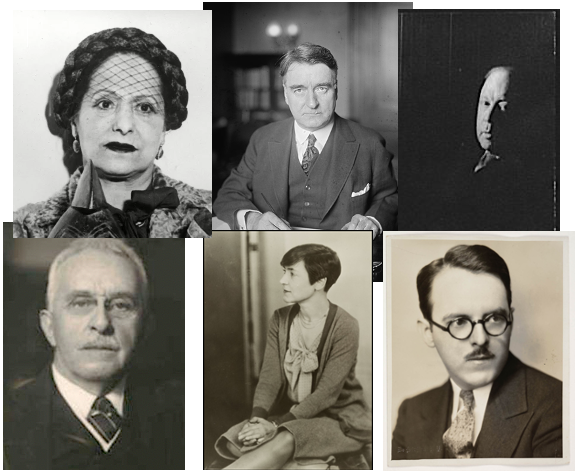
GUESS WHO’S COMING TO DINNER?…Hearty appetites make strange bedfellows, according to E.B. White. Clockwise, from top left, Helena Rubinstein, Dr. Royal Copeland, Robert Morss Lovett, C. Hartley Grattan, Suzanne La Follette, and Henry Goddard Leach. (Vanity Fair/Wikipedia/U of Nebraska)

 * * *

Bread & Circuses

“The Talk of the Town” looked in on the game of college football, which some college presidents annually decried for becoming a “great spectacle.” If they could have only known what was to come…

THE HOME TEAM…Clockwise, from top left: Columbia University’s Baker Stadium in the 1920s; Columbia’s president in 1933, Nicholas Murray Butler, considered something of a blowhard in his day; Columbia’s Hall of Fame coach Lou Little in 1930; Columbia taking on archival Cornell in 1930. The Columbia Lions were a power in the 1930s—in 1933 the Lions won the Rose Bowl, beating Stanford 7–0. (Columbia University)

 * * *

From Our Advertisers

The fine folks at Martini & Rossi were doing their part to get Americans ready for the end of Prohibition…

…meanwhile, the makers of Her Majesty’s perfume summoned the old and the new while also showing support for the New Deal (the NRA logo)…this image, however, doesn’t conjure up visions of “Tomorrow’s World”…

…and frankly neither does this tire, here linked to the wonders on display at Chicago’s Century of Progress…

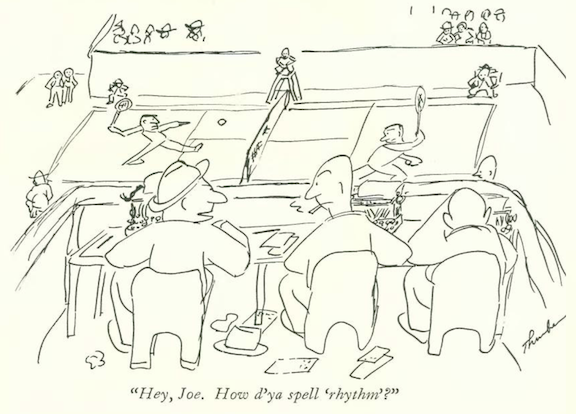
…on to our cartoons, we have two by James Thurber, beginning with this cryptic drawing…

…and later in the issue, a more familiar Thurber at play…
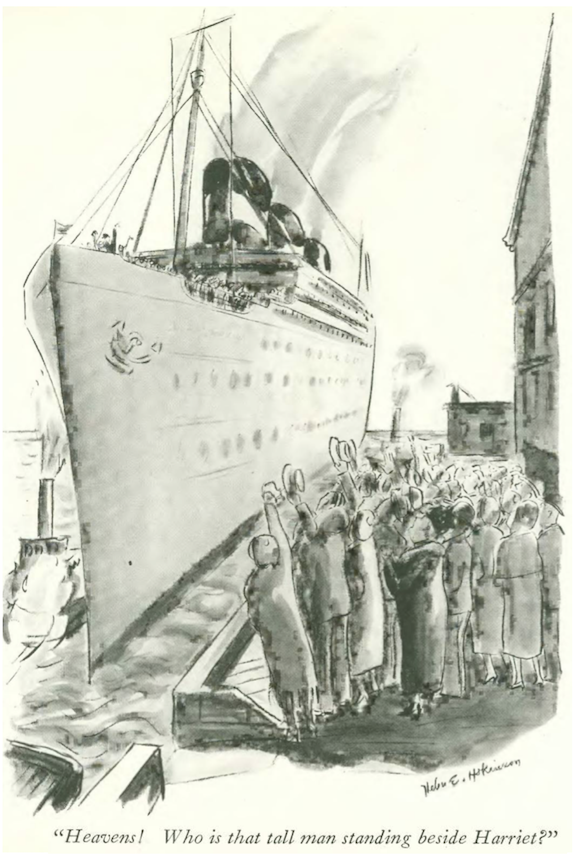
Helen Hokinson’s “girls” surmised a scandal aboard an incoming liner…
Henry Anton gave us a kindly pawn shop owner with a money back guarantee…on a pair of brass knuckles…

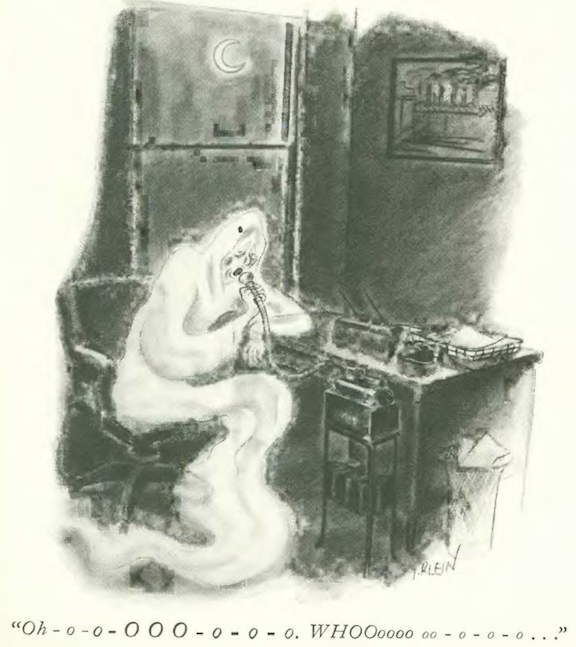
Isadore Klein conjured up a ghost who’d found a use for an executive’s wire recorder…
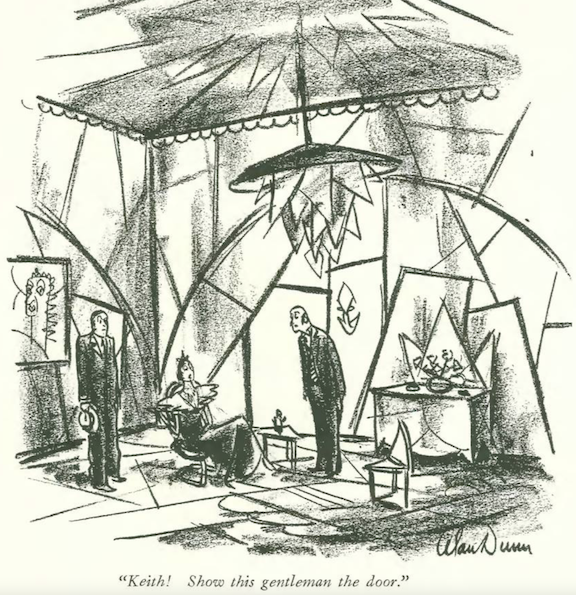
…and we close with Alan Dunn, and the perils of interior design…
Next Time: Music and Murder…
The Shape of Things to Come

Above: Maurice Passworthy (Kenneth Villiers) and Catherine Cabel (Pearl Argyle) prepare for a trip to the moon in Things to Come. (IMDB)

In his 1933 science fiction novel The Shape of Things to Come, H.G. Wells foresaw how an international economic depression could eventually lead to world war.

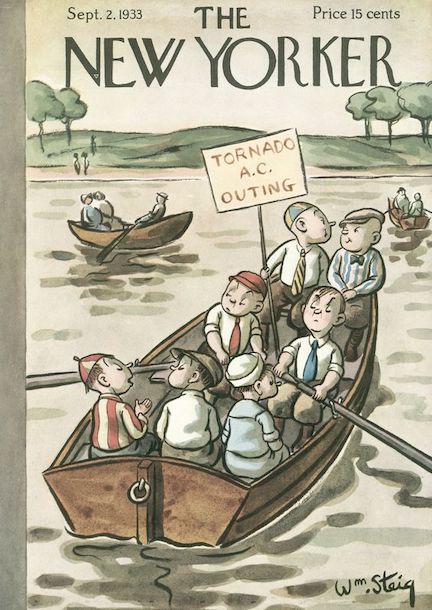
Sept. 2, 1933 cover by William Steig.

The book also predicted that such a war would feature whole cities destroyed by aerial bombing and the eventual development of weapons of mass destruction. However, New Yorker book critic Clifton Fadiman found Wells’ other predictions to be fanciful, “scientific-romantic” notions, such as a post-war Utopia (headquartered in Basra, Iraq, of all places) ruled by super-talents that would advance scientific learning in a world without nation-states or religion. And naturally everyone would speak English.

YOU MAY SAY I’M A DREAMER…H.G. Wells envisioned a world of war, pestilence and economic collapse that would eventually give way to an English-speaking Utopia free of nation-states and religion. (Wikipedia)

Three years later Wells would adapt his book to the screen in 1936’s Things to Come, produced by Alexander Korda and starring Raymond Massey as a heroic RAF pilot John Cabal and Ralph Richardson as “The Boss,” a man who stands in the way of Cabal’s utopian dreams.

FUTURE TENSE…Clockwise, from top left, H.G. Wells visits with actors Pearl Argyle and Raymond Massey on the set of Things to Come—Swiss designer René Hubert created the futuristic costumes; in the year 1970 RAF pilot John Cabal (Massey) lands his sleek monoplane in Everytown, England, proclaiming a new civilization run by a band of enlightened mechanics and engineers; city of the future as depicted in Things to Come; poster for the film’s release. (IMDB)

An afternote: A 1979 Canadian science fiction film titled The Shape of Things to Come was supposedly based on Wells’ novel but bore little resemblance to the book. The film is a considered a turkey, lovingly mocked by the same audiences that gave Plan 9 from Outer Space a second life.

WE MEAN YOU NO HARM…Actor Jack Palance—wearing what appears to be the top from a water cooler— headed a cast that included Barry Morse and Carol Lynley in 1979’s The Shape of Things to Come. 

 * * *

Fine Dining

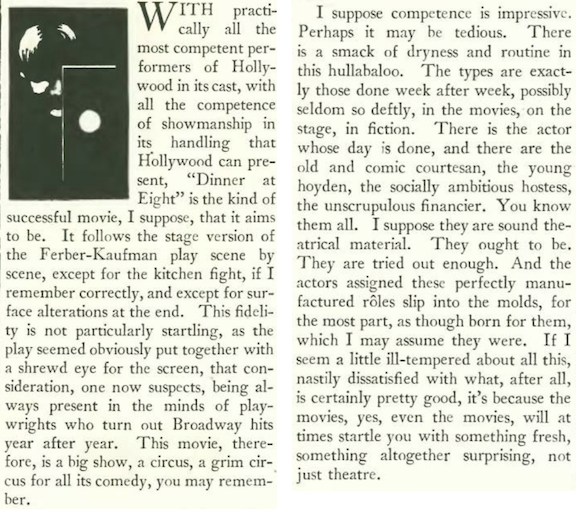
Director George Cukor turned a hit Ferber-Kaufman Broadway play into a hit movie by the same title when Dinner at Eight premiered in September 1933. While the film received high marks from leading critics, New Yorker film reviewer John Mosher found it a bit routine, if well-crafted:

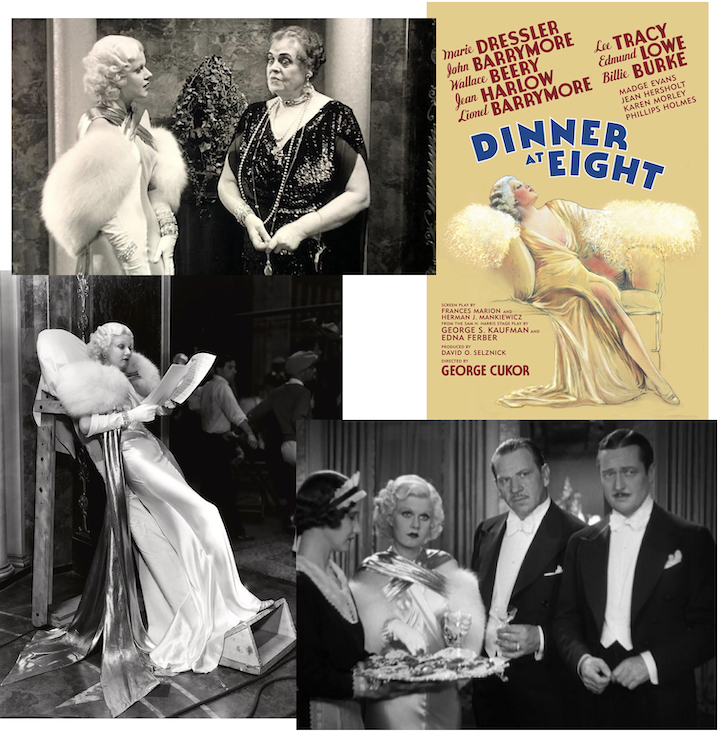
BLONDE ON BLONDE…Judith Wood (left) portrayed the character Kitty Packard in the 1932 stage production of Dinner at Eight; Jean Harlow took on the role for the 1933 film version. (IMDB)

Mosher, however, continued to admire the acting chops of veteran Marie Dressler

FUNNY LADIES…Clockwise, from top left: Jean Harlow and Marie Dressler square off in Dinner at Eight; movie poster highlights the “Blonde Bombshell” Harlow along with a star-studded cast; a scene with Harlow, Wallace Beery and Edmund Lowe; to avoid wrinkling her gown between takes, Harlow reviewed her lines in a special stand-up chair. (IMDB/pre-code.com)

 * * *

Madame Secretary

Secretary of Labor Frances Perkins was the first woman in the U.S. to serve as a cabinet secretary, but she was a lot more that—she was the driving force behind FDR’s New Deal. Here are excerpts from a two-part profile written by Russell Lord, with illustration by Hugo Gellert.

TRIAL BY FIRE…Frances Perkins watched in horror as young women leapt to their deaths in the 1911 Triangle Shirtwaist Factory fire—146 perished on that day Perkins recalled as the moment the New Deal was born her mind. In the wake of the fire Perkins, an established expert on worker health and safety, was named executive secretary of the NYC Committee on Safety. (trianglememorial.org/francesperkinscenter.org)

Even if some men couldn’t come around to a woman moving through the circles of power, Perkins had many admirers including prominent Tammany Hall leader “Big Tim” Sullivan.

Perkins’ appointment to FDR’s cabinet made the Aug. 14, 1933 cover of TIME magazine. (TIME/thoughtco.com)

 * * *

From Our Advertisers

Even the staid executives at Packard were getting into the modern advertising game, where sometimes the product itself was not even pictured…

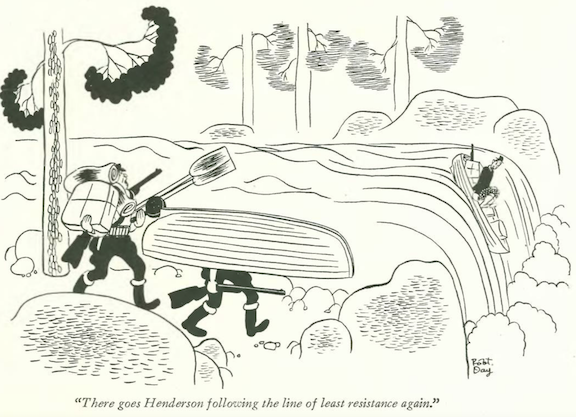
…our cartoonists include Robert Day

George Price

…and baring it all, Peter Arno

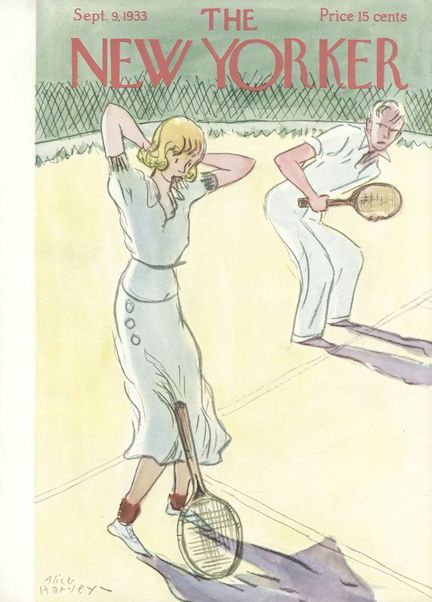
…on to Sept. 9, and what I believe is Alice Harvey’s first New Yorker cover…

Sept. 9, 1933 cover by Alice Harvey.

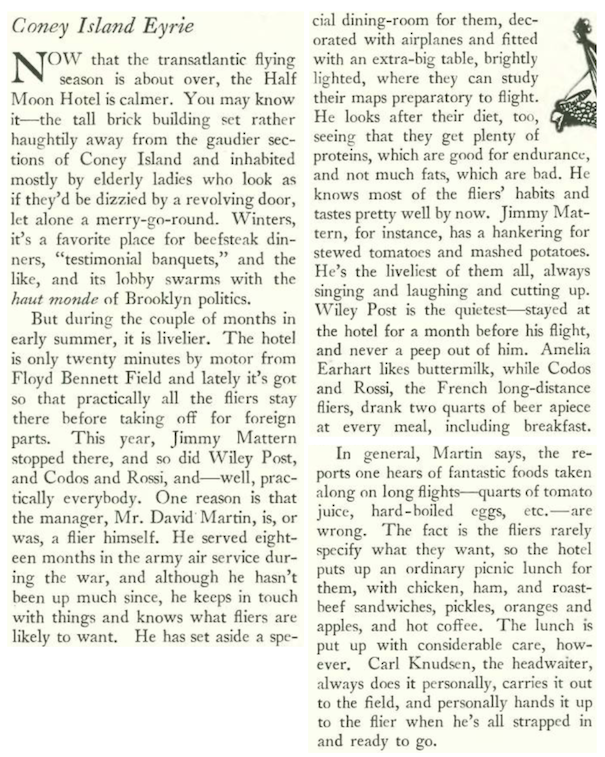
…and where “The Talk of the Town” paid a visit to the Half Moon Hotel on Coney Island, a favorite haunt of those magnificent men and women and their flying machines:

SHIFTING SANDS…Opened in 1927 to attract upscale crowds to Coney Island away from the rabble of the Midway, the elegant Half Moon Hotel started strong but teetered on the doorstep of bankruptcy during the Depression; it gained notoriety in 1941 when mob turncoat Abe Reles fell to his death from a sixth floor window while under police protection. The hotel was demolished in 1996. (Pinterest)

* * *

Huey In The News

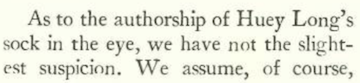
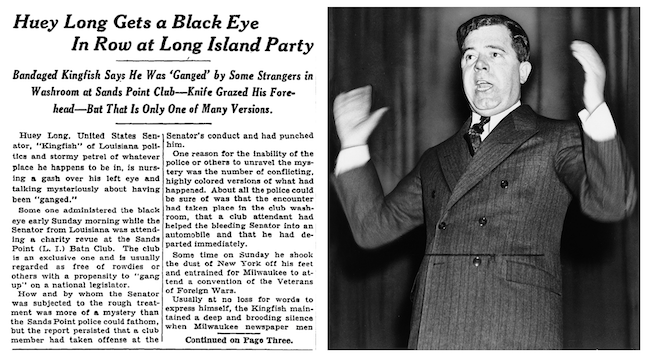
In his column “Of All Things,” Howard Brubaker offered this brief take on Huey Long’s visit to a Long Island party, where one guest apparently socked the controversial “Kingfish,” giving the former Louisiana governor (and then senator) a shiner.

A CHIP ON HIS SHOULDER?…Controversy followed Huey Long wherever he went. At left is a New York Times account of Long’s alleged black eye incident on Long Island. He would be assassinated two years later at the Louisiana State Capitol; Long circa 1933. (NYT/Wikipedia)

 * * *

More From Our Advertisers

As a follow-up from the previous issue’s Packard ad, this two-page spread showed us what those 1200 men were gawking at…check out that 12-cylinder model on the left, which appears to be better than 20 feet long…

…according to this ad, you could thank Camel cigarettes for getting the mail through the gloom of night…

…if you needed a cigarette to steady your nerves, you also needed fresh coffee to avoid being ostracized by your friends…

…summer-stock barn theatres were popular across America in the 1930s…this ad (illustrated by Wallace Morgan) hailed the end of the summer season and the return of “Winter Broadway”…

…on to our cartoons, out in the countryside we also find William Crawford Galbraith, here continuing to ply one of his favorite themes, namely pairing shapely seductresses and showgirls with clueless suitors…

Helen Hokinson gave us one woman who believed “what happens in the Riviera, stays in the Riviera”…

…and we close with Gardner Rea, and a scout troop on a mission…

Next Time: Rumors of War…