We lead off with a couple of winners from the Feb. 7, 1931 issue, beginning with a cover by Rea Irvin that takes measure of a lighter moment at the Westminster Kennel Club Dog Show.
Feb. 7, 1931 cover by Rea Irvin.
The 1930 Best of Show winner Pendley Calling of Blarney also took the top honor in 1931, giving the wire fox terrier back-to-back Westminster wins. Overall, terriers have dominated Westminster — wire fox terriers have won Best of Show fifteen times, with Scottish terriers a distant second, with eight wins.
TOP DOG…Pendley Calling of Blarney won back-to-back crowns in 1930-31 at Westminster Kennel Club Dog Show at Madison Square Garden. The dog’s owner, John Grenville Bates, mercifully retired the pooch after the ’31 win. (Westminster Kennel Club)STANDARD? WHO ARE YOU KIDDING?…Standard poodle Siba won Best in Show at the 144th annual Westminster Kennel Club Dog Show on Feb. 11, 2020, at Madison Square Garden. (Reuters)
The other winner was Cimarron, the first film to receive more than six Academy Award nominations, winning three including Best Picture (then called Best Production). It was the first Western to win Best Picture, and it would be nearly sixty years until another Western, Dances with Wolves, would take the top honor.
HE LOST HIS SHIRT, TOO…
Despite some “sagging moments,” John Mosher mostly lavished praise on the film, which was showing at the Globe Theatre:
THAT’S NO WELCOME WAGON…Clockwise, from top left, Yancey and Sabra Cravat (Richard Dix and Irene Dunn) join the 1889 Oklahoma Land Rush with their son, Cim (Junior Johnston); a less-than-friendly greeting at a boomer town; wagons line up for the big land grab; a young prostitute, Dixie Lee (Estelle Taylor), outwits Yancey for a piece of prime property. (IMDB)OH DEAR, THERE’S THAT LOOK AGAIN…Yancey (Richard Dix) takes it upon himself to establish order in the boomer town of Osage. On the bed are Yancey’s son, Cim (Junior Johnston) and wife Sabra (Irene Dunn). (IMDB)
* * *
Handy Painter
It is hard to imagine the struggles of one-handed painter José Clemente Orozco (1883-1949), who despite his handicap was able to complete huge murals in true fresco style (paint applied quickly on fresh, wet plaster), including five socially-themed frescoes at the Joseph Urban-designed New School. The murals included controversial depictions of Lenin and Stalin, but it wasn’t until the 1950s — during the McCarthy era — that school officials felt compelled to cover the images with a curtain. More protests followed, this time from faculty and students, and the curtains fell along with Joe McCarthy. “The Talk of the Town” looked in on the artist at work:
HE LOOKS FAMILIAR…José Clemente Orozco’s “The Struggle in The Occident”, 1930-1931, one of five frescoes at the New School. (Pinterest)
* * *
Prescience of Mind
News reporter and author Elmer Davis submitted this humorous piece to The New Yorker doubtless thinking how preposterous, and therefore humorous, the following notion would be (a brief excerpt):
* * *
Funny Cigarettes
In the early years of broadcast radio (and later TV) tobacco companies rightly saw a huge gold mine in radio show sponsorships. So when CBS radio executives accepted a sponsorship from Lorillard (the makers of Old Gold), they realized they had a challenge on their hands. “Talk” explained:
COUGH ME A MELODY…The makers of Old Gold cigarettes had CBS in their clutches in this September 1933 ad featuring bandleader Fred Waring and singer Babsie. (period paper.com)
…The above “Talk of the Town” item referred to the famous Murad ads illustrated by The New Yorker’s own Rea Irvin…
…while other advertisers were scaling back a bit due to the Depression, lovely full-color ads continued to flow from tobacco companies (and oil companies)…
…Pierce-Arrow was also known for its sumptuous ads, but they wouldn’t save the luxury car maker from going under by the mid-1930s…
…Some less expensive black and white ads, such as this hand-lettered ad from Stein & Blaine, could be quite charming…
…speaking of charm, this ad from Arthur Murray could have used a little of it…note the stern visage of the woman, described as “typical of Arthur Murray’s staff of expert teachers”…
…on to our Feb. 7 cartoons, we have one of Peter Arno’s stock characters, the Sugar Daddy, in an awkward moment at a costume party…
…Arno’s party looked a lot more lively than this affair, illustrated by William Crawford Galbraith...
…and Carl Rose gave us this pair, who seem to having the best time of all…
…Mary Petty eavesdropped on a guileless young woman…
…and Gardner Rea paid a visit to the Met…
* * *
On to our Feb. 14 issue, and Gardner Rea once more…
Feb. 14, 1931 cover by Gardner Rea.
The Feb. 14 issue featured a profile of actress Katharine Cornell (1893-1974), written by cultural critic Gilbert Seldes. The caricature of Cornell is by Al Frueh. Excerpts:
Promotional photograph of Katharine Cornell as Elizabeth Barrett in the original 1931 Broadway production of The Barretts of Wimpole Street. It was her most famous role. (Theatre Magazine, March 1931)
Cornell is considered one of the greatest actors of American theater, known for her eloquence and romantic stage presence. Seldes concluded:
* * *
Strange Bedfellows
In his column “Of All Things,” Howard Brubaker referred to an exchange between American capitalists and Soviet Russians that resulted in the rapid industrialization of the Soviet Union. That actual story behind this effort is pretty amazing.
* * *
Sneak Peek
Film critic John Mosher was so excited about Charlie Chaplin’s latest film that he offered this teaser to readers…
* * *
From Our Advertisers
We have this ad from the developers of the Empire State Building, which was being readied for a May 1931 opening…
…the Empire State Building was erected on the site of the old Waldorf-Astoria Hotel. The new Waldorf-Astoria, also completed in 1931, was located more than 15 blocks away from its original site. Both the Empire State Building and the Waldorf Astoria would become Art Deco landmarks, and both shared the distinction of holding world records: the Empire State was the world’s tallest building (a record it would keep until 1970), and the Waldorf would claim the title of the world’s tallest hotel (until 1963)…
…on to our cartoonists, we have Ralph Barton contributing one of his last illustrations to the theater review section…
…Richard Decker references a recent change in New York telephone numbers with this prison scene…
…Decker was referring to this bit of news, here interpreted by E.B. White in his Feb. 14 “Notes and Comment.”
…James Thurber returned with his second-ever stand-alone cartoon for the New Yorker…
…Garrett Price mined a theme that would become common in New Yorker cartoons: the tycoon vs. meek employee…
…Nancy Fay gave us a glimpse of the seamier side of family life…
Since I am posting this on the night before All Hallow’s Eve, let’s take a quick look back 89 years at Halloween 1930 through the pages of the Oct. 25, 1930 issue of The New Yorker…
…which featured a short story (excerpted below) by Sally Benson, who would write a series of shorts for The New Yorker in 1941-42 that were later published in her book, Meet Me in St. Louis. Note how Prohibition laws seemed to pose no obstacle to the Bixbys’ party plans:
Benson’s Meet Me in St. Louis would be adapted into a popular 1944 film starring Judy Garland. One of the film’s highlights featured the Halloween hijinks of Tootie and Agnes Smith (Margaret O’Brien and Joan Carroll).
BOO!…Margaret O’Brien and Joan Carroll go trick-or-treating in 1944’s Meet Me in St. Louis. (Comet Over Hollywood)
…Halloween revels were also popular with the college kids…
(Vintage Everyday)
…and of course Hollywood got in on the act, each studio issuing pinup-style images of major female stars to newspapers and magazines …
Clockwise, from top left, Bessie Love (ca. 1920s), a still from a 1933 Betty Boop cartoon, Anita Page, Joan Crawford, Clara Bow, and Myrna Loy. (Vintage Everyday/YouTube)
…the pages of the Oct. 25 issue contained other references to the holiday, including these Julian de Miskey spot drawings…
…and there were also ads offering both parties and party treats to those seeking some Halloween fun…
* * *
Not Exactly Whale Watching
On to our issues, the Oct. 15, 1930 edition featured a strange account (in “The Talk of the Town”) of a man who travelled the country with an embalmed whale carcass, which apparently drew large crowds wherever it was displayed.
Oct. 15, 1930 cover by Peter Arno. As I noted in my previous post, it seemed everyone was lighting up in the 1930s.
The account is disgusting on a number of levels (the last line: “People simply love whales”). During my research I learned that these “whale tours” continued into the 1970s.
SAVE THE WHALES…in this case, by pumping the animal with gallons of formaldehyde.
For further reading, author Lydia Pyne offers some history on this strange phenomenon at Not Even Past.
* * *
From Our Advertisers
The owners of the new Barbizon-Plaza Hotel at 106 Central Park South tried their best to lure the smart set (especially artists and musicians) to this “habitat” designed especially for them. Unfortunately, artists and musicians were as broke as everyone else, and the property was foreclosed on in 1933…
…and we have another appeal to the smart set, this one from the publishers of Vogue magazine (now a sister publication to the New Yorker, as both are now owned by Condé Nast)…
…and one more appeal to fashionable sorts, this time perfume in a bottle shaped like an art deco skyscraper…
…here is what one version of the bottle looked like in 1928, similar to ad above. According to the blog Cleopatra’s Boudoir, the We Moderns perfume was sold from 1928 to 1936 in bottles made in Czechoslovakia. The bottle below was made from glass, enamel (label), and the early plastic Bakelite (cover and base)…
(Perfume Bottles Auction)
…on to our color ads, I like this one because RCA induced the inventor of wireless radio, Guglielmo Marconi, to endorse their “Radiola”…
…and we have a beautiful illustration by Ellis Wilson for Dodge Boats…
…on to our cartoons, we begin with Denys Wortman…
…here’s the art of Rea Irvin on a full page…
…Helen Hokinson kept up the tradition of New Yorkers looking down on those backward Bostonians…
…Alan Dunn, illustrating the sunlamp fad of the 20s and 30s…
…and Jack Markow, checking on the progress of the Empire State Building…
On to the Oct. 25 issue, and the Broadway opening of the comedy Girl Crazy…
Oct. 25, 1930 cover by Rea Irvin.
…which featured Ginger Rogers and Ethel Merman introducing the many hits from George Gershwin’s score including “I Got Rhythm” and ‘Embraceable You.” The plot was simple: a young New York playboy is banished by his family to a dude ranch in Arizona to keep him out of trouble…where of course he finds trouble. The orchestra for the Broadway performance included such talents as Benny Goodman, Glenn Miller, Jimmy Dorsey, Jack Teagarden, and Gene Krupa.
THEY SEEM SANE ENOUGH…Above, poster for the Broadway musical Girl Crazy. Below, Ginger Rogers poses with fellow stage actors. (gershwin.com)
* * *
More from Our Advertisers
Ads from the Oct. 25 issue included this recurring one from the promoters of the Empire State Building, marking progress through various historical vignettes…
…the ad accurately depicted the building’s progress, measured against these images below…
…and we have more radio ads…no endorsement from Marconi here, but the makers of Fada claimed their receiver was far less annoying than their rivals…
…while Atwater Kent touted the convenience of its new “Quick-Vision Dial”…
…as I’ve previously noted, backgammon was all the rage in 1930, so much so that this clothier even advertised a special frock for the game…
…and what would the 1930s be without smoking tied to athletic prowess…
…and remembering friends and family in California in 2019 as they battle wildfires across that great state…
…on to our cartoons, Garrett Price introduced us to a man with a peculiar taste in pet canaries…
…Barbara Shermund illustrated the startling views afforded by rail travel…
…and Peter Arno leaves us in a moment of religious ecstasy…
The New Yorker had a number of favorite punching bags, among them Grover Whalen (1886–1962), a product of Tammany Hall politics who in 1928 was appointed New York City Police Commissioner by another Tammany alumnus, Mayor Jimmy Walker.
May 17, 1930 cover by Rea Irvin.
Ironically, a mayor known for openly flouting prohibition laws had placed into office a man who would become known as a ruthless enforcer of those laws (excepting Mayor Walker, of course). Whalen was also known for fighting crimes that didn’t necessarily exist, including those committed by “Reds” organizing protests by the city’s growing numbers of unemployed.
In the May 10, 1930 issue, New Yorker writer Alva Johnston penned a tongue-in-cheek assessment of America’s “Red Revolution” (see previous post). In the following issue (May 17), Morris Markey took a few swipes at Whalen’s “Crimson Menace” in his “A Reporter At Large” column:
FLYING HIGH…Mayor Jimmy Walker (second from left) and his new Police Commissioner Grover Whalen (far right) visit Mitchell Field on Long Island in 1928; portrait of Whalen circa 1930. (Amazon/WNYC)
Whalen’s career as police commissioner came to an end around the time Markey’s column appeared. Whalen was under fire for how his police responded to an International Unemployment Day demonstration, where 1,000 baton-wielding police went to work on a crowd of more than 35,000 demonstrators. The New York Times reported: “From all parts of the scene of battle came the screams of women and cries of men with bloody heads and faces.”
IDLE HANDS…The International Unemployment Day demonstration in Union Square on March 6, 1930, turned ugly when a thousand baton-wielding police went to work on the protestors, identified by the New York Times as “Reds.” (libcom.org/The New York Times)
And in the May 24 issue, E.B. White took his own swipe at Whalen in his “Notes and Comment”…
In ensuing years Whalen found more peaceful pursuits, serving as New York City’s official greeter of dignitaries and organizer of ticker tape parades. In 1935 he was named president of the New York World Fair Corporation and became the face of the forward-looking 1939 New York World’s Fair.
DAWN OF A NEW DAY was the opening slogan for the 1939 World’s Fair. At left, preparing to lower the fair’s time capsule into it’s 5,000-year resting place are A.W. Robertson, Westinghouse Electric Company’s chairman of the board (left) and Grover Whalen, president of the New York World’s Fair; at right, the fair’s iconic symbols, the Trylon and Perisphere. (heinzhistorycenter.org/Flickr-Ricksoloway)
* * *
It’s In The Stars
E.B. White led off his “Notes and Comment” with thoughts on the latest trends in product endorsement, including the use of astrology to boost the sales of toothpaste and perfume:
A FORTUNE IN TOOTHPASTE…The makers of Forhan’s Toothpaste promoted their Astrology Hour radio show in the Akron Beacon Journal, May 1931. At right, 1931 ad for Perfum Astrologique. (newspapers.com)THAT WAS THEN…White actors Freeman Gosden and Charles Correll portrayed Amos ’n’ Andy on the radio from 1928 to 1960. Here they shill for Pepsodent toothpaste on circa 1930 stand-up cards. (thetimes.co.uk)
* * *
More Advice on Troublesome Pets
The May 17 issue featured James Thurber’s latest advice on pet care:
…and this two-page illustration by Reginald Marsh ran along the bottom of “Talk.”
* * *
A Fighter for Rights
The May 17 issue featured the first installment of a two-part profile on social reformer Samuel Untermyer (1858-1940) titled “Little Giant.” The profile’s author, Alva Johnston, praised Untermyer’s legacy, and chided New Yorkers for not giving him his proper due. Known for defending the public trust against powerful corporations, he laid the groundwork in the U.S. for the Federal Reserve Law, the Clayton Anti-Trust Law, the Federal Trade Commission Bill and the Securities and Exchange Act. A fierce defender of Jewish rights, Untermyer served as attorney for Herman Bernstein, who filed suit against automaker Henry Ford for anti-semitic articles published in Ford’s Dearborn Independent.
Johnston concluded his two-part profile with these words:
BRING IT ON…Samuel Untermyer was known as a fierce defender of the public trust. At right, illustration that accompanied the New Yorker profile. (findagrave.com)
* * *
From Our Advertisers
Julian De Miskey picked up some extra work with this illustration for Macy’s…
…while in cartoons, Barbara Shermund discovered the challenges of exercise by radio…
…Helen Hokinson looked at another challenge…city driving…
…Gardner Rea explored the mysteries of street food…
…and Peter Arno greeted one Manhattan couple at sunrise…
* * *
On to the May 24, 1930 issue, with a lovely cover by Madeline Pereny…
May 24, 1930 cover by Madeline Pereny.
As construction continued on the Museum of the City of New York, The New Yorker’s architecture critic George Chappell liked what was taking shape:
THE STORY OF A CITY…The Museum of the City of New York opened its doors at 104th Street and Fifth Avenue in early 1932. (nyctourist.com/www.ennead.com)
* * *
From Our Advertisers
Travel by train in the States wasn’t always miserable as this ad attested…
…a bit of color courtesy the Lenthéric salon…
…Fontaine Fox, best known for his long-running Toonerville Folks comics, contributed this cartoon on behalf of Talon Slide Fasteners, or “zippers” as they came to be known in the late 1920s and early 30s, when they were still something of a novelty…
…I believe this is the first-ever image of the Empire State Building in The New Yorker, an artist’s rendering since the building wouldn’t be completed until the spring of 1931…note how this ad links the building’s site location to New York history and specifically the Astor family…
…here is how the Empire State Building looked in June 1930…
(New York Public Library)
…the old Waldorf-Astoria Hotel was torn down to make way for the Empire State Building, and that provides a nice segue to our cartoons…this one by Garrett Price featured a modest work crew contemplating the razing of a building that recalled the old hotel…
…across the pond, one of Helen Hokinson’s ladies was busy trying to procure a banned book…
…while William Crawford Galbraith gave us a young woman in search of a love song (with the help of a seriously timid man)…
…Barbara Shermund found some bedside humor…
…and Peter Arno took us back to the nightlife, with our familiar gold-digger and sugar daddy…
…and finally, over the course of twelve issues (Feb. 8 to May 10, 1930) Abe Birnbaum provided illustrations of New York’s “Restaurant Royalty.” These usually ran in or near “The Talk of the Town” section. Please click to enlarge.
Before we launch into the latest offering from Tinseltown, a note about the cover artist for the April 26, 1930 issue.
April 26, 1930 cover by Barney Tobey.
Barney Tobey (1906-1989) was known for gently humorous cartoons that appeared in The New Yorker for more than fifty years. He also contributed four covers, the first of which appears above. In the Sept. 21, 1998 issue, illustrator Richard Merkin offered this remembrance:
* * *
Star-spangled Banter
All-star musicals were all the rage in the early sound era, as they gave studios the opportunity to showcase contract players (who were virtually owned by the studios) doing things they usually didn’t do on screen. Following the success of MGM’s Hollywood Revue of 1929, Paramount Studios released Paramount on Parade in April 1930, much to the liking of New Yorker critic John Mosher, who also praised the film’s accompanying cartoon, 1929’s The Prisoner’s Song:
You can watch Max Fleischer’s The Prisoner’s Song here (and ponder how far animation has advanced)…
Mosher also praised a number of Paramount’s contract players, and especially actors Jack Oakie and Maurice Chevalier…
MUCH ADO…A great crowd gathers for the premiere of “Paramount on Parade” at the New York’s Rialto Theatre in April 1930. (cinematreasures.org)SEEING STARS…Clockwise, from top left, Helen Kane (possibly the inspiration for the cartoon character “Betty Boop”) and Jack Oakie do a little footwork; Clara Bow, Hollywood’s “It Girl,” pops through a Navy recruitment poster at the beginning of her song and dance number (with Stuart Erwin and Richard ‘Skeets’ Gallagher); one of Hollywood’s top actresses in 1930, Kay Francis, portrays “Carmen” in the revue; Ruth Chatterton entertains doughboys Stuart Erwin, Fredric March, Jack Oakie, and Stanley Smith in Paramount on Parade. (IMDB)BOOP GIVES A BOP…Helen Kane (left) and child star Mitzi Green in a sketch from Paramount on Parade. (IMDB)
* * *
Lost In the Crowd
In his “Notes and Comment,” E.B. White lamented the fact that the world’s tallest building appeared less than lofty, since neighboring skyscrapers were nullifying its grandeur:
DOWN IN FRONT…E.B. White found the streetview of the world’s tallest building wanting after it was completed in 1930; the iconic Flatiron Building, however, enjoys some elbow room even today. (spectator.co.uk/walksofnewyork.com)
* * *
Full of Hot Air
That was another opinion shared by E.B. White, this time regarding the Empire State Building’s top promotor, former New York Governor Al Smith, who spoke of plans to attach a mooring mast to the top of his skyscraper (which would eclipse the Chrysler as the world’s tallest in 1931):
* * *
View From the Top
The New Yorker featured a profile of Aloysius Anthony Kelly (1893?-1952), better known as the Roaring Twenties most famous pole-sitter, “Shipwreck” Kelly. He achieved his greatest fame in the 1920s and 1930s, sitting for days at a time on elevated perches — often atop buildings — throughout the U.S.
Kelly’s fame was already on the wane when this profile appeared, and by 1934 he was reportedly working as a dance hall gigolo. Kelly’s last flagpole stunt was at a 1952 event sponsored by a Lion’s Club in Orange, Texas — he suffered two heart attacks while sitting atop their 65-foot flagpole. After climbing down he announced, “This is it. I’m through.” He died one week later after he was struck by car on West 51st Street in Manhattan.
LOFTY AMBITIONS…Alvin ‘Shipwreck’ Kelly atop a flagpole near College Park, Maryland, in October 1942. At right, undated photo circa 1940s. (CSU Archives/Digital Commonwealth)
* * *
Brand X
Folks were still abuzz about the discovery of a ninth planet in the solar system, soon to be dubbed “Pluto” by an English schoolgirl. Howard Brubaker, in “Of All Things,” observed…
…and Carl Kindl illustrated the problem a new planet posed for astrologers…
* * *
I Beg Your Pardon
Will Rogers was a beloved comedian with a few rope tricks up his sleeve, but I’ve never known him for working blue. However, one critic for The New Yorker (“A.S.”– not sure who this is) found Rogers’ new radio show both humorless and gauche…
CAN YOU TAKE A JOKE?…In photo above, Will Rogers debuts his new radio show in April 1930. It would become the most popular Sunday evening radio show, and Rogers would prove to be the second biggest motion picture box office draw in the U.S. before his death in 1935. (Will Rogers Memorial Museum)
* * *
Before He Got Axed
Ten years before he was murdered by one of Stalin’s NKVD agents, Leon Trotsky published an autobiography that was written in his first year of exile in Turkey. The review is signed “G.H.” so I am assuming the author is Geoffrey Hellman, who contributed for decades to The New Yorker’s “Talk of the Town.” Excerpts from the review:
RED ALERT…Leon Trotsky wrote his autobiography, My Life, while exiled in Turkey. (Wikimedia)
* * *
From Our Advertisers
The makers of Bozart rugs and fabrics invited New Yorker readers to “introduce a breath of summertime indoors”…
…while Macy’s urged the same by gracing a sunroom or terrace with one of their Marcel Breuer-inspired chairs…
…Colonial Airways touted an early form of radar — an “invisible pilot” — as the latest safety feature in its airplanes…
…the Douglas L. Elliman company promoted its yet unbuilt River House, which would feature a pier where residents could dock their yachts…
The 26-story River House in the 1930s. Originally, the Art Deco building featured a pier where residents could dock their yachts, but that feature was lost with the construction of FDR Drive in the early 1950s, effectively sealing the building off from the water. The building has been home to author Barbara Taylor Bradford, US Secretary of State Henry Kissinger, and actress Uma Thurman. (observer.com)
…and then we have our more unfortunate ads, such as this one from Macy’s that shows grandpa passing along his racist tendencies to a grandchild…
…and this sad appeal from the makers of Lucky Strike to keep puffing and avoid that hideous double chin…
…our cartoons include Garrett Price and thoughts of spring…
…Barbara Shermund eavesdropped on tea time…
…Alice Harvey found an awkward moment in a hosiery department…
…Peter Arno revisits a familiar theme — chorus girls and sugar daddies…
…and Otto Soglow looked in on a fat cat’s moment of pride…
With the Chrysler Building nearing completion and the Empire State Building beginning to rise from the old Waldorf-Astoria site, the New York City skyline was taking on the iconic form most of us now associate with the city.
April 12, 1930 cover by Theodore Haupt.
Dubbed “hot jazz in stone and steel” by modernist architect Le Corbusier, the Chrysler Building’s gleaming spire beckoned The New Yorker’s E.B. White and real estate journalist David G. Bareuther (New York Sun) to its summit for a closer look…
BARE BONES…The spire in place atop the Chrysler building, the dome awaiting its metal skin. (skyscraper.org)WHAT LIES BENEATH…The stainless steel spire still gleams atop the Chrysler Building; beneath the spire, a maze of scaffolding — navigated by E.B. White and David G. Bareuther for their “Talk of the Town” piece, supports the upper portions of the building’s dome. (yahoo.com/nygeschichte.blogspot.com)THE HIGH LIFE…The Chrysler Building’s exclusive Cloud Club was located on the 66th, 67th, and 68th floors. At one time it was the highest lunch club in the world. It closed in 1979. (decopix.com)
If you want to get a sense of what E.B. White and David Bareuther experienced during their climb through the Chrysler’s dome, take a look at this video featuring American radio personality “Opie” (Gregg Hughes) and Hidden Cities author Moses Gates…
The article also noted that an “observation balcony” would be available for visitors to the 71st floor (actually an enclosed room inside the dome), but I’m sure the expectations for revenue fell quite short, given the competition it would soon receive from the much larger, higher, open air observation deck of the Empire State Building…
REACHING FOR THE STARS…When the Chrysler Building officially opened in 1931, visitors could go up to the 71st-floor observatory (in the dome) and view the city through its triangular windows. The observatory closed in 1945. (nygeschichte.blogspot.com)
…a bit of a digression, but I couldn’t help but notice the observatory’s resemblance to this set from the 1920 silent film The Cabinet of Dr. Caligari…
(silent-volume.blogspot.com)
…and here is a terrific graphic from Popular Science (August 1930) demonstrating how the spire, which was assembled inside the dome, was raised into its final position…
…and finally, some great archival footage documenting the achievement…
* * *
Tragic Theater
We continue our forays into the built environment of 1930 New York by looking at what was lost, including two beloved Broadway theaters. “The Talk of the Town” lamented the decline of the Garrick…
FINAL CURTAIN…Built in 1890 and originally named Harrigan’s Theatre, The Garrick closed as a playhouse in 1929. After a short run of burlesque, the building was demolished in 1932.
HEYDAY…Clockwise, from top left, circa 1910 postcard image of The Casino Theatre at Broadway & 39th; an audience on the Casino’s roof garden glimpses the performance below; interior of the Casino; the British musical comedy Floradora would become one of Broadway’s greatest hits — the New York production opened in 1900 and ran for 552 performances. (Museum of the City of New York )
* * *
From Jazz to Gothic
We return our gaze to the skies with three more new buildings reviewed by architecture critic George S. Chappell in his “Sky Line” column. He began with the Manhattan Towers Hotel, which thanks to the Depression would soon fall on hard times, going into foreclosure by October of 1931 and becoming a favorite gangster hideout (read more about the hotel at Daytonian in Manhattan)…
GOD AND MAMMON…Clockwise, from top left, the Manhattan Congregational Church in 1927. The church was torn down in 1928 and replaced by the Manhattan Towers Hotel at Broadway and 76th; the completed hotel, designed to wrap around the three-story Jones Speedometer Building, seen in the lower right of the photo; the first five floors of the building were dedicated to church use; after falling into disrepair, in 1980-83 the 626-room hotel was converted into 113 cooperative apartments. Note that the Speedometer Building still stands, sadly shorn of its ornamentation. (New York Public Library/Daytonian in Manhattan)
…Chappell also found much to admire in the new Fuller and Squibb buildings…
FULLER HOUSE…Clockwise, from top left, the 1929 Fuller Building was the third home of the George A. Fuller Company (its second home was the 1903 Flatiron Building); detailed views of the building’s tiled pinnacle and unique glass display windows that distinguish the building’s first six stories; an advertisement from the March 2, 1929 New Yorker that touted these gallery spaces for “superior merchandise”; detail of a coffered panel on an elevator door. (deskgram.net/nyc-architecture.com)Clockwise, from top left, entrance to the Squibb Building, now known as 745 Fifth Avenue; the cool white marble of the building’s base so admired by critic George Chappell; today, the building at dusk, the slender profile of 432 Park Avenue rising in the background. (OzBibliophile/paramount-group.com/landmarkbranding.com)
…From the Chrysler Building to the Fuller and Squibb, these new buildings, their architects, and the city’s ever-changing skyline were famously celebrated at the January 1931 Beaux Arts Ball…
HEADS IN THE CLOUDS…the Chrysler Building’s architect, William Van Alen (center), flanked by, from left to right, Stewart Walker (The Fuller Building), Leonard Schultze (The Waldorf-Astoria), Ely Jacques Kahn (The Squibb Building), Ralph Walker (1 Wall Street), D.E. Ward (The Metropolitan Tower), and Joseph H. Freelander (Museum of the City of New York). The New York Times referred to the group as “a tableau vivant of the New York Skyline.” (Van Alen Institute)
* * *
Quiet on the Set
The early days of sound movies created numerous challenges for directors who not only had to adjust the action to accommodate cumbersome microphones, but also to keep out unwanted noises or bad enunciation. “The Talk of the Town” explained…
CLOSETED…In the early days of the talkies, cameras had to be soundproofed in cabinets so their noisy motors would not be picked up by primitive sound equipment. (coloradocollege.edu/Library of Congress)
…Peter Arno illustrated the predicament of filming in nature in this cartoon from the April 5, 1930 issue…(caption: “Well, we can’t start till we get that robin out of there.”)…
* * *
One of Ours
In the story of The New Yorker, Alexander Woollcott and Marc Connelly were there at the beginning as founding members of the Algonquin Round Table and advisory editors to the first issues of the magazine. Basking in the success of his latest play, The Green Pastures (for which he would receive a 1930 Pulitzer Prize for Drama), Connelly was the subject of a April 12, 1930 profile titled “Two-Eyed Connelly,” which was written by Woollcott. Some excerpts, and a caricature by Al Frueh…
FAMILIAR WITH THE SUBJECT…Alexander Woollcott, left, explored the life of his old friend Marc Connelly in the April 12 profile. (goodreads.com/Fine Art America)
* * *
The Party is Really Over
Lois Long’s column “Tables for Two,” which in the 1920s was a must-read for those interested in Jazz Age night life, appeared intermittently in its last year, and its April 12 installment was not even written by Long, but by a writer who signed the column “F.D.” — I assume this is Fairfax Downey, who tried his best to capture Long’s style…
* * *
From Our Advertisers
Warner Brothers opened their pocketbooks to publicize John Barrymore’s latest film, The Man From Blankey’s, which the studio described as a “Modern High Hat Comedy”…
WHEN ALCOHOLISM WAS FUNNY…Loretta Young, John Barrymore and Angella Mawby in The Man from Blankley’s. (IMDB)
…Thanks to William Randolph Hearst and his King Features Syndicate, Robert Ripley, the P.T. Barnum of the funny pages, soared to fame in the 1930s with his “Believe It or Not” panel…here he begins his 14-year run on the radio…
HELLO SUCKERS…Robert Ripley in 1930 with a drawing of “the Horned Man of South Africa.” (RIPLEY ENTERTAINMENT INC.)
…and here’s an ad for another questionable but very American diversion — Fred Harvey’s “Indian Detours”…
WE’RE NOT IN KANSAS ANYMORE…The Fred Harvey Company was renowned for its chain of eating houses hosted by the famed “Harvey Girls” along the Atchison, Topeka & Santa Fe Railroad between 1876 and 1968. To encourage train travel (and Harvey business) in the Southwest, the Harvey company developed “Indian Detours.” The photo at left is of an “Indian Building” in Albuquerque, which featured displays of art and “live exhibits” that included Native Americans from many tribes around New Mexico. (santafeselection.com)EASY RIDER…1929 Cadillac Harvey Indian Detour Car outside La Fonda, Santa Fe. (Palace of the Governors photo archive)
…if you preferred to travel abroad, Texaco wanted you to know that you could still gas up with their product, even in distant Singapore…
…we begin our cartoons with the spare stylings of Gardner Rea…
…and Otto Soglow…
…we find one of Helen Hokinson’s ladies on her way to fitness…
…William Crawford Galbraith showed us an enterprising young man…
…Art Young illustrated the challenges of the lecture circuit…
…and one of my all-time favorite Peter Arno cartoons…
A host of nature programs from Mutual of Omaha’s Wild Kingdom to Planet Earth owe their origins to a few intrepid filmmakers who 100 years ago gave Americans some of their first glimpses of life in exotic, remote regions of the world.
Feb. 1, 1930 cover by Julian De Miskey.
Among the first to do it were a couple from Kansas, Osa and Martin Johnson, who together explored unknown lands and brought back footage of the wildlife and peoples of the African continent, the South Pacific Islands and British North Borneo. Their first film, Among the Cannibal Isles of the South Seas (1918), was followed by several more, including Across the World with Mr. and Mrs. Johnson, which was released in early 1930.
The New Yorker film critic John Mosher was as eager as any audience to take in the adventures of the Johnsons, or even of someone who was inspired by the Johnsons, in this case a “Miss O’Brien” who had just released a “diverting diary” called Up the Congo. Mosher wrote about it in the Jan. 25 issue:
CONTACT…Image of a family from an unidentified Pygmy tribe posing with a European explorer in a 1921 Collier’s New Encyclopedia entry; a group of Mbuti posing with explorer Osa Johnson in 1930. (Wikipedia)
I can find no record of the film UptheCongo, however the exploits of the Johnsons are well documented thanks to the Martin and Osa Johnson Safari Museum in Chanute, Kansas, which has a treasure trove of photos and other information on the explorers.
The ad in the Feb. 1, 1930 New Yorker promoting Across the World with Mr. and Mrs. Johnson included an interesting “added attraction”…a film about Einstein’s theory of relativity that had caused a Jan. 8 “riot” at the American Museum of Natural History. That particular screening was intended for members of the Amateur Astronomers Association, but word got out and three times the invited number showed up at the museum, breaking down the lobby gates. Hard to imagine a mob today clamoring to view a science film…
Although the Johnsons made their movies under the auspices of the American Museum of Natural History, much of the footage was staged or edited to maximize the thrills (Mutual of Omaha’s Wild Kingdom did this in the 1960s and 70s, as did producers of Disney’s nature films from the 50s and 60s. The practice continues to this day on cable television).
The Johnsons also didn’t hesitate to gun down animals in the course of their movie-making…
YEP, THAT’S JUXTAPOSITION…Osa Johnson poses with a Photoplay magazine, a dead rhino, and a tribesman, circa 1930. (columbia.edu)
According to a 2011 review from Wild Film History, “in stark contrast to the conservation-themed wildlife films of today, the Johnsons approached their subjects armed with both camera and rifle, with the production including provoked behaviour, staged confrontations and animals shot to death on film. Relying heavily on cutting in kills from professional marksmen, numerous hunting scenes culminate in a heart-stopping sequence where, with the use of clever editing, the adventurous Mrs Johnson appears to bring down a charging rhinoceros with one well-aimed shot.”
Across the World with Mr. and Mrs. Johnson is presented as if the Johnsons were showing their film to a few friends in their New York City apartment. The film is a “silent with sound,” that is, scenes in the field are silent, but the cocktail party “home movie” opening has sound, including “mood music” Osa provides by turning on the radio as the film begins. For all of their film experience, the acting between Osa and Martin is wooden, as is Martin’s narration. The critic John Mosher, however, enjoyed the ride, writing in his Feb. 1 column:
If you are curious, you can watch some of the film here, including the opening home movie scene with Osa and Martin in cocktail attire…
* * *
My Kinda Town
TheNew Yorker occasionally enjoyed taking potshots at the Second City, as well as some good-natured jabs at a few of its former residents who were also denizens of the Algonquin Round Table. Here is E.B. White in the Feb. 1 “Notes and Comment”…
WINDY WITS…Chicagoans Charles MacArthur, Ben Hecht and Ring Lardner were well-known to The New Yorker crowd. (Wikipedia)
* * *
Not In This Century
This item from the Feb. 1 “Talk of the Town” is noteworthy for placing its admiration of technical achievement over any concerns for a child’s welfare. Today the couple would be arrested for this…
* * *
ThePerilsofAging
Irish-American actress and writer Patricia Collinge (1892-1974) wrote a series of short stories for The NewYorker, including this piece for the Feb. 1 issue written when she was 37 years old. It is a sad story about an older actress (37) who hoped to land the part of a younger woman. Some excerpts…
…the actress in the story is led to believe the part was intended for a woman of 28, and is crushed to learn that the agent was looking for “a young twenty-two”…
OH TO BE YOUNG…At left, Gladys Cooper, Alexandra Carlisle and 20-year-old Patricia Collinge in the Drury Lane production of Everywoman (1912); at right, Collinge in 1941. Unlike the sad actress in her short story, Collinge’s career spanned more than 60 years. (Wikipedia)
* * *
ComingAround
In previous issues art critic MurdockPemberton expressed skepticism about the new Museum of Modern of Art, founded by wealthy society women in November 1929. Pemberton held egalitarian views about art, and wondered if the old money set could create a venue for true modern artists. His review of “Painting in Paris,” MoMA’s third exhibition, seemed to allay his concerns…
PAINTING IN PARIS was the title of the Museum of Modern Art’s third exhibition featuring works by Georges Braque, Georges Rouault, Pablo Picasso, Joan Miró, Marc Chagall, Robert Delauney, Fernand Leger, Henri Matisse and Andre Derain among others. Image above is from the original exhibition at MOMA’s first home in the Heckscher Building at 730 Fifth Avenue. (MOMA)
Images above in color, from left, Pablo Picasso’sGreen Still Life Avignon (1914) and Seated Woman (1927); Georges Braque’sStill life (1927). (MOMA/WikiArt)
Pemberton expressed enthusiasm for the show’s new works that contained few traces of the familiar…
* * *
The King’s Speech
KingGeorgeV was not known for his public speaking, but when he addressed the third meeting of the London Naval Conference it was a big deal, even to American listeners who for the first time heard his voice over broadcast radio, still a very new medium in 1930…
ON THE AIR…The voice of King George V (pictured here in 1923) was broadcast across the Atlantic for the opening of the London Naval Conference at St. James’s Palace in 1930. The third in a series of five meetings, the conference was formed with the purpose of placing limits on the naval capacity of the world’s largest naval powers. (Wikipedia/Churchill Archives Centre)
* * *
Good Clean Fun?
In his theater review column, RobertBenchley lamented the state of burlesque shows at the National Winter Garden, where “leviathans of an earlier day” were being displaced by “agile wisps” in third-rate Broadway productions…
ON THE SHOULDERS OF GIANTS…from left, Viola Clifton, a fuller-figured 1890s burlesque dancer; center and right, Margaret Bourke-White photos from Minsky’s National Winter Garden, 1936. Theater critic Robert Benchley wrote that he missed the “leviathans” of an earlier age, who were replaced by girls who were nothing but “agile wisps.”(mashable.com/theguardian.com)
* * *
From Our Advertisers
Just a couple of ads from the Feb. 1 issue, including this entry from the Shelton Looms offering advice on how one should appear among the Havana social set…
…and this ad from Harper’s Bazaar, also appealing to the smart set…
…our cartoons include this two-page illustration by ReaIrvin…
…AlanDunn’s look into the challenges of running a power plant…
…at the opera with PerryBarlow…
…GardnerRea and some bedroom hinjinks…
…man vs. mouse, by PeterArno…
…and this by LeonardDove, seemingly anticipating the work of CharlesAddams…
The cover of the Nov. 9, 1929 issue belied the mood of New Yorkers still reeling from the stock market crash. But then again, football games and other entertainments would grow in importance as much-needed distractions from the harsh realities that lay ahead.
Nov. 9, 1929 cover by Theodore G. Haupt. The title image is by James Montgomery Flagg, published in Life, November 15, 1929.
The New Yorker editors and writers were as bewildered as anyone in the aftermath of the crash. “The Talk of the Town” only gave it passing mention:
Robert Benchley, writing under the pseudonym “Guy Fawkes,” also looked at the market crash from the angle of the newspapers in “The Wayward Press” column. Naturally, Benchley tried to find humor in the midst of the disaster, noting that the crash provided some relief from tedious election coverage:
When the Nov. 9 New Yorker went to press, the stock market crash was viewed as a serious setback (in the sixth paragraph Benchley mentioned numerous reports of suicides), but not something that would result in worldwide depression. Indeed, much of the issue was devoted to lighter fare, including a rather lengthy piece in “Talk” about the latest craze among the nation’s youth — the yo-yo:
The Lumar 33, made of tin, was one of the original yo-yos produced by Louis Marx beginning in 1929. Hugely popular, it helped launch the Marx toy company empire. (WorthPoint)
BUT HE’S NO YO-YO…Louis Marx’s version of the yo-yo would help him launch a toy empire and land him on the cover of Time magazine, Dec. 12, 1955. (Time)
* * *
Just Wait Until They Get iPads
The New Yorker showed less enthusiasm for a plan by Fox studios to introduce talking pictures into schools, hospitals and churches. Writing for “Talk,” E.B. White observed:
TECHNOLOGY INVADES THE CLASSROOM…Left to right, a still from a 1930 educational film showing archeologist Earl Morris gluing together pottery shards at a dig near Mesa Verde National Monument; ca. 1932 title card for a science film; detail from a ca. 1930 educational film demonstrating the wonders of liquid nitrogen. (archive.org)
* * *
And Then There Was Light
The introduction of talking pictures in the classroom owed something to Thomas Edison (1847-1931), inventor of the incandescent light bulb and a pioneer in the development of motion pictures, among many other things. The invention of the light bulb was commemorated at a “Golden Jubilee” celebration in Dearborn, Michigan, and “The Talk of the Town” offered these observations on the occasion:
GIVING THEIR TWO CENT’S WORTH…Lights were ablaze in Dearborn, Mich., to commemorate the 50th anniversary of the light bulb’s invention. “Light’s Golden Jubilee” was staged by public relations guru Edward Bernays on behalf of General Electric; below, commemorative postage stamp for the occasion. (prmuseum.org/Wikipedia)
The jubilee was the brainchild of Edward Bernays (1891-1995), often referred to as “the father of public relations.” The author of the 1928 book Propaganda, Bernays worked for dozens of corporations, and is known for his efforts in 1929 to promote cigarette smoking among women (branding them “torches of freedom”). Ironically, a man that helped many women develop a habit that led to their early deaths himself lived to the ripe age of 103.
Albert Einstein sent his best wishes from Berlin via transatlantic radio (see below), and special guests at the Jubilee included Henry Ford and Harvey Firestone, seen here talking with the nearly-deaf Thomas Edison about the development of radio in this short “talkie” filmed at the Jubilee on Oct. 21, 1929:
* * *
Please Release Me
Nunnally Johnson (1897-1977) was a journalist and film critic before breaking into the movies himself in the mid-1930s as a writer, producer and director of such films as The Grapes of Wrath (writer, producer) and The Man in the Gray Flannel Suit (writer, producer, director). As a critic Johnson learned what he didn’t like, including Al Jolson’s The Singing Fool, an early talking film that featured Jolson crooning the tear-jerker hit “Sonny Boy” to child actor Davey Lee, who portrayed his dying son. Nunnally responded with this parody titled “Sonny Boy’s Diary.” Some excerpts:
HOLD THE SCHMALTZ, AL…Nunnally Johnson, left, parodied the sentimental scenes Al Jolson shared with child actor Davey Lee in The Singing Fool. Johnson would go on to become a successful screenwriter, producer and director. (in.bookmyshow.com/virtual-history.com)
* * *
Dream Space
New Yorker art critic Murdock Pemberton hailed the opening of a new museum, the Roerich, on the lower floors of the 27-story art deco Master Apartment Building. The building also housed the Master Institute of United Arts, founded in 1920 by Nicholas and Helena Roerich.
The art deco landmark Master Building on Riverside Drive (left, in 1929) originally housed the Roerich Museum in its lower floors. Today the Roerich is located in this brownstone at 319 West 107th. (Wikipedia)
FOOTNOTES FROM A FULL LIFE…Two of Nicholas Roerich’s paintings from the 1920s: at top, Remember, 1924; below, Drops of Life, 1924. (roerich.org)
* * *
A Tenor for the Times
The crooner Rudy Vallée (1901-1986) became an overnight sensation after his Oct. 24, 1929 debut on national radio. Already a popular New York bandleader (and sometime local radio personality), his appearance on NBC’s Fleischmann’s Yeast Radio Hour made him a national sensation, especially among young women. According to Ian Whitcomb in his book, The Coming of the Crooners, Vallée’s thin, wavering tenor was not well-suited to the stage (especially in pre-microphone days when booming voices prevailed) but it worked magic on the radio, soft voices ideal for this more intimate medium (Bing Crosby, Frank Sinatra and other popular crooners would soon follow). The New Yorker’s “On The Air” column (signed “A.S.”) had this to say about Vallée’s return:
BALM FOR WEARY SOULS…Rudy Vallée’s soothing voice and easy-going manner were just what the nation needed days after the stock market crash. According to Anthony Rudel of Old Time Radio, “At 8 pm on the night of October 24th, 1929, just after the ubiquitous Graham McNamee introduced him, Vallée became a national radio star.” It was the debut of NBC’s Fleischmann’s Yeast Radio Hour, which soon came to be known as the Rudy Vallée Show. (Fleischmann was also a major benefactor of the New Yorker). Photo at left, Vallée with McNamee; at right, child actor Dorothy Gray and Vallée in the comedy talkie, The Vagabond Lover (1929). (otrcat.com/IMDB)
A giant among conductors of the 20th century, Arturo Toscanini (1867-1957) was already well-known to live audiences in New York, having conducted at both the Metropolitan Opera and the New York Philharmonic. Unlike Vallée, the Italian conductor’s radio broadcast was limited to the range of the New York radio station WOR. Toscanini would make his national radio debut in the States in 1937, with the NBC Symphony Orchestra.
THE MAESTRO…Arturo Toscanini, renowned for his intensity and perfectionism, was said to have perfect pitch. After leaving fascist Italy in 1936, he became a household name across the US thanks to the NBC Symphony Orchestra’s presence both on national radio (beginning in 1937) and television (1948-1952). (Library of Congress)
The New Yorker also noted the successful transmission of three transatlantic broadcasts, including remarks spoken by Albert Einstein from Berlin to the Electric Light Golden Jubilee in Dearborn, Michigan:
RELATIVELY SPEAKING…Albert Einstein prepares to congratulate Thomas Edison via transatlantic radio on the 50th anniversary of the incandescent light bulb, Oct. 21, 1929. (UT College of Liberal Arts)
* * *
From Our Advertisers
Now that we are post-market crash, we will be seeing the effects of that crash on New Yorker advertisers. Here are three advertisers from the Nov. 9 issue not long for the world: from left, the high-fashion salon Stewart & Company would file for bankruptcy and go out of business by the spring of 1930; Pierce-Arrow, maker of rolling status symbols for the wealthy, ceased car production in 1933; Hanan & Son, a leader in the mass production of shoes, would go bankrupt and fold by 1935.
Already at this early date advertisers were responding to tightening belts — this appeal from the Cuban Tourism Commission offered “an opportunity to forget business” while traveling on the cheap…
…other ads were the usual fare, this one from Lux Toilet soap featured its latest young celebrity, Dorothy McNulty (1908-2003), who changed her name to Penny Singleton in 1937 before starring in more than two-dozen Blondie-themed comedies (based on the Chic Young comic strip) with co-star Arthur Lake (who portrayed Dagwood Bumstead). She dyed her naturally brunette hair (as seen in the ad) blonde for the first Blondie movie in 1938, and continued to do so for the rest of her long life. A career that truly spanned several generations, she also provided the voice for Jane Jetson in The Jetsons in its original airing in the early 1960s and in later revivals through 1990…
THE MANY FACES OF PENNY SINGLETON…At left, before she was the film star Penny Singleton,Dorothy McNulty was a popular star on Broadway, as this ad from the Nov. 9 New Yorker attests. At top, Singleton with Blondie co-star Arthur Lake in the first installment of that popular 27-film series, 1938; a still from The Jetsons 1962-63, for which Singleton provided the voice of Jane Jetson. (IMDB/Hanna-Barbera)
…on to other ads, the one on the left is another sad example of how manufacturers of spirits tried to market non-alcoholic versions of their libations to Prohibition-starved Americans (“especially distilled for the American market”)…at right, an ad from Knox hatters, with a somber rendering of a young woman (maybe she’s headed to the party in the other ad) wearing a fashion that would be popular in the early Thirties…the old flapper hat, along with the Jazz Age, was dead as a doornail…
…oh well, at least you could stay healthy by smoking lots of cigarettes…
…we’ve seen ads illustrated by other New Yorker cartoonists including Peter Arno, Rea Irvin, and Julian De Miskey;Helen Hokinson got in on the action with this ad touting G. Washington instant coffee…the first instant coffee to be produced on a mass scale, G. Washington was so well known it was referred to as a “cup of George.” The brand was discontinued in 1961…
…on to our comics, an awkward moment courtesy Peter Arno…
…W.P. Trent illustrated a backstage exchange regarding the ado over a popular dance troupe, the Albertina Rasch Girls…
…for reference…
MGM publicity photo from 1929 of the Albertina Rasch Girls, who traveled to Hollywood to appear in the Technicolor finale of the film Hollywood Revue of 1929. (dimitritiomkin.com)
…and John Reynolds explored the clash of the Old World and the New…
Almost ninety years after the lights went out on the Roaring Twenties, our collective imagination of New York City still harks back to that time…the sights and sounds of nightclubs and speakeasies and Broadway lights set to the tune of the Jazz Age.
Oct. 12, 1929 cover by Adolph K. Kronengold.
And no wonder, since that decade made the city what it is today. Changing social mores, along with labor-saving electrical appliances and the ubiquitous automobile, altered the tempo of life. And this quickened pace was also reflected in the built environment, old landmarks reduced to rubble while gleaming skyscrapers rose up in their place seemingly overnight. A Victorian edifice like the Waldorf-Astoria — little more than 30 years old — seemed positively ancient to Jazz Age New Yorkers, who unceremoniously knocked it down to make way for what would become the city’s most iconic landmark.
New Yorker architecture critic George S. Chappell (aka “T-Square”) sensed that something big was on the horizon with his regular “Sky Line” updates on the city’s “tallest-building-in-the-world” contest. In the Oct. 12, 1929 issue he looked on admiringly as the Chrysler Building’s distinctive dome began to take shape:
IT’LL BE A SURPRISE…The Chrysler Building still lacked its gleaming art deco dome in this photo taken in the fall of 1929. At left is the Chanin Building, completed earlier that year. (reddit/adamunderhill.wordpress.com)
Chappell observed that the Chrysler Building’s claim as the world’s tallest would be short-lived, as plans for the Waldorf-Astoria site called for a much taller structure…
DOOMED…The old Waldorf-Astoria hotel (left), completed in 1897, was scarcely more than 30 years old when it was demolished to make way for the Empire State Building. The former governor of New York, Al Smith (inset) led the corporation that knocked down the old hotel and erected the world’s tallest building on the site. Demolition of the hotel began on October 1, 1929 (images at right). In his 2014 book The Empire State Building: The Making of a Landmark,John Tauranac observes the demolition was an arduous process, as the hotel had been constructed using more rigid material than what was found in earlier buildings. Those materials — granite, wood, and metals such as lead, brass, and zinc — were not in high demand. Most of the wood was deposited into a woodpile on nearby 30th Street or burned in a swamp. Other materials, including the granite and bronze, were dumped into the Atlantic near Sandy Hook, NJ. (New York Historical Society/New York Public Library Digital Gallery)RISING FROM THE RUBBLE…The Empire State Building under construction in 1930. When completed in 1931, the 1,250 foot (1,454 with antenna) building would claim the title as the world’s tallest. It was something of a definitive victory, as the building held that record for nearly forty years. (Museum of the City of New York)
Although Al Smith’s building seemed assured to win the “world’s tallest” title, another giant was taking shape on the drawing boards…
LAND OF THE GIANTS…City Bank-Farmers Trust Building (left), now known as 20 Exchange Place, was originally designed in 1929 to be the world’s tallest building at 846 feet, but the realities of the Depression brought it down to a more modest 741 feet, making it the fourth-tallest building in New York when it was completed in 1931. At right, the 22-year-old Century Theatre on Central Park West was demolished to make way for Irwin Chanin’s Century Apartments, also completed in 1931. (Museum of the City of New York/nyc-architecture.com)
…while we are on the subject of skyscrapers, The New Yorker reprinted this illustration by Andre De Schaub to fill in a space at the bottom of page 54 in the Oct. 12 issue…
…the drawing originally appeared in the magazine three years earlier, as a cartoon in the October 16, 1926 issue. It included a caption: “High position on Wall Street” (thanks to Michael Maslin’s invaluable Ink Spill for helping me track this one down)…
As the demolition crews picked apart the old Waldorf, E.B. White wondered why more fanfare wasn’t attached to such occasions, whether they be demolitions or ribbon-cuttings…
NEEDS MORE HOOPLA…Al Smith with his wife Catherine Dunn Smith, and two of his grandchildren at the opening ceremony of the Empire State Building, May 1, 1931. President Herbert Hoover officially dedicated the building by pressing a button in the White House that turned on the building’s lights (it was merely symbolic; they were actually turned on by some unknown maintenance worker in New York). (Museum of the City of New York)
* * *
A Novel Idea
My last post featured a brief excerpt of an Oct. 5 theater review by Robert Benchley, who sized up Elmer Rice’s new play, See Naples and Die. Rice pops up again in the Oct. 12 issue, this time as the author of A Voyage to Purilia, the first novel serialized in The New Yorker. The novel was a satire on the silent film industry, set in the fictional land of Purilia. Here is the first page of the piece, with illustrations provided by Peter Arno:
SENDING UP THE SILENTS…Elmer Rice in 1920; his satirical novel about the silent film industry, A Voyage to Purilla, was serialized in The New Yorker in 1929 and published the following year. It was re-published in the 1950s as a science fiction novel. (Wikipedia/Amazon)
* * *
Siren Song
Writer and cultural critic Gilbert Seldes trained his discerning eye on the famed torch singer and speakeasy denizen Helen Morgan, attempting to understand the hard-living singer’s allure…
Helen Morgan, circa 1930. (masterworksbroadway.com)
RIGHT AT HOME…Helen Morgan made the draped-over-the-piano look of a torch singer her signature style. (Pinterest.UK)LIGHTING UP BROADWAY…Helen Morgan (left) as Julie LaVerne in the original Broadway cast of Show Boat, 1927. It was her best-known role. At right, Morgan in Applause, 1929. (Pinterest/IMDB)
Seldes struggled to understand Morgan’s appeal, which seemed to draw from an assemblage of personas…
PLUMBING EMOTIONAL DEPTHS…Helen Morgan and Rudy Vallee in Sweet Music, 1935. (IMDB)
Seldes concluded that Morgan belonged with other artistic greats in her ability to create a sense of expectancy…
* * *
The Invention of Distracted Driving
Writing in his “Motors” column, Nicholas Trott noted the advent of the car radio, a “new complication” to an “already over-elaborate existence.” Note that Trott viewed the car radio as something to be listened to while parked — car radios were fairly controversial back then, akin to driving while texting today.
EASY TO INSTALL…New Yorker automotive critic Nicholas Trott observed that cars were now being wired to receive radio sets (you still had to buy one and install it yourself). The system above featured battery-powered vacuum tubes, a dash-mounted dial and mono speaker. (hemmings.com)
* * *
From Our Advertisers
To the refined owner of a Pierce-Arrow, a car radio would have been a crass novelty. After all, your driver was there to drive, and listen to your orders…
…unlike the Pierce-Arrow, which took pride in its heritage, the folks at Chrysler were known for their forward-thinking in design and technical innovation…
…on to some of the back page ads, we find appeals to flee the oncoming winter and escape to the golden sands of Waikiki…note the second ad, and its rather democratic invitation…
…and then we have the ads that hoped to catch the eye of the grasping Francophile, with delicacies from Louis Sherry or mock bubbly from the makers of applesauce…the second ad is particularly heartbreaking, the copy writer trying his or her best to conjure the glamour of Champagne from a bottle of apple juice. Zut!…
…fake Champagne isn’t for you? Well Leonard Dove offered us a salesman doing his best to sell a bottle of mock gin…
…returning to the ads, here’s one more from the back pages that references Harold Ross’s original prospectus for his magazine: “The New Yorker will be the magazine which is not edited for the old lady in Dubuque.” The ad is for Billy Minsky’s National Winter Garden, where the art of burlesque got its start. Despite the cheapness of the ad and the implied salaciousness, uptown New Yorkers loved “slumming” at Minsky’s burlesque, including artists and writers (Hart Crane even wrote a poem called “National Winter Garden”). No doubt a few New Yorker staffers found their way inside as well…
Clockwise from top left, Billy Minsky’s National Winter Garden; a 1920’s burlesque performer; a ticket for two to the show. (New York Post/Amazon/Pinterest)
…on to the illustrators and cartoonists, a nice street scene by Reginald Marsh…
…John Held Jr. contributed one of his famed “woodcuts” to the Oct. 12 issue. Held was an old childhood friend of New Yorker founding editor Harold Ross. It was Ross who encouraged Held to deviate from his popular flapper caricatures — he recalled how his friend had produced clever woodcuts in high school, and wanted something similar for his magazine…
A John Held Jr. illustration for Life magazine, 1927. (Library of Congress)
…Peter Arno went behind the scenes at a posh nightclub (a familiar setting for Arno)…
…Helen Hokinson found confusion at the elections…
…Perry Barlow offered up this sweet slice of family life…
…and Denys Wortman illustrated the power of the pen…
James Thurber and E.B. White shared an office at the New Yorker that has been described as “the size of a hall bedroom.” This proximity doubtless supported a rich exchange of ideas that coalesced in their 1929 bestseller, Is Sex Necessary? Or, Why You Feel the Way You Do.
Sept. 28, 1929 cover by Julian De Miskey.
A spoof of popular sex manuals and how-to books that dealt with Freudian theories, the book featured chapters (alternately written by Thurber and White) that delved into pseudo-sexual conditions such as “Frigidity in Men” — the title of a chapter by White excerpted in the Sept. 28, 1929 issue of The New Yorker…
Expanding on the condition known as “recessive knee,” White coined the term “Fuller’s retort,” and claimed it was “now a common phrase in the realm of psychotherapy”…
THE ARTIST EMERGES…Although James Thurber had yet to publish one of his drawings in The New Yorker magazine, Is Sex Necessary? featured 42 of them, including the illustration at right that demonstrated the male greeting posture. (brainpickings.org)
No other editor besides founder Harold Ross did more to give The New Yorker its shape and voice than Katharine Angell, who recommended to Ross the hiring of both White and Thurber. It is worth noting that White would marry Angell in the same month, November 1929, as the publication of Is Sex Necessary? In their case, sex was necessary, as Katharine would give birth to their son, Joel White, the following year.
DYNAMIC TRIO…Katharine Angell (inset) would be instrumental in bringing both E.B. White (left) and James Thurber to The New Yorker. (Pinterest/Wikipedia)
* * *
A New Rabbit Hole
In other news from the world of publishing, “The Talk of the Town” (also largely a product of Thurber and White) noted the publication of a new edition of Alice in Wonderland that featured a re-drawn Alice with bobbed hair and the slender profile of a 1920s flapper. White mused:
NEW ALICE, MEET OLD ALICE…A 1929 edition of Alice and Wonderland featured a Jazz Age Alice (left) as rendered by Willy Pogany. At right, Sir John Tenniel’s original Alice, from the 1866 edition. (comicartfans.com/girlmuseum.org)
* * *
Rise of the Boob Tube
Also in “Talk,” it was reported that the BBC would be putting television on the air “five times a week for a half an hour.” The broadcasts, on a single channel, featured speeches, comic monologues and popular songs. The technology did not allow sound and image to be transmitted together, so “viewers” (there were only a handful of sets) first heard each piece in audio, followed by a mute moving image:
COMMERCIAL-FREE…Early television promotor Sydney Moseley (left) and two employees of the Baird Television Development Co. watch the inaugural television broadcast on a “Noah’s Ark Televisor,” Sept. 30, 1929. The televisor was the invention of British TV pioneer John Logie Baird (1888-1946). (scienceandmediamuseum.org.uk)
* * *
Mutt & Jeff & Peggy
This odd little item in “Talk” focused on the literary interests of Peggy Hopkins Joyce, an actress and dancer best known for her lavish lifestyle and multiple marriages and affairs. She was a Kardashian of her day — famous for being famous. Despite her flamboyant ways, Joyce seemed to have some rather pedestrian tastes, at least when it came to her reading pleasure…
JEEVES, BRING ME SOME LIGHT READING…Peggy Hopkins Joyce (left) might have preferred the high life, but her tastes in reading seemed more of the rabble. She is pictured here in her Hollywood debut, the 1926 silent film The Skyrocket. The film bombed, and Joyce made just one more screen appearance before moving on to other things. (Bizarre Los Angeles/mycomicshop.com)
* * *
Ring Cycle
Ring Lardner contributed a casual titled “Large Coffee,” in which he checks into a hotel to escape life’s distractions and get some writing done. The piece consisted of diary entries largely concerned with Lardner’s inability to get a proper order of coffee. He began with an editor’s note that described how his corpse was found in the room, along with the diary. Some excerpts:
COFFEE AND CIGARETTES helped fuel the genius of writer Ring Lardner. (Brittanica)
* * *
Master of the Screwball
Preston Sturges (1898-1959) was known for taking the screwball comedy and turning into something more than a simple farce. Reviewer Robert Benchley saw the potential in this young Broadway producer, whose second play, Strictly Dishonorable, opened to great acclaim:
KEEPING IT LIGHT…Tullio Carminati as Count Di Ruvo and Muriel Kirkland as Isabelle Parry in Broadway’s Strictly Dishonorable, 1929. Producer Preston Sturges reportedly wrote the hit play in just six days. (Museum of the City of New York)
* * *
Have No Fear
Morris Markey (1899-1950) often took on the lurid and sensationalist reporting of his day in a column he established at The New Yorker titled “Reporter at Large.” In his Sept. 28 column titled “Fear, Inc.” Markey chided everyone from the newspapers and Hollywood to the headline-grabbing NYC Police Commissioner Grover Whalen, and painted a picture of organized crime that was less violent and glamorous, and a lot more mundane…
MAKE SURE YOU GET MY GOOD SIDE…NYC Police Commissioner Grover Whalen loved to make headlines with his “get tough on crime” approach. He was was famously quoted as saying, “There is plenty of law at the end of a nightstick.” (wnyc.org)
Markey suggested that rather than screeching tires and blazing Tommy guns, most of the crime in the city was just the humdrum of making money…
Sadly, Markey himself would meet a violent end, dying of a gunshot wound at the age of 51. It is unclear whether it was self-inflicted.
* * *
The Last Laugh
The year 1929 saw the passing of Minnie Marx, the beloved mother of the Marx Brothers comedy troupe. Alexander Woollcott offered this tribute in his “Shouts and Murmurs” column…
MY LITTLE CLOWNS…Minnie Marx with her sons, The Marx Brothers, circa 1920. (Find a Grave)
* * *
From Our Advertisers
Harper’s Bazar began weekly publication in 1867, catering to women in the middle and upper classes. The magazine was a frequent advertiser in the upstart New Yorker, no doubt perceiving a considerable overlap among its readers. This full page ad in the Sept. 28 issue of the New Yorker featured a column by the Bazar’s Paris fashion correspondent, Marjorie Howard…
…no doubt The New Yorker’s own fashion editor, Lois Long (1901-1974), read her rival’s column with great interest, and, like the magazine she wrote for, Long was the young upstart compared to the veteran Howard (1878-1958). However, according to future New Yorker editor William Shawn, Long was the superior writer. Upon Long’s death in 1974, Shawn said “Lois Long invented fashion criticism,” adding that she “was the first American fashion critic to approach fashion as an art and to criticize women’s clothes with independence, intelligence, humor and literary style.” Here is a brief excerpt from Long’s fashion column, “On and Off the Avenue,” in the Sept. 28 issue…
OF A FASHION…Majorie Howard (left) served as fashion editor for Harper’s Bazar in the late 1920s and 1930s. Lois Long (right) wrote the New Yorker fashion column, “On and Off the Avenue,” from 1927 to 1970. (findagrave.com/Vassar College)
…looking at some of the ads from the magazine’s back pages, here’s one from Scribner’s announcing the publication of A Farewell to Arms (a first edition for only $2.50)…
…the back pages of The New Yorker near the theater section were filled with signature ads promoting various entertainments…
…this ad from Kargère referenced an exchange from Oscar Wilde’sThe Picture Of Dorian Gray: “They say that when good Americans die they go to Paris,” chuckled Sir Thomas…” Really! And where do bad Americans go to when they die?” inquired the Duchess. “They go to America,” murmured Lord Henry…
…several ads and filler illustrations from the Sept. 28 issue featured posh folks dressed for fox hunting season, the makers of Spud cigarettes among them…
…this ad from Frigidaire featured an illustration by Herbert Roese, whose style at the time somewhat resembled Peter Arno’s…
and Arno’s full-page contribution to the Sept. 28 issue…
…another artist at The New Yorker who along with Arno often received a full page for her work was Helen Hokinson, here looking in on life at Columbia U…
…and there were artists who were lucky to get any space at all, including Kent Starrett, who probably drew on his own experiences at The New Yorker’s front office for this entry…
…and finally, Garrett Price illustrated the challenges of the “house call”…
Past visions of the future are fascinating, especially those of the early and mid-20th century—despite the horrors of world war and economic depression, we were still able to envision endless possibilities for human progress.
June 29, 1929 cover by Ray Euffa (1904-1977), who contributed just one cover for The New Yorker. A resident of the East Village, she had a successful career as both a New York artist and teacher (see end of post for another example of her work).
In this spirit, the landmark 1929 Regional Plan of New York and its Environs was created. Rather than planning for individual towns and cities, it viewed them as a single, interdependent and interconnected built environment. Authored by a Regional Plan Association formed in 1922, the plan encompassed 31 counties in Connecticut, New York, and New Jersey. The goal of the plan was to transcend the region’s political divisions and view it more in terms of its economic, socio-cultural, transportation, and environmental needs. The New Yorker made note of the new plan, but decided to take a humorous approach by putting Robert Benchley on the assignment:
Had he actually read the plan, Benchley would have found an ambitious vision for the city in the year 1965, including the remaking of Battery Park that would have included a massive obelisk to greet seafaring visitors to the city (click all images below to enlarge)…
THINKING BIG…Images from the 1929 Regional Plan of New York and its Environs included, clockwise, from top left, a proposed art center for Manhattan, as envisioned by Hugh Ferriss; a proposal for a terminal and office building in Sunnyside Yards, Queens; a proposed monument for Battery Park, from a bird’s eye perspective; and as the monument would appear at street level. (Regional Planning Association–RPA)HOW-TO GUIDE FOR THE FUTURE…Zoning principles, including setback guidelines for tall buildings (left) were included in the regional plan. At right, a suggestion for setbacks on an apartment group, as rendered by architect George B. Ford. (RPA)
Benchley noted that the plan “looks ahead to a New York of 1965,” and hoped that he would not live to see a city of 20 million people (New York City had a metro population of 20.3 million in 2017; and Benchley got his wish—he died in 1945. He was not, however, stuffed and put on display)…
A BIT MUCH?…Clockwise, from top left, a “monumental building” was proposed in the regional plan as a dominant feature of the civic center, dwarfing the historic city hall; the old city hall today, fortunately backed by a blue sky and not by a “death-star” building; a proposal for the Chrystie-Forsyth Parkway; a “future tower city,” as envisioned by E. Maxwell Fry. (RPA)THE STUFF OF DREAMS…Clockwise, from top left: The regional plan proposed separation of pedestrians and motor vehicles by assigning them to different levels along the street; ten years later, at the 1939 New York World’s Fair, General Motors would build a full-scale model of this concept as part of their Futurama exhibit; the city of 1960, as envisioned by designer Norman Bel Geddes for the Futurama exhibit; Futurama visitors view the world of tomorrow—a vast scale model of the American countryside—from chairs moving along a conveyer. (RPA/The Atlantic/Wikipedia/General Motors)
Benchley concluded his article with less ambitious hopes for the future…
THE REALITY…A view of New York City’s East 42nd Street, looking to the west, in 1965. (Associated Press)
* * *
Another vision of the future could be found in the growing air transport options available to those who could afford it. “The Talk of the Town” reported:
ROOM WITH A VIEW…Interior and exterior views of the Sikorsky S-38 flying boat. (Frankin Institute, Philadelphia/Calisto Publishers)NO FRILLS…Seaplane ramp at Flushing Bay’s North Beach Airport in 1929. (Courtesy of Alan Reddig)
* * *
With the 1929 stock market crash on the horizon, it is instructive to read these little “Talk” items and understand that, then as now, we have no clue when the big one is coming…
* * *
Over at the Polo Grounds
As I’ve previously noted, The New Yorker in the 1920s covered every conceivable sport, but paid little attention to Major League Baseball (except for the occasional amusing anecdote about a player, usually Babe Ruth). But even The New Yorker couldn’t ignore the city’s latest sensation, the Giants’ Mel Ott (1909-1958), who despite his slight stature (for a power hitter, that is), he became the first National League player to surpass 500 career home runs.
READY FOR SOME HEAT…Mel Ott in 1933. He batted left-handed but threw right-handed. (Baseball Hall of Fame)
* * *
David McCord (1897-1997) contributed nearly 80 poems to The New Yorker between in 1926 and 1956, but earned his greatest renown in his long life as an author of children’s poetry. Here is his contribution to the June 29 issue:
PICKETY POET…David McCord and one of his poems for children. (nowaterriver.com)
* * *
From Our Advertisers
We find more color in the pages of The New Yorker thanks to advertisers like C & C Ginger Ale, who for all the world tried to make their product appear as exciting and appealing as Champagne, or some other prohibited substance…
…or for quieter times, Atwater Kent encouraged folks to gather ’round the radio on a lazy afternoon and look positively bored to death…
…while Dodge Boats encouraged readers to join the more exhilarating world of life on the water…
Our final color ad comes from the makers of Jantzen swimwear—this striking example is by Frank Clark, who collaborated with his wife Florenz in creating a distinct look and style for Jantzen…
…indeed it was Florenz Clark who came up with Jantzen’s signature red diving girl. In 1919, while doing sketches at a swim club for divers practicing for the 1920 Olympics, she came up with the iconic red diving girl logo. This is the version of the logo from the late 1920s:
(jantzen.com)
* * *
Our illustrations and cartoons come courtesy of Reginald Marsh, who sketched scenes along the shores of Battery Park…
…Peter Arno plumbed the depths of a posh swimming club…
…R. Van Buren explored a clash of the castes…
…Isadore Klein sent up some class pretensions…
…and John Reehill looked in on a couple who seemed more suited to land-based diversions…
…and finally, we close with a 1946 work by our cover artist, Ray Euffa, titled, City Roofs:


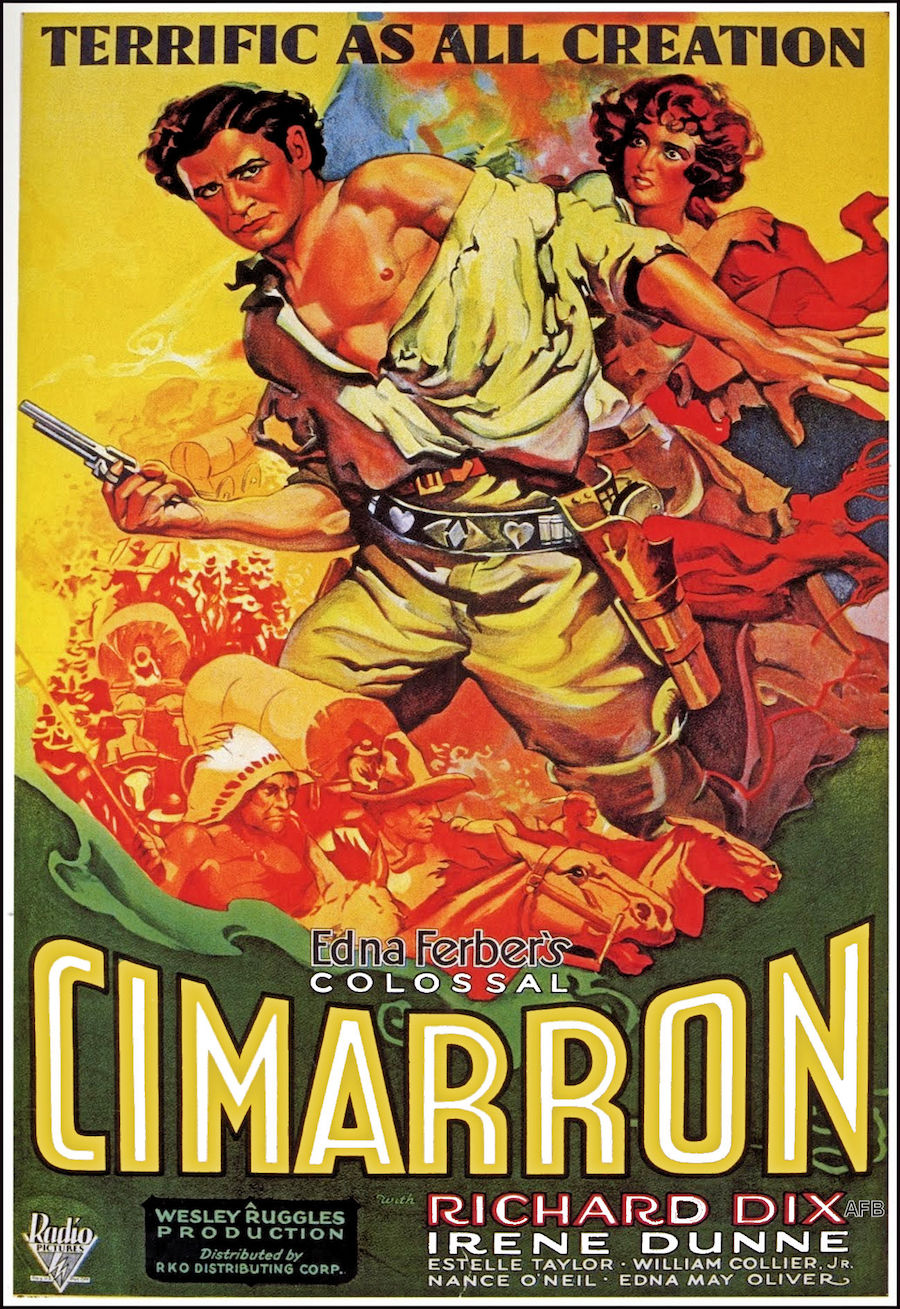
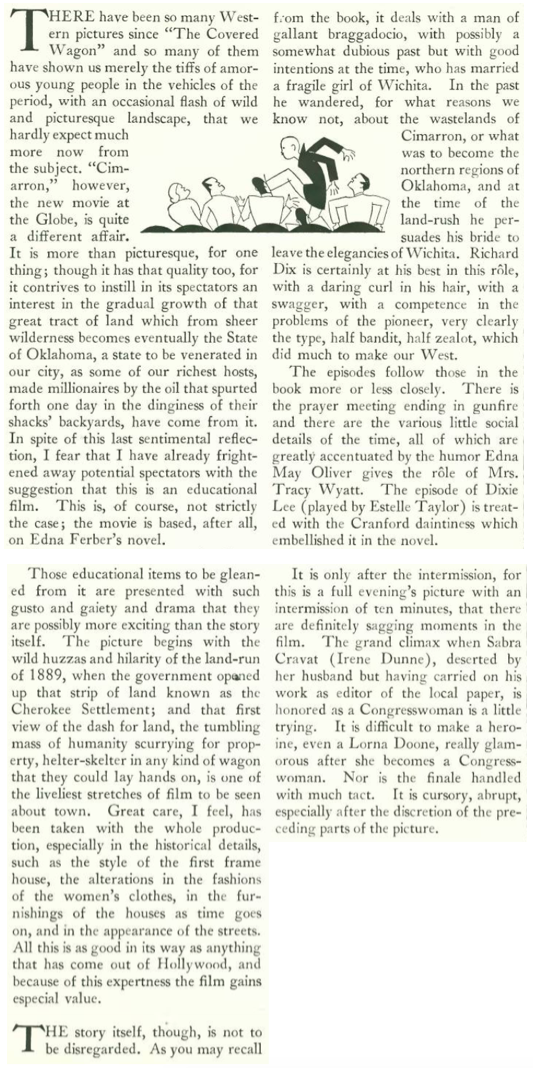
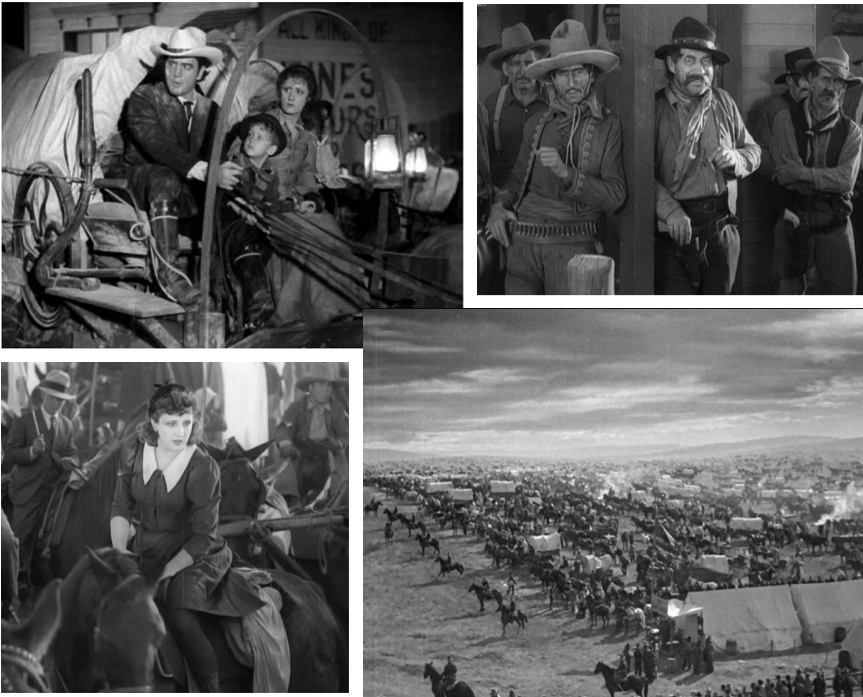
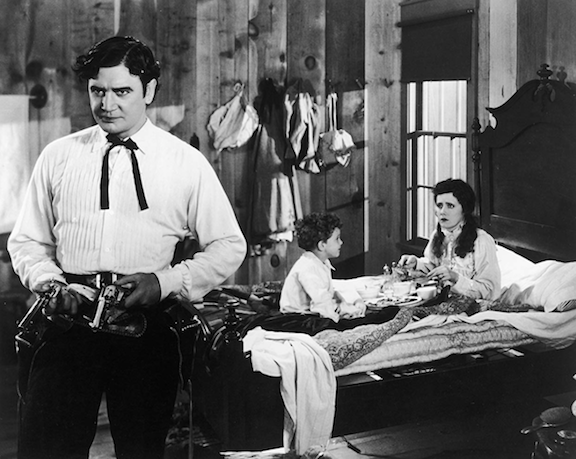
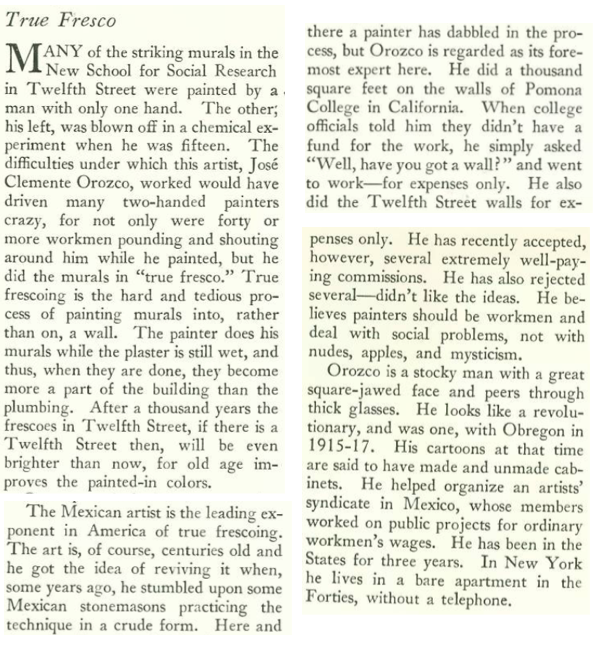
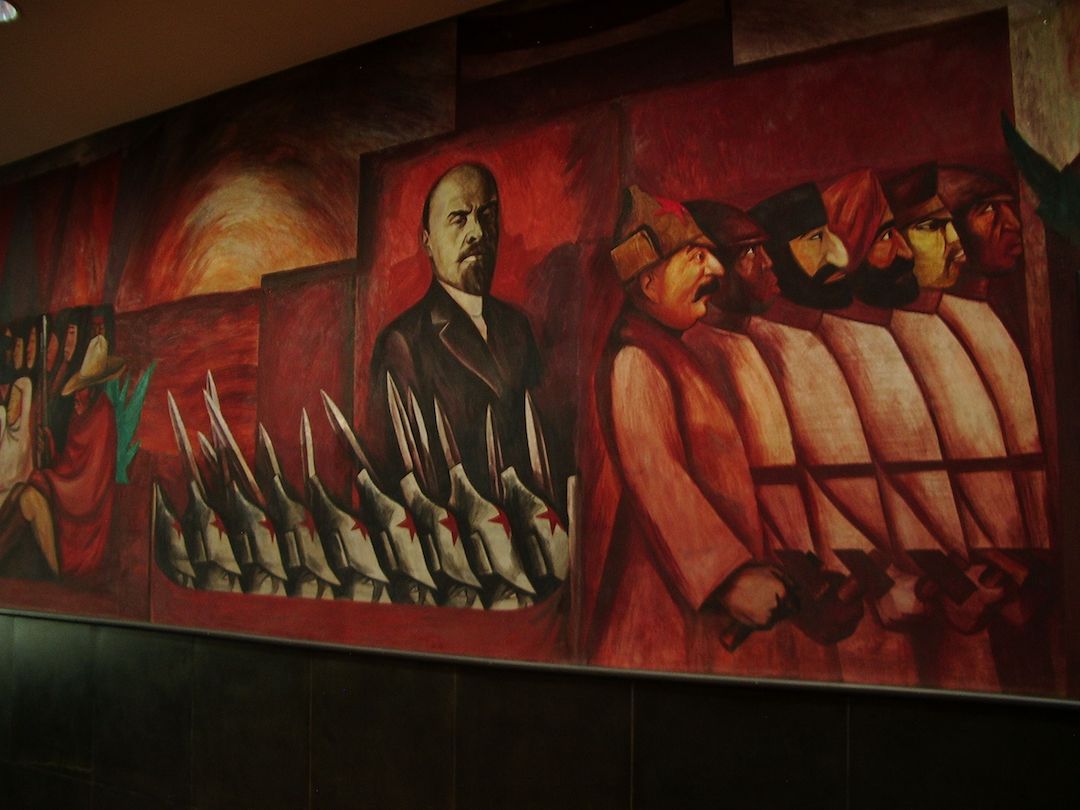

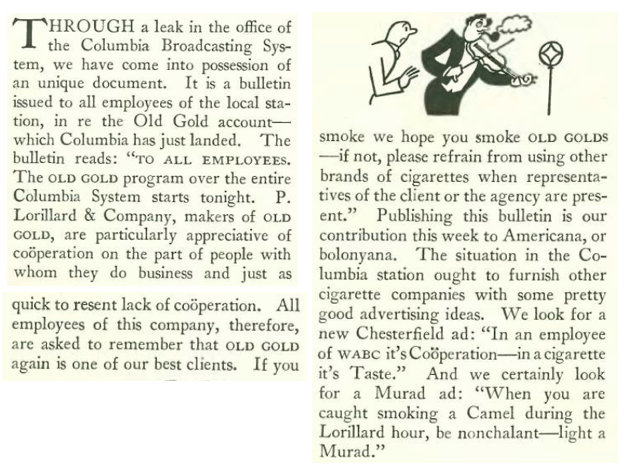
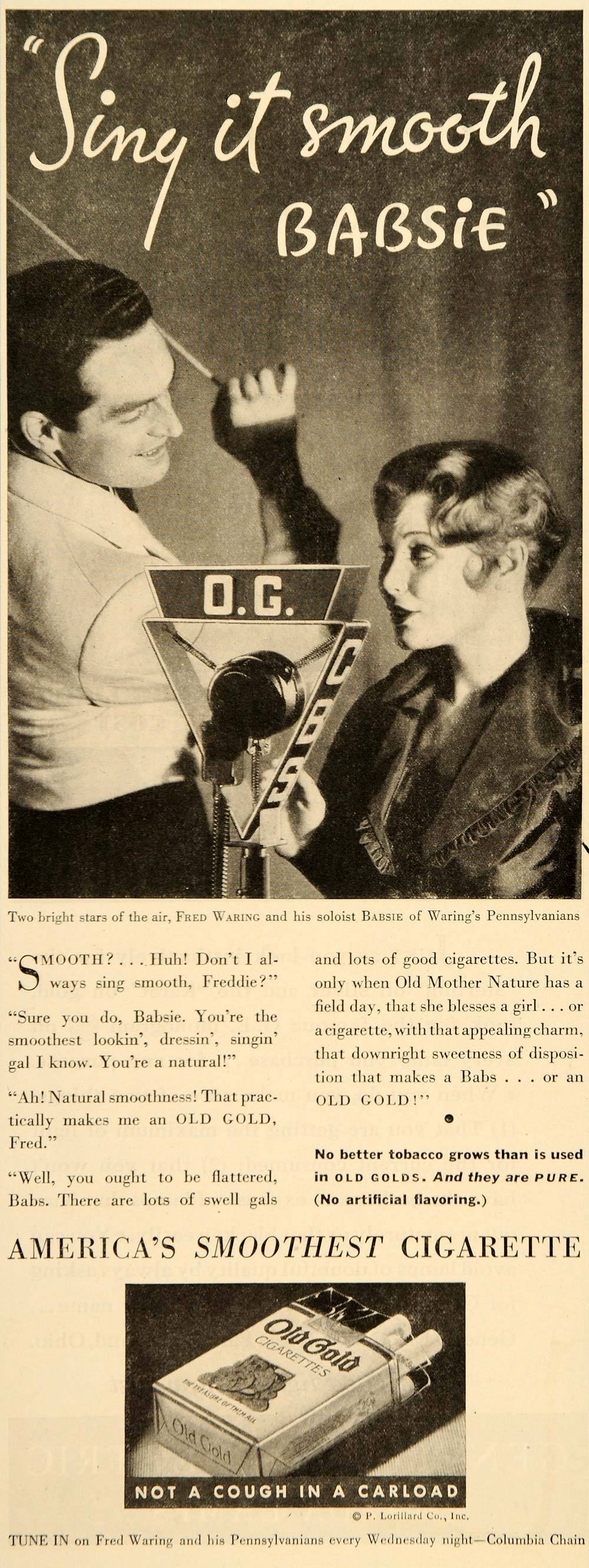
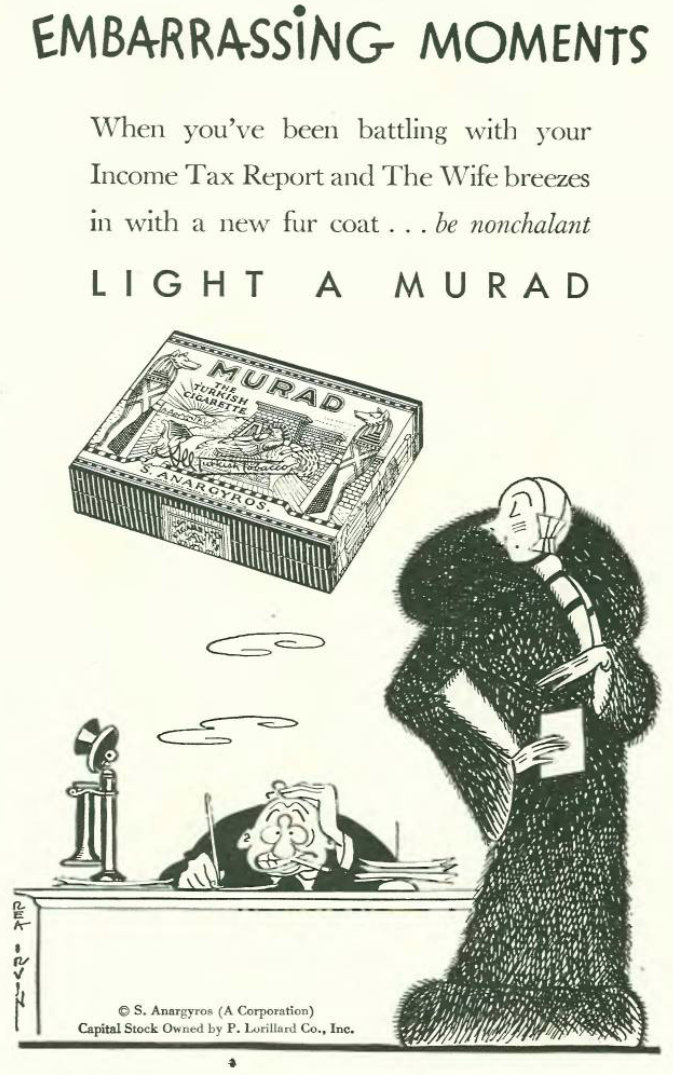

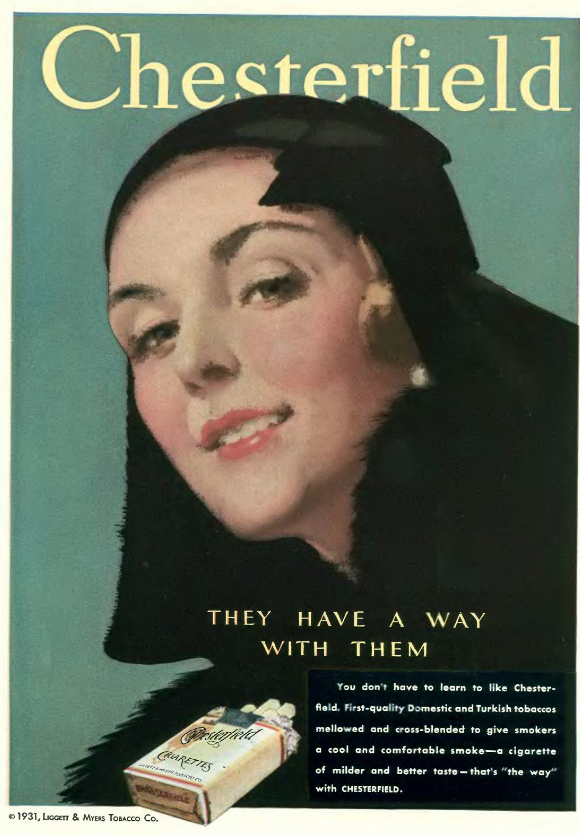
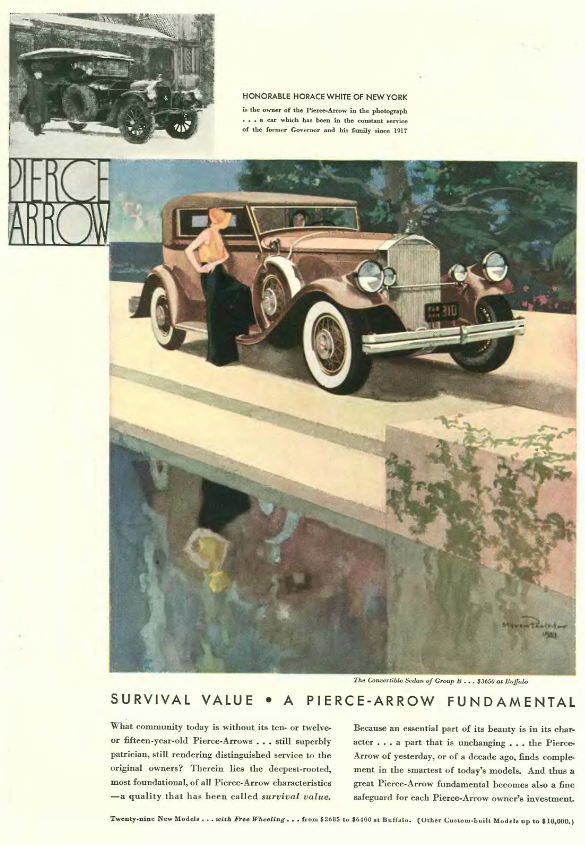


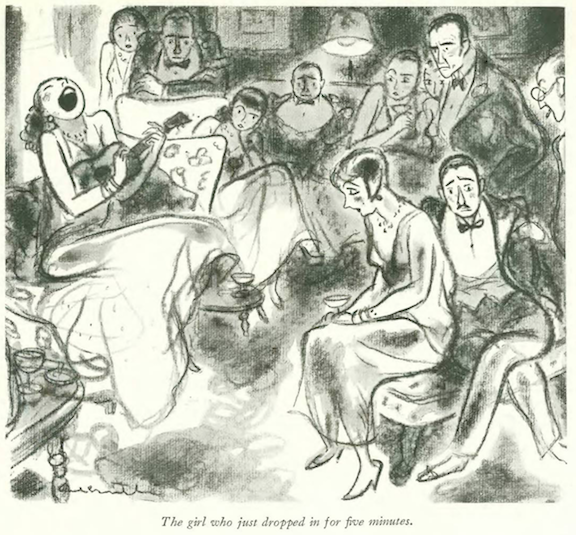
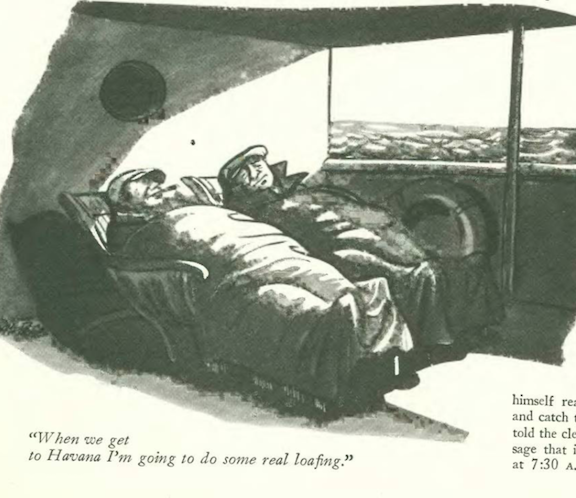
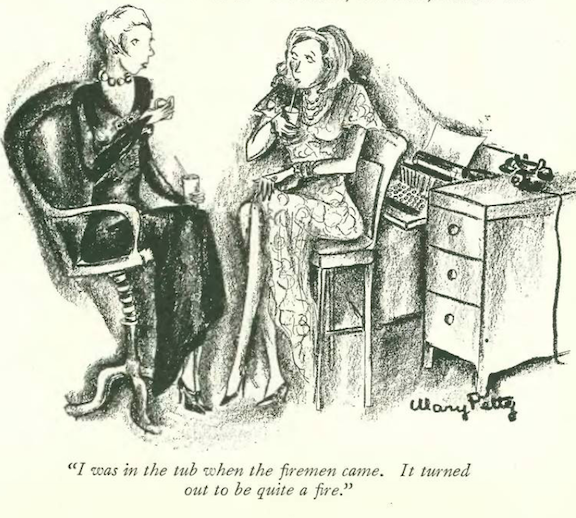

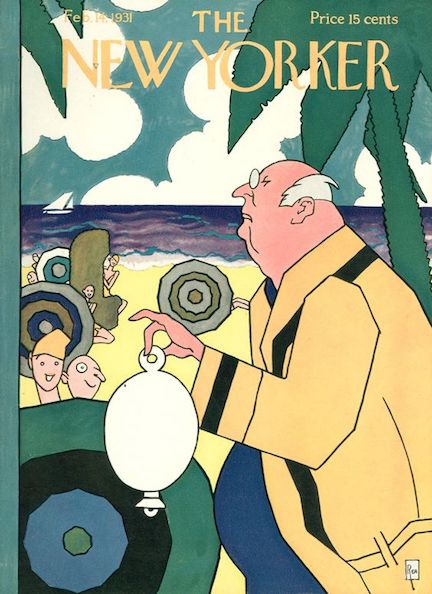
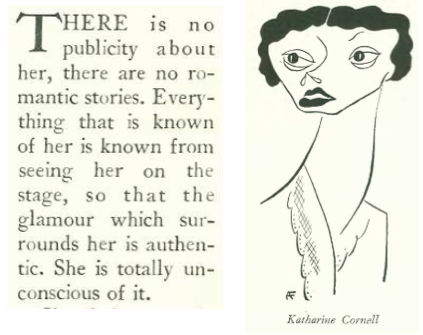
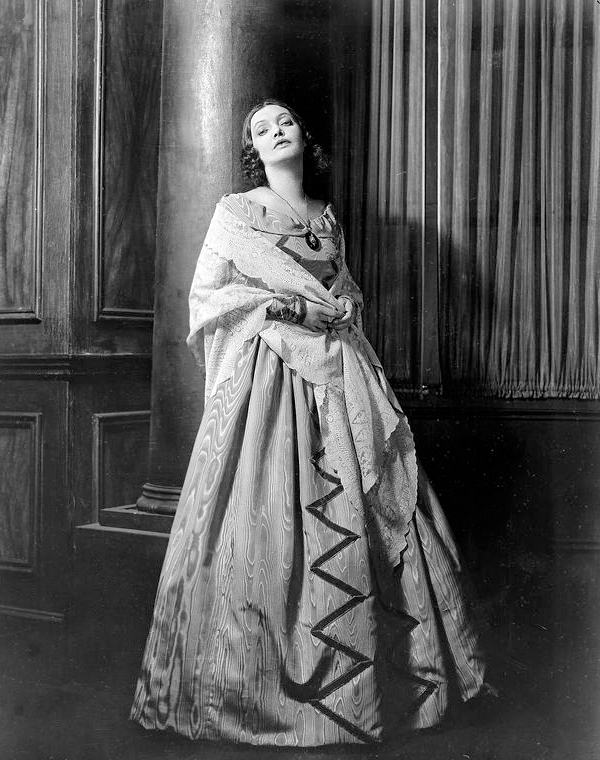

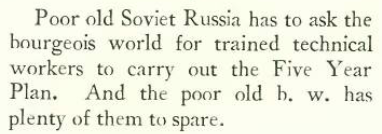

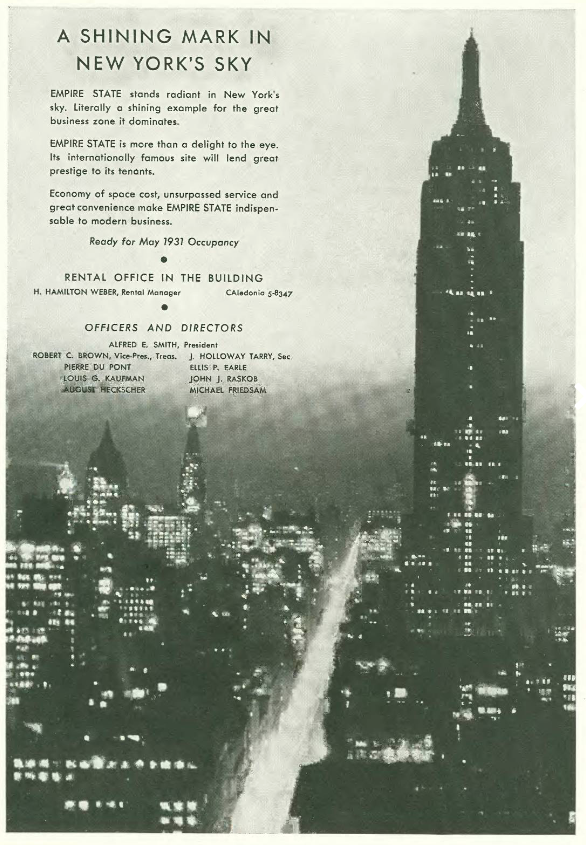
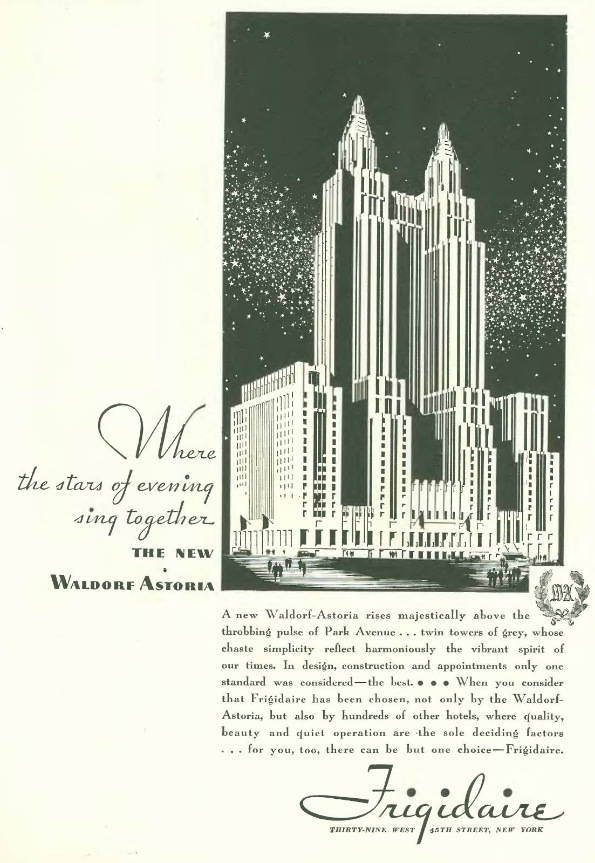
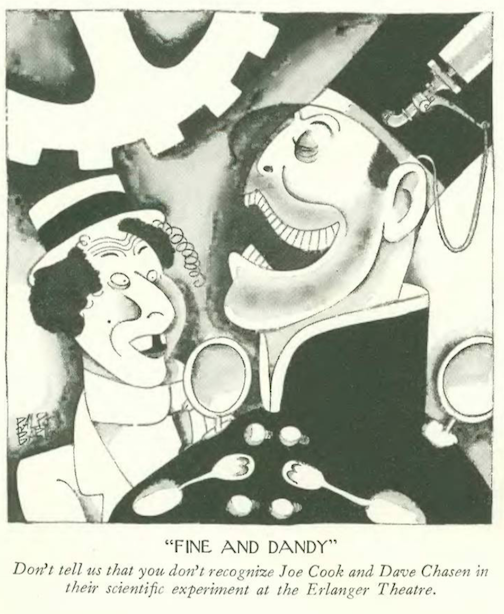
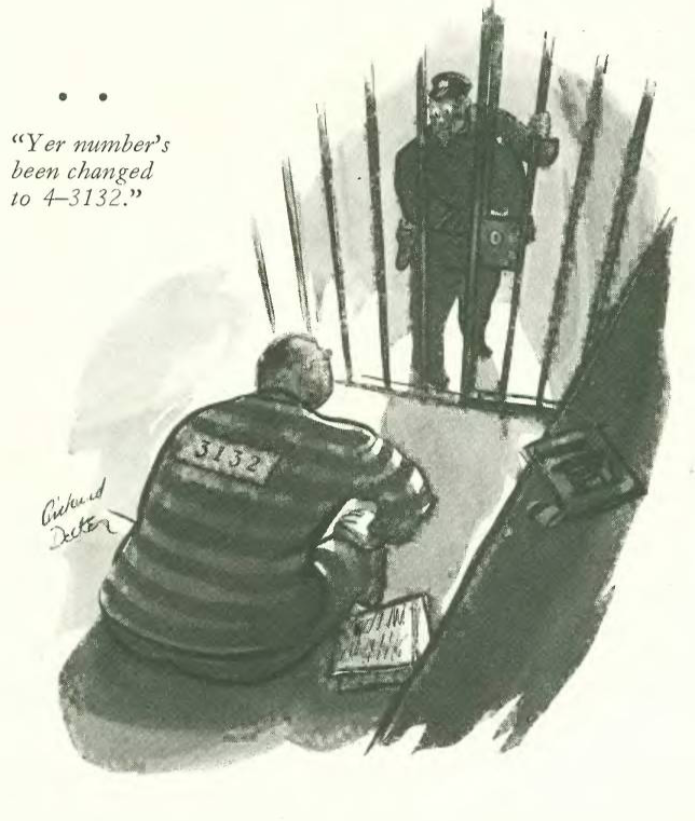


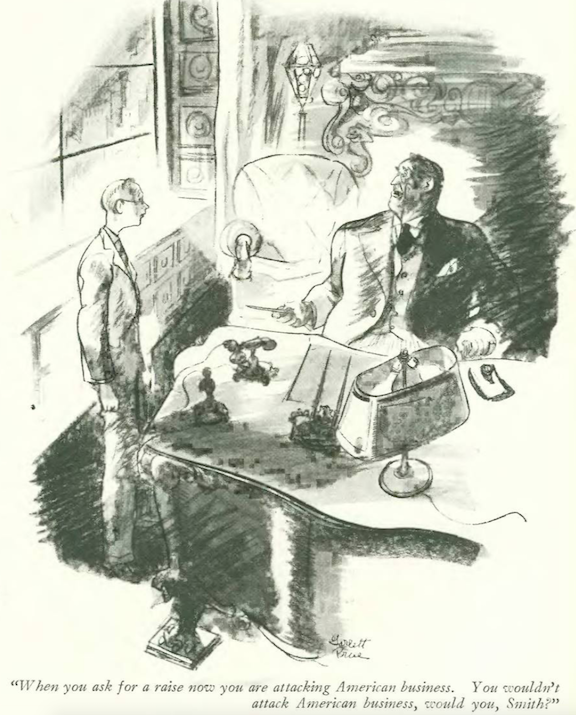

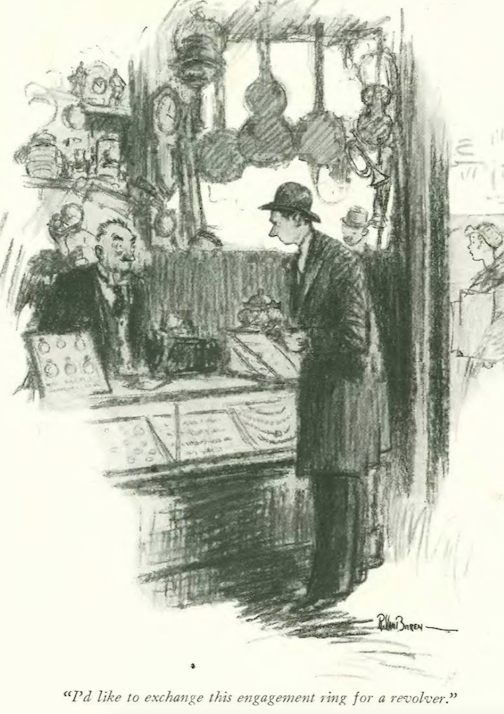
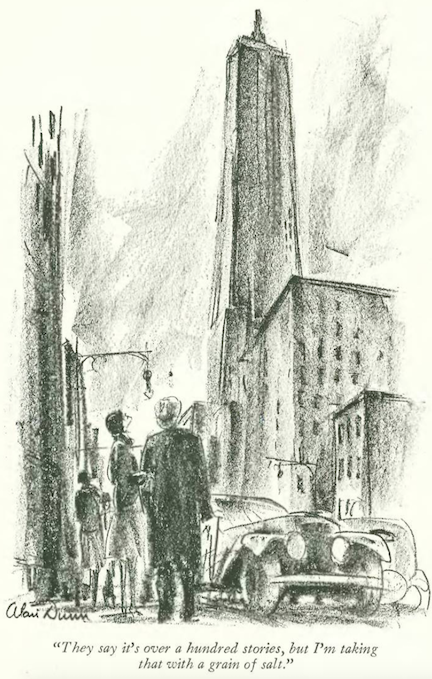


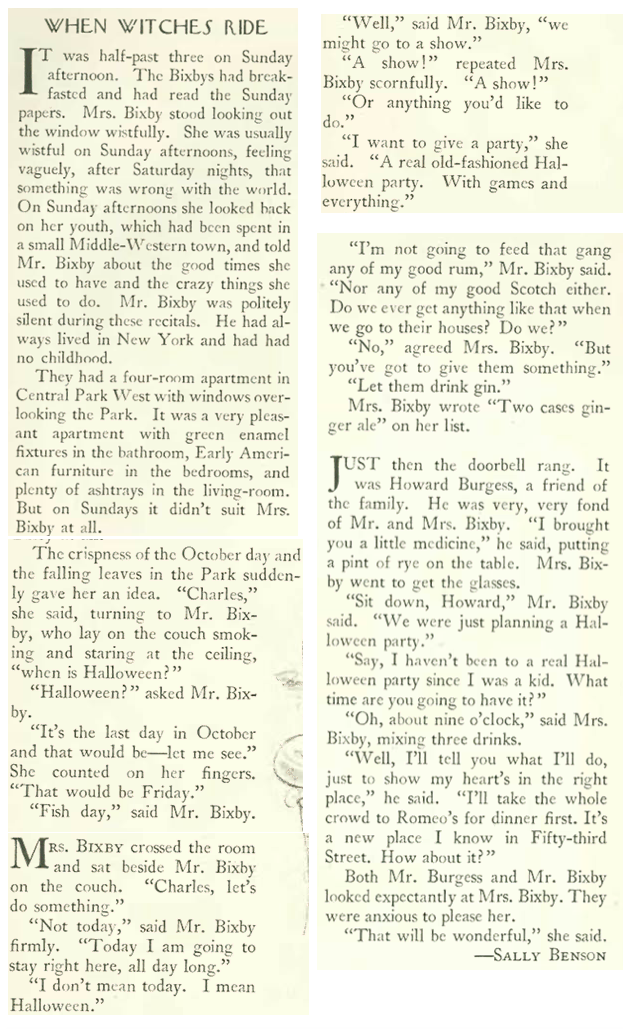

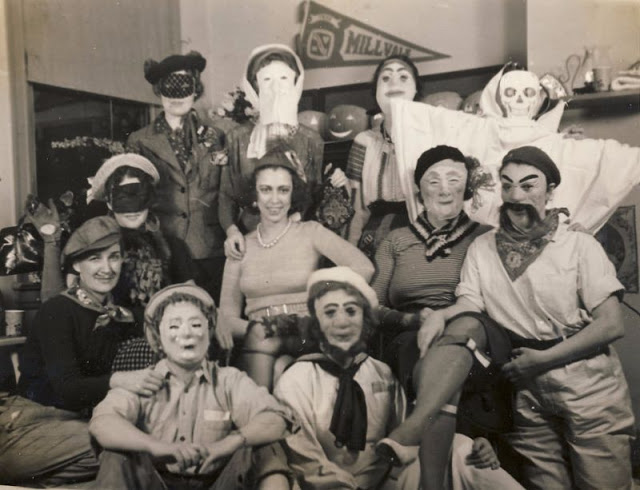
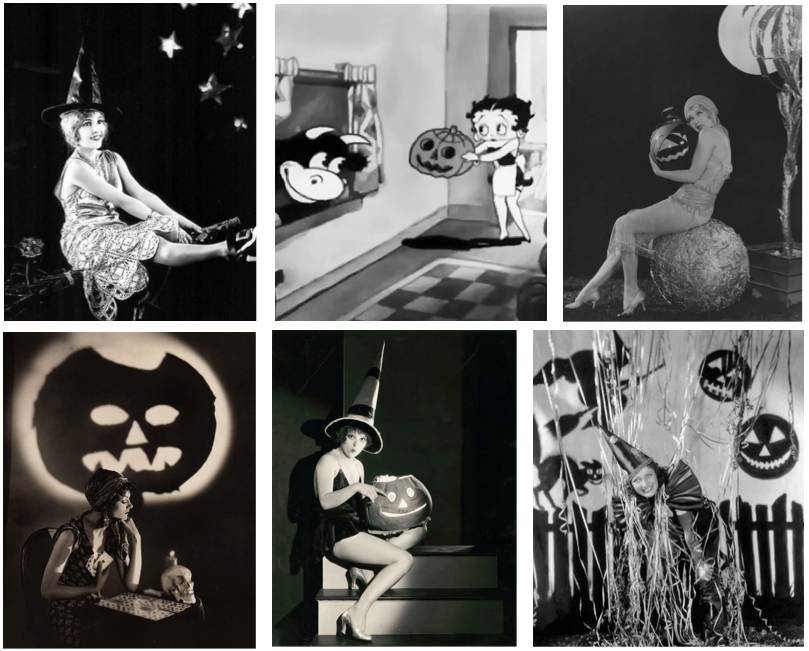


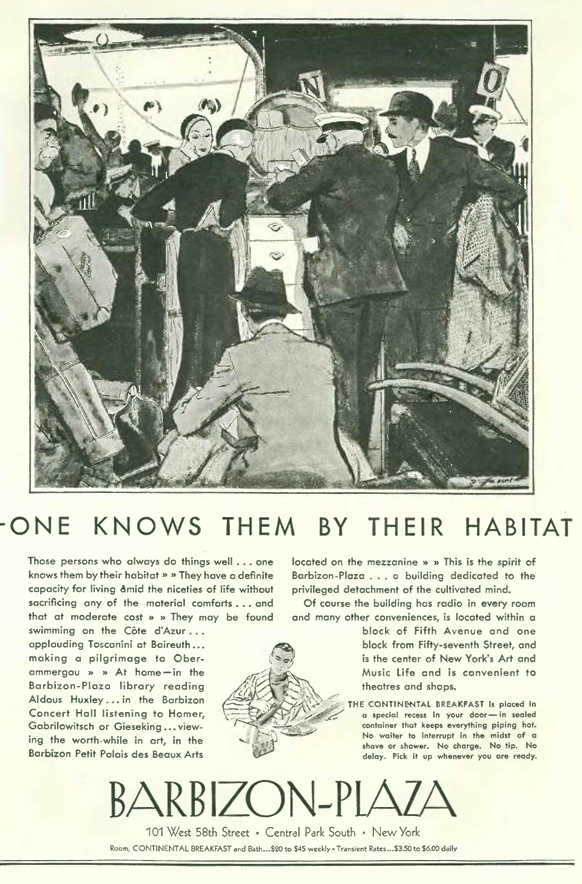
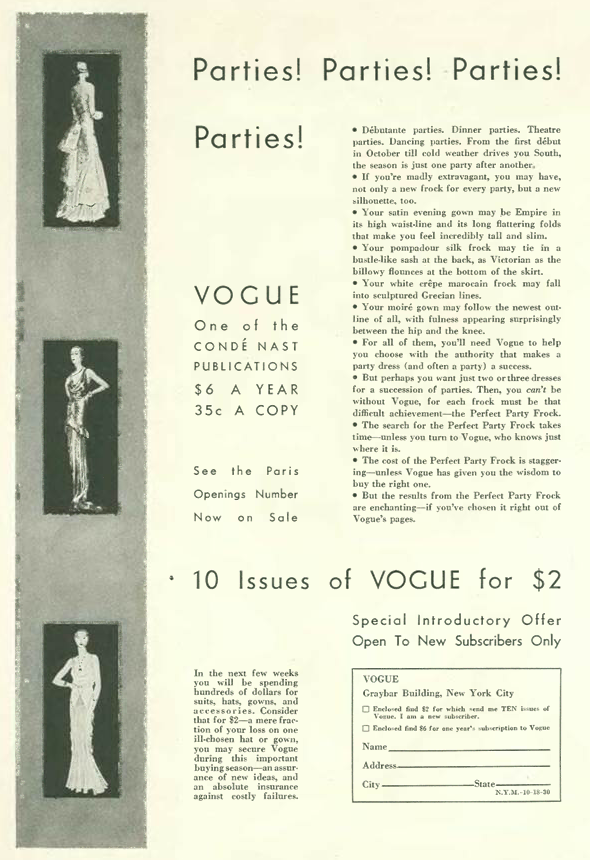
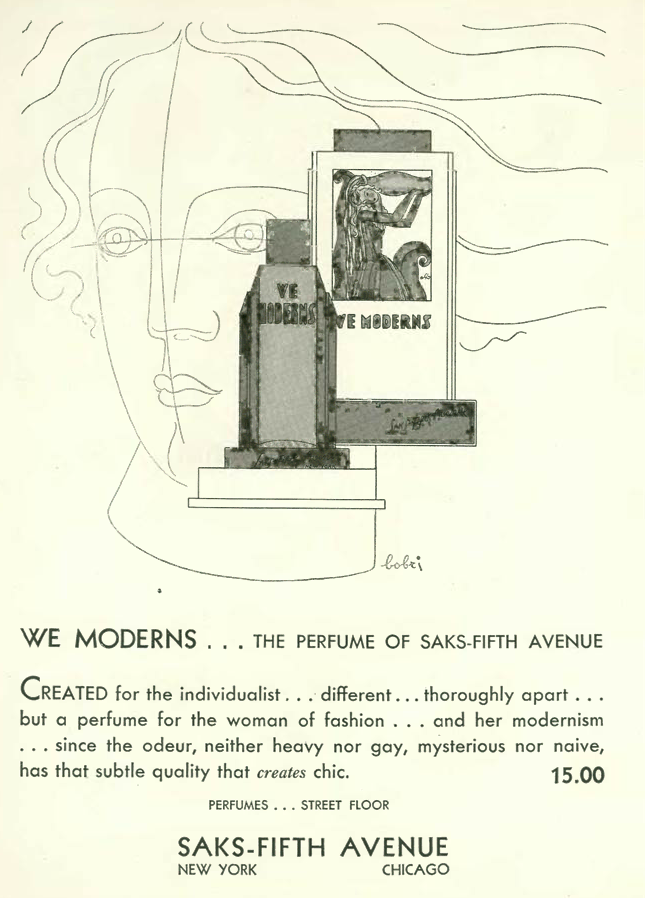


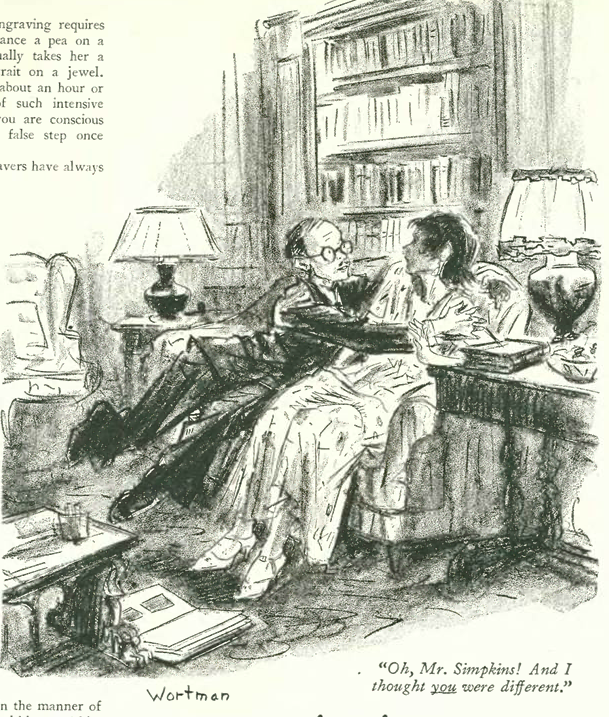


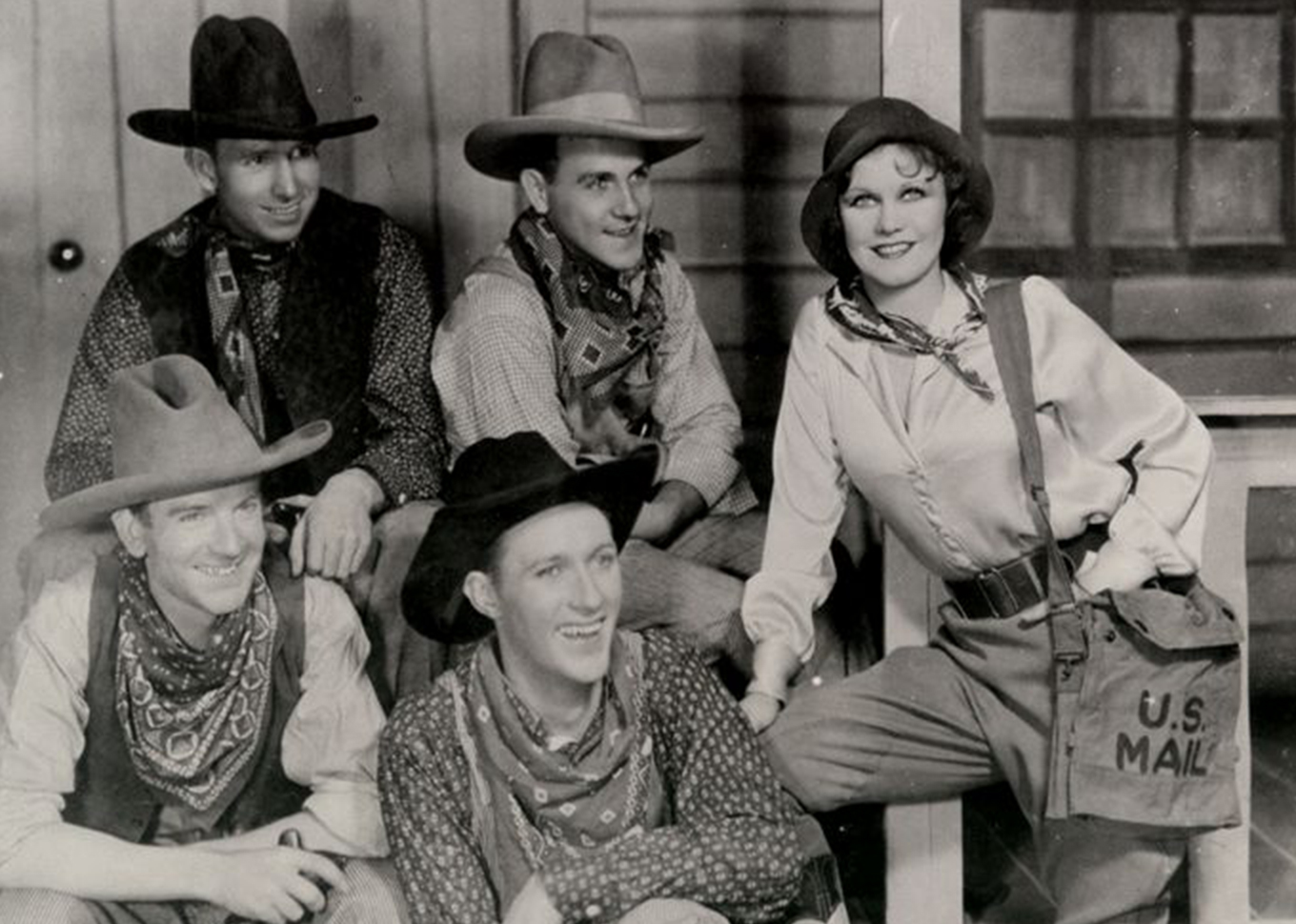


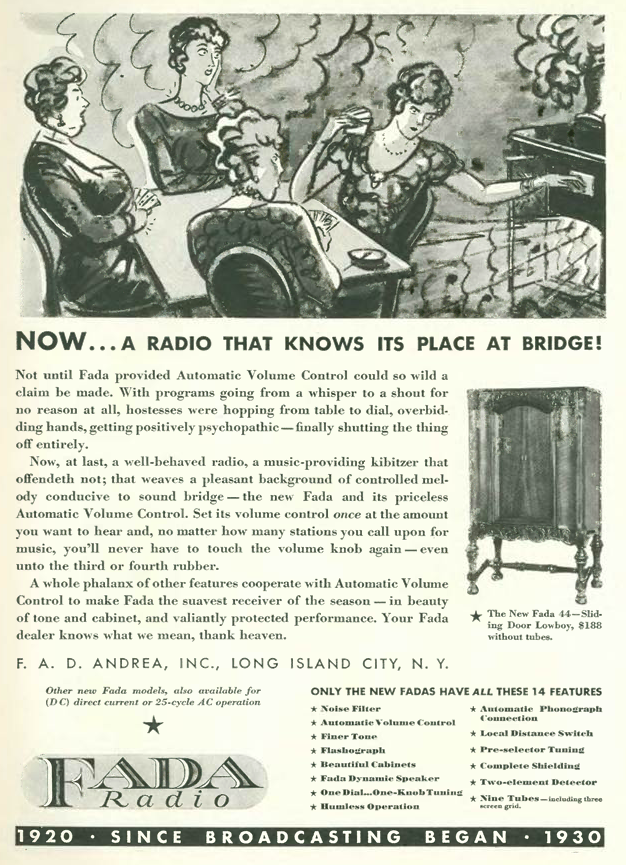


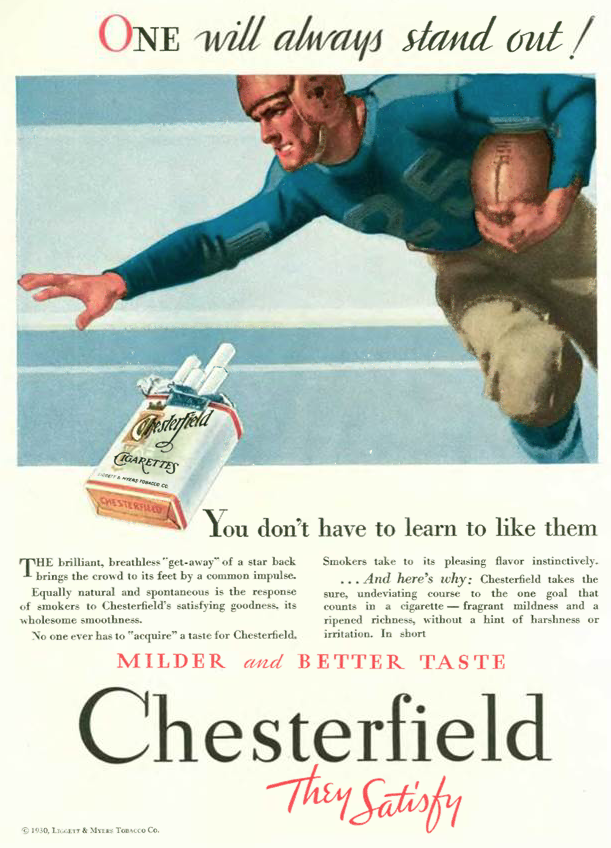

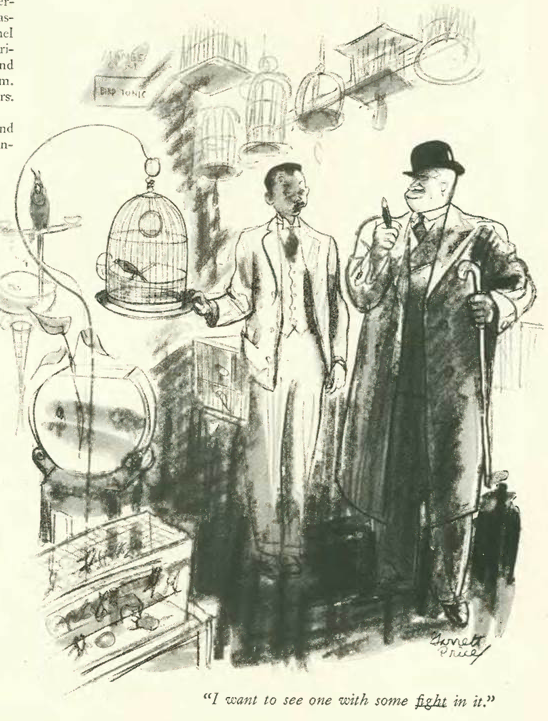


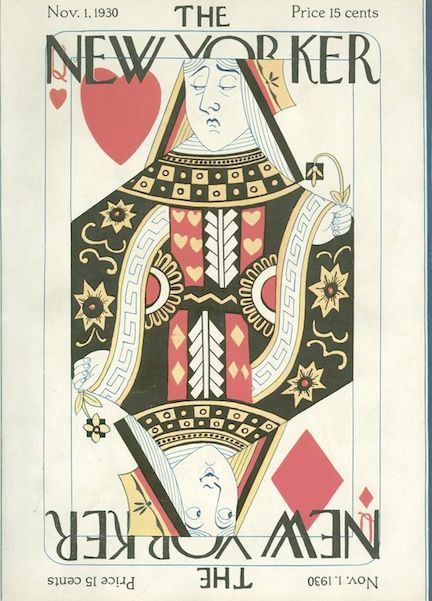


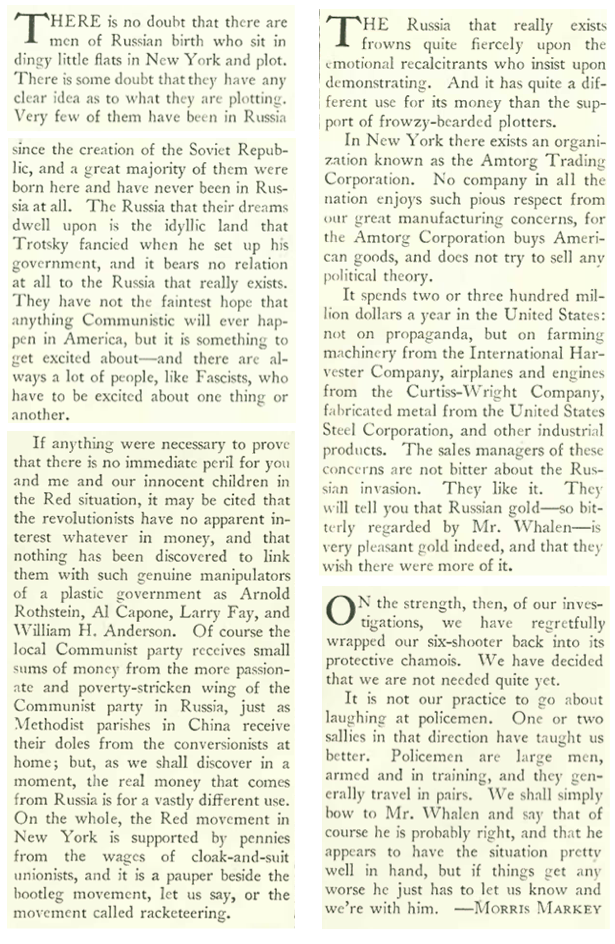

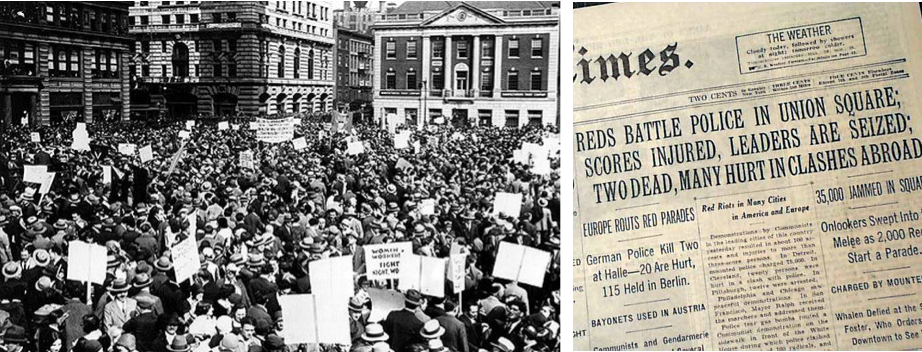

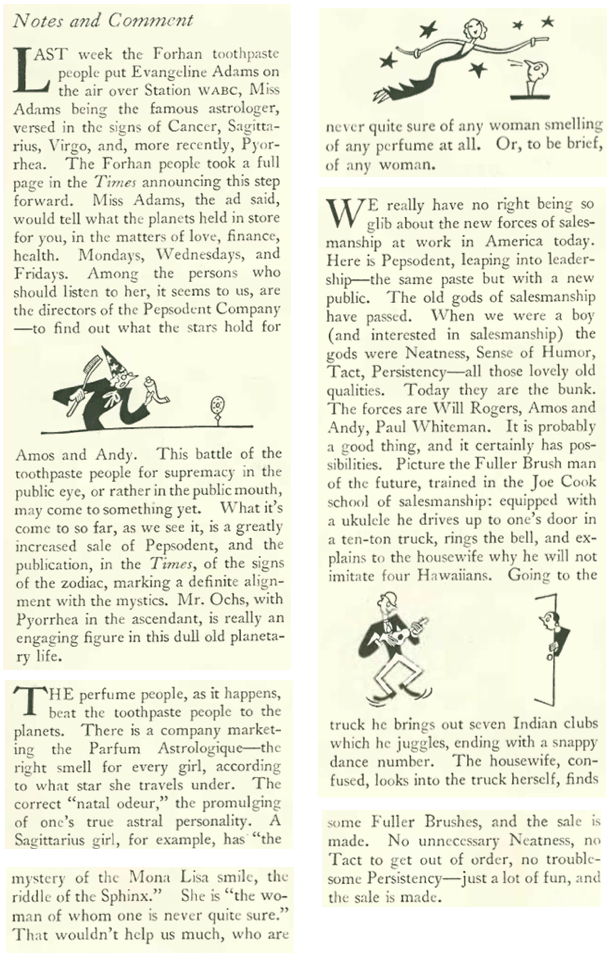

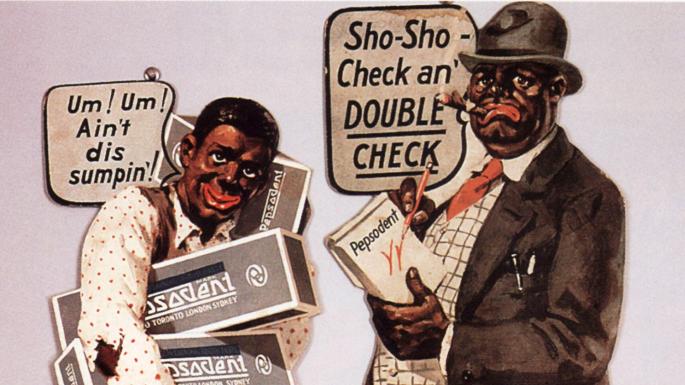
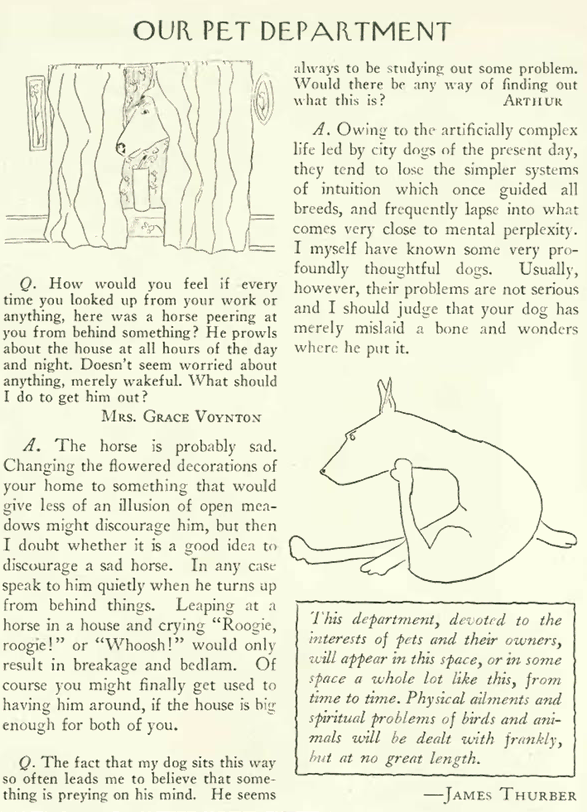


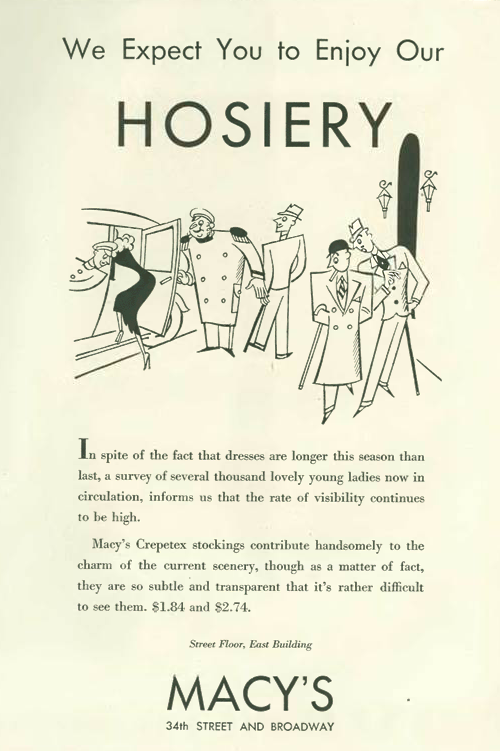
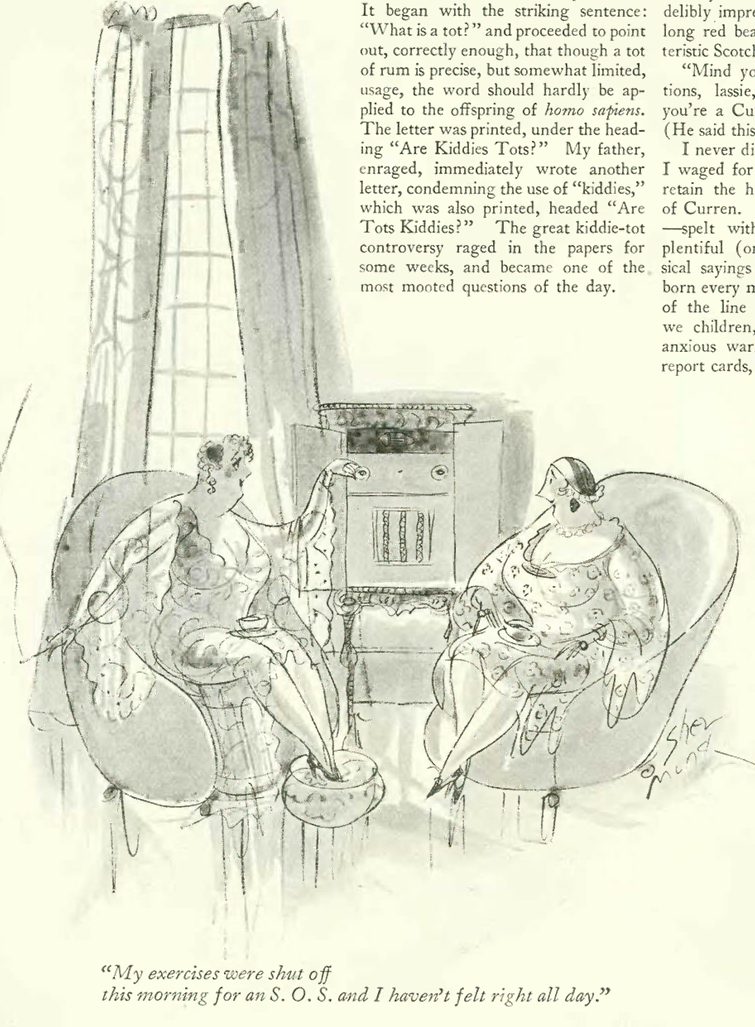
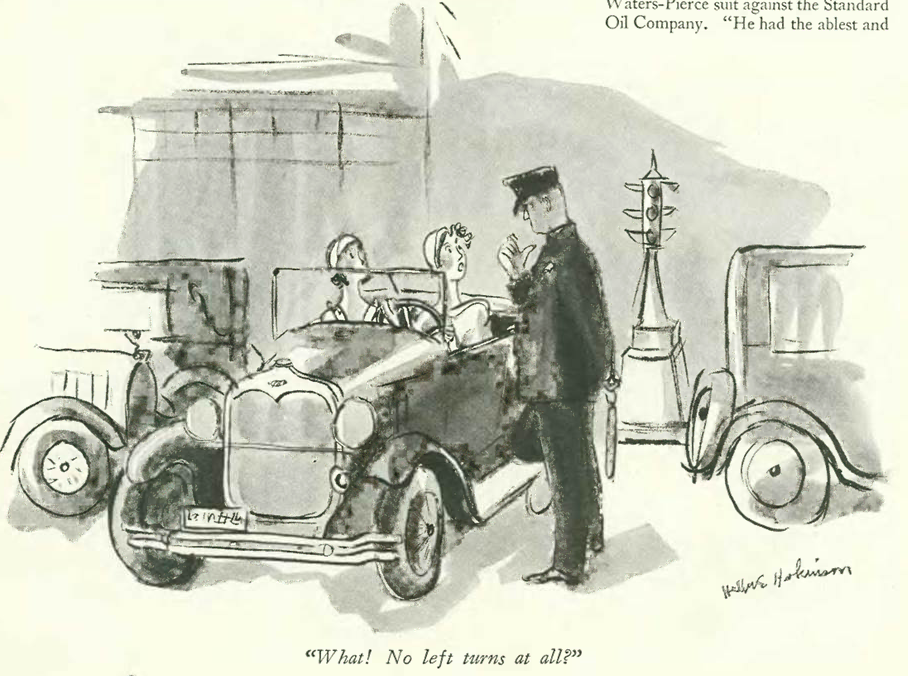

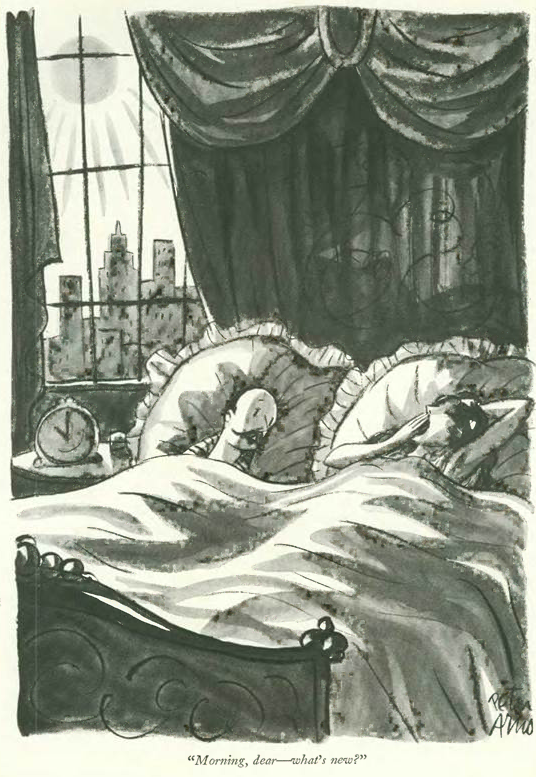
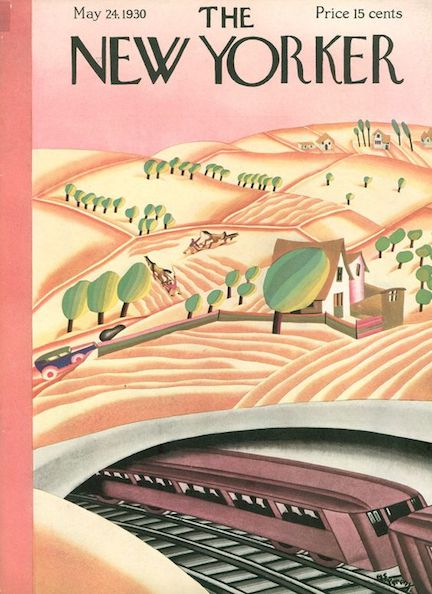
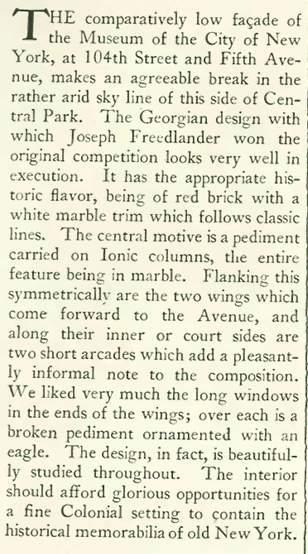

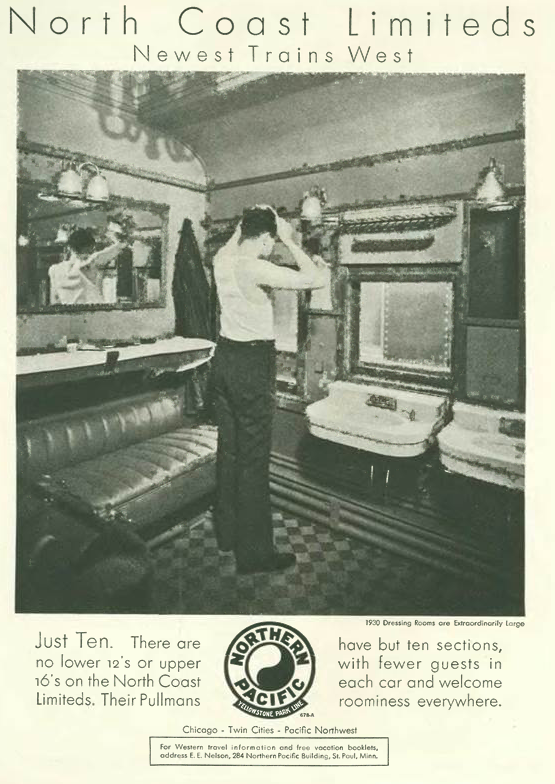
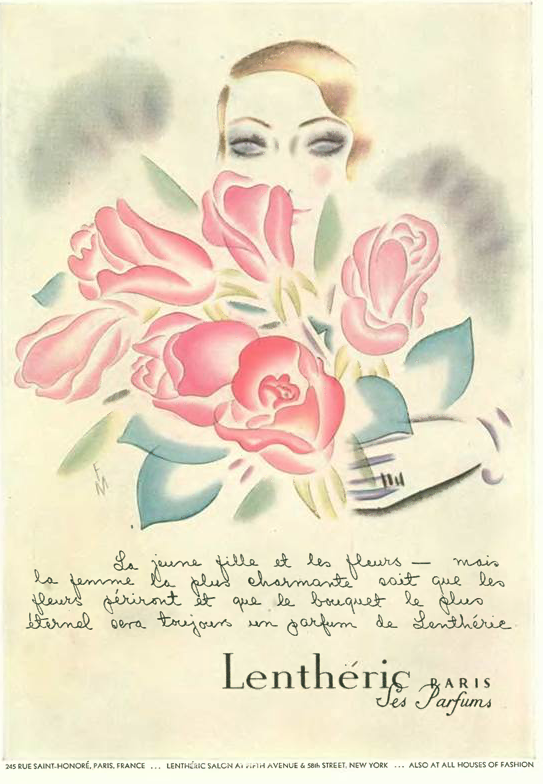
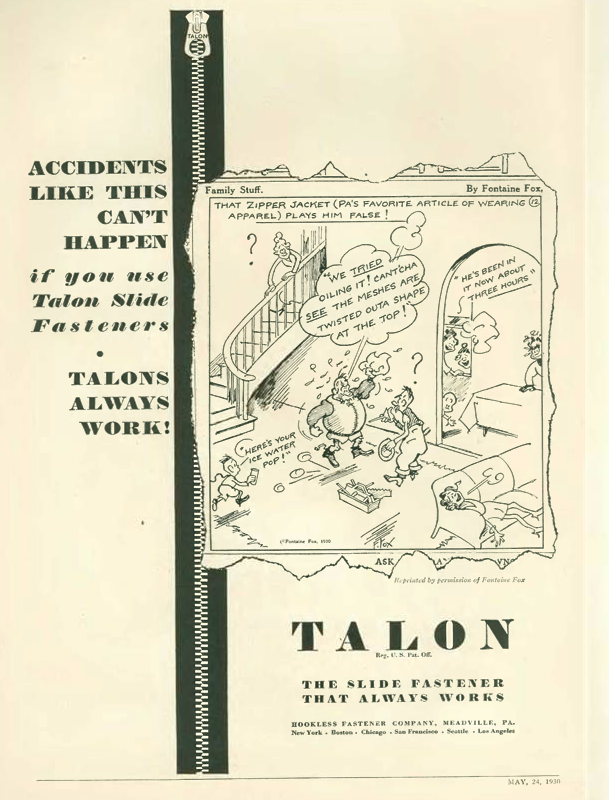

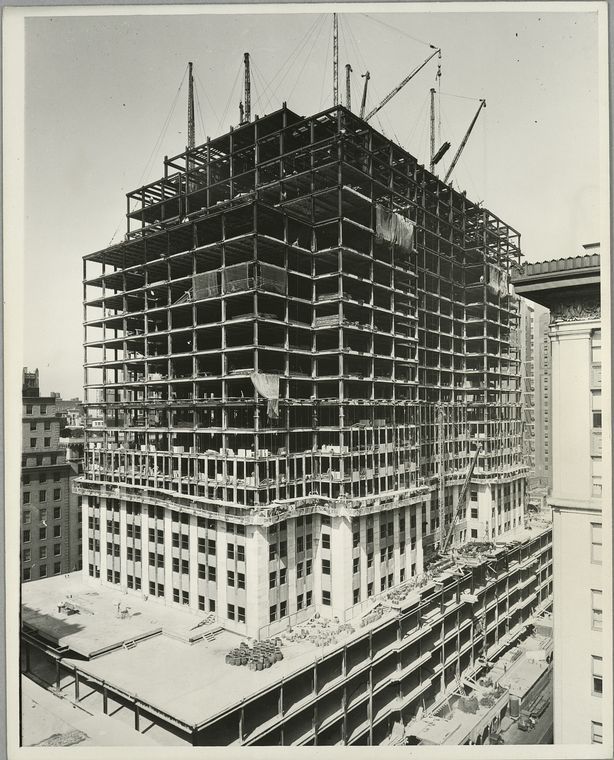
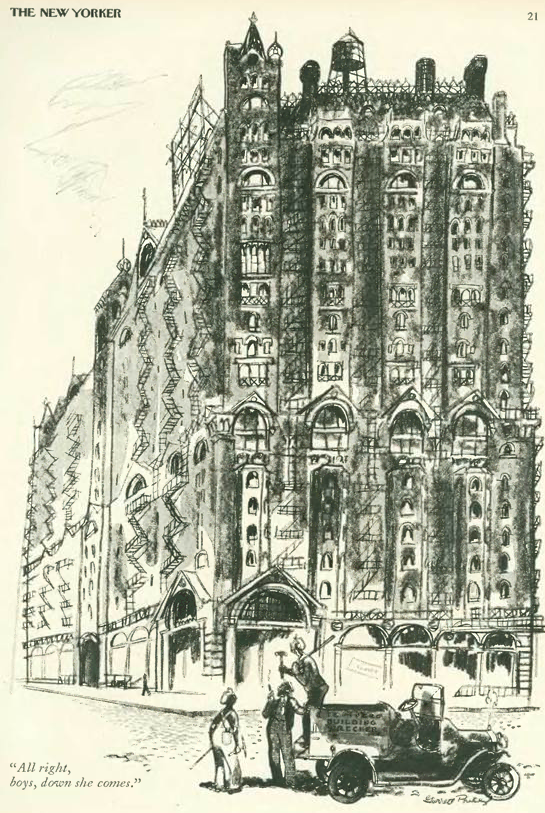

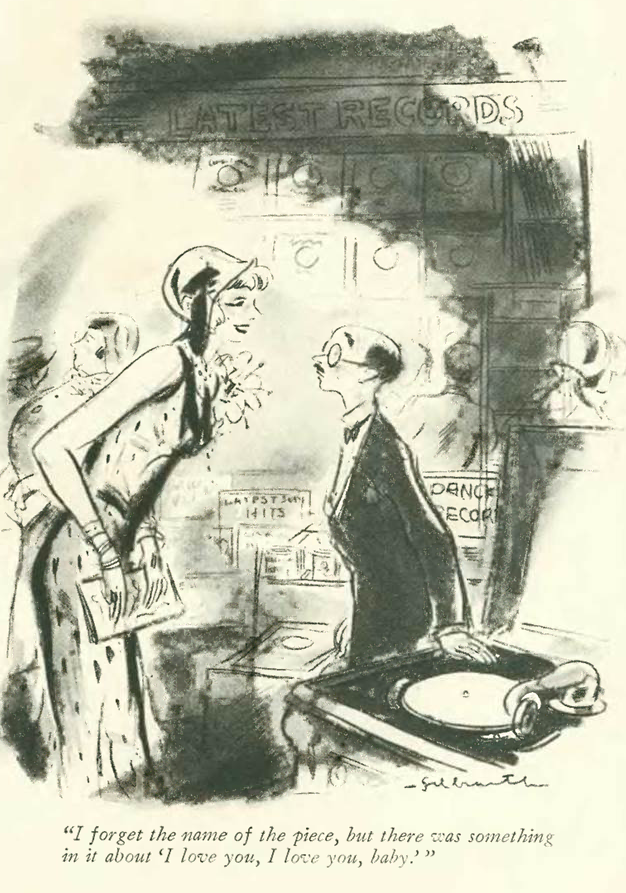


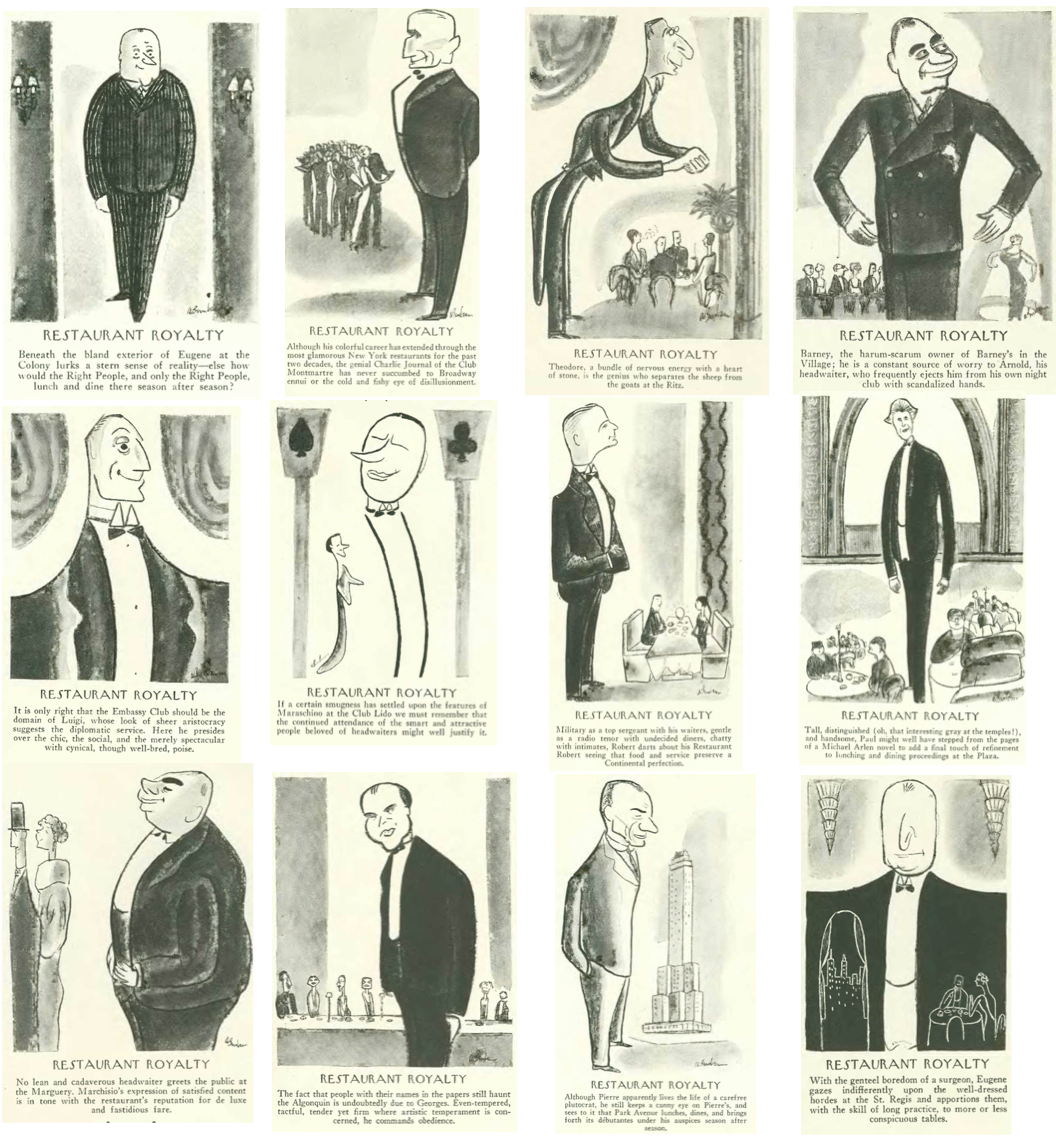
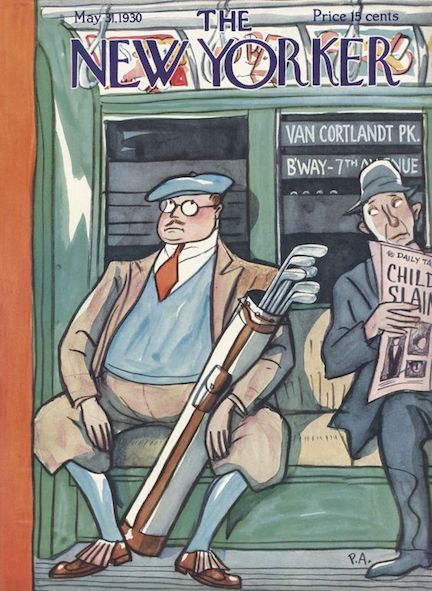
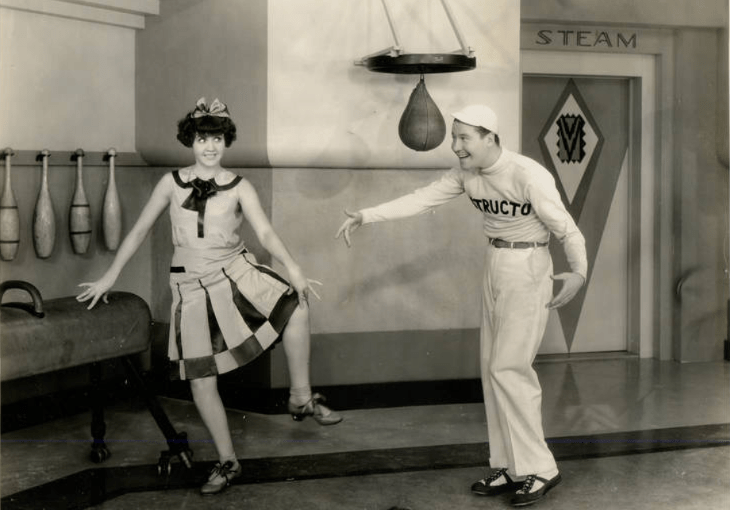
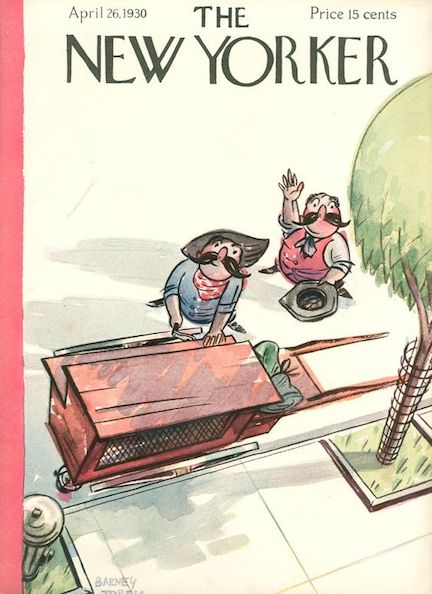


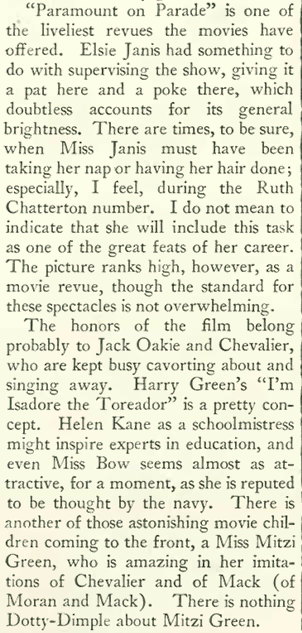

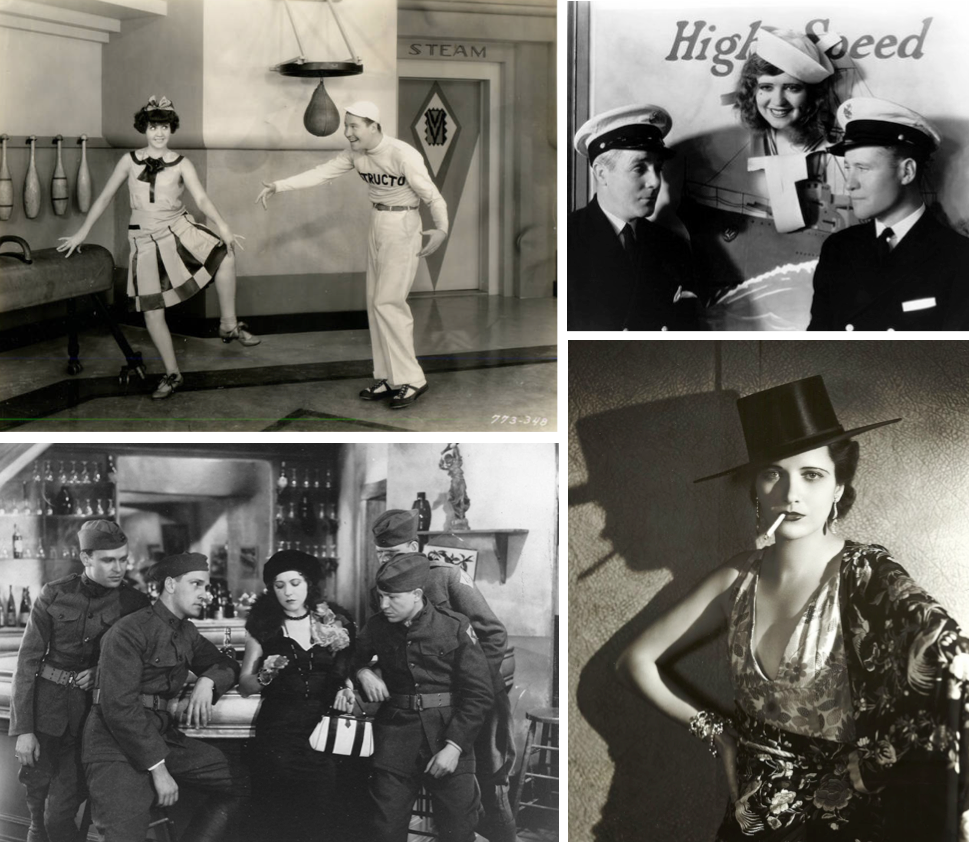
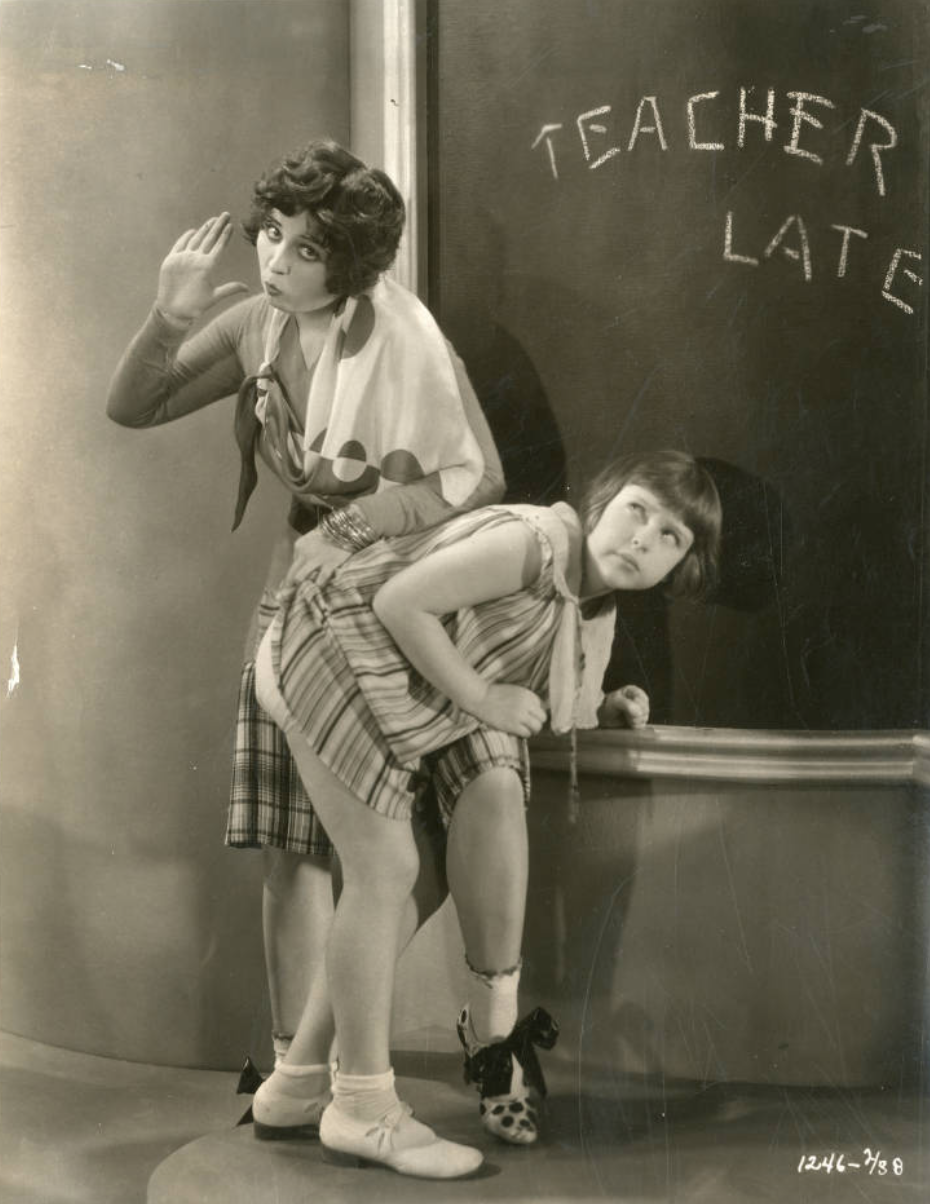


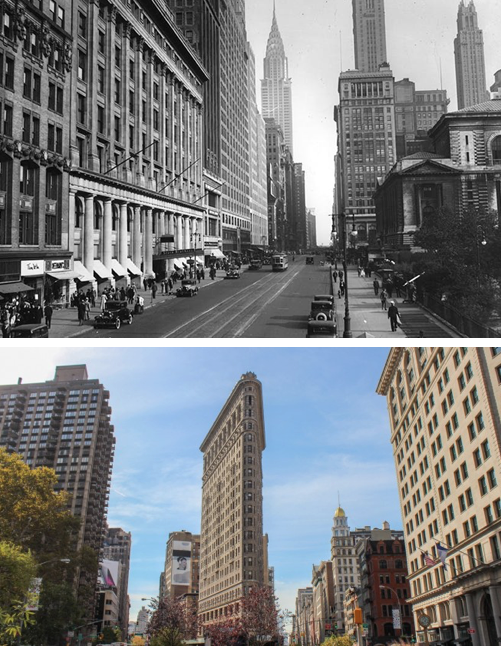
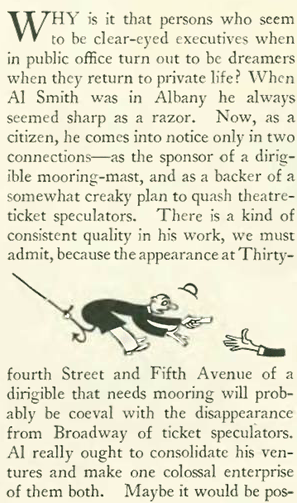


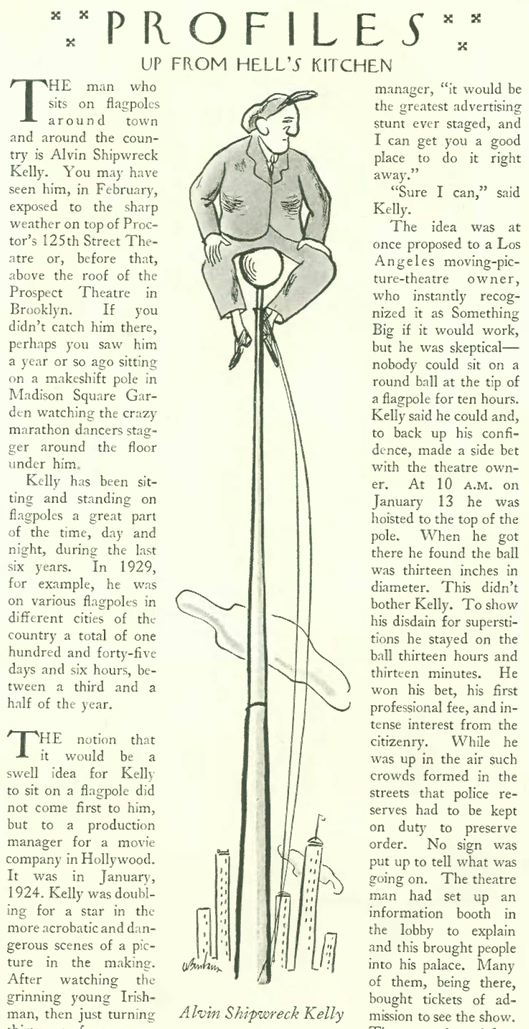



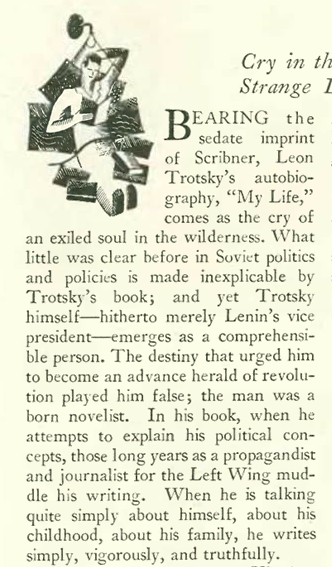



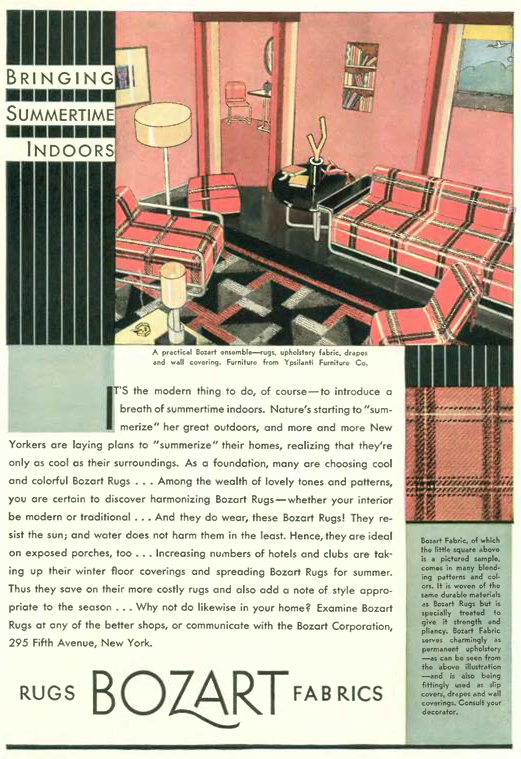
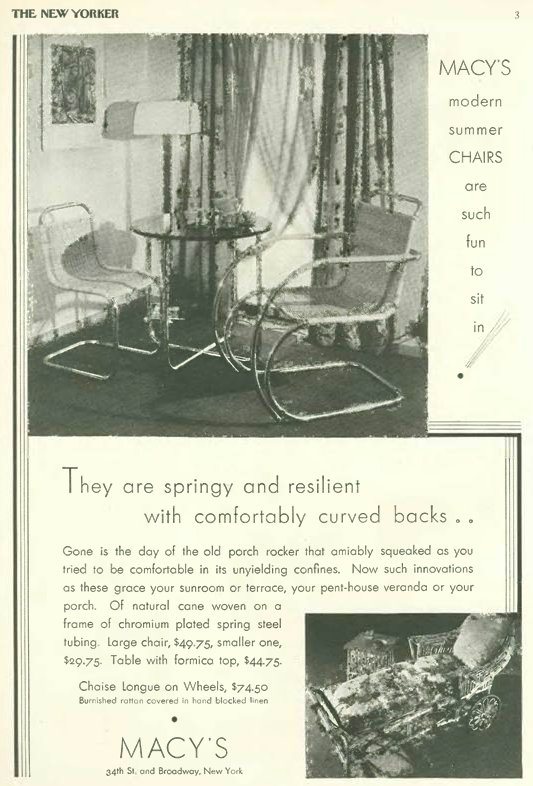


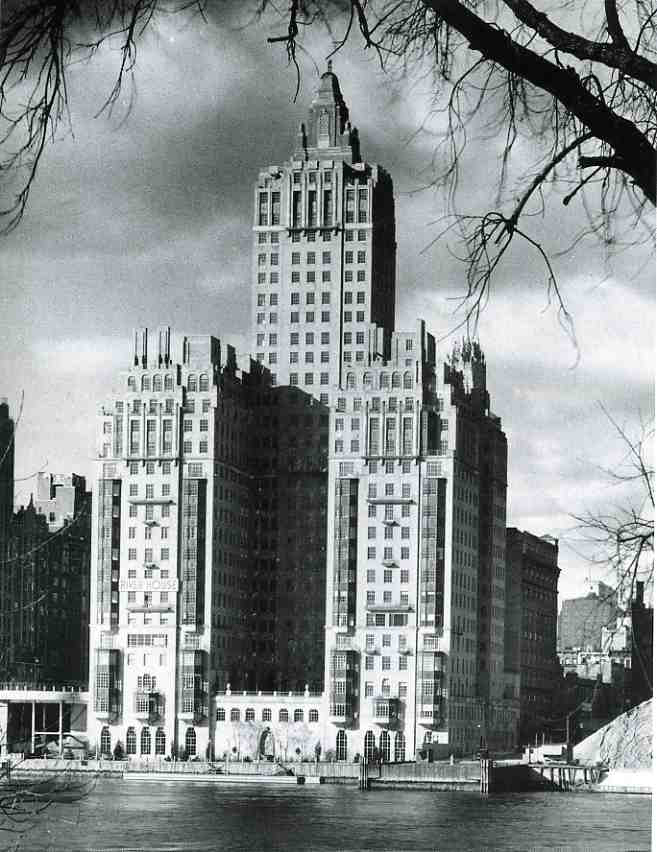
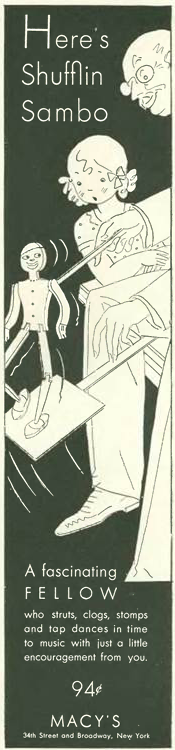


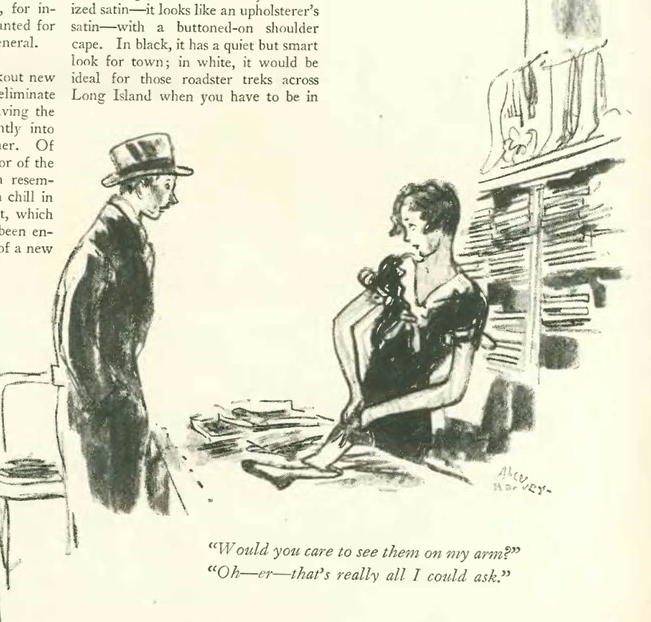
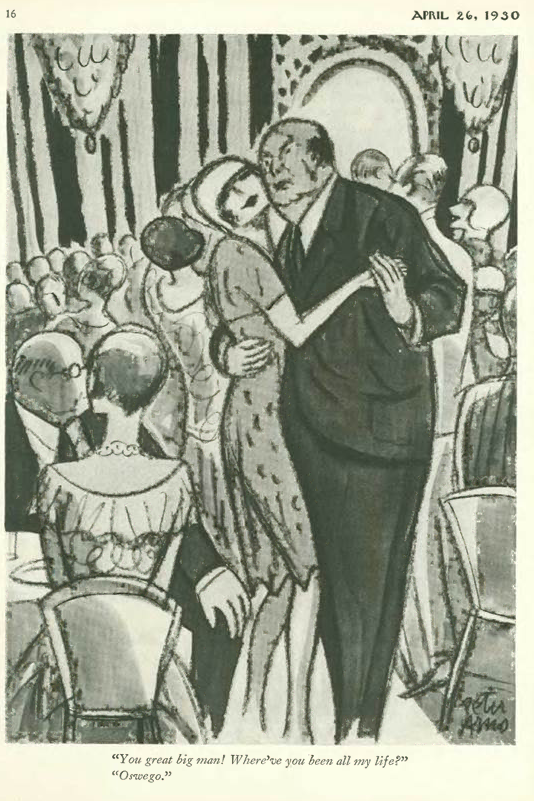


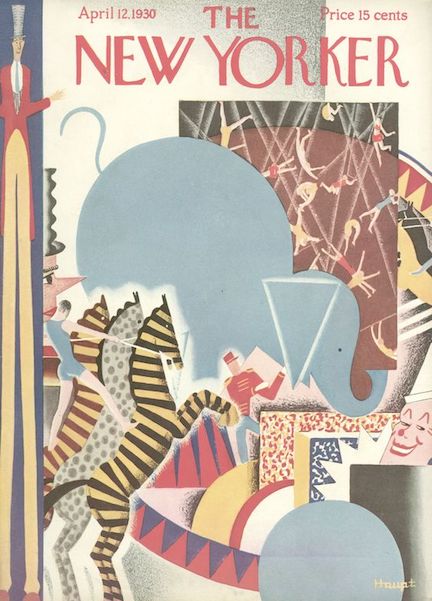
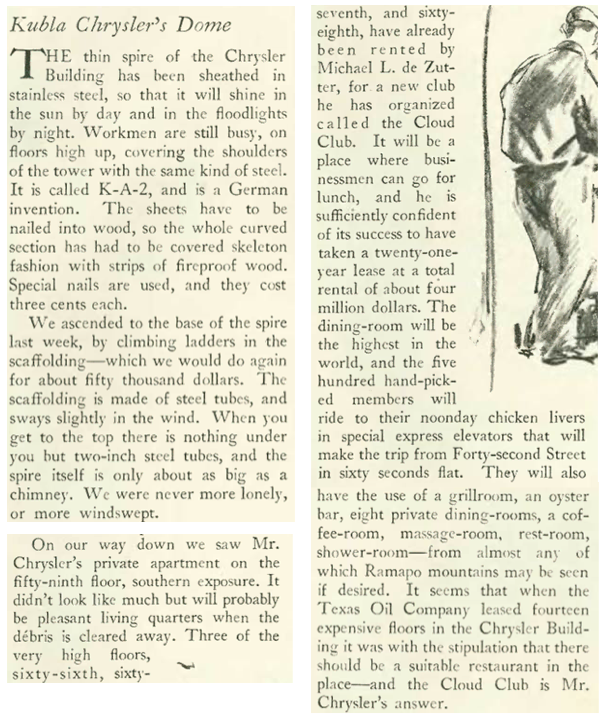
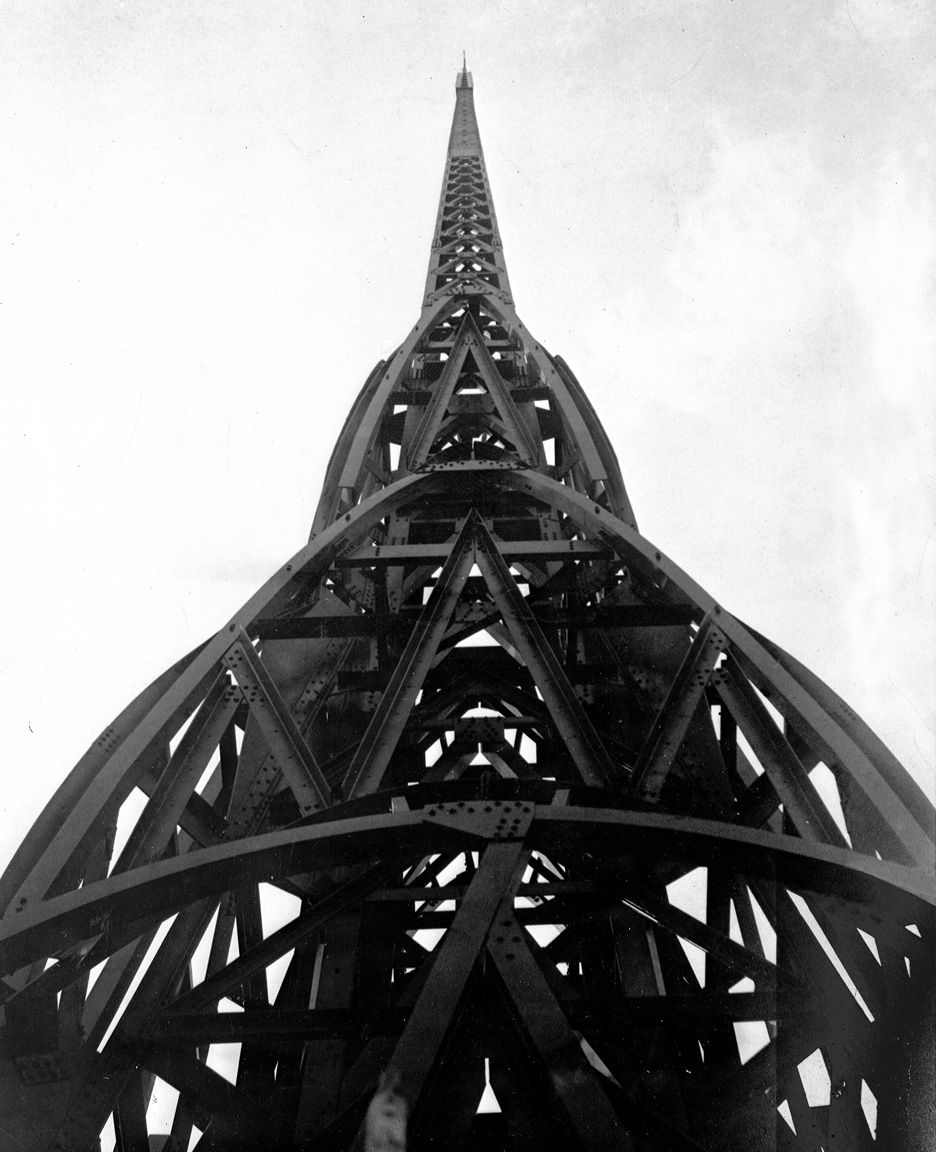






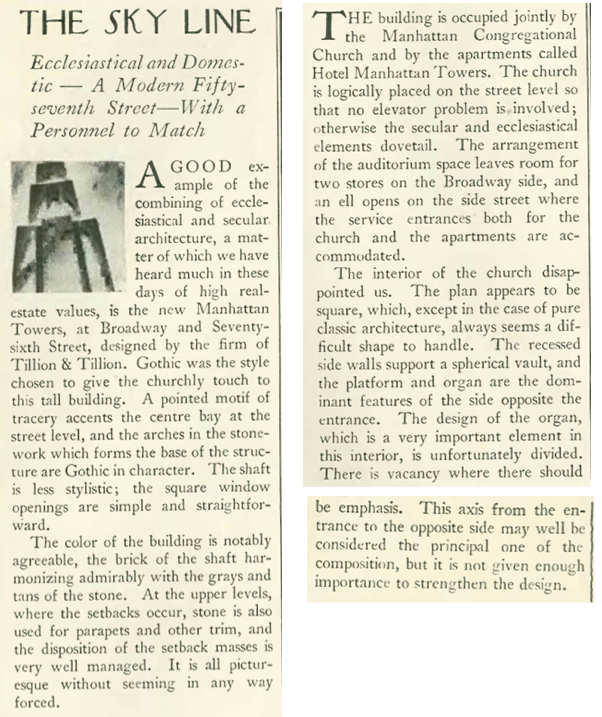


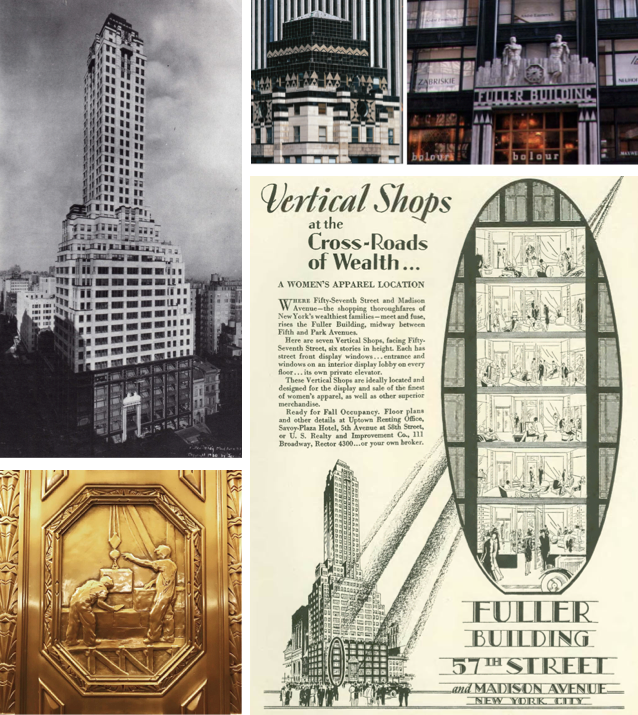

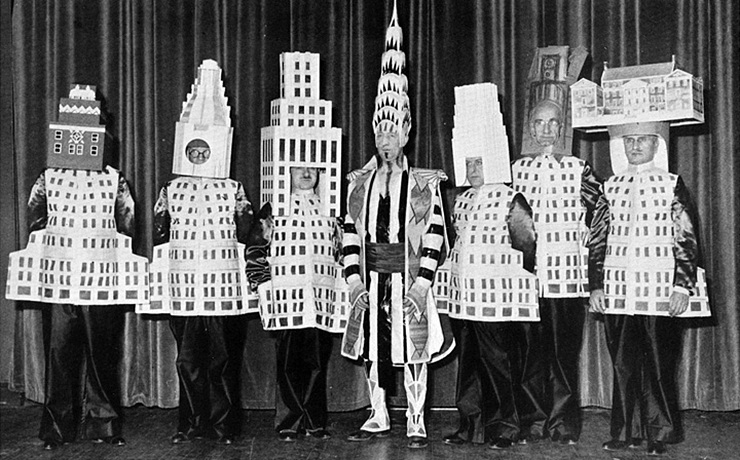


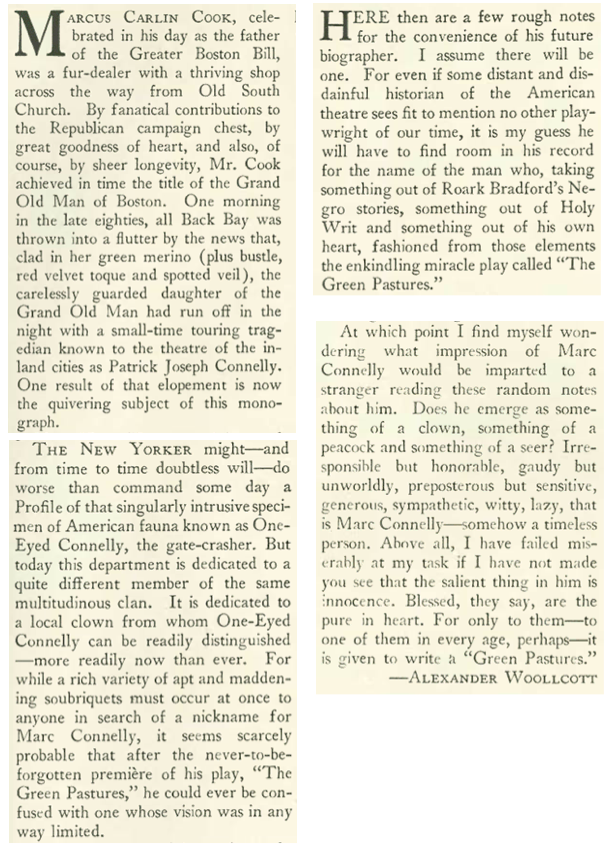
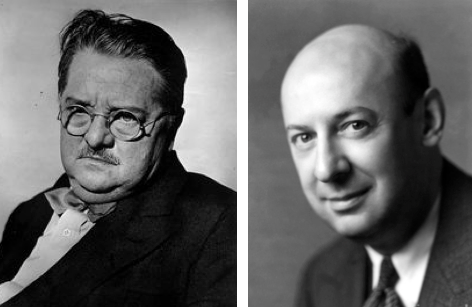
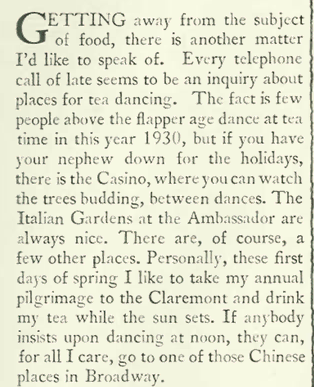
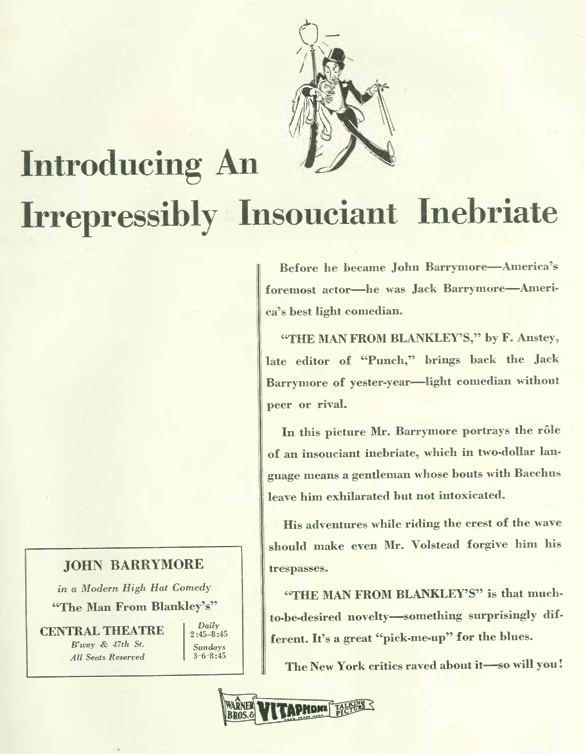


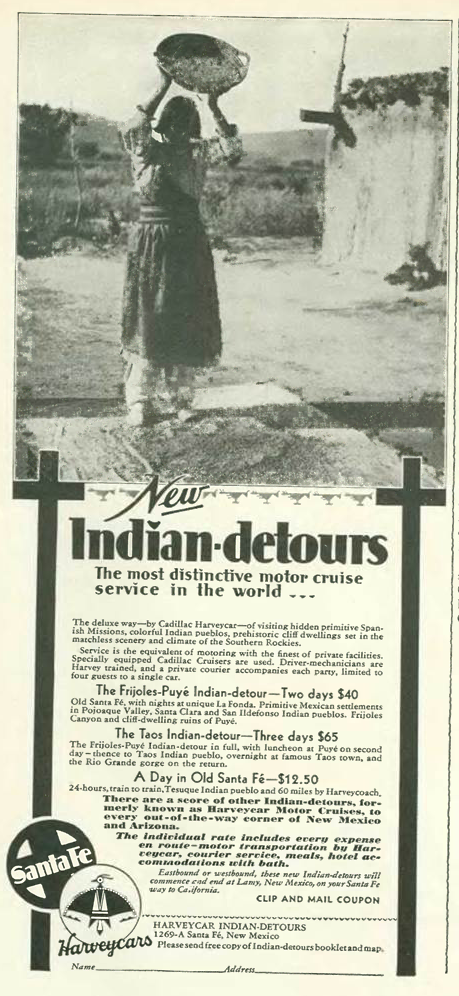


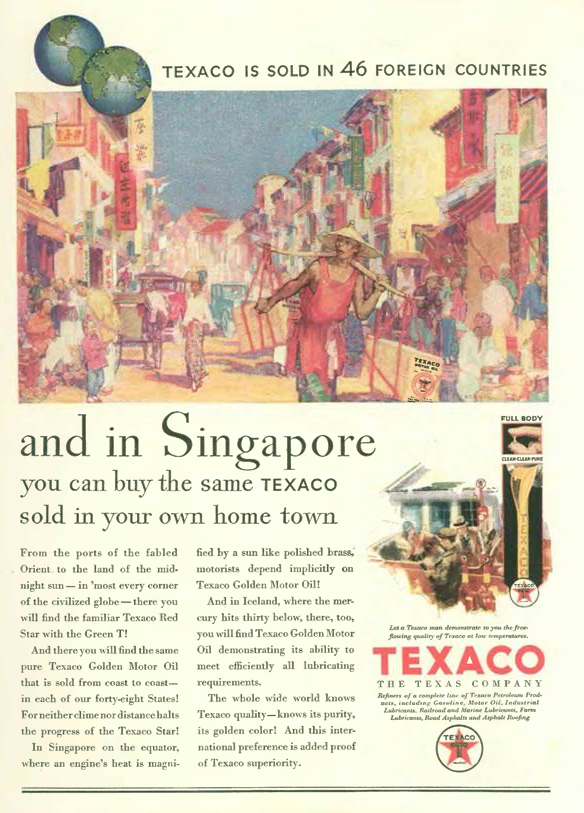
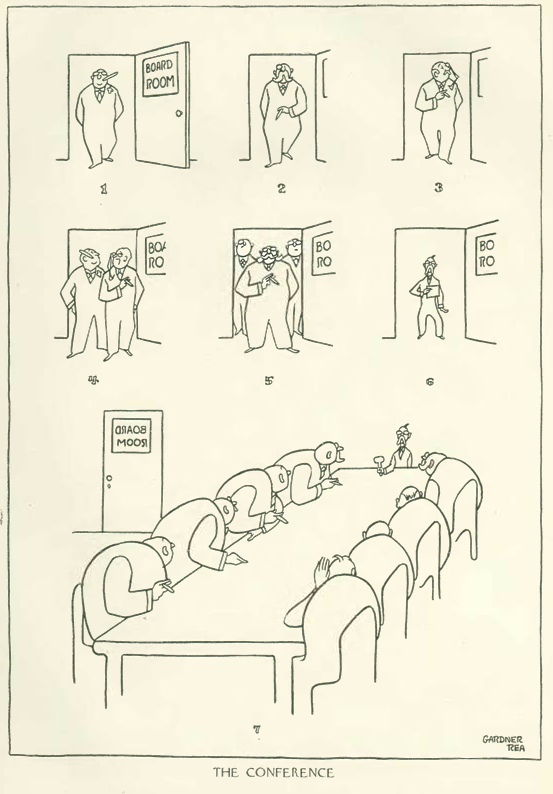


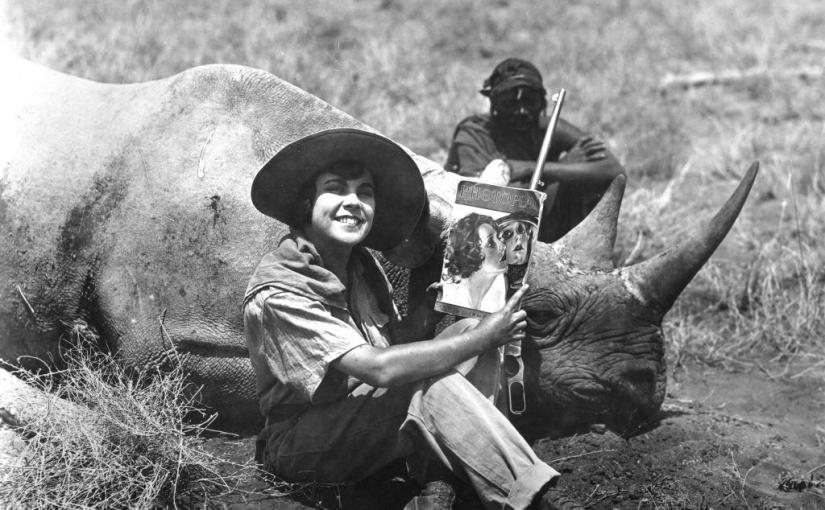
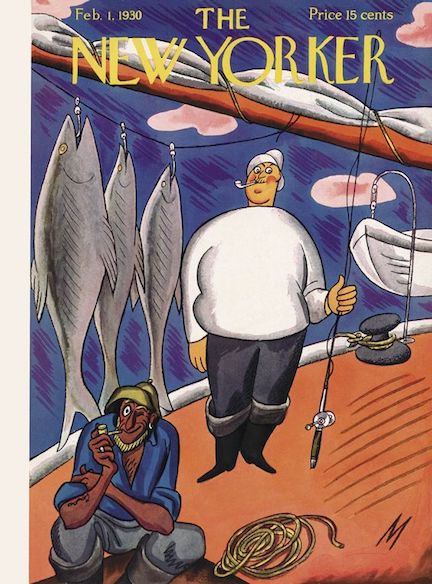
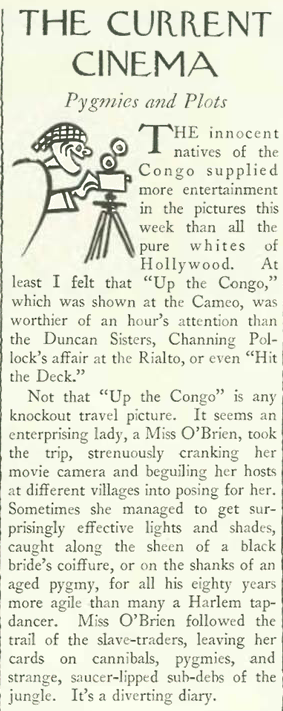

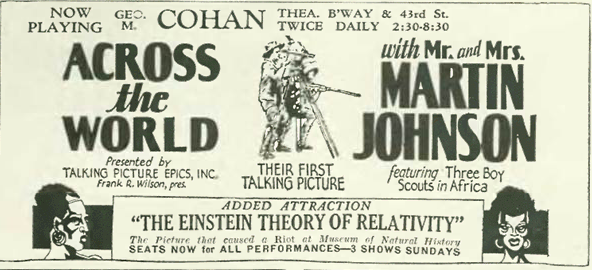
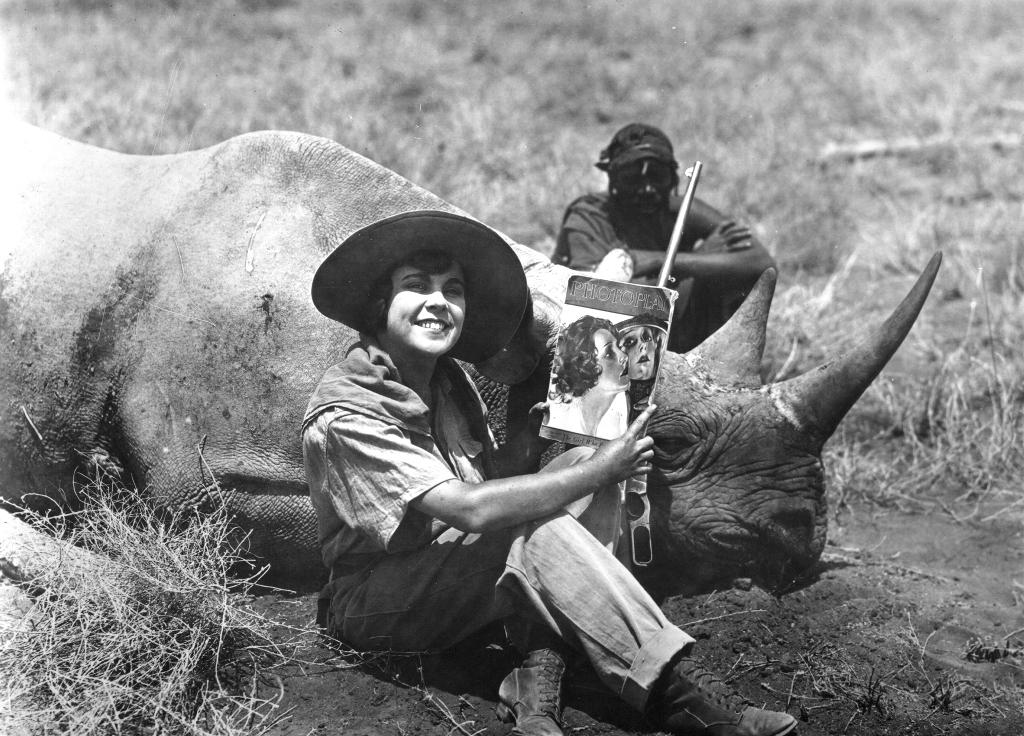
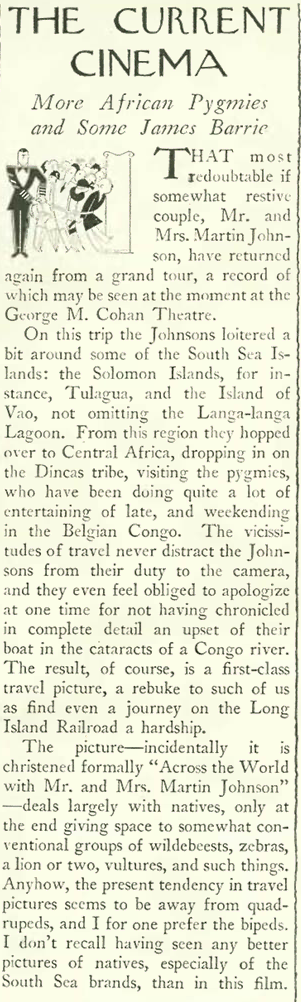
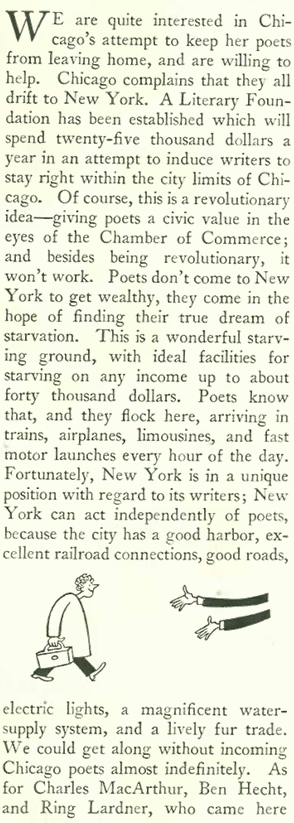
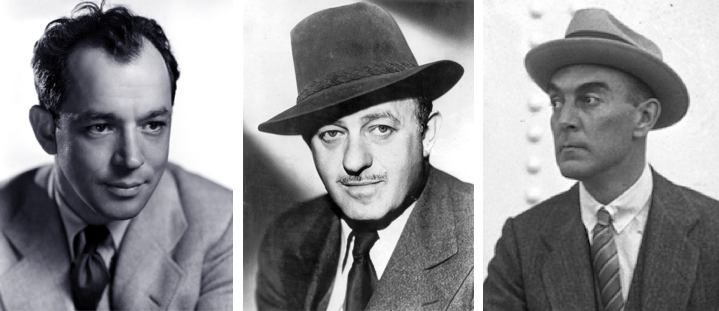




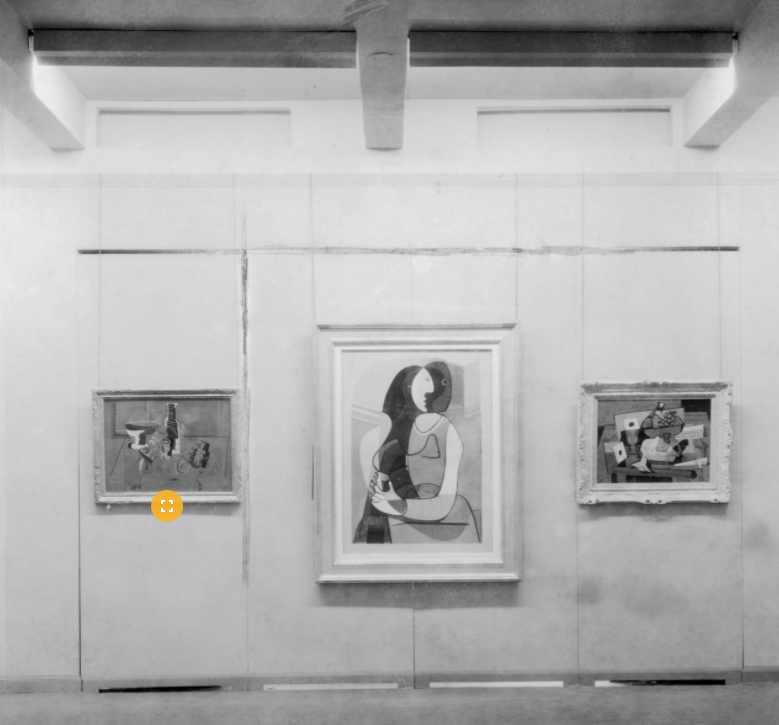


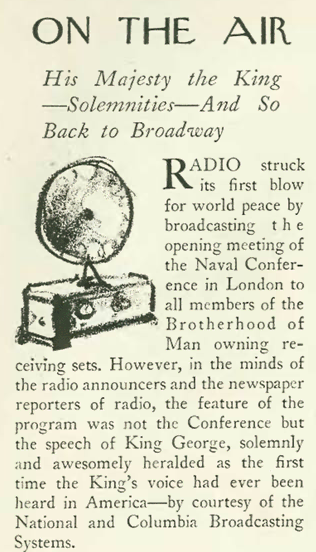
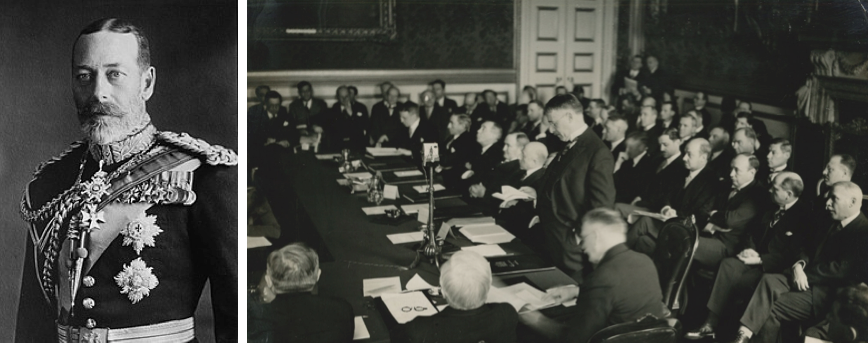

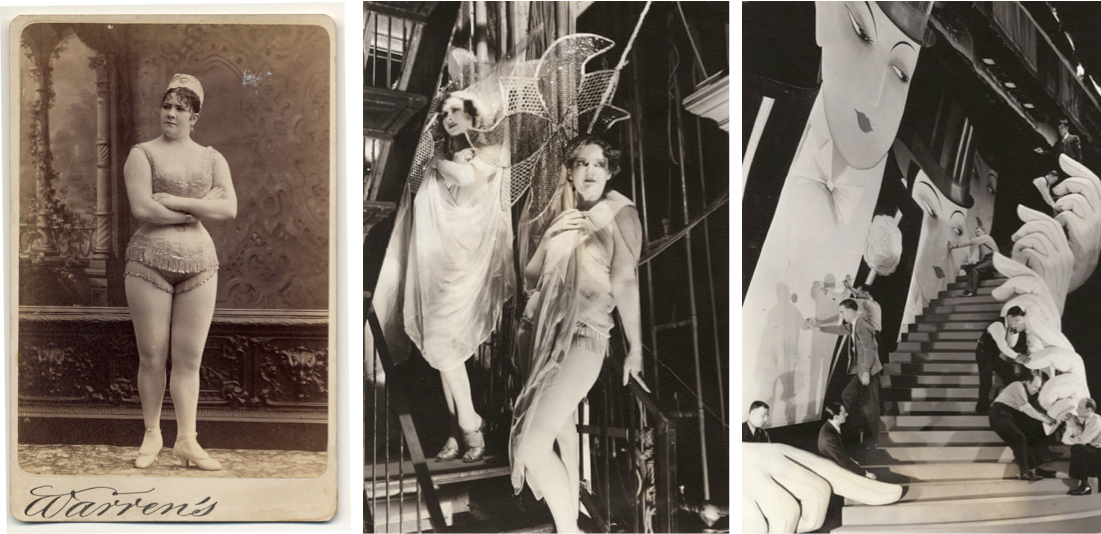

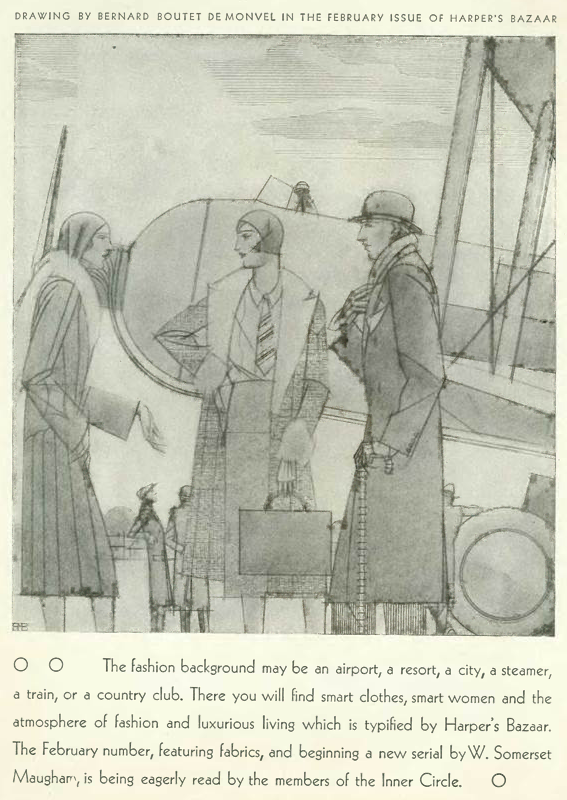


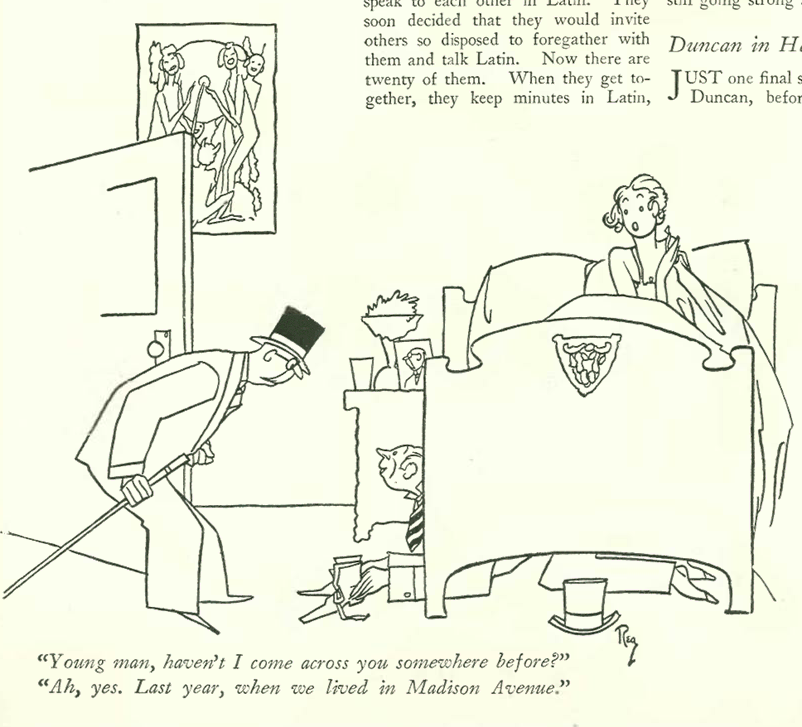
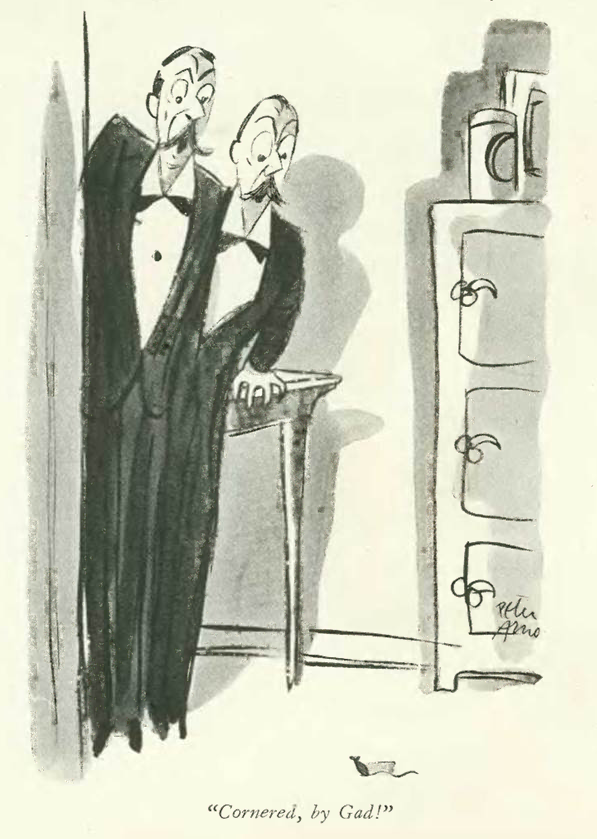
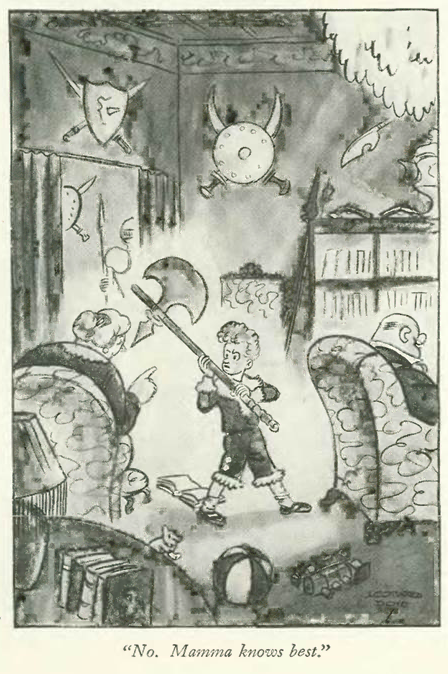


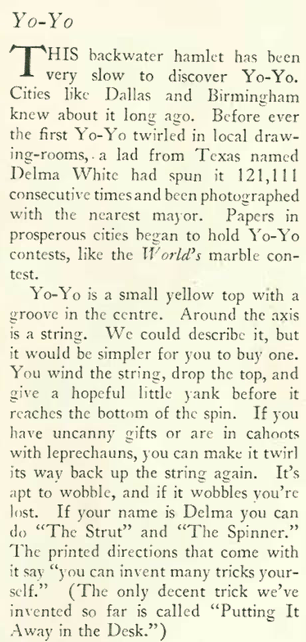

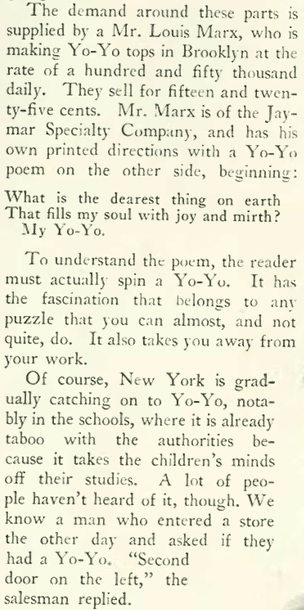
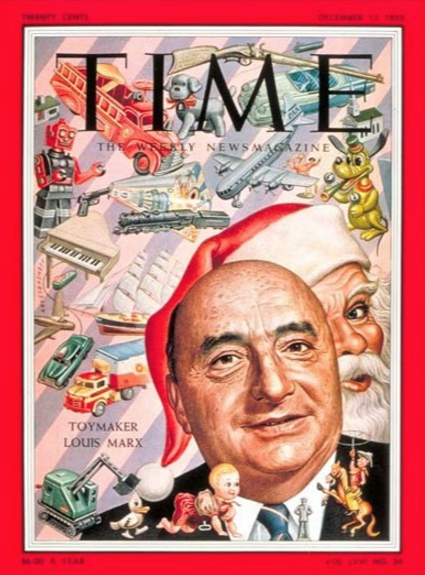


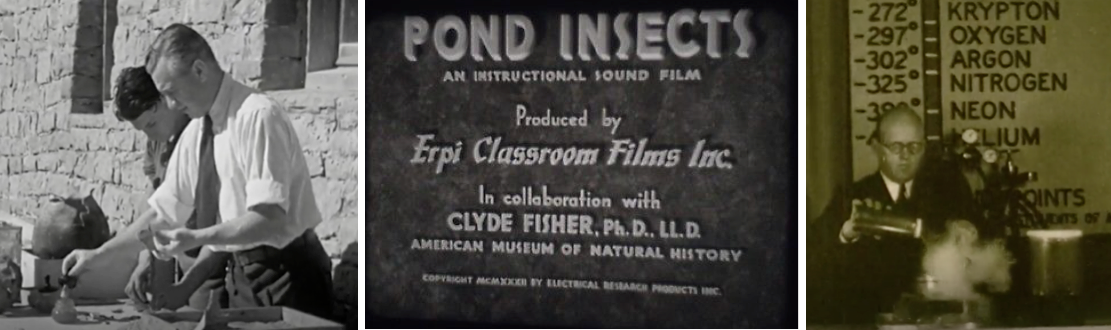



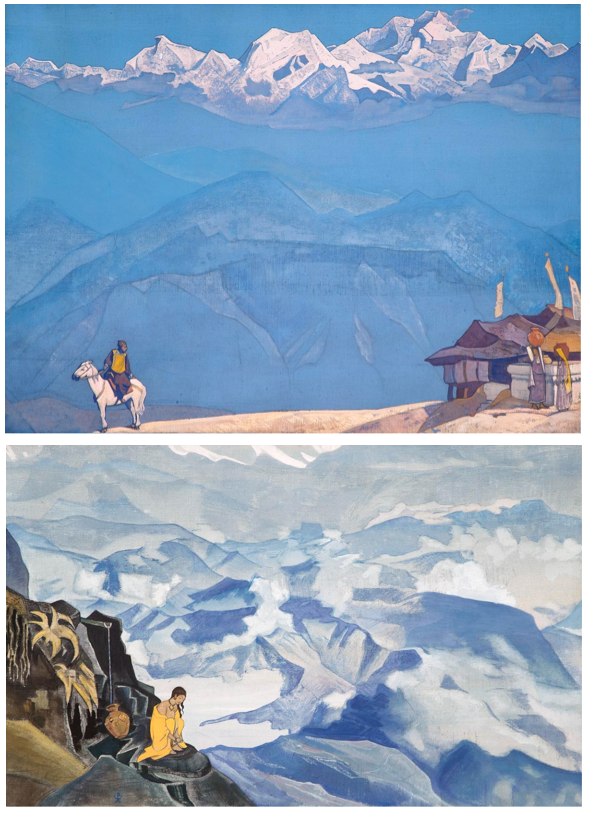



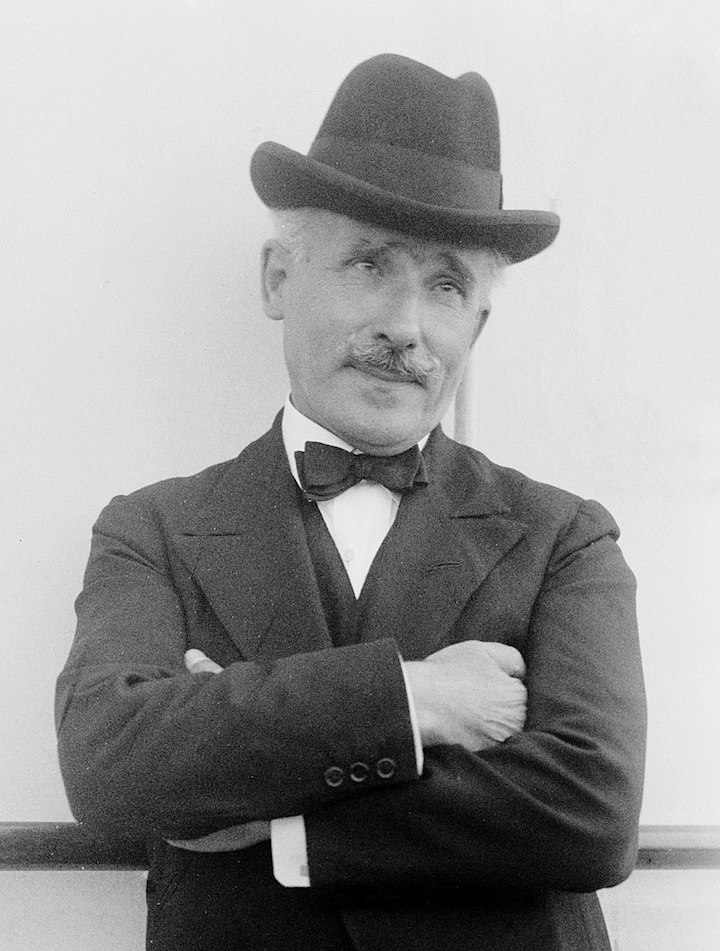
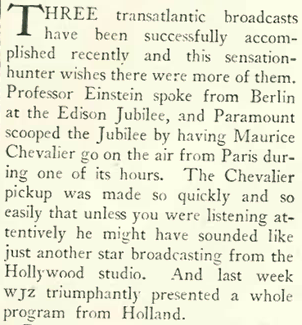


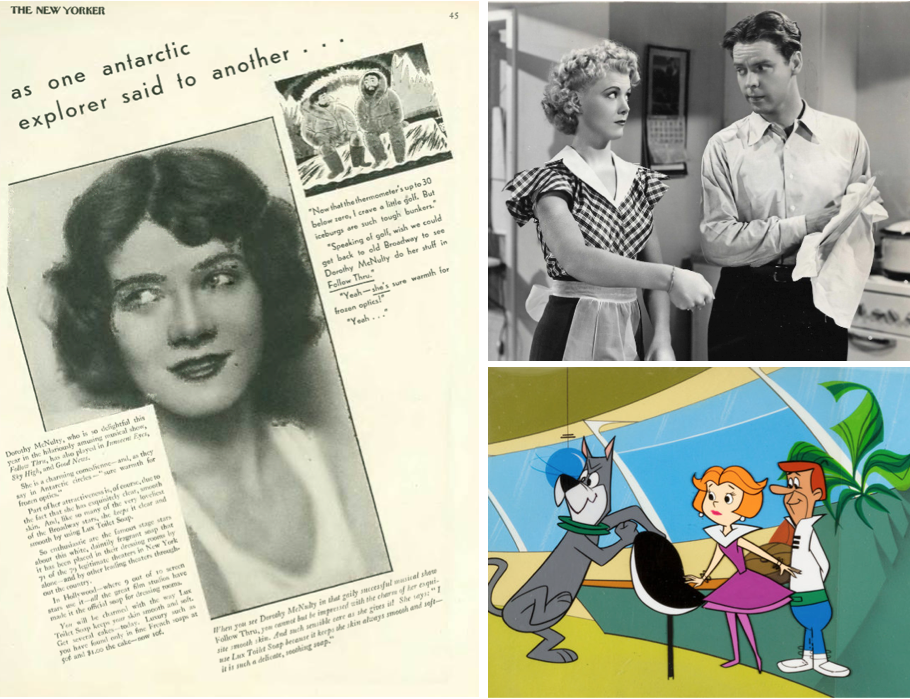
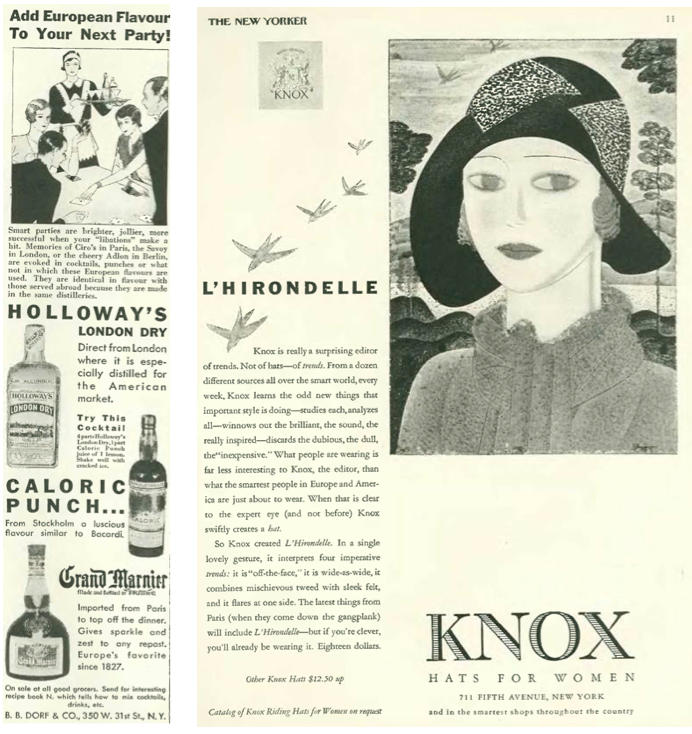


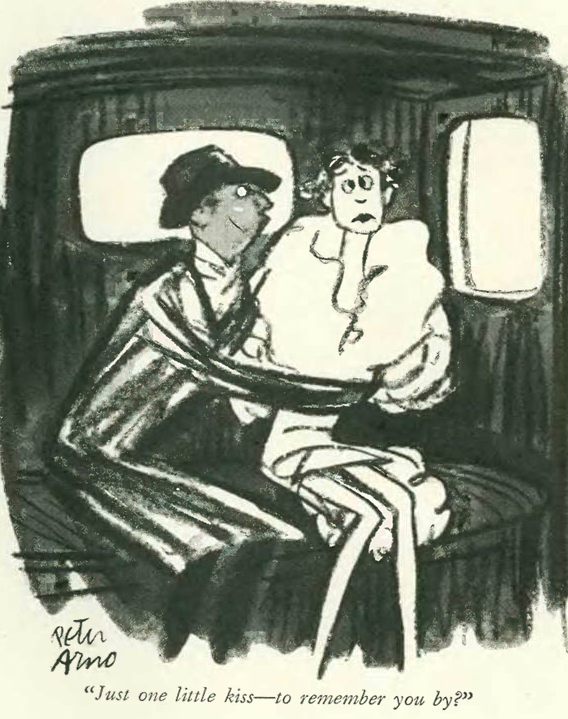

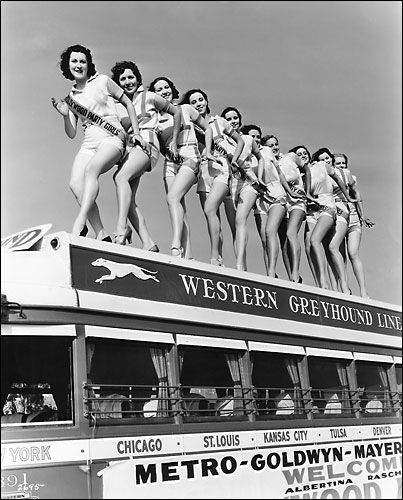


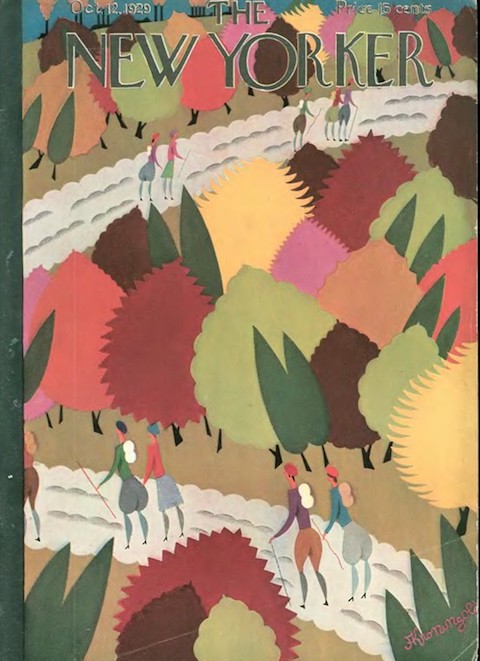


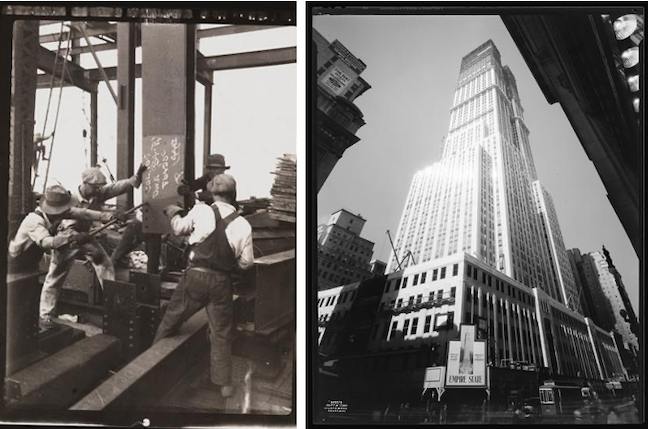


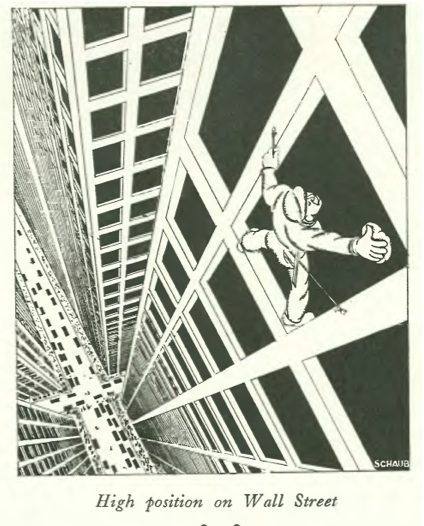
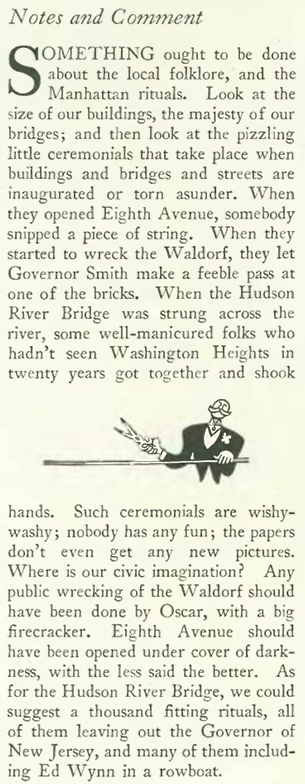

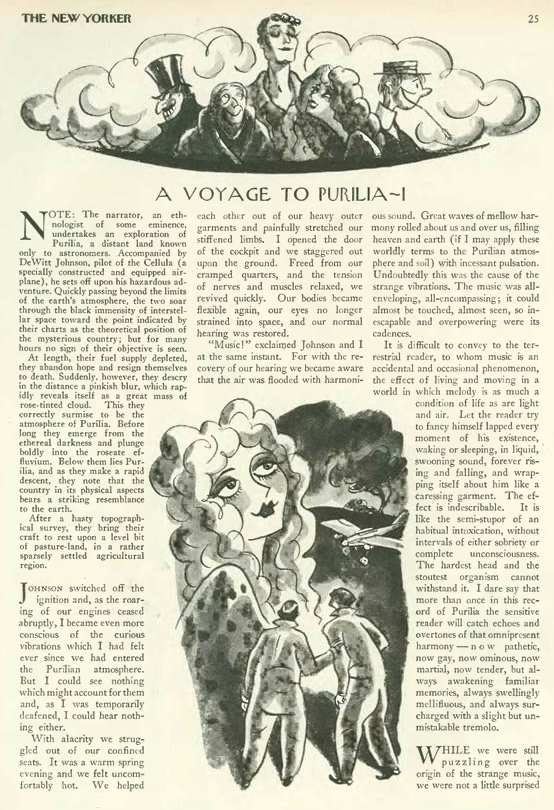
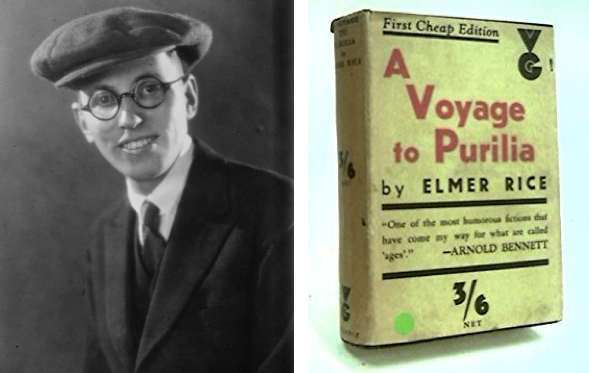

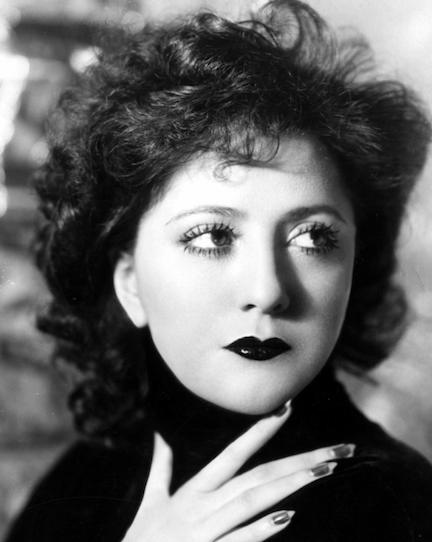
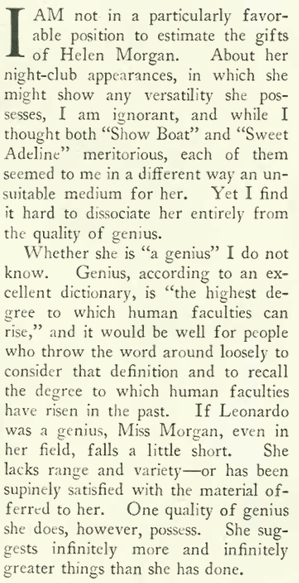

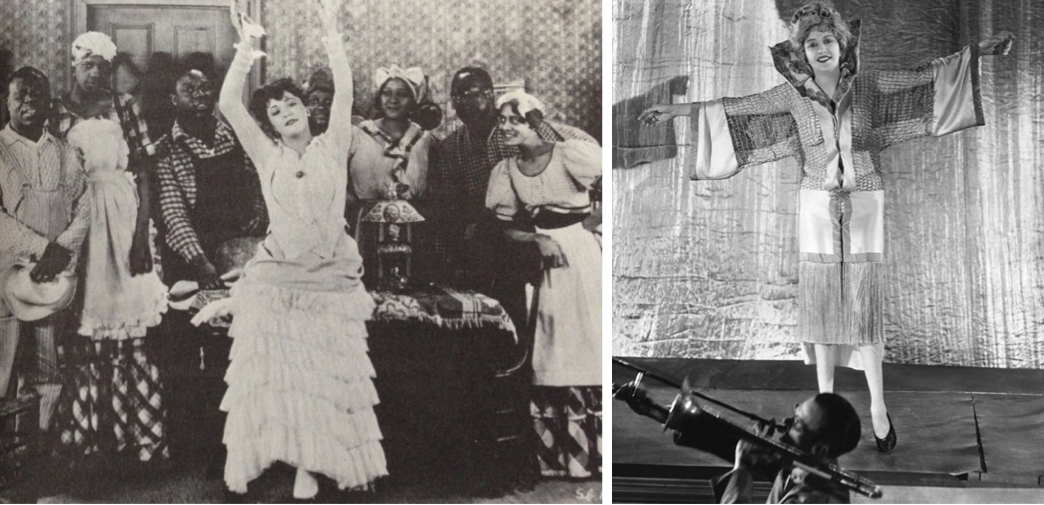


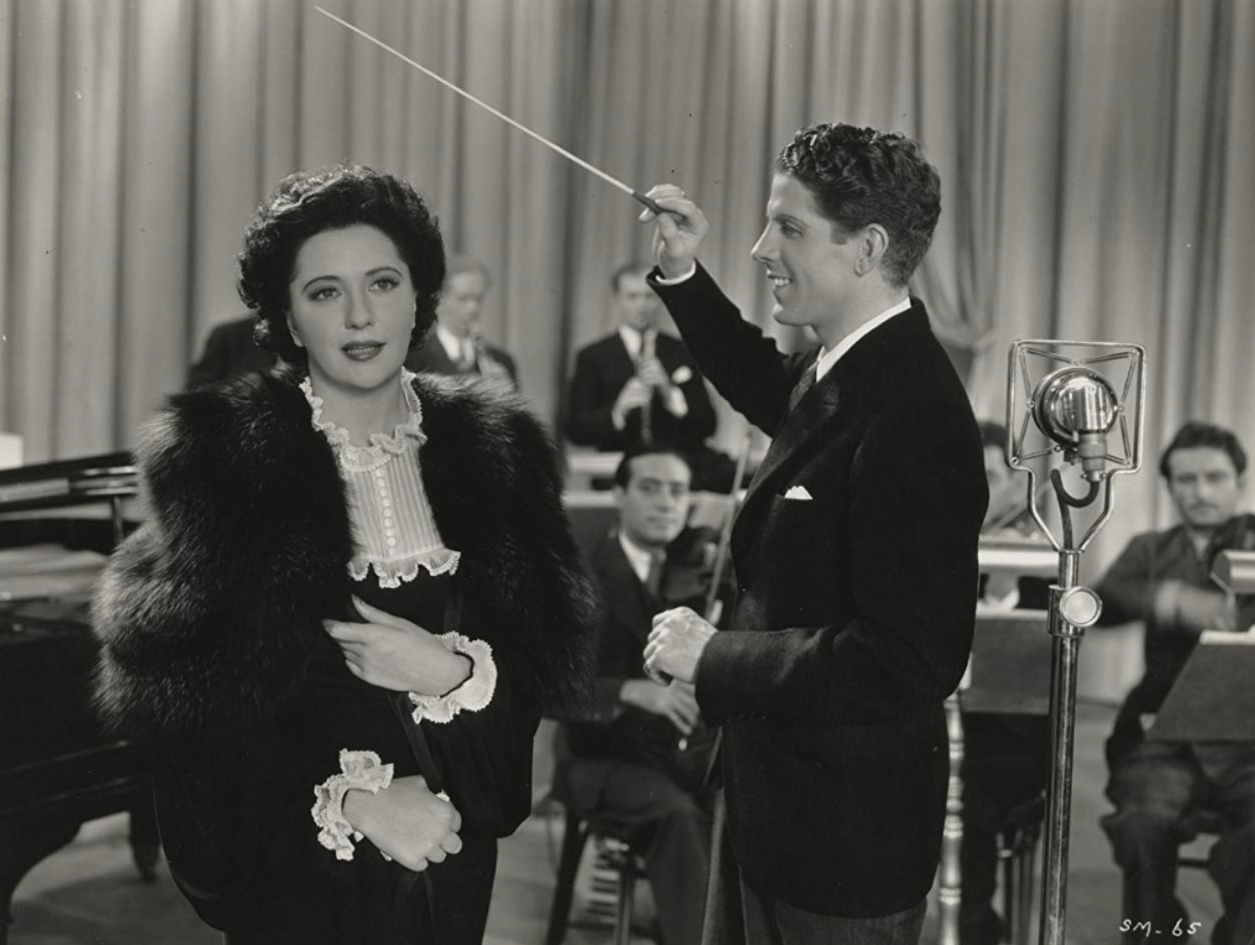


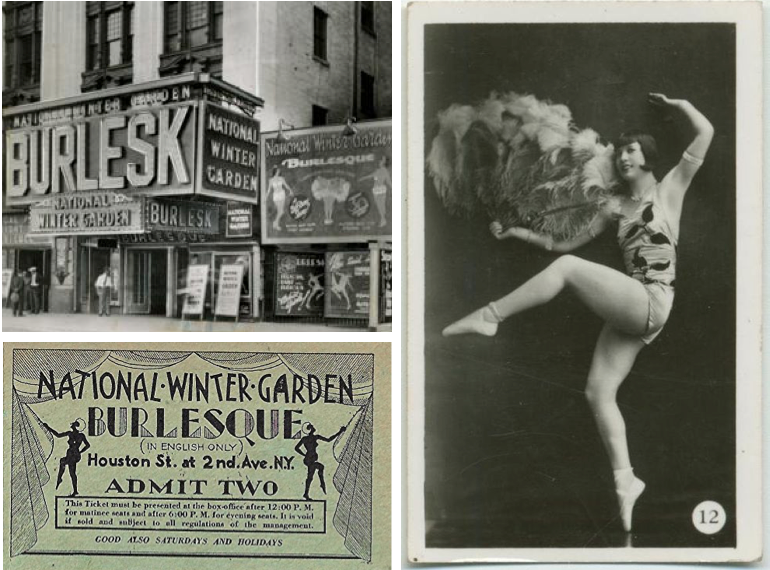


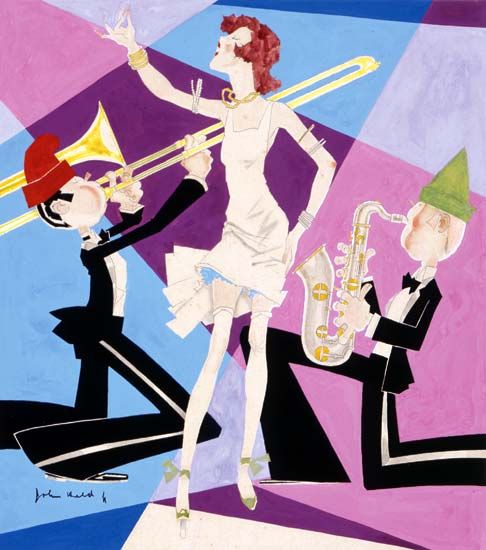
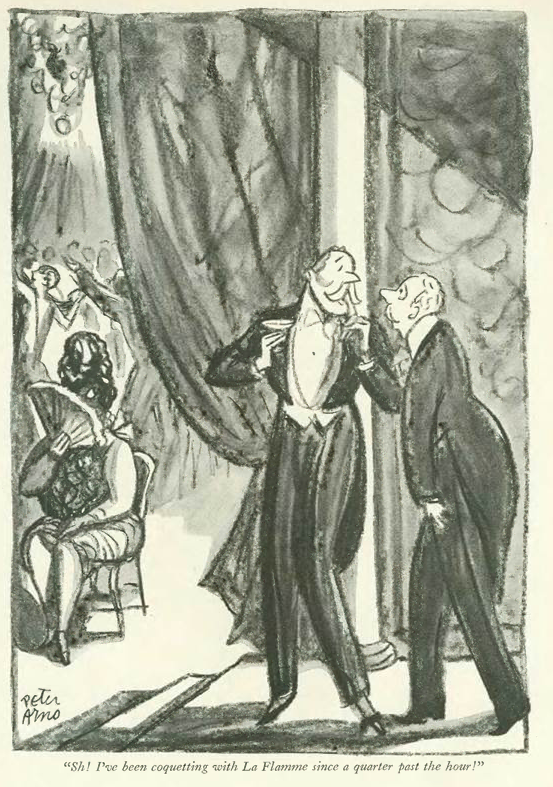

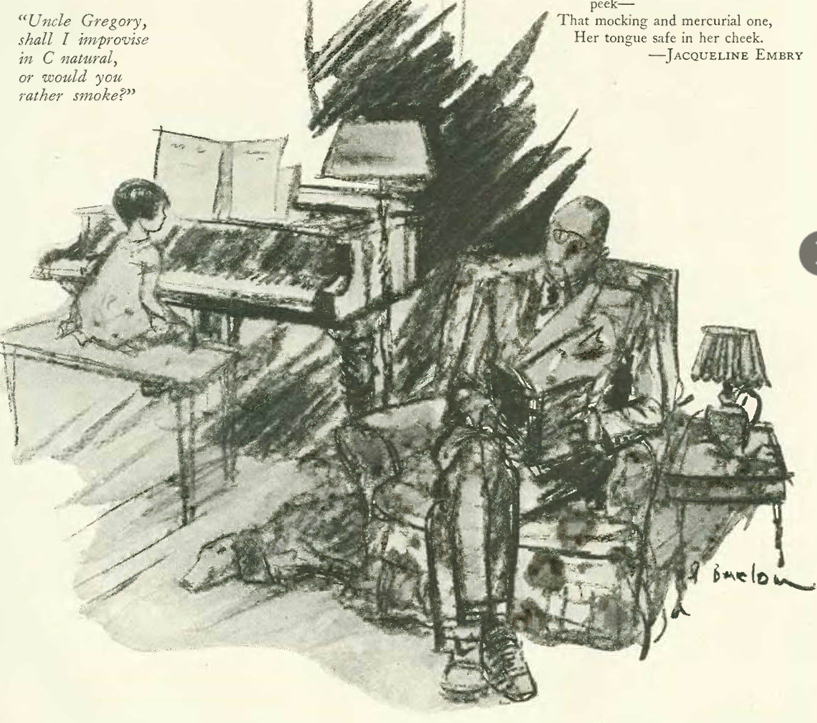


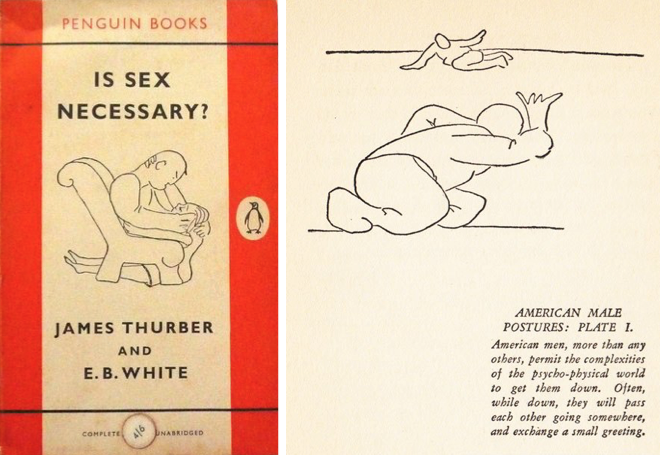
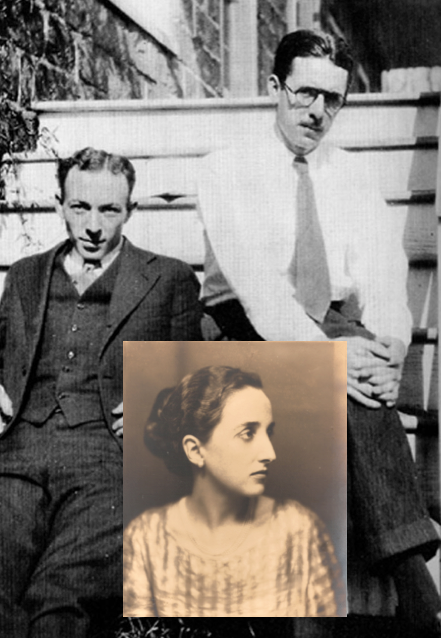


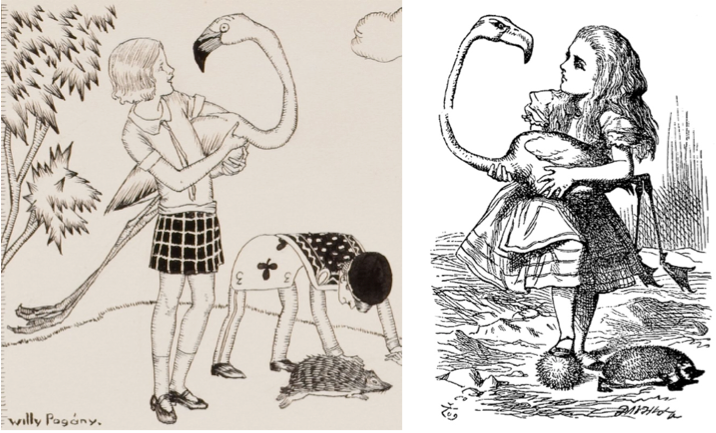
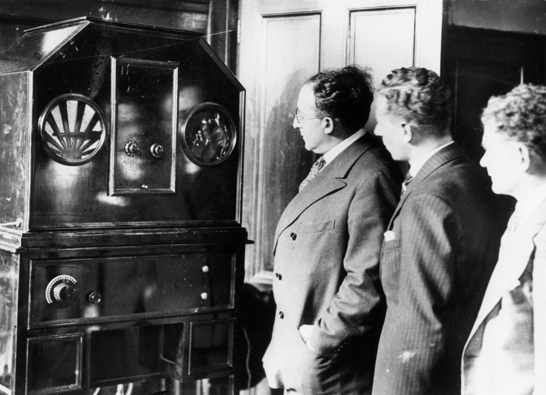
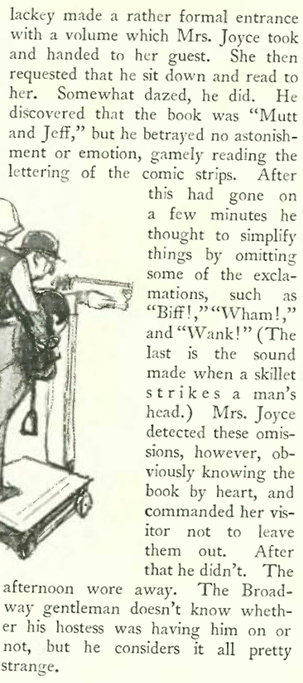

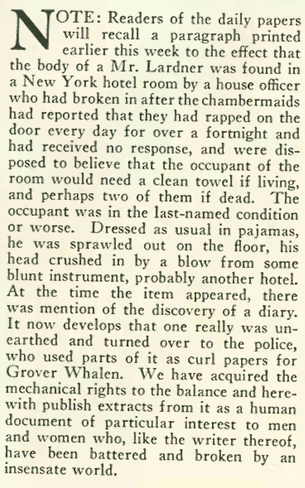
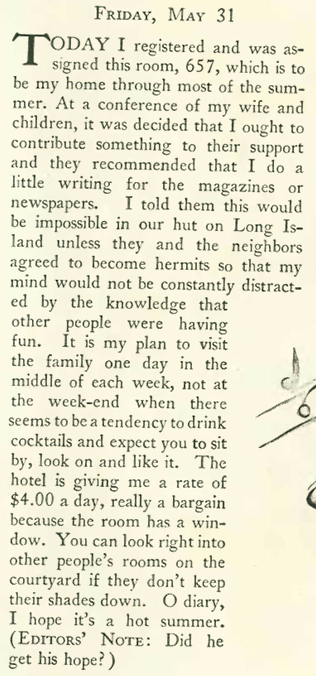


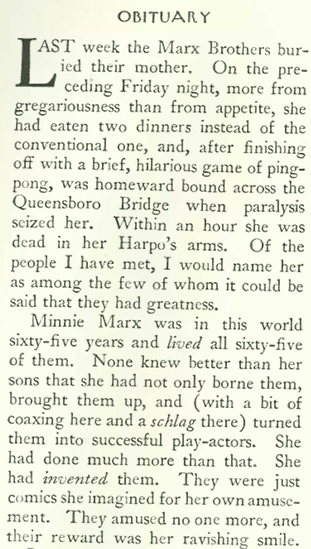


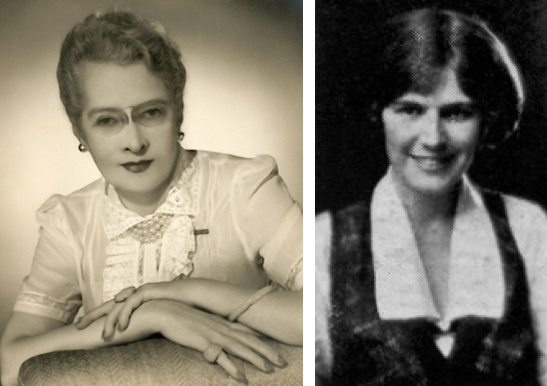


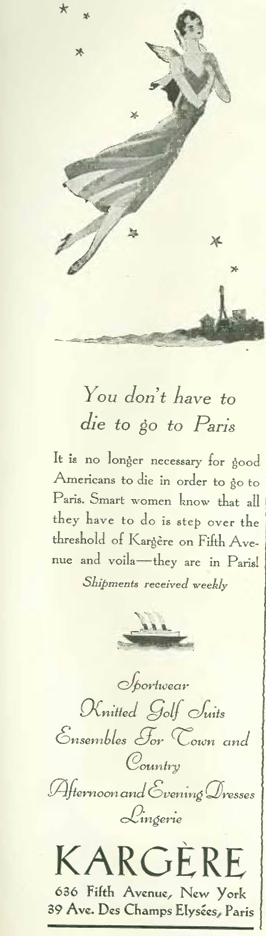


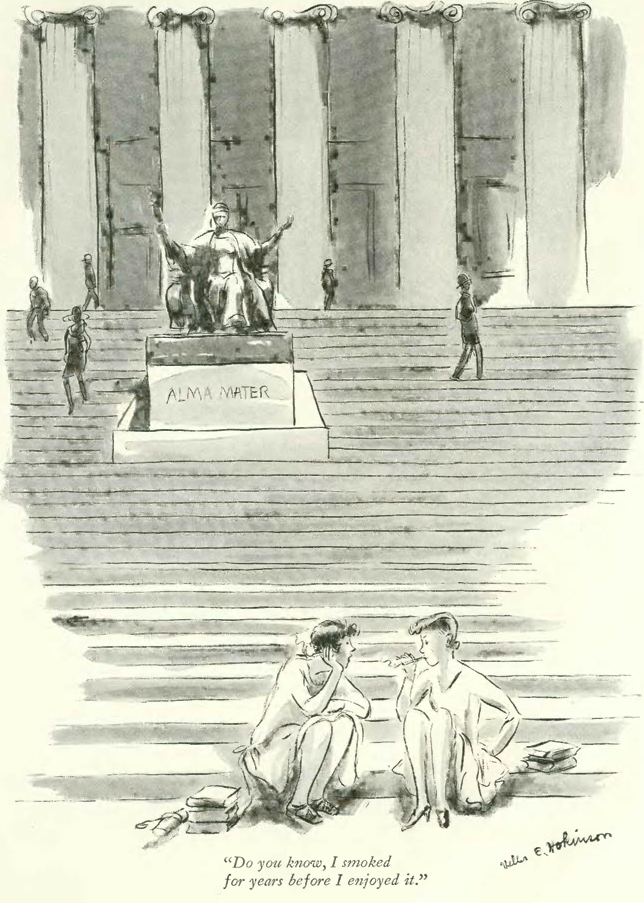

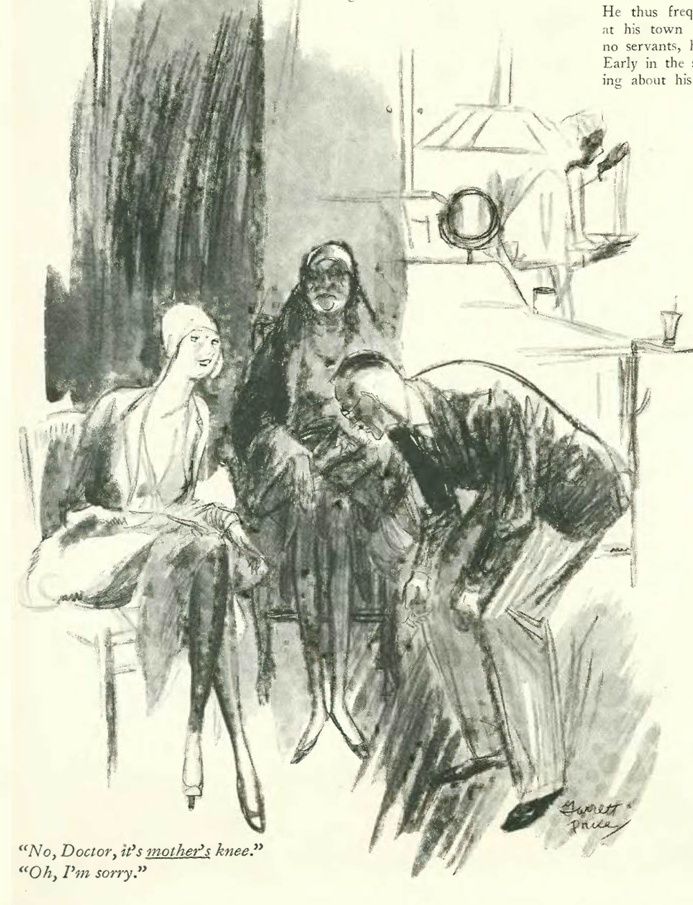


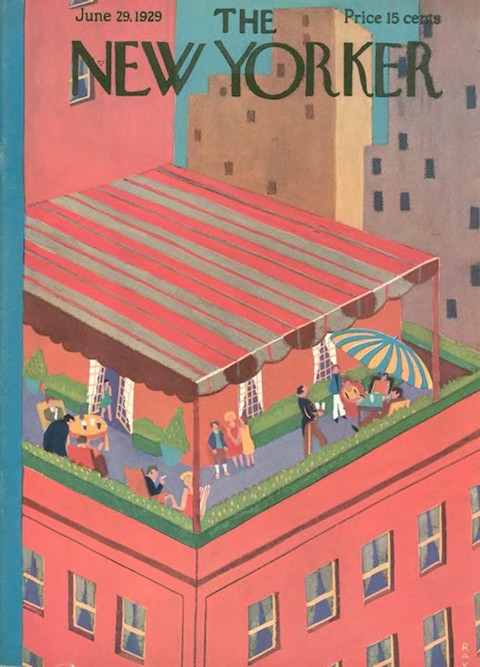
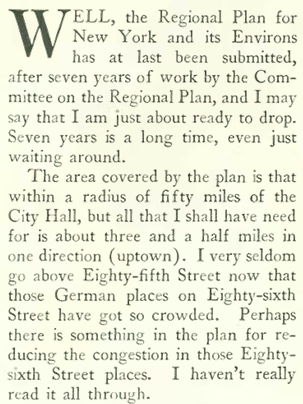
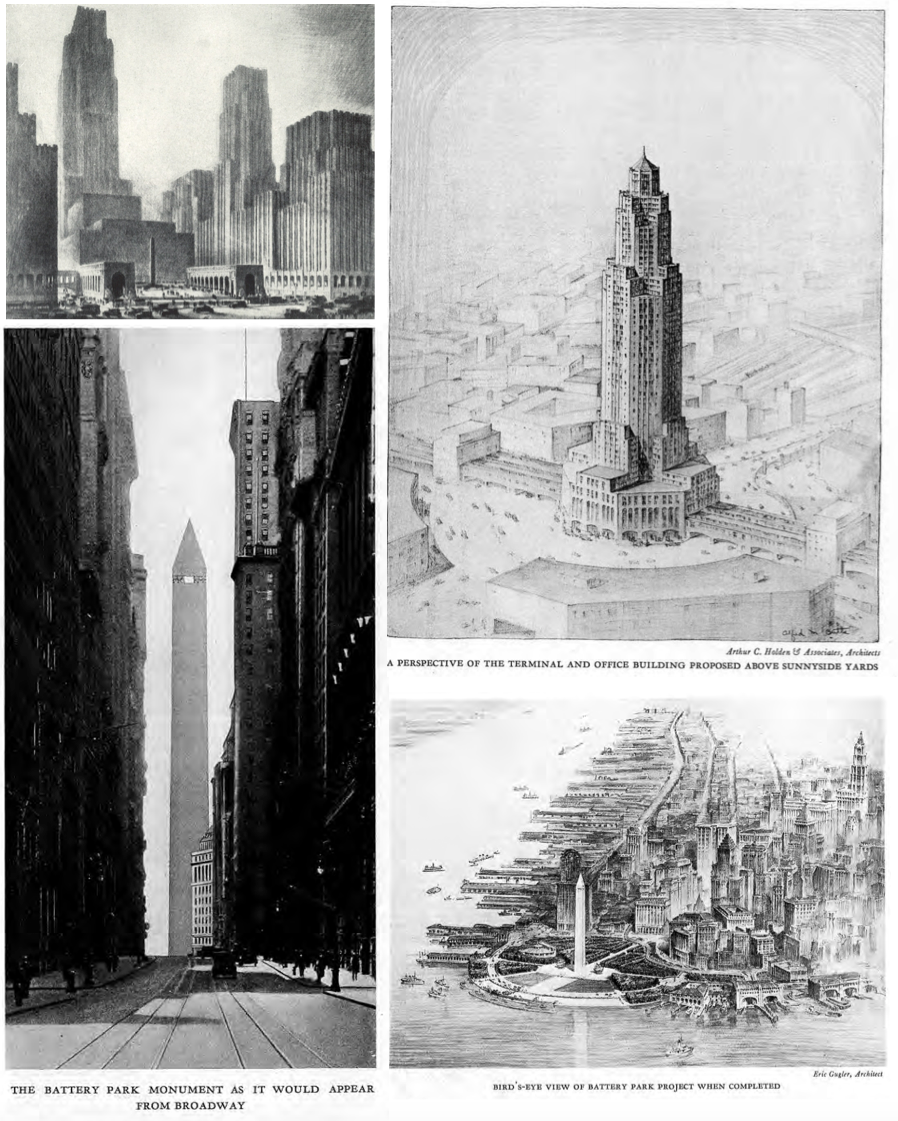

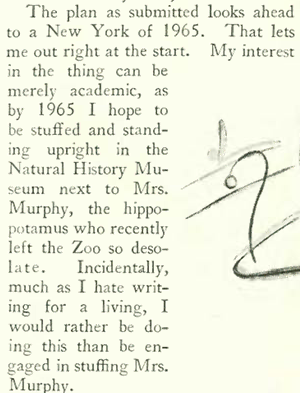


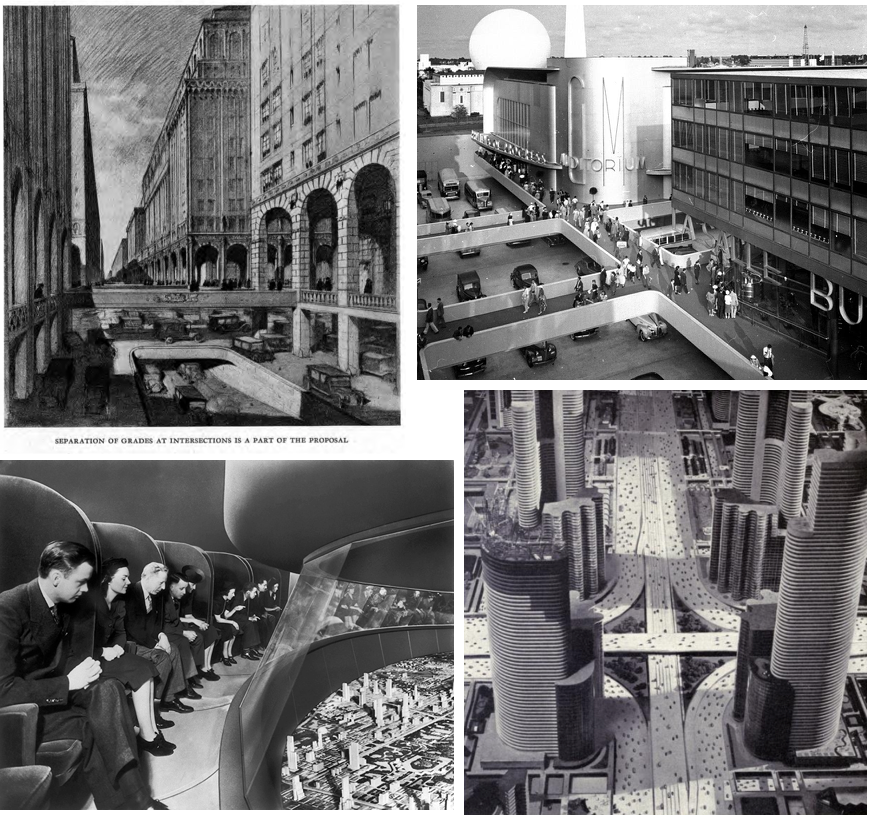




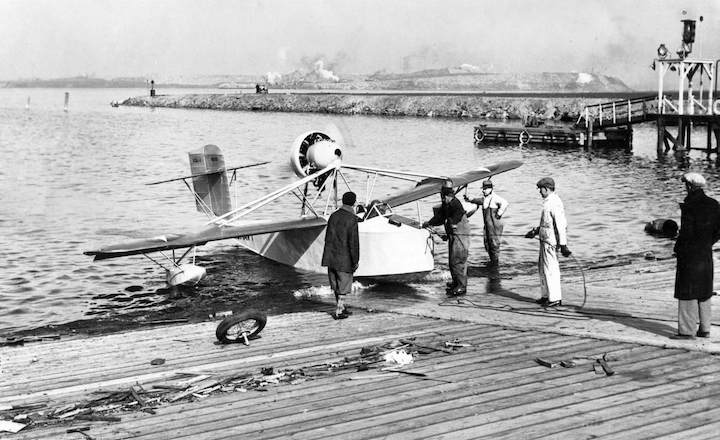
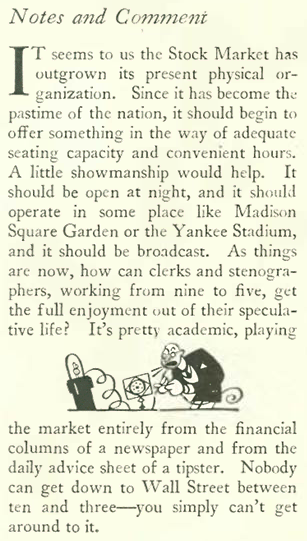
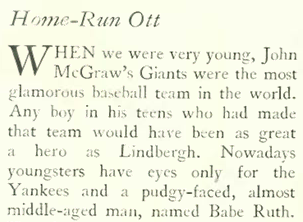
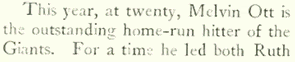

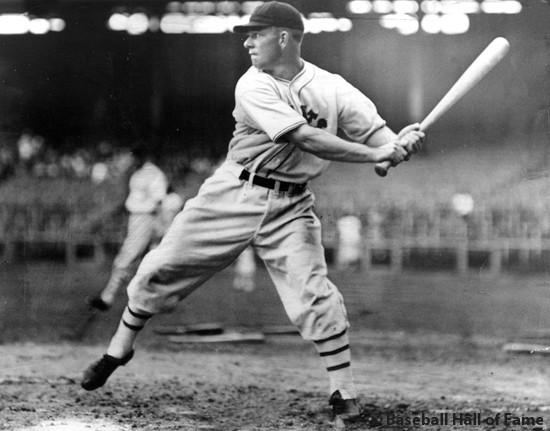

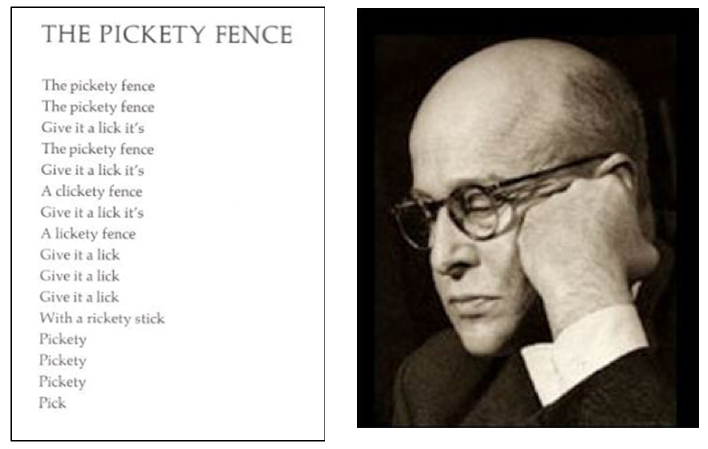
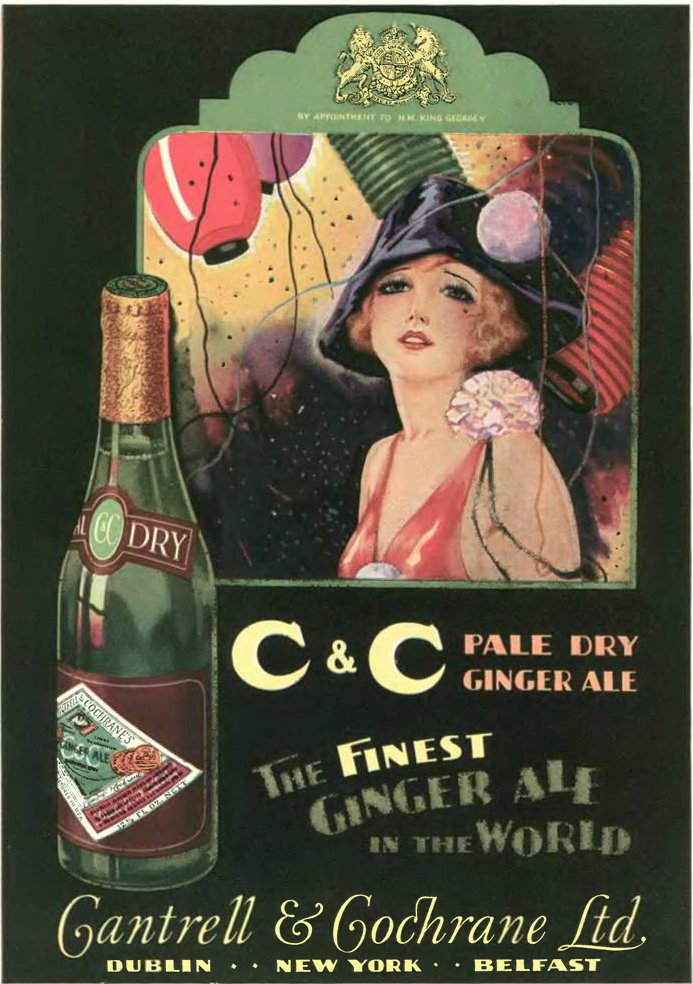
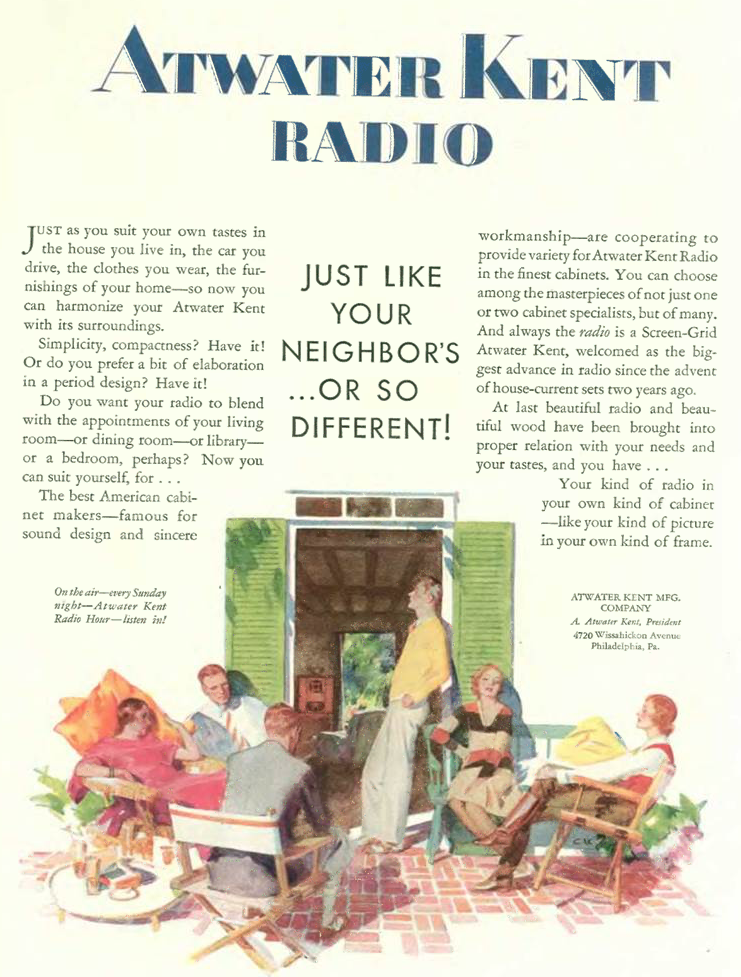


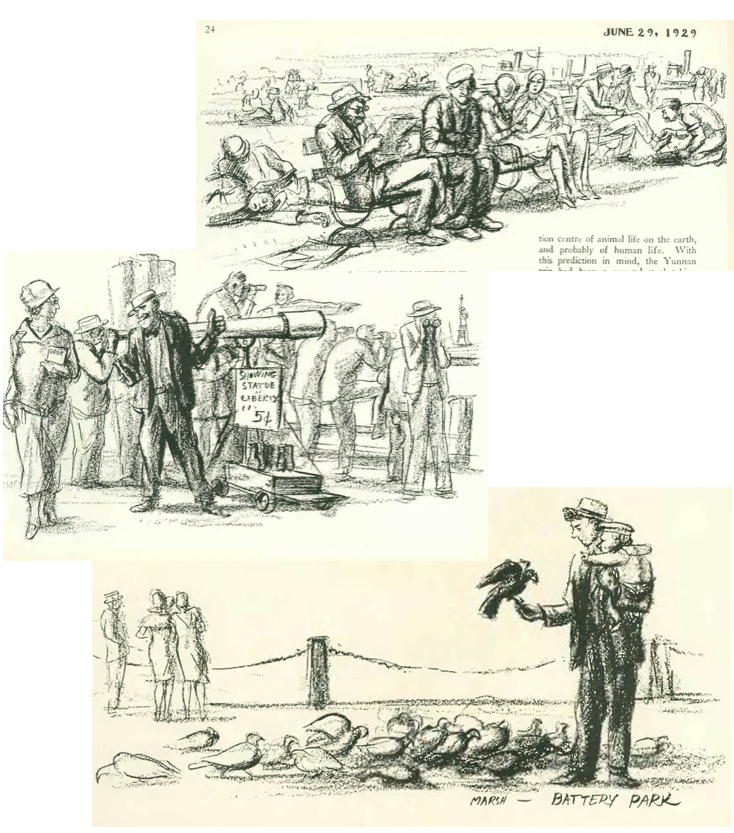
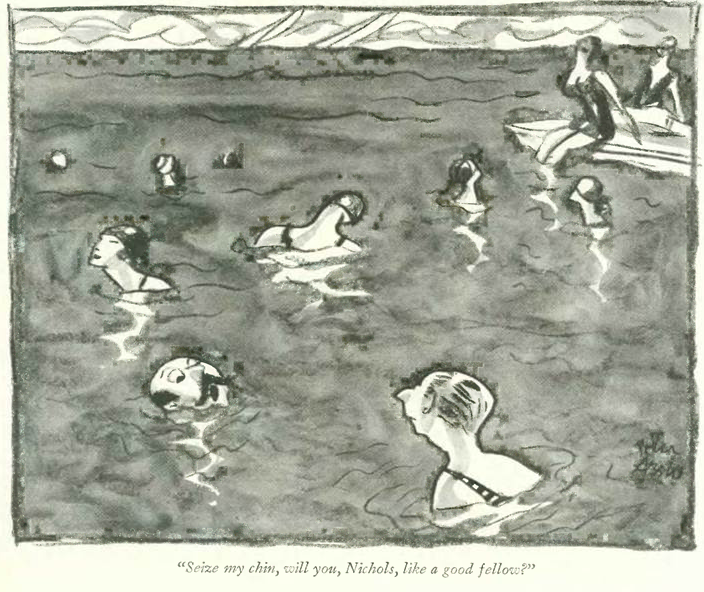
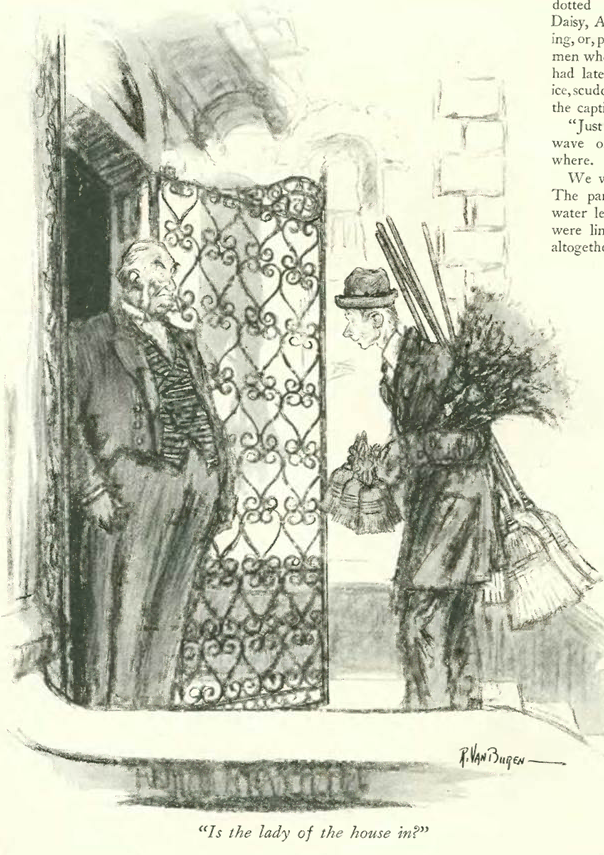

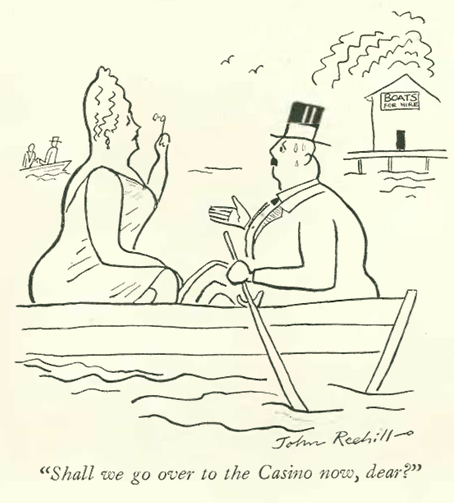
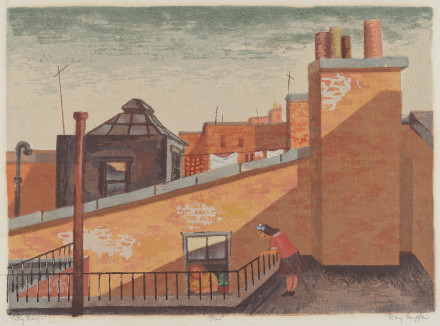
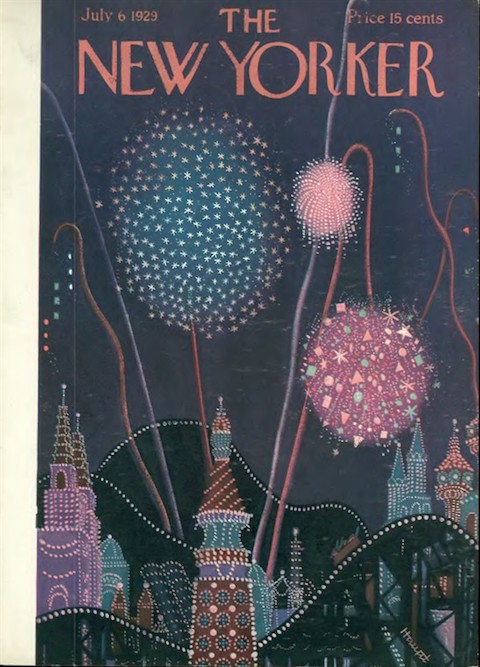
 A New Yorker State of Mind