Jimmy Comes Home

Above: Former New York Mayor Jimmy Walker and wife Betty Compton, aboard the S.S. Manhattan in 1935. (New York Daily News Archive)

The Roaring Twenties and Jimmy Walker seemed made for each other. A dandy with a taste for fine clothes, late-night parties, and Broadway showgirls, the 97th mayor of New York was a darling of the media…until the market crashed; as nest eggs evaporated along with jobs, folks quickly lost their taste for such frivolity.


November 9, 1935 cover by Daniel “Alain” Brustlein. This was the first of nine covers Brustlein created for the magazine. An Alsatian-born American artist, cartoonist, illustrator, and author of children’s books, Brustlein (1904–1996) contributed to The New Yorker under the pen name “Alain” from the 1930s through the 1950s.
Daniel “Alain” Brustlein, in an undated photo. During the height of Abstract Expressionism Brustlein became a reputable painter, exhibiting his work in New York and Paris. (derfner.org)

 *

The fall of 1935 marked three years since Walker had left office, and for nearly two of those years the city had been governed by the reformist Mayor Fiorello La Guardia. New Yorkers, it seemed, were ready for a dose of Jimmy when he returned from his European exile, hailed by a throng of media and well-wishers.

Writing for Airmail, longtime New York journalist Sam Roberts observes that the city loved Walker, “a charming hellion, a witty, self-effacing, glib humanist, far more flawed, too, and compassionate than pictured previously, a man elevated and condemned by his own character, created and ultimately consumed by his times. He conjures up the anti-Trump—a dodgy philanderer who governed by making people feel good rather than angry.”

WHERE’S THE PARTY?…Former Mayor Jimmy Walker and his wife, Betty Compton, returned to New York in the fall of 1935 amid tremendous fanfare. The New Yorker’s Morris Markey noted that at least 160 media representatives were on hand for the couple’s arrival. (YouTube)

Walker (1881-1946) fled to Europe in November 1932 amid a bribery scandal that had prompted his resignation. Accompanied by Ziegfeld Follies singer Betty Compton (1906–1944)—whom he would marry in Cannes the following April—they would bounce around the continent until Walker determined that the danger of criminal prosecution had passed.

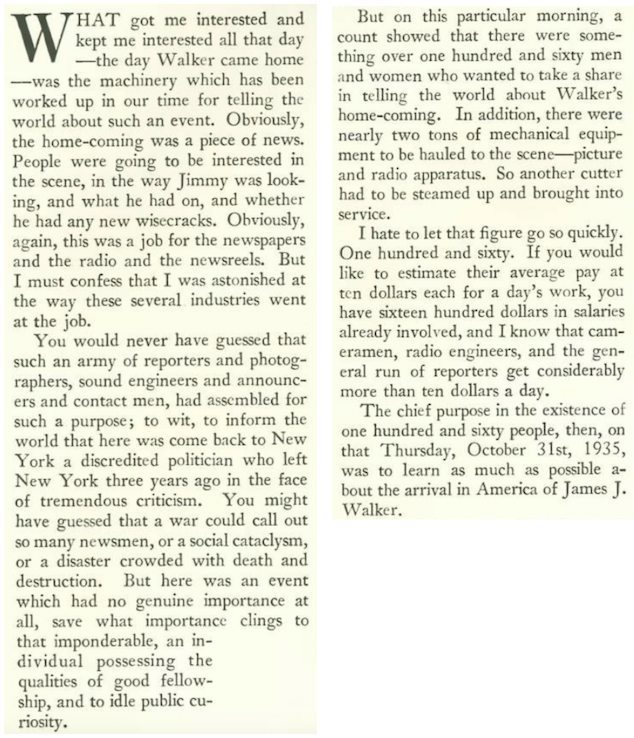
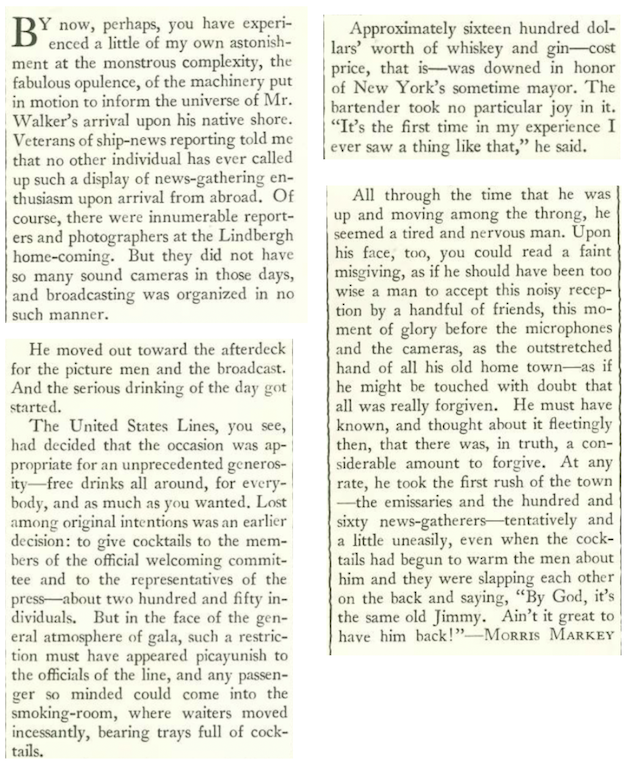
In his “A Reporter at Large” column, Morris Markey wrote about the media’s reception of the exiled mayor, “an army of reporters and photographers, sound engineers and announcers and contact men”…all assembled to inform the world of the return of a “discredited politician.”
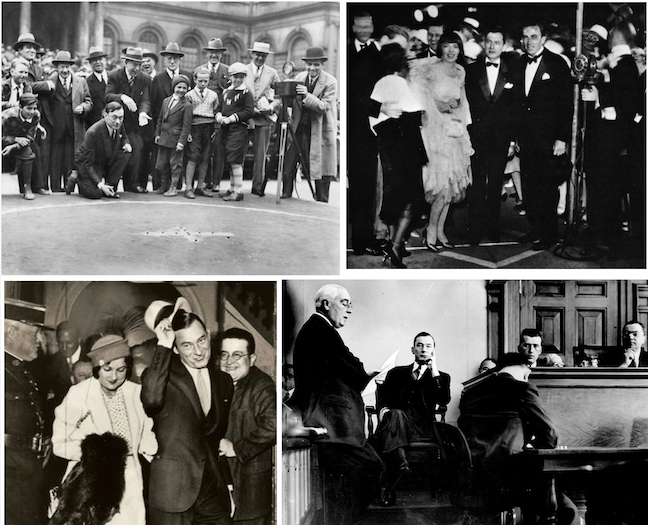
HE GOT AROUND…During his time in office from 1926 to 1932, Mayor Jimmy Walker never seemed to miss a moment in the spotlight. Clockwise, from top left, Walker presided over the first shot in the city’s annual marble tournament on June 3, 1928; with actress Colleen Moore at the 1928 premiere of her latest film, Lilac Time;  testifying on bribery charges before the investigative committee of Judge Samuel Seabury, 1932; with Betty Compton following their 1933 wedding in Cannes. (New York Times/konreioldnewyork.blogspot.com/villagepreservation.org)

Markey continued to convey his astonishment at “the monstrous complexity, the fabulous opulence, of the machinery put in motion to inform the universe of Mr. Walker’s arrival upon his native shore.” This included a massive cocktail party—hosted by The United States Lines—for more than two hundred press representatives and other officials.
After all the commotion, Walker would settle into a job as head of Majestic Records, adopt two children with Compton, and host his own radio series on WHN, Jimmy Walker’s Opportunity Hour.

Compton would divorce Walker in 1941 and remarry. Becoming ill after the birth of a son, she would die at age 38 in 1944. Walker would die two years later at age 65 of a brain hemorrhage.

CALLING ON THE ROOSEVELTS…Jimmy Walker and Betty Compton at the White House in 1937. It was pressure from FDR that led to Walker’s resignation in 1932. (Wikipedia)

 * * *

High-flying Hooplah

While New Yorkers were going gaga over Walker, folks in the Bay Area were all atwitter over the first air-mail flight across the Pacific, loading a Pan Am Clipper to the gills with all manner of collectables. E.B. White noted:
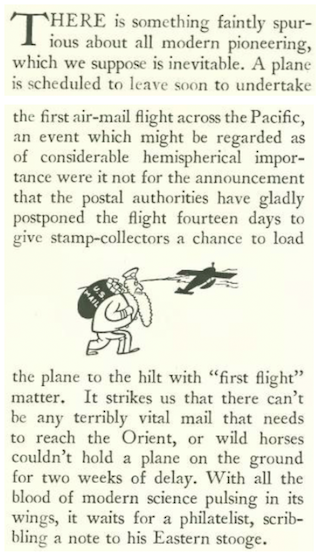
BELLYFUL…On Nov. 22, 1935, Pan American Airways made aviation history as the China Clipper lifted off from Alameda, beginning the world’s first trans-Pacific airmail service. Captained by Edwin Musick and crewed by famed navigator Fred Noonan, the Martin M-130 opened a new era of long-distance flight across the Pacific. Noonan, who charted many commercial routes across the Pacific, would go missing along with Amelia Earhart during their ill-fated flight in July 1937. (Library of Congress)

* * *

Wise Men From the East

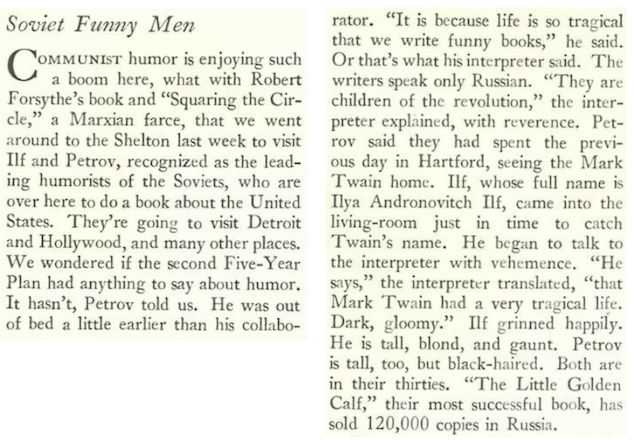
“The Talk of the Town” visited with Soviet satirists Ilya Ilf (1897–1937) and Evgeny Petrov (1903–1942), who were in New York preparing for a ten-week road trip to California and back. On assignment as special correspondents for the newspaper Pravda, they later published a series of illustrated articles, “American Photographs,” as well as a book titled Single-Storied America (the summer 2004 issue of Cabinet Magazine features an account of their journey as well as a number of their photographs).
AMERICA WAS A GAS…Soviet satirists Ilya Ilf (left) and Yevgeni Petrov check out New York before heading into the American heartland on a ten-week road trip, a highlight being the countless full-service gas stations they encountered along the way. After seeing skyscrapers and mountains and other wonders, the pair agreed that the most enduring image was the one at right: “an intersection of two roads and a gasoline station against a (back)ground of wires and advertising signs.” Sadly, Ilf died two years later from tuberculosis; Petrov died in a plane crash in 1942 while working as a war correspondent. (Aleksandra Ilf archive/Cabinet Magazine)

 * * *

A Jumbo Career

Wallace Beery (1885–1949) got his start in the comedy silents of the 1910s and became a star before the sound era made him an even bigger one; by 1932 he was the world’s highest-paid actor. Alva Johnston’s profile (titled “Jumbo”) took a look at Beery’s life and career (illustration by Al Frueh). Excerpts:

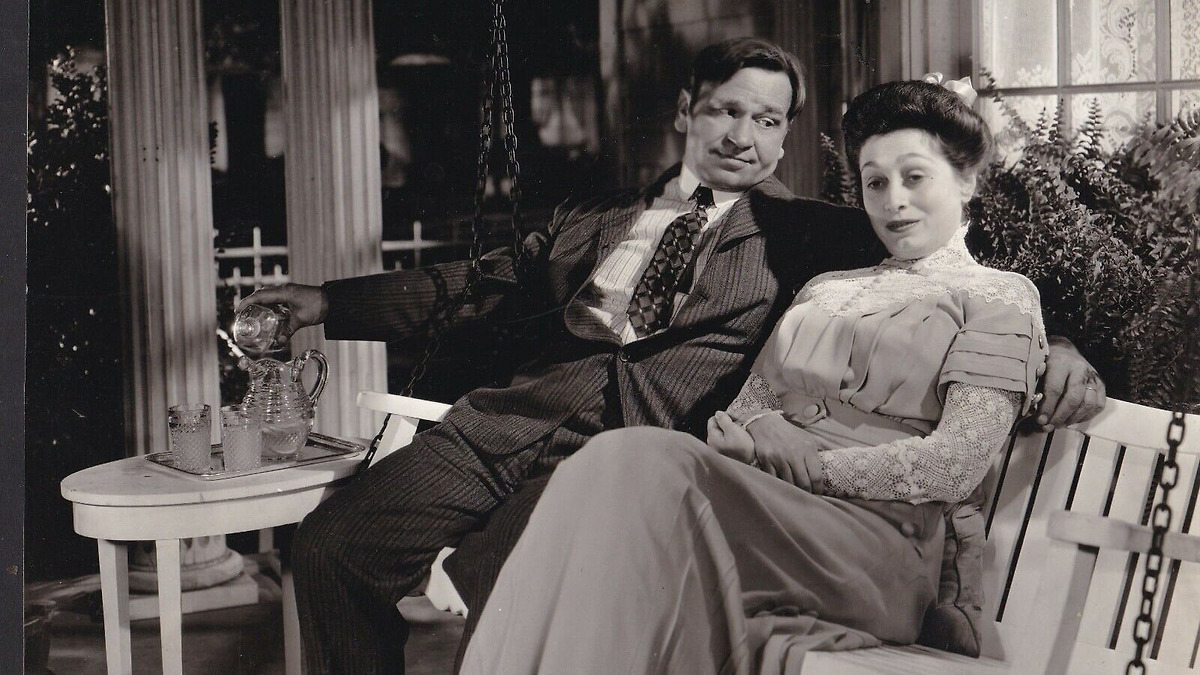
COURTING AND SPARKING…Sid Miller (Wallace Beery) spikes the lemonade as he woos Lily Davis (Aline MacMahon) in a scene from the 1935 film, Ah Wilderness! (letterboxd.com)

 * * *

A View and Corbu

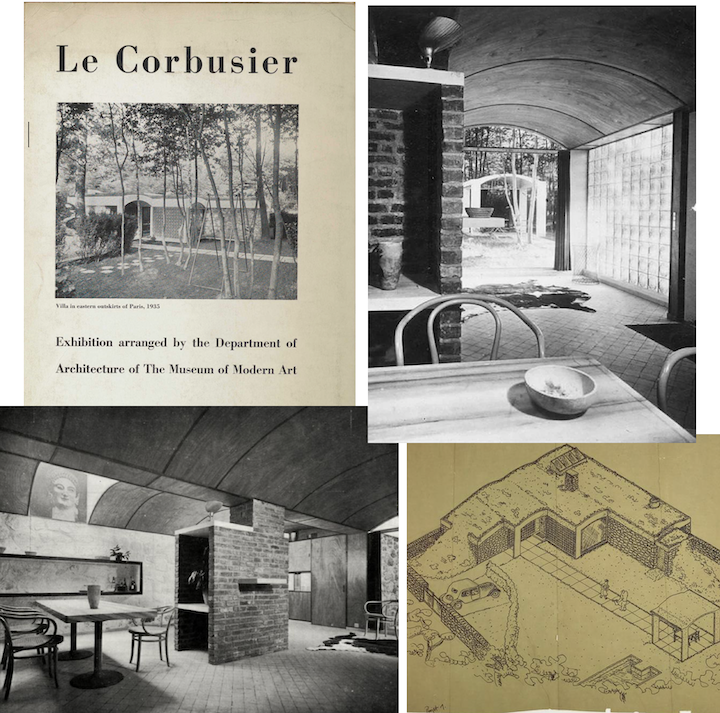
Art and design critic Lewis Mumford was well-known for his hypercritical eye, but occasionally he could be moved to rhapsodize, in this case about the opening of Fort Tryon Park, and particularly about the view it afforded visitors. He reserved his criticism for one of the latest works by Le Corbusier (aka Charles-Édouard Jeanneret), on exhibit at MoMA.
MAGNIFICENT is the word Lewis Mumford used to describe the view from Fort Tryon Park. This scene is taken from Linden Terrace to the west: a barge on the Hudson River and the Hudson Palisades beyond, with the Englewood Cliffs campus of Saint Peter’s University on the top. (Wikipedia)
IRRATIONAL?…Mumford was not pleased with Le Corbusier’s latest work, Le Petite Maison de Weekend (Villa Henfel), which was featured on the cover of the MoMA exhibition catalogue (upper left). Mumford saw the design as a pathetic escape from the architect’s renown rationalism. (MoMA/Fondation Le Corbusier)

* * *

At the Movies

It was a mixed bag at the movies for critic John Mosher, who was delighted by a Soviet take on Gulliver’s Travels, rendered with puppets engaged in a proletarian struggle…
KOMRADE GULLIVER…The Soviet stop motion-animated fantasy film, The New Gulliver, was a communist re-telling of Jonathan Swift’s 1726 novel. The film depicted Lilliput suffering under capitalist inequality and exploitation, with Gulliver enabling a proletarian revolution against the Lilliputian monarchy. (revolutionsnewstand.com)

…but Mosher was less than delighted with the latest from Hollywood, including a sedate The Three Musketeers, a “conventional” remake of D.W. Grifffith’s 1920 melodrama Way Down East, and the romcom Hands Across the Table, which the Times called “uproariously funny” but Mosher deemed barely worth a chuckle.
OUTCLASSED BY PUPPETS…John Mosher found the latest from Hollywood underwhelming. Clockwise, from top, Onslow Stevens, Moroni Olsen, and Paul Lukas in The Three Musketeers; Rochelle Hudson and Henry Fonda in Way Down East; Fred MacMurray and Carole Lombard in Hands Across the Table. (mabumbe.com/zeusdvds.com/Wikipedia)

 * * *

From Our Advertisers

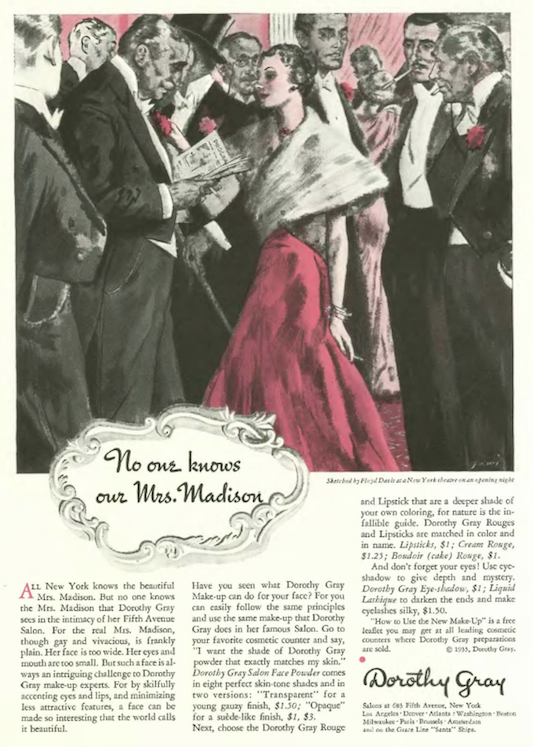
The Dorothy Gray salons didn’t mince words when it came to a woman’s beauty regimen…without their help, claimed this ad, the poor “Mrs. Madison” would be “frankly plain,” with a face too wide and eyes and mouth too small…
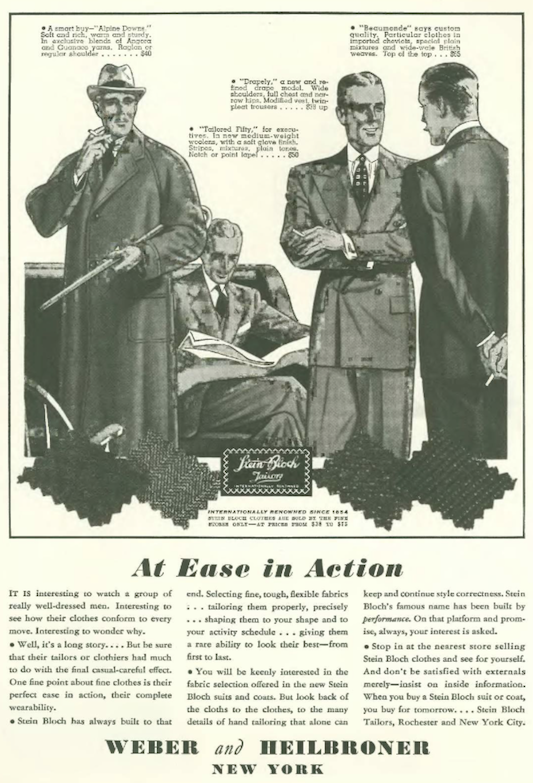
…notable in ads for men’s and women’s clothes were the presence of cigarettes…all three of the men in this spot are having a smoke in their smart attire…
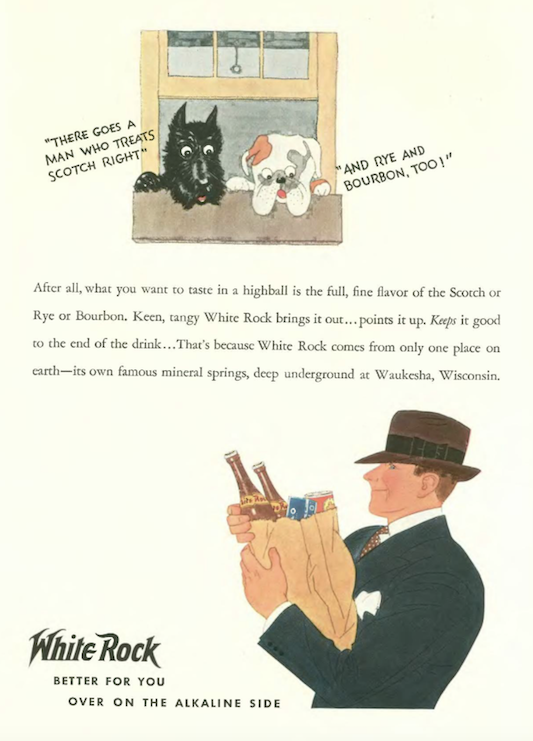
…White Rock gave their logo-bearer Psyche a rest in 1935 with a variety of ads including this one…
…the makers of Bisquit assumed their customers could read the French dialogue, or at least pretend to…

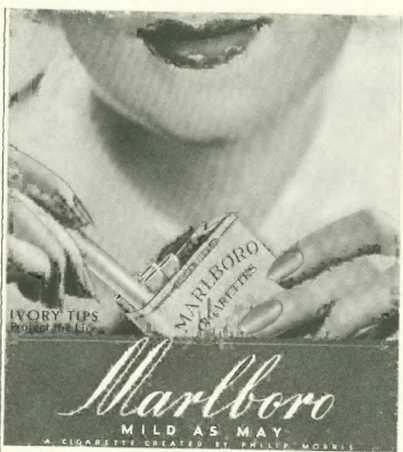
…when we (of a certain age) think of Marlboro we think of the rugged Marlboro Man, but in 1935 the brand was exclusively marketed to women…
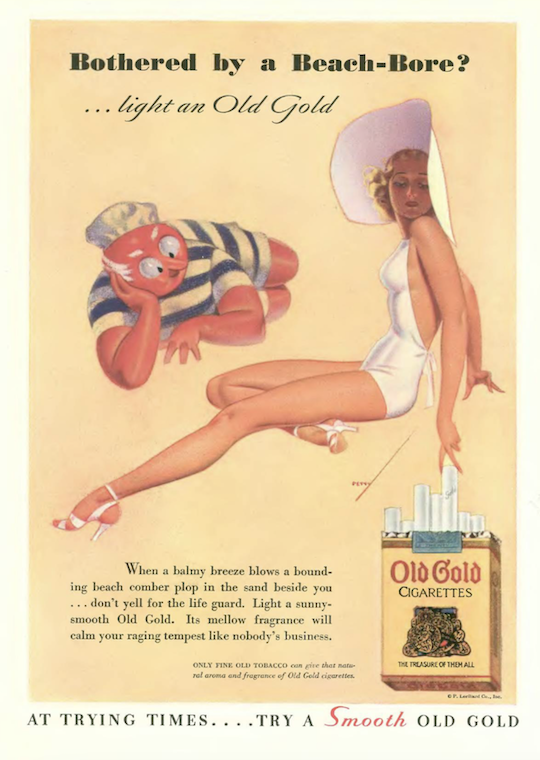
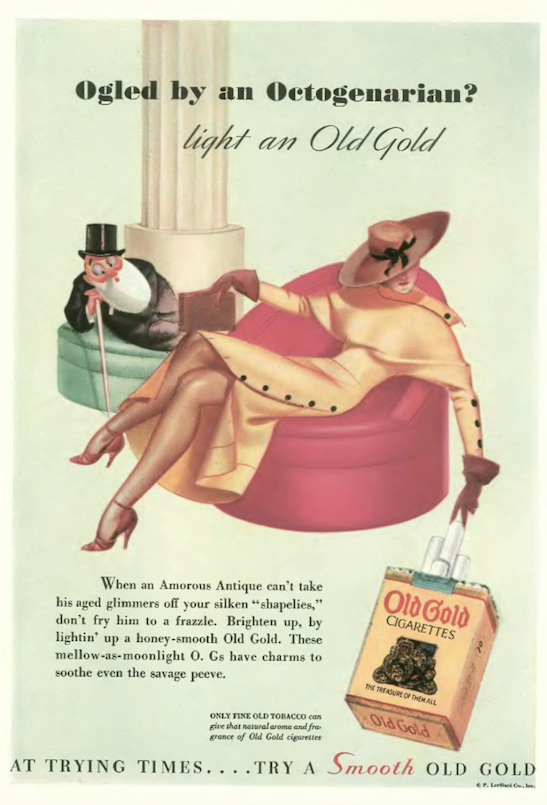
…and who knows what Old Gold’s target was here…definitely women smokers, who were the growth market, but men would take notice of the George Petty pin-up…
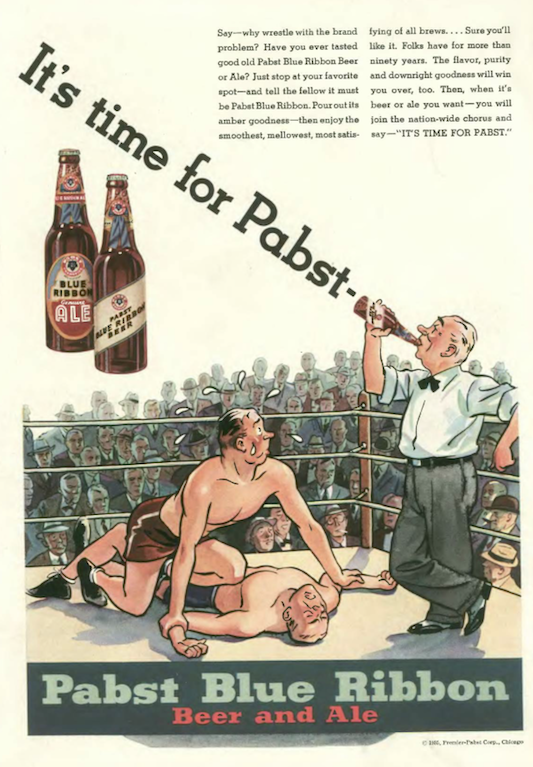
…the makers of Pabst Blue Ribbon Beer, who endured Prohibition by offering products like Pabst-ett cheese spread, were ready to grab a big market share after Repeal…
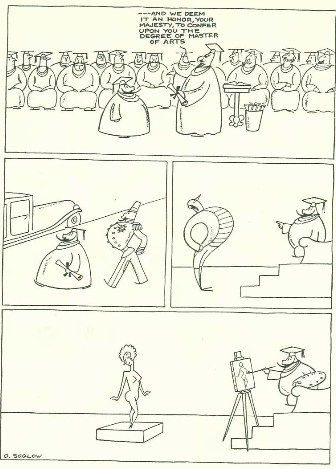
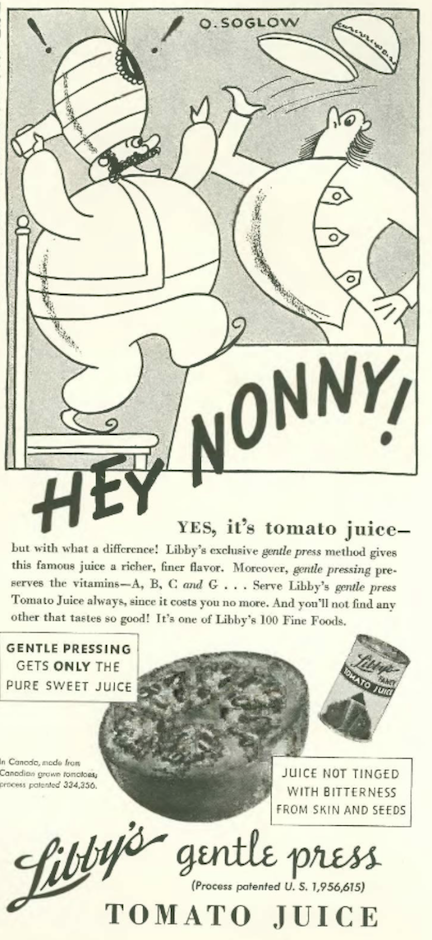
Otto Soglow, still contributing to The New Yorker despite taking his Little King to Hearst, drew up this potentate for a tomato juice spot…
…which segues to our other cartoonists, beginning with Al Frueh and his take on the latest  Broadway hit, Jubilee!

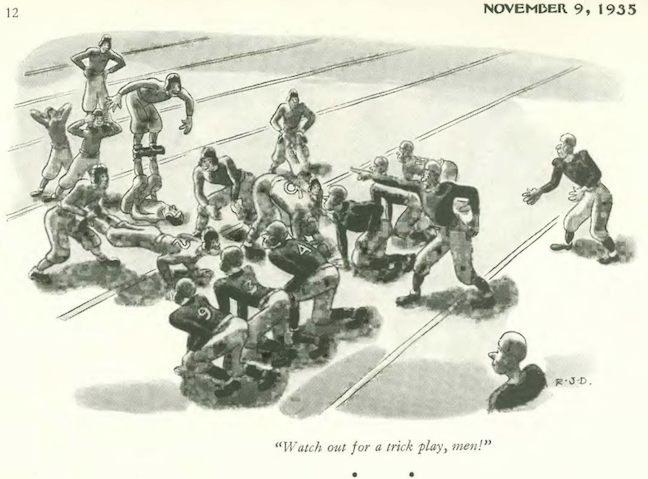
Robert Day saw action on the gridiron…

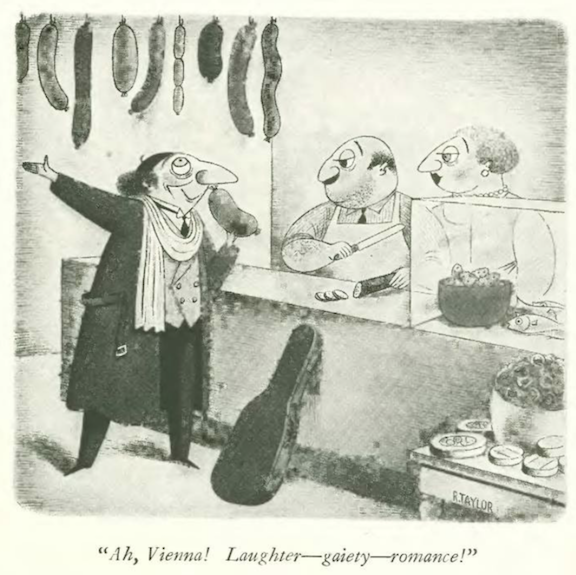
…unless I missed something, this might be Richard Taylor’s first New Yorker cartoon…
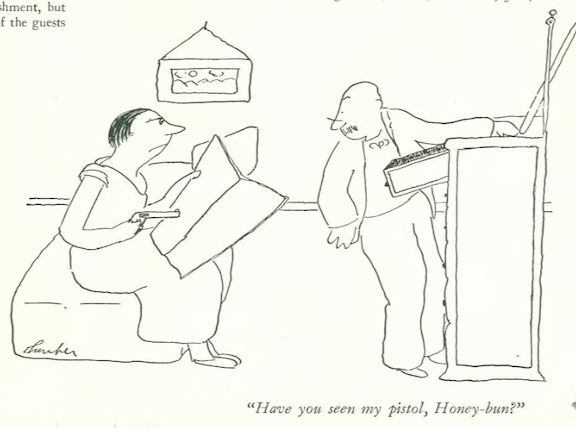
James Thurber put a unique spin on a bowling ball…

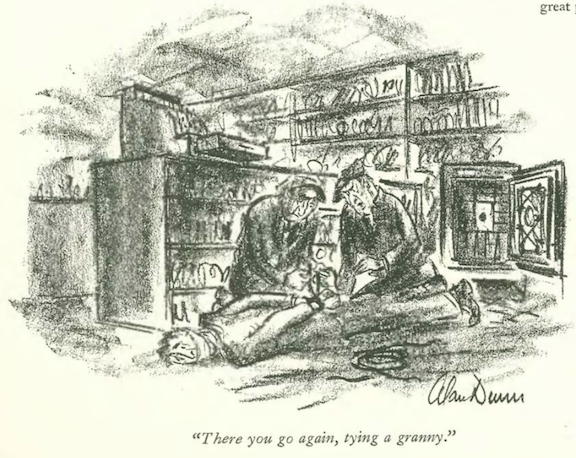
Alan Dunn was all in knots at a crime scene…
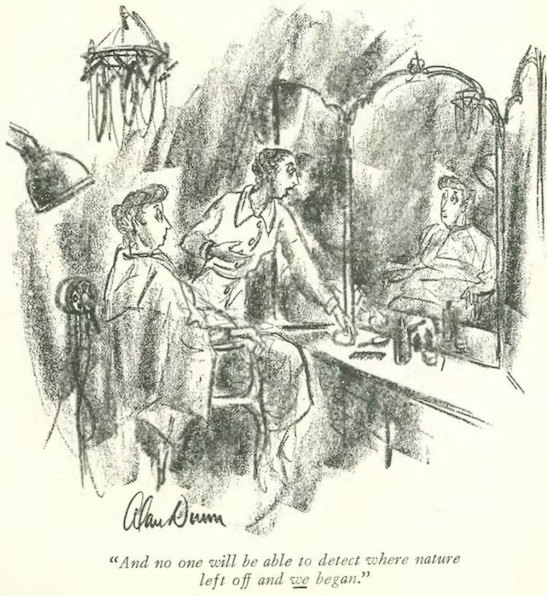
…Dunn again, pondering the wonders of a makeover…
Barney Tobey eavesdropped on a Downtown subway…

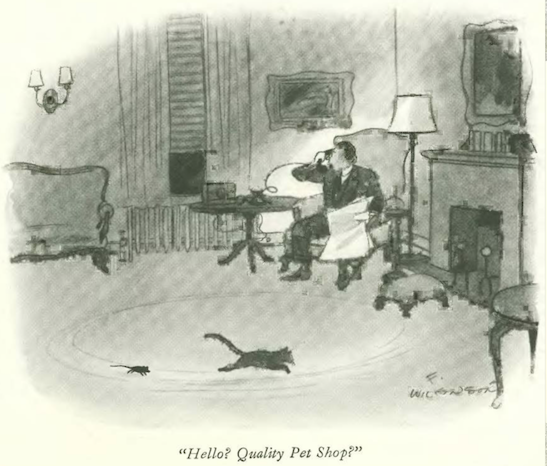
Fritz Wilkinson looked to return a defective pet…
Carl Rose needed two pages to illustrate his epic cartoon (caption added at the bottom for readability)…

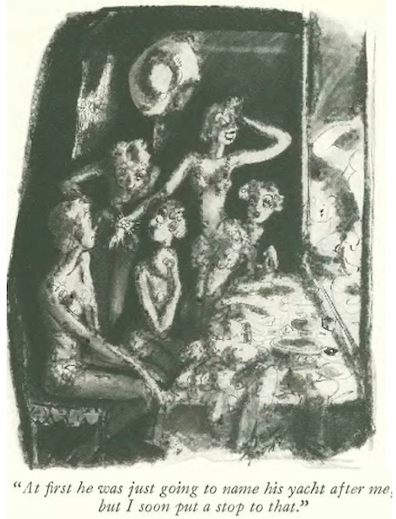
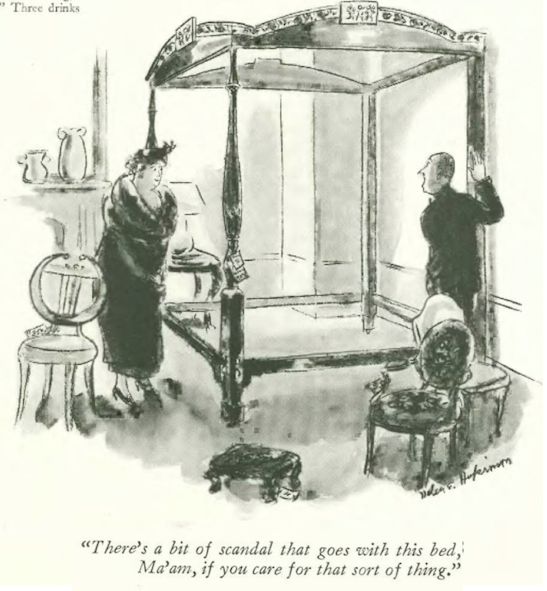
…and we close with Helen Hokinson, and a whiff of scandal…
Next Time: Seeking Decorative People…
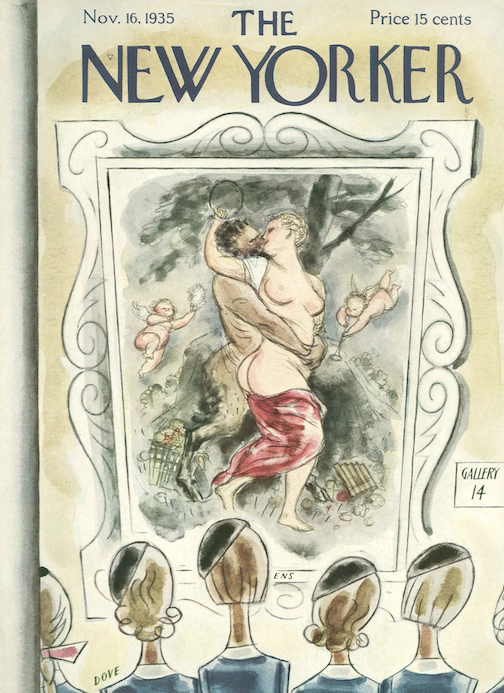
 

Planes, Trains and Automobiles

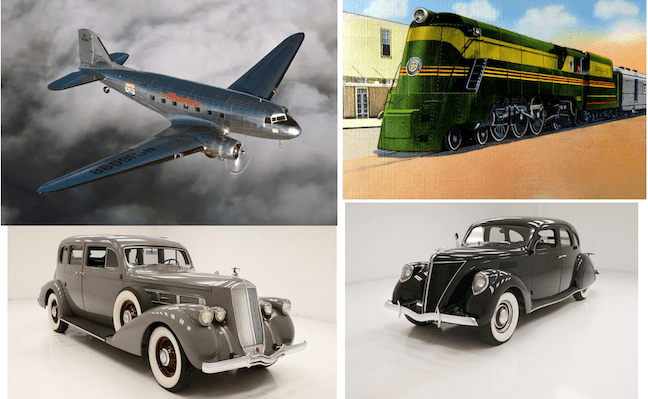
Above: Clockwise from top left—the Douglas DC-3 was introduced to airlines in 1935; Seaboard streamlined locomotive, c. 1930s; 1936 Lincoln-Zephyr; 1936 Pierce Arrow. (hushkit.net/Wikimedia/classicautomall.com)

As we’ve seen in previous issues, E.B. White often served as The New Yorker’s unofficial aviation correspondent; despite his sometimes anachronistic views on progress, he never missed a chance to hop aboard an airplane and marvel at the scene far below.

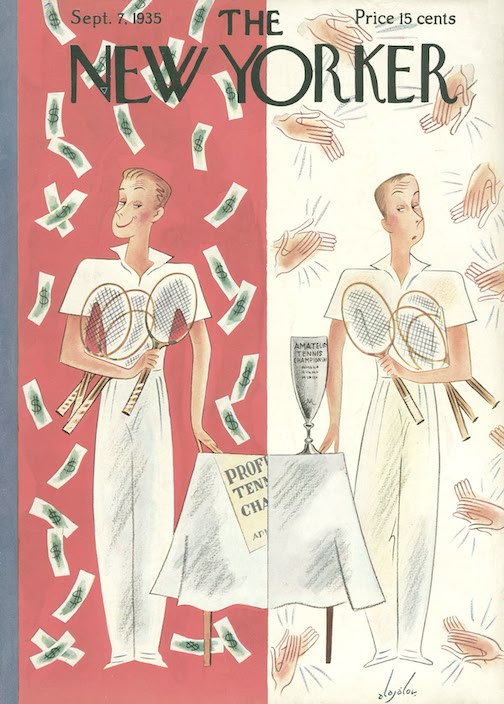
November 2, 1935 cover by Constantin Alajalov.

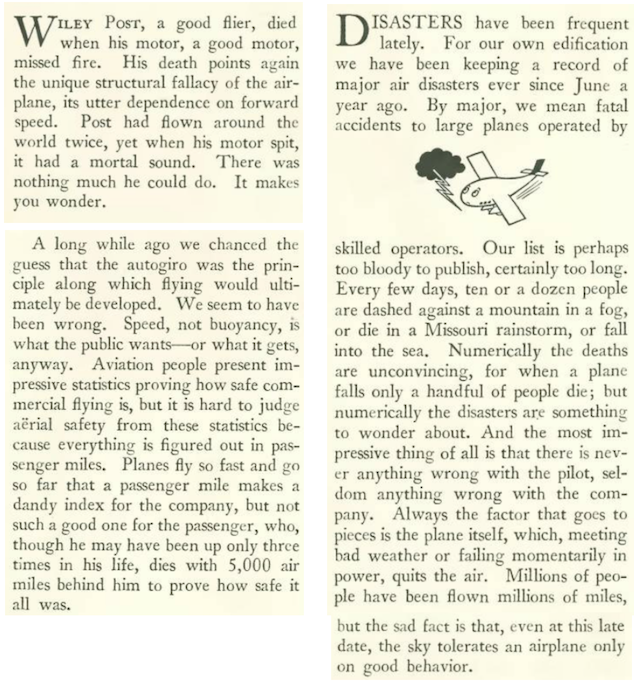
White’s enthusiasm, however, was tempered with doubts about air safety, including observations he made in an August 31, 1935 column following the deaths of Wiley Post and Will Rogers in an Alaska plane crash. Here is what he wrote then:

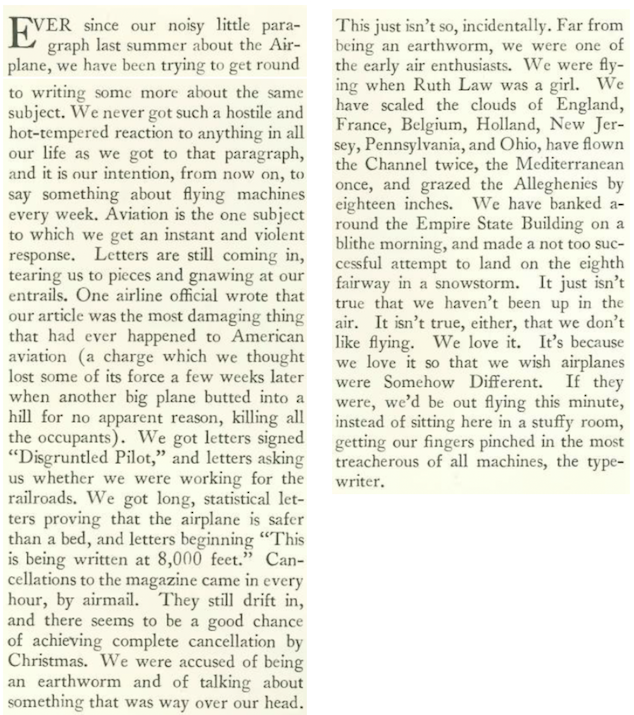
The aviation industry’s strong reaction to that “noisy little paragraph” apparently led to a number of subscription cancellations, prompting White to return to the topic in his Nov. 2 “Notes and Comment” column:

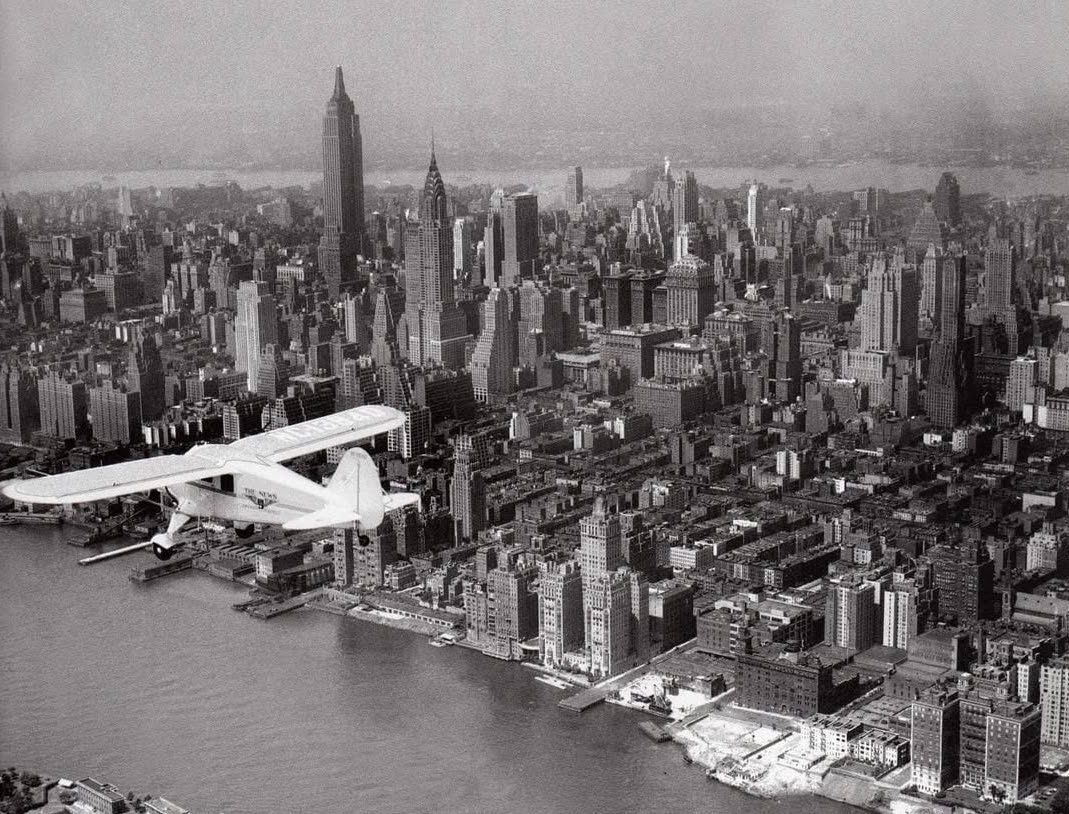
HE’D BEEN AROUND…E.B. White supported his comments on air safety by citing his many flying experiences, including soaring around the Empire State Building “on a blithe morning.” Pictured above is a New York Daily News plane flying over Manhattan in 1934. (NY Daily News)

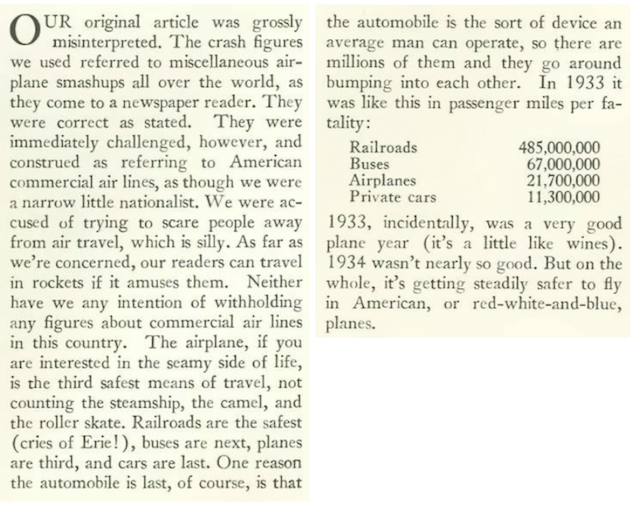
White also turned to statistics for his defense, finding that per passenger mile, railroads were still the safest mode of transportation in the country.

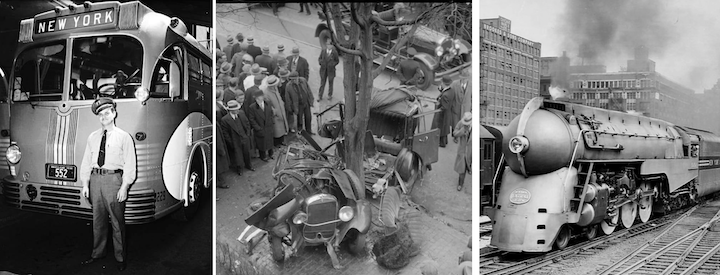
HOP ABOARD…According to 1933 statistics shared by E.B. White, trains were the safest mode of transportation per passenger mile, followed by buses. Automobiles were the least safe, a fact that still holds true today. From left, Greyhound bus and driver, 1937; automobile wreck, 1930s; New York Central’s 20th Century Limited leaving Chicago’s LaSalle Street station in 1938. (Facebook/Reddit/Wikipedia)

With that, White still wasn’t done with the topic, turning to none other than Anne Morrow Lindbergh for her thoughts on flying, which she shared in her latest book, North to the Orient. White noted Lindbergh’s mixed feelings about flying, about getting to places quickly and missing familiar landmarks. He also suggested that someday airline passengers would use mountains and rivers as landmarks…(I still try to do that when I fly, but at 35,000 feet it is a challenge). Today most folks are content with plugging in their earbuds and tuning out completely.

NOT YOUR EVERYDAY OUTING…In July 1931 Charles and Anne Morrow Lindbergh embarked in their Lockheed Model 8 Sirius on an often treacherous 7,100-mile journey across Canada, Alaska, Siberia and Japan in an attempt to find a commercial route to Asia for Pan American Airways. Top photo, Charles (standing on pontoon) and Anne (in the cockpit) make final preparations before the flight; bottom photo, enthusiastic crowds greet the Lindberghs upon their arrival in Japan. The Siberia-to-Japan leg was the most dangerous due to heavy fog. (historynet.com)

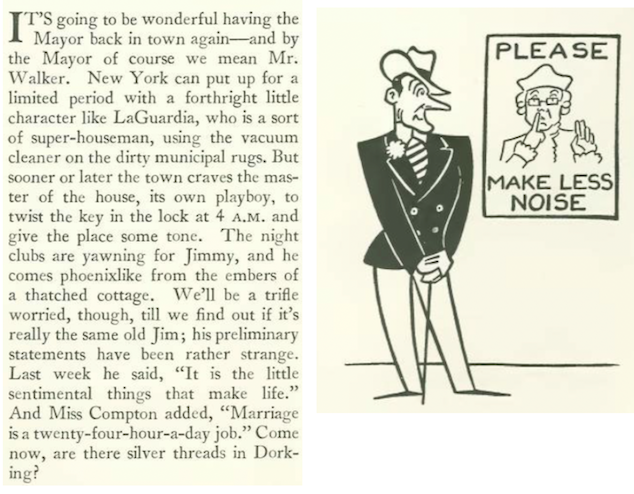
E.B. White also announced the return to the city of former Mayor Jimmy Walker, who had fled to Europe in 1932 amid corruption charges. White noted that New York’s nightclubs were eager to welcome the fun-loving Walker back to town.

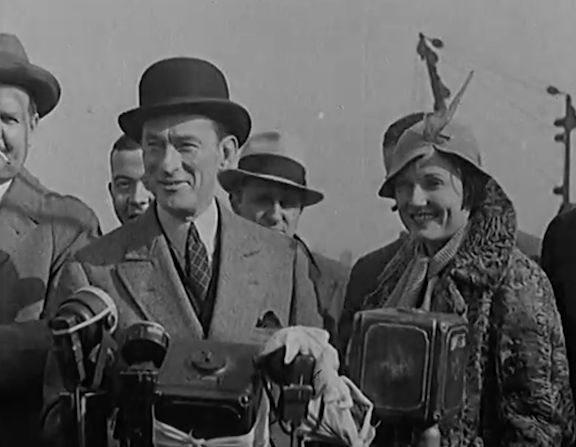
SECOND ACT…Still image from a 1935 British Pathé newsreel shows the triumphant return from Europe of former Mayor Jimmy Walker and his wife, Betty Compton. (YouTube)

 * * *

A Zephyr Blows In

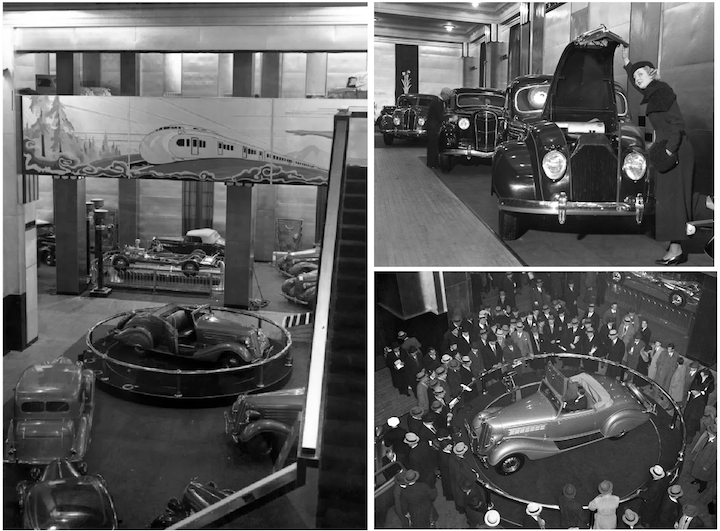
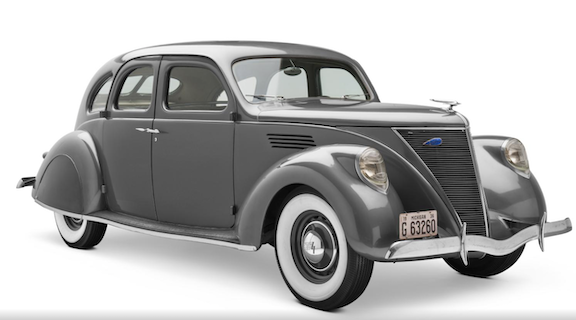
The magazine’s “Motors” correspondent (pen name “Speed”) noted the dazzling display of 1936 models at the New York Automobile Show, singling out the Lincoln-Zephyr as the year’s biggest innovation.

DECO DREAMSCAPE…Streamlining was all the rage at the 1935 New York Automobile Show at Grand Central Palace. Upper right, a woman opens the hood of a streamlining pioneer, the Chrysler Airflow. (New York Daily News)
LEADER OF THE PACK…The 1936 Lincoln-Zephyr had tongues wagging at the New York Automobile Show.  (thehenryford.org)

 * * *

At the Movies

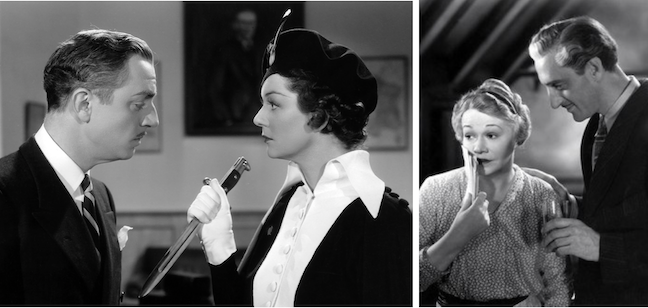
William Powell and Hollywood newcomer Rosalind Russell blessed film critic John Mosher with their spy caper, Rendezvous, while Pauline Lord got lost in the London fog with Basil Rathbone in A Feather in Her Hat.

A CAPER AND A WEEPER…At left, William Powell starred with Hollywood newcomer Rosalind Russell in Rendezvous; at right, Broadway stage actress Pauline Lord appeared opposite Basil Rathbone in A Feather in Her Hat. (1935)

Mosher also screened a French comedy, René Clair’s Le Dernier Milliardaire (The Last Billionaire), finding its slapstick approach to satire a bit dated.

DURABLE AND ADORABLE…Renée Saint-Cyr as Princess Isabelle in the French comedy Le Dernier Milliardaire (The Last Billionaire). Known for her chic comedies, Saint-Cyr (1904–2004) was a major French film star for seven decades. (Film Forum)

Finally, Mosher turned his critical eye toward a British sci-fi film, Transatlantic Tunnel. Looking forward to seeing a gee-whiz Jules Verne-type story, what Mosher found instead was a lot of sentimental “padding” and very little gee-whiz.

UNDERWATER…John Mosher looked forward to an undersea adventure, but instead got a lot of sentimental fluff in the British sci-fi film, Transatlantic Tunnel. Clockwise, from top left, movie poster for the American release; scene from the film depicting the tunnel entrance; the film showcased such futuristic conveniences as video phones (called “televisors”); a group of wealthy industrialists gather at the home of a Mr. Lloyd, a millionaire investor who used a motorized wheelchair. (Wikipedia/Reddit/cinemasojourns.com)

 * * *

No Thanks, Ernie

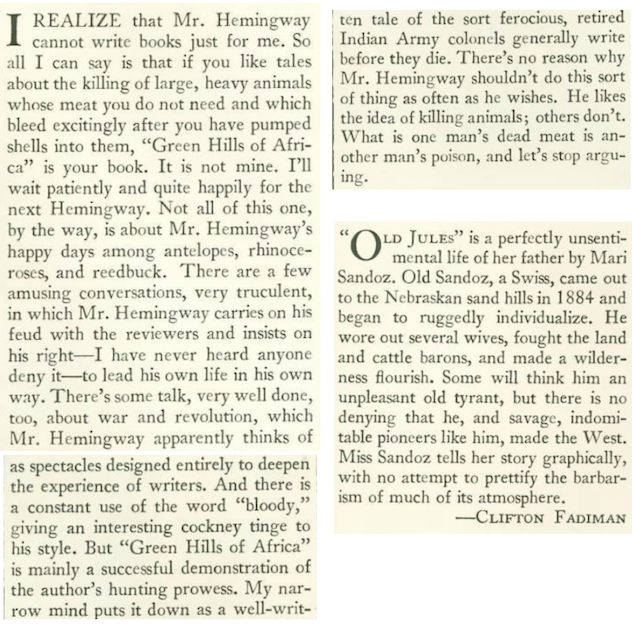
Clifton Fadiman had an armload of books to review, including an autobiography by Andre Gide (If I Die), novels by Mikhail Sholokhov (Seeds of Tomorrow) and Mari Sandoz (Old Jules), and an Ernest Hemingway tale about big game hunting (Green Hills of Africa) that Fadiman did not care for at all. Here are excerpts from a couple of the reviews:

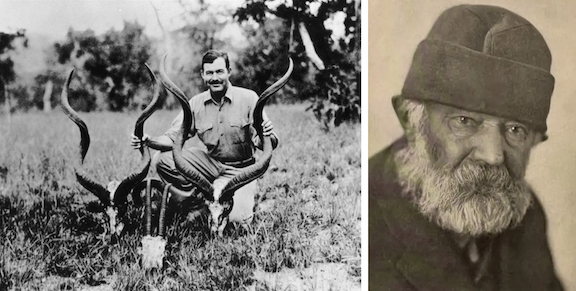
RUGGED TYPES…At left, Ernest Hemingway poses with skulls of kudu and female of sable antelope in East Africa, 1934, part of his hunting trip described in Green Hills of Africa; at right, photo of Jules Sandoz from the frontispiece of Old Jules, a biography written by his daughter Mari Sandoz. (JFK Library/U of Nebraska)

 * * *

From Our Advertisers

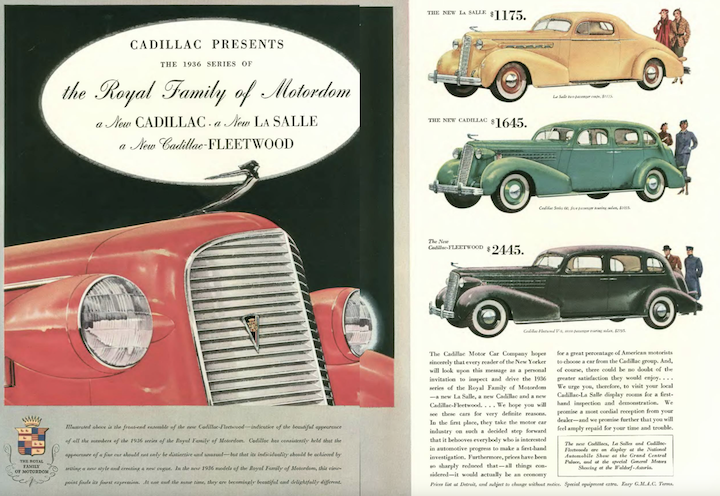
With the National Automobile Show in full swing at the Grand Central Palace, the issue was jammed with ads for every type and price range…the Chrysler Corporation took out this full-page spot on the opening spread to promote one of the lowest priced cars on the market…

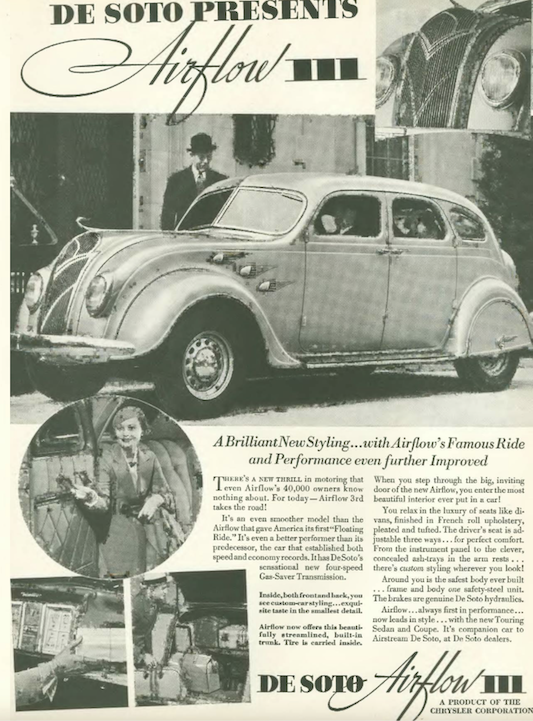
…Chrysler/DeSoto continued to tout its streamlined Airflow models…introduced in 1934, the Airflow was the first full-size American production car to use streamlining, and it featured a number of other innovations, but consumers just weren’t ready for something this radical…even with the streamlining toned down after its first year, only 55,000 units were produced during the model’s four-year run…

…on a side note, Chrysler has revived the Airflow nameplate for an electric car concept due to the marketplace in 2028…

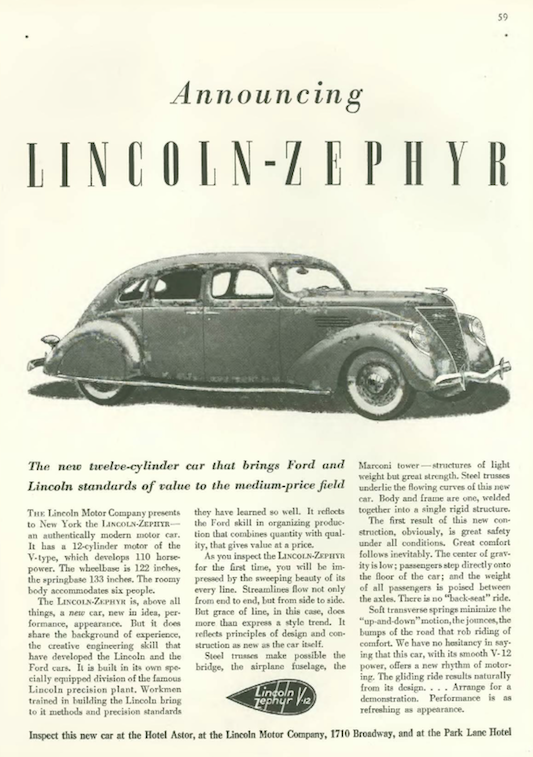
…mentioned in Speed’s review of the Automobile Show, the Lincoln-Zephyr would find success with its aerodynamic design…

…most manufacturers were in on the streamlining trend, noticeable in the tilted grilles, low rooflines, and sweeping fenders…

…unlike the other car companies, Pierce Arrow did not produce an economy model to keep its luxury line afloat during the Depression…emphasizing its handmade quality, this American rival to Rolls-Royce went out of business by 1938…

…Goodyear got in on the Auto Show action promoting its tires for the “new and faster cars”…

…the folks at Campbell’s continued their ad series featuring upper-class women covertly serving canned soup to their society friends…in this ad, however, the hostess reveals her secret…

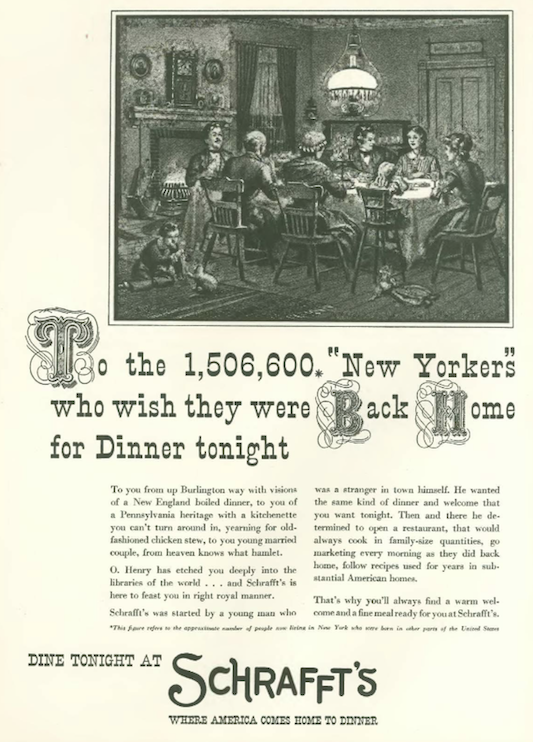
…there were no secrets to be found at Schrafft’s—its popularity increased during the Depression, when more than forty locations in the New York metro offered moderately priced “home-style” meals in an atmosphere that suggested upper-middle-class gentility…

…Long Island’s Lido Country Club tried to drum up some autumn business by promoting the “warm and lazy” sunshine of “Indian Summer”…

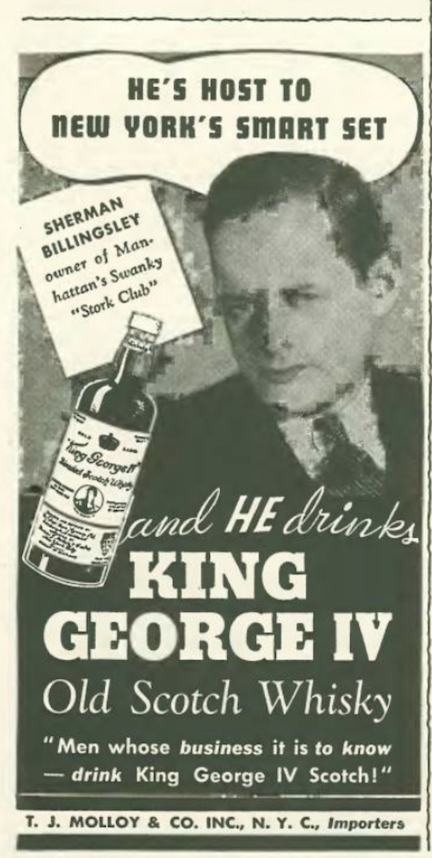
…the makers of King George IV Scotch used the face of Stork Club owner Sherman Billingsley to lend some nightlife cachet to their product…here’s an odd little fact: his nephew, Glenn Billingsley, was married to Leave It to Beaver actress Barbara Billingsley, who played June Cleaver on the TV series…

…this week the back cover belonged to R.J. Reynolds, with various aviators testifying to the calming effects of Camel cigarettes…the lead endorser in the ad, Frank Hawks, was famous for breaking aviation speed records until he perished in the crash of an experimental plane in 1938…

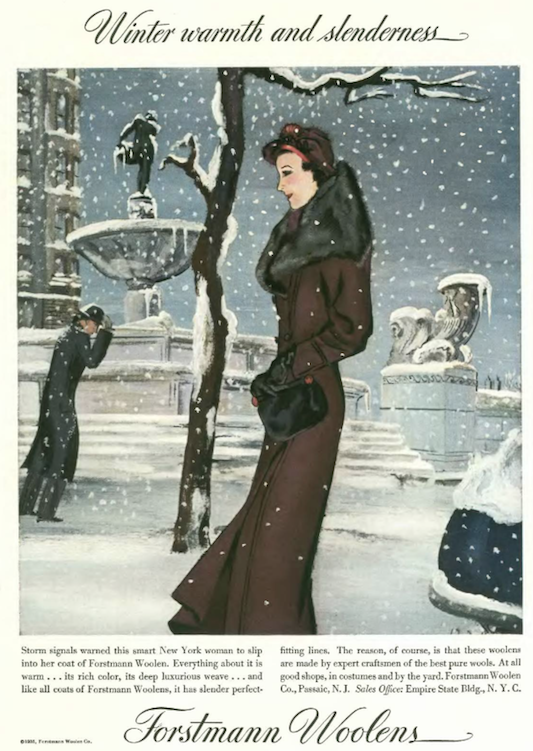
…Forstmann ads were a regular feature on the inside front cover during the fall/winter fashion season, rendered in a style made popular by illustrator Carl “Eric” Erickson

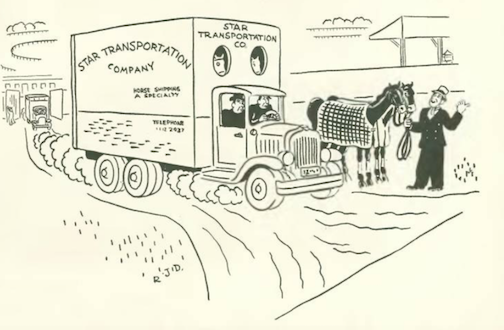
…on to our cartoonists, we open the magazine with Maurice Freed

James Thurber was busy in this issue, writing a touching character sketch of a medicine show man he greatly admired (“Doc Marlowe”)…and contributing this spot art for “Goings On About Town”…

…he also turned in this terrific cartoon…

Christina Malman livened up the Auto Show review with this spot art…

Carl Rose also paid tribute to the annual event…

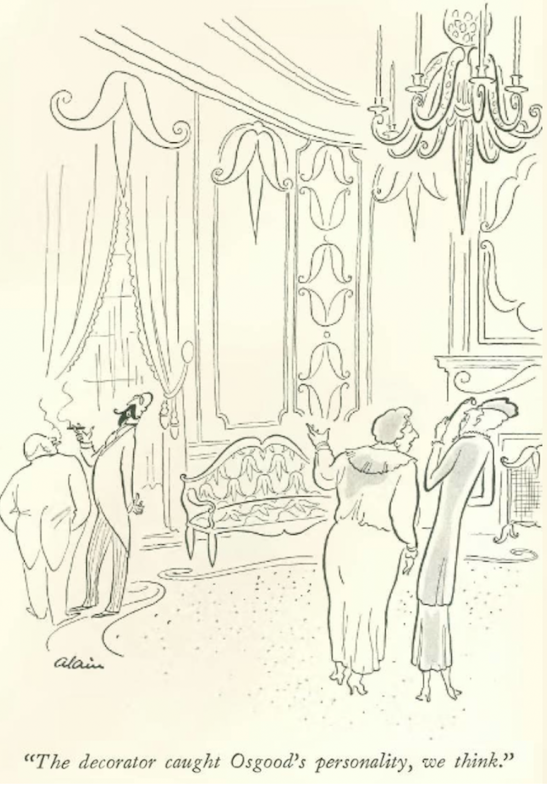
Daniel ‘Alain’ Brustlein did a bit of home decorating…

Robert Day was ready to call it a night…

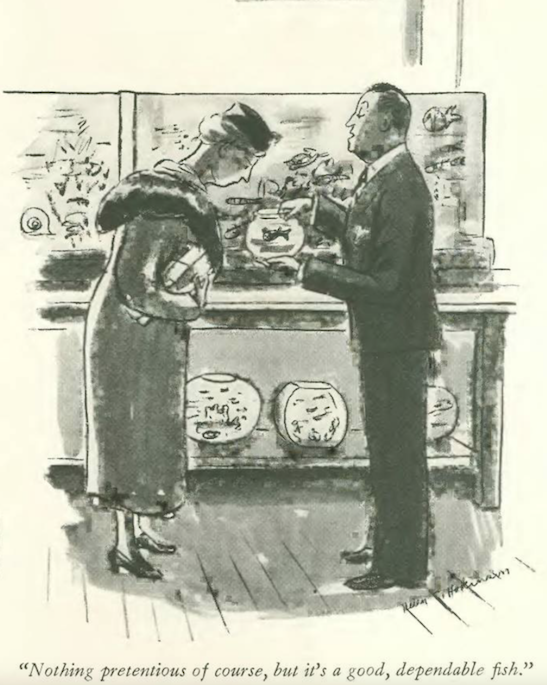
Helen Hokinson contributed two cartoons, shopping for a pet fish…

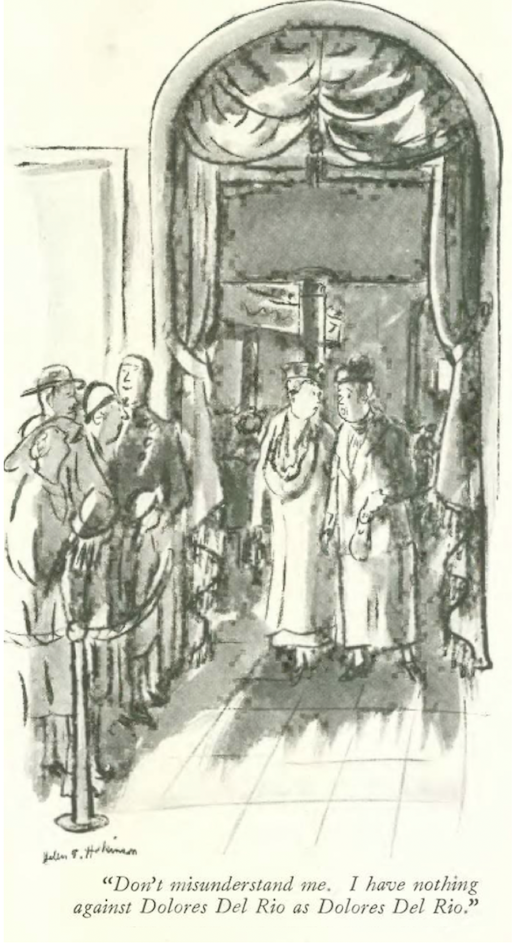
and taking in a Dolores Del Rio picture…
…no doubt Hokinson’s “girls” were commenting on the 1935 musical comedy In Caliente, featuring Mexican actress Dolores Del Rio (1904–1983)…Del Rio was the first Mexican actress to achieve mainstream success in Hollywood…

Dolores Del Rio in a scene from In Caliente. (Reddit)

…we continue with George Price, and a dedicated lumberjack…

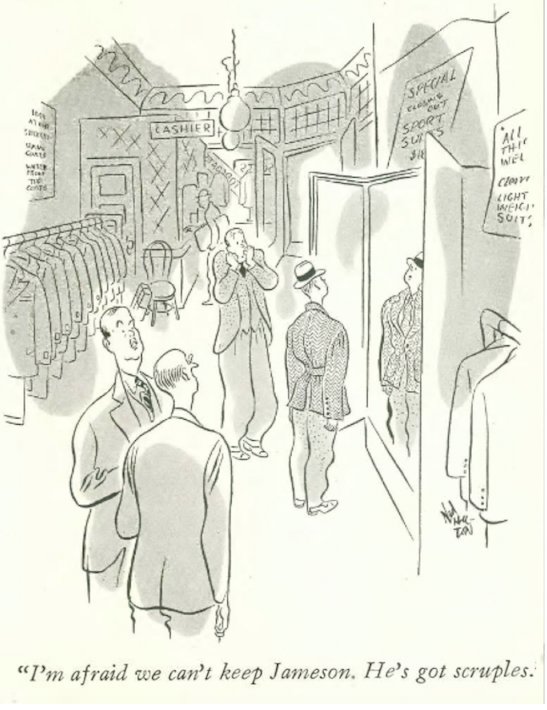
Ned Hilton discovered some honesty in the Men’s Department…

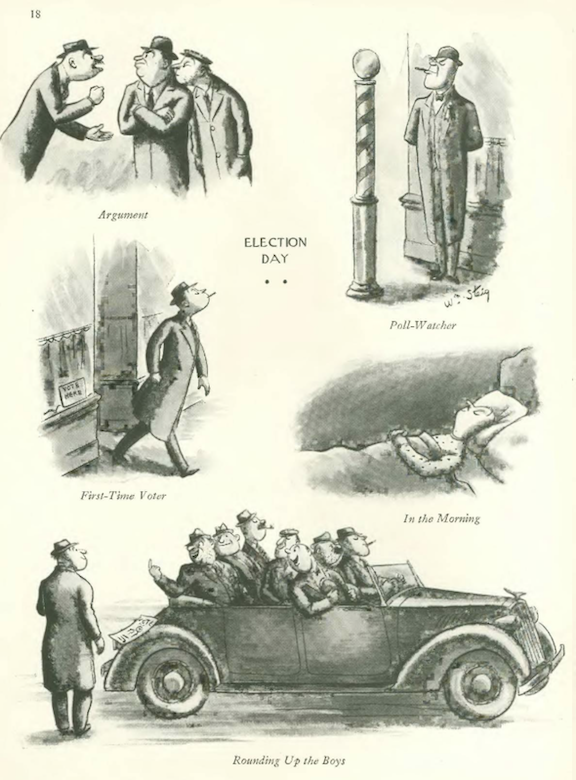
William Steig took a look around on Election Day…

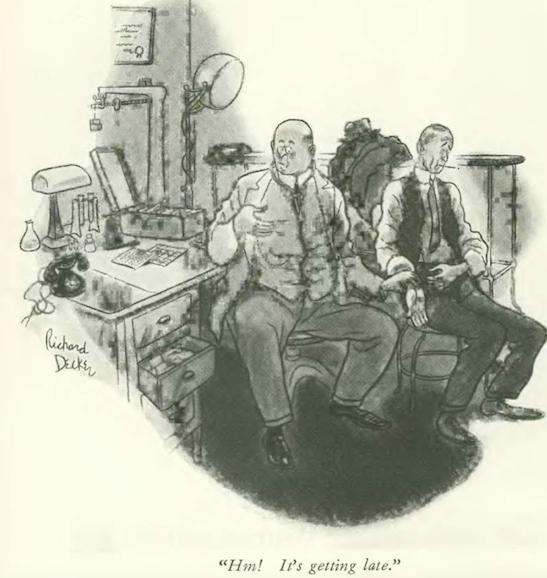
Richard Decker took the pulse of the medical profession…

…and we close with another by Decker, where seeing is not believing…

Next Time: Jimmy Comes Home…


Looking For Mister Wrong

Widely acknowledged as a classic, The 39 Steps further solidified British director Alfred Hitchcock’s image as a master of suspense with American film audiences.

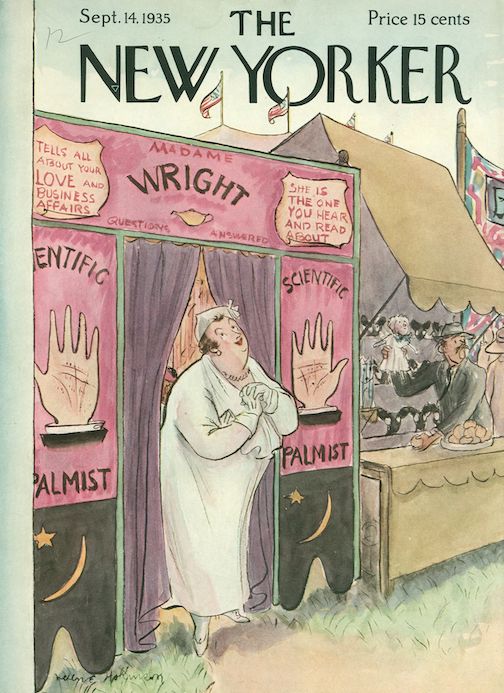
September 14, 1935 cover by Helen Hokinson. Over a twenty-year span, she contributed 68 covers and more than 1,800 cartoons to The New Yorker.

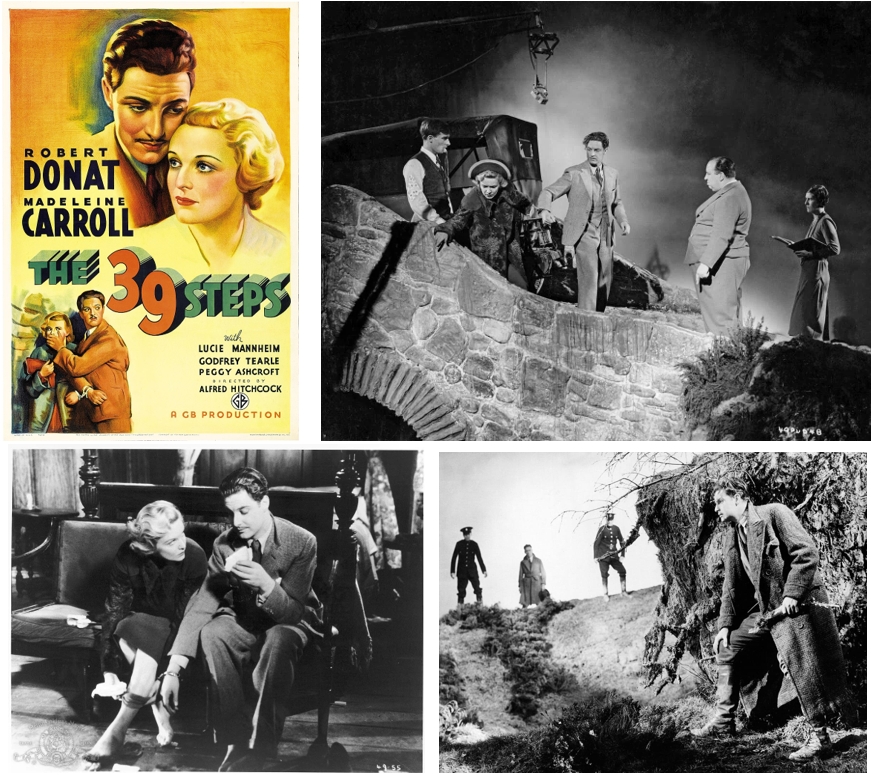
A successful follow up to 1934’s The Man Who Knew Too Much, Hitchcock’s The 39 Steps was conceived and cast by the Gaumont-British Picture Corporation as a vehicle to establish British films in America. The film also featured one of Hitchcock’s favorite plot devices—an innocent man forced to go on the run—seen in such notable films as 1942’s Saboteur and 1959’s North by Northwest. New Yorker film critic John Mosher was among the film’s many admirers:

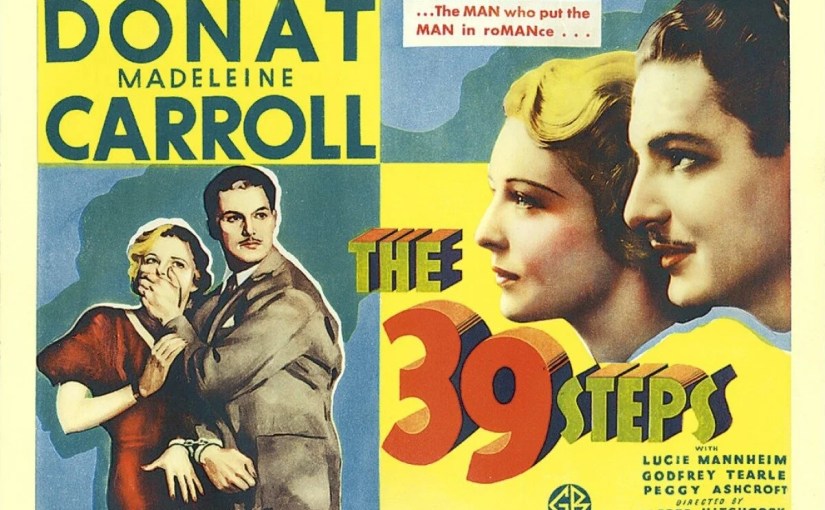
WE’LL TAKE THE STAIRS…Clockwise, from top left, poster for The 39 Steps; Alfred Hitchcock (second from right) directing the handcuffed Madeleine Carroll (as Pamela) and Robert Donat (as Richard Hannay) on the first day of filming; Hannay evades police on the heath; Pamela and Richard make the best of their predicament as handcuffed escapees. (Wikipedia/jimcarrollsblog.com/criterion.com)

 * * *

Pop-Up Stores

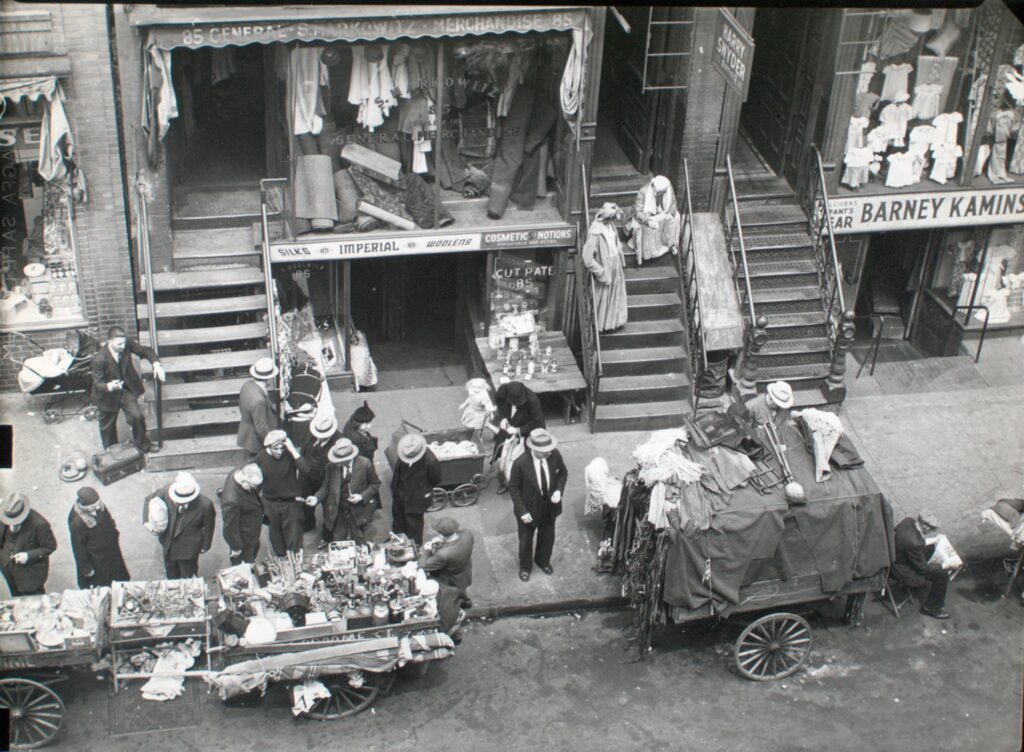
“The Talk of the Town” had a look at the “madhouse” on Nassau Street that daily erupted from noon to 2 p.m. as peddlers took over the street to hawk their wares.

IF WE DON’T HAVE IT, YOU DON’T NEED IT…Hester Street peddlers in 1936. Photo by Berenice Abbott. (boweryboyshistory.com)

* * *

Art of the Artless

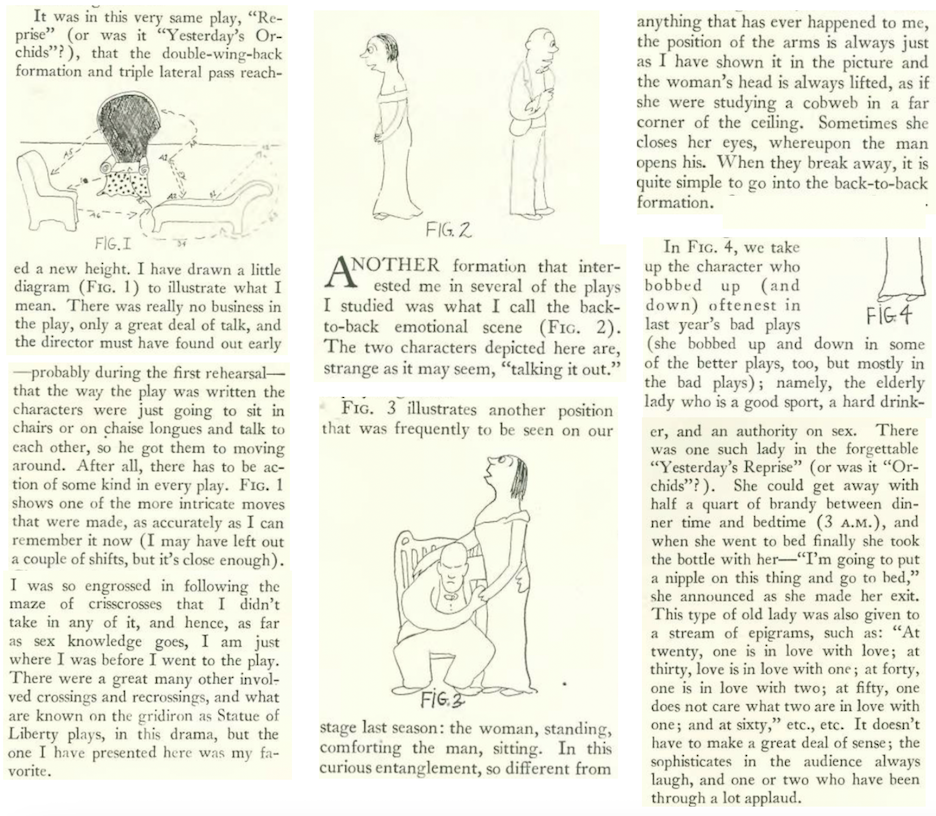
James Thurber dissected the workings of a “bad play,” examining varied techniques and familiar tropes. Excerpts:

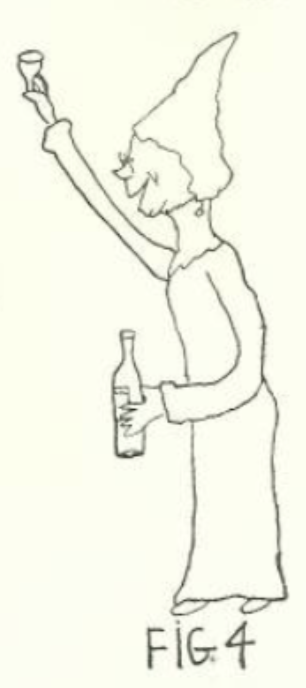
…below is the complete illustration for Fig. 4, which got cut off in the excerpt above…Thurber depicted “the elderly lady who is a good sport, a hard drinker, and an authority on sex.”

 * * *

The Petulant Painter

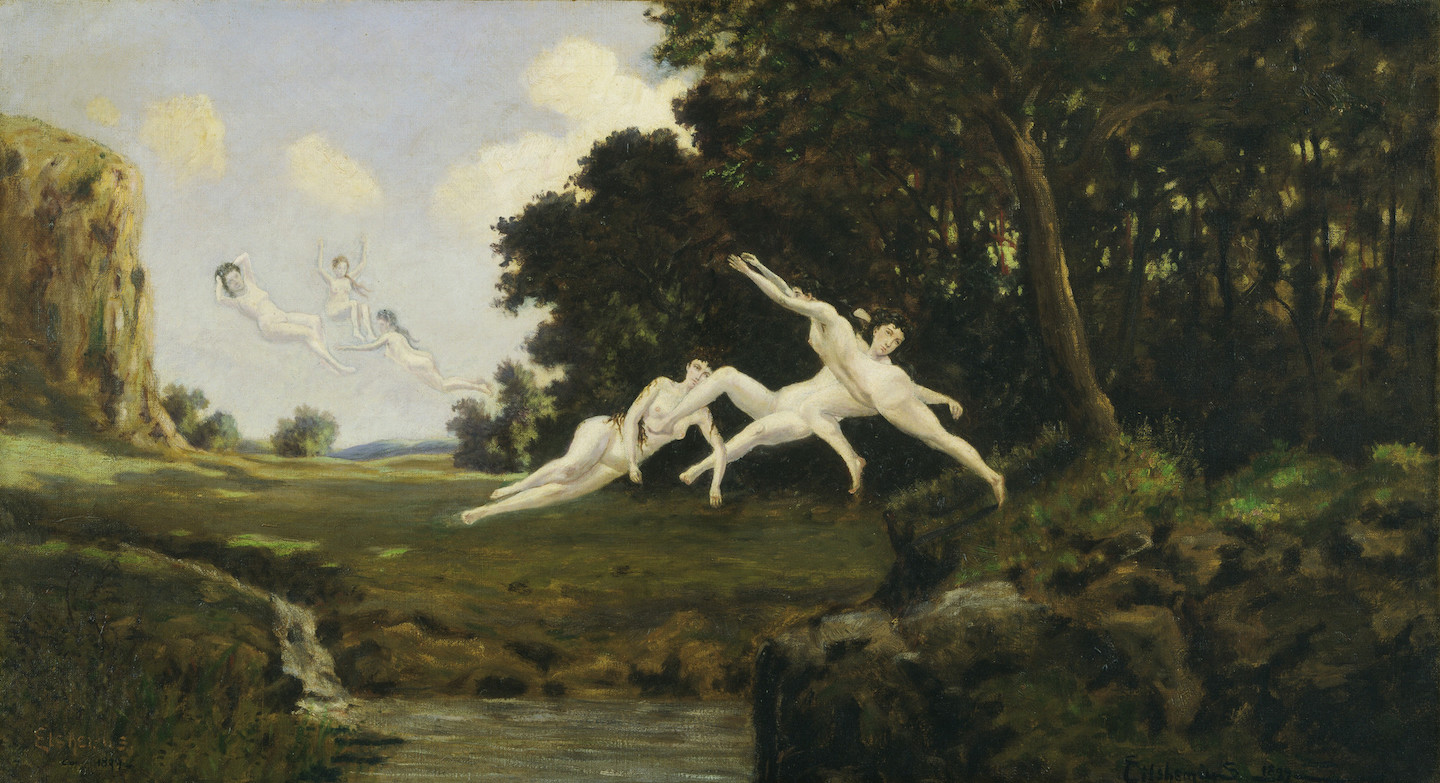
Known for a primitive style that included bizarre scenes of frolicking (or floating) voluptuous nudes, the painter Louis Michel Eilshemius (1864–1941) had a style all his own, and had no trouble telling anyone that his work was better than anything hanging in the finest museums (which would not consider him at all until after his death). In 1931 he began calling himself “Mahatma,” hence the title of this profile by Milton MacKaye (illustration by Hugo Gellert). Some brief excerpts:

IRASCIBLE RASCAL…Clockwise, from top left, Louis Michel Eilshemius in 1913; Standing and Reclining Nymphs (1908), Self-portrait (1915); Nymphs Sleeping (1920). Known for his numerous and vitriolic letters to newspaper editors, his letterheads would proclaim such accomplishments as “Educator, Ex-actor, Amateur All-around Doctor, Mesmerist-Prophet and Mystic, Reader of Hands and Faces, Linguist of 5 languages, Spirit-Painter Supreme.” He also claimed to be a world-class athlete and marksman as well as a musician who rivaled Chopin. (Wikipedia/Smithsonian American Art Museum/National Portrait Gallery)

Eilshemius regularly visited art galleries, loudly condemning the works on display. No wonder museums would not consider his odd paintings, which were probably best received by the French, including the artists Henri Matisse and Marcel Duchamp; the latter invited Eilshemius to exhibit with him in Paris in 1917.

Eilshemius’ mental stability had deteriorated substantially by the time MacKaye wrote the profile, which concluded with this sad, final accounting of the man’s life.

Eilshemius would die in the psychopathic ward of Bellevue Hospital in 1941. In the years since, his work has gained a wide audience and can be found in such collections as the Smithsonian, The Phillips Collection, MoMA and the Metropolitan Museum of Art.

SINGULAR VISION…Louis Michel Eilshemius, Afternoon Wind, 1899. (MoMA)

 * * *

In Good Company

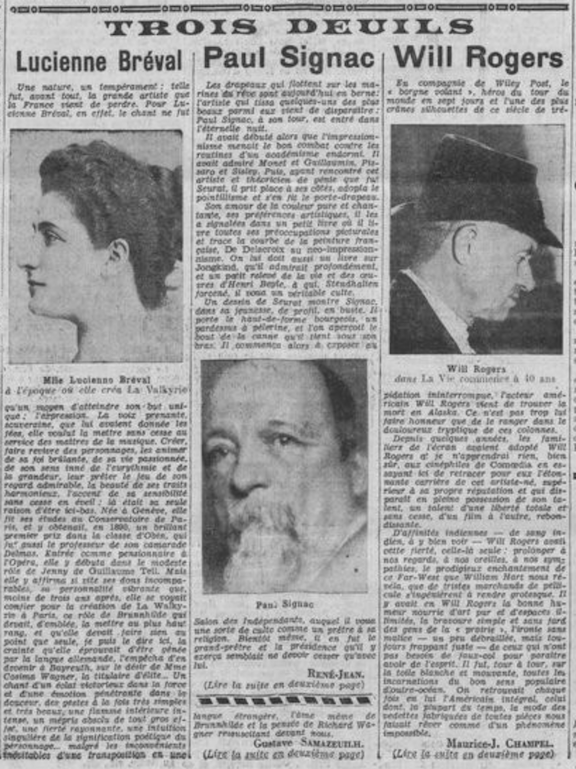
In her “Letter From Paris,” Janet Flanner noted that even the French honored the memory of Will Rogers, who had died in a plane crash with aviator Wiley Post on Aug. 15, 1935.

NOTED AND NOTABLE…As an example of Will Rogers’ worldwide fame, Janet Flanner noted that the Paris entertainment newspaper Comœdia published Rogers’ obituary next to that of famed neoimpressionist painter Paul Signac. The other obituary remembered the renowned Swiss soprano Lucienne Bréval. (gallica.bnf.fr via onlinebooks.library.upenn.edu)

 * * *

At the Movies

Coming down from The 39 Steps, John Mosher also sampled some of latest comedies gracing the silver screen…

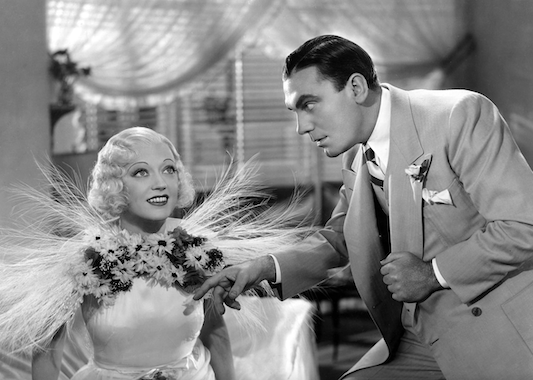
…Mosher didn’t understand why Marion Davies, nearing the end of her film career, even bothered to appear in the romantic comedy Page Miss Glory (although she was also the producer), in which she portrayed a country girl who stumbles into fame while working as a chambermaid in a luxury hotel…

JUST LIKE CINDERELLA…Marion Davies and Pat O’Brien in Page Miss Glory. (IMDB)

Two For Tonight featured a lot of fine crooning from Bing Crosby, and some hijinks, but fizzled out in the end…

Bing Crosby (right) takes aim in Two For Tonight. (IMDB)

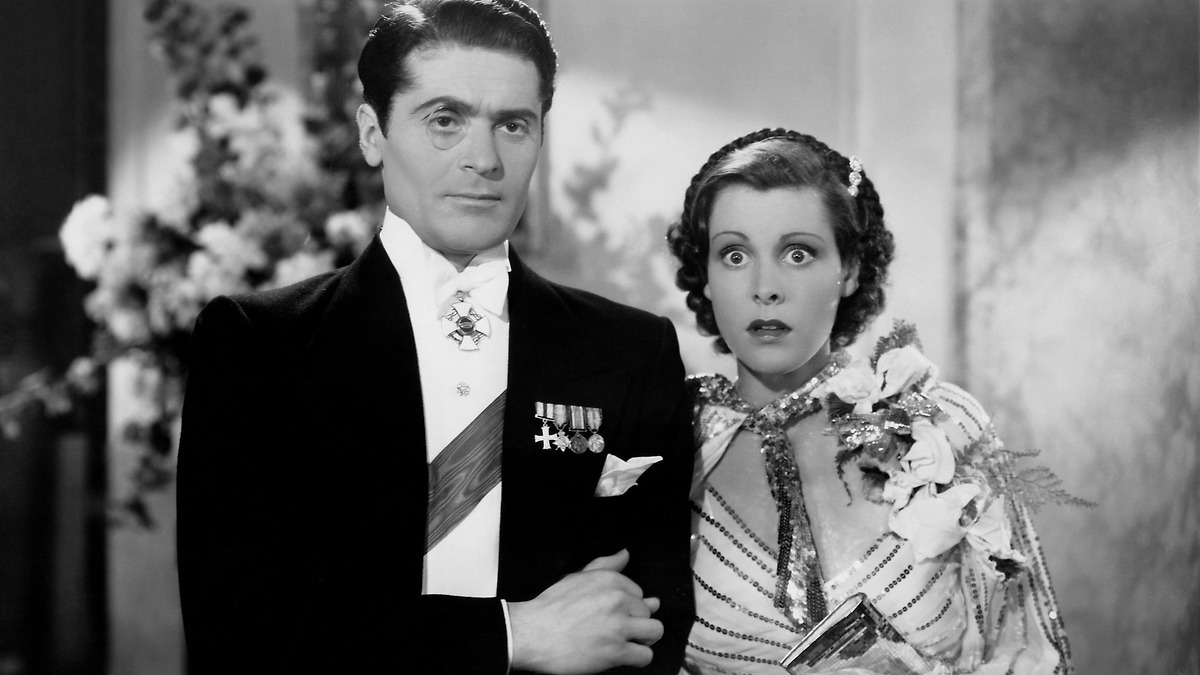
…of the three comedies, Mosher found The Gay Deception to be the most winning. Directed by William Wyler, the film featured a sweepstakes winner pretending to be a rich lady (Frances Dee) who encounters a prince masquerading as a bellboy (Francis Lederer)…hilarity ensued…

THE WYLER TOUCHWilliam Wyler’s The Gay Deception, starring Francis Lederer (left) and Frances Dee, anticipated Wyler’s 1953 Roman Holiday, also a tale about a royal wanting to be a normal person. (letterboxd.com)

 * * *

From Our Advertisers

We welcome fall with the latest fashion from Forstmann Woolens…

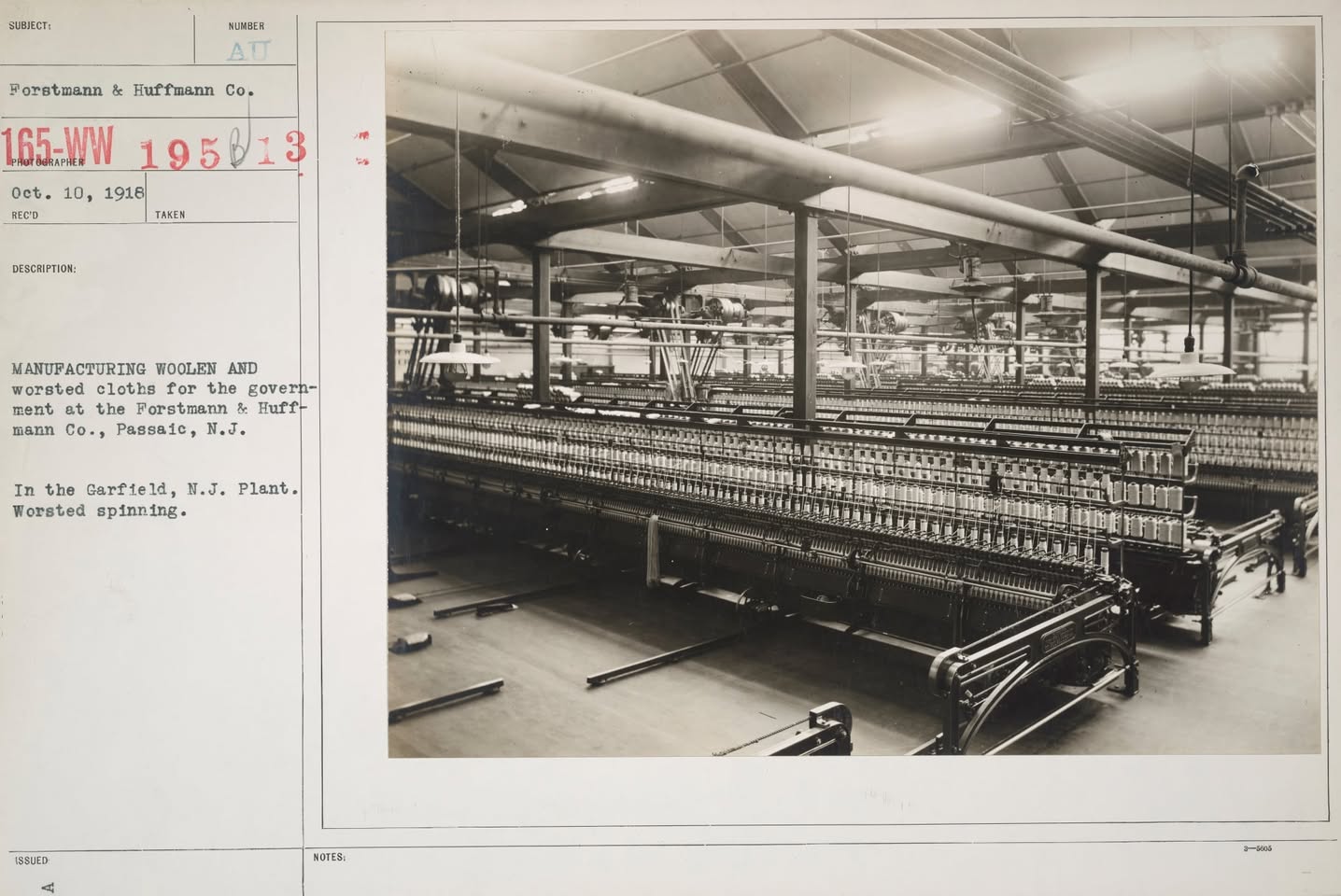
…and here is where those wool dresses were spun…

Image from the National Archives depicts the spinning room at Forstmann & Huffman in Passaic, N.J., 1918. The Passaic plant closed in 1958. (Historical Society of Garfield, NJ)

…the makers of leaded gasoline continued to promote their product in full-color spots…

…General Tire (like competitor Goodyear) played up the safety theme and potential perils to loved ones to tout their “blow-out proof” tires…

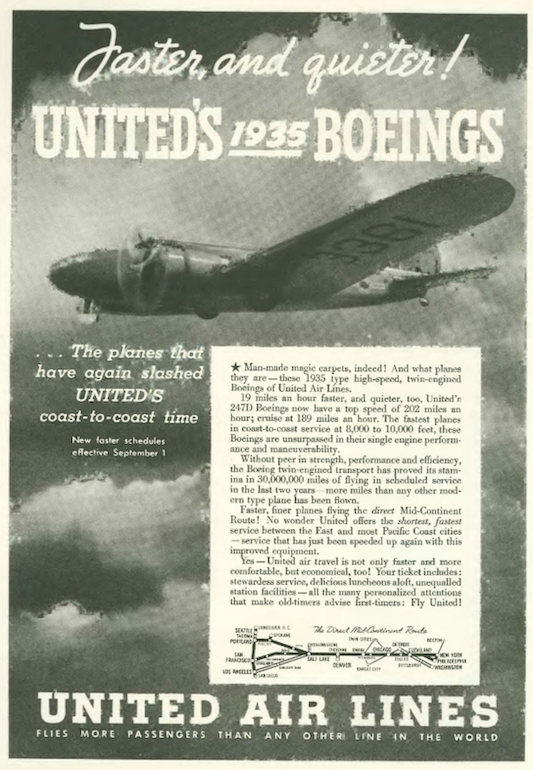
…like many advertisers in The New Yorker, United Air Lines appealed to the affluent, hoping some of them would take to the air, since only they could afford it…

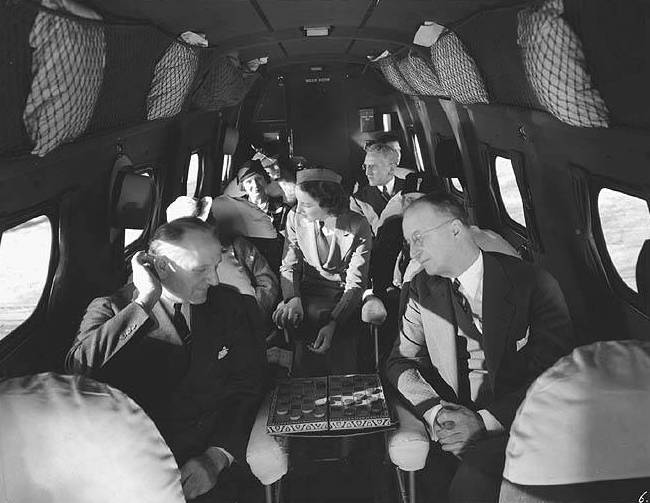
…for reference…

COZY…Interior of the Boeing 247. (Wikimedia Commons)

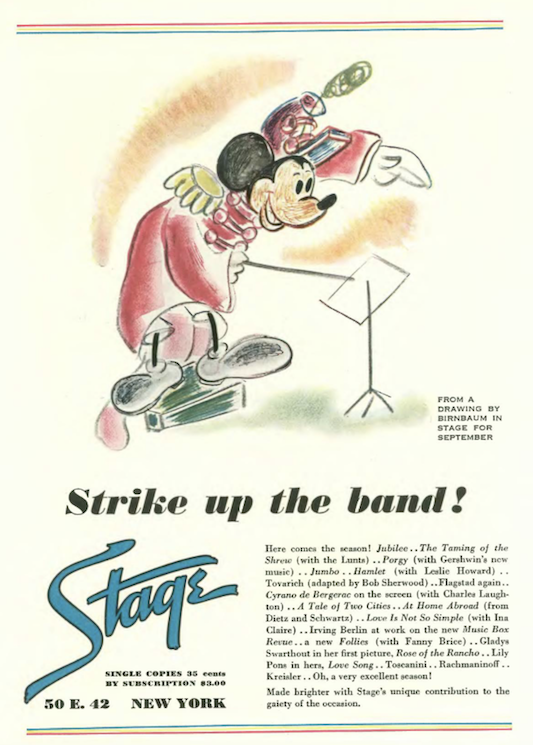
Abe Birnbaum, who contributed nearly 200 covers to the New Yorker, offered this rendition of Mickey Mouse to Stage magazine…

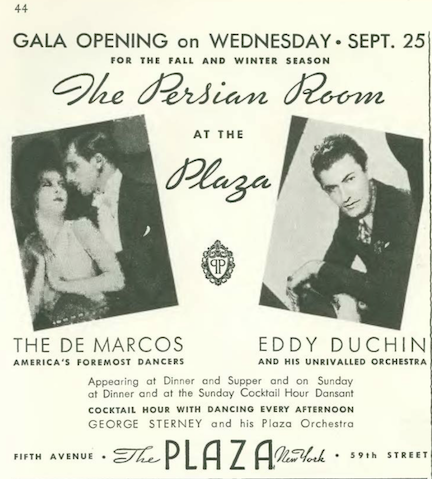
…heading to the back of the book we find the latest in entertainment at the Plaza…

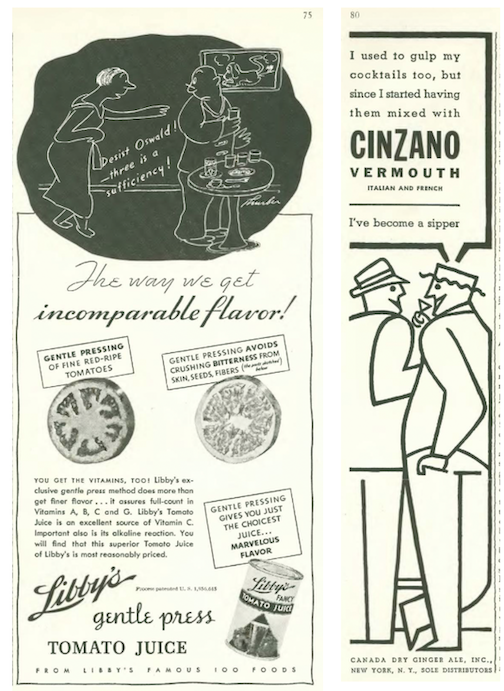
James Thurber contributed the drawing at left (rendered in negative) on behalf of Libby’s tomato juice on page 75, and page 80 featured the spare, modern lines of a Cinzano ad…

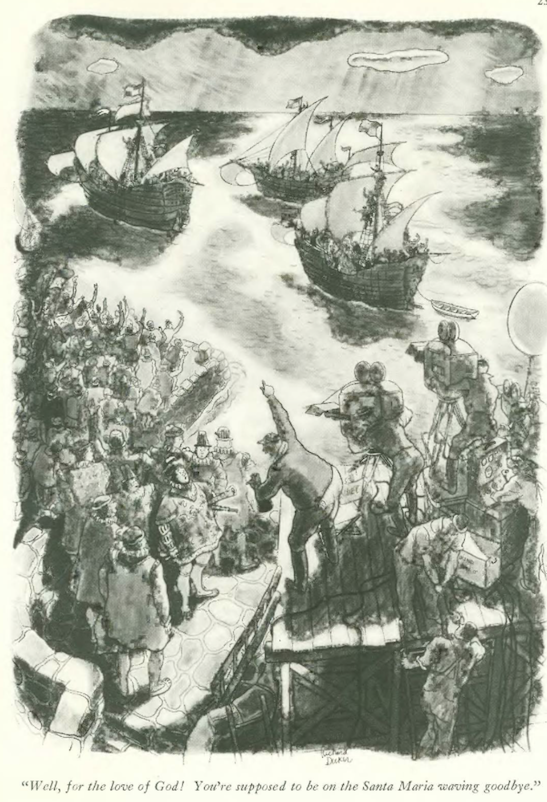
…our cartoonists include Richard Decker, on the set with a missing extra…

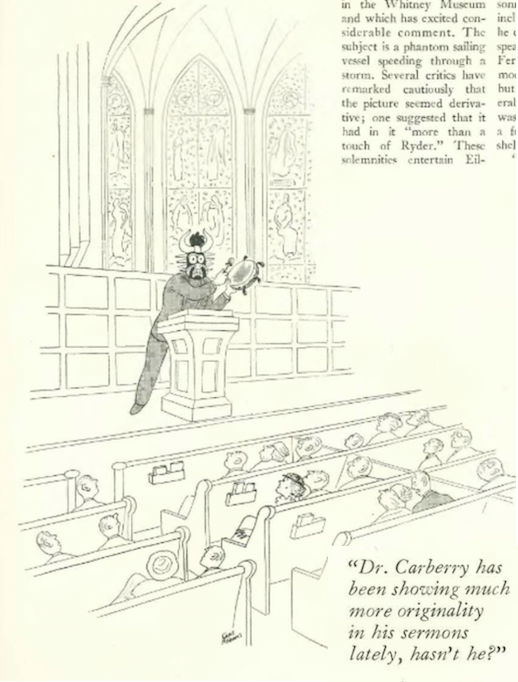
Charles Addams offered a new twist on the Sunday sermon…

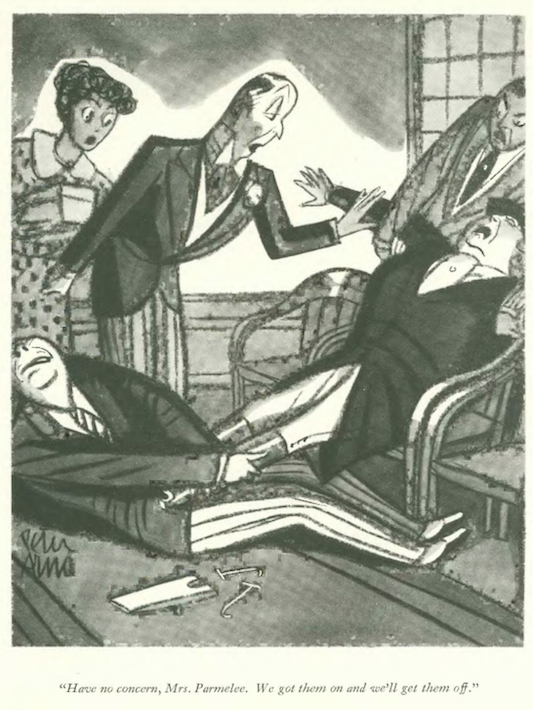
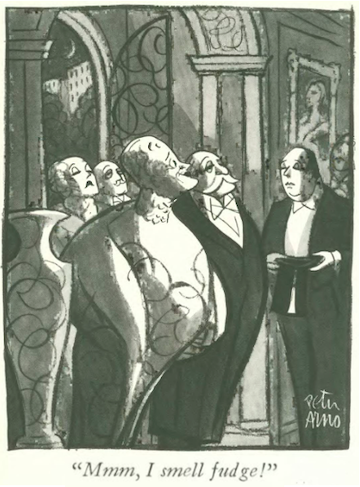
Peter Arno found an epic struggle in the shoe department…

Robert Day offered this energy-saving tip…

…and we close with Helen Hokinson, and a lively game of charades…

Next Time: All Dogs Go to Heaven…

Down to Earth

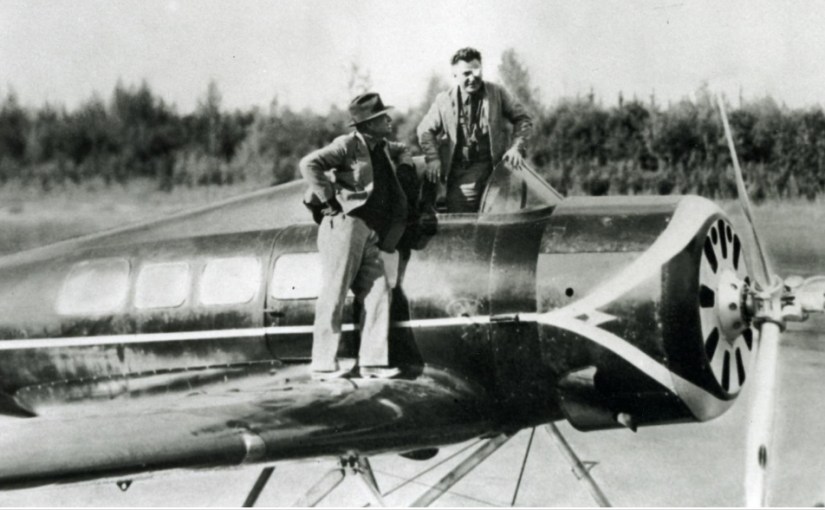
Above: Will Rogers (with hat) visits with pilot Wiley Post near Fairbanks, Alaska, hours before their fatal crash on August 15, 1935. (okhistory.org)

It would be a challenge to find a place for a multi-talented, mega-star like Will Rogers in today’s over-saturated and segmented media landscapehe was a trick roper, vaudevillian, social commentator, comedian, journalist, author, and radio and film celebrity. His early fame on the vaudeville circuit, including the Ziegfeld Follies, would spark a film career in 1918 (he would appear in 71 films), and a 1922 town hall speech would lead to a nationally syndicated newspaper column. When radio became a nationwide phenomenon his voice could heard coast-to-coast. He was seemingly everywhere.

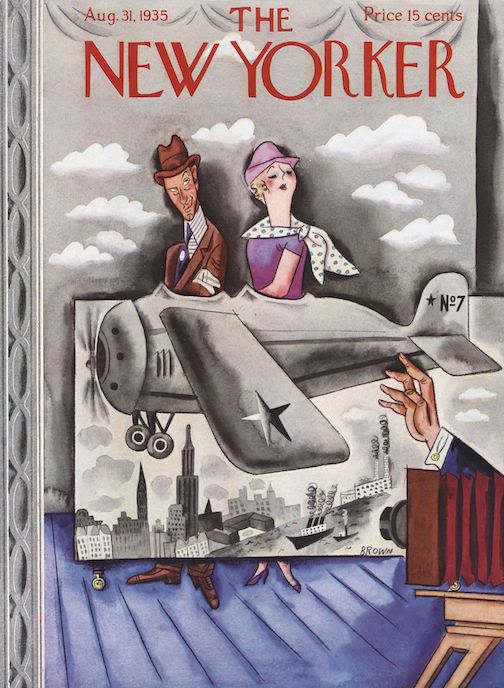
August 31, 1935 cover by Harry Brown. Brown illustrated eighteen covers for The New Yorker.

Rogers (1879-1935) was also a big promoter of aviation, and he gave his audiences many entertaining accounts of his world travels. In the summer of 1935 he announced plans to join famed aviator Wiley Post (1898-1935) on a flight to Alaska and beyond. It appeared to be routine, making the trip’s tragic ending all the more poignant.

Although E.B. White often seemed stuck in the past—he preferred Model Ts and rattily omnibuses to more more modern conveyances—he was a flying enthusiast, never missing a chance to hop aboard an airplane and marvel at the scene far below. However, when tragedy struck, White would become circumspect. When Notre Dame coach Knute Rockne’s Fokker Trimotor crashed into a Kansas wheatfield, White expressed doubts about air safety and pondered “safer” alternatives such as autogiros (a kind of early helicopter that wasn’t so safe or practical). Such doubts returned in his “Notes and Comment” for August 31, 1935:

The fated aircraft, a Lockheed Orion, was heavily modified by Post into a floatplane; one wing was even salvaged from a wrecked Explorer (an older Lockheed model). The pontoon floats he attached were also designed for a larger aircraft, which made the nose-heavy Orion even more unwieldy.

BUILT FOR SPEED…A Lockheed Model 9 Orion parked at Boeing Field, Seattle, in May 1935. With 200-mph speed, the single-engine passenger aircraft (5 to 6 passengers) was faster than any American military aircraft of the time. It was Lockheed’s last aircraft to use wood construction in the frame, which was lightweight but not designed for longevity on major airlines. (James Borden Photography Collection)
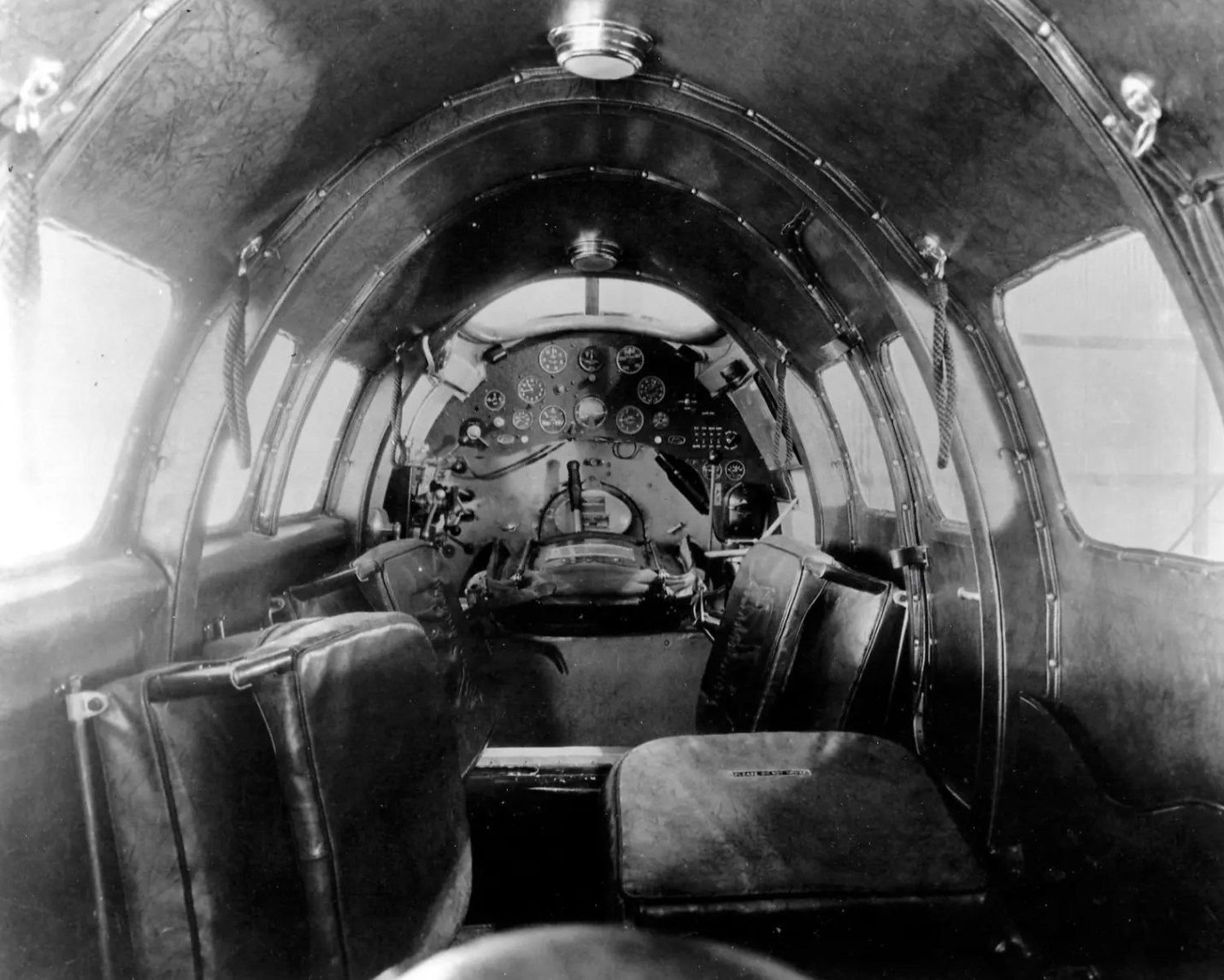
TIGHT QUARTERS….Interior view of a Lockheed Orion 9. No doubt much of the passenger space was loaded with gear for the trip to Alaska. (James Borden Photography Collection)

When Post and Rogers arrived in Juneau, local bush pilots doubtfully regarded the Orion and asked Rogers about the flight plan. “Wiley and I are like a couple of country boys in an old Ford—don’t know where we’re going and don’t care,” he said. They were actually headed to Point Barrow, and from there planned to hop over to Siberia.

After stopping in Fairbanks they set off for Point Barrow in bad weather. Lost in the murk, they landed short of their destination in the shallow waters of Walakpa Lagoon, fifteen or so miles southwest of Point Barrow. Post and Rogers then took off—despite warnings from locals about the conditions. But the weather wasn’t the worst problem: Post had a bad habit of taking to the air in an abrupt, steep climb, which likely caused the engine to stall. Powerless, the ungainly aircraft plunged into the lagoon and landed on its top. Post and Rogers were killed instantly.

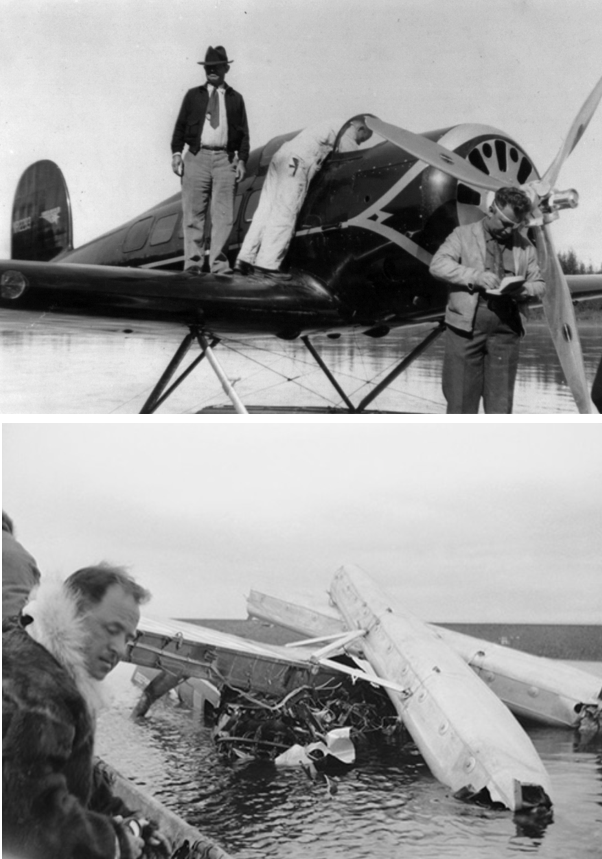
JUST A COUPLE OF COUNTRY BOYS…Top photo, Will Rogers on the wing of the Lockheed floatplane belonging to famed aviation pioneer Wiley Post, hours before their fatal crash on August 15, 1935. Below photo, inverted wreckage of the float plane in Walakpa Lagoon.  (Wikipedia/vintageaviationnews.com)

Rather than eulogize the fallen Rogers, “The Talk of Town” offered up an anecdote about his rise as a newspaper columnist, which was sparked by a backhanded endorsement speech:

A HUMAN FACE…Top left, Will Rogers backstage with the 1924 Ziegfeld Follies cast. At right, Rogers made his film debut in the now lost silent film Laughing Bill Hyde (1918) with co-star Anna Lehr. The magazine ad at right quoted producer Rex Beach, who called Rogers “the most human player who ever faced a camera.” (Will Rogers Memorial Museum/Wikipedia/IMDB)
FINAL CURTAIN…Top photo, Will Rogers with co-star Anne Shirley in Steamboat Round the Bend. Rogers wrapped filming just before heading to Alaska. The film was released posthumously on September 6,1935. Bottom image is a detail from a full-page ad in the October 1935 issue of Picture Play Magazine. Oddly, the ad makes no mention of Rogers’ death, proclaiming that “Will blazes a new path in his screen career as he scores his greatest triumph!”  (theretrorocket.blogspot.com/IMDB)

 * * *

Putting it Mildly

In “Onward & Upward With the Arts,” H.L. Mencken continued to explore the quirks of American language, this time looking at the pervasive (and evasive) use of euphemisms by “professional uplifters.” Excerpts:

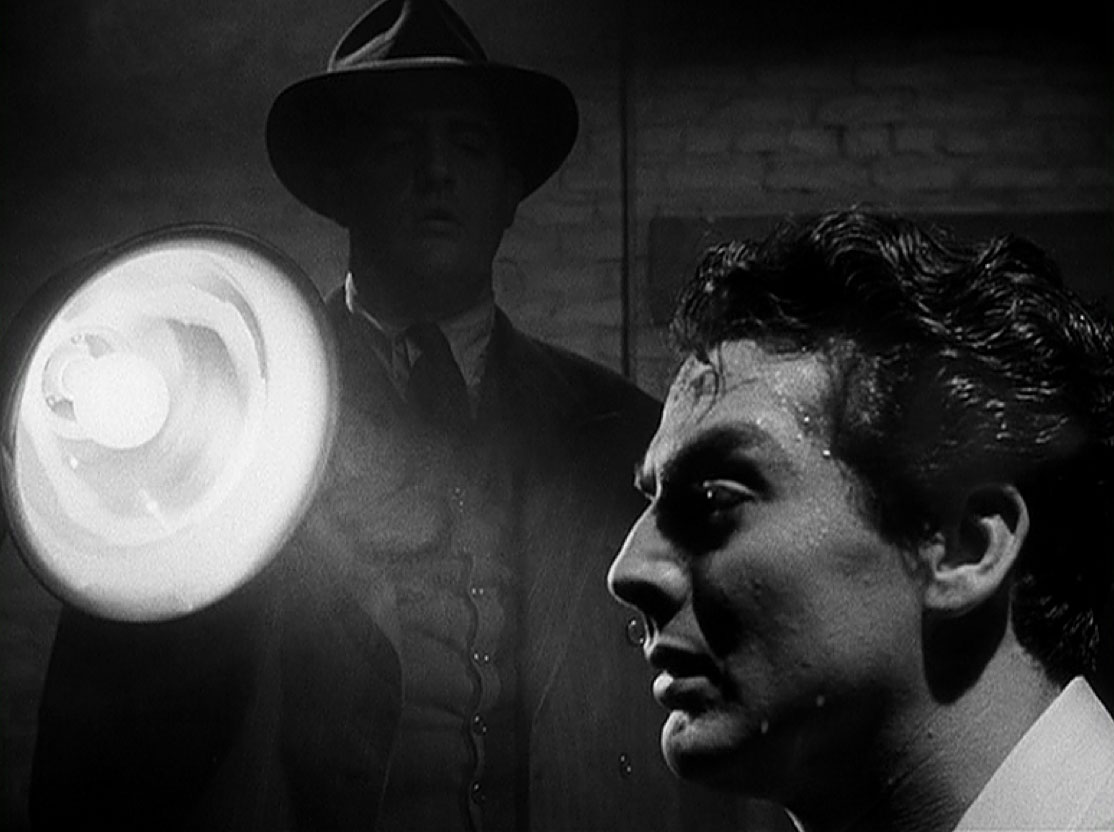
INTELLIGENCE TEST was suggested by “professional uplifters” as a polite replacement for giving someone “The Third Degree.” Image is from the 1941 noir thriller I Wake Up Screaming, starring Victor Mature, pictured here getting his “intelligence test.” (cinematography.com)

 * * *

At the Movies

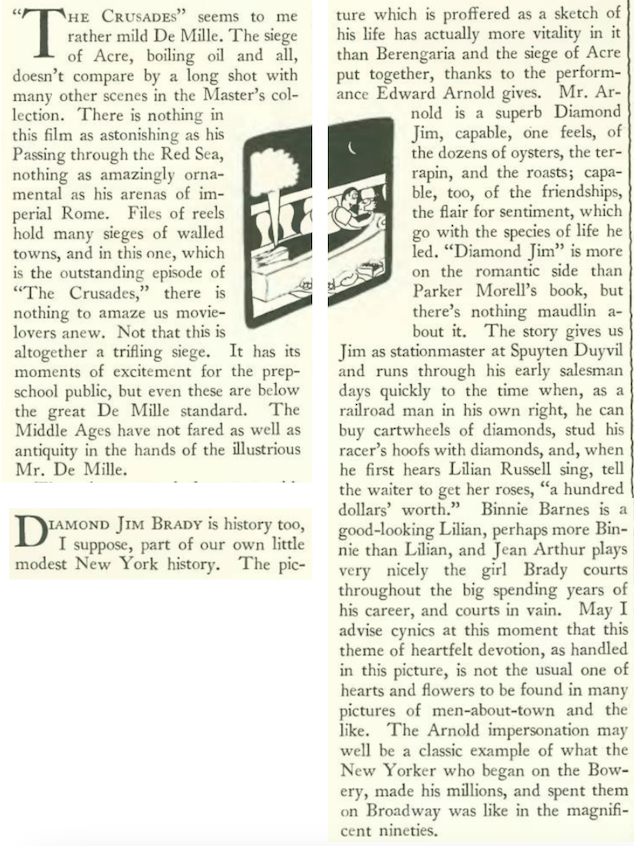
We join film critic John Mosher to take a look at the latest epic from Cecil B. DeMille, The Crusades, which to Mosher’s disappointment was a rather mild epic, with little to astonish. However, our critic did find something to admire in a more recent historical drama, Diamond Jim.

ANTISEPTIC EPIC?…Clockwise, from top left, movie poster for The Crusades offered up an image one typically does not associate with religious warfare, but you had to bring ’em in somehow; Henry Wilcoxon and Ian Keith in a scene from the film; co-stars Loretta Young as Berengaria of Navarre and Wilcoxon as Richard the Lionheart; the film also featured Joseph Schildkraut as Conrad of Montferrat and Katherine DeMille as Princess Alice of France (bottom left). A talented actress, Katherine reportedly landed the role as a Christmas gift from her adoptive father, Cecil B. DeMille. (cecilbdemille.com)
HEY BIG SPENDER…At right, Edward Arnold in the title role (here with Eric Blore) in Diamond Jim. At left, Cesar Romero moves in on Diamond Jim’s love interest, portrayed by Jean Arthur. (Rotten Tomatoes/IMDB)

 * * *

From Our Advertisers

We begin with this advertisement from Lord & Taylor, featuring the latest fall fashions for young women heading to college…notable here is the inclusion of Mickey Mouse in the illustration…the animated rodent was in vogue as much the latest fashions…


John Hanrahan, whose advertising savvy helped guide The New Yorker through its lean early years, was publisher of the richly designed Stage magazine, promoted here on the inside front cover…

…soft drink giant Coca-Cola recalled its soda fountain origins in this ad that promoted its 6.5-ounce bottled product…

…on the inside back cover Goodyear continued its series of perilous ads illustrating the dangers of tire blowouts (but not the obvious hazard of children riding untethered in a rumble seat, where they doubtless inhaled all manner of noxious fumes)…

…the majority of back covers in 1935 featured tobacco companies…here we learn that Lucky Strikes were more than cigarette; they were your “best friend”…

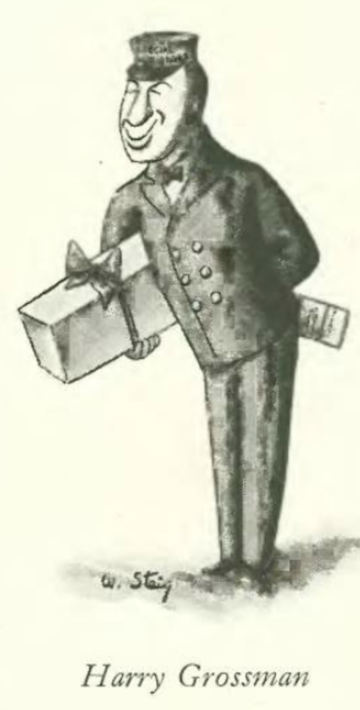
…on to our cartoonists, we start with this “Profile” illustration by William Steig…the profile was a two-parter featuring a clever summons server…

Adolph Dehn adorned the “Goings On” section with this illustration…

…unsigned, but I’m pretty sure this is H.O. Hofman

…here we get a lift from Robert Day

Al Frueh conjured up a nightmare of leaping sheep…

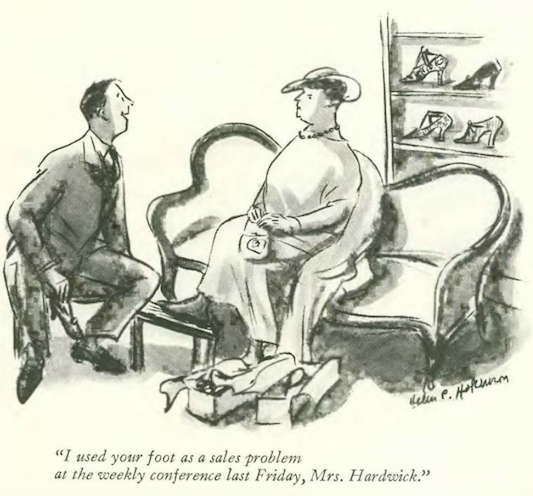
Helen Hokinson gave us some famous footwear…

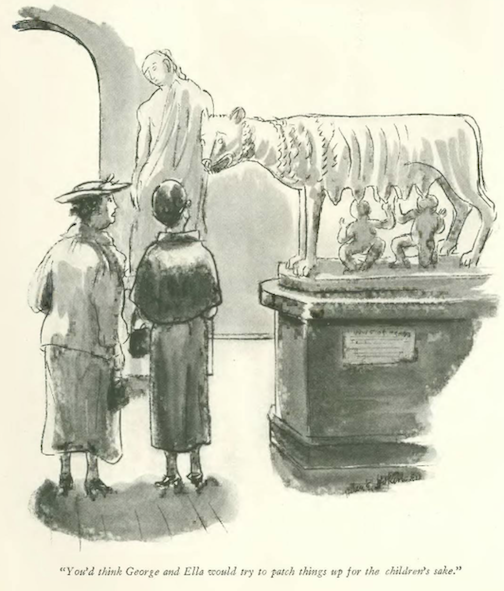
…Hokinson again, with Romulus and Remus providing a convenient metaphor…

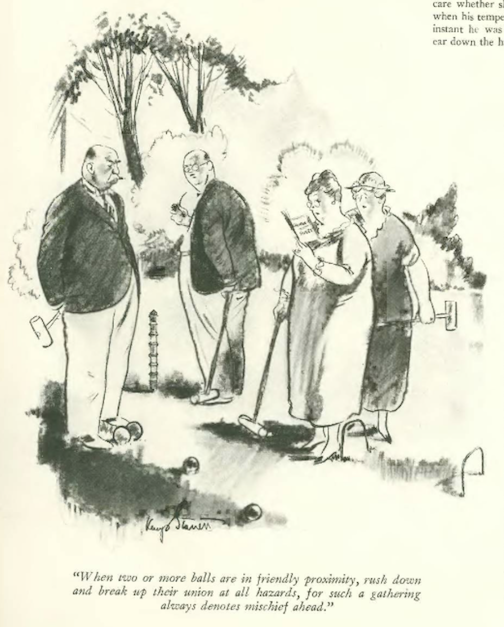
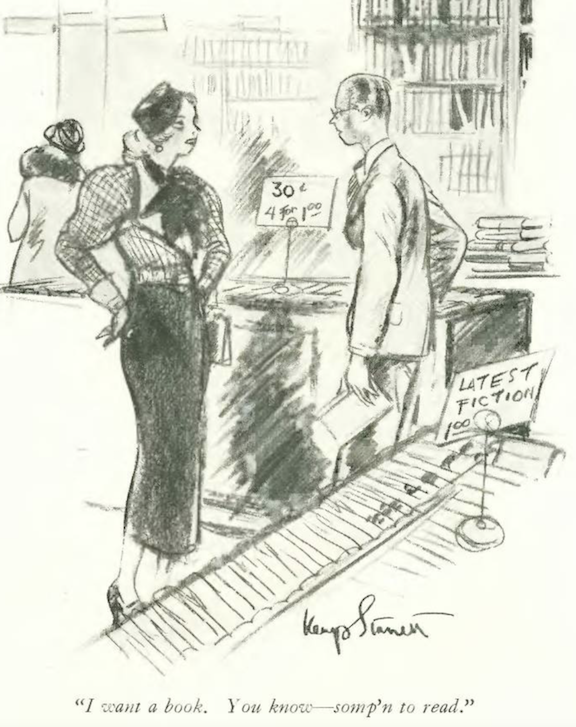
Kemp Starrett was bogged down in the rules of a game…

George Price discovered a budding talent…

Richard Decker took to the back roads…(reminds me of a scene from The Long, Long Trailer with Lucy and Desi)…

James Thurber raised a glass to a dry do-gooder…

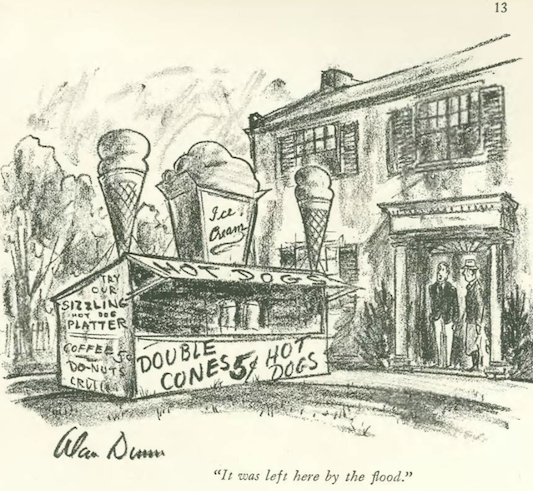
Alan Dunn brought an unexpected windfall to Westchester…

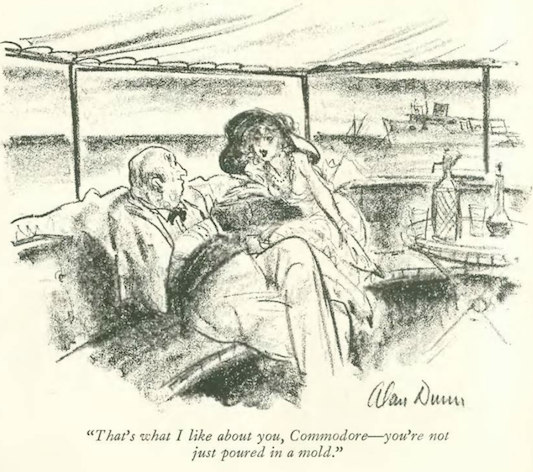
…and to close we Dunn again, and a bit of flattery…

Next Time: A Summer Night…

A Return to Coney

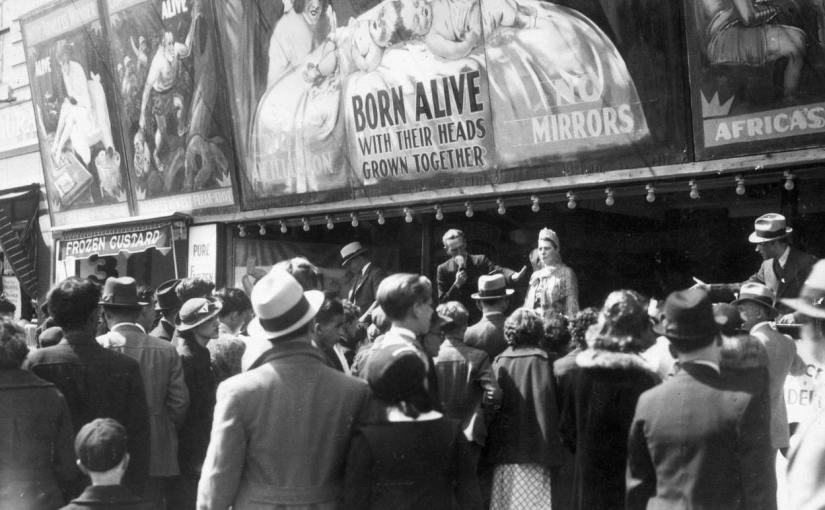
Above: Coney Island "freak" show, summer of 1935. (seeoldnyc.com)

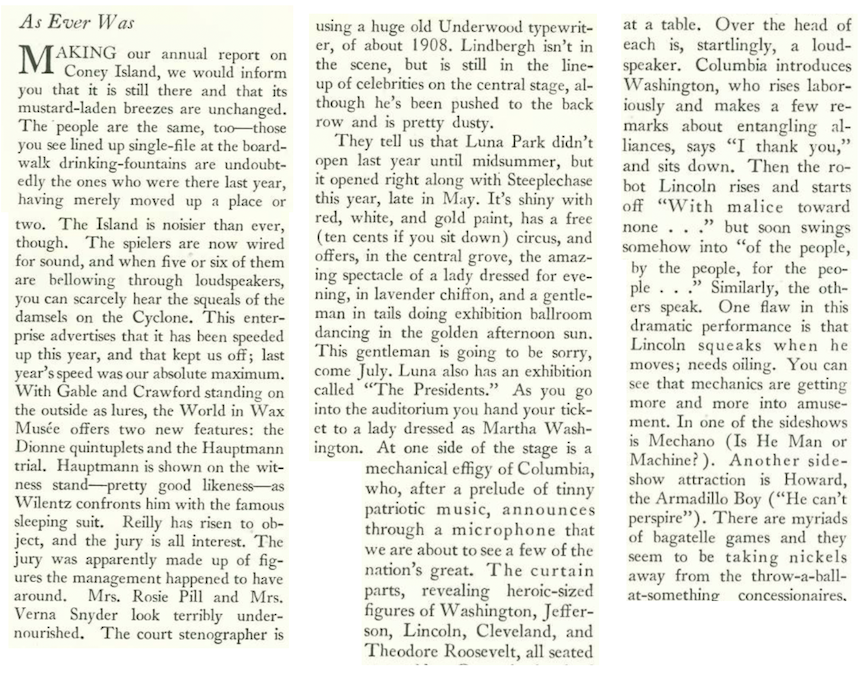
It has been about a year since we’ve visited Coney Island, and with summer upon us (and upon 1935 New York) let’s have a look at “The Talk of the Town” and see the latest attractions.

June 15, 1935 cover by Garrett Price. Price (1897–1979) illustrated 100 covers for the magazine.
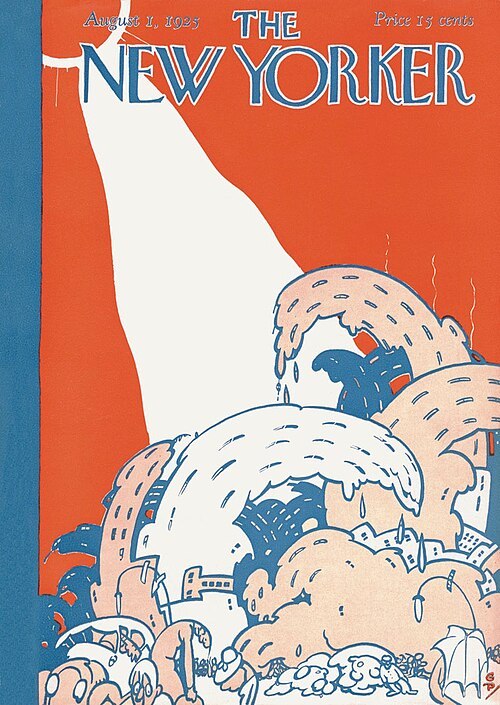
Garrett Price’s first New Yorker cover, “Heat Wave,” Aug. 1, 1925.

This lengthy “Talk” entry (excerpted), attributed to Clifford Orr, noted that much was unchanged, including the “mustard-laden breezes.” The place was noisier, however, with carnival barkers increasing their range through loudspeakers.

THE HIGH AND LOWS of society were on display in various attractions at Coney Island. Clockwise from top left, gawkers gather at Coney Island freak show, which included the “Armadillo Boy,” August 5, 1935; strollers near the Virginia Reel and Wonder Wheel, circa 1935; Borden’s frozen custard stand, 1930s; couple have a nap on the beach, circa 1935. (seeoldnyc.com)
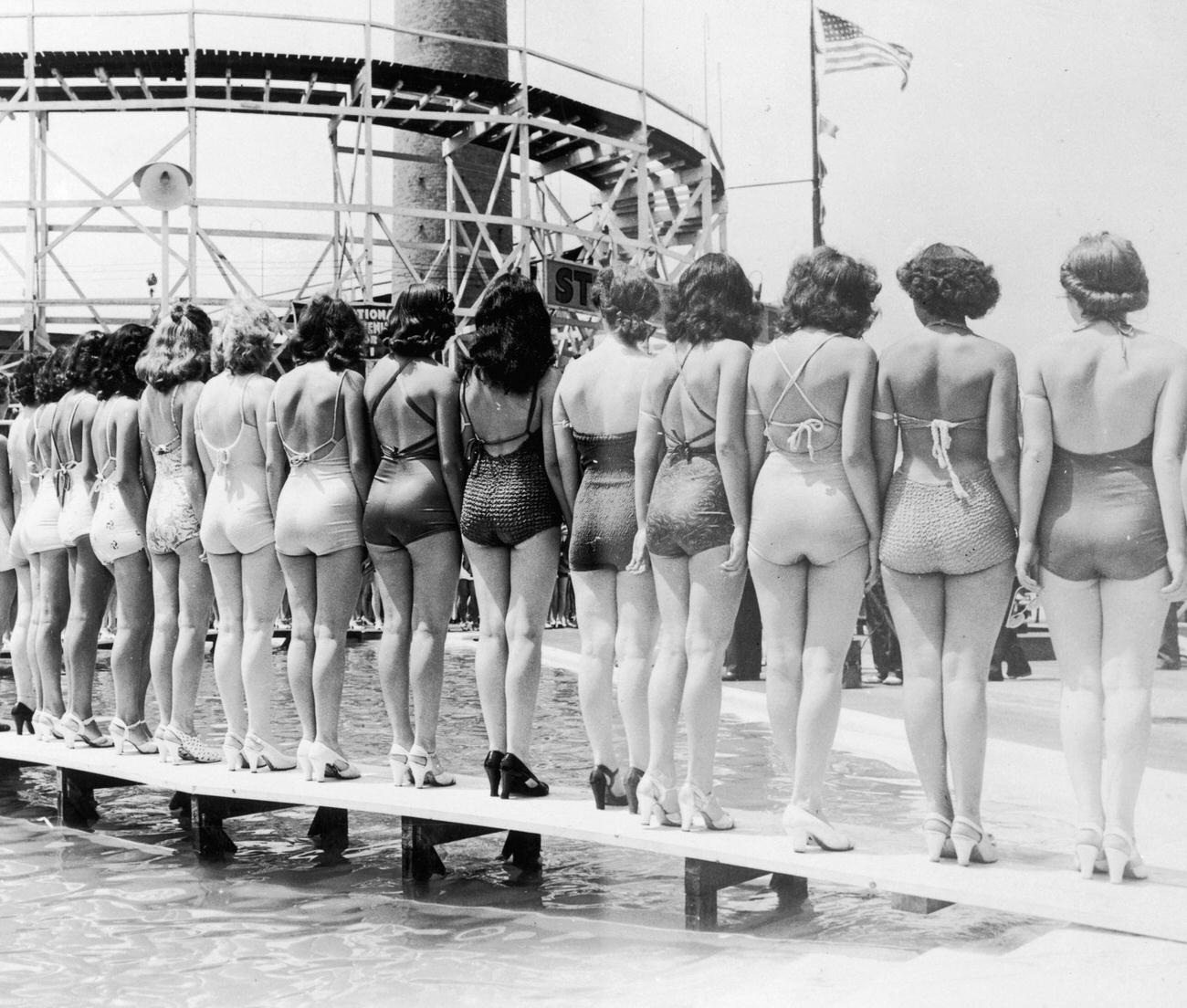
LINEUP…Beauty contests near the Steeplechase, like this one in 1935, were a common sight at Coney Island. (seeoldnyc.com)
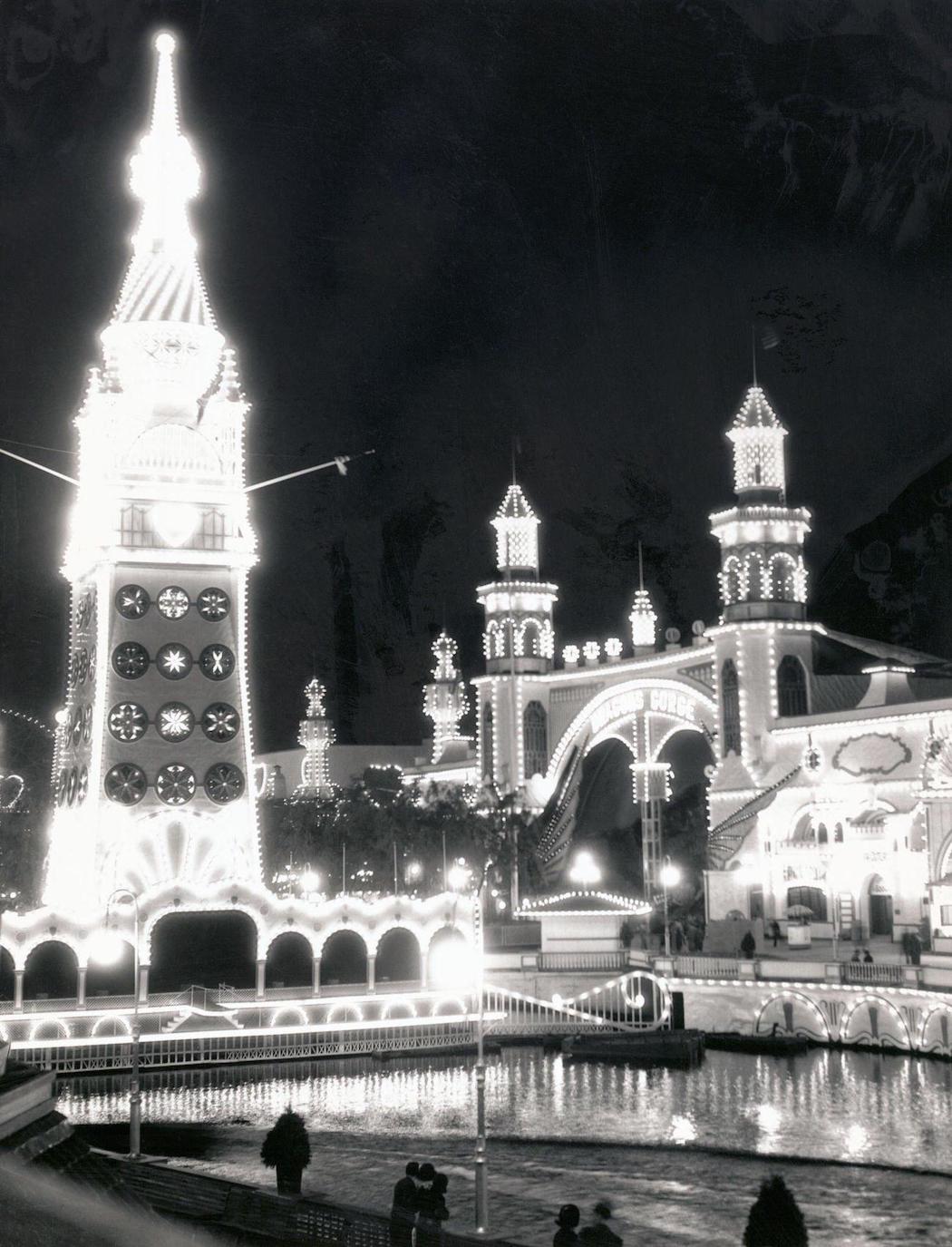
LIKE MOTHS TO THE FLAME, the dazzling lights drew thousands to Coney Island’s Luna Park in the 1930s. (seeoldnyc.com)
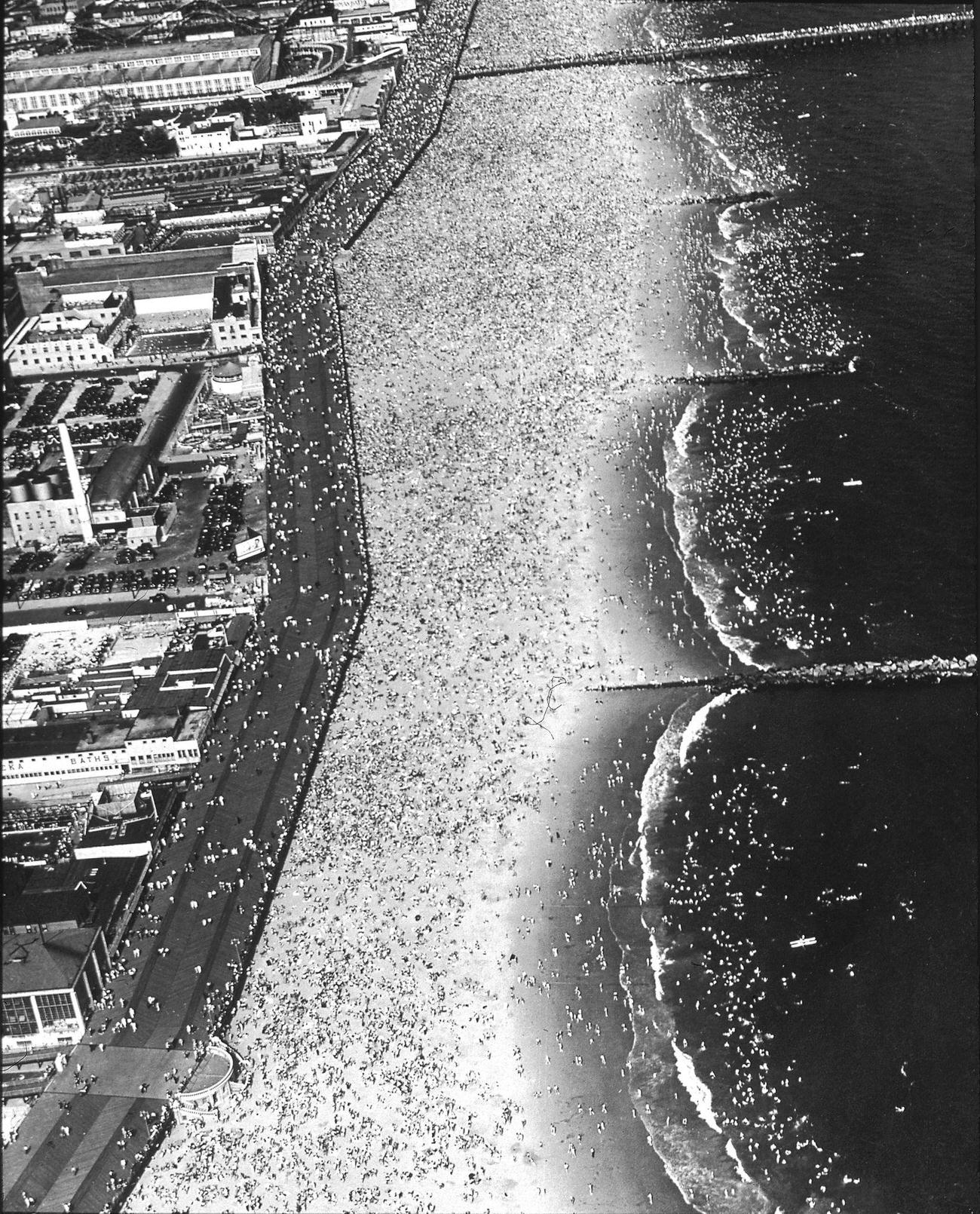
THEY LOOK LIKE…ANTS…Aerial view of the beach in 1935. The Steeplechase ride is at the top left. (seeoldnyc.com)

 * * *

Ship Ahoy

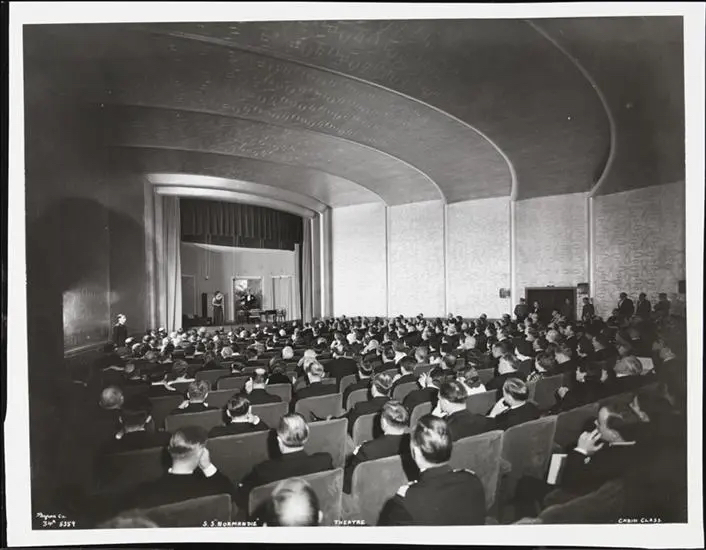
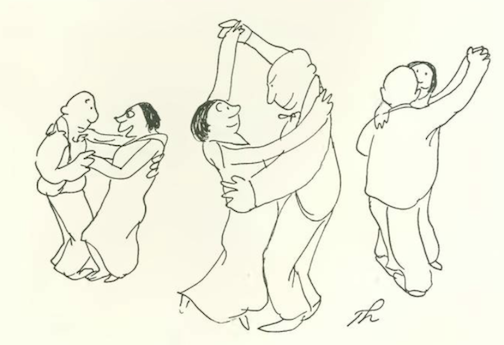
E.B. White (in “Notes and Comment”) mentioned that he danced aboard the newly arrived S.S. Normandie (presumably with Katharine White) while it was docked at Pier 88.

GROOVY…E.B. White noted the “luminous grooves” of the S.S. Normandie’s theatre. (drivingfordeco.com)
JUGGERNAUT…The S.S. Normandie docked at New York’s Pier 88 after completing her maiden voyage on June 3, 1935. Note the paint chipped from the hull, the result of the ship’s record-breaking speed. (yesterdaystrails.wordpress.com)

 * * *

Another Freak Show

Theatre critic Wolcott Gibbs found Earl Carroll’s latest stage production to be nothing more than a “vulgar assortment of comedians, jugglers, and performing dogs,” accompanied by “very lovely and disarming” young ladies who chanted their lines “in high childish voices.” One skit apparently featured Abe Lincoln with “fifty-six young ladies in cellophane hoopskirts.” Too bad no one filmed that performance.

HOLDING IT TOGETHER…Gibbs noted that comedian Ken Murray carried most of the show’s comedy (Murray had found success on the New York stage after appearing in Carroll’s Vanities on Broadway in 1935); Sibyl Bowen was known for her impersonations of famous women. In Sketchbook she portrayed Martha Washington, among others. (eBay/entertainment.ie)

 * * *

Weathering the Field

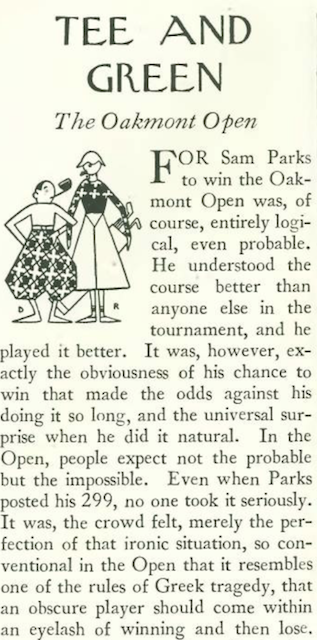
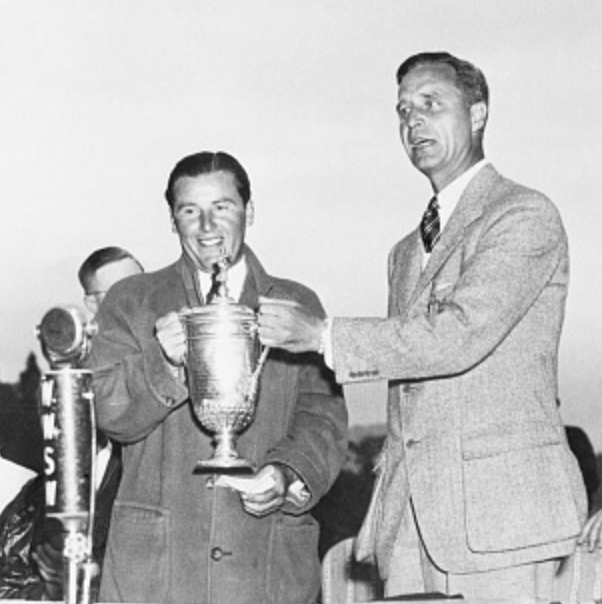
Like the recent 2025 U.S. Open at Oakmont (won by J.J. Spaun), ninety years ago Oakmont was also plagued by bad weather, and it also featured a tournament winner who outplayed the top golfers in the field. Excerpt:

WHY NOT ME?…Sam Parks Jr. (left) was considered an unlikely winner of the 1935 U.S. Open after competing with Hall of Famers at Oakmont. A 25-year-old club pro from Pittsburgh who played on the winter tour without ever winning, he bested a field that included Walter Hagen, Gene Sarazen, Denny Shute and Horton Smith. His secret? For months leading up to the U.S. Open, Parks played nine holes at Oakmont every morning before going to work at nearby South Hills Country Club. He knew the course like the back of his hand. (progolfweekly.com)

* * *

Straight From the Headlines

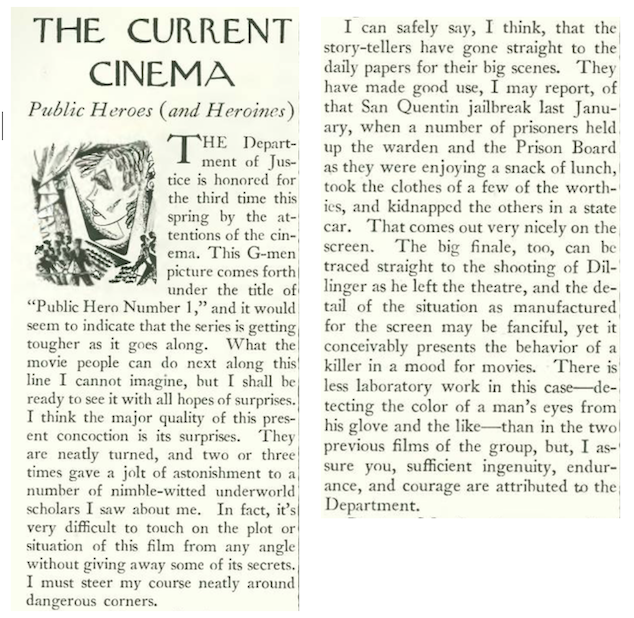
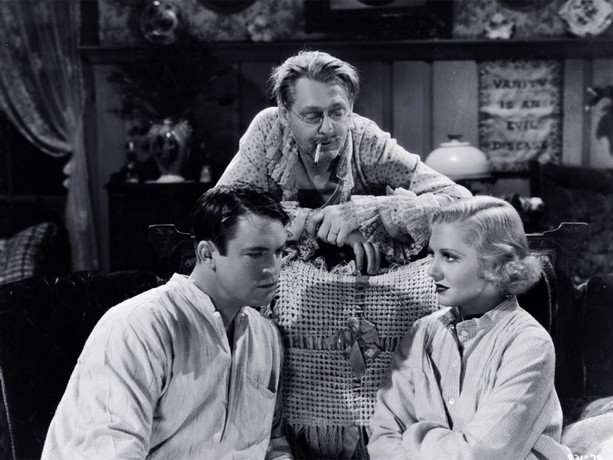
Film critic John Mosher noted how the storylines in latest “G-men” pictures seemed to be taken directly from the daily papers. Public Hero Number 1 was no exception.

THE GOOD GUYS…from left, Chester Morris, Lionel Barrymore and Jean Arthur in Public Hero Number 1. One effect of the Hays Code was to replace gangster films—which some believed glorified criminals—with films that depicted the dedication and courage of law enforcement officers. (Rotten Tomatoes)

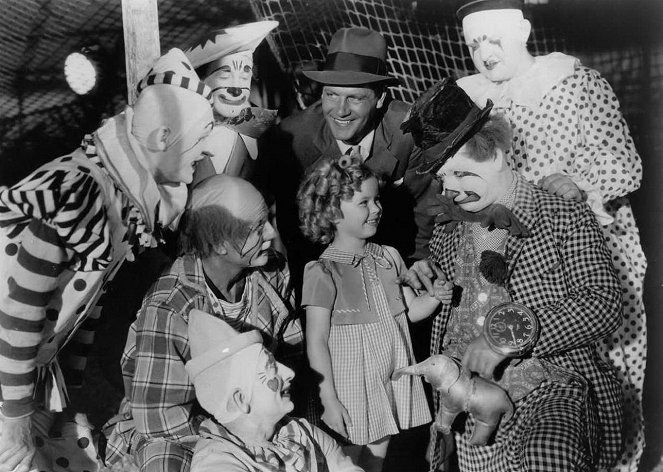
Mosher suggested moviegoers would get more pleasure out of Public Hero Number 1 than from Our Little Girl, which seems an unfair comparison since gunplay was rare in a Shirley Temple flick.

NO GUNS, JUST SOME SCARY CLOWNS…Joel McCrea and Shirley Temple in Our Little Girl. (csfd.sk/film)

 * * *

Speaking Brooklynese

The June 15 issue featured Thomas Wolfe’s classic short story, “Only the Dead Know Brooklyn.” Written entirely in “Brooklynese” dialect, the simple plot features four men standing on a subway platform arguing about how to get to “Bensonhoist.” The story (seemingly told to the author himself) recalls the existential themes of Wolfe’s contemporary, the Irish writer Samuel Beckett. Here is an excerpt, the second paragraph of the story:

So like I say, I’m waitin’ for my train t’ come when I sees dis big guy standin’ deh—dis is duh foist I eveh see of him. Well, he’s lookin’ wild, y’know, an’ I can see dat he’s had plenty, but still he’s holdin’ it; he talks good an’ is walkin’ straight enough. So den, dis big guy steps up to a little guy dat’s standin’ deh, an’ says, “How d’yuh get t’ Eighteent’ Avenoo an’ Sixty-sevent’ Street?” he says.

GONE TOO SOON…Portrait of Thomas Wolfe taken by Carl Van Vechten in 1937. He died the next year, eighteen days before his 38th birthday. (Library of Congress)

 * * *

From Our Advertisers

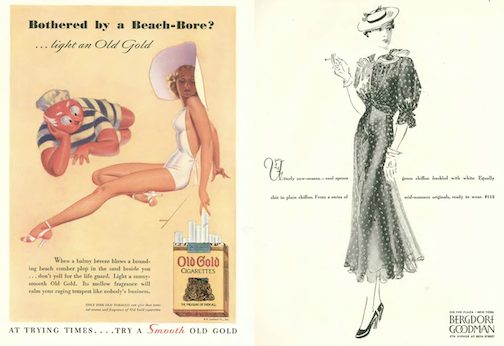
We begin with this two-page spread—what readers of the June 15 issue would have seen after turning the cover page…

…the inside cover ad was part of an ongoing series of spots for Old Gold cigarettes illustrated by pin-up artist George Petty…almost all of the ads featured a fat, homely man (possibly a sugar daddy) mooning over a leggy blonde who relieves the tedium by reaching for an oversized cigarette…

…the ad on the facing page couldn’t be more different, except for the fact the woman is smoking, suggesting, of course, sophistication when paired with the latest fashions from Bergdorf Goodman…

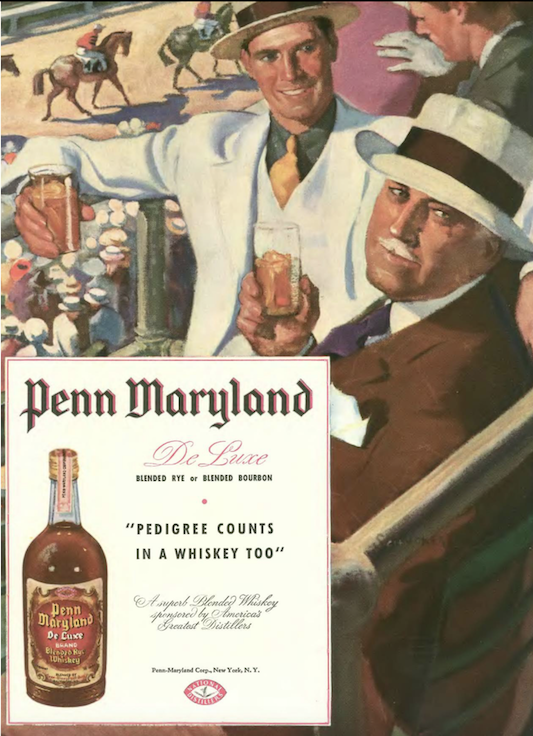
…on the back cover we find these swells enjoying a belt at the horse races…

…while on the back cover, Camel gathered together all of its recent society endorsers for another round of shilling for R. J. Reynolds…

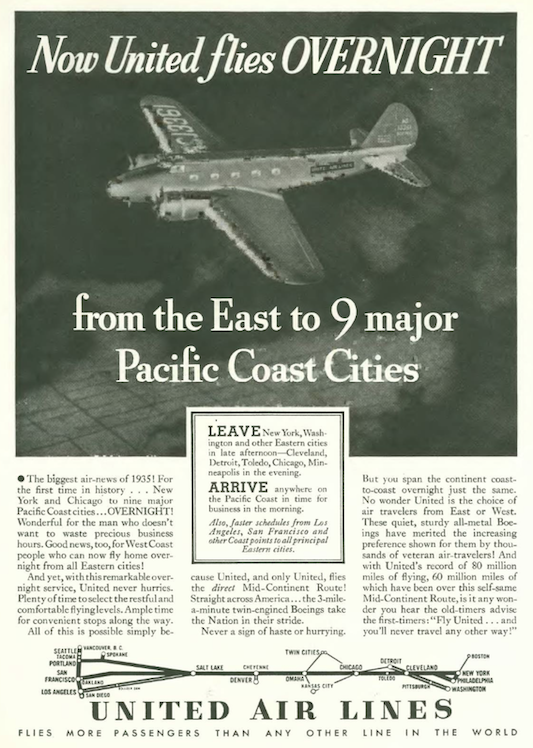
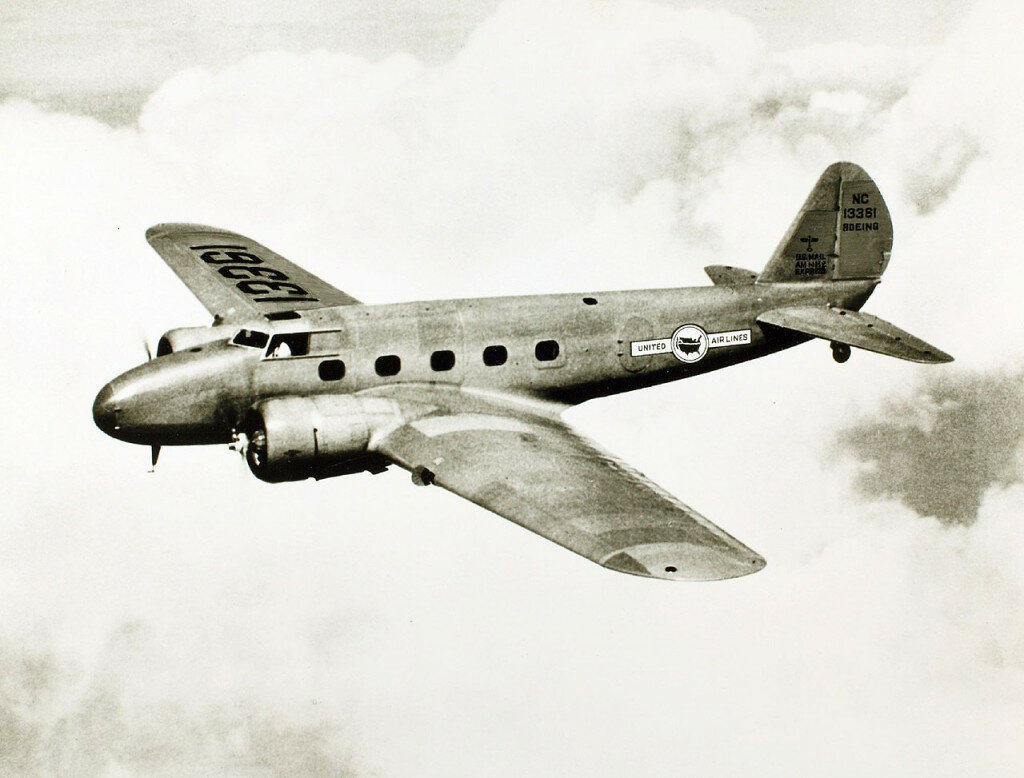
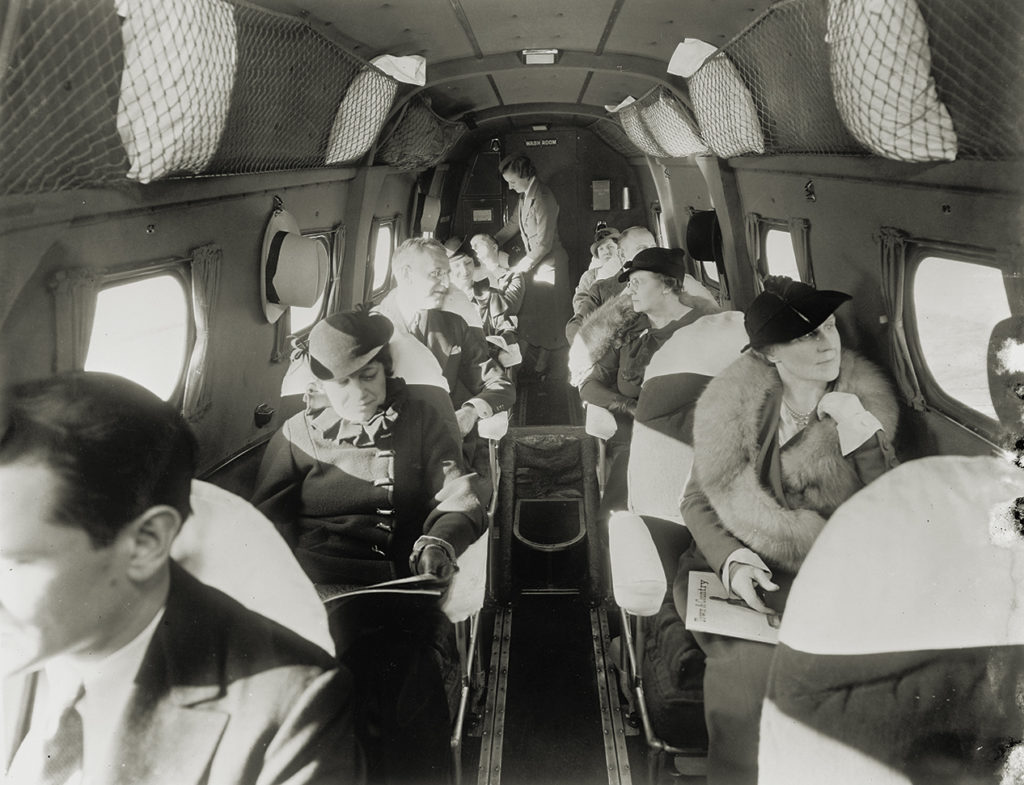
…swells and society women were the only persons (along with celebrities) who could afford to take this early version of a “red eye” to L.A. or San Francisco…it was not all that cushy, however…airliners were loud, cold, and not pressurized, so they flew at low altitudes and were often bounced about by the weather. The Boeing 247 also required several stops for refueling…

‘OL SPEEDY…This Boeing 247 was featured in the above ad. One of the first all-metal airliners, the 247 was considered revolutionary when introduced in 1933—United Airlines boasted that it cruised at speeds of three miles per minute and carried ten passengers across the country in twenty hours, cutting eight hours from previous travel times. Seven refueling stops included Cleveland, Chicago, Omaha, Cheyenne and Salt Lake City.  (Wikipedia)
WATCH YOUR STEP…Interior of the Boeing 247. Note that the main wing ran through the cabin, so persons moving down the aisle had to step over it. (Library of Congress)

…we learn a lot about a 1930s New Yorker reader by looking at the advertisements…it doubtful the magazine had many truly upper-class readers—the barbarians were content to flip through a copy of Town & Country or similar undemanding fare…what we do have are striving “smart set” readers, some with the means to buy a luxury automobile, fly cross-country, or cruise on the Normandie, all things one would desire as a member of upper-middle class or even the educated bourgeoisie in the middle…this Campbell’s soup ad is for the latter…the upper-middles would sniff at canned soup, while the barbarians would probably eat whatever was set in front of them, since talking about food would be considered vulgar…

…Pabst Blue Ribbon beer has been around since 1844…in the 20th century it was increasingly associated with the working class and rednecks until the brand caught on with urban hipsters in the early 2000s…

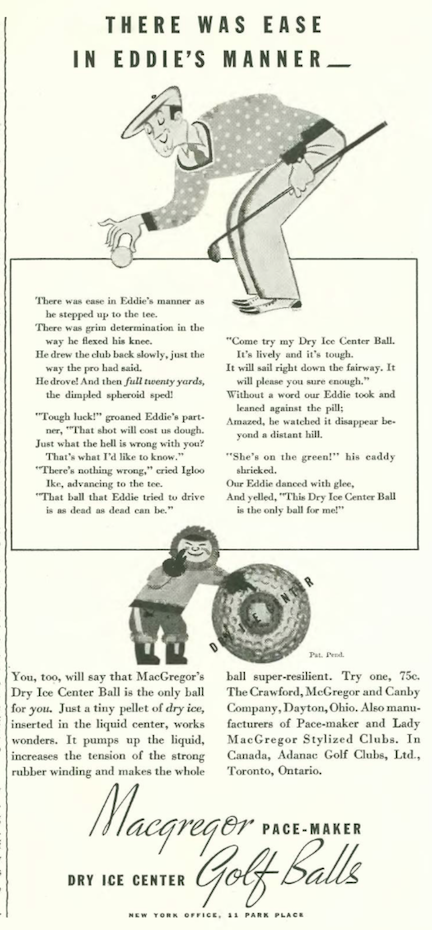
…in the May 25, 1935 issue we saw an ad promoting Walter Hagen’s “Honey Boy” golf balls, which contained real honey in their cores…the folks at MacGregor’s had a different idea—they inserted a pellet of dry ice into the center of their golf balls…what will they think of next?…

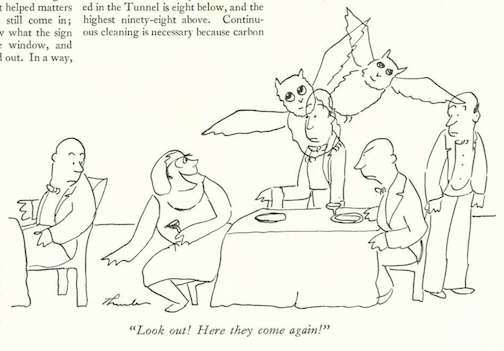
…we move on to our cartoonists, beginning with a James Thurber spot…

…and continuing with another Thurber classic…

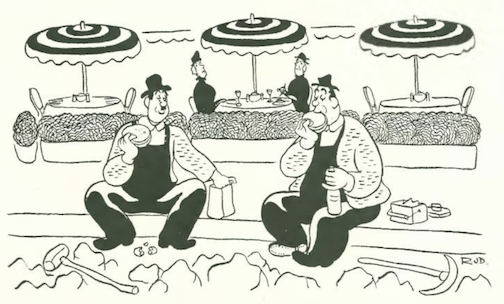
Robert Day took a lunch break in the opening pages…

Alan Dunn felt charitable while relaxing in Westchester…

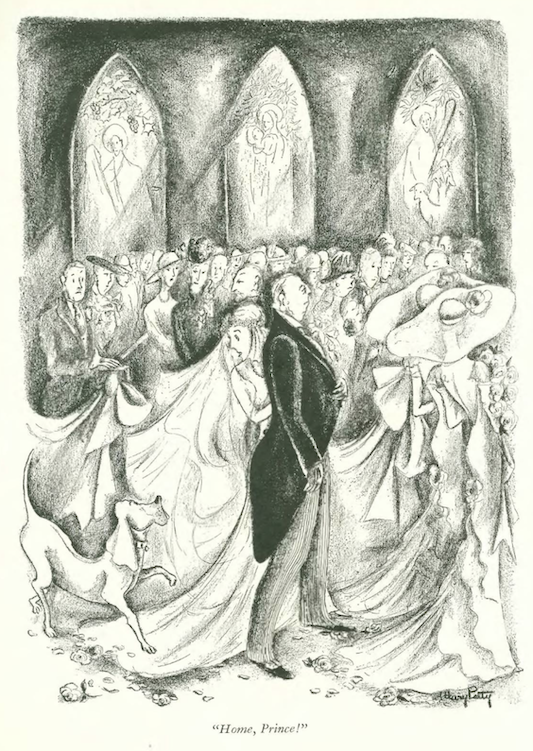
Mary Petty gave us a wedding guest that would not be out of place today…the caption reads, “Home, Prince!”…

Helen Hokinson went hog-wild in the garden…

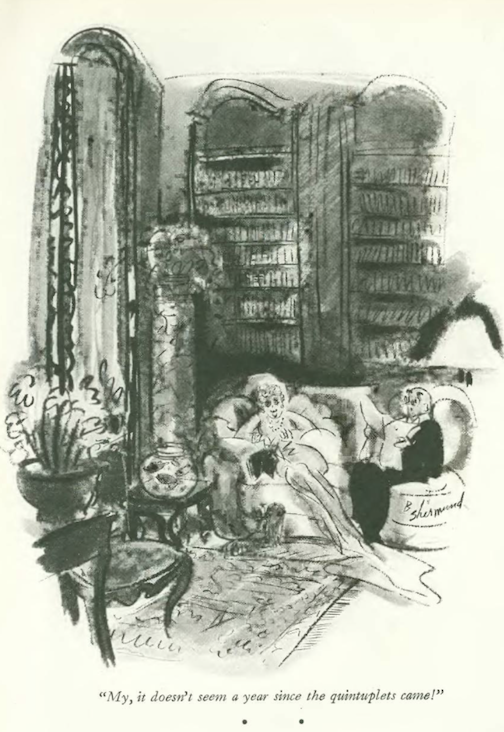
Barbara Shermund looked in on the idle thoughts of the idle rich…

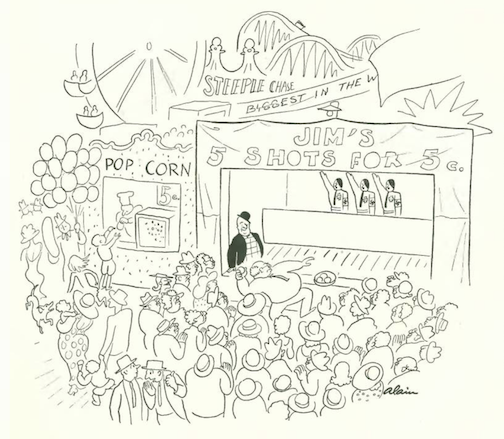
…and we close where we began, with Daniel Brustlein aka Alain at Coney Island…

Next Time: Thackeray, In Color…

Quite a Month

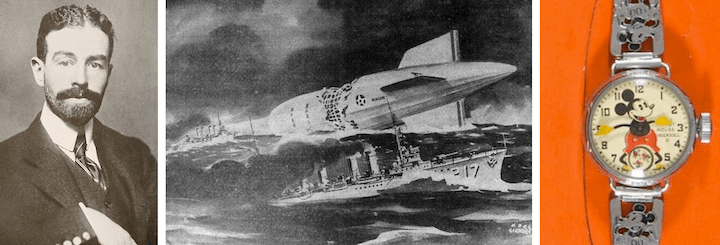
ABOVE: E.B. White presented us with a mixed bag of February happenings, from the comings and goings of Neily Vanderbilt to the Macon disaster and the economic power of Mickey Mouse.

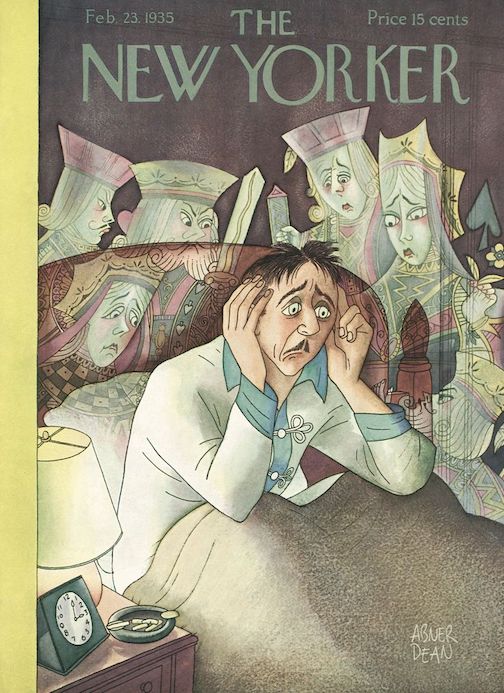
The title for this entry comes from E.B. White’s “Notes and Comment” column, which kicked off the Feb. 23, 1935, issue with a quick rundown of February events.

Feb. 23, 1935 cover by Abner Dean.

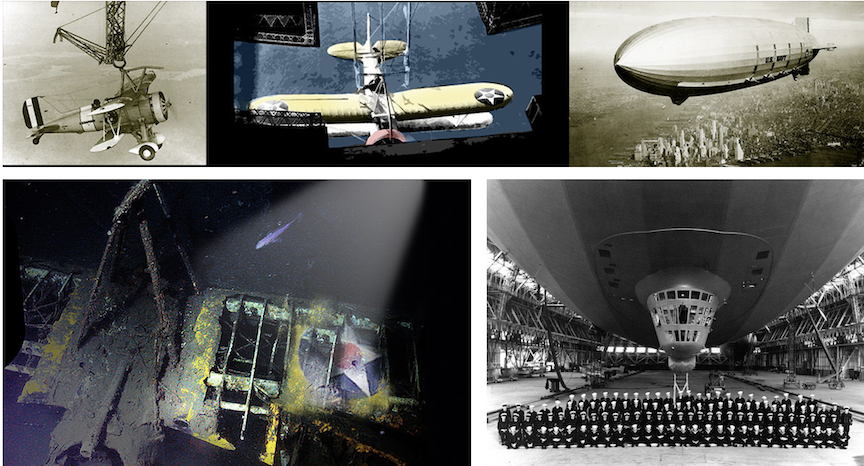
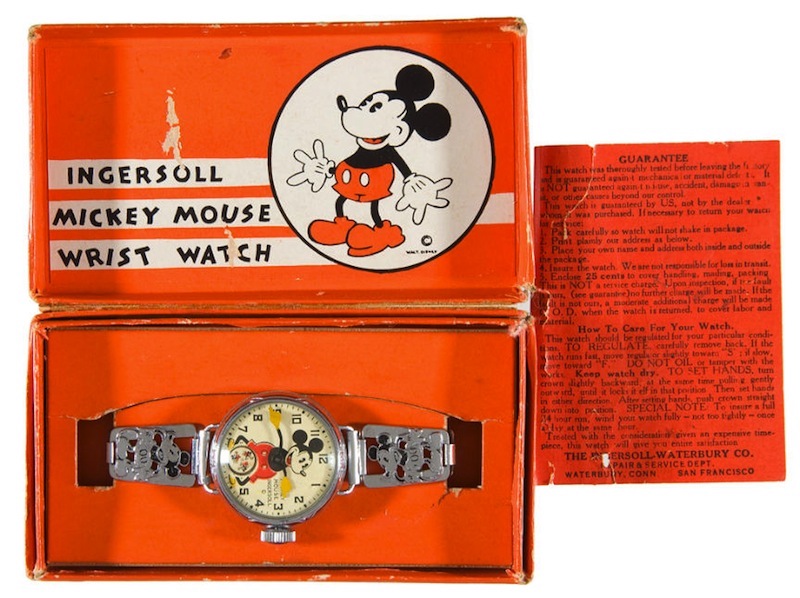
February notably marked the end of the Bruno Hauptmann trial. Convicted of the abduction and murder of the infant son of Charles and Anne Morrow Lindbergh, Hauptmann would go to the electric chair on April 3, 1936. White also noted the return of Admiral Richard Byrd from his second Antarctic expedition, the demise of the U.S. Navy airship U.S.S. Macon, and the economic miracle of the Mickey Mouse watch.

FLYING AIRCRAFT CARRIER…The US Navy’s 785-foot rigid airship USS Macon could launch and retrieve up to five airplanes in mid-flight. Known as “parasitic fighters, the Sparrowhawks were hung from a rail system inside the airship. On Feb. 12, 1935 the Macon crashed in a storm off the coast Point Sur, California. Only two of the 66 crew were lost. Photos above, clockwise from top left, show the deployment of a Sparrowhawk; the USS Macon over New York City in 1933; crew pose for a photo in the dirigible’s hanger; photo from the wreckage discovered in 2006—the pre-1941 pattern U.S. roundel emblem still recognizable. Sky-hook also visible. (sanctuaries.noaa.gov/macon/Sunnyvale Historical Society)
TIME WAS RUNNING OUT for the Ingersoll Waterbury Company (now known as Timex) during the Great Depression. It was saved from bankruptcy, in part, by the introduction of the Mickey Mouse watch. (connecticuthistory.org)

White also made note of the comings and goings of Cornelius “Neily” Vanderbilt III (1873–1942), who was saying farewell to Fifth Avenue (although he would return to live out his life there), while New Yorkers were apparently saying farewell to the Park Avenue Tunnel (aka Murray Hill Tunnel). After more than 190 years it is still there, now serving a single lane of northbound traffic from 33rd to 40th Street.

TUNNEL VISION…Park Avenue Tunnel in 1890 (top) and in 2013 during a Voice Tunnel art installation. The nearly two-century old tunnel was made open to pedestrians for the first time in coordination with the annual Summer Streets event which began in 2013. (viewing.nyc/Wikipedia)

 * * *

Getting An Earful

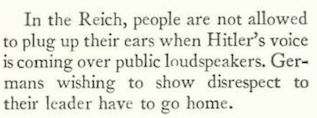
Howard Brubaker, in his column “Of All Things,” made this observation of deepening repression taking place in Nazi Germany…

 * * *

Try Our Knockout Cheesecake

Lois Long continued her chronicle of New York night life, in this excerpt making note of the celebrity gawkers at Jack Dempsey’s tavern/restaurant near Madison Square Garden. Apparently Dempsey’s place was renown for its cheesecake…

PLEASED AS PUNCH…Heavyweight boxing champ Jack Dempsey opened his restaurant at 50th Street and Eighth Avenue in 1935 (bottom photo) before moving to Broadway’s Brill Building in 1937 (top). According to Ephemeral New York, “In the restaurant’s early years, Dempsey was known to hold court at a table, a legendary figure greeting customers and glad-handling guests.” (Ephemeral New York)

 * * *

From Our Advertisers

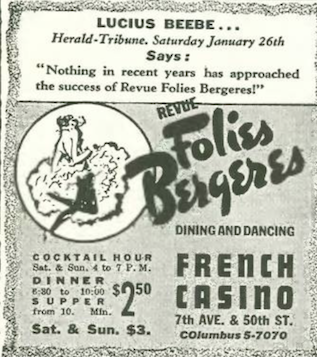
The refurbished Earl Carroll Theatre (7th Ave. and 50th St.) opened as the French Casino late in 1934. The art deco theatre’s first show was the Revue Folies Bergères, promoted here in this small ad on page 54 in the Feb. 23 issue…

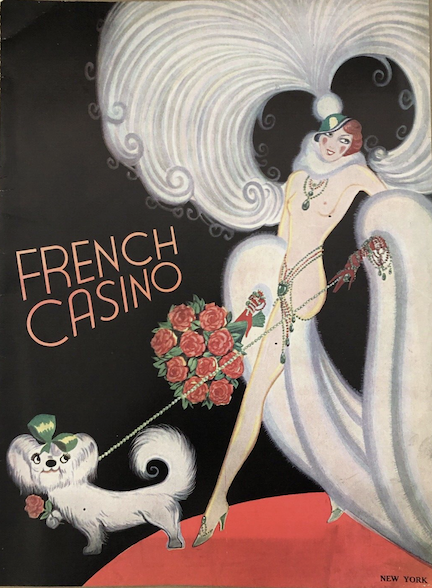
…the menu’s cover suggests patrons weren’t there for the cheesecake (yes, there is a pun, but I’m not touching it)…

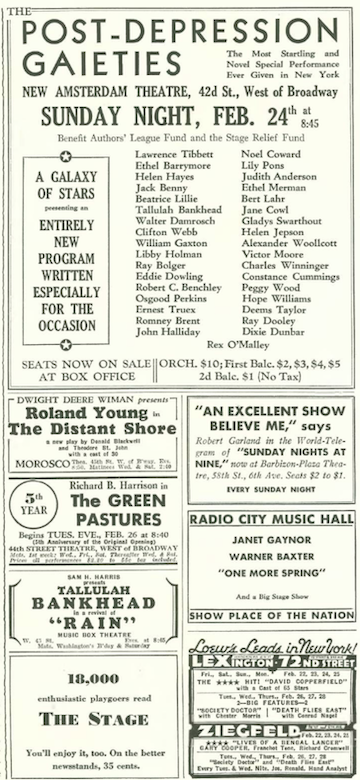
…another ad in the back pages touted the “Post-Depression Gaities” at the New Amsterdam Theatre with an impressive roster of stars including New Yorker notables Robert Benchley and Alexander Woollcott

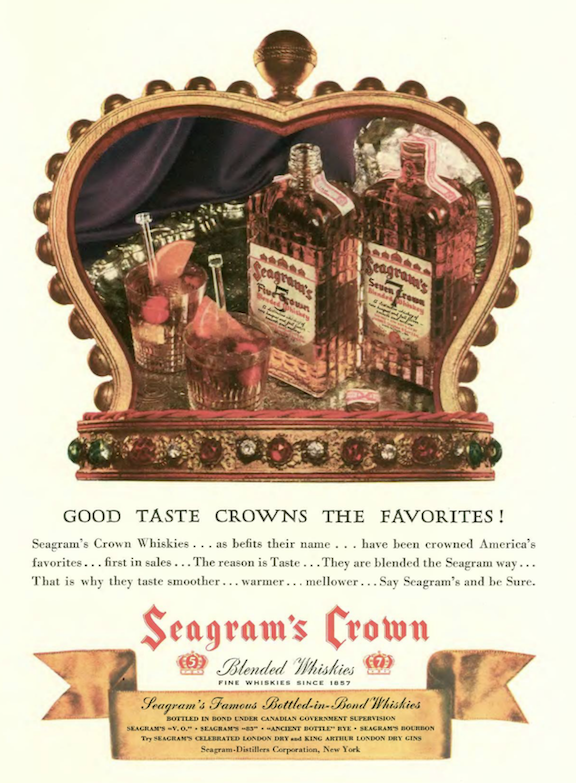
…following Prohibition, Seagram introduced two blended whiskies—5 Crown and 7 Crown. Seagram 5 Crown was discontinued in 1942, while Seagram 7 would go to become the first million case brand in U.S. history…

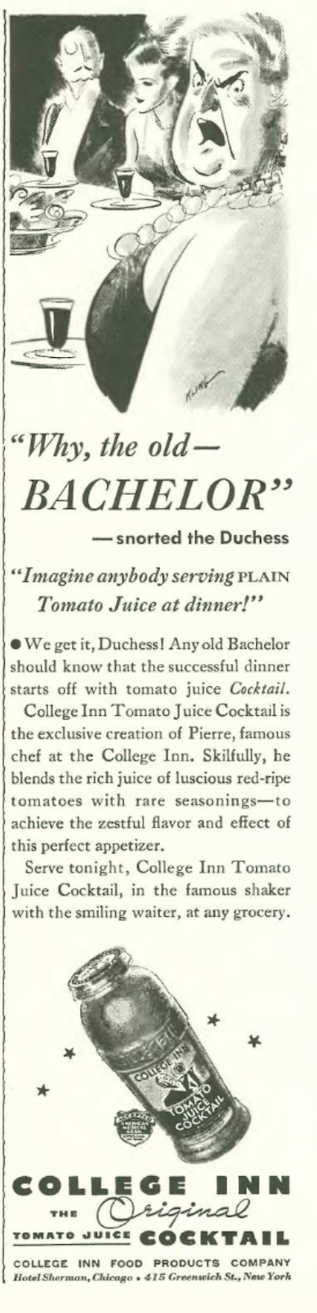
…this one-column ad caught my eye for the rendering of the stereotypic ill-tempered matron, here having a fit over tomato juice…

…coming from an old and influential New York family, it’s hard to believe Elizabeth West Post Van Rensselaer thought about Campbell’s soup when her daughter, Elizabeth, fell seriously ill…at any rate, something must have worked because her daughter lived until 2001…

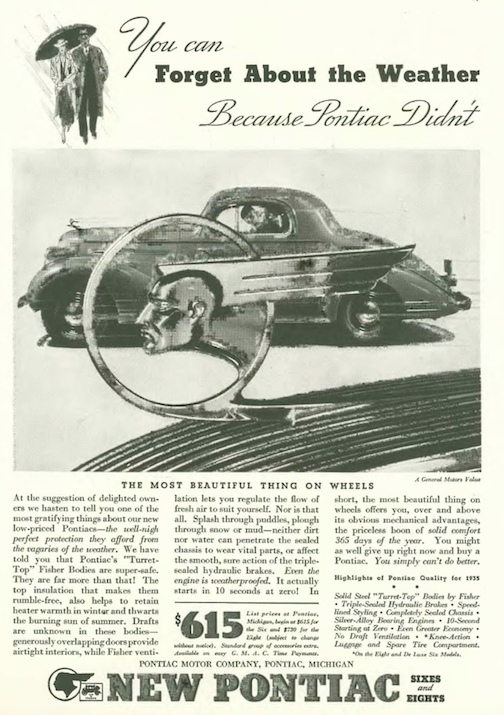
…For a time “Chief Pontiac” served as a logo for the Pontiac line of automobiles, discontinued by GM in 2010…

…many automobile advertisements of this era emphasized safety, none more prominent than the “Body by Fisher” ads that frequently featured happy little children…oddly, no one had yet considered seat belts, car seats or other safety measures we now take for granted…

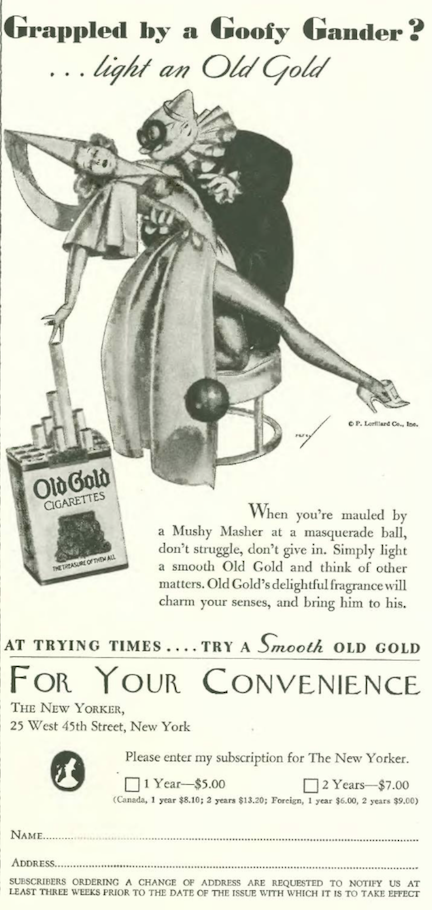
…the makers of Old Gold cigarettes (Lorillard) ran a series of ads featuring a sugar daddy and his leggy mistress…they were drawn by George Petty (1884–1975), famed for his “pin-up girls”…as an added bonus below the ad, you could renew your New Yorker subscription—two years for seven bucks…

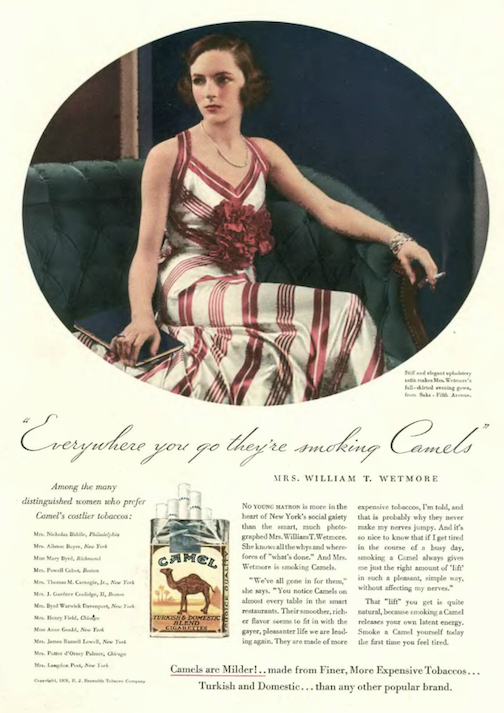
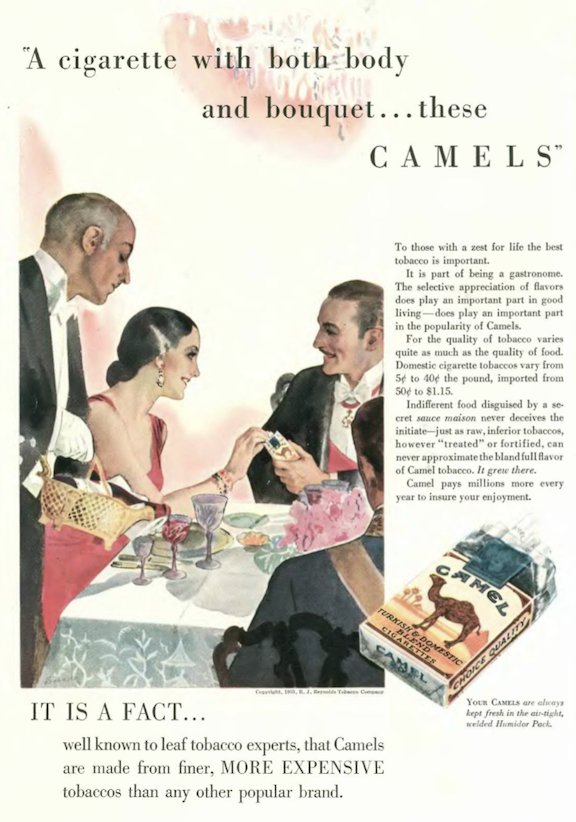
…the makers of Camels kept it classy with their continuing series of society women enjoying their unfiltered “Turkish & Domestic” blend…

…the “young matron” in the ad, the Sydney, Australia-born Joan (Deery) Wetmore (1911-1989), was indeed “much-photographed,” and was a favorite of Vogue photographer Edward Steichen:

Detail from a Steichen photo of Joan Wetmore, taken in Rockefeller Center’s Rainbow Room, 1934. (Condé Nast)

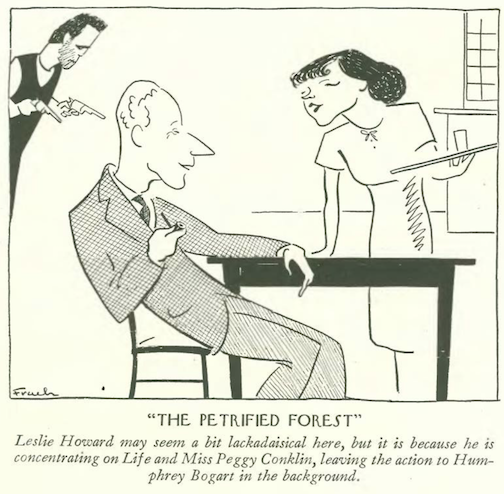
…on to our cartoonists, Al Frueh illustrated Humphrey Bogart as the coldblooded killer Duke Mantee in the 1935 play The Petrified Forest; the 1936 film adaptation would be Bogart’s breakout role in the movies…

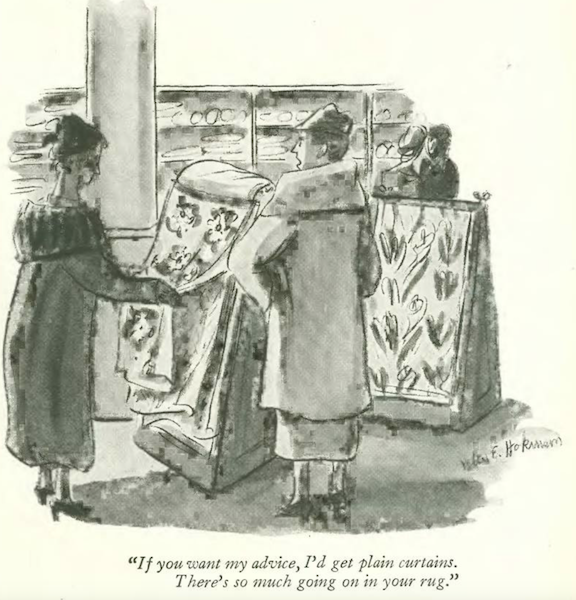
Helen Hokinson went shopping for drapes…

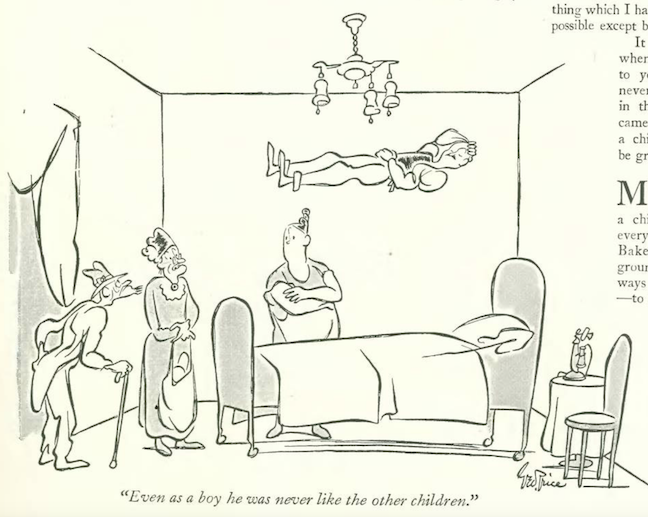
George Price was all tied in knots…

…and still up in the air…

Barbara Shermund dreamed of Venice…

James Thurber gave us the life of the party…

…and we close with Leonard Dove, and some unexpected party life…

Next Time: The Mouse Roars, In Color…

Ring Ding

Back in the days before we had a zillion different entertainment options, almost anyone with a pair of ears would tune in to hear the radio broadcast of a heavyweight title fight.

June 23, 1934 cover by Rea Irvin.

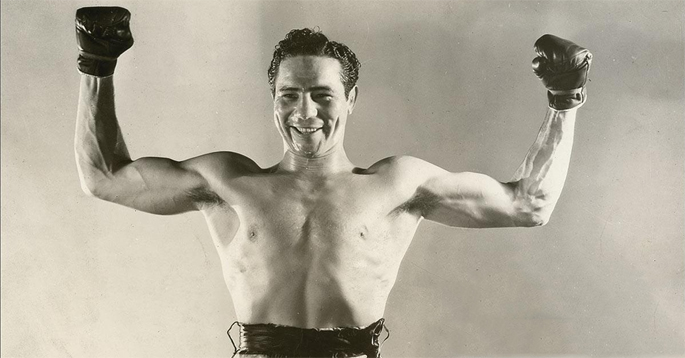
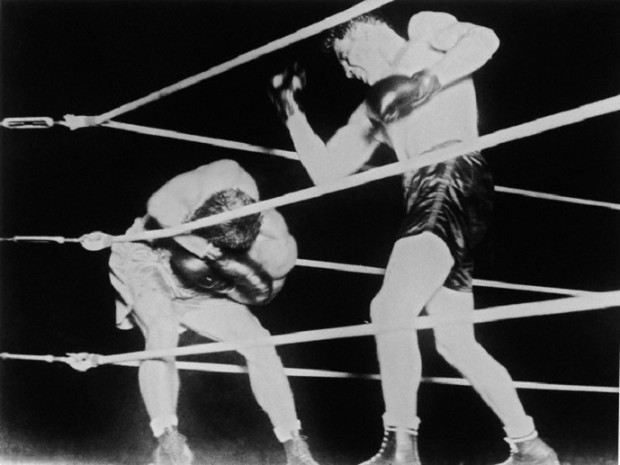
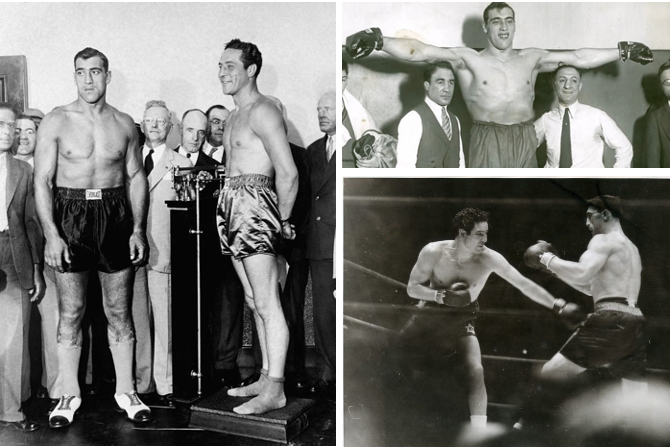
Jack Dempsey and Gene Tunney dominated the late 1920s, while Joe Louis, Max Schmeling and Jack Sharkey were marquee names in the 1930s along with Max Baer and Primo Carnera, who met on June 14, 1934 at the outdoor Madison Square Garden Bowl in Long Island City. The reigning champ Carnera (1906–1967), who stood six-and-a-half feet tall and weighed in at 260 pounds, had won more fights by knockout than any other heavyweight champion. But Baer (1909–1959) was known as a knockout puncher who beat one opponent so savagely that he died the following day.

DEADLY DUEL…Max Baer (right) fought Frankie Campbell on Aug. 25, 1930, in San Francisco for the unofficial title of Pacific Coast champion. In the fifth round Baer got Campbell against the ropes and hammered him senseless. Campbell died the next day. An autopsy revealed that Campbell’s brain was “knocked completely loose from his skull.” Baer was profoundly affected by Campbell’s death, and donated purses from succeeding bouts to Campbell’s family. (thefightcity.com)

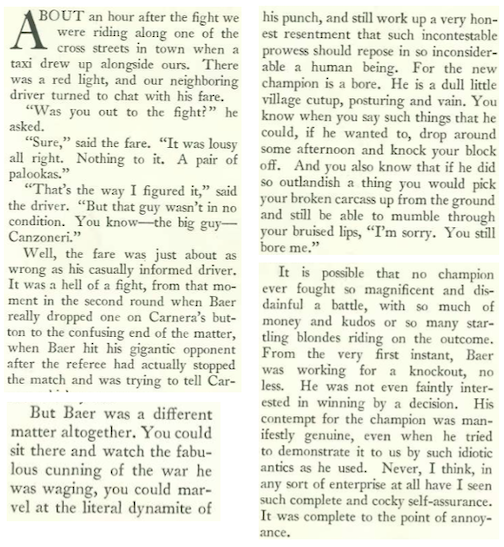
Baer was also something of a showboater, a quality Morris Markey found distasteful when he wrote about the Baer–Carnera bout in “A Reporter at Large.”

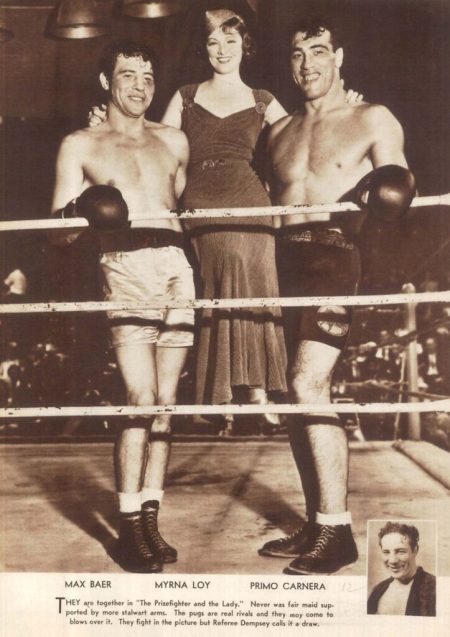
ALL SMILES…A year before their championship bout Max Baer (left) and Primo Carnera starred with Myrna Loy in The Prizefighter and the Lady. (theusaboxingnews.com)

GIANT SLAYER…The Italian prizefighter and wrestler Primo Carnera, nicknamed the “Ambling Alp,” was the reigning heavyweight champion when he faced Max Baer on June 14, 1934 at the Madison Square Garden Bowl. Baer felled the champion eleven times before the fight was stopped in the eleventh round. Baer would only hold the title for a year, losing to James J. Braddock on June 13, 1935, in what has been called one of the greatest upsets in boxing history. (theusaboxingnews.com)

Markey further explained why Baer’s behavior in the ring was so bothersome, and how it differed from the comic antics of other famous athletes:

RETIRING TYPES…Both Primo Carnera and Max Baer acted in films during their boxing careers, and continued acting after their retirements (Carnera in 1944, Baer in 1941). At left, Carnera with Bob Hope in the 1954 American comedy Casanova’s Big Night (Carnera appeared in eleven Italian films and in a half-dozen American films); at right, Max Baer and brother Buddy Baer (also a boxer) with Lou Costello in the 1949 comedy Africa Screams. Baer would appear in more than 20 films.(theusaboxingnews.com/monstermoviemusic.blogspot.com)

Complications from diabetes would take Carnera down for good at age 60. Baer would die even younger, from a heart attack, at age 50. His last words reportedly were, “Oh God, here I go.” Baer’s son, actor and director Max Baer Jr. (best known as Jethro Bodine from TV’s The Beverly Hillbillies) is still with us, at age 85.

We aren’t quite finished with the Baer–Carnera fight…E.B. White led his “Notes and Comment” with this observation regarding the fight’s mass appeal and seeming universality:

 * * *

Apologies to Ms. Winslow

I seem to have given short shrift to author Thyra Samter Winslow (1886–1961) who published more than 200 stories during her career in magazines such as The Smart Set and The American Mercury. She published more than thirty in The New Yorker, from 1927 to 1942, including the serialization of her short story collection, My Own, My Native Land. The story “Poodles” was featured in the June 23 issue.

According to the Encyclopedia of Arkansas, Winslow’s early life in Fort Smith (Ark.) “provided background for her view of small towns as prejudiced, hypocritical, and suffocating places…many stories expose the hypocrisy, prejudice, and carefully maintained social structures of both small town and urban life. She was particularly adept at portraying women of every social class, often in an unfavorable light. Money, especially the pursuit of it as a means to happiness or status, is an important theme throughout her work.”

THE PURSUIT OF HAPPINESS…Thyra Samter Winslow with friend, 1937. (findagrave.com)

 * * *

Hot Enough For Ya?

So what did New Yorkers do when the summer heat set in? The next few items offer some clues, beginning with this poem by E.B. White:

SUMMER STOCK…Theatergoers fled to shady villages in New York, New Jersey and New England in the 1920s and 30s when summer stock theater was at its height. The above photo shows theatergoers leaving a performance at the Lakewood Theatre near Skowhegan, Maine. The theater was claimed to be the oldest and finest summer stock company in America with a Broadway cast. Nearby Lakewood Inn provided recreation, camping, and tourist bungalows. (mainememory.net)

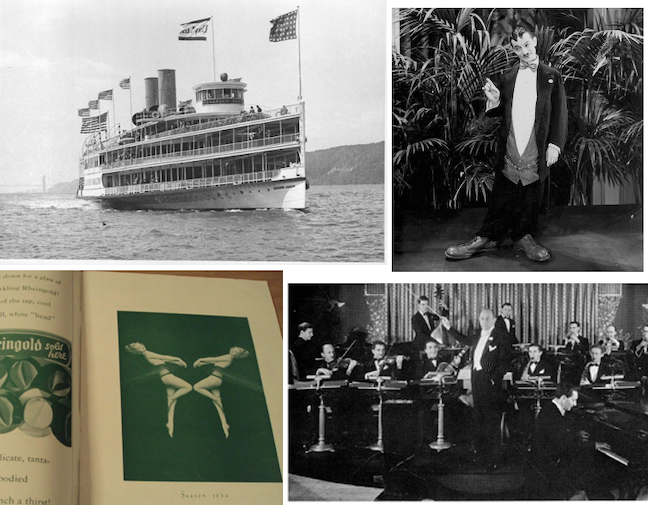
You could also take in some entertainment while enjoying the cooling breezes of the Hudson River. Robert Benchley hopped aboard the Alexander Hamilton to enjoy Bobby Sanford’s showboat revue:

SOME REAL SHOWBOATING…Clockwise, from top left, the steamboat Alexander Hamilton hosted Bobby Sanford’s showboat revue; comedian Lester Allen served as emcee for the show; the Meyer Davis Orchestra supplied the music; the revue featured the “exotic” DuVal sisters (image from program) among other diversions. (Hudson River Maritime Museum/IMDB/vintagebandstand.blogspot.com/Worthpoint)

“Tables for Two” took a look at summer dining options, from sidewalk cafes to hotel rooftops featuring dinner and dancing—this “Tables” was not written by Lois Long, but by Margaret Case Harriman, who knew a thing or two about nightlife (she was the daughter of the Hotel Algonquin’s owner, Frank Case)…

DANCING WITH THE STARS…The Waldorf-Astoria’s “Starlight Roof” was a popular summer restaurant for dining and dancing. Image from a 1935 publication The Waldorf-Astoria by Richard Averill Smith. (The Waldorf-Astoria)
 * * *
Doing Swimmingly
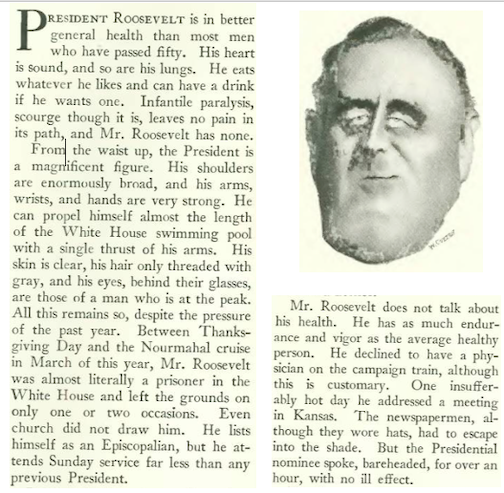
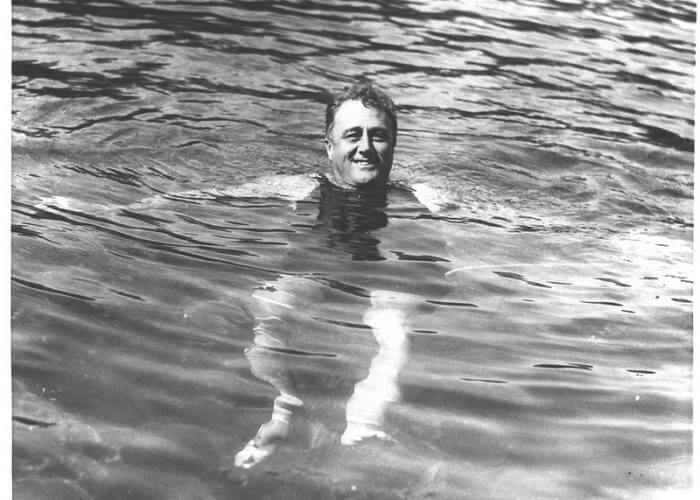
Historian Henry F. Pringle published part two of his series on President Franklin D. Roosevelt, here marveling at the president’s health despite his serious bout with polio (drawing by William Cotton).

TAKING THE WATERS…President Franklin D. Roosevelt took to swimming for therapy and exercise. (FDR Presidential Library and Museum)

* * *

Get Yourself to Chi-Town

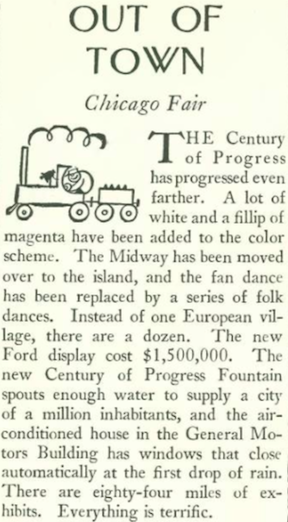
The Chicago World’s Fair (The Century of Progress) was in its second and final year, and The New Yorker found everything “terrific.” Excerpt:

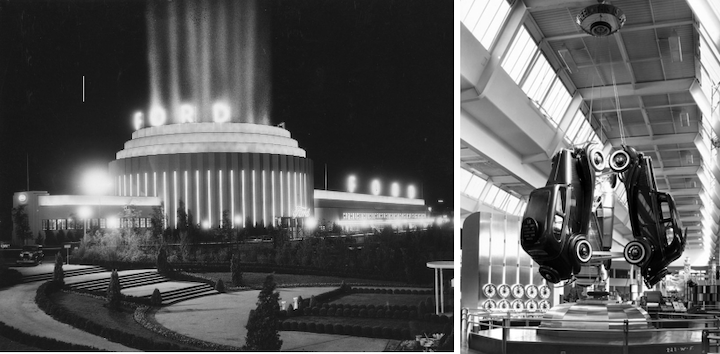
MAKING A SPECTACLE OF ITSELF…The 11-acre Ford Motor Company exhibit at Chicago’s Century of Progress became the most talked-about exhibit of 1934, featuring a central rotunda designed to simulate graduated clusters of gears. At right, Proof of Safety Exhibit in the Ford Building. (chicagology.com)

  * * *

From Our Advertisers

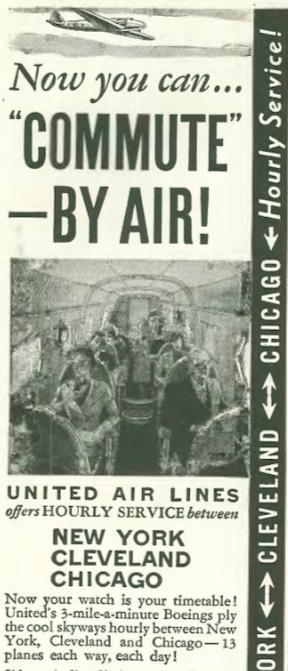
Just a couple of entries this week…You could take a plane to the Chicago World’s Fair on a United Airlines Boeing 247…

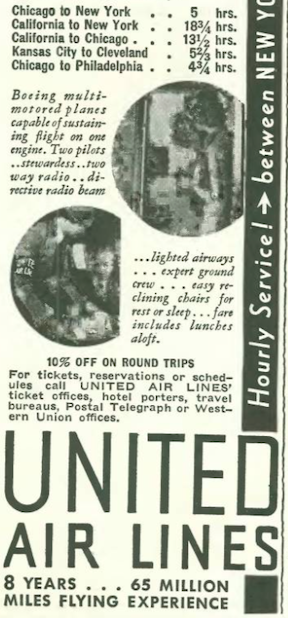
…the lower section of the ad claimed you could fly to Chicago in about five hours in planes featuring “Two pilots…stewardess…two-way radio…directive radio beam”…

TSA? WHAT’S A TSA?…United Airlines Boeing 247-D at an airport terminal with passengers and crew. (digitalcollections.lib.washington.edu)
COZY CONFINES…Passengers enjoy a game of checkers aboard a Boeing 247 in 1933. (digitalcollections.lib.washington.edu)

…and what would our advertising section be without two fashionable people lighting up?…

…on to our cartoonists, we begin with Reginald Marsh’s illustration of a Rep Theatre production…

Otto Soglow’s Little King found his artistic side…

Rea Irvin continued his examination of native fauna…

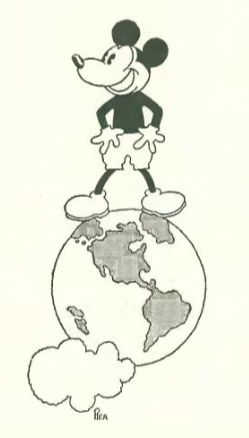
Gardner Rea correctly predicted the global domination of Mickey Mouse…

Peter Arno showed the dizzying effects of a Coney Island ride…

…however at the altar the thrill was gone, per Garrett Price

…another take on the ways of love, with Barbara Shermund...

…the newfangled diagonal bathtub continued to dazzle, with George Price

Gardner Rea offered up some subtle irony on the farm…

…and we close with James Thurber, in a poetic moment…

Next Time: A Light in Darkness…

Genesis of Genius

It’s hard to believe in this day and age that a theoretical physicist could enjoy rock star status, but then Albert Einstein wasn’t your everyday theoretical physicist.

Dec. 2, 1933 cover by Helen Hokinson.

A two-part profile of Einstein (1879–1955) by Alva Johnston (with terrific caricature by Al Frueh) examined the life and “idol” status of a man who would define the idea of genius in the 20th century. Although Einstein desired to live an almost reclusive existence at Princeton University, Johnston noted that he had become “fairly reconciled to the occupation of popular idol.”

Einstein was at Princeton thanks to the rise of Adolf Hitler, who came to power in Germany in early 1933 while Einstein was visiting the United States. Returning to Europe that March, Einstein knew he could not return to his home country (indeed, the Gestapo had raided his Berlin apartment and eventually seized all of his property), so when Einstein landed in Antwerp, Belgium on March 28, 1933, he immediately went to the German consulate and surrendered his passport, formally renouncing his German citizenship.

I’M OUTTA HERE…Albert Einstein with a Zionist delegation from France, Belgium, and England upon leaving the SS Belgenland in Antwerp, Belgium, 1933. (United States Holocaust Memorial Museum)

After some time in Europe and Great Britain, in October 1933 Einstein accepted an offer made earlier by from the Institute for Advanced Study in Princeton, New Jersey to serve as a resident scholar. When he arrived with his wife, Elsa, he said he would seclude himself at the Institute and focus on his teaching and research.

(NY Times, Oct. 18, 1933)
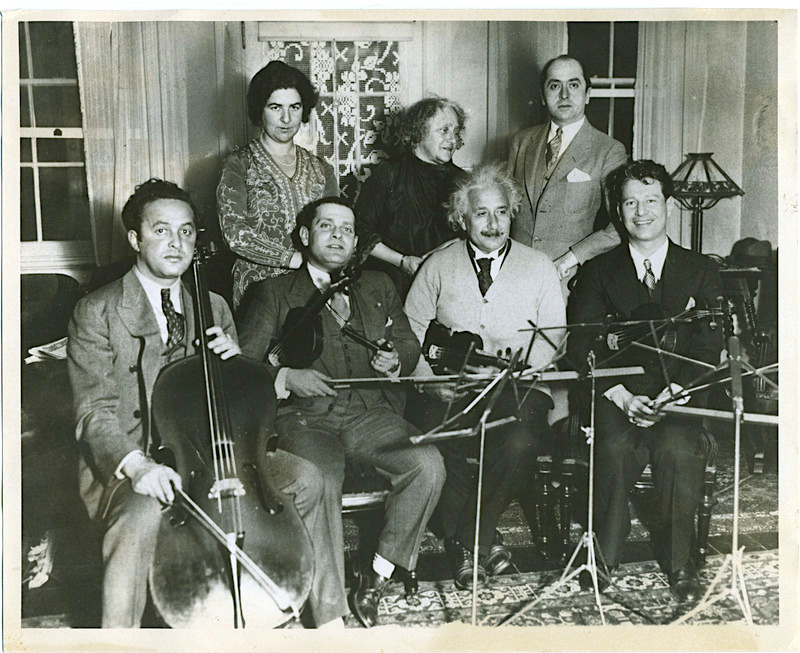
EINSTEIN WASN’T FIDDLIN’ AROUND when he played his cherished violin—he once said that if he hadn’t been a scientist, he would have been a musician. This photo was taken at Einstein’s Princeton home in November 1933—he and fellow members of a string quartet were practicing for a December concert at the Waldorf-Astoria to raise money for German-Jewish refugees. From left to right, sitting: Arthur (Ossip) Giskin, Toscha Seidel, Albert Einstein, and Bernard Ocko; standing: Estelle Manheim (Seidel’s wife), Elsa Einstein and unidentified man. (Leo Baeck Institute)

 * * *

Stop and Go

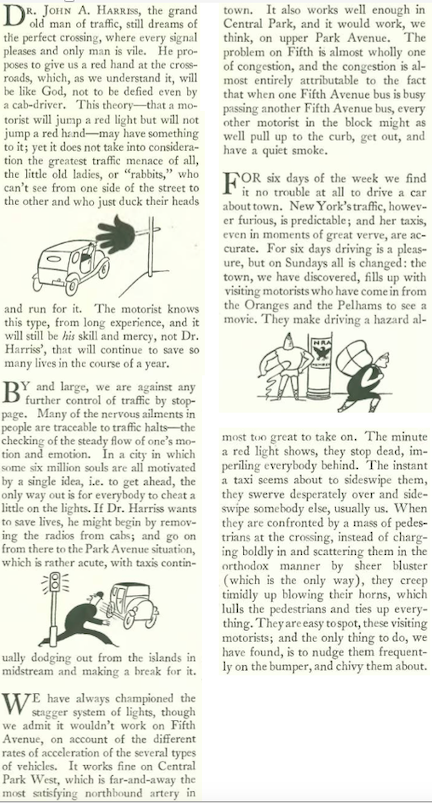
E.B. White devoted his “Notes and Comment” to Manhattan’s traffic situation, which he found manageable as long as tourists stayed out of the way…

White also noted the perils of Park Avenue, especially the taxi drivers (distracted by those newfangled radios) darting between the islands…

Park Avenue in the 1930s. (geographicguide.com)

…and then there was Fifth Avenue, notorious for traffic jams, made worse on weekends by the tourist traffic…

Fifth Avenue in 1932. (New York State Archives)

…later in “The Talk of the Town” White continued his thoughts on New York taxis, namely the introduction of coin-operated radios installed for use by passengers…

 * * *

Fly Newark

Albert L. Furth took us off the mean streets and into the air when he filed this account about the Newark Metropolitan Airport for “A Reporter at Large.” Furth seemed put off by the cachet of European airports and their many amenities, given that the Newark airport—although admittedly utilitarian—was the busiest in the world. An excerpt:

FREQUENT FLIER…Albert Furth noted that Newark Municipal Airport logged a landing or departure every thirteen-and-a-half minutes. Above, passengers boarding a Boston-bound American Airlines Condor at Newark Airport in 1930. In those simpler times, passengers just walked to the runway and climbed on board. The airport had opened two years earlier on 68 acres of reclaimed swampland along the Passaic River. It was the first major commercial airport in the New York metro area and the first anywhere with a paved runway. (njmonthly.com)

 * * *

Goodnight, Speakeasy

Lois Long was an 17-year-old Vassar student when Prohibition went into effect in 1919, so when she started her career in New York in 1922 the only nightlife she knew revolved around speakeasies. Although she held Prohibition officers in disdain, she also believed that the repeal of the 18th Amendment would lower the quality of New York nightlife—the food, the “adroit service,” and the “genial din” of the speakeasy. Excerpts:

FROM LOUCHE TO LEGAL…Lois Long was saying a sad goodbye to her beloved speakeasies; perhaps the Algonquin Hotel (here, circa 1930) would offer some cheer. (Pinterest)

 * * *

From Our Advertisers

Abercrombie & Fitch (then an outfitter for the elite outdoorsman) was offering holiday shoppers everything from multi-tool knives to cocktail shakers…

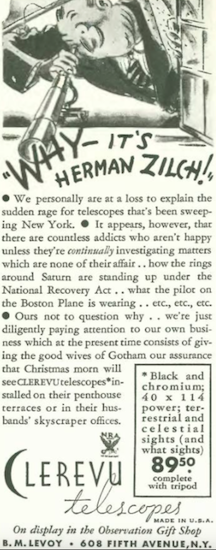
…while the folks at Clerevu telescopes found a growing market for folks who used their product for anything but stargazing…

…with Repeal just days away, the Pleasant Valley Wine Company of New York hoped folks would pop a few of their corks before the good stuff arrived from France…

…the British were coming to the rescue via the Berry Brothers, who were overseeing the importation of liquor from their offices at Rockefeller Center’s British Empire Building…

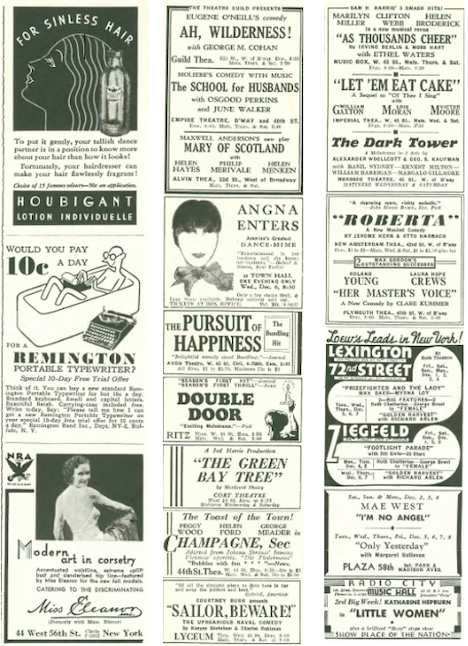
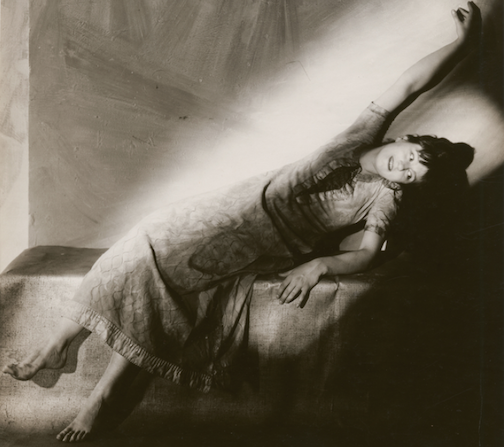
…let’s look at an assortment of one-column ads…the center strip features an ad promoting Angna Enters’ appearance for “one evening only” at The Town Hall (123 West 43rd Street)…Enters (1897–1989) was an American dancer, mime, painter and writer who likely performed her piece Moyen Age…

FEEL THAT STRETCH…Angna Enters performing Moyen Age, circa early 1930s. (NYPL)

…we begin our cartoons with Gardner Rea, and a dedicated bell ringer…

Otto Soglow showed us a softer side of The Little King…

Peter Arno revealed the human side of the posh set…

…and we close the Dec. 2 issue with this classic from James Thurber

…on to Dec. 9, 1933, and a cover by an artist we haven’t seen in awhile, Ilonka Karasz

Dec. 9, 1933 cover by Ilonka Karasz.

…and we open with this comment by E.B. White, who along with critic Lewis Mumford had once voiced displeasure over the massive Rockefeller Center project. However, while viewing the floodlit tower by night, he decided that he would have to eat his words, observing how “the whole thing swims up tremendously into the blue roxyspheres of the sky”… 

MEA CULPA…E.B. White gained a new perspective on Rockefeller Center, pictured here in December 1933. (Wikipedia)

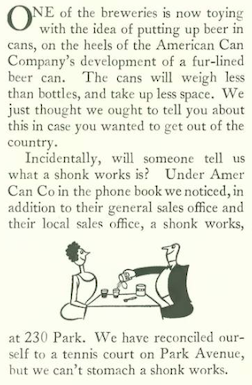
…we continue with White, who also offered his thoughts on something heretofore unthinkable—a proposal to start putting beer in cans… 

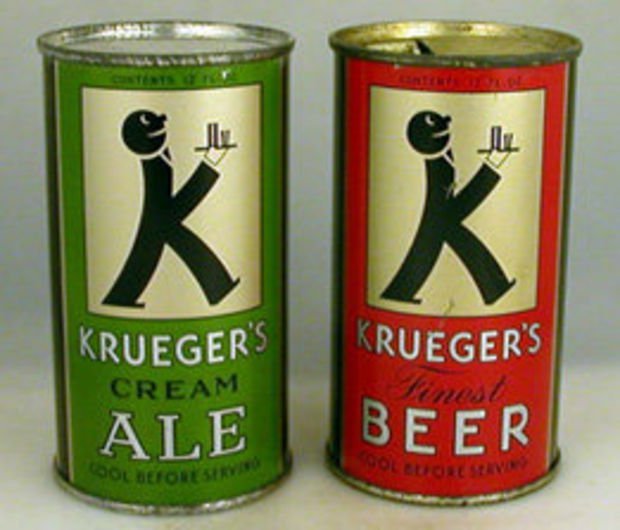
…it would happen about a year later…on Jan. 24, 1935, the Gottfried Krueger Brewing Company, in partnership with the American Can Company, delivered 2,000 cans of Krueger’s Finest Beer and Krueger’s Cream Ale to drinkers in Richmond, Virginia…

(seletyn.com)

…and despite White’s doubts, apparently ninety-one percent of the first drinkers of the product approved of the canned beer, although when Krueger’s launched their ad blitz they had to include instructions (and a new tool) to open the darn things…

(seletyn.com)

 * * *

Dreamscapes

Critic Lewis Mumford offered his thoughts on a recent exhibit by a young surrealist named Salvador Dali

MIDDLEBROW SURREALIST…The Triangular Hour by Salvador Dali, 1933. (wikiart.org)

…and we move along to moving pictures, where John Mosher was showing some appreciation for Joan Crawford (1906–1977) in the pre-Code film Dancing Lady

SHE HAD IT ALL…Audiences and critics alike were wowed by Joan Crawford’s performance in Dancing Lady, which featured a star-studded and eclectic cast. Clockwise from top left, Clark Gable plays a Broadway director who becomes Crawford’s love interest; Crawford displays her dancing talent in a Broadway rehearsal; Dancing Lady featured an early film appearance by The Three Stooges, pictured here with Gable and the Stooges’ leader at the time, Ted Healy; Crawford with Stooge Larry Fine—in the original film, Fine completes his jigsaw puzzle only to discover (to his disgust) that it’s a picture of Adolf Hitler. The Hitler scene was removed by the Production Code; its enforcers claimed it insulted a foreign head of state. (IMDB)

In addition to Crawford, the star-studded cast included Clark Gable, Fred Astaire (in his film debut), Franchot Tone (who was married to Crawford from 1935-39 and made seven movies with her), The Three Stooges, Nelson Eddy, and Robert Benchley, who played a reporter in the film.

Dancing Lady was the film debut of Astaire, making Crawford the first on-screen dance partner of the famed hoofer…

(IMDB)

 * * *

More From Our Advertisers

We begin with this full-page advertisement from Heinz, which went to great lengths and expense to make their ad appear to part of The New Yorker’s editorial content, even featuring a Perry Barlow cartoon of a boy making a mess with their product…

…another New Yorker contributor who occasionally went over to the advertising side was Alexander Woollcott, here shilling for Chrysler… 

…Kayser, purveyor of women’s hosiery and underthings, was going for some humorous holiday cheer, but the effect is a bit unsettling…

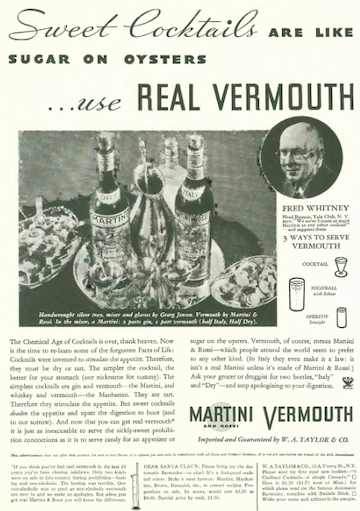
…liquor-related ads began to proliferate with the end of the Prohibition…this one from Martini & Rossi…

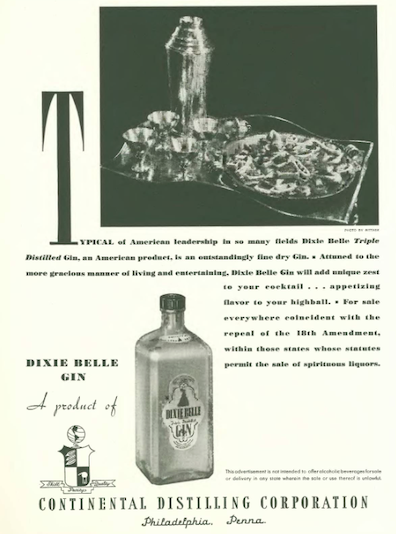
…Continental Distilling was hoping to grab its share of gin sales with its Dixie Belle American gin…

…from the same folks who brought us Fleishmann’s yeast (and kept The New Yorker afloat in its early lean years) came this American dry gin…

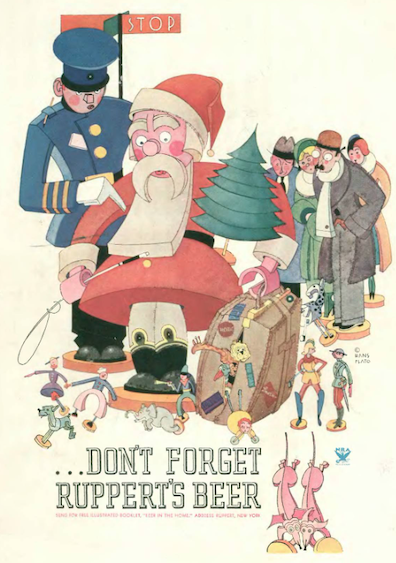
…Ruppert’s Beer was back with another full-page color ad by Hans Flato

…on to our cartoons, and Santa again, this time besieged by an aggressive tot as rendered by Helen Hokinson

Carl Rose found an unlikely customer at a newsstand…

…here is the last of four cartoons Walter Schmidt published in the New Yorker between 1931 and 1933…

Peter Arno left his glamorous world of nightclubs and high society parties to look in on life at a boarding house…

…and we close with the delightful Barbara Shermund

Next Time: Going With the Flow…

The Flying Season

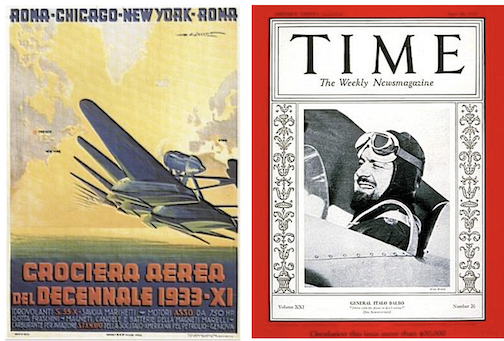
New Yorkers witnessed flying milestones and mishaps in the summer of 1933—after Wiley Post landed at Bennett Field, he became the first person to fly solo around the world, and famed Italian aviator Italo Balbo would bring a squadron of 24 Savoia-Marchetti S.55 flying boats across the Atlantic and triumphantly land them on the Hudson River. So before we get to the Aug. 5 issue…

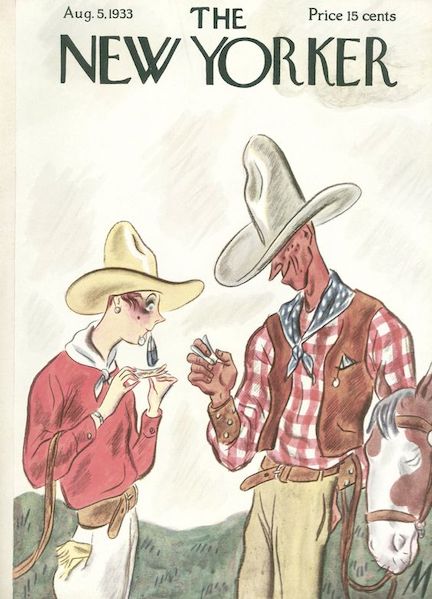
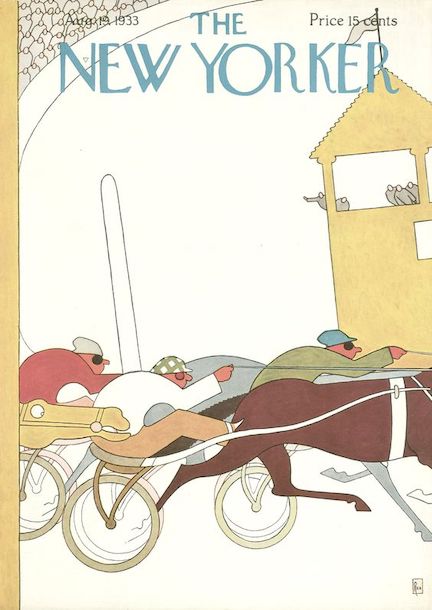
Aug. 5, 1933 cover by Julian de Miskey.

…let’s look in on Morris Markey, who described all of the skyward thrills in his “A Reporter at Large” column in the August 12 issue. Markey also offered a “bold prophecy” that the ticker-tape parades and “hysterical cheers” could not go on forever.

ROUND AND ROUND HE GOES…Clockwise, from top left, Wiley Post under the wing of the famed Lockheed Vega monoplane Winnie Mae in 1933; Post next to the Winnie Mae in Bartlesville, Oklahoma in 1934, his achievements recorded on the fuselage; miners from Flat, Alaska, bring the Winnie Mae upright for repairs—the plane nosed over after hitting a patch of mining tailings; Post climbs out of the Winnie Mae at Floyd Bennett Field, Long Island, after completing the first solo flight around the world. Post set a new record of 15,596 miles (25,099 kilometers) in 7 days, 18 hours, 49 minutes. (NASM/Oklahoma Historical Society/U of Alaska-Fairbanks/Associated Press)

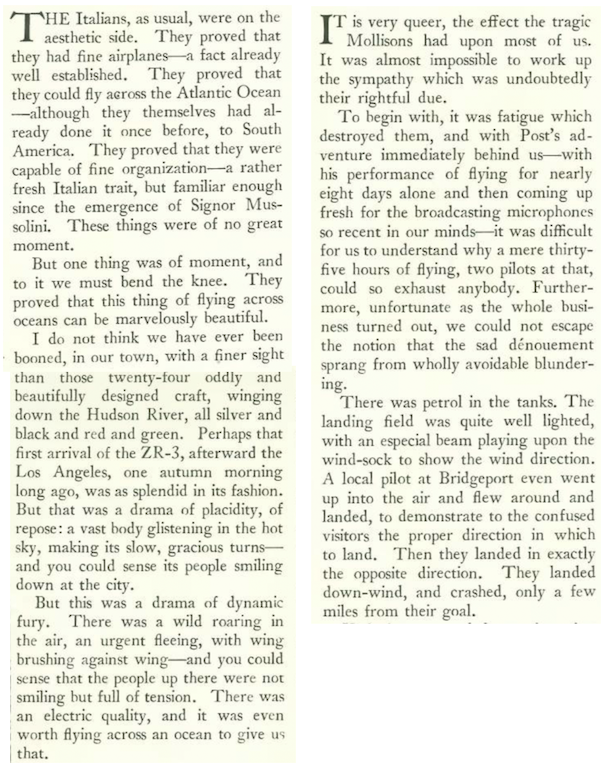
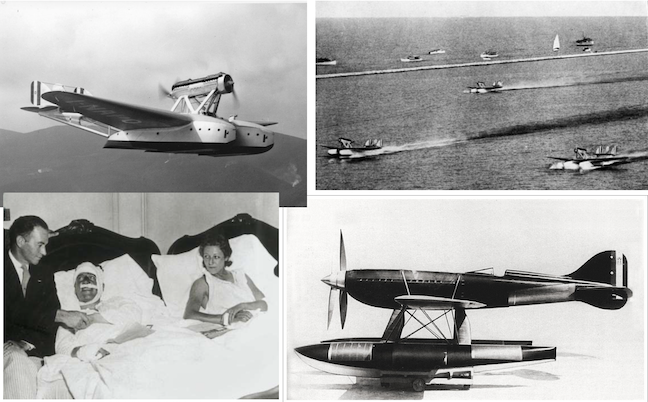
Markey wrote admiringly of the Italians and their oddly beautiful flying boats as they descended, 24 in all, on the Hudson River. Things did not go so well for Scottish aviator James Mollison and his wife, Amy Johnson, who had set many flying records in the 1930s.

DESCENDED LIKE FLIES…Twenty-four Savoia-Marchetti flying boats left Italy in 1933 to fly in formation to the 1933 Chicago World’s Fair and back, with stops along the way including New York. The squadron was led by Italo Balbo, who has featured on the cover of Time, 26 June 1933. (Wikipedia/Time Inc.))

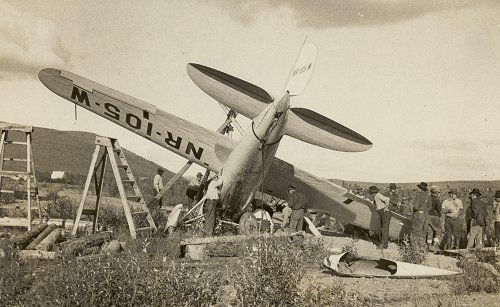
GOING IN STYLE, Clockwise, from top left, twenty-four Italian Savoia-Marchetti S.55X flying boats left the west coast of Italy to fly in formation to the Chicago World’s Fair, with a stop on the Hudson River (top right). The Italians were famed for sleek designs, including the Macchi-Castoldi 72, pictured here circa 1931. It was then the fastest plane in the world; James Mollison and his wife, Amy Johnson recover from their injuries after a nonstop flight from Wales to the U.S. Unable to locate the Bridgeport (Conn.) Municipal Airport—which he circled five times— he ultimately crash- landed into a field. Both were thrown from the aircraft but survived—they were later congratulated by New York society with a parade on Wall Street. (warbirdsnews.com/Wikimedia)

Markey’s “bold prophecy” would sadly come to pass; after all of the parades and hoopla, these wonderful airplanes would soon take on more sinister roles as machines of death. Italo Balbo, seen as a possible successor to Italian dictator Benito Mussolini, would die in 1940, shot down by Italian anti-aircraft batteries that mistook his plane for a British fighter. Amy Johnson would die months later in a crash near the mouth of the Thames (possibly by friendly fire). Two years after his record-breaking flight, Wiley Post and American humorist Will Rogers would perish in a 1935 crash near Point Barrow, Alaska.

 * * *

Depression Diversions

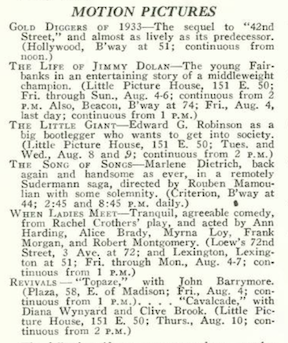
New Yorkers could escape Depression woes and the summer heat with a visit to the cinema. These listings in the Aug. 5 issue were headed by the Busby Berkeley musical extravaganza Gold Diggers of 1933… 

DEPRESSION’S FEVER DREAM…Choreographer Busby Berkeley chased those Depression blues away with his lavish musicals, including Gold Diggers of 1933, featuring Ginger Rogers among a bevy of stars. (IMDB)

 * * *

From Our Advertisers

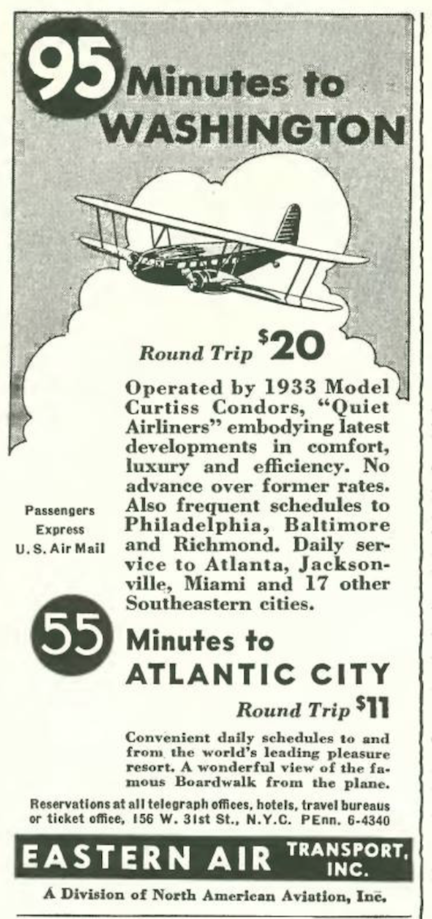
Fledgling airlines including  Eastern Air Transport and American Airways (forerunners of Eastern Air Lines and American Airlines) were giving passenger trains a bit of competition with relatively quick flights to destinations including Washington D.C. and Atlantic City—the D.C. round trip cost $20, roughly equivalent to $455 today…

…introduced in 1933, the Curtiss YC-30, called the Condor in civilian use, could seat 15. It could also be fitted out as 12-passenger luxury night sleeper…

YOU COULD REST EASY on the Curtiss Condor in 1933. (U.S. Air Force)

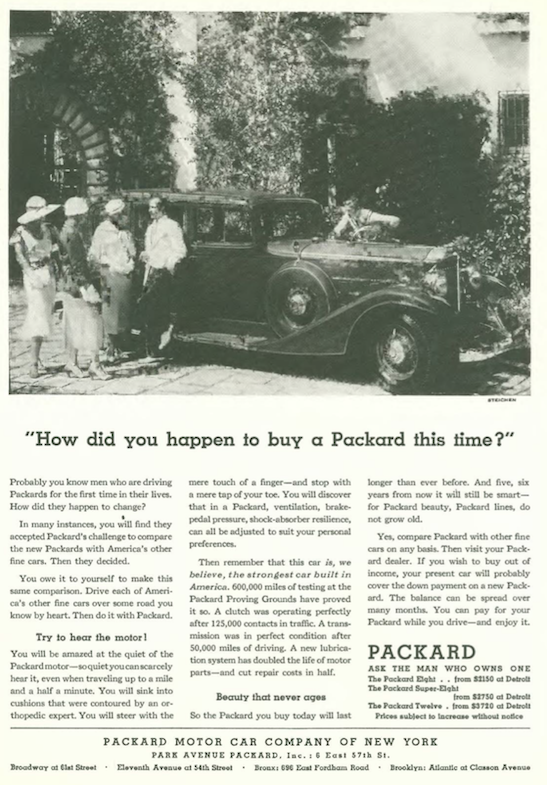
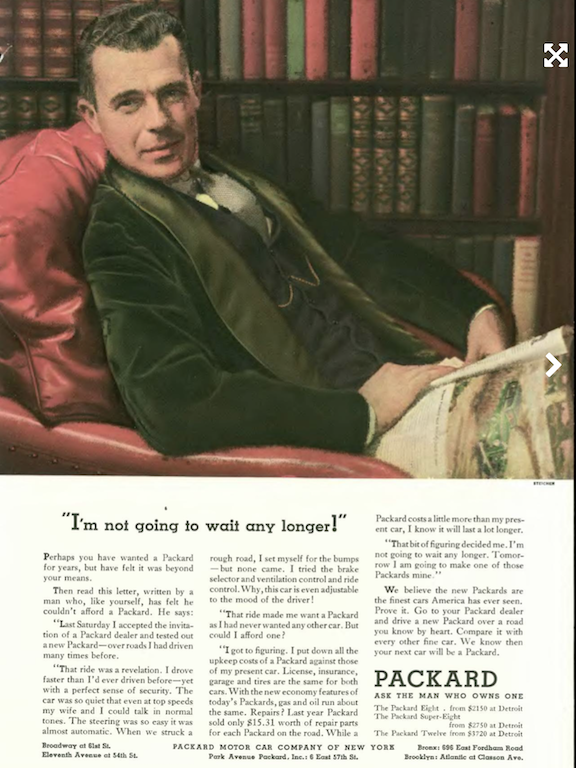
…Packard and Cadillac both produced premium automobiles, but where Packard emphasized durability and longevity…

…the folks at Cadillac went for pure sob appeal…

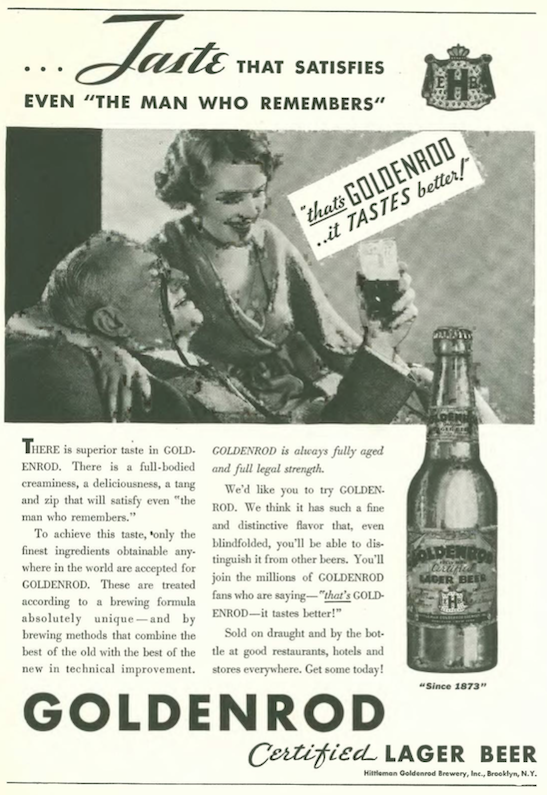
…I wonder how many people still wore pince-nez in 1933, especially while drinking beer…

…the makers of Hoffman ginger ale weren’t waiting for the official end of Prohibition to tout their popular mixer…

…with the launch of FDR’s New Deal, advertisers were quick to jump on the bandwagon…

…as did one of our cartoonists, Otto Soglow

…and now on to the Aug 12 issue…

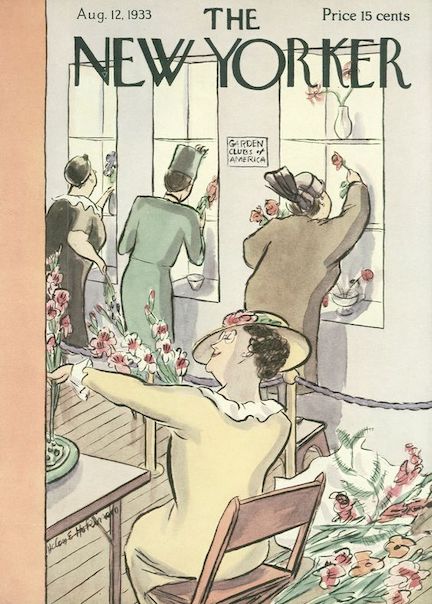
Aug. 12, 1933 cover by Helen Hokinson.

…which featured another installment of James Thurber’s My Life and Hard Times—”The Night the Ghost Got In”…

James Thurber’s illustration for “The Night the Ghost Got In” that appeared in his book My Life and Hard Times. The scene depicts his brother Herman, and his fear of ghosts. The caption read: “He always half suspected that something would get him.”

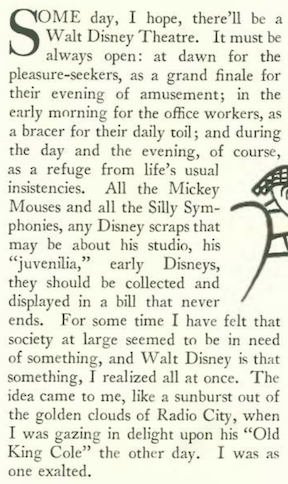
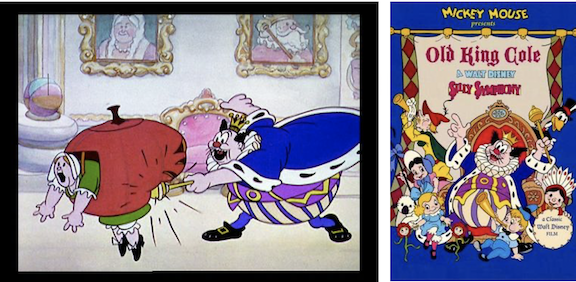
Meanwhile, Thurber’s colleague, film critic John Mosher, was finding joy through Walt Disney’s Silly Symphonies

DELIGHTFUL DIVERSION…Critic John Mosher was “one exalted” over Walt Disney’s latest Silly Symphony, titled Old King Cole.

 * * *

More From Our Advertisers

This giant two-page spread from the makers of Dodge sought to prove you could have both durability and affordability in their six-cylinder model (the cheapest Packard listed at $2,150—you could almost buy four Dodges for that price)…

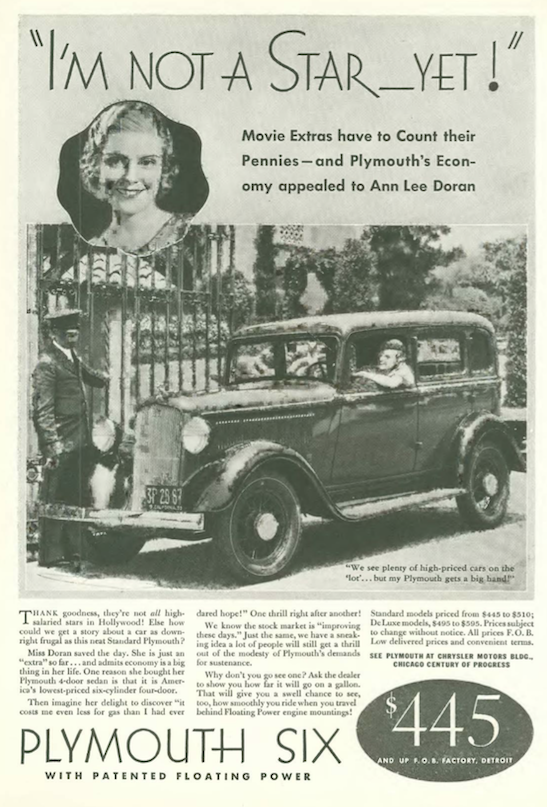
…another Chrysler corporation product, the family-friendly Plymouth, could be had for even less—$445—it was apparently just the kind of car a penny-pinching ingenue needed for getting to her casting calls…

Ann Lee Doran (1911–2000) went on to a long career as a character actress, perhaps best known for portraying James Dean’s mother in Rebel Without a Cause…

Anne Lee Doran (at far right) in 1941’s Penny Serenade. Also pictured, from left, are Edmund Elton, Edgar Buchanan, Cary Grant and Irene Dunne. (IMDB)

…when you finished brushing your teeth, you could put this other Pepsodent product on your face…

…on to our cartoons, we begin with this two-page spread by Gardner Rea

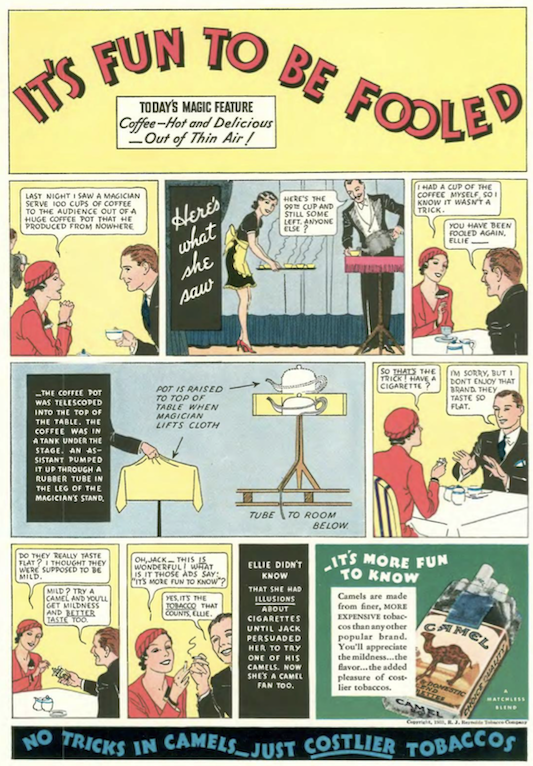
Gluyas Williams referenced the Camel cigarette ads from 1933 that revealed the secrets of popular magic tricks…

…an example from the June 3, 1933 issue of The New Yorker

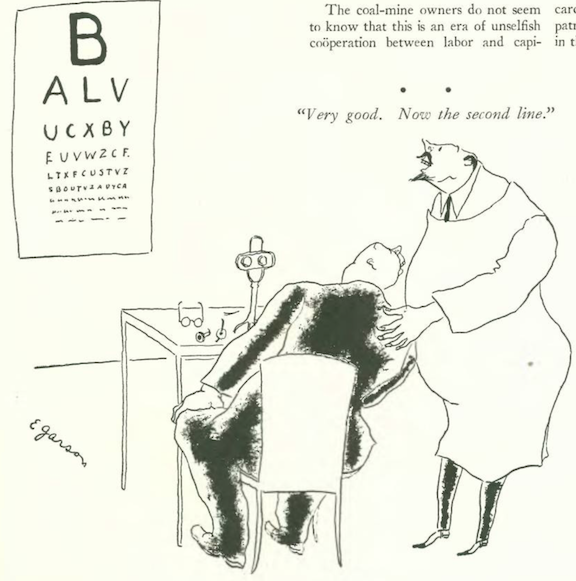
Eli Garson paid a visit to the optometrist…

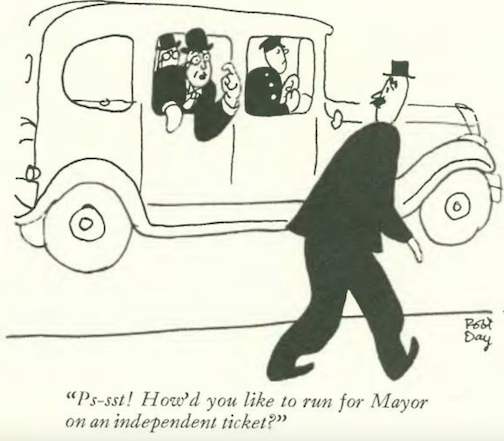
…in the wake of the scandal-ridden mess left behind by deposed Mayor Jimmy Walker, the upcoming November election was bound up by three candidates, none of whom seemed poised to get a majority vote…Robert Day offered up this scenario…

Carl Rose discovered that even in the boonies, everyone’s a critic…

…and we close with Peter Arno, and another classic…

Next Time: Tugboat Annie…

Diary of a Lady

It was no surprise Dorothy Parker did not think much of society types, especially those afflicted with extreme solipsism.

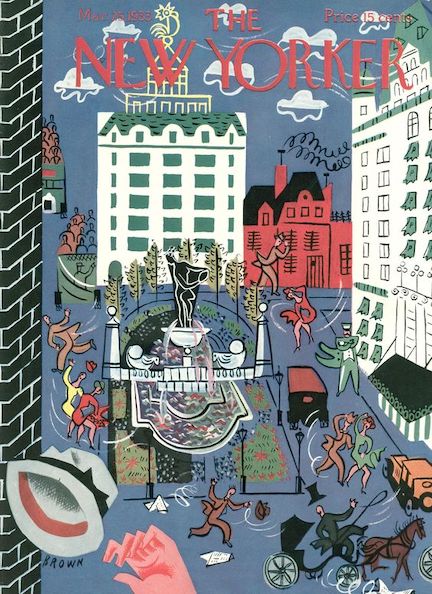
March 25, 1933 cover by Harry Brown.

Parker’s “The Diary of a Lady,” briefly excerpted here, featured entries from a diary of a fictional socialite who constantly bemoaned the minor inconveniences of her shallow existence, oblivious to the world around her.

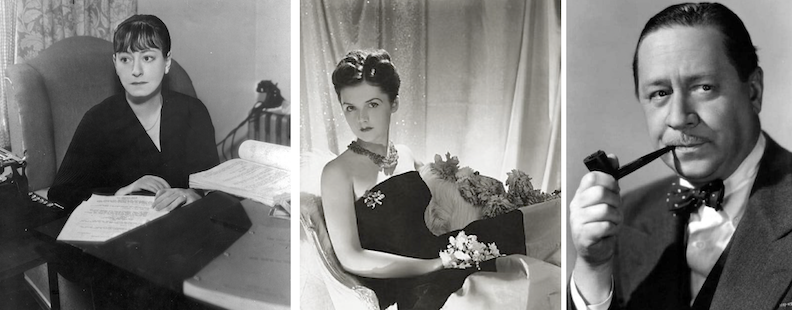
YOU POOR THING…Dorothy Parker (left) took a dim view of the lives of “poor little rich girls” like socialite Brenda Frazier (who had a tempestuous relationship with New Yorker cartoonist Peter Arno); Robert Benchley, on the other hand, took a more jolly view of human absurdity. (britannica.com/Wikipedia/theattic.space)

In contrast to Parker, Robert Benchley’s satire was usually more on the silly side, with a lot less bite. Here is an excerpt from “Home for the Holidays” (which immediately followed Parker’s piece in the magazine), in which Benchley describes the festive mood of one family during FDR’s “bank holiday”…

 *  *  *

On the Lighter Side

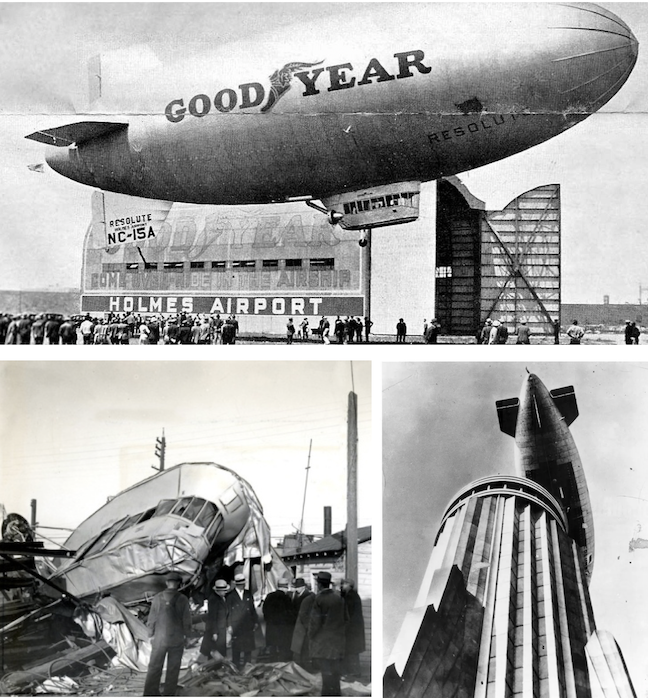
E.B. White was the unofficial aviation correspondent for The New Yorker, ever eager to go aloft in the latest contraption. In this excerpted “Talk of the Town” entry White described his adventures aboard the Goodyear blimp Resolute:

WHAT A GAS…Top photo, the Resolute at its home base, Holmes Airport (in Jackson Heights, L.I.), where E.B. White boarded his flight. As White noted, Resolute was a sister ship to kathrynsreport.com/New York Times)

And we turn again to White, this time an excerpt from his “Notes and Comment” celebrating Franklin D. Roosevelt’s planned amendment to the Volstead Act that would allow people to have a legal beer while they waited for the 21st Amendment to be ratified. White had a couple of ideas regarding locations for beer gardens. An excerpt:

BEER THIRTY…E.B. White believed the front of the internationally famous Brevoort Hotel (next to the Mark Twain House at the southeast corner of Fifth Avenue and 9th Street) would be an ideal spot to quaff some suds. Alas, the hotel (and the Twain house) fell to the wrecking ball in 1952, replaced by the Brevoort apartments (right). (MCNY/streetwise.com)

Although the Brevoort idea didn’t pan out, White did get his wish, more or less, for a Bryant Park location, the Bryant Park Grill…

(bryantpark.org)

 *  *  *

Mayor McCarthy

The profile featured Stitch McCarthy, considered one the most flamboyant “street mayors” of the Lower East Side. Writing in Lapham’s Quarterly (Aug. 1, 2018), Laurie Gwen Shapiro describes McCarthy as “a five-foot-tall, cross-eyed Romanian Jew born Samuel Rothberg, always seen with a cigar in his mouth.” What Stitch lacked in height he made up for in toughness, and by his teens was as tough as nails. Shapiro writes: “At night he managed a small-time boxer who once was scheduled to fight a bantamweight named Stitch McCartney in Jersey City. As he later told the story (no doubt over and over), his client fled in fear at the sight of McCartney and the crowd booed. He went in the ring himself, flattened McCartney, and took a version of his opponent’s name for his own.”

The profile was written by Meyer Berger, known as a master of the human interest story. Berger did a short stint at The New Yorker but for most of his career he worked for The New York Times, where he wrote a long-running column, “About New York.” Here is a very brief excerpt of the profile, with a caricature by Al Frueh.

TOUGH AS NAILS was what you became if you wanted to be one of the unofficial mayors of the Lower East Side like Stitch McCarthy, seen here in 1931. According to Laurie Gwen Shapiro, street mayors “were likable fixers who cut through red tape and might settle between fifteen and twenty neighborhood disputes a day.” Photo at left (by Berenice Abbott) is a scene from McCathy’s world—Hester Street, between Allen and Orchard Streets. (New York Public Library/Lapham’s Quarterly)

 *  *  *

From Our Advertisers

I would guess Dorothy Parker would have some problems with this ad, featuring society women shilling for nail polish…

…the folks at Packard went with an ad that showed the ideal customer (seated in a library, clad in smoking jacket), contemplating one of their recent ads (the same one that was featured in the Feb. 18, 1933 issue of The New Yorker

…Camel ads took on a new look thanks to the artistry of Ray Prohaska (1901–1981)…in the early 1930’s you see more use of watercolors in ads for fashion, or in this case, cigarettes…

…and Gardner Rea drew up this scene for the makers of Sanka coffee, the decaf of its day…

…which leads into the work of other New Yorker cartoonists and another master of the line drawing, Gluyas Williams

Robert Day offered a bit of understatement…

Carl Rose celebrated the arrival of legal beer…

Otto Soglow showed us how royalty responds to a noisy feline…

Kemp Starrett shopped for somp’n to read…

…and we close with Peter Arno, and an ill-timed joke, at least for one woman…

Next Time: Stormy Bellwether…