The Future Was a Silly Place

One of the most expensive movies of 1930 was a sci-fi musical comedy titled Just Imagine, a silly mash-up of great sets, terrible acting, and a vision of the future fifty years hence that was way off the mark.

Nov. 29, 1930 cover by Victor Bobritsky.

Not that the film ever set out to be an accurate prediction of the future. Nevertheless, it is instructive (or, at the least, amusing) to look back on “yesterday’s tomorrows” to understand the American mind in the first year of the Great Depression.

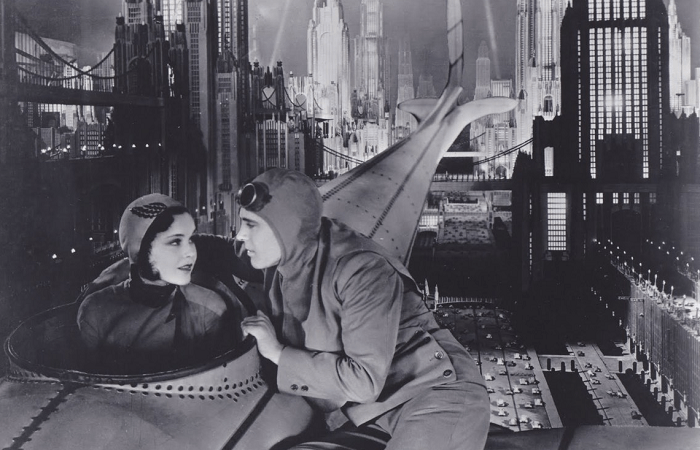
COME FLY WITH ME…Clandestine lovers LN-18 (Maureen O’Sullivan) and J-21 (John Garrick) share a romantic moment high above the streets of 1980 New York City. (scifist.net)

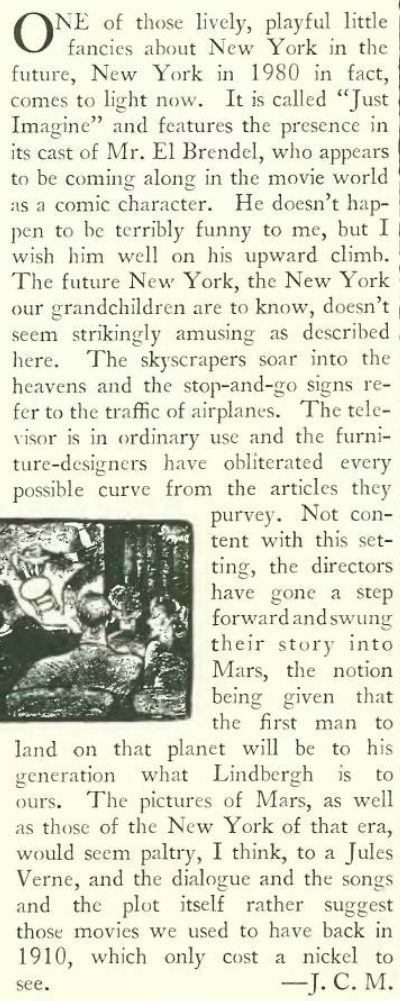
Just Imagine borrowed some of its look from Fritz Lang’s Metropolis (1927), a dystopian vision of the future that reflected the contentious years of Germany’s Weimar Republic. Just Imagine similarly reflected its time and place — the early years of the Depression — Hollywood responding not with gloom and doom but rather with uplifting fare — comedies, musicals, and escapist fantasies (Flash Gordon came along in 1936). The producers of Just Imagine rolled all of it into one film, and The New Yorker’s John Mosher tried to make sense of the mess:
EYE IN THE SKY…In Just Imagine, technology is advanced enough to have a traffic cop floating in the sky, but he still must rely on his arms and mechanical signals to keep the skyways in order. (YouTube clip)

The floating traffic cop is just one example of the film’s attention to set design. The New York skyline, featured in the opening scene, was constructed in a giant hangar at enormous cost…

(IMDB)

In one of the films weirder twists, vaudeville comedian El Brendel is brought back to life with an electric beam…

SMOKED HAM…Vaudeville comedian El Brendel is zapped back to life to provide the world of 1980 with comic relief. Some of the electrical equipment assembled by set designer Kenneth Strickfaden would be seen again in 1931’s Frankenstein. (scifist.net)

…and Brendel (below, center), proceeds to get drunk on booze pills and spew a series of really bad jokes throughout the duration of the film…
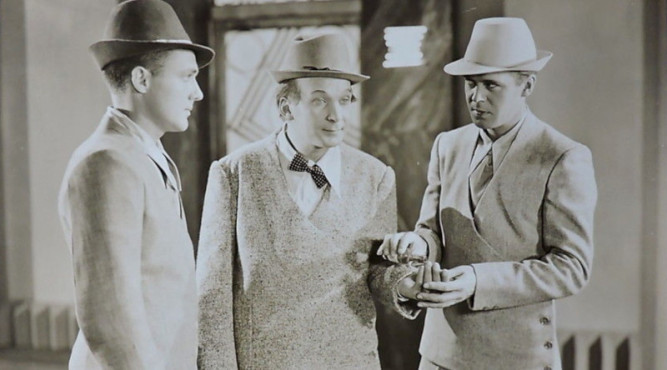
WE SHOULD HAVE LEFT HIM DEAD…Frank Albertson, El Brendel and John Garrick in Just Imagine. (scifist.net)
MARS ATTACKS…The film also took audiences to the surface of Mars via a phallus-shaped spaceship that would later be used in Flash Gordon serials. Clockwise, top left, the spaceship blasts off surrounded by a crowd of men in fedoras; aboard the spaceship; landing site on Mars; J-21 (John Garrick) encounters the Martian Queen (Joyzelle Joyner). (YouTube/scifist.net)

The movie flopped at the box office, but producers were able to recoup some of the costs by farming out clips of the futuristic sets, and some of the props, to other sci-fi films of the 1930s including the Flash Gordon and Buck Rogers serials.

 *  *  *

Toys For Tots

By mid-November The New Yorker’s “On and Off the Avenue” column had lengthened to include ideas for Christmas shoppers. The Nov. 29 issue offered these ideas for children’s toys from Macy’s…
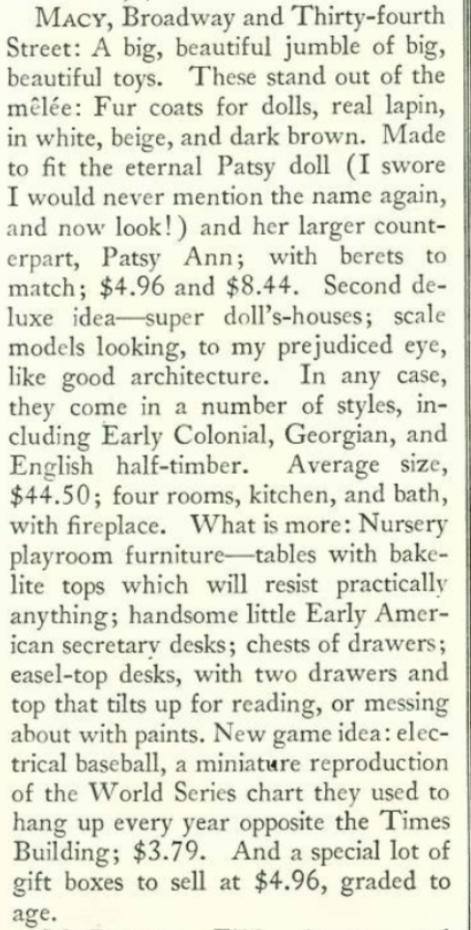
XMAS IS COMING…Patsy Ann dolls in smart berets, and dollhouses in various styles (a 1930 Tudor dollhouse at right) could be had at Macy’s Herald Square flagship store. (Pinterest)

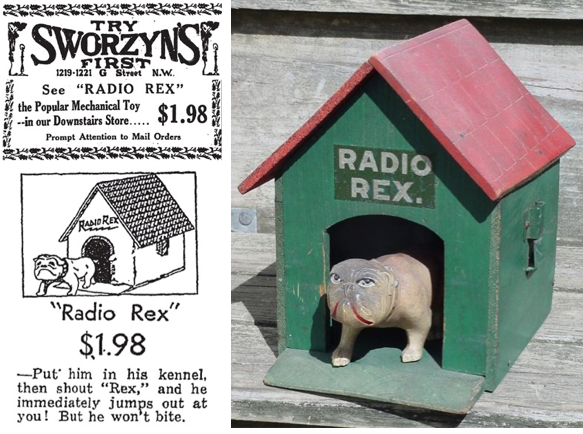
GRRRR…First introduced in 1922, the revival of “Radio Rex” proved popular to the kiddies in 1930. It was the “high tech” toy of its day, the first to respond to voice commands. Rex the dog would spring out of his doghouse at the sound of the word “Rex,” thanks to a sound-sensitive electromagnet. (ctinventor.wordpress.com)

 *  *  *

A Century-old-Problem

Traffic woes have been around almost as long as there have been cars. In an excerpt from “A Reporter at Large,” Morris Markey explained the challenges facing the city’s police department:

IF YOU BUILD IT, THEY WILL COME…Traffic clogs Fifth Avenue near 42nd Street in 1930. (digitalcollections.archives.nysed.gov)

 *  *  *

Speaking of cars, this ad in The New Yorker announced the opening of the annual Automobile Salon at the Commodore Hotel…

…and the magazine was on hand to describe its various wonders. Some excerpts:

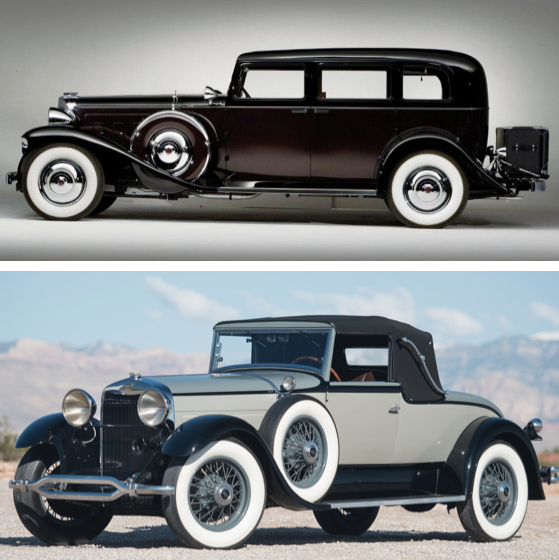
POETRY IN MOTION…Top, the Walter Dorwin Teague-designed Marmon 16-cylinder wowed crowds at the Salon, even if few could afford it. The Great Depression limited the production of the luxury Marmon, and less than 400 were produced. The company abandoned the car business altogether in 1933. Below, the sporty Ford Model L Roadster, designed by Raymond Dietrich. (supercars.net/Sotheby’s)

 *  *  *

Maestro Politician 

The New Yorker profiled pianist, composer and statesman Ignacy Jan Paderewski (1860-1941). Paderewski served as Poland’s prime minister in 1919, negotiated on behalf of his country at the Treaty of Versailles, and had a 60-year career as a virtuoso pianist. A brief excerpt:
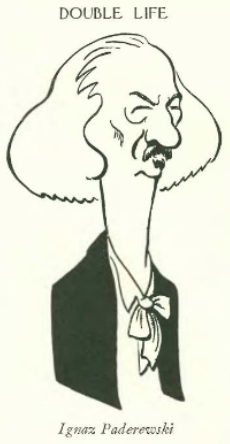
 *  *  *

Not For the Moneychangers

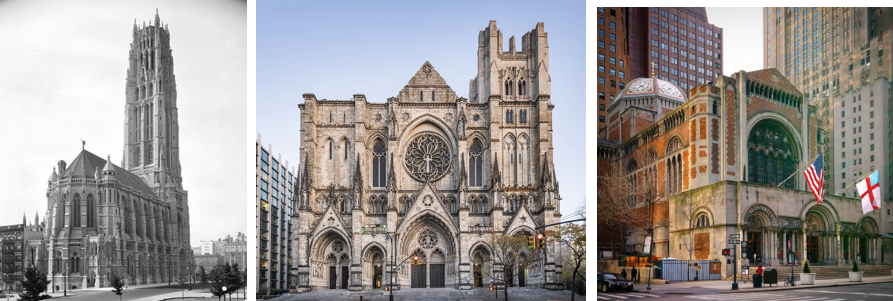
Architecture critic George S. Chappell checked in on the progress of three prominent Manhattan cathedrals in his “Sky Line” column:

LANDMARKS ALL…From left, Riverside Church, the still yet-to-be completed St. John the Divine, and St. Bartholomew’s. (MCNY/masonrymagazine.com/dtjoyce.com)

 *  *  *

The theater review section included this illustration of a new play, Roar China, that opened Oct. 27, 1930 at the Beck Theatre.

The staging of Roar China included this reconstruction of the bow of the H.M.S. Europa on the Beck Theatre stage…

(messynessychic.com)

 *  *  *

From Our Advertisers

The holiday season was in the air, and retailers were taking various approaches to entice Depression-era shoppers to consider their wares. The ads have a more conservative bent, when compared to late 1920s, and in the case of Wanamaker’s and B. Altman’s, an appeal to simpler times…

…Macy’s, on the other hand, looked to sell rather expensive lighters “to arouse the youthful enthusiasm among veteran smokers”…

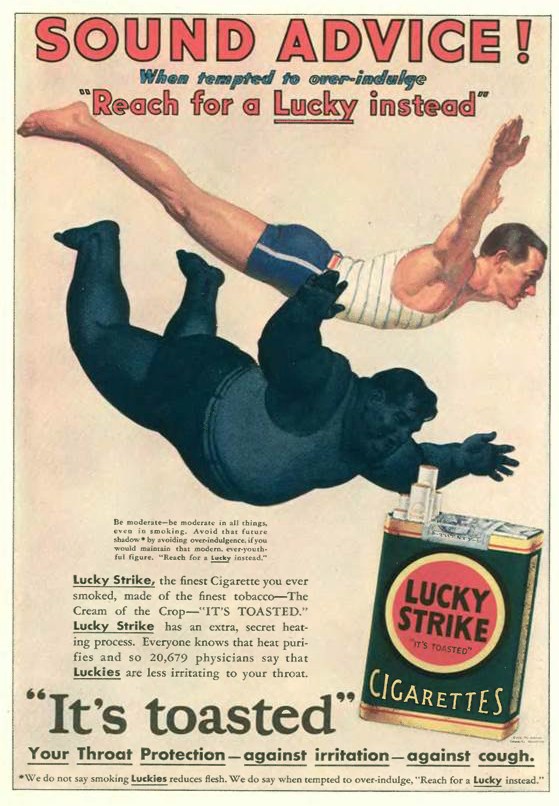
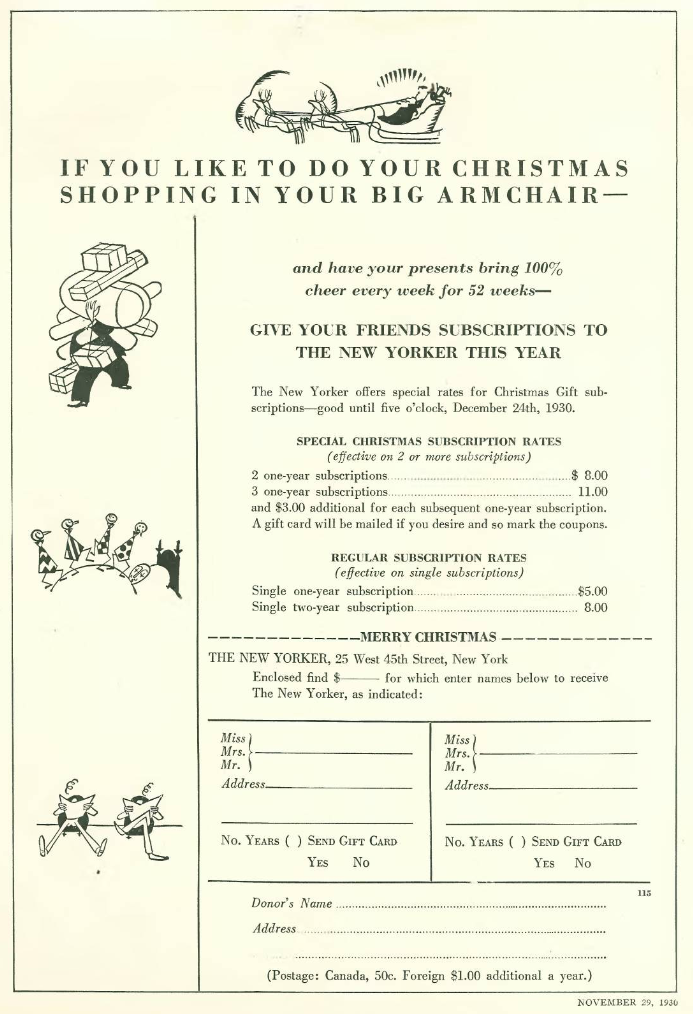
…despite the Depression, New Yorker subscriptions continued to steadily increase — the magazine had nearly 45,000 subscribers in 1930, and by the end of the decade the number would approach 100,000 — below, a house ad designed to entice new subscribers…
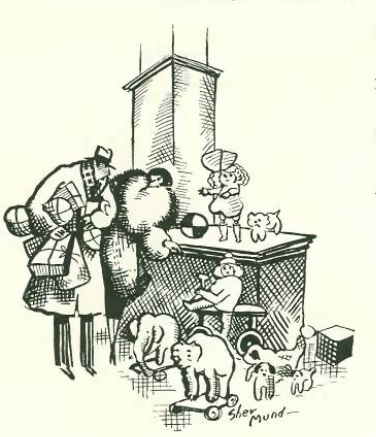
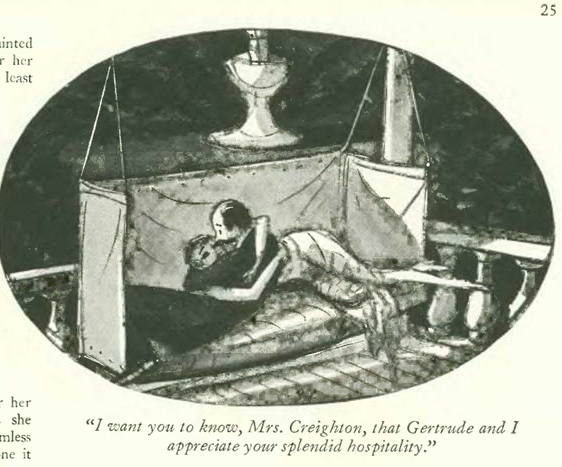
…our cartoons include this holiday spot illustration by Barbara Shermund

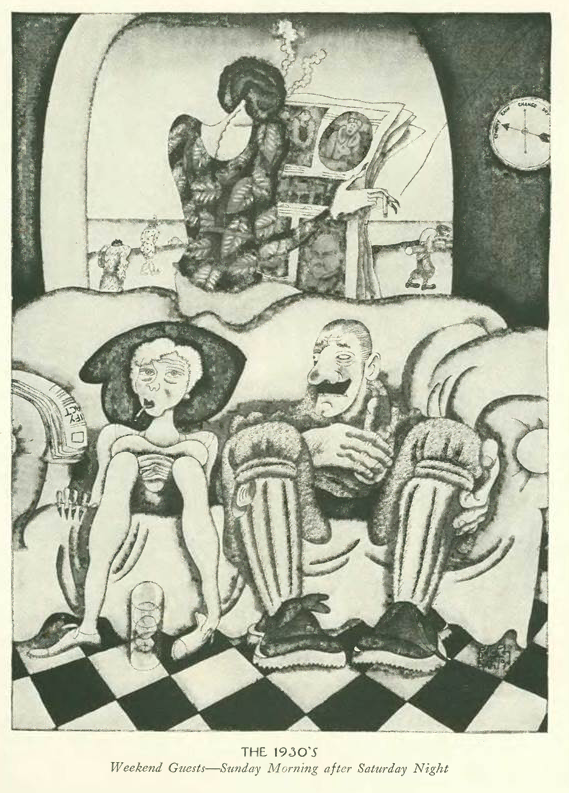
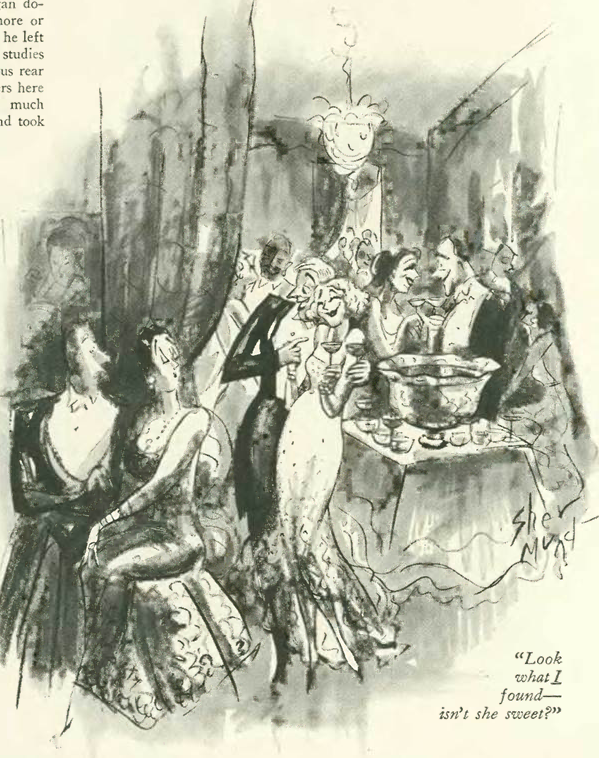
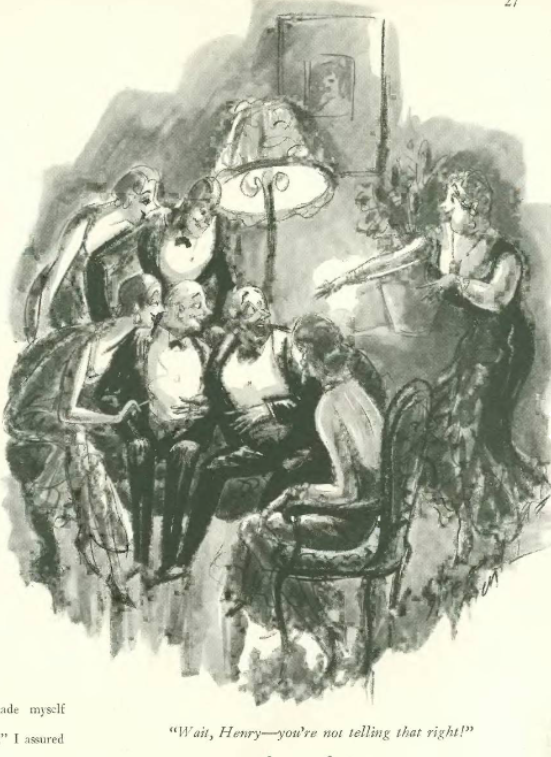
…and another by Shermund of her parlor room crowd…
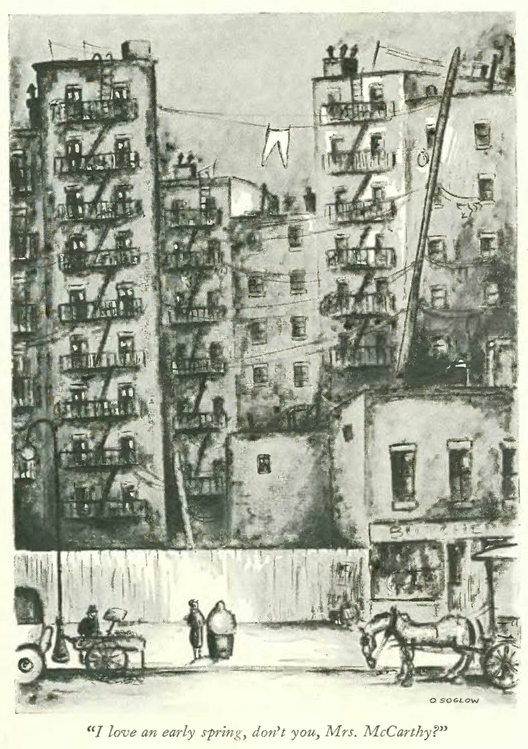
Otto Soglow amused us with a couple of tots…

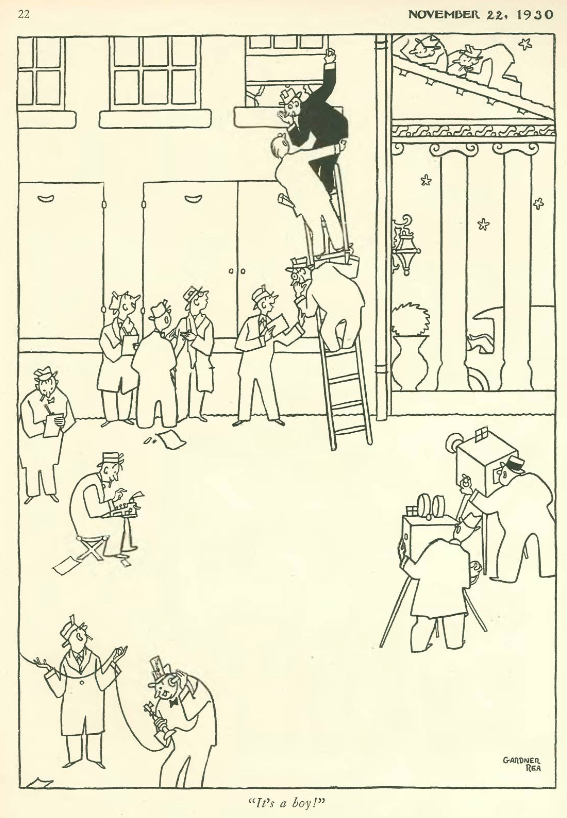
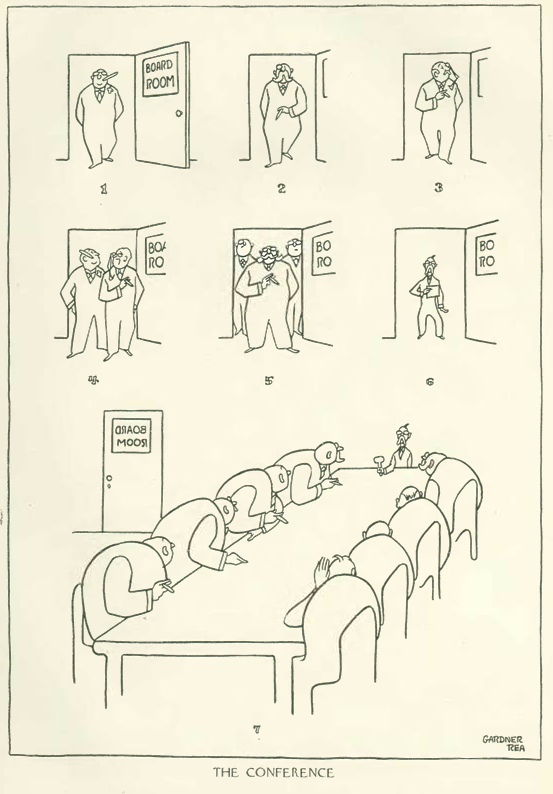
Gardner Rea imagined a confrontation between a Macy’s Thanksgiving Day Parade balloon and Italy’s Fascist dictator Benito Mussolini

…the balloon Rea illustrated was “The Captain” from the popular Katzenjammer Kids comic strip. Along with his “family,” the Captain appeared in the parade in 1929 and 1930 (and possibly 1931). They were the first licensed character balloons in the parade’s history…

(The New York Times)

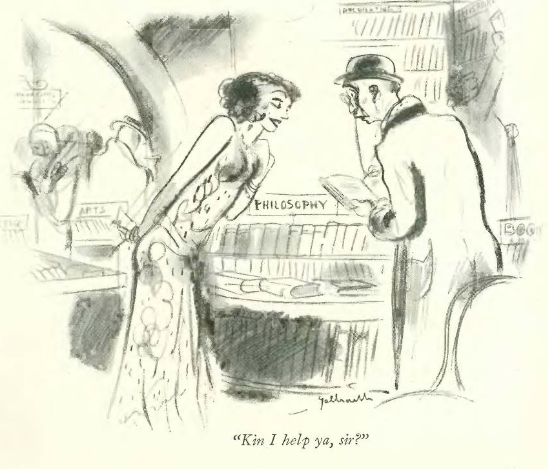
…back to cartoons, book shopping with William Crawford Galbraith

…and some holiday cheer from A.S. Foster

Next Time: Ziegfeld’s Folly…


The High Place

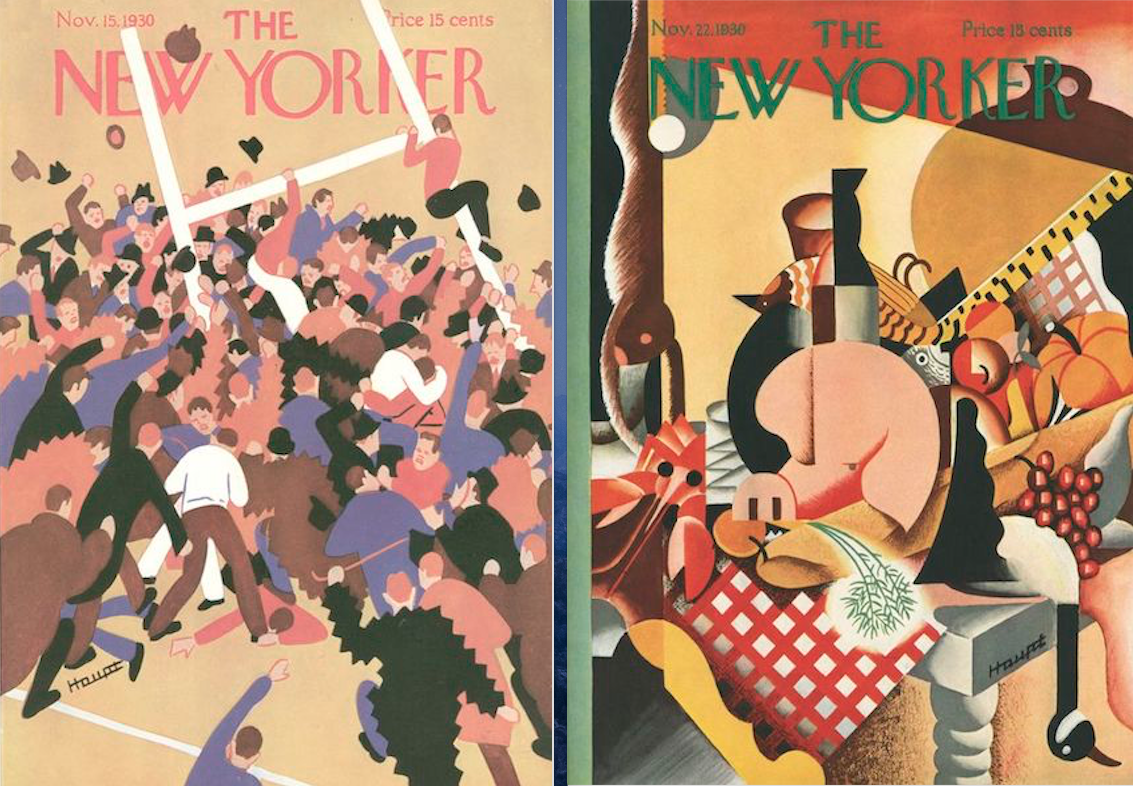
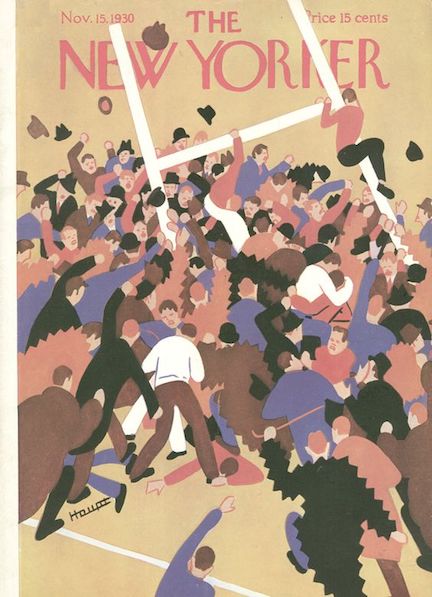
For this installment we look at two issues, Nov. 15 and 22, both featuring covers by Theodore Haupt that celebrated two autumn rituals: football and Thanksgiving.

Let’s begin with the Nov. 22 issue, which climbed to the highest place in Manhattan — no, not the Chrysler Building, but the nearby Empire State Building — with E.B. White admiring the commanding view:

Before the Empire State Building could go up, the old Waldorf-Astoria hotel had to come down. As White observed, the old hotel was built so soundly that it was too costly to deconstruct and salvage. Most of it ended up on the bottom of the ocean.

DOWN IN DAVY JONES’ LOCKER lie the remains of the old Waldorf-Astoria Hotel, which stood for just 36 years before it was razed to make room for the Empire State Building. At right, one of the hotel’s lobbies, and the Grand Ballroom. (nyc-architecture.com/Pinterest)
A LOT OF HOT AIR…Top images: The fabled “mooring mast,” described by E.B. White in his New Yorker brief, as imagined in composite images (old-time Photoshop). In reality, the morning mast never worked; bottom right, a cutaway view of the mast featured in Popular Mechanics; bottom left, New York Times photo from March 22, 1931, announcing the completion of the Empire State Building, just 17 months after the Waldorf-Astoria began coming down. (Keith de Lellis Gallery, rarehistoricalphotos.com/Google Books/The New York Times)
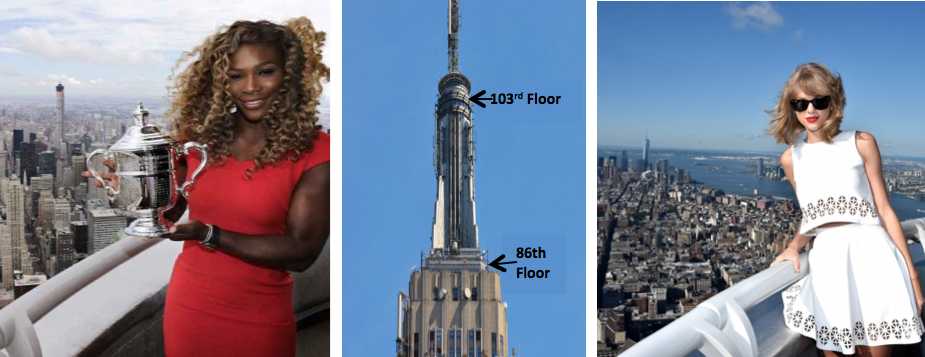
SURVEYING THEIR KINGDOM…Most visitors to the Empire State Building can only go as high as the 86th floor observation deck. However, if you are a VIP like Serena Williams or Taylor Swift, you can get your picture snapped on the 103rd. (Associated Press/Empire State Building/Evan Bindelglass, CBSNewYork)

*  *  *

Sore Winner

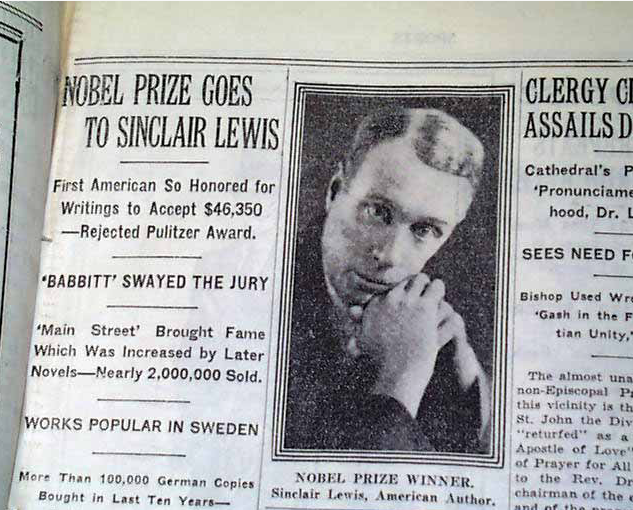
Sinclair Lewis famously declined the Pulitzer Prize for his 1925 novel Arrowsmith, upset that his 1920 novel Main Street had not previously won the prize. But when the Swedish Academy came calling with a Nobel Prize in Literature in 1930, he happily accepted. According to “The Talk of the Town,” this award also seemed a bit tardy, since Lewis’s small town booster archetype, George F. Babbitt, did not fit the dour days of the Great Depression. But it turned out that the 1922 novel Babbitt was ultimately what swayed the Nobel jury:

BOOST FROM A BOOSTER…George F. Babbitt helped make Sinclair Lewis famous, and landed him a Nobel. (NYT, NOVEMBER 6, 1930)

 *  *  *

Not So Sweet

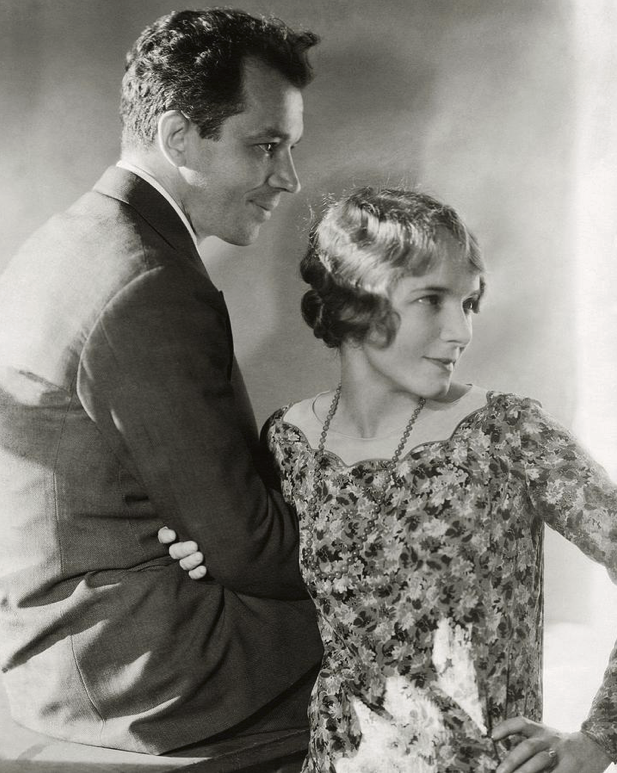
Those of a certain age might remember Helen Hayes as a sweet old lady who appeared on a number of TV shows in the 1970s and 80s, or as the mother in real life of James MacArthur, Disney teen star and later the portrayer of Danny “Book ’em Danno” Williams on the original Hawaii 5-0 TV series. Hayes was married to playwright Charles MacArthur, and “The Talk of the Town” takes it from there…

CREATIVE TYPES…The engaged couple Charles MacArthur and Helen Hayes posed for photographer Edward Steichen for this Jan. 1, 1929 image featured in Vanity Fair magazine. (Condé Nast)

 *  *  *

Ain’t It Grand

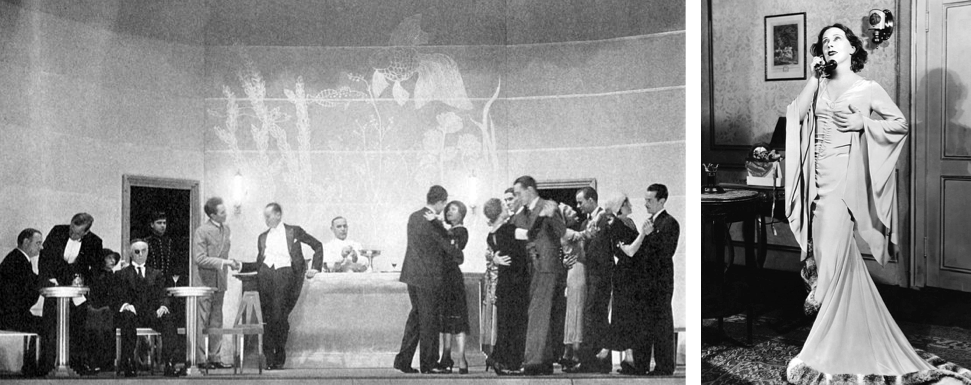
Grand Hotel opened at the National Theatre on Nov. 13, 1930 to strong reviews, including the one below by Robert Benchley that he filed for The New Yorker. The play, adapted from the 1929 novel Menschen im Hotel by Austrian writer Vicki Baum, would prove to be a smash on Broadway and again on the silver screen in a star-studded 1932 film featuring Greta Garbo, John Barrymore, and Joan Crawford.

THE STARS ALIGN…Left, promotional photograph of the original Broadway production of Grand Hotel. At right, Eugenie Leontovich portrayed fading Russian ballerina Grusinskaya in the play. The role would go to Greta Garbo in the 1932 film adaptation. (Theatre Magazine, February 1931/Wikipedia)

…and while we are on the subject of Broadway, the theater review section also featured this Al Frueh illustration promoting a noted production of Twelfth Night at the Maxine Elliott…

Program for the production featuring Jane Cowl. (Playbill)

 *  *  *

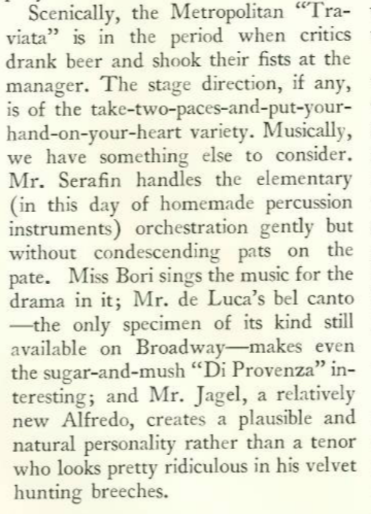
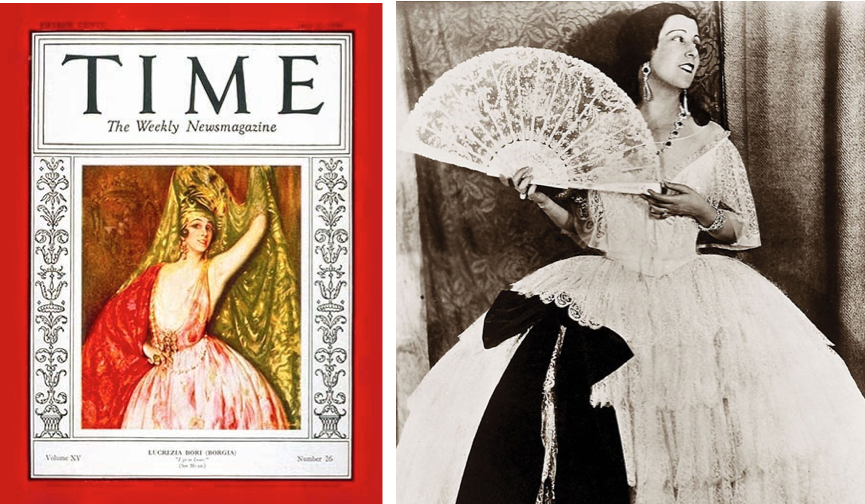
There were also big doings at the Met, where Spanish lyric soprano Lucrezia Bori (1887-1960) wowed audiences with her portrayal of Violetta in La Traviata.

SHE HAD SOME PIPES…right, lyric soprano Lucrezia Bori on the cover of the June 30, 1930 edition of Time magazine. At right, promotional photo of Bori circa 1930. (Time/Wikipedia)

 *  *  *

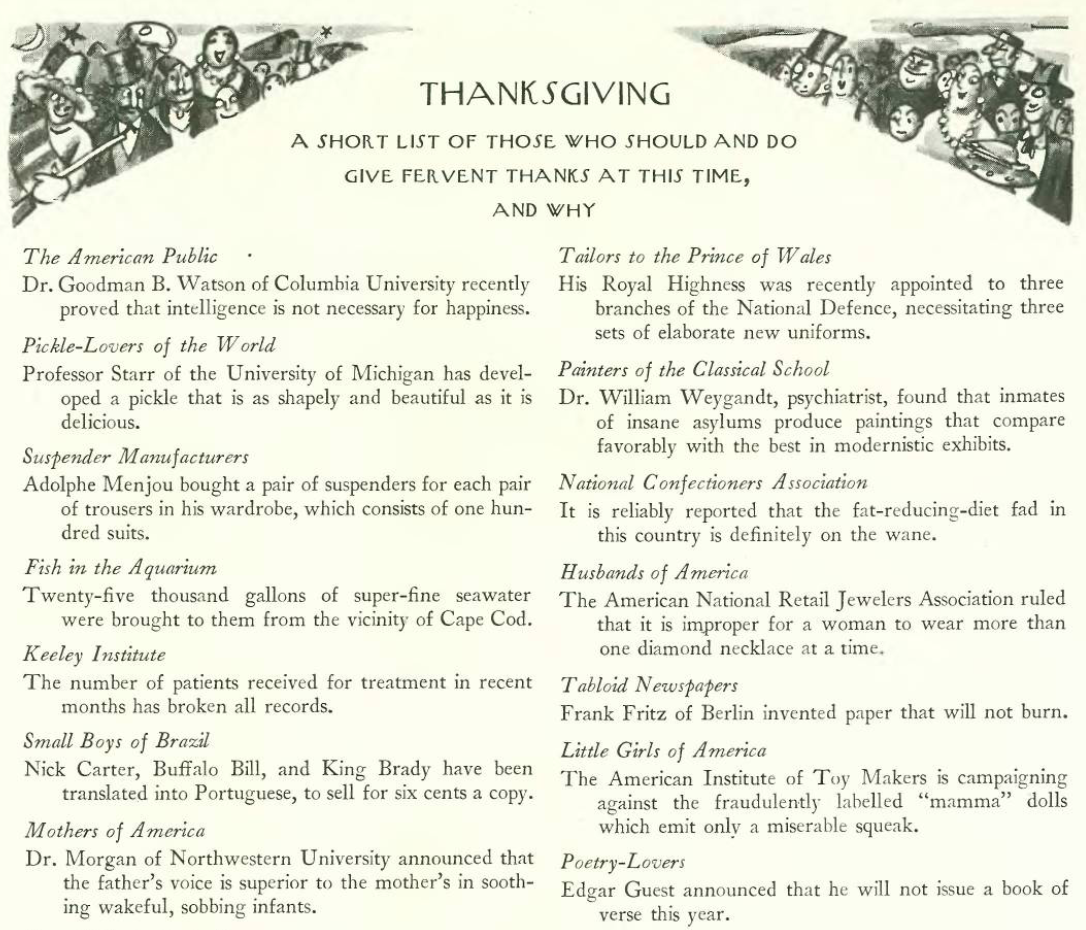
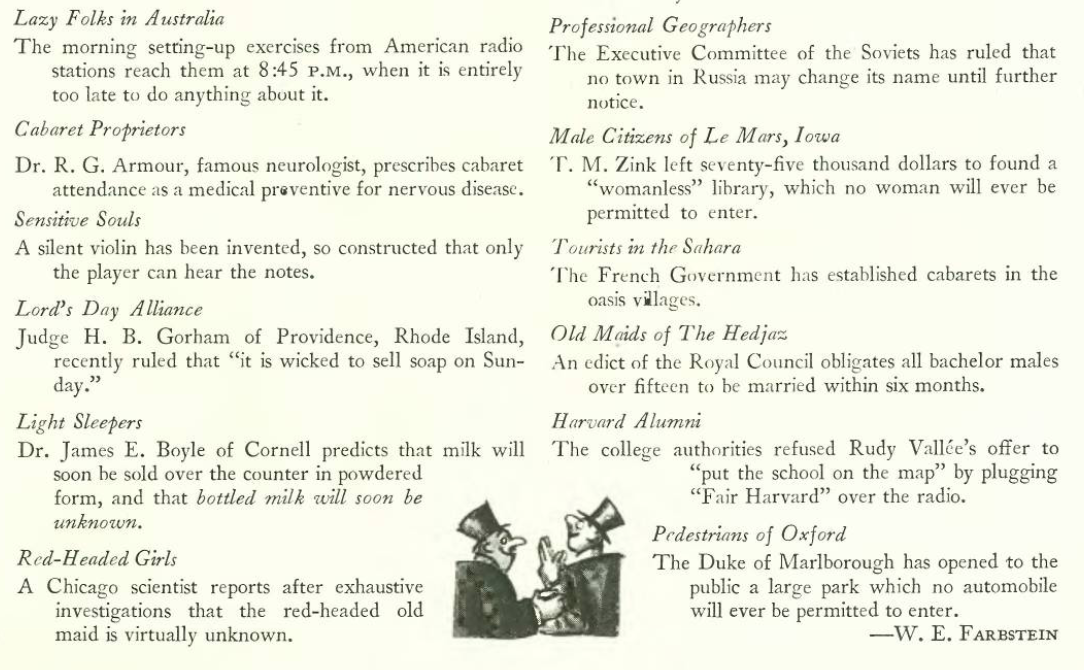
Bounty of Blessings

Humorist W. E. Farbstein gave readers plenty to be thankful for in this tribute to the Thanksgiving holiday…

 *  *  *

From Our Advertisers

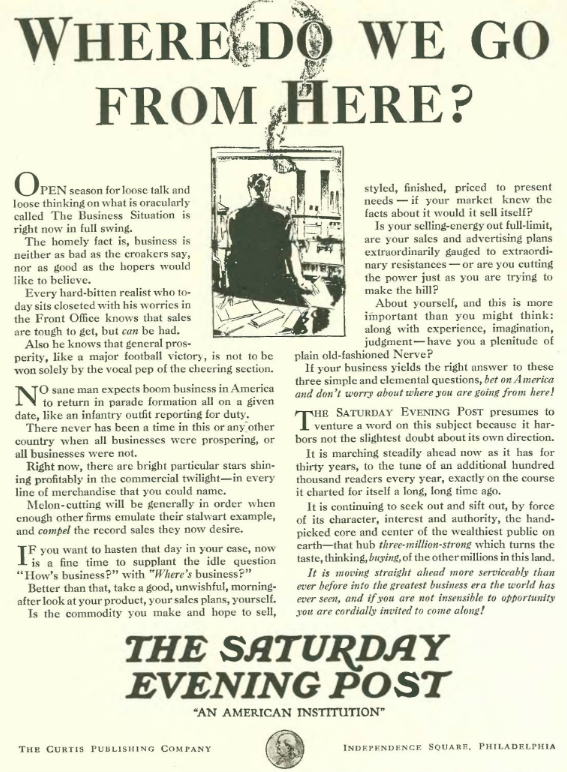
Occasionally advertisements acknowledged the reality of the Great Depression, including this one from The Saturday Evening Post that offered encouraging words to prospective readers…

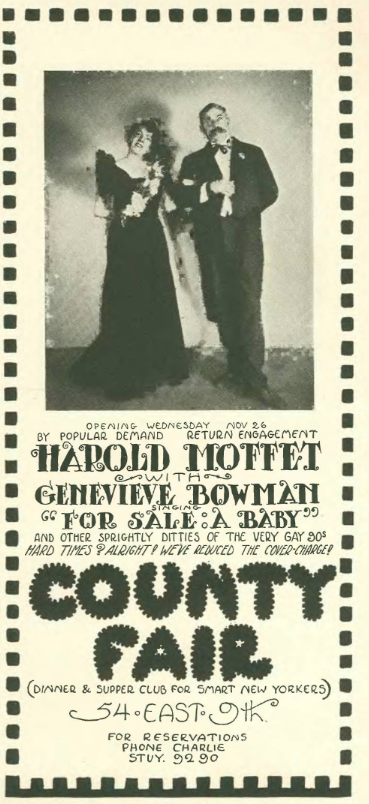
…County Fair, a Greenwich Village country-themed nightclub, offered the diversion of Moffatt and Bowman to take audiences’ minds off of hard times…

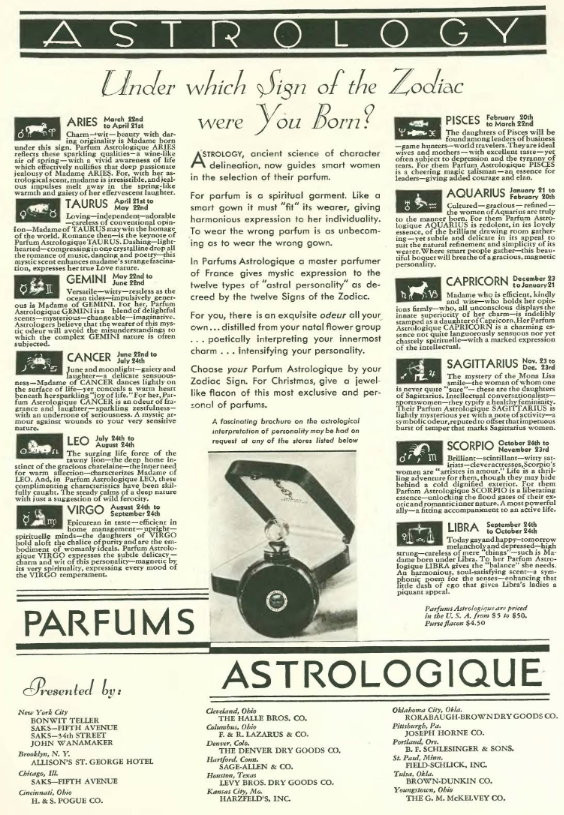
…and for all the supposed sophistication of New Yorker readers, there were still plenty of back page ads offering nostrums laced with superstition…

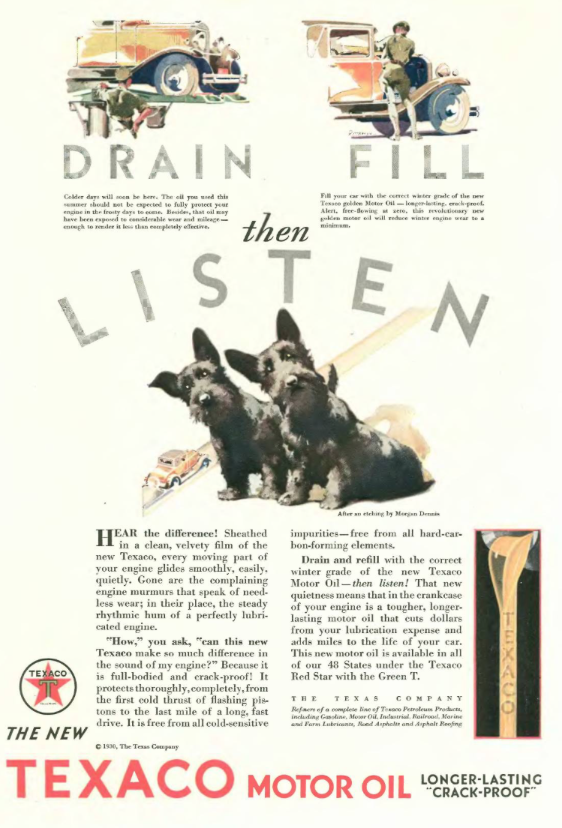
…some of the more colorful, spritely ads from the era were offered up by the producers of Texaco Motor Oil…

…our cartoons are by Gardner Rea

Barbara Shermund

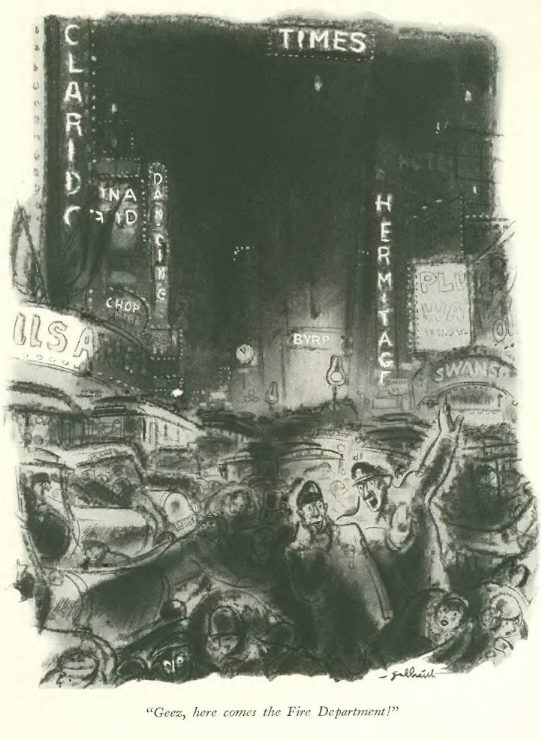
William Crawford Galbraith

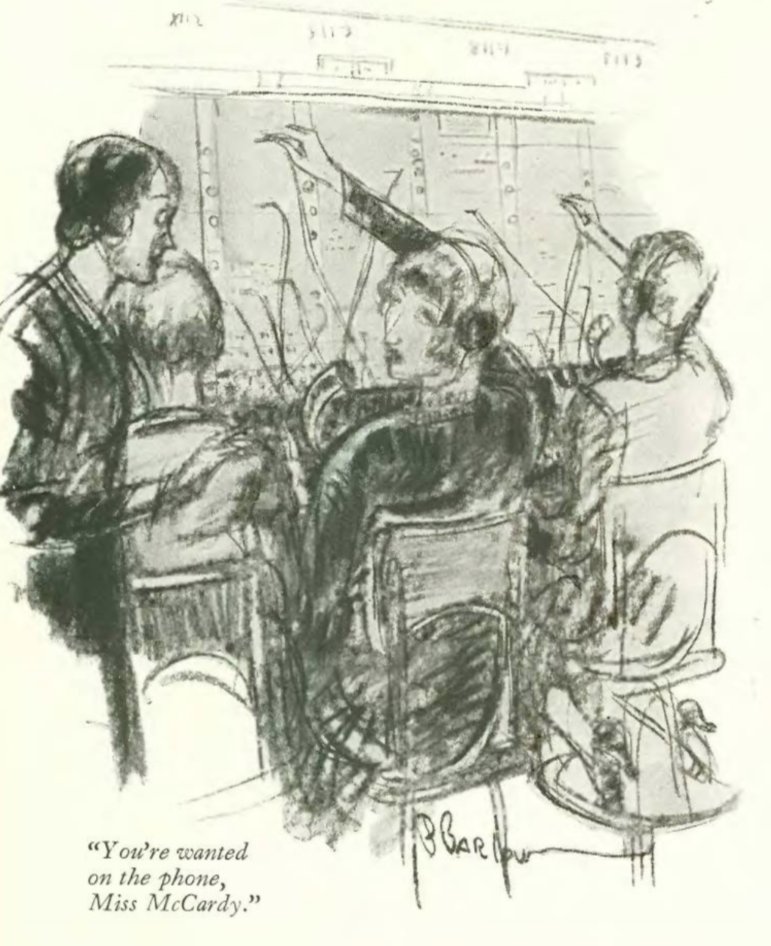
…and Perry Barlow

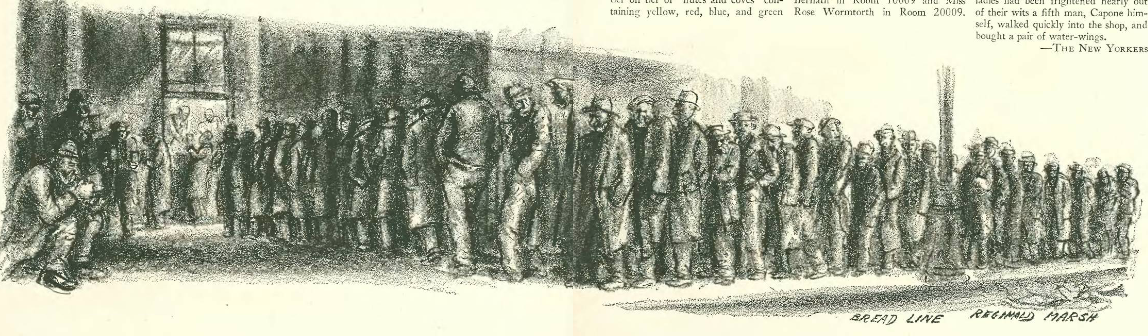
…and for another reminder of reality in the city, this sketch that ran along the bottom of “The Talk of the Town,” by Reginald Marsh

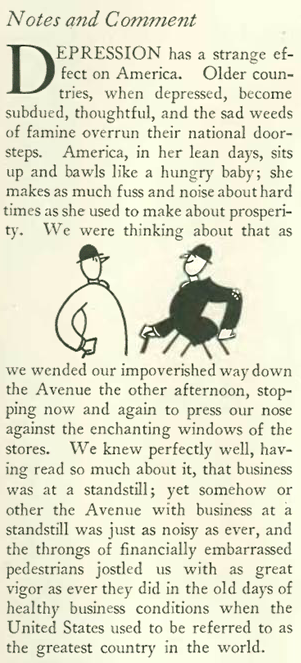
…and now we step back to the Nov. 15 issue, where E.B. White offered a less somber take on the Great Depression…

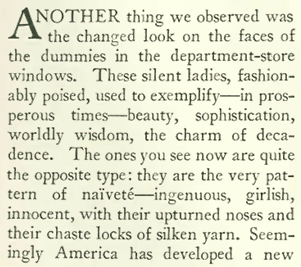
…White also noted a change on the faces of storefront mannequins…

YIN AND YANG…The worldly pose of a Roaring Twenties mannequin, and a more wholesome look for the leaner times in the 1930s. (Pinterest)

 * * *

Playing Telephone

Long, long before cell phones, telephones were heavy stationary devices that required a certain amount of planning before installation, as E.B. White explains:

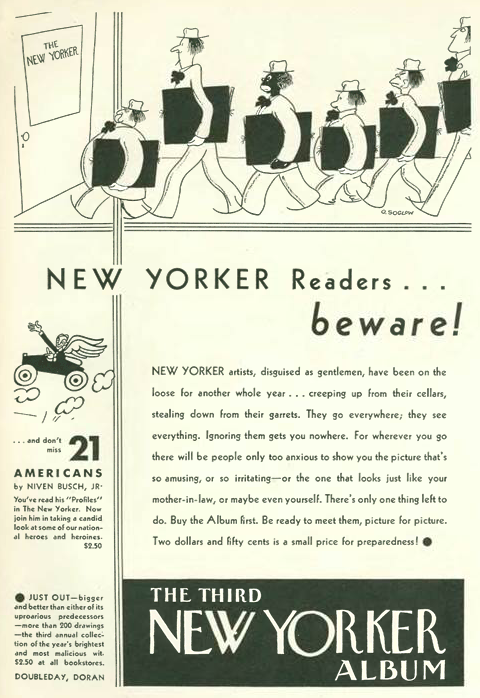
On to our Nov. 15 ads, we have this announcement for The Third New Yorker Album…with illustration by Otto Soglow

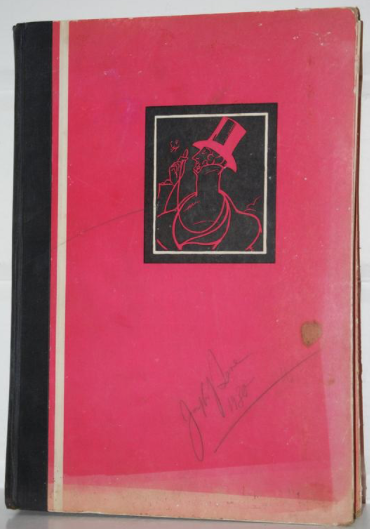
…here is what the album looked like…

…and a couple of inside pages…

(Etsy)

…one of the contributors to the album was Rea Irvin, founding illustrator for The New Yorker, here doing some business with Murad cigarettes…also another Flit insecticide ad by Dr. Seuss

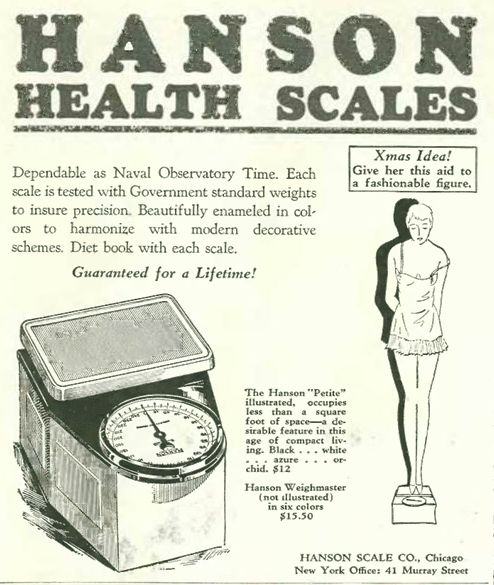
…Christmas ads began appearing in the magazine, including this one for Hanson scales…pity the poor chap (and his wife) who actually thought this might be a suitable present for Christmas, or any occasion for that matter…

…and with Prohibition still in force, advertisers found other uses to promote their products…

…on to our cartoons, Leonard Dove illustrated a couple who didn’t get away with the ruse…

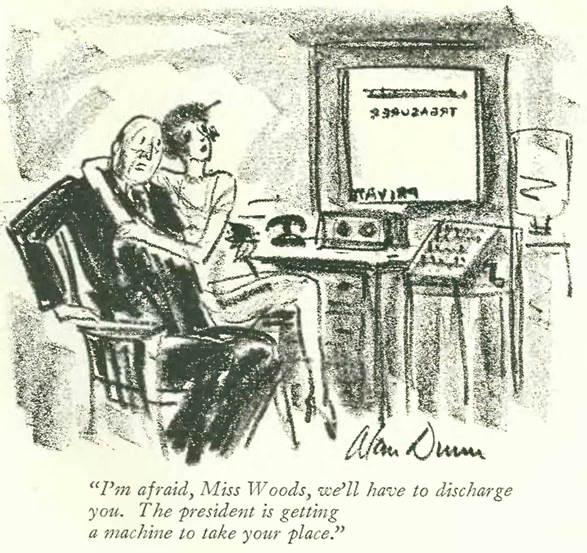
… Alan Dunn depicted what was considered typical office behavior in the 1930s…

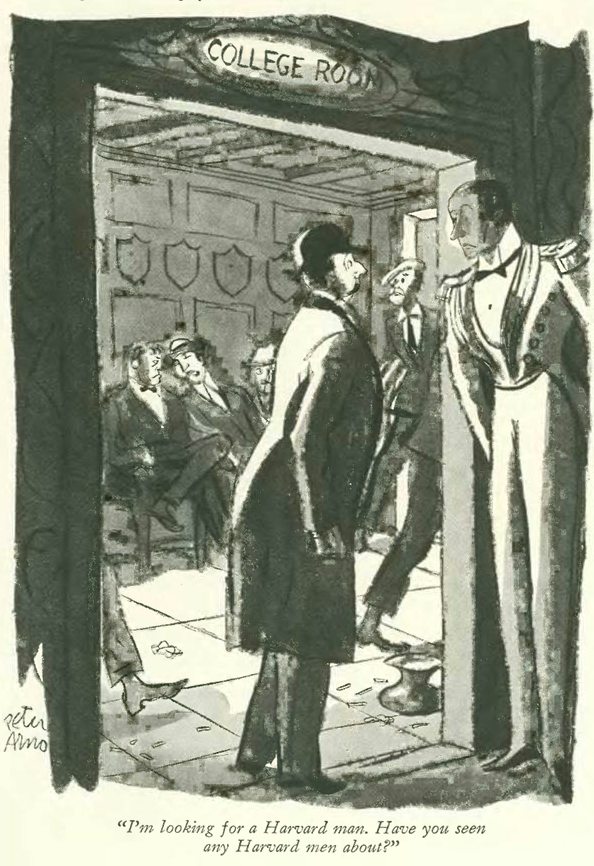
...Peter Arno visited the Harvard Club…

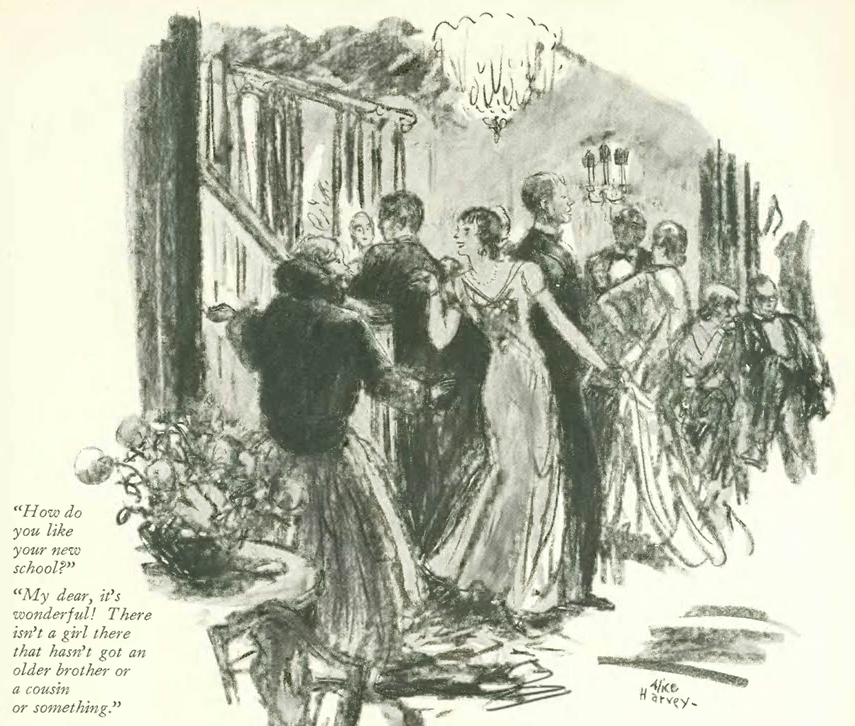
Alice Harvey also explored the college scene…

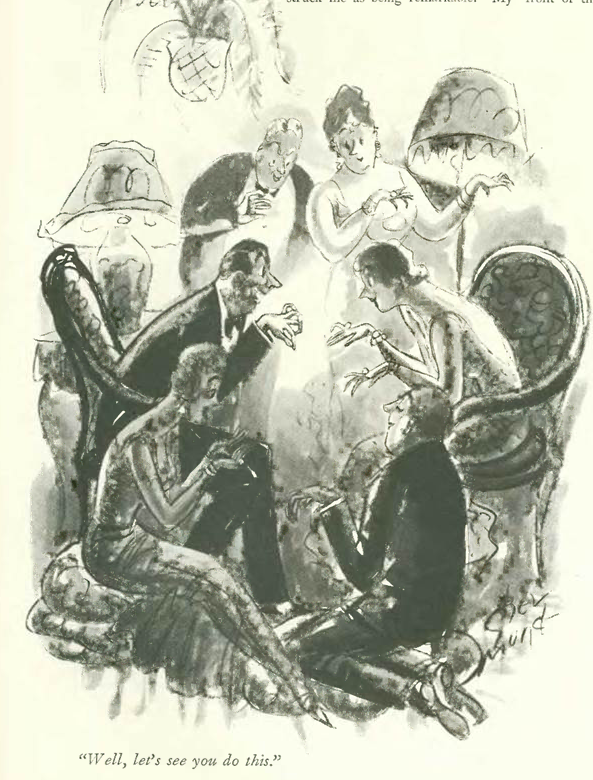
…some parlor games with Barbara Shermund

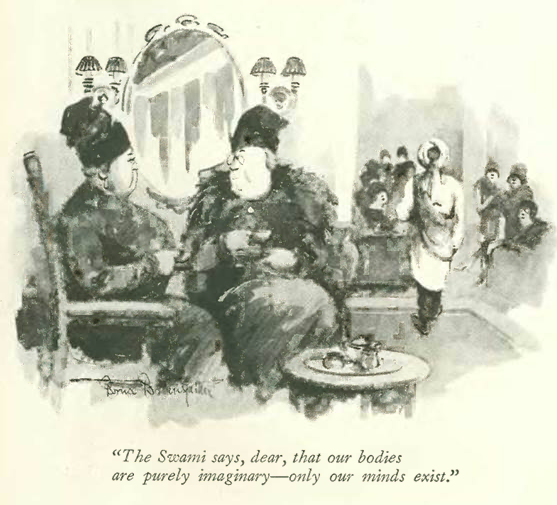
……Bruce Bairnsfather, and some existentialist chat at tea time…

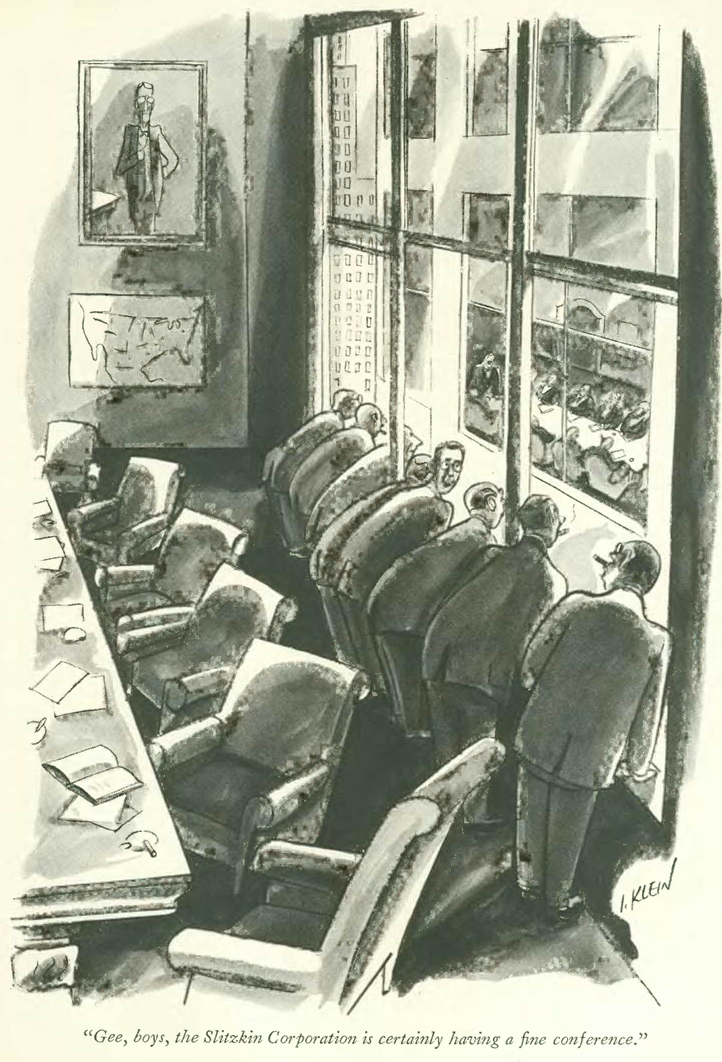
…and we close with Isadore Klein, and the world of corporate competition…

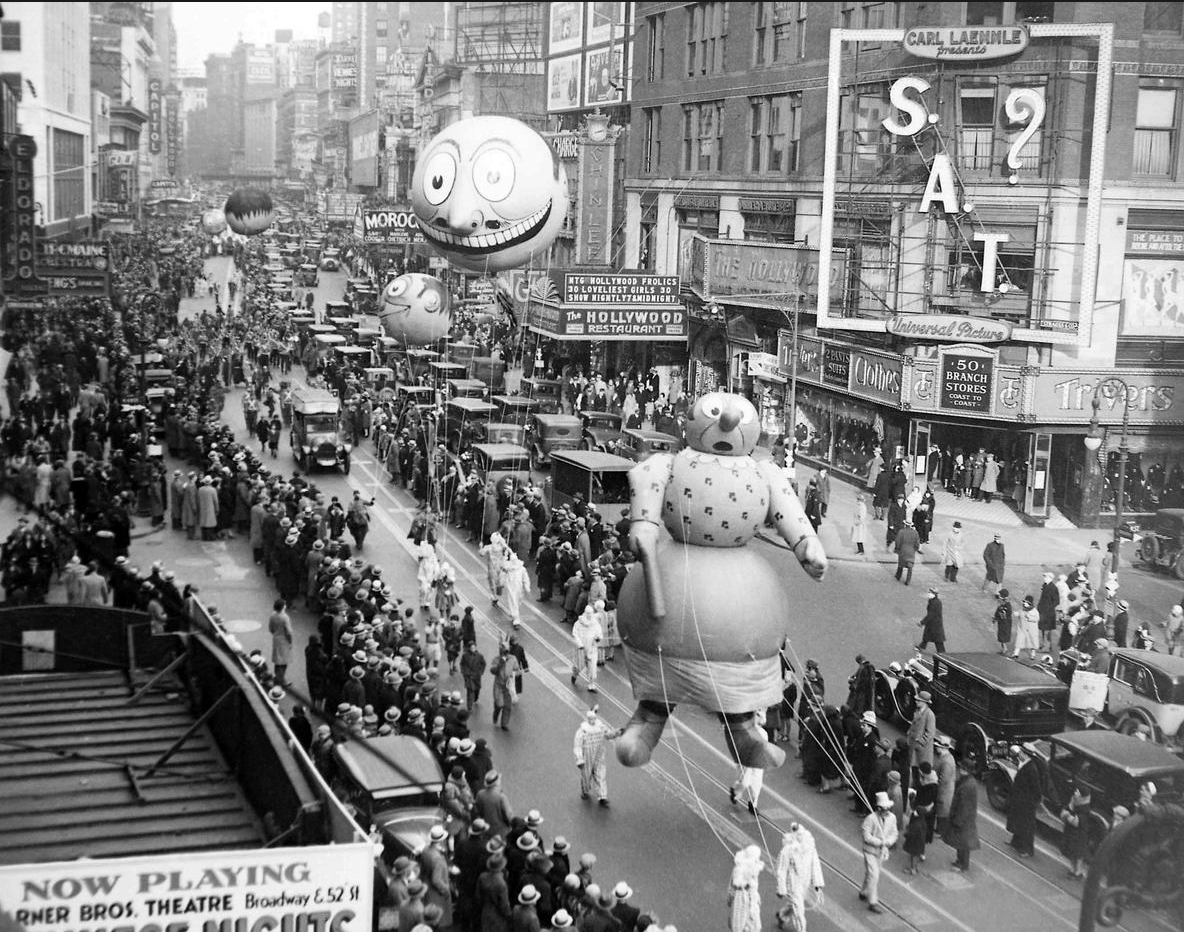
…and a Happy Thanksgiving, from the Macy’s Thanksgiving Parade 89 years ago, Nov. 27, 1930…

(CBS/Associated Press)

Next Time: The Future Was a Silly Place…


Body and Soul

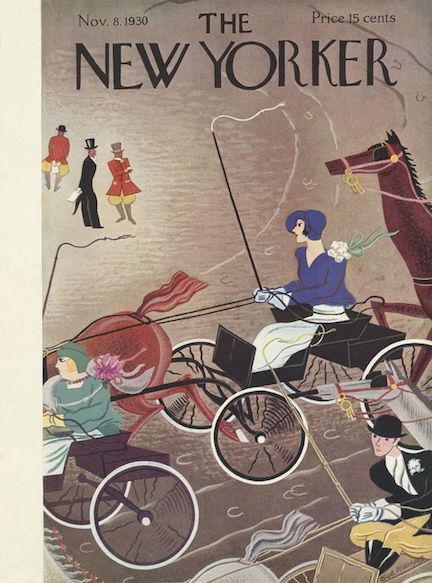
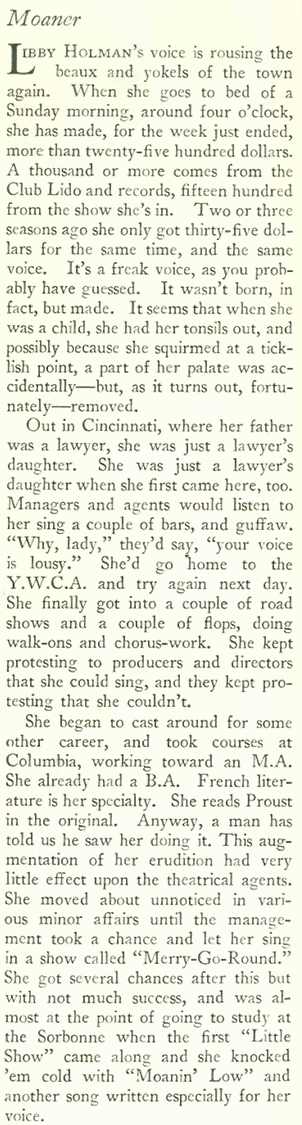
After completing a major in French in just three years, 19-year-old Libby Holman became the youngest woman to graduate from the University of Cincinnati in 1923. But it was her unique style of torch-singing—a trademark throaty mumble—that would launch a career on Broadway and a life of seemingly endless scandal.

Nov. 8, 1930 cover by Sue Williams.

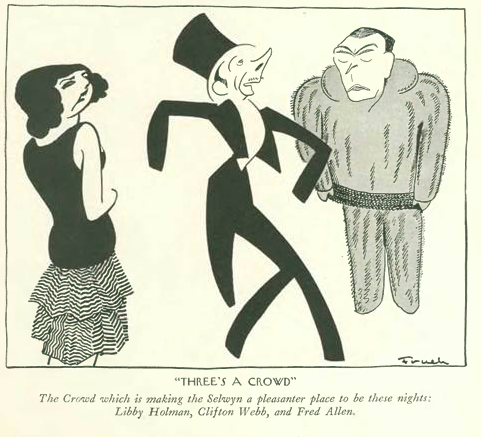
After performing in the The Greenwich Village Follies, Holman (1904–1971) landed her first big role in 1925 in the Rodgers and Hart production of Garrick Gaieties. But it was a signature song, “Moanin’ Low,” from Clifton Webb’s The Little Show that would make her a star. When Three’s a Crowd (by Howard Dietz and Arthur Schwartz) opened at the Selwyn Theater on October 15, 1930, Holman was well-known to audiences not only for her voice but also for her unconventional lifestyle.

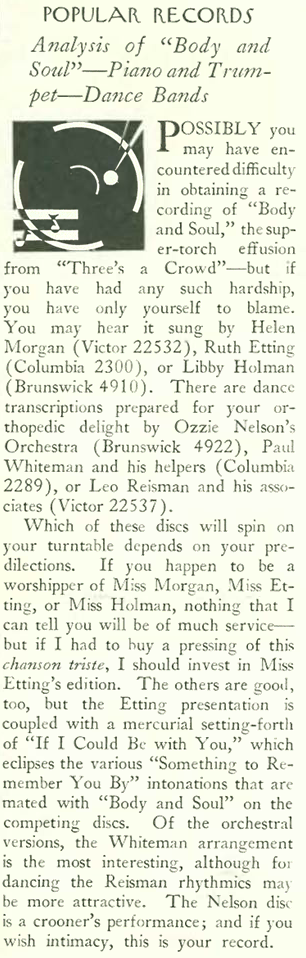
Three’s a Crowd proved to be a hit for Holman, and it gave her another hit song, “Body and Soul,” which was banned from the radio for “obscenity” but nevertheless became one of the year’s most popular songs. So popular, in fact, that it was recorded by Holman as well as by fellow torch singer Helen Morgan and Ziegfeld star Ruth Etting. This was the age of the Great American Songbook, when the song itself, and not necessarily its performer, reigned supreme. So when sheet music was distributed from a popular stage show, any number of entertainers would record it.

NAME THAT TUNE…From top to bottom, Helen Morgan, Ruth Etting and Libby Holman all recorded versions of “Body and Soul,” but Holman would make it one of her signature numbers. (YouTube/ruthetting.com/Wikipedia)

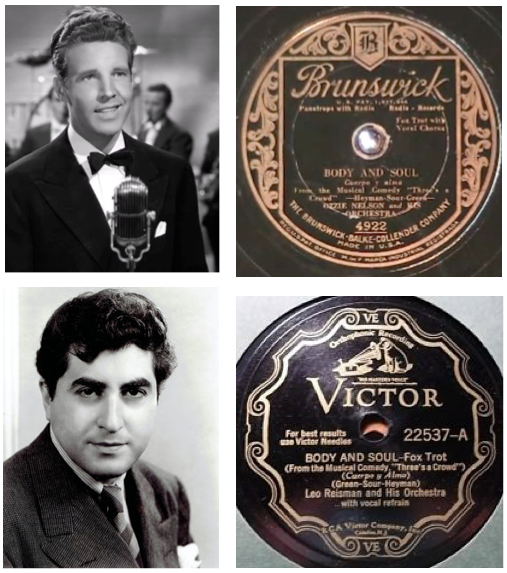
…for the hoofers, there were also a couple of dance versions of “Body and Soul” created by bandleaders Ozzie Nelson and Leo Reisman

GOOD BEAT, EASY TO DANCE TO…Bandleaders Ozzie Nelson and Leo Reisman recorded dance versions of “Body and Soul.” (YouTube)

Openly bisexual, Holman partied hard and swore like a sailor, and during her life she would lose one husband in a suspected murder (Holman herself was briefly a suspect) and another to suicide. She would take her own life in 1971. You can read more about Holman’s colorful, tragic life in the Jewish Women’s Archive.

We temporarily skip to the next issue of The New Yorker (Nov. 15, 1930), which featured Holman in a “Talk of the Town” brief, and some insight into her unique singing style. An excerpt:

The same issue also featured this drawing of the “Three’s a Crowd” cast by Al Frueh in the theater review section:

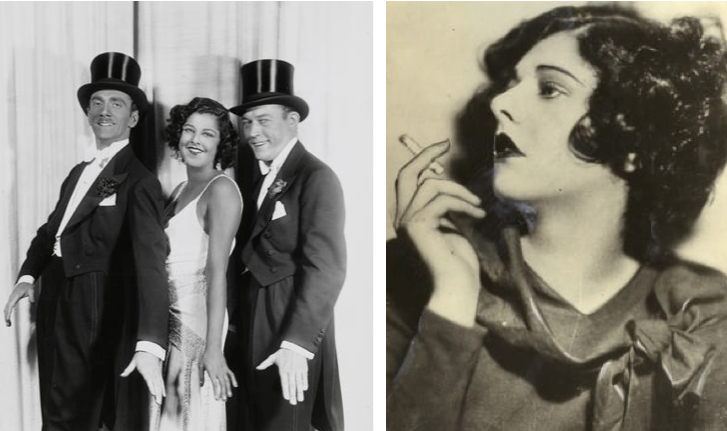
and finally, a publicity photo of the cast from 1930-31:

A FUN CROWD…Clifton Webb, Libby Holman and Fred Allen in Three’s a Crowd. At right, undated publicity photo of Holman. (performerstuff.com)

*  *  *

Horsin’ Around

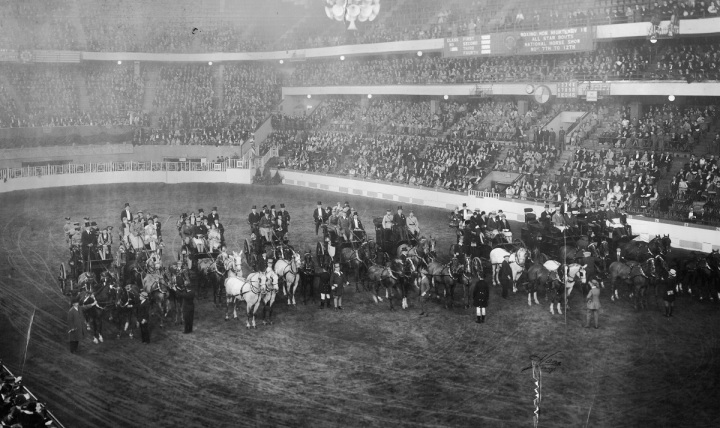
The National Horse Show was a major event on New York’s social calendar, first held at the original Madison Square Garden in 1883 before moving to the second Madison Square Garden in 1890 and again to the third Madison Square Garden in 1926. This account in the Nov. 8, 1930 New Yorker noted how the horse show’s patrician air contrasted with the rodeo held at MSG the previous week.

NOT FOR GOAT-ROPERS, THIS…The coaching parade on display at the 1927 National Horse Show in Madison Square Garden. (National Sporting Library & Museum)
SOON WE’LL BE FIGHTING EACH OTHER…The National Horse Show began including a military competition in 1925. This photo from the Nov. 6, 1930 New York Times featured some international guests at the 1930 show. (NY TIMES)

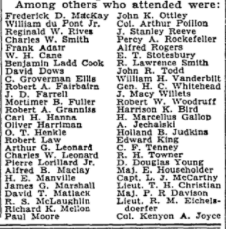
Along with the above photo, the Times included this partial lists of guests to the Horse Show Luncheon, a who’s who of New York society. Indeed, the National Horse Show’s 1887 directory provided the basis for the first New York Social Register.

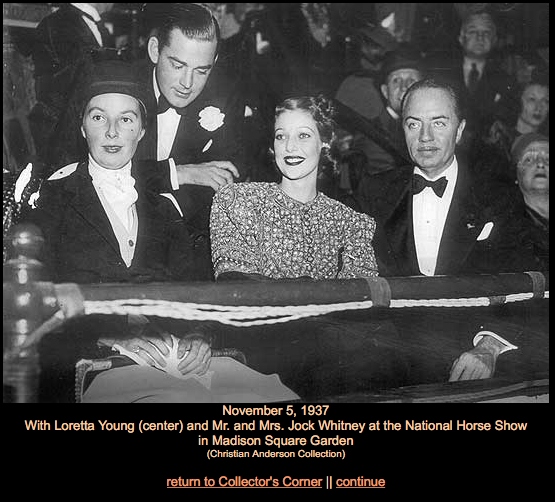
DRESSING UP FOR THE HORSES…Champion horsewoman Mary Elizabeth Whitney (left) with actors Loretta Young and William Powell at the National Horse Show in Madison Square Garden, Nov. 5, 1937. Standing behind Mary Elizabeth is her husband, Jock Whitney, a noted ambassador, art collector, philanthropist and investor. (Christian Anderson Collection)
HIGH STEPPIN’…After a brief stint in Florida, the National Horse Show moved to Kentucky in 2011. Perhaps a tad less formal, it nevertheless remains an important society event. Above, noted horsewoman Misdee Wrigley Miller rides World Grand Champion Grande Gil at the 2012 National Horse Show. (Doug Shiflet)

 *  *  *

A Lesson in Poetry 

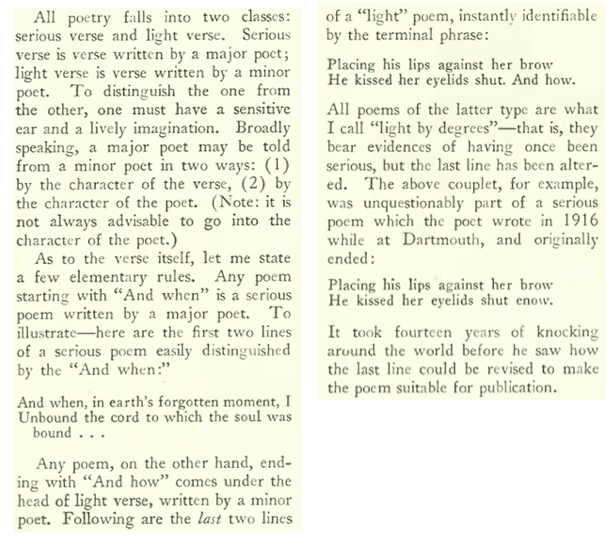
In a casual for the Nov. 8 issue, E.B. White instructed readers on how to “Tell a Major Poet From a Minor Poet.” An excerpt.

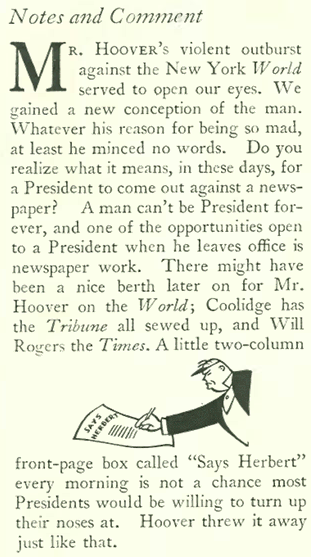
And in his “Notes and Comment,” White suggested that criticism of the press was a major no-no for a sitting U.S. President:

Christmas shopping suggestions began to trickle into Lois Long’s section on fashion, house and home, including this bit of advice that reminds us just how distant 1930 is from our own time:

 *  *  *

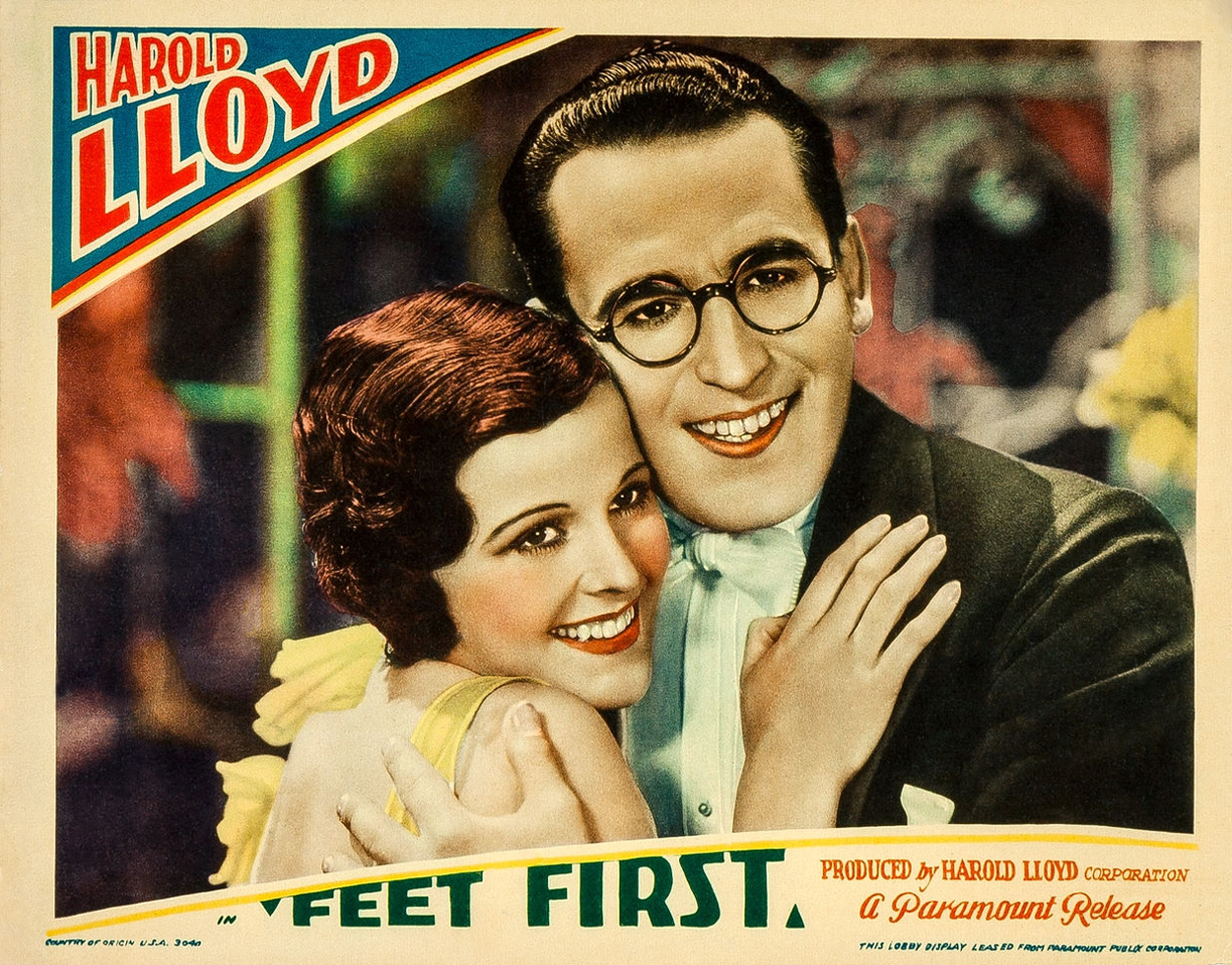
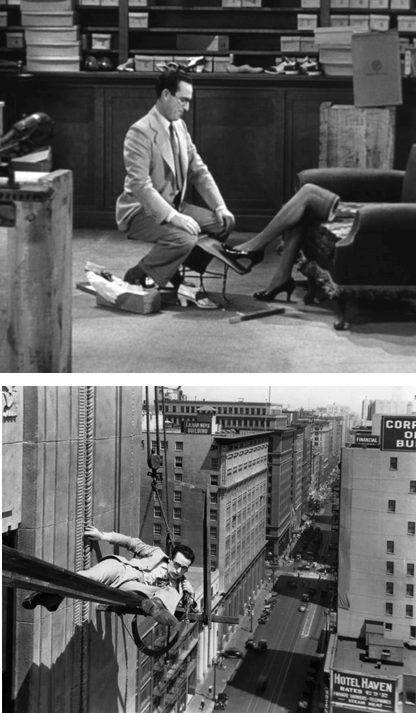
Film critic John Mosher took in the latest offering from silent film star Harold Lloyd, who was making his second foray into the talkies with his portrayal of a hapless shoe salesman in Feet First

TEETH FIRST…Theater card for 1930’s Feet First featuring Barbara Kent and Harold Lloyd. (IMDB)
GETTING A LEG UP…Top, Harold Lloyd practices the art of shoe salesmanship with a pair of dummy legs in Feet First; below, Lloyd once again finds himself in a precarious situation high above a city street. (IMDB)

 *  *  *

From Our Advertisers

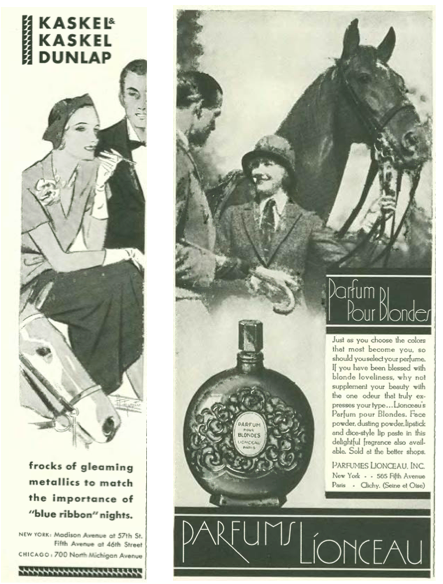
The National Horse Show was on the minds of several advertisers in The New Yorker, including these fashion merchants targeting the patrician set…

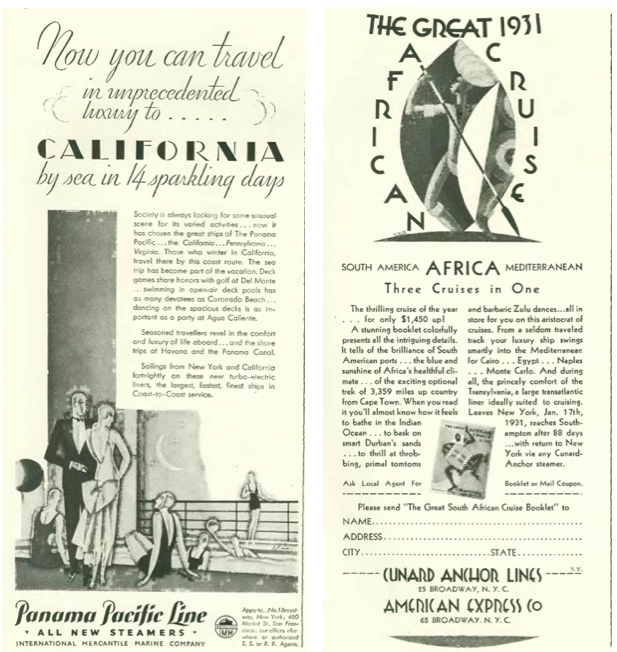
…speaking of the well-heeled, with winter approaching travel agencies enticed those with means to take a steamer through the Panama Canal to California, or for the more adventurous, a three-continent tour package…

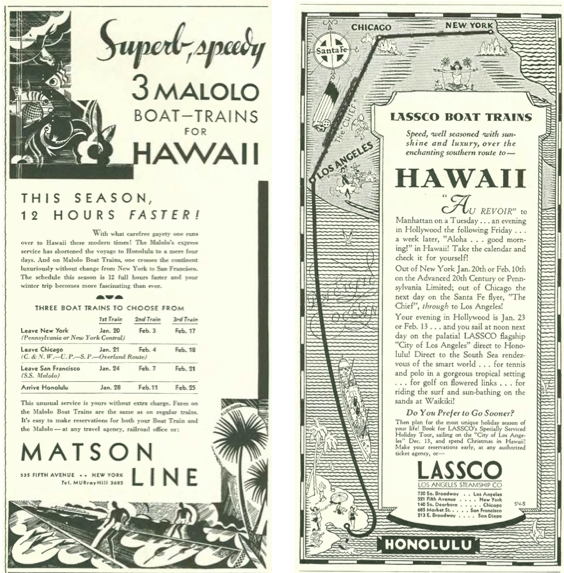
…and of course Hawaii beckoned snowbirds, who could make their way across the Lower 48 by train and then hop a boat to the islands…

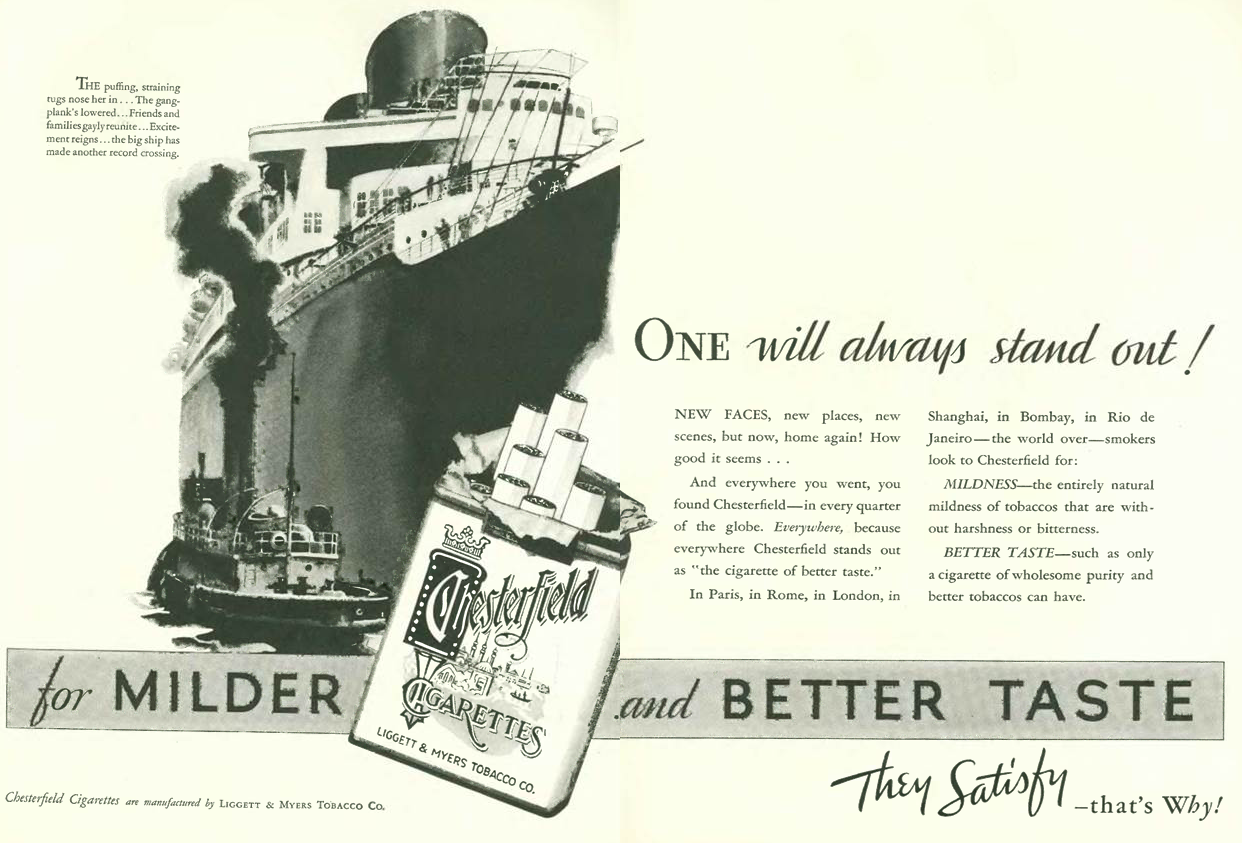
…the makers of Chesterfield cigarettes were on board with the travel theme…

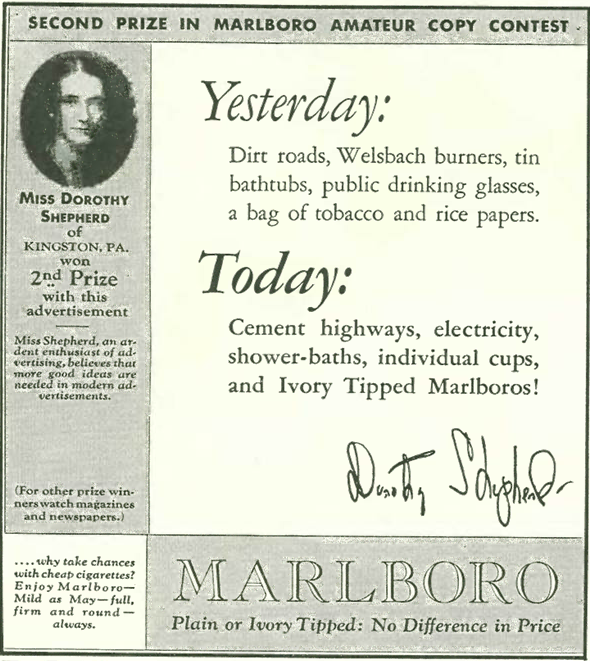
…while the folks at Marlboro stuck with their dopey handwriting and jingle contests to push their smokes…

…as the luxury market grew ever tighter in the Depression, the sellers of finer things sought to distinguish their wares from competitors. L.P. Hollander kicked off a series of wordy ads regarding the provenance of their hats, gloves and other accessories (in short, they ain’t cheap copies)…

…no doubt the folks at L.P. Hollander were looking down their noses at the likes of Russeks, which offered copies of Lucien Lelong gowns. Apparently old Lucien was okay with this, as this “Radiogram” purportedly attests…

…Lucien pops again in another ad, this one for his perfume line…

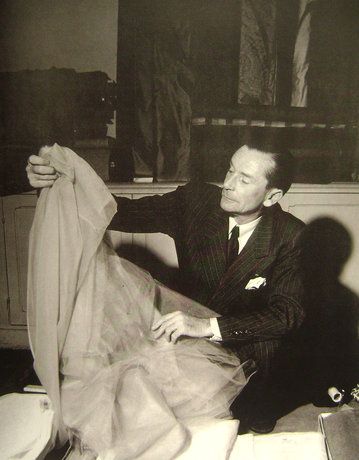
…and for reference, here’s a photo of Monsieur Lelong, circa 1940…

(comm396-s16.ascjclass.org)

…on to our cartoonists, the Nov. 8 issue featured these great spot illustrations by Constantin Alajalov, the first, running along the bottom of “The Talk of the Town,” referenced the horse show at Madison Square Garden…

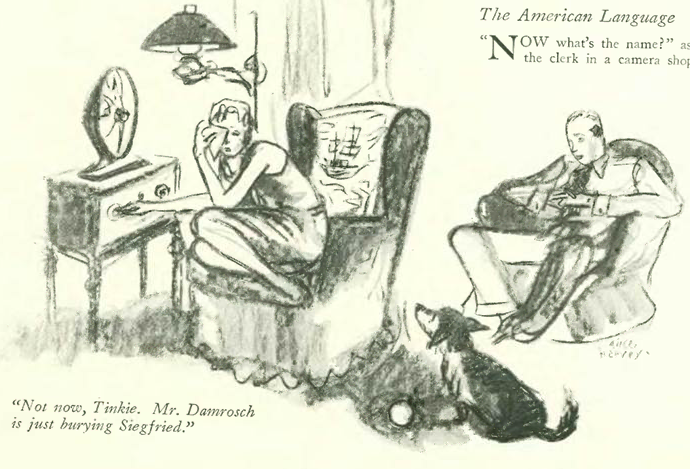
Alice Harvey listened in on a radio soap…

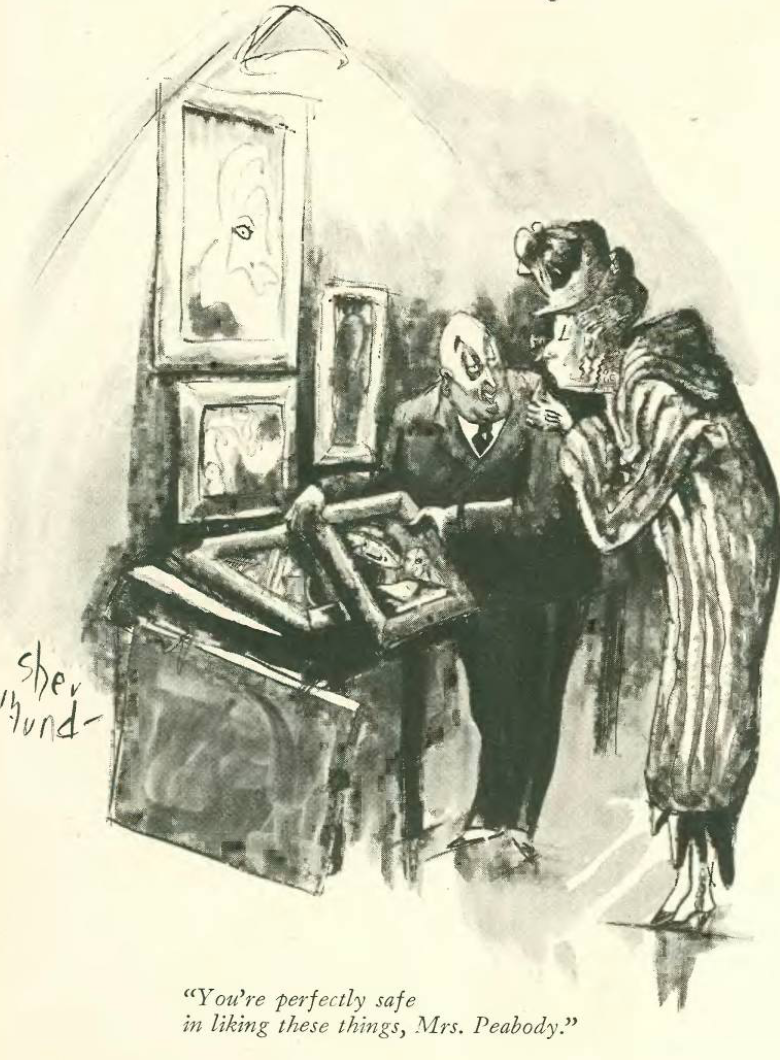
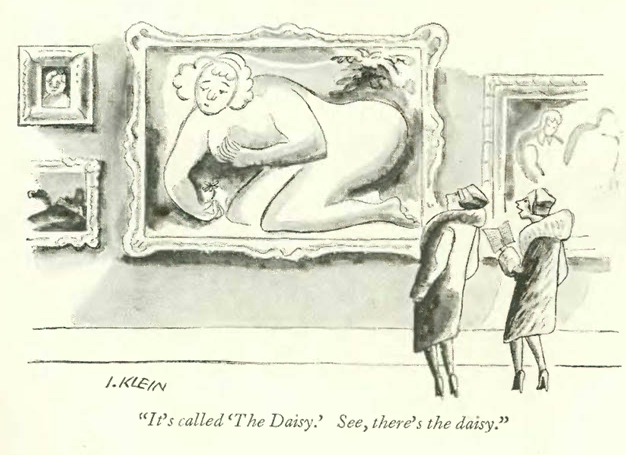
William Crawford Galbraith found some admirers of art…

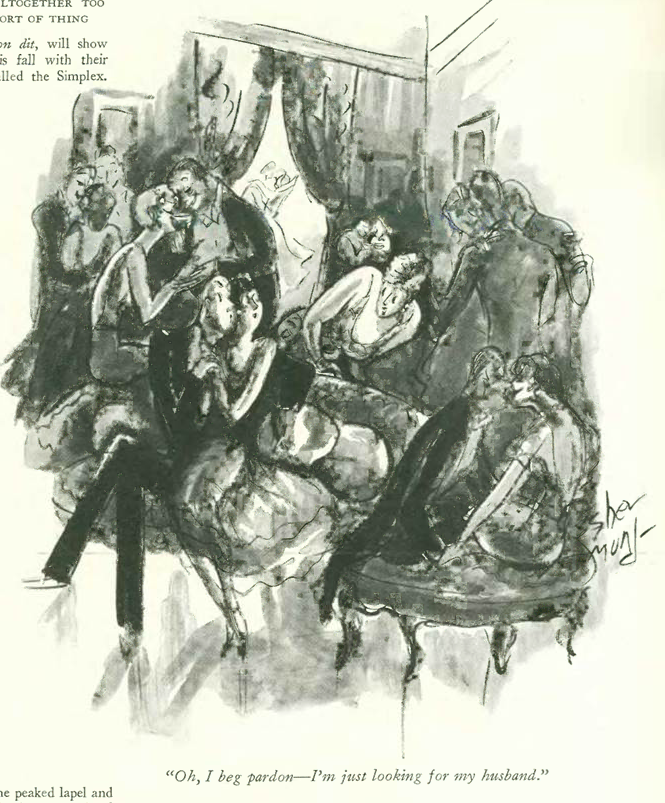
Barbara Shermund continued to share her sharp observations of parlor hijinks…

Garrett Price illustrated the challenges of modern design…

…and we end with Peter Arno, and a stomach-turning moment…

Next Time: The High Place…

The Woes of Mr. Monroe

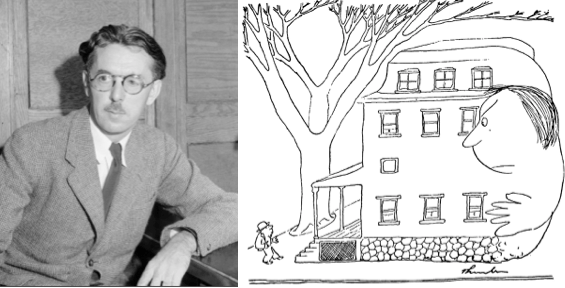
Whether probing the battle of sexes or exposing the secret lives of daydreamers like Walter Mitty, James Thurber (pictured above) had a knack for revealing the frustrations and various tics that plagued ordinary people.

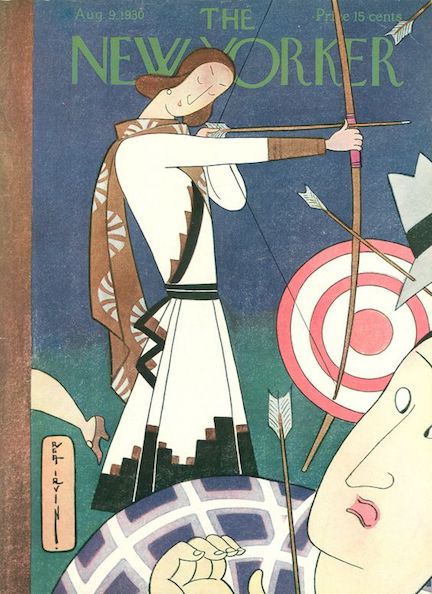
Aug. 9, 1930 cover by Rea Irvin.

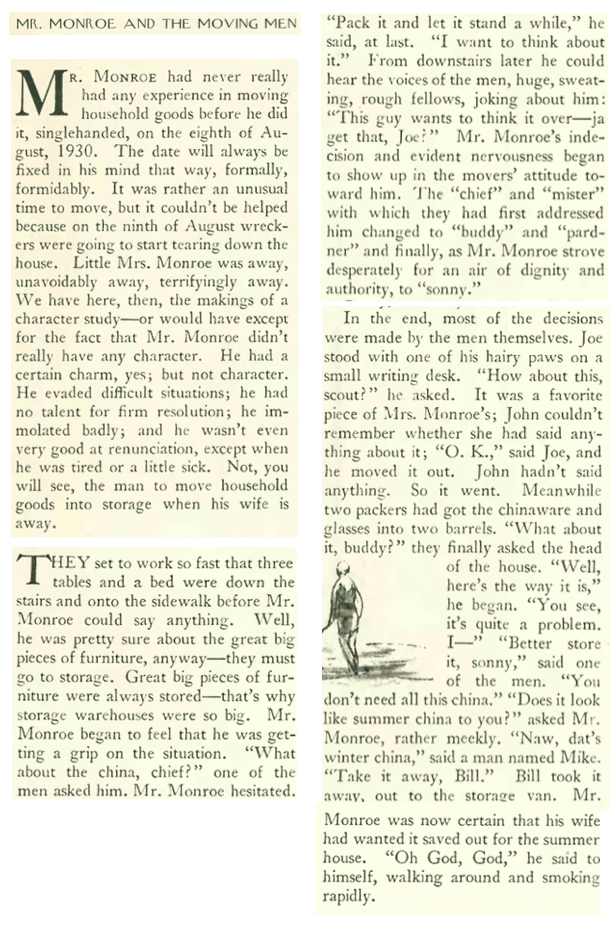
That included the fictional John Monroe, whom Thurber placed in various awkward situations in a series of humorous stories, including this encounter with some moving men that required the rather inept Monroe to make a series of decisions usually left to his wife, Ellen. Some excerpts from the Aug. 9 issue:

ODD COUPLES…Sue Randall and Orson Bean portrayed Ellen and John Monroe on a 1961 episode of The DuPont Show with June Allyson. (findagrave.com/Wikipedia)
…a decade later, William Windom, left, and Joan Hotchkis portrayed John and Ellen Monroe on the Thurber-inspired (and award-winning) NBC comedy My World and Welcome to It (1969-70). (TV Guide)

 *  *  *

Beats the Heat

In the hot August of 1930, film critic John Mosher probably found the air-conditioned theaters to be the best feature of the cinema, given the generally mediocre quality of the summer movies. Mosher also noted the new trend of adapting Broadway plays to the screen, a practice that continues to this day.

THE SOUND OF 1930…Joan Crawford (left) examines a boom microphone on the set of Our Blushing Brides. Although most films were produced with sound in 1930, it was still something of a novelty to actors who began their careers in the silent era; at right, Douglas Fairbanks Jr. and Anita Page in Little Accident. (IMDB)

 *  *  *

From Our Advertisers

Well, who doesn’t love a whole chicken in jar, ready to “fry or cream” in just 20 minutes? This was actually a big deal in 1930, given that chicken dinners were not as common back in the days before factory farms and Chick-fil-A…

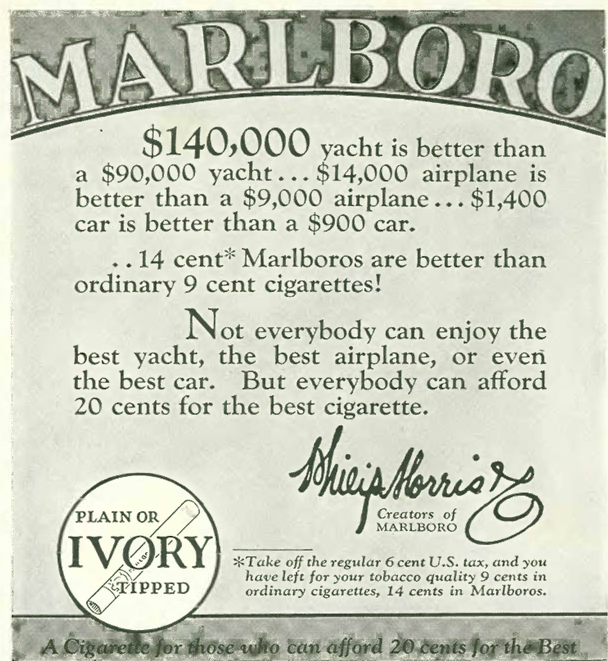
…the makers of Marlboro cigarettes abandoned their essay and penmanship contests and took another direction with their drab, back-page ads, appealing to a vague sense of status in the prospective smoker…

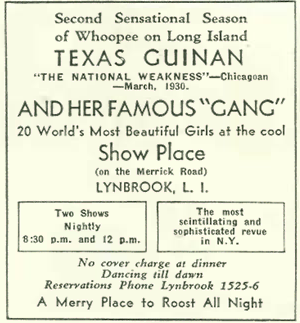
…this sad little bottom-of-the-page ad enticed readers to take a drive in the country to see Texas Guinan and her “Famous Gang” still whooping it up like it was 1925. The venture was short-lived…

…on to our cartoons, Peter Arno looked in on nightlife in the city…

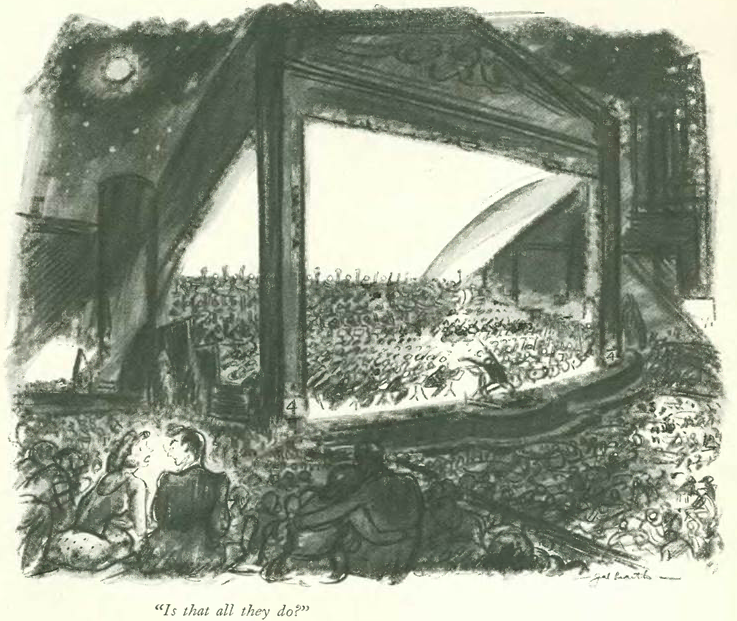
William Crawford Galbraith took in an outdoor concert…

Ralph Barton offered his comic skills to a glimpse of domestic life…

Garrett Price observed some boaters on an outing that would be frowned upon today (or at least I hope so)…

…and Constantin Alajalov examined the pitfalls of modern art…

 *  *  *

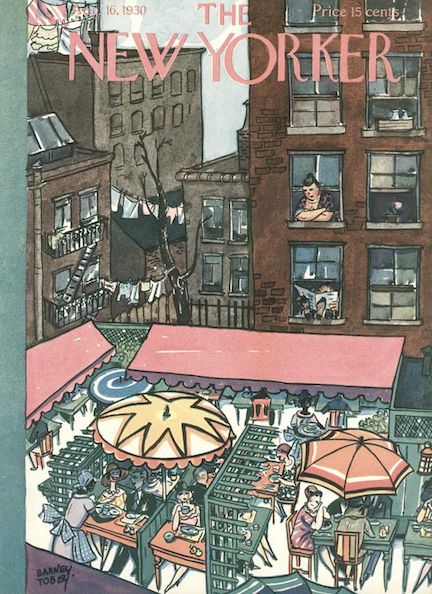
Speaking of art, we move on the Aug. 16, 1930 issue…

Aug. 16, 1930 cover by Barney Tobey.

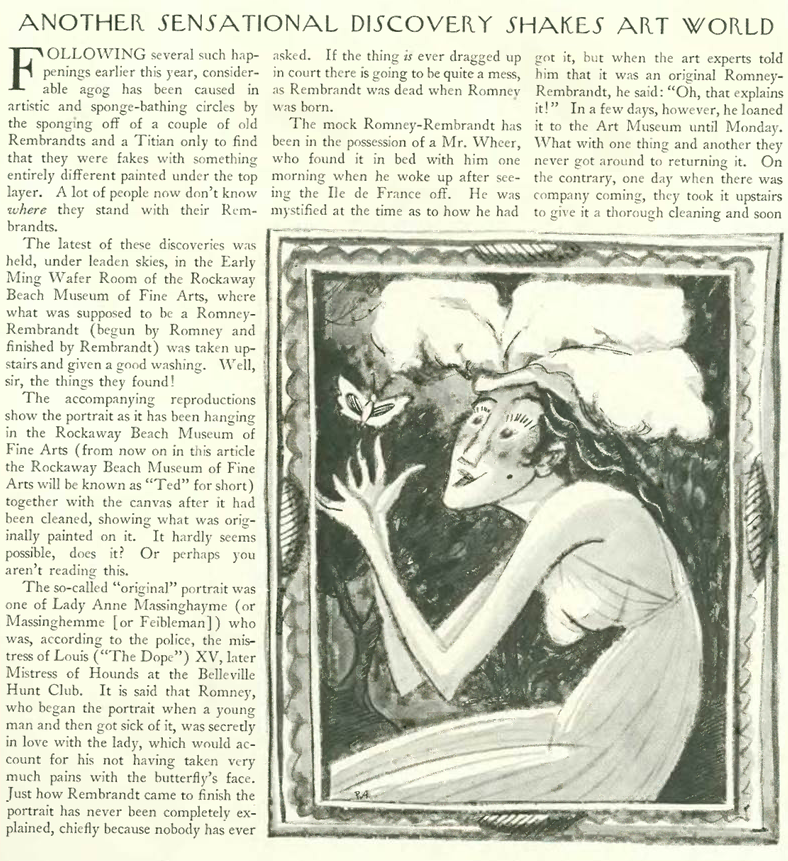
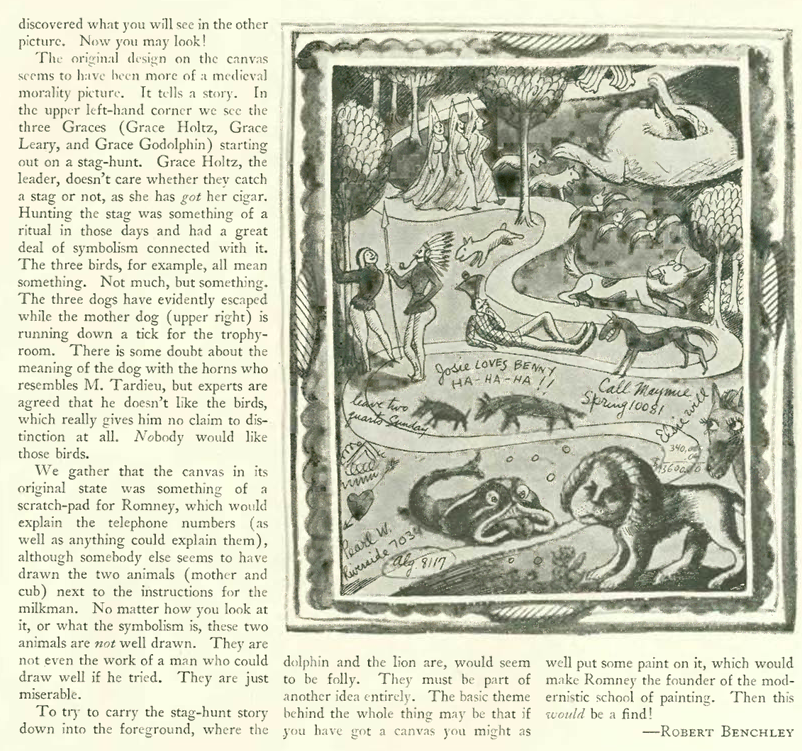
…in which Robert Benchley has fun with the foibles of the art world…

 *  *  *

Rough Riders

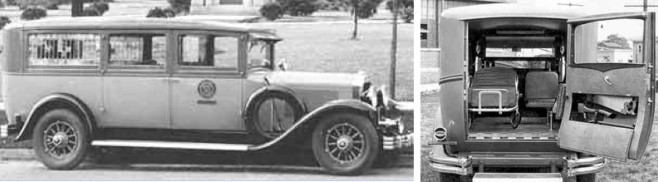
In his “Reporter at Large” column, Morris Markey looked in on the working world of one chain-smoking ambulance driver…some excerpts…

SLIDE ‘EM IN…1930s Flexible ambulance and its rather cramped interior. (coachbuilt.com)

 *  *  *

From Our Advertisers

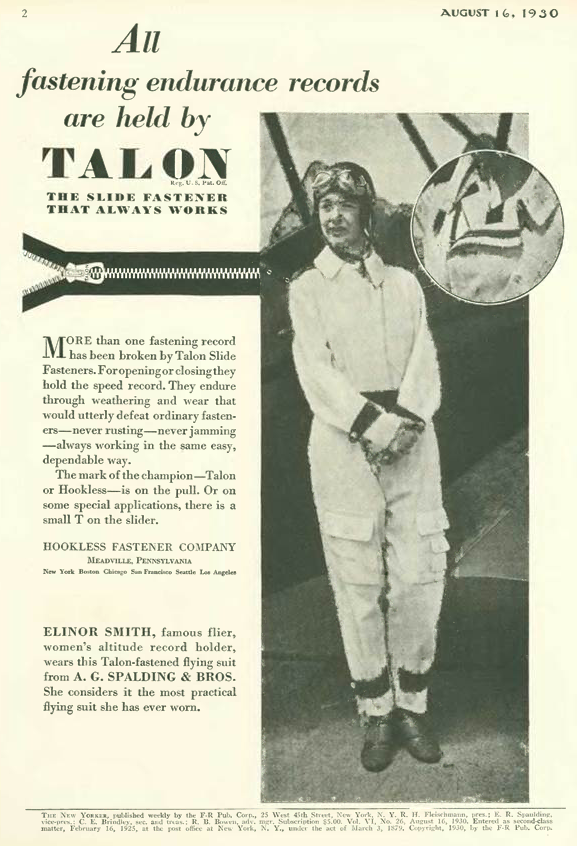
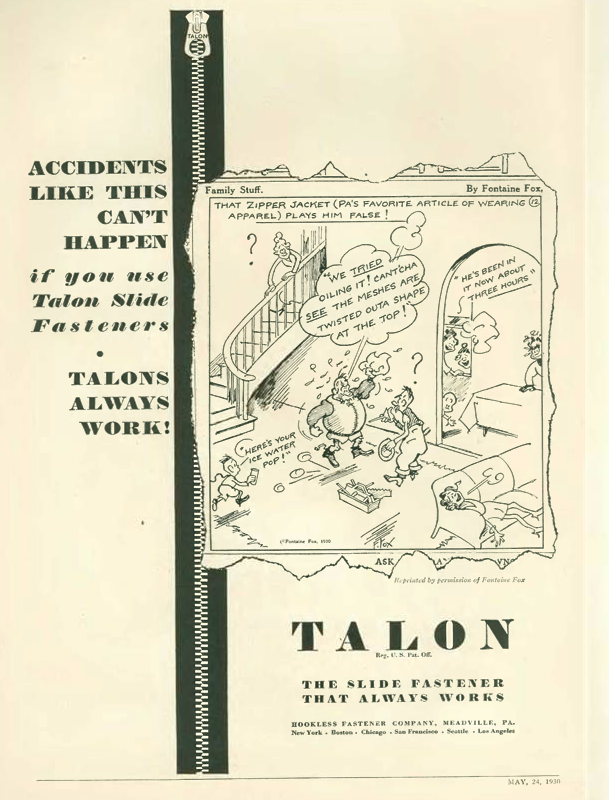
Hard to believe that zippers were a novel invention just 90 years ago…in this ad from the leading manufacturer, Talon, this “hookless” wonder was still referred to as a “slide fastener”…

…the Chrysler Corporation was never the biggest car company in America, but it was always known as a leader in both technology and design, as in these graceful lines that flowed over its new “Straight Eight” models…

…the makers of Camel cigarettes continued to push their product as a sound way to stay fit and trim…

…in the cartoons for Aug. 16, this drawing by Peter Arno appeared for the fifth time in the magazine, always with a different caption (the others appeared in three consecutive issues — June 5, 12 and 19, and on Aug. 2, 1930)…

William Crawford Galbraith detected some wet vs. dry tension at the country club…

Ralph Barton returned with another full-page illustration of a weekend domestic scene…

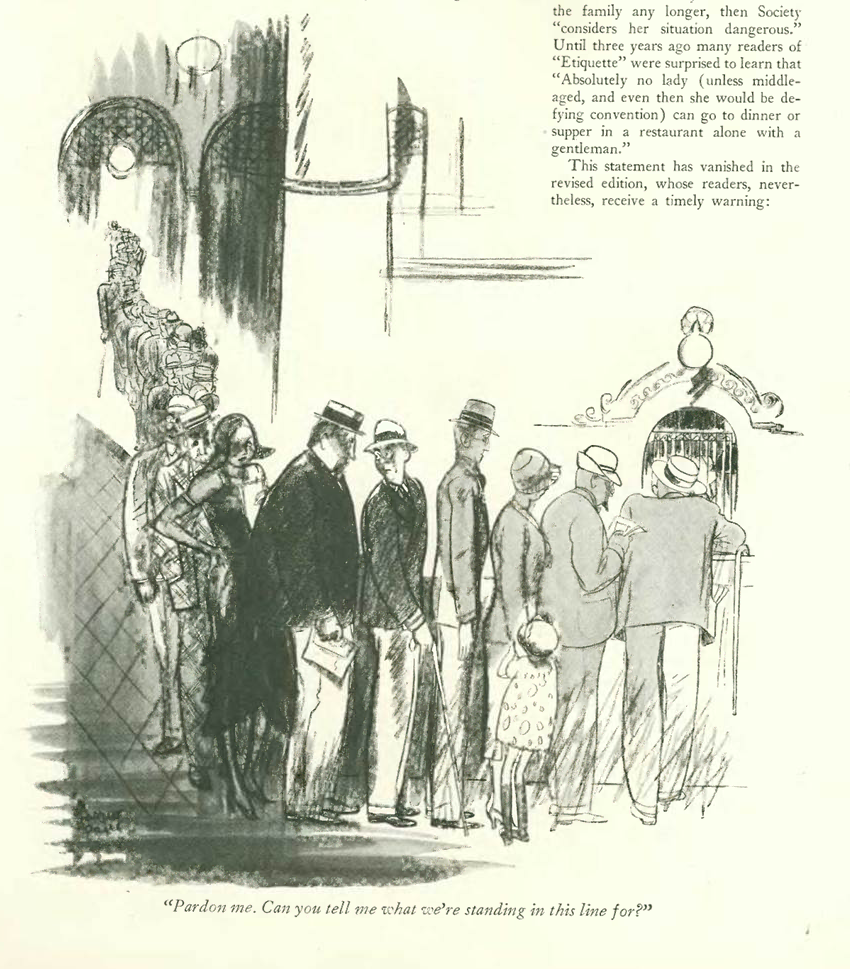
Garrett Price found confusion in a lengthy queue…

…and Kemp Starrett gave us a bird’s eye view of a future New Yorker…

Next Time: Hell’s Angels…

Transatlantic Dreaming

When Apollo astronauts landed on the moon fifty years ago, many skeptics asked the question, “What good does this accomplish?”

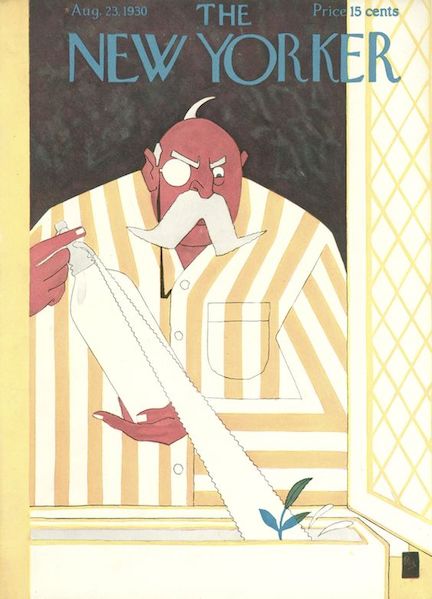
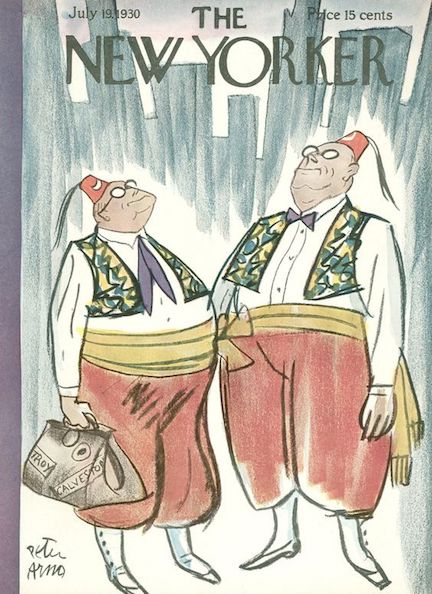
July 12, 1930 cover by Constantin Alajálov.

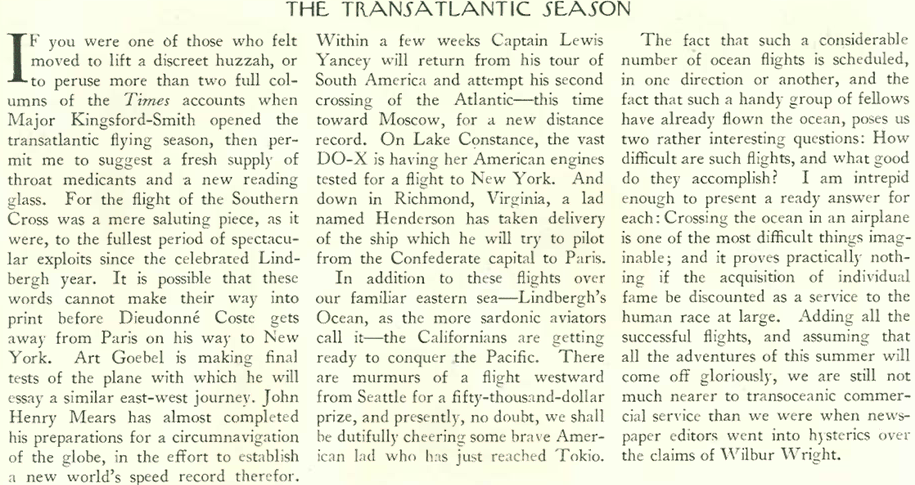
New Yorker writer Morris Markey posed the same question 89 years ago about transatlantic flights, then limited to a handful of daredevils chasing various speed and distance records. Crossing the ocean in an airplane, Markey observed, was “one of the most difficult things imaginable.” He concluded that despite the heroics of a few pilots, “we are still not much nearer to transoceanic commercial service…”

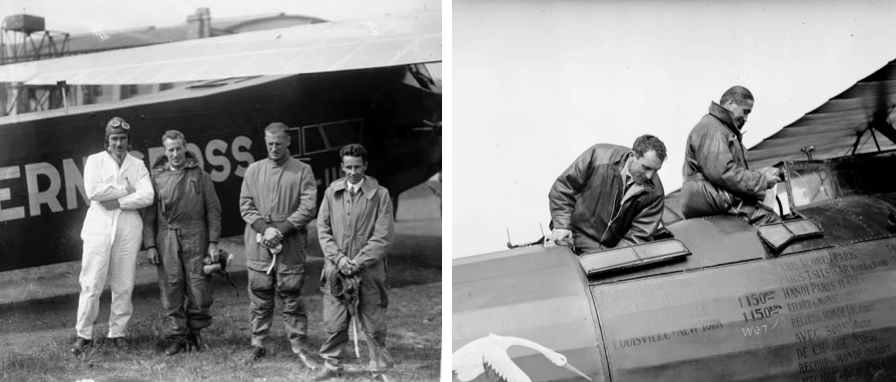
TESTING THE LIMITS…In photo at left, Charles Kingsford Smith (second from left) and the crew of his airplane, Southern Cross, pause before embarking on their east-west crossing of the Atlantic in  June 1930; photo at right: Dieudonné Costes (right) with Maurice Bellonte in Boston in 1930. On September 1-2, 1930, they flew the “Point d’Interrogation” from Paris to New York, the first heavier-than-air aircraft to reach New York in the more difficult westbound direction between the North American and European mainlands. (National Library of Ireland/Wikipedia)
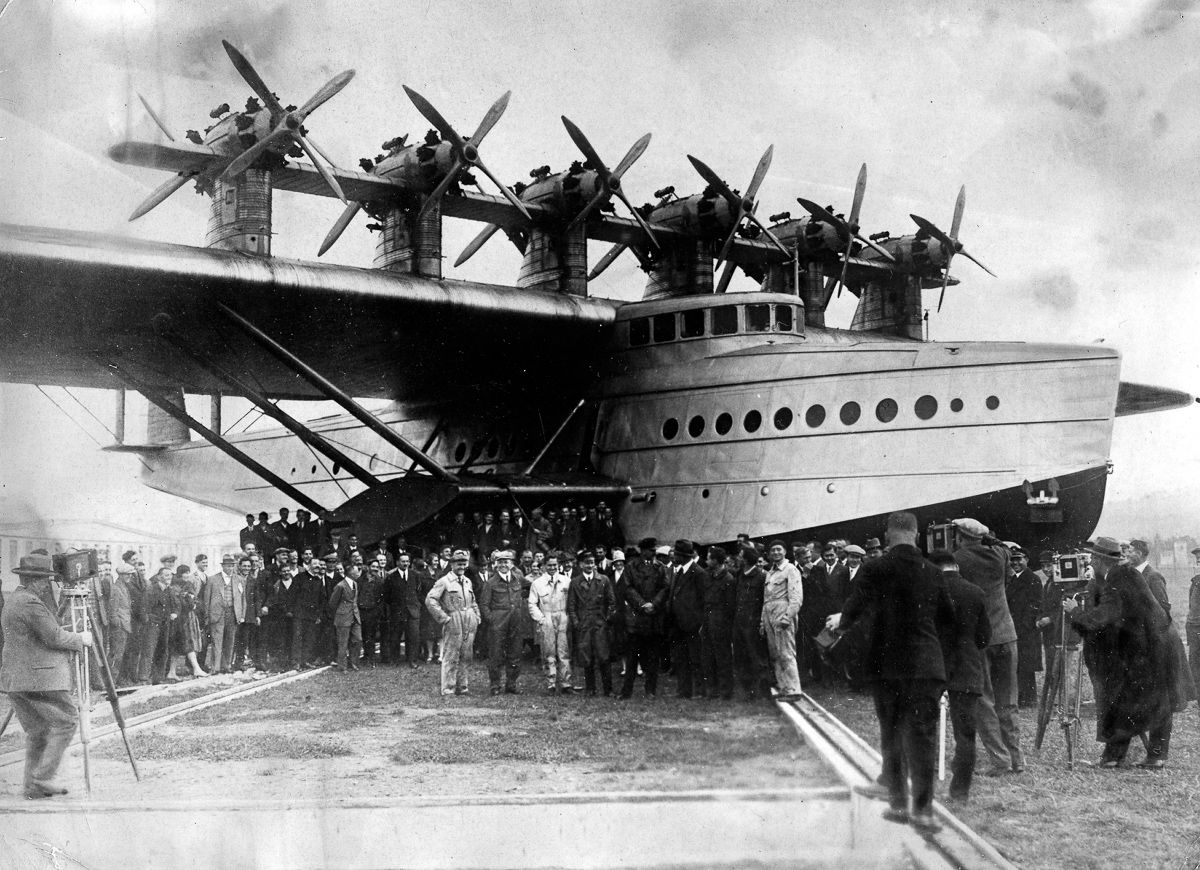
BIG THINKERS…Germany’s massive Dornier Do-X made its first test flight on July 12, 1929. A few months later, it carried a world-record 169 passengers on a 40-minute flight, an astonishing number given that the largest planes at that time rarely carried more than 20 passengers. In 1930, the Do-X took off on an international publicity tour through Europe, down the west coast of Africa, across the Atlantic to Brazil and up to New York before returning to Berlin. (Mashable)

Markey went on to detail the various obstacles facing transatlantic fliers, including fairly good odds that a plane, laden with fuel and supplies for such a journey, would crash on takeoff. He noted that a little over half of the attempts succeeded, while the others seemed doomed from the start.

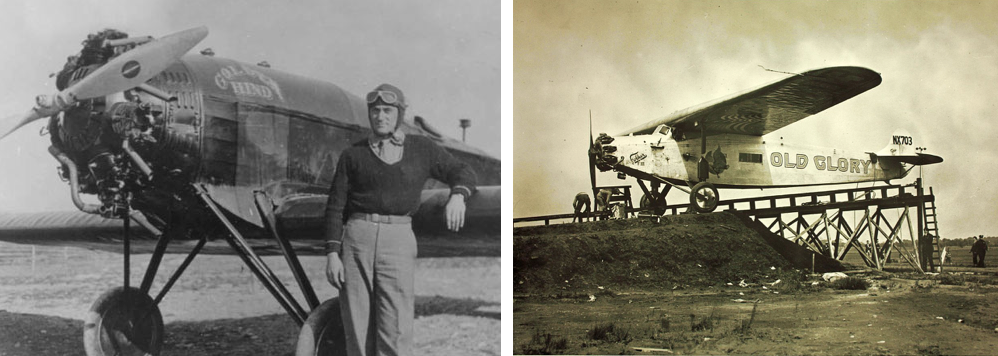
ILL-ADVISED…With only 70 hours of flying experience, Montana rancher Urban F. Diteman (left, with his airplane “Golden Hind”) took off from Harbour Grace, Newfoundland, bound for London. He was never seen again; at right, the William Randolph Hearst-sponsored “Old Glory,” a Fokker F.VIIa single-engined monoplane that was used in 1927 on an attempted transatlantic flight from Old Orchard Beach, Maine to Rome, Italy. The overloaded plane and its crew were lost approximately 700 miles east of Newfoundland, where only a section of wing was recovered. (dailymontana.com/Wikipedia)

 *  *  *

Glare of the New

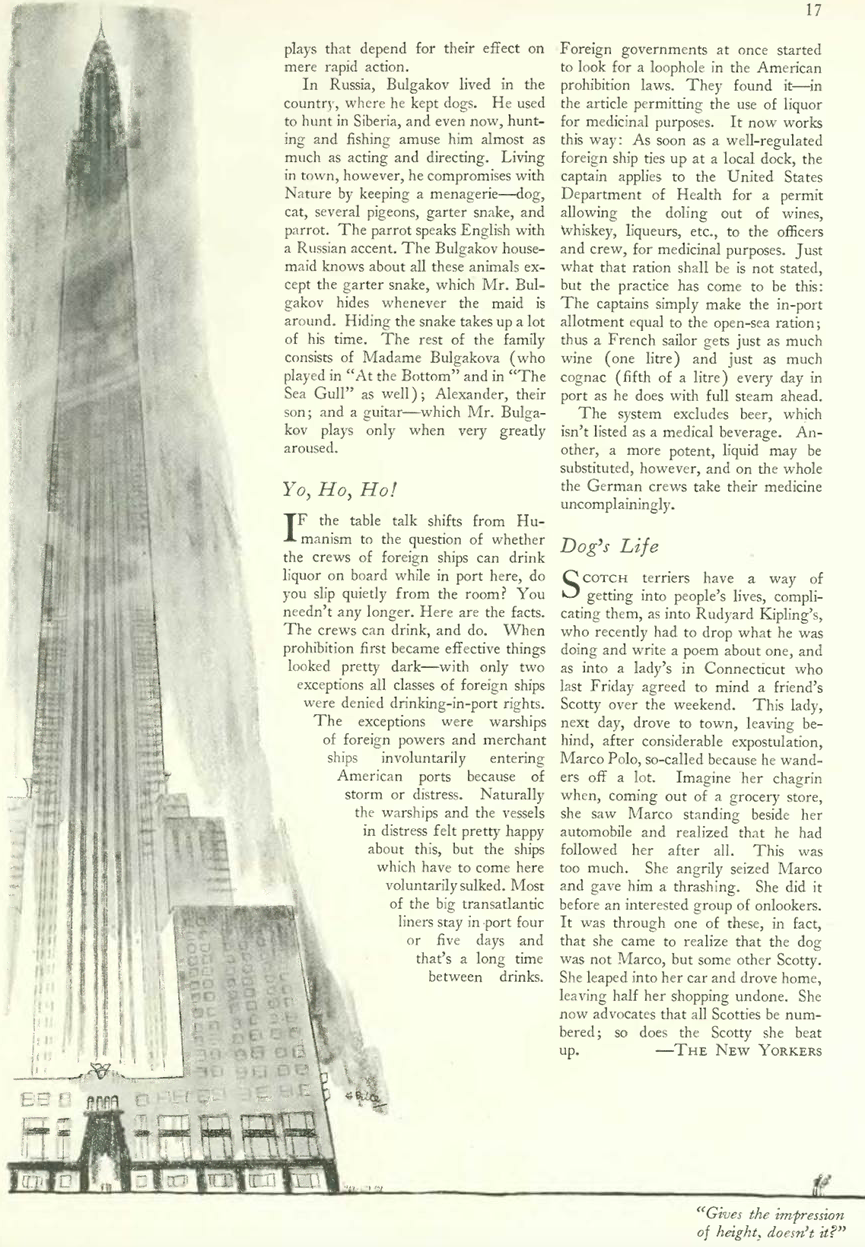
Architecture critic George Chappell enthusiastically followed the construction of the world’s tallest building, but in its completion he found the Chrysler Building’s now-iconic spire to be little more than a stunt, and suggested that a covering of masonry might be in order:

MAYBE SOME VINYL SIDING?…George Chappell wasn’t too crazy about the Chrysler’s chrome dome, and also worried about the amount of steel that would clad the exterior of the Empire State Building, right, which is composed of limestone, chrome bars and aluminum panels. (Wikipedia)

 *  *  *

Bottoms Up

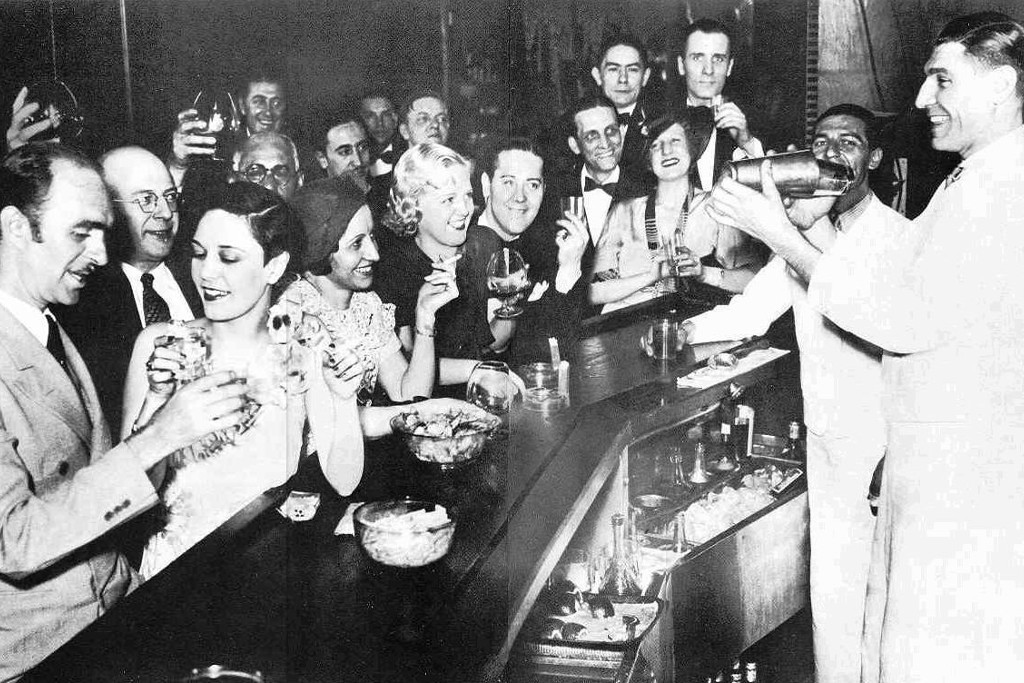
In his “Notes and Comment,” E.B. White pondered the drinking habits of his fellow citizens in the tenth year of Prohibition:

MAKE THAT A DOUBLE…Finding refreshment in the dark days of Prohibition. (junkee.com)

 *  *  *

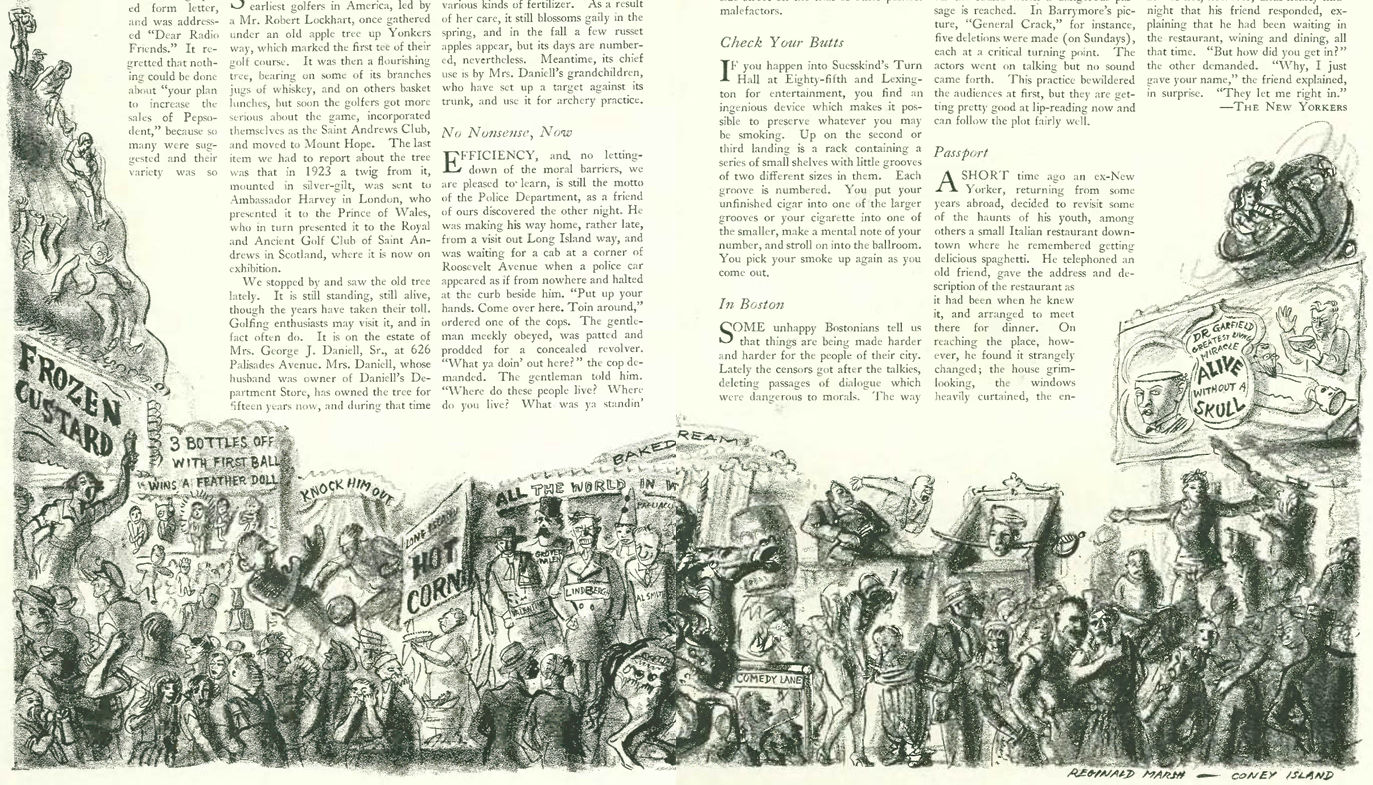
Good Old Summertime

Along the bottom of “The Talk of the Town,” a Reginald Marsh interpretation of Coney Island fun and games…

 *  *  *

Still the Same

Lois Long, who painted a picture of Jazz Age nightlife like no other in her “Tables for Two” column, teased her readers by disguising her identity, often claiming she was a frumpy old lady. With her “Tables” column now on hiatus, the fashionable and young Long maintained her pose, referring to herself as an “old war horse” in her fashion column “On and Off the Avenue.”

Problems of the Rich

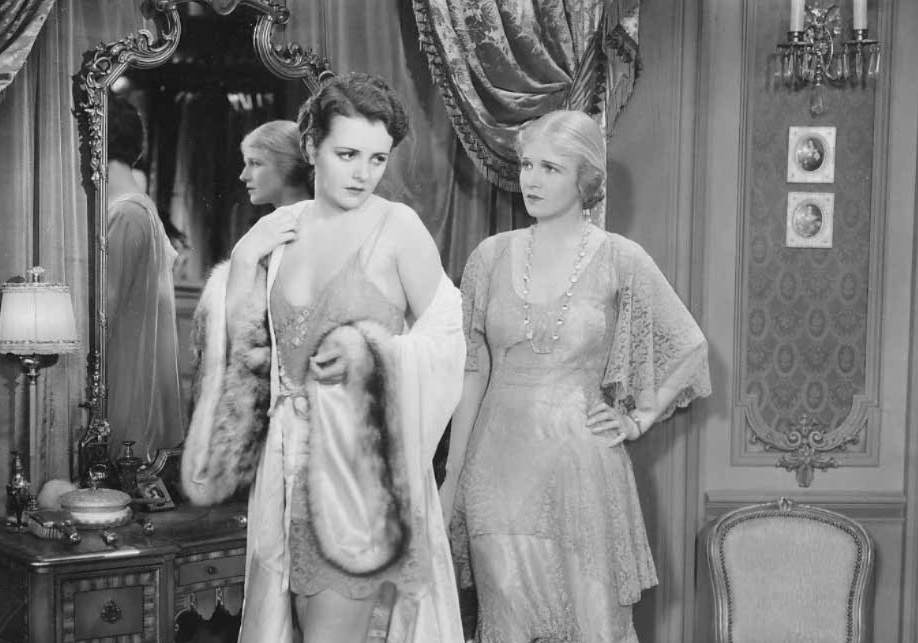
John Mosher reviewed the 1930 American Pre-Code comedy Holiday, which told the story of a young man torn between his wild lifestyle and the tradition of his wealthy fiancée’s family. Films that explored the “problems” of the rich seemed particularly popular in the Depression years…

POOR LITTLE RICH GIRLS…Mary Astor and Ann Harding in Holiday. (IMDB)

 *  *  *

From Our Advertisers

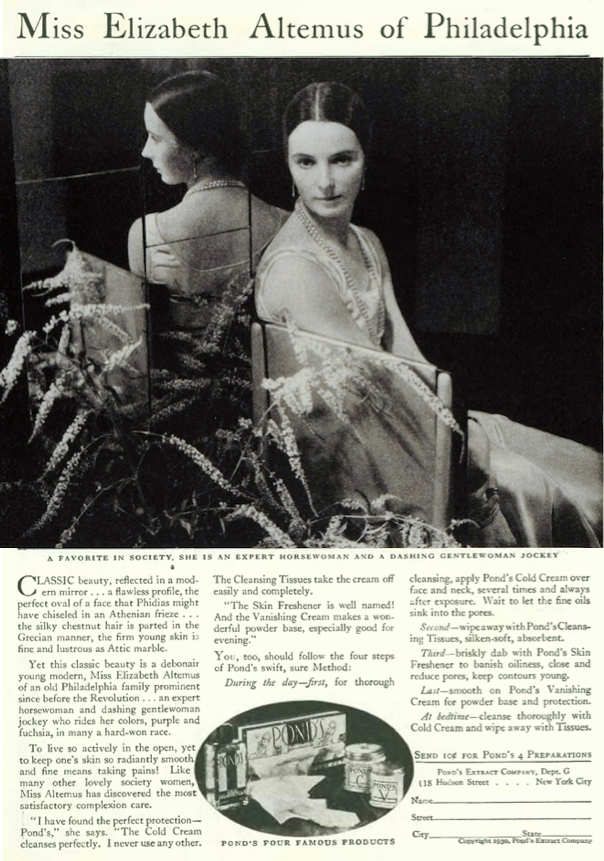
The makers of Pond’s Cold Cream continued its campaign of endorsements by society women, including Philadelphia socialite, philanthropist and champion horsewoman Elizabeth Altemus

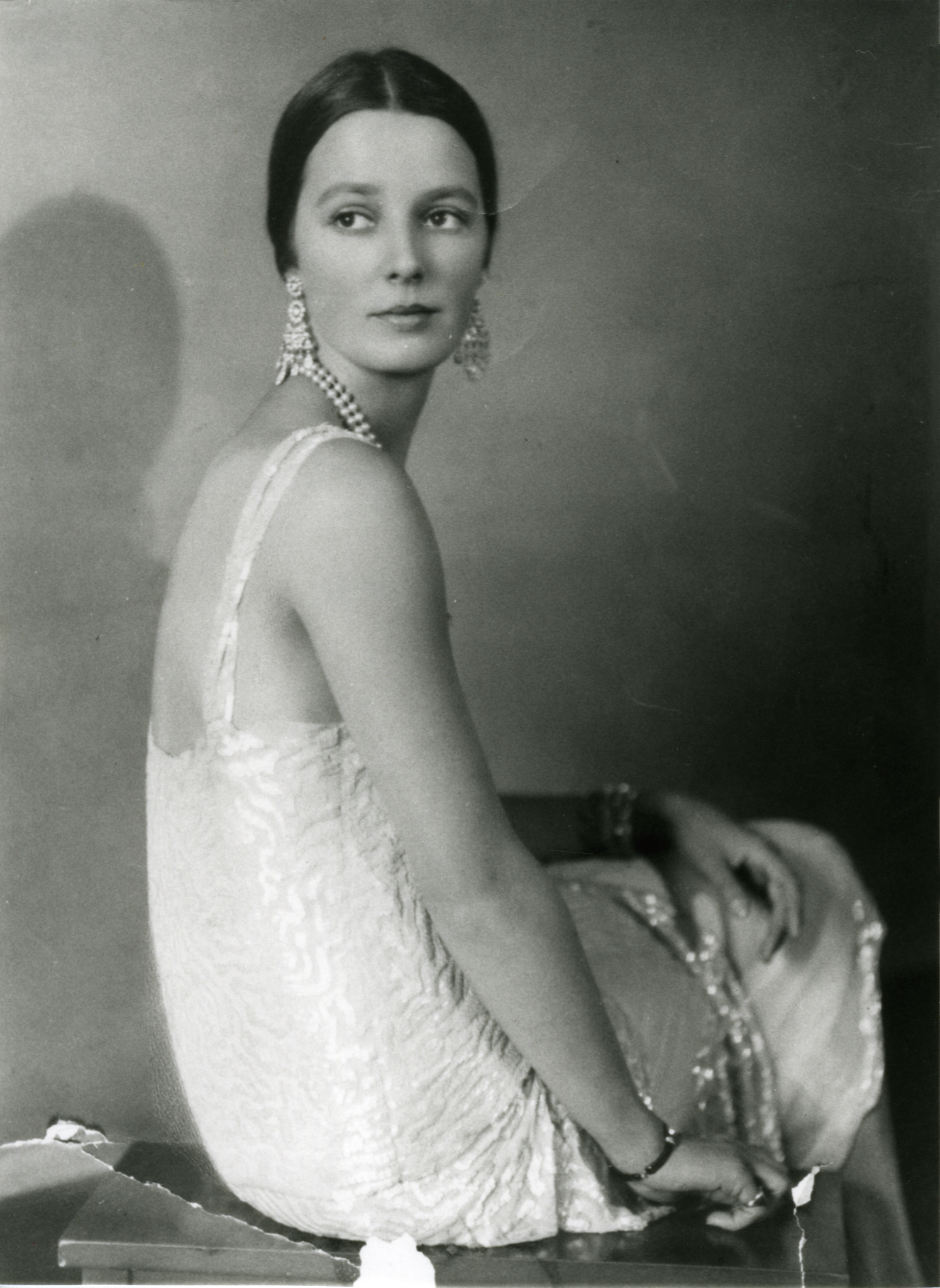
Altemus (1906-1988) was a prominent owner/breeder of Thoroughbred racehorses for more than 50 years. Her first marriage was to Jock Whitney, U.S. Ambassador to the United Kingdom, publisher of the New York Herald Tribune, and president of the Museum of Modern Art. By the looks of this 1937 portrait of Altemus, the cold cream certainly didn’t do her any harm…

Mary Elizabeth Altemus Whitney in 1937. (geni.com)

…speaking of cold cream, when Kleenex was introduced in the early 1920s, it was marketed solely as a hygienic way to remove cold cream. It wasn’t until the 1930s that the makers of Kleenex began to suggest it could also be used as a tissue in place of a handkerchief. Of course it was also a great way to dramatically expand consumption of its brand, and help usher in a new age of disposable products…

…as the Depression deepened, ads for automobiles began to change with the times, most manufacturers emphasizing the affordability of their cars over performance or prestige, as this sad little ad from Packard attested….

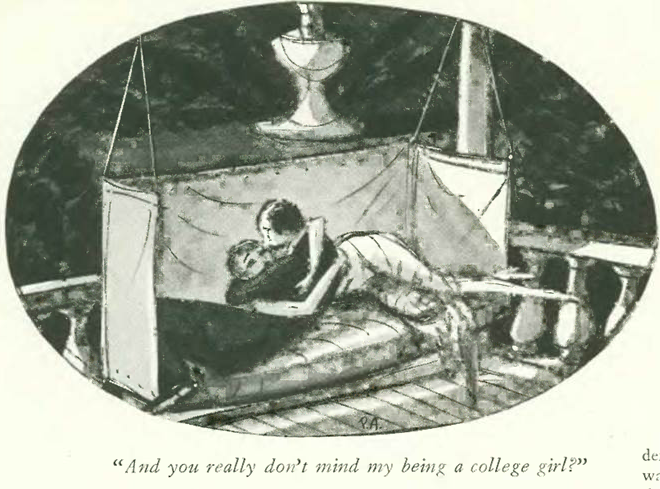
…in three consecutive issues (June 5, 12 and 19) Peter Arno featured the same drawing with a different caption that gave readers a very brief courtship story…

Alan Dunn offered a glimpse of life among the newsboys…

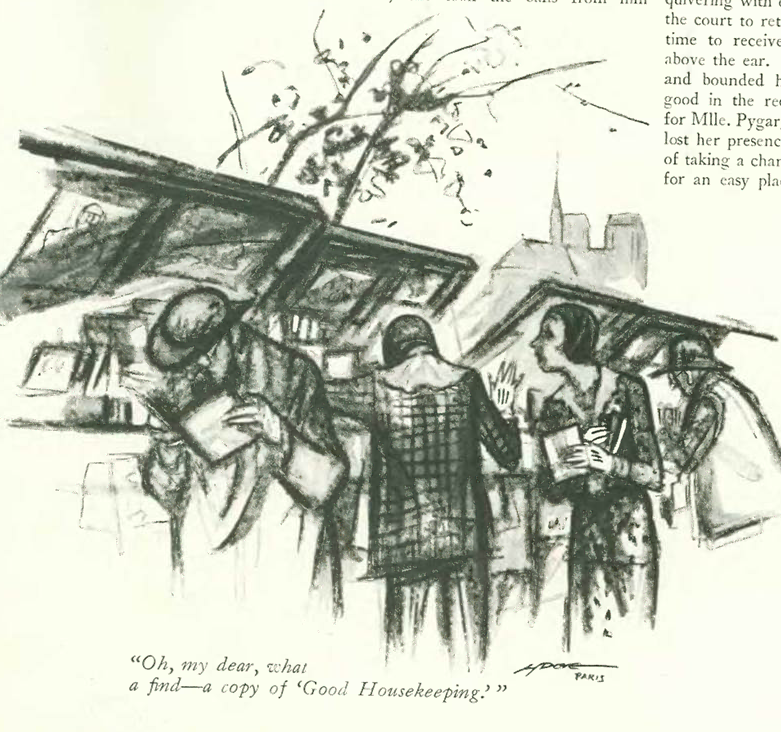
Leonard Dove found Americans browsing newsstands along the Seine…

Helen Hokinson looked in on an existential crisis…

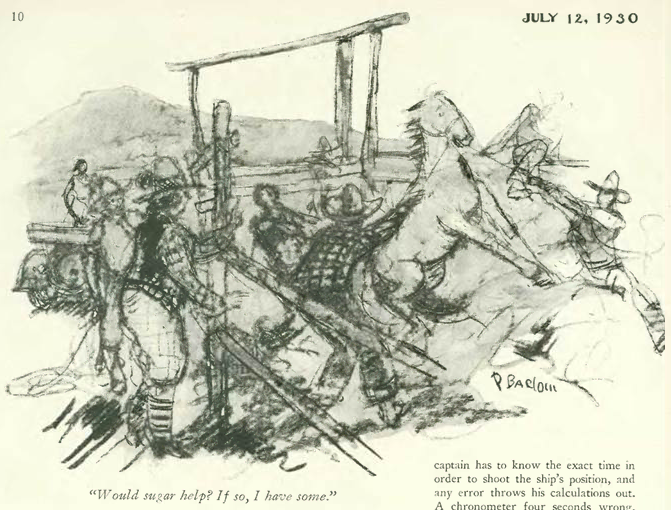
Perry Barlow was Out West at a dude ranch…

Barbara Shermund eavesdropped on a couple of debs…

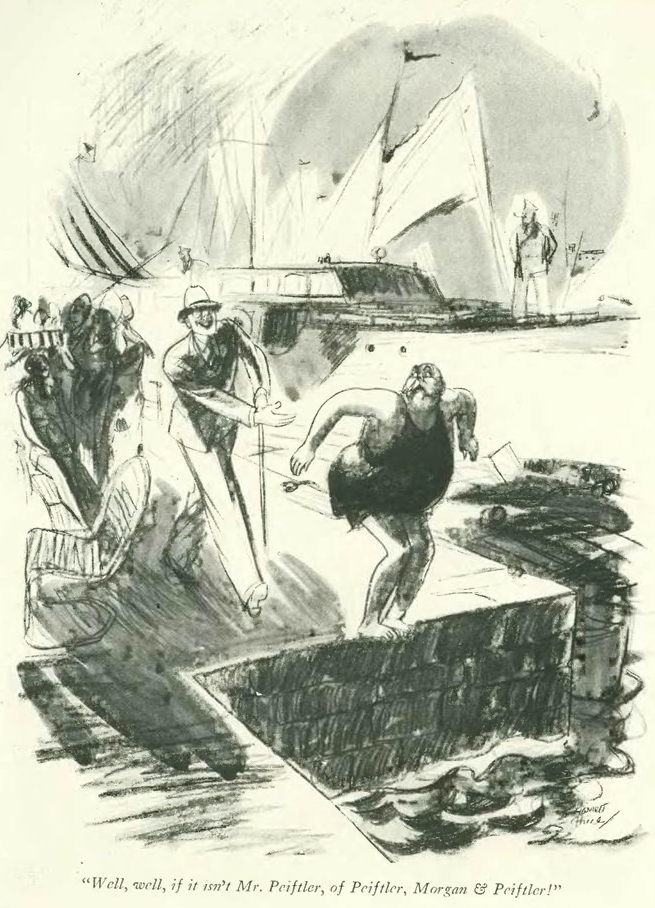
Garrett Price gave us an awkward encounter among the yachting crowd…

…and finally William Crawford Galbraith, and a case of domesticus interruptus

Next Time: Aleck & Frank at Taliesin…

Robeson’s Othello

In 1930s America there were few if any opportunities for black actors to perform in mainstream stage or screen productions unless they conformed to racial stereotypes. An exception was Paul Robeson.

June 21, 1930 cover by Gardner Rea.

In 1930 Robeson (1898-1976) won rave reviews for his performance in Shakespeare’s Othello. That performance, however, took place in London, not New York, which London correspondent Anthony Gibbs took pains to point out in his dispatch for the June 21, 1930 New Yorker.

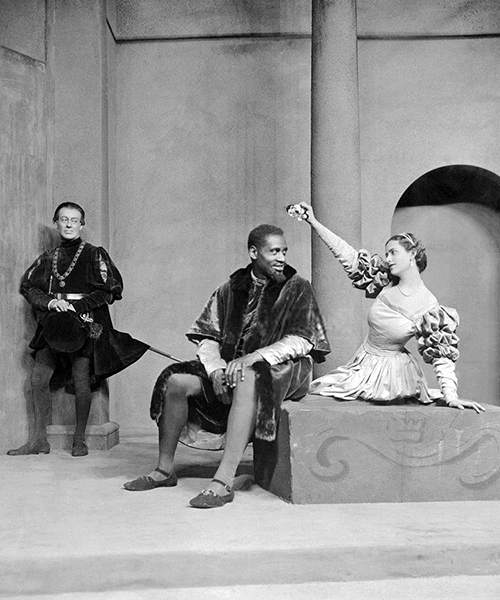
English actress Peggy Ashcroft as Desdemona and Paul Robeson as Othello in London’s Savoy Theatre production of Othello in 1930. Although only 22 at the time, Ashcroft was an established Shakespearean actress. The 32-year-old Robeson was already famous as both an athlete and actor. He was twice named a consensus All-American in football (Rutgers) and was the class valedictorian. He also received a law degree from Columbia while playing in the NFL. In 1930 he was already known to London audiences, having previously appeared in a 1928  London production of the American musical Show Boat. (theshakespeareblog.com)
CENTER STAGE…Left to right: Maurice Browne (Iago), Paul Robeson (Othello) and Peggy Ashcroft (Desdemona) in Othello at the Savoy Theatre, 1930. Maurice Browne was also the play’s producer; his over-the-top portrayal of Iago and his wife’s incompetent stage direction hurt the production, but Robeson nevertheless received high praise for his performance. (britishstageandscreen.tumblr.com)

Although the performance was a triumph for Robeson, the production itself was a mess. The play’s producer, Maurice Browne, enlisted his wife, Ellen van Volkenburg, to direct (Peggy Ashcroft later called her “a pretentious dud”). Writing in The Guardian (Sept. 3, 2003), Samantha Ellis observes: “Recognising that his Othello transcended the ropey production, the audience gave Robeson 20 curtain calls. He reprised the role all over the world and never lost his pleasure in it. For Robeson, it was more than just a part: it was, as he once said, “killing two birds with one stone. I’m acting and I’m talking for the negroes in the way only Shakespeare can.”

Robeson’s Othello would not make it to New York until 1943. It would run for almost 300 performances, setting an all-time record run for a Shakespearean play on Broadway.

 *  *  *

Restoring Order

In the aftermath of Grover Whalen’s disastrous (and sometimes violent) run as New York City Police Commissioner, E.B. White and his fellow New Yorkers welcomed the steady hand of Edward P. Mulrooney (1874-1960) to the helm:

THE COMMISH…Edward P. Mulrooney in a 1930s portrait by Edward Steichen. (Conde Nast)

 *  *  *

The Commander

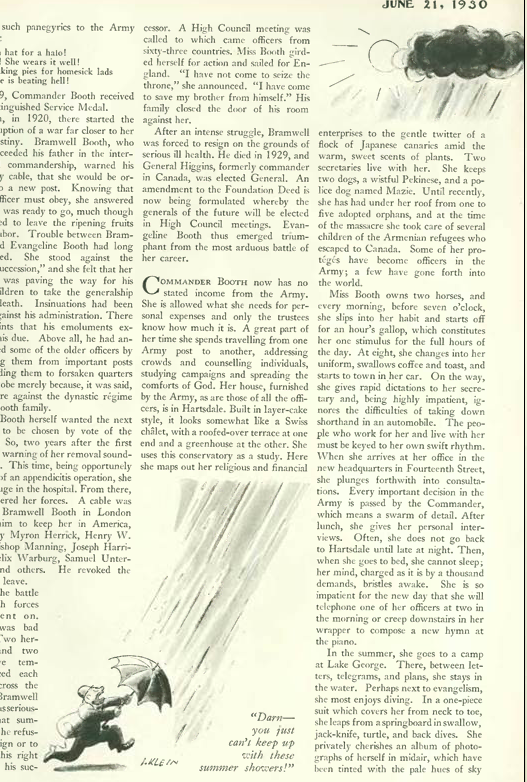
American author and lecturer Virgilia Peterson Ross profiled Evangeline Cory Booth (1865 – 1950), who would become the fourth General of the Salvation Army in 1934. She was the first woman to hold that post. An excerpt:

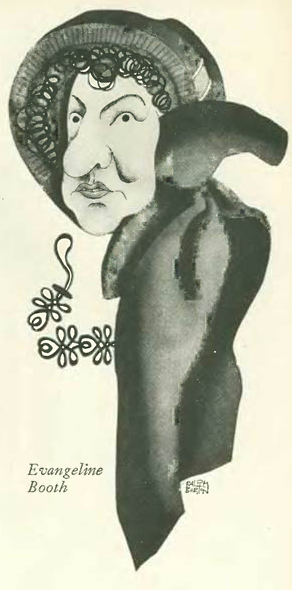
Ralph Barton returned to provide this caricature for the profile, one of the last works he would create for The New Yorker before his untimely death…

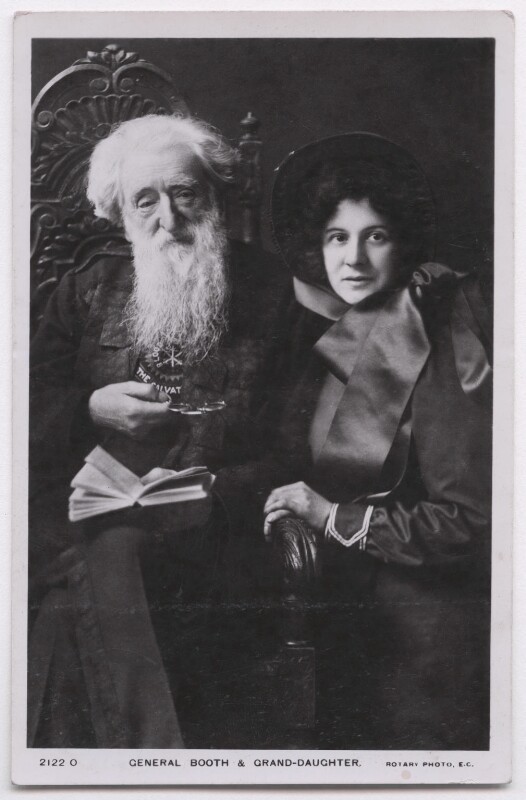
HEIRESS TO A LEGACY…William Booth, an English Methodist preacher who founded The Salvation Army and became its first General, poses with his grand-daughter Evangeline Cory Booth in this 1908 postcard image. (National Portrait Gallery)

 *  *  *

Home of the Dome

Architecture critic George “T-Square” Chappell was gladdened by the sight of scaffolding atop St. Bartholomew’s Church, which would finally get its dome to complete architect Bertram Goodhue’s vision…

NOW YOU SEE IT…Clockwise, from top left, St. Bartholomew’s Church at 325 Park Avenue, sans dome, in 1928; the church with dome in the 1950s; interior and exterior views of dome. (nyago.com/bostonvalley.com)

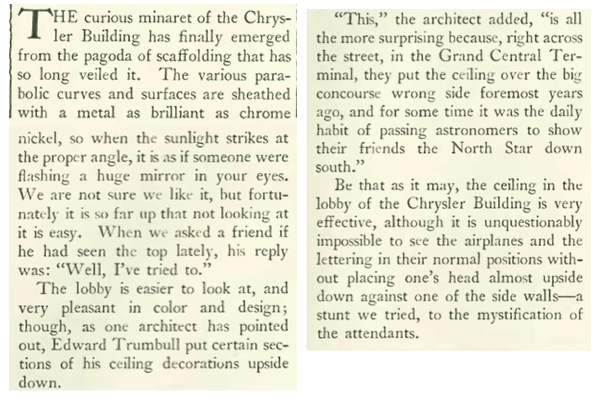
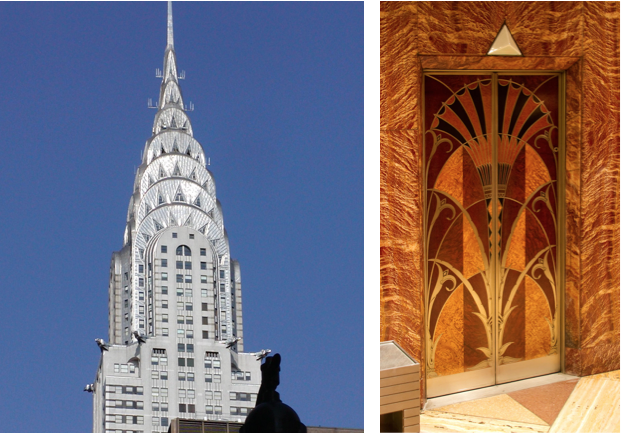
…Chappell also commented on the emergence of the Chrysler Building’s blindingly shiny dome and interior appointments…

BLINDED BY THE LIGHT…The Chrysler Building’s gleaming spire emerged in all its glory in June 1930. At right, an elevator in the building’s lobby. (Wikipedia)

 *  *  *

Below the Belt

It wasn’t Dempsey-Tunney, but the bout between Max Schmeling (1905-2005) and Jack Sharkey (1902-1994) was the next best thing for boxing fans. The World Heavyweight Championship had been vacant since Gene Tunney’s retirement in 1928, and Sharkey and Schmeling had emerged as the sport’s No. 1 and 2 contenders.

The bout ended in a controversial decision: Although Sharkey won the first three rounds, he was disqualified after he landed a punch below the belt late in the fourth round. Schmeling became the first boxer to win the World Heavyweight Championship on a foul. The New Yorker’s Niven Busch Jr. (with illustration by Johan Bull) offered these thoughts on the fight’s disappointing outcome:

LOW BLOW…Although Jack Sharkey (far right) led after three rounds, a low blow in the fourth delivered the World Heavyweight Championship to German boxer Max Schmeling (left). Sharkey would claim the title two years later in a rematch with Schmeling. Although boxing isn’t the healthiest pursuit, both men lived into their 90s; Schmeling died in 2005 just shy of his 100th birthday. (Wikipedia/boxrec.com/thefightcity.com)

 *  *  *

One Of Ours

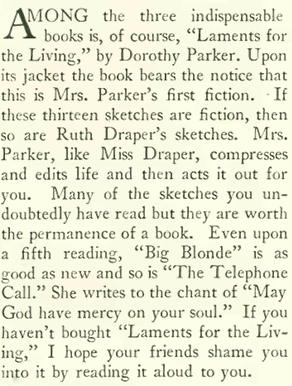
The New Yorker included this brief review of a collection of short fiction pieces by Dorothy Parker, herself a literary critic of some renown at the magazine…

DOROTHY’S LAMENTATIONS…The New Yorker’s Dorothy Parker published this collection of short fiction in 1930.

…and on to our advertisers, this ad appeared on the opposite page of the review…

…speaking of ads, the makers of Marlboro cigarettes continued to sponsor gimmicky penmanship and writing contests to promote their deadly product…

…while promoters of the Empire State Building (still under construction) continued to draw on the historical significance of the building’s Midtown location…

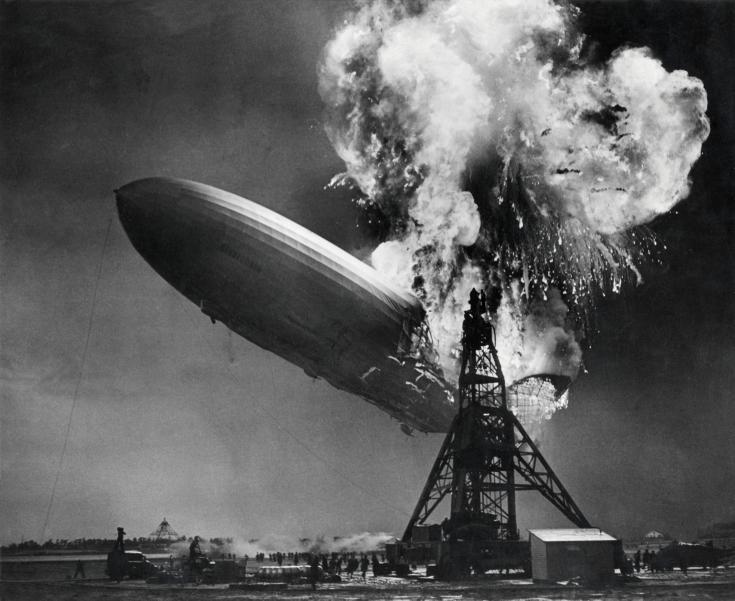
…on to our cartoons, Garrett Price pondered the very real challenge of guiding a massive Zeppelin to the planned mooring mast atop the Empire State…

…a portent of what would happen to the Hindenburg just seven years later…

The New Yorker’s typesetter Popsy Whitaker made clever use of his columns for this Isadore Klein entry…

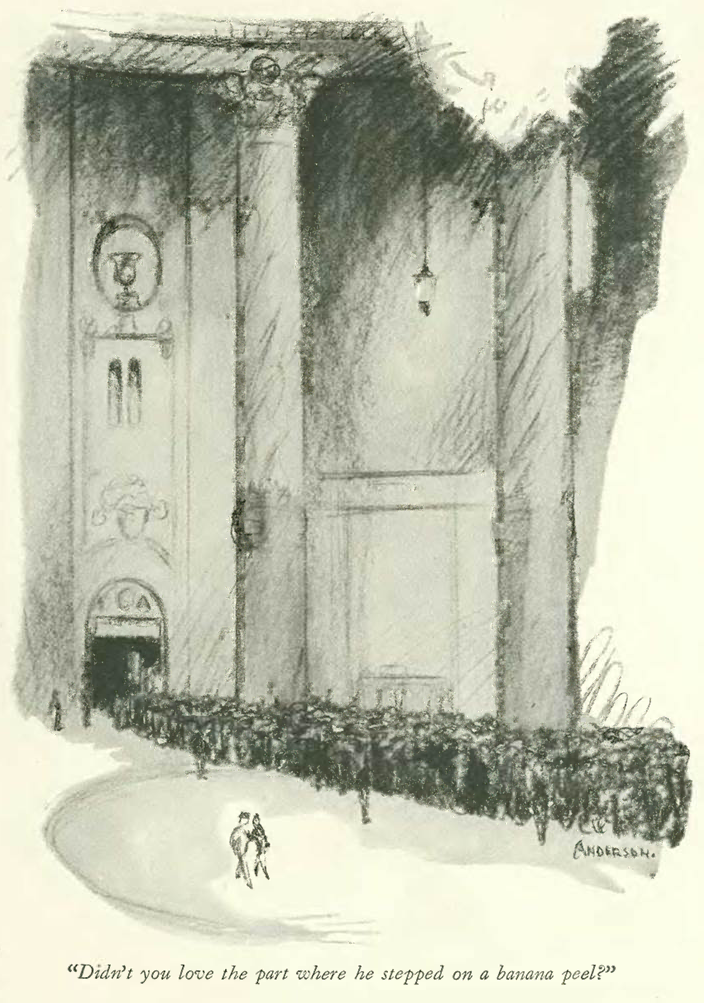
John Murray Anderson found humor in contrasting the grand with the mundane…

Carl Kindl eavesdropped on the small talk of a couple of ash haulers…

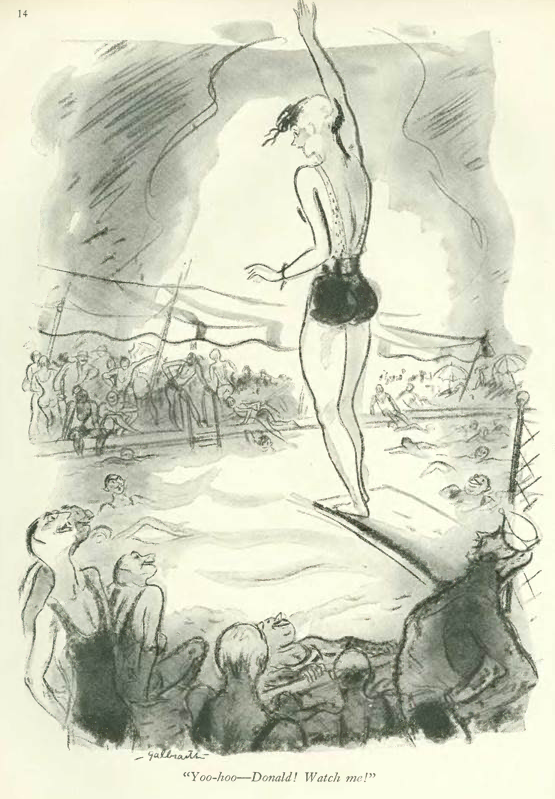
…and William Crawford Galbraith found humor at the public pool…

 *  *  *

On to the June 28 issue, with a cover featuring a satirical kakemono-style illustration by Rea Irvin, who was fond of Japanese scroll art…

June 28, 1930 cover by Rea Irvin.

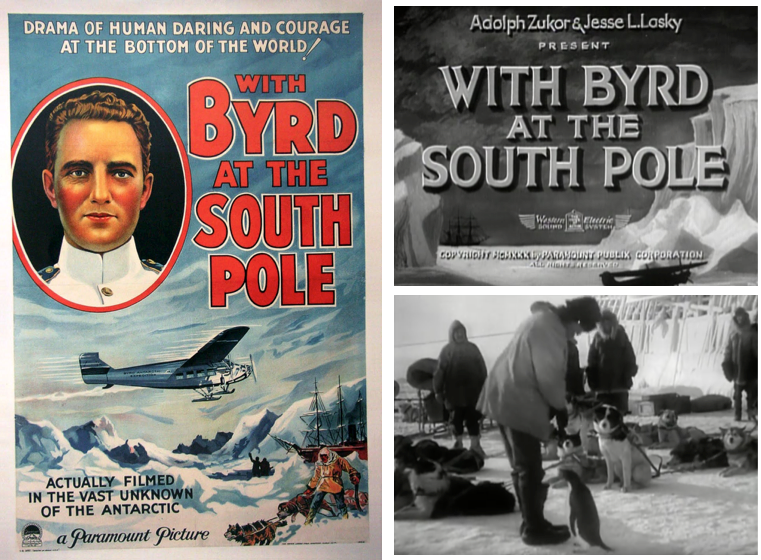
Film critic John Mosher checked out the new documentary on Admiral Richard Byrd’s expedition to the South Pole…

A BYRD WITH WINGS…A Paramount Pictures movie poster promoting the 1930 documentary With Byrd at the South Pole; still images from the film at right. (Wikipedia/YouTube)

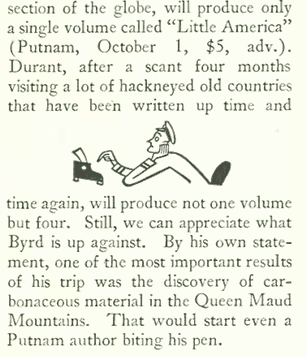
“The Talk of the Town” also made note of Byrd’s expedition and homecoming, contrasting his upcoming book, Little America, with the four-volume historical work planned by popular historian Will Durant.

In collaboration with his wife, Ariel, Durant would end up publishing an eleven-volume history of civilization (four million words across nearly 10,000 pages), written between 1935 and 1975. Will Durant was at work on a twelfth volume when he died in 1981 at age 96.

Admiral Richard Byrd’s Little America, left, and the 11-volume The Story of Civilization, by Will and Ariel Durant.

 *  *  *

American Lenin

The June 28 profile, written by Alva Johnston, featured radical American labor organizer and Marxist politician William Z. Foster. Despite Johnston’s portrayal of Foster as something of a genial pinko, in reality Foster was a strong supporter of Joseph Stalin and a dedicated and loyal ally of the Soviet Union’s Communist Party until his death in 1961. The Soviets even gave him a state funeral, with Nikita Khrushchev personally heading an honor guard in Red Square. An excerpt of Johnston’s profile:

RED AS A ROSE…Left, a campaign photo of William Z. Foster when he headed the Communist Party ticket in the 1928 U.S. presidential election; at right, illustration of Foster for the profile, by Abe Birnbaum.

 *  *  *

And to close…a colorful advertisement in the June 28 issue from Rex Cole…from the signature it appears to be the work of Mario Cooper, but this doesn’t look at all like his other work…

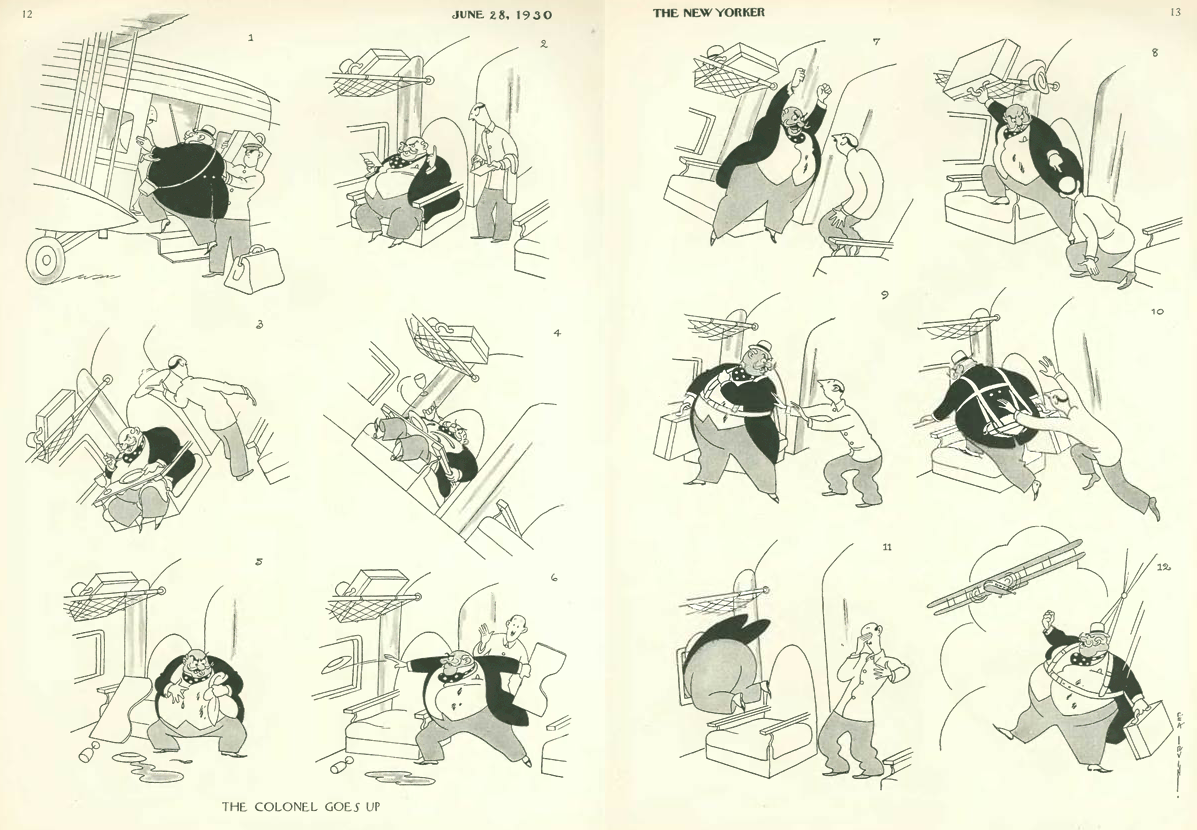
…and a two-page Rea Irvin cartoon, which demonstrates his visual storytelling skills…

Next Time…Happy Fourth!


Red Alert

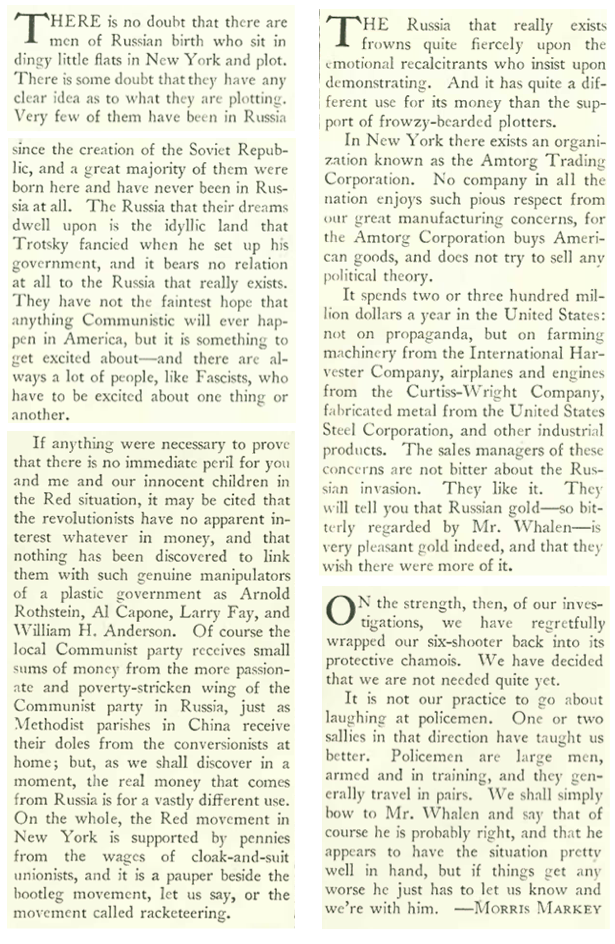
The New Yorker had a number of favorite punching bags, among them Grover Whalen (1886–1962), a product of Tammany Hall politics who in 1928 was appointed New York City Police Commissioner by another Tammany alumnus, Mayor Jimmy Walker.

May 17, 1930 cover by Rea Irvin.

Ironically, a mayor known for openly flouting prohibition laws had placed into office a man who would become known as a ruthless enforcer of those laws (excepting Mayor Walker, of course). Whalen was also known for fighting crimes that didn’t necessarily exist, including those committed by “Reds” organizing protests by the city’s growing numbers of unemployed.

In the May 10, 1930 issue, New Yorker writer Alva Johnston penned a tongue-in-cheek assessment of America’s “Red Revolution” (see previous post). In the following issue (May 17), Morris Markey took a few swipes at Whalen’s “Crimson Menace” in his “A Reporter At Large” column:

FLYING HIGH…Mayor Jimmy Walker (second from left) and his new Police Commissioner Grover Whalen (far right) visit Mitchell Field on Long Island in 1928; portrait of Whalen circa 1930. (Amazon/WNYC)

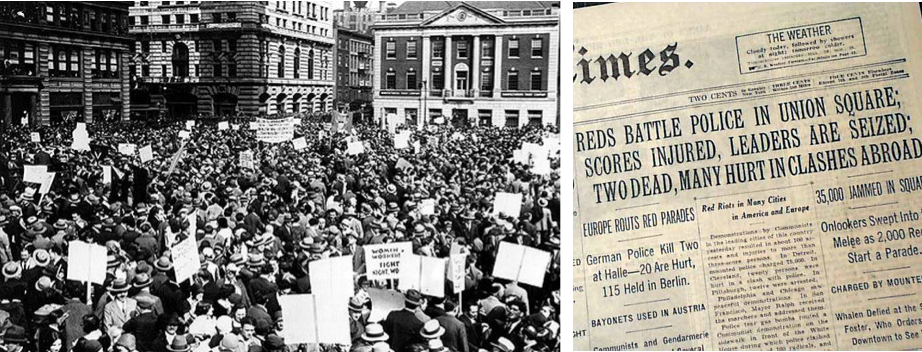
Whalen’s career as police commissioner came to an end around the time Markey’s column appeared. Whalen was under fire for how his police responded to an International Unemployment Day demonstration, where 1,000 baton-wielding police went to work on a crowd of more than 35,000 demonstrators. The New York Times reported: “From all parts of the scene of battle came the screams of women and cries of men with bloody heads and faces.”

IDLE HANDS…The International Unemployment Day demonstration in Union Square on March 6, 1930, turned ugly when a thousand baton-wielding police went to work on the protestors, identified by the New York Times as “Reds.” (libcom.org/The New York Times)

And in the May 24 issue, E.B. White took his own swipe at Whalen in his “Notes and Comment”…

In ensuing years Whalen found more peaceful pursuits, serving as New York City’s official greeter of dignitaries and organizer of ticker tape parades. In 1935 he was named president of the New York World Fair Corporation and became the face of the forward-looking 1939 New York World’s Fair.

DAWN OF A NEW DAY was the opening slogan for the 1939 World’s Fair. At left, preparing to lower the fair’s time capsule into it’s 5,000-year resting place are A.W. Robertson, Westinghouse Electric Company’s chairman of the board (left) and Grover Whalen, president of the New York World’s Fair; at right, the fair’s iconic symbols, the Trylon and Perisphere. (heinzhistorycenter.org/Flickr-Ricksoloway)

 *  *  *

It’s In The Stars

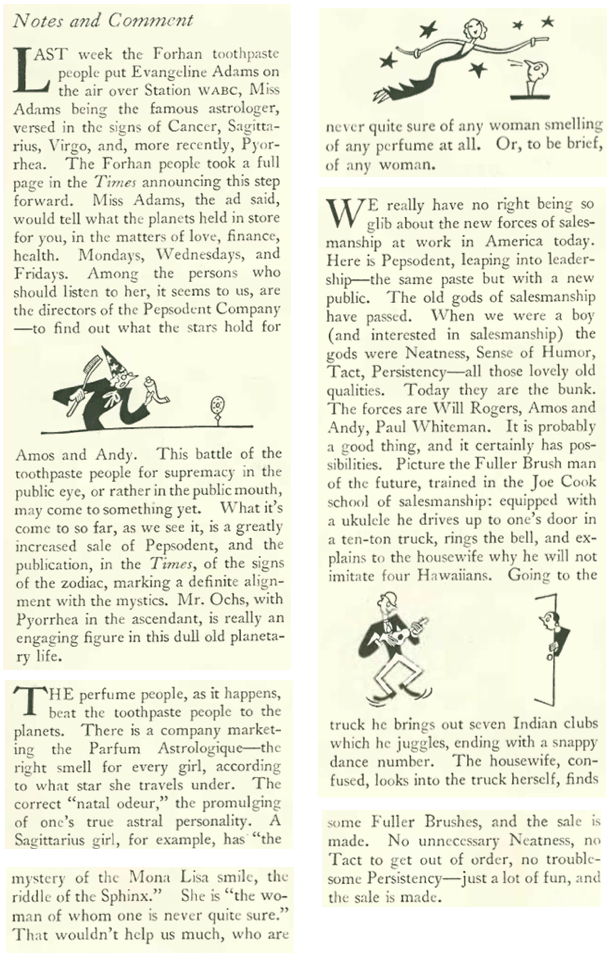
E.B. White led off his “Notes and Comment” with thoughts on the latest trends in product endorsement, including the use of astrology to boost the sales of toothpaste and perfume:

A FORTUNE IN TOOTHPASTE…The makers of Forhan’s Toothpaste promoted their Astrology Hour radio show in the Akron Beacon Journal, May 1931. At right, 1931 ad for Perfum Astrologique. (newspapers.com)
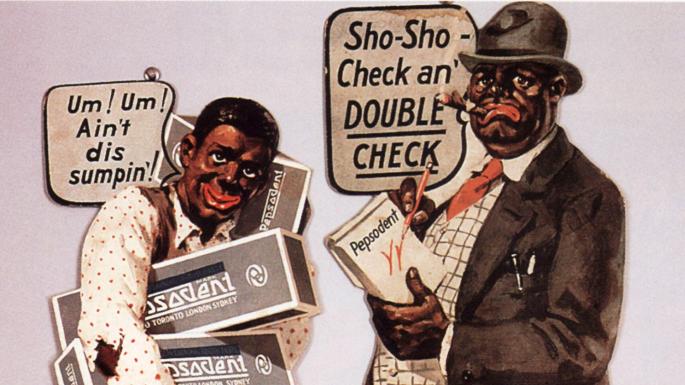
THAT WAS THEN…White actors Freeman Gosden and Charles Correll portrayed Amos ’n’ Andy on the radio from 1928 to 1960. Here they shill for Pepsodent toothpaste on circa 1930 stand-up cards. (thetimes.co.uk)

 *  *  *

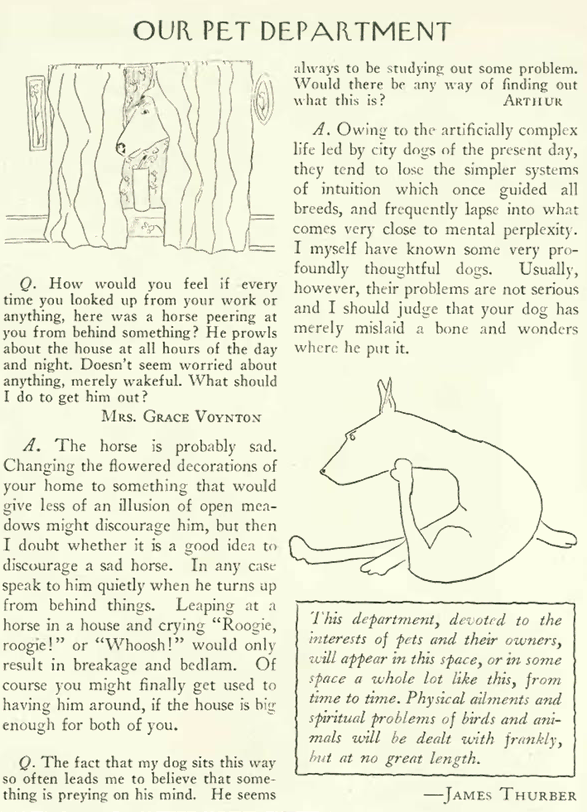
More Advice on Troublesome Pets

The May 17 issue featured James Thurber’s latest advice on pet care:

…and this two-page illustration by Reginald Marsh ran along the bottom of “Talk.”

 *  *  *

A Fighter for Rights

The May 17 issue featured the first installment of a two-part profile on social reformer Samuel Untermyer (1858-1940) titled “Little Giant.” The profile’s author, Alva Johnston, praised Untermyer’s legacy, and chided New Yorkers for not giving him his proper due. Known for defending the public trust against powerful corporations, he laid the groundwork in the U.S. for the Federal Reserve Law, the Clayton Anti-Trust Law, the Federal Trade Commission Bill and the Securities and Exchange Act. A fierce defender of Jewish rights, Untermyer served as attorney for Herman Bernstein, who filed suit against automaker Henry Ford for anti-semitic articles published in Ford’s Dearborn Independent. 

Johnston concluded his two-part profile with these words:

BRING IT ON…Samuel Untermyer was known as a fierce defender of the public trust. At right, illustration that accompanied the New Yorker profile. (findagrave.com)

 *  *  *

From Our Advertisers

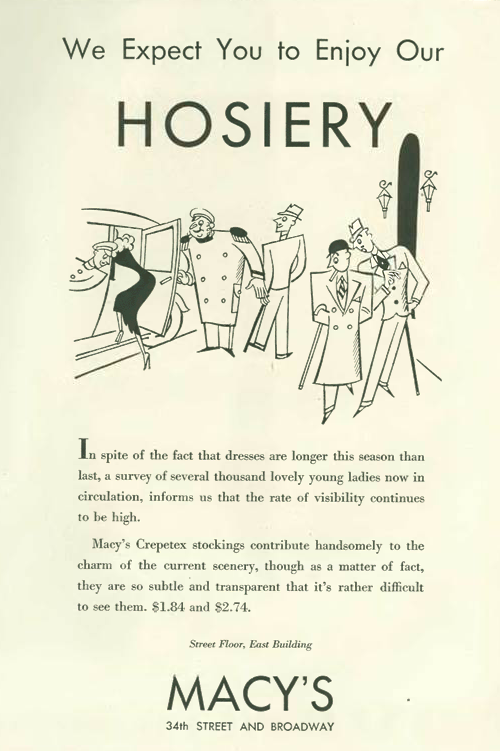
Julian De Miskey picked up some extra work with this illustration for Macy’s…

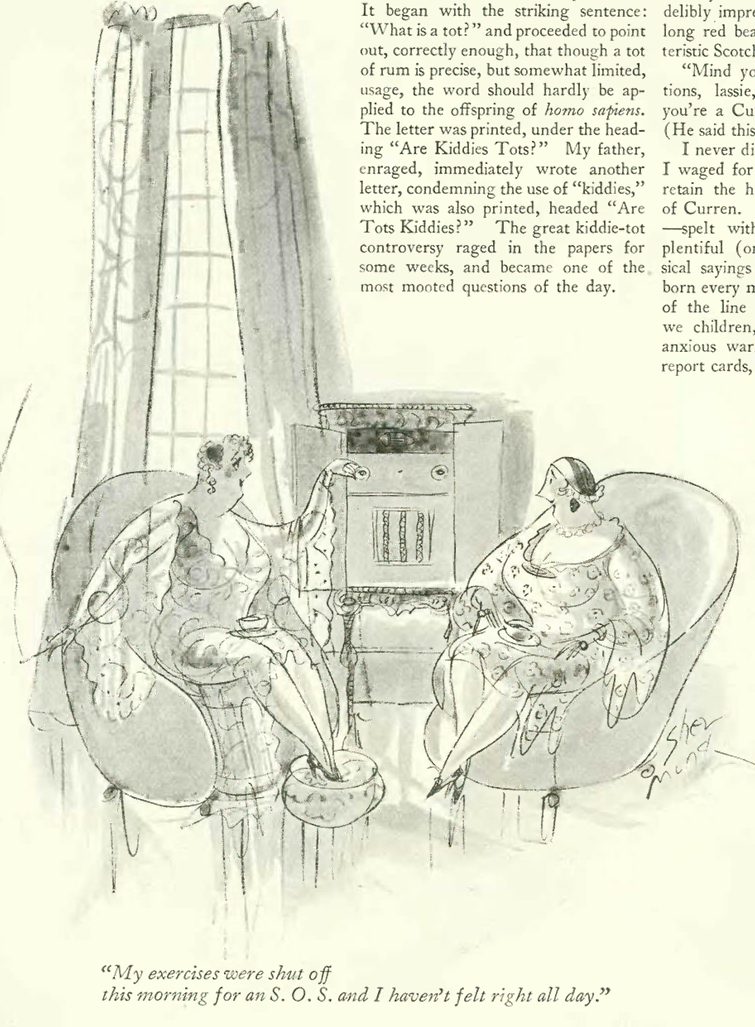
…while in cartoons, Barbara Shermund discovered the challenges of exercise by radio…

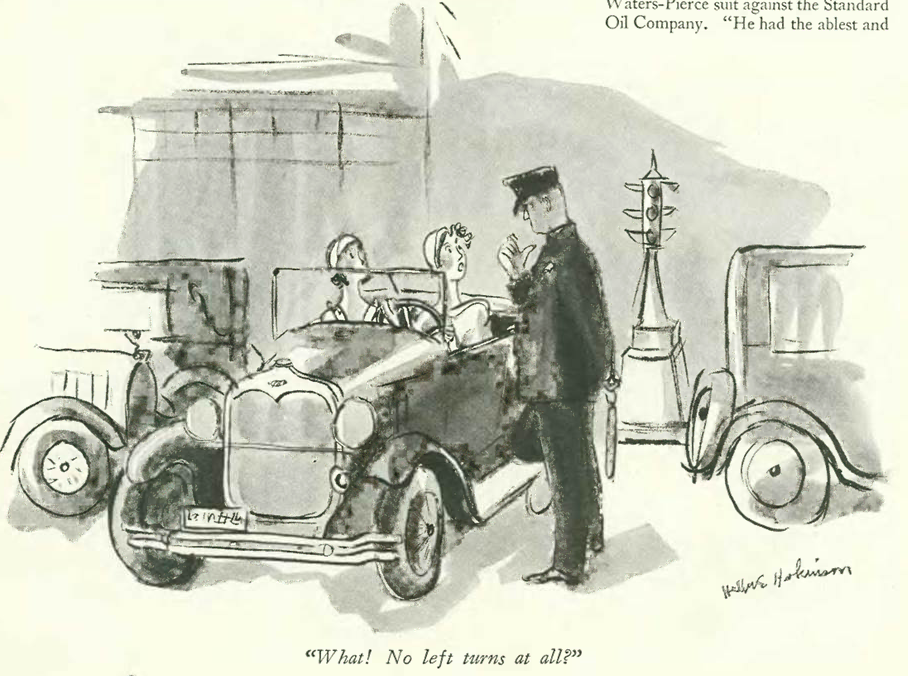
Helen Hokinson looked at another challenge…city driving…

Gardner Rea explored the mysteries of street food…

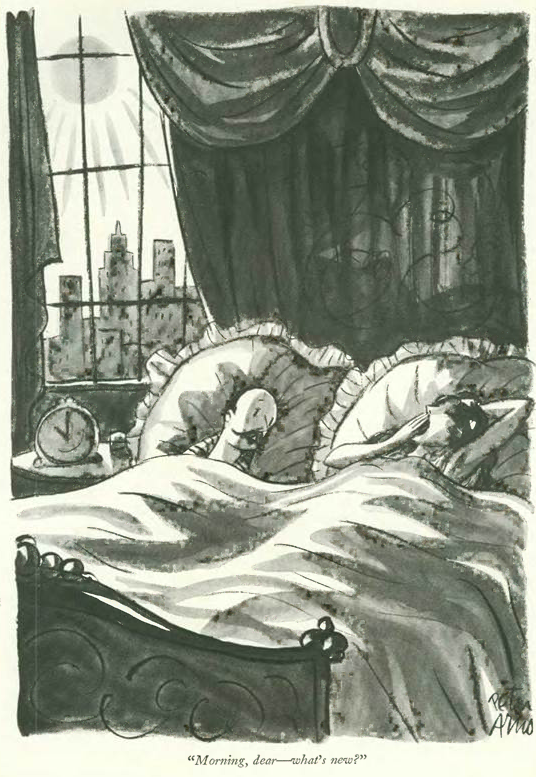
…and Peter Arno greeted one Manhattan couple at sunrise…

 *  *  *

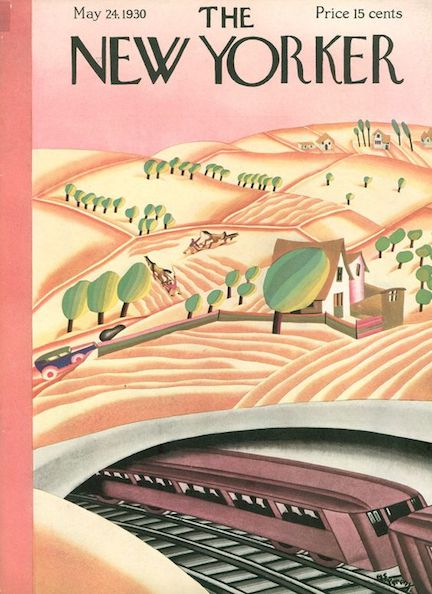
On to the May 24, 1930 issue, with a lovely cover by Madeline Pereny…

May 24, 1930 cover by Madeline Pereny.

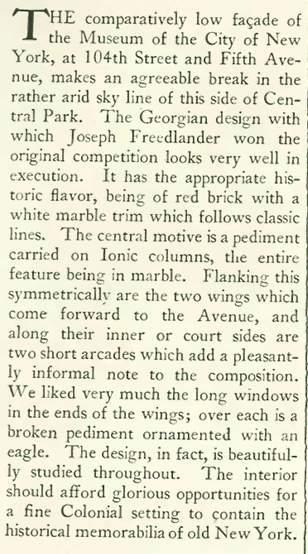
As construction continued on the Museum of the City of New York, The New Yorker’s architecture critic George Chappell liked what was taking shape:

THE STORY OF A CITY…The Museum of the City of New York opened its doors at 104th Street and Fifth Avenue in early 1932. (nyctourist.com/www.ennead.com)

 *  *  *

From Our Advertisers

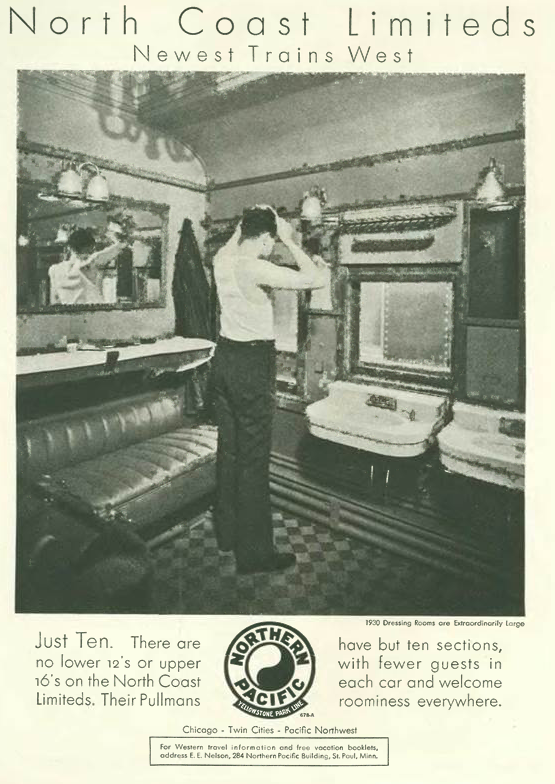
Travel by train in the States wasn’t always miserable as this ad attested…

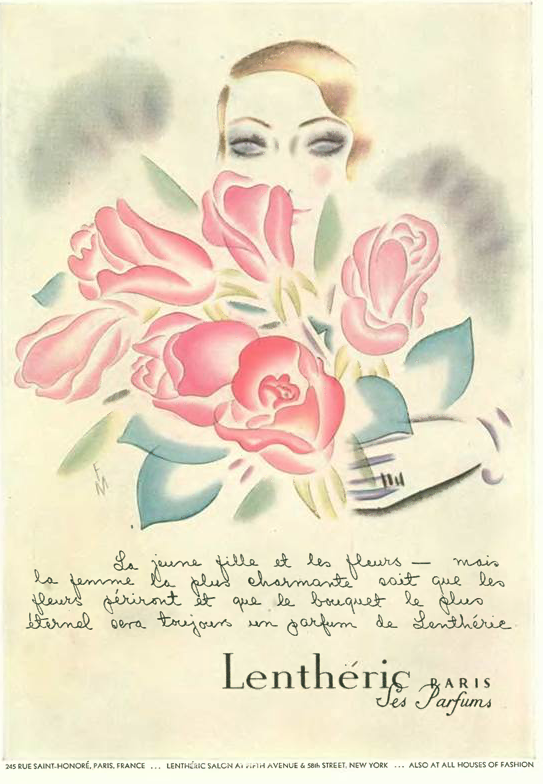
…a bit of color courtesy the Lenthéric salon…

Fontaine Fox, best known for his long-running Toonerville Folks comics, contributed this cartoon on behalf of Talon Slide Fasteners, or “zippers” as they came to be known in the late 1920s and early 30s, when they were still something of a novelty…

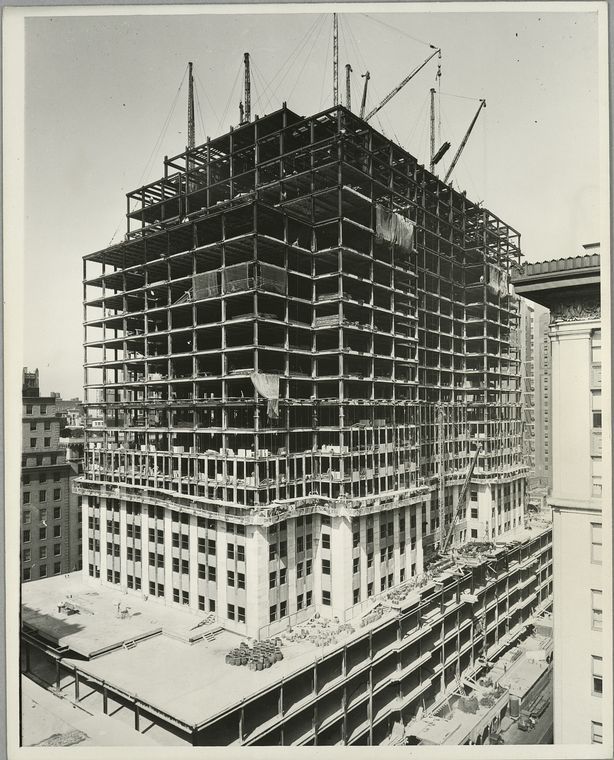
…I believe this is the first-ever image of the Empire State Building in The New Yorker, an artist’s rendering since the building wouldn’t be completed until the spring of 1931…note how this ad links the building’s site location to New York history and specifically the Astor family…

…here is how the Empire State Building looked in June 1930…

(New York Public Library)

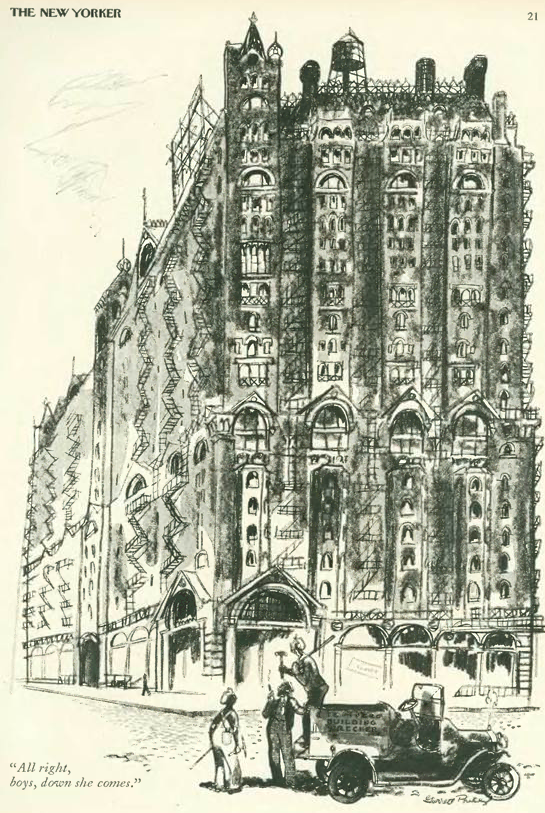
…the old Waldorf-Astoria Hotel was torn down to make way for the Empire State Building, and that provides a nice segue to our cartoons…this one by Garrett Price featured a modest work crew contemplating the razing of a building that recalled the old hotel…

…across the pond, one of Helen Hokinson’s ladies was busy trying to procure a banned book…

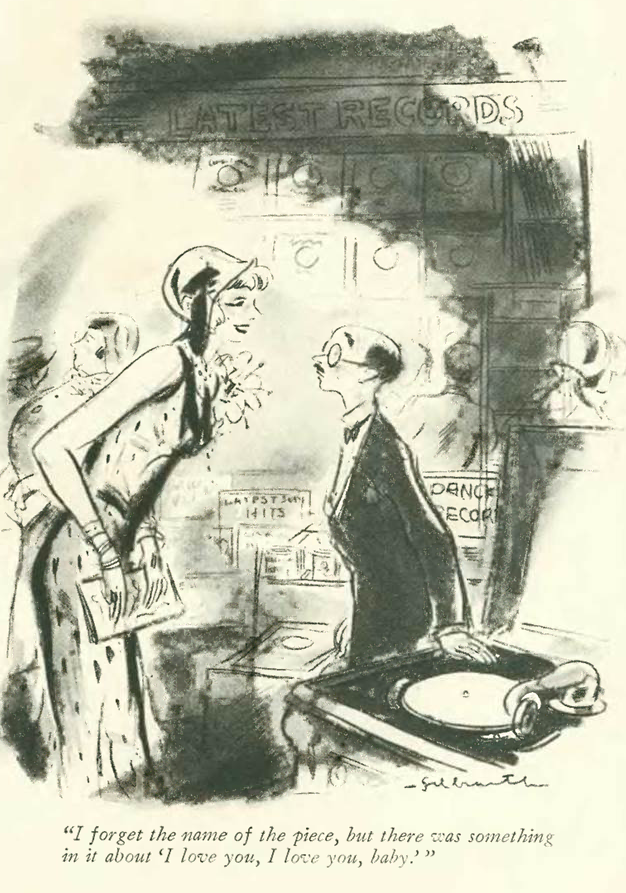
…while William Crawford Galbraith gave us a young woman in search of a love song (with the help of a seriously timid man)…

Barbara Shermund found some bedside humor…

…and Peter Arno took us back to the nightlife, with our familiar gold-digger and sugar daddy…

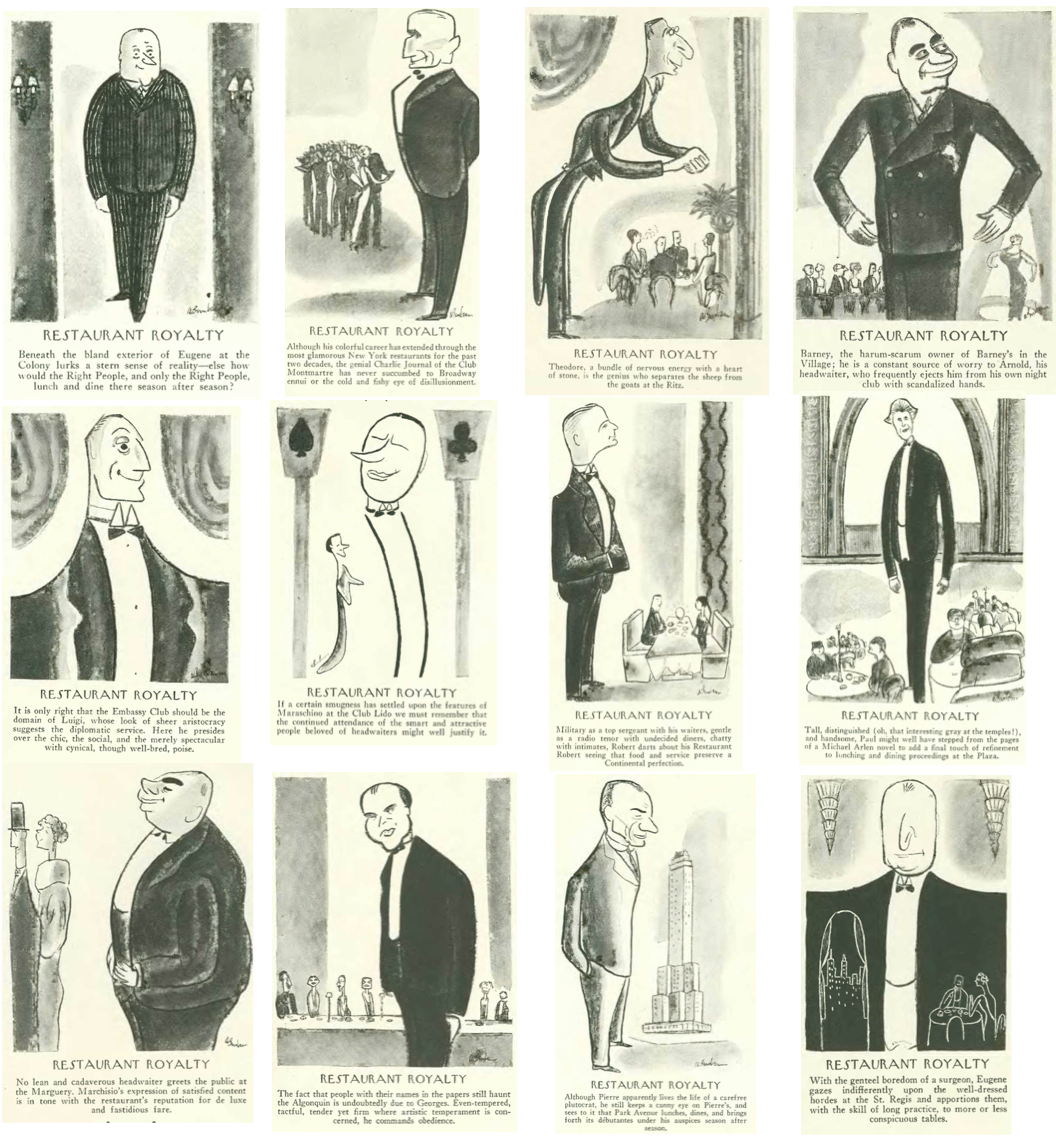
…and finally, over the course of twelve issues (Feb. 8 to May 10, 1930) Abe Birnbaum provided illustrations of New York’s “Restaurant Royalty.” These usually ran in or near “The Talk of the Town” section. Please click to enlarge.

Next Time: The Little King…


Hot Jazz in Stone and Steel

With the Chrysler Building nearing completion and the Empire State Building beginning to rise from the old Waldorf-Astoria site, the New York City skyline was taking on the iconic form most of us now associate with the city.

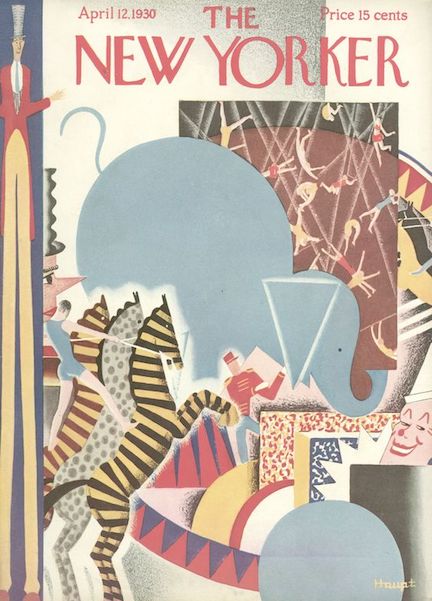
April 12, 1930 cover by Theodore Haupt.

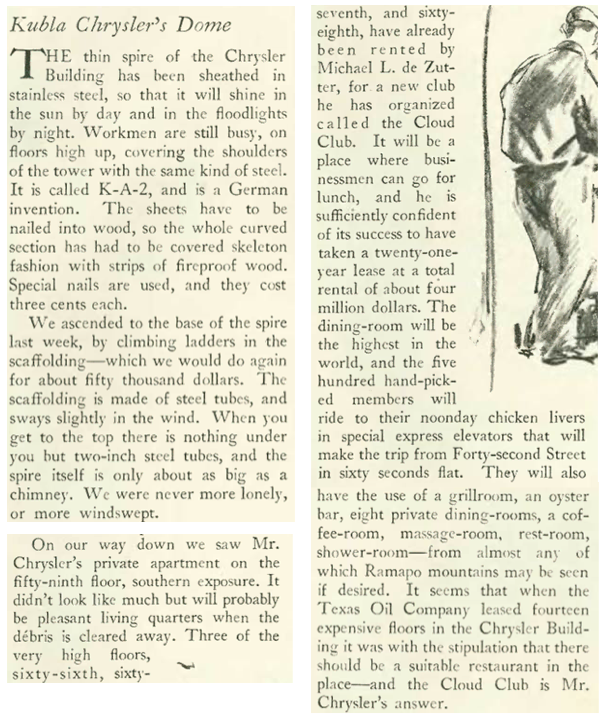
Dubbed “hot jazz in stone and steel” by modernist architect Le Corbusier, the Chrysler Building’s gleaming spire beckoned The New Yorker’s E.B. White and real estate journalist David G. Bareuther (New York Sun) to its summit for a closer look…

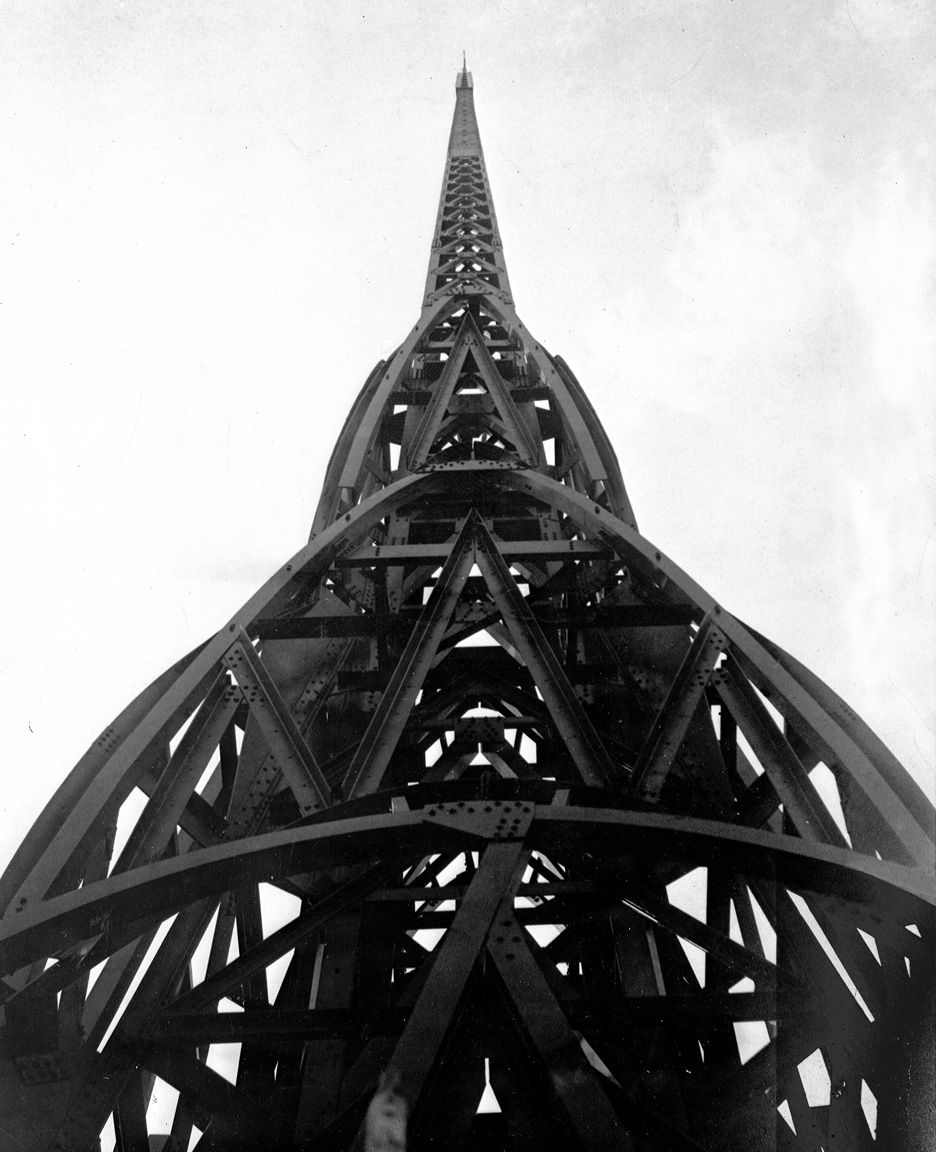
BARE BONES…The spire in place atop the Chrysler building, the dome awaiting its metal skin. (skyscraper.org)
WHAT LIES BENEATH…The stainless steel spire still gleams atop the Chrysler Building; beneath the spire, a maze of scaffolding — navigated by E.B. White and David G. Bareuther for their “Talk of the Town” piece, supports the upper portions of the building’s dome. (yahoo.com/nygeschichte.blogspot.com)
THE HIGH LIFE…The Chrysler Building’s exclusive Cloud Club was located on the 66th, 67th, and 68th floors. At one time it was the highest lunch club in the world. It closed in 1979. (decopix.com)

If you want to get a sense of what E.B. White and David Bareuther experienced during their climb through the Chrysler’s dome, take a look at this video featuring American radio personality “Opie” (Gregg Hughes) and Hidden Cities author Moses Gates…

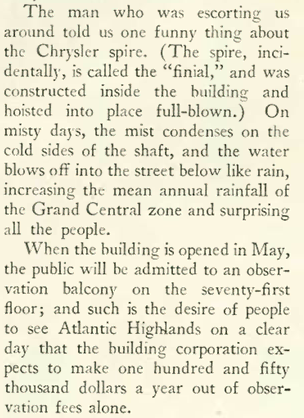
The article also noted that an “observation balcony” would be available for visitors to the 71st floor (actually an enclosed room inside the dome), but I’m sure the expectations for revenue fell quite short, given the competition it would soon receive from the much larger, higher, open air observation deck of the Empire State Building…

REACHING FOR THE STARS…When the Chrysler Building officially opened in 1931, visitors could go up to the 71st-floor observatory (in the dome) and view the city through its triangular windows. The observatory closed in 1945. (nygeschichte.blogspot.com)

…a bit of a digression, but I couldn’t help but notice the observatory’s resemblance to this set from the 1920 silent film The Cabinet of Dr. Caligari

(silent-volume.blogspot.com)

…and here is a terrific graphic from Popular Science (August 1930) demonstrating how the spire, which was assembled inside the dome, was raised into its final position…

…and finally, some great archival footage documenting the achievement…

 *  *  *

Tragic Theater

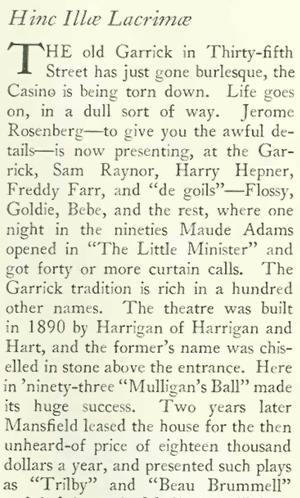
We continue our forays into the built environment of 1930 New York by looking at what was lost, including two beloved Broadway theaters. “The Talk of the Town” lamented the decline of the Garrick…

FINAL CURTAIN…Built in 1890 and originally named Harrigan’s Theatre, The Garrick closed as a playhouse in 1929. After a short run of burlesque, the building was demolished in 1932.

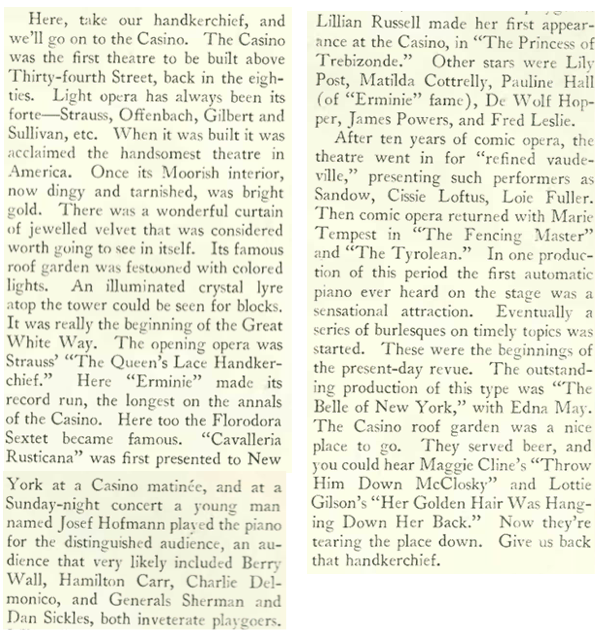
…and the Casino…

You can read more about the Casino at one of my favorite blogs, Daytonian in Manhattan.

HEYDAY…Clockwise, from top left, circa 1910 postcard image of The Casino Theatre at Broadway & 39th; an audience on the Casino’s roof garden glimpses the performance below; interior of the Casino; the British musical comedy Floradora would become one of Broadway’s greatest hits — the New York production opened in 1900 and ran for 552 performances. (Museum of the City of New York )

*  *  *

From Jazz to Gothic

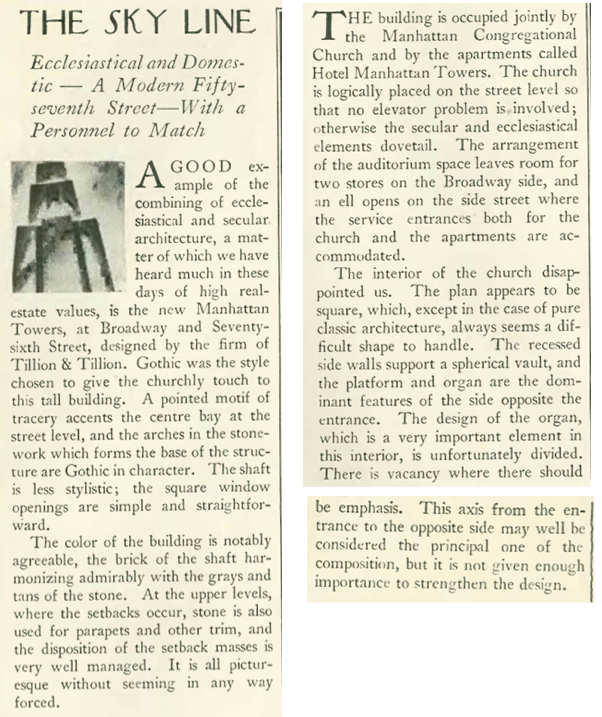
We return our gaze to the skies with three more new buildings reviewed by architecture critic George S. Chappell in his “Sky Line” column. He began with the Manhattan Towers Hotel, which thanks to the Depression would soon fall on hard times, going into foreclosure by October of 1931 and becoming a favorite gangster hideout (read more about the hotel at Daytonian in Manhattan)…

GOD AND MAMMON…Clockwise, from top left, the Manhattan Congregational Church in 1927. The church was torn down in 1928 and replaced by the Manhattan Towers Hotel at Broadway and 76th; the completed hotel, designed to wrap around the three-story Jones Speedometer Building, seen in the lower right of the photo; the first five floors of the building were dedicated to church use; after falling into disrepair, in 1980-83 the 626-room hotel was converted into 113 cooperative apartments. Note that the Speedometer Building still stands, sadly shorn of its ornamentation. (New York Public Library/Daytonian in Manhattan)

…Chappell also found much to admire in the new Fuller and Squibb buildings…

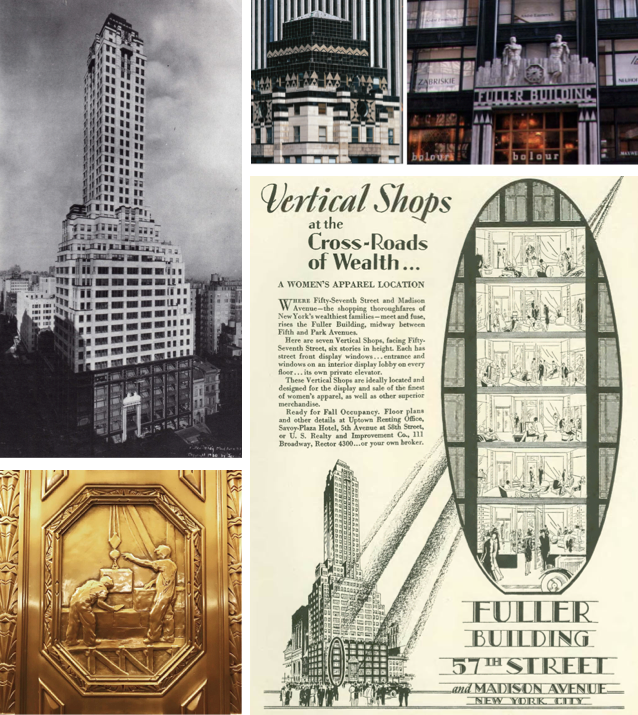
FULLER HOUSE…Clockwise, from top left, the 1929 Fuller Building was the third home of the George A. Fuller Company (its second home was the 1903 Flatiron Building); detailed views of the building’s tiled pinnacle and unique glass display windows that distinguish the building’s first six stories; an advertisement from the March 2, 1929 New Yorker that touted these gallery spaces for “superior merchandise”; detail of a coffered panel on an elevator door. (deskgram.net/nyc-architecture.com)
Clockwise, from top left, entrance to the Squibb Building, now known as 745 Fifth Avenue; the cool white marble of the building’s base so admired by critic George Chappell; today, the building at dusk, the slender profile of 432 Park Avenue rising in the background. (OzBibliophile/paramount-group.com/landmarkbranding.com)

…From the Chrysler Building to the Fuller and Squibb, these new buildings, their architects, and the city’s ever-changing skyline were famously celebrated at the January 1931 Beaux Arts Ball…

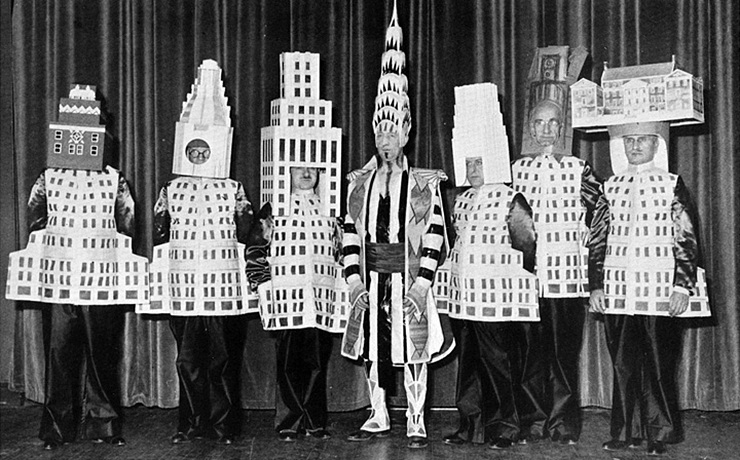
HEADS IN THE CLOUDS…the Chrysler Building’s architect, William Van Alen (center), flanked by, from left to right, Stewart Walker (The Fuller Building), Leonard Schultze (The Waldorf-Astoria), Ely Jacques Kahn (The Squibb Building), Ralph Walker (1 Wall Street), D.E. Ward (The Metropolitan Tower), and Joseph H. Freelander (Museum of the City of New York). The New York Times referred to the group as “a tableau vivant of the New York Skyline.” (Van Alen Institute)

 *  *  *

Quiet on the Set

The early days of sound movies created numerous challenges for directors who not only had to adjust the action to accommodate cumbersome microphones, but also to keep out unwanted noises or bad enunciation. “The Talk of the Town” explained…

CLOSETED…In the early days of the talkies, cameras had to be soundproofed in cabinets so their noisy motors would not be picked up by primitive sound equipment. (coloradocollege.edu/Library of Congress)

Peter Arno illustrated the predicament of filming in nature in this cartoon from the April 5, 1930 issue…(caption: “Well, we can’t start till we get that robin out of there.”)…

 *  *  *

One of Ours

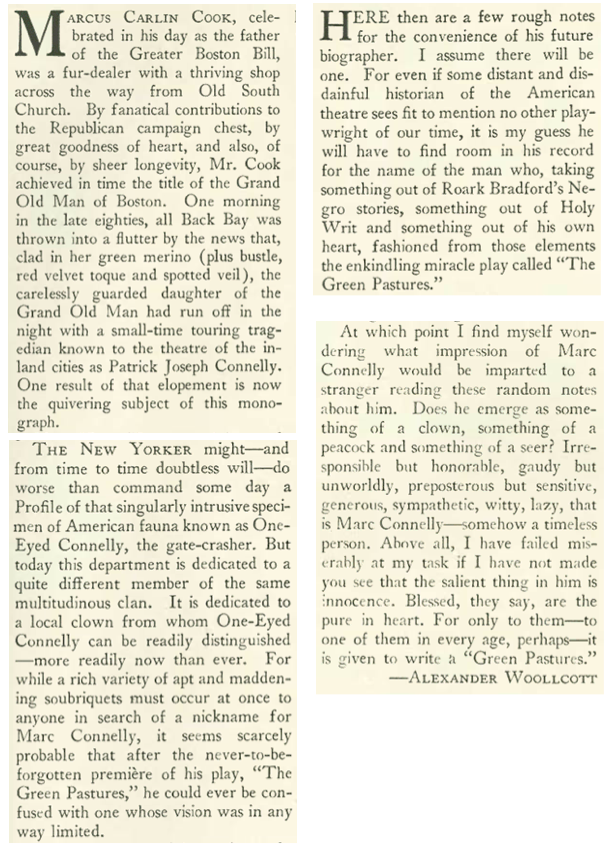
In the story of The New Yorker, Alexander Woollcott and Marc Connelly were there at the beginning as founding members of the Algonquin Round Table and advisory editors to the first issues of the magazine. Basking in the success of his latest play, The Green Pastures (for which he would receive a 1930 Pulitzer Prize for Drama), Connelly was the subject of a April 12, 1930 profile titled “Two-Eyed Connelly,” which was written by Woollcott. Some excerpts, and a caricature by Al Frueh

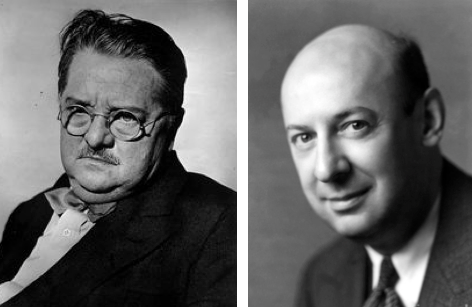
FAMILIAR WITH THE SUBJECT…Alexander Woollcott, left, explored the life of his old friend Marc Connelly in the April 12 profile. (goodreads.com/Fine Art America)

 *  *  *

The Party is Really Over

Lois Long’s column “Tables for Two,” which in the 1920s was a must-read for those interested in Jazz Age night life, appeared intermittently in its last year, and its April 12 installment was not even written by Long, but by a writer who signed the column “F.D.” — I assume this is Fairfax Downey, who tried his best to capture Long’s style…

 *  *  *

From Our Advertisers

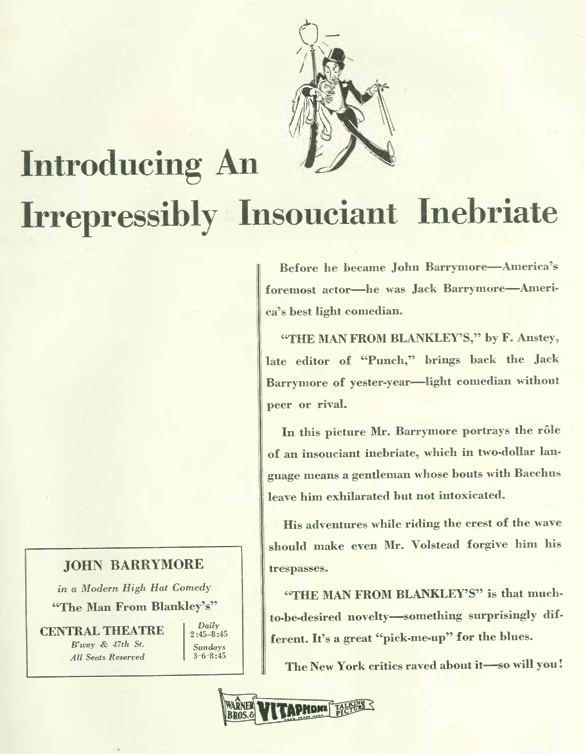
Warner Brothers opened their pocketbooks to publicize John Barrymore’s latest film, The Man From Blankey’s, which the studio described as a “Modern High Hat Comedy”…

WHEN ALCOHOLISM WAS FUNNY…Loretta Young, John Barrymore and Angella Mawby in The Man from Blankley’s. (IMDB)

…Thanks to William Randolph Hearst and his King Features Syndicate, Robert Ripley, the P.T. Barnum of the funny pages, soared to fame in the 1930s with his “Believe It or Not” panel…here he begins his 14-year run on the radio…

HELLO SUCKERS…Robert Ripley in 1930 with a drawing of “the Horned Man of South Africa.” (RIPLEY ENTERTAINMENT INC.)

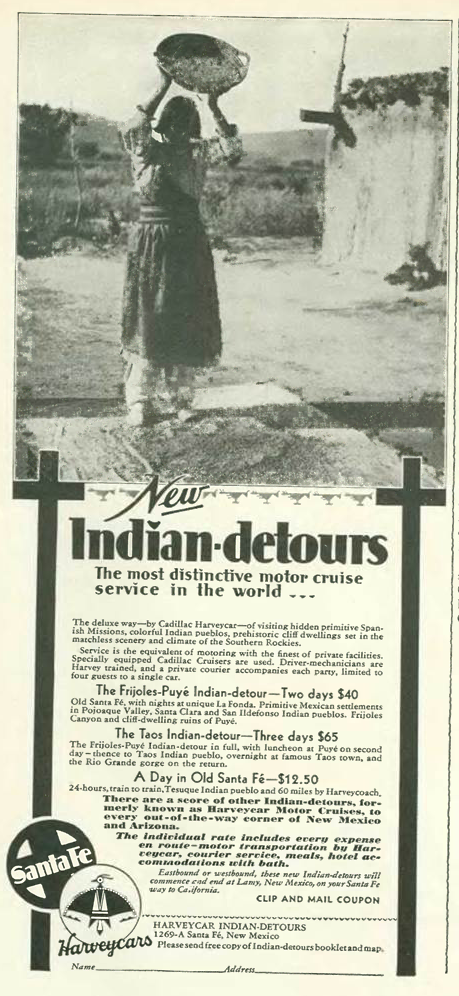
…and here’s an ad for another questionable but very American diversion — Fred Harvey’s “Indian Detours”…

WE’RE NOT IN KANSAS ANYMORE…The Fred Harvey Company was renowned for its chain of eating houses hosted by the famed “Harvey Girls” along the Atchison, Topeka & Santa Fe Railroad between 1876 and 1968. To encourage train travel (and Harvey business) in the Southwest, the Harvey company developed “Indian Detours.” The photo at left is of an “Indian Building” in Albuquerque, which featured displays of art and “live exhibits” that included Native Americans from many tribes around New Mexico. (santafeselection.com)
EASY RIDER…1929 Cadillac Harvey Indian Detour Car outside La Fonda, Santa Fe. (Palace of the Governors photo archive)

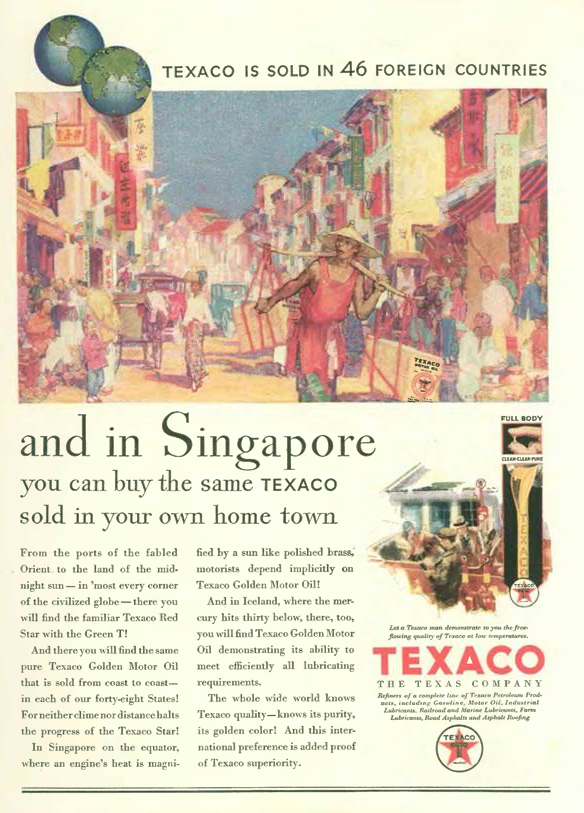
…if you preferred to travel abroad, Texaco wanted you to know that you could still gas up with their product, even in distant Singapore…

…we begin our cartoons with the spare stylings of Gardner Rea

…and Otto Soglow

…we find one of Helen Hokinson’s ladies on her way to fitness…

William Crawford Galbraith showed us an enterprising young man…

Art Young illustrated the challenges of the lecture circuit…

…and one of my all-time favorite Peter Arno cartoons…

Next Time: The Circus Comes to Town…


Noblesse Oblige

Just three years before she would enter the White House as First Lady, Eleanor Roosevelt was familiar to some New Yorkers for her social work, but was known to most as the wife of the Governor of New York, Franklin D. Roosevelt.

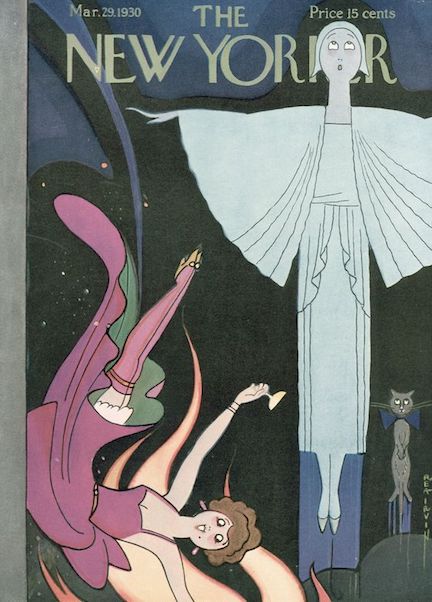
This week we look at two issues, March 29 and April 5, 1930, both with covers by Rea Irvin.

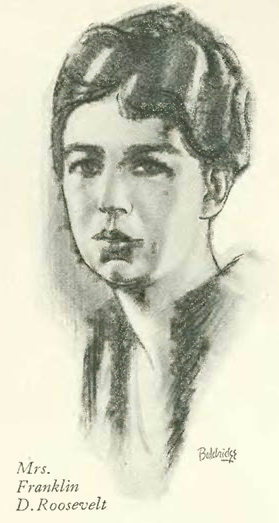
In a profile featured the April 5 New Yorker, Helena Huntington Smith looked at the life of a woman who was a niece to former President Theodore Roosevelt and a fifth cousin (once removed) to her husband Franklin. A somewhat reluctant mother (who nevertheless had six children) in a marriage that was mostly a political arrangement, Eleanor devoted considerable time and energy to social causes. Below is a brief excerpt, accompanied by an illustration of Eleanor by Cyrus Baldridge.

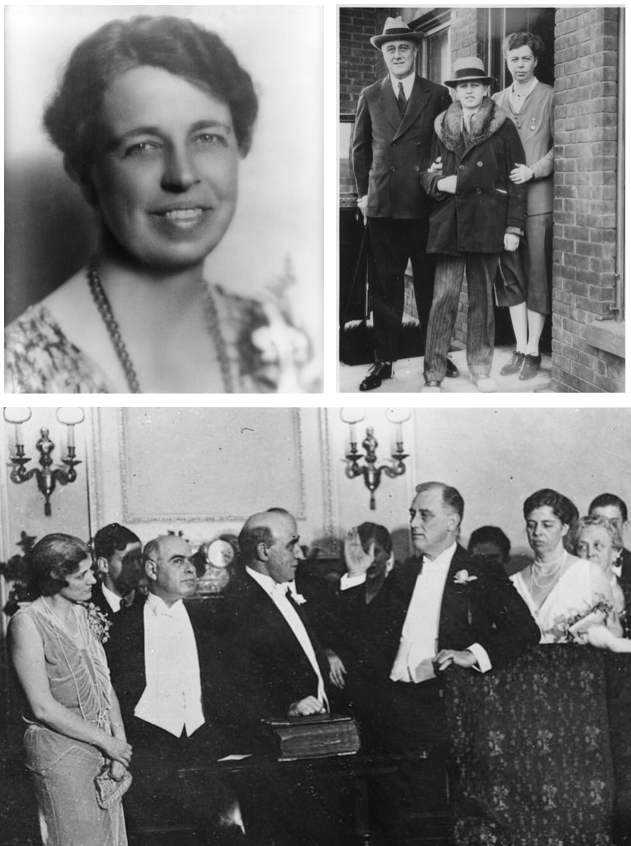
ALBANY DAYS…Clockwise, from top left: Eleanor Roosevelt in 1933; Gov. Franklin Roosevelt, Eleanor, and their youngest son, John, in Albany in 1930; FDR being sworn in as Governor of New York, January 1929. (Wikipedia/Albany Group Archive)
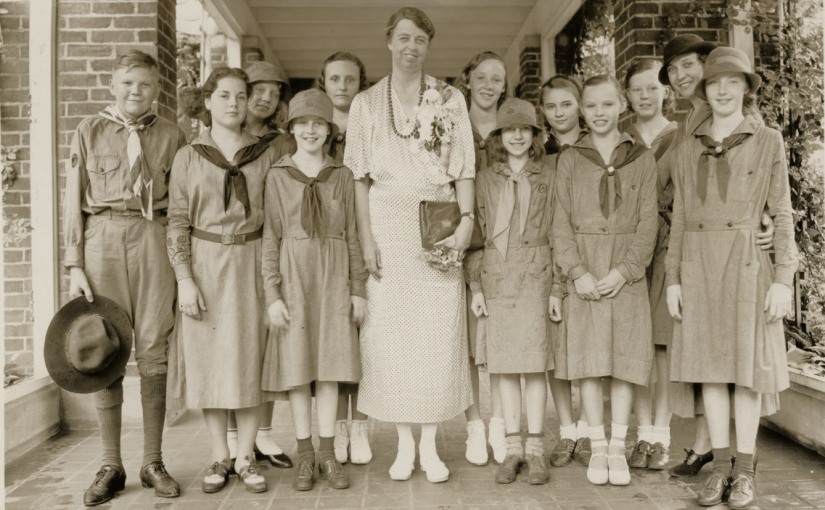
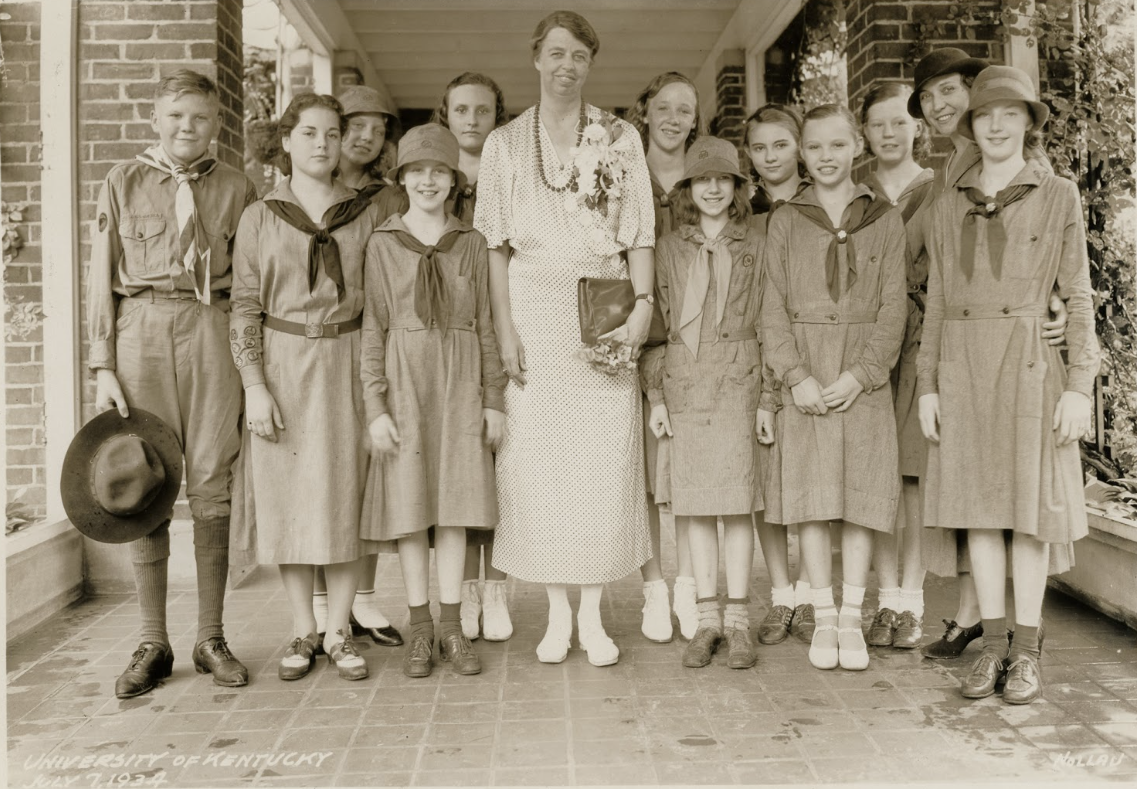
IN HER ELEMENT…Eleanor Roosevelt with boy and girl scout volunteers at the University of Kentucky, July 1934. (eleanorroosevelt.org)

 *  *  *

No Laughing Matter

In a surprising twist, James Thurber took a hand at writing the “A Reporter at Large” column (titled “Cop Into College Man”) in the March 29 issue, visiting a new “Police College” in New York City. In this engaging piece, Thurber seemed thoroughly engrossed in the operation…

…and particularly in the mugshots of some of the city’s most notorious criminals, including gangster Jim Flanagan, “debonair in a Bangkok hat”…

…and in the college’s museum, filled with all manner of deadly implements…

PREPPING FOR PERPS…The April 1930 edition of Popular Science featured the opening of New York’s new Police College. (Modern Mechanix)

 *  *  *

Pluto’s Salad Days

In was something of a sensation in February 1930 when Clyde Tombaugh (1906-1997) discovered the then-planet Pluto at the Lowell Observatory in Arizona. Howard Brubaker in “Of All Things” (March 29) had this to say about the achievement:

JUST A SPECK…Clyde Tombaugh poses with the telescope through which he discovered the planet Pluto at the Lowell Observatory on Observatory Hill in Flagstaff, Ariz., 1931. At right, images of the planet (specks indicated by arrows) were all the proof Tombaugh needed to confirm his discovery. (AP/NASA)

Thanks to a 2015 flyby by NASA’s New Horizons spacecraft, we now have a better idea of what Pluto, now classified as a “dwarf planet,” actually looks like…

 *  *  *

Dandy Doodle Mayor

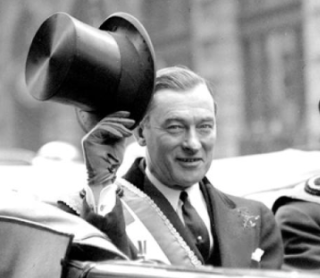
Fillmore Hyde, author (and four-time national amateur squash tennis champion), penned this ditty in the March 29 issue in tribute to New York City’s dandyish mayor…

HAT’S OFF…Mayor Jimmy Walker.

 *  *  *

Back for More

Also for the March 29 issue art critic Murdock Pemberton was back at the Museum of Modern Art — a new institution he met with skepticism when it opened in late 1929, but a place that was definitely growing on him as a destination to revel in the work of some of the world’s top modern artists, including the American Max Weber (1881-1961), whose retrospective was supposed to the big draw of MoMA’s latest show, but Pemberton seemed more impressed by French artist Aristide Maillol (1861-1944) and particularly by the Swiss-German Paul Klee (1879-1940).

AMERICAN CUBIST…Max Weber’s The Cellist, 1917, oil on canvas, was featured in Weber’s 1930 retrospective exhibition at the Museum of Modern Art; at right, Weber seated in front of Interior with Music (1930). (Brooklyn Museum/Smithsonian)
Aristide Maillol’s Crouching Woman, bronze, 1930. (MoMA)

Pemberton wrote that Klee’s show gave you “quite a feeling”…

Catalogs from Max Weber’s retrospective and Paul Klee’s exhibit at the Museum of Modern Art. (MoMA)

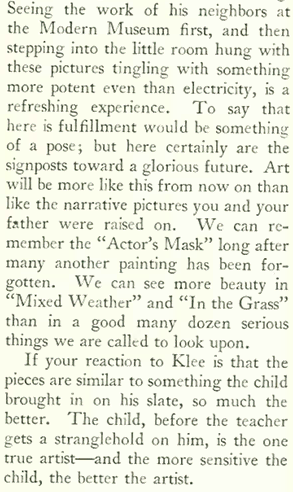
…and when he compared Klee’s work to that of the other artists, Pemberton saw something “more potent even than electricity…signposts toward a glorious future”…

A GLIMPSE OF THE FUTURE…From left, Paul Klee’s Actor’s Mask, 1924, oil on canvas mounted on board; Josef Albers’ 1929 photographic portrait of Klee, 1929; Klee’s In the Grass, 1930, oil on canvas. (MoMA/Guggenheim.org)
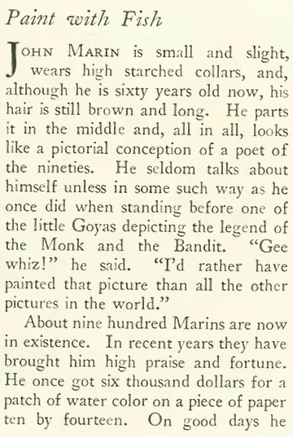
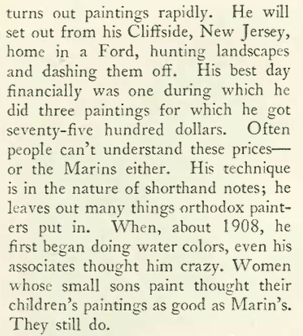
 A week later, writing for the April 5 issue, Pemberton penned this piece for “The Talk of Town” about the work habits of artist John Marin

OLD MAN AND THE SEA…John Marin in 1921, in a photograph by Alfred Stieglitz; Marin’s Bathers, 1932, oil on canvas. (mfa.org/Dallas Museum of Art)

 *  *  *

Who Needs a Vet?

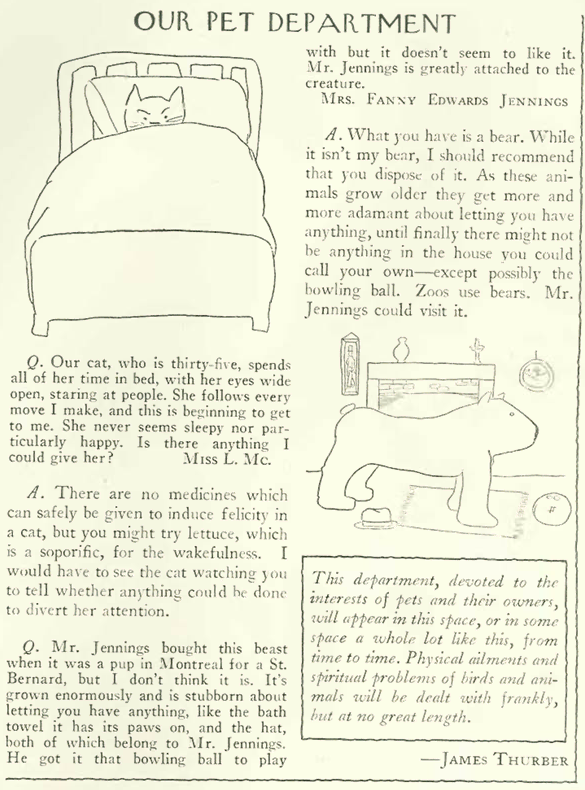
The April 5 issue featured James Thurber’s latest installment of “Our Pet Department…

 *  *  *

Spend It Quickly

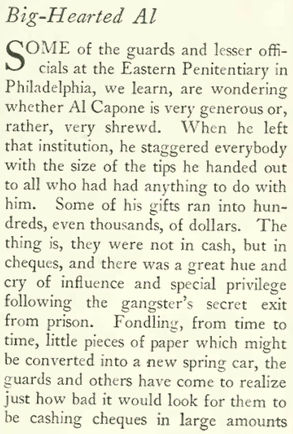
April 5’s “Talk” also featured this item about Al Capone’s release from prison in Philadelphia, lavishing money and gifts on prison employees as he made his exit from Eastern Penitentiary…
…it was no wonder, because officials at the prison didn’t treat Capone like some ordinary prisoner…

SALUTARY CONFINEMENT…Arrested outside a Philadelphia movie theater for carrying a concealed, unlicensed .38 caliber revolver, Al Capone was sentenced to a year in Eastern State Penitentiary. His last seven months were served in a cell (right) with fine furniture, oriental rugs, paintings, and a console radio, among other frills. (easternstate.org)

 *  *  *

This Al Could Sing

Upon the DVD release of Al Jolson’s 1930 film, Mammy, Dave Kehr of The New York Times wrote that Jolson was “Simultaneously one of the most significant and most embarrassing show business figures of the 20th century.”

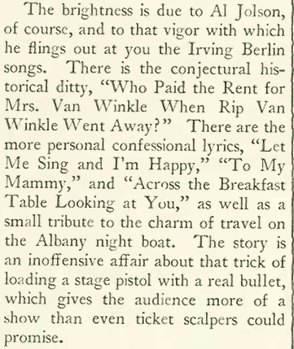
That was not view of most audiences 89 years ago, when Jolson reigned as one of America’s most famous entertainers. In his review of Mammy for the April 5, 1930 issue of The New Yorker, critic John Mosher admitted that he didn’t care for minstrel shows depicted in the film, but not for any of the reasons we would cite today…

UGH…Clockwise from top left, Al Jolson and Lois Moran in Mammy; a studio promotional poster; Jolson as a minstrel performer in the film. (IMDB)

 *  *  *

From Our Advertisers

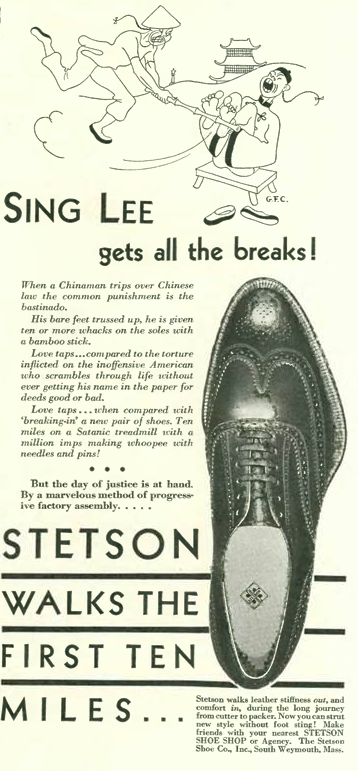
We have more racial stereotypes, this time to sell Stetson shoes…

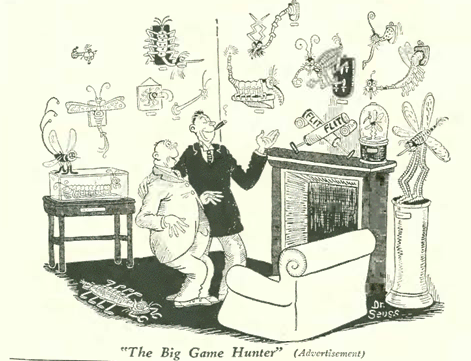
Theodore Geisel (Dr. Seuss) continued to pay the bills by illustrating ads for Flit insecticide…

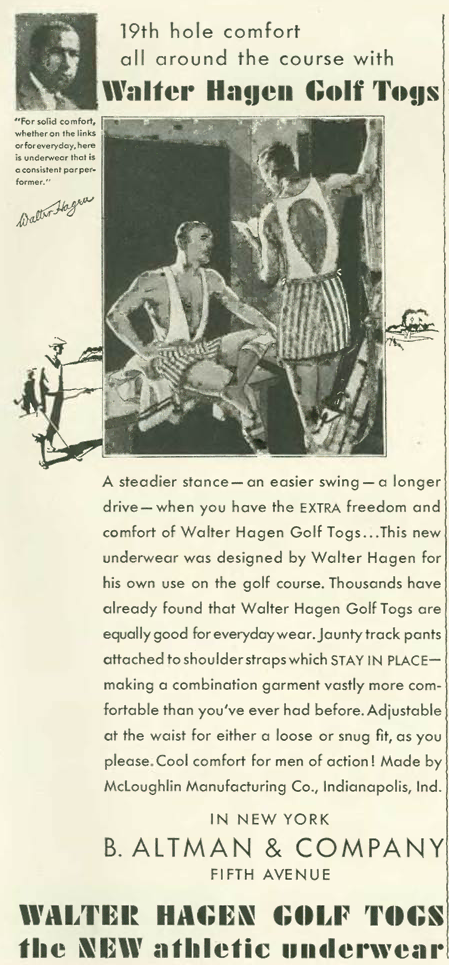
…while professional golfer Walter Hagen picked up some extra cash by launching his own line of golf underwear…

…Walter has been gone for fifty years, but you can still get his branded clothing from Dick’s Sporting Goods…

Julian De Miskey picked up some extra work illustrating this house ad for The New Yorker

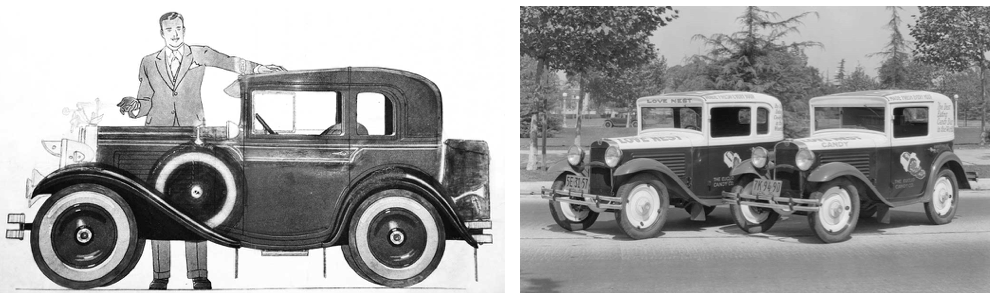
…and then we have this spot from the American Austin Car Company, which produced cars licensed from the British Austin Motor Company from 1930 through 1934…interestingly, the ad doesn’t feature the car itself…

…which looked like this…

(theoldmotor.com)

…on to our cartoons, Alan Dunn looked in on a devoted listener of S. Parkes Cadman’s Sunday radio broadcast…Cadman (1864-1936) was a British-born clergyman whose NBC radio broadcasts reached millions of listeners across America…

…signs of spring were noted by Otto Soglow

Don Herold shared an observation on stage entertainments…

…William Crawford Galbraith found unrequited love at the circus…

…while Barbara Shermund found a more agreeable pairing at a Manhattan cocktail party…

Garrett Price found humor in the growing numbers of the down and out…

…and Peter Arno turned in this epic two-pager that illustrated the challenges of filming in nature…(caption: “Well, we can’t start till we get that robin out of there.”)

Next Time: Hot Jazz in Stone and Steel…


Garbo Speaks

Imagine your favorite Hollywood actress, maybe someone like Julia Roberts, Meryl Streep or Judi Dench. You’ve followed their careers and watched most of their movies, but you’ve never heard their voices.

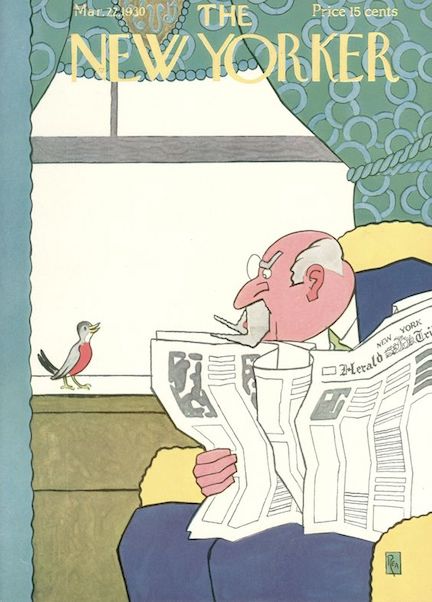
March 22, 1930 cover by Gardner Rea.

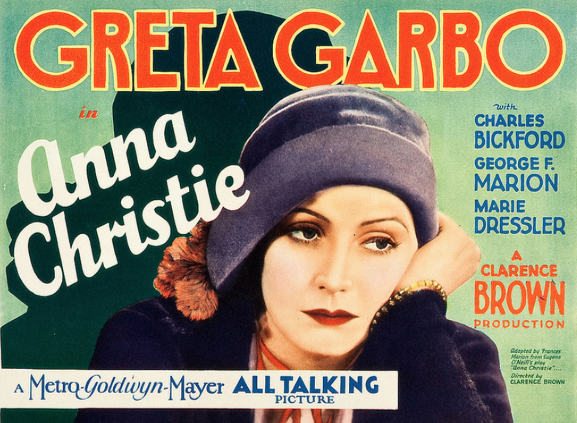
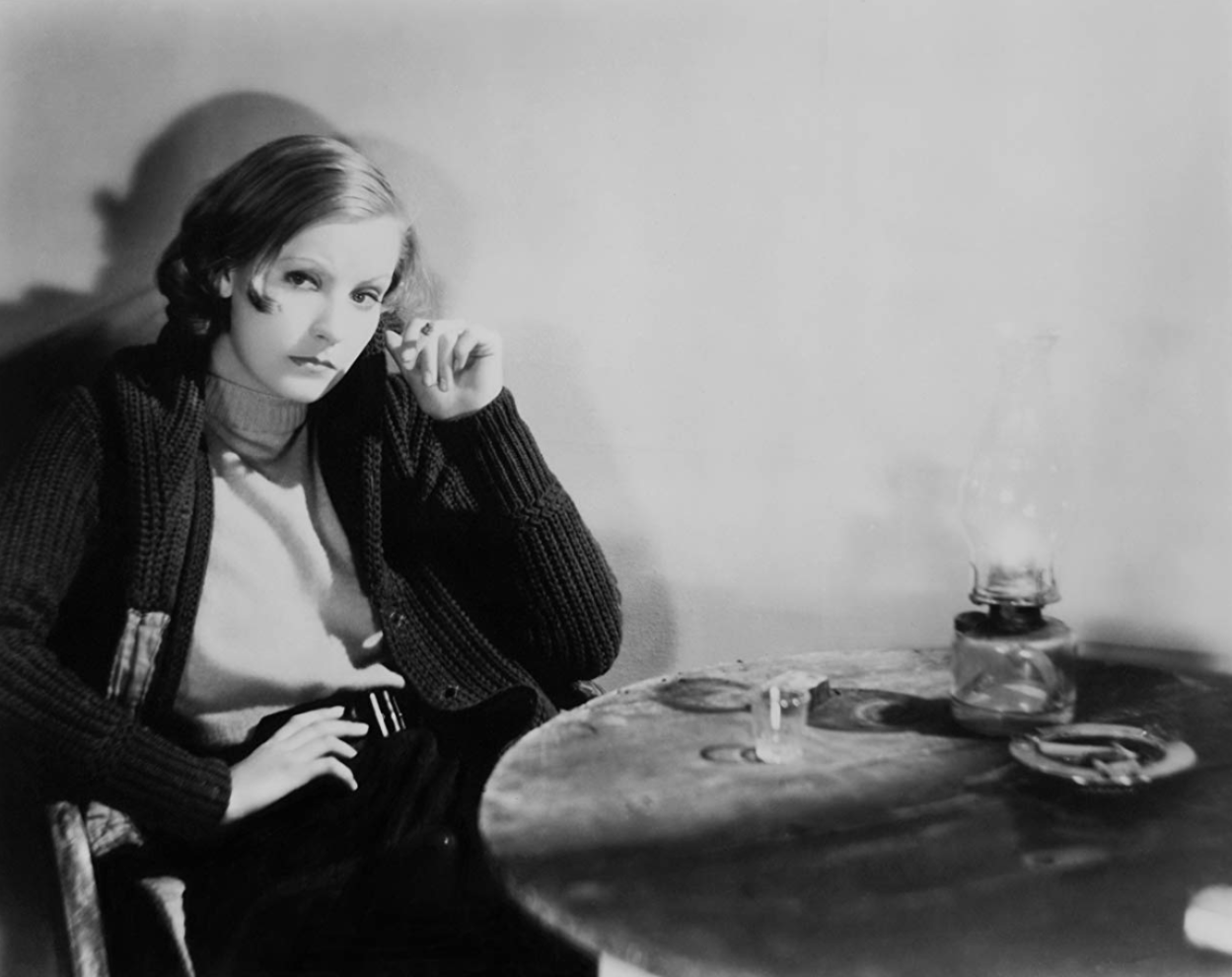
That’s what it was like for Greta Garbo fans before March 1930, when she spoke her first onscreen words in the 1930 MGM drama Anna Christie, which was adapted from a 1922 play by Eugene O’Neill. 

SWEDISH SPHINX…Greta Garbo’s mask-like qualities on display in this publicity still for Anna Christie. (IMDB)

The New Yorker’s film critic John Mosher, not always a fan of Garbo’s silent work, found a “special kind of glamour” in her first talking picture, even tossing out the word “legend” to describe this Swede who avoided publicity like a bad cold…

No doubt a few moviegoers saw the movie just to finally hear that voice, which Mosher described as “a surprise…a deep, low voice, a boy’s voice really, rather flat, rather toneless, yet growing more attractive as the picture advances”…

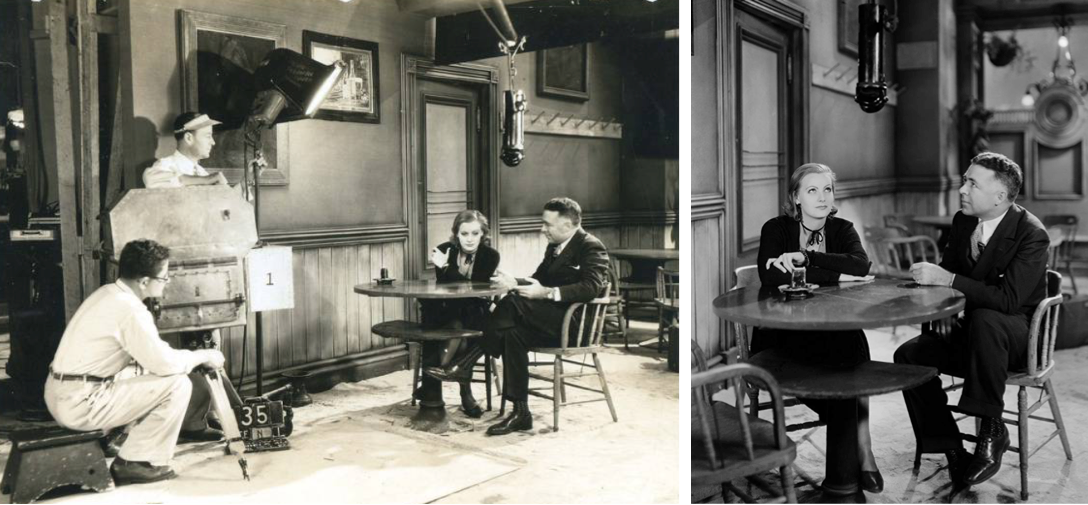
Director William H. Daniels (seated, left) with unidentified cameraman filming a scene from Anna Christie with actors Greta Garbo and Clarence Brown; at right, the actors contemplate the microphone hovering above them. Note how the camera in the first photo is contained in a soundproof case. (IMDB)

Publicized with the tag line “Garbo talks!,” Anna Christie premiered in New York City on Feb. 21 and would become the highest-grossing film of 1930. Later that year a German language version would be filmed featuring Garbo but with a different director and supporting cast.

SOUND DEBUT…Clockwise, from top left, Greta Garbo and Marie Dressler in Anna Christie; an MGM ad touting the film as one of the best pictures of the year (it would be the year’s highest-grossing, and Garbo would receive an Academy Award nomination); studio portraits of Garbo used in the film’s promotion. (IMDB)
*  *  *
Chicken and Cocktails
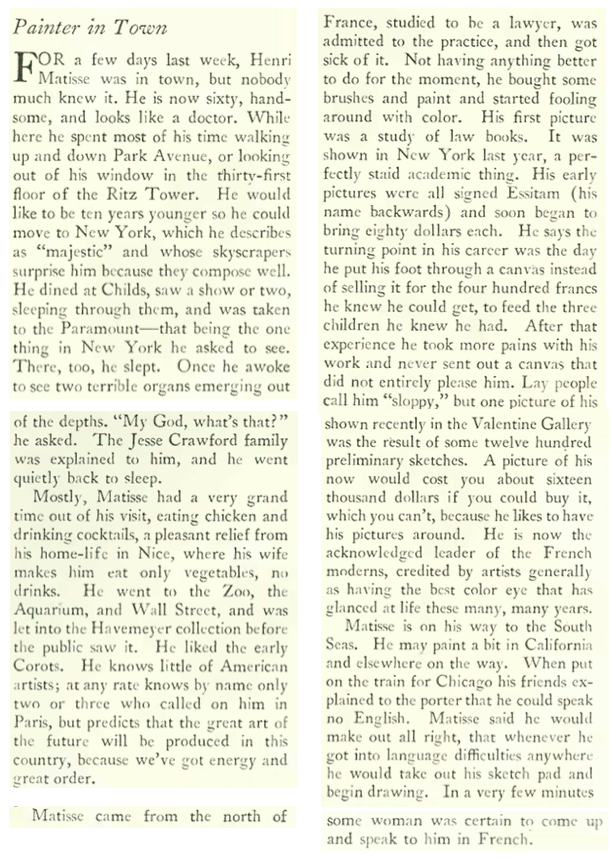
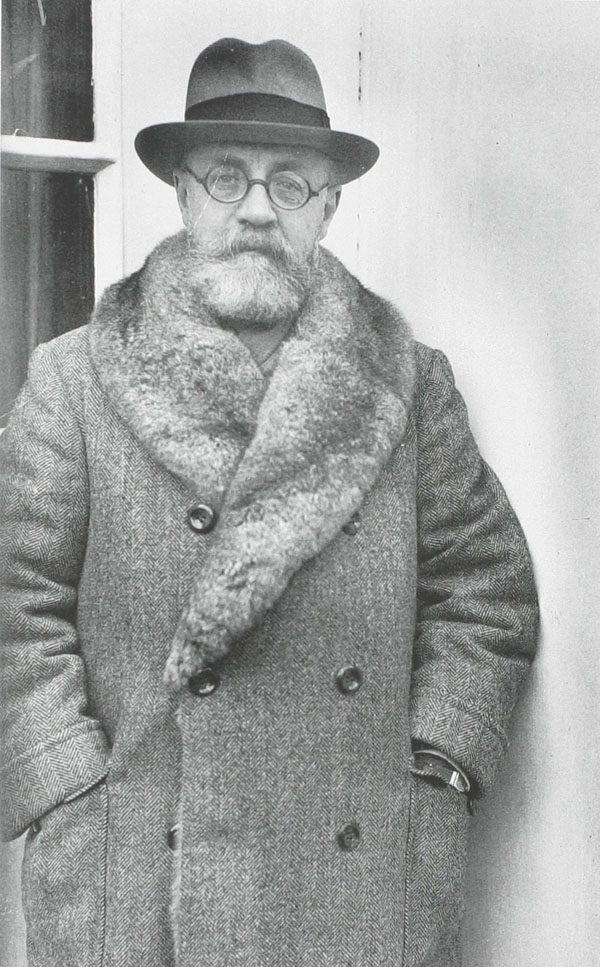
En route to the South Seas, the French artist Henri Matisse (1869-1954) paid a visit to New York City, and by all accounts had a good time there. His visit was described by Murdock Pemberton in “The Talk of the Town”…

I ♥ NEW YORK…Henri Matisse arriving in New York City on the RMS Mauretania December 15, 1930. He described the city as “majestic.” (artistandstudio.tumblr.com)
NICE PLACE, THIS…Henri Matisse sitting on the brick roof terrace of 10 Mitchell Place (formerly Stewart Hall), the Queensboro Bridge glimpsed in the background. The photo was taken in 1930 by his son, Pierre Matisse, who was living in New York. At right, 10 Mitchell Place today. A framed photograph of Matisse sitting on the rooftop hangs on the wall of the building’s lobby. (Henri-matisse.net/Ephemeral New York)
 *  *  *
The Last Page
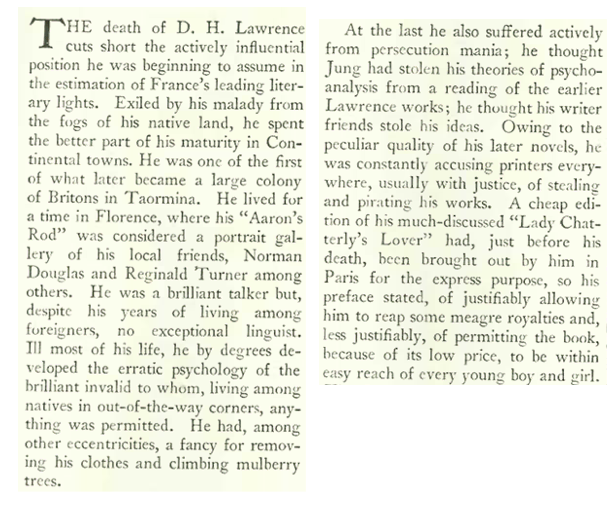
The death of author D.H. Lawrence (1885-1930) was reported to New Yorker readers by Janet Flanner, the magazine’s Paris correspondent, who briefly detailed the writer’s rather sad decline…

FLEETING DAYS…D. H. Lawrence (right) with fellow writer Aldous Huxley at Bandol, in the South of France, 1929. (Topham Picturepoint)

 *  *  *

What Depression?

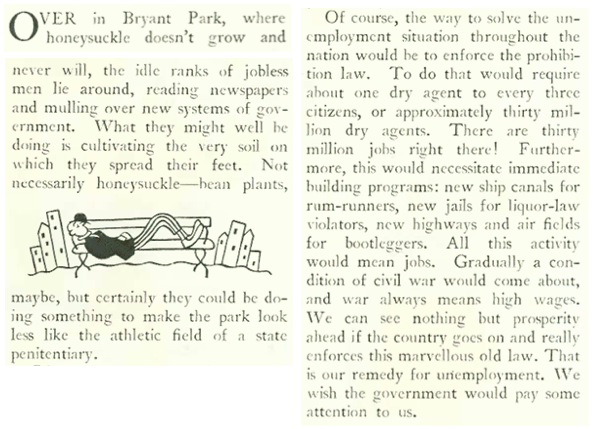
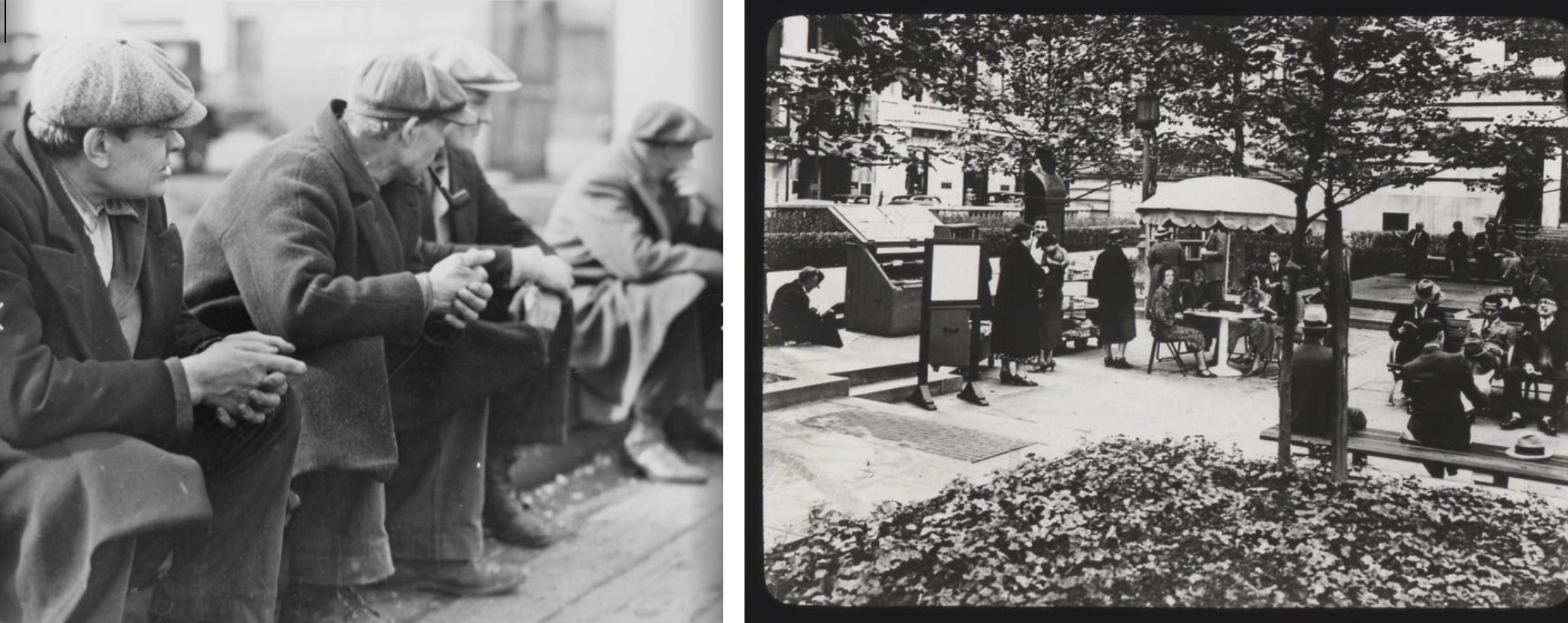
We are nearly five months into the Great Depression, yet there is little evidence in The New Yorker of the catastrophe that was unfolding across the land. And true to form, the approach to the topic was made with humor, via E.B. White in “Notes and Comment”…

KNOW ANY GOOD JOKES?…At left, unemployed New York dockworkers; at right, folks enjoying the New York Public Library’s outdoor reading room in Bryant Park, 1930s. (Lewis Hine/National Archives and Records Administration/New York Public Library)

 *  *  *

Cathedrals of Commerce

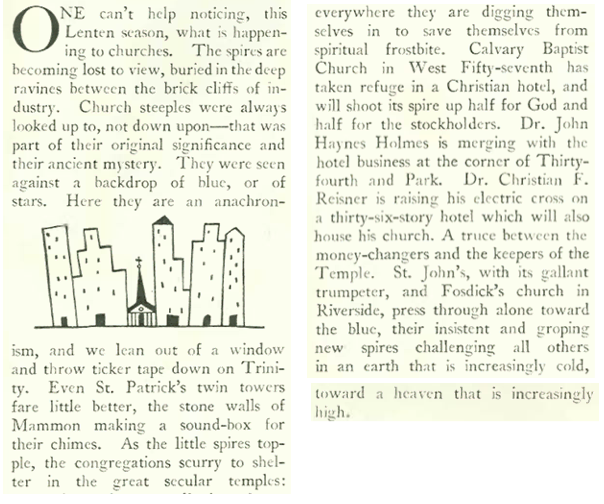
E.B. White also observed the changing skyline, and how the towering skyscrapers were quickly overshadowing the once prominent steeples of the city’s churches…

REACHING TO THE HEAVENS…Clockwise, from top left, Trinity Church Wall Street and St. Patrick’s have been eclipsed by the towers of Mammon, but St. John’s and Riverside still dominate their surroundings. (Wikipedia/St. John’s/Riverside)

 *  *  *

The Other House of Worship

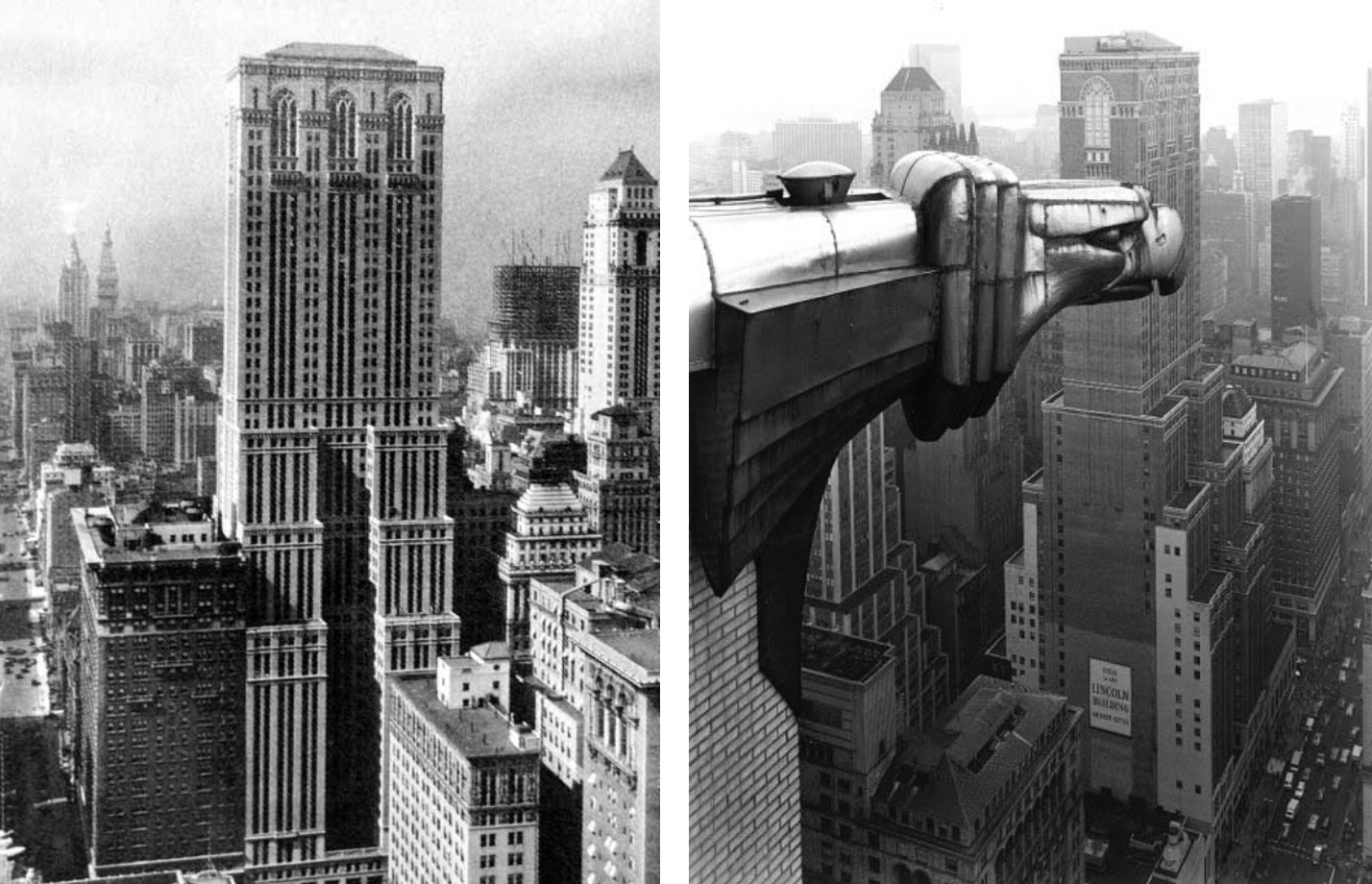
Perhaps a certain skyscraper ennui settled in, as architecture critic George S. Chappell was not all that impressed by the “huge” Lincoln Building (which today still seems huge)…

SIZE DOESN’T MATTER…Although the new Lincoln Building proved to be a massive addition to the New York skyline, its style seemed outdated in contrast to its flashy new neighbor, the Chrysler Building — one of its gargoyles, at right, seems poised to devour the Lincoln Building. (nyc-architecture.com)

 *  *  *

From Our Advertisers

We have a bit more evidence of the Depression in the ads, including this one from Abercrombie & Fitch, with two sporting gents opting to go fishing to take their minds off the markets…

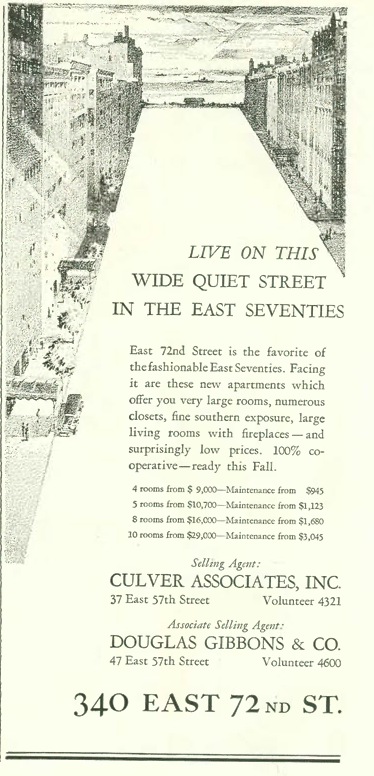
…if fishing wasn’t your thing, perhaps you just wanted to escape into the “quiet” of the wide streets in the East Seventies…

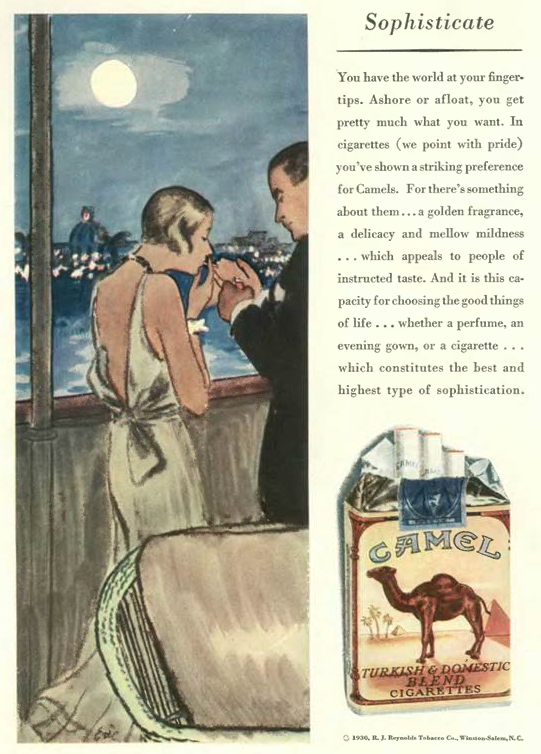
…or relax with a smoke, which artist Carl Erickson made so appealing with his Camel ad illustrations…

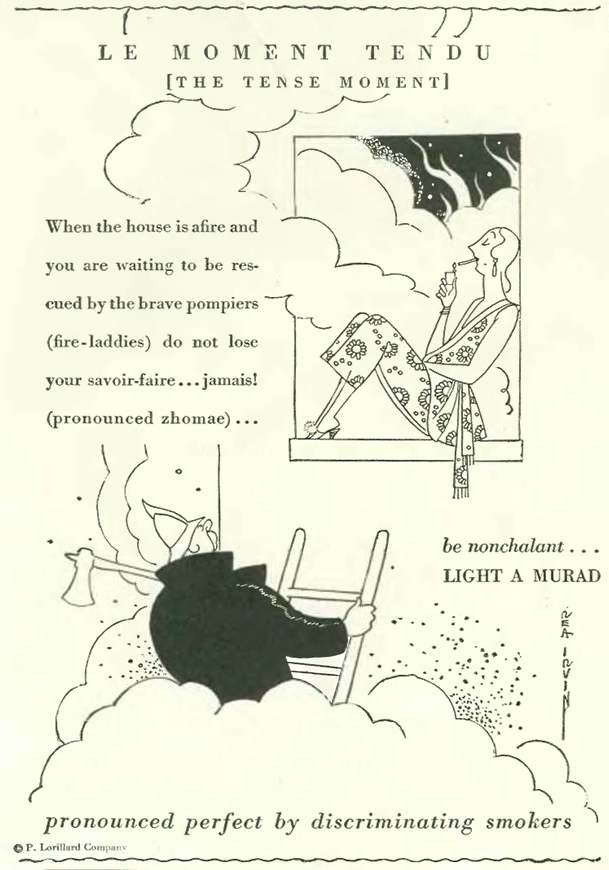
…or take the humorous route to a relaxing smoke, with this ad for Murad as illustrated by Rea Irvin

…on to our cartoonists, Garrett Price captured the mood of the times…

…while Alfred Krakusin captured an altogether different mood…

...Leonard Dove examined the path to stardom…

Isadore Klein pondered modern art…

William Crawford Galbraith found an unlikely victim of religious zeal…

Mary Petty gave us a glimpse of a doctor’s office…

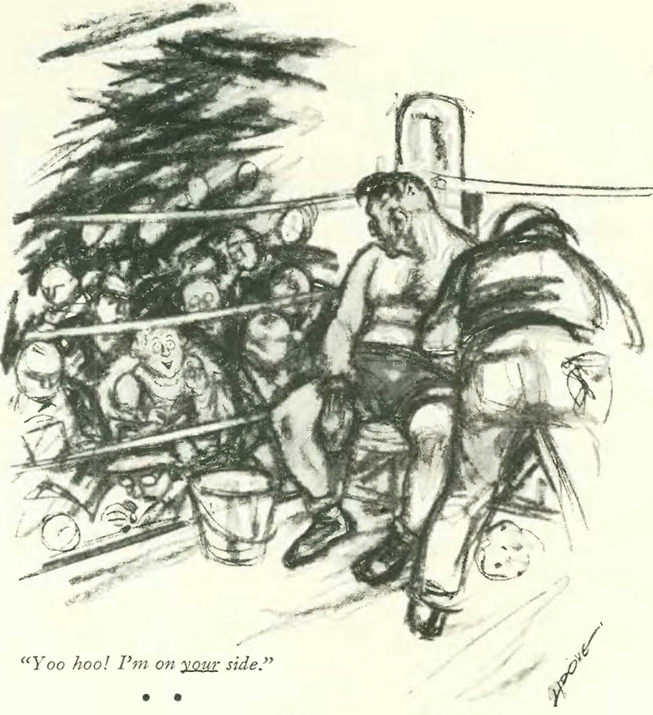
…and Leonard Dove again, this time at ringside…

Next Time: Noblesse Oblige…