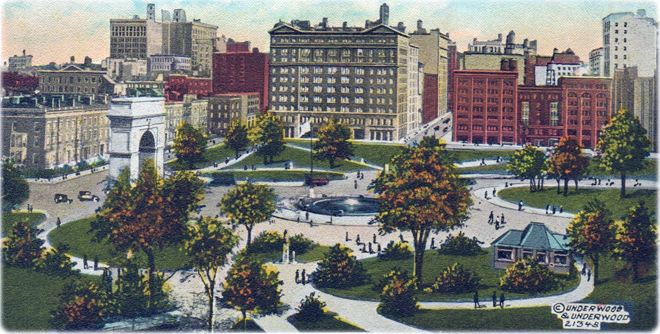
Above: Postcard image of Washington Square Park, circa 1930. (citybeautifulblog.com)
New Yorkers know all about change, and especially during the 1920s and 30s when the city razed everything from Dutch settler houses to the Gilded Age mansions of Fifth Avenue. Landmarks such as the old Waldorf-Astoria were leveled to make way for the Empire State Building, while several blocks—22 acres of residential and commercial buildings—were scraped clean for Rockefeller Center.
June 8, 1935 cover by Harry Brown. This June bride-themed cover was Brown’s fourteenth of the eighteen covers he would create for The New Yorker.
Some things, like Washington Square, were still held dear by city residents. But very little was sacred to the city’s new park commissioner, Robert Moses, who had no problem leveling whole neighborhoods if they stood in way of a road or some other ambitious project.
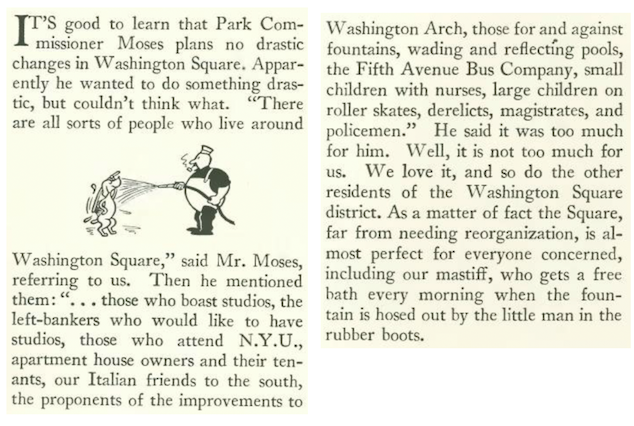
It all seemed well at first when Moses called for the repair of neglected parks, including Washington Square. However, when changes to the park were revealed by the Villager, residents were outraged. Moses’ plan, designed by landscape architect Gilmore Clarke, was a complete reversal of the park’s existing design. In “Notes and Comment,” E.B. White explained:
Village residents organized a “Save Washington Square” committee and successfully blocked Moses from implementing his plan; in true Moses style, he responded by allowing the park to deteriorate.
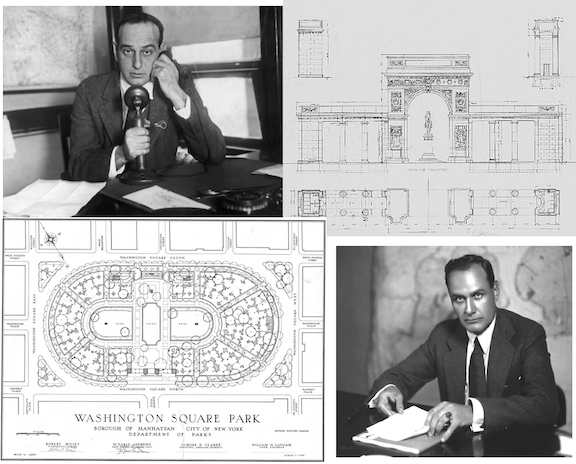
MAKE NO LITTLE PLANS…Clockwise, from top left, Parks Commissioner Robert Moses; proposal to add colonnades to either side of the arch; landscape architect Gilmore Clarke; Clarke’s plan for the redesign. (Wikipedia/washingtonsqpark.org)
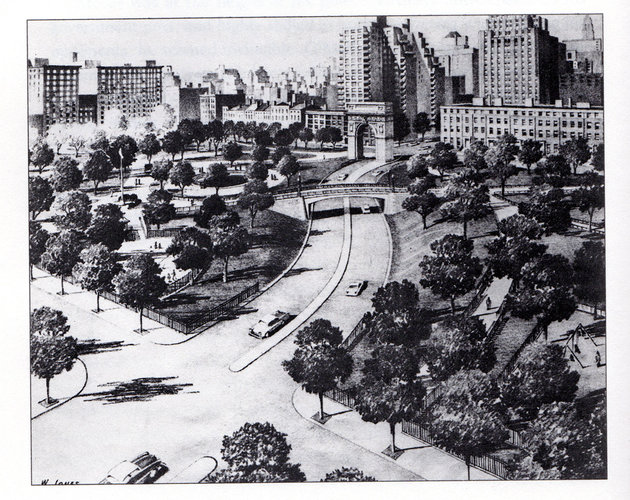
Moses, however, didn’t give up on Washington Square. Around 1940 he began floating the idea of building a double highway through the park. Local residents again rallied, joining business owners and NYU officials in blocking the audacious scheme.
DOUBLE TROUBLE…Around 1940 Moses began floating the idea of building a double highway through Washington Square Park. This illustration is circa 1950. (MTA Archives)
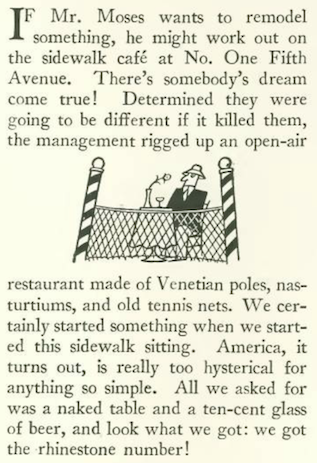
White continued on the theme of city planning, calling on Moses this time to figure out a better plan for sidewalk cafés.
AL FRESCO…Postcard images of sidewalk cafés at 24 Fifth Avenue (top) and 23rd and Lexington, circa 1935. (picryl.com)
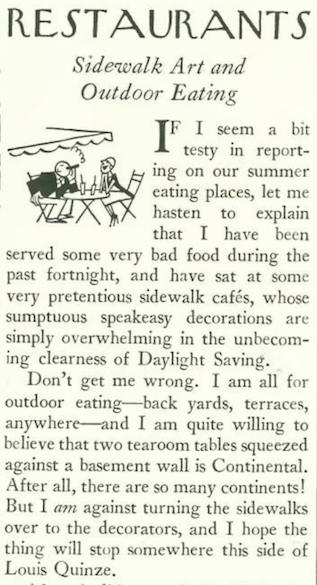
Additional note: The magazine’s June 15, 1935 issue featured Lois Long’s criticisms of sidewalk cafés in Manhattan:
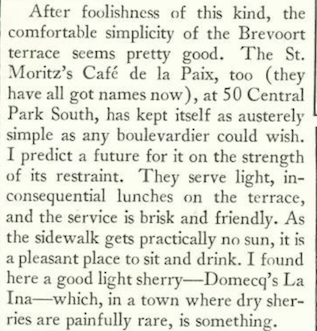
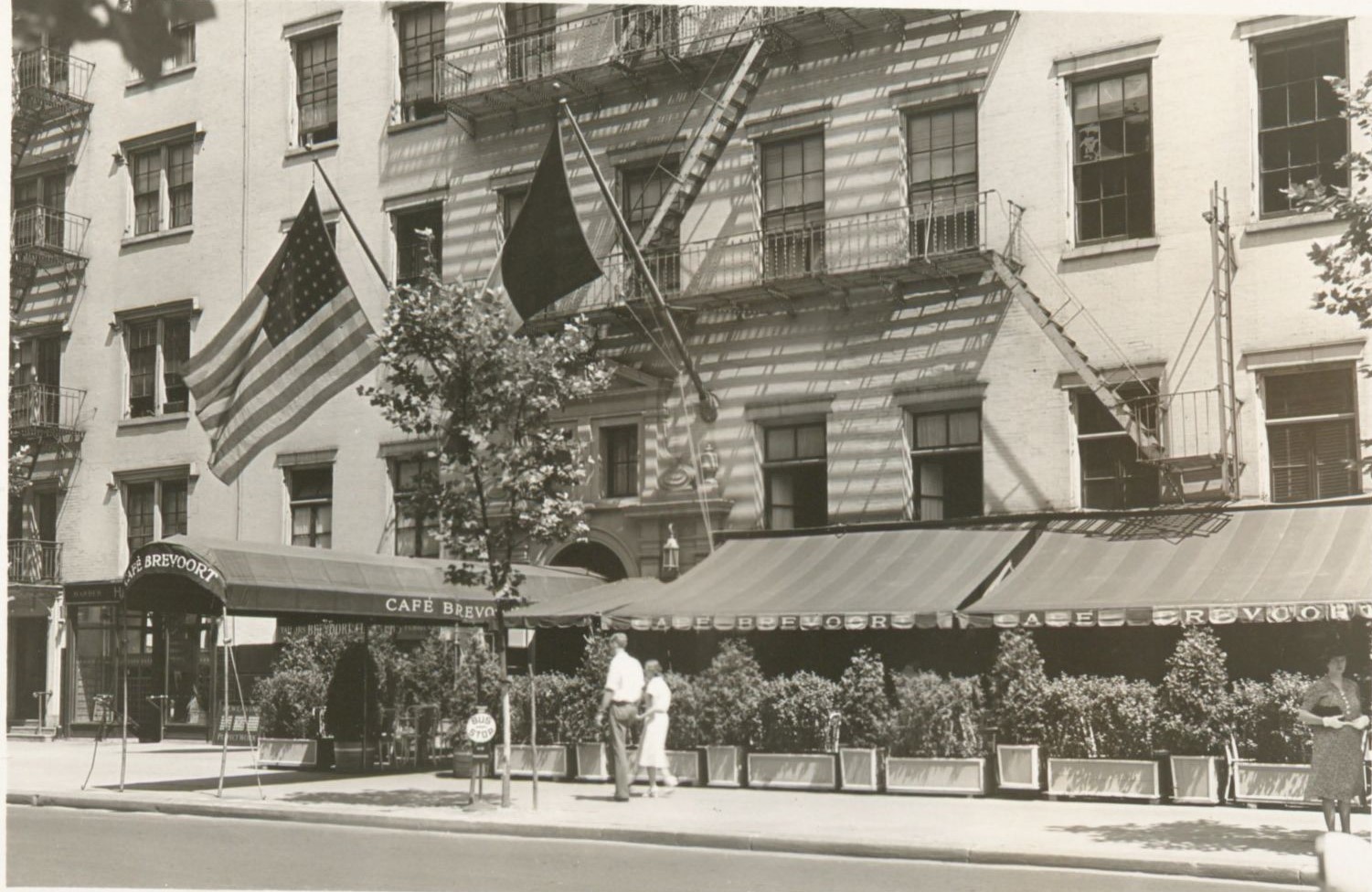
Long did offer, however, a couple of recommendations for sidewalk dining, including the Breevort in Greenwich Village…
If you really wanted to eat outside, Lois Long suggested the Breevort in Greenwich Village. (New York Public Library)
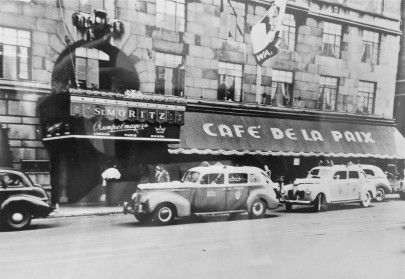
…and the St. Moritz’s Café de la Paix at 50 Central Park South…
The St. Moritz’s Café de la Paix in the 1940s. (blog.bondbrand.com)
* * *
Sexily Danced the Burlesques
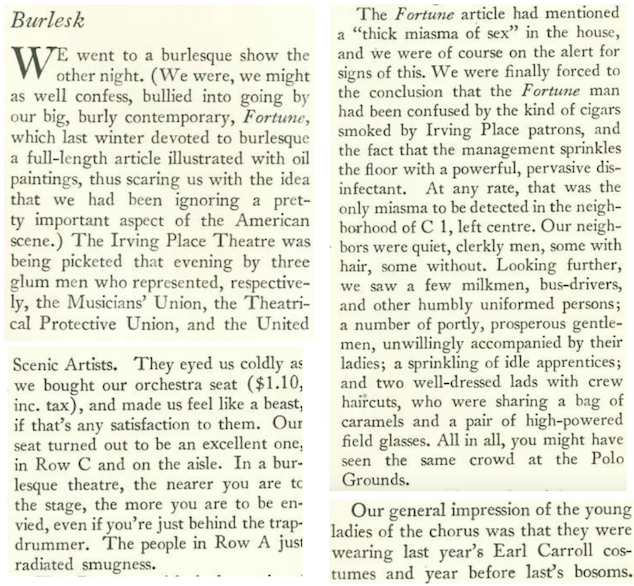
New Yorker writers loved to take shots at Henry Luce, publisher of Time and Fortune. Wolcott Gibbs famously satirized Time’s writing style in a parody profile in 1936: “Backward ran sentences until reeled the mind.” When Fortune decided to take a look behind the curtain at a burlesque show (February 1935), “The Talk of the Town” was ready to pounce.
The Fortune piece featured oil paintings by Stuyvesant Van Veen, including this one depicting the Proscenium at the Irving Place…
Fortune images courtesy fulltable.com
…Van Veen got behind the curtain to create this painting (below) of “Burlesque Queens,” and the magazine chastely demonstrated the “cycle of the strip act” with the help of Miss Jean Lee, aka Miss Jess Mack…
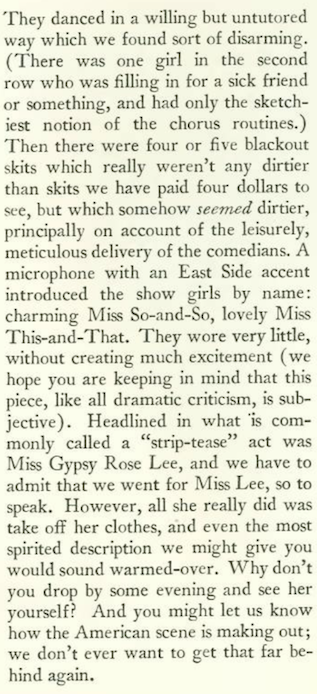
The New Yorker also took a sideways glance at Fortune’s stuffy approach to the subject of striptease, suggesting that it was much ado about nothing.
IT’S ALL AN ACT, FELLAS…Gypsy Rose Lee in 1943. (nypl.org)
* * *
Futures and Fascists
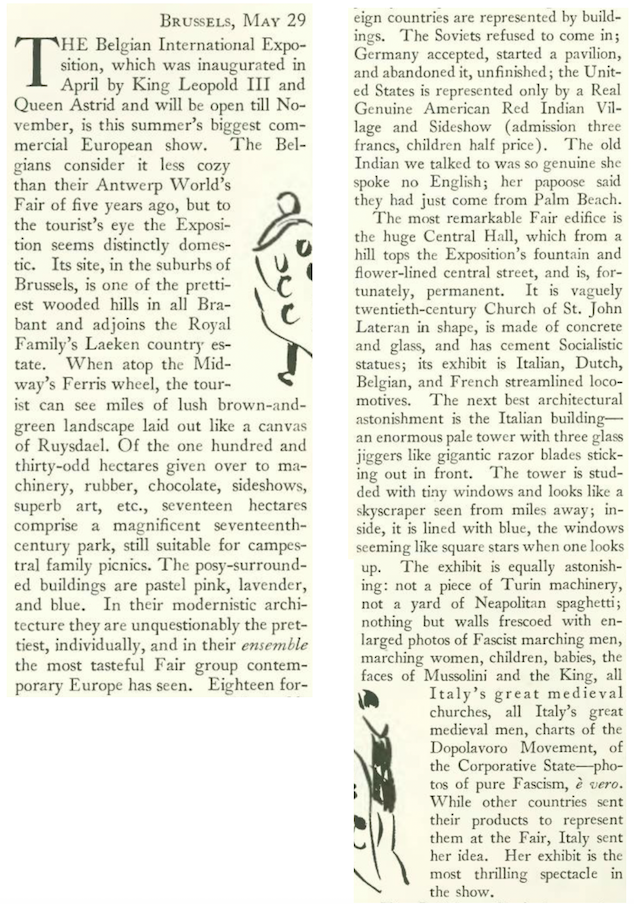
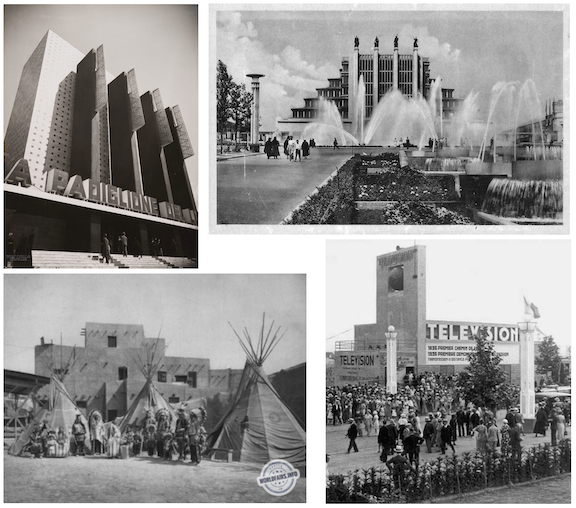
Before the days of television and the Internet, a world’s fair was the place to go to see the latest technologies and other attractions from countries around the world. Paris correspondent Janet Flanner filed a special report on the Brussels International Exposition of 1935, which attracted 20 million visitors in a little over six months.
EURO SPECTACLE…Clockwise, from top left, the menacing facade of the Italian Pavilion—its interior walls featured frescoes of marching fascists; the Palais des Expositions (Grand Palais) still stands today as the Brussels Exhibition Centre; an early demonstration of television; the U.S. featured an “Indian Village” at the Expo. (fomo.be/Wikimedia/en.worldsfairs.info)
* * *
Matchbox Cars
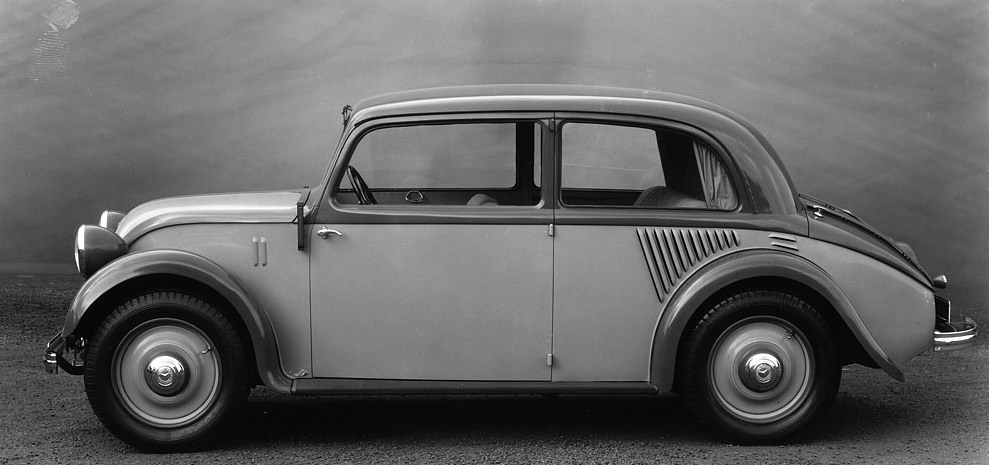
The New Yorker regularly checked the automobile competition from overseas, and found a tiny German car to be “perfectly amazing,” even if it didn’t go over so well with consumers.
IT’S CUTE, BUT…Due to its extreme unbalance of the Mercedes-Benz 130 H (two-thirds of the mass, including the engine, was on the rear axle), the car apparently was awkward to handle. It was discontinued in 1936. (automobile-catalog.com)
* * *
From Our Advertisers
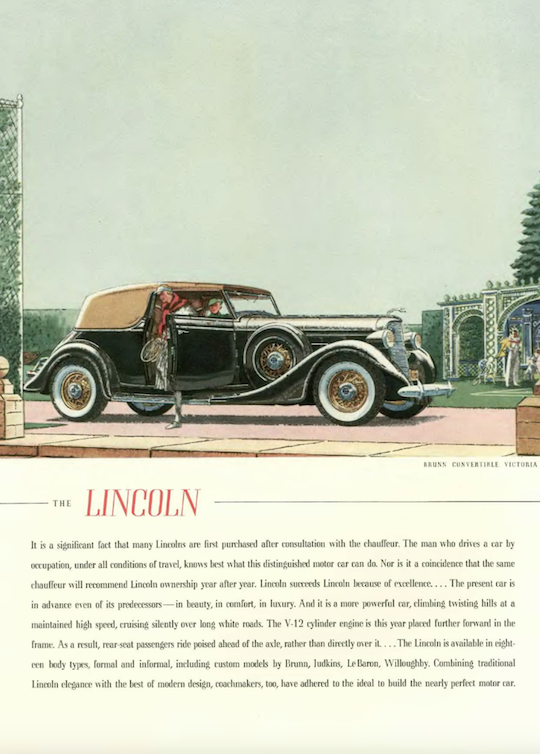
Anyway, most Americans preferred bigger cars, especially ones by luxury makers such as Lincoln, if they could afford them…
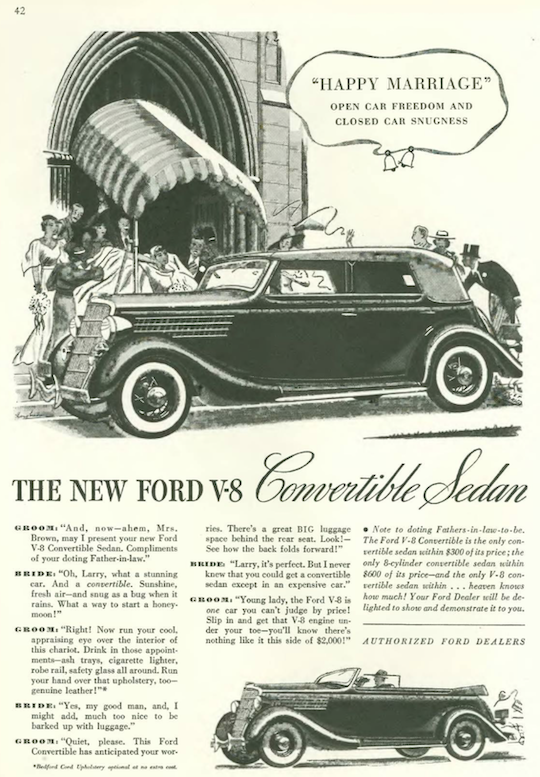
…Lincoln’s parent company, Ford, offered up a more affordable convertible with some flair of its own…automakers were fond of the marriage theme in advertisements, especially in the month of June…
…automakers and related industries were important advertisers during The New Yorker’s first years…
…indeed, the back cover of Issue #1 (Feb. 21, 1925) featured this ad from the United States Rubber Company, promoting its U.S. Royal Cord Balloon Tires…
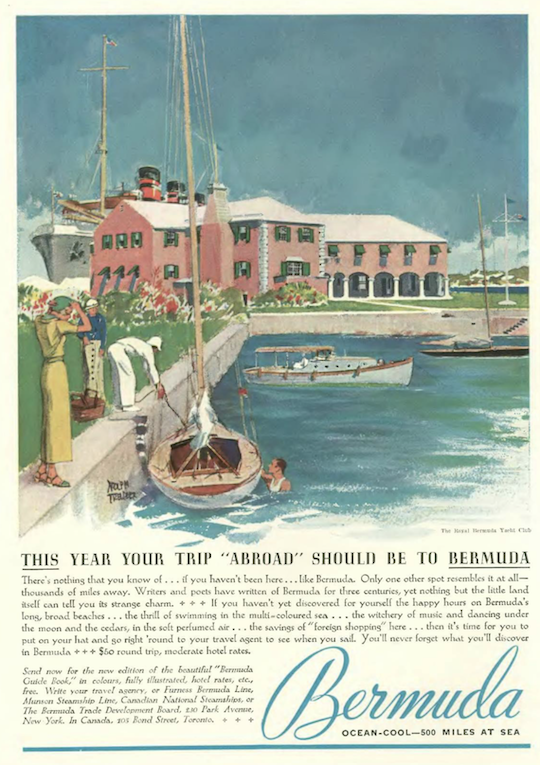
…another faithful advertiser in the magazine’s first decade was the Bermuda Trade Development Board…
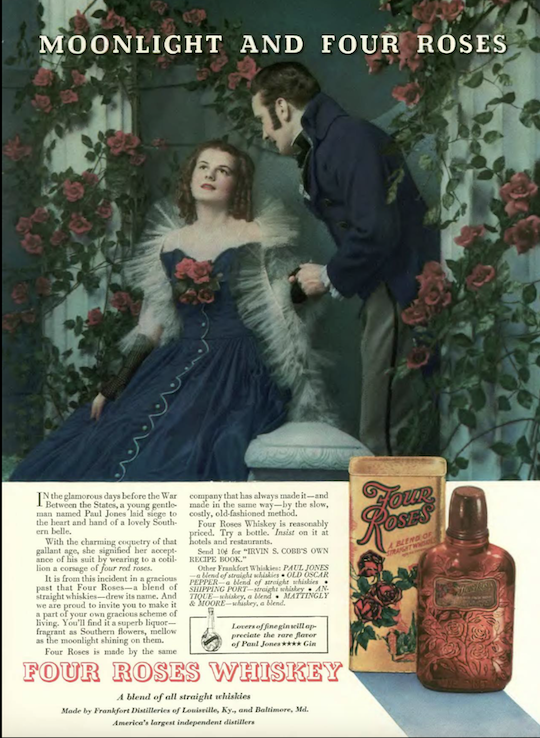
…this ad for Four Roses whiskey recalled “the glamorous days” (ahem) before the Civil War…
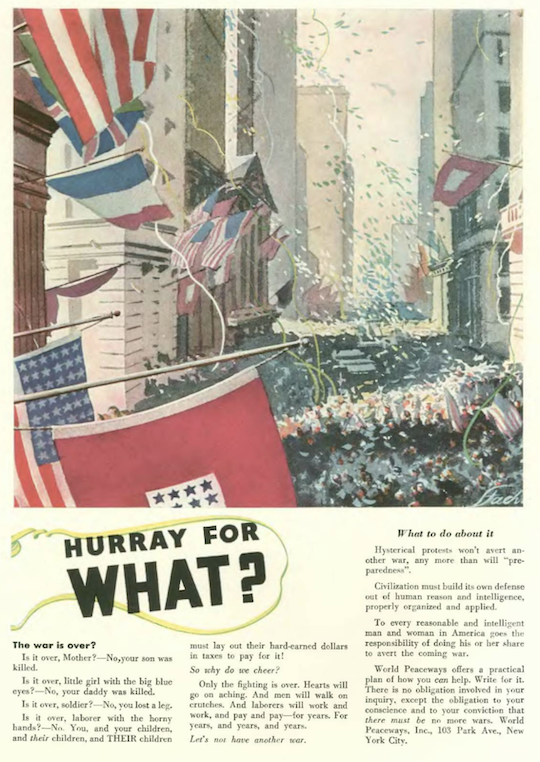
…and this colorful ad from World Peaceways reminded readers there was nothing to celebrate about wars…these ads pulled no punches (read the first few lines)…
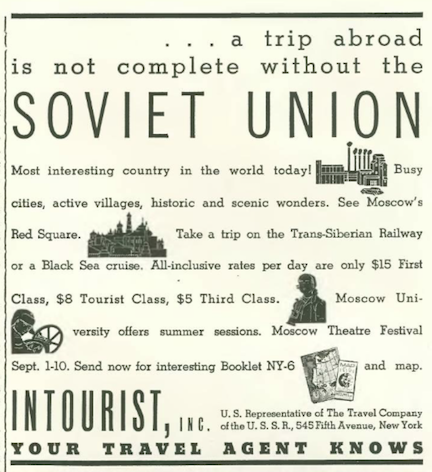
…”most interesting country in the world today!” proclaimed this ad inviting tourists to the Soviet Union…during 1934-35 Joseph Stalin was ruthlessly purging the Party, and local leaders across the country were being annihilated…of the 2.3 million people who had been party members in 1935, just under half were executed or perished in labor camps…this fact probably wasn’t mentioned in the travel folder…
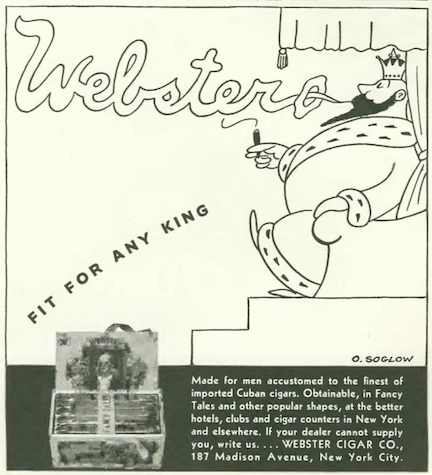
…the Webster Cigar Company hired Otto Soglow to create an ad doubtless based on the popularity of “The Little King,” but this isn’t the diminutive monarch…
…which takes us to our cartoonists, beginning with this spot signed E.S., I believe, or L.S. (anyone know?)…at any rate, its whimsical…
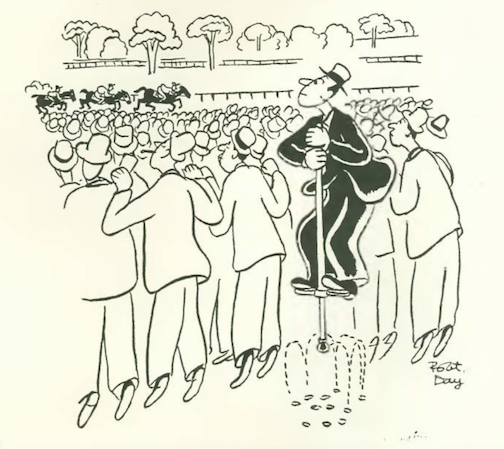
…of course we know Robert Day…
…Day again, in a very different style…
…Helen Hokinson, sounding a contemporary note…
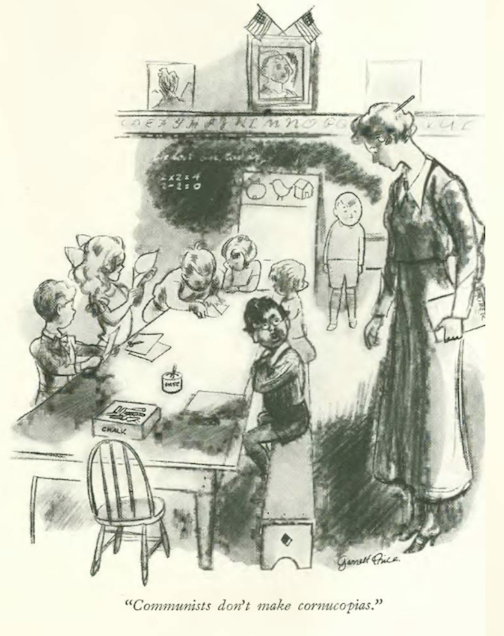
…a kindergarten political standoff, courtesy Garrett Price…
…Rea Irvin, and the obsolescence of Pan (today she’d have a cell phone)…
…Peter Arno, and a clueless, cold, cuckold…
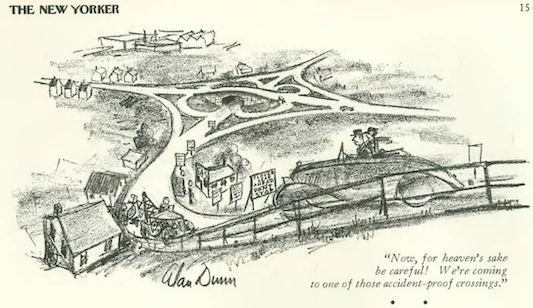
…and we close with Alan Dunn, and the future of transportation…
The penitentiary on Blackwell's Island, later named Welfare Island, in the 1910s. Today it is known as Roosevelt Island. (NYC Municipal Archives)
Until the reform Mayor Fiorello La Guardia took up the reigns at City Hall in 1934, weak or non-existent leadership in city government, coupled with Tammany graft and corruption, had allowed all sorts of institutions to go off the rails.
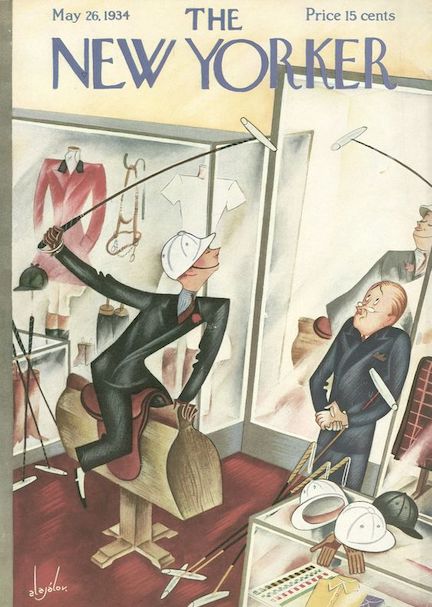
May 26, 1934 cover by Constantin Alajalov.
The New York City Department of Corrections was a prime example, so La Guardia tapped the no-nonsense assistant director of the Federal Bureau of Prisons, Austin H. MacCormick (1893–1979) to clean up Corrections, and MacCormick didn’t waste any time going after the No. 1 target: Welfare Island. Previously known as the notorious Blackwell’s Island, MacCormick described its cellblocks as a “vicious circle of depravity” unfit for humans, a place where some inmates lacked basic food and shelter while others, including a pack of gangsters and thugs who essentially ran the place, lived in grand style.
In late January, 1934, MacCormick led a well-organized raid on Welfare Island, finding littered cells full of drug addicts and large caches of weapons. According to an account in Time (Feb. 5, 1934), sixty-eight prisoners virtually ran the place. “They cowed their guards through outside political influence. They sold to some 500 inmates the best of vegetables and meats. Star boarders prepared this food in their own cells, and the prison library of more than 1,000 volumes had entirely vanished as cooking fuel. Since the food was looted from the prison commissary, the other 1,200 prisoners virtually starved on greasy cold stews.”
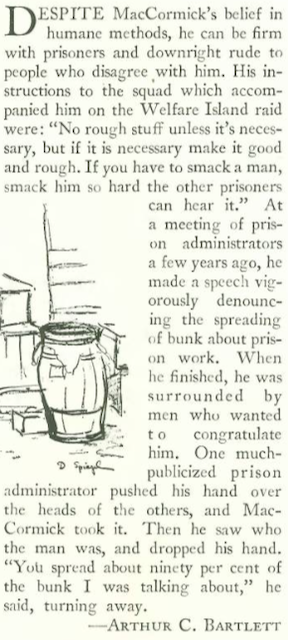
In his profile of the “The Four-Eyed Kid,” Arthur C. Bartlett attempted to shed some light on what made this stubborn Scotsman tick. Excerpts:
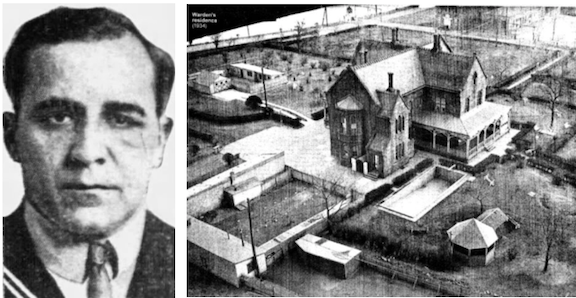
KIBOSH…After taking office in January 1934, New York’s Commissioner of Corrections Austin H. MacCormick wasted no time in cracking down on the vice and corruption that was rampant on Welfare Island (pictured at right in 1934). (ceanational.org/NYPL)INSIDE JOB…Mobster Joie Rao lived a lavish lifestyle while incarcerated at Welfare Island. Wielding more power and authority than the warden himself, Raio fed steak to his pet dog and maintained a staff of servants to cater to his every whim. Not that the warden had it all that rough; his home (at right) featured an in-ground pool. (Pinterest/rihs.us)READ ALL ABOUT IT…The New York Daily News (left) and the New York Times offered extensive coverage of the raid in their Jan 25, 1934 editions. (Pinterest/NY Daily News/NYT)
MacCormick literally wrote the book on prison reform. His The Education of Adult Prisoners (1931) called for the introduction of fundamental academic education in prison systems that would provide inmates with the intellectual tools needed for everyday life. His “four goals” included vocational, health, cultural and social education.
MacCormick broke up the gangster ring at Welfare Island and eventually transported its remaining inmates to the newly built prison at Rikers Island. The Welfare Island prison was torn down and replaced by Goldwater Hospital, today the Coler Specialty Hospital on Roosevelt Island. For a little more insight into MacCormick’s tactics, here is the conclusion to Bartlett’s profile:
ALL ABOARD…Welfare Island (now Roosevelt Island) was once accessible by taking a trolley halfway across the Queensboro bridge, where passengers would take an elevator (contained in the structure in the top image) down to the island. (Greater Astoria Historical Society/rooseveltislander.blogspot.com)
* * *
You’re Next
Last week we looked at Robert Moses’s plans for Riverview Park, which would quickly sweep away the yacht clubs on the Hudson. Another playground for the rich, the Central Park Casino, would soon be next, as E.B. White correctly surmised.
STICKER SHOCK…It has been suggested that Robert Moses determined to tear down the Central Park Casino after being presented a $27 dinner bill for four persons (roughly $500 today), but in reality Moses hated the Casino’s most famous denizen, the deposed Mayor Jimmy Walker. It’s too bad Moses didn’t appreciate the Joseph Urban’s stunning interiors (the ballroom, right), that crumbled with the building when it was razed in 1936. (NYC Department of Parks & Recreation)
* * *
Schenck’s Schlock
In the 1920s and 30s documentary and docudrama filmmaking was still in its infancy, and for every Nanook of the North (1922)—still considered one of the best documentary films of all time—there were dozens of schlocky films like Harry Schenck’sBeyond Bengal, reviewed here by John Mosher for the New Yorker.
The film must have made quite an impression around the New Yorker’s offices, or at least one particular scene that depicted a British scientist, a “Miss Joan Baldwin,” coming down with a fever, rather unconvincingly. Both Mosher and E.B. White (below) found her performance intriguing:
WHAT A CROC…Clockwise, from top left, movie poster for Beyond Bengal; early in the film a scientist, “Miss Joan Baldwin,” is suddenly (and unconvincingly) seized by tropical fever—the remainder of the film entails Harry Schenck’s attempt to return Baldwin to civilization; Schenck accompanies Baldwin across a crocodile-infested river, shooting at anything that moves while the “natives” swim ahead, perilously clearing a path through the sea of crocs; back in civilization, Schenck and Baldwin prepare to head home. The whole film is available on YouTube, if you’re up for that sort of thing. (IMDB/YouTube)
* * *
From Our Advertisers
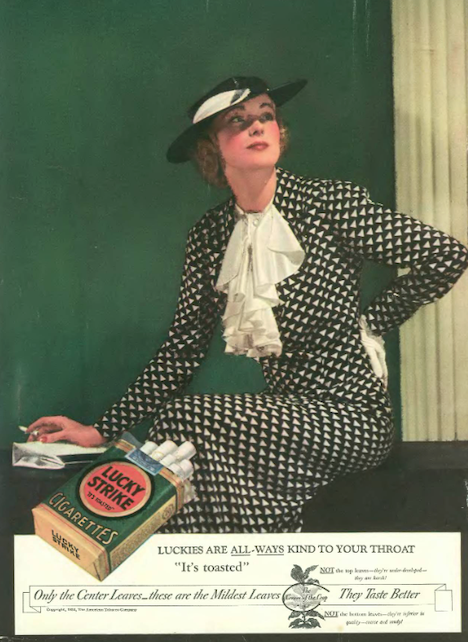
We kick off with the latest installment from Lucky Strike, and another smartly dressed customer…
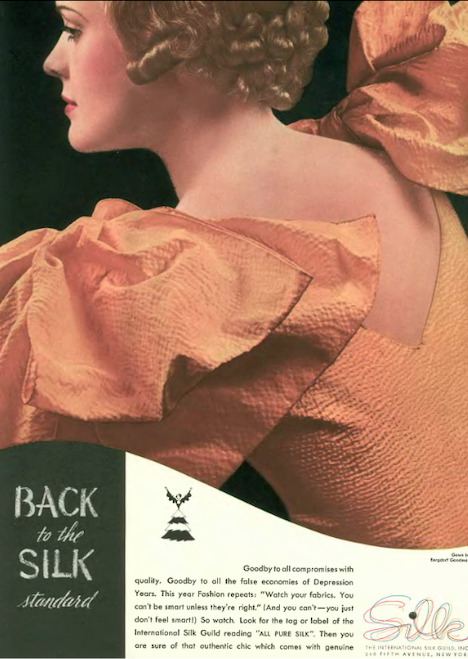
…the silk merchants struck back against the synthetics with this splash of color…
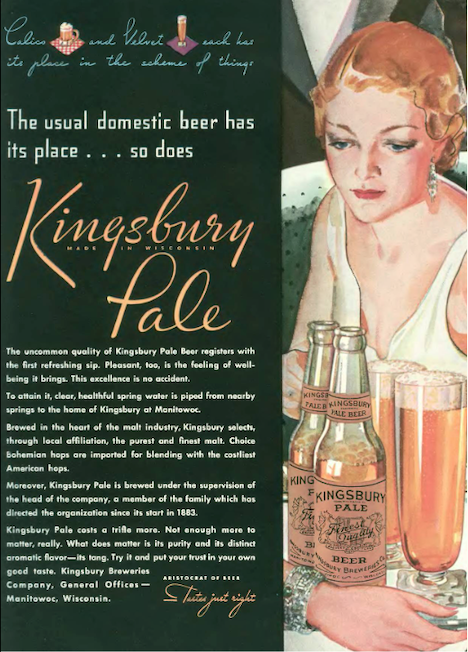
…the makers of Kingsbury Pale offered up some color of their own, although the illustration itself is a bit strange, what with the molten bubbles in the beer bottles, the bejeweled, disembodied arm that somehow supports them, and the woman who isn’t even looking at the beer…perhaps she was hoping for a cocktail or Champagne…
…there’s no doubting this fellow’s enthusiasm for a glass of Rheingold…
…Wamsutta Mills enlisted the aid of a “fat man” to prove the durability of their sheets…
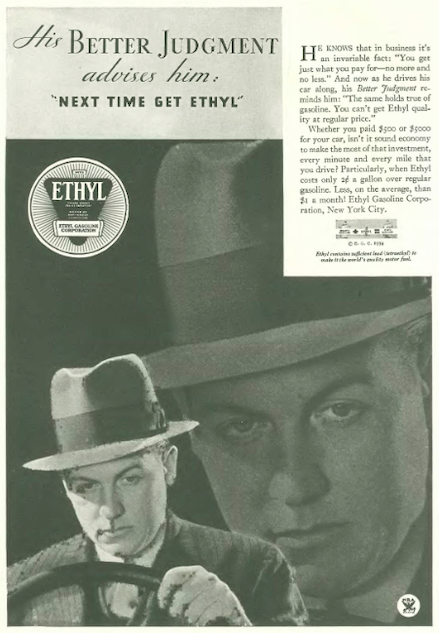
…and what drives a man to commit murder? In this case, neglecting to pay the extra two cents for leaded gasoline…
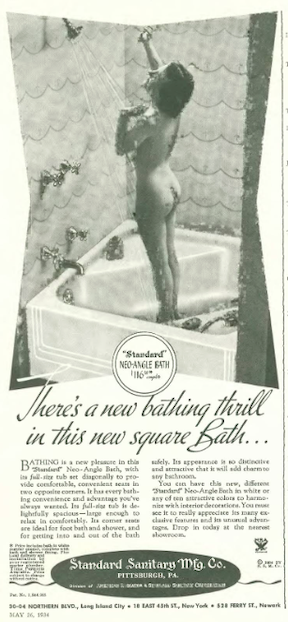
…I wonder if the Hays Code extended to advertising…looks like the new “Neo-Angle Bath” caused the folks at Standard Sanitary Manufacturing to lose their inhibitions…
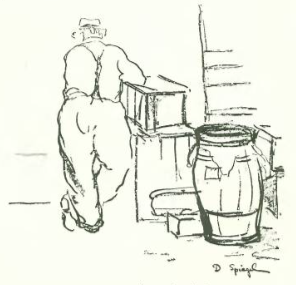
…on to our cartoonists, we begin with some spot art by Doris Spiegel (1901-1996), who was especially known for her depictions of street life…
…George Price supplied this bit of merriment for the event listings…
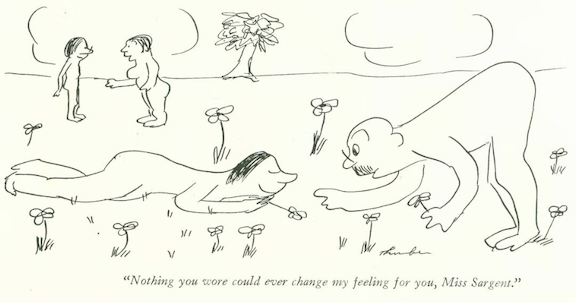
as did James Thurber…
…Thurber again, this time baring it all…
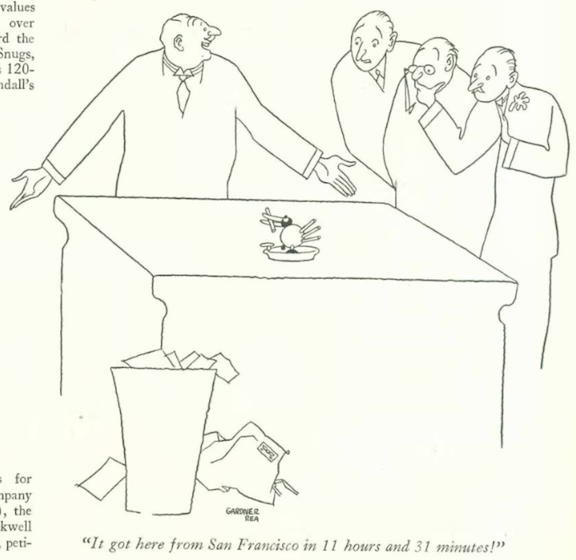
…it appears that same day delivery, for even a mere trifle, is nothing new…per Gardner Rea…
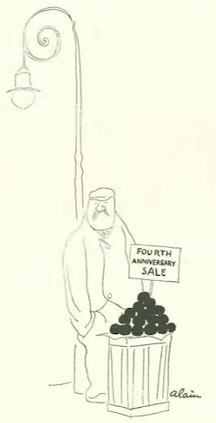
…Alain (Daniel Brustlein) gave us a film editor with the sad task of censoring Joan Blondell…
…tame by today’s standards, this 1932 promotional photo of Blondell for the film Three on a Match was later banned by the Motion Picture Production Code…
…and we close with Perry Barlow, and more wisdom from the mouth of babes…
Power broker Robert Moses always made sure he was few steps ahead of any possible opposition to his grand development plans in and around New York City. That included the yacht clubbers along the Hudson River, who were more or less erased from the scene by Moses in one fell swoop.
May 19, 1934 cover by Ilonka Karasz.
The Upper West Side’s Columbia Yacht Club probably thought it was just swell that the city was dumping waste and rock along the shores of the Hudson River, since it eventually created driveway access for members who previously had to access the club via a footbridge over the New York Central’s tracks. What hadn’t occurred to them was that nearly 25 years-worth of infill had also created a new strip of land that extended from 79th to 96th street, land that Moses envisioned as an expansion of Riverside Park (and the abrupt end of the West Side yacht club scene). “The Talk of the Town” explained:
LOCATION, LOCATION…Two views of the Columbia Yacht Club at West 86th Street, circa 1930. The club was razed to make room for Robert Moses’s expansion of Riverside Park. Moses’s ambitious project, which cost twice as much as Hoover Dam, put the train tracks underground and topped the park with the Henry Hudson Parkway. (newyorktoursbygary.blogspot.com/NYPL Digital Collections)HEADS UP…Elsie Henneman dives into the water near the Hudson River Yacht Club, circa 1930. Located at the foot of West 74th Street, the club moved onto a barge at 145th Street to escape Moses’s park expansion plans, but it was eventually banished from the West Side. (Reddit)
* * *
Ode to the Road
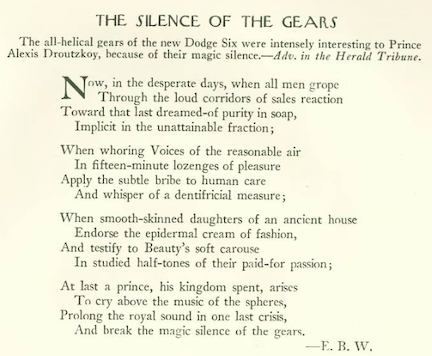
We now shift gears to E.B. White, who was poetically inspired by an advertisement in the Herald Tribune that featured Prince Alexis A. Droutzkoy (a member of the exiled White Russian colony in New York) praising the “magic silence” of the new “Dodge Six” automobile:
SILENCE OF THE CAMS…The 1934 Dodge Six. (detail from a vintage ad)
* * *
Führer’s Filmmaker
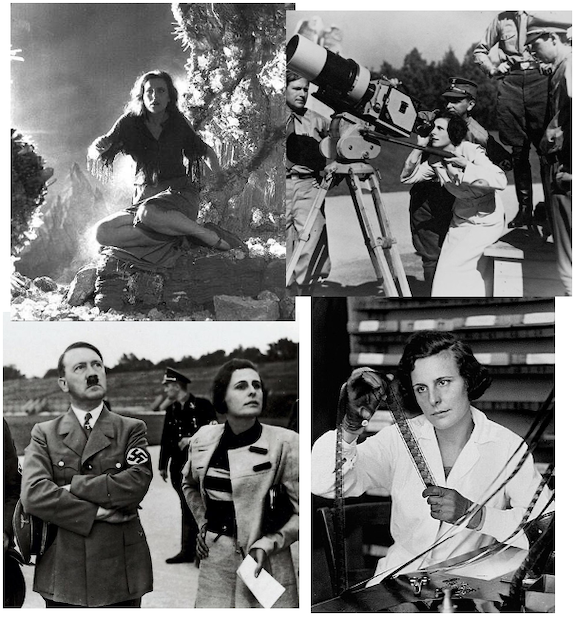
The ability (or inability) to separate art from an artist’s personal conduct or beliefs has been a particular topic of the last two decades, given the litany of stars who have been “cancelled” despite the quality or importance of their work. The work of German filmmaker Leni Riefenstahl (1902–2003), still debated nearly ninety years after her collaboration with Nazi leaders, demonstrates the fine line many a film historian or critic must walk when assessing the career of an innovative artist (for an American example, see filmmaker D. W. Griffith). Riefenstahl’s 1932 film, The Blue Light (Das blaue Licht), made prior to her Nazi collaborations, was praised for its beauty by American critics, including the New Yorker’sJohn Mosher, when it was released in the U.S. in 1934.
The Blue Light also captivated Adolf Hitler, who saw the attractive and athletic Riefenstahl as an ideal of Aryan womanhood. A subsequent meeting with Hitler would result in Riefenstahl’s controversial 1935 Nazi propaganda film Triumph of the Will (Triumph des Willens). We will explore that film, and Riefenstahl’s role, in a later post.
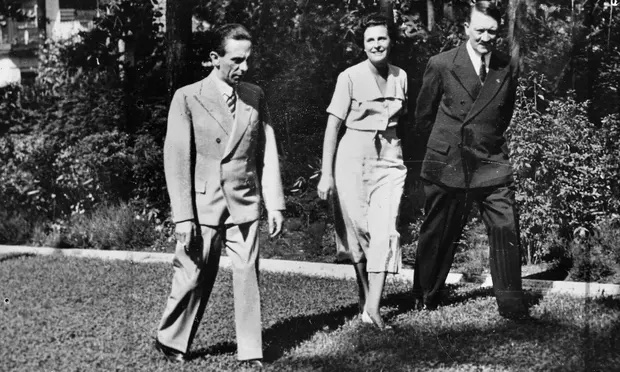
CAREER MOVE…Clockwise, from top left, Leni Riefenstahl demonstrated her acting ability, athleticism and filmmaking talents in 1932’s The Blue Light (Das blaue Licht); Riefenstahl filming in Nuremberg during the 1934 Nazi Party congress—the footage was used in 1935 Nazi propaganda film Triumph of the Will; working at a film cutting table, 1935; with Adolf Hitler at Nuremberg, 1934. (IMDB/Library of Congress/UTK Cinema Studies/The Irish Times)HI HITLER…Nazi propaganda minister Joseph Goebbels and Adolf Hitler pay a visit to Leni Riefenstahl at her Berlin estate, circa 1937. (Roger-Viollet)
* * *
From Our Advertisers
We begin with more Carl “Eric” Erickson-inspired artwork, here promoting the bygone elegance of transatlantic travel…
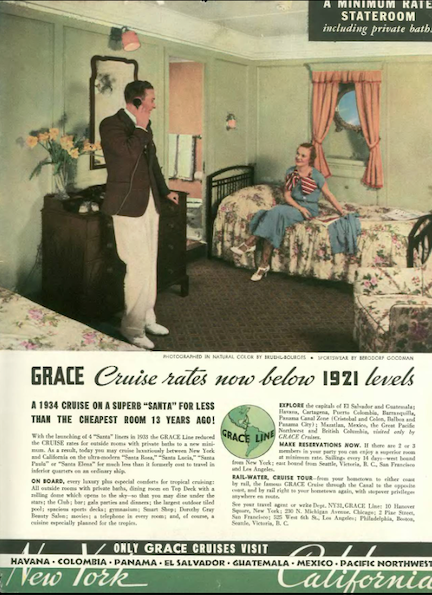
…perhaps a bit less upscale but still pretty nice, the “Santa” line of ships operated by the Grace Line between New York and Latin America included air-conditioned interiors paneled with aluminum (a fireproofing measure) and spacious cabins with private baths that faced to outside…
…this ad must have been a happy sight to folks who had to endure more than a decade of bootleg Scotch during Prohibition…
…Smirnoff vodka had its origins in 1860s Russia, capturing two-thirds of the Moscow market by the mid-1880s…forced to leave Russia in 1904 after the Tsar nationalized the Russian vodka industry…Smirnoff relocated to Turkey, then Poland, and then Paris, each time with limited success…at the end of Prohibition the brand relocated once again to a distillery in Bethel, Connecticut, hence this advertisement…
…the habanero pepper has been used to infuse everything from tequila to vodka to whiskey…this particular product was marketed as something new that could be mixed with a variety of spirits or topped up with club soda or ginger ale…
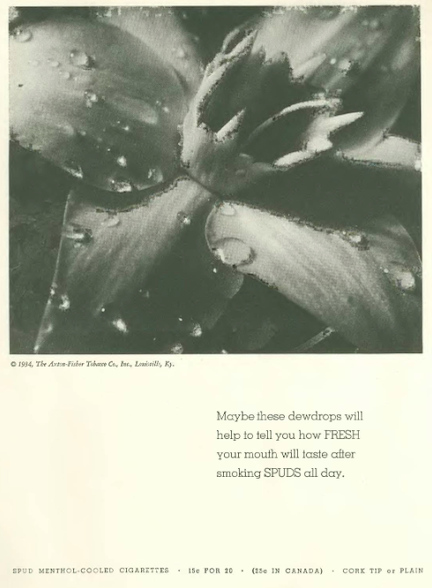
…I include this ad from the maker of Spud cigarettes for its sheer audacity…it claims your mouth will feel dewdrop fresh after an entire day of smoking menthols…
…stunt driver Billy Arnold was one of the “Hell-Drivers” Chrysler employed to tout the safety of its low-priced Plymouths at promotional events…
…including Chicago’s “Century of Progress”…below, a crowd watches Arnold take his Plymouth for a roll and emerge unscathed…
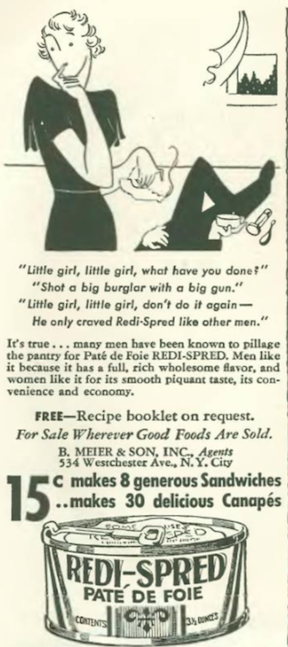
…the folks at Redi-Spred employed a murder theme to promote their “Pâté de Foie”…which foie was used…duck, goose or lord knows what, is not specified…
…the signature is muddled, but this looks like another illustration by Herbert Roese, who never published a cartoon in the New Yorker but sure had its style down, especially Peter Arno’s…
…Harold Ross’s high school friend and cartoonist John Held Jr. was a frequent contributor to the New Yorker from 1925 to 1932 (he also contributed to Life, Vanity Fair, Harper’s Bazaar), but when demand for his Jazz Age cartoons and illustrations fell off in the 1930s, he turned to painting and illustrating children’s books. So it was a surprise to catch this glimpse of Held’s work in a one-column ad promoting a Held-drawn map of New England inns…
…speaking of elusive illustrators, I am often challenged to discover the identities of spot illustrators in the early issues…this one appears to be signed by “Maurice Dreco”…
…the signature on this one looks like “Saphire,” but again, it is not clear…
…but there is no doubt this little gem is by Daniel ‘Alain’ Brustlein…
…which leads us to Richard Decker, and a hostage situation gone flat…
…and Decker again, with a back-handed compliment…
…James Thurber was in his familiar world of dogs and battling sexes…
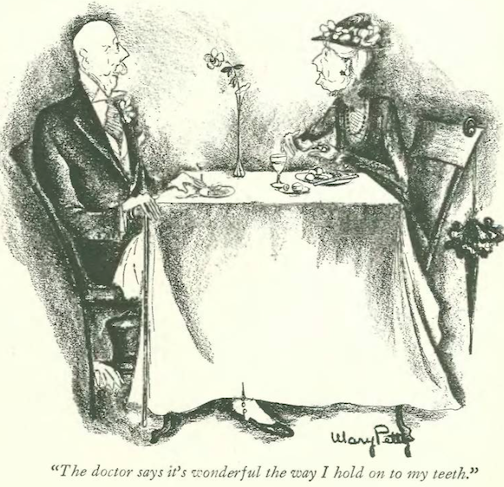
…Mary Petty found some good news on the dentistry front…
…Otto Soglow’s Little King believed more is merrier…
…and we close with William Crawford Galbraith, and a wedding day surprise…
Above: Robert Moses in 1939 with a model of his proposed Battery Bridge Park Reconstruction; at right, 1934 Bryant Park renovation, view to the south on 6th Avenue from 42nd Street. (Wikipedia/NYC Parks Department)
The title for this entry comes from Robert Caro’s landmark 1974 biography of Robert Moses, The Power Broker: Robert Moses and the Fall of New York, which questioned the benefit of Moses’s monumental projects.
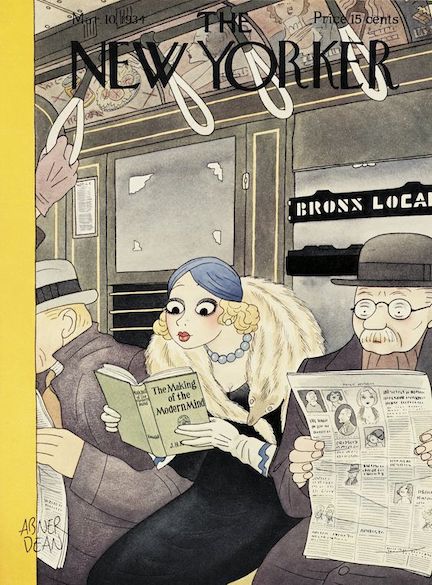
March 10, 1934 cover by Abner Dean.
Like him or not, few unelected officials have wielded more power than Moses, who through various appointed positions, including New York City Parks Commissioner, he was able to impose his will on mayors, legislators, congressmen, wealthy burghers, and even, on occasion, The White House. In turn he imposed his will on the city itself, clearing whole neighborhoods to lay down new roads that extended from Manhattan to the tip of Long Island, where neither farmer nor landed gentry could stand in his way. A profile written by Milton MacKaye examined what made Moses tick. An excerpt:
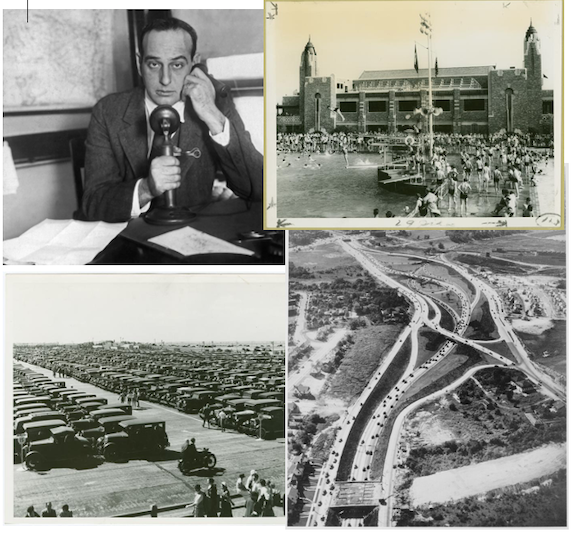
DON’T YOU DARE PUT ME ON HOLD…Relentless doesn’t begin to describe Robert Moses’s pursuit of power. Clockwise, from top left, Moses circa 1930; one of the swimming pools at the west bathhouse at Long Island’s Jones Beach, a project that helped launch Moses’s road to power; Long Island Expressway, which transformed Long Island from farm country (and a retreat for the rich) into a land of bedroom communities and public parks; the east parking field at Jones Beach. (Britannica/Library of Congress/U.S. National Archives)
In another excerpt, MacKaye noted that Moses had been named a member of the Triborough Bridge Authority; Moses would ultimately become chairman, and through this position would possess enormous, unchecked power and influence. Moses was skilled at creating legal structures that would favor his ambitions, burying language into legislative bills and other documents that would make him impervious to influence from mayors, legislators, governors and other elected officials.
A DIFFERENT KIND OF PLAYGROUND…Moses intensely disliked former New York Mayor Jimmy Walker, who used the Central Park Casino (top left) as his personal playground. Moses exacted his vengeance by having the historic casino razed in 1935 and replaced with the Rumsey Playground; at right, the 1936 Triborough Bridge (Berenice Abbot photo), a cluster of three separate spans connecting the Bronx, Manhattan, and Queens. It was developed through Moses’s Triborough Bridge Authority, which was impervious to influence from mayors, legislators and governors. While the city and state were strapped for funds, Moses reaped millions from tolls, which financed his other ambitions; bottom left, Moses in 1938. (Wikipedia/transalt.org/Library of Congress)
Final note, I highly recommend Caro’s The Power Broker—it’s a doorstop of a book, but also one of the best biographies of the 20th century and a must-read for anyone who wishes to understand how present-day New York came to be, and how it really works.
* * *
Let’s Talk About the Weather
Robert Benchley, writing under the pseudonym Guy Fawkes, took a turn at “The Wayward Press” column, commenting on the sensationalistic coverage of the weather by the local press. In all fairness to the press, New York City had endured a blizzard as well as the coldest temperature ever recorded for the city: 15 below zero (Fahrenheit) on Feb. 9, 1934. (According to newspaper accounts, it was 14.3 below).
Benchley also commented on journalist Ernest Gruening (1887–1974), who was the editor of the New York Post for only four months in 1934, but during those four months he really shook things up.
EASY BOSS…Ernest Gruening was editor of the New York Post for only four months in 1934, but during that time he made life better for his newsroom employees by implementing an unheard of 40-hour work week. Gruening went on to serve as the governor of the Alaska Territory from 1939 until 1953, and as a U.S. Senator from Alaska from 1959 until 1969. (Photo from 1935 via Wikipedia)
Robert Benchley thought the press made too much of the city’s snowy weather, but these newsreels tell a different story:
* * *
Punch Drunk
Critic John Mosher found slim pickings at the local movie houses, opting for Jimmy Durante’sPalooka as the best of crop:
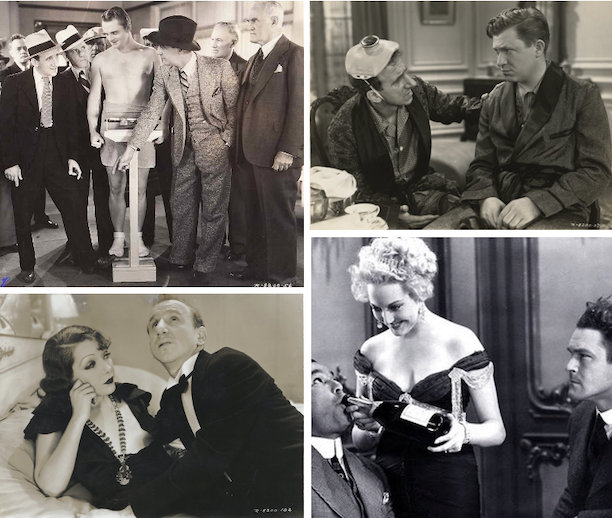
RIBALDRY AT RINGSIDE…Clockwise from top left, Knobby Walsh (Jimmy Durante) tries to press his advantage during the weigh-in of boxer Al McSwatt (portrayed by William Cagney, the look-alike younger brother of James Cagney) in 1934’s Palooka; Durante thinks he’s found a winning fighter in Joe Palooka (Stuart Erwin); Joe’s father, Pete Palooka (Robert Armstrong) demonstrates why he’s nicknamed “Goodtime” with the help of Trixie (Thelma Todd); Durante with Lupe Vélez, who portrayed glamorous cabaret singer and fortune hunter Nina Madero. (IMDB)
* * *
From Our Advertisers
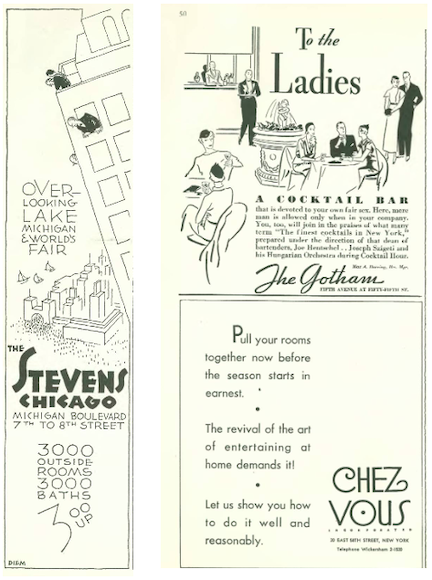
We start with a couple ads from the back pages…the promoters of Chicago’s famed Stevens Hotel offered a unique perspective as they appealed to New Yorkers to come check out the “Century of Progress” World’s Fair, which proved so popular that it planned to reopen in May for a second year…at right, The Gotham catered to the ladies with a special cocktail bar that only allowed men in the company of a woman…
NICE DIGS…At left, The Stevens Hotel (now Hilton Chicago) and, at right, The Gotham (now The Peninsula) are happily still with us today. (Wikipedia)
…cigarette manufacturers continued to work on their biggest growth market with ads like this one from the Lorillard Tobacco Company…here a perceptive woman chooses to ignore the “brazen claims” of other tobacco companies and makes an informed decision to inhale an Old Gold…
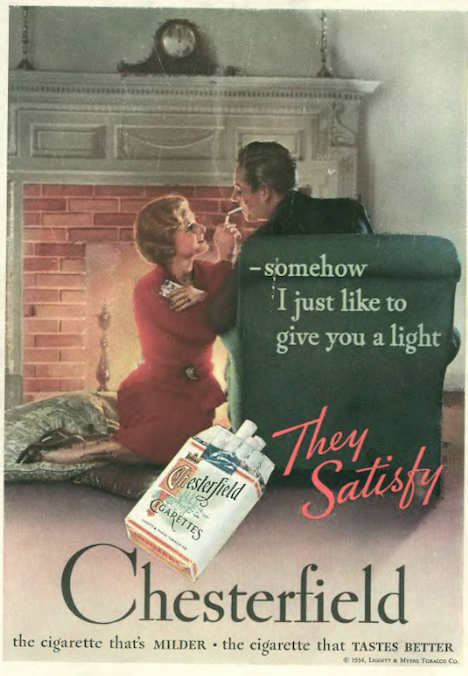
…Liggett & Myers, on the other hand, stuck with this subservient pose, suggesting both are happy with their cigarette, and their station in life…
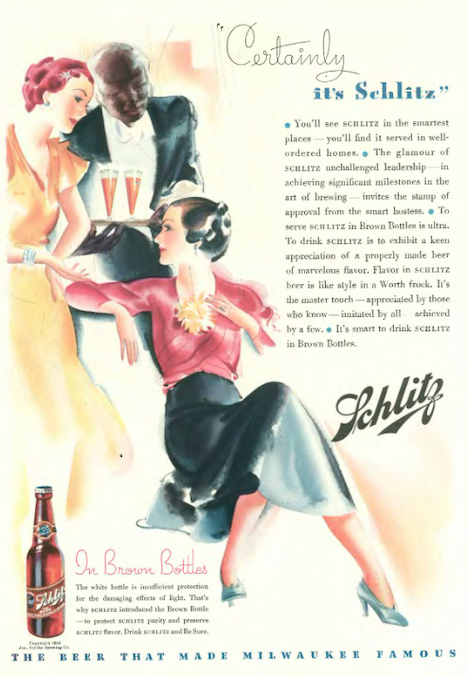
…another colorful ad from the makers of Schlitz beer…following the end of Prohibition Schlitz quickly became the world’s top-selling brewery, a position it would hold into the 1960s until it switched to cheaper brewing methods…
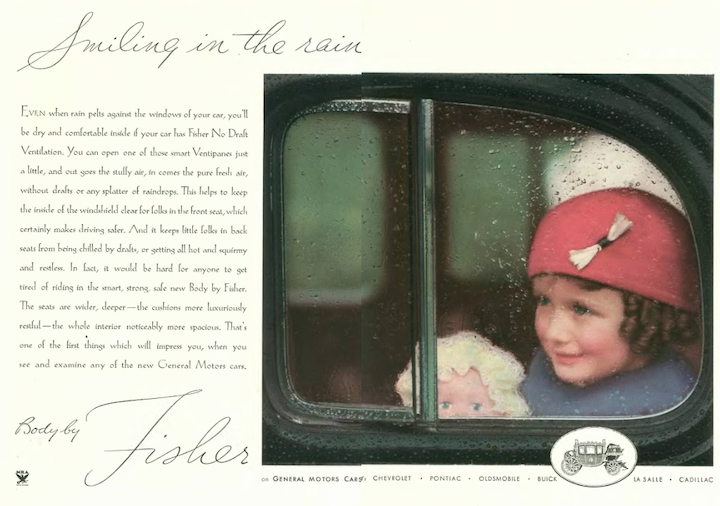
…the makers of Fisher car bodies (owned by General Motors) continued their lavish two-page spreads touting the homey comforts of their interiors…
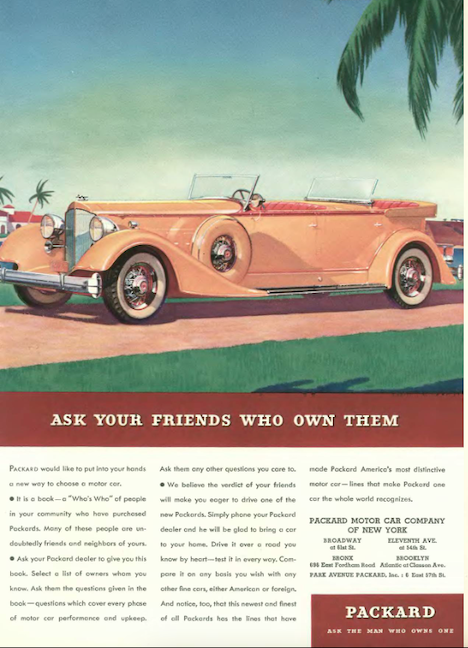
…and no more staid ads from luxury carmaker Packard, who ran this full-color, full-bleed spot…
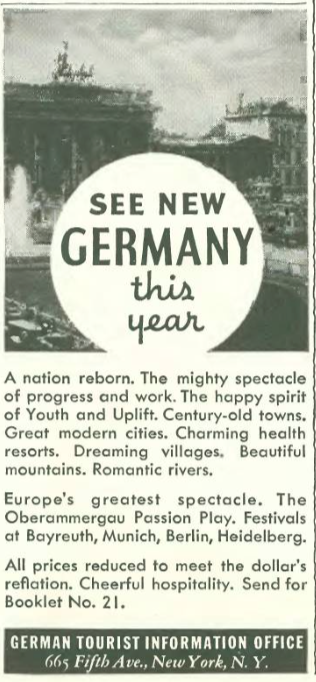
…it’s almost springtime for Hitler, and Germany welcomed American tourists with promises of “Dreaming Villages” (whatever those are), charming health spas and places of romance and beauty…hmmm, no mention of swastika flags hanging from every building, or parades of goose-stepping thugs…
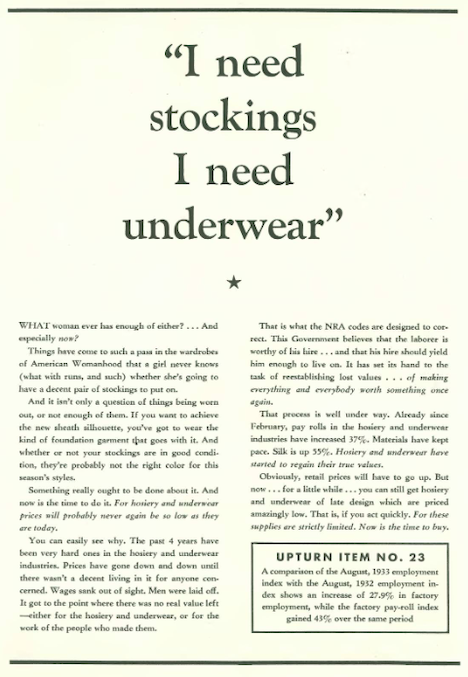
…this public service ad promoted the effectiveness of the National Recovery Act, offering the uptick in underwear sales as a sure sign of economic growth…
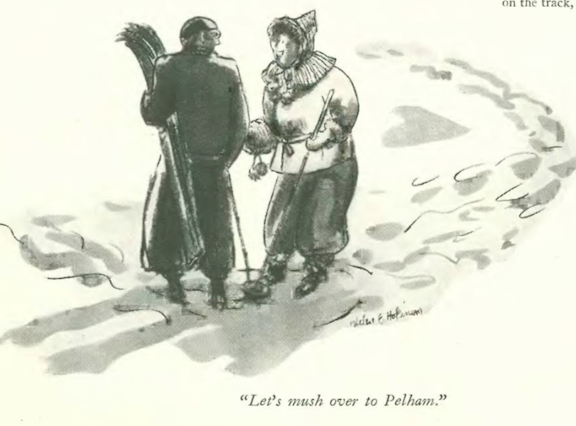
…on to our cartoonists, we begin with Helen Hokinson experiencing the results of the recent blizzard…
…as did Henry Anton, with a befuddled meteorologist…
…Alain (Daniel Brustlein) gave us this wordless gem…
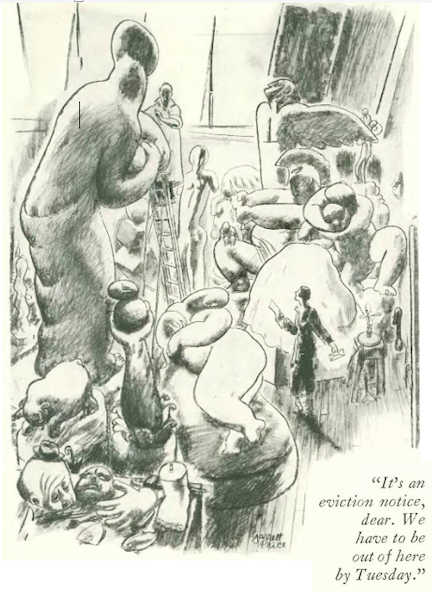
…while Garrett Price presented a sculptor’s greatest challenge…
…Alan Dunn gave us two women who expected more pizzazz from a recent funeral…
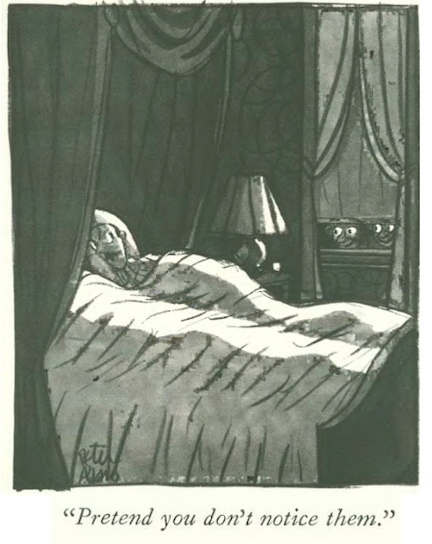
…Peter Arno contended with some Peeping Toms…
…and James Thurber looked in on recent maneuvers in his war between the sexes…
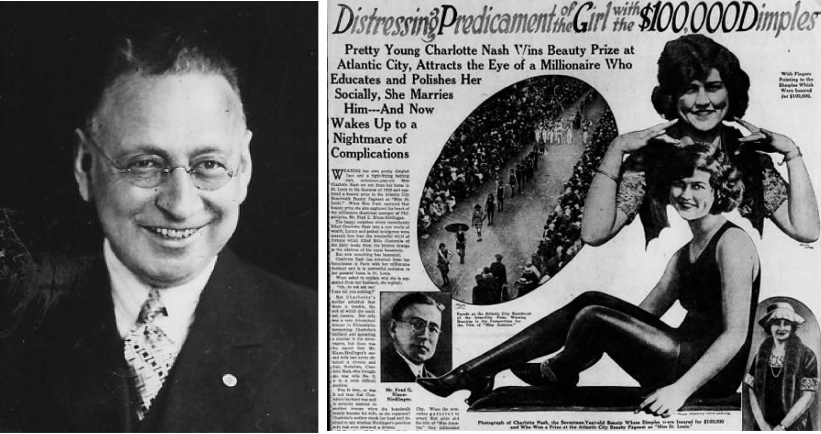
The story of Fred Nixon-Nirdlinger isn’t exactly dinner table conversation these days, but in the spring of 1931 his death at the hands of his beauty queen wife had much of America abuzz.
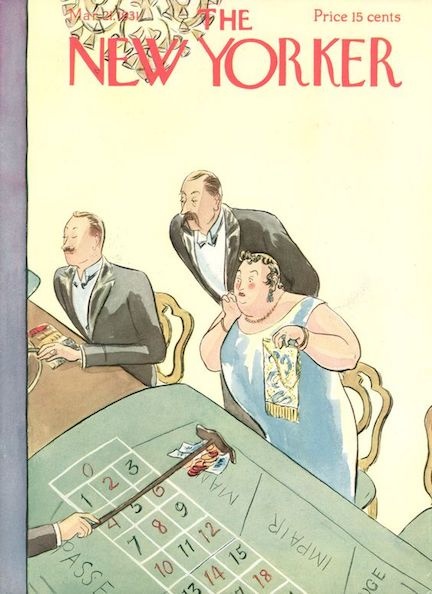
March 21, 1930 cover by Helen Hokinson.
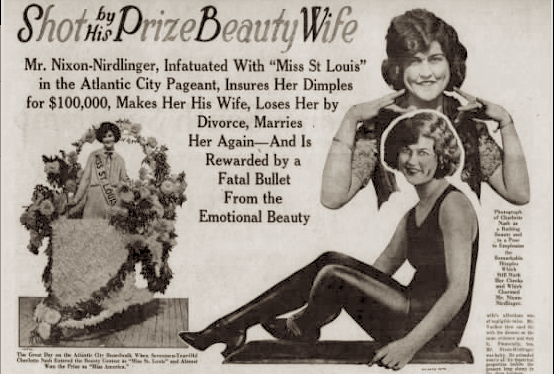
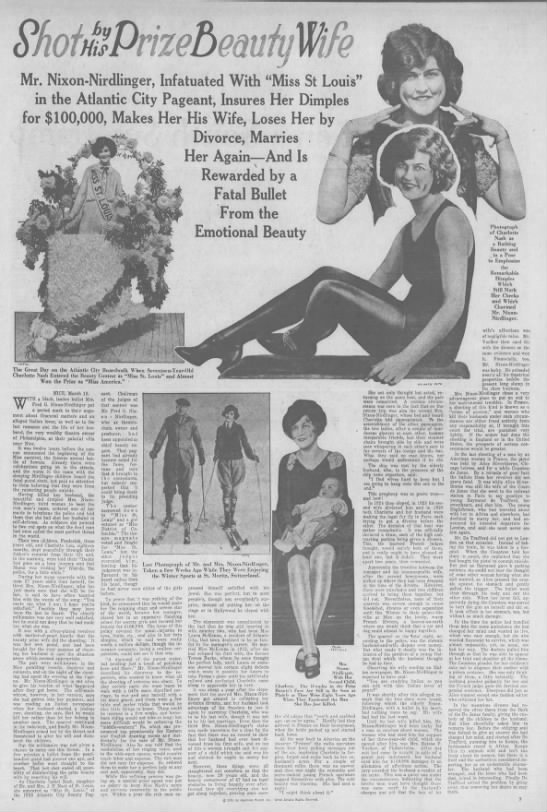
Charlotte Nash, Miss St. Louis of 1923, would have passed into obscurity like so many other beauty contestants if she hadn’t married a wealthy theater owner 30 years her senior, and then divorced and remarried him, and then shot him in the head on the French Riviera.
But first, the reason I am writing about this lurid episode: here’s E.B. White in the March 21, 1931 “Notes and Comment”…
Forty-seven-year-old Fred Nixon-Nirdlinger, wealthy owner of a Philadelphia theater chain, was serving as a judge at the 1923 Miss America competition in Atlantic City when the 17-year-old “Miss St. Louis,” Charlotte Nash, caught his eye and his fancy. By February 1924 they were married…
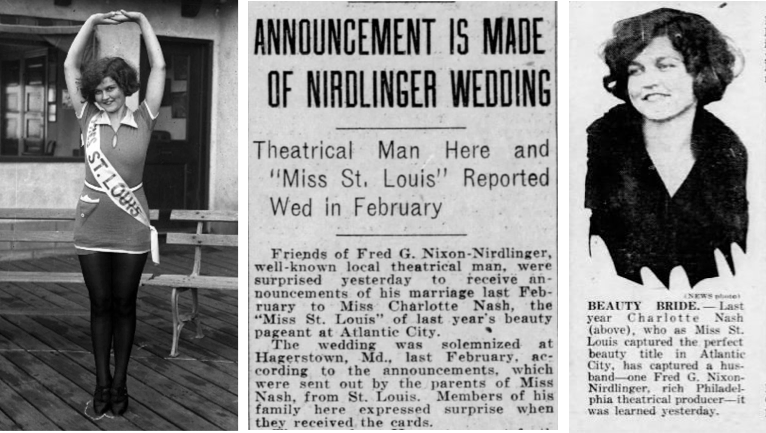
FANCY STRIKER…Seventeen-year-old Charlotte Nash strikes a pose at the 1923 Miss America pageant in Atlantic City; belated 1924 marriage announcement in the Philadelphia Inquirer; announcement in the New York Daily News. (New York Daily News/Philadelphia Inquirer)
…Fred was furious that Charlotte did not win the title in Atlantic City. He vowed to make her a movie star and sent her off to finishing school to work on her manners and elocution…
CRADLE TO GRAVE…Fred Nixon-Nirdlinger sent his young bride to finishing school for “a touch of polishing here and there.” Little did he know that one day she would finish him too…permanently. (findagrave.com/Pittsburgh Press)
…Unfortunately, Fred forgot to tell his young bride that he already had a wife —news that came to light on a trans-Atlantic voyage to Paris, where Fred and Charlotte had planned to honeymoon. Already pregnant with his child, Charlotte nevertheless divorced Fred, but remarried him some months later after the baby was born (and after considerable wooing and groveling by the theater magnate). Fred rejoined Charlotte in France, but the second honeymoon didn’t last long either. On the evening of March 11, 1931, the intensely jealous Fred accused his young wife of trafficking with “gigilos.” After Charlotte denied the charge, Fred seized her by the neck and threatened to choke her to death.
“At some point Fred went into the kitchen for more whisky. Charlotte used the opportunity to flee to the bedroom, where she slipped a loaded pistol under her pillow. Fred’s last words to her were, “I will kill you rather than let you have an Italian lover.” Charlotte beat him to it, and as she lay on the bed she retrieved her pistol and fired. The first bullet entered just under Fred Nixon-Nirdlinger’s left eye and lodged at the base of his skull. A second bullet hit him in the chest. Two other shots went wild. Fred crumpled in a pool of blood.”
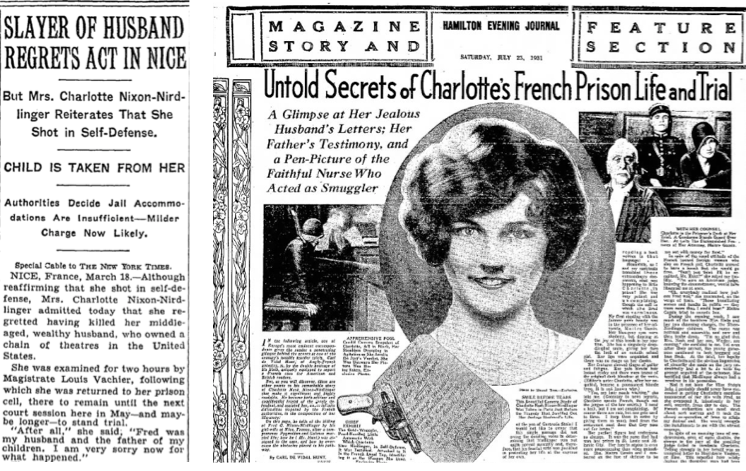
Charlotte was soon in a French jail, now a bigger star than she had ever been, or ever would be…
FINALLY GETTING SOME NOTICES…Left, detail of a March 18, 1931 New York Times account of the slaying; right, a more lurid take on the story by the July 18, 1931 edition of the Hamilton (Ohio) Evening Journal. Below, another colorful account from the San Francisco Examiner. (newspaper.com/New York Times)
During the subsequent trial, Charlotte’s defense attorneys argued that the shooting was a clear case of self-defense, and the jury agreed, acquitting the former beauty queen in just nine minutes. When she returned to the United States with her two young children, it appeared she would be entitled to a big chunk of Fred’s fortune…
…but in the end the will left her nearly penniless, so she earned what she could by telling her sensational story to the media, including this multi-installment feature she penned for the St. Louis Star and Times:
IT’S A LONG STORY…The 14th and 16th installments of Charlotte Nash’s story of her brush with fame and infamy in the St. Louis Star and Times. (newspaper.com)
Laura James notes that Charlotte might have been better off remaining in France: “The verdict was largely attributed (by the American newspapers at least) to French attitudes toward beautiful women and marriage in general (the jury included eight bachelors). But she returned to St. Louis; learned that her husband’s will left her nearly penniless; and tried to find acting jobs in Hollywood only to be snubbed Lizzie Borden-style, as Hollywood would have none of her. In the end she would declare, ‘Sometimes I’m sorry that I was ever considered beautiful. It brought me more trouble than joy.”‘
But the story doesn’t end there. Charlotte Nash Nixon-Nirdlinger (1905-2009) dropped out of public view, but would live on into the 21st century, dying at age 103 or 104 in her hometown of St. Louis, Missouri, where she rests today.
RIP CHARLOTTE. (findagrave.com)
* * *
Turkey Trot
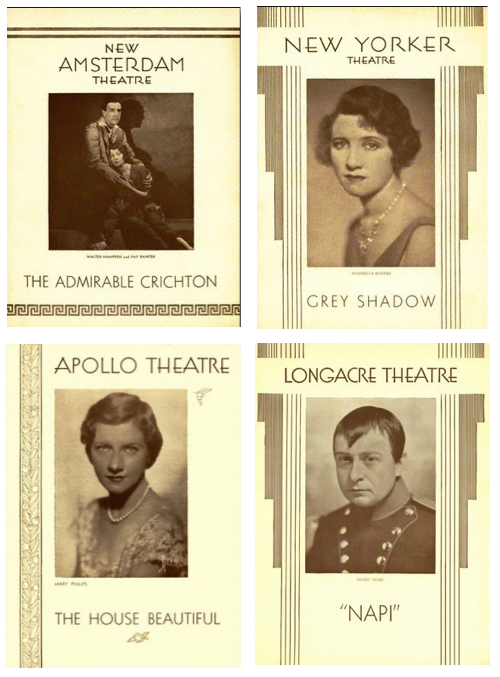
Dorothy Parker began to detect a pattern as she continued subbing for her friend Robert Benchley’s theater review column. All of the plays she had reviewed to date were found to be uniformly terrible; she found comfort, however, in fellow critics who also viewed Broadway’s spring lineup as a flock of “little turkeys”…
BIRDS OF A FEATHER…Dorothy Parker found Broadway’s spring lineup to be uniformly terrible, and audiences mostly agreed. Clockwise, from top left, The Admirable Crichton ran for two months and 56 performances at the New Amsterdam Theatre; Grey Shadow closed after 39 performances at the New Yorker Theatre; Napi, directed and lead-acted by the diminutive Ernest Truex (pictured) lasted just 21 shows at the Longacre; The House Beautiful bested them all by staying open for 108 performances at the Apollo. A curious side note: Mary Philips, pictured on the Apollo cover, was Humphrey Bogart’s second wife. The marriage lasted ten years — 1928 to 1938. (Playbill)
Of the plays Parker reviewed, she called The Admirable Crichton “piteously dated;” of Grey Shadow, she wrote that it would be as indelicate for her to discuss the play as it would be to “go into details of my appendectomy;” Parker deemed Napi “as grubby and unpleasant a little comedy as you could want to stay away from;” and she did not find The House Beautiful all that beautiful…”The House Beautiful is, for me, the play lousy.”
Parker ended the column with her usual plea to Benchley:
* * *
Moses Parts the Swamp
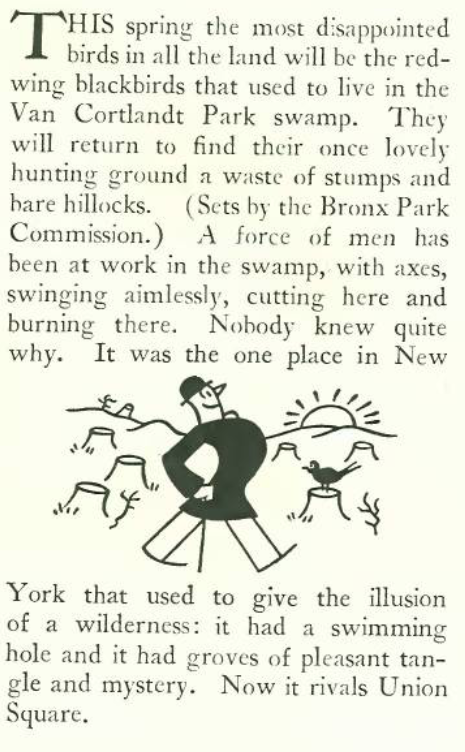
In his “Notes and Comment,” E.B. White noted the destruction of trees and swampland in Van Cortlandt Park. In 1931 Robert Moses was president of the Long Island Park Commission but held political sway over so much more. What White was witnessing were preparations for the construction of the Henry Hudson Parkway and Mosholu Parkway that would split Van Cortlandt into six separate pieces. White was right about the disappearing birds: the last remaining freshwater marsh in the state, Tibbetts Brook, was dredged to accommodate construction.
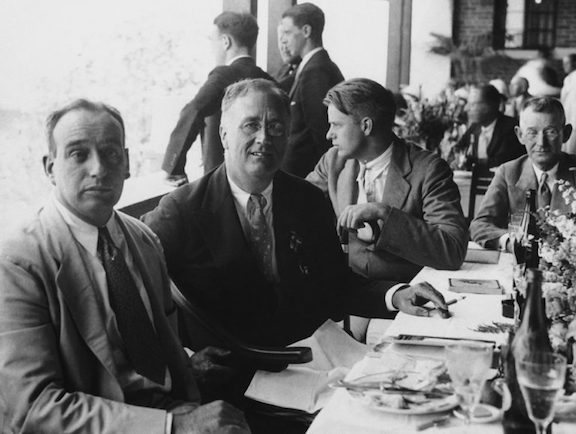
HE PAVED PARADISE…Governor Franklin D. Roosevelt of New York attends a Jones Beach luncheon on July 26, 1931, as a guest of Robert Moses (far left), who was president of the Long Island Park Commission. (AP Photo)A PARK DIVIDED…The Mosholu Parkway cuts a wide swath through Van Cortlandt Park, 1936. (Museum of the City of New York)
* * *
Those Daring Young Men
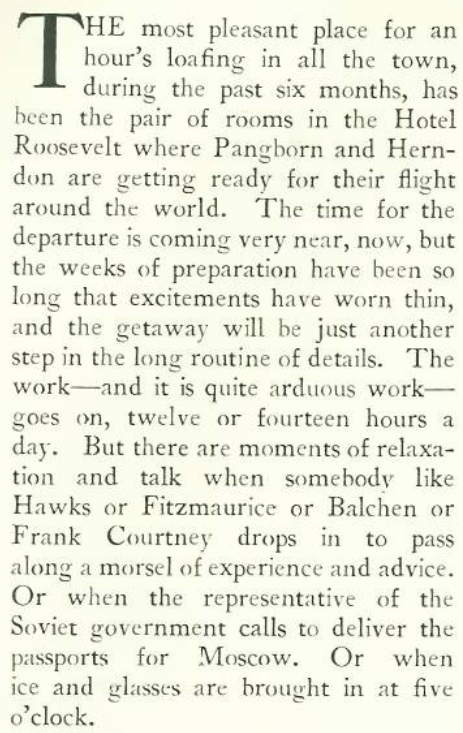
Ever since Charles Lindbergh made his historic transatlantic flight in 1927, Americans were captivated by the derring-do of pilots who competed for various “firsts.” In the case of Clyde Pangborn and Hugh Herndon Jr., the goal was to to fly around the world and break the record of 20 days and 4 hours set by Germany’s Graf Zeppelin in 1929. In his “Reporter at Large” column, Morris Markey noted the many weeks of preparation by the two pilots…
A BIT OF FUN…July 1931 newspaper illustration of Clyde Pangborn, left, and Hugh Herndon Jr., with a map of the route they followed on their attempt to set a new round-the-world flight record. (AP)
Markey noted that the two pilots claimed they were setting out on their dangerous mission “for the fun of it”…
While Pangborn and Herndon were still making flight plans at their Hotel Roosevelt headquarters, Wiley Post and Harold Gatty took to the air and claimed the record of 8 days and 15 hours. Pangborn and Herndon decided to make a go of it anyway, leaving New York on July 28, 1931, in their red Bellanca named the Miss Veedol, but poor weather in Siberia caused them to abandon their quest.
There was, however, a $25,000 prize being offered by the Tokyo newspaper Asahi Shimbun to the first pilots to cross the Pacific non-stop, so Pangborn and Herndon regrouped and successfully flew the Miss Veedol across the Pacific Ocean — in 41 hours and 13 minutes. It wasn’t exactly a smooth flight; three hours after takeoff the device used to jettison the landing gear failed, prompting Pangborn to climb out onto the wing barefoot at 14,000 feet to remove the landing gear props. After several other near-mishaps — including nearly smashing into a mountain — the duo completed their historic flight with a controlled crash landing near Wenatchee, Washington.
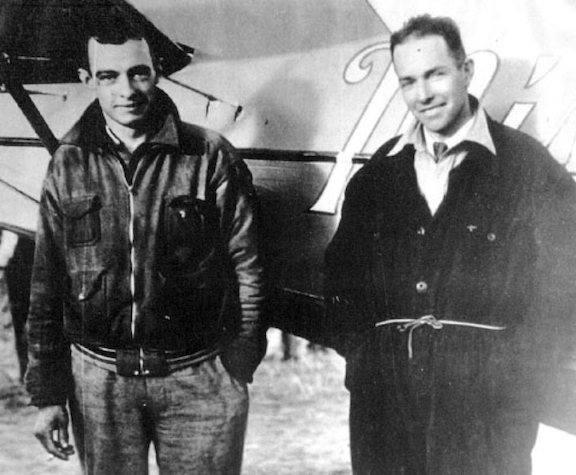
NO WHEELS, NO PROBLEM…More than 41 hours after departing Japan, Clyde Pangborn and Hugh Herndon Jr. performed a controlled crash landing near Wenatchee, Washington, completing the first-ever nonstop flight across the Pacific Ocean. (Wired.com)STILL IN ONE PIECE…Hugh Herndon Jr., left, and Clyde Pangborn after crash-landing at Wenatchee, Wash., following their 1931 flight across the Pacific from Misawa, Japan. (Spirit of Wenatchee).
* * *
From Our Advertisers
Herndon and Pangborn made plans for their round-the-world flight while staying at the Roosevelt Hotel in Midtown…I’ve stayed there myself and enjoyed its nubby charms…as for the underground passageway to the Grand Central, it’s still there, but no longer open to the public…
…the makers of Kleenex originally marketed their tissues for makeup removal…by the 1930s, however, they saw a much bigger opportunity…
…if the Roosevelt Hotel wasn’t posh enough for you, the new Waldorf-Astoria might have been your cup of tea…
…and if you could stay at the Waldorf, you might be able to afford a Packard, which in the 1930s was a near-rival to Rolls Royce…
…I toss this one in from Goodyear because it is probably the only time an image of the Taj Mahal was used to sell tires…
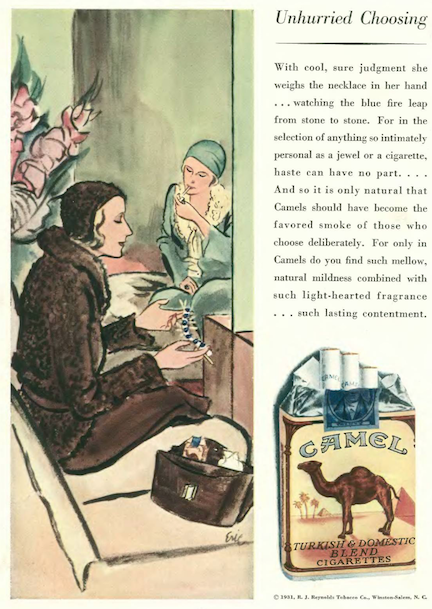
…we have another lovely Carl “Eric” Erickson illustration for Camel…
…and at first glance I thought this was another two-page ad for Chesterfield cigarettes, but it appears the candy manufacturers also wanted to tie their products to exciting lifestyles…in this case, you were urged to eat candy for some quick energy…here it is implied that Schrafft’s candy will give you the energy you need for sailboating and…er…other activities…
…for comparison, Chesterfield ad from 1930…
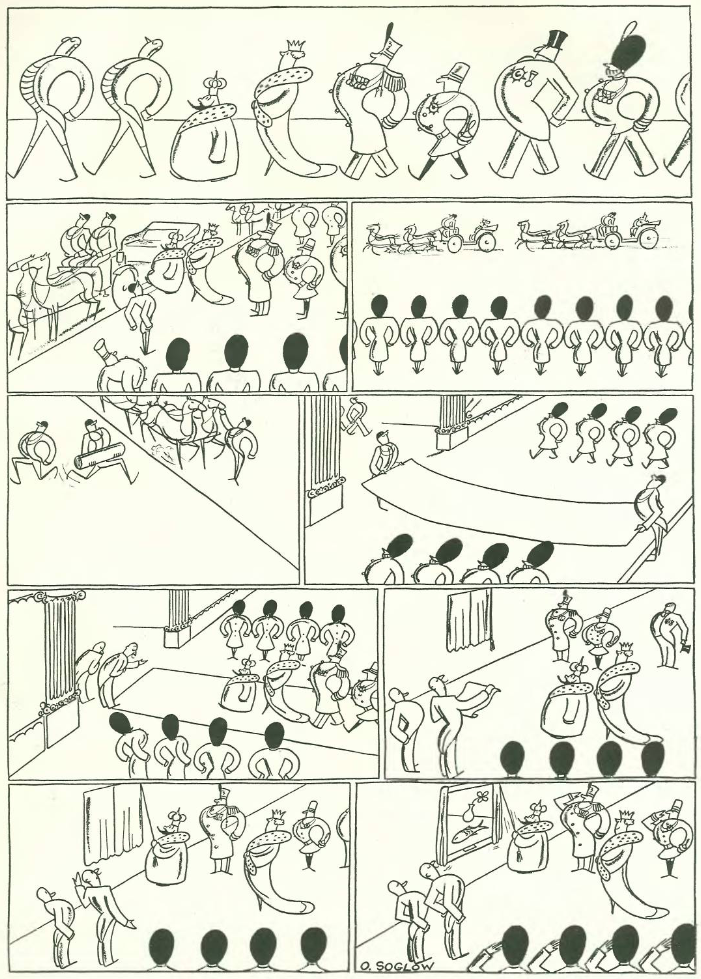
…on to our cartoons…Otto Soglow continued the adventures of the Little King…
…Perry Barlow showed us that war is hell…
…some ringside niceties courtesy E. McNerney…
…Mary Petty reminded us that posh folks weren’t exactly known for their intellect…
…Alan Dunn examined the challenges of buying an older house…
…Helen Hokinson gave us a politically precocious young lad…
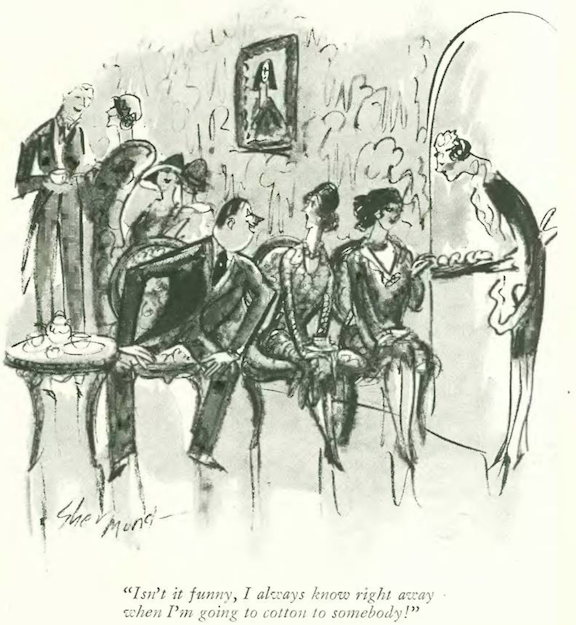
…and two glimpses into high society by Barbara Shermund…
…including their scintillating conversations about such things as ice makers…
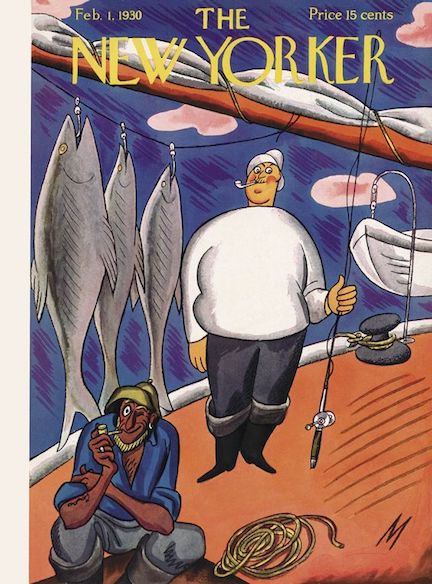
Before we launch into the Jan. 25 issue, the rendering of the old New York Aquarium in this Sue Williams cover bears some consideration.
Jan. 25, 1930 cover by Sue Williams.
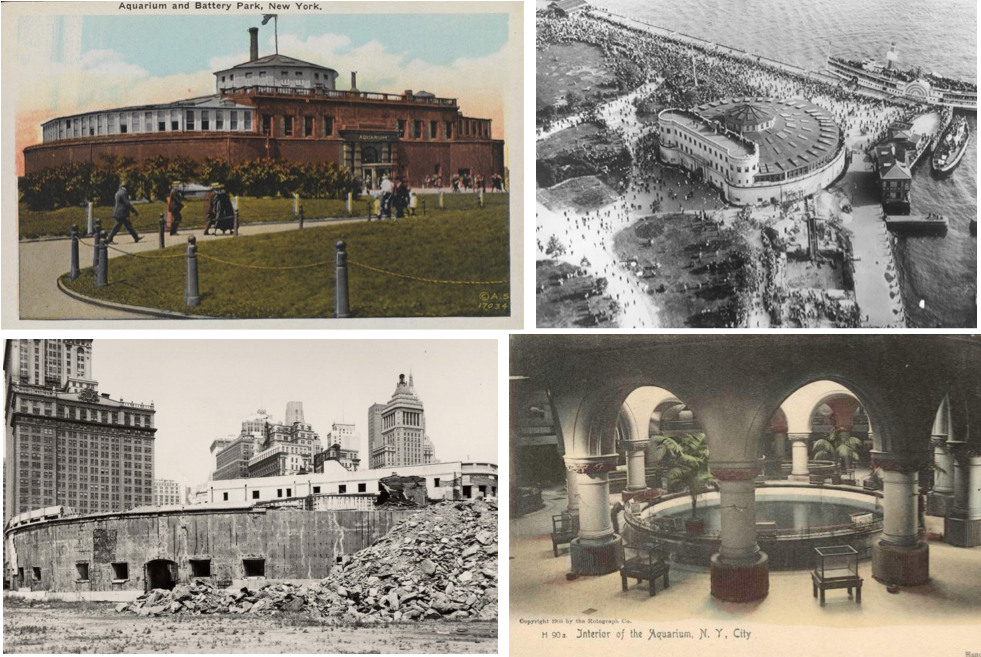
The aquarium was housed within the historic walls the South West Battery, constructed off the tip of Manhattan between 1808 and 1811 as a defense against the British. Renamed Castle Clinton in 1817 (in honor of former Mayor/Governor Dewitt Clinton), it was deeded to the city in 1823 to be used as an entertainment center. From 1855 to 1890 it served as an immigrant landing depot, then remodeled in 1896 (by the architectural firm McKim, Mead, and White) to become the popular New York City Aquarium.
FISH OUT OF WATER…Postcard image of the New York City Aquarium from the early 1900s; aerial view of the aquarium circa 1934; postcard image of aquarium interior; demolition of the aquarium in 1941, on orders from city planner Robert Moses. (thebattery.org/nycgovparks.org)
Although the aquarium proved to be a cultural and educational magnet, it stood in the way of master planner Robert Moses’s designs to build a bridge from The Battery to Brooklyn. After residents, preservationists and even Eleanor and President Franklin Roosevelt protested, the city opted instead to construct a tunnel under the East River. Nevertheless, Moses managed to get the aquarium knocked down before demolition was halted by the outbreak of World War II. After the war, Congress passed a bill declaring the site a National Monument, and preserved the walls of Castle Clinton.
HIGH AND DRY…Until it was demolished in 1941, the New York City Aquarium occupied the space in the center of Castle Clinton, which was added to National Register of Historic Places in 1966. (nps.gov)
* * *
Now, About That Band…
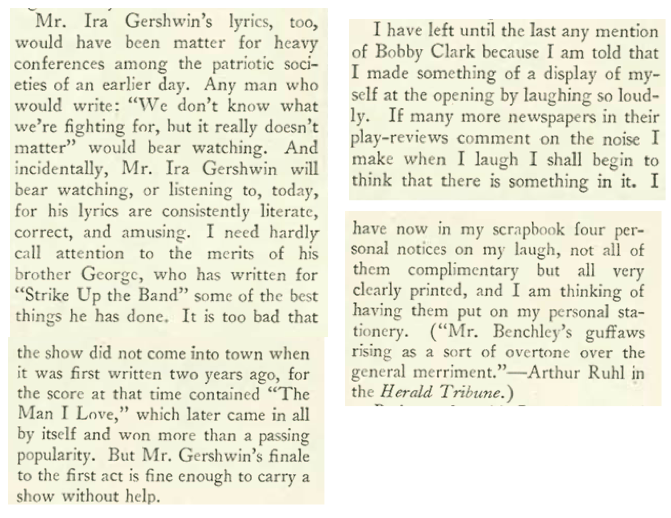
A play that satirized America’s enthusiasm for war—Strike Up the Band—was loved by critics but spurned by audiences when it opened in Philadelphia in 1927. Written by George S. Kaufman, with music and lyrics by George and Ira Gershwin, the play had the pedigree for success, but audiences weren’t quite ready for a show that poked fun at the U.S. military just nine years after the end of World War I (in the original play, America is goaded into declaring war on Switzerland by an American cheese tycoon).
Enter lyricist Morrie Ryskind, who reworked the script, softening its political message and remaking the war plot into a dream sequence. The revised play proved to a be hit, running for 191 performances at the Times Square Theatre. It also introduced a number of popular songs, including “The Man I Love” and “Strike Up the Band.” Robert Benchley was on hand for opening night:
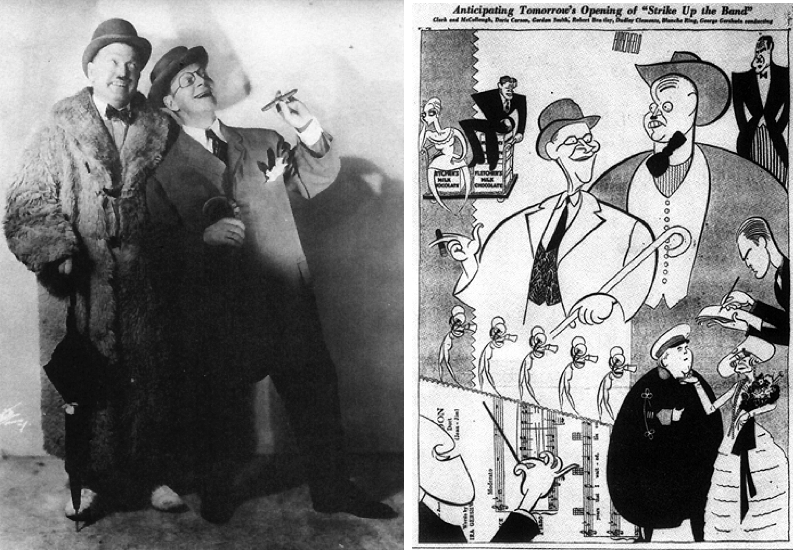
TEAMWORK…Clockwise, from top, Ira (left) and George Gershwin at work circa 1930; lyricist Morrie Ryskind, who softened the tone of George S. Kaufman’s original script. (U of Michigan/Wikipedia)
Benchley noted that the antics of comedian Bobby Clark caused him to laugh so loud that his guffaws were even noted in the Herald Tribune’s review:
MAKE ‘EM LAUGH…The comedy team of Paul McCullough (left) and Bobby Clark were one of the play’s big draws. At right, Herald-Tribune illustration by Al Hirschfeld announcing the Broadway opening of Strike Up the Band. (aaronneathery.org)
* * *
Duncan Yo-Yos
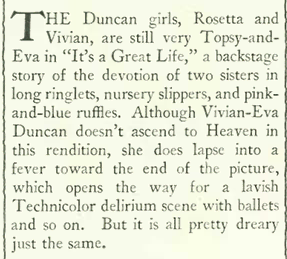
We’ve seen the Duncan Sisters (Rosetta and Vivian) before in this blog, the sister vaudeville act that became famous with the 1923 hit musical Topsy and Eva, which inspired a silent 1927 film starring the duo. They were back on the screen in late 1929 with It’s a Great Life, which TheNew Yorker’sJohn Mosher found to be “pretty dreary”…
NOT SO GREAT, THIS…Clockwise from top, promotional poster for It’s a Great Life; a scene from a dance number in the film; Rosetta (in blackface) and Vivian Duncan as Topsy and Eva (characters derived from the novel Uncle Tom’s Cabin). It’s a Great Life flopped at the box office, along with the Duncan’s brief movie careers. In the years to follow the duo would became popular nightclub entertainers and would continue to perform their Topsy and Eva routine even though appearing in blackface was increasingly considered offensive. (Wikipedia/freewebs.com)
* * *
Miracle Worker
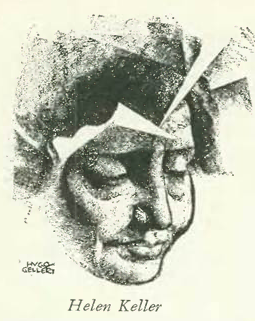
TheNew Yorker profile, written by Robert Coates, featured Helen Keller (with illustration by Hugo Gellert). A brief excerpt:
* * *
From Our Advertisers
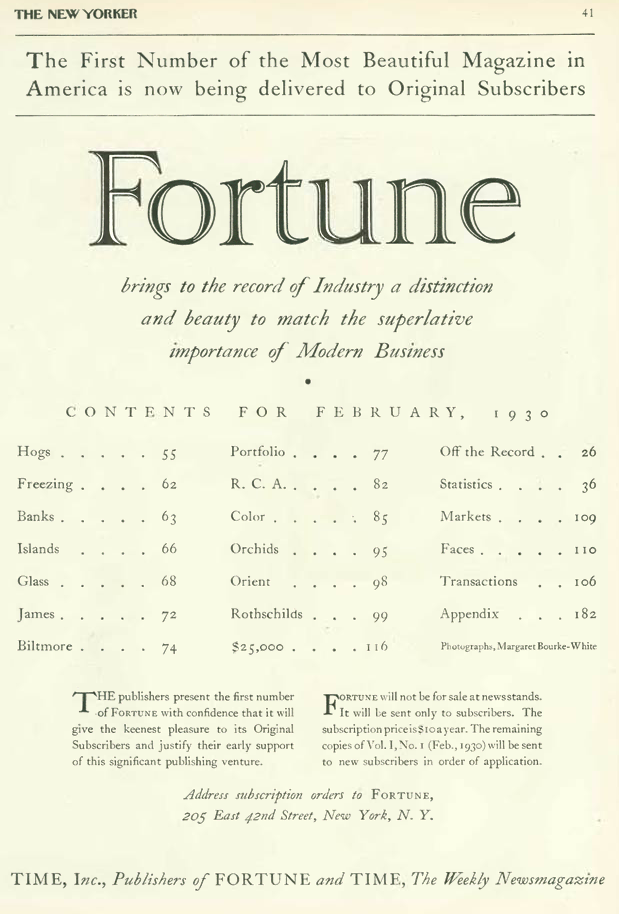
Advertisers in the Jan. 25 issue included the new Fortune magazine, which announced its first issue with this full-page ad:
…the table of contents is fascinating, spare in descriptions of everything from “Hogs” to “Orchids”…
From left, issue No. 1, February 1930; table contents for the issue; a prototype of the magazine, September 1929. (Fortune)
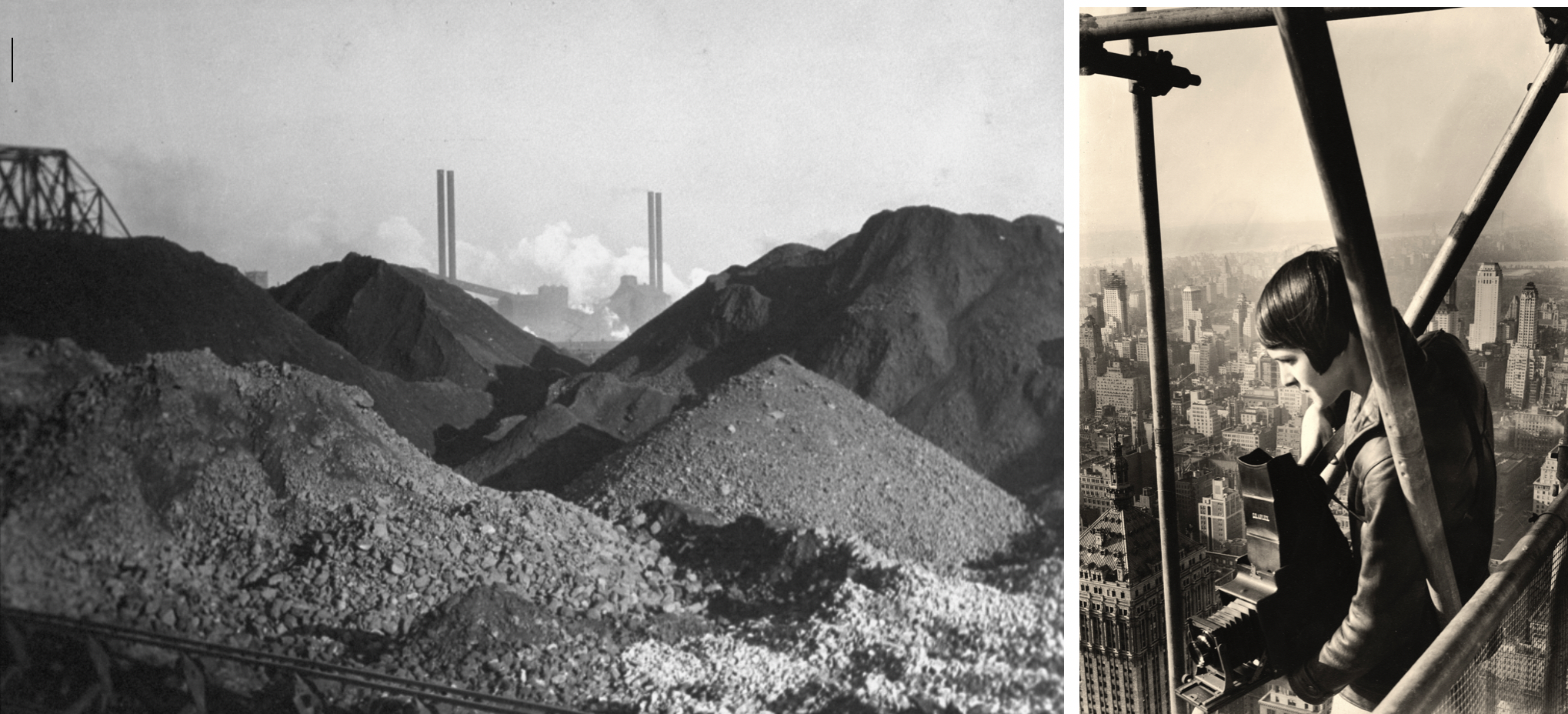
…also listed in the new magazine’s table of contents was the name of a 24-year-old photographer, Margaret Bourke-White…
A photo of coal piles by Margaret Bourke-White in the first issue of Fortune magazine. At right, Bourke-White photographing atop a skyscraper circa 1930. (Fortune)
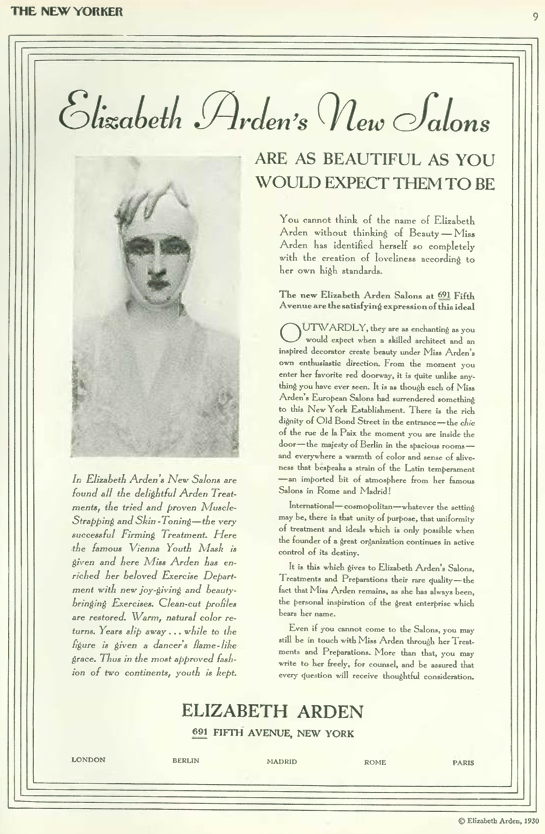
…on to our other advertisements, we have this entry from Elizabeth Arden…ads from this salon chain in the 1920s and 30s featured this ubiquitous image of a woman with a distant stare, her head tightly bound — mummy-like — as part of a firming treatment called “muscle-strapping”…
…in contrast to the rather cold, clinical look of the Elizabeth Arden ad, the Primrose House appealed more to social climbing than skin toning…
…while the makers of Pond’s cold cream continued to draw from their stable of debutantes and society ladies to move their product…
…long before there was Joe Camel, R.J. Reynolds also appealed to social climbers with a series of ads beautifully illustrated by fashion artist Carl Erickson…
…society’s smokers were advised to pack a tube of Bost toothpaste, or have their French maid do it for them…
…and once again we have an ad by Dr. Seuss for Flit insecticide that is very much of its time…
…as is this cartoon by Isadore Klein, perhaps the first in The New Yorker that depicted African Americans as something other than minstrel show stereotypes. Nevertheless, the rendering is still a bit crude — especially the boy’s face — as is the idea behind the “joke” — that a black boy could actually aspire to be a great violinist like Jascha Heifetz…
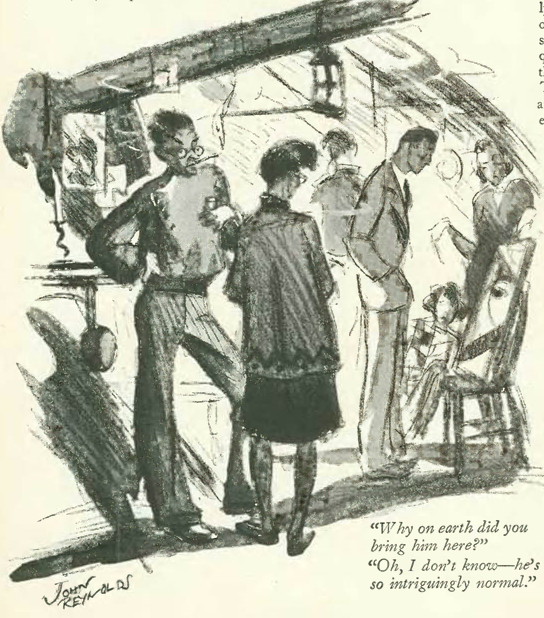
…John Reynolds explored a less troubling juxtaposition among the bohemian set…
…and we end with this peek into society life courtesy Barbara Shermund…
The re-opening of New York’s Central Park Casino in 1929 was in many ways the city’s last big party before the economy came crashing down, along with the exhuberance and frivolity of the Jazz Age.
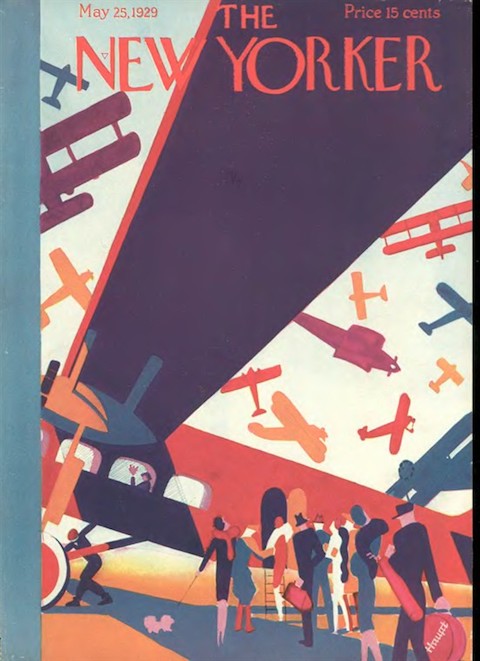
May 25, 1929 cover by Theodore Haupt.
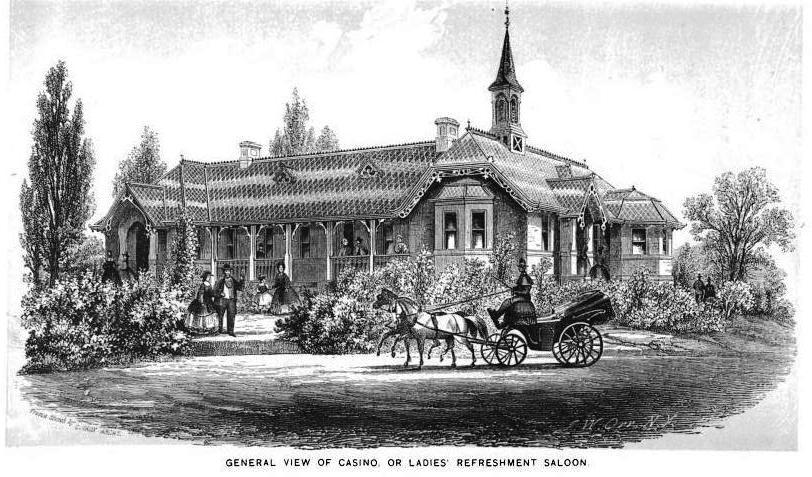
The Casino itself wasn’t new–it opened in 1864 as the Ladies’ Refreshment Salon (sometimes spelled “saloon”), a two-room stone cottage designed by Calvert Vaux. As Susannah Broyles writes in her excellent blog post for the Museum of the City of New York, the Victorian cottage was a place where “unaccompanied ladies could relax during their excursions around the park and enjoy refreshments at decent prices, free of any threat to their propriety.”
Central Park’s Ladies’ Refreshment Saloon opened in 1864. (daytoninmanhattan.blogspot.com)
Broyles writes that by the 1880s the salon had morphed into a far pricier destination, a restaurant called The Casino, open to both sexes. With the rare attraction of outdoor seating, “it was the place to see and be seen.”
By the 1920s the restaurant had grown a bit shabby. Then along came the city’s flamboyant mayor, Jimmy Walker (1881-1946), who saw the potential of the property as a place where he could hob-nob with wealthy and fashionable New Yorkers and openly flaunt Prohibition laws. There were others, however, who found the idea of an exclusive playground for the rich in a public park distasteful. The New Yorker observed as much in the “Notes and Comment” opening of “The Talk of the Town”…
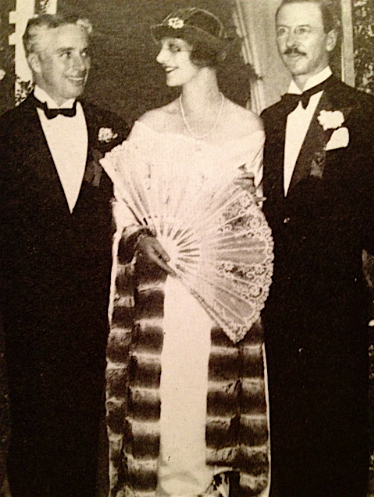
…the “Schuyler L. Parsons” referred to above was a tireless host, prominent decorator, and a society A-lister. He is pictured here (circa 1930) with two of his closest friends, actor Charlie Chaplin and the actress, singer and dancer Gertrude Lawrence…
(Tyler Hughes Collections)
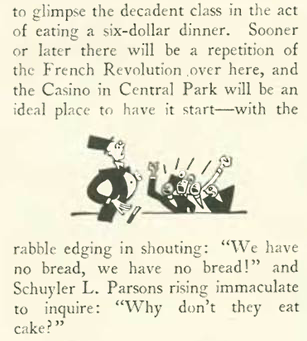
The Central Park Casino reopened its doors on June 4, 1929 at an invitation-only event. The following day it would open to the public, but as New York’s newest and most expensive restaurant it would remain closed to all but the wealthiest. As The New Yorker observed, the city was, after all, a “plutarchy,” and the populace passing by the Casino would at least be allowed “to glimpse the decadent class in the act of eating a six-dollar dinner” (nearly $90 today).
This formal announcement of the opening appeared in the May 6, 1929 issue of The New Yorker, including the time of the event—I suppose for the benefit of the 600 who actually had an invitation, or perhaps to tantalize those without such credentials…
The Casino was a playground for the rich by design, conceived in the image of the flamboyant Mayor Walker—himself a product of the Tammany Hall political machine—and executed by hotelier Sidney Solomon, who obtained the building’s lease via some Tammany-style subterfuge. Solomon hired architect and theatrical set designer Joseph Urban to transform the Casino into a glittering showpiece of Jazz Age nightlife.
Clockwise, from top left, the Central Park Casino; architect Joseph Urban; his Casino ballroom design with black-mirrored ceiling; the Casino lobby. (acontinuouslean.com/Columbia University/centralpark.com/drivingfordeco.com)
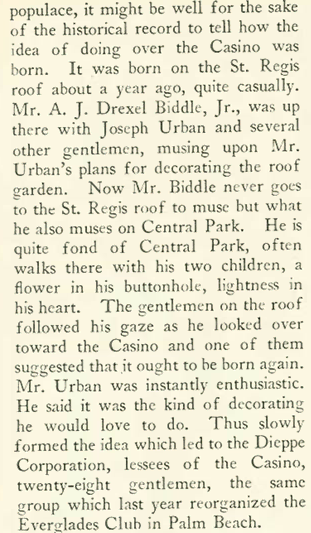
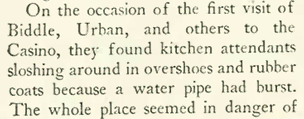
The New Yorker continued its observations on the Casino in another “The Talk of the Town” piece titled “Historical Note,” attributing the inspiration for the Casino not to Walker or Solomon, but to socialite Anthony Joseph Drexel Biddle Jr…
AN EYE FOR THE FINER THINGS…The wealthy socialite A.J. Biddle (pictured here with his first wife, Mary Lillian Duke, in 1924) trained his eye on the Central Park Casino while on the rooftop of the St. Regis Hotel pondering another Joseph Urban project. (voxsartoria.com)PARTY BOY…New York Mayor Jimmy Walker and his nighttime playground, the Central Park Casino, show here on September 10, 1935. (Britannica/ New York City Department of Parks & Recreation)
Well, as you’ve probably guessed, the party didn’t last forever. After the October 1929 stock market crash, the sight of rich folks stuffing their faces and drinking fine wines in a public park looked even more unseemly. Soon the Casino found itself in the crosshairs of Parks Commissioner Robert Moses, who detested Mayor Walker.
As for Walker himself, a growing financial scandal prompted him to resign from office on Sept. 1, 1932. He promptly fled to Europe with his mistress, Ziegfeld girl Betty Compton, and stayed overseas until the threat of criminal prosecution had passed. For Moses, it wasn’t satisfaction enough to see Walker driven from office. In 1936, despite protests from preservationists, Moses had Urban’s lovely restaurant demolished. It was replaced by a children’s playground the following year.
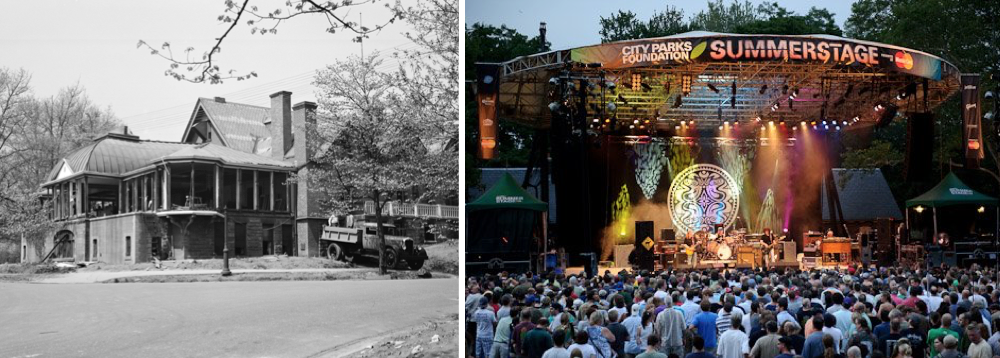
THE PARTY’S OVER…Crews dismantling the Central Park Casino in 1936. In 1937, the Rumsey Playground was built on the site of the Casino, and in the 1980’s the site was razed again and converted into Rumsey Playfield, where the city’s SummerStage events are now held. (Museum of the City of New York/centralpark.com)
* * *
A Drinking Life
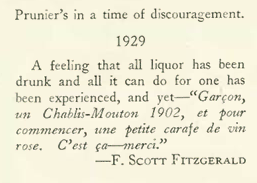
As the Jazz Age was winding down, one of its greatest chroniclers began a brief relationship with The New Yorker. In the March 12, 2017 issue of the magazine, Erin Overbey and Joshua Rothman wrote “There’s a doomed, romantic quality to the relationship between F. Scott Fitzgerald and The New Yorker; they were perfect for each other but never quite got together.” In total, Fitzgerald published just two poems and three humorous shorts for the magazine, beginning with this piece in the May 25, 1929 issue:
Fitzgerald’s last contribution to the New Yorker would appear in the Aug. 21, 1937 issue (“A Book of One’s Own”). Following the author’s death in 1940 the magazine would feature various articles on his life and work, and in 2017—77 years after Fitzgerald’s death—the New Yorker would publish a long lost short story, “The IOU.” A fitting title for an author who sadly did not get his due while he was alive.
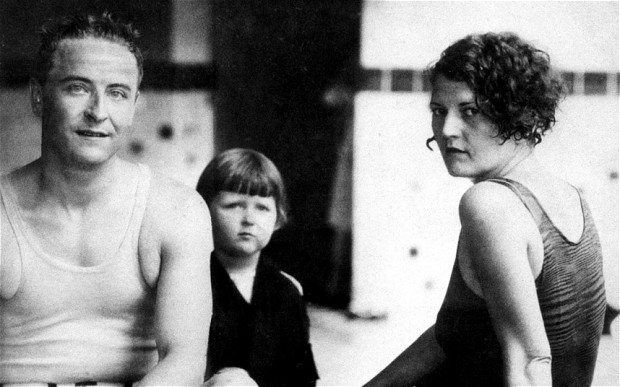
IOU…F. Scott Fitzgerald with daughter “Scottie” and wife Zelda, circa 1927. (The Telegraph)
* * *
One of the Gang
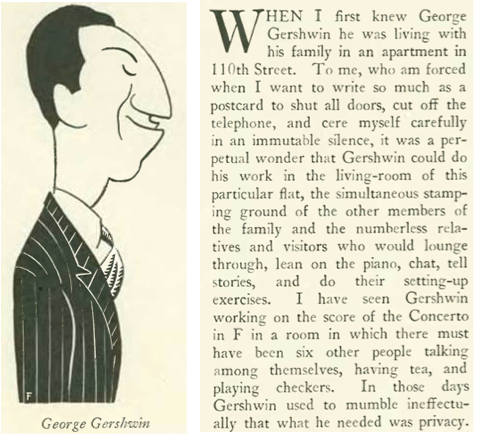
Among the Jazz Age artists and writers who orbited around the Algonquin Round Table (and the Central Park Casino) and chummed with the writers of the New Yorker was musician and composer George Gershwin (1898-1937) who was profiled in the May 25 issue by his friend and longtime New Yorker writer Samuel N. Behrman. The opening paragraph (with caricature by Al Frueh):
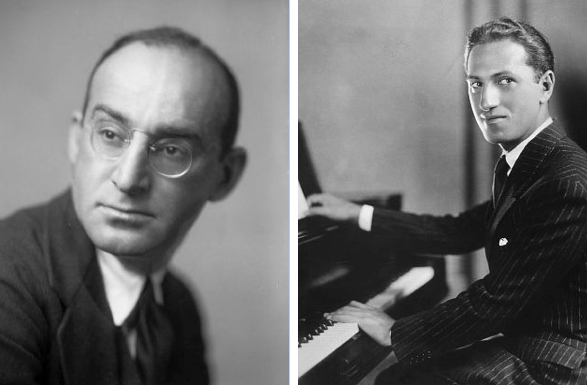
IN THE SAME ORBIT…Samuel Nathaniel Behrman (left), was an American playwright, screenwriter, biographer, and longtime writer for The New Yorker. From the late 1920s through the 1940s, he was considered one of Broadway’s leading authors of “high comedy,”His son is the composer David Behrman. At right, George Gershwin at the piano, 1929. (prabook.com/IMDB)
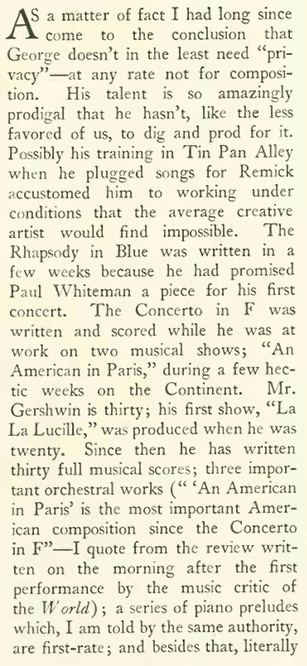
In the profile, Behrman observed that although Gershwin expressed a desire for privacy, he was quite capable of dashing off major works in practically any setting:
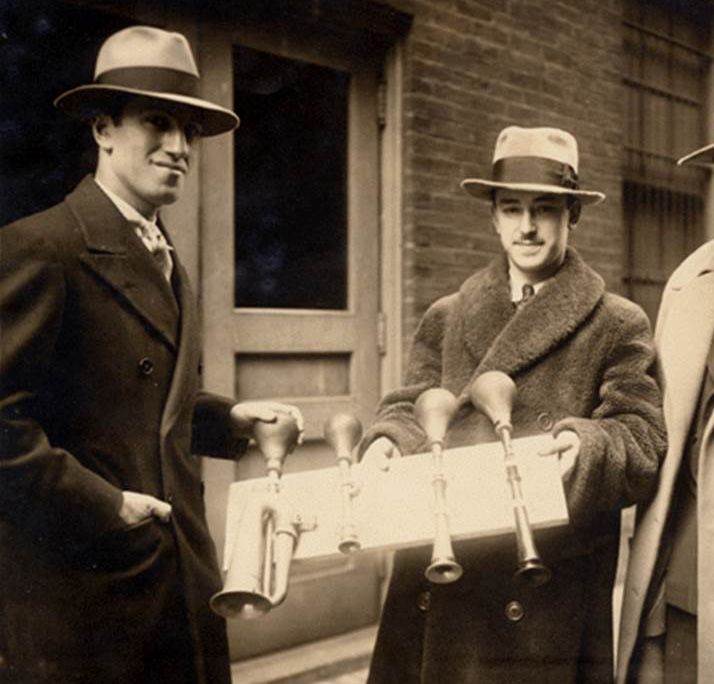
TOOTING HIS OWN HORN…Composer George Gershwin and Cincinnati Symphony Orchestra percussionist James Rosenberg holding four taxi horns used in the orchestra’s performance of An American in Paris, on Feb. 28, 1929. (Photo courtesy of Ira and Leonore Gershwin Trusts)
* * *
Scratching the Surface
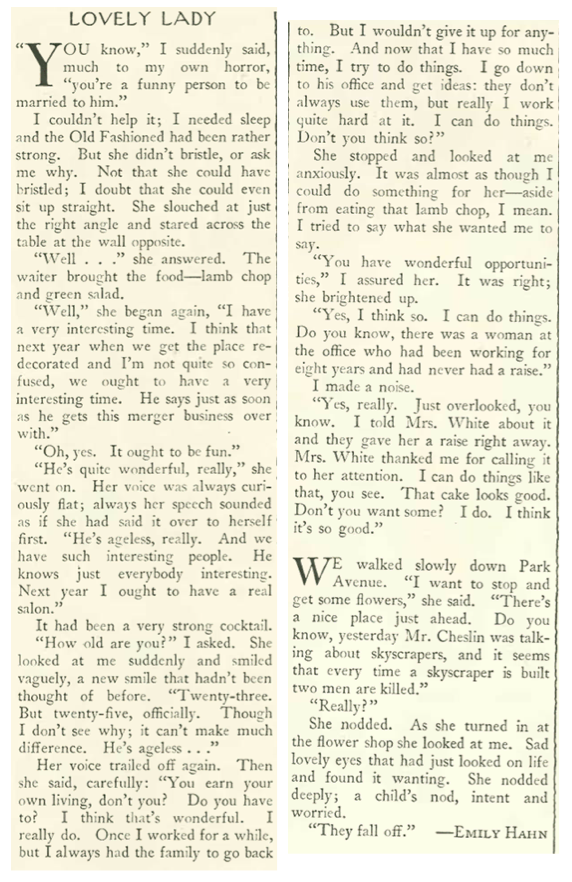
Emily Hahn (1905-1997) was a prolific journalist and author who contributed at least 200 poems, articles and works of fiction to The New Yorker over an astonishing 68-year span—from 1928 to 1996. As the title suggests, I am merely scratching surface, and will devote a post to her in the near future. Here is her contribution to the May 25, 1929 issue:
PROLIFIC…A 1937 portrait of Emily Hahn taken in Shanghai, China, by Sir Victor Sassoon. The author of 54 books, Hahn is credited with playing a significant role in opening up Asia and Africa to the West through her many novels. (DeGolyer Library, SMU)
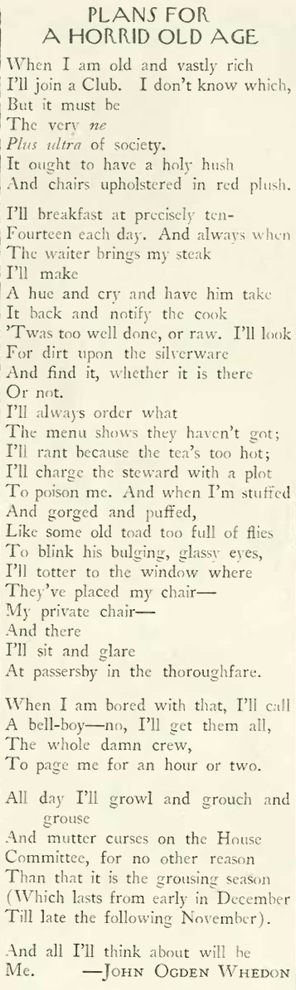
Another frequent contributor to The New Yorker was screenwriter John Ogden Whedon (1905-1991), who offered up mostly shorts from 1928 to 1938. He is best known as a television writer for such shows as The Andy Griffith Show, The Dick Van Dyke Show and Leave It to Beaver. Whedon and his wife, Louise Carroll Angell, were parents and grandparents to a number of screenwriters, including grandson Joss Whedon, creator of Buffy the Vampire Slayer and writer/director of The Avengers (2012) and its sequel Avengers: Age of Ultron (2015). An excerpt of grandpa’s writing from the May 25 issue:
* * *
From Our Advertisers
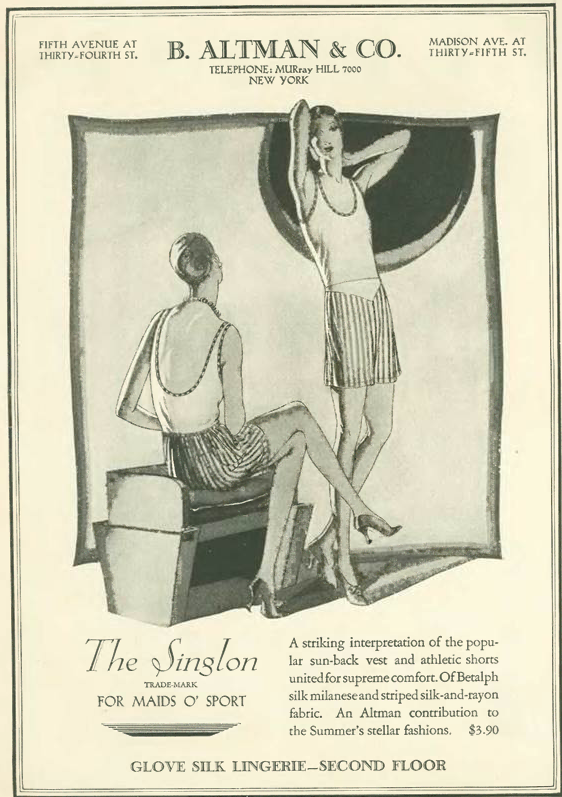
In a recent post (Waldorf’s Salad Days) I noted an ad from Lily of France that proclaimed the straight flapper figure was out, and it was now the “season of curves.” This ad from B. Altman begs to differ…
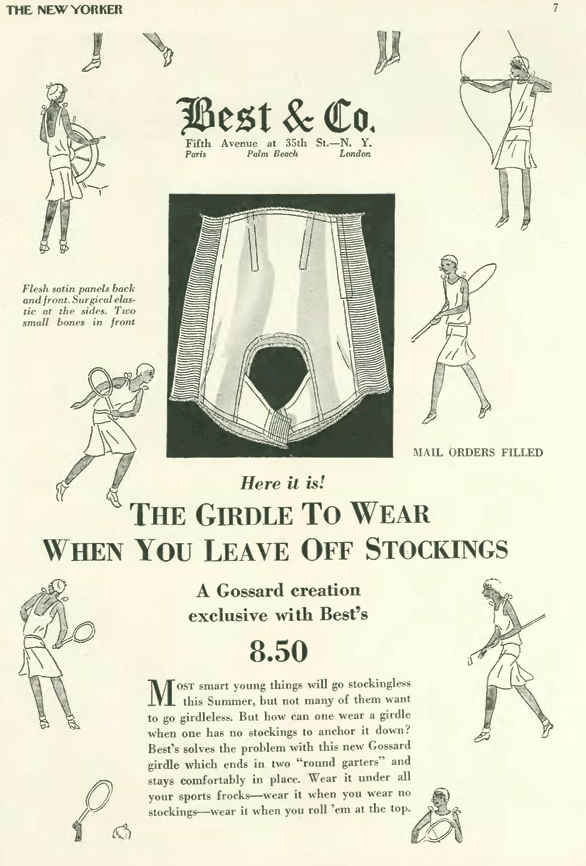
…one way to keep that straight figure was to pull on a girdle, which I’m sure felt great while one played tennis…
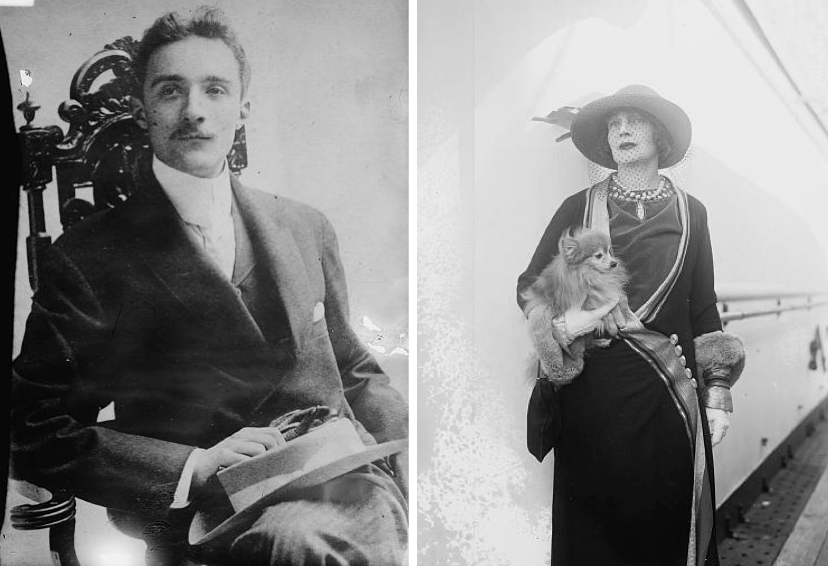
…our latest Lucky Strike endorser is…Mrs. Jerome Napoleon Bonaparte. Never heard of her? Well, “Mrs. Jerome” was actually a one Blanche Pierce (1872-1950) of Rochester, NY. Her second husband, Jerome Napoleon Bonaparte (the great-grandnephew of Emperor Napoleon) was something of a wastrel, having inherited a fortune and never worked at a job or profession. Blanche herself was known as a social climber…
THEY EXISTED…Jerome Napoleon Charles Bonaparte (pictured here circa 1915) was the great-grandnephew of Emperor Napoleon and a man of extreme leisure. His wife, Blanche Pierce Bonaparte (right, in a photo circa 1925), was known as a dog lover, a passion that indirectly led to her second husband’s demise. Jerome died while walking his wife’s dog in Central Park—he apparently stumbled over the dog’s leash and broke his neck. (Library of Congress)
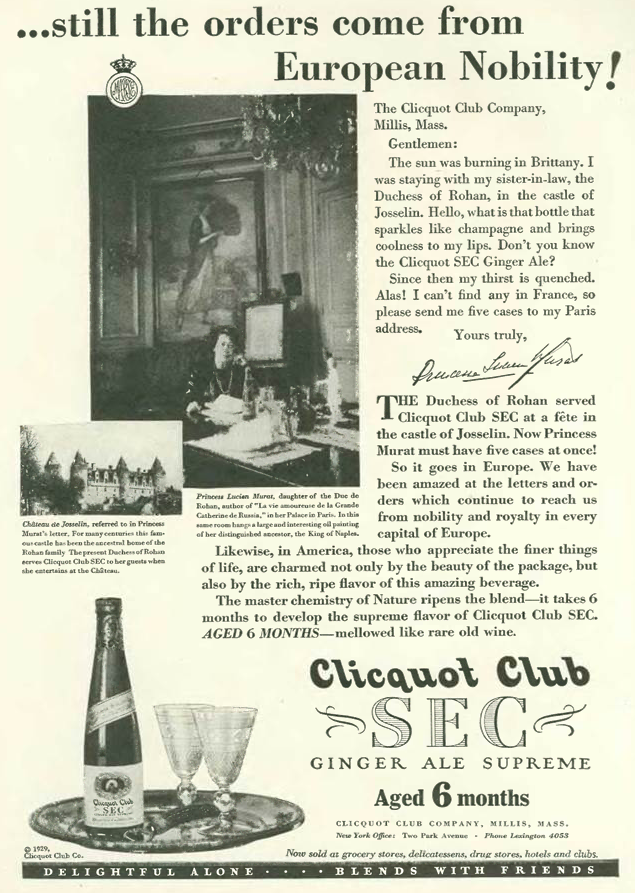
…speaking of European nobility, here is another sad endorsement from a French noble touting the wonders of Clicquot Club ginger ale to Prohibition-strapped Americans…
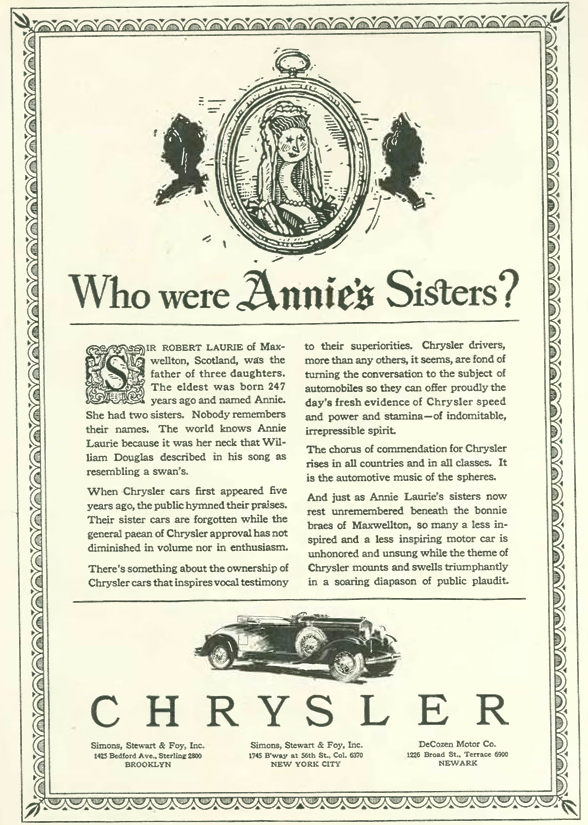
…and then we have this weird “Annie Laurie” analogy used by Chrysler to sell its line of automobiles…
…the manufacturers of Studebaker, on the other hand, opted for a more direct approach, equating its automobiles with the speed and modernity of airplane flight…note how in both ads the cars are pictured with the windshields folded down to emphasize sleekness…
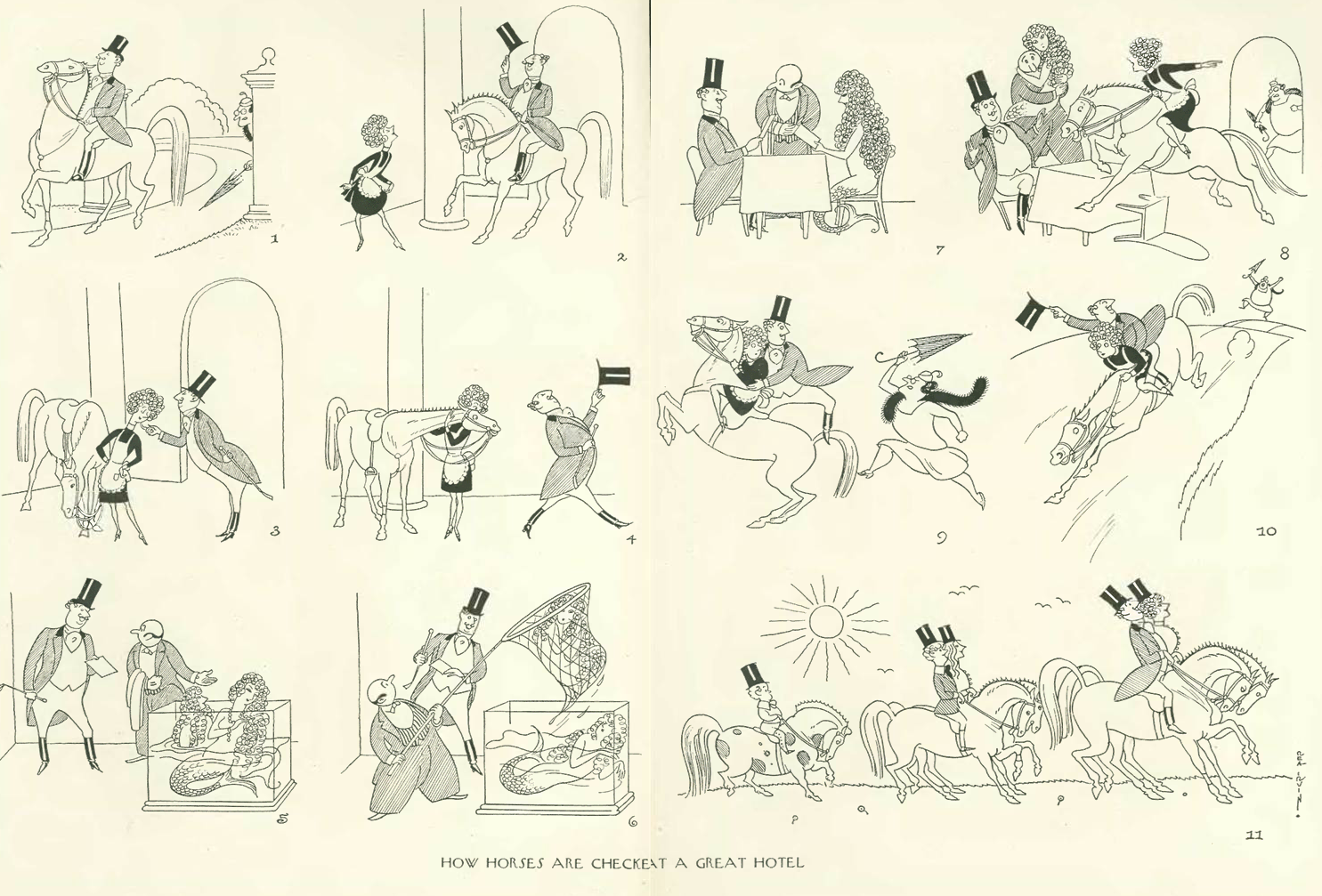
…on to the cartoons: we begin with this two-page entry by Rea Irvin, which makes very little sense…I get the part where the rich old man (stalked by his fearsome wife) finds a mistress (and a new wife) through the process of “checking his horse,” but the whole mermaid thing is lost on me…please click to enlarge—I’d love to have this one explained…
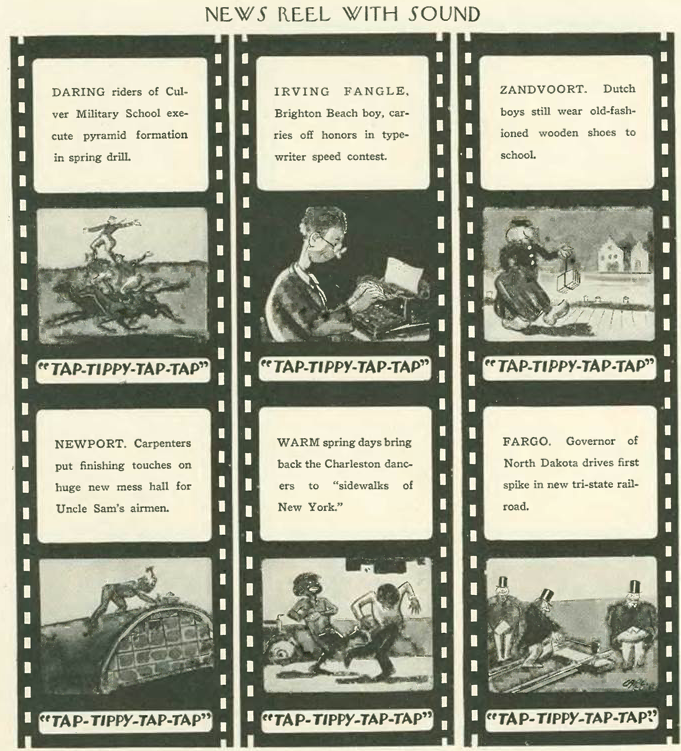
…Carl Rose had some fun with newfangled sound effects in the dawning age of the talkies…
…Peter Arno sketched up the cynicism of one New York dowager…
…Perry Barlow captured two women who might have been driving home from an auction at the old Waldorf-Astoria Hotel…
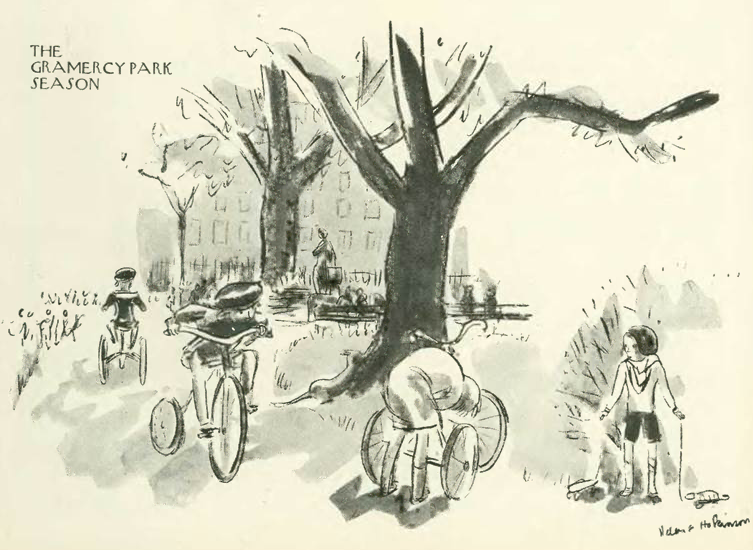
…and finally, a lovely illustration by Helen Hokinson of children at play…




















































































 A New Yorker State of Mind