In 1930s America there were few if any opportunities for black actors to perform in mainstream stage or screen productions unless they conformed to racial stereotypes. An exception was Paul Robeson.
June 21, 1930 cover by Gardner Rea.
In 1930 Robeson (1898-1976) won rave reviews for his performance in Shakespeare’s Othello. That performance, however, took place in London, not New York, which London correspondent Anthony Gibbs took pains to point out in his dispatch for the June 21, 1930 New Yorker.
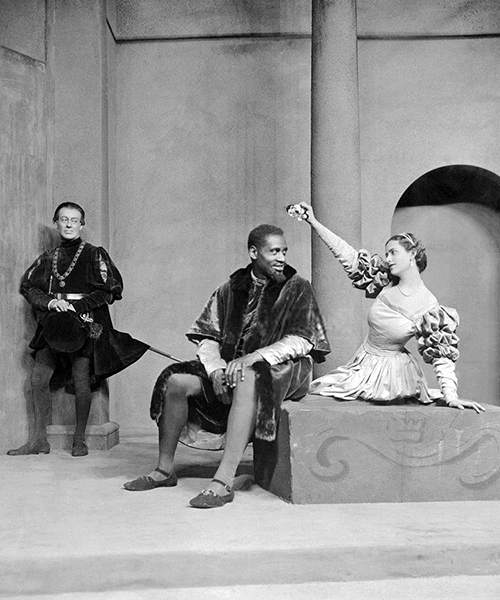
English actress Peggy Ashcroft as Desdemona and Paul Robeson as Othello in London’s Savoy Theatre production of Othello in 1930. Although only 22 at the time, Ashcroft was an established Shakespearean actress. The 32-year-old Robeson was already famous as both an athlete and actor. He was twice named a consensus All-American in football (Rutgers) and was the class valedictorian. He also received a law degree from Columbia while playing in the NFL. In 1930 he was already known to London audiences, having previously appeared in a 1928 London production of the American musical Show Boat. (theshakespeareblog.com)CENTER STAGE…Left to right: Maurice Browne (Iago), Paul Robeson (Othello) and Peggy Ashcroft (Desdemona) in Othello at the Savoy Theatre, 1930. Maurice Browne was also the play’s producer; his over-the-top portrayal of Iago and his wife’s incompetent stage direction hurt the production, but Robeson nevertheless received high praise for his performance. (britishstageandscreen.tumblr.com)
Although the performance was a triumph for Robeson, the production itself was a mess. The play’s producer, Maurice Browne, enlisted his wife, Ellen van Volkenburg, to direct (Peggy Ashcroft later called her “a pretentious dud”). Writing in The Guardian (Sept. 3, 2003), Samantha Ellis observes: “Recognising that his Othello transcended the ropey production, the audience gave Robeson 20 curtain calls. He reprised the role all over the world and never lost his pleasure in it. For Robeson, it was more than just a part: it was, as he once said, “killing two birds with one stone. I’m acting and I’m talking for the negroes in the way only Shakespeare can.”
Robeson’s Othello would not make it to New York until 1943. It would run for almost 300 performances, setting an all-time record run for a Shakespearean play on Broadway.
* * *
Restoring Order
In the aftermath of Grover Whalen’s disastrous (and sometimes violent) run as New York City Police Commissioner, E.B. White and his fellow New Yorkers welcomed the steady hand of Edward P. Mulrooney (1874-1960) to the helm:
THE COMMISH…Edward P. Mulrooney in a 1930s portrait by Edward Steichen. (Conde Nast)
* * *
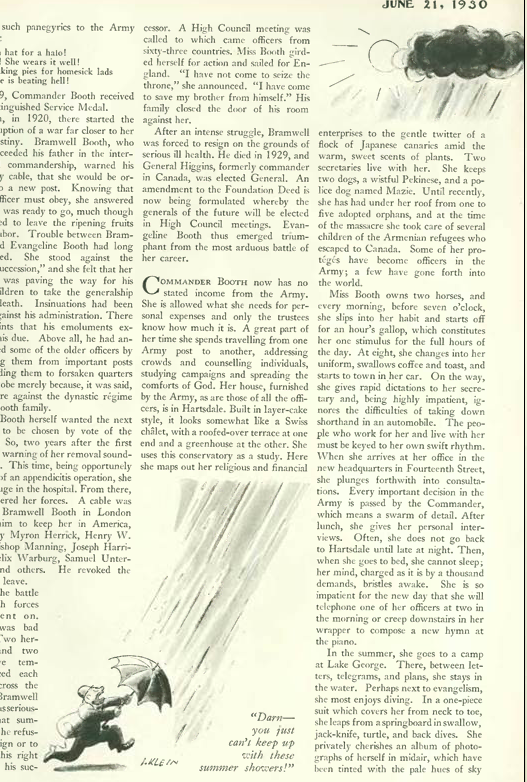
The Commander
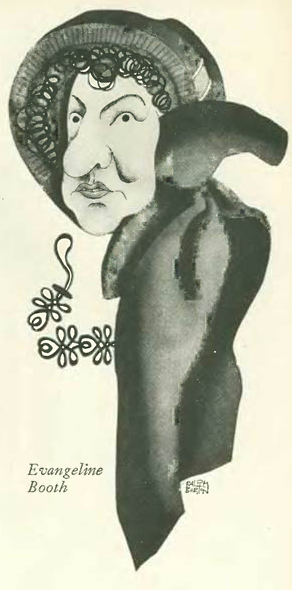
American author and lecturer Virgilia Peterson Ross profiled Evangeline Cory Booth (1865 – 1950), who would become the fourth General of the Salvation Army in 1934. She was the first woman to hold that post. An excerpt:
…Ralph Barton returned to provide this caricature for the profile, one of the last works he would create for The New Yorker before his untimely death…
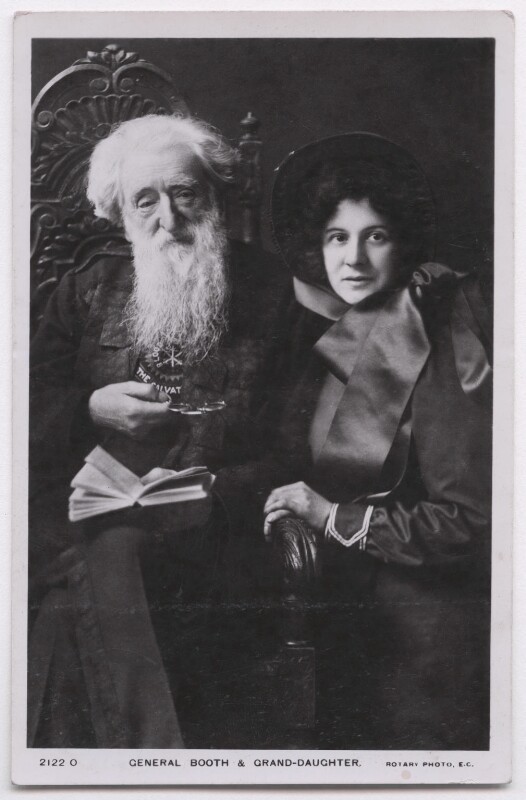
HEIRESS TO A LEGACY…William Booth, an English Methodist preacher who founded The Salvation Army and became its first General, poses with his grand-daughter Evangeline Cory Booth in this 1908 postcard image. (National Portrait Gallery)
* * *
Home of the Dome
Architecture critic George “T-Square” Chappell was gladdened by the sight of scaffolding atop St. Bartholomew’s Church, which would finally get its dome to complete architect Bertram Goodhue’s vision…
NOW YOU SEE IT…Clockwise, from top left, St. Bartholomew’s Church at 325 Park Avenue, sans dome, in 1928; the church with dome in the 1950s; interior and exterior views of dome. (nyago.com/bostonvalley.com)
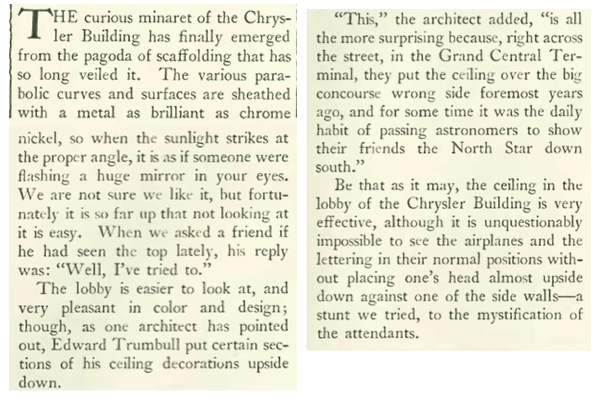
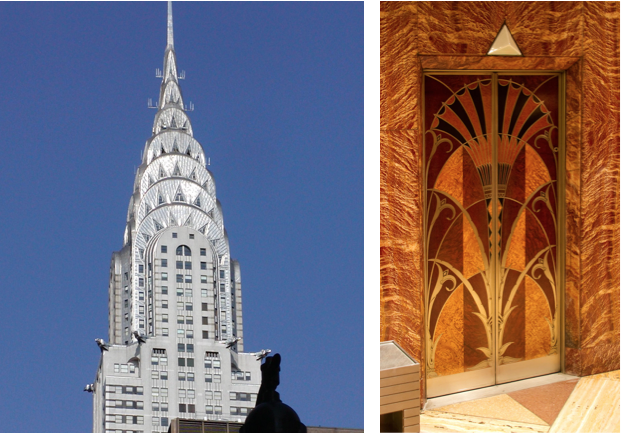
…Chappell also commented on the emergence of the Chrysler Building’s blindingly shiny dome and interior appointments…
BLINDED BY THE LIGHT…The Chrysler Building’s gleaming spire emerged in all its glory in June 1930. At right, an elevator in the building’s lobby. (Wikipedia)
* * *
Below the Belt
It wasn’t Dempsey-Tunney, but the bout between Max Schmeling (1905-2005) and Jack Sharkey (1902-1994) was the next best thing for boxing fans. The World Heavyweight Championship had been vacant since Gene Tunney’s retirement in 1928, and Sharkey and Schmeling had emerged as the sport’s No. 1 and 2 contenders.
The bout ended in a controversial decision: Although Sharkey won the first three rounds, he was disqualified after he landed a punch below the belt late in the fourth round. Schmeling became the first boxer to win the World Heavyweight Championship on a foul. The New Yorker’sNiven Busch Jr. (with illustration by Johan Bull) offered these thoughts on the fight’s disappointing outcome:
LOW BLOW…Although Jack Sharkey (far right) led after three rounds, a low blow in the fourth delivered the World Heavyweight Championship to German boxer Max Schmeling (left). Sharkey would claim the title two years later in a rematch with Schmeling. Although boxing isn’t the healthiest pursuit, both men lived into their 90s; Schmeling died in 2005 just shy of his 100th birthday. (Wikipedia/boxrec.com/thefightcity.com)
* * *
One Of Ours
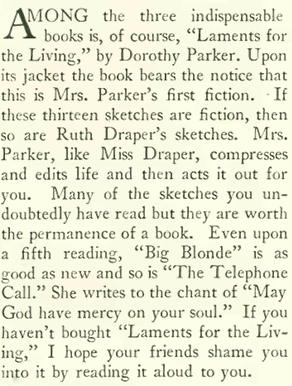
The New Yorker included this brief review of a collection of short fiction pieces by Dorothy Parker, herself a literary critic of some renown at the magazine…
DOROTHY’S LAMENTATIONS…The New Yorker’sDorothy Parker published this collection of short fiction in 1930.
…and on to our advertisers, this ad appeared on the opposite page of the review…
…speaking of ads, the makers of Marlboro cigarettes continued to sponsor gimmicky penmanship and writing contests to promote their deadly product…
…while promoters of the Empire State Building (still under construction) continued to draw on the historical significance of the building’s Midtown location…
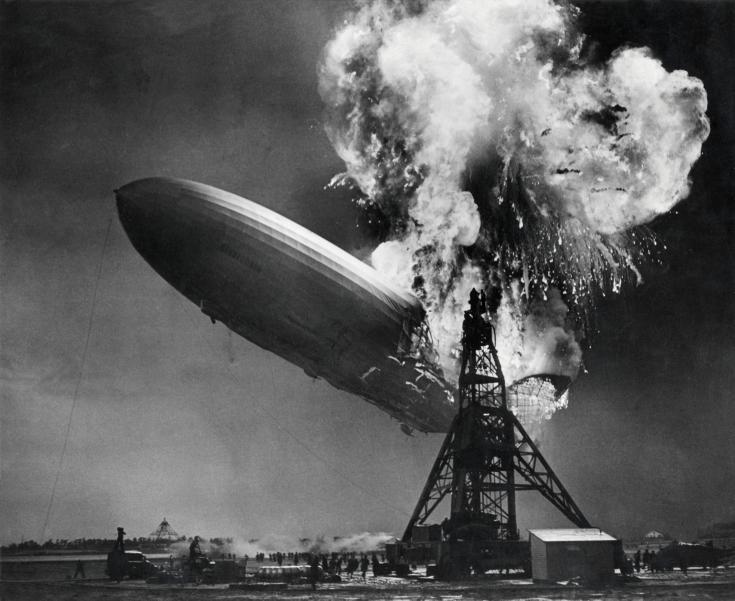
…on to our cartoons, Garrett Price pondered the very real challenge of guiding a massive Zeppelin to the planned mooring mast atop the Empire State…
…a portent of what would happen to the Hindenburg just seven years later…
…The New Yorker’s typesetter Popsy Whitaker made clever use of his columns for this Isadore Klein entry…
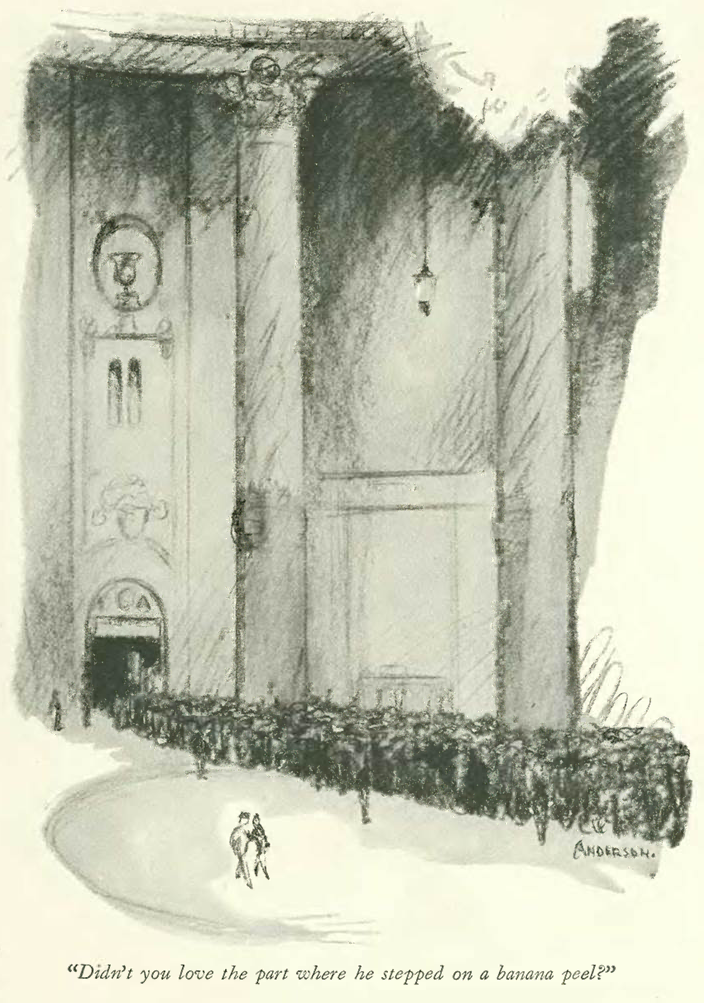
…John Murray Anderson found humor in contrasting the grand with the mundane…
…Carl Kindl eavesdropped on the small talk of a couple of ash haulers…
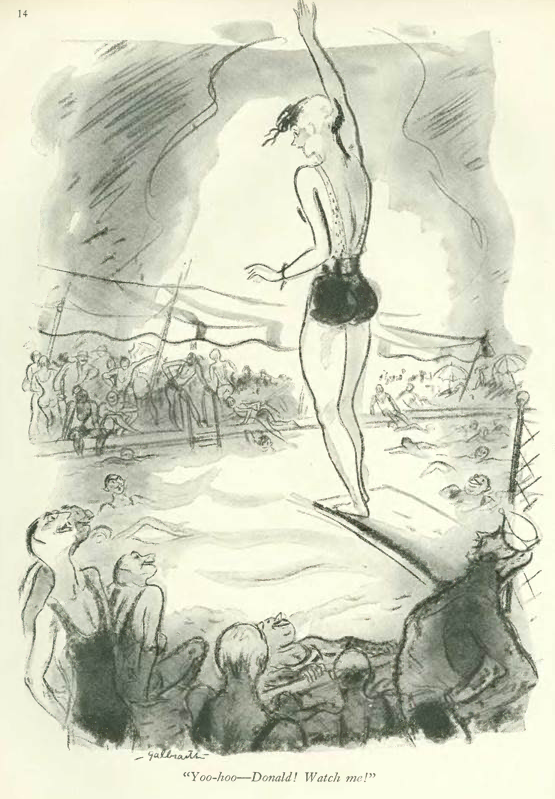
…and William Crawford Galbraith found humor at the public pool…
* * *
On to the June 28 issue, with a cover featuring a satirical kakemono-style illustration by Rea Irvin, who was fond of Japanese scroll art…
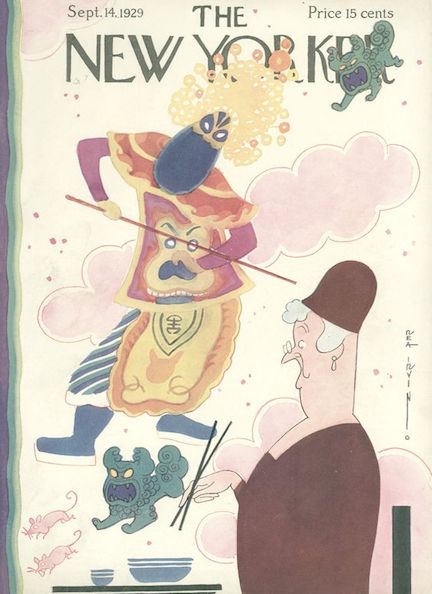
June 28, 1930 cover by Rea Irvin.
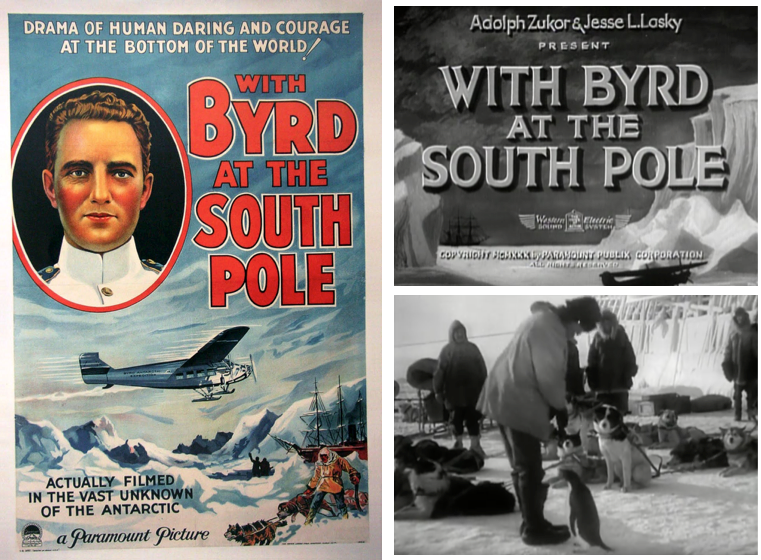
Film critic John Mosher checked out the new documentary on Admiral Richard Byrd’s expedition to the South Pole…
A BYRD WITH WINGS…A Paramount Pictures movie poster promoting the 1930 documentary With Byrd at the South Pole; still images from the film at right. (Wikipedia/YouTube)
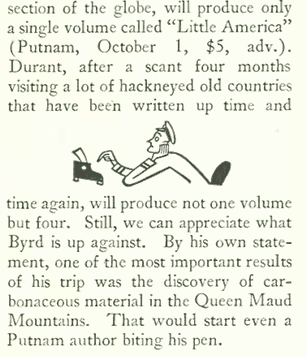
“The Talk of the Town” also made note of Byrd’s expedition and homecoming, contrasting his upcoming book, Little America, with the four-volume historical work planned by popular historian Will Durant.
In collaboration with his wife, Ariel, Durant would end up publishing an eleven-volume history of civilization (four million words across nearly 10,000 pages), written between 1935 and 1975. Will Durant was at work on a twelfth volume when he died in 1981 at age 96.
Admiral Richard Byrd’s Little America, left, and the 11-volume The Story of Civilization, by Will and Ariel Durant.
* * *
American Lenin
The June 28 profile, written by Alva Johnston, featured radical American labor organizer and Marxist politician William Z. Foster. Despite Johnston’s portrayal of Foster as something of a genial pinko, in reality Foster was a strong supporter of Joseph Stalin and a dedicated and loyal ally of the Soviet Union’s Communist Party until his death in 1961. The Soviets even gave him a state funeral, with Nikita Khrushchev personally heading an honor guard in Red Square. An excerpt of Johnston’s profile:
RED AS A ROSE…Left, a campaign photo of William Z. Foster when he headed the Communist Party ticket in the 1928 U.S. presidential election; at right, illustration of Foster for the profile, by Abe Birnbaum.
* * *
And to close…a colorful advertisement in the June 28 issue from Rex Cole…from the signature it appears to be the work of Mario Cooper, but this doesn’t look at all like his other work…
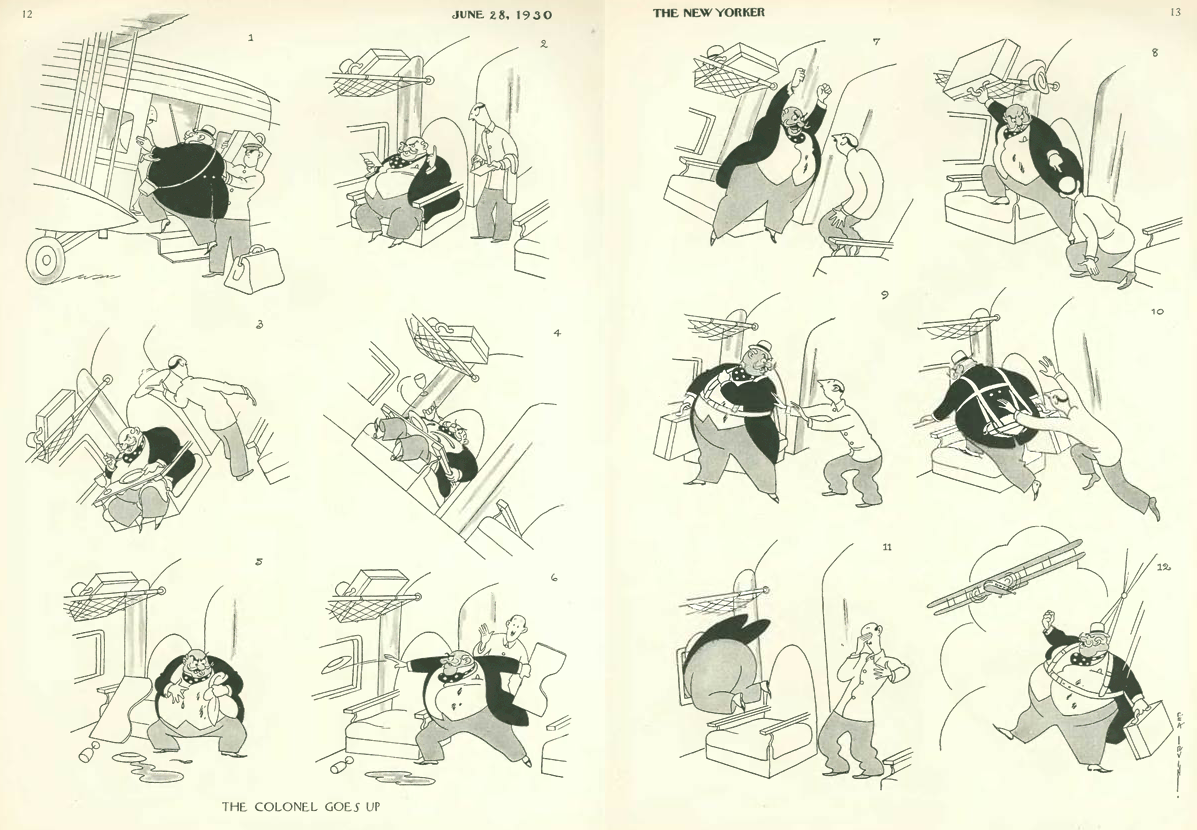
…and a two-page Rea Irvin cartoon, which demonstrates his visual storytelling skills…
Avery Hopwood’s 1919 Broadway hit, The Gold Diggers, was among cultural events of the late teens that signaled the dawn of new age; namely, the Jazz Age.
Sept. 7, 1929 cover by Sue Williams.
So it seems appropriate that the play, when adapted to the screen in 1929 as a Technicolor talkie, would also signal the end of that age. As the New Yorker’s film critic John Mosher observed in his review of The Gold Diggers of Broadway, the themes that seemed new and daring a decade earlier had been played out, the “general humors” of the picture having “become very familiar”…
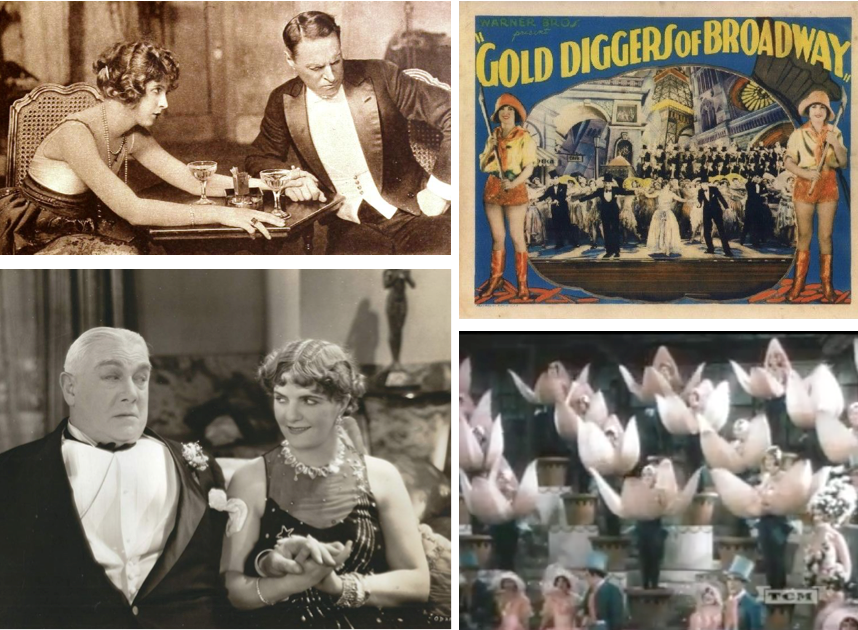
The film featured Nancy Welford, Winnie Lightner and Ann Pennington as three chorus girls who try to entice a wealthy backer to invest money in their struggling Broadway show. The film was a big hit, and it made a star of Winnie Lightner (1899-1971), who played the boldest “Gold Digger” of the trio.
PROSPECTORS…Clockwise from top left, Ina Claire as the original “Gold Digger” with Bruce McRae in the 1919 Broadway play The Gold Diggers; lobby card for the 1929 film Gold Diggers of Broadway; image from the film’s “Tiptoe Thru the Tulips” song-and-dance number; Winnie Lightner works her charms on Albert Gran in a scene from the film. (Wikipedia/IMDB/TCM-YouTube)IT’S FUN MAKING PICTURES…Helen Foster, Ann Pennington, Nancy Welford and William Bakewell in a publicity photo from 1929’s Gold Diggers of Broadway. (IMDB)
Lightner wasn’t the only actor to steal the show. The film also proved a winner for crooner Nick Lucas (1897-1982), who performed two hit songs written for the movie — “Painting the Clouds with Sunshine” and “Tiptoe through the Tulips.” Yes, that second song was the very same tune Tiny Tim rode to fame nearly 40 years later.
TIPTOE THROUGH HISTORY…At left, Nick Lucas sings what would be become his signature song “Tiptoe through the Tulips” to Lilyan Tashman in the Gold Diggers of Broadway. At right, forty years later, Lucas sang the song on The Tonight Show With Johnny Carson (apparently using the same guitar) on the occasion of singer Tiny Tim’s televised wedding to Victoria Mae Budinger (“Miss Vicky”). Tiny Tim (inset) also made “Tiptoe through the Tulips” his signature song, although his was a campier version, sung in a falsetto, vibrato voice accompanied by his trademark ukulele. (YouTube)
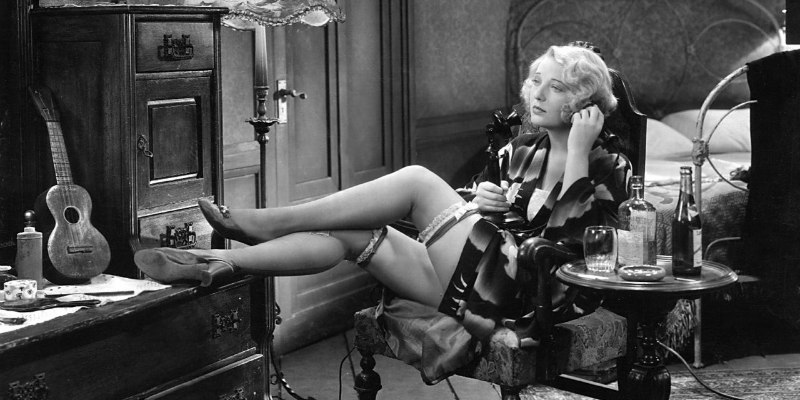
The Gold Diggers of Broadway was a “pre-code” film, that is, a film made during a brief period of the early sound era (roughly 1929 through mid-1934) when censorship codes were not enforced and many films openly depicted themes ranging from promiscuity and prostitution to amoral acts of violence.
A LEG UP ON THE CENSORS…Warner Brothers publicity photo of Dorothy Mackaill, who played a secretary-turned-prostitute in 1931’s Safe in Hell. (Wikipedia)
Those unenforced codes had their origins in the early 1920s. In response to outcries from preachers and politicians alike over the immortality of Hollywood (both on- and off-screen), the president of Paramount Pictures, Adolph Zukor — fearing that cries for censorship would cut into his profits — called a February 1921 meeting of his studio rivals at Delmonico’s restaurant on 5th Avenue. At the meeting Zukor (1873-1976) distributed a set of 14 rules that would guide every Paramount production (Zukor’s studio at that time was actually known as Famous Players-Lasky). The rules covered everything from “improper sex attraction” to “unnecessary depictions of bloodshed.”
It was also Zukor’s idea to appoint the former U.S. Postmaster General, Will Hays, as President of the Motion Picture Producers and Distributors of America. It would be Hays’ job to enforce the code and generally “clean up” Hollywood. However, until mid-1934 both Hays and the code served mostly as publicity ploys to keep the preachers and politicians off the backs of studio execs.
Zukor was profiled by Niven Busch, Jr. in the Sept. 7 issue (with portrait by George Shellhase). In his opening paragraph, Busch commented on “Pop” Zukor’s efforts to stave off the censors:
* * *
Delmonico’s Redux
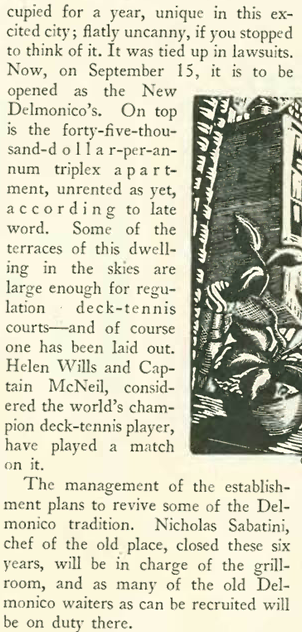
The famed Delmonico’s restaurant that provided the setting for Adolph Zukor’s “14 rules” meeting in 1921 closed its doors in 1923, a victim of Prohibition (more people dined at home, where they could still drink). Writing in the Sept. 7 “Talk of the Town,” Bernard A. Bergman described plans for the long-awaited opening of a new Delmonico’s in a skyscraper bearing the same name…
RICH DESSERTS…Dinner in honor of French Navy Admiral Paul Campion at the old Delmonico’s in 1906. (Wikipedia/Library of Congress)AND SALAD DAYS…Delmonico’s wait staff pose for a photograph in 1902. (Museum of the City of New York)
A former Delmonico’s chef, Nicholas Sabatini, hoped to bring back some of old waiters and cooks from the restaurant’s glory days, but it seemed most were far too long in the tooth. It is unclear if he ever got his dream off the ground, or if the grill room was able to crank out fare comparable to that of the old Delmonico’s. Probably not…
THE KITCHEN IS CLOSED…The 1928 Hotel Delmonico, as shown in a 1937 photograph. It was purchased by Donald Trump in 2002 and converted into luxury condominiums. It would not host a great restaurant, but the Beatles would stay there in 1964. (New York Public Library)
* * *
Relax. You’re in Omaha
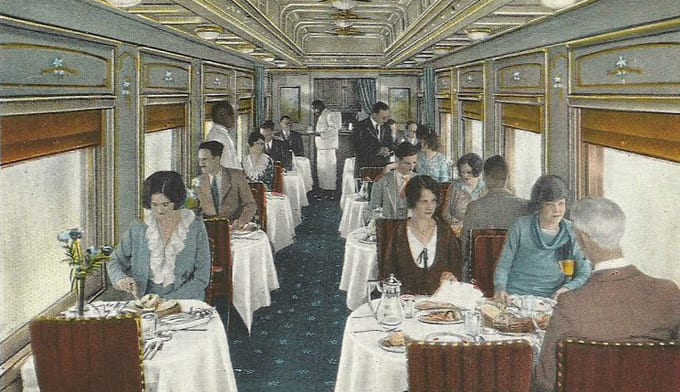
E.B. White’s “Notes and Comment” entry in the Sept. 7 “Talk of the Town” described travel on the Union Pacific’s Overland Limited, and the “mystic dividing line” that separated laid-back Westerners from buttoned-up Easterners:
MIND YOUR MANNERS, AT LEAST UNTIL YOU LEAVE CHICAGO…Tinted photo postcard depicting the dining car on a Union Pacific train that traveled the Chicago to Denver route in the 1920s. (myutahparks.com)
* * *
Write What You Know
The Wisconsin-born Marion Clinch Calkins (1895 – 1968) often wrote humorous rhymes for The New Yorker under the pen name Majollica Wattles. While many writers reveled in the party atmosphere of the Roaring Twenties, Calkins worked as a vocational counselor and social worker at Lillian Wald’s Henry Street Settlement. This experience doubtless led her to more serious writing after the 1929 market crash — her critically acclaimed book, Some Folks Won’t Work (1930), is considered a seminal document on the Great Depression.
But in September 1929, Calkins was still in a humorous vein, and published this satirical piece on the role of an ideal housewife in the Sept. 7 issue. Excerpts:
CALL ME CLINCH…Marion Clinch Calkins circa 1905 and 1945. She wrote under the name of Clinch Calkins because she wanted her authorship to be gender-neutral. (evansvillehistory.net/NEH)
* * *
Information Please
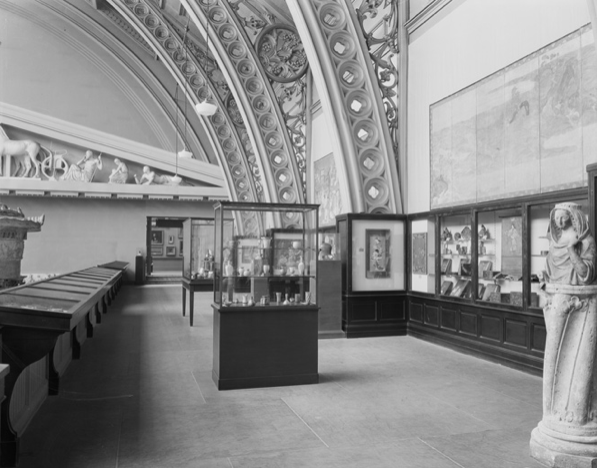
The New Yorker’s art critic Murdock Pemberton did not suffer fools gladly, and whenever the local museums seemed less than up to snuff, he was there to provide some correctional advice…
NEED AN AUDIO GUIDE? STILL WORKING ON THAT…The Metropolitan Museum of Art’s H.O. Havemeyer Collection, 1930. (The Metropolitan Museum of Art)
* * *
From Our Advertisers
Despite the advances made by women in the 1920s, they still lived under a patriarchy, especially when it came to the patrician classes. And so the young bride of Gifford Pinchot II was identified only as a “Mrs.” in the headline for this Pond’s cold cream ad…
…Mrs. Gifford Pinchot II was actually Janine Voisin (1910-2010). She must have had more than a healthy complexion, as she lived 100 years…
Janine Voisin Pinchot in 1933. (history.blogberth.com)
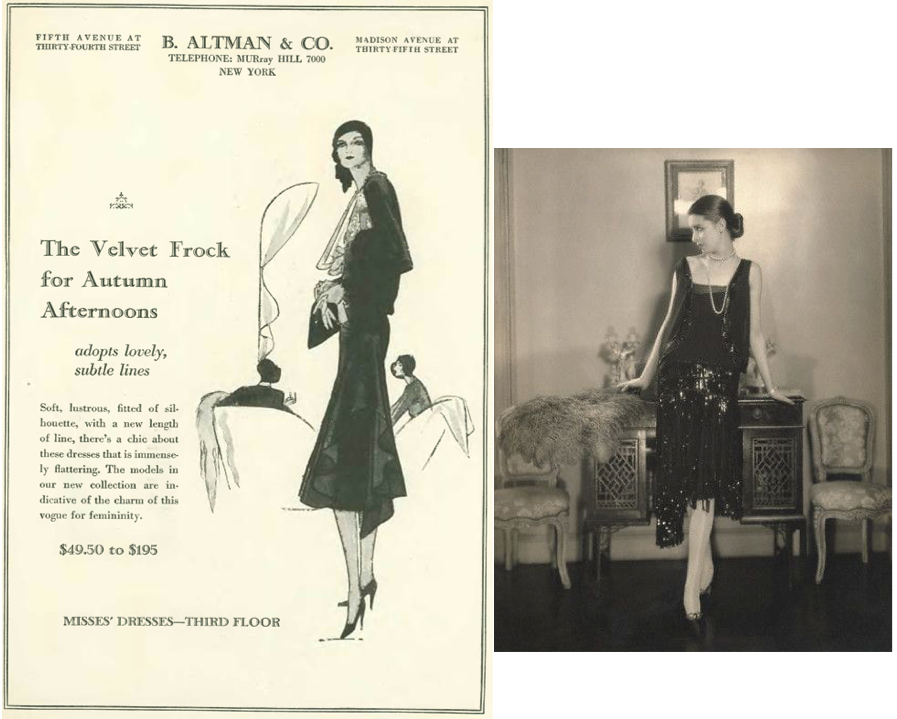
Another woman known for her beauty in the 1920s was the model Marion Morehouse (who was married to poet E.E. Cummings from 1934 until his death in 1962). Considered by some to be the first “supermodel,” I include an image of Morehouse below (right) to demonstrate how artists exaggerated the female form in fashion ads of the day…
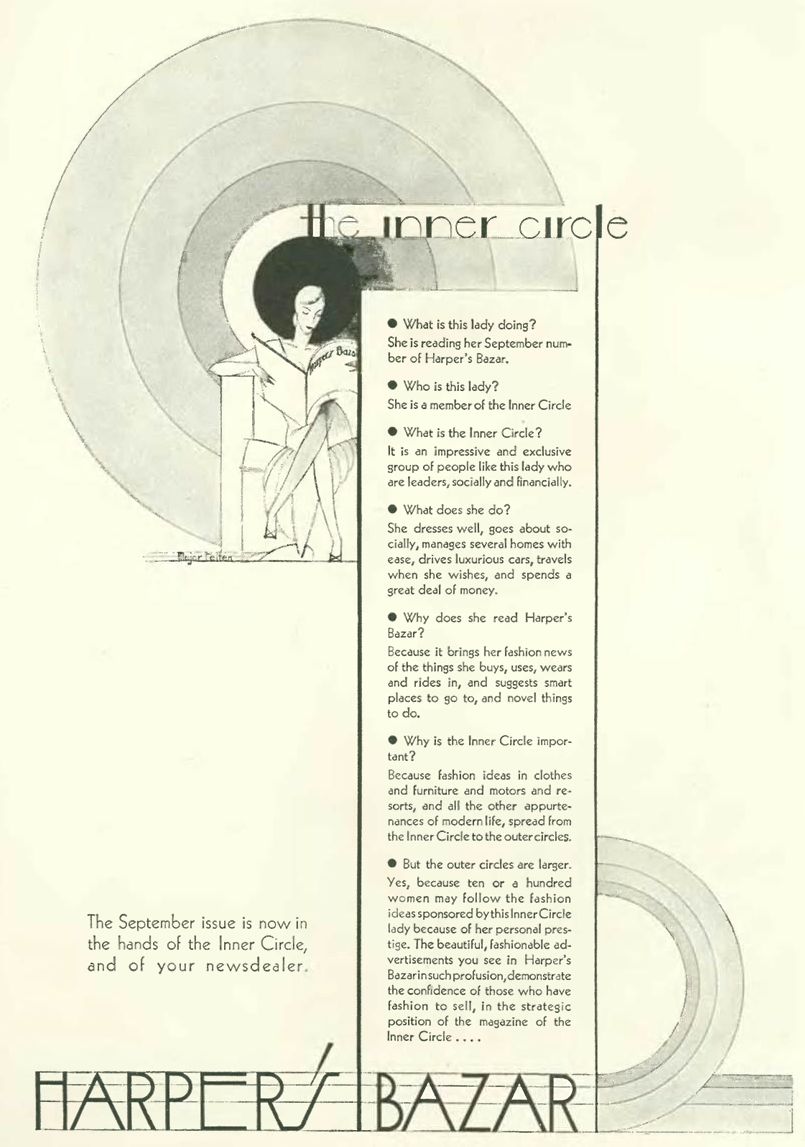
…the body wasn’t the only thing subject to exaggeration, or hyperbole, as this ad from Harper’s Bazar attested in defining the exclusivity of its readership…
…the New York Sun also appealed to social mores in an attempt to sell more newspapers…
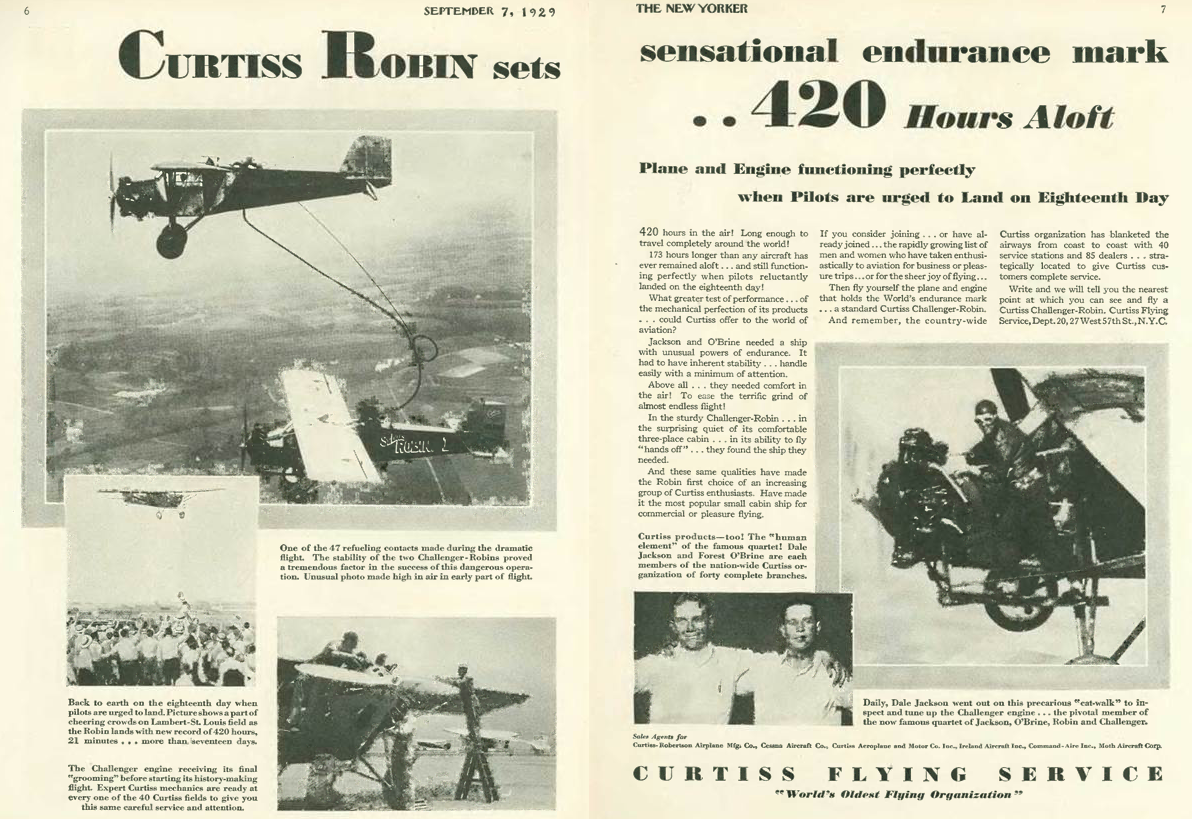
…the Curtiss Robin Flying Service touted their latest achievement — the St. Louis Robin being refueled during its flight to a new world’s endurance record of 420 hours — greatly surpassing the record of 150 hours set by the Army’s “Question Mark” airplane at the beginning of 1929…
…our cartoonists from the Sept. 7 issue include Gluyas Williams, who had some fun at the expense of Alice Foote MacDougall, who was the “Starbucks” of her day, at least in New York…
…MacDougall turned her coffee business into a restaurant empire in the 1920s. She opened several restaurants in Manhattan, all decorated in a signature style meant to evoke European cafés…
EURO AMBIENCE…Interior of Alice Foote MacDougall’sFirenze, 6 West 46th Street, New York City, 1925. (New York Historical Society)
…other cartoons included this commentary on public advertising by Leonard Dove…
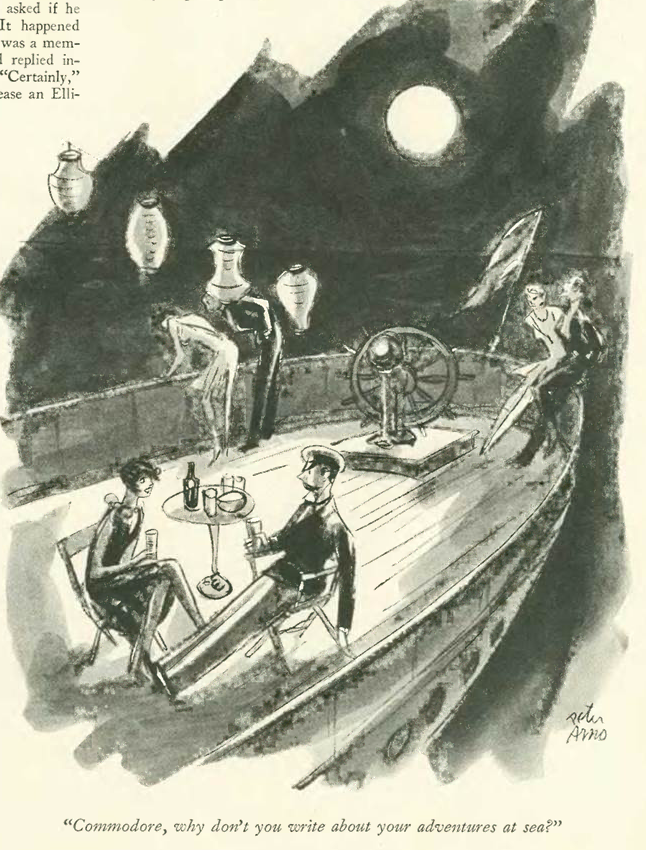
…Peter Arno’s unique take on the seafaring life…
…Helen Hokinson eavesdropped on some tween talk…
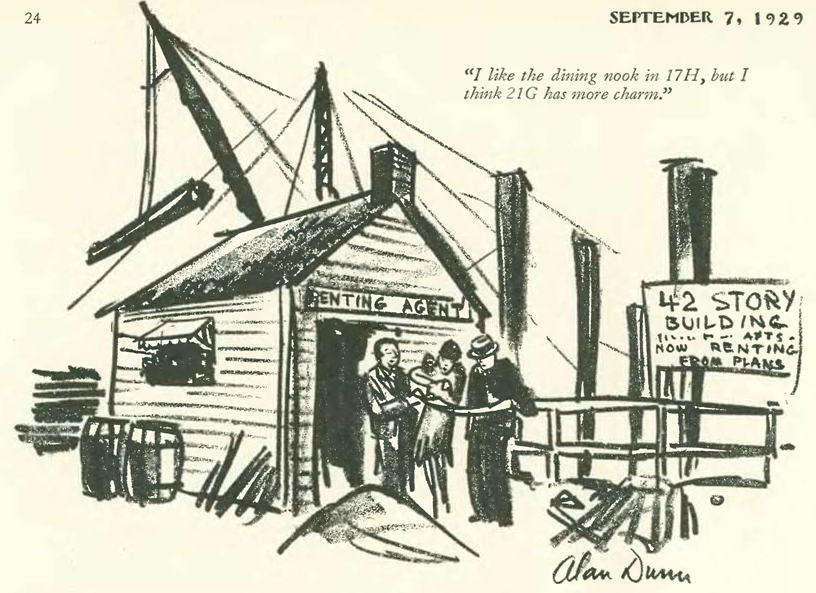
…and Alan Dunn gave us some perspective on the fast pace of city life…
Winding down the last summer of the 1920s — an unusually hot one — one detects subtle changes in The New Yorker’s mood; weary from the decade-long party known as the Roaring Twenties, a bit more mature, and more confident in its voice thanks to the regular writings of James Thurber, E.B. White and Lois Long and copious cartoons and illustrations by such notables as Peter Arno, Barbara Shermund and Helen Hokinson that gave the magazine a distinctively modern feel as it headed into the 1930s.
Aug. 10, 1929 cover by Theodore Haupt; Aug. 17 cover by Peter Arno.
The exuberance associated with the rapidly changing skyline was still there, however, as the Aug. 17 “Talk of the Town” speculated on the race for the world’s tallest building. The article not only anticipated an architect’s sleight of hand, but also a Zeppelin docking station that in the end would top the world’s tallest building:
As it turned out, William Van Alen did not have to compete against himself, the commission for One Wall Street instead going to Ralph Walker, who would design a beautiful art deco landmark that, at 50 stories, would not vie for the title of the world’s tallest building. Unbeknownst to The New Yorker, and perhaps Van Alen, the challenger would instead be 40 Wall Street, which would hold the crown as world’s tallest for about a month. Thanks to some sleight of hand (see caption below) the Chrysler building would quickly surpass 40 Wall Street and hold the title for just eleven months, bested in the end by the Empire State Building (which would sport a “Zeppelin superstructure”).
DECO DELIGHTS…40 Wall Street (left) vied with the Chrysler Building for the title of the world’s tallest building. The 927-foot 40 Wall Street would claim the title in late April 1930. One month later, the Chrysler building would sprout a needle-like spire (secretly constructed inside the building) bringing its total height to 1,046 feet. The builders of 40 Wall Street cried foul and claimed that their building contained the world’s highest usable floor, whereas the Chrysler’s spire was strictly ornamental and inaccessible. Less than a year later the point was made moot when the Empire State Building soared above them both. (Wikipedia/The Skyscraper Museum)ERECTILE DYSFUNCTION…Clockwise, from top left, progression of designs for the Chrysler Building; the building’s architect, William Van Alen; drawing from Popular Science Monthly (Aug. 1930) revealed the inner workings of the spire’s clandestine construction; Zeppelin docking station for the Empire State Building as imagined in a composite (faked) photograph. At 1,250 feet, the wind-whipped mooring mast proved not only impractical, but downright dangerous. In September 1931 a dirigible briefly lashed itself to the mast in 40 mph winds, and two weeks later the Goodyear Blimp Columbia managed to deliver a stack of Evening Journals to a man stationed on the tower. Contrary to the faked photograph, no passengers ever transferred from the tower to a Zeppelin. (Skyscraper City/Wikipedia/NY Times)
* * *
What, Me Worry?
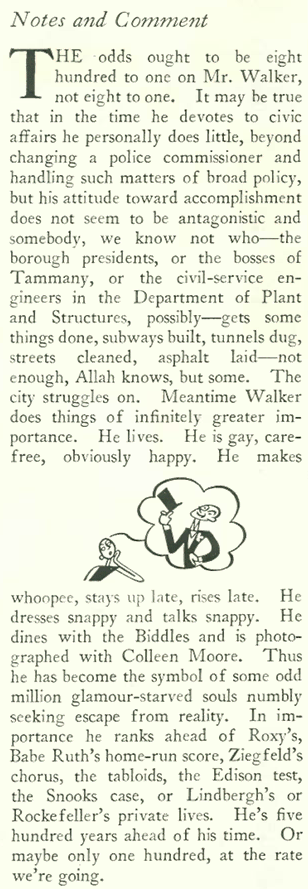
The famously flamboyant New York City Mayor Jimmy Walker lived the easy life during his initial years as Hizzonner, riding a booming economy, partying with the rich and famous (while flaunting Prohibition laws), carousing with his mistress (Ziegfield dancer Betty Compton) and sleeping until noon. When reform-minded Fiorello La Guardia challenged Walker’s reelection bid in 1929, Walker left the dirty work to his Tammany Hall cronies and continued to charm the public, and The New Yorker. The Aug. 17 “Talk of the Town” observed:
IT’S EASY BEING ME…Mayor Jimmy Walker accompanied actress Colleen Moore to the October 1928 premiere of her latest film, Lilac Time. (konreioldnewyork.blogspot.com)I HAVE MY EYE ON YOU…Reform-minded Fiorello La Guardia (right) detested Jimmy Walker and his Tammany cronies, but that wasn’t enough to get him elected in 1929. The Great Depression would soon turn the tables. (Wikipedia)
Howard Brubaker, in his Aug. 17 “Of All Things” column, suggested that La Guardia had a zero chance of getting elected. Just three years later, Walker would resign amid scandal and flee to Europe. La Guardia, on the other hand, would be elected to the first of his three terms as mayor in 1933, riding the wave of the New Deal.
* * *
Peek-A-Boo
Politics might have been business as usual, but in the world of fashion the vampish hat styles associated with flappers were giving way to a new rolled-brim look that seemed to suggest an aviator’s helmet. In her Aug. 17 fashion column “On and Off the Avenue,” Lois Long reported:
FACING THE FUTURE…Vampish hats of 1928, pictured at top, gave way to the rolled-brim or flare look of 1929. (Images gleaned from magazine/catalog images posted on Pinterest)
Long seemed to welcome the idea that women should once again bare their foreheads…
* * *
Twain Wreck
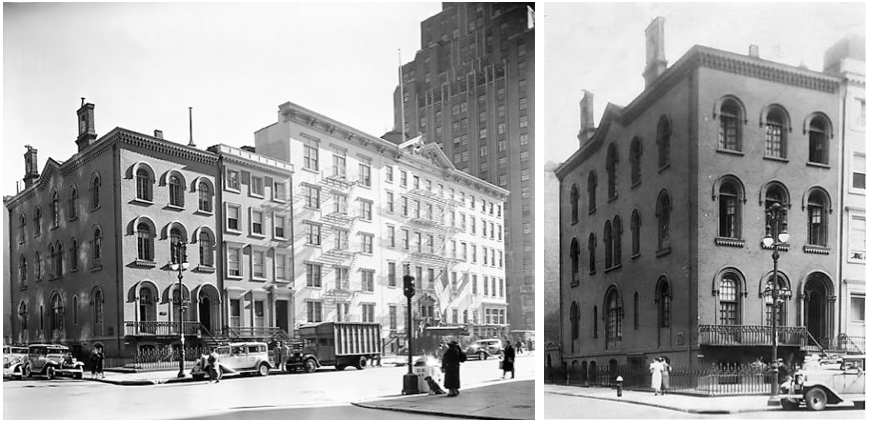
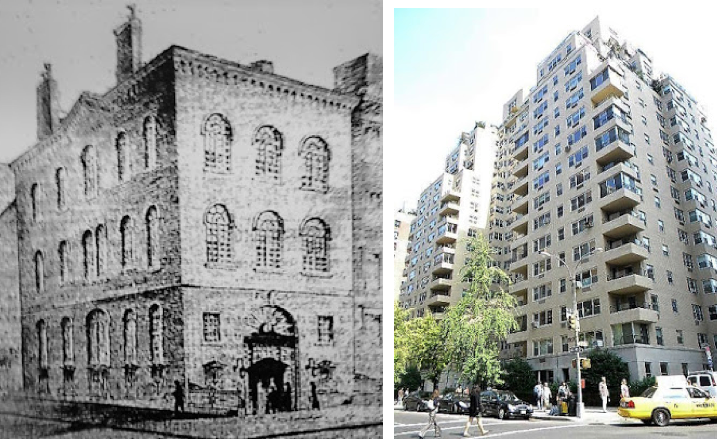
Jumping back to the Aug. 10 issue, “The Talk of the Town” reported on the possible remodeling or demolition of a house once occupied by Samuel Clemens, aka Mark Twain. The house in question was a lavish old mansion built by Henry Brevoort, Jr. in 1834, at the northwest corner of Fifth Avenue and 9th Street. Twain lived in the house from 1905 to 1908, and it was there that Twain’s biographer Albert Paine conducted interviews with the author and wrote the four-volume Mark Twain, a Biography; The Personal and Literary Life of Samuel Langhorne Clemens. When millionaires abandoned their Fifth Avenue mansions in the 1920s and high-rise apartments took their place, there was pressure to either convert an old mansion like the Breevoort house at 21 Fifth Avenue to apartments or demolish it altogether.
LOOKING GOOD AFTER A CENTURY…At left, Berenice Abbott took this photograph of No. 21 Fifth Avenue in 1935. At right, in a close-up shot from the same period, the 1924 plaque from the Greenwich Village Historical Society is visible on the side of the house. (Museum of the City of New York/Greenwich Village Historical Society)A NOW FOR SOMETHING COMPLETELY DIFFERENT…A proposed 1929 remodeling (left) moved the front door of the old Brevoort mansion to the center and lowered it to street level. At right, today the 1955 Brevoort apartment house occupies the site. (daytoninmanhattan.blogspot.com)
The Greenwich Village Historical Society did what it could to save the house, and in 1924 affixed a bronze plaque to a side wall noting that both Twain and Washington Irving were once occupants. When the house was slated for demolition in 1954, the Society appealed to New Yorkers to raise the $70,000 needed to move the building, but only a fraction of that amount was secured. No. 21 was demolished in 1954 along with the rest of the houses on that block.
* * *
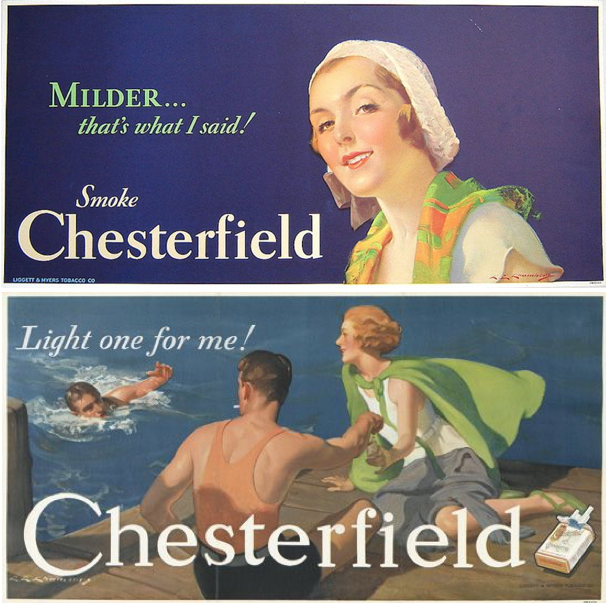
Charles Edward Chambers was an American illustrator probably best known for his Chesterfield ads, although he also illustrated stories for a number of popular magazines from the early 1900s until his death in 1941. The Aug. 10 “Talk of the Town” looked in on his work with model Virginia Maurice:
QUICK…THROW THAT MAN A CIGARETTE!…Examples of Charles Edward Chambers’ Chesterfield ads from 1929 featuring model Virginia Maurice. Note that Maurice is wearing the latest “rolled brim” hat style in the upper image. (Pinterest)HIS NONSMOKING SECTION…A 1919 Harper’s cover illustration by Charles Edward Chambers. (Wikipedia)
* * *
Mama’s Boy
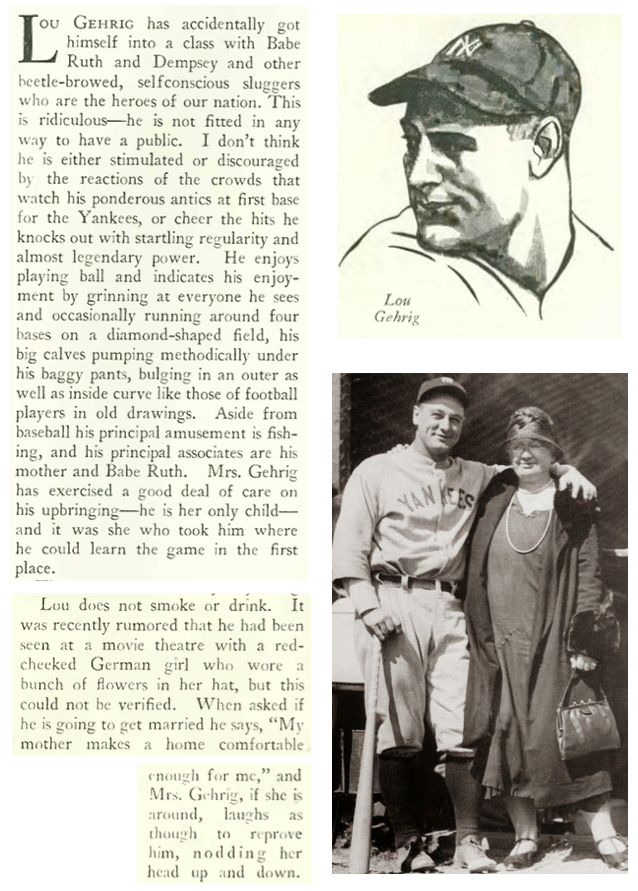
Lou Gehrig rivaled Babe Ruth as a top Murderer’s Row slugger for the 1929 Yankees, yet he couldn’t be more opposite in his lifestyle. A teetotaler and nonsmoker, Gehrig was completely devoted to mom (pictured below in 1927). Niven Busch Jr. submitted this profile of Gehrig for the Aug. 10 issue. Excerpts:
* * *
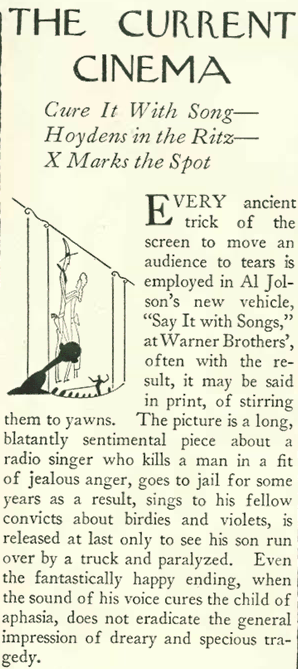
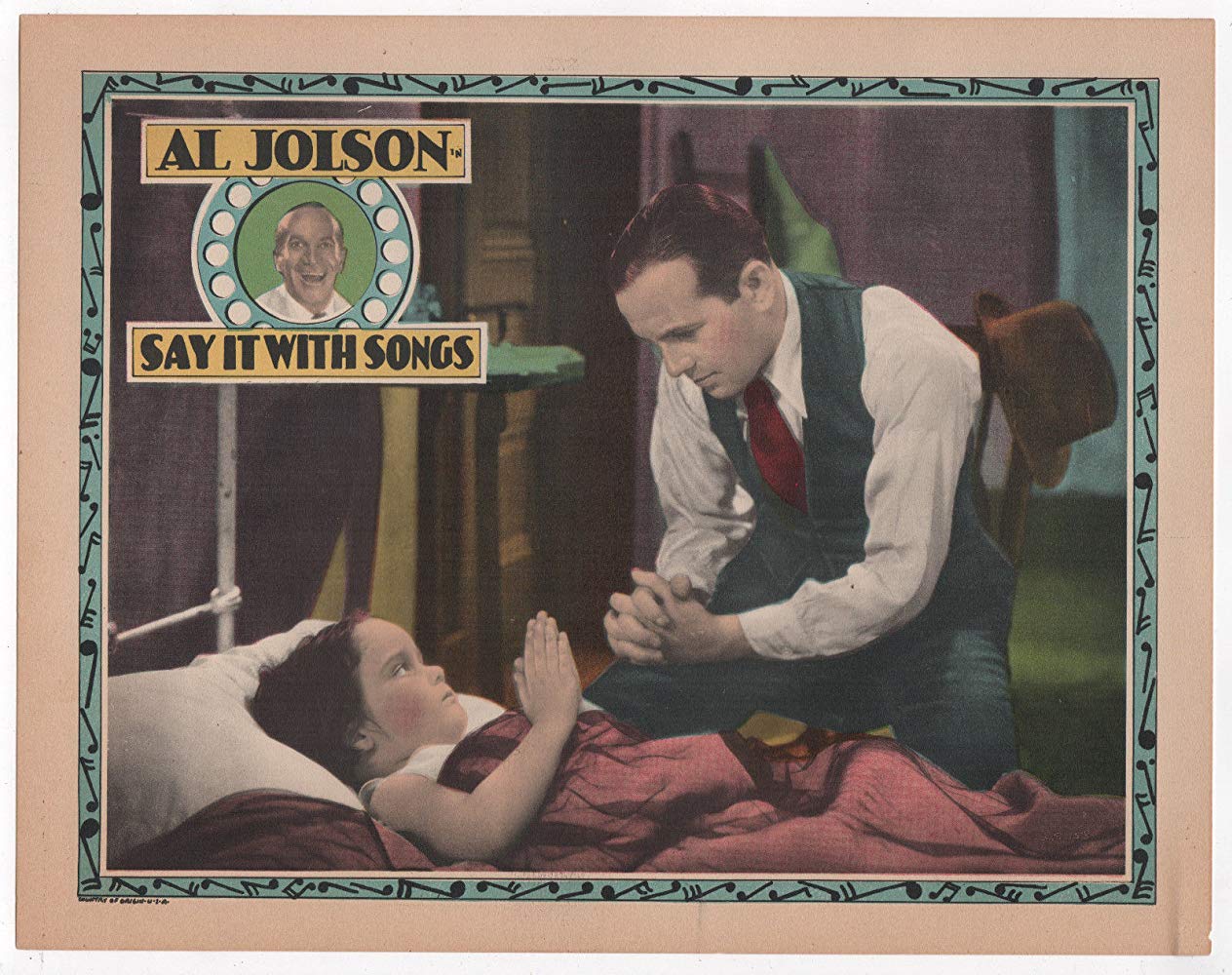
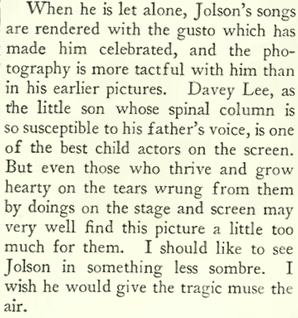
After appearing as Al Jolson’s dying son in The Singing Fool (1928), the child actor Davey Lee returned to the screen for yet another Jolson weeper, 1929’s Say It With Songs. Once again portraying Jolson’s son—this time crippled and rendered dumb after being hit by a truck—he miraculously recovers at the end of the film. The New Yorker wasn’t having any of this sentimental treacle, especially served up for a second time…
LET’S PRAY FOR A BIG BOX OFFICE…Davey Lee and Al Jolson in Say It With Songs. (IMDB)
…and the magazine hoped for something a bit less somber from Jolson in the future, suggesting that he “give the tragic muse the air”…
In the same issue of The New Yorker, this advertisement touted Jolson’s recording of “Little Pal” from Say It With Songs (note the blackface image of Jolson—his unfortunate trademark back in the day)…
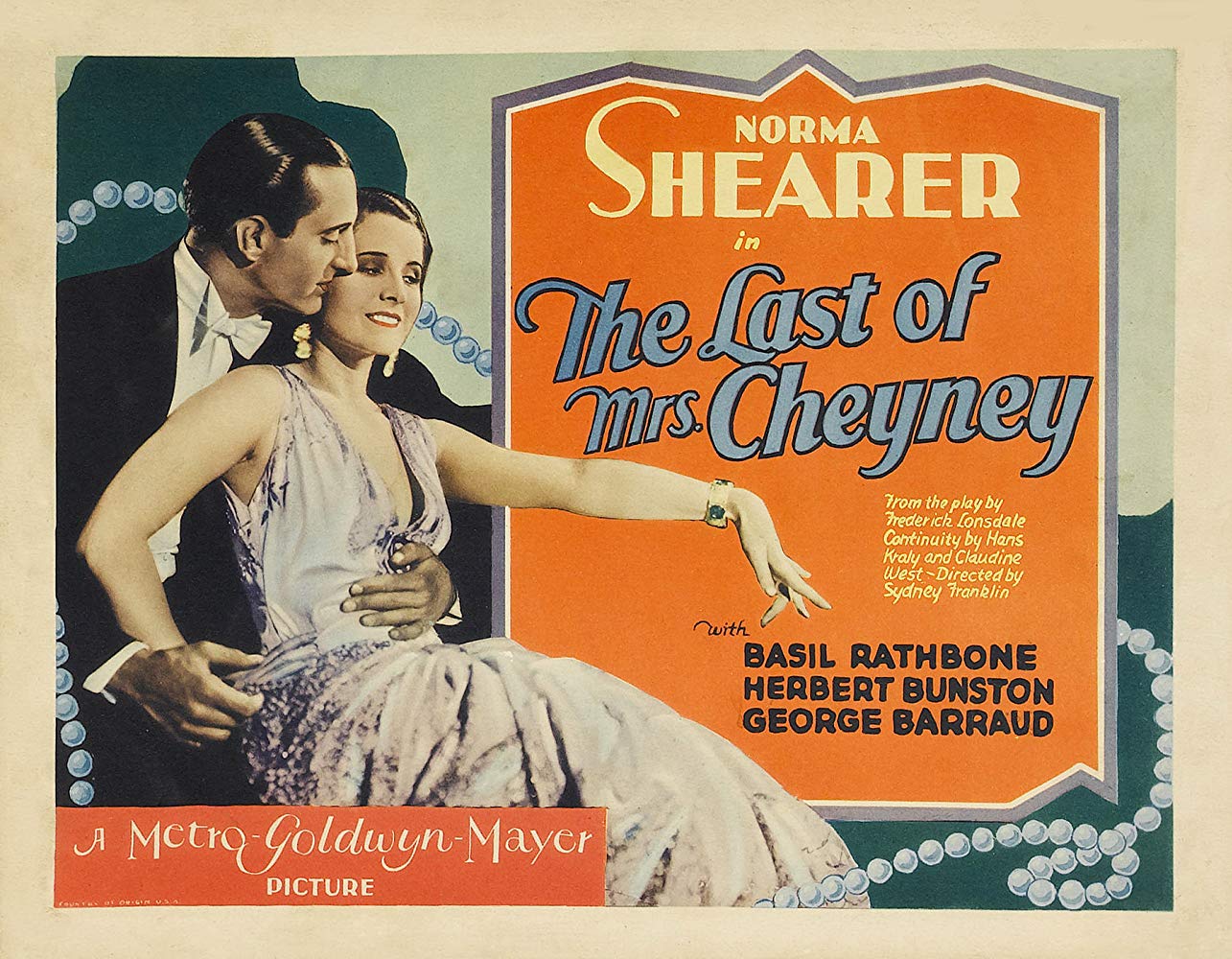
…happily, there were other movies that offered less schmaltzy diversions, including Norma Shearer’s comedy-drama The Last of Mrs. Cheyney, in which Shearer portrayed the jewel thief Fay Cheyney…
OH BASIL YOU ANIMAL…Theatre card for The Last of Mrs. Cheyney. (IMDB)
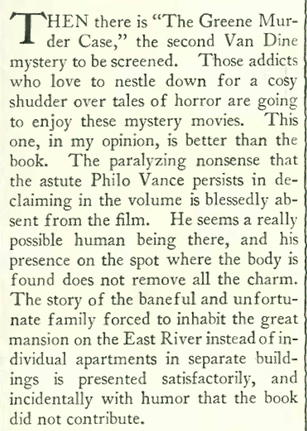
…often cast as a heavy in silent films, it was the “talkies” that made William Powell a star, his pleasant voice more suited to a hero or leading man than a villain. In The Greene Murder Case, Powell portrayed amateur detective Philo Vance, a role that he played in another 1929 release, The Canary Murder Case (originally filmed as a silent in 1928), both based on mystery novels by S.S. Van Dine. Powell would portray Philo Vance in three more films from 1930 to 1933 until he took on the role of another amateur detective, Nick Charles, in 1934’s The Thin Man (a role he would reprise five times from 1936 to 1947)…
WHODUNNIT? YOUDUNNIT!…William Powell as detective Philo Vance, Florence Eldridge as Sibella Greene, and Jean Arthur as Ada Greene in 1929’s The Greene Murder Case. (IMDB)KEEPING IT QUIET…William Powell as Philo Vance and Louise Brooks as “the Canary,” a scheming nightclub singer, in The Canary Murder Case. Brooks was a huge star in the silent era and the iconic flapper. According to IMDB, the film was shot as a silent in 1928, but producers decided to rework it as a more profitable “talkie.” When Brooks refused to return from Germany (where she was filming Pandora’s Box) to dub the movie, Paramount spread the word that Brooks’ voice was not suited to sound film, although later productions made by Brooks proved this to be wrong. Actress Margaret Livingston ultimately supplied Brooks’ voice for Canary. (IMDB)
* * *
From Our Advertisers
We look at some advertisements from the August 17 issue, including this one from Past Blue Ribbon. Note that nowhere in the ad is the word “beer” used, this being a “near-beer” with less than 1% alcohol content by volume. In addition to making cheese (a Velveeta-like product), Pabst hoped to keep its company alive by selling this “brew” during the unusually hot summer of 1929…
…and with that blazing sun advertisers also promoted a number of face creams and powders to those “enjoying the sunny outdoor life,” including this two-page spread from Richard Hudnut and Poudre Le Début…
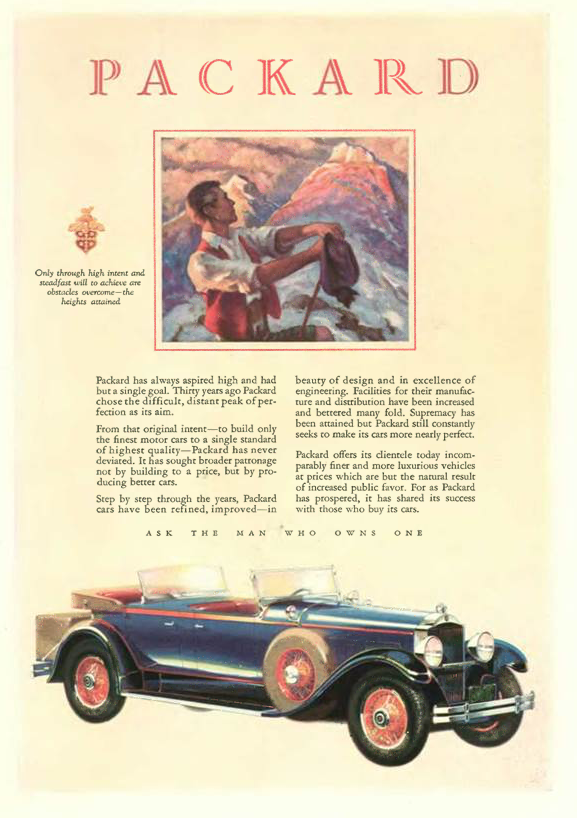
…the outdoor life could also be enjoyed in a convertible Packard 640, a car that was a cut above a Lincoln or Cadillac, and was considered by some to be America’s answer to the Rolls Royce…
A 1929 Packard 640 Convertible. This particular model can be had today for about $130,000. (Hemmings Motor News)
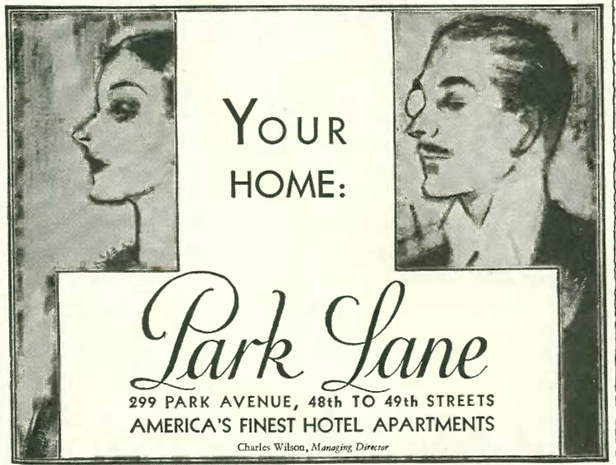
…I found this ad in the back pages interesting for its crude design yet overt appeal to snobbishness with this haughty pair…
…and here is what the Park Lane looked like when it opened in 1924…
Circa 1924 advertisement from the Sargent lock and hardware company touting its fixtures in the new Park Lane hotel apartments. At right, circa 1924 image from The American Architect depicting the Park Lane’s dining room. The building is long gone, razed some time in the 1960s to make way for an office tower. (Pinterest)
* * *
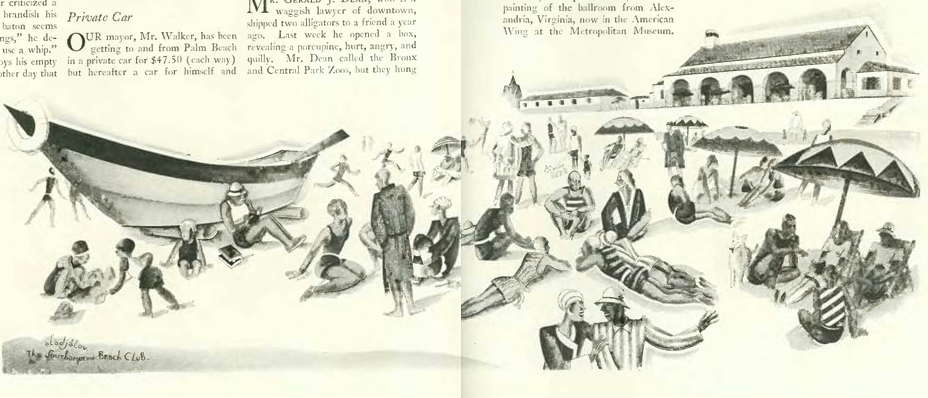
This week’s featured illustration is by Constantin Alajalov, who depicted a summer scene from the Southampton Beach Club…click to enlarge…
…our cartoonists from the Aug. 10 issue include Helen Hokinson, who looked at the challenges of Americans abroad…
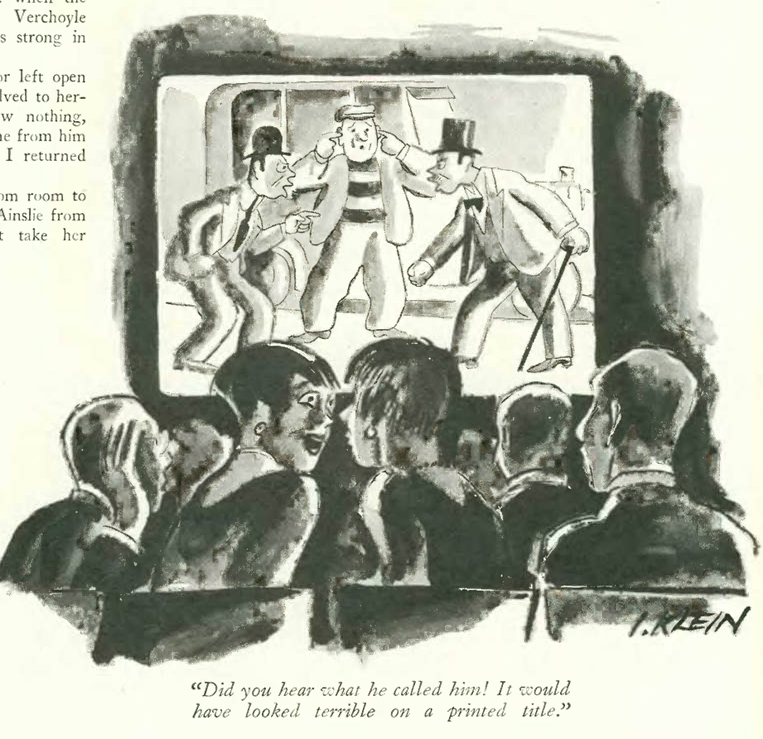
…Isadore Klein observed the changing mores of movie houses (a couple of “damns” were apparently uttered in the talking pictures of 1929)…
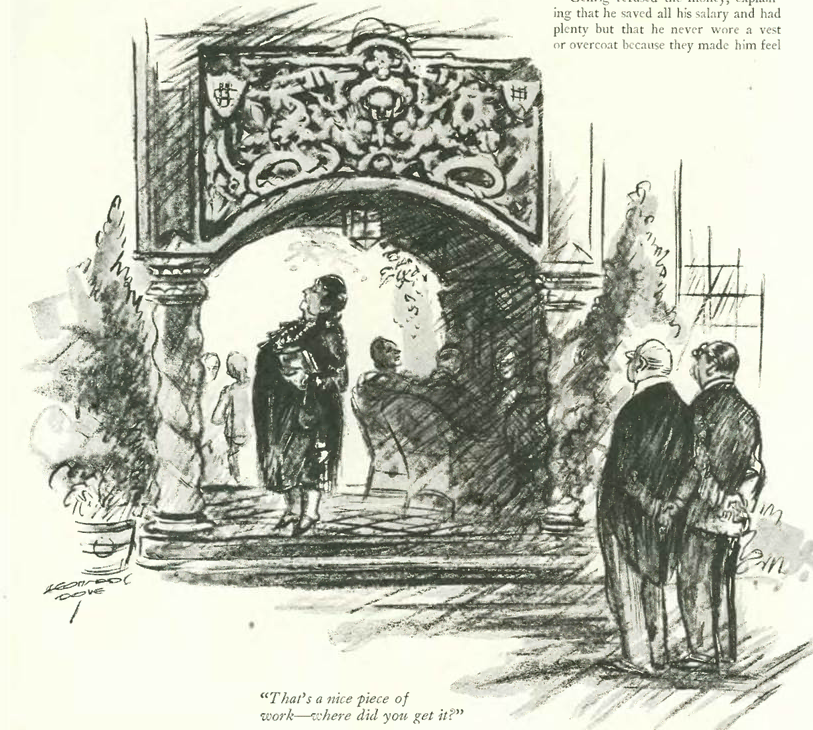
…and Leonard Dove offered up a double entendre of sorts…
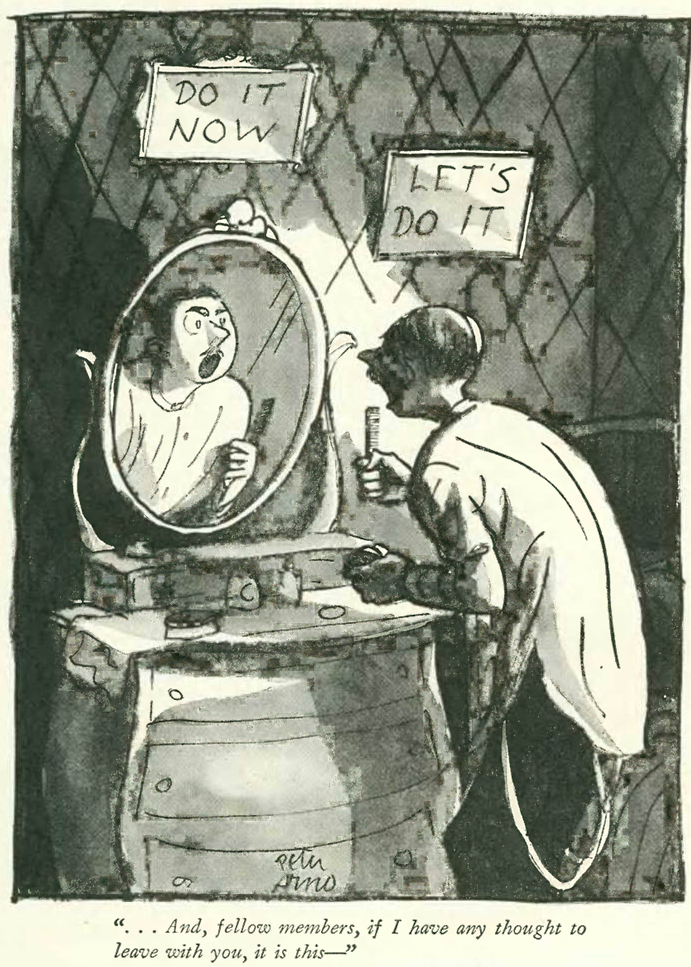
…cartoons for the Aug. 17 issue included a peek behind the scenes at a motivational speaker courtesy Peter Arno…
…Carl Kindl had some fun with the juxtaposition of a matron and a flapper hat…
…and for reference, the cloche hat called a “Scalawag” was featured in this ad by Knox in the March 30, 1929 New Yorker…drawing by Carl “Eric” Erickson…
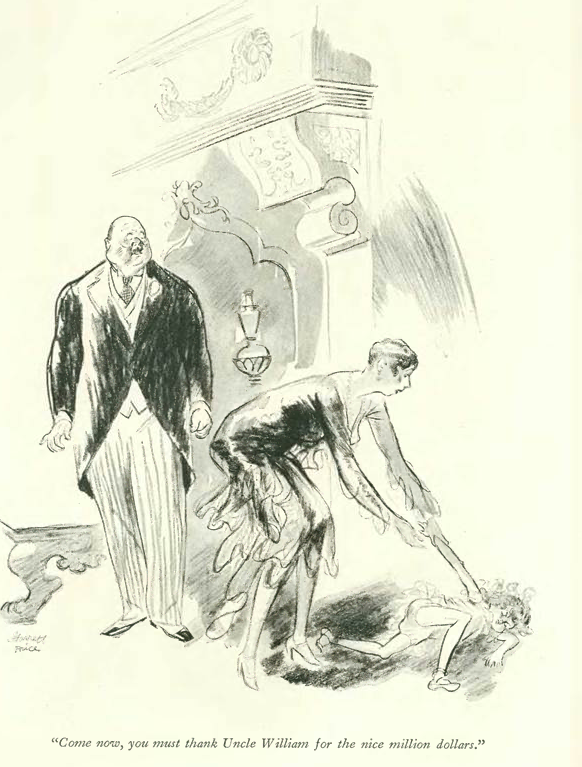
…Garrett Price portrayed the antics of an ungrateful trust fund brat, who probably did not have that million dollars after the market crash…
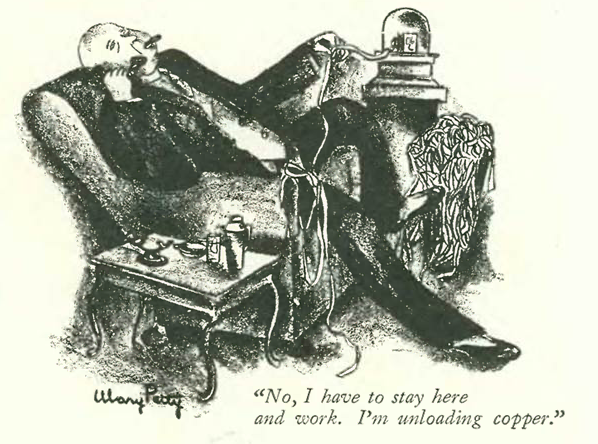
…and this fellow, depicted by Mary Petty, who doubtless would be less nonchalant come Oct. 28, or what we know as “Black Monday”…
In July of 1928, war was officially banned from the earth. Or so it was hoped when the Kellogg–Briand Pact became effective on July 24, 1929.
Aug. 3, 1929 cover by Gardner Rea.
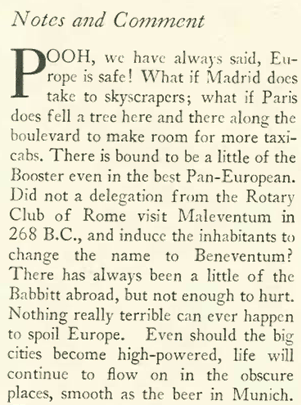
Also known as the “Pact of Paris” and more officially the “General Treaty for Renunciation of War as an Instrument of National Policy,” its authors, United States Secretary of State Frank B. Kellogg and French foreign minister Aristide Briand, gathered world powers in Paris on Aug. 28, 1928 to sign a treaty that denounced the use of war and called for the peaceful settlement of all future disputes. The New Yorker, in the opening “Notes and Comment” section of “The Talk of the Town,” took its usual “What, Me Worry?” approach to world affairs, finding the whole thing unnecessary given that (in its view) Europe was already a peaceful, even benign continent:
GIVE PEACE A CHANCE…French foreign minister Aristide Briand, Myron T. Herrick (U.S. ambassador to France), and U.S. Secretary of State Frank B. Kellogg meet in the French Foreign Office for the signing of the General Treaty for Renunciation of War as an Instrument of National Policy, August 1928; at right, Briand speaking to the assembly. (theinternationalistsbook.com//Wikipedia)
In January 1929 the U.S. Senate officially ratified the Kellogg–Briand Pact with a nearly unanimous vote, 85-1. John James Blaine, senator from Wisconsin, cast the lone dissenting vote (although four years later Blaine would author another piece of legislation that would have a much greater impact, at least at the time: the 21st Amendment, which ended Prohibition).
SURE, WHY NOT?…The U.S. Senate approved the Kellogg–Briand Pact on Jan. 15, 1929. The treaty went into effect later that year on July 24. (The New York Times)
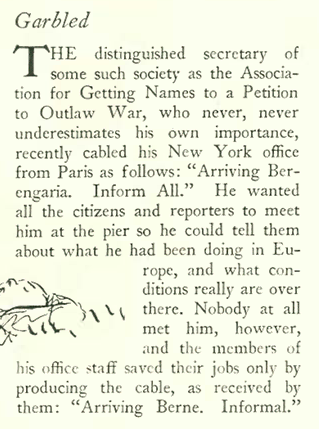
Another item in “The Talk of the Town” made further reference to the pact…
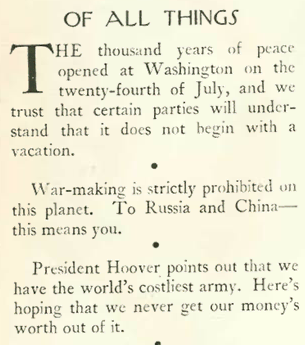
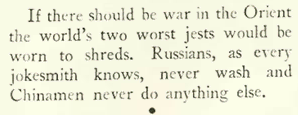
…and Howard Brubaker, in his column “Of All Things,” made special mention of the Sino-Soviet border conflict in referencing the pact:
Brubaker mockingly suggested that the pact marked the beginning of a thousand years of peace, an inadvertently prescient remark considering that in less than four years Hitler would seize power in Germany and announce the beginning of his “Thousand Year Reich” — which we know was quite the opposite of peace. Brubaker was also off the mark with this crude observation:
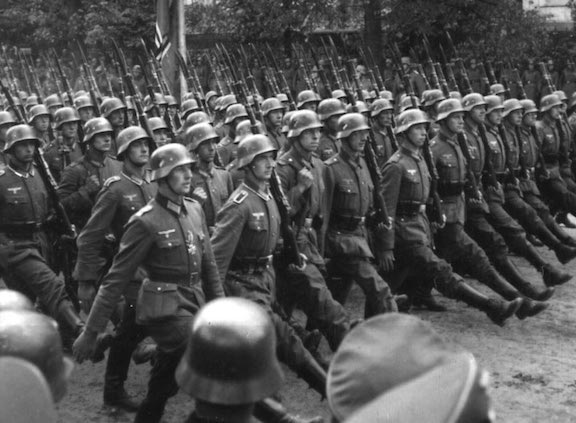
Just two years after Brubaker wrote those words, Japan would invade Manchuria. And only a decade would pass before Germany and Russia would invade Poland and ignite the biggest war of all time.
PARTY POOPERS…TheNew Yorker wasn’t alone in poking fun at the Kellogg–Briand Pact. At left, the pact is mocked during the Paris Carnaval in 1929; at right, British cartoonist Sidney Conrad Strube reminded readers of the outcome of America’s earlier efforts at world peace. (Wikipedia/Pinterest) click to enlarge.WE JUST CAME TO SAY HELLO…Germany, the first signatory to the Kellogg-Briand Pact banning all war, invaded Poland just ten years after that treaty went into effect. Above, German troops parade through Warsaw after the invasion, September 28-30, 1939. (National Archives and Records Administration)
Although the pact was ridiculed for its perceived naïveté, and for the fact that it did not prevent the largest war in human history, some modern scholars see otherwise. Political scientists Oona A. Hathaway and Scott J. Shapiro observed (in 2017) that the pact “catalyzed the human rights revolution, enabled the use of economic sanctions as a tool of law enforcement, and ignited the explosion in the number of international organizations that regulate so many aspects of our daily lives.” In his recent book Enlightenment Now,Steven Pinker notes “virtually every acre of land that was conquered after 1928 has been returned to the state that lost it. Frank Kellogg and Aristide Briand may deserve the last laugh.”
* * *
Gallows Humor
Other items in “The Talk of Town” included this brief anecdote, which I doubt many would find humorous today:
* * *
On The Bowery
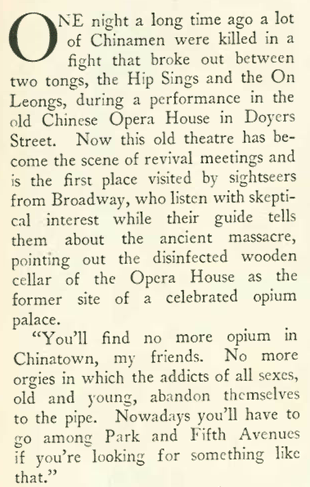
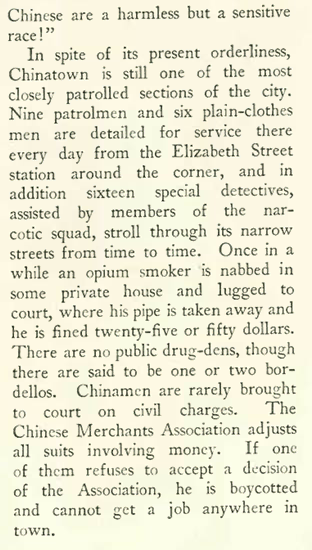
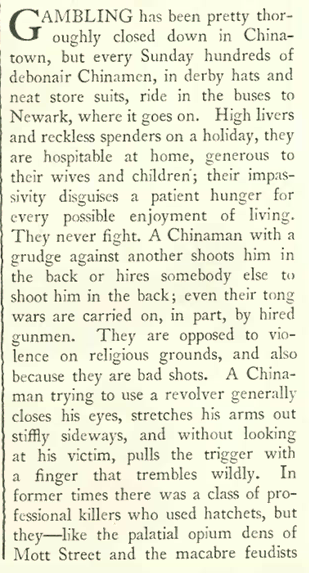
In the “Reporter at Large” column, Niven Busch Jr. paid a visit to “The Yellow Bowery,” as the piece was titled. Notable in this article (and in Brubaker’s quip above) is the use of term “Chinaman,” a term considered offensive today but in the 1920s was used indiscriminately for East Asians. Here it seems pejorative:
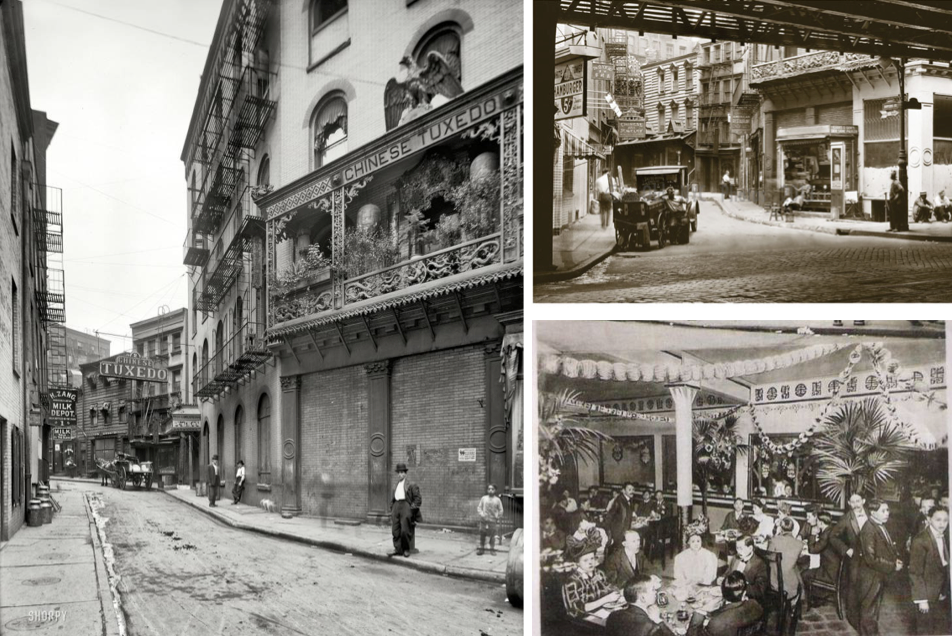
THE BLOODY ANGLE…Clockwise, from top, this bend in Chinatown’s Doyer Street was known as “The Bloody Angle” due to the numerous killings among the Tong gangs that lasted into the 1930s. Hatchets were a popular weapon of choice, leading to the creation of the expression, “hatchet man”; another perspective of Doyer Street from 1932; the street was also the site of the first Chinese language theater in New York City. (boweryboyshistory.com/Museum of the City of New York/Wikipedia)
Busch’s piece was rife with stereotypes…
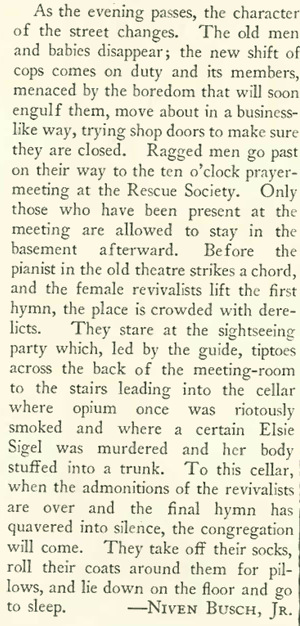
…and referenced the unsolved Bowery murder of 19-year-old Elsie Sigel, a missionary in Chinatown who was found in a trunk, strangled, in 1909…
THE OTHER SIDE OF THE TRACKS…2 Doyer Street was the address of the Chinese Tuxedo Restaurant. It attracted non-Chinese patrons, particularly those who considered themselves ‘Bohemians’ as well as businessmen looking for an ‘exotic’ night on the town. And it helped that the Tuxedo was near the elevated train. (Courtesy Flickr/straatis/thelodownny.com)
* * *
It Grows on You
The rapid demolition of old New York was a recurring theme in The New Yorker of the 1920s, the magazine often wavering between nostalgia and the thrill of the new. No place was perhaps more sacred than the stately row houses of Washington Square. When news circulated that a section consisting of the old Rhinelander mansion would soon fall (for the sake of a new apartment building), “Talk” tried its best to process the change:
IT LOOMS, BUT WE GOT USED TO IT…The New Yorker once resented the intrusion of the One Fifth Avenue building (built in 1927), looming above the cobbles of the early 19th century Washington Mews. (newyorkitecture.com/Viola Mai, Washington Square News)MIND THE GAP…Clockwise, from top, just east of this row of houses stood the mansion of William Rhinelander; although TheNew Yorker noted that its demolition was imminent in 1929, the mansion stood until 1951, when it was demolished and replaced by the 20-story 2 Fifth Avenue; next to the gap between the old row houses and the apartment stands the Roger Shattuck House, No. 19 Washington Square North. The Shattuck House was the scene of one of most sensational robberies in the city’s history—in 1922. (nyc-architecture.com/Google Maps)
* * *
Old Boy
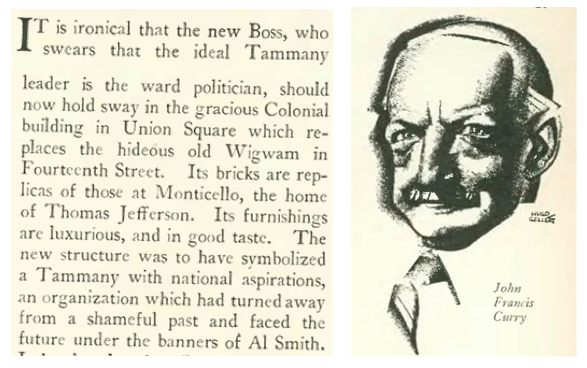
In one of my recent posts (Not Your Grandpa’s Tammany Hall) I noted a “Talk” item that described the new Tammany headquarters. In the August 3 issue the magazine introduced the patriotic society’s new leader, John Francis Curry, in a profile written by Henry F. Pringle. In the piece, titled “Local Boy Makes Good,” Pringle suggested that Curry’s old-fashioned approach to politics stood in contrast to the new image Tammany Hall was attempting to project:
Curry’s tenure would end abruptly in 1934 — the first Tammany boss to be booted out by his own followers. Curry made some bad decisions during a time when the political winds were shifting away from machine politics. It was under his leadership that Tammany backed Al Smith over the reform-minded Franklin Roosevelt for the 1932 Democratic presidential nomination. That same year, Tammany-backed New York Mayor Jimmy Walker would be forced from office amid scandal.
* * *
Well, She Didn’t Write the Script
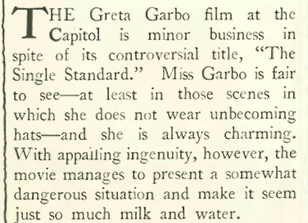
We all know Greta Garbo as one of the greatest film stars of classic Hollywood. Her mysterious aura and subtlety of expression are still lauded by film critics today. The New Yorker, however, never seemed particularly enamored of the star’s performances. Here is a review of her 1929 silent film, The Single Standard:
THE KID STAYS IN THE PICTURE…Little Wally Albright played Greta Garbo’s son in The Single Standard. We just saw four-year-old Wally in my last post, in which he also appeared as Peggy Wood’s son in Wonder of Women. Apparently when a director needed a cute, curly head kid, they went for Wally—he appeared in seven films in 1929 alone. (Rotten Tomatoes)
* * *
From Our Advertisers
Our first advertisement (image at right) is from the back pages of the Aug. 3 issue. It announced the opening of Long Island’s Atlantic Beach Club, which featured the entertainment of Rudy Vallée and his orchestra…
CAN YOU HEAR ME NOW? Images, top to bottom, aerial view of The Atlantic Beach Club; Rudy Vallée performing with emblematic megaphone, 1929; postcard image of the Nautilus Hotel on the Boardwalk of Atlantic Beach, Long Island. (longbeachlibrary.org/YouTube)
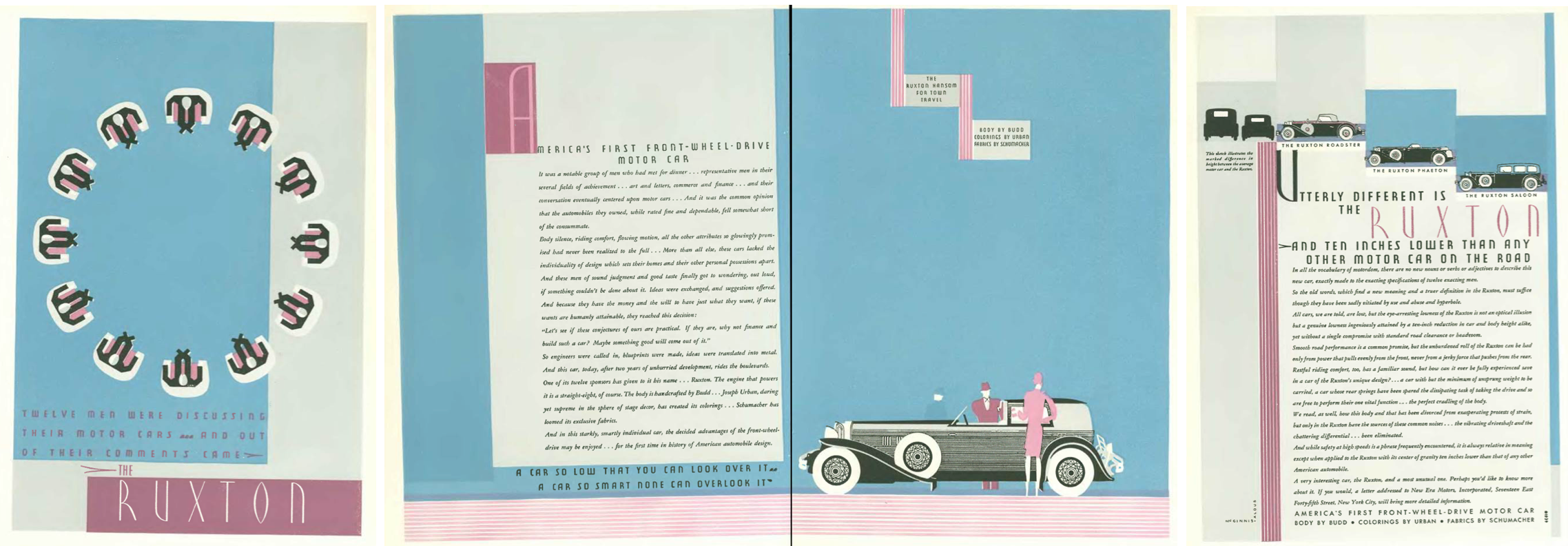
…a brand-new car—The Ruxton— was introduced to New Yorker readers in this color advertisement that spanned four pages (click image to enlarge)…
…produced in 1929-30 by the New Era Motors company of New York, the car was marketed for its innovative front-wheel drive and its distinctive low profile (a feat accomplished by eliminating the drive shaft to the rear wheels). While most cars in the late 1920s had an average height of 6 feet (1.8 meters); the Ruxton was less than 4 and half feet (1.3 meters) high. Producers of the car hoped to sell the rights of the Ruxton to an established car manufacturer. Moon Motors of St. Louis built just 96 of the cars during regular production (from June to October, 1930) before the whole deal fell apart…
SHORT RUN…Clockwise, from top left, Ruxton logo affixed to grille; dancer Rita La Roy poses with her Ruxton, 1930; some models sported Joseph Urban color schemes designed to lengthen the appearance of the car. (allcarcentral.com/Pinterest/hemmings.com)
…if you were one of the fortunate few to own a Ruxton, you might take it for a spin on the Lincoln Highway…or maybe not. Despite the appearance of this ad, a fully paved, transcontinental highway was still an incomplete dream in 1929. Although sections of the road were quite smooth from New York to Omaha, further west things could get a bit bumpy, especially on the unpaved stretches. However, as the ad claims, what really made the road viable was the availability of regularly spaced gas stations along the way…
…I liked this ad for its sheer complexity…
…and then we have this ad from Saks, which somehow conflated new shoes with an intimate encounter with Aphrodite.,,
…on to our cartoonists, we have Helen Hokinson’s observations at “Old Narragansett…
…while out to sea, Alan Dunn found humor in a sensitive swabbie…
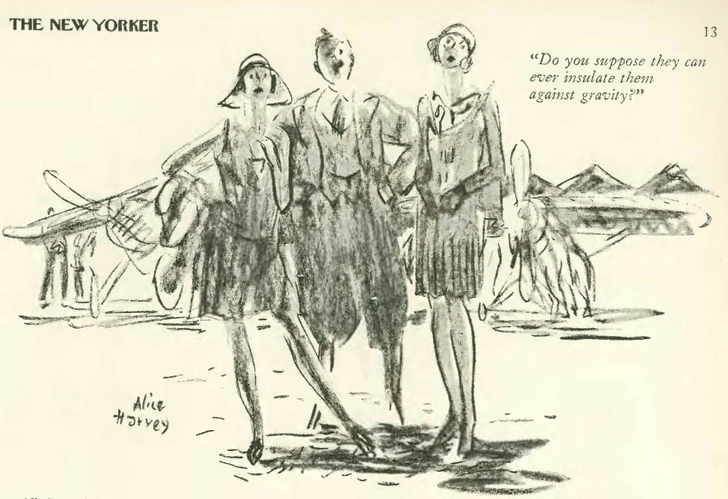
…Alice Harvey observed those still skeptical of human flight…
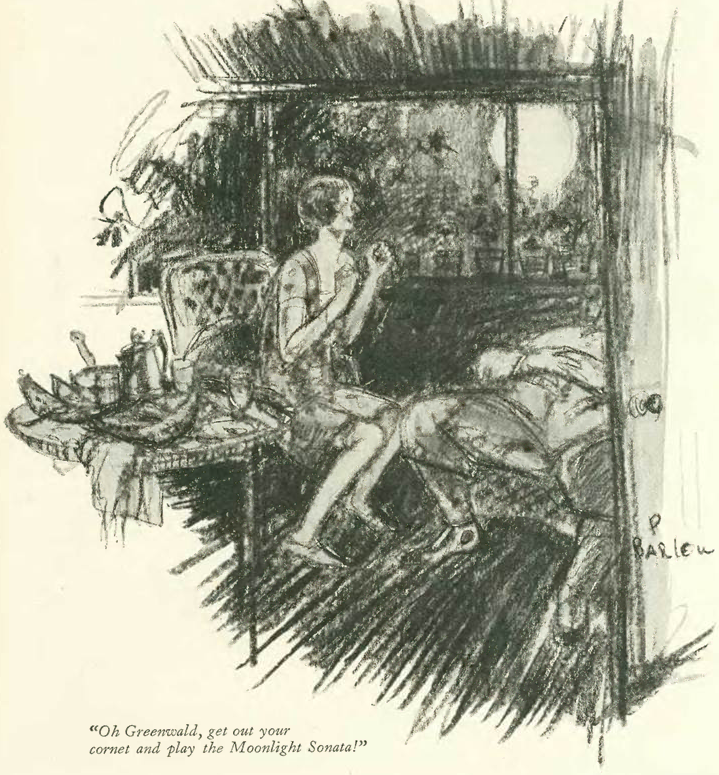
…Perry Barlow peeked in on a moonstruck woman…
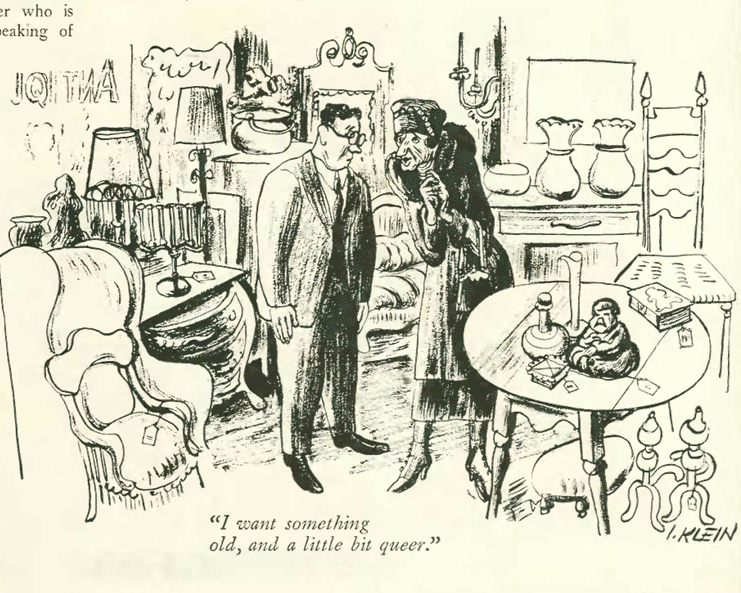
…and finally, Isadore Klein visited an antique shop…
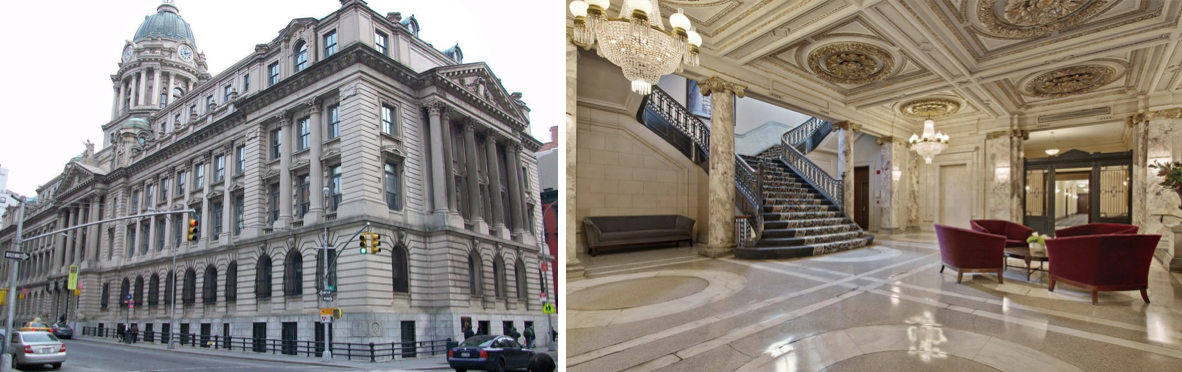
In 1929, some of New York’s Finest also enjoyed working at one of the finest police headquarters to be found anywhere.
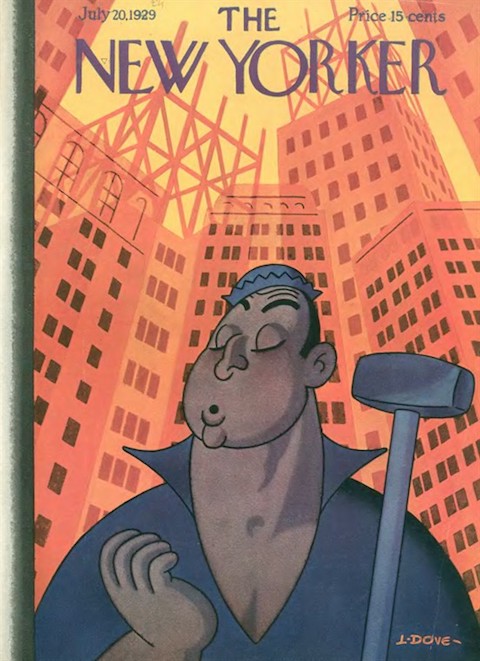
July 20, 1929 cover by Leonard Dove.Note the construction worker’s whoopee cap—a popular hat among laborers, especially auto mechanics, in the 1920s and 30s. Hardhats did not come into general use until the late 1930s and 1940s. In popular culture, the whoopee cap was worn by the gas station attendant “Goober” on the Andy Griffith Show. The character “Jughead” also sported one in the Archie comic book series.
NYPD’s elegant headquarters at 240 Centre Street, designed by architects Hoppin & Koen, were built in 1909 to serve a newly consolidated police department charged with overseeing the city’s five boroughs (which had been united a decade earlier). Made of Indiana limestone, the building included 75 basement cells, a drill room, and a gymnasium.
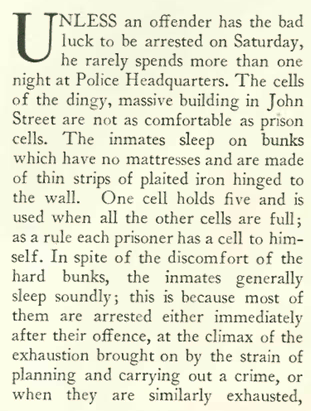
Writing for the July 20, 1929 “Reporter at Large” column, Niven Busch, Jr. looked in on a day in the life of the 20-year-old headquarters:
WHERE THE ACTION IS…Clockwise, from top left: Postcard depicting the new police headquarters at 240 Centre Street, built in 1909 to serve the newly consolidated five-borough police department; a woman in a cell at the Tenderloin station, probably similar to the cells described in Busch’s article; prisoner posing for a mug shot; the building’s Rogues Gallery. All images from 1909. (Ephemeral New York/Library of Congress (3)) click to enlarge images
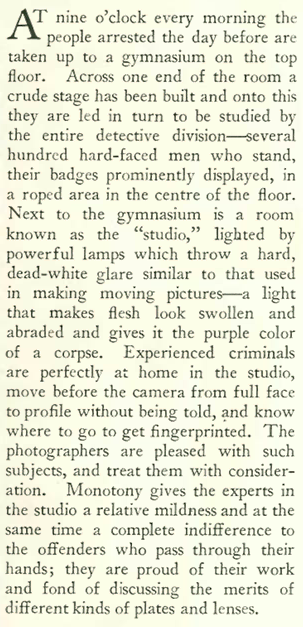
Busch described the morning routine of lining up prisoners in the gymnasium for their mug shots…
…and how confiscated weapons were stored, and periodically dumped into the Narrows…
AT THE BOTTOM OF THE SEA…Weapons seized in Chinatown by the NYPD in 1922. The police periodically dumped their inventory of seized weapons into the Narrows between Brooklyn and Staten Island. (NYPD Public Records)
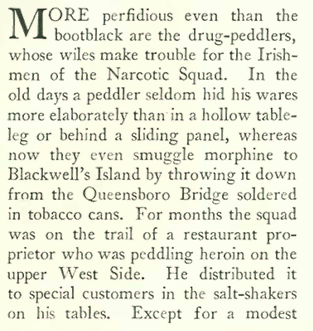
Busch also described the methods used by “drug peddlers,” and the prevalence of drug use among perps:
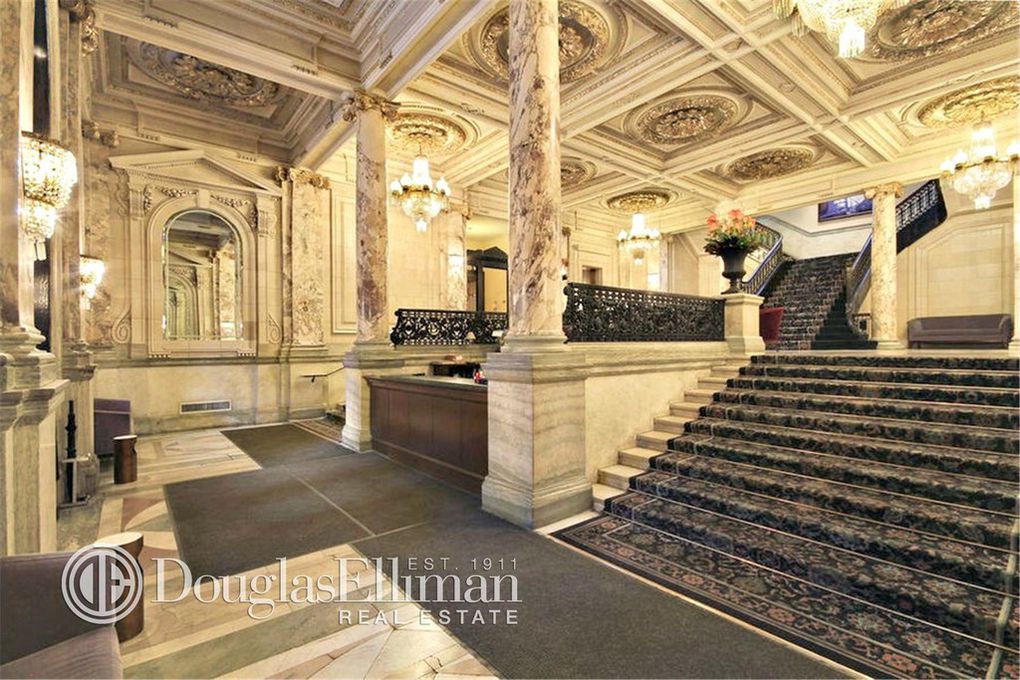
Where detectives gathered and where prisoners were once processed is now home to luxury condos in a posh district called “Nolita” (although some folks still call the area “Little Italy”)…
CRIME DOES NOT PAY?…The 1909 Police Headquarters Building at 240 Centre Street was remodeled into luxury co-op apartments in 1988. A contemporary photo of the lobby gives some idea of the elegance of the old HQ. Adding to that elegance, the area surrounding the building is no longer “Little Italy.” Rather, it is surrounded by posh shops in an area now known as “Nolita.” (street easy.com)Another view of the sumptuous lobby at 240 Centre Street. (realtor.com)
…and in the gymnasium where hardened criminals once lined up for mugshots we now find a four-bedroom condo that has been priced as high as $31 million…
Architect Charles Gwathmey designed this 6,600-square-foot condo in what was once the police gymnasium—which also functioned as the room where mugshots were taken. On and off the market since 2008, at one point the asking price was $31 million. (6sqft.com)…and at the top of the building, a 5,500-square-foot penthouse can be found in the central clock tower. Spanning four stories and including two kitchens, a media room, a library, an elevator, the space was once owned by Calvin Klein…
The penthouse at the top of the old police headquarters spans four stories. It has been priced as high as $40 million. (Architectural Digest)
* * *
Before Bow Bowed Out
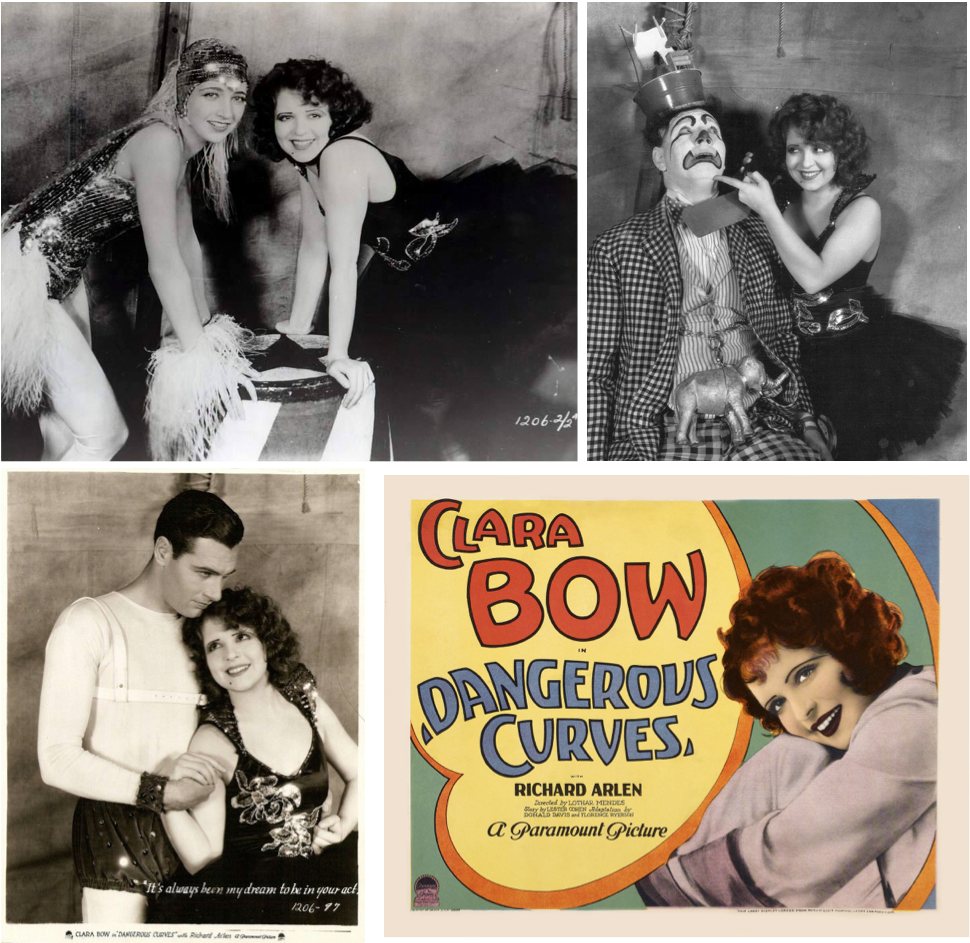
One of the biggest stars of the silent film era, Clara Bow (1905-1965) made a successful transition to the “talkies,” thanks in part to her huge and loyal following. But as the Roaring Twenties slowly lost its fizz, one of its biggest icons also seemed a bit flat in the new age of sound motion pictures. And indeed, Bow herself would walk away from it all two years later, retiring to her Nevada ranch at the age of 25. In the July 20 issue, The New Yorker reviewed Bow’s first talking picture, Dangerous Curves:
Clockwise, from top left, Kay Francis and Clara Bow as circus performers in 1929’s Dangerous Curves; Bow with clown in publicity shot for the movie; promotional poster; with co-star Richard Arlen, who also appeared with Bow in the 1927 romantic war picture, Wings. (IMDB/Pinterest)
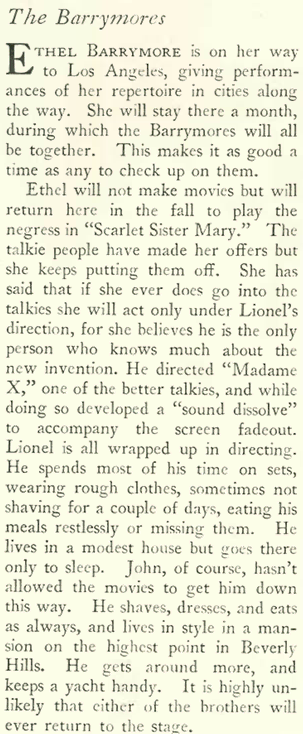
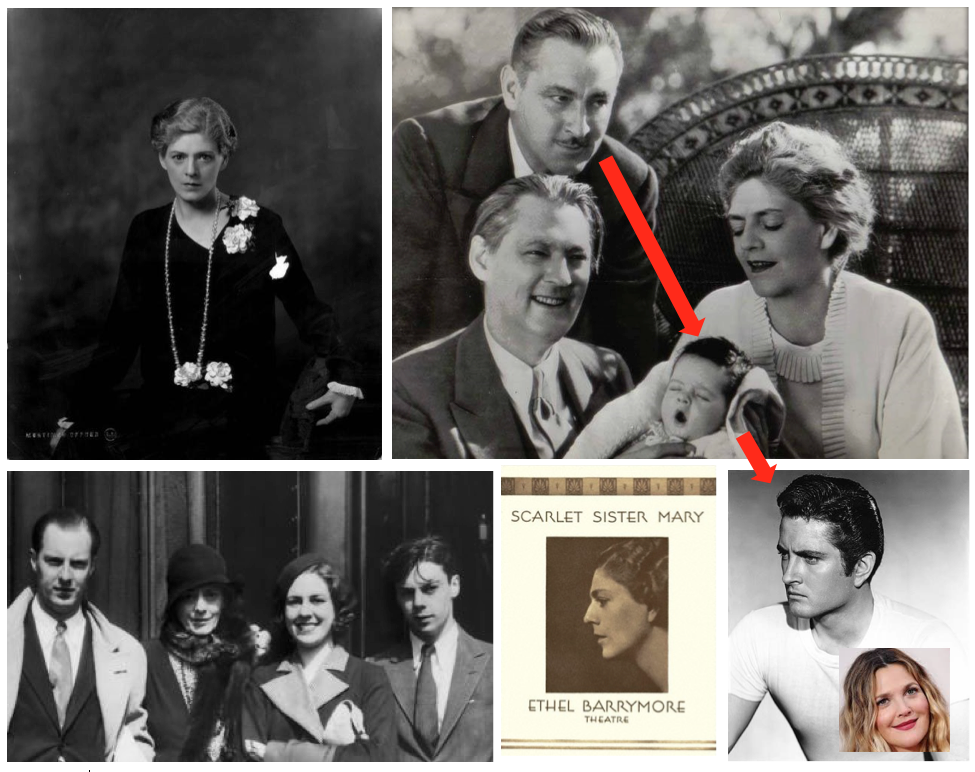
And while we are on the topic of celebrity actors, “The Talk of the Town” looked in on Ethel Barrymore (1879-1959), a prominent member of the famed, multigenerational Barrymore acting family…
“Talk” mentioned Barrymore’s children, including an “oldest son, Russell,” but there is no mention of such a child in any records. My best guess is that her oldest son, Samuel, went by his father’s name—Russell Griswold Colt. Barrymore and Colt divorced in 1923, and she never remarried…
Clockwise, from top left, Ethel Barrymore circa 1930; Siblings John Barrymore (standing) Lionel Barrymore, and Ethel with John’s son, John Barrymore Jr, who was the father of Drew Barrymore (inset); cover of program for Scarlet Sister Mary; Ethel with her children Samuel Peabody Colt, Ethel Barrymore Colt and John Drew Colt in the 1930s. (crystalkalyana.wordpress.com/Playbill/Pinterest)
* * *
From Our Advertisers
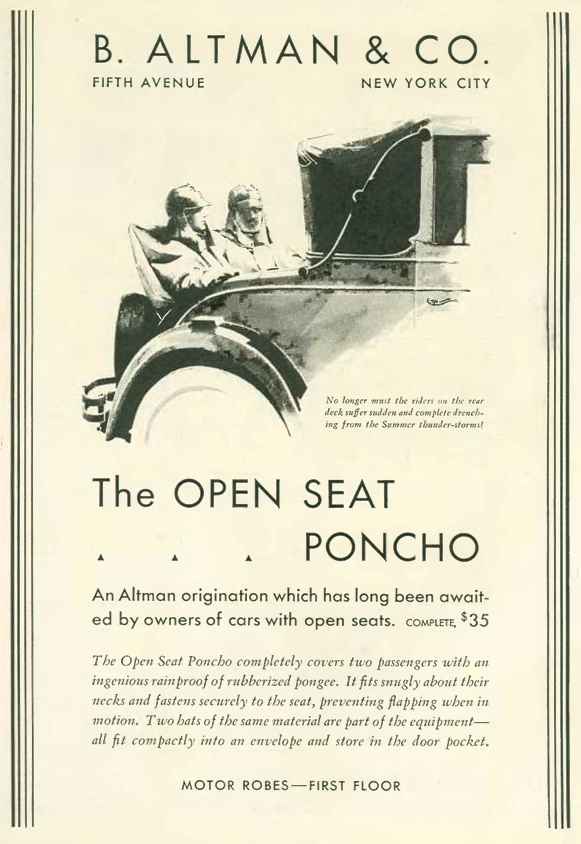
We begin with an “open seat poncho” offered by B. Altman to those unfortunate souls who were relegated to the rumble seat. I am perplexed by this feature in some early autos—it looks kind of fun if you’re a kid, but I can’t imagine a worse place to sit in a car. Not only are you open to the elements, but you’re also subject to peltings by dust, gravel, rocks and other road debris, not the mention the exhaust your sucking into your lungs sitting near the tailpipe. And then you are positioned over the car’s rear axle—must have been a chiropractor’s dream…
…and that exhaust you were breathing likely contained tetraethyl lead, which helped to eliminate the “knock” in your engine…
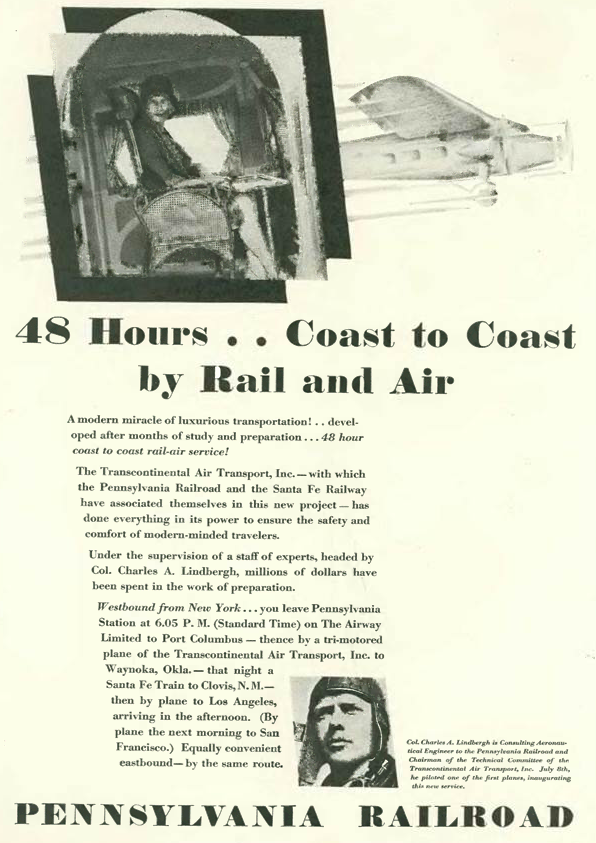
…perhaps a better way to travel—if you could afford it—was a combination of rail and air, a service supervised by a “staff of experts” headed by none other than Charles Lindbergh…
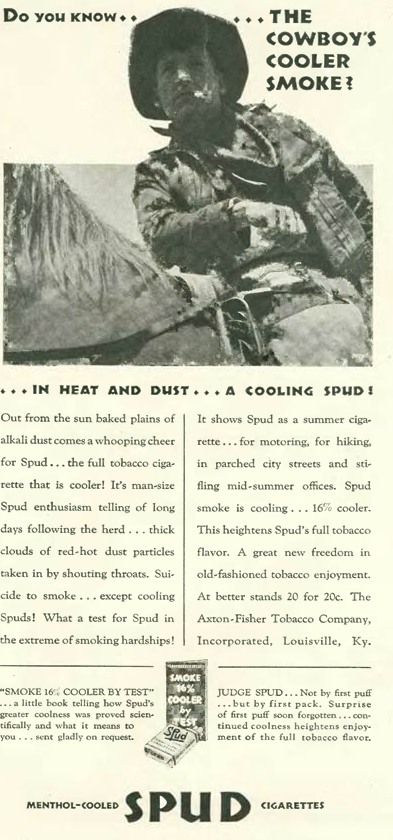
…when we think of the cigarette ads of yore, the “Marlboro Man” typically comes to mind. But Marlboro wasn’t the first to trade on the macho image of the working cowboy. That honor goes to the makers of menthol-cooled Spud cigarettes…
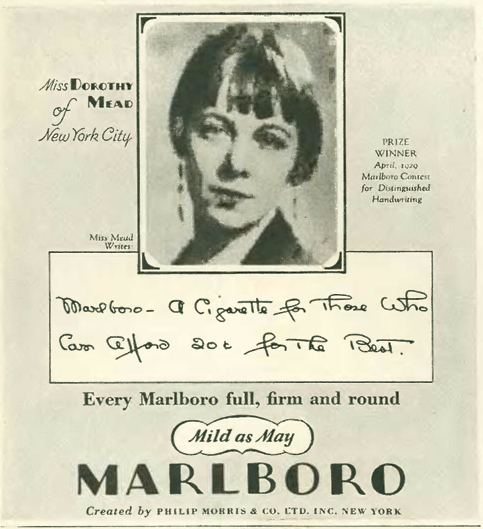
…and how was Marlboro being marketed at this time? Well, they were still exploiting young women who had been conned into participating in a “handwriting contest”…
…as for the makers of Lucky, they continued to get endorsements from some of the biggest celebrities of the day. In this ad we have English actress, singer and dancer Gertrude Lawrence (1898 – 1952). I have to say the drawing does not resemble her much at all…
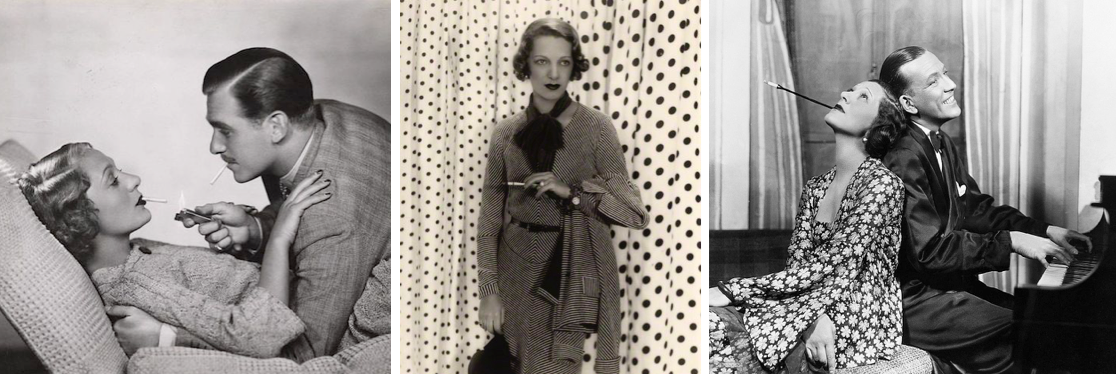
SHE REALLY DID REACH FOR A LUCKY…Gertrude Lawrence enjoying a smoke with Douglas Fairbanks, Jr in 1939 (photo by Dorothy Wilding); a 1932 portrait of Lawrence by Paul Tanqueray; Lawrence and Noël Coward in Private Lives, 1931 (pinterest.co.uk/Wikipedia)
For more than a century, a political organization known as the Tammany Society ruled New York City politics with an iron fist. Founded in 1786 (and named for Tamanend, a chief in the Lenni-Lenape nation), by the mid 19th century it rapidly expanded its political control by earning the loyalty of the city’s fast-growing immigrant population, particularly the Irish.
July 13, 1929 cover by Rea Irvin.
The Tammany Society proved an efficient machine for controlling state Democratic politics as well as New York City elections. Through its use of patronage to reward loyal precinct leaders, it also became a center for big-time graft. Most of us know a bit about Tammany thanks to school history books that focused on the deep corruption of William “Boss” Tweed, who was brought down by the press and by Harper’s Weekly cartoonist Thomas Nast in the 1870s. Tammany Hall would survive the scandal, and in the 1920s would still pull the strings of politicians including Gov. Al Smith and New York City Mayor Jimmy Walker.
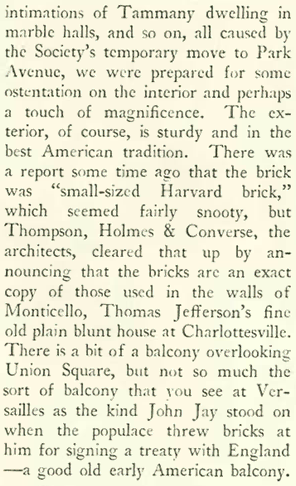
Tammany had several homes, but during its most notorious years it was located in a circa 1812 hall (then called a “wigwam”) and later in an 1868 building on 14th Street, between Third and Fourth avenues. The July 13, 1929 “The Talk of the Town” noted the recent demolition of that old hall and the opening of a new headquarters on 17th Street:
POLITICAL BAGGAGE…Top, a stereoscope card featuring the 1868 Tammany Hall; below, Thomas Nast cartoons depicting the corruption of Tammany Hall and the downfall of Boss Tweed. (Wikimedia Commons/Smithsonian)
“Talk” found the new building unimpressive; it seemed to signal that the old political machine was losing some of its luster:
EVOLUTION OF THE WIGWAM, as depicted on a poster circa 1920. (nypdhistory.com)Top left: The old Tammany Hall, decorated for the 1868 Democratic National Convention. Bottom left, the old hall was located at 141 E 14th Street, between 3rd and 4th Avenues. It was demolished in 1927 to make way for expansion of the Consolidated Edison building (right). (NYPL Digital Gallery/mediahistoryny.files.wordpress.com/Wikipedia)
Indeed, “Talk” found the building to be a somewhat austere, hosed-down affair, far removed from its grander past:
I LIKE YOUR NEW HAT…The 1929 Tammany Hall (top left) is currently undergoing a major renovation. Although the interior is being dramatically altered, including the addition of a glass dome, the landmarked exterior will mostly be preserved. When completed, the building—a mix of office and retail—will be known as 44 Union Square. (bkskarch.com)
For further evidence that the more austere Tammany Hall was nevertheless alive and well in 1929, another “Talk” item noted the organization’s continued influence behind the scenes in local politics:
The 1930s marked the beginning of the end for Tammany Hall, when reform-minded Democrats such as President Franklin Roosevelt and New York’s Republican Mayor Fiorello La Guardia (supported by Roosevelt on a “Fusion” ticket) dismantled Tammany’s system of patronage. The Tammany Society abandoned its headquarters in 1943 when it found it no longer had the funds to maintain the hall. Bought by a local affiliate of the International Ladies Garment Workers Union, it later housed the New York Film Academy and the Union Square Theatre until 2016, when it underwent extensive remodeling to make way for new office and retail space.
* * *
Your Two Cents Worth
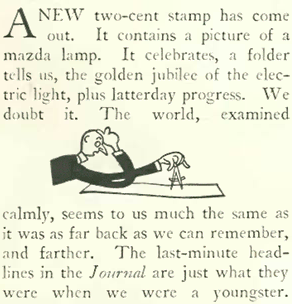
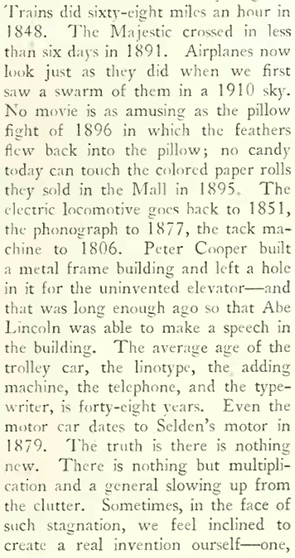
“Talk” also commented on the introduction of a new two-cent stamp that featured an image of Thomas Edison’s Mazda lamp, marking the celebration of fifty years of electric light. The magazine cheekily suggested that in the world of technological progress, there was nothing new under the sun:
(eBay)
* * *
Americans in Paris
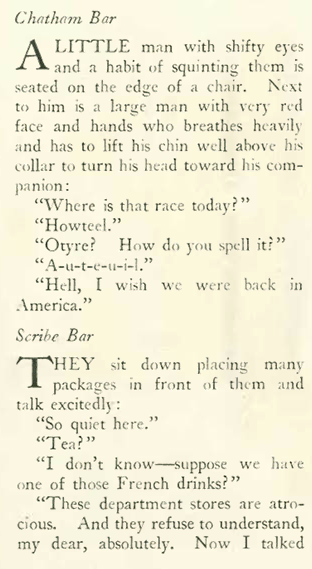
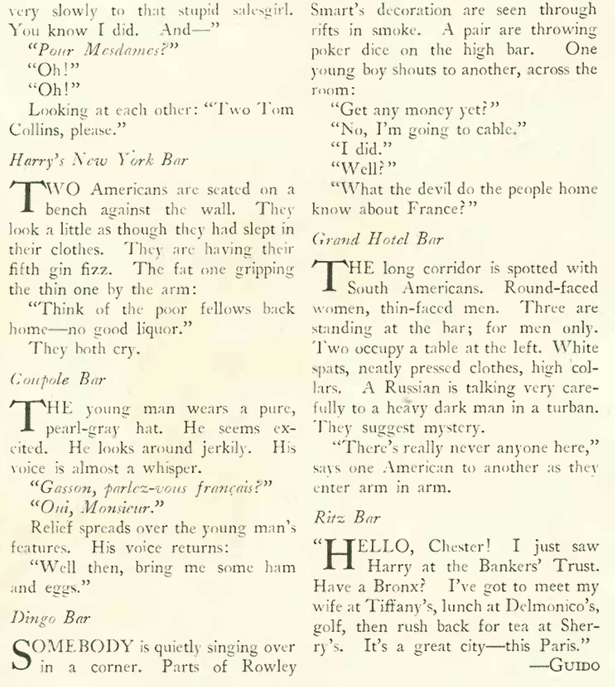
The New Yorker featured this humorous bit by a writer identified as “Guido” (I assume it is one of E.B. White’s many pseudonyms), who looked in on the chatter of various Parisian cafés and bars:
VOLSTEAD CAN’T GET US HERE…Enjoying the good life at a Parisian brasserie, circa 1920s. (National Geographic)
* * *
Hit and Miss
The New Yorker generally reveled in the good times Florenz Ziegfeld brought to the stage, but his latest effort, Show Girl, proved a bit of a disappointment (more evidence, in my view, that folks were tiring of the decade-long party known as the Roaring Twenties):
TAP-DANCING ON THE GRAVE OF THE ROARING TWENTIES…Although TheNew Yorker seemed less than enthused by Flo Ziegfeld’s latest effort, Show Girl, Ruby Keeler (top left) brought her tap shoes and her ‘A’ game to the performance. Clockwise, from top right, Keeler has some fun with the comedy trio Clayton, Jackson and Durante; program cover for Show Girl; the popular Albertina Rasch Girls with Harriet Hoctor in the “An American in Paris” scene of Show Girl, 1929. (Pinterest/jacksonupperco.com/eBay/songbook1.wordpress.com)
* * *
One of a Kind
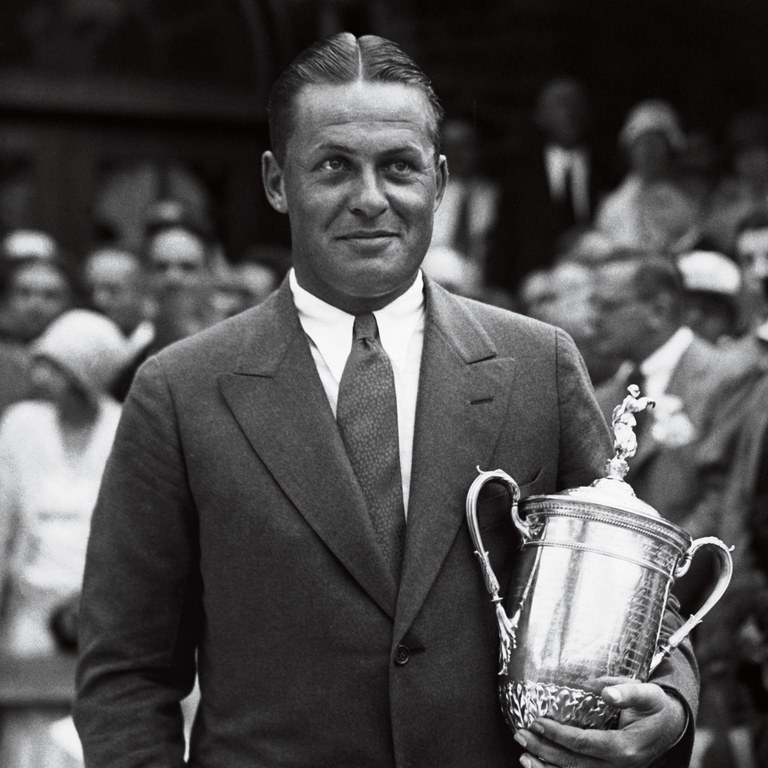
New Yorker sportswriter Niven Busch, Jr. provided a nice write-up on golfer Bobby Jones, the most successful amateur ever to compete in the sport. An attorney by trade, the unassuming Jones had just won his third U.S. Open (he would win again in 1930). In all he would play in 31 majors, winning 13 of them and finishing in the top 10 an incredible 27 times. After retiring at age 28 in 1930 he helped design the Augusta National Golf Club and co-founded the Masters Tournament. An excerpt:
AND HE DID IT WEARING A NECKTIE…Although a lawyer by trade, the amateur golfer Bobby Jones was one of golf’s greatest champions. He pictured here after winning the 1929 U.S.Open in Mamaroneck, New York. (golf digest.com)
* * *
An Odd Bit
Looking around the July 13 issue, let’s see what nighttime diversions were being touted by TheNew Yorker in their “Going on About Town” section (note the warning on the last item):
* * *
From Our Advertisers
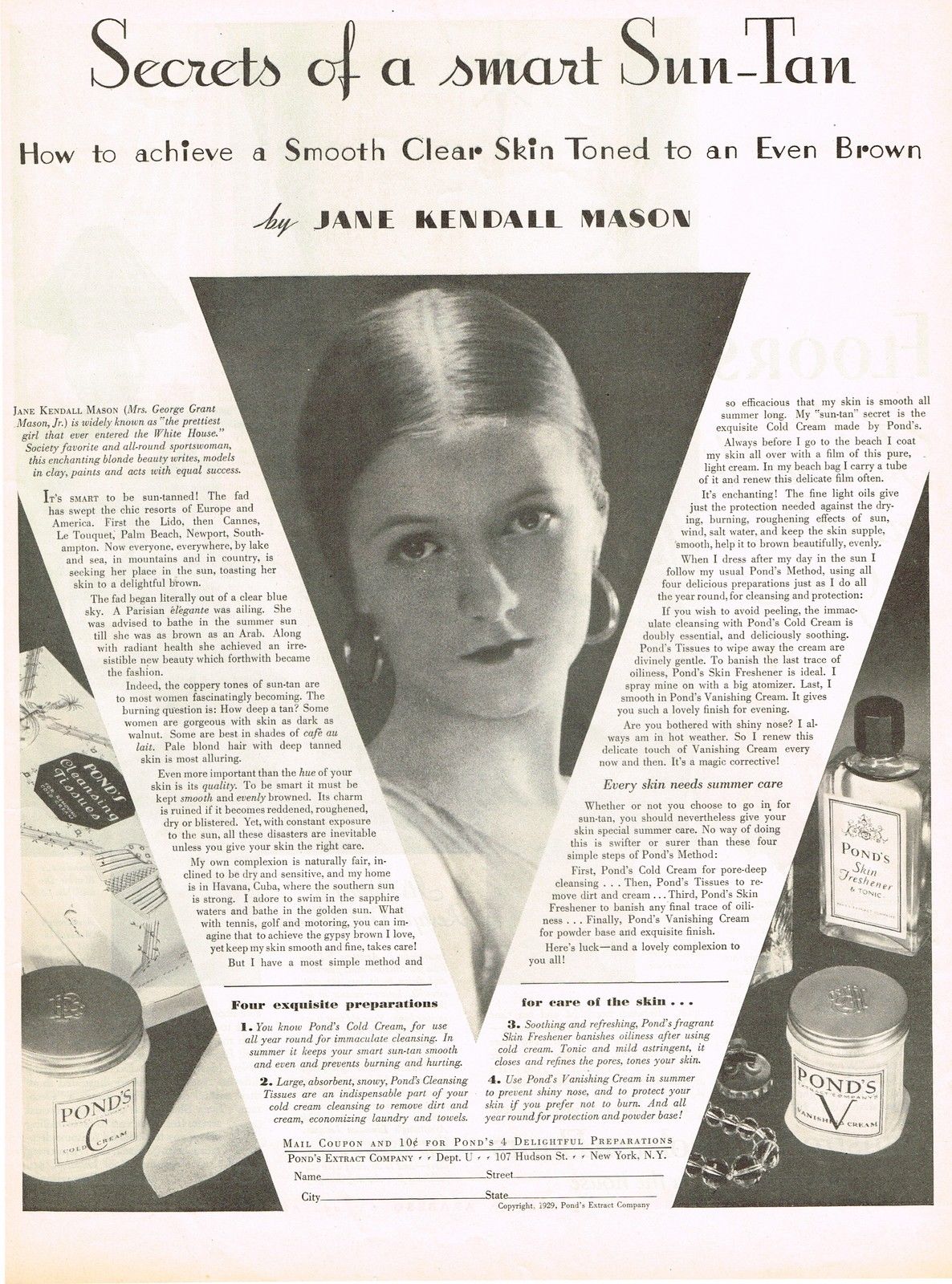
The makers of Pond’s cold cream continued to roll out endorsements from high society with this testimonial from Jane Kendall Mason (1909-1980), the newlywed wife of George Grant Mason, an executive with Pan American Airways in Cuba.
In 1925, the 17-year-old Jane made her formal debut in Washington society. After a visit with Grace Goodhue Coolidge, the first lady famously declared that Jane was “the most beautiful girl ever to enter the White House.”
After their marriage, the Masons became friends with Ernest and Pauline Hemingway, and introduced the Hemingways into Cuban society. Jane could hunt, fish, and hold her liquor, and, according to Ernest Hemingway, she was the most uninhibited person he’d ever met. So naturally they had a torrid, tempestuous, two-month affair that ended with Jane’s attempted suicide (she leapt from a balcony that was not high enough to do the job).
Hemingway supposedly used Jane as a model for the cruel-hearted Margot Macomber in The Short, Happy Life of Francis Macomber, in which the title character—trapped in a sad marriage to a wealthy but spineless American (George?)—accidentally shoots her husband in the head while on safari. She is also considered to be the model for the sex-obsessed Helene Bradley in Hemingway’s novel To Have and Have Not— a character also married to a rich but spineless husband.
Carlos Gutierrez (who served as a boat guide for Ernest Hemingway) and Jane Mason aboard “Sloppy” Joe Russell’s boat Anita in 1933. (Ernest Hemingway Photograph Collection, JFK Presidential Library and Museum, Boston)
Mark Walston, writing for the July-August issue of Bethesda Magazine, notes that the mean-spirited Hemingway “sent Jane drafts of his work, taunting and tormenting her with his venomous and thinly veiled portraits.” According to Walston, Jane divorced Mason in 1940, and one month later married John Hamilton, former executive director of the Republican National Committee. After that brief marriage she wed George Abell, columnist for The Baltimore Sun and Washington Times-Herald. Her fourth and final husband was Arnold Gingrich, founder of Esquire and editor of Coronet magazines. Jane died in 1980. On her tombstone is her self-penned epitaph: “Talents too many, not enough of any.”
On to our next ad, which featured an interesting exchange between two men who discuss the fortunes of a guy named Cecil Barnes, retired at age 33 and owner of a new personal airplane…
…and we segue into our cartoons, featuring a mother and child (drawn by Carl Kindl) probably flying on one of those Sikorskys…
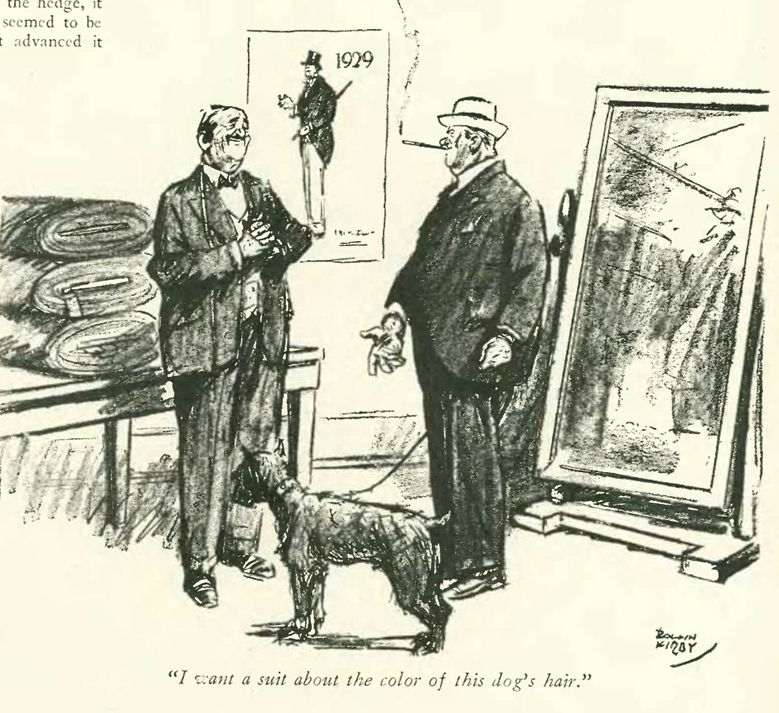
…Rollin Kirby looked in on a tailor’s shop (this is one of only two drawings published by Kirby in TheNew Yorker)…
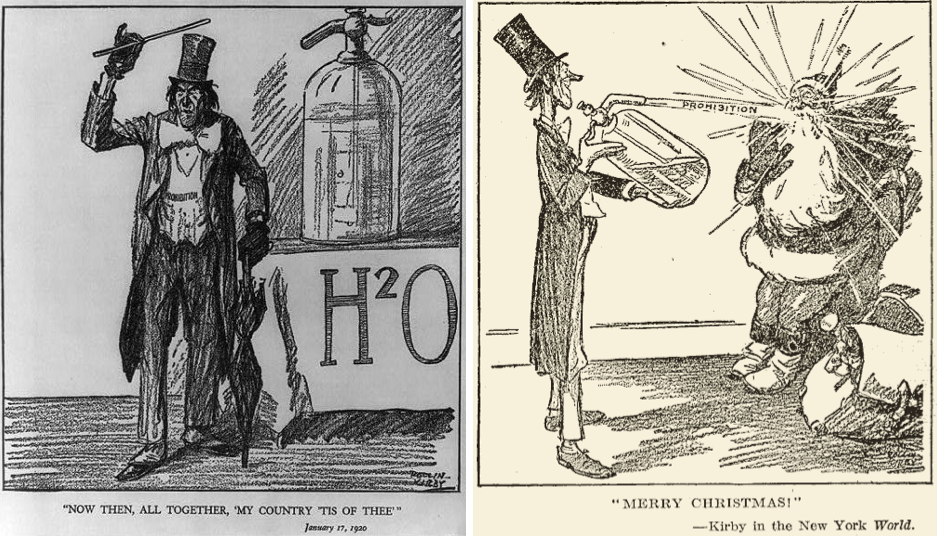
…a note on Kirby, a three-time Pulitzer winner: outraged by the passage of Prohibition laws, Kirby created one of his most famous characters, “Mr. Dry,” which he introduced to readers of the New York World in January 1920…
Rollin Kirby’s miserly, foreboding “Mr. Dry” made his first appearance in the pages of the New York World on Jan. 17, 1920, shortly after Prohibition laws went into effect in the United States. Mr. Dry also made an appearance at the end of 1920, to throw some water on America’s Christmas cheer. (bottlesboozeandbackstories.blogspot.com)
You can read more about Rollin Kirby and Mr. Dry here.
…Roland Baum peeked in on a reluctant stargazer…
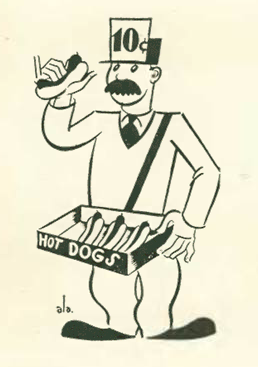
…and to close, this little filler drawing of a hot dog vendor by Constantin Alajalov…
It seems that each generation has its “Fight of the Century,” a phenomenon that emerges from the alchemy of mass marketing, a lust for blood sport, and the madness of crowds. Gene Tunney — a boxer who also wanted to be a public intellectual — was party to at least two of these spectacles in the 1920s.
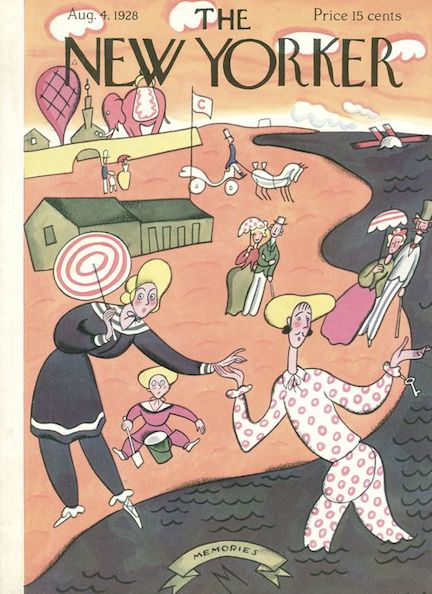
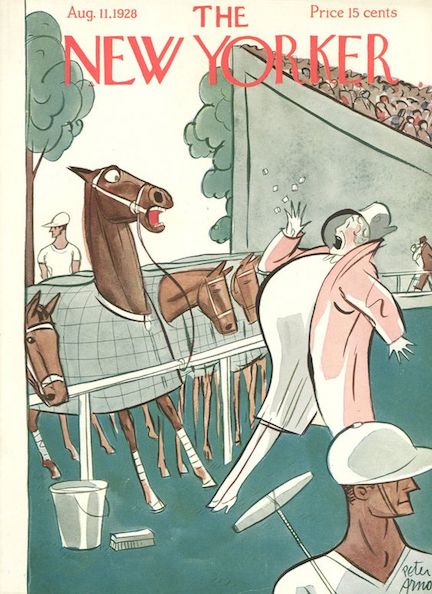
August 4, 1928 cover by Julian de Miskey.
Tunney is most famous for his fights against Jack Dempsey—in some ways they were the Ali–Frazier of their day. Tunney took the heavyweight title from Dempsey in 1926, and again defeated Dempsey in the controversial “long count” rematch one year later, on Sept. 22, 1927. That match was a huge spectacle, staged at Chicago’s Soldier Field in front of 105,000 spectators.
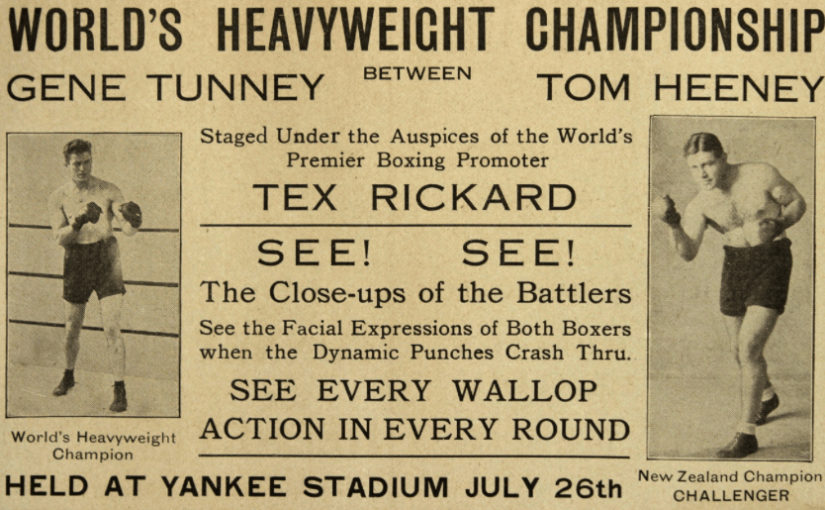
Boxing promoter Tex Rickard saw dollar signs when a scrappy New Zealander named Tom Heeney challenged the champ to a match. Heeney had won the Australian heavyweight title in 1922, and after arriving in the U.S. in 1926 found enough success in the ring to be ranked fourth among the world’s heavyweight boxers.
Writing in his column, “Sports of the Week,” in the July 21, 1928 issue of The New Yorker, Niven Busch Jr. assessed Heeney as a formidable opponent:
NO PALOOKAS HERE…Tom Heeny (left), and Gene Tunney in the late 1920s. (boxrec.com / Alchetron)
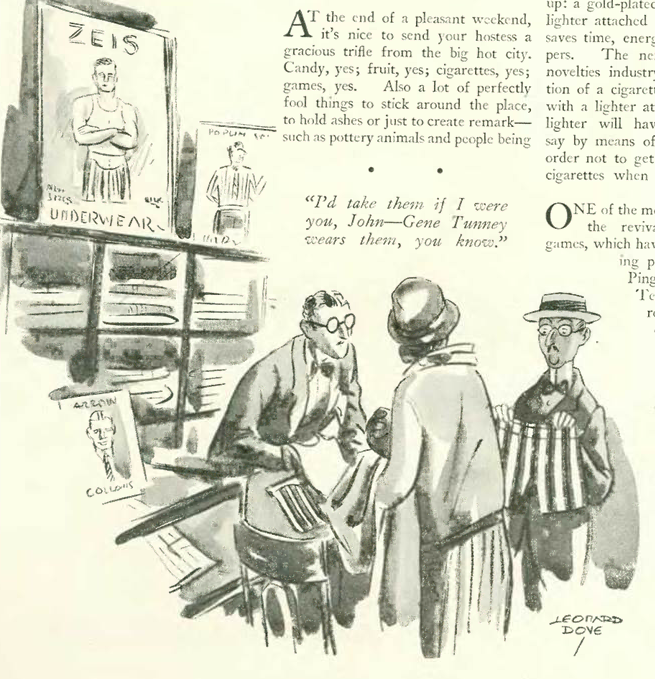
This cartoon by Leonard Dove, also in the July 21 issue, joined in the fun…
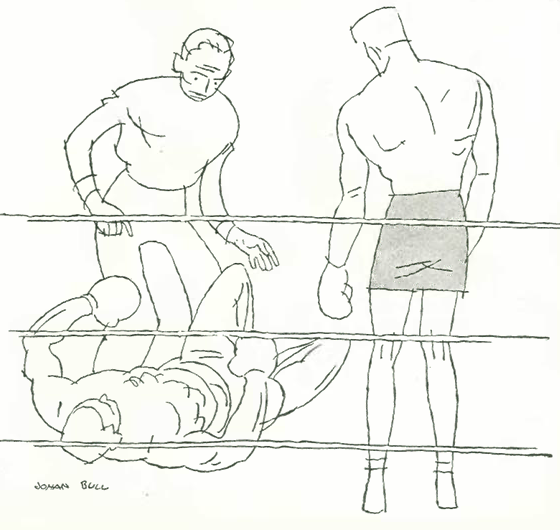
As for the actual fight at Yankee Stadium on July 26, 1928, Tunney won by a TKO in the 11th round. Perhaps the boxer from Down Under wasn’t in such great shape after all, or so surmised Niven Busch Jr in the August 4 issue:
New Yorker illustrator Johan Bull offered this perspective in artwork that accompanied Busch’s article…
Tunney’s winning purse was $525,000 (about $7.3 million today) and Heeney’s was $100,000 ($1.4 million), modest when compared to the recent debacle in Las Vegas that pitted professional boxer Floyd Mayweather Jr. against mixed martial arts champion Conor McGregor. Mayweather earned a disclosed purse of $100 million while Conor McGregor brought home $30 million.
Heeney would remain in the U.S. and fight a few more bouts before retiring to Florida, where he ran a bar and fished with his friend, Ernest Hemingway. Tunney, on the other hand, announced his retirement from boxing just five days after the fight. It was time to finally devote himself to a life of the mind. Norman Klein, writing in the Aug. 4 “Talk of Town,” offered a glimpse into that new life:
BRAIN OVER BRAWN…Boxing champ Gene Tunney, left, and writer George Bernard Shaw on a 1929 vacation to Brioni. (Associated Press)
Still not getting enough of The Champ, “Talk” also related this story about Lucky Strike cigarettes, and how that company’s publicists tried unsuccessfully to persuade Tunney to endorse their product:
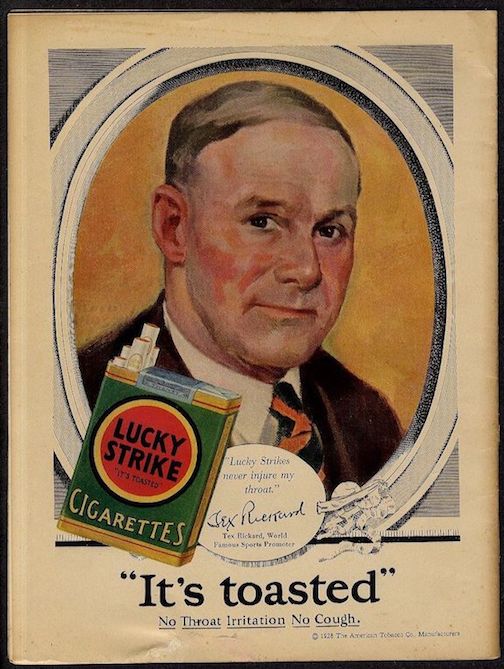
However the promoter of the Tunney–Heeney fight, Tex Rickard, had no problem taking money from the American Tobacco Company:
THEN I’LL TAKE THE MONEY…The promoter of the Tunney – Heeney fight, Tex Rickard, had no problem endorsing Lucky Strikes in this 1928 advertisement. Rickard would die the following year at age 59, from an appendectomy of all things. (eBay)
* * *
Tunney Was More Exciting
“The Talk of the Town” cast a jaded eye toward the Ninth Olympic Games in Amsterdam:
Poster from the 1928 games. (www.olympic.org)
And perhaps even less exciting than the Olympics was the magazine’s “Profile” subject, Andrew W. Mellon, referred to in the title as “Croesus in Politics.” Mellon was no Gene Tunney, but he did ensure his immortal fame through his philanthropy, still expressed today by the Andrew W. Mellon Foundation. Below are the concluding lines of the profile, written by Homer Joseph Dodge:
The article featured this terrific caricature by illustrator Abe Birnbaum…
Planned Obsolescence
The magazine’s “Motors” column touted Chrysler’s new “peaked” radiators, which no doubt caused many insecure Chrysler owners to consider junking their non-peaked models of yesteryear:
This ad in the same issue screamed “new, new, new” for what appeared to be mostly the same old, same old…
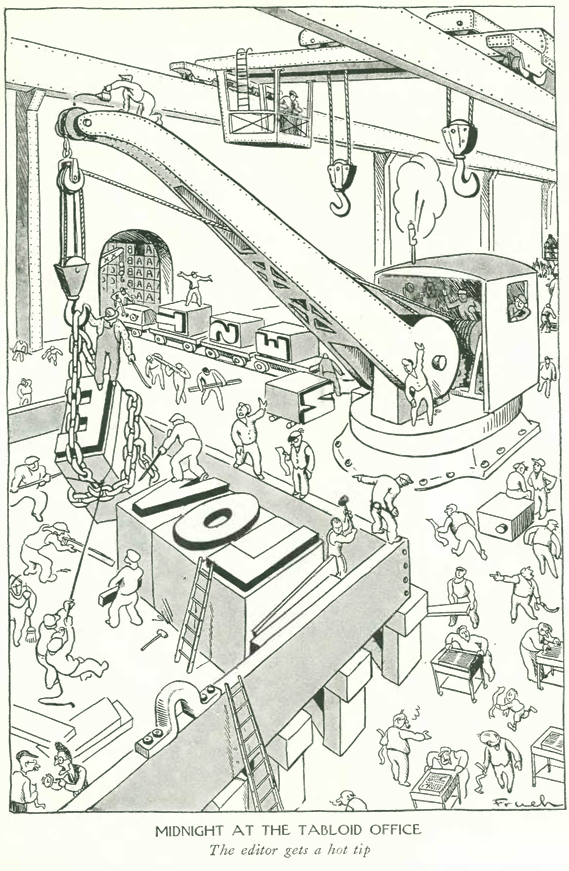
Our comic comes courtesy Al Frueh, who looks in on the workings of a printing press at a celebrity tabloid:
Compared to Hollywood, cinema as an art form in the 1920s was more advanced in Europe, where filmmakers took a more mature, nuanced approach to movies; they focused less on money and more on exploring difficult social and historical issues. Trench warfare, genocide and famine have a way of doing that to you.
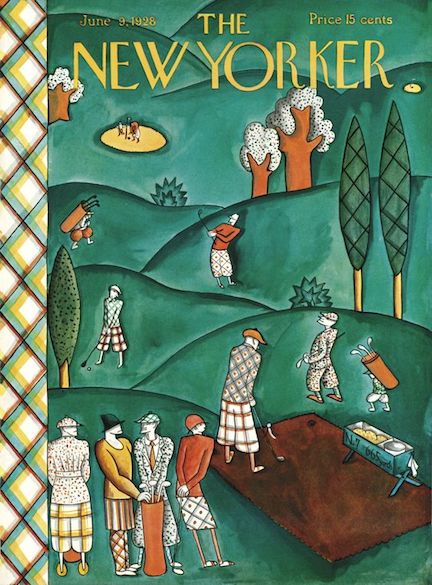
June 9, 1928 cover by Ilonka Karasz.
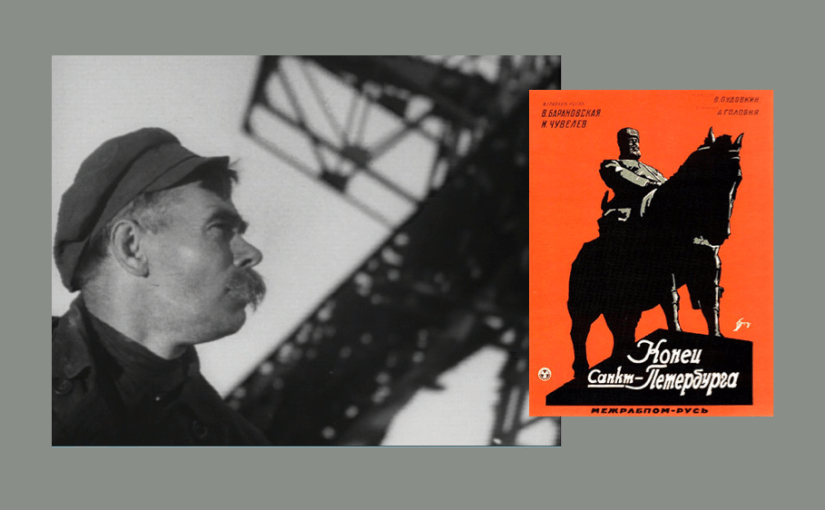
The contrast between the European avant-garde and Hollywood’s Tinseltown was not lost on The New Yorker’s film critics, who consistently lambasted American cinema while applauding nearly everything coming out of Europe, and especially the films produced by German and Russian directors. The critic “O.C.” used the Russians latest American release, The End of St. Petersburg, to drive home the point. He also chided those who dismissed the film as propaganda, a stance much in line with leftist intellectuals of the day who found inspiration in the Russian Revolution (and sometimes they looked the other way when things didn’t go so well in the Soviet experiment—1928 marked the beginning of the Soviet Union’s first Five-Year Plan. By 1934 it was estimated that almost 15 million people died from forced collectivization and famine).
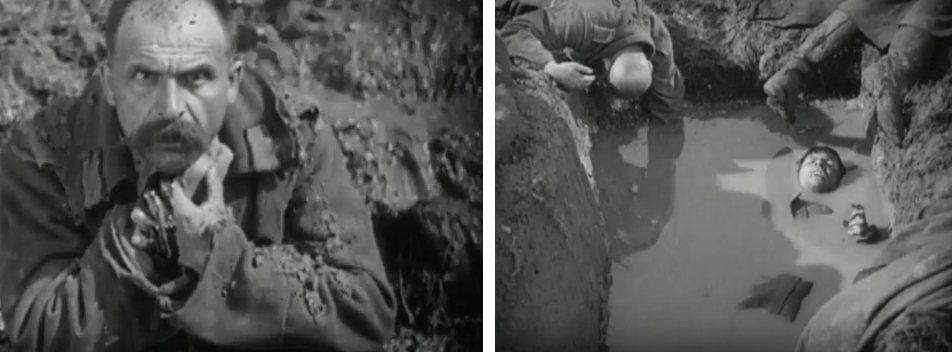
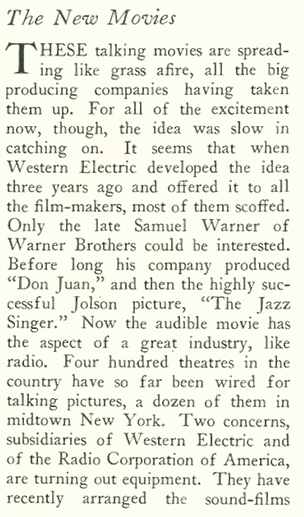
The End of St. Petersburg was blatant propaganda, to be sure, but to this day it has been widely praised for its cinematic innovations. The story itself was fairly straightforward: A peasant goes to St. Petersburg looking for work, gets arrested for his involvement in a labor union and is subsequently sent to fight in the trenches of World War I. His experiences in the war solidify his commitment to revolution and the overthrow of the capitalist overlords. The New Yorker review:
OPPRESSORS & OPPRESSED…The shareholders of a steel mill (top) demand longer hours from workers who already suffer from hellish conditions at the factory in The End of St. Petersburg. (Stills from the film, available on YouTube)
TheNew Yorker reviewer suggested that a story used primarily to influence an audience—propaganda—was not necessarily a bad thing:
ALL CHOKED UP…The horrors of trench warfare were graphically depicted in The End of St. Petersburg. (stills from film)
* * *
Back in the New World, most of the talk in cinematic circles revolved around the excitement of “talking pictures.”
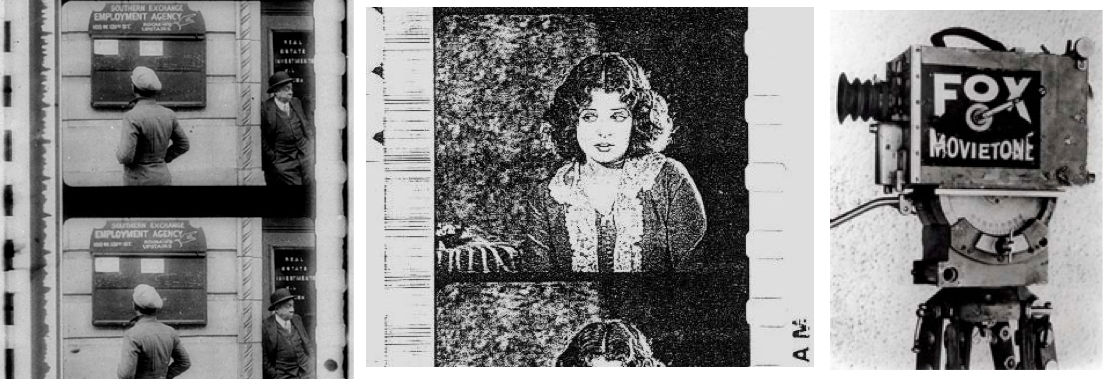
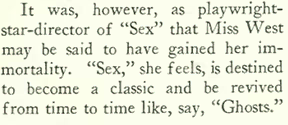
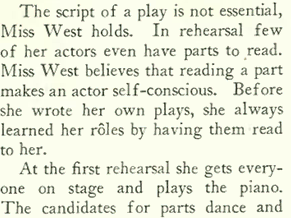
FORERUNNER…The Vitaphone system was the most successful of early attempts at sound movies. It synchronized a large recorded disc (seen at lower right) with the film. The Jazz Singer, often heralded as the movie that marked the commercial ascendance of sound films, used Vitaphone technology. (Audio Engineering Society)BETTER YET…Sound movies took off with the invention of a soundtrack that could be printed directly onto the film. Filmmakers either used Variable Area (left) or Variable Density (center) mono optical soundtracks located between the film’s picture frame and sprocket holes. The tracks could be read by a newly developed photocell (a light source also known as Aeo-light) that could be modulated by audio signals and was used to expose the soundtrack in sound cameras such as the one at right. (Images 1 & 2, Audio Engineering Society/ Image 3, Wikipedia)
It seems that Fox Movietone newsreels really got things going with sound and whetted audience appetites for more:
TELLING US A THING OR TWO…Irish playwright and critic George Bernard Shaw’s first visit to America, recorded for posterity in this 1928 Fox Movietone Newsreel. (YouTube still from film)
* * *
Then There Was The Other Playwright…
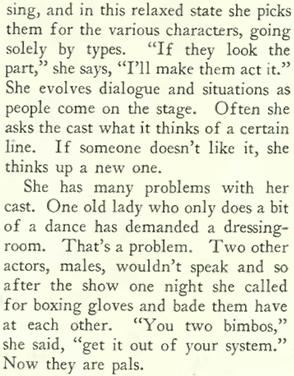
Mae West, to be exact. My guess is her approach to the craft was a bit different than G.B. Shaw’s, and we can gather as much from these excerpts from the June 9 “Talk of the Town.” The piece discusses West’s rise to fame as the creator and star of the scandalous play Sex, and her unorthodox approach to rehearsals.
DEMURE SHE’S NOT…Mae West in 1928’s Diamond Lil. (doctormacro.com)
* * *
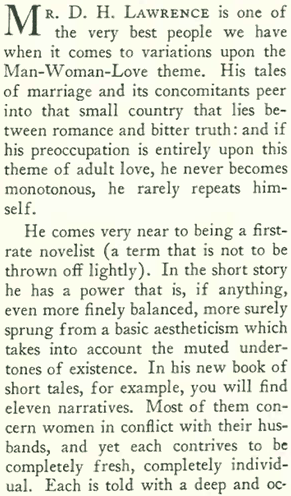
Although many today would identify D.H. Lawrence as one of great English novelists of the 20th century, eighty-some years ago New Yorker book critic Dorothy Parker described him as “very near to being first rate.”
A BARDIC QUALITY…D.H. Lawrence with wife Frieda Weekley in Chapala, Mexico in 1923. (tanvirdhaka.blogspot.com)
* * *
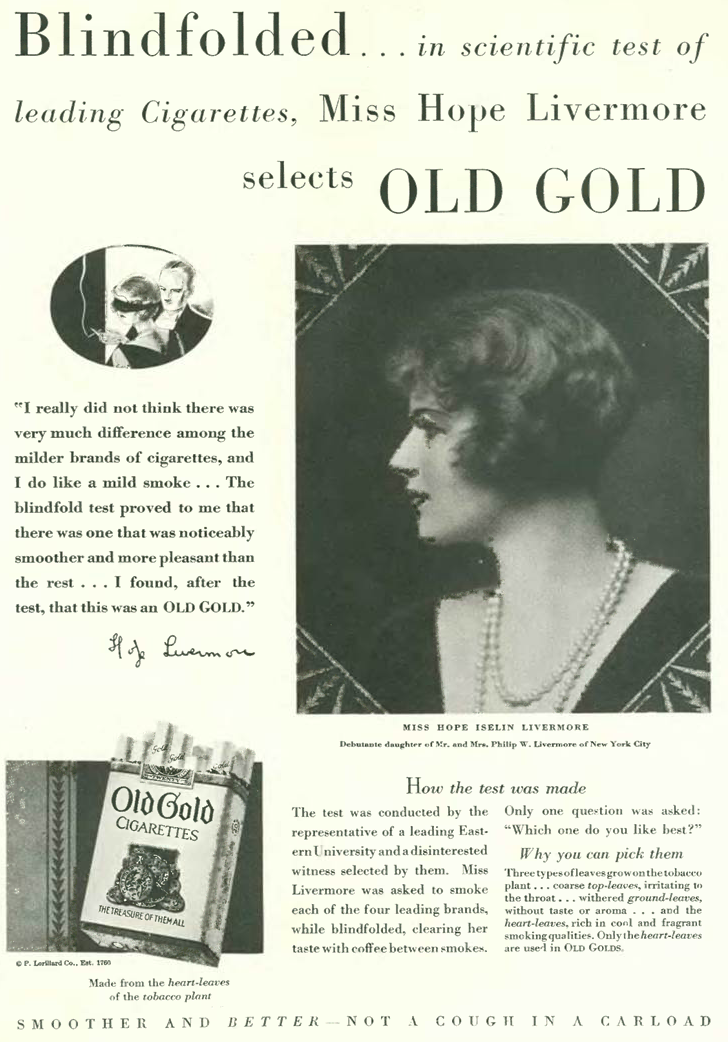
Blind Justice
The makers of Old Gold cigarettes claimed to have scientific proof on their side with a series of ads featuring endorsements by the rich and famous. This ad ran in the June 9 issue:
In the same issue was this cartoon by Al Frueh that took a poke at Old Gold’s marketing strategy…
…and Peter Arno offered this unique take on human vanity…
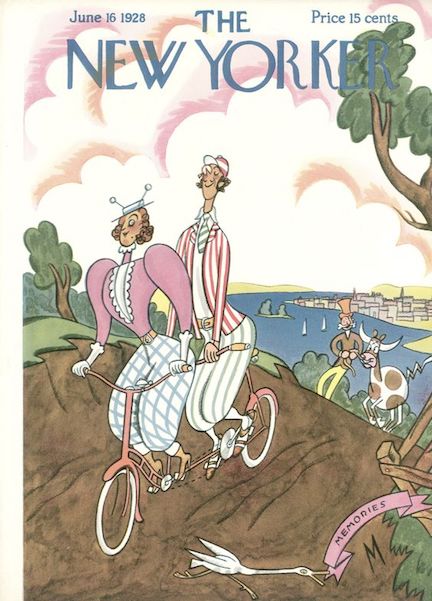
Talking pictures continued to be a theme in the June 16, 1928, issue…
June 18, 1928 cover by Julian de Miskey.
In his “Of All Things Column,” Howard Brubaker suggested that sound movies would spell the end of careers for some silent stars:
Although some actors struggled with the transition to sound, the reasons why some major stars faded with the advent of “talkies” are far more varied and nuanced. In many cases, some stars packed it in because their careers had already peaked during the silent era, and both studios and audiences were looking for some fresh faces.
HAS BEENS?…It is a common assumption that sound motion pictures killed the careers of many silent stars, including big names like John Gilbert (left) and Clara Bow. The reality is far more nuanced. (Wikipedia)
* * *
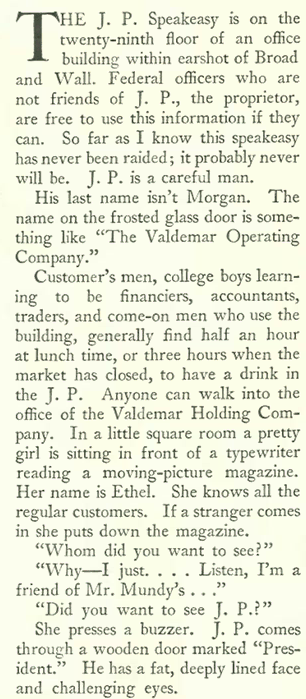
Niven Busch, Jr. continued to explore the illicit bar scene in his recurring feature “Speakeasy Nights.” I include this excerpt because it described a rather clever facade devised by the owner of the “J.P. Speakeasy.”
WORK/LIFE BALANCE…What might appear to be a typical business office might conceal an even more lucrative business in the back rooms. (Musée McCord/americanhistoryusa.com)
Busch observed an interesting protocol for admittance into the speakeasy, including a typewritten message devised to throw off any would-be Prohibition officers:
From Our Advertisers…
This ad leaves a bad taste in your mouth no matter how you look at. Nothing like coating your mouth with Milk of Magnesia before lighting up that first fag of the day…
…and here we have another ad for Flit insecticide, courtesy of Theodore “Dr. Seuss” Geisel.
And finally, a look at a Roaring Twenties wedding reception, courtesy cartoonist Garrett Price:
It what would become a longstanding tradition, TheNew Yorker marked its third anniversary by featuring the original Rea Irvin cover illustration from Issue No. 1. The New Yorker was a very different magazine by its third year, fat with advertising and its editorial content bolstered by such talents as Peter Arno, E.B. White and Dorothy Parker.
Feb. 25, 1928 cover by Rea Irvin.
Parker livened up the magazine’s books section, mincing few words as she took on writers both great and not so great.
In the latter category was Aimee Semple McPherson, a 1920s forerunner of today’s glitzy televangelists. In her column “Reading and Writing,” Parker took aim at McPherson — “Our Lady of the Loud-speaker” — who had just published a book titled In the Service of the King.
READY FOR MY CLOSEUP…Although she was an evangelical preacher, Aimee Temple McPherson was also considered one of the most glamorous women in 1920s America. (Foursquare Church)
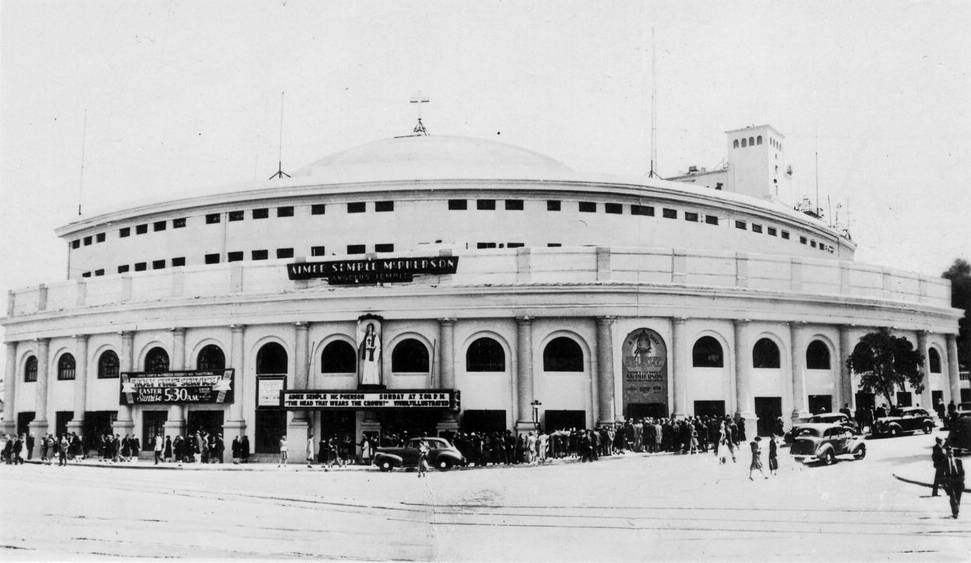
McPherson (1890–1944) was a Pentecostal-style preacher who practiced “speaking in tongues” and faith healing in her services, which drew huge crowds at revival events between 1919 and 1922. She took to the radio in the early 1920s and in 1923 she based her ministry in Los Angeles at her newly completed Angelus Temple, which served as the center of the International Church of the Foursquare Gospel.
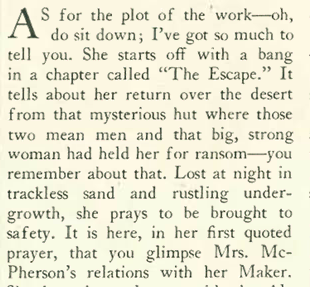
McPherson’s book detailed her conversion and her various hardships, including her mysterious “kidnapping” in 1926. Parker was having none of it:
Parker was referring to events beginning on May 18, 1926, when the evangelist visited Venice Beach for a swim and went missing. Some thought she had drown, others claimed they saw a “sea monster” in the area. McPherson reemerged in June on the Mexico-Arizona border, claiming she had been kidnapped and held captive by three strangers.
Numerous allegations of illicit love affairs targeted McPherson during her years of fame, so some were inclined to believe she went missing in order to engage in a love affair with her sound engineer.
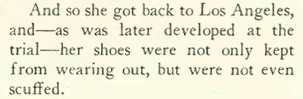
Upon her return to Los Angeles she was greeted by a huge crowd (est. 30,000 to 50,000) that paraded her back to the Angelus Temple. However many others in the city found McPherson’s homecoming gaudy and annoying. A grand jury was subsequently convened to determine if evidence of a kidnapping could be found, but the court soon turned its focus to McPherson herself to determine if she had faked the kidnapping. Parker thought the condition of the preacher’s shoes, after a long trek through the desert, were evidence enough of a sham:
THE MEGACHURCH IS BORN…Angelus Temple, completed in 1923, is the center of the International Church of the Foursquare Gospel founded by McPherson. It is still in active use. (Loyola Marymount University)SPECTACLE…Aimee Semple McPherson surrounded by massed choirs at Angelus Temple for a musical requiem in 1929. (Los Angeles Public Library/Herald Examiner)Aimee Semple McPherson (second from left) joins tambourine players in a service at Angelus Temple. McPherson produced weekly dramas, often major spectacles, illustrating various religious themes. (Los Angeles Public Library/Herald Examiner)
McPherson, who was married three times and twice divorced, died in September 1944 from an apparent overdose of sleeping pills. She was 53. Her son Rolf took over the ministry after her death. Today McPherson’s Foursquare Church has a worldwide membership of about 8 million, and is still based in Los Angeles.
But How Do I Look?
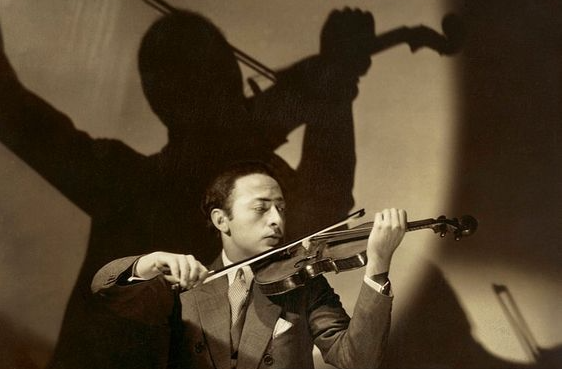
The Feb. 25 issue profiled the young Jascha Heifetz, a Russian-born violin prodigy who seemed more interested in how he looked than in how he performed. An excerpt:
SARTORIAL PERFECTION…Detail of a 1928 photo of 27-year-old Jascha Heifetz, taken by Edward Steichen. (Condé Nast)
* * *
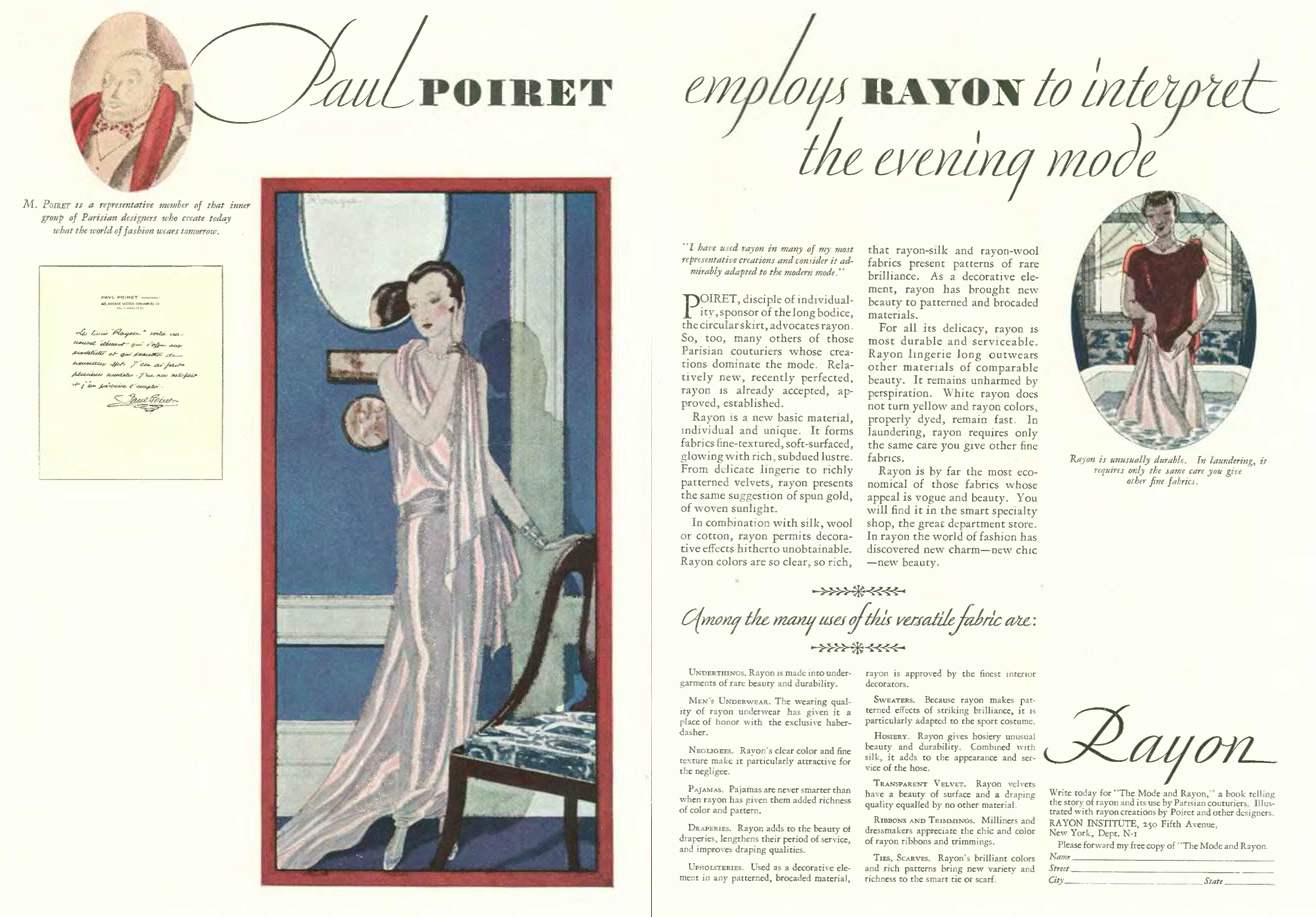
Speaking of fashion, one of the world’s greatest fashion designers, Paul Poiret, was seeing hard times in the late 1920s with his designs losing popularity in his native France and his formidable fashion empire on the brink of collapse. But Francophile New Yorkers, always hungry for French fashion, greeted Poiret with open arms when he arrived in the city in the fall of 1927.
It is something of a surprise, however, to find this advertisement in the Feb. 25 issue in which Poiret endorses Rayon, a man-made substitute for silk. We don’t usually associate synthetics with haute couture, but then again maybe Poiret just needed the money. Better living through chemistry, as they say…
(click to enlarge)
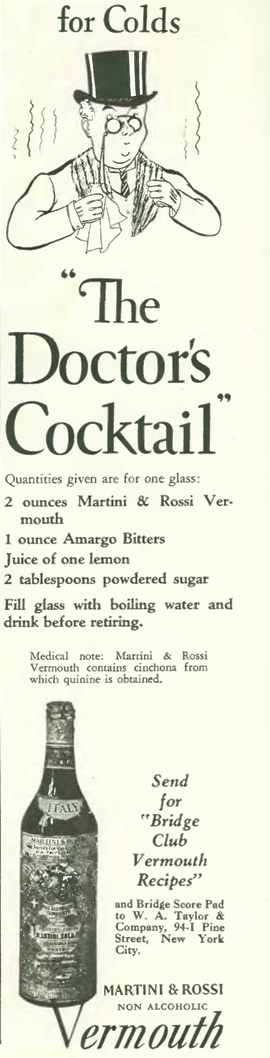
Also in the issue was a sad, Prohibition-era advertisement that extolled the virtues of an oxymoronic “non-alcoholic vermouth”…
And finally from the Feb. 25 issue, a cartoon by Carl Rose…
* * *
One-eyed Monster
In the March 3 issue “The Talk of the Town” discovered the miracle of television during a visit to the Bell Telephone laboratories.
March 3, 1928 cover by Peter Arno.
Lab researchers demonstrated a “receiving grid” with a tiny screen that displayed images broadcast across the expanse of an auditorium:
WE’LL CALL IT THE BOOB TUBE…Engineer and inventor Ernst Alexanderson (right) and the TV projector he used for early public demonstrations of television, circa 1928. (edisontechcenter.org)
Another glimpse into the future in the March 3 issue came courtesy illustrator Al Frueh, who offered this fanciful look at the skyscraper of tomorrow:
(click to enlarge)
* * *
“Profile” featured the first installment of a four-part article (by Niven Busch Jr.) on a man who put America on wheels and into traffic jams. Excerpts:
Profile illustration by Al Frueh.
And finally, from W.P. Trent, an analogy that would take on new meaning after the market crash…
Before screenwriter Niven Busch Jr. headed to Hollywood in 1931, he cut his teeth as writer for The New Yorker, contributing a series of profiles (later compiled in Twenty-one Americans) as well as an intermittent series from May 1927 to Feb. 1930 on New York’s Prohibition-era speakeasies.
February 18, 1928 cover by Theodore G. Haupt.
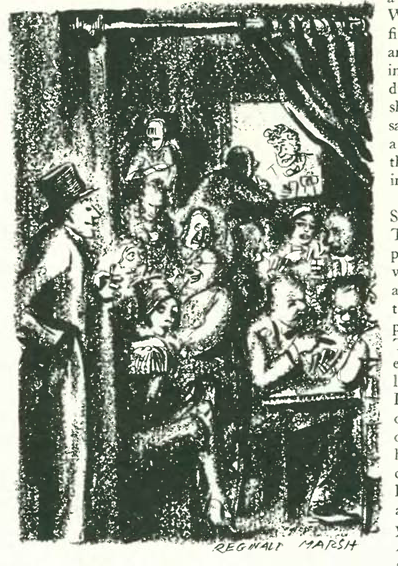
Always careful to shield the identity of speakeasy owners and patrons, Busch described the often less-than-glamorous digs of New York’s illegal watering holes. In a speakeasy called “The No Trump,” two Irish brothers took turns mixing drinks “on a kitchen table in a cubbyhole” while Busch sat in a darkened bar and listened in on a conversation coming from the adjoining “bridge room”…
This illustration by Reginald Marsh accompanied Niven Busch’s article.
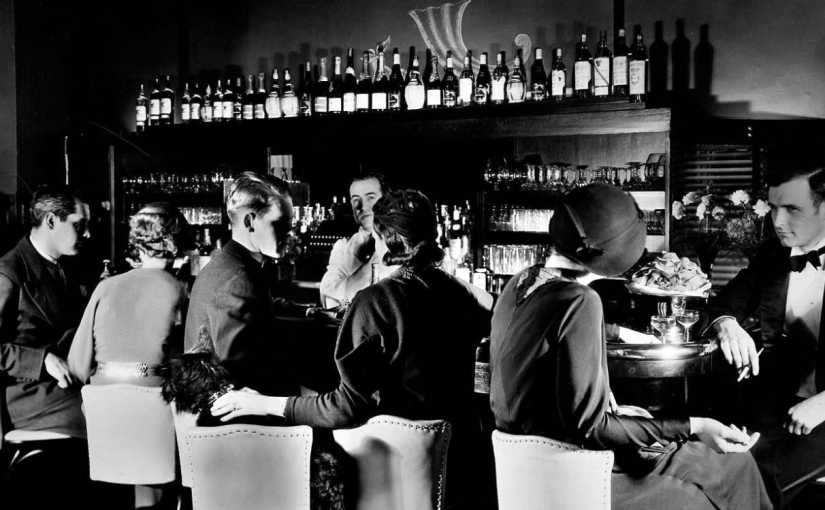
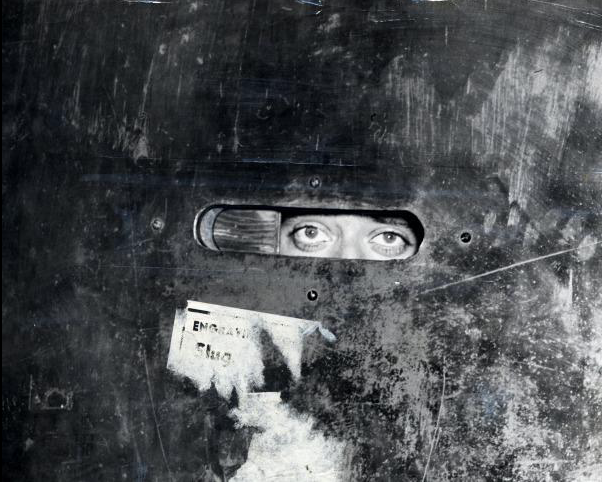
LAST CALL…Images taken by photographer Margaret Bourke-White for Life magazine during the last days of Prohibition. (Time.com)WHO GOES THERE?…The familiar slot in the door came in handy for speakeasy owners wishing to screen clients before allowing entry into their illegal lairs. (Chicago Tribune)BETTER SWILL…The Marlborough House, an East Side speakeasy for socialites during Prohibition, 1933. Photo by Margaret Bourke-White for Fortune. (Time.com)
Busch also described his visit to the “Circus Speakeasy,” operated by a man who “travelled for 21 years with the Ringling Circus”…
A young Niven Busch Jr., circa 1930. (enetpress.com)Busch and the third of his five wives, the actress Teresa Wright, in the 1940s. (danielmartineckhart.com)
In his later years as a producer and screenwriter in Hollywood, Busch would script movies ranging from The Man With Two Faces (1934) starring Edward G. Robinson, to The Postman Always Rings Twice (1946), with Lana Turner.
All Aboard
One of the prominent voices of the unsigned “Talk of the Town,” E.B. White was also a regular contributor of short pieces in The New Yorker, such as the following which described a mistaken encounter on an overnight train:
* * *
Another way to calm the jitters
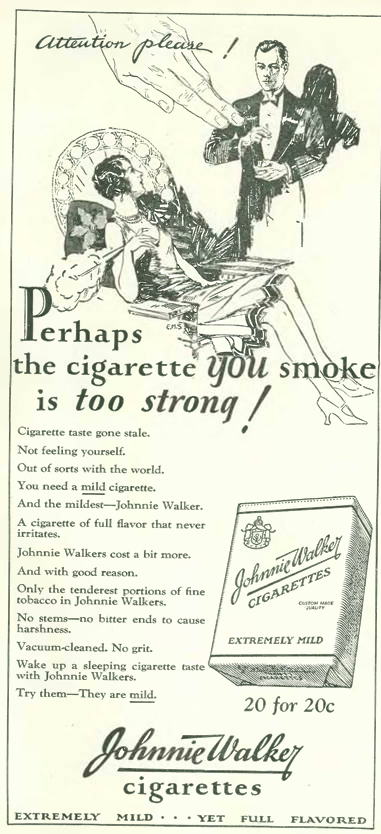
If you couldn’t legally (or illegally) buy Johnny Walker Scotch whisky in 1928, you had to settle for their brand of “vacuumed-cleaned, extremely mild” cigarettes, which were apparently sold as late as the 1950s…
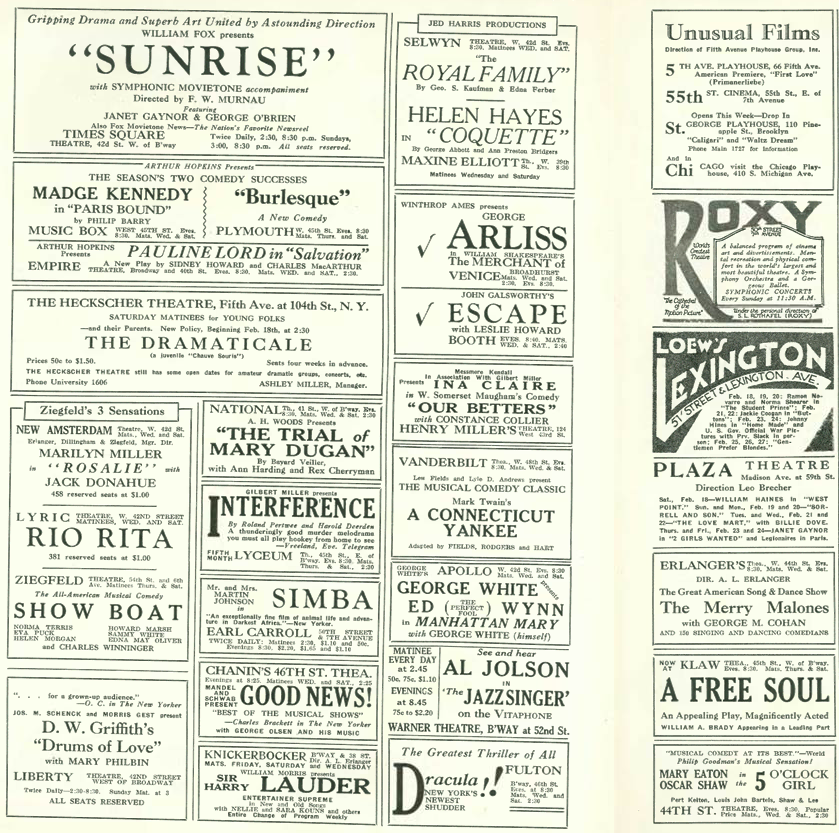
And to get a taste of what was showing at the local cinemas, I’ve included this page-and-third spread of movie and theatre ads from the back pages. Note the film Sunrise featured prominently at the top left-hand corner.
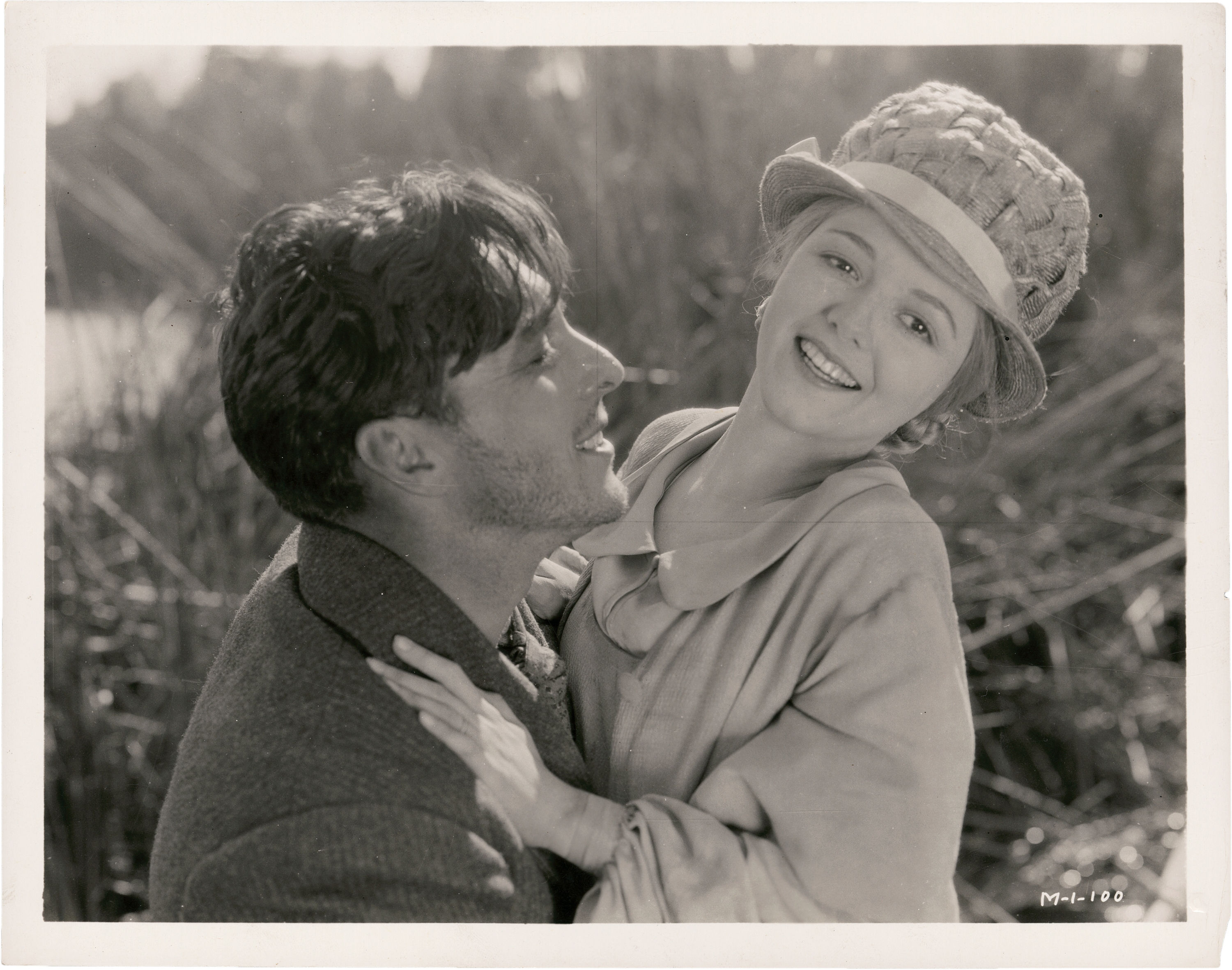
Starring George O’Brien, Janet Gaynor, and Margaret Livingston, this 1927 silent romantic drama, directed by F.W. Murnau, used the new Fox Movietone sound-on-film system, making it one of the first feature films with a synchronized musical score and sound effects soundtrack. Sunrise (full title: The Sunrise: A Song of Two Humans) won the Academy Award in the category “Unique and Artistic Picture” at the 1st Academy Awards in 1929, and Gaynor won the first Academy Award for “Best Actress in a Leading Role.” Sunrise is considered one of the greatest films of the silent era and even today is widely considered a masterpiece.
AWARD-WINNING SMILES…George O’Brien and Janet Gaynor in 1927’s acclaimed The Sunrise: A Song of Two Humans. (The Red List)
* * *
And finally, more hijinks from the moneyed classes, courtesy of Peter Arno:












































































































































 A New Yorker State of Mind