The Irish American gangster Jack “Legs” Diamond was often referred to as the “clay pigeon of the underworld” due to surviving several attempts on his life.
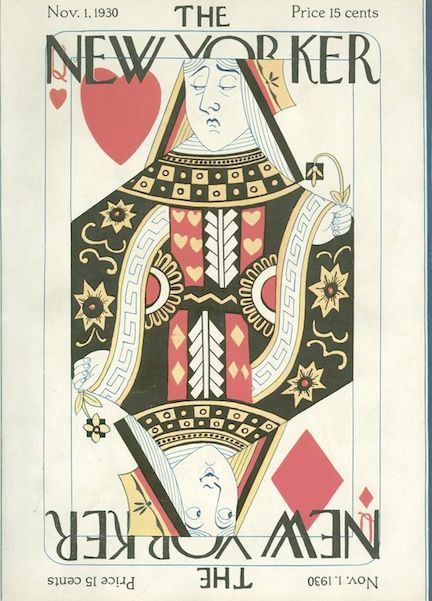
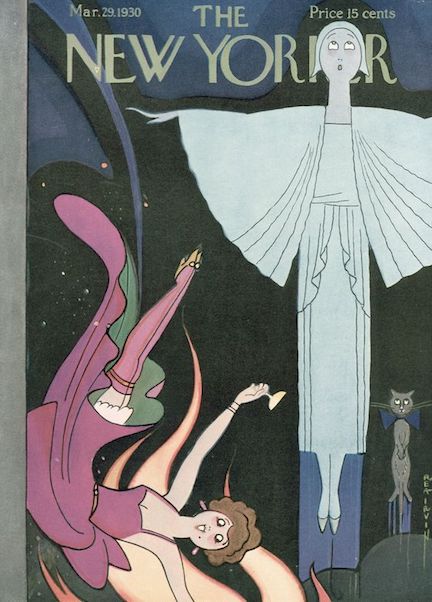
Nov. 1, 1930 cover by Rea Irvin.
In his “Reporter at Large” column, Morris Markey checked up on the fleet-footed bootlegger, adored by the public for his various brushes with the law and escapes from sure death. In his opening paragraph, Markey referred to one of the attempts on Diamond’s life: On October 12, 1930, he survived being shot five times at Manhattan’s Hotel Monticello:
Markey’s column attempted to remove some of the glamour from Diamond’s flamboyant life, a life that would be cut short about a year later in an Albany rooming house…
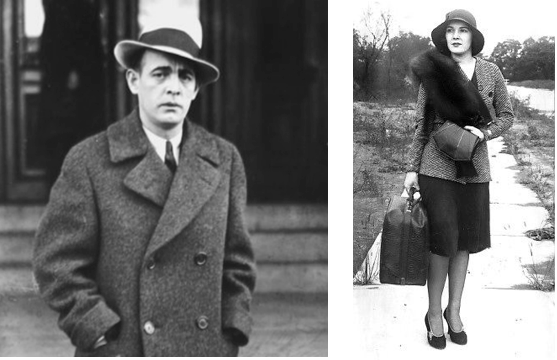
OUT WITH THE BOYS…Legs Diamond leaves the federal court in New York with his attorney and a couple of cronies on Aug. 8, 1931, after being convicted of owning an unlicensed still and conspiring to violate Prohibition laws. (digitalcommonwealth.org)BEDFELLOWS…Legs Diamond had a number of mistresses, but the best known was Marion “Kiki” Roberts, who was with Diamond shortly before he was slain. (The Mob Museum/Pinterest)DEADLY TRIO…Clockwise, from top left, Legs Diamond is comforted by his wife, Alice Kenny Diamond, after being shot three times at a roadhouse near Cairo, NY, on April 27, 1931. His enemies finally succeeded in killing him on Dec. 18, 1931, shooting him three times in the back of the head in an Albany rooming house. Alice would be shot and killed less than two years later, possibly by Diamond’s enemies to keep her quiet. And sadly, The New Yorker’s “Reporter at Large” columnist Morris Markey would also meet a violent end, dying of a gunshot wound to the head in 1950. Whether it was by his hand or another’s, it was never determined. (Albany Archives/NY Times)
An afternote: Enemies would finally catch up to Legs Diamond and kill him on Dec. 18, 1931. Diamond’s wife, Alice Kenny Diamond, would be shot and killed less than two years later. Diamond’s mistress and former Ziegfeld Follies performer Marion “Kiki” Roberts would return to the stage and cash in on her notoriety. In 1937 it was reported she was the big draw in a touring “Crazy Quilt” burlesque revue. And according to the writer William Kennedy, who wrote about Diamond in his 1975 novel Legs, the last record of Kiki Roberts was in Boston in the 1940s, where “she was still appearing as ‘Jack (Legs) Diamond’s Lovely Light o’ Love.’ ”
Here is newsreel footage of Diamond’s mistress Marion “Kiki” Roberts, shortly after the gangster’s death. In this brief interview with a Boston reporter (and with her mother at her side) Roberts advises girls to “live good clean lives and obey their parents wishes.” Note how it appears she is reading from cue cards.
* * *
Chitty Chitty Bang Bang
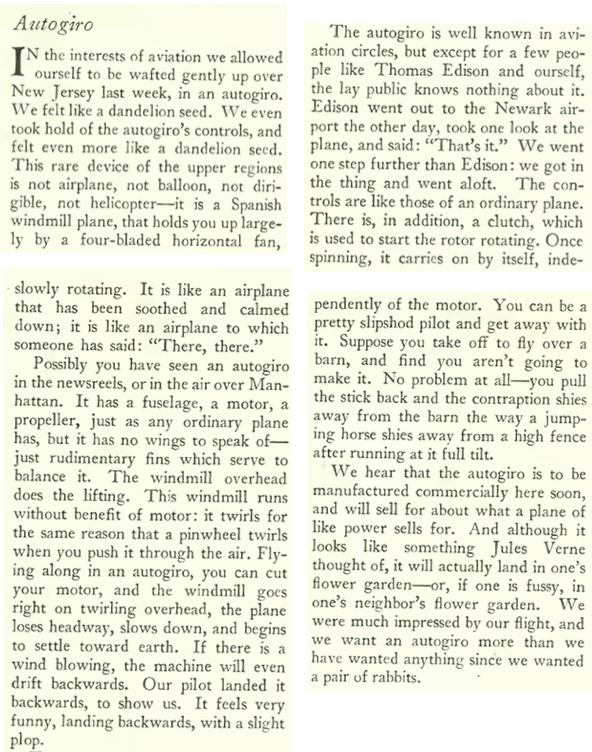
A precursor to the helicopter, the autogyro was considered by many to be the next logical step in aircraft development, and especially in the development of smaller craft that could serve as safe, affordable transportation options for commuters. TheNew Yorker’sE.B. White, an aviation enthusiast, demonstrated to readers the wonders of this aircraft:
EASY AS PIE…A Cierva Autogiro C30 takes flight circa 1933. (findmypast.co.uk)
* * *
Baker’s Big Show
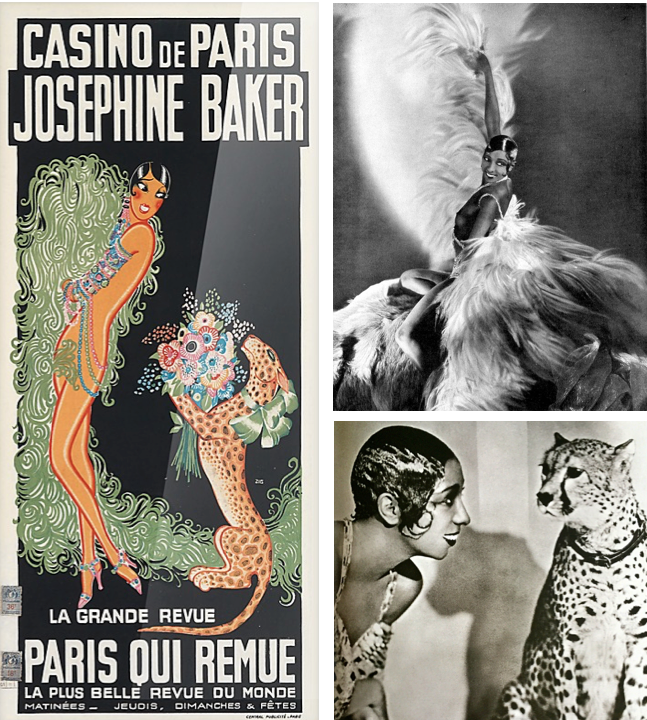
Nineteen-year-old American-born French entertainer Josephine Baker became an instant symbol of Jazz Age Paris when she starred in La Revue Nègre in October 1925. Her erotic dance routines wowed Paris audiences, and she quickly moved on to the famed Folies Bergère. In 1930 she opened a new show at the Casino de Paris that also featured her pet cheetah, Chiquita. The New Yorker’sJanet Flanner was there to take it all in:
HEAR THE THUNDER…Nineteen-year-old Josephine Baker took Paris by storm when she appeared in La Revue Nègre at the Théâtre des Champs-Élysées in October 1925. (harleminmontmartre.paris/artphotolimited.com)HEAR ME ROAR…The New Yorker’sJanet Flanner was wowed by Josephine Baker’s newest show at the Casino de Paris that also featured her pet cheetah, Chiquita. (pictorem.com/vam.ac.uk/artphotolimited.com)
* * *
Grim Reminder
Despite the deepening Depression across the country, few mentions of it were made in the pages of TheNew Yorker.Howard Brubaker, in his “Of All Things” column, offered this not-so-gentle reminder:
* * *
From Our Advertisers
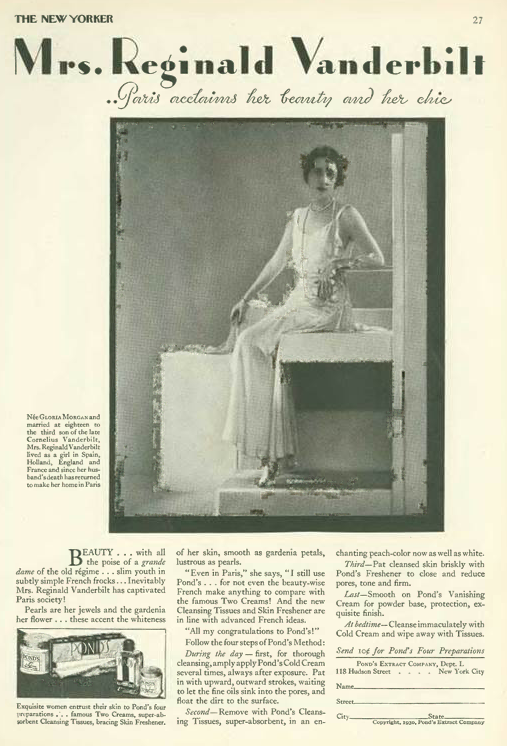
We feature Gloria Morgan Vanderbilt, a Swiss-born American socialite shilling for Pond’s cold cream. At the time of this ad she was the mother of six-year-old Gloria Vanderbilt (who would become a famous fashion designer and artist and the mother of CNN’s Anderson Cooper)…
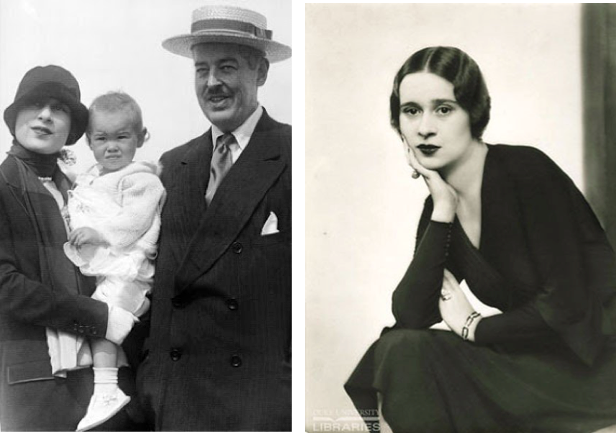
POOR LITTLE RICH GIRLS…Gloria Morgan Vanderbilt and her husband, Reginald Claypoole Vanderbilt with daughter Gloria, circa 1924-25. Reginald died in 1925, and a famous custody battle over little Gloria (who recently died at age 95) would take place in 1934. At right, portrait of Gloria Morgan Vanderbilt by Dorothy Wilding, 1933. (Perkins Library, Duke University)
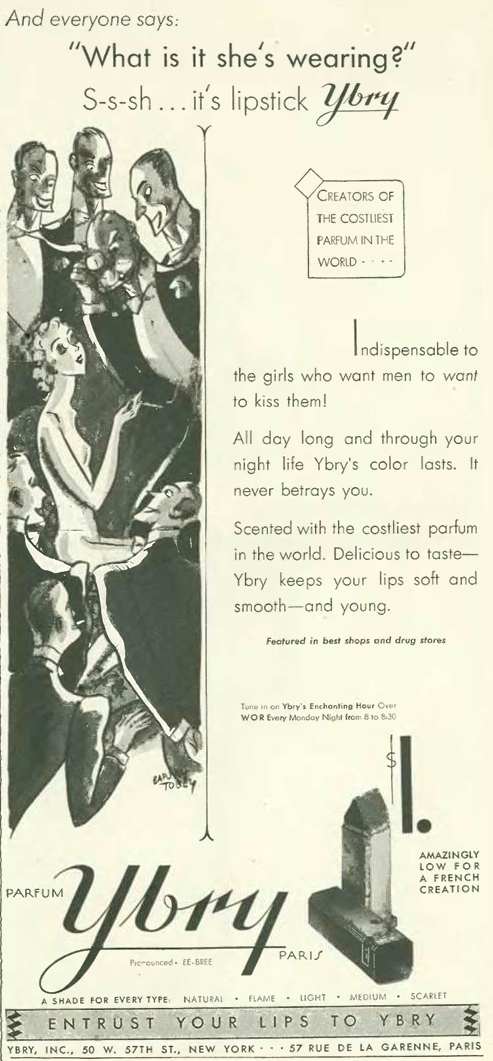
…the makers of Ybry lipstick apparently did not have the budget to garner a patrician endorsement, so they settled for this illustration by New Yorker cartoonist Barney Tobey…
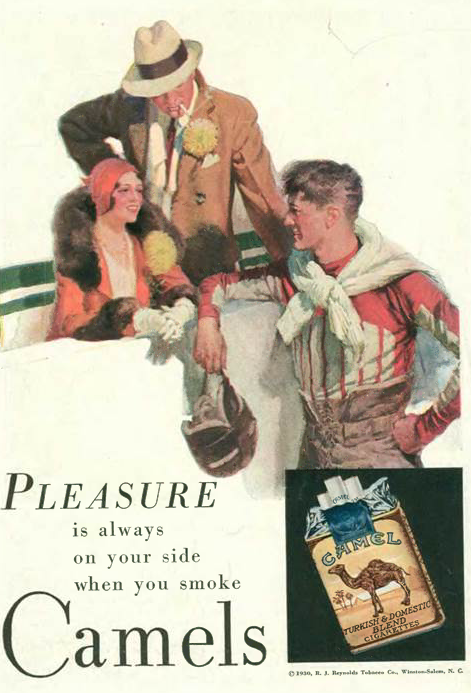
…and we have another lovely color ad from R.J. Reynolds, once again linking cigarettes to athletic prowess…
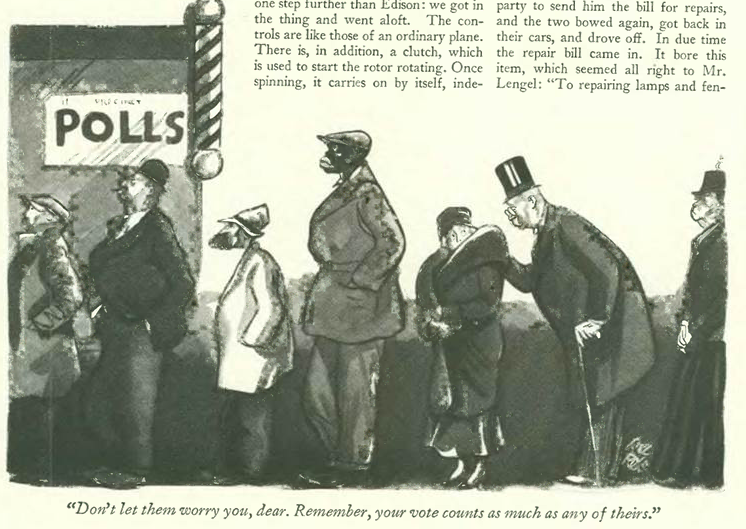
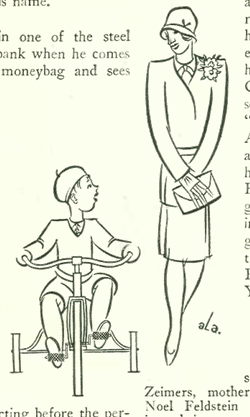
…on to our cartoons, we mark election season with Carl Rose…
…Barbara Shermund explored the generation gap…
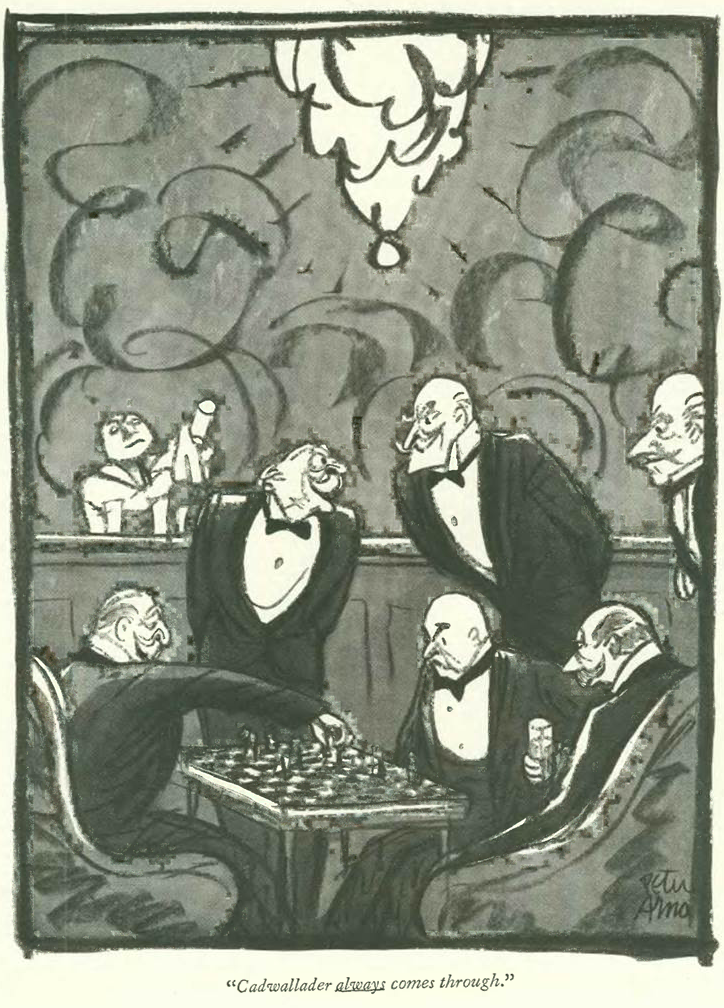
…Peter Arno gathered his sugar daddies for a game of chess…
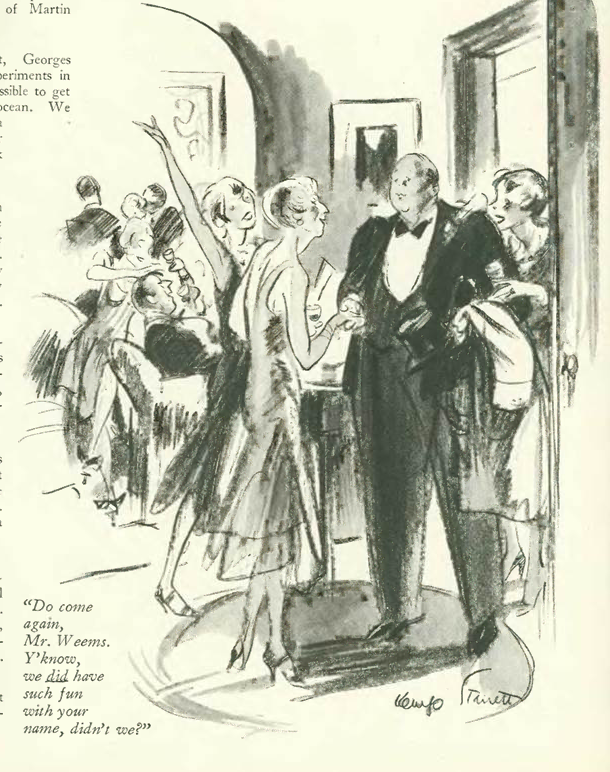
…Kemp Starrett introduced us to an unlikely life of the party…
…Alan Dunn examined the influences of popular cinema…
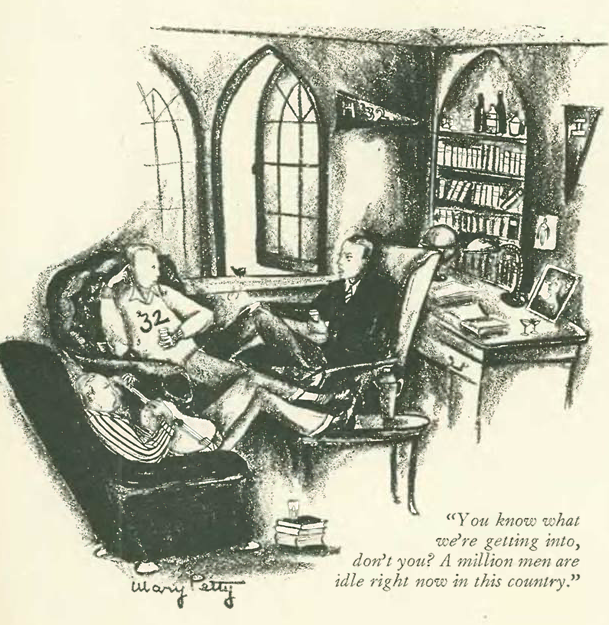
…Mary Petty gave us an Ivy League perspective of the Great Depression…
…and Arno again, with a cartoon that was featured along with The New Yorker’s “Wayward Press” column…
Imagine your favorite Hollywood actress, maybe someone like Julia Roberts,Meryl Streep or Judi Dench. You’ve followed their careers and watched most of their movies, but you’ve never heard their voices.
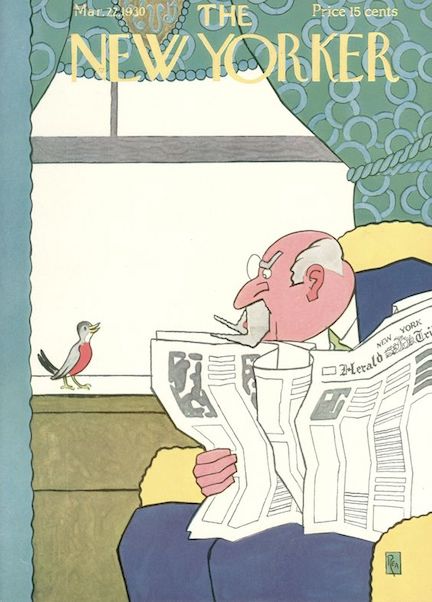
March 22, 1930 cover by Gardner Rea.
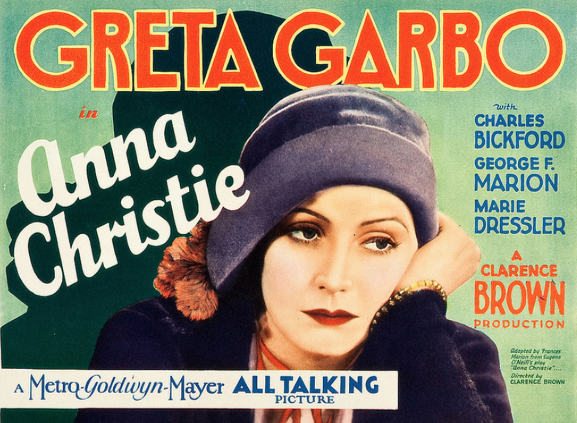
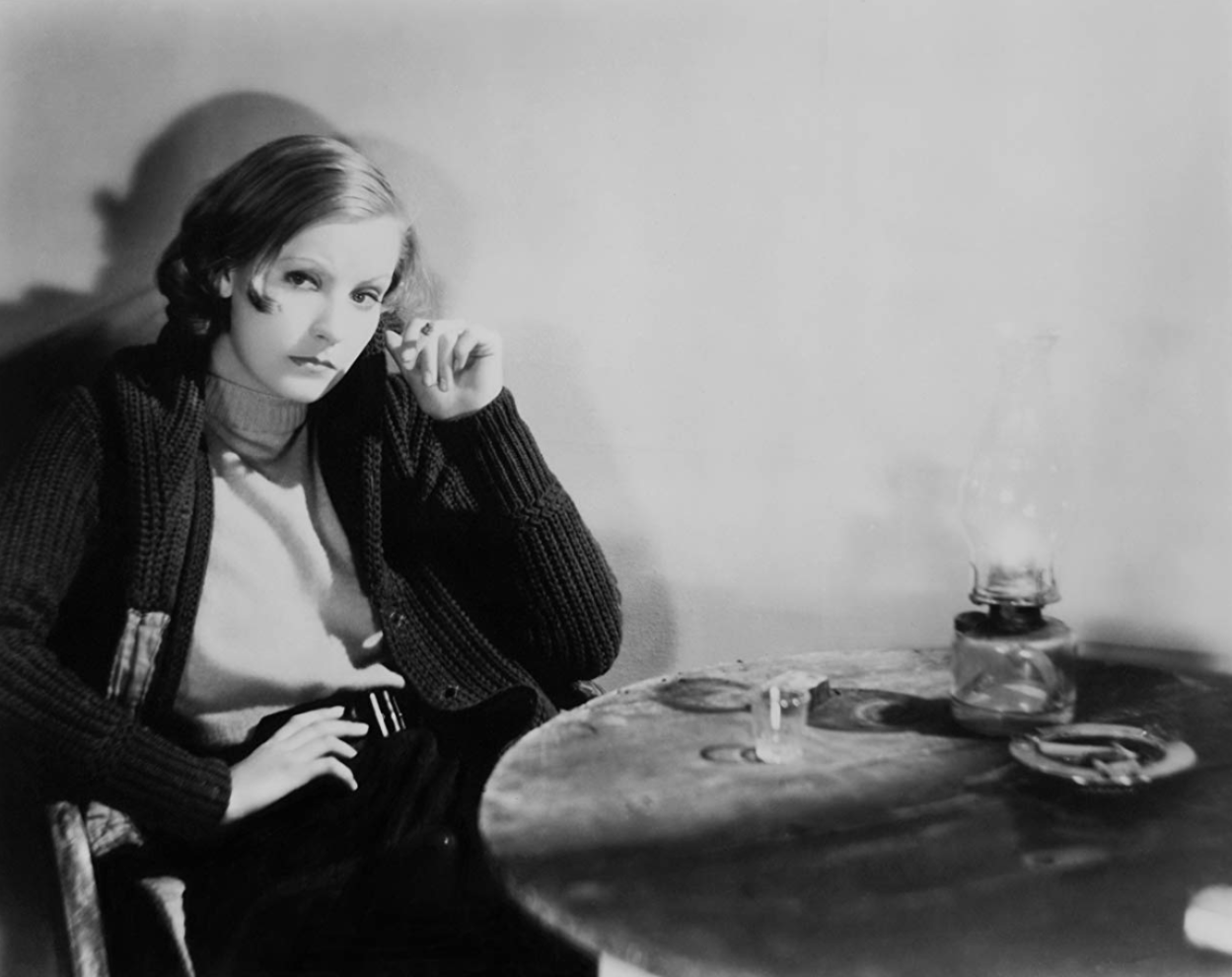
That’s what it was like for Greta Garbo fans before March 1930, when she spoke her first onscreen words in the 1930 MGM drama Anna Christie, which was adapted from a 1922 play by Eugene O’Neill.
SWEDISH SPHINX…Greta Garbo’s mask-like qualities on display in this publicity still for Anna Christie. (IMDB)
The New Yorker’s film critic John Mosher, not always a fan of Garbo’s silent work, found a “special kind of glamour” in her first talking picture, even tossing out the word “legend” to describe this Swede who avoided publicity like a bad cold…
No doubt a few moviegoers saw the movie just to finally hear that voice, which Mosher described as “a surprise…a deep, low voice, a boy’s voice really, rather flat, rather toneless, yet growing more attractive as the picture advances”…
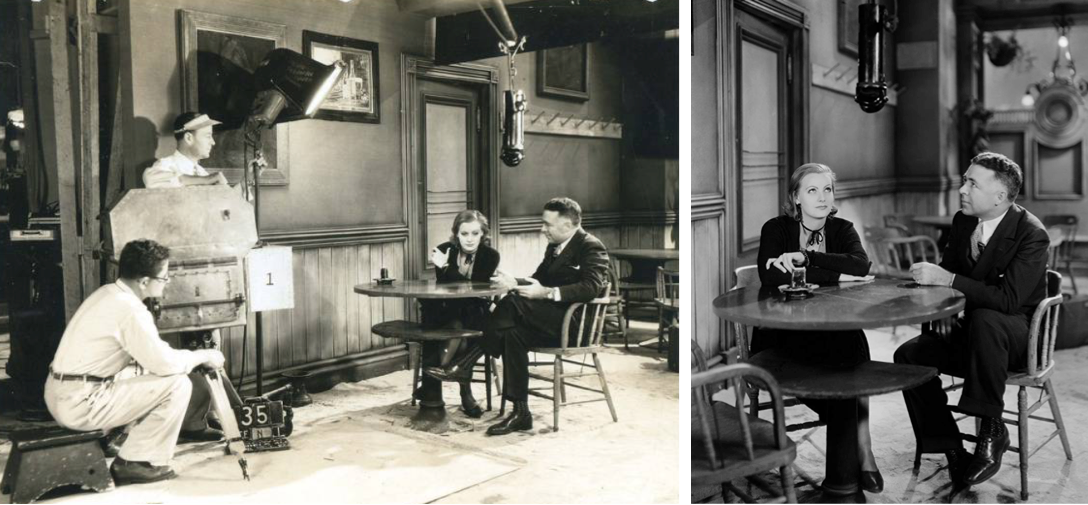
Director William H. Daniels (seated, left) with unidentified cameraman filming a scene from Anna Christie with actors Greta Garbo and Clarence Brown; at right, the actors contemplate the microphone hovering above them. Note how the camera in the first photo is contained in a soundproof case. (IMDB)
Publicized with the tag line “Garbo talks!,” Anna Christie premiered in New York City on Feb. 21 and would become the highest-grossing film of 1930. Later that year a German language version would be filmed featuring Garbo but with a different director and supporting cast.
SOUND DEBUT…Clockwise, from top left, Greta Garbo and Marie Dressler in Anna Christie; an MGM ad touting the film as one of the best pictures of the year (it would be the year’s highest-grossing, and Garbo would receive an Academy Award nomination); studio portraits of Garbo used in the film’s promotion. (IMDB)
* * *
Chicken and Cocktails
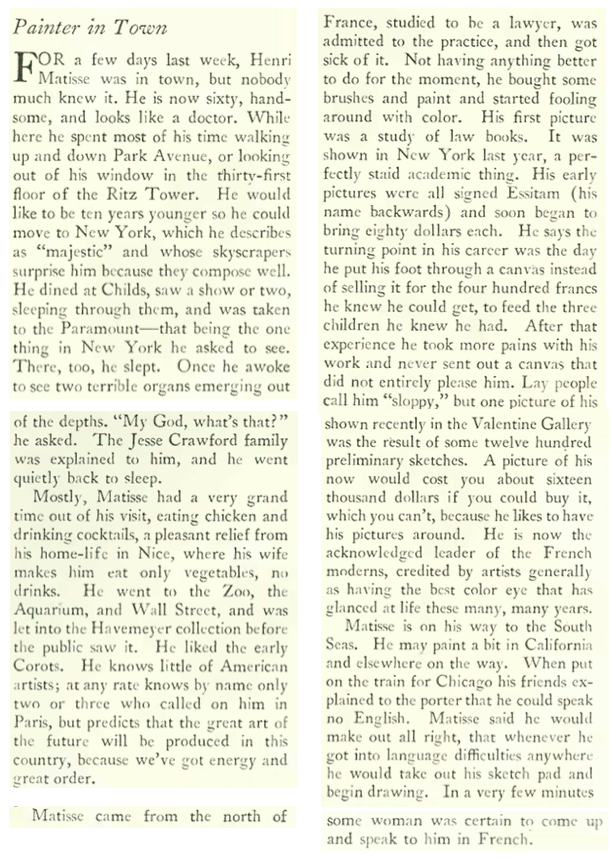
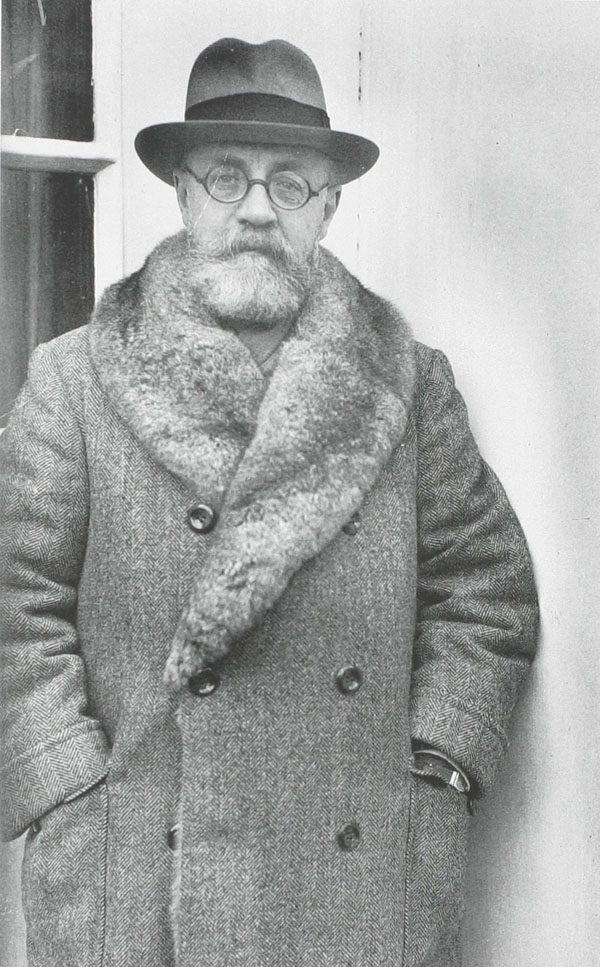
En route to the South Seas, the French artist Henri Matisse (1869-1954) paid a visit to New York City, and by all accounts had a good time there. His visit was described by Murdock Pemberton in “The Talk of the Town”…
I ♥ NEW YORK…Henri Matisse arriving in New York City on the RMS Mauretania December 15, 1930. He described the city as “majestic.” (artistandstudio.tumblr.com)NICE PLACE, THIS…Henri Matisse sitting on the brick roof terrace of 10 Mitchell Place (formerly Stewart Hall), the Queensboro Bridge glimpsed in the background. The photo was taken in 1930 by his son, Pierre Matisse, who was living in New York. At right, 10 Mitchell Place today. A framed photograph of Matisse sitting on the rooftop hangs on the wall of the building’s lobby. (Henri-matisse.net/Ephemeral New York)
* * *
The Last Page
The death of author D.H. Lawrence (1885-1930) was reported to New Yorker readers by Janet Flanner, the magazine’s Paris correspondent, who briefly detailed the writer’s rather sad decline…
FLEETING DAYS…D. H. Lawrence (right) with fellow writer Aldous Huxley at Bandol, in the South of France, 1929. (Topham Picturepoint)
* * *
What Depression?
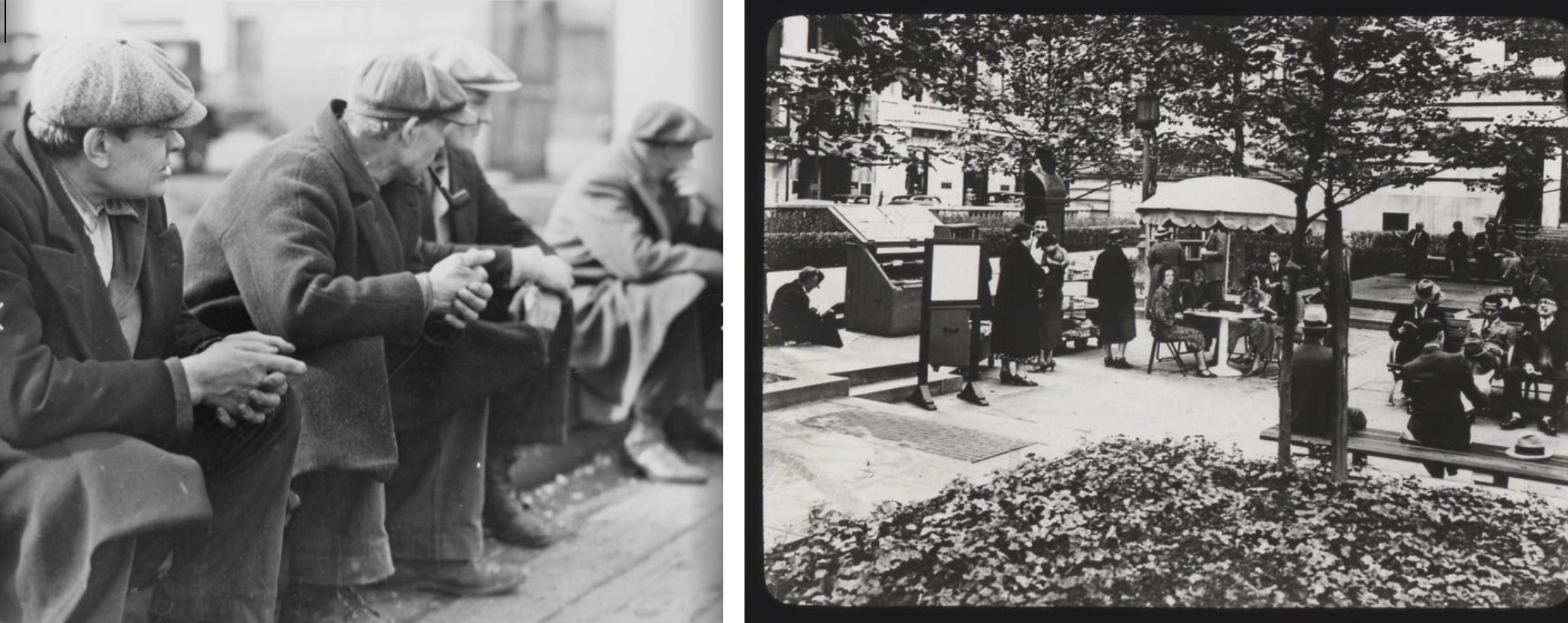
We are nearly five months into the Great Depression, yet there is little evidence in The New Yorker of the catastrophe that was unfolding across the land. And true to form, the approach to the topic was made with humor, via E.B. White in “Notes and Comment”…
KNOW ANY GOOD JOKES?…At left, unemployed New York dockworkers; at right, folks enjoying the New York Public Library’s outdoor reading room in Bryant Park, 1930s. (Lewis Hine/National Archives and Records Administration/New York Public Library)
* * *
Cathedrals of Commerce
E.B. White also observed the changing skyline, and how the towering skyscrapers were quickly overshadowing the once prominent steeples of the city’s churches…
REACHING TO THE HEAVENS…Clockwise, from top left, Trinity Church Wall Street and St. Patrick’s have been eclipsed by the towers of Mammon, but St. John’s and Riverside still dominate their surroundings. (Wikipedia/St. John’s/Riverside)
* * *
The Other House of Worship
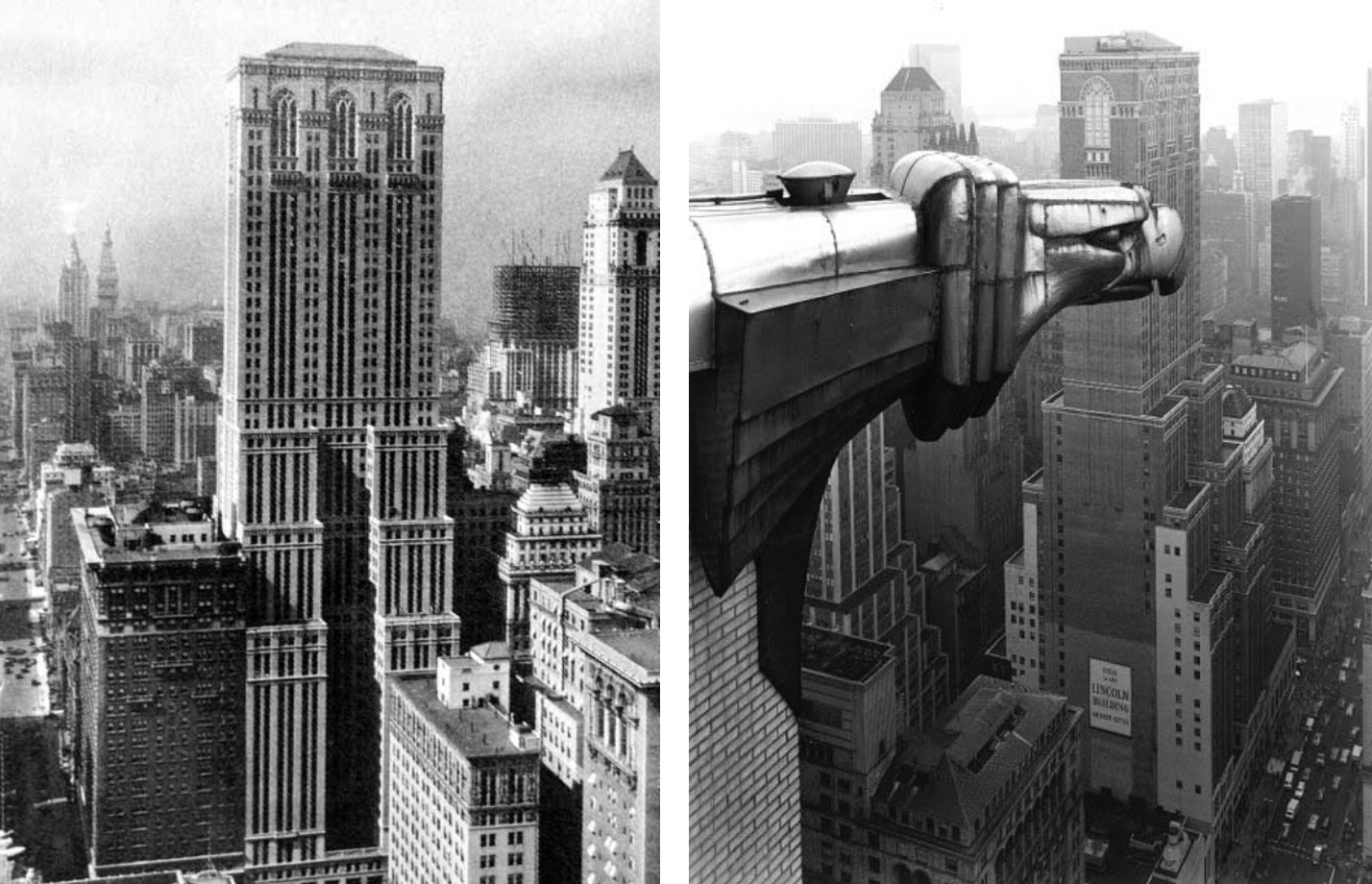
Perhaps a certain skyscraper ennui settled in, as architecture critic George S. Chappell was not all that impressed by the “huge” Lincoln Building (which today still seems huge)…
SIZE DOESN’T MATTER…Although the new Lincoln Building proved to be a massive addition to the New York skyline, its style seemed outdated in contrast to its flashy new neighbor, the Chrysler Building — one of its gargoyles, at right, seems poised to devour the Lincoln Building. (nyc-architecture.com)
* * *
From Our Advertisers
We have a bit more evidence of the Depression in the ads, including this one from Abercrombie & Fitch, with two sporting gents opting to go fishing to take their minds off the markets…
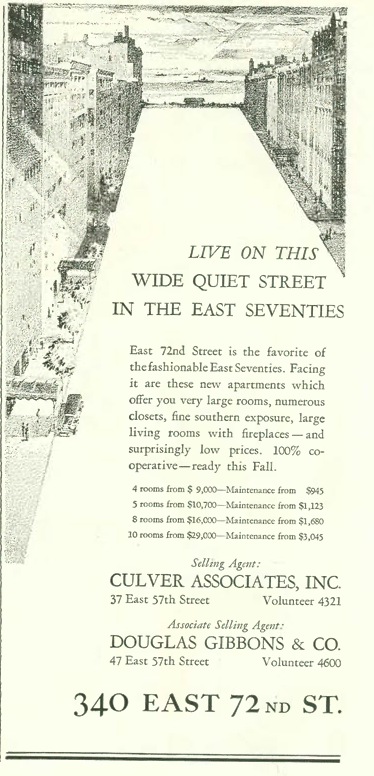
…if fishing wasn’t your thing, perhaps you just wanted to escape into the “quiet” of the wide streets in the East Seventies…
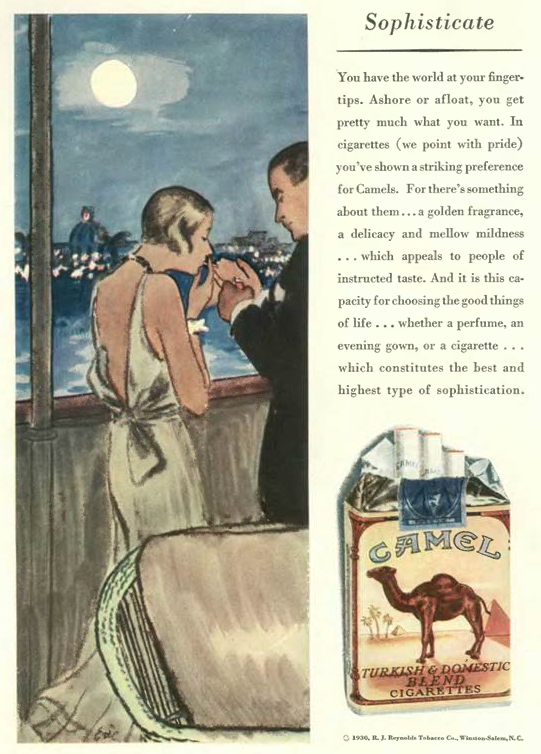
…or relax with a smoke, which artist Carl Erickson made so appealing with his Camel ad illustrations…
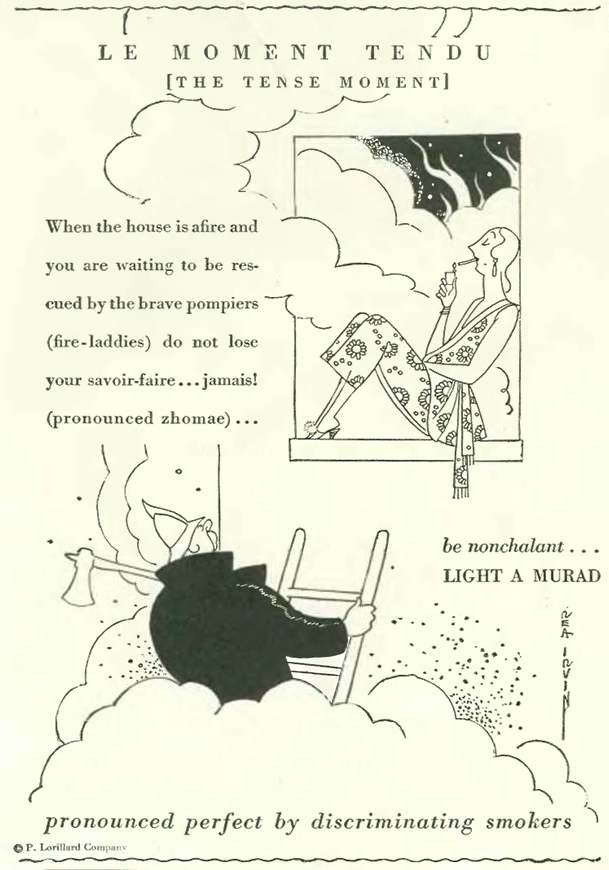
…or take the humorous route to a relaxing smoke, with this ad for Murad as illustrated by Rea Irvin…
…on to our cartoonists, Garrett Price captured the mood of the times…
…while Alfred Krakusin captured an altogether different mood…
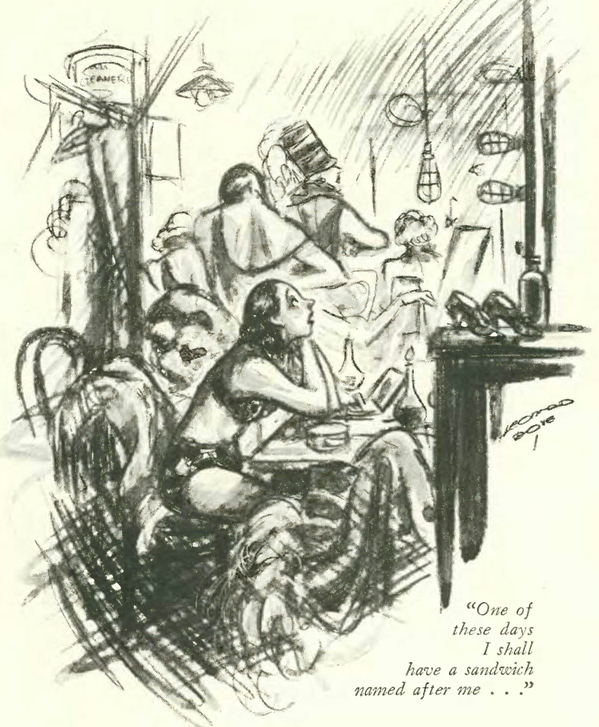
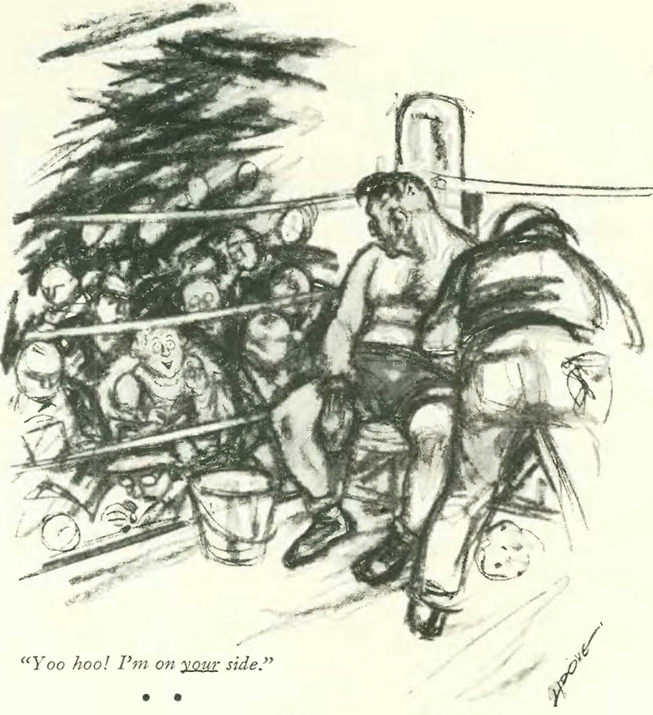
...Leonard Dove examined the path to stardom…
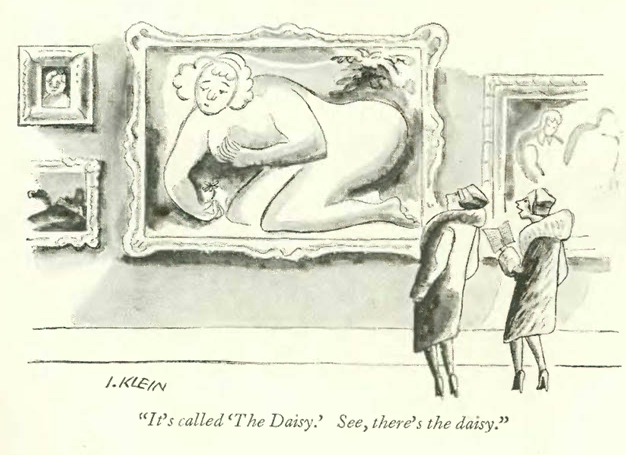
…Isadore Klein pondered modern art…
…William Crawford Galbraith found an unlikely victim of religious zeal…
…Mary Petty gave us a glimpse of a doctor’s office…
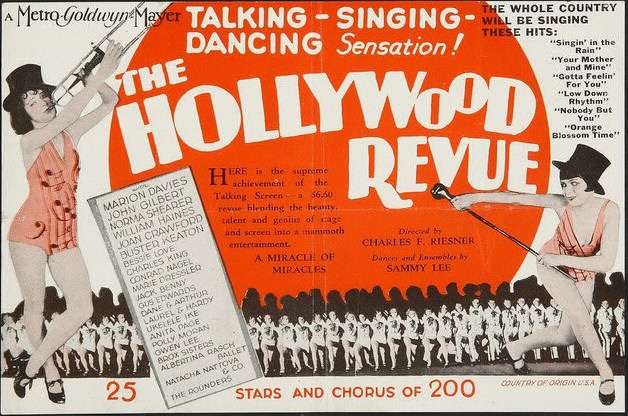
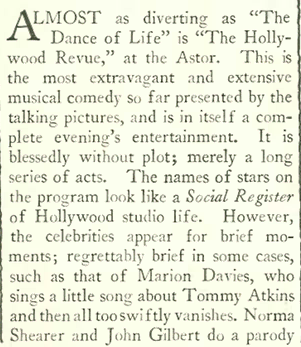
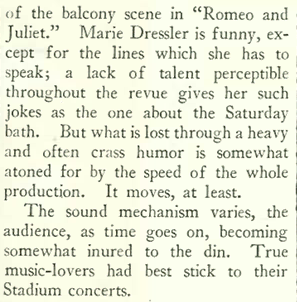
MGM piled so many stars and gimmicks into the premiere of The Hollywood Revue of 1929 that even TheNew Yorker’s jaded film critic John Mosher had to admit he was entertained.
Aug. 24, 1929 cover by Helen Hokinson.
Although today’s audiences would find the film quaint and corny (not to mention its tinny sound and crude editing), it was a big hit in 1929. A plotless revue featuring nearly all of MGM’s stars (Greta Garbo said no — she had a clause in her contract exempting her from such silly things; Lon Chaney, on the other hand, was in failing health), the film followed a variety format similar to such vaudeville productions as the Ziegfeld Follies. The Arthur Freed/Herb Nacio Brown song “Singin’ In the Rain” was introduced in this film, and would inspire the Gene Kelley musical by the same name 23 years later. A rarity for the time, the Hollywood Revue included four skits in an early version of Technicolor, including an all-cast performance of “Singing’ In the Rain.” Mosher observed:
One of the film’s color skits featured John Gilbert and Norma Shearer in a Romeo and Juliet parody filled with Jazz Age slang. It would mark the beginning of the end of Gilbert’s career and, sadly, his life. He was one of the silent era’s most popular leading men, but it was purported that his voice was not suited to the talkies. What really ended Gilbert’s career, however, was studio head Louis B. Mayer, who clashed with the actor both personally and professionally…
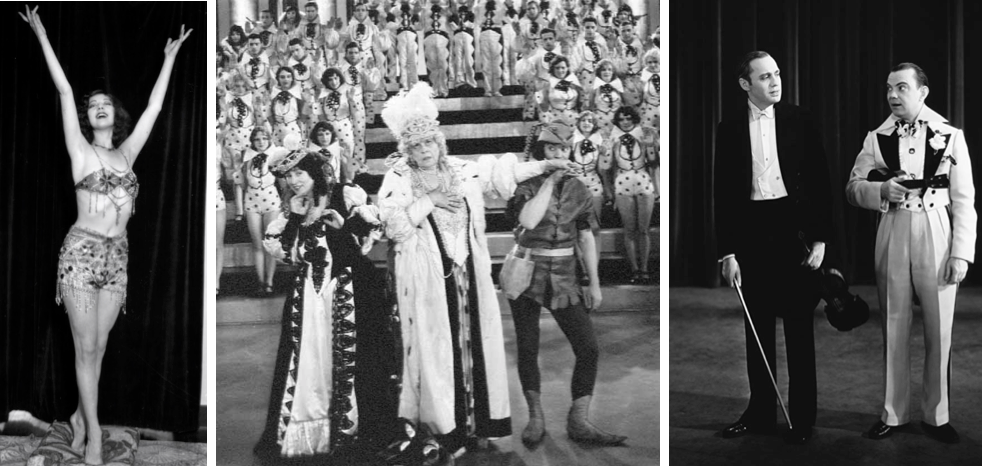
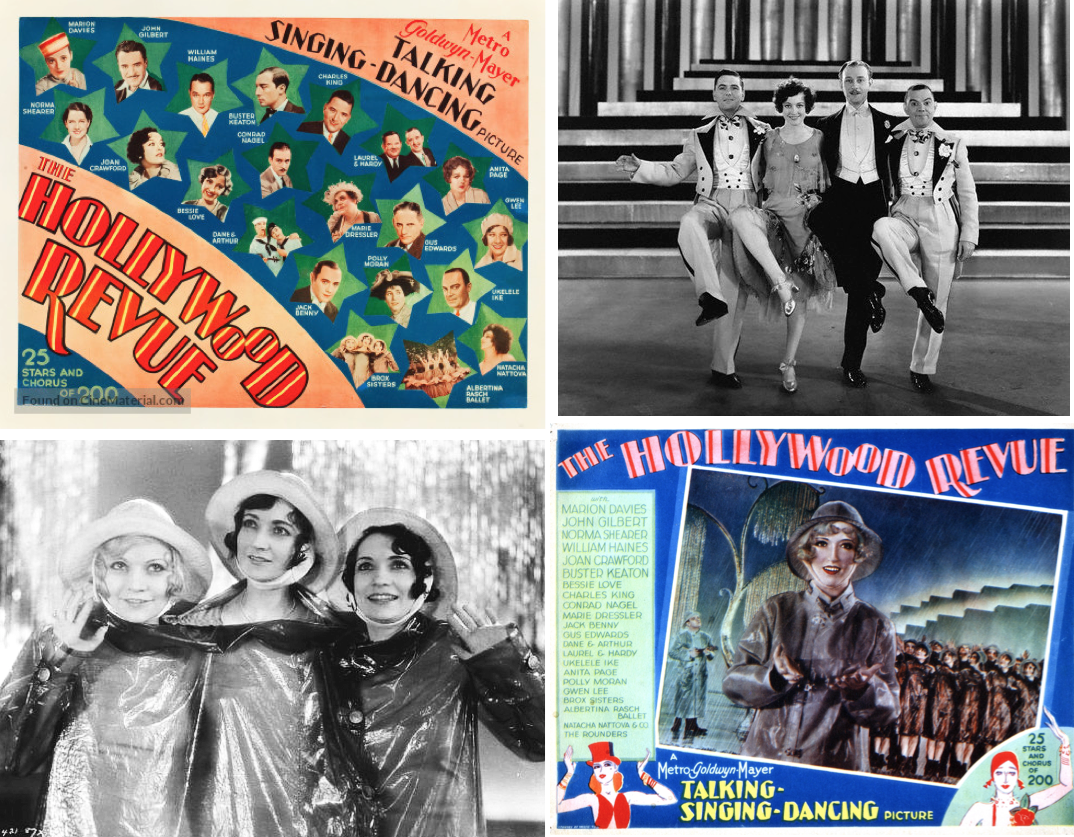
FAREWELL ROMEO…A lobby card promoting The Hollywood Revue of 1929 featured John Gilbert and Norma Shearer in one the film’s color sequences, a parody of Romeo and Juliet filled with Jazz Age slang. At right, a scene from the skit in which the director (played by Lionel Barrymore, far right) tells Shearer and Gilbert to put more pizzazz into the act. (IMDB/YouTube)STAR-STUDDED…Left to right, early silent film comedian Marie Dressler hammed it up in a royal court skit; co-emcee Jack Benny, with his trademark violin, and Cliff “Ukulele Ike” Edwards, and his trademark uke. (vickielester.com/doctormacro.com/thejumpingfrog.com)DANCING IS GOOD FOR YOUR HEALTH…Chorus girl Carla Laemmle in the film’s “Tableau of Jewels,” in which she emerged from a seashell to perform a seductive (and weird) dance number while other showgirls posed on a revolving crown — all set to a tune sung offstage by James Burroughs. The niece of Universal Pictures founder Carl Laemmle, Carla Laemmle was one of the longest surviving actors of the silent era. She died in 2014 at age 104. (songbook1.wordpress.com)GALAXY OF STARS…Clockwise, from top left, lobby card for The Hollywood Revue of 1929; Charles King, Joan Crawford, Conrad Nagel (a co-emcee along with Jack Benny) and Cliff “Ukulele Ike” Edwards show off their dancing skills; lobby card featuring actress Marion Davies; a popular act in vaudeville and on Broadway, the Brox Sisters—Lorayne, Patricia and Bobbe (along with Cliff Edwards) introduced the song “Singin’ in the Rain,” also sung by the entire cast near the finale of the movie. (IMDB/joancrawfordbest.com/mubi.com)
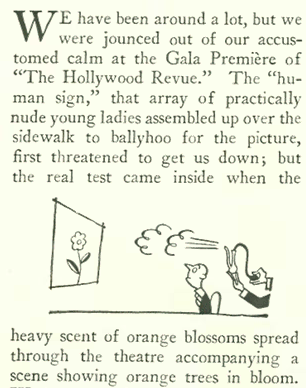
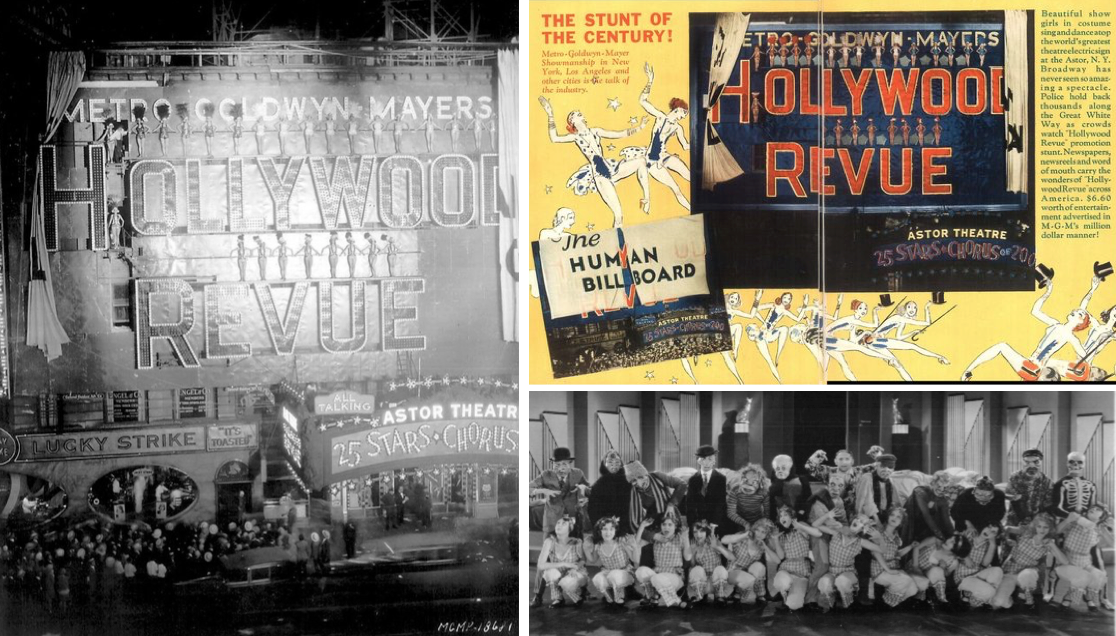
…MGM deployed a number of stunts to generate publicity at the film’s New York premiere at the Astor Theatre, including a “human billboard” that featured scantily clad chorus girls precariously perched on a huge letters high above the theatre’s entrance. In a rather less dangerous stunt—during the movie’s “Orange Blossom Time” skit—a faint scent of orange blossoms wafted into the theatre. “The Talk of the Town” observed…
WHAT COULD POSSIBLY GO WRONG?…Showgirls arranged along narrow catwalks atop the glowing HOLLYWOOD REVUE sign would pose for hours above crowds of gawkers; top, an advertisement promoting “The Stunt of the Century”; bottom, chorus girls lined up on somewhat safer ground in a skit from the movie titled “Lon Chaney’s Gonna Get You If You Don’t Watch Out.” Chaney himself was near death and did not appear in the film. (oldphotoarchive.com/anndvorak.com)Another angle shows just how precarious this stunt proved to be for these brave chorus girls, who held their poses for hours on end. (legendaryjoancrawford.com)JUST SINGIN’…Among the MGM stars appearing in the film’s finale include, in the middle of the front row, Buster Keaton, Marion Davies, and Joan Crawford. (IMDB)
* * *
Technological Adjustments
Had you attended the premiere of The Hollywood Revue, perhaps you would have appreciated James Thurber’s observation that actors in talking pictures sound as if they are speaking into cracker boxes. In this hilarious piece (titled “The Roaring Talkies”), he proposed a solution. An excerpt:
* * *
A Happy Diversion
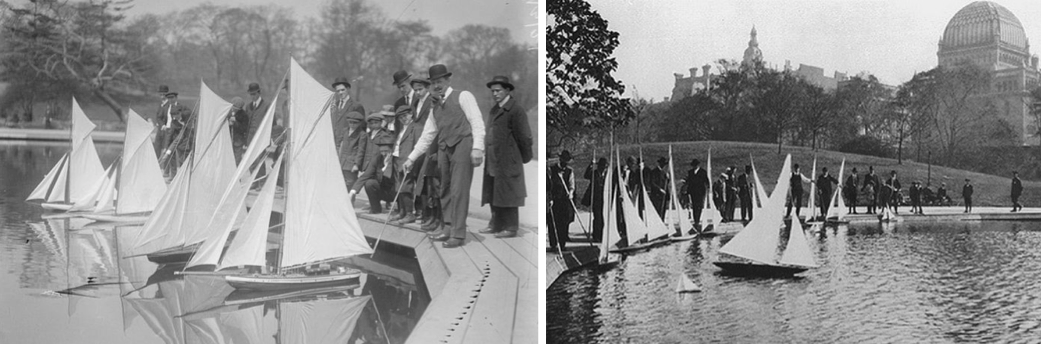
“The Talk of the Town” (via Theodore Pratt) looked in on the hobbyists who raced model boats at Central Park’s Conservatory Lake, a happy tradition that began in the late 19th century and continues to this day:
A DAY AT THE RACES….Model sailboats (left) prepare to face off in 1910 at Conservatory Lake (also called Conservatory Water); at right, model sailors at the same lake around 1920. (Library of Congress)
Pratt also described the old wooden boathouse, which was replaced in 1954 with a somewhat grander structure, Kerbs Boathouse, where model boats are still stored…
STILL SAILING…The copper-roofed Kerbs Boathouse replaced a wooden structure in 1954. Conservatory Lake served as the setting for a model boat race in E.B. White’sStuart Little. (centralparknyc.org)
* * *
On the Other Hand…
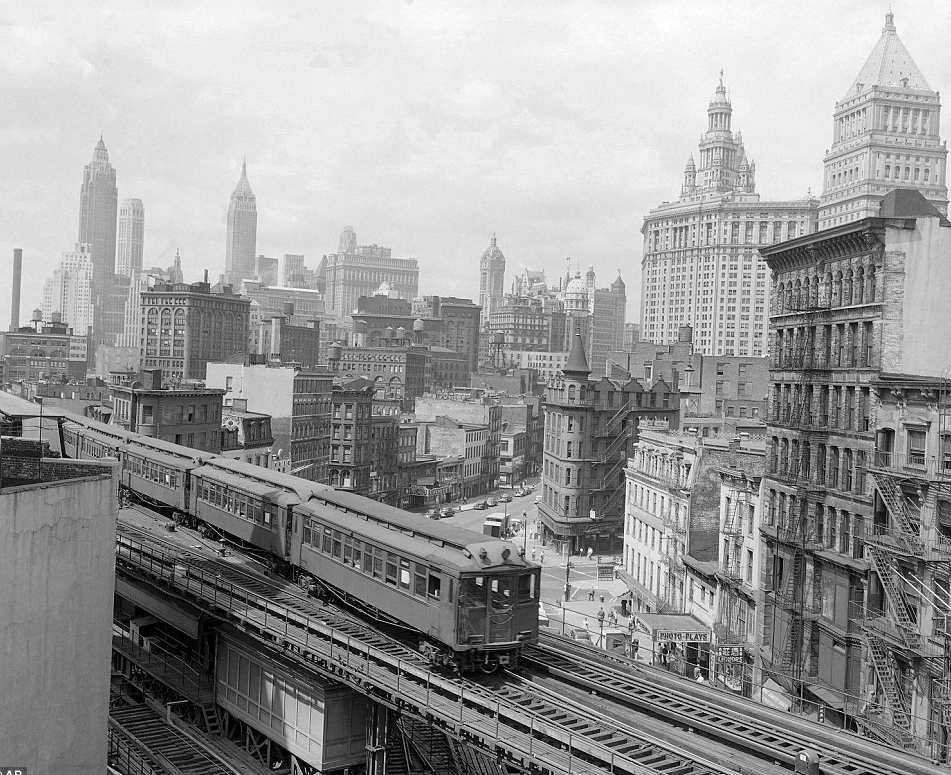
Leaving the cool and quiet of the park brought one quickly back into the dust and clamor of the metropolis. Pratt observed that the summer season lasted two weeks longer in the city than in the country, thanks to the city’s heat island effect— perhaps an unwelcome observation given the usually hot summer of 1929. Not only did the city’s heat extend the season, but it also kept the city enveloped in “an enormous cloud of dust”…
HAZY DAYS OF SUMMER…A dusty haze hangs over Lower Manhattan as the Third Avenue elevated train rumbles by in this circa 1950 photo. (Associated Press)
* * *
Already Feeling Old?
I found this “Talk” item curious for exploring the sentimental attachment some folks had developed for old cars from the 1910s, given those cars were barely twenty years old and cars in general hadn’t been in common use much longer…
…as for another “Talk” item, I doubt modern New Yorker readers would find any humor in this observation:
* * *
On to sillier things, Robert Benchley turned in a casual titled “Boost New York!” Benchley ridiculed a promotional brochure from the New York Merchants Association that touted various statistics in a manner reminiscent of the fictional George Babbitt. Benchley imagined how an Iowa couple might respond to such dazzling numbers:
* * *
A Drinking Life
Occasionally I like to feature infrequent or one-time New Yorker contributors who are nearly lost to history. Frank Ward O’Malley (1875-1932), a reporter for the New York Sun from 1906-19, was known for his humorous stories. In 1928 he published a book titled The Swiss Family O’Malley. In this casual (titled “The Fatty Degeneration of Broadway”) from the Aug. 24 issue, O’Malley described an alcohol intervention of sorts and then his fall off the wagon. Here are the opening and closing paragraphs, along with his photo circa 1910s.
Frank Ward O’Malley (Library of Congress)
* * *
From Our Advertisers
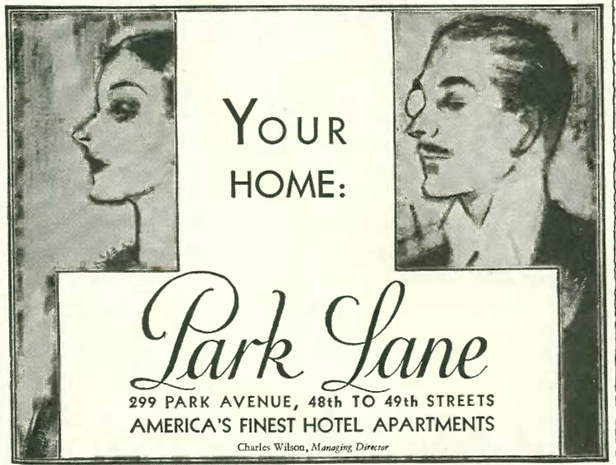
This week we have an advertisement for the Drake Apartment Hotel, claiming to be the “smartest” in New York. Note how they employed what seems to be the same pointy-nosed, haughty couple that we saw last week (below) who endorsed the Park Lane (I want to believe there is a subtle joke here)…
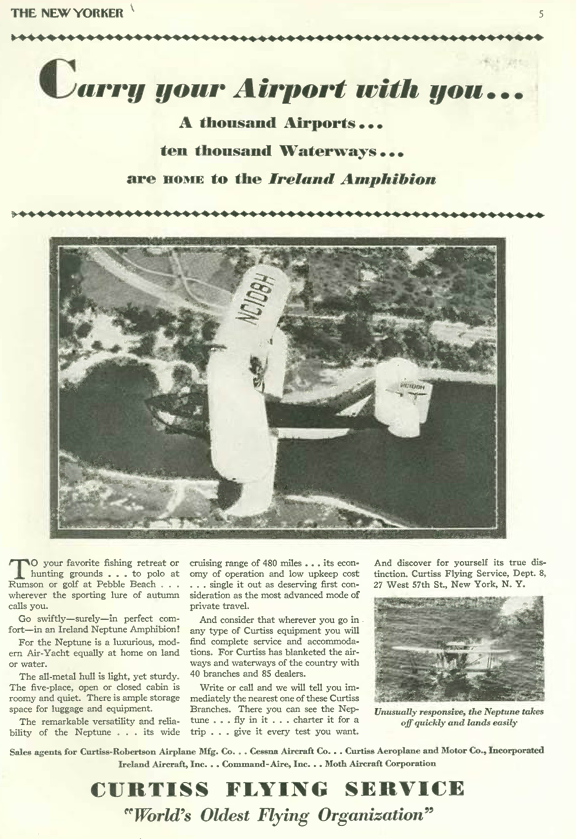
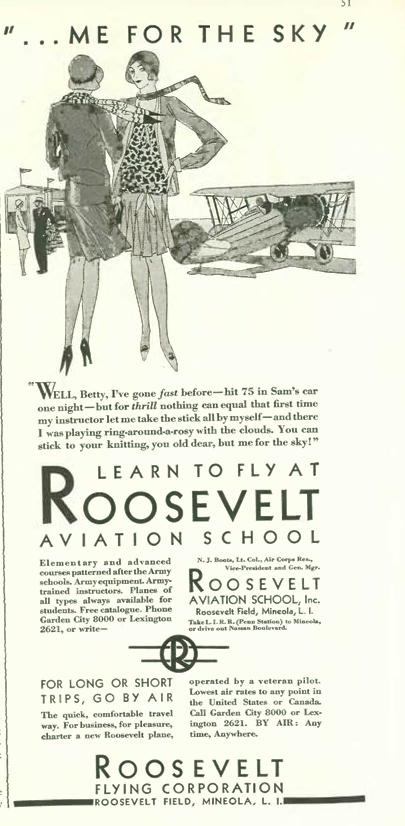
…just 25 years removed from the Wright Brothers’ flight at Kitty Hawk, advertisers were treating flying as though it were routine…
A better photo of the Ireland Neptune Amphipian (aerofiles.com)
…and this young woman seemed to think flying was nothing more than “playing ring around the rosy with the clouds”…
…I like the reviews included in this bookseller’s ad, especially the first one for the book Ex-Wife by Anonymous (it was written by Ursula Parrott, a writer of romantic fiction)…
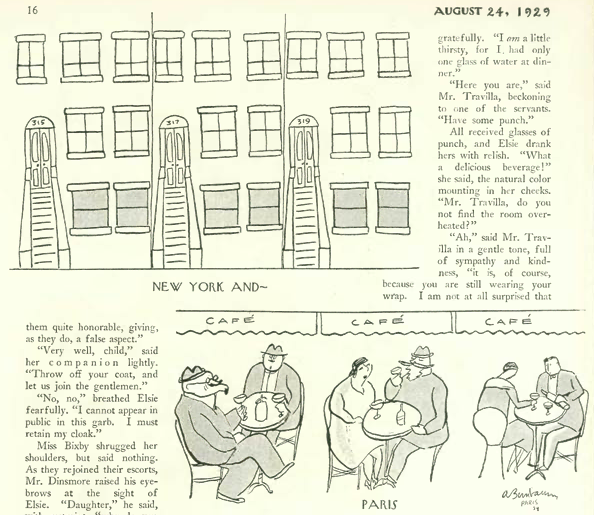
…our illustrations include Abe Birnbaum’s contribution to the casuals section (breaking up the copy of one of Josie Turner’s Elsie Dinsmore parodies)…
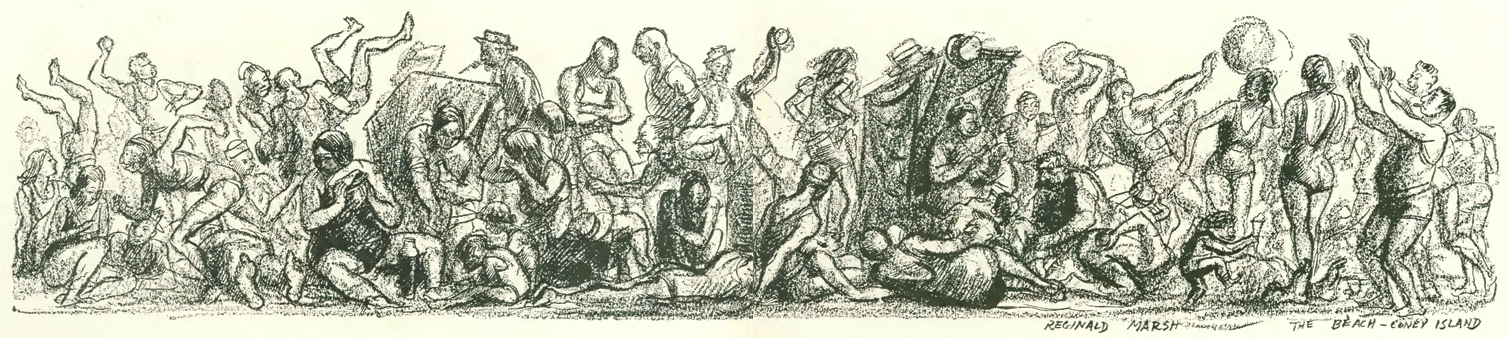
…Reginald Marsh illustrated the late summer beach scene at Coney Island…
…and for kicks this nice little filler by Constantin Alajalov…
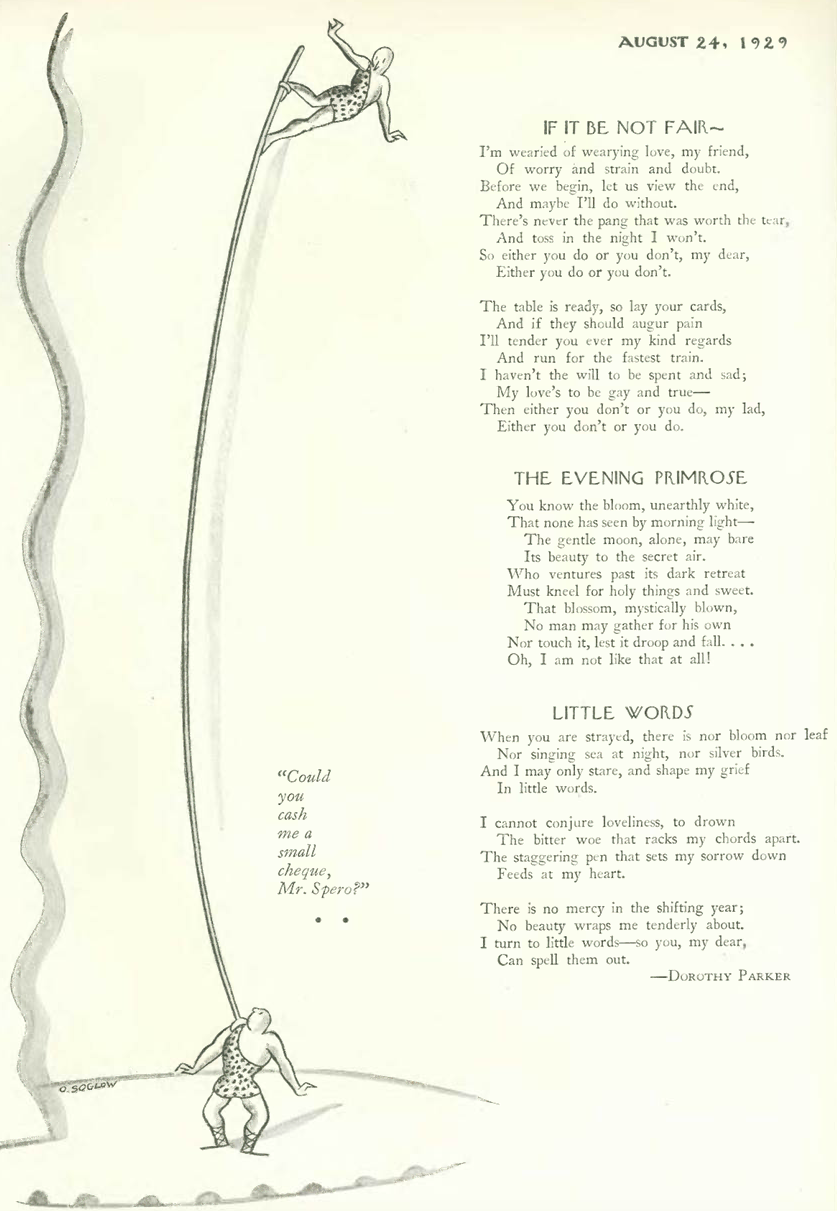
…thanks to the skills of The New Yorker’s first layout artist, Popsy Whitaker, we have this whimsical pairing of Otto Soglow and Dorothy Parker…
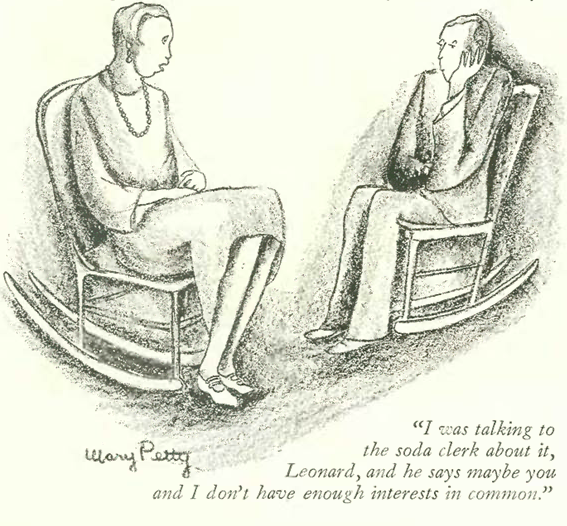
…Mary Petty contributed a cartoon that looks contemporary…
…Peter Arno paid a visit to the doctor’s office…
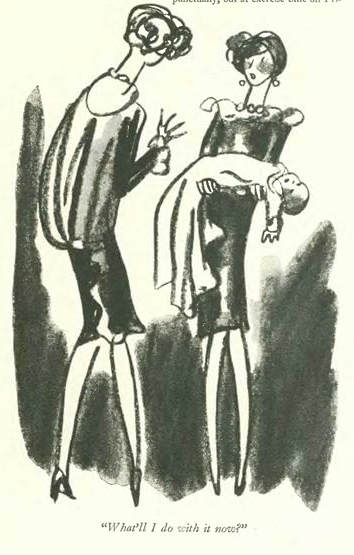
…and commented on his life as a new father…the woman holding the baby was doubtless inspired by his wife, New Yorker columnist Lois Long…
…for reference, Peter Arno and Lois Long are pictured here with baby daughter Patricia Arno in 1928…Lois clearly had a better grasp on the situation than Arno had imagined…
Arno and Long with their baby daughter, Patricia, in 1928. (Vanity Fair)
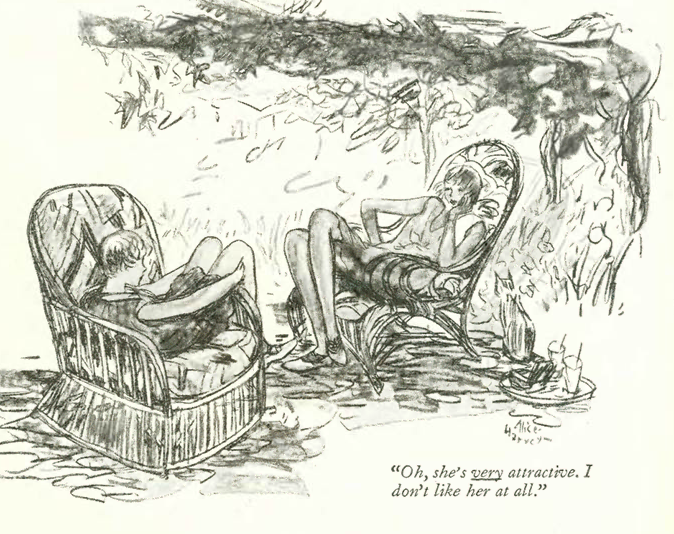
…Alice Harvey eavesdropped on a conversation between teenagers…
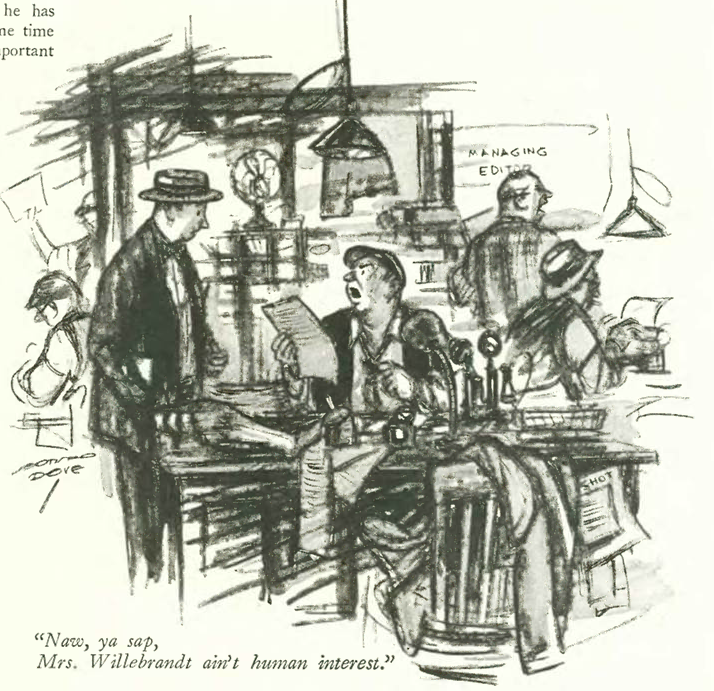
…and like Arno, Leonard Dove had two cartoons in this issue…here an editor finds the former Prohibition enforcer no longer newsworthy…
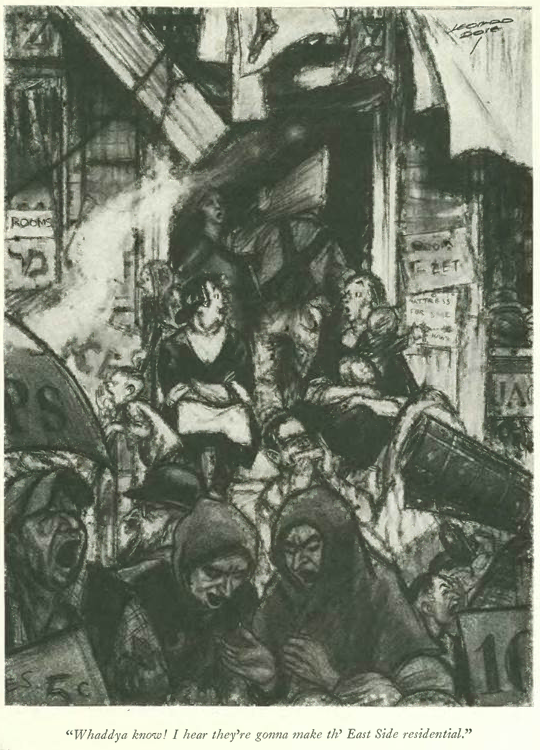
…and over on the East Side, rumors of gentrification…
Winding down the last summer of the 1920s — an unusually hot one — one detects subtle changes in The New Yorker’s mood; weary from the decade-long party known as the Roaring Twenties, a bit more mature, and more confident in its voice thanks to the regular writings of James Thurber, E.B. White and Lois Long and copious cartoons and illustrations by such notables as Peter Arno, Barbara Shermund and Helen Hokinson that gave the magazine a distinctively modern feel as it headed into the 1930s.
Aug. 10, 1929 cover by Theodore Haupt; Aug. 17 cover by Peter Arno.
The exuberance associated with the rapidly changing skyline was still there, however, as the Aug. 17 “Talk of the Town” speculated on the race for the world’s tallest building. The article not only anticipated an architect’s sleight of hand, but also a Zeppelin docking station that in the end would top the world’s tallest building:
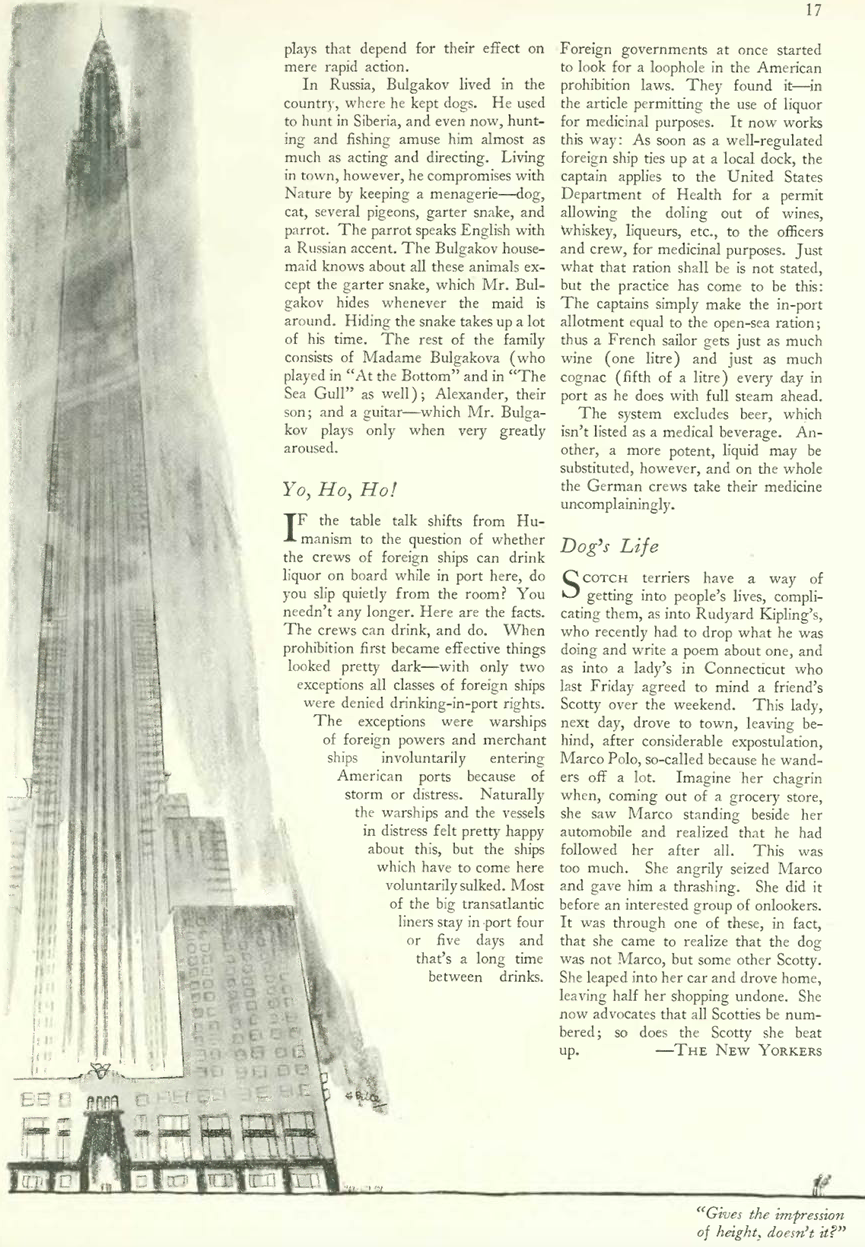
As it turned out, William Van Alen did not have to compete against himself, the commission for One Wall Street instead going to Ralph Walker, who would design a beautiful art deco landmark that, at 50 stories, would not vie for the title of the world’s tallest building. Unbeknownst to The New Yorker, and perhaps Van Alen, the challenger would instead be 40 Wall Street, which would hold the crown as world’s tallest for about a month. Thanks to some sleight of hand (see caption below) the Chrysler building would quickly surpass 40 Wall Street and hold the title for just eleven months, bested in the end by the Empire State Building (which would sport a “Zeppelin superstructure”).
DECO DELIGHTS…40 Wall Street (left) vied with the Chrysler Building for the title of the world’s tallest building. The 927-foot 40 Wall Street would claim the title in late April 1930. One month later, the Chrysler building would sprout a needle-like spire (secretly constructed inside the building) bringing its total height to 1,046 feet. The builders of 40 Wall Street cried foul and claimed that their building contained the world’s highest usable floor, whereas the Chrysler’s spire was strictly ornamental and inaccessible. Less than a year later the point was made moot when the Empire State Building soared above them both. (Wikipedia/The Skyscraper Museum)ERECTILE DYSFUNCTION…Clockwise, from top left, progression of designs for the Chrysler Building; the building’s architect, William Van Alen; drawing from Popular Science Monthly (Aug. 1930) revealed the inner workings of the spire’s clandestine construction; Zeppelin docking station for the Empire State Building as imagined in a composite (faked) photograph. At 1,250 feet, the wind-whipped mooring mast proved not only impractical, but downright dangerous. In September 1931 a dirigible briefly lashed itself to the mast in 40 mph winds, and two weeks later the Goodyear Blimp Columbia managed to deliver a stack of Evening Journals to a man stationed on the tower. Contrary to the faked photograph, no passengers ever transferred from the tower to a Zeppelin. (Skyscraper City/Wikipedia/NY Times)
* * *
What, Me Worry?
The famously flamboyant New York City Mayor Jimmy Walker lived the easy life during his initial years as Hizzonner, riding a booming economy, partying with the rich and famous (while flaunting Prohibition laws), carousing with his mistress (Ziegfield dancer Betty Compton) and sleeping until noon. When reform-minded Fiorello La Guardia challenged Walker’s reelection bid in 1929, Walker left the dirty work to his Tammany Hall cronies and continued to charm the public, and The New Yorker. The Aug. 17 “Talk of the Town” observed:
IT’S EASY BEING ME…Mayor Jimmy Walker accompanied actress Colleen Moore to the October 1928 premiere of her latest film, Lilac Time. (konreioldnewyork.blogspot.com)I HAVE MY EYE ON YOU…Reform-minded Fiorello La Guardia (right) detested Jimmy Walker and his Tammany cronies, but that wasn’t enough to get him elected in 1929. The Great Depression would soon turn the tables. (Wikipedia)
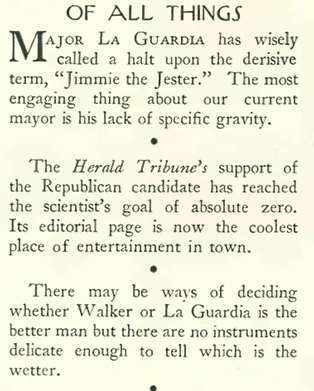
Howard Brubaker, in his Aug. 17 “Of All Things” column, suggested that La Guardia had a zero chance of getting elected. Just three years later, Walker would resign amid scandal and flee to Europe. La Guardia, on the other hand, would be elected to the first of his three terms as mayor in 1933, riding the wave of the New Deal.
* * *
Peek-A-Boo
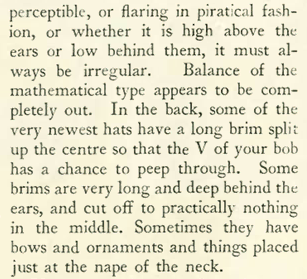
Politics might have been business as usual, but in the world of fashion the vampish hat styles associated with flappers were giving way to a new rolled-brim look that seemed to suggest an aviator’s helmet. In her Aug. 17 fashion column “On and Off the Avenue,” Lois Long reported:
FACING THE FUTURE…Vampish hats of 1928, pictured at top, gave way to the rolled-brim or flare look of 1929. (Images gleaned from magazine/catalog images posted on Pinterest)
Long seemed to welcome the idea that women should once again bare their foreheads…
* * *
Twain Wreck
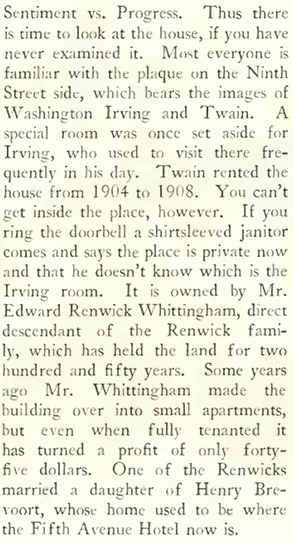
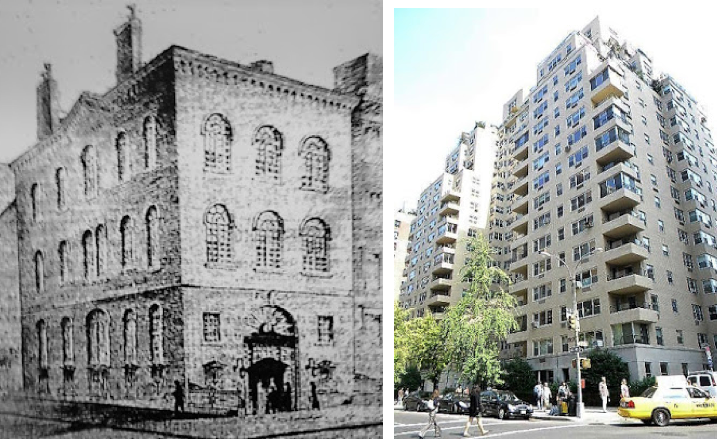
Jumping back to the Aug. 10 issue, “The Talk of the Town” reported on the possible remodeling or demolition of a house once occupied by Samuel Clemens, aka Mark Twain. The house in question was a lavish old mansion built by Henry Brevoort, Jr. in 1834, at the northwest corner of Fifth Avenue and 9th Street. Twain lived in the house from 1905 to 1908, and it was there that Twain’s biographer Albert Paine conducted interviews with the author and wrote the four-volume Mark Twain, a Biography; The Personal and Literary Life of Samuel Langhorne Clemens. When millionaires abandoned their Fifth Avenue mansions in the 1920s and high-rise apartments took their place, there was pressure to either convert an old mansion like the Breevoort house at 21 Fifth Avenue to apartments or demolish it altogether.
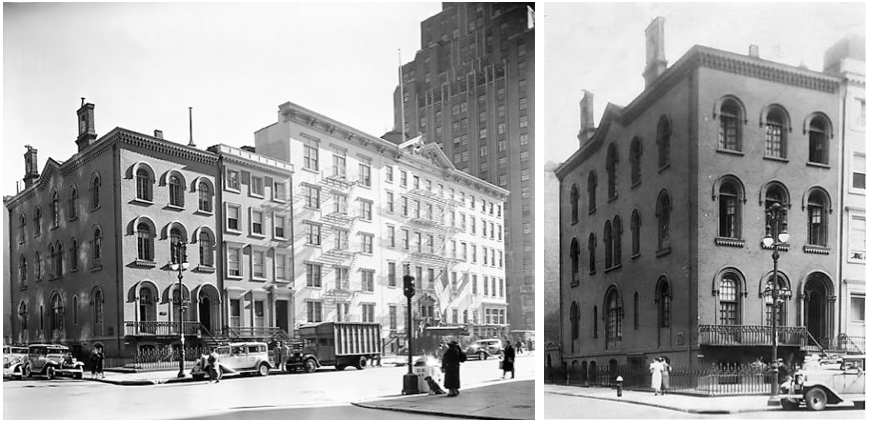
LOOKING GOOD AFTER A CENTURY…At left, Berenice Abbott took this photograph of No. 21 Fifth Avenue in 1935. At right, in a close-up shot from the same period, the 1924 plaque from the Greenwich Village Historical Society is visible on the side of the house. (Museum of the City of New York/Greenwich Village Historical Society)A NOW FOR SOMETHING COMPLETELY DIFFERENT…A proposed 1929 remodeling (left) moved the front door of the old Brevoort mansion to the center and lowered it to street level. At right, today the 1955 Brevoort apartment house occupies the site. (daytoninmanhattan.blogspot.com)
The Greenwich Village Historical Society did what it could to save the house, and in 1924 affixed a bronze plaque to a side wall noting that both Twain and Washington Irving were once occupants. When the house was slated for demolition in 1954, the Society appealed to New Yorkers to raise the $70,000 needed to move the building, but only a fraction of that amount was secured. No. 21 was demolished in 1954 along with the rest of the houses on that block.
* * *
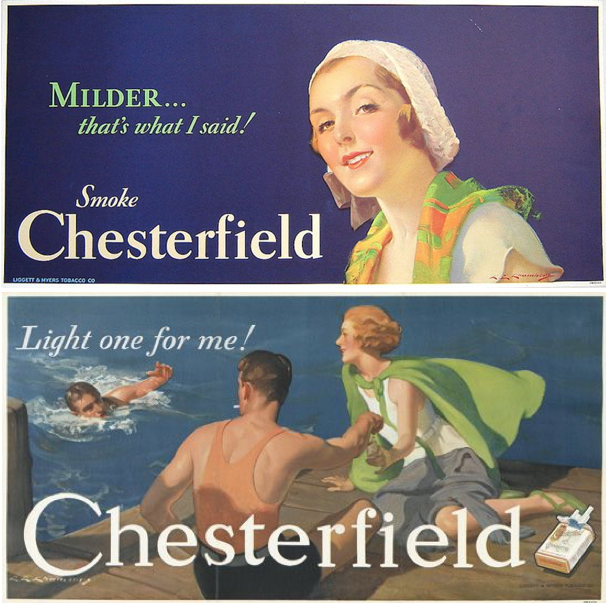
Charles Edward Chambers was an American illustrator probably best known for his Chesterfield ads, although he also illustrated stories for a number of popular magazines from the early 1900s until his death in 1941. The Aug. 10 “Talk of the Town” looked in on his work with model Virginia Maurice:
QUICK…THROW THAT MAN A CIGARETTE!…Examples of Charles Edward Chambers’ Chesterfield ads from 1929 featuring model Virginia Maurice. Note that Maurice is wearing the latest “rolled brim” hat style in the upper image. (Pinterest)HIS NONSMOKING SECTION…A 1919 Harper’s cover illustration by Charles Edward Chambers. (Wikipedia)
* * *
Mama’s Boy
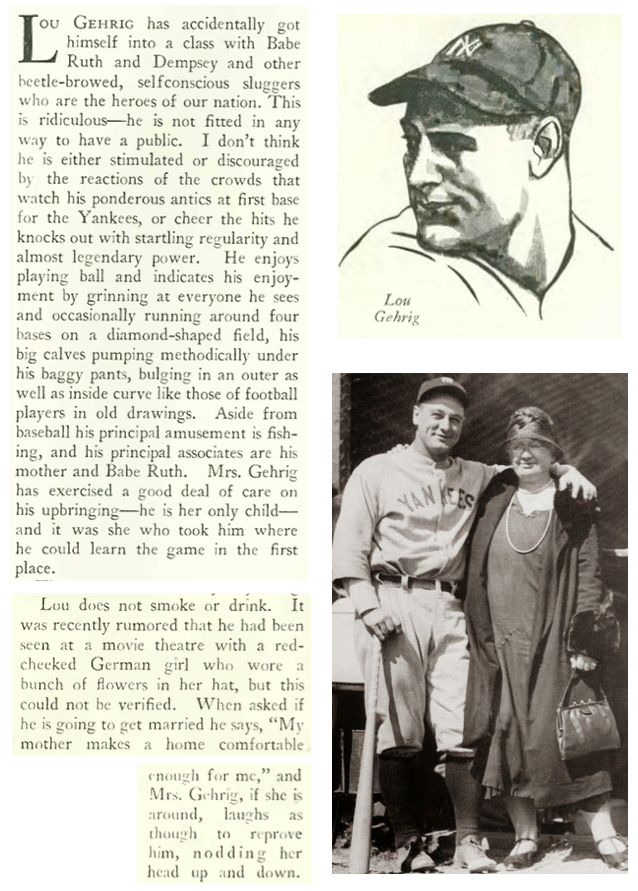
Lou Gehrig rivaled Babe Ruth as a top Murderer’s Row slugger for the 1929 Yankees, yet he couldn’t be more opposite in his lifestyle. A teetotaler and nonsmoker, Gehrig was completely devoted to mom (pictured below in 1927). Niven Busch Jr. submitted this profile of Gehrig for the Aug. 10 issue. Excerpts:
* * *
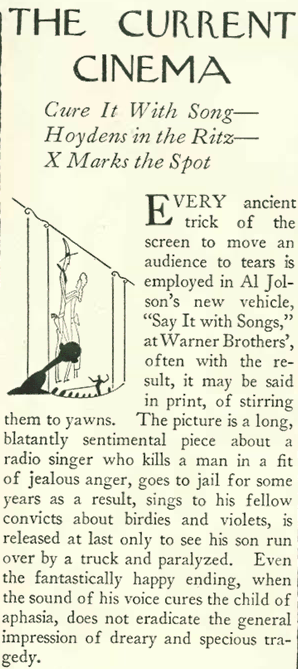
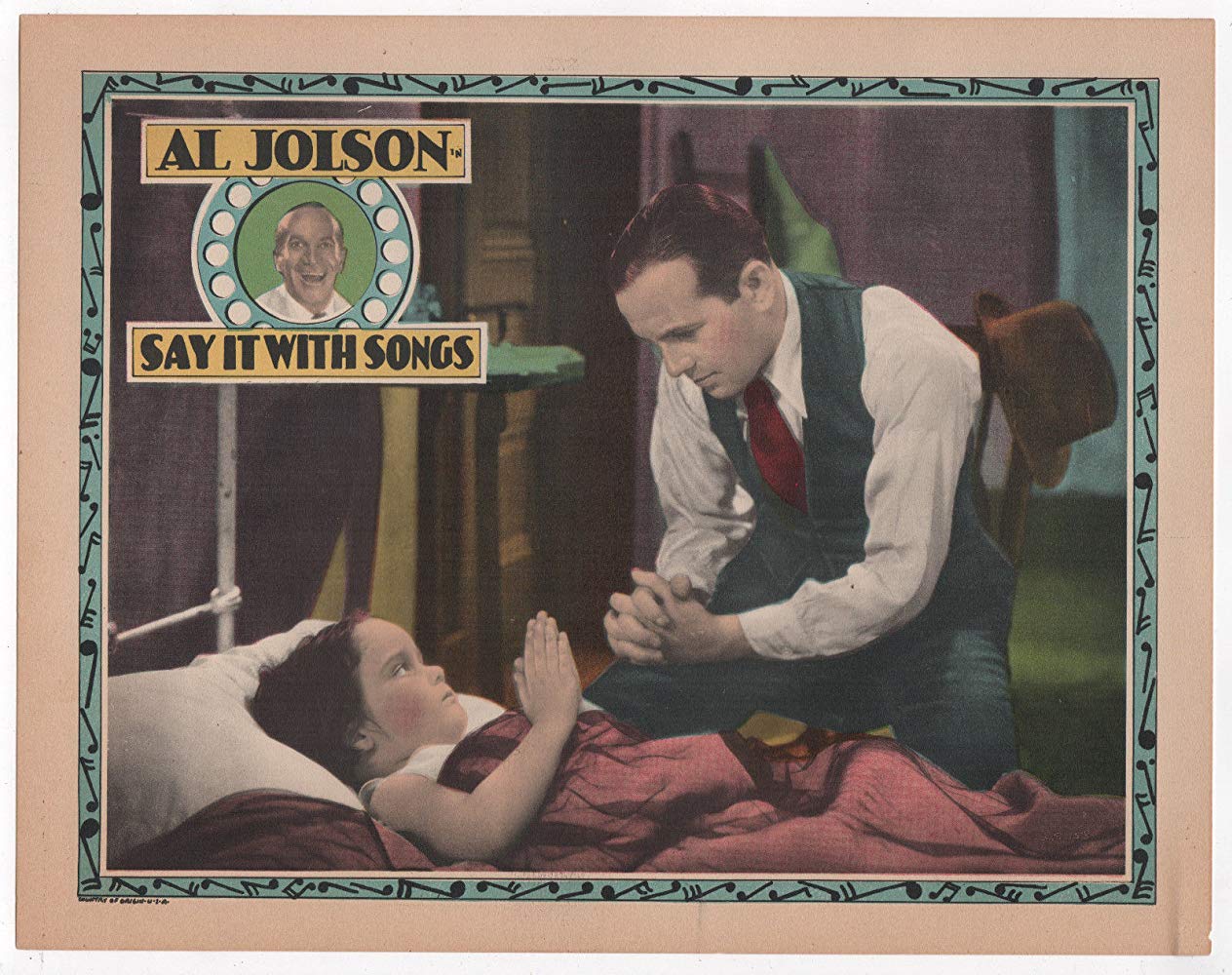
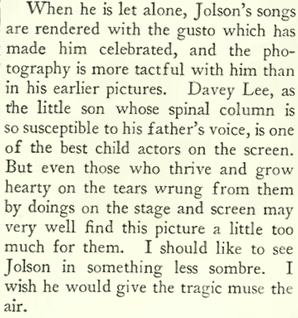
After appearing as Al Jolson’s dying son in The Singing Fool (1928), the child actor Davey Lee returned to the screen for yet another Jolson weeper, 1929’s Say It With Songs. Once again portraying Jolson’s son—this time crippled and rendered dumb after being hit by a truck—he miraculously recovers at the end of the film. The New Yorker wasn’t having any of this sentimental treacle, especially served up for a second time…
LET’S PRAY FOR A BIG BOX OFFICE…Davey Lee and Al Jolson in Say It With Songs. (IMDB)
…and the magazine hoped for something a bit less somber from Jolson in the future, suggesting that he “give the tragic muse the air”…
In the same issue of The New Yorker, this advertisement touted Jolson’s recording of “Little Pal” from Say It With Songs (note the blackface image of Jolson—his unfortunate trademark back in the day)…
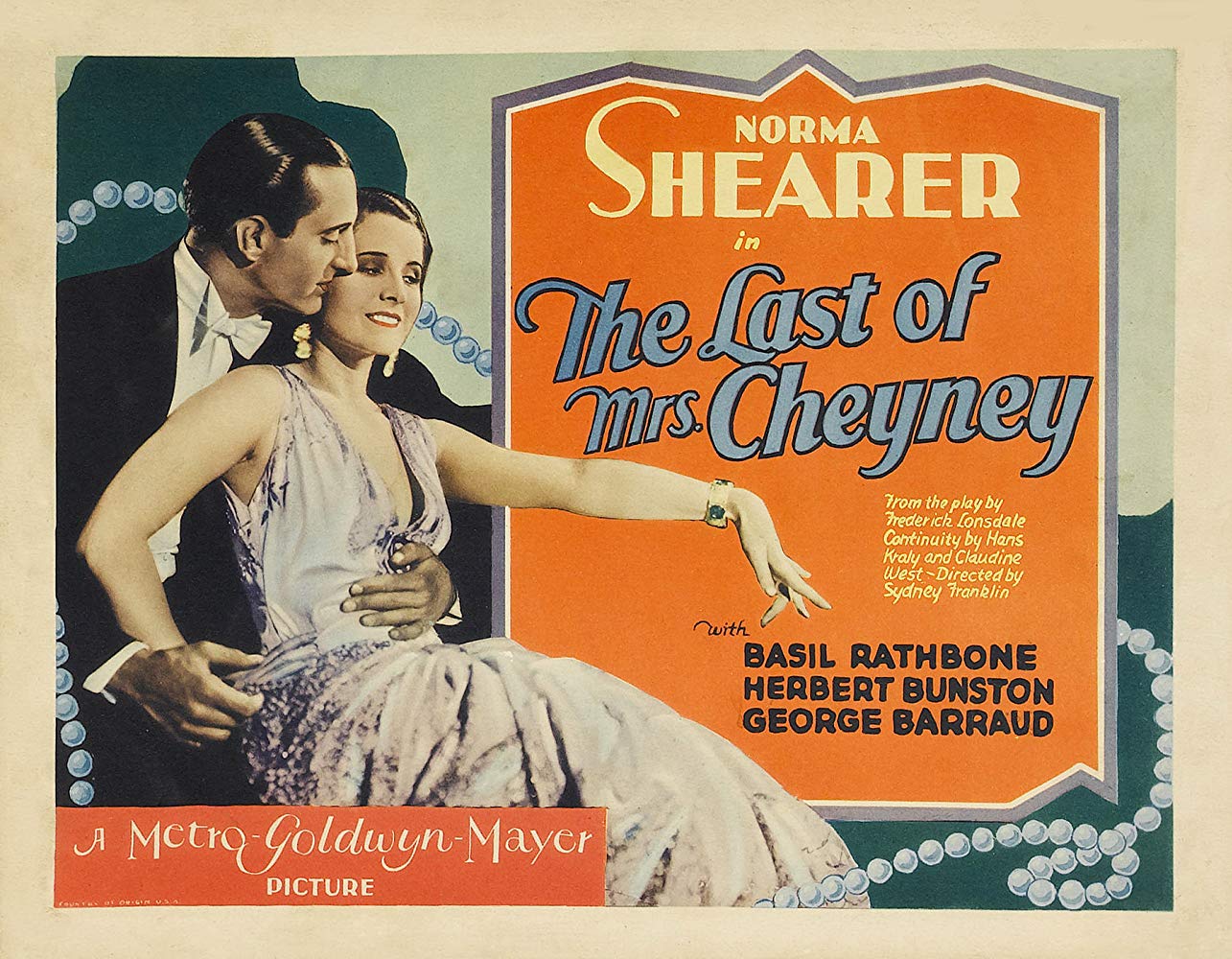
…happily, there were other movies that offered less schmaltzy diversions, including Norma Shearer’s comedy-drama The Last of Mrs. Cheyney, in which Shearer portrayed the jewel thief Fay Cheyney…
OH BASIL YOU ANIMAL…Theatre card for The Last of Mrs. Cheyney. (IMDB)
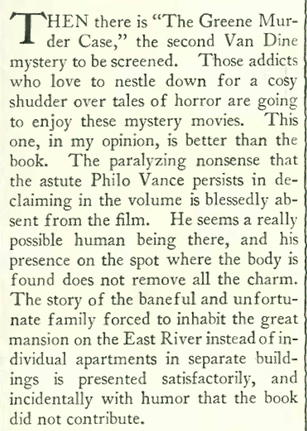
…often cast as a heavy in silent films, it was the “talkies” that made William Powell a star, his pleasant voice more suited to a hero or leading man than a villain. In The Greene Murder Case, Powell portrayed amateur detective Philo Vance, a role that he played in another 1929 release, The Canary Murder Case (originally filmed as a silent in 1928), both based on mystery novels by S.S. Van Dine. Powell would portray Philo Vance in three more films from 1930 to 1933 until he took on the role of another amateur detective, Nick Charles, in 1934’s The Thin Man (a role he would reprise five times from 1936 to 1947)…
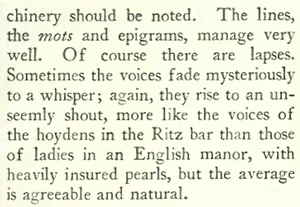
WHODUNNIT? YOUDUNNIT!…William Powell as detective Philo Vance, Florence Eldridge as Sibella Greene, and Jean Arthur as Ada Greene in 1929’s The Greene Murder Case. (IMDB)KEEPING IT QUIET…William Powell as Philo Vance and Louise Brooks as “the Canary,” a scheming nightclub singer, in The Canary Murder Case. Brooks was a huge star in the silent era and the iconic flapper. According to IMDB, the film was shot as a silent in 1928, but producers decided to rework it as a more profitable “talkie.” When Brooks refused to return from Germany (where she was filming Pandora’s Box) to dub the movie, Paramount spread the word that Brooks’ voice was not suited to sound film, although later productions made by Brooks proved this to be wrong. Actress Margaret Livingston ultimately supplied Brooks’ voice for Canary. (IMDB)
* * *
From Our Advertisers
We look at some advertisements from the August 17 issue, including this one from Past Blue Ribbon. Note that nowhere in the ad is the word “beer” used, this being a “near-beer” with less than 1% alcohol content by volume. In addition to making cheese (a Velveeta-like product), Pabst hoped to keep its company alive by selling this “brew” during the unusually hot summer of 1929…
…and with that blazing sun advertisers also promoted a number of face creams and powders to those “enjoying the sunny outdoor life,” including this two-page spread from Richard Hudnut and Poudre Le Début…
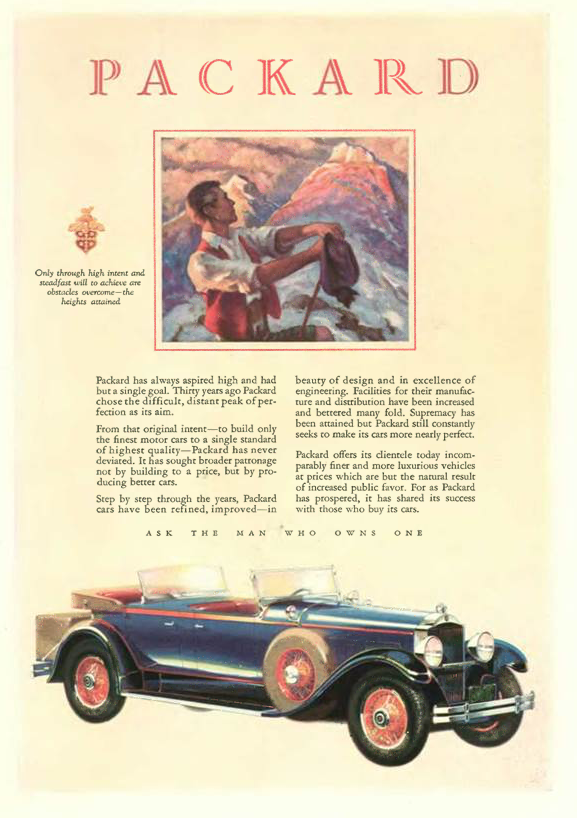
…the outdoor life could also be enjoyed in a convertible Packard 640, a car that was a cut above a Lincoln or Cadillac, and was considered by some to be America’s answer to the Rolls Royce…
A 1929 Packard 640 Convertible. This particular model can be had today for about $130,000. (Hemmings Motor News)
…I found this ad in the back pages interesting for its crude design yet overt appeal to snobbishness with this haughty pair…
…and here is what the Park Lane looked like when it opened in 1924…
Circa 1924 advertisement from the Sargent lock and hardware company touting its fixtures in the new Park Lane hotel apartments. At right, circa 1924 image from The American Architect depicting the Park Lane’s dining room. The building is long gone, razed some time in the 1960s to make way for an office tower. (Pinterest)
* * *
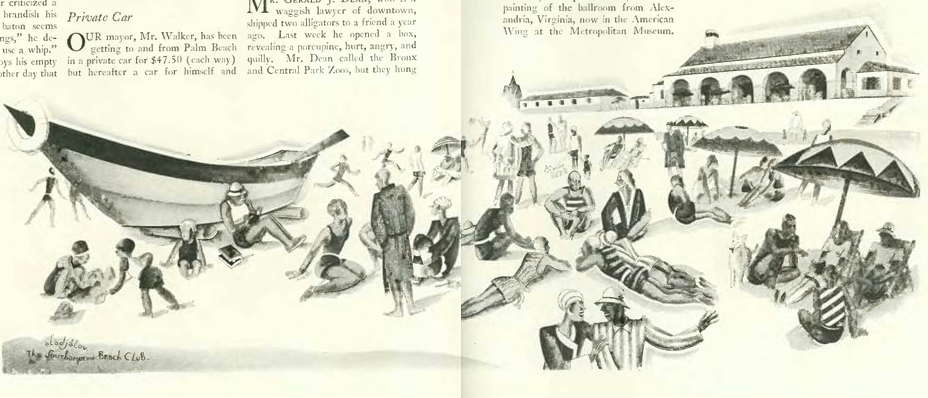
This week’s featured illustration is by Constantin Alajalov, who depicted a summer scene from the Southampton Beach Club…click to enlarge…
…our cartoonists from the Aug. 10 issue include Helen Hokinson, who looked at the challenges of Americans abroad…
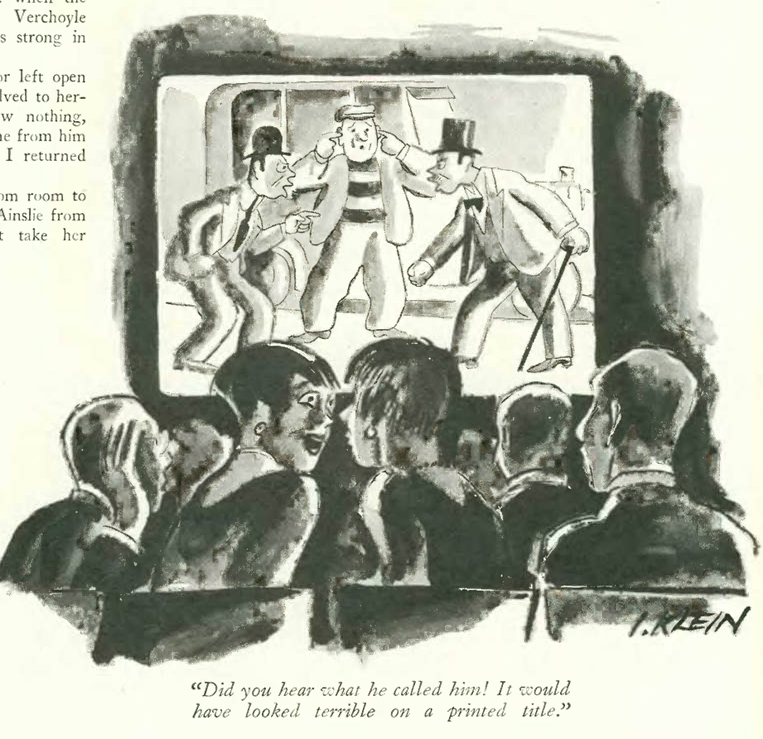
…Isadore Klein observed the changing mores of movie houses (a couple of “damns” were apparently uttered in the talking pictures of 1929)…
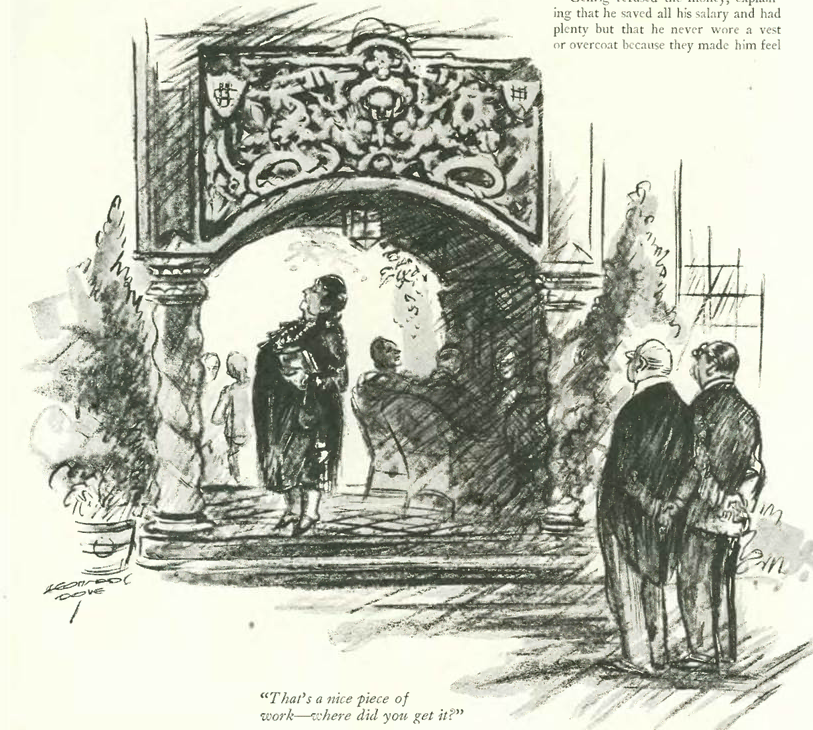
…and Leonard Dove offered up a double entendre of sorts…
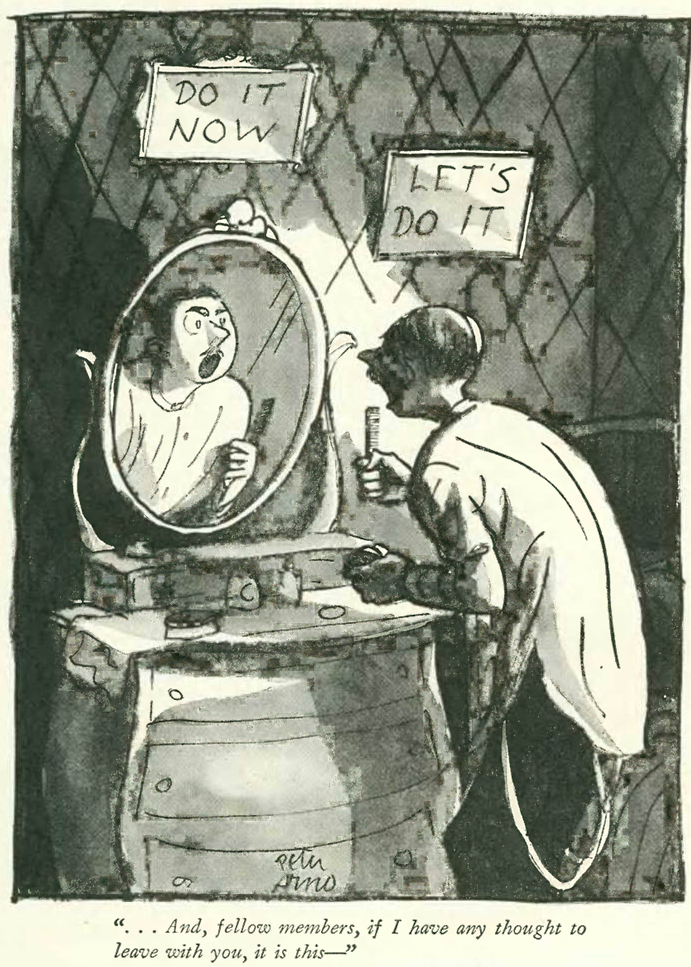
…cartoons for the Aug. 17 issue included a peek behind the scenes at a motivational speaker courtesy Peter Arno…
…Carl Kindl had some fun with the juxtaposition of a matron and a flapper hat…
…and for reference, the cloche hat called a “Scalawag” was featured in this ad by Knox in the March 30, 1929 New Yorker…drawing by Carl “Eric” Erickson…
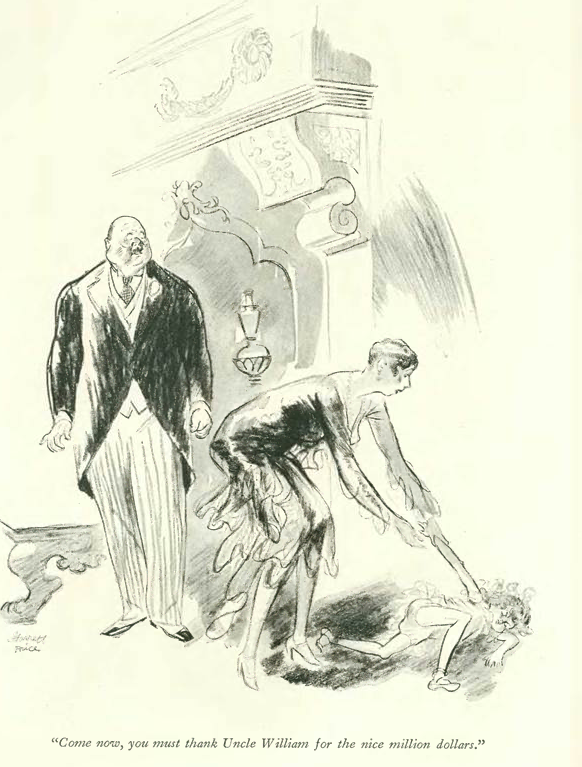
…Garrett Price portrayed the antics of an ungrateful trust fund brat, who probably did not have that million dollars after the market crash…
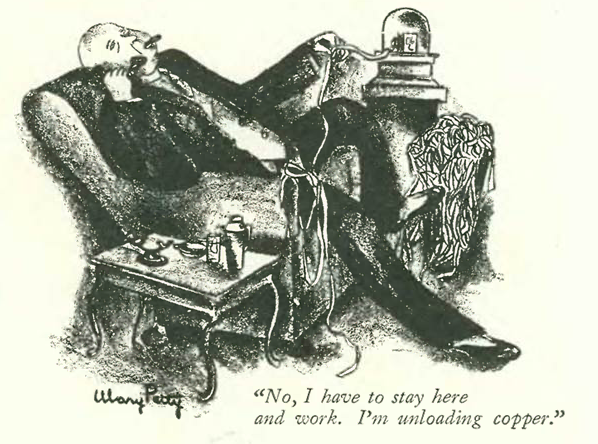
…and this fellow, depicted by Mary Petty, who doubtless would be less nonchalant come Oct. 28, or what we know as “Black Monday”…
About a decade before he joined the Nazis in spreading the madness of war across the European continent, Italian dictator Benito Mussolini penned a historical novel about a love affair between a Catholic cardinal and his beautiful mistress. Despite the premise, it was not exactly a Harlequin Romance.
Sept. 8, 1928 cover by Julian de Miskey. Sept. 15, 1928 cover by Peter Arno.
Although many perceived Mussolini as nothing more than a thug, or even a clown when he styled himself as Il Duce, Mussolini thought himself an intellectual, and as a younger man sometimes worked as a journalist and essayist. That was also when he wrote his one and only novel, The Cardinal’s Mistress (1909), serialized in the socialist newspaper Il Popolo under the original title Claudia Particella, l’Amante del Cardinale: Grande Romanzo dei Tempi del Cardinale Emanuel Madruzzo. When it was translated into English in 1928, the distasteful task of reviewing the book (in the Sept. 15, 1928 issue) fell to Dorothy Parker. She began thusly:
In all fairness, Parker did ask for it. She went on to write “On the memorable day that The Cardinal’s Mistress arrived in the office of this lucky magazine, I was the girl who pled, ‘Please, teacher, may I have it to take home with me? Honest, I don’t want a cent of money for reviewing it. I’ll do it free of charge; I’ll even pay handsomely for the privilege.’ Well, of course, they wouldn’t hear a word of that – or at least I hope to heaven they didn’t – but I got the book. I had all sorts of happy plans about it. I was going to have a lot of fun. I was going to kid what you Americans call the tripe (les tripes) out of it. At last, I thought, had come my big chance to show up this guy Mussolini. A regular Roman holiday, that’s what it was going to be.” But it didn’t quite turn out that way:
Alfred Armstrong, writing for Oddbooks (oddbooks.co.uk) describes The Cardinal’s Mistress as a story about a historical figure, Emanuel Madruzzo, Cardinal of Trent, his mistress Claudia Particella, “and the unhappy course of their love affair.” Armstrong notes that the book was written rather carelessly, with a wandering plot that suggests Mussolini’s only interest in the characters was to place them in a historical setting that provided “an excuse for lengthy anti-clerical rants, and to portray the lust, vengefulness and murderousness of their adversaries.”
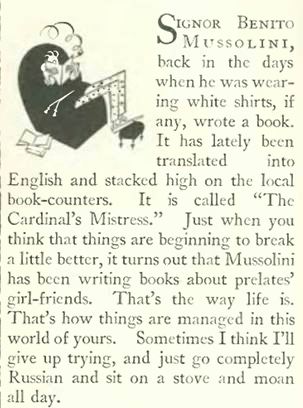
Although she could not make heads nor tails out of the book, it did stir Parker’s imagination enough to conjure up an insult for the “old Duce.”
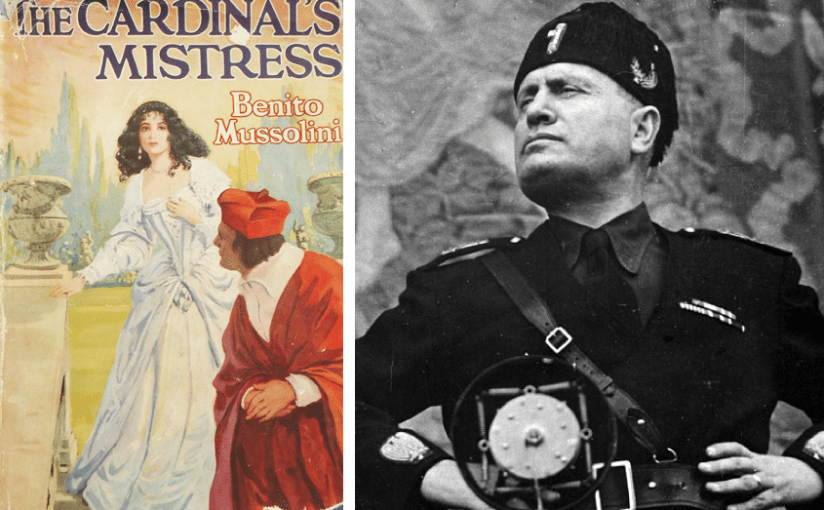
WHERE IS THE LOVE?…Cover of the 1928 translation of The Cardinal’s Mistress, an anti-clerical rant thinly disguised as a love story. At right, Benito Mussolini in 1928. (Amazon/waralbum.ru)
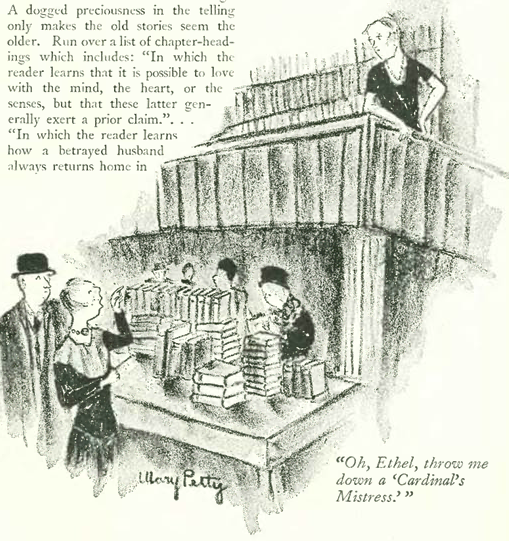
For good measure, I’ll toss in this New Yorker comic by Mary Petty that appeared a few weeks later in the Oct. 20, 1928 issue:
* * *
The Sound Stays in the Picture
Gilbert Seldes joined the chorus of voices at The New Yorker who decried the advent of sound in motion pictures, particularly when sound was used as a gimmick rather than as an enhancement to the production. So when Paramount’s Jesse Lasky and Adolph Zukor put their hands (and their sounds) on Ernst Lubitsch’s masterpiece The Patriot, Seldes decided he’d had enough of this “talkie” nonsense, taking on the producers in a special feature in the Sept. 15 issue titled “The Old Believers:”
Hugo Gellert paid his own respects to The Patriot with this illustration in the theatre review section of the Sept. 15, 1928 issue.
Following his opening salvo, Seldes told readers why the film was important, how it revived his faith in movies and even in the possibility of intelligence and taste among the masses:
PERNICIOUS INTERFERENCE…Critic Gilbert Seldes took aim at Paramount execs Adolph Zukor, far left, and Jesse Lasky, center, for mucking up Ernst Lubitsch’sThe Patriot with unnecessary sound effects. All photos circa 1922. (Wikipedia)
As for the taste and intelligence of producers, that was another matter. Seldes concluded his piece by laying into Zukor and Lasky for their “pernicious interference” with the masterpiece:
Seldes was so disheartened that he wondered if movies, as an imaginative and intelligent art form, would be dead in ten years.
Seldes was wrong about the death of good movies, but ironically his beloved Patriot would not live on, and would disappear into the land of lost films. There are fragments in a UCLA archive, but no negative or set of complete reels are known to exist.
WHY YOU NAUGHTY OLD CZAR…Florence Vidor as Countess Ostermann and Emil Jannings as Czar Paul I in The Patriot. Nominated for five Oscars, the film would win in the “Best Writing” category at the 1930 Academy Awards. (mubi.com)
* * *
Before He Was Kooky and Ooky
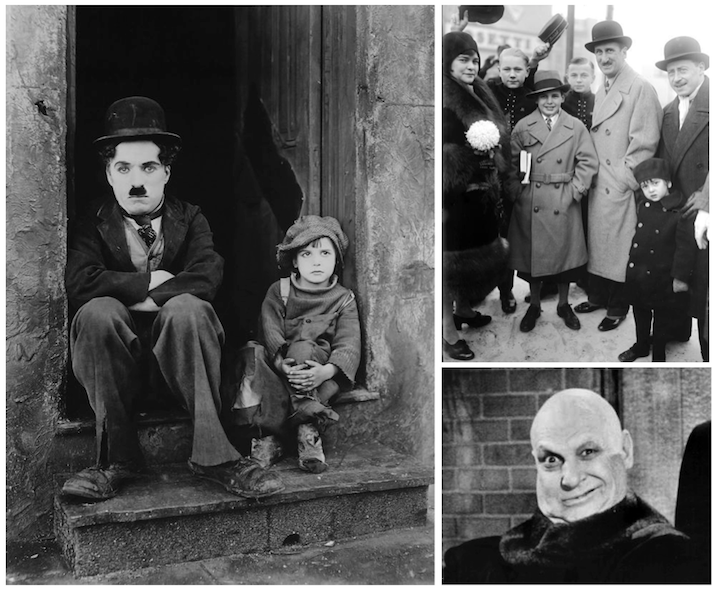
The child actor Jackie Coogan was the focus of a lengthy “Talk of the Town” piece that looked in on the life and habits of the young film star, best known for his role in Charlie Chaplin’s 1921 film classic The Kid.
Coogan was one of the first child stars in film history, earning an estimated $3 to $4 million (roughly more than $50 million in today’s dollars). “Talk” found the 13-year-old star in his dressing room, reading a theatrical newspaper:
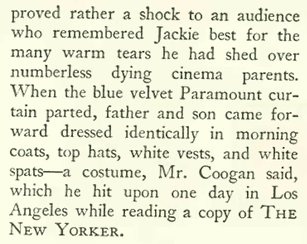
TheNew Yorker couldn’t resist mentioning that the magazine itself proved to be an inspiration to the boy and his father:
As one of the first child stars Coogan also broke some tough ground for other child actors to follow. In early 1935 Jackie’s father, John Henry Coogan, Jr., was killed in a car accident. John Henry conservatively managed Jackie’s assets, but after his death John Henry’s widow, Lillian and her new husband Arthur Bernstein (who was the family lawyer), squandered most of Jackie’s fortune on fur coats, diamonds and expensive cars. Jackie Coogan sued them in 1938, but after legal expenses was only able to recover a mere $126,000 of his earnings. One good outcome was California’s enactment in 1939 of the first known legal protection for the earnings of child performers. The California Child Actor’s Bill, sometimes called the “Coogan Act,” required employers of child actors to set aside 15 percent of their earnings in a trust.
Coogan would go on to perform in mostly supporting roles and would marry four times, most famously to actress Betty Grable from 1937 to 1939. He gained renewed fame in the 1960s by portraying Uncle Fester in the Addams Family TV series.
VARIETY ACT…Clockwise, from left: Publicity photo from Charlie Chaplin’s 1921 movie The Kid, featuring 6-year-old Jackie Coogan; Coogan on a 1928 visit to Berlin with his mother Lillian and father John Henry Coogan, Jr.; as Uncle Fester in TV’s The Addams Family, 1966. (Wikiwand/Wikimedia)
* * *
From Our Advertisers
A mixed bag from the Sept. 15 issue, including this strip of ads near the back of the magazine that indicate not all New Yorker readers were as well-heeled as those who were targeted by the splashier, full-page ads in the magazine’s front section…
…and yet another endorsement for Old Gold cigarettes, this time from the Duchess of Sutherland, who joined fellow blue bloods in the blindfold test:
Nothing like profiting from the misery of others. In this ad, James McCreery & Company offered up rugs from “old Turkish families” who were “forced to sell their rare rugs and jewels in order to exist.” They weren’t cheap: the rug pictured was offered for $3,250, more than $45,000 in today’s buying power.
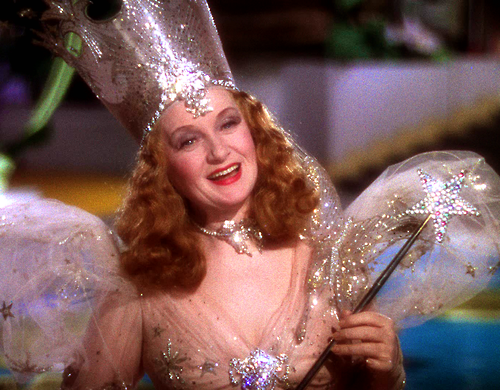
The “famous stage beauty” and early silent film star Billie Burke (who was married to Florenz Ziegfeld of “Follies” fame) shilled for Cutex nail polish…
…and 11 years later would portray Glinda the Good Witch of the North in the movie musical The Wizard of Oz.
Billie Burke as Glinda the Good Witch (cinemagumbo)
Now for the cartoons, Peter Arno from the Sept. 8 issue…
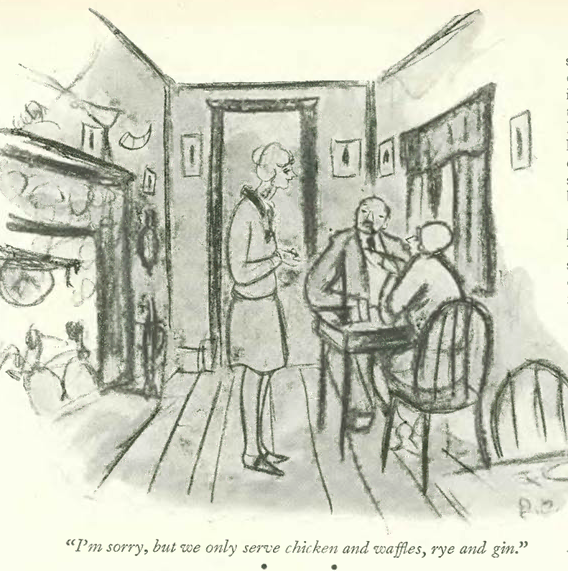
And in the Sept 15 issue, W.P. Trent looked in on a homey café that moonlights as a speakeasy…
…and back to Arno, who looked in on toffs slumming at Coney Island…
Broadway shows were a popular nightlife diversion for New York’s upper middle-class, but plays and musicals were only part of an evening’s entertainment. The city’s “after theatre” clubs beckoned those who enjoyed an evening of dance with the Astaires or a light comedy with Lunt and Fontanne, but believed the night was still young.
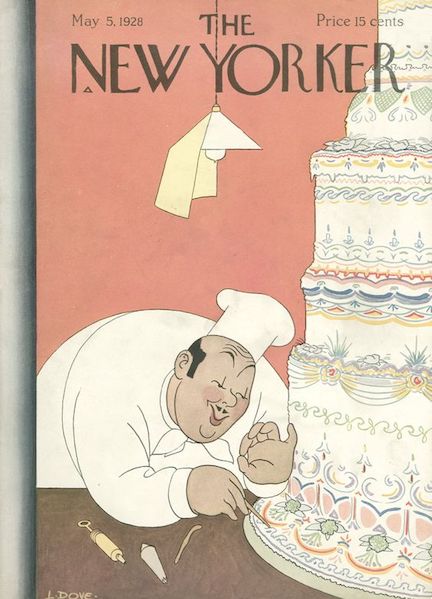
May 5, 1928 cover by Leonard Dove.
And who better to chronicle the late night revelry than Lois Long, who through her “Tables For Two” column was a leading voice of after hours Manhattan and a nightly presence in its various clubs and speakeasies. Longtime New Yorker writer Brendan Gill (Here at the New Yorker) observed that Long, who joined the magazine in 1925, “had plunged at once, joyously, into a New York that seemed always at play — a city of speakeasies, night clubs, tea dances, football weekends, and steamers sailing at midnight.”
In May 1928 Long had been married for about nine months to colleague and cartoonist Peter Arno, who was also a regular fixture of the nightclub scene. But in Long’s column for May 5, 1928, one can detect a bit of weariness setting in, the 27-year-old sensing the next generation didn’t know how to have a good time.
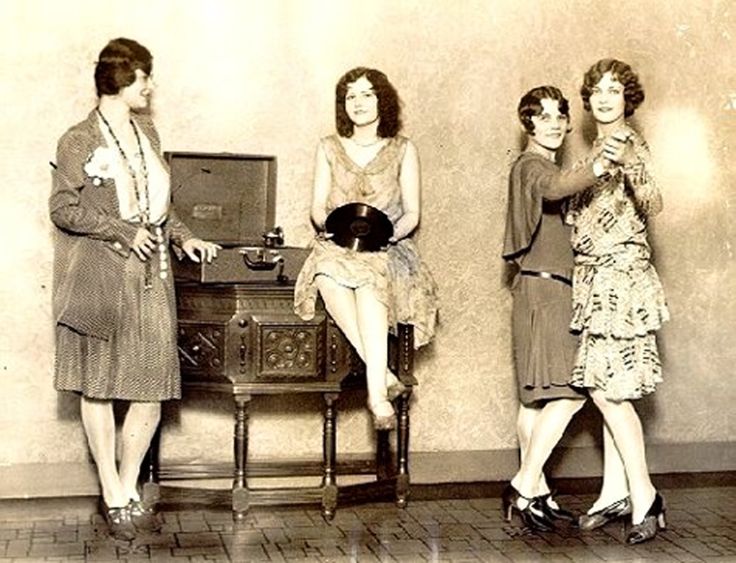
And it didn’t help that the younger people were dancing to “canned music,” what with the spread of broadcast radio and improvements in phonograph records…
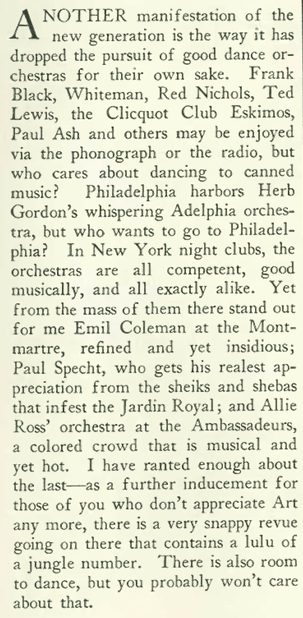
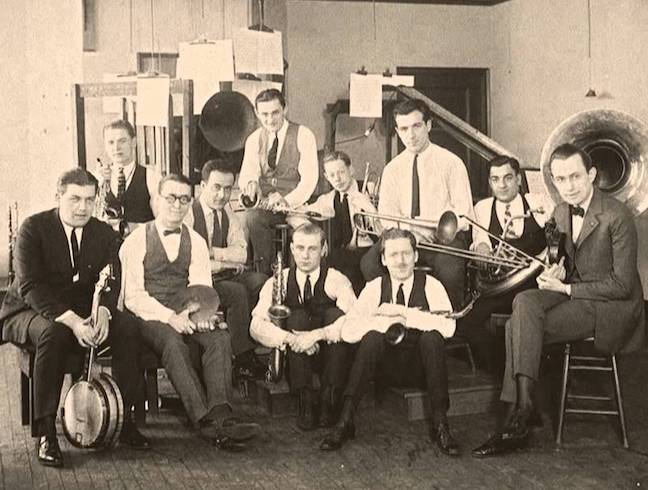
LIPSTICK WAS A FAN of the Paul Specht Orchestra, seen here in 1928. (YouTube)BUT NOT A FAN of those darn kids who preferred records to live music, and didn’t know how to party at the clubs. (Pinterest)
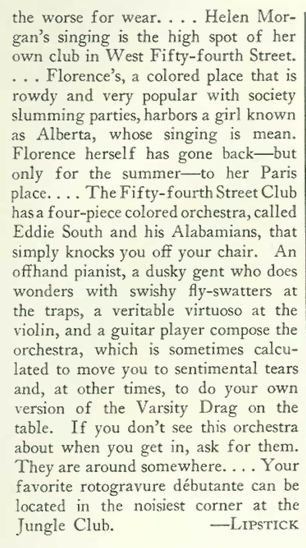
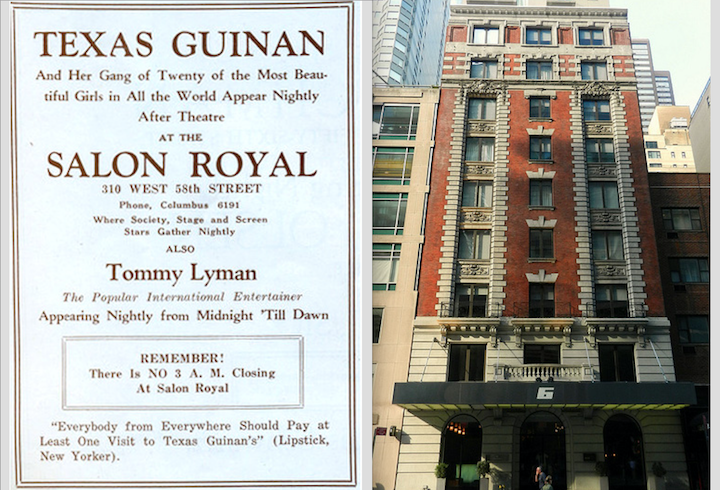
For those on the wilder side, Long recommended a number of after-hours entertainments, including Texas Guinan’s latest all-night club, Salon Royal, and its snake-charming hootch dancer.
WHOOPEE was the order of the day at Texas Guinan’s Salon Royal on West 58th Street, now refurbished as the 6 Columbus Hotel. Guinan was well known to New Yorker writers and editors and was a frequent guest of the numerous parties hosted by Harold Ross and Jane Grant in their Hell’s Kitchen brownstone. (texasguinan.blogspot)
Because so many New Yorker readers were both theatre and after-theatre-goers, the magazine included some of the after-dinner destinations in its “Goings On About Town” section. Excerpts follow.
Rubberneckers
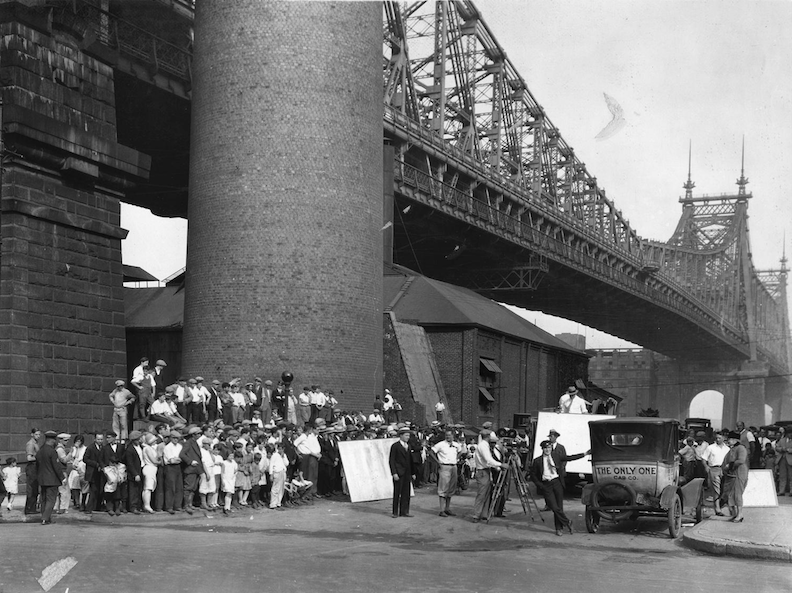
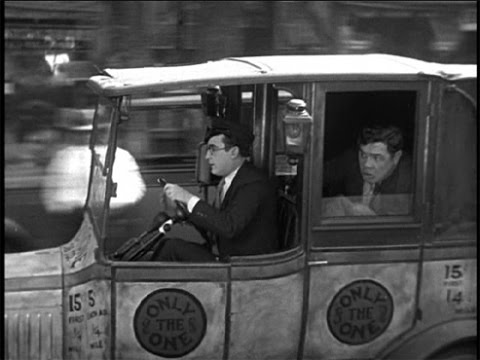
A May 5 “Talk of the Town” segment (written by James Thurber) commented on the challenges film crews faced when they shot on location in the city, in this case the production of Harold Lloyd’s latest comedy, Speedy:
LOCATION, LOCATION, LOCATION…Silent film star Harold Lloyd (leaning on car at right) and his crew draw a crowd under Queensboro Bridge during the filming of Speedy. (silentlocations.wordpress.com)BABE IN THE CITY…Harold Lloyd takes baseball legend Babe Ruth for a wild spin in 1928’s Speedy. (YouTube)
* * *
Before Mommie Dearest
The actress Joan Crawford is best known today as the subject of the 1981 biopic, Mommie Dearest, which portrayed Crawford as an insecure, abusive parent to her adopted daughter Christina (the film was based on a 1978 memoir and exposé of the same name written by Christina Crawford).
But in the 1920s and 30s the former dancer and chorus girl was better known for her sex appeal, attractive to men for her looks and to women for the roles in which she portrayed hard-working women who find both romance and success.
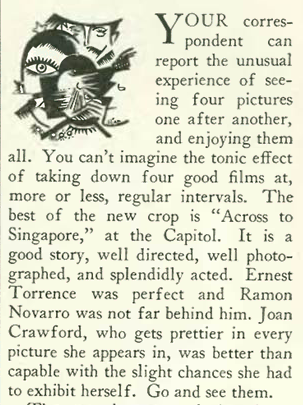
PRETTY PICTURE…Ramon Novarro and Joan Crawford in Across to Singapore, 1928. (Silent Hollywood)
TheNew Yorker took notice of Crawford in its review of Across to Singapore, the critic O.C. noting that Crawford “gets prettier in every picture”…
Another film released later in 1928, Our Dancing Daughters, would make Crawford a star and a symbol of the liberated, 1920s flapper. Even the writer F. Scott Fitzgerald would observe that “Joan Crawford is doubtless the best example of the flapper, the girl you see in smart night clubs, gowned to the apex of sophistication, toying iced glasses with a remote, faintly bitter expression, dancing deliciously, laughing a great deal, with wide, hurt eyes. Young things with a talent for living.”
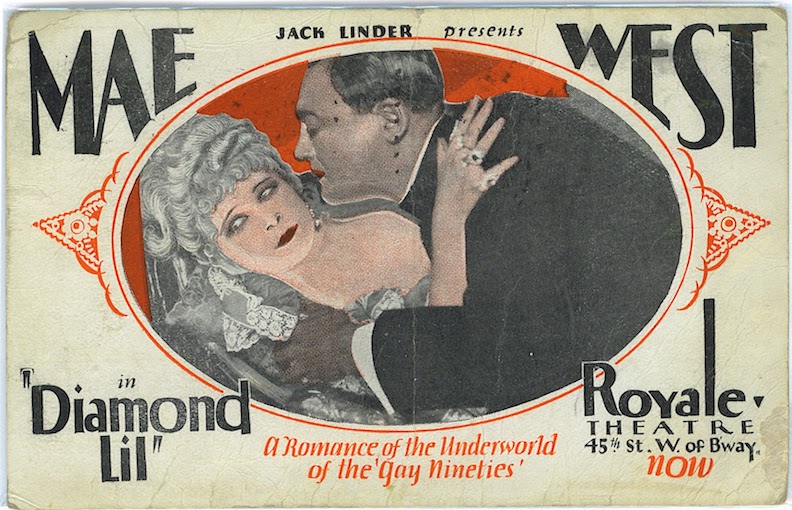
Another actress with a talent for living was 34-year-old Mae West, who was appearing on Broadway in Diamond Lil. Already a 21-year veteran of the stage (she began performing in vaudeville in 1907 at age 14), West was known for writing and performing in risqué plays beginning in 1926, when she appeared in Sex, which was panned by conservative critics but enjoyed hot ticket sales.
Subsequent plays aroused controversy and kept her name in the newspapers, but her play Diamond Lil would become the Broadway hit that would cement her image as a sex symbol, one she would maintain until her death at age 87 in 1980. In the May 5 issue artist Miguel Covarrubias offered his vision of the Queen of the Bowery:
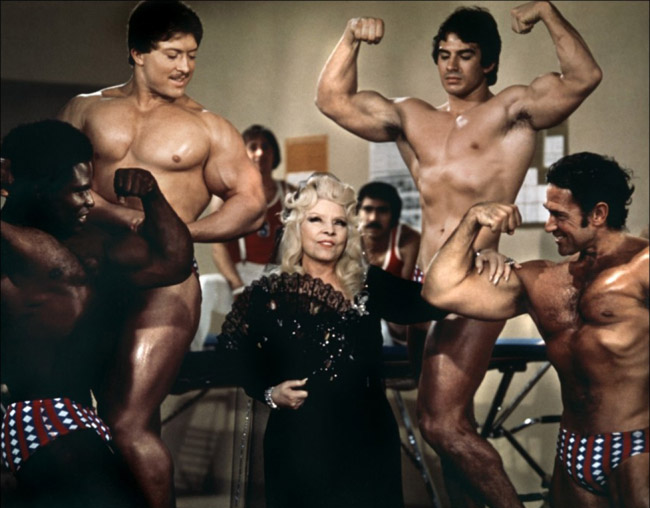
THEATRE CARD for the Broadway production of Diamond Lil at the Royale Theatre. (maewest.blogspot.com)STILL AT IT 50 YEARS LATER…The 86-year-old Mae West in her last film, 1978’s Sextette. In a 1979 review, New York Times film critic Vincent Canby called the film “a disorienting freak show in which Mae West, now 87 years old, does a frail imitation of the personality that wasn’t all that interesting 45 years ago. The movie, which opens today at the Victoria and other theaters, is a poetic, terrifying reminder of how a virtually disembodied ego can survive total physical decay and loss of common sense.” (filmcomment.com)
From Our Advertisers
It’s interesting to see how 1920s advertisers made even the most mundane gadgets appear to be vital to one’s survival. The ad for the “Sesamee” auto switch lock is a case in point, appealing to upscale female readers with this odd scenario in which the gadget enables the driver to avoid the awkward and potentially hazardous situation depicted below, although it hard to see what the actual threat might be from a dandy in a tie and waistcoat. Perhaps death from boredom.
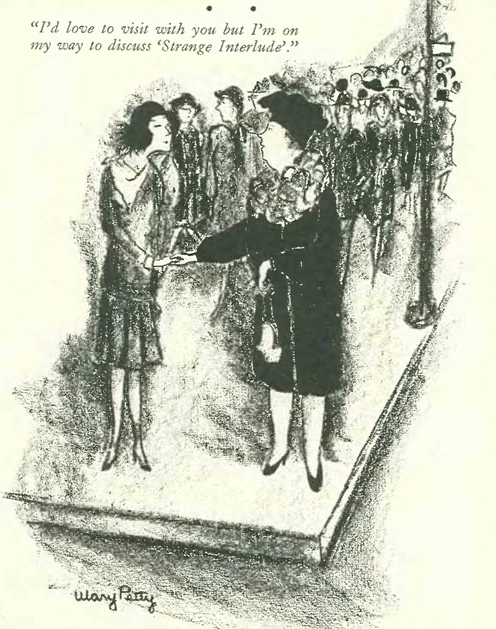
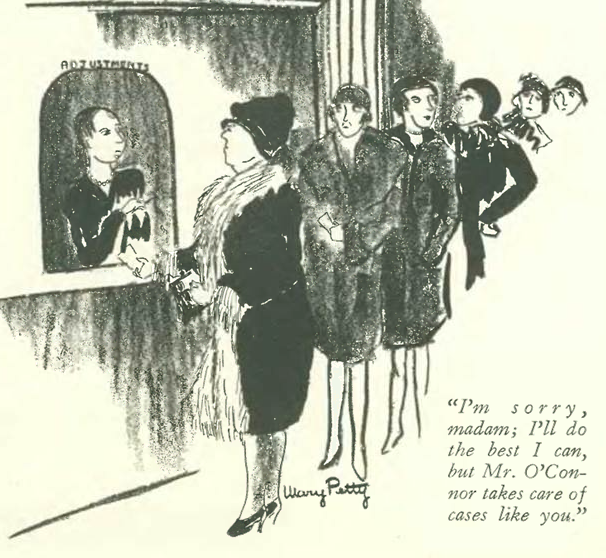
Our cartoon is courtesy of Mary Petty, who would become a renowned illustrator for The New Yorker, best remembered for a series of covers featuring her gentle satirization of the upper class Peabody family.
We close out 1927 by looking at the final December issues, which grew fat with Christmas advertising catering to the tastes of New York’s smart set.
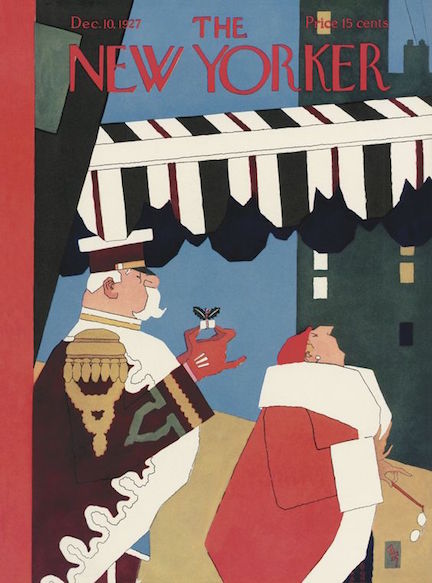
December 10, 1927 cover by Gardner Rea.
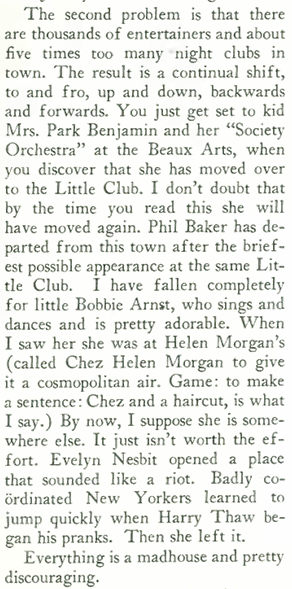
Before we jump to the ads, let’s look in on Lois Long, who in the Dec. 10 issue continued her lamentations regarding the quality of New York’s Prohibition-era night life and reminded readers that her job was far from a “soft snap”…
The problem, as diagnosed by Long, was that there were not enough talented entertainers to fill the needs of an overabundance of nightclubs…
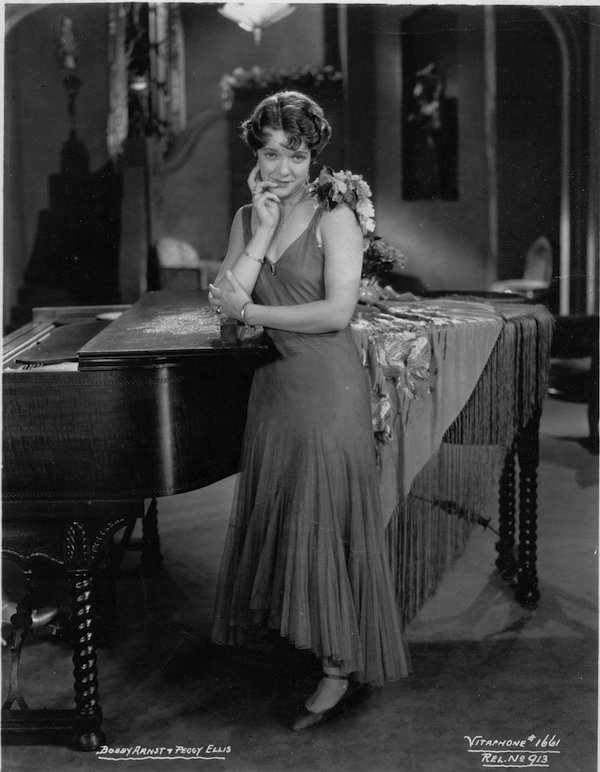
LOIS THOUGHT BOBBIE ARNST WAS PRETTY SWELL when she appeared at Helen Morgan’s nightclub. A noted broadway singer and dancer, Arnst is pictured above in a publicity photo from the 1929 film Rhythms in Blue. (picking.com)ON THE OTHER HAND…Evelyn Nesbit’s tearoom (and later speakeasy) couldn’t survive on notoriety alone. In the early 20th century Nesbit’s face was everywhere—from advertisements to calendars—but in 1906 her fame took a nasty turn when her jealous husband, Harry Thaw, shot and killed suspected lover and famed architect Stanford White at Madison Square Garden’s rooftop theatre. At left, Nesbit in 1900. At right, Nesbit in her tea room on West 52nd Street, near Broadway, circa 1922. (Library of Congress / restaurant-ingthroughhistory.com)
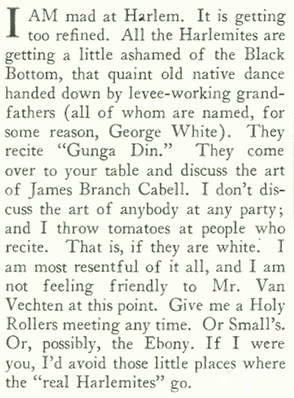
Long also railed against the white appropriation of Harlem entertainment, which she felt was draining the place of its soulfulness. In particular she called out writer and photographer Carl Van Vechten, who among white writers was the most prominent in intellectualizing the “Harlem Renaissance”…
What to Buy in ’27
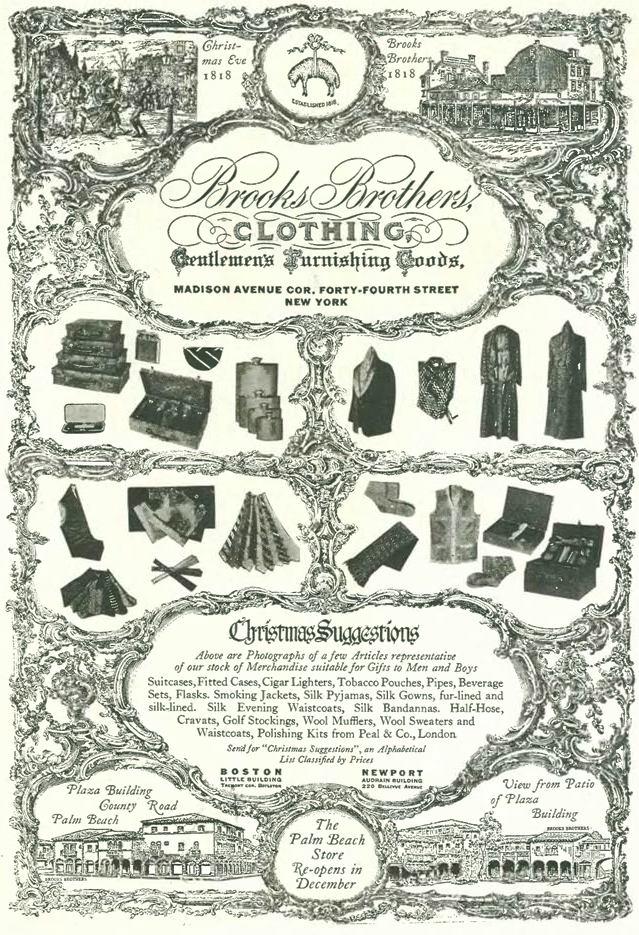
The Dec. 10 and Dec. 17 issues grew fat with holiday advertising, averaging 120+ pages as opposed to the usual 60 or so pages. The advertisements mostly appealed to upscale readers, ranging from this almost Victorian-style ad from the staid Brooks Brothers…
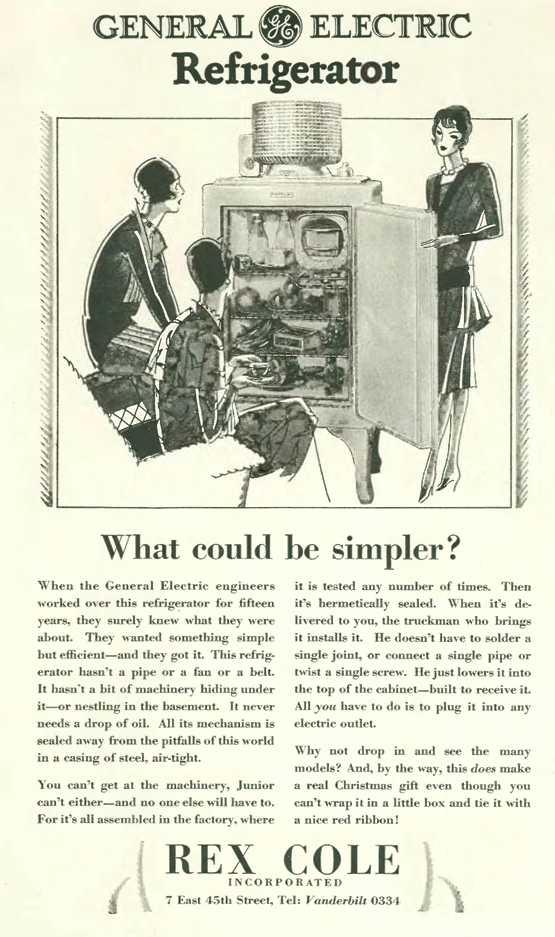
…to this ad from Rex Cole promoting the latest in modern conveniences…
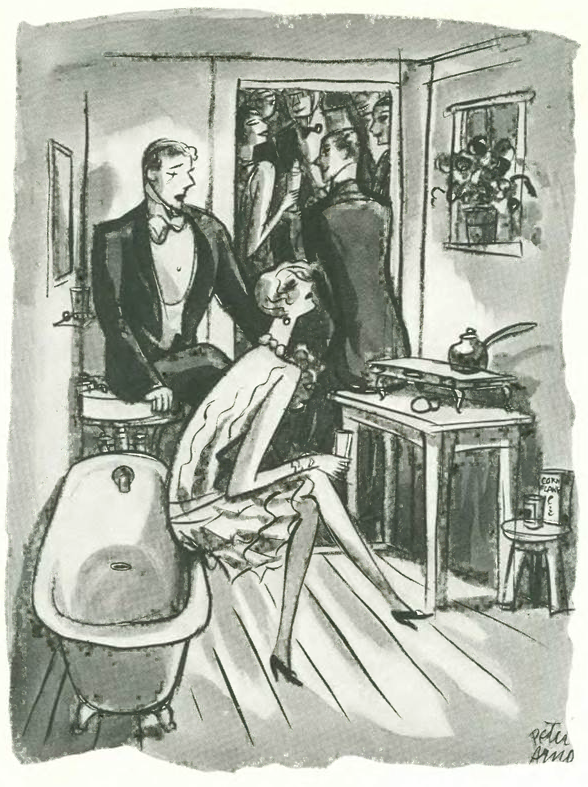
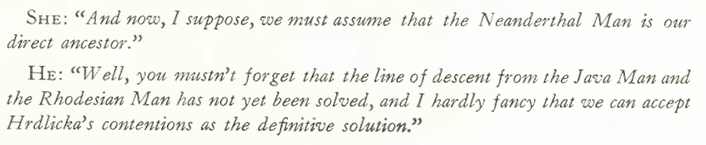
And I’ll toss in this cartoon from the Dec. 10 issue, in which Peter Arno allows us to listen in on an unlikely conversation between a couple of toffs…
Lois is Also Tired of the Holidays
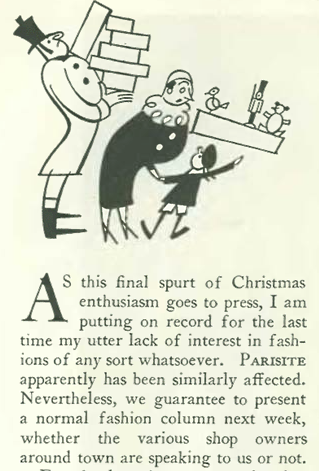
On to the Dec. 17 issue, in which Lois Long also shared with readers her weariness of Christmas shopping in her column, “On and Off the Avenue.”
December 17, 1927 cover by Theodore G. Haupt.
The “Parisite” Long referred to in this excerpt was actually Elizabeth Hawes, who occasionally contributed to Long’s column (with cables sent from Paris) regarding the latest in French fashions. More on Hawes another time…
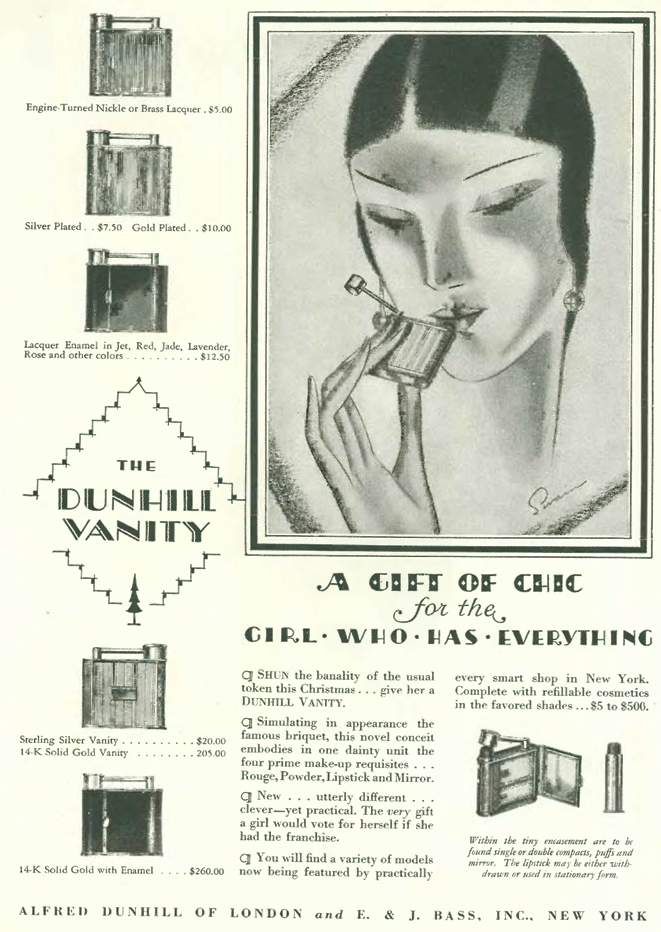
As for ads in the Dec. 17 issue, we get this one from Dunhill, maker of fine English cigarettes and accessories: a woman’s compact that resembles a lighter…
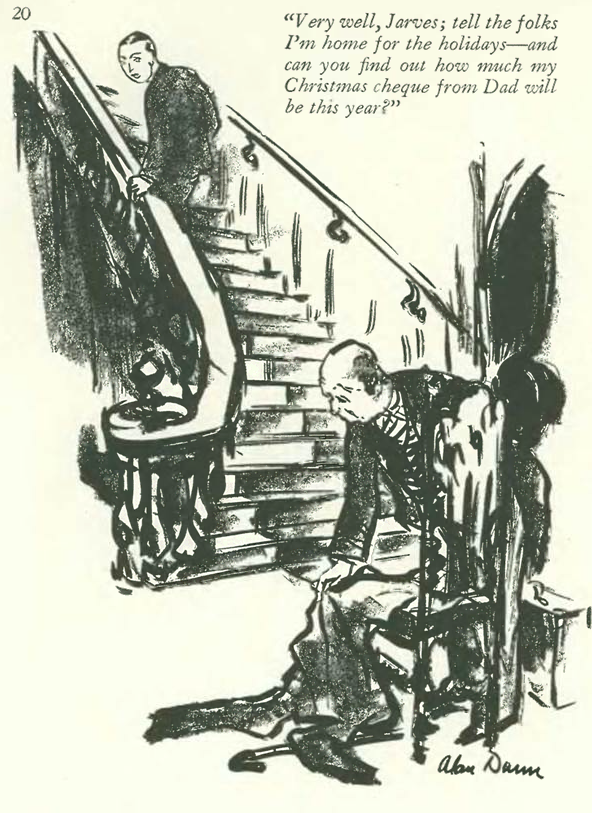
…and the same issue offers this glimpse into the life a spoiled rich kid, home from college for the holidays. The cartoon is by Alan Dunn, one of the most published New Yorker cartoonists (1,906 cartoons from 1926 to 1974)…
With Christmas advertising over, the magazine’s page length dropped by half from the Dec. 17 to the Dec. 24 issue…
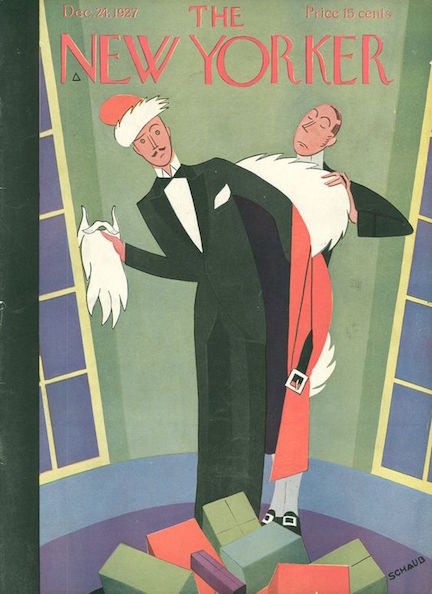
December 24, 1927 cover by Andre De Schaub.
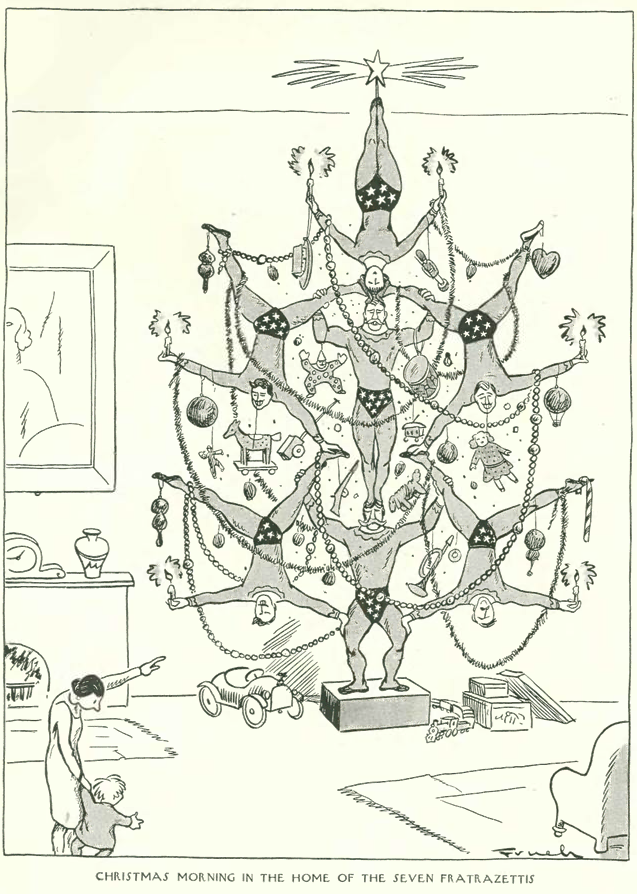
…in which we find this holiday-themed illustration by Al Frueh:
Why We Sing Auld Lang Syne
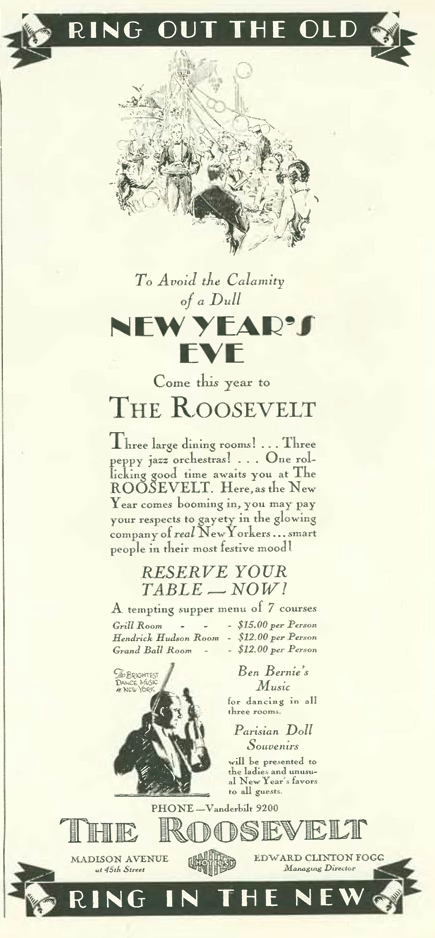
This advertisement in the Dec. 24 issue invited readers to celebrate the New Year at The Roosevelt Hotel…
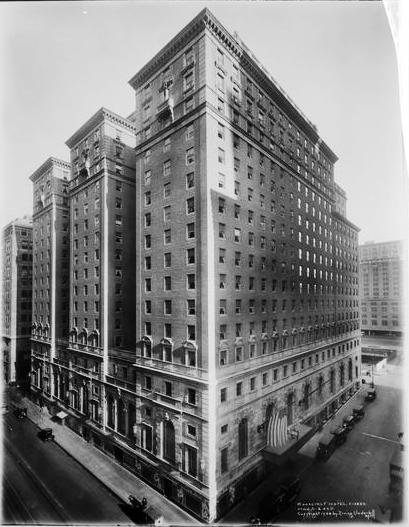
The Roosevelt Hotel after its completion in 1924 (Museum of the City of New York)AULD ACQUAINTANCE…If you want to know why we sing “Auld Lang Syne” on New Year’s Eve, you can thank Guy Lombardo and his Royal Canadian Band, which made the song a staple at his New Year’s performances beginning in 1929 at the Roosevelt Hotel. Their performance that night was broadcast on the radio before midnight Eastern time on CBS, then after midnight on NBC radio. (neatorama.com)
* * *
Now Let’s Get Out of Here
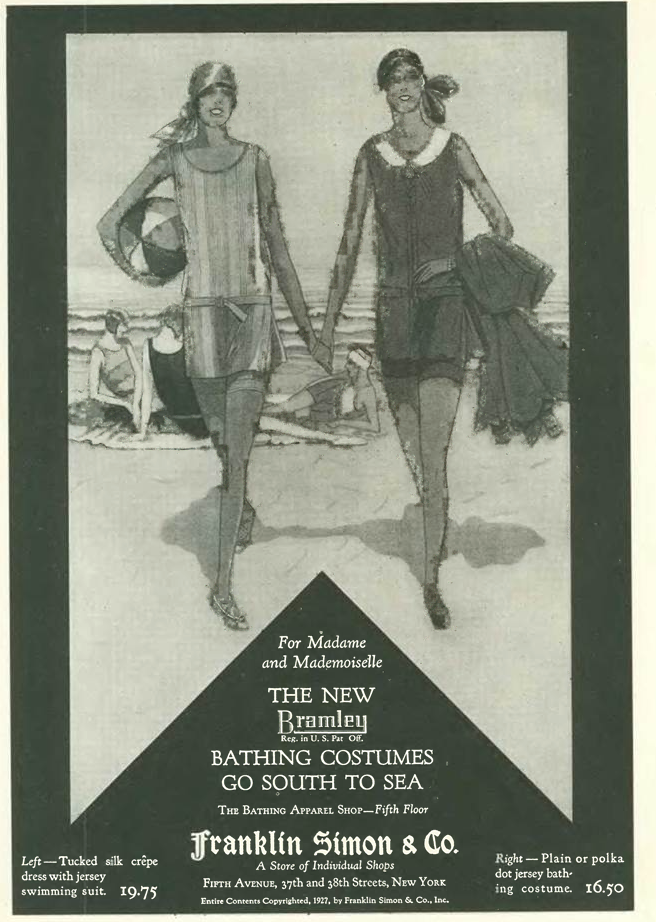
With the holidays out of the way, New Yorkers still faced a good three months of winter. That is, unless you were well-heeled enough to head south to Palm Beach. Considering the abundance of ads promoting travel to southern climes in the Dec. 24 and 31 issues, apparently many of the magazine’s readers possessed the means to do just that…
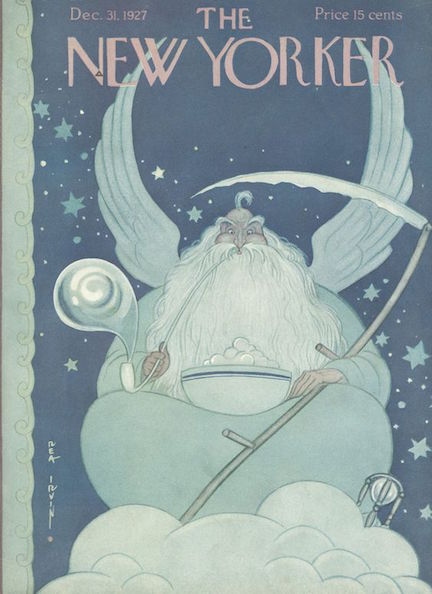
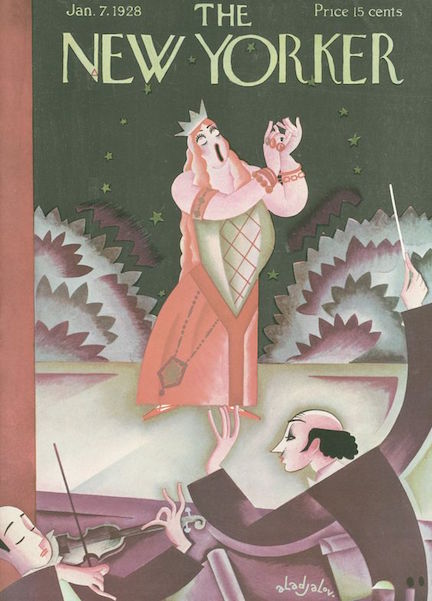
And we close this entry, and the year of 1927, with this cover…
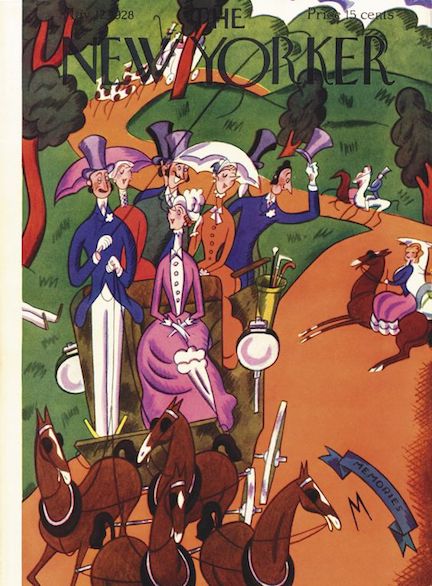
December 31, 1927 cover by Rea Irvin.
…and another tropical-themed advertisement, courtesy of Russeks…
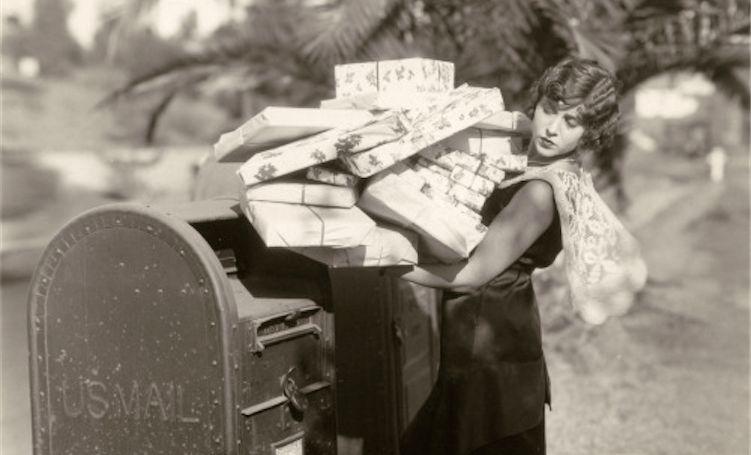
…and this cartoon by Mary Petty depicting those who were left behind, still returning their Christmas gifts…

 Markey’s column attempted to remove some of the glamour from Diamond’s flamboyant life, a life that would be cut short about a year later in an Albany rooming house…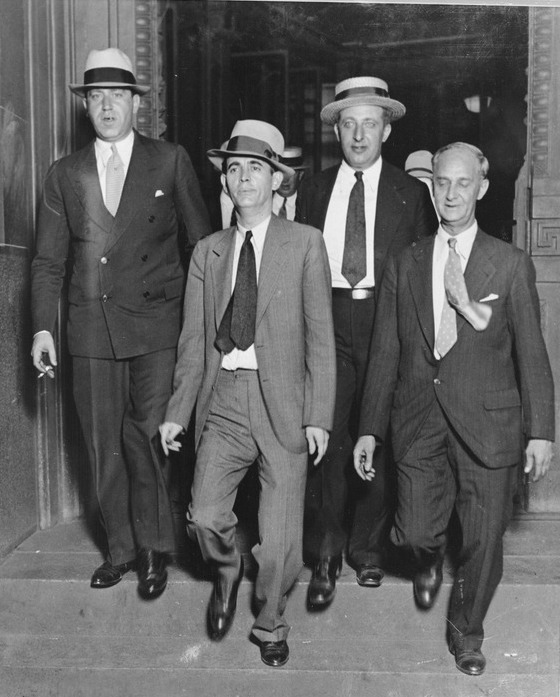
















































































 A New Yorker State of Mind