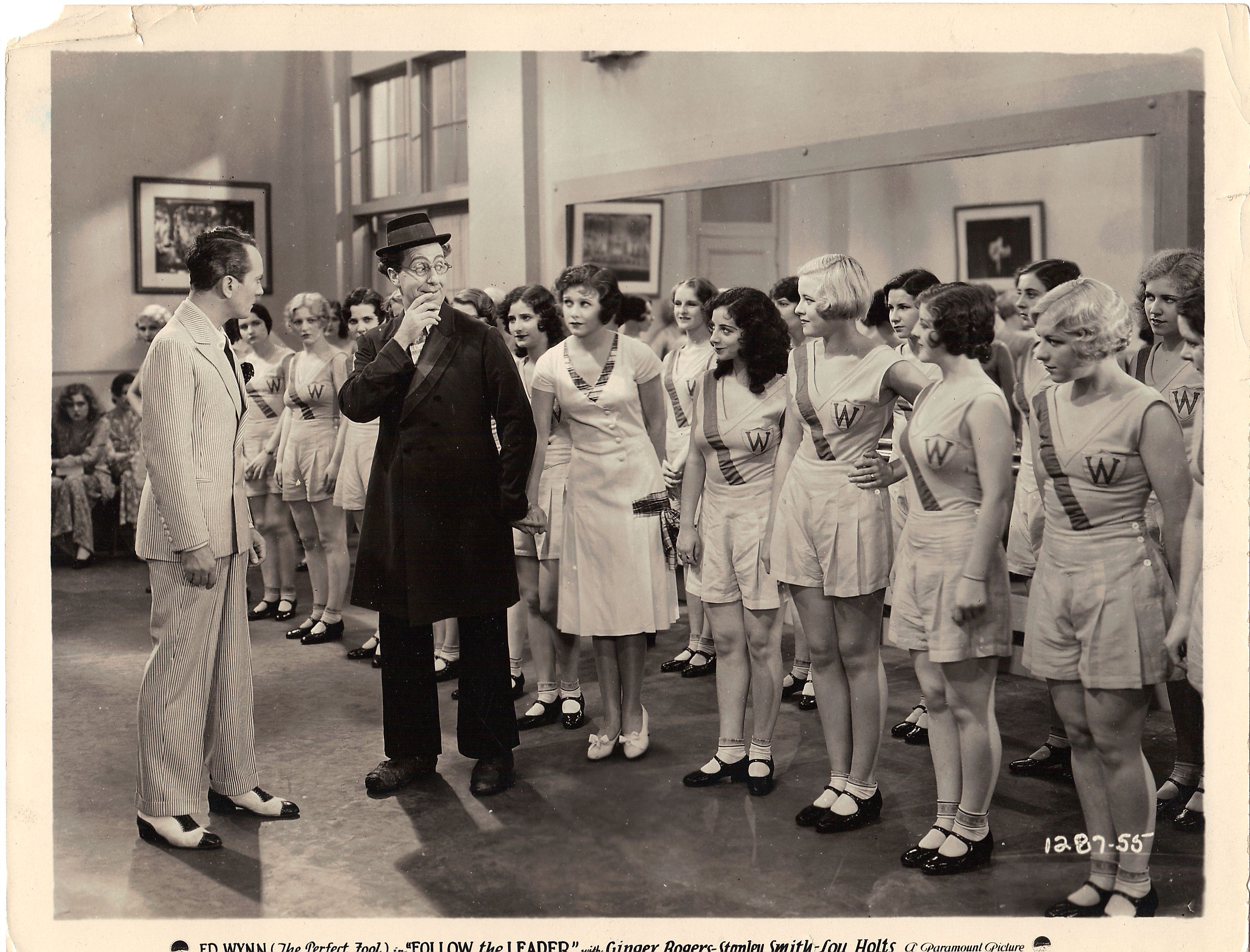
Comedian Ed Wynn began his long acting career on a vaudeville stage in 1903, and beginning in 1914 his giggly voice would delight Broadway crowds flocking to the Ziegfeld Follies. So when he stepped in front of a movie camera for a talking picture, it was something of a sensation.
September 27, 1930 cover by Sue Williams.
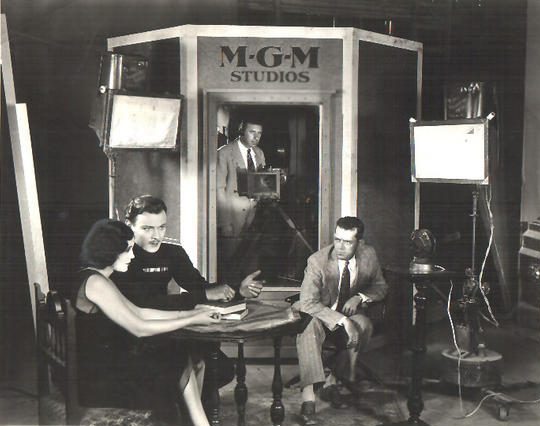
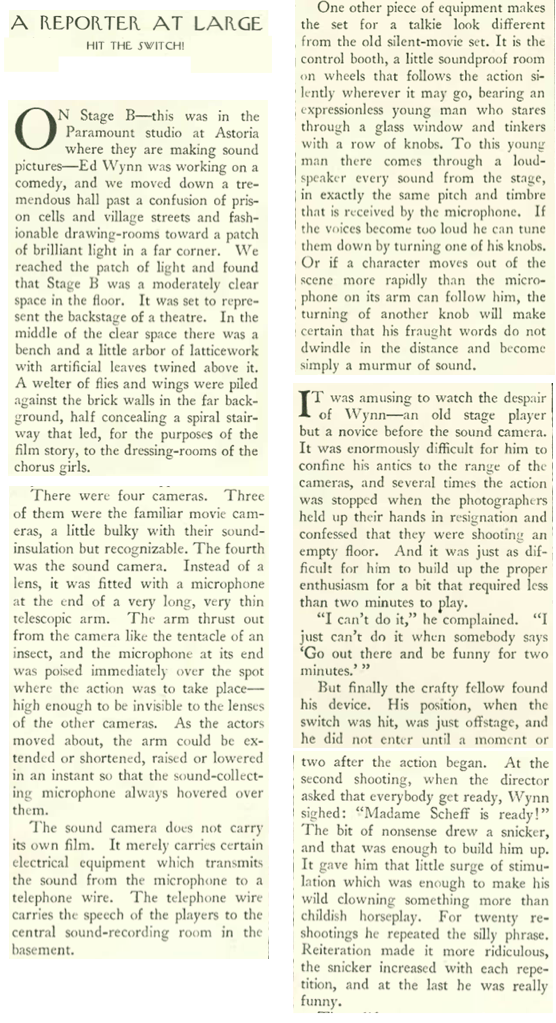
It was not an easy transition for the stage veteran. As you can see from Morris Markey’s account below in “A Reporter at Large,” the early talkies presented all manner of challenges and restrictions for stage actors accustomed to a bit more freedom of movement and expression.
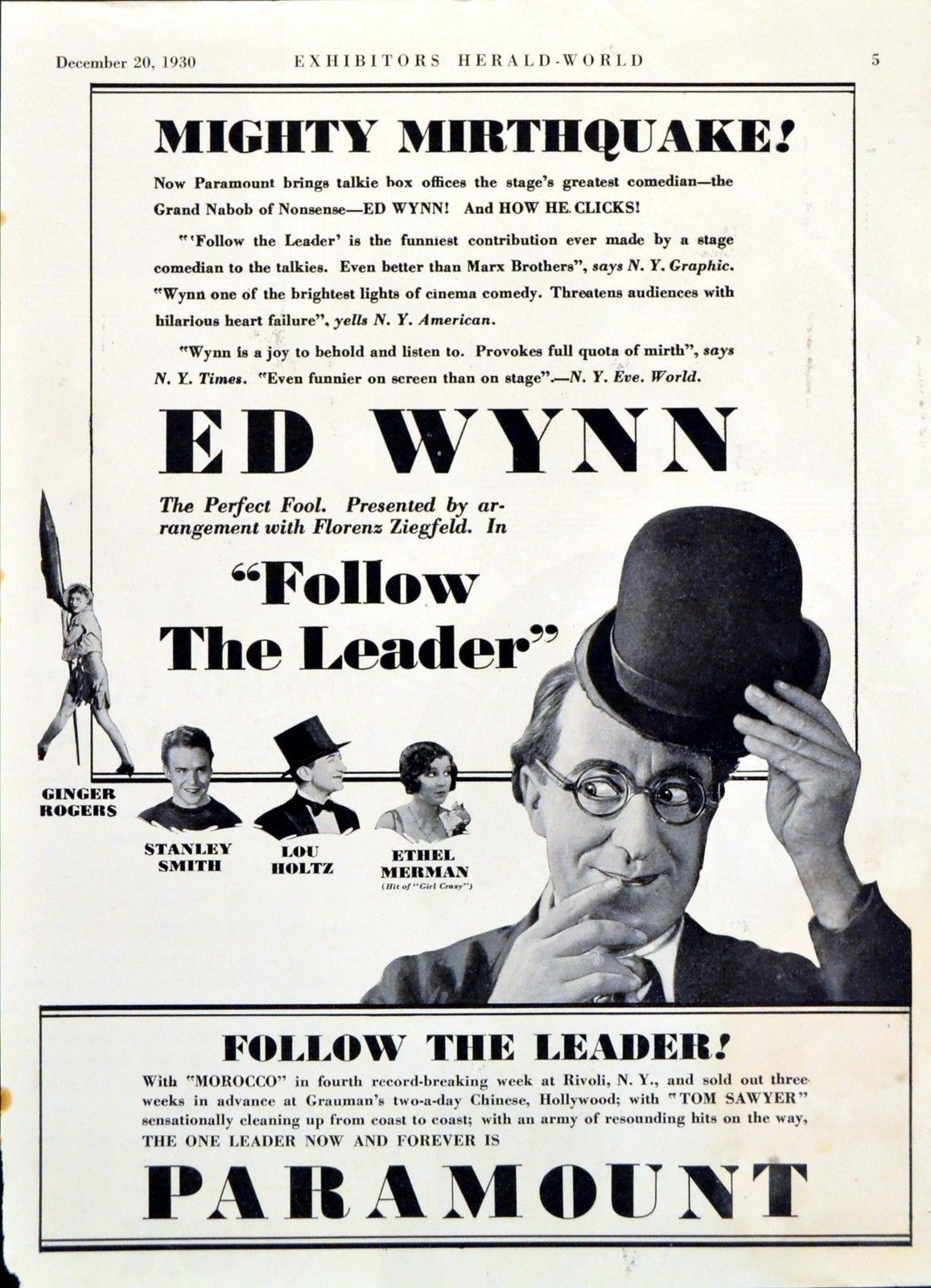
SCANDALOUS BUNCH…Ed Wynn (in hat) portrayed a character he developed on Broadway — “Crickets” — in his film debut Follow the Leader. At left is actor Stanley Smith, and at center, holding Wynn’s hand, is a brunette Ginger Rogers, with chorus girls from George White’s Scandals. (IMDB)
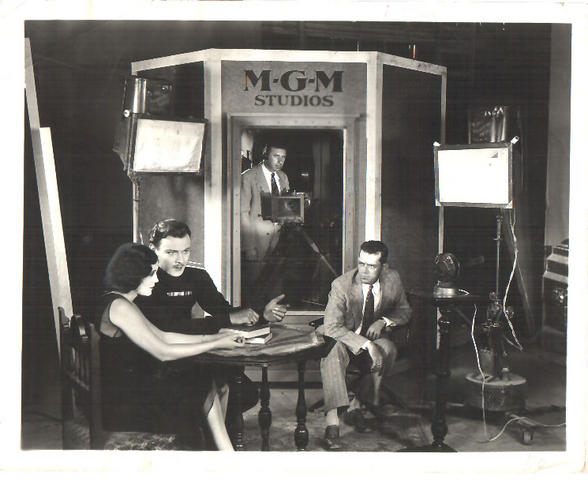
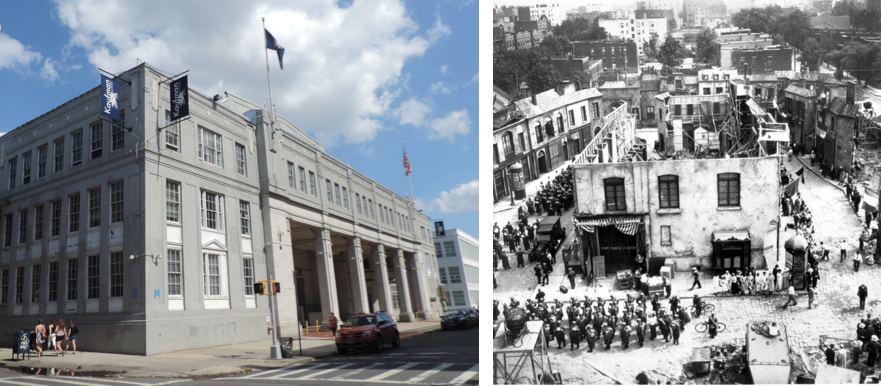
PAY NO ATTENTION TO THE MAN BEHIND THE WINDOW…Noisy cameras were enclosed in soundproof boxes in the early days of the talkies. Above, Woody Van Dyke directs Raquel Torres and Nils Asther in 1930’s The Sea Bat. (nilsasther.blogspot.com)TINSELTOWN IN QUEENS…For his article, Morris Markey visited the set of Follow the Leader at Astoria Studios in Queens. The original studio building, at 35th Avenue, is on the National Register of Historic Places. Although Paramount moved its movie operations to Hollywood in the early 1930s, the studio continued to be used for both film and television productions. At right, a bit of Paris was erected in the midst of Queens for the filming of 1929’sThe Gay Lady. (Wikipedia/Kaufman Astoria Studios)FILM DEBUT…A December 1930 magazine advertisement touting Ed Wynn’s first motion picture. (IMBD)
* * *
False Modesty?
In Morris Markey’s second installment of his profile on Charles Lindbergh, Markey suggested that Lindbergh’s aversion to publicity might be a pose…
NO WI-FI, BUT YOU COULD SMOKE…Top, the posh set take wing with TWA circa 1930; below, passengers prepare to board an American Airways Curtiss Condor II in 1933. (historydaily.org/Sweezey Pictures/Ken Sweezey)
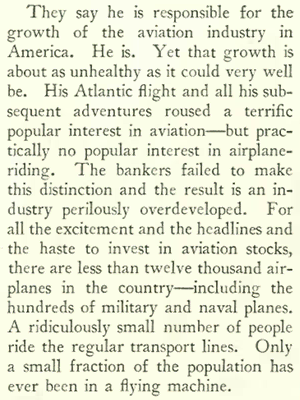
…and also wondered how much credit Lindbergh could take for sparking the aviation industry, given that flying was still an activity reserved for a very few…
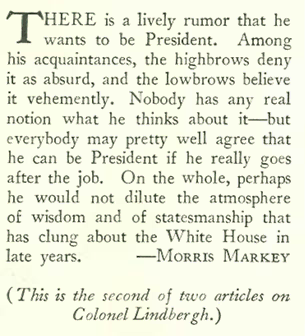
…Markey also noted a “lively rumor” that Lindbergh wanted to be President…
…fortunately Lindbergh did not give truth to the rumor, or fulfill the alternate history created by Philip Roth in his 2004 novel The Plot Against America…
HANGIN’ WITH A BAD CROWD…Top, Charles Lindbergh accepts a ceremonial sword from Hermann Göring during a 1936 visit to Nazi Germany; below, right, Lindbergh in Germany, 1937. Philip Roth’s novel imagined Lindbergh’s election to the Presidency in 1940 and its chilling results. (Reddit/The New Yorker/Goodreads)
* * *
Bad Moon Rising
In 1930 few, if anyone, were aware of Lindbergh’s proclivities toward nationalism and antisemitism. And lacking a crystal ball, Markey’s New Yorker colleague, Howard Brubaker, had little reason to be alarmed by the federal elections in Germany, which gave the Nazis the second largest number of seats in the Reichstag. In his “Of All Things” column, Brubaker quipped:
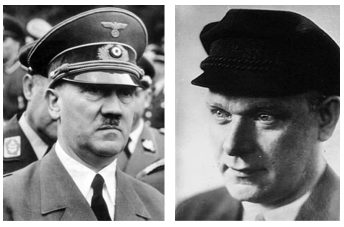
INCOMPATIBLE…As Howard Brubaker noted in “Of All Things,” the fascists led by Adolf Hitler, left, and the communists led by Ernst Thälmann (right) made big gains in the 1930 German elections. After gaining power in 1933, Hitler would arrest Thälmann and later have him shot. (Wikipedia)
* * *
Gummed to Death
The New Yorker’sJohn Mosher took in the latest travelogue to exploit and misrepresent life on the African savannah. Africa Speaks included a scene depicting a fatal attack on a “native boy” by a lion — an attack that was actually staged at a Los Angeles zoo and involved a toothless lion…
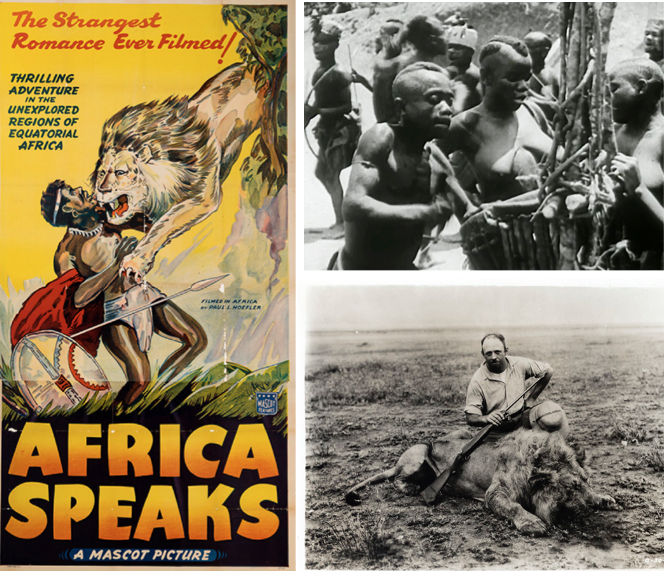
STRANGE INDEED…At left, movie poster for Africa Speaks; top right, Pygmy drummers in the film; bottom right, explorer Paul Hoefler getting closer to nature. (IMDB/Wikimedia)
* * *
From Our Advertisers
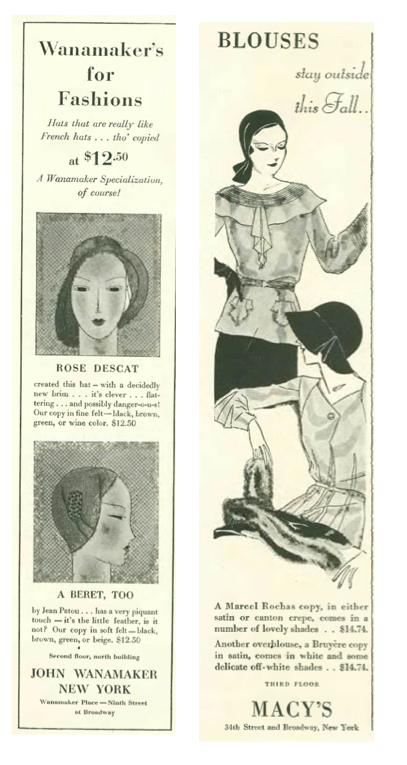
When Paris unveiled is spring and fall fashions, large department stores were always quick to respond with “copies”…
…while the higher end boutiques offered originals to “poor little rich girls”…
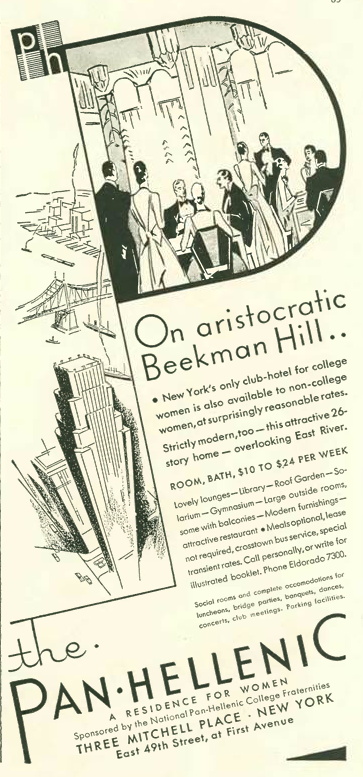
…perhaps some of these “poor little rich girls” socialized at the Panhellenic, a “club-hotel for college women”…
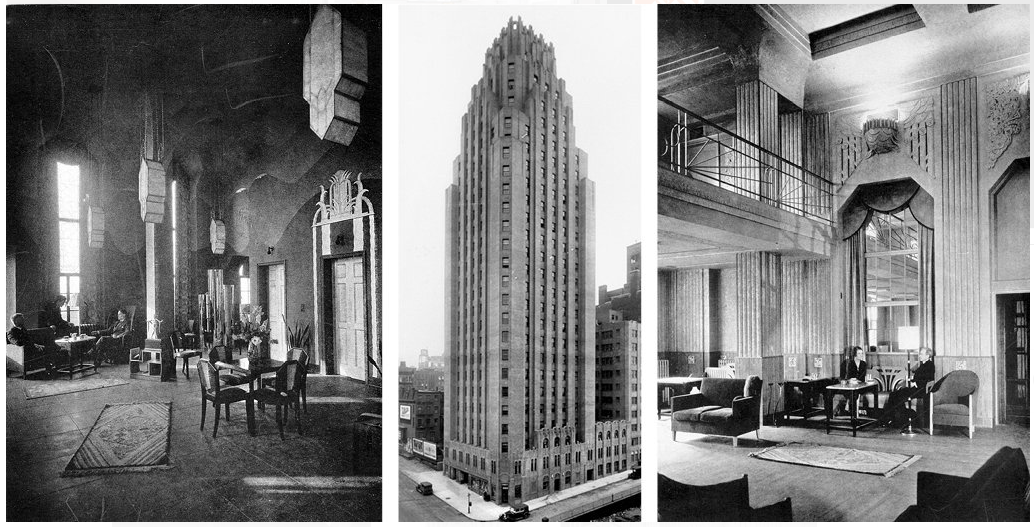
…and here are some views of the Panhellenic House, circa 1929…
Center, The Panhellenic House, at First Avenue and 49th Street; at left, the solarium; at right, a ballroom. (Avery Library/Museum of The City of New York)
…the makers of Old Gold cigarettes had some of the weirdest ads to push their smokes, including this one…
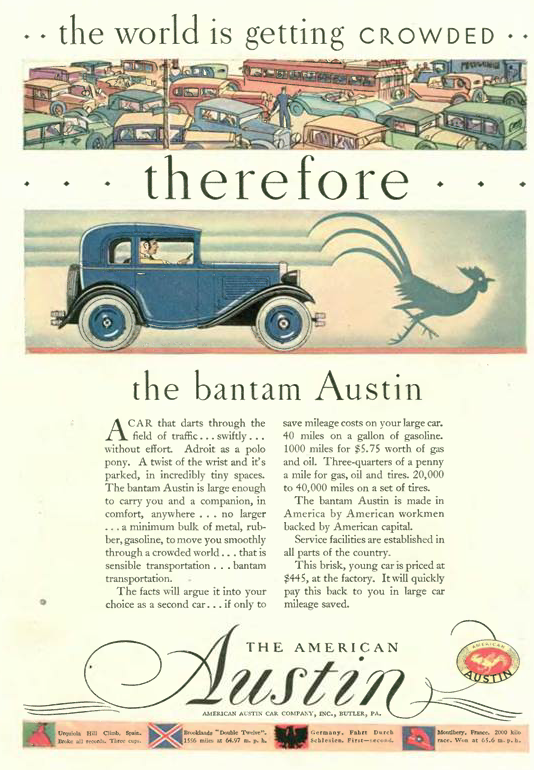
…and one wonders what the world would be like (and especially the U.S.) if car buyers would have favored a more compact version of the motorcar going forward…
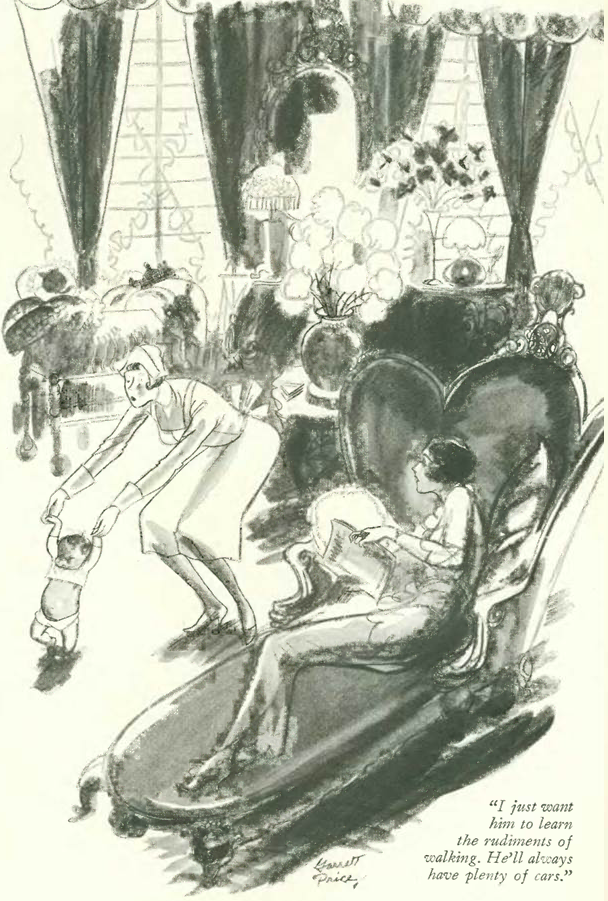
…on to our cartoons…we begin with parenting tips from the posh set, courtesy Garrett Price…
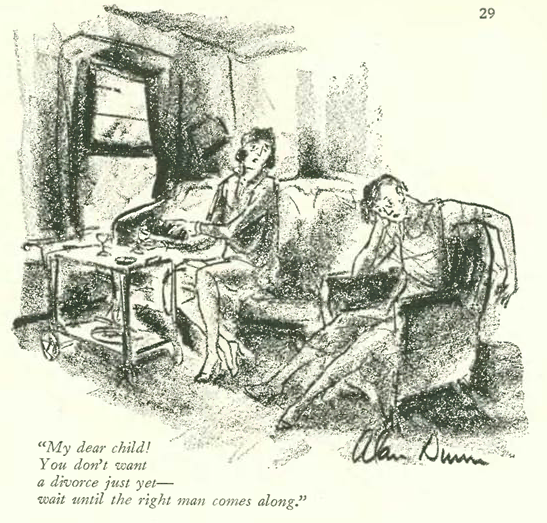
…Alan Dunn explored modern matrimony…
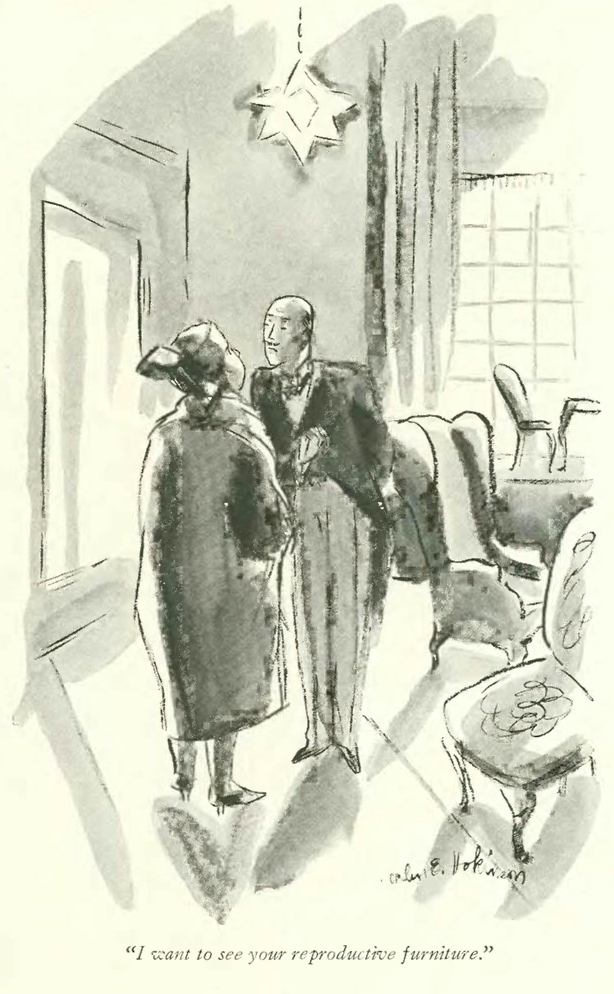
…one of Helen Hokinson’s ladies demonstrated a unique taste in furniture…
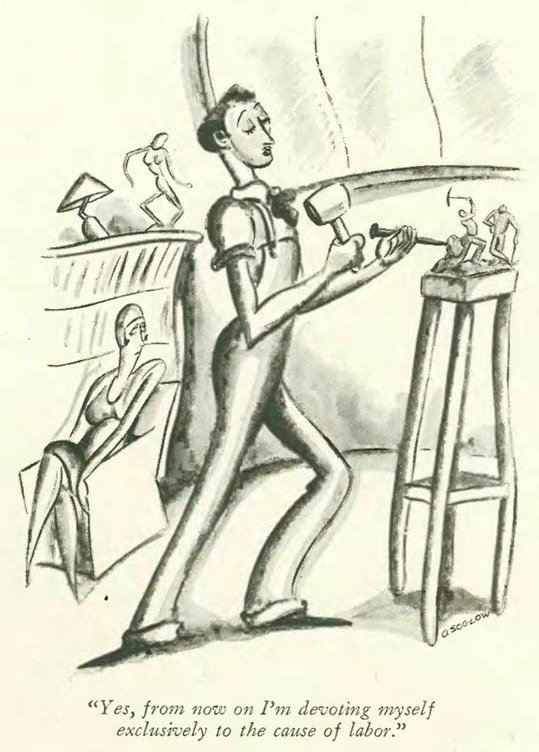
…Otto Soglow continued to explore humor in a wavy fashion…
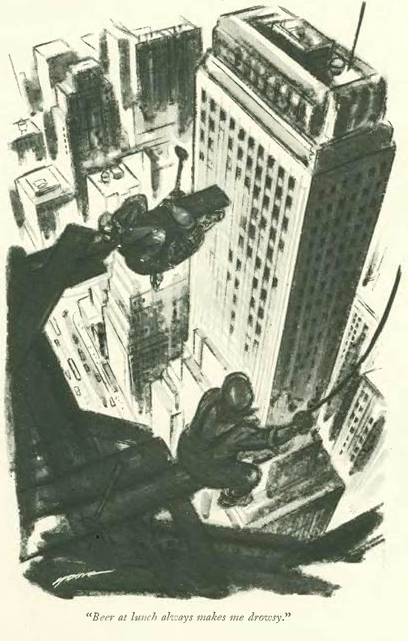
…and we close with this vertiginous view provided by Leonard Dove…
When Charles Lindbergh returned to New York after his solo, history-making transatlantic flight, he was mobbed by thousands of fans and adored by many millions more. The feeling was not mutual.
Sept. 20, 1930 cover by Theodore Haupt.
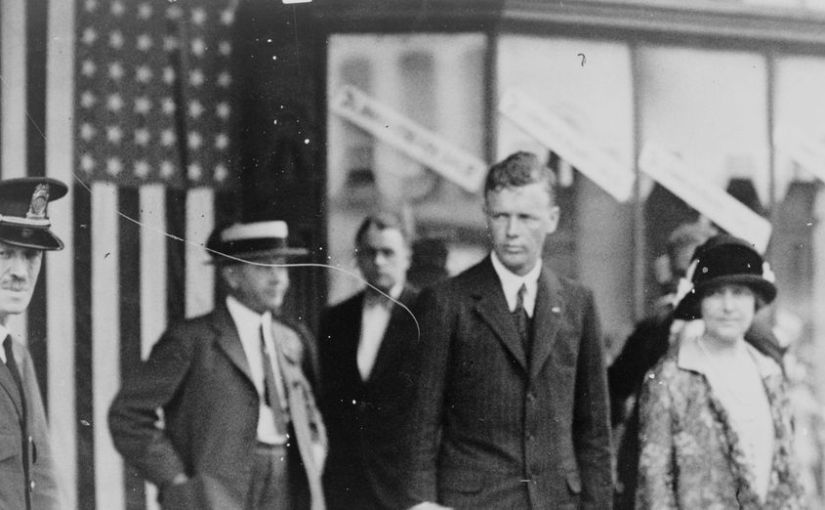
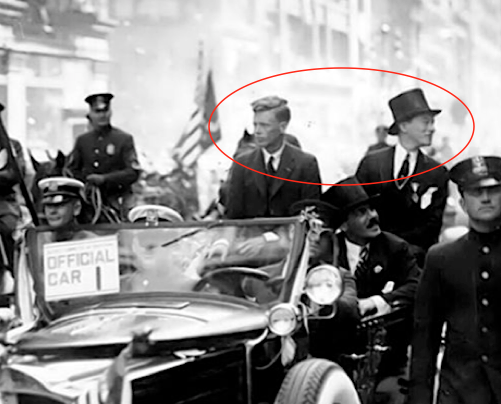
This image from his June 13, 1927 ticker-tape parade says it all, a disinterested, almost hostile-looking Lindbergh contrasted with that crowd-loving dandy, Mayor Jimmy Walker:
Detail of larger photograph. (Associated Press)
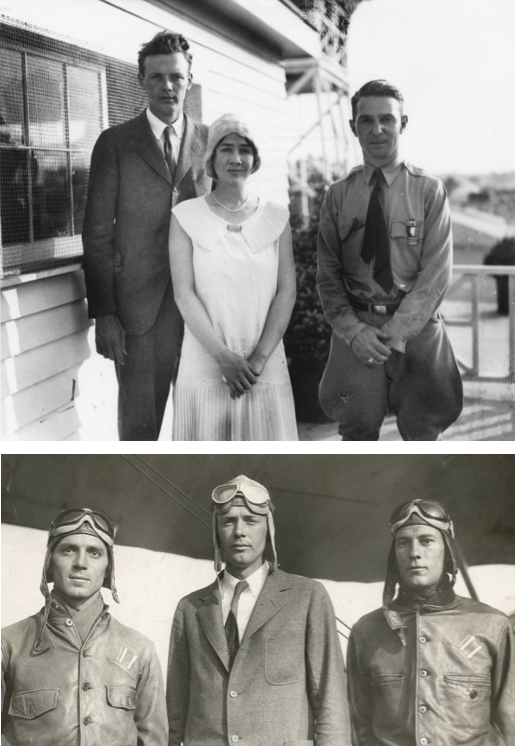
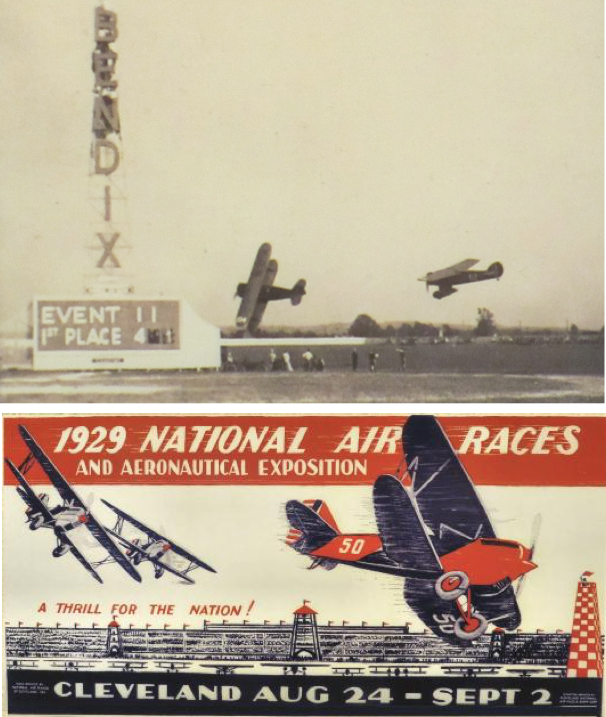
Morris Markey checked in on the famed flyboy three years later in a two-part profile for the New Yorker. Markey observed how Lindbergh had become “sucker-sour,” a phrase that described how someone could suddenly go wild “at the ceaseless procession of staring faces.” I encourage you to read the excerpt below about Lindbergh’s appearance at the 1929 Cleveland Air Races, where in a fit of temper he nearly forced a passenger plane to lose control and crash:
SAY CHEESE…Top photo, Charles and Anne Lindbergh pose with Cliff Henderson at the 1929 Cleveland National Air Races. Henderson was the managing director of the National Air Races and was often described as “the Barnum of aviation.” Below, Lindbergh flanked by Navy flyers Frederick Kivette and Frank O’Beirne at the 1929 air races. (Smithsonian)
Because he was a national hero of nearly saint-like dimensions, newspaper reporters did not dare to report on his antics at the Cleveland Air Races (so far, The New Yorker account is the only one I can find of the incident). Needless to say, he was not popular among members of the fourth estate:
WHAT COULD POSSIBLY GO WRONG?…Fliers raced around a closed course near a crowded grandstand at the 1929 National Air Races in Cleveland. (Western Reserve Historical Society)
* * *
Innocents Abroad
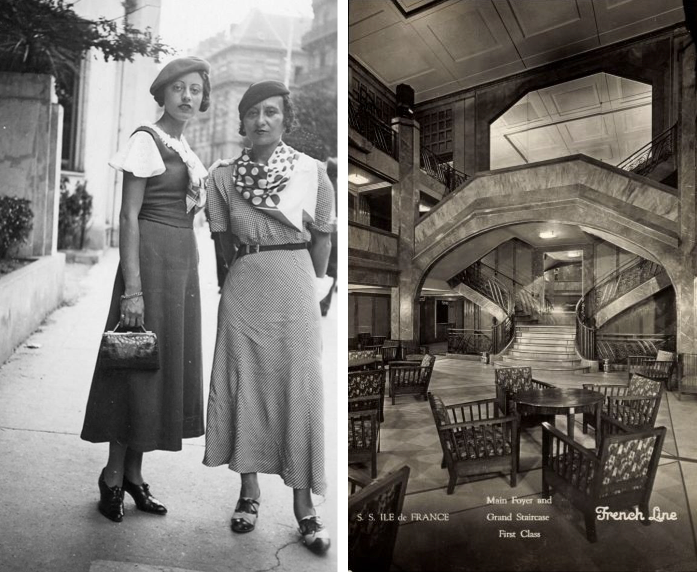
It was a nice surprise to find Lois Long once again writing under her pen name “Lipstick” in this casual piece (excerpted below) on Parisian life. I was also surprised to find the term “Amurrican” in the headline — I always thought it was a more recent derivation of redneck-speak…
OVER THERE…Left, a fashionable pair on the streets of Paris circa 1930; right, main staircase and grand foyer of the Ile de France. (Pinterest/akpool.co.uk)
* * *
Imbiber in Chief
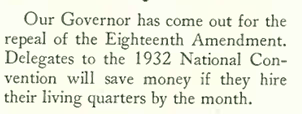
No doubt many a New Yorker enjoyed this bit of news from Howard Brubaker (in his column, “Of All Things”) regarding New York Governor Franklin D. Roosevelt, who later as president would preside over the end of Prohibition.
LEADING BY EXAMPLE…FDR and a gin martini. (Time/Life)
* * *
From Our Advertisers
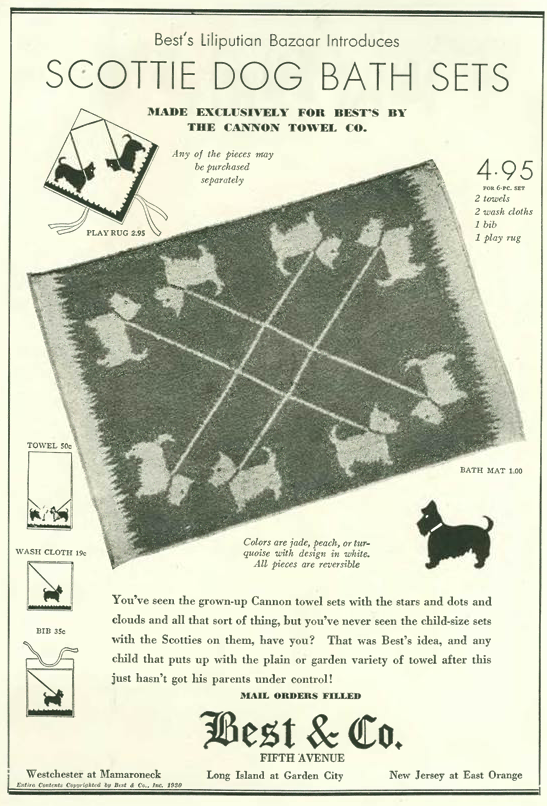
The Scottish Terrier was one of the most popular dog breeds in 1930s America (in addition to martinis, FDR was also fond of Scotties, including his loyal companion Fala), and you could show your love for the breed with bath sets from Best & Company…
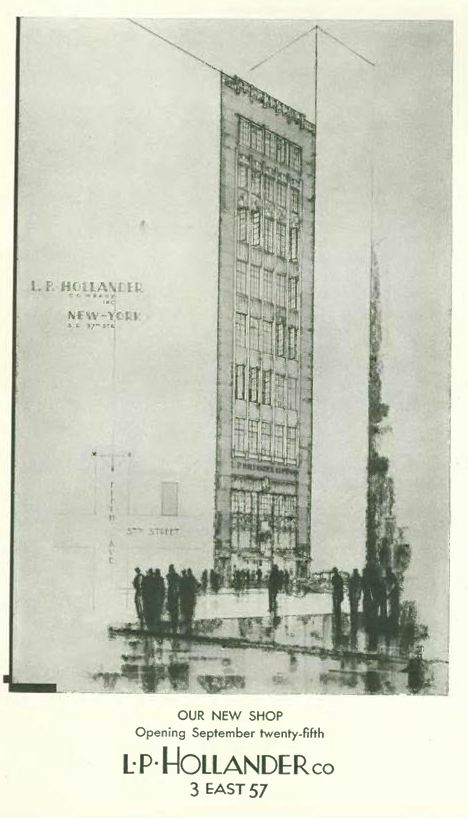
…the handsome L.P. Hollander Company Building (designed by William Lamb) at 3 East 57th began life in 1930 as a women’s fashion boutique…
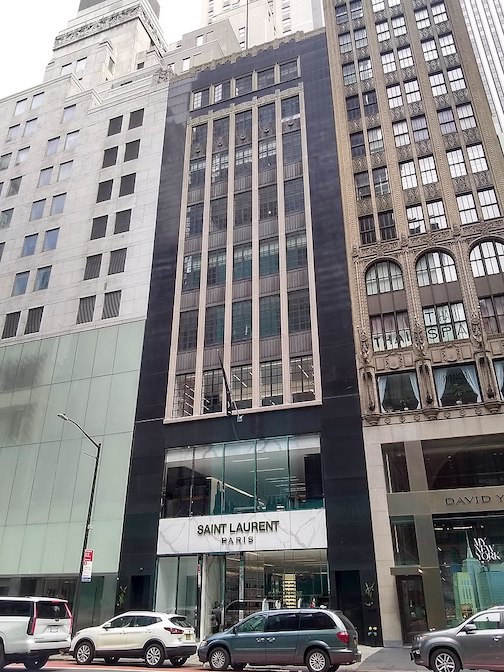
…and today it serves as the Fifth Avenue home to Yves Saint Laurent…
(Wikipedia)
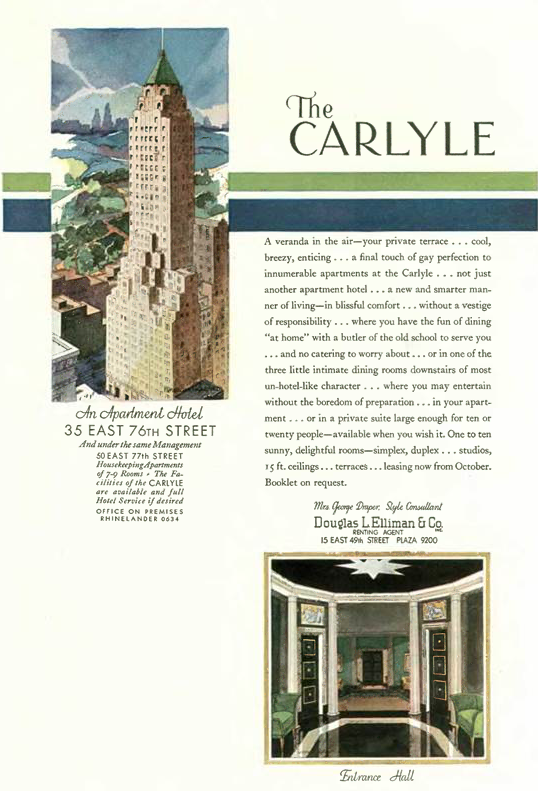
…another exclusive New York destination, the Carlyle, opened as a luxury residential hotel in 1930, only to go into receivership in 1931 thanks to the deepening Depression. In the postwar years it would rise to prominence and become a favorite haunt of the Kennedy family. The Carlyle is also home to the Bemelmans Bar, which is decorated with murals painted by Ludwig Bemelmans depicting his storybook character, Madeline, in Central Park…
…the Carlyle’s cozy Bemelmans Bar…
(TripAdvisor)
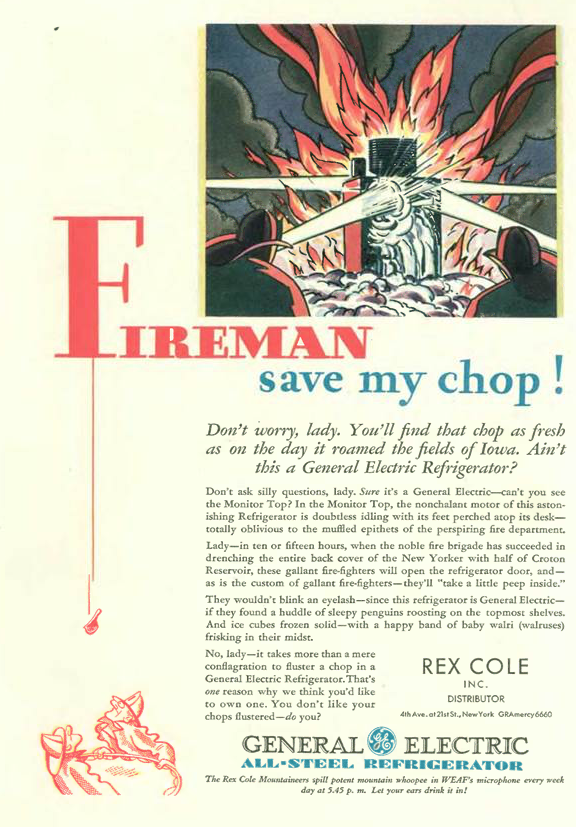
…this next one goes in my terrible ads file…did the makers of this GE refrigerator really want to depict it bursting into flames?…
…it is 1930, and we are at the dawn of the age of plastics, and in this case “Beetleware” tumblers made from an early type of plastic formed from a urea formaldehyde powder developed in England and licensed to American Cyanamid …so bottom’s up!…
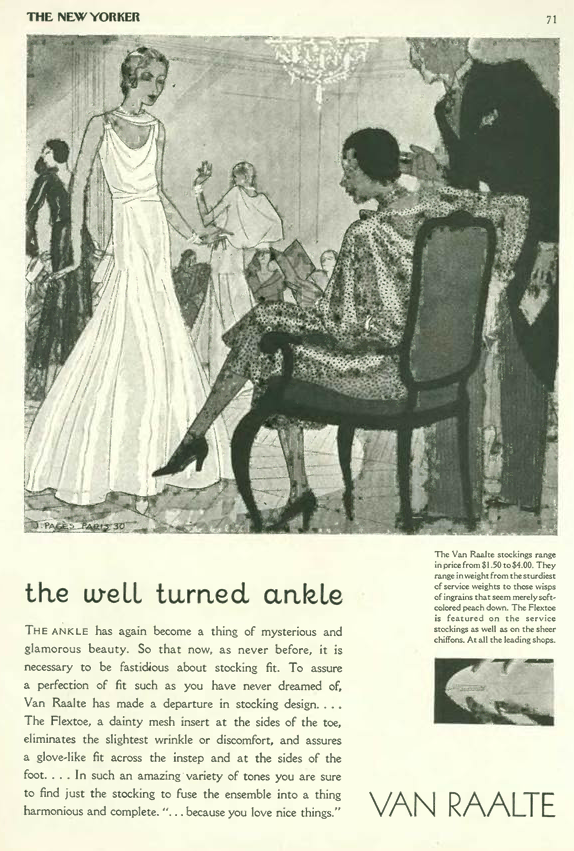
…the makers of Van Raalte stockings hoped to revive the sex appeal of the ankle…
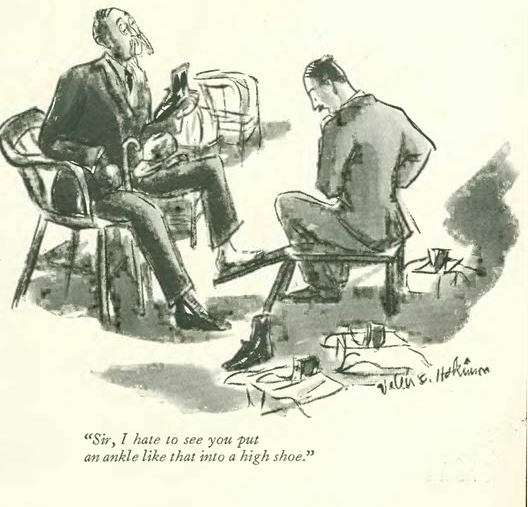
…which provides a good segue to our cartoons, this one by Helen Hokinson, which was actually featured on the page opposite the stocking ad…
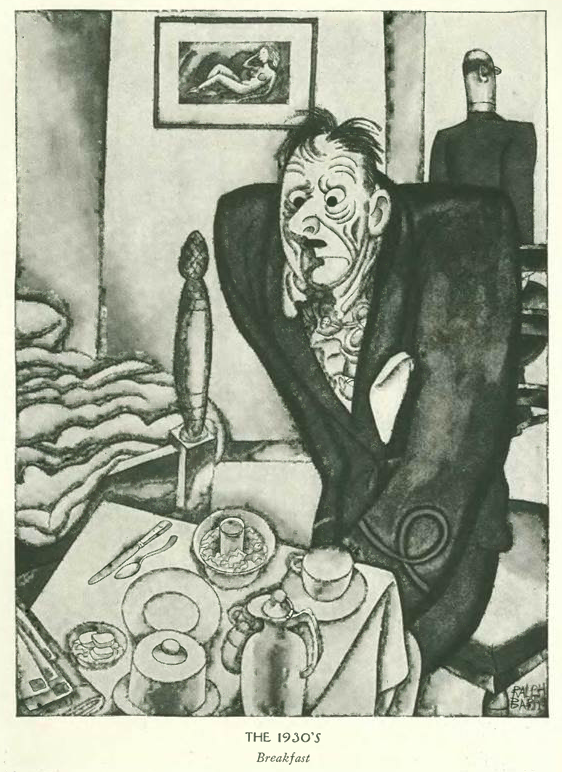
…Ralph Barton continued his series on the 1930’s…
…Alan Dunn took his work to new heights…
…Gardner Rea had fun with the garden club set (English-American S. Parkes Cadman was a pioneer Christian radio broadcaster in the 1920s and 30s)…
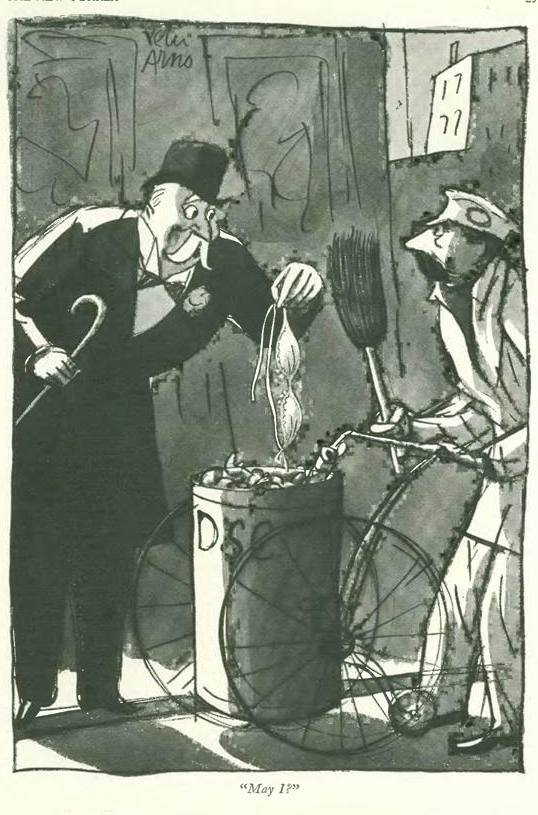
…while Peter Arno illustrated this cultural exchange on the streets of New York…
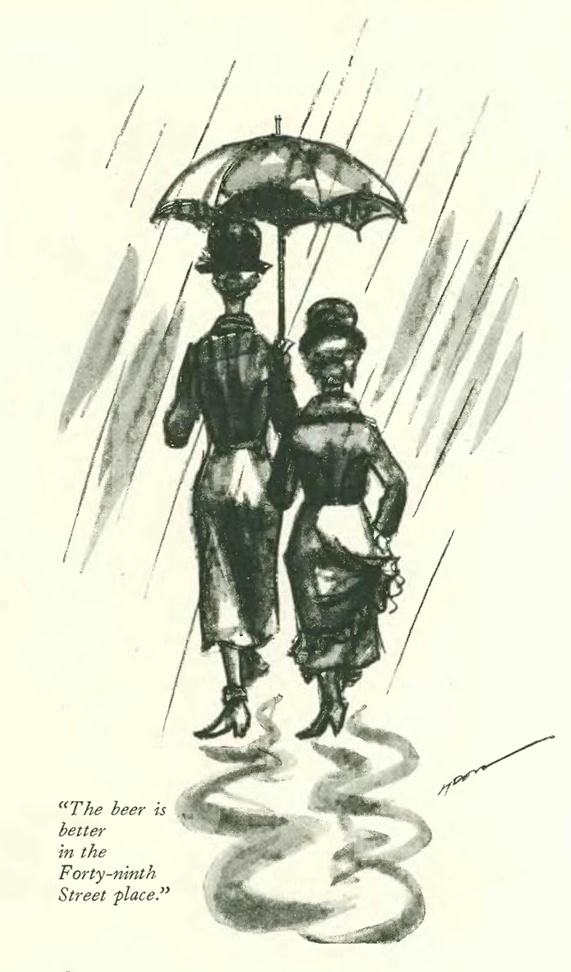
…and we end with Leonard Dove, and a walk in the rain…
Since time immemorial human beings have clung to the idea that unknown lands must surely contain vast mineral treasures.
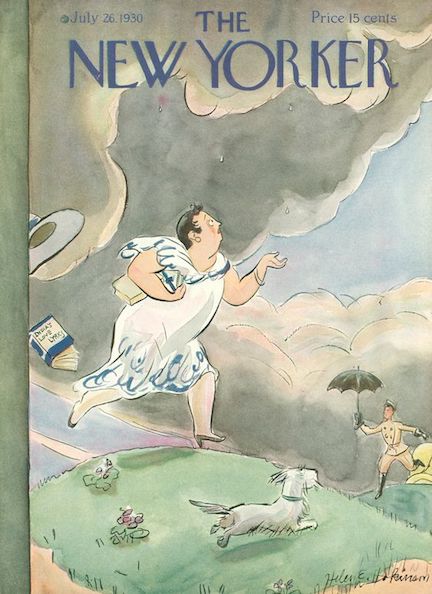
July 26, 1930 cover by Helen Hokinson.
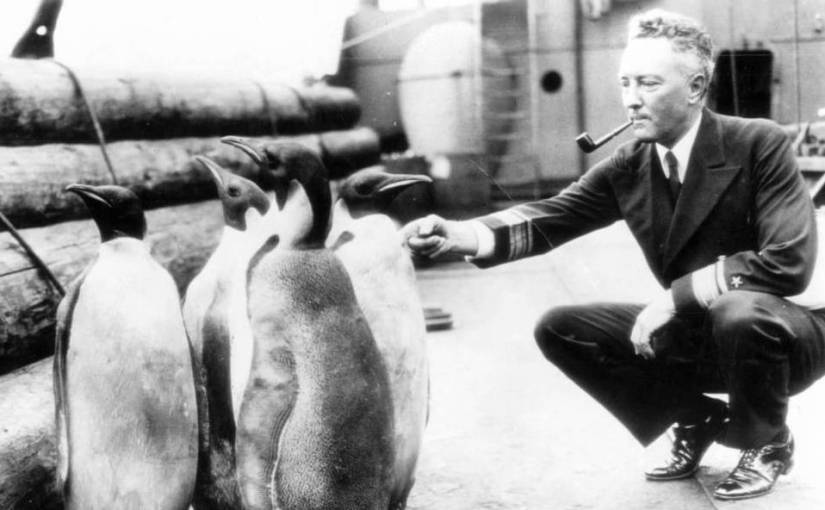
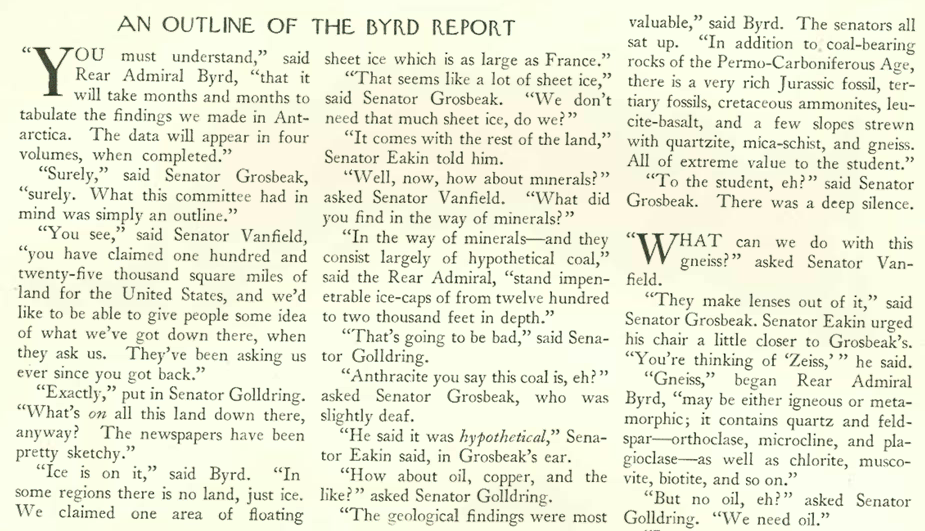
Such was the case when Admiral Richard Byrd returned from his Antarctic expedition, during which he conducted a number of geological studies. Ever ready to tweak a senator’s nose, TheNew Yorker’sJames Thurber imagined an exchange between Byrd and a U.S. Senate subcommittee that was more interested in exploitable commodities than in scientific discoveries:
HMMM, NO OIL HERE…Richard Byrd’s expedition building their “Little America” encampment at the South Pole in 1928. (osu.edu)
One passage of particular interest in this imagined exchange dealt with the speed of climate change in relation to potential mineral extraction…
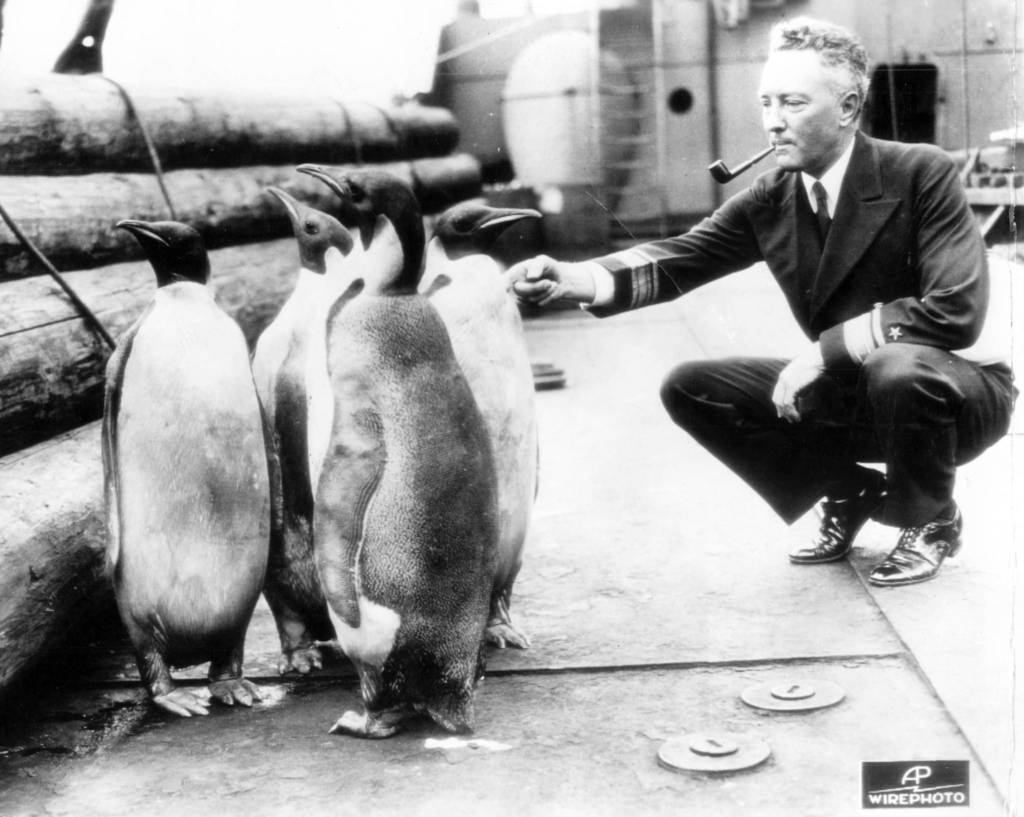
BIRDS MEET BYRD…Admiral Richard Byrd onboard the USS Bear during his second expedition to the South Pole. (Wikipedia)
* * *
Before CNN
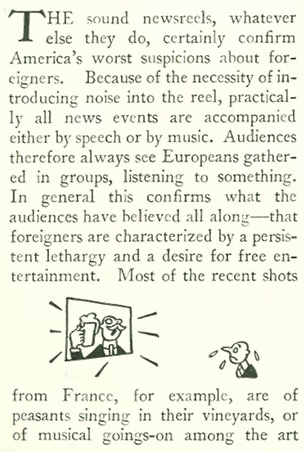
Newsreels came into their own with the advent of sound, offering moviegoers a selection of news stories from the around the world. In his “Notes and Comment,” E.B. White observed that newsreels depicted foreigners as people who just liked to hang out (note the racial slur directed at Latin Americans). White’s characterization of Germans as an indolent lot is also noteworthy, given the country was just two and half years away from Nazi takeover.
TANZEN UND TRINKEN…Kroll’s Biergarten in Berlin in September 1928; English visitors raise a glass at a beer hall in Hesse, 1929. (YouTube)
* * *
Speaking of Slurs
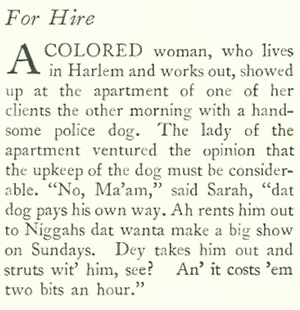
Here is what passed for a humorous anecdote in the July 26, 1930 “Talk of the Town”…
* * *
Star Power
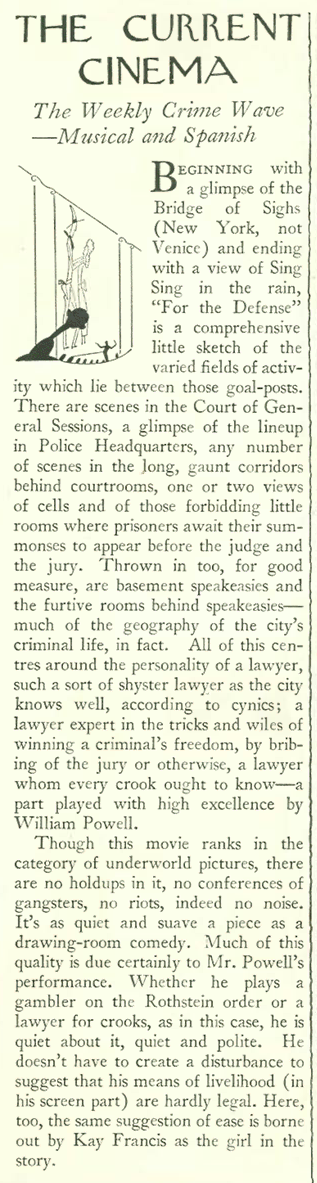
William Powell and Kay Francis were frequent co-stars, and would team up for the 1930 courtroom drama For the Defense. Powell and Francis would be two of Hollywood’s biggest stars in the 1930s.
LET’S MAKE A PICTURE…Frequent co-stars William Powell and Kay Francis in a publicity photo for 1930’s For the Defense. Francis was a longtime friend of The New Yorker’sLois Long. (IMDB)
* * *
From Our Advertisers
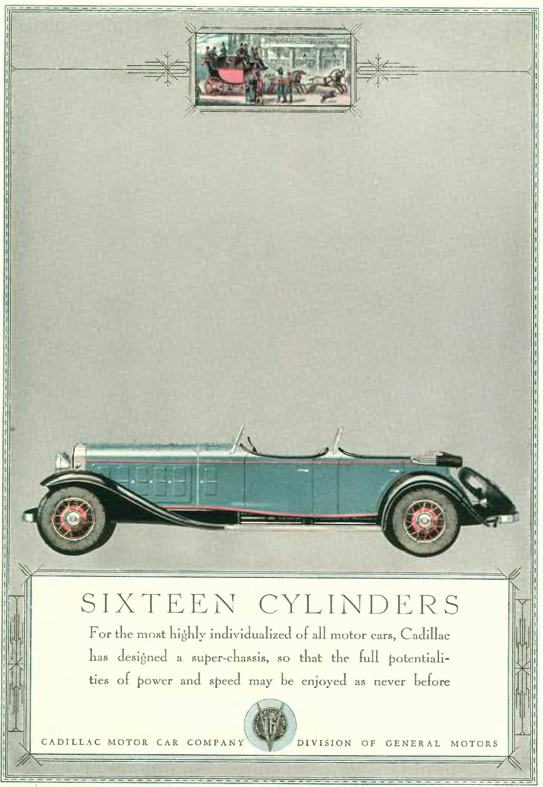
What Depression? As bread lines lengthened so did the “super-chassis” of this monster Cadillac…
…in contrast, this ad in the Aug. 2 issue questioned the necessity of a 4,000-pound car (or in the case of the 16-cylinder Cadillac, 6,500 pounds), and touted this “common sense” British import…imagine the America of today if this idea would have taken hold in the 1930s…
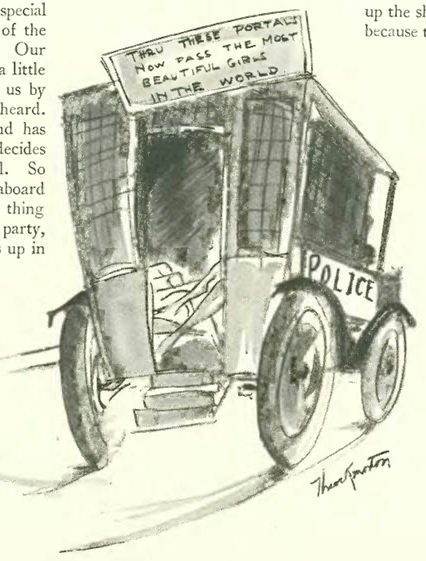
…we return to the June 26 issue to find an ad that would likely not appear in today’s New Yorker…
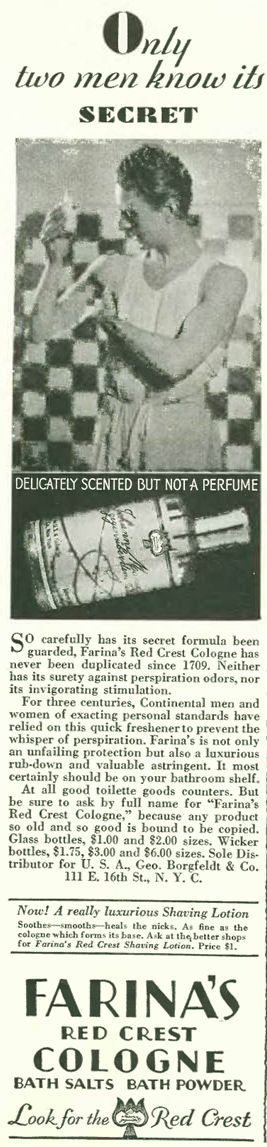
…another unlikely ad is this spot from the makers of Farina cologne featuring a skinflint applying the stuff to his armpit…yeah, I’ll take a bottle…
…and Rea Irvin continued his series of illustrations for Murad cigarettes…
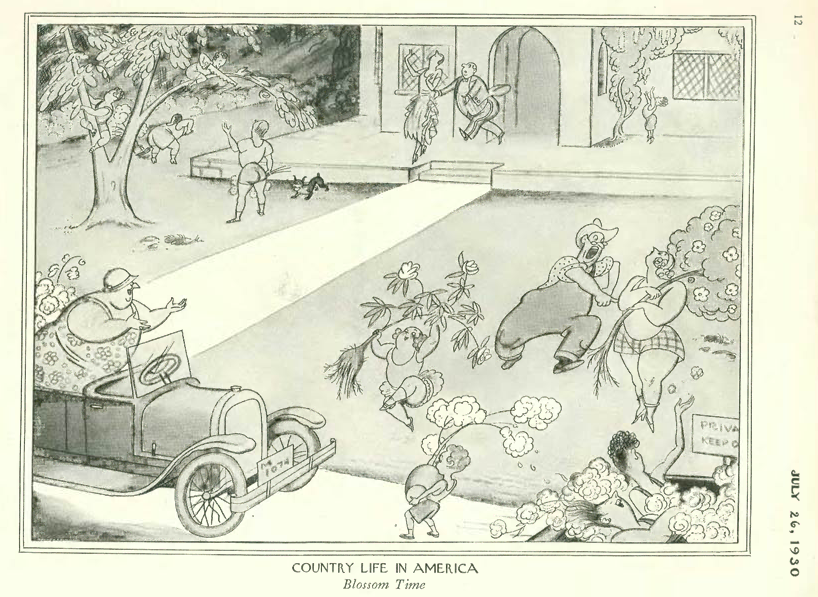
…in cartoons, Irvin gave us this interpretation of country life in a full-page panel originally featured sideways…these “Country Life in America,” scenes depicted common folks enjoying the outdoors at the expense of country squires…
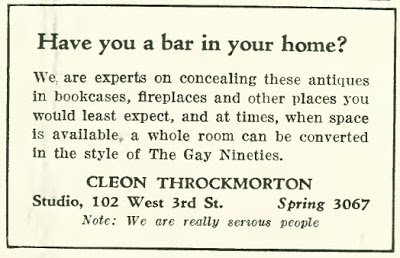
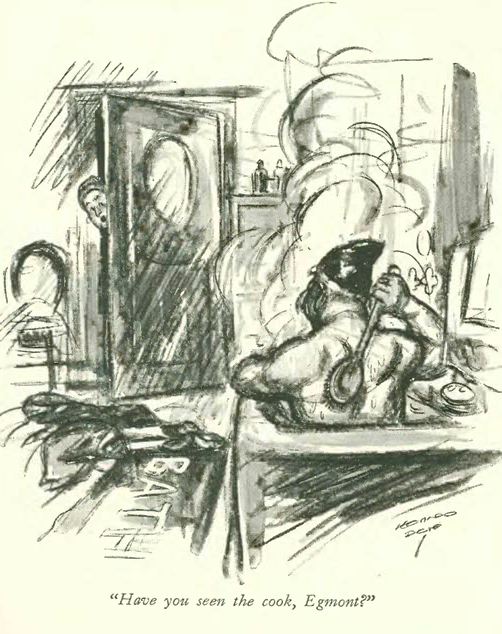
…and then we have the bohemian artist and set designer Cleon Throckmorton (1897-1965), with his one and only contribution to The New Yorker…
…in a previous issue (May 31, 1930) Throckmorton had placed this tiny, curious ad in a corner on page 46…
…and in the June 7, 1930 issue, he placed another ad in the bottom corner of page 94…
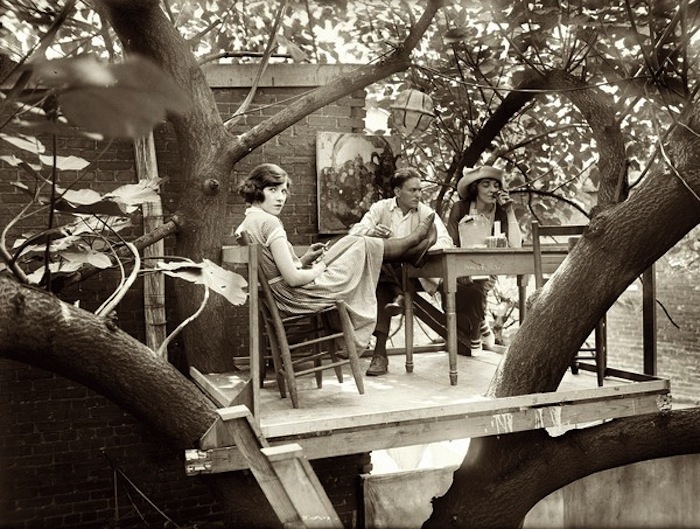
Cleon Throckmorton, well-known for his bohemian lifestyle, operated a backyard speakeasy called the Krazy Kat Club in Washington DC. He is pictured here (center) with a couple of “Klub” members in 1921. He was no slouch, however, designing 149 New York theatrical productions between 1920 and 1934. (messynessychic.com)
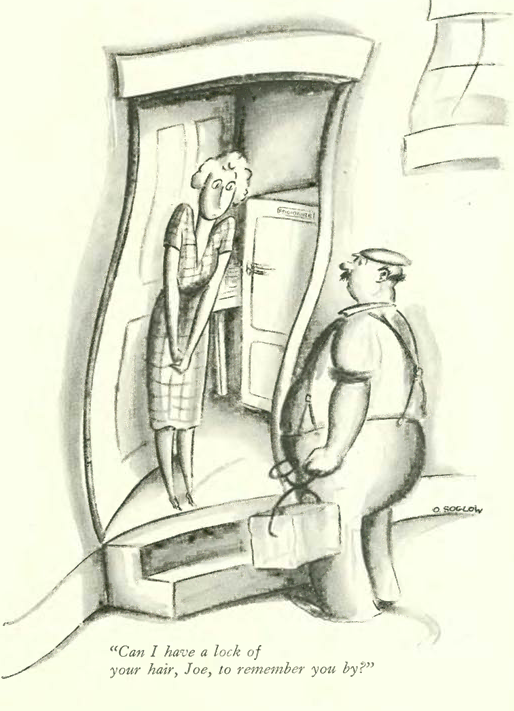
…back to our cartoons, we have Otto Soglow, who was going through a wavy period in his illustrations…
…Soglow would soon become famous for his Little King strip, but for now we’ll leave the king jokes to Peter Arno…
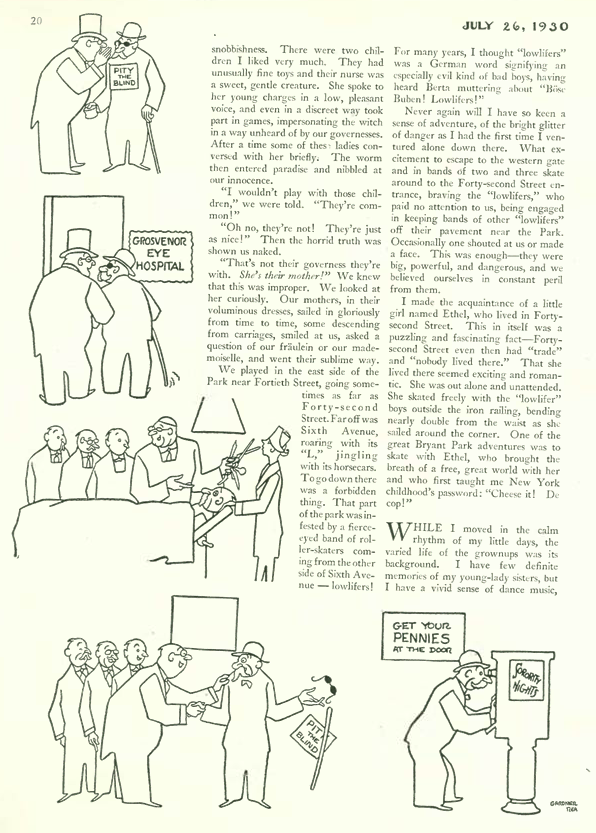
…Gardner Rea contributed this series cartoon that slid around page 20…
…Leonard Dove looked in on a domestic scene…
…and John Reehill contributed this weird little cartoon that reminded me a bit of the humor of Gahan Wilson…
From the late I.M. Pei to Frank Gehry, America has its share of “starchitects,” but only one architect in the history of the profession could claim to be a true household name: Frank Lloyd Wright.
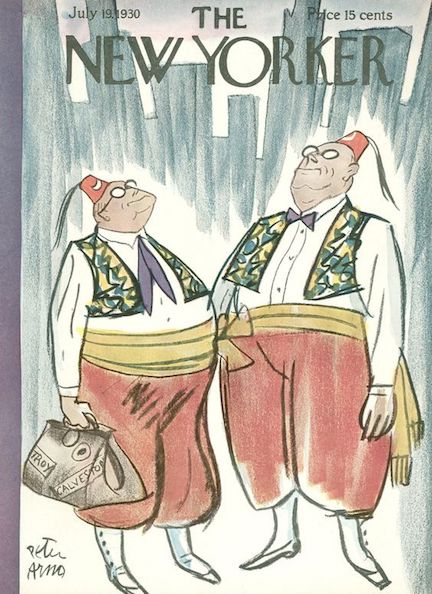
July 19, 1930 cover by Peter Arno.
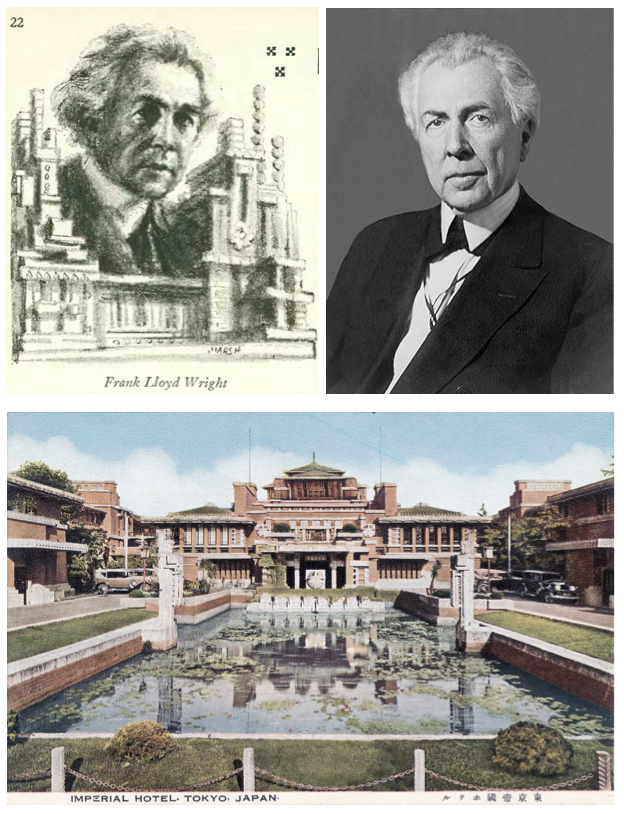
In a profile titled “The Prodigal Father,” Alexander Woollcott wrote about Wright’s “return” to American acceptance after nearly two decades of scandal and tragedy. Woollcott took great pains to defend Wright’s reputation, marred by his extramarital affair with Mamah Cheney, her murder in 1914 along with six others (including her children) at Wright’s Wisconsin home, Taliesin, and his subsequent remarriage, divorce, and remarriage that followed.
GONE BUT NOT FORGOTTEN…Clockwise, from top left, Reginald Marsh illustration for the profile; Frank Lloyd Wright, circa 1930; Tokyo’s Imperial Hotel, completed in 1923. Designed in the Maya Revival Style Wright favored throughout the 1920s, it was damaged by the 1923 Great Tokyo Earthquake just months after opening. It was demolished in 1967, however the iconic central lobby wing and the reflecting pool were disassembled and rebuilt near Nagoya. (Library of Congress/dezeen.com)
Note: Thanks to a reader’s correction (see comments at the bottom), the following has been revised:
Woollcott also wrote of his visit to Taliesin (the third version of the house, after the first two were destroyed by fires). What stands out about this profile is Woollcott’s praise for the architect, a rare hagiography from a man renowned for his savage wit.
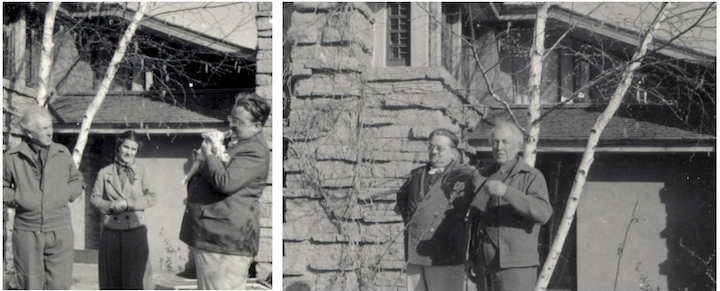
MEETING OF THE MINDS…Above and below are photographs from a autumn visit to Taliesin by Alexander Woollcott. From left are Olgivanna Lloyd Wright, Frank Lloyd Wright and Woollcott. Wright invited Woollcott to the estate in the late 1920s: “This note will be witless as usual, but grateful…. Dear Man, why don’t you come up here? Bring any friend up here with you. Both of you can find an admirable place to work here…” (Avery Architectural & Fine Arts Library, Columbia University, New York)
THIRD TIME’S A CHARM…The third version of Taliesin (built in 1925) is the one Woollcott would have visited in the late 1920s. (Wikipedia/Taliesin Preservation)
* * *
No Surprise Endings, Please
Although sometimes confused with Alexander Woollcott because of his first name, the timid, taciturn Wolcott Gibbs was a force at The New Yorker in his own right, perhaps even more so as he served the magazine from 1927 to 1958 as a jack-of-all-trades: copy editor, feature writer, theater critic, and overall wordsmith. So when the editors of The Writer’s Digest posed a question regarding The New Yorker’s policy for submissions, it was Gibbs who was tapped to compose a response, which was a particular challenge given the magazine didn’t have a clear set of editorial requirements. So Gibbs conjured up an “Answers-To-Hard-Questions Department,” and signed it “Mr. Winterbottom.” Some excerpts:
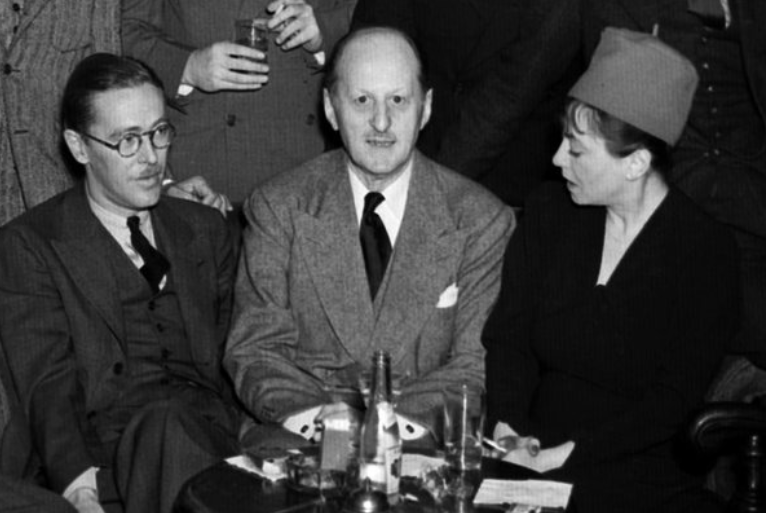
IN HIS ELEMENT…Wolcott Gibbs, left, relaxes at the Algonquin Hotel in 1937. At right is his New Yorker colleague Dorothy Parker. (Time)
* * *
Munitions of Bremen
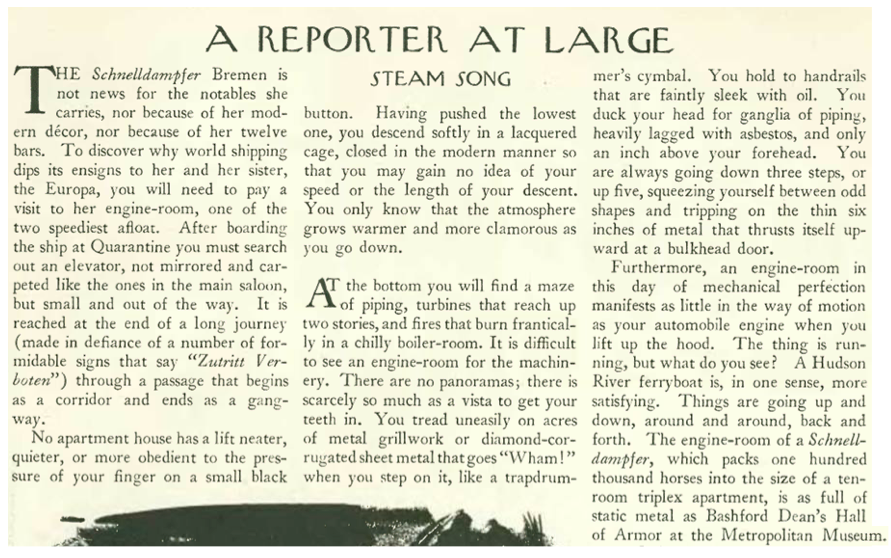
The German Ocean liner SS Bremen was one of the most technologically advanced ocean liners of its day, known for its speed and luxury. Author Eric Hodgins climbed aboard to file a report for the New Yorker, and in the excerpt below marveled at the “mechanical perfection” of the ship’s engine room:
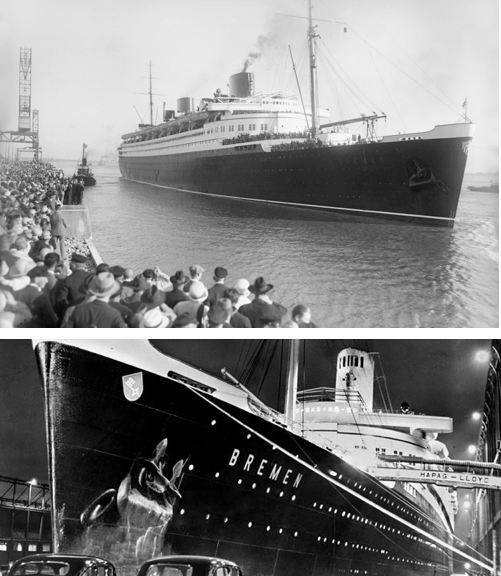
PLOUGHSHARES INTO SWORDS…More than the length of three football fields, the streamlined SS Bremen, launched in 1928, was designed to have a cruising speed of 27.5 knots (50.9 km/h). After a 1941 fire, the ship was largely dismantled, its steel used to manufacture war munitions. (Wikipedia/greatoceanliners.com)
In 1941, while docked in Bremerhaven, a disgruntled crew member set fire to the ship, completely gutting its luxurious interior. During the war the ship was stripped of its steel for use in munitions, and in 1946 what remained was destroyed by explosives.
* * *
From Our Advertisers
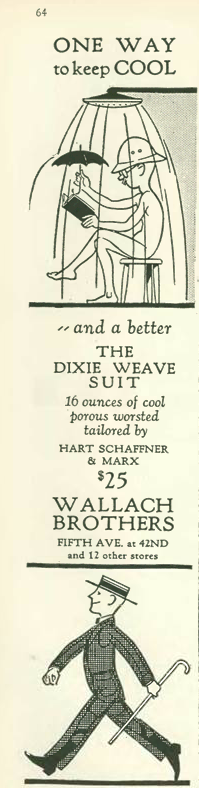
In my readings of recent issues I’ve noted numerous references to hot weather, and for good reason. The summer of 1930 would see record high temperatures and diminished rainfall that would usher in the “Dust Bowl” era of the 1930s. The Wallach Brothers adjusted by offering this “Dixie Weave Suit”…
…the hot weather also called for a tall glass of sparkling soda (mixed with your favorite bootleg beverage, of course)…
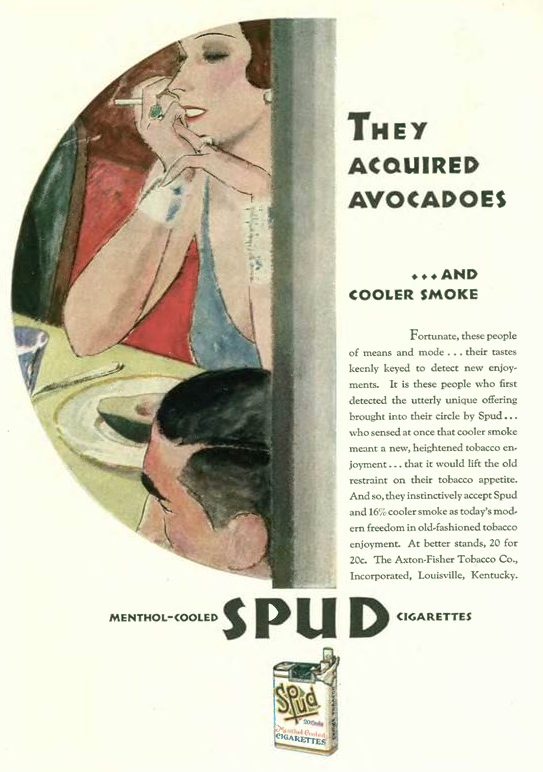
…smokers could keep cool by puffing on a Spud, the first menthol cigarette…
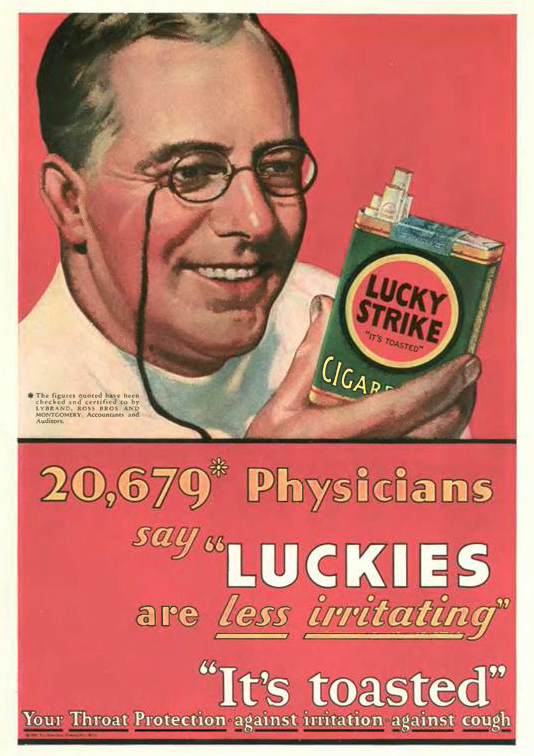
…or you could stick with your Luckies, endorsed by none other than this generic, genial doctor and some bogus survey…
…on to our cartoons…Isadore Klein showed us a downside of Edison’s invention…
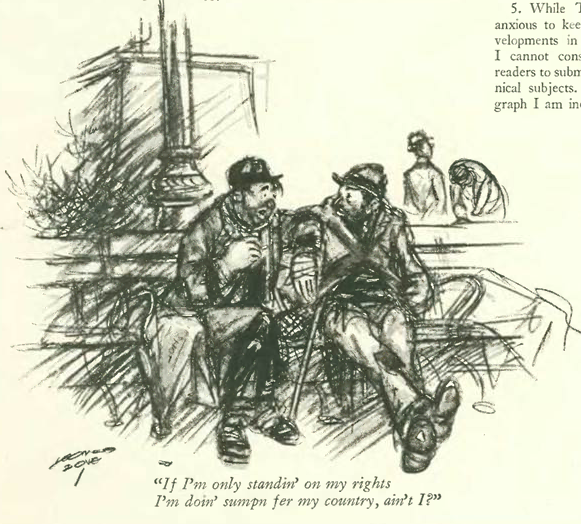
…and Leonard Dove gave us two gentlemen on the skids, a frequent sight in Depression-era New York…
…after a long absence, we see suddenly see a flurry of activity from the pen of Ralph Barton, including this rare sequential cartoon…
…and with the hot summer New Yorkers took to the waters, at Coney Island with Denys Wortman…
When Apollo astronauts landed on the moon fifty years ago, many skeptics asked the question, “What good does this accomplish?”
July 12, 1930 cover by Constantin Alajálov.
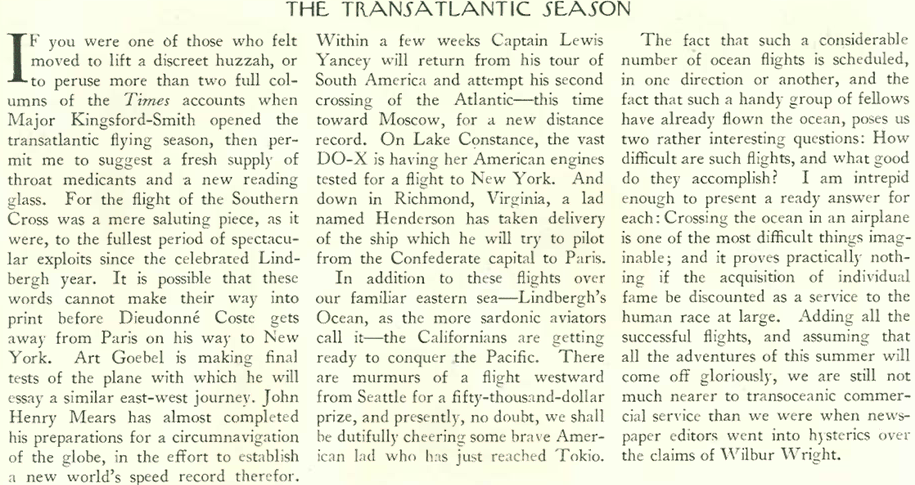
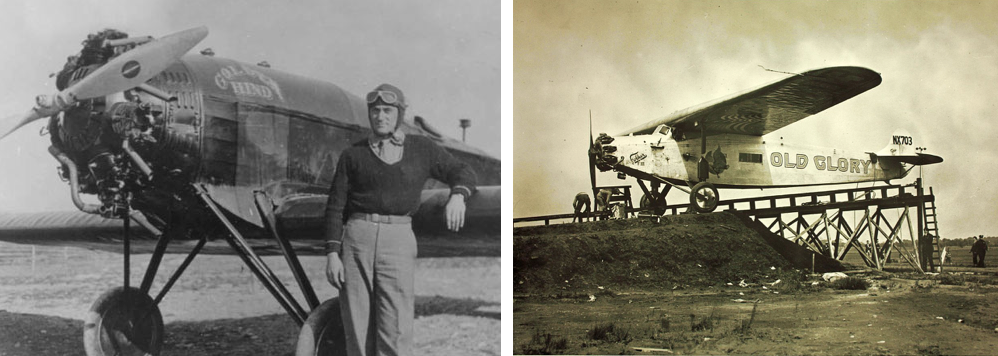
New Yorker writer Morris Markey posed the same question 89 years ago about transatlantic flights, then limited to a handful of daredevils chasing various speed and distance records. Crossing the ocean in an airplane, Markey observed, was “one of the most difficult things imaginable.” He concluded that despite the heroics of a few pilots, “we are still not much nearer to transoceanic commercial service…”
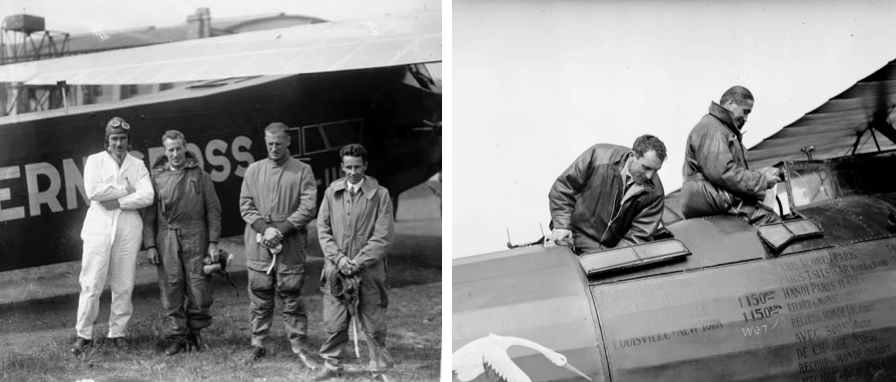
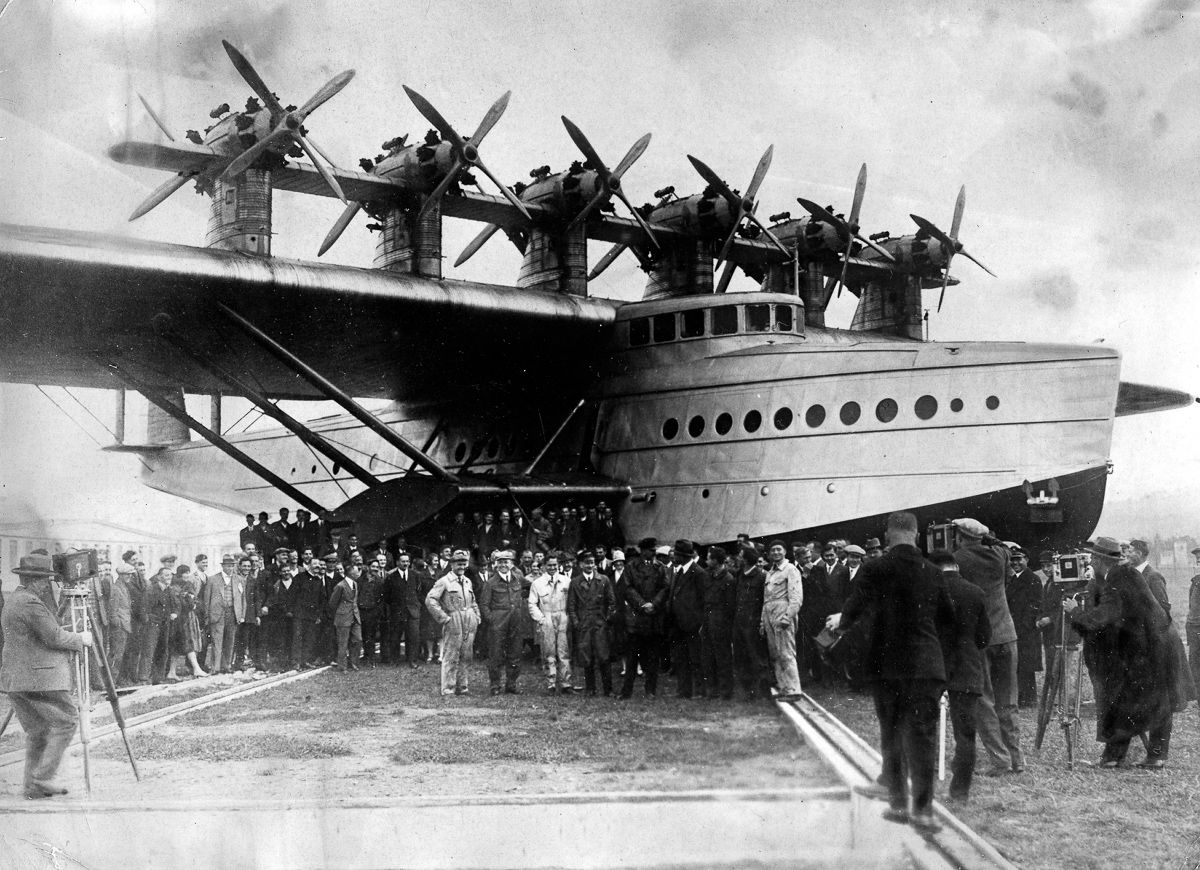
TESTING THE LIMITS…In photo at left, Charles Kingsford Smith (second from left) and the crew of his airplane, Southern Cross, pause before embarking on their east-west crossing of the Atlantic in June 1930; photo at right: Dieudonné Costes (right) with Maurice Bellonte in Boston in 1930. On September 1-2, 1930, they flew the “Point d’Interrogation” from Paris to New York, the first heavier-than-air aircraft to reach New York in the more difficult westbound direction between the North American and European mainlands. (National Library of Ireland/Wikipedia)BIG THINKERS…Germany’s massive Dornier Do-X made its first test flight on July 12, 1929. A few months later, it carried a world-record 169 passengers on a 40-minute flight, an astonishing number given that the largest planes at that time rarely carried more than 20 passengers. In 1930, the Do-X took off on an international publicity tour through Europe, down the west coast of Africa, across the Atlantic to Brazil and up to New York before returning to Berlin. (Mashable)
Markey went on to detail the various obstacles facing transatlantic fliers, including fairly good odds that a plane, laden with fuel and supplies for such a journey, would crash on takeoff. He noted that a little over half of the attempts succeeded, while the others seemed doomed from the start.
ILL-ADVISED…With only 70 hours of flying experience, Montana rancher Urban F. Diteman (left, with his airplane “Golden Hind”) took off from Harbour Grace, Newfoundland, bound for London. He was never seen again; at right, the William Randolph Hearst-sponsored “Old Glory,” a Fokker F.VIIa single-engined monoplane that was used in 1927 on an attempted transatlantic flight from Old Orchard Beach, Maine to Rome, Italy. The overloaded plane and its crew were lost approximately 700 miles east of Newfoundland, where only a section of wing was recovered. (dailymontana.com/Wikipedia)
* * *
Glare of the New
Architecture critic George Chappell enthusiastically followed the construction of the world’s tallest building, but in its completion he found the Chrysler Building’s now-iconic spire to be little more than a stunt, and suggested that a covering of masonry might be in order:
MAYBE SOME VINYL SIDING?…George Chappell wasn’t too crazy about the Chrysler’s chrome dome, and also worried about the amount of steel that would clad the exterior of the Empire State Building, right, which is composed of limestone, chrome bars and aluminum panels. (Wikipedia)
* * *
Bottoms Up
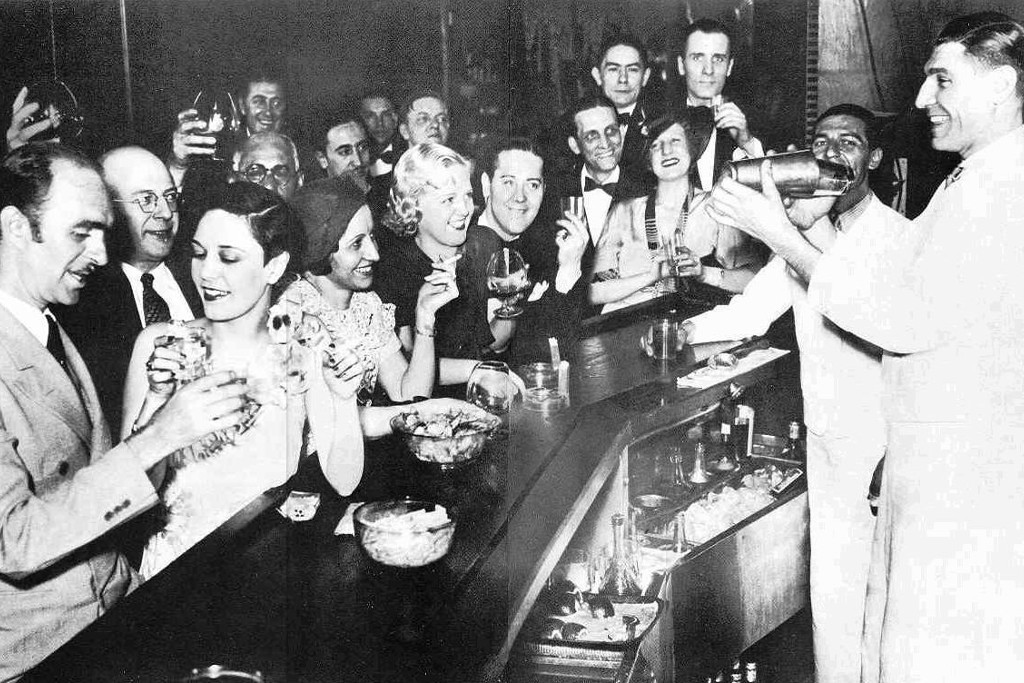
In his “Notes and Comment,” E.B. White pondered the drinking habits of his fellow citizens in the tenth year of Prohibition:
MAKE THAT A DOUBLE…Finding refreshment in the dark days of Prohibition. (junkee.com)
* * *
Good Old Summertime
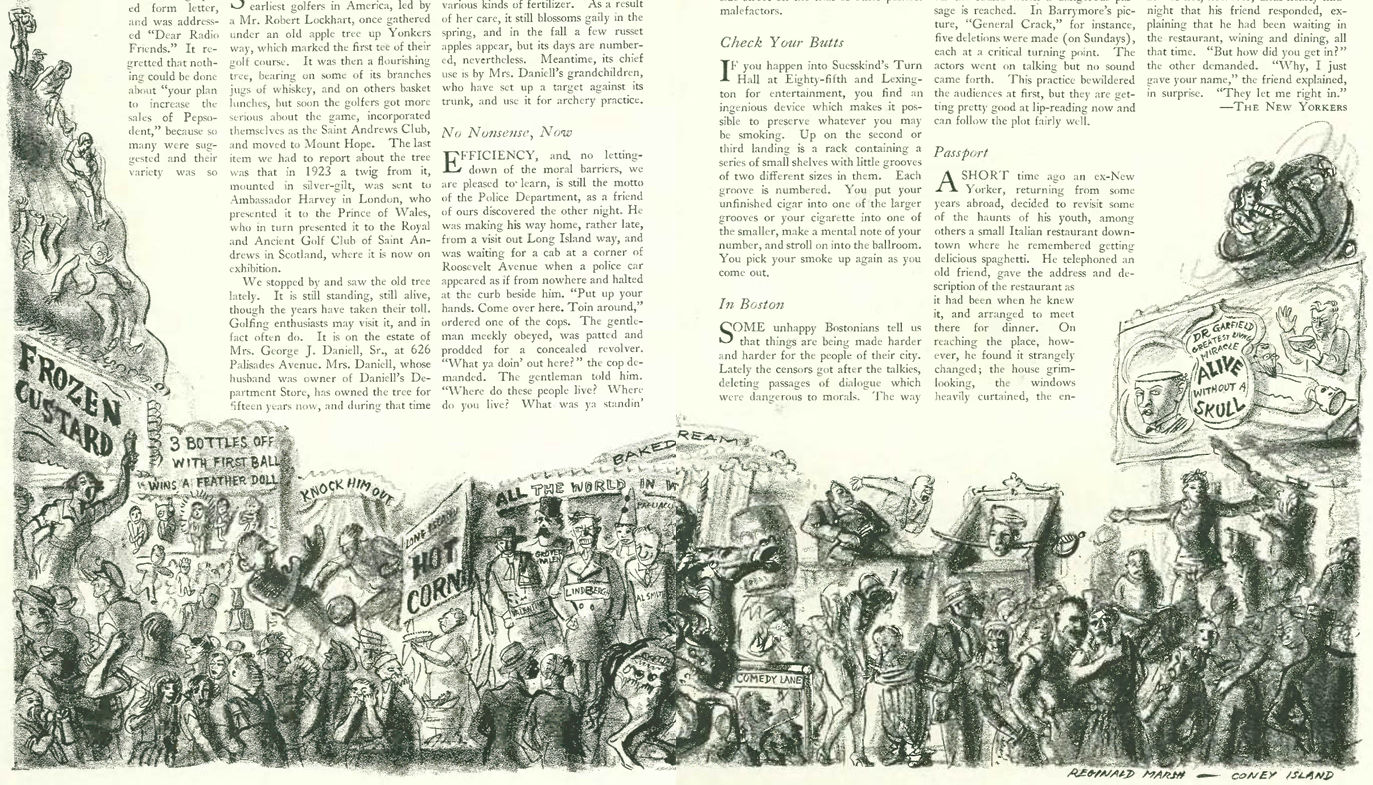
Along the bottom of “The Talk of the Town,” a Reginald Marsh interpretation of Coney Island fun and games…
* * *
Still the Same
Lois Long, who painted a picture of Jazz Age nightlife like no other in her “Tables for Two” column, teased her readers by disguising her identity, often claiming she was a frumpy old lady. With her “Tables” column now on hiatus, the fashionable and young Long maintained her pose, referring to herself as an “old war horse” in her fashion column “On and Off the Avenue.”
Problems of the Rich
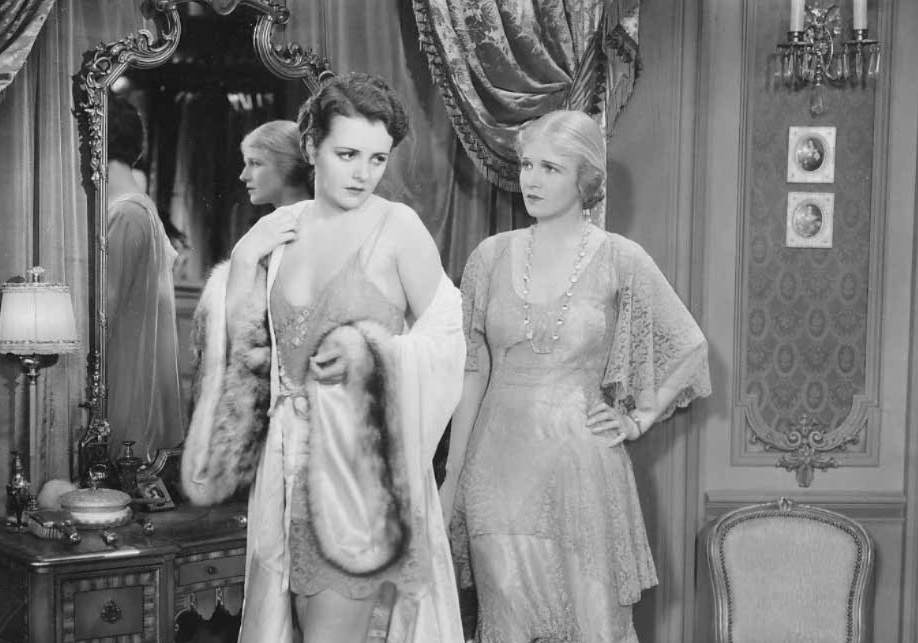
John Mosher reviewed the 1930 American Pre-Code comedy Holiday, which told the story of a young man torn between his wild lifestyle and the tradition of his wealthy fiancée’s family. Films that explored the “problems” of the rich seemed particularly popular in the Depression years…
POOR LITTLE RICH GIRLS…Mary Astor and Ann Harding in Holiday. (IMDB)
* * *
From Our Advertisers
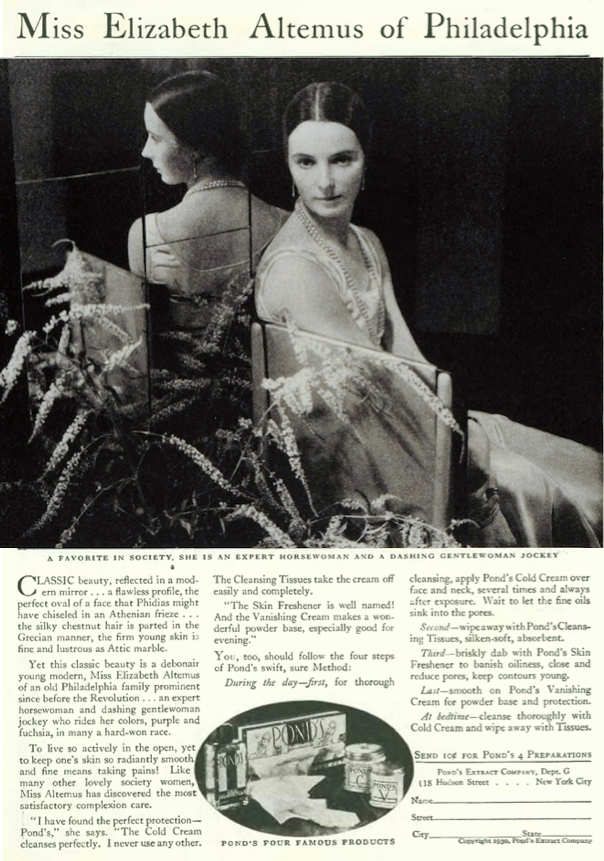
The makers of Pond’s Cold Cream continued its campaign of endorsements by society women, including Philadelphia socialite, philanthropist and champion horsewoman Elizabeth Altemus…
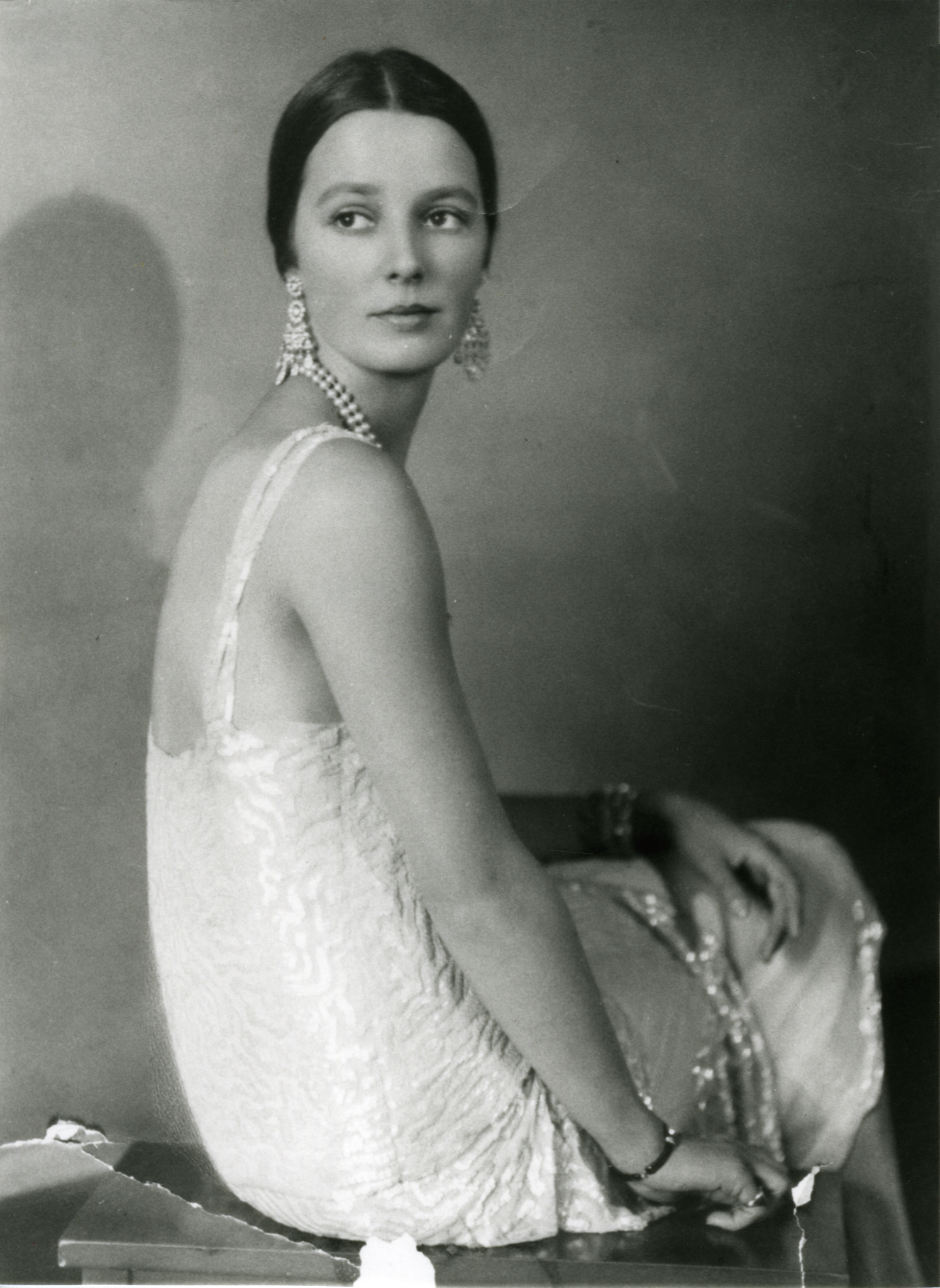
Altemus (1906-1988) was a prominent owner/breeder of Thoroughbred racehorses for more than 50 years. Her first marriage was to Jock Whitney, U.S. Ambassador to the United Kingdom, publisher of the New York Herald Tribune, and president of the Museum of Modern Art. By the looks of this 1937 portrait of Altemus, the cold cream certainly didn’t do her any harm…
Mary Elizabeth Altemus Whitney in 1937. (geni.com)
…speaking of cold cream, when Kleenex was introduced in the early 1920s, it was marketed solely as a hygienic way to remove cold cream. It wasn’t until the 1930s that the makers of Kleenex began to suggest it could also be used as a tissue in place of a handkerchief. Of course it was also a great way to dramatically expand consumption of its brand, and help usher in a new age of disposable products…
…as the Depression deepened, ads for automobiles began to change with the times, most manufacturers emphasizing the affordability of their cars over performance or prestige, as this sad little ad from Packard attested….
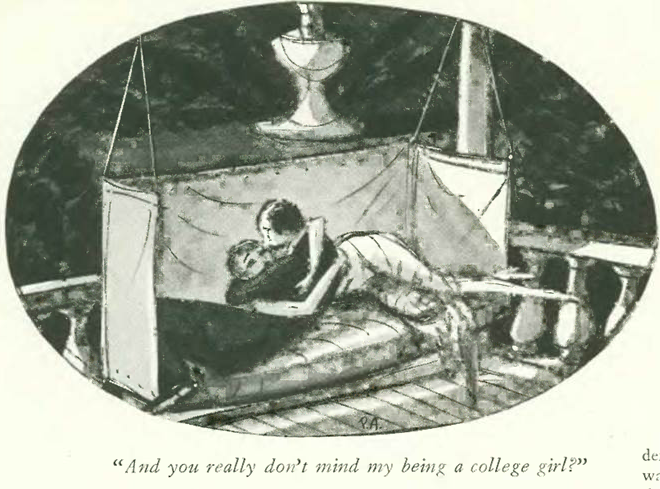
…in three consecutive issues (June 5, 12 and 19) Peter Arno featured the same drawing with a different caption that gave readers a very brief courtship story…
…Alan Dunn offered a glimpse of life among the newsboys…
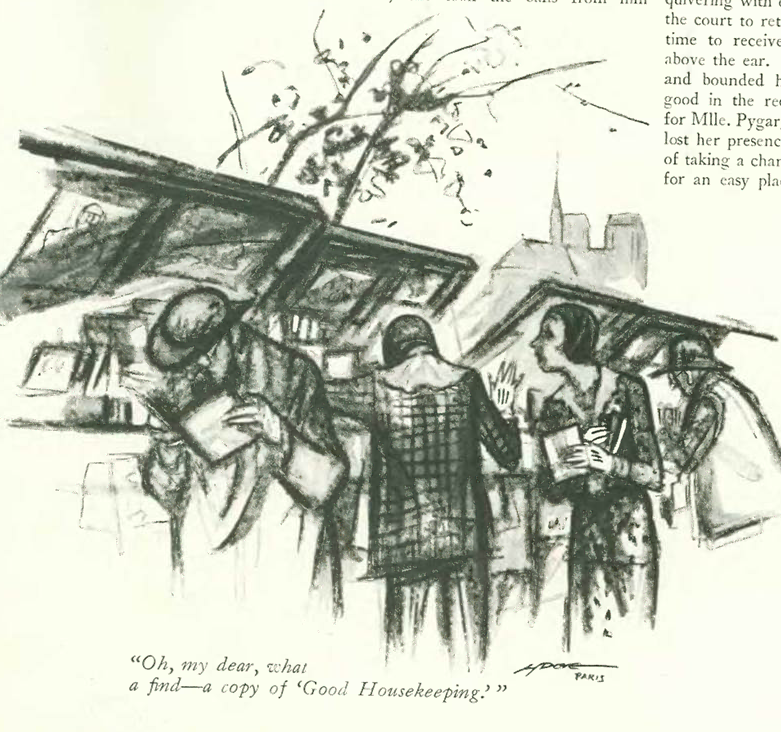
…Leonard Dove found Americans browsing newsstands along the Seine…
…Helen Hokinson looked in on an existential crisis…
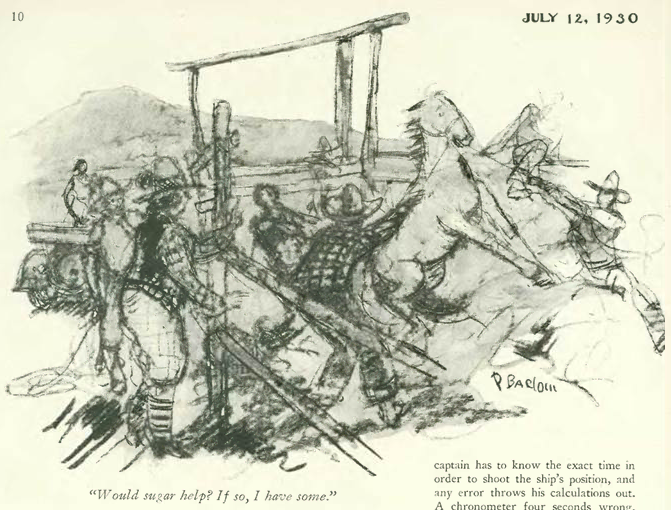
…Perry Barlow was Out West at a dude ranch…
…Barbara Shermund eavesdropped on a couple of debs…
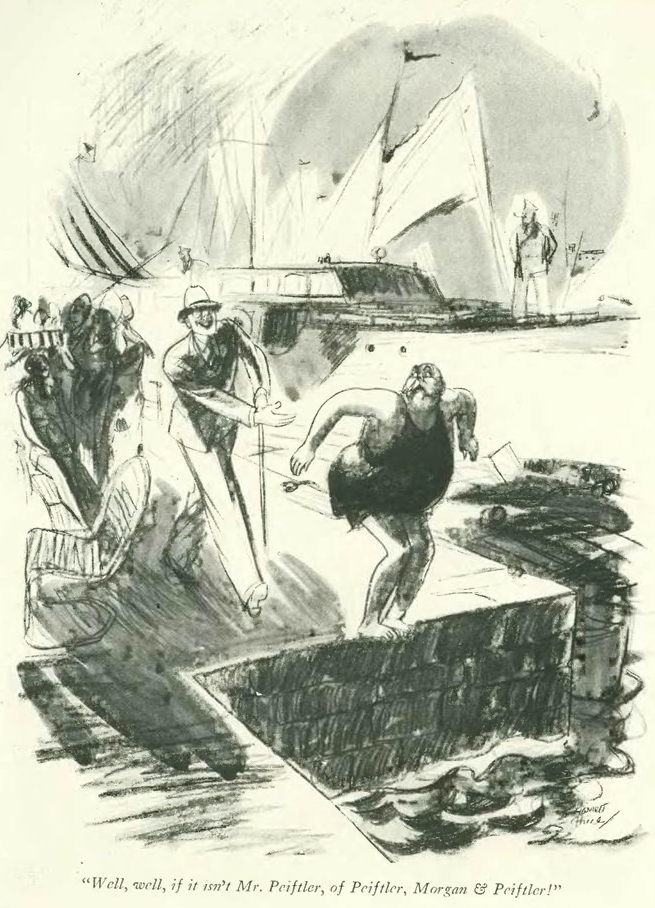
…Garrett Price gave us an awkward encounter among the yachting crowd…
…and finally William Crawford Galbraith, and a case of domesticus interruptus…
The annual Salon of the Société des Artistes Décorateurs in Paris reflected the growing importance of design as a profession, although it was primarily attuned to an affluent urban elite. Then along came the Germans.
June 14, 1930 cover by Helen Hokinson.
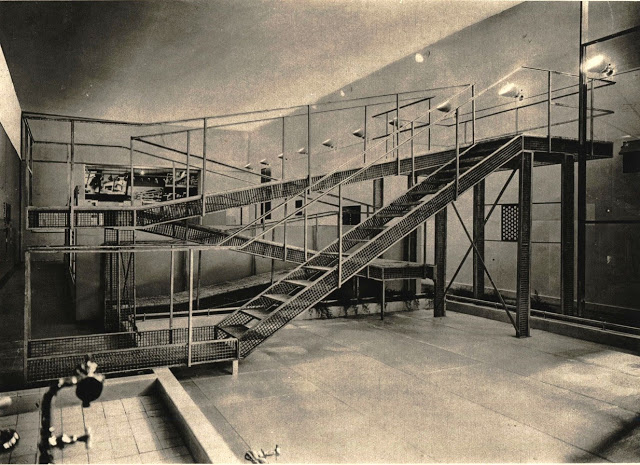
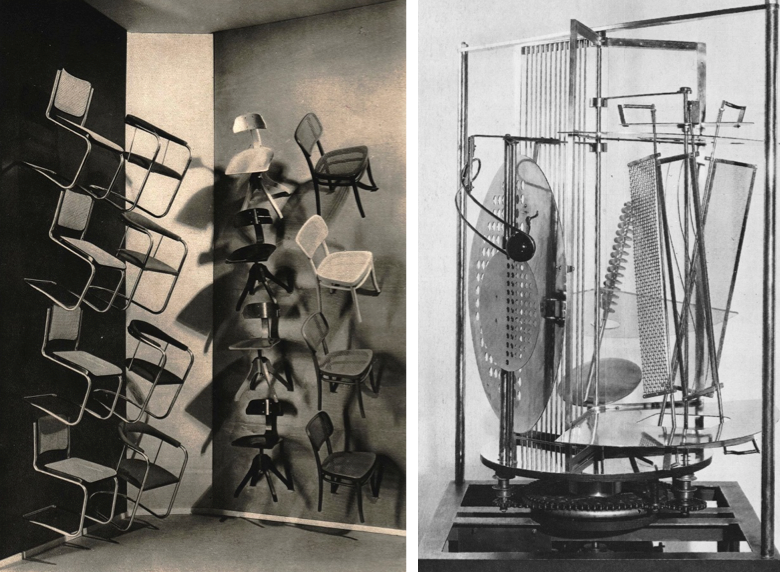
A radical new wind blew through Paris in 1930 when Bauhaus designers were invited to exhibit in their own special section at the Salon. According to The New Yorker’s Paris correspondent Janet Flanner, the Germans put on a display in their Section Allemande that left some French designers scratching their heads.
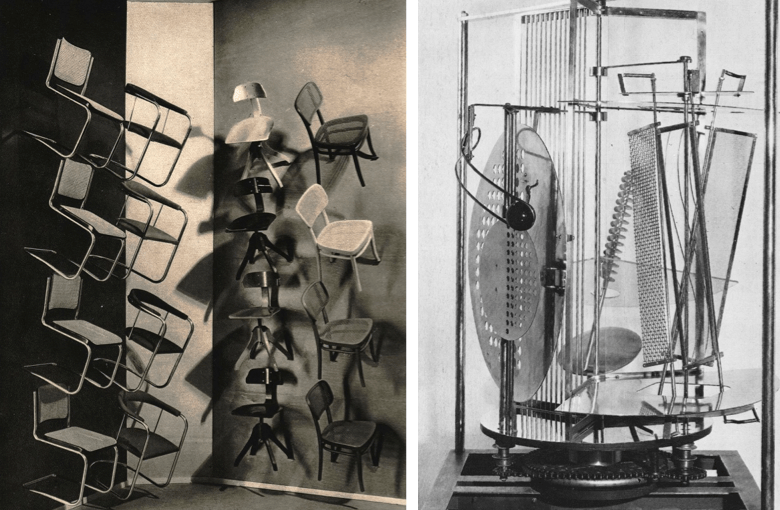
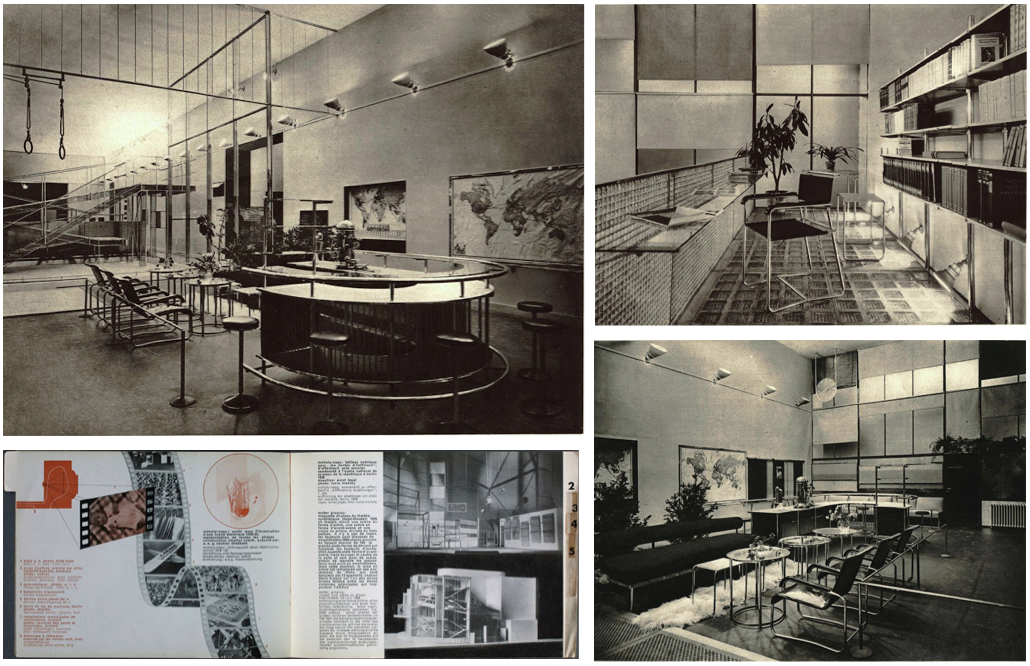
KEEPING IT CLEAN…Members of the Bauhaus Werkbund displayed their wares in the Section Allemande (German section) of the annual Salon of the Société des Artistes Décorateurs in Paris. Clockwise, from top left, examples of reception areas and workspaces by Walter Gropius; bottom left, inside pages of the exhibition catalogue for the Section Allemande. (journal.eahn.org)STAIRWAY TO THE FUTURE…A staircase fashioned from galvanized chicken wire, by Walter Gropius, on display in Section Allemande of the 1930 Salon of the Société des Artistes Décorateurs. (journal.eahn.org)UNKNOWN THEN, COMMON NOW…The Section Allemande also featured building models, including this multi-story apartment with communal facilities, designed by Walter Gropius. (Journal of Design History, 2004)HOW IT STACKED UP…Rather than dazzle audiences with the latest in posh decor, the Germans confronted Salon audiences with their radical approaches to furniture and interior spaces. At left, chairs by Marcel Breuer and others; at right, Light Prop for an Electric Stage by László Moholy-Nagy. (journal.eahn.org/Artists Rights Society)
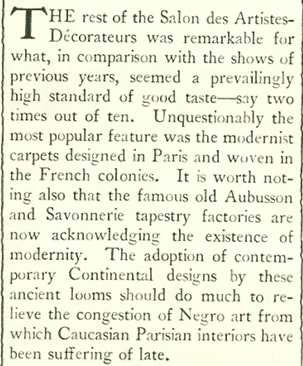
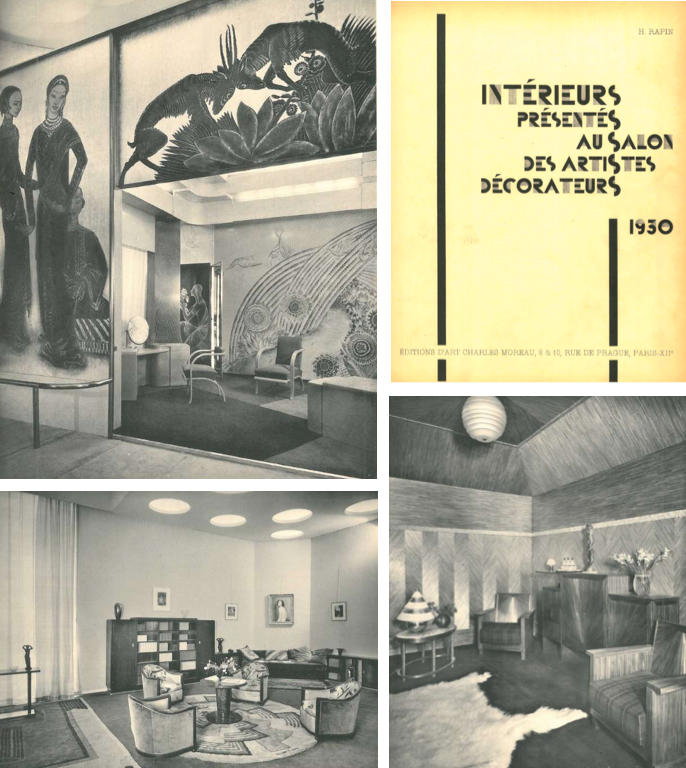
Many critics and commentators at the time characterized the Salon as a nationalistic showdown between French luxury decor and German efficiency and standardization. Flanner suggested that while the Germans seemed to be throwing out the rule book, the French were accepting modernity at a much slower pace:
MODE DE VIE…Salon entries by French designers had a more art deco bent. Clockwise, from top left, vestibule of a boudoir by Jean Dunand; cover of the Salon’s catalogue; Petit Salon by André Groult; a living room by Jules Leleu. (art-utile.blogspot.com)
Of course we know how this story in turns out. In just three years the Nazis would shut down the Bauhaus, scattering its faculty and students abroad, including many to America, where they would find fertile soil to continue their work and eventually spread their design philosophy and aesthetic (for better or worse) across the U.S. and to every corner of the world.
* * *
A Gay Old Time
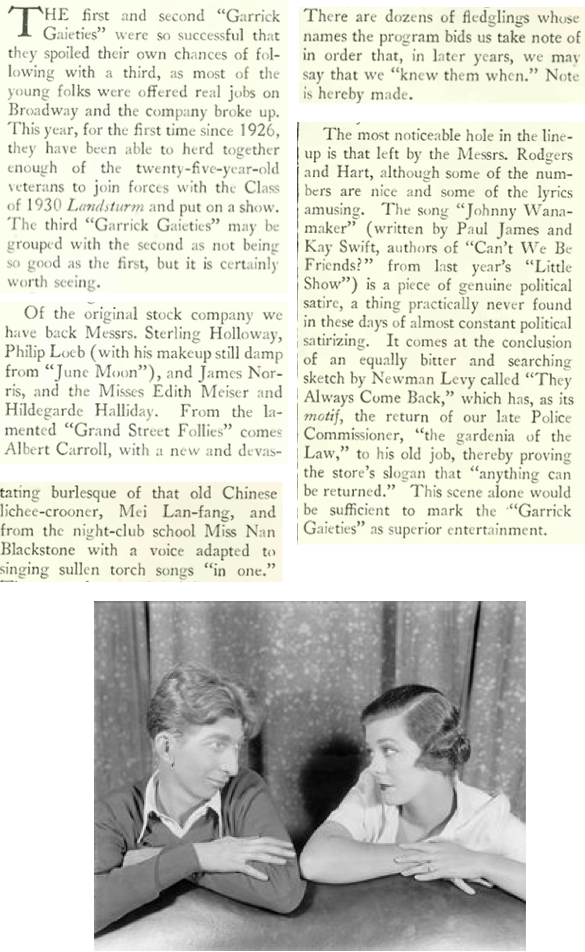
New Yorkers could escape the summer heat by taking in the latest incarnation of the Garrick Gaities at Broadway’s Guild Theatre. Character and voice actor Sterling Holloway Jr., (1905-1992) best known today as the voice of Disney’s Winnie the Pooh, appeared in all three Garrick Gaiety revues (1925, 1926, 1930), which were staged as benefits for New York’s Theatre Guild. Robert Benchley offered this review:
Sterling Holloway, left, with June Cochran in Garrick Gaieties.
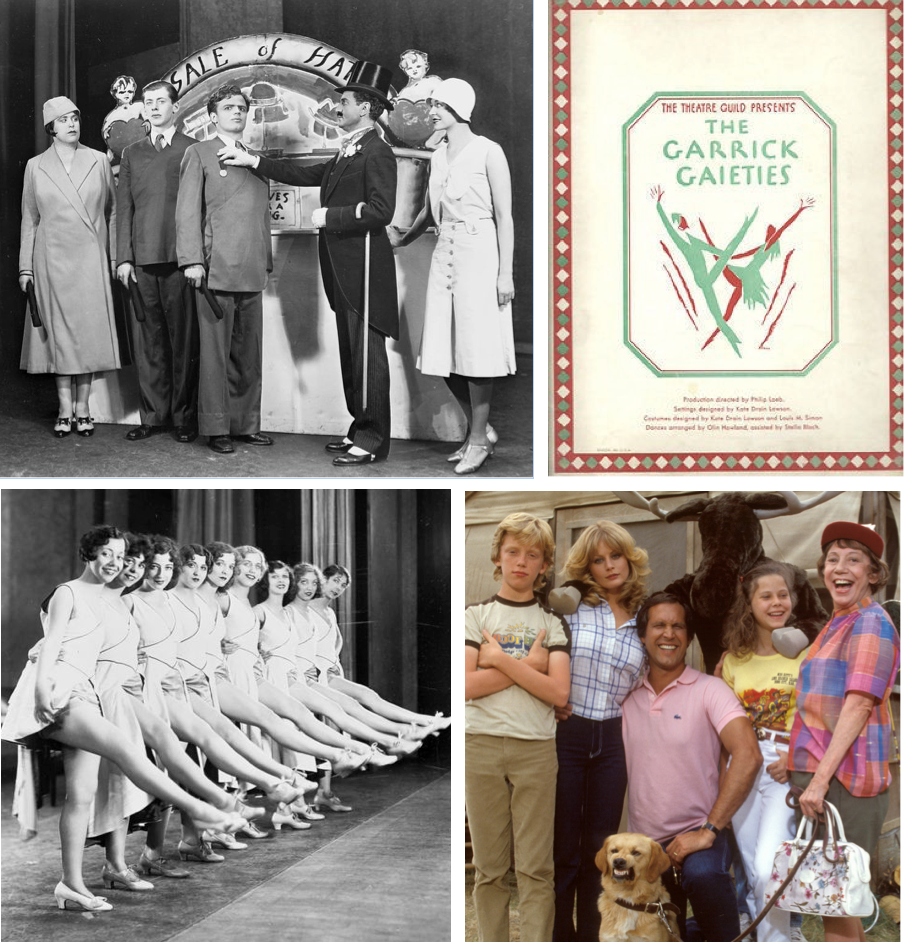
Another familiar face in the Garrick Gaieties was Imogene Coca (1908-2001), a pioneer of early television (with Sid Caesar on Your Show of Shows) who is best known today for her role as Aunt Edna in National Lampoon’s Vacation (1983).
KEEP ‘EM LAUGHING…Clockwise, from top left, Scene from the 1930 Garrick Gaieties revue, with Philip Loeb in the high hat and Thelma Tipson standing behind him. Also from left are Ruth Chorpenning, Donald Stewart and Ted Fetter; cover of the program for the 1930 revue; publicity photo from 1983’s National Lampoon’s Vacation, with Imogene Coca as Aunt Edna; Coca, far left, in the chorus line for the 1930 Garrick Gaieties. (New York Public Library/IBDB/ifccenter.com)
* * *
Ahh-Choo
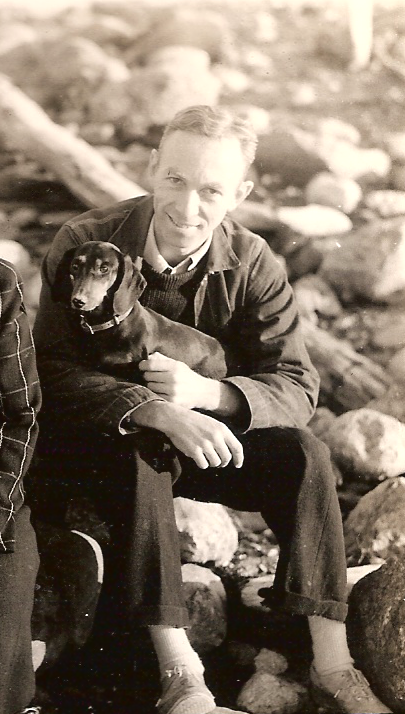
A child of New York City’s suburbs, E.B. White developed a love of the natural world thanks to a severe bout of hay fever he had as a child — on the advice of a doctor, he was sent to Maine for the summer. White’s allergies, and his love of country living, would prompt him to buy a summer residence on the Maine Coast in 1933. He and his wife, New Yorker writer and fiction editor Katherine Angell White, would make it their permanent home four years later. In 1930, however, White was still putting up with the bad summer air of the city:
THANK GOD I’M A COUNTRY BOY…E.B. White on the beach with his dog Minnie, circa 1940s. (Wikipedia)
* * *
It Didn’t Work Then, Either
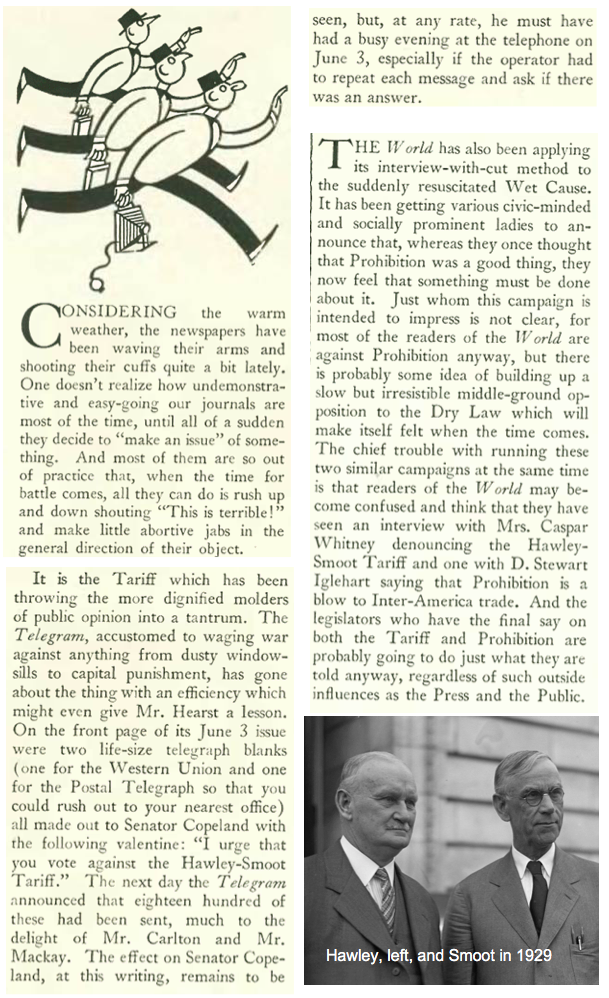
Some things never change. The Hawley–Smoot Tariff Act, sponsored by Representative Willis C. Hawley and Senator Reed Smoot and approved June 17, 1930, raised tariffs on more than 20,000 imported goods. Promoted as a way to protect American businesses and farmers, it put additional strain on international markets already reeling from the effects of the Depression. A resulting trade war severely reduced imports and exports. Writing for “The Wayward Press,” Robert Benchley (under the pen name Guy Fawkes) shared these observations:
* * *
How Dry I Ain’t
Despite his sober demeanor, Henry Hastings Curran (1877-1966) was a champion for those seeking the repeal of Prohibition laws. A longtime city manager in several roles, in 1930 he was president of the Association Against Prohibition Amendment. According to profile writer Henry Pringle, Curran predicted the end of Prohibition in five years. Happily for the wet side, they would get their wish in just three. A brief excerpt from the profile, titled “The Wet Hope.”
Henry H. Curran (Underwood and Underwood)
* * *
From Our Advertisers
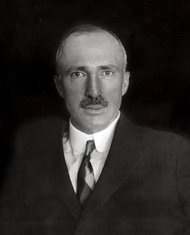
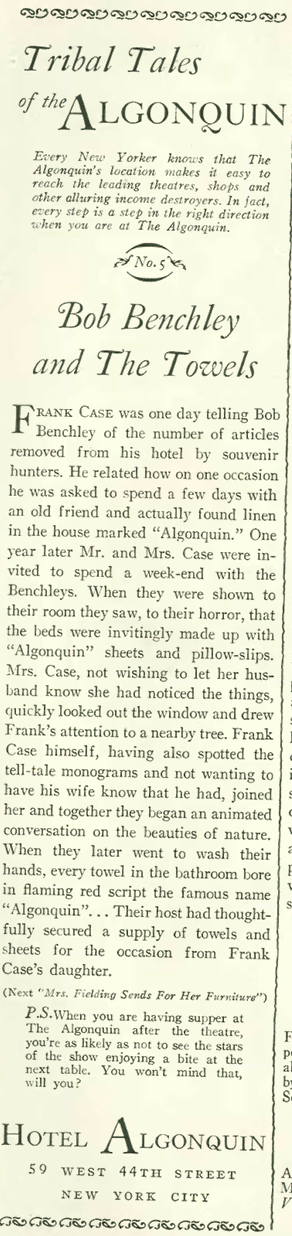
The Hotel Algonquin ran a series of ads in the back pages of The New Yorker that capitalized on its reputation as a place where stars and other notables gather. And although the Algonquin Round Table was a thing of the past, the hotel made sure to showcase names forever associated with the famed table, including Robert Benchley and the hotel’s manager, Frank Case…
…hoping for some crossover interest from New Yorker readers, William Randolph Hearst’sCosmopolitan (then a publisher of fiction, not sex tips) promoted this fictionalized autobiography of a famous tap dancer in this full page ad…
…introduced in 1924, Kleenex was originally marketed as a cold cream remover, and not as something you would blow your nose into, for goodness sake…
…however, after 1930 Kleenex was being marketed with the slogan “Don’t Carry a Cold in Your Pocket”…
DON’T BLOW IT…Kleenex boxes circa 1925. (Kleenex.com)
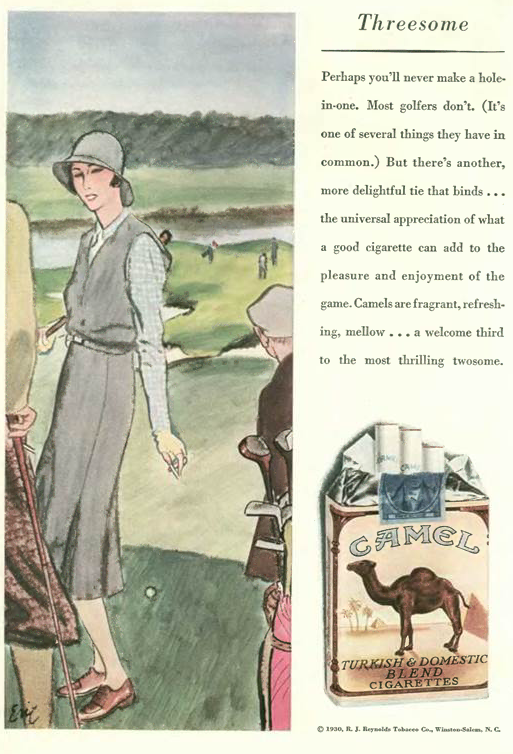
…and artist Carl Erickson remained busy making Camel cigarettes look so darn appealing…
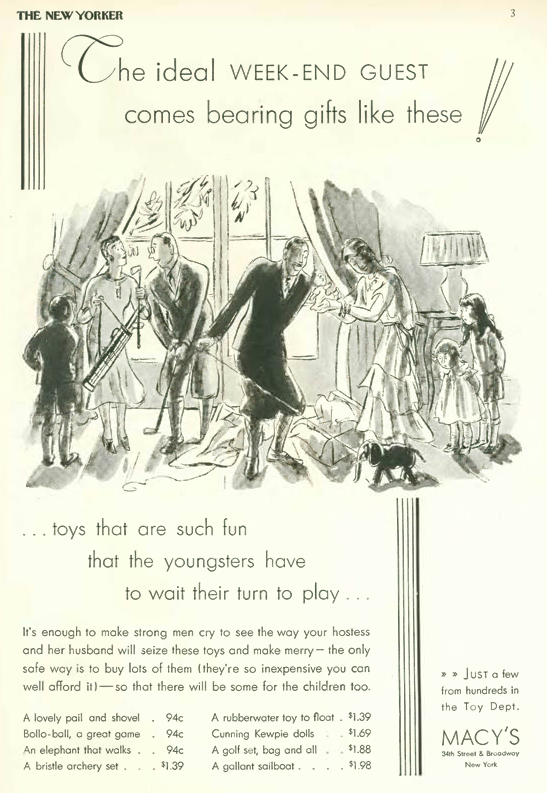
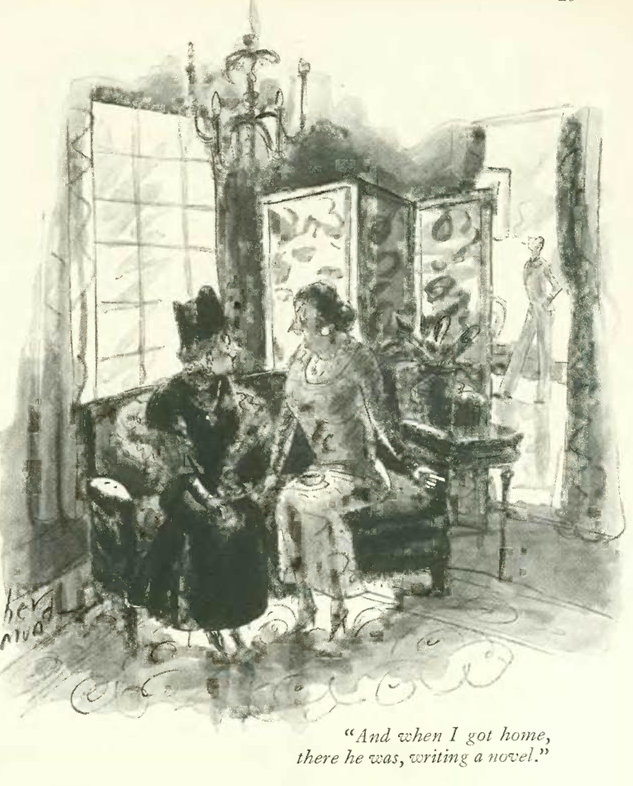
…from Macy’s we have a jolly ad illustrated by Helen Hokinson…
…and for our cartoons, Peter Arno, and an awkward moment in a parking lot…
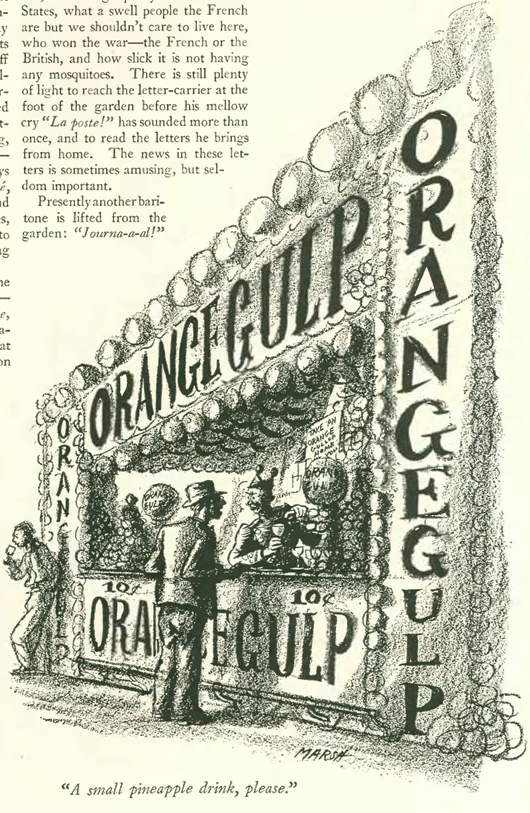
…Reginald Marsh visited Coney Island…
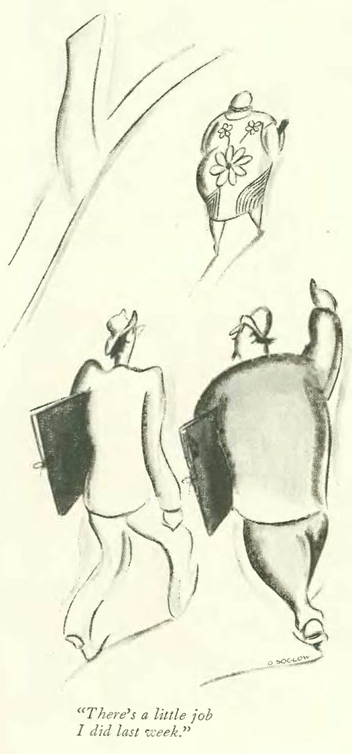
…fresh off his first “Little King” strip for The New Yorker, Otto Soglow returned with this wry observation…
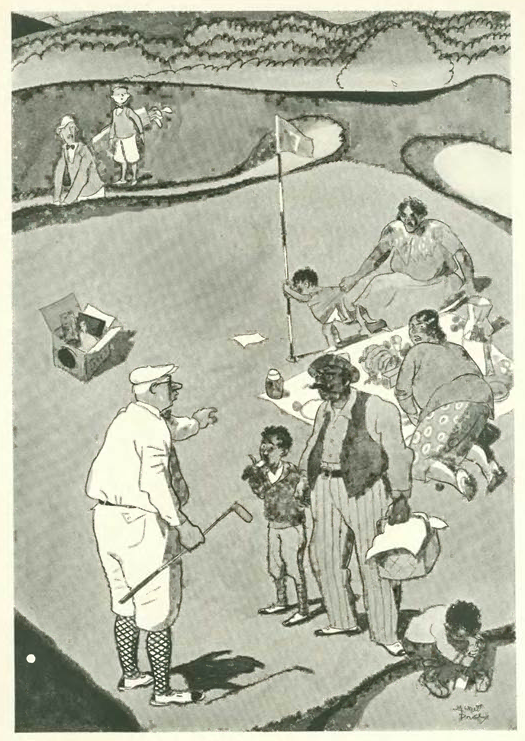
...Garrett Price looked in on a clash of cultures at a golf course…
…Barbara Shermund found a bit of trouble at home…
…while Art Young offered this woman a choice of her daily mayhem…
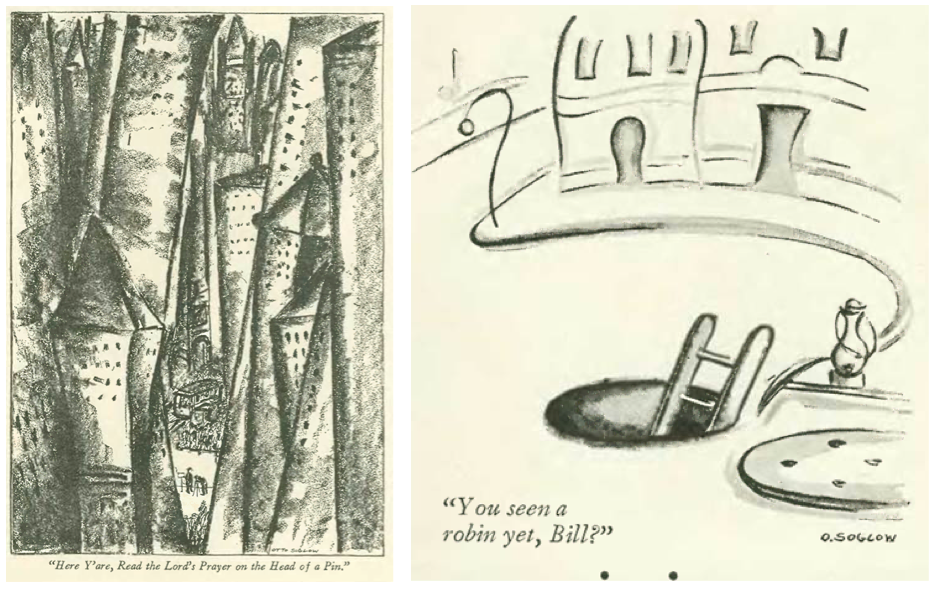
Like his New Yorker colleague Reginald Marsh, Otto Soglow trained in the “Ashcan School” of American art, and his early illustrations favored its gritty urban realism. He had his own life experience to draw upon, being born to modest means in the Yorkville district of Manhattan.
We look at two issues this week. At left, cover of March 31 issue by Peter Arno; at right, June 7 cover by Constantin Alajalov.
But Soglow (1900-1975) would soon abandon the gritty style in the work he contributed to the New Yorker…
RAGS TO RICHES…At left, Otto Soglow’s first cartoon in The New Yorker, Nov. 14, 1925, was rendered in the Ashcan style ; at right, an example of the sparer style he later adopted, one of his manhole series cartoons from March 2, 1929.
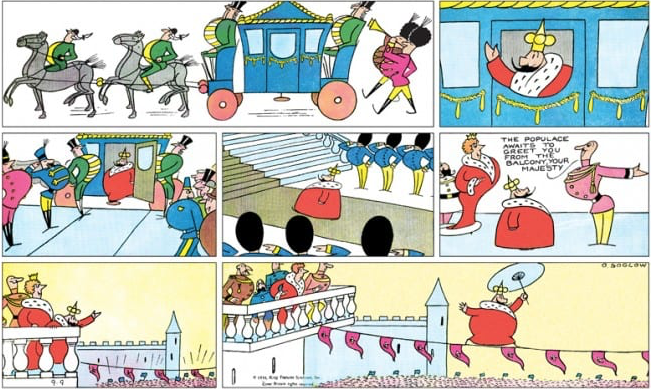
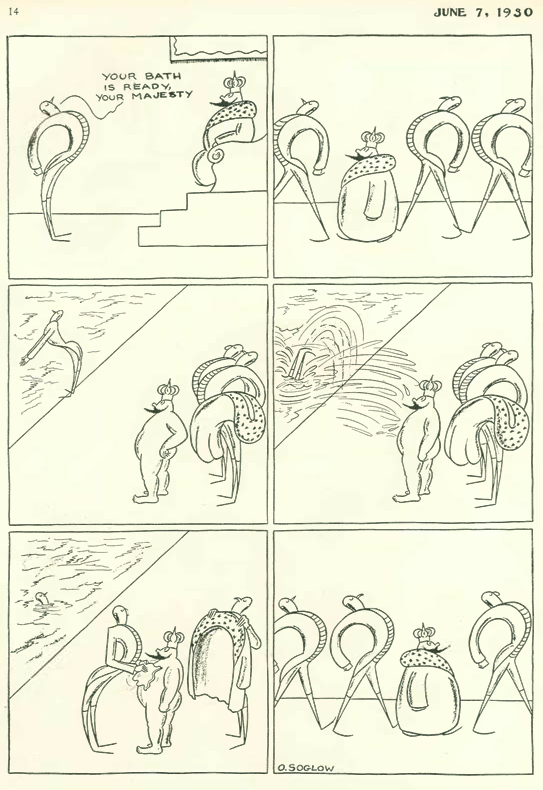
…and in the June 7, 1930 issue, Soglow would publish his first Little King strip, which would launch the 29-year-old into fame and fortune…
Did Soglow know he was on to something big with that first Little King cartoon? Well Harold Ross (New Yorker founding editor) liked what he saw, and asked Soglow to produce more. After building up an inventory over nearly ten months, Ross finally published a second Little King strip on March 14, 1931. It soon became a hit, catching the attention of William Randolph Hearst, who wanted the strip for his King Features Syndicate.
KING OF COMEDY…Otto Soglow working on an illustration for The Ambassador, a short-lived comic strip he created in 1933 for King Features Syndicate. The strip was replaced by The Little King in 1934 after Soglow fulfilled his contractual obligation to The New Yorker. (comicartfans.com)
After Soglow fulfilled his contractural obligation to The New Yorker, The Little King made its move to King Features on Sept. 9, 1934, and the strip ran until Soglow’s death in 1975. After his move to King Features, Soglow continued to contribute cartoons to The New Yorker, but with other themes.
Left, Soglow cartoon from the book Wasn’t the Depression Terrible? (1934); at right, King Features strip from Nov. 19, 1967. (Wikipedia/tcj.com)
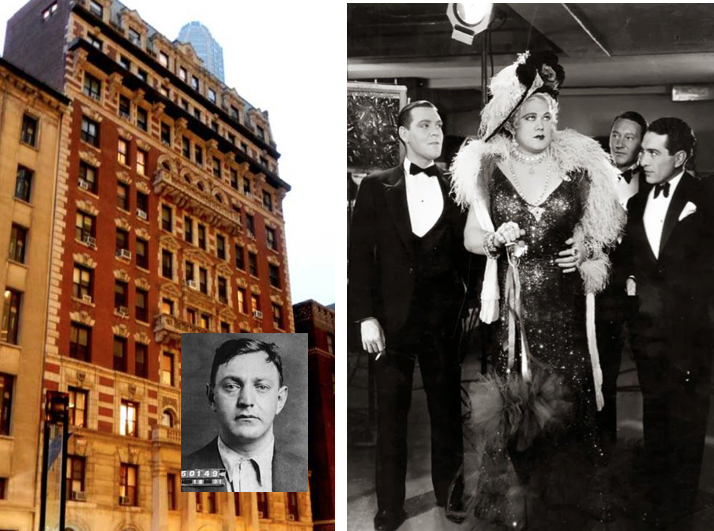
During the summer of 1925, a young writer at Vanity Fair named Lois Long would take over The New Yorker’s nightlife column, “When Nights Are Bold,” rename it “Tables For Two,” and set about giving a voice to the fledgling magazine as well as chronicling the city’s Jazz Age nightlife. There were accounts of Broadway actors mingling with flappers and millionaires at nightclubs and speakeasies, but Long also spoke out on issues such as Prohibition, taking the city’s leaders to task for raids on speakeasies and other heavy-handed tactics contrary to the spirit of the times. “Tables For Two” would go on hiatus with the June 7, 1930 issue, and appropriately so, as the deepening Depression gave the the city a decidedly different vibe. In her “final” column Long would write about the Club Abbey, a gay speakeasy operated by mobster Dutch Schultz…
PARTIED OUT…In her final nightlife column, Lois Long wrote about the new Club Abbey in the basement of the Hotel Harding (left), which was operated by mobster Dutch Schultz (inset). The club’s emcee was Gene Malin (right), Broadway’s first openly gay drag performer. The club was short-lived (as were Schultz and Malin), closing in January 1931 following a mob brawl. (infamousnewyork.com/Pinterest)
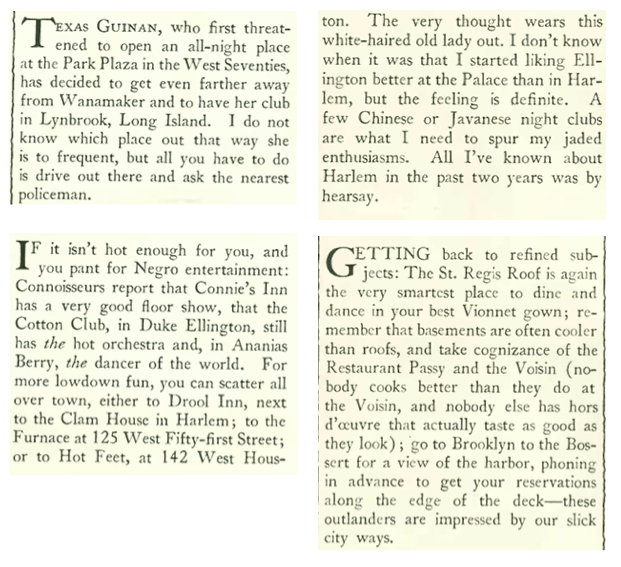
…and she would update her readers on “Queen of the Night Clubs” Texas Guinan, whose Club Intime was sold to Dutch Schultz and replaced by his Club Abbey…
FINAL ACT…Clockwise, from top left, Texas Guinan at Lynbrook, circa 1930; Joseph Urban murals on the rooftop of the St. Regis Hotel; Duke Ellington and his orchestra at the Cotton Club, circa 1930s.
Long’s column would signal a definitive end to whatever remained of the Roaring Twenties. It would also signal the end to some of those associated with those heady times. Texas Guinan’s Lynbrook plans would flop, and Gene Malin’s Club Abbey would close in less than a year. Both would both be dead by 1933—Malin would die in a car accident in 1933, and amoebic dysentery would claim Guinan that same year. Dutch Schultz would be gunned down by gangsters in 1935.
Lois Long, however, would continue to write for The New Yorker for another forty years, and would prove to be as innovative in her fashion column, “On and Off the Avenue,” as she was as a nightlife correspondent.
* * *
Gone to the Dogs
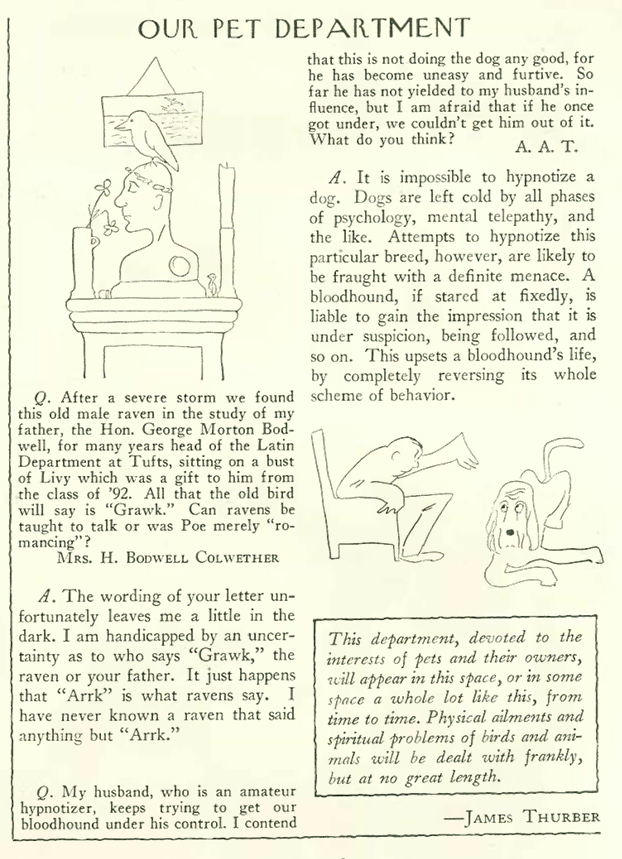
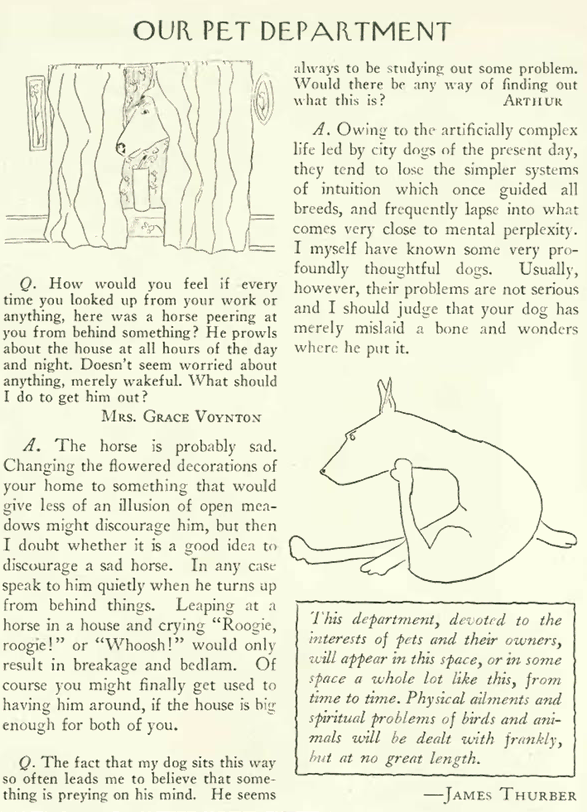
In another installment of his pet advice column (June 7), James Thurber gave us one of his classic dogs…a disinterested bloodhound…
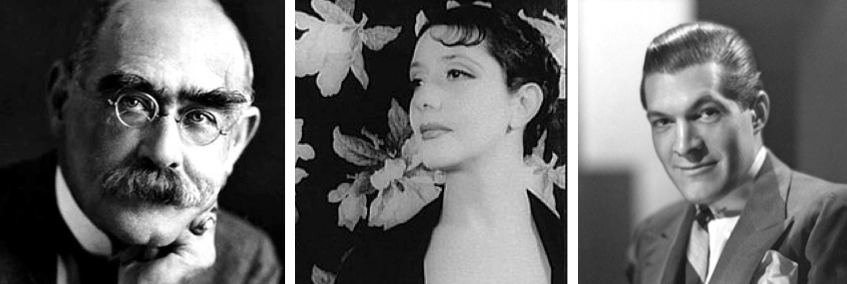
…while Thurber’s buddy and office mate E.B. White commented (in the March 31 issue) on a recent poll conducted among students at Princeton, discovering among other things that New Yorker cartoonist Peter Arno was preferred over the old masters…
FAN FAVORITES…The Princeton Class of 1930 named (from left) Rudyard Kipling, Lynn Fontanne and Peter Arno as favorite poet, actress and artist respectively in a student poll. (YouTube/Wikipedia/giam.typepad.com)
* * *
We Like It Fine, Thank You
The New Yorker dedicated a full page of the March 31 issue to a tongue-in-cheek rebuttal directed at the New York Evening Journal, which had reprinted one of Peter Arno’s cartoons to illustrate the moral cost of Prohibition. I believe the author of the rebuttal is E.B. White (note how he refers to Arno as “Mr. Aloe”).
…also in the May 31 issue, Rea Irvin changed things up, at least temporarily, with some new artwork for the “Goings On About Town” section. The entries themselves were often clever, such as this listing for a radio broadcast: PRESIDENT HOOVER—Gettysburg speech. Similar to Lincoln’s but less timely…
* * *
From Our Advertisers
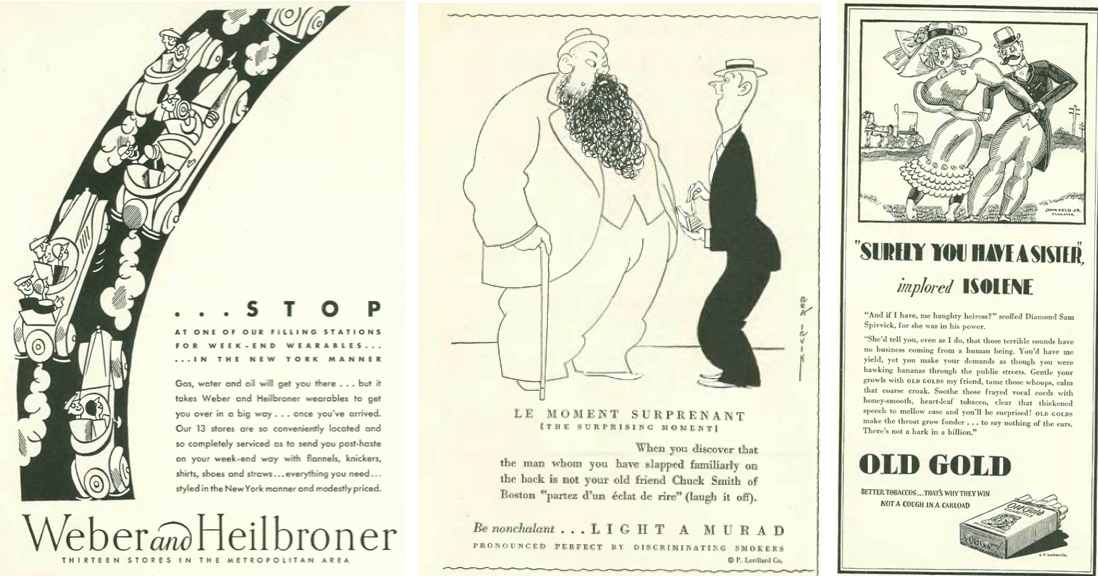
New Yorker cartoonists can be found throughout the advertisements — from left, Julian De Miskey, Rea Irvin and John Held, Jr…
…and in the June 7 issue we find an unusual ad for a used car…a sign of the times, no doubt…
…before it was associated with Germany’s Nazi Party (especially after it seized power in 1933), for thousands of years the swastika had been widely used as a religious or good luck symbol…
…Actress Clara Bow was famously pictured sporting a “good luck” swastika as a fashion statement in this press photo from June 1928, unaware that in a few years the symbol would become universally associated with hate, death and war…
From an unidentified publication dated June 6, 1928. (@JoHedwig/Twitter)
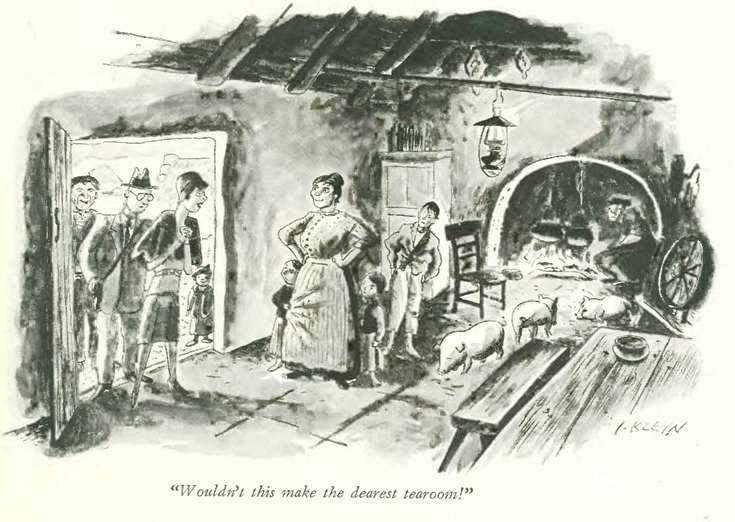
…on to our cartoons, Isadore Klein illustrated a cultural exchange…
…Garrett Price gauged the pain of a plutocrat…
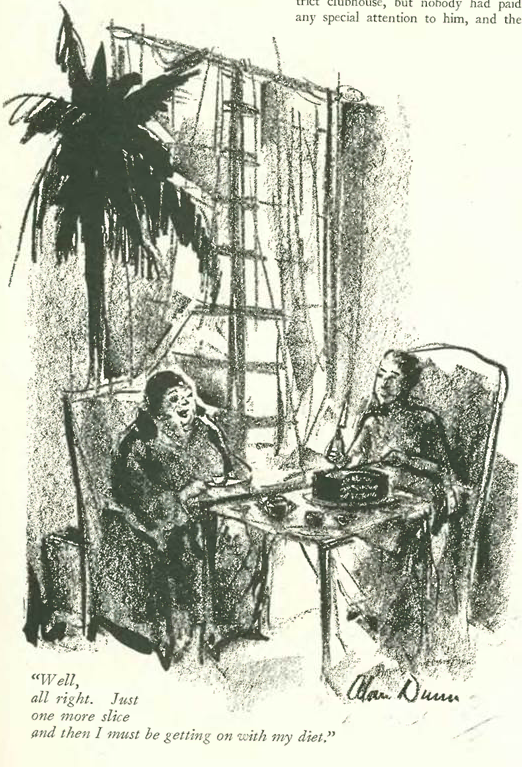
…Alan Dunn eavesdropped on some just desserts…
…Helen Hokinson found humor in the mouths of babes…
…as did Alice Harvey…
…Leonard Dove examined one woman’s dilemma at a passport office…
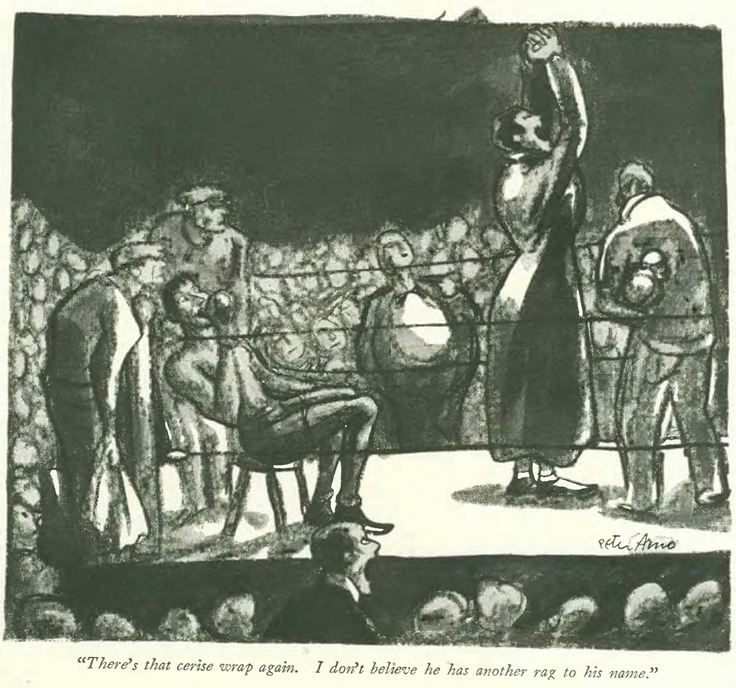
…and Peter Arno, who found some cattiness at ringside…
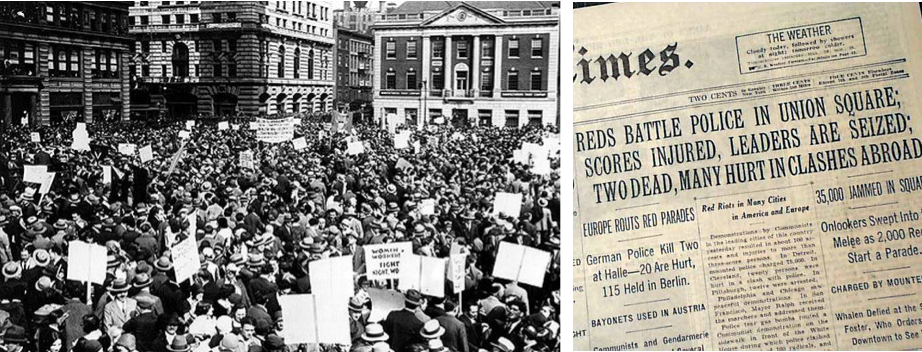
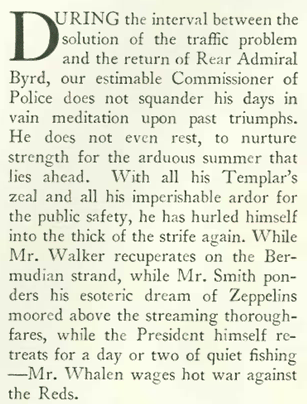
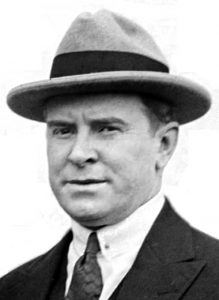
The New Yorker had a number of favorite punching bags, among them Grover Whalen (1886–1962), a product of Tammany Hall politics who in 1928 was appointed New York City Police Commissioner by another Tammany alumnus, Mayor Jimmy Walker.
May 17, 1930 cover by Rea Irvin.
Ironically, a mayor known for openly flouting prohibition laws had placed into office a man who would become known as a ruthless enforcer of those laws (excepting Mayor Walker, of course). Whalen was also known for fighting crimes that didn’t necessarily exist, including those committed by “Reds” organizing protests by the city’s growing numbers of unemployed.
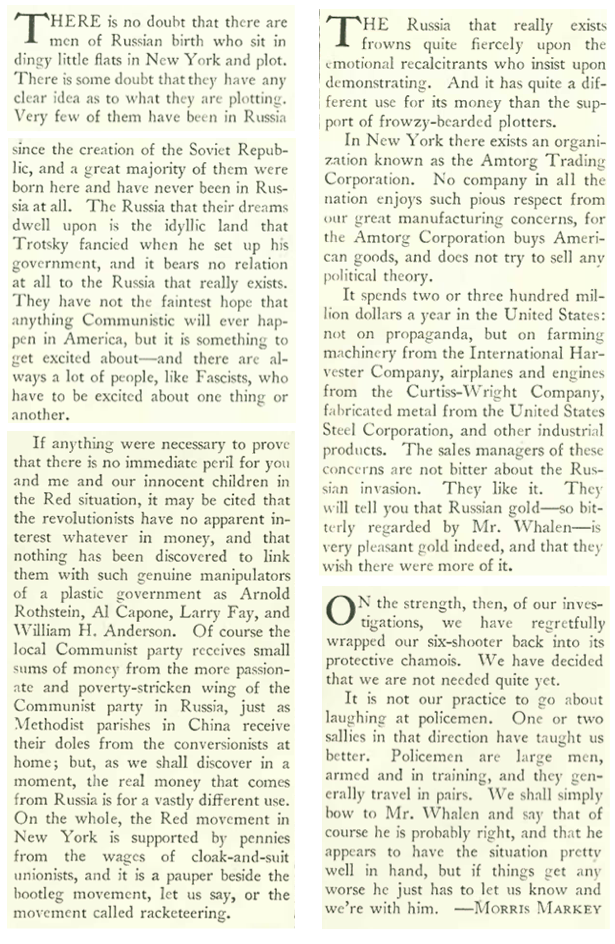
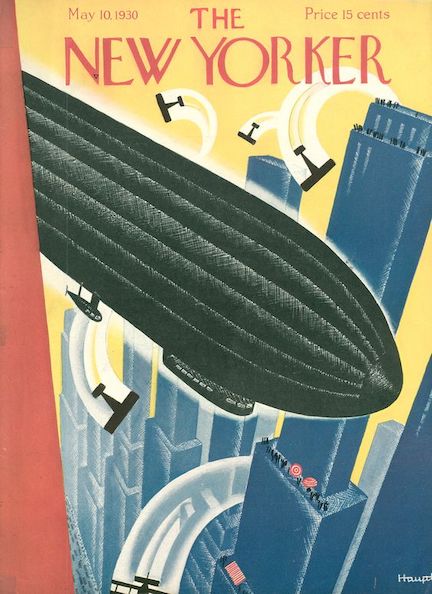
In the May 10, 1930 issue, New Yorker writer Alva Johnston penned a tongue-in-cheek assessment of America’s “Red Revolution” (see previous post). In the following issue (May 17), Morris Markey took a few swipes at Whalen’s “Crimson Menace” in his “A Reporter At Large” column:
FLYING HIGH…Mayor Jimmy Walker (second from left) and his new Police Commissioner Grover Whalen (far right) visit Mitchell Field on Long Island in 1928; portrait of Whalen circa 1930. (Amazon/WNYC)
Whalen’s career as police commissioner came to an end around the time Markey’s column appeared. Whalen was under fire for how his police responded to an International Unemployment Day demonstration, where 1,000 baton-wielding police went to work on a crowd of more than 35,000 demonstrators. The New York Times reported: “From all parts of the scene of battle came the screams of women and cries of men with bloody heads and faces.”
IDLE HANDS…The International Unemployment Day demonstration in Union Square on March 6, 1930, turned ugly when a thousand baton-wielding police went to work on the protestors, identified by the New York Times as “Reds.” (libcom.org/The New York Times)
And in the May 24 issue, E.B. White took his own swipe at Whalen in his “Notes and Comment”…
In ensuing years Whalen found more peaceful pursuits, serving as New York City’s official greeter of dignitaries and organizer of ticker tape parades. In 1935 he was named president of the New York World Fair Corporation and became the face of the forward-looking 1939 New York World’s Fair.
DAWN OF A NEW DAY was the opening slogan for the 1939 World’s Fair. At left, preparing to lower the fair’s time capsule into it’s 5,000-year resting place are A.W. Robertson, Westinghouse Electric Company’s chairman of the board (left) and Grover Whalen, president of the New York World’s Fair; at right, the fair’s iconic symbols, the Trylon and Perisphere. (heinzhistorycenter.org/Flickr-Ricksoloway)
* * *
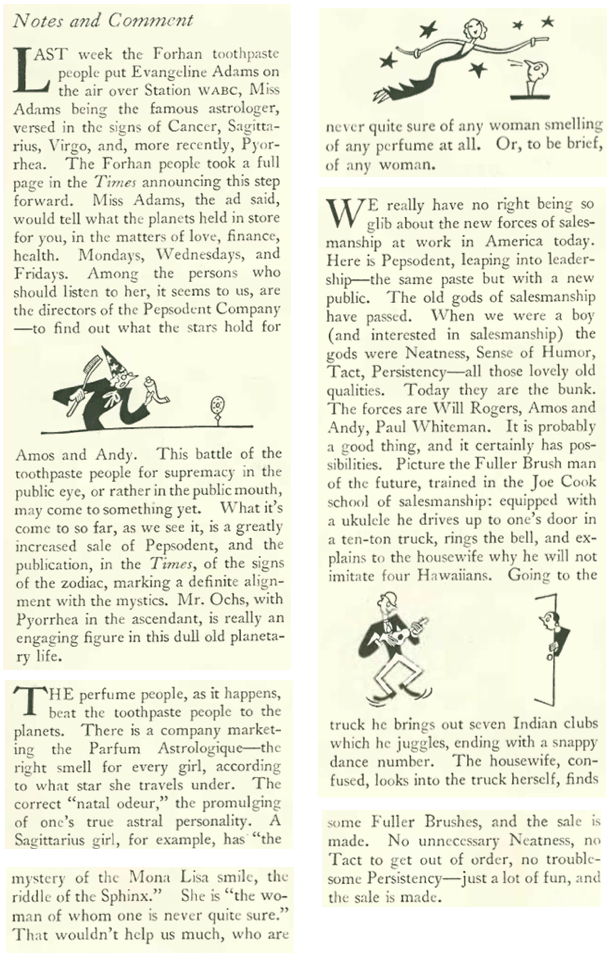
It’s In The Stars
E.B. White led off his “Notes and Comment” with thoughts on the latest trends in product endorsement, including the use of astrology to boost the sales of toothpaste and perfume:
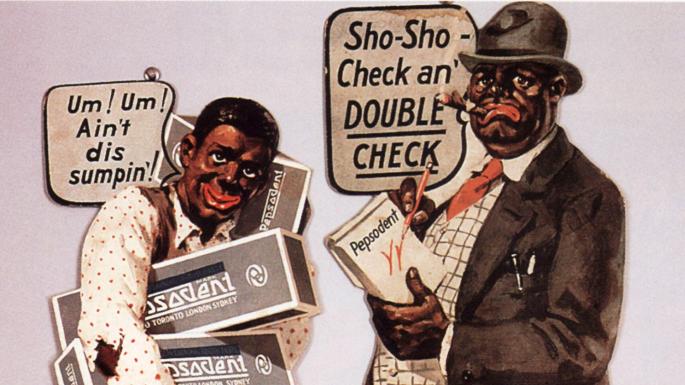
A FORTUNE IN TOOTHPASTE…The makers of Forhan’s Toothpaste promoted their Astrology Hour radio show in the Akron Beacon Journal, May 1931. At right, 1931 ad for Perfum Astrologique. (newspapers.com)THAT WAS THEN…White actors Freeman Gosden and Charles Correll portrayed Amos ’n’ Andy on the radio from 1928 to 1960. Here they shill for Pepsodent toothpaste on circa 1930 stand-up cards. (thetimes.co.uk)
* * *
More Advice on Troublesome Pets
The May 17 issue featured James Thurber’s latest advice on pet care:
…and this two-page illustration by Reginald Marsh ran along the bottom of “Talk.”
* * *
A Fighter for Rights
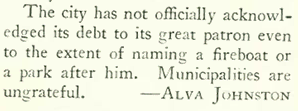
The May 17 issue featured the first installment of a two-part profile on social reformer Samuel Untermyer (1858-1940) titled “Little Giant.” The profile’s author, Alva Johnston, praised Untermyer’s legacy, and chided New Yorkers for not giving him his proper due. Known for defending the public trust against powerful corporations, he laid the groundwork in the U.S. for the Federal Reserve Law, the Clayton Anti-Trust Law, the Federal Trade Commission Bill and the Securities and Exchange Act. A fierce defender of Jewish rights, Untermyer served as attorney for Herman Bernstein, who filed suit against automaker Henry Ford for anti-semitic articles published in Ford’s Dearborn Independent.
Johnston concluded his two-part profile with these words:
BRING IT ON…Samuel Untermyer was known as a fierce defender of the public trust. At right, illustration that accompanied the New Yorker profile. (findagrave.com)
* * *
From Our Advertisers
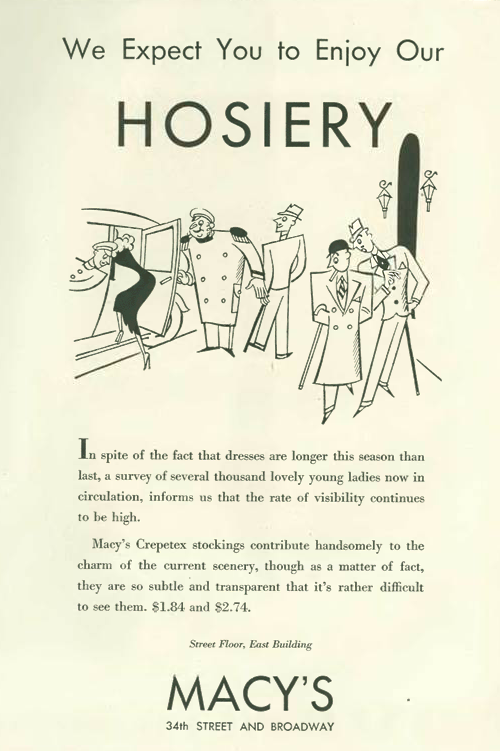
Julian De Miskey picked up some extra work with this illustration for Macy’s…
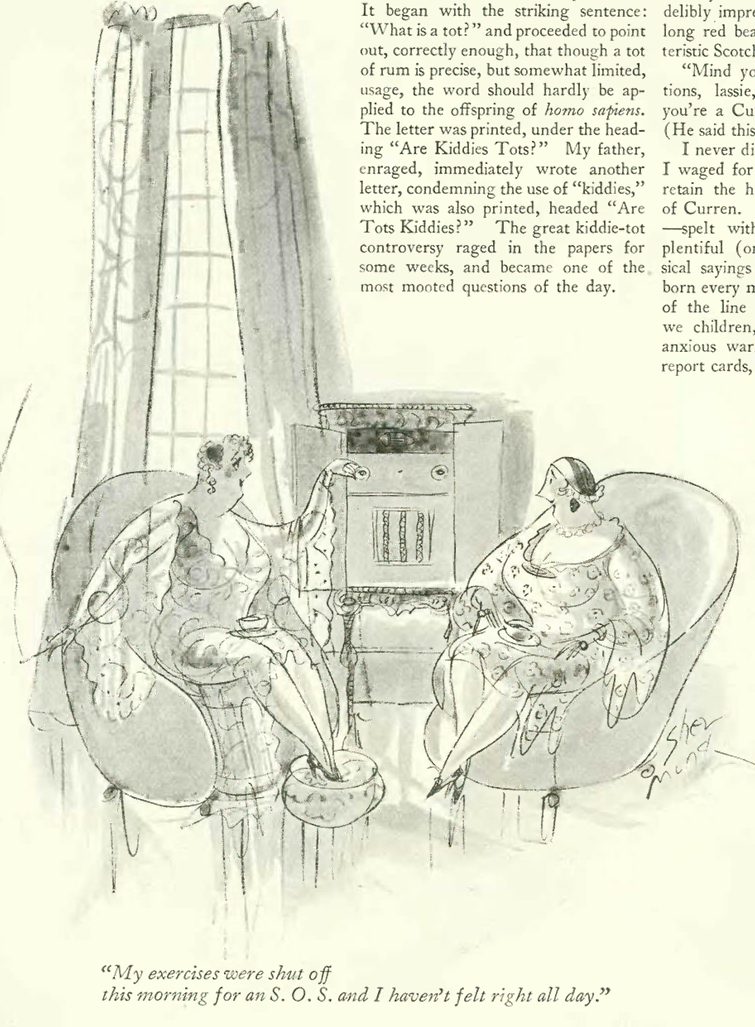
…while in cartoons, Barbara Shermund discovered the challenges of exercise by radio…
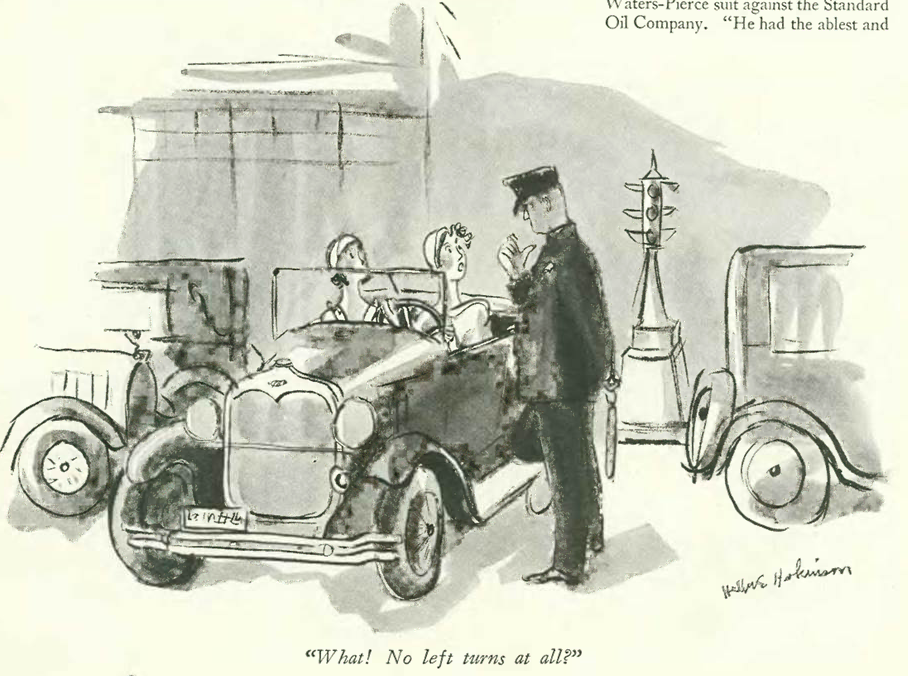
…Helen Hokinson looked at another challenge…city driving…
…Gardner Rea explored the mysteries of street food…
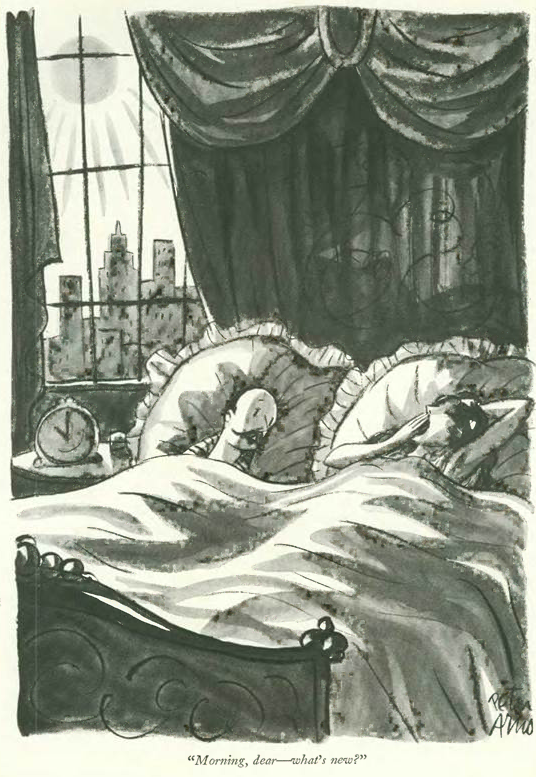
…and Peter Arno greeted one Manhattan couple at sunrise…
* * *
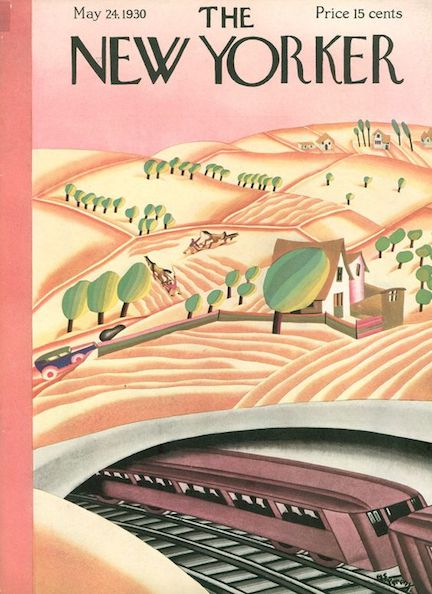
On to the May 24, 1930 issue, with a lovely cover by Madeline Pereny…
May 24, 1930 cover by Madeline Pereny.
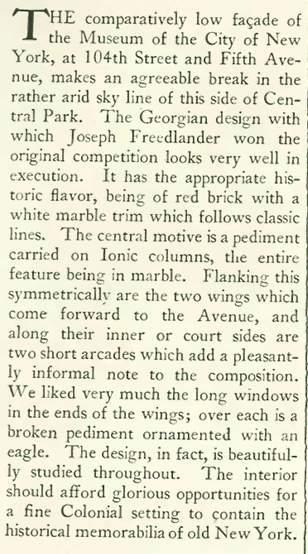
As construction continued on the Museum of the City of New York, The New Yorker’s architecture critic George Chappell liked what was taking shape:
THE STORY OF A CITY…The Museum of the City of New York opened its doors at 104th Street and Fifth Avenue in early 1932. (nyctourist.com/www.ennead.com)
* * *
From Our Advertisers
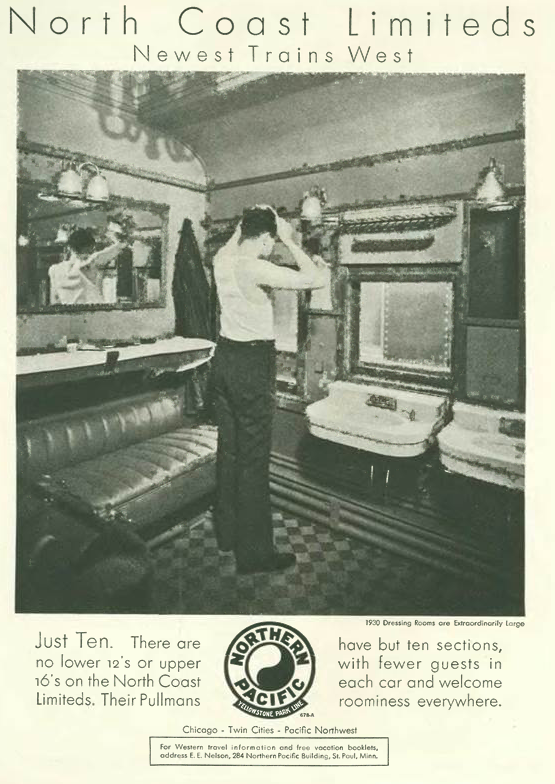
Travel by train in the States wasn’t always miserable as this ad attested…
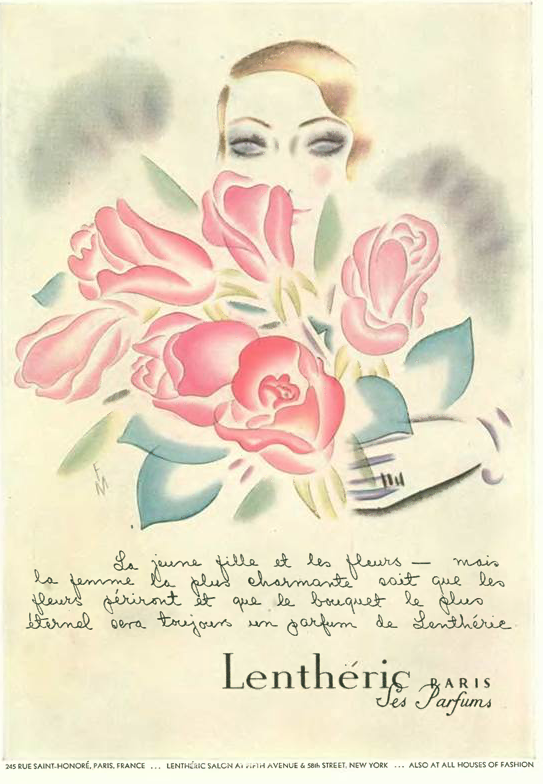
…a bit of color courtesy the Lenthéric salon…
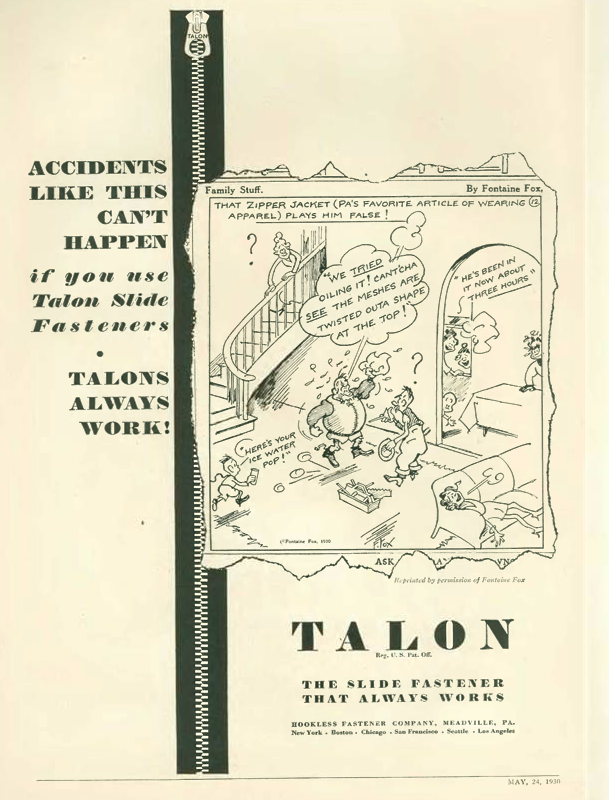
…Fontaine Fox, best known for his long-running Toonerville Folks comics, contributed this cartoon on behalf of Talon Slide Fasteners, or “zippers” as they came to be known in the late 1920s and early 30s, when they were still something of a novelty…
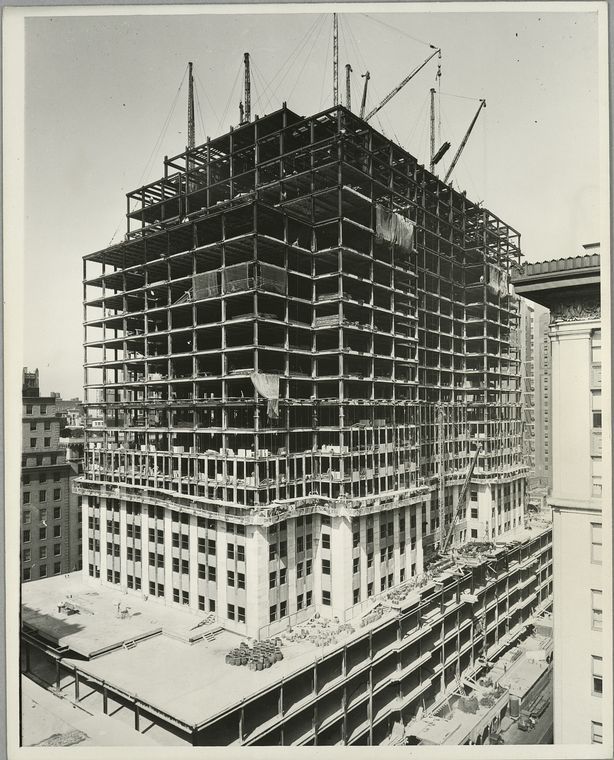
…I believe this is the first-ever image of the Empire State Building in The New Yorker, an artist’s rendering since the building wouldn’t be completed until the spring of 1931…note how this ad links the building’s site location to New York history and specifically the Astor family…
…here is how the Empire State Building looked in June 1930…
(New York Public Library)
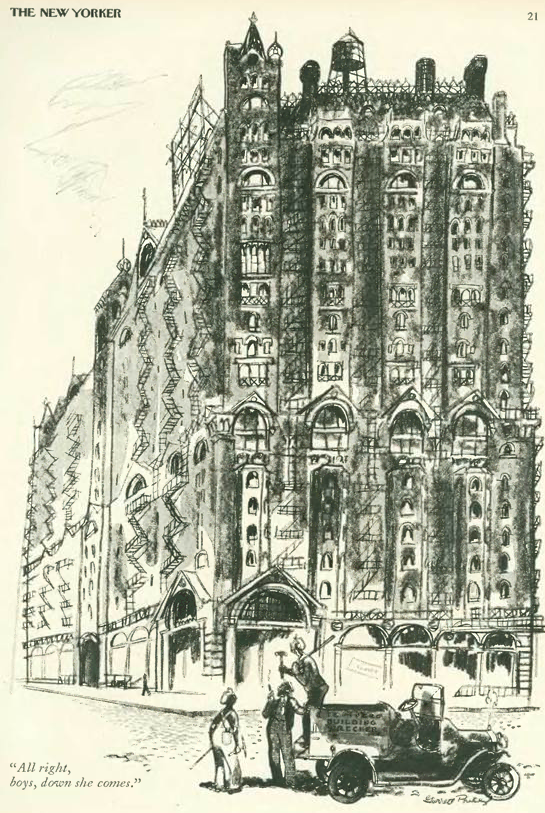
…the old Waldorf-Astoria Hotel was torn down to make way for the Empire State Building, and that provides a nice segue to our cartoons…this one by Garrett Price featured a modest work crew contemplating the razing of a building that recalled the old hotel…
…across the pond, one of Helen Hokinson’s ladies was busy trying to procure a banned book…
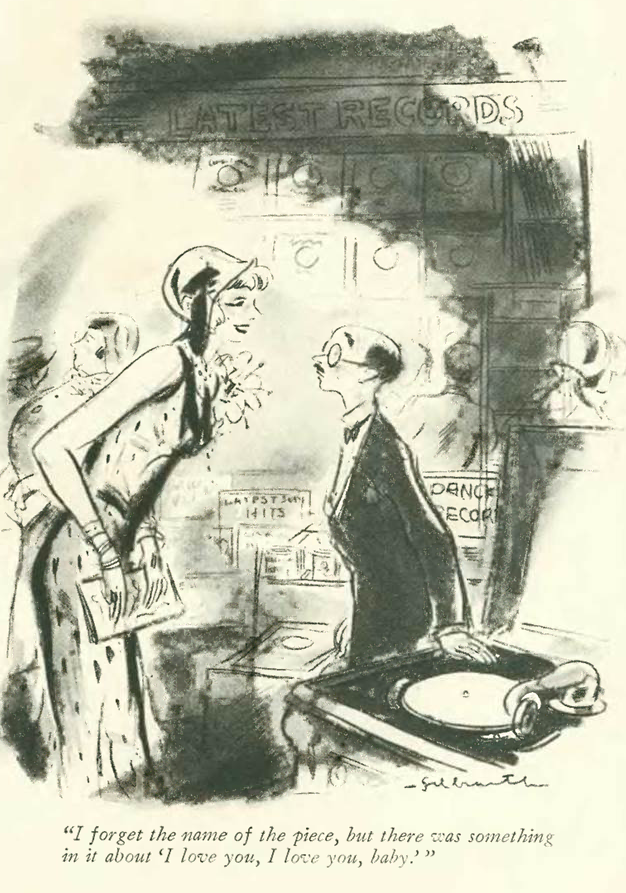
…while William Crawford Galbraith gave us a young woman in search of a love song (with the help of a seriously timid man)…
…Barbara Shermund found some bedside humor…
…and Peter Arno took us back to the nightlife, with our familiar gold-digger and sugar daddy…
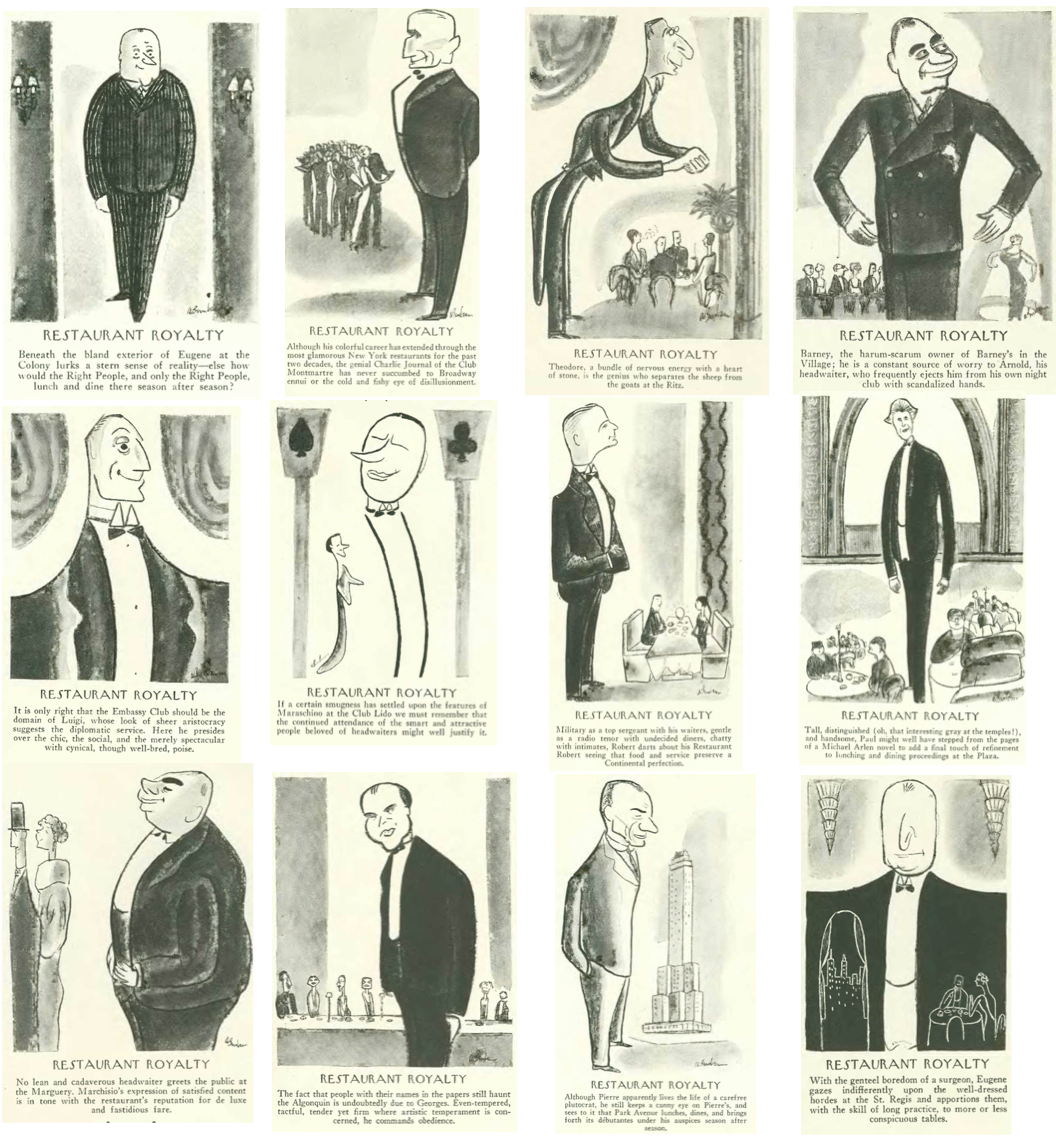
…and finally, over the course of twelve issues (Feb. 8 to May 10, 1930) Abe Birnbaum provided illustrations of New York’s “Restaurant Royalty.” These usually ran in or near “The Talk of the Town” section. Please click to enlarge.
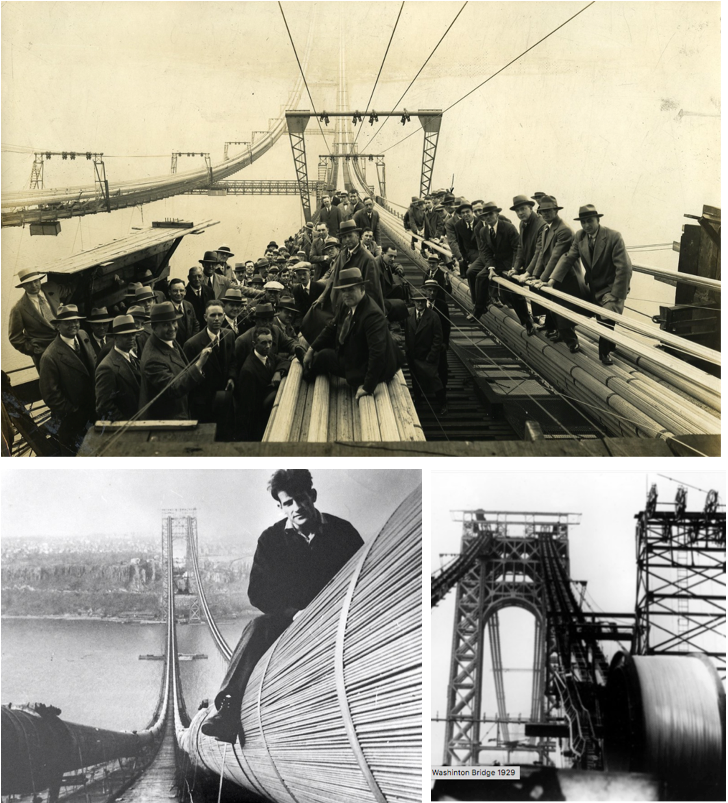
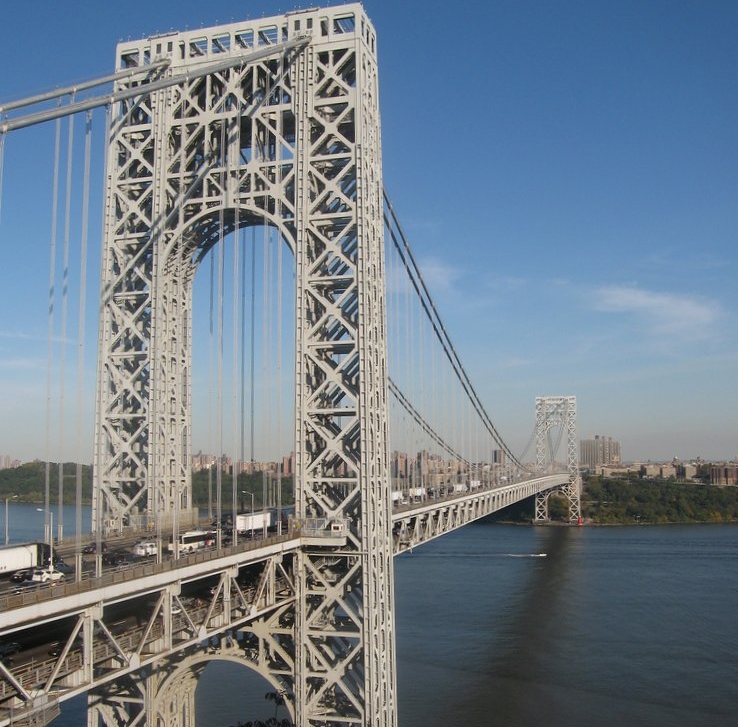
Tens of thousands of commuters daily cross the George Washington Bridge, but in the din of modern commuting few give nary a thought to a span that was once considered a modern marvel.
May 3, 1930 cover by Rose Silver.
Twice as long as any previous suspension bridge when it opened in 1931, the George Washington Bridge’s main span of 3,500 feet (1,100 m) would be the world’s longest until it was surpassed by San Francisco’s Golden Gate Bridge in 1937. The New Yorker’s “Talk of the Town” (entry most likely by E.B. White) checked on the bridge’s progress for the May 3 issue:
MEN OF STEEL…Some 107,000 miles of wire were used in cables made by John A. Roebling’s Sons Company for the George Washington Bridge — the same firm also supplied wire for the Brooklyn Bridge 60 years earlier (John Roebling and his son, Washington, also designed and built the Brooklyn Bridge). Clockwise, from top, employees of John A. Roebling’s Sons pose atop cable bundles; bottom right, the bridge’s four main cables were each composed of a single strand carried back and forth across the river 61 times. Each strand itself is a bundle of 434 individual wires; bottom left, worker poses atop completed cable. (Flickr/Pinterest)BY ANY OTHER NAME…Known as the Hudson River Bridge during its construction, the George Washington Bridge opened to traffic in 1931. During the first full year of operation in 1932 more than 5.5 million vehicles used the original six-lane roadway — today it is the world’s busiest motor vehicle bridge, carrying more than 100 million vehicles per year. Although the steel towers are iconic today, the original plan called for them to be clad in stone. (Wikipedia)
* * *
A Cabin in the Sky
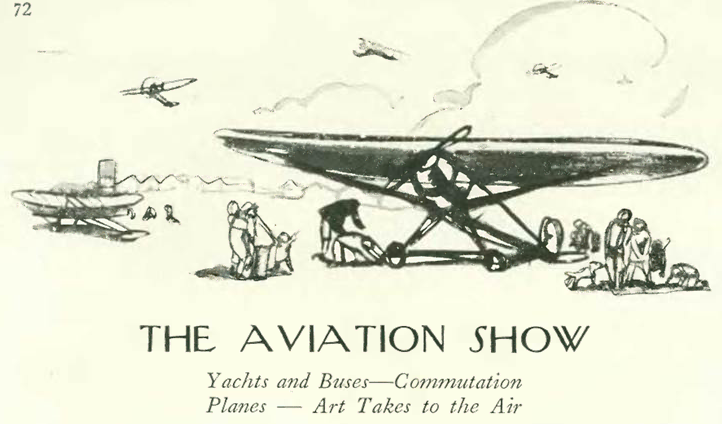
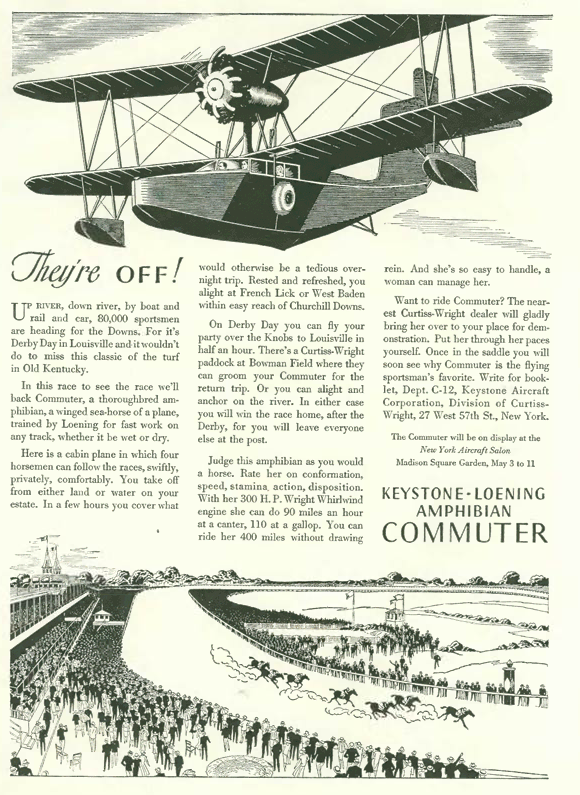
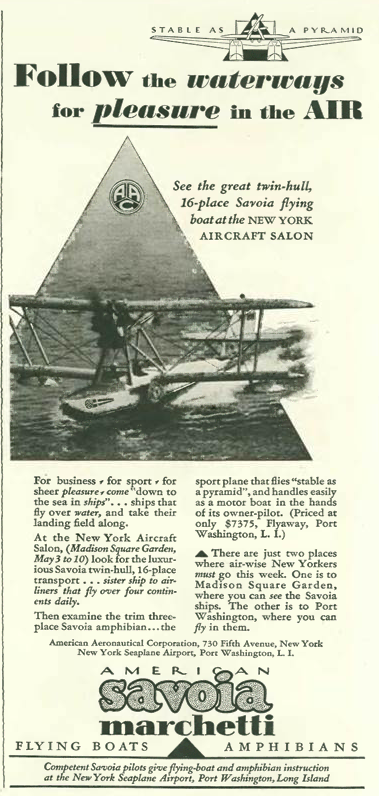
Other signs of modern life were being seen in Midtown, where an “Aircraft Salon” hosted by the Aeronautical Chamber of Commerce was taking place at Madison Square Garden.
Nicholas Trott was on hand to take in the exhibits, noting that advances in aviation included the use of metal bodies (instead of fortified cloth) and greater attention to interior decoration:
SIGNED, SEALED, DELIVERED…An attendee of the New York Aircraft Salon received a special postal stamp, and an autograph from aviator Cy Caldwell, at the Madison Square Garden show. (Joe Krantz)
Trott noted that designs of passenger compartments, still in their infancy, suggested something between automobile and nautical motifs:
SORRY, NO HEADPHONES…Clockwise, from top left, a Curtiss Condor 18 and its interior appointments; a Fokker Trimotor featured dining in its cabin. As peaceful as the scene appears, the noise from the motors must have been unbearable. (Wikipedia/dutch-aviation.nl)
Trott also commented on the debate surrounding metal vs. fabric in the construction of airplanes. Before 1930 most planes were constructed of wood covered with fabric (which were much lighter than metal craft). Although as early as 1920 the National Advisory Committee for Aeronautics declared metal to be superior to wood, only five percent of aircraft in 1930 were of all-metal construction.
DON’T CALL ME WOODY…This eight-passenger Consolidated Fleetster was a rare example of metal construction in early 1930. The wings, however, were still fashioned from wood. (Aeronautical Chamber of Commerce 1931 Aircraft Yearbook)
* * *
Road to Nowhere
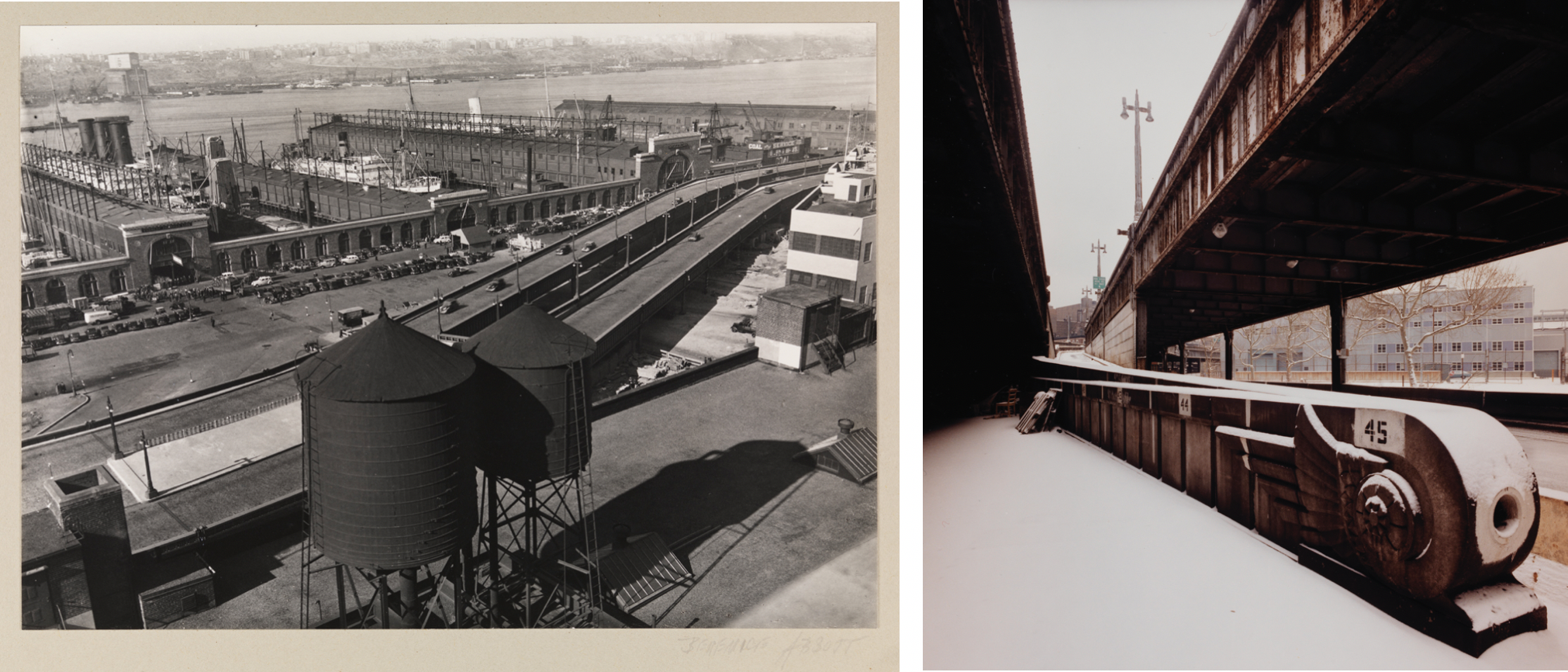
The New Yorker’s enthusiasm for modern marvels did not extend to the West Side Highway, a project that would extend from the late 1920s to the early 1950s. Here is E.B. White’s take on the opening of the highway’s first section:
White’s observations were somewhat prescient — constructed in tight confines, the road’s on-ramps proved too narrow and the turns too tight for use by large trucks. The roadway also lacked proper maintenance, and just two decades after it was completed a section of the highway collapsed under the weight of an asphalt-laden truck. The roadway was demolished between 1977 and 1989. Read more here about the West Side Highway’s surprising history at the Museum of the City of New York.
THE ROAD NOT TAKEN, TAKEN…Left, West Side Express Highway and Piers 95-98, photographed by Berenice Abbott from 619 West 54th Street on Nov. 10, 1977; West Side Highway Ramp at 23rd Street reveals Art Deco ornamentation. Detail of photo by Jan Staller, 1978. (Museum of the City of New York)
* * *
For Pet Lovers
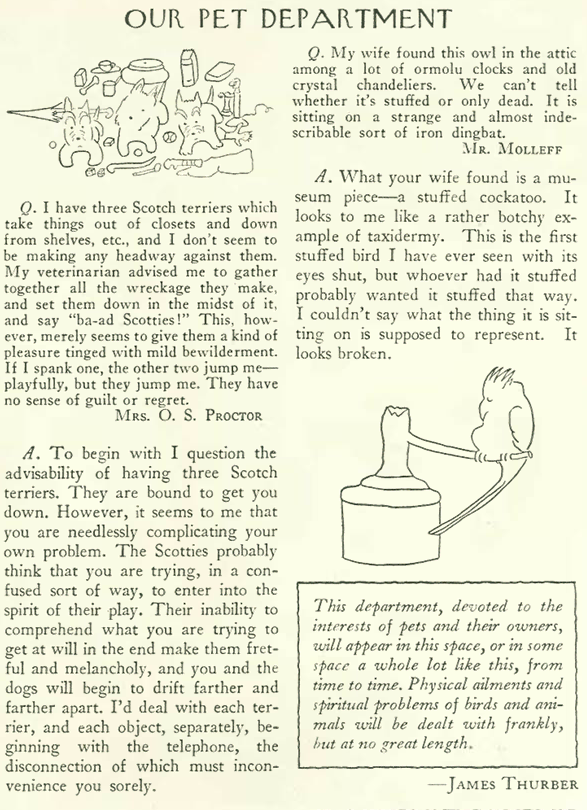
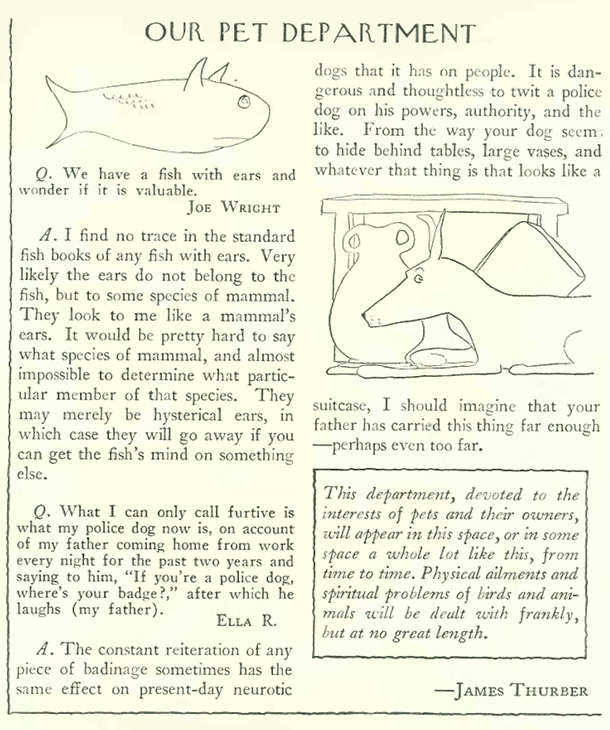
Our latest installment of James Thurber’s “Our Pet Department” column…
* * *
Hate Couture
The New Yorker’s Paris correspondent, Janet Flanner, using the pen name “Hippolyta,” contributed this profile of François Coty (1874-1934), a French perfumer and businessman. Flanner’s profile (the introduction included below) described Coty’s rags-to-riches rise in the perfume industry, and touched on his life as a sometime journalist and politician.
What doesn’t come across in the profile is Coty’s extreme right-wing stance on politics and his virulent anti-Semitism, which was often expressed in his newspaper, Figaro. Three years after Flanner’s profile Coty would co-found Solidarité Française, a fascist, paramilitary organization, and a year after that he would be dead of an aneurysm.
François Coty circa 1930. (aperfumeblog.com)
* * *
From Our Advertisers
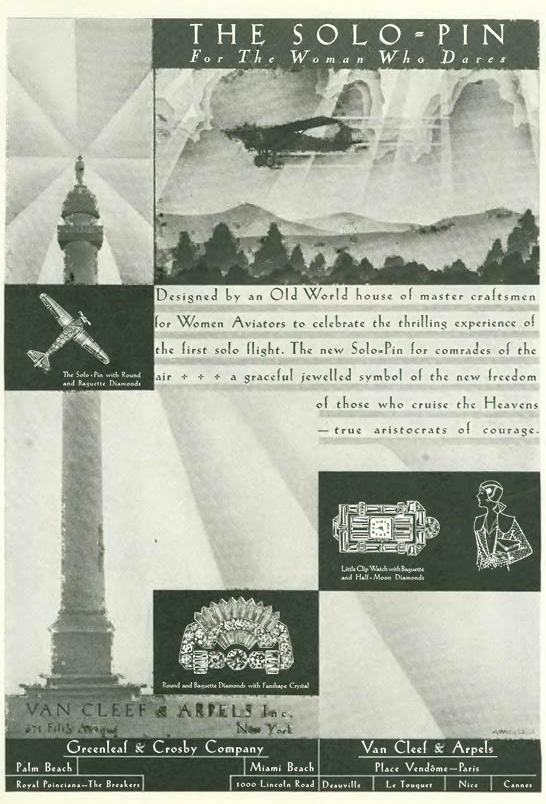
The New Yorker’s bottom line reaped benefits from the big aviation show at Madison Square Garden…
…and even if you weren’t selling airplanes or flying lessons, you could still get in on the action…
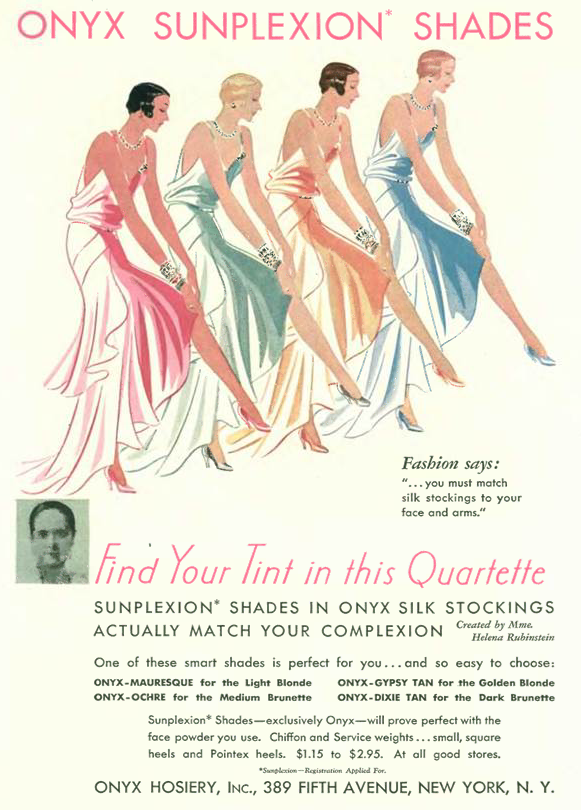
…also from the fashion world, this colorful entry from Onyx Hosiery…
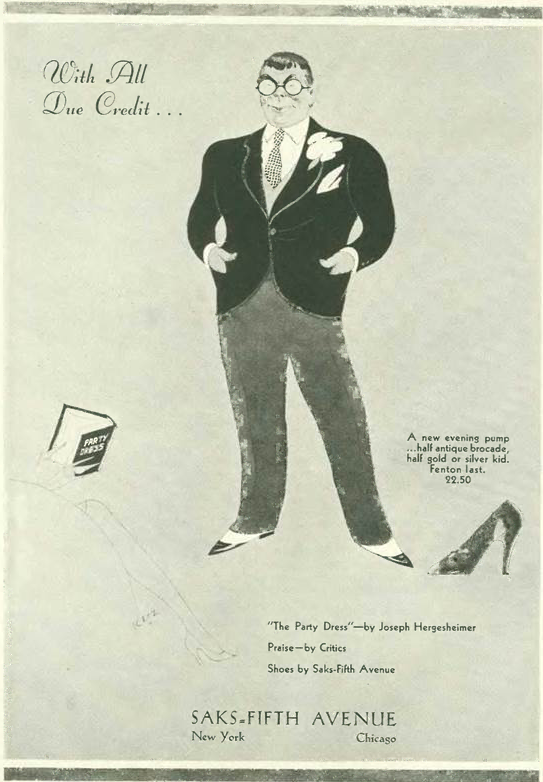
…and this weird ad from Saks, advertising shoes and a party dress but dominated by a caricature of designer Joseph Hergesheimer…
…on to our cartoons…Helen Hokinson paid a visit to the aviation show…
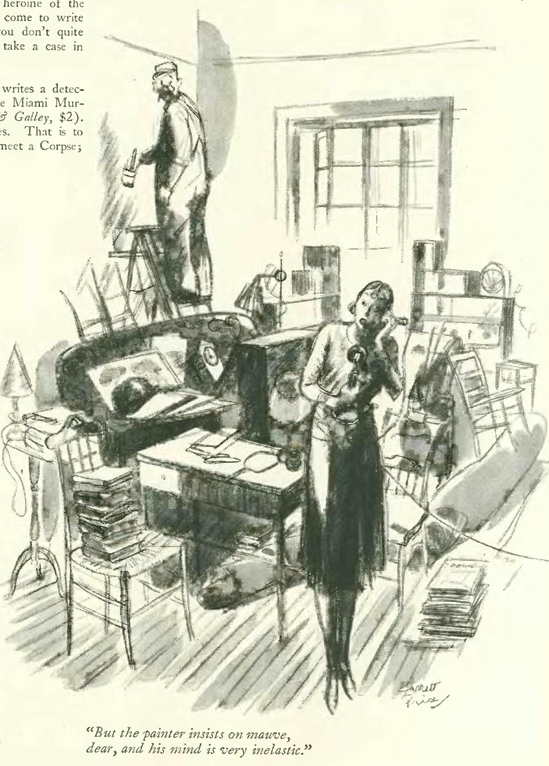
…on the domestic front, Garrett Price examined the challenges of home decor…
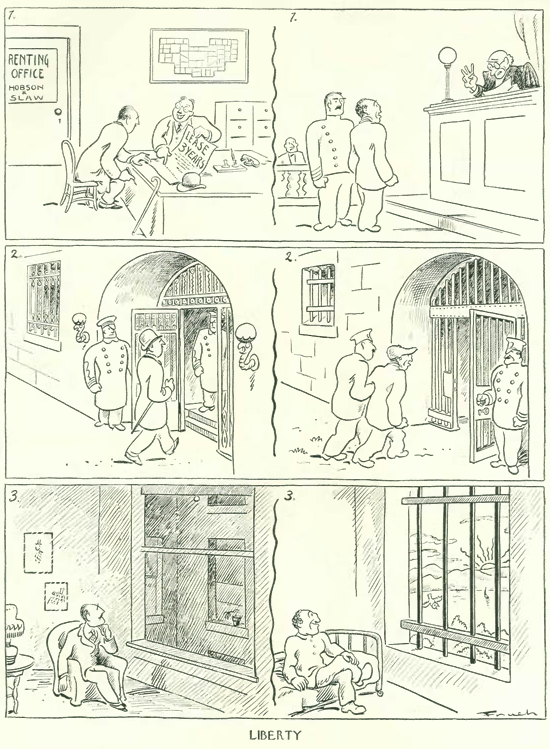
…Al Frueh offered an ironic twist on a room with a view…
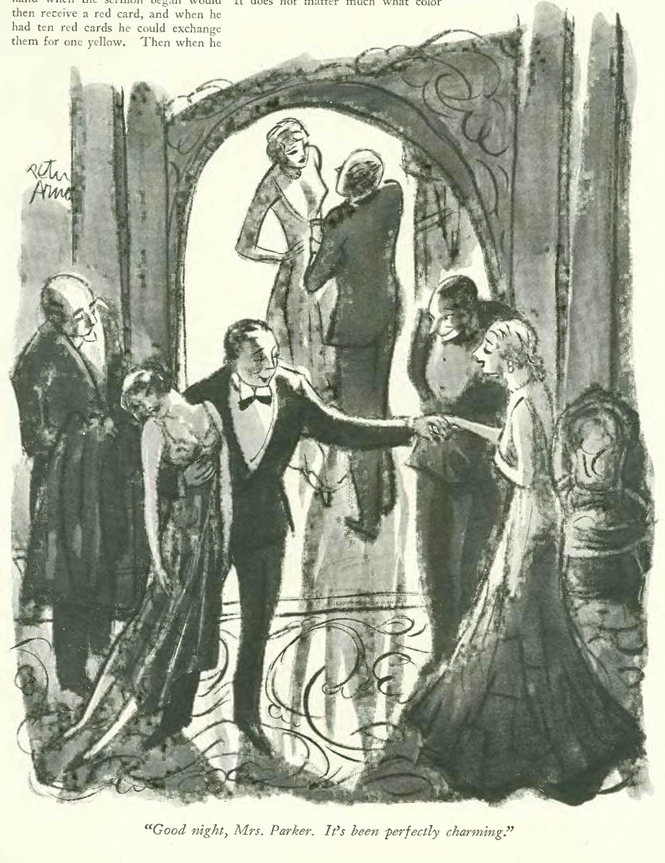
…Peter Arno once again found humor in the partying life…
It’s easy to get into the weeds while digging through The New Yorker archives, as it is filled with a richly interconnected cast of characters whose lives and work still resonate with us today.
March 15, 1930 cover by Rose Silver. (Please see note on this artist at the end of this blog entry)
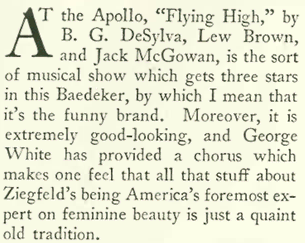
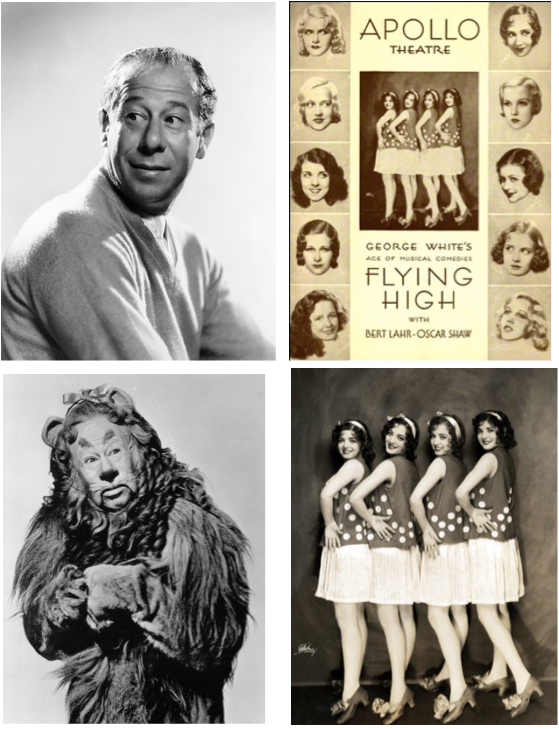
A case in point is Bert Lahr (1895-1967), who at age 15 dropped out of high school and joined the vaudeville circuit, working his way up to top billing in Broadway musical comedies including 1930’s Flying High, which received an enthusiastic welcome from New Yorker critic Charles Brackett…
…Brackett enjoyed the “feminine beauty” offered by a George White chorus that included the “Gale Quadruplets,” described in the Playbill as “The only Quadruplets in the world appearing on the stage”…
…although in fact the Gale Quadruplets were actually two sets of twins: June and Jane, and Jean and Joan (real names were Doris, Lenore, Helen and Lorraine Gilmartin). But I digress.
What really caught Brackett’s eye were the antics of Bert Lahr:
ONLY ONE BERT…Clockwise, from top left, publicity photo of Bert Lahr from the 1931 film version of Flying High; cover of the Apollo Theatre Playbill; the Gale Quadruplets, circa 1930; Lahr as the Cowardly Lion in the 1939 film The Wizard of Oz. (Everett/Playbill/Pinterest/Wikiwand)
The Gale Quadruplets are long forgotten, but the work of Bert Lahr still lives on thanks to his role as the Cowardly Lion in The Wizard of Oz (a film, incidentally, that was panned in 1939 by New Yorker critic Russell Maloney, who called it “a stinkeroo” that showed “no trace of imagination, good taste, or ingenuity”).
Lahr also connects us to today’s New Yorker magazine, where his son, John Lahr, has been a staff writer and critic since 1992. Lahr has written a number of stage adaptions (he won a Tony award in 2002, the first drama critic to do so) as well as nearly twenty books, including a 2017 biography of his father, Notes on a Cowardly Lion: The Biography of Bert Lahr.
DRAMATIC DUO…John Lahr with his father, Bert, backstage at the Belasco Theatre in the late 1940s; John Lahr today. (NY Times/Amazon)
* * *
Greener Pastures
We remain on Broadway with another writer who was deeply connected to The New Yorker’s origins. Marc Connelly (1890-1980) was a playwright, director, producer and performer who collaborated with George S. Kaufman on five Broadway comedies in the 1920s. Connelly was also a founding member of the Algonquin Round Table, around which orbited a number of writers, critics and assorted wits who would help bring The New Yorker to life in 1925. Connelly was listed as an advisory editor on the masthead of the very first issue:
Connelly’s play, The Green Pastures (based on stories from the Old Testament), had just opened on Broadway, drawing much acclaim for both Connelly and actor Richard B. Harrison (1864-1935). “The Talk of the Town” looked in on the playwright and the actor:
DID YOU HEAR SOMETHING?...Richard B. Harrison (left) and unidentified actor in 1930’s The Green Pastures. At right, Wesley Hill as the Angel Gabriel. (blackarchives.org/ngv.vic.gov.au)FINAL BOW…Richard B. Harrison in a 1930 publicity photo for the Broadway play, The Green Pastures. At right, Harrison on the cover of the March 4, 1935, Time magazine. He died of heart failure ten days after appearing on the cover. (Henrietta Alice Metcalf Collection/Time)
Connelly would receive the 1930 Pulitzer Prize for Drama for The Green Pastures. And nearly 60 years later he would be featured in a 1987 documentary about the Algonquin Round Table (The Ten-Year Lunch) as the Table’s last survivor. It would win an Academy Award for Best Documentary Feature. During his long career Connelly would act in 21 movies, including the 1960 romantic comedy Tall Story with Jane Fonda and Anthony Perkins. He also did some TV, included a stint from 1962 to 1964 as Judge Rampell in The Defenders.
HE COULD ACT TOO…Clockwise, from top left, Marc Connelly in a 1937 photo by Carl Van Vechten; a page from the Playbill for The Green Pastures; college student June Ryder (Jane Fonda) collides on campus with Professor Charles Osmond (Marc Connelly) in the 1960 romantic comedy Tall Story. (Wikipedia/Playbill/ridesabike.com)
Also in the “Talk of the Town” section of the March 15 issue was James Thurber’s latest installment of pet advice:
* * *
Lipstick’s Lamentations
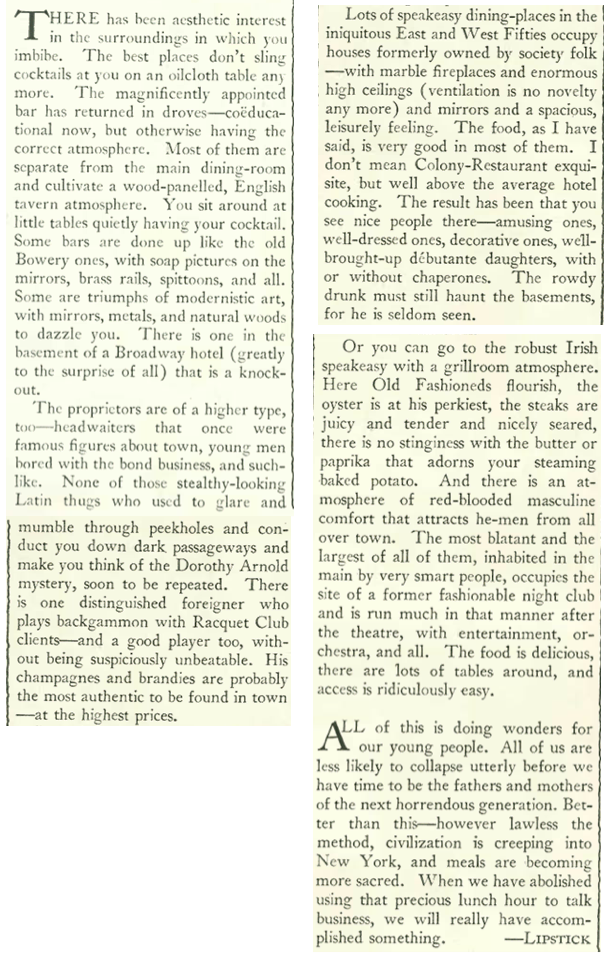
Once the place to read about wild speakeasies and other nighttime diversions of the Roaring Twenties, Lois Long’s “Tables for Two” column had quickly become anachronistic in the Depression years. Although the decade was still young, Long reminisced about her column’s “golden days” as if they had existed in some distant time, and lamented the state of the speakeasy; once a place for cheap and sordid frivolity, it had become staid and even snobbish…
THAT WAS THEN…Lois Long lamented the state of the speakeasy in 1930. Once sordid and given to frivolity, it had become a rather staid institution. (prohibition.themobmuseum.org/Time-Life)
…and Long described some of these new upscale speakeasies, where the oilcloth had been replaced with fine linen…
* * *
Ozark Oeuvre
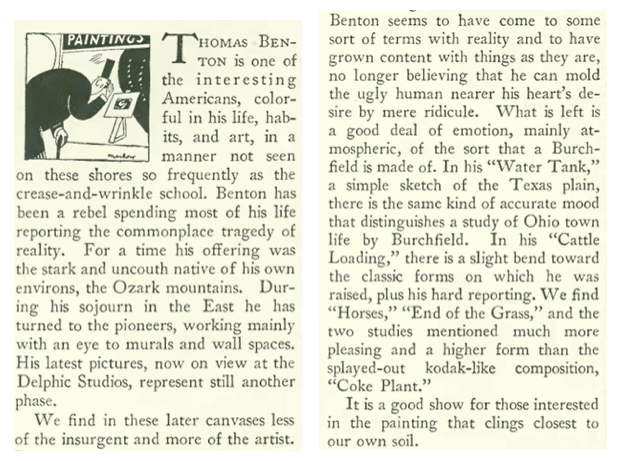
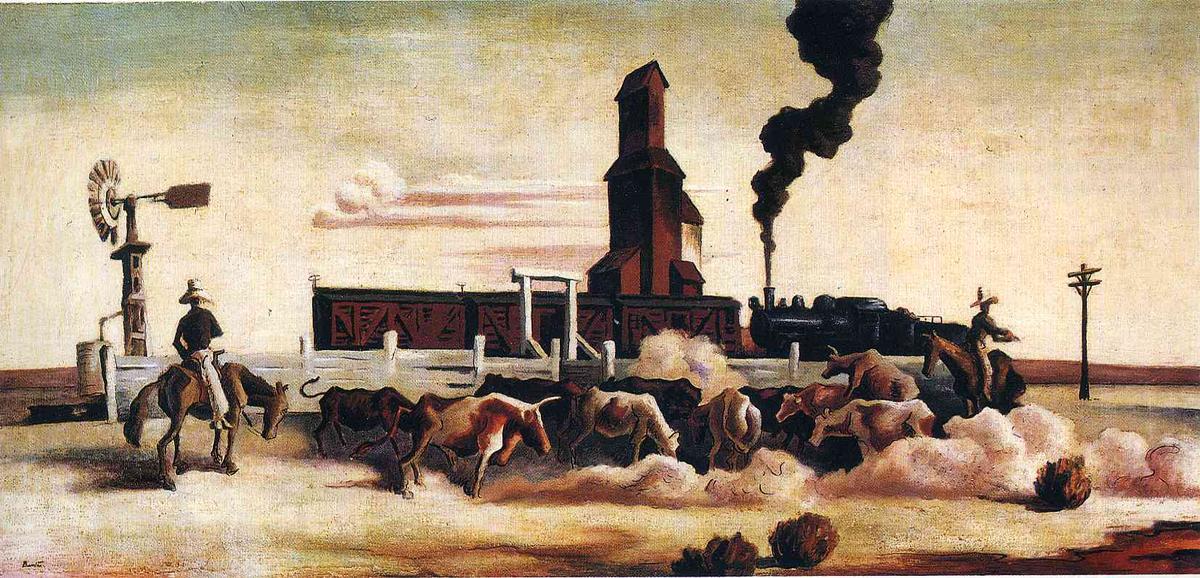
New Yorker art critic Murdock Pemberton, in his ongoing search for America’s best artists, took another look at that once “uncouth native” from the Ozarks, Thomas Hart Benton…
PAINTING FROM THE SOIL…Cattle Loading, oil on canvas, by Thomas Hart Benton, 1930. It was one of the works viewed by critic Murdock Pemberton at the Delphic Studios in New York. (wahooart.com)
* * *
From Our Advertisers
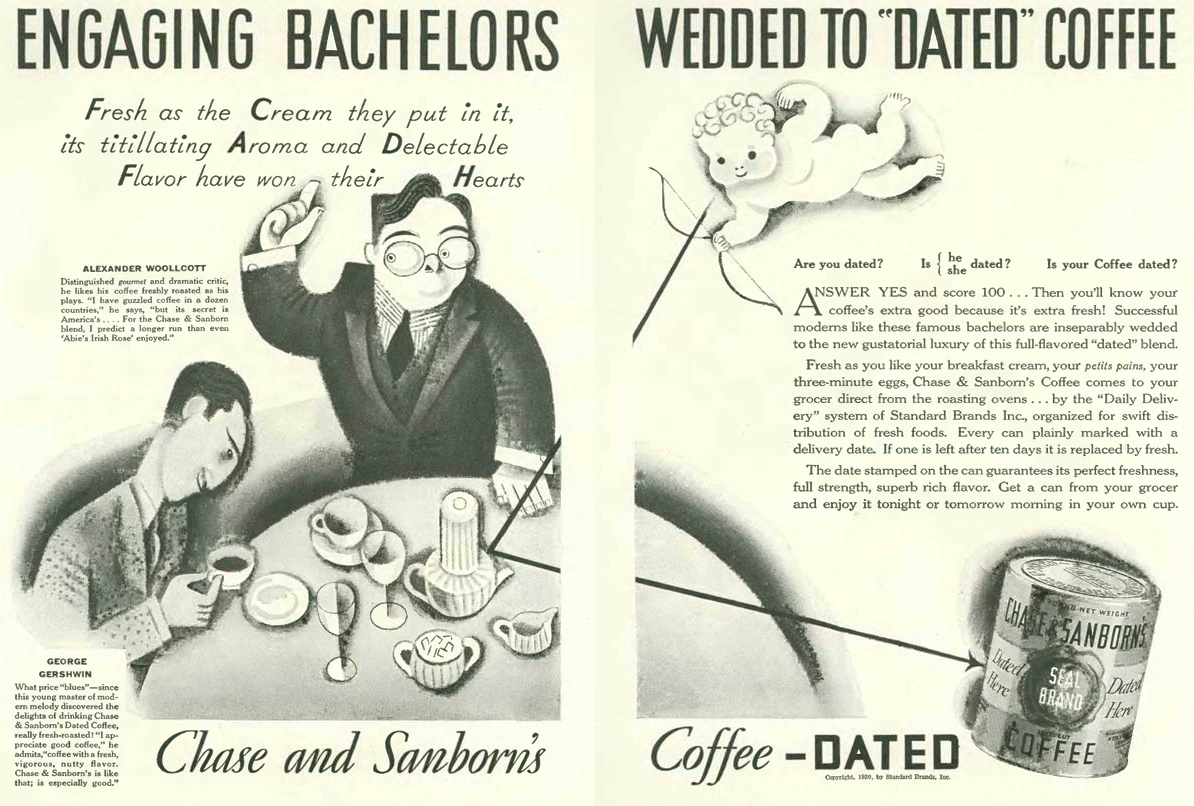
We start off with a couple of two-page ads, the first featuring caricatures of George Gershwin and Alexander Woollcott as rendered by the great Miguel Covarrubias…
click image to enlarge
…and then we have this ad from the makers of Lux Toilet Soap, who must have had a bottomless advertising budget given all the splashy ads and celebrity endorsements…
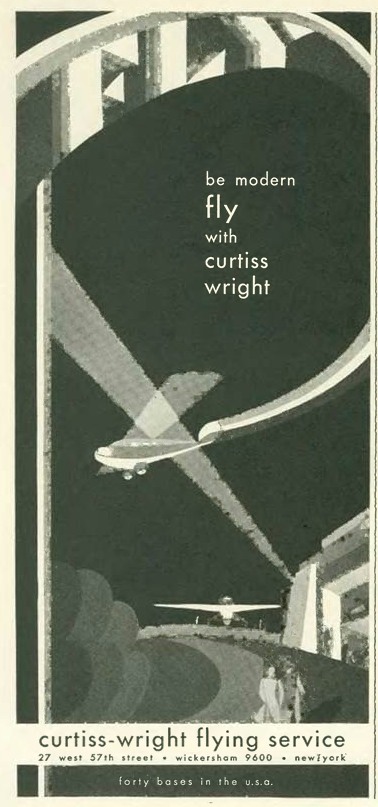
…in the ads we also find clashes between the old and new…the new being this art deco-styled appeal for the newest form of transportation…
…and the old, the makers of the luxury car Pierce-Arrow, still harking back to its patrician origins (“The Tyranny of Tradition”)…the firm would not survive the lean years of the 1930s…
…and once again a colorful ad from Church using snob appeal to sell something as pedestrian as a toilet seat…”Toilet Seats For Better Bathrooms”…
…on to our cartoons, we have a voyeur’s perspective courtesy Helen Hokinson…
…an exploration of the generation gap by Alice Harvey…
…and this terrifically quaint encounter, rendered by Perry Barlow…
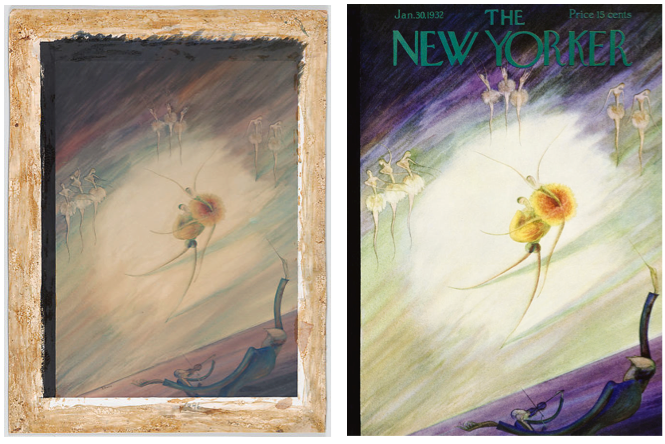
…and before we go, a note about this week’s cover artist, Lisa Rhana, a.k.a. Rose Silver (1902-1985) who illustrated several New Yorker covers in the 1920s and early 30s. Her work is included in the permanent collections at the Whitney Museum, the Museum of the City of New York, and The Metropolitan Museum of Art, which holds this watercolor (left) that graced the cover of the Jan. 30, 1932 issue:













































































































 A New Yorker State of Mind