Perhaps no decade was more transformative to New York City than the 1920s. From the loosening of social mores to countless technological advances, the city was a very different place as it entered the last year of the Roaring Twenties.
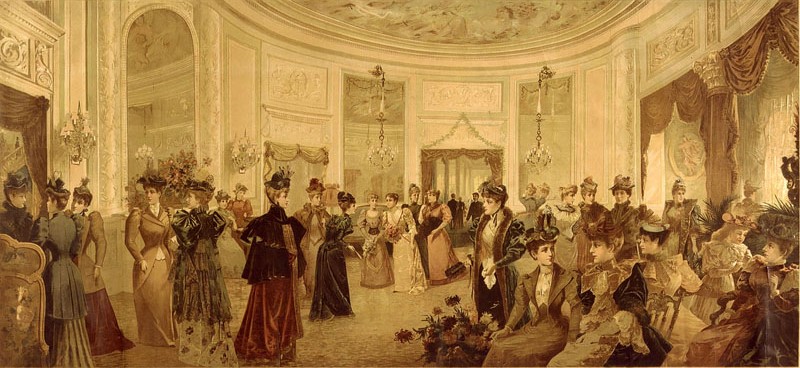
Jan. 5, 1929 cover by Sue Williams. Opening image depicts the original Waldorf Hotel’s Octagon Room in 1893.
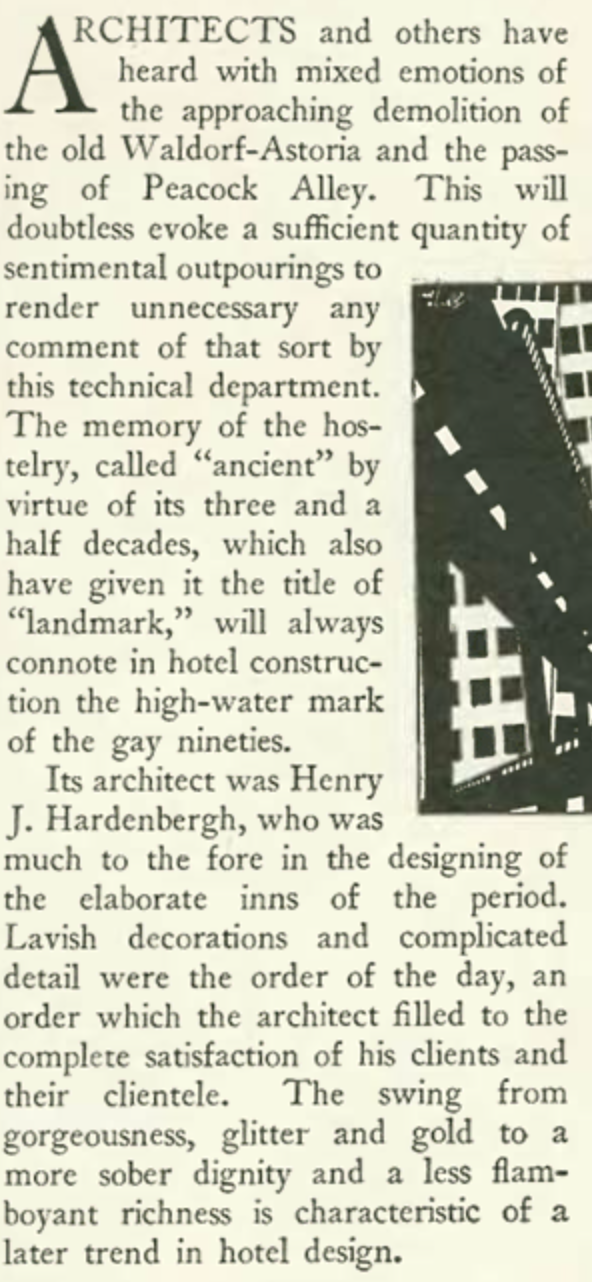
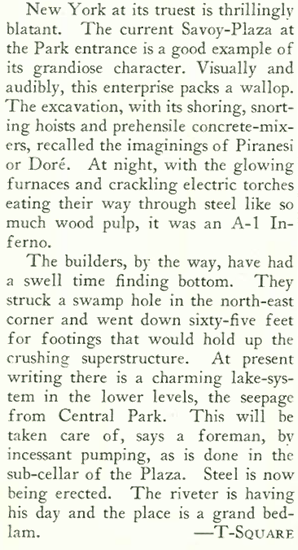
Vestiges of the 19th century were quickly erased during the decade as old neighborhoods and stately mansions gave way to massive apartment blocks and towering skyscrapers. Such was the fate of the original Waldorf-Astoria Hotel, its Victorian lavishness out of style in a streamlined age. Writing under the pen name T-Square, New Yorker architecture critic George S. Chappell commented on the planned demolition of the old* Waldorf-Astoria Hotel:
*Although outdated in appearance, the hotel was little more than 30 years old in 1929.
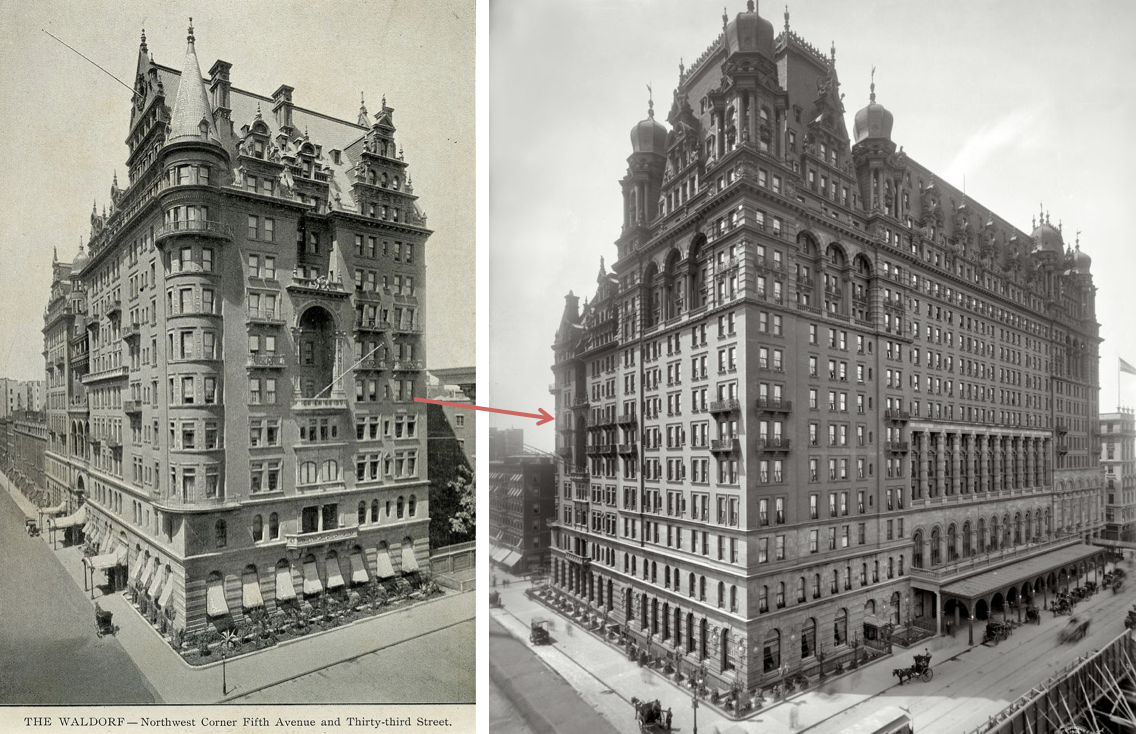
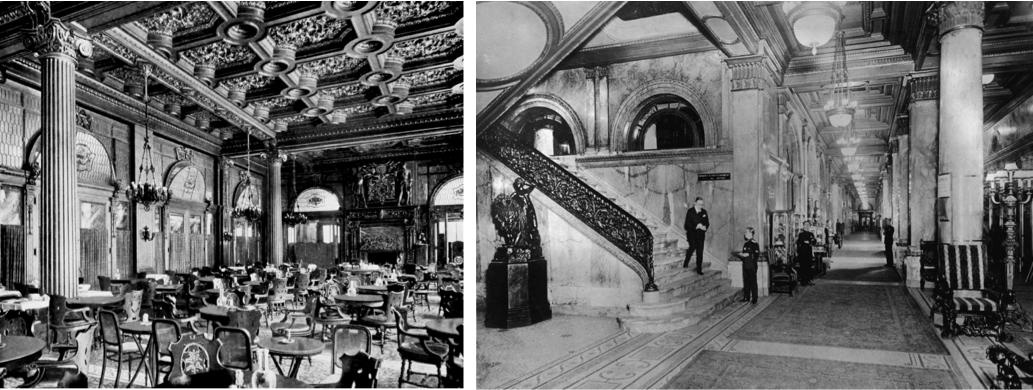
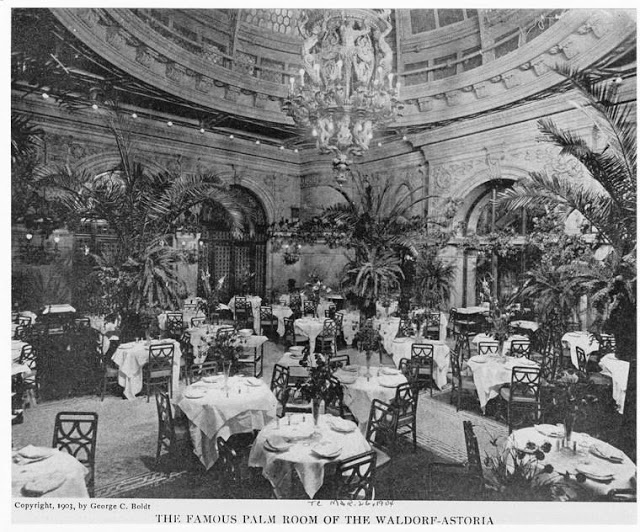
TALE OF TWO HOTELS…The Waldorf-Astoria was actually two hotels joined together. The Waldorf, at left, was built in 1893. The much larger Astoria (right) was constructed in 1897. Note the arrow indicating the original Waldorf in relation to the Astoria. (Wikipedia/Detroit Photography Archive)PLACES TO SEE AND BE SEEN…At left, the “Gentleman’s Cafe” in the Waldorf Hotel. At right, lobby entrance to the marble-lined “Peacock Alley” that connected the two hotels. (Wikipedia/justcocktails.com)DINE IN STYLE…The Palm Room in the Astoria section of the original Waldorf-Astoria Hotel. (New York Public Library)
Chappell wrote that the prime building site was slated to be occupied by a 50-story office building…
…but as it turned out, Floyd Brown was unable to make the final payments on the property, so he sold his claim to the bank. John J. Raskob, a wealthy finance executive and chair of the National Democratic Committee, joined with entrepreneur Pierre du Pont and former New York Governor Al Smith (who lost his bid for the U.S. Presidency in 1928) to buy the property. They had much bigger plans than Floyd Brown: In August 1929 they announced their plan to build the tallest building in the world — what would become the Empire State Building.
TRY, TRY AGAIN…The architecture firm Shreve & Lamb developed this concept (left) for Floyd Brown’s proposed 50-story office building on the site of the old Waldorf-Astoria. At right, what occupies the site today: the Empire State Building, also designed by Shreve & Lamb. (Pinterest/oldstructures.com)
* * *
Car Culture
The Jan. 5 issue featured a lengthy review of the 29th Annual National Automobile Show at Grand Central Palace, as well as numerous advertisements by auto manufacturers hoping to entice New Yorker readers with their latest models.
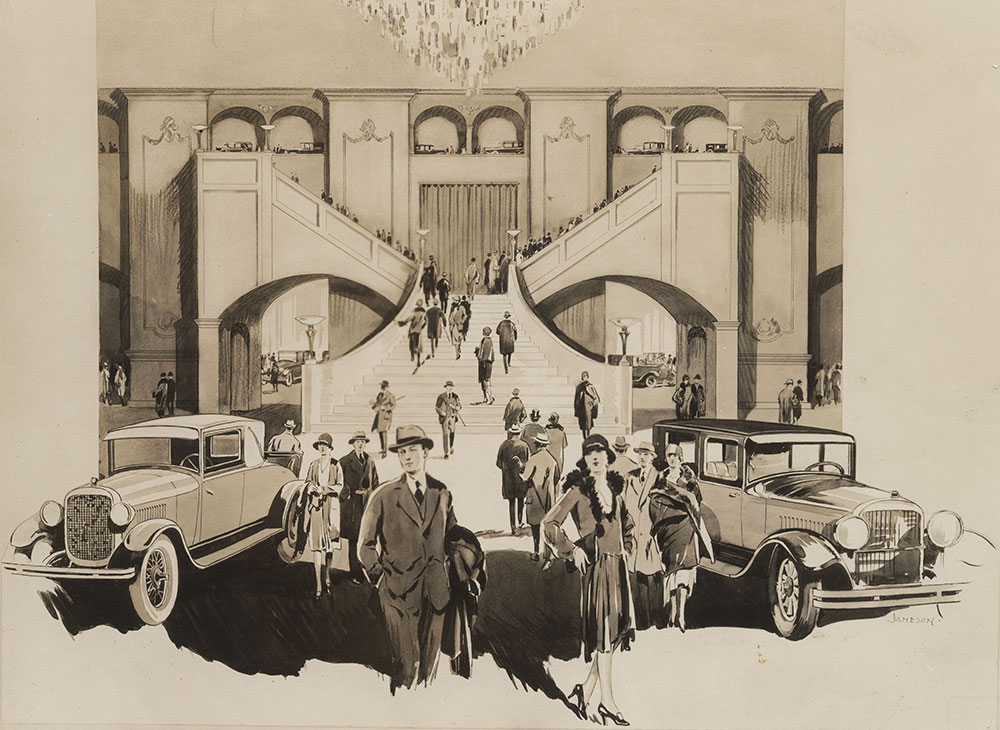
Promoters of the event touted the addition of a grand staircase to Grand Central’s mezzanine level that would ease access to both levels of the show:
AIN’T IT GRAND?…Design drawing created for the 1929 National Automobile Show at Grand Central Palace touting the addition of an equally grand new staircase. (Free Library of Philadelphia)How the new staircase actually appeared at the 1929 show. Note the background where the movement of workmen on ladders lends a ghostly appearance. (Free Library of Philadelphia)A view of the 1929 National Automobile Show from the mezzanine of the Grand Central Palace. (Free Library of Philadelphia)
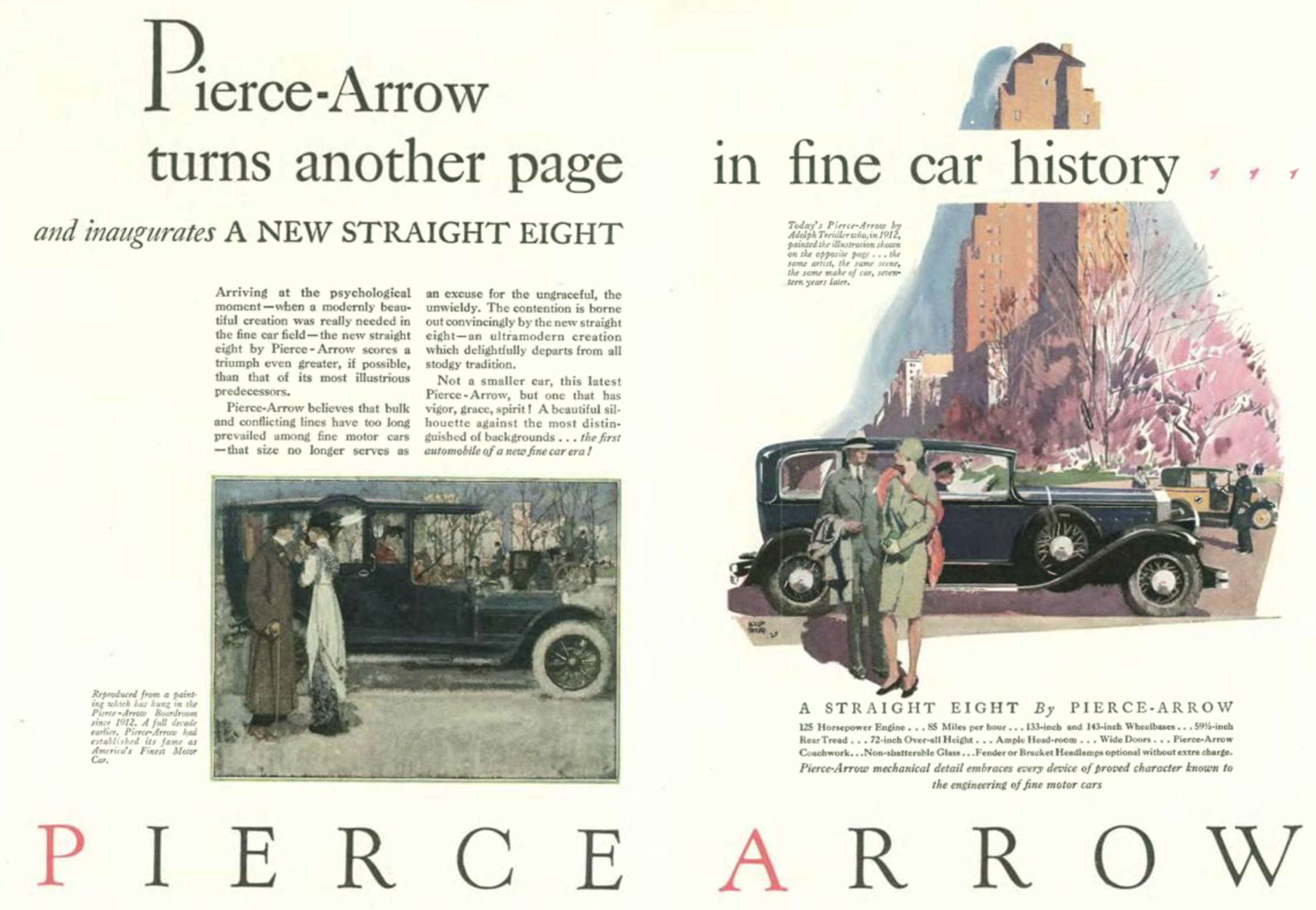
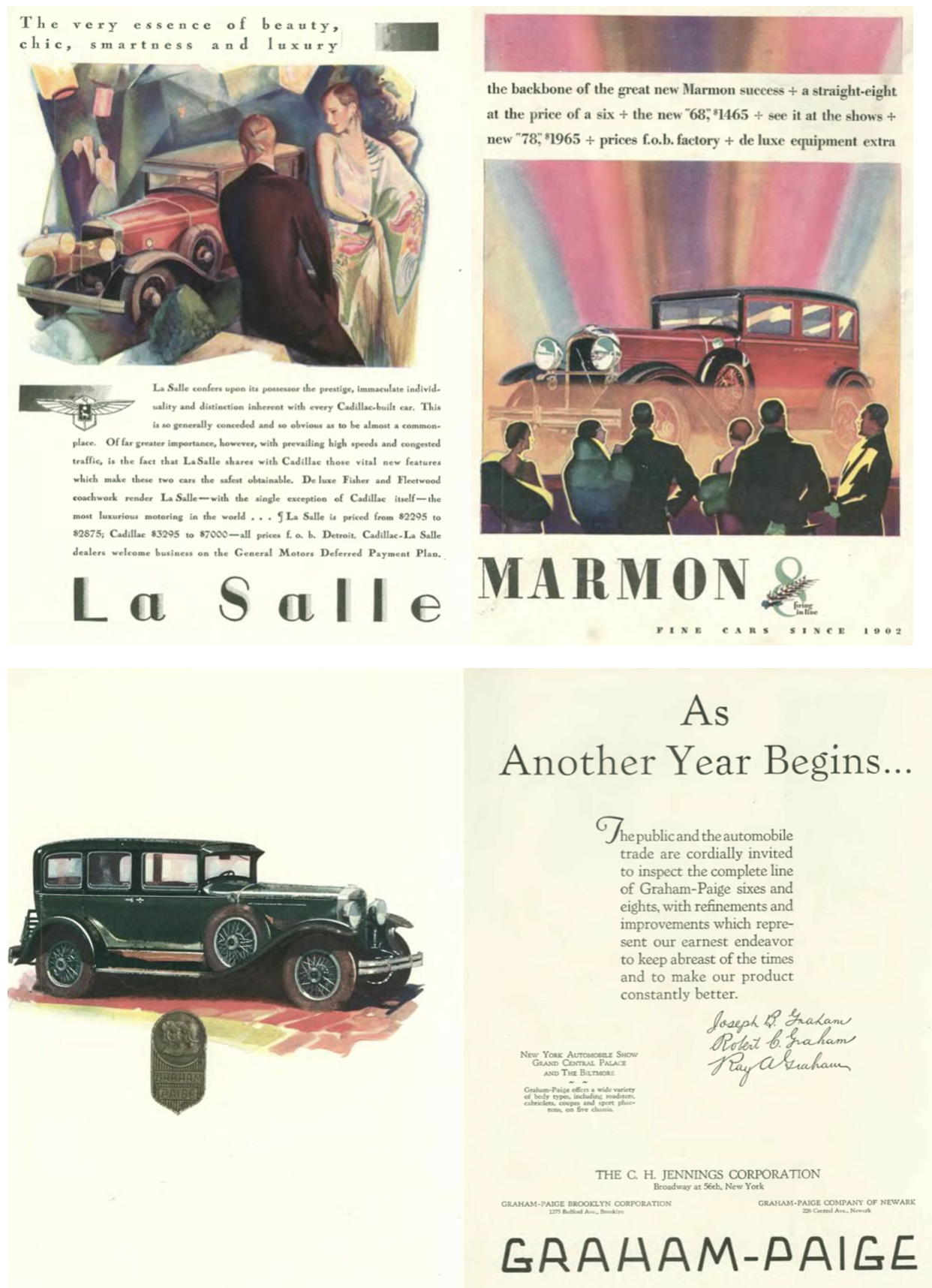
As I mentioned, the Jan. 5 issue was filled with car ads, mostly from long-gone automobile manufacturers. A constant in all of these ads is their appeal to New York’s chic, smart set. Here’s a sampling of a few of them: (click ads to enlarge):
Hupmobile was a successful car company that began its decline in the late 1920s precisely because it turned its back on buyers of medium-priced cars and went after what it perceived to be the more lucrative luxury buyer (see ad above). Hupmobile went out of business in 1939 (after briefly joining forces with Graham-Paige, which also went under that year).
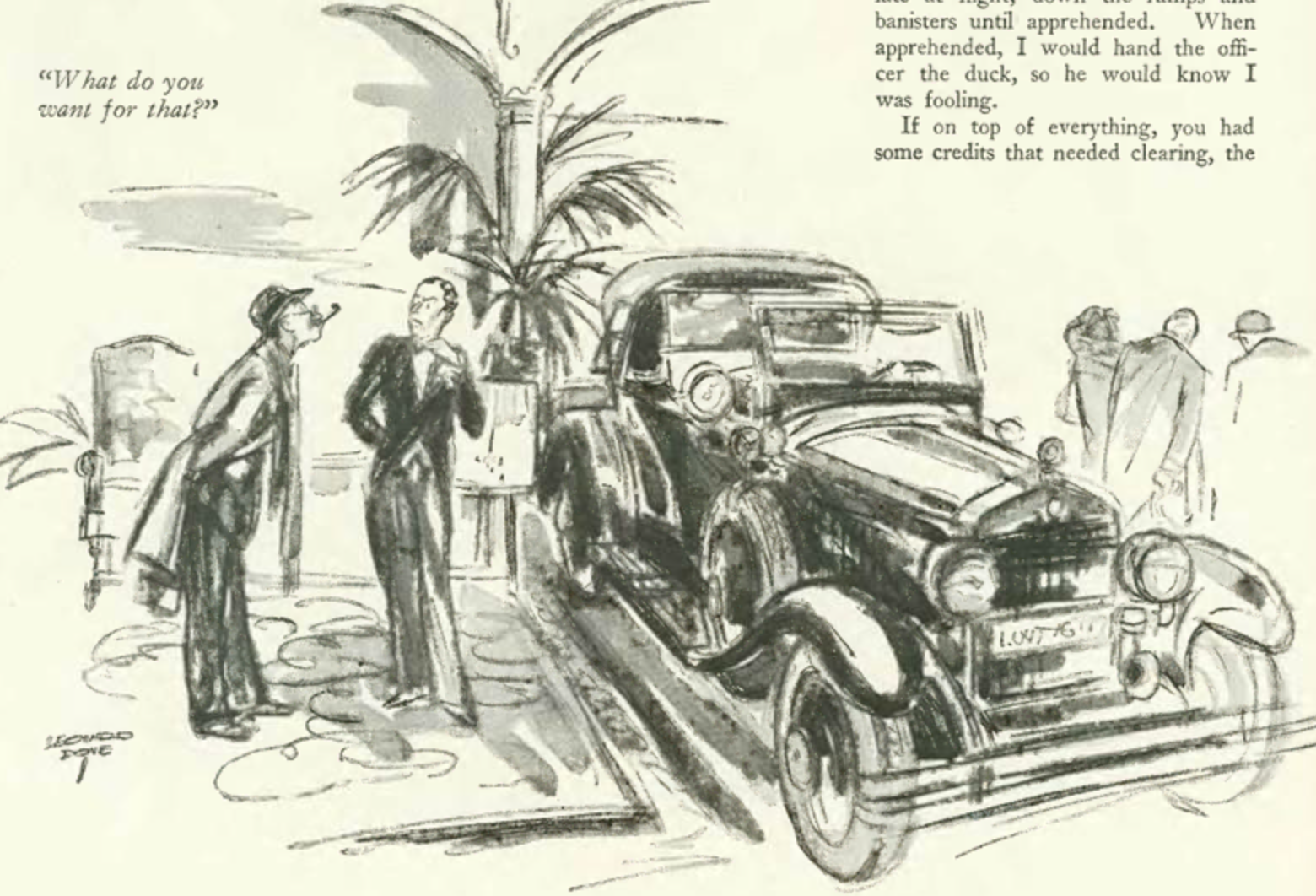
Cartoonist Leonard Dove found humor derived from these very class distinctions when he visited the auto show:
* * *
The Game, Served Up Cold
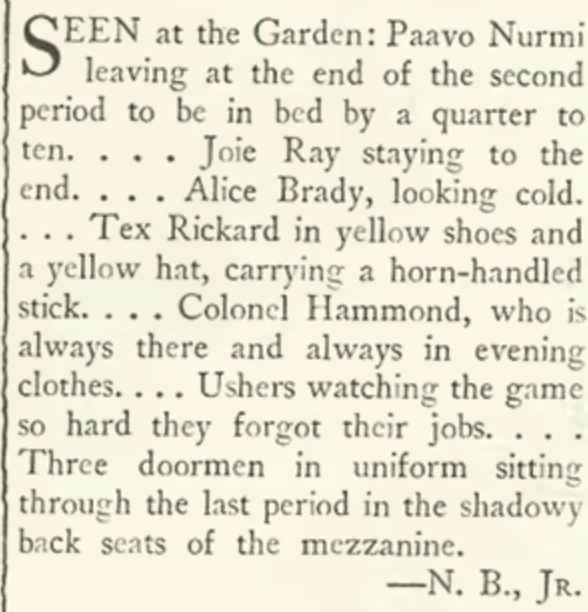
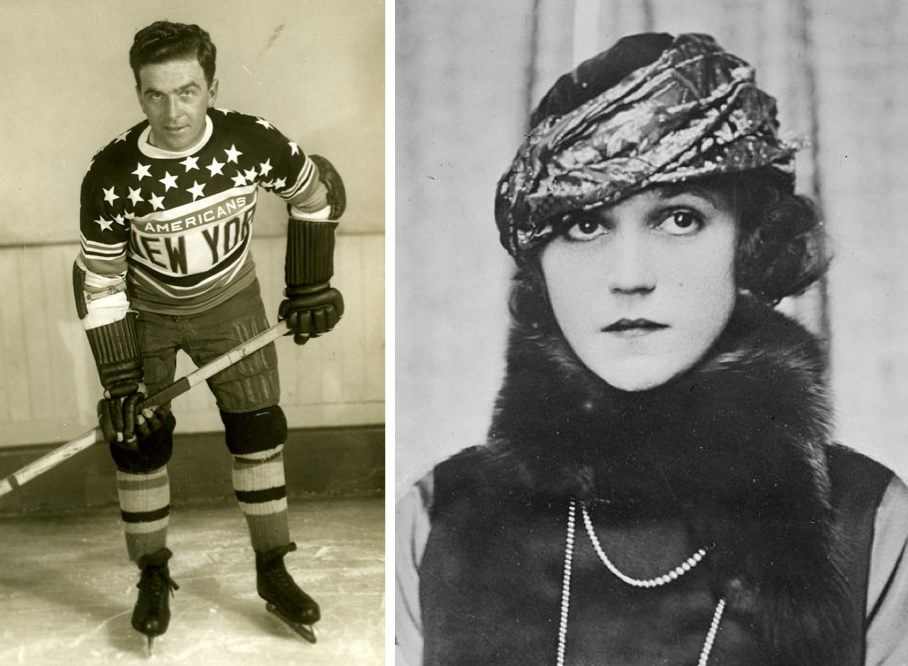
In other diversions from the Jan. 5 issue, Niven Busch Jr. attended the hockey game between the New York Rangers and the New York Americans at Madison Square Garden, noting famous faces in the crowd including Finnish track star Paavo Nurmi and American track star Joie Ray. Also noted were Tex Rickard, builder of Madison Square and founder of the Rangers, ex-football star and businessman Col. Harry Hammond, and film star Alice Brady.
AT THE GARDEN…Not even the exciting hockey play of Billy Boyd (left) and his fellow New York Americans could keep actress Alice Brady warm. (Pinterest/Alchetron)
* * *
From our non-automobile advertisers, another installment of a Theodore Geisel (Dr. Seuss) ad for Flit insecticide (this is the first instance — at least in the Flit ads— in which Geisel signs his art as “Dr. S” instead of “Seuss”).
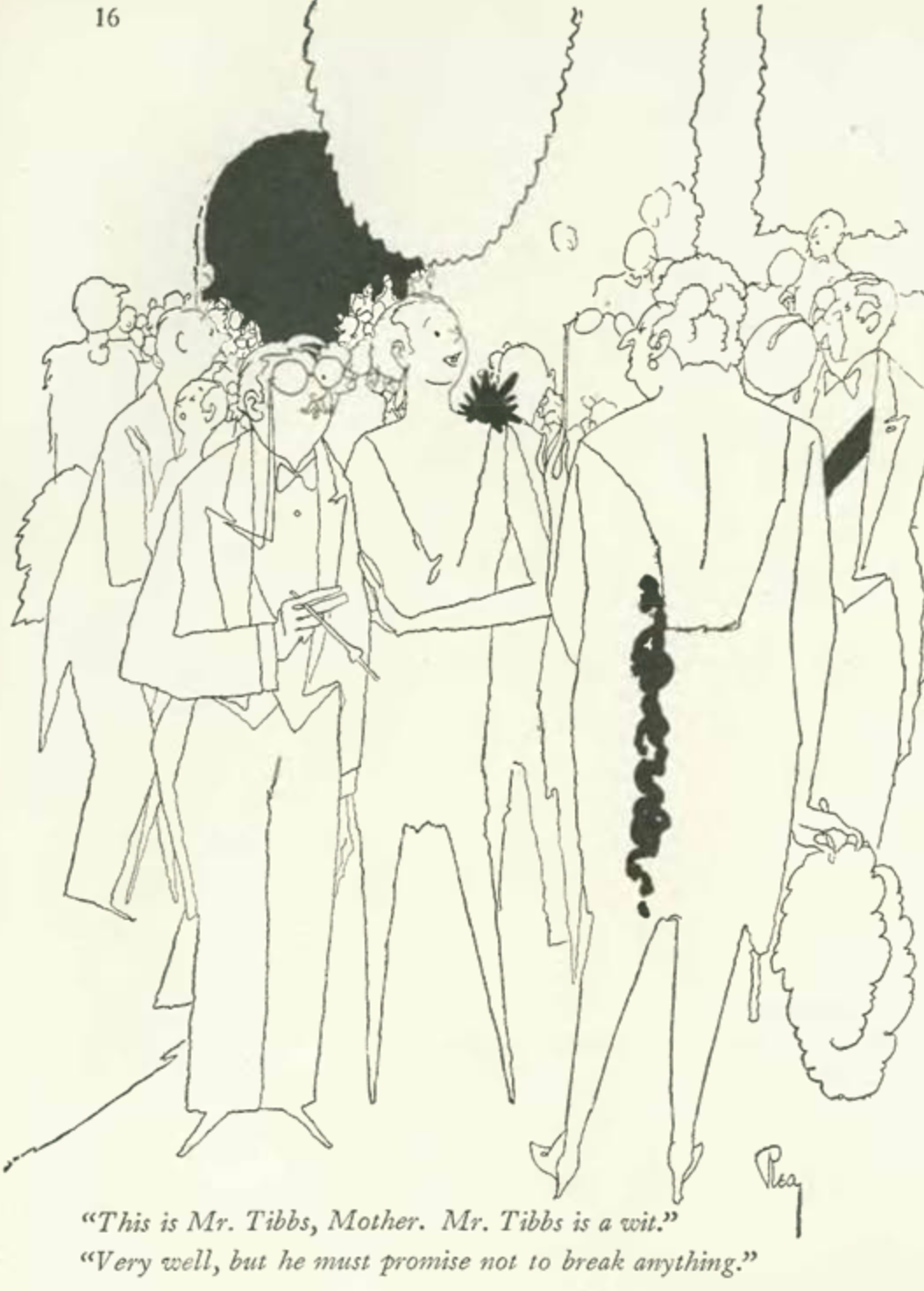
And another cartoon from the Jan. 5 issue, courtesy Gardner Rea:
* * *
Arno Addendum
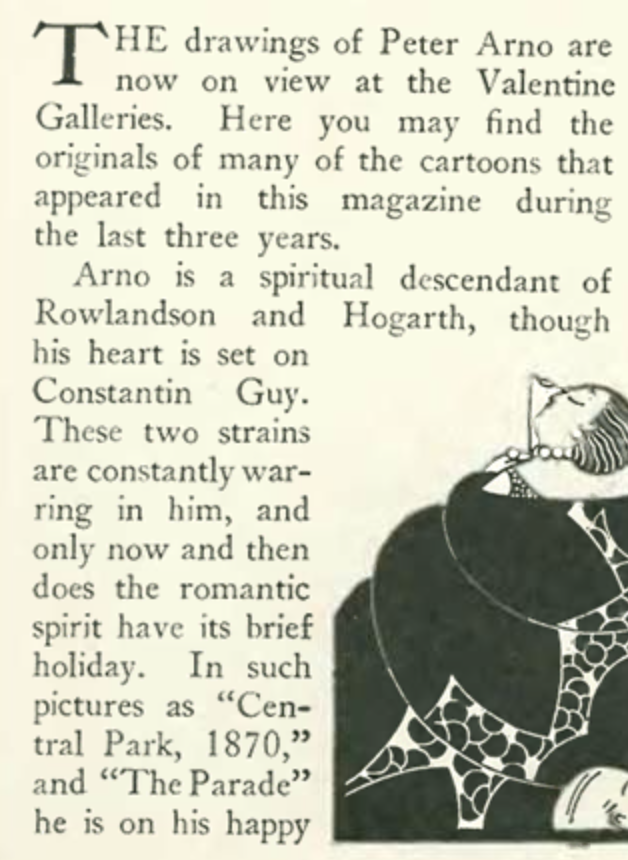
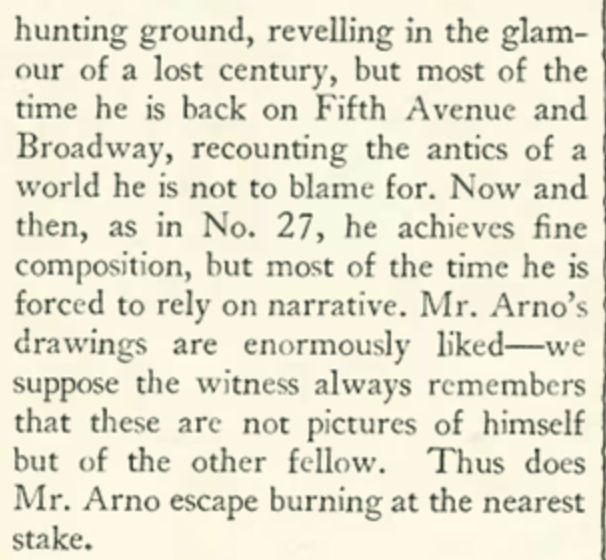
In the rush of the recent holidays I missed an item from the Dec. 22, 1928 issue — namely, art critic Murdock Pemberton’s tongue cheek review (in “The Art Galleries” column) of cartoonist Peter Arno’s December 1928 exhibition of drawings at the Valentine Gallery:
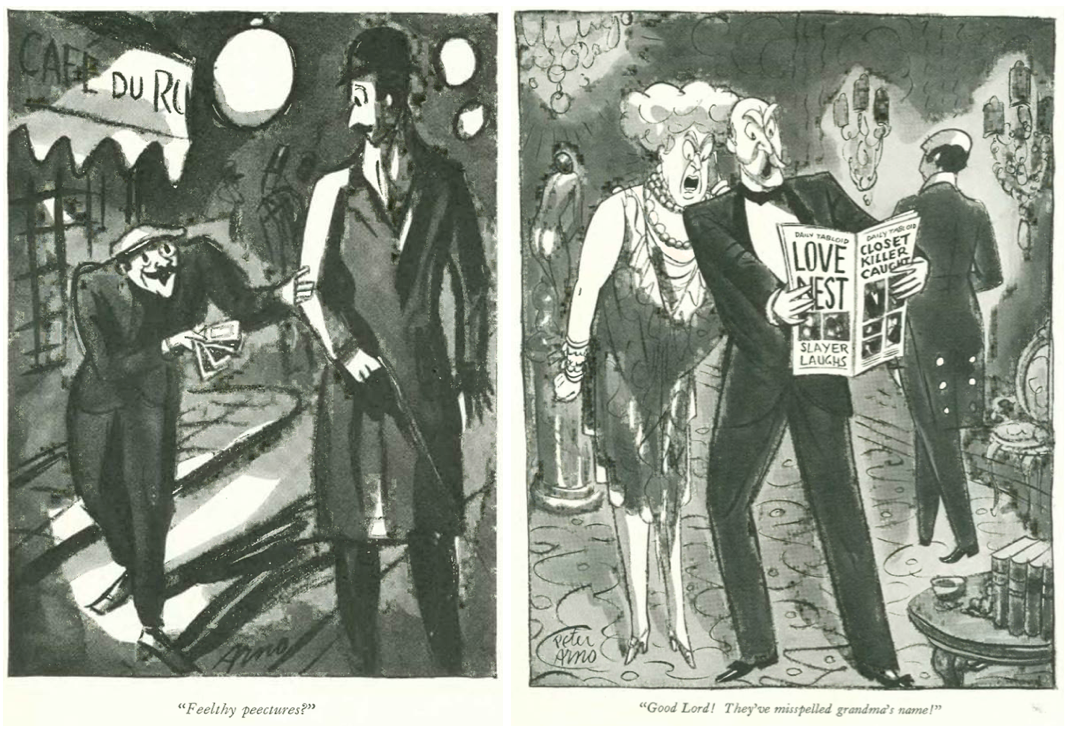
Here are two Arno drawings that were featured in the Valentine exhibition (click to enlarge):
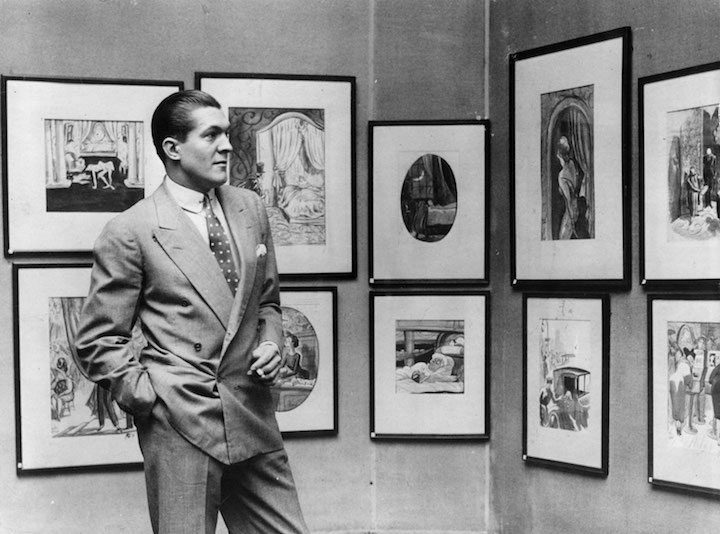
INTERNATIONAL APPEAL…less than four years after his Valentine Galleries debut, Peter Arno exhibited his drawings to great acclaim at the Leicester Galleries in London, October 1932. (Encyclopædia Britannica)
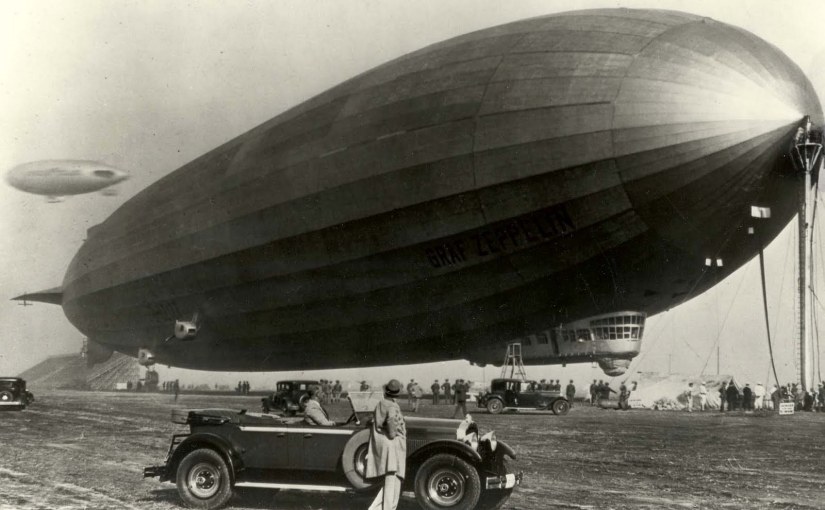
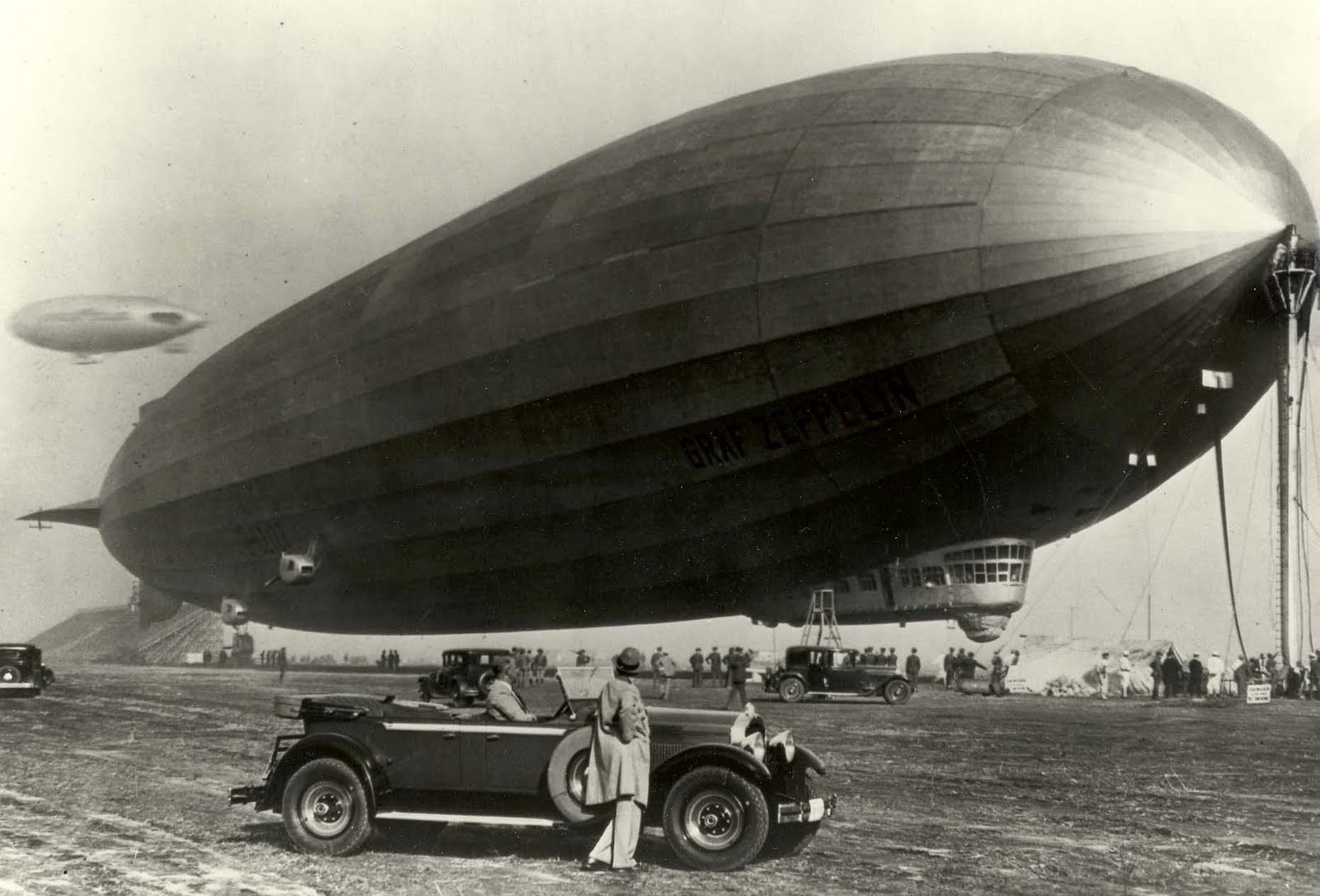
Just a decade after German Zeppelins sowed terror across the skies of Europe and Great Britain, Germany’s new Graf Zeppelin was enthusiastically welcomed by a throng gathered at Lakehurst, New Jersey, the massive airship having completed its first intercontinental trip across the Atlantic.
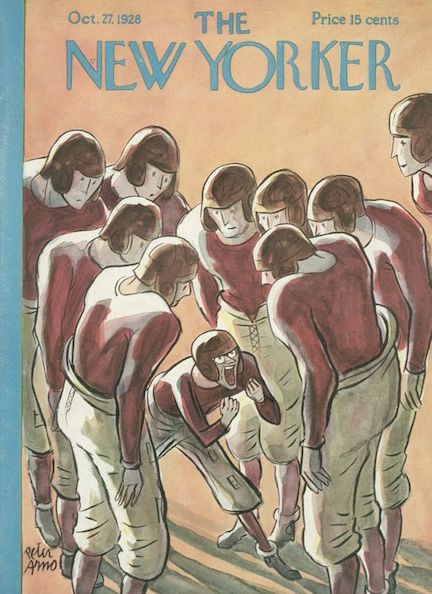
Oct. 27, 1928 cover by Peter Arno.
It had been only ten years and two months since German Zeppelins dropped their last bombs on the British, which had dubbed the airships “baby killers” for the mostly civilian casualties they inflicted. Beginning in 1915, Zeppelin raids on London killed nearly 700 and seriously injured almost 2,000 over the course of more than 50 attacks. It must have been a terrifying sight, something straight out of science fiction — flying ships more than the length of two football fields, blotting out the stars as they loomed overhead. Their size, however, was also their downfall, as Britain soon developed air defenses (searchlights, antiaircraft guns, and fighter planes) that shot many of these hydrogen gasbags out of the sky (77 of Germany’s 115 airships were either shot down or disabled).
TERROR IN THE SKIES…Image from a German postcard celebrating the bombing of Warsaw by the Zeppelin Schütte Lanz in 1914. Here’s a weird fact: There was a shortage of sausages in Germany during WWI, since cow intestines normally used for casings were instead used to create special bags to hold the hydrogen gas that kept Zeppelins aloft. It took more than 250,000 cows to make one airship. (Wikipedia)
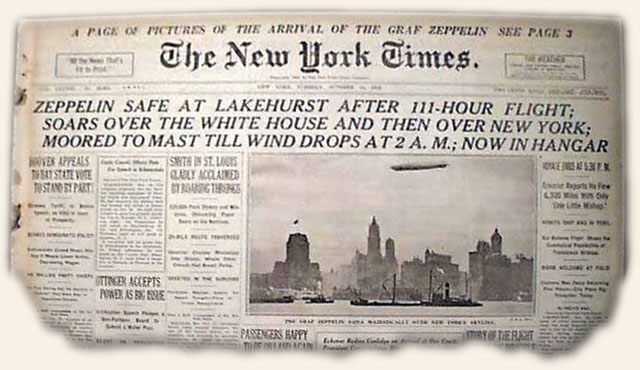
So when the 776-foot Graf Zeppelin loomed over the New York City skyline on Oct. 15, 1928, the reaction was one of awe rather than terror. The New York Times heralded its safe arrival on the front page…
(rarenewspaper.com)The Graf Zeppelin at Lakehurst, N.J., 1929. (rarehistoricalphotos.com)
…and The New Yorker’sJames Thurber (writing in “The Talk of the Town”) was on hand to assess the welcoming crowds gathered at Lakehurst, N.J….
…who in their enthusiasm could have easily destroyed the vessel, which had already sustained damage during a storm over Bermuda…
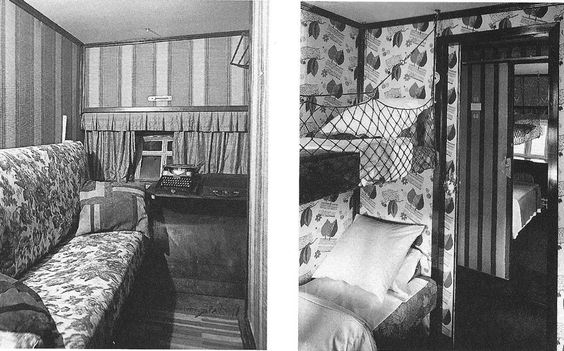
OLD GAS BAG…The Graf Zeppelin arriving at Mines Field (now Los Angeles International Airport) on August 26, 1929. Newspaper magnate William Randolph Hearst sent the Graf Zeppelin dirigible on a 20-day flight that circumnavigated the world in 1929. (martinturnbull.com)Living quarters of the Graf Zeppelin. Cozy, if you could forget that your room was contained within an envelope of highly explosive hydrogen gas.(airships.net)
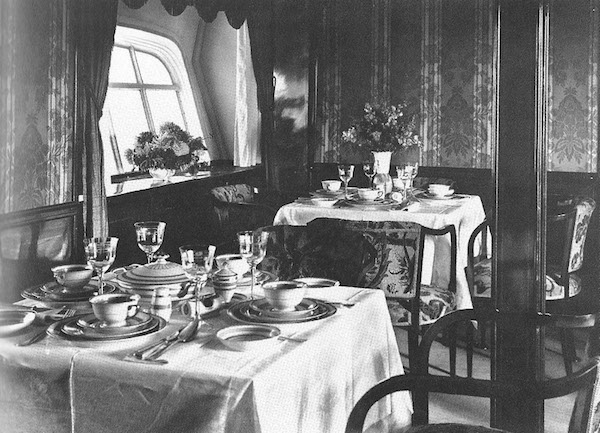
Dining aboard the Graf Zeppelin. (Top, airshipsonline.com, bottom, airships.net)
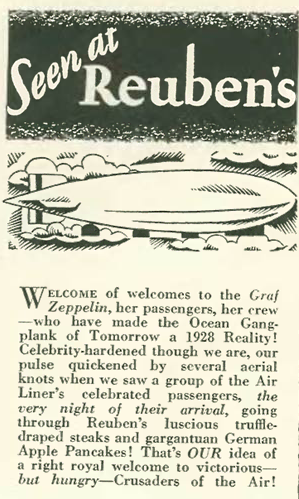
Reuben’s restaurant in New York seized the opportunity to cash in on the spectacle, boasting (in this hastily placed ad in the Oct. 27 issue) that the Graf Zeppelin’s passengers dined at their establishment on the very night of their arrival…
A final note: Considering the hazards of flying these ungainly, flammable machines (e.g. the Hindenburg in 1937) Graf Zeppelin flew more than one million miles in its career (the first aircraft in history to do so), making 590 flights (144 of them oceanic crossings, including one across the Pacific), and carrying more than 13,000 passengers — all without injury to passengers or crew.
* * *
Rough Riders
Back on the ground, “The Talk of the Town” looked in on a somewhat less exotic form of long-distance travel — the recently inaugurated coast-to-coast bus service from New York to Los Angeles:
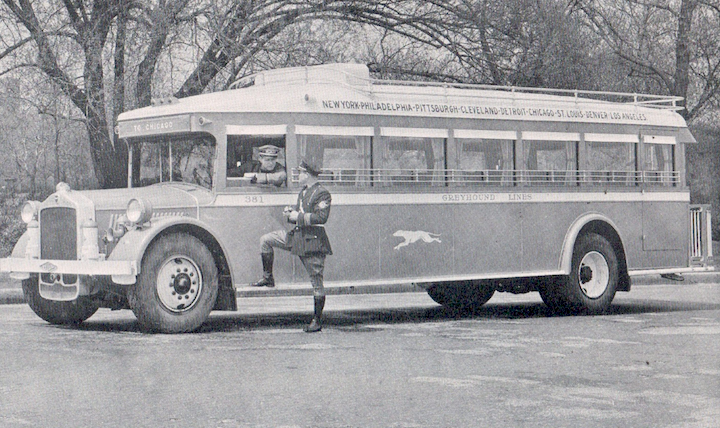
LONG HAUL…This Greyhound bus from 1929 was probably similar to those leaving the New York bus stations for points west in 1928. (flickr)
* * *
From Our Advertisers
On the subject of rolling transportation, Buick trumpeted the introduction of “adjustable front seats” in its silver anniversary model. Curiously, this improvement was touted as a convenience solely for women drivers…
Our cartoon (a two-pager) for Oct. 27 comes from Gardner Rea, the latest among TheNew Yorker’s staff to mock the quality of sound motion pictures. The cartoon is labeled at the bottom: “The Firtht One Hundred Per Thent Thound Movie Breakth All Houth Recordth.” (click image to enlarge)
* * *
If you wanted to get a glimpse of New York’s “royalty” in 1928, you could secure a seat at the Metropolitan Opera, especially one with a view of its famed “Diamond Horseshoe” seats.
November 3, 1928 cover by Julian de Miskey.
The “Diamond Horseshoe” described a ring of seats at the Metropolitan Opera House occupied by New York’s social elite. Not unlike today’s stadium skyboxes, the Met reserved these boxes for purchase by the wealthy. “The Talk of Town” for Nov. 3, 1928 noted how many of these were still held by the same families that had secured spots after the Met opened in 1883:
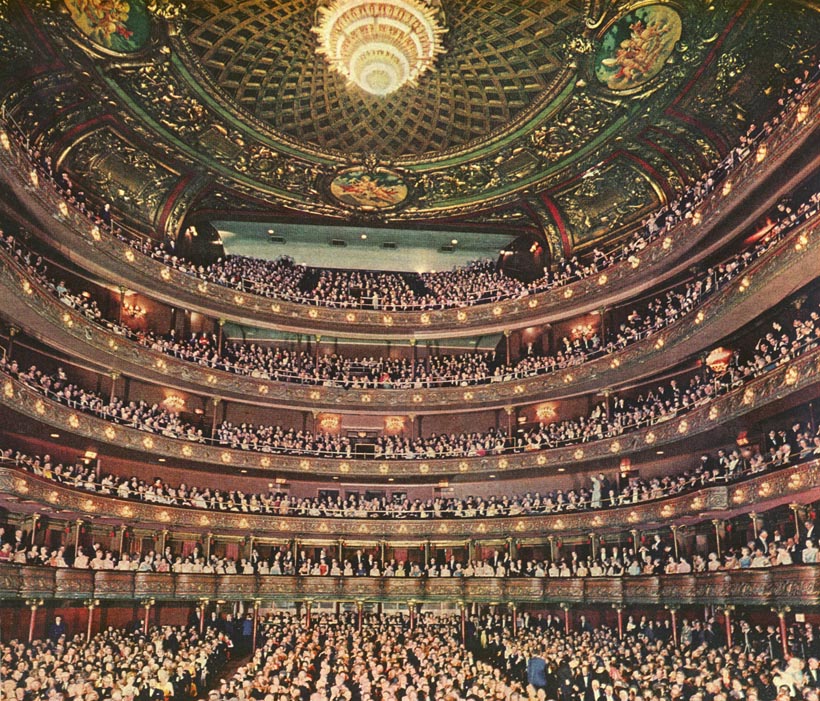
CULTURAL LANDMARK…The Metropolitan Opera House at Broadway and 39th Street circa 1905. (Wikipedia)SEE AND BE SEEN…The Diamond Horseshoe at the Metropolitan Opera House, as seen from the rear of the stage for a concert by pianist Josef Hofmann, November 28, 1937. (newyorksocialdiary.com)
“Talk” also noted that some of the boxes in the Diamond Horseshoe were coming into new ownerships among the newly rich (E.F. Hutton) and even (gasp) immigrants such as Otto Kahn:
DUST TO DUST…Above, a view of the “Diamond Horseshoe” at the Metropolitan Opera’s gala farewell performance on April 16, 1966. Below, patrons say goodbye to the old house at Broadway at the farewell performance. The building was torn down in 1967 and replaced by a 40-story office tower. (Time/Life)
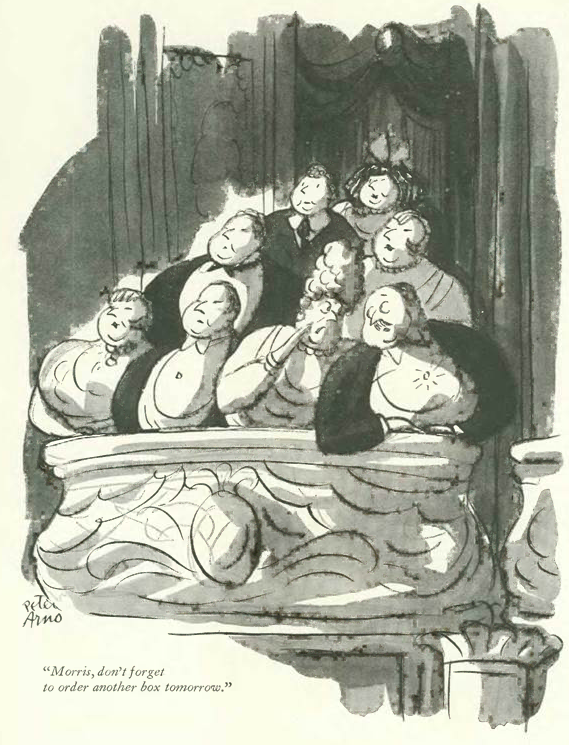
Also in the Nov. 3 issue was this cartoon by Peter Arno depicting one of the Met’s boxes stuffed with overfed toffs:
* * *
Poet With a Green Thumb
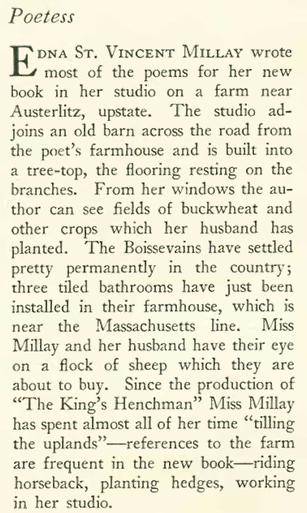
The Nov. 3 “Talk” also featured a bit by James Thurber on American poet and playwright Edna St. Vincent Millay, a major figure in New York’s Greenwich Village literary scene as well as a feminist leader. A Pulitzer-Prize winner (1923), Millay was also an avid gardener who preferred the solitude of her farm, Steepletop, to the limelight usually accorded a literary star:
RARE PHOTOGRAPH…Edna St. Vincent Millay raised her own vegetables at Steepletop, a former blueberry farm located near Austerlitz, New York that she owned with her husband Eugen Jan Boissevain. Photo is circa 1928. (Library of Congress)
Thurber noted that even her publisher, Harper & Sons, had to use an old photo of the publicity-shy poet for a new book release:
On the topic of photography, “Profiles” (written by film historian Terry Ramsaye) looked in on the quiet life of photography pioneer George Eastman, who founded the Eastman Kodak Company and popularized the use of roll film.
A quintessential “mamma’s boy,” Eastman never married…
…and by all accounts died a celibate less than four years after this profile was written, taking his own life at age 77. Suffering from intense pain caused by a spinal disorder, Eastman shot himself in the heart on March 14, 1932, leaving a note which simply read, “To my friends: my work is done. Why wait?”
Odds and Ends
Other items of note from the Nov. 3 issue included a humorous piece by Rube Goldberg, “The Red Light District,” in which the president of the Blink Stop-Go Traffic Company summons a doctor to treat a strange malady. The doctor gets held up by traffic lights on the way to the “emergency,” and when he discovers the problem is only hives, he shoots the patient. The piece was headlined by this artwork, also by Goldberg (shades of George Herriman and R. Crumb, yes?)…
Goldberg is still known today thanks to his series of cartoons depicting deliberately complex contraptions invented to perform simple tasks, such as the “Self-Operating Napkin” below, from 1931:
1931 (Wikipedia)
Cartooning’s highest honor, The Reuben Award, was named after Goldberg, who was a longtime honorary president of the National Cartoonists Society.
* * *
The Roaring 20s saw a rapid transformation of the New York skyline, with massive skyscrapers rising from the dust of old 18th and 19th century institutions. But few would signal the new age more than the Chrysler Building, an Art Deco landmark that would stand as the world’s tallest building for nearly a year (knocked from the top spot in May 1931 by the Empire State Building). Architecture critic George S. Chappell (“T-Square”) had this observation about the planned building:
EVOLUTION OF AN ICON…Stages in the design for the Chrysler building, from the July-December 1929 issue of Progressive Architecture.
* * *
More from our advertisers…in the Nov. 3 issue Hawaii beckoned well-heeled New Yorkers who were contemplating the coming winter…
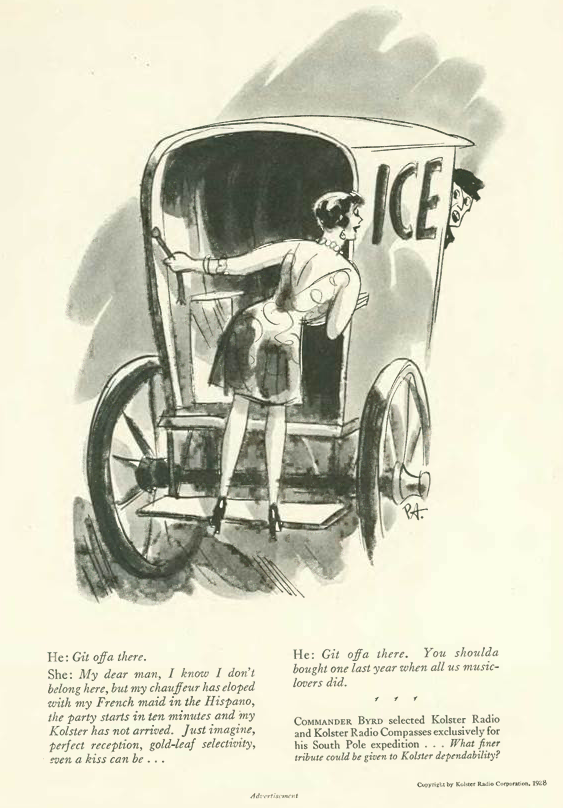
…and then there was this poorly executed ad for Kolster radios, the whole point seeming to be the drawing they commissioned from New Yorker cartoonist Peter Arno:
And finally, a cartoon by Alan Dunn, who looked in on an Ivy League football huddle:
Although architectural criticism was practiced by a rare few in 1926 (and even fewer today), it was prominent in the pages of The New Yorker. Lewis Mumford famously served as the magazine’s critic from the 1930s to the 1950s, and longtime critic Paul Goldberger took over the magazine’s “Sky Line” column from the mid-90s to 2011.
October 16, 1926 cover by Constantin Alajalov.
In 1926 George S. Chappell served the magazine as architecture critic under the pseudonym “T-Square.” A rare combination of architect, parodist, and journalist, he was perhaps best known for his travel series parody published under the pseudonym “Walter E. Traprock.”
In the Oct. 16, 1926 issue, Chappell took critical aim at the “cheap architecture” sprouting amidst the clamor of a rapidly changing landscape…
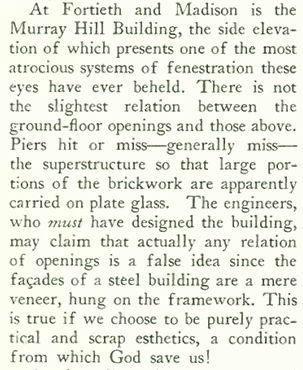
…and referred to the fenestration (the arrangement of windows and doors) of the Murray Hill Building as “atrocious.”
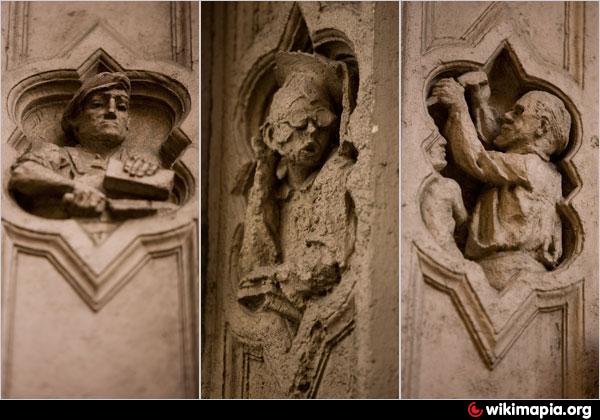
The Murray Hill Building. (Museum of the City of New York)The ground-floor show windows of Murray Hill feature free-hand carvings depicting people in various trades. (Wikimapia)
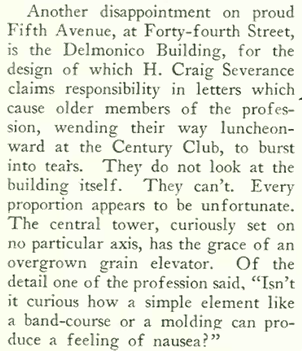
Chappell then set his sights on “another disappointment,” the Delmonico Building, which he said possessed “the grace of an overgrown grain elevator…”
Part of Chappell’s disgust is no doubt attributable to the fact that the beloved old Delmonico Building at Fifth Avenue and 44th Street (left, photo from The Brickbuilder, 1899), was razed in 1925 and replaced by the “overgrown grain elevator” at right. (Google Maps screen image)
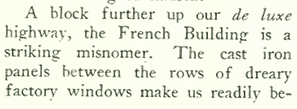
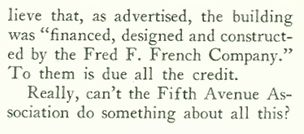
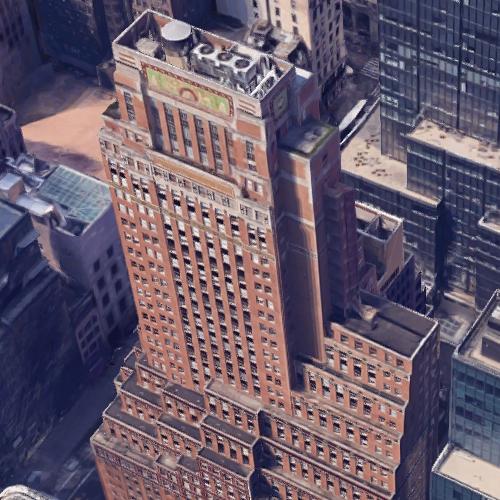
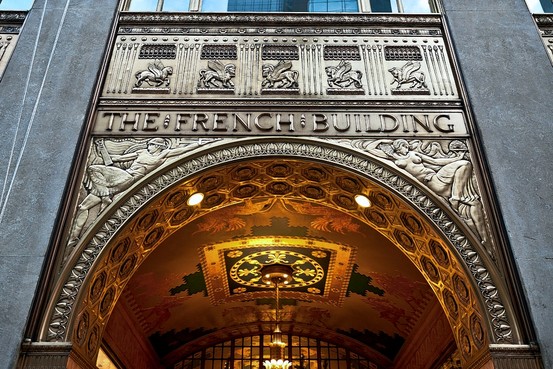
He then moves on to the landmark French Building with its “dreary factory windows”…
The French Building. (Google Maps)The 5th Avenue entrance to the French Building. (omnidisc)
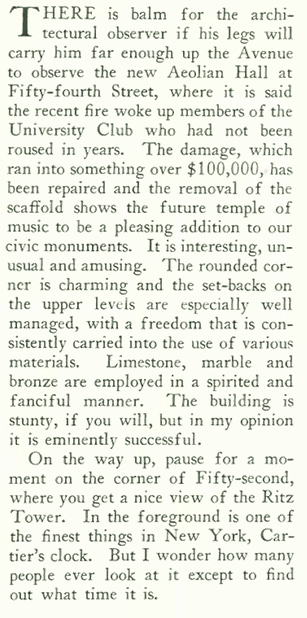
So what did Chappell prefer? Read on…
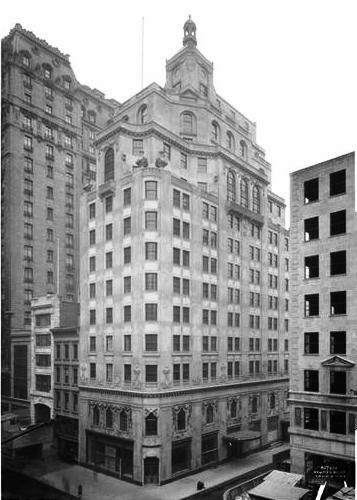
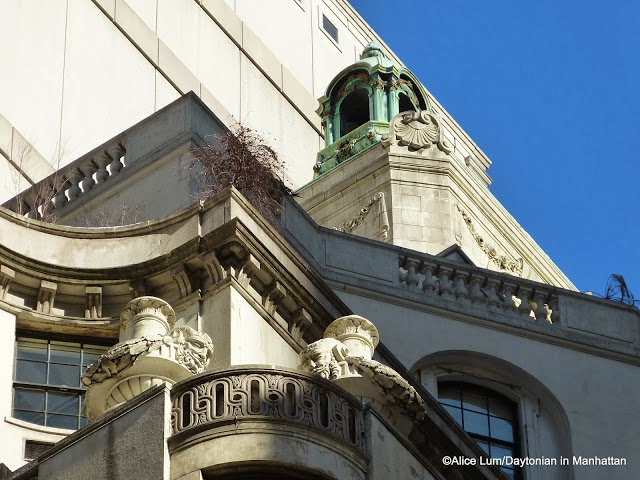
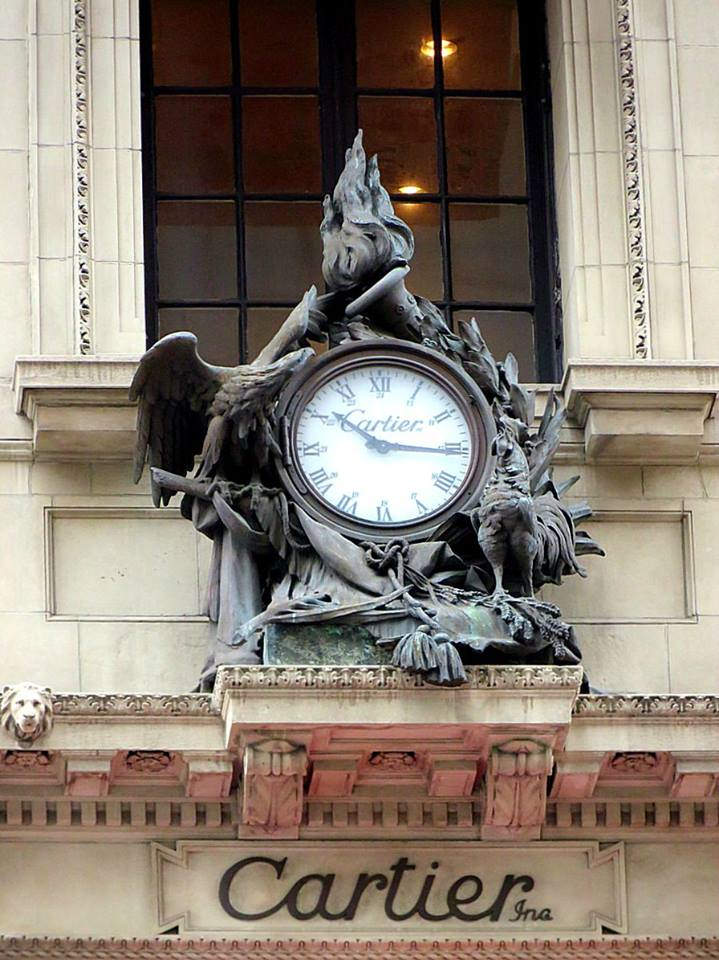
Aeolian Hall on Fifth Avenue, constructed on a site formerly occupied by the William Rockefeller mansion. (Museum of the City of New York)Detail of the upper stories of Aeolian Hall. (Daytonian in Manhattan)Cartier’s clock on Fifth Avenue (Pinterest)
Despite Chappell’s oft disapproving gaze, in the end he (along with other editors and writers at The New Yorker) could not help but be caught up in the thrill of one of the city’s grandest building booms…
Other items of note in the Oct. 16 issue, this ad promoting the first-ever “New Yorker book,” a collection of “Profiles” by Waldo Frank, who wrote under the pen name “Search-light”…
And finally this picturesque ad for Marmon automobiles. The company was defunct by 1933.


























 A New Yorker State of Mind