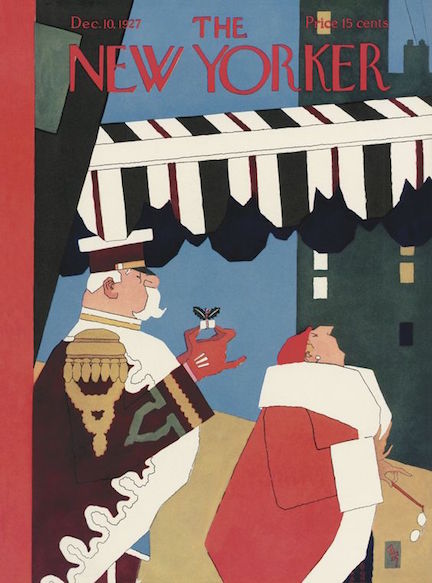
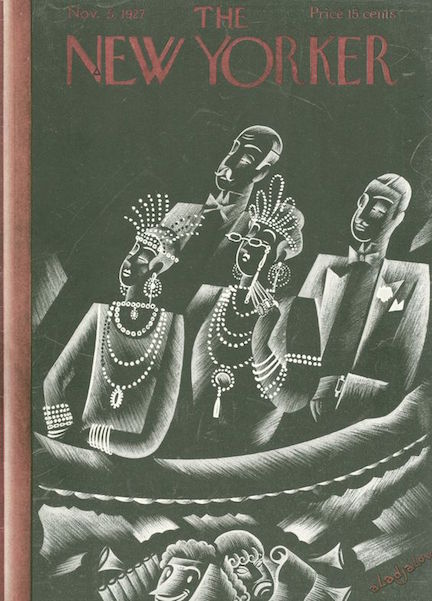
Despite Prohibition, booze flowed freely in 1928 New York thanks to bootleggers and lax enforcement by everyone from cops to judges. One major exception was Mabel Walker Willebrandt, a U.S. Assistant Attorney General from 1921 to 1929 who among other things handled cases concerning violations of the Volstead Act.
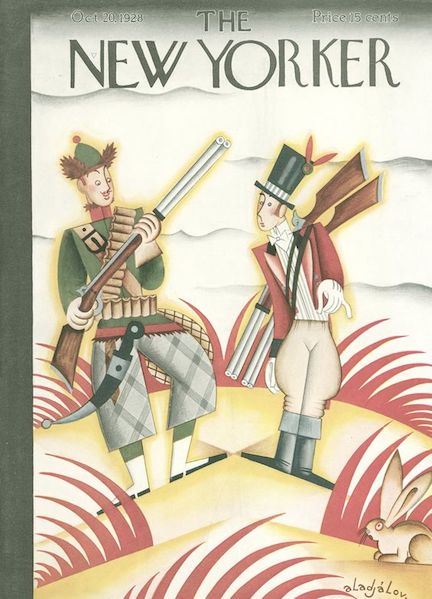
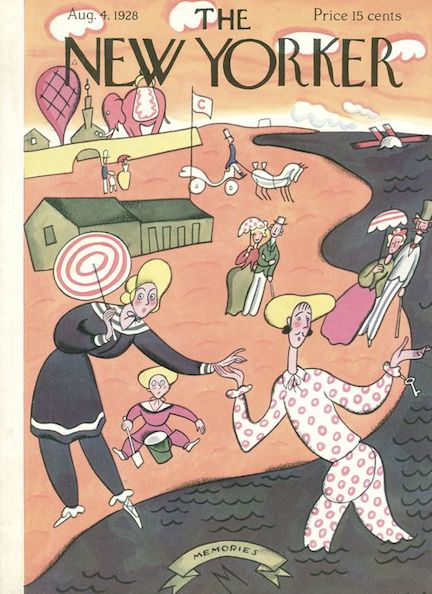
Oct. 20, 1928 cover by Constantin Alajálov.
Although Willebrandt herself enjoyed the occasional drink (she was personally opposed to prohibition), she was nevertheless serious about enforcing the law, and rather than chasing small-time bootleggers or padlocking speakeasies, she targeted the big-time operators.
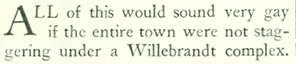
How Willebrandt fits into this blog entry can be found in Lois Long’s “Table for Two” column in the Oct. 20, 1928 issue, in which Long described the current state of affairs of Manhattan’s nightlife, including the departure of boozy torch singer Helen Morgan from the speakeasy scene for Flo Ziegfeld’s late-night Broadway revue, the Ziegfeld Midnight Frolic:
WELL-KNOWN TO THE POLICE…Helen Morgan started singing in Chicago speakeasies in the early 1920s, where she defined the look of the torch singer, including the draped-over-the-piano pose, which was her signature. (amanandamouse.blogspot.com)
Morgan, who at the time was also starring in Broadway’s Show Boat, had been arrested the previous December for violation of liquor laws at her own popular nightclub, Chez Morgan. She would not return to performing in nightclubs until after the repeal of Prohibition.
Long also looked in on the popular Harlem nightclubs, where the dance music was “throbbier than ever.”
HOPPING IN HARLEM…Lois Long wrote that you couldn’t get near the popular Small’s (left) on a Saturday night, while Connie’s Inn (right) offered a new show that was “as torrid as ever.” (harlemworldmag.com, New York Public Library)
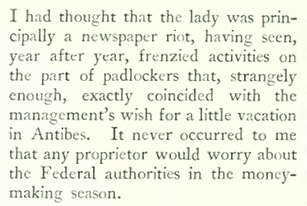
There was a sober undercurrent to all of this merry-making, namely Willebrandt’s determined efforts to go after the big bootlegging operations that were fueling all of this mirth. Long wrote:
PROHIBITION PORTIA…At left, Mabel Walker Willebrandt being sworn in as U.S. Assistant Attorney General in 1921. At right, Willebrandt on the cover of Time magazine, August 26, 1929. (legallegacy.wordpress.com/Time)
Willebrandt decried the political interference and the incompetence (or corruption) of public officials who undermined the enforcement of the Volstead Act, and even fired a number of prosecutors. As her office also oversaw the enforcement of tax laws, she developed the strategy for prosecuting major crime bosses for income tax evasion. It was an approach that would finally put the famed Chicago gangster Al Capone behind bars in 1931.
Lois Long’s mention of Willebrandt was doubtless due to the 1928 presidential campaign, during which Willebrandt openly campaigned for the “dry” candidate, Republican Herbert Hoover, over the “wet” Al Smith, who referred to Willebrandt as “The Prohibition Portia.” Smith was referencing Shakespeare’s The Merchant of Venice, in which the play’s heroine, Portia, outwits the merchant Shylock in a court case by referring to the exact language of the law.
Jim Dandy
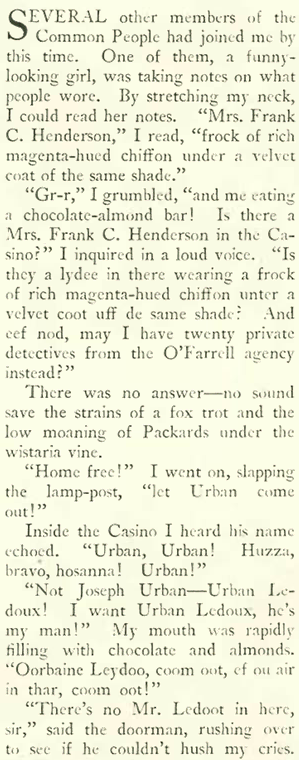
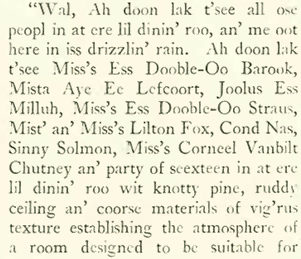
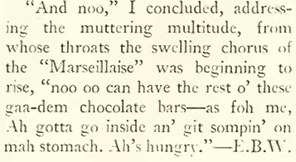
New York Mayor Jimmy Walker was well-known for his taste in clothes (as well as for the nightlife), so E.B. White (writing in “The Talk of the Town”) decided to pay a visit to the mayor’s personal tailor to see how the “royal garments” were created. Excerpts:
JIM DANDY…New York Mayor Jimmy Walker was a well-known dandy and a familiar face at Manhattan nightclubs. Rarely seen at City Hall, Walker used the lavish Casino nightclub in Central Park as his unofficial headquarters. (Encyclopedia Britannica)
* * *
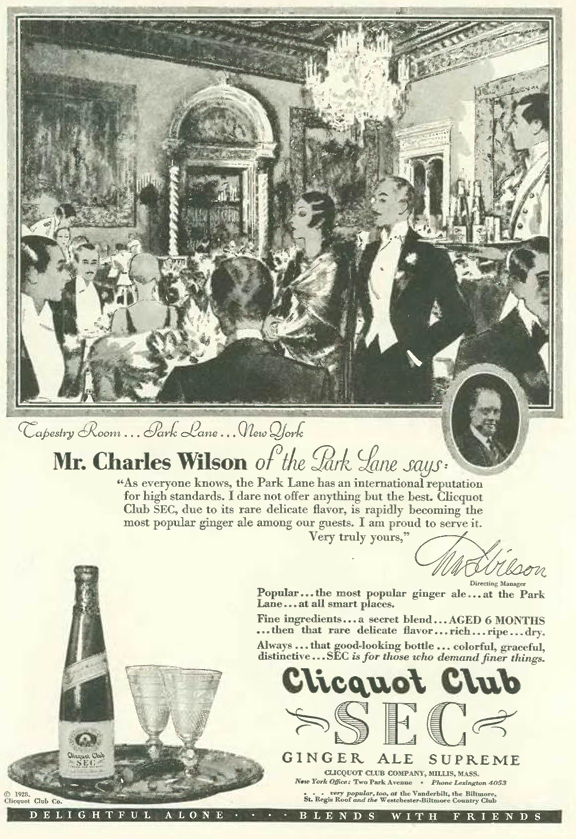
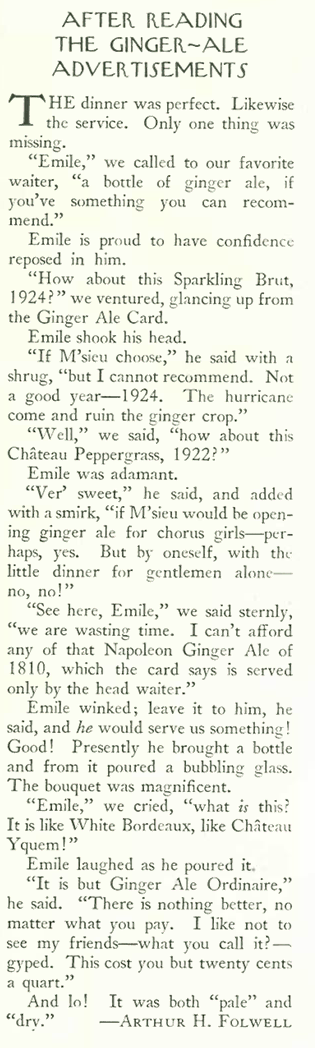
In one of my recent entries (The Tastemakers, posted Nov. 28) I noted how Prohibition had driven some advertisers to absurd lengths, including manufacturers of non-alcoholic beverages who appealed to the refined tastes (and snobbishness) usually associated with fine wines (see Clicquot Club ad below). Gag writer Arthur H. Folwell had some fun with such pretensions:
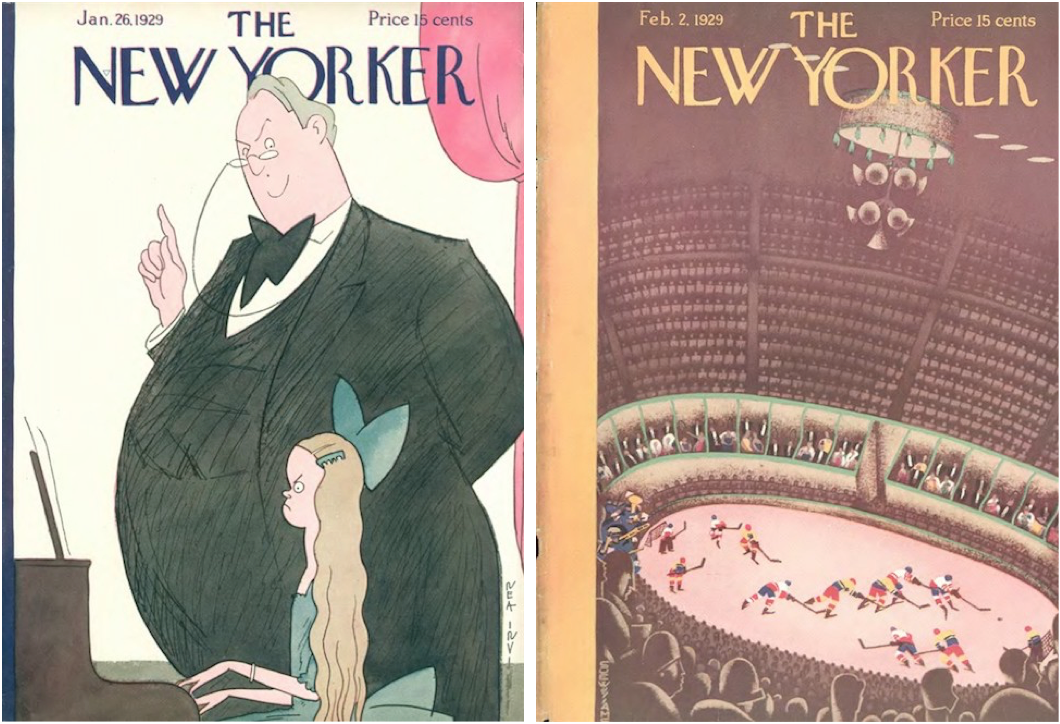
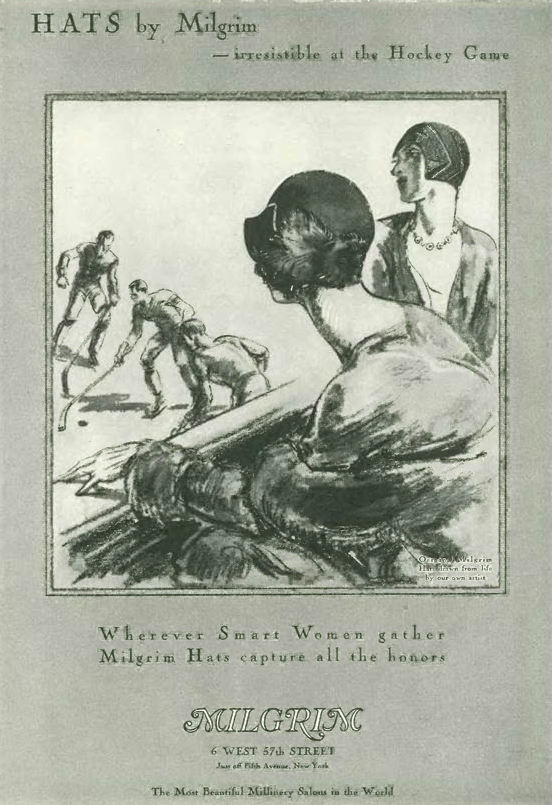
Speaking of refinement, when was the last time you saw someone dressed like this at a hockey game?
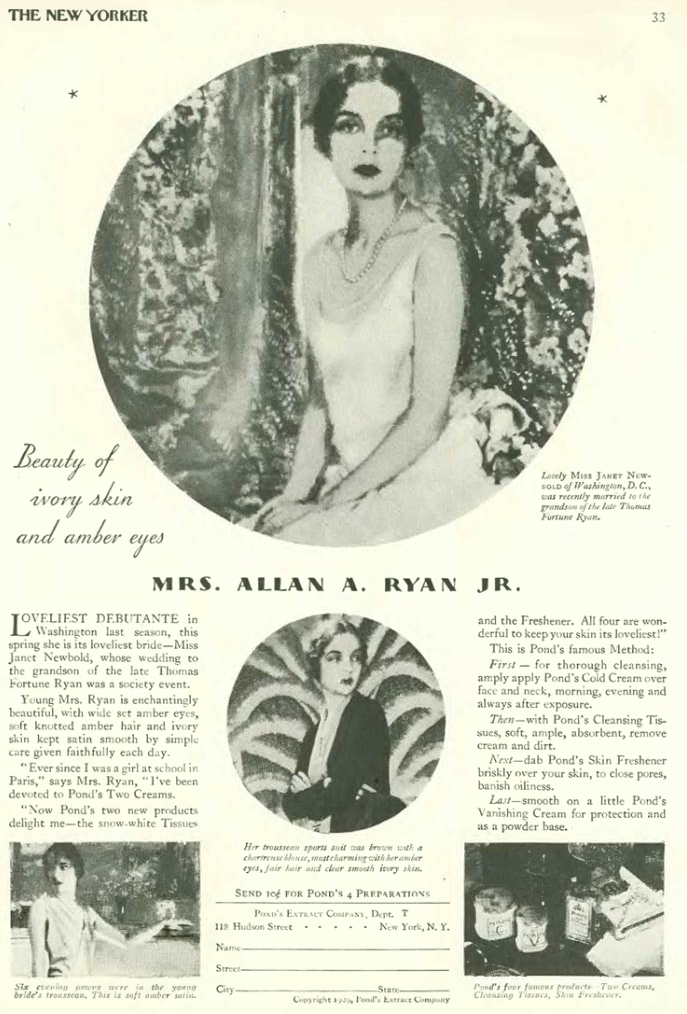
Before they graced the silver screen, the Marx Brothers were one of Broadway’s biggest draws, including their 1928 hit “Animal Crackers,” advertised in the back pages of the Oct. 20 New Yorker.
Our cartoons are courtesy Peter Arno, who looked in on a Hollywood movie set…
…and Gardner Rea, who rendered a scenario for an upper class emergency…
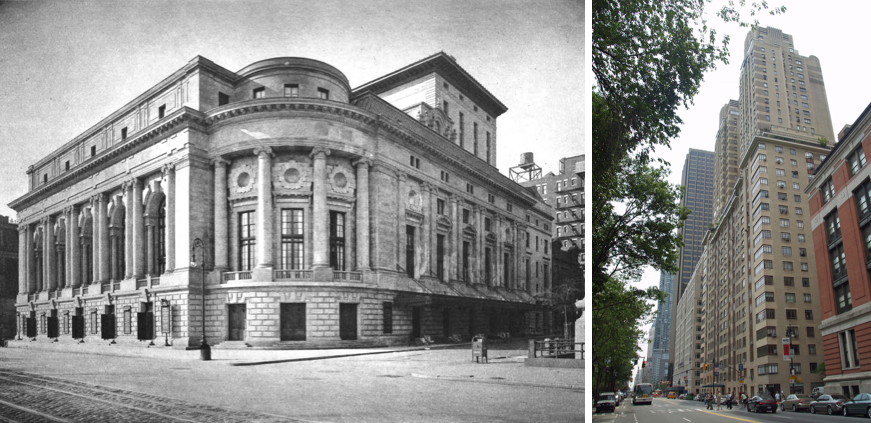
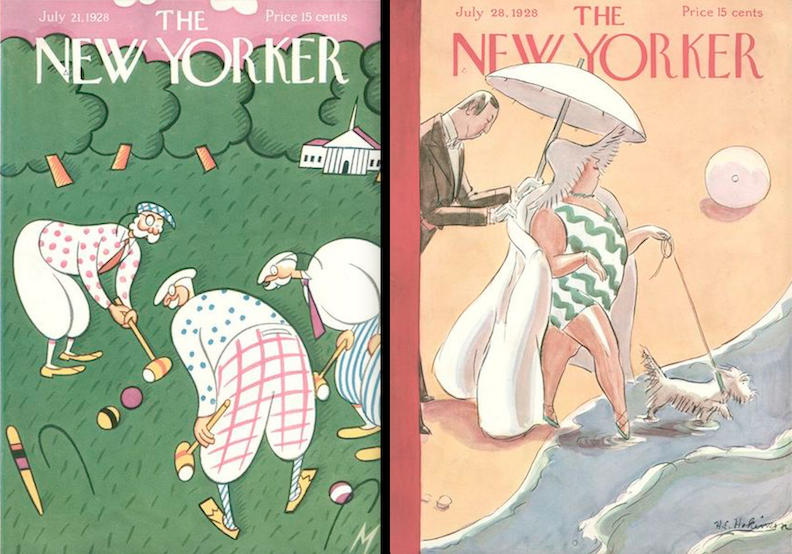
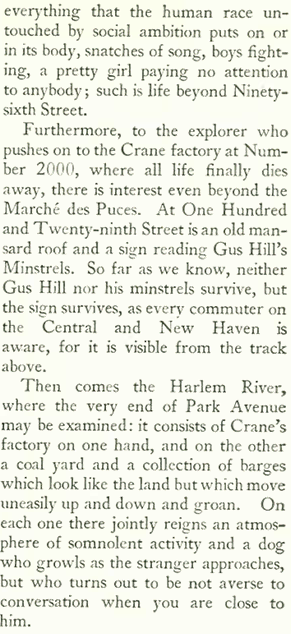
TheNew Yorker stepped out of its Manhattan offices at 25 West 45th Street and headed north to see what lay beyond 96th Street and Park Avenue, to “a land on to which realtors may not push.”
July 21, 1928 cover by Julian de Miskey; July 28, 1928 cover by Helen Hokinson.
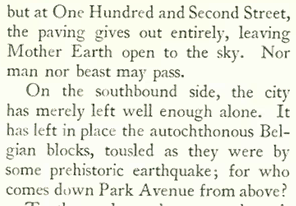
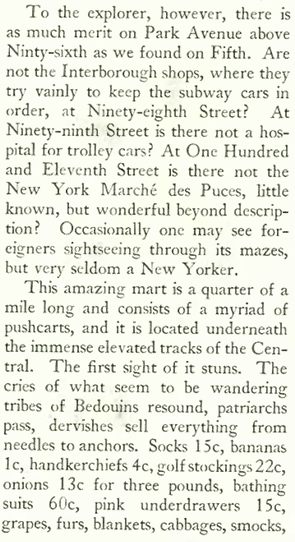
In the early to mid 20th century, 96th street represented a real dividing line across Park Avenue, separating Manhattan from the “frontier” to the north. Although developers have since breached this line (particularly beginning in the 1980s), back in 1928 it truly marked an end of sorts to Park Avenue—even the paving ran out by 102nd Street. The July 28, 1928 “Talk of the Town” observed:
FRONTIER NO MORE…Aerial view of Park Avenue from 96th Street (the X at bottom left) all the way past 132nd Street, where Park Avenue joins Harlem River Drive. The ‘X’ at the upper right hand corner marks the former location of Gus Hill’s Minstrels (mentioned in the article) at 129th and Park Avenue. (Google Maps) Click on image to enlarge
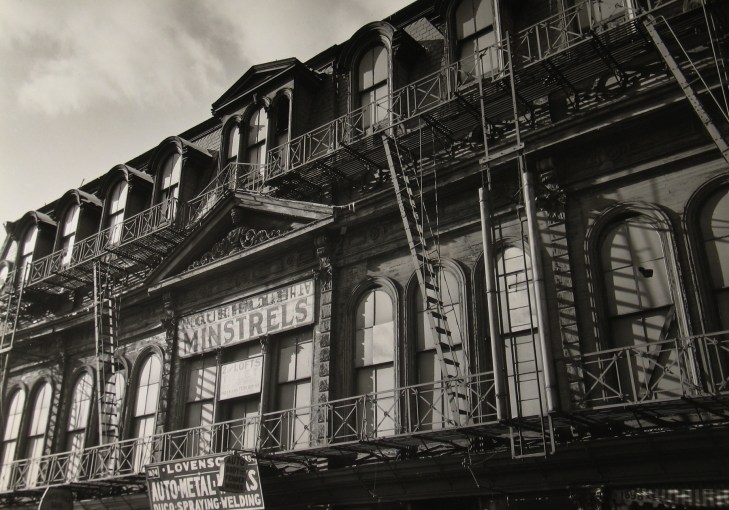
Beyond 96th a vast pushcart market was discovered to be operating under the elevated railroad tracks, while further on toward the Harlem River there were factories, coal yards, and a shuttered theatre:
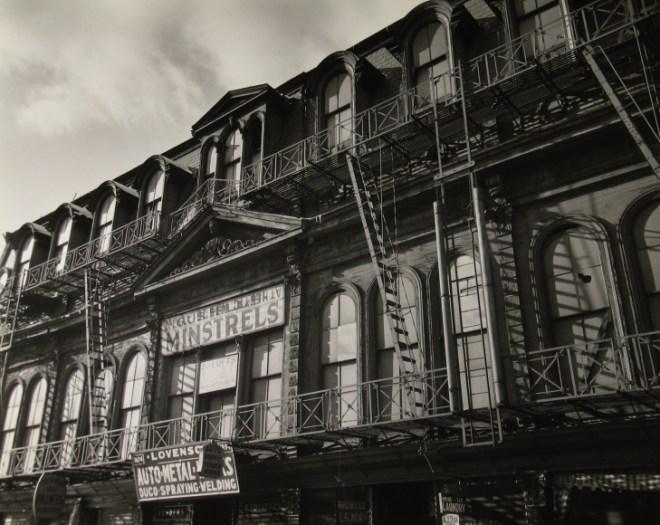
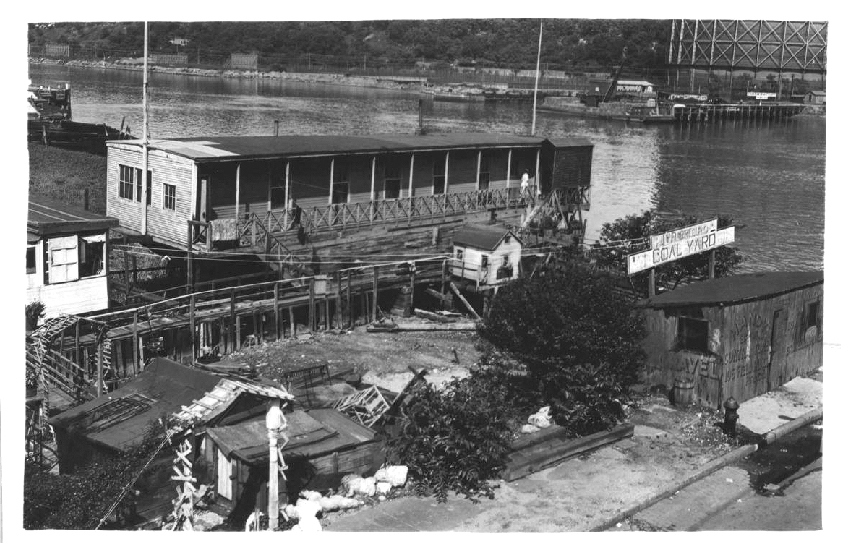
NEAR THE END OF THE LINE…The Gus Hill’s Minstrels building at the corner at East 129th and Park Avenue, facing the elevated train tracks. There was an auto garage at the lower floor. The “Minstrels” were long gone by the time the photo was taken, in 1935, by Berenice Abbott. (Museum of the City of New York)ONLY A GHOST…The former site of Gus Hill’s Minstrels, at the corner at East 129th and Park Avenue, now occupied by a filling station. (Google Maps)SOARING…The Park Avenue elevated railroad tracks in Harlem east of 96th Street created vast covered spaces frequented by pushcart vendors. (nyc-architecture)UP THE RIVER…A houseboat colony near a coal yard at 208th Street by the Harlem River, 1933. (myinwood.net)
* * *
Sport of Lords and Ladies
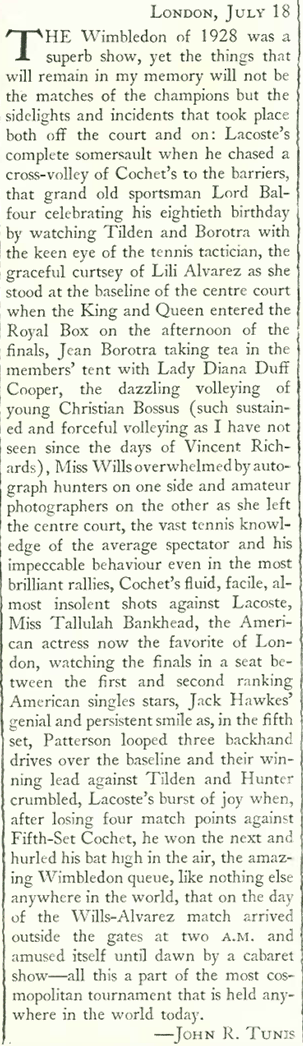
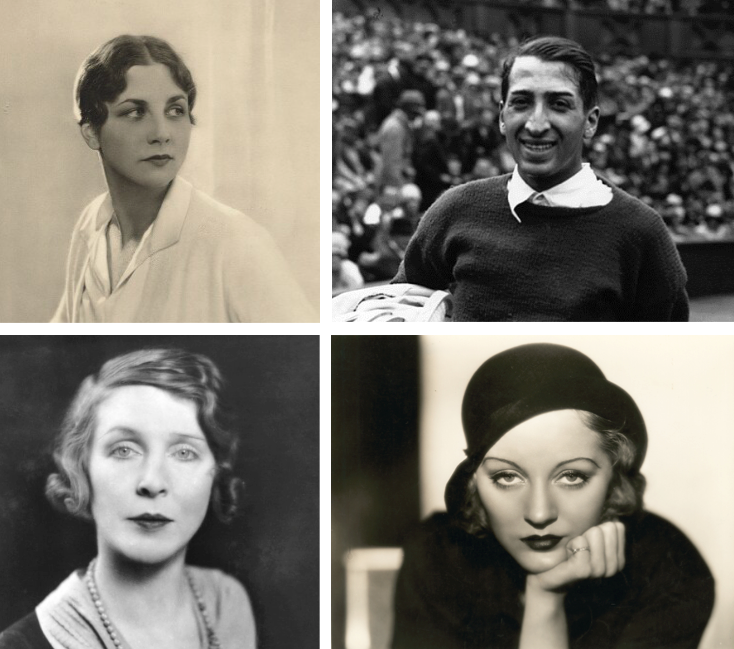
TheNew Yorker’s sportswriter John Tunis paid a visit to the 1928 Wimbledon tennis tournament, where he took in a scene that included several celebrities:
FACES IN THE CROWD at the 1928 Wimbledon included clockwise, from top left, the tournament’s singles champions Helen Wills Moody and René LaCoste; and spectators such as actress Tallulah Bankhead and Lady Diana Duff Cooper. (Wills Moody image from 1928 courtesy National Portrait Gallery, London; circa 1930 Bankhead image, Alchetron; Lady Diana image dated 1931, (UK National Portrait Gallery); and LaCoste photo taken after he won the men’s singles title at the 1928 Wimbledon, bltimes.com)
* * *
From Our Advertisers
The July 28 issue included yet another Dr. Seuss-illustrated ad for Flit insecticide. No doubt Seuss would later regret such an illustration, as later in life he strongly opposed racism and supported environmental causes.
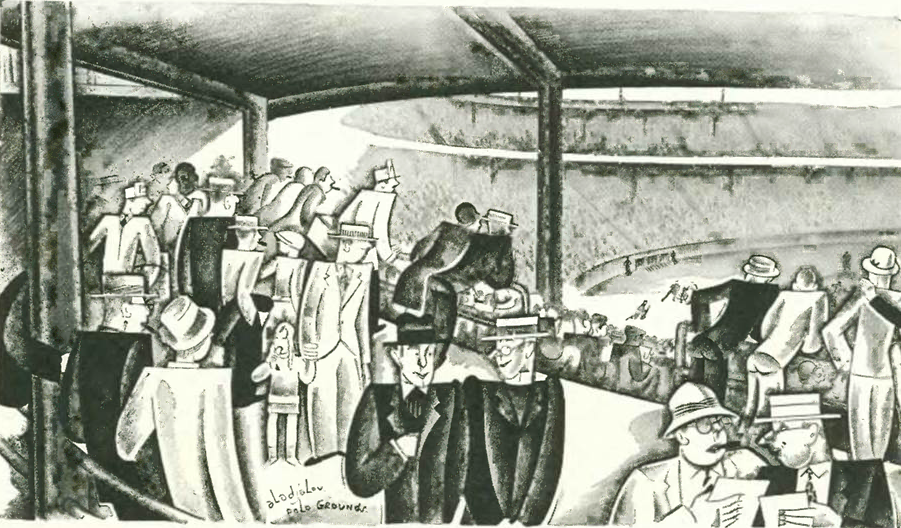
Also from the July 28 issue, a detail from a two-page illustration of baseball fans at the Polo Grounds by Constantin Alajalov, which appeared in “The Talk of the Town” section:
* * *
From Our Advertisers, Part II:
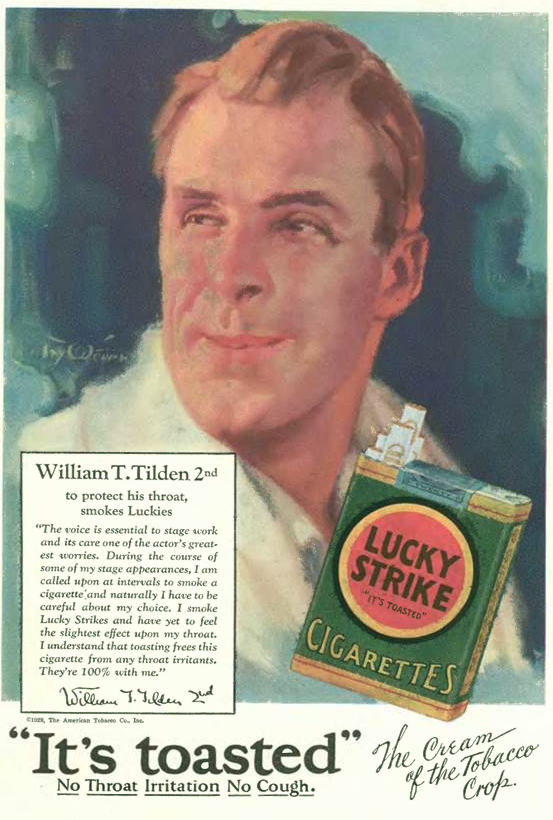
Jumping back an issue, to July 21, 1928, we find tennis great (and sometime film actor) Big Bill Tilden hawking the toasted pleasures of Lucky Strike cigarettes on the magazine’s back cover:
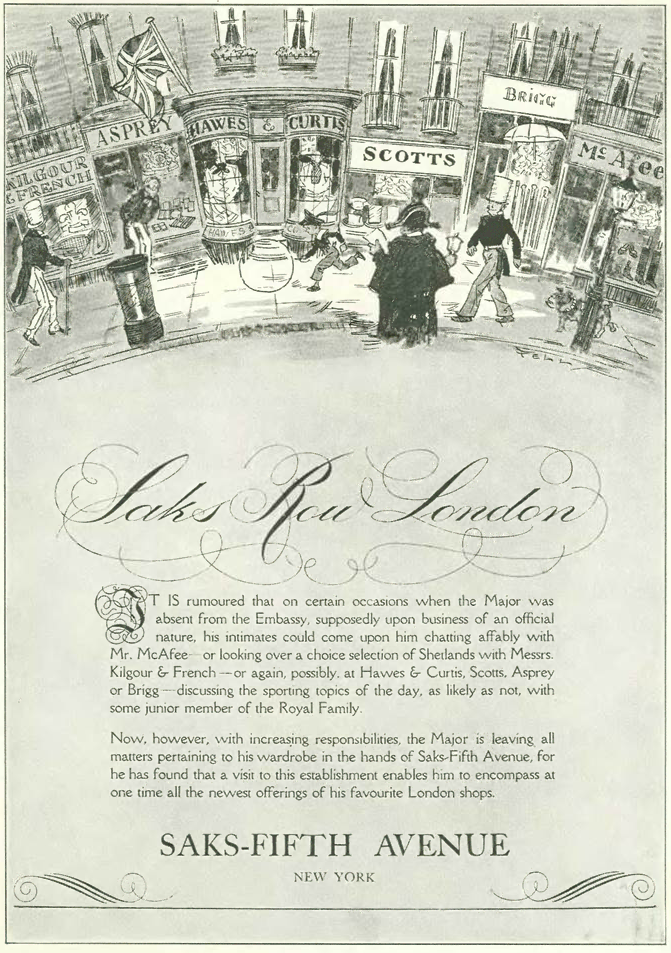
As I’ve noted before, many New Yorker ads appealed to the Anglophilic pretensions of its striving readershship. This one below from Saks is a particularly egregious example…
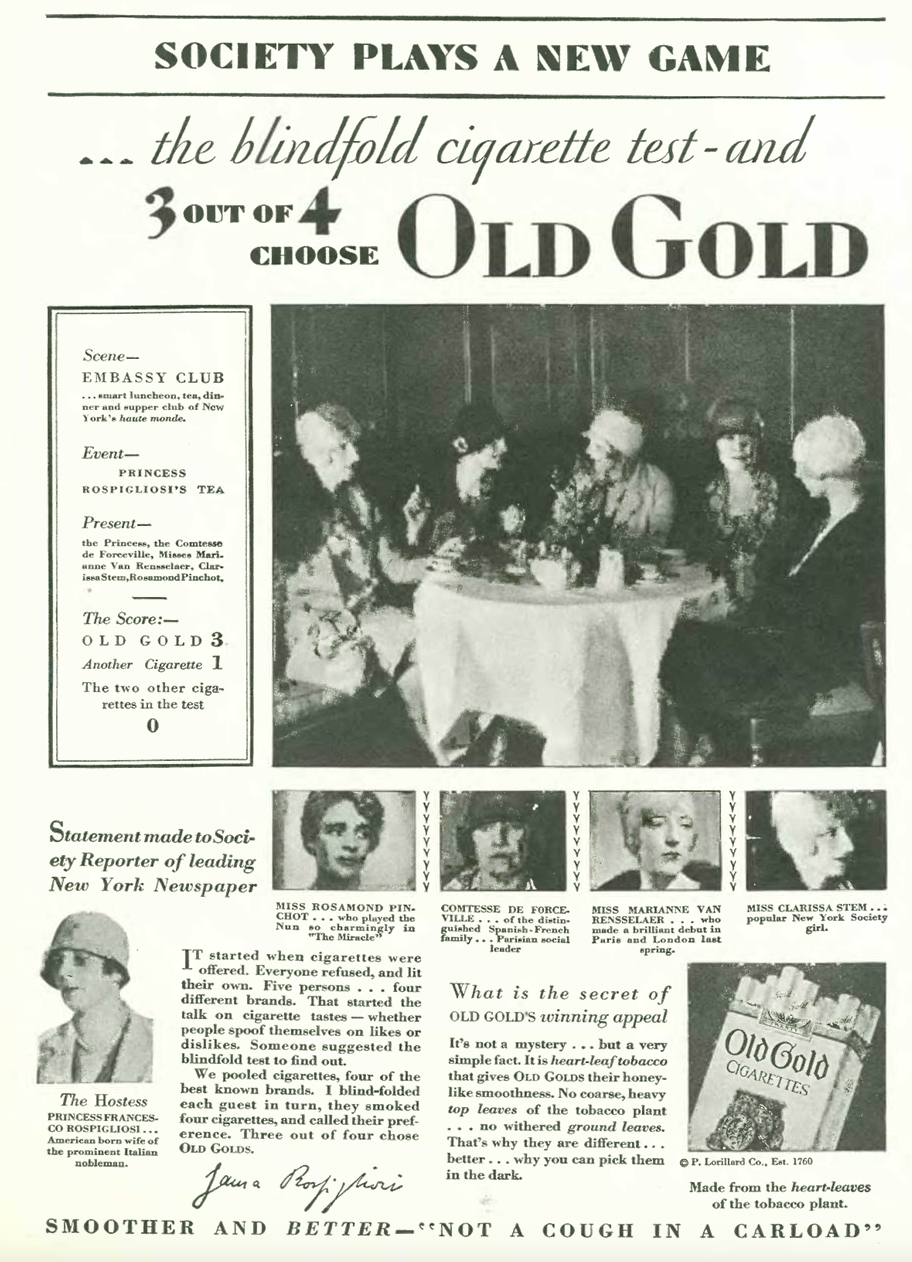
…other social strivers could look to the example of these society matrons who picked up some spare cash shilling for Old Gold cigarettes…
I close with a couple of cartoons from the July 21 issue by Barbara Shermund and Peter Arno:
As I’ve previously noted, reading back issues of periodicals often gives one a feeling of omniscience; as I thumb through week after week of late 1920s New Yorkers, I realize that for all their cleverness and worldly wisdom, even that magazine’s writers and editors could not see with any clarity into the future. But neither can any of us…one wonders what readers 89 years hence will surmise from today’s magazines, that is, if our civilization lasts that long.
January 28, 1928 cover by Theodore G. Haupt.
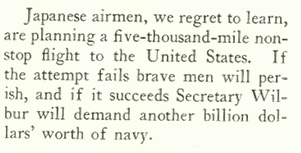
Howard Brubaker (in his column “Of All Things”) might have spotted something brewing on the horizon, even if it wouldn’t become perfectly clear until Dec. 7, 1941. Here is a clip from his Jan. 28, 1928 column in The New Yorker:
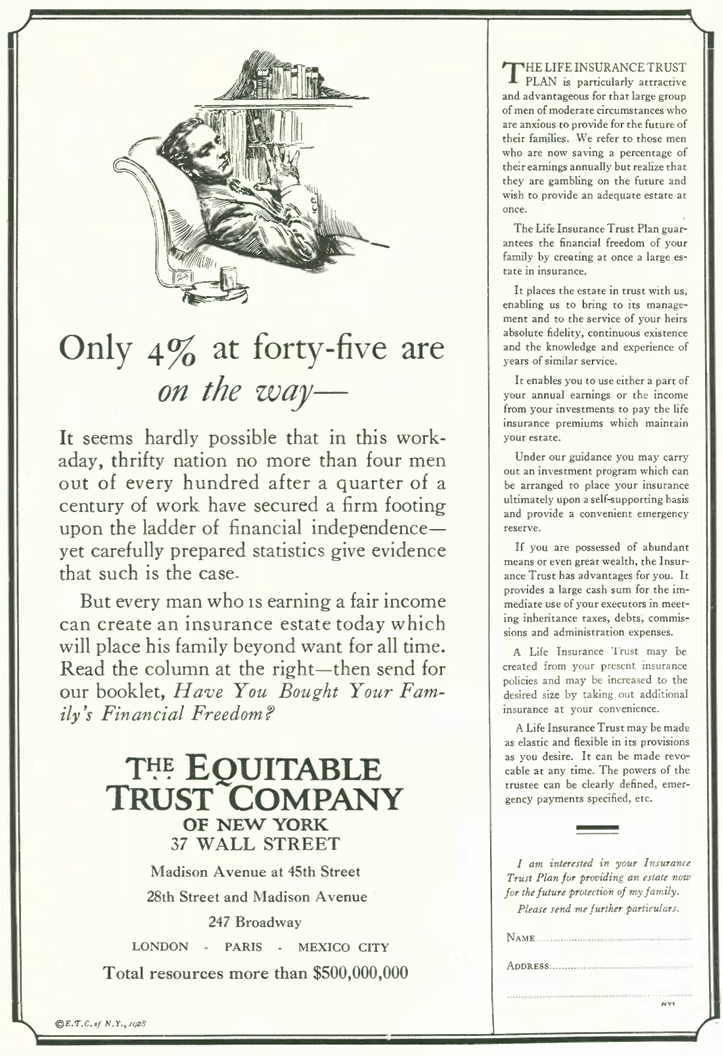
Two other major events in U.S. history, the Stock Market Crash of 1929 and the Great Depression that would follow, were less than two years away. But this was the Roaring Twenties, and some thought the fun would never end…except perhaps Equitable Trust, which placed this advertisement in the Jan. 28 issue:
Apparently the folks at Equitable Trust weren’t assured of their own financial freedom—after the Crash they would be acquired by Chase National Bank, making Chase the largest bank in the world at that time.
Despite the overheated economy of the 1920s, there still were plenty of poor and unemployed people in the city. One man, Urbain Ledoux (known as Mr. Zero in order to hide his identity), often arranged protests and demonstrations to bring attention to the poor and unemployed, and opened a number of bread lines and soup kitchens to feed the hungry, including the “Tub,” depicted in this two-page illustration by Constantin Alajalov along the bottom of the “Talk” section of the Jan. 28 issue (click image to enlarge).
* * *
Not All Gloom and Doom
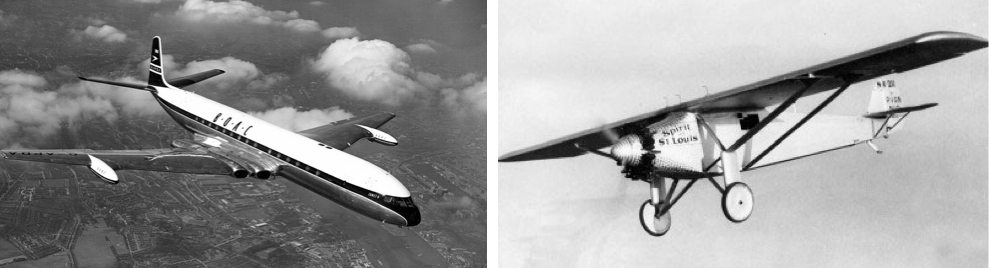
Hindsight also reveals the trajectory of the 20th century’s great accomplishments. Charles Lindbergh’s transatlantic flight in 1927, for example, fueled the imaginations of those who would usher in the jet age and space travel. Just 31 years after Lindbergh’s flight, the British Overseas Airways Corporation (BOAC) would begin operation of its first transatlantic passenger jet service. And only 42 years would separate Lindbergh’s flight from Neil Armstrong’s moonwalk.
JUST 31 YEARS would separate Lindbergh’s flight from the first transatlantic jet service. At left, the DeHavilland Comet 4 (1958), and at right, Lindbergh’s Spirit of St. Louis (1927). (warthunder.com/howstuffworks.com)
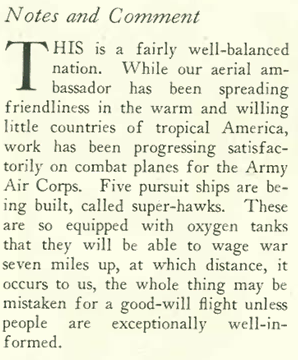
Like the rest of America, The New Yorker was an enthusiastic follower of developments in aviation after Lindbergh (the “aerial ambassador” referred to below). The January 28 “Talk of the Town” led with this item about pilots soaring to ever greater heights.
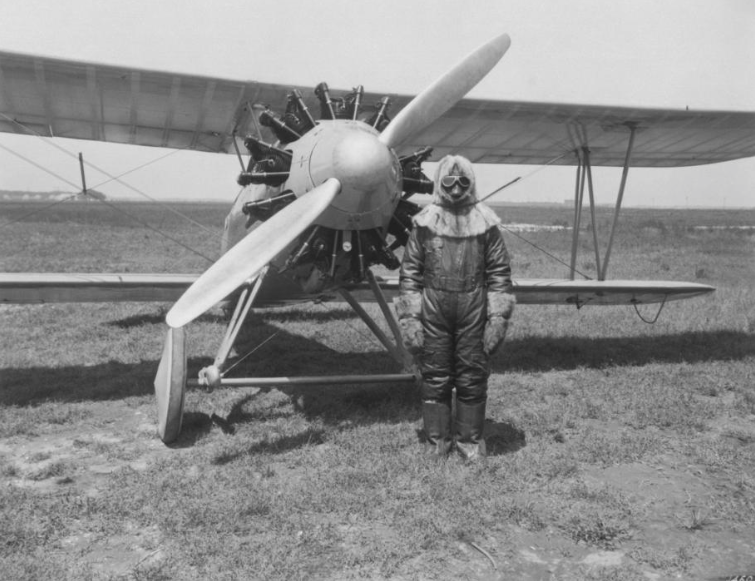
Consider that a mere 41 years separated this…
YETI, SET, GO!…A pilot in high altitude flying gear next to a Wright Apache biplane, January 1, 1928. In September 1926 the Apache set the world altitude record for seaplanes (38,500 ft) and in April 1930 it set the land-plane altitude record of 43,166 ft. (NASA)
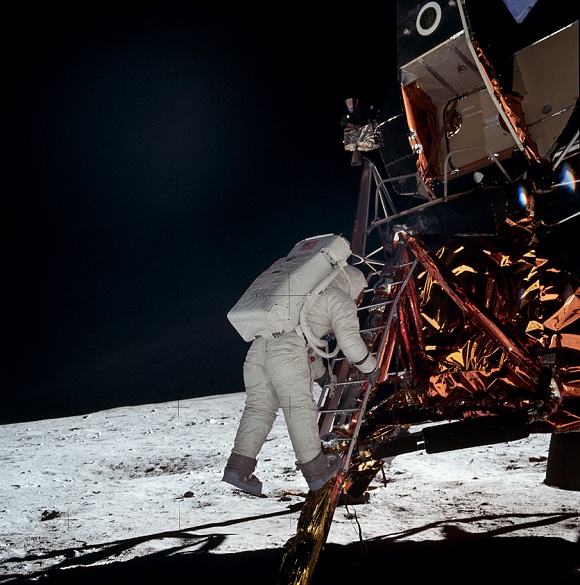
…from this…
LEAVE THE FUR COAT AT HOME…The second man on the moon, Buzz Aldrin, prepares to step onto the lunar surface, July 20, 1969. (Neil Armstrong/NASA)
* * *
While Back on Earth…
Big events in America always seem to involve the appearance of showgirls, whether it is the introduction of a new car or some techno gadget. As this “Talk” item indicates, much was the same 89 years ago…
* * *
Silent Giant
German film actor Emil Jannings was lauded for his performances on the screen in both Germany and America in films, and he was particularly adept at portraying of the pathos of middle-aged men. The New Yorker disliked most of Hollywood’s output (and usually praised the much-artier German films), so when Jannings landed on these shores he was lauded by the magazine, which dedicated a profile (written by Elsie McCormick) to him in the Jan. 28 issue, accompanied by a Hugo Gellert illustration. Some excerpts:
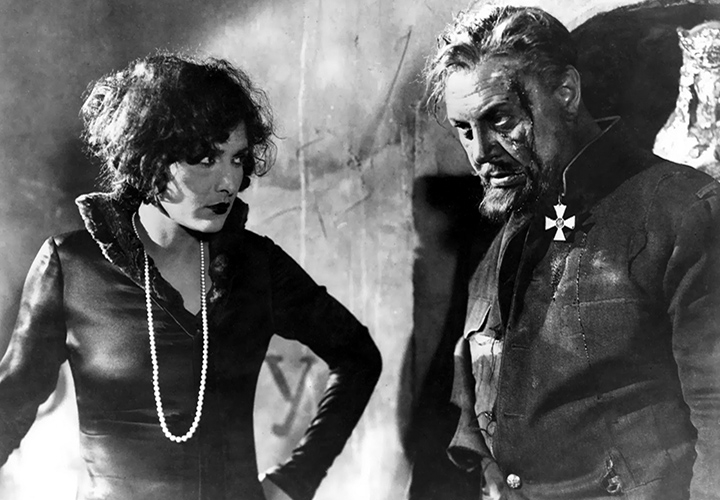
LIFE IS HARD…Evelyn Brent and Emil Jannings star in The Last Command. In the first Academy Awards, Jannings would win best actor for two films, The Last Command and The Way of All Flesh. (silentfilm.org)
At the first Academy Awards in 1929, Jannings would win a Best Actor Oscar for two of his 1928 films, The Last Command and The Way of All Flesh. An interesting side note from writer Susan Orlean: In her 2011 book, Rin Tin Tin: The Life and The Legend, Jannings was not actually the winner of the first best actor vote, but the runner-up. The famous dog actor Rin Tin Tin actually won the vote. The Academy, worried about not being taken seriously, gave the award to the human instead.
Janning’s thick German accent would bring his Hollywood career to an end with sound pictures. He would return to Germany, and during the Third Reich he would star in several films that promoted the Nazis. According to Wikipedia, the shooting of his last film, Wo ist Herr Belling? was aborted when Allied troops entered Germany in Spring 1945. Jannings reportedly carried his Oscar statuette with him as proof of his former association with Hollywood.
From the Advertising Department
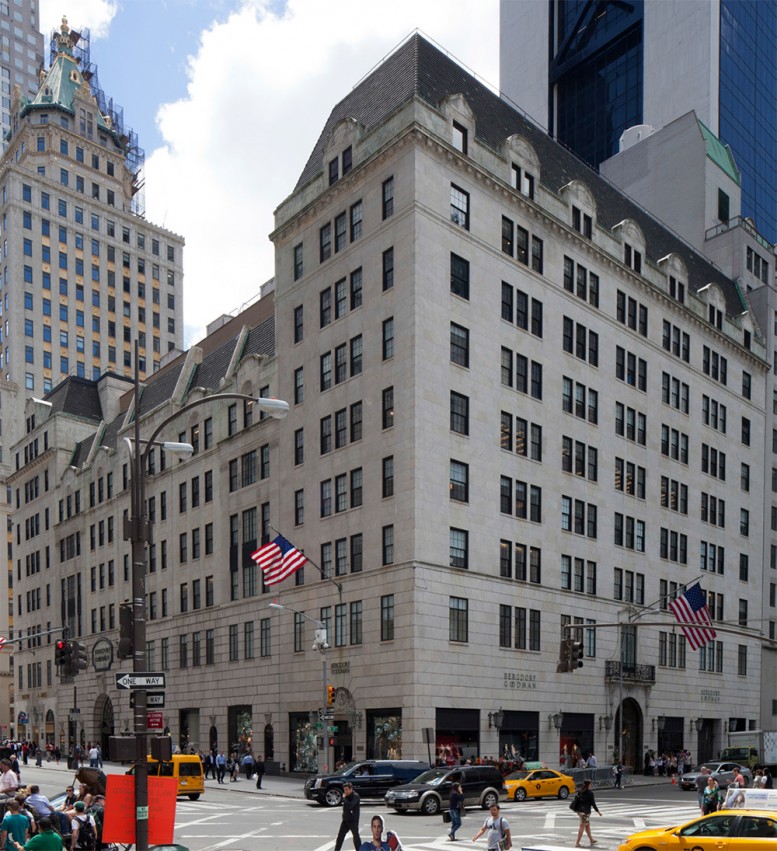
This advertisement from the Jan. 28 issue caught my eye because Bergdorf Goodman is one of the few stores in Manhattan still operating at its original site:
Bergdorf Goodman today. (Photo courtesy LPC)
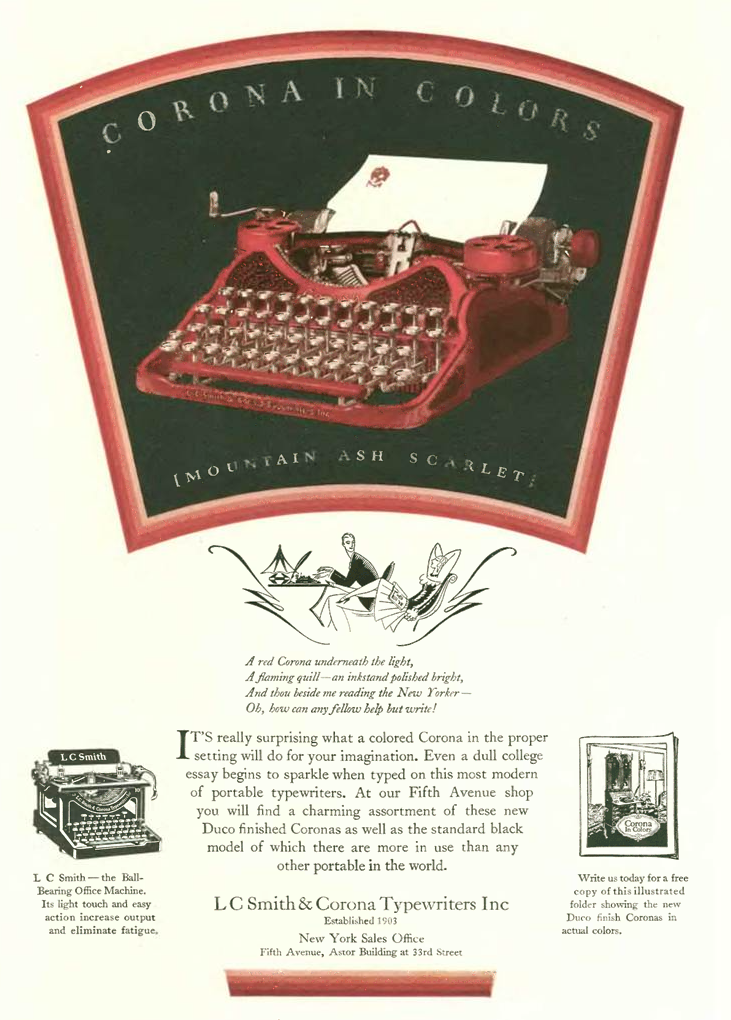
And here we have perhaps the iMac of its day, standing apart from the competition with its colorful, bold new look…
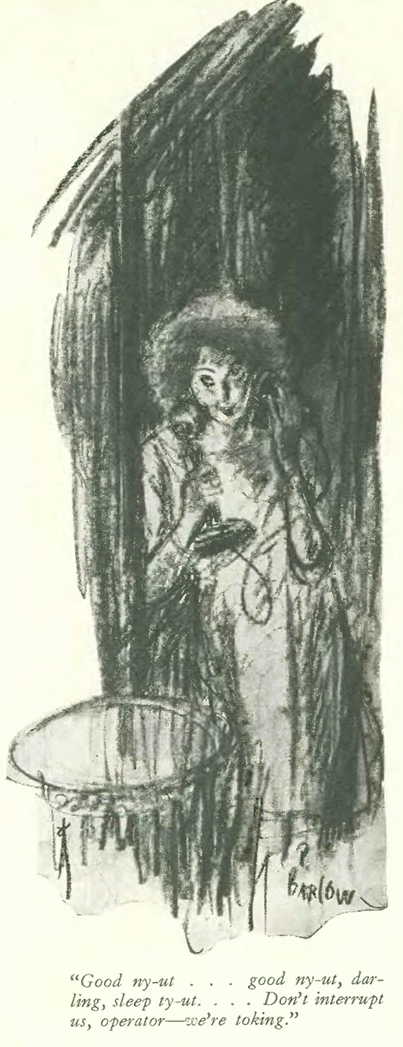
And finally, this early cartoon from longtime New Yorker cartoonist Perry Barlow having some fun at the expense of New York’s working class…
American inventor Thomas Edison was a hero to the young Henry Ford, who grew up to become something of a tinkerer himself with his pioneering development of the assembly line and mass production techniques. Over a matter of decades in the late 19th and early 20th century these two men would play outsized roles in transforming the American landscape and our way of life.
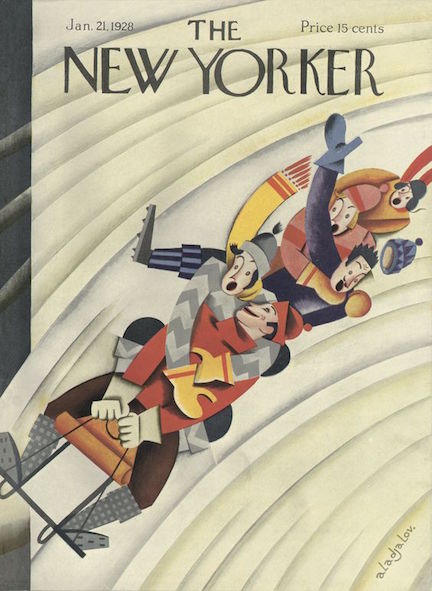
January 21, 1928 cover by Constantin Alajalov.
Ford would first meet Edison in August 1896, at a convention of the Association of Edison Illuminating Companies held at the Oriental Hotel in Brooklyn—it was just two months after the 33-year-old Ford had finished work on his first car—a “quadricycle”—consisting of a simple frame, an ethanol-powered engine and four bicycle wheels. In contrast, by 1896 the 49-year-old Edison was a worldwide celebrity, having already invented the phonograph (1877), the incandescent lamp (1879), public electricity (1883) and motion pictures (1888).
WHAT NEXT, A CAR STEREO?…Thomas Edison (left) with his second phonograph, photographed by Mathew Brady in Washington, D.C., April 1878. At right, Henry Ford sits in his first automobile, the Ford Quadricycle, in 1896. (Wikimedia Commons)
By 1907 the two had forged a close friendship that would endure the rest of their lives. So it was no surprise that these two giants of the machine age would show up together at the New York Auto Show at Madison Square Garden and take a gander at the latest technical marvels, including Ford’s new “Model A.” The New Yorker’s “Talk of the Town” was on hand as witness:
NEAT-O…Thomas Edison and Henry Ford at the 1928 New York Auto Show. (Associated Press)IT SOLD LIKE HOTCAKES…Henry Ford and son Edsel introducing the 1928 Ford Model A at the Ford Industrial Exposition in New York City, January 1928. (thehenryford.org)
* * *
E.B. Drives the ‘A’
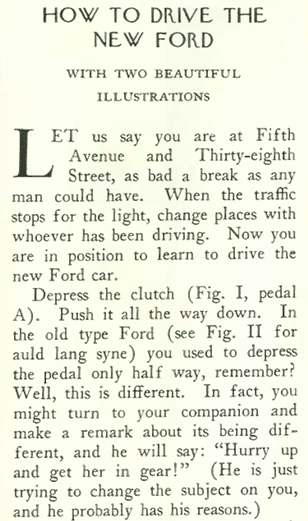
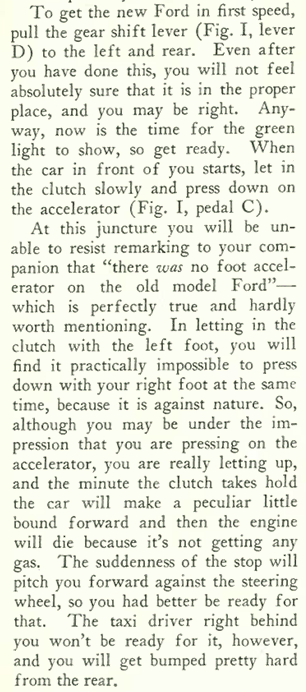
In the same issue (Jan. 21, 1928) E.B. White told readers how to drive the new Model A—in his roundabout way. Some excerpts:
No doubt White was feeling a bit wistful with the arrival of the Model A, which supplanted its predecessor, the ubiquitous Model T. White even penned a farewell to the old automobile under a pseudonym that conflated White’s name with Richard Lee Strout’s, whose original submission to The New Yorker inspired White’s book (illustrated by New Yorker cartoonist Daniel ‘Alain’ Brustlein).
FAREWELL TIN LIZZIE…E.B. and Katharine White driving his beloved Model T.
In Farewell to Model T White recalled his days after graduating from college, when in 1922 he set off across America with his typewriter and his Model T. White wrote that “(his) own vision of the land—my own discovery of it—was shaped, more than by any other instrument, by a Model T Ford…a slow-motion roadster of miraculous design—strong, tremulous, and tireless, from sea to shining sea.”
The Eternal Debate
In his “Reporter at Large” column, Morris Markey commented on the execution of former lovers and convicted murderers Ruth Snyder and Judd Gray, noting that once again the debate over the death penalty had been stirred, but as usual there was no resolution in sight. Little could Markey know that we would still be holding the debate 89 years later, with no resolution in sight.
END OF THE LINE…Mugshots of Ruth Snyder and Henry Judd Gray taken at Sing Sing Prison following their conviction for the murder of Snyder’s husband. They were executed Jan. 12, 1928. (Lloyd Sealy Library, CUNY)
* * *
Ahoy there
The New York Boat Show was back in town at the Grand Central Palace, enticing both the rich and the not-so-rich to answer the call of the sea. Correspondent Nicholas Trott observed:
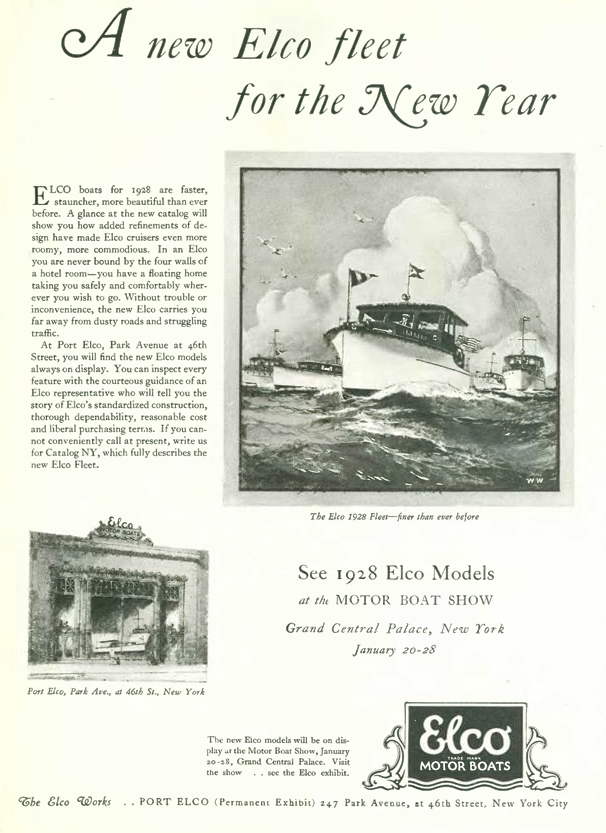
An advertisement in the same issue touted Elco’s “floating home”…
But if you aspired to something larger than a modest cruiser, the Boat Show also featured an 85-foot yacht…
But for the rest of the grasping orders, Chris-Craft offered the Cadet, an affordable 22′ runabout sold on an installment plan. Another ad from the issue asking those of modest means to answer “the call of freedom!”
For an affordable boat, the Chris-Craft was really quite beautiful—its mahogany construction puts today’s fiberglass tubs to shame…
PRETTY SWEET…A 1928 Chris-Craft Cadet. (Click to enlarge)
* * *
Odds & Ends
The boat show was one indication that spring was already in the air. The various ads for clothing in the Jan. 21 issue had also thrown off the woolens, such as this one from Dobbs on Fifth Avenue, which featured a woman with all the lines of a skyscraper.
And to achieve those lines, another advertisement advised young women to visit Marjorie Dork…
…who seemed to do quite well for herself in the early days of fitness training…
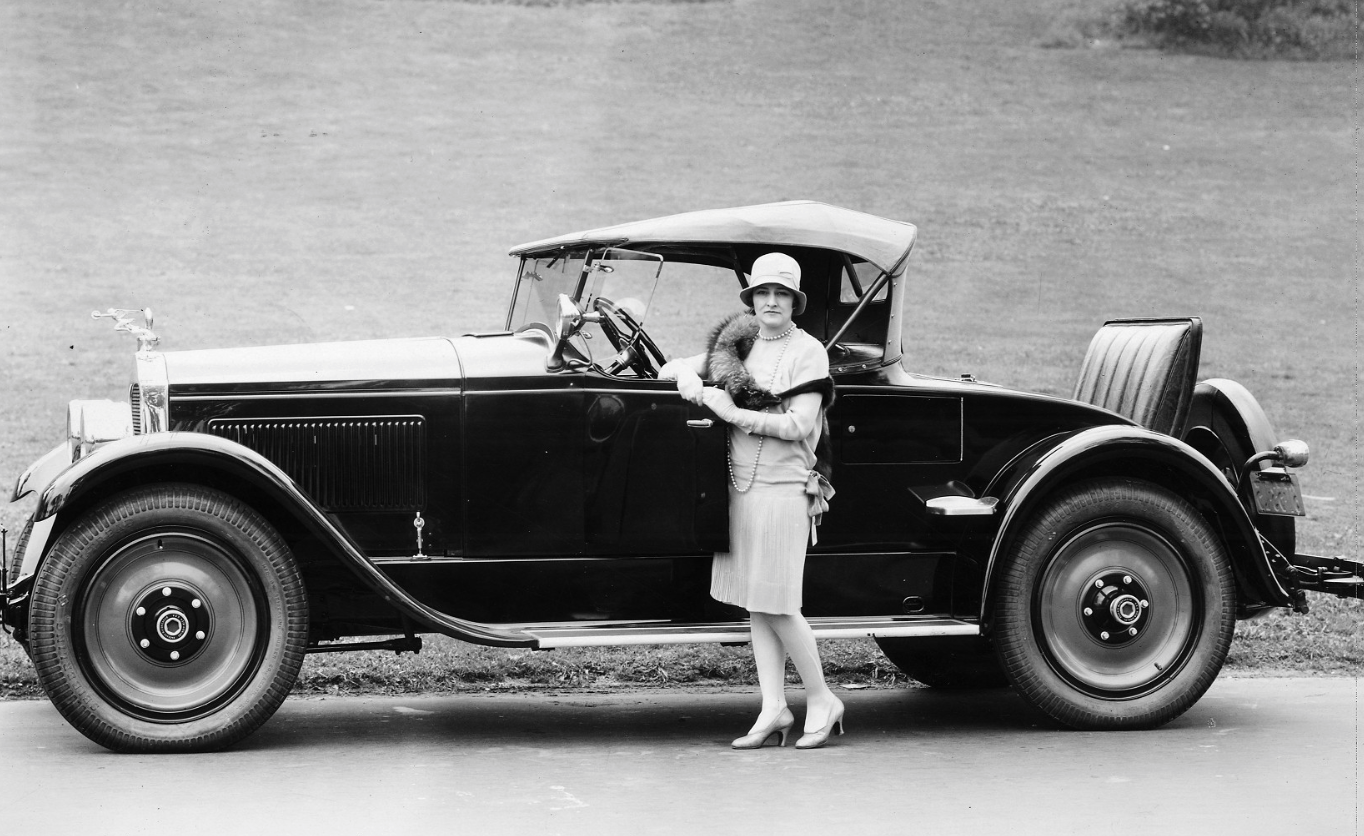
THOROUGHLY MODERN MARJORIE…New York beauty specialist Marjorie Dork, with her Packard, in New York’s Central Park, 1927. Original photo by John Adams Davis, New York. (Detroit Public Library)
And then there was a back page ad that said to hell with healthy living…
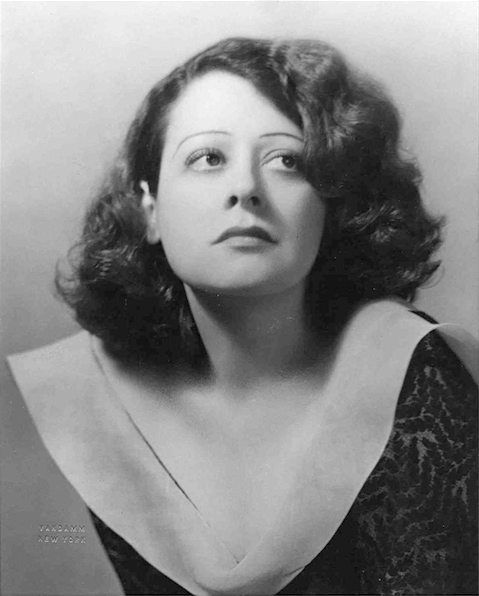
The actress featured in the advertisement, Lenore Ulric, was considered one of the American theater’s top stars. Born in 1892 as Lenore Ulrich in New Ulm, Minnesota, she got her start on stage when she was still a teen, a protégé of the famed David Belasco. Though she primarily became a stage actress, she also made the occasional film appearance, portraying fiery, hot-blooded women of the femme fatale variety.
Portrait of Lenore Ulric by New York’s Vandamm Studio. (broadway.cas.sc.edu)
* * *
And we close with this post with a peek into the into upper class social scene, courtesy of Barbara Shermund…
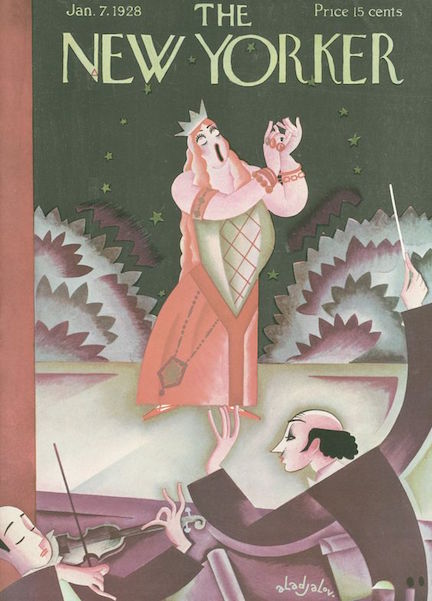
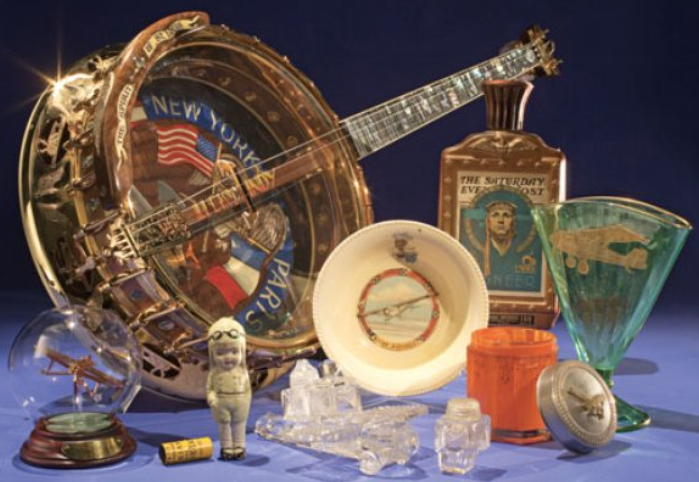
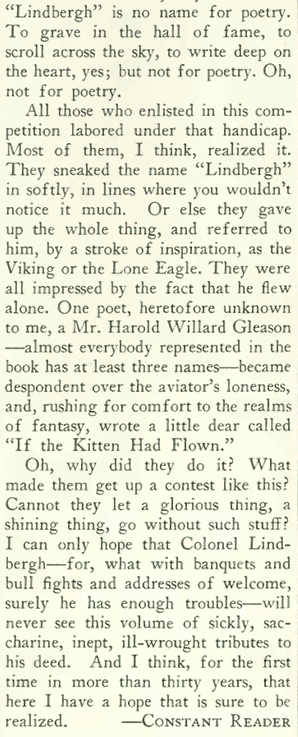
After his famous transatlantic flight, not only did Charles Lindbergh have to endure endless banquets and the sweaty crush of adoring crowds, but he also inspired a lot of kitsch, including some spectacularly bad poetry that Dorothy Parker could’t help but eviscerate in the Jan. 7, 1928 issue.
January 7, 1928 cover by Constantin Alajalov.
Before we tackle the poetry, here is a sampling of various Lindbergh memorabilia:
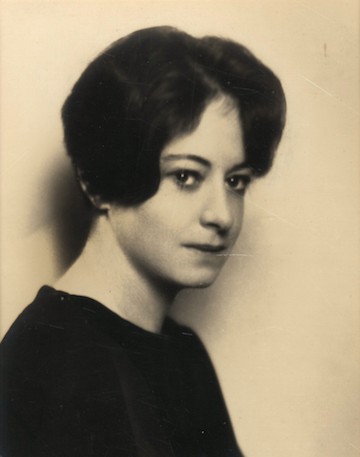
THEY’RE SELLING YOU…Assortment of Lindbergh souvenirs on display at the Smithsonian’s Air & Space Museum. (Eric Long/Smithsonian)SHARPENED TONGUE…Dorothy Parker in 1928. (literaryladiesguide.com)
Parker led off her “Reading & Writing” column with this observation about the collapse of grammar and civilization in general…
…and offered two examples—chocolate-covered olives and a new book of poems dedicated to Charles Lindbergh’s heroic solo crossing of the Atlantic…
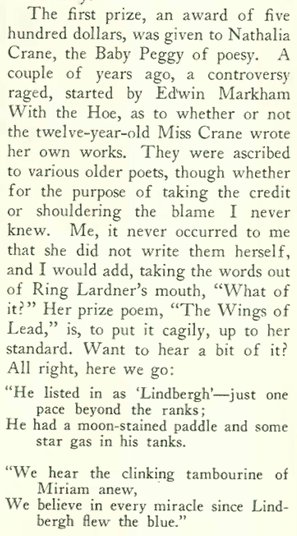
Parker’s comment about guiding a razor across her throat is a bit unnerving, considering she was chronically depressed and occasionally suicidal throughout her life. But then again, Parker didn’t like ugly things, including bad poetry, and especially bad poetry written by a twelve-year-old “prodigy,” in this case a one Nathalia Crane, who claimed the top prize in the Lindbergh collection. Parker observed:
Little Nathalia Crane (1913–1998) gained fame after the publication of her first book of poetry, The Janitor’s Boy, which she wrote at age ten. After her second book of poetry was published in 1925, American poet Edwin Markham suggested the poems were part of a hoax because they exhibited a maturity of thought beyond the reach of a mere child. (A sidebar: Parker referred to Nathalia as a “Baby Peggy of poesy.” Baby Peggy, whose real name was Diana Serra Cary, was a beloved child silent film star. Still alive at this writing, she is 99 years old–the last living film star of the silent era). Update: Diana Serra Cary, considered the last surviving person with a substantial career in silent films, died February 24, 2020, at age 101.
BAD POET’S SOCIETY?…Nathalia Crane in 1925. She would publish ten volumes of poetry and three novels, and would go on to a long career as a professor of English at San Diego State University. (Wikipedia)
Parker observed that “Lindbergh” was not a name well suited to poetry, and concluded with the hope that the aviator would be spared from having to read the “sickly, saccharine, inept, ill-wrought tributes”…
Tilt Your Vote to Al
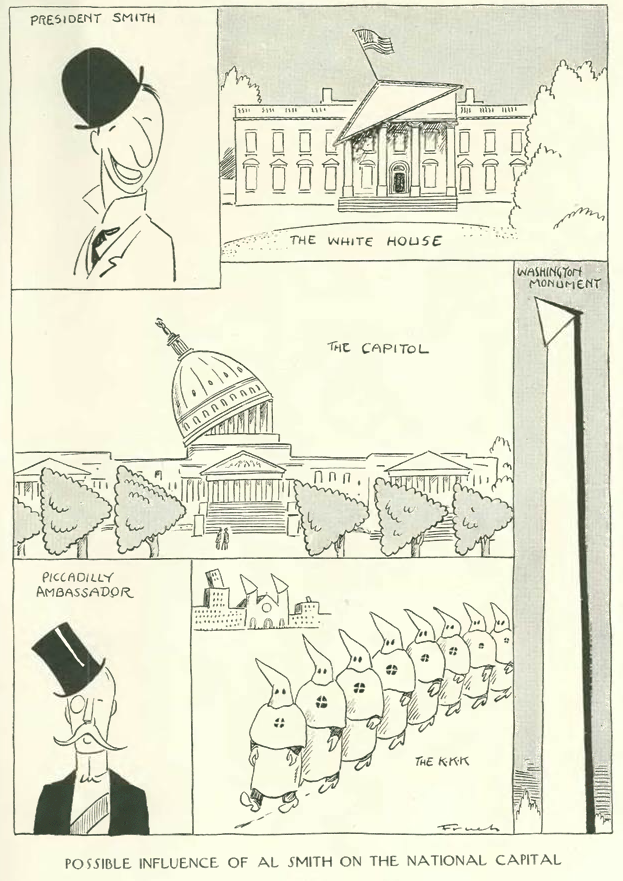
When New York Governor Al Smith announced his candidacy for U.S. President, New Yorker cartoonist Al Frueh had some fun with the governor’s habit of wearing his ever-present bowler hat at a tilt:
They Dropped Like Flies
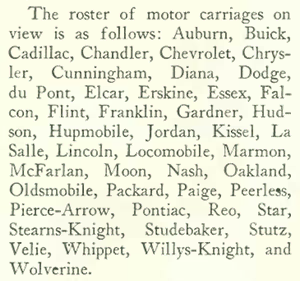
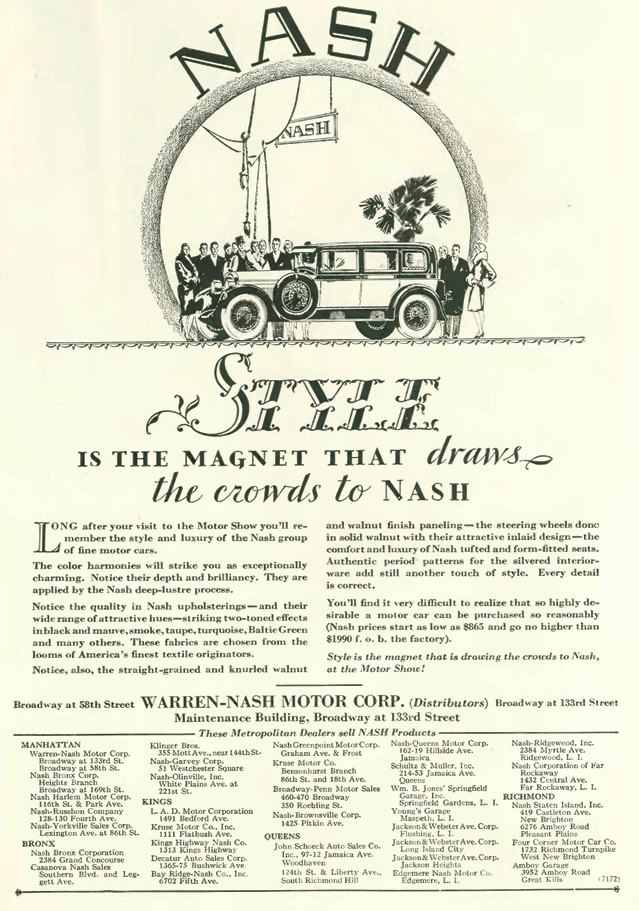
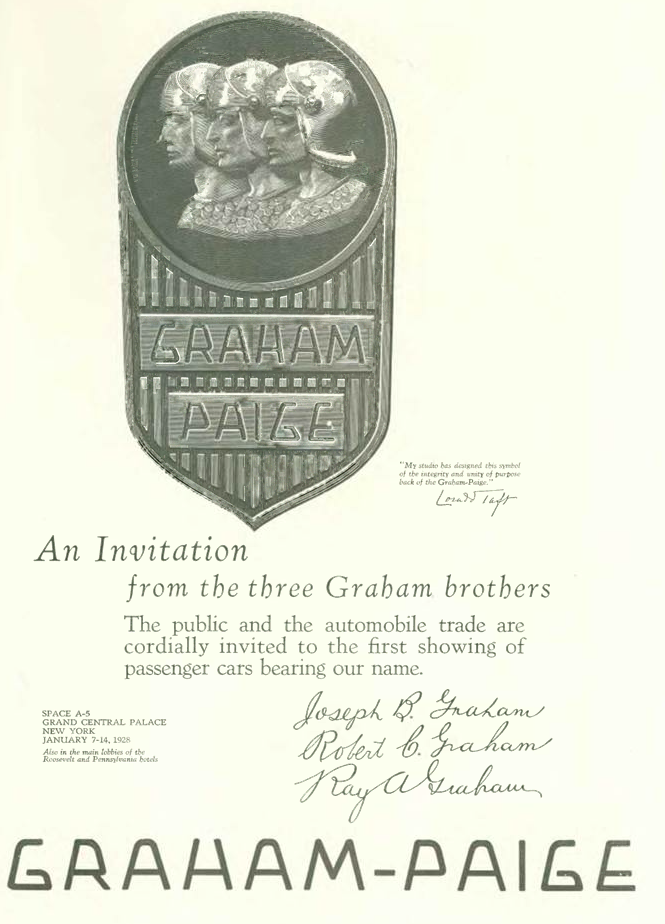
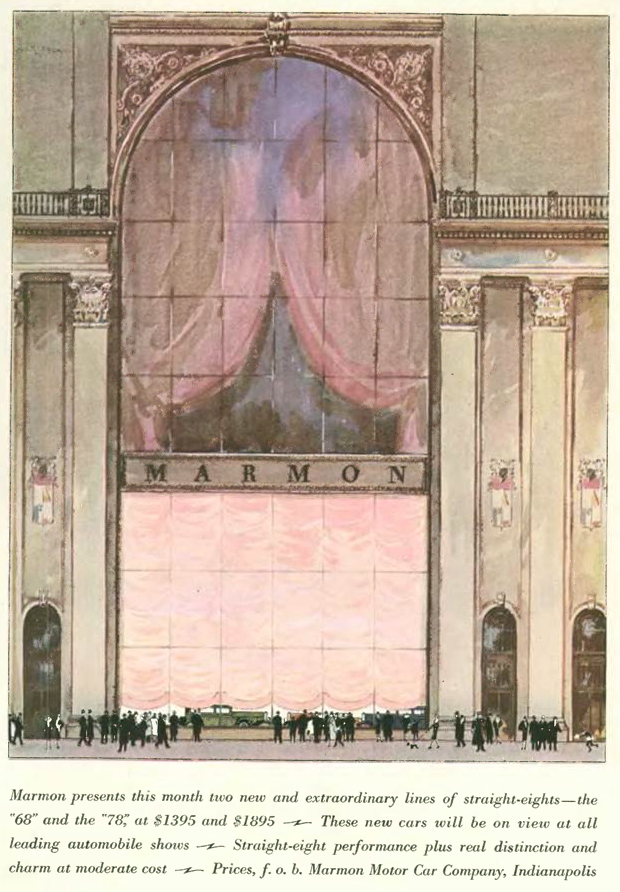
Nicholas Trott visited the 1928 New York Automobile Salon and rattled off this list of 43 car companies that would be displaying their shiny wares:
Of those 43 companies, only six are in operation today. Interestingly, the car ads that appeared in the Jan. 7 issue were mostly from companies that are long gone. Here is a sampling:
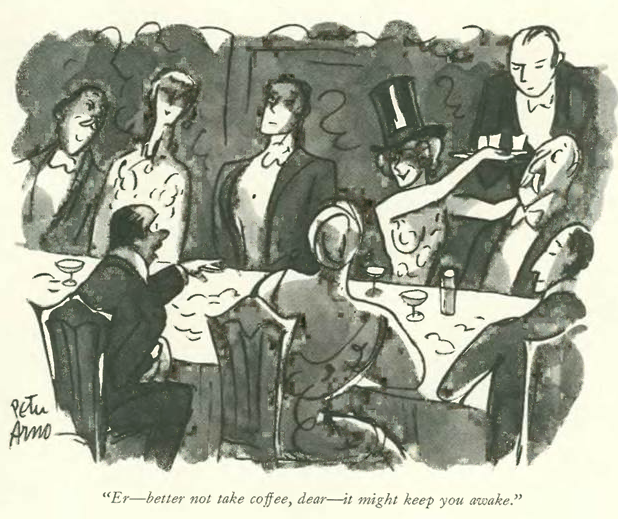
And finally, we close with Peter Arno and some dinner party hijinks…
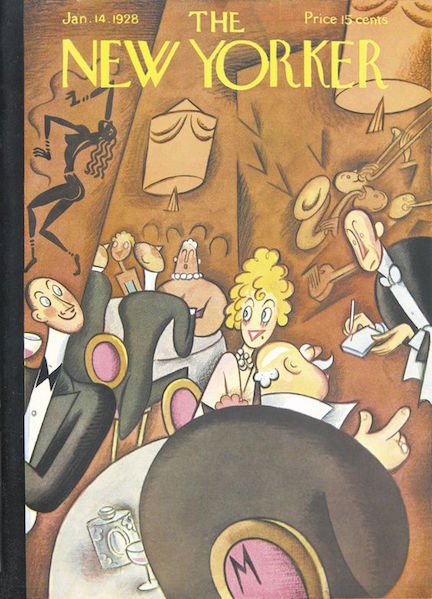
My last entry featured cartoonist Bud Fisher, inventor of the comic “strip” (Mutt & Jeff) and the subject of The New Yorker’s Nov. 26, 1927 “Profile.” It was something of a surprise, then, to open the next issue, Dec. 3, and find literary critic Dorothy Parker offering her observations on the funny papers, including Sidney Smith’s comic strip, The Gumps.
December 3, 1927 cover by Constantin Alajalov.
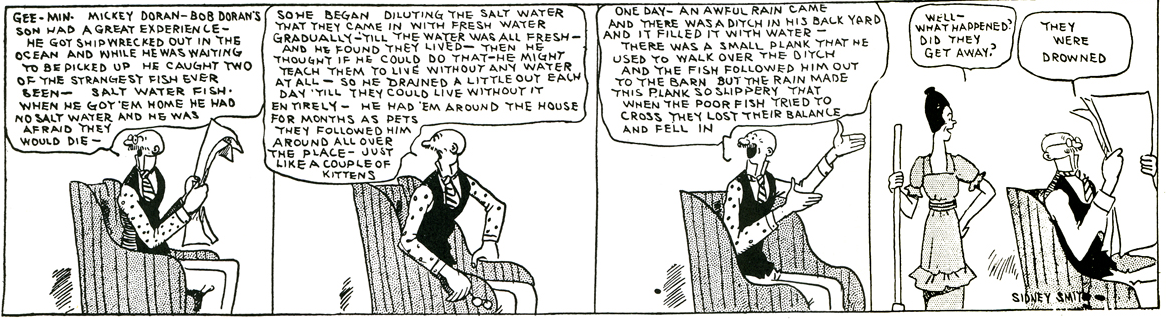
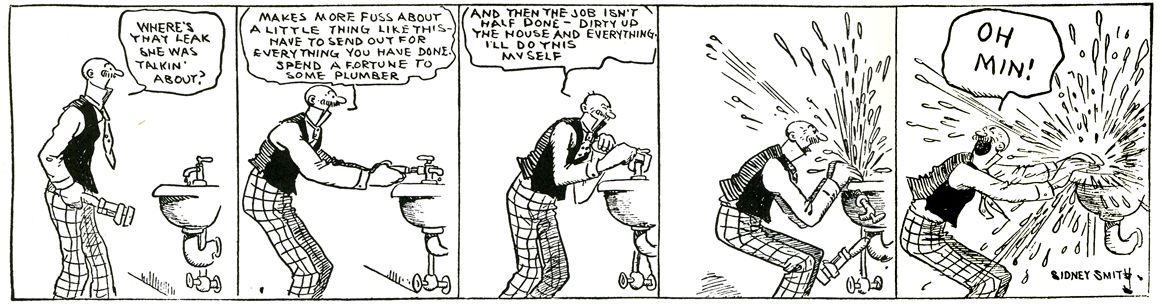
Before we get to Dorothy Parker, let’s have a look at The Gumps, created by Sidney Smith in 1917. Although that strip had plenty of slapstick, it was wordier than Mutt & Jeff and somewhat more realistic (Smith was the first cartoonist to kill off a regular character, in 1929–it caused a national outcry). An example of the strip from around 1920:
(michaelspornanimation.com) Click image to enlarge
Like Bud Fisher, Smith would become wealthy from the merchandising of Gump toys, games, songs, food products, etc…
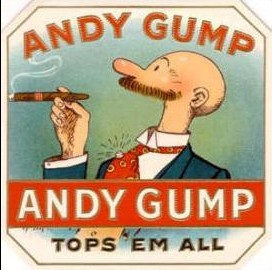
The image of Andy Gump even graced cigar boxes. (kenlevine.blog)
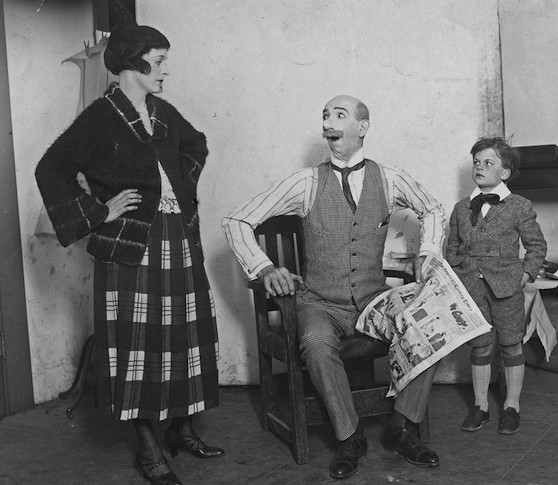
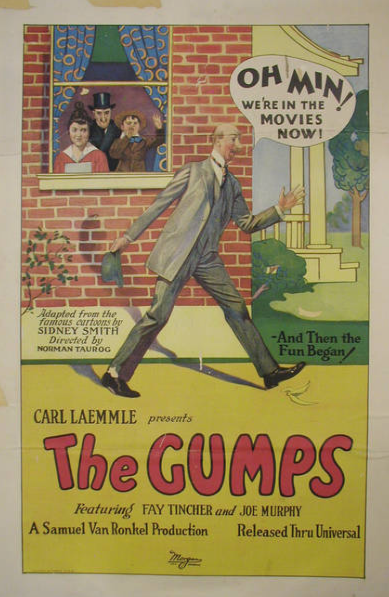
The Gumps were also featured in nearly 50 animated shorts, and between 1923 and 1928 Universal produced dozens of two-reel comedies starring Joe Murphy (one of the original Keystone Cops) as Andy Gump, Fay Tincher as Min and Jack Morgan as Chester (two-reelers were usually comedies, about 20 minutes in length). The director of these short films, Norman Taurog, would go on to become the youngest director to win an Academy Award (Skippy 1931). He would also direct such films as Boy’s Town (1938) and nine Elvis Presley movies from 1960 to 1968.
His comic strip barely five years old, in 1922 Smith famously signed a 10-year, one million-dollar contract. In 1935 he would sign an even more lucrative contract, but on his way home from the signing he would die in a car accident.
OH MIN!…A publicity still from Universal’s two-reel comedy series featuring The Gumps. From left, Fay Tincher (Min), Joe Murphy (Andy Gump) and Jackie Morgan (Chester). The actress Fay Tincher is a bit of a mystery…an enterprising young comedienne who started her own production company in 1918, she dropped from public view by 1930, and little is known of her life since that time, even though she lived to see the year 1983, and died at age 99. (younghollywoodhof.com)Theatre poster announced the coming of what would be dozens of two-reelers produced by Universal between 1923 and 1928 featuring The Gumps.(imdb.com)
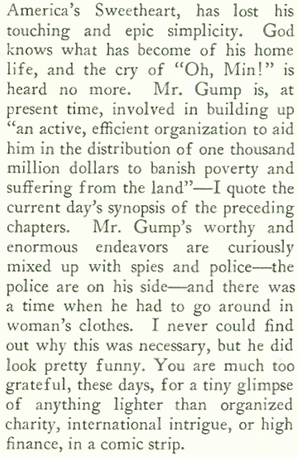
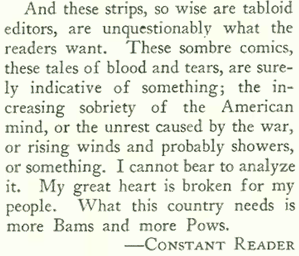
In her column, “Reading and Writing,” Dorothy Parker (writing under the pen name “Constant Reader”) lamented the fact that the comic strips were abandoning simple, light horseplay in favor of “melodramas.” Apparently even Andy Gump wasn’t exempt:
GUMPS IN THE DUMPS…in late 1927 Dorothy Parker longed for the antics of the old, dimwitted Andy Gump and his much-brainier wife, Minerva. Above, the first strip from 1917 that introduced The Gumps. Below, a circa 1920 strip featuring a typical Andy Gump mishap and his trademark “Oh Min!” (newspapers.com) Click images to enlarge.
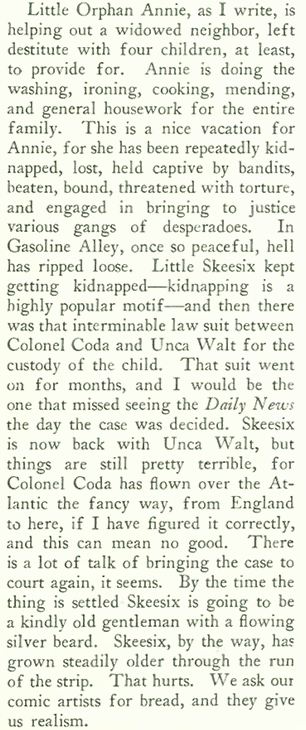
Parker also bemoaned the likes of Little Orphan Annie and the gang from Gasoline Alley, where everyday hijinks were replaced by melodrama:
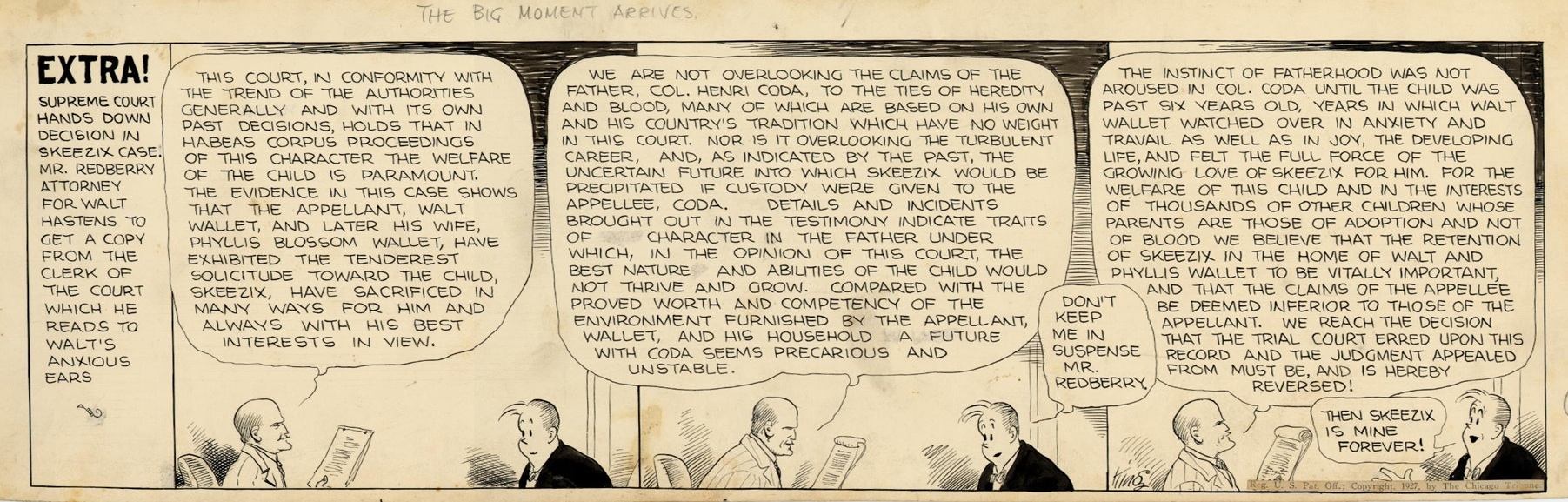
I LOVE YA, TOMORROW…but I’m gonna kick your ass today! Annie gets rough in this 1927 strip. Hugely popular, the strip (begun in 1924) inspired a ton of merchandise, films, a radio show and the musical Annie. The strip Little Orphan Annie made creator Harold Gray a very rich man. (ha.comics.com) Click image to enlarge.SORRY, NO PIE IN THE FACE HERE…In this series of turgid word balloons, Walt gets full custody of the orphan Skeezix in this Gasoline Alley strip from 1927, ending what Dorothy Parker called “an interminable law suit.” First published November 24, 1918 by Frank King (who drew the strip until 1959), Gasoline Alley is still going and is the second-longest-running comic strip in the U.S. As Parker noted in her column, the characters in Gasoline Alley were allowed to age naturally. Skeezix is currently 97 years old. (hoodedutilitarian.com) Click image to enlarge.
Parker suffered throughout her life from depression, and no doubt turned to the funnies for respite. However, she wrote that she hadn’t “seen a Pow or a Bam in an egg’s age,” and sadly concluded that melodrama was what the readers wanted.
When Minerva Was a Car
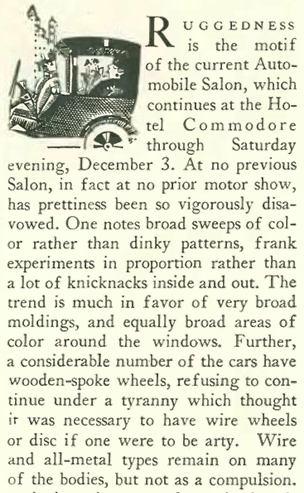
The New Yorker’s Nicholas Trott visited the Automobile Salon at the Hotel Commodore and noted that the latest trend favored an automobile’s “ruggedness” over its “prettiness.” Given the condition of roads in the 1920s, that probably wasn’t a bad thing…
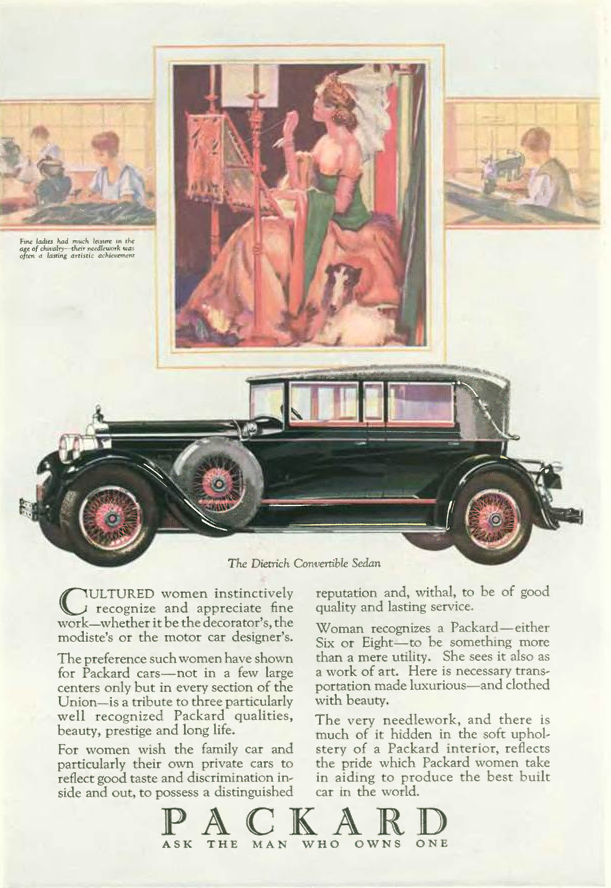
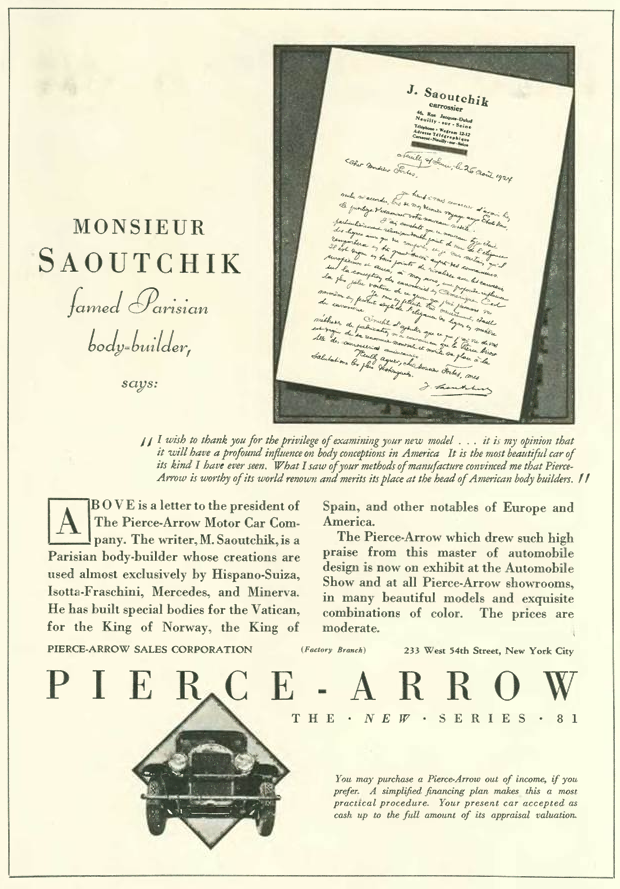
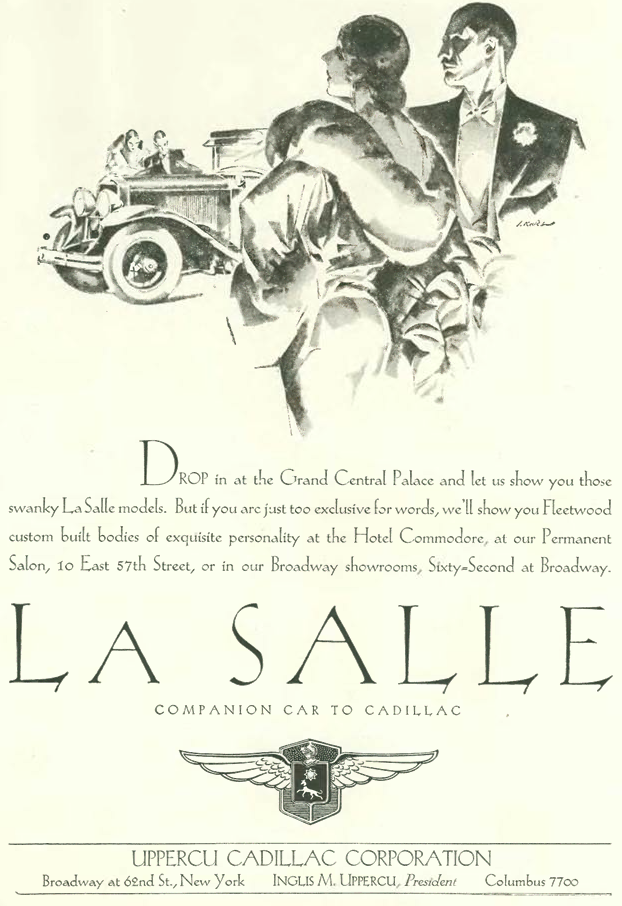
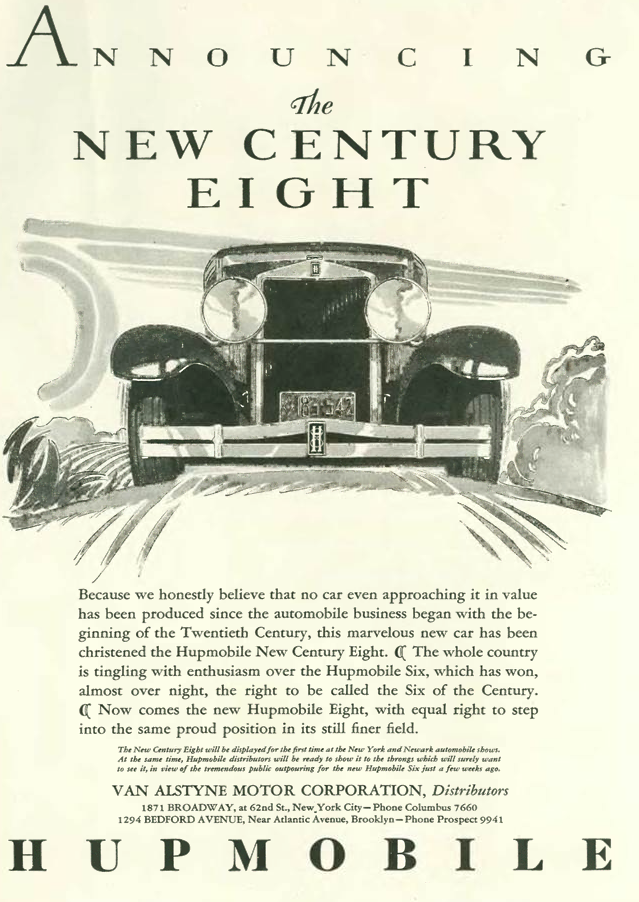
In the early days of the auto industry there were thousands of different manufacturers that eventually went broke or merged with other companies. Trott’s article mentioned new offerings from Chrysler, Mercedes, and Cadillac as well as from such makes as Erskine, Sterns-Knight, Minerva, Holbrook Franklin, Stutz, and Brewster.
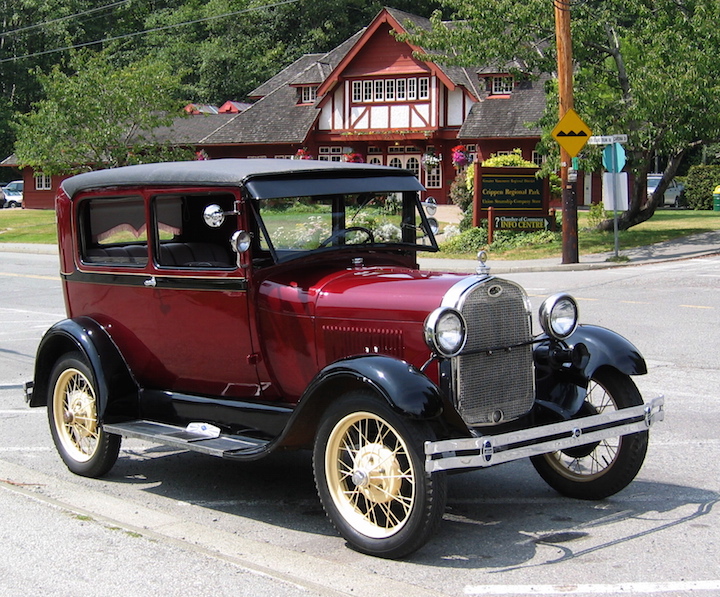
In “The Talk of the Town,” however, the editors wrote about another car with a far less colorful name: The Ford Model A. After 18 years of the ubiquitous black Model T, Ford buyers were ready for something different…
GOOD ENOUGH…The 1928 Ford Model A Tudor Sedan (Wikipedia)
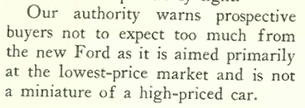
New Yorker editors cautioned, however, that buyers of the Model A should “not expect too much” from a car aimed at more modest pocketbooks. In a little more than a year Ford would sell one million of the things, and by the summer of 1929, more than two million.
When Model A production ended in early 1932, nearly five million of the cars had been produced.
German Atrocities?
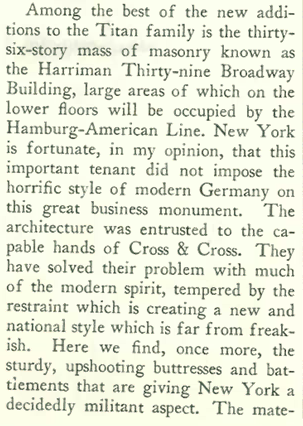
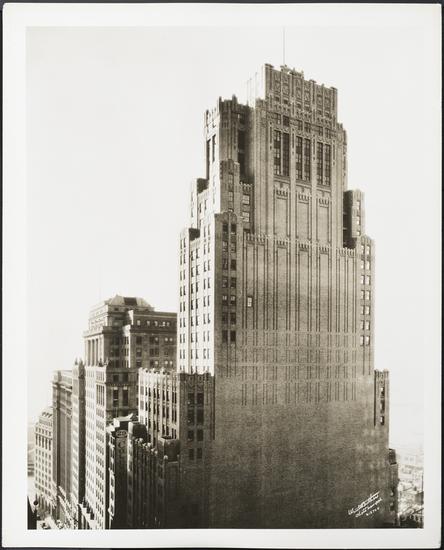
It’s seemed a bit of an “about face” for New Yorker architecture critic George S. Chappell to write of the “horrific style of modern Germany” after previously writing admiringly of the Bauhaus movement and “International Style” promulgated by Le Corbusier. Chappell’s column “The Sky Line” included this subhead, “German Atrocities Neatly Escaped.” In a few years “German Atrocities” would refer to something very different…
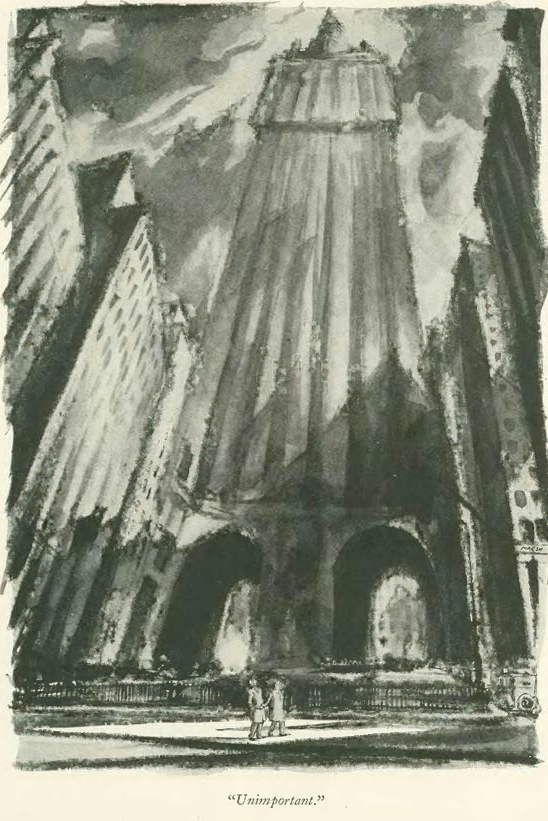
TEN-HUT!…The New Yorker’sGeorge Chappell liked the Harriman Building at 39 Broadway despite its “militant aspect.” Designed by Cross & Cross, it opened in 1928. (Museum of the City of New York)
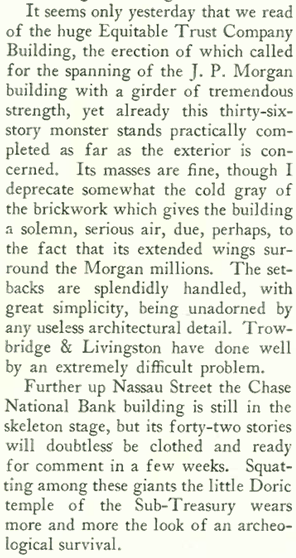
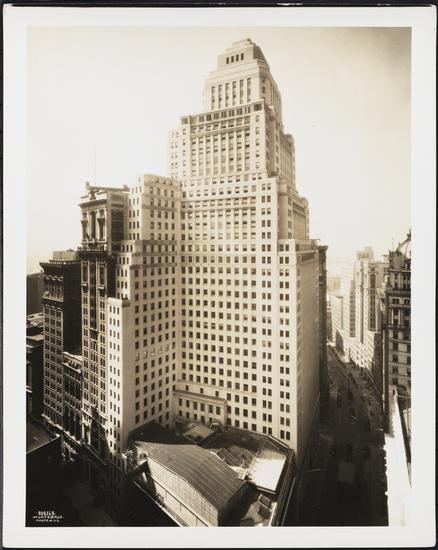
Another monstrous building of note in Chappell’s column was the “huge” Equitable Trust Building at 15 Broad Street…
Equitable Trust Building at 15 Broad Street. Designed by Trowbridge & Livingston, completed in 1928. (Museum of the City of New York)
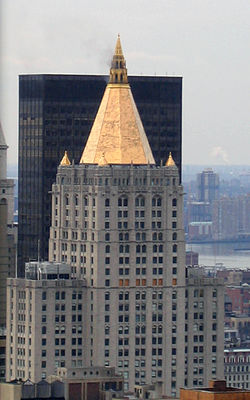
To save the best for last, Chappell also wrote of Cass Gilbert’s landmark New York Life Building, rising on the site of the old Madison Square Garden…
The distinctive pyramidal gilded roof of the New York Life Insurance Building, (Wikipedia)
* * *
She Nearly Made It
Morris Markey wrote about the exploits of pilot and actress Ruth Elder (1902–1977) in his “Reporter at Large” column. Known as the “Miss America of Aviation,” on Oct. 11, 1927, Elder and her co-pilot, George Haldeman, took off from New York in her attempt to become the first woman to make a transatlantic crossing to Paris. Mechanical problems in their airplane (a Stinson Detroiter dubbed American Girl) caused them to ditch into the ocean 350 miles northeast of the Azores. Fortunately they were rescued by a Dutch oil tanker in the vicinity.
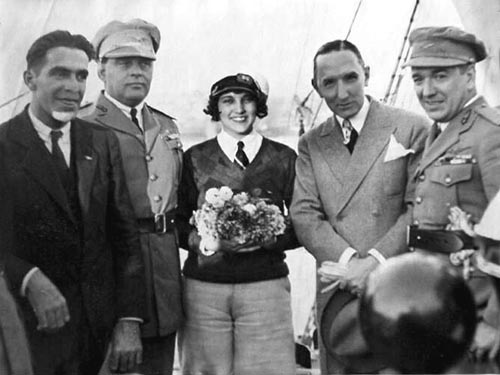
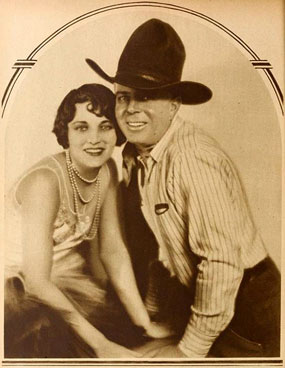
NO WORSE FOR WEAR…Ruth Elder, center, and George Haldeman, far left, on board their rescue ship, the Barendrecht, Oct. 25, 1927. (ctie.monash.edu)WHAT A HOOT…Ruth Elder and Hoot Gibson in a promotional pose for the 1929 film Winged Horseman (usc.edu).
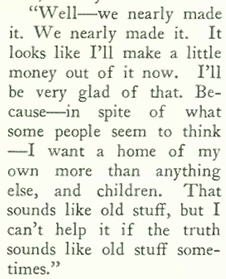
Although they were unable to duplicate Charles Lindbergh’s feat, Elder and Haldeman nevertheless established a new over-water endurance flight record of 2,623 miles–the longest flight ever made by a woman. They were honored with a ticker-tape parade upon their return to New York. Despite her derring-do, Elder suggested that she longed for a simpler, more domestic life…
Whether or not she found the simple life it is hard to say. She married six times, perhaps looking for the right “old stuff” and not quite finding it.
* * *
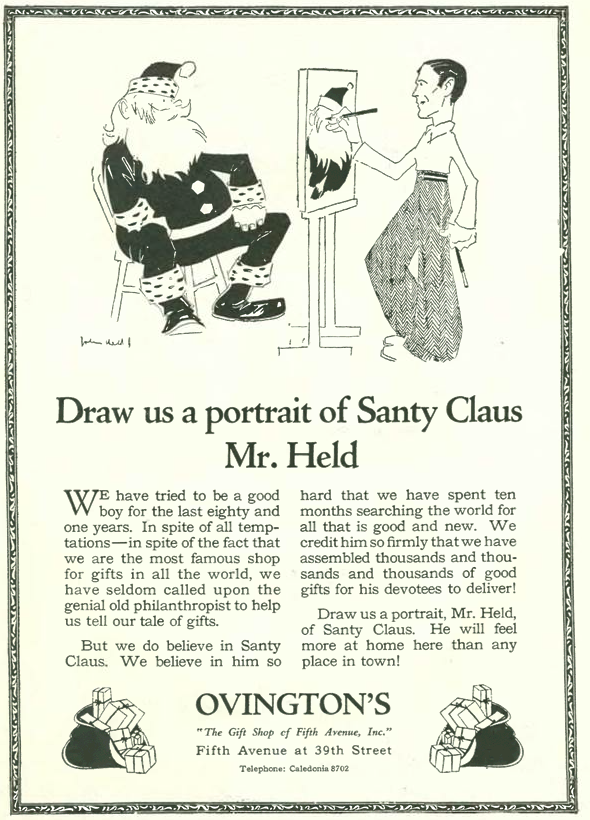
And finally, this ad from the Dec. 3 issue featuring the art of New Yorker contributor John Held Jr…
…and this cartoon by Otto Soglow, depicting how one toff bags his “trophy”…
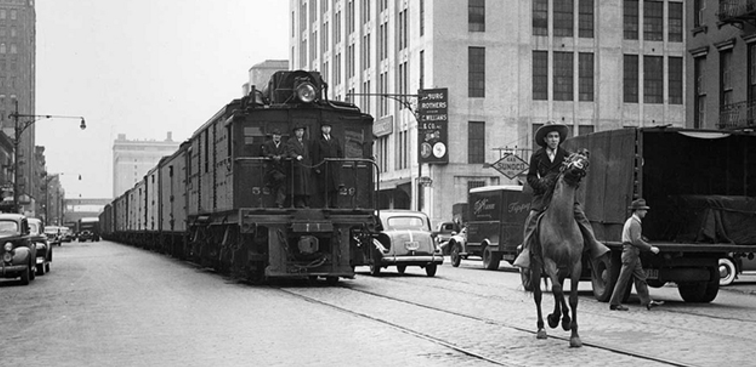
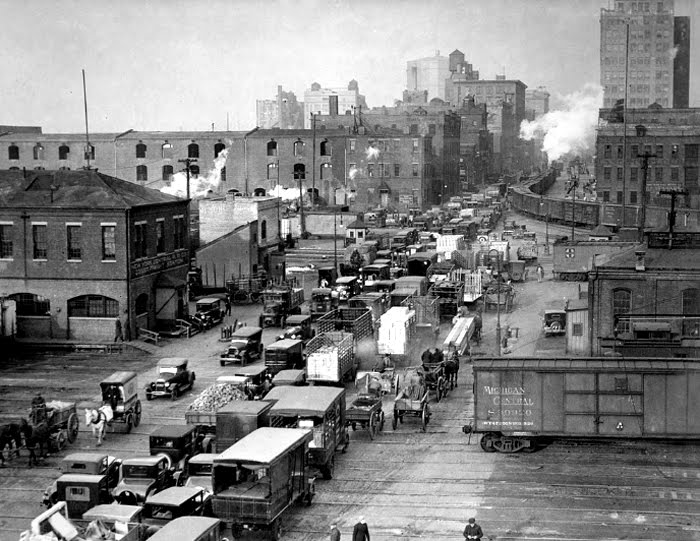
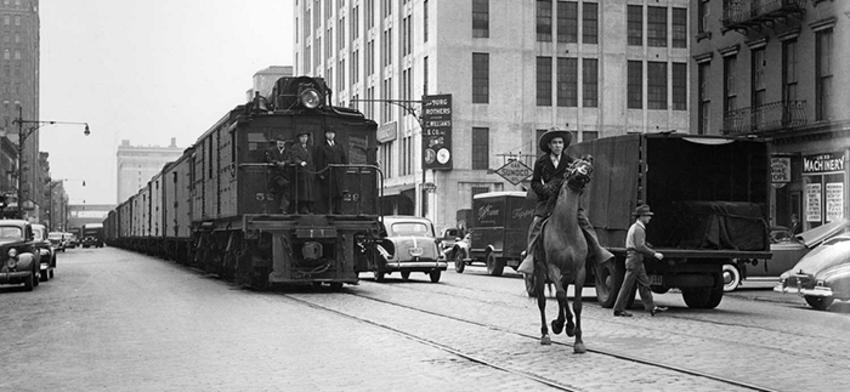
Before the elevated tracks were constructed in the early 1930s in Manhattan’s west side warehouse district (home of today’s popular “High Line”), freight trains rumbled through the city–at street level–on “Death Avenue.”
November 5, 1927 cover by Constantin Alajalov.
Freight trains were introduced to the west side warehouse district in 1846, which was a bad plan from the very start. Block-long trains would run through cross streets and congested traffic, maiming and killing along the way.
ON YOUR LEFT!…Both diesel and steam locomotives rumbled along Manhattan avenues well into the 20th century. Pictured is a freight train at 11th and 41st Street. Eleventh was known as “Death Avenue.” (Forgotten NY)
According to Friends of the High Line, “an 1892 New York World article referred to the trains as ‘a monster which has menaced them night and day,’ and by 1908 the Bureau of Municipal Research claimed that since 1852, the trains had killed 436 people. A New York Times piece from the same year reported that in the preceding decade there had been almost 200 deaths, mostly of children.”
MIXED USE…This circa 1920 photo shows the congestion that occurred when freight trains, horse-drawn carts, cars, and pedestrians used the same streets. (Kalmbach Publishing Company)SHOWDOWN…Beginning in 1850, the West Side Cowboys rode ahead of oncoming trains to ensure the safety of people on the street, although statistics show that some pedestrians did not heed the warnings. (Friends of the High Line)
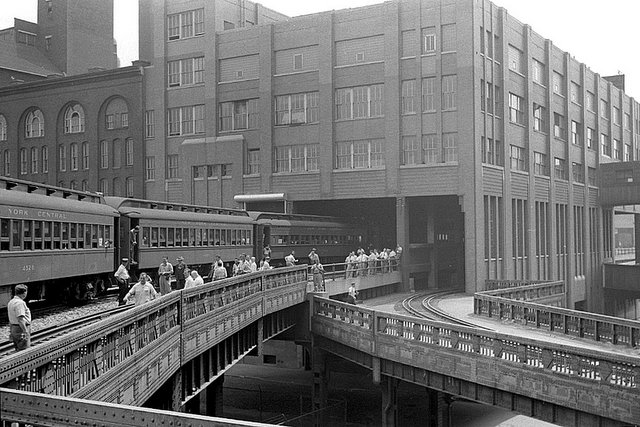
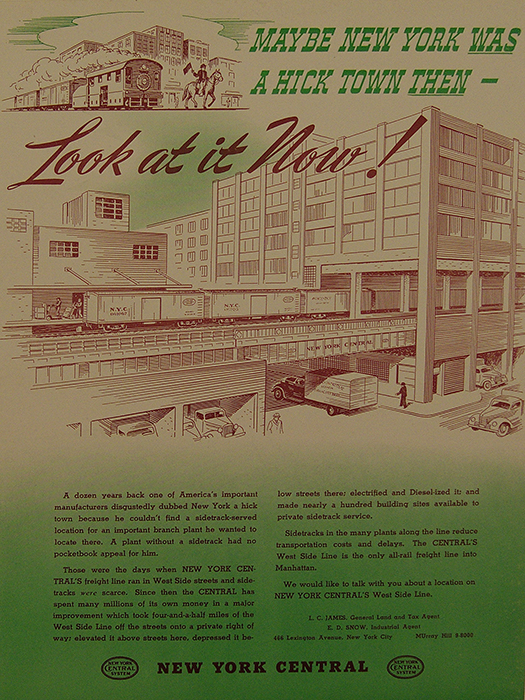
The safety issues on Death Avenue were finally addressed in 1929 when city and state officials reached an agreement with New York Central Railroad to move the rail above street level. New elevated tracks opened in 1934 were novel in the way they bisected city blocks, unloading cargo directly into buildings in the district.
BETTER…The elevated tracks served warehouses including one for the National Biscuit Company (Nabisco), pictured above, which today houses another popular High Line attraction, the Chelsea Market. (Friends of the High Line)A New York Central Railroad advertisement touting the benefits of its elevated West Side Line, which today supports a unique and popular urban park–the High Line. (Friends of the High Line)
The elevated West Side Line’s unique design also complements the current use of the tracks–the High Line, one of New York’s most popular tourist draws and a widely successful example of urban reuse and renewal. Today few visitors to the High Line are aware that the peaceful oasis they now enjoy was once a dangerous and chaotic place that was home to the aptly named Death Avenue…
NOT SO BAD, THIS…Visitors to the High Line enjoy a peaceful oasis above the former “Death Avenue.” (Friends of the High Line)
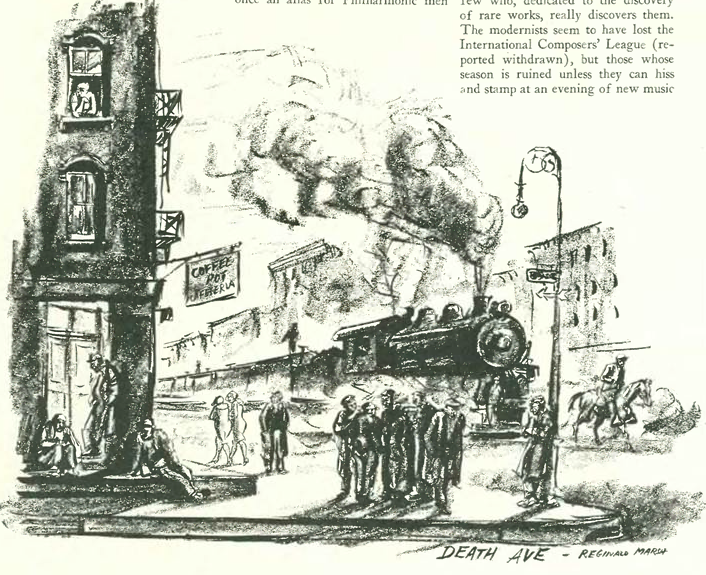
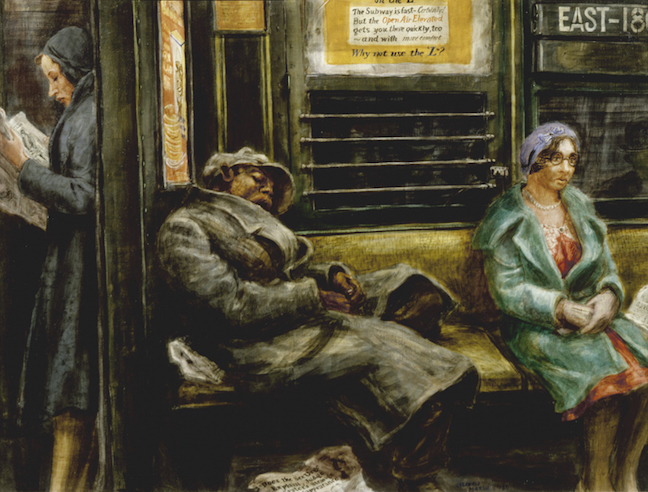
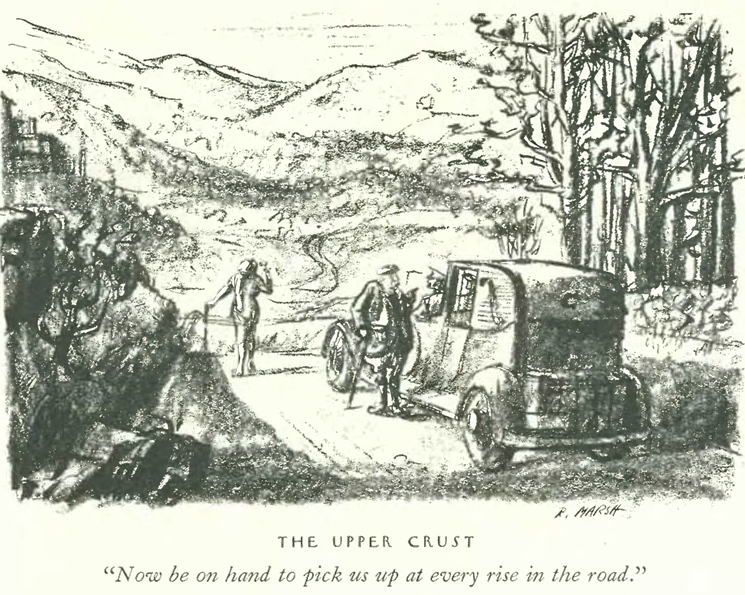
What prompted my interest in Death Avenue was this illustration by Reginald Marsh in the Nov. 5, 1927 issue of The New Yorker:
Marsh (1898-1954) joined The New Yorker as one of its first cartoonists, and stayed there for seven years. He was practically born an artist, growing up in an artists’ colony in New Jersey where his father worked as a noted muralist and his mother made watercolors. After graduating from Yale he went to work of the Daily News, where he contributed sketches of vaudeville acts and illustrated a column titled “People We’d Like to Kill but Don’t.”
Described as a “Social Realist” painter, Marsh studied painting at the Art Students League, where the prevailing theme was life among the working poor, the unemployed, and the homeless, especially after the market crash in 1929…
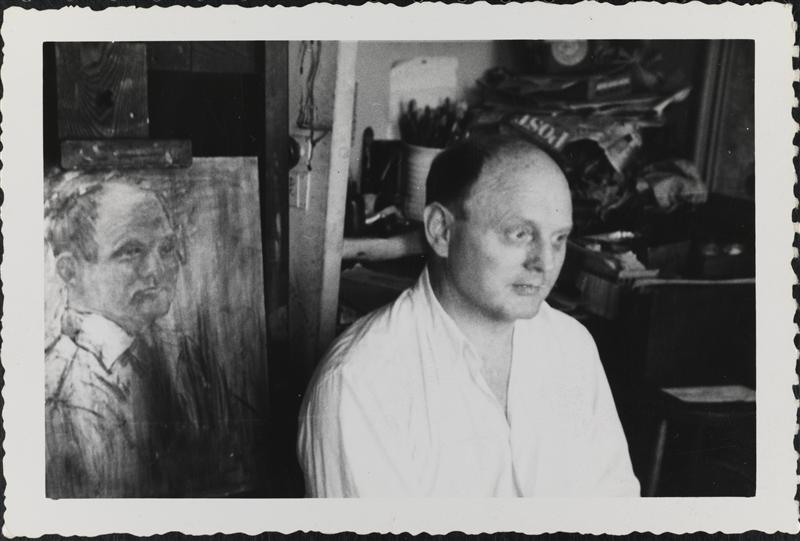
WHY NOT USE THE “L”?…the title of a 1930 work by Reginald Marsh. (Whitney Museum of Art)SELF REFLECTION…Reginald Marsh with one of his self-portraits, circa 1938. (Museum of the City of New York)
* * *
Write What You Know
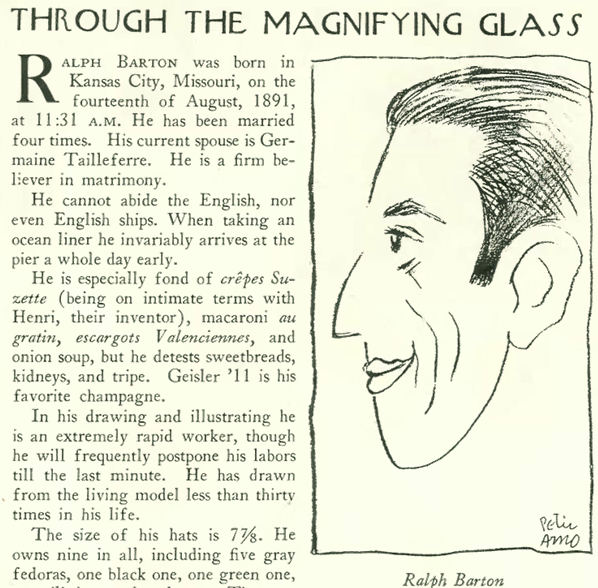
Among other items in the Nov. 5, 1927 issue was this profile written by Charles Shaw of fellow New Yorker contributor (artist and writer) Ralph Barton. An excerpt, with sketch by Peter Arno...
By Any Other Name
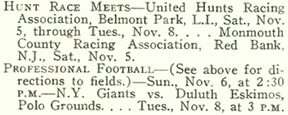
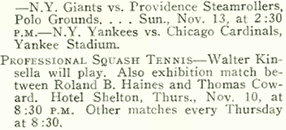
As it still does today, The New Yorker listed area happenings in the front section of the magazine, and in the early days the magazine included extensive listings of sporting events. The excerpt below offers various diversions from a “hunt race” to “squash tennis.” There were also professional football games featuring such mighty foes as the New York Giants and the Duluth Eskimos…
Hope(ful) Chest
Before the age of smart phones, the term “smart” in advertising meant one was on the leading edge of fashion–for aspiring young women this meant all things French–clothes, perfumes, beauty treatments–and for the bride, the all-important trousseaux, or so claimed this advertisement from Franklin Simon & Co. on page five of the Nov. 5 issue…
Couldn’t afford the latest from Paris? In that case you could turn to the back pages of the same issue, where you would find cheaper ads from places like Kathleen, Inc, which sold knock-offs of the latest in haute couture…
* * *
And finally, we return to Reginald Marsh, who contributed this cartoon to the Nov. 5 issue…
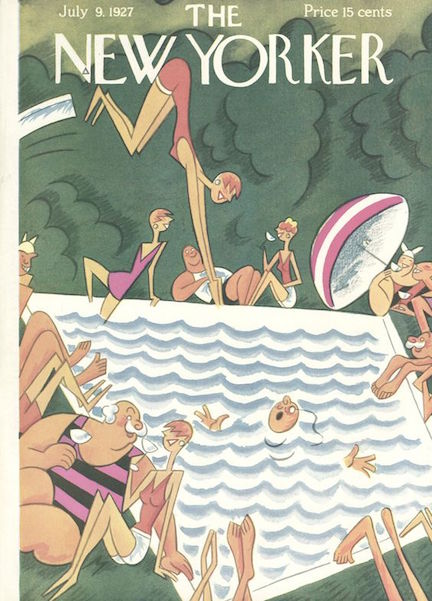
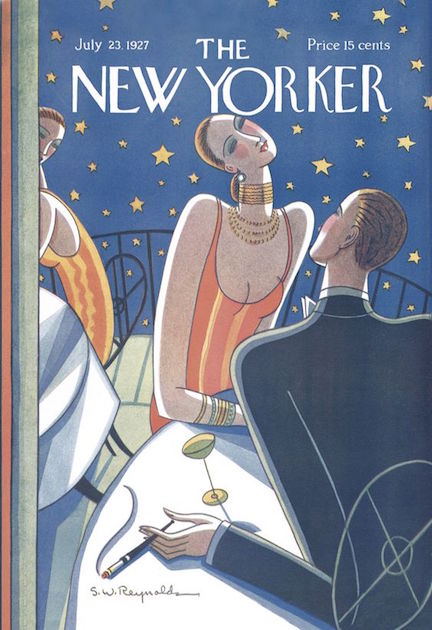
The July 1927 issues of the New Yorker were filled with news of yacht races, polo matches and golf tournaments as the city settled into the heart of the summer. The artist for the July 9 cover, Julian de Miskey, was in the summertime mood with this lively portrayal of Jazz Age bathers:
July 9, 1927 cover by Julian de Miskey. Born in Hungary in 1898, de Miskey emigrated to the United States in 1914.
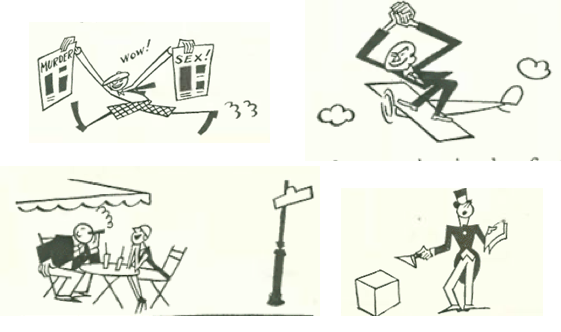
Although Julian de Miskey (1898–1976) was was one of the most prolific of the first wave of New Yorker artists, his work seems to be little known or appreciated. But more than forty years after his death his influence is still felt in the magazine, particularly in the spot illustrations and overall decorative style that grace the pages of “The Talk of the Town.”
Here is a sampling of de Miskey’s spot illustrations for “Talk” in the July 9 and July 16, 1927 issues…
…and here are examples of spot illustrations for some recent (Aug-Sept. 2016) New Yorker “Talk” sections, as rendered by Antony Huchette (which also reference Otto Soglow’s spot work for The New Yorker)…
De Miskey did it all–spots, cartoons, and dozens of covers. A member of the Woodstock Art Association, de Miskey was well known in the New York art circles of his day, rubbing elbows in the Whitney Studio Club in Manhattan with artists including Edward Hopper, Guy Pene du Bois, Mabel Dwight and Leon Kroll. De Miskey also illustrated and designed covers for a number of books, studied sculpture and created stage sets and costume designs.
PROLIFIC…Julian de Miskey illustrated a number of children’s books, including Chúcaro: Wild Pony of the Pampa (1958-Newbery winner); The Trouble with Jenny’s Ear (1960); and Piccolo (1968) which was both written and illustrated by de Miskey.
The June 9 issue also featured this cartoon by de Miskey:
* * *
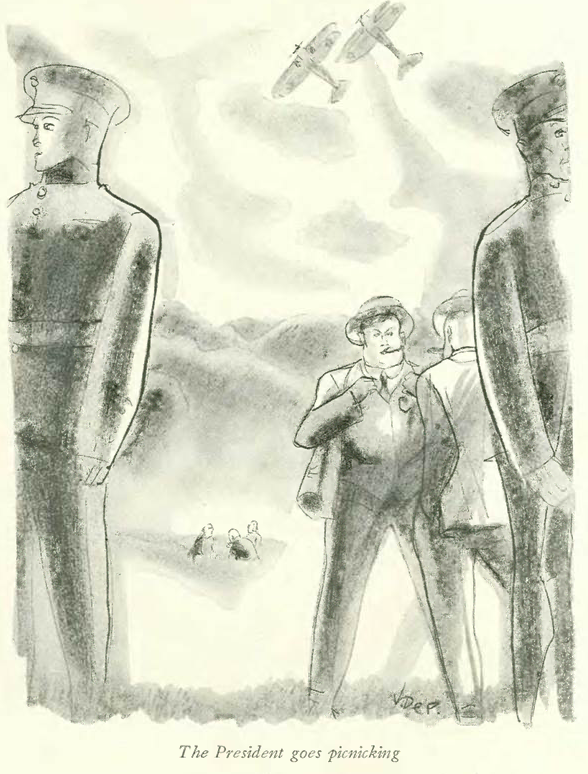
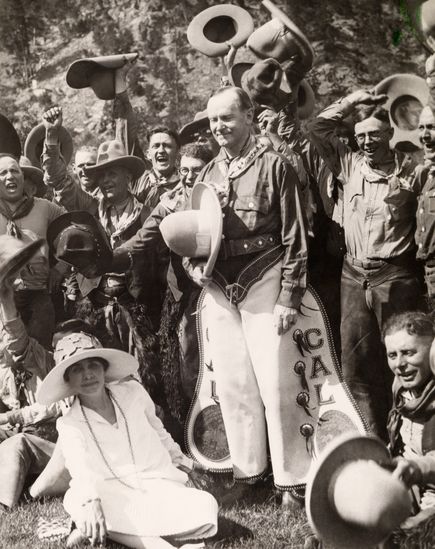
President Calvin Coolidge fled the bugs and heat of Washington, D.C. for cooler climes in the Black Hills of South Dakota. The New Yorker regularly mocked Coolidge’s dispatches from the Dakotas, including this item in “Of All Things”…
VAPID CITY…President Calvin Coolidge wears a cowboy hat and Western garb while on a two-month vacation in the Black Hills of South Dakota in 1927. (Library of Congress)
The magazine’s July 16 issue added this observation in “The Talk of the Town”…
Closer to home, M. Bohanan offered an urban sophisticate’s take on nature:
For those who couldn’t flee the city, respite was sought in Central Park, as illustrated by Constantin Alajalov for “The Talk of the Town…”
click to enlarge
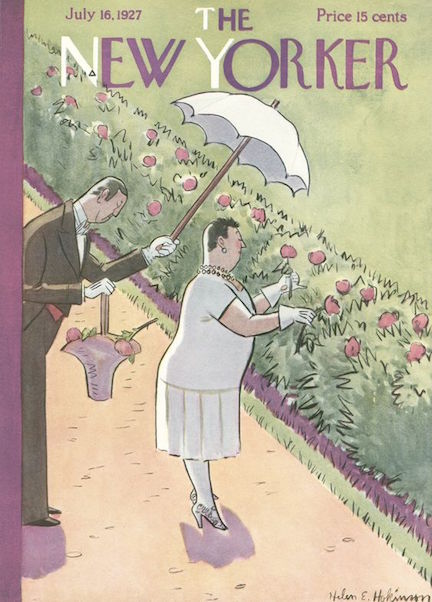
Summer themes continued with the July 16 issue, which featured a cover by Helen Hokinson depicting one of her favorite subjects–the plump society woman:
July 16, 1927 cover by Helen Hokinson.
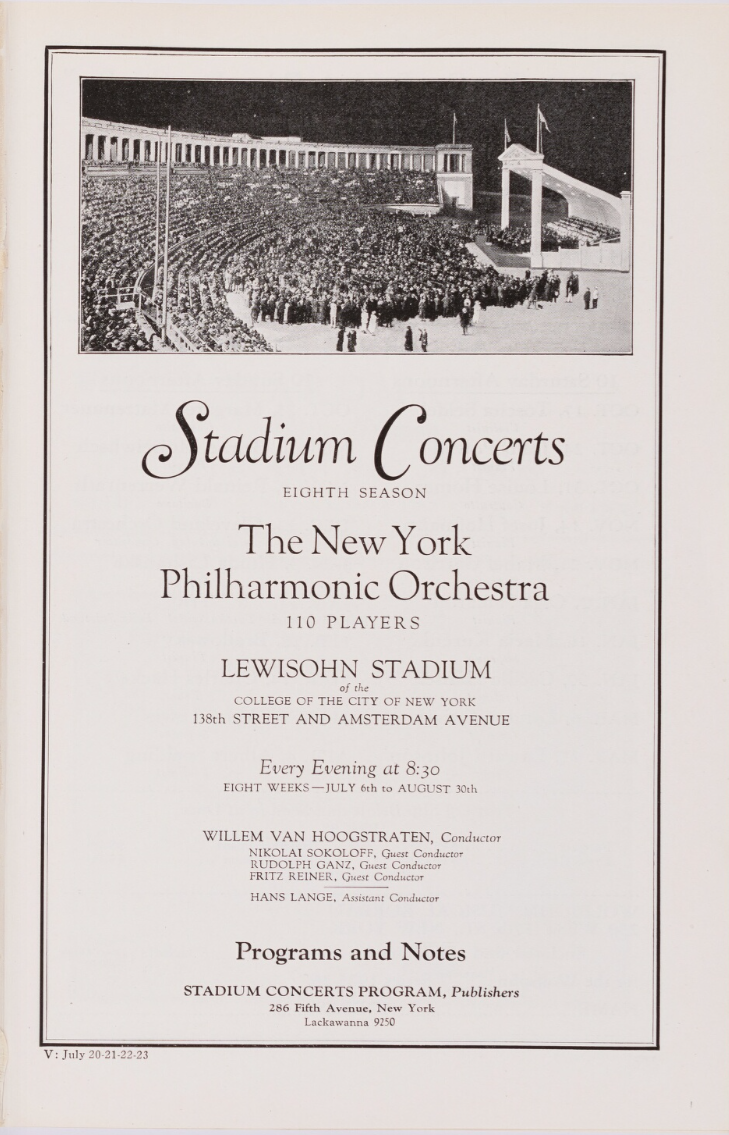
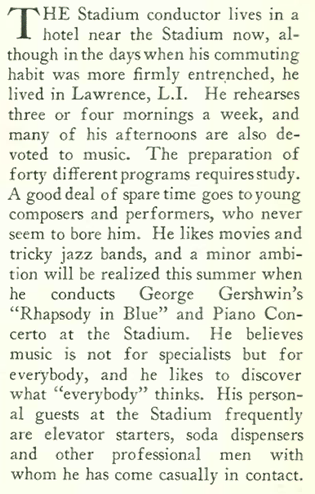
From 1918 to 1966, thousands of New Yorkers attended summer open-air concerts at Lewisohn Stadium, an amphitheater and athletic facility on the campus of the City College of New York. For many years Willem Van Hoogstraten conducted the nightly concerts, including the summer of 1927 when George Gershwin played his Rhapsody in Blue to adoring crowds.
Performance at Lewisohn Stadium, located at 136th Street and Convent Avenue. (nyc-architecture.com)Program for the 1925 Stadium Concerts series. (archives.nyphil.org) Click to enlarge
FINAL BOW…A still from the 1973 film Serpico, showing actors Al Pacino and Tony Roberts walking through the abandoned Lewisohn Stadium just before it was demolished. (YouTube)UGH…The Lewisohn Stadium site is now occupied by a City College of New York building with the inspiring name, “North Academic Center.” (nyc-architecture.com)
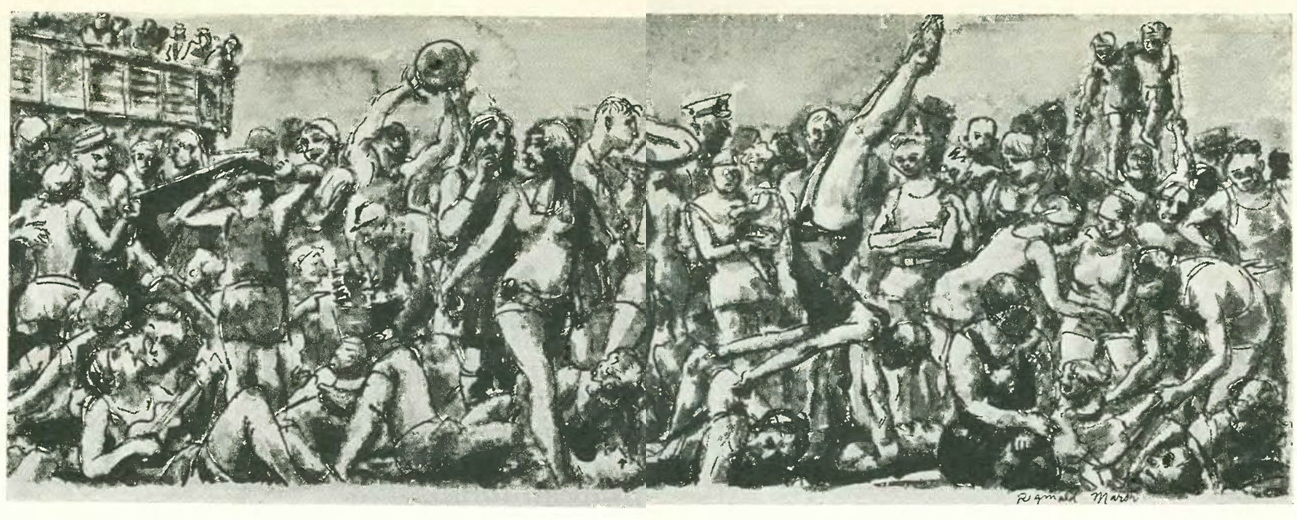
And finally, another illustration in the “Talk of the Town” of summer in the city, this a teeming Coney Island beach courtesy of Reginald Marsh…
click to enlarge
However, if you wanted to avoid the rabble at the beach, you could fly over them–in style, of course…
New York’s American Museum of National History unveiled its new Hall of Dinosaurs, and it was so impressive that even The New Yorker set aside its usual blasé tone toward popular attractions…
April 2, 1927 cover by Toyo San.
…and found its “Talk of the Town” editors to be quite taken with “sacred bones:”
NEW DIGS…Children studying a Brontosaurus skeleton in the American Museum of National History’s Hall of Dinosaurs, 1927. (AMNH Research Library)
Tyrannosaurus and Triceratops in the Hall of Dinosaurs, 1927. (AMNH Research Library)
* * *
The April 2, 1927 issue also found New Yorkers to be agog over “French-style” telephones:
FRANCOPHONE…Trendy New Yorkers were switching from their old reliable candlestick telephones (left) to “French-style” phones (center) that were common throughout Europe. Western Electric answered their call with a sleek American version in 1928, right.
* * *
The April 9, 1927 issue featured the second of Peter Arno’s 99 covers for the New Yorker. His first cover appeared eighteen issues earlier (Nov. 22, 1926) and featured the same gardener, but this time he was inspecting a newly budded leaf rather than the last one to fall:
Note the difference in style between the two covers–the April 9 cover is rendered with more detail, depth and texture. These would be Arno’s only covers with rather sedate subjects. Subsequent covers would have more action and humor, such as this one from 1954, one of my favorites:
* * *
And now for a note about Paul Whiteman. One cannot write about the Jazz Age without mentioning the Paul Whiteman Orchestra. It was Whiteman who in 1924 commissioned George Gershwin’sRhapsody in Blue, which premiered with Whiteman’s orchestra (and with Gershwin himself at the piano).
This ad in the Feb. 26, 1927 New Yorker announced the much-anticipated return of Paul Whiteman and his orchestra. The caricature of Whiteman was his trademark.
Even Lois Long, who seemed to be growing bored with New York nightlife, found reason to celebrate Whiteman in this column that appeared alongside the ad:
Whiteman had 28 number one records during the 1920s and dominated sheet music sales. He provided music for six Broadway shows and produced more than 600 recordings. Dubbed “King of Jazz” his style was actually a blending of jazz and symphonic music.
The folks at Victor Talking Machines played on Whiteman’s fame with this advertisement for their latest “Orthophonic” Victrola. Although it was the first consumer phonograph designed specifically to play “electrically” recorded discs and was recognized as a major step forward in sound reproduction, the claim that the machine would reproduce sounds “exactly as you would hear them at the smart supper clubs” seemed a little far-fetched.
And finally, in celebration of spring, Constantin Alajalov illustrated an April day in Central Park, which was featured in a two-page spread in “Talk of the Town.”
Despite Prohibition, perhaps a few champagne corks were popped for the January 15, 1927, edition of the New Yorker. This is Issue # 100.
January 15, 1927–Issue # 100. The cover art by Constantin Alajalov.
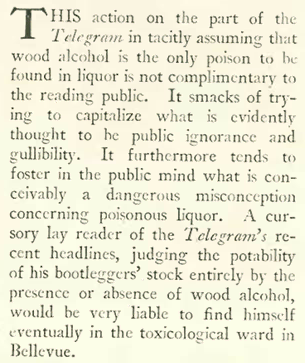
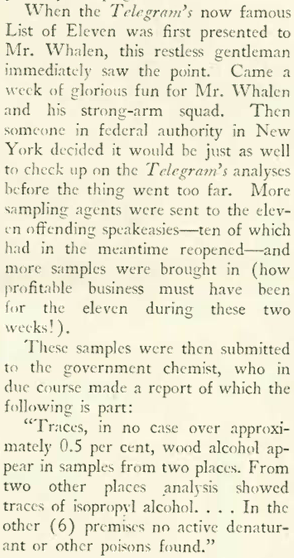
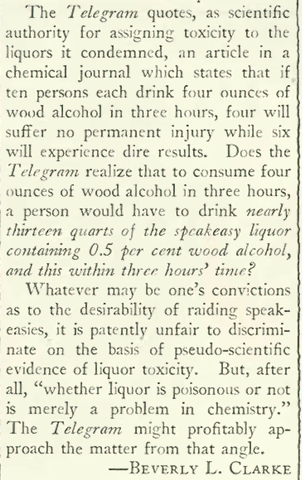
Prohibition was on the minds of the editors of the issue, which featured a highly critical piece by Morris Markey (“A Reporter at Large”) on the hysteria surrounding the government’s attempt to poison supplies of bootleg alcohol. The editors of “The Talk of the Town” also made this observation:
Before we get more into Markey’s piece, a little background is in order. In an article for Time magazine (Jan. 14, 2015) Lily Rothman writes that for years prior to Prohibition industrial alcohol had been “denatured” by adding toxic or unappetizing chemicals to it. This was done so folks couldn’t escape beverage taxes by drinking commercial-use alcohol instead — but it was still possible to re-purify the liquid so that it could be consumed.
HOME CHEMISTRY KIT…A bootlegger at work in the 1920s. (oldmagazinearticles.com)
Rothman cites a Time article from Jan. 10, 1927, which reported that Prohibition forces in the government were introducing a new formula that year for denaturing industrial-grade alcohol that doubled the poisonous content: “4 parts methanol (wood alcohol), 2.25 parts pyridine bases, 0.5 parts benzene to 100 parts ethyl alcohol.” The article noted that “Three ordinary drinks of this may cause blindness.”
Warning label from the 1920s (vickyloebel.com)
Although some opposed the practice as legalized murder, Rothman cites Seymour M. Lowman, who as Assistant Secretary of the Treasury (1927-33) was in charge of Prohibition enforcement. Lowman told citizens that those on the fringes of society who continued to drink were “dying off fast from poison ‘hooch’” and that if the result was a sober America, “a good job will have been done.”
DRINK AT YOUR OWN RISK…1920s label for bootleg moonshine. (googleuk)
Thousands died from consuming poisoned alcohol. Rothman writes that 33 people died in Manhattan alone in a three-day period in 1928, mostly from drinking wood alcohol.
Markey’s stance in his New Yorker article is somewhat unique, if not cold-hearted. Instead of taking the government to task for the practice, he assured his well-heeled readers that they had nothing to fear as long as they procured their alcohol from reputable bootleggers at top prices. Markey seemed to care not at all for the poor “slum-dwellers” who died from consuming the cheap stuff:
If anything, Markey’s sympathies seemed to lie with those who had to drink the safe, albeit diluted hootch. He explained how four bottles of bootleg Scotch could be fashioned from a single bottle of the real deal:
And if you had money, there was no need to fear death from drink…
…that is, unless you were careless:
* * *
Helena Huntington Smith wrote a profile on the actor Adolphe Menjou, described by IMDB as Hollywood’s epitome of suave and debonair style: “Known for his knavish, continental charm and sartorial opulence, Menjou, complete with trademark waxy black mustache, evolved into one of Hollywood’s most distinguished of artists and fashion plates, a tailor-made scene-stealer.” Interestingly, Menjou was born in Pittsburgh, and not in France as many a fan assumed (his father, however, was a French émigré).
Glass lantern advertising slide for Adolphe Menjou’s 1927 silent film A Gentleman of Paris.
In other items, New Yorker architecture critic George S. Chappell (aka T-Square) once again set his sights on the city’s changing skyline. He began with the new General Motors building at Columbus Circle:
He was thrilled by the push-button automation of the building’s elevators:
The General Motors building, left, as it originally appeared on Columbus Circle. It was designed by Shreve & Lamb, who would soon go on to design the Empire State Building. At right, the building became known as the Newsweek Building. (Drawing by J. W. Golinkin in Towers of Manhattan, 1928, and photo by David W. Dunlap/The New York Times)
If Chappell thought the General Motors building had some issues in 1927, he should see it today, wrapped in tacky reflecting glass and renamed 3 Columbus Circle:
WHY? WHY ON EARTH? (nyc-architecture.com)
Elsewhere, Chappell was agog at Sloan & Robertson’s massive Graybar Building:
Sloan & Robertson’s Graybar Building at 420 Lexington. (history.graybar.com)
And to close, this ad on the back page for Chesterfield cigarettes, featuring the company’s famous Atlantic City sign. Note the point of pride: “There are 13,000 lamps” in the sign, but four times that many Chesterfields are smoked every minute…koff…koff…