In Search of Yuletide Cheer

Construction workers line up for pay beside the first Rockefeller Center Christmas tree in New York in 1931. (ASSOCIATED PRESS)

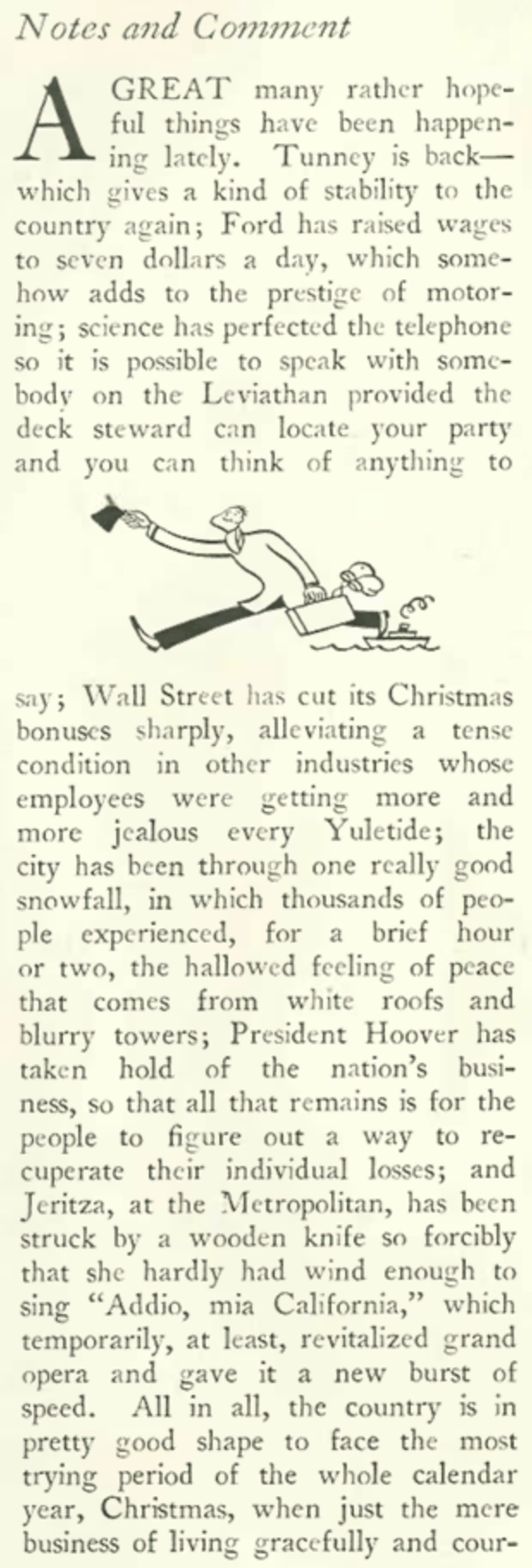
E.B. White’s “Notes and Comment” column led off The New Yorker’s “Talk of the Town,” and as such helped set the tone for what was to follow in the magazine.

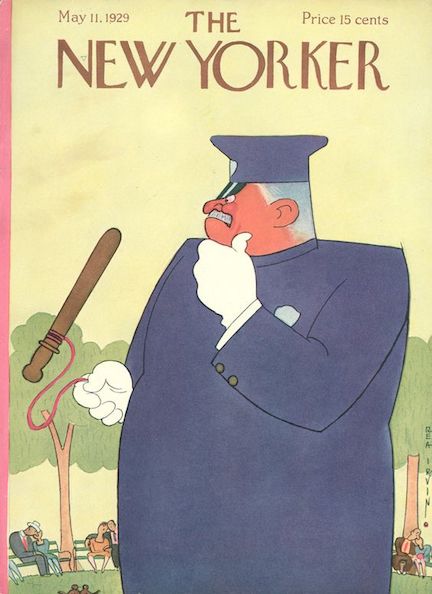
Dec. 14, 1929 cover by Theodore Haupt. Opening image: Construction workers line up for pay beside the first Rockefeller Center Christmas tree in New York in 1931. (NY Daily News)

For the Dec. 14 issue White attempted to strike a positive note in the aftermath of the stock market crash, offering a few nuggets of hope for the holiday season:
HEAVYWEIGHTS…Both President Herbert Hoover and retired prizefighter Gene Tunney offered signs of stability to a nation reeling from economic collapse. At right, Gene and Mary Tunney return to New York on the ocean liner Vulcania after 14 months in Europe. (Wikipedia/AP)

Alexander Woollcott, however, described his financial woes in his “Shouts and Murmurs” column, where he parodied newspapers that listed charity cases during the Christmas season:

BOOK-END POOR…Alexander Woollcott, in a 1939 portrait by Carl Van Vechten. (Wikipedia)

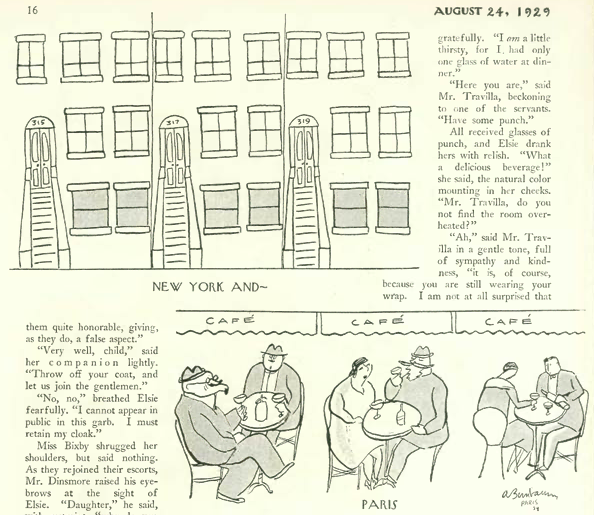
Paris correspondent Janet Flanner noted how the ripples of the market crash were being felt in Paris: Americans no longer had wads of cash to lavish on booze, jewelry, antiques and real estate:

DON’T RAIN ON OUR PARADE…The Place de la Nation, Paris, 1930. (thevintagenews.com)

Flanner added that despite the past boorish behavior of American tourists, the level of schaudenfreude among the French was remarkably low…

 *  *  *

Sinful Diversions

For yet another sign that the Roaring Twenties were decidedly over, it appeared that even “Sex” had run its course. Theater critic Robert Benchley noted that Mae West’s scandalous 1926 play inspired a spate of shows that had little new to offer, save for amping up the salacious content: A Primer for Lovers, The Amorous Antic, and Young Sinners. Audiences were unimpressed. A Primer for Lovers closed after just 24 performances, The Amorous Antic after just eight. Only Young Sinners would survive into the spring season.

JUST LOOK WHAT YOU STARTED…”Sex” was panned by critics as vulgar, but Broadway audiences in 1926 loved it. After 375 performances police arrested Mae West on obscenity charges, which landed her in a prison workhouse for ten days. (boweryboyshistory.com)
Actress Phoebe Foster (left) found success on Broadway, but not so much in The Amorous Antic, which closed after just eight performances. Dorothy Appleby (right) had better success with Young Sinners, which ran for 289 performances through August 1930. (IMDB)

 * * *

Final Bows

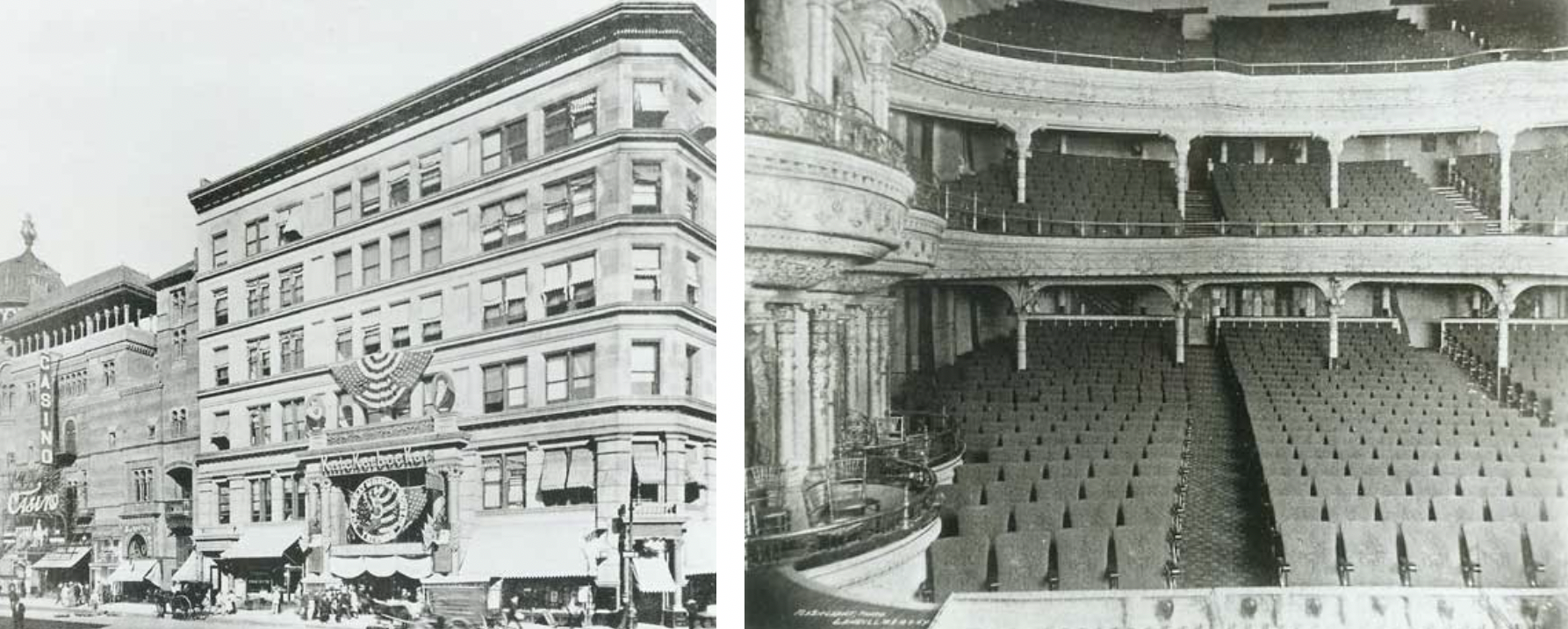
Theater was changing in other ways too. In the late 19th and early 20th century audiences patronized various playhouses based more on their reputation and tradition than on a particular play. E.B. White, in the “Talk of the Town” noted the imminent passing of one such house, the Knickerbocker Theatre, slated for demolition in 1930. The 33-year-old theater was Broadway’s first to display a moving electric sign (1906).
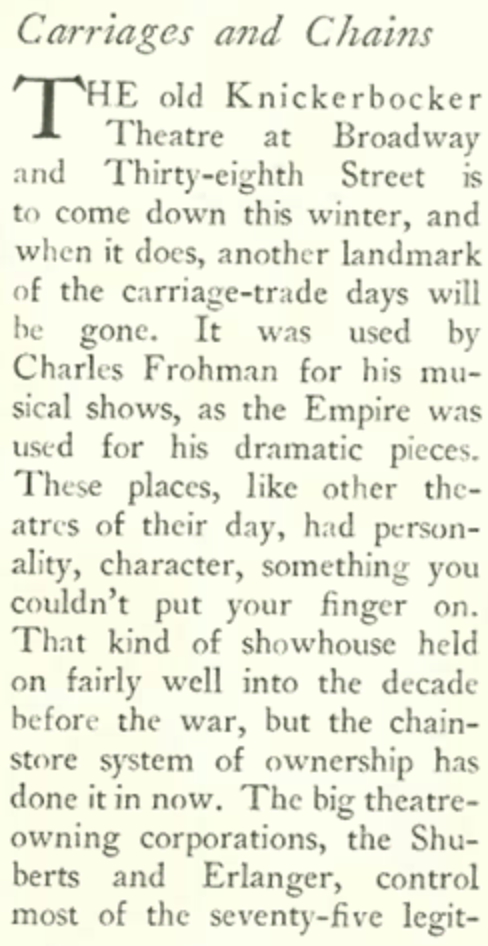
A HOUSE OF GOOD REPUTE…The Knickerbocker Theatre at 1396 Broadway was built in 1896 and demolished in 1930. (Internet Broadway Database)

White noted that smaller venues like the Knickerbocker, with their own distinct character and clientele, were falling victim to big theater-owning corporations that introduced more homogeneity into the play-going scene. In White’s estimation just two old-timers remained:

Both buildings still stand. The New Amsterdam, constructed in 1902–03, is now the oldest theater on Broadway. In the 1910s and 1920s it hosted the Ziegfeld Follies on its main stage and the racier Ziegfeld Midnight Frolics on the building’s rooftop. The Music Box was constructed in 1921 by composer Irving Berlin and producer Sam H. Harris to house Berlin’s Music Box Revues.

DISNEYFIED…The New Amsterdam, constructed in 1902–03, still stands today, now operated by the Disney Company, which signed a 99-year lease with the city in 1993. When it was built it was the largest theater in New York, with a seating capacity of 1,702. (Wikipedia)
IRVING’S PLACE…The Music Box Theatre at 239 West 45th Street was constructed in 1921 by composer Irving Berlin and producer Sam H. Harris to house Berlin’s Music Box Revues. It was later co-owned by Berlin’s estate and the Shubert Organization until Shubert assumed full ownership in 2007. (Wikipedia)

 * * *

Stocks Down, Arno Up

Peter Arno could be found all over the Dec. 14 issue: an ad promoting his new book Peter Arno’s Parade, a blurb in the book section touting the same…this ad for Peck & Peck featuring his handiwork…

…in the cartoons, a full page with the economy as a theme…

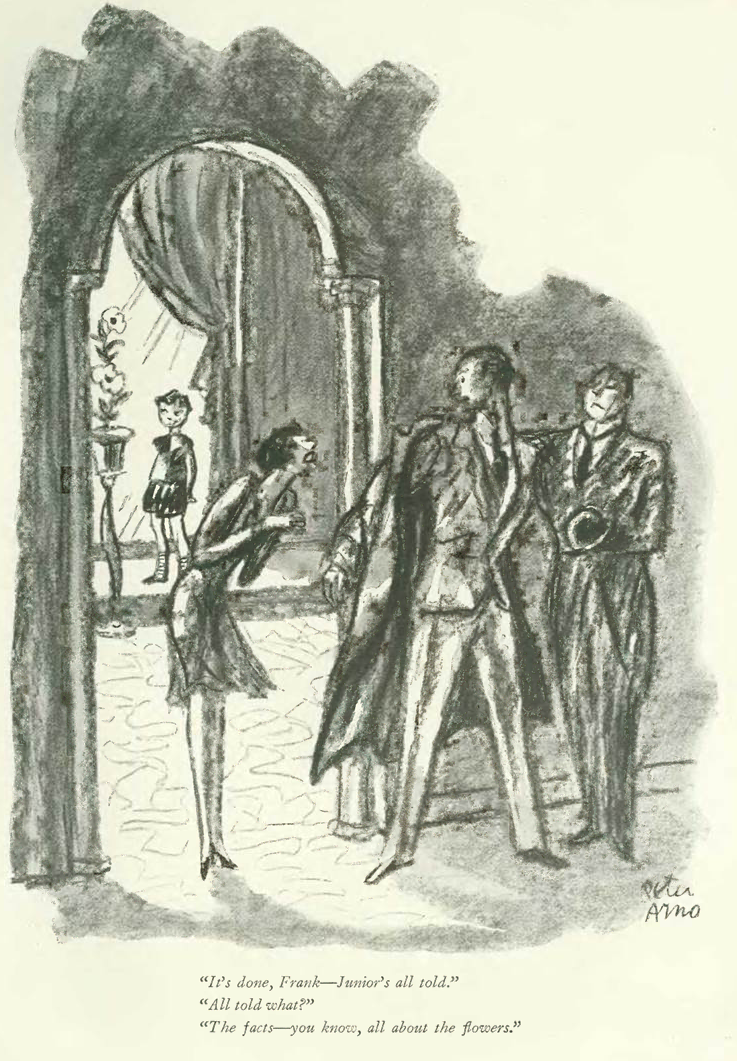
…and this submission that was doubtless inspired by Arno’s own home life and his brief, tempestuous marriage to New Yorker colleague Lois Long

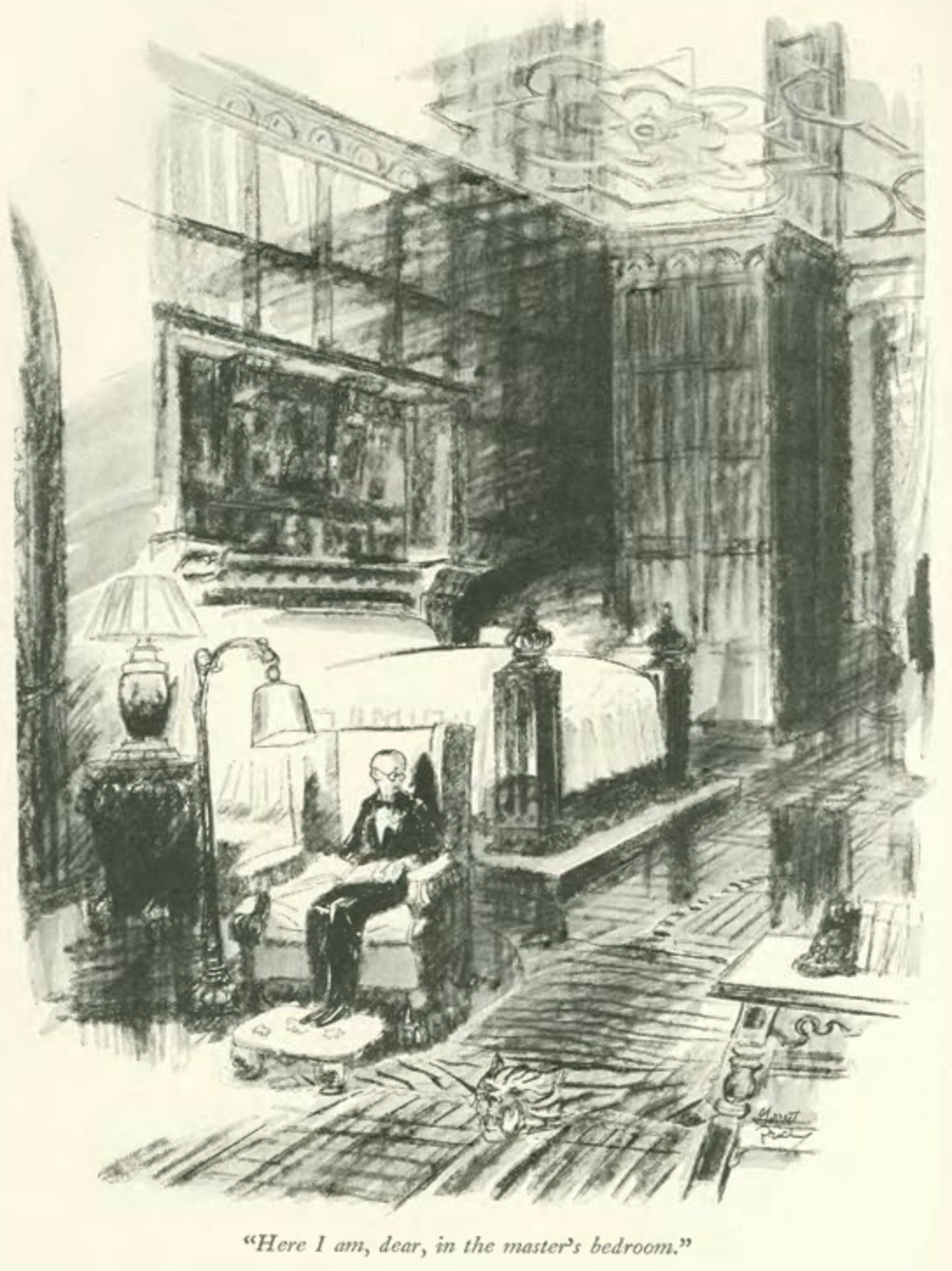
…here’s a couple of comics featuring Milquetoast characters…this one by Garrett Price

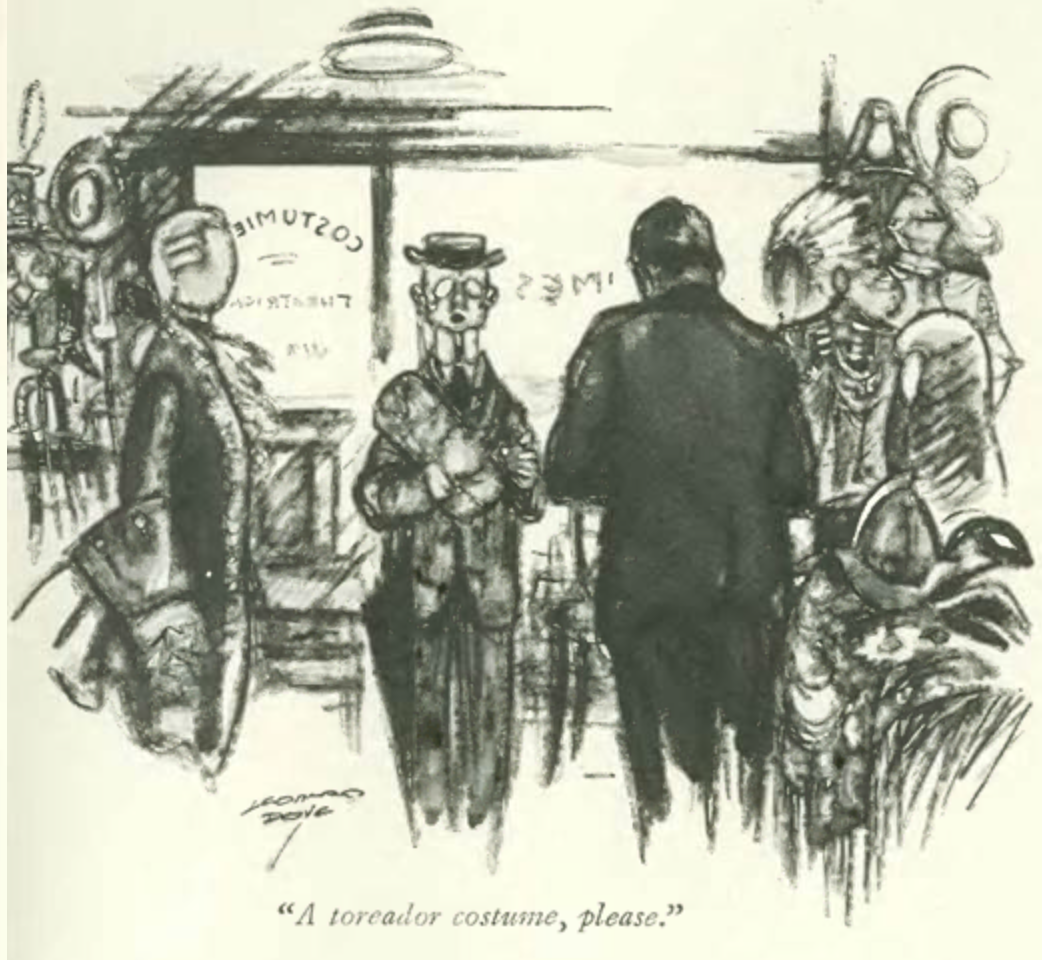
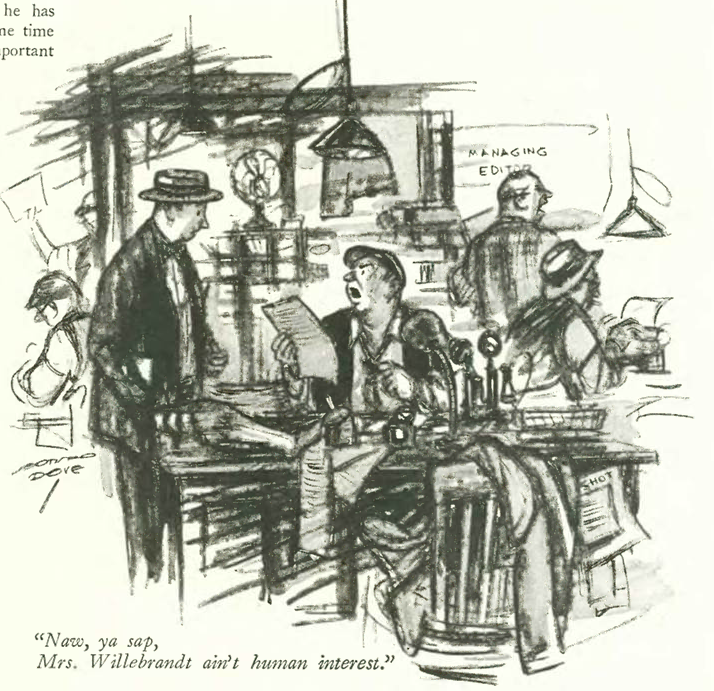
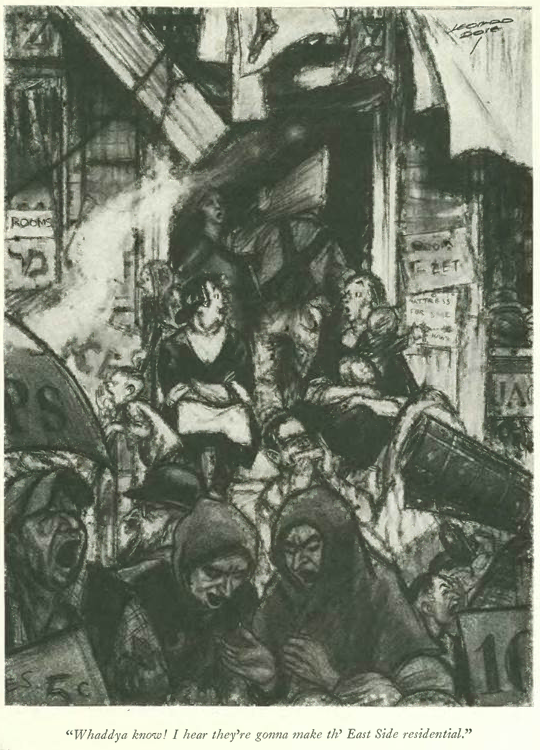
…and another by Leonard Dove

…and two submissions from one of my favorite cartoonists, Barbara Shermund, so ahead of her time…
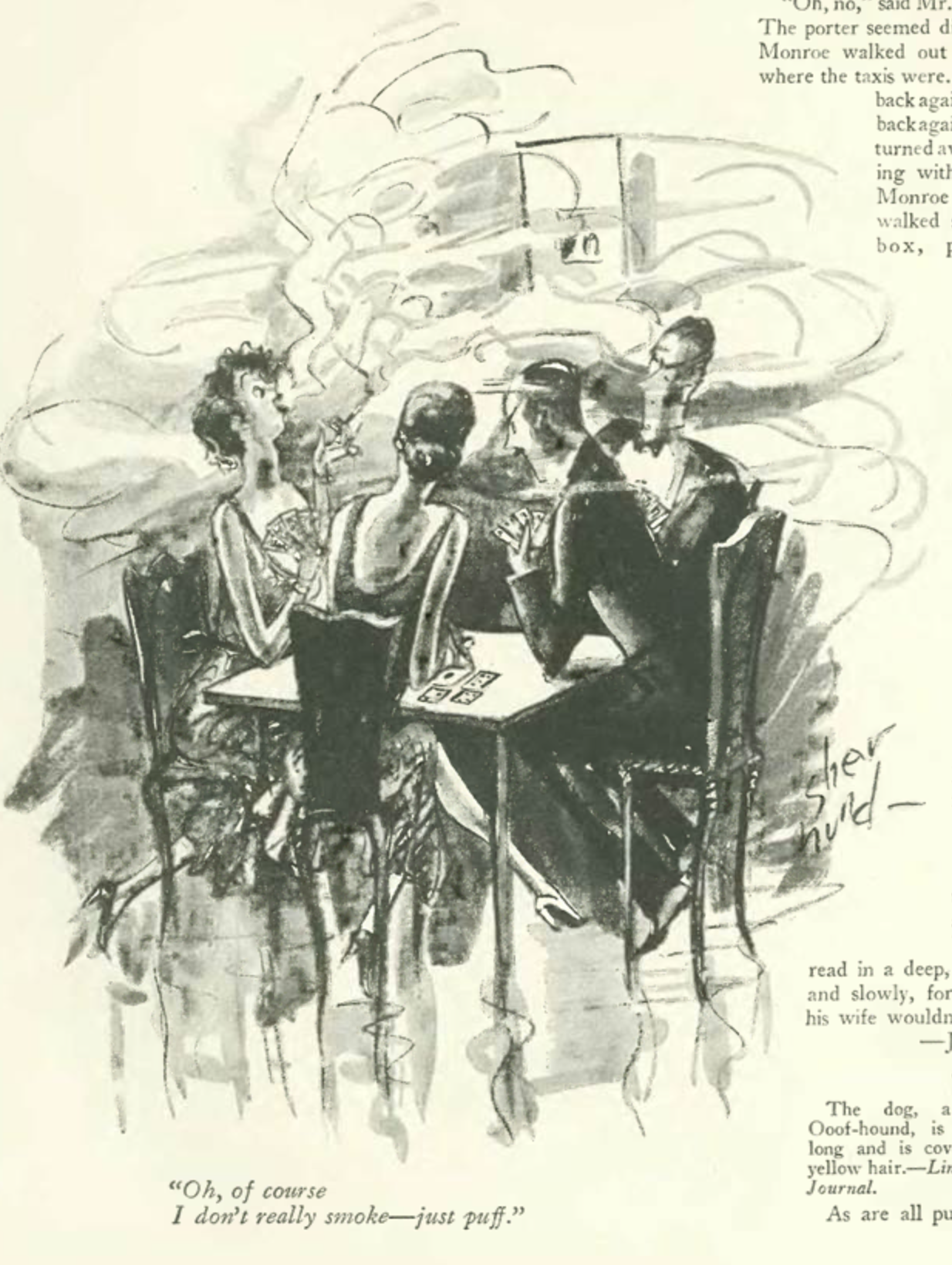
 

Helen Hokinson examined a physician’s bedside manner…
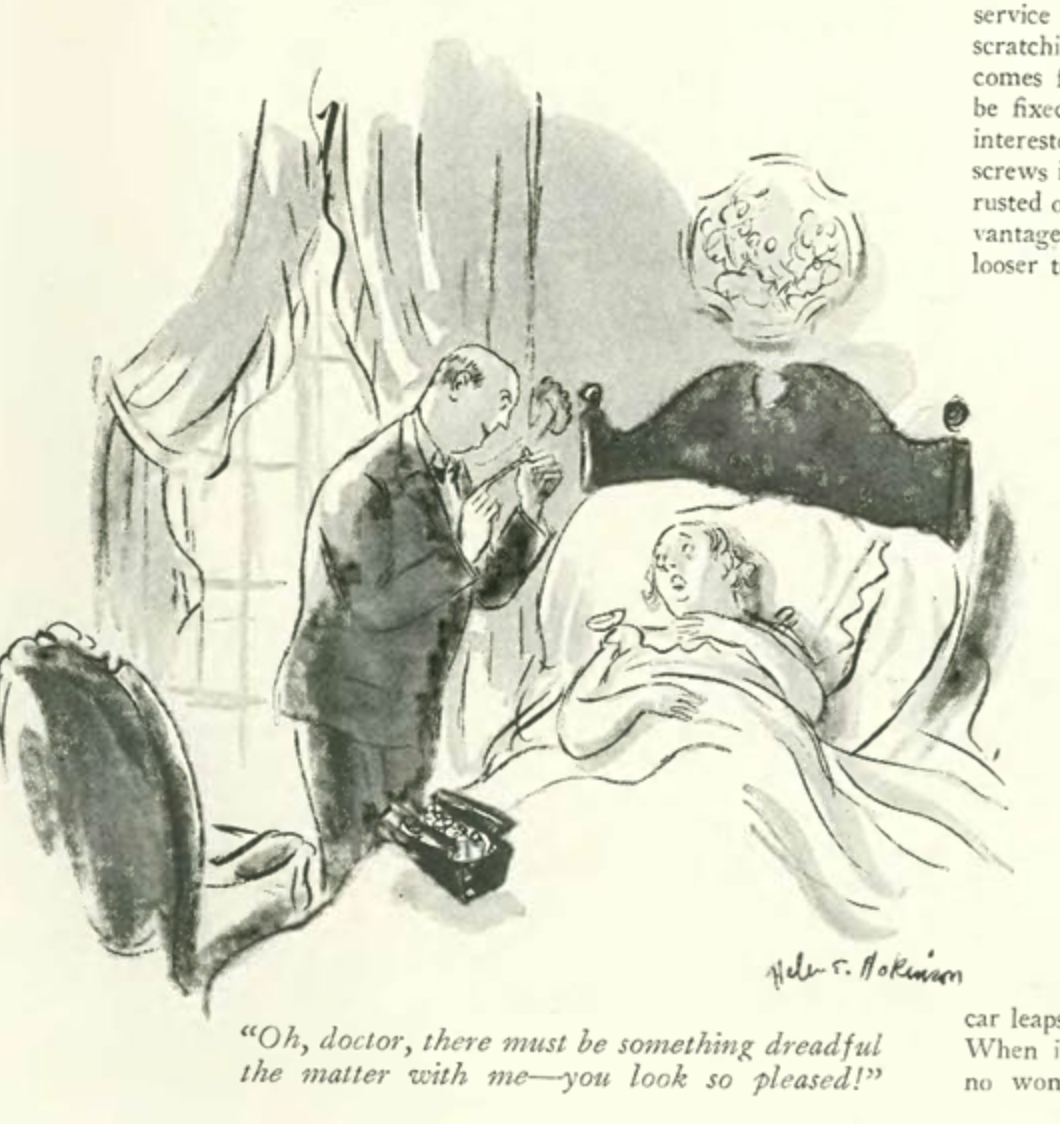
…and I. Klein offered his take on the new economy…

 * * *

We move right along to the Dec. 21, 1929 issue, where things seemed to turn a bit more sour…

Dec. 21, 1929 cover by Rea Irvin.

Elmer Rice’s serialized novel, A Voyage to Purilia, finally concluded in its 11th installment in the New Yorker…and E.B. White took on a more choleric disposition in his “Notes and Comment”…

Lois Long contributed a “Tables for Two” column, a feature that had become infrequent as she turned her full attentions to her fashion column “On and Off the Avenue.” In this installment of “Tables” we get her first mention of the market calamity…

Robert Benchley finally found something to like on Broadway, because Billie Burke was the star attraction…

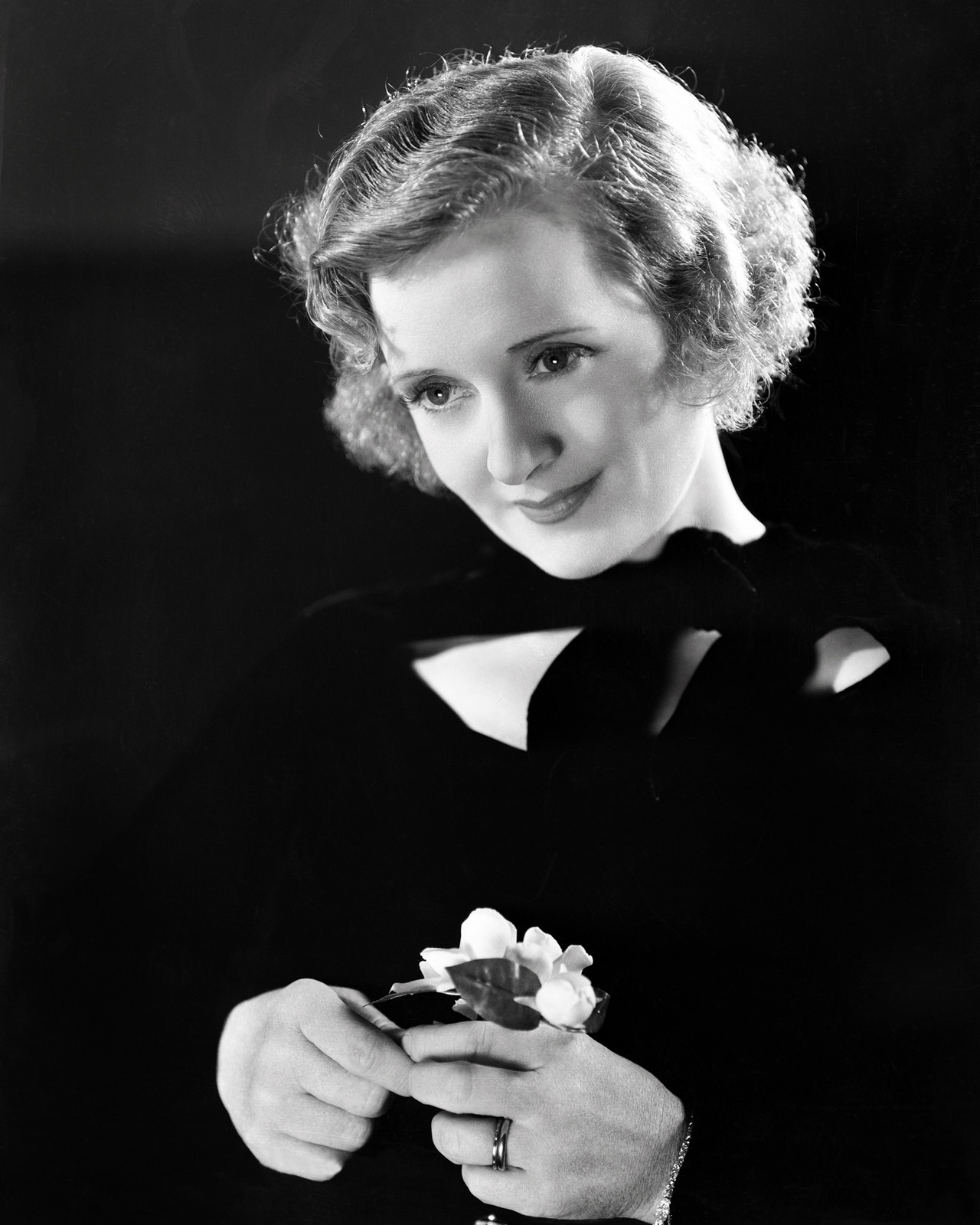
SHE”S THE GOOD ONE…Billie Burke in 1933. Most of us know her today for her performance as Glinda the Good Witch of the North in the 1939 film The Wizard of Oz. (Wikipedia)

 * * *

Violin Prodigy 2.0

The New Yorker raved about the twelve-year-old violinist Yehudi Menuhin when he wowed audiences at the Berlin Philharmonic earlier in the year. So when the ten-year-old Ruggiero Ricci expertly fiddled with the Manhattan Symphony, well…

YEAH, I GOT THIS…Ruggiero Ricci, about 1930, by then a touring professional. At age six Ricci began lessons with Louis Persinger, who also taught another San Francisco prodigy, Yehudi Menuhin. (Text and image, The New York Times)

 * * *

Namesake

Despite the market crash, the skyline continued to change at a rapid pace, and as we enter the 1930s the city would add some of its most iconic buildings to the skyline. George Chappell, The New Yorker’s architecture critic, had this to say about the magazine’s “namesake”…
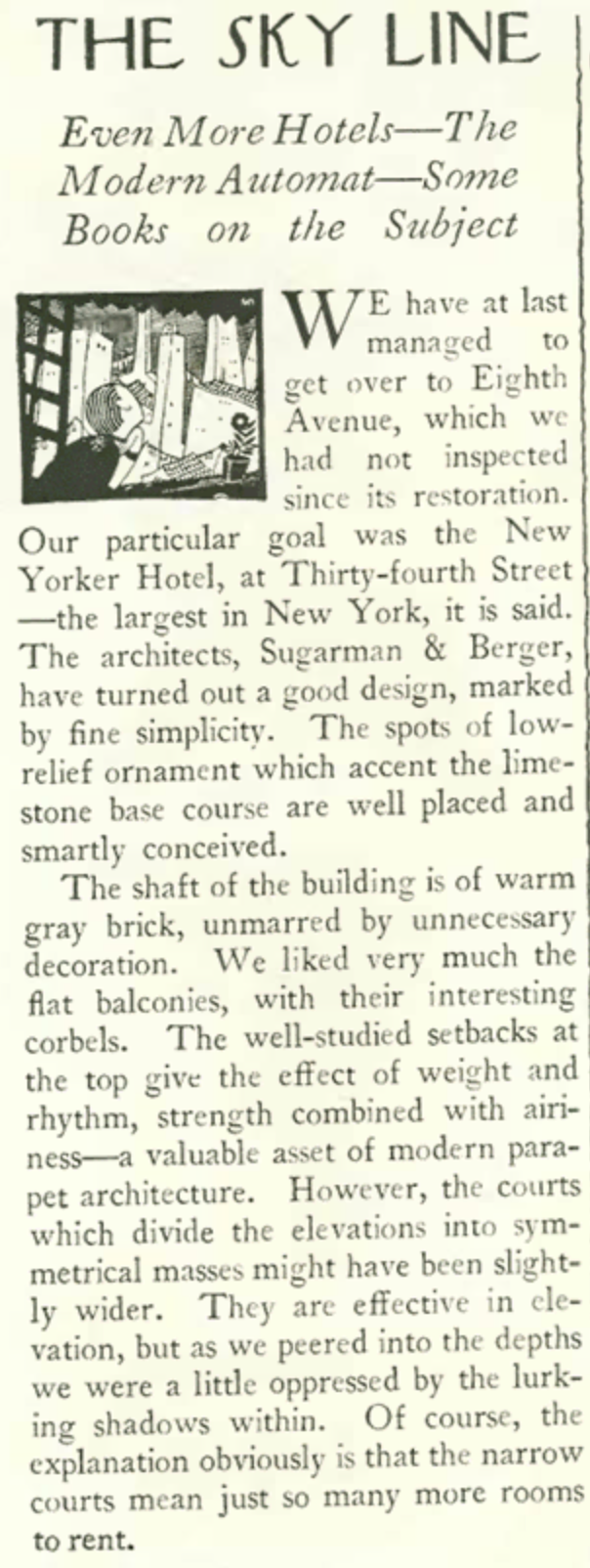
ROOMY…The New Yorker Hotel, at 481 Eighth Avenue. When the 43-story Art Deco hotel opened 1930, it contained 2,500 rooms, making it the city’s largest for many years. (Wikipedia)

 * * *

Art critic Murdock Pemberton continued his quest to make sense of the upstart Museum of Modern Art…

…and the American artists showcased there…
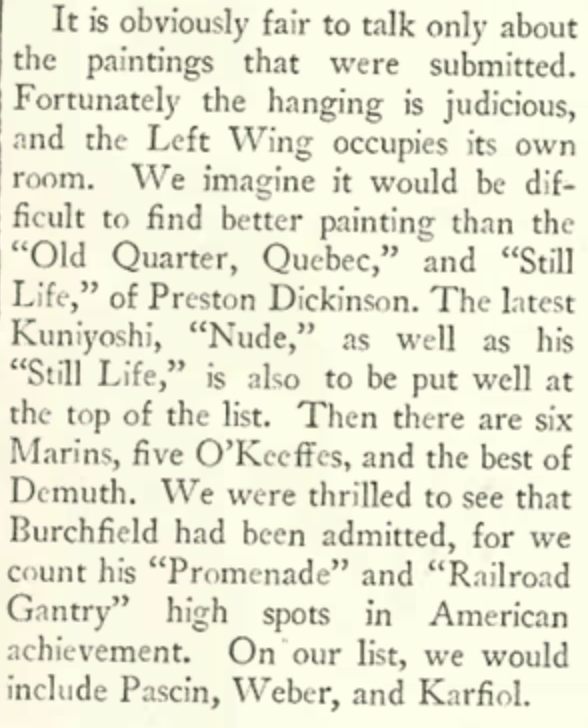
…I would add Edward Hopper, John Sloan, Lyonel Feininger, and Rockwell Kent (also displayed at the exhibition) but then again, I have the advantage of hindsight…

 * * *

From Our Advertisers

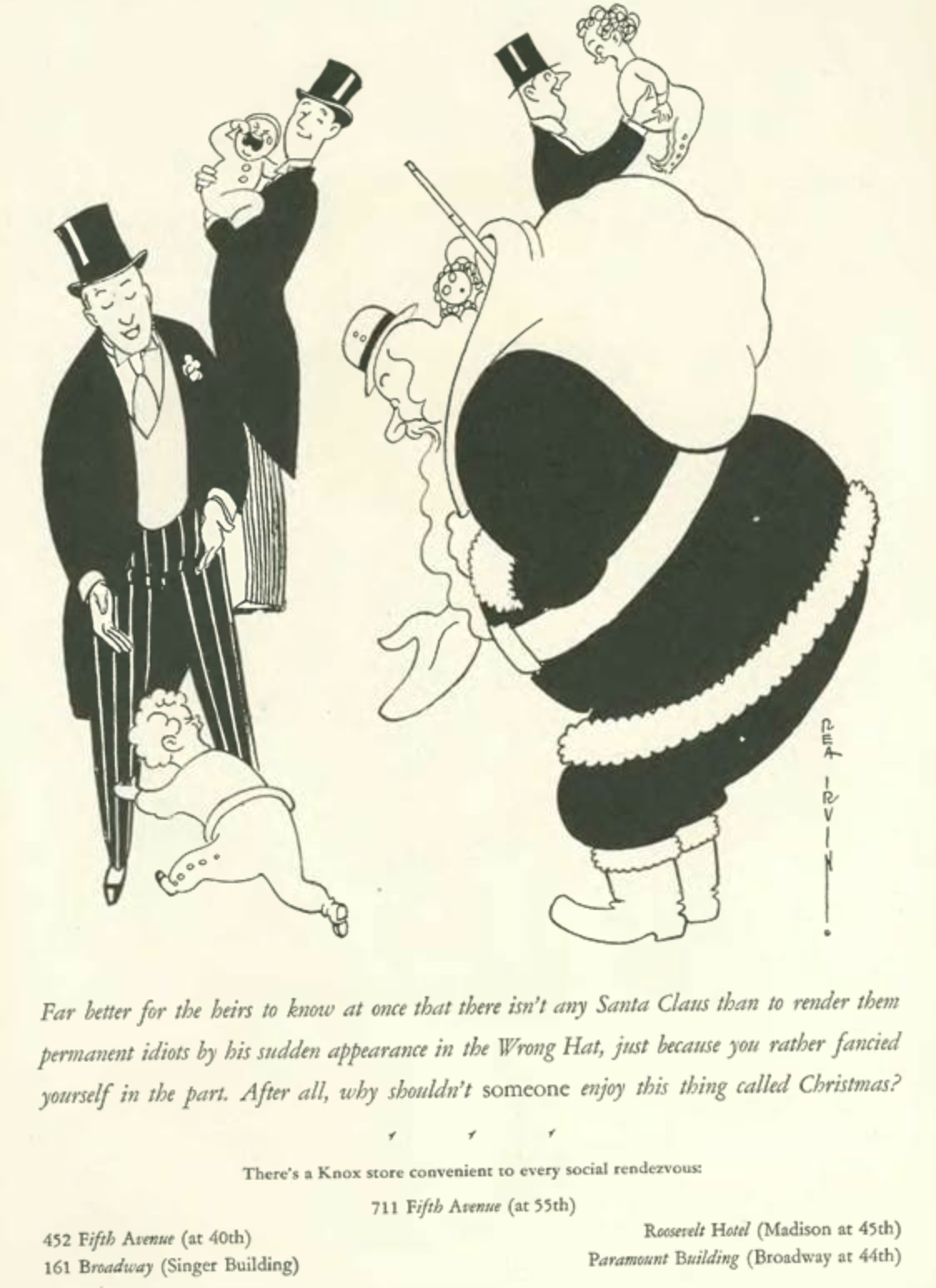
We have more New Yorker cartoonists augmenting their income through advertising, including (once again) Rea Irvin for Knox Hatters…
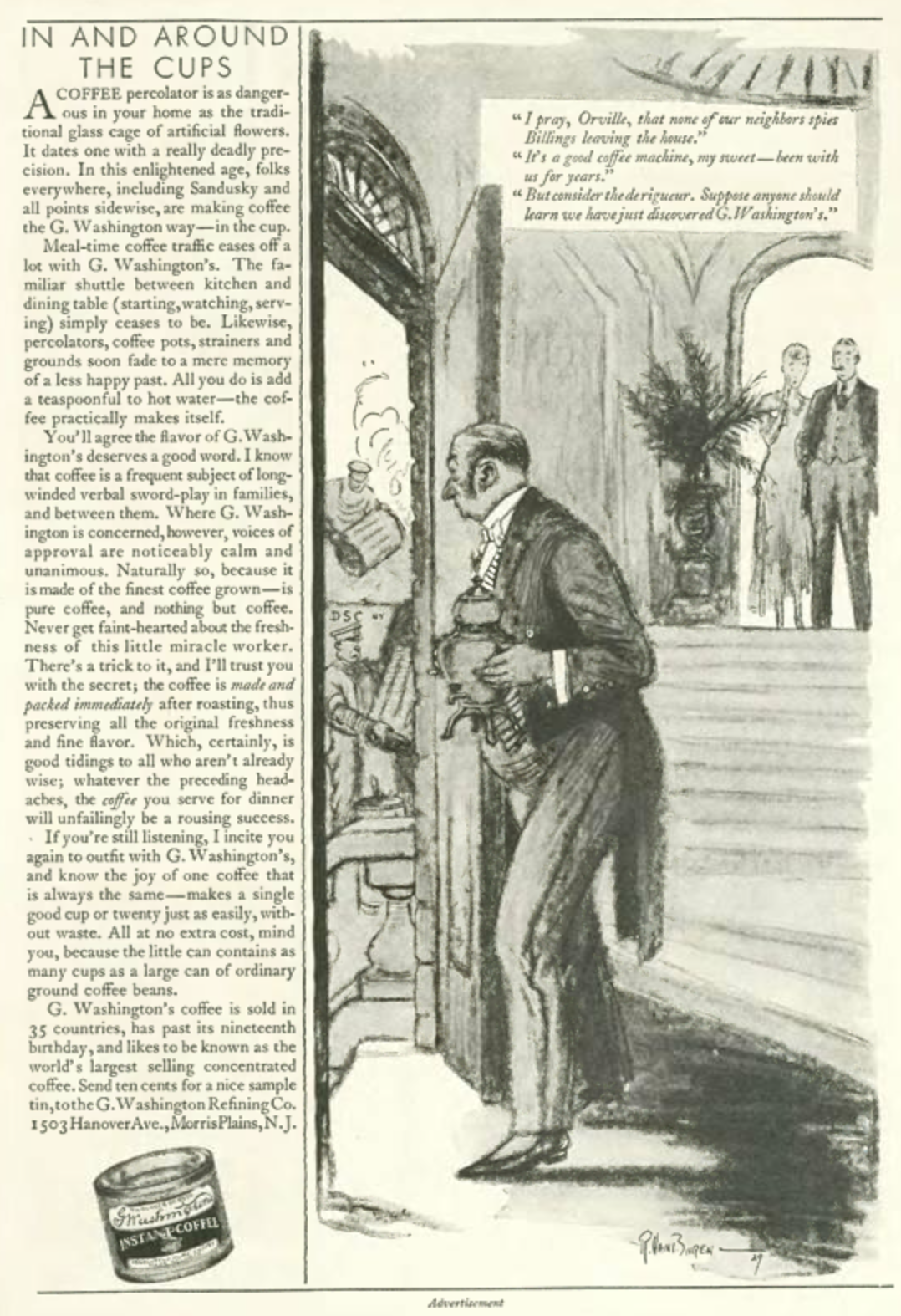
Raeburn Van Buren for G. Washington’s instant coffee (also a client of Helen Hokinson’s)…
…and Helen Hokinson for Frigidaire…

…and on to cartoons for Dec. 21, Hokinson again…

…and we end with Peter Arno, and another peek into marital bliss…

Next Time: The Curtain Falls…


Back to Business

Two weeks had passed since the “Black Tuesday” collapse of share prices on the New York Stock Exchange, but the New Yorker went about business as usual, E.B. White opening his “Notes and Comment” with a complaint — not about the economy — but about a marketing ploy that had New York University shilling magazines on behalf of Funk & Wagnalls.

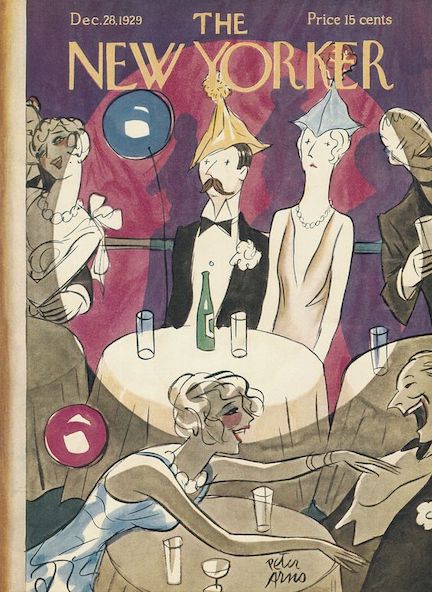
Nov. 16, 1929 cover by Peter Arno. No doubt Arno drew inspiration from his own domestic situation (with wife and New Yorker columnist Lois Long and their infant daughter Patricia Arno).

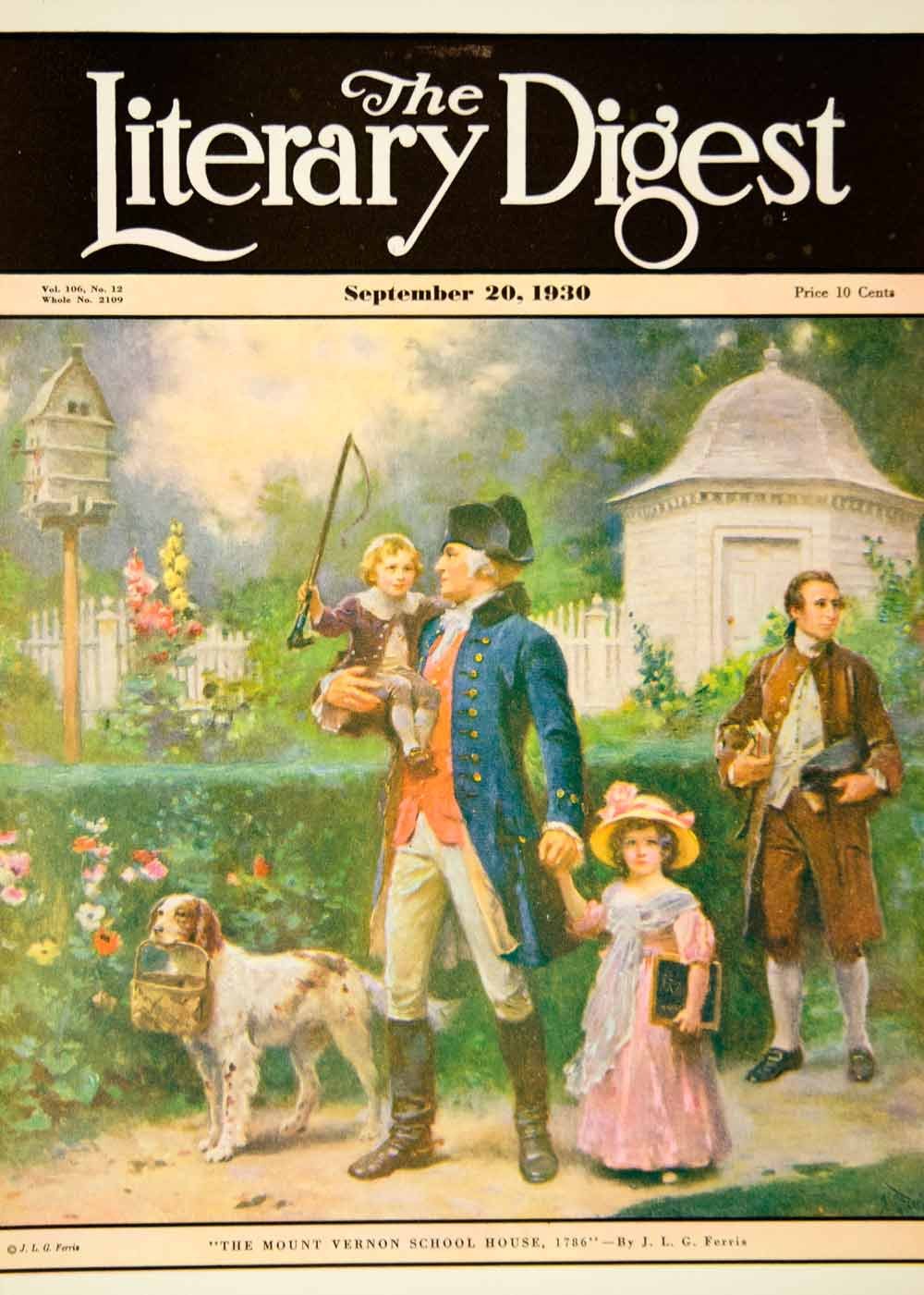
White mocked the contents of a letter from NYU that promised a “free” education to subscribers of Funk & Wagnalls’ middlebrow Literary Digest. 

EASY-CHAIR EDUCATION…Founded in 1890 by Isaac Funk (of Funk & Wagnalls fame), the Literary Digest offered readers condensed articles from various American and European publications. The weekly magazine surpassed the one million circulation mark in 1927, but declined precipitously in 1936 after its famed (and usually reliable) presidential poll picked Alf Landon over FDR. It folded in 1938. (Pinterest)

White detailed how NYU’s director of public information promised untold riches to potential Literary Digest subscribers…

YOU CAN BE FAMOUS, FOR JUST PENNIES A DAY…E.B. White mocked an NYU letter that promoted its “hook-up” with the Literary Digest, wryly suggesting that recognition in NYU’s Hall of Fame for Great Americans was within reach of magazine subscribers. The photo above (circa 1935) shows the Hall of Fame’s colonnade, which half-encircled the university library (both designed by Stanford White) and housed 98 bronze busts. A financially strapped NYU sold its University Heights Campus, along with the Hall of Fame and library, to the City University of New York in 1973. (WPA photo via boweryboyshistory.com)

…and the not so subtle revelation that the “free” education came with a price:

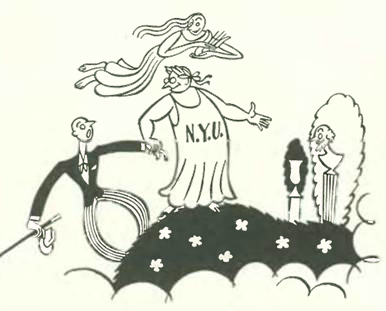
Here’s Julian De Miskey’s illustration that accompanied White’s “Notes”…

 *  *  *

The Lighter Side of Bankruptcy

Evidence of the recent stock market crash was scant in the Nov. 16 issue, save for this blurb from Howard Brubaker

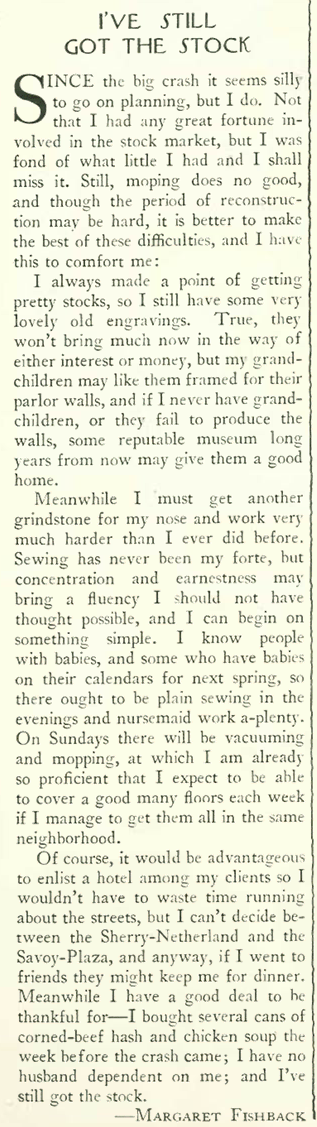
…and this short piece by Margaret Fishback, who took a characteristically lighthearted approach to the devastating news:

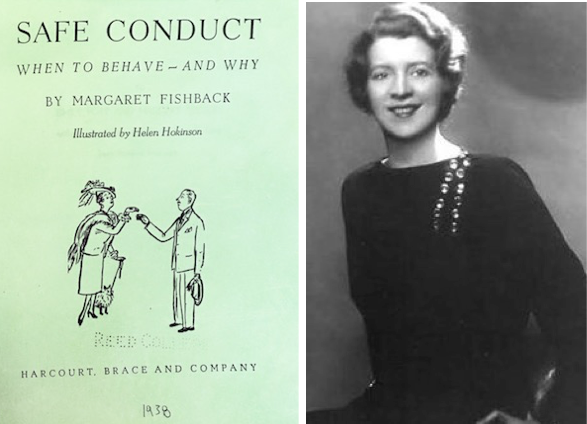
Fishback (1900-1985), a widely published poet and prose author from the late 1920s to the 1960s, was also a successful advertising copywriter for Macy’s and a number of other companies.

A WAY WITH WORDS…Margaret Fishback wrote a number of poetry and prose books, including Safe Conduct: When to Behave–and Why, a book of etiquette illustrated by The New Yorker’s Helen Hokinson. During the 1930s Fishback was reputed to be the world’s highest-paid female advertising copywriter. (necessaryfiction.com/Wikipedia)

*  *  *

We Stand Corrected

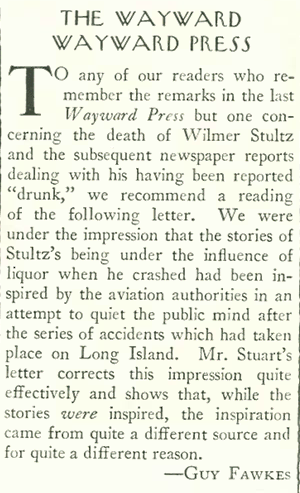
A correction of sorts was offered by Robert Benchley (aka “Guy Fawkes”) regarding one of his recent “Wayward Press” columns, in which the fatal crash of famed aviator Wilmer Stultz’s stunt plane was misattributed to drunkenness:

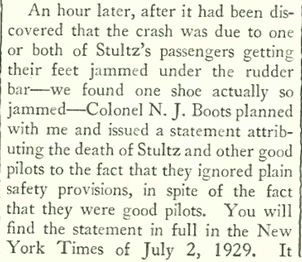
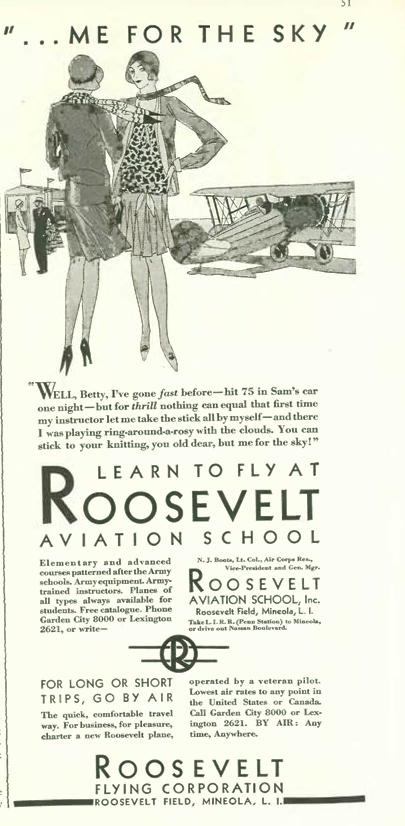
Following the above intro, Benchley included this letter from a representative of the Roosevelt Flying Corporation, John McK. Stuart, in which Stuart explained the real reason for the pilot’s fatal crash, and the source of a vicious rumor:

The cause of the crash, as reported in The New York Times, was attributed to two young men who begged for a ride on Stultz’s stunt plane, a Waco Taperwing, in the early afternoon of July 1, 1929. An investigation of the wreckage found shoes from both passengers jammed under a bar connected to the rudder, rendering it inoperable. In his letter, Stuart explained:

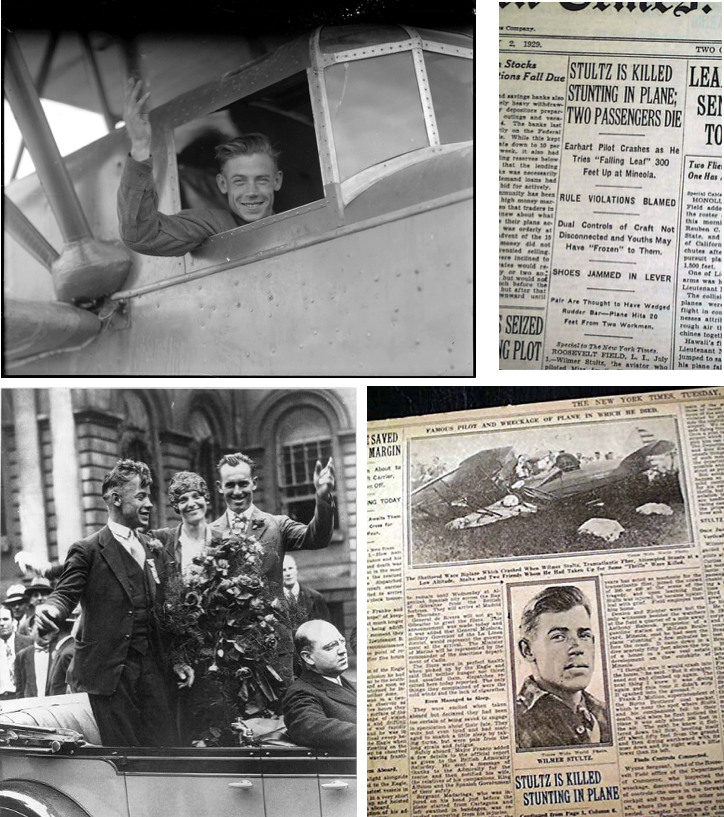
Apparently Stultz’s passengers had braced themselves during stunt maneuvers by jamming their feet under the rudder bar. According to the Times, after a couple of rolling stunts the plane began to climb again from about 200 feet when it rotated nose down and plunged into the ground. Both passengers were killed instantly. Stultz died shortly thereafter at a Long Island hospital.

BRIEF FLIGHT THROUGH LIFE…Clockwise, from top left, Wilmer Stultz (1900-1929) in undated photo; coverage of the fatal crash in the July 2, 1929 New York Times; Stultz, Amelia Earhart, and Lou Gordon feted in front of City Hall, New York City, following their successful flight across the Atlantic in June 1928. Stultz was the pilot of the Fokker Trimotor “Friendship,” aboard which Earhart became the first woman passenger to cross the Atlantic by airplane. Gordon served as the flight’s on-board mechanic. (Boston Public Library/New York Times/Amazon)

 *  *  *

Cowardly Attack

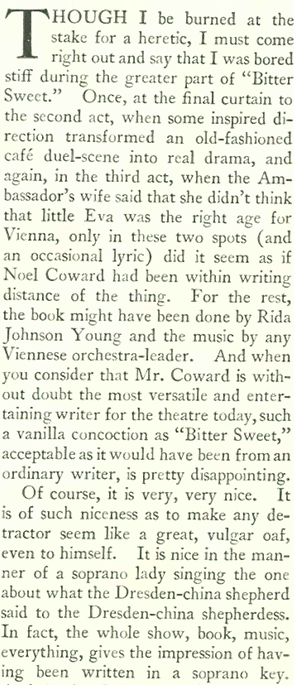
The acclaimed English playwright and composer Noël Coward was much beloved by The New Yorker, so it pained Robert Benchley to write an unflattering review of Coward’s operetta, Bitter Sweet:

IN THE SOPRANO KEY…British musical star Evelyn Laye (1900-1996) played the leading role of Sari in Noël Coward’s Broadway production of Bitter Sweet. (From The Bygone)

 *  *  *

Hat Shop Heroine

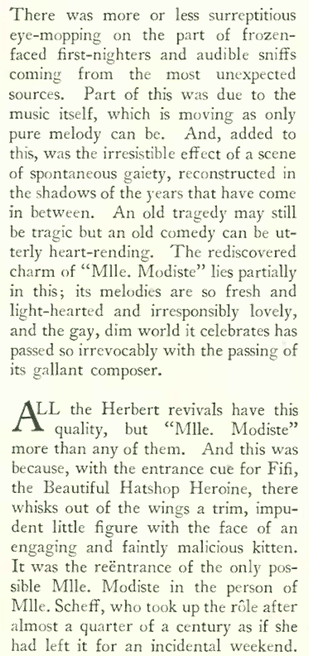
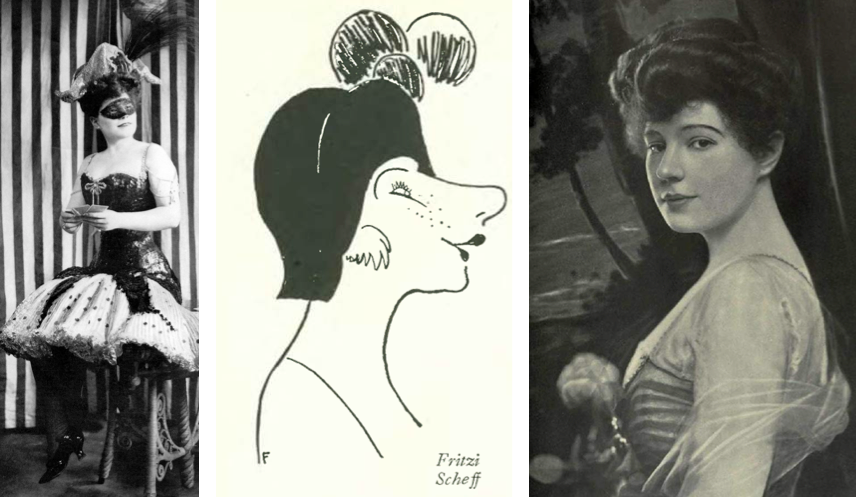
Another operetta — Mlle. Modiste — was getting a Broadway revival at Jolson’s 59th Street Theatre. Its star, Fritzi Scheff (1879-1954), was the subject of a short profile penned by Alison Smith. The operetta, written expressly for Scheff, premiered on Broadway in 1905 at the Knickerbocker Theatre, and enjoyed many revivals. Smith found that after nearly 25 years, Scheff still embodied the role of the hat shop girl who dreamed of being an opera singer. An excerpt:

From left, Fritzi Scheff in Mlle. Modiste (1905); Al Frueh’s caricature of Scheff for the profile; Scheff circa 1910. (Wikipedia/IMDB)

 *  *  *

Best of Both Worlds

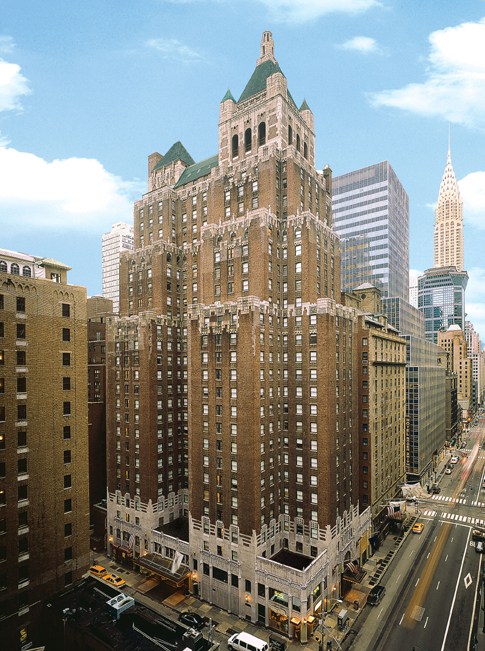
Although the Gothic style was quickly falling out of fashion in the age of Art Deco, architecture critic George S. Chappell found much to admire in Schultze & Weaver’s new Hotel Lexington, part of the hotel construction boom in New York’s Midtown:

STILL ATTACHED TO THE EARTH…The Lexington today, now a Marriott property, at 511 Lexington Avenue and 48th Street. (ohrllc.com)

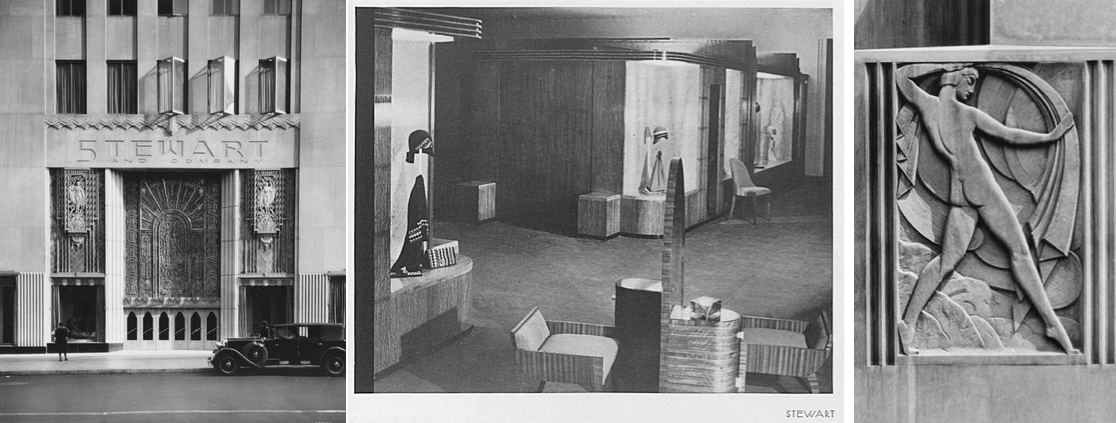
Chappell also admired the “smart” new Stewart Building, calling it the perfect setting for “feminine luxuries”…

Sadly, the Stewart Company folded just months after the opening of its new building, an early victim of the Depression. Bonwit Teller took over the building in 1930 and stayed until 1979. It was demolished in 1980 to make way for Trump Tower.

BYGONE ELEGANCE…Stewart and Company’s metal and ceramic 5th Avenue entrance, detail, 1929; Stewart Millinery Shop, 1929 (image from Vogue); detail from ornamental frieze above the 8th story, 1929. The building was demolished in 1980 to make way for Trump Tower. Neither the frieze nor the ornate ironwork were saved. (Museum of the City of New York/Vogue via drivingfordeco.com)

 *  *  *

A Survivor’s Tale

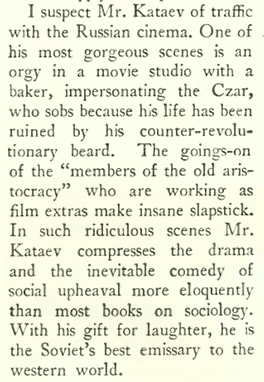
The New Yorker hailed Soviet writer Valentine Kataev’s debut novel, The Embezzlers, as “the first hearty and sane laugh that has been heard over the noise of Russian propaganda.” Published in 1926 and translated into English in 1929, the novel was a satire of bureaucracy in the new Soviet state. Remarkably, Kataev (1897-1986) was able to write challenging, satirical works throughout his long life and career without running afoul of Soviet authorities, or falling victim to Stalin’s terror campaigns:

SATIRICAL SOVIET…Valentine Kataev circa 1930. His 1926 debut novel, The Embezzlers, was a satire of Soviet bureaucracy. (russkiymir.ru)

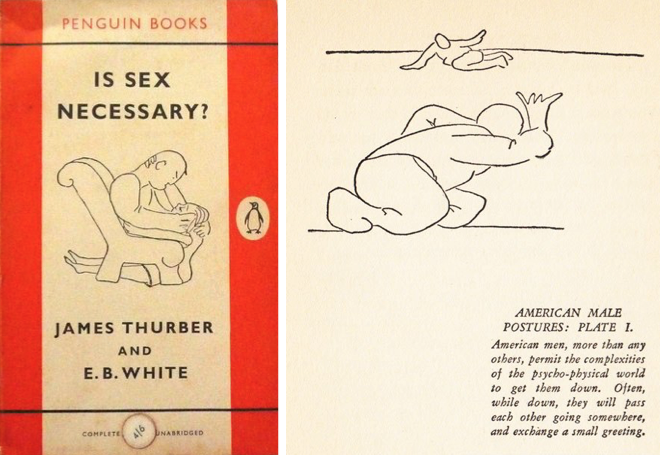
Another title receiving a favorable review, Is Sex Necessary? — a spoof of popular sex manuals and how-to books — was co-written by The New Yorker’s James Thurber and E.B. White, with illustrations provided by Thurber.

HE CAN DRAW, TOO…Although James Thurber had yet to publish one of his drawings in The New Yorker, the book Is Sex Necessary? featured 42 of them, including the illustration at right that demonstrated the male greeting posture, and below, the posture of a man who could not discern the difference between love and passion. (brainpickings.org)

 *  *  *

Old News

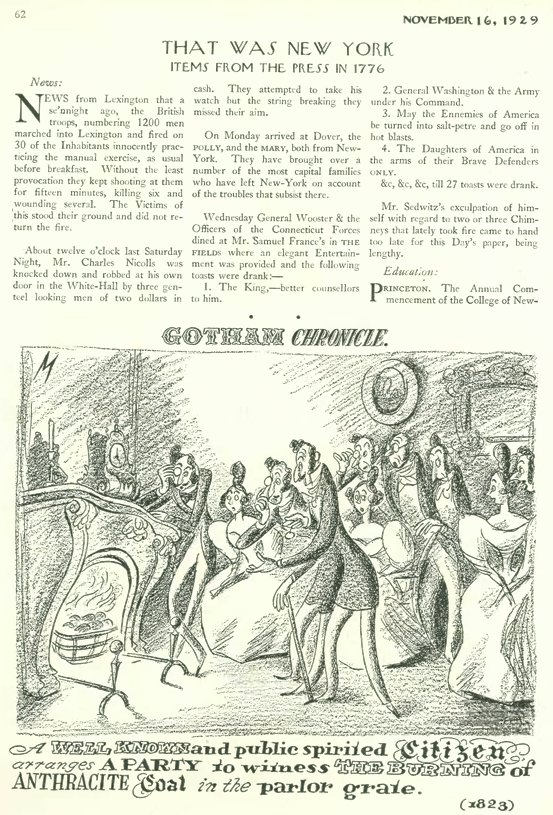
Writer (and later screenwriter) David Boehm temporarily took over the history column “That Was New York” from playwright Russell Crouse and contributed the first in a series of articles featuring clippings from 18th century newspapers (with illustration by Julian De Miskey):

 *  *  *

From Our Advertisers

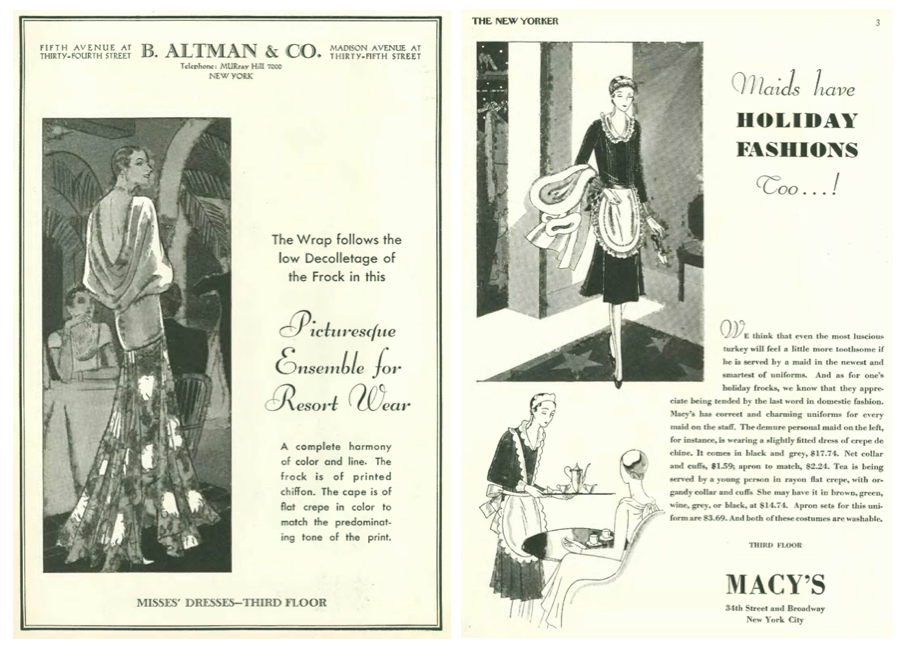
The Depression was coming, but you wouldn’t know it by the ads that appeared in the Nov. 16 issue, which featured the latest in resort wear, and holiday fashions for the maid…

…the Jay Thorpe store assumed some readers had $1,250 to spare for this coat and muff (equivalent to about $18,000 today), while Udall and Ballou jewelers offered a brooch for $9,000 (or nearly $130,000 today)…

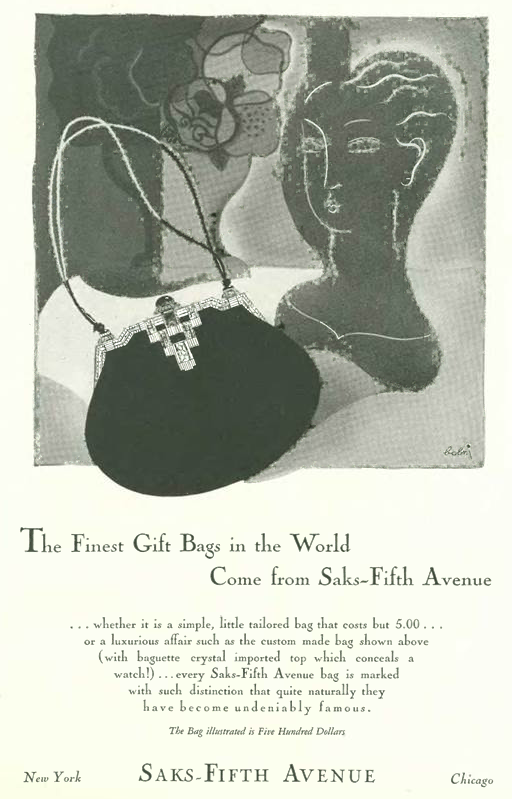
…Saks offered a “simple little tailored bag” for $5, although the one pictured in the ad would set you back $500 ($7,200 today)…

…in this clever ad for Kayser silk hosiery, illustrator Ian Oliver drew a shelf from negative space to allow the model some room to lean…

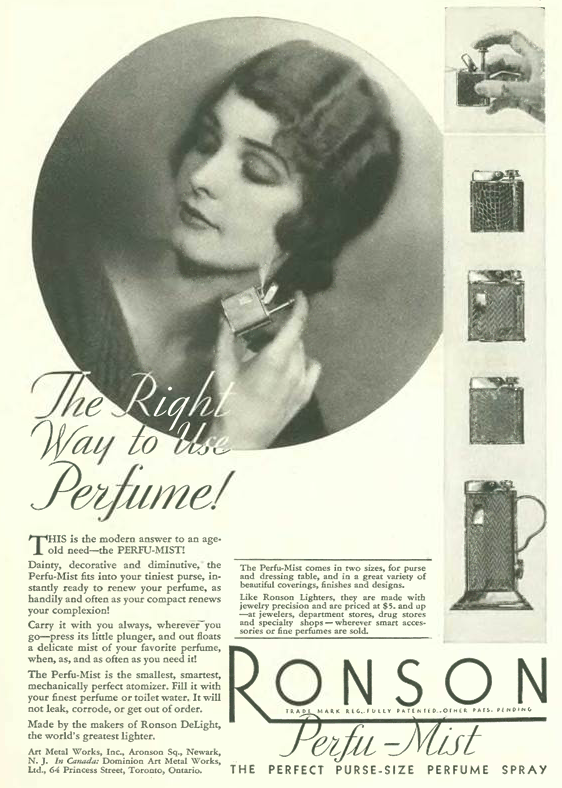
…makers of the Ronson cigarette lighter found a new use for their product, adapting it to serve as a perfume atomizer…I wonder how many women accidentally lit their hair on fire, or took a shot of perfume to the eyes when they wished to have a smoke…

…while you had the lighter handy, you could light up an Old Gold, and thanks to the lack of truth-in-advertising standards, you could do it believing that you were also warding off a winter cold…

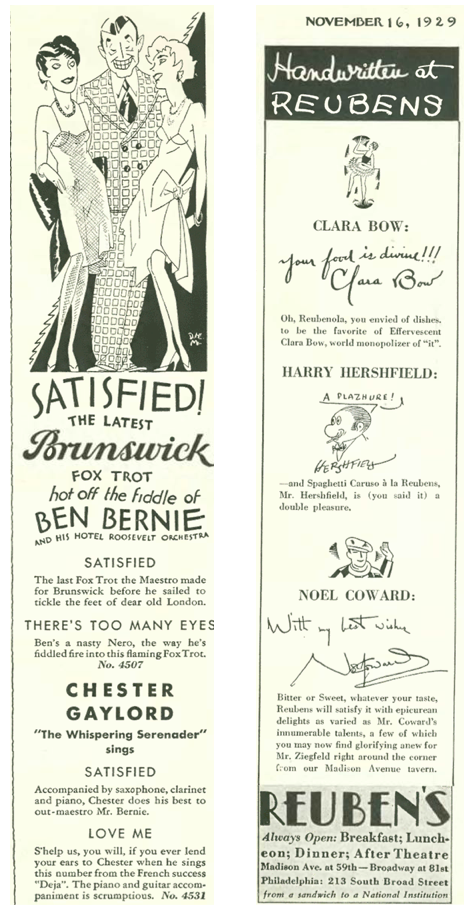
…from the back pages we have these gems from Brunswick records, and Reuben’s restaurant, which featured written testimonials from famous clientele including the “It Girl” actress Clara Bow, cartoonist Harry Hershfield, and playwright Noël Coward

Dr. Seuss offered his latest take on the uses of Flit insecticide, here sprayed directly into a user’s face for maximum benefit…

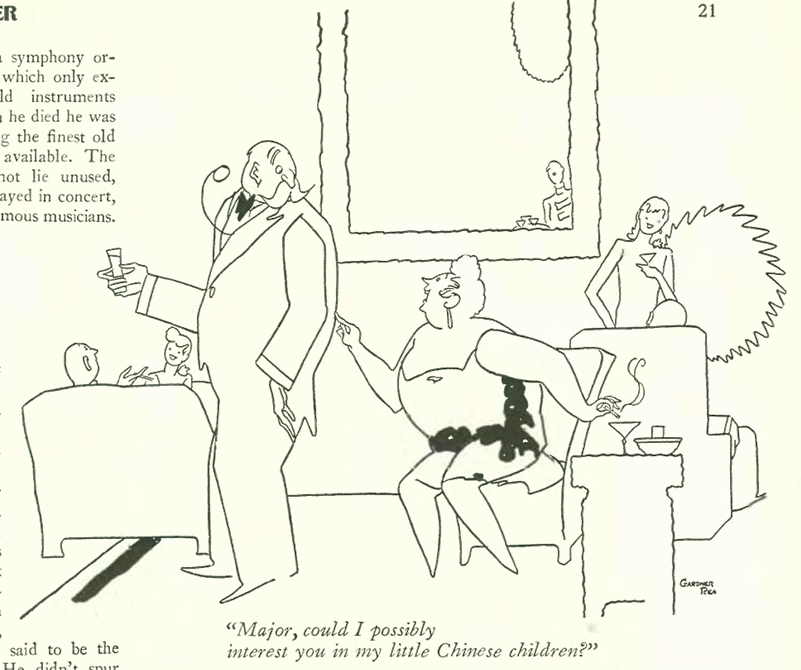
…our cartoons come courtesy of Gardner Rea, who looked in on an act of charity…

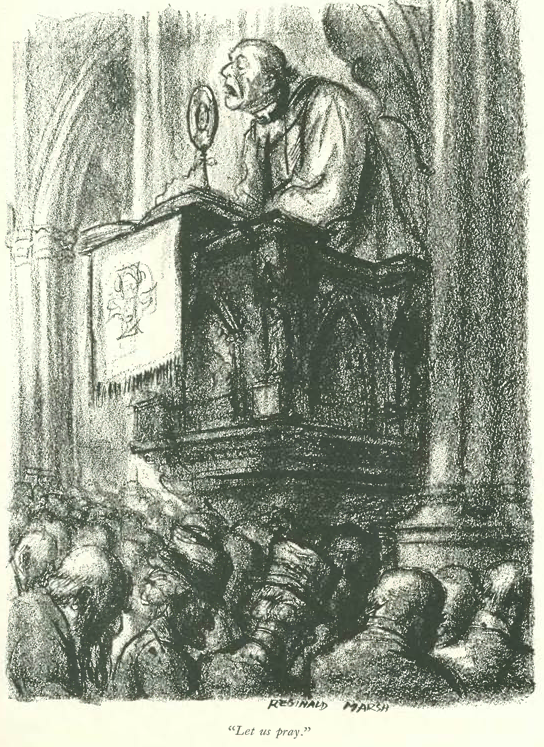
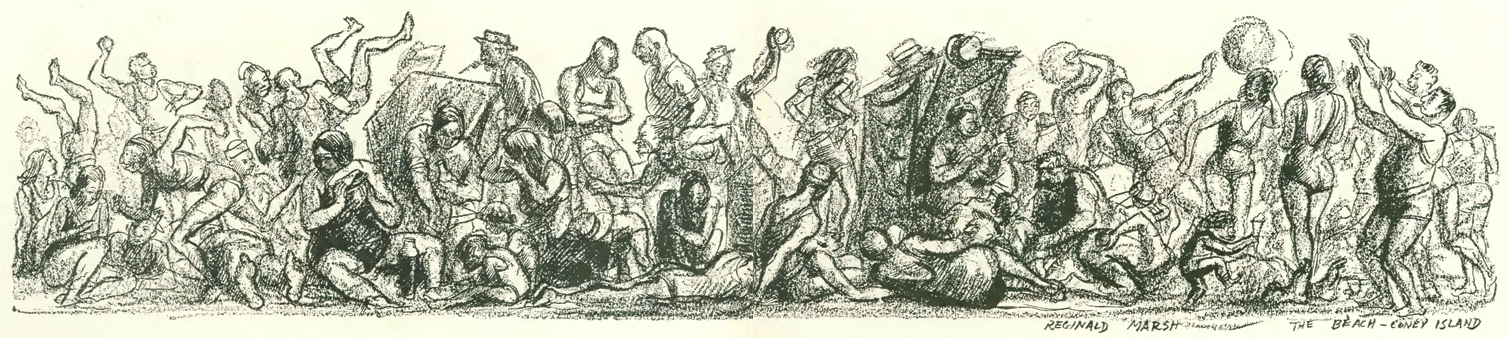
Reginald Marsh illustrated a new use for broadcast radio…

Barbara Shermund put the “idle” in “idle rich”…

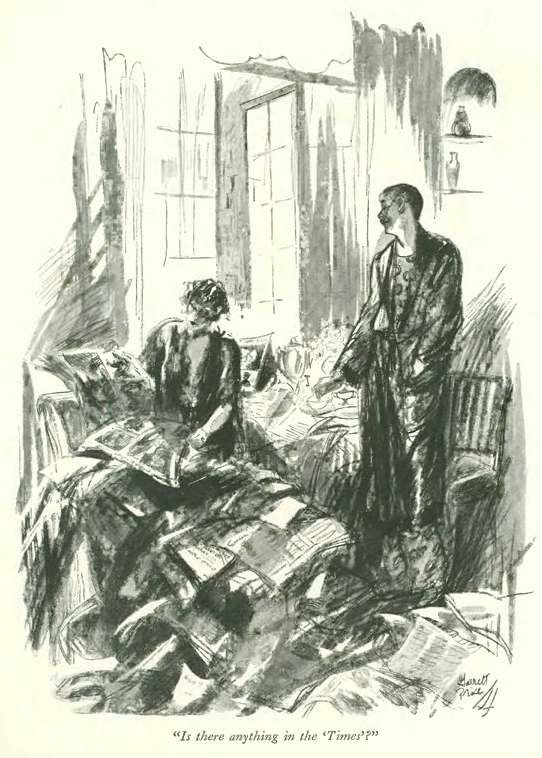
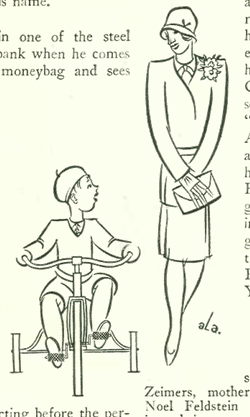
Garrett Price gave us this lovely illustration of a casual reader…

…and Helen Hokinson went shopping with one of her society women…

Next Time: A Glimpse of the Future…


An Inconvenient Truth

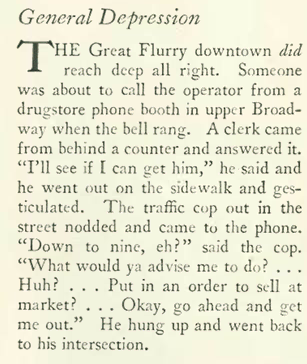
The New Yorker offices at 25 West 45th Street were a long walk from Wall Street, but the panic that gripped the city beginning on Oct. 24 spread quickly through the borough. What the panic was about, however, wasn’t exactly clear.

Nov. 2, 1929 cover by Constantin Alajalov.

There was fear in the air, and a hint of doom, when E.B. White submitted his “Notes and Comment” section for the Nov. 2 issue. Having filed his column sometime between October 24 (“Black Thursday”) and October 29, 1929 (“Black Tuesday”), he weighed the mood of his city against the reassurances offered by politicians, bankers and pundits…

TELLERS OF TALES…As the New York Stock Exchange headed toward collapse, President Herbert Hoover, Thomas Lamont (head of the Morgan Bank) and prominent journalist Arthur Brisbane offered assurances that all was well. (Wikipedia/bhg.com)

…and expressed schadenfreude over “a fat land quivering in paunchy fright” and some satisfaction in confirming his suspicions that “our wise and talky friends” on Wall Street really didn’t know what they were talking about:

THEY MADE A MESS OF THE ECONOMY, TOO…Sweeping the floor of the New York Stock Exchange after the Wall Street crash of 1929. (Wikipedia)

It seems White might have believed the worst was over, and that Wall Street would get back to its gambling spirit…

TALES OF TWO CITIES…The Brooklyn Daily Eagle proclaimed panic in its late edition on “Black Thursday,” Oct. 24; however, a day after the “Black Tuesday” crash of Oct. 29, The New York Times offered a more optimistic outlook for the days ahead.

In “The Talk of Town” we find the first use of the word “Depression” in The New Yorker as it is related to the economic collapse…

BUSTED…Crowds gather on Wall Street following news of the stock market crash. (Library of Congress)

*  *  *

Mr. Blue Sky

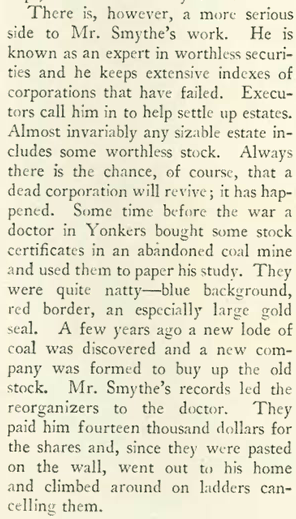
On the subject of stocks, “Talk” also featured this mini profile (written by Robert Coates) of Roland Mulville Smythe (1855-1930), who specialized in buying and selling old and obsolete stocks.  Nicknamed “No Telephone” Smythe for his dislike of the device, he began his trade in obsolete securities and banknotes sometime around 1880…

MARKET GLEANER…Title page of Roland Smythe’s 1929 book, Valuable Extinct Securities. The notation beneath his portrait reads “No Telephone.” (worthpoint.com)

Coates told the story of a Yonkers doctor who used what he thought were worthless stock certificates (from an abandoned coal mine) to paper the walls of his study. Thanks to Smythe’s meticulous record-keeping, when a new lode was discovered at the mine, the doctor learned his wallpaper was worth $14,000 (equivalent to about $200,000 today)…

WALL STREET JUNKER…Share bought by Roland M. Smythe in 1899 and signed by him on the reverse side. At right, unusual obituary headline for an unusual man. (scripophily.org)

…Coates concluded by describing Smythe’s aversion to the telephone, and his talent for bowling…

 *  *  *

Rise of the Machine

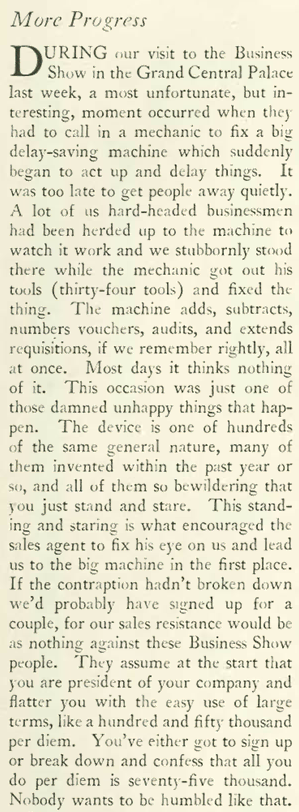
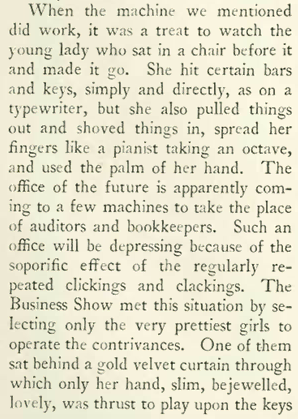
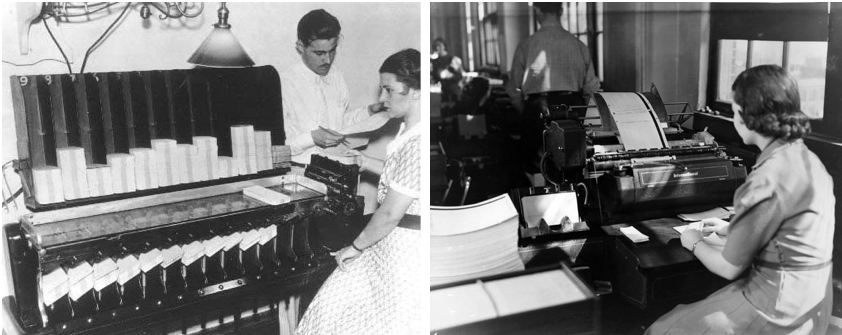
Ironically, the National Business Show was staging a big exhibition in Midtown while the economy was collapsing Downtown. James Thurber was on hand at the Grand Central Palace to take in the wonders of the machine age…

NOT MY TYPE…Manufacturers of the Underwood typewriter staged a typing competition at the 1929 National Business Show at the Grand Central Palace. From left are George Hossfield, Stella Willins (with her typewriter “Timmy”), Irma Wright and Albert Tangora. Hossfield, the men’s champion, could type 157 words a minute. The women’s champion — and the world’s champion typist of the 1930s — Willins once typed 128 words a minute for an entire hour without a mistake. She could type 240 words per minute from memorized lines. (oztypewriter.blogspot.com)

…Thurber seemed as impressed by the machines as by the “very prettiest girls” who were on hand to demonstrate them…

LOOKS COMPLICATED…At left, National Cash Register touted its business machines in this ca. 1930 ad; at right, a woman demonstrates a mimeograph machine in the 1920s. (Pinterest)
SHOCK OF THE NEW…At left, these young operators contemplate the operation of an IBM Type 80 horizontal Hollerith card sorter. The woman appears less than thrilled by the mechanical beast; at right, a woman operates a IBM 405 Alphabetic Accounting Machine, ca. 1934. It could process 150 cards a minute and keep track of multiple sums while printing data on continuous-sheet forms. (officemuseum.com/computerhistory.org)

 *  *  *

What a Strange Trip It’s Been

This brief “Talk” entry by Alfred Richman related a story from a traveling salesman just returned from Moscow. Among the highlights of his visit was a Soviet movie that “featured” America’s Sweetheart, Mary Pickford, in the title role…

In the 1920s, silent film stars Mary Pickford and Douglas Fairbanks were perhaps the most famous couple in the world. That included in the Soviet Union, where moviegoers preferred American films over their own avant-garde fare (while on the other hand, the New Yorker found Soviet films to be far more advanced than Hollywood’s). While vacationing in Moscow in 1926, Pickford and Fairbanks visited a Russian film studio with director Sergei Komarov, who cleverly captured enough footage of the two to weave them into a silent comedy titled A Kiss from Mary Pickford (Potseluy Meri Pikford). The film was a spoof on Hollywood fame, finding humor in a loveless man’s chance meeting (and kiss) with Mary Pickford, and his sudden and unexpected attractiveness to the opposite sex.

FUN WHILE IT LASTED…At left, Soviet film poster for Sergei Komarov’s A Kiss From Mary Pickford, featuring Russian actors Anel Sudakevich and Igor Ilyinsky (in the center photos) with various cameos by Mary Pickford and Douglas Fairbanks; at top, Soviet movie posters featuring Fairbanks and Pickford; bottom right, the couple feted by Russian fans, who presented Pickford with the headdress. The year 1929 would mark the end of such films in the Soviet Union — as Stalin began forced collectivization, he declared that Soviet cinema should only satisfy “the basic demands of the proletarian collective farm mass viewer.” Remarkably, Komarov and the actors Sudakevich and Ilyinsky would survive the years of Stalinist terror that would follow, even living to old age. (IMDB/transmediale.de/Facebook fan site)

 *  *  *

Fire and Ice

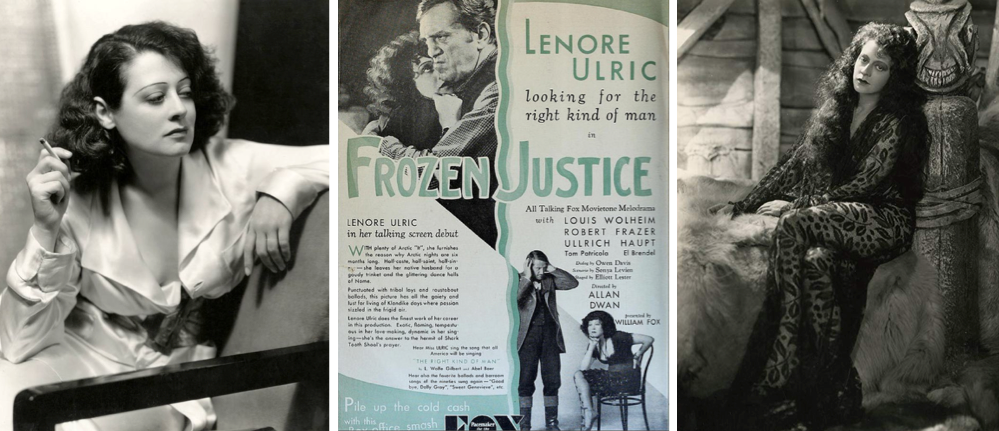
Back stateside, New Yorker film critic John Mosher took in the talking film debut of the hugely popular stage actress Lenore Ulric (1892-1970). Known on Broadway for her portrayals of fiery women, she tried, it seems unsuccessfully, to bring some of that heat to Frozen Justice, which was set in Alaska during the Klondike Gold Rush…

FEMME FATALE…Lenora Ulric, who made less than 20 films, was known for her work on the stage. At left, Ulric taking a break from her Broadway work in the early 1930s; center, magazine ad for Frozen Justice; at right, Ulric as the half-Eskimo Talu in Frozen Justice. (Pinterest/IMDB)

 *  *  *

Right Ho, Plummie (CORRECTION: Not So, Plummie)

I incorrectly attributed this poem in the Nov. 2 issue to British humorist P.G. Wodehouse

…thankfully, an alert reader kindly pointed out that “Ode to Peter Stuyvesant” isn’t by Wodehouse, but by another person with the initials P.G.W. — Philip G. Wylie.

HE COULD BE FUNNY, TOO…Short story writer, screenwriter and satirist Philip G. Wylie in an undated photo. (Wikipedia)

 *  *  *

From Our Advertisers

We begin with the back pages, where toaster wars were being waged by the makers of the “Toastmaster” and Thomas Edison’s “Automaticrat”…

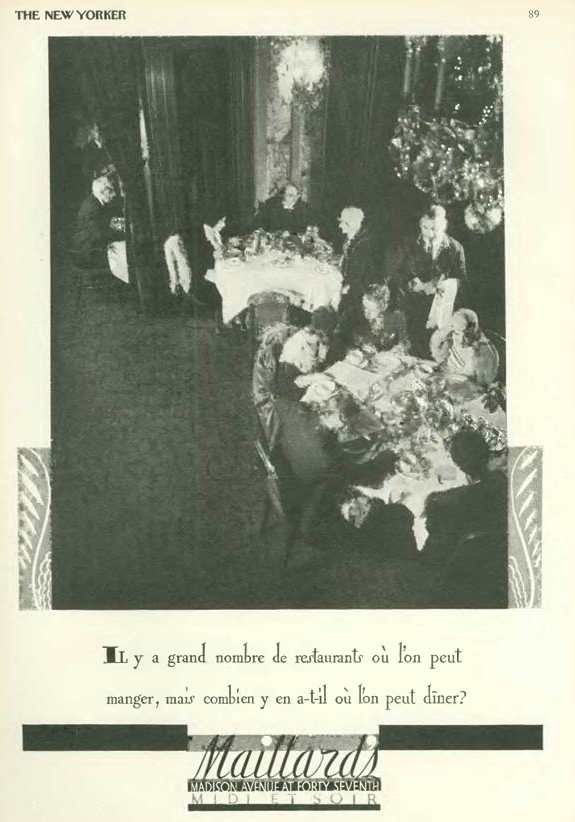
…for some in the posh set, the days of fine dining at places like Maillard’s (with this all-French ad) would be coming to an end thanks to the market crash…actually, Maillard’s itself would come to an end in the 1930s, thanks to the Depression…

…stage, film (and later television) actress and dancer Queenie Smith was the latest celeb to tout the wonders of Lux Toilet Soap…

Queenie Smith circa 1930. (IMDB)

…here’s an unusual way to sell shock absorbers…I’m wondering if this is supposed to be a sugar daddy and a chorus girl trying to make hay in the back seat of a car without Houdaille shocks…

…a couple more ads from the back pages, the ones on the left appeal to women’s fitness, while the ad on the right tries its best to push a product that was fast going the way of the horse and buggy. Spats — devised in the late 19th century to protect one’s shoes and socks (then called stockings) — went out of fashion in the 1930s, no doubt because most streets were now paved and you didn’t have to worry about a passing wagon splashing mud and horseshit all over your shoes and ankles…

…and indeed, now you could have Goodrich Zippers, in smart new colors…

…and speaking of colors, a couple of richly toned ads for Arrow Shirts…

…and Camel cigarettes…

…on to our illustrators and cartoonists…spot drawings — sprinkled throughout the magazine — were often a foot in the door for aspiring contributors (Peter Arno and Charles Addams are just two examples). Below is a collection of spot drawings from the Nov. 2 issue, mostly from established artists including Barbara Shermund, Alice Harvey, Julian De Miskey, Gardner Rea, Johan Bull and I. Klein. The New Yorker also recycled old cartoons for spots, including the illustration below (third row, second one down) by Shermund of the young woman on telephone, which originally appeared in the July 16, 1927 issue with the caption, “Hold the line a minute, dear—I’m trying to think what I have on my mind.”

Arno continued to provide illustrations for Elmer Rice’s serialized novel, A Voyage to Purilia

…and Julian De Miskey illustrated G. Marston’s entry for the ongoing “That Was New York” column…

…our cartoons come from Barbara Shermund

Gardner Rea, having a political moment…

…for reference, a photo of Mayor Jimmy Walker

brookstonbeerbulletin.com

Shermund again, on the joys of parenthood…

Peter Arno’s take on Jazz Age chivalry…

…and perhaps the timeliest entry of all, from Leonard Dove

Next Time: Not Much to Cheer About…


Race to the Sky

Almost ninety years after the lights went out on the Roaring Twenties, our collective imagination of New York City still harks back to that time…the sights and sounds of nightclubs and speakeasies and Broadway lights set to the tune of the Jazz Age.

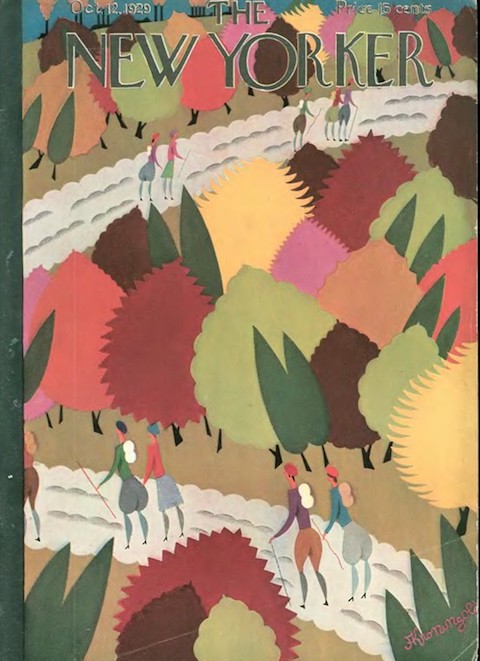
Oct. 12, 1929 cover by Adolph K. Kronengold.

And no wonder, since that decade made the city what it is today. Changing social mores, along with labor-saving electrical appliances and the ubiquitous automobile, altered the tempo of life. And this quickened pace was also reflected in the built environment, old landmarks reduced to rubble while gleaming skyscrapers rose up in their place seemingly overnight. A Victorian edifice like the Waldorf-Astoria — little more than 30 years old — seemed positively ancient to Jazz Age New Yorkers, who unceremoniously knocked it down to make way for what would become the city’s most iconic landmark.

New Yorker architecture critic George S. Chappell (aka “T-Square”) sensed that something big was on the horizon with his regular “Sky Line” updates on the city’s “tallest-building-in-the-world” contest. In the Oct. 12, 1929 issue he looked on admiringly as the Chrysler Building’s distinctive dome began to take shape:

IT’LL BE A SURPRISE…The Chrysler Building still lacked its gleaming art deco dome in this photo taken in the fall of 1929. At left is the Chanin Building, completed earlier that year. (reddit/adamunderhill.wordpress.com)

Chappell observed that the Chrysler Building’s claim as the world’s tallest would be short-lived, as plans for the Waldorf-Astoria site called for a much taller structure…

DOOMED…The old Waldorf-Astoria hotel (left), completed in 1897, was scarcely more than 30 years old when it was demolished to make way for the Empire State Building. The former governor of New York, Al Smith (inset) led the corporation that knocked down the old hotel and erected the world’s tallest building on the site. Demolition of the hotel began on October 1, 1929 (images at right). In his 2014 book The Empire State Building: The Making of a Landmark, John Tauranac observes the demolition was an arduous process, as the hotel had been constructed using more rigid material than what was found in earlier buildings. Those materials — granite, wood, and metals such as lead, brass, and zinc — were not in high demand. Most of the wood was deposited into a woodpile on nearby 30th Street or burned in a swamp. Other materials, including the granite and bronze, were dumped into the Atlantic near Sandy Hook, NJ. (New York Historical Society/New York Public Library Digital Gallery)
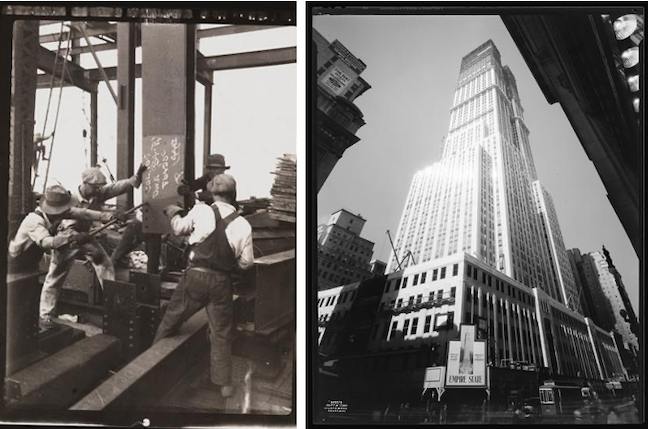
RISING FROM THE RUBBLE…The Empire State Building under construction in 1930. When completed in 1931, the 1,250 foot (1,454 with antenna) building would claim the title as the world’s tallest. It was something of a definitive victory, as the building held that record for nearly forty years. (Museum of the City of New York)

Although Al Smith’s building seemed assured to win the “world’s tallest” title, another giant was taking shape on the drawing boards…

LAND OF THE GIANTS…City Bank-Farmers Trust Building (left), now known as 20 Exchange Place, was originally designed in 1929 to be the world’s tallest building at 846 feet, but the realities of the Depression brought it down to a more modest 741 feet, making it the fourth-tallest building in New York when it was completed in 1931. At right, the 22-year-old Century Theatre on Central Park West was demolished to make way for Irwin Chanin’s Century Apartments, also completed in 1931. (Museum of the City of New York/nyc-architecture.com)

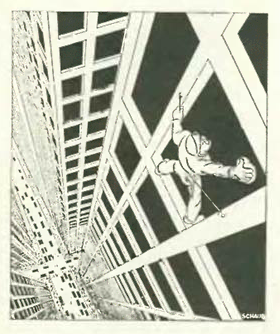
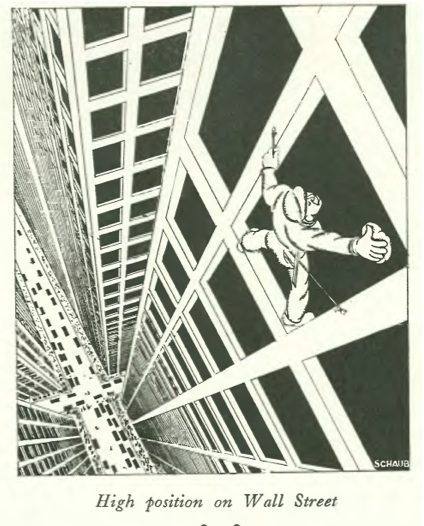
…while we are on the subject of skyscrapers, The New Yorker reprinted this illustration by Andre De Schaub to fill in a space at the bottom of page 54 in the Oct. 12 issue…

…the drawing originally appeared in the magazine three years earlier, as a cartoon in the October 16, 1926 issue. It included a caption: “High position on Wall Street” (thanks to Michael Maslin’s invaluable Ink Spill for helping me track this one down)…

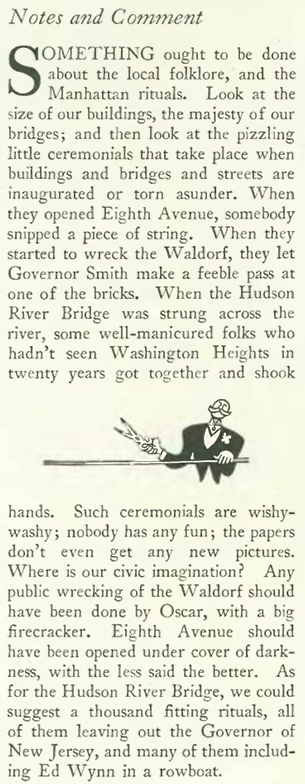
As the demolition crews picked apart the old Waldorf, E.B. White wondered why more fanfare wasn’t attached to such occasions, whether they be demolitions or ribbon-cuttings…

NEEDS MORE HOOPLA…Al Smith with his wife Catherine Dunn Smith, and two of his grandchildren at the opening ceremony of the Empire State Building, May 1, 1931. President Herbert Hoover officially dedicated the building by pressing a button in the White House that turned on the building’s lights (it was merely symbolic; they were actually turned on by some unknown maintenance worker in New York). (Museum of the City of New York)

 *  *  *

A Novel Idea

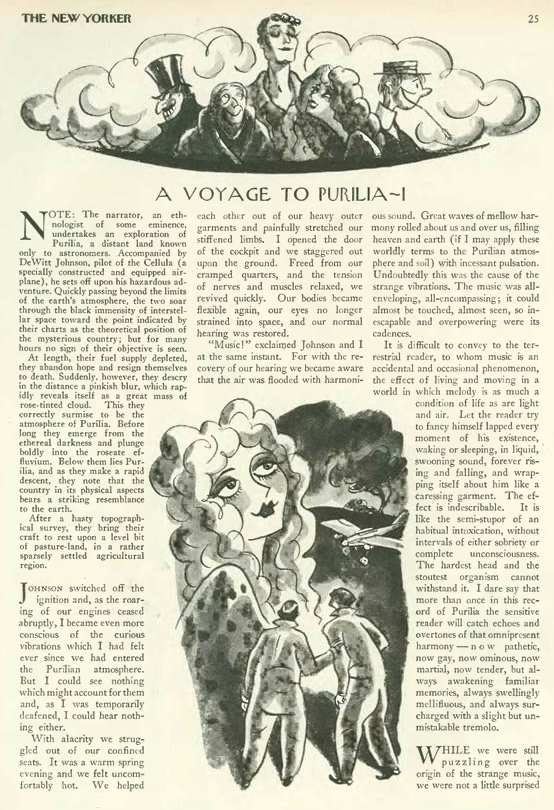
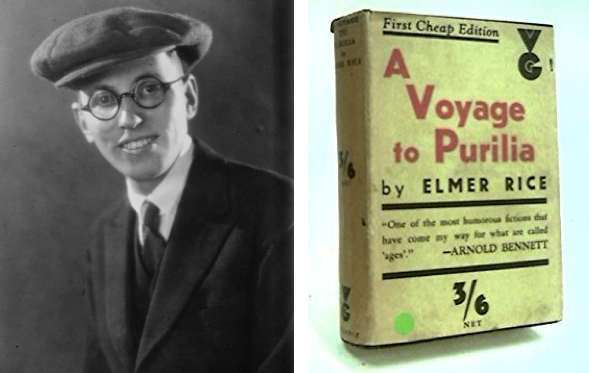
My last post featured a brief excerpt of an Oct. 5 theater review by Robert Benchley, who sized up Elmer Rice’s new play, See Naples and Die. Rice pops up again in the Oct. 12 issue, this time as the author of A Voyage to Purilia, the first novel serialized in The New Yorker. The novel was a satire on the silent film industry, set in the fictional land of Purilia. Here is the first page of the piece, with illustrations provided by Peter Arno:

SENDING UP THE SILENTS…Elmer Rice in 1920; his satirical novel about the silent film industry, A Voyage to Purilla, was serialized in The New Yorker in 1929 and published the following year. It was re-published in the 1950s as a science fiction novel. (Wikipedia/Amazon)

 *  *  *

Siren Song

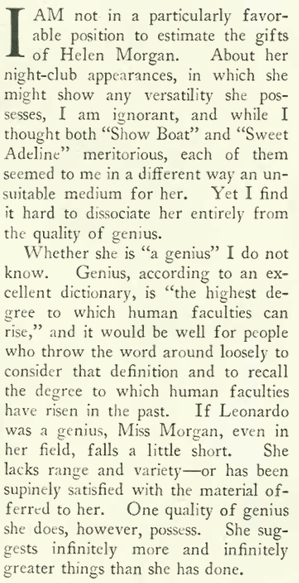
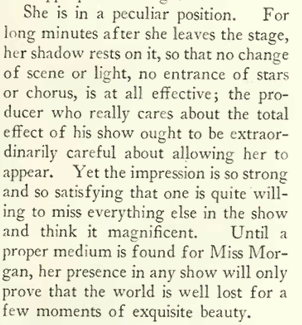
Writer and cultural critic Gilbert Seldes trained his discerning eye on the famed torch singer and speakeasy denizen Helen Morgan, attempting to understand the hard-living singer’s allure…

Helen Morgan, circa 1930. (masterworksbroadway.com)

RIGHT AT HOME…Helen Morgan made the draped-over-the-piano look of a torch singer her signature style. (Pinterest.UK)
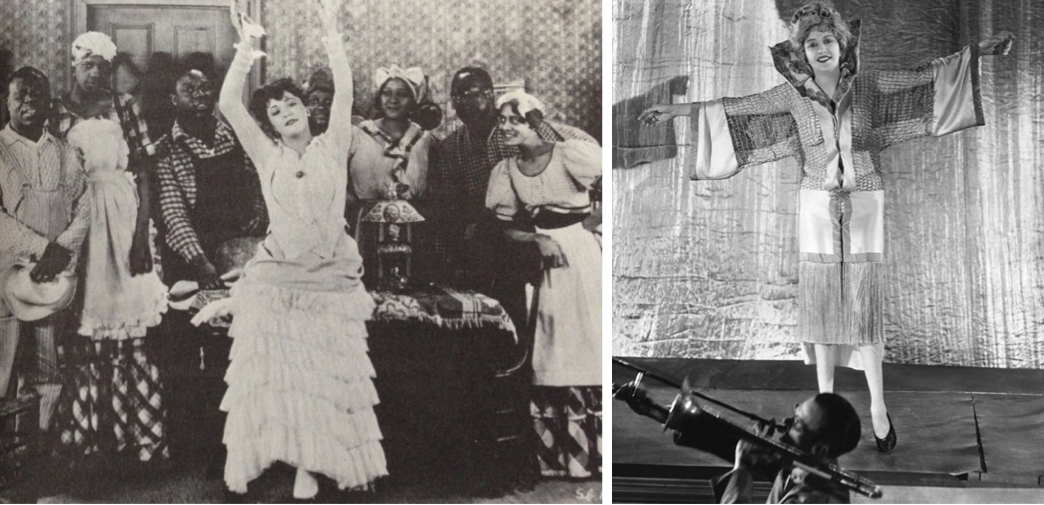
LIGHTING UP BROADWAY…Helen Morgan (left) as Julie LaVerne in the original Broadway cast of Show Boat, 1927. It was her best-known role. At right, Morgan in Applause, 1929. (Pinterest/IMDB)

Seldes struggled to understand Morgan’s appeal, which seemed to draw from an assemblage of personas…

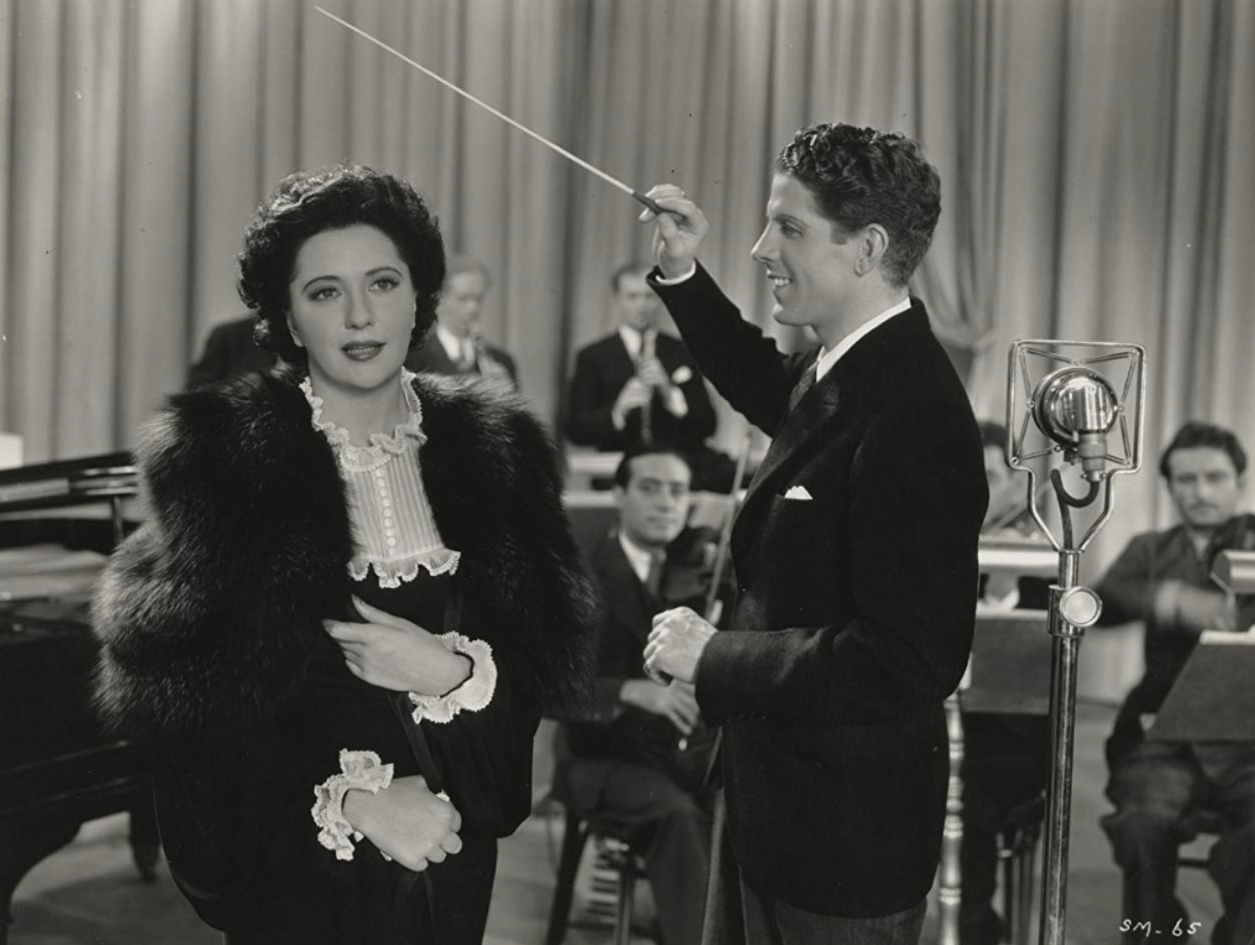
PLUMBING EMOTIONAL DEPTHS…Helen Morgan and Rudy Vallee in Sweet Music, 1935. (IMDB)

Seldes concluded that Morgan belonged with other artistic greats in her ability to create a sense of expectancy…

 *  *  *

The Invention of Distracted Driving

Writing in his “Motors” column, Nicholas Trott noted the advent of the car radio, a “new complication” to an “already over-elaborate existence.” Note that Trott viewed the car radio as something to be listened to while parked — car radios were fairly controversial back then, akin to driving while texting today.

EASY TO INSTALL…New Yorker automotive critic Nicholas Trott observed that cars were now being wired to receive radio sets (you still had to buy one and install it yourself). The system above featured battery-powered vacuum tubes, a dash-mounted dial and mono speaker. (hemmings.com)

 *  *  *

From Our Advertisers

To the refined owner of a Pierce-Arrow, a car radio would have been a crass novelty. After all, your driver was there to drive, and listen to your orders…

…unlike the Pierce-Arrow, which took pride in its heritage, the folks at Chrysler were known for their forward-thinking in design and technical innovation…

…on to some of the back page ads, we find appeals to flee the oncoming winter and escape to the golden sands of Waikiki…note the second ad, and its rather democratic invitation…

…and then we have the ads that hoped to catch the eye of the grasping Francophile, with delicacies from Louis Sherry or mock bubbly from the makers of applesauce…the second ad is particularly heartbreaking, the copy writer trying his or her best to conjure the glamour of Champagne from a bottle of apple juice. Zut!…

…fake Champagne isn’t for you? Well Leonard Dove offered us a salesman doing his best to sell a bottle of mock gin…

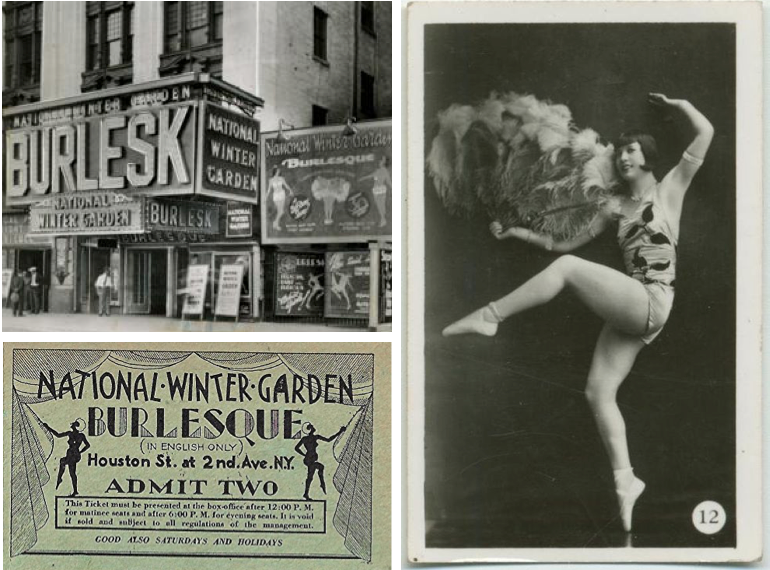
…returning to the ads, here’s one more from the back pages that references Harold Ross’s original prospectus for his magazine: “The New Yorker will be the magazine which is not edited for the old lady in Dubuque.” The ad is for Billy Minsky’s National Winter Garden, where the art of burlesque got its start. Despite the cheapness of the ad and the implied salaciousness, uptown New Yorkers loved “slumming” at Minsky’s burlesque, including artists and writers (Hart Crane even wrote a poem called “National Winter Garden”). No doubt a few New Yorker staffers found their way inside as well…

Clockwise from top left, Billy Minsky’s National Winter Garden; a 1920’s burlesque performer; a ticket for two to the show. (New York Post/Amazon/Pinterest)

…on to the illustrators and cartoonists, a nice street scene by Reginald Marsh

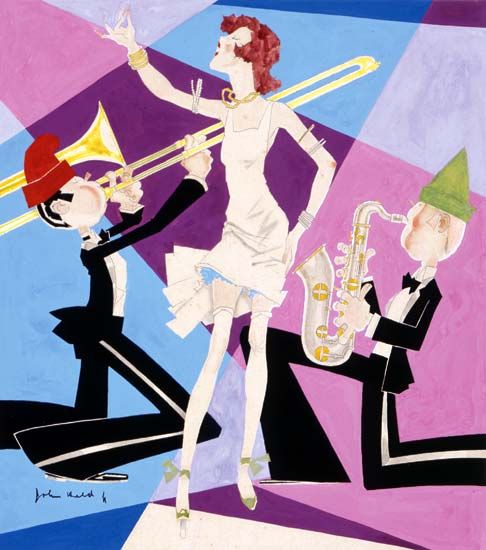
John Held Jr. contributed one of his famed “woodcuts” to the Oct. 12 issue. Held was an old childhood friend of New Yorker founding editor Harold Ross. It was Ross who encouraged Held to deviate from his popular flapper caricatures — he recalled how his friend had produced clever woodcuts in high school, and wanted something similar for his magazine…

A John Held Jr. illustration for Life magazine, 1927. (Library of Congress)

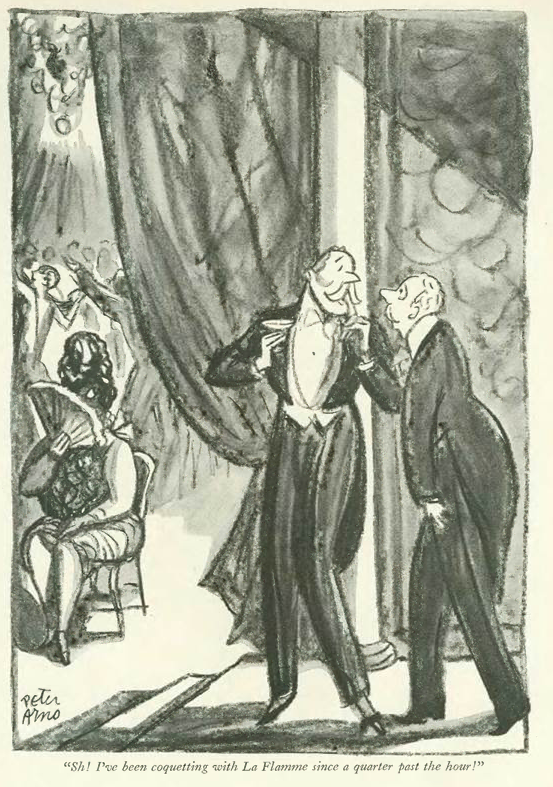
Peter Arno went behind the scenes at a posh nightclub (a familiar setting for Arno)…

Helen Hokinson found confusion at the elections…

Perry Barlow offered up this sweet slice of family life…

…and Denys Wortman illustrated the power of the pen…

Next Time: City of Glass…

American Royalty

Although the United States declared its independence from British Empire nearly 250 years ago, the royal family and all of its requisite trappings persist in the American imagination like a phantom limb.

Oct. 5, 1929 cover by Theodore G. Haupt.

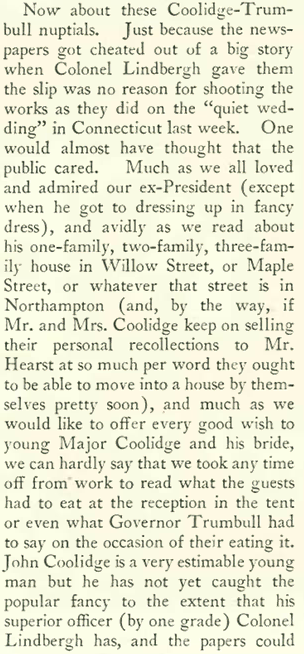
E.B. White observed as much in the “Notes and Comment” section of the Oct. 5 issue, in which he offered his views regarding the “pother” over the wedding of Calvin Coolidge’s son, John, to Florence Trumbull, the daughter of Connecticut Governor John Harper Trumbull

White could have looked no further than the pages of The New Yorker for further evidence to his claims. The bourgeois yearnings of its readers were reflected in countless advertisements laced with anglophilic pretensions. Here are examples from 1929 issues we have previously examined:

LIVE LIKE A BARON…Ads from The New Yorker of the 1920s often featured illustrations of regal, priggish types such as the couple above, deployed to sell everything from apartments and ginger ale…
…to no-frills automobiles and menthol cigarettes. No product was too pedestrian for the royal treatment.

Writing under the pseudonym “Guy Fawkes,” Robert Benchley commented further on the Coolidge-Trumbull nuptials in the “Wayward Press” column:

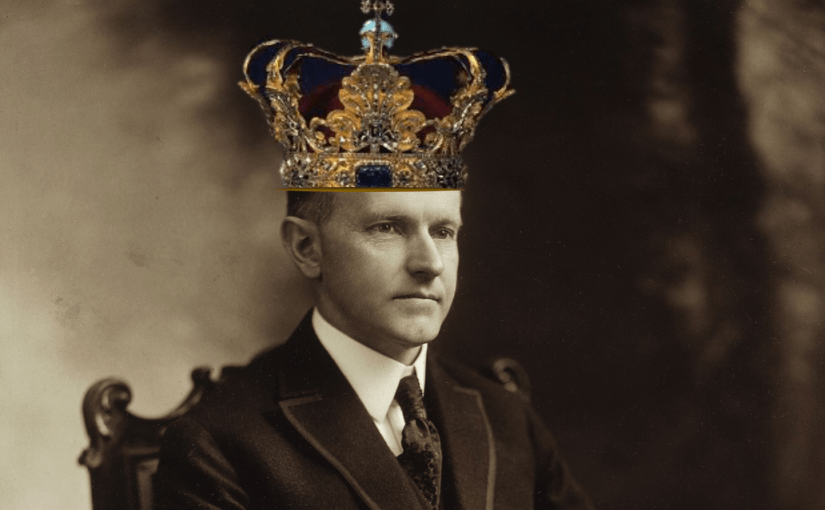
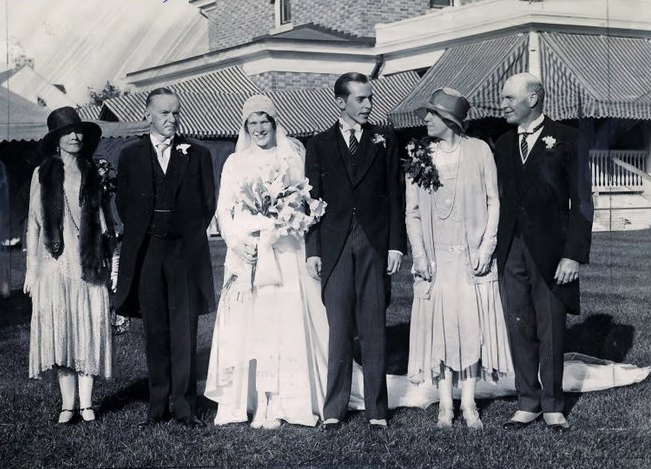
HEY CAL, IT’S A WEDDING, NOT A FUNERAL…The former U.S. President Calvin Coolidge was known as “Silent Cal” for good reason, given his reserved demeanor that rarely produced a smile (although he apparently had a dry wit). He poses here at the wedding of his son, John. Left to right are Grace Goodhue Coolidge, President Coolidge, Florence Trumbull Coolidge, John Coolidge; Maud Pierce Usher Trumbull, and Gov. John Trumbull. (patch.com)
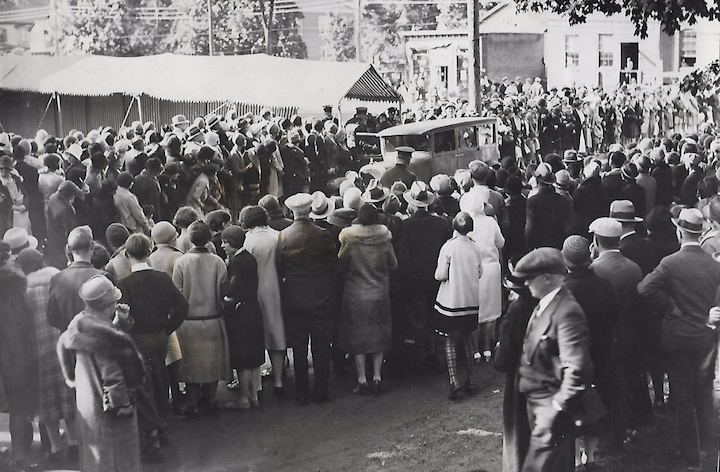
NOT EXACTLY KING’S ROAD…Onlookers line the street near the Congregational church in Plainview, Conn., hoping for a glimpse of the bride and groom, who were united in a simple ceremony. (Associated Press)
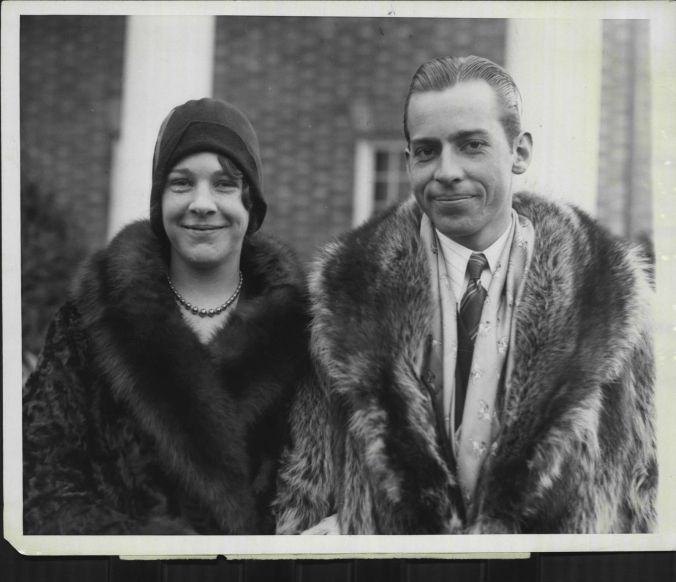
CUTE COUPLE…Florence Trumbull and John Coolidge during their engagement, 1928. (crackerpilgrim.com)

 *  *  *

Modest Mussolini

We go from famous faces to infamous ones, namely the Italian dictator Benito Mussolini, aka Il Duce, who received the adoration of his public while trying to remain inconspicuous at the cinema. “Talk” recounted…

NOW PICTURE HIM UPSIDE DOWN…A 1929 postcard image of the once-revered Italian dictator Benito Mussolini. Sixteen years later he would be shot by his own people and strung up by his feet from the roof of a Milan gas station. (worthpoint.com)

 *  *  *

Going Down

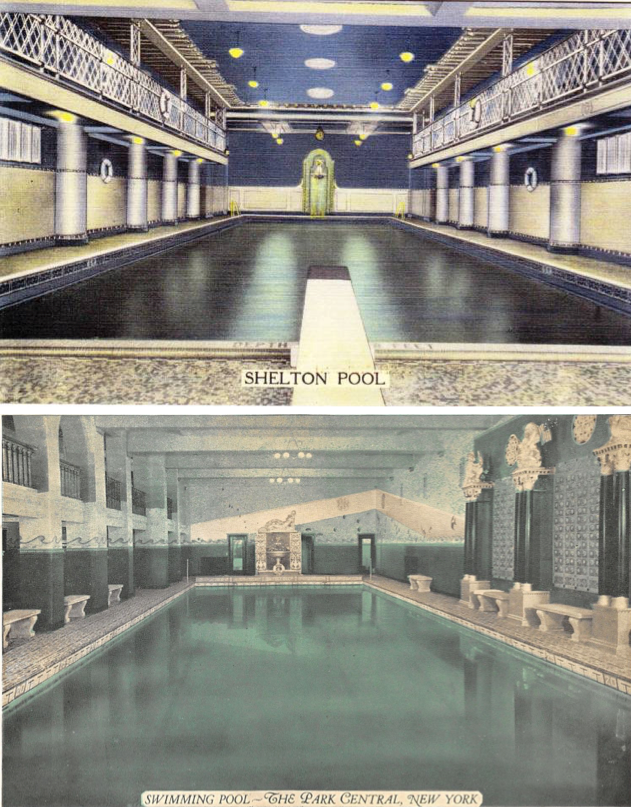
“Talk” also commented on the growing trend for high-rise apartments to provide swimming pools and other amenities below street level:

TAKING THE PLUNGE DOWN UNDER…Few indoor swimming pools were available to New Yorkers during the 1920s. Two of the nicer ones were found underground at the Shelton Hotel (above) and the Park Central. Sadly, both pools no longer exist. In 2007 the Shelton’s pool was removed and the cavernous space was divided into three levels. I’m not sure when Park Central’s disappeared, but it’s fate was doubtless similar to the Shelton’s.(daytoninmanhattan.blogspot.com/hippostcard.com)

 *  *  *

How About a Catch?

As I’ve noted on previous occasions, The New Yorker of the 1920s all but ignored major league baseball. The magazine gave regular coverage to seemingly every sport, from hockey and college football to polo and yacht racing, but regular coverage of baseball was nonexistent, even when the Yankee’s Murderers’ Row (Ruth, Gehrig among others) won back-to-back World Series titles in 1927-28.

Still no coverage in the Oct. 5 issue, but the sport did get a brief mention in Howard Brubaker’s “Of All Things” column…

…and the issue was filled with baseball imagery, including the cover…

The Oct. 5 issue was filled with baseball-related items, but no actual coverage of the games. Images from the issue included, from left, the cover by Theodore Haupt; a filler sketch by Constantin Alajalov; and a Johan Bull illustration of umpire Bill Klem for the issue’s “Profile” section.

 *  *  *

In a Sentimental Mood

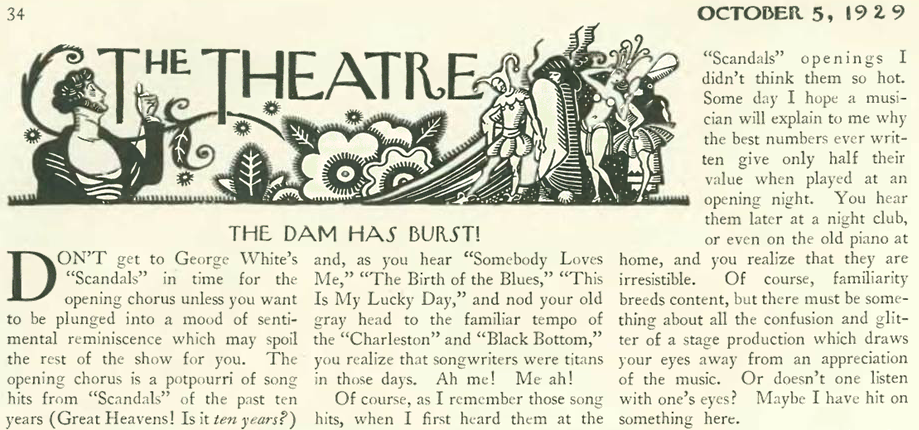
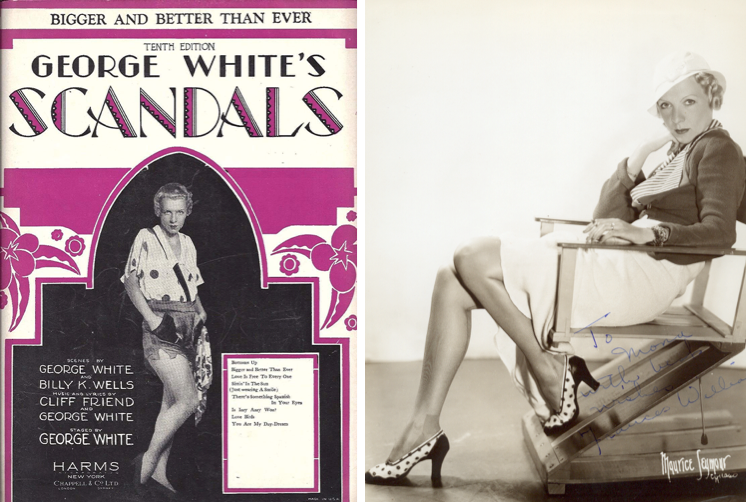
Robert Benchley checked out George White’s latest version of his Scandals revue at the Apollo Theatre, and found the sometimes risqué show to be in a sentimental mood…

BETTER SENTIMENTAL THAN DEPRESSED…The chanteuse Frances Williams (pictured on the show’s sheet music and at right) likely provided the only spark to the 1929 edition of George White’s Scandals. (amazon/psychotronicpaul.blogspot.com)

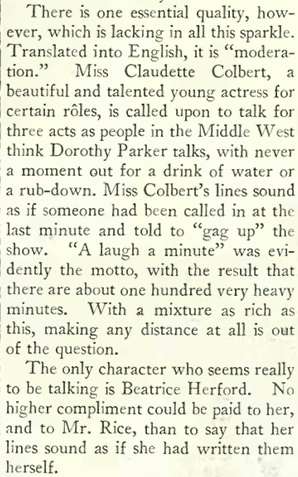
Benchley also looked in on Elmer Rice’s latest, See Naples and Die, featuring veteran English actress Beatrice Herford and the up-and-coming Claudette Colbert

VETERAN AND ROOKIE…Veteran English actress Beatrice Herford and the up-and-coming Claudette Colbert headlined Elmer Rice’s See Naples and Die. Colbert (pictured at right in a 1928 Broadway publicity photo) would go on to massive stardom in the 1930s. (Alchetron/Wikipeda)

Benchley applauded the veteran Herford’s performance, but found the otherwise reliable Colbert miscast as a wisecracking, Dorothy Parker type (Benchley, as we know, was close friends with Parker, so he knew what he was talking about)…

*  *  *

An (Ugly) American in Paris

Off to Paris, we find correspondent Janet Flanner joining with Parisians in deriding the behavior of American tourists, who were on a course to drain every last drop from the ÎledeFrance before departing for the bone-dry USA:

DRINKING IN THE SIGHTS…American tourists at a Parisian café, circa 1920s. (tavbooks.com)

*  *  *

Party Pooper

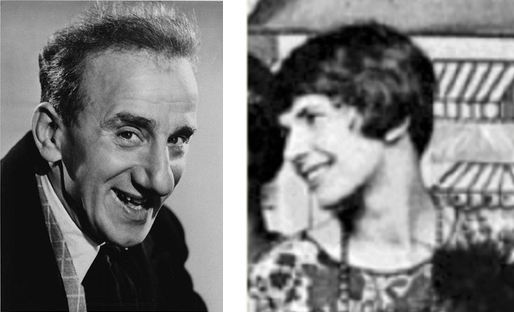
With her infant child (Patricia Arno) at home, it is doubtful Lois Long was seeing as much nightlife as she did during her first weeks at The New Yorker, when “nights were bold.” And indeed, her nightlife column “Tables for Two” would end in June 1930…for awhile anyway. Her Oct. 5 column took a cursory spin through the various nighttime offerings, ending on this note regarding a fan letter and a message from comedian Jimmy Durante:

THE GREAT SCHNOZZOLA Jimmy Durante brought a smile to the face of Lois “Lipstick” Long. 

 * * *

From Our Advertisers

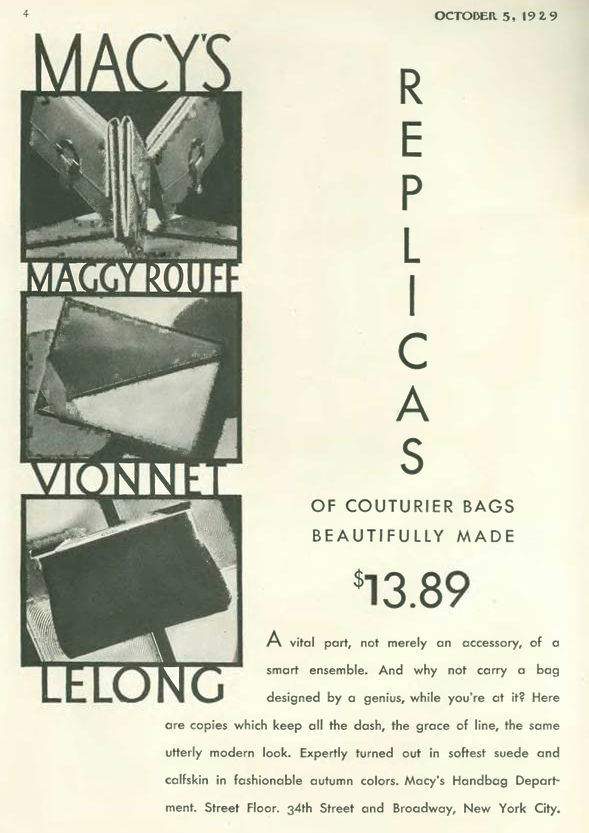
With the latest Paris fashions splattered across newstands all over Manhattan, retailers scrambled to get “replicas” to consumers…Macy’s had “couturier bags”…

…the Hollander Dressmaking Department was ready to make a perfect copy of Patou’s “Quiproquo”…

…and this Chanel frock could be had in misses’ sizes for $145 (roughly equivalent to about $2K today)…

…Philip Morris hadn’t yet discovered the “Marlboro Man,” and were still hawking their cigarettes through a “distinguished handwriting contest.” The latest winner was Edmund Froese

…who would go on to become a popular mid-century landscape painter…

Port of New York, by Edmund Froese (undated)

…another artist in the midst of our ads is Carl “Eric” Erickson, who created these lovely images for R.J. Reynolds that would induce people to take up the habit with a Camel…

…and then we have some rather unlovely ads from the back pages, including these two that would not go over well with today’s readers…

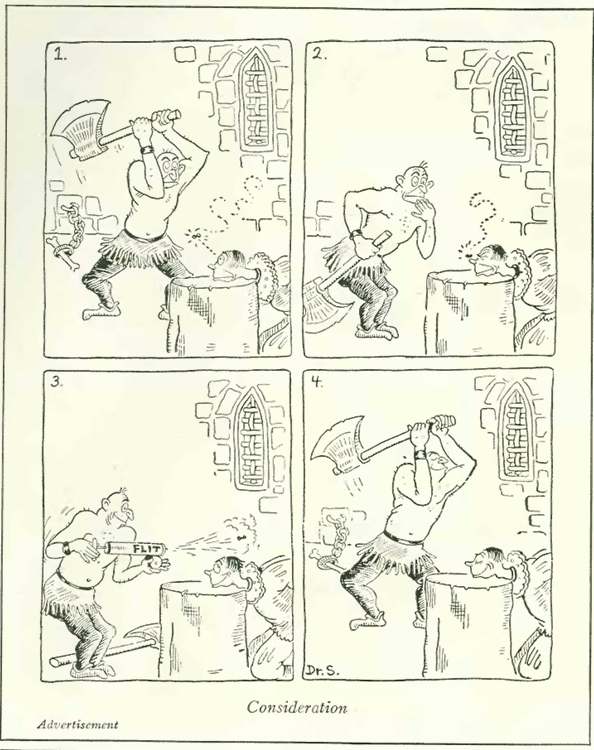
…or this from Dr. Seuss, still sharpening his skills with Flit insecticide…

…or this ad from Abercrombie & Fitch, wrong on so many levels…

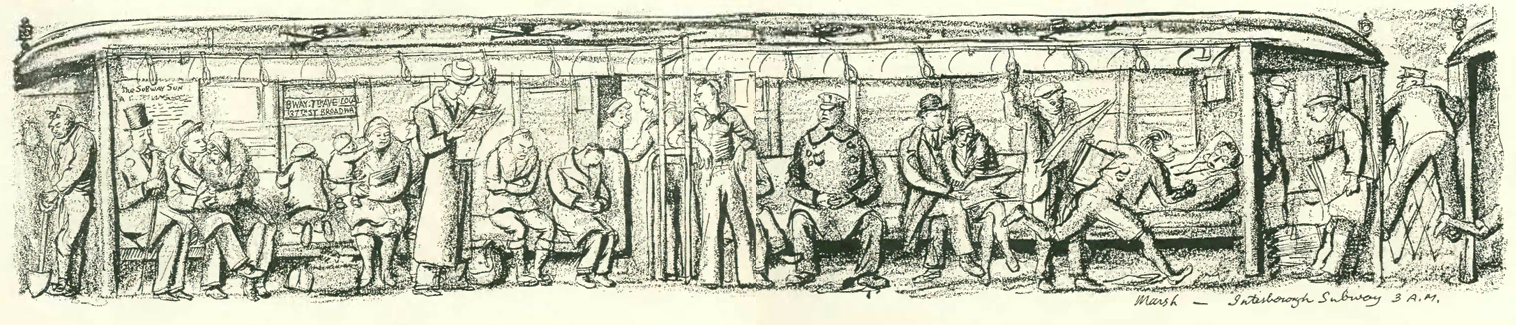
…on to happier things, here’s an illustration by Reginald Marsh that ran along the bottom of “Talk of the Town”…(click to enlarge)

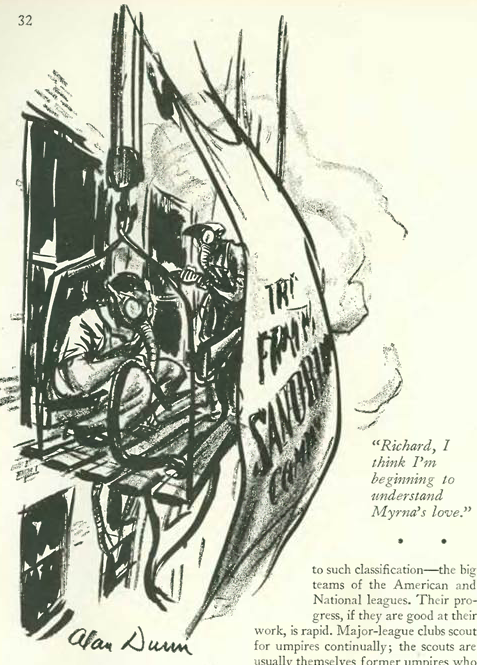
Alan Dunn found love in the air above the streets of Manhattan…

…and Leonard Dove revealed the hazards of apartment rentals…
Next Time: Race to the Sky…

Is Sex Necessary?

James Thurber and E.B. White shared an office at the New Yorker that has been described as “the size of a hall bedroom.” This proximity doubtless supported a rich exchange of ideas that coalesced in their 1929 bestseller, Is Sex Necessary? Or, Why You Feel the Way You Do.

Sept. 28, 1929 cover by Julian De Miskey.

A spoof of popular sex manuals and how-to books that dealt with Freudian theories, the book featured chapters (alternately written by Thurber and White) that delved into pseudo-sexual conditions such as “Frigidity in Men” — the title of a chapter by White excerpted in the Sept. 28, 1929 issue of The New Yorker…

Expanding on the condition known as “recessive knee,” White coined the term “Fuller’s retort,” and claimed it was “now a common phrase in the realm of psychotherapy”…

THE ARTIST EMERGES…Although James Thurber had yet to publish one of his drawings in The New Yorker magazine, Is Sex Necessary? featured 42 of them, including the illustration at right that demonstrated the male greeting posture. (brainpickings.org)

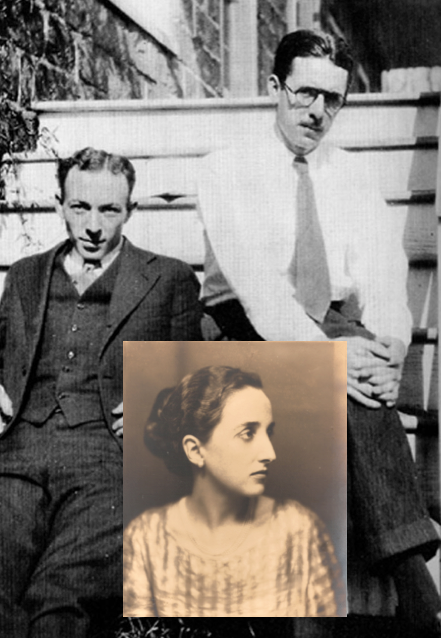
No other editor besides founder Harold Ross did more to give The New Yorker its shape and voice than Katharine Angell, who recommended to Ross the hiring of both White and Thurber. It is worth noting that White would marry Angell in the same month, November 1929, as the publication of Is Sex Necessary? In their case, sex was necessary, as Katharine would give birth to their son, Joel White, the following year.

DYNAMIC TRIO…Katharine Angell (inset) would be instrumental in bringing both E.B. White (left) and James Thurber to The New Yorker. (Pinterest/Wikipedia)

 *  *  *

A New Rabbit Hole

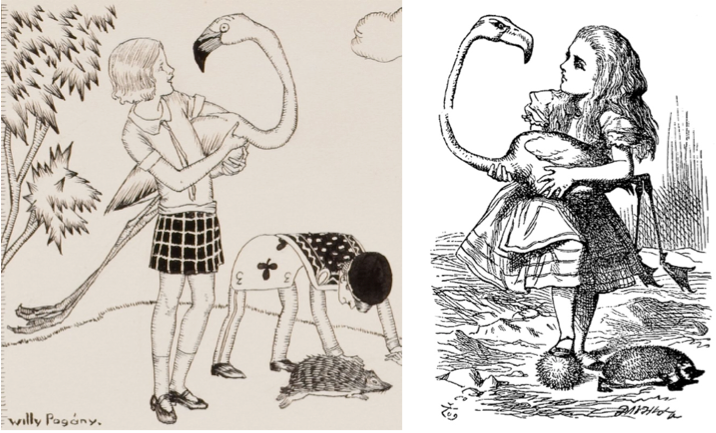
In other news from the world of publishing, “The Talk of the Town” (also largely a product of Thurber and White) noted the publication of a new edition of Alice in Wonderland that featured a re-drawn Alice with bobbed hair and the slender profile of a 1920s flapper. White mused:

NEW ALICE, MEET OLD ALICE…A 1929 edition of Alice and Wonderland featured a Jazz Age Alice (left) as rendered by Willy Pogany. At right, Sir John Tenniel’s original Alice, from the 1866 edition. (comicartfans.com/girlmuseum.org)

 *  *  *

Rise of the Boob Tube

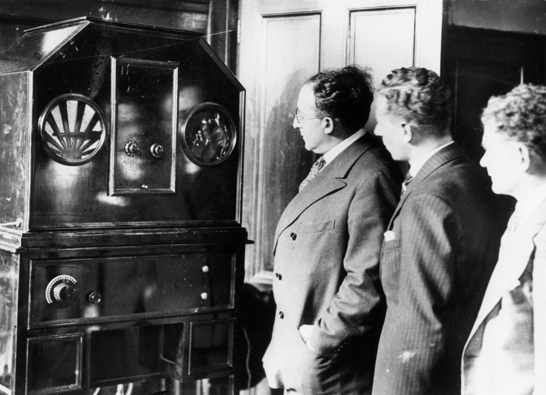
Also in “Talk,” it was reported that the BBC would be putting television on the air “five times a week for a half an hour.” The broadcasts, on a single channel, featured speeches, comic monologues and popular songs. The technology did not allow sound and image to be transmitted together, so “viewers” (there were only a handful of sets) first heard each piece in audio, followed by a mute moving image:

COMMERCIAL-FREE…Early television promotor Sydney Moseley (left) and two employees of the Baird Television Development Co. watch the inaugural television broadcast on a “Noah’s Ark Televisor,” Sept. 30, 1929. The televisor was the invention of British TV pioneer John Logie Baird (1888-1946). (scienceandmediamuseum.org.uk)

 *  *  *

Mutt & Jeff & Peggy

This odd little item in “Talk” focused on the literary interests of Peggy Hopkins Joyce, an actress and dancer best known for her lavish lifestyle and multiple marriages and affairs. She was a Kardashian of her day — famous for being famous. Despite her flamboyant ways, Joyce seemed to have some rather pedestrian tastes, at least when it came to her reading pleasure…

JEEVES, BRING ME SOME LIGHT READING…Peggy Hopkins Joyce (left) might have preferred the high life, but her tastes in reading seemed more of the rabble. She is pictured here in her Hollywood debut, the 1926 silent film The Skyrocket. The film bombed, and Joyce made just one more screen appearance before moving on to other things. (Bizarre Los Angeles/mycomicshop.com)

 *  *  *

Ring Cycle

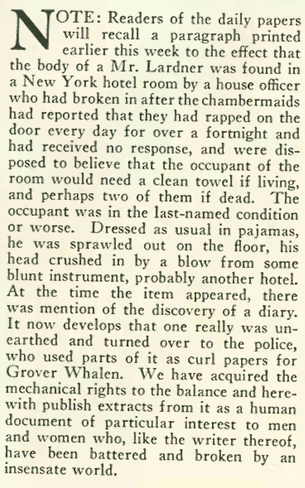
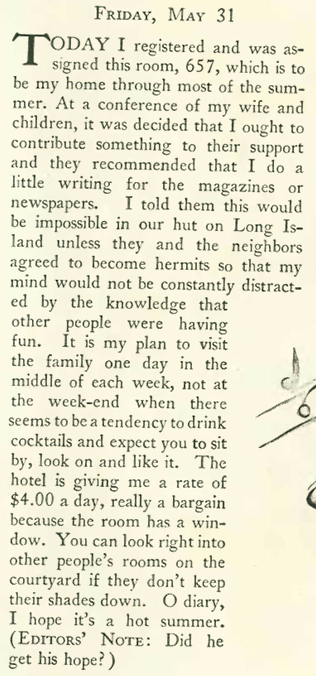
Ring Lardner contributed a casual titled “Large Coffee,” in which he checks into a hotel to escape life’s distractions and get some writing done. The piece consisted of diary entries largely concerned with Lardner’s inability to get a proper order of coffee. He began with an editor’s note that described how his corpse was found in the room, along with the diary. Some excerpts:

COFFEE AND CIGARETTES helped fuel the genius of writer Ring Lardner. (Brittanica)

 *  *  *

Master of the Screwball

Preston Sturges (1898-1959) was known for taking the screwball comedy and turning into something more than a simple farce. Reviewer Robert Benchley saw the potential in this young Broadway producer, whose second play, Strictly Dishonorable, opened to great acclaim:

KEEPING IT LIGHT…Tullio Carminati as Count Di Ruvo and Muriel Kirkland as Isabelle Parry in Broadway’s Strictly Dishonorable, 1929. Producer Preston Sturges reportedly wrote the hit play in just six days. (Museum of the City of New York)

 *  *  *

Have No Fear

Morris Markey (1899-1950) often took on the lurid and sensationalist reporting of his day in a column he established at The New Yorker titled “Reporter at Large.” In his Sept. 28 column titled “Fear, Inc.” Markey chided everyone from the newspapers and Hollywood to the headline-grabbing NYC Police Commissioner Grover Whalen, and painted a picture of organized crime that was less violent and glamorous, and a lot more mundane…

MAKE SURE YOU GET MY GOOD SIDE…NYC Police Commissioner Grover Whalen loved to make headlines with his “get tough on crime” approach. He was was famously quoted as saying, “There is plenty of law at the end of a nightstick.” (wnyc.org)

Markey suggested that rather than screeching tires and blazing Tommy guns, most of the crime in the city was just the humdrum of making money…

Sadly, Markey himself would meet a violent end, dying of a gunshot wound at the age of 51. It is unclear whether it was self-inflicted.

 *  *  *

The Last Laugh

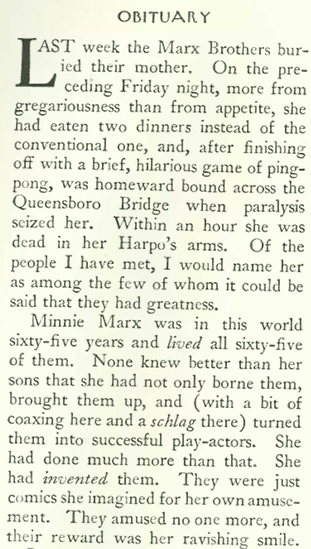
The year 1929 saw the passing of Minnie Marx, the beloved mother of the Marx Brothers comedy troupe. Alexander Woollcott offered this tribute in his “Shouts and Murmurs” column…

MY LITTLE CLOWNS…Minnie Marx with her sons, The Marx Brothers, circa 1920. (Find a Grave)

 *  *  *

From Our Advertisers

Harper’s Bazar began weekly publication in 1867, catering to women in the middle and upper classes. The magazine was a frequent advertiser in the upstart New Yorker, no doubt perceiving a considerable overlap among its readers. This full page ad in the Sept. 28 issue of the New Yorker featured a column by the Bazar’s Paris fashion correspondent, Marjorie Howard

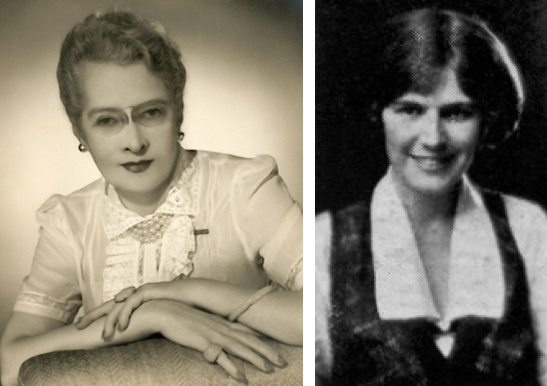
…no doubt The New Yorker’s own fashion editor, Lois Long (1901-1974), read her rival’s column with great interest, and, like the magazine she wrote for, Long was the young upstart compared to the veteran Howard (1878-1958). However, according to future New Yorker editor William Shawn, Long was the superior writer. Upon Long’s death in 1974, Shawn said “Lois Long invented fashion criticism,” adding that she “was the first American fashion critic to approach fashion as an art and to criticize women’s clothes with independence, intelligence, humor and literary style.” Here is a brief excerpt from Long’s fashion column, “On and Off the Avenue,” in the Sept. 28 issue…

OF A FASHION…Majorie Howard (left) served as fashion editor for Harper’s Bazar in the late 1920s and 1930s. Lois Long (right) wrote the New Yorker fashion column, “On and Off the Avenue,” from 1927 to 1970. (findagrave.com/Vassar College)

…looking at some of the ads from the magazine’s back pages, here’s one from Scribner’s announcing the publication of A Farewell to Arms (a first edition for only $2.50)…

…the back pages of The New Yorker near the theater section were filled with signature ads promoting various entertainments…

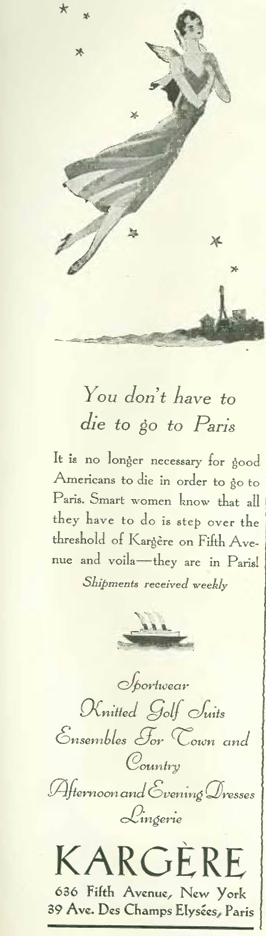
…this ad from Kargère referenced an exchange from Oscar Wilde’s The Picture Of Dorian Gray: “They say that when good Americans die they go to Paris,” chuckled Sir Thomas…” Really! And where do bad Americans go to when they die?” inquired the Duchess. “They go to America,” murmured Lord Henry…

…several ads and filler illustrations from the Sept. 28 issue featured posh folks dressed for fox hunting season, the makers of Spud cigarettes among them…

…this ad from Frigidaire featured an illustration by Herbert Roese, whose style at the time somewhat resembled Peter Arno’s

…for comparison, an Arno cartoon from 1930…

From Peter Arno’s book Hullabaloo, 1930. (attemptedbloggery.blogspot.com)

and Arno’s full-page contribution to the Sept. 28 issue…

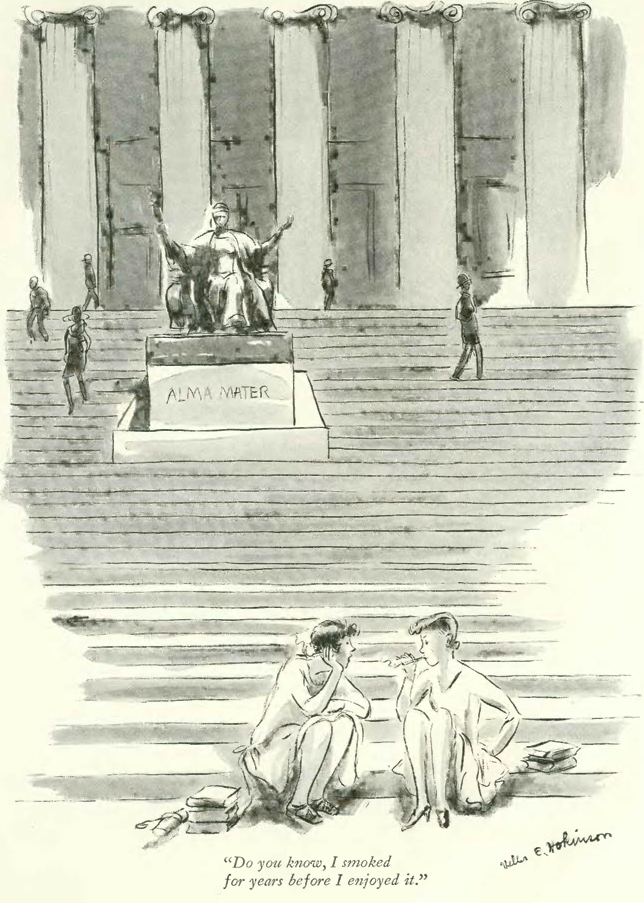
…another artist at The New Yorker who along with Arno often received a full page for her work was Helen Hokinson, here looking in on life at Columbia U…

…and there were artists who were lucky to get any space at all, including Kent Starrett, who probably drew on his own experiences at The New Yorker’s front office for this entry…

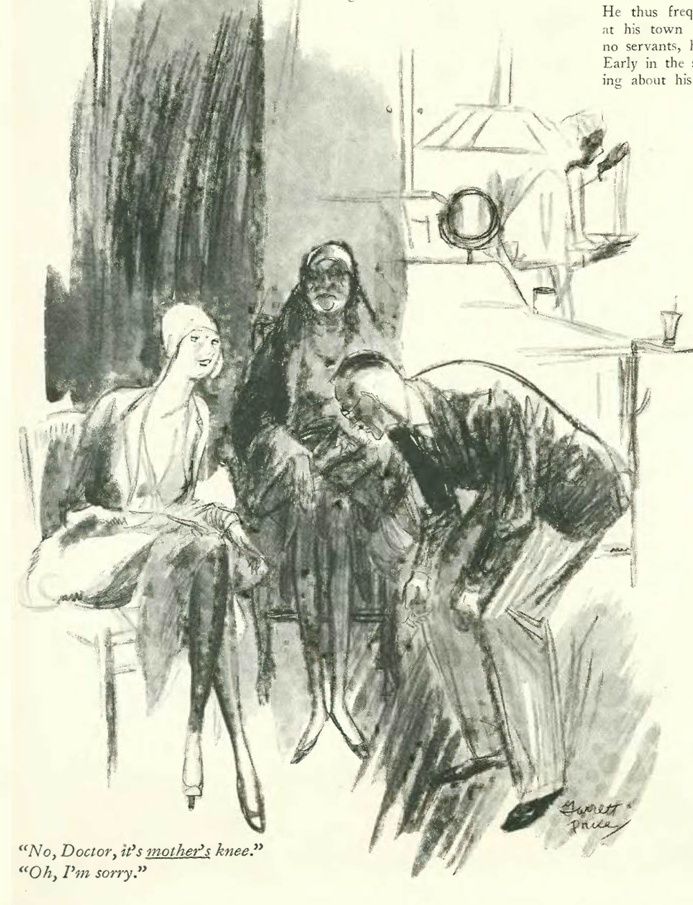
…and finally, Garrett Price illustrated the challenges of the “house call”…

Next Time: American Royalty…


Prophecies of 1929

E.B. White gazed 50 years into the future in the Sept. 21, 1929 issue, predicting that New York City would be much the same if not a little worse by the time the calendar turned to 1979.

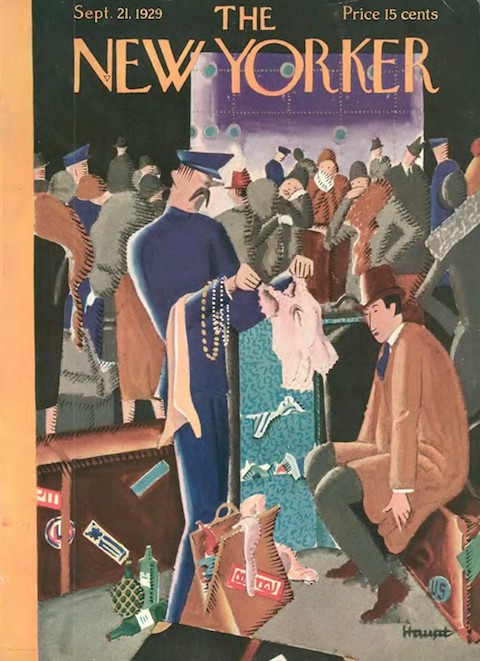
Sept. 21, 1929 cover by Theodore G. Haupt.

White dismissed the popular notion that the future would be one of push-button happiness and gleaming white cities. And as it turned out, he was mostly right on the mark with his predictions:

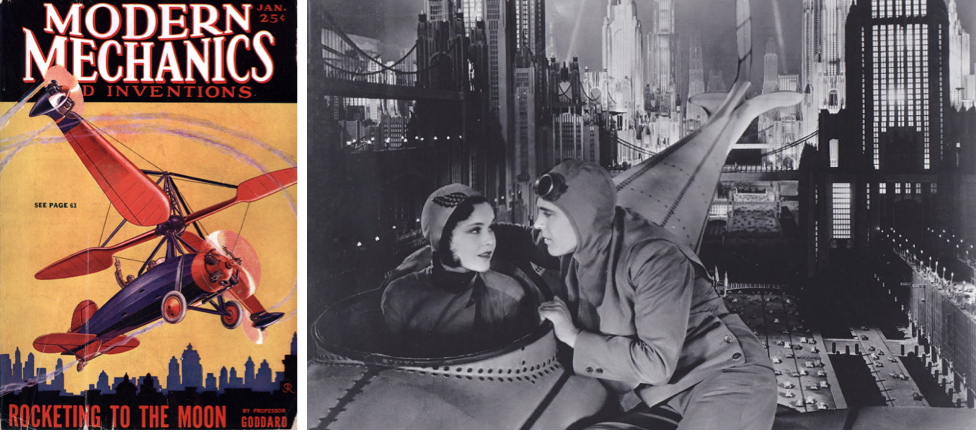
LOVE IS IN THE AIR…Autogyros (as illustrated on a 1930 cover of Modern Mechanics) were often seen as the future of transportation in the 1920s and 30s; Maureen O’Sullivan (as “LN-18”) and John Garrick (“J-21”) glide above 1980 Manhattan in 1930’s Just Imagine. (modernmechanix.com/pre-code.com)

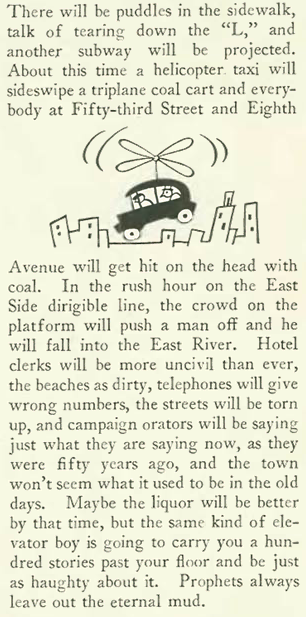
Instead of the antiseptic fantasy world predicted in such movies as 1930’s Just Imagine (a futuristic musical set in 1980), White correctly foresaw a city that, despite technological advances, would still be a gritty rat race. And if you lived in New York City in 1979 (I was but a visitor then, as now), you would have found a city that indeed was quite dirty and crime-ridden (check out the 1979 movie The Warriors to get a sense of how Hollywood perceived the city at that time). As White observed, “Prophets always leave out the eternal mud”…

A LOT OF HOT AIR…In addition to autogyros, futurists in the 1920s and 30s also saw dirigibles as integral to future transportation. At top left is an illustration of a solar-powered aerial landing field atop a dirigible on the cover of Modern Mechanix magazine, October, 1934; top right, Manhattan in 1980 as depicted in the the 1930 film Just Imagine; bottom right, workers dismantling the Third Avenue Elevated line in 1955; bottom left, Times Square in 1979. (airships.net/IMDB/gothamist.com/viewoftheblue.com)

 *  *  *

Cradle of Civilization

Dorothy Parker took aim at ugly Americans abroad in a casual titled “The Cradle of Civilization.” In these excerpts, Parker commented on the pretensions of young New Yorkers in France, including their ridiculous costumes…

…their bad French, and their even worse manners…

WELL, THEY GOT AWAY WITH IT…Actors Leslie Howard and Ingrid Bergman don the look of French fishermen during the filming of Intermezzo: A Love Story, in 1938. Howard and Bergman were supposed to look like a couple visiting the French Riviera, but in reality it was all filmed near Hollywood. The film was Bergman’s Hollywood debut. (Pinterest)

 *   *   *

A Penny Saved

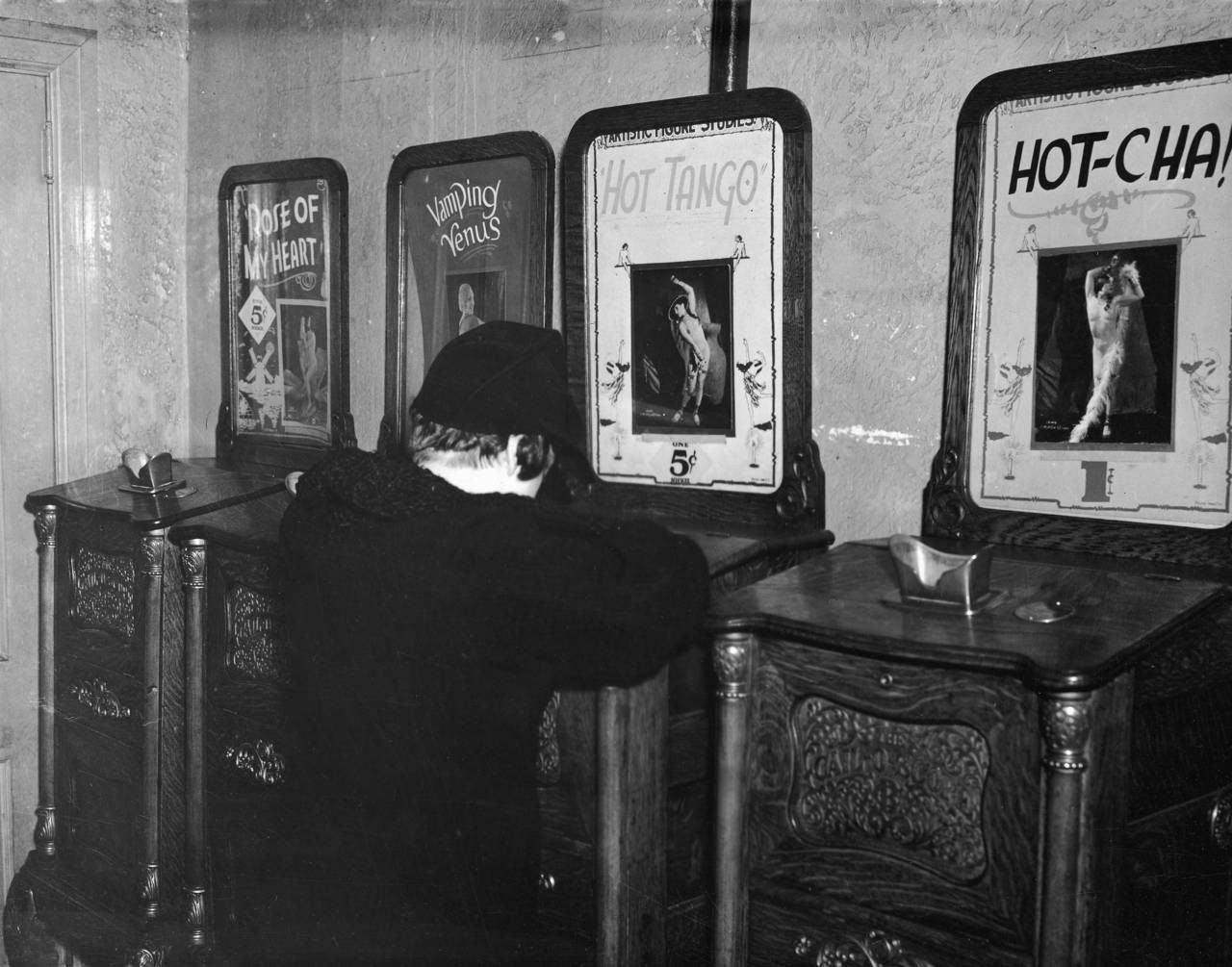
Back stateside, Wolcott Gibbs looked in on the dying art of the penny-arcade peepshow, and expressed his disappointment with the quality of that product in general…

DON’T JUDGE A PEEP BY ITS COVER…A patron checks out “Hot Tango” at a penny peepshow parlor of the 1920s. (Pinterest)

Gibbs seemed particularly miffed by a film with the misleading title “For Men Only”…

 *  *  *

Uncle Jed

Jed Harris (1900-1979) was a wunderkind of Broadway, producing and directing 31 shows between 1925 and 1956. Before he turned 28 he produced a record four consecutive Broadway hits over the course of 18 months (including the 1928 smash hit The Front Page), and so it was time for some rest. “The Talk of the Town” reported…

Although it was rumored Harris would retire at age 30, he would instead return in the spring of 1930 with a production of Anton Chekhov’s Uncle Vanya, and continue producing on Broadway through the 1950s.

WUNDERKIND…A 1928 portrait of Jed Harris that was featured on the Sept. 3, 1928 cover of Time magazine. (Wikipedia)

 *  *  *

Dueling Cassandras

About a month before the big stock market crash we find this curious little item in Howard Brubaker’s “Of All Things” column…

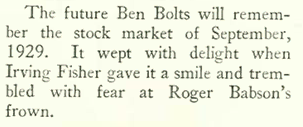
…Considered the first “celebrity economist,” Irving Fisher stated in September 1929 that the stock market had reached “a permanently high plateau,” while around the same time (Sept. 5, 1929) rival economist Roger Babson warned in a speech that “sooner or later a crash is coming, and it may be terrific.” Note: “Ben Bolts” refers to a character in a popular 1842 poem that became an oft-parodied popular song. Each stanza begins with a variation of “Oh don’t you remember…”

 *  *  *

Parental Advisory

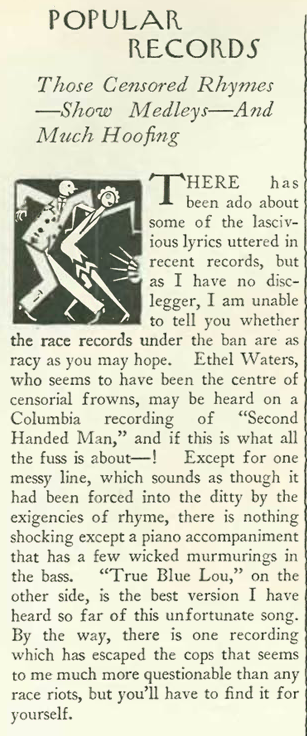
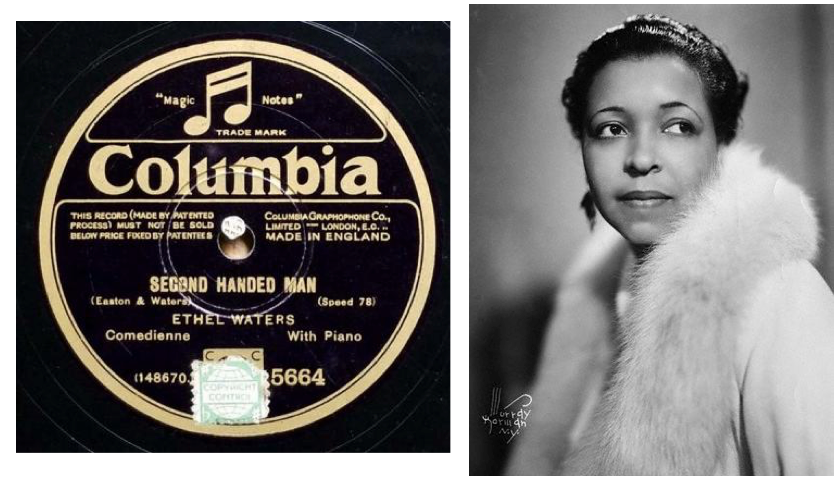
Fifty-five years before Tipper Gore and the Parents Music Resource Center pushed the music industry to place warning labels on records containing explicit lyrics, there was much ado about “lascivious lyrics” uttered on “race records” — the term referred to 78-rpm records marketed to African Americans from the 1920s and 1940s. The Sept. 21 “Popular Records” column looked at the controversy surrounding Ethel Waters’ “Second Handed Man,” and didn’t find any…

MUCH ADO…Ethel Waters (circa 1930) and her recording of “Second Handed Man.” (discogs.com/YouTube)

 *  *  *

New Kids on the Block

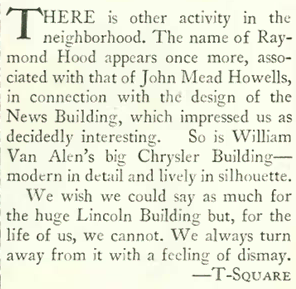
Architecture critic George S. Chappell (aka “T-Square”) concluded his Sept. 21 column with praise for the designs of the yet-to-be-built Daily News and Chrysler buildings, but expressed dismay at the recently completed Lincoln Building…

BAD COMPANY…New Yorker architecture critic George S. Chappell was excited about the designs for the Daily News Building (left) and Chrysler Building (center), but the Lincoln Building left him wanting. No doubt its gothic topper seemed dated in contrast to the sleek lines of the other buildings. (nyc-architecture.com)

 *  *  *

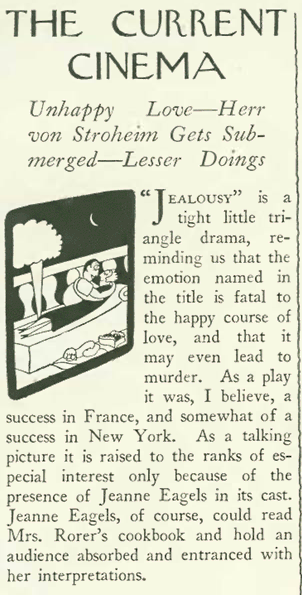
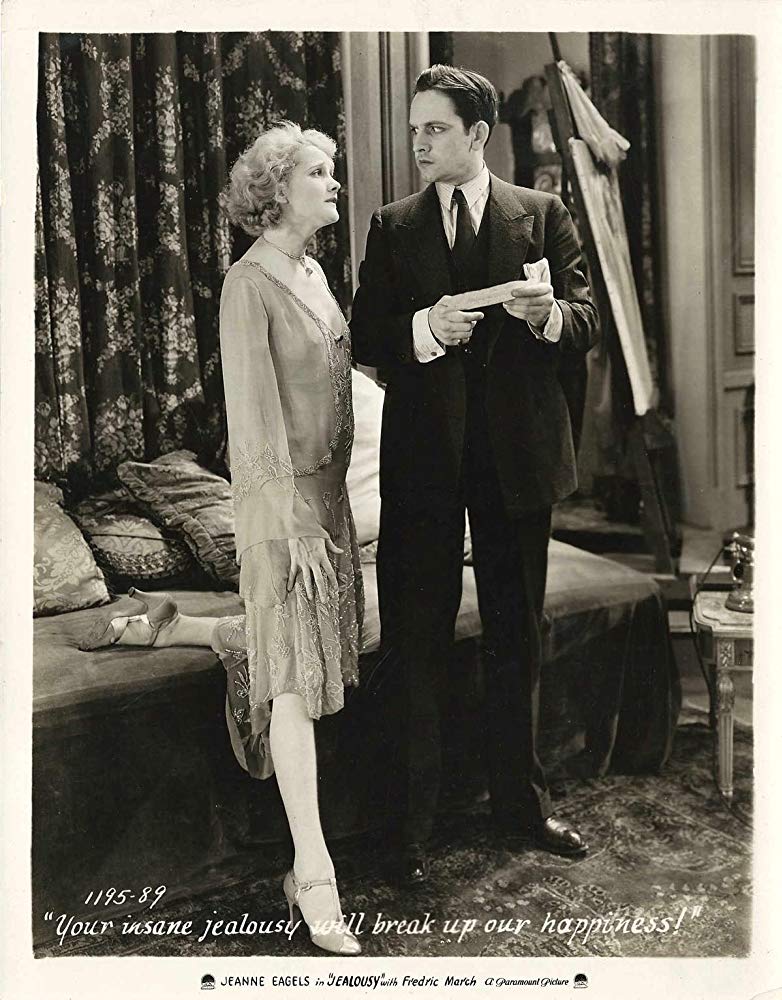
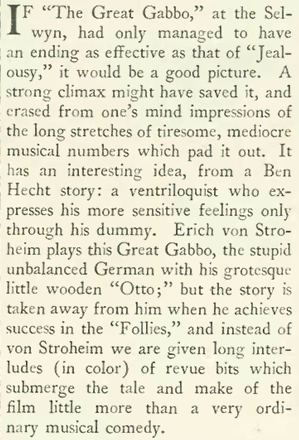
Movie critic John Mosher took in a couple of new films including Paramount’s 1929 pre-Code drama Jealousy…

FINAL CURTAIN…Jeanne Eagels and Fredric March in a publicity photo for Jealousy. Eagels died of a drug overdose on Oct. 3, 1929, just days after Mosher’s review appeared in The New Yorker. (IMDB)

…and Mosher also reviewed the musical drama The Great Gabbo, which was derived from a story by occasional New Yorker contributor Ben Hecht

WHO ARE YOU CALLING DUMMY?…Erich von Stroheim has issues with his co-star in The Great Gabbo. (MoMA)

 *  *  *

From Our Advertisers

What appeared to be an unassuming ad from General Motors was actually a plan for world domination, at least in the area of ground transportation. GM gobbled up a number of car companies in the 1920s (see the ad’s fine print) as well as shares in power plants and home appliances. It would overtake Ford in sales in the late 1920s, and thanks to propaganda efforts including those illustrated in the ad below, it would lead a streetcar removal conspiracy that would destroy intercity train transport systems across the U.S. (and convert them to GM buses, naturally)…

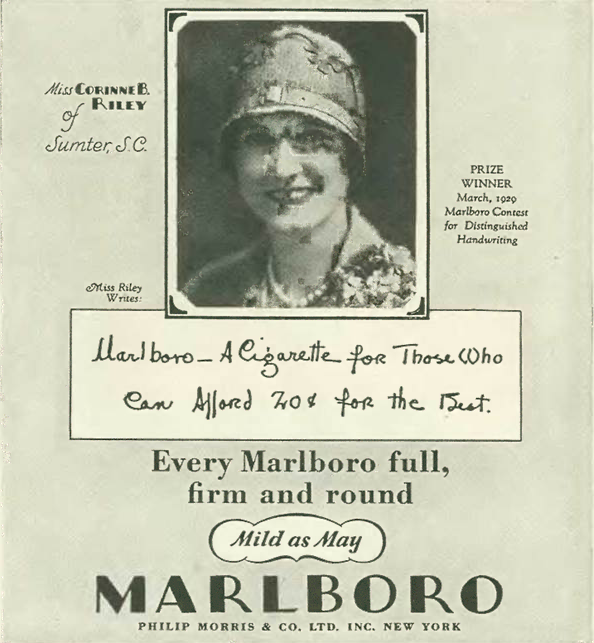
Here we have yet another “distinguished handwriting contest” ad from the makers of Marlboro, this time exploiting the efforts of Corinne B. Riley of Sumter, S.C….

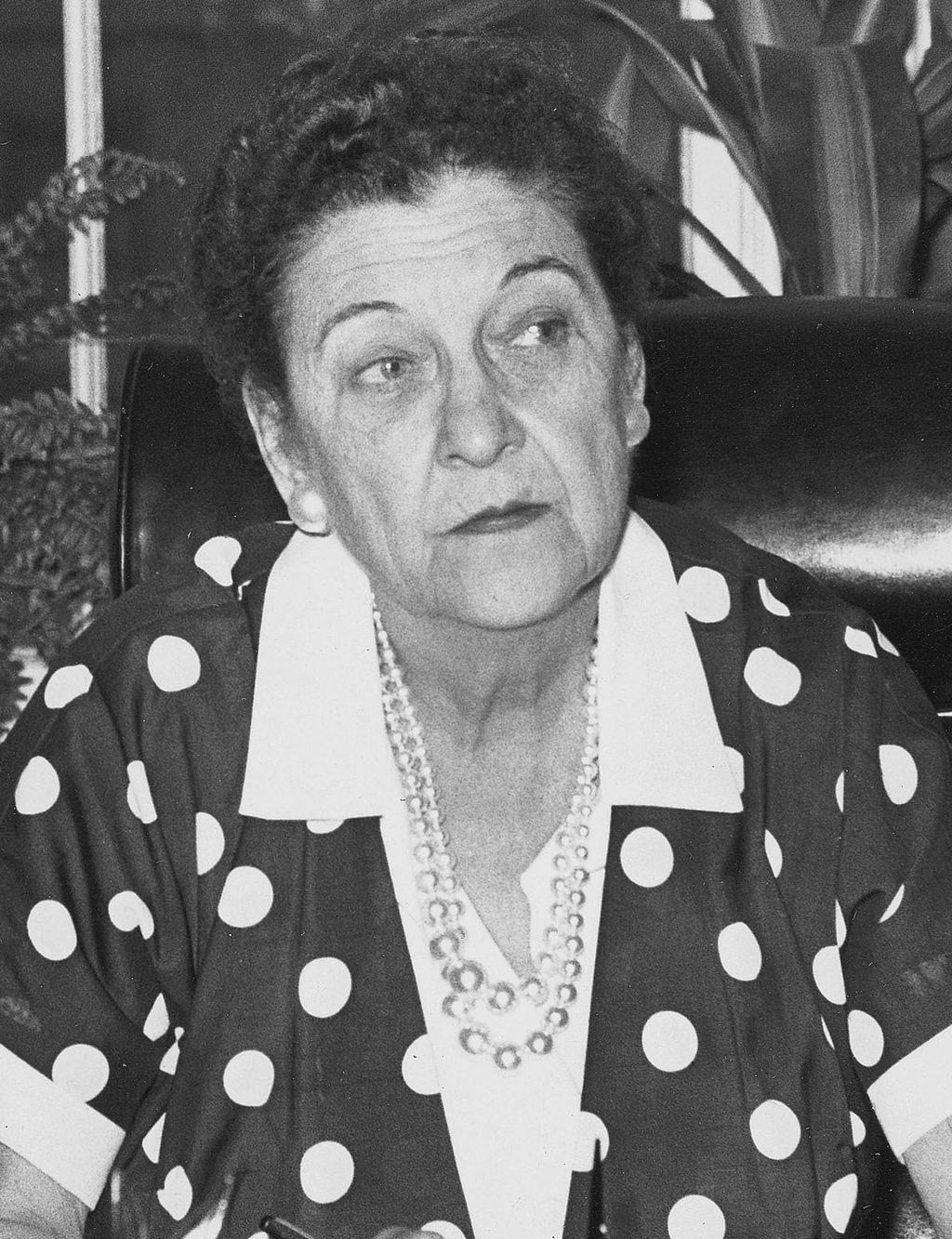
…Riley would win more than a handwriting contest, however. She would be elected as a Democrat to Congress in 1962 to fill a vacancy left by her husband, Congressman John Jacob Riley.

Corrine B. Riley in 1962. (Wikipedia)

On to our illustrators and cartoons, we begin with this two-page drawing by Reginald Marsh that appeared along the the bottom of “Talk of the Town”…

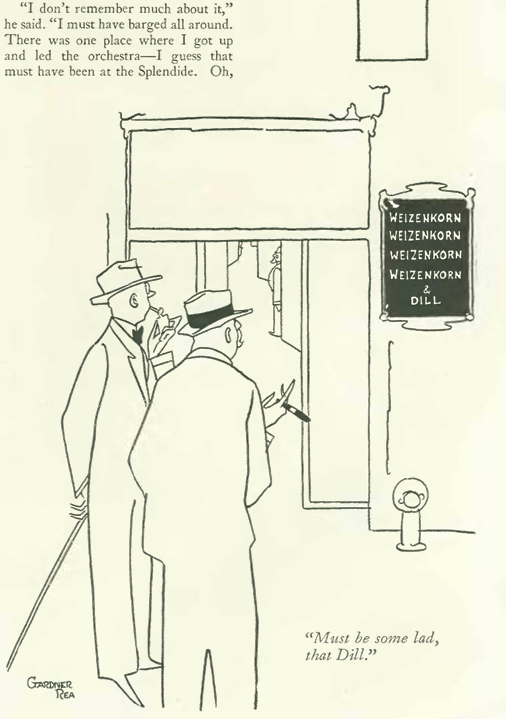
Gardner Rea lent his spare style to this peek into Wall Street…

Peter Arno appeared to be experimenting with yet another style of drawing…

…that in some ways looked similar to Alan Dunn’s

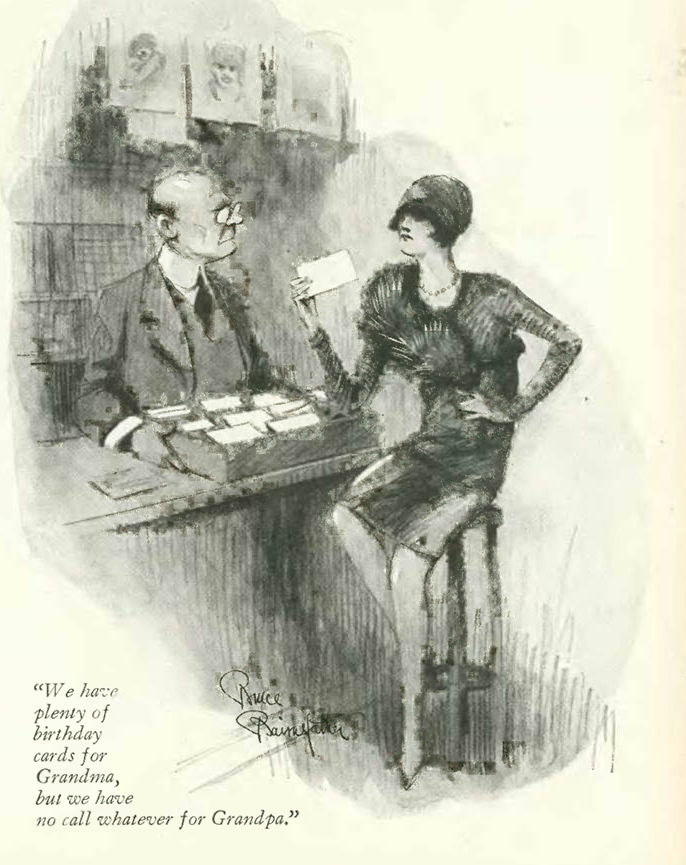
…the British cartoonist Bruce Bairnsfather provided this sumptuous drawing of an exchange at a card shop…

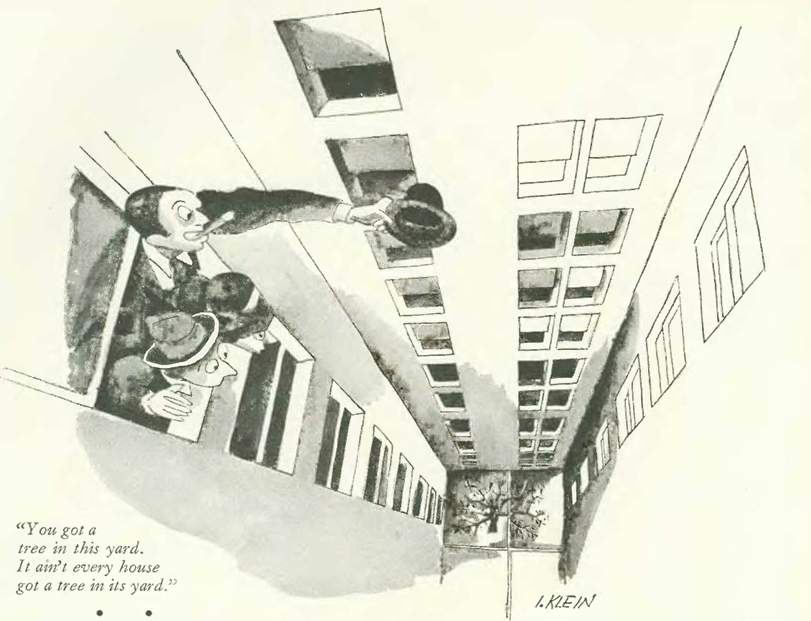
…and Isadore Klein gave a vertiginous perspective to home buying…

Next Time: Frigidity in Men…

The Last Hurrah

Avery Hopwood’s 1919 Broadway hit, The Gold Diggers, was among cultural events of the late teens that signaled the dawn of new age; namely, the Jazz Age.

Sept. 7, 1929 cover by Sue Williams.

So it seems appropriate that the play, when adapted to the screen in 1929 as a Technicolor talkie, would also signal the end of that age. As the New Yorker’s film critic John Mosher observed in his review of The Gold Diggers of Broadway, the themes that seemed new and daring a decade earlier had been played out, the “general humors” of the picture having “become very familiar”…

The film featured Nancy Welford, Winnie Lightner and Ann Pennington as three chorus girls who try to entice a wealthy backer to invest money in their struggling Broadway show. The film was a big hit, and it made a star of Winnie Lightner (1899-1971), who played the boldest “Gold Digger” of the trio.

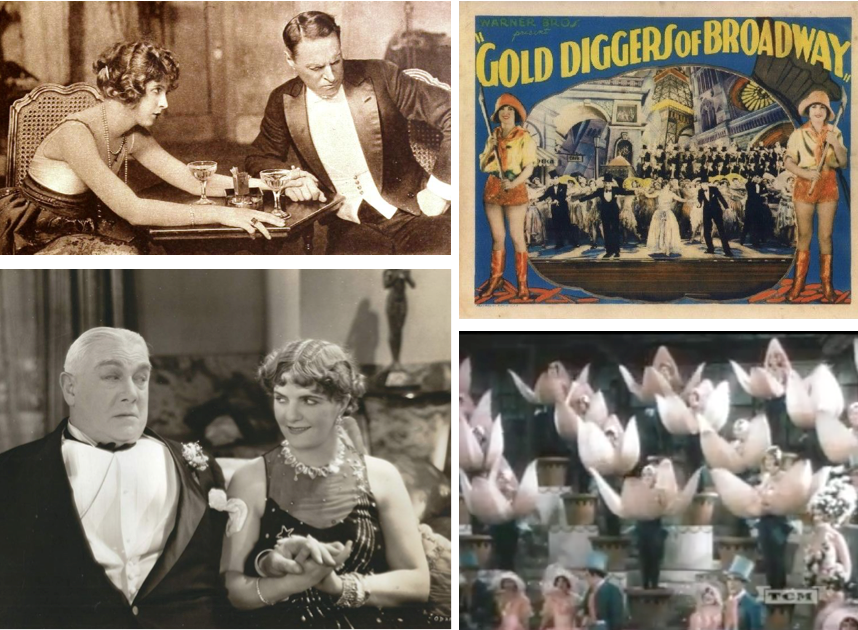
PROSPECTORS…Clockwise from top left, Ina Claire as the original “Gold Digger” with Bruce McRae in the 1919 Broadway play The Gold Diggers; lobby card for the 1929 film Gold Diggers of Broadway; image from the film’s “Tiptoe Thru the Tulips” song-and-dance number; Winnie Lightner works her charms on Albert Gran in a scene from the film. (Wikipedia/IMDB/TCM-YouTube)
IT’S FUN MAKING PICTURES…Helen Foster, Ann Pennington, Nancy Welford and William Bakewell in a publicity photo from 1929’s Gold Diggers of Broadway. (IMDB)

Lightner wasn’t the only actor to steal the show. The film also proved a winner for crooner Nick Lucas (1897-1982), who performed two hit songs written for the movie — “Painting the Clouds with Sunshine” and “Tiptoe through the Tulips.” Yes, that second song was the very same tune Tiny Tim rode to fame nearly 40 years later.

TIPTOE THROUGH HISTORY…At left, Nick Lucas sings what would be become his signature song “Tiptoe through the Tulips” to Lilyan Tashman in the Gold Diggers of Broadway. At right, forty years later, Lucas sang the song on The Tonight Show With Johnny Carson (apparently using the same guitar) on the occasion of singer Tiny Tim’s televised wedding to Victoria Mae Budinger (“Miss Vicky”). Tiny Tim (inset) also made “Tiptoe through the Tulips” his signature song, although his was a campier version, sung in a falsetto, vibrato voice accompanied by his trademark ukulele. (YouTube)

The Gold Diggers of Broadway was a “pre-code” film, that is, a film made during a brief period of the early sound era (roughly 1929 through mid-1934) when censorship codes were not enforced and many films openly depicted themes ranging from promiscuity and prostitution to amoral acts of violence.

A LEG UP ON THE CENSORS…Warner Brothers publicity photo of Dorothy Mackaill, who played a secretary-turned-prostitute in 1931’s Safe in Hell. (Wikipedia)

Those unenforced codes had their origins in the early 1920s. In response to outcries from preachers and politicians alike over the immortality of Hollywood (both on- and off-screen), the president of Paramount Pictures, Adolph Zukor  — fearing that cries for censorship would cut into his profits — called a February 1921 meeting of his studio rivals at Delmonico’s restaurant on 5th Avenue. At the meeting Zukor (1873-1976) distributed a set of 14 rules that would guide every Paramount production (Zukor’s studio at that time was actually known as Famous Players-Lasky). The rules covered everything from “improper sex attraction” to “unnecessary depictions of bloodshed.”

It was also Zukor’s idea to appoint the former U.S. Postmaster General, Will Hays, as President of the Motion Picture Producers and Distributors of America. It would be Hays’ job to enforce the code and generally “clean up” Hollywood. However, until mid-1934 both Hays and the code served mostly as publicity ploys to keep the preachers and politicians off the backs of studio execs.

Zukor was profiled by Niven Busch, Jr. in the Sept. 7 issue (with portrait by George Shellhase). In his opening paragraph, Busch commented on “Pop” Zukor’s efforts to stave off the censors:

 *  *  *

Delmonico’s Redux

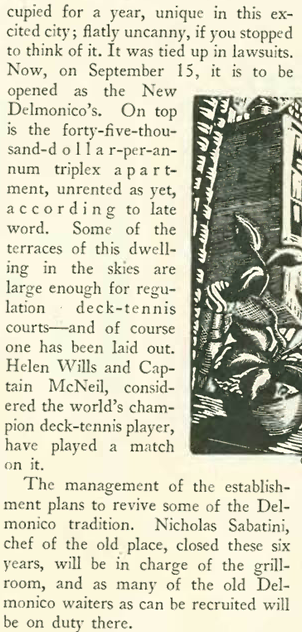
The famed Delmonico’s restaurant that provided the setting for Adolph Zukor’s “14 rules” meeting in 1921 closed its doors in 1923, a victim of Prohibition (more people dined at home, where they could still drink). Writing in the Sept. 7 “Talk of the Town,” Bernard A. Bergman described plans for the long-awaited opening of a new Delmonico’s in a skyscraper bearing the same name…

RICH DESSERTS…Dinner in honor of French Navy Admiral Paul Campion at the old Delmonico’s in 1906. (Wikipedia/Library of Congress)
AND SALAD DAYS…Delmonico’s wait staff pose for a photograph in 1902. (Museum of the City of New York)

A former Delmonico’s chef, Nicholas Sabatini, hoped to bring back some of old waiters and cooks from the restaurant’s glory days, but it seemed most were far too long in the tooth. It is unclear if he ever got his dream off the ground, or if the grill room was able to crank out fare comparable to that of the old Delmonico’s. Probably not…

THE KITCHEN IS CLOSED…The 1928 Hotel Delmonico, as shown in a 1937 photograph. It was purchased by Donald Trump in 2002 and converted into luxury condominiums. It would not host a great restaurant, but the Beatles would stay there in 1964. (New York Public Library)

*  *  *

Relax. You’re in Omaha

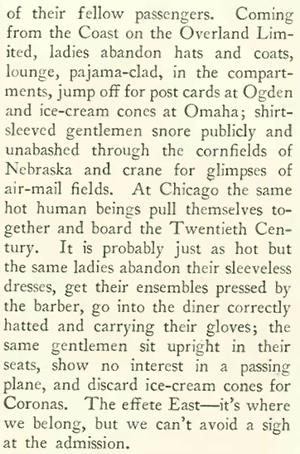
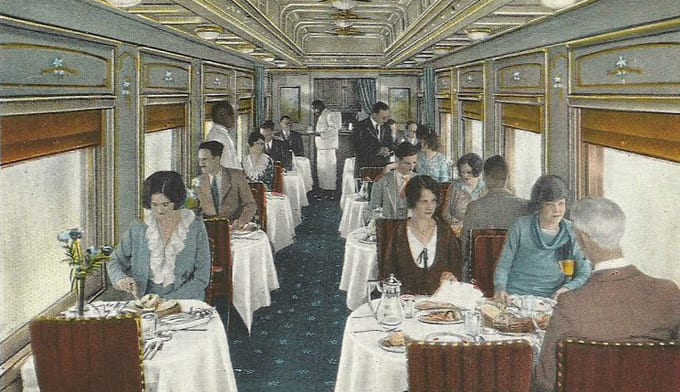
E.B. White’s “Notes and Comment” entry in the Sept. 7 “Talk of the Town” described travel on the Union Pacific’s Overland Limited, and the “mystic dividing line” that separated laid-back Westerners from buttoned-up Easterners:

MIND YOUR MANNERS, AT LEAST UNTIL YOU LEAVE CHICAGO…Tinted photo postcard depicting the dining car on a Union Pacific train that traveled the Chicago to Denver route in the 1920s. (myutahparks.com)

 *  *  *

Write What You Know

The Wisconsin-born Marion Clinch Calkins (1895 – 1968) often wrote humorous rhymes for The New Yorker under the pen name Majollica Wattles. While many writers reveled in the party atmosphere of the Roaring Twenties, Calkins worked as a vocational counselor and social worker at Lillian Wald’s Henry Street Settlement. This experience doubtless led her to more serious writing after the 1929 market crash — her critically acclaimed book, Some Folks Won’t Work (1930), is considered a seminal document on the Great Depression.

But in September 1929, Calkins was still in a humorous vein, and published this satirical piece on the role of an ideal housewife in the Sept. 7 issue. Excerpts:

CALL ME CLINCH…Marion Clinch Calkins circa 1905 and 1945. She wrote under the name of Clinch Calkins because she wanted her authorship to be gender-neutral. (evansvillehistory.net/NEH)

 *  *  *

Information Please

The New Yorker’s art critic Murdock Pemberton did not suffer fools gladly, and whenever the local museums seemed less than up to snuff, he was there to provide some correctional advice…

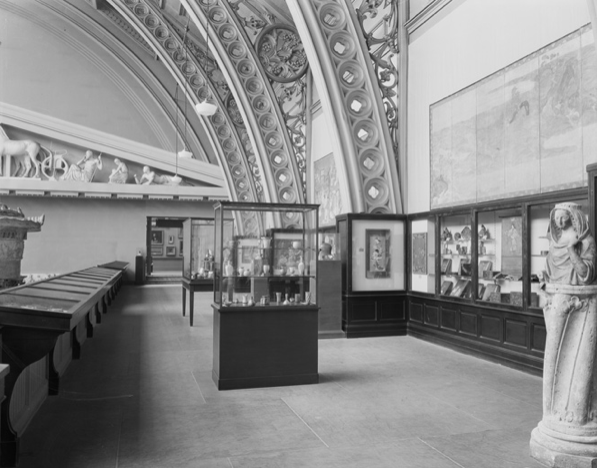
NEED AN AUDIO GUIDE? STILL WORKING ON THAT…The Metropolitan Museum of Art’s H.O. Havemeyer Collection, 1930. (The Metropolitan Museum of Art)

 *  *  *

From Our Advertisers

Despite the advances made by women in the 1920s, they still lived under a patriarchy, especially when it came to the patrician classes. And so the young bride of Gifford Pinchot II was identified only as a “Mrs.” in the headline for this Pond’s cold cream ad…

…Mrs. Gifford Pinchot II was actually Janine Voisin (1910-2010). She must have had more than a healthy complexion, as she lived 100 years…

Janine Voisin Pinchot in 1933. (history.blogberth.com)

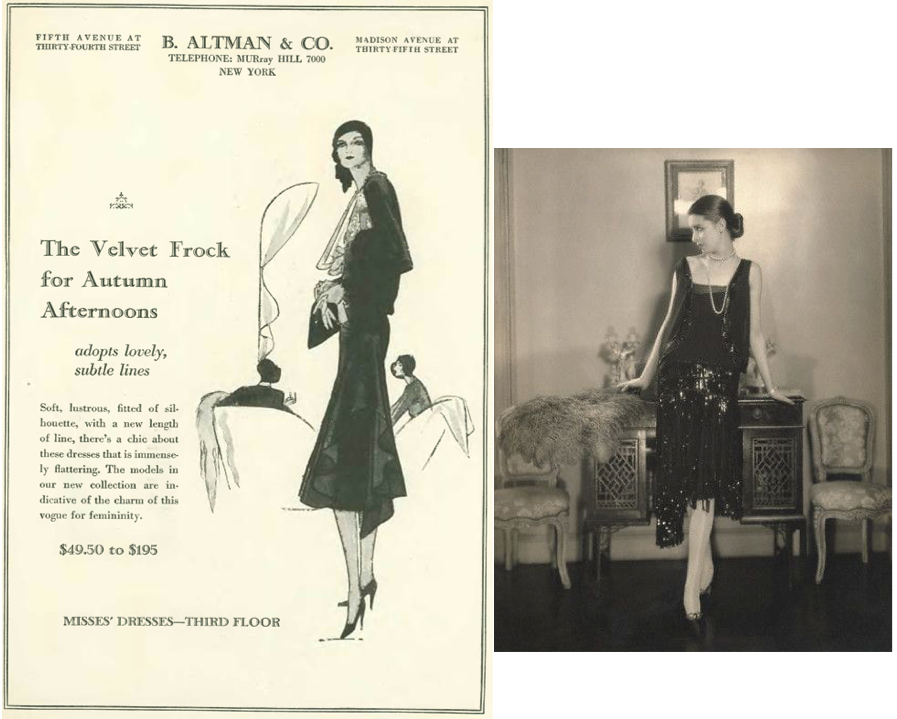
Another woman known for her beauty in the 1920s was the model Marion Morehouse (who was married to poet E.E. Cummings from 1934 until his death in 1962). Considered by some to be the first “supermodel,” I include an image of Morehouse below (right) to demonstrate how artists exaggerated the female form in fashion ads of the day…

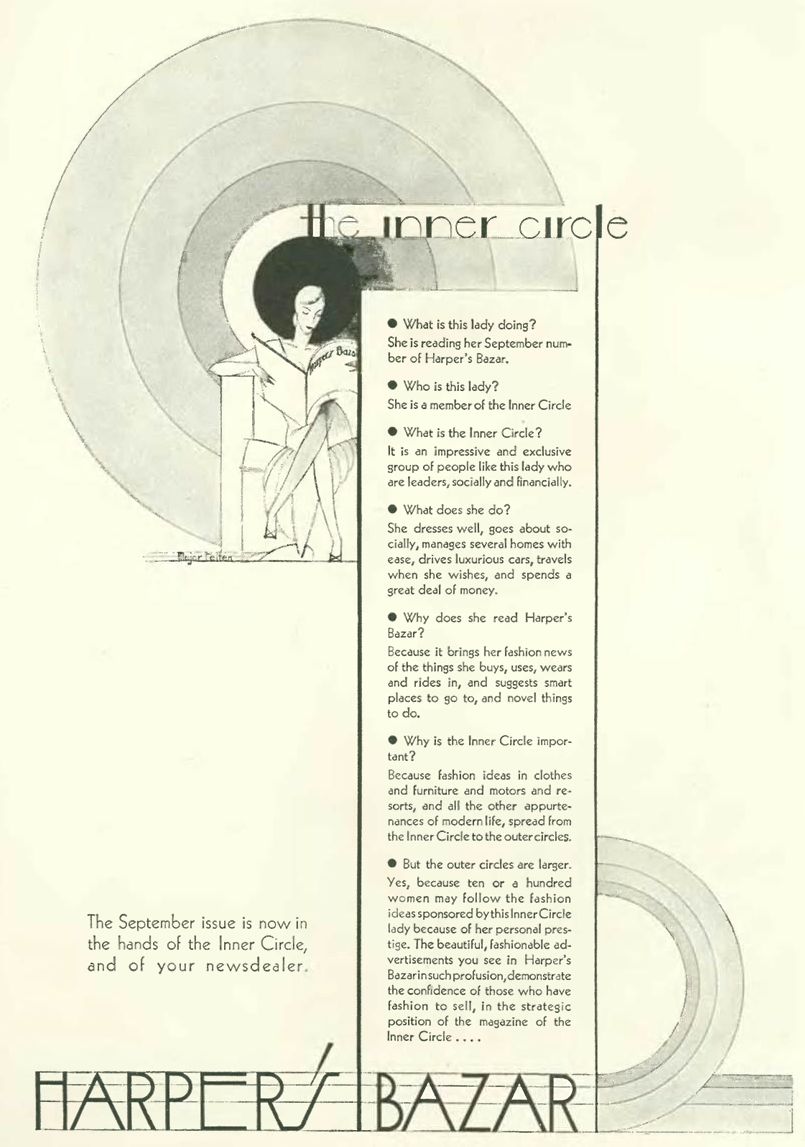
…the body wasn’t the only thing subject to exaggeration, or hyperbole, as this ad from Harper’s Bazar attested in defining the exclusivity of its readership…

…the New York Sun also appealed to social mores in an attempt to sell more newspapers…

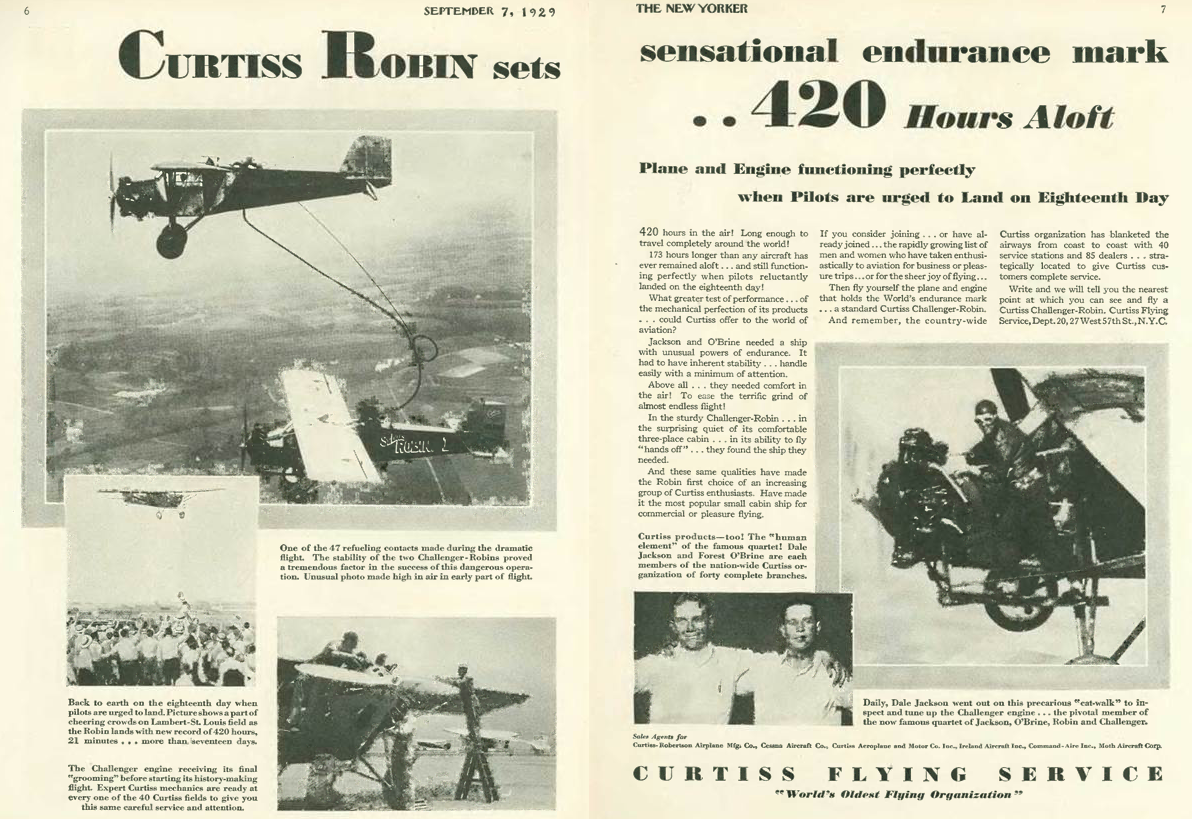
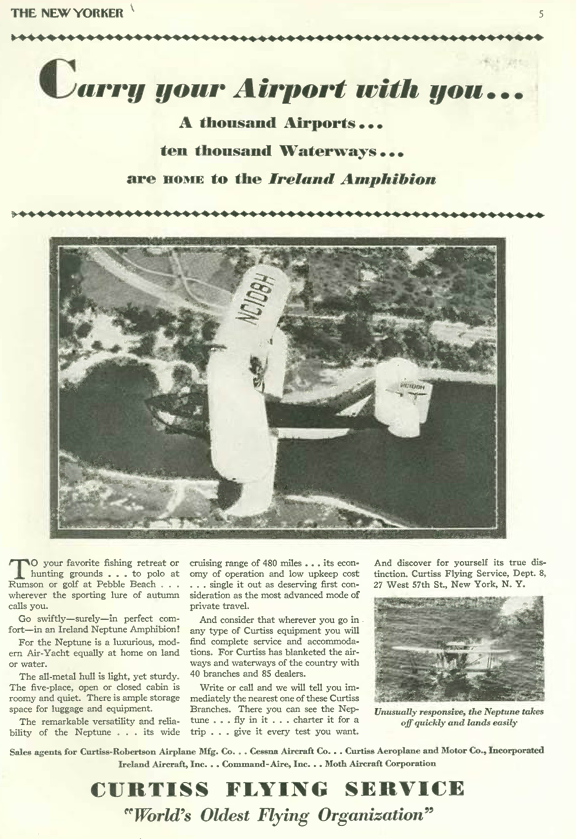
…the Curtiss Robin Flying Service touted their latest achievement — the St. Louis Robin being refueled during its flight to a new world’s endurance record of 420 hours — greatly surpassing the record of 150 hours set by the Army’s “Question Mark” airplane at the beginning of 1929…

…our cartoonists from the Sept. 7 issue include Gluyas Williams, who had some fun at the expense of Alice Foote MacDougall, who was the “Starbucks” of her day, at least in New York…

…MacDougall turned her coffee business into a restaurant empire in the 1920s. She opened several restaurants in Manhattan, all decorated in a signature style meant to evoke European cafés…

EURO AMBIENCE…Interior of Alice Foote MacDougall’s Firenze, 6 West 46th Street, New York City, 1925. (New York Historical Society)

…other cartoons included this commentary on public advertising by Leonard Dove

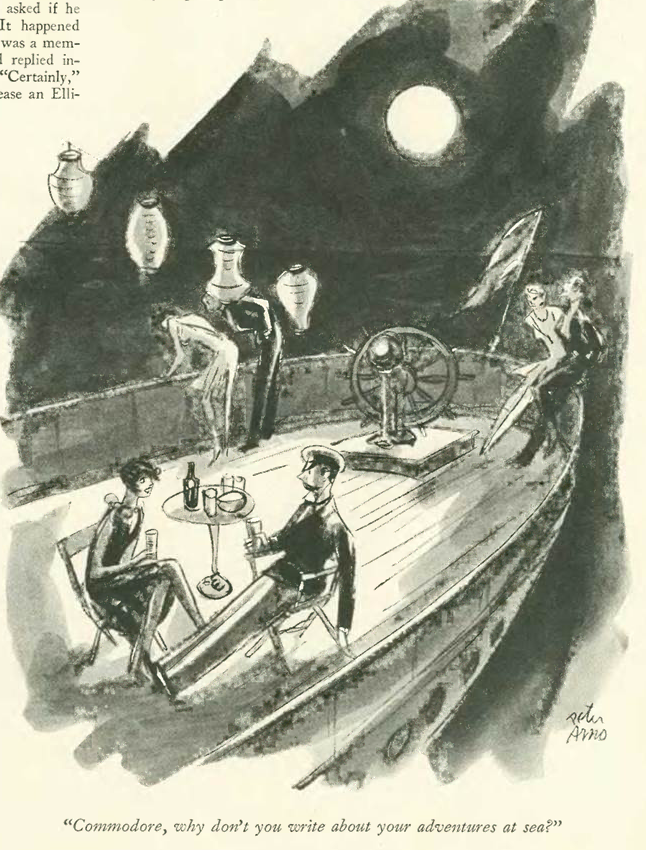
Peter Arno’s unique take on the seafaring life…

Helen Hokinson eavesdropped on some tween talk…

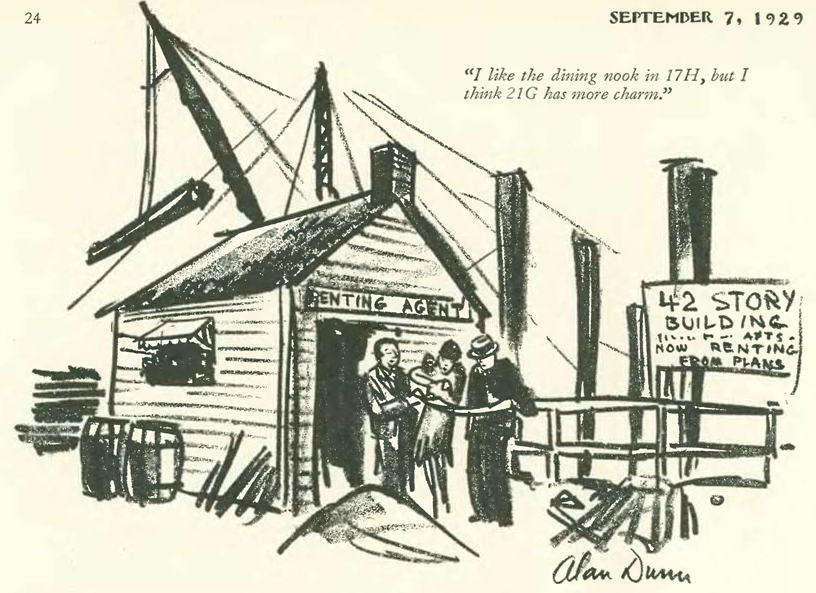
…and Alan Dunn gave us some perspective on the fast pace of city life…

Next Time: From Stage to Screen…


Hooray for Hollywood

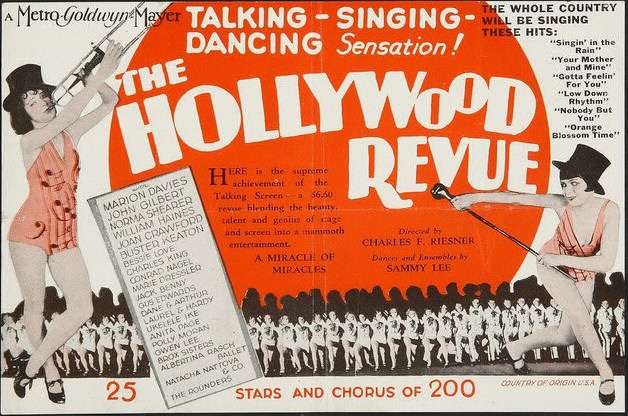
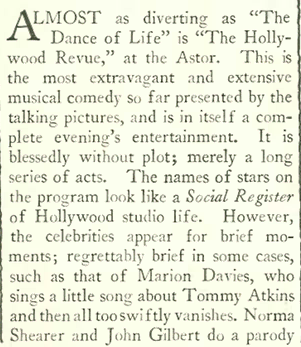
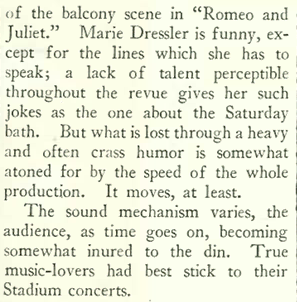
MGM piled so many stars and gimmicks into the premiere of The Hollywood Revue of 1929 that even The New Yorker’s jaded film critic John Mosher had to admit he was entertained.

Aug. 24, 1929 cover by Helen Hokinson.

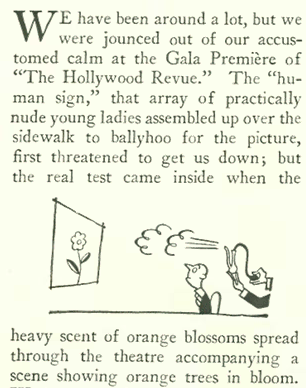
Although today’s audiences would find the film quaint and corny (not to mention its tinny sound and crude editing), it was a big hit in 1929. A plotless revue featuring nearly all of MGM’s stars (Greta Garbo said no — she had a clause in her contract exempting her from such silly things; Lon Chaney, on the other hand, was in failing health), the film followed a variety format similar to such vaudeville productions as the Ziegfeld Follies. The Arthur Freed/Herb Nacio Brown song “Singin’ In the Rain” was introduced in this film, and would inspire the Gene Kelley musical by the same name 23 years later. A rarity for the time, the Hollywood Revue included four skits in an early version of Technicolor, including an all-cast performance of “Singing’ In the Rain.” Mosher observed:

One of the film’s color skits featured John Gilbert and Norma Shearer in a Romeo and Juliet parody filled with Jazz Age slang. It would mark the beginning of the end of Gilbert’s career and, sadly, his life. He was one of the silent era’s most popular leading men, but it was purported that his voice was not suited to the talkies. What really ended Gilbert’s career, however, was studio head Louis B. Mayer, who clashed with the actor both personally and professionally…

FAREWELL ROMEO…A lobby card promoting The Hollywood Revue of 1929 featured John Gilbert and Norma Shearer in one the film’s color sequences, a parody of Romeo and Juliet filled with Jazz Age slang. At right, a scene from the skit in which the director (played by Lionel Barrymore, far right) tells Shearer and Gilbert to put more pizzazz into the act. (IMDB/YouTube)
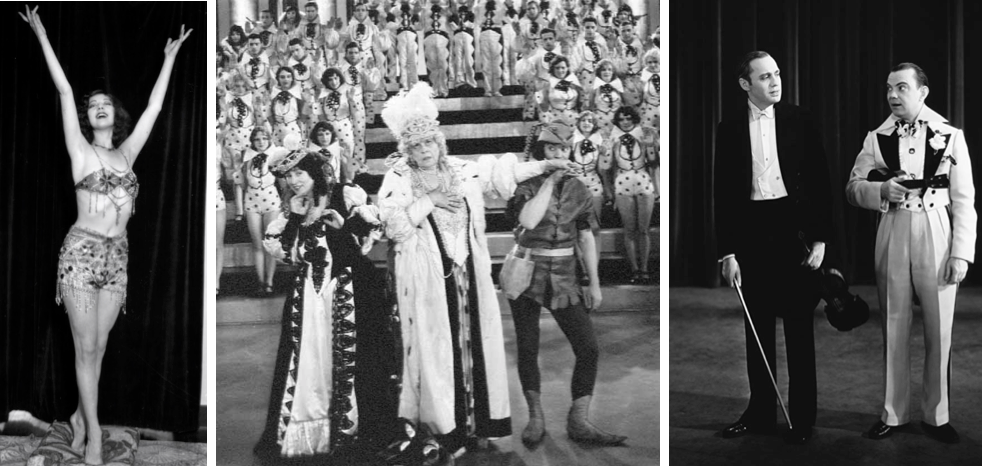
STAR-STUDDED…Left to right, early silent film comedian Marie Dressler hammed it up in a royal court skit; co-emcee Jack Benny, with his trademark violin, and Cliff “Ukulele Ike” Edwards, and his trademark uke. (vickielester.com/doctormacro.com/thejumpingfrog.com)
DANCING IS GOOD FOR YOUR HEALTH…Chorus girl Carla Laemmle in the film’s “Tableau of Jewels,” in which she emerged from a seashell to perform a seductive (and weird) dance number while other showgirls posed on a revolving crown — all set to a tune sung offstage by James Burroughs. The niece of Universal Pictures founder Carl Laemmle, Carla Laemmle was one of the longest surviving actors of the silent era. She died in 2014 at age 104. (songbook1.wordpress.com)
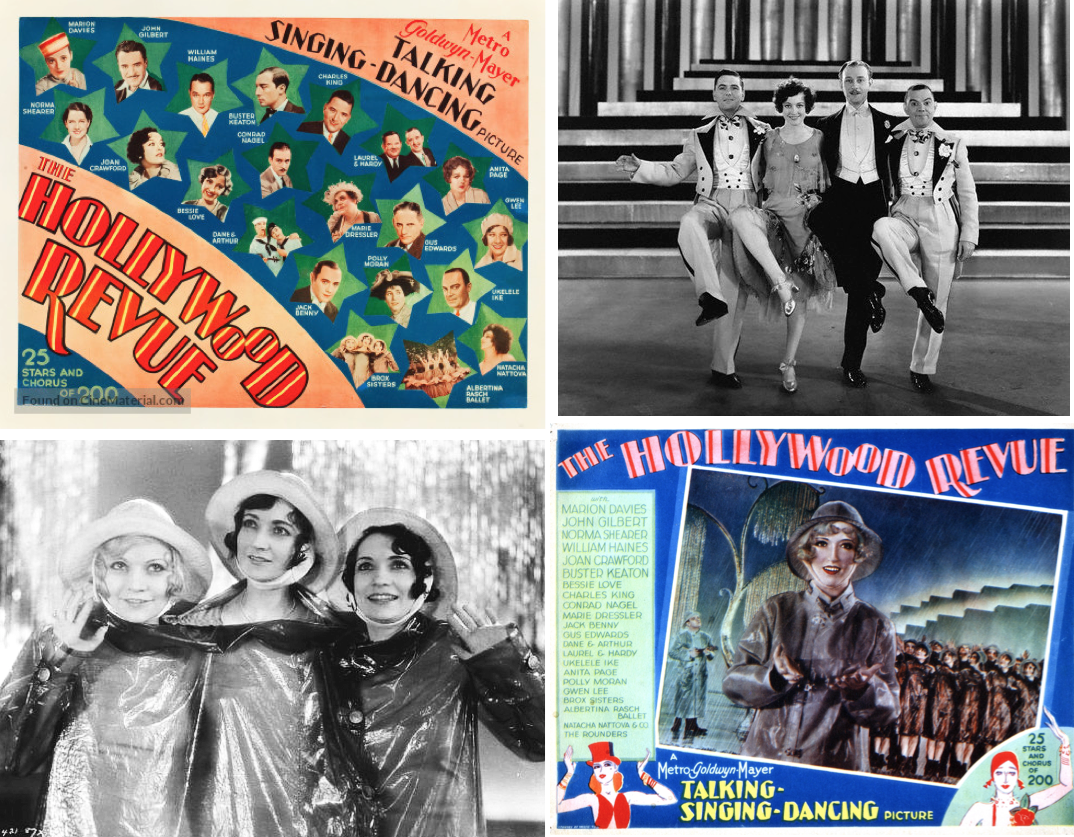
GALAXY OF STARS…Clockwise, from top left, lobby card for The Hollywood Revue of 1929; Charles King, Joan Crawford, Conrad Nagel (a co-emcee along with Jack Benny) and Cliff “Ukulele Ike” Edwards show off their dancing skills; lobby card featuring actress Marion Davies; a popular act in vaudeville and on Broadway, the Brox Sisters—Lorayne, Patricia and Bobbe (along with Cliff Edwards) introduced the song “Singin’ in the Rain,” also sung by the entire cast near the finale of the movie. (IMDB/joancrawfordbest.com/mubi.com)

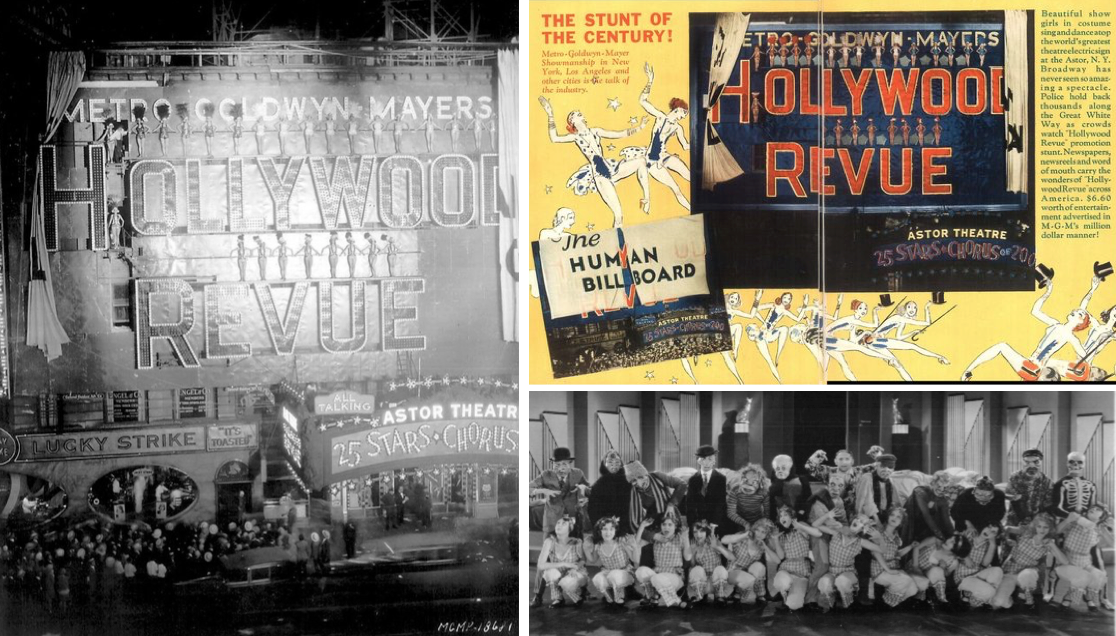
…MGM deployed a number of stunts to generate publicity at the film’s New York premiere at the Astor Theatre, including a “human billboard” that featured scantily clad chorus girls precariously perched on a huge letters high above the theatre’s entrance. In a rather less dangerous stunt—during the movie’s “Orange Blossom Time” skit—a faint scent of orange blossoms wafted into the theatre. “The Talk of the Town” observed…

WHAT COULD POSSIBLY GO WRONG?…Showgirls arranged along narrow catwalks atop the glowing HOLLYWOOD REVUE sign would pose for hours above crowds of gawkers; top, an advertisement promoting “The Stunt of the Century”; bottom, chorus girls lined up on somewhat safer ground in a skit from the movie titled “Lon Chaney’s Gonna Get You If You Don’t Watch Out.” Chaney himself was near death and did not appear in the film. (oldphotoarchive.com/anndvorak.com)
Another angle shows just how precarious this stunt proved to be for these brave chorus girls, who held their poses for hours on end. (legendaryjoancrawford.com)
JUST SINGIN’…Among the MGM stars appearing in the film’s finale include, in the middle of the front row, Buster Keaton, Marion Davies, and Joan Crawford. (IMDB)

*  *  *

Technological Adjustments

Had you attended the premiere of The Hollywood Revue, perhaps you would have appreciated James Thurber’s observation that actors in talking pictures sound as if they are speaking into cracker boxes. In this hilarious piece (titled “The Roaring Talkies”), he proposed a solution. An excerpt:

*  *  *

A Happy Diversion

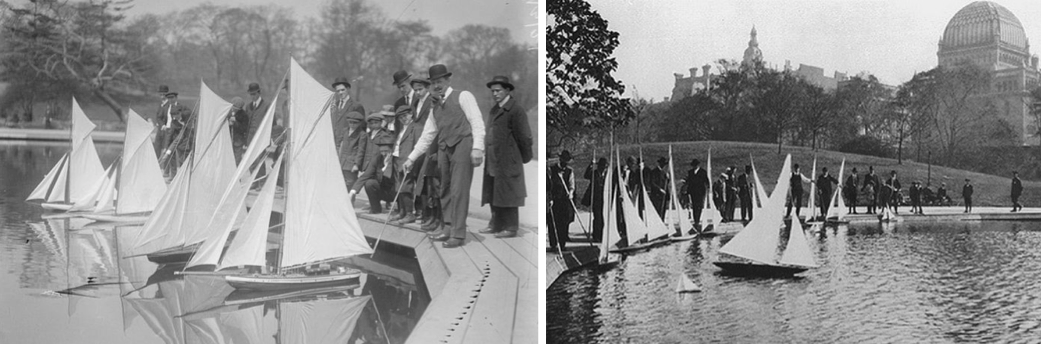
“The Talk of the Town” (via Theodore Pratt) looked in on the hobbyists who raced model boats at Central Park’s Conservatory Lake, a happy tradition that began in the late 19th century and continues to this day:

A DAY AT THE RACES….Model sailboats (left) prepare to face off in 1910 at Conservatory Lake (also called Conservatory Water); at right, model sailors at the same lake around 1920. (Library of Congress)

Pratt also described the old wooden boathouse, which was replaced in 1954 with a somewhat grander structure, Kerbs Boathouse, where model boats are still stored…

STILL SAILING…The copper-roofed Kerbs Boathouse replaced a wooden structure in 1954. Conservatory Lake served as the setting for a model boat race in E.B. White’s Stuart Little. (centralparknyc.org)

 *  *  *

On the Other Hand…

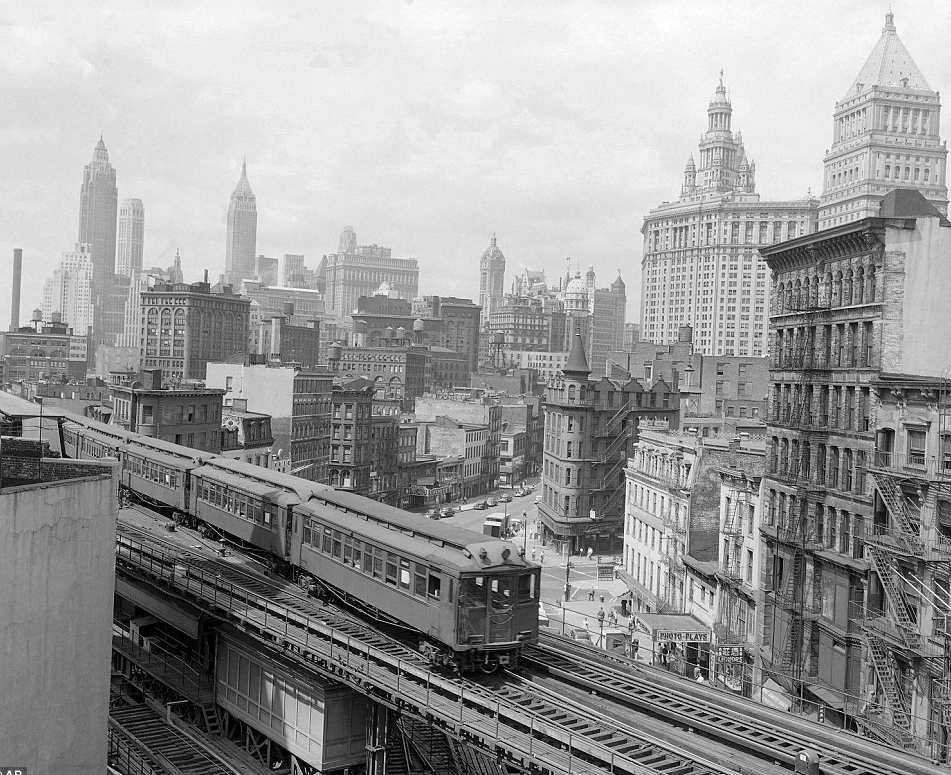
Leaving the cool and quiet of the park brought one quickly back into the dust and clamor of the metropolis. Pratt observed that the summer season lasted two weeks longer in the city than in the country, thanks to the city’s heat island effect— perhaps an unwelcome observation given the usually hot summer of 1929. Not only did the city’s heat extend the season, but it also kept the city enveloped in “an enormous cloud of dust”…

HAZY DAYS OF SUMMER…A dusty haze hangs over Lower Manhattan as the Third Avenue elevated train rumbles by in this circa 1950 photo. (Associated Press)

 *  *  *

Already Feeling Old?

I found this “Talk” item curious for exploring the sentimental attachment some folks had developed for old cars from the 1910s, given those cars were barely twenty years old and cars in general hadn’t been in common use much longer…

…as for another “Talk” item, I doubt modern New Yorker readers would find any humor in this observation:

 *  *  *

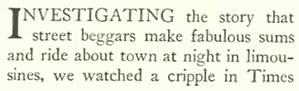
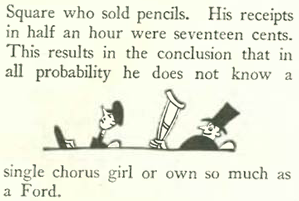
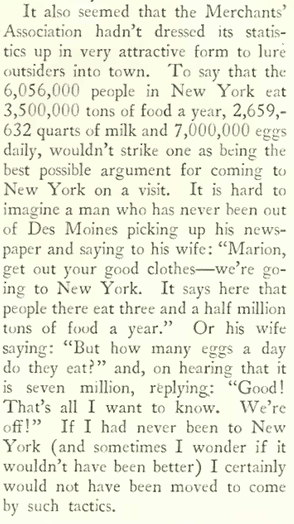
On to sillier things, Robert Benchley turned in a casual titled “Boost New York!” Benchley ridiculed a promotional brochure from the New York Merchants Association that touted various statistics in a manner reminiscent of the fictional George Babbitt. Benchley imagined how an Iowa couple might respond to such dazzling numbers:

*  *  *

A Drinking Life

Occasionally I like to feature infrequent or one-time New Yorker contributors who are nearly lost to history. Frank Ward O’Malley (1875-1932), a reporter for the New York Sun from 1906-19, was known for his humorous stories. In 1928 he published a book titled The Swiss Family O’Malley. In this casual (titled “The Fatty Degeneration of Broadway”) from the Aug. 24 issue, O’Malley described an alcohol intervention of sorts and then his fall off the wagon. Here are the opening and closing paragraphs, along with his photo circa 1910s.

                                                                           Frank Ward O’Malley (Library of Congress)

 *  *  *

From Our Advertisers

This week we have an advertisement for the Drake Apartment Hotel, claiming to be the “smartest” in New York. Note how they employed what seems to be the same pointy-nosed, haughty couple that we saw last week (below) who endorsed the Park Lane (I want to believe there is a subtle joke here)…

…just 25 years removed from the Wright Brothers’ flight at Kitty Hawk, advertisers were treating flying as though it were routine…

A better photo of the Ireland Neptune Amphipian (aerofiles.com)

…and this young woman seemed to think flying was nothing more than “playing ring around the rosy with the clouds”…

…I like the reviews included in this bookseller’s ad, especially the first one for the book Ex-Wife by Anonymous (it was written by Ursula Parrott, a writer of romantic fiction)…

…our illustrations include Abe Birnbaum’s contribution to the casuals section (breaking up the copy of one of Josie Turner’s Elsie Dinsmore parodies)…

Reginald Marsh illustrated the late summer beach scene at Coney Island…

…and for kicks this nice little filler by Constantin Alajalov

…thanks to the skills of The New Yorker’s first layout artist, Popsy Whitaker, we have this whimsical pairing of Otto Soglow and Dorothy Parker

Mary Petty contributed a cartoon that looks contemporary…

Peter Arno paid a visit to the doctor’s office…

…and commented on his life as a new father…the woman holding the baby was doubtless inspired by his wife, New Yorker columnist Lois Long

…for reference, Peter Arno and Lois Long are pictured here with baby daughter Patricia Arno in 1928…Lois clearly had a better grasp on the situation than Arno had imagined…

Arno and Long with their baby daughter, Patricia, in 1928. (Vanity Fair)

Alice Harvey eavesdropped on a conversation between teenagers…

…and like Arno, Leonard Dove had two cartoons in this issue…here an editor finds the former Prohibition enforcer no longer newsworthy…

…and over on the East Side, rumors of gentrification…

Next Time: A Carnival in the Air…


From Broadway to Babylon

While the introduction of sound to motion pictures ended the careers of some silent film stars in the late 1920s, Hollywood’s “talkies” offered new opportunities for Broadway stage actors who could now take their vocal talents to the screen and to audiences nationwide.

May 4, 1929 cover by Ilonka Karasz.

And so began the so-called “Broadway Exodus.” Robert Benchley offered his wry observations on the phenomenon in the May 4, 1929 “A Reporter at Large” column:

AW SHUCKS…Broadway mainstay and a perennial performer with the Ziegfeld Follies, humorist Will Rogers found his element in Hollywood’s new talkies, appearing here with Fifi D’Orsay in 1929’s They Had to See Paris. (Wikipedia)
TALE OF TWO CITIES…Broadway in 1925 (left) and Hollywood Boulevard in 1929. (Daily Mail/USC Digital Library)

Benchley observed that regardless how many Broadway stars moved west, Hollywood Boulevard would never be mistaken for Broadway. However, Benchley himself would catch the bug and head to Tinseltown, appearing in dozens of feature films and shorts including How to Sleep, which would win an Academy Award for “Best Short Subject, Comedy,” in 1935.

NICE WORK IF YOU CAN GET IT…Robert Benchley in the 1935 Oscar-winning short, How to Sleep. (YouTube)

 *  *  *

One Who Stayed on Broadway

James Thurber reported in “The Talk of the Town” that famed boxing champion Jack Johnson was a common sight on the sidewalks of Broadway. Thurber noted that Johnson, the first African American world heavyweight boxing champion (1908–1915), had fallen on less glamorous days, but still appeared fit at age 51.

IN FIGHTING FORM…Jack Johnson visits with writer Joe Butler at the Scranton Times-Tribune offices on Nov. 30, 1929. (Scranton Times-Tribune)

Thurber noted that Johnson was planning to sell stories of his life, and possibly get into vaudeville. The boxer also mused that who could lick either of the heavyweight champs of the 1920s, Gene Tunney and Jack Dempsey

CREAMPUFFS…The 51-year-old Jack Johnson claimed he could defeat either of the famed heavyweight champions of the 1920s, Gene Tunney (left) or Jack Dempsey. (Reemus Boxing)

…and Thurber shared a strange account regarding the thickness of Johnson’s skull, which apparently bested that of an ox…

FIGHT TO THE LAST…The 67-year-old Jack Johnson prepares for an exhibition boxing match at a war bond show in New York City on May 1945. Along with making public appearances, Johnson also performed on Broadway during his retirement. (Houston Chronicle)

Johnson continued professional boxing until age 60, and thereafter participated in boxing exhibitions in various venues until his death at age 68 in a car crash near Raleigh, NC. It was reported that Johnson was racing angrily from a nearby diner that had refused to serve him when he lost control and hit a light pole.

 *  *  *

Don’t Ask, Don’t Tell

Anyone who thinks the recent squabbles over Planned Parenthood are anything new might do a little reading on the life of Margaret Sanger, who opened the first birth control clinic in the U.S. in 1916 (in Brooklyn) and was subsequently arrested for distributing information on contraception. In 1929 she was again arrested for operating a “secret” birth control clinic in the basement of a Manhattan brownstone. On March 22, 1929, the New York Police Department sent an undercover female detective, Anna McNamara, to Sanger’s clinic. Posing as a patient who wished to avoid another pregnancy, McNamara was advised on various forms of contraception. She later returned to the clinic as part of the police raid, during which she seized a number of confidential patient files. At Sanger’s subsequent court hearing, McNamara learned first-hand about the importance of patient confidentiality. From the May 4 “Talk of the Town”…

Recalling her arrest in a 1944 article, “Birth Control: Then and Now,” Sanger wrote that McNamara taunted her during the raid when she was told that she had no right to touch private medical files. Sanger wrote “I shall never forget the color of Mrs. McNamara’s face when she heard this medical testimony recited several days later in Magistrates’ Court at the hearing. She was totally unprepared for this embarrassing revelation of her own organs.” The New Yorker made note of this…

Sanger would continue to work for birth control until her death in 1966. Although her name is still invoked in debates over abortion, Sanger herself was generally opposed to abortion, maintaining that contraception was the only practical way to avoid it.

GAG ORDER…In April 1929 Margaret Sanger planned to speak at Boston’s Ford Hall Forum on Free Speech. Ironically, the topic of birth control was banned in Boston at the time, so Sanger appeared onstage with a gag over her mouth while historian Arthur M. Schlesinger read her remarks on free speech to the assembly. At right, the February 1926 issue of Birth Control Review. Founded by Sanger in 1917, she served as editor until 1928. It ceased publication in 1940. (womensstatus.weebly.com/sangerpapers.wordpress.com)

 *  *  *

Please Sit Still

The “Talk of the Town” also looked on American Impressionist painter Childe Hassam, who demonstrated the challenges of painting en plein air…

LOVELY SCENE…Childe Hassam’s Landscape at Newfields, New Hampshire, oil on canvas, 1909. Hassam in his studio circa 1920. (Wikimedia Commons/Wikipedia)

…and found it difficult to finish a farmhouse sketch when a door was unexpectedly closed on his subject…

THIS ONE HE FINISHED…Childe Hassam’s etching, The Old Dominy House (East Hampton), 1928. This work was probably created during Hassam’s visits to East Hampton described in “The Talk of the Town.”(Smithsonian)

 *  *  *

All That Jazz

As Lois Long’s contributions to her “Tables for Two” column grew ever more infrequent, it was clear that she was wearying of the nightlife scene. Now 28 and a young mother, “Lipstick” was shedding her image as a fun-loving flapper and devoting more time and energy to her fashion column, “On and Off the Avenue.” Nevertheless, she still found the time to visit the Cotton Club and proclaim Duke Ellington’s jazz orchestra as “the greatest of all time”…

…although her other observations of the New York nightclub scene appear to have been hastily dashed off…

THE BEST…Duke Ellington and his orchestra (top), circa 1930. Below, Vincent Lopez conducts his orchestra in 1923. (oldtimeblues.net / www.jazzhound.net © Mark Berresford)

 *  *  *

Electric Wonders

The May 4 issue updated readers on some of the latest gadgets available to modern households in 1929. I particularly like the device that allowed your vacuum to blow “moth poison” into your garments…

NOW THIS DOES NOT SUCK…Garments and other household items could be fumigated against moths using a new reverse vacuum attachment, available at Lewis & Conger. (Cyberspace Vacuum Cleaner Museum / Columbia University)

*  *  *

From Our Advertisers

One thing you notice about 1920s advertising is the amount of turgid copy they contain…I suppose without distractions such as TV and iPhones people actually took the time to read all of these bloated messages, such as this one from Whitman’s that suggested a box of candy is more than a box of candy…

…or how about this lengthy appeal from Kodak, which used guilt to convince you to get some film of grandma while she was still “at her best…”

…the makers of Spud promised a “new freedom” and a “16% cooler smoke” to the users of its menthol-laced cigarettes. Spuds were the first menthol cigarettes, developed in 1924 by Ohioan Lloyd “Spud” Hughes, who sold them out of his car until the brand was acquired in 1926 by The Axton-Fisher Tobacco Company. By 1932 Spud was the fifth-most popular brand in the U.S., and had no competitors in the menthol market until Brown & Williamson launched their Kool brand in 1933. The Spud brand died out by 1963 (along with, presumably, many of its customers)…

…leveraging the popularity in the 1920s of knights and fairies, as well as the Anglo- and Francophila of New Yorker readers, “Mrs. Marie D. Kling” hoped to entice city dwellers up to the burbs in Scarsdale…

…our cartoons are courtesy of Barbara Shermund, who looked in on a couple of debs performing their daily exercises…

…while down in the parlor, Rea Irvin captured the horrors inflicted by an author’s tedious reading…

…and finally, Peter Arno probed the depths of sanctimony…

Next Time: Waldorf’s Salad Days…