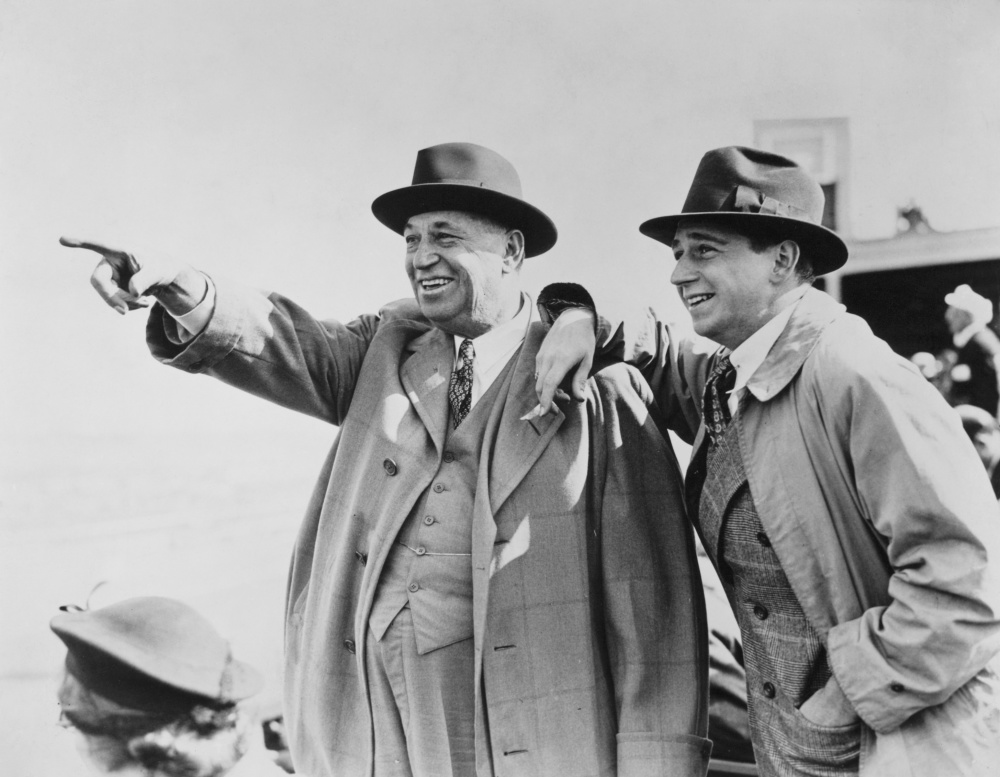
Above: Former Governor Alfred E. Smith points out the sights of the city to Governor Franklin D. Roosevelt from an Empire State Building observation floor on May 1, 1931. (Empire State Realty Trust)
New York Governor Al Smith and the man who succeeded him in that office, Franklin D. Roosevelt, were both Democrats, but when it came to personalities, they were more like oil and water.
Sept. 3, 1932 cover by Ilonka Karasz.
A popular governor (1923 to 1928) from working-class roots, Smith thought he could ride that popularity to the White House, but lost to Herbert Hoover in the ’28 presidential elections. He then hoped to be of some use to his gubernatorial successor FDR, but was more or less snubbed by his fellow Democrat – the regal Roosevelt branded himself as a reformer, and didn’t want Smith’s deep Irish Tammany connections to sully that reputation. Smith did find something to do, however, by becoming president of the corporation that built and operated the Empire State Building.
THINGS ARE LOOKING UP…Al Smith (pointing) extolls the wonders of the Empire State Building at the May 1, 1931 grand opening. (chrismurphy.com)
But after the building’s dedication, Smith took another shot at the White House, this time against Roosevelt in the 1932 Democratic presidential primaries. Smith lost the nomination in a bitter convention battle (he eventually endorsed FDR) but kept busy with another venture: editor of the New Outlook magazine…
SECULAR SHIFT…The Outlook began publication as The Christian Union (1870–1893). The issue at left is from July 1, 1893, when the magazine became The Outlook to reflect its shift from religious subjects to social and political issues. That magazine went bankrupt and became the New Outlook in 1932; the issue at right is from October 1933, a year after Al Smith became editor. The magazine folded in 1935. (Wikipedia/Abe Books)
…which Smith used as a platform to attack his Democratic rival, and, particularly the New Deal policies following Roosevelt’s successful election to the White House. The election was still a couple months away when E.B. White offered these observations about Smith’s new publishing venture:
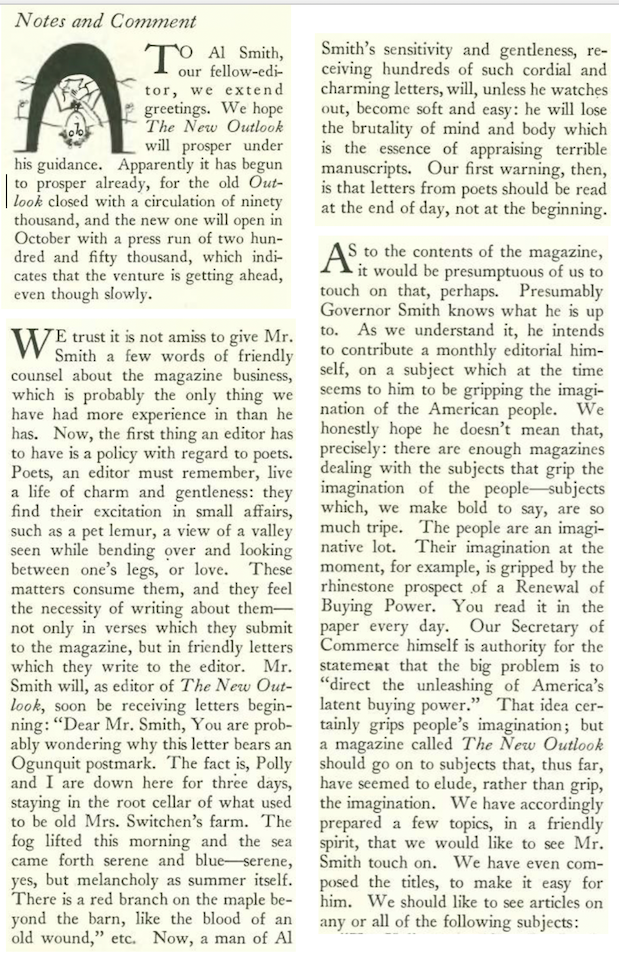
…Otto Soglow provided this interpretation of Smith’s new job for “Notes and Comment”…
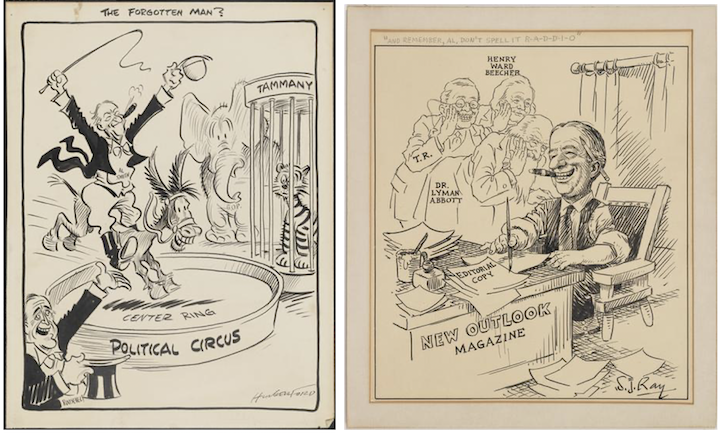
…while other cartoonists made hay over the Roosevelt/Smith rift:
COMIC APPEAL…Cyrus Cotton “Cy” Hungerford produced daily cartoons for the Pittsburgh Post-Gazette for 50 years, including this gem at left that aptly illustrated the political circus that featured Al Smith as its star attraction; during his 32 years as editorial cartoonist for The Kansas City Star, Silvey Jackson (S. J. or Sil) Ray amassed a portfolio of roughly 10,000 cartoons, including the one at right that depicts the ghosts of past Outlook contributors and editors including Teddy Roosevelt, Lyman J. Abbott and Henry Ward Beecher. (Museum of the City of New York/kchistory.org)
* * *
Nein Bitte
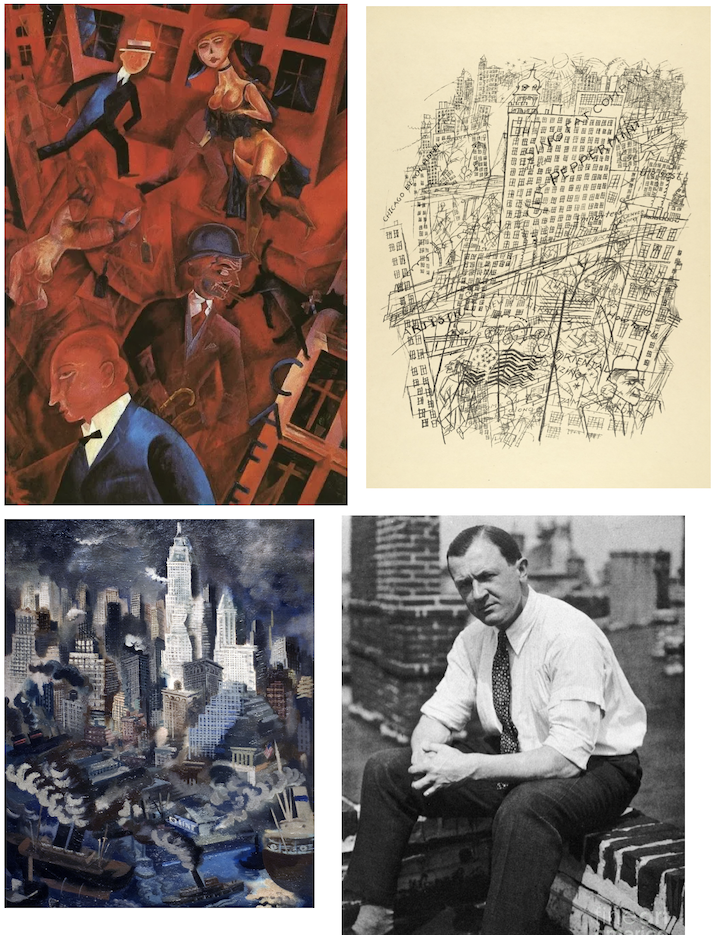
The German artist George Grosz (1893–1959) was perhaps best known for his bitter caricatures and paintings of Berlin’s Weimar years (roughly 1918 to 1933). In June 1932 he accepted an invitation to teach the summer semester at the Art Students League of New York, then briefly returned to Germany before emigrating to the U.S. with his family in January 1933.
SEEING RED…Clockwise, from top left, George Grosz depicted Berlin as a hellscape awash in blood and corruption in Metropolis (1917); by contrast, Grosz celebrated the energy and freedom of New York in his 1915–16 work Memory of New York; Grosz in New York, circa 1932; after emigrating to the US in 1933, Grosz abandoned his harsh caricatures and corrupted cityscapes in favor of nudes and landscapes. He returned to the subject of the New York skyline a number of times, including his 1934 painting Lower Manhattan. (MoMA/Flickr)
* * *
From Our Advertisers
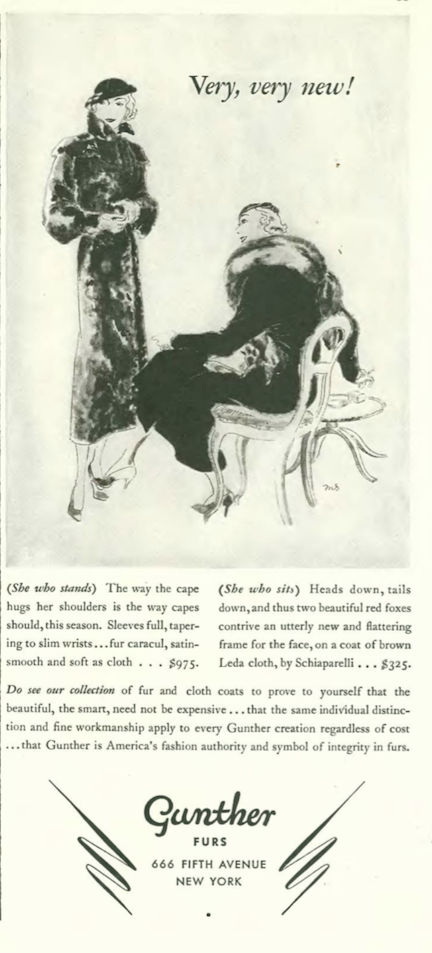
Back in the day when it was still acceptable to drape dead animals around your neck, Gunther Furs offered these ensembles…the coat at left would cost the equivalent of $17,000 today…
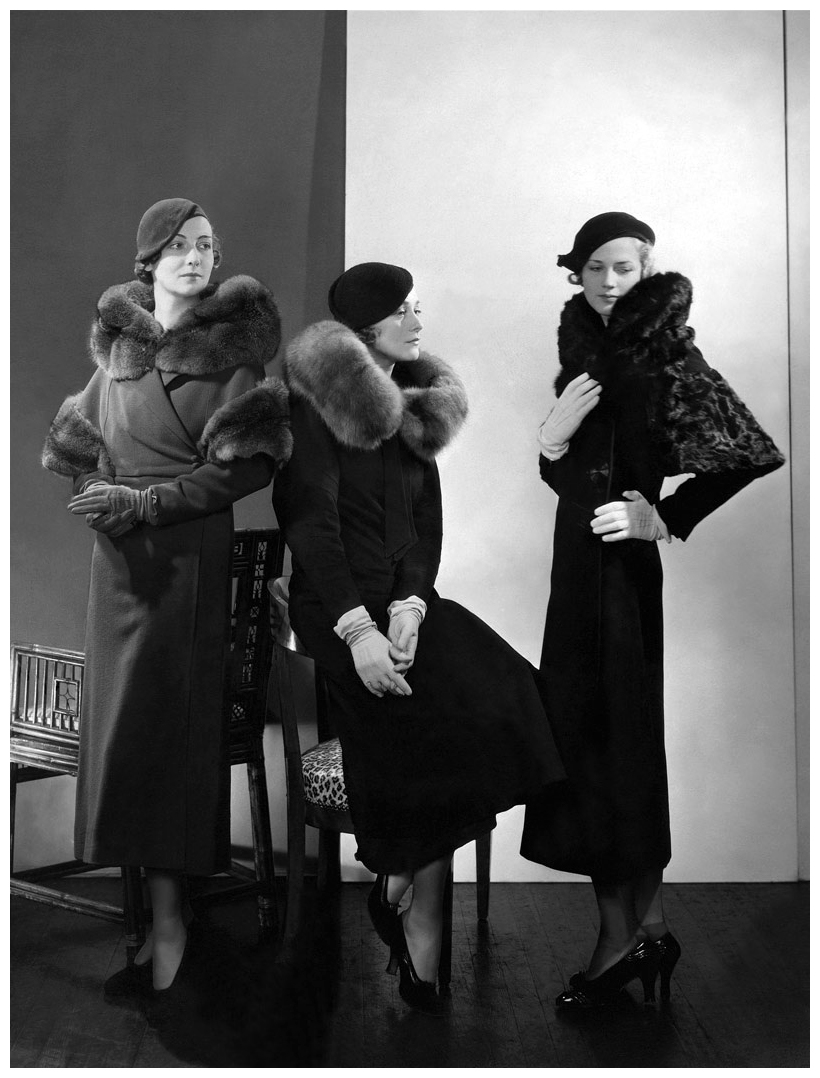
…this 1932 photo gives us some idea of how these coats might have appeared…
FUR SURE…Models in 1932 wearing (from left) wool coat with fur collar and armbands; wool coat with blue fox collar by Lanvin; and wool coat with caracal collar and sleeve trimming by Mainbocher. Photo by Edward Steichen. (pleasurephotoroom.wordpress.com)
…perhaps you could wear one of the coats on a breezy day atop Ten Park Avenue…even this posh address felt the need to emphasize its affordability in those depressed times…also note the advertisement at the bottom for a “Milk Farm”…
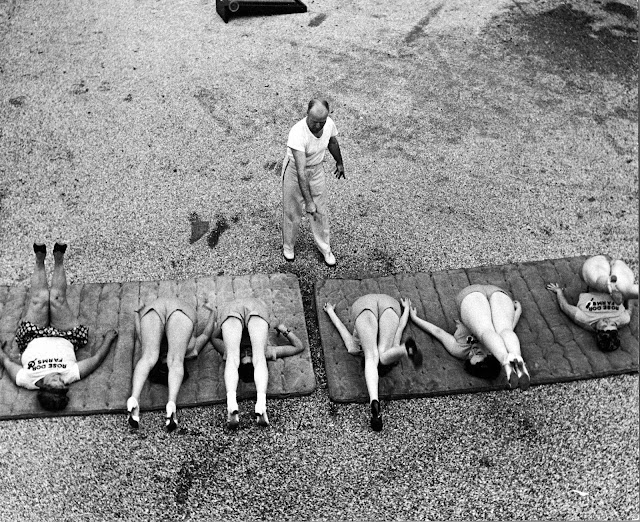
…the 1930s saw a weight-loss fad that included dairy as a dietary must; one such “milk farm” was the Rose Dor Farm just up the Hudson from New York…
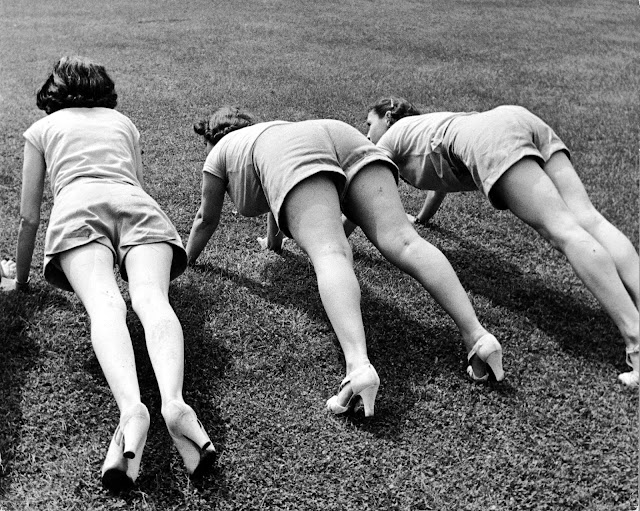
HUMP DAY…Top, Rose Dor Farm trainer Steve Finan directs mat exercises calculated to reduce hips and remove “widow’s humps” in the 1930s. Below, note the choice of footwear for the workout. (vintag.es)
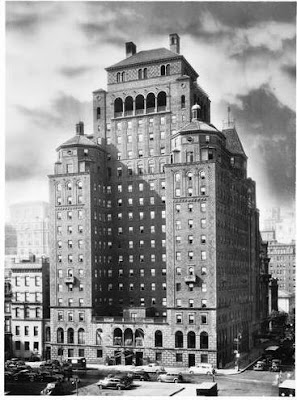
…back to our apartment hunting, The Lombardy was built in the 1920s by William Randolph Hearst for his movie star mistress Marion Davies…unlike Ten Park Avenue, it wasn’t on Park, but the ad makes sure to note its close proximity, and the illustration assured that the clientele were sufficiently dour in their good taste…also note the ad for the Fraternity Clubs Building, which was going co-ed…
…The New York Times reported in August 1932 that “the ninety rooms of the fourth and fifth floors of the building have been redecorated and furnished with a ‘feminine touch'”…
NO ANIMAL HOUSE…The Fraternity Clubs Building, erected in 1923, went co-ed in 1932. The Renaissance Revival-style building was designed by the firm Murgatroyd & Ogden. Today it serves as the Jolly Madison Towers hotel. (New York Public Library via Daytonian in Manhattan)
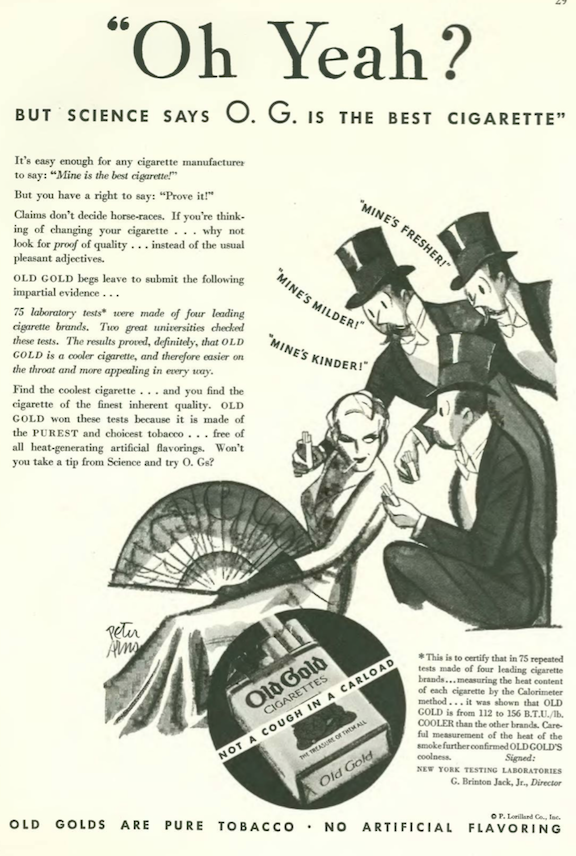
…time to step out for a smoke with another Old Gold ad illustrated by Peter Arno…
…in contrast to Arno’s defiant vamp, this woman enjoyed her smoke with a sense of ease…
…if you’ve never heard of Richard Himber, he made a name for himself in New York beginning with his days in vaudeville and Tin Pan Alley. Described in a Wikipedia entry as “American bandleader, composer, violinist, magician and practical joker,” Himber ran a band-booking agency before forming an orchestra of his own at the Essex House that performed over NBC Radio…
…our last ad is a most unlikely one from the Sterling Engine Company of Buffalo, New York, definitely an outlier among the other New Yorker ads…
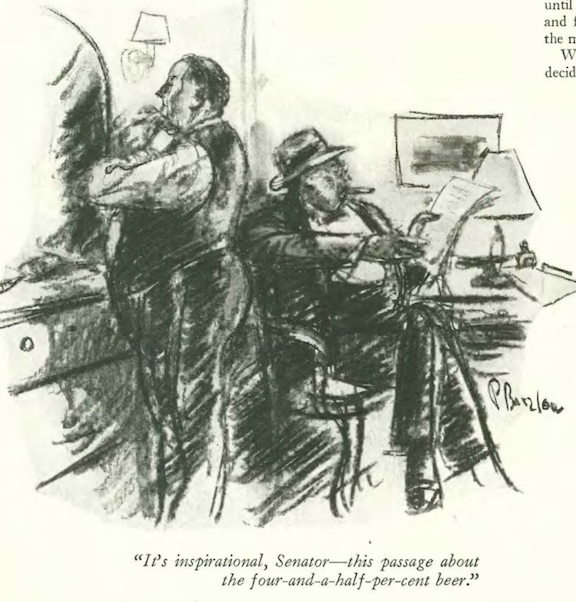
…our cartoonists include Perry Barlow on the campaign trail…
…along with Alain (Daniel Brustlein)…
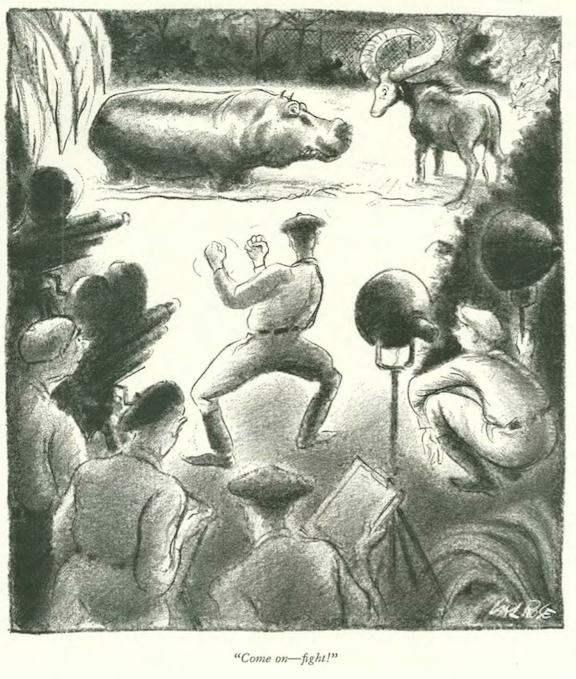
…Carl Rose gave us two zoo animals who were less than keen to become movie stars…
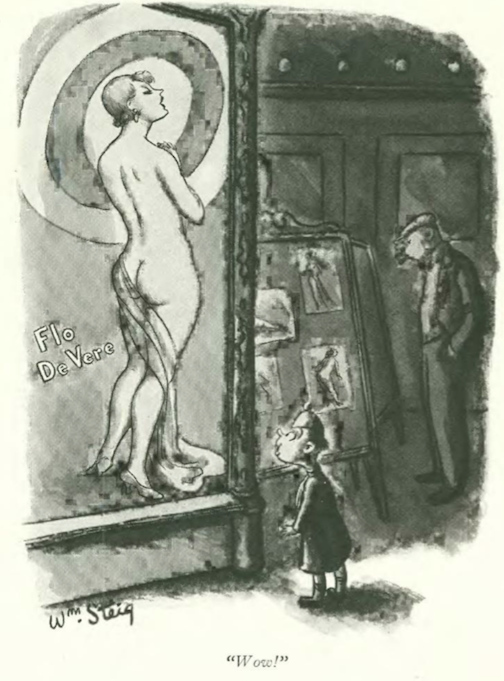
…and we close with William Steig, who showed us one of his Small Fry coming of age…
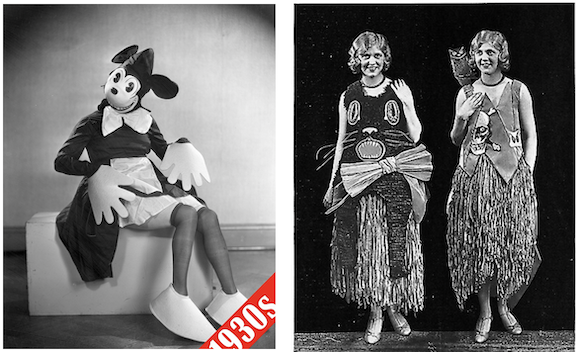
…but before we close, here’s a brief nod to Halloween, 1932, and some popular costumes for the grown-ups, including a Minnie Mouse costume that is unintentionally creepy…
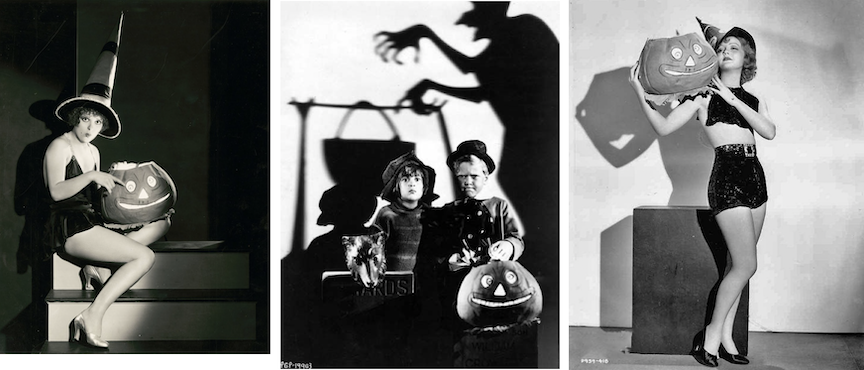
…Hollywood liked to get in on the fun by releasing studio “pin-ups” featuring stars of the day…
BOO…Paramount stars all pose with the same prop Jack ‘o Lantern circa 1931-32. From left, the original “It Girl” Clara Bow, who would retire from movies in 1933 at age 28 and become a rancher; Robert Coogan and Jackie Cooper were child stars of the film Sooky; Nancy Carroll’s latest film, Hot Saturday, was released a few days before Halloween 1932. The film also starred Cary Grant in his first leading role. (vintag.es/twitter/Pinterest)
In 1928 both sound and silent films appeared on screens across America, but by 1929 sound was ascendent, and in 1932 silents were mostly a distant memory.
August 13, 1932 cover by Rea Irvin.
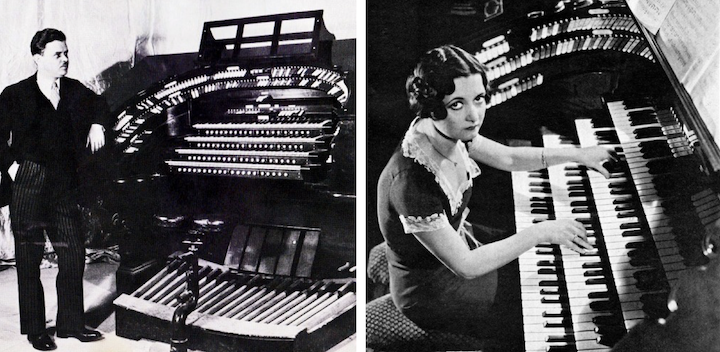
The New Yorker was slow to embrace sound—in reviews of early talkies, critic John Mosher found the technology stultifying in both dialogue and action, but as equipment and techniques improved he came to embrace the new medium. E.B. White, however, still missed the silent theatre, and the strains of its pipe organ…
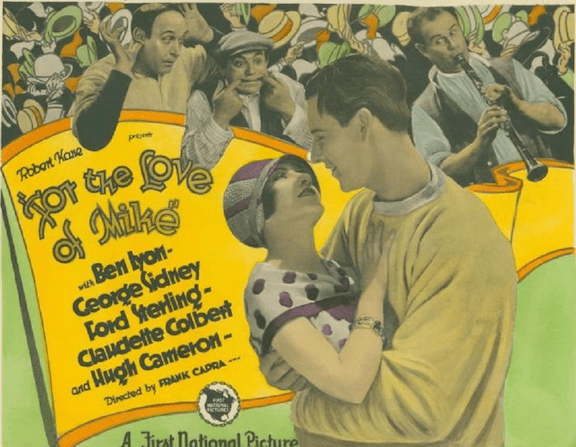
SILENCE IS GOLDEN…E.B. White was likely attending a late evening showing of For the Love of Mike,Claudette Colbert’s only silent film. After the Frank Capra-directed film received poor reviews, the 24-year-old Colbert vowed she would never make another movie. Fortunately for her fans, she changed her mind and signed with Paramount in 1929. At right, promotional photograph of Colbert for the 1928 Broadway production La Gringa. (IMDB/Wikipedia)VITAL ORGANISTS…Jesse and Helen Crawford both recorded music on Paramount’s mighty Wurlitzer, sounds that were music to the ears of E.B. White. (theatreorgans.com)
* * *
World’s Fastest Man
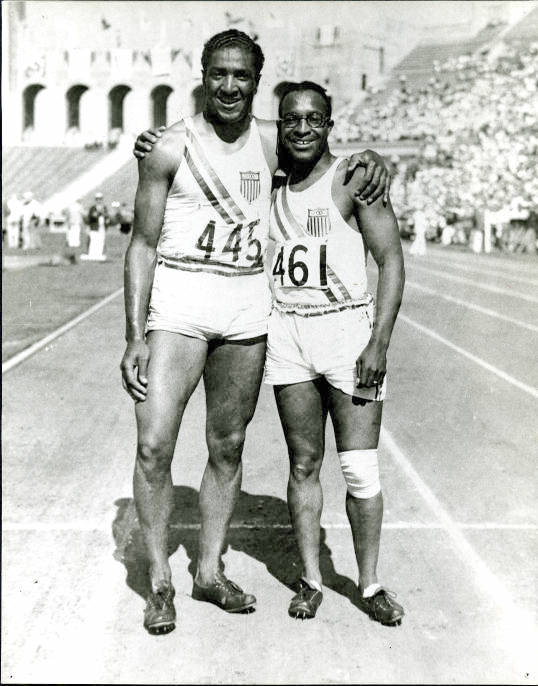
That title went to Eddie Tolan after the 1932 Summer Olympic Games, and his fame won him a long entry in the “The Talk of the Town,” although the column (excerpted) took a patronizing tone toward the athlete:
FASTEST IN THE WORLD…U.S. sprinters Ralph Metcalfe (left) and Eddie Tolan pose on the track at 1932 Los Angeles Olympics. Tolan would receive the title of the “world’s fastest human” after winning gold medals in the 100- and 200- meter events. Metcalfe, who be elected to the U.S. Congress in the 1970s, was considered the world’s fastest human in 1934-35. (Marquette University)
* * *
From Our Advertisers
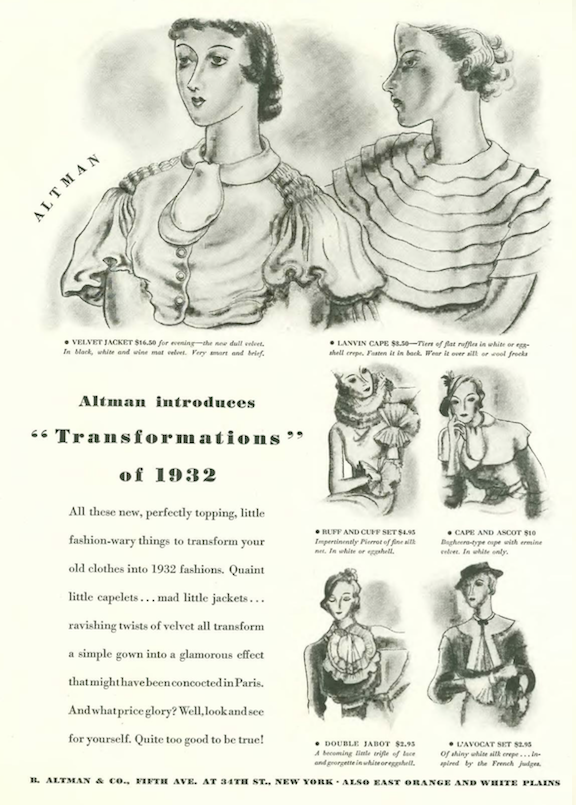
You could tell times were tough when a luxury department store felt the need to sell capes and cuffs designed to “transform” old clothes in to 1932 fashions…
…however, things seemed to be looking up for the folks at Powers Reproduction, who touted the naturalness of their DeSoto ads…
…such as this two-pager that appeared in The New Yorker’s July 23 issue…
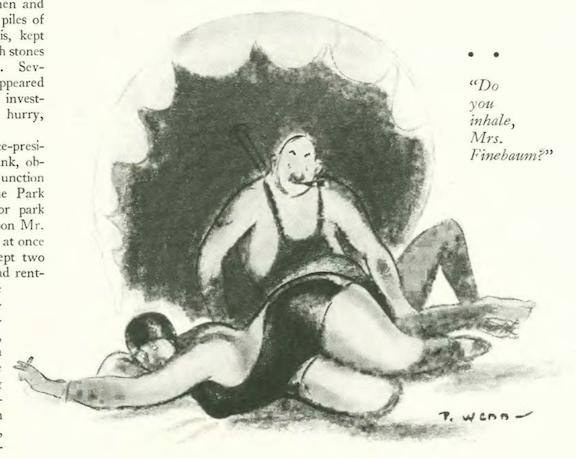
…we move on to our cartoonists, beginning with Paul Webb…
…who referenced a recent New Yorker ad (also from the July 23 issue)…
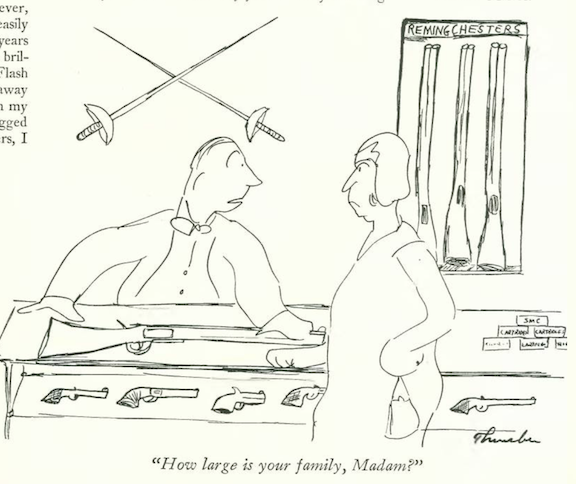
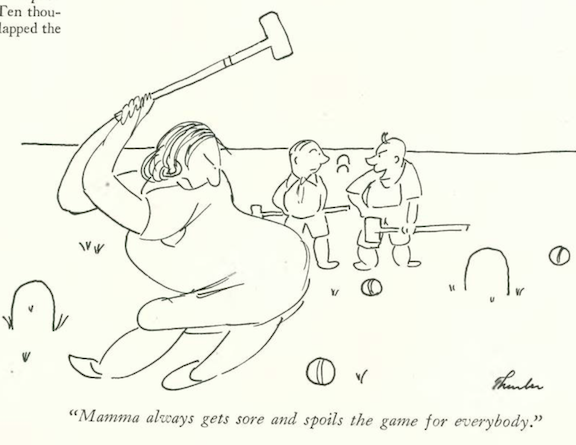
…James Thurber gave us two examples of female aggression…
…this one a bit less deadly…
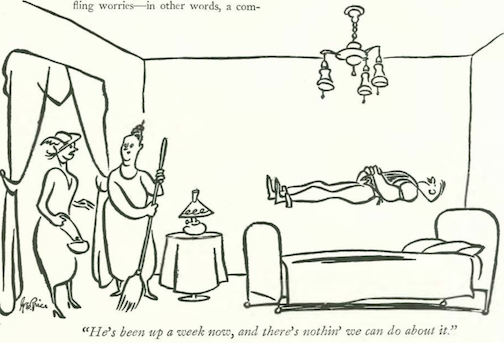
…here’s an early work by the great George Price (1901-1995), who beginning in 1929 contributed New Yorker cartoons for almost six decades…
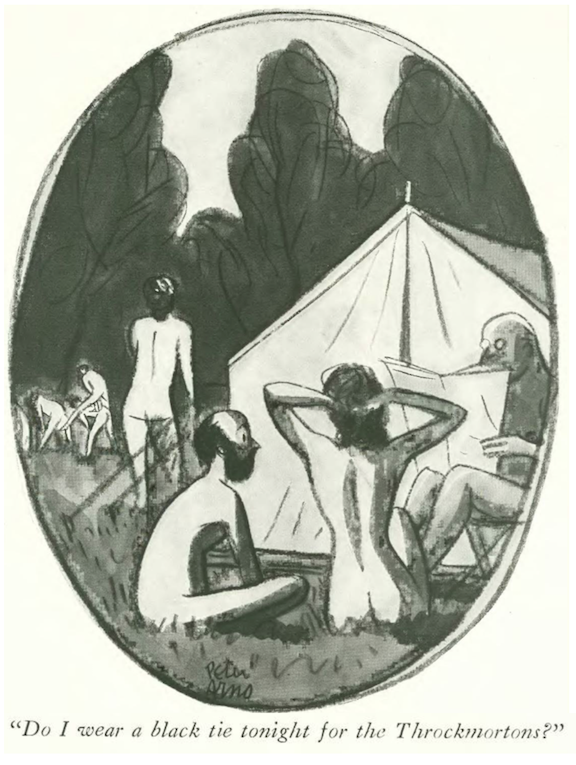
…Peter Arno showed us that among the uppers, even nudism had its class distinctions…
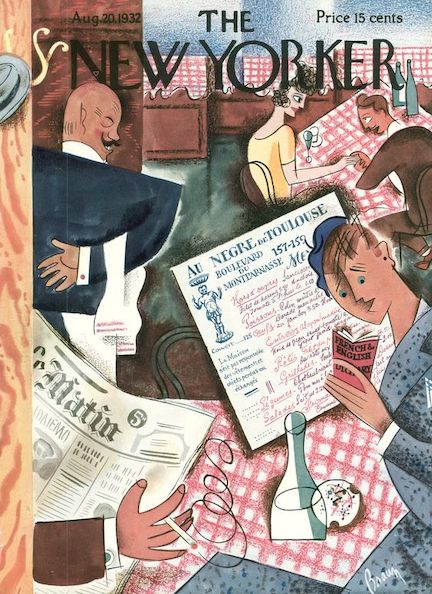
…on to our August 20, 1932 issue, and this terrific cover by Harry Brown. With a style reminiscent of the French artist Raoul Dufy, Brown illustrated a number of memorable New Yorker covers during the 1930s…
August 20, 1932 cover by Harry Brown.
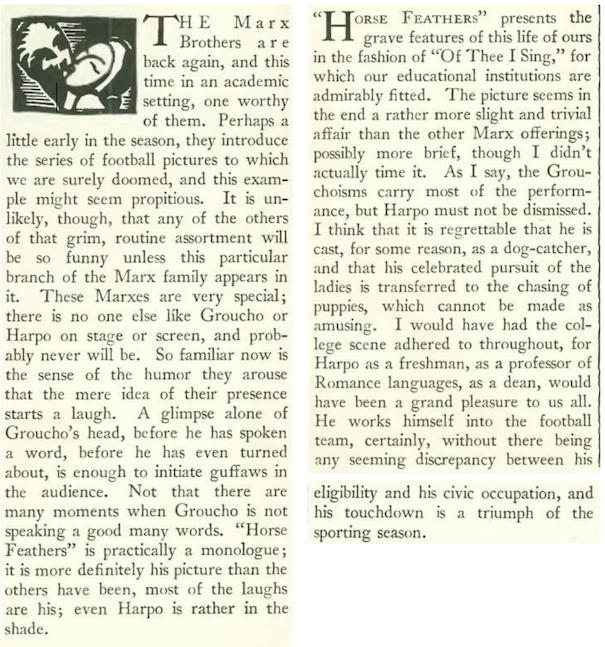
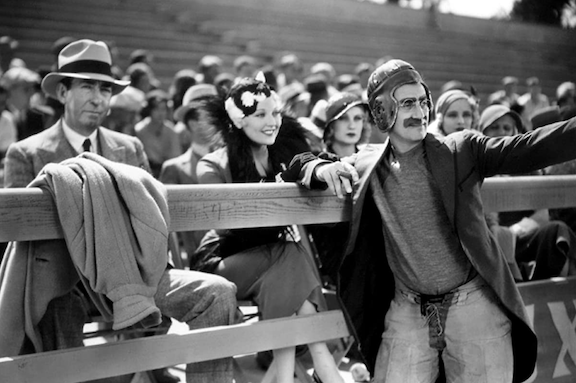
…the Marx Brothers were back in cinemas with Horse Feathers, and, according to critic John Mosher, delivered the comic goods…
Xs AND Os…Groucho Marx shows David Landau and Thelma Todd how the game of football is really played in Horse Feathers (1932). (IMDB)
* * *
Author, Author
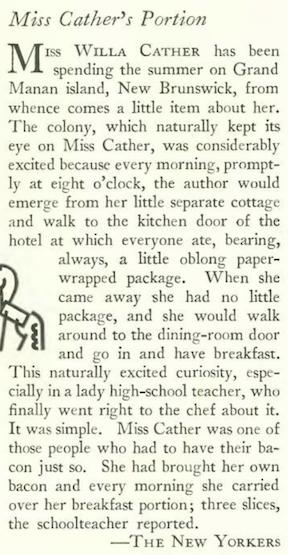
“The Talk of the Town” included this bit of news regarding the Pulitzer Prize-winning author Willa Cather. Beginning in the early 1920s, Cather and her partner, Edith Lewis, spent summers at Manan Island in New Brunswick, Canada:
THESE NEED SOME EDITING…Willa Cather pruning her roses on Manon Island. (University of Nebraska-Lincoln)
* * *
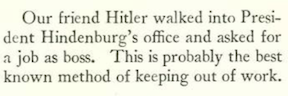
While Cather was enjoying the peace of island life, there were disturbing rumblings on the other side of the ocean, even if Howard Brubaker (writing in his column “Of All Things”) found humor in them…
…the result, however was no laughing matter…
NOT HIS USUAL STYLE…After being appointed as German chancellor, Adolf Hitler greets President Paul von Hindenburg in Potsdam, Germany, on March 21, 1933. This image, intended to project an image of Hitler as non-threatening, was made into a popular postcard. The photo also appeared widely in the international press. (www.ushmm.org)
…Brubaker also commented on the upcoming U.S. presidential elections, and, more importantly, the absence of Greta Garbo, who returned to Sweden after her MGM contract expired…
NOT FEELIN’ IT, PAL…Melvyn Douglas romances Greta Garbo in 1932’s As You Desire Me. Garbo would leave for Sweden after the film wrapped. She would return after a nearly a year of contract negotiations. (IMDB)
* * *
From Our Advertisers
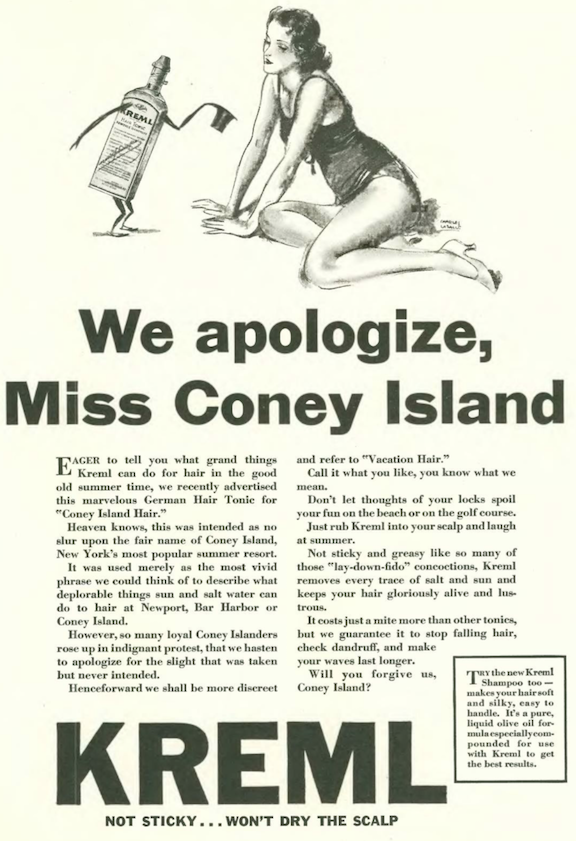
Illustrator Charles LaSalle, who would later be known for his Western-themed art, provided this odd bit of art for the makers of a German hair tonic…
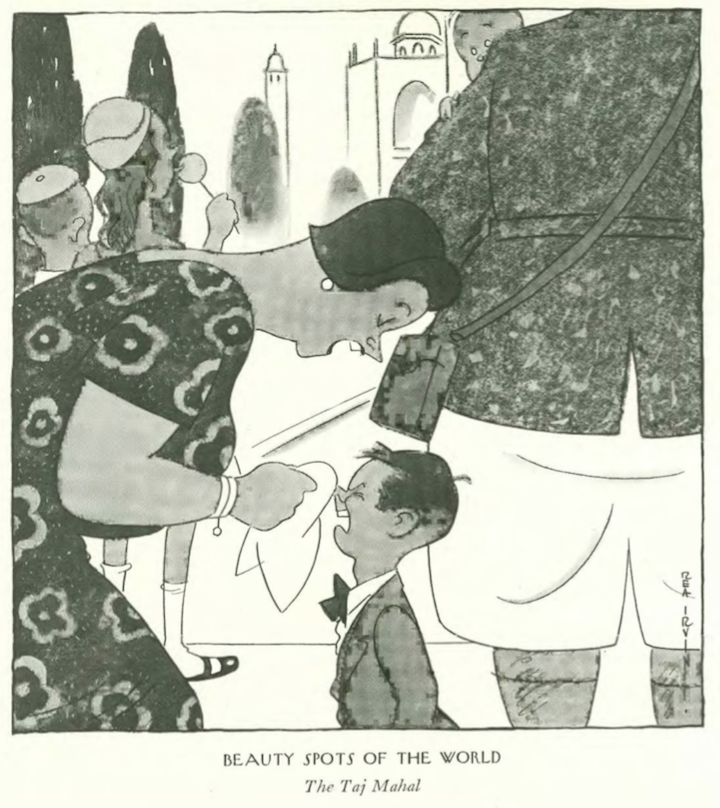
…on to our cartoons, Rea Irvin continued his travelogue of famed tourist destinations…
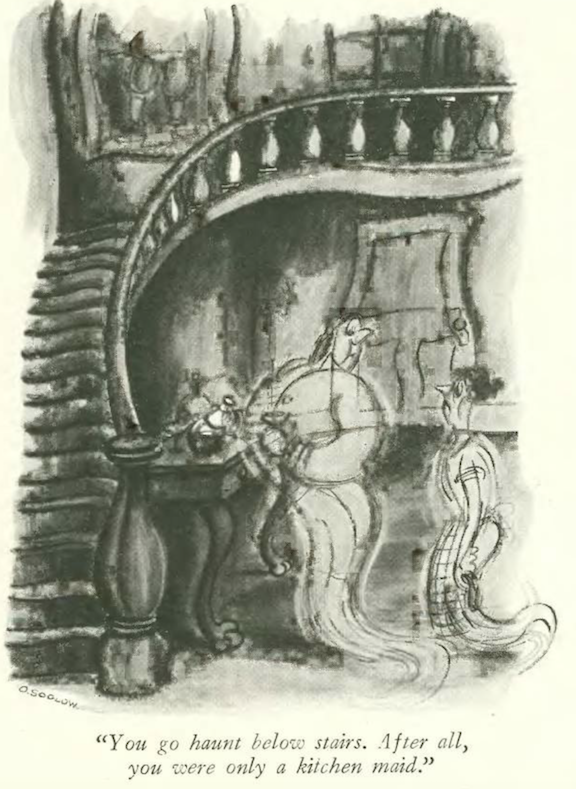
…Otto Soglow showed us that even the spirit world has its version of Upstairs, Downstairs…
…Carl Rose rendered a cow and a calf made homeless for art’s sake…
…Leo Soretsky contributed only one cartoon to The New Yorker, but it was a doozy…
…on to August 27, 1932…
August 27, 1932 cover by S. Liam Dunne.
…in which the “Talk of the Town” contributors decided to pay homage to Lewis Gaylord Clark (1808–1873), who was editor and publisher of the old The Knickerbocker magazine (1833 – 1865)…
…here is one of the entries, with accompanying artwork, written in the style of the old magazine…
* * *
From Our Advertisers
William Steig had illustrated several ads for Old Gold, and now it was Peter Arno’s turn to entice readers to the national habit…
…Lucky Strike, on the other hand, preferred these illustrations of young women, who also happened to be their biggest growth market…by the way, this is not an official “Miss America”—there was no pageant in 1932…
…and we end with cartoons that ponder the female form by Daniel Brustlein (1904–1996), who contributed cartoons and covers to The New Yorker from the 1930s to the 1950s under the pen name Alain…
As we recently saw in the 1932 film Freaks, there were some truly weird motion pictures produced in Hollywood during the pre-Code era, including four that were reviewed in the July 30 and August 6 editions of The New Yorker.
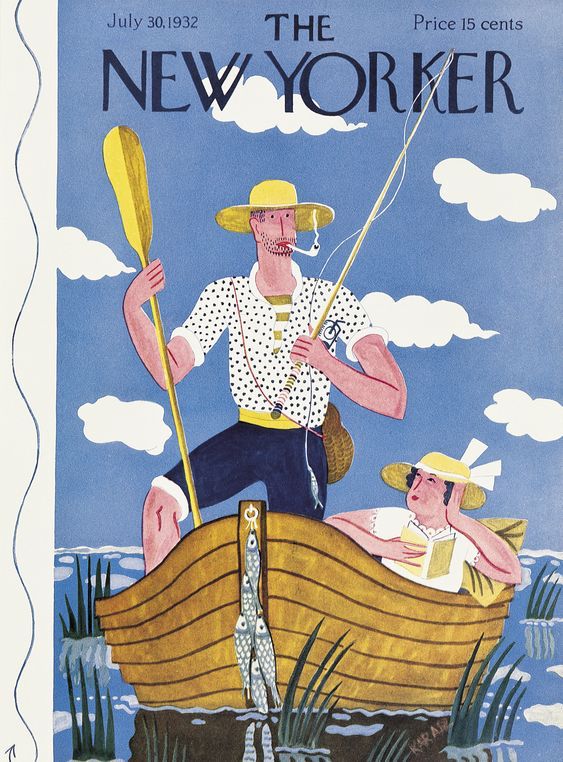
July 30, 1932 cover by Ilonka Karasz.
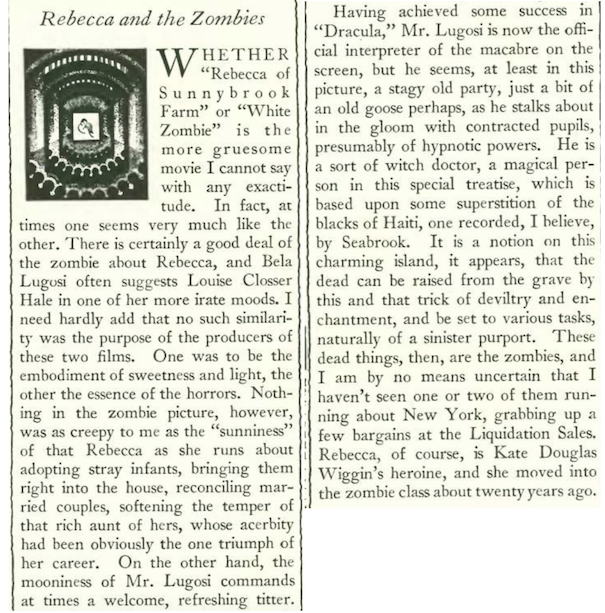
According to critic John Mosher, some of those films were not intended to be viewed as such, including Rebecca of Sunnybrook Farm (reviewed in the Aug. 6 issue), which Mosher found more gruesome than the Bela Lugosi vehicle White Zombie:
THE HORROR…After seeing Rebecca of Sunnybrook Farm, critic John Mosher concluded that too much sweetness and sunniness could be creepier than a bunch of zombies. Pictured above is Marian Nixon as Rebecca and Ralph Bellamy as her suitor, Dr. Ladd. (IMDB)THE BELA BUNCH…Following up on his 1931 hit Dracula,Bela Lugosi inexplicably chose to star in the low-budget horror film White Zombie. Considered to be the first feature-length zombie movie, it served as a model for subsequent zombie pictures. Clockwise, from top left, white Haitian voodoo master “Murder” Legendre (Lugosi) leads his crew of zombies; Legendre toasting his evil intentions; coach driver (Clarence Muse), warns his passengers about zombies on the highway (although the film is set in Haiti — actually a Hollywood studio lot — Muse was the only Black actor with a speaking part, albeit quite brief); as was common in those days, John T. Printz, a white actor, portrayed the Black character Ledot, a former witch doctor; Legendre (Lugosi) transforms Madeleine Short (Madge Bellamy) into a zombie and orders her to kill her fiancé. Also pictured is Robert Frazer, who portrayed a plantation owner. Filmed in just eleven days, the majority of the cast in White Zombie were actors whose careers had waned since the silent era. (IMDB)
In the July 30 issue Mosher had another encounter with the strange, this time two documentaries that were very much products of their time.
In case a film about the hardships on the Alaskan tundra wasn’t enough to entice moviegoers, Universal Pictures served up this lobby card featuring a topless Nuwuk woman to promote Igloo…
Igloo lobby card. (Pinterest)
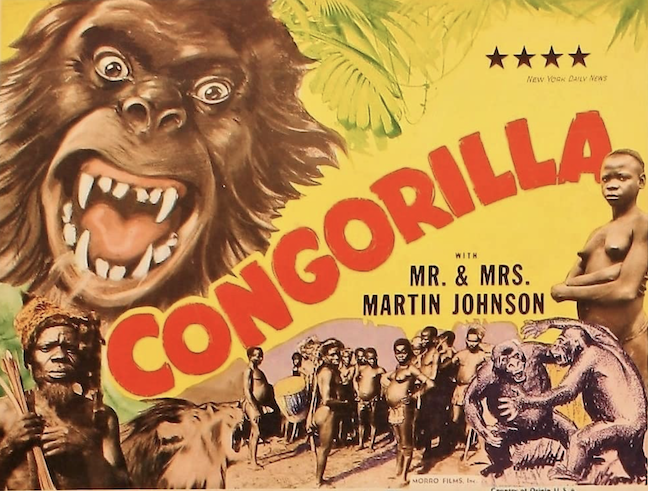
…in a similar vein, husband and wife filmmakers Martin E. and Osa Johnson offered up some topless images to accompany the action promised in Congorilla. It’s a familiar National Geographic-style trope—an over-the-counter magazine or film in the 1930s wouldn’t dare show a European woman topless (there were decency laws after all!) but these folks were “primitive,” and therefore weren’t subject to the Hays Code or other “decency standards.”
Congorilla lobby card. (IMDB)
The Johnson’s documentary was partly staged, including this scene with “child-like pygmies” that is just plain weird (um, didn’t “modern” jazz have its roots in Africa?):
* * *
Life of the Party
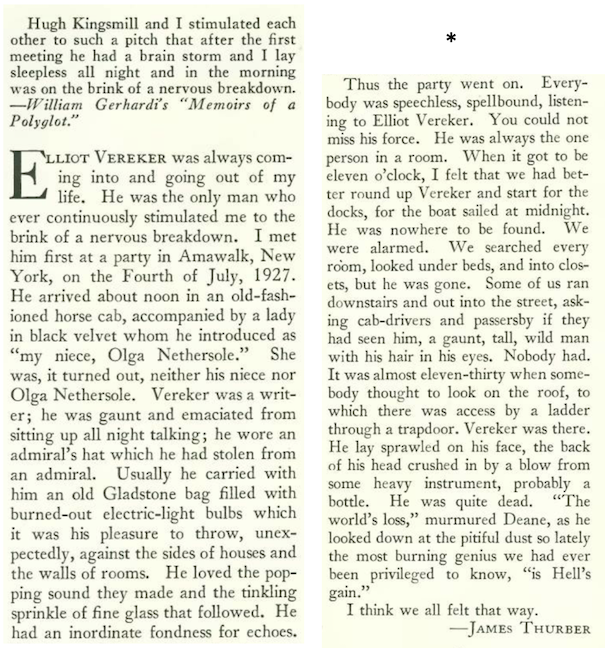
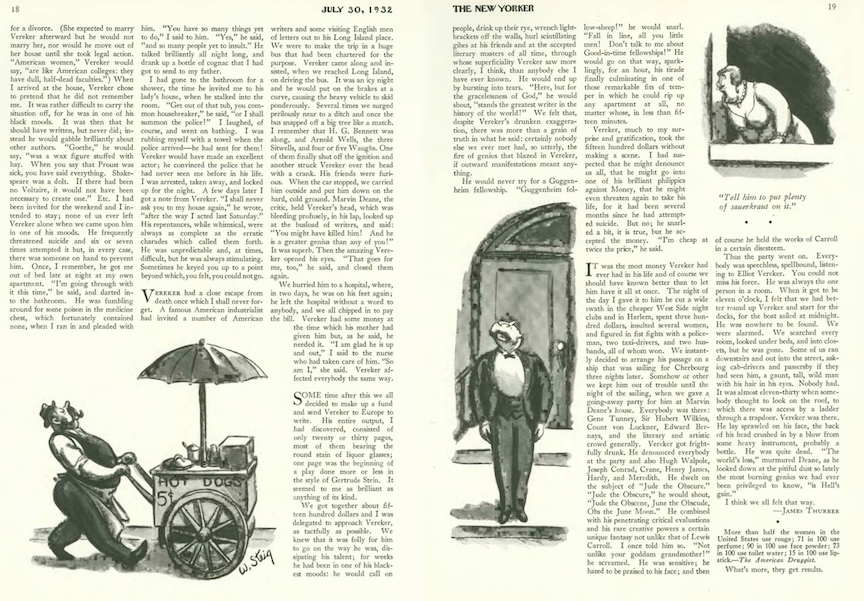
James Thurber penned this unusual July 30 profile, a parody of artistic genius- types who are loved and admired despite also being a drunken assholes. I include the opening paragraph, and the concluding paragraph, which follows a decision by Elliot Vereker’s literary friends to put him on a boat to France; during a farewell party he roundly insults them all.
MIRROR, MIRROR…James Thurber and his “Profile” subject, Elliot Vereker. Some critics suggest Vereker’s character was the result of some self-reflection on Thurber’s part. (thurberhouse.org/The New Yorker)
* * *
From Our Advertisers
William Steig continued illustrating these full-page ads for Old Gold (no surprise that tobacco companies were doing quite well during the Depression)…
…as we’ve seen, a number of New Yorker cartoonists earned extra money illustrating ads for a variety of companies, but one cartoonist, Peter Arno, also collaborated with artists, playwrights and musicians including Paul Whiteman…no doubt this collaboration was inspired in Arno’s youth, as noted New Yorker cartoonist Michael Maslin explains in this Inkspill entry…
…and we have another in the continuing series of Lucky Strike ads encouraging smokers to inhale its “pure” tobacco, the better to draw in all that addictive nicotine…
…on to our cartoons…William Steig got a clever two-page layout with the caption, “Tell him to put plenty of sauerkraut on it”…
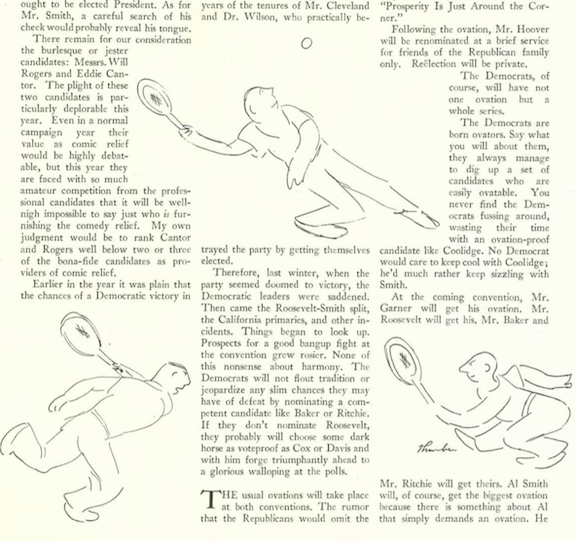
…Carl Rose offered his thoughts on the slate of wishy-washy candidates in the upcoming 1932 elections…
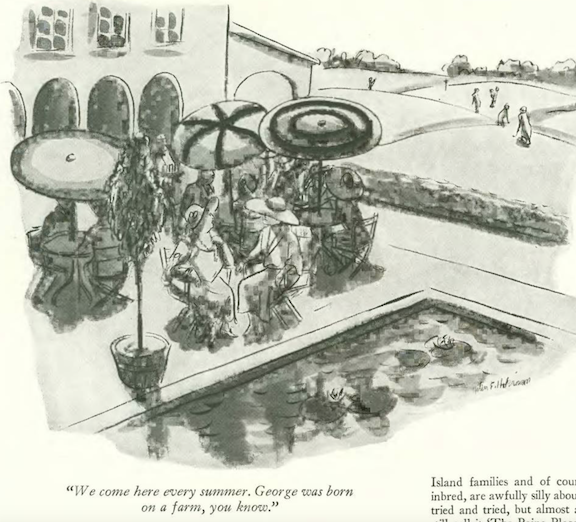
…Helen Hokinson explored the simple ways of rural living…
…Barbara Shermund looked in on the charmed lives of her modern women…
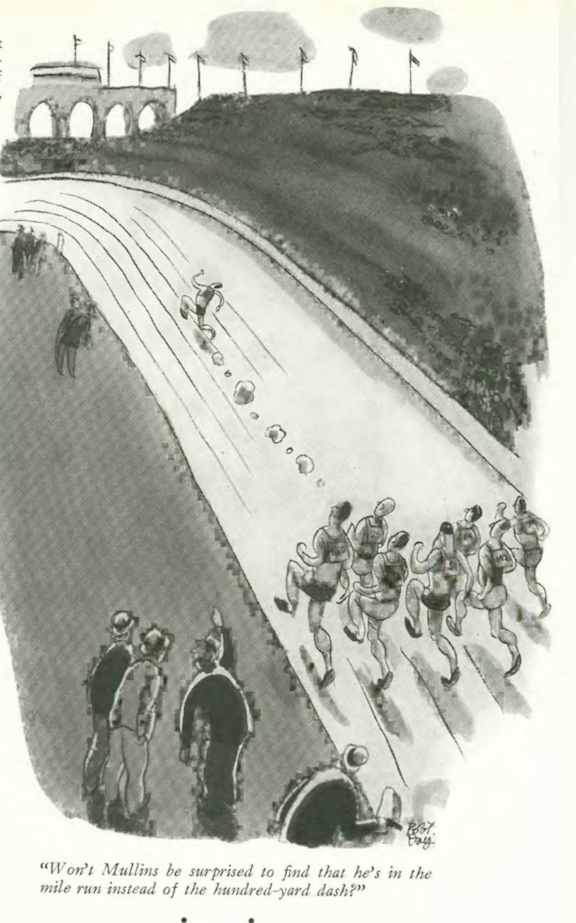
…Robert Day gave us an athlete with a big surprise ahead (and not a happy one…I made this same mistake years ago in a junior high track meet)…
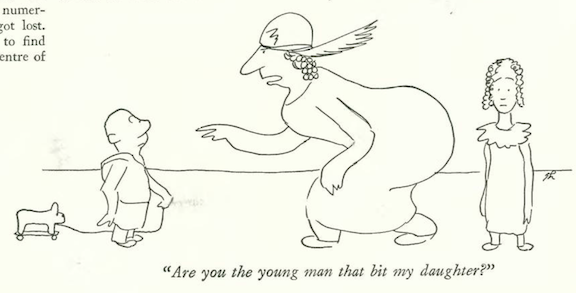
...James Thurber explored the junior edition of his “War Between Men and Women”…
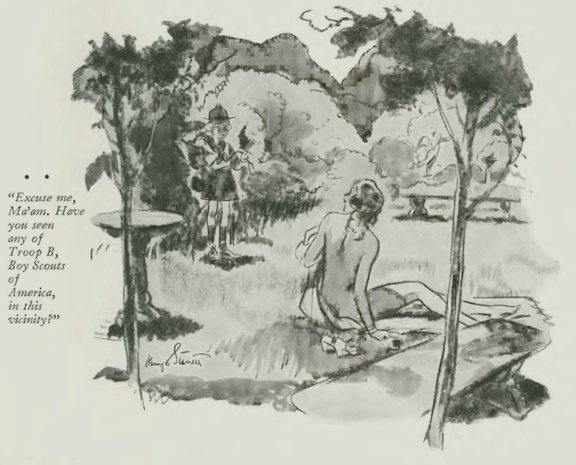
…and Kemp Starrett illustrated a Boy Scout who lost his troop along with some of his innocence…
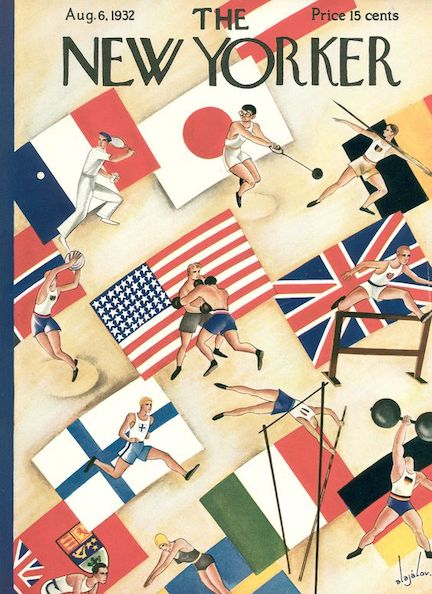
…and we continue with the Aug. 6 issue, cover artist Constantin Alajalov choosing the 1932 Summer Olympics as his theme:
August 6, 1932 cover by Constantin Alajalov.
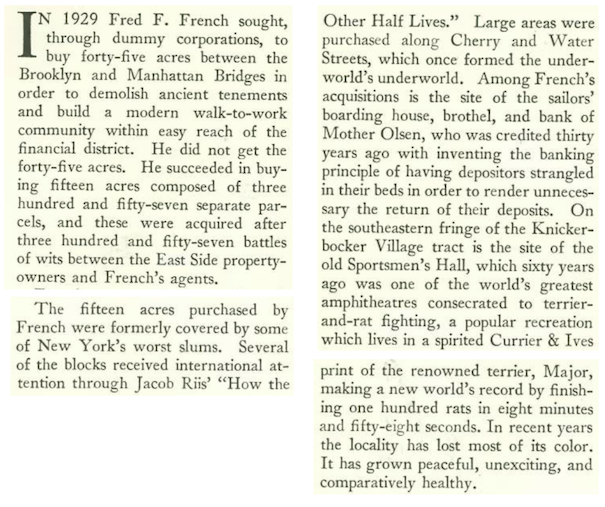
Alva Johnston penned the first part of a two-part “A Reporter At Large” feature on Knickerbocker Village. Yet to be built when this article was written (construction began in 1933 and was completed in 1934), Knickerbocker Village was the first apartment development in the U.S. to receive federal funding. It came from the Congress-authorized Reconstruction Finance Corporation (RFC), which gave loans to private developers like Fred French for the construction of low-income housing in slum-clearance areas.
CLEARANCE SALE…Tenements in Lower East Side were razed in 1933 to make way for Knickerbocker Village. The site was known as “Lung Block,” because of its high tuberculosis mortality rate. Developer Fred French, who also created Manhattan’s Tudor City, received federal funding to replace slums with more healthful housing. However, the 1,590 small apartments in Knickerbocker Village were eventually occupied by white collar, middle-income residents. Rather than provide better housing for former tenement dwellers, the project displaced them to other slum areas in the city. (Ewing Galloway/NYT)STILL STANDING…Knickerbocker Village today. The complex was severely damaged during Hurricane Sandy in 2012. In 2019, the City Council passed a bill that keeps Knickerbocker Village relatively affordable for the next 50 years in exchange for a $3 million annual tax abatement. (Wikipedia)
* * *
From Our Advertisers
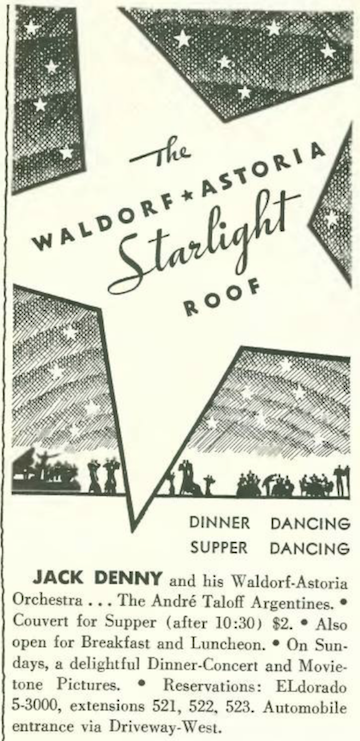
The new Waldorf-Astoria touted its Starlight Roof’s many attractions, including, no doubt, escape from the heat and dust of the city streets…
ON TOP OF THE WORLD…View of the Waldorf-Astoria’s famed Starlight Roof and the cover of its wine list, circa 1934. (Waldorf Astoria)
…I find these Ethyl ads endlessly fascinating, not only for pushing leaded gasoline on the public, but for class-shaming them into using their product…
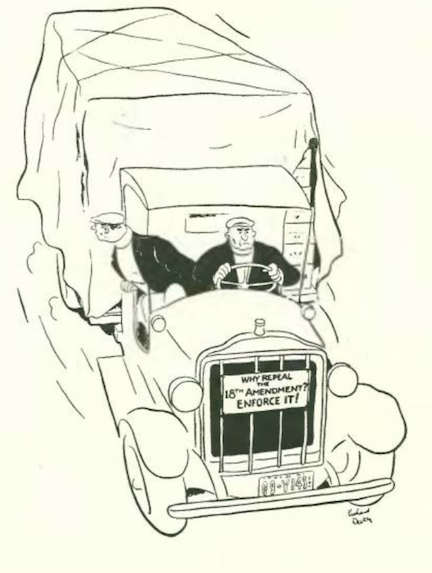
…on to our cartoons, Richard Decker showed how not all Prohibition supporters were teetotalers…
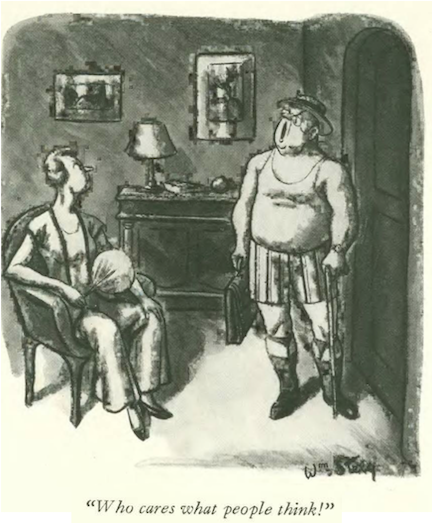
…William Steig gave us one man’s reaction to August weather…
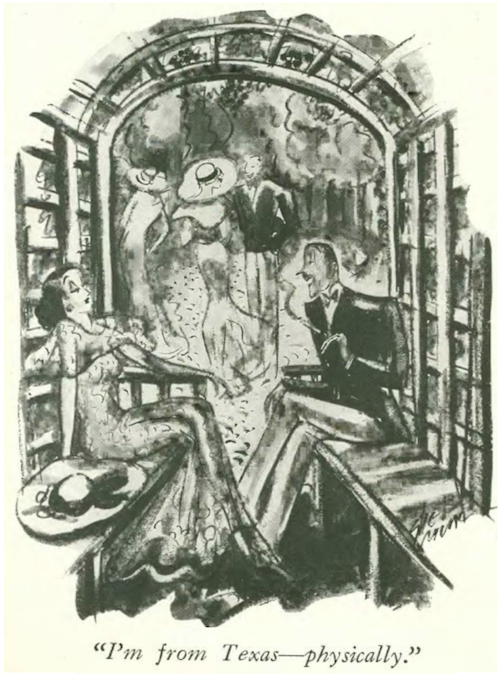
…Barbara Shermund drew a man drawing a line on his place of birth…
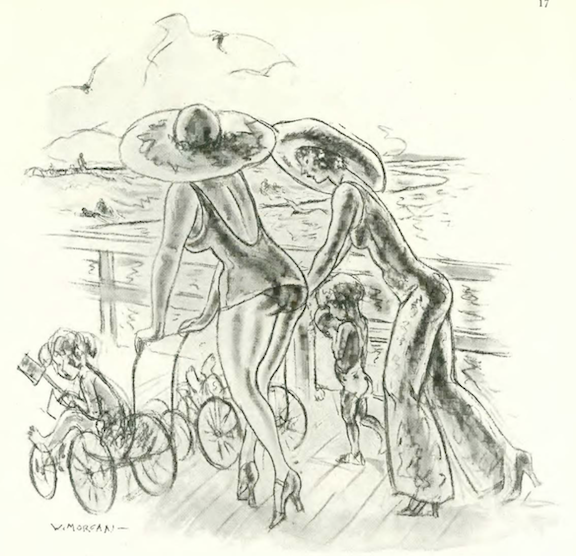
…and we end with a cartoon by Wallace Morgan…there is a joke here related to the attire of the two women, but I am at a loss (any suggestions?)…
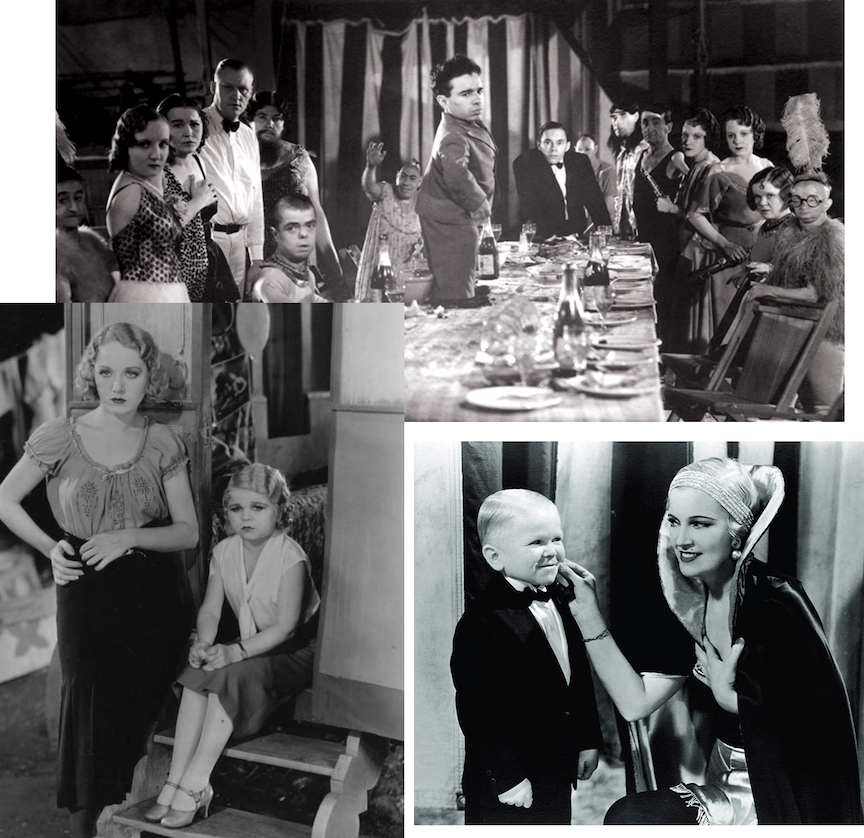
Over the years Tod Browning’s 1932 pre-code film Freaks has been called everything from grotesque and exploitive to sympathetic and compassionate. Now a cult classic, the film’s closing scenes are regarded by some critics as among the most terrifying ever put to film.
July 16, 1932 cover by Rea Irvin.
What disturbed so many about Freaks was Browning’s use of actual sideshow performers with real disabilities to tell the story of a conniving trapeze artist who plots to seduce and then kill a dwarf performer to gain his inheritance. The film was not well-received by audiences and many critics. The Kansas City Star’sJohn Moffitt wrote, “There is no excuse for this picture. It took a weak mind to produce it and it takes a strong stomach to look at it.” However, The New Yorker’s John Mosher, along several other New York critics, gave the film a rather favorable review:
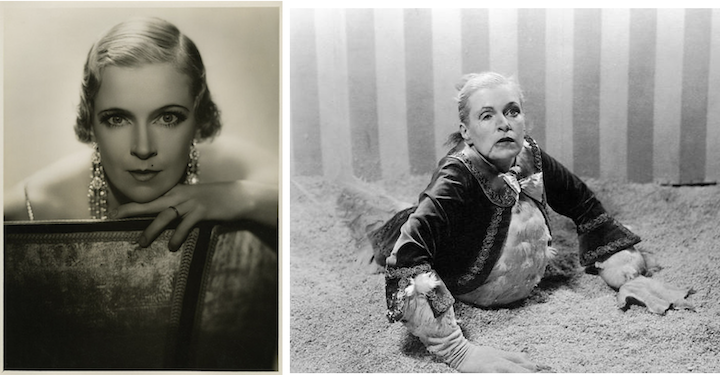
ONE OF US…Although audiences and critics found Tod Browning’s 1932 film Freaks grotesque and exploitive, today many regard the film as a rare (for its time), sympathetic portrayal of persons with disabilities. Clockwise, from top left, Browning with some of the members of his Freaks cast; French-American actress Rose Dione portrayed Madame Tetrallini, operator of the sideshow; Daisy and Violet Hilton with actor Wallace Ford in a scene from Freaks. Born fused at the pelvis, the sisters were joined at their hips and buttocks and shared blood circulation; limbless sideshow performer Prince Randian, who wore a one-piece wool garment over his body, appeared in the film as “The Living Torso.” (IMDB)IT HAD A PLOT, ACTUALLY…Freaks told the story of a conniving trapeze artist named Cleopatra (portrayed by Russian actress Olga Baclanova, bottom right) who plots to seduce and then kill a dwarf performer, Hans (portrayed by Harry Earles) to gain his inheritance. Top photo: assembled “freaks” chant their acceptance of Cleopatra at the wedding feast of Hans and Cleopatra; bottom left, the kind-hearted seal trainer Venus (portrayed by Leila Hyams) consoles Frieda (Daisy Earles), who worries about Hans (Daisy and Harry Earles were members of a famous quartet of sibling entertainers known as The Doll Family. The quartet also appeared as members of The Munchkins in 1939’s The Wizard of Oz.)(IMDB)SURPRISE…Leila Hyams (1905–1977) was something of a surprising presence in the controversial film Freaks, given that she was a popular leading lady in the 1920s and 30s. Known for both her comedic and dramatic talents, she retired from films in 1936; another unlikely cast member was Henry Victor (1892–1945) whose physique didn’t necessarily support his role as circus strongman. (dangerousminds.net)TRUE GRIT…Perhaps only a Russian actress in 1932 had the grit to transform herself from an exotic blonde temptress to a grotesque “human duck” for the movie Freaks. In the film, Olga Baclanova (1893 – 1974) portrayed a conniving trapeze artist named Cleopatra. Near the end of film the “freaks” capture Cleopatra, gouge out her right eye, remove her legs and tongue and melt her hands to look like duck feet. For critics and audiences, the horror was just too much. As for Baclanova — who was a popular silent film actress known as the “Russian Tigress” — her heavy accent did not translate well to talking films, and she left the movie business altogether in 1943. (muni.com/IMDB)
* * *
Tennis Anyone?
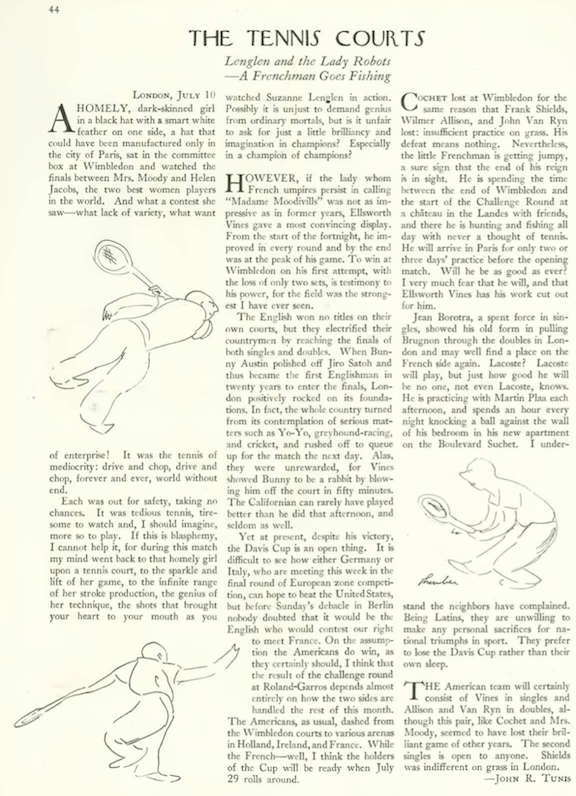
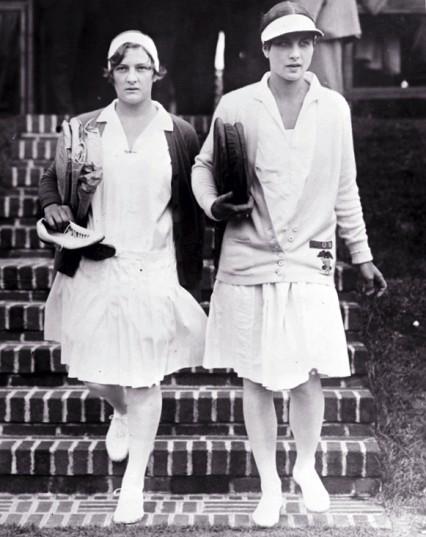
Helen Moody was the top women’s singles tennis player for nearly a decade in the 1920s and 30s, winning Wimbledon eight times, including a match in 1932 against her rival Helen Jacobs. However to sportswriter John Tunis, the women had reached such a level in their play that it had become robotic and tedious to watch. At least James Thurber livened things up with some keen illustrations.
RACKETEERS…Helen Jacobs (left) and Helen Moody (right, in a 1929 photo) were tennis rivals known for their explosive matches. Except, apparently, for the one attended at Wimbeldon in 1932 by John Tunis. (nickelinthemachine.com)
* * *
From Our Advertisers
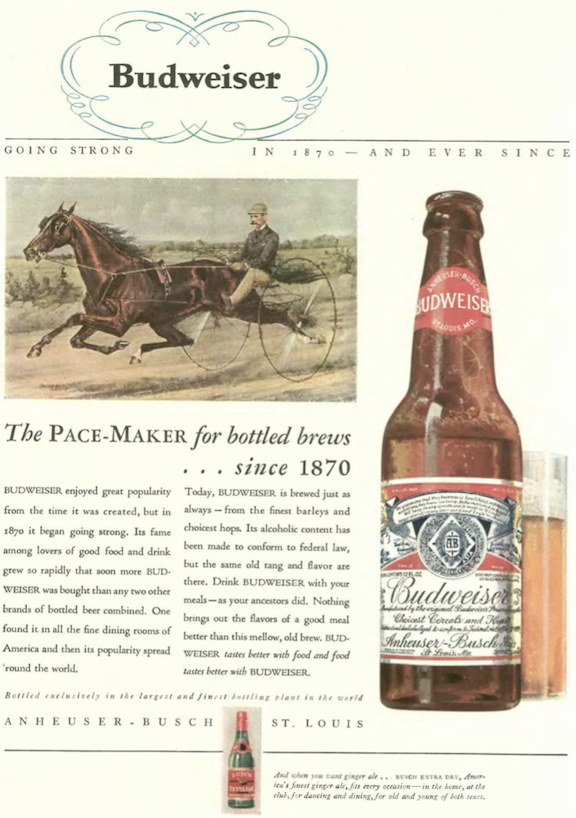
Sensing that the end of Prohibition was near, the makers of Budweiser reminded readers of the good ol’ days of beer drinking and such…
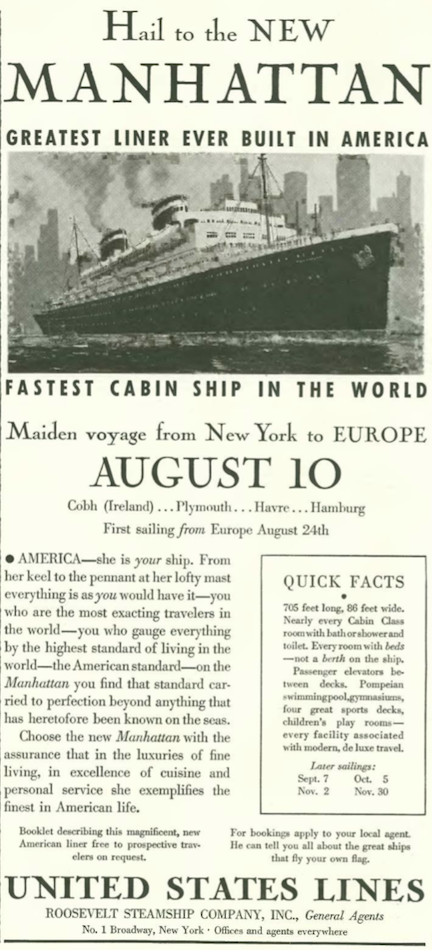
…if you could afford something better than beer, then you might have contemplated a trip on the SS Manhattan, which along with her sister ship SS Washington were the largest liners ever built in the US…
TO AND FRO…Beginning in August 1932 the SS Manhattan operated the New York – Hamburg route until 1939, when instead of taking passengers to Germany the ship began taking Jewish refugees and others away from Nazi-occupied Europe. It was turned into a troopship in 1941 and never returned to commercial service. The SS Manhattan was sold for scrap in 1965. (cruiselinehistory.com)
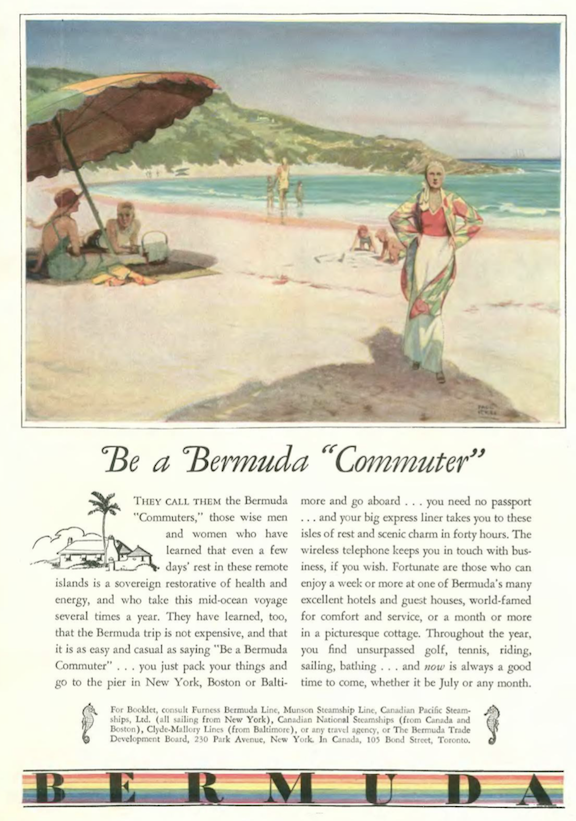
…if your thing wasn’t traveling to Germany to see that country being transformed into the Third Reich, you could instead become a Bermuda “Commuter”…
…back home, William Steig joined other New Yorker cartoonists who earned extra money off of the big tobacco companies…
…which segues into our cartoonists, beginning with Victor Bobritsky’s illustration for “Goings On About Town”…
…Otto Soglow offered more Little King adventures…
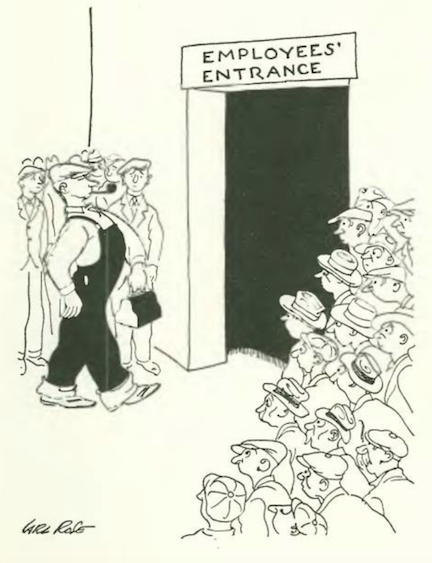
…and Carl Rose gave us a man striding into a factory, apparently a rare sight in 1932…
…on to July 23…
July 23, 1932 cover by Antonio Petruccelli (1907 – 1994). This is the first of six covers Petruccelli created for the New Yorker from 1932 to 1938. He also did numerous covers and illustrations for Fortune, Colliers and other publications.
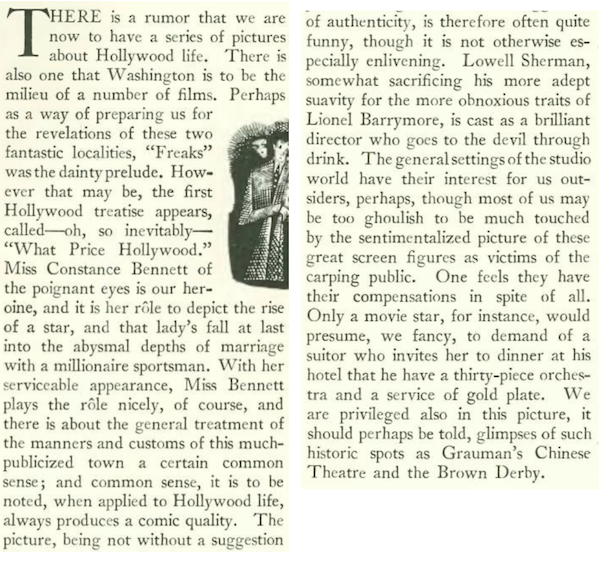
…and we have another John Mosher film review, in which he refers to Freaks as a “dainty prelude” to another film about the lives of entertainers, in this case George Cukor’sWhat Price Hollywood, a pre-Code drama starring Constance Bennett and Lowell Sherman with a storyline that anticipated 1937’s A Star Is Born—namely, a famous but fading male star who helps an ingénue rise to stardom while he descends into a pit of alcoholic despair.
FUN WHILE IT LASTED…Top image: Waitress and aspiring actress Mary Evans (Constance Bennett) has the good fortune to meet film director Maximillan Carey (Lowell Sherman) when she serves him one night at the Brown Derby. Bottom: Mary and her polo player boyfriend Lonny Borden (Neil Hamilton) look down with pity at the down-on-his-luck Maximillan in What Price Hollywood? (Wikipedia/IMDB)
* * *
From Our Advertisers
Originally published by Adam Budge, Inc. in 1910 and later by Joseph Judd Publishing and others, Arts & Decoration magazine hoped to stay alive in the Depression with a promise that its August 1932 issue would be “compellingly readable”…
…and here is the cover of that issue…Arts & Decoration would hang on for another ten years before folding in 1942…
…one of the stars of Ziegfeld Follies of 1931 was actress and dancer Patricia “Boots“ Mallory (1913 – 1958), who posed for this portrait to demonstrate the wonders of color reproduction…
…and here’s Boots Mallory in a scene from the 1932 film Handle With Care with comedian Elmer “El” Brendel (standing) and actor James Dunn…
…not everyone could be a movie star, but you could pretend to be one in this swell new (and low-priced) DeSoto…Walter Chrysler must have laid out some big bucks for this two-page color spread…
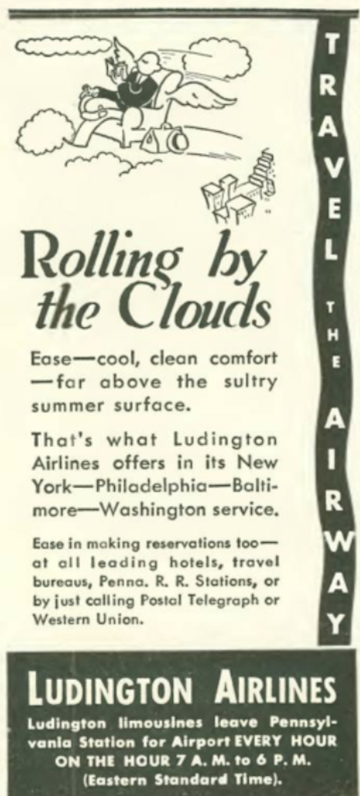
…for those with greater means you could skip the roads altogether and fly the friendly skies of Ludington Airlines…the airline was founded by wealthy New York socialite Charles Townsend Ludington and his brother Nicholas…
…founded in 1929, Ludington Airlines was the first airline with flights every hour on the hour and the first to carry passengers only (others carried mail, an important source of revenue). The airline offered service between Washington, D.C. and New York City—with stops in Philadelphia, Baltimore, Norfolk, Virginia, Nashville and Knoxville, Tennessee—using seven Stinson tri-motor 6000 aircraft in its fleet, each carrying up to ten passengers…the airline went bankrupt in 1933 (mostly due to the lack of mail revenue) but left behind an astonishing record—in its first two years it flew more than 3.4 million miles and carried 133,000 passengers, a record at the time…
A Stinson SM-6000 airliner similar to the type flown by Ludington Airlines from 1929 to 1933.
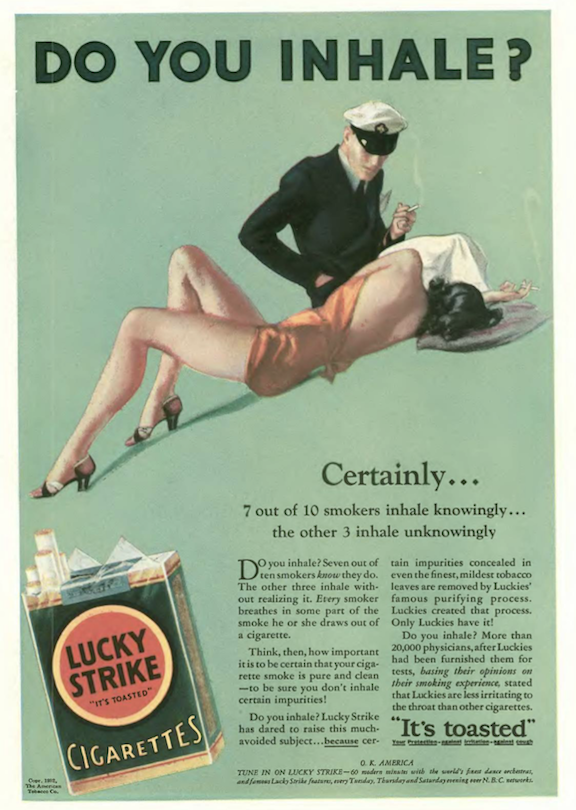
…back to earth, sort of, we have this Lucky Strike ad with the famed “Do You Inhale?” campaign that oozed innuendo and no doubt prompted a few young men to take up the habit posthaste…
…on to cartoons, beginning with this spot art by James Thurber…
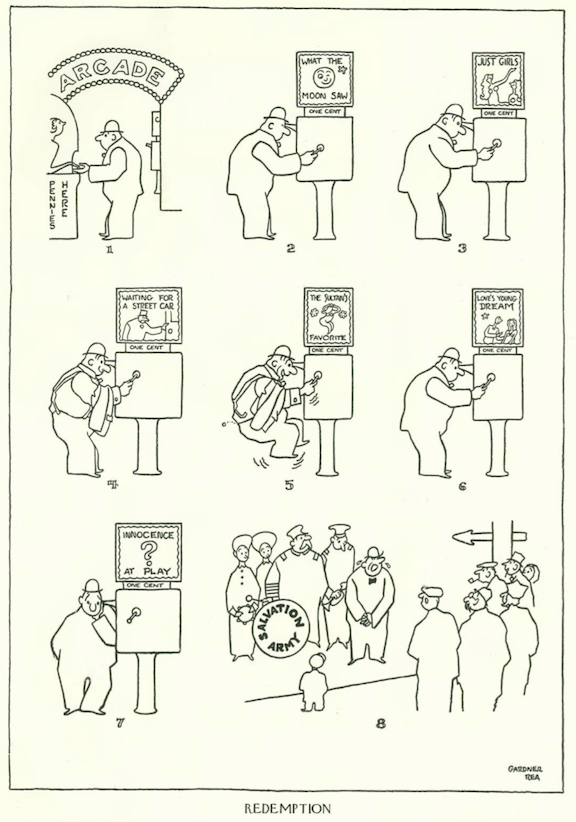
…Gardner Rea showed us a man getting his nickel’s worth of sin and repentence…
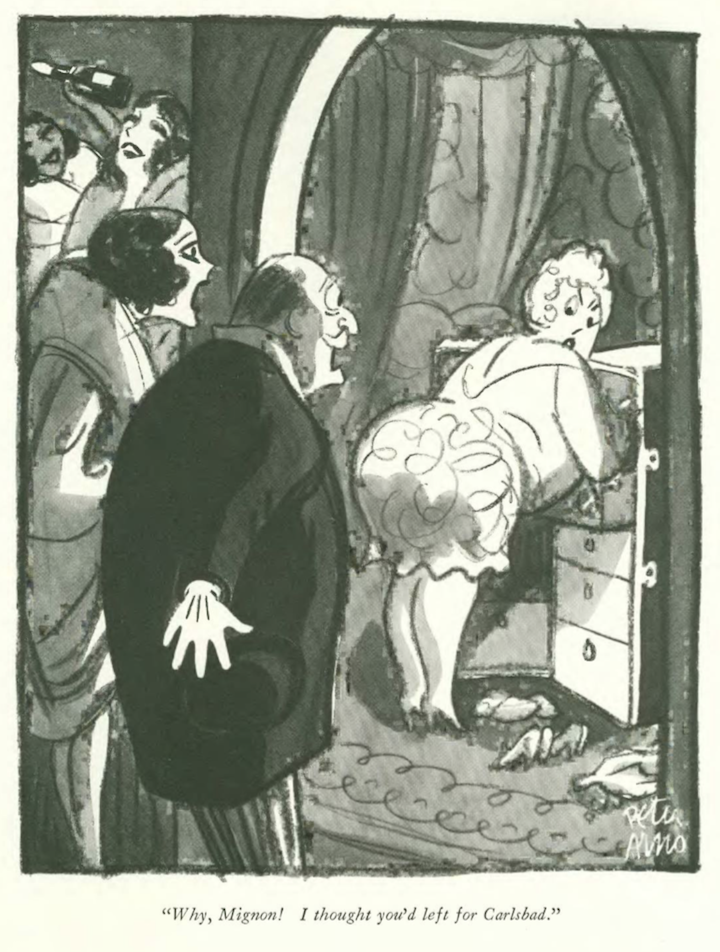
…and we end with the delightfully unrepentant Peter Arno…
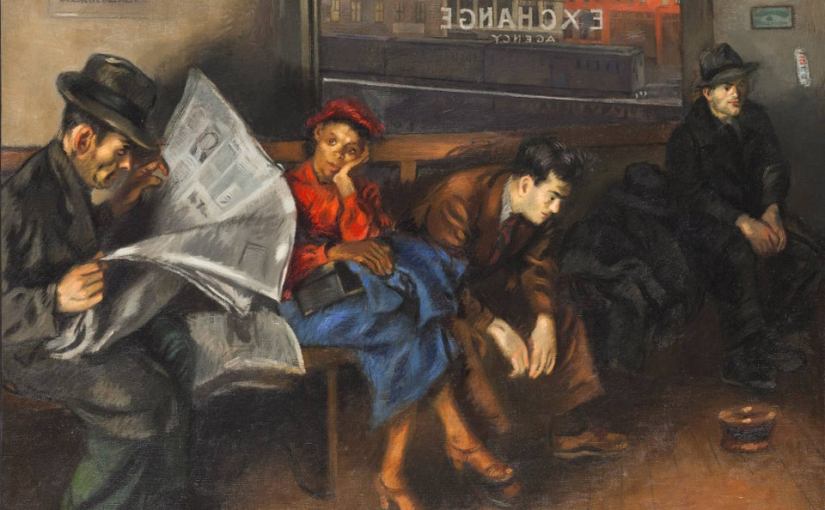
Above image: The 1937 painting, titled "Employment Agency," was by Isaac Soyer (1902-1981). Like Reginald Marsh, he was considered a social realist painter who painted scenes of working class life. (Whitney Museum of American Art)
Nineteen thirty-two was a tough year for most Americans, as the Depression approached rock bottom and jobless numbers continued to mount as one out of every four workers was unemployed.
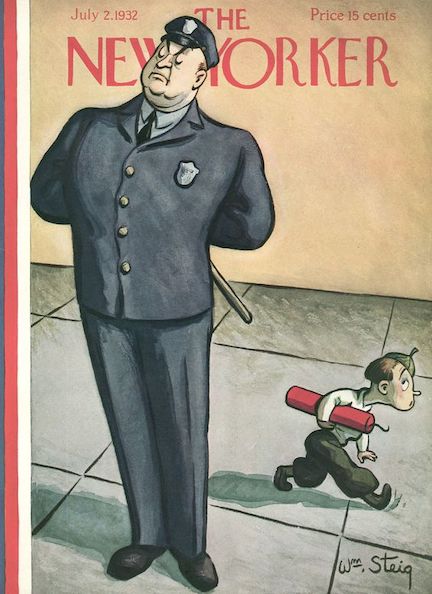
July 2, 1932 cover by William Steig.
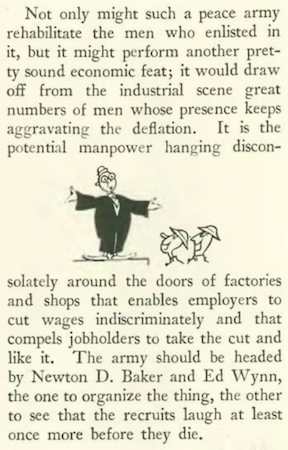
Despite the Depression, The New Yorker was on solid footing, although judging by these next two issues advertising had fallen off. Other indications things weren’t so rosy included the occasional broadsides penned by E.B. White in his “Notes and Comment” column that opened “The Talk of the Town.” White anticipated Franklin D. Roosevelt’s New Deal, calling for “direction from above” and the creation of a peacetime army that would give purpose to the unemployed.
White filed his column while the nation was experiencing a summer of unrest, men and women across the country joining demonstrations demanding relief from the federal government, which under President Herbert Hoover mostly refused to provide funds for the jobless and homeless.
Writing for The Conversation, James N. Gregory, professor of history at the University of Washington, developed a mapping project that has recorded 389 hunger marches, eviction fights and other protests in 138 cities during 1932.
THE UNWANTED…Clockwise, from top left, a man advertises his worth on a sandwich board, ca. 1930; unemployed gather in front of an employment agency, ca. 1930; long line of jobless and homeless men wait outside to get free dinner at a New York municipal lodging house, 1932; even with the New Deal times remained tough for many rural folks — in 1936 Los Angeles Police Chief James E. Davis declared a “Bum Blockade” to stop the mass emigration of poor families fleeing from the Dust Bowl states of the Midwest. (rarehistoricalphotos.com/dailybulletin.com/Associated Press)
White’s column was prescient in many ways, including the need for Americans to laugh during tough times: Abbott & Costello, Burns & Allen, Laurel & Hardy and the Three Stooges, among many other acts, enjoyed their heydays during the Depression and war years.
SWORDS, NOT PLOUGHSHARES were offered to those protesting in the summer of ’32. Above, tanks and mounted troops advance to break up a Bonus Marchers’ camp of veterans protesting lost wages in Washington D.C. on July 28, 1932. Below, the marchers at the Capitol. (PhotoQuest/The Conversation)
* * *
From Our Advertisers
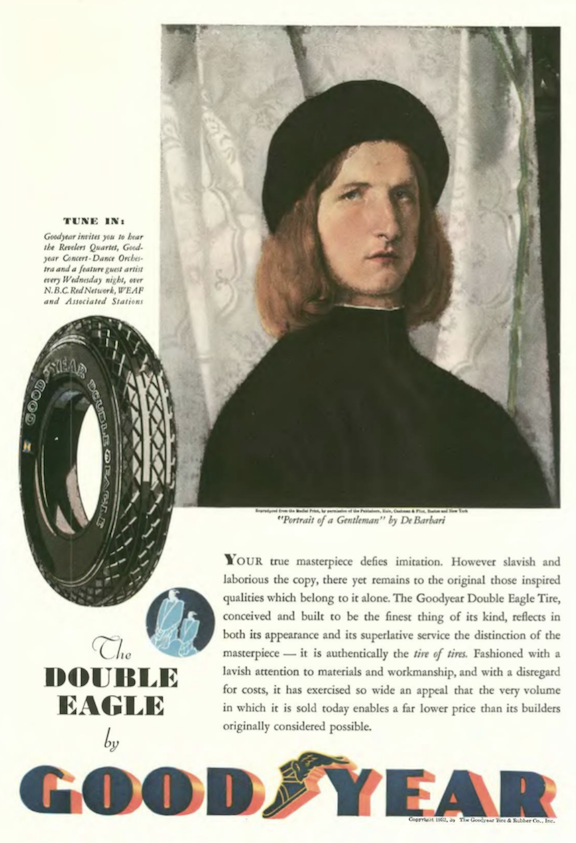
As noted earlier, advertising had fallen off a bit in The New Yorker, but those who still had means to market their wares included the folks at Goodyear, who continued their campaign of comparing their tires to “masterpieces”…
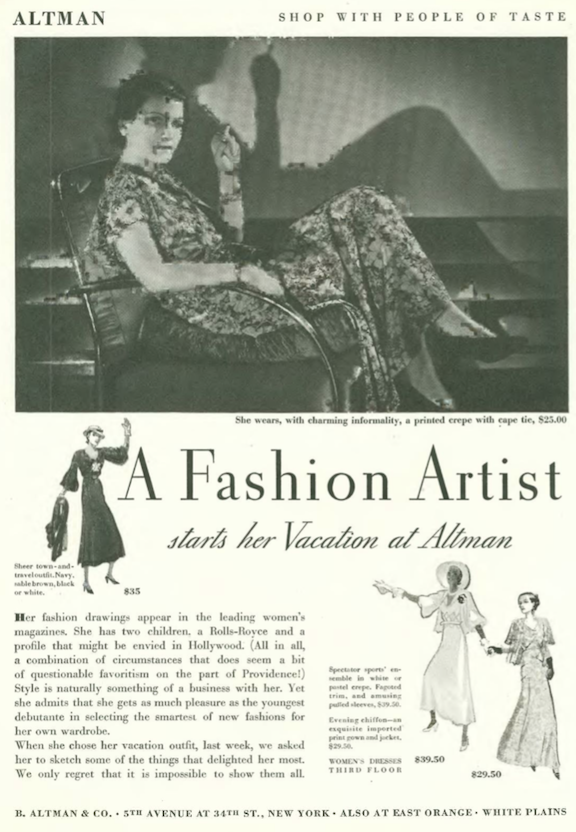
…this B. Altman ad presented a “fashion artist” who was doing quite well despite the Depression…
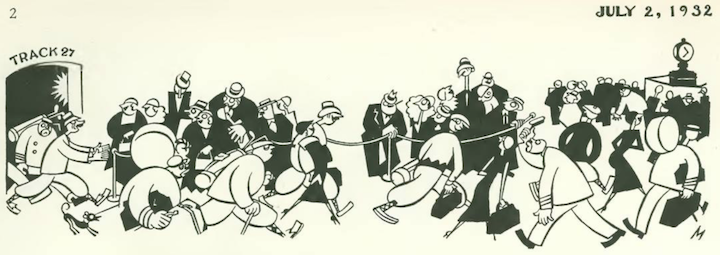
…on to our cartoonists, the top of page 2 and the bottom of page 3 in the “Goings On About Town” were decorated by Julian de Miskey…
…William Steig put one of his “Small Fry” in a barber’s chair…
…James Thurber continued to plumb the depths of courtship…
…as did Barbara Shermund…
…while Peter Arno was perfecting one his classic tropes…
…on to July 9, 1932…
July 9, 1932 cover by Virginia Andrews.
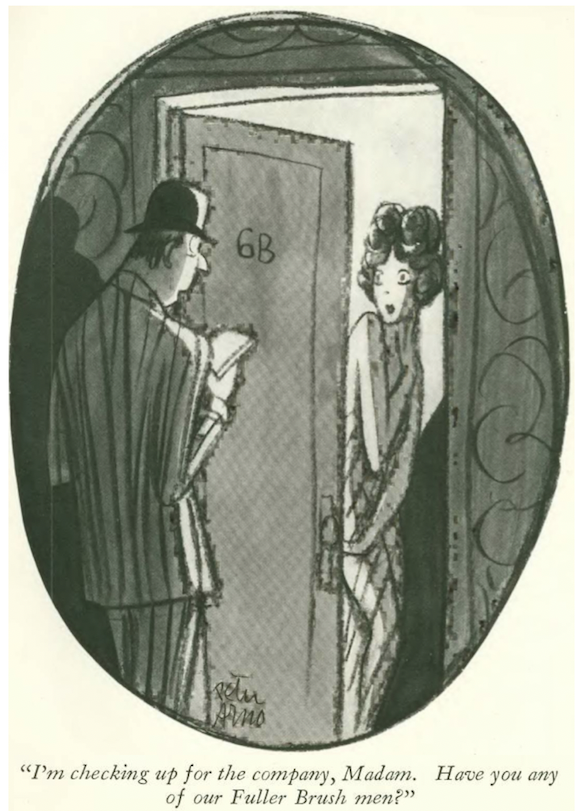
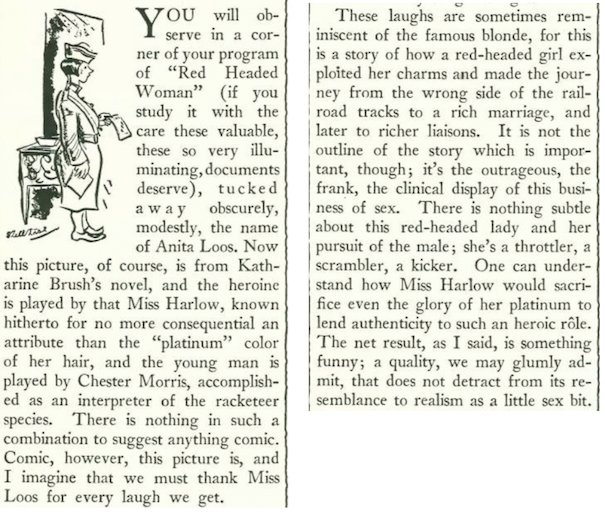
…where we look at John Mosher’s review of Red Headed Woman, a romantic comedy about an ambitious secretary (Jean Harlow) who tries to sleep her way into high society.
(IMDB)
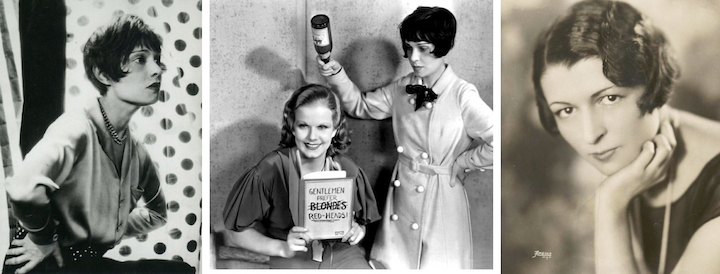
Harlow (1911-1937) was already famed as a “platinum blonde,” which made her turn as a redhead a major selling point for the pre-code film. Although based on a novel by Katharine Brush, it was Anita Loos’ humorous treatment of the script that made the film more than just a sex romp.
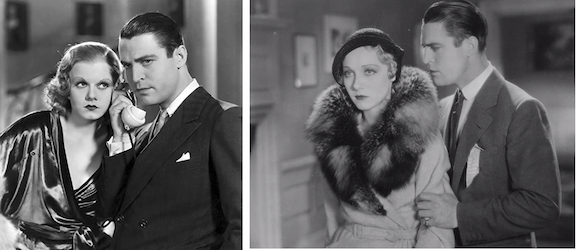
SEEING RED…Jean Harlow seduces her wealthy boss William “Bill” Legendre Jr. (Chester Morris) and breaks up his marriage to his wife Irene (Leila Hyams, photo at right). (IMDB)LIFE & ART…In many ways Jean Harlow embodied Lorelei Lee, the ambitious gold-digger Anita Loos created for her 1925 novel Gentlemen Prefer Blondes. When Loos (left, photo by Cecil Beaton) ) adapted Katharine Brush’s (right) novel for the 1932 film Red-Headed Woman, MGM made hay of the whole arrangement, seen in this 1932 publicity photo (center) of Harlow and Loos. (silentlondon.co.uk/Cinemania/Goodreads)
* * *
From Our Advertisers
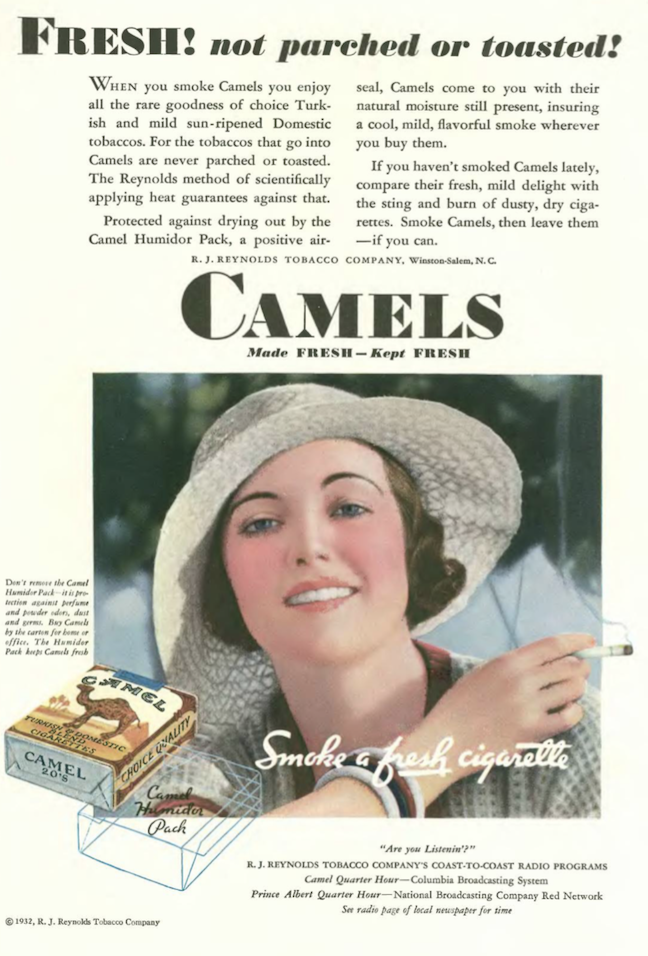
Speaking of redheads, we have this one encouraging us to become addicted to Camel cigarettes and then daring us to “leave them if you can”…
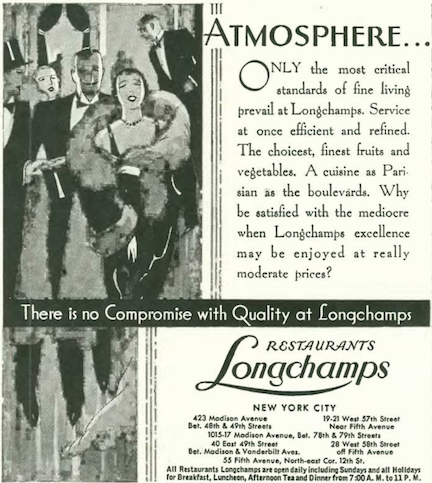
…Longchamps was a chain of restaurants in Manhattan that brought a taste of Continental refinement to middle class New Yorkers…
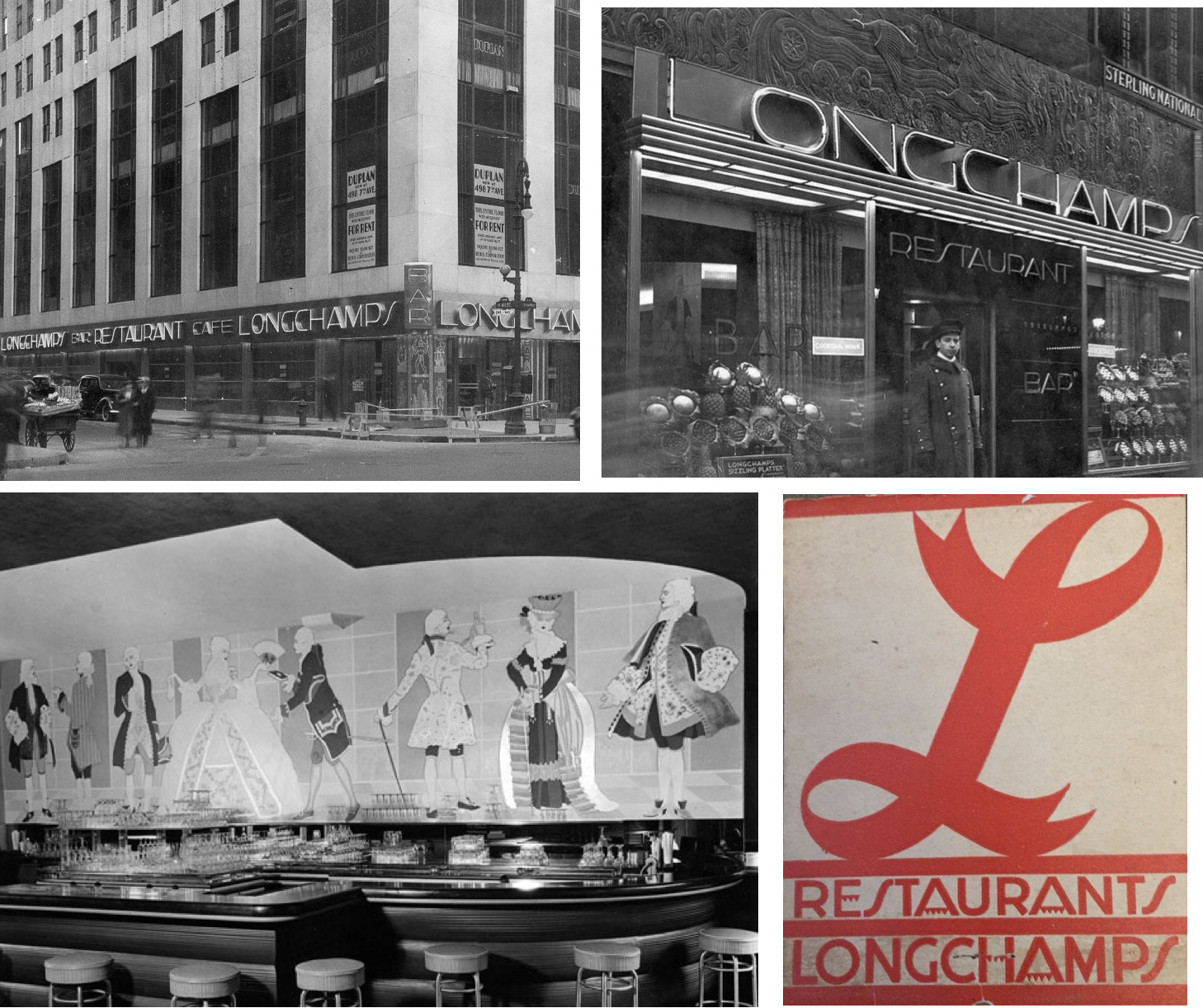
…the terrific Driving for Deco blog site tells us that wholesaler Henry Lustig opened his first Longchamps restaurant in 1919 at Madison and 78th, specializing in an American version of French cuisine at affordable prices. During the mid to late 1930s the chain rapidly expanded, opening seven restaurants within five years. Four of these restaurants were known for interior designs by Winold Reiss…
HIGH STYLE, LOW PRICES…Clockwise, from top left, the 1931 Continental Building was home to this Longchamps restaurant at Broadway and 41st Street (circa 1937); entrance on 42nd Street to the Longchamps in the Chanin Building, circa 1935; late 1930s matchbook cover from Longchamps; interior design by Winold Reiss in the Chanin Building location. (nyneon.blogspot.com/drivingfordeco.com)
…on to our cartoons with Rea Irvin and another view of French elegance…
…and we close with Barbara Shermund, evesdropping on her Manhattan demimonde…
Twentieth century New York saw a lot of paradise paved (see Moses, Robert), but there is one spot in New York that saw paradise reclaimed—not from a parking lot but from an eleven-story prison that once stood at 10 Greenwich Avenue.
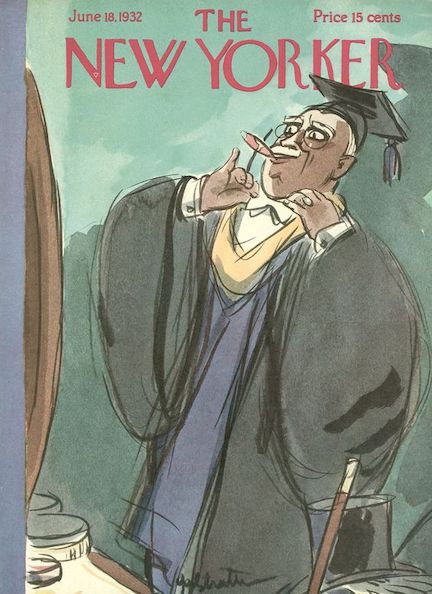
June 18, 1932 cover by William Crawford Galbraith.
The Jefferson Market Garden in Greenwich Village was once the site of a women’s prison designed to be a more humane corrections facility, but between its opening in 1932 and its closing in 1971 the Women’s House of Detention went from noteworthy to notorious.
It was designed by a firm known for its Art Deco buildings—Sloan and Robertson—and although it still looked rather stark and institutional on the inside, attempts were made to gussy it up with artworks commissioned by the WPA. The New Yorker’sE.B. White found a certain “sanitary elegance” to the place.
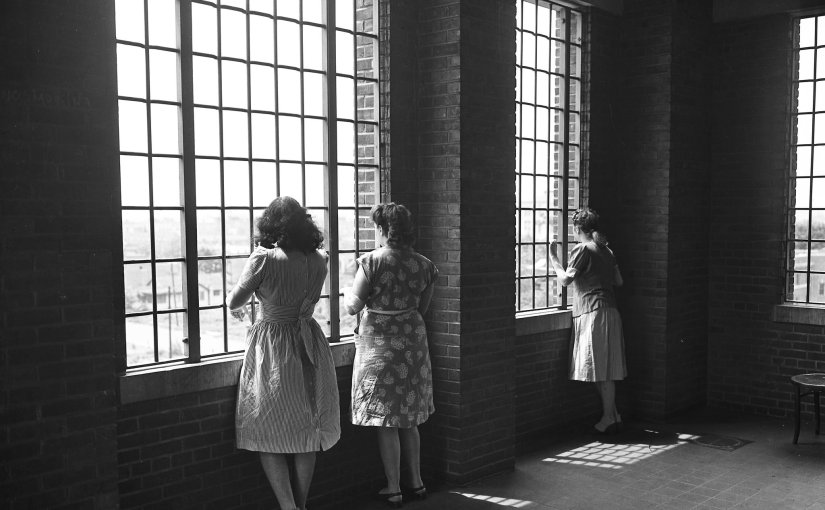
WELCOME INMATES!…When the Women’s House of Detention opened in 1932 it focused on more humane practices, including vocational training and other reform measures. Clockwise from top right, a 1938 photo shows how the prison once loomed over the Sixth Avenue El; inmates stare out of the windows in 1941; WPA artist Lucienne Bloch working on one of the murals that lined prison walls; example of a mural. (amny.com/New York Times/correctionhistory.org)
Thirty years after its opening, things took a turn for the worst at the Women’s House of Detention. Michael Kimmelman wrote in The New York Times (Dec. 18, 2019) that by the late 1960s the jail had become squalid, overcrowded and violent. He wrote: “I can still hear the desperate pleas of inmates shouting through the windows as I walked home from school every day.”
BIG, BAD HOUSE…Clockwise from top, left, protestor outside the New York Women’s House of Detention at the Prisoners’ Rights and “Free the Panther 21” demonstration in 1970; illustrious inmates at the prison included Ethel Rosenberg (pictured Aug. 8, 1950), Angela Davis, and Valerie Solanas (who shot Andy Warhol in 1968); demonstrators outside the prison in 1970; 1956 publicity still taken by the Department of Corrections. (Diana Davies via Smith College/correctionhistory.org)
In the late 1960s Village residents began holding town hall meetings to discuss the removal of the overcrowded prison, many complaining of the friends and families of inmates who lingered outside day and night, yelling up to their loved ones behind bars. The protests were successful; the prison closed in 1971 and was demolished three years later.
A BIT OF EARTH…Top photo is an overhead view of the Jefferson Market Garden, planted on the site of the former Women’s House of Detention. Below, a verdant pathway takes a turn through Jefferson Market Garden. Photos courtesy of amny.com and Jefferson Market Garden.
* * *
How Dry I Ain’t
Franklin D. Roosevelt was a canny politician, seemingly able at times to please both sides of a divisive issue. This was the case in 1932, when teetotaling New Yorkers touted FDR’s long record of supporting such causes as the Anti-Saloon League, while city dwellers such as E.B. White knew better…
LIBERAL LIBATION…Franklin D. Roosevelt was an enthusiastic drinker, especially of his famed martinis. (thrillist.com)
* * *
From Our Advertisers
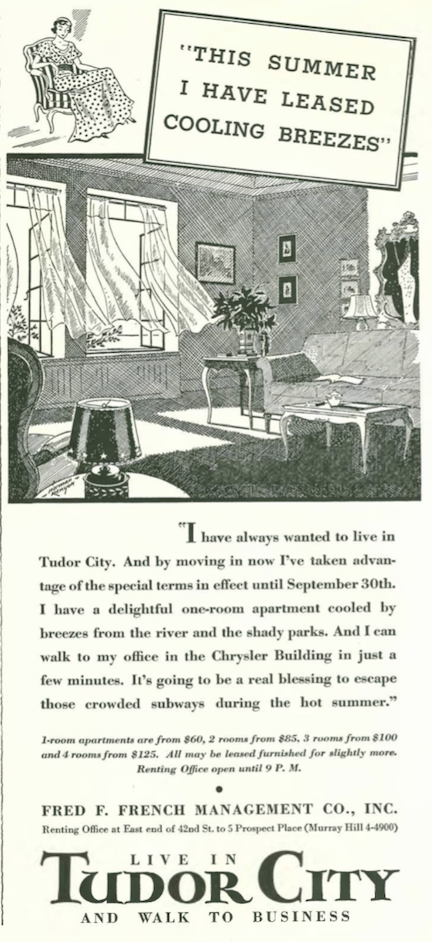
In the days before air conditioning, most folks had to rely upon whatever cooling breezes they could channel into their homes, and apparently in Tudor City they could find some relief from the East River, at least when the wind was blowing from that direction…
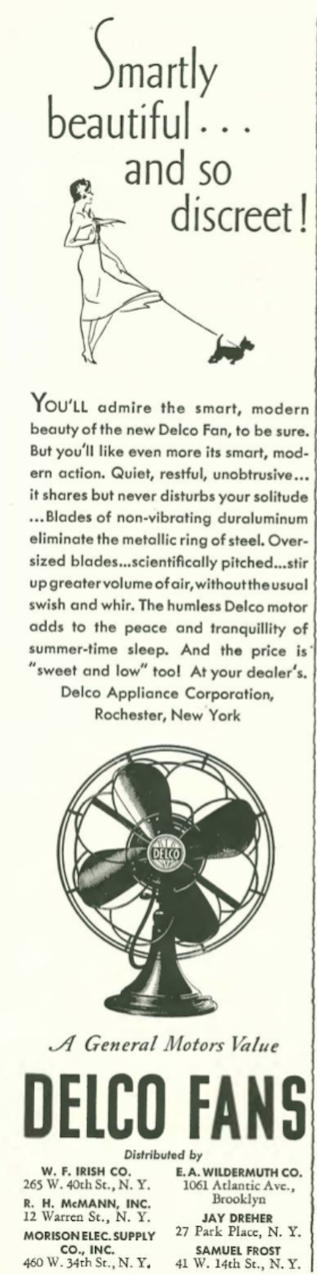
…if the wind wasn’t in your favor, you could switch on an electric fan, an appliance that didn’t come into common use until the 1920s…this ad also demonstrated the power of the dictum “sex sells,” even if applied subtly…
…it would be awhile before air-conditioning became common, but in 1932 you could at least keep your goodies cool with a GE refrigerator, its radiating coils offering a novel way to disperse this smoker’s emissions…
…we jump to our cartoons, with Kemp Starrett in some mixed company…
…Garrett Price illustrated the peril one faced when driving through Chelsea, where one could encounter freight trains at street level…
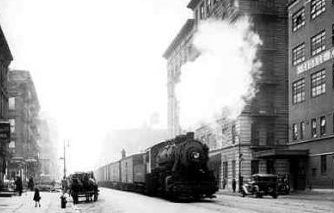
…for almost one hundred years this street-level freight line on 11th Avenue—known as “Death Avenue”—claimed the lives and limbs of hundreds of (mostly poor) New Yorkers…
HEADS UP!…the Hudson River Railroad at 11th Avenue and West 41st Street. (forgotten-ny.com)
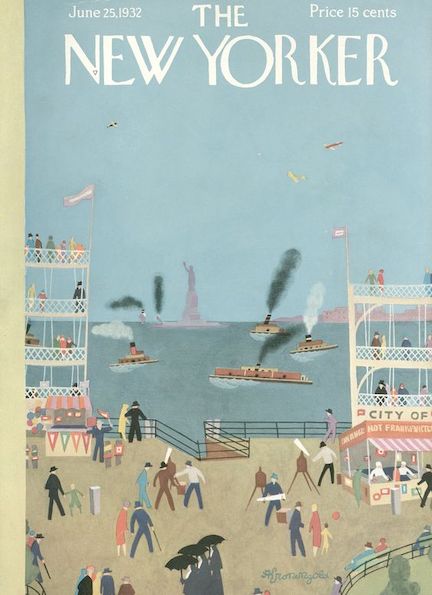
…happily, we move on to June 25, 1932…
June 25, 1932 cover by Adolph K. Kronengold.
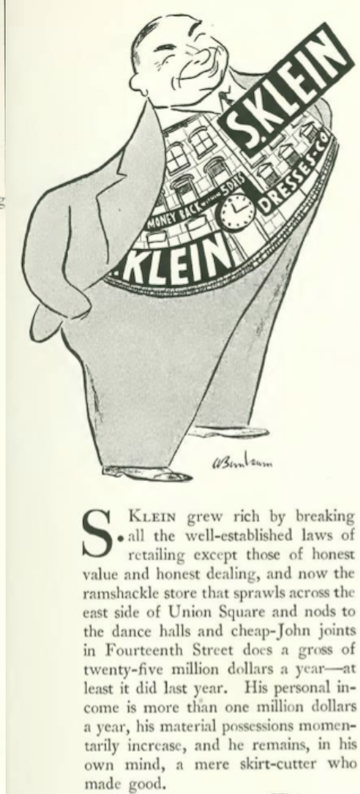
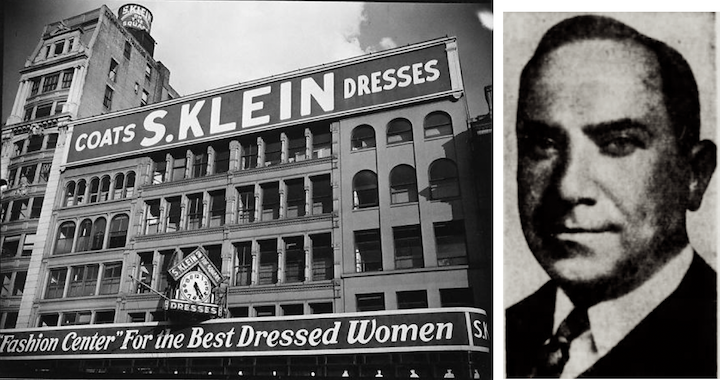
…which featured a profile of Samuel Klein (1886-1942), founder of Union Square’s discount department store S. Klein, famous for its “bargain bins.” The profile included this column-busting caricature of Klein as rendered by Abe Birnbaum…
YOU COULDN’T MISS IT…The S. Klein Department Store was a Union Square fixture from 1910 to its closing in 1975. At right, undated photo of founder Samuel Klein. The building is long gone, the Zeckendorf Towers now occupying the site. (theclio.com/bklyn.newspapers.com)
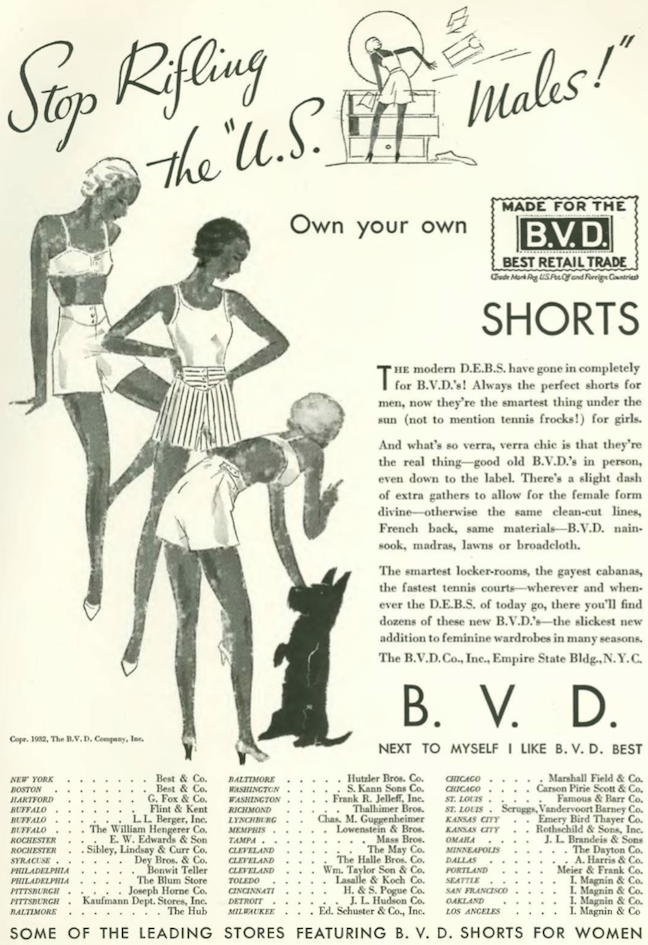
…and we roll right into our advertisements, and this spot from the makers of B.V.D.s, who found a new market for men’s shorts and continued the 1920s trend toward a more casual, androgynous look among “modern debs”…
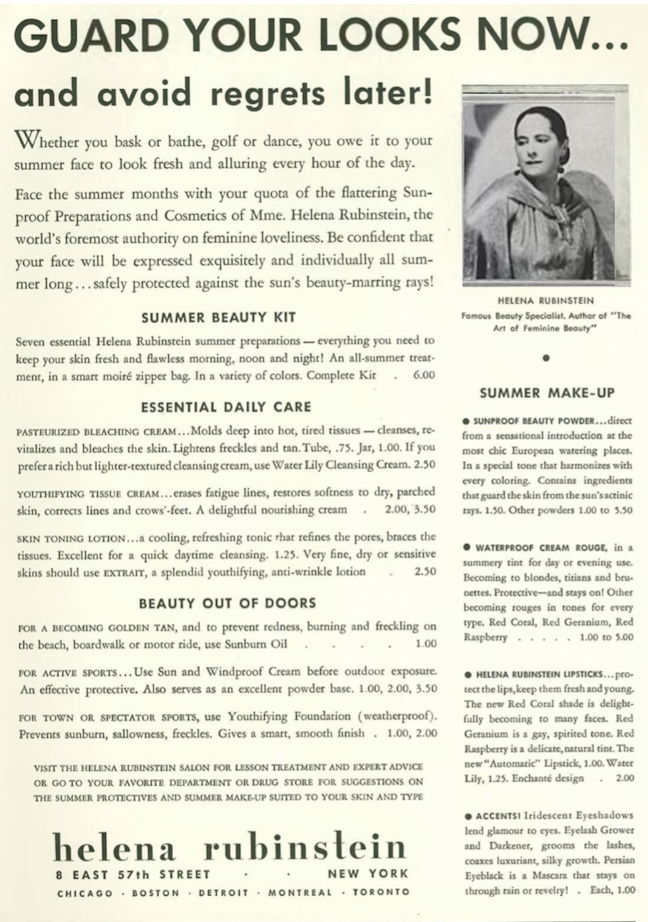
…you likely wouldn’t catch Helena Rubinstein wearing B.V.D.s., busy here shaming women into using her line of beauty products…
…on to our cartoons, we have this spot illustration by James Thurber…
…and another travelogue image from Rea Irvin…
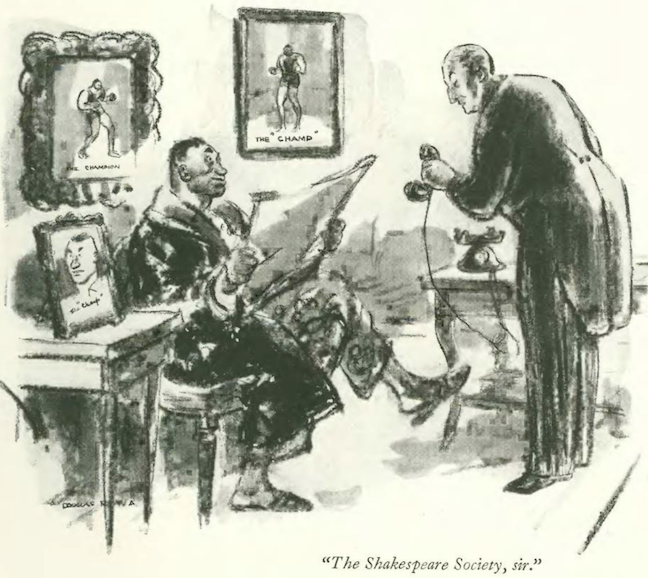
…Douglas Ryan gave us an unlikely Shakespeare lover (unless the boxer was Gene Tunney)…
…and we end with a bit of Prohibition humor from Gardner Rea…
Writing under the pseudonym Guy Fawkes, Robert Benchley (1889-1945) tried to keep the newspaper industry honest through regular criticism in his “Wayward Press” column.
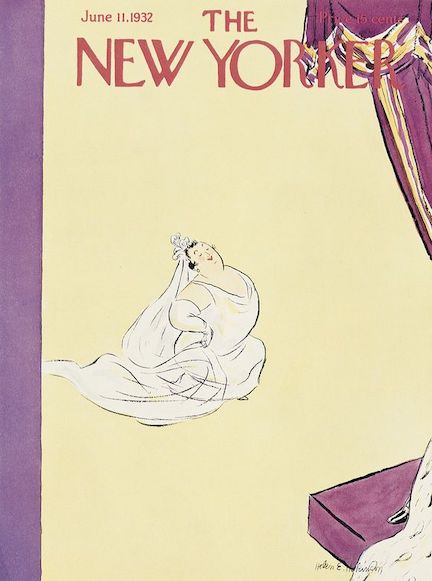
June 11, 1932 cover by Helen Hokinson.
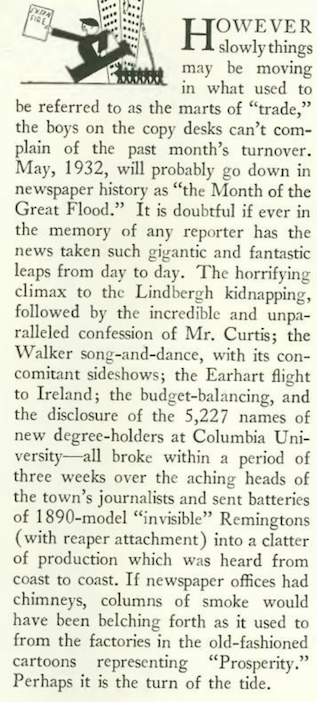
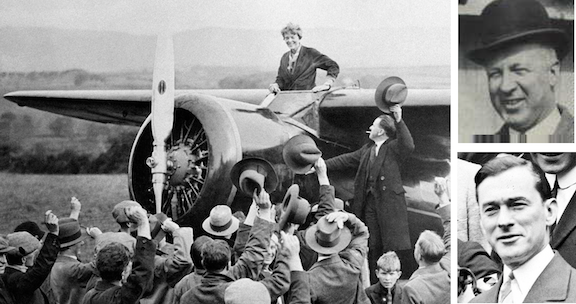
As the summer of ’32 approached, Benchley recalled the barrage of sensational headlines that dominated the month of May—everything from Amelia Earhart’s solo crossing of the Atlantic to John Curtis’ false confession in the Lindbergh baby kidnapping. Here is the opening paragraph:
THE NOBLE AND IGNOBLE marked a busy May 1932. On May 20–21, Amelia Earhart became the first woman—and the only person since Charles Lindbergh—to fly nonstop and alone across the Atlantic. She is shown here after arriving in Culmore, Northern Ireland after her solo flight; At top, right, John Hughes Curtis, a bankrupt shipbuilder from Norfolk, Virginia, who falsely claimed he was in contact with the actual kidnappers of the Lindbergh baby, leading investigators on a wild goose chase; bottom right, Jimmy Walker’s days as mayor of New York were numbered as investigations into corruption continued. (pioneersofflight.si.edu/Wikipedia)
* * *
News From Texas
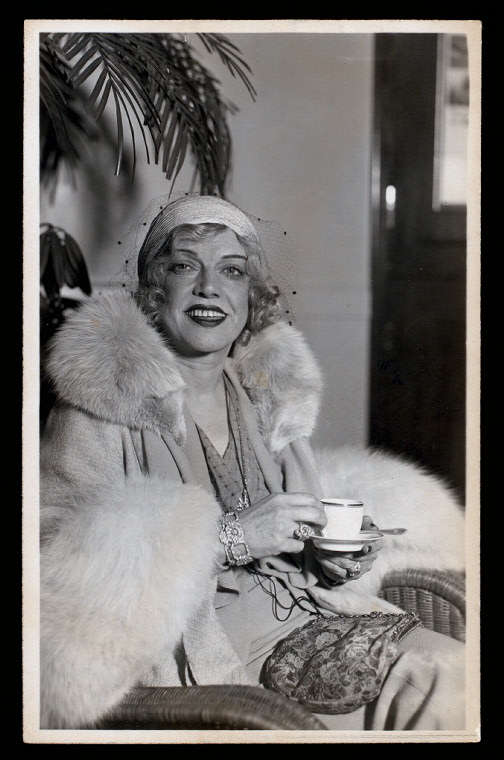
Lois Long filed another installment of “Tables for Two,” noting that folks at Broadway and Seventh Avenue “still own most of the motorcars that sally out of town,” with some of those cars ending up at Texas Guinan’s new La Casa Guinan on Merrick Road.
TEXAS TEA…Following the market crash of 1929, Mary Louise Cecilia “Texas” Guinan left Manhattan’s speakeasy life and in time started a new club near Valley Stream, Long Island. Formerly known as Hoffman’s, Guinan renamed the club La Casa Guinan in 1932. (liherald.com)
* * *
Dud Stud
Writing under his pseudonym Audax Minor, George F. T. Ryall reported on the latest news from the track, namely the race at Belmont that produced a surprise winner.
FAIR FAIRENO scored his first major victory of 1932 in the Belmont Stakes. Unfortunately, Faireno fared less well with the fillies—he was found to be completely sterile when tried at stud.(americanclassicpedigrees.com)
* * *
Appreciating ZaSu
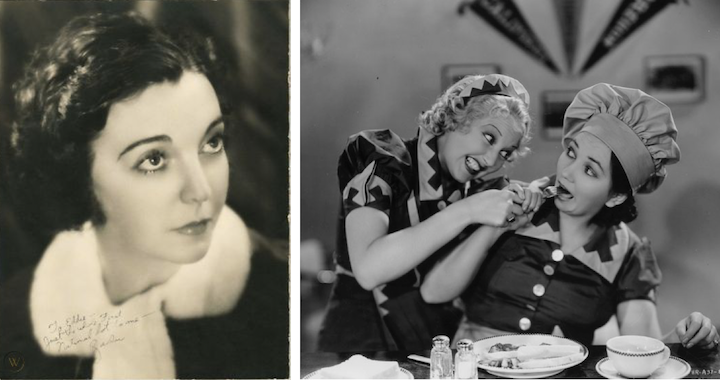
ZaSu Pitts (1894 – 1963) began her acting career in silent dramas, but moved on to comic roles with the advent of sound, most famously pairing up with Thelma Todd in a string of comedy shorts. Producer Hal Roach saw the duo as a female version of Laurel and Hardy, although Pitts and Todd’s characters were smarter and more streetwise. Pitts was also known for playing many secondary parts in B films, mostly portraying fretful spinsters. According to critic John Mosher, this typecasting did not do justice to the Pitts’ obvious talents, which were on display in 1932’s Strangers of the Evening.
UNSUNG HEROINE is how critic John Mosher described actor ZaSu Pitts, seen at left in a circa 1930 publicity photo. Anticipating Lucy and Ethel from I Love Lucy, Pitts teamed up with Thelma Todd in a string of comedy shorts in the early 1930s. Pitts was featured in dozens of films in her 50-year career, including appearances in 18 films in 1932 alone. (IMDB)
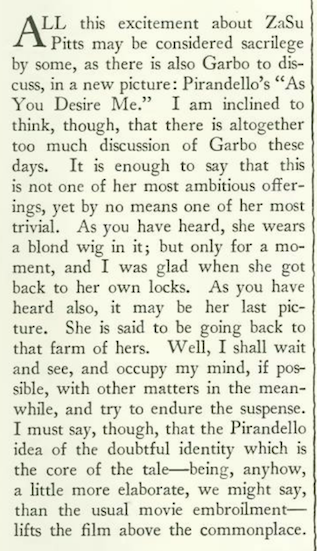
Mosher was also a big fan of Greta Garbo, her recent appearance in Grand Hotel prompting a raft of superlatives from the usually reserved critic. But in her latest outing, As You Desire Me, the enigmatic star seemed to drift a bit closer to earth.
GET OFF MY BACK…Critic John Mosher was a big fan of Greta Garbo, but her appearance in As You Desire Me was a bit of a letdown. Maybe it was the blonde wig. (IMDB)
* * *
From Our Advertisers
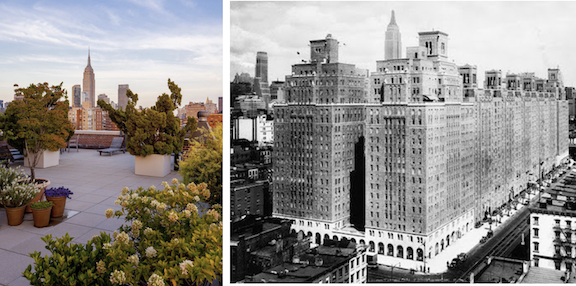
Chelsea’s London Terrace opened in 1930 as largest apartment building in the world, and it was a world unto itself, noted for its “Garden Quiet” as this ad claimed…
…and its terraces continue to provide respite from the clamor below…
NOW AND THEN…London Terrace today and in 1930. (londonterracestories.com)
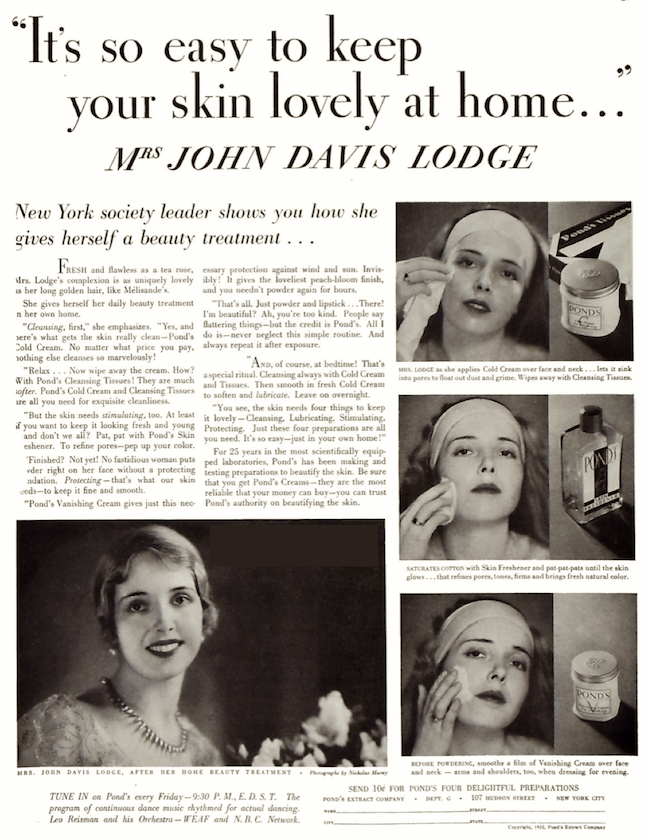
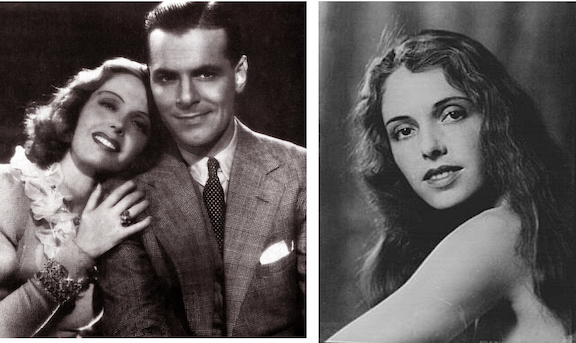
…next is another testimonial ad from Pond’s Cold Cream, this time featuring “Mrs. John Davis Lodge,” aka Francesca Braggiotti (1902-1998), an Italian dancer and actor who married fellow actor John Davis Lodge in 1929 (they co-starred in the 1938 film Tonight at Eleven)…
…A member of a prominent political family, John Davis Lodge (1903-1985) later served as governor of Connecticut, a U.S. House representative, and ambassador to Spain, Argentina, and Switzerland…
SECOND ACT… Francesca Braggiotti married fellow actor John Davis Lodge in 1929, but gave up the acting life when her husband entered politics in the 1940s. At left, the couple in 1938; at right, a 1931 portrait of Braggiotti by Arnold Genthe. The couple had two children, one of whom is Lily Lodge, co-founder of Actors Conservatory in NYC. (Wikipedia/geni.com)
…on with the rest of the ads, we have this one from the maker of Camels, R.J. Reynolds, who took a shot at rival American Tobacco, and their “toasted” Lucky Strikes…
…and we get a dose of retrofuturism thanks to Charles Kaiser and his illustrations of life unbounded with the autogiro, a predecessor to the modern helicopter…
…and it makes a nice segue to our cartoons, beginning with Robert Day…
…and the next series are of a scandalous nature, beginning with Otto Soglow’s comment on Mayor Walker’s corruption charge, and an “unnamed” whistleblower…
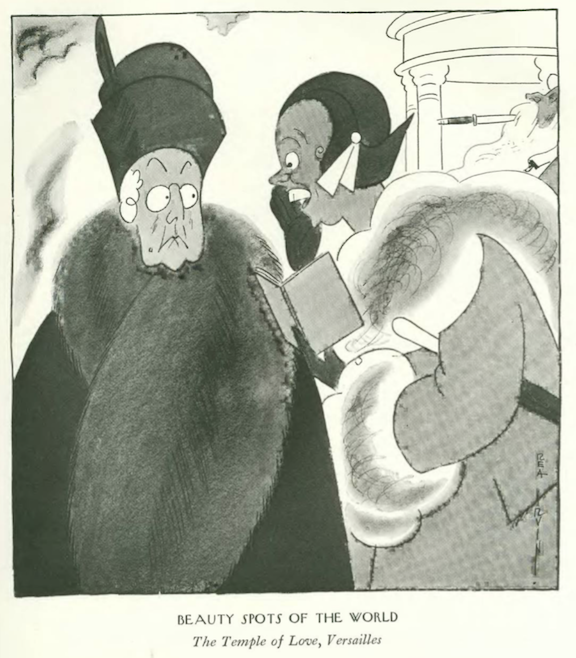
…and we have scandalous whispers for a dowager at Versailles, with Rea Irvin…
…and we let our imaginations run wild with Helen Hokinson here…
New York City Mayor Jimmy Walker (1881-1946) was commonly referred to as “Beau James” for his flamboyant lifestyle and his taste for fine clothes and Broadway showgirls.
June 4, 1932 cover by Theodore Haupt.
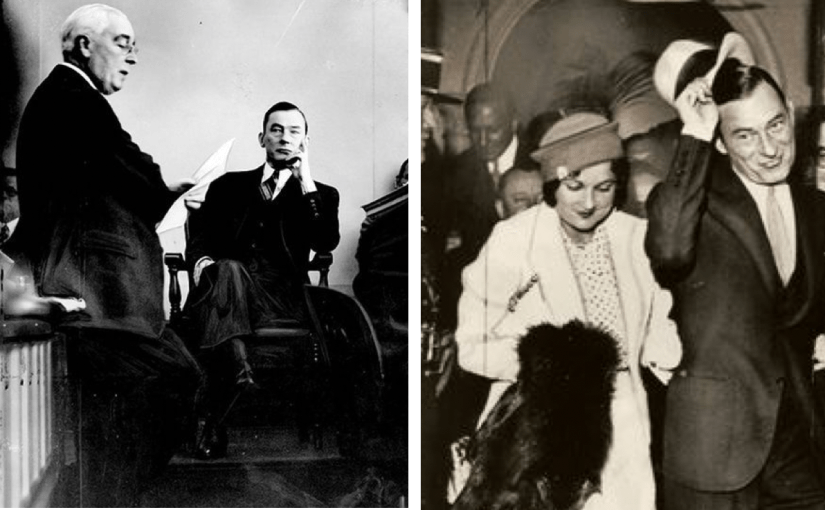
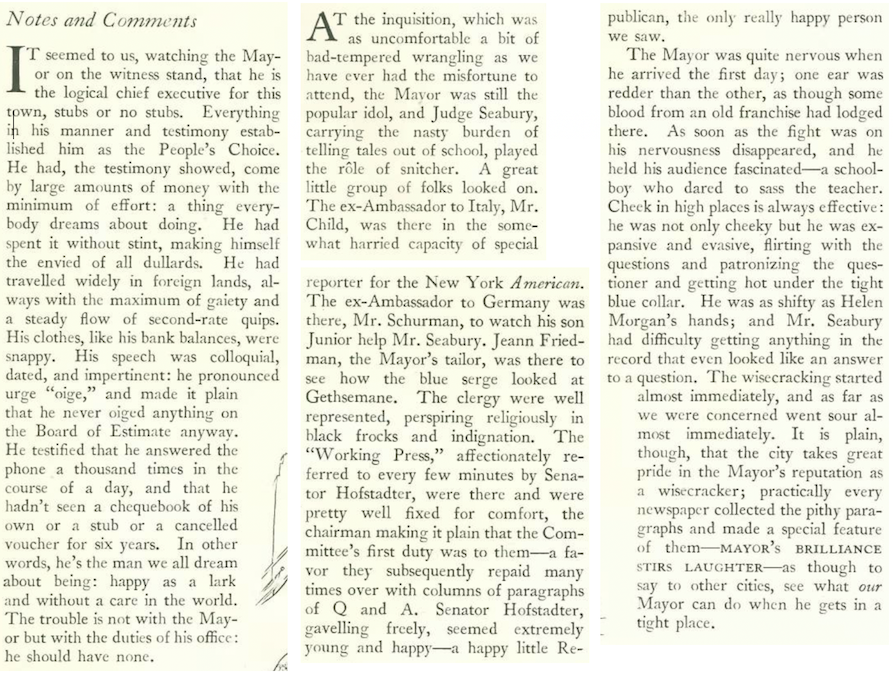
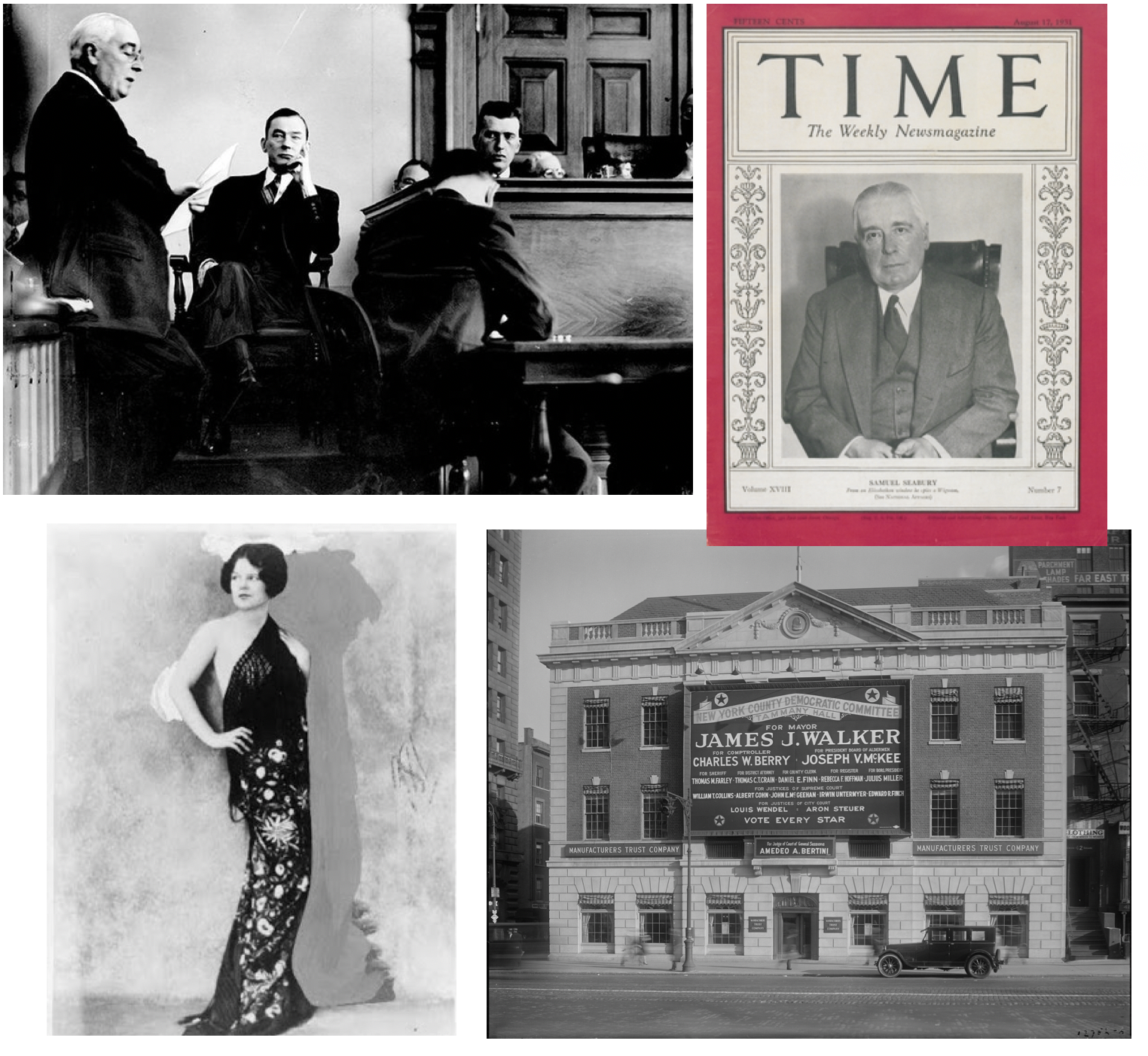
Mayor Walker was also a product of the powerful Tammany Hall machine that traded in political favors and outright bribery. When he took office in 1926, the economy was riding high, and few seemed to care that hizzoner was aloof, partying into the night (while openly flouting Prohibition laws), and taking numerous pleasure trips to Europe. He easily won reelection in 1929, but when the stock market crashed later that year his hijinks began to wear a bit thin, and reform-minded politicians like State Senator Samuel H. Hofstadter began looking into corruption in New York City. The actual investigation was led by another reformer, Samuel Seabury. The New Yorker’sE.B. White looked in on the proceedings and its star witness, Mayor Walker.
I DO NOT LIKE THIS, SAM I AM…Clockwise, from top left, Mayor Jimmy Walker was full of wisecracks during his testimony before Samuel Seabury, far left; Seabury’s role in the high-profile commission landed him on the cover of Time (Aug. 17, 1931); Tammany Hall’s support was writ large for Walker in the 1920s; Vivian Gordon was a surprise witness in the Seabury investigation, telling investigators police received bonuses for falsely arresting women on prostitution charges. After her testimony Gordon was found strangled in Van Cortland Park, leading many to believe Walker’s corruption played a role in her death. (Daily News/Time/archives.nyc/Pinterest)
Public opinion really started to turn on Walker with the death of star witness Vivian Gordon (see caption above). The final blow came from New York Governor Franklin D. Roosevelt, who like Walker was a Democrat but unlike Walker was not a Tammany product. Roosevelt was also running for president, and rightly seeing Walker as a liability, asked the mayor to resign, which he did on Sept. 1, 1932. That event was still three months away when E.B. White wrote these concluding lines:
SO LONG, SUCKERS…Eight days after he resigned from office, New York Mayor Jimmy Walker headed for Paris, where his mistress, Ziegfeld star and film actress Betty Compton, awaited with open arms. Clockwise, from top left, Compton and Walker on their wedding day in Cannes, France, April 19, 1933; and a 1920s photo portrait of Compton; Walker’s first wife, Janet Allen Walker, had sued for divorce a month earlier (March 10, 1933) claiming Jimmy had deserted her in 1928 and they had not lived together since; Walker and Compton on the deck of SS Normandie, June 17, 1936. (legacy.isle-of-wight-fhs.co.uk/IMDB/Pinterest/NYC Municipal Archives)
Eight days after Walker resigned from office he caught a boat for Paris, where his mistress, Ziegfeld star and film actor Betty Compton (1904-1944), awaited him. They married the following year in Cannes.
* * *
Out of the Shadows
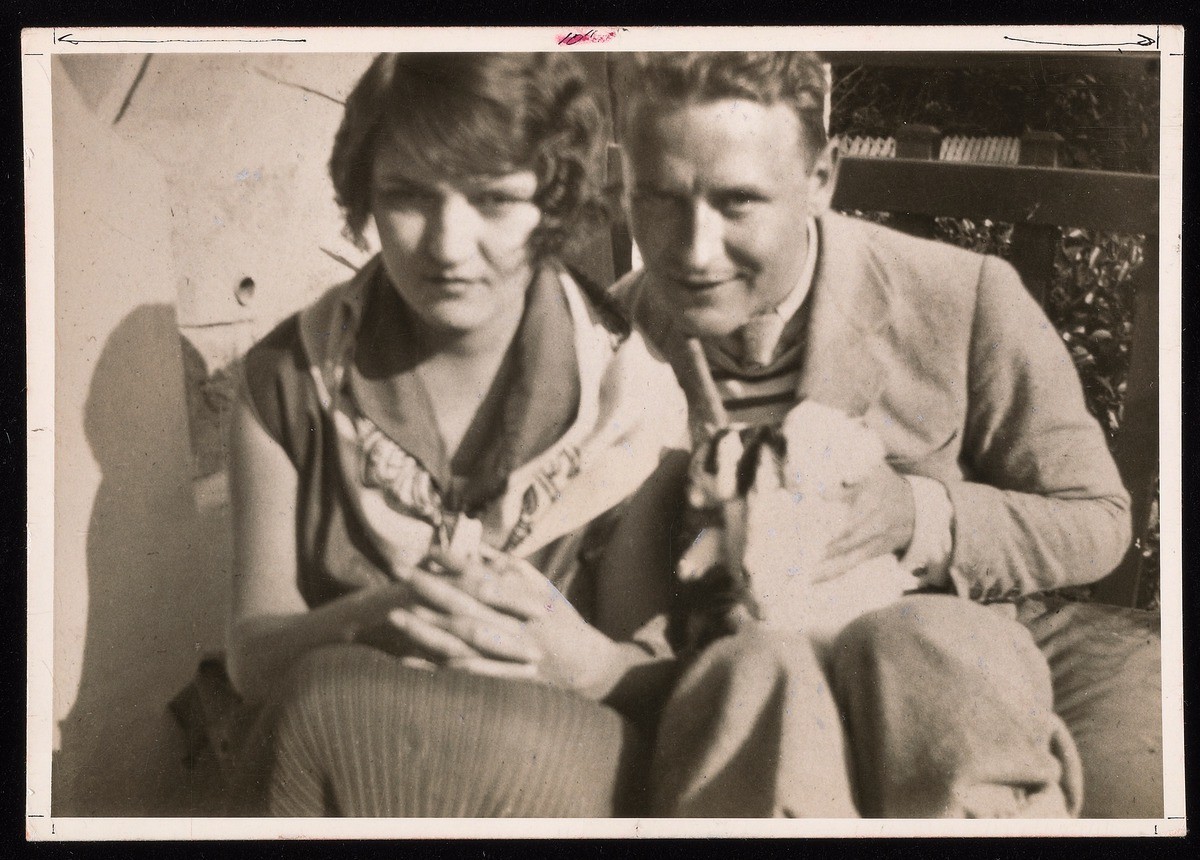
F. Scott and Zelda Fitzgerald were Jazz Age fixtures, cutting wide swaths through literary and society worlds filled with wild drinking and various infidelities. Francis Scott (1896-1940) was a chronicler of that age, most notably with The Great Gatsby, but Zelda (1900-1948) also took pen in hand, contributing short pieces to various magazines in the 1920s. By 1930 their self-destructive ways caught up with them both, and Zelda was admitted to a sanatorium in France that spring; it was the beginning of a long road of treatments that would end in her death nearly two decades later.
ALL THAT JAZZ…Zelda and F. Scott Fitzgerald (pictured here in 1926) embodied the riotous days of the Roaring Twenties. (beinecke.library.yale.edu)
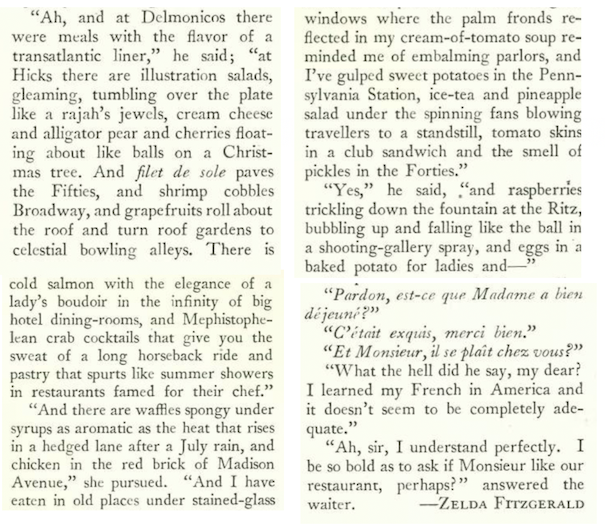
In 1932, during her stay at the Phipps Clinic (Johns Hopkins), Zelda experienced a burst of creativity, writing an entire autobiographical novel — Save Me the Waltz — in just six weeks. Sadly, it was not well-received (by critics or by her husband), and fewer than 1,400 copies of the novel were sold — a crushing blow to Zelda. However, during that same time she published a short story in The New Yorker titled “The Continental Angle.” Here it is:
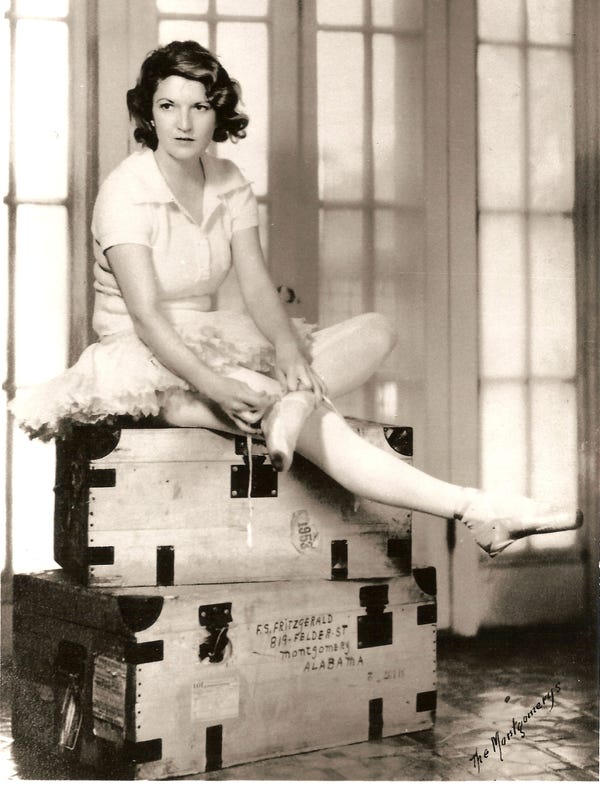
TALENTED AND TROUBLED…Zelda Fitzgerald in 1931, a year before she entered the Phipps Clinic and had a burst of creativity. (citizen-times.com)
* * *
From Our Advertisers
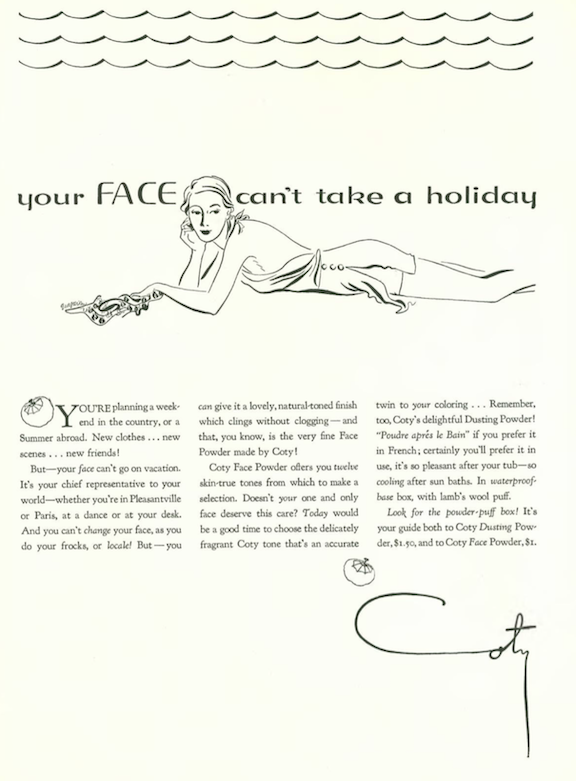
Yet another stylish and very modern-looking ad from Cody, thanks to the artistry of American fashion illustrator Ruth Sigrid Grafstrom…
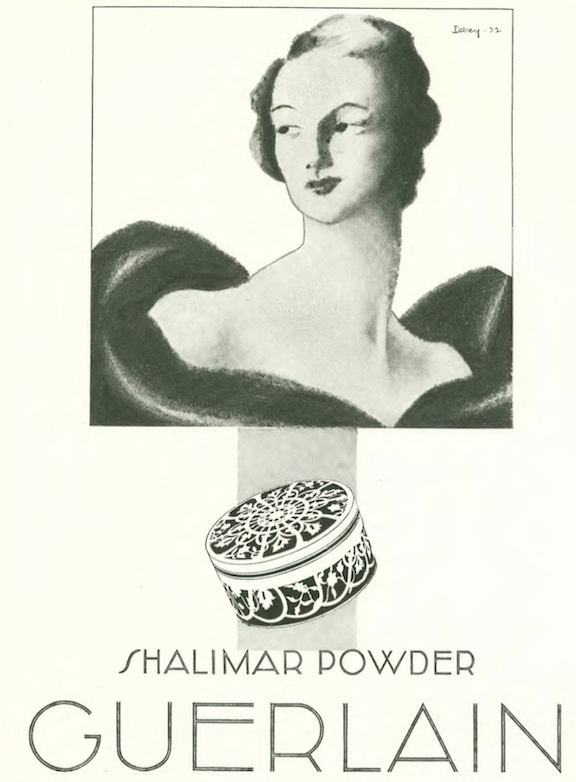
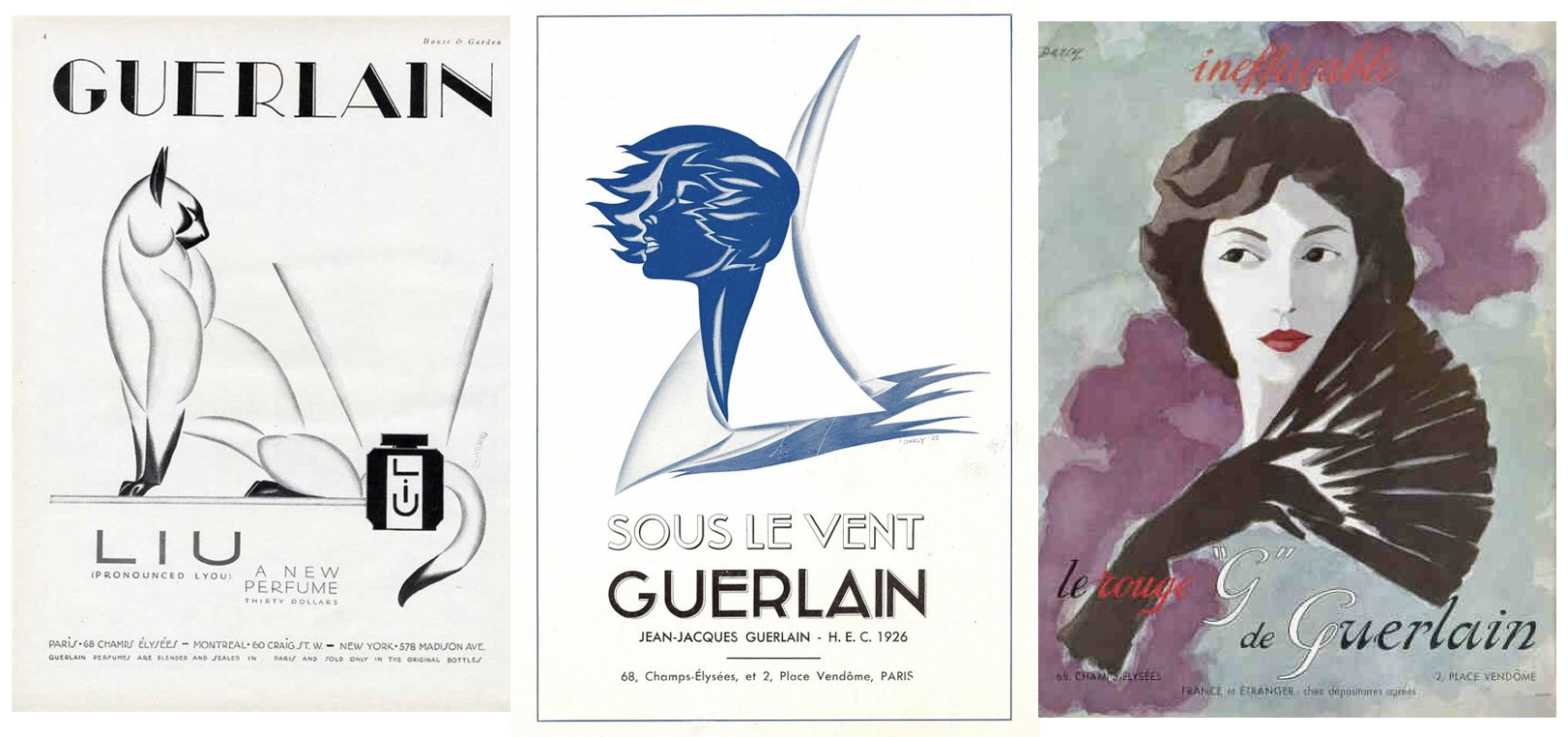
…while later on in the issue French illustrator Lyse Darcy gave his subject an Art Deco look to promote Guerlain’s face powder…
…Darcy was famed for his Guerlain ads from the 1920s to the 1950s…
From left to right, Darcy ads from 1929, 1938, 1957…
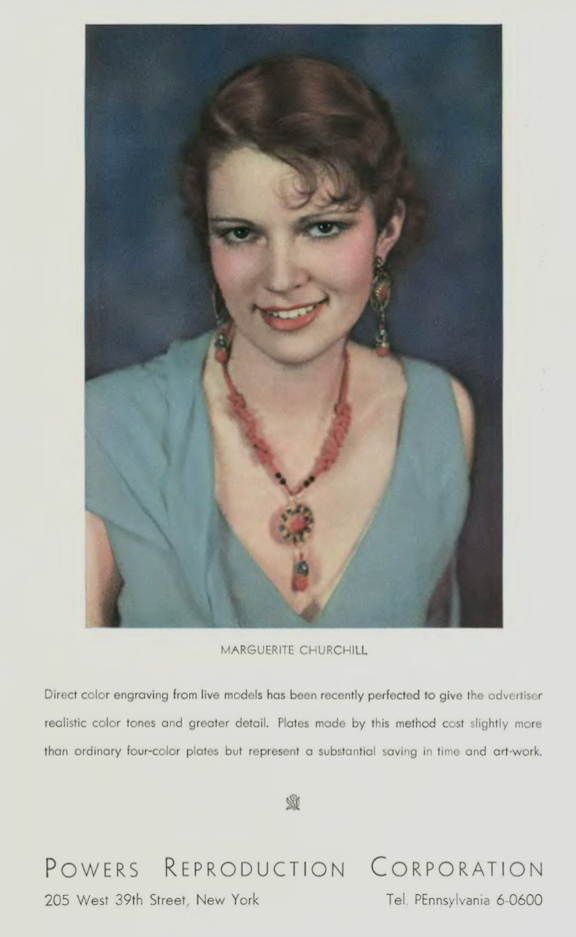
…Powers Reproduction turned to star power to promote their latest color engraving techniques…
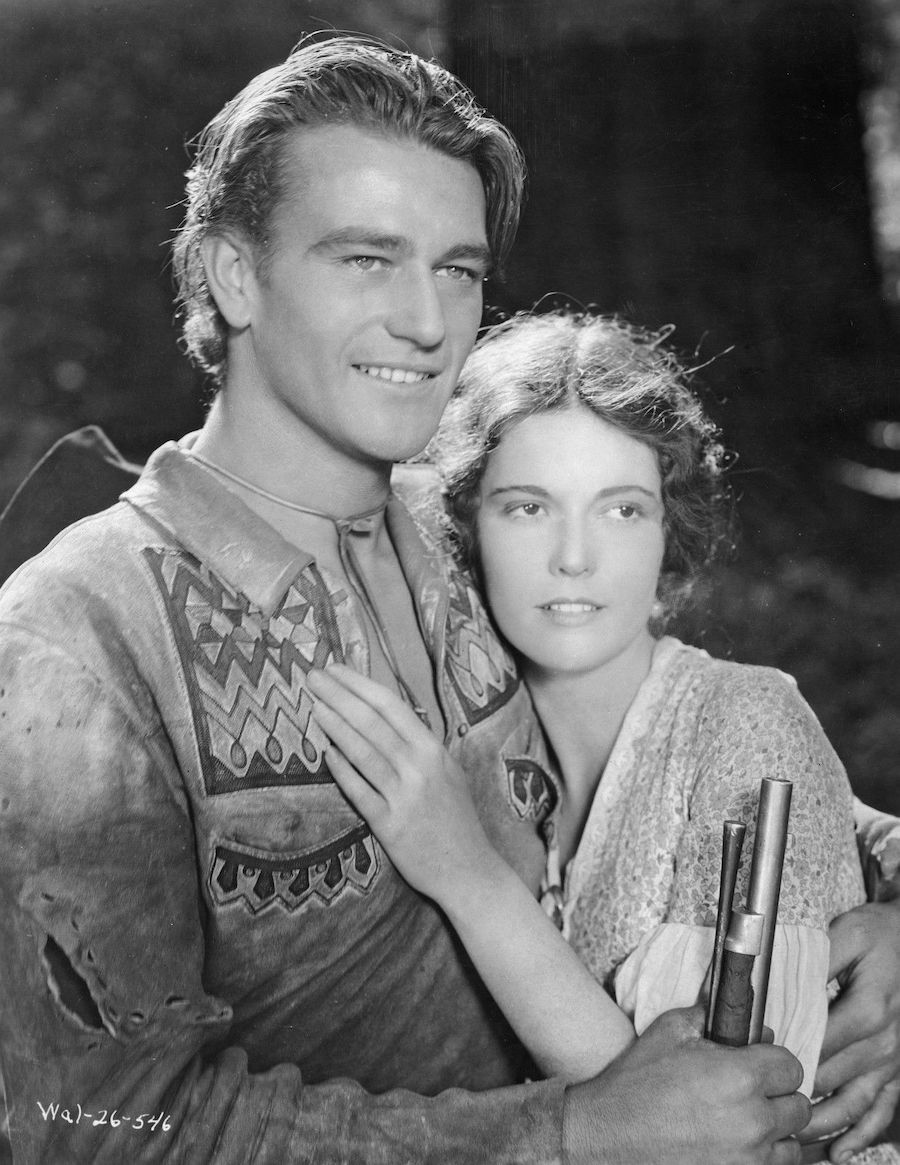
…the actor Marguerite Churchill (1910-2000) had a film career spanning 1929 to 1952, and was John Wayne’s first leading lady in 1930’s The Big Trail…
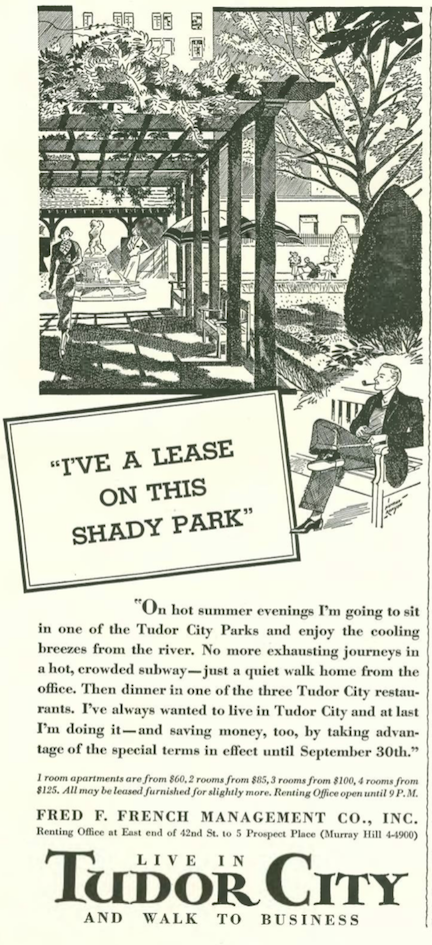
…and we head back to the city, Tudor City, to be precise, where apparently it was common in the 1930s to spot a gent in formalwear relaxing with his pipe…
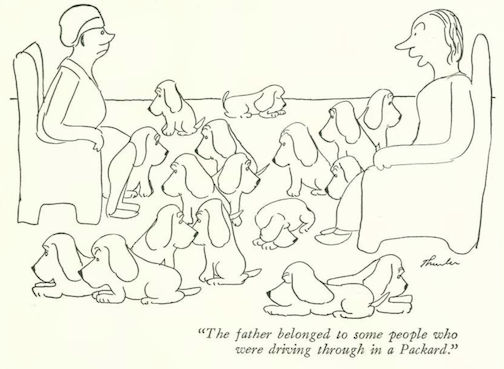
…on to our cartoons, we have James Thurber contributing some spots…
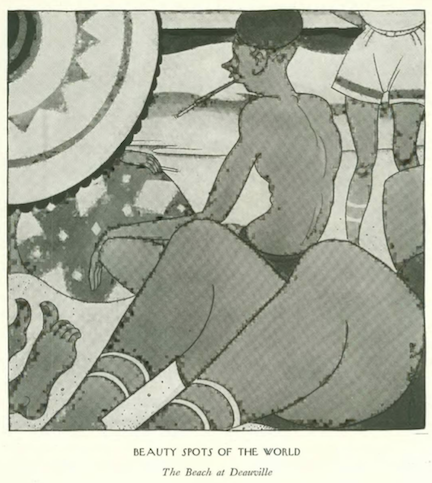
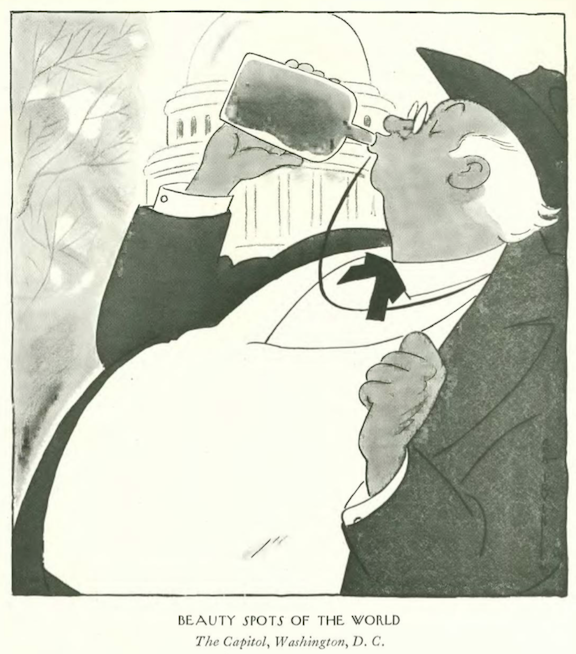
…Rea Irvin continued to visit the world’s “Beauty Spots”…
…Garrett Price showed us a couple looking for the “We Want Beer” parade…
…which happened three weeks earlier, on May 14, 1932…the parade was organized by none other than Mayor Jimmy Walker, who believed prohibition was making life difficult for New Yorkers…
(brookstonbeerbulletin.com)
…Barbara Shermund introduced two men with bigger issues than beer on their minds…
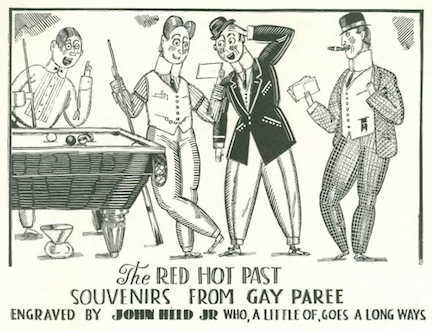
…John Held Jr. continued to plumb the depths of the naughty Nineties…
During the 1930s few people could afford the luxury of a Broadway show, but a trip to “Minskyville” was in reach of nearly anyone looking to escape the gloom of the Depression, at least for a few hours.
May 28, 1930 cover by Constantin Alajalov.
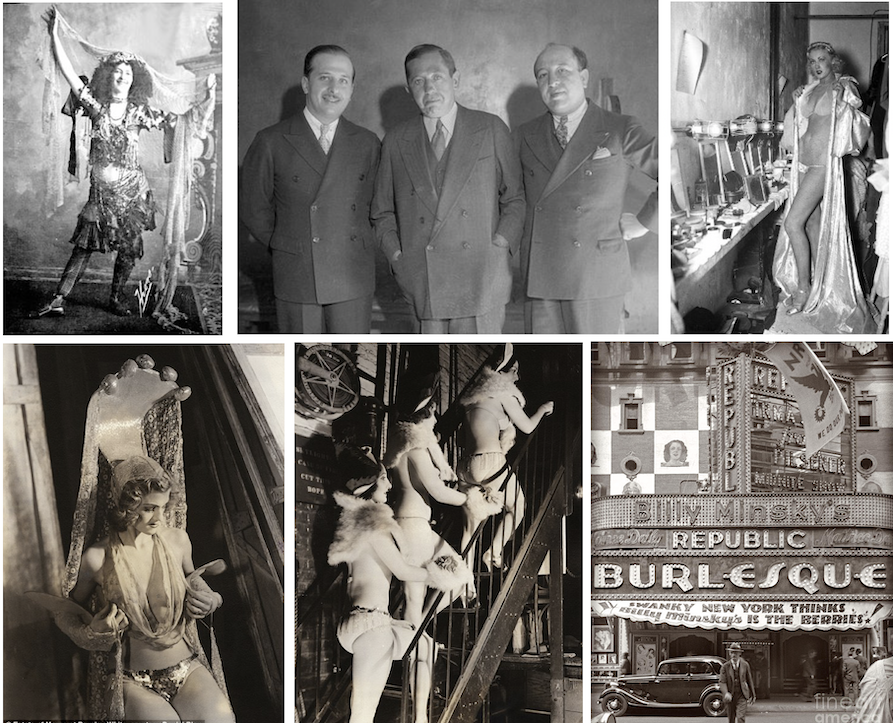
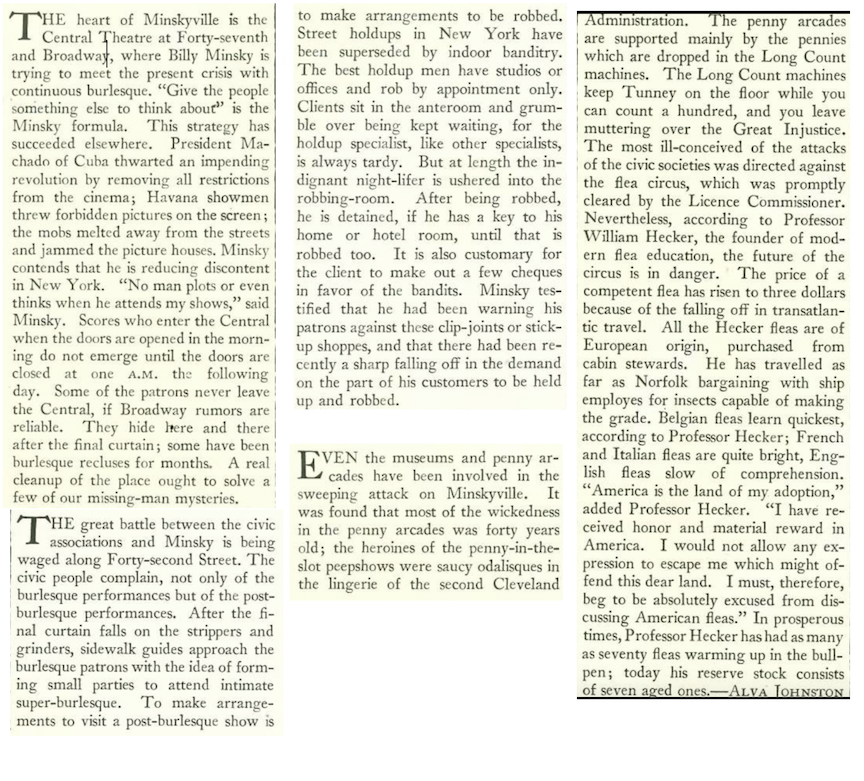
The Minsky family—brothers Billy, Herbert, Morton and Abe—built the beginnings of a New York burlesque empire, writes actress, author and documentarian Leslie Zemeckis: “Abe, the eldest, started showing racy films in a nickelodeon theater on the Lower East Side. His father—believing that if his son was gonna be a perv, he might as well make real money at it—bought the National Winter Garden theater on Houston Street near Second Avenue (where a Whole Foods stands today), and gave Abe the sixth floor to run his burlesque shows.” Alva Johnson paid a visit to Houston Street and environs for the “A Reporter at Large” column:
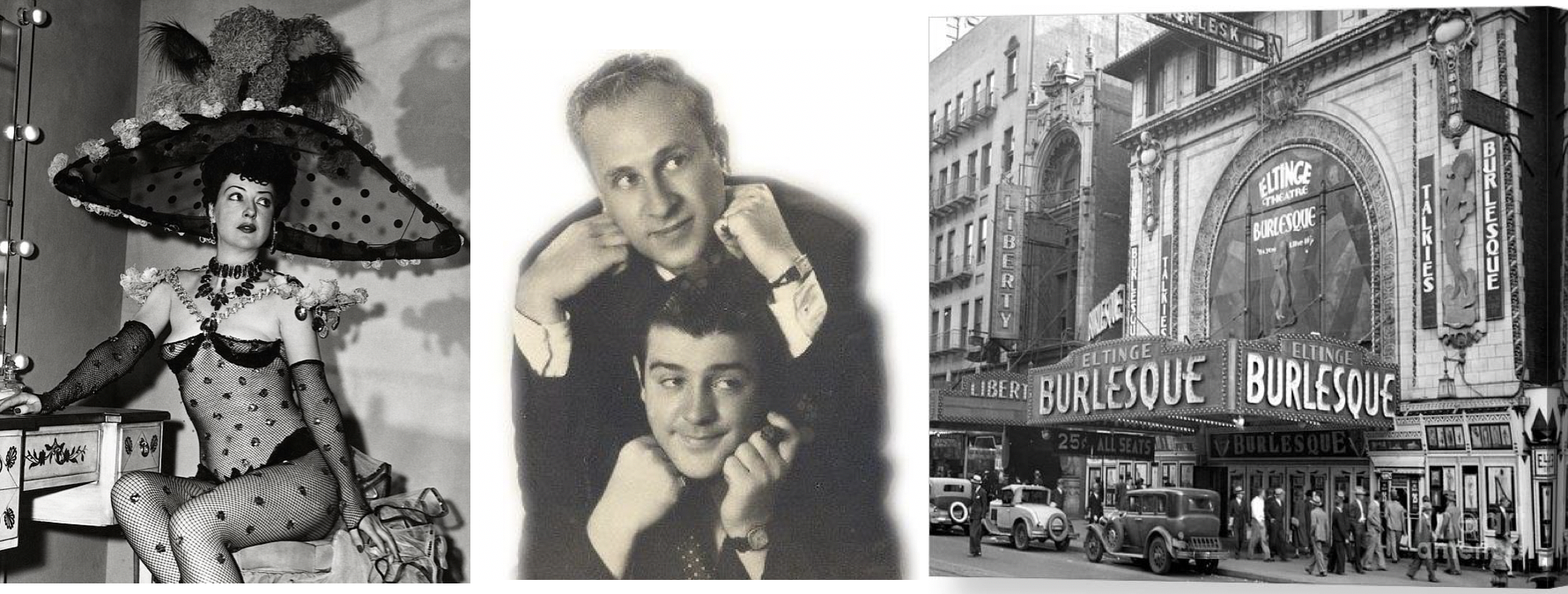
LITTLE EGYPT, aka Farida Mazar Spyropoulos, top left, both titillated and scandalized crowds at the 1893 Chicago World’s Fair (really?); clockwise, from center top, three of Minsky Brothers – Billy, Morton and Herbert; the Minsky Brothers owned several burlesque theaters in New York, including Minsky’s Oriental on 51st Street and Broadway, where stripper Julie Bryan was a top draw in 1936; Billy Minsky brought the Minsky brand to Broadway when he leased the Republic Theatre on 42nd Street in 1931; the last two images are by Margaret Bourke-White, backstage at the Republic in 1936. (Wikipedia/Daily News/Estate of Margaret Bourke-White)NEED A CAREER?…Well, in the 1930s an aspiring dancer or comedian could earn some chops on the burlesque stage. Gypsy Rose Lee (aka Rose Louise Hovick), left, who became the world’s most famous stripper (as well as an actress, author and playwright), was one of the biggest stars of Minsky’s Burlesque; breaks between burlesque performances were commonly filled by comedians, including Abbott and Costello (pictured above in their 1930s burlesque days), who first worked together in 1935 at the Eltinge Burlesque Theater on 42nd Street, at right.
According to Zemeckis, “burlesque caught on among the recent immigrants of the Lower East Side. The shows were cheap, the humor broad, and the allure of beautiful, barely-clothed women transcended language barriers.” But if striptease wasn’t your thing, Minskyville offered plenty of other diversions:
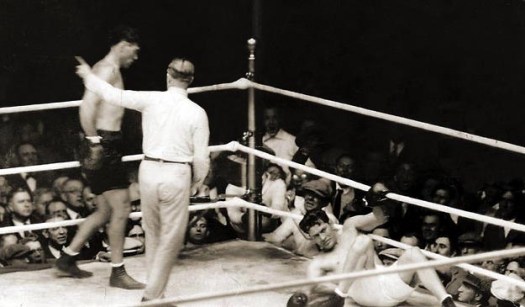
ONE LUMP OR TWO?…Minskyville’s entrepreneurs (top images) added a modern twist to the study of head bumps and cranium size — called Phrenology — with the electronic “Psycograph” (sic); at bottom, Prof. William Heckler’s Trained Flea Circus at Hubert’s Museum on West 42nd Street attracted some gents itching to see Heckler’s fleas in action; according to Alva Johnston, Minskyville’s penny arcade peepshows (such as the one at bottom right) would take your penny or nickel in exchange for photos of a woman old enough to give your grandpa the glad eye. (Museum of Questionable Medical Devices/sideshowworld.com)LET’S SEE THAT AGAIN…Folks who didn’t want to look at forty-year-old photos of bathing beauties could check out the most popular attraction at Minskyville’s penny arcades — a clip from the famed Long Count Fight, a 1927 rematch between world heavyweight champion Gene Tunney and former champ Jack Dempsey, which Tunney won in a unanimous decision despite being knocked down in the seventh round. It was, and is, the subject of endless debate. (www.wbaboxing.com )
* * *
Not a Gearhead
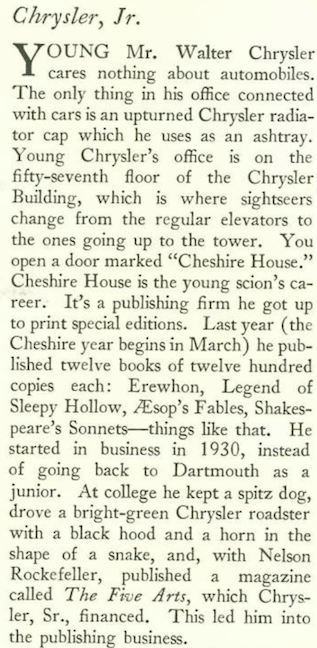
“The Talk of the Town” noted that young Walter P. Chrysler, Jr. preferred arts and literature over things that went zoom:
SOMEDAY THIS WILL ALL BE YOURS, RIGHT?…Walter P. Chrysler Sr. and Walter P. Chrysler Jr. share a father-son moment in 1930. Junior Chrysler devoted much of his life to building a multimillion-dollar collection of paintings (some of which were later found to be forgeries) and made substantial forays into collecting stamps, rare books and glassworks. He also produced a movie, The Joe Louis Story, released in 1953. (chrysler.org)
* * *
Rat-a-tat
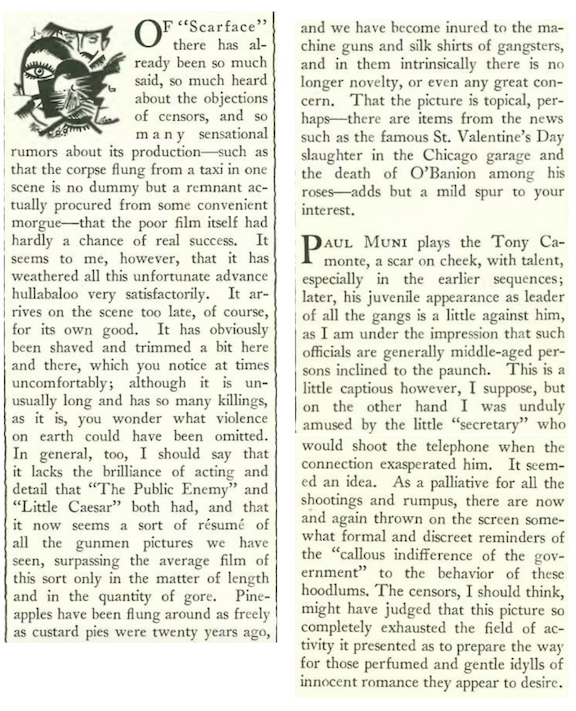
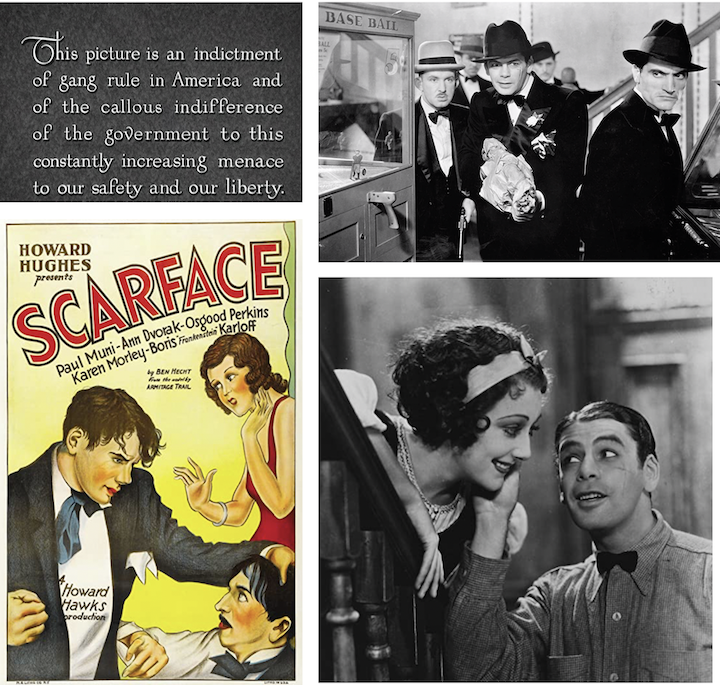
Today most movie lovers associate Scarface with the 1983 Brian DePalma film (starring Al Pacino), but the original Scarface in 1932 was far more influential in that it helped define the American gangster film genre. Directed by Howard Hawks and produced by Hawks and Howard Hughes, the screenplay was penned by early New Yorker contributor Ben Hecht. Mild by today’s standards, the film’s violent scenes caused it to be banned by many theaters around the country. Along with 1931’s Little Caesar and The Public Enemy, Scarface is regarded as among the most significant gangster films. Here is what critic John Mosher thought of it:
JUST IN CASE YOU GET THE WRONG IDEA…Also known as Scarface: The Shame of the Nation, this 1932 gangster film opened with some cautionary words (top left). Clockwise, from top right, gangster “Tony” Camonte (Paul Muni) is flanked by his cronies during a hit on a rival; Tony (Muni) shows his softer side with his dear sister Francesca (Ann Dvorak). United Artists promotional poster (note how Boris Karloff was billed with a reference to his 1931 Frankenstein role). (IMDB)
* * *
From Our Advertisers
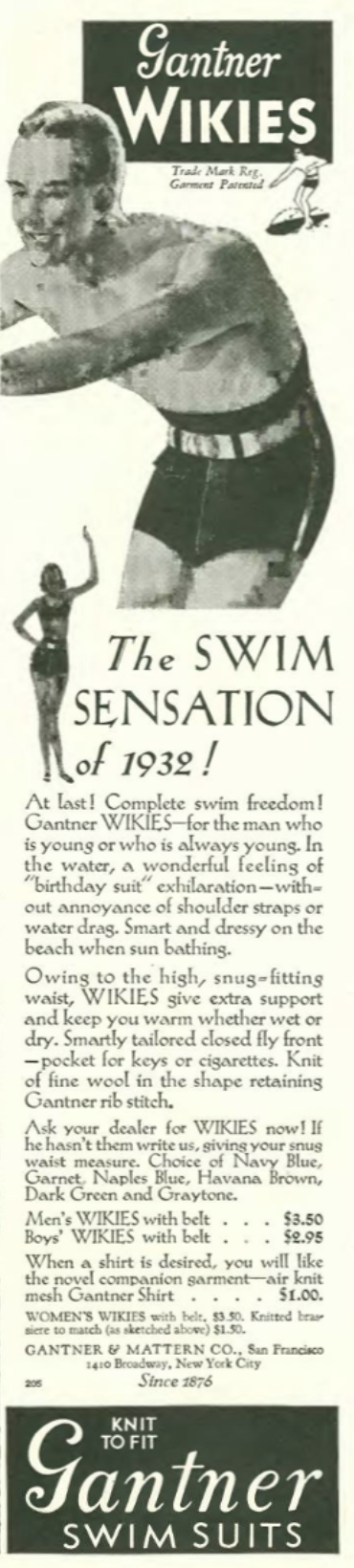
Just when I thought it was safe to go back into the water, out comes another line of wool swimsuits. I honestly can’t imagine how they must have felt, especially when wet and clinging to your skin after you left the water…
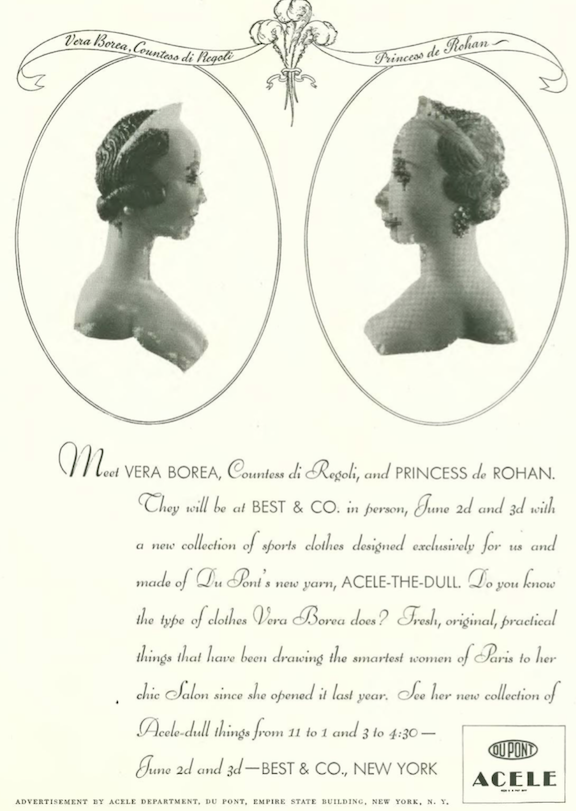
…the ad below from DuPont was just the sort of thing that drove New Yorker fashion critic Lois Long nuts…a couple of downscale royals shilling their fashion lines to an unsuspecting public…the paychecks from DuPont must have been substantial enough for these bluebloods to publicly embrace synthetics…
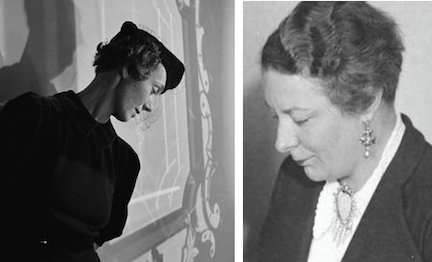
TWO HEADS ARE BETTER THAN ONE…Here is the real Countess Borea de Buzzaccarini Regoli, left, and the Princess de Rohan, who played to America’s insatiable thirst for nobility while shilling for a chemical company. (Wikimedia)
…if you had the money and the steady nerves, you could have hopped aboard an almost 32-hour flight to the West Coast assured that a “coordinated mechanism” of men and machine would get you there in one piece…
…perhaps you could have steadied your nerves by dragging on a Tally-Ho — for some weird reason the Lorillard Tobacco Company (who also made Old Gold) thought some folks might prefer an oval-shaped cigarette (I include the remainder of the back-page ads for context)…
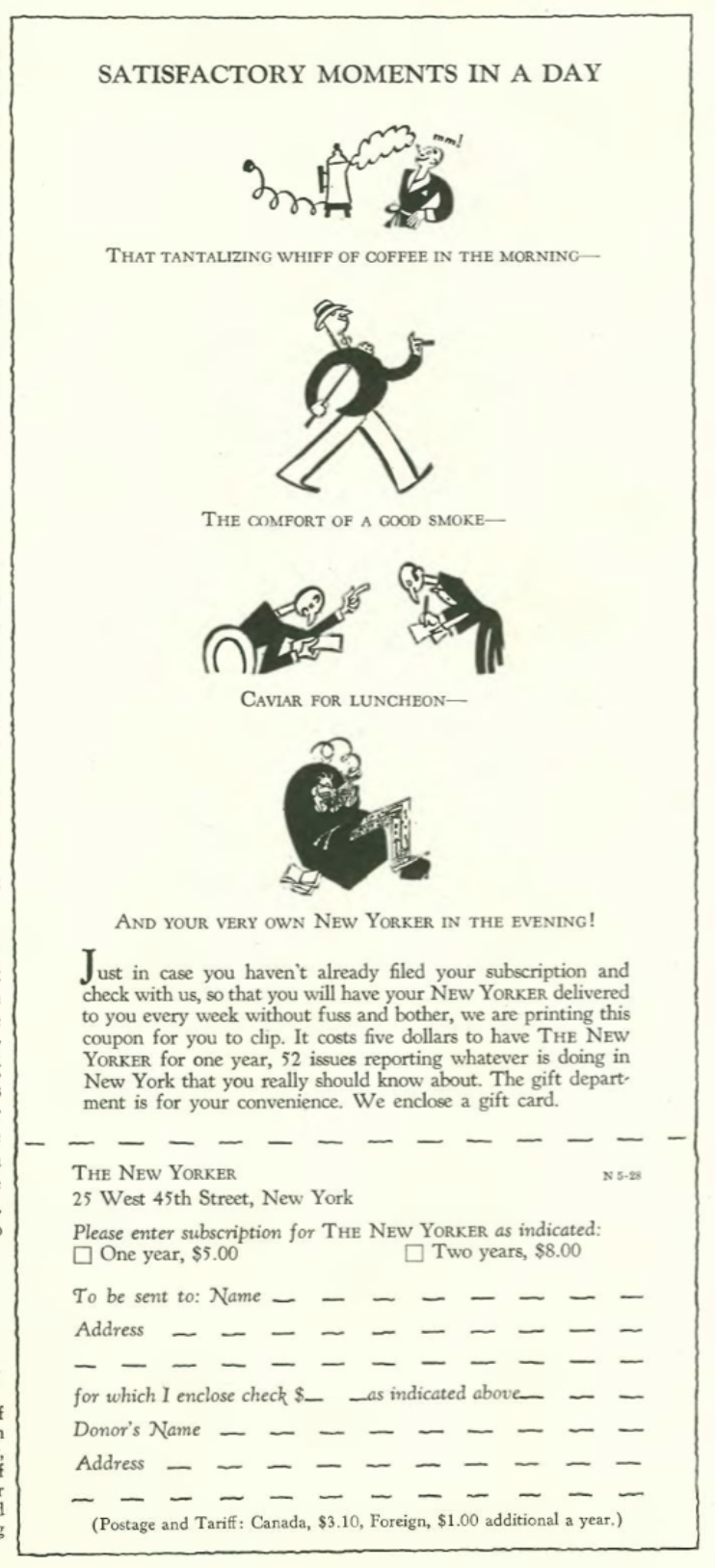
…despite the Depression, The New Yorker was holding its own in sales and subscriptions, but it never hurt to place a house ad every now and then to convince a few who might be holding out…
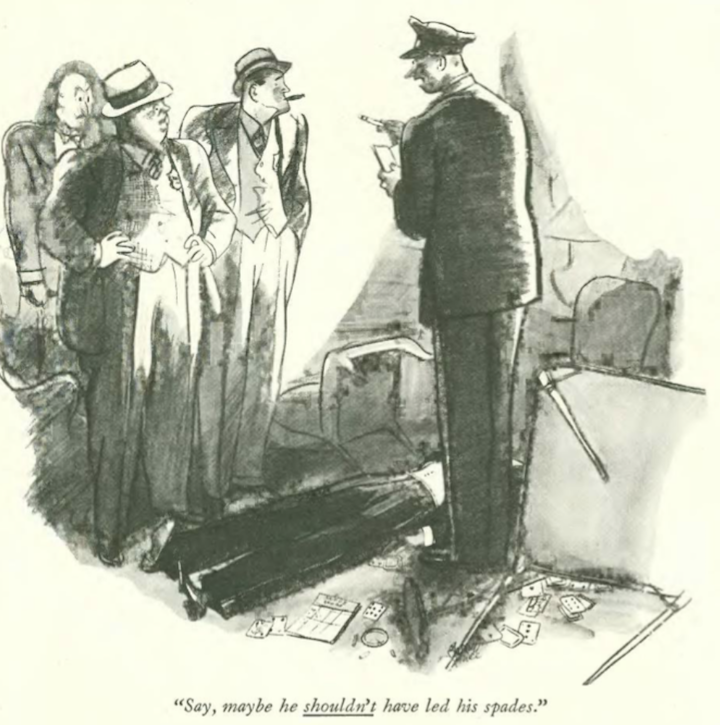
…on to our cartoons, Garrett Price showed us the result of a bad hand…
…James Thurber offered up this spot illustration in the opening pages…
…and this terrific cartoon…
…Gardner Rea demonstrated the perils of summoning the dead…
…the departed soul mentioned in Rea’s cartoon was prolific British crime writer, journalist and playwright Edgar Wallace (1875-1932), who wrote 175 novels, 24 plays, and countless articles in newspapers and journals in his relatively short life. He is most famous today as the co-creator of the film King Kong…
PRODUCTIVE SCRIBBLER…Edgar Wallace. (Wikipedia)
…and we end with this gem from Kemp Starrett, and some high-jinks…
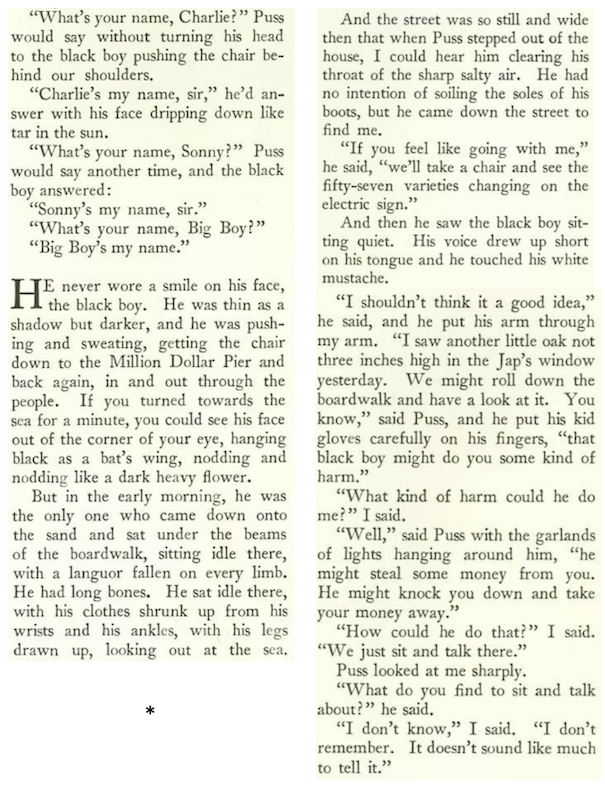
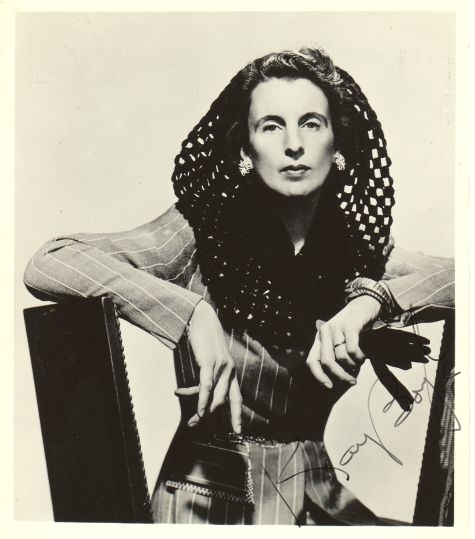
Kay Boyle was thirty and still cutting her teeth as a writer and political activist when The New Yorker published her short story “Black Boy,” told through an unnamed narrator who recalls a childhood visit to the seaside.
May 14, 1930 cover by Bela Dankovsky.
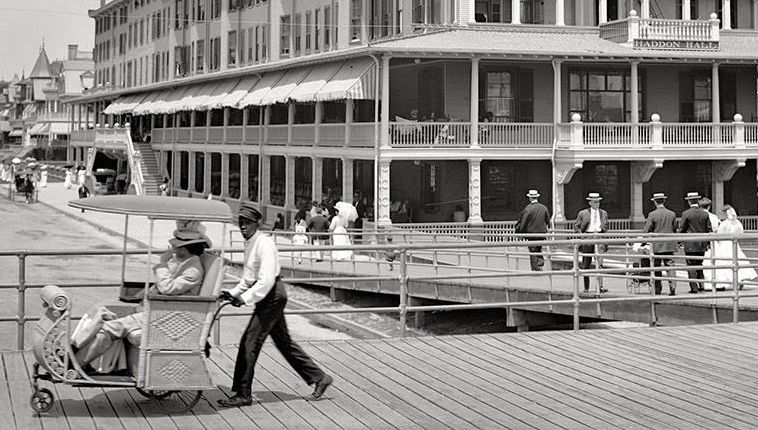
The narrator remembers the days when she rode her horse along the beach while her grandfather watched from a rolling chair, pushed along the boardwalk by various young Black boys. In the following excerpts, the grandfather asks one of the boys for his name, but is it clear he doesn’t really want to get to know him, and through his teasing suggests he isn’t even worthy of an identity. Later in the story the girl befriends the boy, who dwells beneath the boardwalk and dreams of a better life. When the grandfather learns of this budding friendship, he warns about the possibility of harm coming from the boy (two excerpts):
THE LONG, CHAOTIC LIFE of writer and activist Kay Boyle (1902–1992) ranged from fights against racism and fascism in the 1930s to protests against the Vietnam War in the 1960s and against nuclear weapons into the 1990s. (1941 photograph by George Platt Lynes, courtesy The Kay Boyle Papers, Morris Library, Southern Illinois University)
The final paragraphs describe how the girl falls from her horse, and the shocking consequences of the boy coming to her aid.
SEPARATE AND NOT EQUAL…Kay Boyle employed a boardwalk setting in her 1932 short story “Black Boy” to underscore the stark divisions between races in American society. Clockwise, from top left, a 1914 postcard from Atlantic City; on the Atlantic City Boardwalk, circa 1905; sheet music for a popular 1905 song; a dour-looking group being pushed along the Atlantic City Boardwalk, circa 1905. (seesaw.typepad.com/bygonely.com/reddit.com)
* * *
Potemkin Park
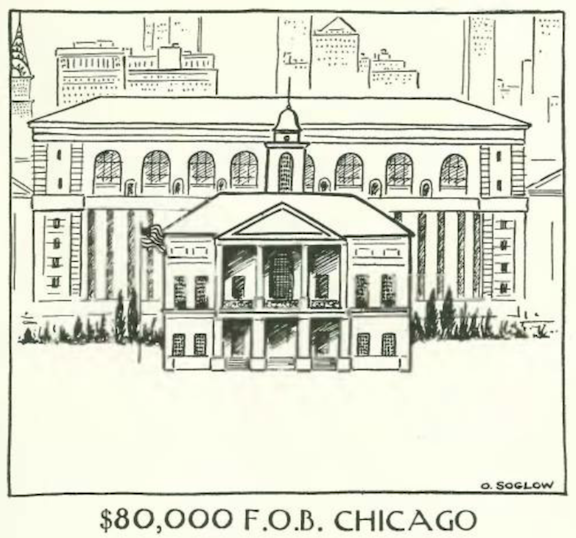
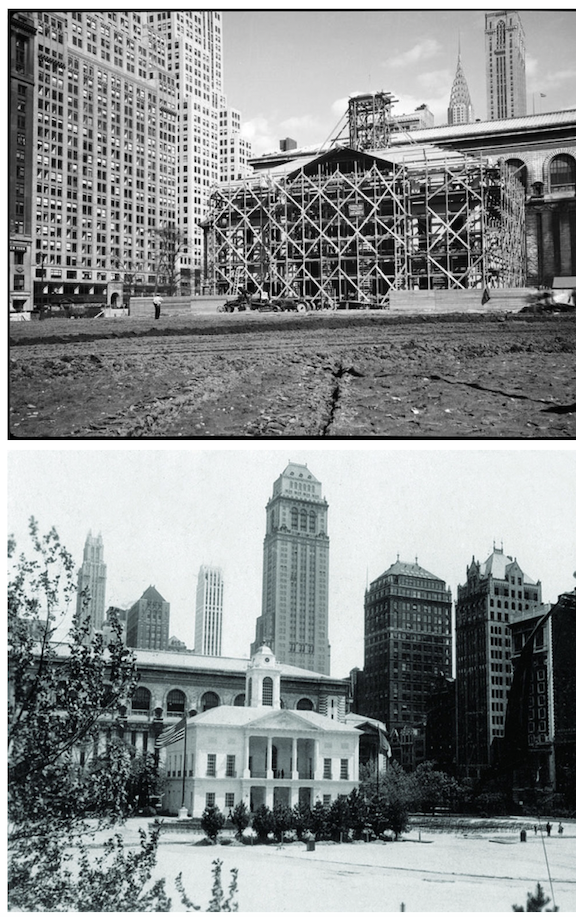
In his “Notes and Comment,” E.B. White questioned the need, and appropriateness, of a wood and plaster Federal Hall replica in Bryant Park, which at the time was a neglected patch of land behind the New York Public Library and a favorite spot for the city’s homeless, their numbers rapidly growing during one of the worst years of the Depression (unemployment hovered near 25 percent). Otto Soglow commented, via cartoon:
To add insult to injury, the area around the replica was fenced off and required an admission fee of 25 cents. White commented:
ERECTILE DYSFUNCTION…This flimsy Federal Hall replica erected in Bryant Park in 1932 symbolized some of the problems that beset New York City in one of the worst years of the Depression. Under Mayor Jimmy Walker, the committee in charge of the replica was filled with corrupt Tammany cronies who quickly depleted the committee’s funds. It is no surprise that the replica was unpopular, especially with its admission fee of 25 cents, roughly equivalent to $5 today (consider that sales clerks in 1932, if they were lucky to have a job, earned perhaps $15 a week). (Museum of the City of New York)
* * *
Intermural Murals
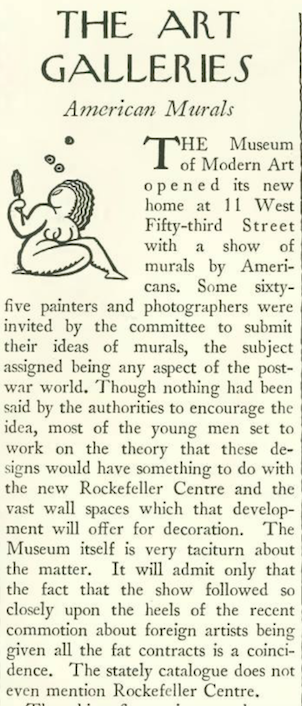
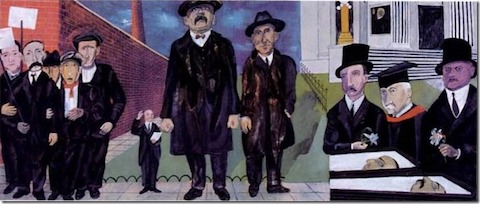
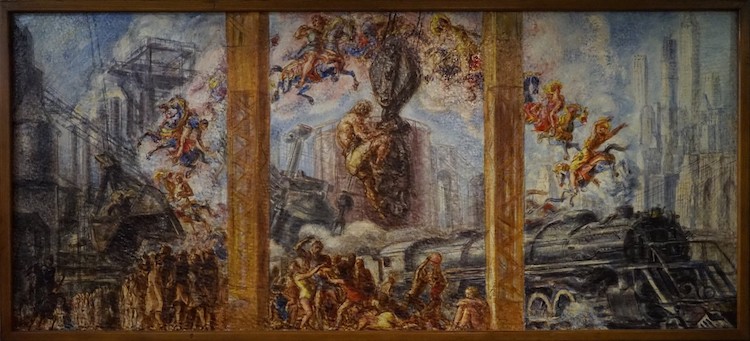
Art critic Murdock Pemberton approached the Museum of Modern Art’s newest exhibition of American muralists with a bit of suspicion, although he was correct in surmising that the Rockefeller Center was shopping for muralists, but as we now know it was not an American, but a Mexican artist (Diego Rivera) who would enter that scene and stir things up.
Among other works, MoMA visitors viewed Ben Shahn’s study for a three-part composition titled “The Passion of Sacco and Vanzetti”…
(MoMA)
…and a work by The New Yorker’s own Reginald Marsh titled “Post-War America”…
(MoMA)
* * *
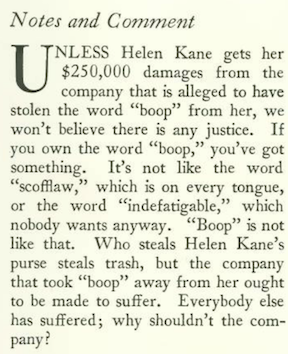
Boop’s Boo-Boo
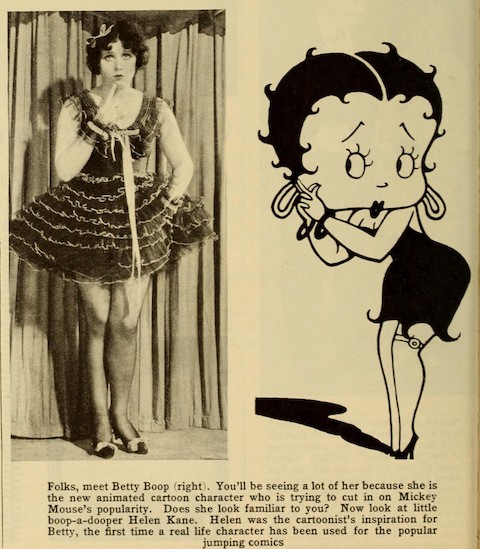
We return to E.B. White and his musings regarding actress and singer Helen Kane (1904–1966), who filed a $250,000 (equivalent to nearly $5 million in 2021) infringement lawsuit against cartoonist Max Fleischer and Paramount Studios, claiming that the popular Betty Boop character was based on Kane’s personality and image.
BOOP SCOOP…Comparison between Helen Kane and the cartoon star Betty Boop was published in Photoplay’s April 1932 issue, one month before Kane’s lawsuit was filed. The suit was settled two years later, the court finding insufficient evidence to support Kane’s claim. (Wikipedia)
* * *
From Rags to Rackets
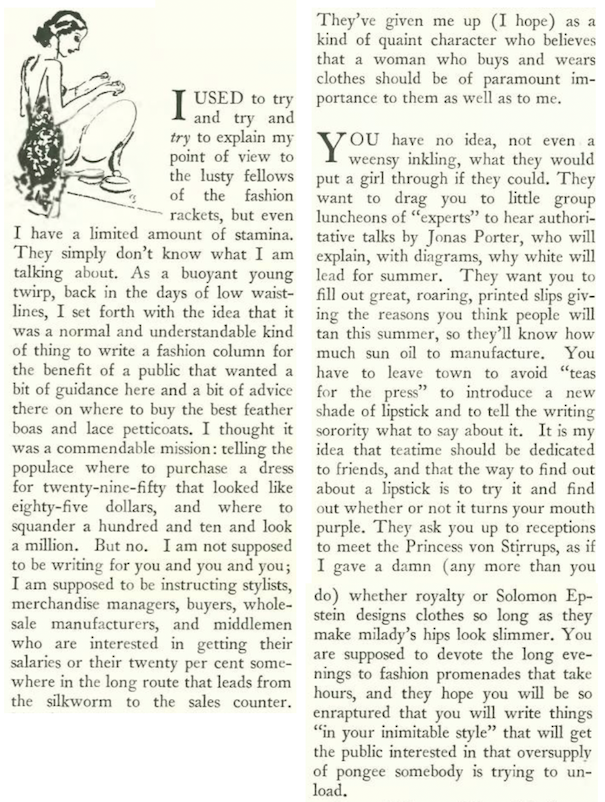
Lois Long lived at the center of the 1920s speakeasy scene, but while she partied she also kept a critical eye on her surroundings, and when she later moved on to fashion criticism (“On And Off The Avenue”) she maintained the same combination of enthusiasm and shrewdness as she took aim at the “lusty fellows of the fashion rackets”…
JUST BROWSING, THANKS…Lois Long kept a skeptical eye on the New York fashion “racket” in the 1930s. Above, an unidentified model sporting a red velvet ensemble during a fashion show in 1933. (New York Daily News)
* * *
From Our Advertisers
We begin with yet another insecticide-themed cartoon from Dr. Seuss, this time using the experimental medium of television to get his point across…
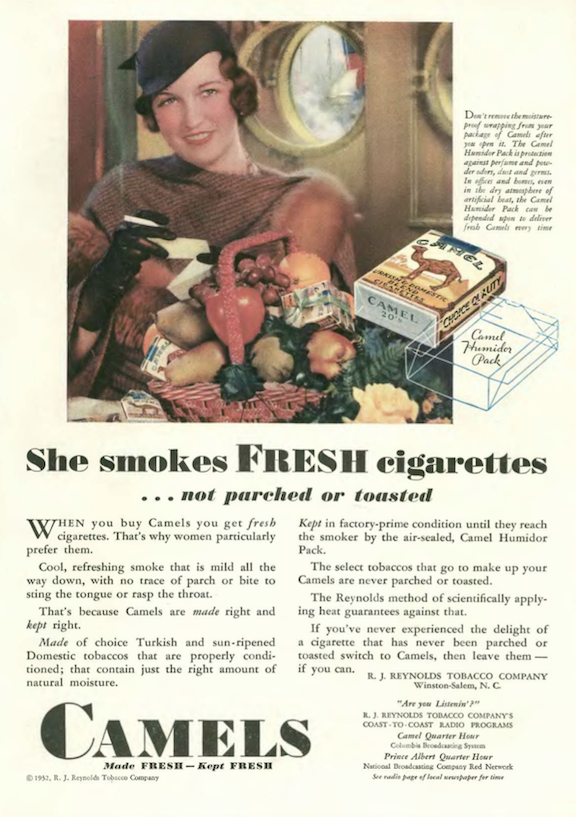
…R.J. Reynolds continued to push their Camels on the growing market of women smokers, here mixing their product with a basket of fruit to suggest freshness and vitality…
…the folks at B. Altman touted their new outdoor furniture line, placing it in a setting available to a very select few New Yorkers…
…we kick off the cartoons with Peter Arno at his best…
…Alice Harvey gave voice to one woman’s thoughts on children…
…Leonard Dove found spirits dwelling among dusty bones…
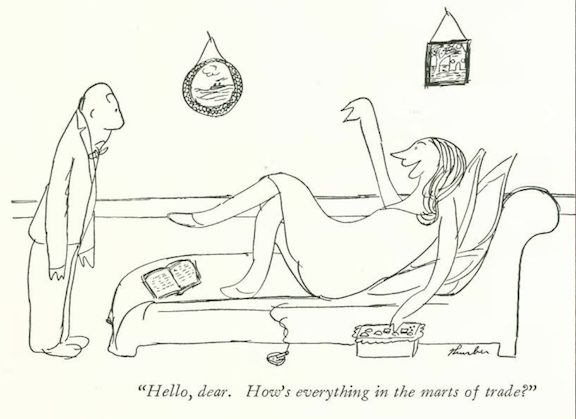
…James Thurber gave us his take on the housewife eating bonbons trope…I’m not suggesting that Thurber was the first to illustrate this stereotype, but I’m not finding any references to housewives and bonbons predating the 1950s…something for a dissertation out there, if it hasn’t already been done…
…William Steig continued his exploration into the world of the Small Fry, offering up a rare image of baseball in the early New Yorker…
…and we close the May 14 issue with Isadore Klein, and one sidewalk salesman looking for a bonafide endorsement…
…on to May 21, 1932…
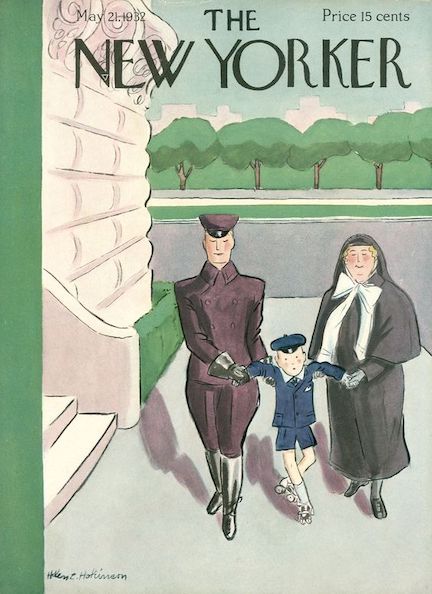
May 21, 1932 cover by Helen Hokinson.
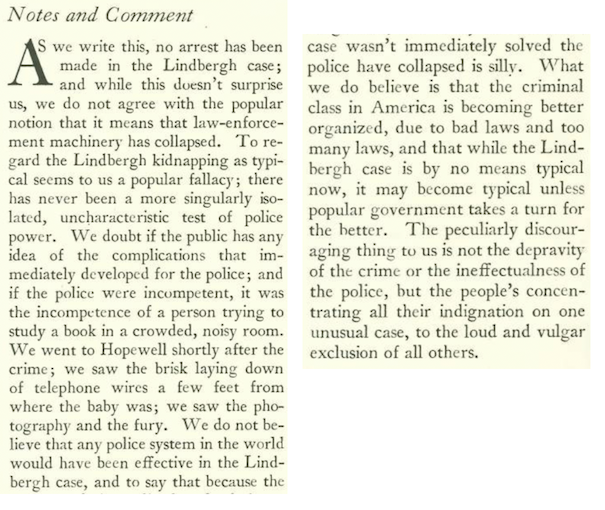
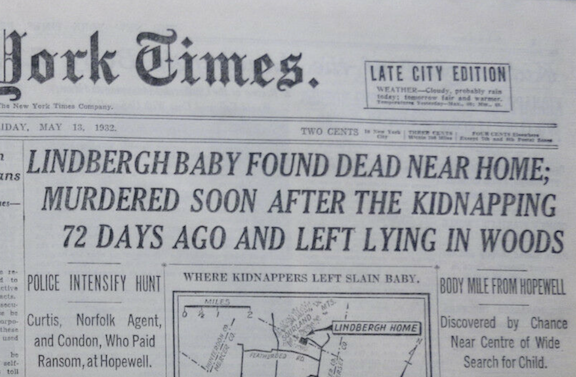
…where we find E.B. White sharing his thoughts on the Lindbergh kidnapping and its tragic result…
BAD NEWS ON THE DOORSTEP…News of the death of Charles and Anne Lindbergh’s kidnapped baby transfixed the country in the spring of 1932. (New York Times)
* * *
No Immaculate Conception, This
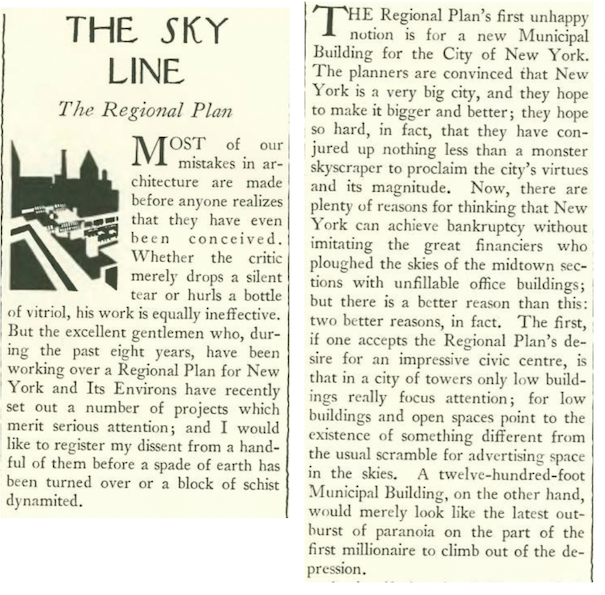
It must have been hard to be Lewis Mumford, so knowledgable in the arts, architecture and city planning, and yet rather helpless in encouraging thoughtful growth in a place that spouted buildings like mushrooms and paved roads (thanks to Robert Moses) almost as fast as cars could drive across them. These excerpts offer some of Mumford’s thoughts on the matter:
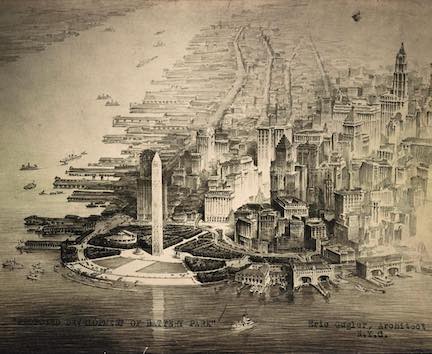
For Mumford’s second point, he soundly denounced a plan to place an obelisk in Battery Park. The 1929 proposal called for an 800-foot obelisk at the junction of Broadway and Greenwich Street:
OVER COMPENSATING, PERHAPS…Designed by architect Eric Gugler, the proposed granite obelisk for Battery Park would have been windowless, 80 feet square at its base and rising to a height of 800 feet. Thankfully it was never, ahem, “erected.” (NYC Urbanism @nycurbanism)
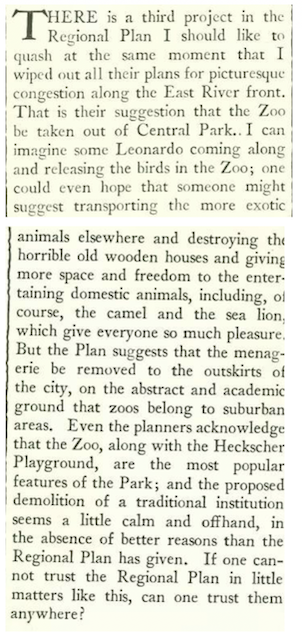
Mumford also addressed the matter of the Central Park Zoo, and its proposed relocation:
Happily for Mumford, and for former Gov. Al Smith (see caption), the zoo would be revitalized and remain in Central Park.
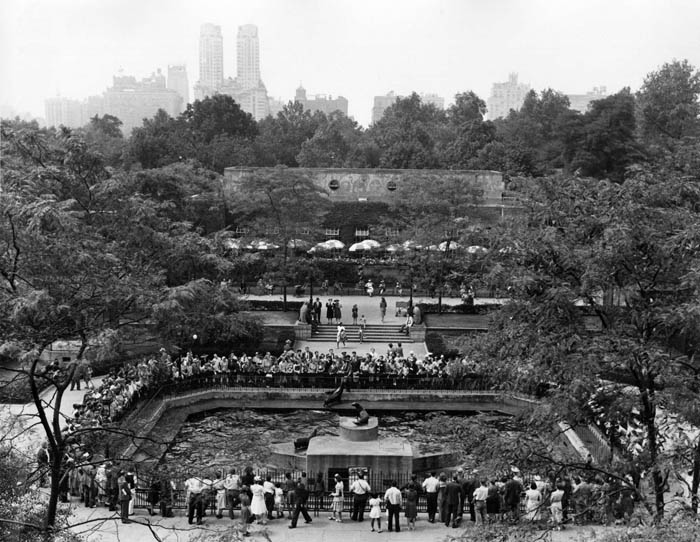
MIRACLES OF MOSES…Although Lewis Mumford would often be at odds with the powerful park commissioner Robert Moses, it was Moses who ensured that the Central Park Zoo would remain in the park. The remodeled zoo opened with great fanfare on December 2, 1934, and Moses’ old friend and political mentor Al Smith was designated honorary zookeeper. Smith, who lived just across from the zoo at 820 Fifth Avenue, visited almost daily. Structured as a quadrangle with a sea lion pool at its center, the Central Park Zoo is pictured above in August 1942. (nycgovparks.org)
* * *
From Our Advertisers
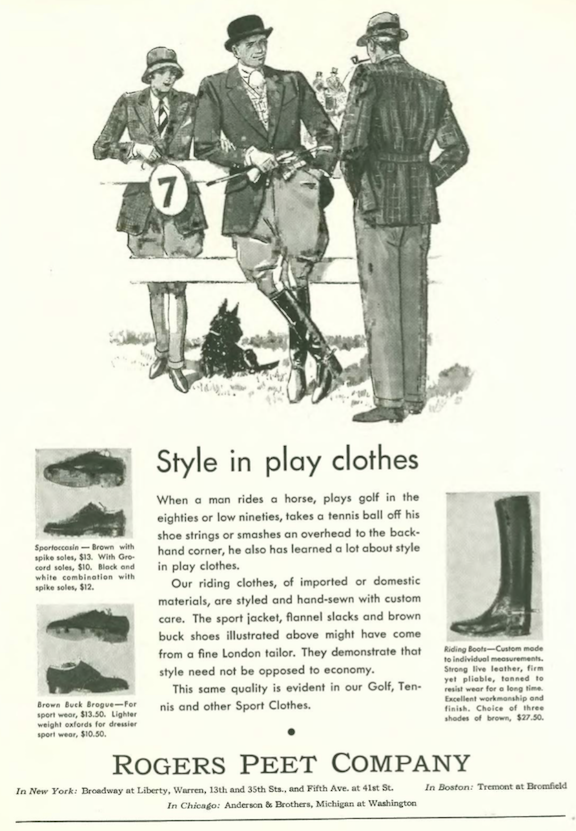
Many advertisers played to the Anglophilic tendencies of New Yorker readers, particular ones selling garments to the sporting gentry who aped their British cousins in such pursuits as polo and dressage…here we have “play clothes” from the menswear company Rogers Peet…
…and this swell get-up (below) from Henri Bendel…both Peet and Bendel were well-known in the 1930s. Cole Porter even referred to both companies in his songs…here is the refrain from “I Introduced” (from the 1919 show Hitchy-Koo):
…”I presented Mister Peet to Mister Rogers”…
and even more famously Porter wrote these lines in his 1934 song “You’re the Top”:
…”You’re a Bendel Bonnet / a Shakespeare Sonnet”…
…Rogers Peet closed its doors in the 1980s, and Bendel folded in 2019…
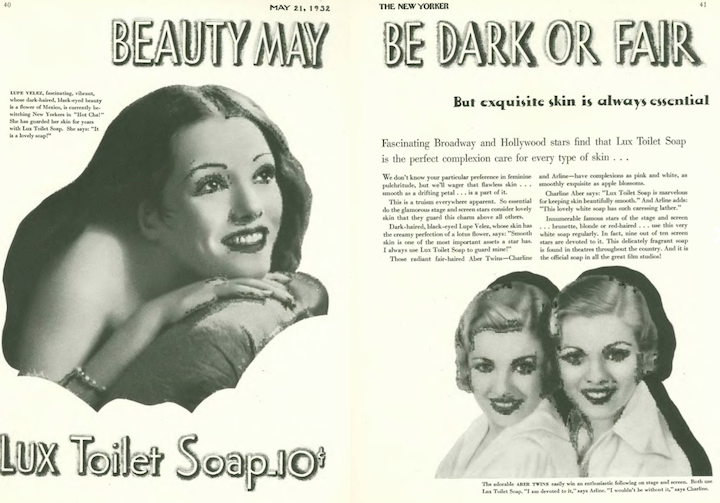
…even during the Depression, almost anyone could spring for a ten-cent bar of Lux soap, and over the years it was famous for its splashy ads (two-page spreads in The New Yorker were common) and dozens of celebrity endorsements…Lux isn’t as dominant in the U.S. today, but it remains a major international brand, now sold and marketed by the British multinational Unilever, especially in Asia…back to 1932, the Lux ad below featured Lupe Velez — known as “The Mexican Spitfire,” she was a big star in the 30s but is perhaps best known today for her sad, tragic death in 1944…the Lux ad also displayed the Aber Twins — a Ziegfeld act that featured Arlene and Charlene Aber who weren’t really twins but sisters born 18 months apart…
…if you lived in New York in the 1920s and early 30s you probably would have known about the sometime artist/designer Don Dickerman and his themed Greenwich Village restaurants — especially The Pirate’s Den — which inspired this line of highball glasses (yeah, Prohibition was still around, but who cared?)…sadly these glasses didn’t help save The Pirate’s Den, which thanks to the Depression went bankrupt in 1932…
…speaking of Prohibition, Anheuser-Busch took advantage of laws that allowed for the production of near-beer containing one-half percent alcohol…
…if you couldn’t drink you could still eat to your heart’s content, that is if you were this fat cat and not some starving fellow in a bread line…
…on to our cartoons, Helen Hokinson took us pet shopping…
…Garrett Price offered up a stereotype in a courtroom setting…
…and reminiscent of humor in the vein of Ralph Barton, Rea Irvin launched a series of the world’s “beauty spots”…



































































































 A New Yorker State of Mind