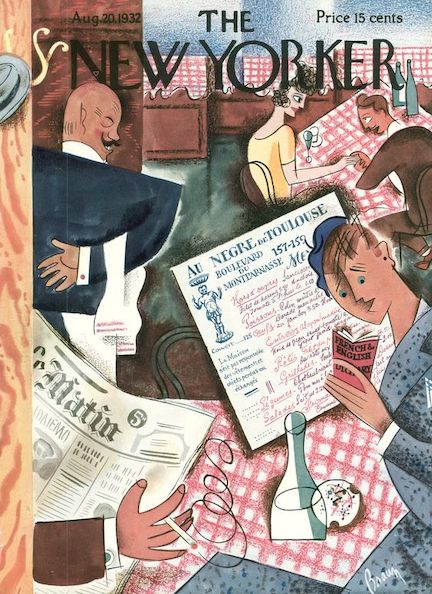
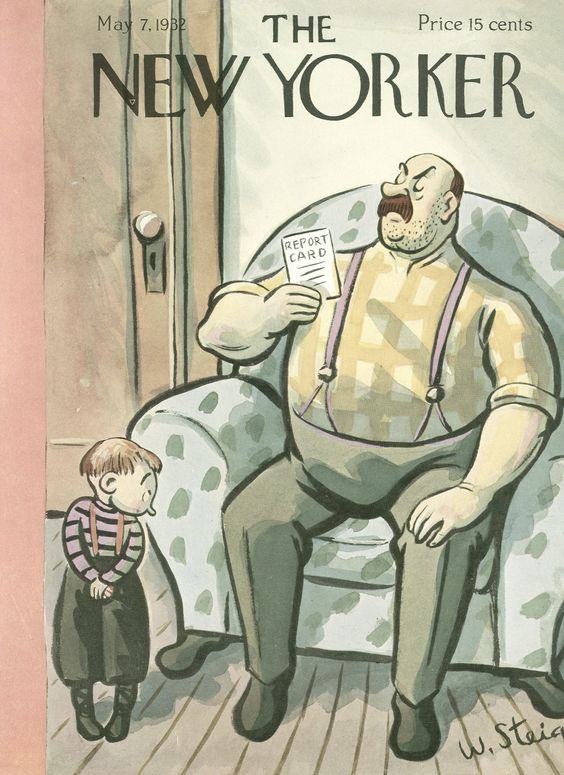
As we recently saw in the 1932 film Freaks, there were some truly weird motion pictures produced in Hollywood during the pre-Code era, including four that were reviewed in the July 30 and August 6 editions of The New Yorker.
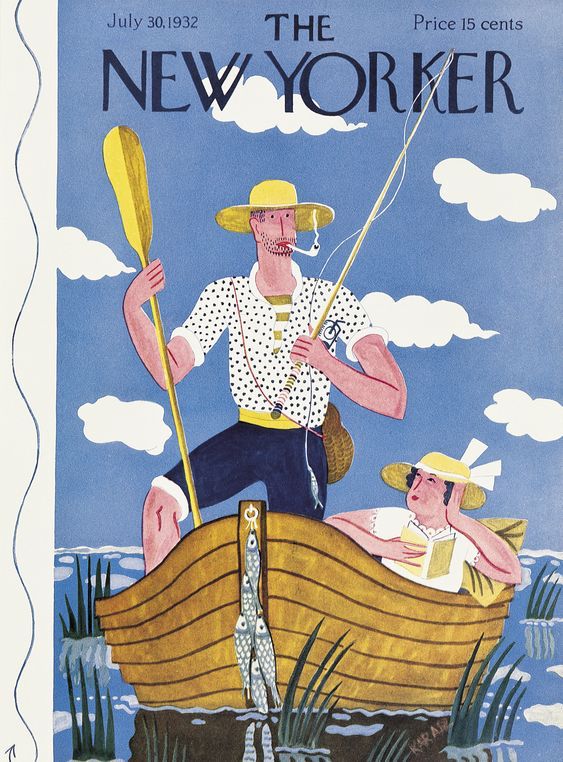
July 30, 1932 cover by Ilonka Karasz.
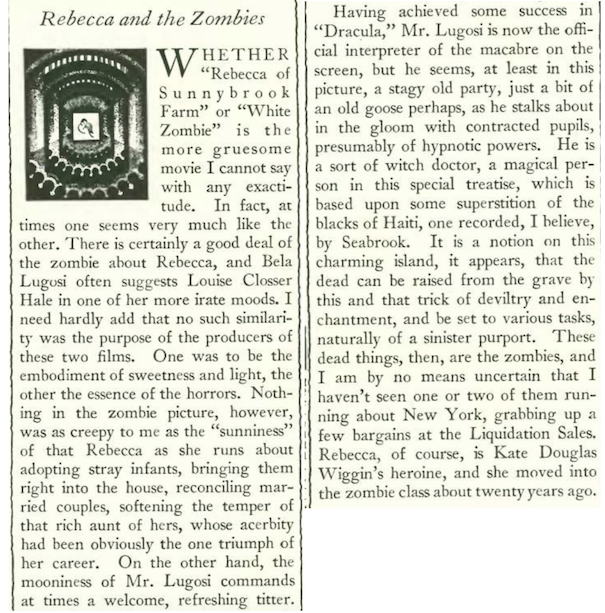
According to critic John Mosher, some of those films were not intended to be viewed as such, including Rebecca of Sunnybrook Farm (reviewed in the Aug. 6 issue), which Mosher found more gruesome than the Bela Lugosi vehicle White Zombie:
THE HORROR…After seeing Rebecca of Sunnybrook Farm, critic John Mosher concluded that too much sweetness and sunniness could be creepier than a bunch of zombies. Pictured above is Marian Nixon as Rebecca and Ralph Bellamy as her suitor, Dr. Ladd. (IMDB)THE BELA BUNCH…Following up on his 1931 hit Dracula,Bela Lugosi inexplicably chose to star in the low-budget horror film White Zombie. Considered to be the first feature-length zombie movie, it served as a model for subsequent zombie pictures. Clockwise, from top left, white Haitian voodoo master “Murder” Legendre (Lugosi) leads his crew of zombies; Legendre toasting his evil intentions; coach driver (Clarence Muse), warns his passengers about zombies on the highway (although the film is set in Haiti — actually a Hollywood studio lot — Muse was the only Black actor with a speaking part, albeit quite brief); as was common in those days, John T. Printz, a white actor, portrayed the Black character Ledot, a former witch doctor; Legendre (Lugosi) transforms Madeleine Short (Madge Bellamy) into a zombie and orders her to kill her fiancé. Also pictured is Robert Frazer, who portrayed a plantation owner. Filmed in just eleven days, the majority of the cast in White Zombie were actors whose careers had waned since the silent era. (IMDB)
In the July 30 issue Mosher had another encounter with the strange, this time two documentaries that were very much products of their time.
In case a film about the hardships on the Alaskan tundra wasn’t enough to entice moviegoers, Universal Pictures served up this lobby card featuring a topless Nuwuk woman to promote Igloo…
Igloo lobby card. (Pinterest)
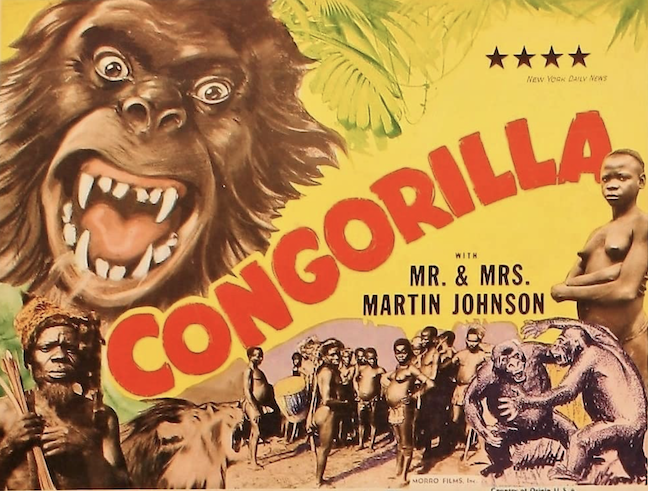
…in a similar vein, husband and wife filmmakers Martin E. and Osa Johnson offered up some topless images to accompany the action promised in Congorilla. It’s a familiar National Geographic-style trope—an over-the-counter magazine or film in the 1930s wouldn’t dare show a European woman topless (there were decency laws after all!) but these folks were “primitive,” and therefore weren’t subject to the Hays Code or other “decency standards.”
Congorilla lobby card. (IMDB)
The Johnson’s documentary was partly staged, including this scene with “child-like pygmies” that is just plain weird (um, didn’t “modern” jazz have its roots in Africa?):
* * *
Life of the Party
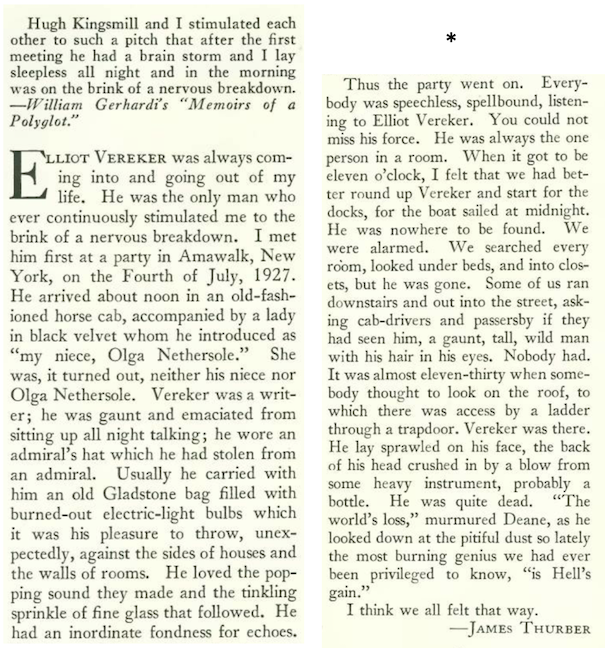
James Thurber penned this unusual July 30 profile, a parody of artistic genius- types who are loved and admired despite also being a drunken assholes. I include the opening paragraph, and the concluding paragraph, which follows a decision by Elliot Vereker’s literary friends to put him on a boat to France; during a farewell party he roundly insults them all.
MIRROR, MIRROR…James Thurber and his “Profile” subject, Elliot Vereker. Some critics suggest Vereker’s character was the result of some self-reflection on Thurber’s part. (thurberhouse.org/The New Yorker)
* * *
From Our Advertisers
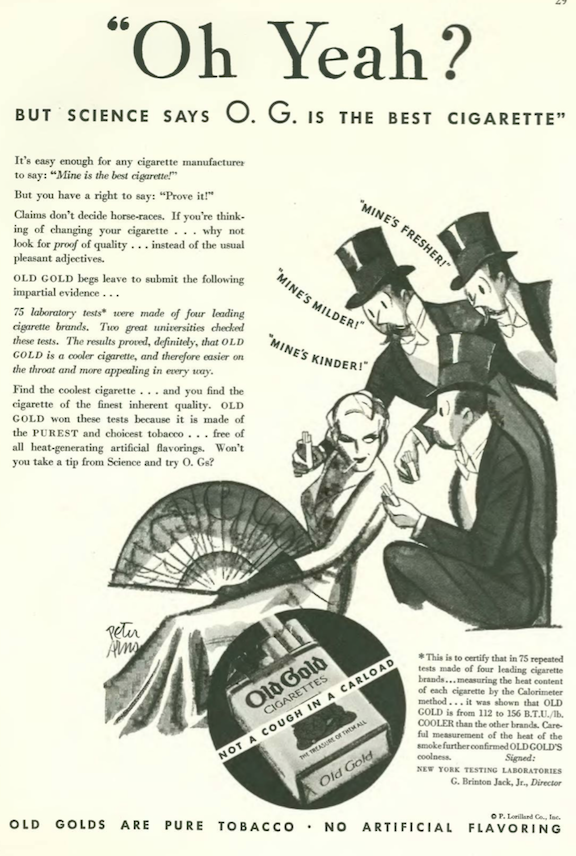
William Steig continued illustrating these full-page ads for Old Gold (no surprise that tobacco companies were doing quite well during the Depression)…
…as we’ve seen, a number of New Yorker cartoonists earned extra money illustrating ads for a variety of companies, but one cartoonist, Peter Arno, also collaborated with artists, playwrights and musicians including Paul Whiteman…no doubt this collaboration was inspired in Arno’s youth, as noted New Yorker cartoonist Michael Maslin explains in this Inkspill entry…
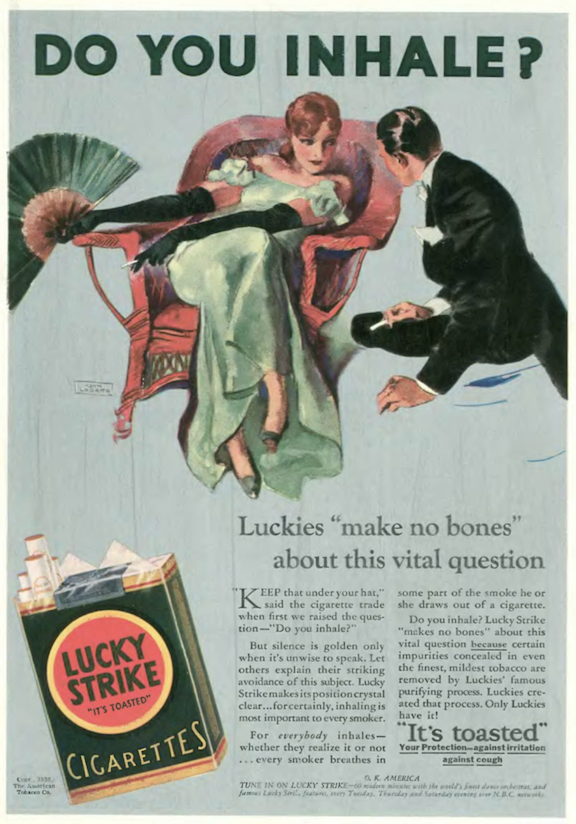
…and we have another in the continuing series of Lucky Strike ads encouraging smokers to inhale its “pure” tobacco, the better to draw in all that addictive nicotine…
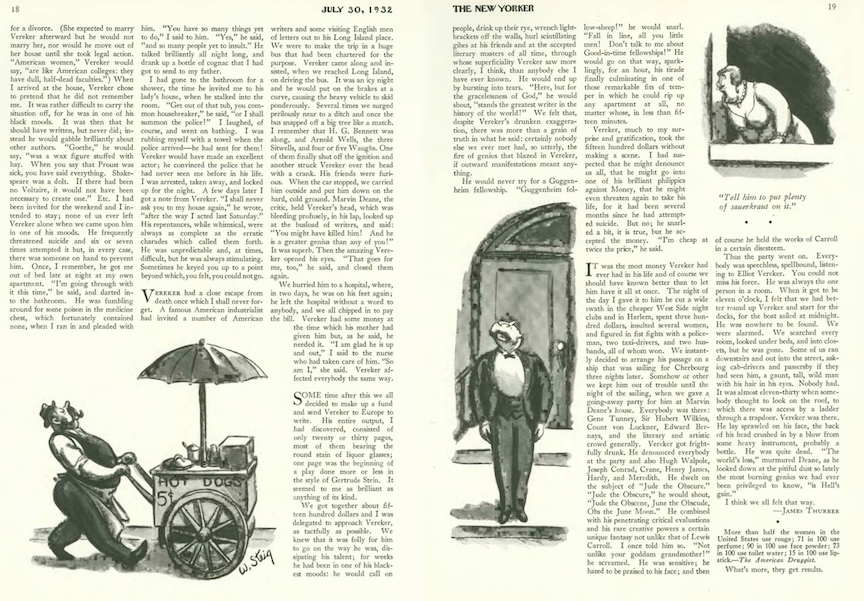
…on to our cartoons…William Steig got a clever two-page layout with the caption, “Tell him to put plenty of sauerkraut on it”…
…Carl Rose offered his thoughts on the slate of wishy-washy candidates in the upcoming 1932 elections…
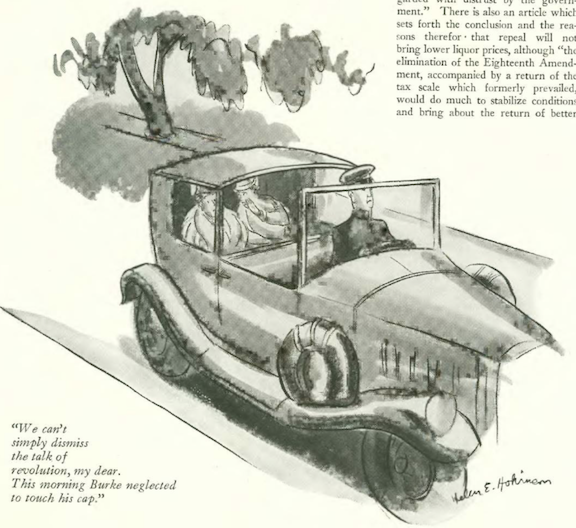
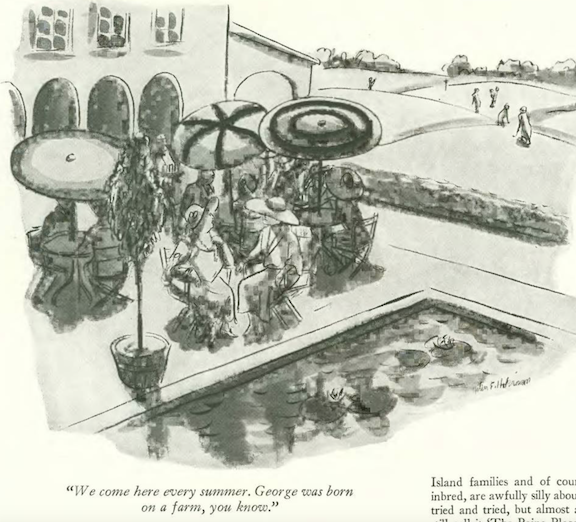
…Helen Hokinson explored the simple ways of rural living…
…Barbara Shermund looked in on the charmed lives of her modern women…
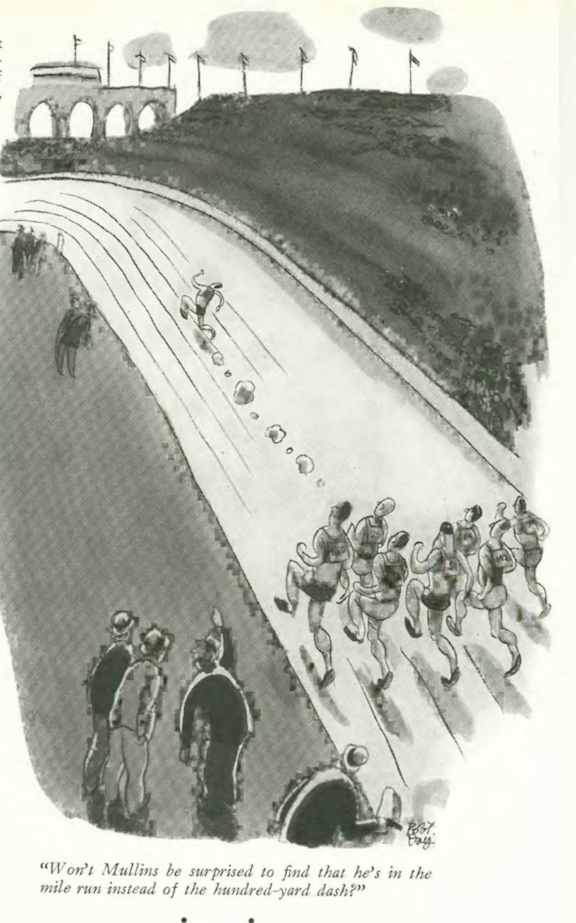
…Robert Day gave us an athlete with a big surprise ahead (and not a happy one…I made this same mistake years ago in a junior high track meet)…
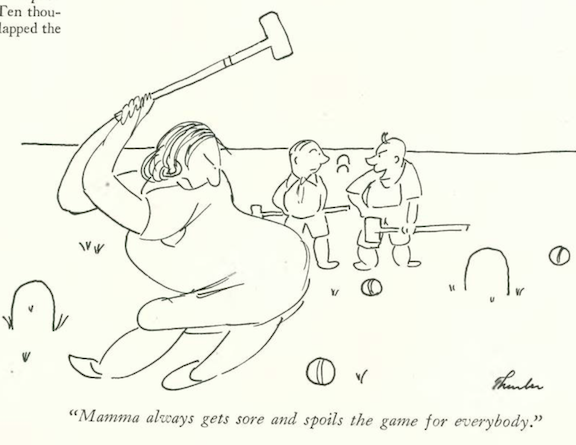
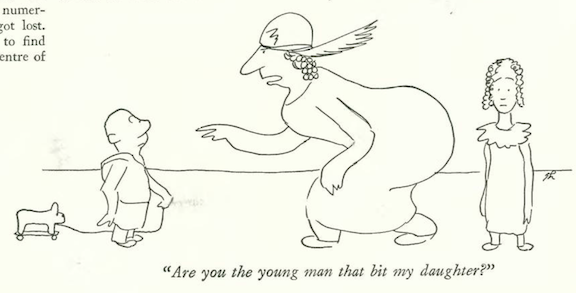
...James Thurber explored the junior edition of his “War Between Men and Women”…
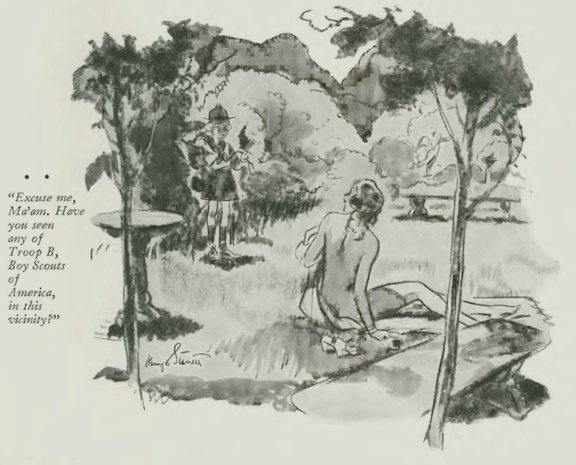
…and Kemp Starrett illustrated a Boy Scout who lost his troop along with some of his innocence…
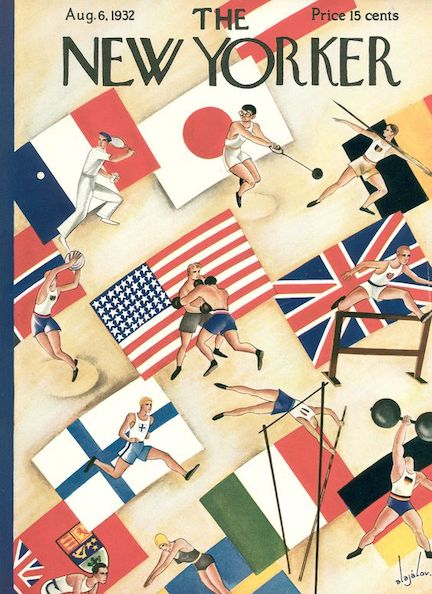
…and we continue with the Aug. 6 issue, cover artist Constantin Alajalov choosing the 1932 Summer Olympics as his theme:
August 6, 1932 cover by Constantin Alajalov.
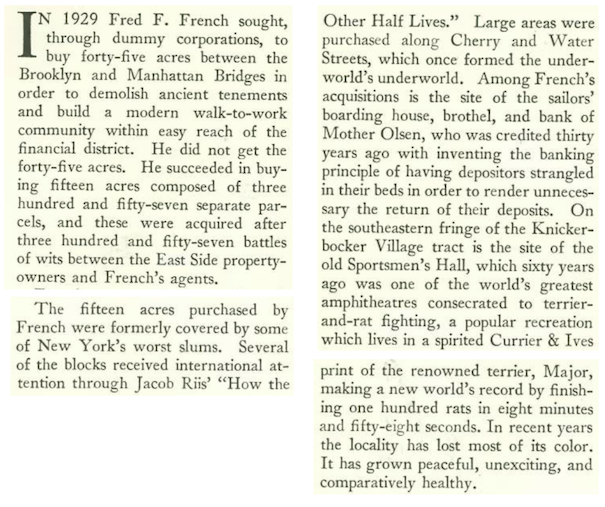
Alva Johnston penned the first part of a two-part “A Reporter At Large” feature on Knickerbocker Village. Yet to be built when this article was written (construction began in 1933 and was completed in 1934), Knickerbocker Village was the first apartment development in the U.S. to receive federal funding. It came from the Congress-authorized Reconstruction Finance Corporation (RFC), which gave loans to private developers like Fred French for the construction of low-income housing in slum-clearance areas.
CLEARANCE SALE…Tenements in Lower East Side were razed in 1933 to make way for Knickerbocker Village. The site was known as “Lung Block,” because of its high tuberculosis mortality rate. Developer Fred French, who also created Manhattan’s Tudor City, received federal funding to replace slums with more healthful housing. However, the 1,590 small apartments in Knickerbocker Village were eventually occupied by white collar, middle-income residents. Rather than provide better housing for former tenement dwellers, the project displaced them to other slum areas in the city. (Ewing Galloway/NYT)STILL STANDING…Knickerbocker Village today. The complex was severely damaged during Hurricane Sandy in 2012. In 2019, the City Council passed a bill that keeps Knickerbocker Village relatively affordable for the next 50 years in exchange for a $3 million annual tax abatement. (Wikipedia)
* * *
From Our Advertisers
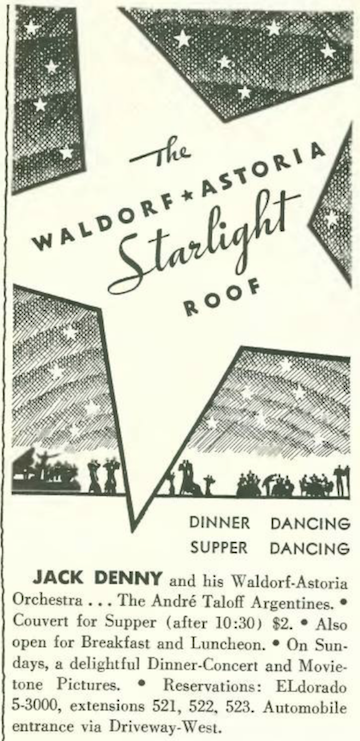
The new Waldorf-Astoria touted its Starlight Roof’s many attractions, including, no doubt, escape from the heat and dust of the city streets…
ON TOP OF THE WORLD…View of the Waldorf-Astoria’s famed Starlight Roof and the cover of its wine list, circa 1934. (Waldorf Astoria)
…I find these Ethyl ads endlessly fascinating, not only for pushing leaded gasoline on the public, but for class-shaming them into using their product…
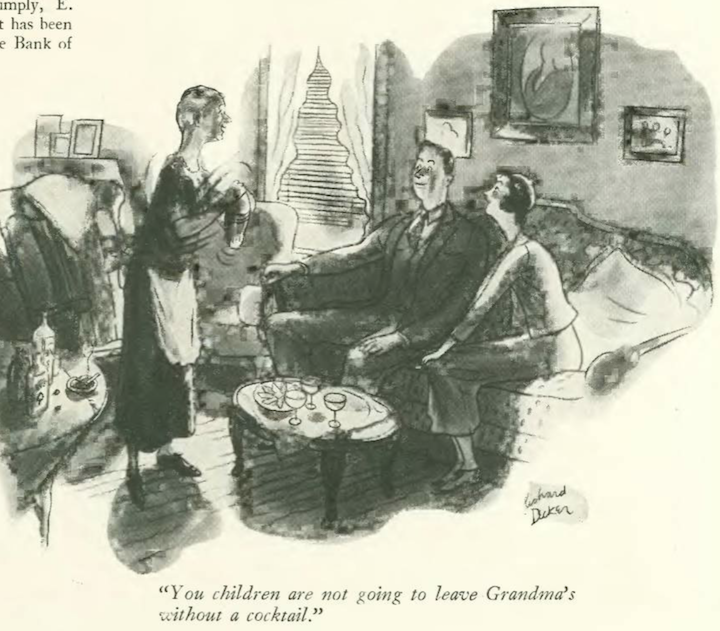
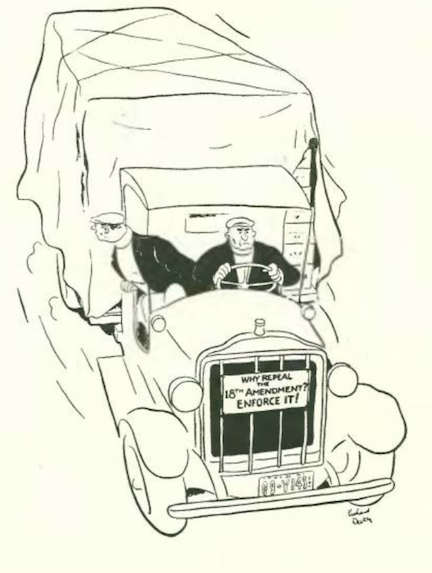
…on to our cartoons, Richard Decker showed how not all Prohibition supporters were teetotalers…
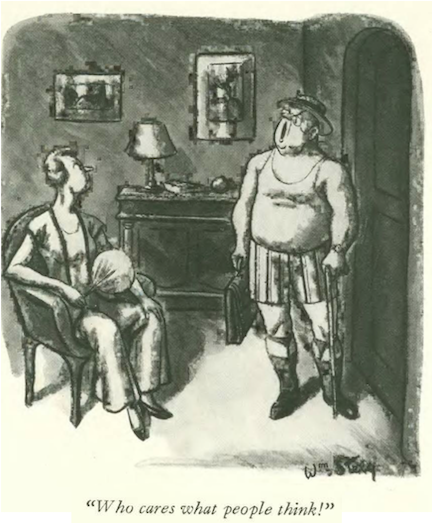
…William Steig gave us one man’s reaction to August weather…
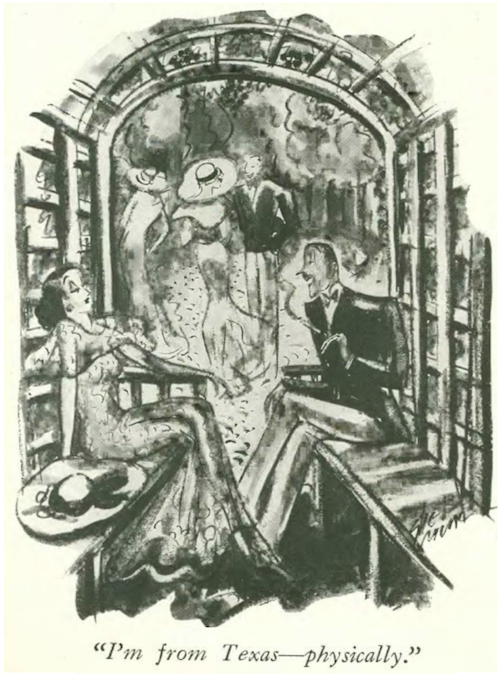
…Barbara Shermund drew a man drawing a line on his place of birth…
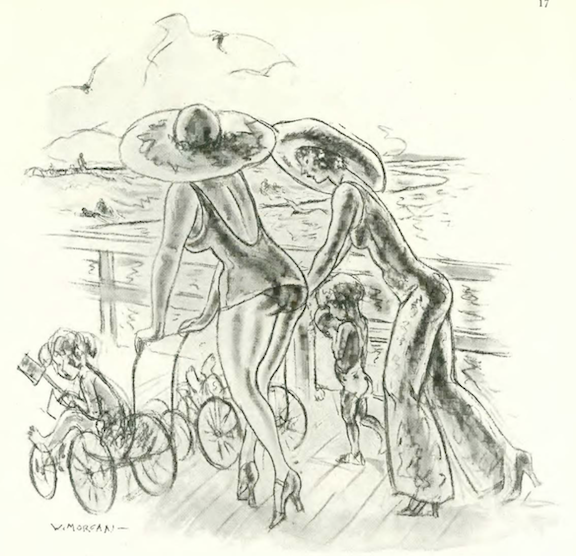
…and we end with a cartoon by Wallace Morgan…there is a joke here related to the attire of the two women, but I am at a loss (any suggestions?)…
Over the years Tod Browning’s 1932 pre-code film Freaks has been called everything from grotesque and exploitive to sympathetic and compassionate. Now a cult classic, the film’s closing scenes are regarded by some critics as among the most terrifying ever put to film.
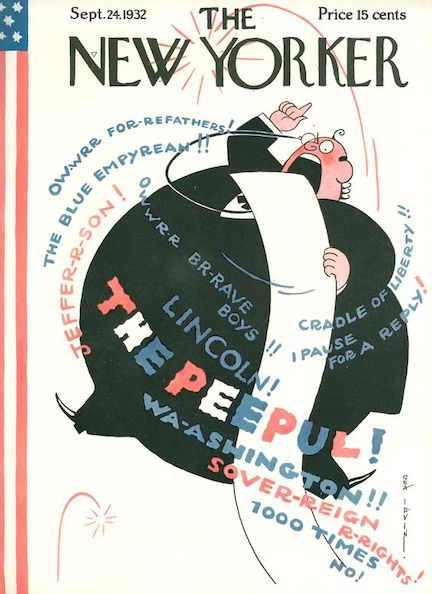
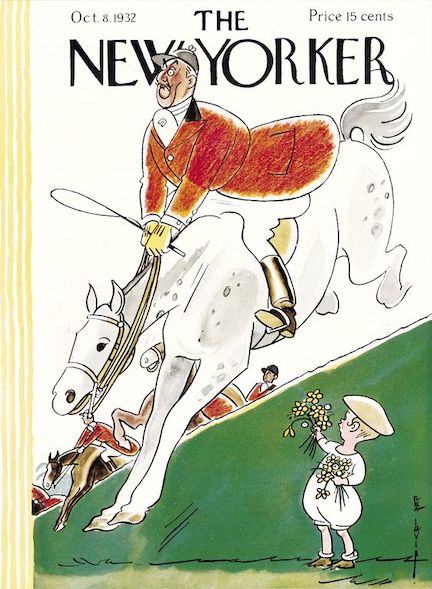
July 16, 1932 cover by Rea Irvin.
What disturbed so many about Freaks was Browning’s use of actual sideshow performers with real disabilities to tell the story of a conniving trapeze artist who plots to seduce and then kill a dwarf performer to gain his inheritance. The film was not well-received by audiences and many critics. The Kansas City Star’sJohn Moffitt wrote, “There is no excuse for this picture. It took a weak mind to produce it and it takes a strong stomach to look at it.” However, The New Yorker’s John Mosher, along several other New York critics, gave the film a rather favorable review:
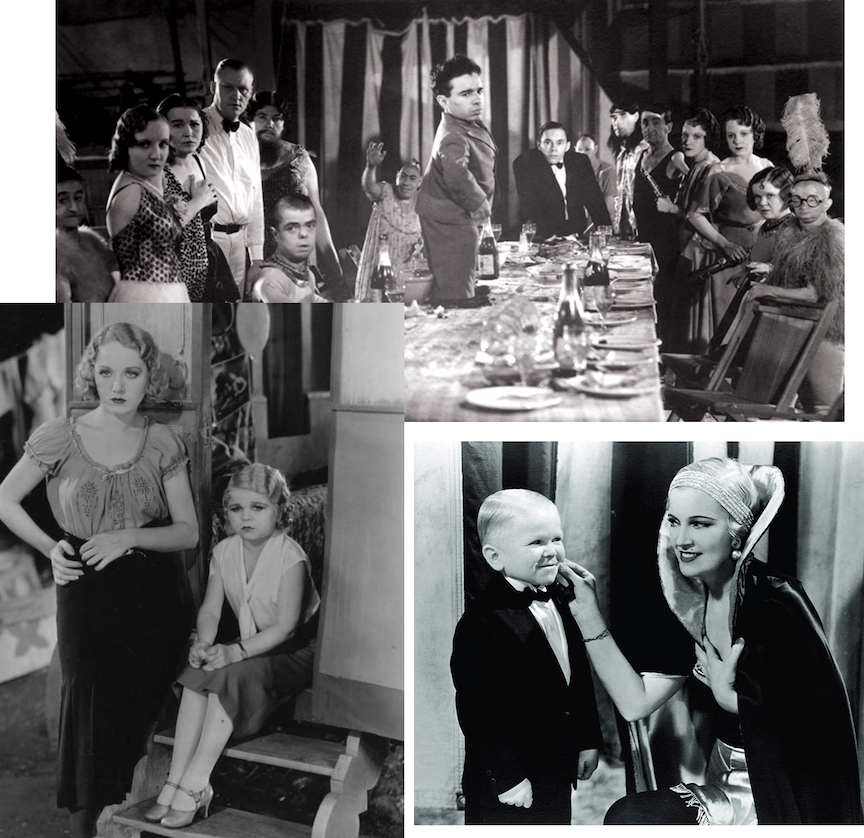
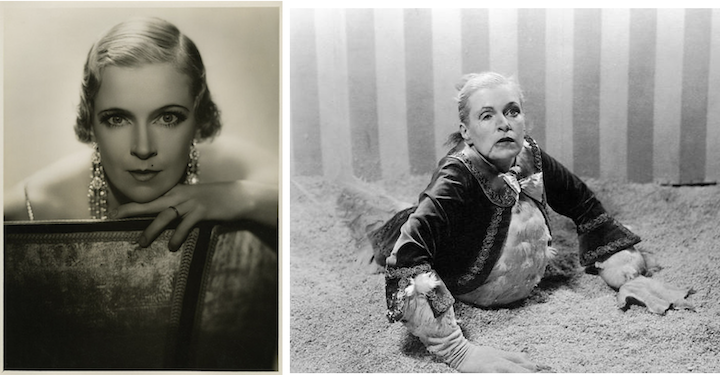
ONE OF US…Although audiences and critics found Tod Browning’s 1932 film Freaks grotesque and exploitive, today many regard the film as a rare (for its time), sympathetic portrayal of persons with disabilities. Clockwise, from top left, Browning with some of the members of his Freaks cast; French-American actress Rose Dione portrayed Madame Tetrallini, operator of the sideshow; Daisy and Violet Hilton with actor Wallace Ford in a scene from Freaks. Born fused at the pelvis, the sisters were joined at their hips and buttocks and shared blood circulation; limbless sideshow performer Prince Randian, who wore a one-piece wool garment over his body, appeared in the film as “The Living Torso.” (IMDB)IT HAD A PLOT, ACTUALLY…Freaks told the story of a conniving trapeze artist named Cleopatra (portrayed by Russian actress Olga Baclanova, bottom right) who plots to seduce and then kill a dwarf performer, Hans (portrayed by Harry Earles) to gain his inheritance. Top photo: assembled “freaks” chant their acceptance of Cleopatra at the wedding feast of Hans and Cleopatra; bottom left, the kind-hearted seal trainer Venus (portrayed by Leila Hyams) consoles Frieda (Daisy Earles), who worries about Hans (Daisy and Harry Earles were members of a famous quartet of sibling entertainers known as The Doll Family. The quartet also appeared as members of The Munchkins in 1939’s The Wizard of Oz.)(IMDB)SURPRISE…Leila Hyams (1905–1977) was something of a surprising presence in the controversial film Freaks, given that she was a popular leading lady in the 1920s and 30s. Known for both her comedic and dramatic talents, she retired from films in 1936; another unlikely cast member was Henry Victor (1892–1945) whose physique didn’t necessarily support his role as circus strongman. (dangerousminds.net)TRUE GRIT…Perhaps only a Russian actress in 1932 had the grit to transform herself from an exotic blonde temptress to a grotesque “human duck” for the movie Freaks. In the film, Olga Baclanova (1893 – 1974) portrayed a conniving trapeze artist named Cleopatra. Near the end of film the “freaks” capture Cleopatra, gouge out her right eye, remove her legs and tongue and melt her hands to look like duck feet. For critics and audiences, the horror was just too much. As for Baclanova — who was a popular silent film actress known as the “Russian Tigress” — her heavy accent did not translate well to talking films, and she left the movie business altogether in 1943. (muni.com/IMDB)
* * *
Tennis Anyone?
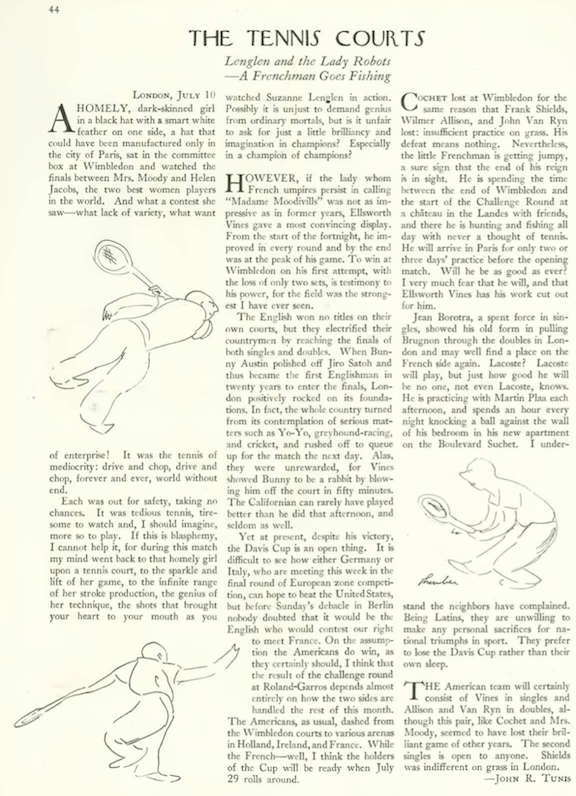
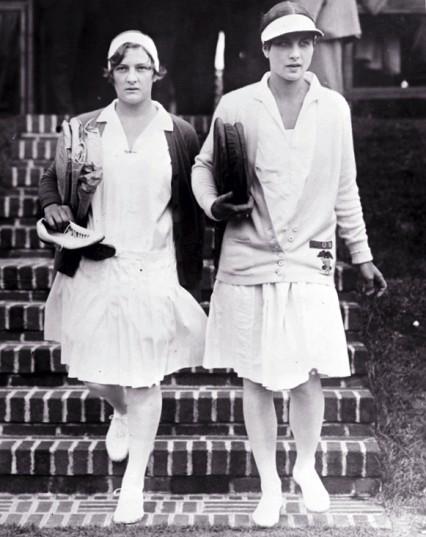
Helen Moody was the top women’s singles tennis player for nearly a decade in the 1920s and 30s, winning Wimbledon eight times, including a match in 1932 against her rival Helen Jacobs. However to sportswriter John Tunis, the women had reached such a level in their play that it had become robotic and tedious to watch. At least James Thurber livened things up with some keen illustrations.
RACKETEERS…Helen Jacobs (left) and Helen Moody (right, in a 1929 photo) were tennis rivals known for their explosive matches. Except, apparently, for the one attended at Wimbeldon in 1932 by John Tunis. (nickelinthemachine.com)
* * *
From Our Advertisers
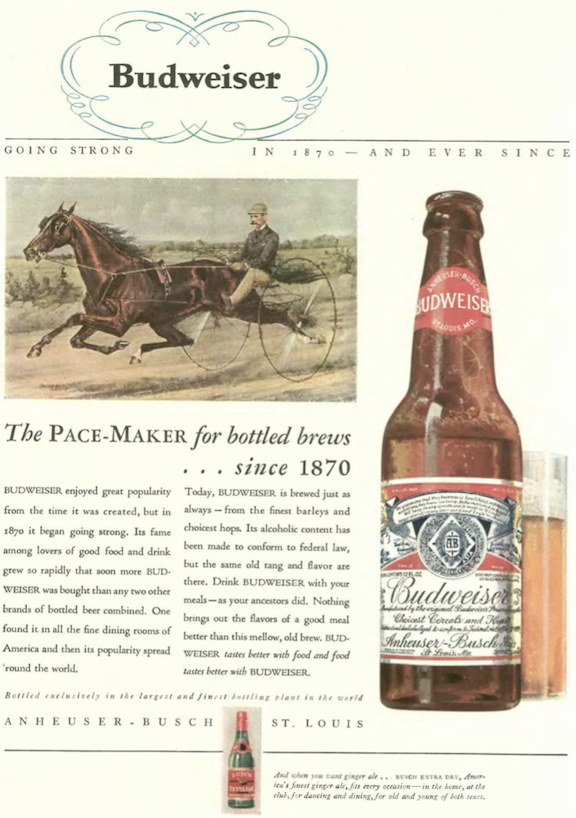
Sensing that the end of Prohibition was near, the makers of Budweiser reminded readers of the good ol’ days of beer drinking and such…
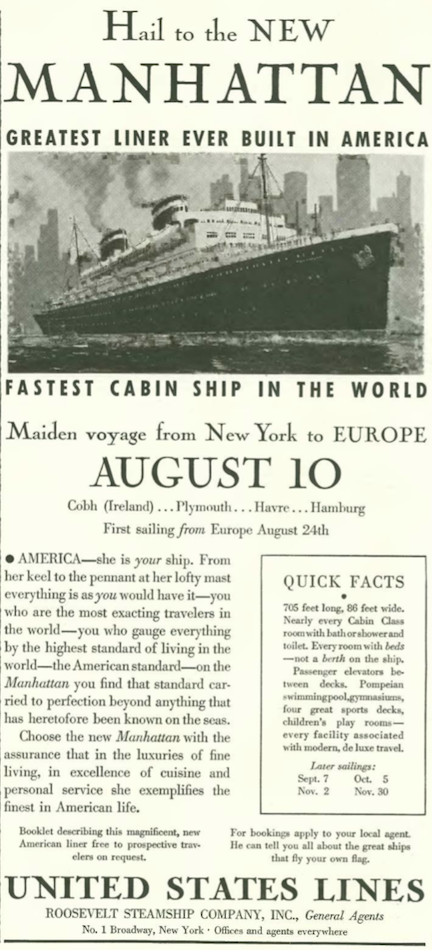
…if you could afford something better than beer, then you might have contemplated a trip on the SS Manhattan, which along with her sister ship SS Washington were the largest liners ever built in the US…
TO AND FRO…Beginning in August 1932 the SS Manhattan operated the New York – Hamburg route until 1939, when instead of taking passengers to Germany the ship began taking Jewish refugees and others away from Nazi-occupied Europe. It was turned into a troopship in 1941 and never returned to commercial service. The SS Manhattan was sold for scrap in 1965. (cruiselinehistory.com)
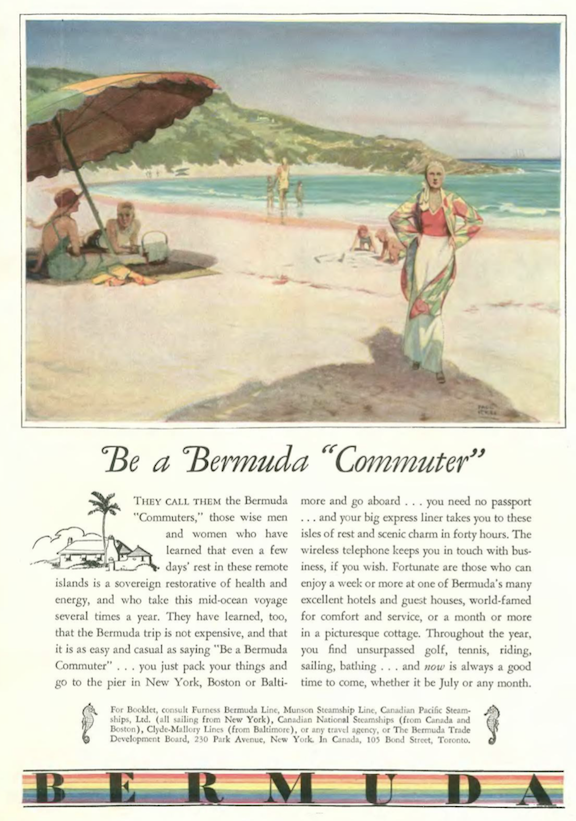
…if your thing wasn’t traveling to Germany to see that country being transformed into the Third Reich, you could instead become a Bermuda “Commuter”…
…back home, William Steig joined other New Yorker cartoonists who earned extra money off of the big tobacco companies…
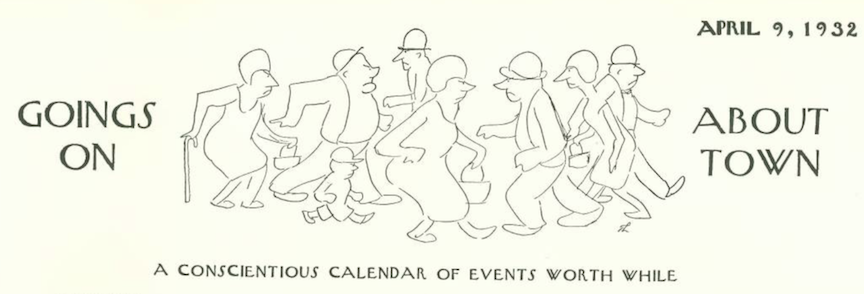
…which segues into our cartoonists, beginning with Victor Bobritsky’s illustration for “Goings On About Town”…
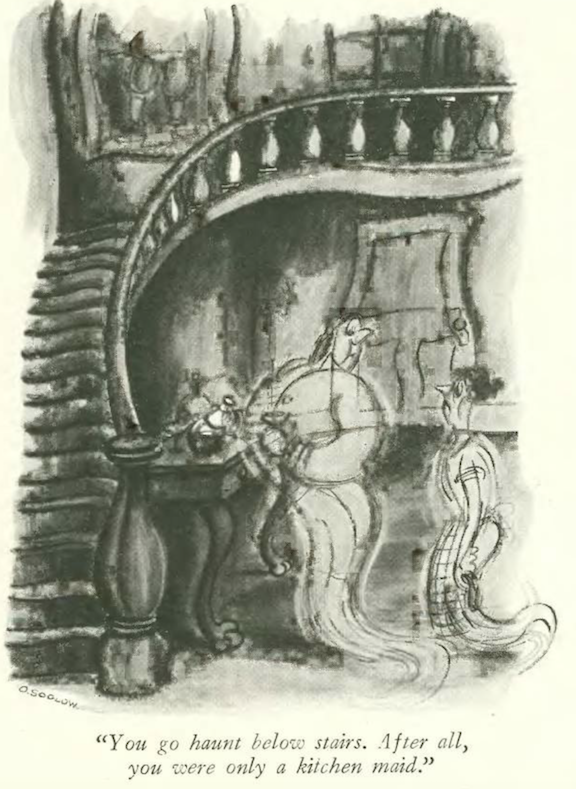
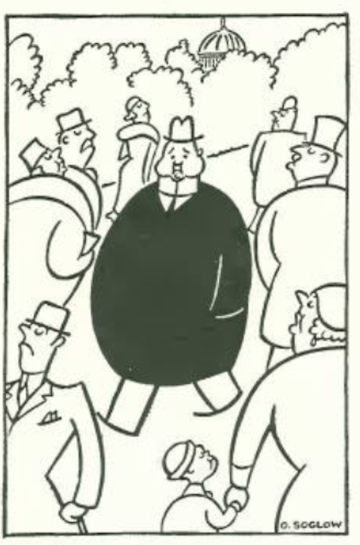
…Otto Soglow offered more Little King adventures…
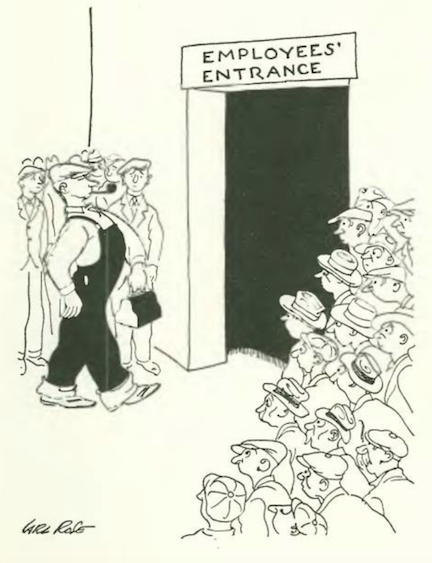
…and Carl Rose gave us a man striding into a factory, apparently a rare sight in 1932…
…on to July 23…
July 23, 1932 cover by Antonio Petruccelli (1907 – 1994). This is the first of six covers Petruccelli created for the New Yorker from 1932 to 1938. He also did numerous covers and illustrations for Fortune, Colliers and other publications.
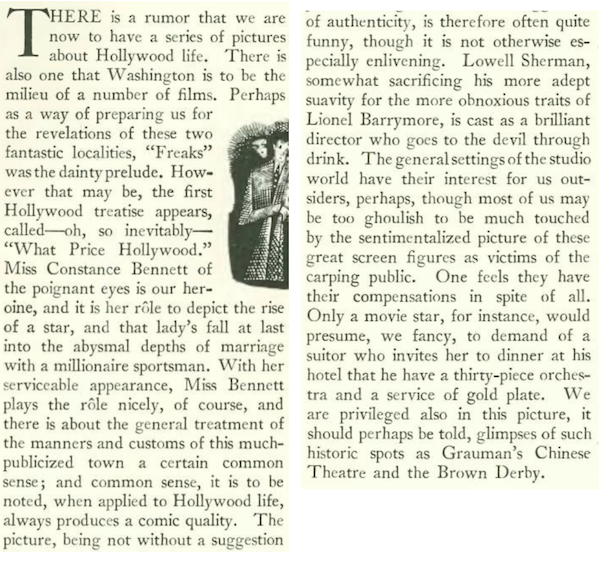
…and we have another John Mosher film review, in which he refers to Freaks as a “dainty prelude” to another film about the lives of entertainers, in this case George Cukor’sWhat Price Hollywood, a pre-Code drama starring Constance Bennett and Lowell Sherman with a storyline that anticipated 1937’s A Star Is Born—namely, a famous but fading male star who helps an ingénue rise to stardom while he descends into a pit of alcoholic despair.
FUN WHILE IT LASTED…Top image: Waitress and aspiring actress Mary Evans (Constance Bennett) has the good fortune to meet film director Maximillan Carey (Lowell Sherman) when she serves him one night at the Brown Derby. Bottom: Mary and her polo player boyfriend Lonny Borden (Neil Hamilton) look down with pity at the down-on-his-luck Maximillan in What Price Hollywood? (Wikipedia/IMDB)
* * *
From Our Advertisers
Originally published by Adam Budge, Inc. in 1910 and later by Joseph Judd Publishing and others, Arts & Decoration magazine hoped to stay alive in the Depression with a promise that its August 1932 issue would be “compellingly readable”…
…and here is the cover of that issue…Arts & Decoration would hang on for another ten years before folding in 1942…
…one of the stars of Ziegfeld Follies of 1931 was actress and dancer Patricia “Boots“ Mallory (1913 – 1958), who posed for this portrait to demonstrate the wonders of color reproduction…
…and here’s Boots Mallory in a scene from the 1932 film Handle With Care with comedian Elmer “El” Brendel (standing) and actor James Dunn…
…not everyone could be a movie star, but you could pretend to be one in this swell new (and low-priced) DeSoto…Walter Chrysler must have laid out some big bucks for this two-page color spread…
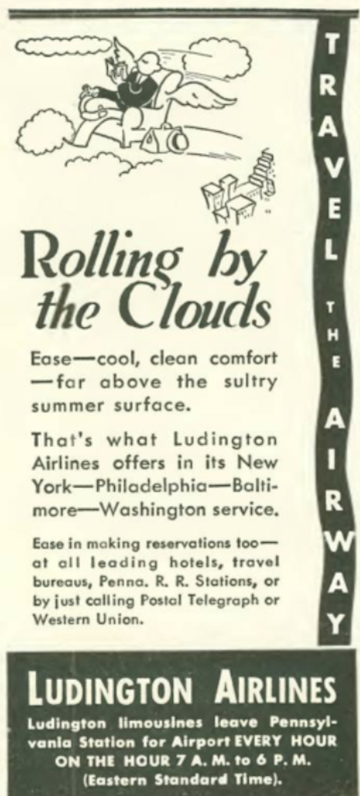
…for those with greater means you could skip the roads altogether and fly the friendly skies of Ludington Airlines…the airline was founded by wealthy New York socialite Charles Townsend Ludington and his brother Nicholas…
…founded in 1929, Ludington Airlines was the first airline with flights every hour on the hour and the first to carry passengers only (others carried mail, an important source of revenue). The airline offered service between Washington, D.C. and New York City—with stops in Philadelphia, Baltimore, Norfolk, Virginia, Nashville and Knoxville, Tennessee—using seven Stinson tri-motor 6000 aircraft in its fleet, each carrying up to ten passengers…the airline went bankrupt in 1933 (mostly due to the lack of mail revenue) but left behind an astonishing record—in its first two years it flew more than 3.4 million miles and carried 133,000 passengers, a record at the time…
A Stinson SM-6000 airliner similar to the type flown by Ludington Airlines from 1929 to 1933.
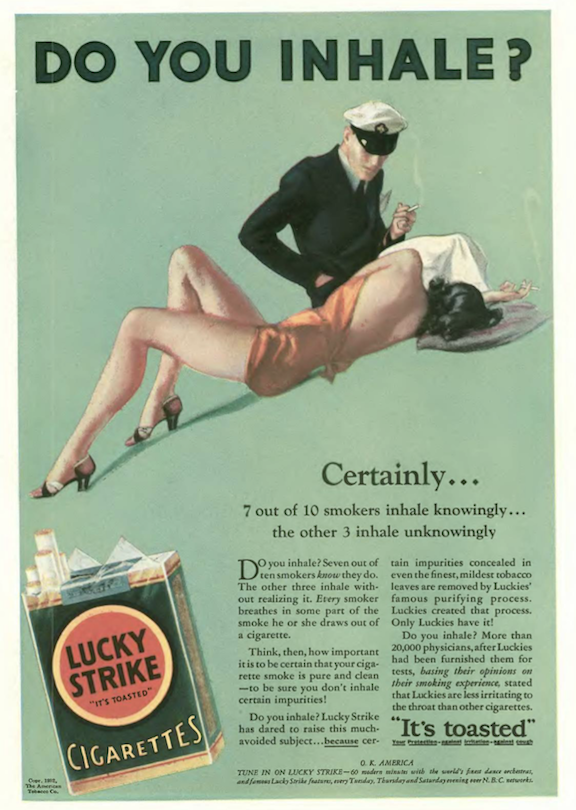
…back to earth, sort of, we have this Lucky Strike ad with the famed “Do You Inhale?” campaign that oozed innuendo and no doubt prompted a few young men to take up the habit posthaste…
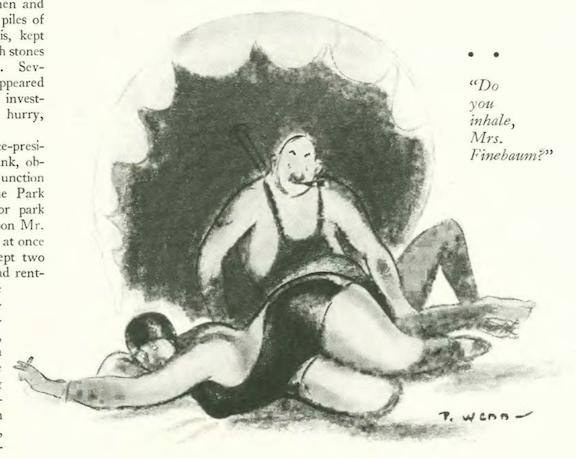
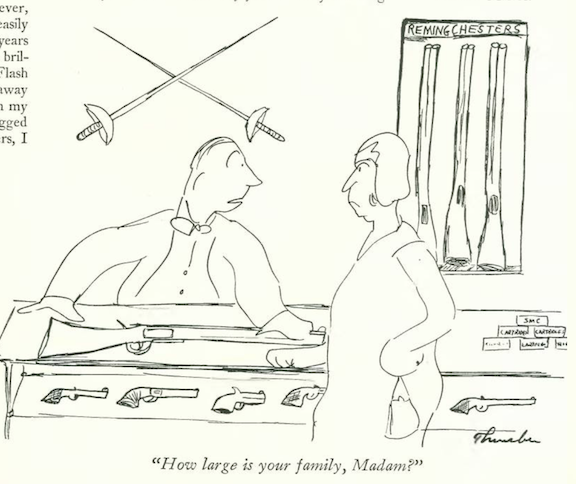
…on to cartoons, beginning with this spot art by James Thurber…
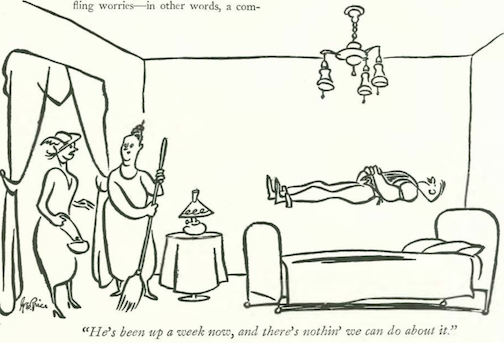
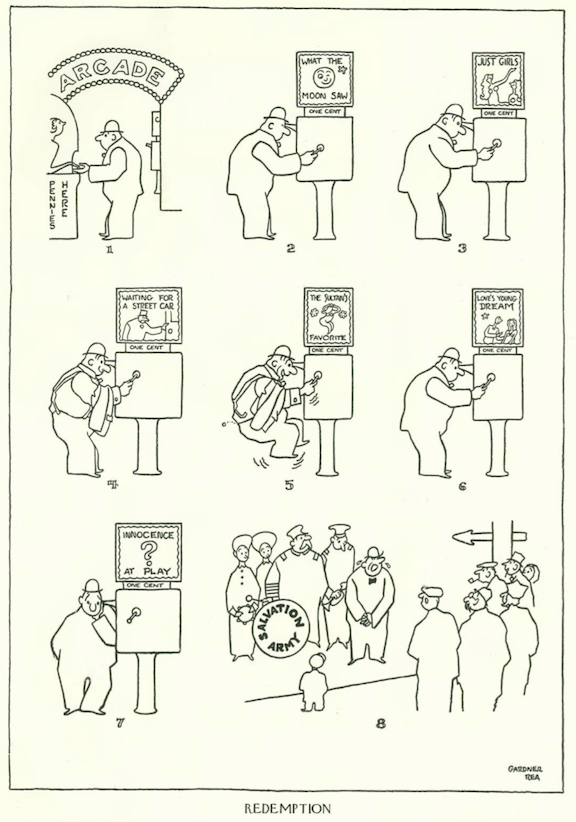
…Gardner Rea showed us a man getting his nickel’s worth of sin and repentence…
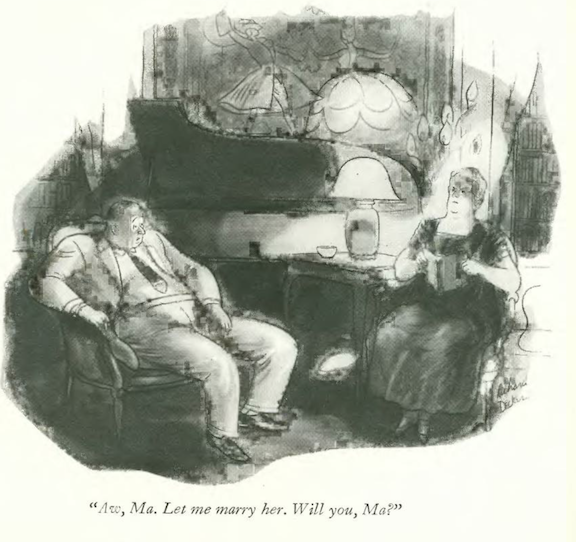
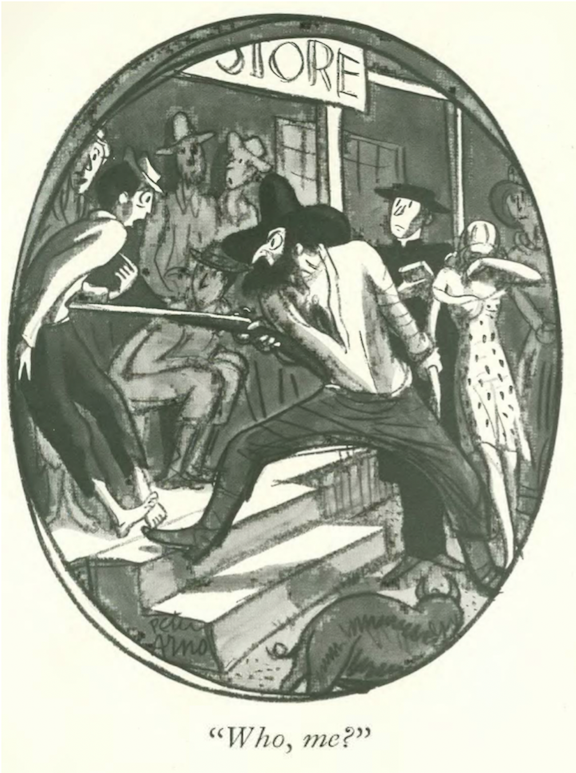
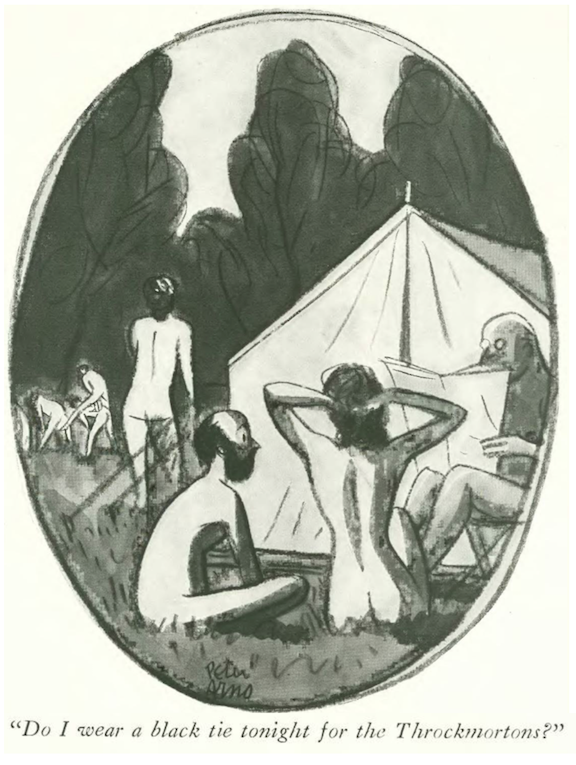
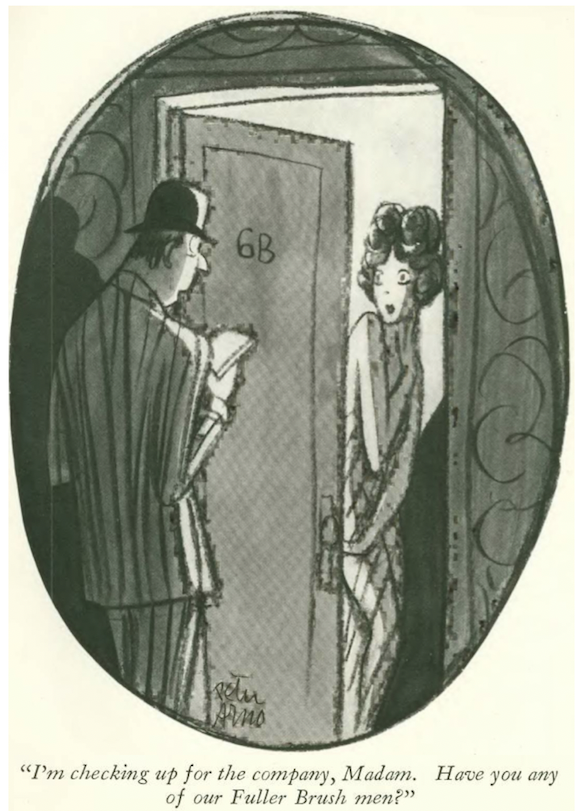
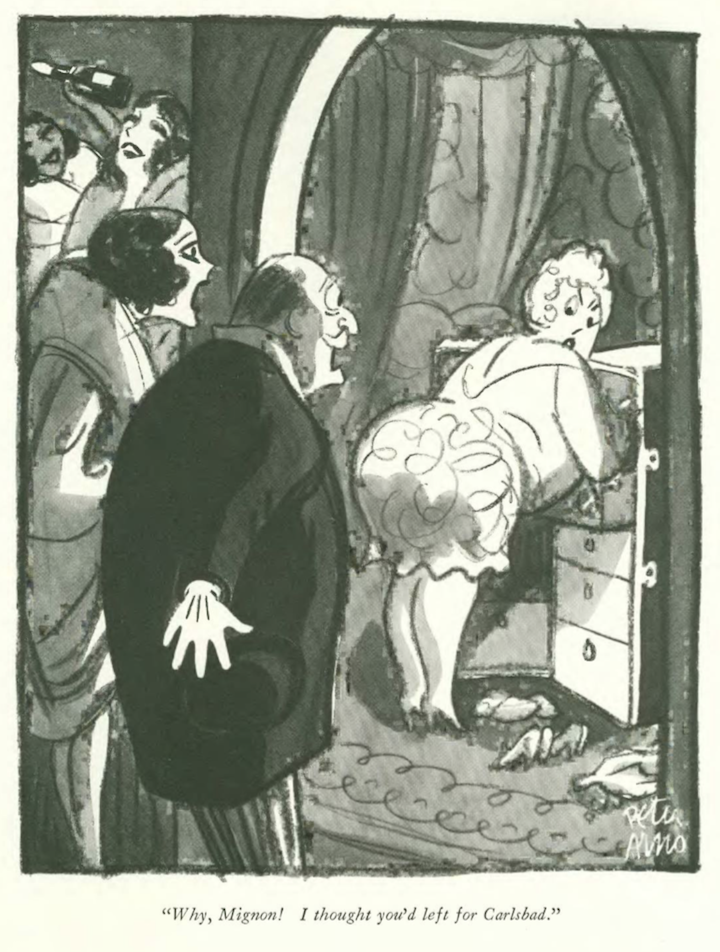
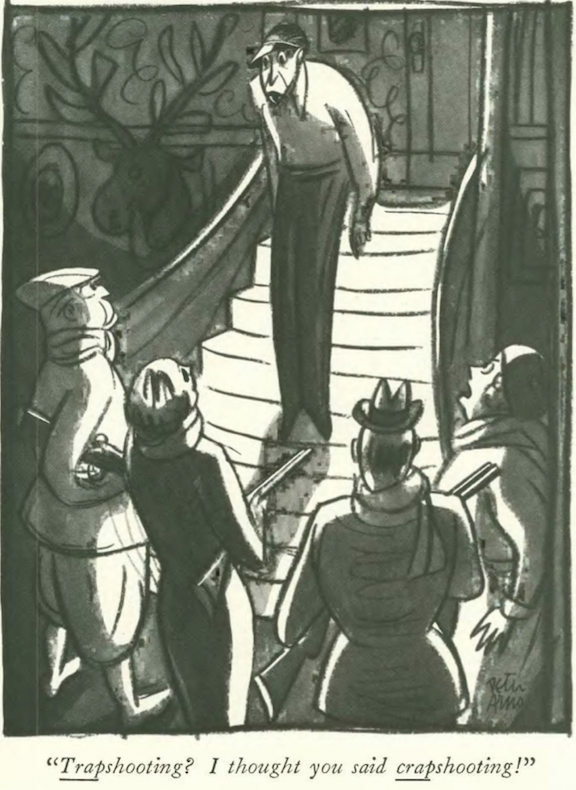
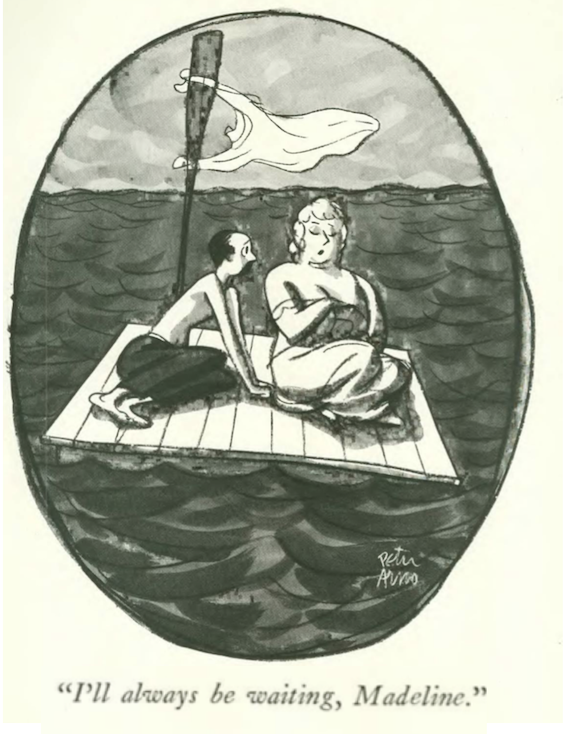
…and we end with the delightfully unrepentant Peter Arno…
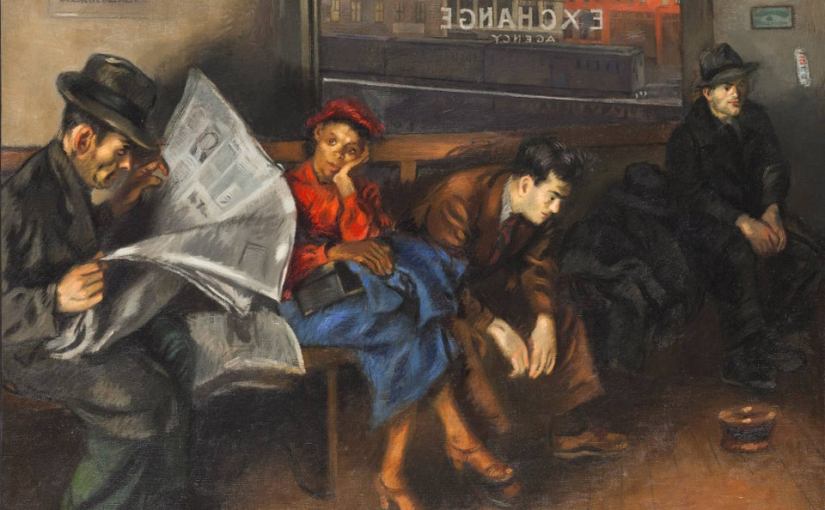
Above image: The 1937 painting, titled "Employment Agency," was by Isaac Soyer (1902-1981). Like Reginald Marsh, he was considered a social realist painter who painted scenes of working class life. (Whitney Museum of American Art)
Nineteen thirty-two was a tough year for most Americans, as the Depression approached rock bottom and jobless numbers continued to mount as one out of every four workers was unemployed.
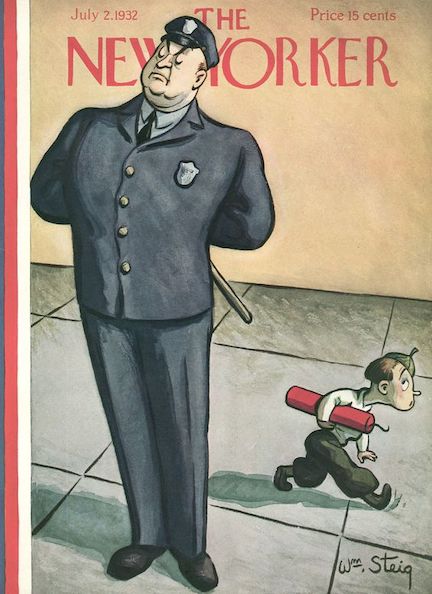
July 2, 1932 cover by William Steig.
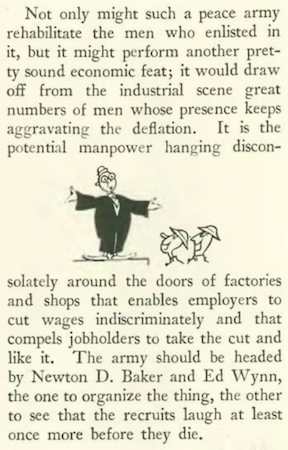
Despite the Depression, The New Yorker was on solid footing, although judging by these next two issues advertising had fallen off. Other indications things weren’t so rosy included the occasional broadsides penned by E.B. White in his “Notes and Comment” column that opened “The Talk of the Town.” White anticipated Franklin D. Roosevelt’s New Deal, calling for “direction from above” and the creation of a peacetime army that would give purpose to the unemployed.
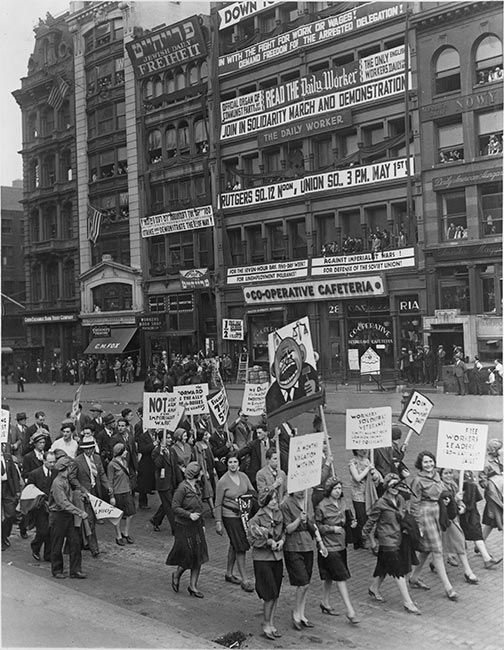
White filed his column while the nation was experiencing a summer of unrest, men and women across the country joining demonstrations demanding relief from the federal government, which under President Herbert Hoover mostly refused to provide funds for the jobless and homeless.
Writing for The Conversation, James N. Gregory, professor of history at the University of Washington, developed a mapping project that has recorded 389 hunger marches, eviction fights and other protests in 138 cities during 1932.
THE UNWANTED…Clockwise, from top left, a man advertises his worth on a sandwich board, ca. 1930; unemployed gather in front of an employment agency, ca. 1930; long line of jobless and homeless men wait outside to get free dinner at a New York municipal lodging house, 1932; even with the New Deal times remained tough for many rural folks — in 1936 Los Angeles Police Chief James E. Davis declared a “Bum Blockade” to stop the mass emigration of poor families fleeing from the Dust Bowl states of the Midwest. (rarehistoricalphotos.com/dailybulletin.com/Associated Press)
White’s column was prescient in many ways, including the need for Americans to laugh during tough times: Abbott & Costello, Burns & Allen, Laurel & Hardy and the Three Stooges, among many other acts, enjoyed their heydays during the Depression and war years.
SWORDS, NOT PLOUGHSHARES were offered to those protesting in the summer of ’32. Above, tanks and mounted troops advance to break up a Bonus Marchers’ camp of veterans protesting lost wages in Washington D.C. on July 28, 1932. Below, the marchers at the Capitol. (PhotoQuest/The Conversation)
* * *
From Our Advertisers
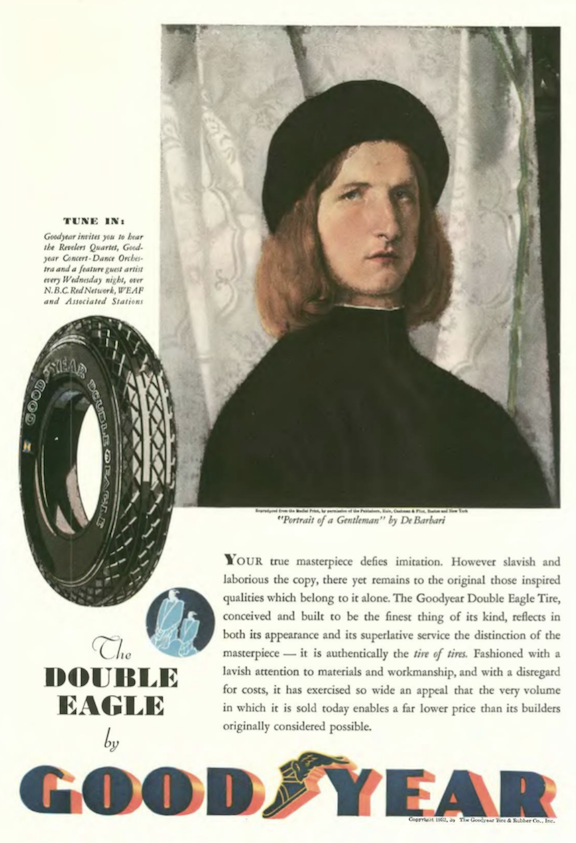
As noted earlier, advertising had fallen off a bit in The New Yorker, but those who still had means to market their wares included the folks at Goodyear, who continued their campaign of comparing their tires to “masterpieces”…
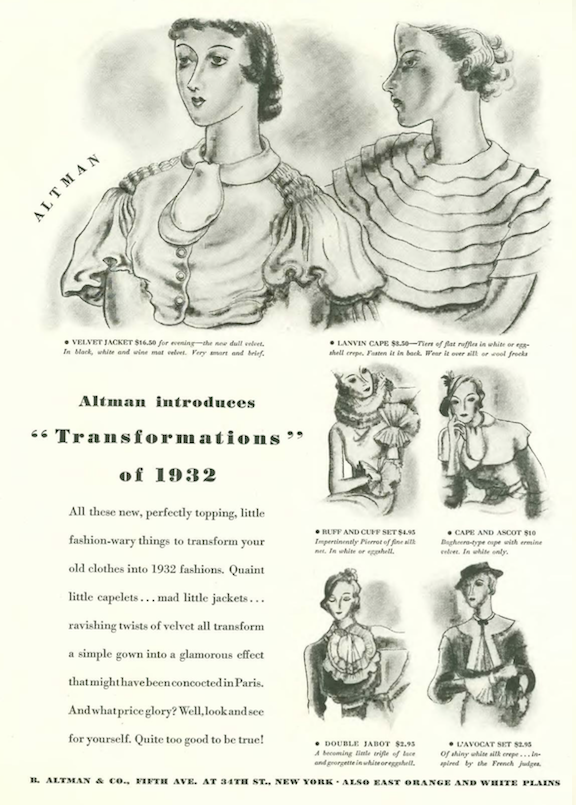
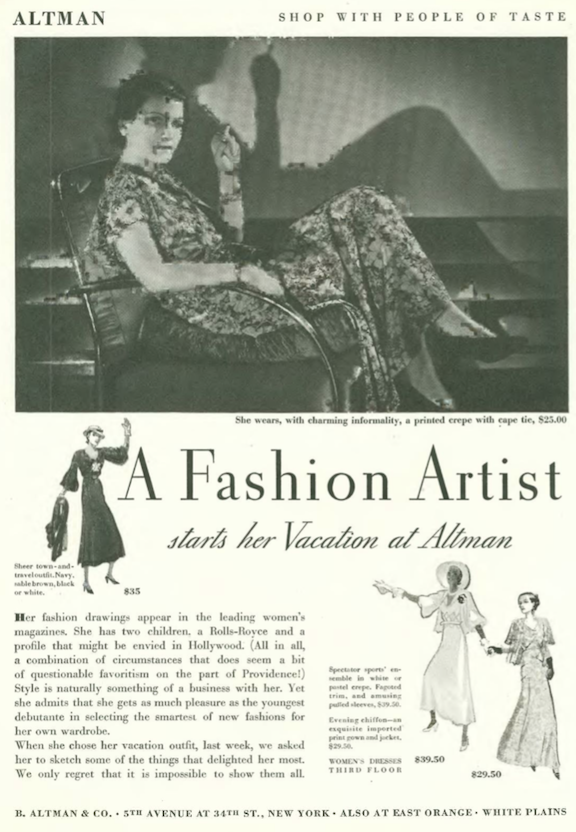
…this B. Altman ad presented a “fashion artist” who was doing quite well despite the Depression…
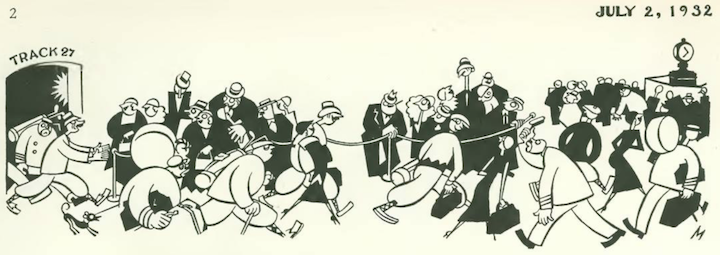
…on to our cartoonists, the top of page 2 and the bottom of page 3 in the “Goings On About Town” were decorated by Julian de Miskey…
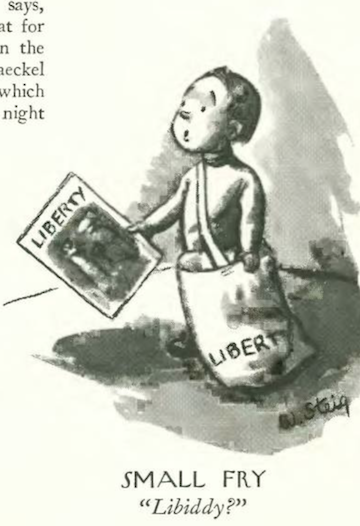
…William Steig put one of his “Small Fry” in a barber’s chair…
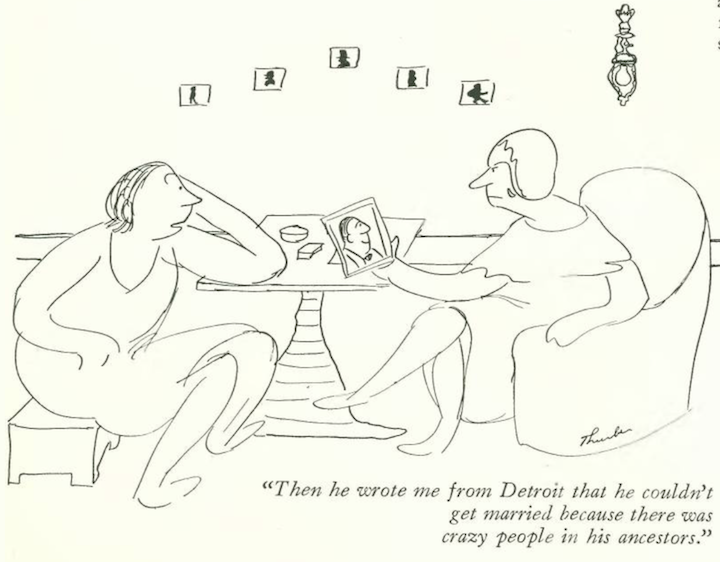
…James Thurber continued to plumb the depths of courtship…
…as did Barbara Shermund…
…while Peter Arno was perfecting one his classic tropes…
…on to July 9, 1932…
July 9, 1932 cover by Virginia Andrews.
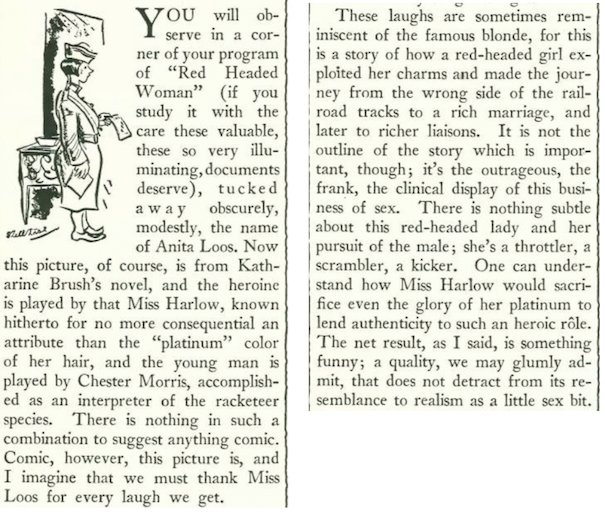
…where we look at John Mosher’s review of Red Headed Woman, a romantic comedy about an ambitious secretary (Jean Harlow) who tries to sleep her way into high society.
(IMDB)
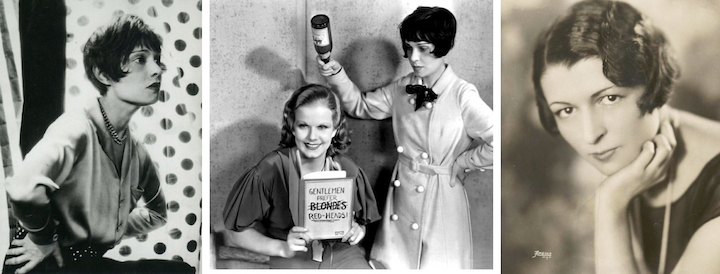
Harlow (1911-1937) was already famed as a “platinum blonde,” which made her turn as a redhead a major selling point for the pre-code film. Although based on a novel by Katharine Brush, it was Anita Loos’ humorous treatment of the script that made the film more than just a sex romp.
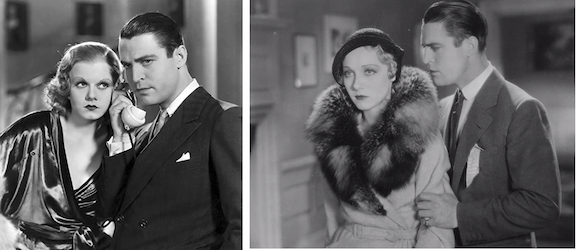
SEEING RED…Jean Harlow seduces her wealthy boss William “Bill” Legendre Jr. (Chester Morris) and breaks up his marriage to his wife Irene (Leila Hyams, photo at right). (IMDB)LIFE & ART…In many ways Jean Harlow embodied Lorelei Lee, the ambitious gold-digger Anita Loos created for her 1925 novel Gentlemen Prefer Blondes. When Loos (left, photo by Cecil Beaton) ) adapted Katharine Brush’s (right) novel for the 1932 film Red-Headed Woman, MGM made hay of the whole arrangement, seen in this 1932 publicity photo (center) of Harlow and Loos. (silentlondon.co.uk/Cinemania/Goodreads)
* * *
From Our Advertisers
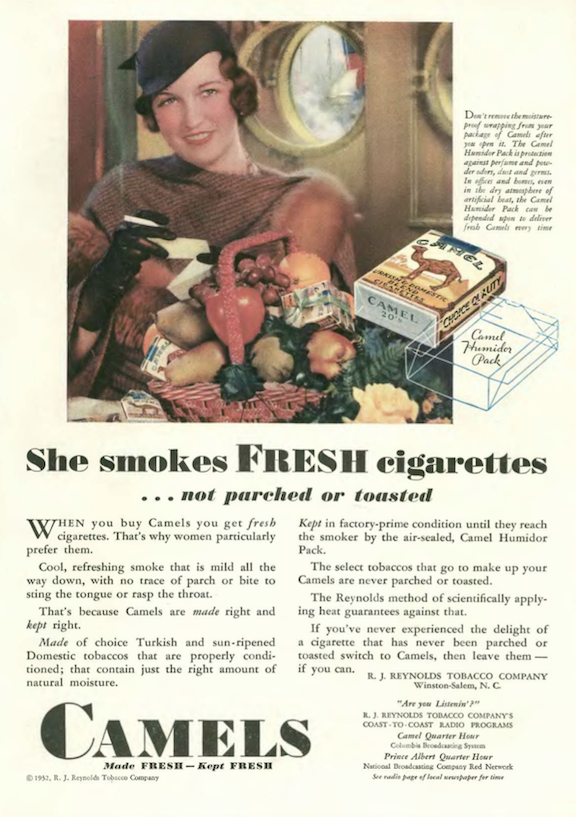
Speaking of redheads, we have this one encouraging us to become addicted to Camel cigarettes and then daring us to “leave them if you can”…
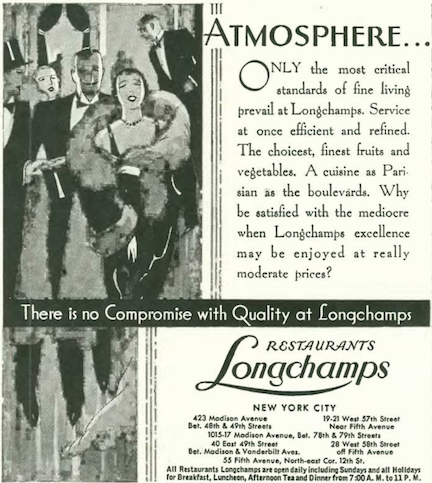
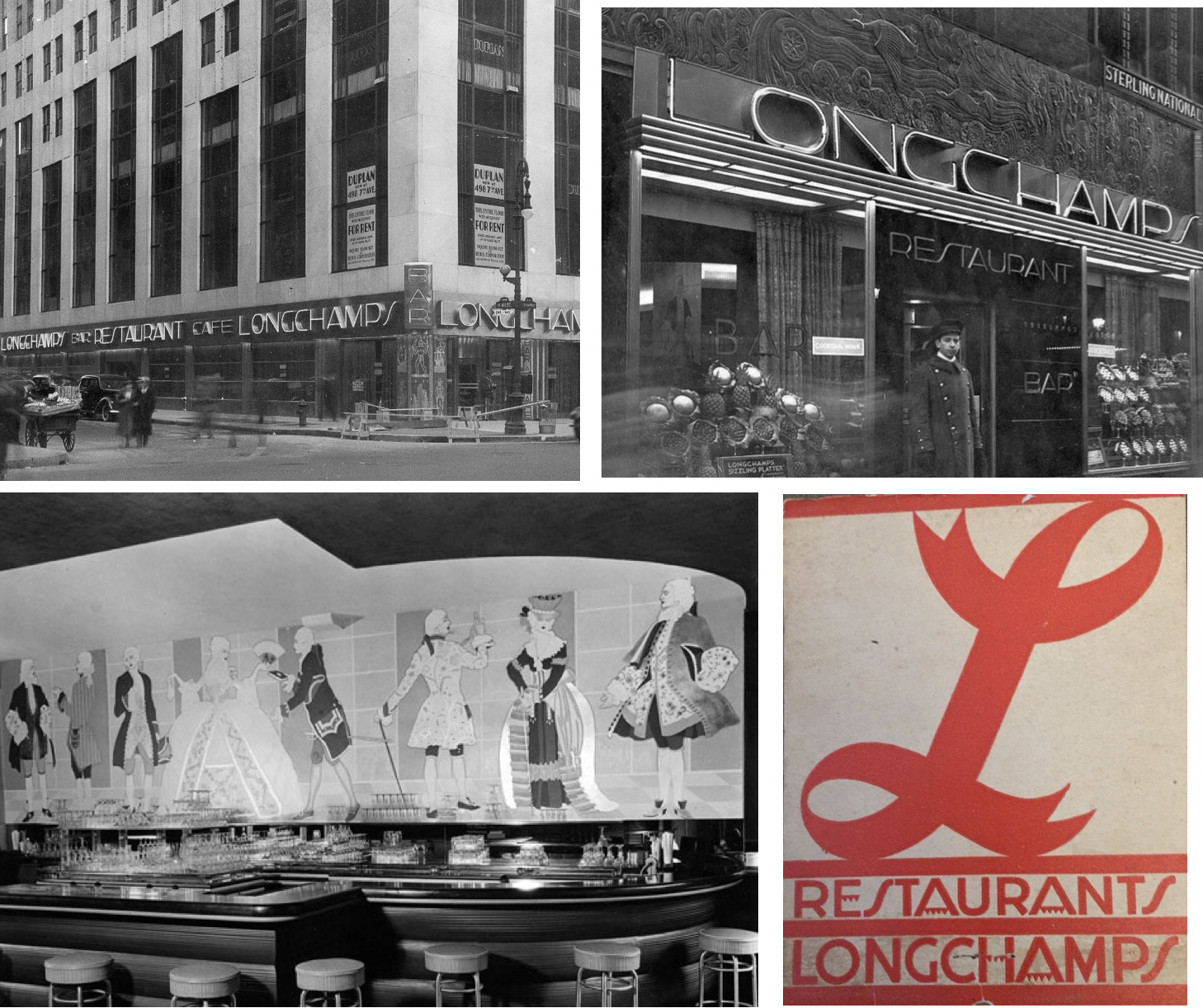
…Longchamps was a chain of restaurants in Manhattan that brought a taste of Continental refinement to middle class New Yorkers…
…the terrific Driving for Deco blog site tells us that wholesaler Henry Lustig opened his first Longchamps restaurant in 1919 at Madison and 78th, specializing in an American version of French cuisine at affordable prices. During the mid to late 1930s the chain rapidly expanded, opening seven restaurants within five years. Four of these restaurants were known for interior designs by Winold Reiss…
HIGH STYLE, LOW PRICES…Clockwise, from top left, the 1931 Continental Building was home to this Longchamps restaurant at Broadway and 41st Street (circa 1937); entrance on 42nd Street to the Longchamps in the Chanin Building, circa 1935; late 1930s matchbook cover from Longchamps; interior design by Winold Reiss in the Chanin Building location. (nyneon.blogspot.com/drivingfordeco.com)
…on to our cartoons with Rea Irvin and another view of French elegance…
…and we close with Barbara Shermund, evesdropping on her Manhattan demimonde…
Kay Boyle was thirty and still cutting her teeth as a writer and political activist when The New Yorker published her short story “Black Boy,” told through an unnamed narrator who recalls a childhood visit to the seaside.
May 14, 1930 cover by Bela Dankovsky.
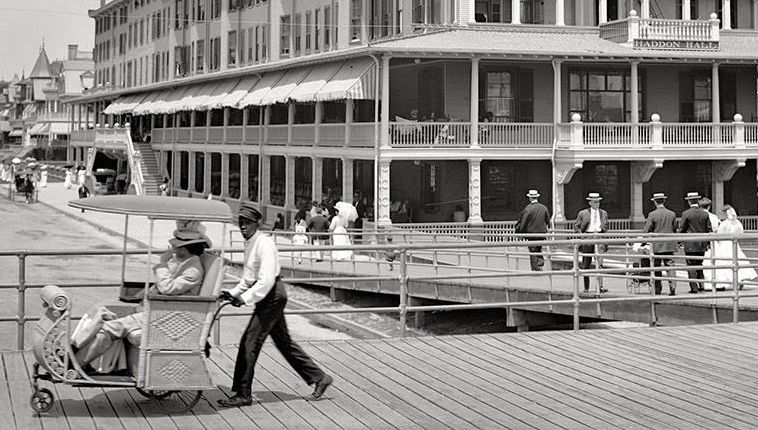
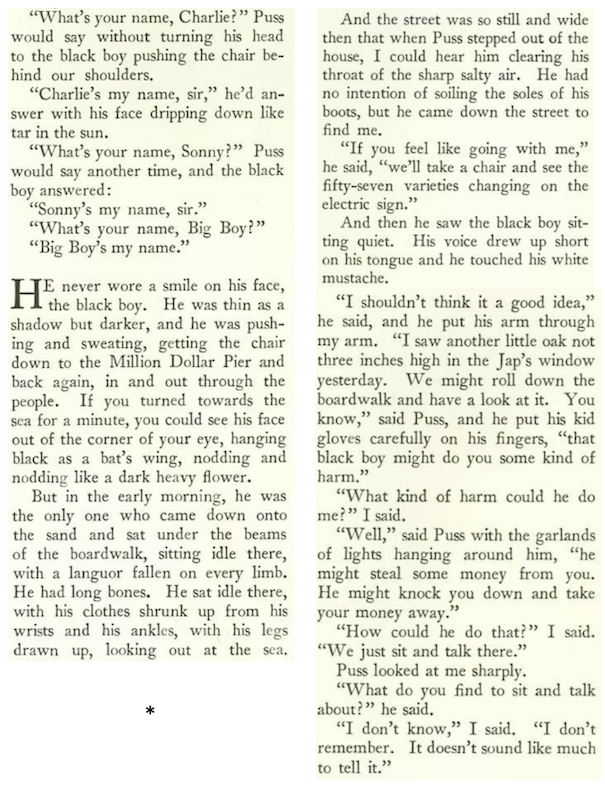
The narrator remembers the days when she rode her horse along the beach while her grandfather watched from a rolling chair, pushed along the boardwalk by various young Black boys. In the following excerpts, the grandfather asks one of the boys for his name, but is it clear he doesn’t really want to get to know him, and through his teasing suggests he isn’t even worthy of an identity. Later in the story the girl befriends the boy, who dwells beneath the boardwalk and dreams of a better life. When the grandfather learns of this budding friendship, he warns about the possibility of harm coming from the boy (two excerpts):
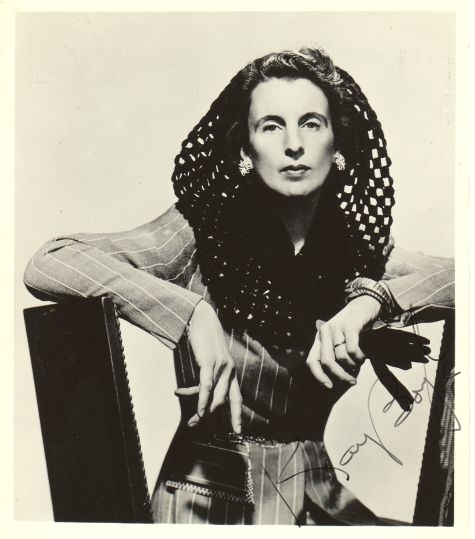
THE LONG, CHAOTIC LIFE of writer and activist Kay Boyle (1902–1992) ranged from fights against racism and fascism in the 1930s to protests against the Vietnam War in the 1960s and against nuclear weapons into the 1990s. (1941 photograph by George Platt Lynes, courtesy The Kay Boyle Papers, Morris Library, Southern Illinois University)
The final paragraphs describe how the girl falls from her horse, and the shocking consequences of the boy coming to her aid.
SEPARATE AND NOT EQUAL…Kay Boyle employed a boardwalk setting in her 1932 short story “Black Boy” to underscore the stark divisions between races in American society. Clockwise, from top left, a 1914 postcard from Atlantic City; on the Atlantic City Boardwalk, circa 1905; sheet music for a popular 1905 song; a dour-looking group being pushed along the Atlantic City Boardwalk, circa 1905. (seesaw.typepad.com/bygonely.com/reddit.com)
* * *
Potemkin Park
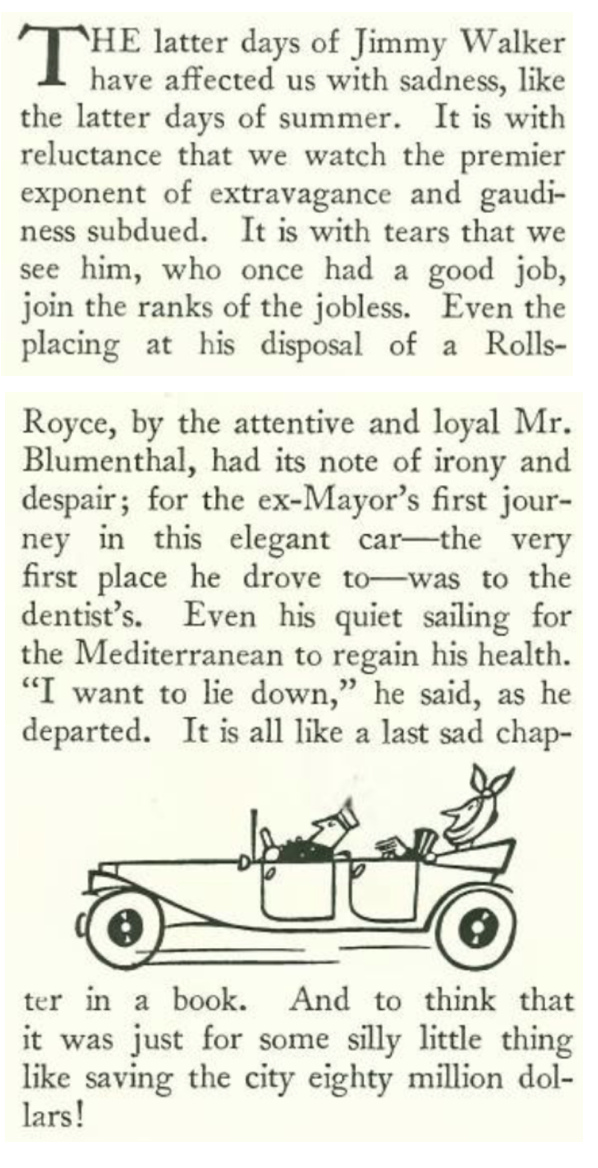
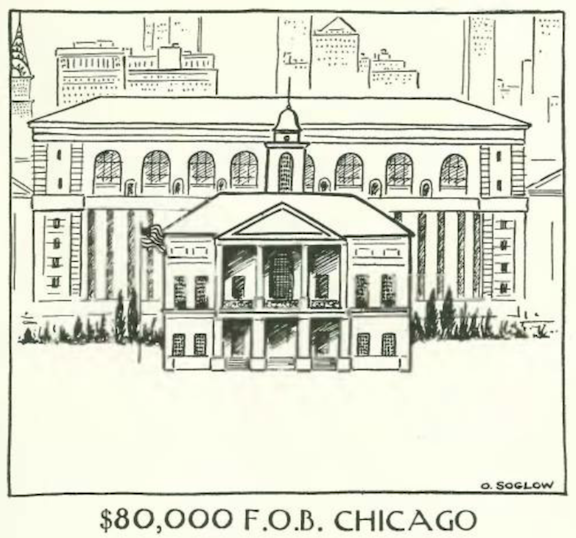
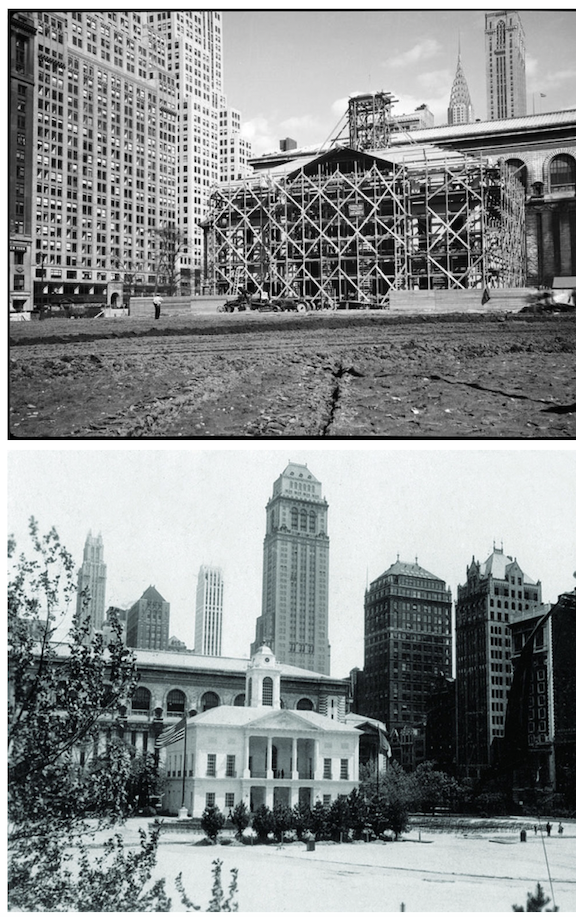
In his “Notes and Comment,” E.B. White questioned the need, and appropriateness, of a wood and plaster Federal Hall replica in Bryant Park, which at the time was a neglected patch of land behind the New York Public Library and a favorite spot for the city’s homeless, their numbers rapidly growing during one of the worst years of the Depression (unemployment hovered near 25 percent). Otto Soglow commented, via cartoon:
To add insult to injury, the area around the replica was fenced off and required an admission fee of 25 cents. White commented:
ERECTILE DYSFUNCTION…This flimsy Federal Hall replica erected in Bryant Park in 1932 symbolized some of the problems that beset New York City in one of the worst years of the Depression. Under Mayor Jimmy Walker, the committee in charge of the replica was filled with corrupt Tammany cronies who quickly depleted the committee’s funds. It is no surprise that the replica was unpopular, especially with its admission fee of 25 cents, roughly equivalent to $5 today (consider that sales clerks in 1932, if they were lucky to have a job, earned perhaps $15 a week). (Museum of the City of New York)
* * *
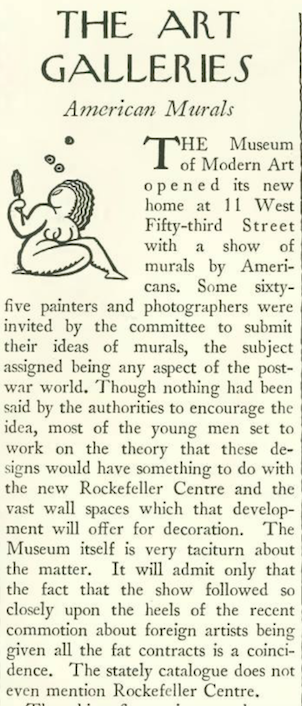
Intermural Murals
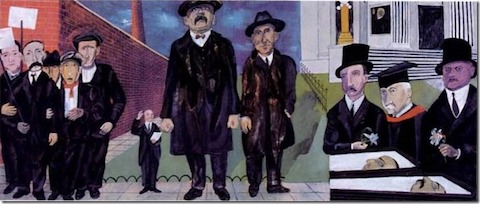
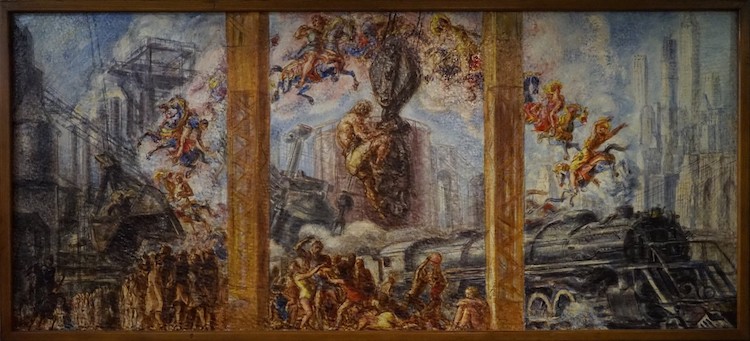
Art critic Murdock Pemberton approached the Museum of Modern Art’s newest exhibition of American muralists with a bit of suspicion, although he was correct in surmising that the Rockefeller Center was shopping for muralists, but as we now know it was not an American, but a Mexican artist (Diego Rivera) who would enter that scene and stir things up.
Among other works, MoMA visitors viewed Ben Shahn’s study for a three-part composition titled “The Passion of Sacco and Vanzetti”…
(MoMA)
…and a work by The New Yorker’s own Reginald Marsh titled “Post-War America”…
(MoMA)
* * *
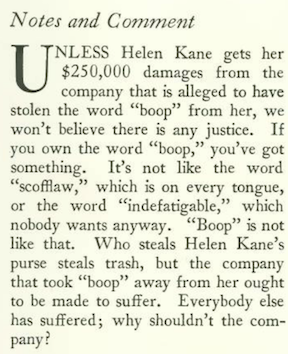
Boop’s Boo-Boo
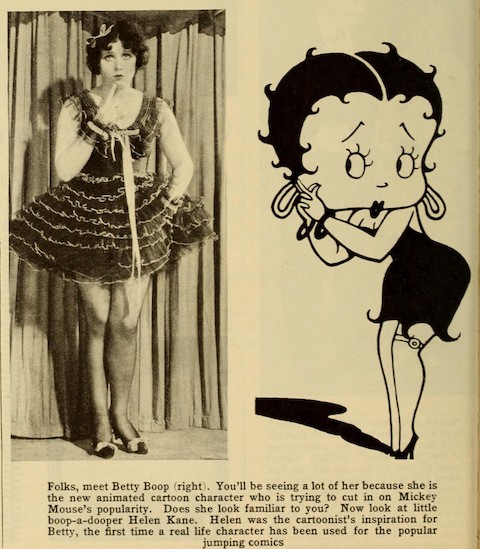
We return to E.B. White and his musings regarding actress and singer Helen Kane (1904–1966), who filed a $250,000 (equivalent to nearly $5 million in 2021) infringement lawsuit against cartoonist Max Fleischer and Paramount Studios, claiming that the popular Betty Boop character was based on Kane’s personality and image.
BOOP SCOOP…Comparison between Helen Kane and the cartoon star Betty Boop was published in Photoplay’s April 1932 issue, one month before Kane’s lawsuit was filed. The suit was settled two years later, the court finding insufficient evidence to support Kane’s claim. (Wikipedia)
* * *
From Rags to Rackets
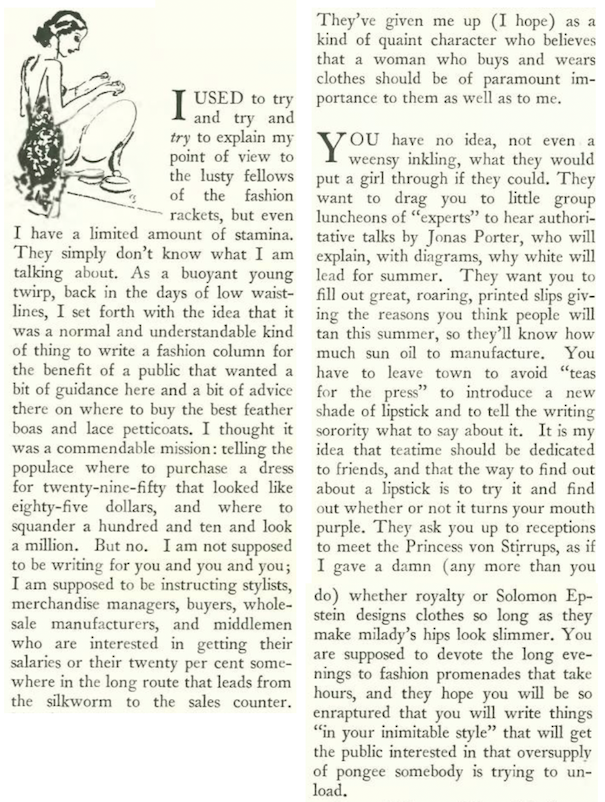
Lois Long lived at the center of the 1920s speakeasy scene, but while she partied she also kept a critical eye on her surroundings, and when she later moved on to fashion criticism (“On And Off The Avenue”) she maintained the same combination of enthusiasm and shrewdness as she took aim at the “lusty fellows of the fashion rackets”…
JUST BROWSING, THANKS…Lois Long kept a skeptical eye on the New York fashion “racket” in the 1930s. Above, an unidentified model sporting a red velvet ensemble during a fashion show in 1933. (New York Daily News)
* * *
From Our Advertisers
We begin with yet another insecticide-themed cartoon from Dr. Seuss, this time using the experimental medium of television to get his point across…
…R.J. Reynolds continued to push their Camels on the growing market of women smokers, here mixing their product with a basket of fruit to suggest freshness and vitality…
…the folks at B. Altman touted their new outdoor furniture line, placing it in a setting available to a very select few New Yorkers…
…we kick off the cartoons with Peter Arno at his best…
…Alice Harvey gave voice to one woman’s thoughts on children…
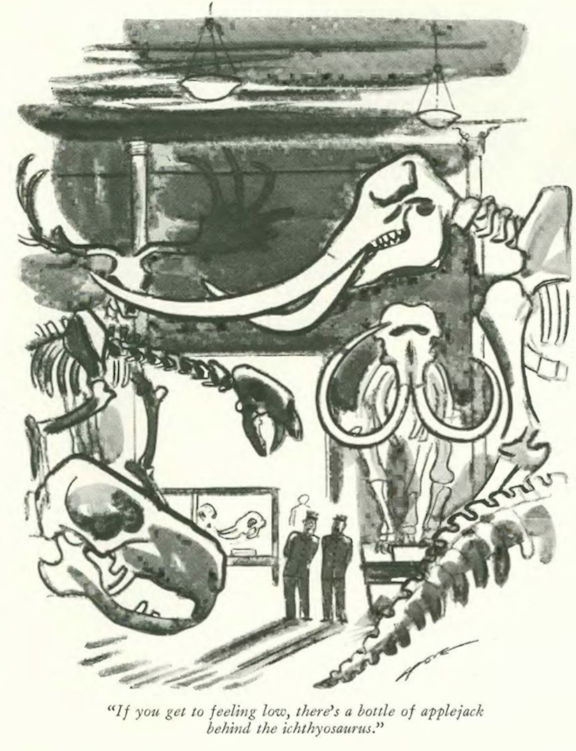
…Leonard Dove found spirits dwelling among dusty bones…
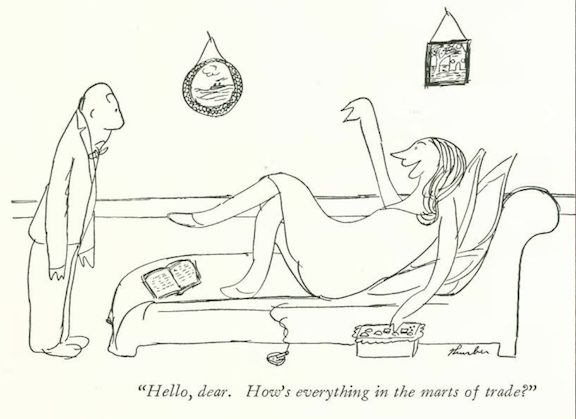
…James Thurber gave us his take on the housewife eating bonbons trope…I’m not suggesting that Thurber was the first to illustrate this stereotype, but I’m not finding any references to housewives and bonbons predating the 1950s…something for a dissertation out there, if it hasn’t already been done…
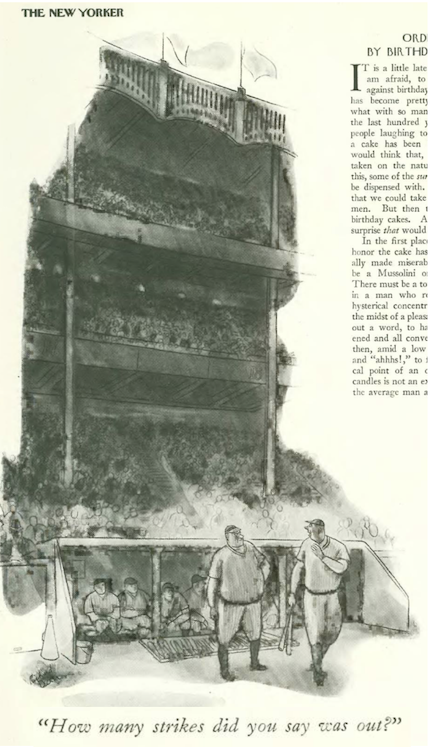
…William Steig continued his exploration into the world of the Small Fry, offering up a rare image of baseball in the early New Yorker…
…and we close the May 14 issue with Isadore Klein, and one sidewalk salesman looking for a bonafide endorsement…
…on to May 21, 1932…
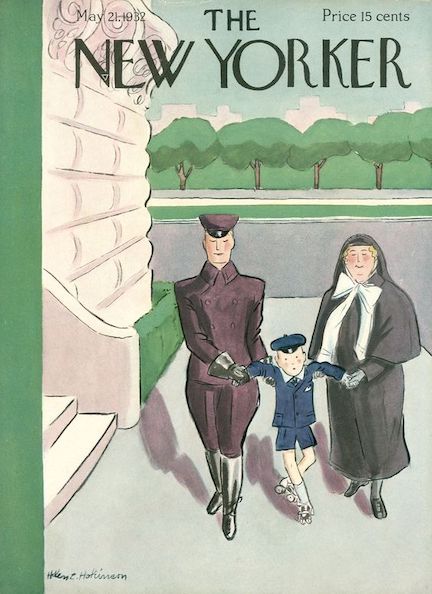
May 21, 1932 cover by Helen Hokinson.
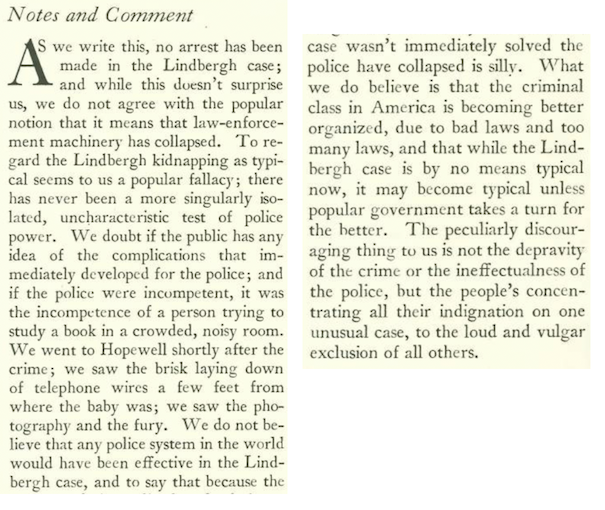
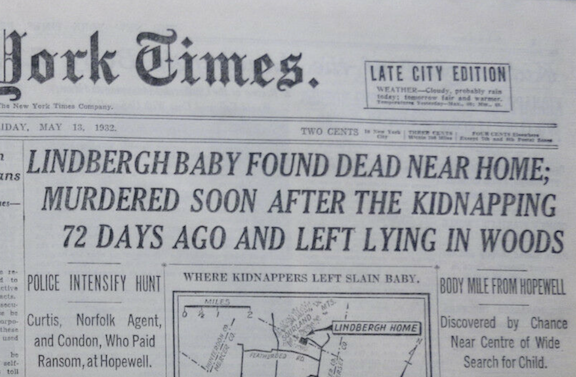
…where we find E.B. White sharing his thoughts on the Lindbergh kidnapping and its tragic result…
BAD NEWS ON THE DOORSTEP…News of the death of Charles and Anne Lindbergh’s kidnapped baby transfixed the country in the spring of 1932. (New York Times)
* * *
No Immaculate Conception, This
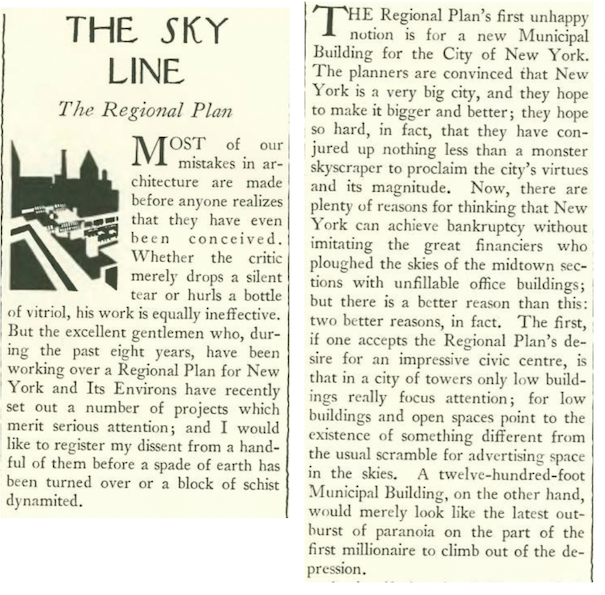
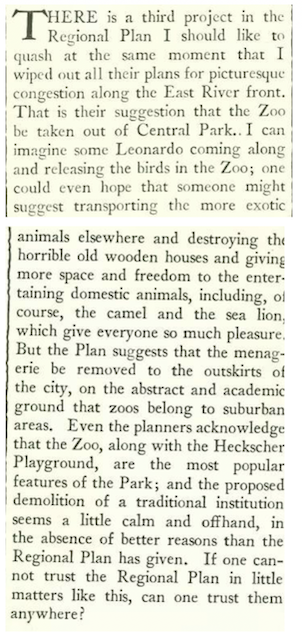
It must have been hard to be Lewis Mumford, so knowledgable in the arts, architecture and city planning, and yet rather helpless in encouraging thoughtful growth in a place that spouted buildings like mushrooms and paved roads (thanks to Robert Moses) almost as fast as cars could drive across them. These excerpts offer some of Mumford’s thoughts on the matter:
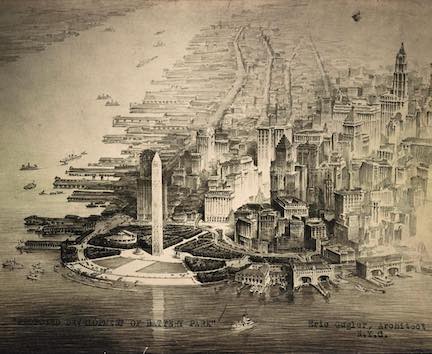
For Mumford’s second point, he soundly denounced a plan to place an obelisk in Battery Park. The 1929 proposal called for an 800-foot obelisk at the junction of Broadway and Greenwich Street:
OVER COMPENSATING, PERHAPS…Designed by architect Eric Gugler, the proposed granite obelisk for Battery Park would have been windowless, 80 feet square at its base and rising to a height of 800 feet. Thankfully it was never, ahem, “erected.” (NYC Urbanism @nycurbanism)
Mumford also addressed the matter of the Central Park Zoo, and its proposed relocation:
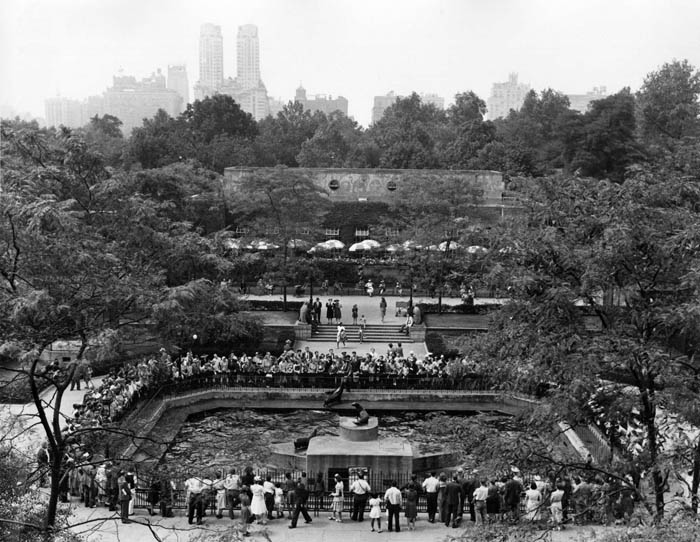
Happily for Mumford, and for former Gov. Al Smith (see caption), the zoo would be revitalized and remain in Central Park.
MIRACLES OF MOSES…Although Lewis Mumford would often be at odds with the powerful park commissioner Robert Moses, it was Moses who ensured that the Central Park Zoo would remain in the park. The remodeled zoo opened with great fanfare on December 2, 1934, and Moses’ old friend and political mentor Al Smith was designated honorary zookeeper. Smith, who lived just across from the zoo at 820 Fifth Avenue, visited almost daily. Structured as a quadrangle with a sea lion pool at its center, the Central Park Zoo is pictured above in August 1942. (nycgovparks.org)
* * *
From Our Advertisers
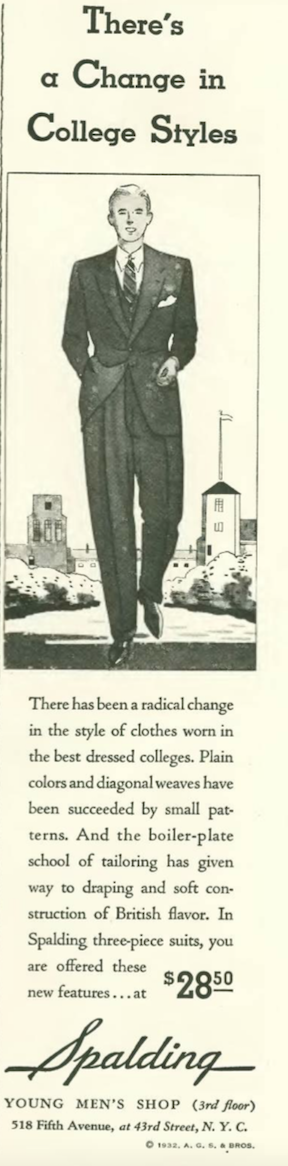
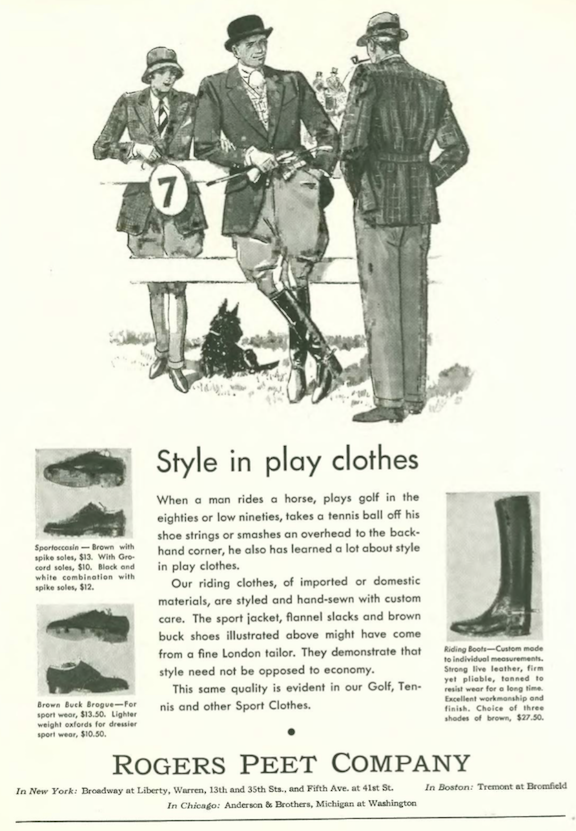
Many advertisers played to the Anglophilic tendencies of New Yorker readers, particular ones selling garments to the sporting gentry who aped their British cousins in such pursuits as polo and dressage…here we have “play clothes” from the menswear company Rogers Peet…
…and this swell get-up (below) from Henri Bendel…both Peet and Bendel were well-known in the 1930s. Cole Porter even referred to both companies in his songs…here is the refrain from “I Introduced” (from the 1919 show Hitchy-Koo):
…”I presented Mister Peet to Mister Rogers”…
and even more famously Porter wrote these lines in his 1934 song “You’re the Top”:
…”You’re a Bendel Bonnet / a Shakespeare Sonnet”…
…Rogers Peet closed its doors in the 1980s, and Bendel folded in 2019…
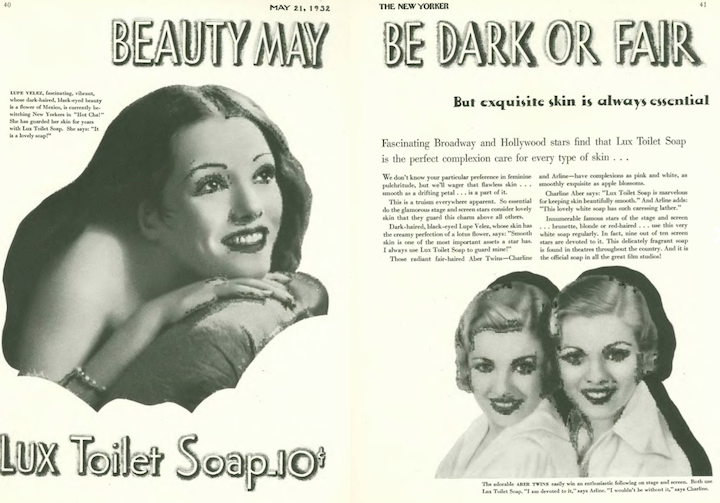
…even during the Depression, almost anyone could spring for a ten-cent bar of Lux soap, and over the years it was famous for its splashy ads (two-page spreads in The New Yorker were common) and dozens of celebrity endorsements…Lux isn’t as dominant in the U.S. today, but it remains a major international brand, now sold and marketed by the British multinational Unilever, especially in Asia…back to 1932, the Lux ad below featured Lupe Velez — known as “The Mexican Spitfire,” she was a big star in the 30s but is perhaps best known today for her sad, tragic death in 1944…the Lux ad also displayed the Aber Twins — a Ziegfeld act that featured Arlene and Charlene Aber who weren’t really twins but sisters born 18 months apart…
…if you lived in New York in the 1920s and early 30s you probably would have known about the sometime artist/designer Don Dickerman and his themed Greenwich Village restaurants — especially The Pirate’s Den — which inspired this line of highball glasses (yeah, Prohibition was still around, but who cared?)…sadly these glasses didn’t help save The Pirate’s Den, which thanks to the Depression went bankrupt in 1932…
…speaking of Prohibition, Anheuser-Busch took advantage of laws that allowed for the production of near-beer containing one-half percent alcohol…
…if you couldn’t drink you could still eat to your heart’s content, that is if you were this fat cat and not some starving fellow in a bread line…
…on to our cartoons, Helen Hokinson took us pet shopping…
…Garrett Price offered up a stereotype in a courtroom setting…
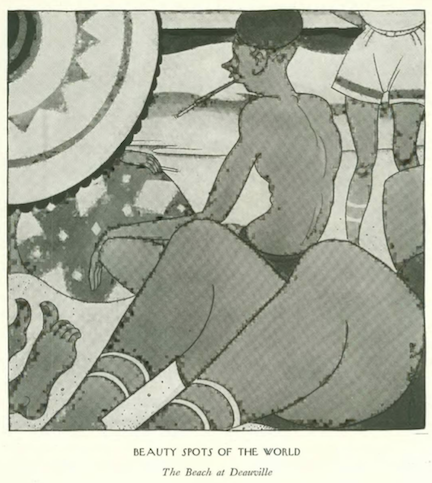
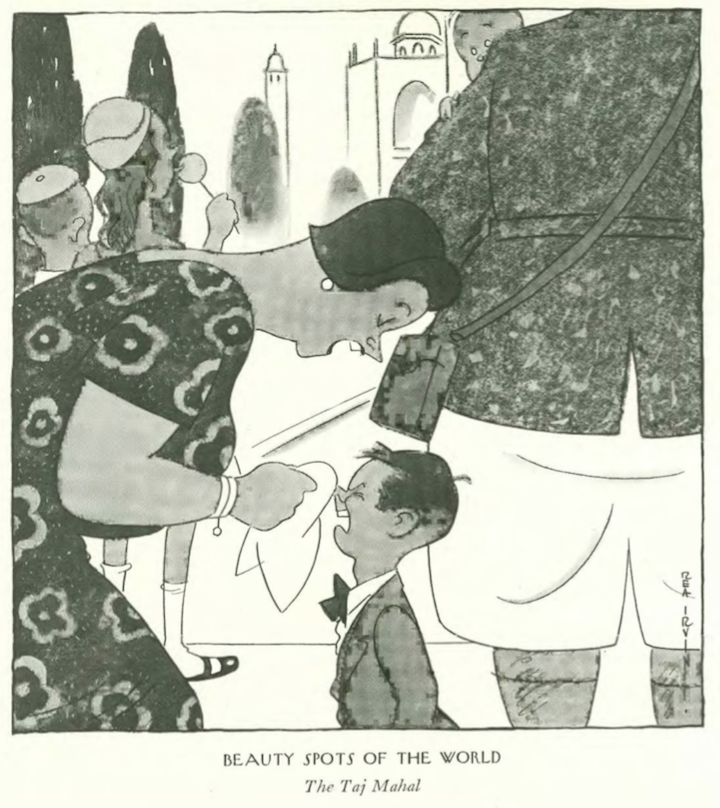
…and reminiscent of humor in the vein of Ralph Barton, Rea Irvin launched a series of the world’s “beauty spots”…
One of the challenges of writing these posts is giving proper due to the many writers and artists who helped shape The New Yorker universe, and especially to those we’ve almost forgotten.
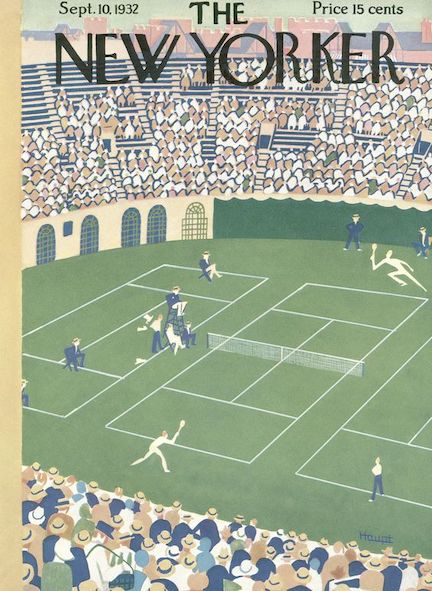
April 30, 1932 cover by Theodore Haupt.
One writer who deserves our special attention is John Mosher, film critic for the New Yorker from 1928 to 1942 and a pioneer of The New Yorker short story. In her 2000 book Defining New Yorker Humor, Judith Yaross Lee notes how the “burlesque” prose of the early magazine was displaced by Mosher’s quieter humor, which lent support to Dorothy Parker’s ironic mode and E.B. White’s “travails of the Sufferer.” Mosher’s prose, writes Lee, “helped New Yorker humor combine broad comic conception and ironic realistic narration.”
In addition to regular film reviews and occasional profiles, Mosher penned nearly fifty short stories, or “casuals” as they were called. It was also Mosher who “discovered” writer John O’Hara when in 1929 he found one of O’Hara’s pieces in a “slush pile” of unsolicited submissions. He is also credited with discovering James Thurber.
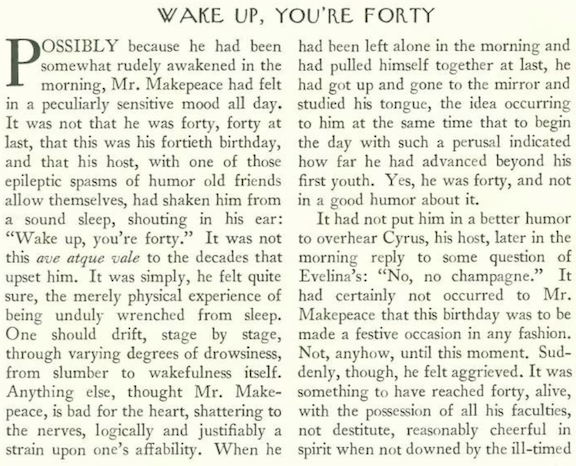
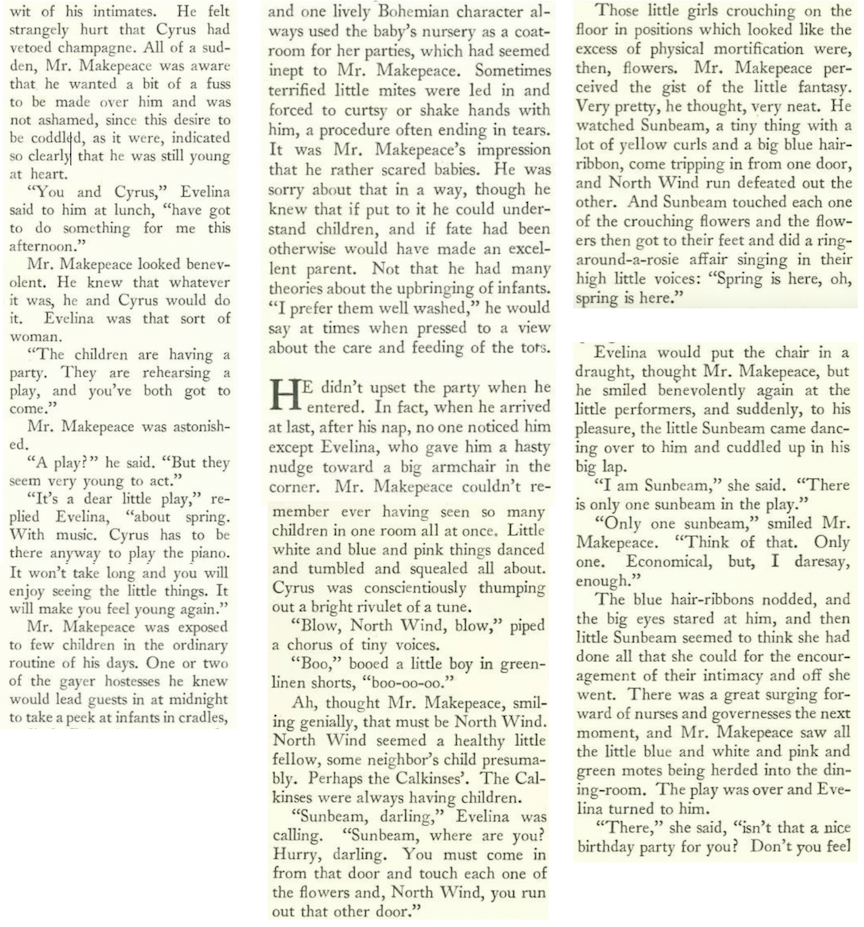
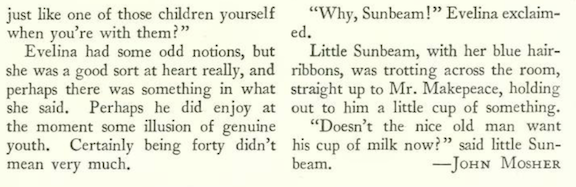
Without further ado, here is one of Mosher’s shorts, “Wake Up, You’re Forty” (Mosher turned forty in 1932) from the April 30 issue. It demonstrates Mosher’s ironic narrative style, skillfully deployed to describe a comically minor event:
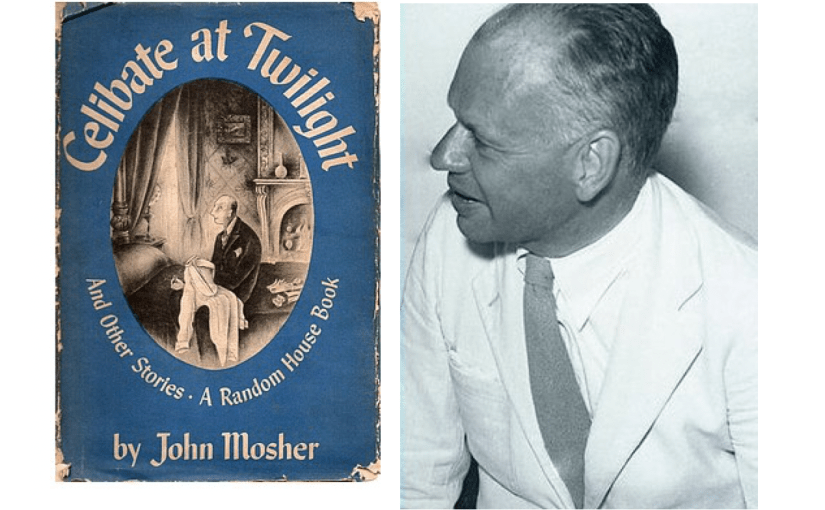
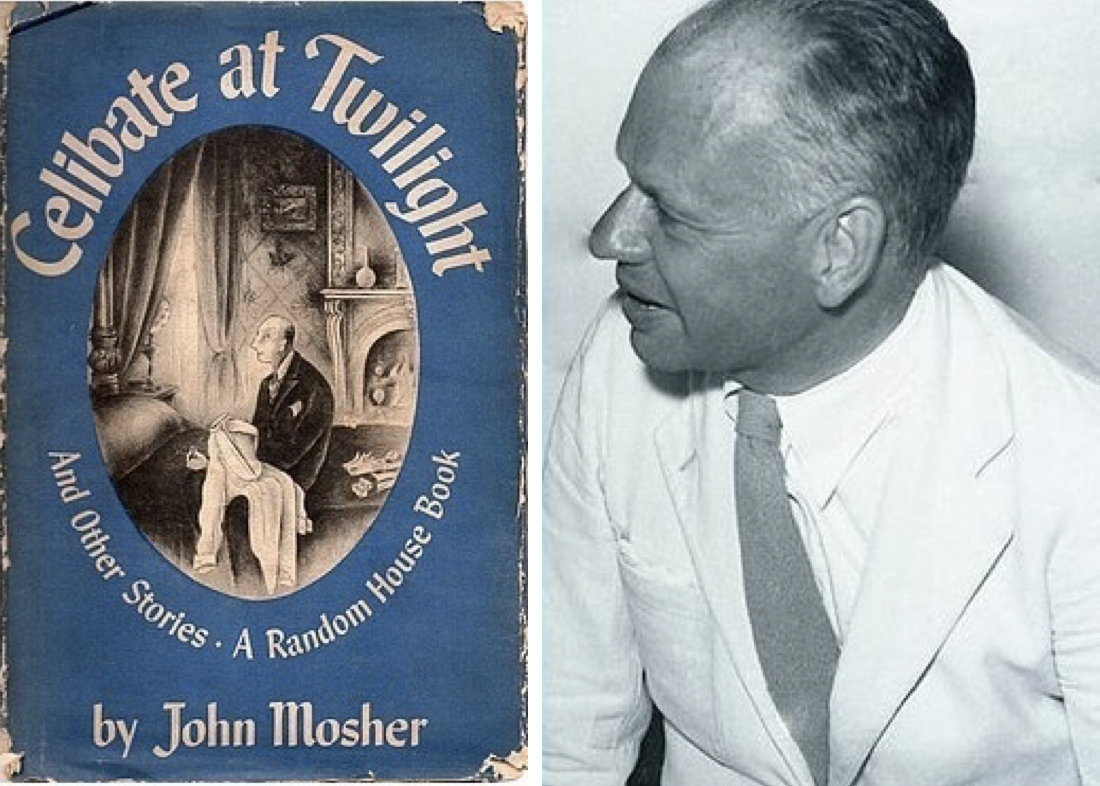
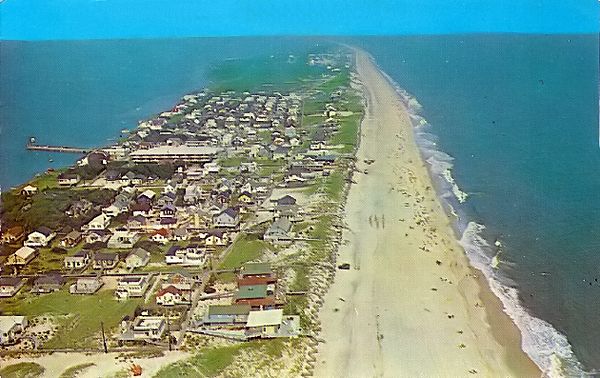
THE STORYTELLER…John Mosher’sNew Yorker short stories (1925 to 1940) were collected in Celibate at Twilight, illustrated by New Yorker cartoonist Mary Petty. It included tales about life on Fire Island, where Mosher and his partner, broker Philip Claflin, became the first gay property owners in the vacation village of Cherry Grove. Visitors included Mosher’s close friend Edith Lewis as well as Willa Cather, Janet Flanner, Wolcott Gibbs, and James Thurber. (neglectedbooks.com/findagrave.com)Aerial view of Cherry Grove, circa 1960. (pineshistory.org)
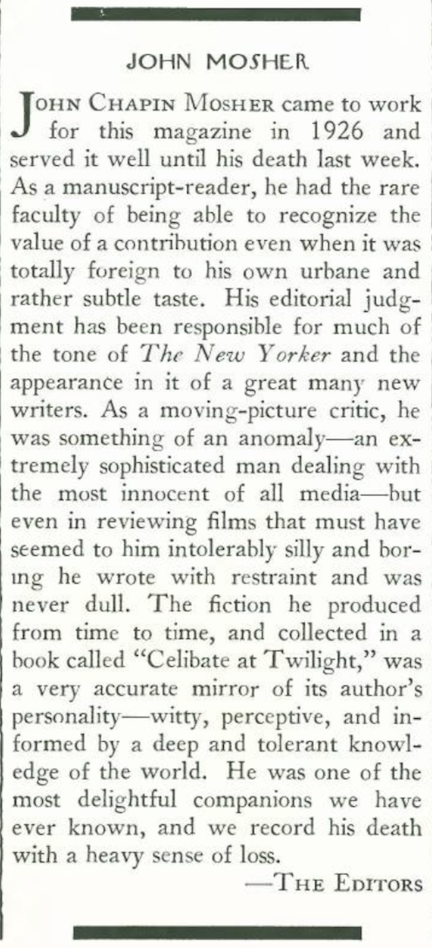
On Sept. 3, 1942, Mosher died of heart failure in New York City at the young age of 50. He was remembered by his New Yorker colleagues in this eulogy found on page 72 of the Sept. 12, 1942 issue:
* * *
Going Up!
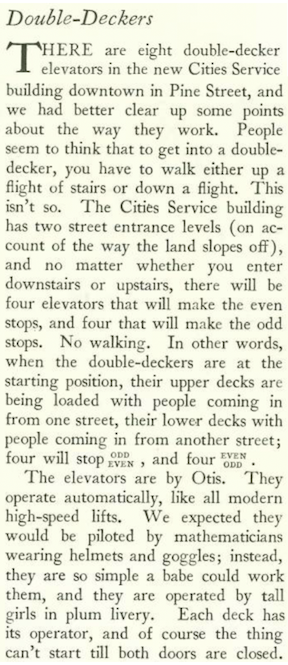
The “Talk of the Town” took a look at the innovative double-decker elevators being installed in the new Cities Service Building (now 70 Pine Street) in Lower Manhattan. Although the Cities Service building didn’t have the fame of the Empire State Building or the Chrysler Building, when completed the 952-foot Cities Service Building stood as the third tallest in the world.
STILL STANDING TALL…The Cities Service Building (now 70 Pine Street) in Lower Manhattan after its completion in 1932; center, a miniature model of the building, incorporated between the eastern entrance portals on Pine and Cedar Streets; at right, a clipping from the January 1932 Popular Science magazine detailing the unique double-decker elevator design. (MCNY/Wikipedia/Popular Science)
* * *
Electric Patriotism
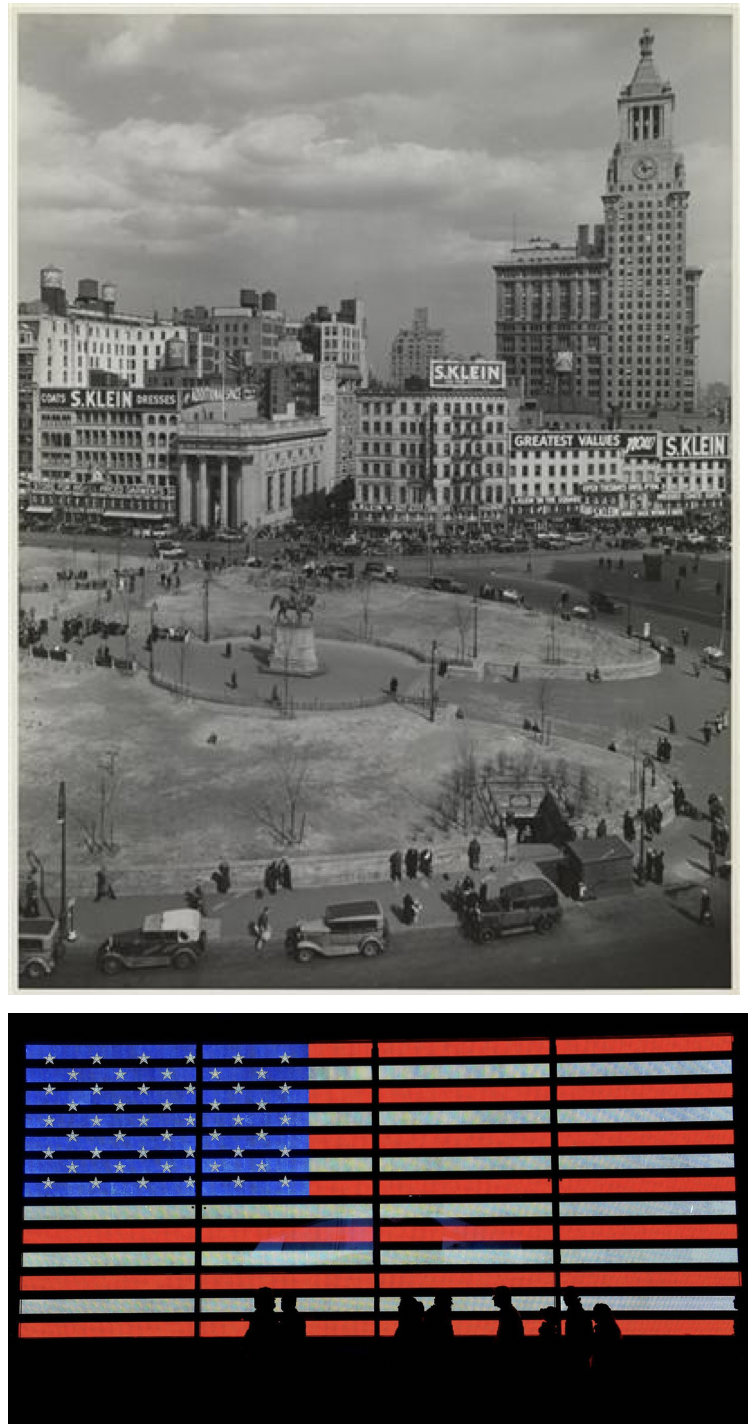
E.B. White kicked off his “Notes and Comment” with some observations about the newly-renovated Union Square and its electrified American flag:
PATRIOT GAMES…Then as now, Americans have always disagreed on what constitutes a tasteful patriotic display. At top, Union Square (circa 1930) arranged around Henry Kirke Brown’s 1856 statue, George Washington; in 2011 a U.S. Armed Forces Recruiting Office (below) at Broadway and Seventh Avenue, was fitted with a giant electric flag of red, white and blue LED lights. (Dick Ebert)
* * *
From Our Advertisers
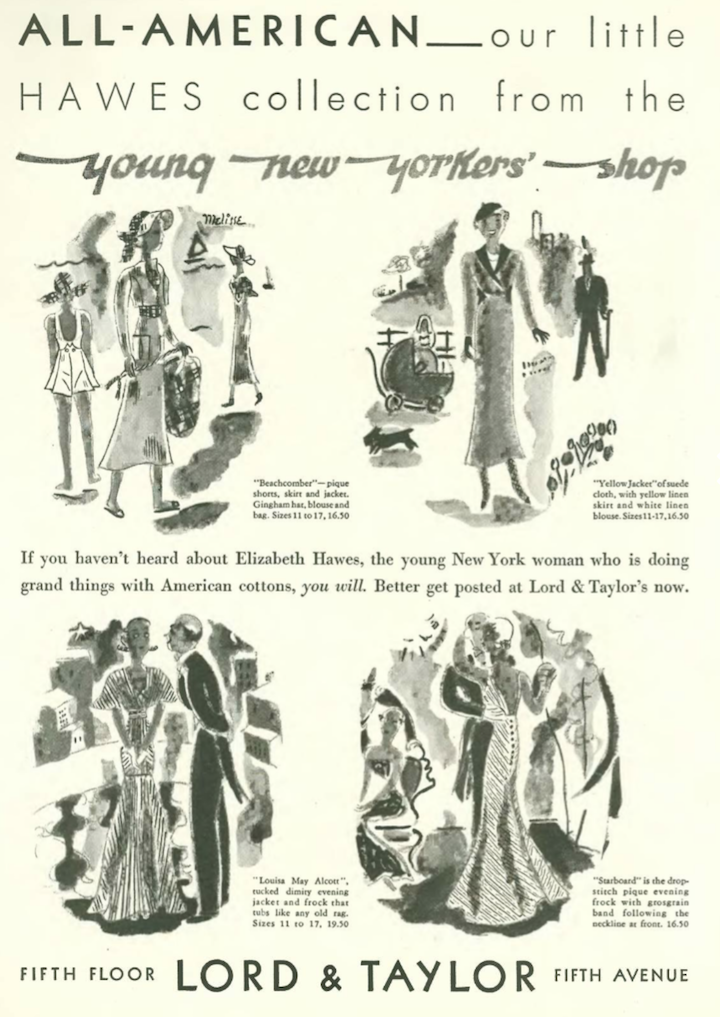
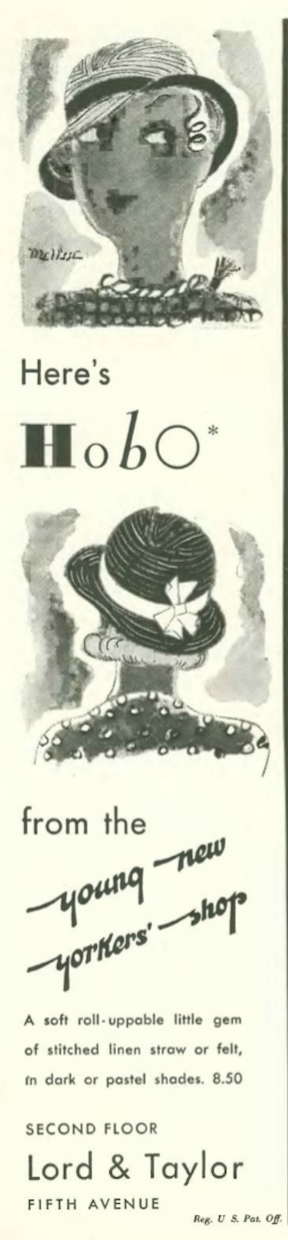
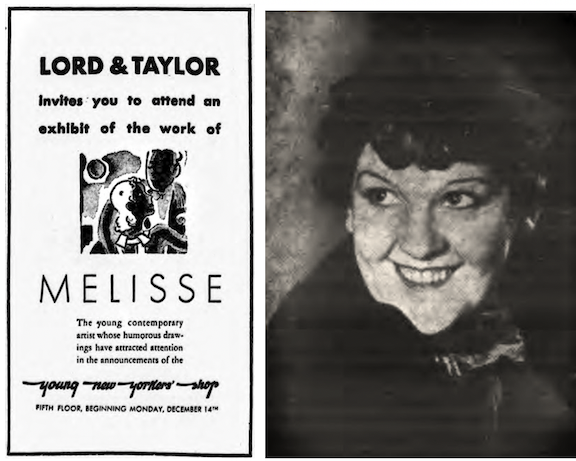
Lord & Taylor rolled out some new ads illustrated by Melisse, aka Mildred Oppenheim…
…apparently giddy about their new campaign, Lord & Taylor ran a second one-column ad in the back pages…
…apparently Melisse was a big draw in the 1930s, based on this Dec. 12, 1931 advertisement in the New York Sun (photo added by me, via strippersguide.blogspot.com)…
…travel companies continued their appeals to the well-heeled and included exotic destinations such as Zoppot…
…which today is known as Sopot, Poland…its Sofitel Grand Hotel (aka the Kasino Hotel) continues to serve as a spa resort…
TAKING THE WATERS…Sopot’s Grand Hotel (aka the Kasino Hotel) continues to serve as a spa resort — it is seen in the background of this 1950 photo (top); below, hotel interior in 1927. The hotel has hosted the famous — Greta Garbo, Marlene Dietrich, Josephine Baker — and the infamous, including Adolf Hitler. More recent guests to the hotel included Prince, Shakira, Vladimir Putin and The Weeknd. (Wikipedia/sofitelgrandsopot.com)
…we move back to the States, where car companies continued to vie for scarce consumer dollars…Buick hired an artist to create this generic image of a successful-looking businessman, hoping to convince readers to invest in their automobile…
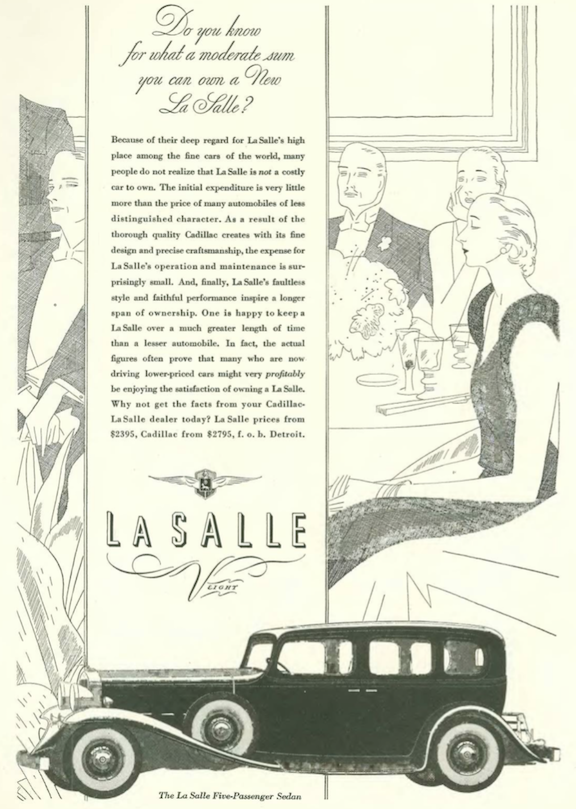
…the makers of LaSalle, a downscale version of Cadillac, wanted readers to imagine that owning their car would put them in the same company as the fashionably blasé patrician class…
…Hudson also made an appeal to class with this full-color ad designed to pique the Anglophilic tendencies of many readers…
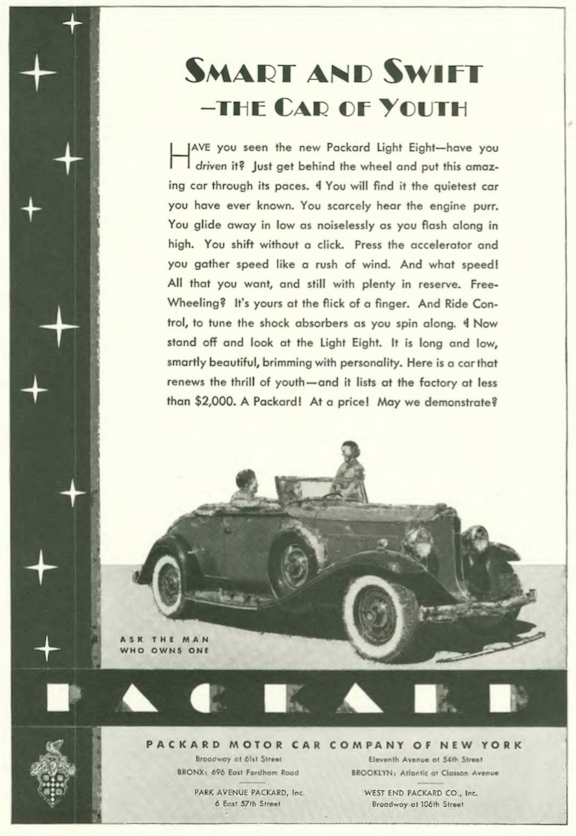
…the makers of the luxurious Packard usually marketed to older monied folks who sought mechanical quality, refinement and reliability, so this ad was a bit of a surprise…
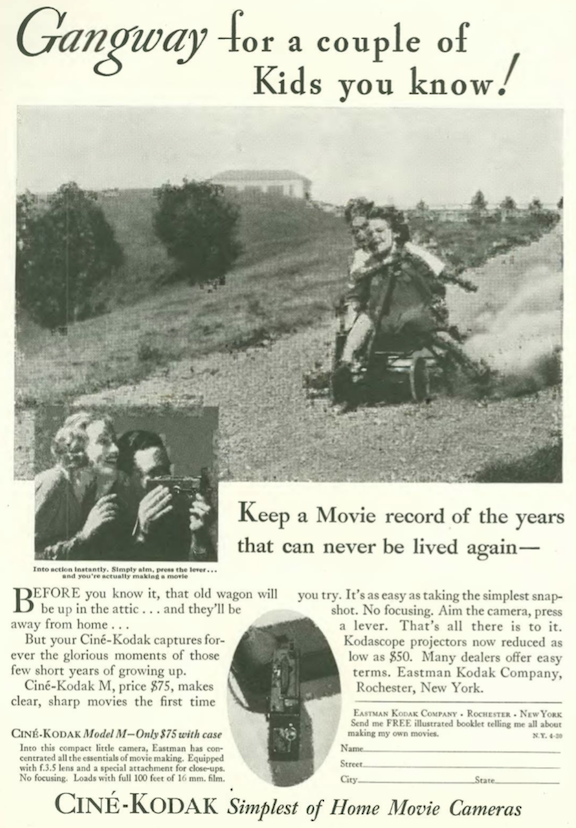
…and speaking of youth, with have an ad from Ciné-Kodak that begins on a lively note…
…but then includes this guilt-inducing bummer…
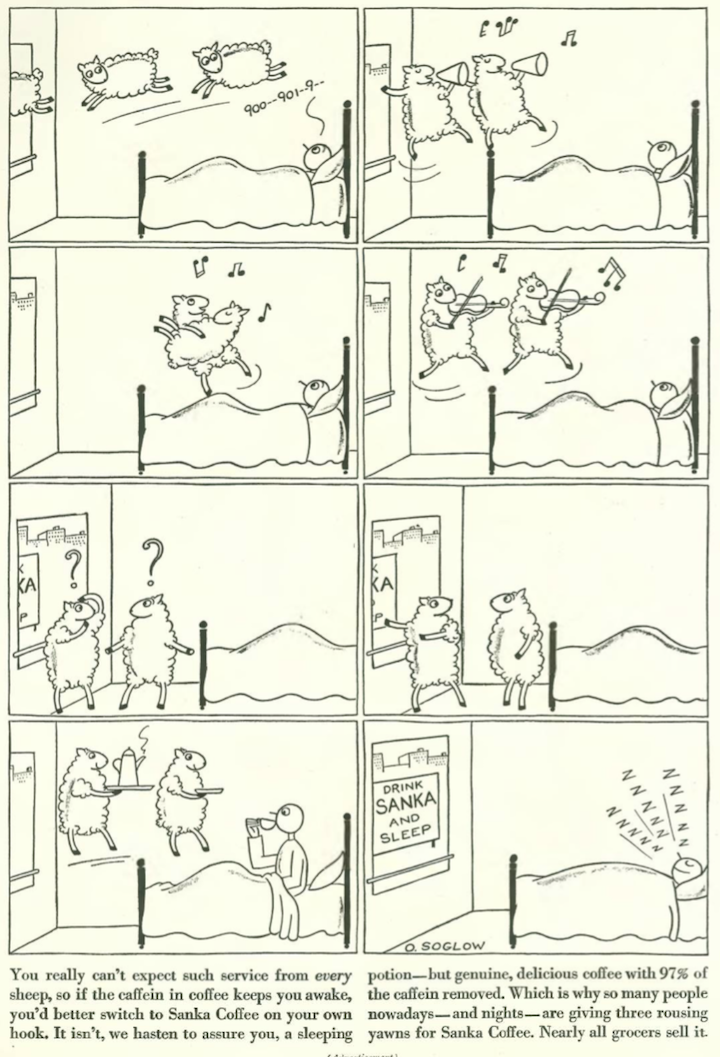
…Otto Soglow kept things lighter with his latest ad for Sanka…
…which brings us to the cartoons, and Soglow’s Little King…
…Robert Day gave us a cordial shoppe owner spying opportunity…
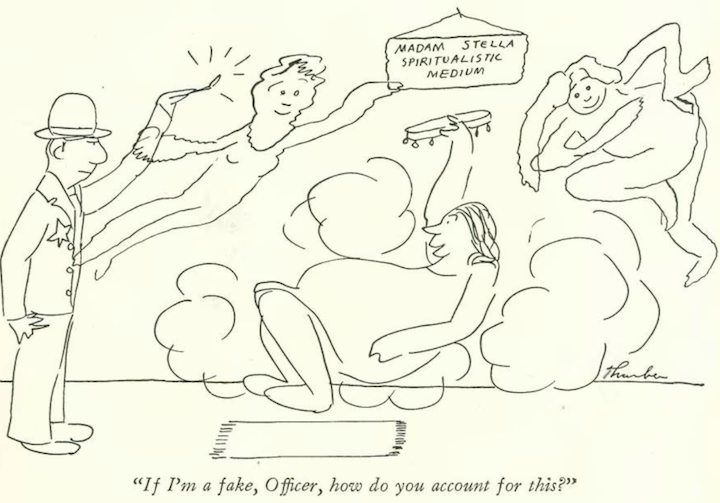
…James Thurber explored the spirit realm…
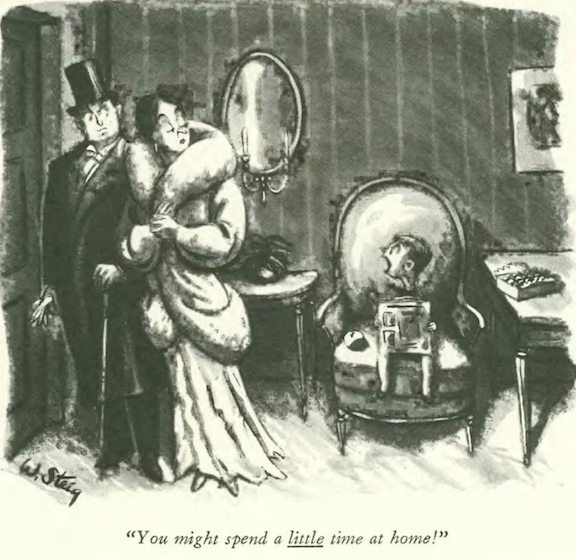
…Peter Arno found misunderstanding at the manor house…
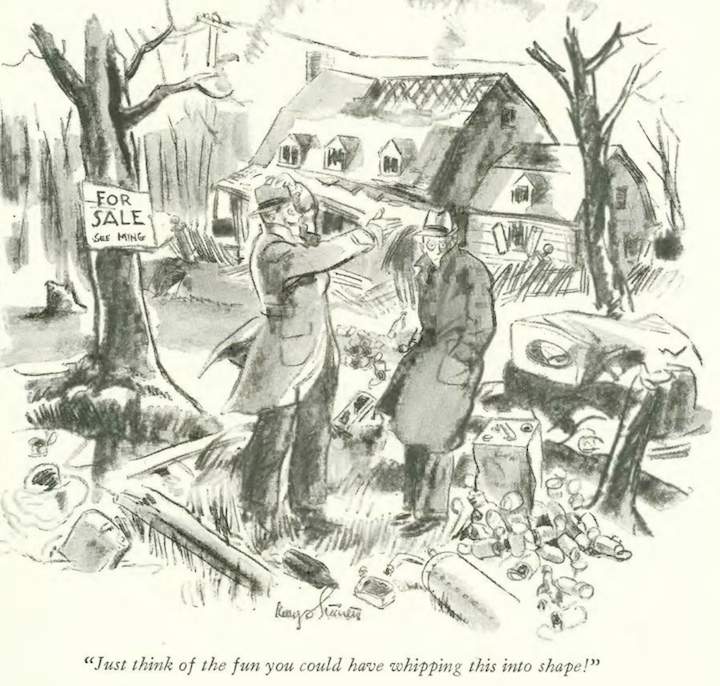
…and Kemp Starrett found a real fixer-upper…
…William Steig let one of his “Small Fry” speak his mind…
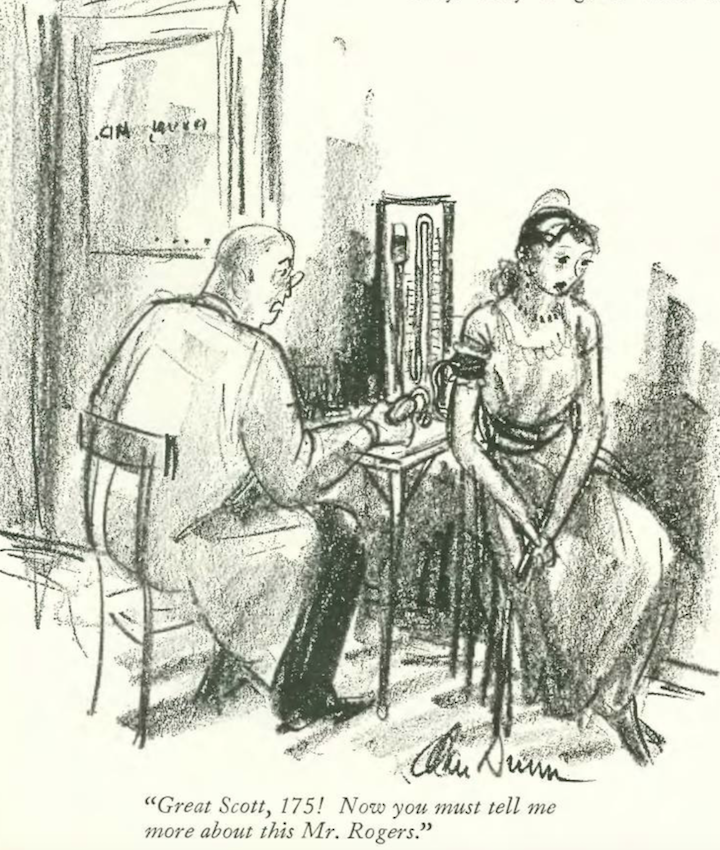
…and we close with Alan Dunn, and the pressures of modern love…
Although she served as The New Yorker’s fashion editor for decades, and even laid the groundwork for fashion criticism in general, Lois Long will always be known as one of the pivotal early writers who shaped the magazine’s voice and image.
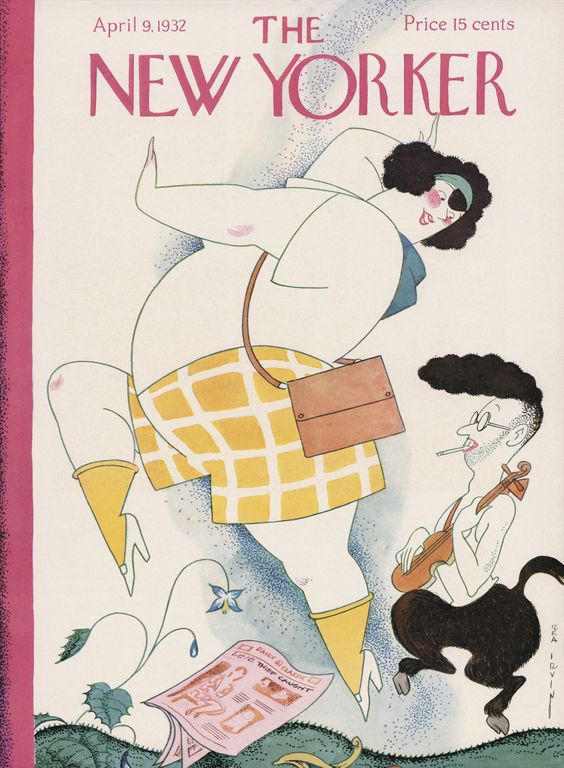
April 9, 1932 cover by Rea Irvin.
The New Yorker’s stated mission to be both “witty and sophisticated” was fulfilled in Long’s “Tables for Two” column, in which she—perhaps more than any other writer of the Roaring Twenties—vividly captured the decadence of New York’s speakeasy nightlife. Long wrote the weekly “Tables” column from September 1925 to June 1930, when she dropped the column for a time to focus on her weekly fashion review “On and Off the Avenue” (she was also married to cartoonist Peter Arno, and they had a one-year-old daughter, Patricia, which doubtless put a cramp in her nightlife routines).
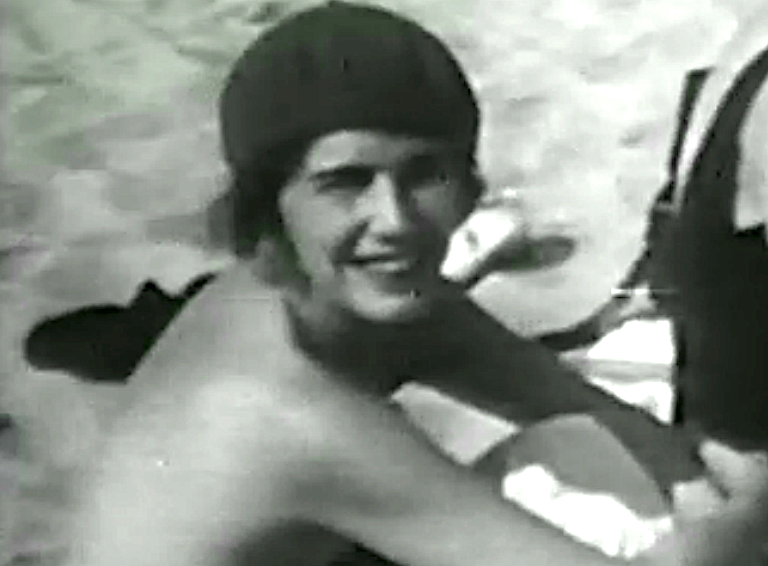
SALAD DAYS…Lois Long relaxes on a beach in this still image from a 1920s home movie; it was a time when hopping speakeasies until 4 a.m. — and writing about it — was her forte. (PBS)
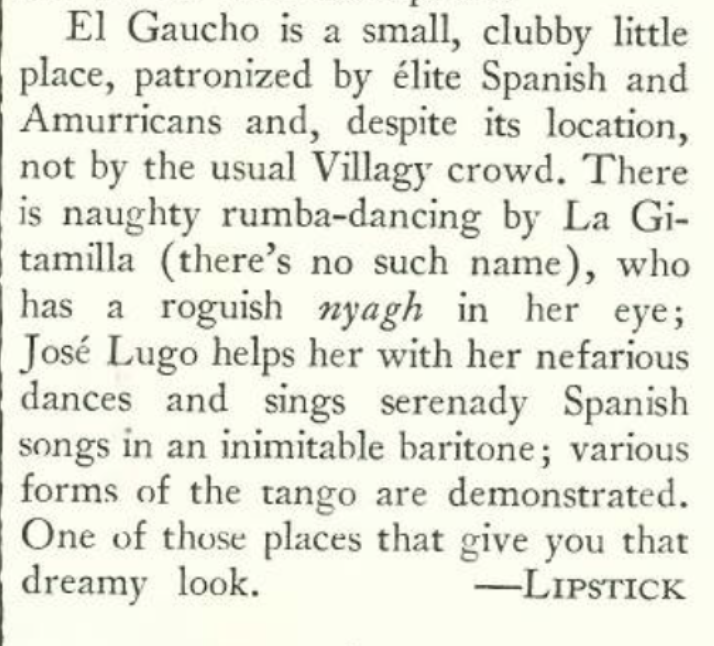
In the midst of divorcing Arno in early 1931, Long embarked on a six-part series titled “Doldrums,” lamenting the state of New York nightlife, which she found to have very little life. However, in June of that year, her divorce was almost finalized, she filed another “Tables for Two” column. Here she is, nearly a year later, with another “Tables” column, again with the familiar pen name “Lipstick,” now finding herself too old (at age 30) for the nightlife at the Pennsylvania Grill and the New Lido Club. Some excerpts:
HE DID IT ALL…Moonlighting from his Ziegfeld gig on Broadway, the versatile Buddy Rogers (top left) was also acting as bandleader at the Pennsylvania Grill — the popular stage and screen actor happily fronted various bands for the publicity, which he received from both Lois Long and from an ad in the back pages of The New Yorker; clockwise, from top right, the Hotel Pennsylvania; the hotel’s Grill restaurant; among the celebs spotted by Long was Broadway/gossip columnist Ed Sullivan, who would go on to other things; and Jeannette Loff, who “sang nicely” for those who danced along with the band. (Wikipedia/edsullivan.com/bizarrela.com)
About Buddy Rogers, Long wrote he “has a gleaming smile for the world and his-well-not-exactly wife,” a reference to famed silent film star Mary Pickford, also in the audience, and also married to actor Douglas Fairbanks (Pickford and Rogers had been carrying on a not-so-secret romance since 1927).
PICKY PICKFORD…Mary Pickford in 1932. (Culver Pictures)
Long also paid a visit to the Folies Bergère, which was basically a road show produced by the famed Parisian theater of the same name. She found the performances second-rate, and didn’t quite see the appeal of the cross-dressing comedian Jean Malin, whom we’ve seen in this blog before doing his Mae West schtick.
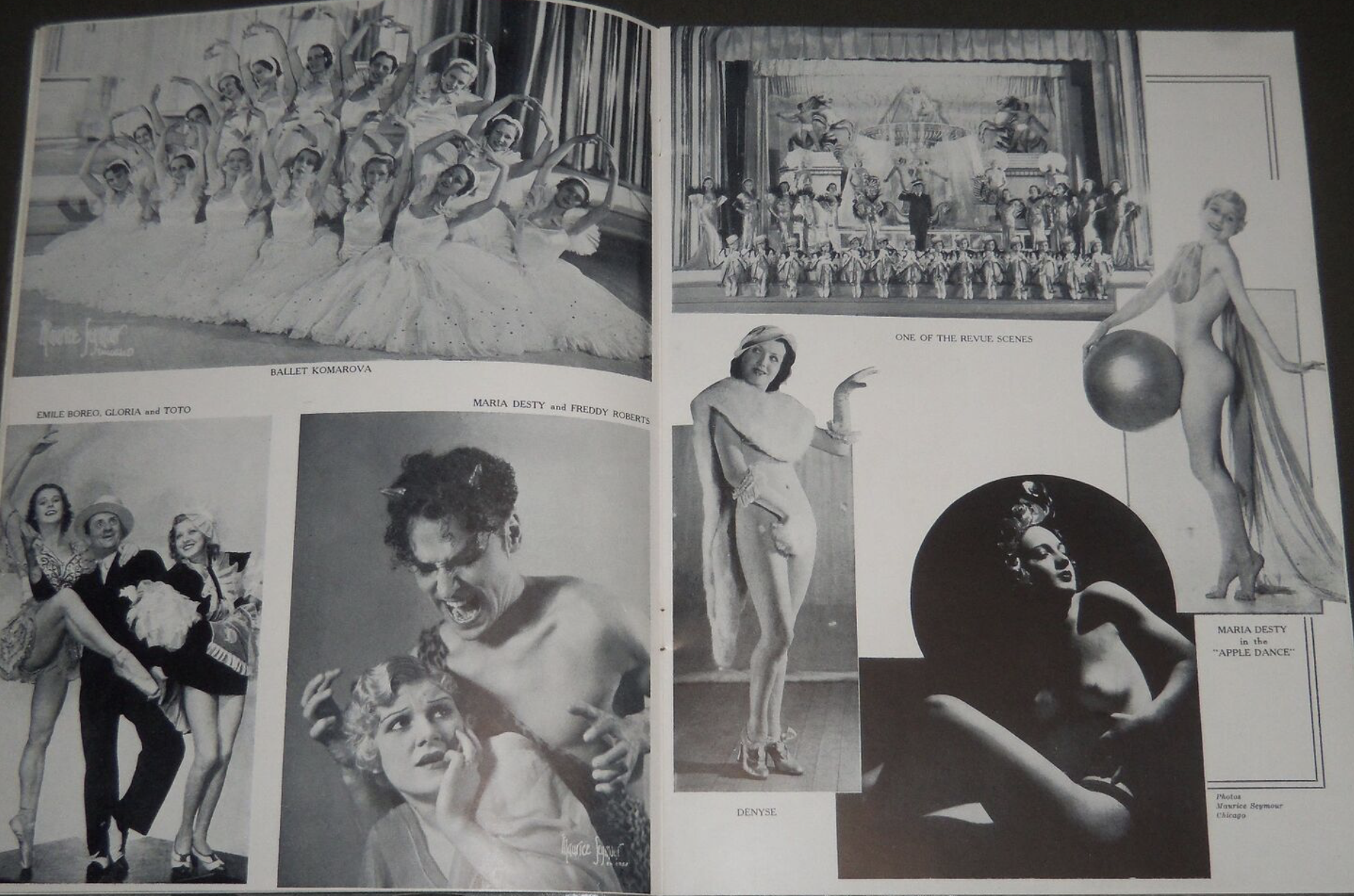
UNDER COVER…Program for the New York version of the Folies Bergère from 1933; at right, Jean Malin with and without (inset) his costume. (Ebay/Pinterest)
A perusal of the 1933 Folies Bergère program suggests this was not family-friendly fare…
Long concluded her column with the familiar signature, and perhaps a sigh…
* * *
The Other Lois
We aren’t quite finished with Lois Long. I happened to notice this ad in the back pages of the issue—although the folks at Van Raalte believed fishnet stockings (first introduced in the 1920s) were all a civilized girl could desire, Long maintained a skeptical distance in her “On and Off the Avenue” fashion column:
* * *
The Brothers Mills
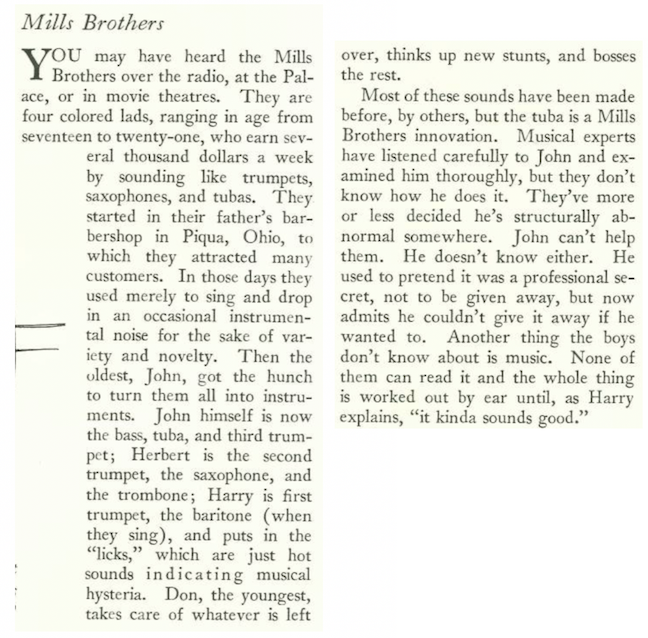
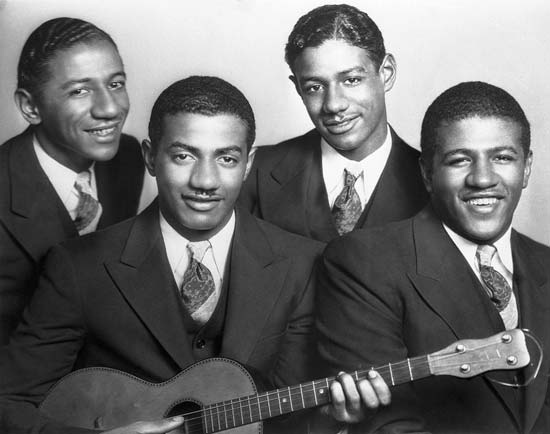
The “Talk of the Town” introduced readers to the Mills Brothers (Donald, Herbert, Harry and John Jr.), and if you haven’t heard of them, your parents or grandparents sure thought they were swell. Perhaps the most popular vocal group of all time, you can still hear them today, especially in old Christmas carol compilations.
SOLID GOLD…the jazz and pop vocal quartet, the Mills Brothers, made more than 2,000 recordings that sold more than 50 million copies. They garnered dozens of gold records. (Remarkable Ohio)
* * *
Car Wars
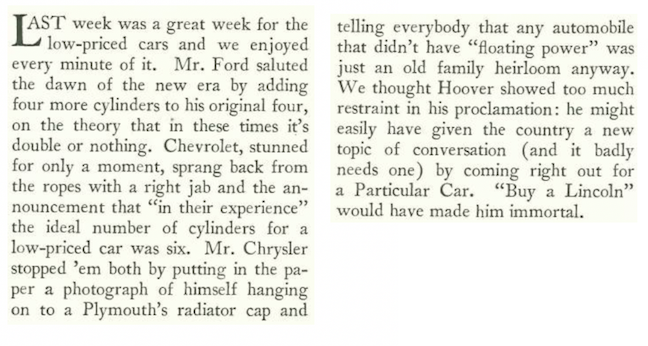
As the Great Depression slowly crushed some of the smaller automobile manufacturers, the Big Three (Ford, GM and Chrysler) were duking it out in the advertising pages, much to the amusement of E.B. White, who filed this in his “Notes and Comment” section:
FLOATS LIKE A BUTTERFLY…While Ford and GM fought over cylinders, Walter Chrysler outflanked them with his “Floating Power” Plymouth. (americanbusinesshistory.org)
* * *
From Our Advertisers
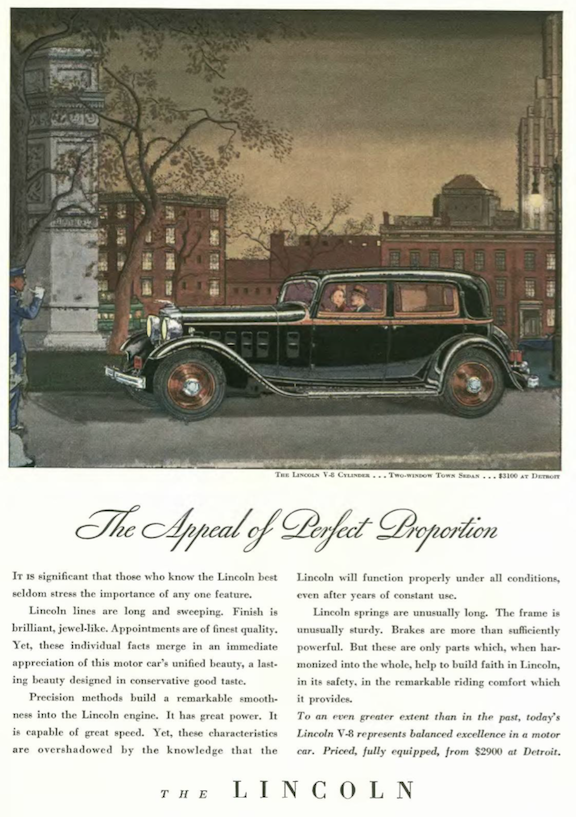
E.B. White provides us a nice segue into our advertising section, where desperate automakers vied for the attention of cash-strapped Americans, including the makers of the luxury brand Lincoln, who hoped to convince the upper-middles that this 8-cylinder model was every bit as good as their 12-cylinder monster…
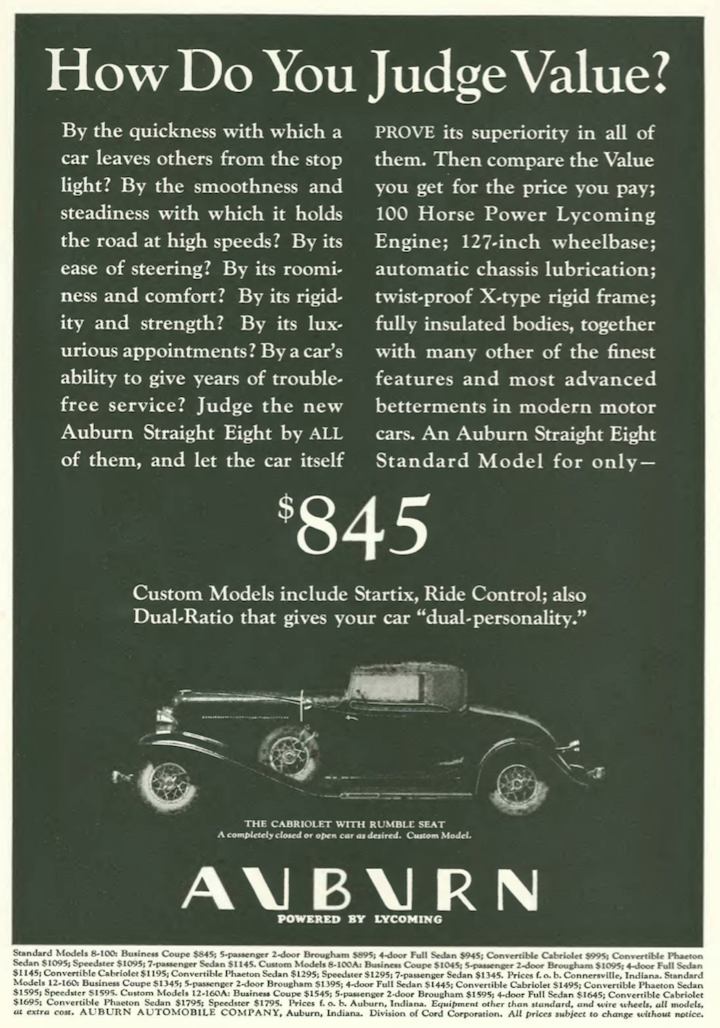
…the Lincoln Eight would still set you back a cool $2,900, roughly equivalent to a car costing $60k today…if I had a time machine I would opt for this sweet little Auburn, a bargain from a company that made some bonafide classics before the Depression plowed it under…
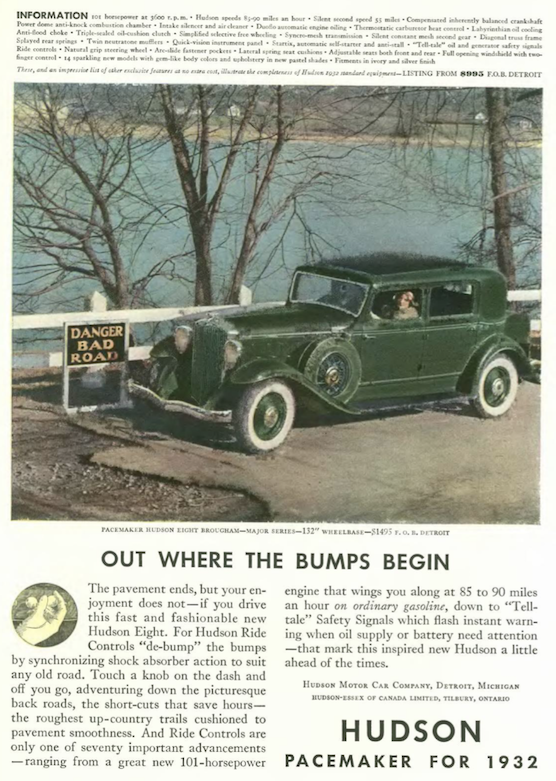
…Hudson would manage to hang around until the 1950s, when it merged with Nash to form American Motors, but I include this ad to remind readers that in 1932 many roads were like this, especially when you cruised beyond the city limits and headed upstate…
…the ads in The New Yorker are rife with social class cues, even unintended ones, like this illustration from Arrow shirts that suggested “old Cuthbert” was out of step with the more nattily dressed, when in fact old Cuthbert might have been old money and couldn’t have given a damn about his collar, let alone the opinions of the grasping new money crowd…
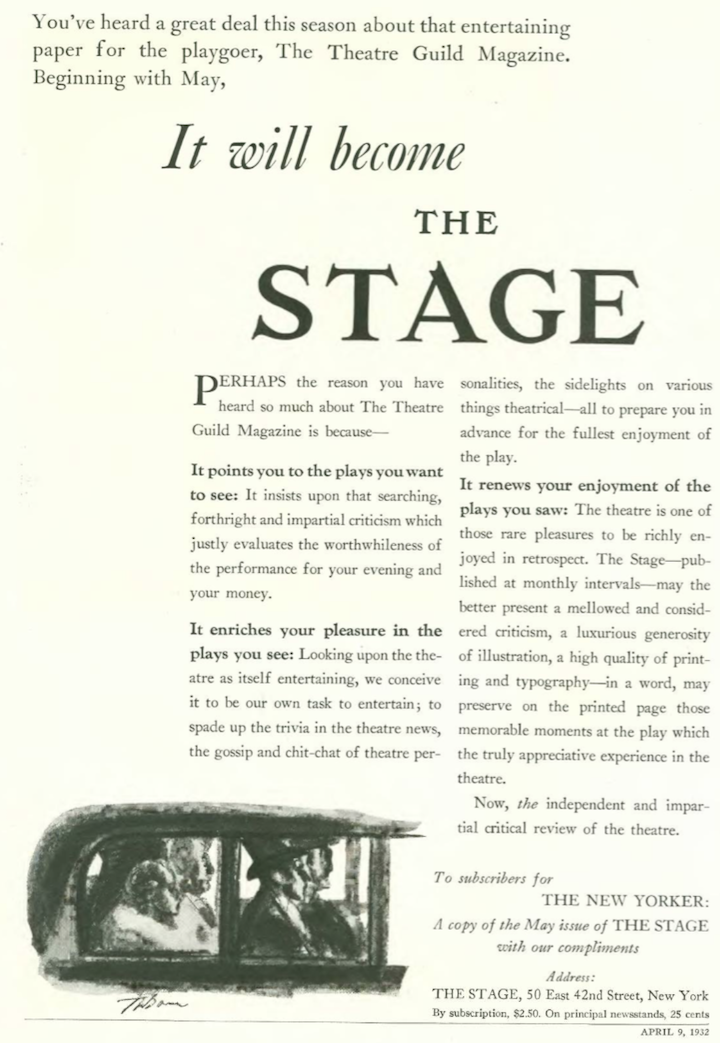
…this advertisement caught my eye initially because it was from the Theatre Guild, an organization not known to be flush with enough dough to spring for full-page spreads, but there’s more…
…John Hanrahan, who also served as The New Yorker’s policy council, became the publisher of The Stage magazine in 1932, so he likely got a break from The New Yorker’s advertising department, and deservedly so: it was Hanrahan who helped put the fledgling New Yorker on a firm financial footing during some of its toughest years.
According to Lucy Moore’s book, Anything Goes: A Biography of the Roaring Twenties (excerpt found on Erenow) “The New Yorker was ‘the outstanding flop of 1925.’ Advertisers failed to materialize. Circulation dipped below 3,000. In early May, (Harold) Ross, (Raoul) Fleishmann, Hawley Truax and the professional publisher John Hanrahan met at the Princeton Club and decided to cut their losses. The initial investment of $45,000 had gone and Fleishmann was owed another $65,000. It was costing between $5,000 and $8,000 a week to keep the magazine afloat. As they walked away from the meeting, Fleishmann overheard Hanrahan say, ‘I can’t blame Ross for calling it off, but it surely is like killing something that’s alive.’ Hanrahan’s words struck Fleishmann deeply, and when he saw Ross later that afternoon he told him that he was willing to try and raise outside capital to help The New Yorker survive.”
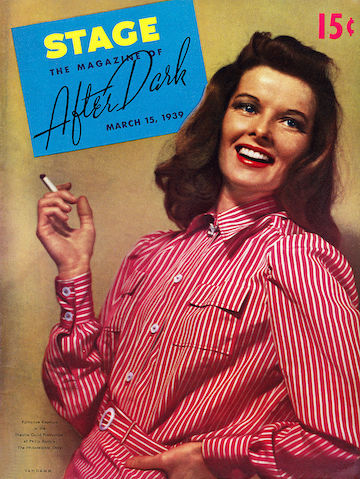
As for The Stage magazine, it managed to survive the Depression, but ceased publication in 1939. Here is the final issue:
(Wikimedia Commons)
…on to our cartoonists, we begin with this nice spot illustration by James Thurber…
…and Thurber’s cartoon contribution to the issue…
…William Steig gave us another of his “Small Fry,” coming dangerously close to being too cute for The New Yorker…
…Leonard Dove showed us some speakeasy owners appreciating an addition to the decor…
…this Otto Soglow contribution was a spot illustration, but had a lot to say about the approval ratings of President Herbert Hoover in 1932…
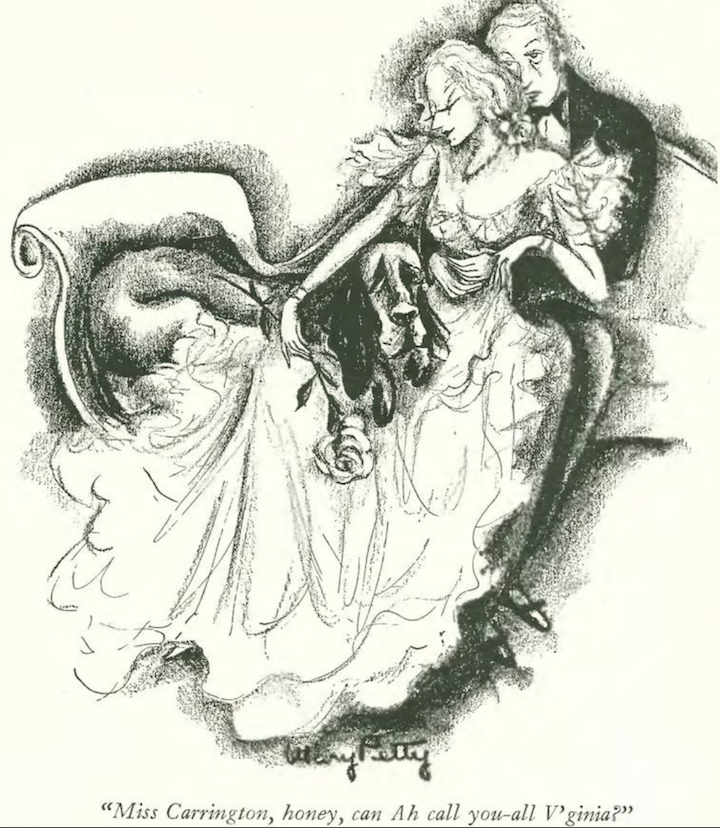
…those celebrated Southern manners, Mary Petty found, could be tedious in tender moments…
…and we close with the great Peter Arno, who gave us a peep into an awkward moment…
There was a time when dirigibles were considered the future of transatlantic transportation. In the 1930s they could carry more passengers than any other type of aircraft while offering amenities usually associated with ocean liners such as private cabins, dining rooms and large observation decks. They were also faster than those water-borne vessels.
March 26, 1932 cover by Bela Dankovsky.
Dirigibles, however, were challenging to operate—with crew members outnumbering passengers—and sometimes they fell from the sky. Such was the fate of the USS Shenandoah during a 1925 publicity flight over Ohio. On board was the Navy’s Lt. Cmdr. Charles Emery Rosendahl (1892–1977), who had to act quickly when the airship encountered a severe thunderstorm. Hitting a violent updraft that carried it beyond the pressure limits of its gas bags, the airship was torn apart. For the March 26 “Profile,” writer Henry Pringle recounted Rosendahl’s experience:
HE LIVED TO TELL ABOUT IT…Clockwise, from top left, Lt. Cmdr. Charles Rosendahl, USN, circa 1930; the USS Shenandoah in pieces near Caldwell, Ohio; the airship in better days; close-up view of the wreckage. (Wikipedia/airships.net)IT WAS A GAS…Like other other early dirigibles, the USS Shenandoah was designed for war (fleet reconnaissance) rather than passenger service. It was the first rigid airship to use a safer gas, helium, rather than hydrogen to gain lift. However, helium was scarce at the time, and the Shenandoah used almost all of the world’s reserves to fill its gas cells, which held 2,100,000 cubic feet. (fly.historicwings.com)
ON THE CATWALK…Lt. Cmdr. Charles Rosendahl hurried through this area while the USS Shenandoah was being torn apart in mid-air. Rosendahl was ordered out of the control car by the airship’s pilot, Cmdr. Zachery Landsdowne, to check on the Shenandoah’s oil and gas tanks. It was an order that ultimately saved Rosendahl’s life: Eight crew members in the control car, including Landsdowne, perished. In all, 14 crew members lost their lives. (airships.net)
* * *
Untouchable Unmentionables
In his “Notes and Comment,” E.B. White mused about one Boston store’s promotion of a line of women’s underwear as “Gandhi panties,” apparently inspired by the loincloth worn by Indian liberator Mahatma Gandhi:
THE SIMPLE LIFE…Mahatma Gandhi held numerous hunger strikes during his years of protest against India’s caste system and British Imperial rule. He is pictured here in jail in September 1932 during the second of his fasts, protesting the British government’s decision to separate India’s electoral system by caste. (history.com)
* * *
Hearst Wurst
Film critic John Mosher was not happy with the happy ending (or much else) in the William Randolph Hearst-backed Polly of the Circus, which starred Hearst’s mistress, Marion Davies, along with emerging star Clark Gable, who portrayed a small-town minister who risked his career for love with a trapeze artist.
JUST READ THE NAUGHTY BITS…Top image: With the backing of William Randolph Hearst, Marion Davies was able to bill her latest MGM film as a “Marion Davies Production.” Davies had star billing over Clark Gable in Polly of the Circus, but as his star rose in the 1930s, Davies saw her fortunes (and Hearst’s) drain away during the Depression years. Bottom image: the Reverend John Hartley (Gable) and trapeze artist Polly Fisher (Davies) “look for something hot” in the Book of Ruth. (IMDB)
* * *
From Our Advertisers
Electric refrigerators for home use had been around for less than decade in 1932, but as more companies got into the business, the drive to distinguish one’s product from the competitor’s became keen…the distinctive “Monitor Top” GE refrigerators were touted by Rex Cole in both their ads and in the design of their showrooms…
…Allen-Ingraham, on the other hand, demonstrated how their “dual-automatic” Westinghouse could bring harmony to a party of bootleg-swilling old gents…
…the makers of Electrolux invoked the inevitable march of time and progress in promoting their “automatic” refrigerator…
…on to sundry things, the upscale British department store Fortnum & Mason employed this simple ad to demonstrate the superiority of old money over the preening lower orders…
…and in the back pages we find these cheap ads for corsets, a prep school and a shorthand lessons…
…the makers of Listerine reminded readers of the connection between their old line of antiseptic products and their new line of cigarettes…
…the Santa Fe Railroad invited travelers to the Summer Olympics in Los Angeles…
…while the Missouri Pacific line promoted the wonders of Kansas City, the “Heart of America”…
…makers of the autogiro — part airplane, part helicopter — continued to promote the advantages of this supposedly easy to fly contraption…in the 1930s the autogiro was seen as the future of personal air travel, some predicting that the craft would join the automobile in many a garage…
…on to our cartoons, Alice Harvey found one man who was ready for the autogiro lifestyle…
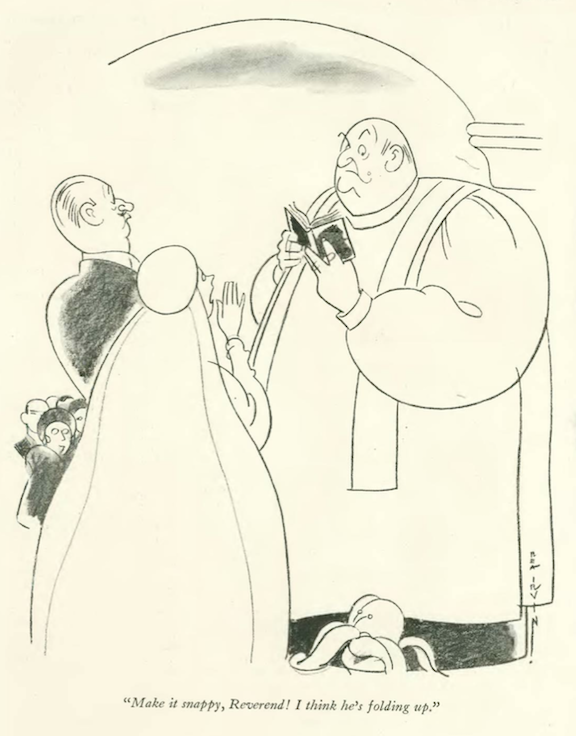
…and Peter Arno gave us an old walrus ready to take advantage of an unsuspecting host…
……and Helen Hokinson’s “girls” also found themselves involved in a scandalous situation…
…on to the April 2, 1932 issue…
April 2, 1932 cover by Julian de Miskey.
…where this time critic John Mosher took a look at a new film (and a new film genre) — Tarzan, the Ape Man, starring Johnny Weissmuller and Maureen O’Sullivan.
Weissmuller (1904-1984) was well known in the 1920s as a five-time Olympic Gold Champion swimmer, so the 28-year-old was a familiar face when he stepped into the title role. The Irish-born O’Sullivan (1911-1998) had appeared in seven films in 1930-31 before she was cast as Jane Parker in Tarzan, the Ape Man. Mosher found the film silly, but entertaining nonetheless.
THAT PRE-CODE LOOK…Before decency codes were strictly enforced in Hollywood, many early 1930s films featured scenes that were pretty racy for those times. Both Maureen O’Sullivan and Johnny Weissmuller were scantily clad for their roles in 1932’s Tarzan the Ape Man. (IMDB/fanpop.com/manapop.com/YouTube)
* * *
Cancel Me, Kate
“That’s Why Darkies Were Born” was a popular song in those days of casual racism, written by Ray Henderson and Lew Brown for George White’s Scandals of 1931. It was recorded by a number artists including Paul Robeson (see below) and Kate Smith — it was one of Smith’s biggest records and also the reason she was recently “cancelled” in some sports venues.
In 2019 the New York Yankees announced that Smith’s rendition of “God Bless America” would no longer be played at Yankee Stadium, citing not only Smith’s version of “That’s Why Darkies Were Born” but also her past performances of the song “Pickaninny Heaven.” The Philadelphia Flyers followed the Yankees example, covering up and later removing a statue of Smith outside the Wells Fargo Center.
THAT’S WHY YOU WERE CANCELLED…One of Kate Smith’s biggest early hits was her performance of “That’s Why Darkies Were Born.” In 2019 the Philadelphia Flyers organization covered and later removed a statue of Smith outside the Wells Fargo Center. (mprnew.org)
* * *
From Our Advertisers
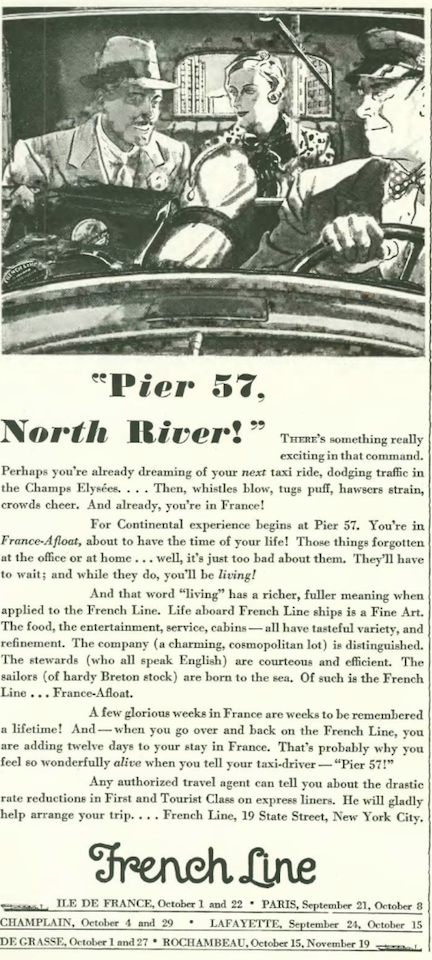
We have more inducements to travel, this time abroad and in style aboard the French Line…
…or if you were looking for something a bit more exotic, Intourist could book you passage to the Soviet Union…
…on to our cartoonists, we begin with this great spot illustration by Victor De Pauw, who contributed to The New Yorker from 1928 to 1948…
…William Crawford Galbraith offered some insight into the cultural tastes of the upper orders…
…while Alan Dunn illustrated the Depression’s domestic woes…
…and we have what I believe is the first appearance of William Steig’s “Small Fry” children identified as such…many more would follow, later to be collected into a popular book by the same name…
…and another by Steig of a person contemplating his life’s desire…
…and we end with James Thurber, with all of his familiar themes tied up in one drawing…
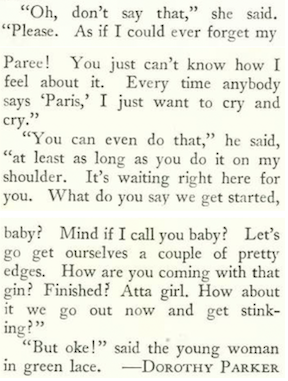
Dorothy Parker was no fan of A. A. Milne of “Winnie-the-Pooh” fame, and neither was her dear friend Robert Benchley, the latter having had the misfortune of reviewing Milne’s latest Broadway play, They Don’t Mean Any Harm, which opened on Feb. 23, 1932, and closed (mercifully, one gathers) after one week.
March 5, 1932 cover by Leo Rachow commemorated the US Vs. Canada hockey match at the 1932 Winter Olympics at Lake Placid, NY. Canada won its fourth consecutive Olympic gold by narrowly edging the US (silver) in total points.
Parker, as readers may recall, famously ridiculed Milne’s The House at Pooh Corner in The New Yorker, beginning with a quote from the book: “‘Well, you’ll see, Piglet, when you listen. Because this is how it begins. The more it snows, tiddely-pom’ – ‘Tiddely what’ said Piglet. ‘Pom,’ said Pooh. ‘I put that to make it more hummy.’ And it is that word ‘hummy’, my darlings, that marks the first place in The House at Pooh Corner at which Tonstant Weader Fwowed up” (Parker wrote her book reviews under the pseudonym “Constant Reader”).
As for Benchley, he fondly recalled Milne’s earlier work, when he wrote silly verse and essays in the British humor magazine Punch, but apparently Milne’s downfall began when he published some “Pooh” poetry in the Feb. 13, 1924 issue…
WELL, DISNEY LIKED IT…A. A. Milne (1882–1956) pictured in his younger days (inset) joined the humor magazine Punch in 1906 and served as its assistant editor. After his son was born in 1920, he compiled a collection of poems for children, When We Were Very Young, illustrated by Punch cartoonist E. H. Shepard. An excerpt from the Feb. 13, 1924 issue appears above. (Pinterest)
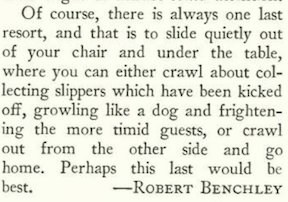
Parker, of course, did not think much of Milne as a children’s author, and Benchley also found him wanting (more than once) as a playwright. Here is the first part of Benchley’s scathing review of They Don’t Mean Any Harm, which was presented at the Charles Hopkins Theatre on 49th Street.
…Benchley’s evisceration continues on the left column…
NO ACTORS WERE HARMED IN THE MAKING OF THIS PLAY…They Don’t Mean Any Harm closed after just a week (15 performances), but it would give rising young star Marion Burns (top left) her debut on a New York stage. Also appearing was veteran actor O.P. Heggie, who had to dial up the schmaltz to play a character so sweet (the role of Mr. Tilling, a humble, poor book agent) that it achieved just the opposite effect for critic Robert Benchley, who wrote he had never seen “a fouler character than Mr. Tilling”; pictured at bottom, A. A. Milne circa 1920s, and the cover of the program. (imdv.com/RKO Radio Pictures/Wikipedia/Playbill)
* * *
Meanwhile, Beneath the City…
Eric Hodgins (author of the popular novel Mr. Blandings Builds His Dream House) filed a two-part feature on the New York subway system, marveling at the complexities of a transportation network that daily served millions while under constant development. Excerpts:
IN THE NAME OF PROGRESS…Today’s sandhogs (tunnel diggers) work in much safer conditions than in the 1930s, but some of the technology described in Eric Hodgin’s article was still around in 2015 (see below). Top photos, left, sandhogs tightening a bolt on a tunnel connection; right, subway tunnelers who worked under the East River are shown in a decompression chamber. Bottom photos, left, city officials in 1933 showing off a ventilation system installed to cool down trains (but air-conditioning was still decades away); and right, a 1938 Walker Evans photo from his subway series. (Daily News/public delivery.org/ephemeralnewyork.wordpress.com)
Six years ago Business Insider described the “100-year-old technology” still used by the Metropolitan Transportation Authority (MTA), and you can see that in 2015 (bottom photo) the switches and control panels were similar to ones in the 1930s (top photo). Also note the old handset (possibly bakelite) at left center of the 2015 photo.
(businessinsider.com)
I am not including these images to ridicule the MTA, but rather to admire the hard work, technological prowess and creativity of our forebears. Improving these vast, complex systems takes time and money, and especially money, lots of it.
* * *
Coming Up For Air
Stuffy, crowded subway cars were largely unknown to those New Yorkers who still had means in the 1930s, and who could escape the city’s late winter doldrums and flee to sunny Bermuda. The “Out of Town” column offered some travel tips:
WISH YOU WEREN’T HERE…These fortunate New Yorkers enjoyed Bermuda’s sunny climes in 1932. (New York Historical Society)
* * *
From Our Advertisers
We begin with advertisement for the lovely Hotel Pierre, still a landmark of luxury in Manhattan. In 1932, however, the Depression forced the new hotel (opened in 1930) into bankruptcy. And so, we read this ad with tinge of sadness for Charles Pierre and his short-lived dream…
…one thing the Depression didn’t destroy was the need to shave one’s whiskers, and this is the first time (at least that I have noticed) that Burma Shave referenced its famous roadside jingles in a New Yorker ad…
…the concept of being “mouth-happy” was the tagline used by the makers of Spud menthol cigarettes, who encouraged smokers to light up even before they got out of their PJs…
…Lucky Strike, meanwhile, stuck with their “toasted” claims, and to images of fame, youth and beauty to suggest that your looks as well as your throat would benefit from their product…
…the woman in the Lucky ad, June Collyer (1906-1968), was one of 13 women selected as “WAMPAS Baby Stars” in 1928. During the 1920s and early 30s, the Western Association of Motion Picture Advertisers (WAMPAS) honored 13 or so young actresses each year whom they believed to be on the threshold of movie stardom (In the 1940s Collyer’s brother “Bud” Collyer provided the voice of Superman on the radio). While I digress, here is a photo of the WAMPAS Baby Stars of 1932:
WAMPAS Baby Stars of 1932. Back row: Toshia Mori, Boots Mallory, Ruth Hall, Gloria Stuart, Patricia Ellis, Ginger Rogers, Lilian Bond, Evalyn Knapp, Marian Shockley. Seated in front row: Dorothy Wilson, Mary Carlisle, Lona Andre, Eleanor Holm and Dorothy Layton (June Clyde is not pictured).
…on to our cartoons, we go from the glamorous to the everyday with William Steig…
…and Garrett Price…
…Richard Decker suggested someone might be in for a bumpy ride…
…and Decker again, illustrating the perils of another form of transportation…
…Barbara Shermund gave us a wealthy matron eager for show and tell…
…and Peter Arno looked in on one of his ancient walruses, pining for the olden days…
…on to the March 12, 1932 issue…
March 12, 1932 cover by Rea Irvin.
…and some insights into a variety of world events, large and small, by E.B. White:
GR-R-ATE was the word used by one newsreel announcer to describe Malcolm Campbell’s land speed record of 253.96 miles per hour, achieved on the sands of Florida’s Daytona Beach on Feb. 24, 1932. E.B. White wanted to know why this achievement was so gr-r-ate. (floridamemory.com)
And we have White again, who we all know loved dogs, and especially Daisy, his beloved Scotty. When she was killed by a swerving taxicab, he wrote a beautiful remembrance in the New Yorker. Here are the first and last paragraphs.
TRAVELING COMPANION…Katharine White with Daisy on a leash in New York City, 1931. In the pram is baby Joel. (brainpickings.org)
One more by White, this time admiring the heavenly beauty of a GE refrigerator in the window of a Rex Cole store on East 21st Street:
KING OF COLD…The Eagle Building (right) on East 21st held the Rex Cole showroom admired by E.B. White. To get some idea of Rex Cole’s theatrical fridge displays, the image at left is of a Bronx storefront. (MCNY/Daytonian in Manhattan)
* * *
From Our Advertisers
With the Depression still deepening, even the rich needed a break, so Lincoln rolled out an eight-cylinder model, at $2,900 still too steep for most folks…
…and priced competitively with the Lincoln, the Chrysler Imperial Eight looked a lot more fun…
…and we have another stylish and very modern Coty advertisement by American fashion illustrator Ruth Sigrid Grafstrom…
…on to cartoons, Gluyas Williams demonstrated that sometimes words alone don’t have the same effect as a simple gesture…
dd
…Garrett Price found a hapless fellow on a train to nowhere…
…Helen Hokinson’s “girls” were going through the motions at a bridge tournament…
…and Helen again with the lives and loves of our youth…
…and we close with James Thurber, his war between the sexes taking a new twist…
E.B. White was not known for his sports reporting, but when the Third Winter Olympic Games opened in Lake Placid, New York, on Feb. 4, 1932, it was White who represented The New Yorker at the first-ever winter games in the U.S.
Feb. 20, 1932—seventh anniversary cover by, of course, Rea Irvin!
Famed caricaturist Emery Kelen (1896-1964) provided the artwork for White’s account of the games…
…which was featured in the “A Reporter at Large” section under the title, “Midwinter Madness.” White opened the piece with some observations on Godfrey Dewey, head of the Lake Placid Club, and son of Melvil Dewey, inventor of the Dewey Decimal System. It seems that Dewey wanted the Olympic posters printed in the simplified Dewey system of spelling:
BEFORE BOB COSTAS…Opening ceremonies were a far simpler affair. Clockwise, from top left, the III Winter Olympic Games officially opened on Feb. 4; Sonja Henie of Norway and Karl Schäfer of Austria were gold medal winners in ladies’ and men’s singles figure skating; the rather uninspired official poster for the event; as a pusher in the four-man bobsleigh team, Edward Eagan (center) won the gold medal with the USA I team. Twelve years earlier Eagan had been crowned Olympic champion in the light heavyweight boxing competition at Antwerp. He was the first and only person to win gold at both the summer and winter games. Note the leather helmets and the fact that, unlike today, the sled is actually a real sled. (olympic.org/Wikipedia)
True to form, White set the stage for the games by describing his train journey to Lake Placid. At the games he observed dogsled teams—dogsled racing was one of nine sports featured at the III Winter Olympics—and marveled at the derring-do of the ski-jumpers.
Writing in the Atlantic (Feb. 10, 2014), Philip Bump described the 1932 Games as looking “way more fun and dangerous” than today’s games, “like a group of guys who set up a competition in the woods behind their house. The Jackass Games, really.” They were a lot smaller, too. The 2018 Olympics in Pyeongchang, South Korea featured entrants from 92 countries participating in 102 events over 15 disciplines. By contrast, just 17 countries participated the 1932 games.
HOVERING HANS…Norwegian Olympic skier Hans Vinjarengen took Bronze at the 1932 games. At right, ski jump at Lake Placid. (olympic.com/Wikipedia)
And we close with this gif of an unidentified ski jumper at the ’32 games…
* * *
Seeing Red
The Mexican painter Diego Rivera was sympathetic to the Soviet cause (with a Trotsky twist), but to the party faithful, painting a mural for some money-grubbing capitalists was unforgivable, as “The Talk of the Town” related…
NO GOODNIK…Left, Diego Rivera at work on Allegory of California at the San Francisco Stock Exchange Luncheon Club, 1931. At right, the mural still graces the stairwell of the building, now called “City Club.” (sfhistory.org).
* * *
Thank Heaven For Little Smiles
It is a challenge to find an image of Maurice Chevalier without his sunny smile, but as “The Talk of the Town” revealed, even the French crooner needed a break from all that mirth…
GRIN AND BEAR IT...Maurice Chevalier headlined an evening of song and dance at the Fulton Theatre in February 1932. (playbill.com)
* * *
Survivor
The last surviving artist of the old Currier & Ives print shop, Louis Maurer (1832–1932) celebrated his 100th birthday, and “The Talk of the Town” was there to fete the old man…
AMERICANA’S FINEST…Louis Maurer poses with one of his works on the centenary of his birth. (findagrave.com)
* * *
Silence is Golden
One of the older actors working in Hollywood, British actor George Arliss (1868–1946) was best known for his role in Disraeli (1929), and he is also credited with promoting the career of 23-year-old actress Bette Davis, who would have her breakout role in The Man Who Played God. This remake of a 1922 silent (that also featured Arliss) told the story of a concert pianist, Montgomery Royale, who believes his career is over when he loses his hearing. However, he finds a new purpose when he uses his lip-reading skills to help others, including himself when he calls off his engagement to Grace (Davis) after learning she is in love with another man. Critic John Mosher was impressed by Arliss, but found the film sanctimonious and wished the actor would play a baddie for a change.
TWO-TIMER…George Arliss appeared in both silent (1922) and talking (1932) versions of the The Man Who Played God. The latter film featured 23-year-old Bette Davis (second from left) in her breakout role. (IMDB)DRAMA KING…Concert pianist Montgomery Royale (George Arliss) considers suicide when he loses his hearing in 1932’s The Man Who Played God. Arliss was the first British actor to win an Academy Award for his role as PM Benjamin Disraeli in 1929’s Disraeli. (IMDB)
While Mosher found The Man Who Played God a bit too preachy, Murders in the Rue Morgue (1932) was way too campy to be taken seriously as a horror film. Thanks to his newfound Dracula fame, Bela Lugosi headlined the film, which debuted another young star, Arlene Francis (1907–2001), who would find her greatest fame in television from 1949 to 1983, most notably on the long-running quiz show What’s My Line?
HORROR MONSTER SHOW…or so the producers of Murders in the Rue Morgue (1932) claimed. Still image from the movie featured Bela Lugosi (left), Noble Johnson and Arlene Francis. (IMDB)
* * *
From Our Advertisers
Planning a visit to England? Don’t be mistaken for a clod-kicking Yankee and get yourself over to Lord & Taylor’s…
…and with spring in the air make sure little sis has the right duds to look like a 40-year-old woman…
…if you’re taking the train, you wouldn’t dare sit with the proles (I mean, look at that woman eating god-knows-what from a wrapper, and some filthy urchin wandering the aisles, and what the hell does Mr. Creepo have in that box?), so why settle for plain old gas when you can sweeten it with some lead?…
…nothing better than traveling out into the fresh air to breathe in some nice fresh tobacco smoke…it’s naturally fresh, so it’s just as good as mountain air, maybe even better…
…this poor chap can’t breathe well at all, or so he claims, and that’s why he needs Vapex…
…which puts him right to sleep because it contains 70 percent alcohol, so why not take a couple of chasers with that snort…you’ll get used to the menthol flavor (it’s in your Spud cigarettes after all) and before long it’s nighty-night, oh hell I’ll just drink this and put a little ether on my pillow…yeah that’s the ticket…
…for others, why even bother pretending Prohibition is still a thing?…
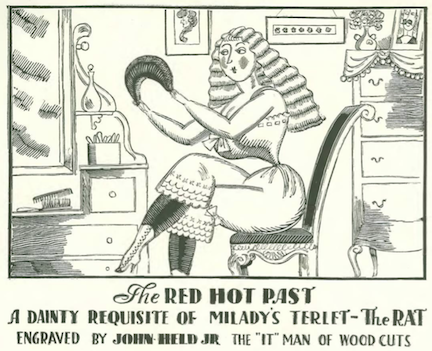
…and look at this swell cocktail set you could stock in your Bantam Bar, designed by The New Yorker’s own John Held Jr…
…on to our cartoons, we have Held again with another look at those naughty Victorian days…
…Rea Irvin continued his commentary on the “improving” economy…
...Richard Decker gave us a master of understatement…
…William Steig captured a special father-son moment…
…Barbara Shermund continued to explore the ways of her modern women…
…given the recent kerfuffle over Dr. Seuss, Carl Rose confirms just how acceptable racist stereotypes were back in the day…
…and we end with Peter Arno, and one sugar daddy finding himself on the skids, temporarily at least…
The year 1932 was a tough one for many Americans, barely scraping by in the deepening Depression. But to the suffering millions in the Soviet Union, America’s economic woes looked like a walk in the park.
Jan. 30, 1932 cover by Rose Silver.
The year marked the beginning of a catastrophic famine that swept across the Soviet countryside, thanks to the government’s bone-headed and heartless forced collectivization that caused more than five million people to perish from hunger. Those events, however, were still on the horizon when Robin Kinkead, a New York Times Moscow correspondent, ventured out into Moscow’s frigid streets in search of a lightbulb. Here is his story:
WE HAVE PLENTY OF NOTHING FOR EVERYONE…In 1930s Moscow, and in the decades beyond, much of life consisted of standing in line for everything from bread to light bulbs.MAGIC LANTERN…Russian peasants experience electricity for the first time in their village. (flashback.com)STALIN CAST A LARGE SHADOW over his subjects, even when they sought a bit of light in the darkness. Stalin and Lenin profiles served as glowers in this Soviet lightbulb, circa 1935. The first series of these bulbs were presented to the delegates of Soviet parliament of 1935, just in case they forgot who was in charge—or who might liquidate them at any moment, for any reason, or for no reason. (englishrussia.com)
* * *
One of Theirs
Miguel Covarrubias was one of the first artists to contribute to the fledgling New Yorker, and his linear style was well known to readers when he opened his latest show at New York’s Valentine Gallery. It featured works he had created during a 1931 sojourn in the East Indies. Critic Murdock Pemberton found the palette reminiscent of Covarrubias’ earlier work during the Harlem Renaissance:
GLOBETROTTER…A frequent contributor to the early New Yorker, Miguel Covarrubias traveled the world in search of inspiration. His 1932 exhibition at New York’s Valentine Gallery featured his latest work, a series of “Balinese paintings” including In Preparation of a Balinese Ceremony, at right. (sothebys.com)MAN OF MANY TALENTS…An early Covarrubias contribution to the New Yorker in the March 7, 1925 issue.
* * *
From Our Advertisers
Listerine had been around since the late 1860s, but it wasn’t marketed as a mouthwash until 1914. The brand really took off in the 1920s when it was heavily advertised as a solution for “chronic halitosis” (bad breath), so in 1930 its makers went one step further by adding a few drops of their product to one of the chief causes of bad breath. The folks at Listerine were also keen to the growing market of women smokers—note the fifth paragraph: “They seem to appeal especially to women”…
…when you run out of ideas to amuse your grandchild, drop your top hat and walking stick and let him take you for a swing on a GE fridge door…wow, admire its “all-steel sturdiness” as it slowly tips toward the unsuspecting lad…
…on to our cartoons, Rea Irvin showed readers what he thought of the latest “rosy” economic predictions…
…but with the economy still deep in the dumps, building continued to boom, per Robert Day…
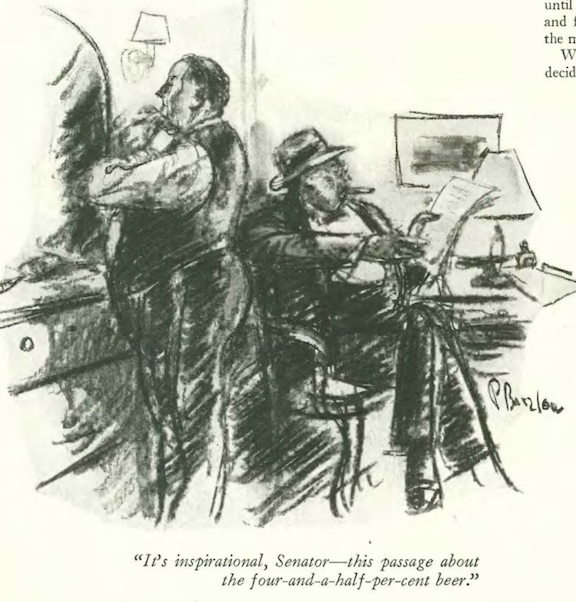
…Perry Barlow gave us a fellow needing a break from the daily gloom…
…Richard Decker unveiled this crime-fighting duo…
…Alan Dunn tempered the flames of passion…
…and we close this issue with one of James Thurber’s most famous cartoons…
…on to Feb. 6, 1932…
Feb. 6, 1932 cover by Constantin Alajalov.
…and we head straight to our advertisers…and yet with another sad Prohibition-era ad, this from the makers of Red & Gold Vintages, who promised to dress up your bootleg rotgut with many fine flavorings…
…New Yorker founding editor Harold Ross couldn’t care less about the advertising department as long as it paid the bills and kept its nose out of editorial, but I wonder if a cig dropped from his lips when he glanced at this ad…
…as noted in the Listerine ad above, tobacco companies were eager to tap the growing market of women smokers…actress Sue Carol egged on the sisterhood in this ad…Carol would have a brief acting career (including 1929’s Girls Gone Wild—not quite as racy as the 1990s DVD series) before becoming a successful talent agent…
…as noted in my previous “Dream Cars” post, women were also a fast growing market for automobiles, and manufacturers—desperate for Depression-era sales—scrambled to show women all of the swell gadgets that would make driving a snap (as if men didn’t need these gadgets too)…
…and here we have an ad from Kodak that demonstrated the ease of its home movie camera, which could go anywhere, say, like the horse races in Havana…
…Havana then was a playground for wealthier Americans, and many resided at a grand hotel operated by another rich American…
…but if you remained in town, you should at least know how to get tickets to the latest show (this drawing is signed “Russell”…could it be the noted illustrator Russell Patterson?)…
…on to our cartoons, Rea Irvin again commented on the latest predictions for economic recovery…
…but Alan Dunn found one woman who wanted an adventure, not a job…
…perhaps she should hang out with one of Barbara Shermund’s “New Women,” who had a flair for the dramatic…
…as for those seeking a new life, Mary Petty considered the costs…
…Richard Decker took us to the high seas, where a thirsty yachtsman hailed a passing smuggler…
…Otto Soglow probed the sorrows of youth…
…and William Crawford Galbraith, the joys…
…and James Thurber introduced his classic dog in a big way on this two-page spread…
…and on to one more issue, Feb. 13, 1932…
Feb. 13, 1932 cover by S. Liam Dunne.
…we begin with a nerd alert—the Feb. 13 cover represented one of the magazine’s biggest departures from the original Rea Irvin nameplate, here heavily embellished within S. Liam Dunne’s design. Departures in previous issues were more subtle, Irvin himself experimented with an elongated version in the third issue (below, left). For the April 17, 1926 issue, Katharine and Clayton Knight’s* stylish illustration (center) was the first to overlap part of the nameplate, and Sue Williams’ Nov. 17, 1928 cover (right) was the first to embellish the Irvin font.
*A note on Katharine Sturges Knight and Clayton Knight. The April 17, 1926 cover (center) was the only design by the Knights published by The New Yorker. The original picture was drawn on wood by Katharine and then cut by Clayton. Their son, Hilary Knight, is also an artist, best known as the illustrator of Kay Thompson’sEloise book series.
…on to the advertisements, kicking off with this subtle appeal from the makers of the unfortunately named “Spud” menthol cigarettes…here a young woman experiences Spud’s “mouth-happiness” while attending the annual Beaux Arts Ball at the new Waldorf-Astoria…
…if you’re wondering why the Spud ad featured a guy in a powdered wig puffing on a cigarette, well the theme of the 1932 ball was “A Pageant of Old New York.” Every year had a different costume theme, and the ladies and gentlemen of the ruling classes delighted in dressing up for the occasion…
PLAYING DRESS-UP…Program for the 1932 Beaux Arts Ball, and two of the attendees, Frank Sanders and Frances Royce. (Pinterest)
…if stuffy events weren’t your thing, you could chuck the fancy duds and head to the sunny beaches of Bermuda…
…I include this Coty advertisement for its modern look — it easily could have appeared in a magazine from the 50s or even 60s…the artwork is by American fashion illustrator Ruth Sigrid Grafstrom…
…the auto show has left town, but for some reason the makers of 12-cylinder models continued to shill their products in the New Yorker…Auburn (the middle ad) built beautiful, upscale vehicles, but the Depression would drop it to its knees by 1937…Pierce Arrow would succumb the following year…Lincoln, the highest-priced of these three, would hang on thanks to the largess of parent Ford…
…New Yorker cartoonist John Held Jr. picked up some extra bucks by designing this ad for Chase and Sanborn’s…
…and on to our other cartoonists/illustrators, Reginald Marsh wrapped this busy dance hall scene around a section of “The Talk of the Town”…
…Otto Soglow was back with his Little King, and the challenges of fatherhood…
…Leonard Dove gave us a knight lost on his crusade…
…Richard Decker explored the softer side of gangster life…
…and we sign off with Peter Arno, and a little misunderstanding…