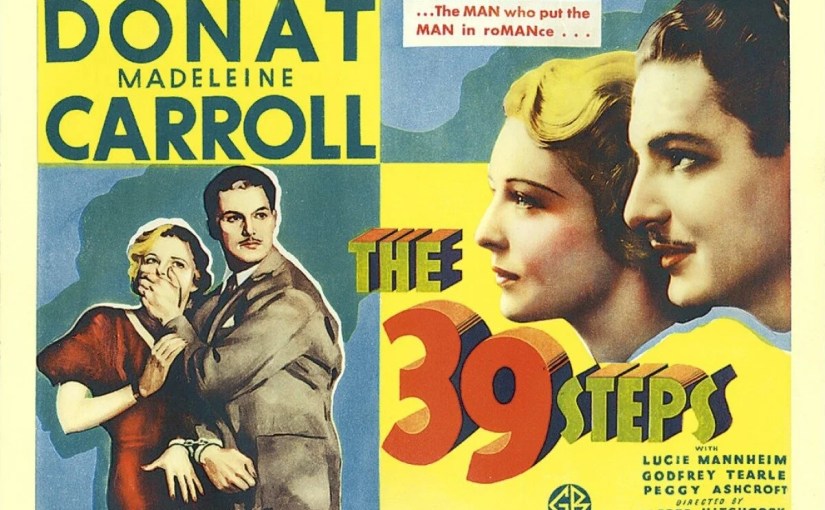
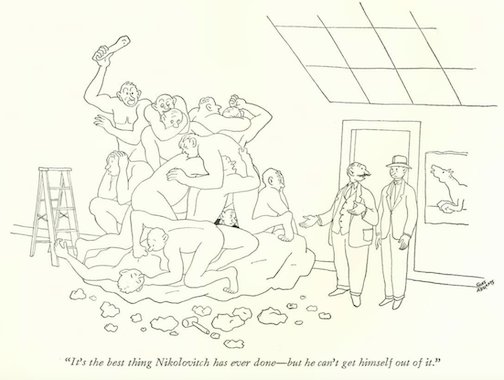
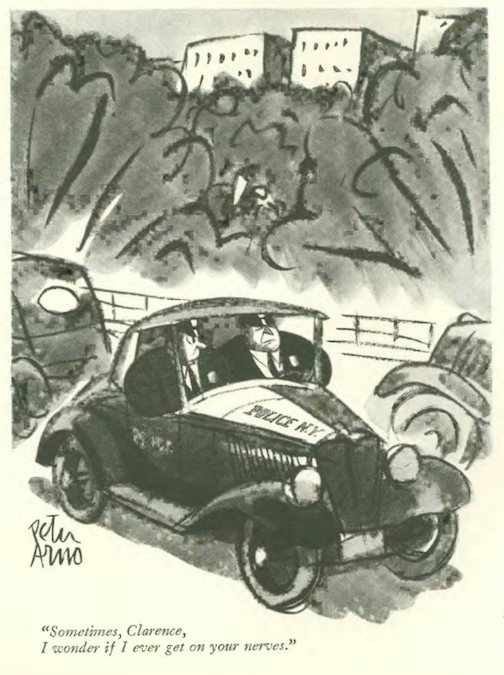
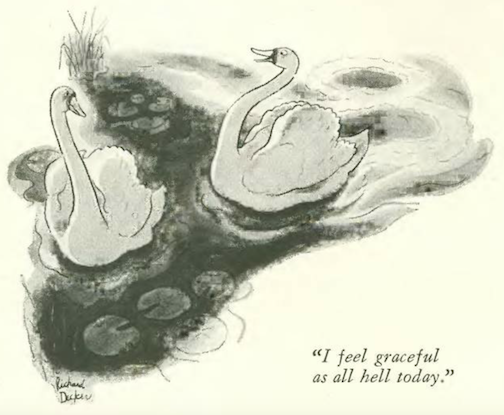
Widely acknowledged as a classic, The 39 Steps further solidified British director Alfred Hitchcock’s image as a master of suspense with American film audiences.
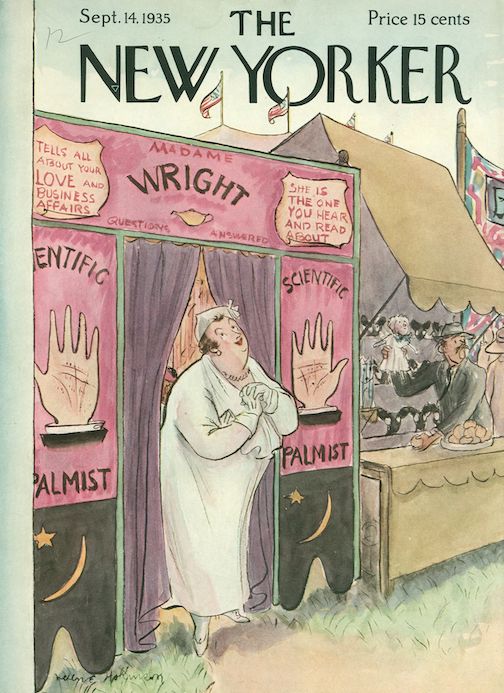
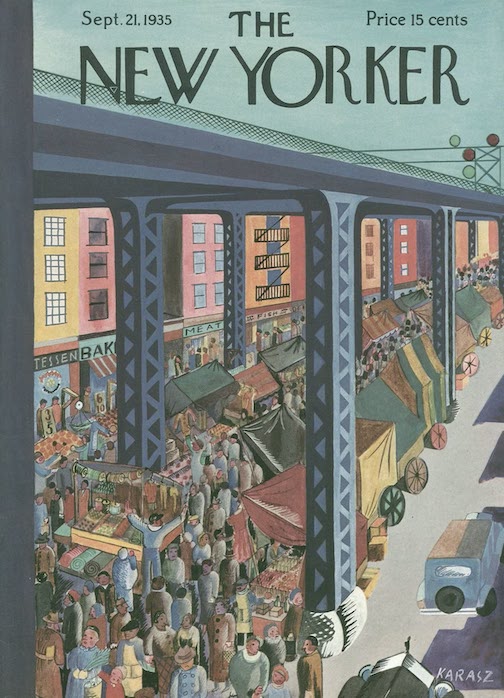
September 14, 1935 cover by Helen Hokinson. Over a twenty-year span, she contributed 68 covers and more than 1,800 cartoons to The New Yorker.
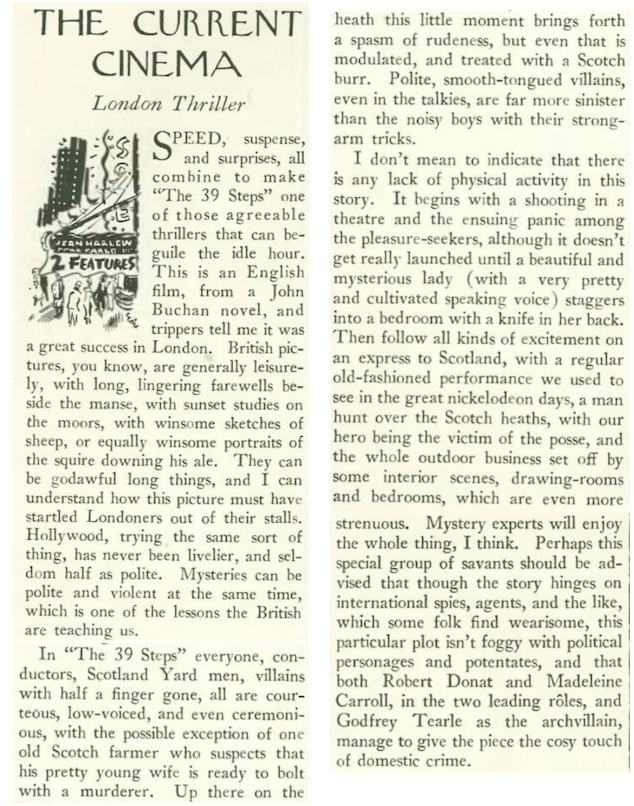
A successful follow up to 1934’s The Man Who Knew Too Much, Hitchcock’s The 39 Steps was conceived and cast by the Gaumont-British Picture Corporation as a vehicle to establish British films in America. The film also featured one of Hitchcock’s favorite plot devices—an innocent man forced to go on the run—seen in such notable films as 1942’s Saboteur and 1959’s North by Northwest.New Yorker film critic John Mosher was among the film’s many admirers:
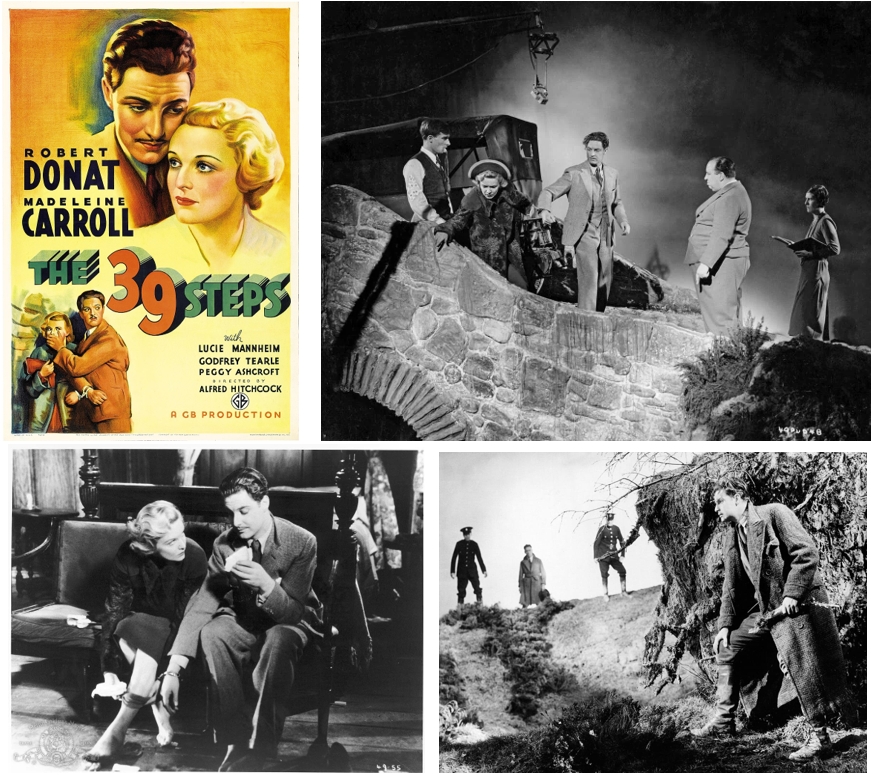
WE’LL TAKE THE STAIRS…Clockwise, from top left, poster for The 39 Steps; Alfred Hitchcock (second from right) directing the handcuffed Madeleine Carroll (as Pamela) and Robert Donat (as Richard Hannay) on the first day of filming; Hannay evades police on the heath; Pamela and Richard make the best of their predicament as handcuffed escapees. (Wikipedia/jimcarrollsblog.com/criterion.com)
* * *
Pop-Up Stores
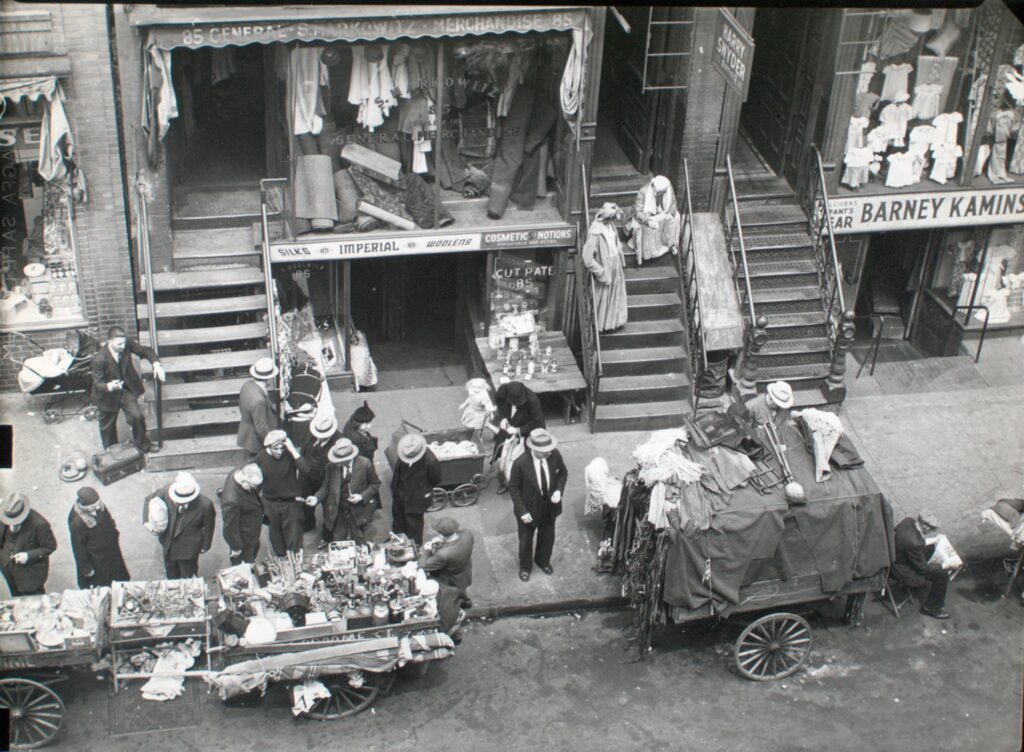
“The Talk of the Town” had a look at the “madhouse” on Nassau Street that daily erupted from noon to 2 p.m. as peddlers took over the street to hawk their wares.
IF WE DON’T HAVE IT, YOU DON’T NEED IT…Hester Street peddlers in 1936. Photo by Berenice Abbott. (boweryboyshistory.com)
* * *
Art of the Artless
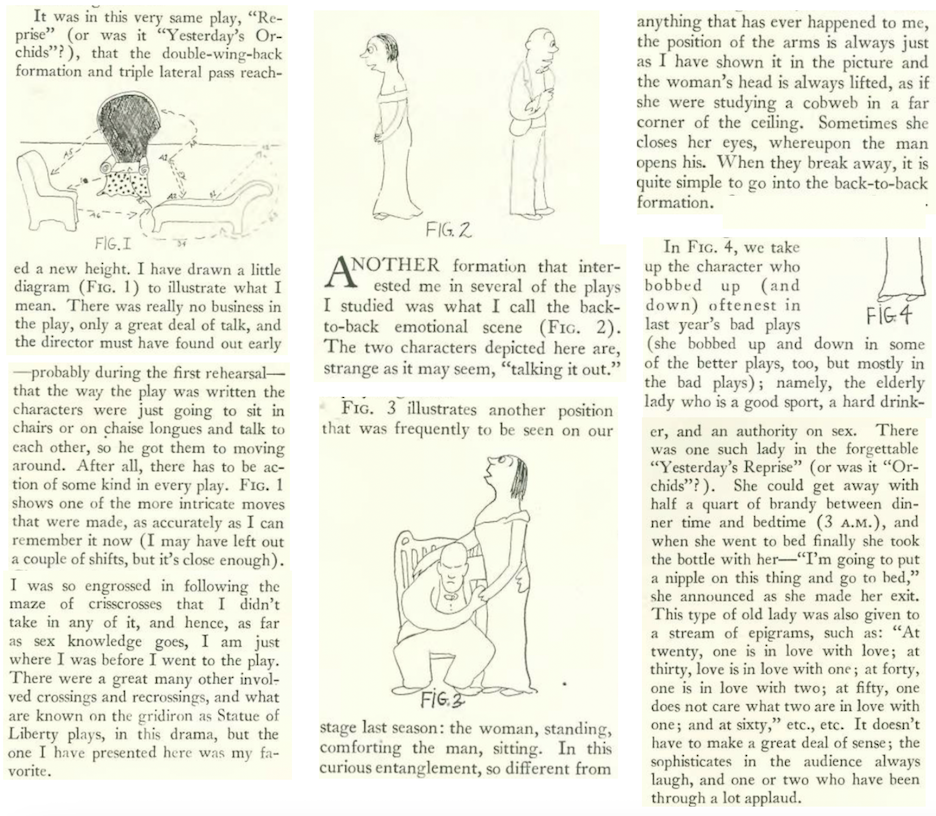
James Thurber dissected the workings of a “bad play,” examining varied techniques and familiar tropes. Excerpts:
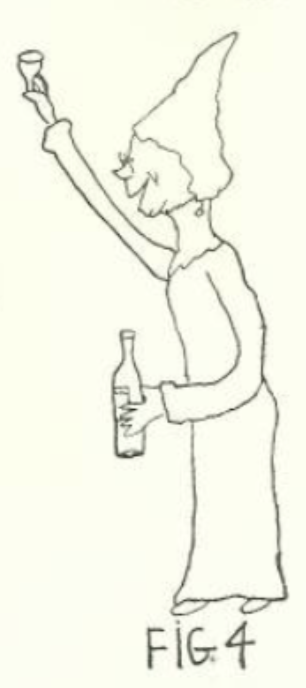
…below is the complete illustration for Fig. 4, which got cut off in the excerpt above…Thurber depicted “the elderly lady who is a good sport, a hard drinker, and an authority on sex.”
* * *
The Petulant Painter
Known for a primitive style that included bizarre scenes of frolicking (or floating) voluptuous nudes, the painter Louis Michel Eilshemius (1864–1941) had a style all his own, and had no trouble telling anyone that his work was better than anything hanging in the finest museums (which would not consider him at all until after his death). In 1931 he began calling himself “Mahatma,” hence the title of this profile by Milton MacKaye (illustration by Hugo Gellert). Some brief excerpts:
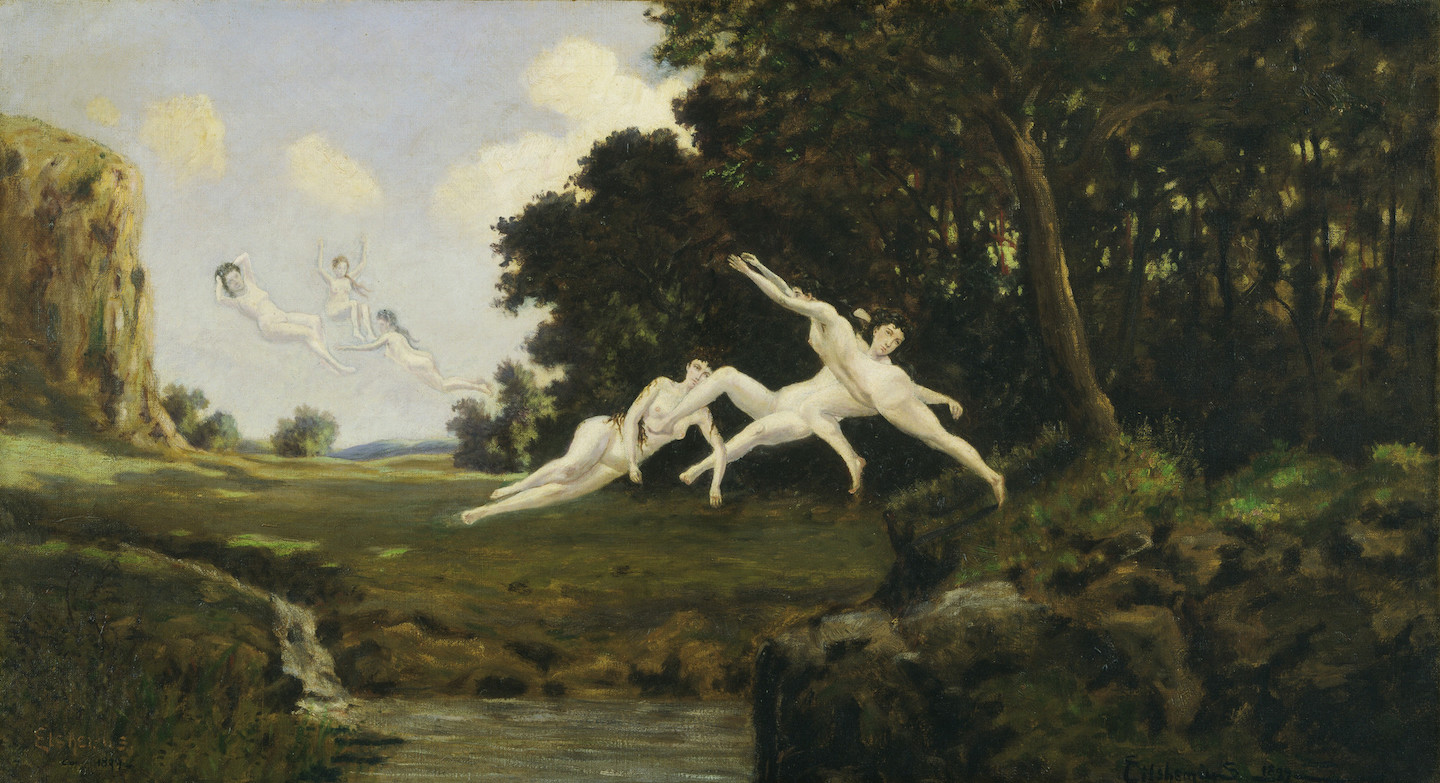
IRASCIBLE RASCAL…Clockwise, from top left, Louis Michel Eilshemius in 1913; Standing and Reclining Nymphs (1908), Self-portrait (1915); Nymphs Sleeping (1920). Known for his numerous and vitriolic letters to newspaper editors, his letterheads would proclaim such accomplishments as “Educator, Ex-actor, Amateur All-around Doctor, Mesmerist-Prophet and Mystic, Reader of Hands and Faces, Linguist of 5 languages, Spirit-Painter Supreme.” He also claimed to be a world-class athlete and marksman as well as a musician who rivaled Chopin. (Wikipedia/Smithsonian American Art Museum/National Portrait Gallery)
Eilshemius regularly visited art galleries, loudly condemning the works on display. No wonder museums would not consider his odd paintings, which were probably best received by the French, including the artists Henri Matisse and Marcel Duchamp; the latter invited Eilshemius to exhibit with him in Paris in 1917.
Eilshemius’ mental stability had deteriorated substantially by the time MacKaye wrote the profile, which concluded with this sad, final accounting of the man’s life.
Eilshemius would die in the psychopathic ward of Bellevue Hospital in 1941. In the years since, his work has gained a wide audience and can be found in such collections as the Smithsonian, The Phillips Collection, MoMA and the Metropolitan Museum of Art.
SINGULAR VISION…Louis Michel Eilshemius, Afternoon Wind, 1899. (MoMA)
* * *
In Good Company
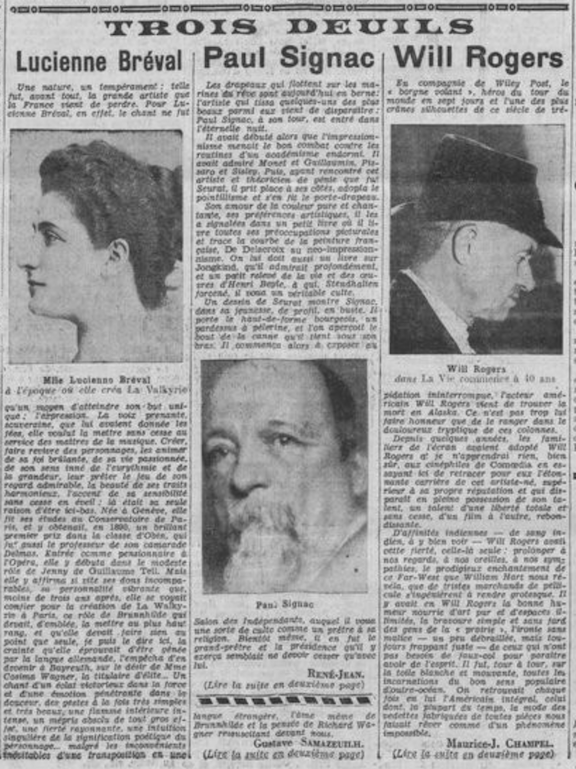
In her “Letter From Paris,” Janet Flanner noted that even the French honored the memory of Will Rogers, who had died in a plane crash with aviator Wiley Post on Aug. 15, 1935.
NOTED AND NOTABLE…As an example of Will Rogers’ worldwide fame, Janet Flanner noted that the Paris entertainment newspaper Comœdia published Rogers’ obituary next to that of famed neoimpressionist painter Paul Signac. The other obituary remembered the renowned Swiss soprano Lucienne Bréval. (gallica.bnf.fr via onlinebooks.library.upenn.edu)
* * *
At the Movies
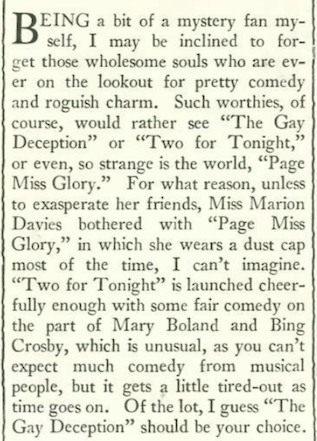
Coming down from The 39 Steps,John Mosher also sampled some of latest comedies gracing the silver screen…
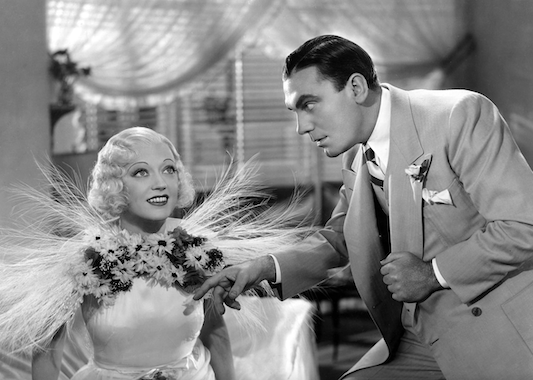
…Mosher didn’t understand why Marion Davies, nearing the end of her film career, even bothered to appear in the romantic comedy Page Miss Glory (although she was also the producer), in which she portrayed a country girl who stumbles into fame while working as a chambermaid in a luxury hotel…
JUST LIKE CINDERELLA…Marion Davies and Pat O’Brien in Page Miss Glory. (IMDB)
…Two For Tonight featured a lot of fine crooning from Bing Crosby, and some hijinks, but fizzled out in the end…
Bing Crosby (right) takes aim in Two For Tonight. (IMDB)
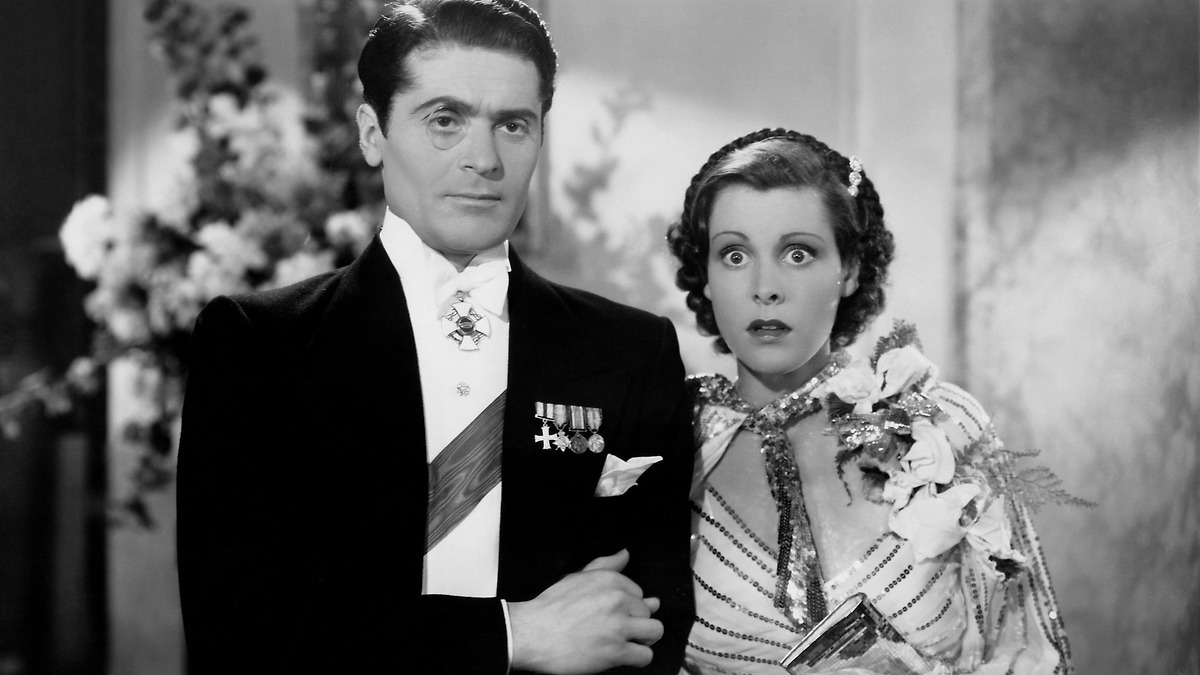
…of the three comedies, Mosher found The Gay Deception to be the most winning. Directed by William Wyler, the film featured a sweepstakes winner pretending to be a rich lady (Frances Dee) who encounters a prince masquerading as a bellboy (Francis Lederer)…hilarity ensued…
THE WYLER TOUCH…William Wyler’s The Gay Deception, starring Francis Lederer (left) and Frances Dee, anticipated Wyler’s 1953 Roman Holiday, also a tale about a royal wanting to be a normal person. (letterboxd.com)
* * *
From Our Advertisers
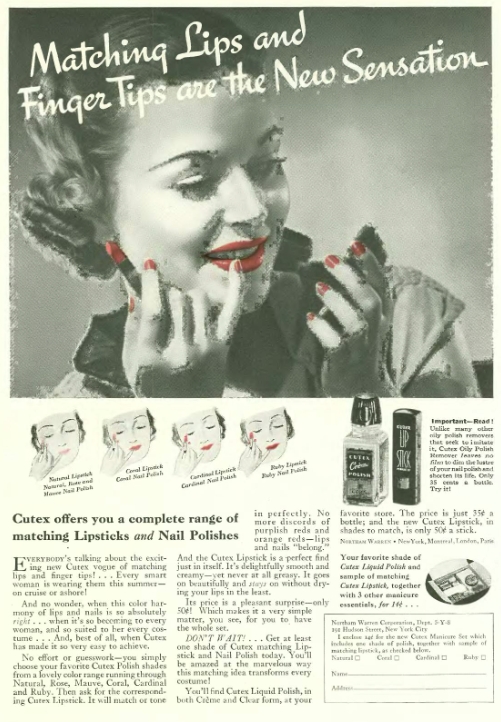
We welcome fall with the latest fashion from Forstmann Woolens…
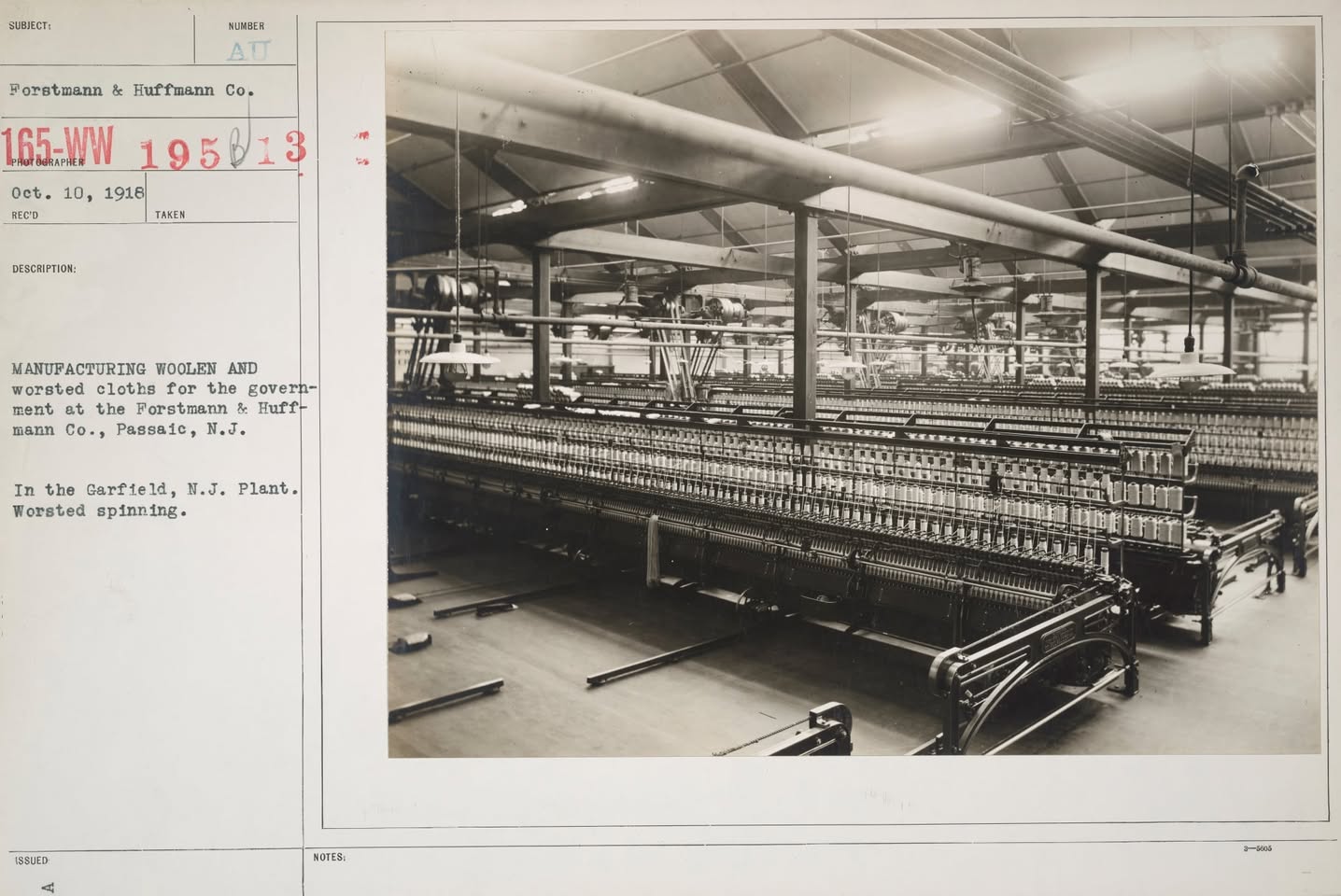
…and here is where those wool dresses were spun…
Image from the National Archives depicts the spinning room at Forstmann & Huffman in Passaic, N.J., 1918. The Passaic plant closed in 1958. (Historical Society of Garfield, NJ)
…the makers of leaded gasoline continued to promote their product in full-color spots…
…General Tire (like competitor Goodyear) played up the safety theme and potential perils to loved ones to tout their “blow-out proof” tires…
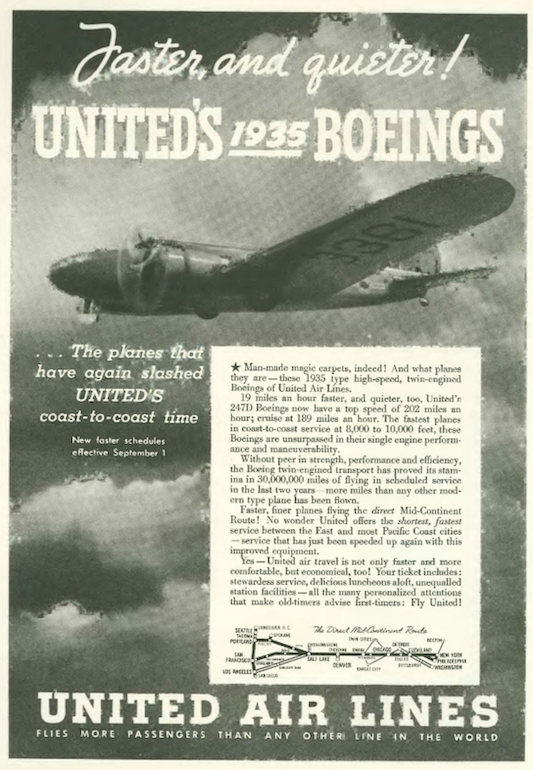
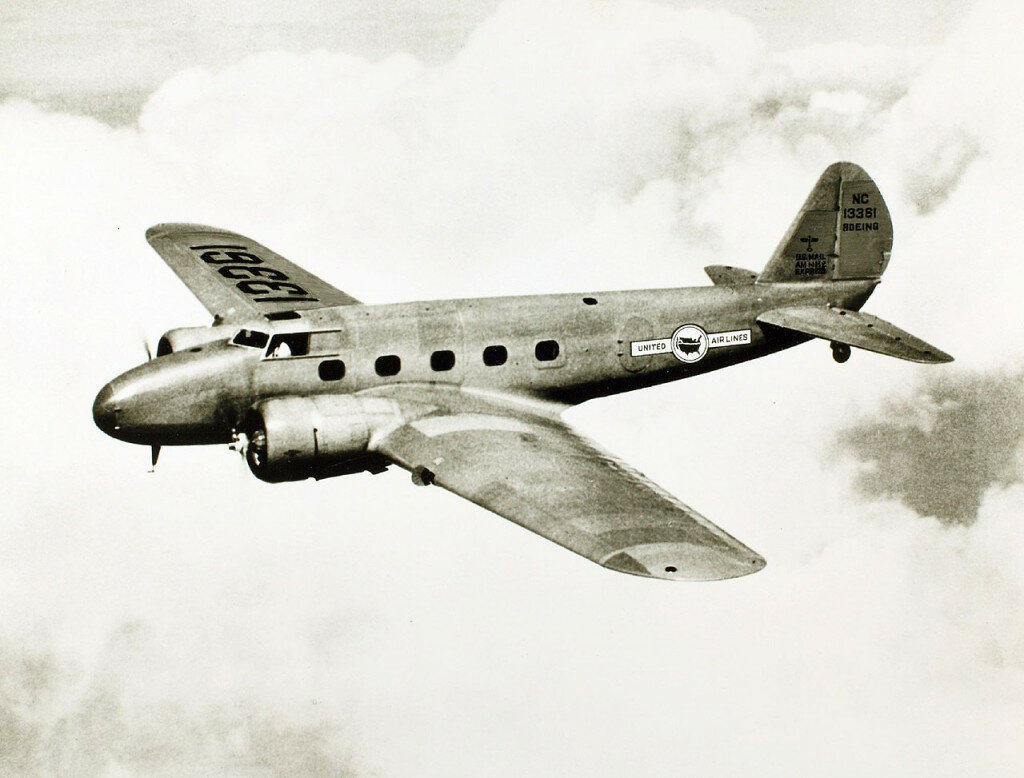
…like many advertisers in The New Yorker, United Air Lines appealed to the affluent, hoping some of them would take to the air, since only they could afford it…
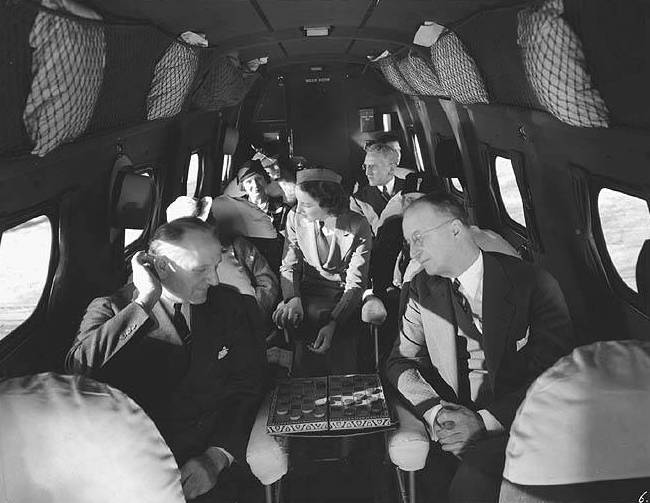
…for reference…
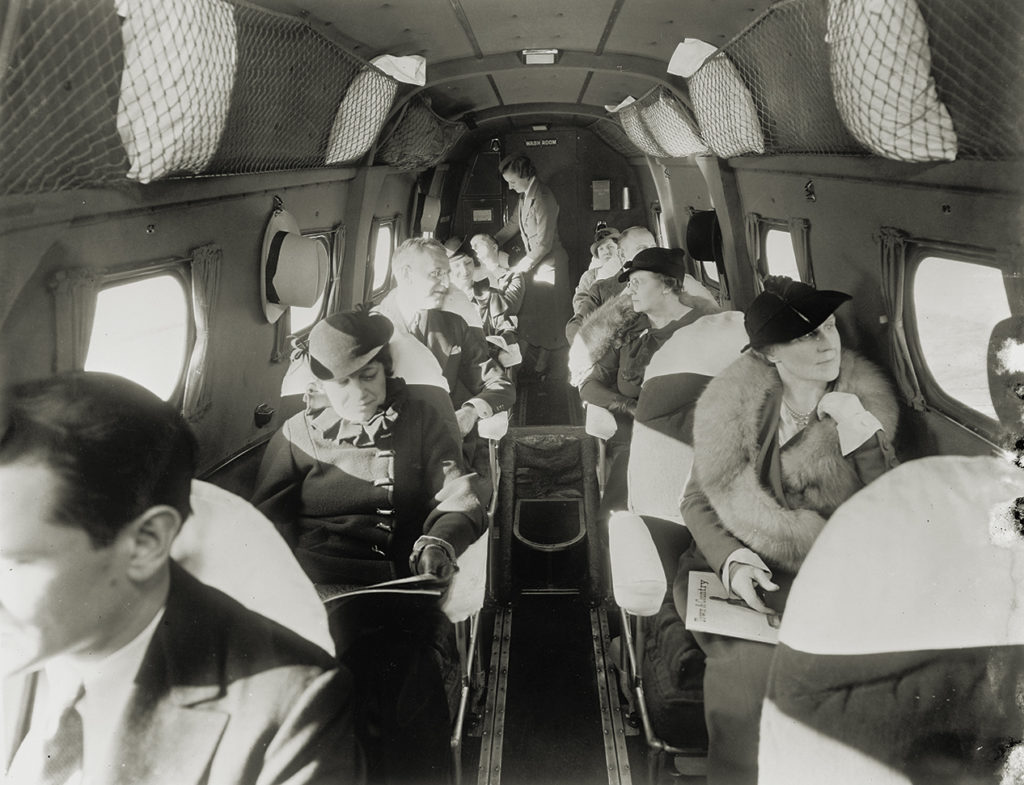
COZY…Interior of the Boeing 247. (Wikimedia Commons)
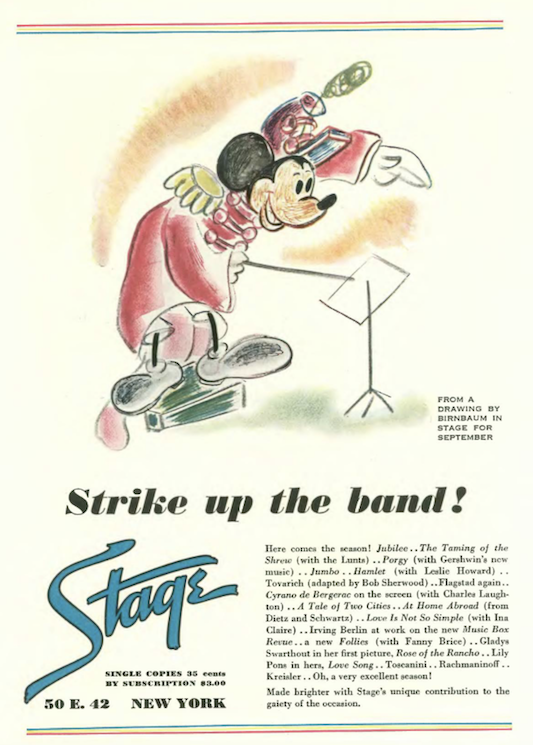
…Abe Birnbaum, who contributed nearly 200 covers to the New Yorker, offered this rendition of Mickey Mouse to Stage magazine…
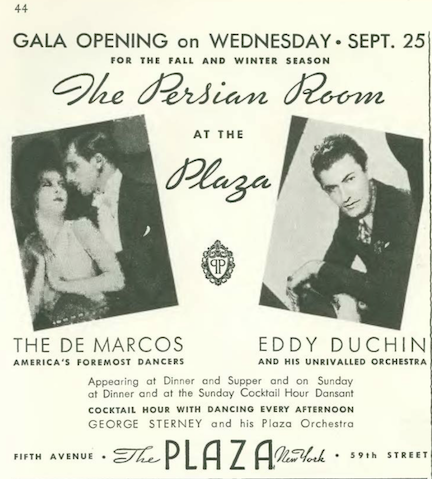
…heading to the back of the book we find the latest in entertainment at the Plaza…
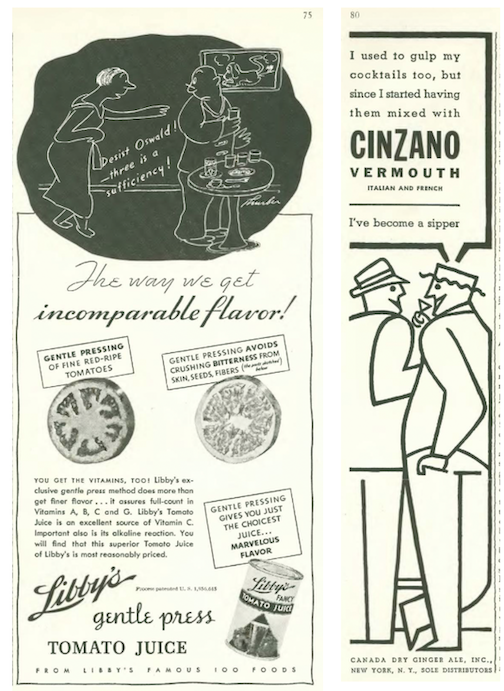
…James Thurber contributed the drawing at left (rendered in negative) on behalf of Libby’s tomato juice on page 75, and page 80 featured the spare, modern lines of a Cinzano ad…
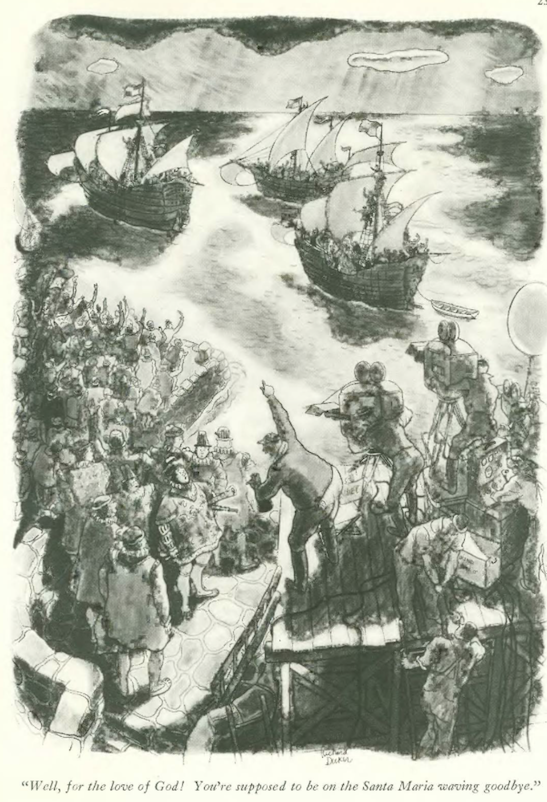
…our cartoonists include Richard Decker, on the set with a missing extra…
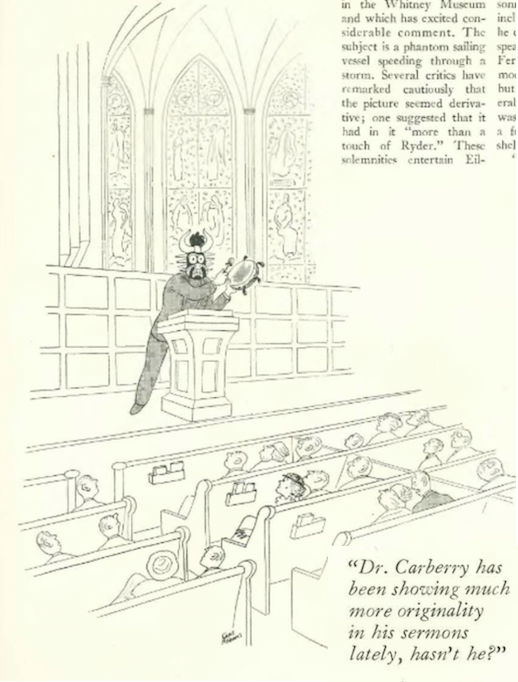
…Charles Addams offered a new twist on the Sunday sermon…
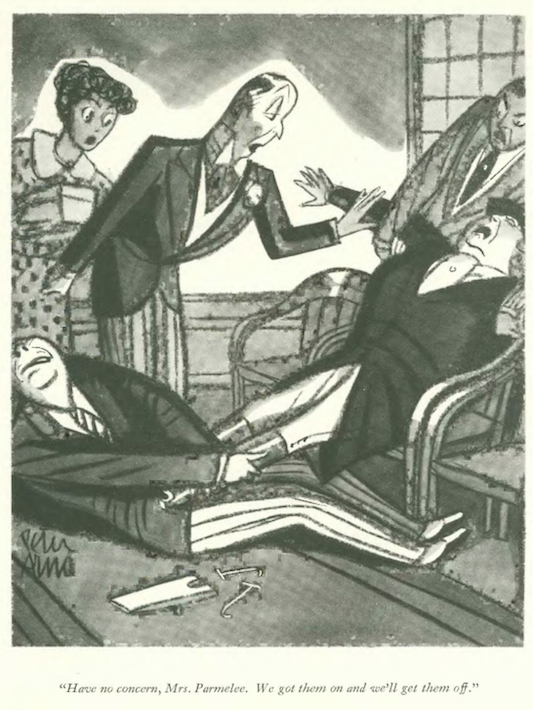
…Peter Arno found an epic struggle in the shoe department…
…Robert Day offered this energy-saving tip…
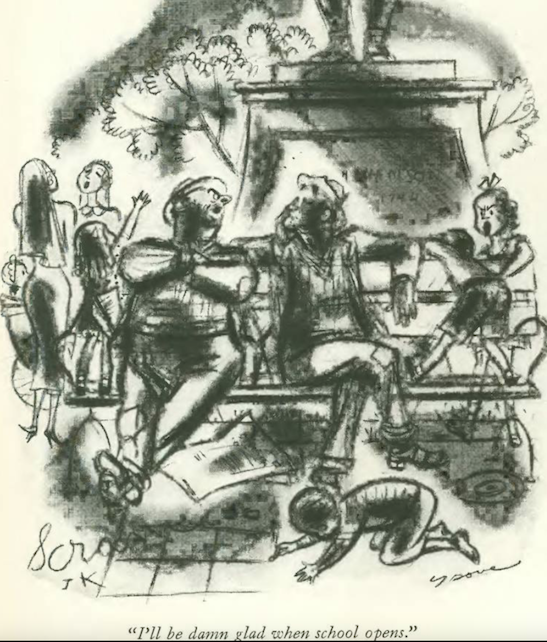
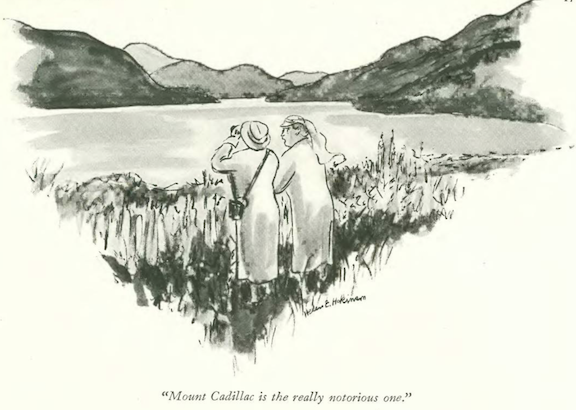
…and we close with Helen Hokinson, and a lively game of charades…
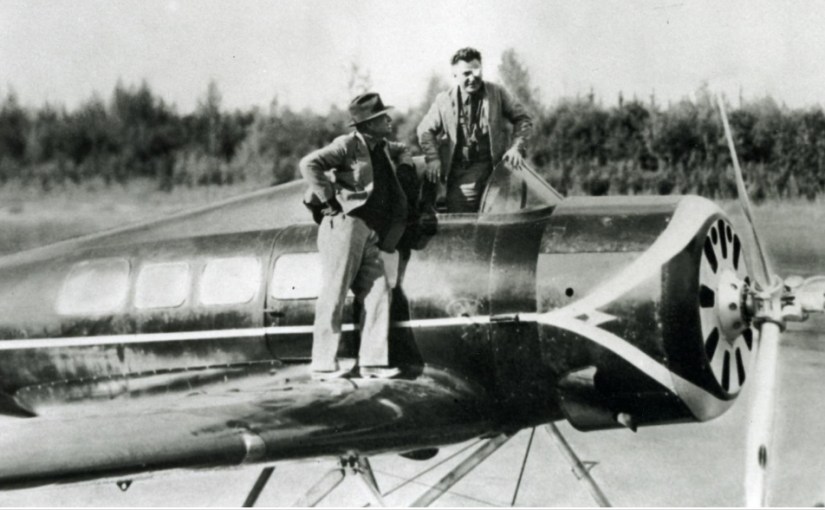
Above: Will Rogers (with hat) visits with pilot Wiley Post near Fairbanks, Alaska, hours before their fatal crash on August 15, 1935. (okhistory.org)
It would be a challenge to find a place for a multi-talented, mega-star like Will Rogers in today’s over-saturated and segmented media landscape—he was a trick roper, vaudevillian, social commentator, comedian, journalist, author, and radio and film celebrity. His early fame on the vaudeville circuit, including the Ziegfeld Follies, would spark a film career in 1918 (he would appear in 71 films), and a 1922 town hall speech would lead to a nationally syndicated newspaper column. When radio became a nationwide phenomenon his voice could heard coast-to-coast. He was seemingly everywhere.
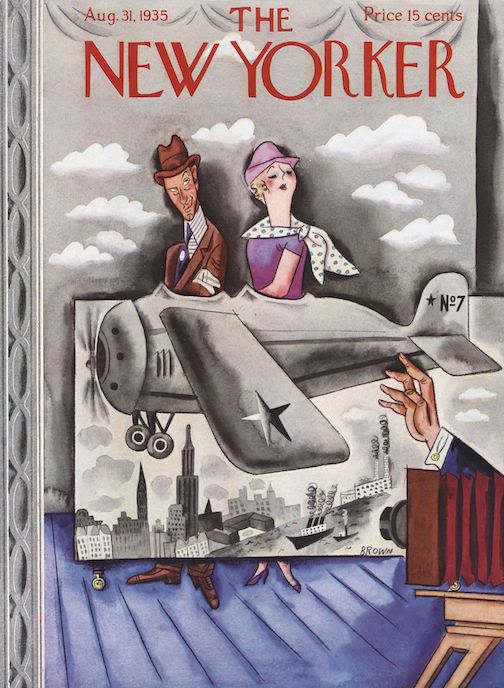
August 31, 1935 cover by Harry Brown. Brown illustrated eighteen covers for The New Yorker.
Rogers (1879-1935) was also a big promoter of aviation, and he gave his audiences many entertaining accounts of his world travels. In the summer of 1935 he announced plans to join famed aviator Wiley Post (1898-1935) on a flight to Alaska and beyond. It appeared to be routine, making the trip’s tragic ending all the more poignant.
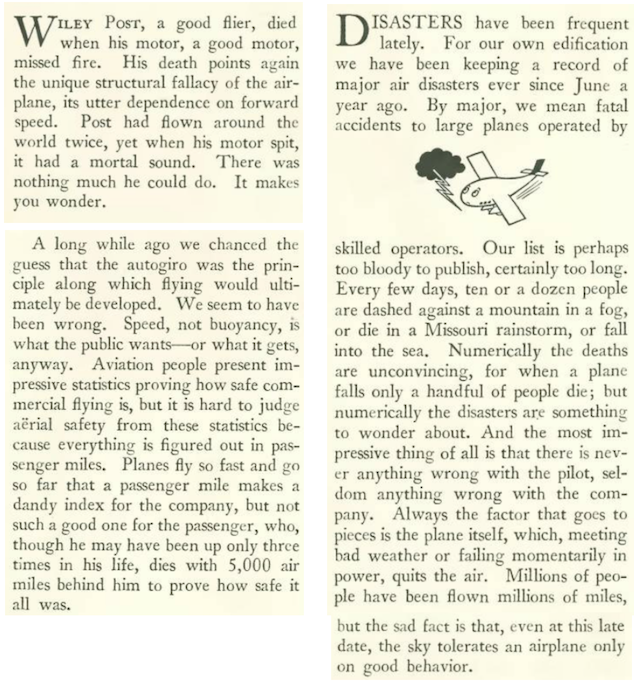
Although E.B. White often seemed stuck in the past—he preferred Model Ts and rattily omnibuses to more more modern conveyances—he was a flying enthusiast, never missing a chance to hop aboard an airplane and marvel at the scene far below. However, when tragedy struck, White would become circumspect. When Notre Dame coach Knute Rockne’s Fokker Trimotor crashed into a Kansas wheatfield, White expressed doubts about air safety and pondered “safer” alternatives such as autogiros (a kind of early helicopter that wasn’t so safe or practical). Such doubts returned in his “Notes and Comment” for August 31, 1935:
The fated aircraft, a Lockheed Orion, was heavily modified by Post into a floatplane; one wing was even salvaged from a wrecked Explorer (an older Lockheed model). The pontoon floats he attached were also designed for a larger aircraft, which made the nose-heavy Orion even more unwieldy.
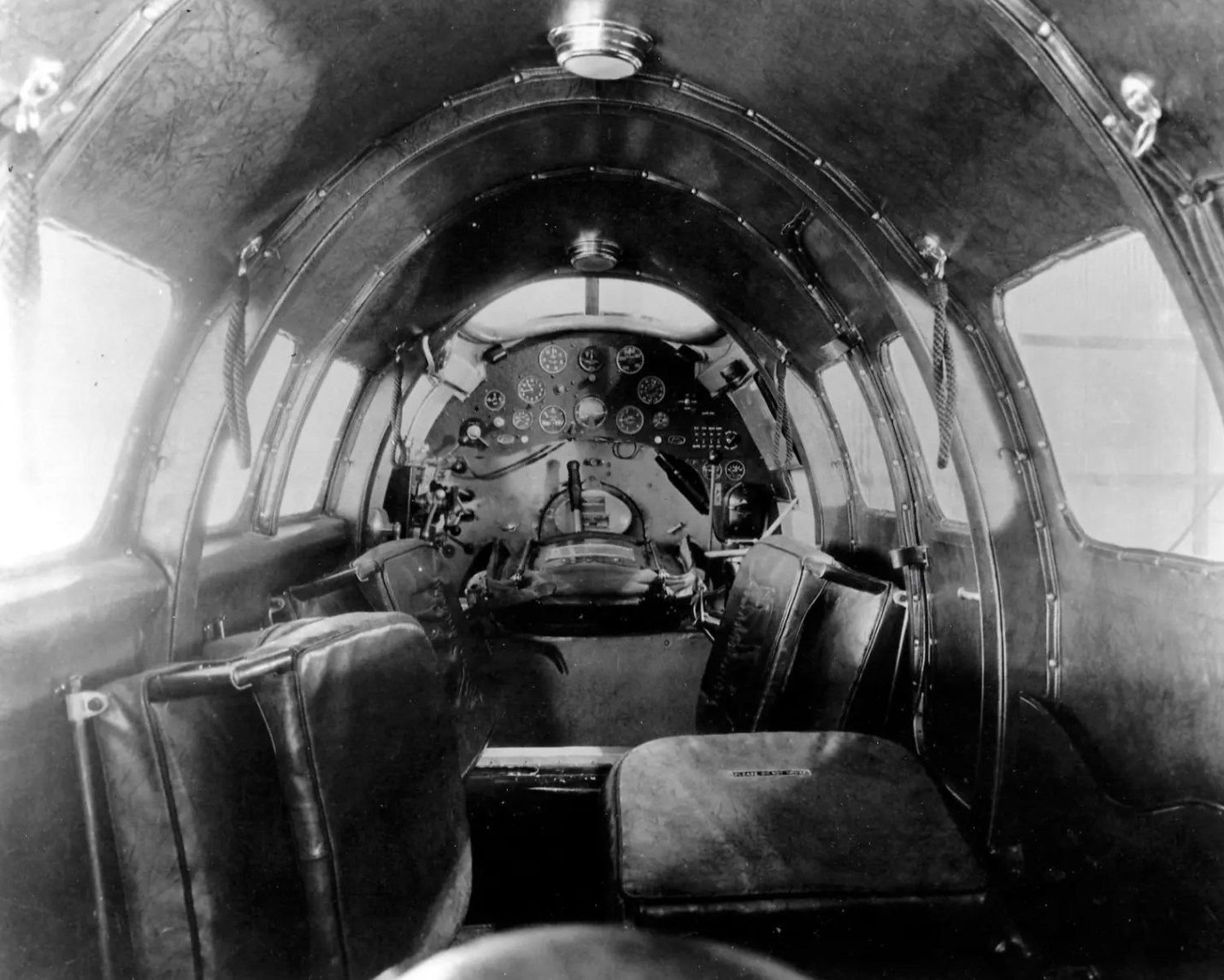
BUILT FOR SPEED…A Lockheed Model 9 Orion parked at Boeing Field, Seattle, in May 1935. With 200-mph speed, the single-engine passenger aircraft (5 to 6 passengers) was faster than any American military aircraft of the time. It was Lockheed’s last aircraft to use wood construction in the frame, which was lightweight but not designed for longevity on major airlines. (James Borden Photography Collection)TIGHT QUARTERS….Interior view of a Lockheed Orion 9. No doubt much of the passenger space was loaded with gear for the trip to Alaska. (James Borden Photography Collection)
When Post and Rogers arrived in Juneau, local bush pilots doubtfully regarded the Orion and asked Rogers about the flight plan. “Wiley and I are like a couple of country boys in an old Ford—don’t know where we’re going and don’t care,” he said. They were actually headed to Point Barrow, and from there planned to hop over to Siberia.
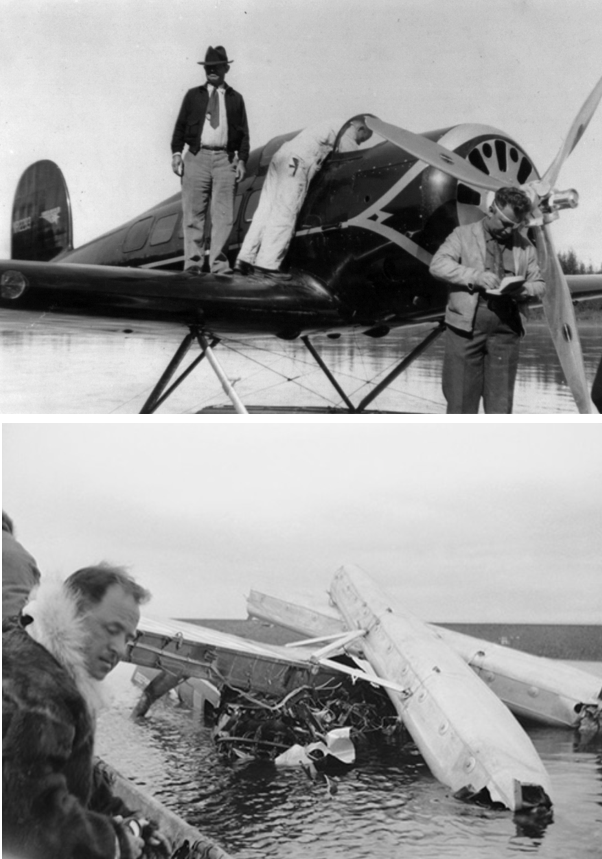
After stopping in Fairbanks they set off for Point Barrow in bad weather. Lost in the murk, they landed short of their destination in the shallow waters of Walakpa Lagoon, fifteen or so miles southwest of Point Barrow. Post and Rogers then took off—despite warnings from locals about the conditions. But the weather wasn’t the worst problem: Post had a bad habit of taking to the air in an abrupt, steep climb, which likely caused the engine to stall. Powerless, the ungainly aircraft plunged into the lagoon and landed on its top. Post and Rogers were killed instantly.
JUST A COUPLE OF COUNTRY BOYS…Top photo, Will Rogers on the wing of the Lockheed floatplane belonging to famed aviation pioneer Wiley Post, hours before their fatal crash on August 15, 1935. Below photo, inverted wreckage of the float plane in Walakpa Lagoon. (Wikipedia/vintageaviationnews.com)
Rather than eulogize the fallen Rogers, “The Talk of Town” offered up an anecdote about his rise as a newspaper columnist, which was sparked by a backhanded endorsement speech:
A HUMAN FACE…Top left, Will Rogers backstage with the 1924 Ziegfeld Follies cast. At right, Rogers made his film debut in the now lost silent film Laughing Bill Hyde (1918) with co-star Anna Lehr. The magazine ad at right quoted producer Rex Beach, who called Rogers “the most human player who ever faced a camera.” (Will Rogers Memorial Museum/Wikipedia/IMDB)FINAL CURTAIN…Top photo, Will Rogers with co-star Anne Shirley in Steamboat Round the Bend. Rogers wrapped filming just before heading to Alaska. The film was released posthumously on September 6,1935. Bottom image is a detail from a full-page ad in the October 1935 issue of Picture Play Magazine. Oddly, the ad makes no mention of Rogers’ death, proclaiming that “Will blazes a new path in his screen career as he scores his greatest triumph!” (theretrorocket.blogspot.com/IMDB)
* * *
Putting it Mildly
In “Onward & Upward With the Arts,” H.L. Mencken continued to explore the quirks of American language, this time looking at the pervasive (and evasive) use of euphemisms by “professional uplifters.” Excerpts:
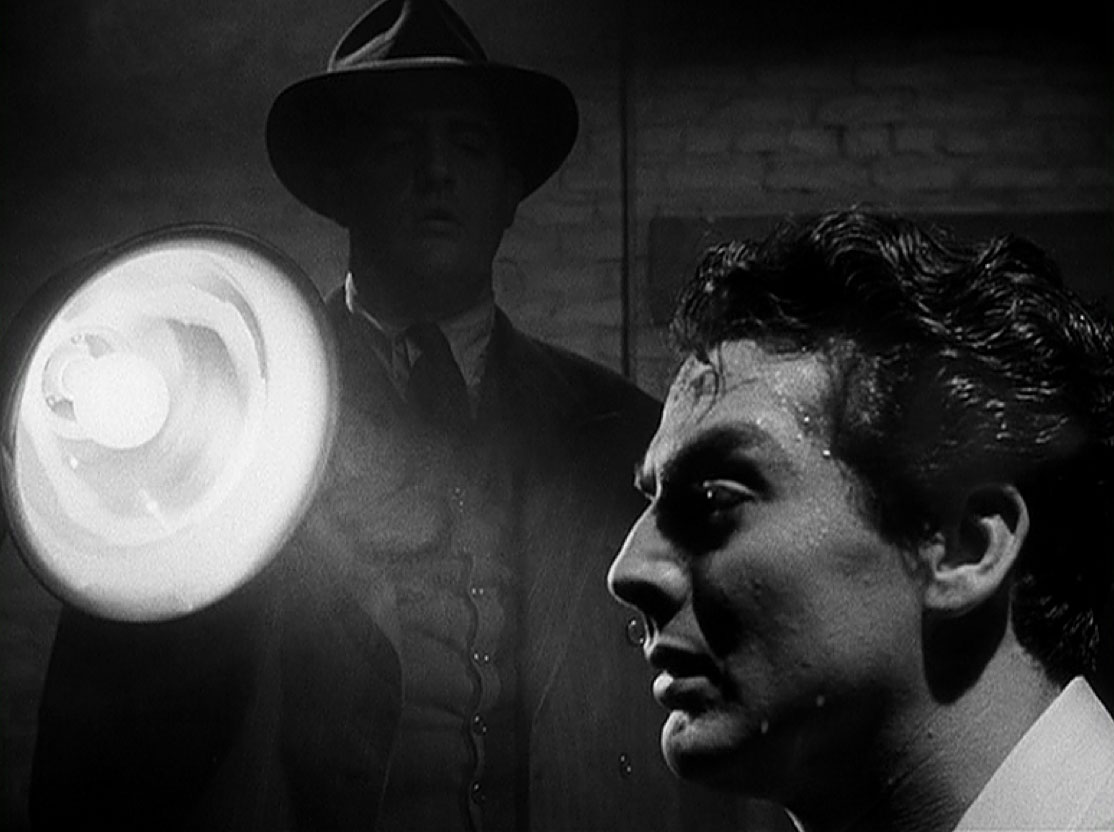
INTELLIGENCE TEST was suggested by “professional uplifters” as a polite replacement for giving someone “The Third Degree.” Image is from the 1941 noir thriller I Wake Up Screaming, starring Victor Mature, pictured here getting his “intelligence test.” (cinematography.com)
* * *
At the Movies
We join film critic John Mosher to take a look at the latest epic from Cecil B. DeMille,The Crusades, which to Mosher’s disappointment was a rather mild epic, with little to astonish. However, our critic did find something to admire in a more recent historical drama, Diamond Jim.
ANTISEPTIC EPIC?…Clockwise, from top left, movie poster for The Crusades offered up an image one typically does not associate with religious warfare, but you had to bring ’em in somehow; Henry Wilcoxon and Ian Keith in a scene from the film; co-stars Loretta Young as Berengaria of Navarre and Wilcoxon as Richard the Lionheart; the film also featured Joseph Schildkraut as Conrad of Montferrat and Katherine DeMille as Princess Alice of France (bottom left). A talented actress, Katherine reportedly landed the role as a Christmas gift from her adoptive father, Cecil B. DeMille. (cecilbdemille.com)HEY BIG SPENDER…At right, Edward Arnold in the title role (here with Eric Blore) in Diamond Jim. At left, Cesar Romero moves in on Diamond Jim’s love interest, portrayed by Jean Arthur. (Rotten Tomatoes/IMDB)
* * *
From Our Advertisers
We begin with this advertisement from Lord & Taylor, featuring the latest fall fashions for young women heading to college…notable here is the inclusion of Mickey Mouse in the illustration…the animated rodent was in vogue as much the latest fashions…
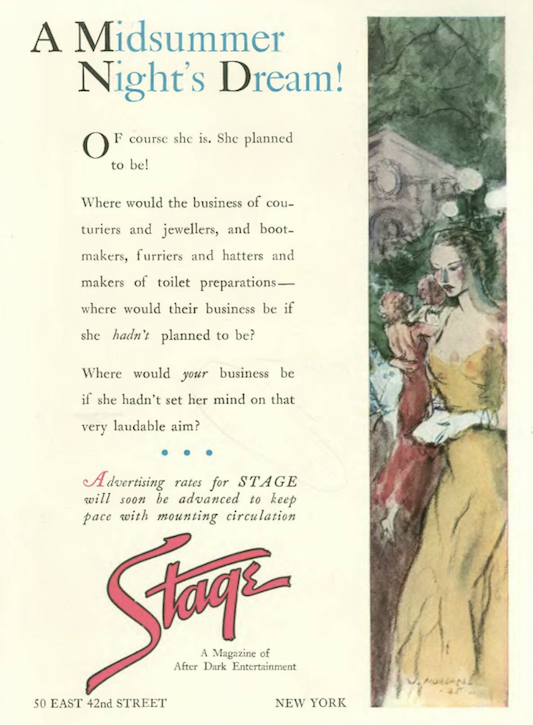
…John Hanrahan, whose advertising savvy helped guide The New Yorker through its lean early years, was publisher of the richly designed Stage magazine, promoted here on the inside front cover…
…soft drink giant Coca-Cola recalled its soda fountain origins in this ad that promoted its 6.5-ounce bottled product…
…on the inside back cover Goodyear continued its series of perilous ads illustrating the dangers of tire blowouts (but not the obvious hazard of children riding untethered in a rumble seat, where they doubtless inhaled all manner of noxious fumes)…
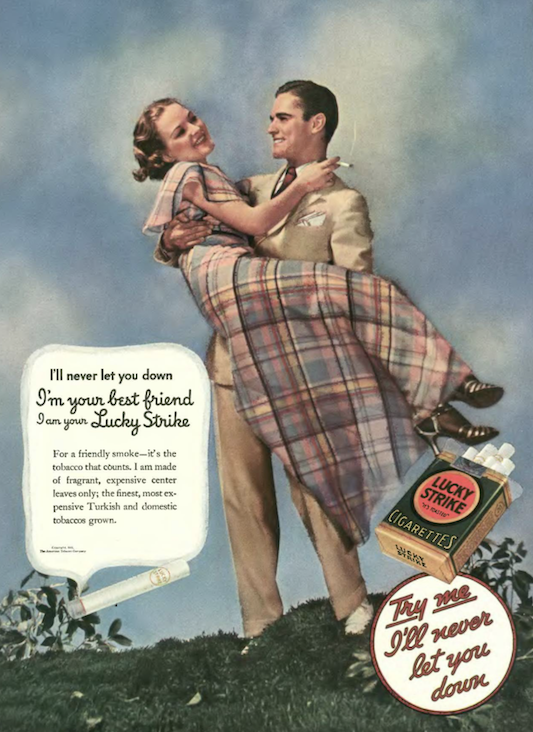
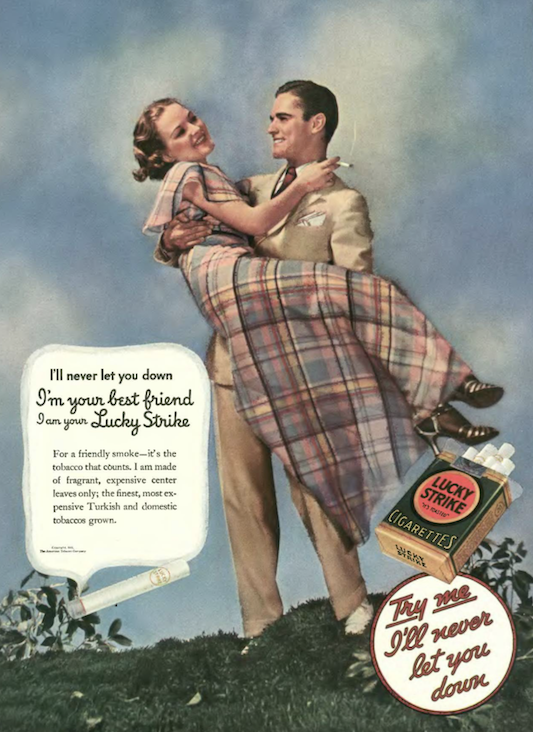
…the majority of back covers in 1935 featured tobacco companies…here we learn that Lucky Strikes were more than cigarette; they were your “best friend”…
…on to our cartoonists, we start with this “Profile” illustration by William Steig…the profile was a two-parter featuring a clever summons server…
…Adolph Dehn adorned the “Goings On” section with this illustration…
…unsigned, but I’m pretty sure this is H.O. Hofman…
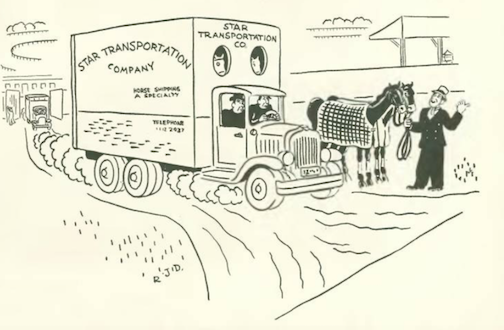
…here we get a lift from Robert Day…
…Al Frueh conjured up a nightmare of leaping sheep…
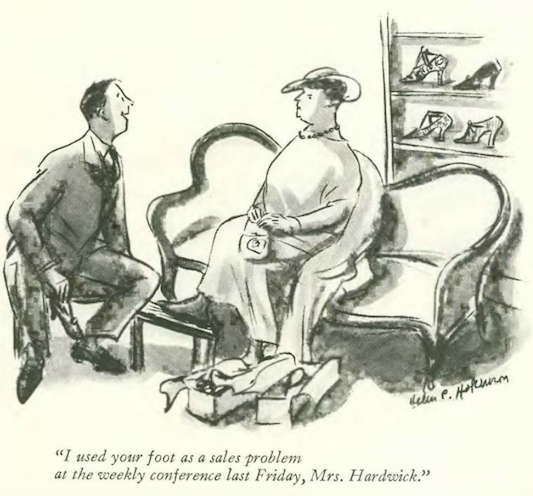
…Helen Hokinson gave us some famous footwear…
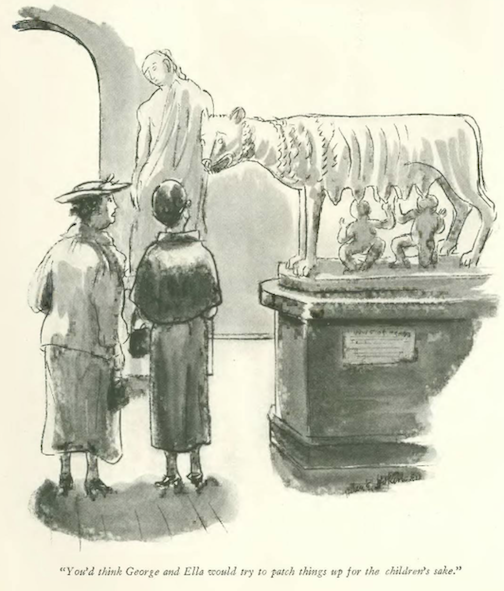
…Hokinson again, with Romulus and Remus providing a convenient metaphor…
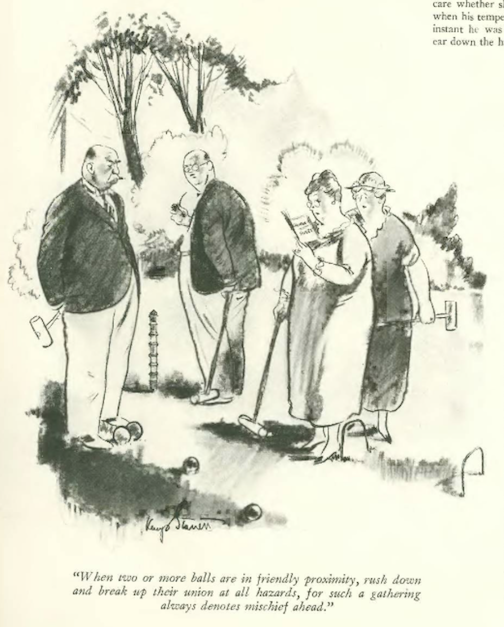
…Kemp Starrett was bogged down in the rules of a game…
…George Price discovered a budding talent…
…Richard Decker took to the back roads…(reminds me of a scene from The Long, Long Trailerwith Lucy and Desi)…
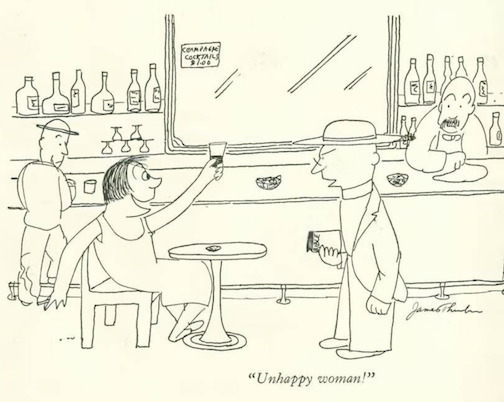
…James Thurber raised a glass to a dry do-gooder…
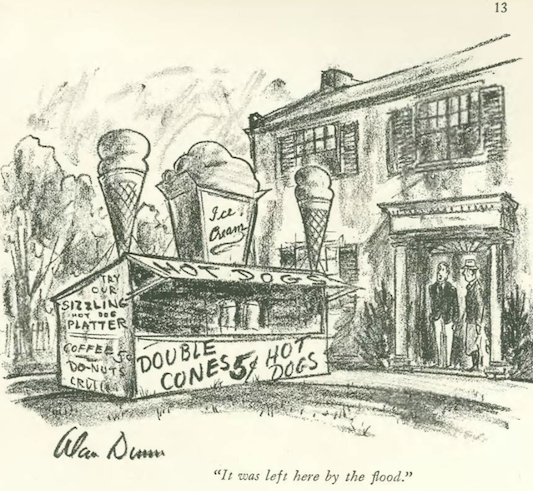
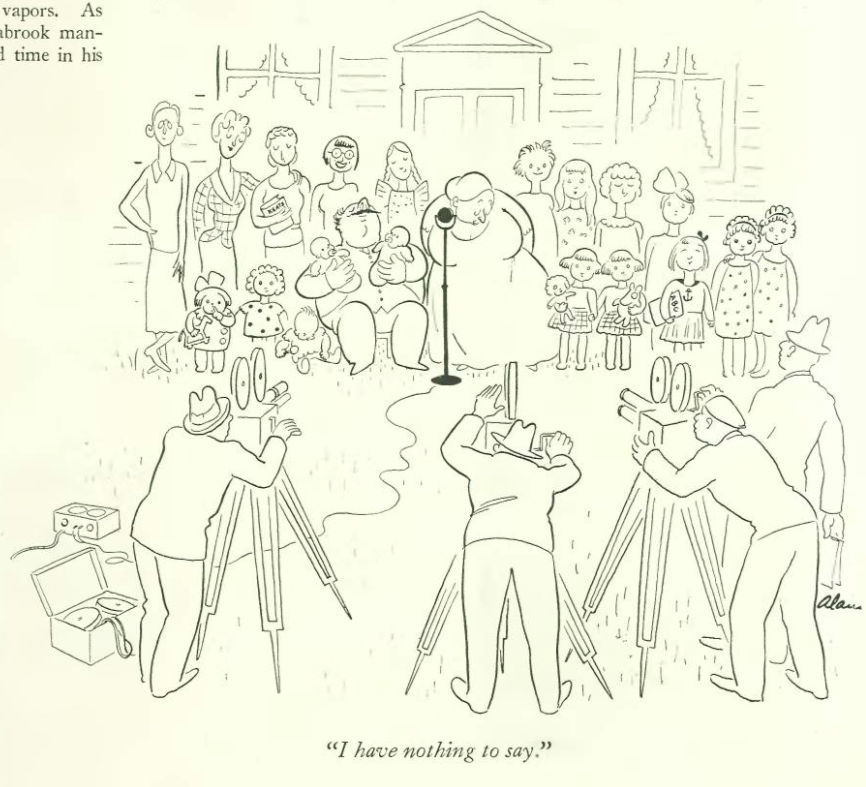
…Alan Dunn brought an unexpected windfall to Westchester…
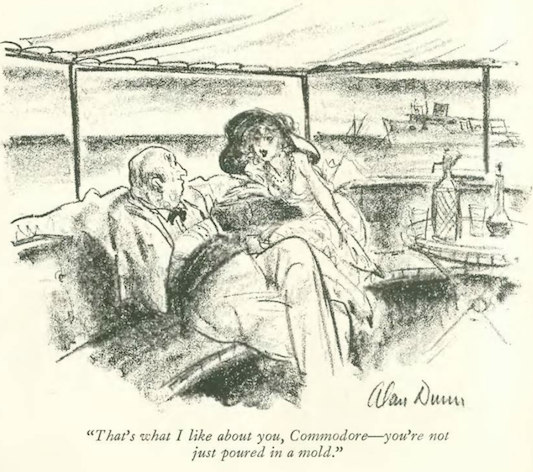
…and to close we Dunn again, and a bit of flattery…
City life is a noisy life, especially in places like Manhattan, one of the most densely populated places in the world.
August 24, 1935 cover by Rea Irvin.
In his “Notes and Comment” column, E.B. White described the occasional “intestinal stoppage” of traffic outside The New Yorker’s offices at West 45th Street, an entire block “laden with undischarged vehicles, the pangs of congestion increasing till every horn is going—a united, delirious scream of hate, every decibel charged with a tiny drop of poison.”
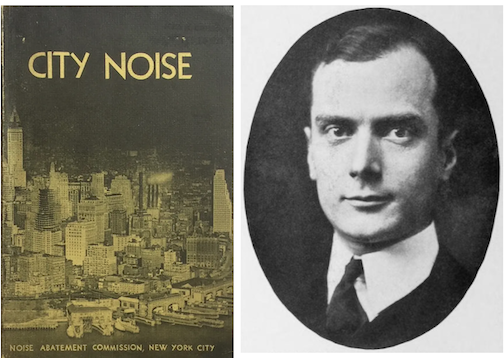
ABOVE THE FRAY…E.B. White with his pet dachshund Minnie at the West 45th Street offices of The New Yorker. (New York Times)AND DON’T CALL ME SHIRLEY…New York City’s Commissioner of Health, Shirley Wynne (right), created a Noise Abatement Commission in 1929. After eight months of research the Commission published City Noise, which included recommendations for a quieter city. (Wikipedia/trevianbooks.com)
The city began addressing the problem in 1929, when New York City’s Commissioner of Health, Shirley Wynne (1882-1942), created a Noise Abatement Commission, likely the first such commission in the U.S. The Commission cited the “mounting roar and crash of traffic, building, manufacture and sundry other noises which have accompanied the growth of the city.” After eight months of research the Commission published City Noise, which included recommendations for a quieter city.
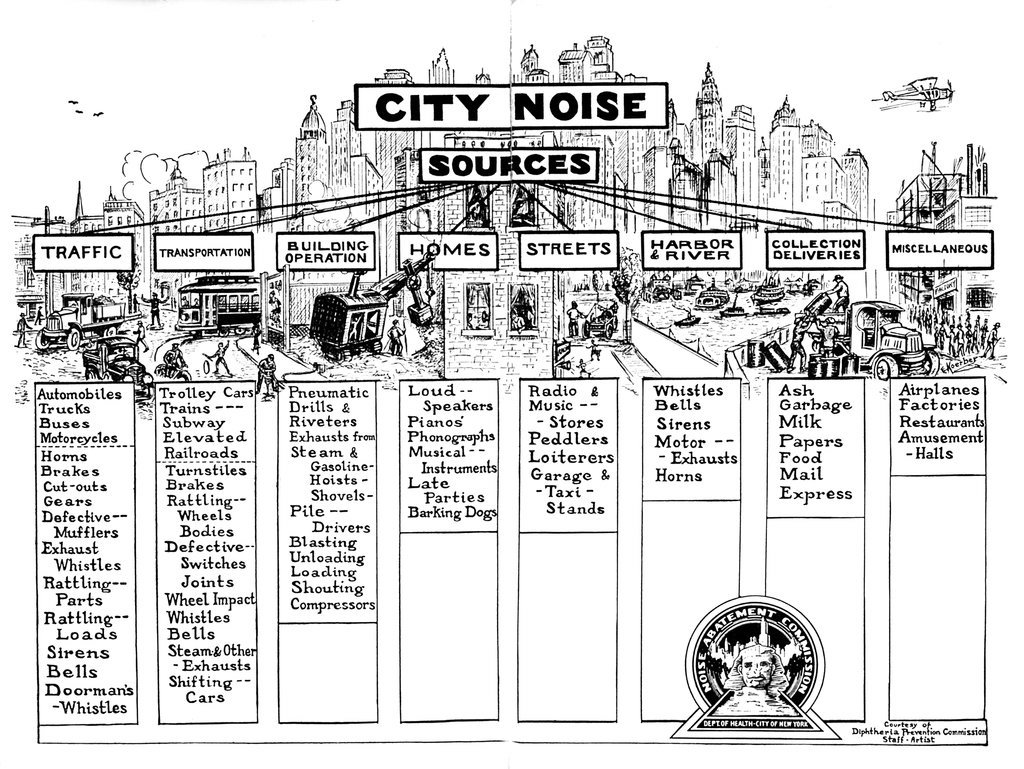
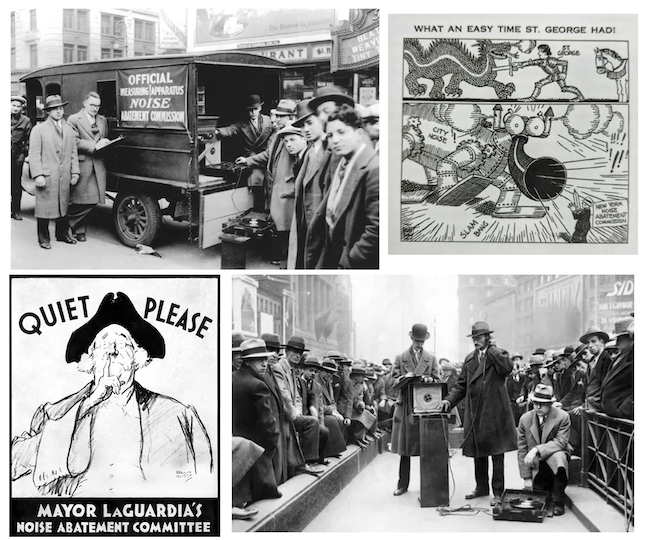
URBAN CHORUS…A chart featured in City Noise depicted some of sources of noise in New York City.PIPE DOWN!…Clockwise, from top left: The Noise Abatement Commission took to the streets with a municipal acoustics-measuring truck in 1930; cartoon in the New York Herald Tribune illustrated the challenge ahead; Commission officials conducting noise tests in Times Square, circa 1930; poster circa 1936 promoted Mayor Fiorello La Guardia’s anti-noise drives. A 1936 noise code put sound restrictions on everything from radios to the “prolonged and unreasonable blowing of a horn.” A first offense cost $1; the second, if committed within the next year, $2. (hii-mag.com/Bloomberg.com/NYTimes.com)
Not one to leave a stone unturned, White also added this note about the noisy doors on Pullman train car toilets…
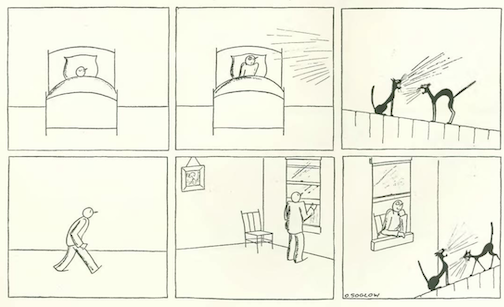
Here are the Otto Soglow spot drawings that accompanied the “Talk” piece:
Final note: A colorful exploration of sound can be found on the One Thousand Birds site,Hii Magazine.Check it out!
* * *
Puff Pushers
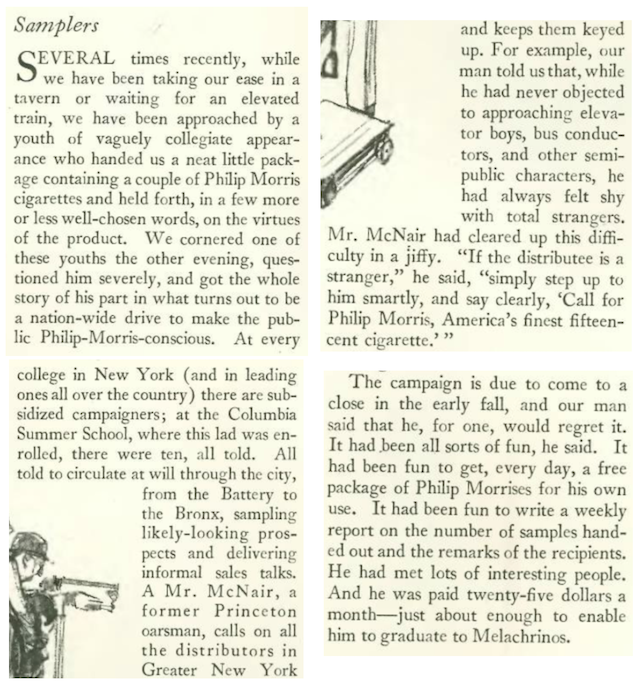
Tobacco companies like Philip Morris have long been savvy in finding ways to expand their market, including taking their product directly to the consumer, as “The Talk of the Town” explained in this entry:
SMOKE FREE…Sample pack of Philip Morris cigarettes, circa 1930s. (Ebay)
* * *
A Rare Glimpse
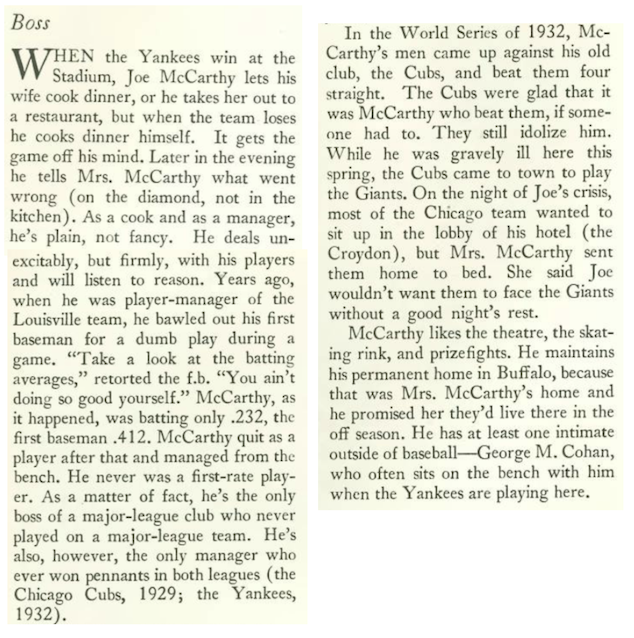
Before Roger Angell started writing about baseball in 1962, there wasn’t a whole lot written about the sport in the pages of The New Yorker. In the magazine’s early years, the game was probably perceived as too low-brow, while other athletic pursuits such as golf, tennis, and polo were more in line with the desired or perceived readership. Early contributors such as Ring Lardner had also soured on the sport, thanks to the Black Sox Scandal of 1919 and the greed of team owners. So here is a rare look at baseball, and Yankee coach Joe McCarthy (1887-1978), in “The Talk of the Town.” Excerpts:
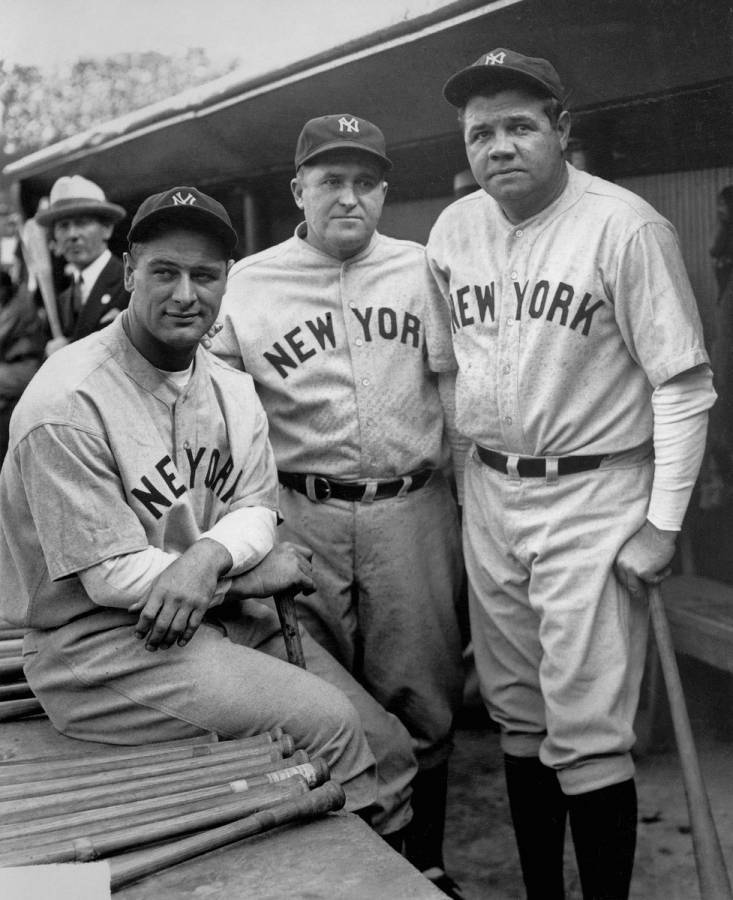
BRONX BOMBERS…Coach Joe McCarthy (center) with sluggers Lou Gehrig, left, and Babe Ruth during the 1932 World Series. The first manager to win pennants in both the National and American leagues, McCarthy’s teams would win a total nine league pennants and seven World Series championships. (CARLI Digital Collections)
* * *
Music Under the Stars
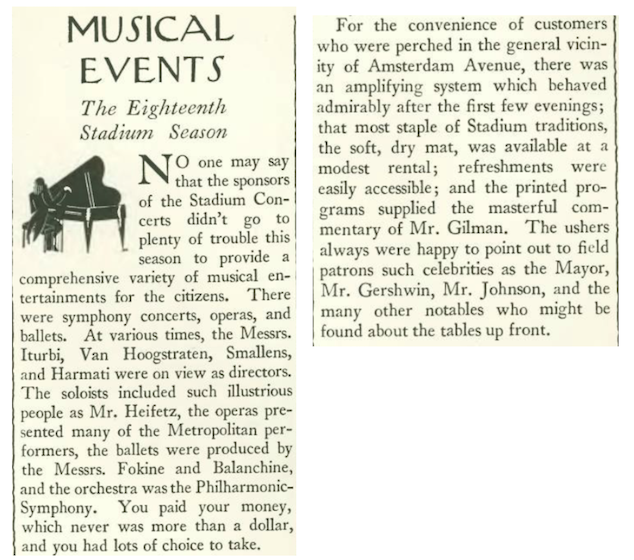
The monumental Lewisohn Stadium was a popular classical music venue on the City College of New York campus until its unfortunate demolition in 1973. According to BBC Music Magazine, “for nearly half a century, Lewisohn Stadium gave people from all walks of life the chance to hear performances by the likes of violinist Fritz Kreisler, soprano Leontyne Price and clarinettist Benny Goodman for as little as 25 cents admission. The New Yorker paid a visit during eighteenth season of the Stadium Concerts. Excerpts:
CLASSICAL MASSES…At left, cover of the 1935 Stadium Concerts Review; at right, Andre Kostelanetz conducts before a crowd of thousands at Lewisohn Stadium in 1939. The stadium was demolished in 1973 to make way for City College of New York’s North Academic Center. SeeThe New York Philharmonic Archive for the complete digital version of the 1935 Stadium Concerts Review. (NY Philharmonic Archive/PressReader.com)
* * *
At the Movies
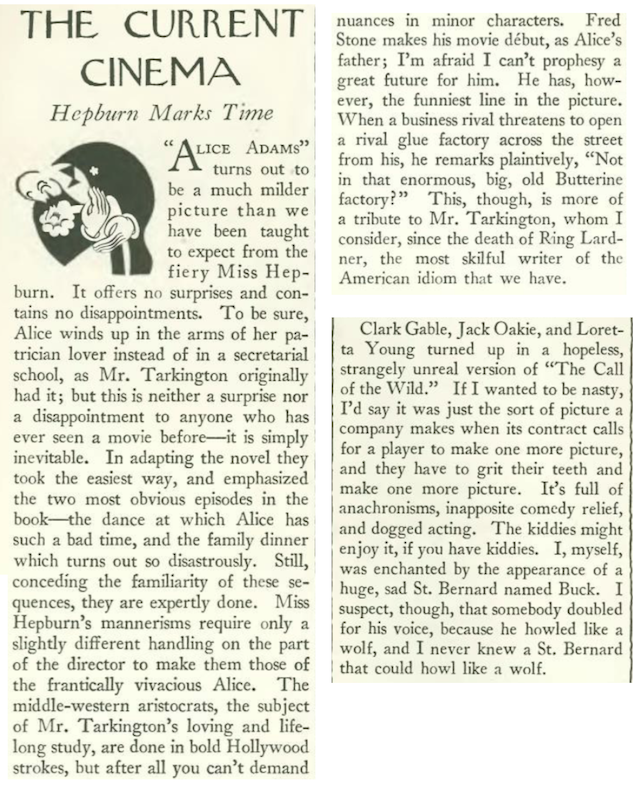
Film critic John Mosher continued to search in vain for a film he could endorse, but he came away empty-handed after screening a star-studded screen adaptation of Jack London’s novel The Call of the Wild. Star power also fell short for Mosher in the screen version of Booth Tarkington’sAlice Adams.
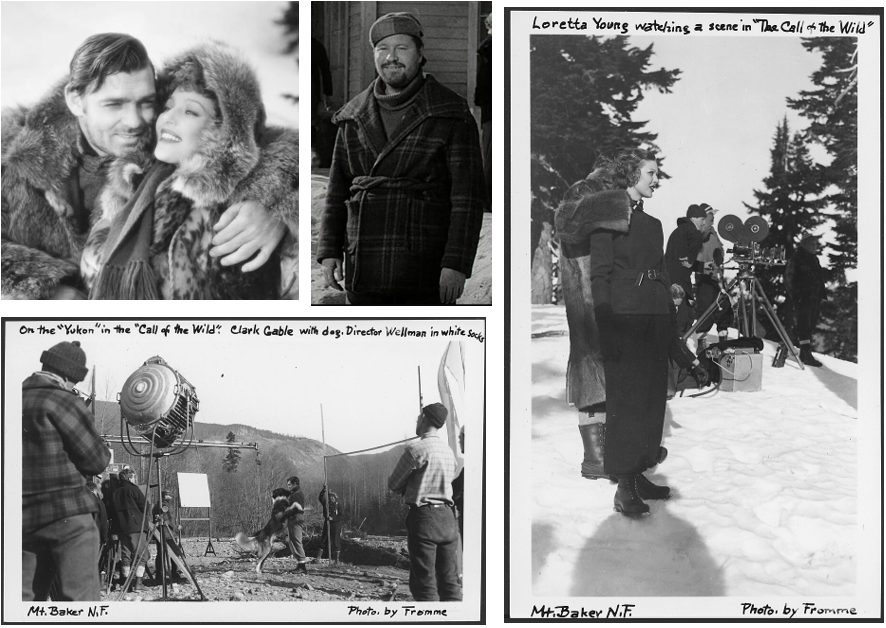
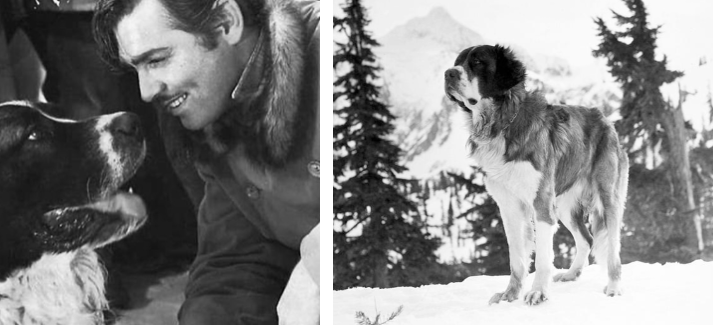
SMALL TALK…The film adaption of Booth Tarkington’sAlice Adams seemed to have all of the right elements in place, including director George Stevens and stars Katharine Hepburn and Fred MacMurray (left), but critic John Mosher found it somewhat average. In a 1991 retrospective review, however, The New Yorker’sPauline Kael deemed the romantic comedy “a classic” and stated that “Hepburn gives one of her two or three finest performances.” At right, the character of Alice Adams was first portrayed on the silver screen by Florence Vidor in a 1923 silent film. (Toronto Film Society/Wikipedia)THE BIG CHILL…Clockwise, from top left, Clark Gable and Loretta Young brave the Yukon wilds (actually Washington State) in The Call of the Wild; Jack Oakie provided comic relief as Gable’s sidekick Shorty Hoolihan; Young watches the filming of a scene on location at Mt. Baker National Forest; Gable shoots a scene with the St. Bernard Buck. (IMDB/Wikimedia)CLARK’S BEST FRIEND…Dog lover Clark Gable became very close with Buck during the filming of The Call of the Wild. Buck appeared in seven more films from 1935 to 1940, even receiving star billing as “Buck the Wonder Dog.” (Facebook/Pinterest)
* * *
From Our Advertisers
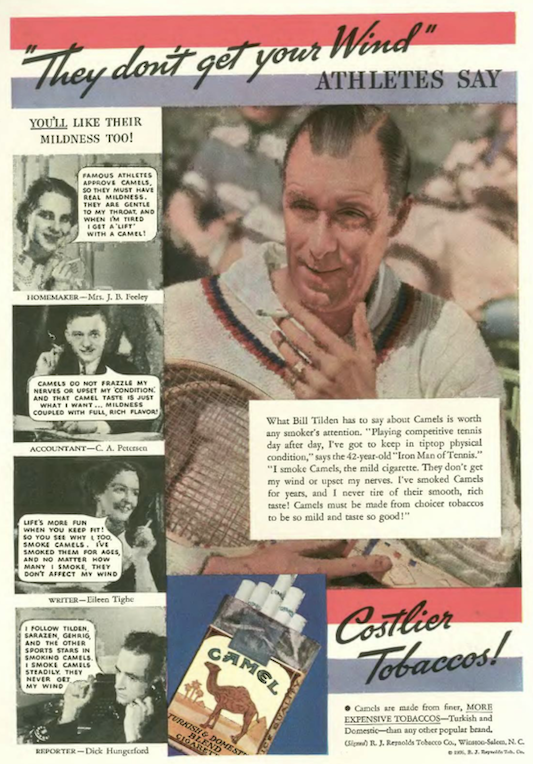
Colorful ads returned to the August 24 issue, featuring familiar sponsors who could afford full-page, full-color spots, namely tobacco and liquor producers…Camel was back with their athletic theme, however they might have chosen someone other than Bill Tilden, who looked perfectly ancient…
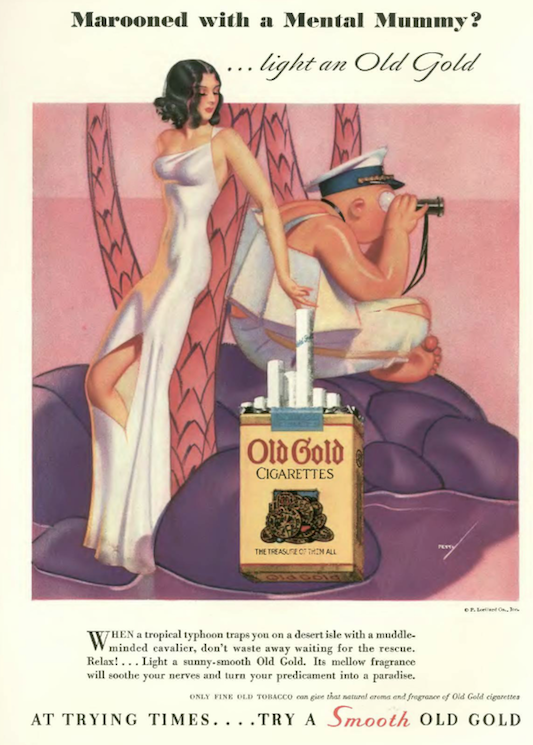
…Old Gold returned with another George Petty-illustrated ad…
…Courvoisier cognac took the back page spot…
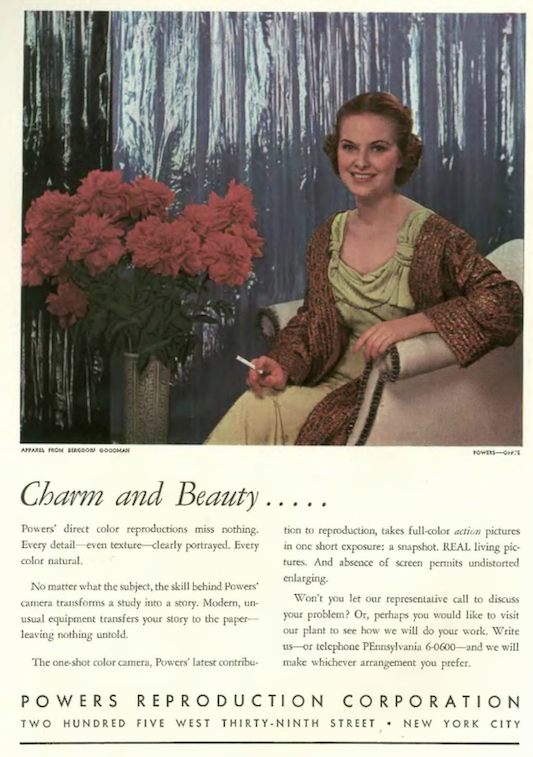
…Powers Reproduction showed off their color printing expertise…I wonder if that is a Lucky she is smoking…
…because I believe she is the same woman who appeared in this ad from the July 27 issue:
…back to August 24, where we were encouraged to enjoy a Johnny Walker highball to stave off the late summer heat…
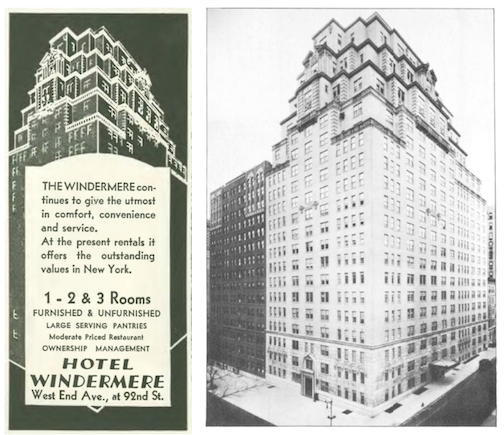
…the distinctive crown of Hotel Windemere on the Upper West Side was an eye-catcher even in this one-column ad from the back of the book…photo at right from around the time it was completed, 1927…
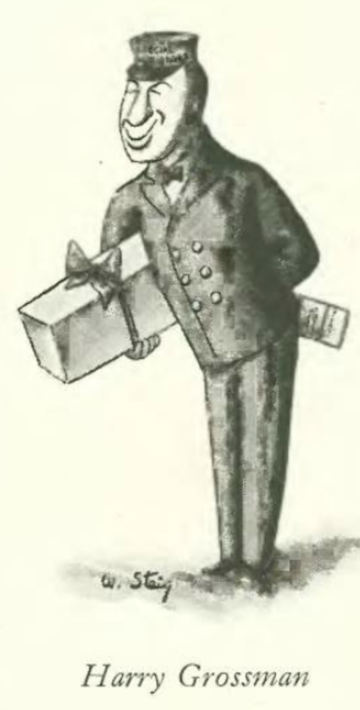
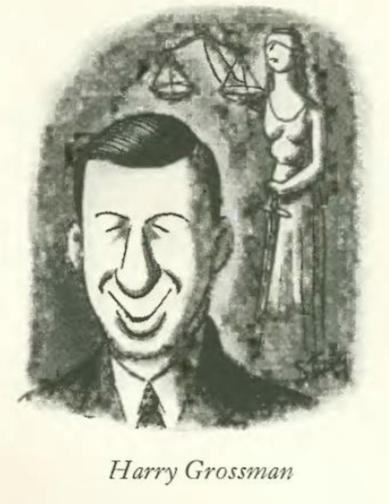
…on to our cartoonists, an unexpected profile caricature by William Steig (this two-part profile featured process-server Harry Grossman)…
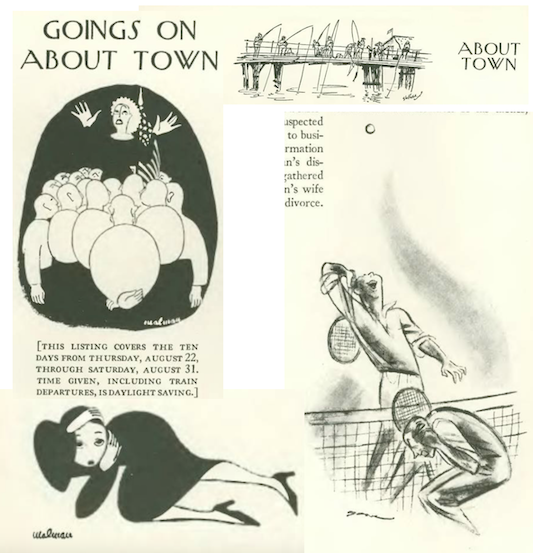
…interesting spot drawings by George Shellhase (top) and Leonard Dove (bottom right), and at left, two by Christina Malman…
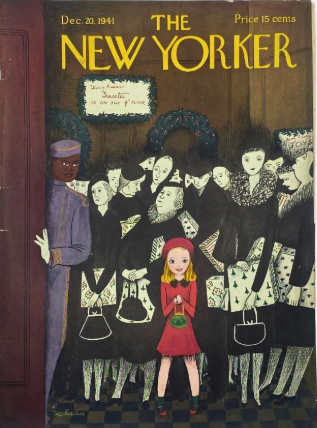
…Malman (1912-1959) produced at least two-dozen covers for The New Yorker between 1937 and 1956, including this gem from 1941:
…some baby names have real meaning, according to Alan Dunn…
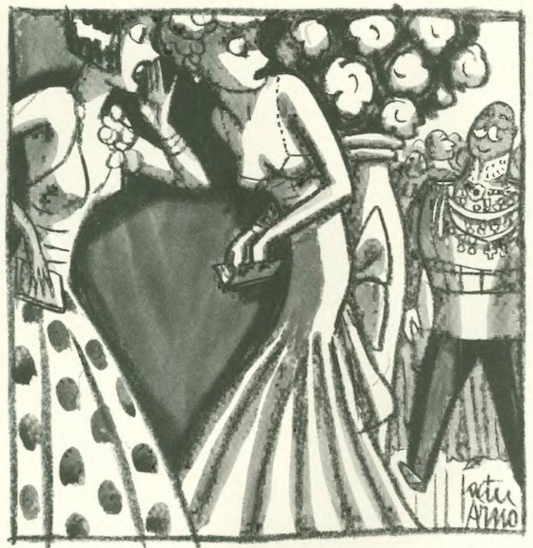
…Peter Arno offered caution about dancing with a prickly Colonel…
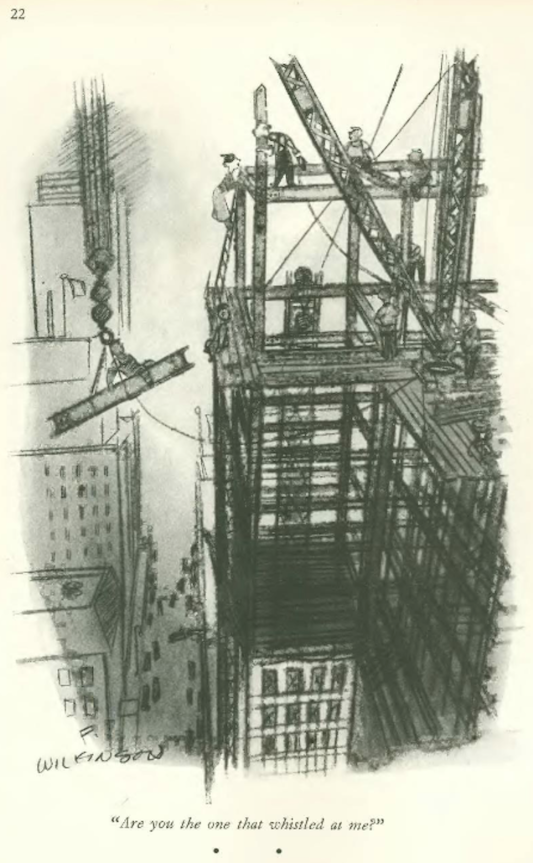
…Fritz Wilkinson answered one cat call high above the city…
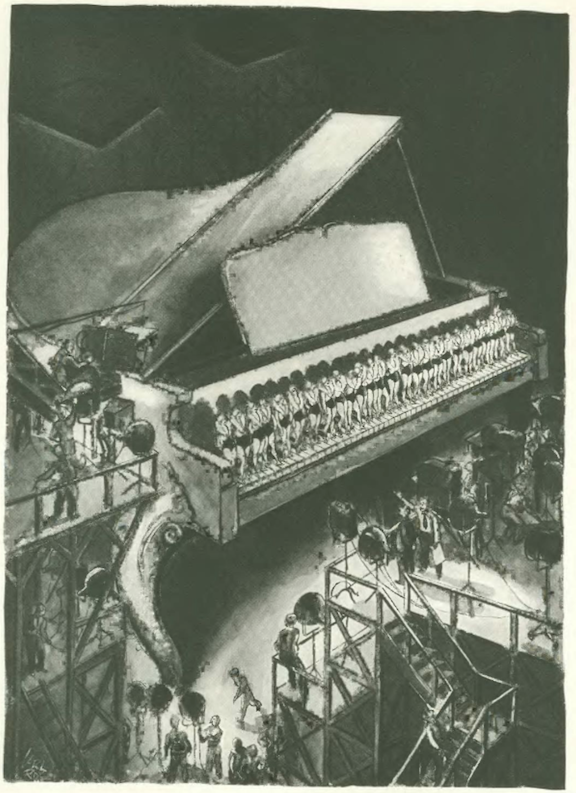
…Franz Shubert met Busby Berkeley, via Carl Rose…
…George Price persisted in threading a needle…
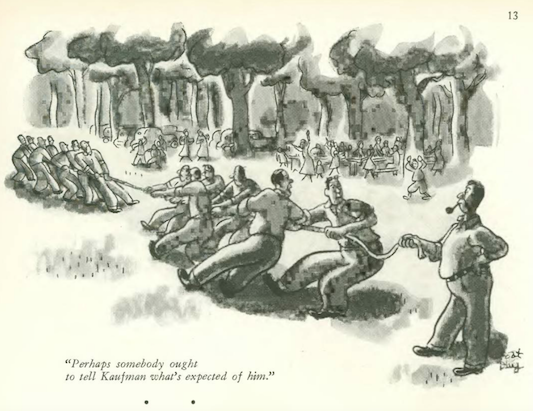
…Robert Day gave us a pacifist of sorts in a game of tug-of-war…
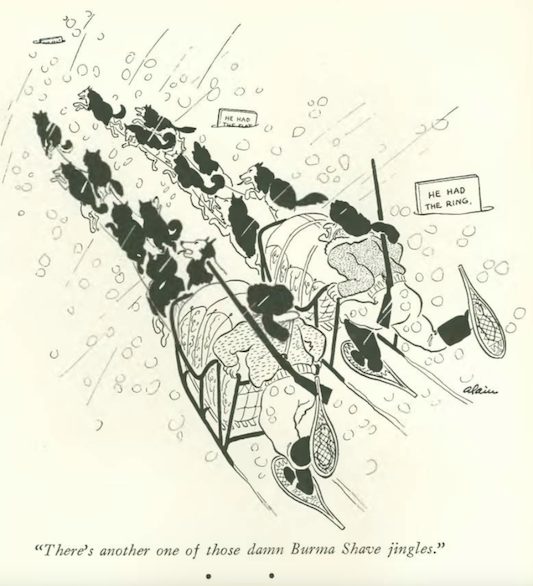
…Burma Shave jingles seemed to be everywhere in the 1930s, per Alain…
…An example of replica Burma Shave signs along Route 66:
(roadsideamerica.com)
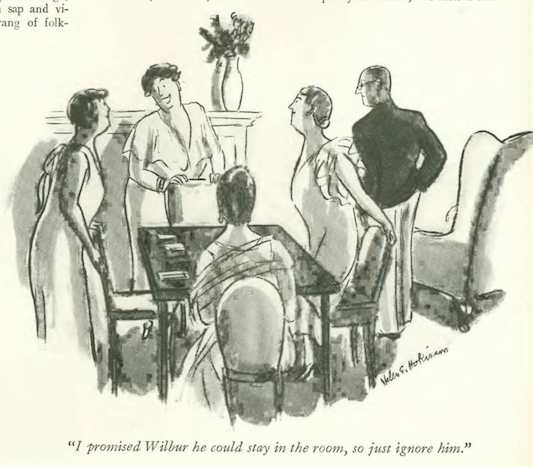
…some parenting tips came our way via Helen Hokinson…
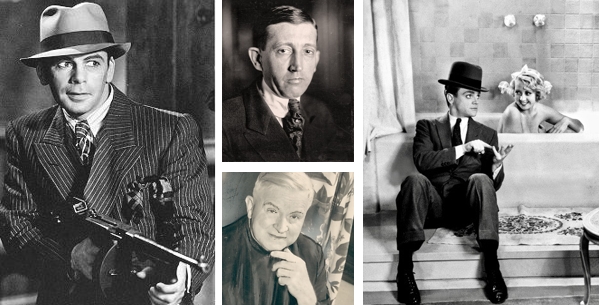
Above: Will Hays (center, top) was the enforcer and Fr. Daniel A. Lord was the author of the Production Code that was rigidly enforced beginning in 1934. They and others were responding to the sex, violence and other forms of "immorality" in such films as 1932's "Scarface" (with Paul Muni, pictured at left) and 1931's "Blonde Crazy" with James Cagney and Joan Blondell. (Wikipedia/cinemasojourns.com)
With the Production Code fully enforced, New Yorker film critic John Mosher found even less to get excited about during his visits to Manhattan’s cinemas.
August 17, 1935 cover by Julian de Miskey. He contributed 62 covers to the magazine, as well as 82 cartoons from 1925 to 1962.
The Motion Picture Production Code—a set of industry guidelines for the self-censorship of content—had been around for awhile, but it was mostly ignored until June 13, 1934, when an amendment to the Code required all films released to obtain a certificate of approval. Hoping to avoid government censorship and preferring self-regulation, studios adopted the Code.
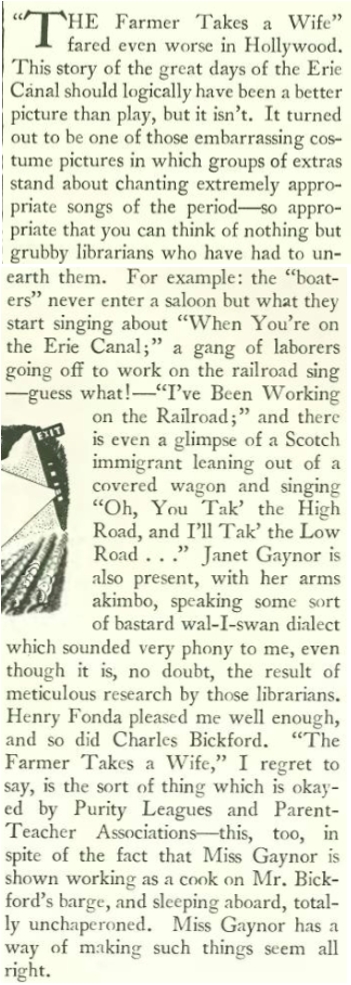
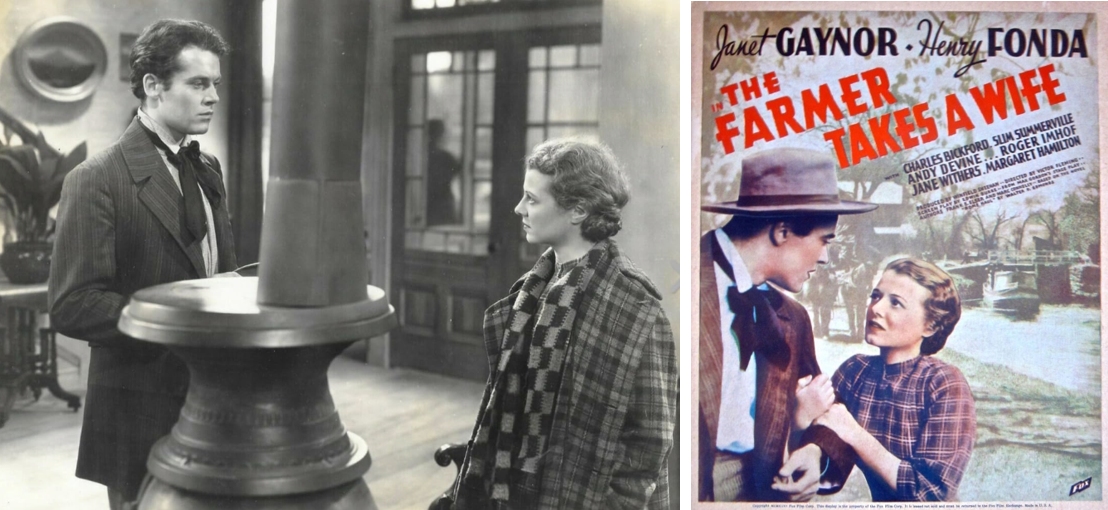
The Code’s effects were felt in such films as The Farmer Takes a Wife, a romantic comedy about a Erie Canal boatman, portrayed by Henry Fonda, who dreams of becoming a farmer (a role reprised by Fonda from the Broadway production of the same name; it was Fonda’s first break in films). Mosher was pleased by Fonda’s performance, but found the film adaptation to be corny and phony, filled with “bastard” dialect and schmaltzy musical numbers. “It is the sort of thing which is okayed by Purity Leagues…” Mosher concluded.
SILVER SCREEN DEBUT…Boatman Dan Harrow (Henry Fonda) woos barge cook Molly Larkins (Janet Gaynor) in a scene from A Farmer Takes a Wife. While it was Fonda’s film debut, Gaynor was an established star known for playing sweet, wholesome characters. One of the few actresses who made a successful transition to sound movies in the late 1920s, Gaynor was the number-one draw at the box office in 1935. (IMDB)STILL KEEPING IT CLEAN…The Code was still in force when The Farmer Takes a Wife was remade in 1953; however, nineteen years after the Code took effect there was a notable easing of restrictions, as can be seen in the generous display of Betty Grable’s famous gams (seen here with Thelma Ritter). (IMDB/Wikipedia)
To get a clearer idea of what the Code did to the pictures, compare the scene from 1934’s Tarzan and His Mate (left), which was released two months before the Code went into effect, and Tarzan Escapes (right), from 1936.
CLOTHED IN THE CODE…Johnny Weissmuller and Maureen O’Sullivan appeared together in six Tarzan films. In their second outing, 1934’s Tarzan and His Mate, O’Sullivan wore a skimpy halter-top and loincloth (left) and was shown sleeping and swimming in the nude. In their next film, 1936’s Tarzan Escapes (right); Jane is more chastely clad. (mikestakeonthemovies.com/rottentomatoes.com)
* * *
Noted and Notorious
In his weekly column “Of All Things,” Howard Brubaker offered wry observations on the passing scene, including this latest brief that described the rise and fall of a very unlikely quartet of celebrities.
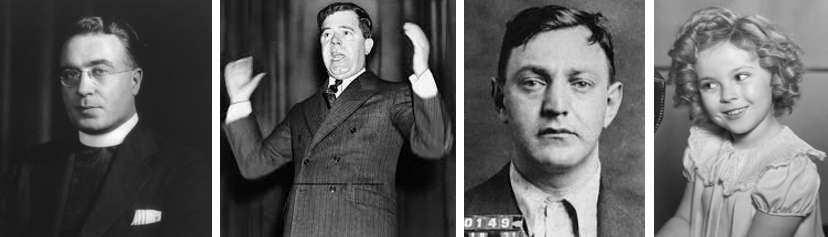
DEMOGOGUES, DUTCH & DIMPLES…(Left to right) Support appeared to be on the wane for radio priest and demagogue Father Charles Coughlin and fellow-fascist Louisiana Sen. Huey Long, while stock was on the rise for mobster Dutch Schultz, who successfully swayed public opinion (while under indictment for tax evasion) by generously donating to various charities. Shirley Temple continued to charm audiences, her films ranking number-one at the box office in 1935 (as well as in 1936, 1937, and 1938). The year 1935 would also be the last for Long and Schultz–both would be assassinated. (Wikipedia)
* * *
Titlemania
Lacking the strictures of Old World caste systems, Americans have had an anxious relationship with class signifiers. In a land where trade schools become universities overnight and their faculty members refer to one another as “doctor,” there is much confusion and hand-wringing in the honorifics trade. H.L. Mencken examined the proliferation of titles in his country, freely handed out without regard to merit. Excerpts:
* * *
From Our Advertisers
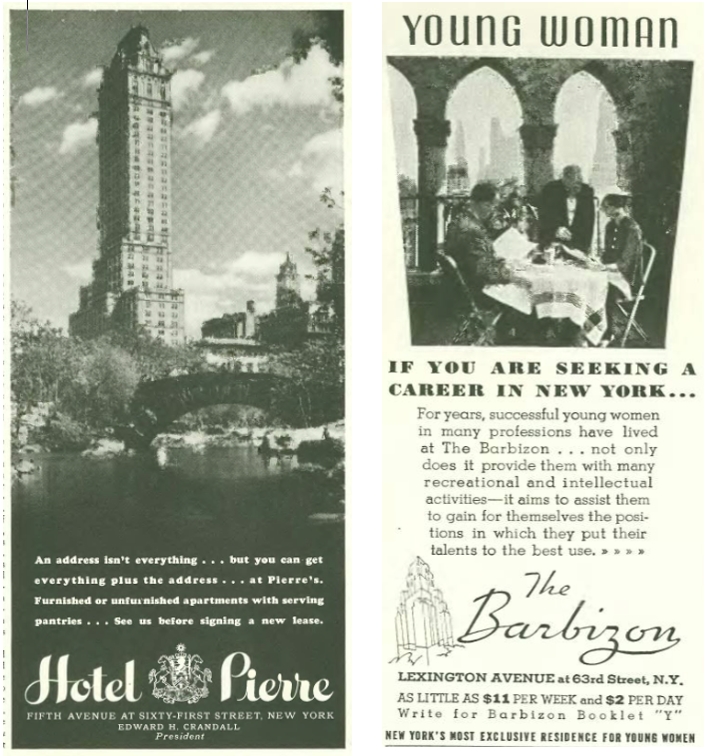
The back of the book was where one could find advertisements for upscale urban living, including these two touting the advantages of the Hotel Pierre and The Barbizon…
…In a joint venture with a group of Wall Street financiers, the former busboy-turned restauranteur Charles Pierre opened the Hotel Pierre in 1930—not the most auspicious time to open a luxury hotel as markets continued to collapse…the Pierre went into bankruptcy in 1932 and was later purchased by oilman J. Paul Getty…the legendary Barbizon Hotel for Women, completed in 1927, was designed as a safe and respectable haven for women seeking to pursue careers in New York, especially in the arts, and would host numerous famous women through the 1970s…
At left, the Barbizon in 1927; right, the Hotel Pierre circa 1930. (loc.gov)
…like the tobacco companies, brewers targeted women as a growth market for a product mostly associated with men…
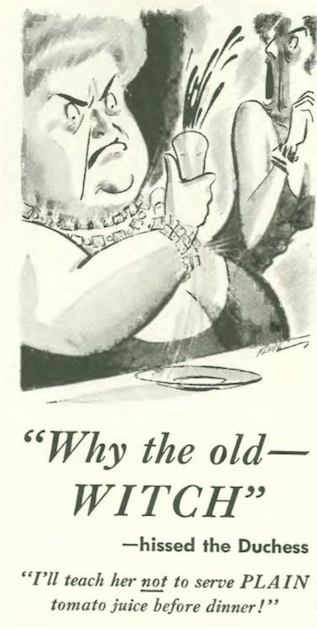
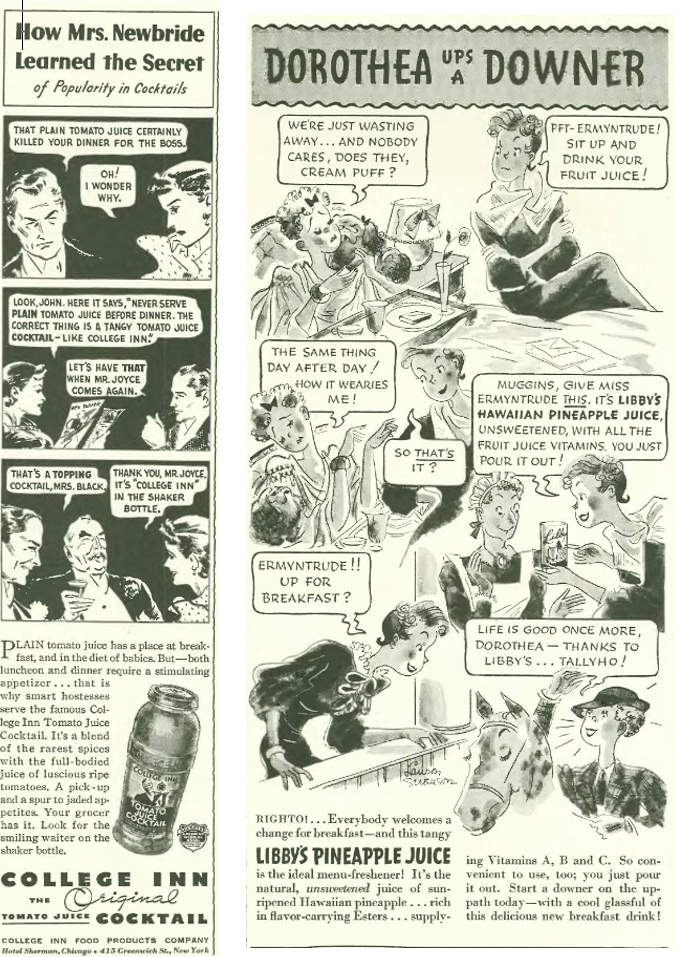
…the makers of juices, meanwhile, created comic strips to promote their products…College Inn still went negative with their ads—recall the violent outbursts of the Duchess…
…here a spiteful husband blames his wife’s choice of tomato juice for his lack of success with the boss…Libby’s, on the other hand, promoted their pineapple juice as a surefire cure for a young woman’s ennui…
…notable in these somewhat thin, late summer issues is the lack of full-color ads…this was on the back inside cover…
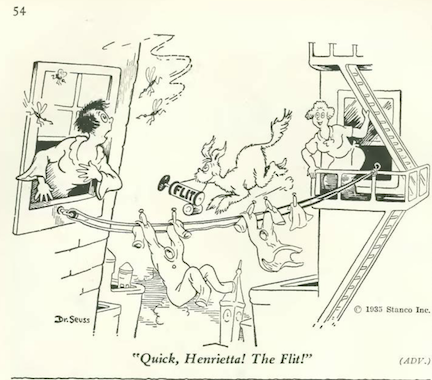
…Flit and Dr. Seuss continued to be a weekly presence…
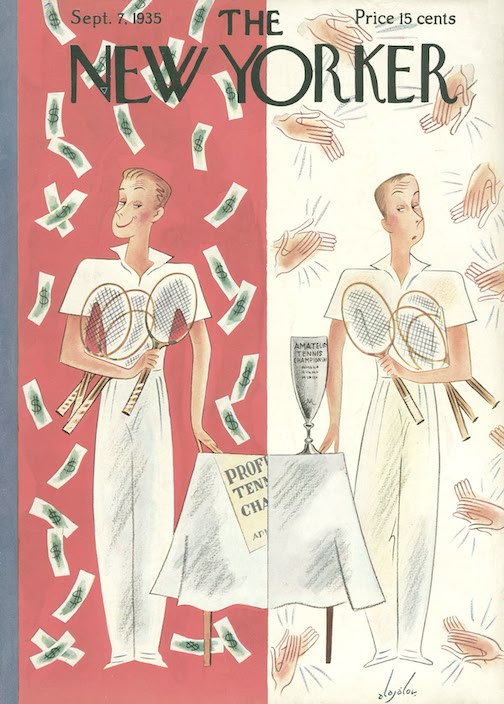
…which brings us to our cartoonists, and a spot drawing by Constantin Alajalov…
…also a modest spot by Robert Day, keeping us cool with this polar bear…
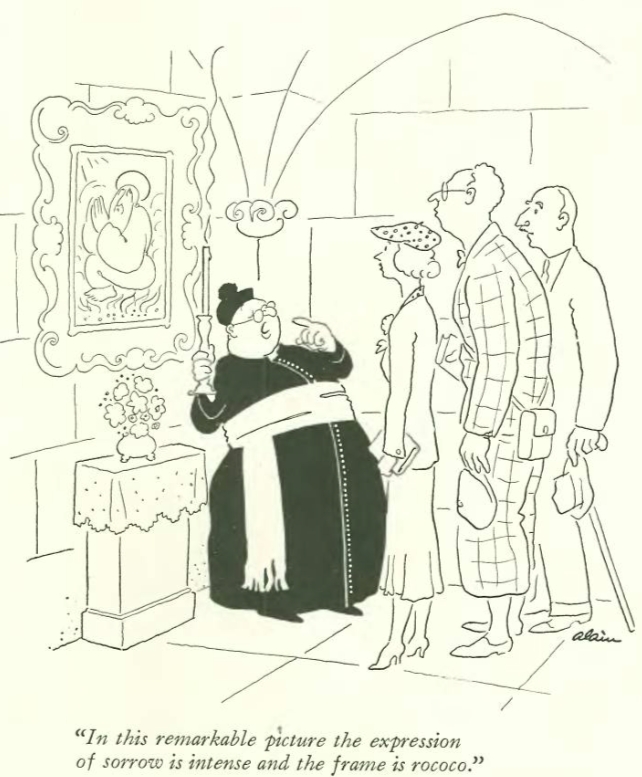
…Alain offered a short course in art appreciation…
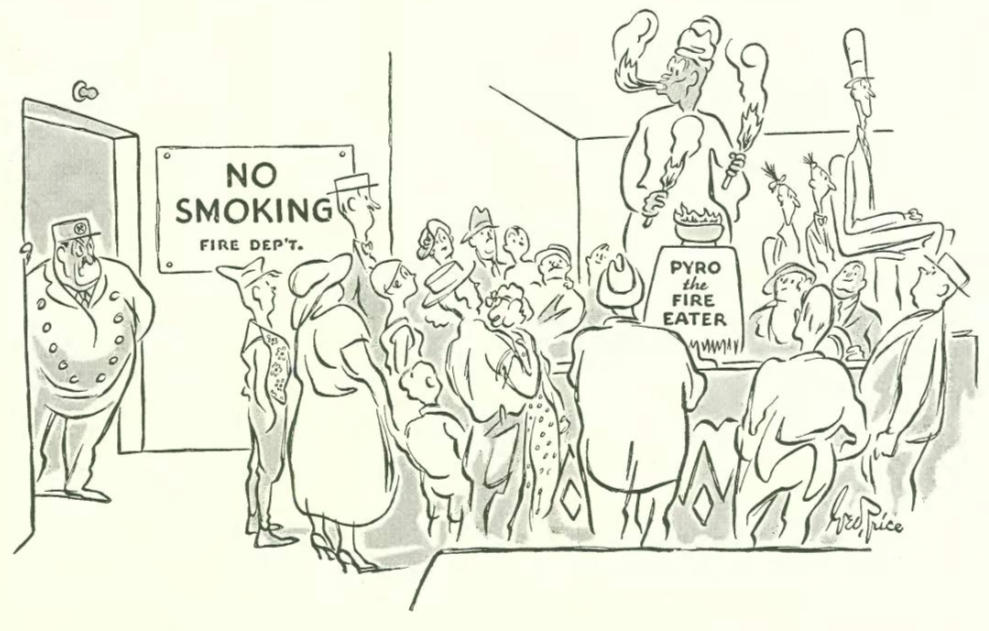
…George Price ran afoul of the fire code…
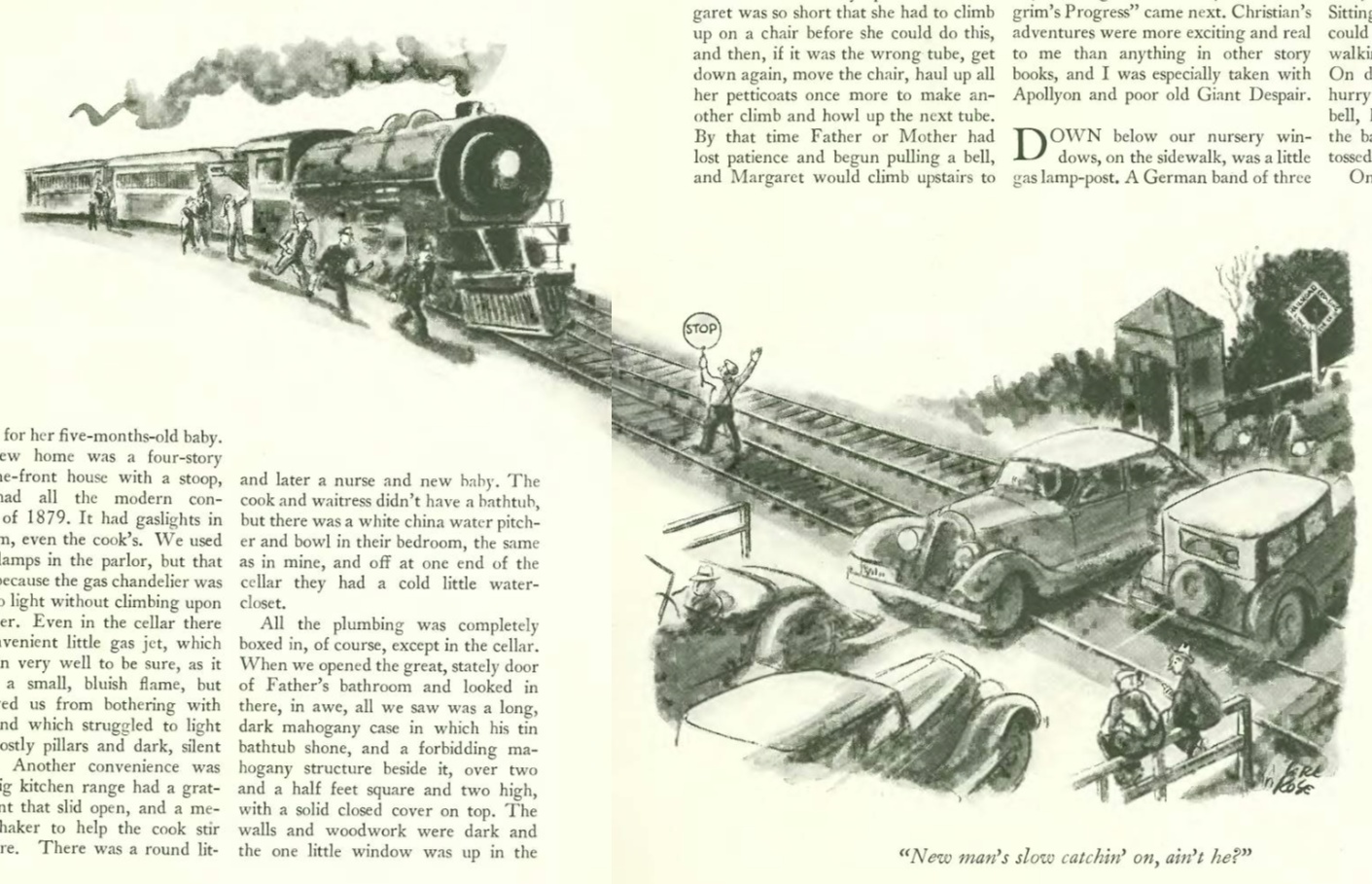
…Carl Rose ran his tracks across this two-page spread…
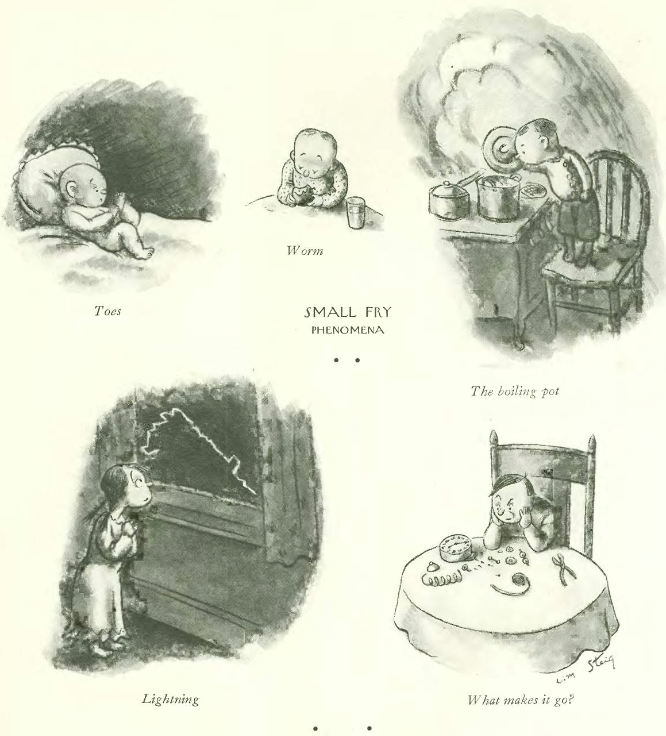
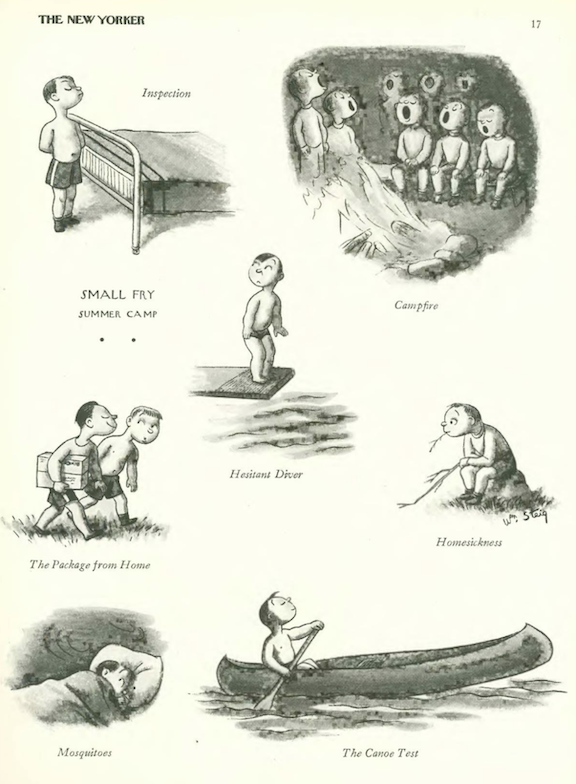
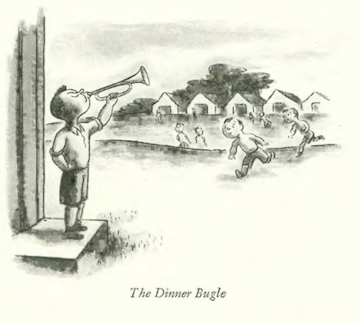
…William Steig gave us the small fry’s perspective on the world’s wonders…
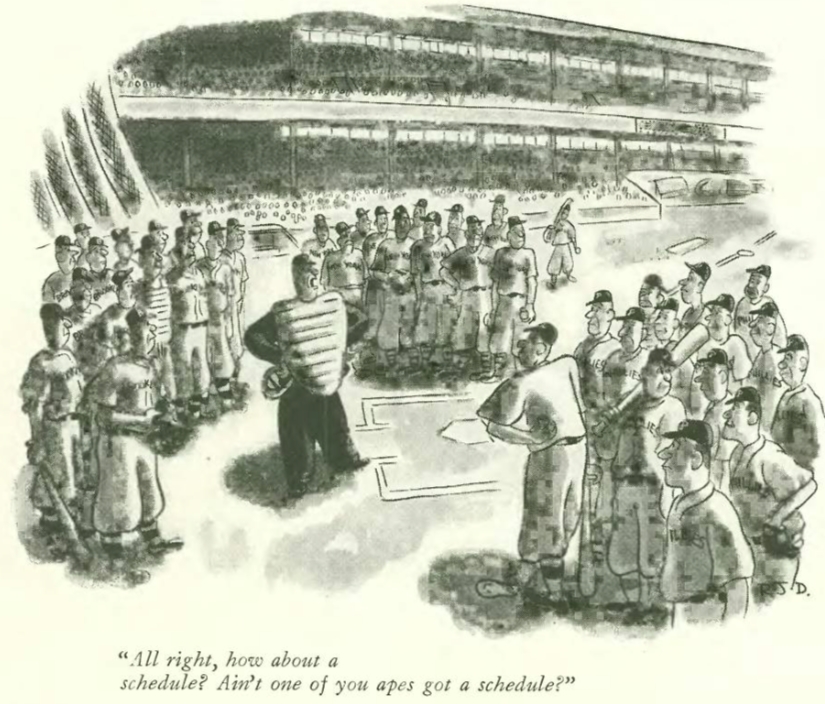
…a rare appearance of baseball in the magazine, thanks to Robert Day...
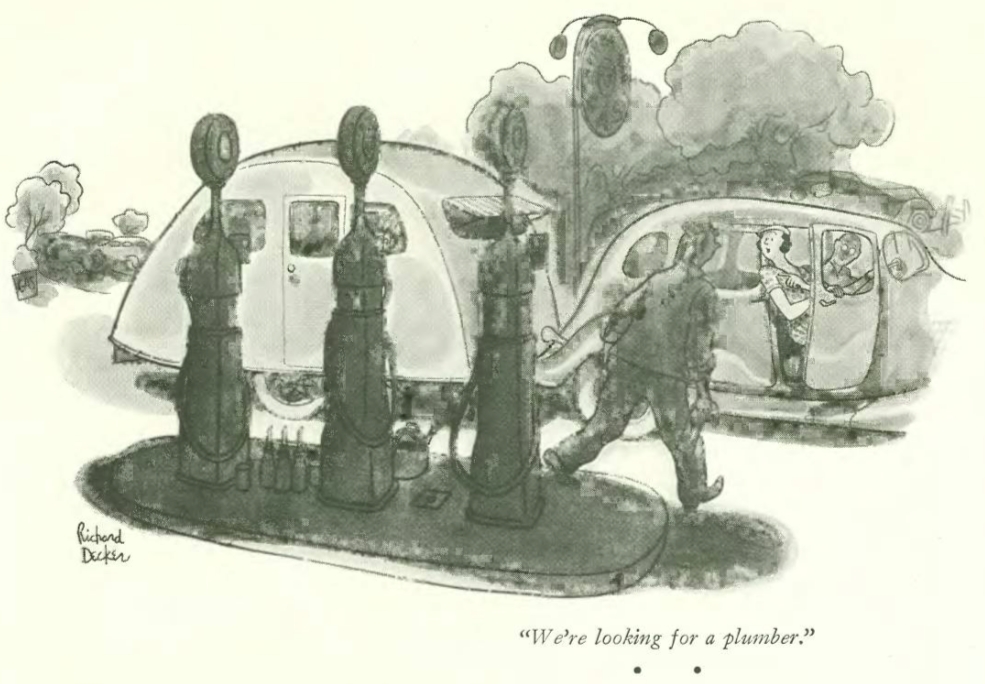
…Richard Decker brought a modern world challenge to one filling station…
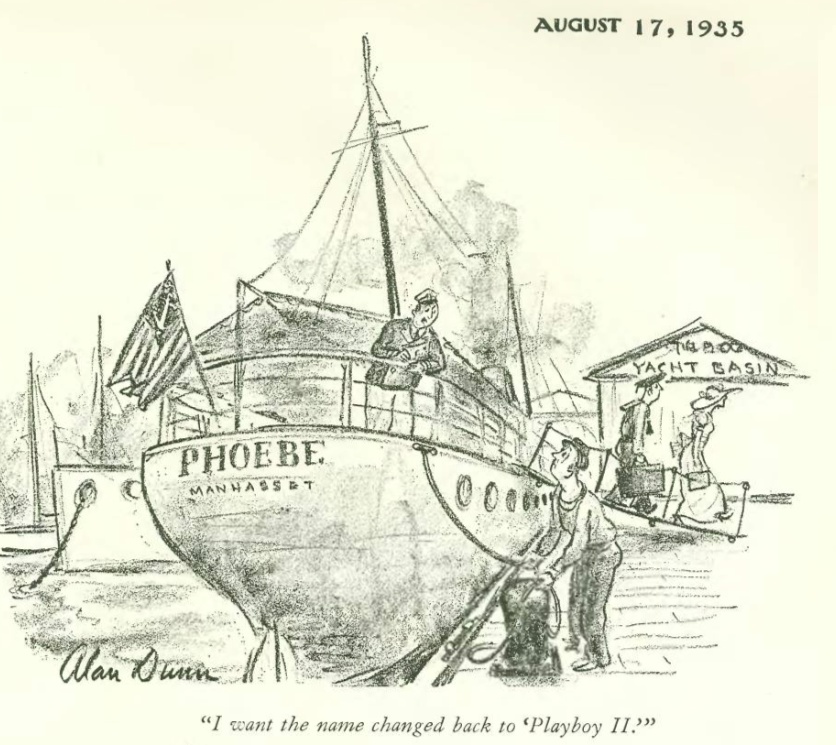
…A sailor’s return to bachelorhood required a new paint job, per Alan Dunn…
…and who else but Charles Addams would circle vultures over an amusement park?…
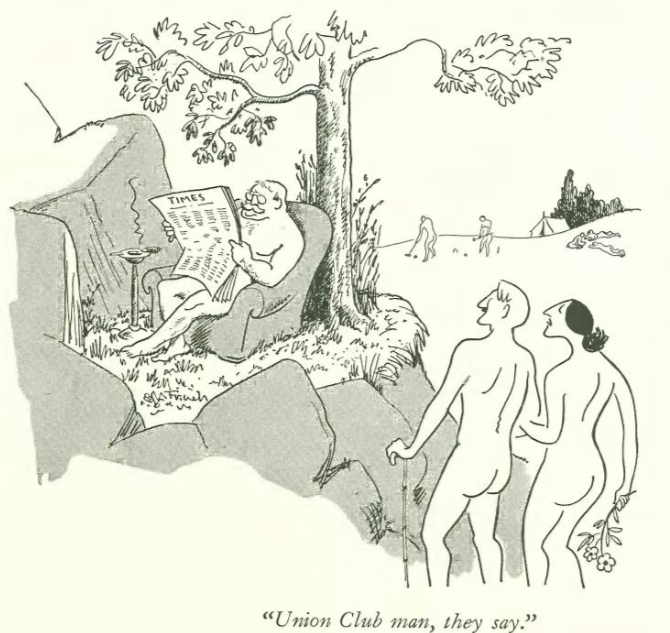
…and we close with Al Frueh, and a Union Club member not concerned with a dress code…
The 1935 film She was one of those old movies you’d see on television during the 1970s when there were only three or four channels (plus UHF) and local stations would tap into the “B” movie vault to fill airtime. One of those films was She.
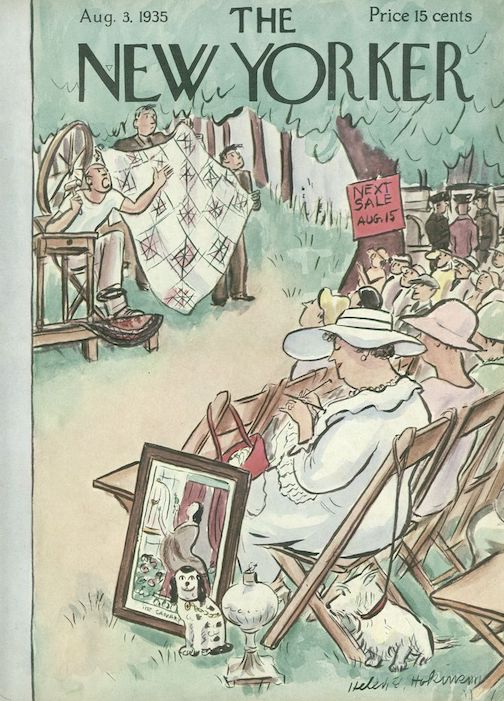
August 3, 1935 cover by Helen Hokinson.
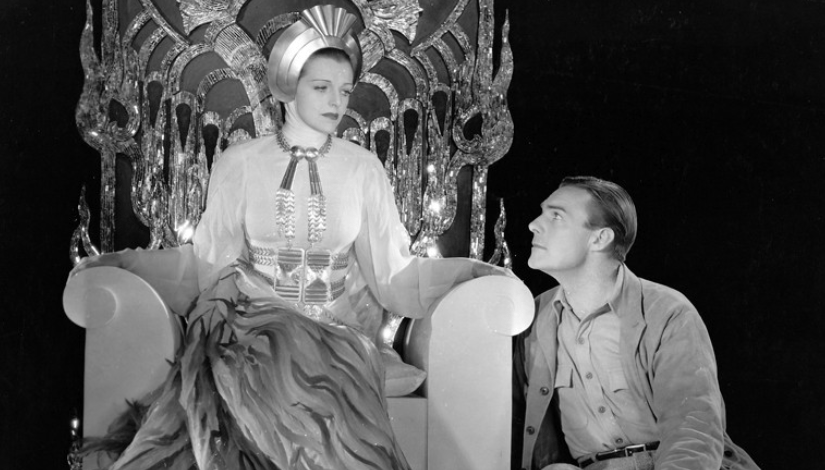
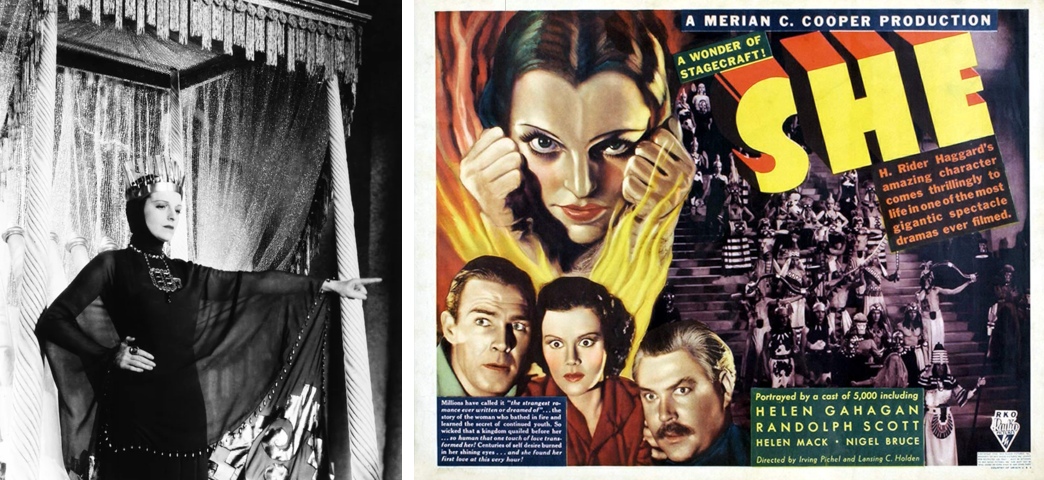
Film critic John Mosher felt a bit sorry for Helen Gahagan, who portrayed “She Who Must Be Obeyed” (aka “She”)—an immortal who ruled an exotic, lost civilization near the Arctic Circle. The challenge for Gahagan was to seem imperious before her co-stars Randolph Scott and Helen Mack, who seemed more suited to the high school hijinks of an Andy Hardy picture. The film was a pretty standard adventure tale, in the mold of producer Marian C. Cooper’s 1933 King Kong, with two explorers falling in love during a perilous journey.
ARCHETYPE…At left, Helen Gahagan as “She” (Who Must Be Obeyed). Her costume possibly inspired the Evil Queen in Disney’s 1937 animated Snow White and the Seven Dwarfs. At right, lobby card that promoted the film. (Scifist.net/Reddit)WHEN YOU PLAY WITH FIRE…She Who Must Be Obeyed (Helen Gahagan), believing that the explorer Leo Vincey (Randolph Scott) was a reincarnation of his ancestor (whom she loved), and jealous of his girlfriend Tanya (Helen Mack), invites Leo to join her in the eternal flame. Unfortunately, her re-entry into the flame that gave her immortality turned her into a dying, withered crone. (The Nitrate Diva/Scifist.net)
The 1887 H. Rider Haggard novel, She, inspired eponymous silent films in 1908, 1911, 1916, 1917, and 1925. The 1935 film reviewed here received tepid reviews and lost money on its first release, however in a 1949 re-release it fared much better. She was re-made in 1965 with Ursula Andress in the lead role, and again in 1984 in a post-apocalyptic film that had virtually nothing to do with Haggard’s novel.
SHE THROUGH THE YEARS…Clockwise, from top left, “She” (Marguerite Snow) offers a dagger to Leo Vincey (James Cruze) in a 1911 two-reel (24 min.) adaptation; Valeska Suratt as “She” in the 1917 film (now lost); Betty Blythe took the title role in the 1925 production, considered to be the most faithful to the 1887 H. Rider Haggard novel; Sandahl Bergman appeared dressed for a Jazzercise video in the 1984 post-apocalyptic She; and finally, Ursula Andress and John Richardson in the 1965 CinemaScope production of She. (Wikipedia / digitalcollections.lib.washington.edu / cultcelebrities.com / Reddit)
* * *
Colonial Ambitions
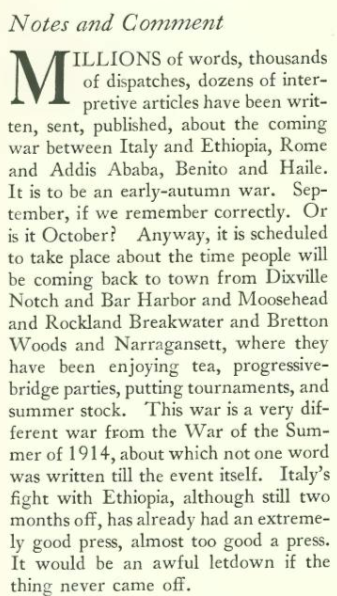
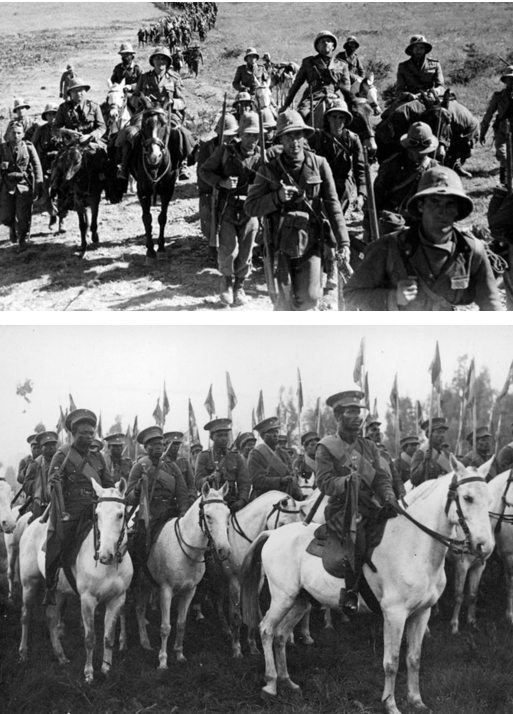
With most of Africa carved up by other European powers (Britain, France, Belgium etc.) in the 19th century, Italy set its sights on Ethiopia, which by the end of the 19th century was the only independent country left on the continent. Ethiopia fought off Italy’s first attempt at conquest in the Battle of Adwa (1896), but with the rise of fascist dictator Benito Mussolini, Italy paid a return visit, this time with heavy artillery and airstrikes that included chemical weapons. E.B. White tried to make sense of this latest invasion in his opening comments.
THOSE GUYS AGAIN…Italy invaded Ethiopia on October 3, 1935, a significant act of aggression in the lead up to World War II. Despite facing a technologically superior Italian army (top) equipped with modern weapons, including tanks, aircraft, and chemical weapons, the Ethiopian forces (bottom photo) mounted a strong resistance. (Wikipedia)
In his weekly column, Howard Brubaker mused on the Italian aggressions and other rumblings of the coming European war.
* * *
Author, Author
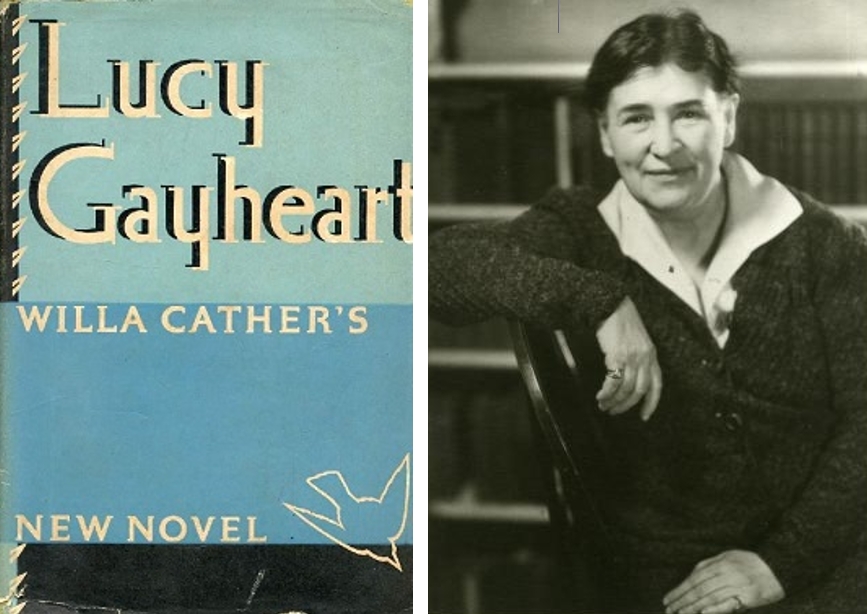
The writer Willa Cather was a favorite of New Yorker critics, including Clifton Fadiman, however her latest novel was a bit too mild for his tastes.
HERE’S LUCY…Clifton Fadiman confessed he was “mortified” to admit that he found Willa Cather’s latest novel a bit too gentle. At right, portrait of Cather on her birthday, December 7, 1936. (willacather.org)
* * *
From Our Advertisers
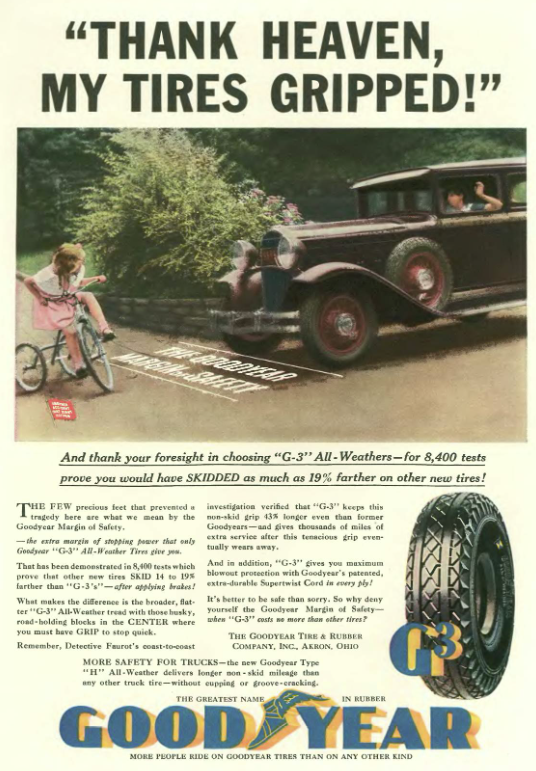
We begin with more fearmongering from the folks at Goodyear, who offered weekly reminders of the perils of not choosing their all-weather tires…
…the Liggett and Myers Tobacco Company conjured up this “naughty maiden” to encourage even timid souls to take up the habit…
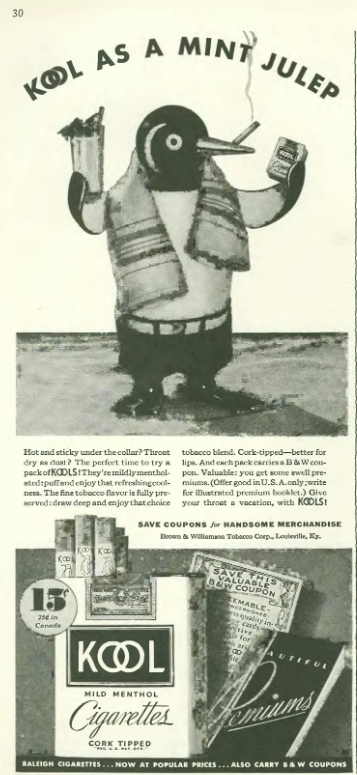
…on the other hand, the makers of the upstart KOOL brand kept it simple with their chain-smoking penguin, who was grabbing ever more market share from rival menthol pusher SPUD…
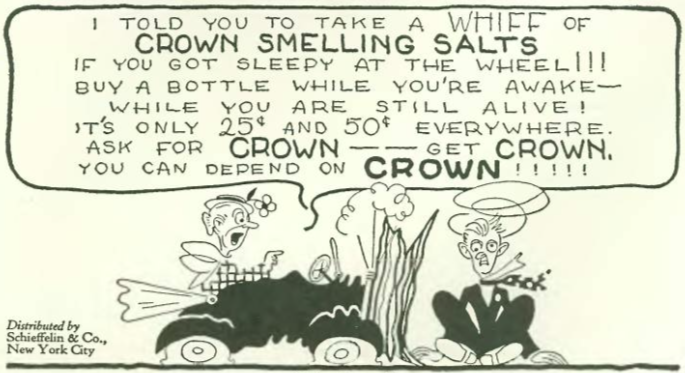
…ads in the back of the book offered up even less sophisticated products, such as Crown Smelling Salts…
…while Dr. Seuss and Norman Z. McLeod continued to make a living with their distinctive illustrations…
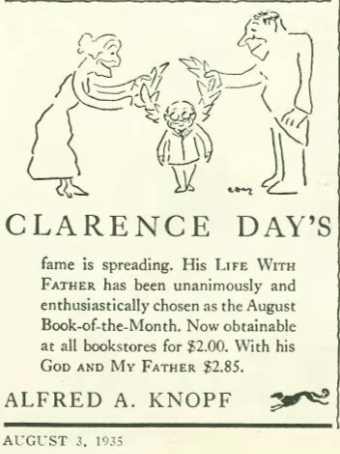
…at the very back of the magazine, this tiny ad from Knopf promoted Clarence Day’sLife With Father, published just months before Day’s death on Dec. 28…
…which brings us to our cartoonists…Constantin Alajalov kicked us off with this happy number…
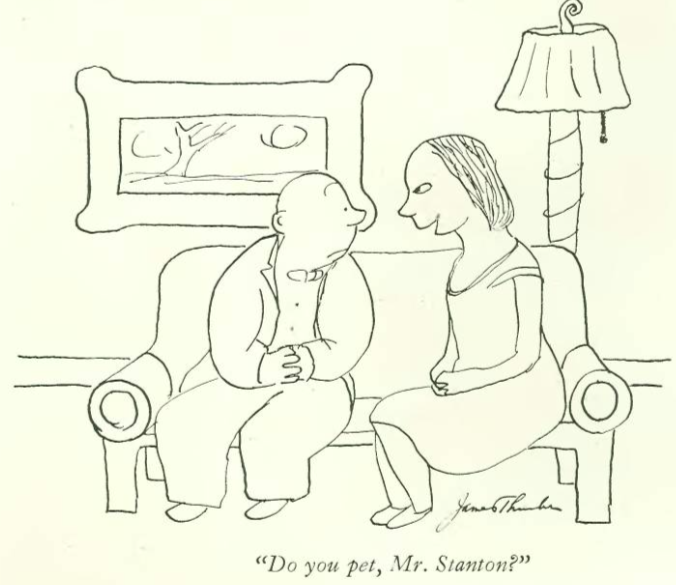
…James Thurber found steamy goings on in the parlor…
…Charles Addams came down to earth with this pair…
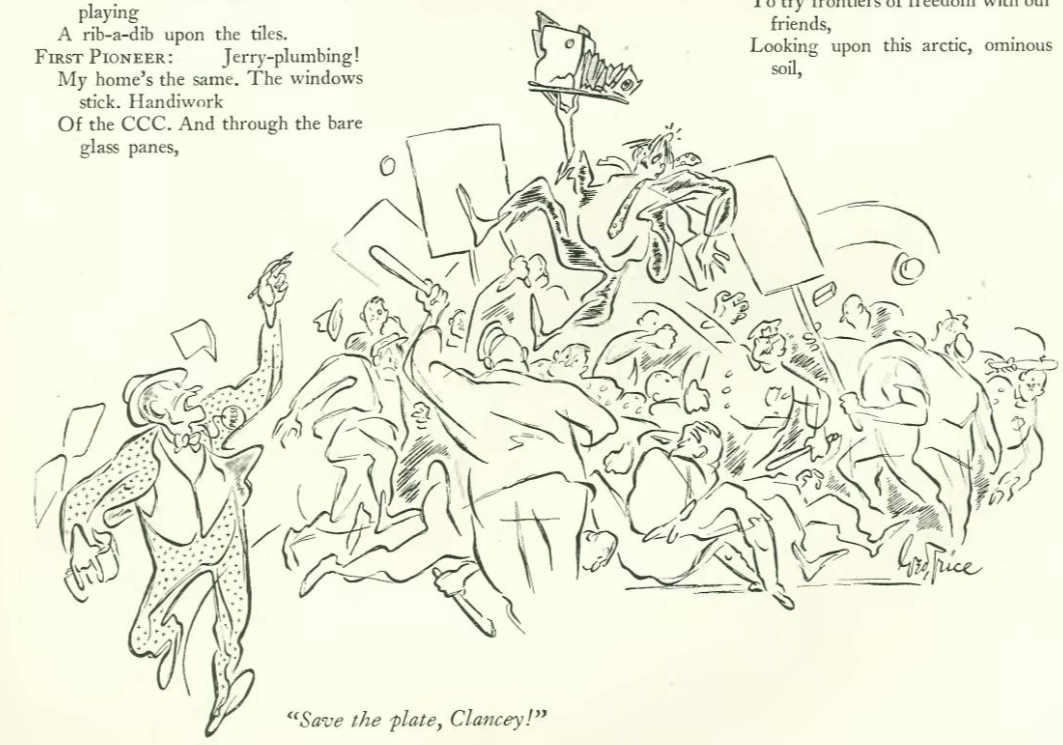
…George Price showed us the rough and tumble of news reporting…
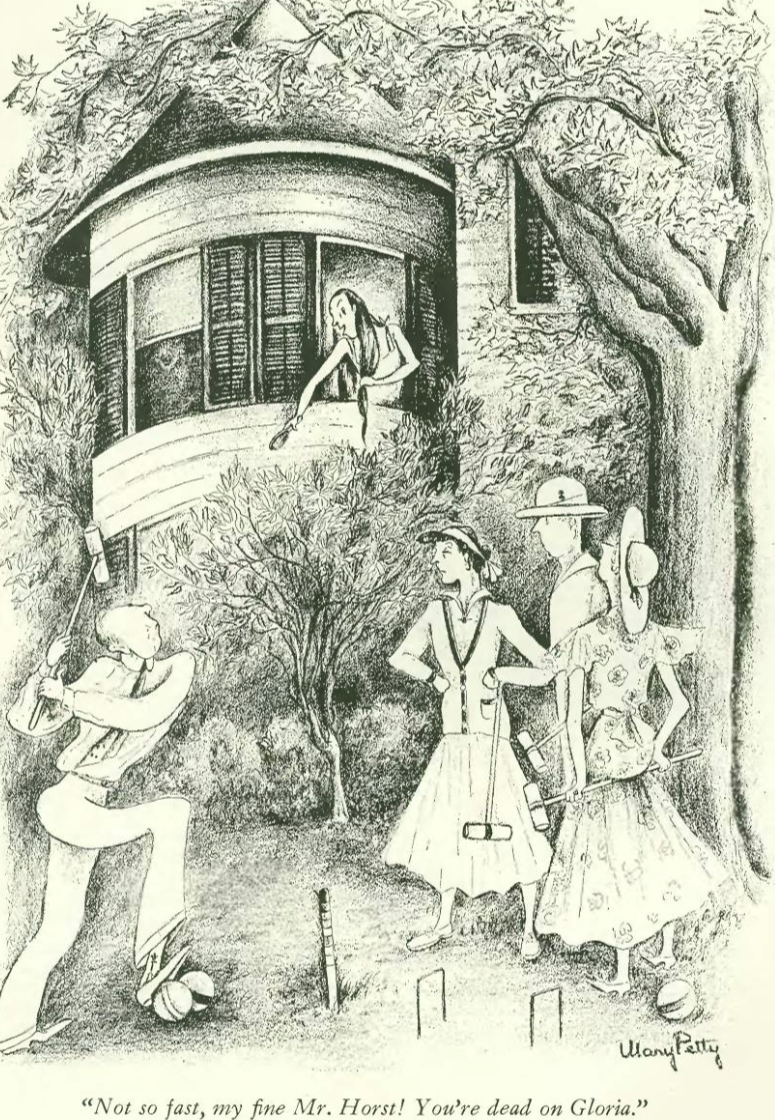
…Mary Petty contributed this sumptuous drawing of a croquet match…
…Helen Hokinson was in a transcendental mood…
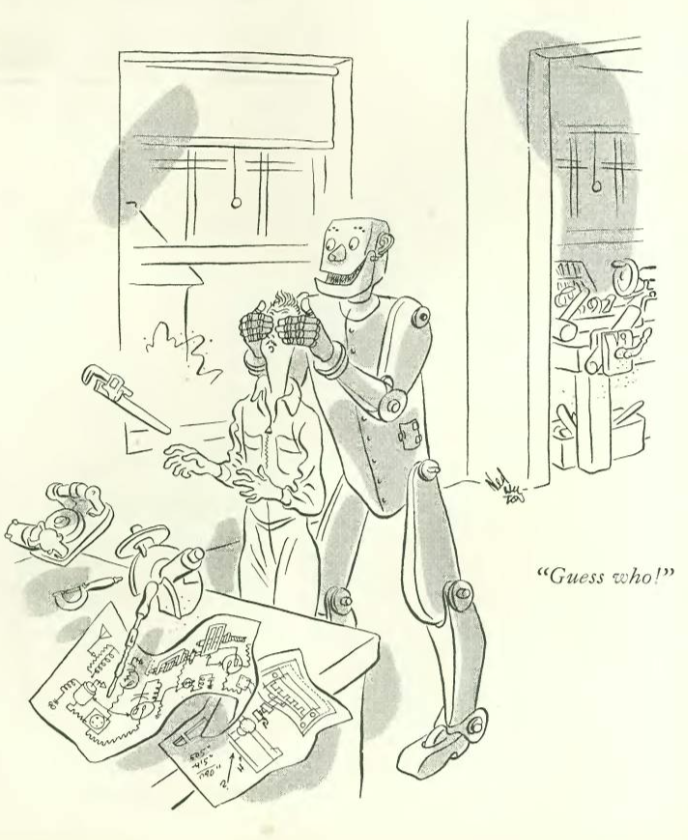
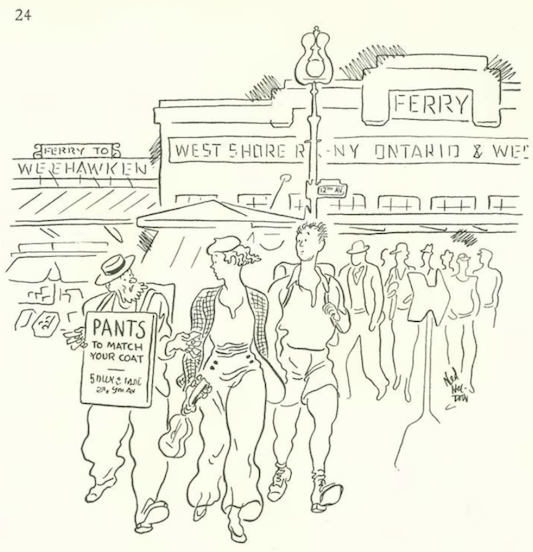
…and Ned Hilton had a big surprise for one garage tinkerer…
…on to August 10 and a rich summer scene by Arnold Hall:
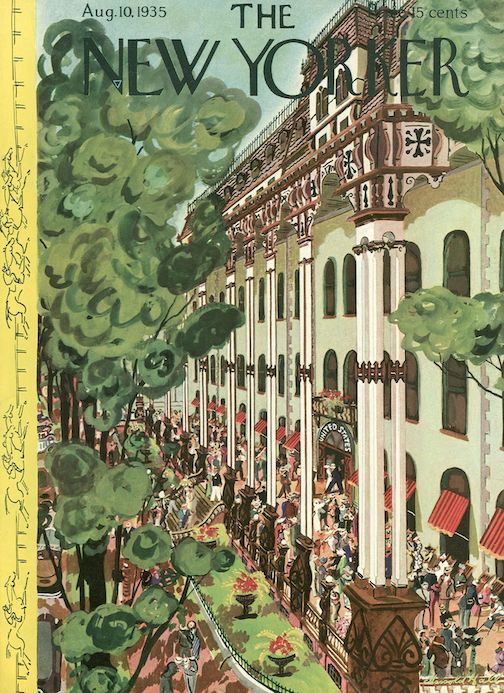
August 10, 1935 cover by Arnold Hall.
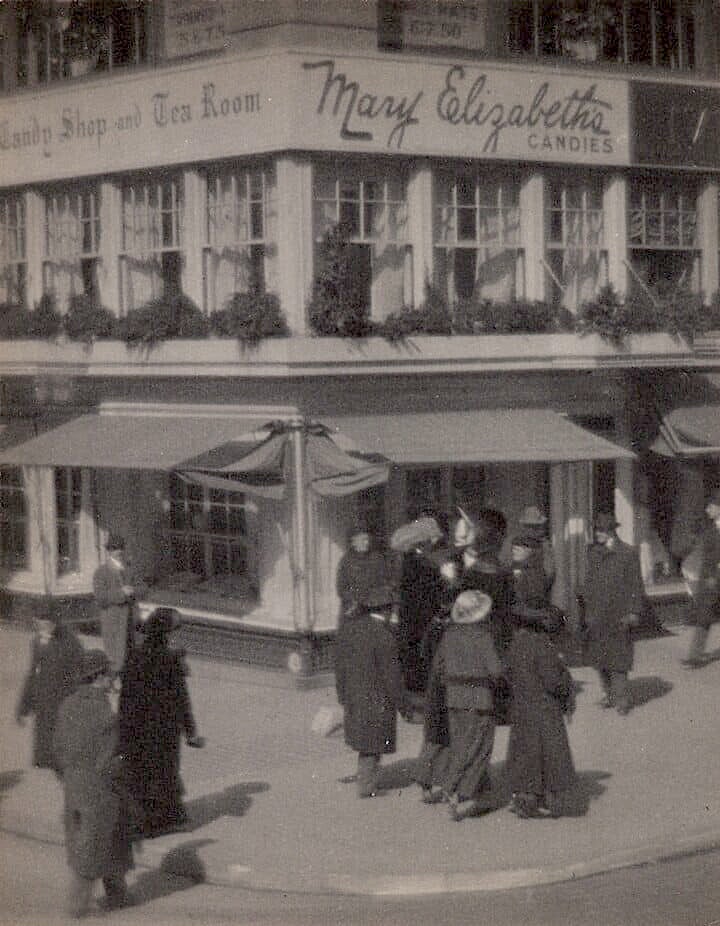
“The Talk of the Town” checked the lunch crowd at Mary Elizabeth’s Tea Room, where some preferred to drink their lunch.
TEA AND SWEETS (and cocktails) were among the offerings at Mary Elizabeth’s Tea Room at 36th and Fifth, seen here circa 1912. (Photo by Karl Struss via Facebook)
* * *
Comic Relief
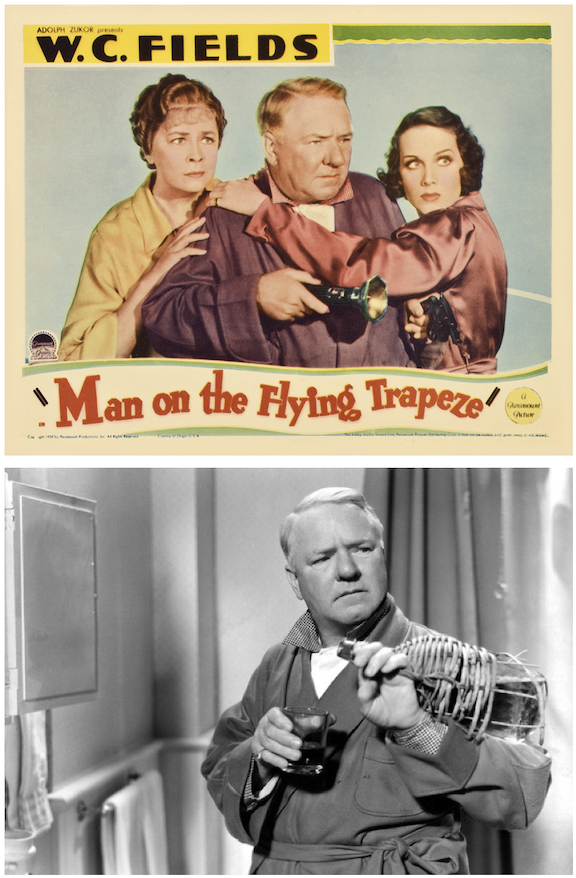
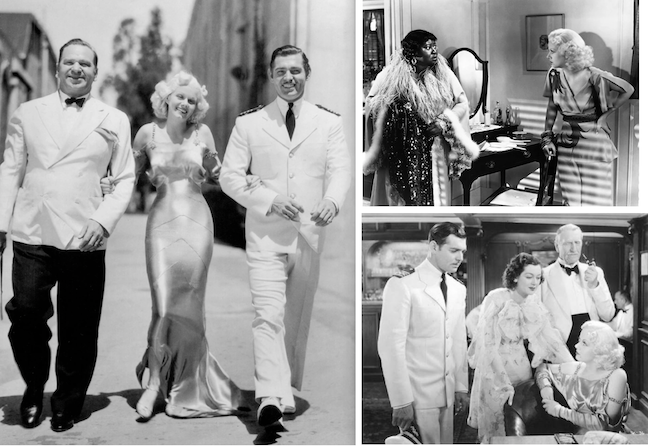
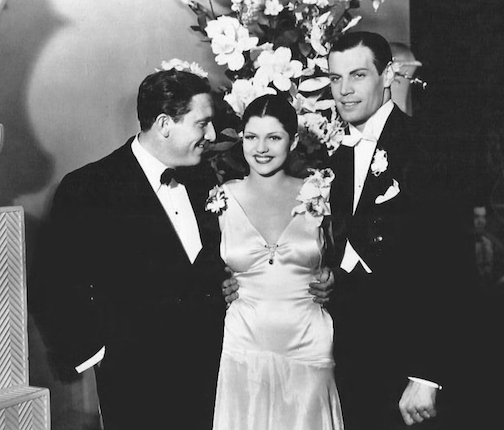
Film critic John Mosher offered an appreciation of W.C. Fields, noting that civilization needed films like Man on the Flying Trapeze during those hard years. Mosher also found some worthy distractions in the Jean Harlow vehicle China Seas, but was prepared to consign Spencer Tracey’s latest offering to the “lower circles of cinema hell.”
ANSWERING HIS NATION’S CALL…W.C. Fields brought joy to millions during the Depression in movies such as Man on the Flying Trapeze. Above, from left, Kathleen Howard, Fields, and Mary Brian. (IMDB/Rotten Tomatoes)SHORE LEAVE…At left, Wallace Beery, Jean Harlow, and Clark Gable on the set of China Seas; top right, Hattie McDaniel with Harlow in a scene from the film; below, Gable, Rosalind Russell, and C. Aubrey Smith with Harlow in China Seas. (musingsofaclassicfilmaddict.wordpress.com / Pinterest)FRESH FACE…Cinema newcomer Rita Hayworth was credited as Rita Cansino (she was born Margarita Carmen Cansino) in Dante’s Inferno. Here she is flanked by Spencer Tracy and Gary Leon. Dante’s Inferno was Spencer Tracy’s final film for 20th Century Fox. It was at MGM where his career really took off. (IMDB)
* * *
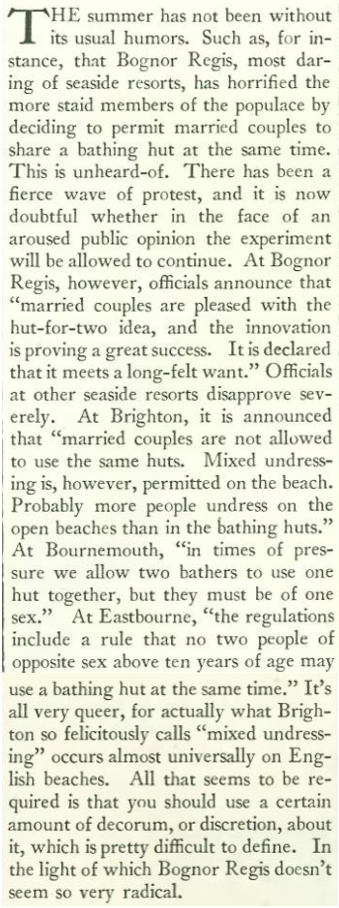
All Wet
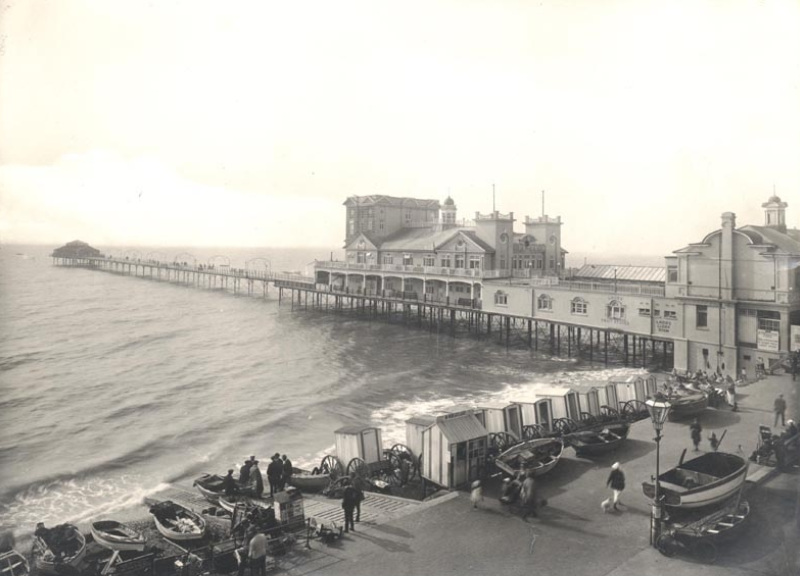
In his London Letter, Conrad Aiken (pen name Samuel Jeake Jr) examined the priggish ways of England’s seaside resorts.
SITE OF SCANDAL…Bathing huts at Bognor Regis, circa 1921. (bognorregistrails.co.uk)
* * *
Beware the Bachelor
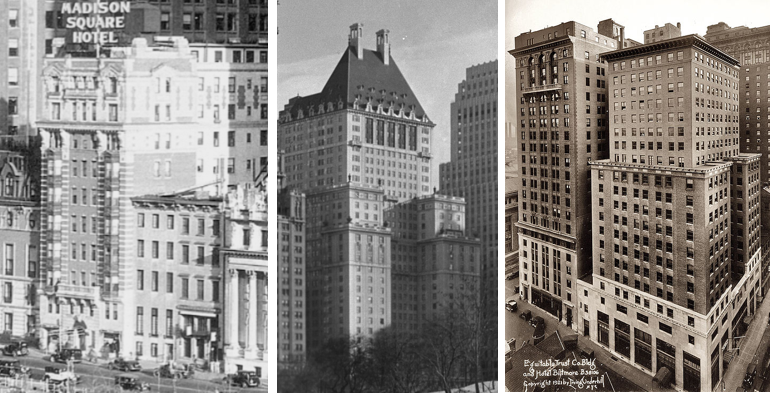
In her “Tables for Two” column, Lois Long examined some of the city’s seasonal escapes for “summer bachelors.”
GHOSTS OF THE PAST…Lois Long recommended the air-conditioned lounges of the Madison Square Hotel and the Savoy Plaza (center) or the cooling breezes of the Biltmore roof (right), which featured music by Morton Downey. Sadly, all three of these beautiful buildings have been demolished. (geographicguide.com/Wikipedia)
Other more casual venues recommended by Long included Nick’s Merry-Go-Round…
…a menu from Nick’s dated 1937…
(nypl.org)
…and its cryptic back cover…
From Our Advertisers
…speaking of the Biltmore and Morton Downey, we kick off our advertising section…
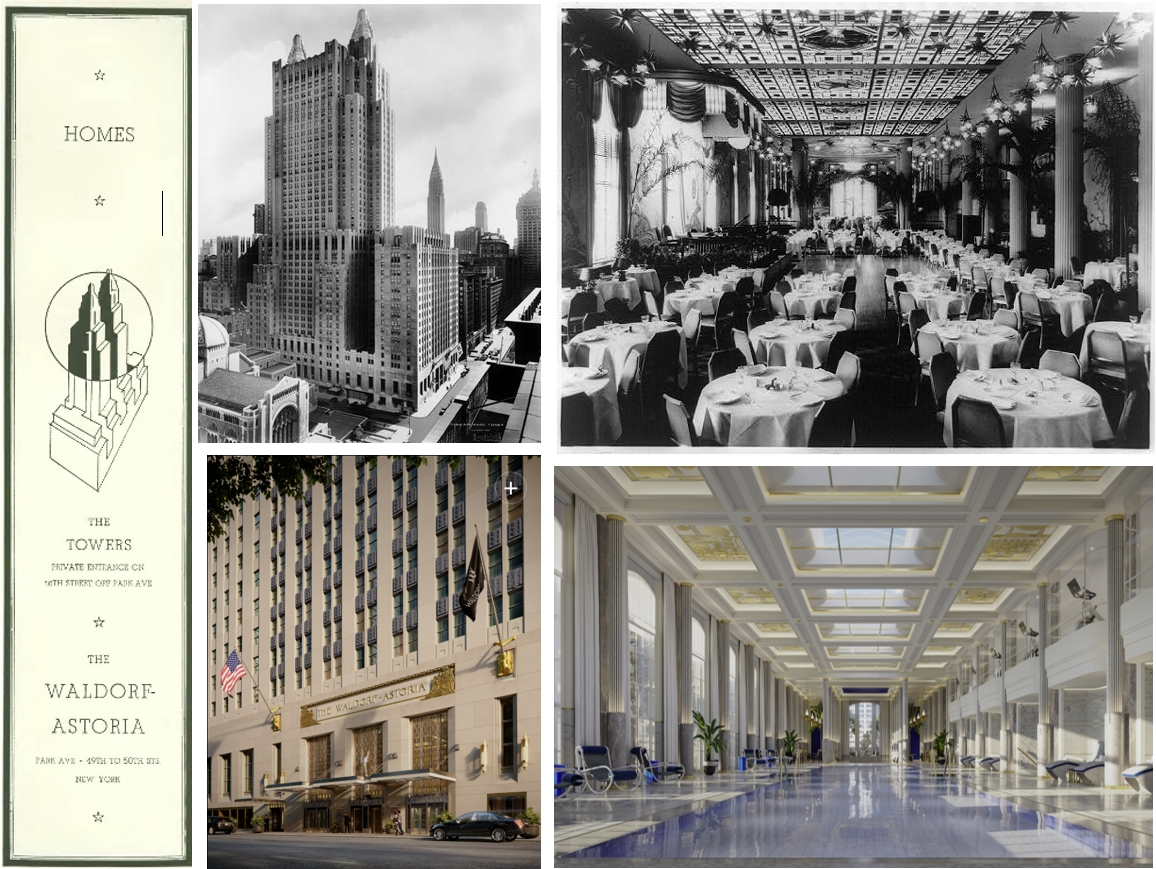
…the ad on the left announced the private residences at the Waldorf-Astoria…
Clockwise, from top left, the Waldorf Astoria circa 1930; the Waldorf’s Starlight Roof in the 1930s; after eight years and billions in restorations and renovations, the hotel has seen many changes including the transformation of the Starlight Roof into a swimming pool. Decades of grime were also cleaned from the building’s exterior. (mcny.org/loc.gov/som.com)
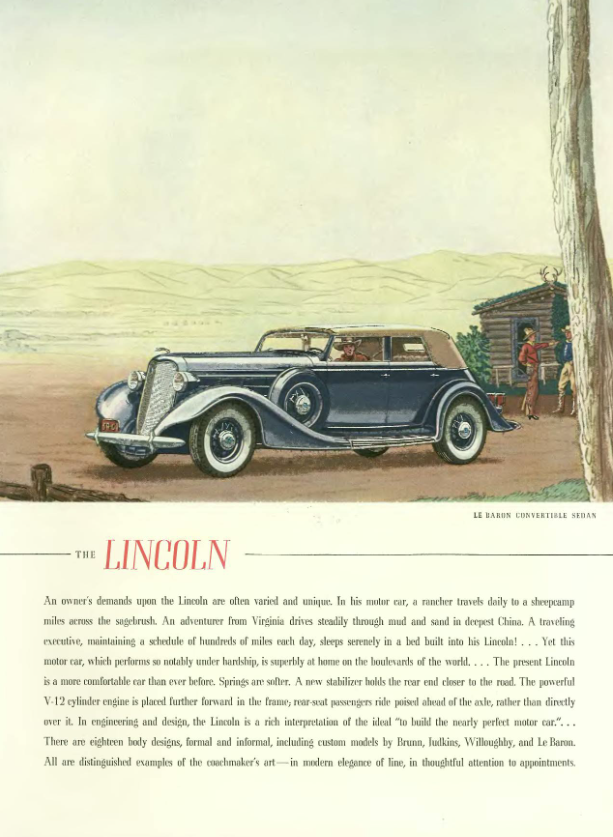
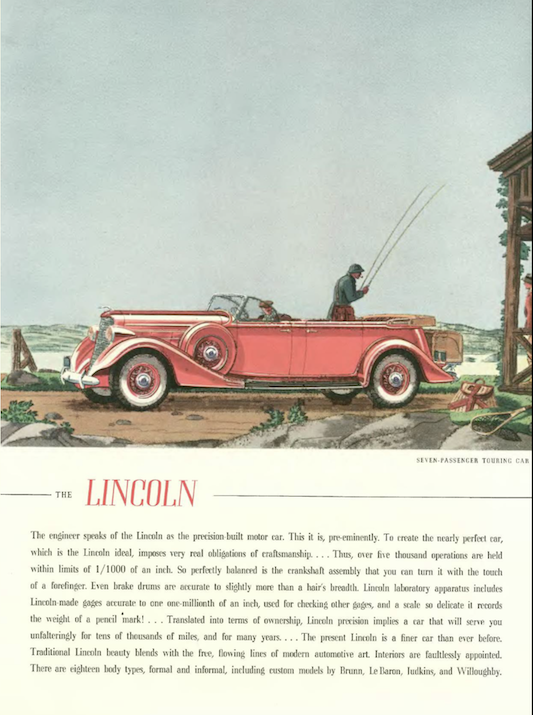
…another ad from the makers of Lincoln suggesting that the market for their luxury auto wasn’t confined to citified execs…
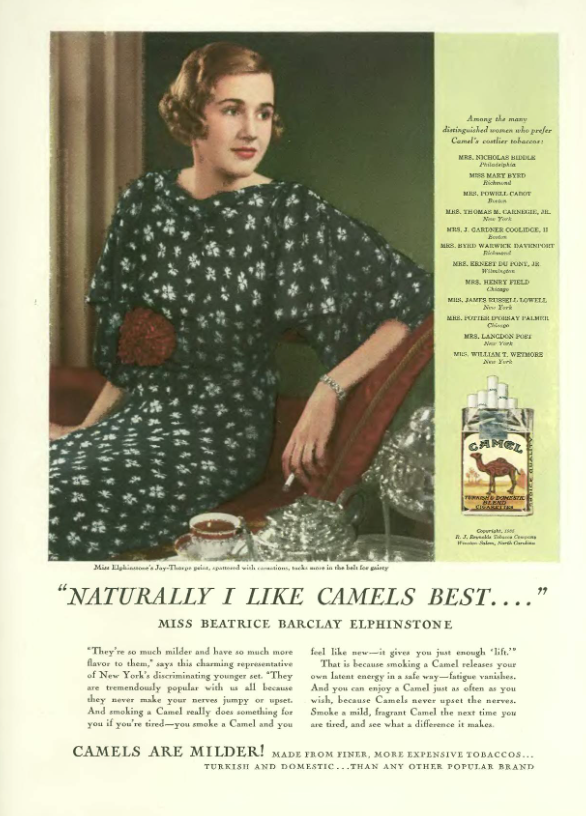
…the Camel folks introduced us to their latest society shill…
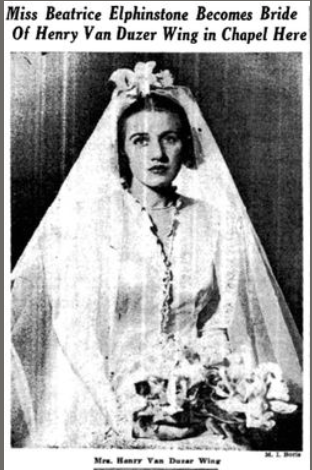
…I didn’t find much about Beatrice Barclay Elphinstone (1916-1977), described in the Camel ad as a “charming representative of New York’s discriminating younger set”…she did make the Times‘ Dec. 10, 1937 society wedding announcements, however…
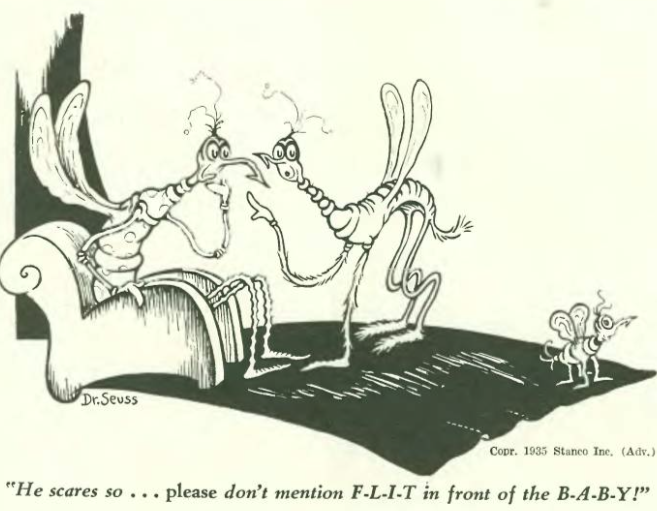
…Dr. Seuss was back with another twist on Flit insecticide…
…on to our illustrators and cartoonists, a nice charcoal by Hugo Gellert for a profile titled “Yankee Horse Trader,” written by Arthur C. Bartlett…the harness horse racing legend Walter Cox (1868-1941) was known in New England as “the king of the half-milers”…
…James Thurber contributed this cat and dog face-off to the opening pages…
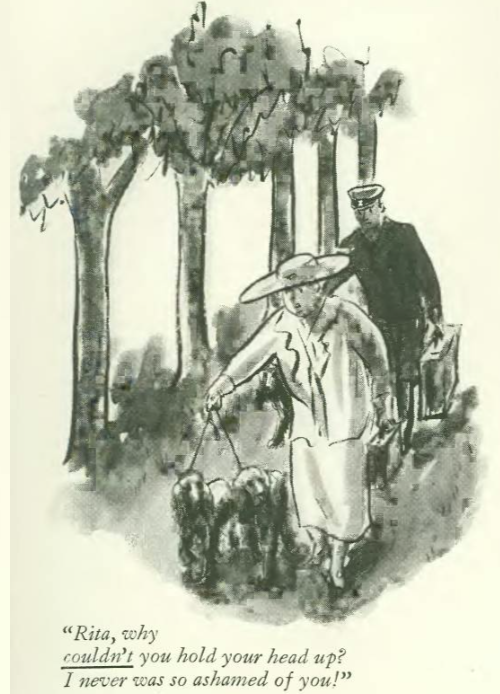
…Helen Hokinson offered her perspectives on the summer dog show across pages 16-17…
…and for a closer look…
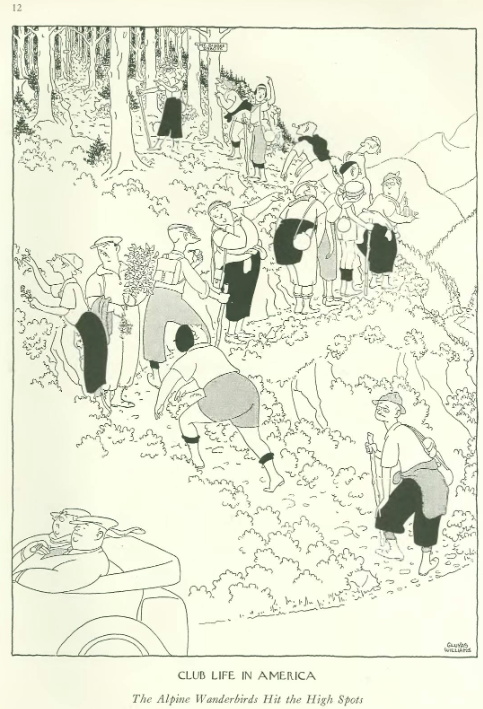
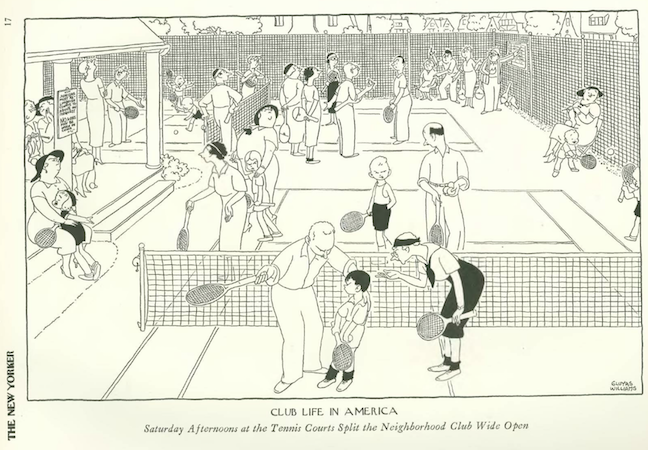
…Gluyas Williams went back to nature in his “Club Life” series…
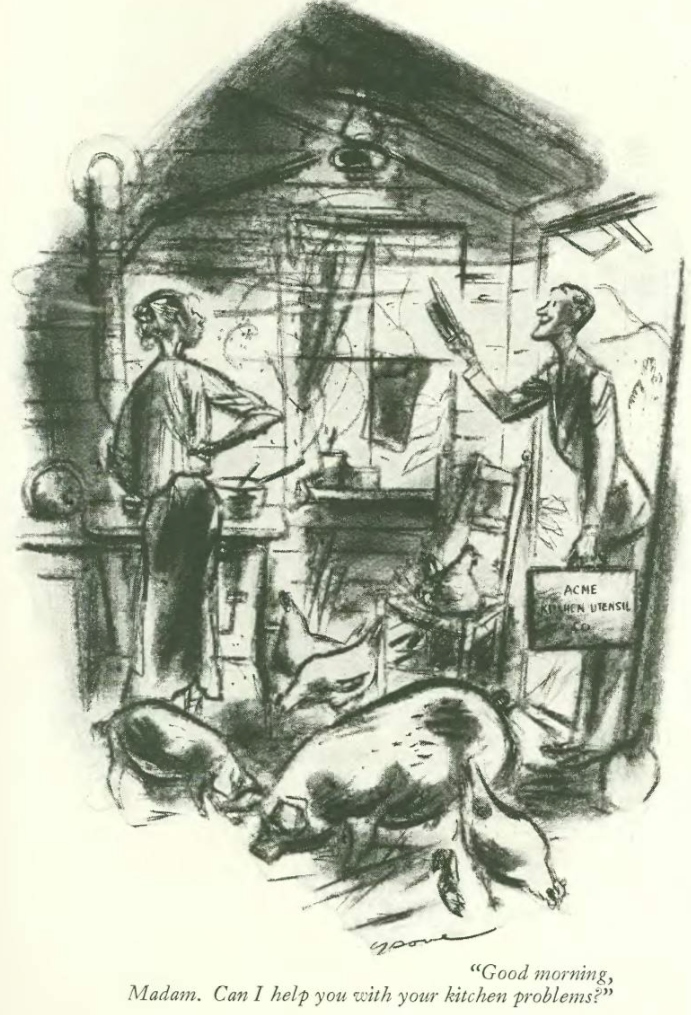
…Leonard Dove introduced us to an undaunted salesman…
…in the world of George Price, crime didn’t pay…
…Barbara Shermund gave us a rare glimpse into the secret lives of men…
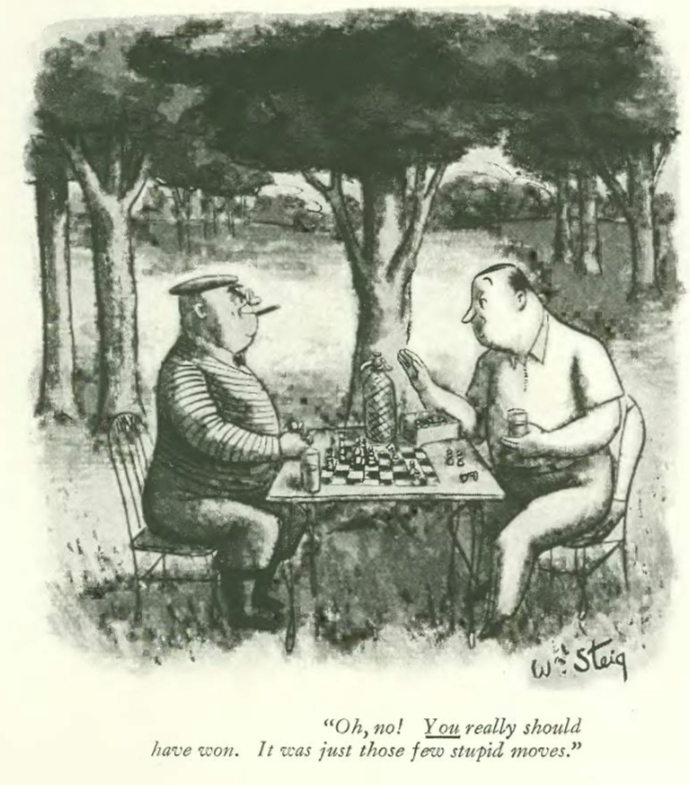
…patronizing words were unwelcome at this chess match, per William Steig…
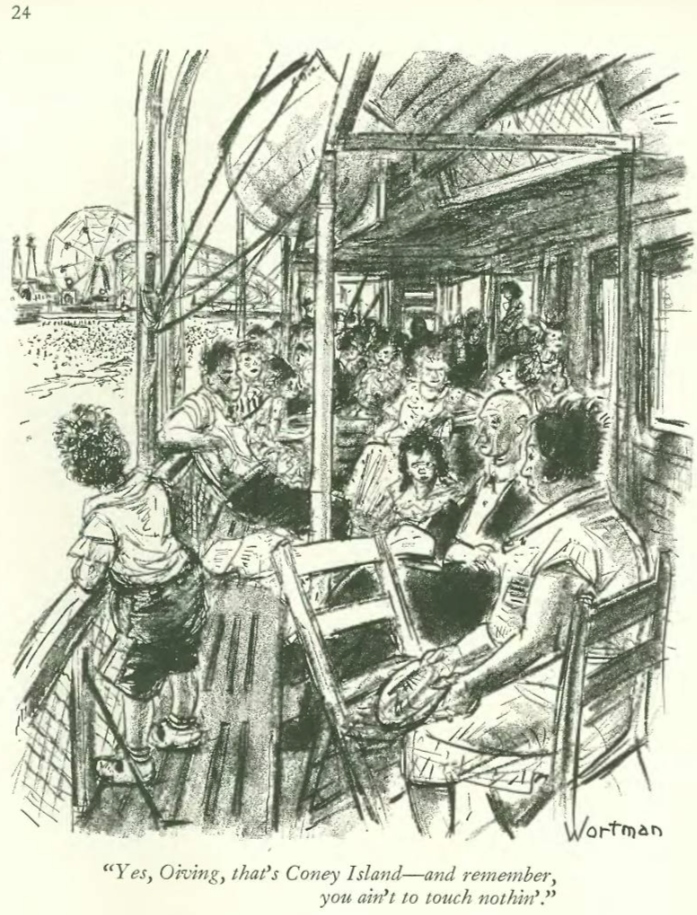
…Denys Wortman took us on a family outing…
…and we close with Alain, and a mother of multiples…except words…
Heading into the dog days of summer we take a look at the last two issues of July 1935, both somewhat scant in editorial content but still offering up fascinating glimpses of Manhattan life ninety years ago.
July 20, 1935 cover by William Crawford Galbraith. He contributed seven covers and 151 cartoons to the magazine.
That includes the observations of theatre critic Wolcott Gibbs and film critic John Mosher, both escaping the summer heat to take in some very different forms of entertainment.
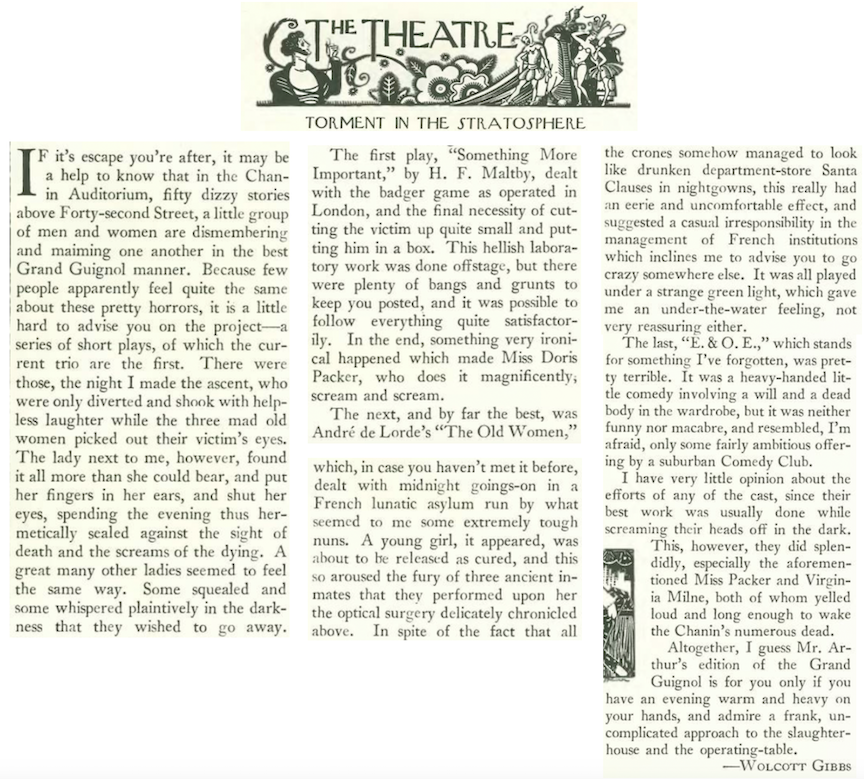
Gibbs found himself “fifty dizzy stories above Forty-second Street” in the Chanin Building’s auditorium, where he experienced New York’s take on Le Théâtre du Grand-Guignol. Founded in Paris by Oscar Méténier in 1897, Grand Guignol featured realistic shows that enacted, in gory detail, the horrific existence of the disadvantaged and working classes. It seems audiences were drawn to the shows more out of prurient interest (or sadistic pleasure) than for any desire to help the underclasses.
NOT FOR THE FAINT OF HEART…Wolcott Gibbs recommended the Grand-Guignol only for those who “admire a frank, uncomplicated approach to the slaughterhouse and the operating table.” (Image: Wikipedia)PRETTY HORRORS…Clockwise from top left, the original Théâtre du Grand-Guignol, in the Pigalle district of Paris–it operated from 1897 until 1962, specializing in horror theatre; a poster from one of its productions; New York’s Chanin building, circa 1930s; the Chanin’s auditorium “fifty dizzy stories above 42nd Street”; fake blood applied to an actress’ neck before a scene from The Hussy; Wolcott Gibbs described a madhouse scene from André de Lorde’sThe Old Women, which depicted the fury of ancient inmates performing “optical surgery” on a young woman. (thegrandguignol.com/Wikipedia/NYPL/props.eric-hart.com)
* * *
Popeye to the Rescue
With the Hays Code in effect you wouldn’t see anything like the Grand-Guignol on the silver screen. Indeed, with the exception of a Popeye cartoon, critic John Mosher found little to get excited about at the movies. He did, however, enjoy the air conditioning that offered a break from the hot city streets.
THEY ALL COULD HAVE USED SOME SPINACH…Clockwise, from top left, Popeye and Bluto strike an unlikely partnership in Dizzy Divers; Bette Davis and George Brent in Front Page Woman; Will Rogers and Billie Burke in Doubting Thomas; James Blakeley and Ida Lupino in Paris in Spring. (brothersink.com / rottentomatoes.com / cometoverhollywood.com / classiccartooncorner.substack.com)
* * *
From Our Advertisers
Just a few ads from this issue, first, a jolly appeal from one of the magazine’s newer advertisers, the makers of the French apertif Dubonnet…
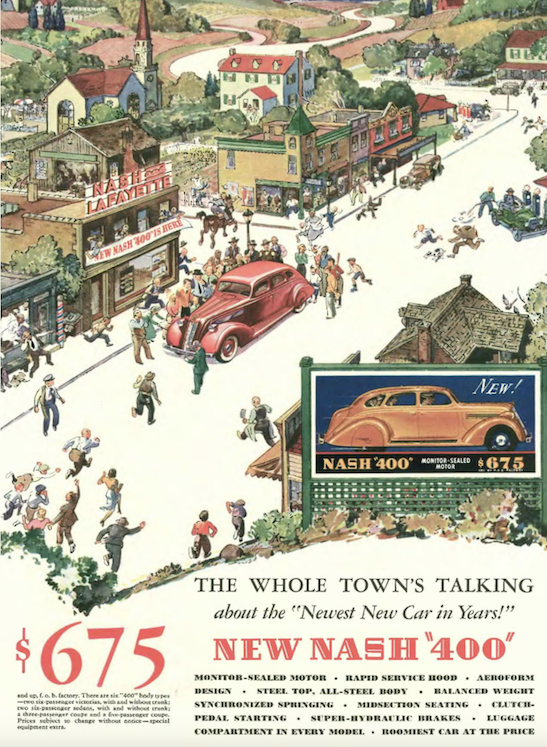
…by contrast, this quaint slice of Americana from Nash…
…and a shot of pesticide from Dr. Seuss…
…our cartoonists include Constantin Alajalov, contributing this bit of spot art to the opening pages…
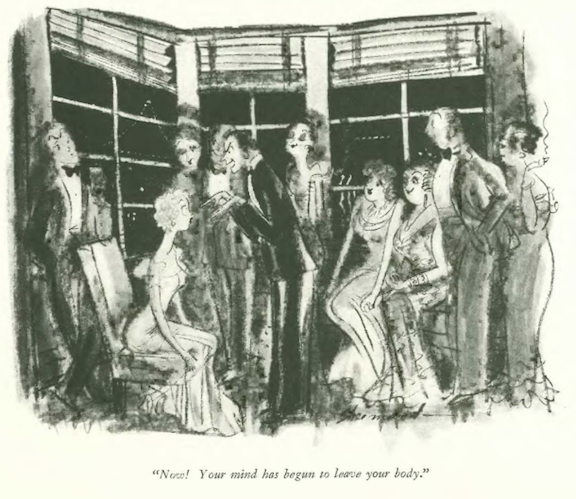
…Barbara Shermund explored the world of hypnotic suggestion…
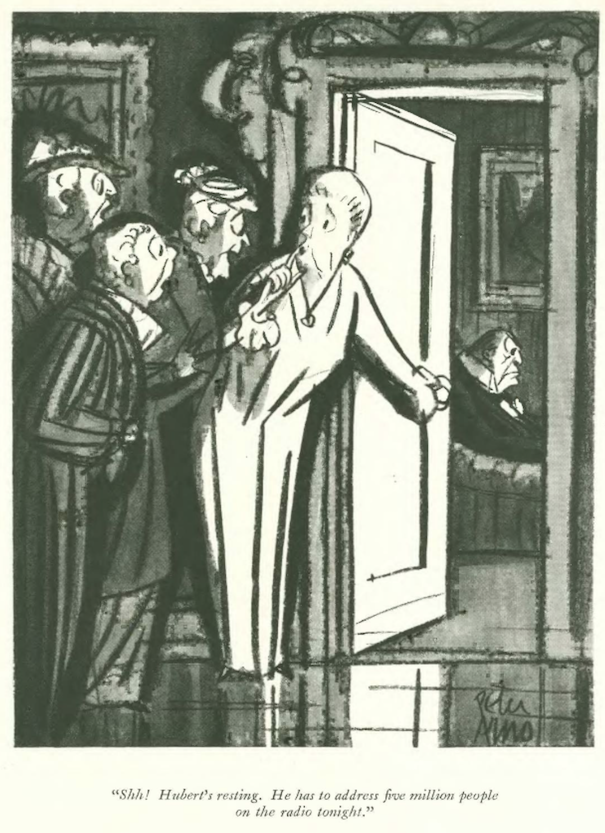
…Peter Arno prepared to address the nation…
…William Steig checked the weather forecast…
…Helen Hokinson’s girls questioned the burden of a lei…
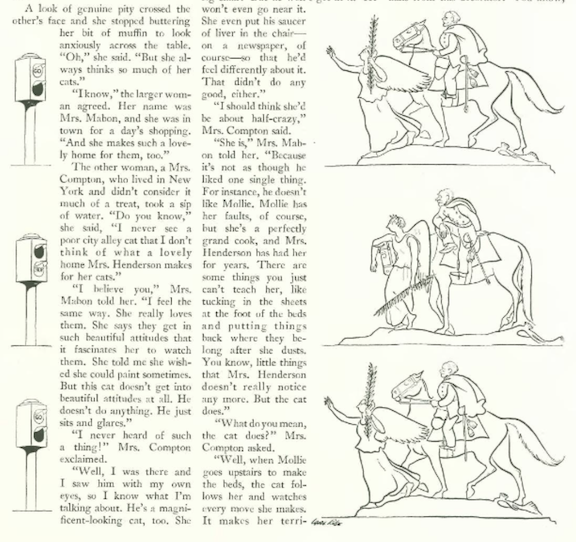
…Carl Rose found himself on opposite sides of the page in this unusual layout…
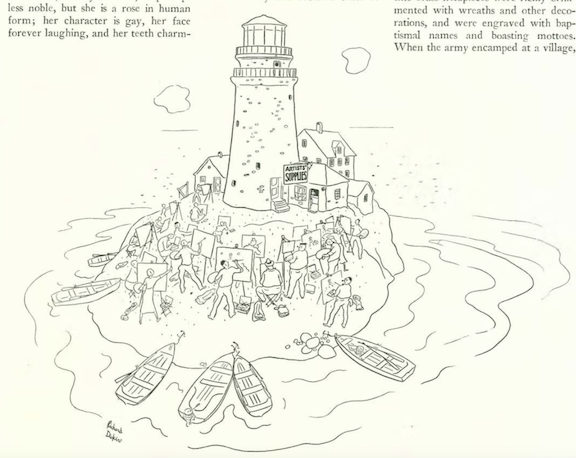
…Richard Decker joined the crowd in a lighthouse rendering…
…Ned Hilton reminds us that it was unusual for women to wear trousers ninety years ago…
…Mary Petty examined the complications of marital discord…
…and Charles Addams shone a blue light on a YMCA lecture…
…on to July 27, 1935, with a terrific summertime cover by William Steig…
July 27, 1935 cover by William Steig, one of his 117 covers for the magazine.
E.B. White (in “Notes and Comment”) was ahead of his time in suggesting that the city needed to build “bicycle paths paralleling motor highways” and invest in more pedestrian pathways.
NEW YORK’S FINEST…Doris Kopsky, who trained in Central Park, won the first Amateur Bicycle League of America Women’s Championship in 1937. Bicycle races were a big draw in the 1930s. (crca.net)
* * *
Breaking News
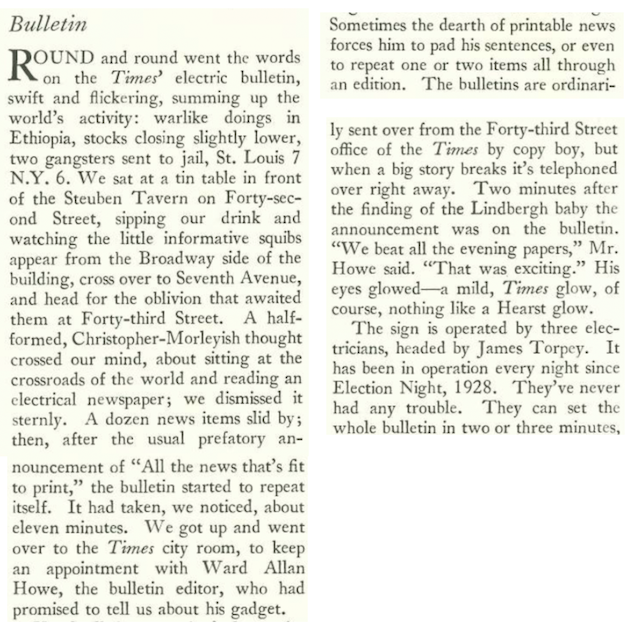
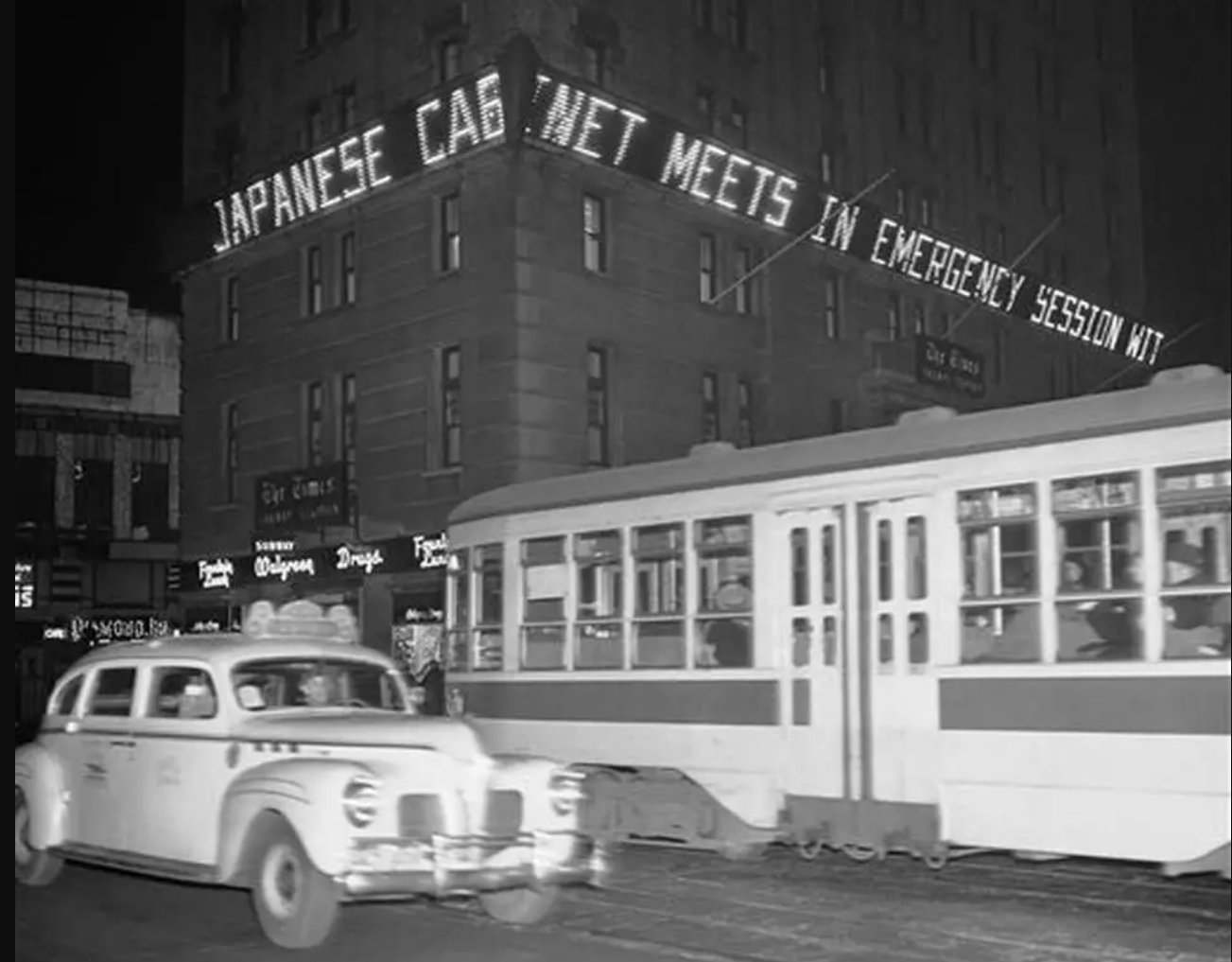
“The Talk of the Town” checked in on the New York Times’ “electric bulletin,” commonly known as “The Zipper.” Excerpt:
NIGHT CRAWLER…Launched in 1928, the Times Square “Zipper” kept New Yorkers apprised of breaking news. (cityguideny.com)
* * *
Dog Knots
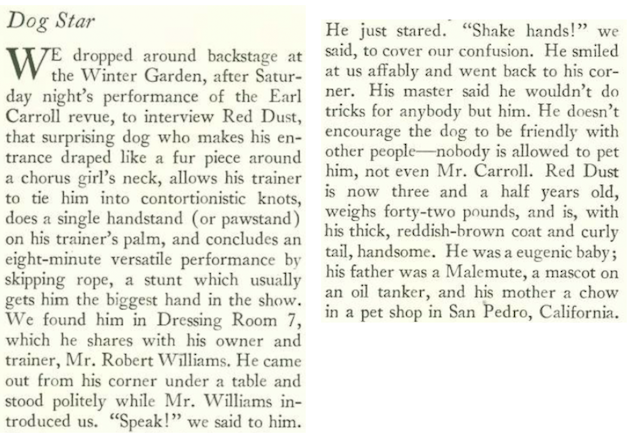
“Talk” also took a look backstage at the Winter Garden, where burlesque performers shared the stage with a contortionist dog called “Red Dust.” Excerpt:
WOOF…Famed animal trainer Robert “Bob” Williams with one of his pupils. The dog in the photo is misidentified as Red Dust (he was actually a Malemute/chow mix).
* * *
Suddenly Famous
Charles Butterworth (1896-1946) earned a law degree from Notre Dame before becoming a newspaper reporter. But his life would take on a new twist in 1926 when he delivered his comical “Rotary Club Talk” at J.P. McEvoy’sAmericana revue in 1926. Hollywood would come calling in the 1930s, and his doleful-looking, deadpan characters would become familiar to movie audiences through a string of films in the thirties and forties. Alva Johnston profiled Butterworth in the July 27 issue. Here are brief excerpts:
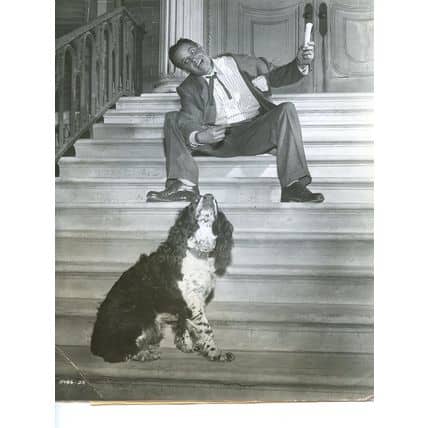
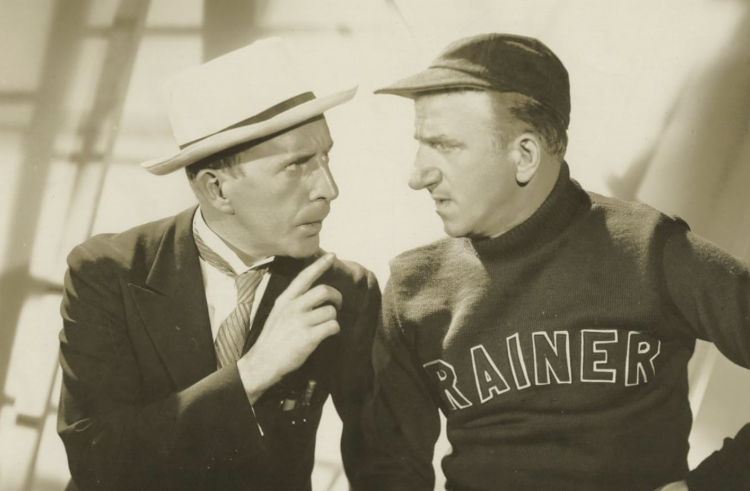
Charles Butterworth (left) and Jimmy Durante in Student Tour (1934). A bit of trivia: Butterworth’s distinctive voice was the inspiration for the Cap’n Crunch commercials voiced by Daws Butler beginning in the early 1960s. Butterworth’s life was cut short in 1946 when he crashed his imported roadster into a lamppost on Sunset Boulevard. (Detail from film still via IMDB)
* * *
Noisy Neighborhood
The “Vienna Letter” (written by “F.S.”–possibly Frank Sullivan) noted the rumblings of fascism in a grand old European city known for its many cultural delights as well as its many factions that included Nazis, Socialists and Communists (and no doubt a few Royalists). An excerpt:
CALM BEFORE THE STORM…Vienna in 1935, less than three years before the Anschluss, when Nazi Germany annexed Austria. (meisterdrucke.us)
* * *
Ex Machina
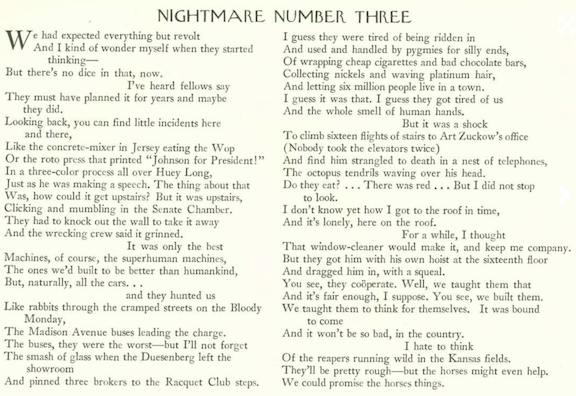
The Pulitzer Prize-winning poet and author Stephen Vincent Benét (1898-1943) penned this poem for The New Yorker that is somewhat appropriate to our own age and our fears of the rise of A.I. In “Nightmare Number Three,” Benét described a dystopian world where machines have revolted against humans.
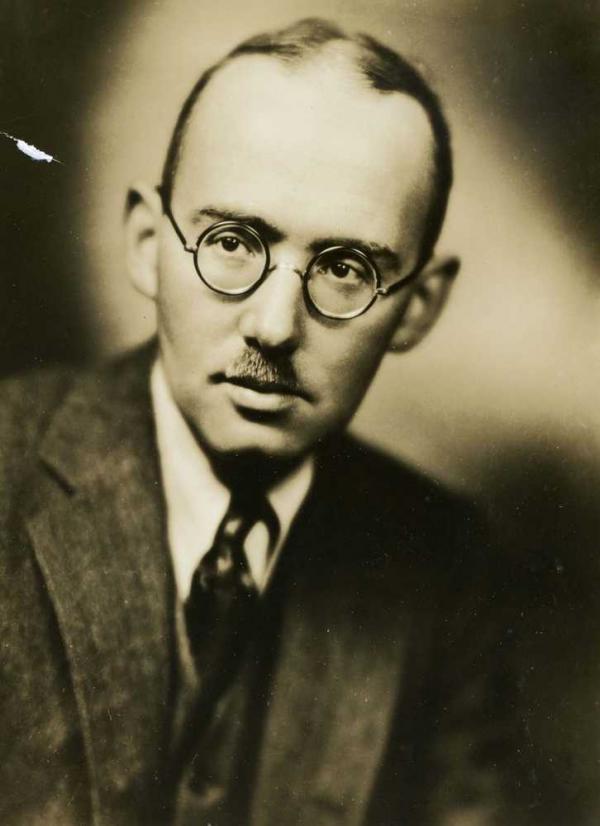
BOTH CLASSY AND FOLKSY is how some today describe Stephen Vincent Benét, who in 1928 wrote a book-length narrative poem of the American Civil War, John Brown’s Body, for which he received the Pulitzer Prize for Poetry. He was also know for such short stories as The Devil and Daniel Webster, published in 1936. (mypoeticside.com)
* * *
From Our Advertisers
We begin with more extraordinary claims from R.J. Reynolds, who convinced a lot of folks that drawing smoke into your lungs actually improved your athletic stamina…
…the makers of Lucky Strike, on the other hand, stuck with images of nature and romance to suggest the joys of inhaling tar and nicotine…
…General Tire took a cue from Goodyear, suggesting that an investment in their “Blowout-Proof Tires” was an investment in the very lives of a person’s loved ones (even though they apparently drove to the beach without seatbelts or even a windshield)…
…another colorful advertisement from the makers of White Rock, who wisely tied their product to ardent spirits as liquor consumption continued to rebound from Prohibition…
…I toss this in for the lovely rendering on behalf of Saks…it looks like the work of illustrator Carl “Eric” Erickson, but he had many imitators…
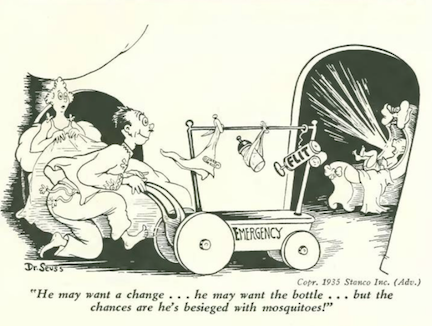
…we do, however, know the identity of this artist, and his drawings on behalf of the pesticide Flit, which apparently in those days of innocence was thought appropriate for use around infants…
…great spot drawing in the opening pages…I should know the signature but it escapes me at the moment…
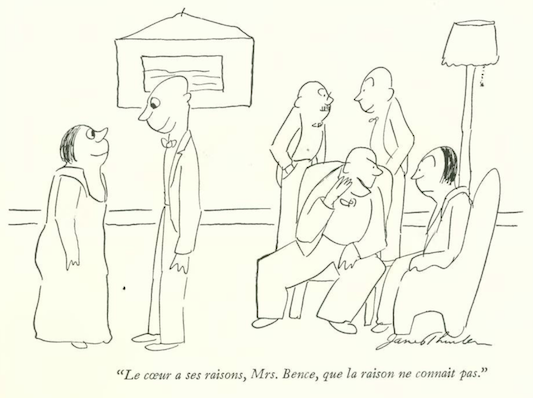
…James Thurber quoted Blaise Pascal for this tender moment ( “The heart has its reasons, of which reason knows nothing”)…
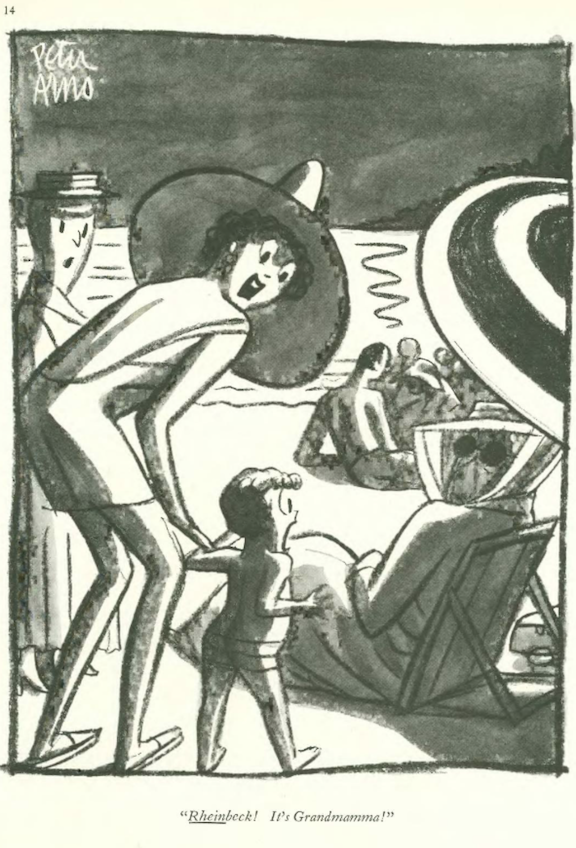
…Peter Arno illustrated the horrors of finding one’s grandmother out of context…
…Helen Hokinson’s girls employed a malaprop to besmirch the good name of an innocent mountain…
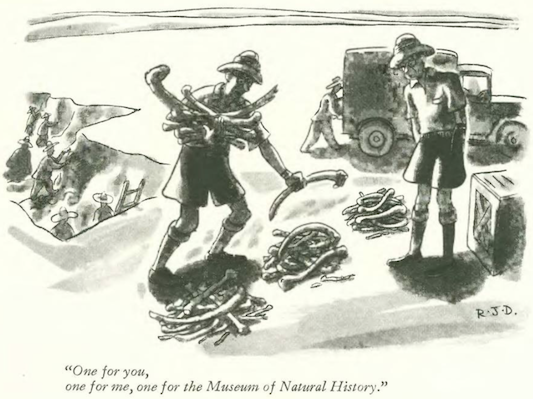
…Richard Decker discovered the missing link(s) with two archeologists…
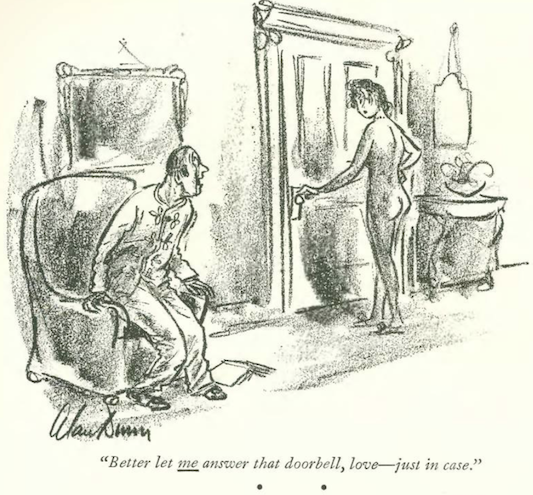
…Alan Dunn narrowly averted a surprise greeting…
…George Price added a new twist to a billiards match…
…Price again, at the corner newstand…
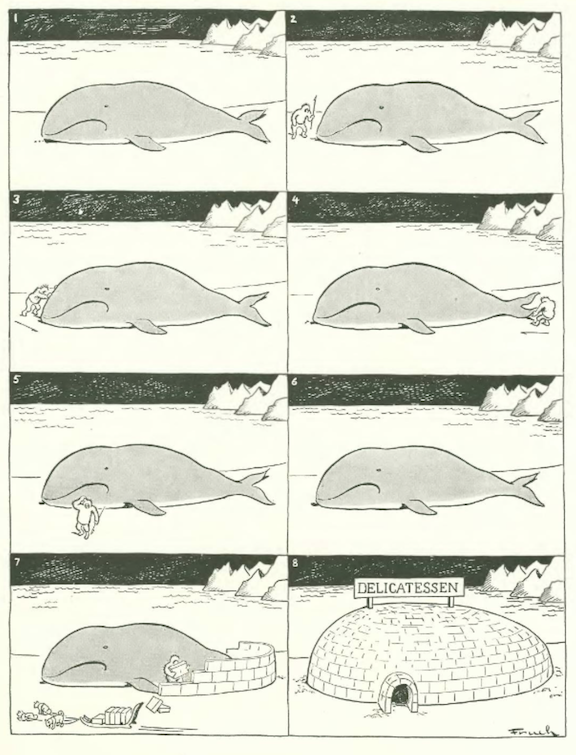
…Al Frueh bit off more than he could chew…
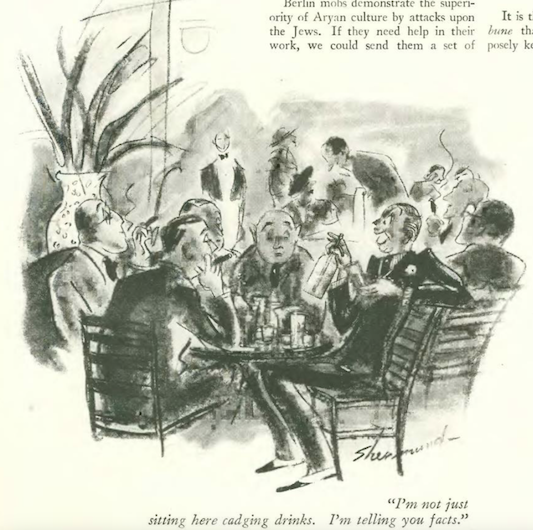
…and we close with Barbara Shermund, and a prattling mooch…
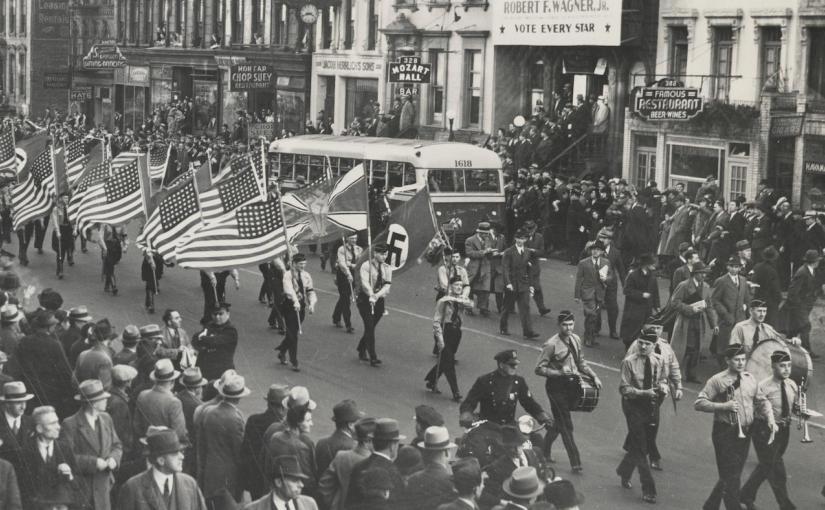
Above: A German American Bund parade in New York City on East 86th Street. Oct. 30, 1937. (Library of Congress)
Among the many ethnic enclaves of 1930s New York City was a neighborhood that was feeling the influence of world events, and not necessarily in a good way.
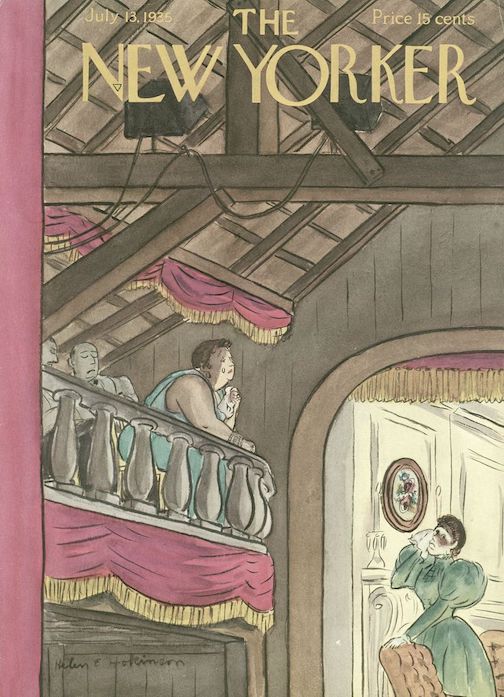
July 13, 1935 cover by Helen Hokinson. One of the first cartoonists to be published in The New Yorker, she appeared in the magazine for the first time in the July 4, 1925 issue. She contributed 68 covers and more than 1,800 cartoons to the magazine.
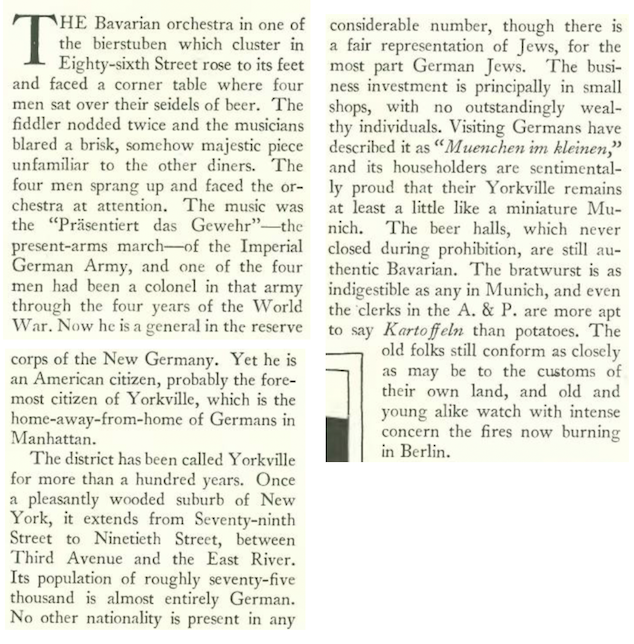
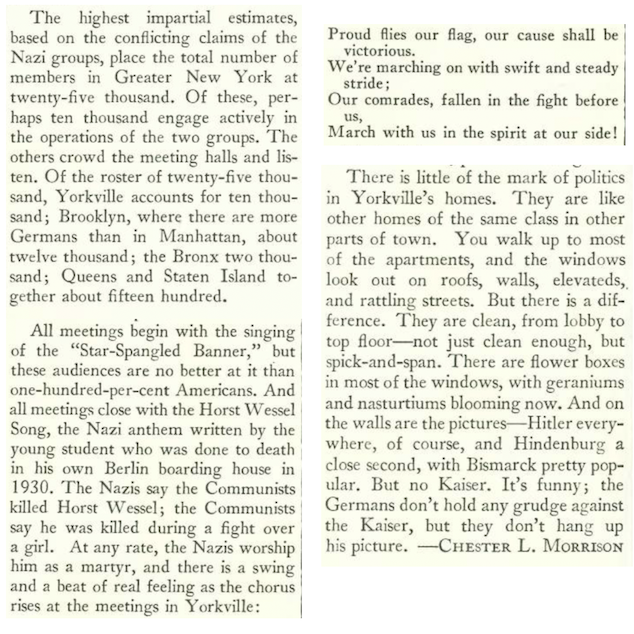
Journalist Chester L. Morrison looked at life among German immigrants on the Upper East Side for “A Reporter at Large.” Under the title “Muenchen Im Kleinen” (Little Munich), Morrison examined the everyday life of the Yorkville district between East 79th and East 96th streets.
Germans had settled in New York City almost from its first days, and by 1885 the city had the third-largest German-speaking population in the world, outside of Vienna and Berlin, the majority settling in what is today the East Village. Following the General Slocum disaster in 1904, German settlement migrated to Yorkville, which was commonly referred to as Germantown. Here are excerpts of Morrison’s observations:
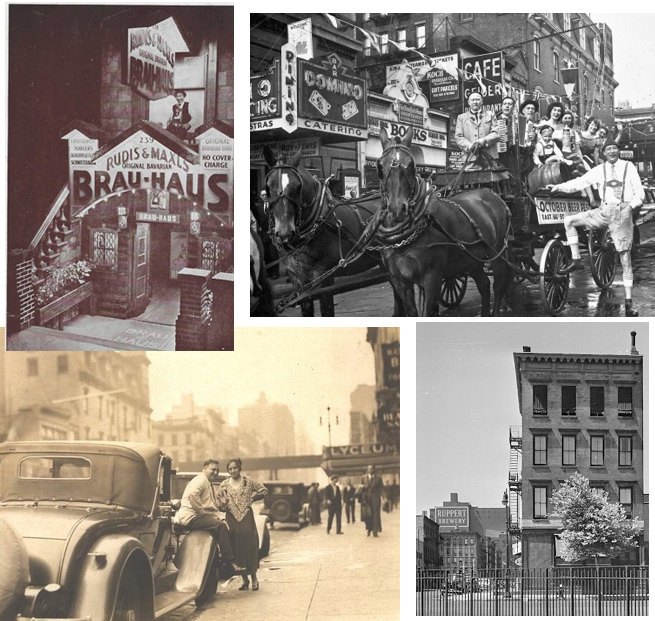
ENCLAVE…Clockwise, from top left, Rudi and Maxl’s Brau-Haus at 239 East 86th; Oktoberfest celebration in Yorkville, undated; Walker Evans photo with Rupert Brewery sign in the background; the Yorkville neighborhood in the 1930s with the old Third Avenue El in the background. (postcardhistory.net/boweryboyshistory.com/metmuseum/gothamcenter.org)
With the rise of the Nazi Party in Germany in the 1930s, a pro-Hitler group called the German-American Bund began to organize street rallies and marches on 86th Street and on 2nd Avenue. Although they represented a minority of German settlers, the Bund made itself visible in parades and other public events that culminated in a mass demonstration at Madison Square Garden in 1939. The Bund also organized training camps for young men outside of the city, such as Camp Siegfried in Yaphank, L.I.
Morrison noted that Yorkville homes looked like many others across the city, that is until you saw the pictures on their walls.
SCOUT’S HONOR?…At a German-American Bund camp in Andover, New Jersey, young campers stand at attention as the American flag and the German-American Youth Movement flag are lowered at sundown, July 21, 1937. (AP)THE MADNESS OF CROWDS…A German-American Bund color guard marches through Madison Square Garden, Feb. 20, 1939. (AP)
* * *
Garden Varieties
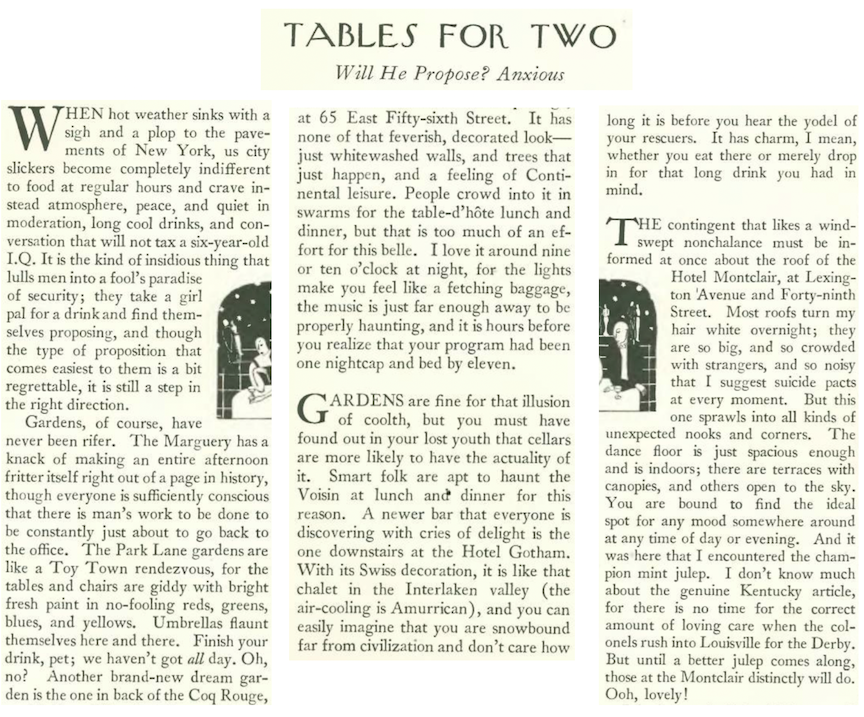
Now for a palate cleanser as we turn to Lois Long and her “Tables For Two” column, in which she examined the confluence of hotel gardens and marriage proposals. Excerpts:
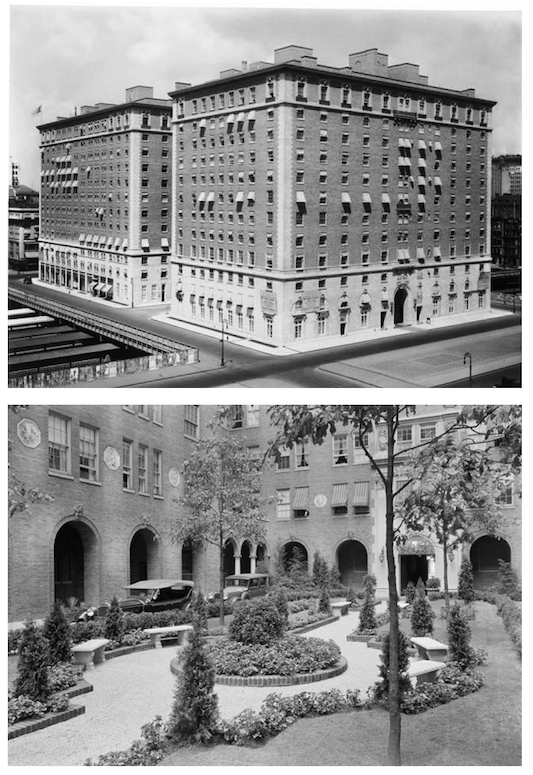
OASIS…Lois Long recommended the Hotel Marguery’s formal garden as a place to “fritter away” an afternoon. The hotel was demolished in 1957 to make way for the Union Carbide Building. (Museum of the City of New York)A COOL, SWISS CHALET was how Long described the new Alpine Room in the basement of the Gotham Hotel. (daytoninmanhattan.blogspot.com)
Long continued as she set her sights on Brooklyn…
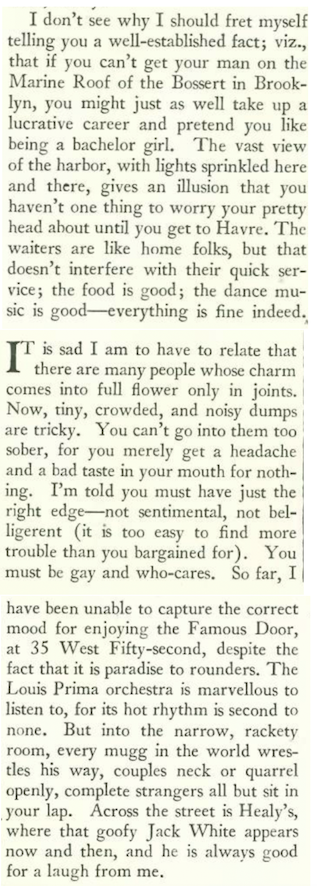
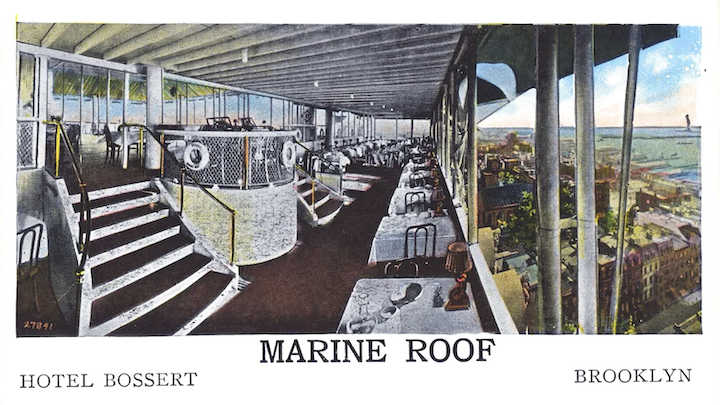
HE WILL LIKELY SAY YES, according to Long, if you got your beau to accompany you to the roof of the Hotel Bossert in Brooklyn. (brownstoner.com)THE TUNEFUL SURROUNDINGS of the Famous Door were a bit too crowded for Long, however this group seems to have had plenty of room to enjoy the greats Ben Webster, Eddie Barefield, Buck Clayton, and Benny Morton on stage at the Famous Door in 1947. (Wikipedia)
* * *
Monster Mash-up
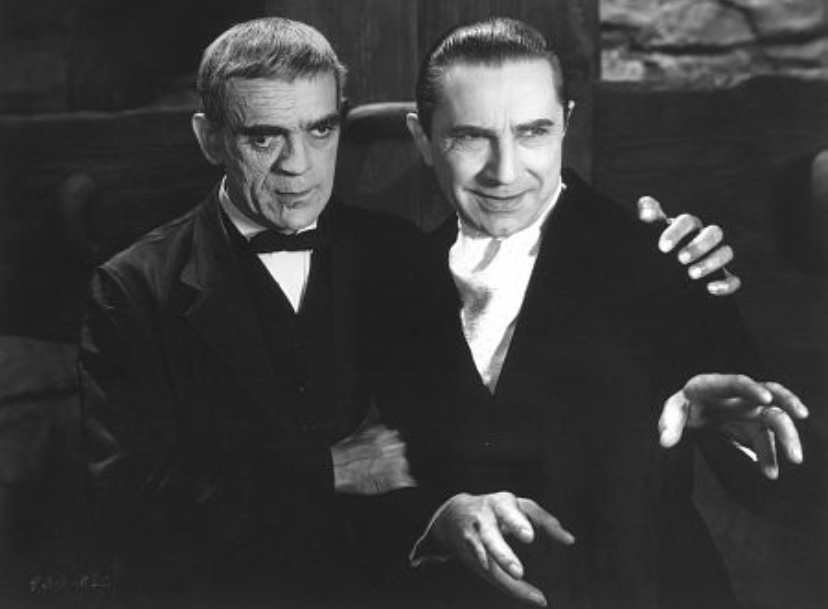
Boris Karloff and Bela Lugosi are synonymous with 1930s monster flicks (they did eight together) but their latest outing, The Raven, left critic John Mosher wondering where the Poe was in the midst of this “sadistic trifle.”
BUDDY FILM…The Raven (which had almost nothing to do with Edgar Allen Poe’s famous narrative poem) was the third of eight films that featured Boris Karloff and Bela Lugosi. According to film historian Karina Longworth, thanks to a wave of monster movie hits in the 1930s, these two middle-aged, foreign, struggling actors became huge stars. (cerealatmidnight.com)TYPECAST? WHO CARES?…Bela Lugosi and Boris Karloff in 1932. Despite being monster movie rivals, the two seemed get along well off-screen, perhaps appreciating their mutual good fortune. (beladraculalugosi.wordpress.com)
* * *
Ode to Education
Clarence Day, best known for his Life With Father stories, also contributed a number of cartoons to The New Yorker that were accompanied by satirical poems…here he examines attempts at education in the arts and sciences…
* * *
From Our Advertisers
We start at the back of the book, and a couple of one-column ads (appearing on the opposite sides of the same page) that catered to very different clientele…
…the makers of Lincoln luxury cars knew the type of client they were fishing for here…
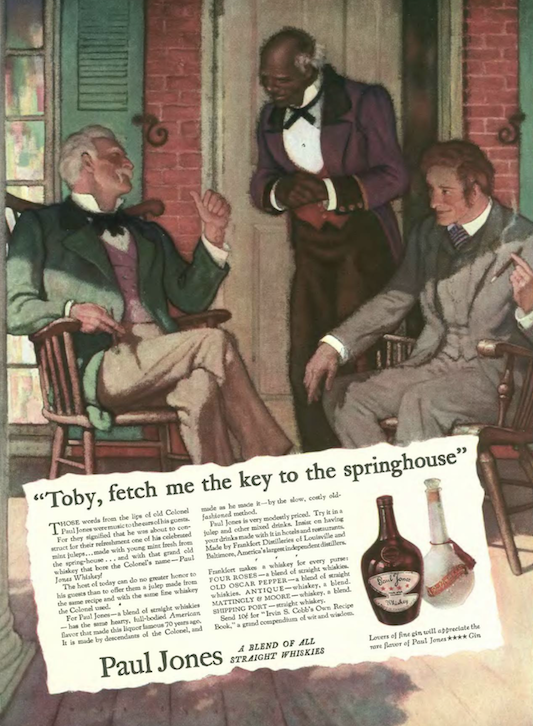
…pin-up artist George Petty continued exploring his beauty and the beast theme on behalf of Old Gold cigarettes…
…and Camel offered more reasons why you should smoke your way to athletic glory…
…this inside back cover advertisement reminds us that we are indeed back in 1935…
…as does this one from Dr. Seuss, with a shot of insecticide for a talking toddler…
…on to our cartoonists, beginning with Charles Addams and some Navy hijincks…
…Gluyas Williams offered his latest take on American club life…
…William Steig took us to summer camp…
…Otto Soglow looked for a good night’s rest…
…Mary Petty explored the latest in bathing fashions…
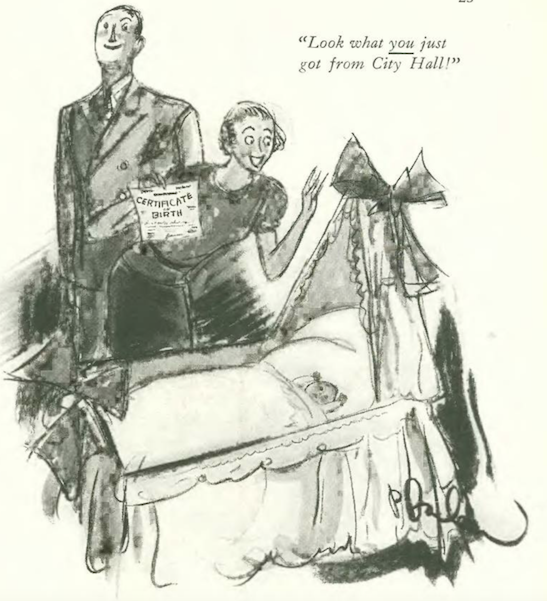
…Perry Barlow introduced us to some proud parents…
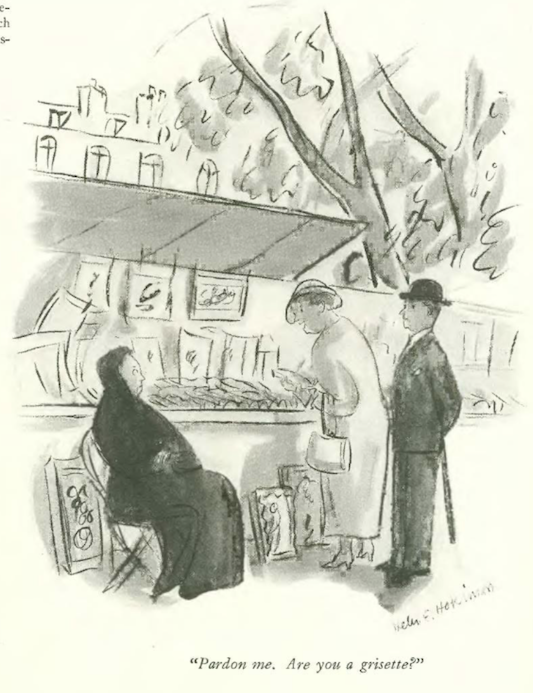
…and to close with Helen Hokinson, who showed us some innocents abroad…
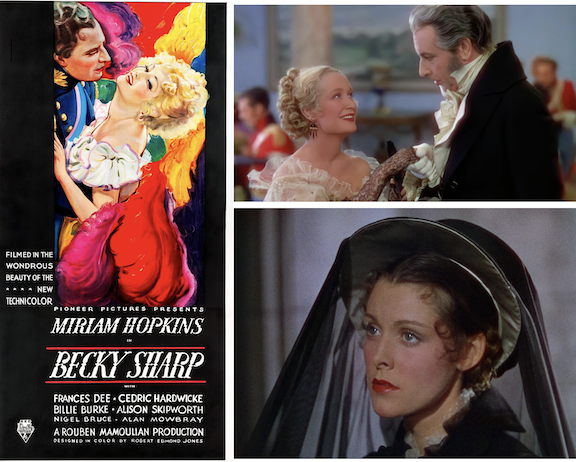
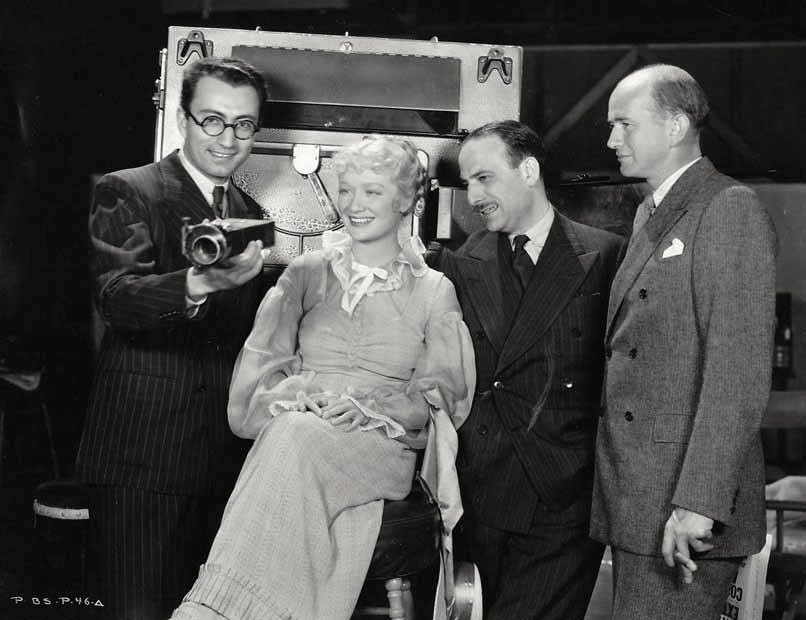
Above: Seated in front of a massive Technicolor camera, Rouben Mamoulian directs Miriam Hopkins (also inset) in Becky Sharp, the first feature shot entirely in three-color Technicolor. The film was based on character from William Makepeace Thackeray's 1848 novel Vanity Fair. (UCLA Film & Television Archive)
Rouben Mamoulian’s 1935 production of Becky Sharp wasn’t the first color film, but it was the first feature film to use the newly developed three-strip Technicolor process throughout, setting a standard for color films to come.
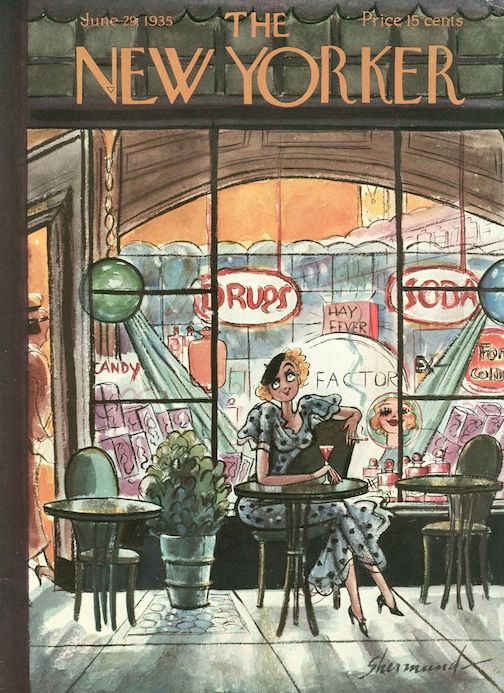
June 22, 1935 cover by Constantin Alajalov. A New Yorker contributor for thirty-four years, Alajalov (1900–1987) illustrated 170 covers for the magazine. Check out the treasure trove at Ink Spillfor more on Alajalov and all things New Yorker.
Earlier color processes included films that were hand-tinted. Others used various dyes and techniques that included photographing a black-and-white film behind alternating red/orange and blue/green filters, and then projecting them through red and green filters. The inability to reproduce the full color spectrum, among other issues, had many critics dismissing the idea of color films altogether.
Mamoulian was fascinated by the possibilities of color film; by producing (and later directing) the film, he showcased the advancements in Technicolor. Film critic John Mosher had these observations:
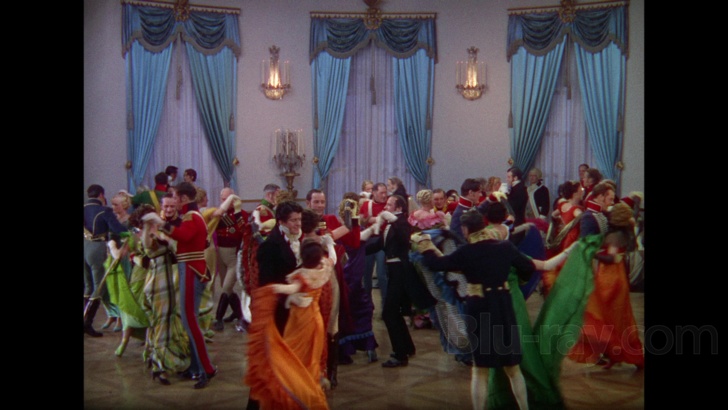
THIS IS A TEST…Considered a landmark in cinema as the first feature film to use the newly developed three-strip Technicolor production throughout, in many ways the film validated this advanced color technology. Top photo, Miriam Hopkins portrayed Becky Sharp, a socially ambitious woman (seen here with Cedric Hardwicke) who climbs the British social ladder with the help of her best friend, Amelia Sedley (Frances Dee, bottom photo). (Wikipedia/Amazon)IT WAS FUN ANYWAY…Critic John Mosher was thrilled by the swirl of colors in the ballroom scene, even if flying red cloaks weren’t an aspect of William Makepeace Thackeray’s 1848 novel Vanity Fair. The film, however, was actually based on an 1899 play by Langdon Mitchell, who named his play after one of the characters in Thackeray’s novel. (blu-ray.com)WHOLE NEW WORLD…Rouben Mamoulian, Miriam Hopkins, visitor Michael Balcon, and Kenneth Macgowan on the set of Becky Sharp. According to film historian Marc Spergel, “Mamoulian was fascinated by color…He saw in the color process another opportunity for innovations that would set a standard for the new technology…His interest lay in choosing color for psychological effect rather than mere realistic reproduction or decorative dividends. With the advent of color processing, particularly Technicolor processing—with its non-realistic, supersaturated color—Mamoulian could approach the film medium like a painter with a palette.” (Wikipedia)
Mosher also checked out the latest from Robert Montgomery and Joan Crawford, who exchanged marital banter in No More Ladies, while George Raft went all gangster in Dashiell Hammett’sThe Glass Key.
HIGH FIDELITY…Top photo, socialite Marcia (Joan Crawford) is determined to keep her husband (Robert Montgomery) faithful in No More Ladies; below, George Raft does what he does best (playing a gangster) in The Glass Key. (jacksonupperco.com/notesoncinematograph.blogspot.com)
* * *
Astor’s Risk
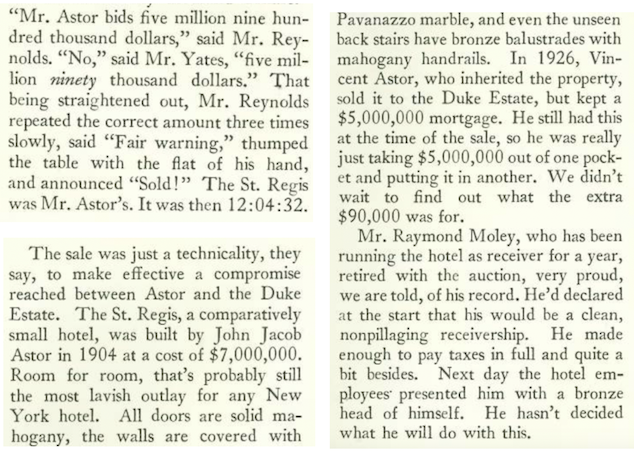
“The Talk of the Town” paid a visit to the Real Estate Exchange, where Vincent Astor re-acquired the St. Regis Hotel for five million and change. He then sunk another $500,000 (roughly $12 million today) into the hotel to further its luxurious status (including adding air-conditioning). The hotel’s famed King Cole Room and the Maisonette Russe restaurant opened in October 1935. Excerpts:
GOOD INVESTMENT…At left, Fifth Avenue facade of the St. Regis as seen in 2022. Right, entrance to the King Cole bar in the 55th Street annex. Thanks in part to the repeal of Prohibition, the hotel’s restaurant business increased by 300 percent between 1935 and 1937. (Wikipedia)
* * *
School Days
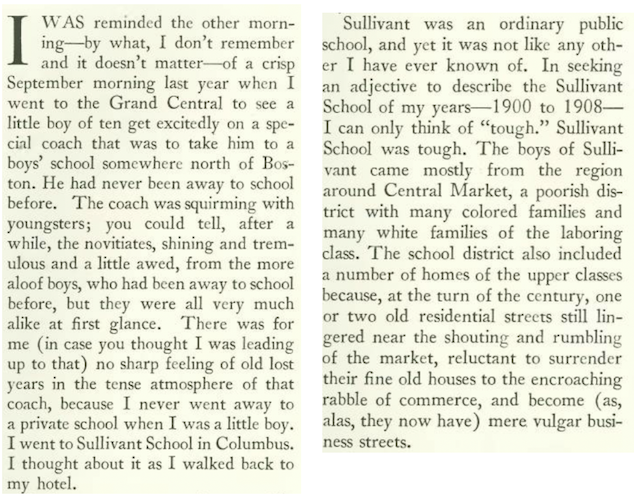
James Thurber recalled his “tough” years at Sullivant School in Columbus, Ohio, in the essay, “I Went to Sullivant.” Brief excerpts:
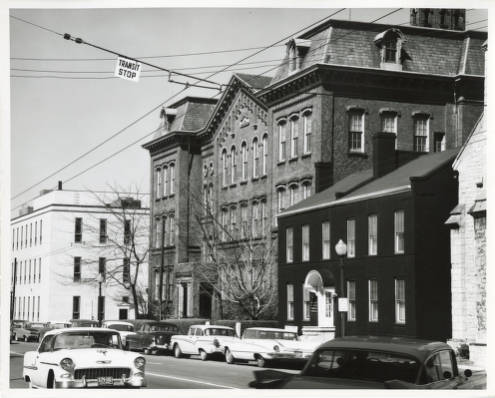
ALMA MATER…The Sullivant School James Thurber attended was completed in 1871 and was a school until 1923 when it became the offices for Columbus City Schools. This photo was taken shortly before it was demolished in 1961. (columbuslibrary.org)
* * *
Avril en juin
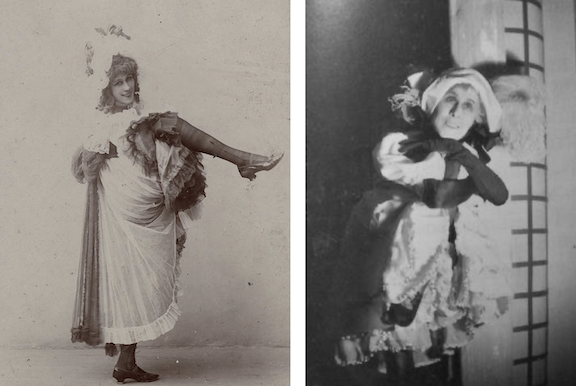
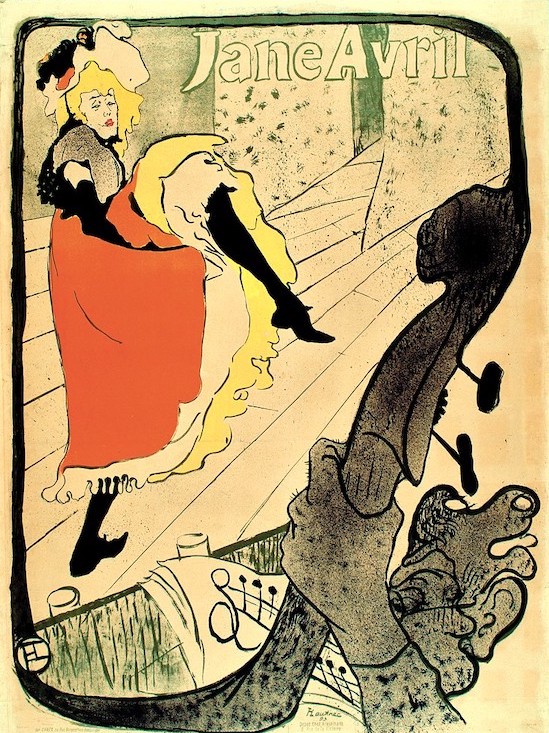
Paris correspondent Janet Flanner gave a rundown on the latest happenings, including the Toulouse-Lautrec costume ball that attracted none other than Jane Avril, the famed French can-can dancer of the 1890s who could still kick up her heels. Flanner gave Avril’s age at 80, but records indicate she was closer to 70.
STILL KICKING…Jane Avril (1868–1943) was a French can-can dancer at the Moulin Rouge in Paris and a frequent subject of painter Henri de Toulouse-Lautrec. The wispy Avril, known for her jerky movements and sudden contortions, was nicknamed La Mélinite, after an explosive. At top left, Avril in her heyday circa 1890s; at right, Avril at the 1935 Toulouse-Lautrec costume ball. Read more about Avril’s strange life at one of my favorite “rabbit hole” sites, Messy Nessy. (messynessychic.com/Pinterest)An 1893 Toulouse-Lautrec lithograph featuring Jane Avril, a lifelong friend of the artist. Avril commissioned this print to advertise her cabaret show at the Jardin de Paris. (met museum.org)
* * *
From Our Advertisers
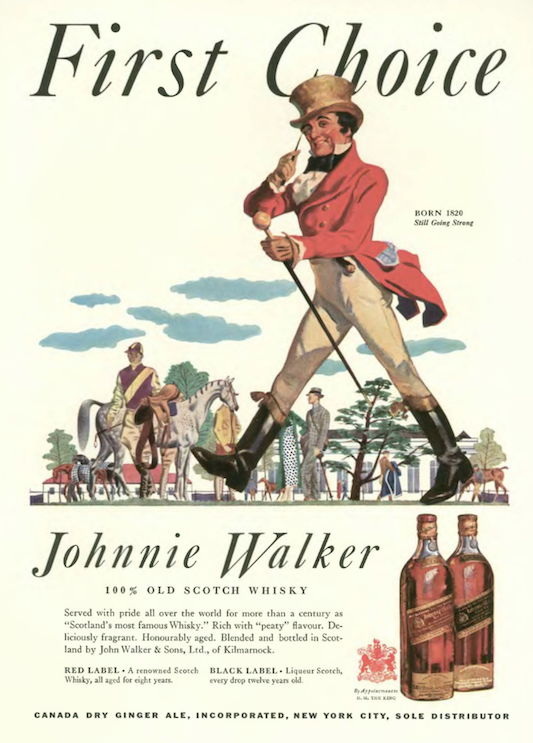
We begin with the inside front cover, Johnnie Walker strutting along at the horse races…
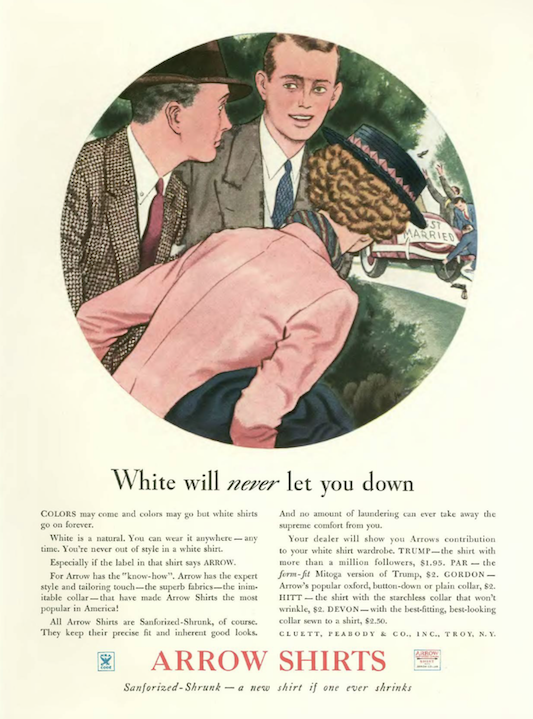
…the inside back cover belonged to Arrow Shirts…
…and no surprise that the back cover featured a stylish woman enjoying a cigarette, in this case a Lucky…
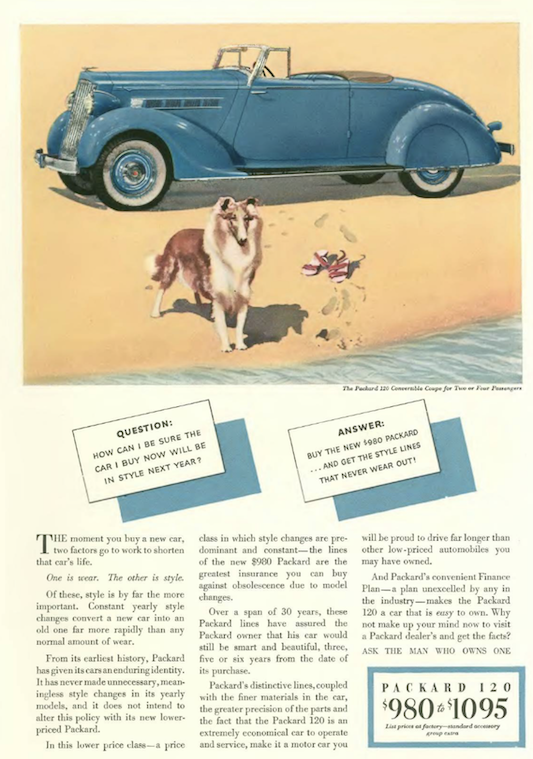
…Packard continued to run these colorful, wordy ads that made the case for owning a lower-priced Packard, which I’m sure was a fine automobile…
…John Hanrahan, who early on served as The New Yorker’s policy council and guided it through its lean first years, became the publisher of Stage magazine (formerly The Theatre Guild Magazine) in 1932. In 1933 Stage became part of the Ultra-Class Magazine Group’s line-up that included Arts & Decoration and The Sportsman. Stage published its last issue in 1939, and I don’t believe the other two survived the 1930s either…this Mark Simonson site looks at the striking design elements of an issue from 1938…
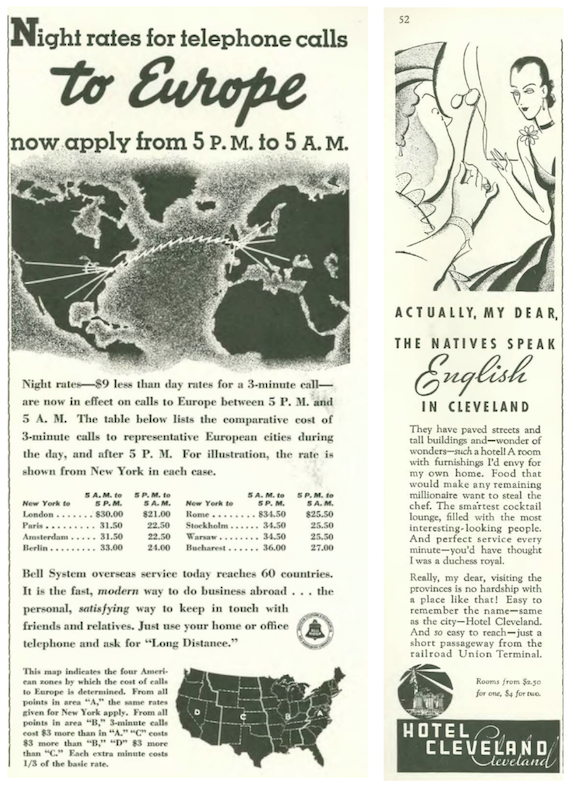
…a couple from back of the book…calling Europe by telephone in 1935 was an impressive feat, however it could cost you roughly $700 in today’s dollars to make a three-minute call to London…the one-column ad at right offered an Anglophilic appeal to those visiting Cleveland…
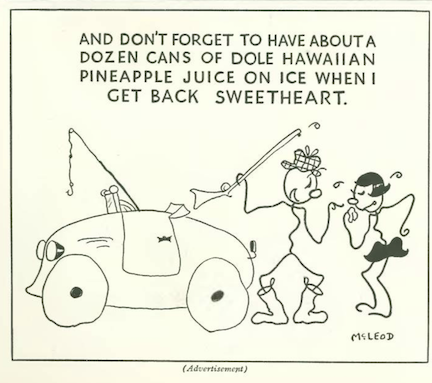
…this simple spot for Dole pineapple juice caught my eye because it was illustrated by Norman Z. McLeod (1898–1964), who drew Christie Comedy title cards during the Silent Era…
McLeod was also an acclaimed director of Marx Brothers comedies Monkey Business (1931) and Horse Feathers (1932), W.C. Fields’It’s a Gift (1934), Danny Kaye’sThe Secret Life of Walter Mitty (1947) and two of the Topper films.
HE GOT AROUND…Clockwise, from top left, director Norman Z. McLeod on the set of 1941’s Lady Be Good with actress Ann Sothern; Young’s familiar stick figure drawings on title cards for the 1928 silent short Loose Change; Cary Grant and Constance Bennett with Roland Young in 1937’s Topper. (TCM.com/silentology.wordpress.com/charlesmatthews.blogspot.com)
…Dr. Seuss was back with his Flit advertisements…
…Richard Decker illustrated this ad for Borden’s “Golden Crest” Farm Products…
…which segues into our cartoonists, and this curious spot drawing by James Thurber…
…Perry Barlow gave us the early days of the “Bed and Breakfast”…
…Peter Arno, and no rest for the titans of industry…
…Gluyas Williams continued to take a sideways glance at Club Life in America”…
…from George Price…back in the day, tattoos were usually confined to sailors and longshoreman…this particular fellow found himself with some outdated ink…
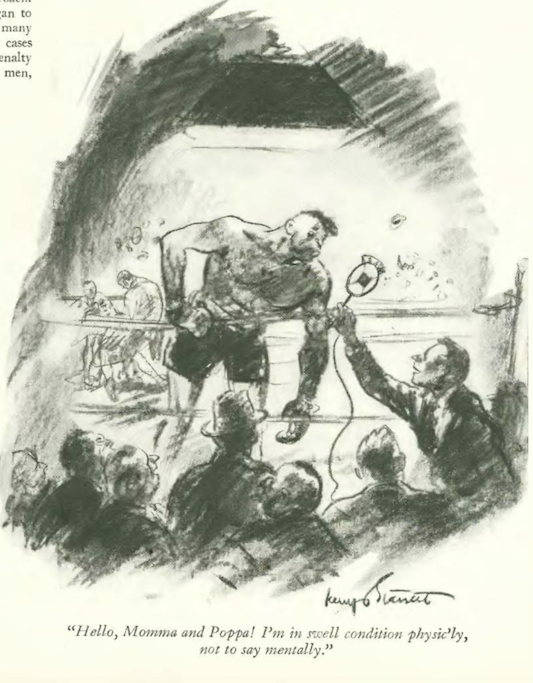
…Kemp Starrett took us ringside…
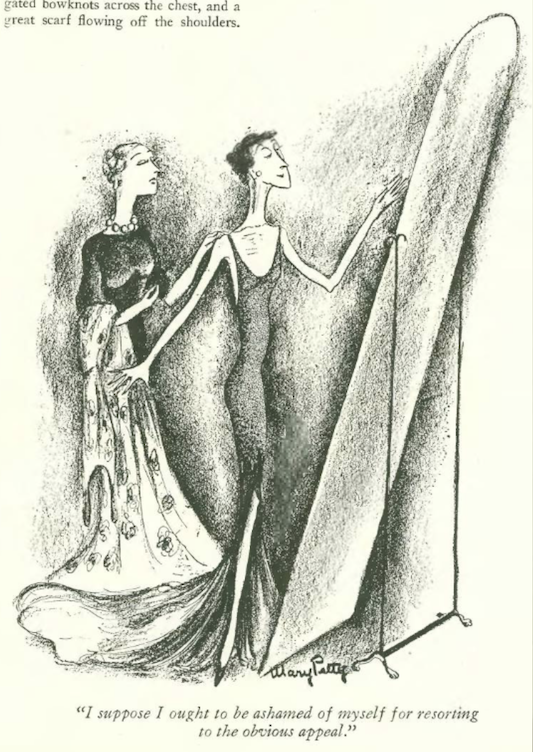
…Mary Petty reflected on a bit of narcissism…
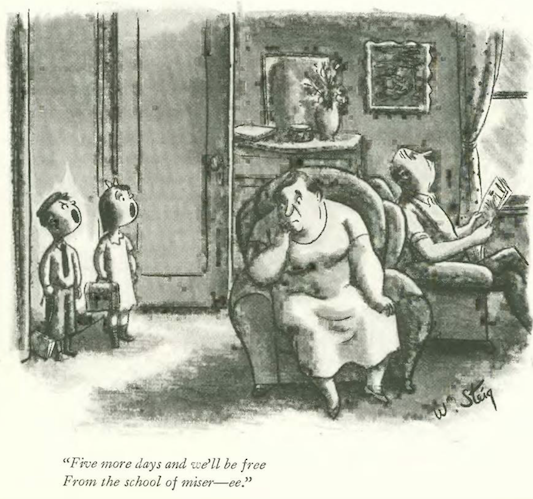
…and we close with William Steig, and mixed feelings about the summer season…
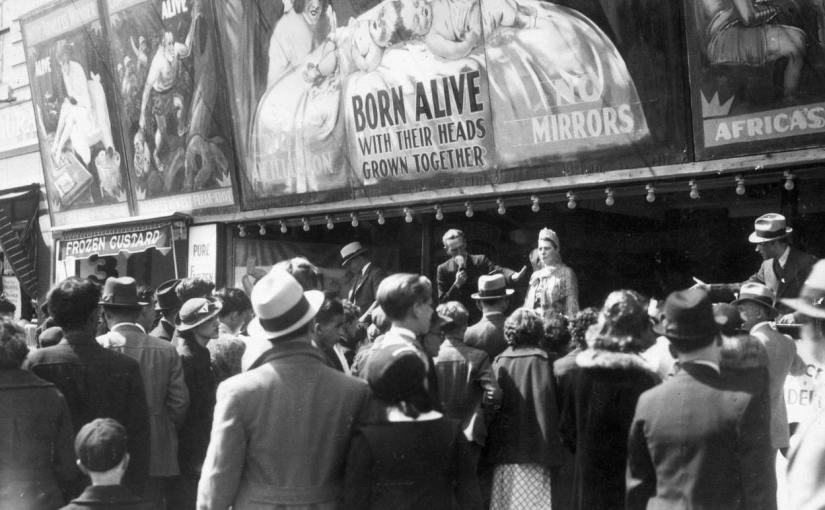
Above: Coney Island "freak" show, summer of 1935. (seeoldnyc.com)
It has been about a year since we’ve visited Coney Island, and with summer upon us (and upon 1935 New York) let’s have a look at “The Talk of the Town” and see the latest attractions.
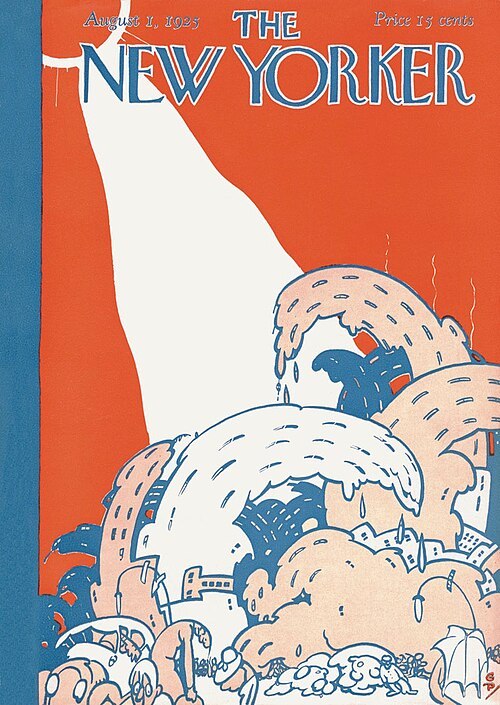
June 15, 1935 cover by Garrett Price. Price (1897–1979) illustrated 100 covers for the magazine.Garrett Price’s first New Yorker cover, “Heat Wave,” Aug. 1, 1925.
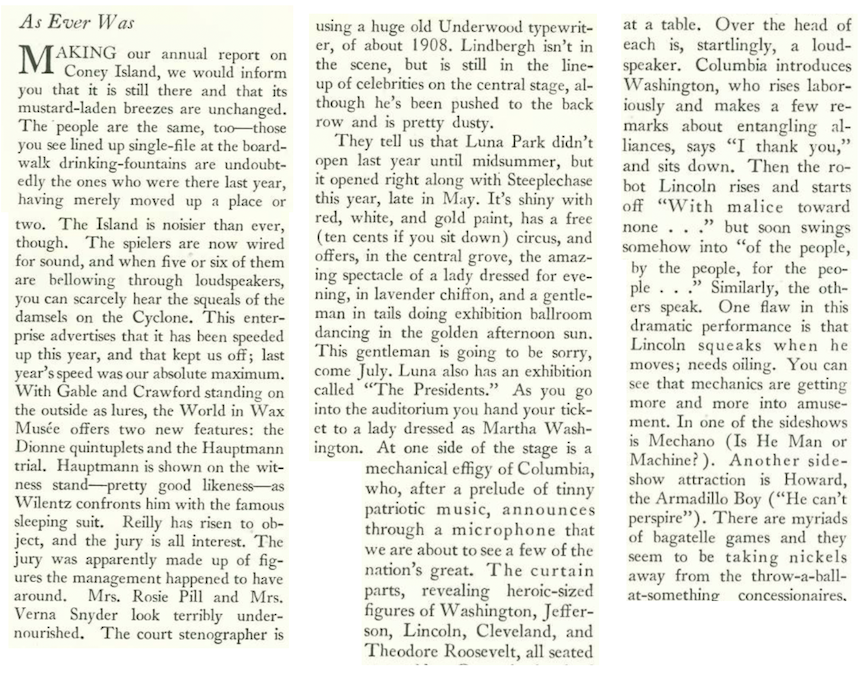
This lengthy “Talk” entry (excerpted), attributed to Clifford Orr, noted that much was unchanged, including the “mustard-laden breezes.” The place was noisier, however, with carnival barkers increasing their range through loudspeakers.
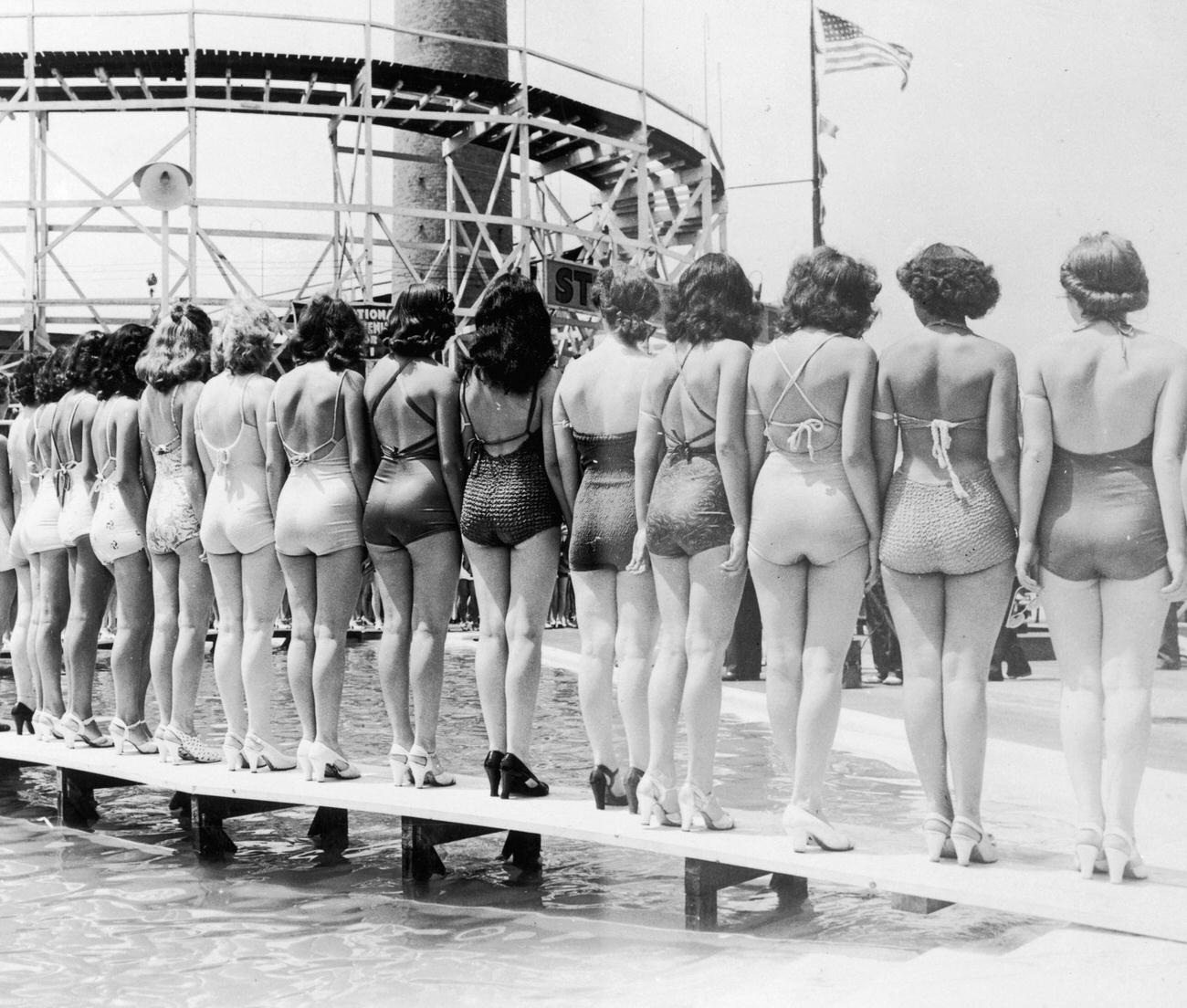
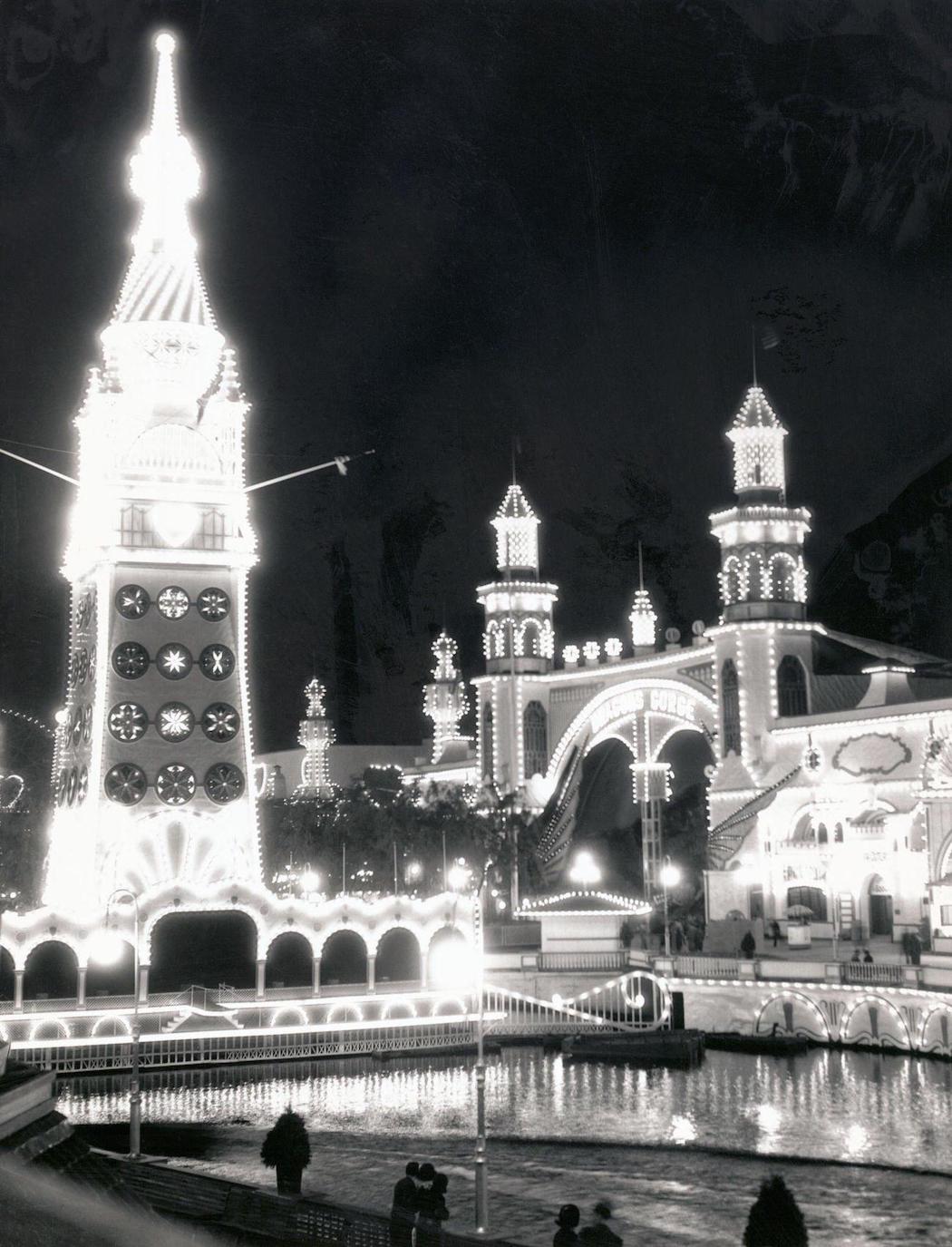
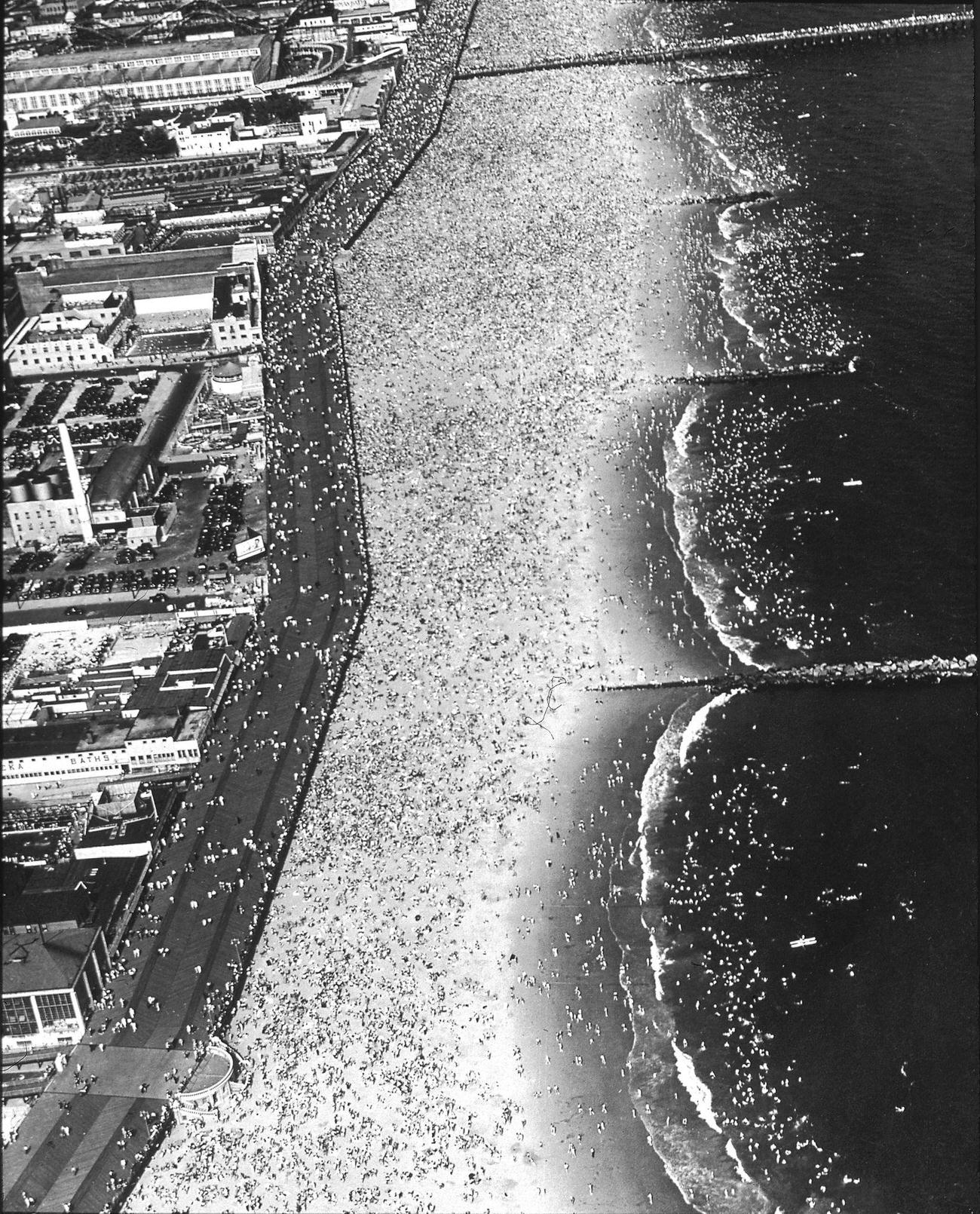
THE HIGH AND LOWS of society were on display in various attractions at Coney Island. Clockwise from top left, gawkers gather at Coney Island freak show, which included the “Armadillo Boy,” August 5, 1935; strollers near the Virginia Reel and Wonder Wheel, circa 1935; Borden’s frozen custard stand, 1930s; couple have a nap on the beach, circa 1935. (seeoldnyc.com)LINEUP…Beauty contests near the Steeplechase, like this one in 1935, were a common sight at Coney Island. (seeoldnyc.com)LIKE MOTHS TO THE FLAME, the dazzling lights drew thousands to Coney Island’s Luna Park in the 1930s. (seeoldnyc.com)THEY LOOK LIKE…ANTS…Aerial view of the beach in 1935. The Steeplechase ride is at the top left. (seeoldnyc.com)
* * *
Ship Ahoy
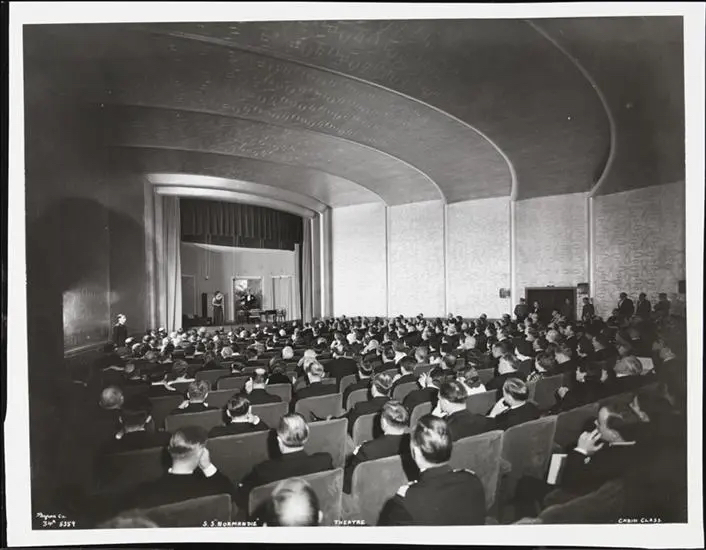
E.B. White (in “Notes and Comment”) mentioned that he danced aboard the newly arrived S.S. Normandie (presumably with Katharine White) while it was docked at Pier 88.
GROOVY…E.B. White noted the “luminous grooves” of the S.S. Normandie’s theatre. (drivingfordeco.com)JUGGERNAUT…The S.S. Normandie docked at New York’s Pier 88 after completing her maiden voyage on June 3, 1935. Note the paint chipped from the hull, the result of the ship’s record-breaking speed. (yesterdaystrails.wordpress.com)
* * *
Another Freak Show
Theatre critic Wolcott Gibbs found Earl Carroll’s latest stage production to be nothing more than a “vulgar assortment of comedians, jugglers, and performing dogs,” accompanied by “very lovely and disarming” young ladies who chanted their lines “in high childish voices.” One skit apparently featured Abe Lincoln with “fifty-six young ladies in cellophane hoopskirts.” Too bad no one filmed that performance.
HOLDING IT TOGETHER…Gibbs noted that comedian Ken Murray carried most of the show’s comedy (Murray had found success on the New York stage after appearing in Carroll’s Vanities on Broadway in 1935); Sibyl Bowen was known for her impersonations of famous women. In Sketchbook she portrayed Martha Washington, among others. (eBay/entertainment.ie)
* * *
Weathering the Field
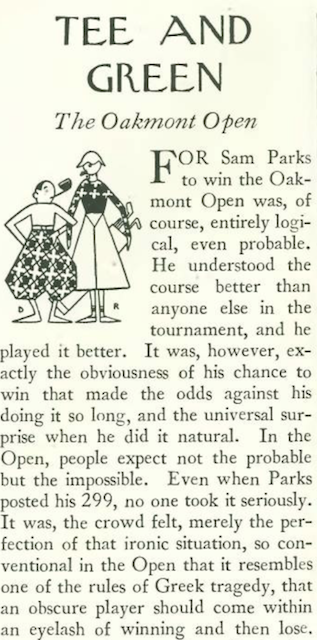
Like the recent 2025 U.S. Open at Oakmont (won by J.J. Spaun), ninety years ago Oakmont was also plagued by bad weather, and it also featured a tournament winner who outplayed the top golfers in the field. Excerpt:
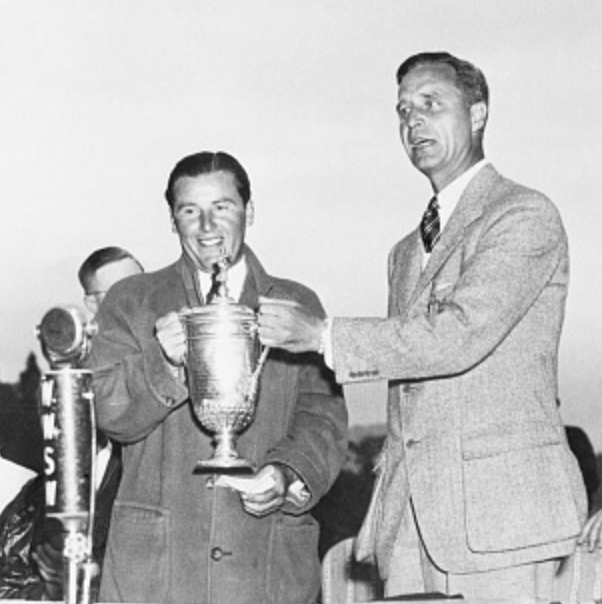
WHY NOT ME?…Sam Parks Jr. (left) was considered an unlikely winner of the 1935 U.S. Open after competing with Hall of Famers at Oakmont. A 25-year-old club pro from Pittsburgh who played on the winter tour without ever winning, he bested a field that included Walter Hagen, Gene Sarazen, Denny Shute and Horton Smith. His secret? For months leading up to the U.S. Open, Parks played nine holes at Oakmont every morning before going to work at nearby South Hills Country Club. He knew the course like the back of his hand. (progolfweekly.com)
* * *
Straight From the Headlines
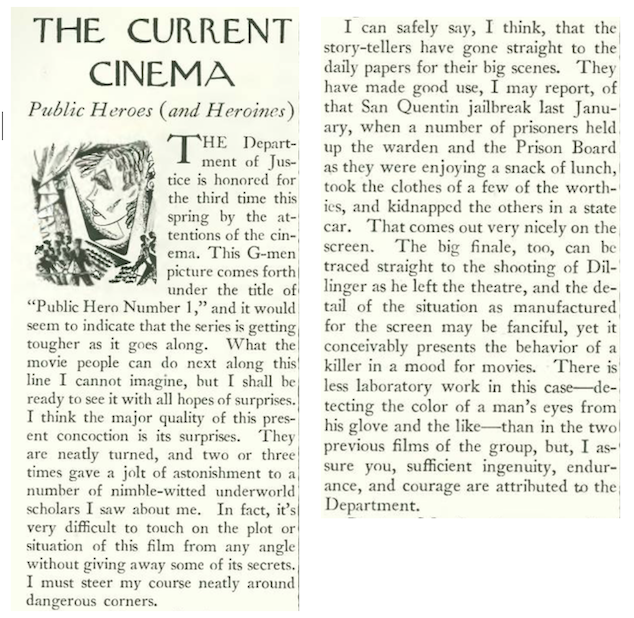
Film critic John Mosher noted how the storylines in latest “G-men” pictures seemed to be taken directly from the daily papers. Public Hero Number 1 was no exception.
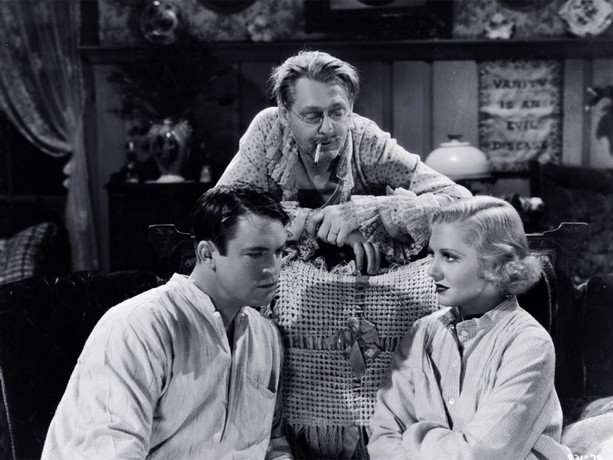
THE GOOD GUYS…from left, Chester Morris, Lionel Barrymore and Jean Arthur in Public Hero Number 1. One effect of the Hays Code was to replace gangster films—which some believed glorified criminals—with films that depicted the dedication and courage of law enforcement officers. (Rotten Tomatoes)
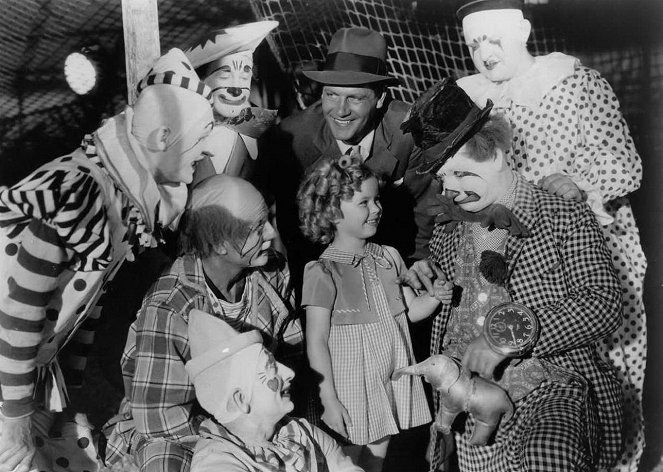
Mosher suggested moviegoers would get more pleasure out of Public Hero Number 1 than from Our Little Girl, which seems an unfair comparison since gunplay was rare in a Shirley Temple flick.
NO GUNS, JUST SOME SCARY CLOWNS…Joel McCrea and Shirley Temple in Our Little Girl. (csfd.sk/film)
* * *
Speaking Brooklynese
The June 15 issue featured Thomas Wolfe’s classic short story, “Only the Dead Know Brooklyn.” Written entirely in “Brooklynese” dialect, the simple plot features four men standing on a subway platform arguing about how to get to “Bensonhoist.” The story (seemingly told to the author himself) recalls the existential themes of Wolfe’s contemporary, the Irish writer Samuel Beckett. Here is an excerpt, the second paragraph of the story:
So like I say, I’m waitin’ for my train t’ come when I sees dis big guy standin’ deh—dis is duh foist I eveh see of him. Well, he’s lookin’ wild, y’know, an’ I can see dat he’s had plenty, but still he’s holdin’ it; he talks good an’ is walkin’ straight enough. So den, dis big guy steps up to a little guy dat’s standin’ deh, an’ says, “How d’yuh get t’ Eighteent’ Avenoo an’ Sixty-sevent’ Street?” he says.
GONE TOO SOON…Portrait of Thomas Wolfe taken by Carl Van Vechten in 1937. He died the next year, eighteen days before his 38th birthday. (Library of Congress)
* * *
From Our Advertisers
We begin with this two-page spread—what readers of the June 15 issue would have seen after turning the cover page…
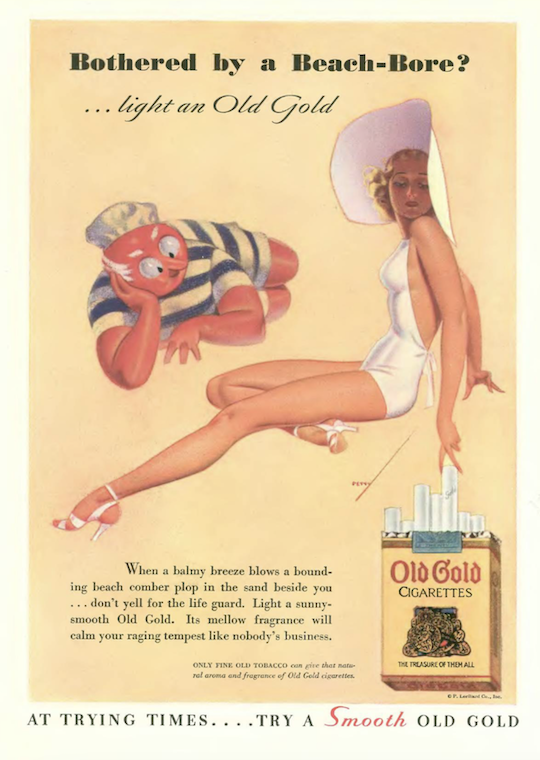
…the inside cover ad was part of an ongoing series of spots for Old Gold cigarettes illustrated by pin-up artist George Petty…almost all of the ads featured a fat, homely man (possibly a sugar daddy) mooning over a leggy blonde who relieves the tedium by reaching for an oversized cigarette…
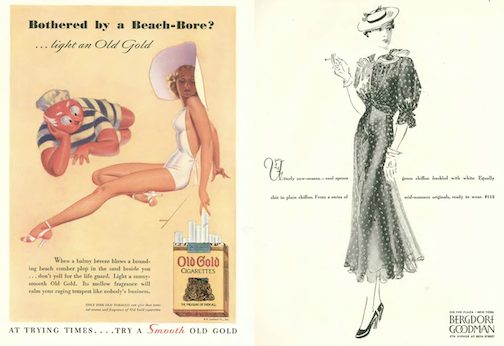
…the ad on the facing page couldn’t be more different, except for the fact the woman is smoking, suggesting, of course, sophistication when paired with the latest fashions from Bergdorf Goodman…
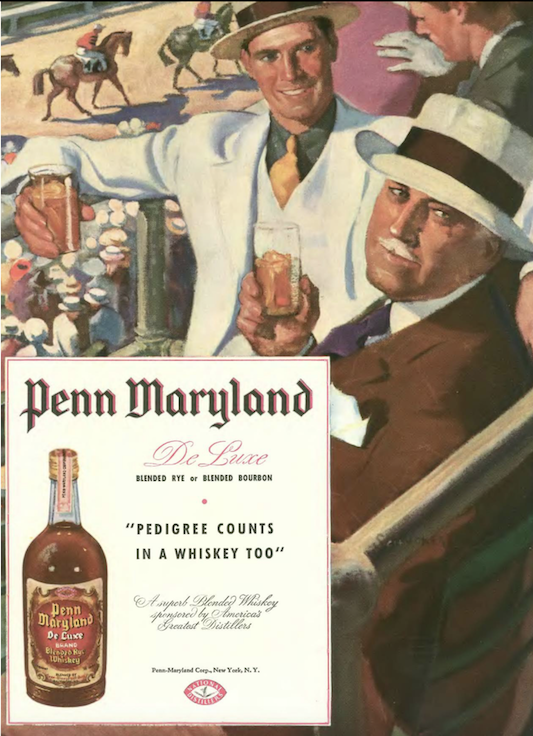
…on the back cover we find these swells enjoying a belt at the horse races…
…while on the back cover, Camel gathered together all of its recent society endorsers for another round of shilling for R. J. Reynolds…
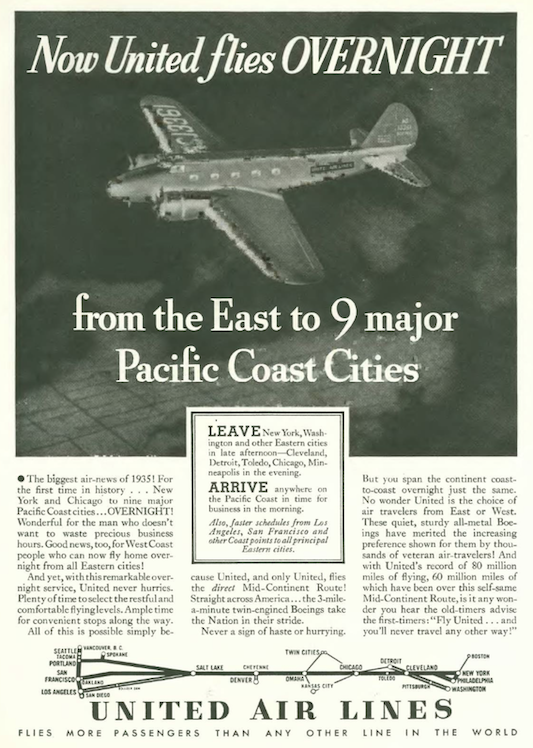
…swells and society women were the only persons (along with celebrities) who could afford to take this early version of a “red eye” to L.A. or San Francisco…it was not all that cushy, however…airliners were loud, cold, and not pressurized, so they flew at low altitudes and were often bounced about by the weather. The Boeing 247 also required several stops for refueling…
‘OL SPEEDY…This Boeing 247 was featured in the above ad. One of the first all-metal airliners, the 247 was considered revolutionary when introduced in 1933—United Airlines boasted that it cruised at speeds of three miles per minute and carried ten passengers across the country in twenty hours, cutting eight hours from previous travel times. Seven refueling stops included Cleveland, Chicago, Omaha, Cheyenne and Salt Lake City. (Wikipedia)WATCH YOUR STEP…Interior of the Boeing 247. Note that the main wing ran through the cabin, so persons moving down the aisle had to step over it. (Library of Congress)
…we learn a lot about a 1930s New Yorker reader by looking at the advertisements…it doubtful the magazine had many truly upper-class readers—the barbarians were content to flip through a copy of Town & Country or similar undemanding fare…what we do have are striving “smart set” readers, some with the means to buy a luxury automobile, fly cross-country, or cruise on the Normandie, all things one would desire as a member of upper-middle class or even the educated bourgeoisie in the middle…this Campbell’s soup ad is for the latter…the upper-middles would sniff at canned soup, while the barbarians would probably eat whatever was set in front of them, since talking about food would be considered vulgar…
…Pabst Blue Ribbon beer has been around since 1844…in the 20th century it was increasingly associated with the working class and rednecks until the brand caught on with urban hipsters in the early 2000s…
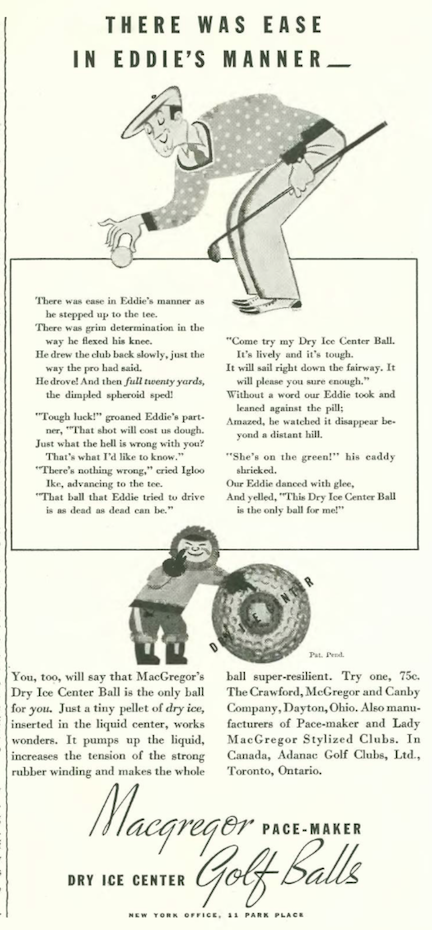
…in the May 25, 1935 issue we saw an ad promoting Walter Hagen’s “Honey Boy” golf balls, which contained real honey in their cores…the folks at MacGregor’s had a different idea—they inserted a pellet of dry ice into the center of their golf balls…what will they think of next?…
…we move on to our cartoonists, beginning with a James Thurber spot…
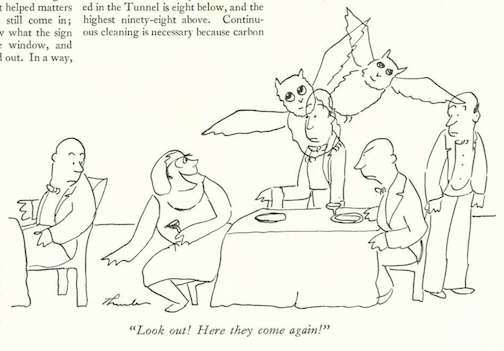
…and continuing with another Thurber classic…
…Robert Day took a lunch break in the opening pages…
…Alan Dunn felt charitable while relaxing in Westchester…
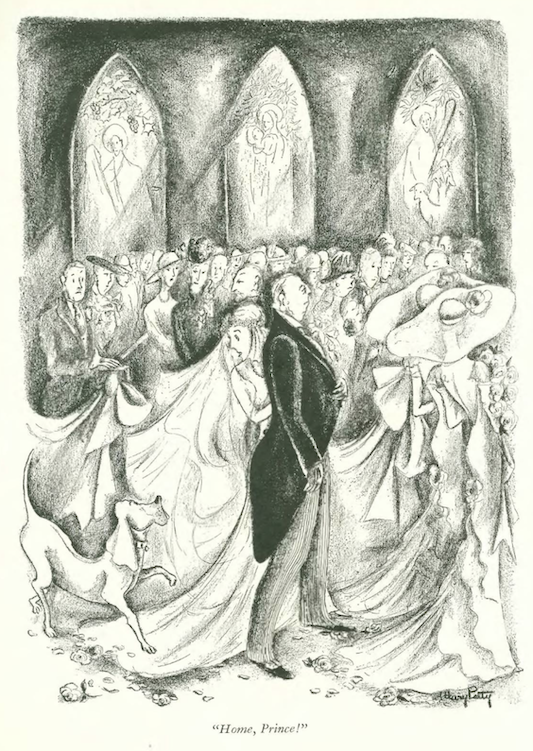
…Mary Petty gave us a wedding guest that would not be out of place today…the caption reads, “Home, Prince!”…
…Helen Hokinson went hog-wild in the garden…
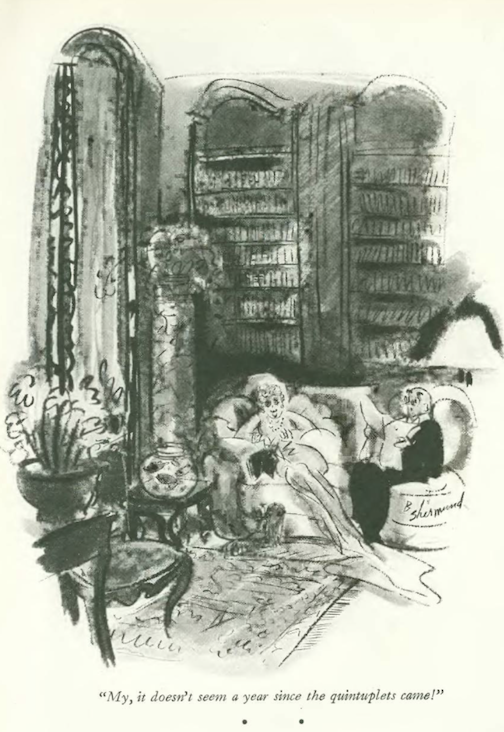
…Barbara Shermund looked in on the idle thoughts of the idle rich…
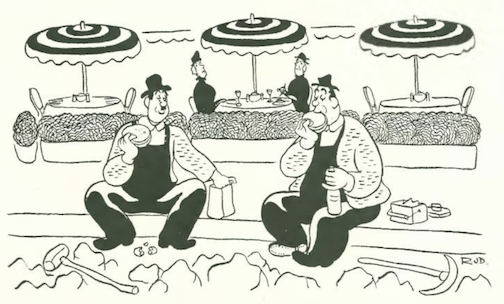
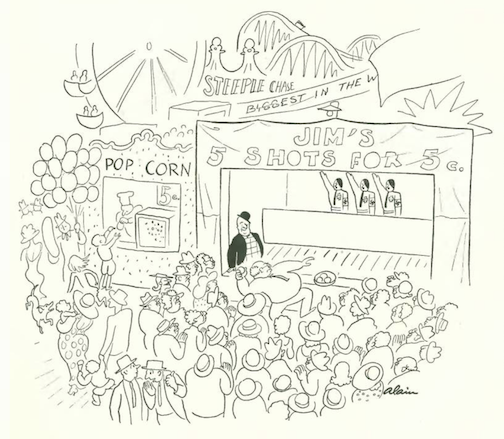
…and we close where we began, with Daniel Brustlein aka Alain at Coney Island…
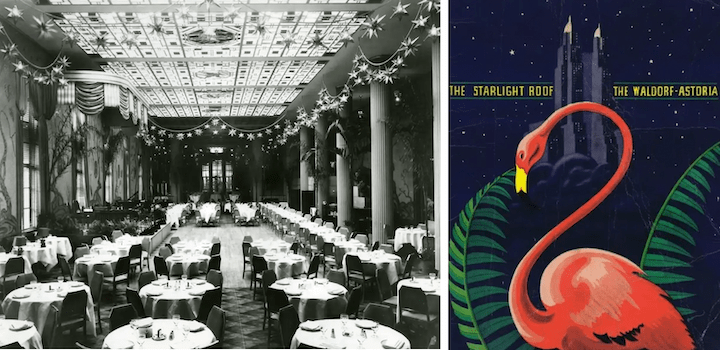
Above: The Waldorf-Astoria's Starlight Roof, and a 1930s menu cover. (Facebook/Pinterest)
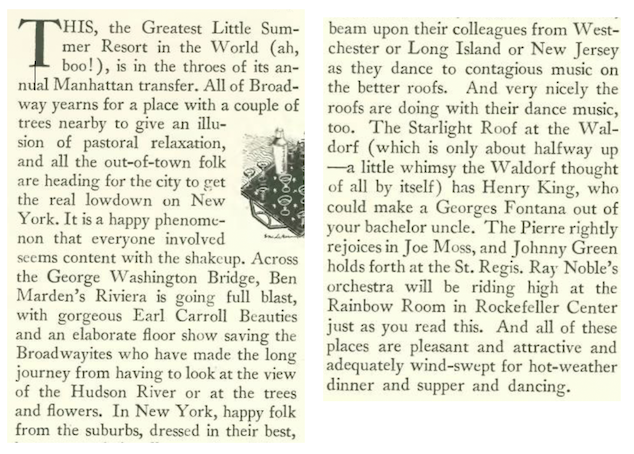
With summer approaching, the rooftop restaurants were in full swing, and Lois Long continued her exploration of favorite haunts, including one nightclub that drew many Manhattanites across the Hudson to the cliffs of the New Jersey Palisades.
June 1, 1935 Cover by Rea Irvin.
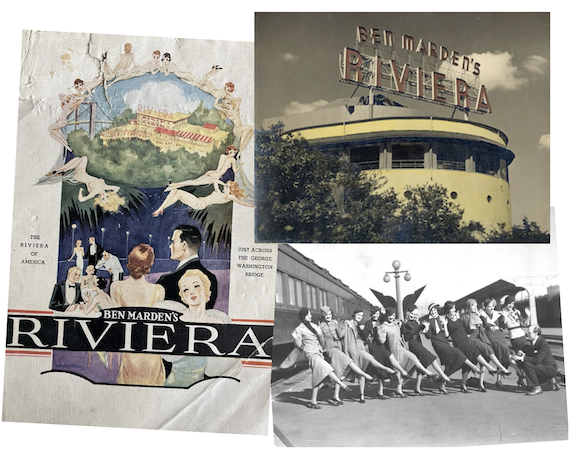
Ben Marden couldn’t wait for the official end of Prohibition when he opened his Riviera Night Club in Fort Lee in 1931. The frequent site of raids until the repeal of the 18th Amendment, the Riviera continued to be a place well known to Bergen County police thanks to clientele that included racketeers and other unsavory types. But to New Yorkers like Long, it was a break from the din of the city to the relative green of the Garden State. Long wrote:
The Riviera closed during the first years of World War II, but it reopened in 1945 after Bill Miller bought it from Marden and apparently cleaned it up. It then attracted the likes of Frank Sinatra, Dean Martin, Jerry Lewis, Martha Rae, Sammy Davis, Jr., and Pearl Bailey until it closed in 1953. It was demolished the following year.
THEY HAD FOOD, TOO…Clockwise, from left, the1936 spring menu cover of Ben Marden’s Riviera featured an illustration of the original Riviera (ringed by nude showgirls), which burned to the ground on Thanksgiving night, 1936; the building that replaced it was called an architectural wonder with its retractable roof, rotating stage, and glass windows that slid down to the floor; Earl Carroll and his “Beauties” performed at the Riviera in 1935–they are pictured here at a train station in Los Angeles, 1934. (ebay.com/patch.com/lapl.org)
Long also stayed in town to visit the Waldorf-Astoria’s Starlight Roof.
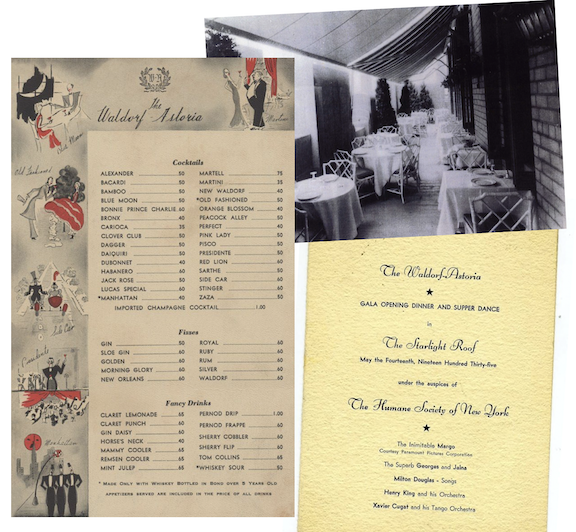
WITH THE STARS, UNDER THE STARS…Clockwise, from left, cocktail menu from the Waldorf’s Starlight Roof, 1935; outdoor seating on the Starlight Roof Terrace; special menu for the Gala Opening Dinner and Supper Dance on the Starlight Roof, May 14, 1935. It was a favorite destination of Frank Sinatra, Cole Porter, Katharine Hepburn, and Ella Fitzgerald, among others. (Pinterest)
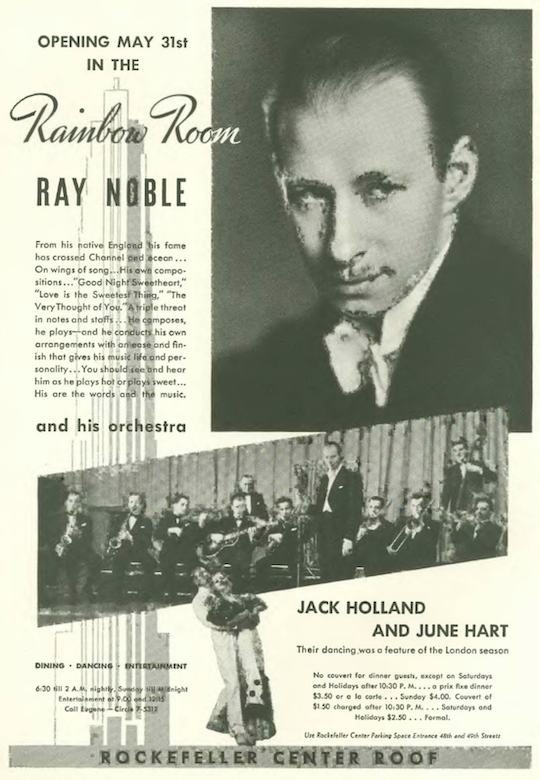
Long also mentioned the appearance of Ray Noble in the Rockefeller Center’s Rainbow Room. This full-page ad appeared in the June 1 issue:
Other summer season attractions were advertised in numerous back-of-the-book, one-column advertisements:
…and at the bottom of page 64…
Wining and dining were also the topic of the profile, a two-parter penned by Margaret Case Harriman, who took a look at New York’s famed Colony Restaurant.
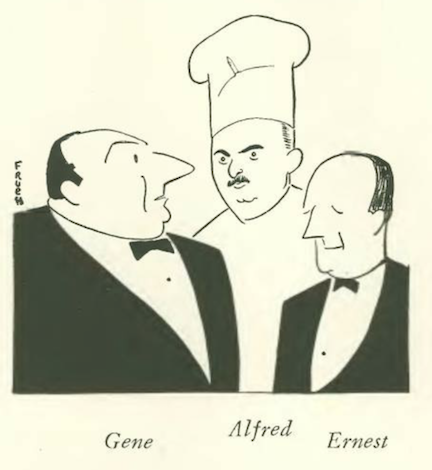
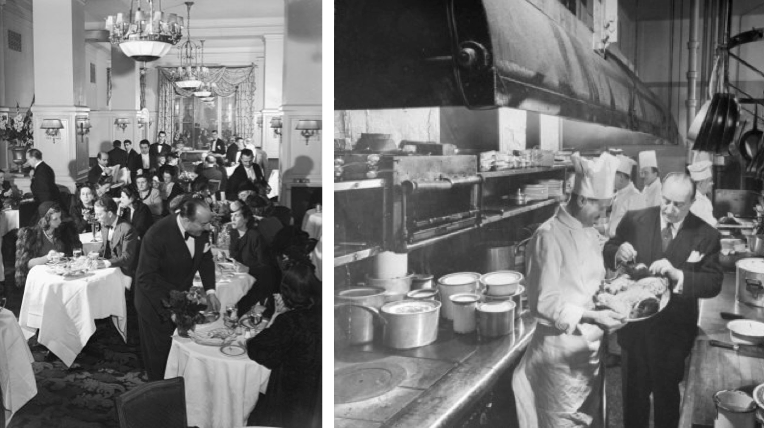
ORIGINAL TRIO…Al Frueh’s caricatures of the Colony’s owners/headwaiters Gene Cavallero and Ernest Cerutti, who flank chef Alfred Hartmann, who was also part owner until he sold his interest to the other two in 1927 and retired to a farm in France. Harriman wrote that Cavallero and Cerutti were “born headwaiters—suave, solicitous, infallible.”A PLACE TO BE SEEN…From the 1920s to the 1960s New York’s café society dined at the Colony. Rian James, in Dining In New York (1930) wrote “the Colony is the restaurant of the cosmopolite and the connoisseur; the rendezvous of the social register; the retreat of the Four Hundred.” Critic George Jean Nathan said the Colony was one of “civilization’s last strongholds in the department of cuisine.” Photo at left of the dining room around 1940; at right, co-owner Eugene Cavallero consults with a chef. (lostpastremembered.blogspot.com)
* * *
The Business of News
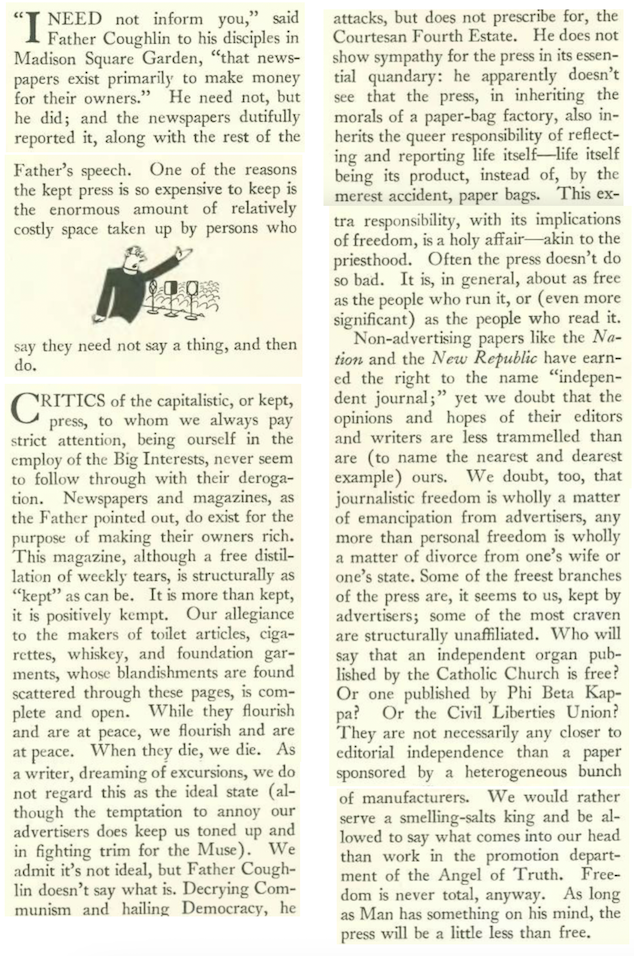
In his “Notes and Comment,” E.B. White contemplated the meaning of a free press, noting that nearly all media was at the mercy of advertisers. That included The New Yorker, which owed allegiance “to the makers of toilet articles, cigarettes, whiskey, and foundation garments.”
* * *
Cat Lady
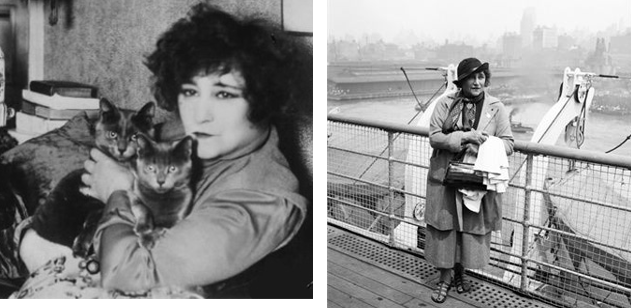
“The Talk of the Town” anticipated the arrival of French writer Colette (1873-1954) aboard the S.S. Normandie. This excerpt makes note of her high standing in society as well as her love of cats.
SHE ONCE OWNED AN OCELOT….Colette with her cats in an undated photo; at right, entering New York Harbor on the S.S. Normandie, 1935. (Pinterest)
* * *
Public Artists
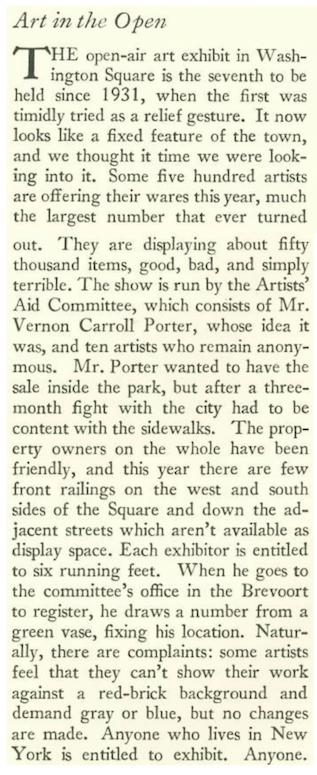
“The Talk of the Town” noted the latest Washington Square Outdoor Art Exhibition…
LENDING THEIR TALENTS…New Yorker cartoonists who helped promote the Outdoor Art Exhibition in Washington Square included James Thurber, Otto Soglow, and William Steig.
* * *
Cutting Remarks
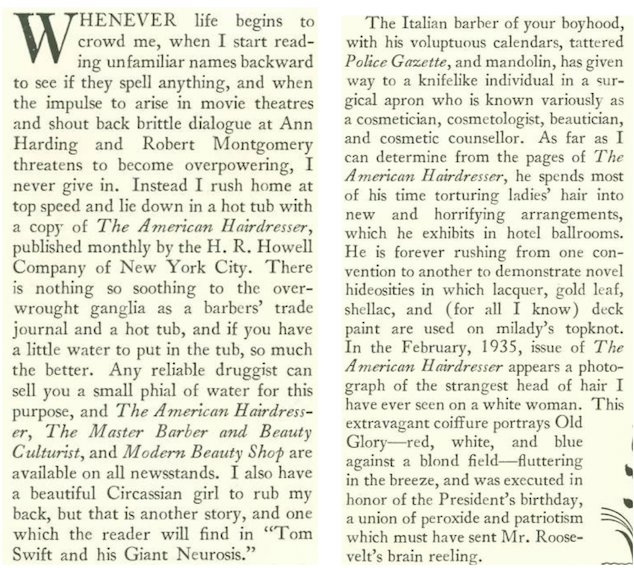
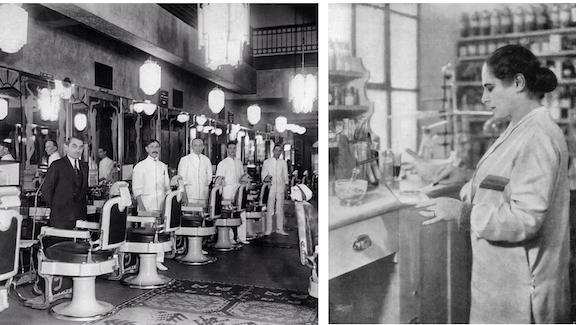
S.J. Perelman offered his thoughts on the decline of the tonsorial arts. In this excerpt, he sees his beloved Italian barber give way to a “knifelike individual in a surgical apron.” Excerpts:
IT’S A SCIENCE NOW, SIDNEY…S.J. Perelman worried about the displacement of Italian barbershops by cosmetologists in “surgical aprons,” such as the one modeled by Helena Rubinstein at right. (Pinterest)
* * *
Even Those Eyes Couldn’t Help
Film critic John Mosher was sad to report that disappointment was in store for moviegoers who enjoyed seeing Bette Davis in Of Human Bondage. Her latest flick, The Girl from 10th Avenue, featured Davis murmuring “gentle nothings of a vaguely noble monotony.”
GET ME OUT OF THIS PICTURE…Left, Bette Davis with Ian Hunter in the uninspired The Girl from 10th Avenue; at right, screen shot of Davis in 1934’s Of Human Bondage, the film that made Davis a star. (thefilmexperience.net)
Other items in the editorial section included a casual by Dorothy Parker’s husband Alan Campbell (titled “Loyalty at Pool-Wah-Met”), and Morris Markey examined the Christian Science movement inspired of Mary Baker Eddy, in “A Reporter at Large” piece titled “But Thinking Makes It So.”
* * *
From Our Advertisers
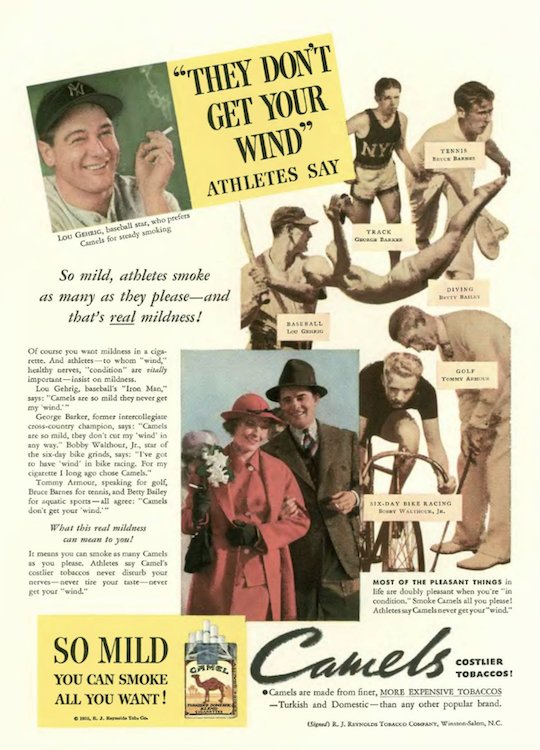
We begin with an advertising theme common through midcentury, namely, that you could smoke certain brands as much as you liked and still be a star athlete (as opposed to a wheezing husk of a human being)…
…not only did these cigarettes “steady your nerves” and preserve your “wind,” they also made for sweet, romantic moments…
…in between puffs you could also enjoy breathing in fumes from leaded gasoline…lead pollution increased by more than 625 times previous levels after leaded fuels were introduced in 1924…
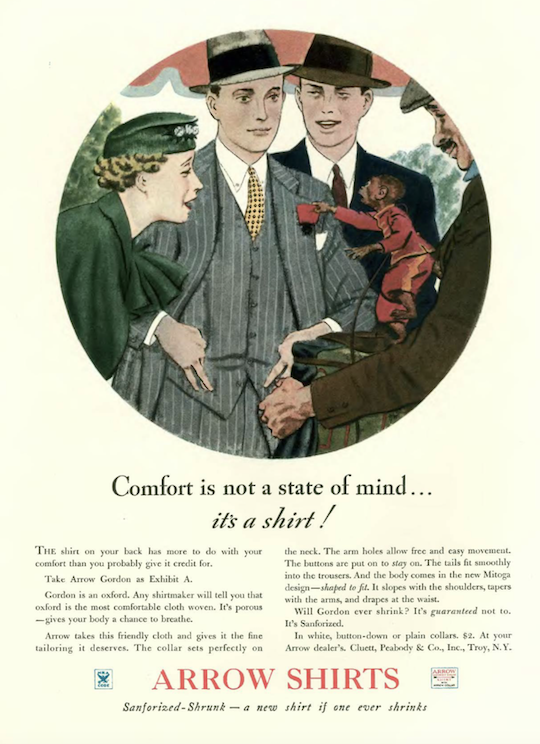
…although they were being outlawed by New York Mayor Fiorello Henry La Guardia, an organ grinder nevertheless made an appearance in an Arrow Shirt ad that offered a lighthearted moment for all involved (except for the dude on ketamine)…
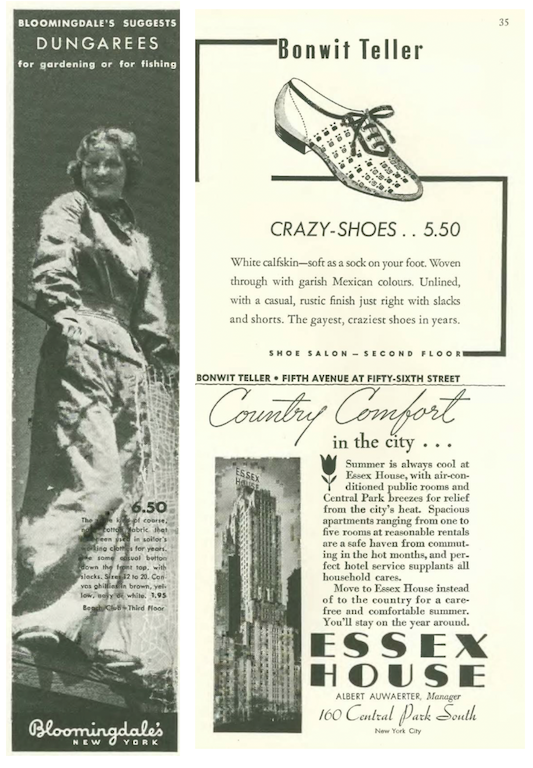
…when jeans were called “dungarees” they were reserved for gardening or fishing…at right you could land a pair of “Crazy Shoes” woven with “garish Mexican colours” for five-and-a-half bucks…
…the makers of White Rock kept it cool with this minimalist ad…
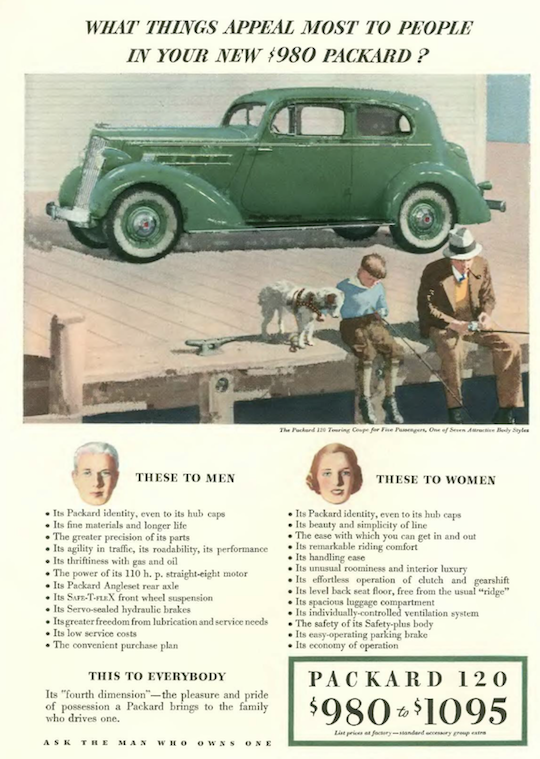
…luxury automaker Packard continued to hang on through the Depression by offering a downscale version…it appears their demographic was middle-aged men and women who still preferred the finer things even if they couldn’t afford them…
…now the property of Hearst, Otto Soglow’s Little King could still appear in The New Yorker via the advertising sections…
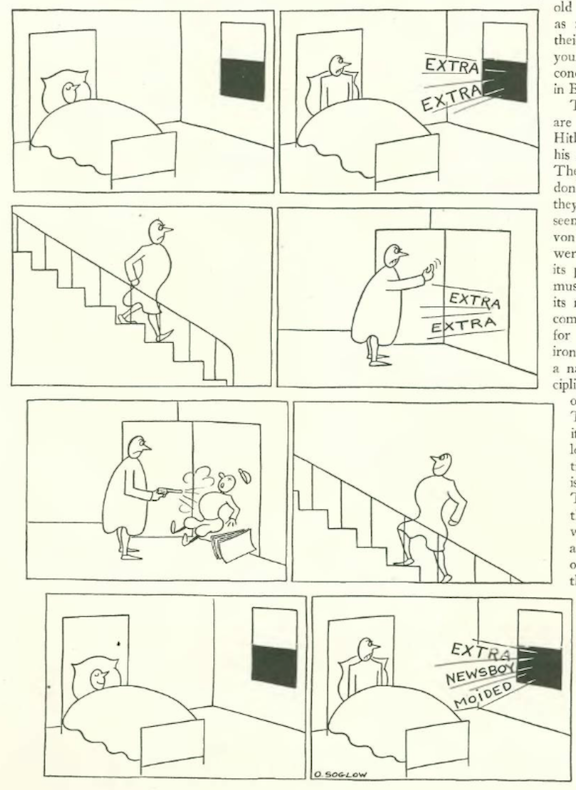
…and Soglow continued his contribution to the magazine’s cartoons with other multi-panel subjects…
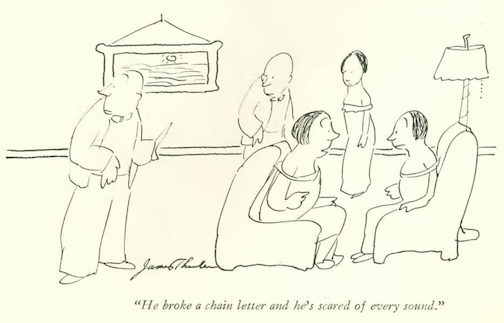
…James Thurber kicked off the cartoonists with this tender spot…
…and contributed this cartoon…
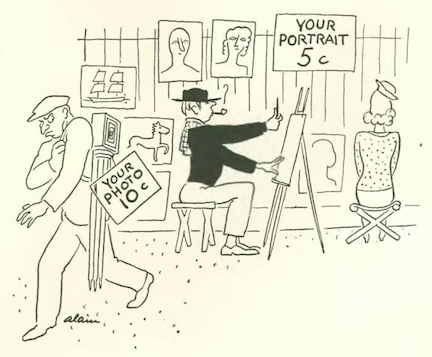
…Alain found competition in the portrait trade…
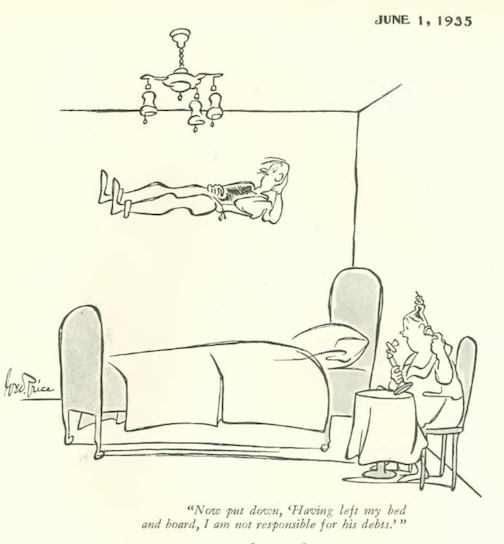
…George Price was still afloat…
…Charles Addams was tied up with the sculptural arts…
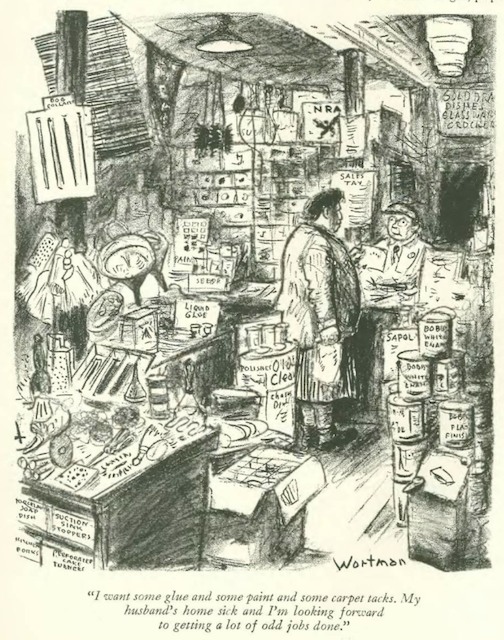
…Denys Wortman shopped for DIY projects…
…Peter Arno found a sensitive side in one member of the NYPD…
…Mary Petty made some alterations…
…and we close with this terrific cartoon by Richard Decker…