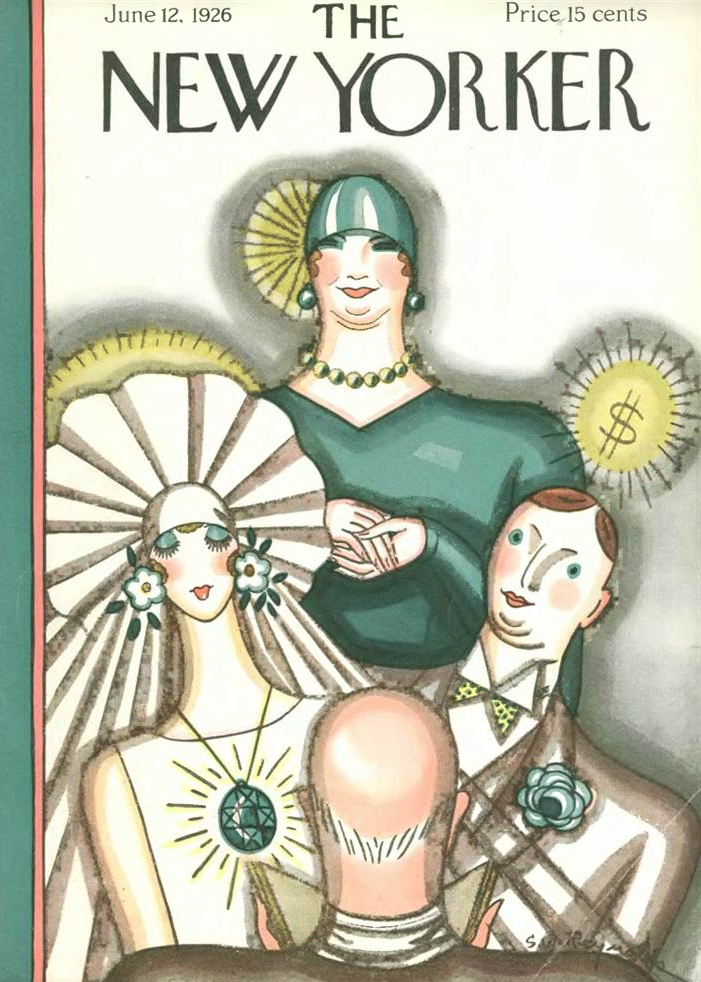
A Carnival in the Air

When Charles Lindbergh gunned his Wright Whirlwind engine on Roosevelt Field and took to the skies on his historic flight, he sparked such an interest in flying that just two years later that very same field was hosting huge weekend crowds that came to marvel at the airborne wonders of a new age.

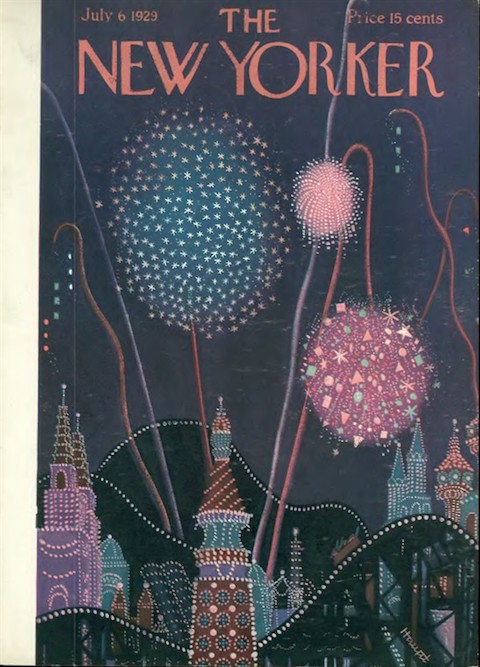
August 31, 1929 cover by Theodore Haupt.

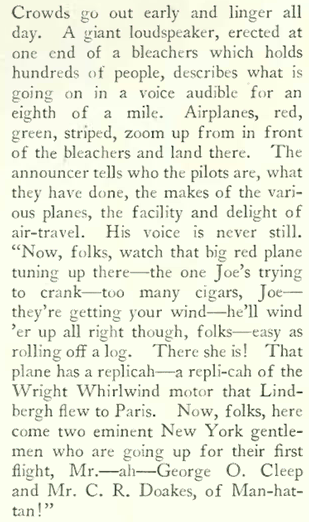
Writing for “The Talk of the Town,” James Thurber was on hand to take in the spectacle, noting how the announcer sold air-mindedness to the mob “in great clamorous phrases and resonant assurances.” Among those taking their first flight was a “Mr. Galleger, aged 101.” Thurber also observed:

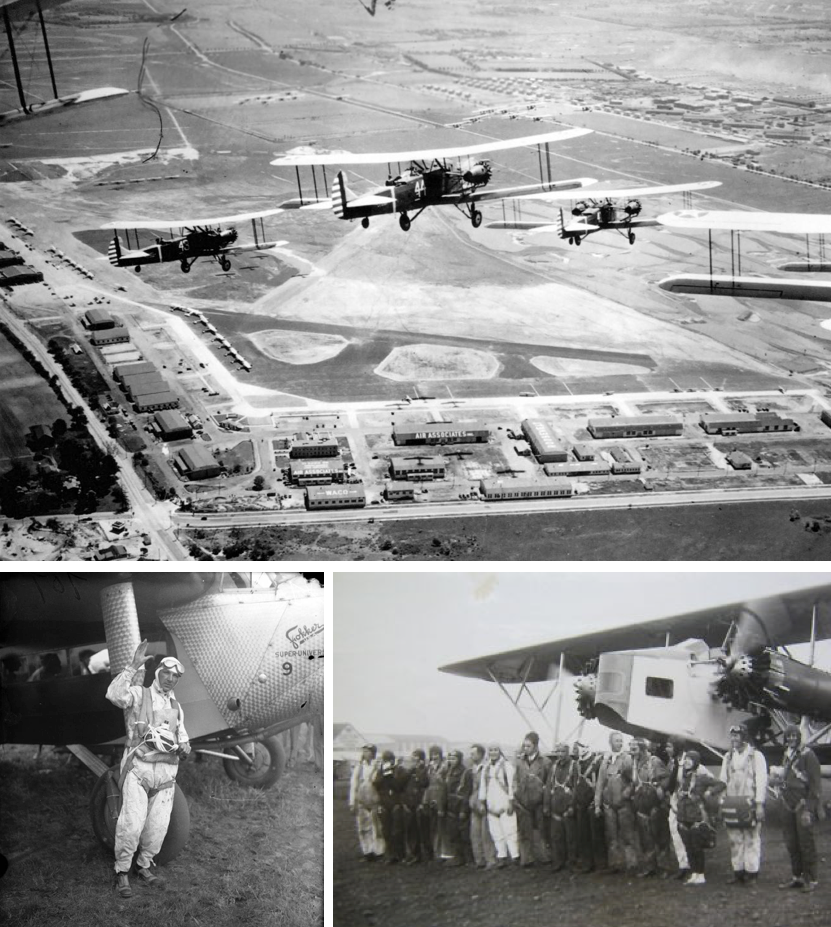
AIRBORNE SPECTACLES…Clockwise, from top, a 1931 aerial view looking southeast at a group of Army twin-engine biplane bombers overflying Roosevelt Field; parachute records were broken when 14 men and 2 women leaped from a Sikorsky bombing plane at Roosevelt Field in November 1929 (in the photo they seem to be standing precariously close to the plane’s whirling blades); Jack Cope waved to onlookers in Chicago before he performed a 15,000 foot jump in 1929. (tripod.com/Worthpoint/Chicago Tribune)

Although there were thrills galore up in the sky, Thurber seemed equally impressed by the spectacle on the ground…

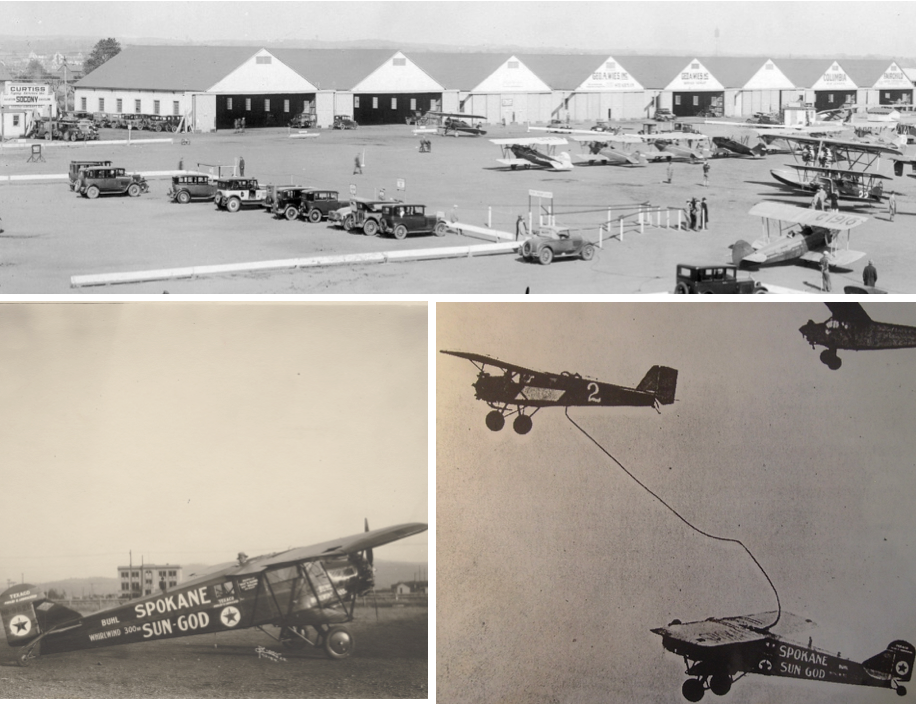
THE SUN GOD…Clockwise, from top, a 1928 photo of biplanes lined up by a row of hangars at Roosevelt Field; the spectacle of mid-air refueling was demonstrated above Roosevelt Field by Texaco Oil’s Spokane Sun God. (Tom Heitzman/barnstmr.blogspot.com/Wikipedia)

One of the big attractions was Texaco Oil’s Spokane Sun God, which traveled around the country to demonstrate the art of mid-air refueling. Note in the excerpt below (second paragraph) how the Sun God’s pilot communicated with his ground crew: He tossed some notes—tied to a heavy piece of lead(!)—out of the airplane’s window. It nearly landed in a crowd of onlookers…

AND HOW WAS YOUR DAY?…For some perspective, the first attempt at refueling in mid-air was made in 1921. In the photo above, Wesley May climbs from the lower biplane to the upper while carrying a 5-gallon can of fuel strapped to his back. After lifting himself onto the wing, he worked his way between the wings and into the cockpit. He then poured the fuel into the engine. (Seattle Museum of Flight) 

*  *  *

Falling Short

As I noted in a previous post (The Last Summer), the race to build the tallest building was erroneously reported by The New Yorker as a man against himself (namely, architect William Van Allen). In the Aug. 31 issue, the magazine’s “Talk of the Town” corrected the error, and added another curious note about another plan to build an “airplane lighthouse” taller than the Eiffel Tower…
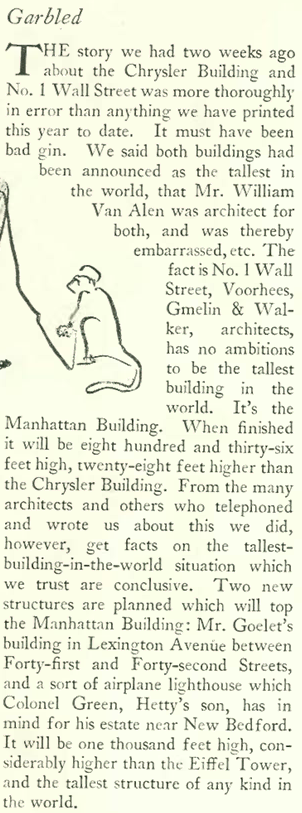
As noted above, Col. Edward Howland Robinson Green (son of the notorious miser Hetty Green) wanted to build a thousand-foot tower on his estate in Massachusetts. Here is what he settled for instead:
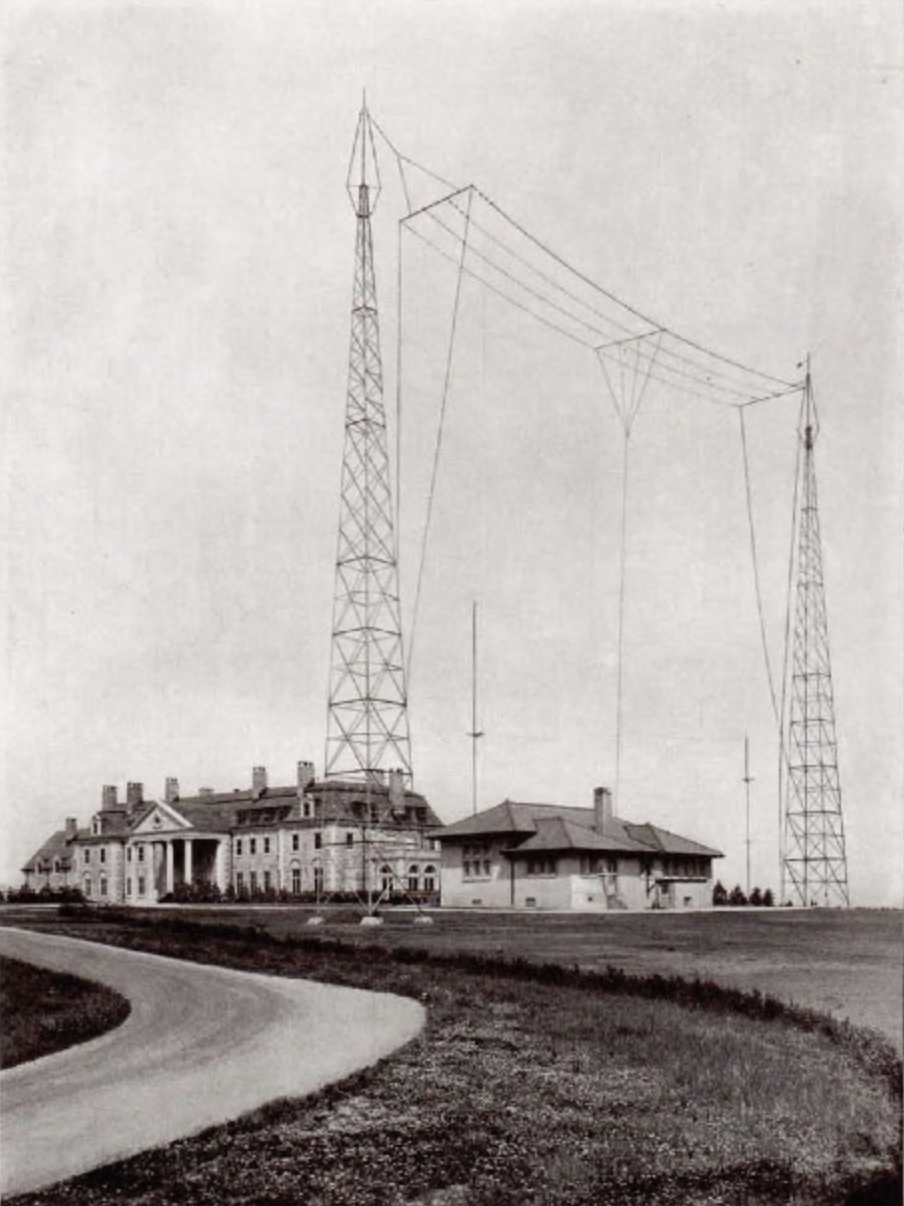
WORK-LIFE BALANCE…Edward Green, radio enthusiast and son of the miserly Hetty Green, erected huge radio towers at his Massachusetts estate in the 1920s to operate an early broadcast station, WMAF. (Wikipedia)

 * * *

When Trains Fly

Cashing in on the enthusiasm over aviation, the City of New York promoted its elevated train system as an “Air Line.” According to “Talk”…
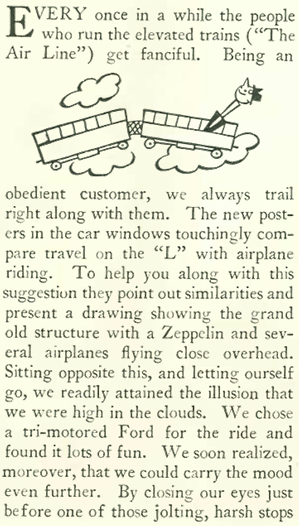
Click on the video below to take a ride on the “L”. Most of the 1929 footage begins at 4:47…

* * *

Haw Haw

One more “Talk” item: a self-referential piece in which The New Yorker pondered its “mission” as a humor magazine…

* * *

Audax Minor

For more than five decades, George Francis Trafford Ryall (1887-1979) wrote the horse racing column for the New Yorker under the pseudonym Audax Minor. He published his first column on July 10, 1926, and his last on Dec. 18, 1978. He was the writer of longest record at the magazine when he died at age 92 in 1979 (52 years, a record that has been shattered by the nearly 98-year-old Roger Angell, who has published in the New Yorker from 1944 to 2018).

According to Ryall’s obituary in the New York Times, he adopted the nom de plume Audax Minor in a nod to Arthur F. B. Portman, who wrote about racing in England under the name of Audax Major. Ryall’s writing was so entertaining that many of his readers had never even been to a racetrack. According to Brendan Gill in his book, Here at the New Yorker, “(Ryall’s) world is a romantic fiction and they (the readers) are grateful when they learn that, with his green tweeds, his binoculars hung smartly athwart his chest, and his jaunty stride, Ryall resembles a character out of some sunny Edwardian novel.” An excerpt of his column from the Aug. 31 issue, with illustrations by Johan Bull:

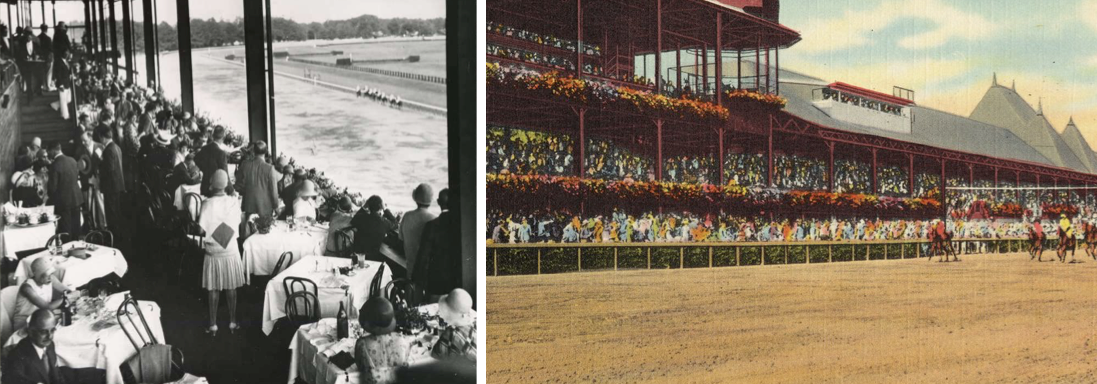
A DAY AT THE RACES…At left, a crowded second floor dining area in the clubhouse at Saratoga, 1929; a postcard image of the track, with expanded clubhouse at left, circa 1929. (Saratoga Springs Historical Museum/Boston Public Library)

 *  *  *

Shut Out

As I’ve noted before, the New Yorker covered nearly every imaginable sport except baseball. Here is a rare mention of the game in Howard Brubaker’s “Of All Things” column:
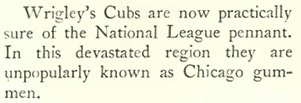
The Cubs would win the NL pennant, but they would fall to the Philadelphia Athletics in the 1929 World Series.

Rough and Ready

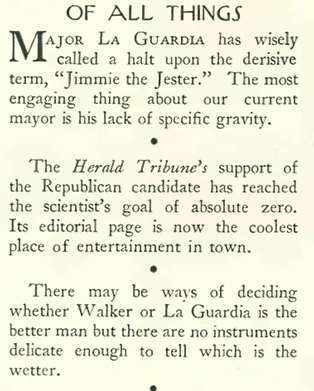
When Fiorello La Guardia challenged incumbent Jimmy Walker for New York City mayor in 1929, the city’s voters were presented with two colorful candidates who could not have been more different in their styles. Walker, a product of Tammany Hall, was a svelte dandy with a taste for the refined, whereas the reform-minded La Guardia was often coarse and unkempt. If they had anything in common, it was their dislike of Prohibition. La Guardia was featured in the Aug. 31 profile, written by Henry F. Pringle. Some excerpts:
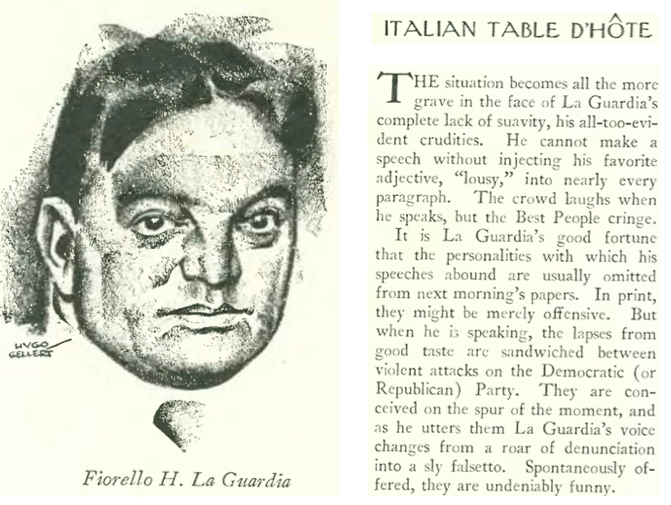
JUST TRY TO STOP ME…Congressman Fiorello La Guardia pouring beer in his office during Prohibition, when he served New York’s 20th district in U.S. House of Representatives. (La Guardia Wagner Archives)

 *  *  *

Praise for the King

The New Yorker’s film critic John Mosher found most of Hollywood’s output to be pedestrian, but occasionally he saw a bright spot, including King Vidor’s latest production, Hallelujah:

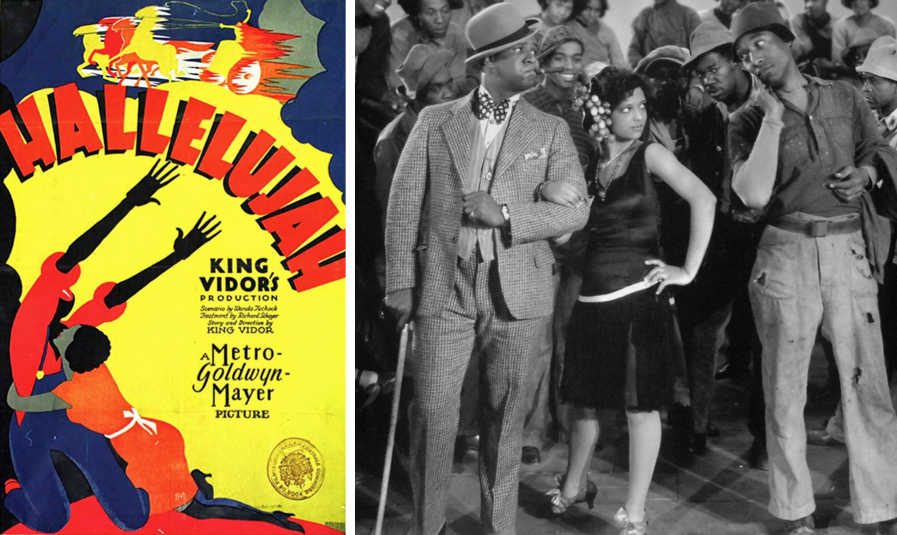
William E. Fountaine, Nina Mae McKinney and Daniel Haynes in Hallelujah. The 17-year-old McKinney was the first African-American actress to hold a principal role in a mainstream film, and the first African-American actor to sign a long-term contract with a major studio—MGM. (IMDB)

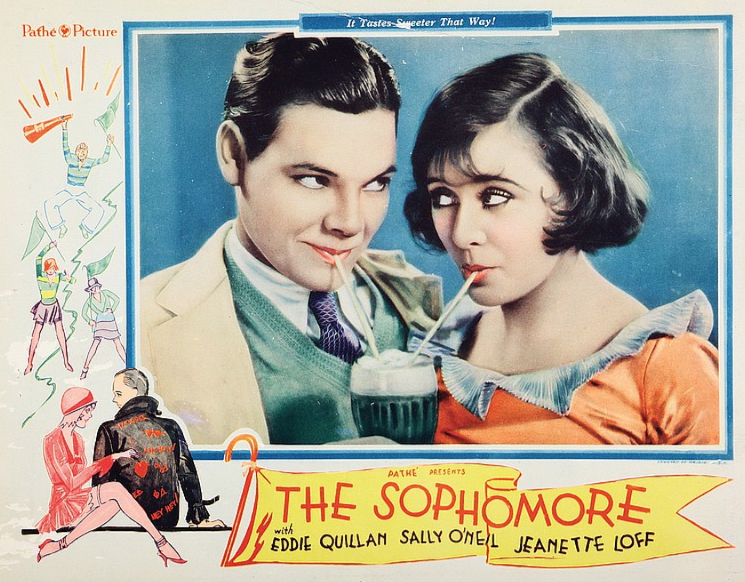
As for another film, Paramount’s The Sophomore, Mosher probably felt a bit obligated to say something nice, since it was a derived from a story by humorist Corey Ford, an early contributor to The New Yorker and part of the Algonquin Round Table orbit:
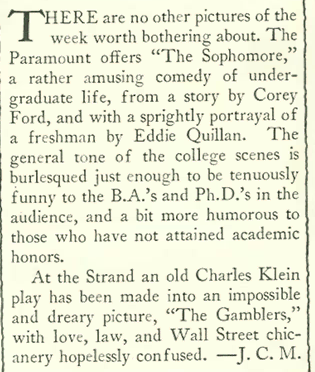
BOY MEETS GIRL…Lobby card for The Sophomore. (IMDB)

 *  *  *

A Bright Interval

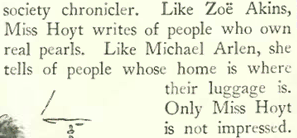
The New Yorker gave a brief but approving mention of Nancy Hoyt’s latest book, Bright Intervals, in its book review section…

Hoyt was a member of a socially prominent but deeply troubled family that included her recently deceased sister, the poet and writer Elinor Wylie (I wrote about the Hoyt family in my post Generation of Vipers). Characters in Hoyt’s novels often resembled the women in her family.
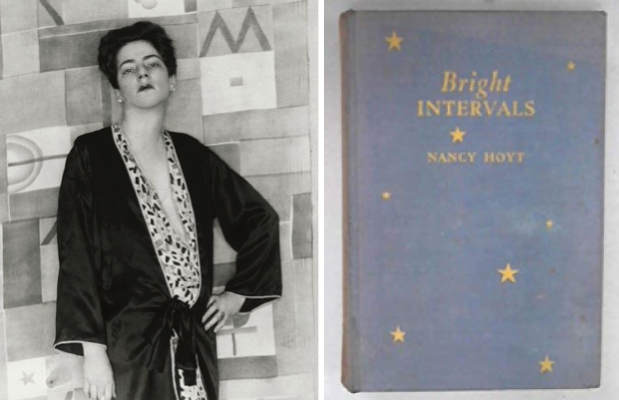
Nancy Hoyt in an undated photo by Sherril Schell. (Conde Nast/Amazon)

 *  *  *

From Our Advertisers

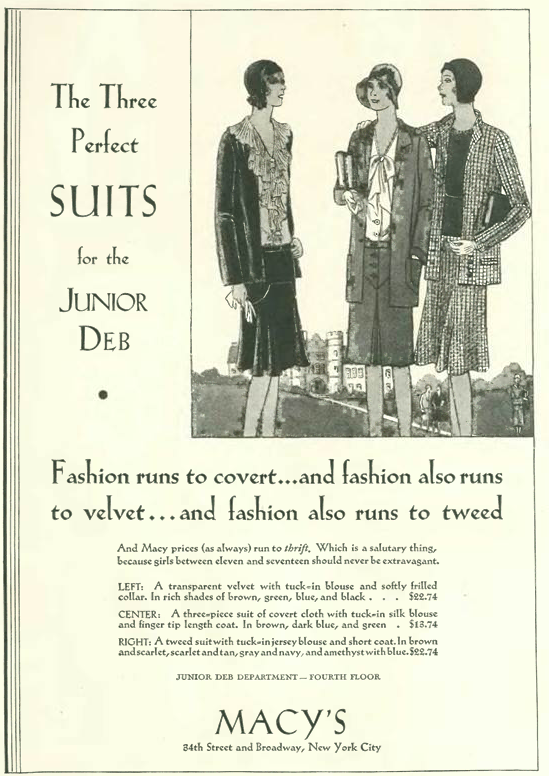
It was back to college time, and Macy’s had a thrifty new fall lineup ready for the “Junior Deb”…
…and on the less thrifty side, Best & Company offered these new looks for fall…

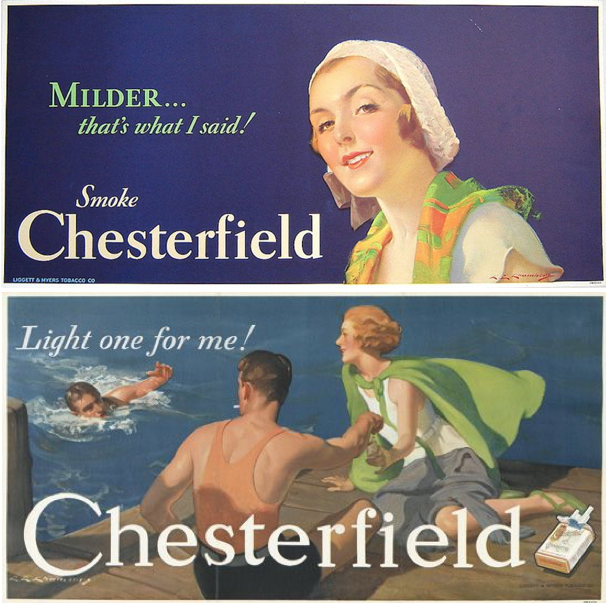
…note in the above ad that the first model is Virginia Maurice, the very same model we encountered in a recent post (The Last Summer) posing for Chesterfield cigarettes…

Model Virginia Maurice posed for this 1929 Chesterfield ad, illustrated by artist Charles Edward Chambers.

…the other model in the Best & Company ad, Babs Shanton, also wasn’t averse to taking money from the tobacco companies…
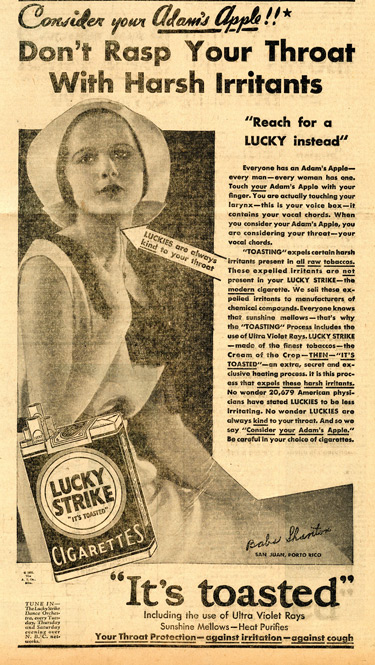
Undated newspaper ad for Lucky Strikes featuring Babs Shanton, a sometime performer with the Ziegfeld Follies and a singer with the Lucky Strike Dance Orchestra. (Stanford University)

…the makers of Studebakers tried to add sex appeal in this ad for their President Roadster. The artist was obviously challenged to work all of the necessary elements into the picture—car, swimming pool, diving board—not to mention the block of superfluous text where the steps to this impossibly long diving board should have been located…

…and sex not only sold cars…its also sold printing services…

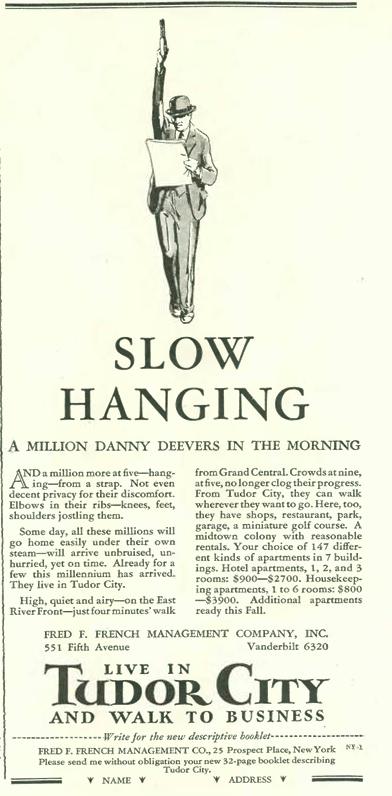
…instead of sex, the promoters of Tudor City chose strangulation to get their pitch across, equating a man’s daily train commute to death at the gallows (“Danny Deevers” refers to a character in a Rudyard Kipling poem who is hanged for murder)…
…the gawkers at Roosevelt Field weren’t the only folks with their heads in the clouds…an ad for Flit insecticide by Dr. Seuss…

…this ad for Raleigh cigarettes, which appeared on the back cover of the Aug. 31 issue, assumed that folks were so familiar with their mascot that no further explanation was needed…
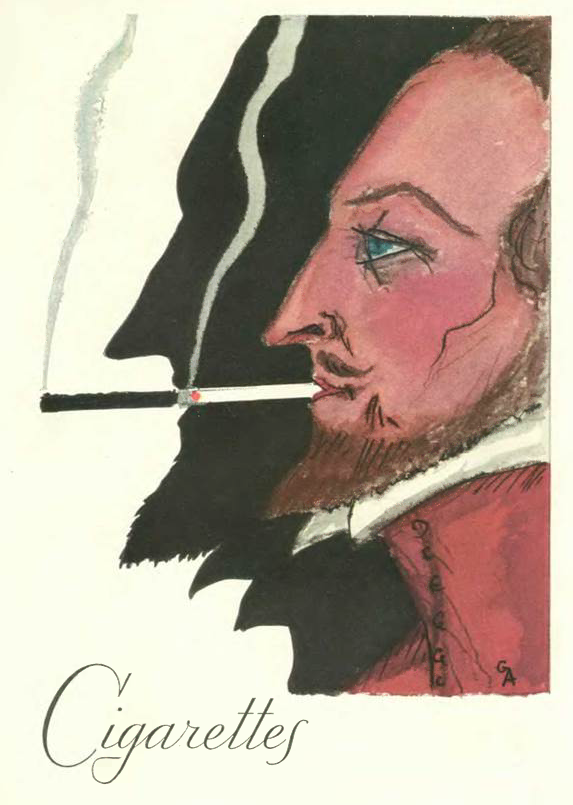
…here is a 1929 ad from House Beautiful that featured the same mascot with the Van Dyke beard…both ads were rendered by French illustrator Guy Arnoux

…on to our cartoonists…Helen Hokinson contributed this two-page spread on the challenges of visiting an old friend (click to enlarge)

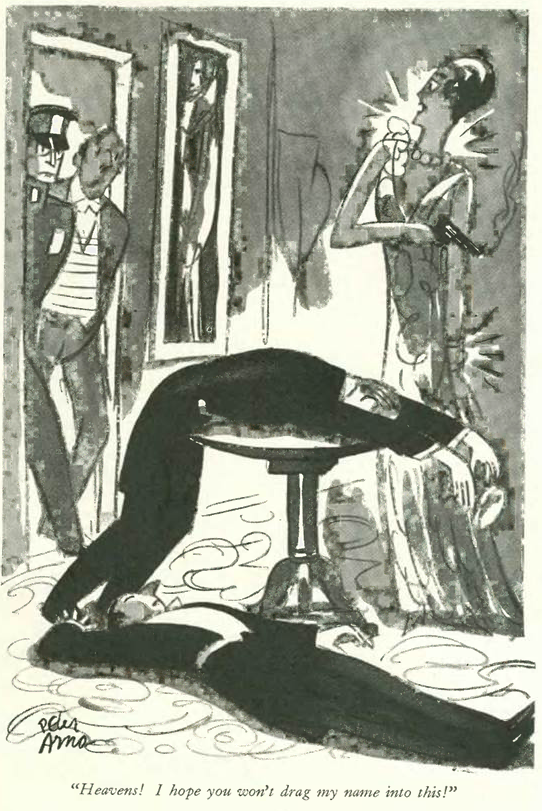
Peter Arno looked in on a cheapskate at a posh restaurant…
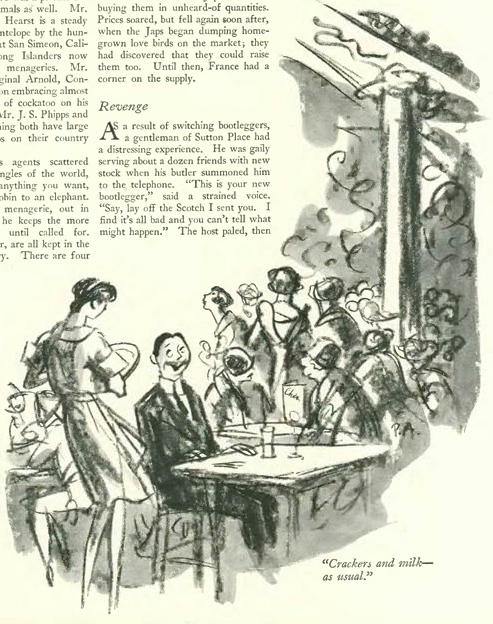
Bruce Bairnsfather visited the talkies…

Justin Herman examined the literary life of the street…

Carl Kindl explored an awkward moment from the annals of technological advancements…

…and Isadore Klein illustrated the hazards of the tonsorial trade…

Next Time: The Last Hurrah…

The Last Summer

Winding down the last summer of the 1920s — an unusually hot one — one detects subtle changes in The New Yorker’s mood; weary from the decade-long party known as the Roaring Twenties, a bit more mature, and more confident in its voice thanks to the regular writings of James Thurber, E.B. White and Lois Long and copious cartoons and illustrations by such notables as Peter Arno, Barbara Shermund and Helen Hokinson that gave the magazine a distinctively modern feel as it headed into the 1930s.

Aug. 10, 1929 cover by Theodore Haupt; Aug. 17 cover by Peter Arno.

The exuberance associated with the rapidly changing skyline was still there, however, as the Aug. 17 “Talk of the Town” speculated on the race for the world’s tallest building. The article not only anticipated an architect’s sleight of hand, but also a Zeppelin docking station that in the end would top the world’s tallest building:

As it turned out, William Van Alen did not have to compete against himself, the commission for One Wall Street instead going to Ralph Walker, who would design a beautiful art deco landmark that, at 50 stories, would not vie for the title of the world’s tallest building. Unbeknownst to The New Yorker, and perhaps Van Alen, the challenger would instead be 40 Wall Street, which would hold the crown as world’s tallest for about a month. Thanks to some sleight of hand (see caption below) the Chrysler building would quickly surpass 40 Wall Street and hold the title for just eleven months, bested in the end by the Empire State Building (which would sport a “Zeppelin superstructure”).

DECO DELIGHTS…40 Wall Street (left) vied with the Chrysler Building for the title of the world’s tallest building. The 927-foot 40 Wall Street would claim the title in late April 1930. One month later, the Chrysler building would sprout a needle-like spire (secretly constructed inside the building) bringing its total height to 1,046 feet. The builders of 40 Wall Street cried foul and claimed that their building contained the world’s highest usable floor, whereas the Chrysler’s spire was strictly ornamental and inaccessible. Less than a year later the point was made moot when the Empire State Building soared above them both. (Wikipedia/The Skyscraper Museum)
ERECTILE DYSFUNCTION…Clockwise, from top left, progression of designs for the Chrysler Building; the building’s architect, William Van Alen; drawing from Popular Science Monthly (Aug. 1930) revealed the inner workings of the spire’s clandestine construction; Zeppelin docking station for the Empire State Building as imagined in a composite (faked) photograph. At 1,250 feet, the wind-whipped mooring mast proved not only impractical, but downright dangerous. In September 1931 a dirigible briefly lashed itself to the mast in 40 mph winds, and two weeks later the Goodyear Blimp Columbia managed to deliver a stack of Evening Journals to a man stationed on the tower. Contrary to the faked photograph, no passengers ever transferred from the tower to a Zeppelin. (Skyscraper City/Wikipedia/NY Times)

*  *  *

What, Me Worry?

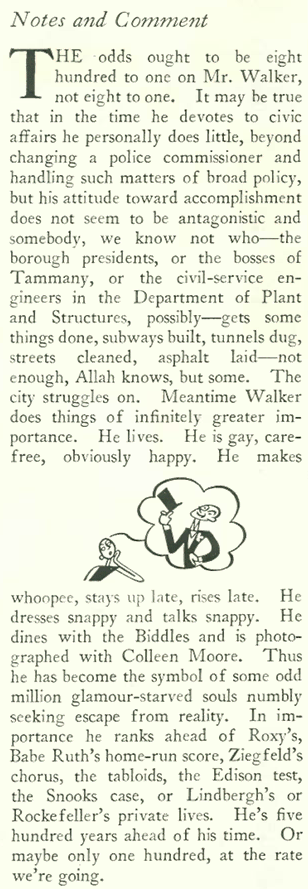
The famously flamboyant New York City Mayor Jimmy Walker lived the easy life during his initial years as Hizzonner, riding a booming economy, partying with the rich and famous (while flaunting Prohibition laws), carousing with his mistress (Ziegfield dancer Betty Compton) and sleeping until noon. When reform-minded Fiorello La Guardia challenged Walker’s reelection bid in 1929, Walker left the dirty work to his Tammany Hall cronies and continued to charm the public, and The New Yorker. The Aug. 17 “Talk of the Town” observed:

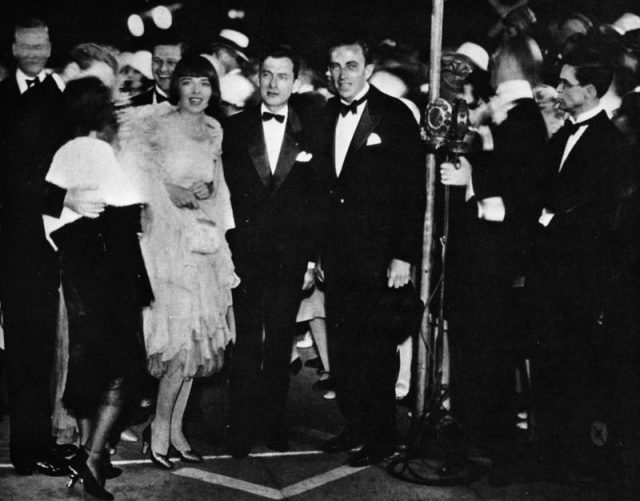
IT’S EASY BEING ME…Mayor Jimmy Walker accompanied actress Colleen Moore to the October 1928 premiere of her latest film, Lilac Time. (konreioldnewyork.blogspot.com)
I HAVE MY EYE ON YOU…Reform-minded Fiorello La Guardia (right) detested Jimmy Walker and his Tammany cronies, but that wasn’t enough to get him elected in 1929. The Great Depression would soon turn the tables. (Wikipedia)

Howard Brubaker, in his Aug. 17 “Of All Things” column, suggested that La Guardia had a zero chance of getting elected. Just three years later, Walker would resign amid scandal and flee to Europe. La Guardia, on the other hand, would be elected to the first of his three terms as mayor in 1933, riding the wave of the New Deal.

 *  *  *

Peek-A-Boo

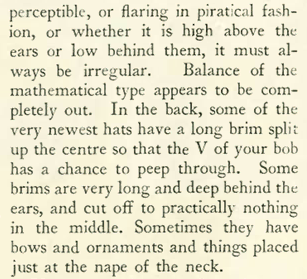
Politics might have been business as usual, but in the world of fashion the vampish hat styles associated with flappers were giving way to a new rolled-brim look that seemed to suggest an aviator’s helmet. In her Aug. 17 fashion column “On and Off the Avenue,” Lois Long reported:

FACING THE FUTURE…Vampish hats of 1928, pictured at top, gave way to the rolled-brim or flare look of 1929. (Images gleaned from magazine/catalog images posted on Pinterest)

Long seemed to welcome the idea that women should once again bare their foreheads…

 *  *  *

Twain Wreck

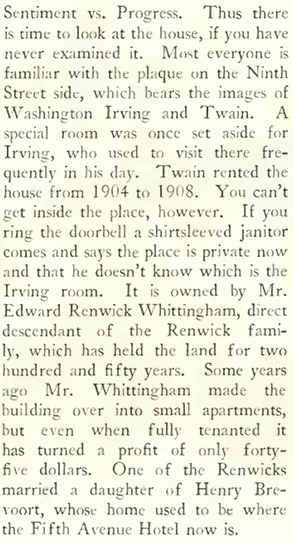
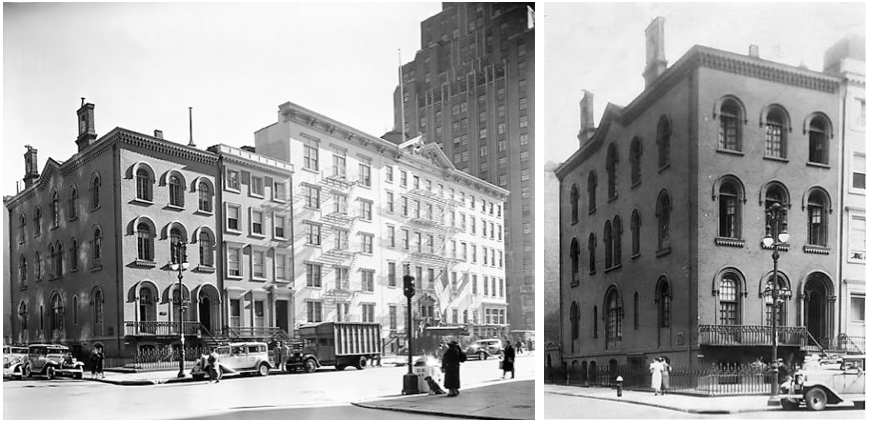
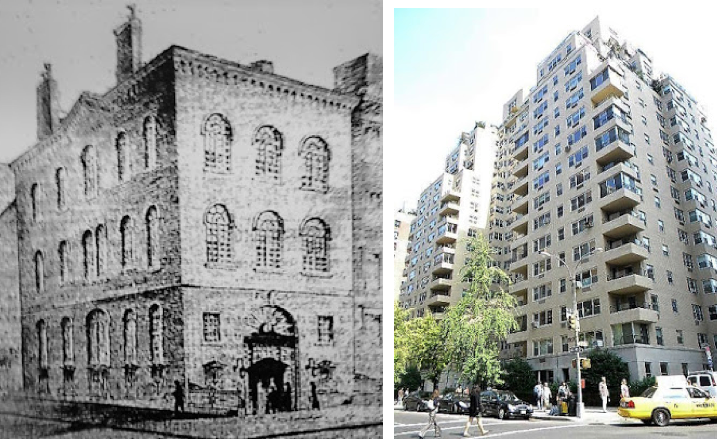
Jumping back to the Aug. 10 issue, “The Talk of the Town” reported on the possible remodeling or demolition of a house once occupied by Samuel Clemens, aka Mark Twain. The house in question was a lavish old mansion built by Henry Brevoort, Jr. in 1834, at the northwest corner of Fifth Avenue and 9th Street. Twain lived in the house from 1905 to 1908, and it was there that Twain’s biographer Albert Paine conducted interviews with the author and wrote the four-volume Mark Twain, a Biography; The Personal and Literary Life of Samuel Langhorne Clemens. When millionaires abandoned their Fifth Avenue mansions in the 1920s and high-rise apartments took their place, there was pressure to either convert an old mansion like the Breevoort house at 21 Fifth Avenue to apartments or demolish it altogether.

LOOKING GOOD AFTER A CENTURY…At left, Berenice Abbott took this photograph of No. 21 Fifth Avenue in 1935. At right, in a close-up shot from the same period, the 1924 plaque from the Greenwich Village Historical Society is visible on the side of the house. (Museum of the City of New York/Greenwich Village Historical Society)
A NOW FOR SOMETHING COMPLETELY DIFFERENT…A proposed 1929 remodeling (left) moved the front door of the old Brevoort mansion to the center and lowered it to street level. At right, today the 1955 Brevoort apartment house occupies the site. (daytoninmanhattan.blogspot.com)

The Greenwich Village Historical Society did what it could to save the house, and in 1924 affixed a bronze plaque to a side wall noting that both Twain and Washington Irving were once occupants. When the house was slated for demolition in 1954, the Society appealed to New Yorkers to raise the $70,000 needed to move the building, but only a fraction of that amount was secured. No. 21 was demolished in 1954 along with the rest of the houses on that block.

 *  *  *

Charles Edward Chambers was an American illustrator probably best known for his Chesterfield ads, although he also illustrated stories for a number of popular magazines from the early 1900s until his death in 1941. The Aug. 10 “Talk of the Town” looked in on his work with model Virginia Maurice:

QUICK…THROW THAT MAN A CIGARETTE!…Examples of Charles Edward Chambers’ Chesterfield ads from 1929 featuring model Virginia Maurice. Note that Maurice is wearing the latest “rolled brim” hat style in the upper image. (Pinterest)
HIS NONSMOKING SECTION…A 1919 Harper’s cover illustration by Charles Edward Chambers. (Wikipedia)

*  *  *

Mama’s Boy

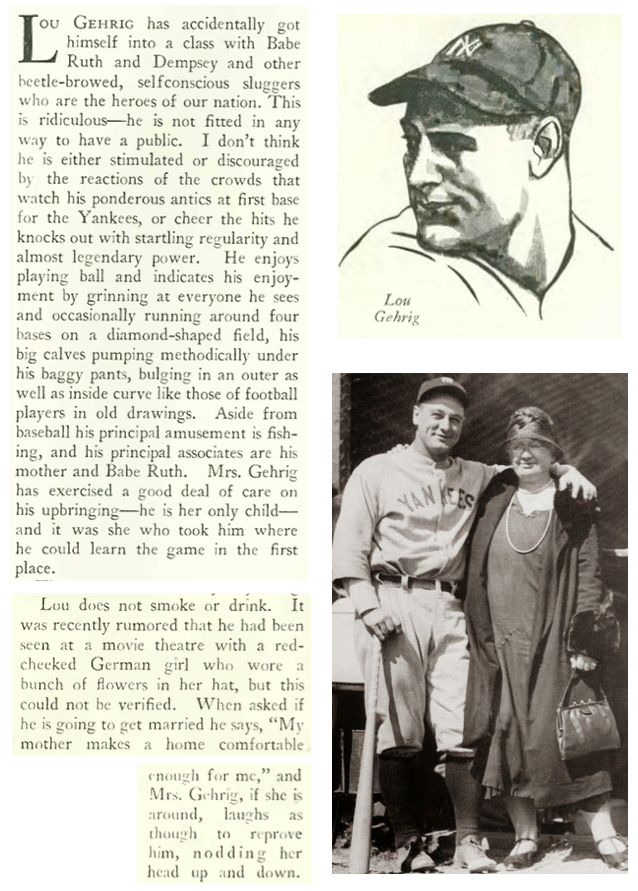
Lou Gehrig rivaled Babe Ruth as a top Murderer’s Row slugger for the 1929 Yankees, yet he couldn’t be more opposite in his lifestyle. A teetotaler and nonsmoker, Gehrig was completely devoted to mom (pictured below in 1927). Niven Busch Jr. submitted this profile of Gehrig for the Aug. 10 issue. Excerpts:

 *  *  *

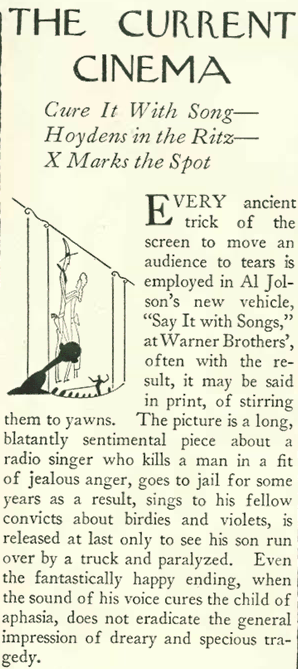
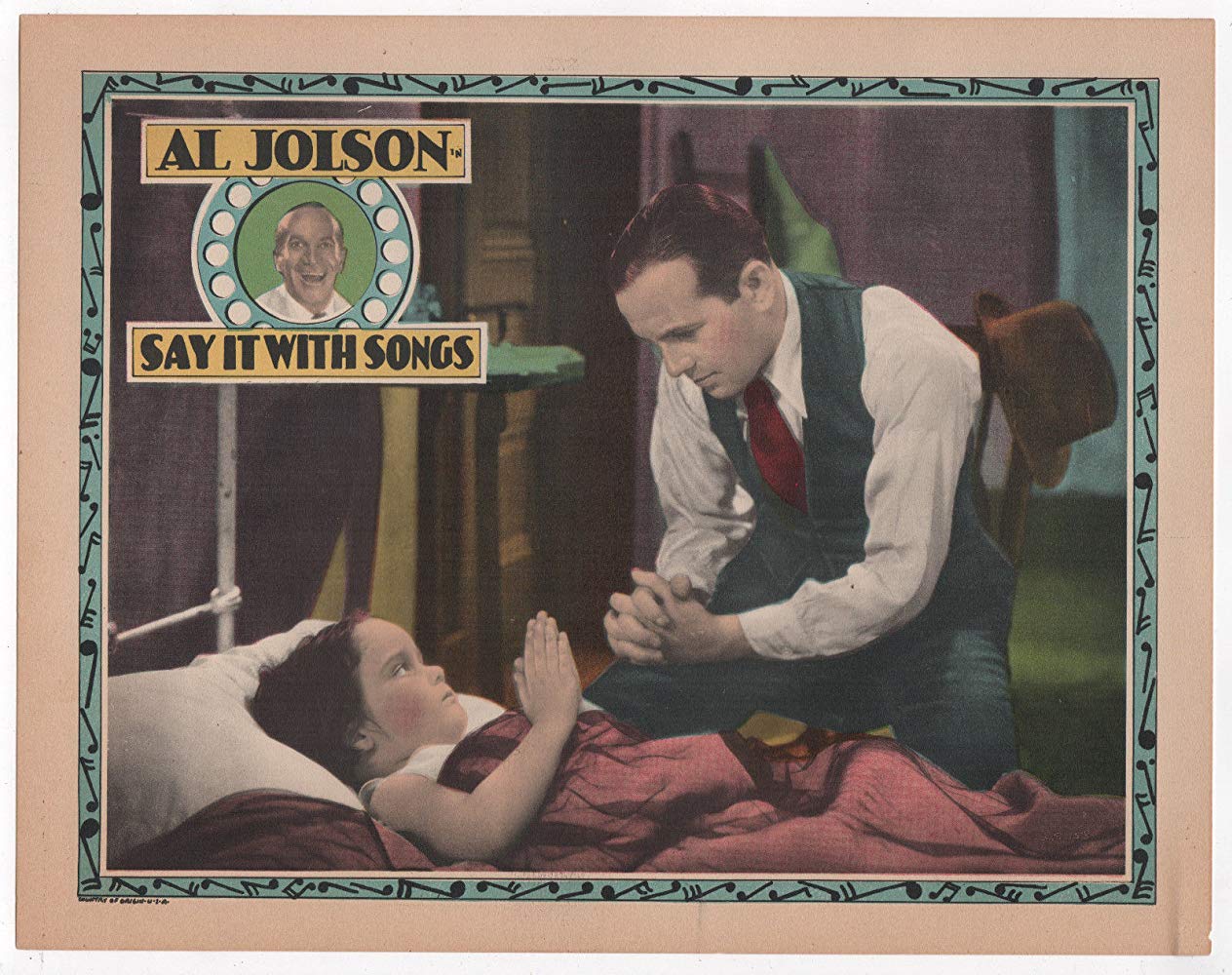
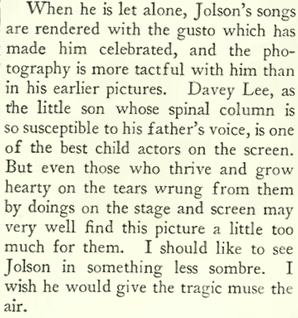
After appearing as Al Jolson’s dying son in The Singing Fool (1928), the child actor Davey Lee returned to the screen for yet another Jolson weeper, 1929’s Say It With Songs. Once again portraying Jolson’s son—this time crippled and rendered dumb after being hit by a truck—he miraculously recovers at the end of the film. The New Yorker wasn’t having any of this sentimental treacle, especially served up for a second time…

LET’S PRAY FOR A BIG BOX OFFICE…Davey Lee and Al Jolson in Say It With Songs. (IMDB)

…and the magazine hoped for something a bit less somber from Jolson in the future, suggesting that he “give the tragic muse the air”…

In the same issue of The New Yorker, this advertisement touted Jolson’s recording of “Little Pal” from Say It With Songs (note the blackface image of Jolson—his unfortunate trademark back in the day)…

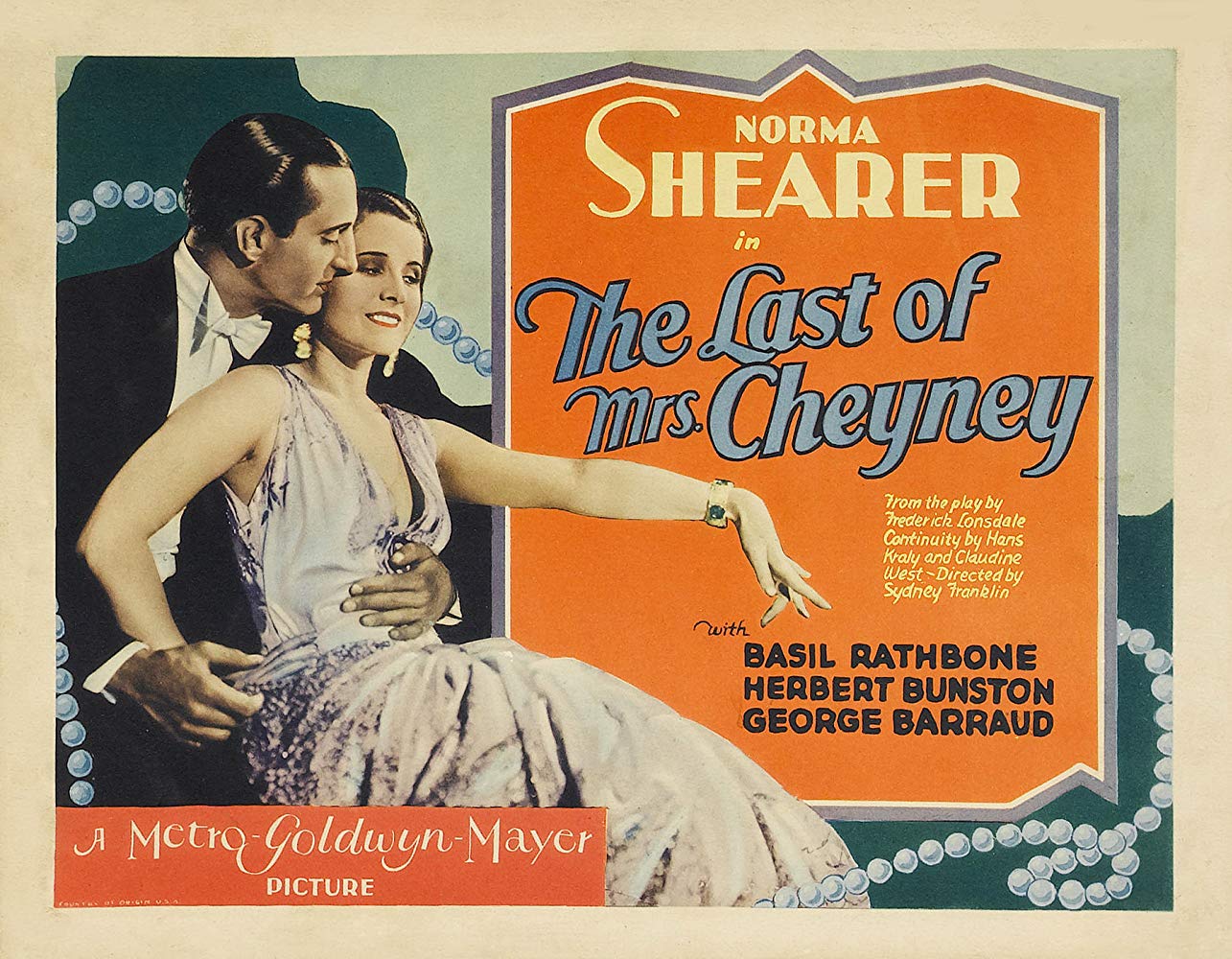
…happily, there were other movies that offered less schmaltzy diversions, including Norma Shearer’s comedy-drama The Last of Mrs. Cheyney, in which Shearer portrayed the jewel thief Fay Cheyney…

OH BASIL YOU ANIMAL…Theatre card for The Last of Mrs. Cheyney. (IMDB)

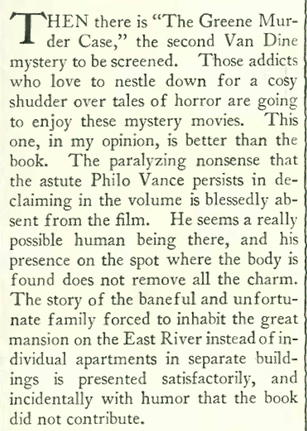
…often cast as a heavy in silent films, it was the “talkies” that made William Powell a star, his pleasant voice more suited to a hero or leading man than a villain. In The Greene Murder Case, Powell portrayed amateur detective Philo Vance, a role that he played in another 1929 release, The Canary Murder Case (originally filmed as a silent in 1928), both based on mystery novels by S.S. Van Dine. Powell would portray Philo Vance in three more films from 1930 to 1933 until he took on the role of another amateur detective, Nick Charles, in 1934’s The Thin Man (a role he would reprise five times from 1936 to 1947)…

WHODUNNIT? YOUDUNNIT!…William Powell as detective Philo Vance, Florence Eldridge as Sibella Greene, and Jean Arthur as Ada Greene in 1929’s The Greene Murder Case. (IMDB)
KEEPING IT QUIET…William Powell as Philo Vance and Louise Brooks as “the Canary,” a scheming nightclub singer, in The Canary Murder Case. Brooks was a huge star in the silent era and the iconic flapper. According to IMDB, the film was shot as a silent in 1928, but producers decided to rework it as a more profitable “talkie.” When Brooks refused to return from Germany (where she was filming Pandora’s Box) to dub the movie, Paramount spread the word that Brooks’ voice was not suited to sound film, although later productions made by Brooks proved this to be wrong. Actress Margaret Livingston ultimately supplied Brooks’ voice for Canary. (IMDB)

*  *  *

From Our Advertisers

We look at some advertisements from the August 17 issue, including this one from Past Blue Ribbon. Note that nowhere in the ad is the word “beer” used, this being a “near-beer” with less than 1% alcohol content by volume. In addition to making cheese (a Velveeta-like product), Pabst hoped to keep its company alive by selling this “brew” during the unusually hot summer of 1929…

…and with that blazing sun advertisers also promoted a number of face creams and powders to those “enjoying the sunny outdoor life,” including this two-page spread from Richard Hudnut and Poudre Le Début

…the outdoor life could also be enjoyed in a convertible Packard 640, a car that was a cut above a Lincoln or Cadillac, and was considered by some to be America’s answer to the Rolls Royce…

A 1929 Packard 640 Convertible. This particular model can be had today for about $130,000. (Hemmings Motor News)

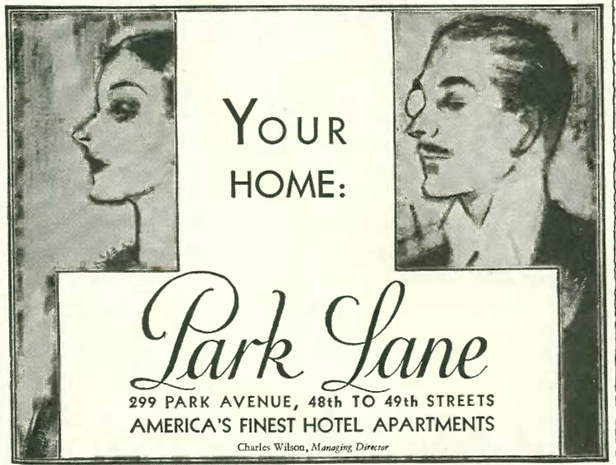
…I found this ad in the back pages interesting for its crude design yet overt appeal to snobbishness with this haughty pair…

…and here is what the Park Lane looked like when it opened in 1924…

Circa 1924 advertisement from the Sargent lock and hardware company touting its fixtures in the new Park Lane hotel apartments. At right, circa 1924 image from The American Architect depicting the Park Lane’s dining room. The building is long gone, razed some time in the 1960s to make way for an office tower. (Pinterest)

 *  *  *

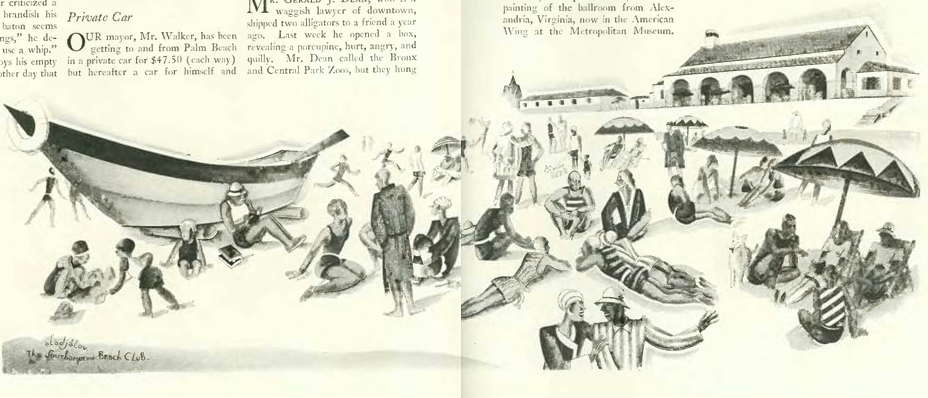
This week’s featured illustration is by Constantin Alajalov, who depicted a summer scene from the Southampton Beach Club…click to enlarge…

…our cartoonists from the Aug. 10 issue include Helen Hokinson, who looked at the challenges of Americans abroad…

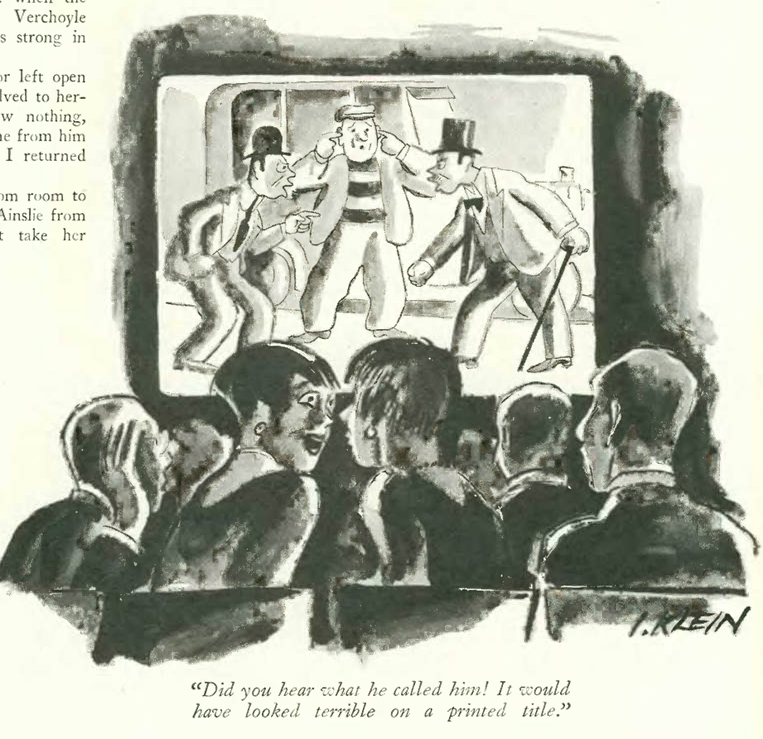
Isadore Klein observed the changing mores of movie houses (a couple of “damns” were apparently uttered in the talking pictures of 1929)…

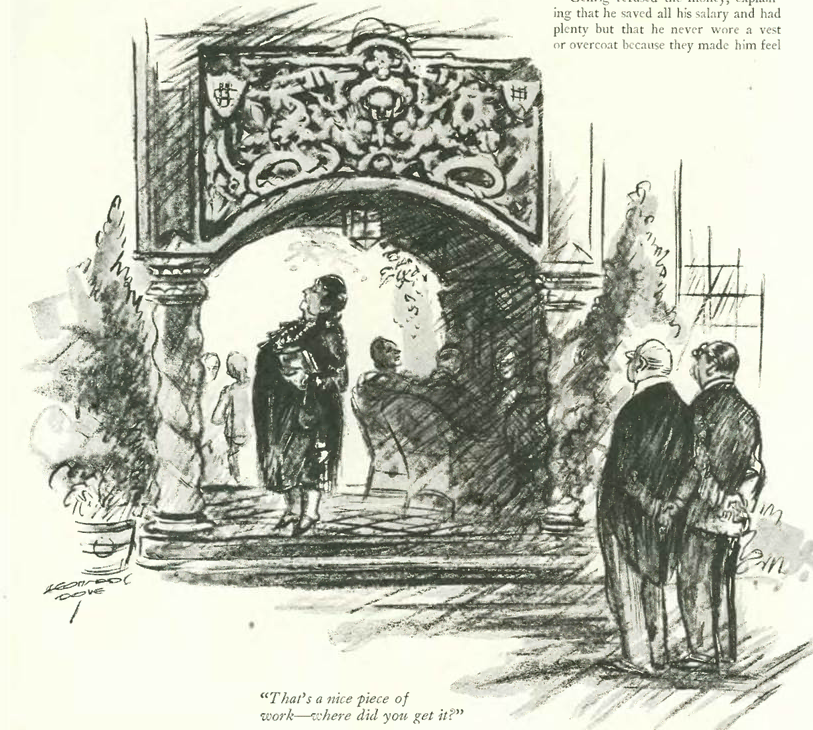
…and Leonard Dove offered up a double entendre of sorts…

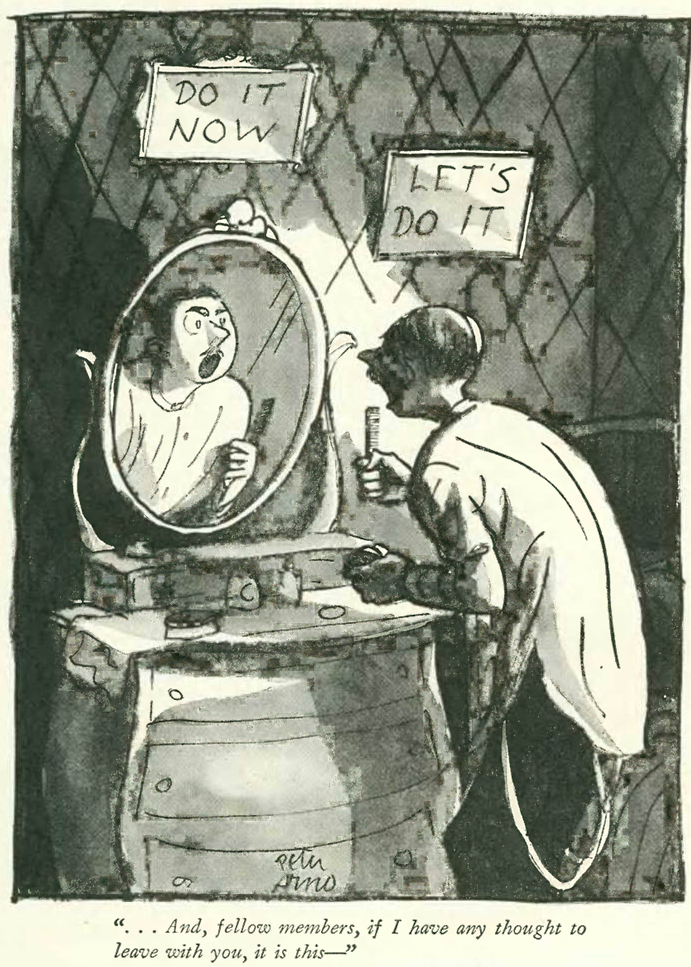
…cartoons for the Aug. 17 issue included a peek behind the scenes at a motivational speaker courtesy Peter Arno

Carl Kindl had some fun with the juxtaposition of a matron and a flapper hat…

…and for reference, the cloche hat called a “Scalawag” was featured in this ad by Knox in the March 30, 1929 New Yorker…drawing by Carl “Eric” Erickson

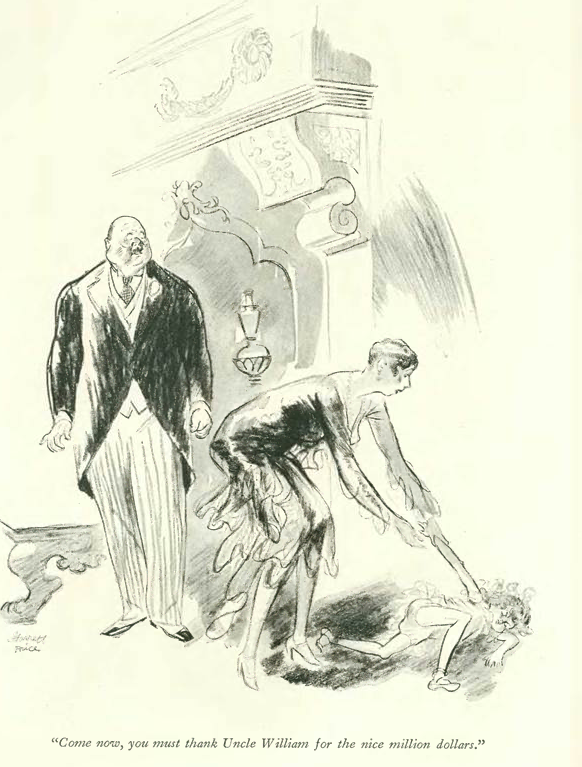
Garrett Price portrayed the antics of an ungrateful trust fund brat, who probably did not have that million dollars after the market crash…
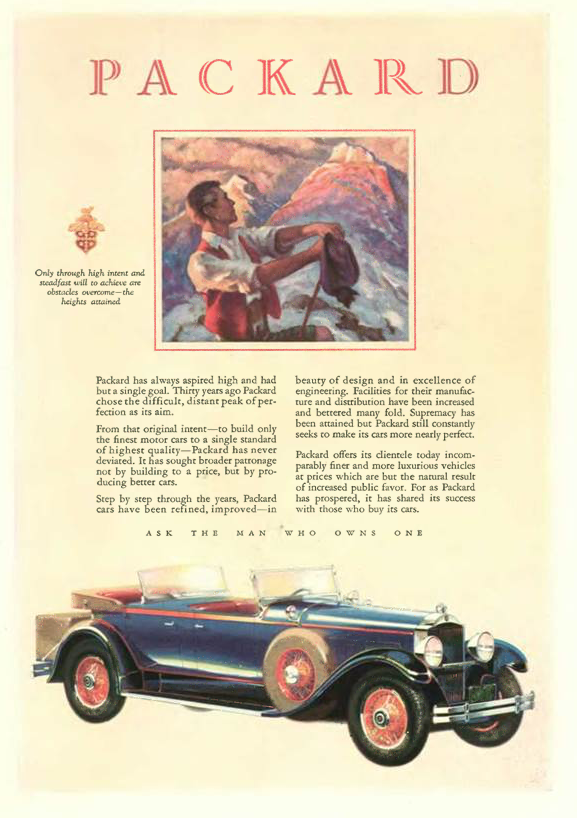
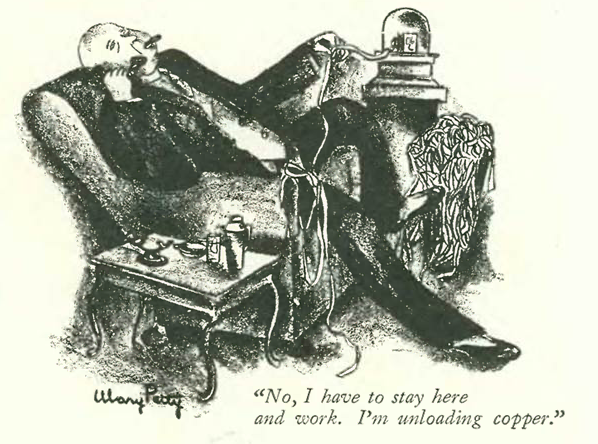
…and this fellow, depicted by Mary Petty, who doubtless would be less nonchalant come Oct. 28, or what we know as “Black Monday”…

Next Time: Hooray for Hollywood…


The Art of Peace

In July of 1928, war was officially banned from the earth. Or so it was hoped when the Kellogg–Briand Pact became effective on July 24, 1929.

Aug. 3, 1929 cover by Gardner Rea.

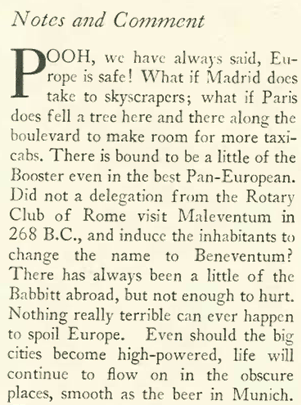
Also known as the “Pact of Paris” and more officially the “General Treaty for Renunciation of War as an Instrument of National Policy,” its authors, United States Secretary of State Frank B. Kellogg and French foreign minister Aristide Briand, gathered world powers in Paris on Aug. 28, 1928 to sign a treaty that denounced the use of war and called for the peaceful settlement of all future disputes. The New Yorker, in the opening “Notes and Comment” section of “The Talk of the Town,” took its usual “What, Me Worry?” approach to world affairs, finding the whole thing unnecessary given that (in its view) Europe was already a peaceful, even benign continent:

GIVE PEACE A CHANCE…French foreign minister Aristide Briand, Myron T. Herrick (U.S. ambassador to France), and U.S. Secretary of State Frank B. Kellogg meet in the French Foreign Office for the signing of the General Treaty for Renunciation of War as an Instrument of National Policy, August 1928; at right, Briand speaking to the assembly. (theinternationalistsbook.com//Wikipedia)

In January 1929 the U.S. Senate officially ratified the Kellogg–Briand Pact with a nearly unanimous vote, 85-1. John James Blaine, senator from Wisconsin, cast the lone dissenting vote (although four years later Blaine would author another piece of legislation that would have a much greater impact, at least at the time: the 21st Amendment, which ended Prohibition).

SURE, WHY NOT?…The U.S. Senate approved the Kellogg–Briand Pact on Jan. 15, 1929. The treaty went into effect later that year on July 24. (The New York Times)

Another item in “The Talk of the Town” made further reference to the pact…

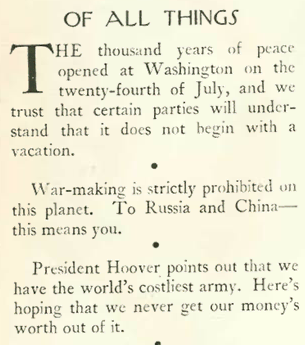
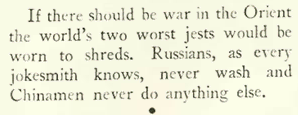
…and Howard Brubaker, in his column “Of All Things,” made special mention of the Sino-Soviet border conflict in referencing the pact:

Brubaker mockingly suggested that the pact marked the beginning of a thousand years of peace, an inadvertently prescient remark considering that in less than four years Hitler would seize power in Germany and announce the beginning of his “Thousand Year Reich” — which we know was quite the opposite of peace. Brubaker was also off the mark with this crude observation:

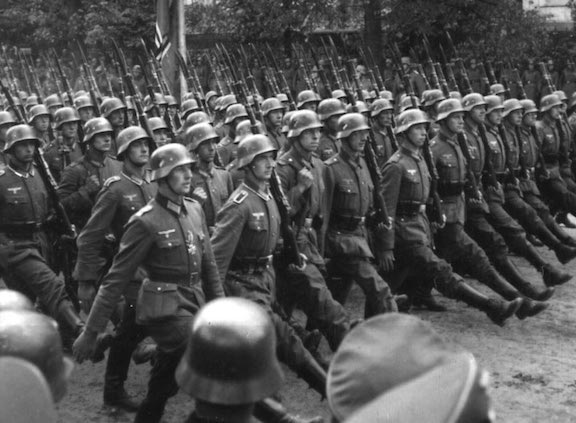
Just two years after Brubaker wrote those words, Japan would invade Manchuria. And only a decade would pass before Germany and Russia would invade Poland and ignite the biggest war of all time.

PARTY POOPERS…The New Yorker wasn’t alone in poking fun at the Kellogg–Briand Pact. At left, the pact is mocked during the Paris Carnaval in 1929; at right, British cartoonist Sidney Conrad Strube reminded readers of the outcome of America’s earlier efforts at world peace. (Wikipedia/Pinterest) click to enlarge.
WE JUST CAME TO SAY HELLO…Germany, the first signatory to the Kellogg-Briand Pact banning all war, invaded Poland just ten years after that treaty went into effect. Above, German troops parade through Warsaw after the invasion, September 28-30, 1939. (National Archives and Records Administration)

Although the pact was ridiculed for its perceived naïveté, and for the fact that it did not prevent the largest war in human history, some modern scholars see otherwise. Political scientists Oona A. Hathaway and Scott J. Shapiro observed (in 2017) that the pact “catalyzed the human rights revolution, enabled the use of economic sanctions as a tool of law enforcement, and ignited the explosion in the number of international organizations that regulate so many aspects of our daily lives.” In his recent book Enlightenment Now, Steven Pinker notes “virtually every acre of land that was conquered after 1928 has been returned to the state that lost it. Frank Kellogg and Aristide Briand may deserve the last laugh.”

*  *  *

Gallows Humor

Other items in “The Talk of Town” included this brief anecdote, which I doubt many would find humorous today:

 *  *  *

On The Bowery

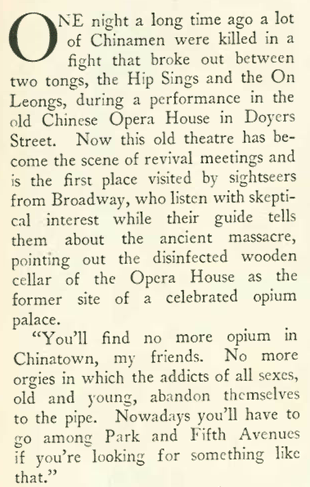
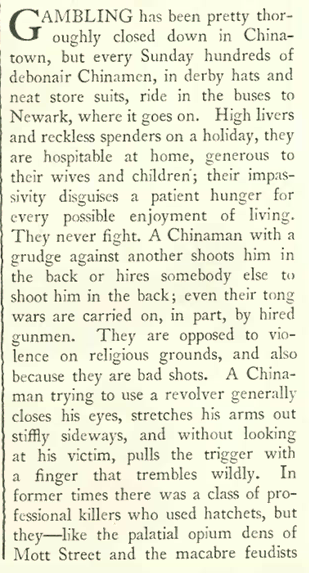
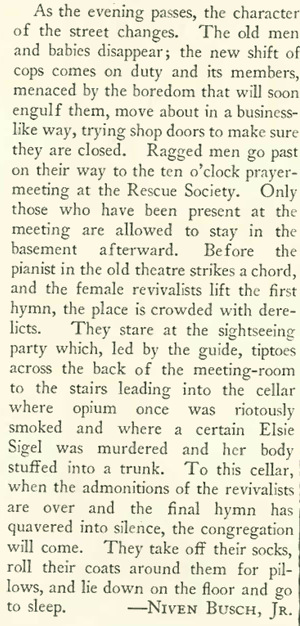
In the “Reporter at Large” column, Niven Busch Jr. paid a visit to “The Yellow Bowery,” as the piece was titled. Notable in this article (and in Brubaker’s quip above) is the use of term “Chinaman,” a term considered offensive today but in the 1920s was used indiscriminately for East Asians. Here it seems pejorative:

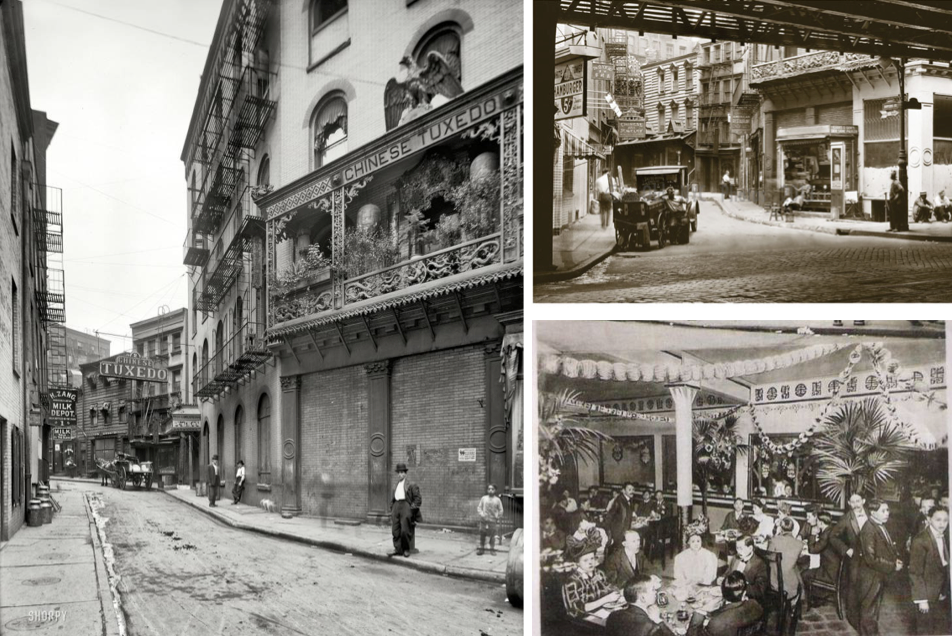
THE BLOODY ANGLE…Clockwise, from top, this bend in Chinatown’s Doyer Street was known as “The Bloody Angle” due to the numerous killings among the Tong gangs that lasted into the 1930s. Hatchets were a popular weapon of choice, leading to the creation of the expression, “hatchet man”; another perspective of Doyer Street from 1932; the street was also the site of the first Chinese language theater in New York City. (boweryboyshistory.com/Museum of the City of New York/Wikipedia)

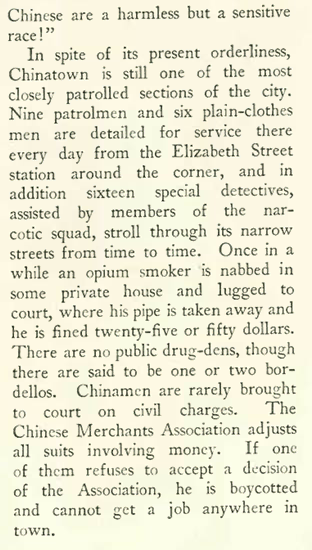
Busch’s piece was rife with stereotypes…

…and referenced the unsolved Bowery murder of 19-year-old Elsie Sigel, a missionary in Chinatown who was found in a trunk, strangled, in 1909…

THE OTHER SIDE OF THE TRACKS…2 Doyer Street was the address of the Chinese Tuxedo Restaurant. It attracted non-Chinese patrons, particularly those who considered themselves ‘Bohemians’ as well as businessmen looking for an ‘exotic’ night on the town. And it helped that the Tuxedo was near the elevated train. (Courtesy Flickr/straatis/thelodownny.com)

*  *  *

It Grows on You

The rapid demolition of old New York was a recurring theme in The New Yorker of the 1920s, the magazine often wavering between nostalgia and the thrill of the new. No place was perhaps more sacred than the stately row houses of Washington Square. When news circulated that a section consisting of the old Rhinelander mansion would soon fall (for the sake of a new apartment building), “Talk” tried its best to process the change:

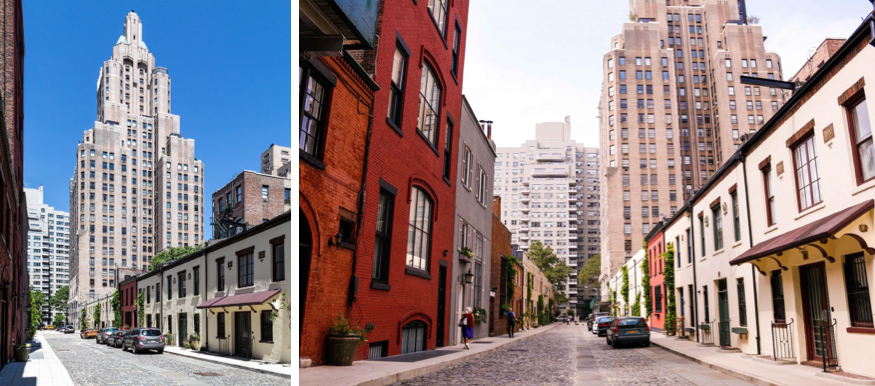
IT LOOMS, BUT WE GOT USED TO IT…The New Yorker once resented the intrusion of the One Fifth Avenue building (built in 1927), looming above the cobbles of the early 19th century Washington Mews. (newyorkitecture.com/Viola Mai, Washington Square News)
MIND THE GAP…Clockwise, from top, just east of this row of houses stood the mansion of William Rhinelander; although The New Yorker noted that its demolition was imminent in 1929, the mansion stood until 1951, when it was demolished and replaced by the 20-story 2 Fifth Avenue; next to the gap between the old row houses and the apartment stands the Roger Shattuck House, No. 19 Washington Square North. The Shattuck House was the scene of one of most sensational robberies in the city’s history—in 1922. (nyc-architecture.com/Google Maps)

 *  *  *

Old Boy

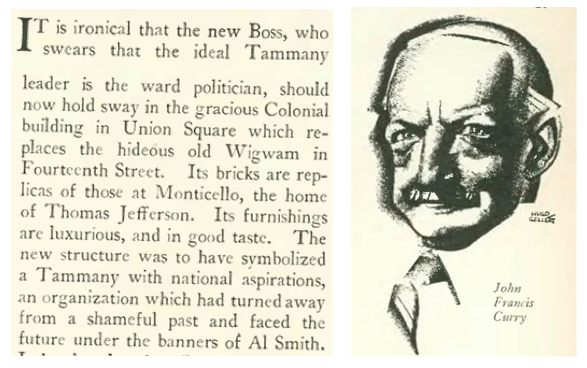
In one of my recent posts (Not Your Grandpa’s Tammany Hall) I noted a “Talk” item that described the new Tammany headquarters. In the August 3 issue the magazine introduced the patriotic society’s new leader, John Francis Curry, in a profile written by Henry F. Pringle. In the piece, titled “Local Boy Makes Good,” Pringle suggested that Curry’s old-fashioned approach to politics stood in contrast to the new image Tammany Hall was attempting to project:

Curry’s tenure would end abruptly in 1934 — the first Tammany boss to be booted out by his own followers. Curry made some bad decisions during a time when the political winds were shifting away from machine politics. It was under his leadership that Tammany backed Al Smith over the reform-minded Franklin Roosevelt for the 1932 Democratic presidential nomination. That same year, Tammany-backed New York Mayor Jimmy Walker would be forced from office amid scandal.

*  *  *

Well, She Didn’t Write the Script

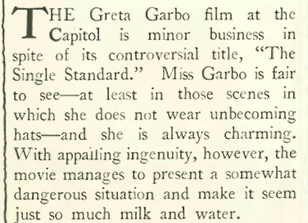
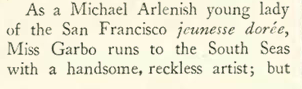
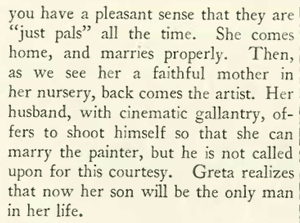
We all know Greta Garbo as one of the greatest film stars of classic Hollywood. Her mysterious aura and subtlety of expression are still lauded by film critics today. The New Yorker, however, never seemed particularly enamored of the star’s performances. Here is a review of her 1929 silent film, The Single Standard:

THE KID STAYS IN THE PICTURE…Little Wally Albright played Greta Garbo’s son in The Single Standard. We just saw four-year-old Wally in my last post, in which he also appeared as Peggy Wood’s son in Wonder of Women. Apparently when a director needed a cute, curly head kid, they went for Wally—he appeared in seven films in 1929 alone. (Rotten Tomatoes)

*  *  *

From Our Advertisers

Our first advertisement (image at right) is from the back pages of the Aug. 3 issue. It announced the opening of Long Island’s Atlantic Beach Club, which featured the entertainment of Rudy Vallée and his orchestra…

CAN YOU HEAR ME NOW? Images, top to bottom, aerial view of The Atlantic Beach Club; Rudy Vallée performing with emblematic megaphone, 1929; postcard image of the Nautilus Hotel on the Boardwalk of Atlantic Beach, Long Island. (longbeachlibrary.org/YouTube)

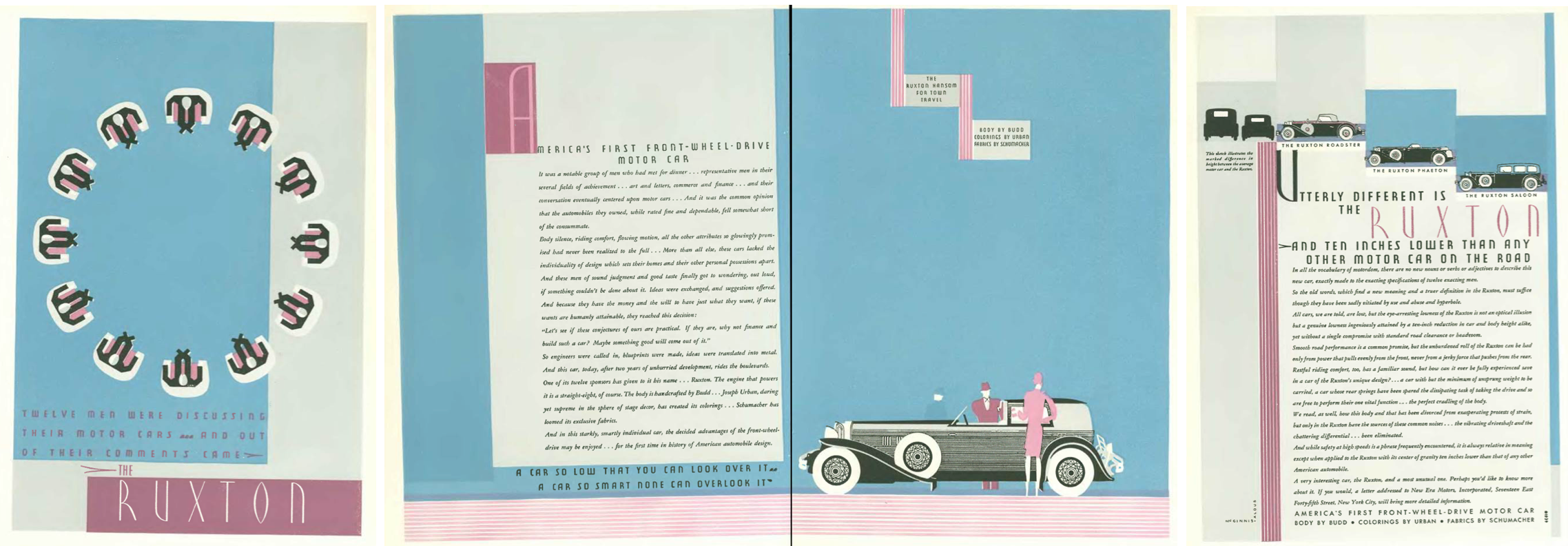
…a brand-new car—The Ruxton— was introduced to New Yorker readers in this color advertisement that spanned four pages (click image to enlarge)…

…produced in 1929-30 by the New Era Motors company of New York, the car was marketed for its innovative front-wheel drive and its distinctive low profile (a feat accomplished by eliminating the drive shaft to the rear wheels). While most cars in the late 1920s had an average height of 6 feet (1.8 meters); the Ruxton was less than 4 and half feet (1.3 meters) high. Producers of the car hoped to sell the rights of the Ruxton to an established car manufacturer. Moon Motors of St. Louis built just 96 of the cars during regular production (from June to October, 1930) before the whole deal fell apart…

SHORT RUN…Clockwise, from top left, Ruxton logo affixed to grille; dancer Rita La Roy poses with her Ruxton, 1930; some models sported Joseph Urban color schemes designed to lengthen the appearance of the car. (allcarcentral.com/Pinterest/hemmings.com)

…if you were one of the fortunate few to own a Ruxton, you might take it for a spin on the Lincoln Highway…or maybe not. Despite the appearance of this ad, a fully paved, transcontinental highway was still an incomplete dream in 1929. Although sections of the road were quite smooth from New York to Omaha, further west things could get a bit bumpy, especially on the unpaved stretches. However, as the ad claims, what really made the road viable was the availability of regularly spaced gas stations along the way…

…I liked this ad for its sheer complexity…

…and then we have this ad from Saks, which somehow conflated new shoes with an intimate encounter with Aphrodite.,,

…on to our cartoonists, we have Helen Hokinson’s observations at “Old Narragansett…

…while out to sea, Alan Dunn found humor in a sensitive swabbie…

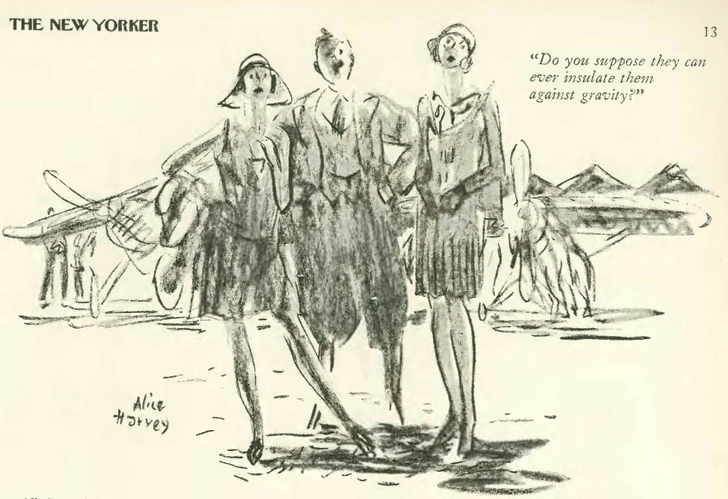
Alice Harvey observed those still skeptical of human flight…

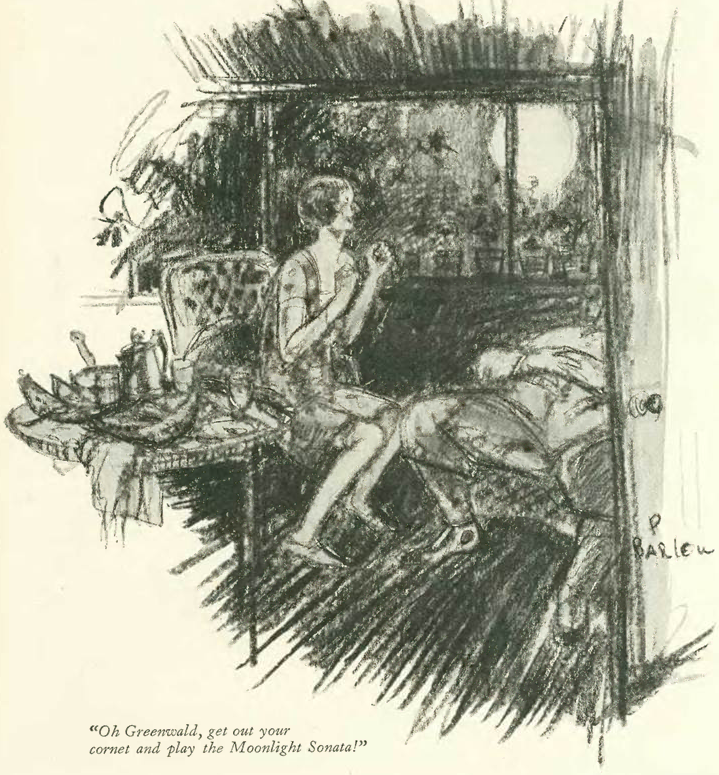
Perry Barlow peeked in on a moonstruck woman…

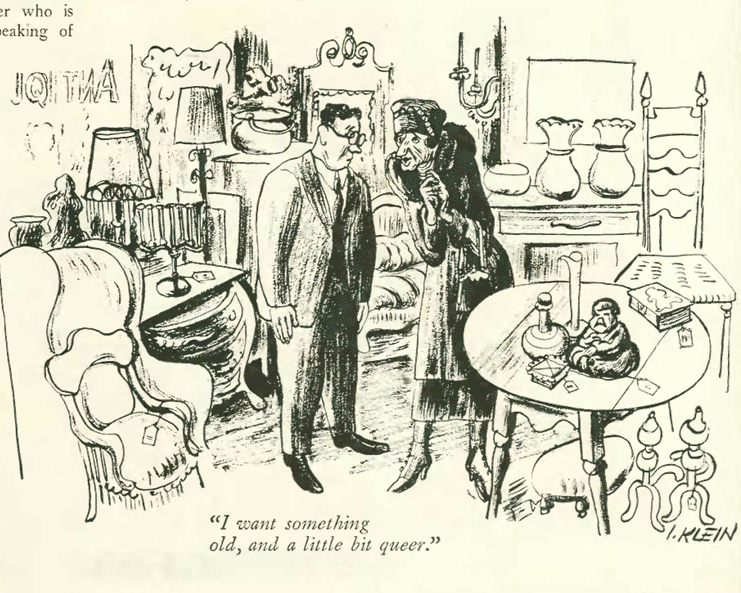
…and finally, Isadore Klein visited an antique shop…

Next Time: The Last Summer…


New York 1965

Past visions of the future are fascinating, especially those of the early and mid-20th century—despite the horrors of world war and economic depression, we were still able to envision endless possibilities for human progress.

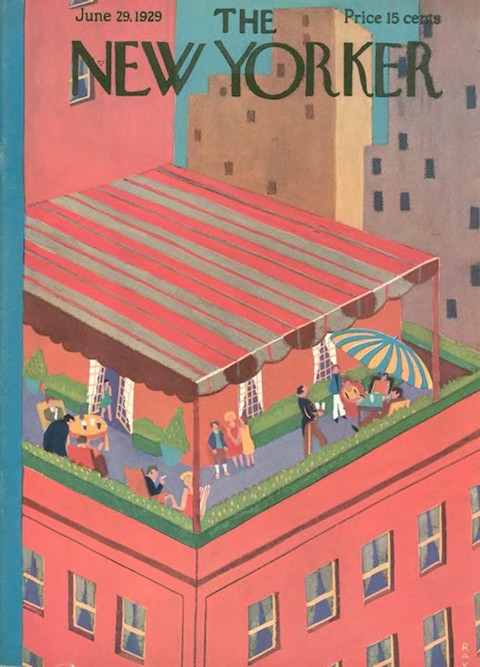
June 29, 1929 cover by Ray Euffa (1904-1977), who contributed just one cover for The New Yorker. A resident of the East Village, she had a successful career as both a New York artist and teacher (see end of post for another example of her work).

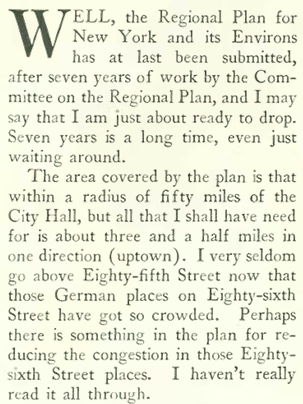
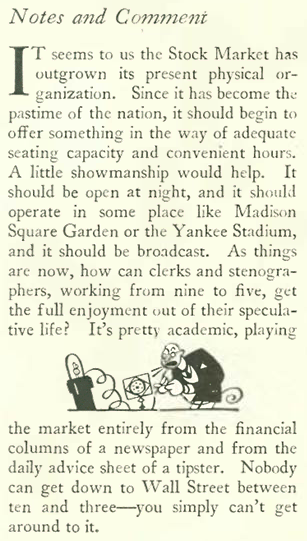
In this spirit, the landmark 1929 Regional Plan of New York and its Environs was created. Rather than planning for individual towns and cities, it viewed them as a single, interdependent and interconnected built environment. Authored by a Regional Plan Association formed in 1922, the plan encompassed 31 counties in Connecticut, New York, and New Jersey. The goal of the plan was to transcend the region’s political divisions and view it more in terms of its economic, socio-cultural, transportation, and environmental needs. The New Yorker made note of the new plan, but decided to take a humorous approach by putting Robert Benchley on the assignment:

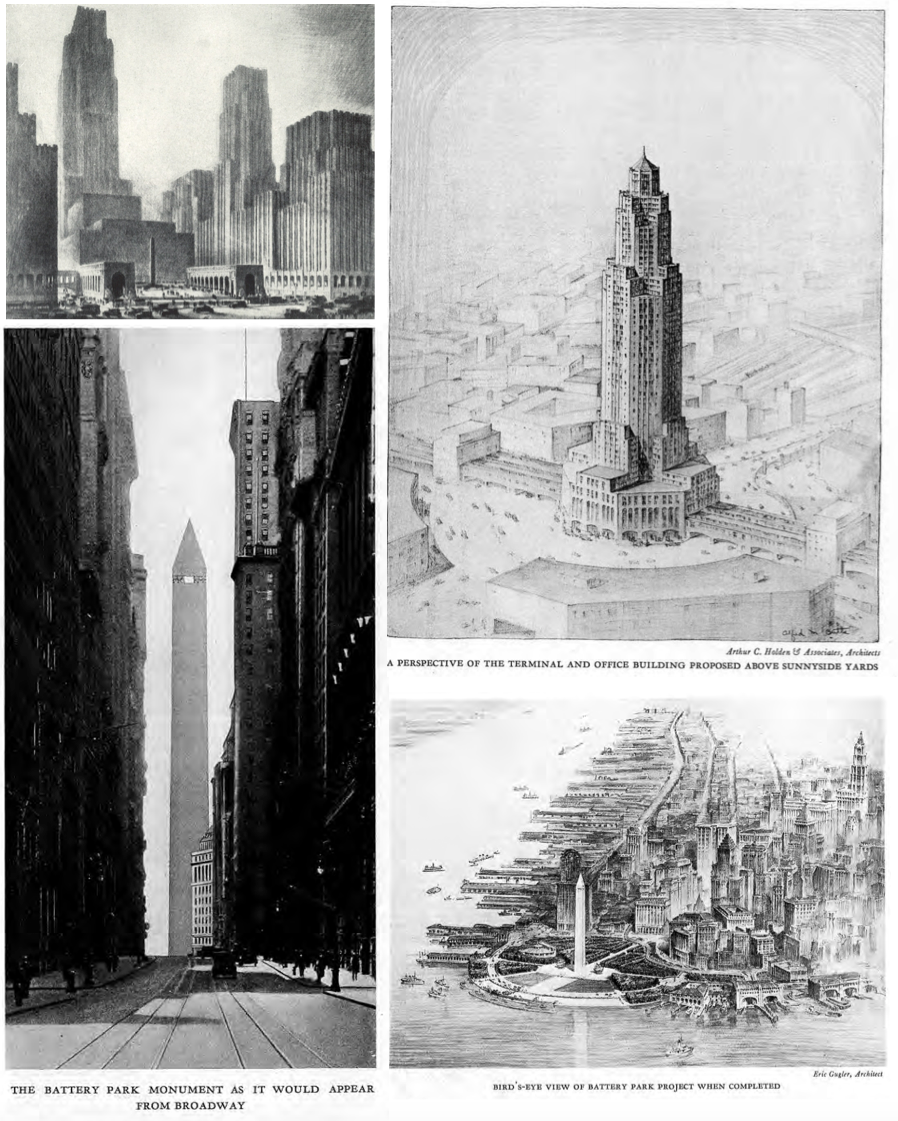
Had he actually read the plan, Benchley would have found an ambitious vision for the city in the year 1965, including the remaking of Battery Park that would have included a massive obelisk to greet seafaring visitors to the city (click all images below to enlarge)…

THINKING BIG…Images from the 1929 Regional Plan of New York and its Environs included, clockwise, from top left, a proposed art center for Manhattan, as envisioned by Hugh Ferriss; a proposal for a terminal and office building in Sunnyside Yards, Queens; a proposed monument for Battery Park, from a bird’s eye perspective; and as the monument would appear at street level. (Regional Planning Association–RPA)
HOW-TO GUIDE FOR THE FUTURE…Zoning principles, including setback guidelines for tall buildings (left) were included in the regional plan. At right, a suggestion for setbacks on an apartment group, as rendered by architect George B. Ford. (RPA)

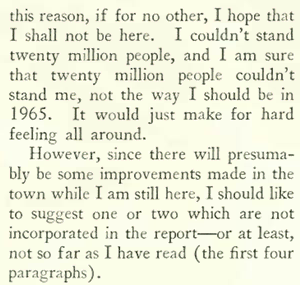
Benchley noted that the plan “looks ahead to a New York of 1965,” and hoped that he would not live to see a city of 20 million people (New York City had a metro population of 20.3 million in 2017; and Benchley got his wish—he died in 1945. He was not, however, stuffed and put on display)…

A BIT MUCH?…Clockwise, from top left, a “monumental building” was proposed in the regional plan as a dominant feature of the civic center, dwarfing the historic city hall; the old city hall today, fortunately backed by a blue sky and not by a “death-star” building; a proposal for the Chrystie-Forsyth Parkway; a “future tower city,” as envisioned by E. Maxwell Fry. (RPA)
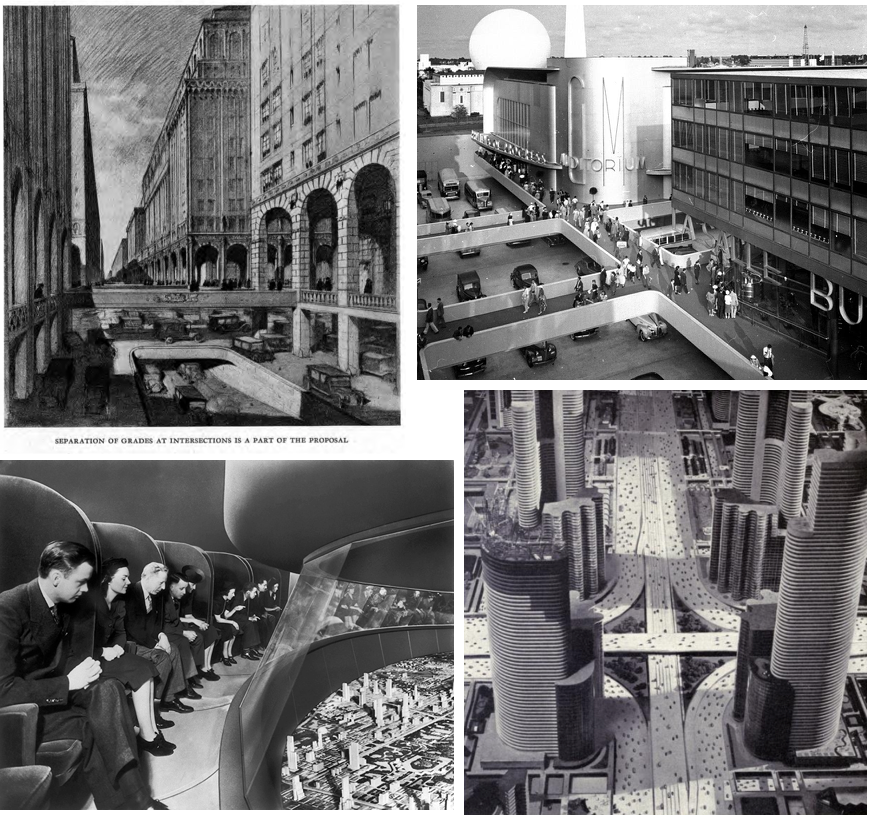
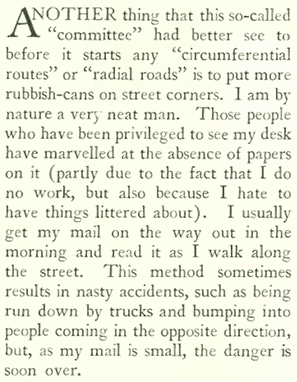
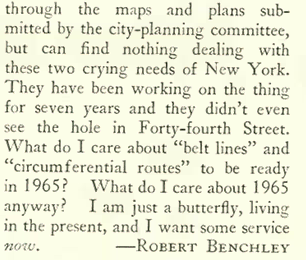
THE STUFF OF DREAMS…Clockwise, from top left: The regional plan proposed separation of pedestrians and motor vehicles by assigning them to different levels along the street; ten years later, at the 1939 New York World’s Fair, General Motors would build a full-scale model of this concept as part of their Futurama exhibit; the city of 1960, as envisioned by designer Norman Bel Geddes for the Futurama exhibit; Futurama visitors view the world of tomorrow—a vast scale model of the American countryside—from chairs moving along a conveyer. (RPA/The Atlantic/Wikipedia/General Motors)

Benchley concluded his article with less ambitious hopes for the future…

THE REALITY…A view of New York City’s East 42nd Street, looking to the west, in 1965. (Associated Press)

*  *  *

Another vision of the future could be found in the growing air transport options available to those who could afford it. “The Talk of the Town” reported:

ROOM WITH A VIEW…Interior and exterior views of the Sikorsky S-38 flying boat. (Frankin Institute, Philadelphia/Calisto Publishers)
NO FRILLS…Seaplane ramp at Flushing Bay’s North Beach Airport in 1929. (Courtesy of Alan Reddig)

 *  *  *

With the 1929 stock market crash on the horizon, it is instructive to read these little “Talk” items and understand that, then as now, we have no clue when the big one is coming…

 *  *  *

Over at the Polo Grounds 

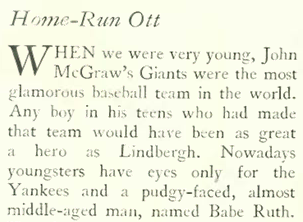
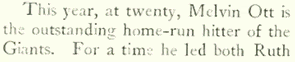
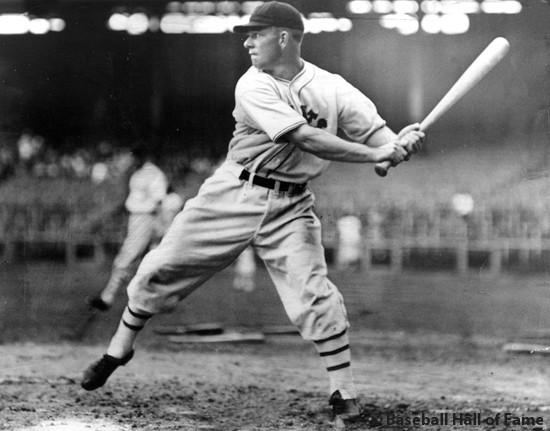
As I’ve previously noted, The New Yorker in the 1920s covered every conceivable sport, but paid little attention to Major League Baseball (except for the occasional amusing anecdote about a player, usually Babe Ruth). But even The New Yorker couldn’t ignore the city’s latest sensation, the Giants’ Mel Ott (1909-1958), who despite his slight stature (for a power hitter, that is), he became the first National League player to surpass 500 career home runs.

READY FOR SOME HEAT…Mel Ott in 1933. He batted left-handed but threw right-handed. (Baseball Hall of Fame)

*  *  *

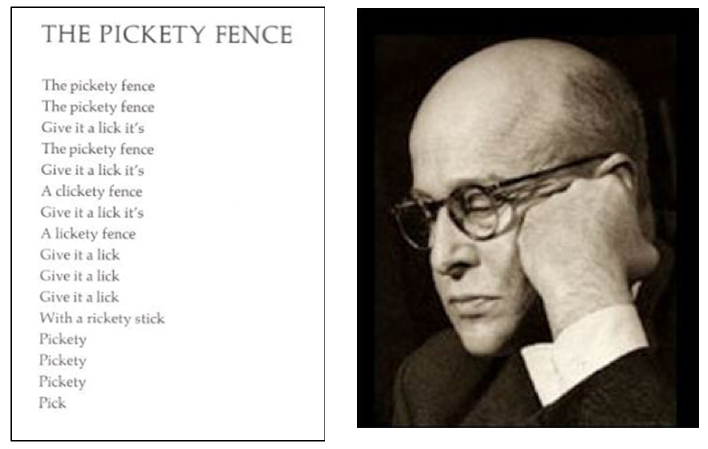
David McCord (1897-1997) contributed nearly 80 poems to The New Yorker between in 1926 and 1956, but earned his greatest renown in his long life as an author of children’s poetry. Here is his contribution to the June 29 issue:

PICKETY POET…David McCord and one of his poems for children. (nowaterriver.com)

 *  *  *

From Our Advertisers

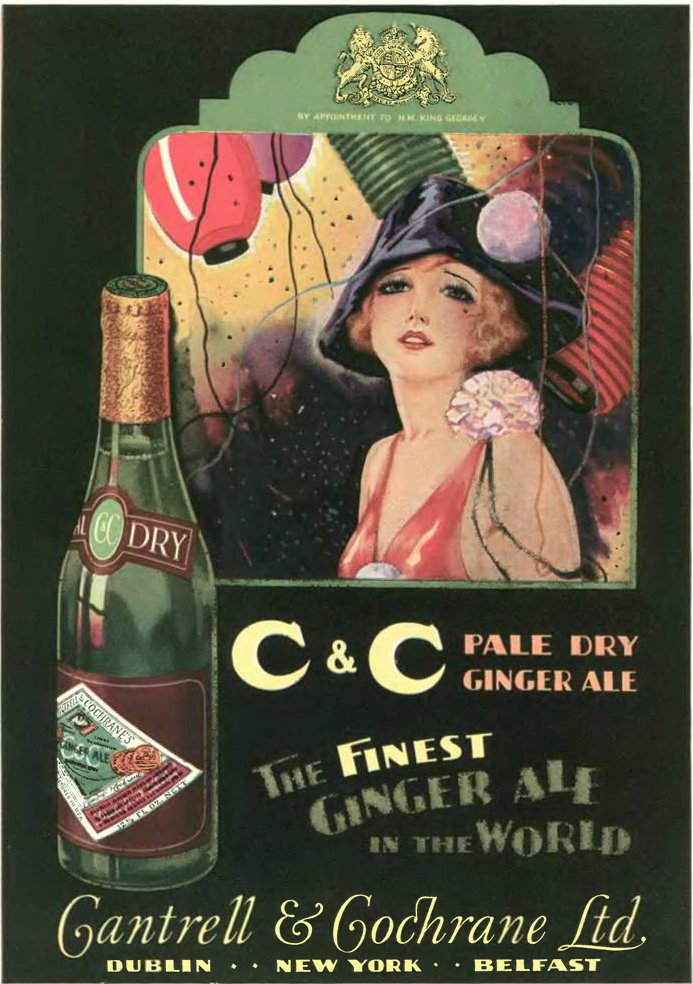
We find more color in the pages of The New Yorker thanks to advertisers like C & C Ginger Ale, who for all the world tried to make their product appear as exciting and appealing as Champagne, or some other prohibited substance…

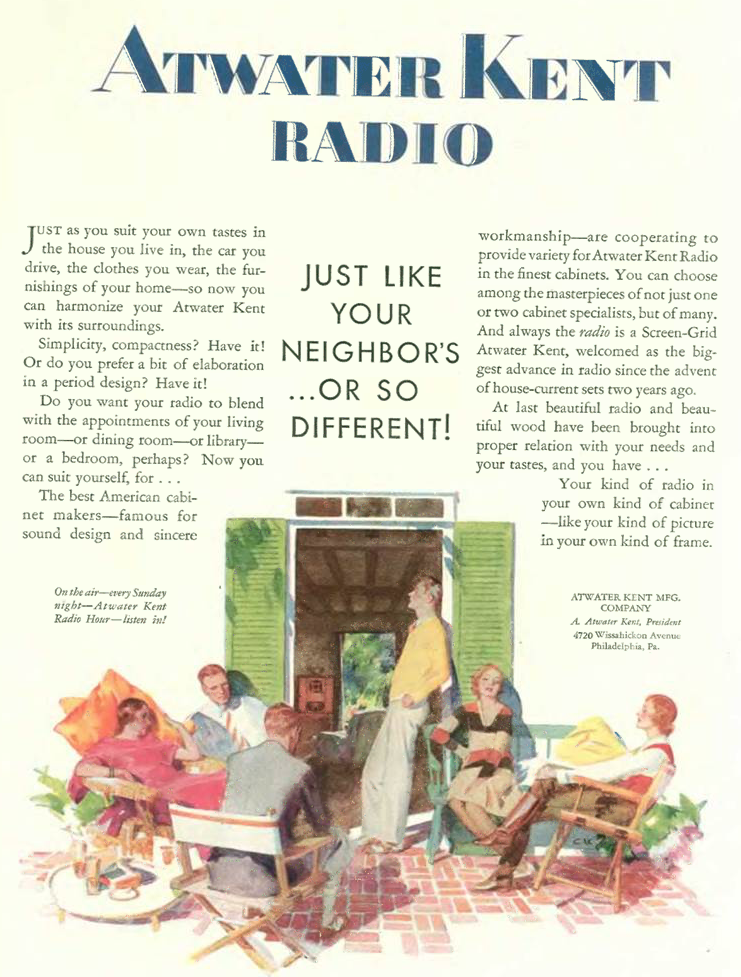
…or for quieter times, Atwater Kent encouraged folks to gather ’round the radio on a lazy afternoon and look positively bored to death…
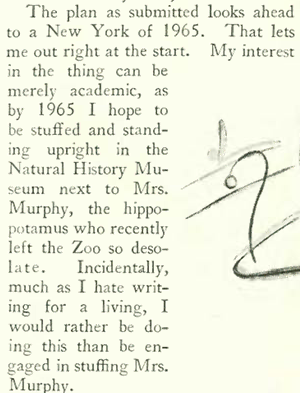
…while Dodge Boats encouraged readers to join the more exhilarating world of life on the water…

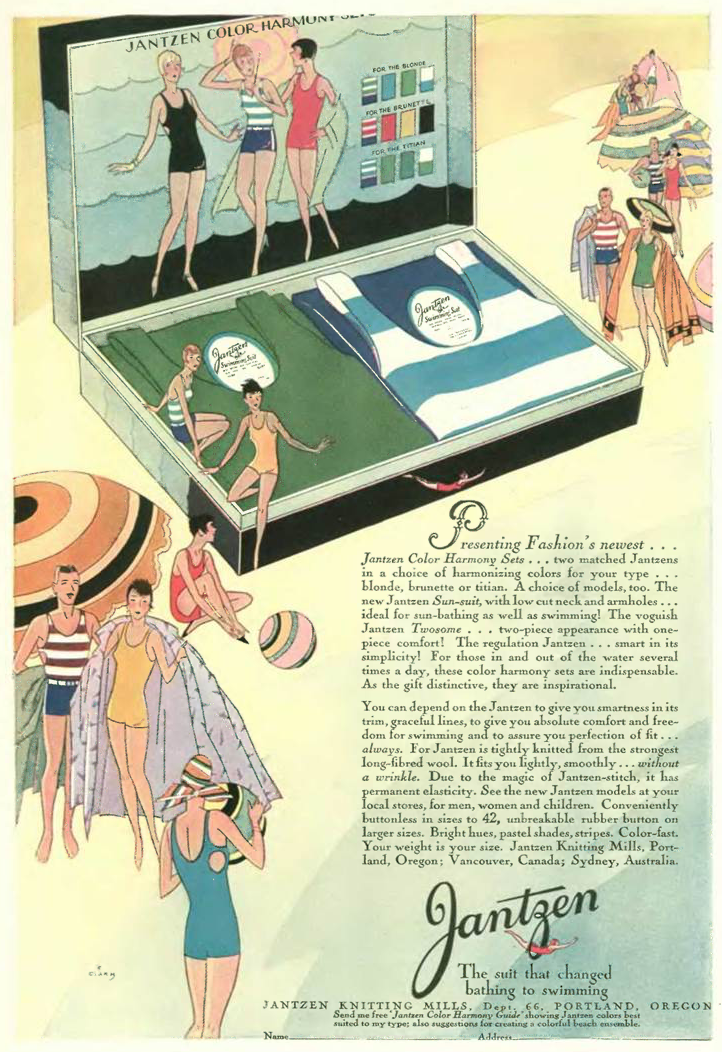
Our final color ad comes from the makers of Jantzen swimwear—this striking example is by Frank Clark, who collaborated with his wife Florenz in creating a distinct look and style for Jantzen…

…indeed it was Florenz Clark who came up with Jantzen’s signature red diving girl. In 1919, while doing sketches at a swim club for divers practicing for the 1920 Olympics, she came up with the iconic red diving girl logo. This is the version of the logo from the late 1920s:

(jantzen.com)

*  *  *

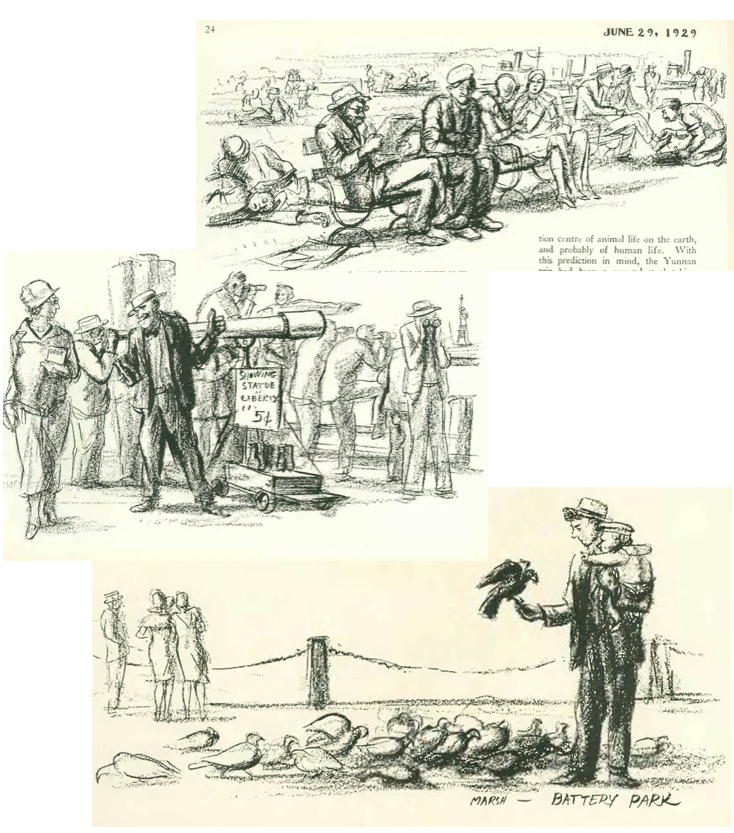
Our illustrations and cartoons come courtesy of Reginald Marsh, who sketched scenes along the shores of Battery Park…

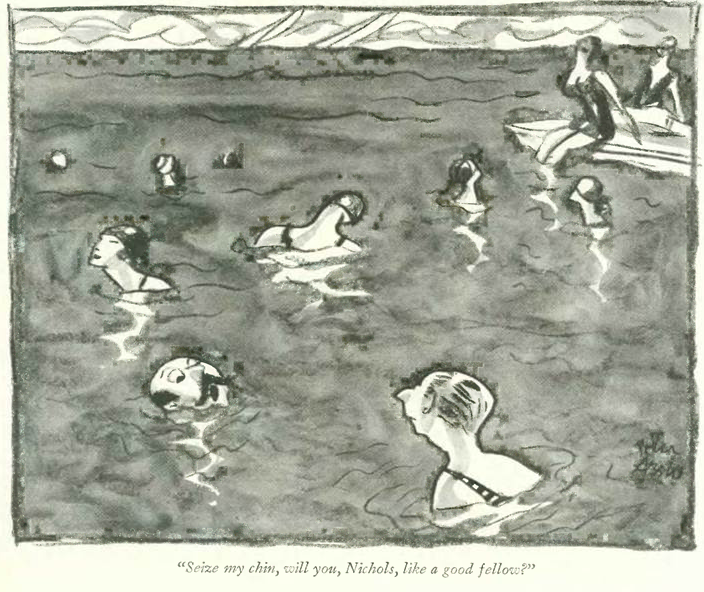
Peter Arno plumbed the depths of a posh swimming club…

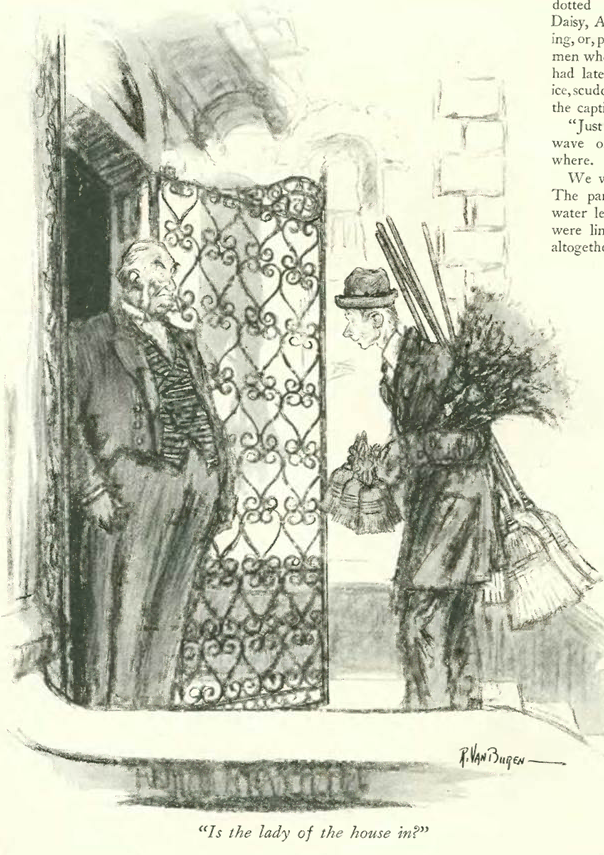
R. Van Buren explored a clash of the castes…

Isadore Klein sent up some class pretensions…

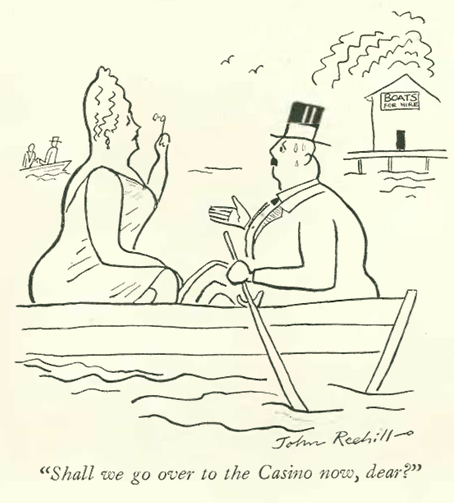
…and John Reehill looked in on a couple who seemed more suited to land-based diversions…

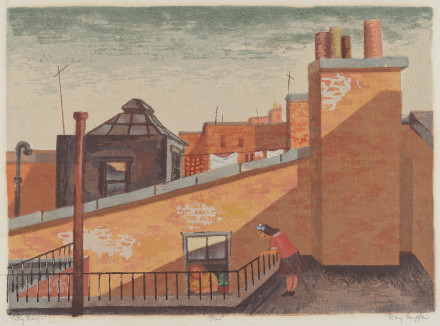
…and finally, we close with a 1946 work by our cover artist, Ray Euffa, titled, City Roofs:

(National Gallery of Art)

Next Time: Georgia on My Mind…


Something Old, Something New

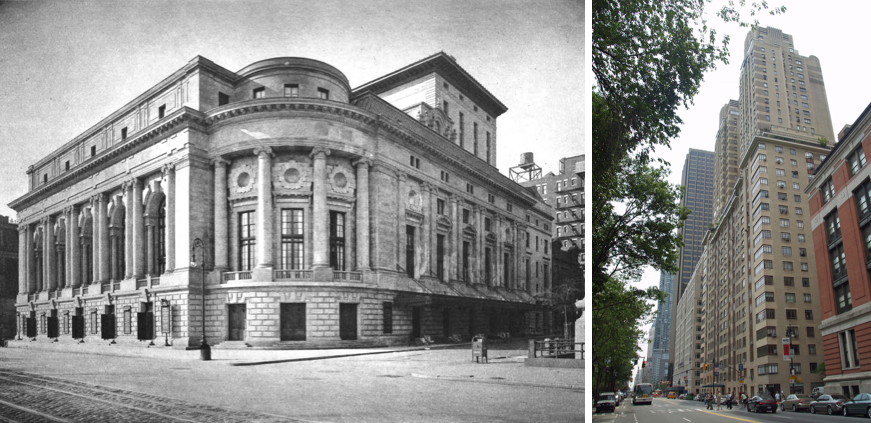
Above: The split image is from a New Yorker video: Eighty Years of New York City, Then and Now.

While the Empire State Building developers were preparing to reduce the old Waldorf-Astoria Hotel to rubble, another venerable relic of the Victorian age, the Murray Hill Hotel, was still clinging to the earth at its prime location next to the Grand Central Depot.

June 15, 1929 cover by Sue Williams.

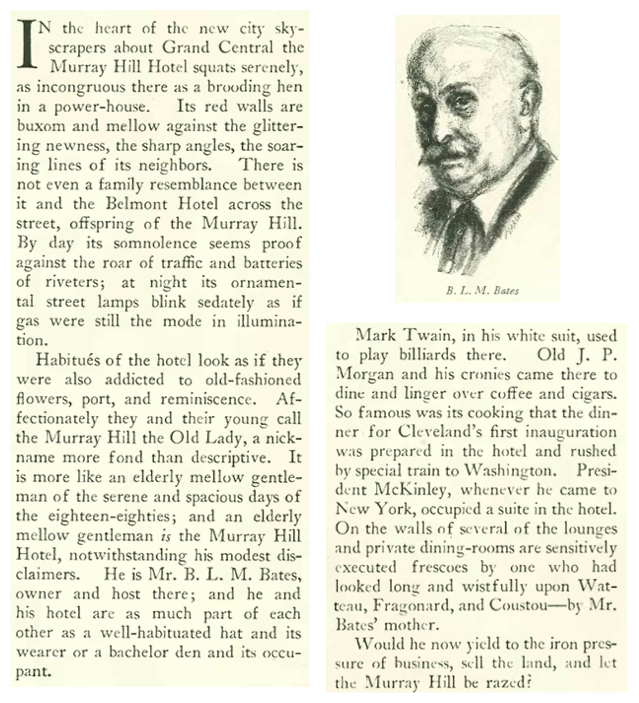
The hotel’s survival was due in part to its owner, Benjamin L. M. Bates (1864-1935), who seemed as much a part of the hotel as its heavy drapes and overstuffed chairs. Bates, who started out at the hotel as assistant night clerk, was profiled in the June 15, 1929 issue by Joseph Gollomb (with portrait by Reginald Marsh) Some excerpts:

The hotel was just 26 years old when Bates bought it in 1910. But by the Roaring Twenties Murray Hill Hotel seemed as ancient as grandmother’s Hepplewhite…

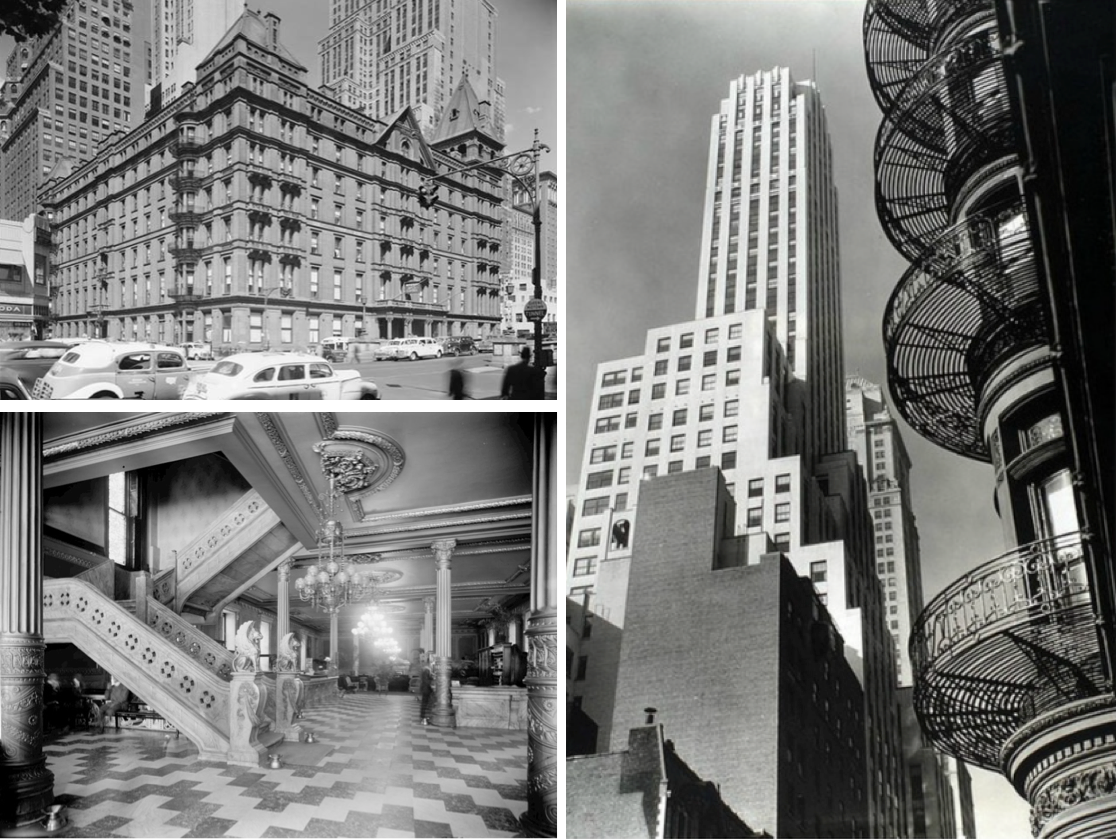
Clockwise, from top, left, The Murray Hill Hotel in September 1946, just months before it was demolished; the hotel’s ornate spiral fire escape, seen at the right in a 1935 photograph of 22 East 40th Street by Berenice Abbott; the hotel’s office and foyer. The hotel featured 600 rooms and two courtyards. (Museum of the City of New York (1 & 2)/Wikipedia)

…but to the very end it continued to be a popular gathering spot for New York notables, including Christopher Morley’s prestigious literary society, the Baker Street Irregulars…

FAMILIAR HAUNT…Three members of the exclusive literary group, the Baker Street Irregulars — Fletcher Pratt, Christopher Morley and Rex Stout —swap stories at the Murray Hill Hotel in 1944. (Wikipedia)

…with the hotel’s prime location near Grand Central Depot (and its replacement, Grand Central Station), the party couldn’t last forever, and the Murray Hill Hotel yielded to the wrecking ball in 1947…

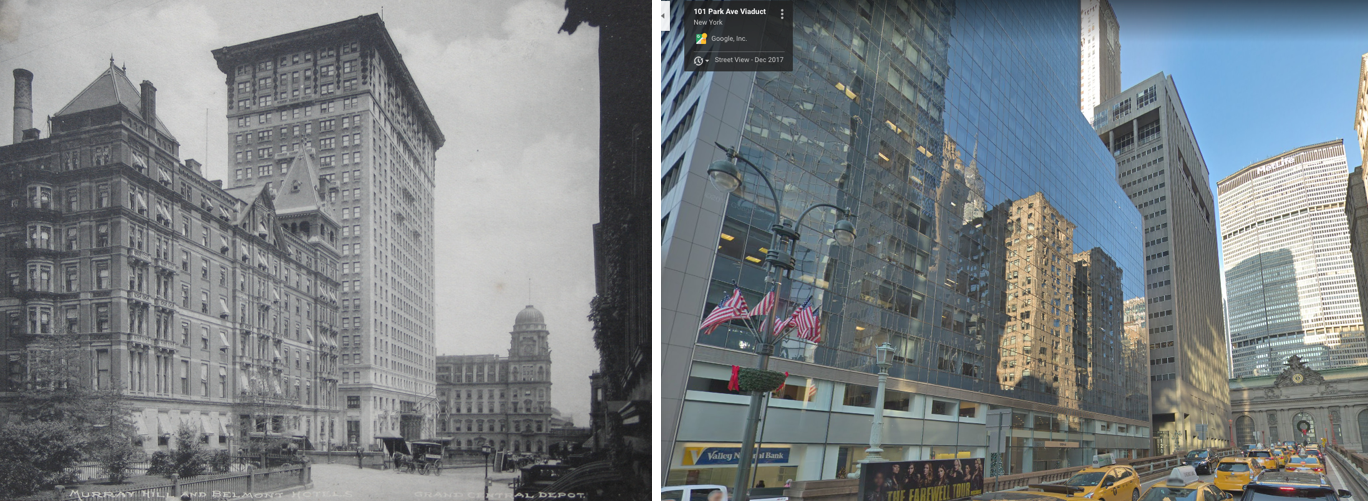
THEN AND NOW, the Murray Hill Hotel, circa 1905. The adjacent 25-story Belmont Hotel, erected in 1904-06 and a skyscraper for its time, would be razed in 1931. Note the old Grand Central Depot in the background, which would be replaced in 1913 by Grand Central Station. At right, a Google Maps view of the same location today.

Some parting notes about the Murray Hill Hotel: In 1905, delegates from 58 colleges and universities gathered at the hotel to address brutality in college football and reform the sport. They formed the Intercollegiate Athletic Association of the United States, which would later become the NCAA.

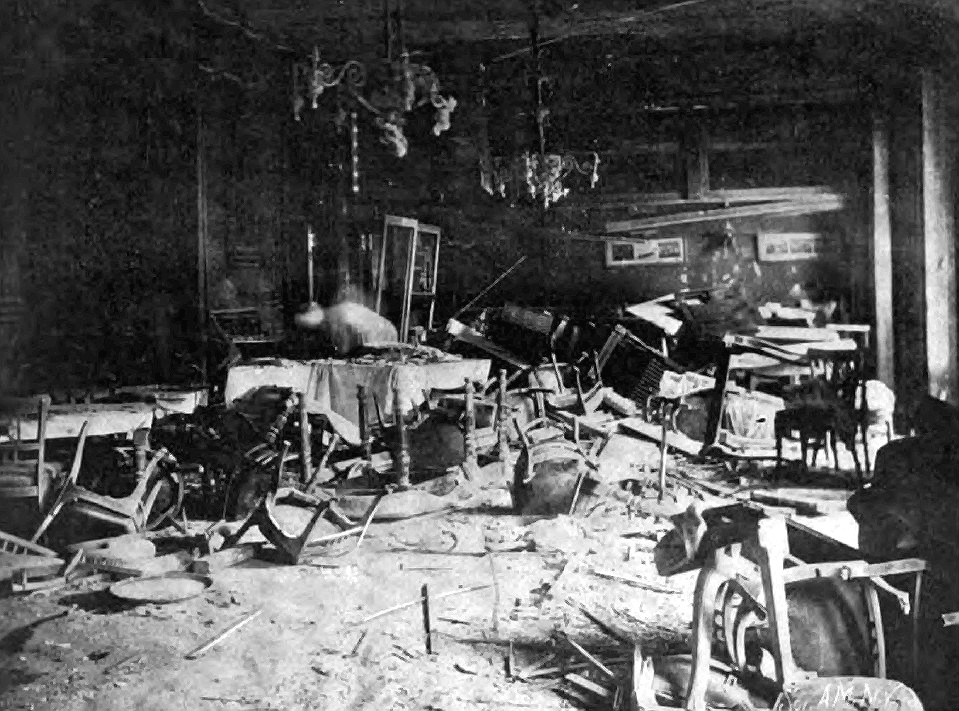
The hotel was also the site of a massive explosion in 1902, when workers constructing a subway tunnel under Park Avenue accidentally set a dynamite shed ablaze. Every window along Park Avenue and 40th Street was blown out, and the blast opened a pit, 10 feet deep and 30 feet wide, in front of the building. Five people were killed by the blast—three of them at the Murray Hill Hotel.

AFTERMATH…The Murray Hill Hotel’s cafe following the 1902 explosion. (Wikimedia Commons)

 *  *  *

Irwin S. Chanin, fresh from erecting his Art Deco masterpiece, the Chanin Building, was now setting his sights on the Century Theatre, barely twenty years old but already obsolete due to its poor acoustics and inconvenient location. “The Talk of the Town” takes it from there…

BIGGER PLANS…The Century Theatre, located at 62nd Street and Central Park West, opened on November 6, 1909. Plagued by poor acoustics and an inconvenient location, it was demolished in 1931 and replaced by the Irwin S. Chanin’s Century Apartments building. (The New-York-Architect, November 1909/David Shankbone via Wikipedia)

As the Century Theatre marked its last days, an older and more successful theater in the Bowery went up in flames. The Thalia Theatre (also known as “Bowery Theatre” and other names) was a popular entertainment venue for 19th century New Yorkers and for the Bowery’s succession of immigrant groups. A series of buildings (it burned four times in 17 years) housed Irish, German and Yiddish theater and later Italian and Chinese vaudeville. The 1929 fire marked the end of the line. “Talk” noted its passing…

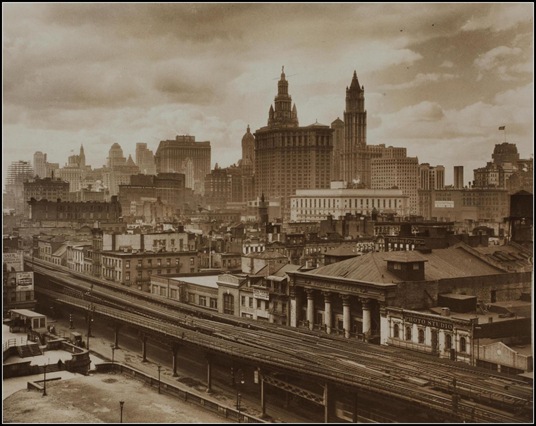
UP IN SMOKE…The Bowery’s Thalia Theatre (building with columns) went up in flames on June 5, 1929. The photo was taken in 1928, one year before the final fire. Note the elevated train tracks in front of the building. (Manhattan Unlocked)

While we are on the subject of the changing skyline, I will toss in this cartoon from the issue by Reginald Marsh…the caption read: “I tell you, Gus, this town ain’t what it used to be.”

 *  *  *

Down for the Count

There was a bit of a sensation in the June newspapers when a European count was arrested for running a bootlegging ring among socially prominent circles. A headline in a June 8, 1929 edition of the New York Times shouted: LIQUOR RING PATRONS FACING SUBPOENAS; Socially Prominent Customers Are Listed in Papers Found in de Polignac Raids. COUNT SAILS FOR PARIS. Goes, After Nearly Losing Bail Bond, Smilingly Calling the Affair ‘Misapprehension.’

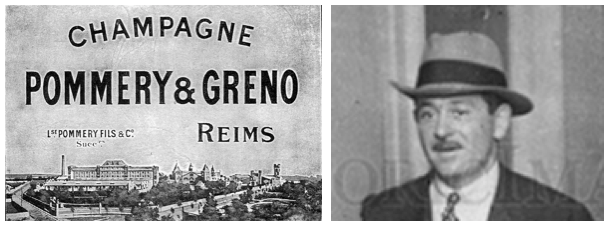
What the Times so breathlessly recounted were the activities of Count Maxence de Polignac (1857–1936), who owned one of France’s most prominent Champagne houses, Pommery & Greno.

The Times reported that an undercover federal agent, William J. Calhoun, led a raid that netted the Count and 34 others in a liquor ring connected to many Park Avenue and Fifth Avenue residents. Calhoun’s agents interrupted the Count’s morning bath (at his suite in the Savoy-Plaza Hotal) to make the arrest. They seized more than “seven cases of champage and liquors” in the suite, which the count said were for his personal use. Denying all charges, de Polignac was nevertheless arrested. Thanks to a guarantee provided by his friends at the Equitable Surety Company, he made the $25,000 bail and quickly set sail for Paris. “Talk” reported…

IT WAS JUST A LITTLE SIDE BUSINESS…Count Maxence de Polignac owned the house of Pommery & Greno, one of the largest Champagnes firms in France. (Wikipedia/tcreims.com)

“Talk” concluded the dispatch with some notes on Calhoun’s character as a federal agent…

…and a final bit of trivia, Count Maxence de Polignac was the father of Prince Pierre of Monaco, Duke of Valentinois, who in turn was the father of Rainier III of Monaco, who famously married the actress Grace Kelly. Grace Kelly, by the way, was born in November 1929, just months after her grandfather-in-law’s run-in with Prohibition authorities.

 *  *  *

Underwhelmed

Once again “Talk” looked in on aviation hero Charles Lindbergh, and his dispassionate approach to matters of fame…

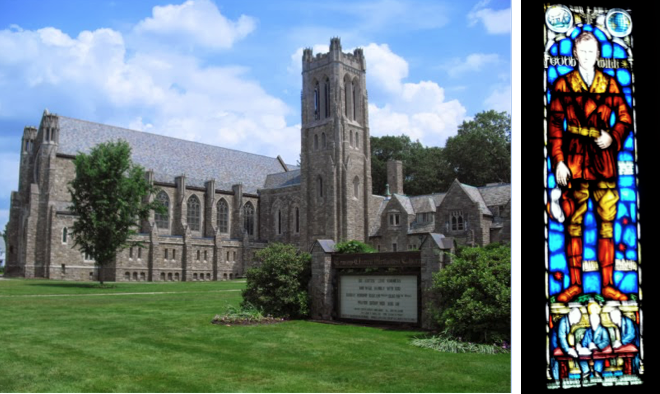
GOODWILL, OR WHATEVER…Trinity Methodist Episcopal Church in Springfield, Mass., features a series of 24 stained-glass windows representing historic personages with the theme, “The Light of Christ in the Life of Civilization.” Charles Lindbergh’s pane represents “Goodwill.” (tm01001.blogspot.com)

 *  *  *

Mr. Monroe Outwits a Bat

James Thurber submitted a humorous piece on a husband and wife at a weekend cabin retreat. The husband encounters a bat, and feigns to dispatch it while his wife remains behind closed doors. A brief clip:

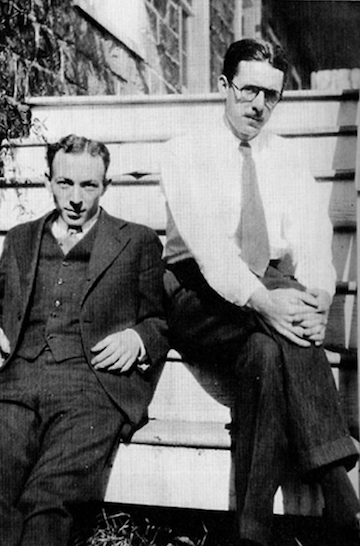
E.B. White and James Thurber, circa late 1920s.

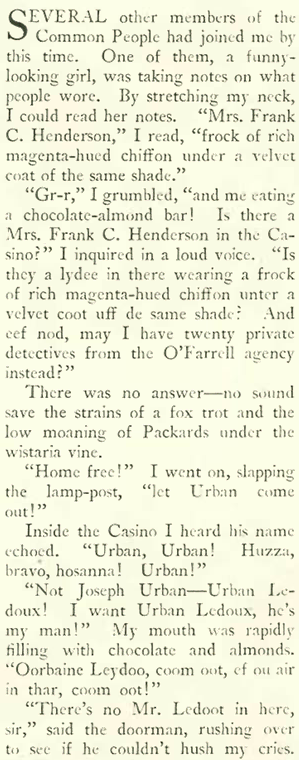
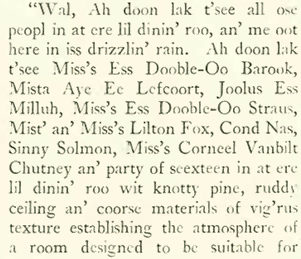
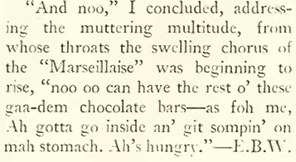
Thurber’s office mate and friend, E.B. White, penned a piece on the opening of the Central Park Casino (“Casino, I Love You”) in which he pretended to be a hobo loitering outside the Casino’s recent grand re-opening. Some excerpts…

White’s character confuses Urbain Ledoux with Casino designer Joseph Urban. Ledoux was known to New Yorkers as “Mr. Zero,” a local humanitarian who managed breadlines for the poor. White’s character continues to name off the notables present at the event…

*  *  *

From Our Advertisers

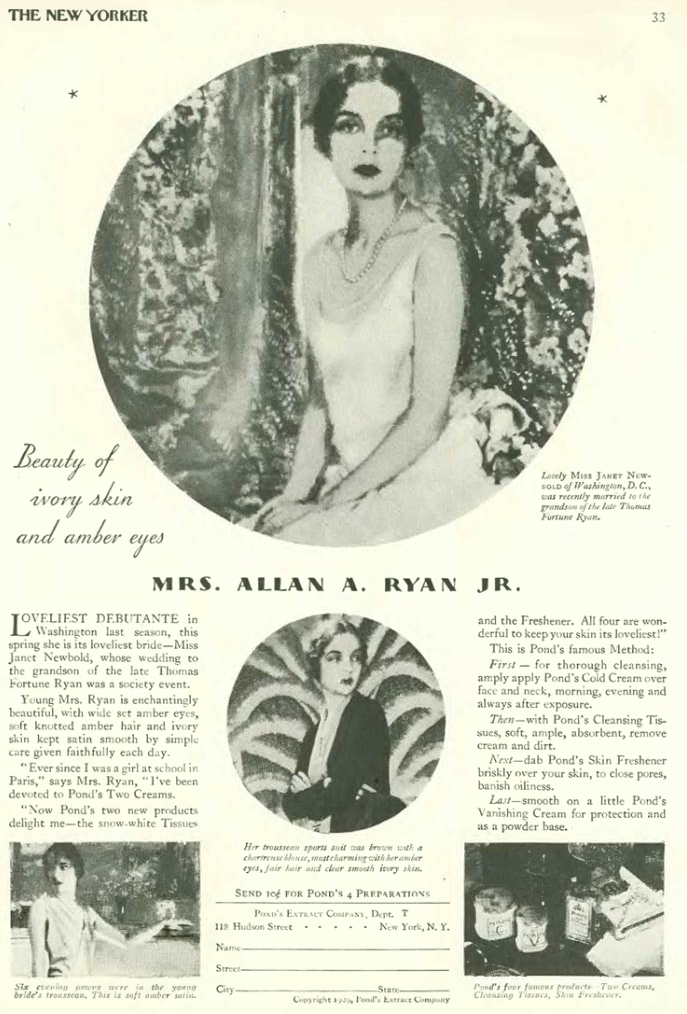
We begin with a Pond’s cold cream ad featuring Janet Newbold (1908-1982), who was known in some circles as “the most beautiful woman in New York”…

MIRROR, MIRROR…Left, an iconic photo of Janet Newbold by Erwin Blumenfeld, “Woman and Mirror,” was published in Harper’s Bazaar in November 1941. “Janet Newbold Wearing A Sari,” photo by John Rawlings, was published in Vogue in 1947. Thrice married, her last marriage (in 1948) was to James S. Bush, uncle of U.S. President George H.W. Bush. (Harper’s Bazaar/Vogue)

…some of the more colorful ads in the June 15 issue included this entry by Jantzen…

…and this ad for the REO Flying Cloud, a name that suggested speed and lightness, and changed the way cars would be named in the future (e.g. “Mustang” rather than “Model A”)…

…and if you think gimmicky razors are something new, think again…

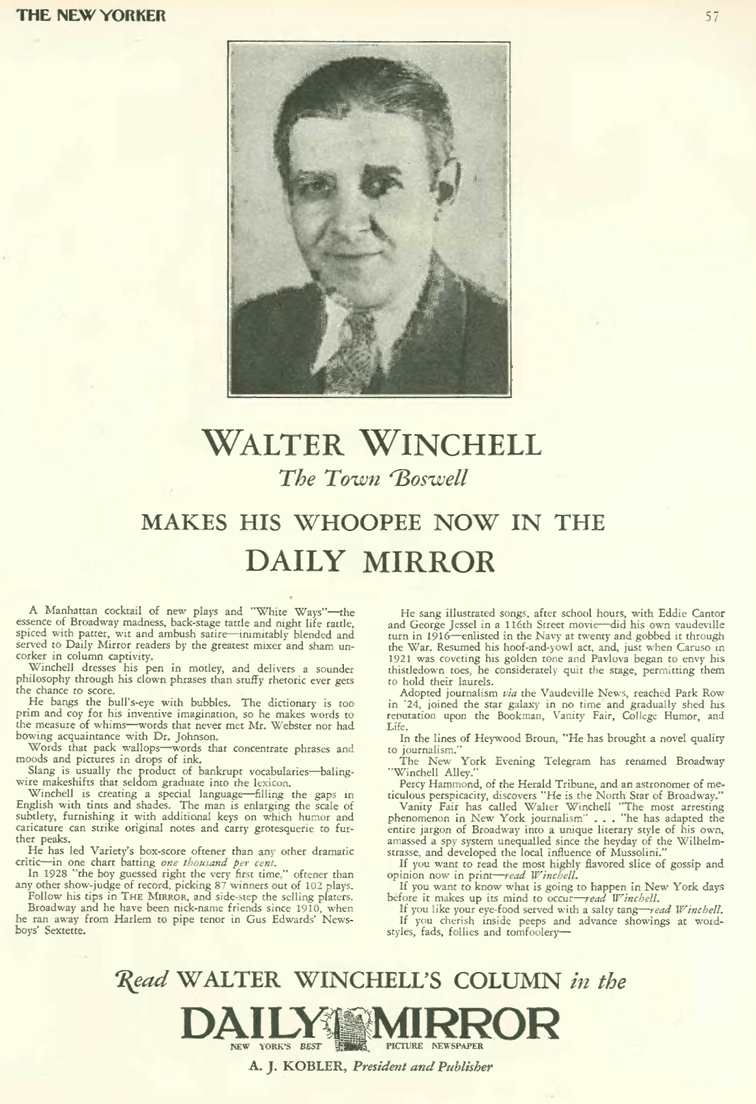
…this ad announcing Walter Winchell’s employment with the New York Daily Mirror is significant in that in marks the beginning of the first syndicated gossip column. Winchell’s column, On-Broadway, was syndicated nationwide by King Features. A year later he would make his radio debut over New York’s WABC…

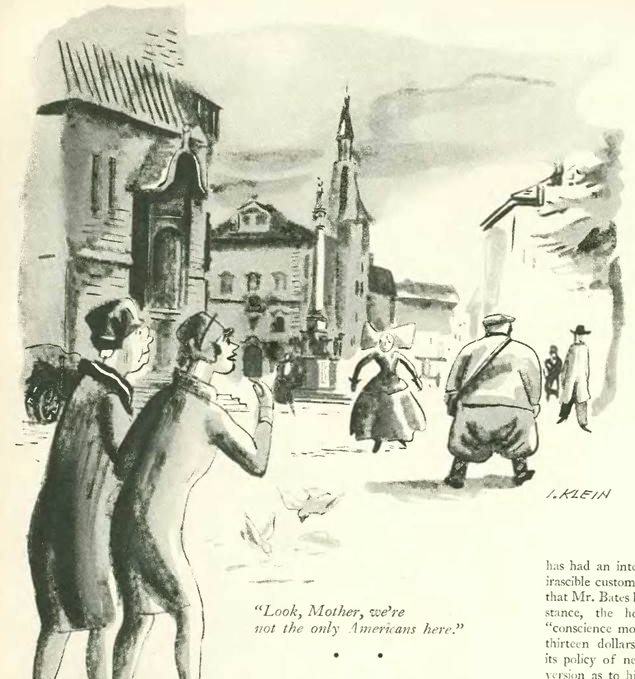
…for our June 15 cartoons, Isadore Klein confirms that stereotypes regarding American tourists haven’t changed much in 90 years…

…a quick footnote on Klein. In his long and colorful career, he would contribute cartoons to the New Yorker and many other publications. He also drew cartoons for silent movies, including Mutt and Jeff and Krazy Kat, and later worked for major animation studios including Screen Gems, Hal Seeger Productions, and Walt Disney. He was a writer and animator for such popular cartoons as Mighty MouseCasper, Little Lulu and Popeye.

Isadore Klein (1897–1986) holding the National Cartoonists Society “Silver T-Square.” He received the honor from his fellow members on April 22, 1974. (michaelspornanimation.com)

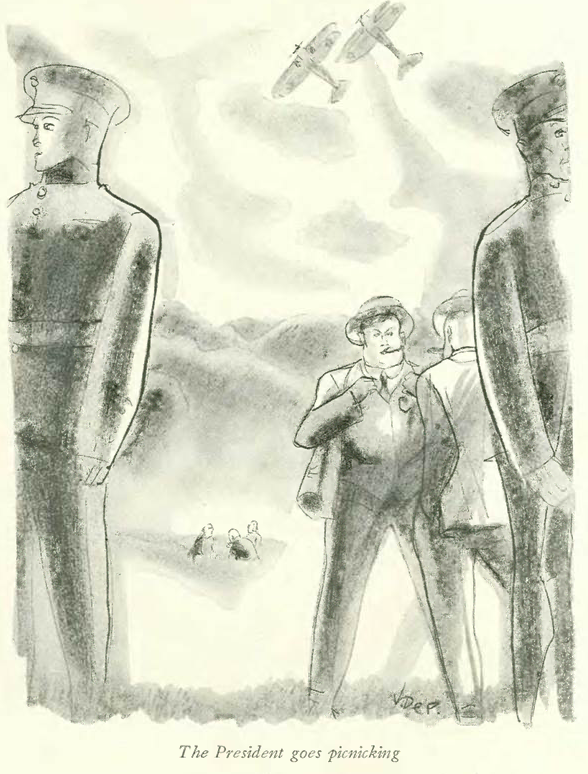
…Belgium-born artist Victor De Pauw depicted President Herbert Hoover picnicking, as viewed through his security detail…

…and a quick note on De Pauw…well known during his lifetime, he illustrated seven covers for The New Yorker and drew many social and political cartoons for magazines such as Vanity Fair, Fortune and Life. He also had a career as a serious painter, and some of his work can be found at the Museum of Modern Art…

Victor de Pauw (1902-1971) and one of his New Yorker covers from Nov. 20, 1943. (Smithsonian/Conde Nast)

Helen Hokinson looked in on two of her society women in need of some uplift…

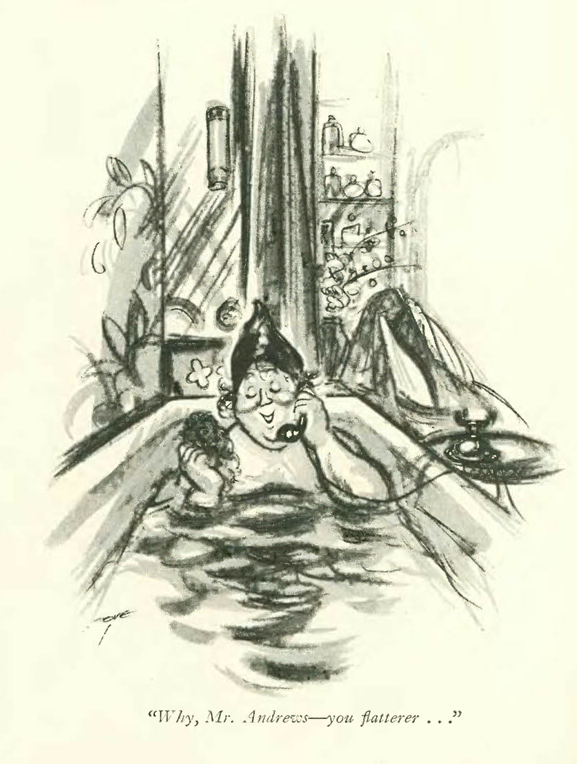
…and Leonard Dove looked in on another enjoying a soak…

Moving along to the June 22, 1929 issue, “The Talk of the Town” offered more news on the city’s changing skyline…

June 22, 1929 cover by Constantin Alajalov.

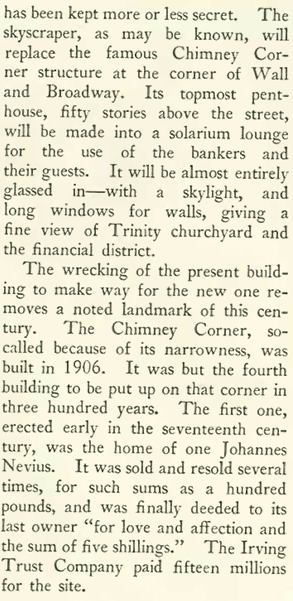
…and noted that the slender 1906 “Chimney Corner” building at Wall and Broadway had a date with the wrecking ball…

FAILED THE TEST OF TIME…At left, 18-story “Chimney Building” was demolished in 1929 along neighboring properties to make way for the Irving Trust Building (now 1 Wall Street), an Art Deco masterpiece by architect Ralph Walker. Note the scale of the two buildings relative to the church spire. (skyscraper.org/architectsandartisans.com)

 * * *

Apartheid on the Seas

“Talk” also featured this sad account of a theatrical company setting sale for England and discovering that racial discrimination did not end at the docks of New York Harbor. It is also sad that The New Yorker didn’t seem to have any problem with this injustice, and rather saw it as nothing more than fodder for an amusing anecdote…

NOT THE GOOD OLD DAYS…Percy Verwayne, Frank H. Wilson and Evelyn Ellis were part of the cast in the original Broadway production of Porgy in 1927. The play, by Dorothy and DuBose Heyward, was the basis for the libretto in the George Gershwin’s 1935 Porgy and Bess. (Wikipedia)

* * *

The profile for June 22 featured 100-year-old John R. Voorhis (1829-1932), Chairman of New York City’s Board of Elections. A fixture of the Tammany Hall Democratic political machine, in 1931 Tammany members created a special title for the old man—Great Grand Sachem. He died the next year at age 102.

John Voorhies in 1900, when he was a bouncy youth of 71.

 * * *

From Our Advertisers

Another colorful entry from the makers of Jantzen swimwear to celebrate the summer season…

…famed composer George Gershwin urged his fans to light up a Lucky Strike…

…and with help from Rea Irwin, Knox Hatters offered yet another example of the faux pas one might suffer without the proper headgear…

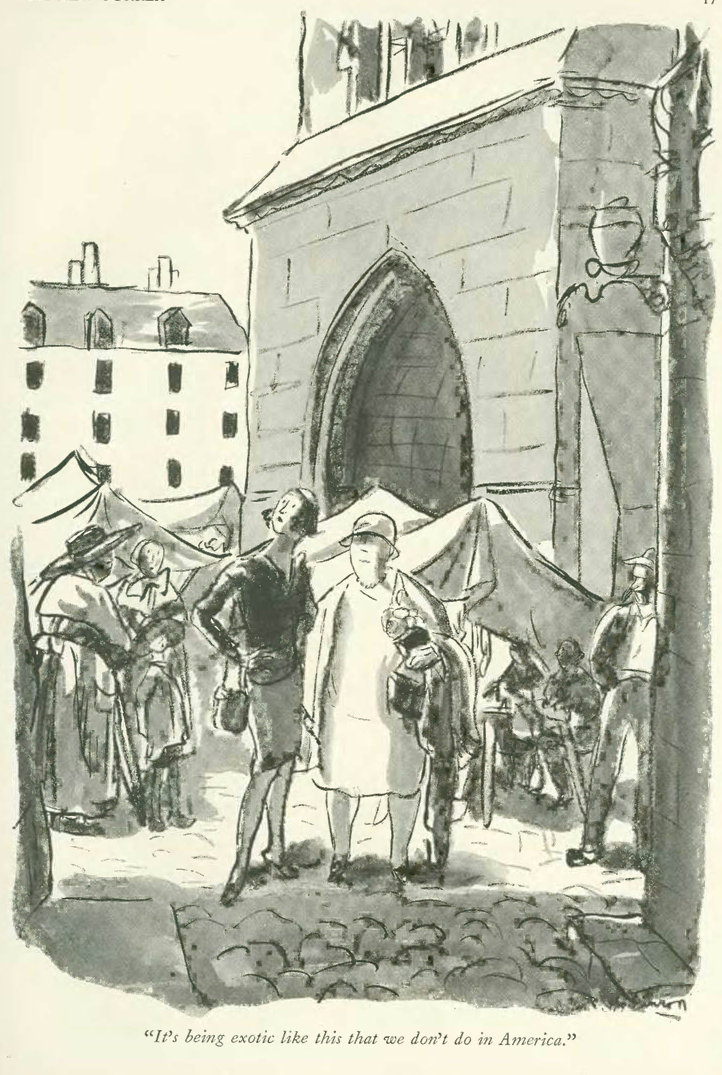
…for our June 22 cartoons, Helen Hokinson caught up with some American tourists…

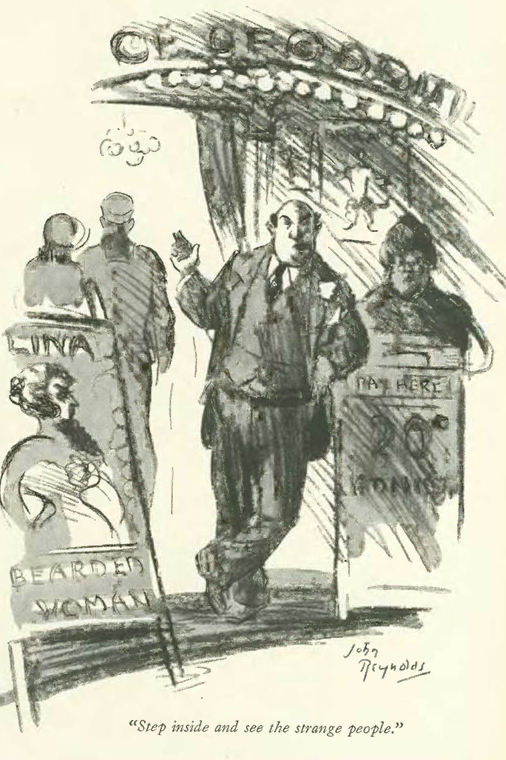
John Reynolds found a bit of irony in one carnival barker’s claim…

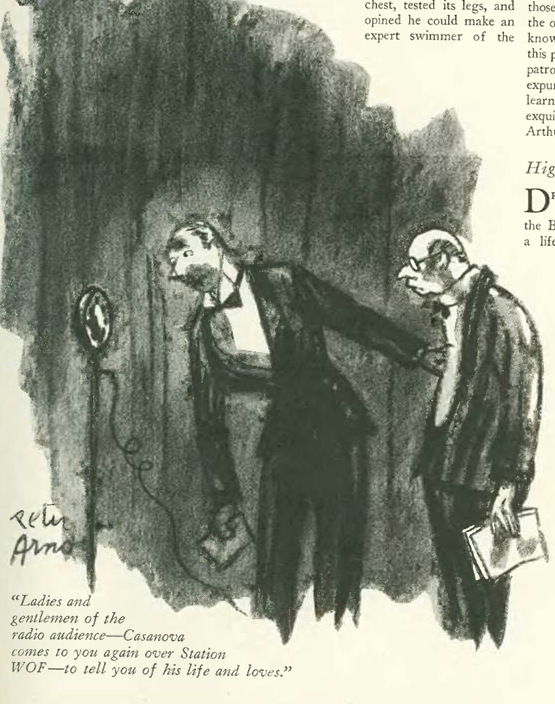
…and Peter Arno revealed a less than glamorous face behind a radio broadcast…

Next Time: New York, 1965…

A 100 Percent Talker

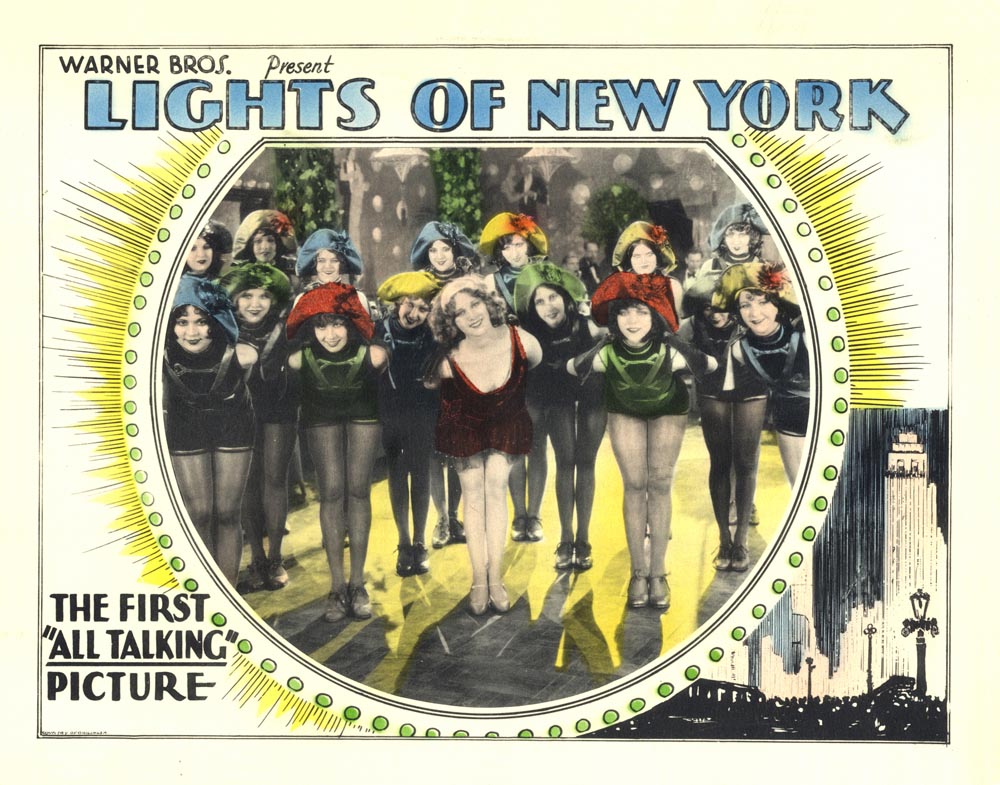
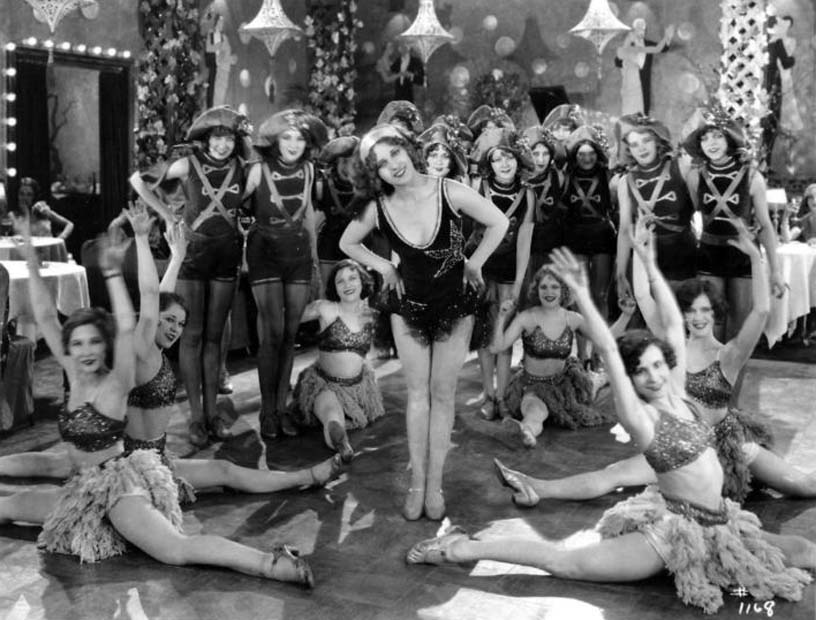
Lights of New York would be a forgettable film if not for the fact it was the world’s first 100 percent talking motion picture. Yes, it was a bad film, but…

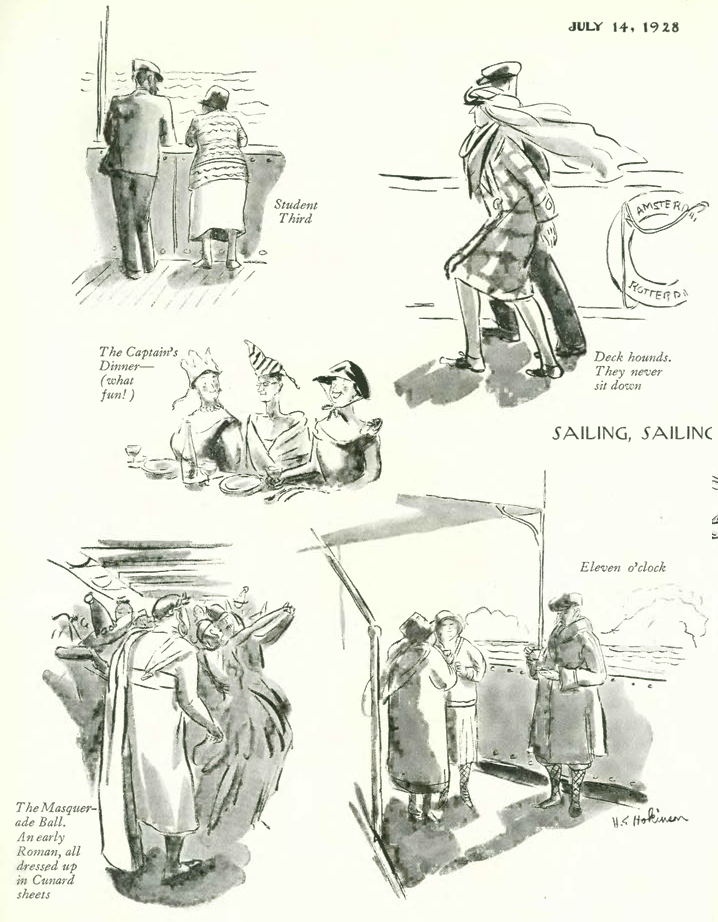
July 14, 1928 cover by Leonard Dove.

…even the July 14, 1928 New Yorker had the foresight to note that the film was destined to be a “museum piece.” Despite the corny plot and bad acting, the magazine’s critic “O.C.” had to concede that the film offered proof that sound would improve the motion picture experience.

Theatre Card for Lights of New York. (untappedcities.com)
MAKING SOME NOISE…Helene Costello with a cast of nightclub dancers in Lights of New York. (vintage45.wordpress.com)

The Jazz Singer (1927) launched a “talkie revolution” that would culminate nine months later in Lights of New York, and by the end of 1929 Hollywood was almost exclusively making sound films. But studios still released silent films into the 1930s, since not every theatre in the country was wired for sound.

The New Yorker had been slow to embrace sound in motion pictures (see my previous posts). What helped to win them over was the further refinement of the Movietone process, in which the sound track was printed directly onto the film strip (The Jazz Singer used Vitaphone, which essentially synched a record player with a film and provided a sporadic rather than continuous sound track).

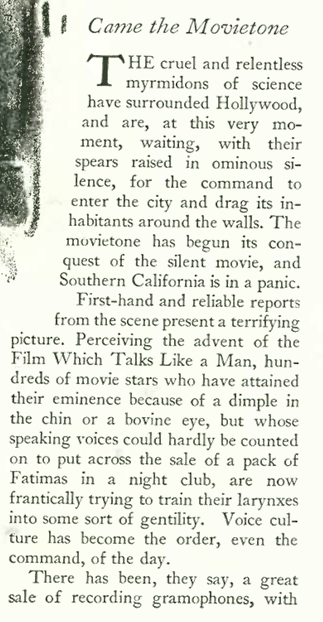
In the same issue, writer Robert Benchley also predicted (in “The Talk of the Town”) that sound in movies would challenge actors whose voices weren’t as attractive as their screen images:

IT’S COMPLICATED…It is a common assumption that sound motion pictures killed the careers of many silent stars, however big names like John Gilbert (left) and Clara Bow left the pictures for other reasons. Studio politics ended Gilbert’s career, and he drank himself to death by 1936. Bow—famously known as the “It Girl,”—made a few sound pictures, but retired from acting in 1931 to become a Nevada rancher. (Wikipedia)
SILENCED…Some silent actors such as Wallace Beery (left), were sidelined not because of their voices but because of their high salaries. On the other hand Raymond Griffith (right), who made only one sound movie, spoke with a hoarse whisper not suited for the talkies. (Wikipedia / silentfilmstillarchive.com)

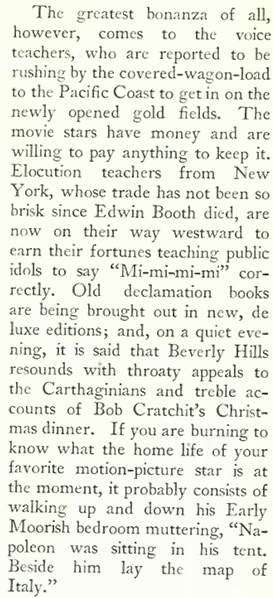
The New Yorker also noted that sound pictures would prove to a great “bonanza” to voice teachers:

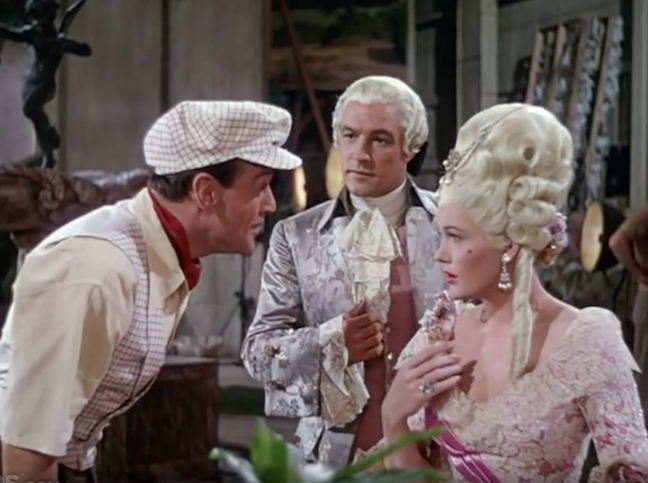
Transition to sound in the late 1920s would later provide the theme for the 1952 musical Singin’ In The Rain, in which Jean Hagen portrayed silent film star Lina Lamont, whose voice was ill-suited for talking pictures. 

SAY WHAT?…Actress Lina Lamont (Jean Hagen) tries the patience of her director (Chet Brandenburg) while her co-star (Gene Kelly) looks on. The scene demonstrated the challenges of acclimating former silent stars (like Lina Lamont, whose voice sounded like squeaky hinge) to “talking pictures.” (MGM/YouTube Movieclips)

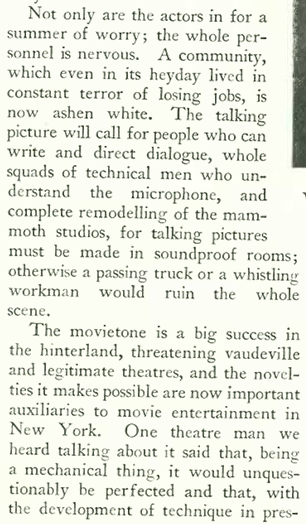
The New Yorker also noted that the advent of sound in motion pictures would put an end to many theatres operating on the vaudeville  circuit:

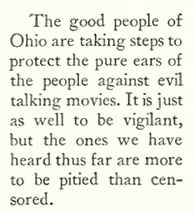
In his regular column, “Of All Things,” Howard Brubaker gave his two cents about the new world of talking movies:

Paving Over Paradise

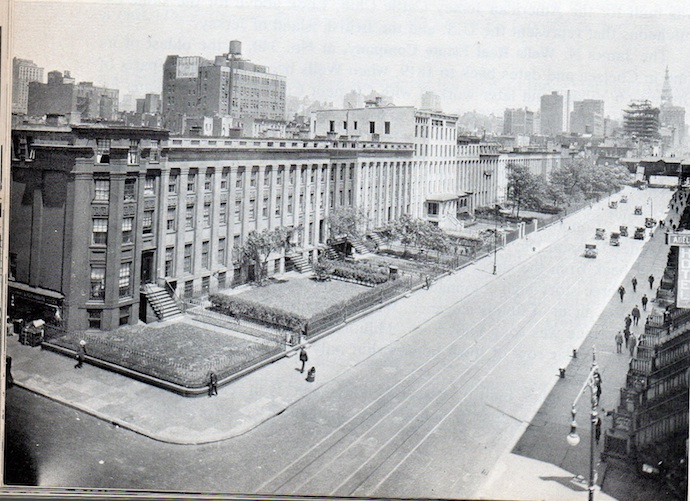
The July 14 “Talk of the Town” offered more bittersweet commentary on the city’s rapidly changing landscape. This time it was a famous stretch of lawns on West 23rd Street—London Terrace— that were being uprooted to make way for a massive new apartment block:

According to Tom Miller (writing for his blog Daytonian in Manhattan), Clement Moore, the writer to whom “A Visit from St. Nicholas” (“The Night Before Christmas”) “had developed the block when he divided up his family estate, ‘Chelsea.’ On the 23rd Street block, in 1845, he commissioned Alexander Jackson Davis to design 36 elegant Greek Revival brownstone townhouses. The row was designed to appear as a single, uniform structure or ‘terrace’ (a design not lost on The New Yorker). Unusual for Manhattan, each had deep front yards planted with shrubbery and trees. He called his development ‘London Terrace.'”

A BIT O’ GREEN…London Terrace, circa 1920. (ephemeralnewyork)

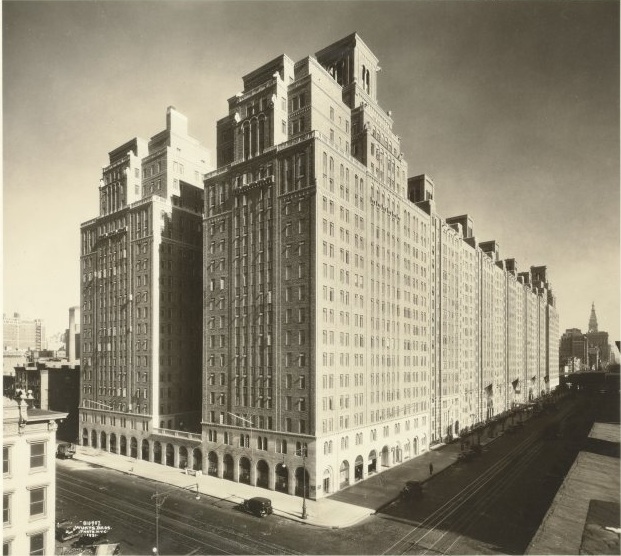
By October 1929, writes Miller, “a few weeks before the collapse of the stock market and the onset of the Great Depression, (developer Henry Mandel) had acquired and demolished all the structures on the enormous block of land. All except for Tillie Hart’s house. Hart leased 429 West 23rd Street and, although her lease had legally expired, she refused to leave, firing a barrage of bricks and rocks at anyone who approached the sole-surviving house. A court battle ensued while she barricaded herself inside. Finally, just four days before Black Tuesday, sheriffs gained entry and moved all of Hart’s things onto the street. She held out one more night, sleeping on newspapers in her once-grand bedroom, then gave up. The following day her house was destroyed.”

IT’S YUGE…Farrar & Watmough designed this massive, Tuscan-inspired apartment block, completed during 1930-31. The developer Henry Mandel, kept the site’s original name, London Terrace. (ephemeralnewyork)

Miller writes, “to describe the new London Terrace was to use superlatives. Consuming the entire city block, it was the largest apartment building in the world with 1,665 apartments. It boasted the largest swimming pool in the city – 75 feet by 35 feet, with mosaic walls and viewing balconies. Twenty-one stories above the street a “marine deck” was designed to mimic that of a luxury ocean liner. It had a fully-equipped gymnasium, a recreation club, a rooftop children’s play yard with professional supervisors, and a large dining room. The doormen were dressed as London bobbies.”

STILL THERE…London Terrace today. (Brick Underground)

 *  *  *

In other diversions, Isadore Klein looked askew at the latest headlines, namely the big fight between Gene Tunney and Tom Heeney, one of the 20th century’s many “battles of the century”…

…while Helen Hokinson, on the other hand, offered some sketches of seafaring life…

…and looked in on the challenges of buying a hat…


And to close, a cartoon by Leonard Dove

…that referenced ads such as this one from the June 2, 1928 issue…

…and a comedy of manners, courtesy Peter Arno

Next Time: Beyond 96th Street…

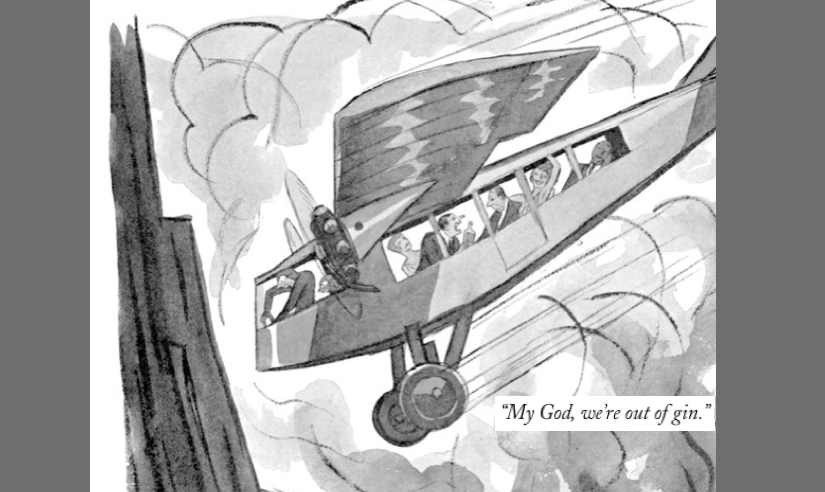
To the Air

New Yorker writers in the 1920s by and large displayed a resistance to popular enthusiasms when they looked around at the changing the world, but when it came to advancements in aviation, they tended to drop the casual pose and get all dreamy-eyed.

June 2, 1928 cover by Sue Williams.

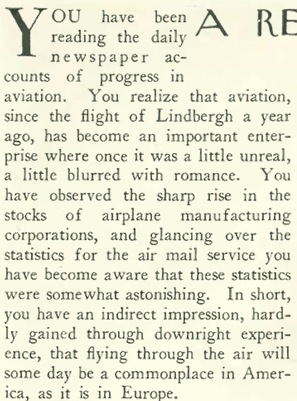
Such was the case with even a clear-headed writer like Morris Markey, who in his “A Reporter at Large” column looked at our progress in aviation. Public interest in air travel grew dramatically after Charles Lindbergh’s 1927 Atlantic crossing, as did the expansion of air mail and passenger service and the growth of private plane ownership. As Markey noted in this opening paragraph, for all the advances in American aviation, the Europeans were well ahead in establishing regular passenger service, as it had become “commonplace”:

FORERUNNER…In 1920s the Boeing Model 40 served as a U.S. mail plane. The single-engined biplane was also the first aircraft built by the Boeing company to carry passengers. Note the pilot was still seated in the open air, behind the passenger compartment. Many early pilots were unhappy when the next generation of planes forced them into an enclosed cockpit. (Boeing)

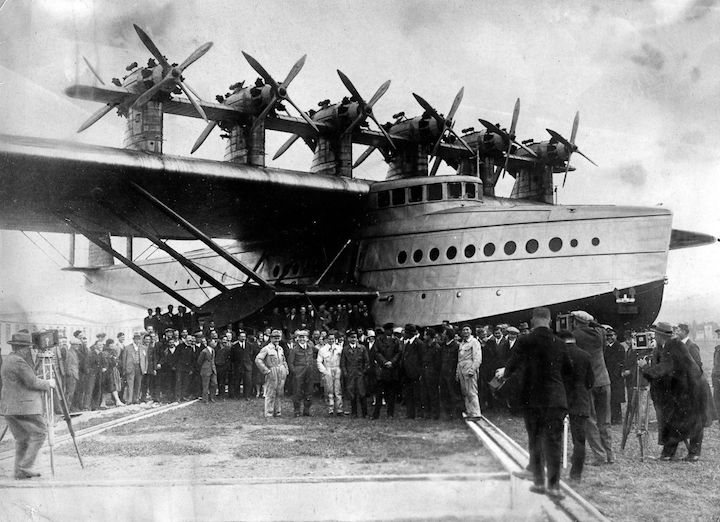
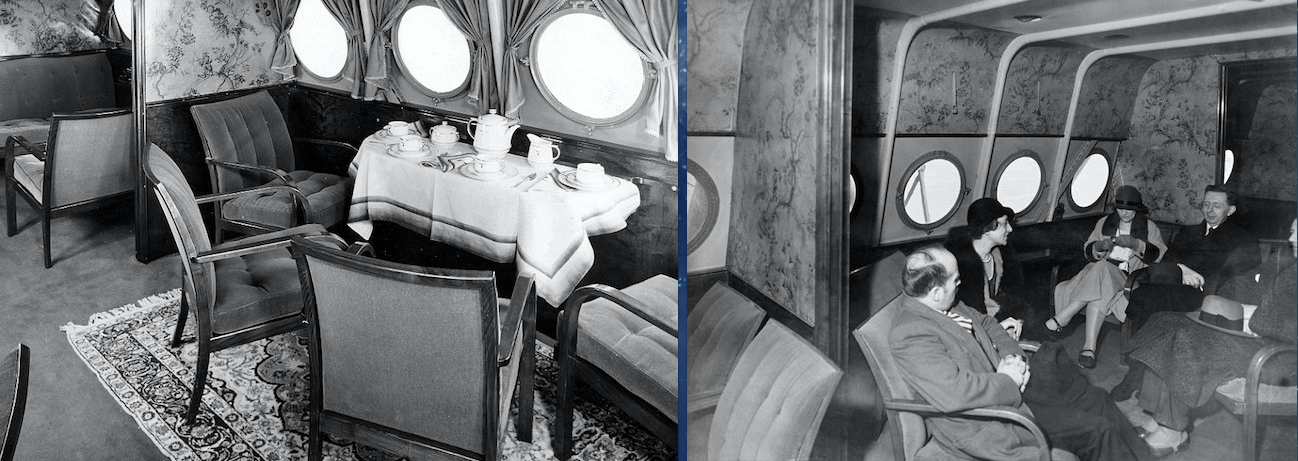
To get some sense of European (and specifically German) aviation superiority, look no further than the Dornier Do-X, a massive seaplane developed by the Germans in the mid-1920s that began regular passenger service in July 1929. While America’s biggest planes could carry 12 to 18 passengers, the spacious and luxurious Do-X could comfortably seat 70 to 100 passengers and included a dining salon, smoking lounge and wet bar. A few months after its first flight the Do-X broke a world record by carrying 169 passengers—astonishing when one considers only 25 years had passed since the Wright Brothers at Kitty Hawk.

BEHEMOTH…169 people flew aboard the Dornier Do-X on October 21, 1929. The plane’s hull was made of aluminum, but the sides were made of heavy duty linen cloth coated with aluminum paint. (Ullstein Bild)
MAKING HISTORY…Excited passengers—169 of them—await take-off on October 21, 1929. Powered by a dozen engines, take-off weight for the Do-X was more than 61 tons. Note the crew members atop the craft manually turning the propellers—all 12 of them—to circulate the oil in the engines prior to take-off. (Ullstein Bild)
LEGROOM NOT OPTIONAL…The dining salon (left) and a passenger compartment in the Dornier Do-X. (Ullstein Bild)
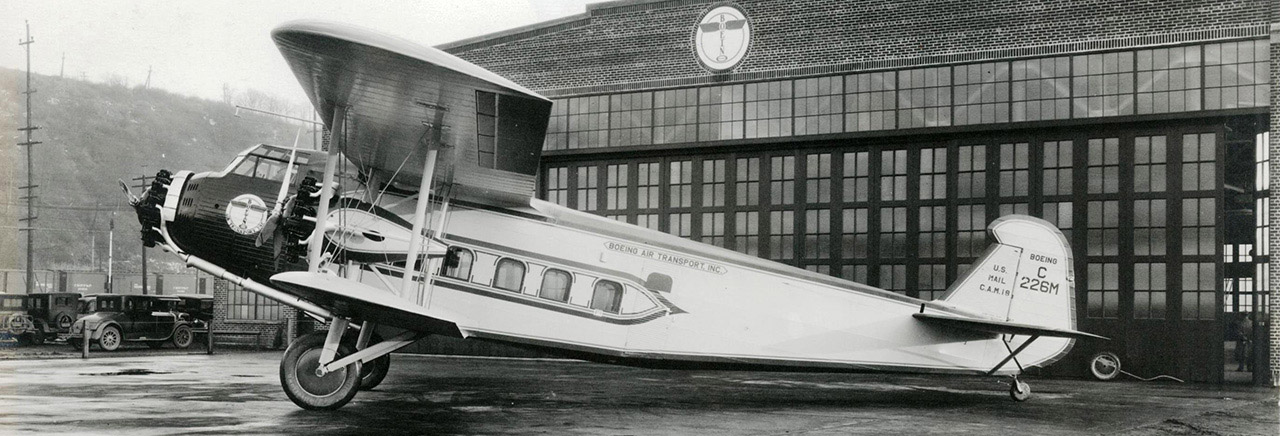
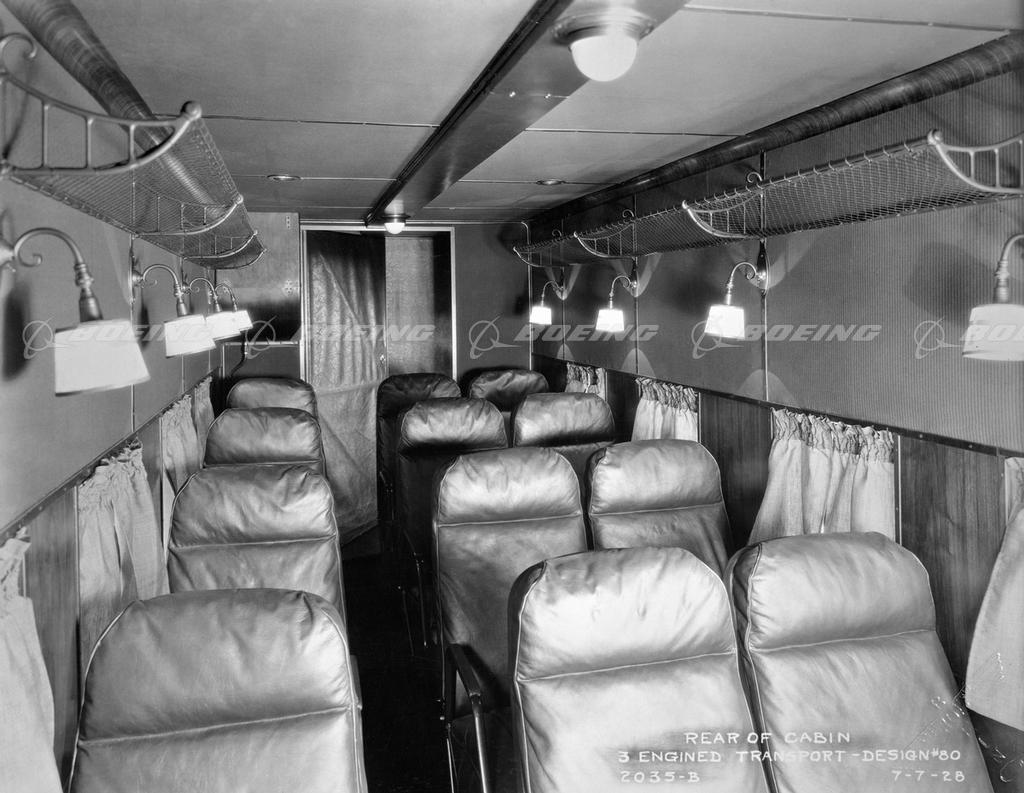
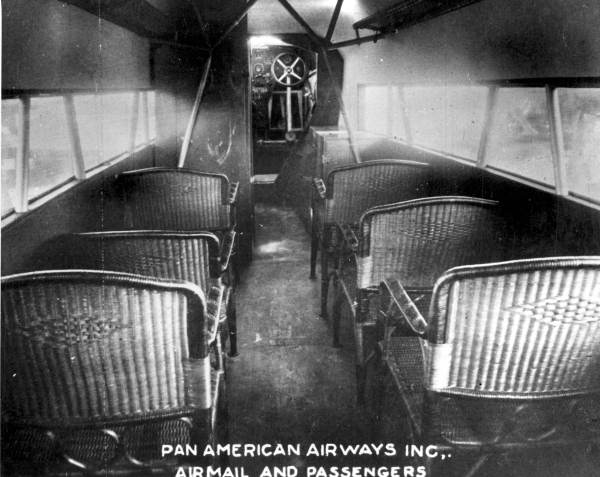
MODEST, BUT NICE…Over in America, the 1928 Boeing Model 80 carried passengers in a spacious cabin appointed with leather upholstery, reading lamps, forced-air ventilation, and hot and cold running water. The first version carried 12 people, and it was followed by a larger, 18-passenger Model 80A, which made its first flight on Sept. 12, 1929. The plane’s fuselage was made of welded-steel tubing covered with fabric, and its wooden wingtips were removable so the airplane could fit into the primitive hangars along its route. (Boeing)
COZY…Interior of the Boeing Model 80. Ellen Church, a registered nurse, convinced Boeing managers that women could work as stewards, so nurses serving aboard the Model 80A became aviation’s first female flight attendants. (Boeing)

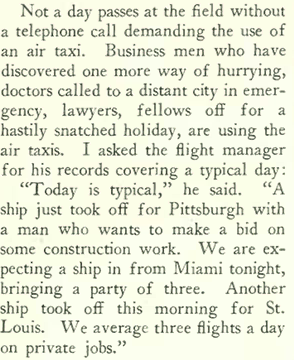
Markey noted the growing interest in commuter flights among business executives. What seemed like a high demand to Markey was an average of three commuter flights a day.

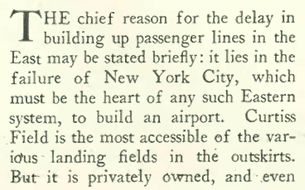
Markey also lamented New York’s lag in building up passenger service, especially when air travel was growing leaps and bounds in the Midwest and West, and especially in rival Chicago:

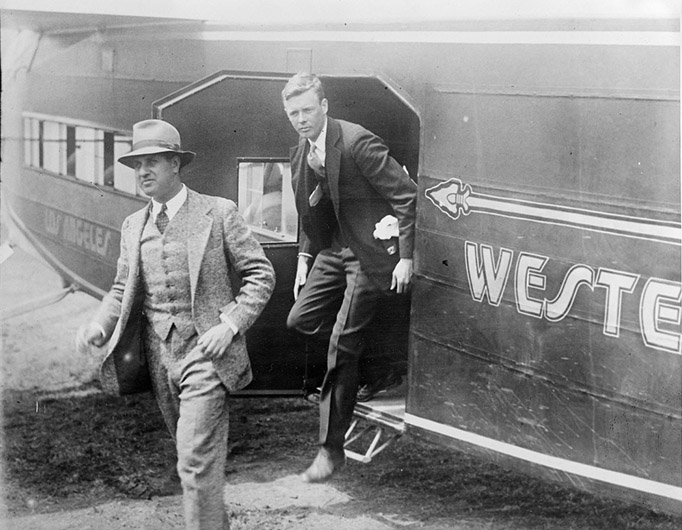
BIRTH OF TWA…Harry Guggenheim and Charles Lindbergh step off a Western Air Express Fokker F-10 in 1928. Diplomat, publisher and philanthropist, Guggenheim provided funding to mail carrier Western Air Express in 1927 in an effort to create a “model airline” that was safe, dependable and economically feasible. By 1930 Western was the nation’s largest airline. It was short-lived, however; in 1930 Postmaster General William Folger Brown forced it to merge with Transcontinental Air Transport, creating Transcontinental and Western Airlines, or TWA. (Boston Public Library)
NO TSA LINES HERE…Passengers board a Western Air Express Fokker F-10 in the late 1920s. The Fokker F-10 was called “The Queen of the Model Airline,” but it fell out of favor after a much-publicized March 31, 1931 crash in Kansas that killed eight people, including football coaching legend Knute Rockne. (birthofaviation.org)
NO FRILLS…Passenger compartment of a Fokker F-10. (birthofaviation.org)
HERE’S LUCY…Actress Lucille Ball was all smiles after a flight on a Western Air Express Fokker F-10. (birthofaviation.org)

Markey also noted the modest number of planes in private hands, but expected private ownership to increase dramatically in the coming months:

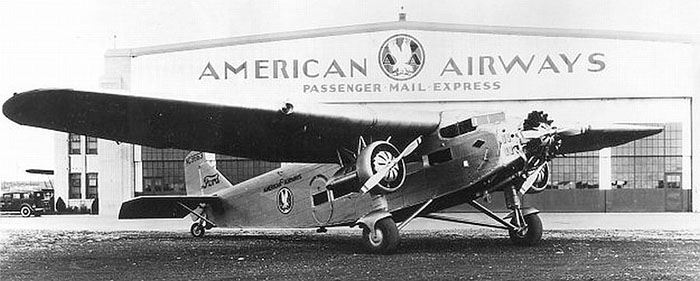
TIN GOOSE…Henry Ford briefly got into the aviation business with his company’s popular Ford Trimotor. Dubbed the “Tin Goose,” it was the first all-metal, multi-engine transport in the United States and the first plane designed primarily to carry passengers (12) rather than mail. It was the first plane to be used for transcontinental passenger service, as well as the first plane to fly over the South Pole. The Great Depression would end the plane’s short but successful run—a total of 199 were produced. (birthofaviation.org)
BE YOUR OWN LINDBERGH…Looking for your own set of wings? The 1929 Cessna Model AW was just around the corner. (airpigz.squarespace.com)

Although Markey lamented the slow growth of New York aviation, he was nevertheless dazzled by the “ships” taking to the skies at Curtiss Field.

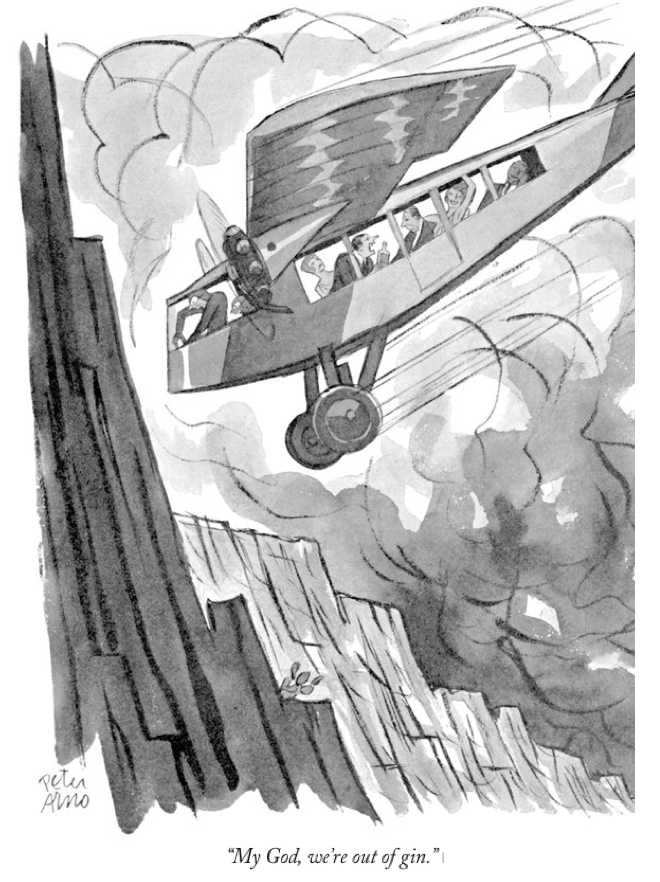
Jumping ahead a couple of years, New Yorker cartoonist Peter Arno offered this view of passenger flight (in a Fokker F-10), the passengers in this case a bunch of silly toffs (April 12, 1930).

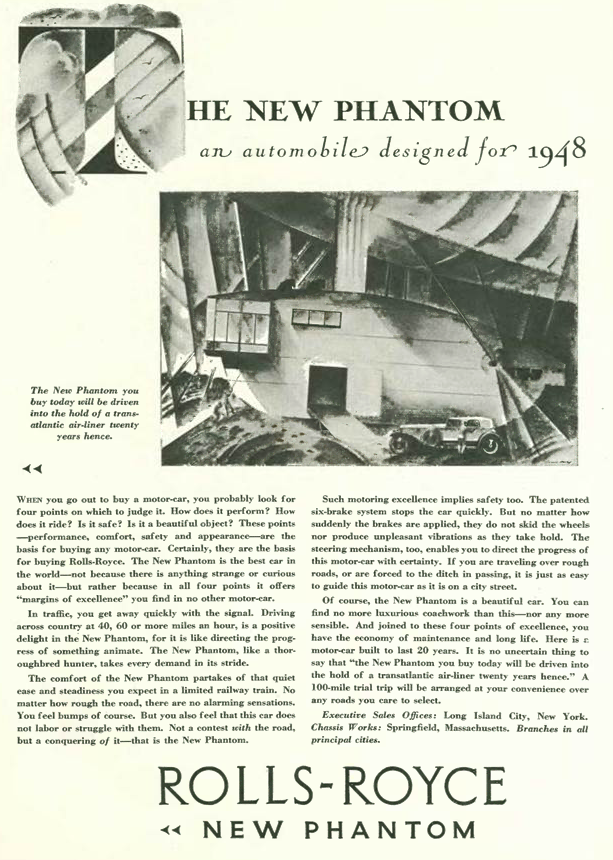
And back to the June 2, 1928 issue, we find this ad for Rolls Royce that offered a vision of a future airliner—in the year 1948. Since the artist had no clue what the future would hold, he conjured up this contraption that looked like a streamlined Noah’s Ark attached to a huge zeppelin.

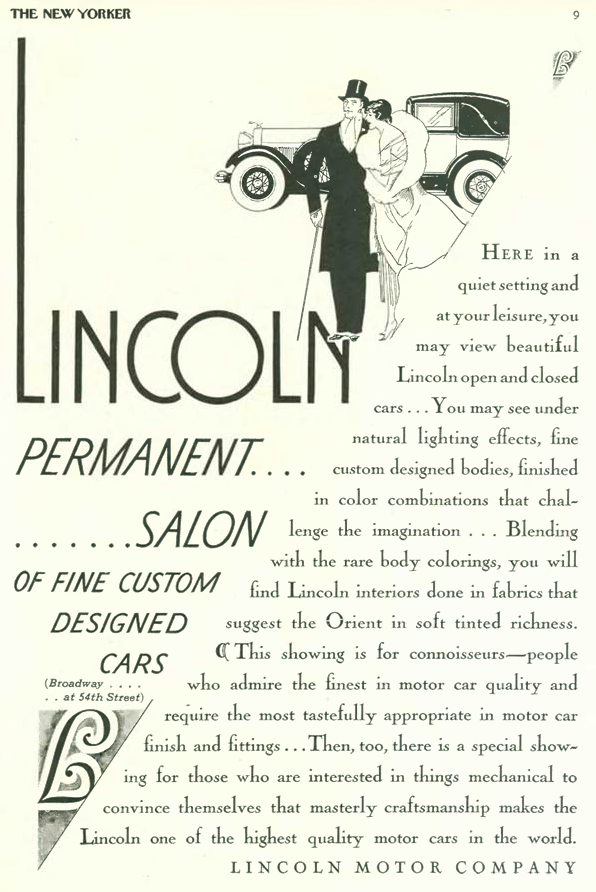
And just for kicks (and contrast), this ad for Lincoln was all about tradition, except for the nice typographical flourish on the letter “L” —a definite nod to modernism.

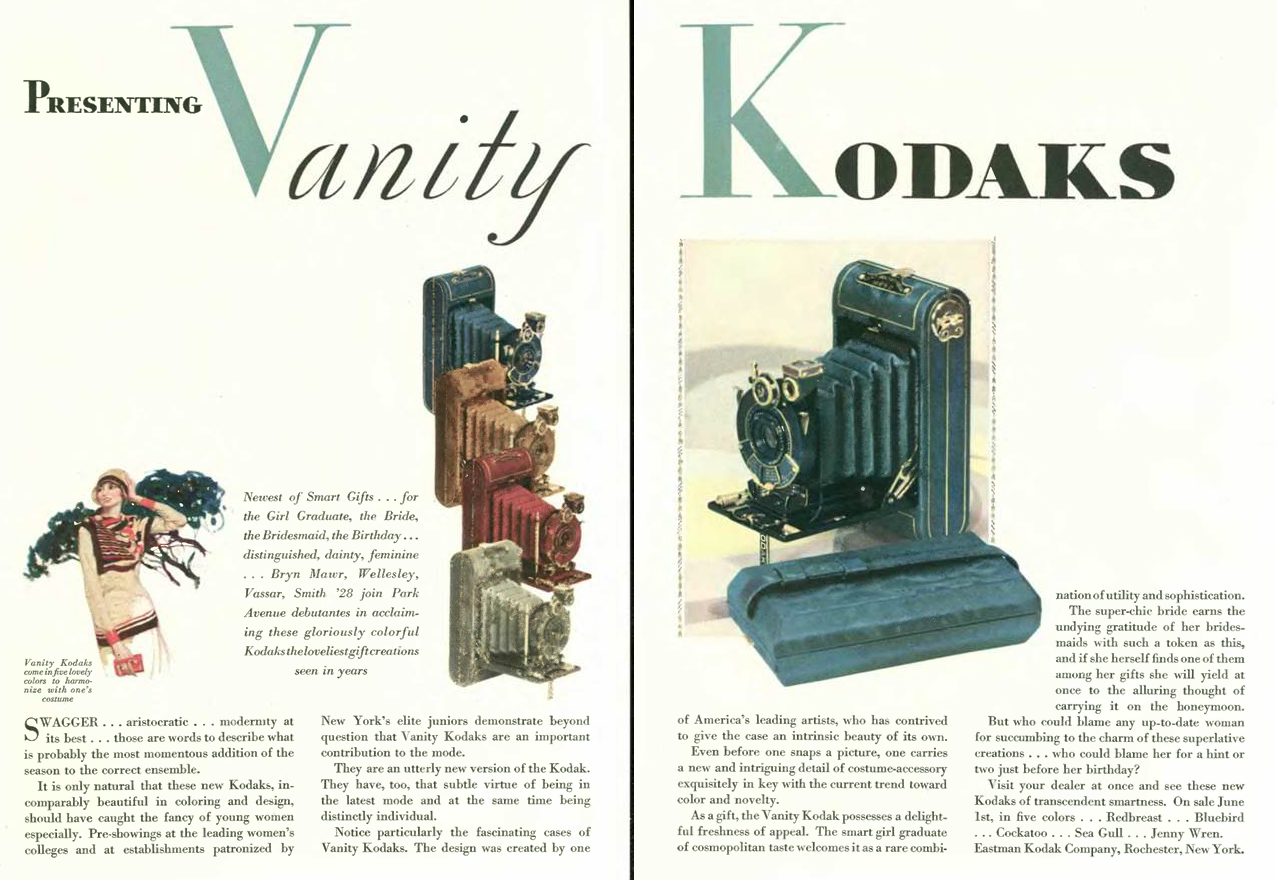
And if you thought novelty in our gadgets is a fairly recent thing, check out these portable Kodak cameras that were available in five colors. From automobiles to typewriters, manufacturers in the 1920s were discovering that color distinguished their products and even drove demand (click image to enlarge).

Advertisers could also create demand by appealing to readers’ cravings for status. The following ad for a Lord and Burnham greenhouse is an especially egregious example of the use of status shaming to sell a product. Note how the foursome in the illustration, presumably all greenhouse owners, look at the man without a greenhouse as though he’s a child molester or worse.

Before Green Eggs and Ham

In 1928 ads for Flit insecticide began to appear in the New Yorker, illustrated by none other than Theodore “Dr. Seuss” Geisel. This is the first Flit ad to appear in the magazine, in the June 2, 1928 issue:

In the 1920s people didn’t seem too concerned about the toxicity of the products they used (for example, we’ve seen Lysol used in feminine hygiene and as a birth control method). Although the Flit ads aimed to be humorous, it still seems odd to imply that one might gargle with the insecticide. As we shall see, subsequent Flit ads will show the product being sprayed indiscriminately over food, children, pets etc.

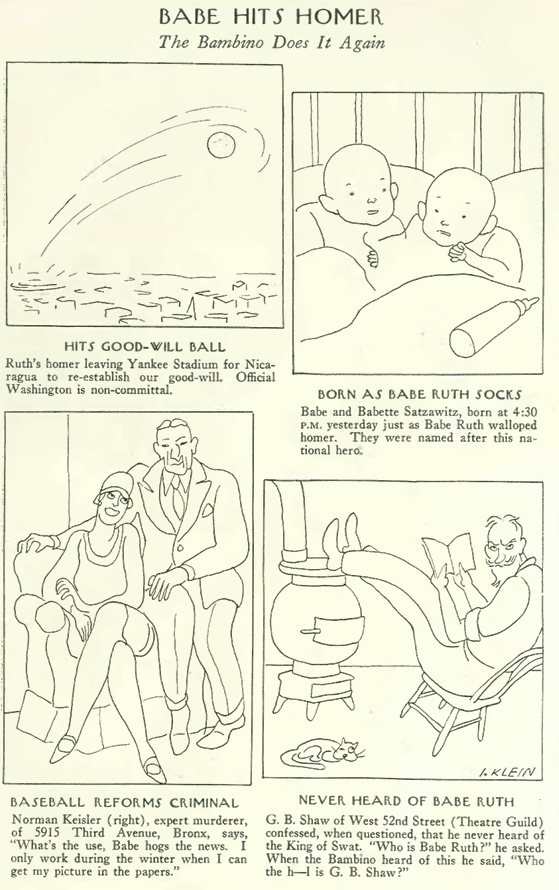
Taking a Shot at the Babe

The cartoonist Isadore Klein had some fun with the hyperbole often attached to the athletic feats of the Sultan of Swat:

And finally, Peter Arno looked at murder among the upper classes:

Next Time: The Russians Are Coming…


Man About Town

When Jimmy Walker was elected mayor of New York City in 1926, the city finally had a leader that matched the mood of the times. A dapper lover of music and nightlife, he openly took a Ziegfield dancer as his mistress, often fled the city for European vacations, and was known to begin meetings with the pop of a Champagne cork.

May 19, 1928 cover by Ilonka Karasz.

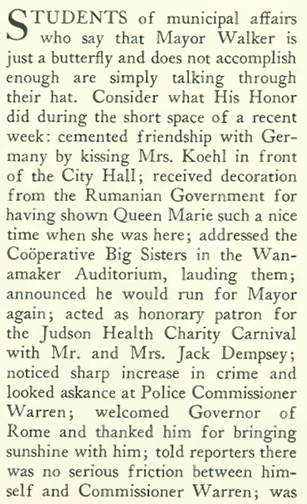
No doubt many New Yorker readers liked the Jazz Age spirit of their mayor, and who really cared about his “accomplishments” as long as the city continued to boom and its smart set continued to prosper? E.B. White, writing for the magazine’s “The Talk of the Town,” concluded as much:

LIGHTS, CAMERA, ACTION!…Mayor Jimmy Walker accompanies actress Colleen Moore to the October 1928 premiere of her latest film, Lilac Time. (konreioldnewyork.blogspot.com)
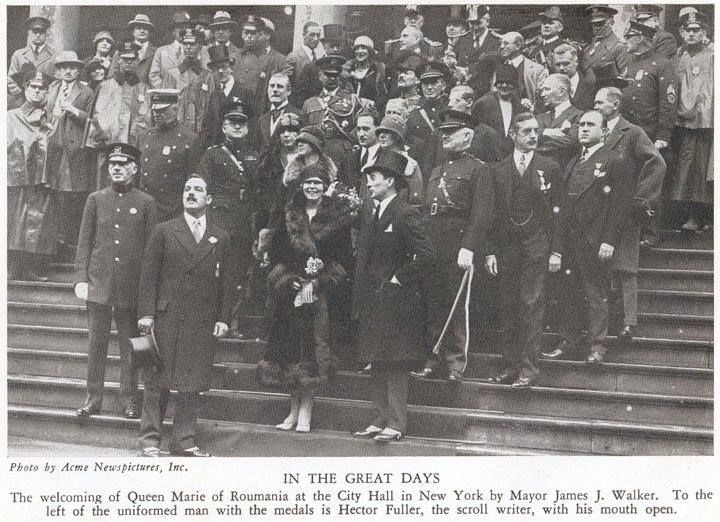
QUEEN FOR A DAY…Mayor Walker (in top hat) welcomes Queen Marie of Romania on the steps of City Hall in October 1926. Huge and enthusiastic crowds braved the rain to welcome the queen to the city. (Acme Newspapers)
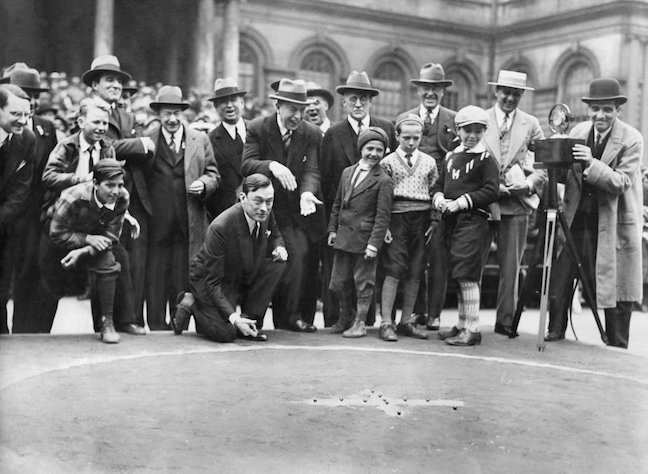
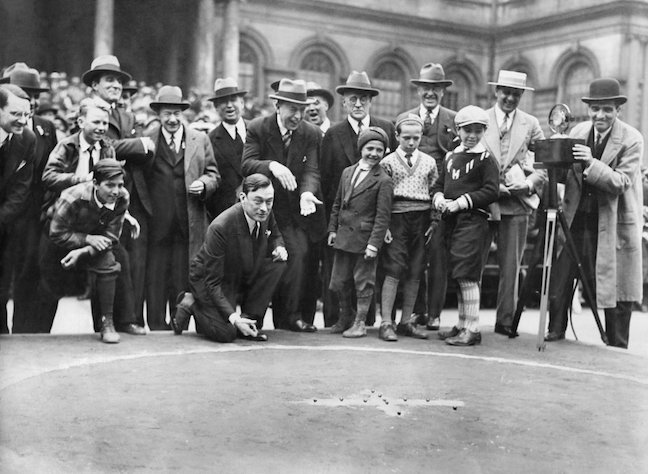
GOOD SPORT…Mayor Walker presides over the first shot in the city’s annual marble tournament on June 3, 1928. (New York Times)

 *  *  *

Remembrance of Things Past

Although The New Yorker embraced the spirit imbued in the city’s rapidly changing skyline, there was always a tinge of regret when landmarks fell to wrecking balls and the city erased its past faster than one could comprehend. And so the magazine was a strong and early supporter of the establishment of the Museum of the City of New York, founded in 1923 and housed in Gracie Mansion (now the mayor’s official residence) until a permanent, neo-Georgian-style museum was finally erected in 1929-30 on Fifth Avenue between 103rd and 104th streets.

KEEPING TIME…Museum of the City of New York. (Wikipedia)

 *  *  *

No Beer Left to Cry In

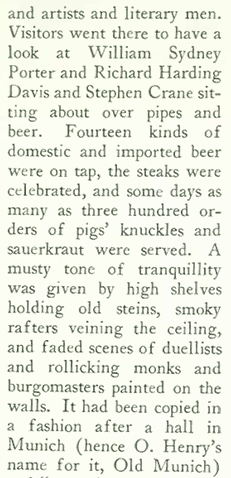
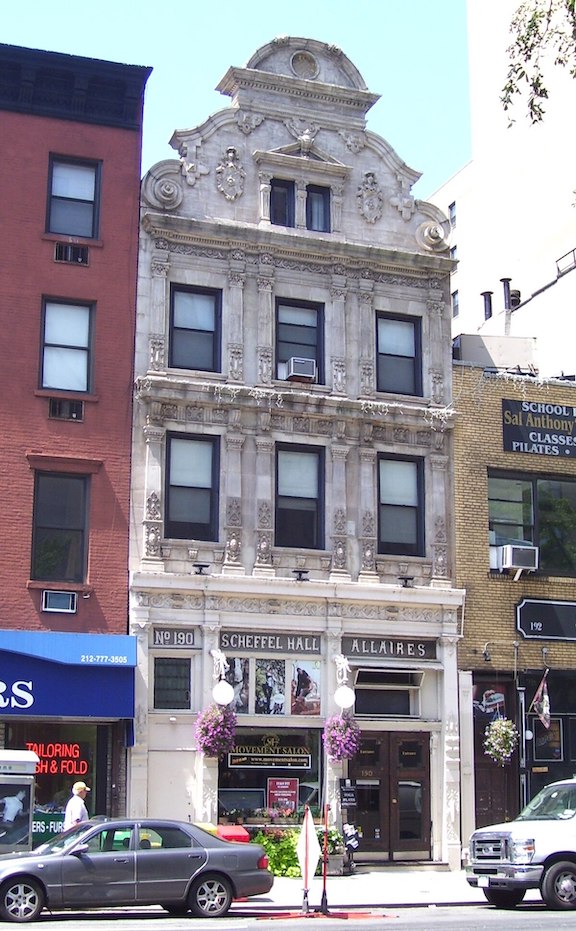
As the Museum of the City of New York scrambled to preserve a past that was quickly being erased across Manhattan, another venerable institution prepared to close its doors for good—Allaire’s Scheffel Hall—which in its heyday was a favorite watering hole of artists, musicians, and writers including Stephen Crane. Allaire’s, located in a Gramercy Park neighborhood known as Kleindeutschland, or “Little Germany,” was the latest victim of Prohibition; it was, after all, hard to run a beer hall without the beer.

SIGN OF THE TIMES…Scheffel Hall at 190 Third Avenue. It was designated a New York City landmark in 1997. (Wikipedia)

 *  *  *

The “Talk of the Town” had its usual bits and pieces of happenings in the city, including this mild jab at the rather staid New York Times:

KEEPING IT DECENT…The actress Betty Starbuck, detail of a photo by Edward Steichen, circa 1930. (CondeNast)

 *  *  *

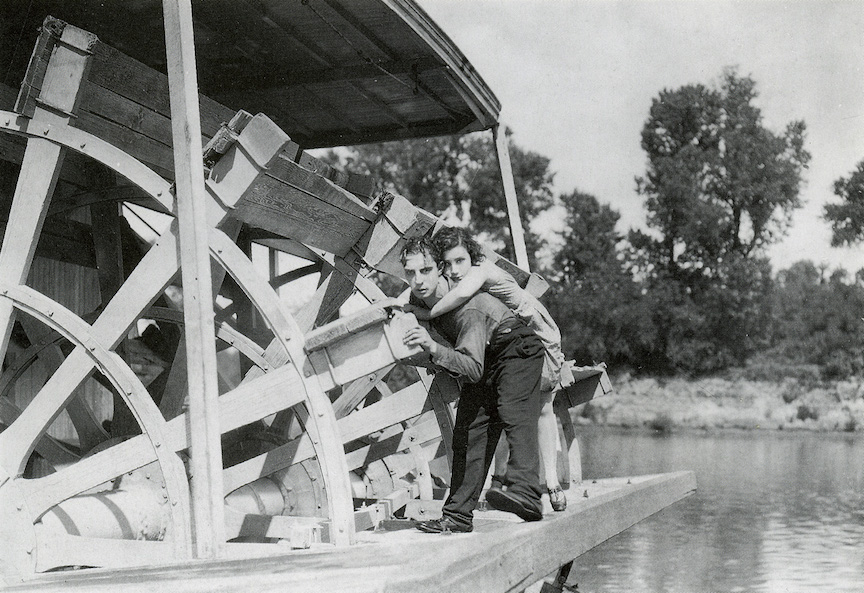
Silent film star Buster Keaton’s latest picture, Steamboat Bill, Jr., won the approval of New Yorker film critic O.C., and Keaton’s co-star Marion Byron received extra props for her “gusto”…

HANGING IN THERE…Marion Byron and Buster Keaton in 1928’s Steamboat Bill Jr. (Virtual History)

 *  *  *

Truth in Advertising

Outside of politics this is one of the most cynical uses of the word “truth” I’ve ever seen. Since the woman isn’t smoking herself, I’m guessing she is reading a letter from someone (son, daughter, boyfriend) who has learned the truth about Camels and has decided to share it in a letter. How sweet.

In 1928 color images such as the Camel ad above brightened an increasing number of New Yorker ads. Color was artfully used in a number of spots, including the left panel of this two-page ad for a new cosmetic compact…

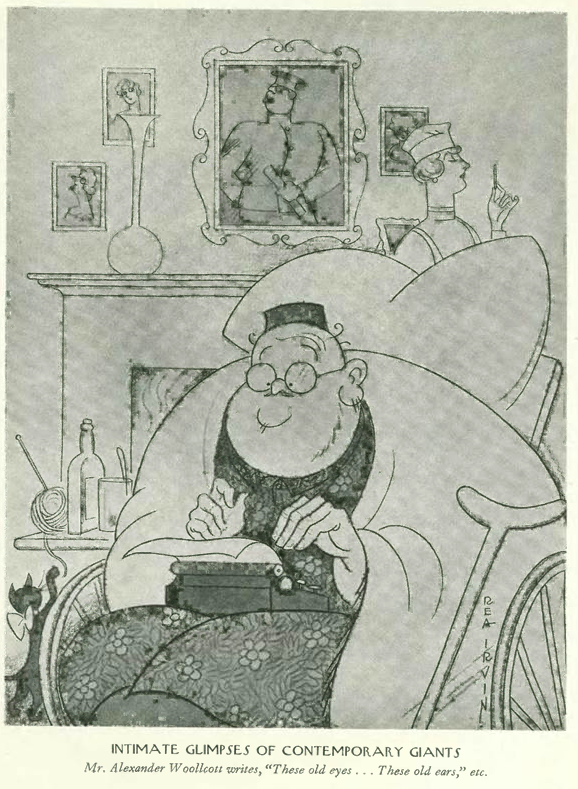
The issue also featured this cartoon by Rea Irvin of New Yorker critic (and hypochondriac) Alexander Woollcott…

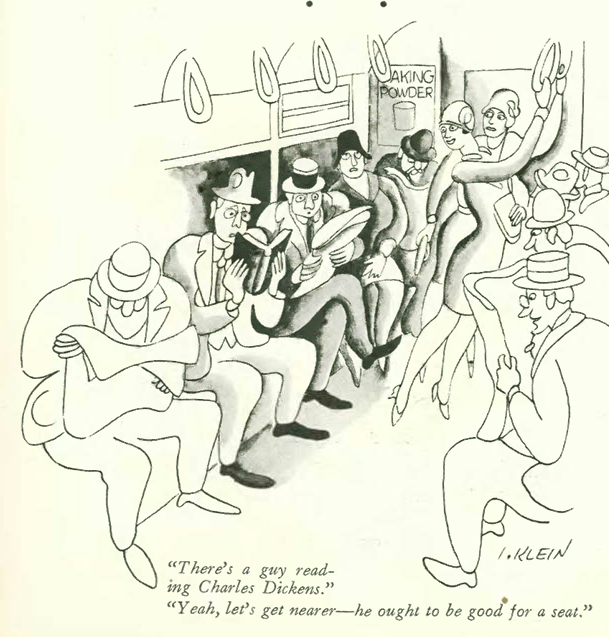
…and keeping on the literary side, this cartoon by Isadore Klein

 *  *  *

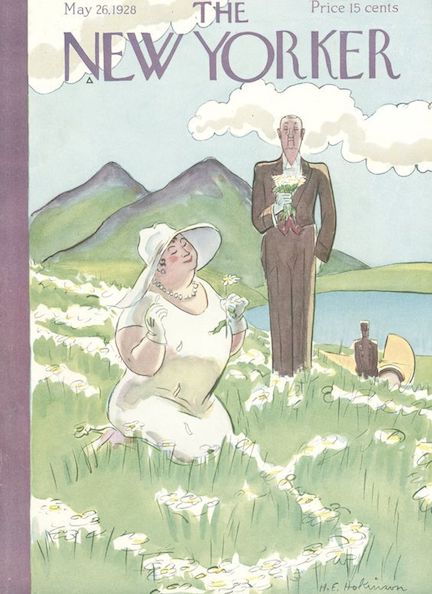
The May 26, 1928 issue the “The Talk of the Town” turned its attention to sound in motion pictures, or rather, turned its ears away from the “movie tone” sound effects becoming common in the waning days of the Silent Era.

May 26, 1928 cover by Helen Hokinson.

Everyday sounds, in particular, proved jarring to the ears of those who were accustomed to the relative quiet of silent movies:

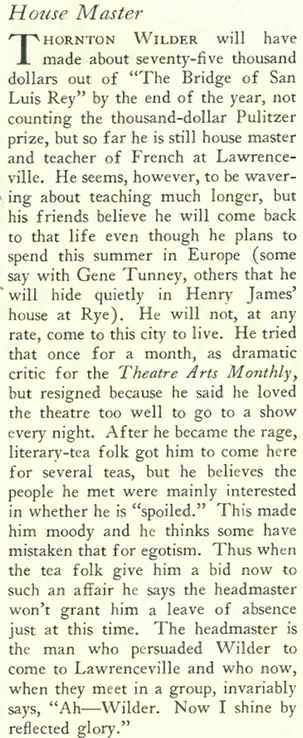
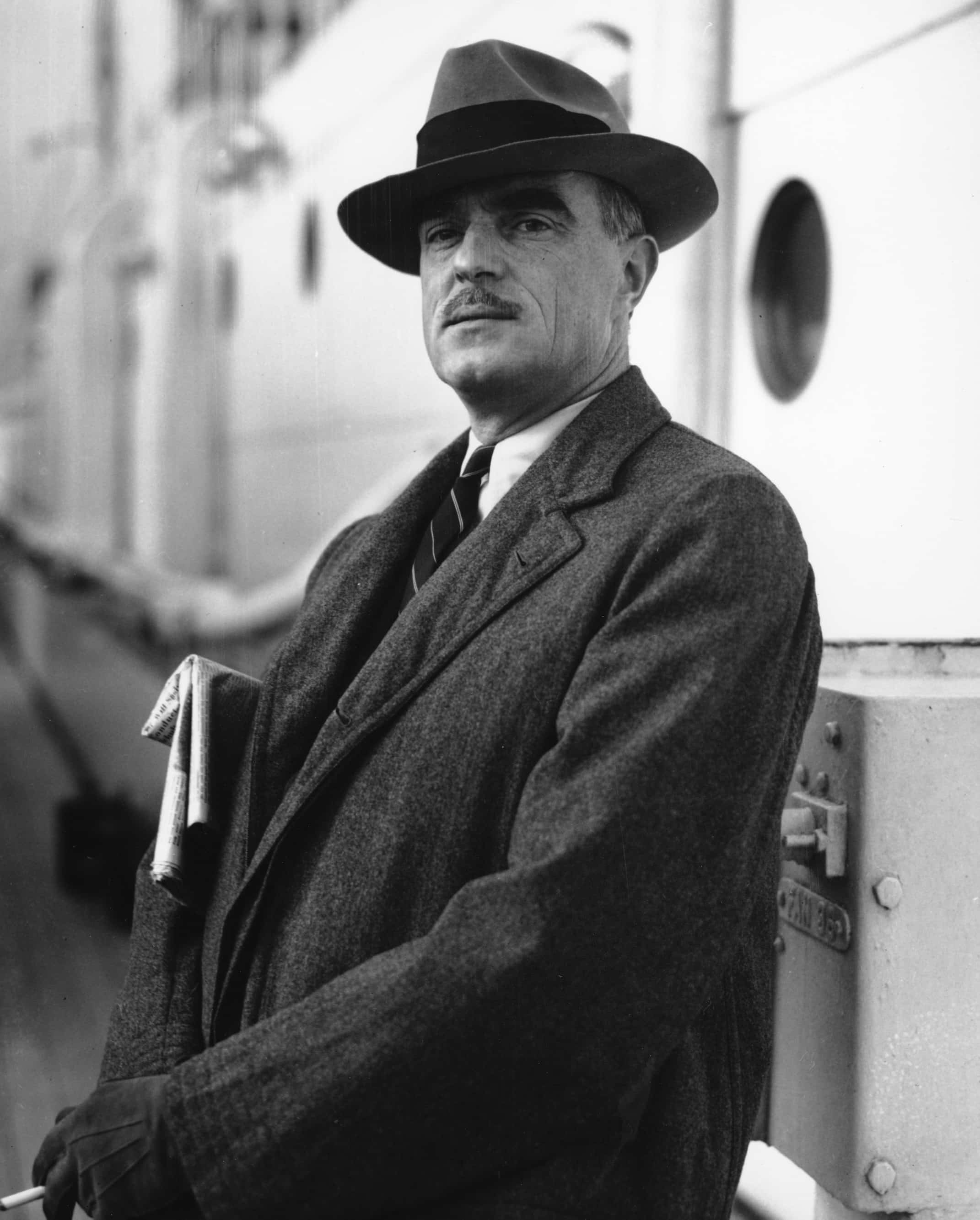
“Talk” also looked in on the writer Thornton Wilder, who was planning to summer in Europe with his friend, the literary-minded boxer Gene Tunney.

REFLECTING GLORY…Thornton Wilder returning to the U.S. on the S.S. Britannic, 1935. (thorntonwilder.com)

 *  *  *

More Truth in Advertising

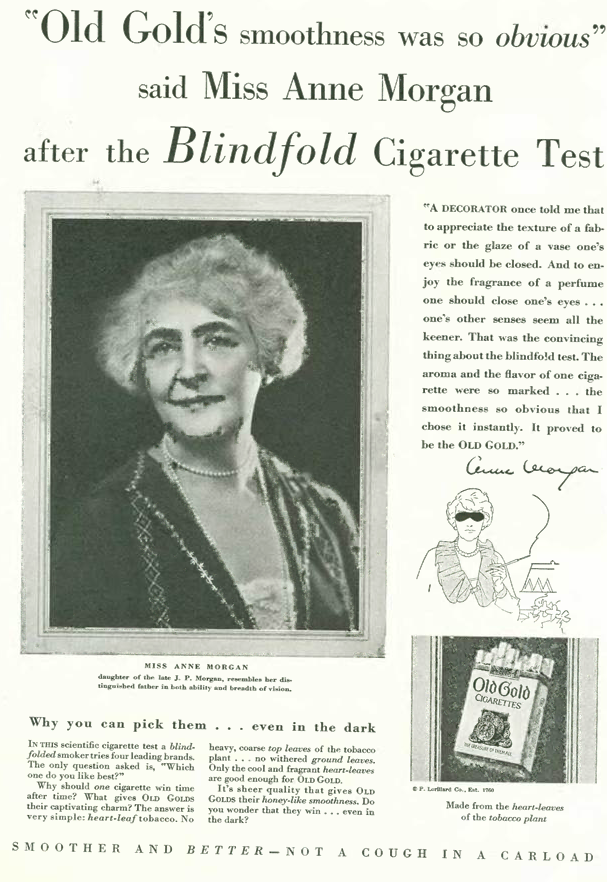
The manufacturers of Old Gold cigarettes were also in pursuit of the truth in this ad featured in the May 26 issue, backing up the claim with a “blindfold test” on none other than the daughter of J. P. Morgan…

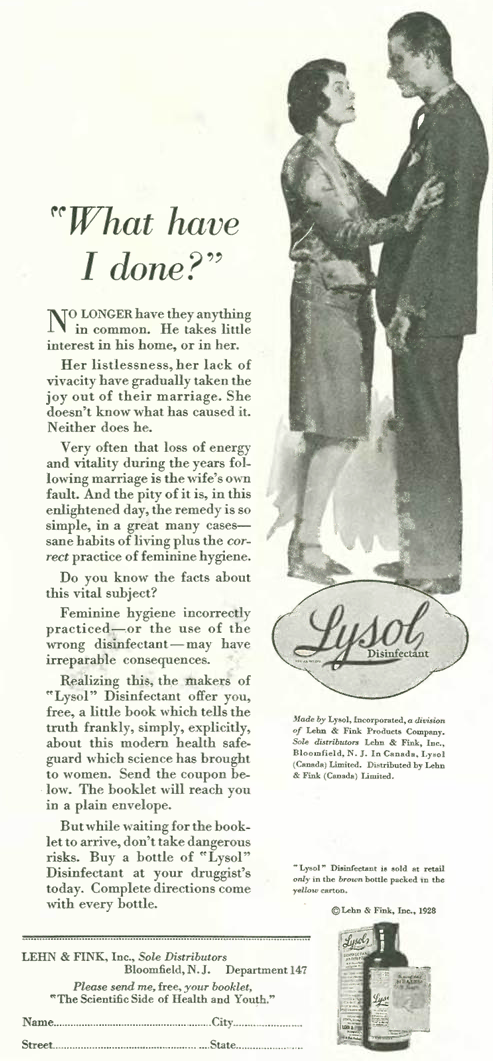
Deception in advertising wasn’t limited to cigarettes, however. The makers of Lysol had their own nefarious scheme that shamed women into using their product as a form of birth control (referred to in the ad below with the euphemism “feminine hygiene”). Not only was it ineffective as a contraceptive, it was also corrosive to one’s privates.

The ad is also appalling for casting the responsibility for birth control entirely on the woman. But then again, where are we today?

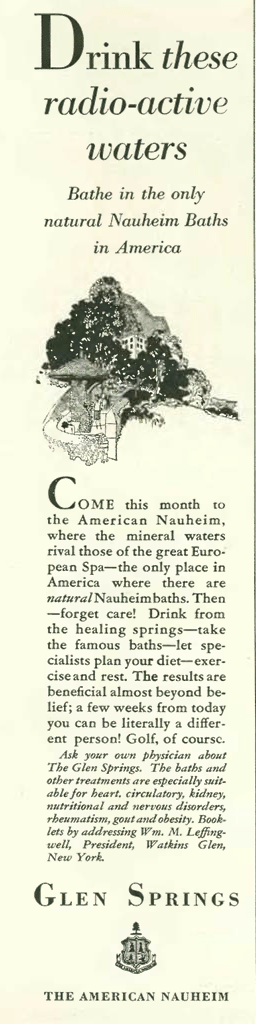
On to other questionable health pursuits, this ad in the May 26 issue touted the “radio-active waters” of Glen Springs, a hotel and sanatorium located above Seneca Lake in New York. Searching for oil on the site in late 19th century, the owners struck not black gold but rather a black, briny water that they claimed had greater curative powers than those found in Germany’s famed Nauheim Springs.

Why they called the waters “radio-active” escapes me. There were a lot of quack medical cures floating around in the 1920s—some of them quite dangerous—so I’m guessing that the proprietors of Glen Springs were adding radium to the water in some of their treatments, or maybe just claiming that radium was present in the water. Although Marie Curie (a pioneering researcher on radioactivity) and others protested against radiation therapies, a number of corporations and physicians marketed radioactive substances as miracle cure-alls, including radium enema treatments and radium-containing water tonics.
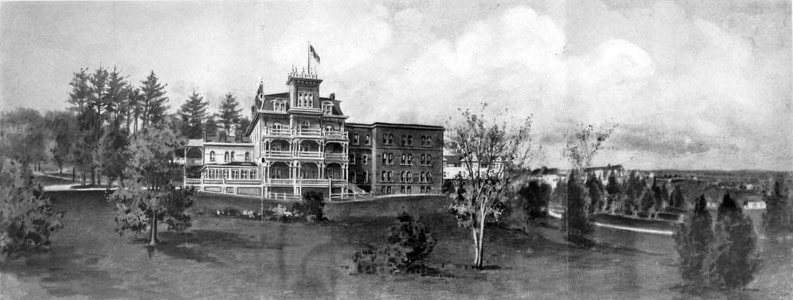
The Glen Springs Hotel at Watkins Glen, NY. It remained a noted landmark of the area until it was demolished in 1996. (nyfalls.com)

 *  *  *

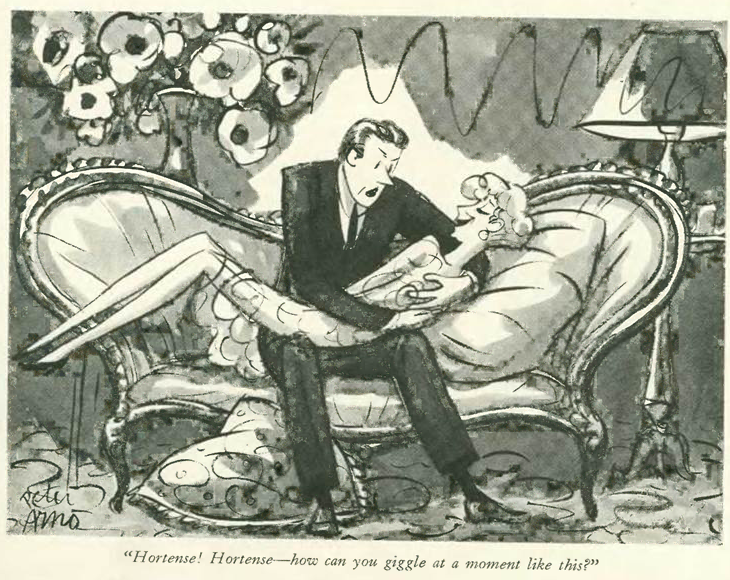
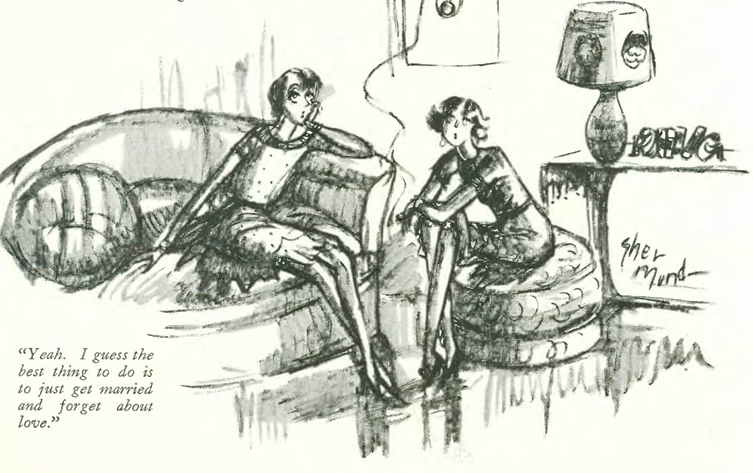
And finally, our cartoons for the May 26 issue, in which Barbara Shermund and Peter Arno explore the ups and downs of courtship…

Next Time: Toward the Air…


Tarnished Tinseltown

Screen Shot 2016-01-14 at 9.54.46 AM
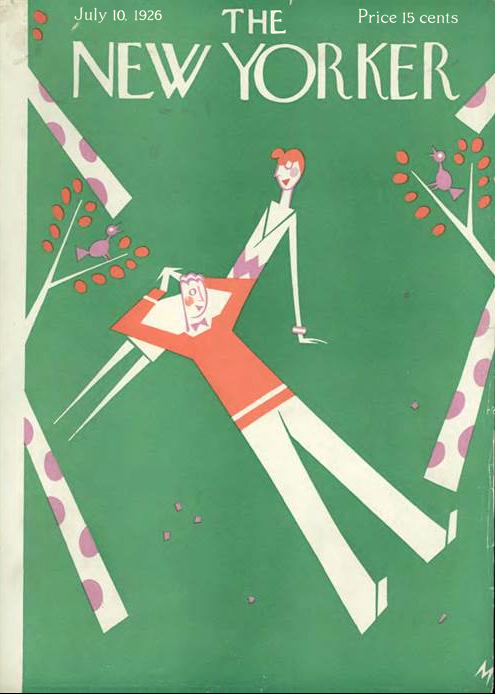
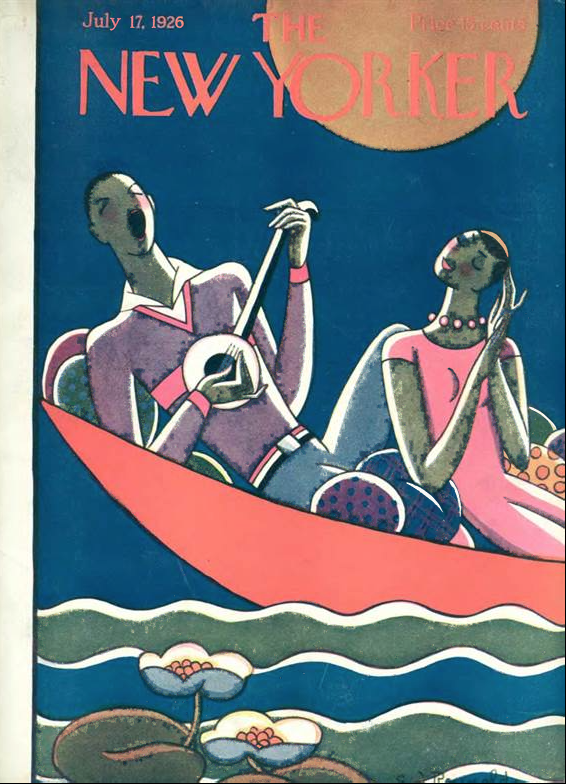
July 10, 1926 cover by Julian de Miskey.

Although there are some good indie and foreign films being made these days, not to mention some decent stuff on cable and streaming services, we still have plenty of bland popcorn fare coming out of Hollywood that combines the worst of unscrupulous producers and their fawning writers and directors.

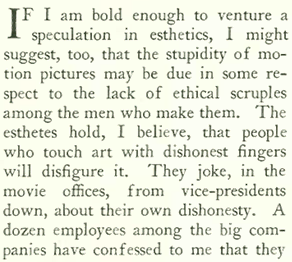
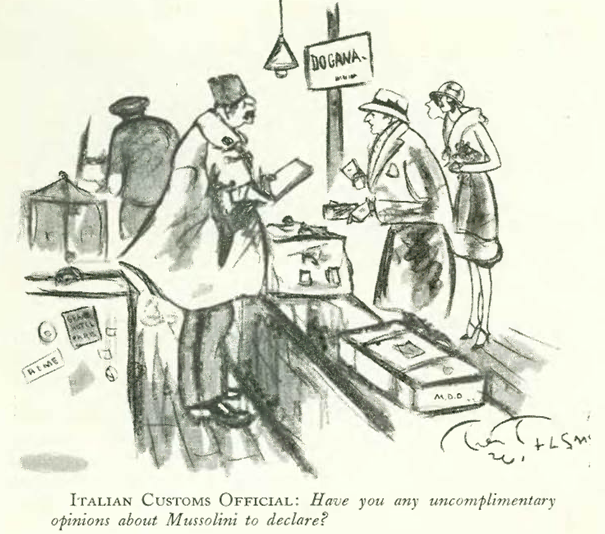
That’s how The New Yorker viewed Hollywood 90 years ago. Movie critic Theodore Shane weekly voiced his disappointment over American cinematic fare (while generally praising the work of European, and particularly German directors), and writer Morris Markey took the industry to task in the July 10, 1926 edition of the magazine, finding the whole lot of Hollywood to be a cesspool of mediocrity and dishonesty. It also didn’t help that Will H. Hays, president of the Motion Picture Producers, was trying to enforce his morality code on the motion picture industry:

Screen Shot 2016-01-15 at 3.55.27 PM

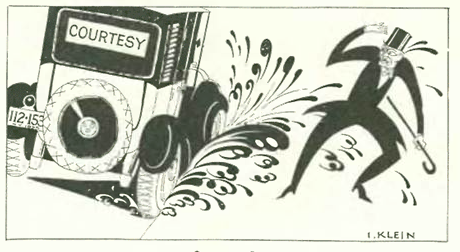
Here’s the full illustration by Isadore Klein that was cut off above, because it’s worth a look:

Screen Shot 2016-01-15 at 3.38.49 PM

Later in the article Markey laid into the men in charge of the studios:

Screen Shot 2016-01-15 at 3.59.02 PM

Screen Shot 2016-01-15 at 3.59.10 PM

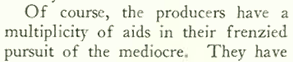
Markey also leveled scorn at the media, and gullible audiences, for supporting this tawdry spectacle:

Screen Shot 2016-01-15 at 4.03.43 PM

Screen Shot 2016-01-15 at 4.03.54 PM

Screen Shot 2016-01-15 at 4.28.38 PM
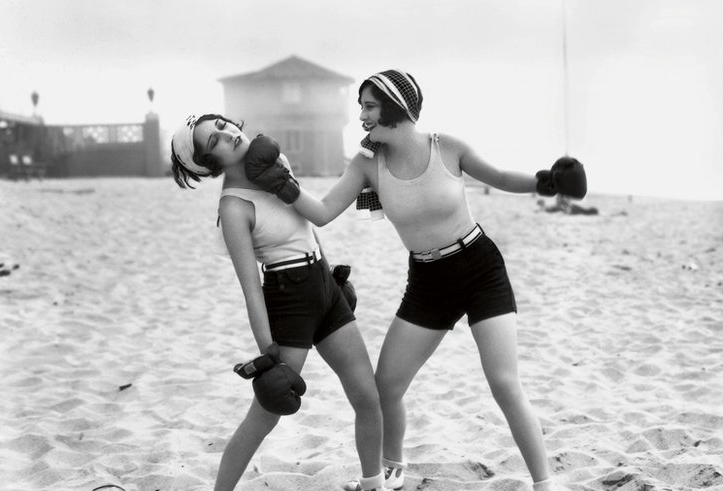
Publicity still of Hollywood starlets Dorothy Sebastian (left) and Joan Crawford (on a Santa Monica beach) most likely used to promote the 1928 film Our Dancing Daughters. (BBC)

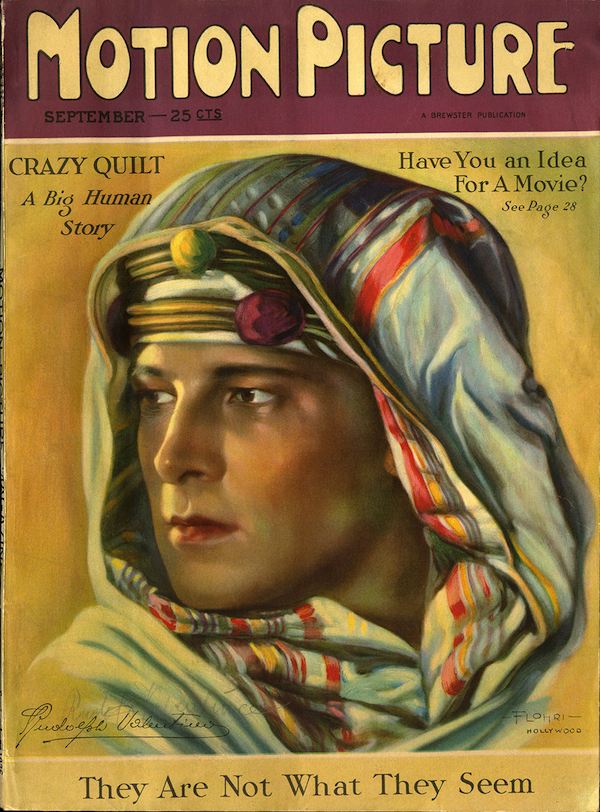
Motion Picture magazine and others of this ilk were the US magazines of the 1920s:

Valentino_Flohri-scan
Rudolph Valentino on the cover of the September 1926 issue of Motion Picture magazine. (archive.org)

And finally, a couple of bits for my “They Didn’t Know What Was Coming” department. Generally people were having too good of a time in the Roaring Twenties to take this fascism thing very seriously. From the section “Of All Things:”

Screen Shot 2016-01-14 at 10.02.38 AM

And from “The  Talk of the Town” section, a cartoon by W.P. Trent:

Screen Shot 2016-01-14 at 9.57.47 AM

Next Time: The Good Old Summertime…

Screen Shot 2016-01-15 at 4.05.58 PM


After a Fashion

Screen Shot 2015-12-18 at 12.12.38 PM
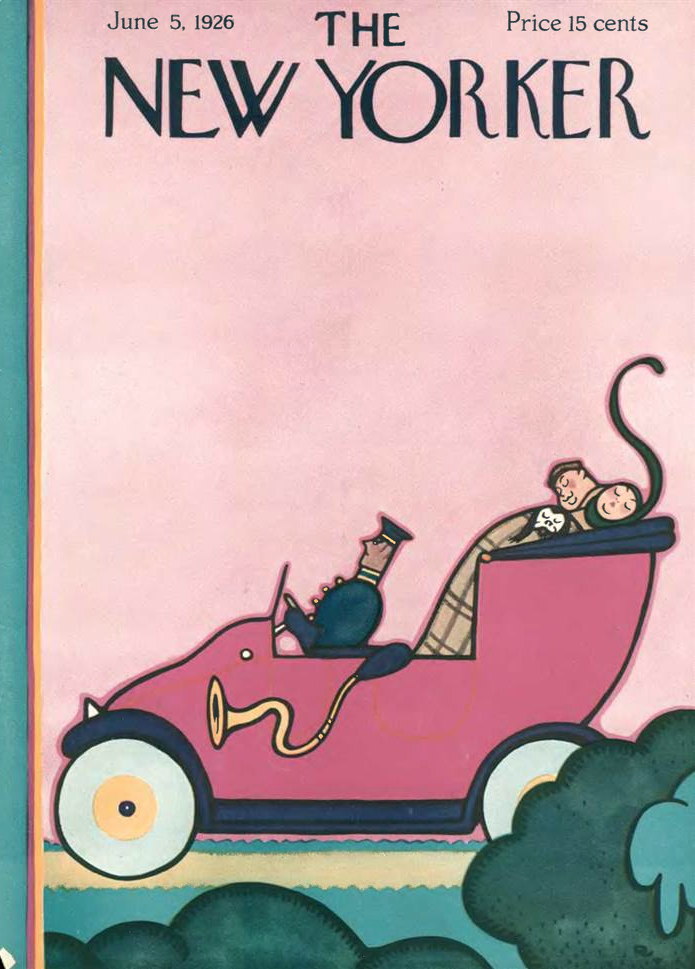
June 5, 1926 cover by Rea Irvin.

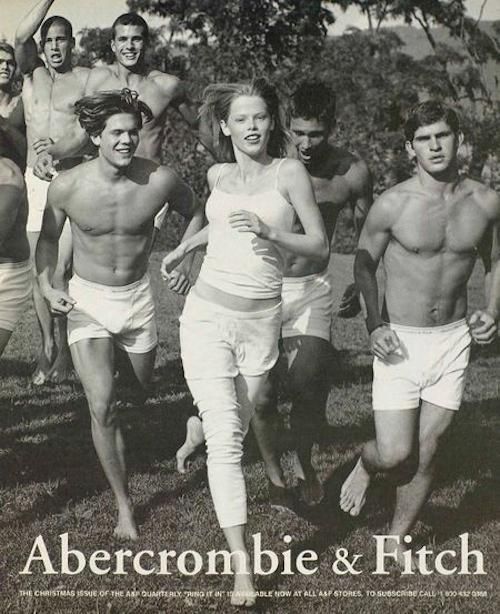
Fashion advertising in the early New Yorker can tell you a lot about the mood of the city’s smart set. As I’ve observed before, the magazine’s advertisements were rife with Anglo- and Francophile messaging, but they also reveal much about our changing times. A good example is the upscale retailer Abercrombie & Fitch, which these days uses the tagline “Authentic American clothing since 1892.”

In its early days, A&F was known as an elite outfitter of sporting and excursion goods, supplying aspiring country squires with expensive shotguns, fishing rods and the clothing and kit necessary for successful and stylish expeditions beyond the drawing room:

Screen Shot 2015-12-18 at 1.05.54 PM
“Sporting goods” meant something a bit different in 1926.

The company went bankrupt in 1976 and operated through mail order until 1988, when the The Limited clothing chain bought the name and operation and turned the focus to the young adult market:

2b1c597b0a5b09ca7477ead9ec5e2e64
Cover for A&F Fall/Winter 1998, photo by Bruce Weber. (Image Amplified)

Over the past couple of decades there’s been a lot of criticism regarding the abundance of A&L ads featuring shirtless, white men and the corresponding dearth of minority models. The newer ads feature a lot less skin and a sprinkling of minorities, but the product line is still a far cry from the one offered in 1926. Except for the elitist part.

As for other purveyors of fine fashion in the pages of The New Yorker, B. Altman made this stylish pitch for its line of bathing suits:

Screen Shot 2015-12-18 at 4.40.10 PM

And here’s an advertisement for Croydon Cravats, featuring the ubiquitous Father’s Day necktie:

Screen Shot 2015-12-18 at 4.48.08 PM

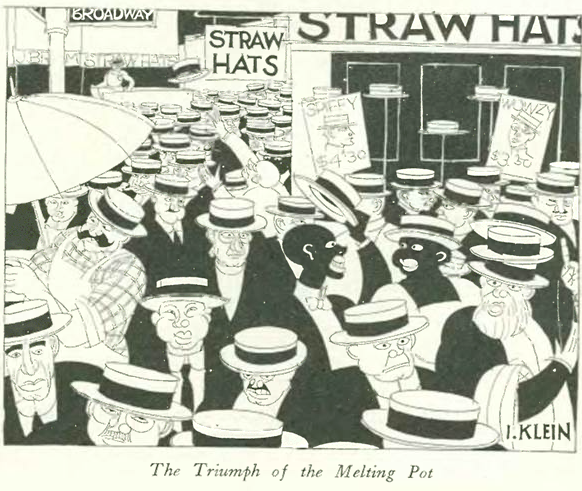
As for fashion in the comics, this drawing by Isadore Klein found humor in the multicultural appeal of the summer straw hat:

Screen Shot 2015-12-18 at 4.43.28 PM

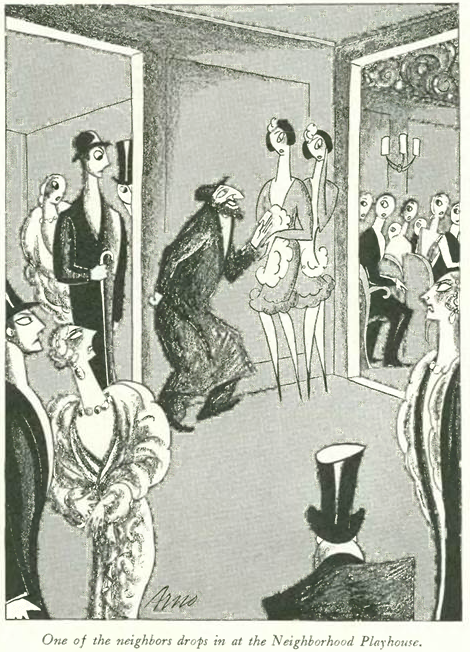
African Americans in the early New Yorker were nearly always depicted in minstrel-style blackface, and Jewish immigrants (such as the one Klein depicted at right) rarely lacked the Orthodox beard. Such is the case in this Peter Arno illustration where cultures clash rather than mix:

Screen Shot 2015-12-18 at 4.42.20 PM

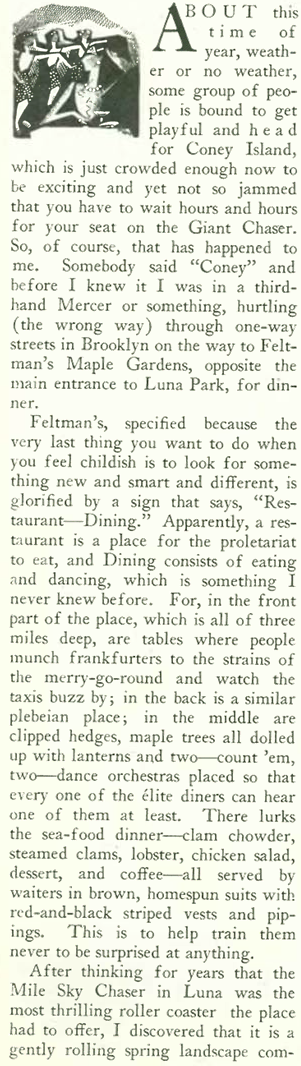
And let’s check in with the New Yorker’s fashion critic (and Arno’s soon-to-be wife) Lois Long, who slummed with the Proles at Coney Island:

Screen Shot 2015-12-18 at 4.45.44 PM

tumblr_lsv5w1uJwH1qgfx0uo1_500
CONEY CRONIES…(l to r) Silent film star Charlie Chaplin, Vanity Fair editor Frank Crowninshield, sculptor Helen Sardeau, Lois Long and screenwriter Harry D’Arrast pose in a Coney Island photo booth, 1925. Photo scanned from the book Flapper by Joshua Zeitz.

Finally, given the terrible circumstances in the Middle East and especially Syria, this small item in “Of All Things” is both timely and prescient:

Screen Shot 2015-12-18 at 4.43.07 PM

Next Time: Taxi Dancers…
Screen Shot 2015-12-18 at 4.38.53 PM