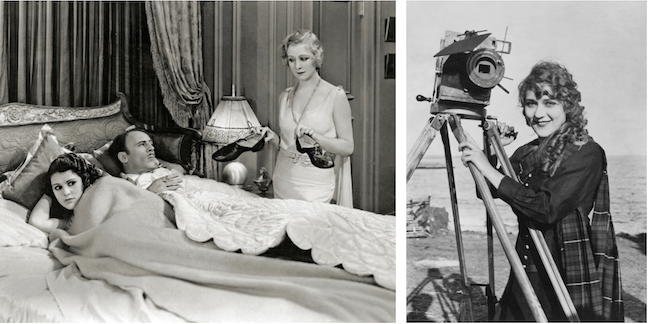
Above: Mary Pickford (right, from 1916) spoke out against salacious content in films, such as this scene from 1930's Madam Satan. (Wikipedia/mainemedia.edu)
James Thurber seemed to enjoy teasing silent film legend Mary Pickford in her new career as social commentator and author of spiritual articles and books. Having retired from acting in 1933, Pickford was also using her powerful position as a co-founder of United Artists to focus on the moral direction of the film industry.
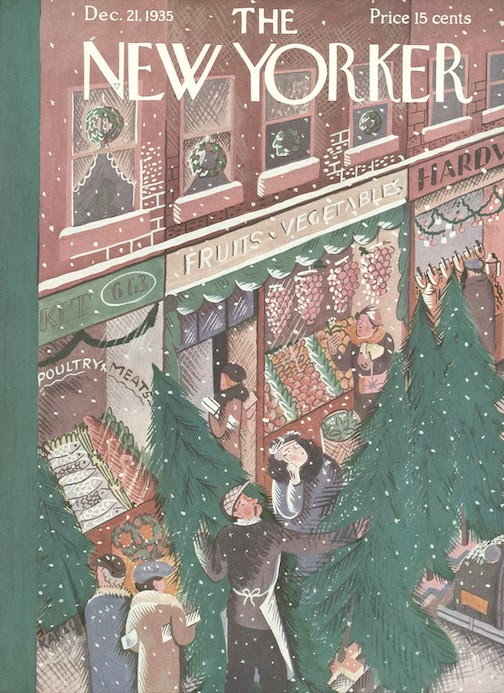
December 21, 1935 cover by Ilonka Karasz.
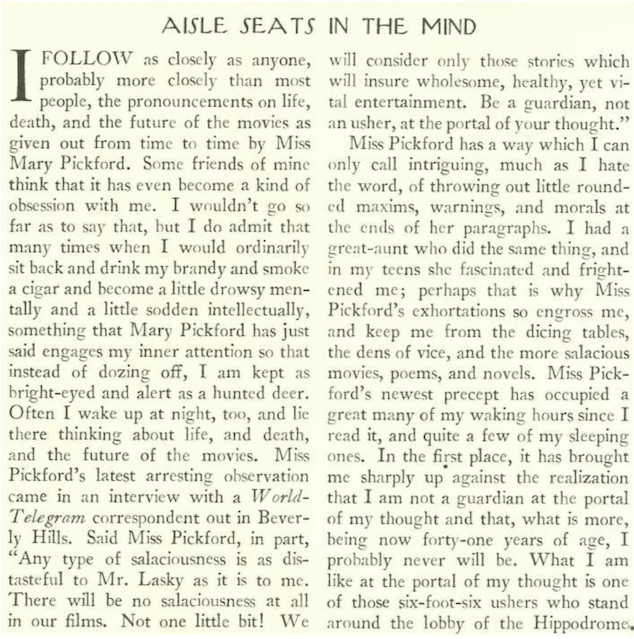
Back in the Sept. 21 issue of The New Yorker, Thurber took a humorous poke at Pickford’s Liberty magazine article on the afterlife, and found more fodder after Pickford, in an interview with the World-Telegram, criticized “salacious” films. “Be a guardian, not an usher, at the portal of your thought,” she advised. Thurber took the bait. Excerpts:
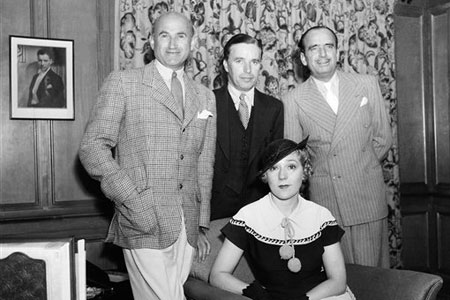
KEEPING IT CLEAN…From left, producer Samuel Goldwyn, actors Charlie Chaplin and Douglas Fairbanks Sr. pose behind Mary Pickford at a United Artists board meeting in Los Angeles, July 9, 1935. (AP)
Thurber took particular pleasure in Pickford’s comments regarding the control of one’s dirty thoughts:
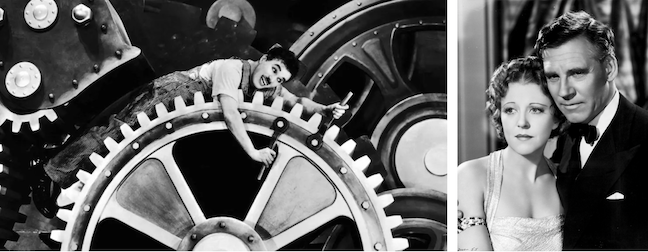
PICKFORD’S UNITED ARTISTS produced some memorable, non-salacious films in 1936, including Charlie Chaplin’sModern Times, and the acclaimed Dodsworth starring Ruth Chatterton and Walter Huston as Fran and Sam Dodsworth. (Wikipedia)
Pickford had a strong ally in the Hays Code, a set of self-imposed censorship guidelines that would keep mainstream studio films relatively free of salacious content for the next thirty years.
* * *
A White Christmas
E.B. White offered holiday greetings to everyone from drinkers of blended whiskey to the makers of red tape (plus a plug for New Yorker subscriptions)…
CHEERS AND JEERS…E.B. White sent holiday greetings to the men who were changing the Normandie’s massive propellers (from three- to four-blade), and probably wanted to give a lump of coal to Mayor Fiorello La Guardia for “foolishly” banning organ grinders from city streets. (ships nostalgia.com/ephemeralnewyork)
…and concluded with these words…
…Otto Soglow added this bit of spot art to the bottom of White’s “Notes and Comment”…
* * *
A Holiday Tradition
Page 21 featured Frank Sullivan’s annual Christmas poem (he wrote forty-two of them from 1932 to 1974)…
…which continued on page 22…
* * *
Lost In Paradise
Robert Benchley did the honors as theatre critic for the Dec. 21 issue, enjoying an evening at Longacre Theatre with the richly endowed characters featured in Clifford Odets’Paradise Lost.
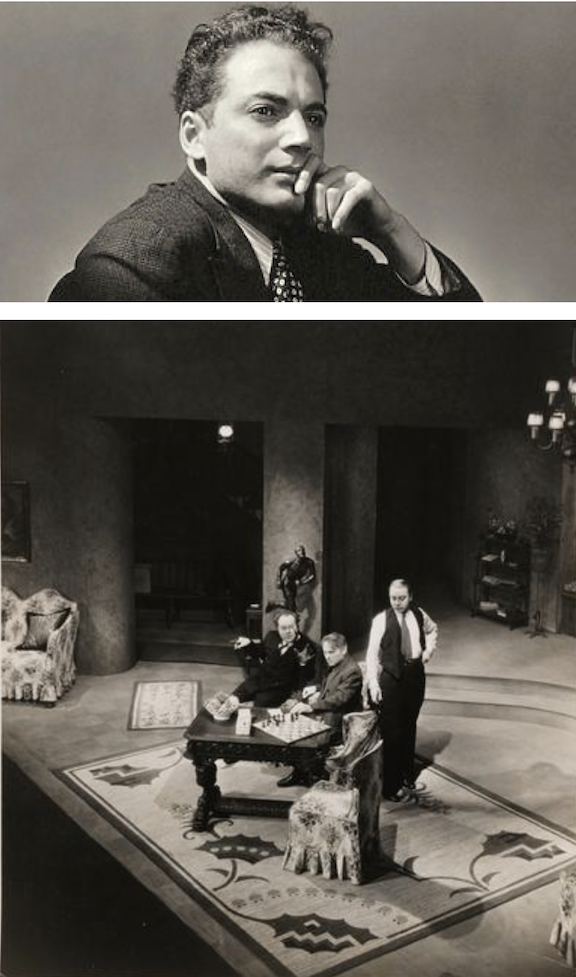
GREAT PLAY, WHATEVER IT MEANS…Robert Benchley thoroughly enjoyed Clifford Odets’ gallery of characters in Paradise Lost. Top, Odets circa 1930s; below, photo from the 1935-36 production at Broadway’s Longacre Theatre. (mcny.org)
Apparently the rest of the Broadway fare was not so great, as Benchley fled Cort’s Theatre (it featured This Our House, which closed after just two performances) to catch A Night at the Opera with the Marx Brothers.
* * *
At the Movies
Benchley wasn’t the only one enjoying a night at the movies. Critic John Mosher found favor with German actor Emil Jannings’ latest flick, The Making of a King (Der alte und der junge König), calling the film “a sensible picture of the old bully,” namely the father of Frederick the Great.
LIGHTEN UP, FRED…Heinrich Marlow (left) and Emil Jannings in a scene from The Making of a King. The film depicted the turbulent relationship between Prussian King Friedrich Wilhelm I and his son, Crown Prince Friedrich. (IMDB)
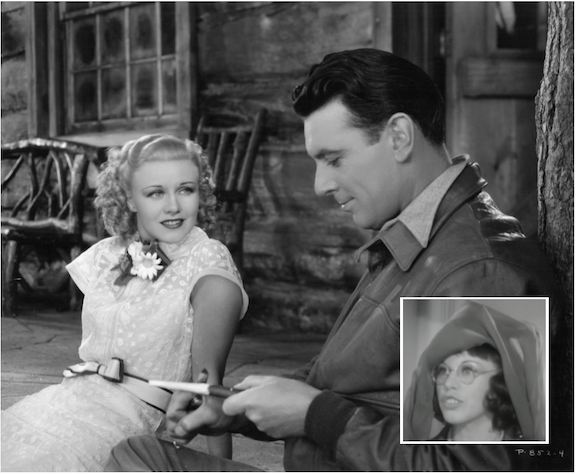
Mosher found bright moments in Ginger Rogers’ latest film, but would have preferred another pairing with her fellow hoofer, Fred Astaire.
BETTER WITH FRED thought John Mosher of Ginger Rogers’s brave turn as an actress fleeing from her admiring fans in 1935’s In Person. Rogers donned eyeglasses, a wig, and fake teeth (inset) to portray the actress in hiding. She is pictured here in a scene with co-star George Brent. (IMDB)
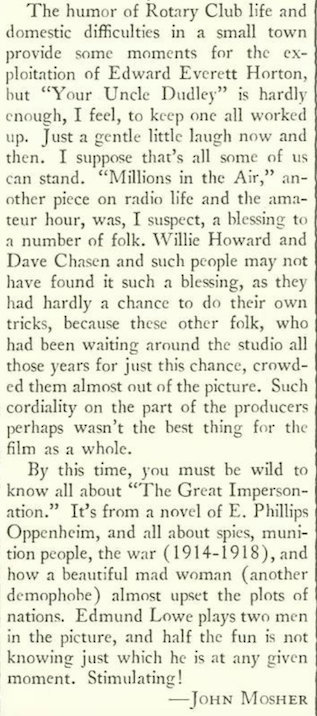
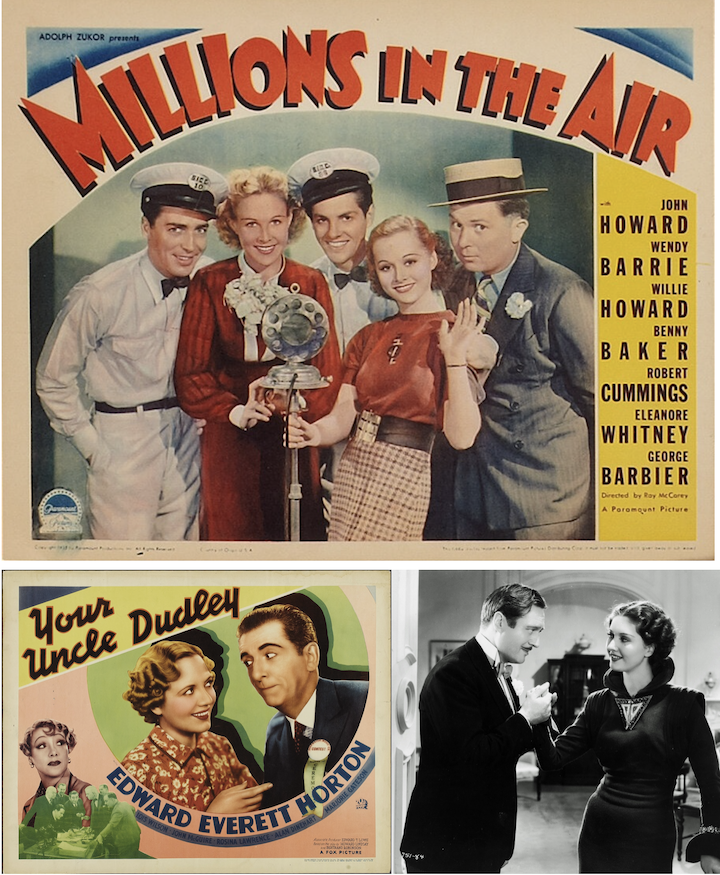
Mosher was stimulated by The Great Impersonation, however, the “cordial” films about small town life and happy radio folk left him less than enthused.
MORE SPIES, PLEASE…John Mosher didn’t get too excited over the standard fare offered in the films Millions in the Air and Your Uncle Dudley, however he found the performances of Edmund Lowe and Wera Engels (bottom right) in the spy caper The Great Impersonation to be most stimulating. (IMDB)
* * *
From Our Advertisers
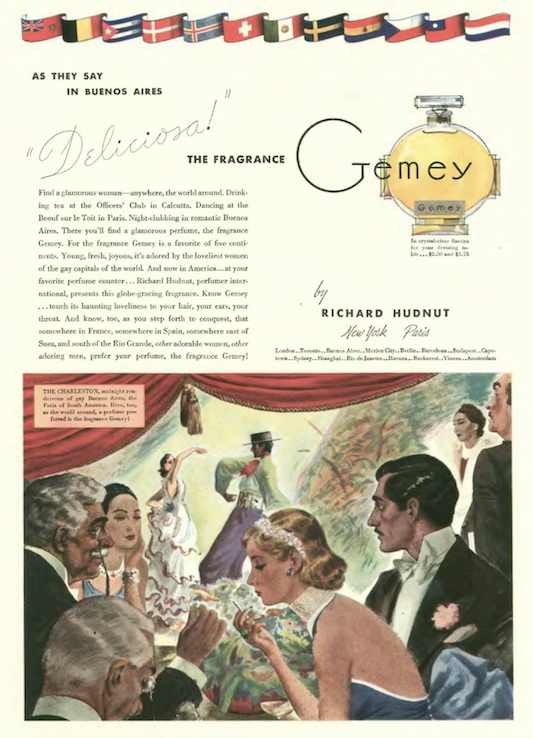
After touring France in the late 1870s, a New York drugstore owner named Richard Hudnut returned to the States determined to introduce French-style perfumes and cosmetics to American women. He soon transformed his drugstore into an elegant showroom, and in time became the first American to achieve international success in cosmetics…
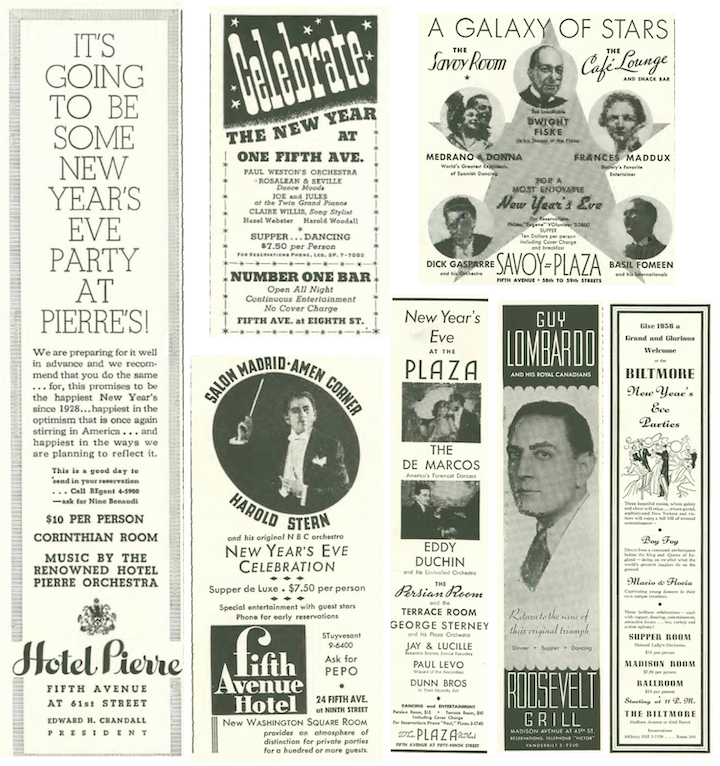
…advertisements for Christmas gifts mostly dropped out of the magazine, and the back of the book was filled with spots touting various New Year’s Eve entertainments…
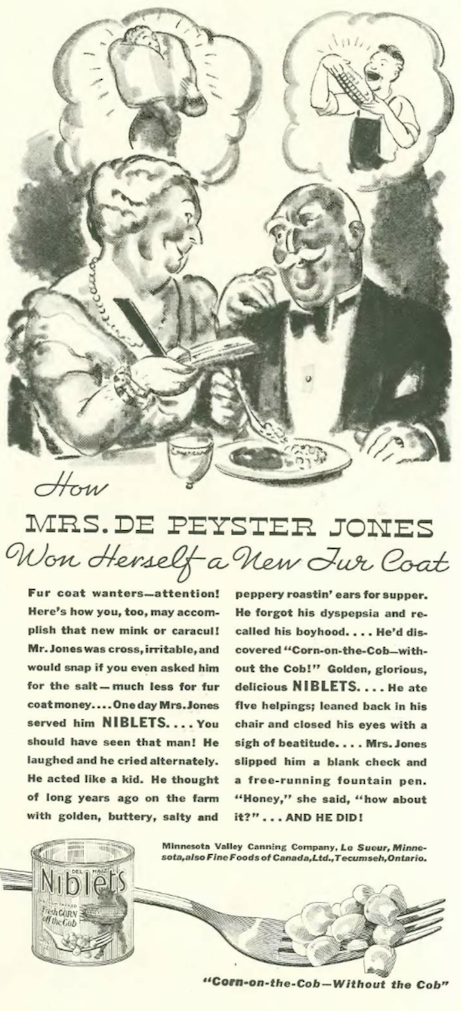
…in this ad from the Minnesota Valley Canning Company (renamed Green Giant in 1950), a robber baron’s humble roots, and his checkbook, are triggered by a can of corn…
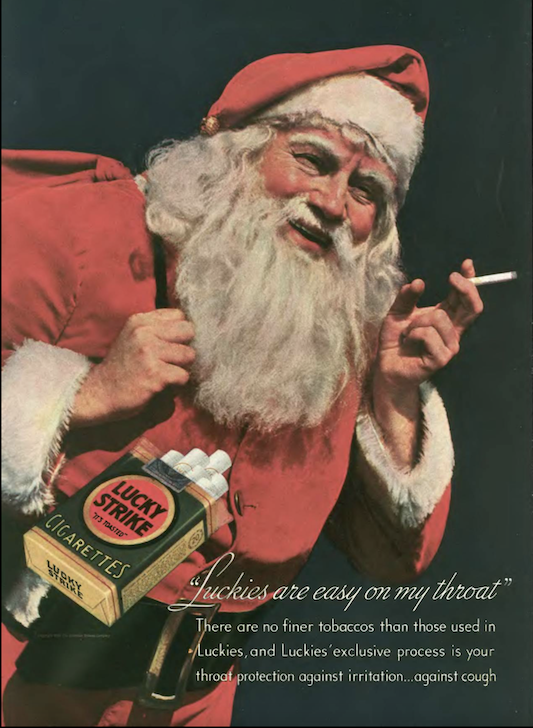
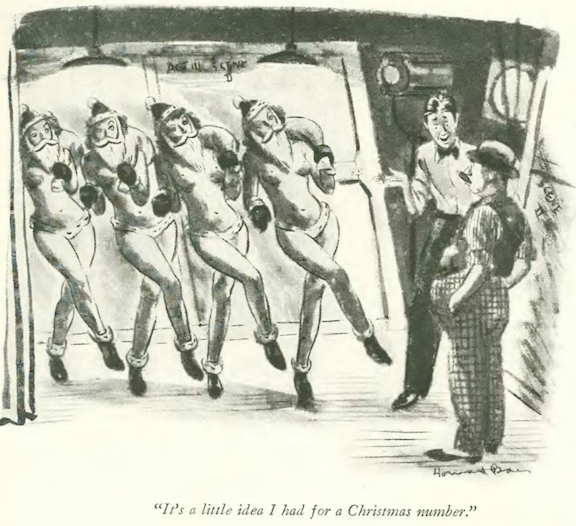
…thanks to the makers of Luckies, Jolly Old St. Nick was dropping more than soot down your chimney on Christmas Eve…
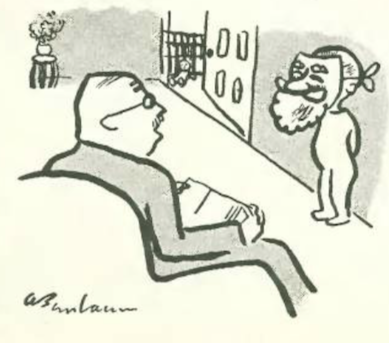
…we kick off our cartoons with this spot illustration by Abe Birnbaum…
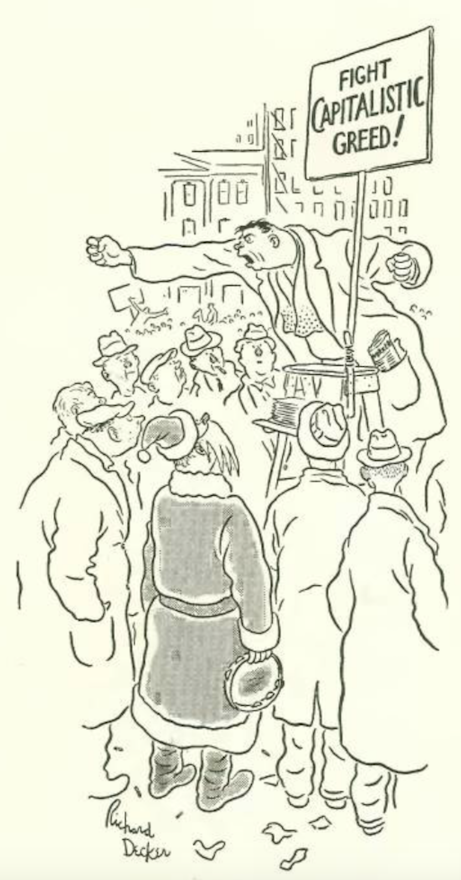
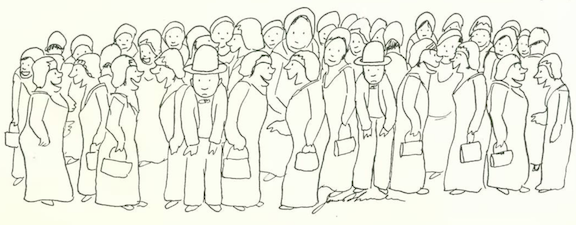
...Richard Decker gave us this caption-less appeal to the masses…
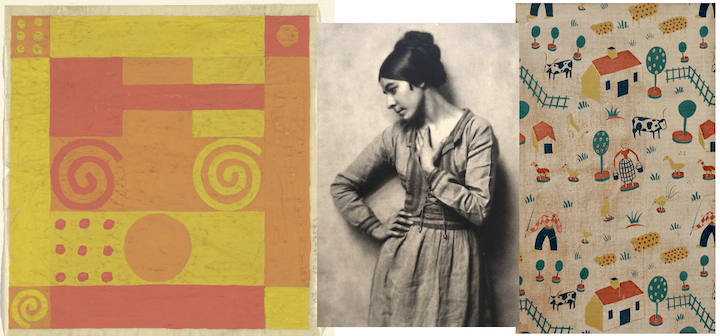
Above: Ilonka Karasz designed six children's rooms for a holiday display at Saks Fifth Avenue, featuring colorful rugs (left) and nursery screens (detail at right) among other items. In a House and Garden article, Karasz wrote: "Through new theories of design, production and distribution, [these rooms] have more vision than the manufacturer who still insists upon Little Bo-Peep." (MoMA.org/1stdibs.com)
In the Days of Yore, Christmas celebrations were largely adult- or family-centered affairs, that is until the Industrial Age enabled the mass production of toys and other goodies. Beginning in the 1870s, Macy’s began offering impressive toy displays, and even children in the hinterlands could get in on the action with a Sears catalog, the company raising its game in 1933 with the introduction its Wish Book.
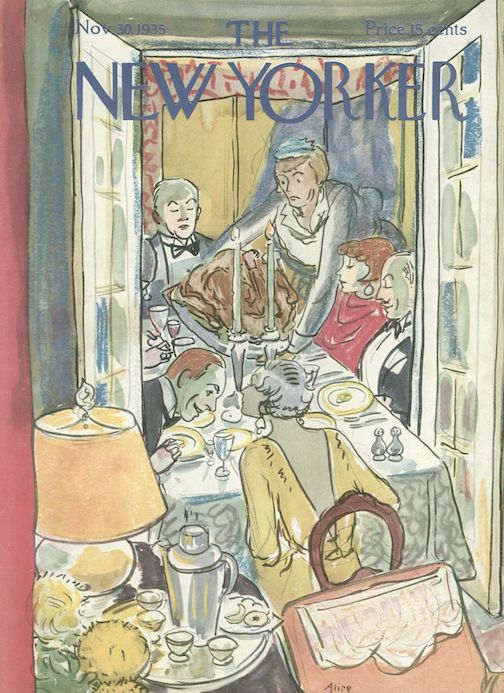
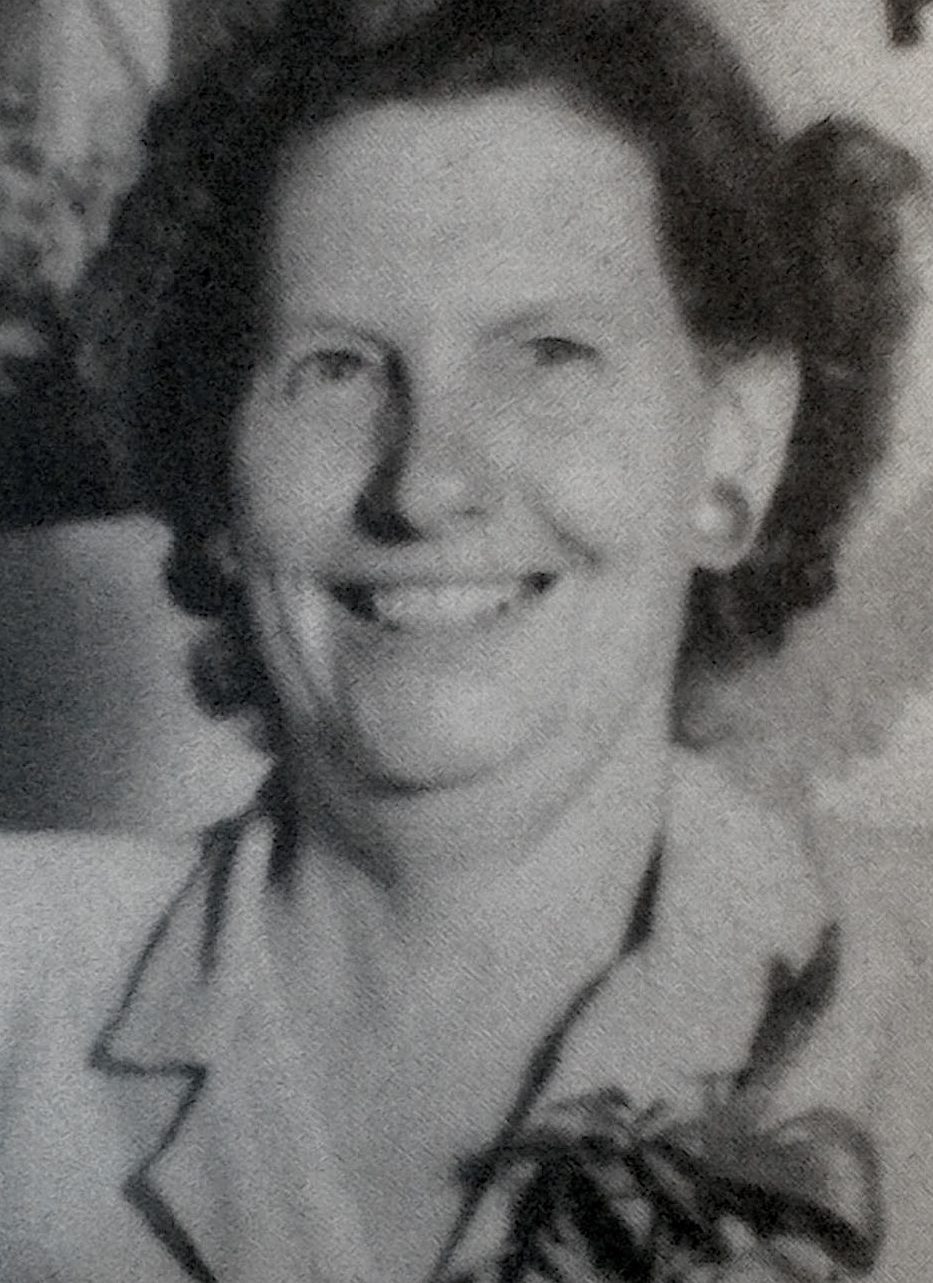
November 30, 1935 cover by Alice Harvey. From 1925 to 1943, Harvey (1894–1983) contributed three covers and more than 160 drawings to The New Yorker. I highly recommend Liza Donnelly’s Very Funny Ladiesfor more about Harvey and other women cartoonists.Alice Harvey came to New York from Chicago with her friend Helen Hokinson in the early 1920s, finding early success submitting to Life, Judge and other publications before she and Hokinson joined the fledgling New Yorker in 1925. (Photo from Michael Maslin’s essential Ink Spill).
*
The New Yorker was no exception when it came to toy shopping, featuring exhaustive lists of toys, games and other items for children available at the city’s major retailers.
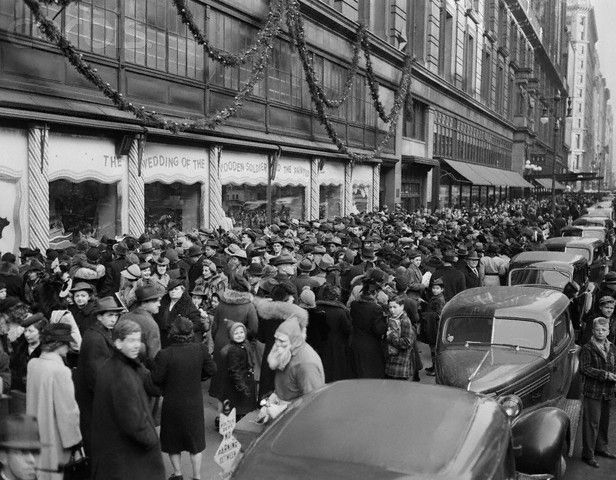
BEFORE ONLINE SHOPPING…A crowd of holiday shoppers outside New York’s Macy’s department store, 1939. (Vintage.es)
These lists were in the back of the book, following Lois Long’s “On and Off the Avenue” fashion column. Here are some excerpts:
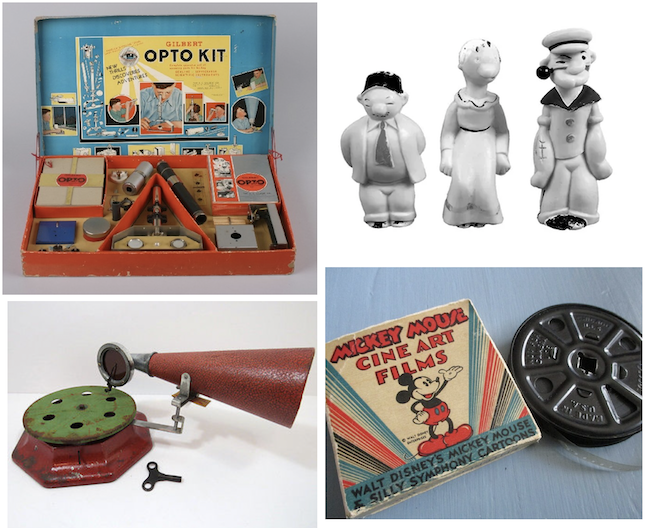
KEEP THE KIDDOS BUSY…Clockwise, from top left: Bloomingdale’s offered an Optics Set, while Macy’s featured Lester Gaba’s soap sculptures (including Popeye, Olive Oyl and Wimpy), 8mm Mickey Mouse and Silly Symphony cartoons, and “Jack & Jill” portable children’s record players. (scrappyland.com/acghs.org/etsy.com/worthpoint.com)
Of course it wouldn’t be Christmas in New York without F.A.O. Schwarz, and if you shopped at Saks you could be dazzled by children’s rooms designed by Ilonka Karasz.
GIFTS FOR THE MODERN KID…At F.A.O. Schwarz you could find Foxblox and Buck Rogers costumes, while Saks featured children’s rooms and furnishings designed by Ilonka Karasz, including a colorful nursery screen. (Pinterest/invaluable.com/worthpoint.com/cooperhewitt.org/reddit.com)
* * *
Pouting Plutocrat
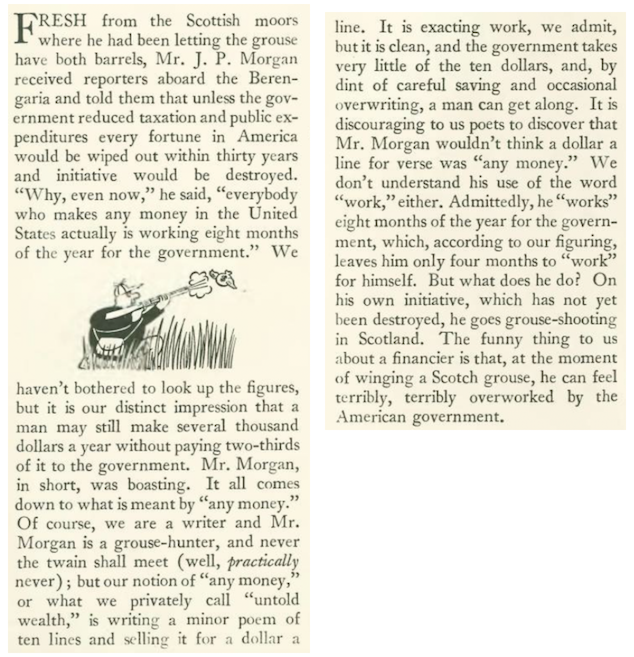
In his “Notes and Comment,” E.B. White took issue with J.P. Morgan’s gripes about taxation while grouse hunting in Scotland.
* * *
A City Resurrected
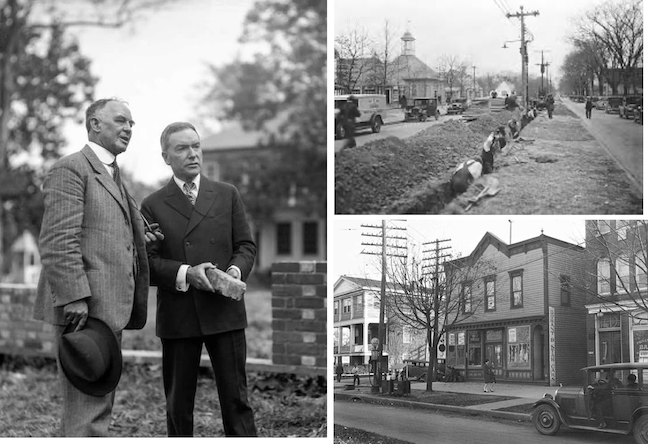
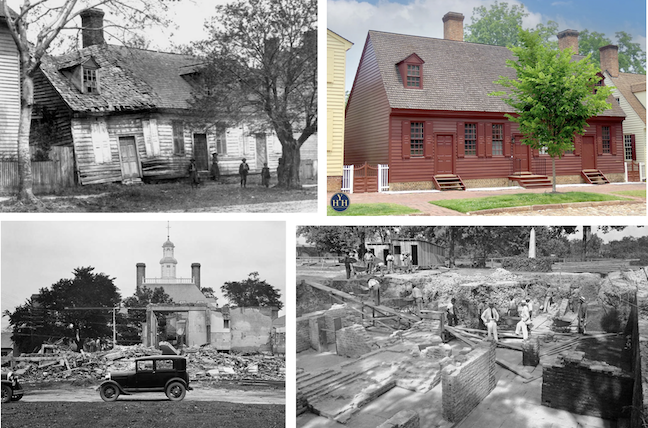
Founded in 1632, Williamsburg, Virginia played an important role in colonial and revolutionary America, but by the 20th century it had become a quiet and rather neglected little town. Then in 1924 the town’s rector, Rev. W.A.R. Goodwin—bolstered by the successful restoration of his parish church—approached oil tycoon John D. Rockefeller Jr. for funds to restore the entire colonial capital. As John Peale Bishop noted in these excerpts from “Onward & Upward With The Arts,” the project left some residents scratching their heads.
MY VISION, YOUR MONEY…The Rev. W.A.R. Goodwin (left), rector of Bruton Parish Church, shared his vision for Williamsburg with philanthropist John D. Rockefeller Jr; top photo, paved streets and modern utility lines were removed as part of the restoration, circa 1930; bottom photo, pre-restoration photo of Duke of Gloucester Street—all businesses located on Market Square, including these, were demolished during the restoration. (colonialwilliamsburg.org)RENEWED OR REMOVED…Clockwise, from top left, the 18th-century John Crump House was in a sad state in this 1895 photograph; the Crump House after its 1941-42 restoration; workers examine the old foundation walls of the Governor’s Palace; Williamsburg High School was demolished to make way for the Governor’s Palace reconstruction, seen in the background.(yourhistorichouse.com/colonialwilliamsburg.org)
* * *
At the Movies
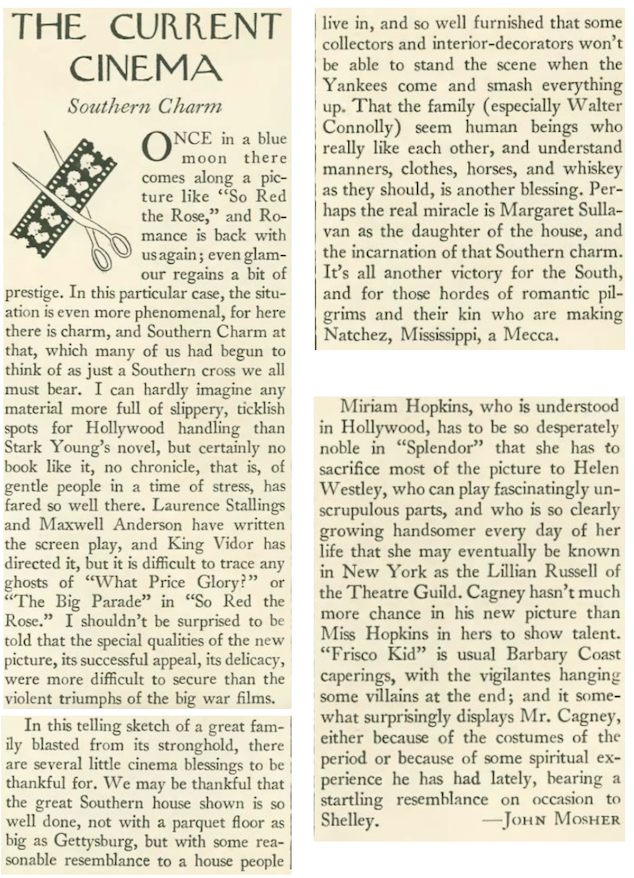
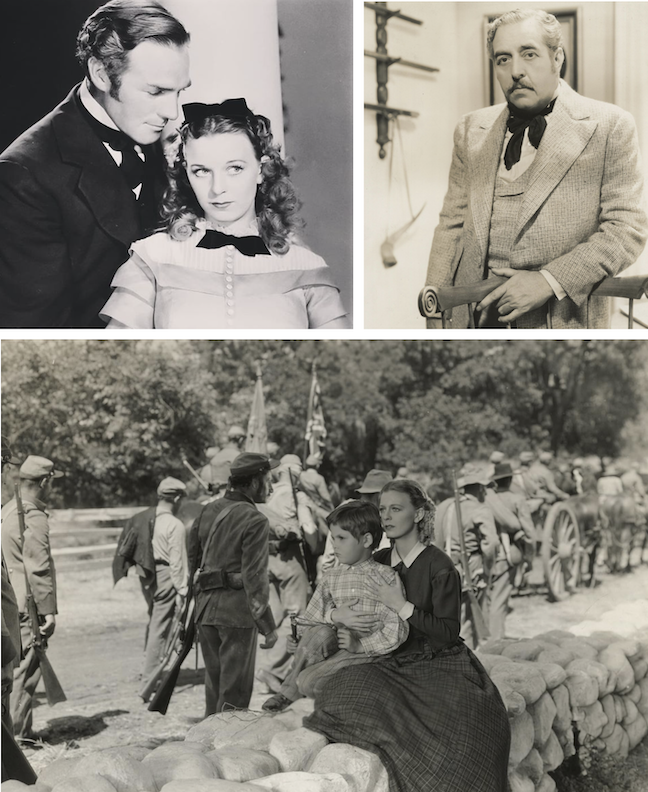
John Mosher had high praise for King Vidor’s Civil War romance, So Red the Rose. Although it did not have the epic sweep (or epic length) of 1939’s Gone With The Wind, Mosher and other critics praised the film’s human qualities. It did not, however, do well at the box office.
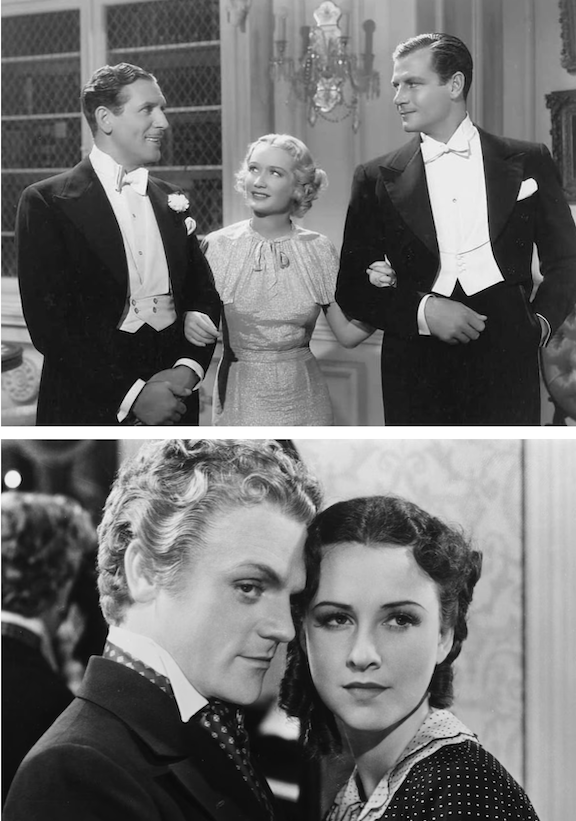
FRANKLY, MY DEAR…a line that would have to wait for another Civil War romance…clockwise, from top left: Randolph Scott and Margaret Sullavan play kissing cousins in So Red the Rose; Mosher singled out Walter Connolly for his performance as the family patriarch; child star Dickie Moore and Sullavan in a scene from the film. (IMDB/Letterboxd.com)HIDDEN TALENTS…In two other films, Mosher found the performances of the lead actors to either be upstaged or muffled in period costume. Top, Paul Cavanagh, Miriam Hopkins, and Joel McCrea in Splendor. Below, James Cagney and Margaret Lindsay in Frisco Kid. (IMDB/TCM)
* * *
From Our Advertisers
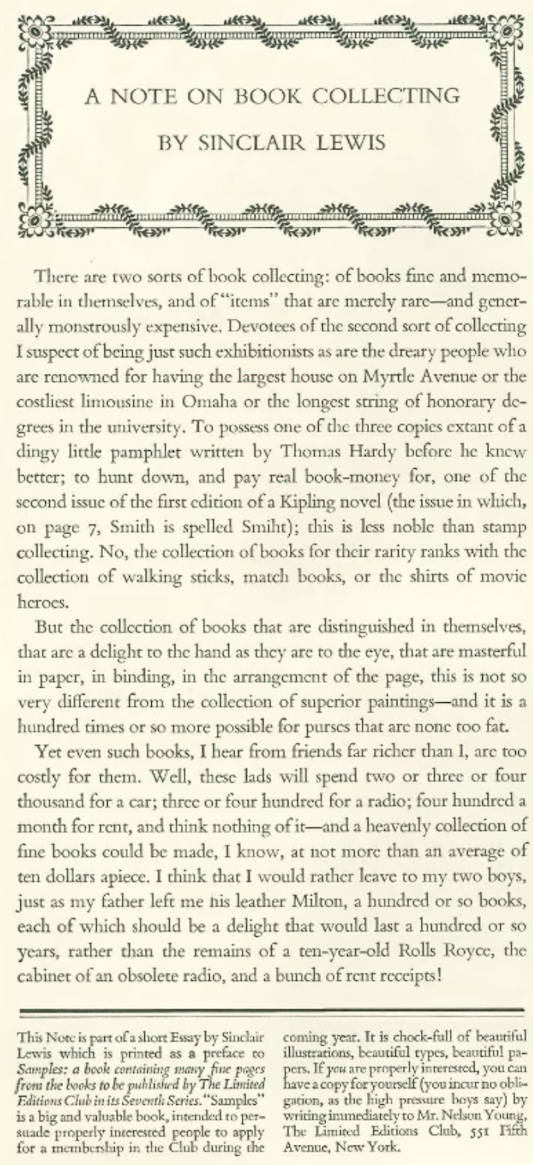
We start with this advertisement from The Limited Editions Club, founded in New York by George Macy in 1929. The 29-year-old Macy, determined to make his living from books, focused on publishing beautifully illustrated classic titles in limited quantities, available to subscription-paying members. Illustrators of the editions have included Pablo Picasso, Henri Matisse, Reginald Marsh, Norman Rockwell and many other noted artists. The ad below includes an excerpt from a Sinclair Lewis essay that extolled the virtues of investing in fine books.
Above, frontispiece from The Limited Editions Club’s 1930 publication of Thomas De Quincey’sConfessions of an English Opium-Eater, illustrated by Zhenya Gay. (librarything.com)
…as the holidays grew near the automobile ads grew more luxurious…this Cadillac spot featured an illustration of posh tots driven by their chauffeur…
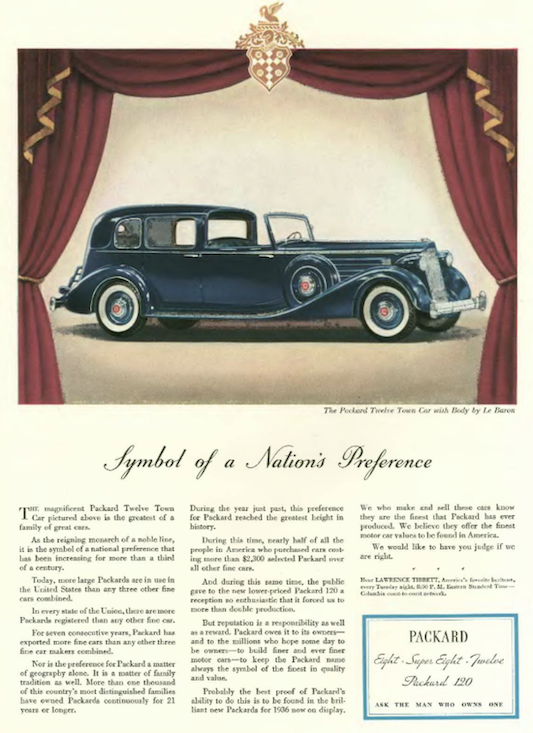
…and from Packard, an automobile designed with the assumption that you already had a liveried driver…
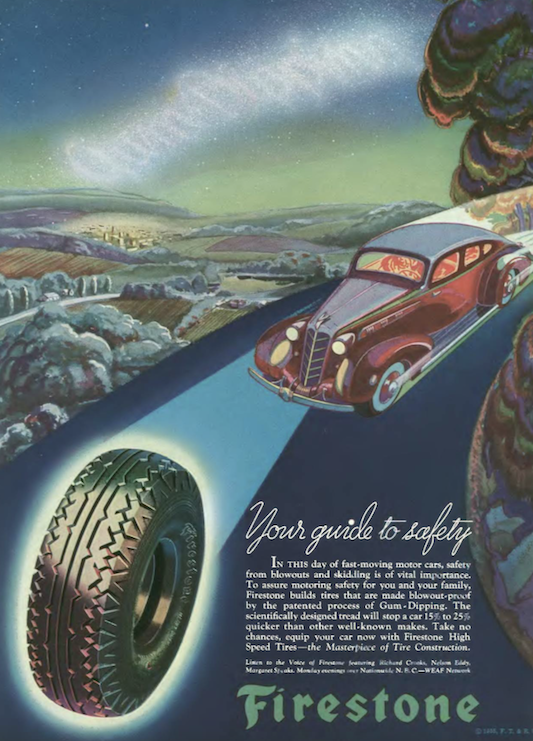
…colorful ads also came our way from Firestone…
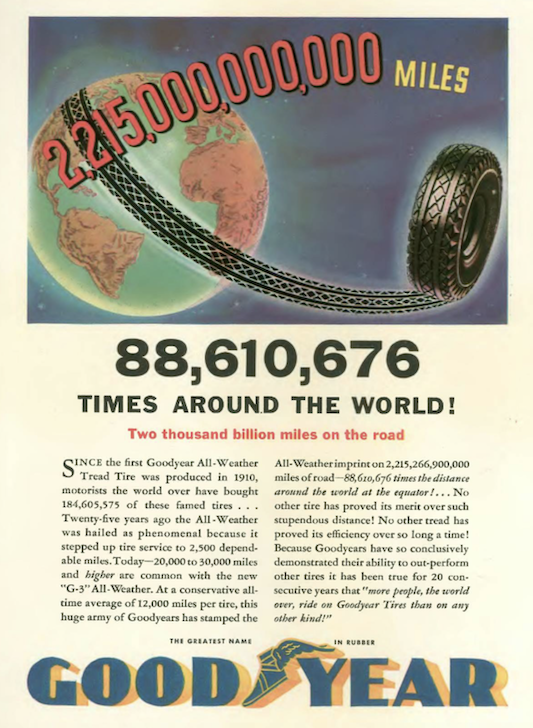
…and Goodyear…these two companies were the largest suppliers of automotive tires in North America for more than 75 years…
…World Peaceways continued their series of provocative anti-war advertisements…
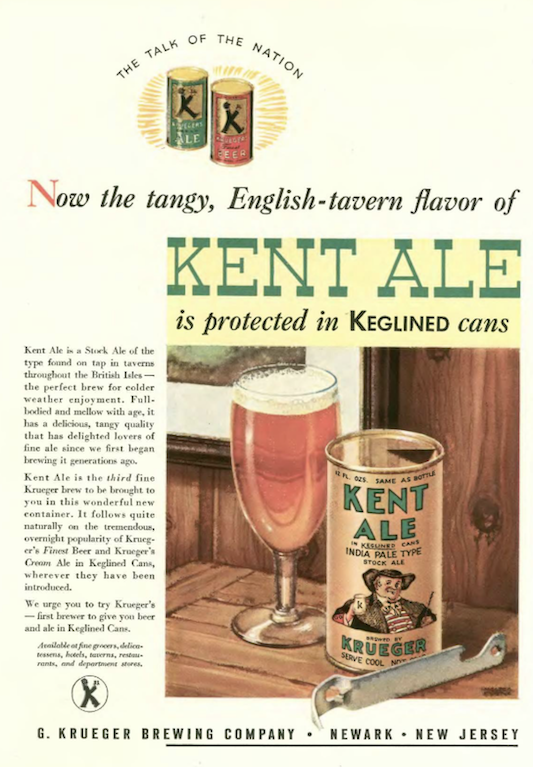
…Kent Ale was produced by Krueger Brewing Company, one of the first breweries to use cans that were coated with some substance referred to as “Keglined”…
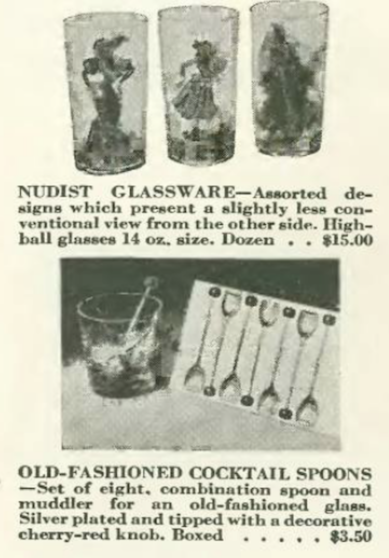
…a detail from an Abercrombie & Fitch advertisement, which suggested “Nudist Glassware” as a unique gift idea for the holidays…
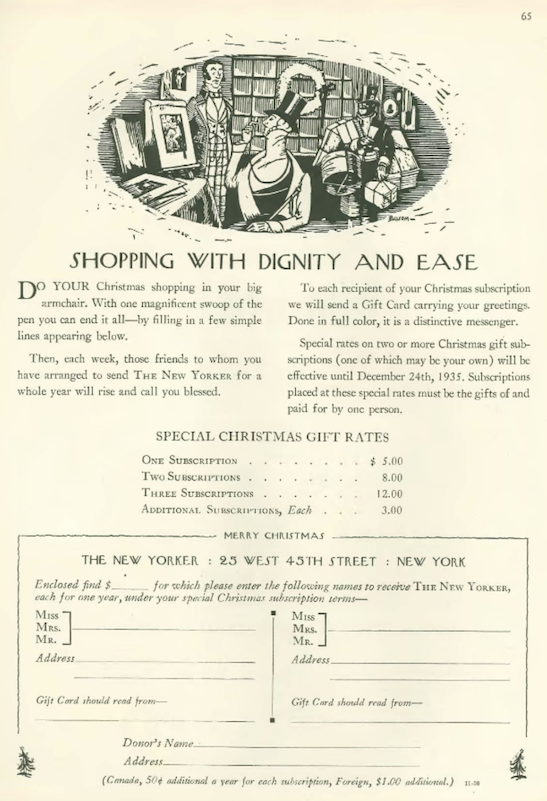
…while The New Yorker suggested a subscription (or three) as a gift that keeps on giving…curiously, the magazine used the talents of artist Lowell Leroy Balcom (1887-1938) to render this woodcut illustration of Eustace Tilley…
…James Thurber kicked off our cartoons with a familiar theme…
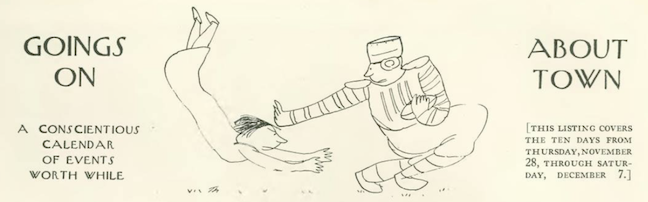
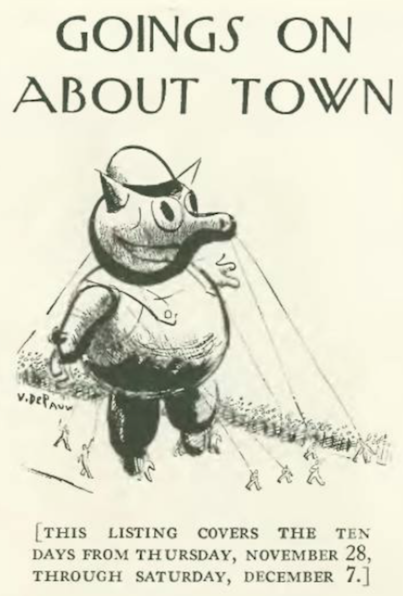
…and Victor de Pauw offered up this Macy’s Thanksgiving Day parade image to calendar section…
…what de Pauw illustrated…
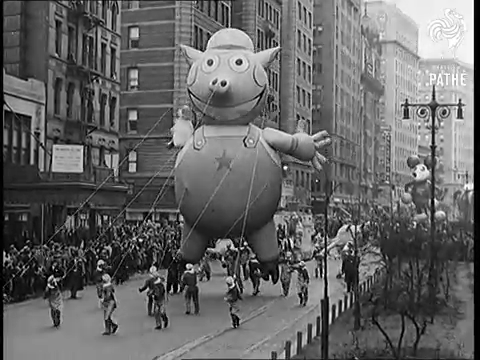
To promote his Silly Symphonies animated short, “The Three Little Pigs”, Walt Disney designed a balloon based on Practical Pig (the one with the brick house). The balloon was featured in the 1934 and 1935 Macy’s Thanksgiving Day parades. (YouTube)
…William Steig stepped in for Al Frueh in providing the illustration for the “Theatre” section…
…and Steig again…
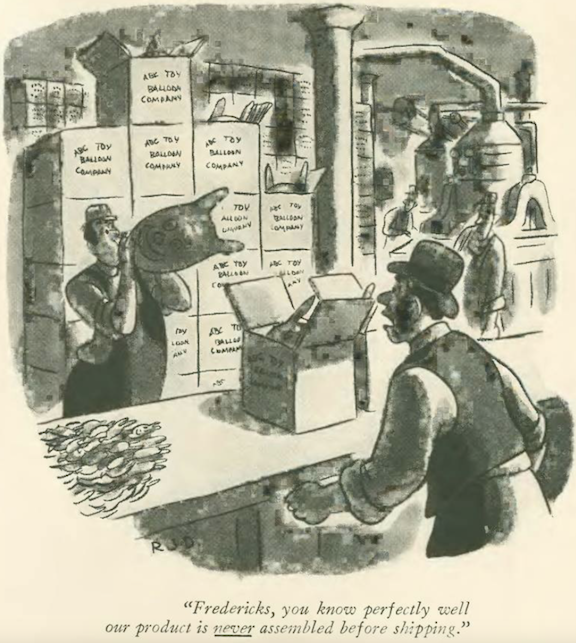
…Robert Day gave us an airhead at a balloon factory…
…Day again, with some evicted ghosts…
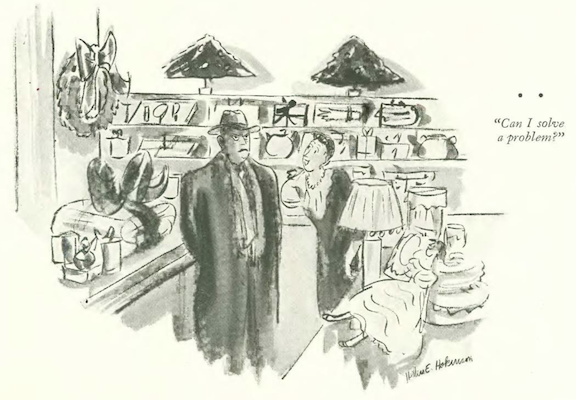
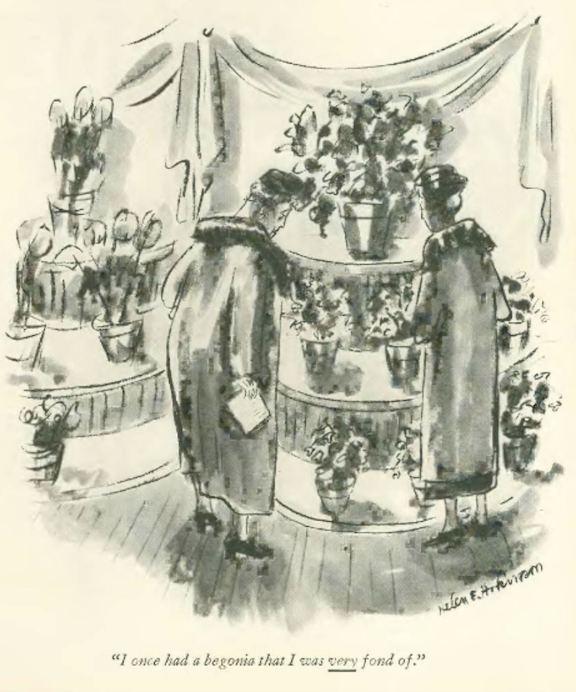
…Helen Hokinson went plant shopping…
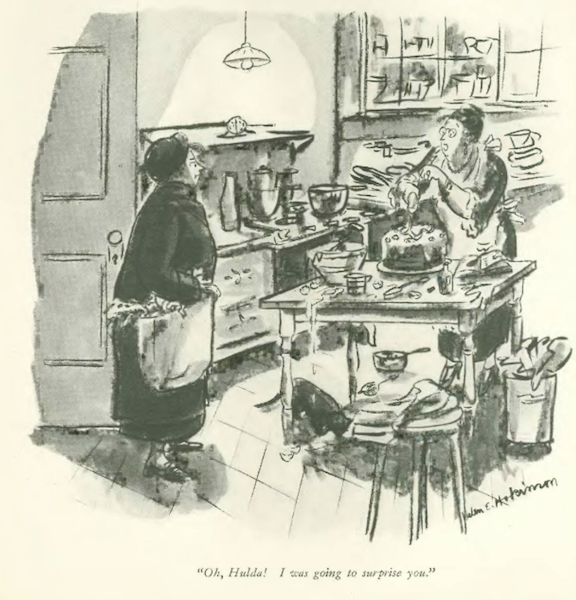
…and found a surprise in the kitchen…
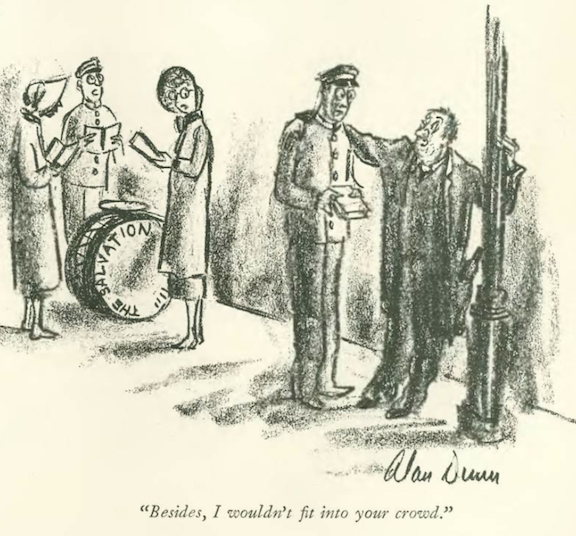
…Alan Dunn offered a challenge to the Salvation Army…
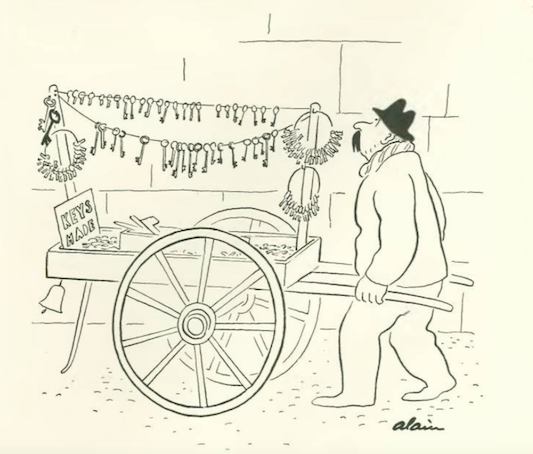
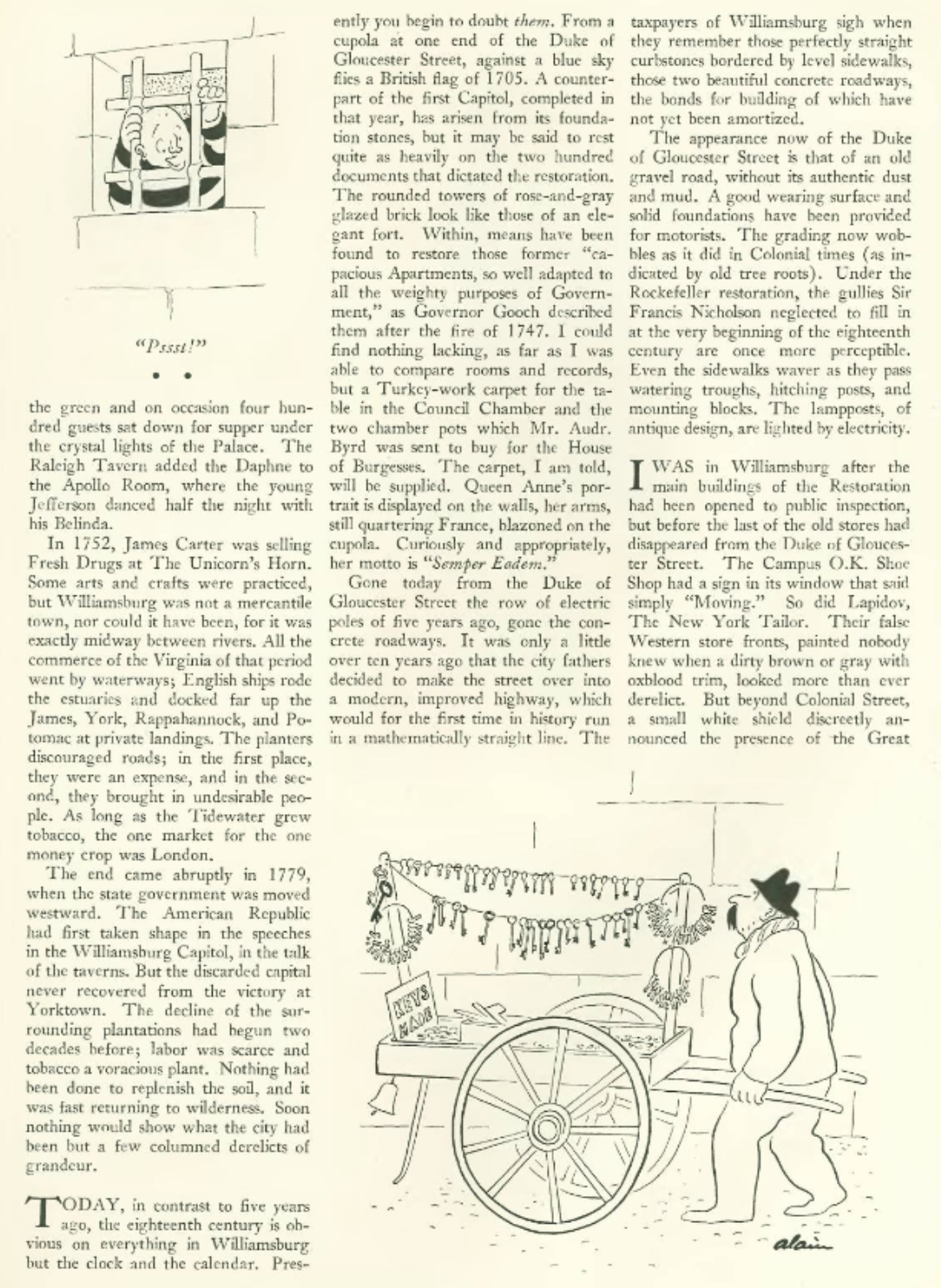
…Alain received a special layout for this cartoon…
…which was arranged thusly…
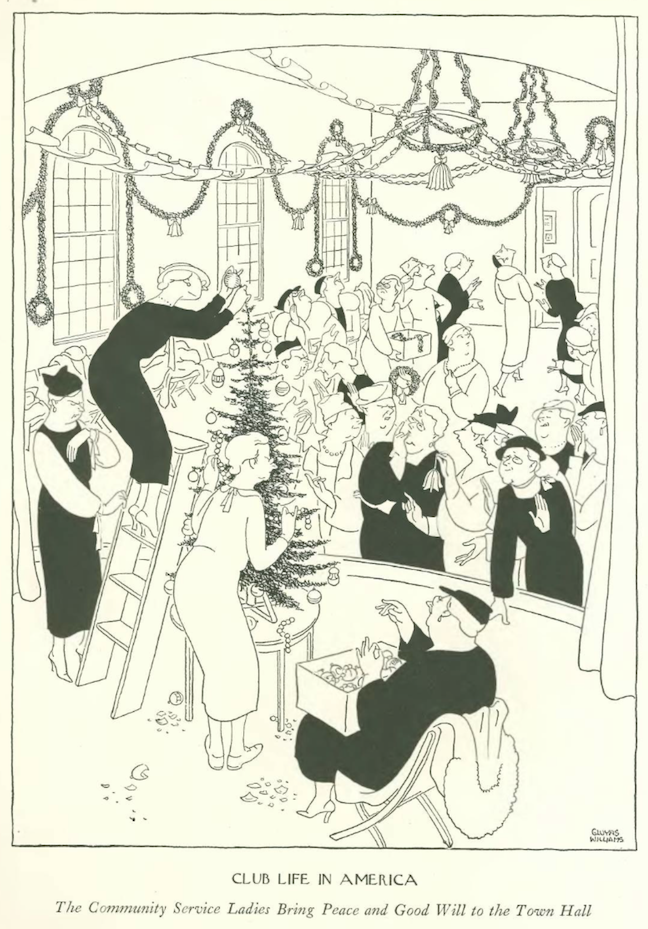
…Gluyas Williams was back with his look at club life…
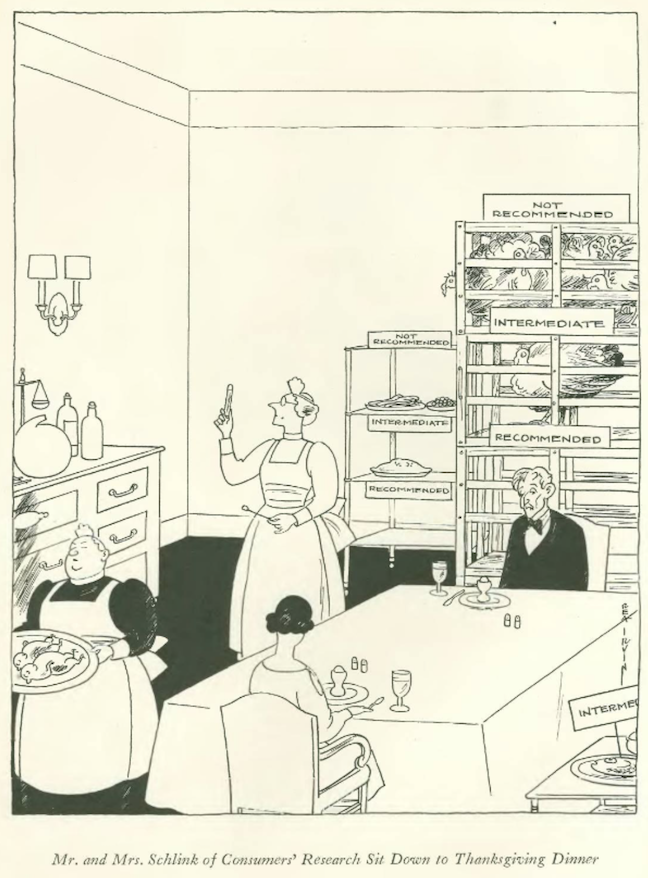
…and we close with Rea Irvin, and the science behind a holiday feast…
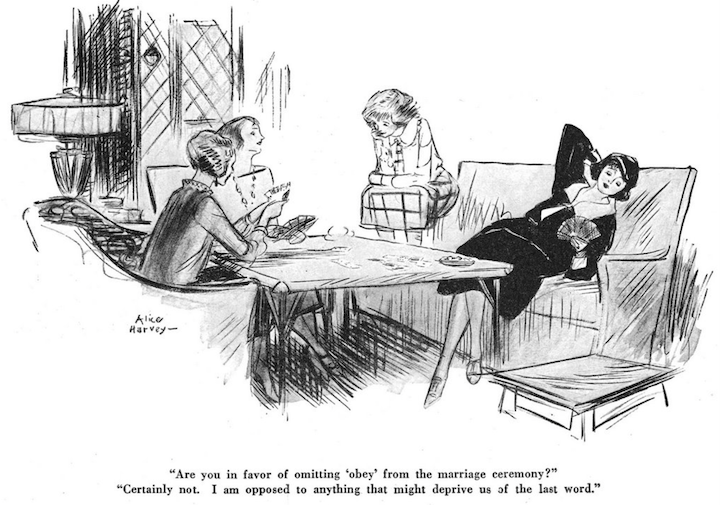
…and before we go, our cover artist, Alice Harvey, was publishing New Yorker-style cartoons in Life magazine at least three years before the New Yorker got off the ground. Here is an example of her early work, published 103 years ago on December 28, 1922:
Above: King George V and Queen Mary posed for portraits by John St Helier Lander to commemorate the king’s Silver Jubilee in 1935. (Wikipedia)
The British Royal Family has never been my cup of tea, but its hard to deny their influence on world affairs, even if today it is mostly ceremonial. The king and queen were also figureheads back in 1935, however they could still claim to lead a vast empire, albeit one badly fraying at the seams.
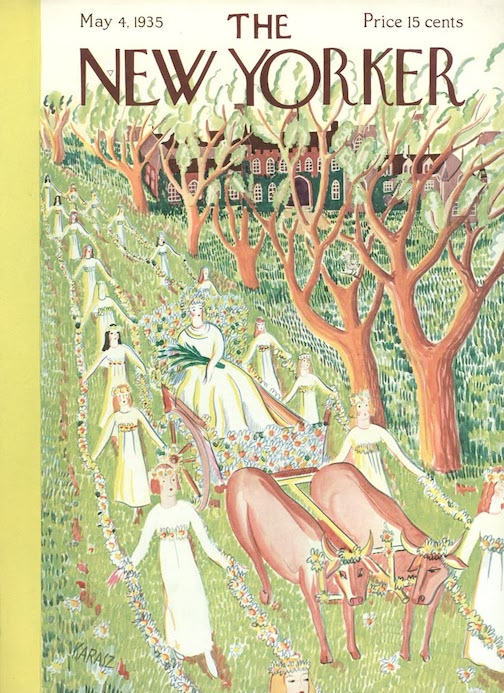
May 4, 1935 cover by Ilonka Karasz.
Then as now, the power of the royals lay largely in their ability to boost the political and economic fortunes of their island nation. Such was observed by The New Yorker’s Paris correspondent Janet Flanner, who penned a two-part profile of Queen Mary (nee Mary of Teck or more formally Victoria Mary Augusta Louise Olga Pauline Claudine Agnes; Queen of the United Kingdom and the British Dominions, and Empress of India). Flanner wrote the profile of Queen Mary (1867-1953) in anticipation of the Silver Jubilee of her husband, King-Emperor George V (1865-1936). Excerpts:
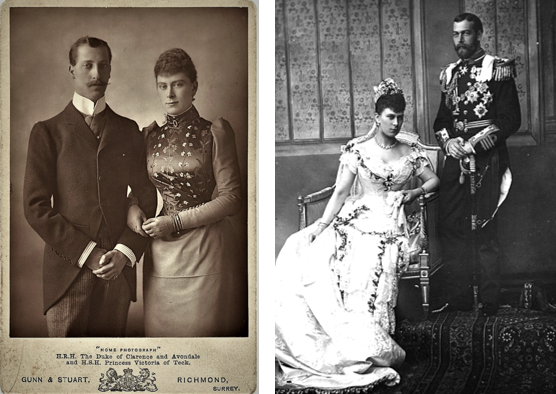
A DEB AND A DUKE…In 1886 Mary was a an unmarried British princess who was not descended from Queen Victoria, so she was a suitable candidate for the royal family’s most eligible bachelor, Mary’s second cousin Prince Albert Victor, Duke of Clarence and Avondale. In early December 1891 Albert Victor (left photo) proposed marriage to Mary, but he died six weeks later in the Russian flu pandemic. Less than two years later (July 1893) Albert Victor’s brother, Prince George, Duke of York, would wed Mary—at right, their wedding day photo. (Wikipedia)
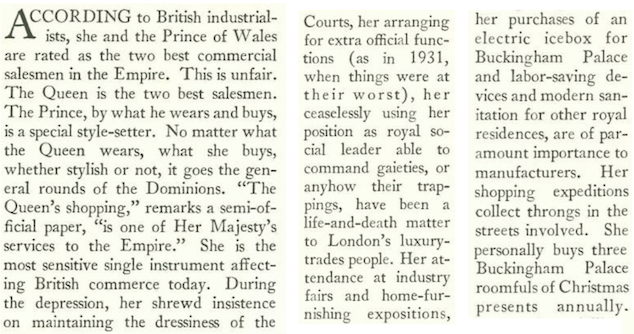
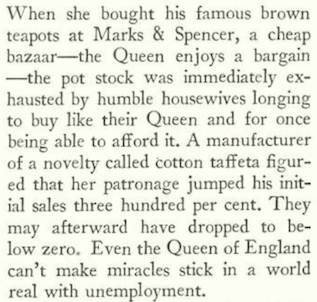
Flanner noted that the King George V and Queen Mary were rated by British industrialists as the Empire’s “two best salesmen,” however it was Mary who proved the most influential whether she was buying a hat or a refrigerator. Excerpts:
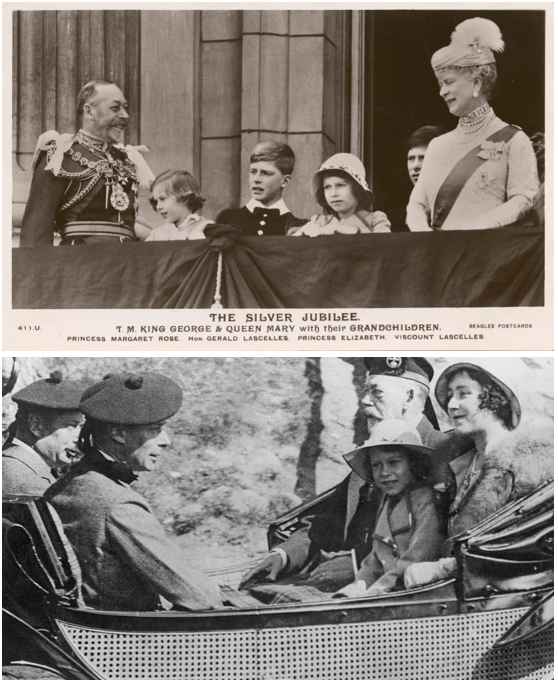
SILVER AND GOLD…Top photo: to mark the king’s Silver Jubilee on May 6, 1935, King George V and Queen Mary greet their subjects from a balcony at Buckingham Palace with their grandchildren, (from left) Princess Margaret Rose, Hon. Gerald Lascelles, Princess Elizabeth, and Viscount Lascelles. Below, King George V, the Duke and Duchess of York, and Princess Elizabeth take a trip in the royal carriage, 1933. The Duke and Duchess would succeed the throne upon the death of King George in 1936 and the abdication of the Duke’s brother, Edward, that same year. (Reddit/Town & Country)
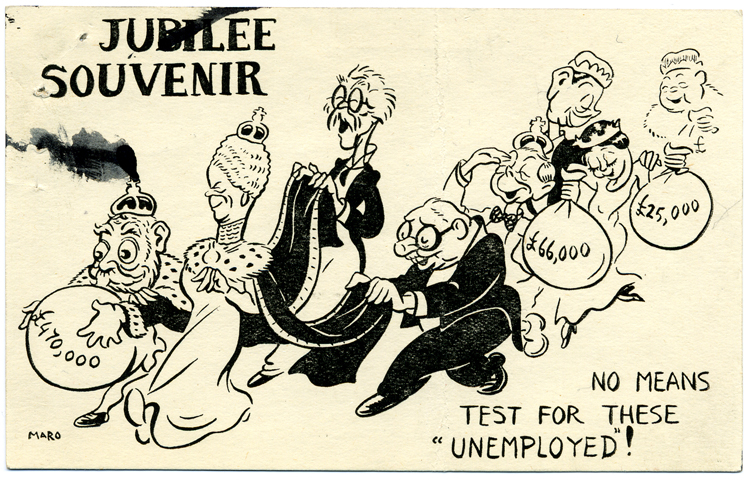
Naturally, not everyone in the kingdom was thrilled by the Silver Jubilee…
OPPOSING VIEWPOINT…The anti-monarchist cartoonist Desmond Rowney commemorated the Silver Jubilee with this cartoon in the Daily Worker. The public expense for the Silver Jubilee in the midst of a financial depression caused some controversy. (National Archives UK)
* * *
Corn-fed Canvasses
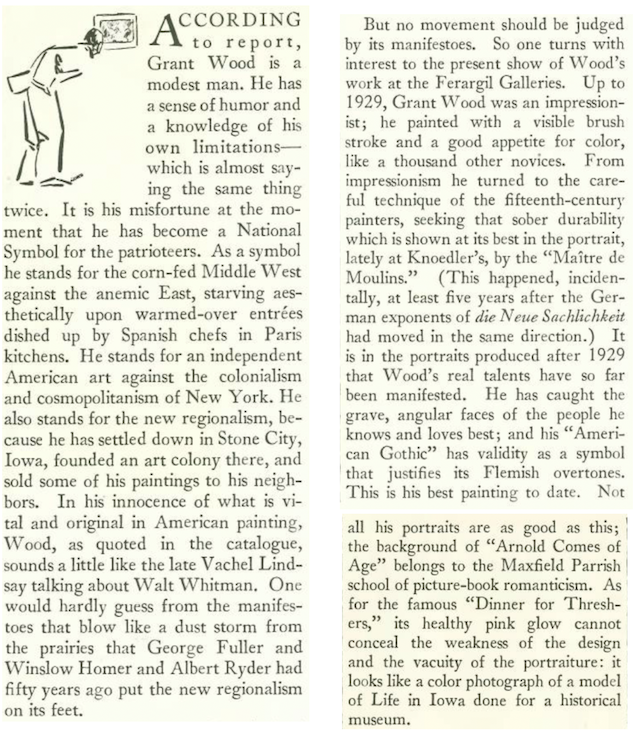
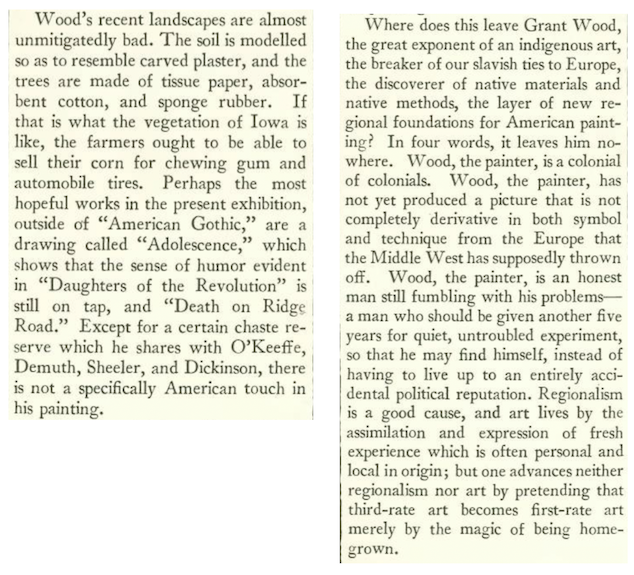
Critic Lewis Mumford, like many East Coast intellectuals, was allergic to the over-patriotic and the sentimental, so when it came to assessing the work of the regionalist painter Grant Wood (1891-1942), Mumford found himself perplexed but hopeful that Wood would one day “find himself” and produce “first rate” art.
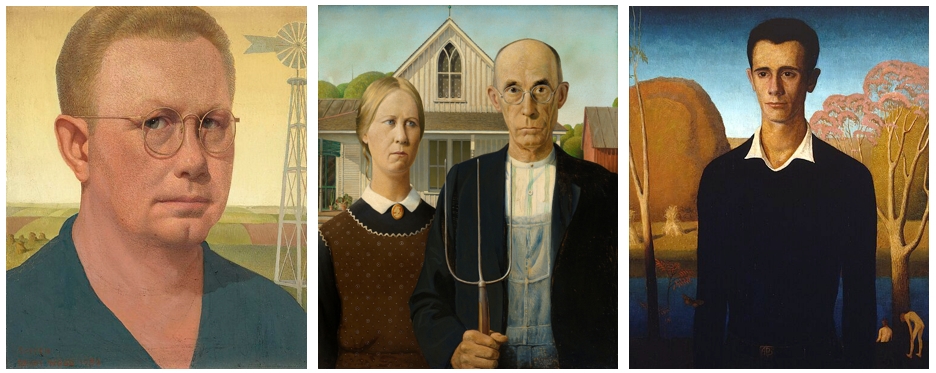
FLANKING THE ICONIC painting American Gothic (1930) are Grant Wood’s Self Portrait (1932) and, at right, Arnold Comes of Age (1930). Lewis Mumford considered American Gothic to be Wood’s best work. (figgeartmuseum.org/whitney.org/sheldonartmuseum.org)
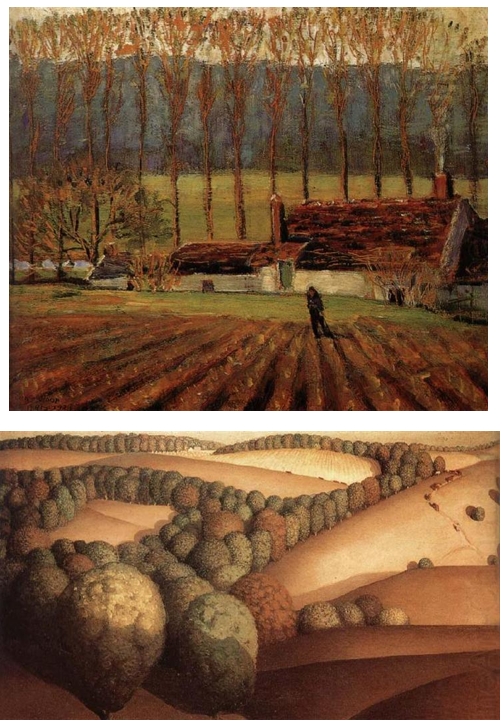
Mumford did not mince words, however, when it came to Wood’s contemporary landscapes, which he called “unmitigatedly bad…If that is what the vegetation of Iowa is like, the farmers ought to be able to sell their corn for chewing gum…”
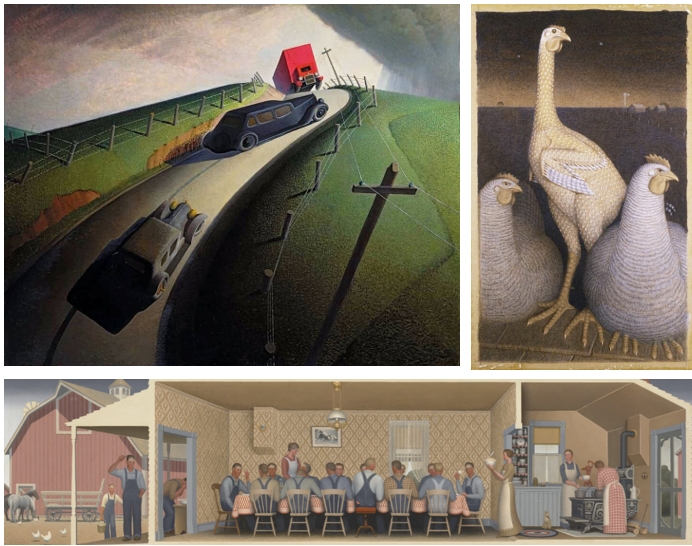
BUBBLEGUM TREES…From 1919 to 1925, Grant Wood taught junior high art in Cedar Rapids, Iowa. The seasonal nature of teaching allowed Wood to take summer trips to Europe to study art, and his early work showed strong post-impressionist influences, including his impressionistic Vegetable Farm (top) from 1924; below, Mumford thought Grant’s later landscapes looked like they were made of cotton and sponge rubber, including Near Sundown, from 1933. (wikiart.org)HOPE AND NOPE…Mumford wrote that Wood’s more “hopeful” works included, top left, Death on Ridge Road and, top right, Adolescence. On the other hand, he found the portraiture in Dinner for Threshers (bottom) vacuous, suggesting “a color photograph of a model of Life in Iowa done for a historical museum.” (wikiart.org/figgeartmuseum.org)
* * *
Daring Young Man
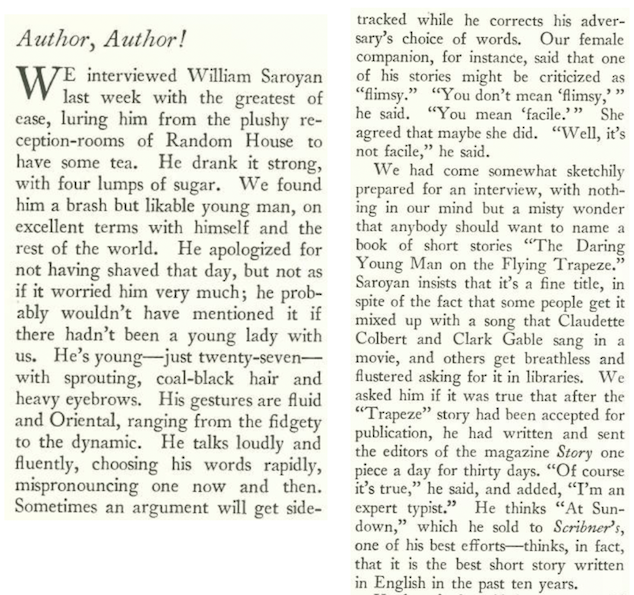
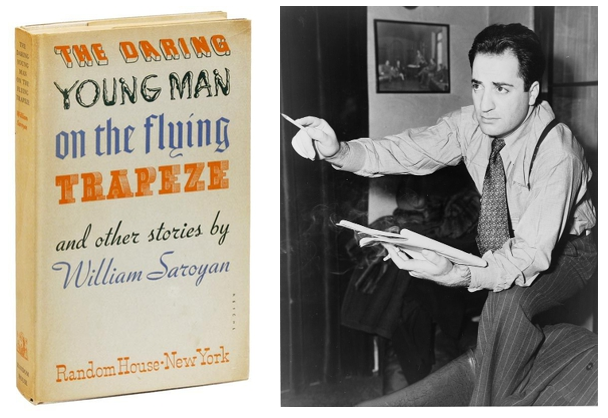
“The Talk of the Town” paid a visit to William Saroyan (1908–1981), an Armenian-American novelist, playwright, and short story writer who would go on to receive a Pulitzer Prize for Drama in 1940 and a 1943 Academy Award for Best Story for the film The Human Comedy. An excerpt:
HIGH WIRE ACT…The Daring Young Man on the Flying Trapeze and Other Stories (1934) was the first collection of 26 short stories by William Saroyan (pictured here in 1940). The book became an immediate bestseller. (Wikipedia)
* * *
Not Long For Long
In his column “Of All Things,” Howard Brubaker noted that the “loose talk” of Huey Long, a U.S. Senator from Louisiana and prominent critic of the New Deal, could be squelched by a Senate vote. As it turned out, it wouldn’t be necessary; Long was felled by an assassin’s bullet four months later.
* * *
Ode to Abode
E.B. White turned to verse to offer his thoughts on where one should live:
* * *
Tough Guys
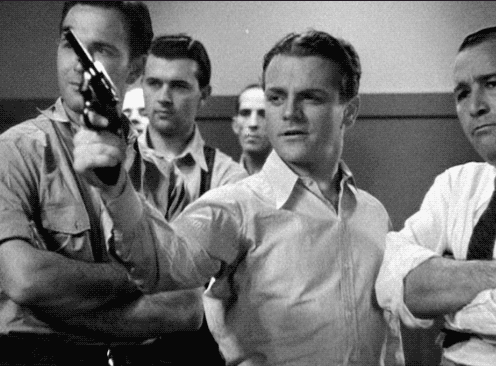
After a musical comedy, a Shakespeare adaptation (A Midsummer Night’s Dream), and another comedy, James Cagney returned to familiar form with an exciting crime drama, G Men. Critic John Mosher was pleased that Cagney was back to tap-dancing with machine guns rather than showgirls.
CRIME PAYS…AT THE BOX OFFICE… James Cagney takes aim at his new role as a federal agent James “Brick” Davis in G Men. With the Hays Code in force, Warner Brothers made the film to counteract what many leaders claimed was a disturbing trend of glorifying criminals in gangster films. (Still from film)
* * *
From Our Advertisers
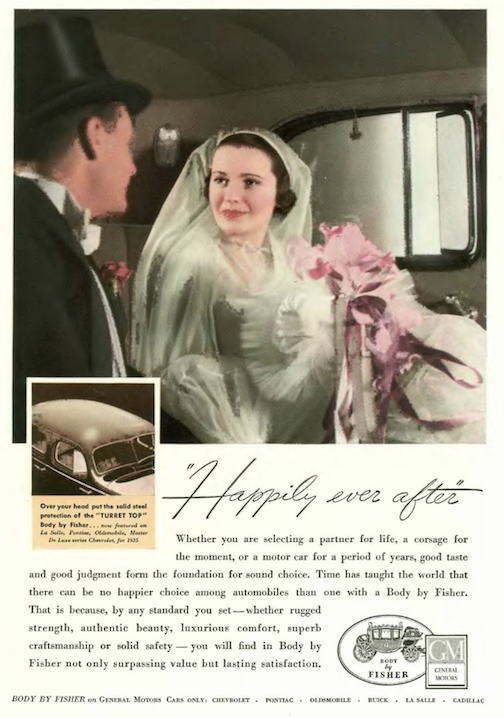
According to General Motors’ Fischer division, good taste was in order whether you were choosing a spouse or an automobile…
…New Yorker ads continued to display bright colors to sell everything from cars to whiskey to sparkling water (with apparent health benefits)…
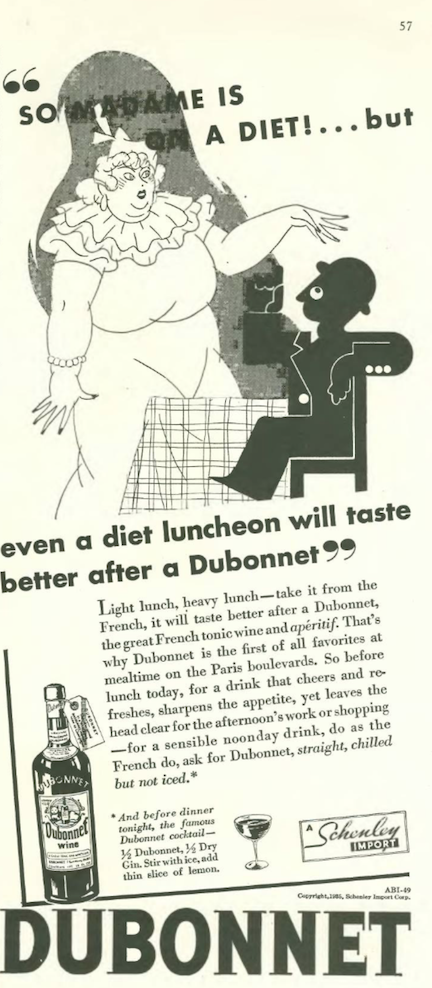
…the shadowy Dubonnet mascot was back, here making the claim (against the wisdom of the ages) that a lunchtime drink will clear your head for the afternoon ahead…
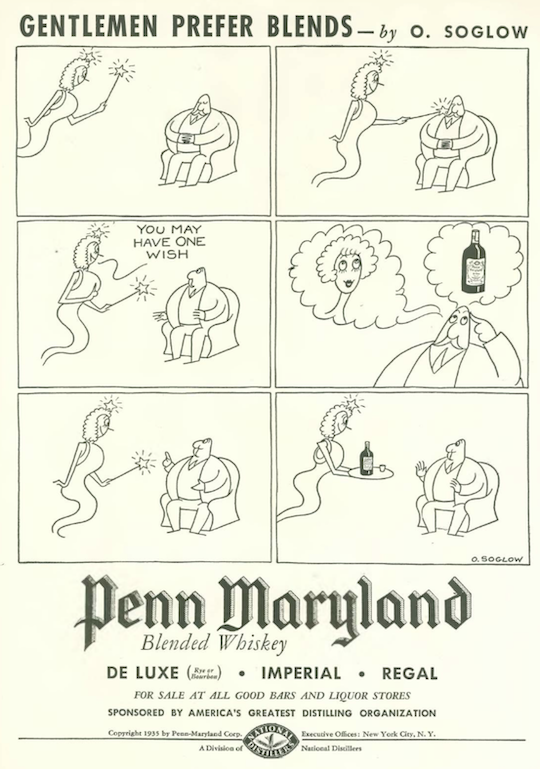
…no health claims here from Penn Maryland, just pure magic as depicted by Otto Soglow…
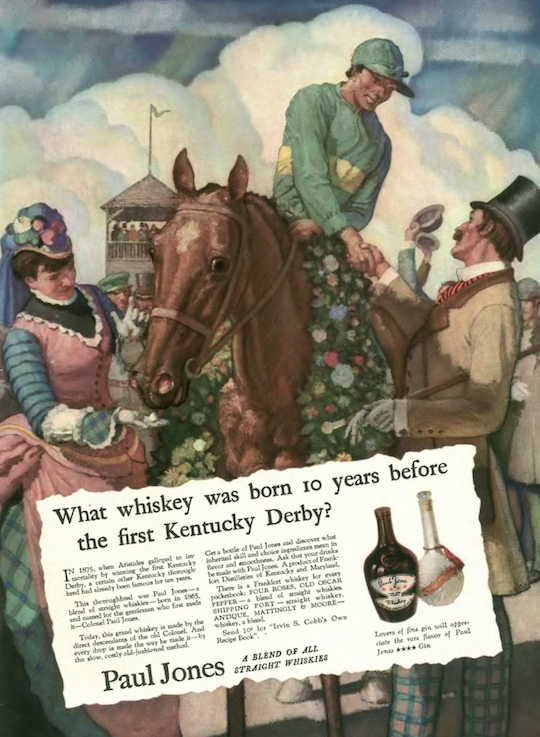
…and what goes better with whiskey than the Kentucky Derby…
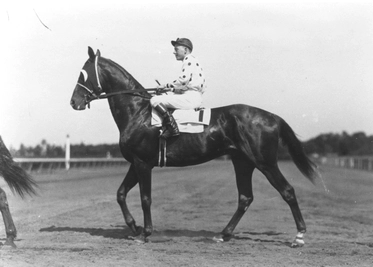
…the 1935 Kentucky Derby was won by Omaha, a three-year-old Thoroughbred; he was the third horse to ever win the Triple Crown (Omaha was the son of Gallant Fox, the 1930 U.S. Triple Crown winner)…
Omaha in 1935 (Wikipedia)
…on the subject of Thoroughbreds, Camel offered up testimonials from top athletes in a variety of sports…they all agreed that the cigarettes “don’t get your wind”…so what did that mean?…according to R.J. Reynolds, “It means you can smoke Camels all you want”…
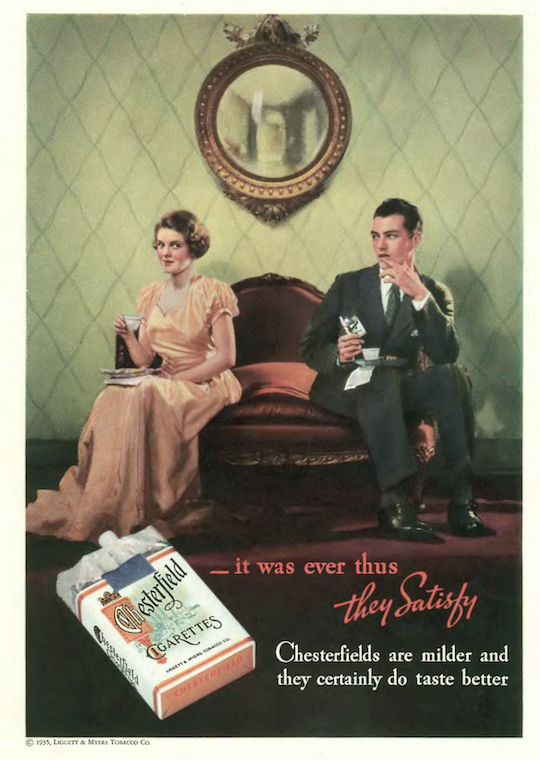
…Camels also calmed the nerves, and so apparently did Chesterfields…
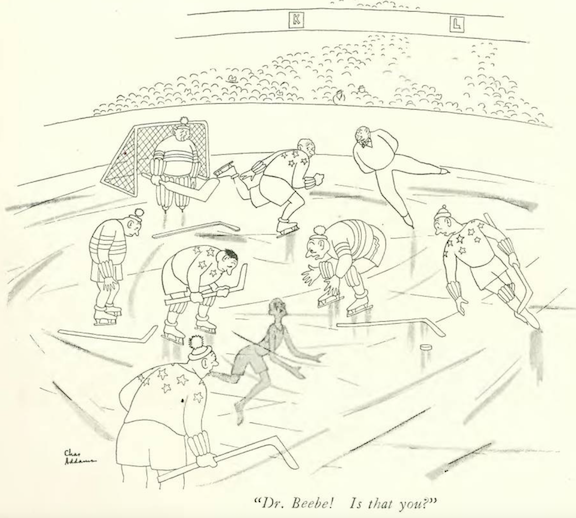
…on to our cartoonists, we begin with a spot by Charles Addams at the top of page 2…
…later in the issue James Thurber contributed this drawing to stretch across the bottom of page 62 (“On and Off the Avenue”)…
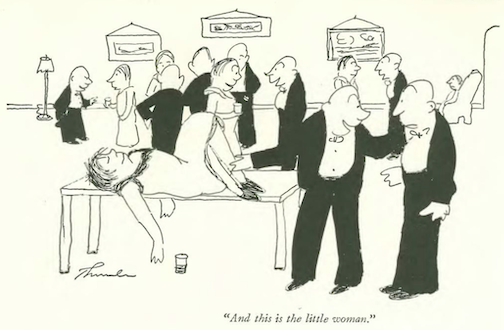
…Thurber again, with the life of the party…
…William Steig offered up a page-full of wits…
…plus one more on the preceding page…
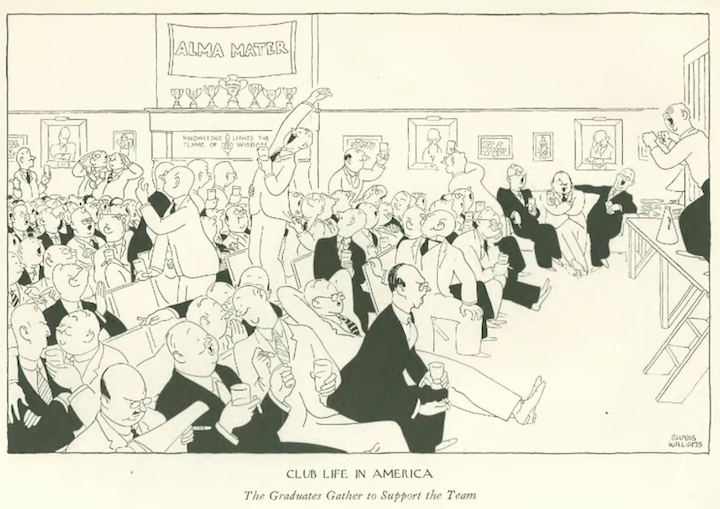
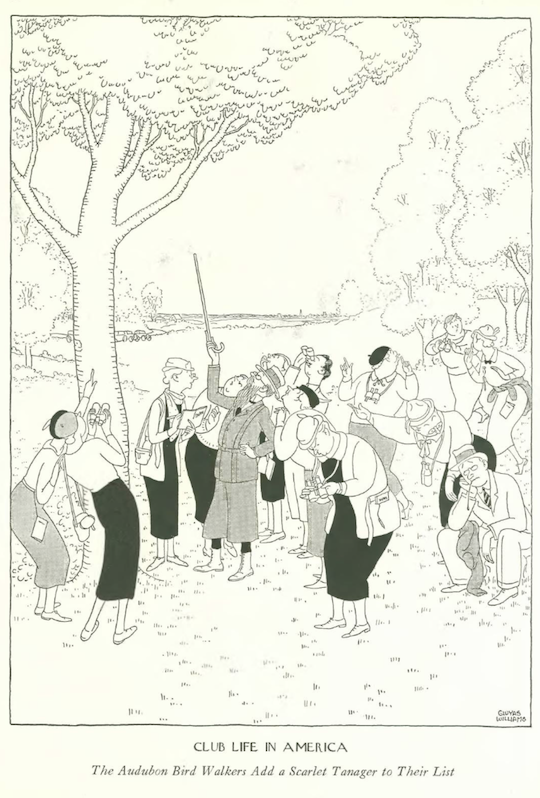
…Gluyas Williams continued to follow the strange ways of club life in America…
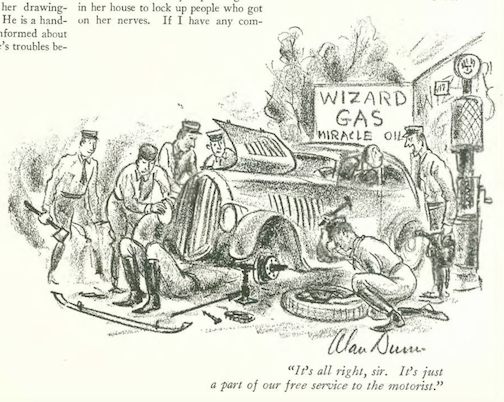
…and we close with Alan Dunn, and service with a smile…
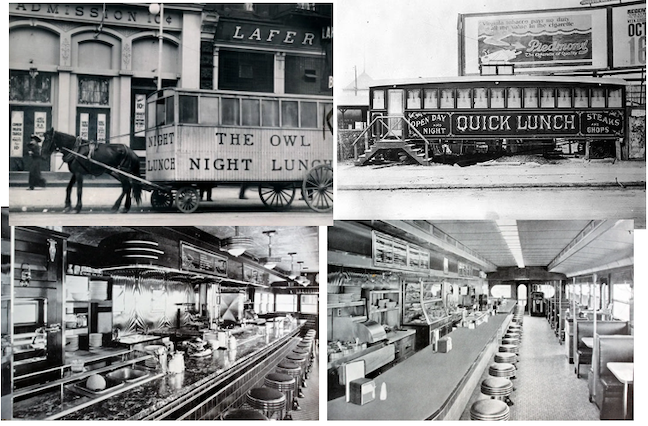
If you think today’s food trailers are the result of some hipster craze, consider that their origins go back more than a century; by 1934 Manhattan was home to 300 of the country’s 5,000 “lunch wagons,” which were commonly called “dog wagons.”
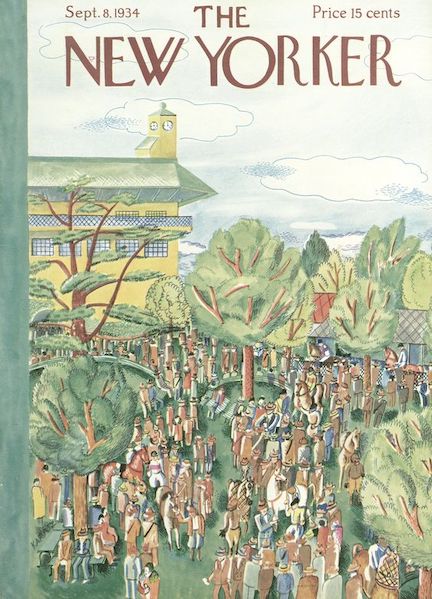
September 8, 1934 cover by Ilonka Karasz.
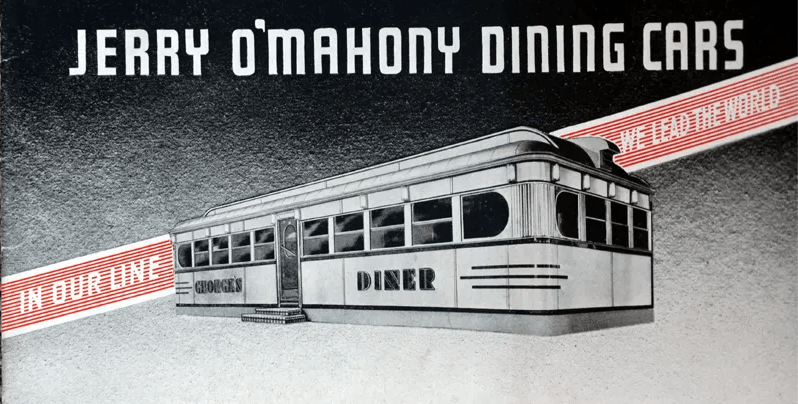
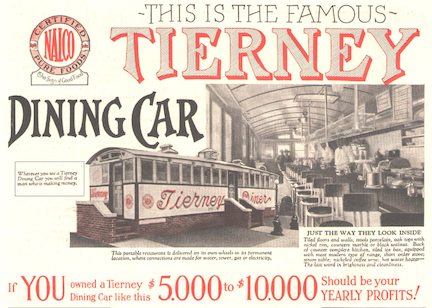
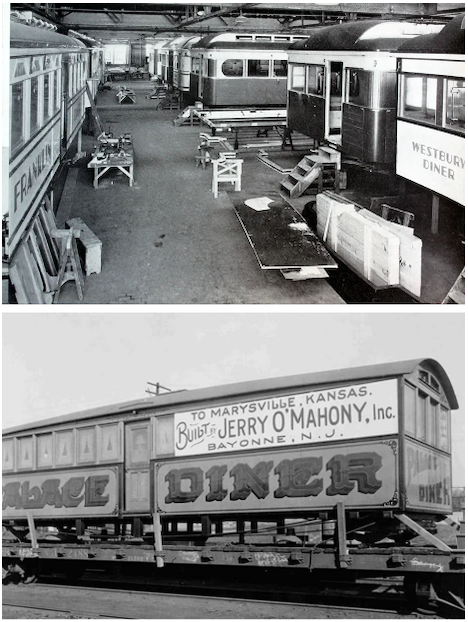
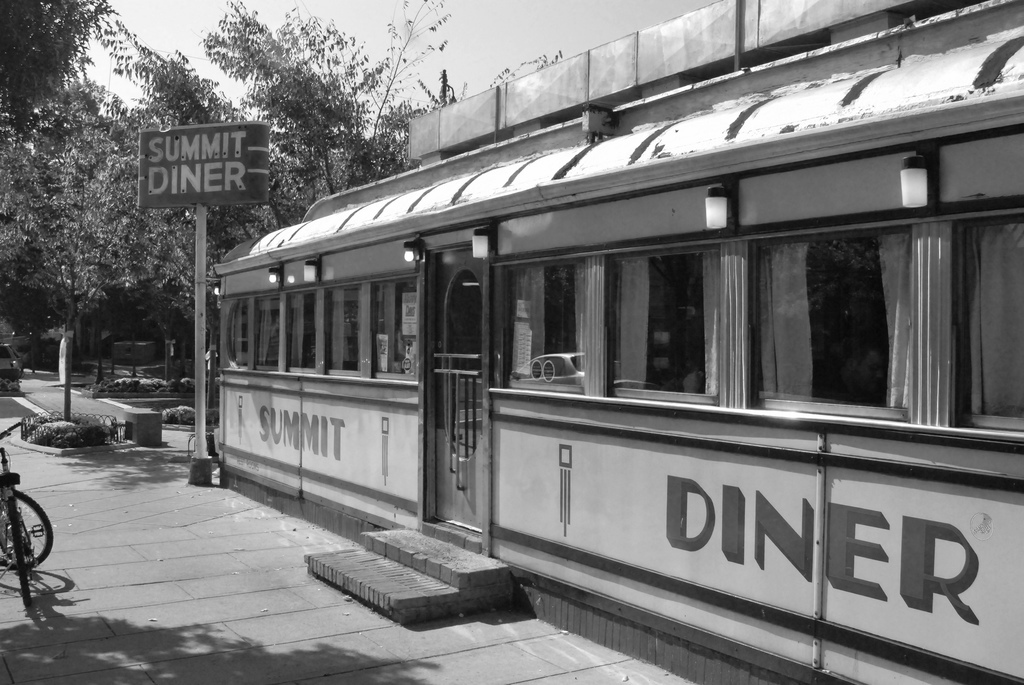
Some of Manhattan’s dog wagons belied the moniker, however, resembling the sleek roadside diners over which many today wax nostalgic. Jerry O’Mahony Diner Company of Elizabeth, New Jersey, produced more of these dining cars than any other concern—2,000 of them between 1917 and 1952 (only about twenty remain today). “The Talk of the Town” had this to say about the dog wagon phenomenon. Excerpts:
PROMISE OF BIG BUCKS…Tierney, based in New Rochelle and established in 1895, was an early manufacturer of lunch wagons and dining cars. It went out of business in 1933. Above, detail from a Tierney Diner Car Advertisement from the late 1920s. (scalar.usc.edu)LUNCH ON THE RUN…Clockwise, from top left, early “dog wagons” were horse-drawn affairs; the wagons became semi-stationary with the advent of manufactured units designed to resemble old railroad dining cars; bottom photos show interiors of two O’Mahony diners. (restaurantingthroughhistory.com/americanbusinesshistory.org/dinerhunter.com)ALL IN A NAME…Above: The Jerry O’Mahony Diner Company produced 2,000 diners in its Elizabeth, New Jersey, factory. Below, an O’Mahoney dining car headed for its new home in Kansas—the O’Mahony company preferred that patrons give their dining cars elite names, such as this “Palace Diner.” (dinerhunter.com/nyfta.org)LAST CALL…One of the few surviving O’Mahony diners—The Summit Diner in Summit, New Jersey. A prototypical “rail car” style diner, it was built by the O’Mahony Company in 1938. (Jeff Boyce/Wikimedia Commons)
* * *
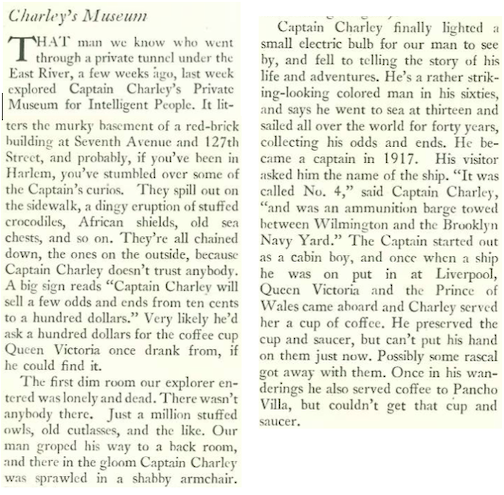
A Captain’s Curios
“The Talk of the Town” also paid a visit to Captain Charley’s Private Museum for Intelligent People, a place that would later be visited (and written about) by The New Yorker’s chronicler of the commonplace, Joseph Mitchell. Excerpts:
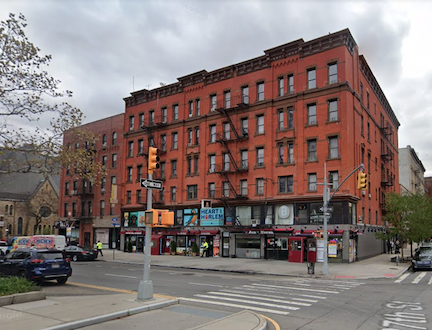
MURKY MUSEUM…This is likely the red brick building on 127th Street where the old mariner Captain Charley held court in the basement with his Private Museum for Intelligent People. (Google Street View)
* * *
Origins of Life
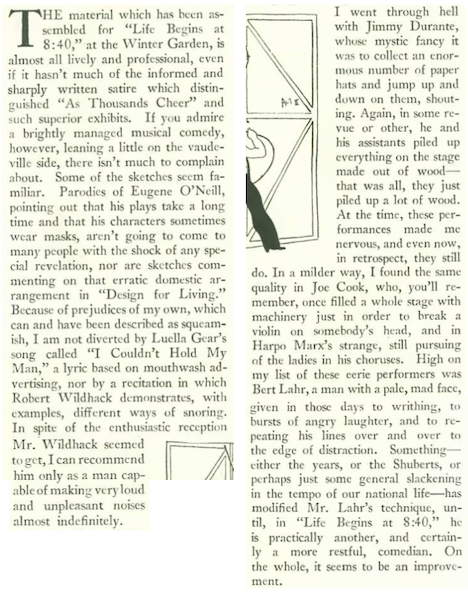
Wolcott Gibbs took his turn as theater reviewer (in relief of Robert Benchley) and managed to sit through Life Begins at 8:40, which had a successful run at the Winter Garden.
GIVING IT A REST…Roy Bolger, Luella Gear, Frances Williams and Bert Lahr headed the cast of Life Begins at 8:40 at the Winter Garden. Critic Wolcott Gibbs appreciated Lahr’s change in tempo, as he was becoming a more “restful” comedian. Lahr was the father of New Yorker theater critic and writer John Lahr. (Library of Congress)
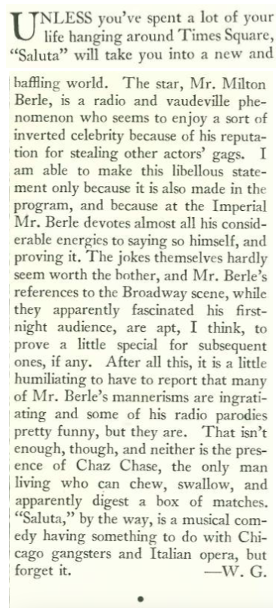
In contrast to Bert Lahr’s new toned-down style, Milton Berle’s outlandish antics over at the Imperial Theatre had Gibbs wondering what the comedian’s vaudeville-style show Saluta was all about, if it was about anything. Whatever it was, it worked—Berle would enjoy a comedy career spanning eight decades, including becoming one of early television’s biggest stars.
ON FIRE…Milton Berle’s show Saluta featured Chaz Chase (right), famed for gobbling up whatever was placed in front of his mouth, including a box of lit matches. At left, Berle in 1930; right, Chase in the 1935 film Vaudeville. (Pinterest/IMDB)
* * *
From Our Advertisers
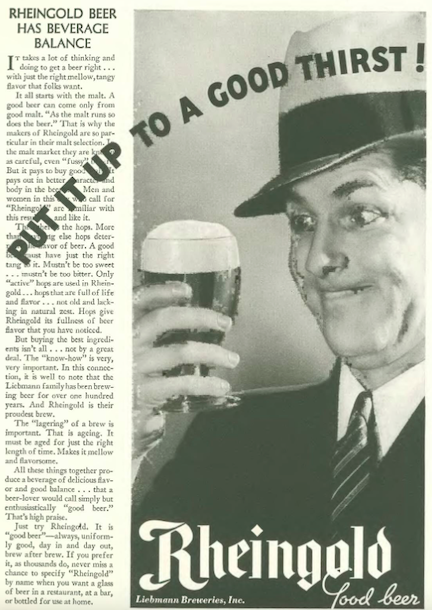
We begin with a cold one from Rheingold, which had “beverage balance” and wasn’t afraid to stamp a slogan right over its ad copy…
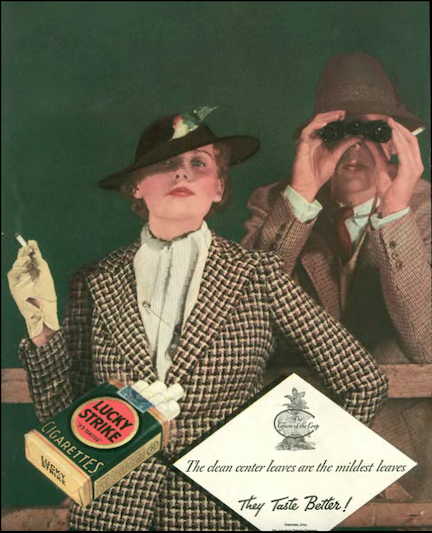
…Lucky Strike gave us another stylish reason for taking up a bad habit…
…Arts & Decoration magazine took out this full page to tout the latest news in modern design…
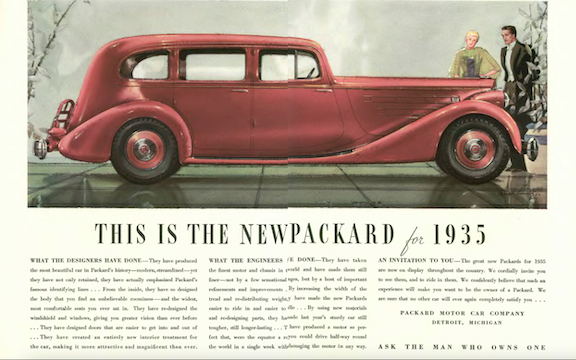
…while the folks at Packard bought this center spread to give ample space to their 1935 model, which must have been a helluva thing to parallel park…
…clothing companies continued use class shaming to goad aspiring toffs to purchase the “correct” attire for school…
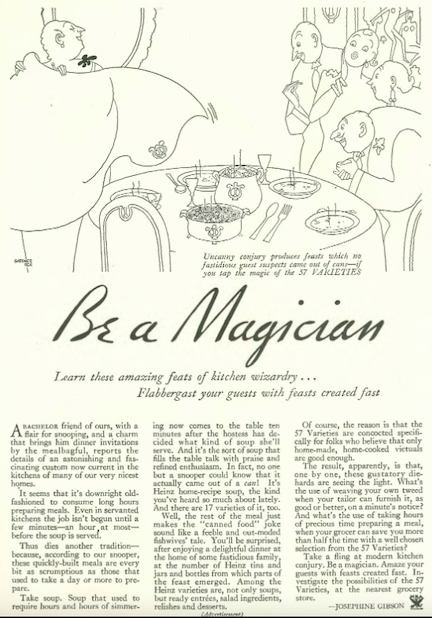
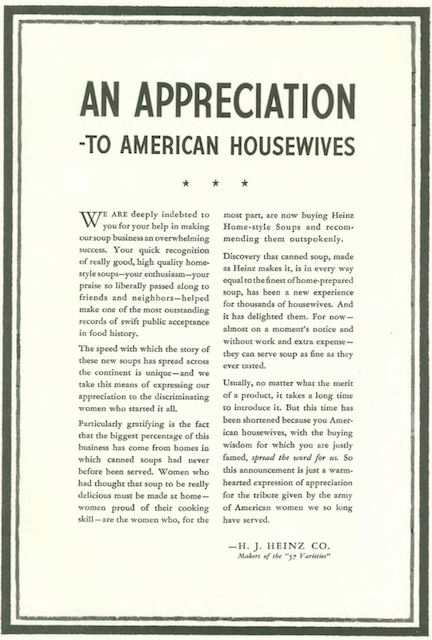
…with the help of Gardner Rea, Heinz suggested that the upper orders would simply swoon over cuisine you managed to scoop out of a can…
…on to our cartoonists, we begin with spots by James Thurber…
…and Lloyd Coe…
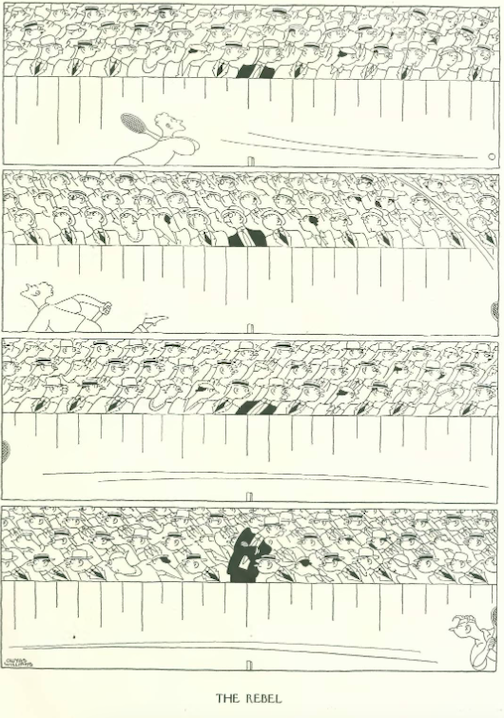
…with the absence of Otto Soglow’sLittle King, Gluyas Williams did his best to fill the void of a full page, something Williams did quite nicely…
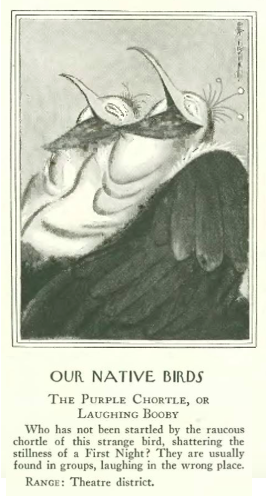
…Rea Irvin gave us yet another local bird sighting…
…Richard Decker found understatement over a reservoir…
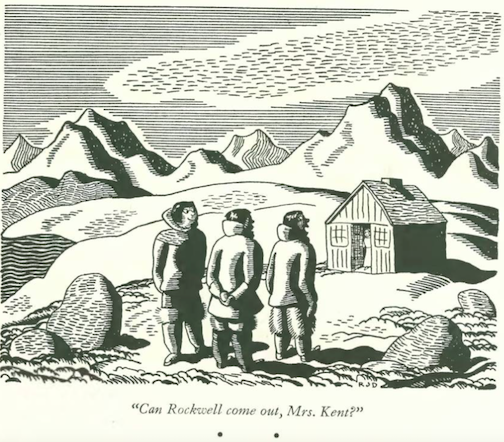
…Robert Day borrowed from the style of Rockwell Kent to offer a bit of humor from the northern climes…
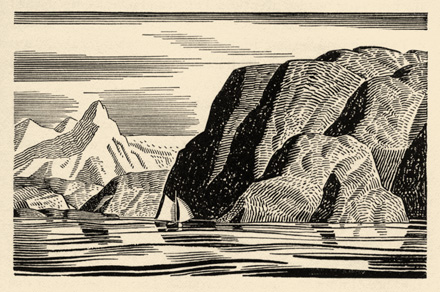
…here is a woodcut from Kent’s N by E is, an illustrated story of his voyage to Greenland…
(From Rockwell Kent’s 1930 book of woodcuts, N by E, via untendedgarden.com)
…Reginald Marsh lent his social realism to an uglier side of American life…
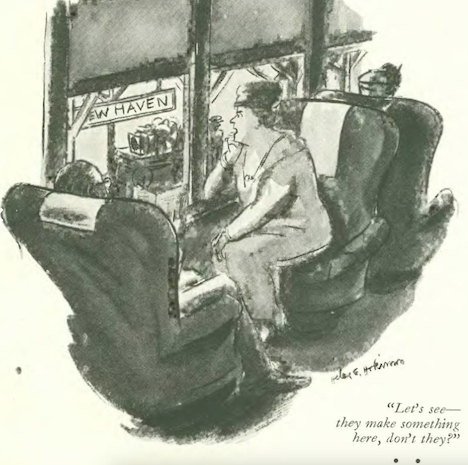
…and we close with Helen Hokinson, just taking in the passing scene…
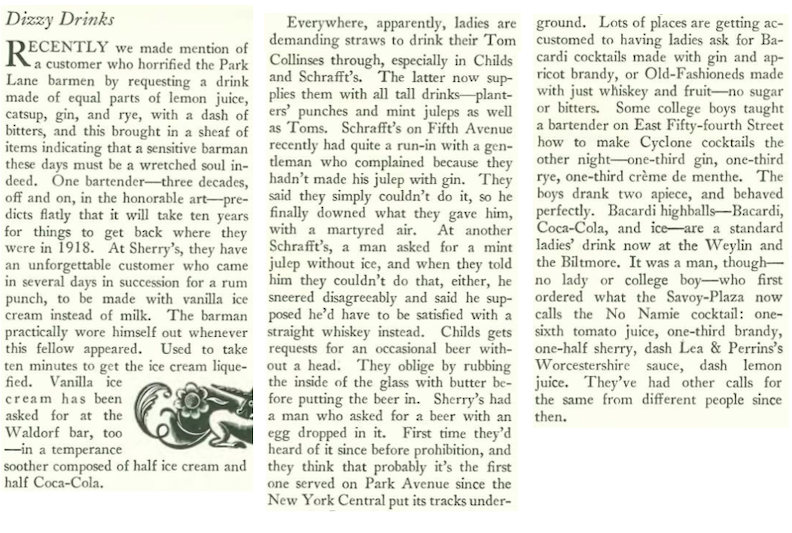
During the roughly thirteen years of Prohibition, many Americans had forgotten how to mix a decent cocktail; the concoctions they devised during those dry years were often created to mask the taste of bootleg liquor—sales of Coca-Cola steadily increased throughout the 1920s in part because it made ardent spirits such as rum and whisky a bit more palatable.
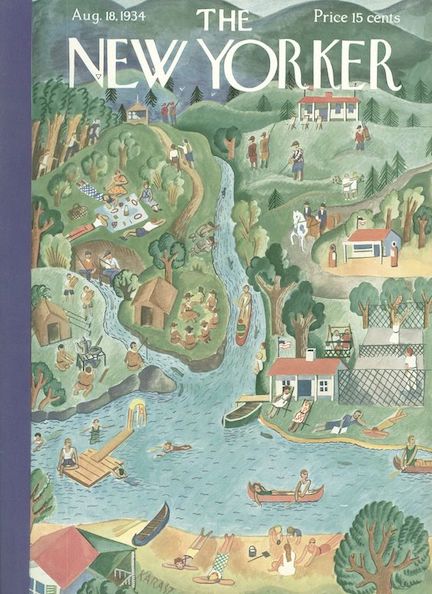
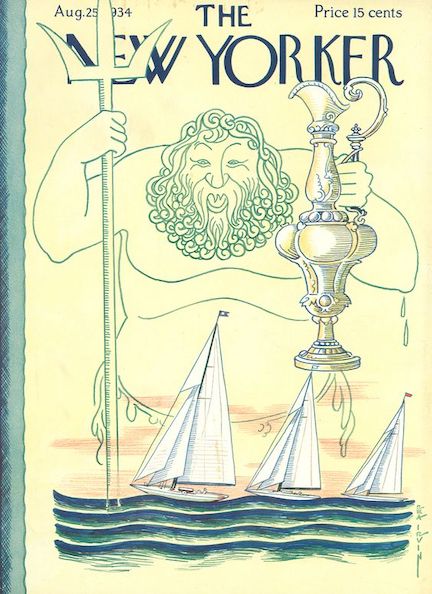
August 18, 1934 cover by Ilonka Karasz.
Donald Barr Chidsey examined the phenomenon in “The Talk of the Town,” visiting with traumatized bartenders around Manhattan:
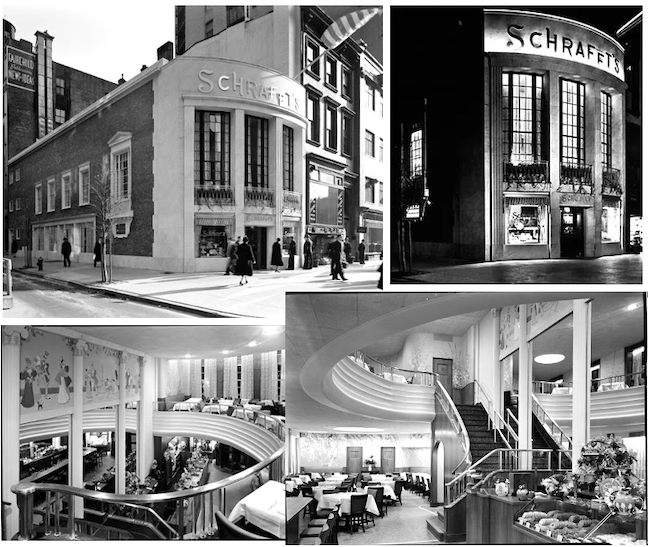
LOST ART…Donald Barr Chidsey relayed the horror of a customer at Sherry’s (top left, photo of the 300 Park Avenue entrance, c. 1925) who asked for ice cream in his rum punch; directly across the street from Sherry’s was the Waldorf Astoria (top right), where a customer asked for a drink of half ice cream, half Coca-Cola; bottom images are from Albert Crockett’sThe Old Waldorf-Astoria Bar Book—as to what one gathers from Chidsey’s account, more than a few people needed to check the “Glossarial” to get reacquainted with the spirit world. (Museum of the City of New York/kitchenartsandletters.com)CUBA LIBRE…According to Chidsey, the go-to for women patrons at the Hotel Weylin was a Barcardi and Coke; at left, Hotel Weylin in 1935; at right, lobby card featuring entertainment at the Weylin Bar, circa 1930s. (Museum of the City of New York/ebay)THE LAST STRAW…Chidsey wrote of an alarming trend among patrons at Schrafft’s who demanded straws in their Tom Collinses. The sleek, art moderne Schrafft’s at 61 Fifth Avenue was among more than two-dozen Schrafft’s locations in New York City in the 1930s. Known for cleanliness and home-style cooking, target clientele were middle-class women. (Architectural Record photos via daytoninmanhattan.blogspot.com)
* * *
From Our Advertisers
Speaking of Schrafft’s, here is their advertisement from the Aug. 18 issue, offering breakfasts ranging from 35 to 75 cents that apparently were the stuff of O. Henry’s dreams…
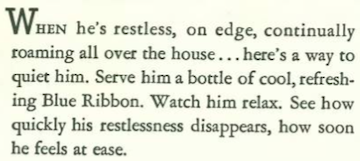
…what is a woman to do with a restless husband?…drawing on the wisdom of the ages, she hands him a beer and coaxes him into his easy chair…this ad encouraged women to “always keep a few bottles in your refrigerator”…in other words, keep ’em coming until he settles into a manageable stupor…
…and see just how easily he slips away, leaving you with a few moments to yourself…
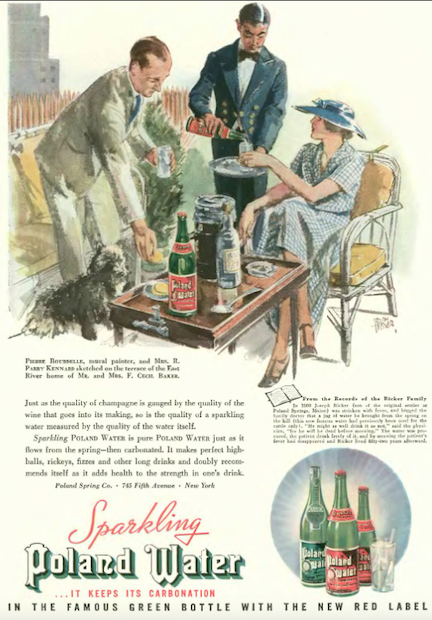
…if highballs were more to your taste, the folks at Poland Water stood ready to help…
…R.J. Reynolds claimed their Camels could solve all sorts of life challenges…we’ve seen ads claiming that Camels soothed “jangled nerves” and helped one relax, but apparently they also could give you energy and pep, at least that is what tennis star Ellsworth Vines, Jr claimed…
…lots of color in the ads for the Aug. 18 issue…here the folks at Buick featured a woman in a red dress serving as an exclamation point to their automobile, which was no ordinary motorcar, but rather a “congenial companion, alive with good-natured personality”…
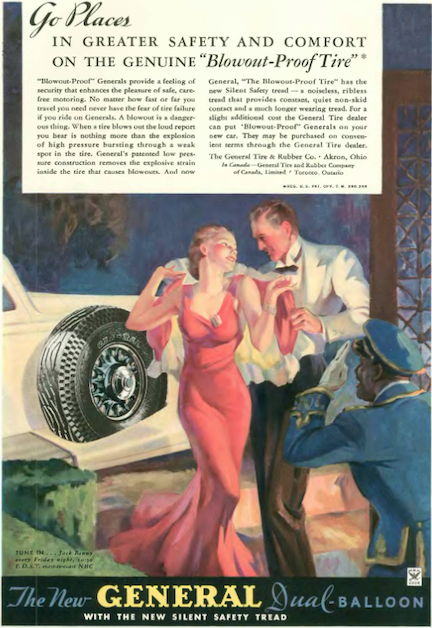
…the folks at General Tire went one better, making their tires the star attraction…those tires look so attractive it seems almost a shame to dirty them on the road…
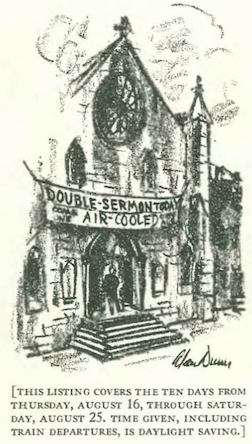
…on to our cartoons, we cool off with this spot in the opening pages by Alan Dunn…
…William Cotton contributed this caricature of New Deal Administrator Hugh Samuel Johnson that accompanied a three-part profile…
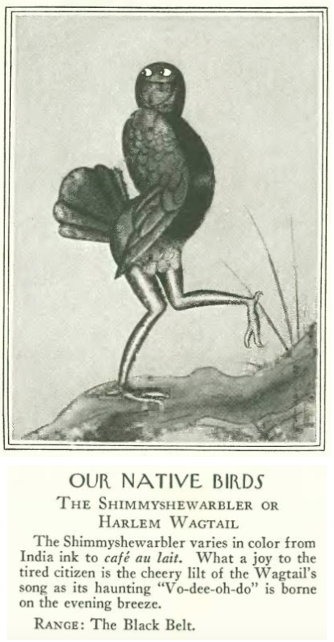
…Rea Irvin offered up a bird of a different feather…
…Robert Day gave us this master of understatement…
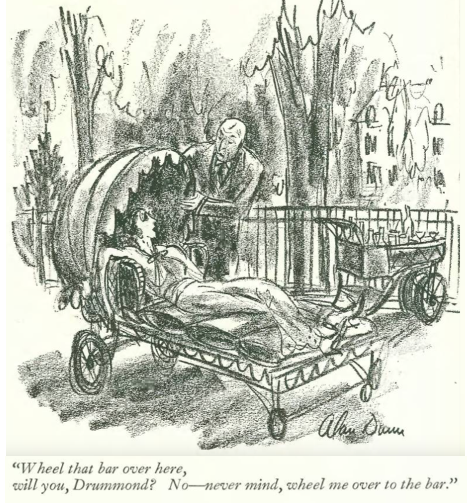
…Alan Dunn again, examining the trials and tribulations of the leisure classes…
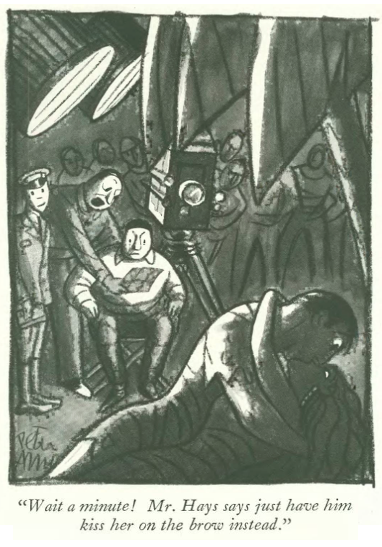
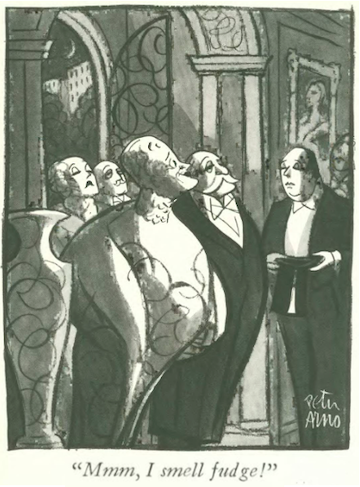
…Peter Arno offered this take on the Hays Code (after politician Will Hays), which was going into effect after the brief “Pre-Code” period (roughly 1930 to 1934) during which filmmakers felt freer to explore themes featuring sex and violence…
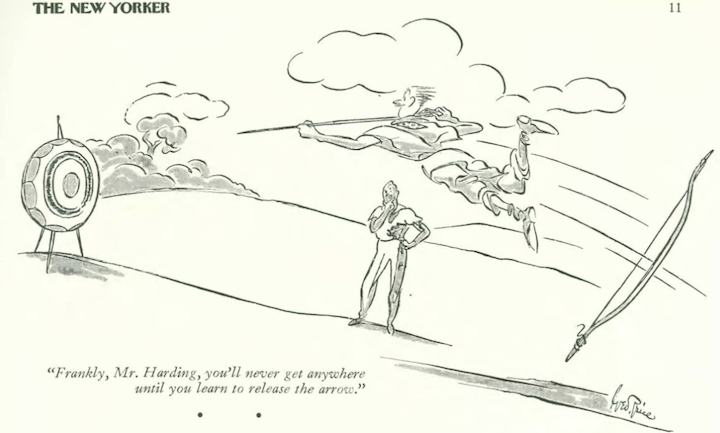
…George Price gave us a man have trouble hitting his mark…
…Alain (Daniel Brustlein) contributed a cartoon with a talking animal, common today but rare in the early New Yorker…
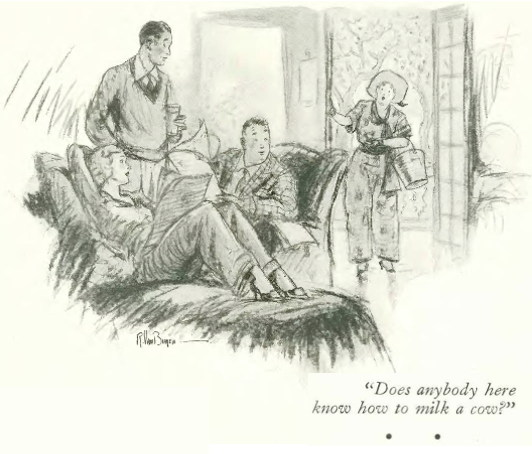
…Raeburn Van Buren was also down on the farm…I think we know the answer to this woman’s query…
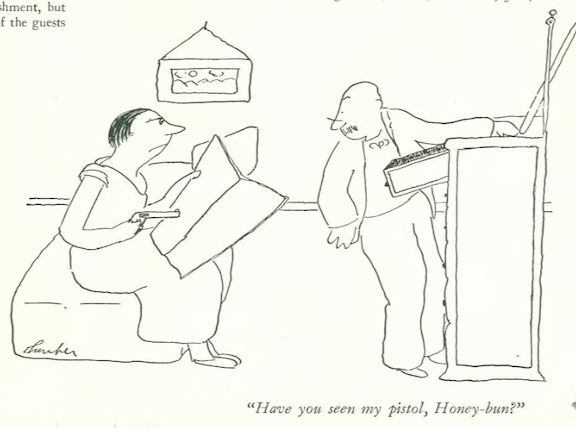
…and we close with James Thurber, where mixed doubles were naturally fraught with peril…
Above: Illustration of the Dorchester Hotel’s ballroom in the 1930s. (dorchestercollection.com)
Lois Long took her nightlife column, “Tables for Two,” to London and its famed nightclub scene, where everyone from British royalty to gangsters reveled in a boozy, bohemian scene.
July 7, 1934 cover by Ilonka Karasz.
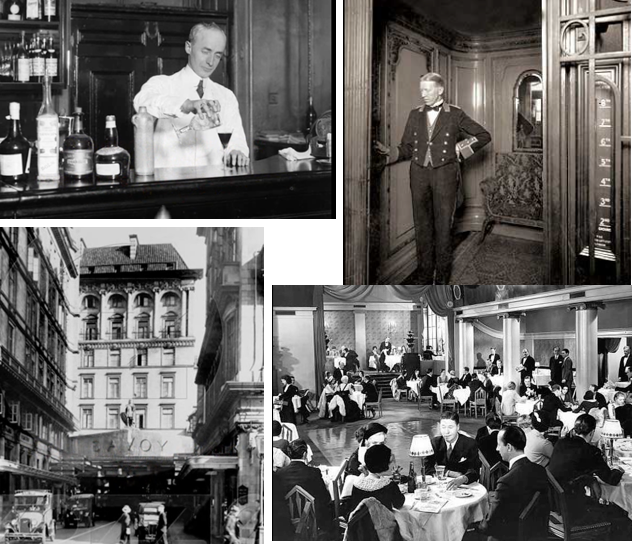
Prince Edward, a well-known party animal (who would serve as king for less than a year and abdicate in 1936) was known to get up on the stage of the Embassy Club and perform drum solos, while at the Savoy his fellow toffs would sip Champagne and glide in elegant dress across the dance floor. London nightlife included a lively jazz scene in edgy Soho basement clubs, featuring such greats as Duke Ellington, Louis Armstrong and Dizzy Gillespie.
Long hoped that the visit to London, her first in eight years, would give her some much-needed rest and a change of scene. What she found instead was a red-hot, all-night party, where the smart set took dinner near midnight and danced until dawn.
SAVVY SAVOY….Clockwise from top left, the famed Savoy bartender Harry Craddock, credited with inventing the White Lady and the Corpse Reviver, at the Savoy’s American Bar in the 1930s; a Savoy elevator operator in 1926; diners at the Savoy circa 1930s; Savoy entrance. (madamgenevaandgent.co.uk/The Savoy/YouTube)LONDON SWINGS…More Lois Long haunts in London included, clockwise from top left, the Dorchester Hotel; the crowded dance floor at the Monseigneur with Roy Fox and his Orchestra (photo from 1932); patrons kicking up their heels at the Embassy Club on Old Bond Street; the Café de Paris, where American actress Louise Brooks demonstrated a new dance craze, The Charleston, in 1924. (dorchestercollection.com/albowlly.club/lucyjanesantos.com/Wikipedia)
* * *
Misery Loves Company
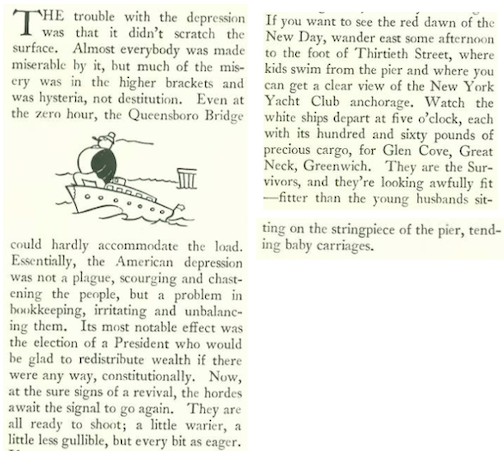
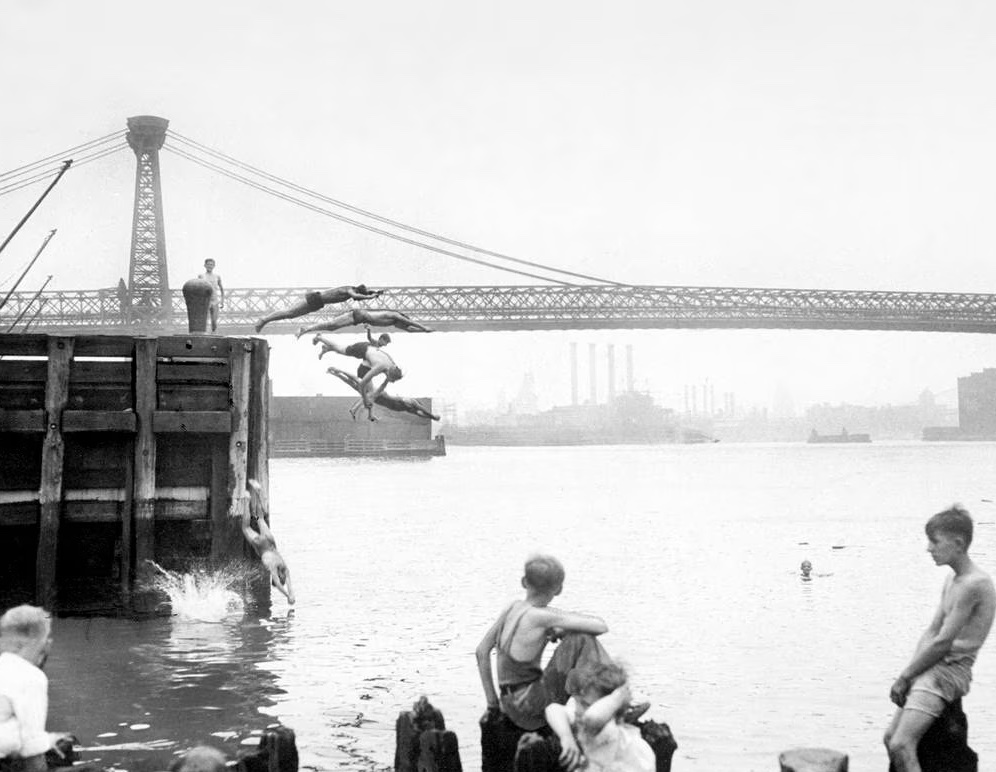
In his “Notes and Comment,” E.B. White observed that almost everyone was “made miserable” by the Depression, but if one looked around there were signs that things weren’t so bad after all.
REASON FOR CHEER…For those still feeling blue about the Depression, E.B. White suggested watching kids cool off at a pier, such as these lads seen diving into the East River on the Lower East Side on July 3, 1935. (Jack Gordon/New York Daily News)
* * *
He Came Up a Bit Short
Howard Brubaker, in his column “Of All Things,” made this observation about Adolf Hitler’s prediction that Nazism would endure a thousand years.
And now a retreat into the cool darkness of the cinema, where John Mosher singled out Bette Davis’s performance in Of Human Bondage…Mosher’s instincts were correct—the film proved to be Davis’s breakout role on her road to major stardom.
ROAD TO RUIN…Bette Davis wowed the critics with her portrayal of a tearoom waitress who seduces a young medical student (Leslie Howard) and leads him down a path of self-destruction. The film was based on the 1915 novel by W. Somerset Maugham. (IMDB)
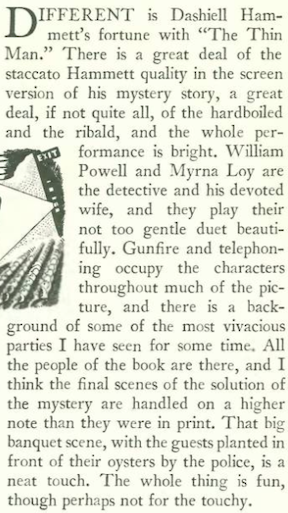
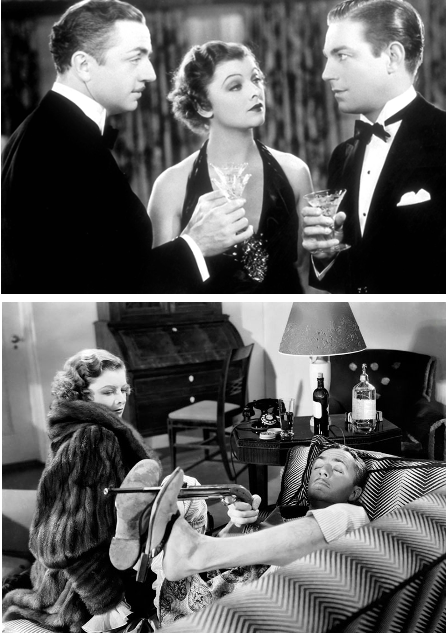
Mosher also took in the “bright” performances of William Powell and Myrna Loy in The Thin Man, a pre-Code comedy-mystery based on the Dashiell Hammett novel by the same name. Powell and Loy portrayed Nick and Nora Charles, who added spice to their leisurely lives through numerous cocktails, flirtatious banter, and crime-solving. Critics loved the film, as did audiences, spawning five sequels from 1936 to 1947.
CHEERS…Top photo: Nick and Nora Charles (William Powell and Myrna Loy) enjoy a drink with their client’s fiancee (Henry Wadsworth) in The Thin Man (1934); Bottom photo: Charles takes aim at a Christmas ornament (with a BB gun) while Nora enjoys the comforts of her new fur coat in a scene from The Thin Man. (Daily Beast/Austin Chronicle)
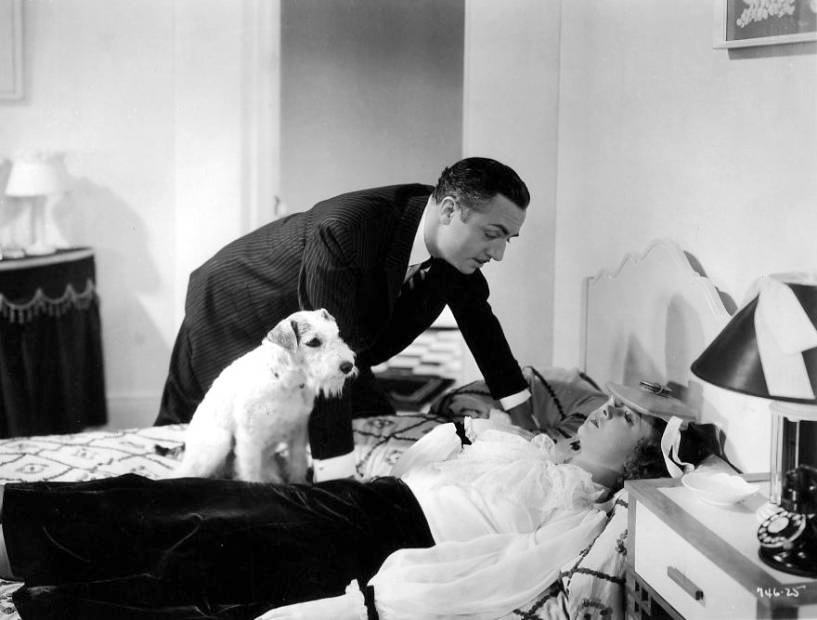
Another star of the show was Asta, the Charles’s wire fox terrier. Asta was portrayed by Skippy, a dog actor who not only appeared in The Thin Man films but also acted alongside Cary Grant in 1937’s The Awful Truth and in 1938’s Bringing Up Baby. Skippy appeared in three Thin Man movies and in more than twenty films altogether between 1932 and 1941. Being an actor in the film must have been good for one’s health: Powell lived 91 years, Loy 88 years, and Skippy, 20 years—a good long life for any pooch.
ROUGH NIGHT…Nick (William Powell) and Asta (Skippy) tend to Nora (Myrna Loy), who nurses a hangover in The Thin Man. (Wikipedia)
* * *
From Our Advertisers
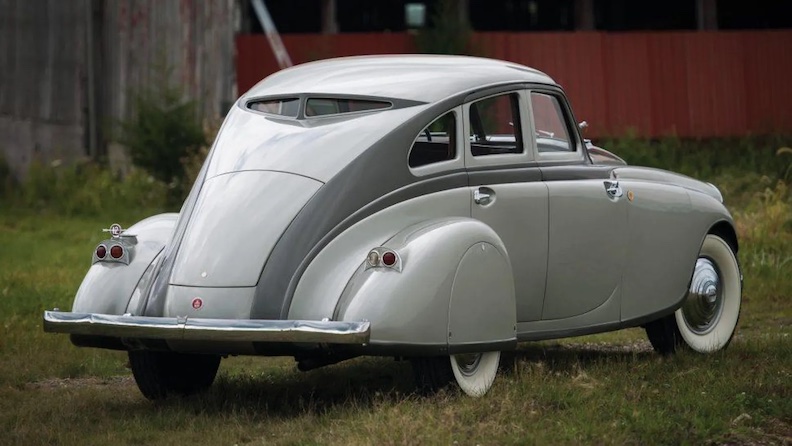
While Chrysler’s styling of their streamlined Airflow proved to be too far advanced for the buying public (the Depression didn’t help), Studebaker’s own foray into the streamlined future caused a sensation…
…thanks to Studebaker’s brief merger with Pierce-Arrow (1928–33), Studebaker’s designers took cues from Pierce’s streamlined 1933 Silver Arrow and created more than 800 cars with “Year-Ahead” design features—the positive reception convinced the company to continue the style in 1935…here is a top-of-the-line 1934 President Land Cruiser…
1934 Studebaker President Land Cruiser with “Year-Ahead” design features, yet not as radical as Chrysler’s Airflow. (hemmings.com)
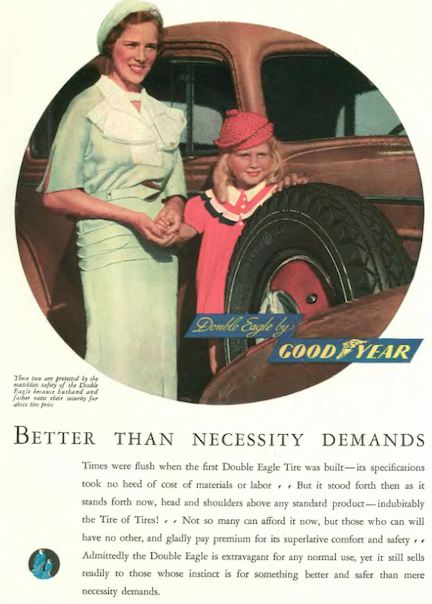
…we continue with those round rubber things that held the cars up…a lot of tire ads in the 1930s emphasized safety—blowouts were common back then…funny how it took nearly four decades to add seat belts to cars…those tires wouldn’t help much in a head-on collision, especially with your kid standing on the from seat…
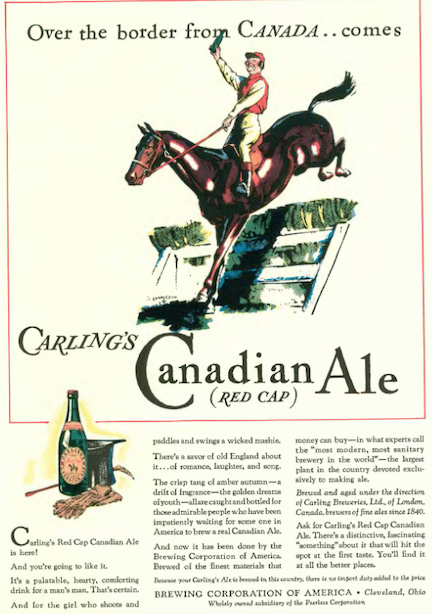
…now let’s cool off with crisp Canadian Ale, thanks to Carling’s entry into the American market…
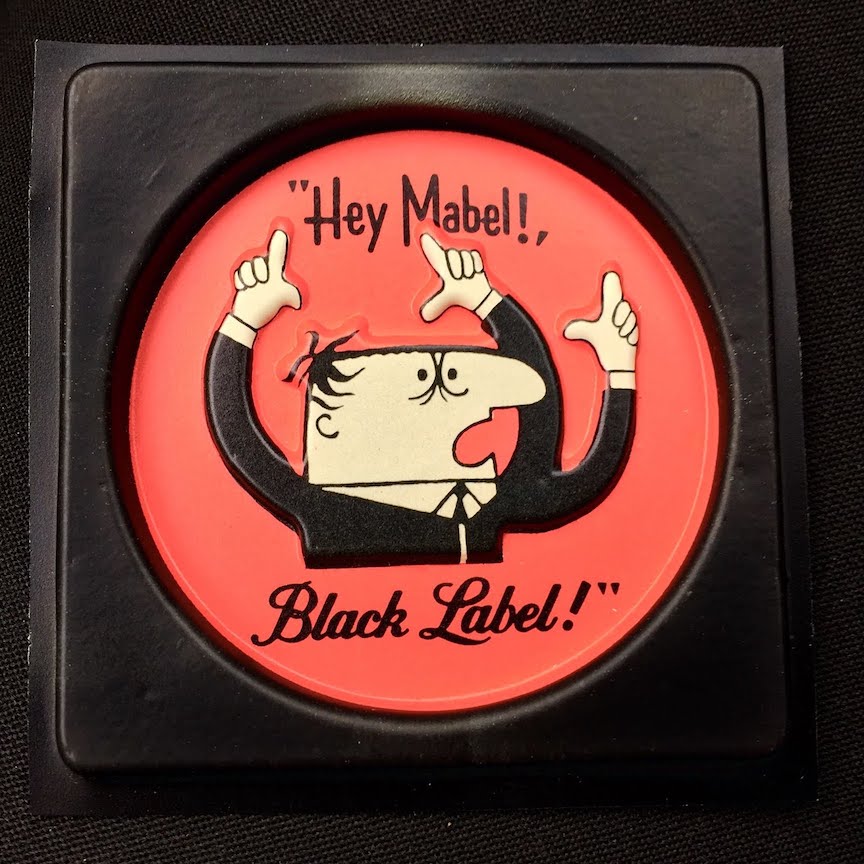
…Carling’s Black Label beer was popular in the states…my parents had a set of these coasters with the Black Label tagline…
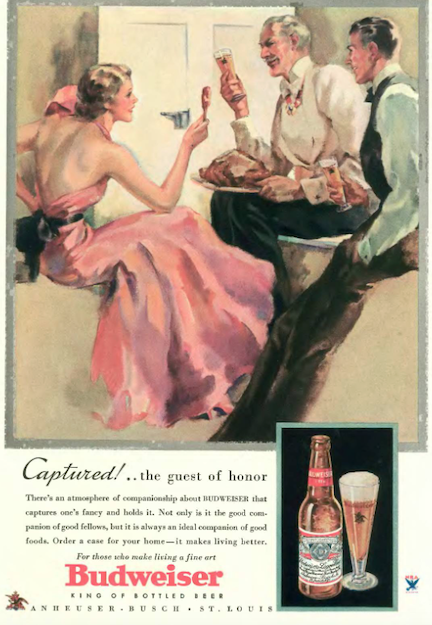
…Budweiser continued its artful series of ads featuring the well-heeled enjoying its product…here it appears old dad (wearing some kind of medal) is getting to know his daughter-in-law over some cold chicken…”hey boy, she’s one of us!”…
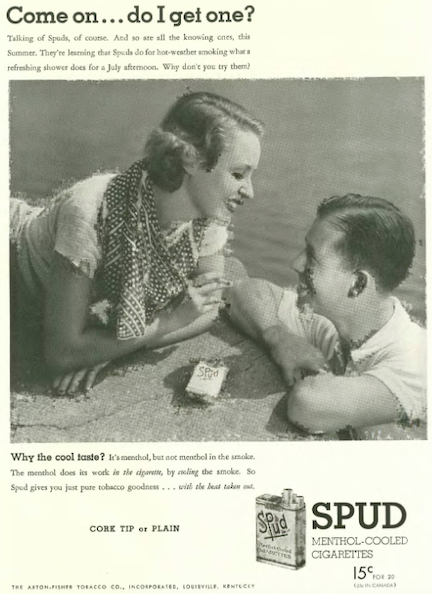
…and we move on to three very different approaches to selling cigarettes, beginning with Spud, continuing its message that menthol cigarettes are as refreshing as a shower on a July afternoon…
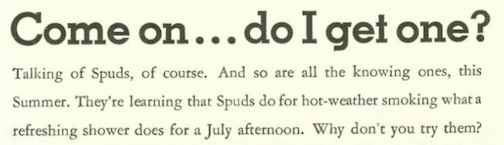
…a close up of the message…
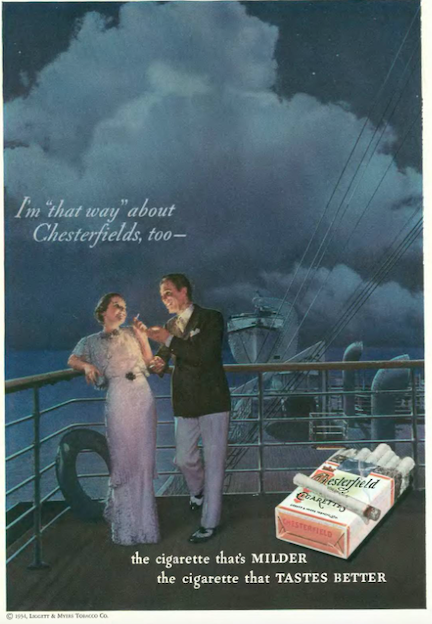
…Camel, on the other hand, continued its campaign against irritability…it apparently did wonders for this woman, who seems to be on something more than nicotine…
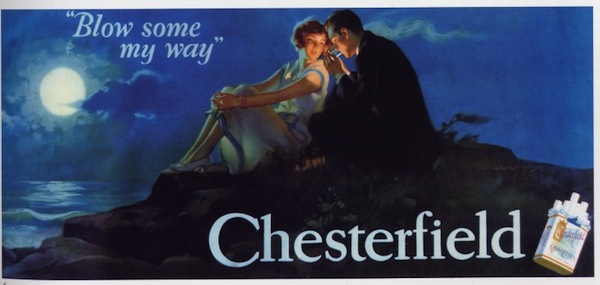
…and from the people who brought us the tagline “blow some my way” in 1928 (as a way to encourage women to take up the habit), by 1934 she is owning that cigarette, and apparently setting some ground rules with the gentleman…
…contrast with the more submissive pose in the Chesterfield ad from the late 1920s…
…on to our cartoons, we begin with spot art by Alan Dunn, which appears to have originated as a captioned cartoon…
…William Steig offered up this bit of art for a profile of an “insurance man” by St. Clair McKelway…
…Helen Hokinson drew up a full page of cartoons along the theme of outdoor dining…
…we continue Rea Irvin’s series on native birds…
…George Price found a way to save on the cost of light bulbs…
…and we close with James Thurber, and a welcome to the family…
Power broker Robert Moses always made sure he was few steps ahead of any possible opposition to his grand development plans in and around New York City. That included the yacht clubbers along the Hudson River, who were more or less erased from the scene by Moses in one fell swoop.
May 19, 1934 cover by Ilonka Karasz.
The Upper West Side’s Columbia Yacht Club probably thought it was just swell that the city was dumping waste and rock along the shores of the Hudson River, since it eventually created driveway access for members who previously had to access the club via a footbridge over the New York Central’s tracks. What hadn’t occurred to them was that nearly 25 years-worth of infill had also created a new strip of land that extended from 79th to 96th street, land that Moses envisioned as an expansion of Riverside Park (and the abrupt end of the West Side yacht club scene). “The Talk of the Town” explained:
LOCATION, LOCATION…Two views of the Columbia Yacht Club at West 86th Street, circa 1930. The club was razed to make room for Robert Moses’s expansion of Riverside Park. Moses’s ambitious project, which cost twice as much as Hoover Dam, put the train tracks underground and topped the park with the Henry Hudson Parkway. (newyorktoursbygary.blogspot.com/NYPL Digital Collections)HEADS UP…Elsie Henneman dives into the water near the Hudson River Yacht Club, circa 1930. Located at the foot of West 74th Street, the club moved onto a barge at 145th Street to escape Moses’s park expansion plans, but it was eventually banished from the West Side. (Reddit)
* * *
Ode to the Road
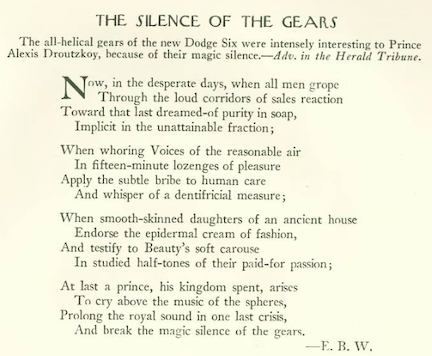
We now shift gears to E.B. White, who was poetically inspired by an advertisement in the Herald Tribune that featured Prince Alexis A. Droutzkoy (a member of the exiled White Russian colony in New York) praising the “magic silence” of the new “Dodge Six” automobile:
SILENCE OF THE CAMS…The 1934 Dodge Six. (detail from a vintage ad)
* * *
Führer’s Filmmaker
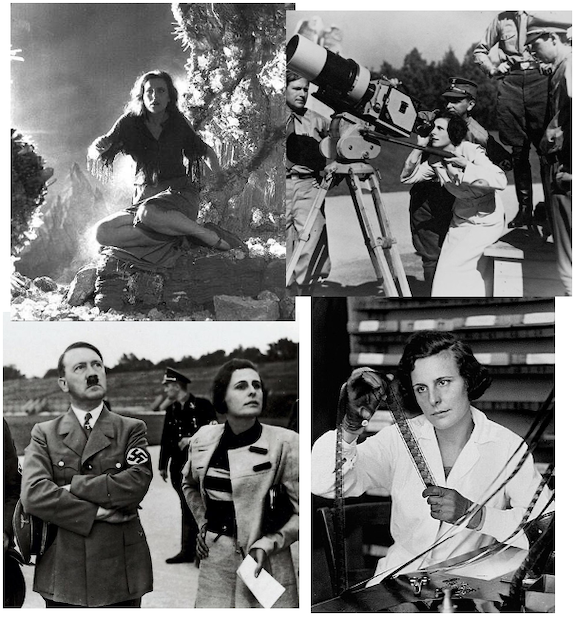
The ability (or inability) to separate art from an artist’s personal conduct or beliefs has been a particular topic of the last two decades, given the litany of stars who have been “cancelled” despite the quality or importance of their work. The work of German filmmaker Leni Riefenstahl (1902–2003), still debated nearly ninety years after her collaboration with Nazi leaders, demonstrates the fine line many a film historian or critic must walk when assessing the career of an innovative artist (for an American example, see filmmaker D. W. Griffith). Riefenstahl’s 1932 film, The Blue Light (Das blaue Licht), made prior to her Nazi collaborations, was praised for its beauty by American critics, including the New Yorker’sJohn Mosher, when it was released in the U.S. in 1934.
The Blue Light also captivated Adolf Hitler, who saw the attractive and athletic Riefenstahl as an ideal of Aryan womanhood. A subsequent meeting with Hitler would result in Riefenstahl’s controversial 1935 Nazi propaganda film Triumph of the Will (Triumph des Willens). We will explore that film, and Riefenstahl’s role, in a later post.
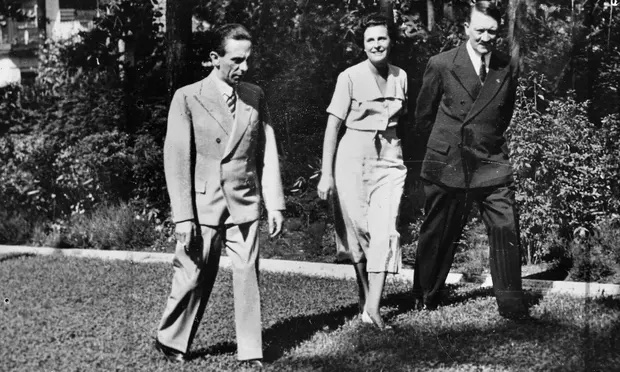
CAREER MOVE…Clockwise, from top left, Leni Riefenstahl demonstrated her acting ability, athleticism and filmmaking talents in 1932’s The Blue Light (Das blaue Licht); Riefenstahl filming in Nuremberg during the 1934 Nazi Party congress—the footage was used in 1935 Nazi propaganda film Triumph of the Will; working at a film cutting table, 1935; with Adolf Hitler at Nuremberg, 1934. (IMDB/Library of Congress/UTK Cinema Studies/The Irish Times)HI HITLER…Nazi propaganda minister Joseph Goebbels and Adolf Hitler pay a visit to Leni Riefenstahl at her Berlin estate, circa 1937. (Roger-Viollet)
* * *
From Our Advertisers
We begin with more Carl “Eric” Erickson-inspired artwork, here promoting the bygone elegance of transatlantic travel…
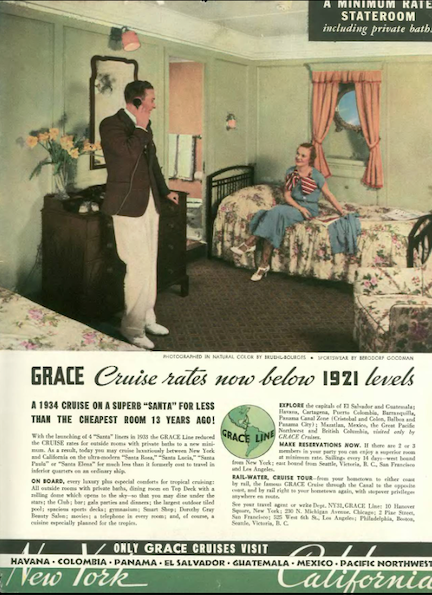
…perhaps a bit less upscale but still pretty nice, the “Santa” line of ships operated by the Grace Line between New York and Latin America included air-conditioned interiors paneled with aluminum (a fireproofing measure) and spacious cabins with private baths that faced to outside…
…this ad must have been a happy sight to folks who had to endure more than a decade of bootleg Scotch during Prohibition…
…Smirnoff vodka had its origins in 1860s Russia, capturing two-thirds of the Moscow market by the mid-1880s…forced to leave Russia in 1904 after the Tsar nationalized the Russian vodka industry…Smirnoff relocated to Turkey, then Poland, and then Paris, each time with limited success…at the end of Prohibition the brand relocated once again to a distillery in Bethel, Connecticut, hence this advertisement…
…the habanero pepper has been used to infuse everything from tequila to vodka to whiskey…this particular product was marketed as something new that could be mixed with a variety of spirits or topped up with club soda or ginger ale…
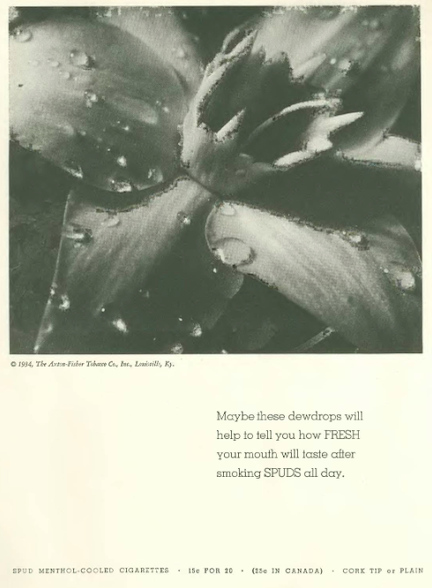
…I include this ad from the maker of Spud cigarettes for its sheer audacity…it claims your mouth will feel dewdrop fresh after an entire day of smoking menthols…
…stunt driver Billy Arnold was one of the “Hell-Drivers” Chrysler employed to tout the safety of its low-priced Plymouths at promotional events…
…including Chicago’s “Century of Progress”…below, a crowd watches Arnold take his Plymouth for a roll and emerge unscathed…
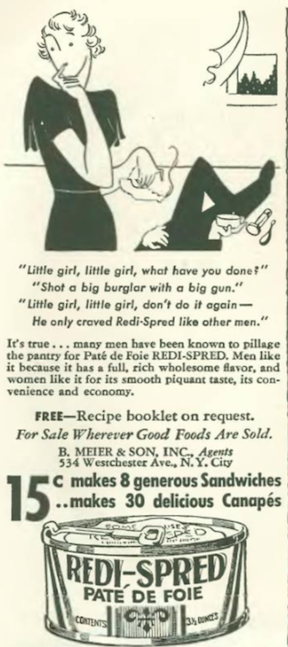
…the folks at Redi-Spred employed a murder theme to promote their “Pâté de Foie”…which foie was used…duck, goose or lord knows what, is not specified…
…the signature is muddled, but this looks like another illustration by Herbert Roese, who never published a cartoon in the New Yorker but sure had its style down, especially Peter Arno’s…
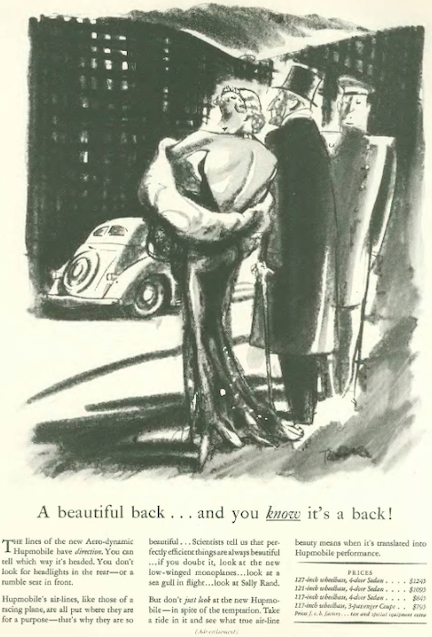
…Harold Ross’s high school friend and cartoonist John Held Jr. was a frequent contributor to the New Yorker from 1925 to 1932 (he also contributed to Life, Vanity Fair, Harper’s Bazaar), but when demand for his Jazz Age cartoons and illustrations fell off in the 1930s, he turned to painting and illustrating children’s books. So it was a surprise to catch this glimpse of Held’s work in a one-column ad promoting a Held-drawn map of New England inns…
…speaking of elusive illustrators, I am often challenged to discover the identities of spot illustrators in the early issues…this one appears to be signed by “Maurice Dreco”…
…the signature on this one looks like “Saphire,” but again, it is not clear…
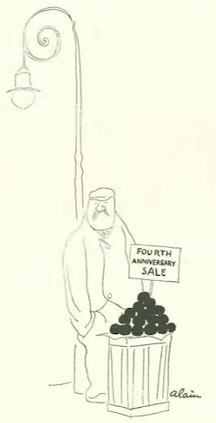
…but there is no doubt this little gem is by Daniel ‘Alain’ Brustlein…
…which leads us to Richard Decker, and a hostage situation gone flat…
…and Decker again, with a back-handed compliment…
…James Thurber was in his familiar world of dogs and battling sexes…
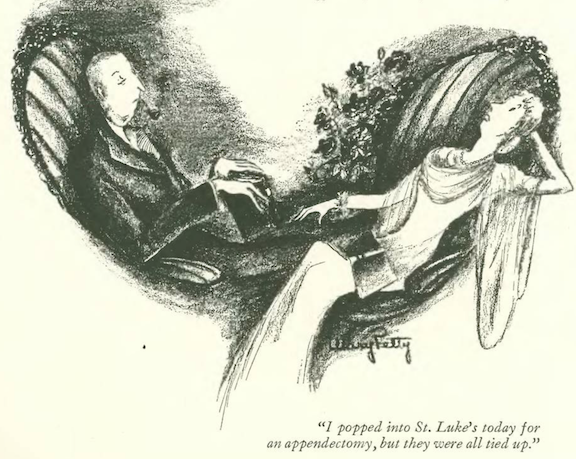
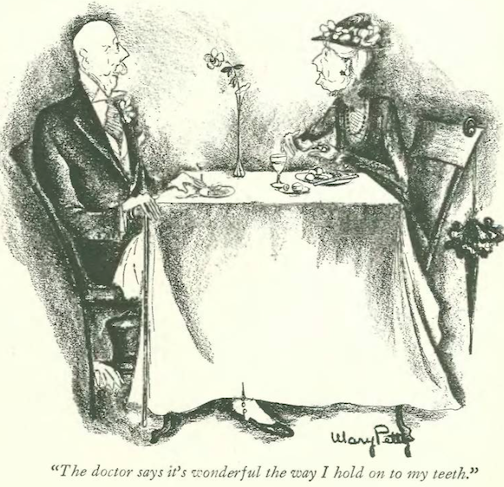
…Mary Petty found some good news on the dentistry front…
…Otto Soglow’s Little King believed more is merrier…
…and we close with William Crawford Galbraith, and a wedding day surprise…
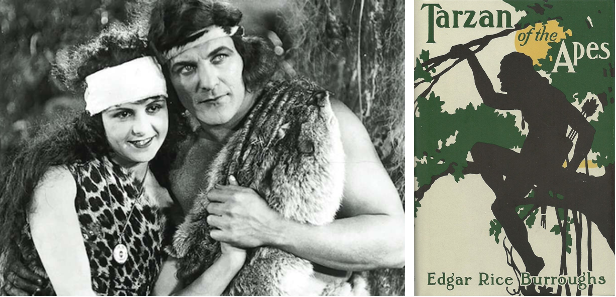
In 1912, Edgar Rice Burroughs published the short story Tarzan of the Apes. Since then at least ninety books, 350 radio serials, three TV series and forty-five full-length films have told the story of the Lord of the Apes.
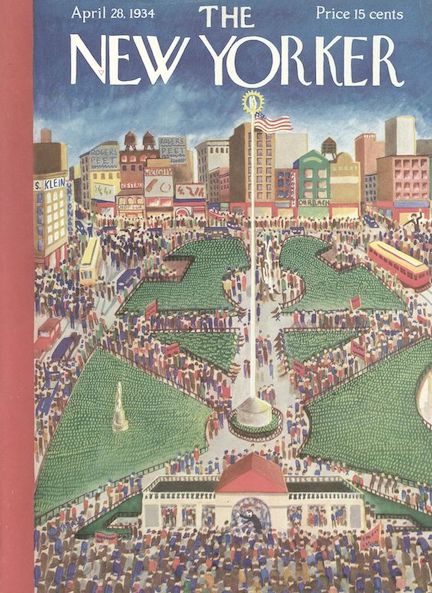
April 28, 1934 cover by Ilonka Karasz.
Tarzan was the first pop culture icon to attain worldwide fame, paving the way for a host of comic-book superheroes that would follow. Recalling his youth in post-war Leningrad in the early 1950s, Joseph Brodsky wrote of the bootleg Tarzan movies he devoured at the local cinema, and the effect a “long-haired naked loner” had on the regimented, inhibited lives of Soviet youth: “The Tarzan (film) series alone, I daresay, did more for de-Stalinization than all of Khrushchev’s speeches.”
ME ELMO, YOU ENID…Elmo Lincoln as Tarzan and Enid Markey as Jane Porter in the 1918 silent film Tarzan of the Apes. The movie was released just six years after the publication of Edgar Rice Burroughs’ short story and subsequent book. (times-herald.com/Wikipedia)
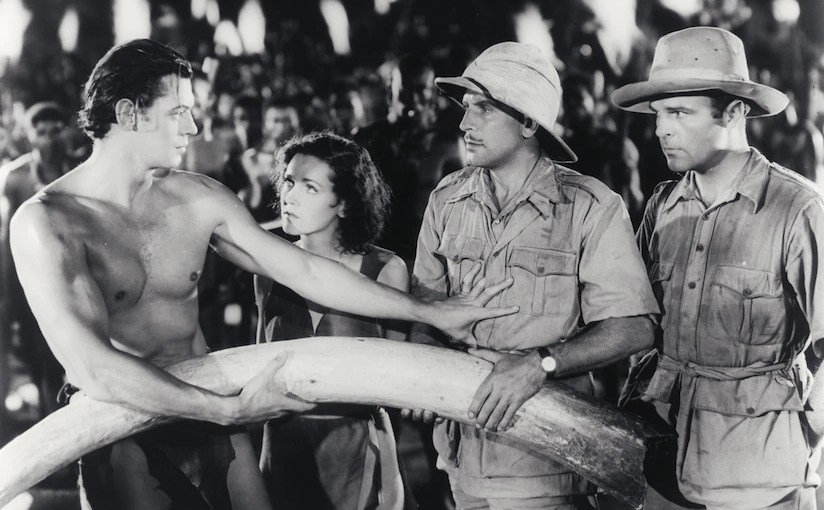
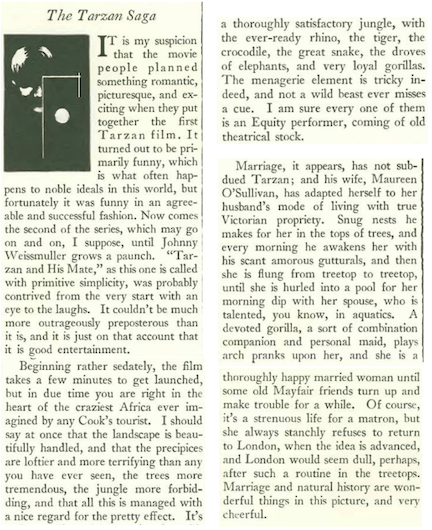
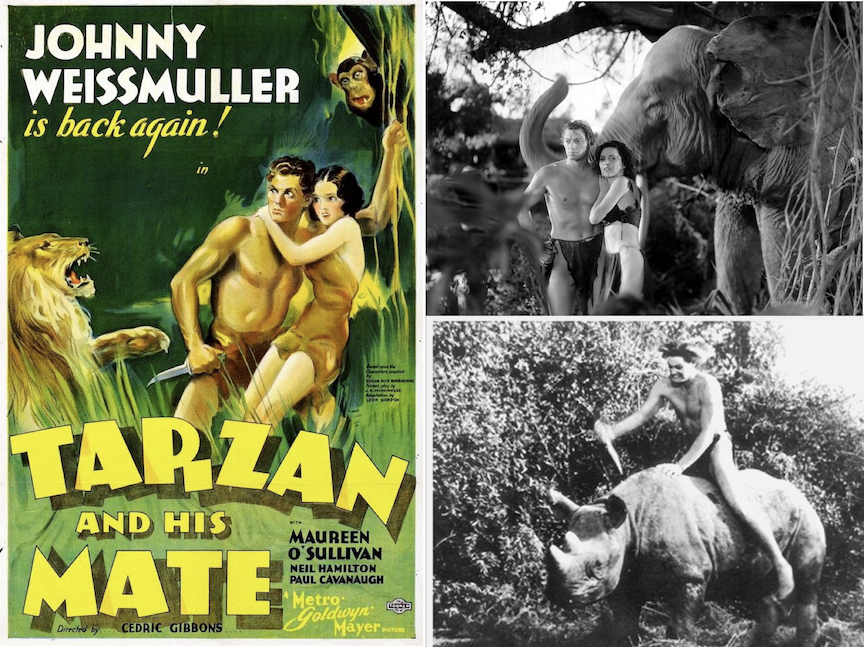
Starting with Elmo Lincoln in 1918, four different silent film actors portrayed Tarzan before Johnny Weissmuller (1904–1984) swung onto the screen with co-star Maureen O’Sullivan. Other Tarzan portrayers would follow, but it was Weissmuller—winner of five gold medals as an Olympic swimmer—who defined the role over two decades, starring in twelve Tarzan films from 1932 to 1948, O’Sullivan playing Jane in the first six of those films. Critic John Mosher sensed that Weissmuller was in for the long haul in just his second outing:
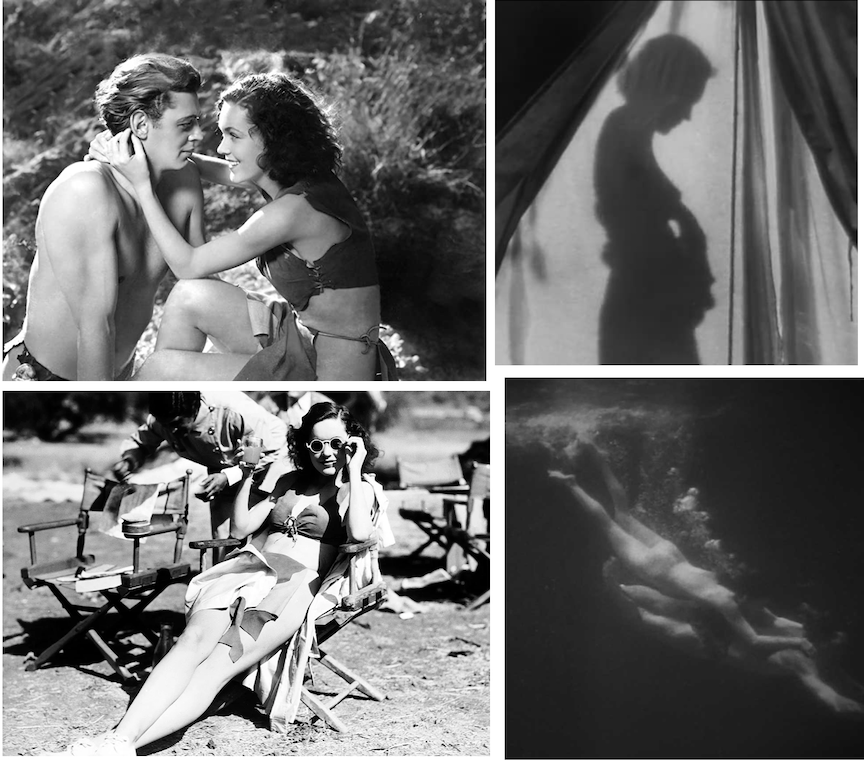
FAUX JUNGLE…Critic John Mosher was impressed by the wild and forbidding jungle scenes portrayed in Tarzan and His Mate—actually locations around Los Angeles. At left, MGM poster proclaims “Johnny Weissmuller is back again,” a reference to the 1933 dud Tarzan the Fearless starring Buster Crabbe (his single turn at Tarzan); top, Indian elephants taken from MGM’s zoo had attachments fixed to their ears and tusks to suggest African elephants; bottom, Weissmuller rides a rhino (named Mary), imported from a German zoo to appear in the scene. (Wikipedia/IMDB/Reddit)NOTHING TO HIDE…Tarzan and His Mate has acquired cult status mainly due to Maureen O’Sullivan’s skimpy halter top and loincloth—in 1934 it was one of the most revealing costumes ever seen on the silver screen. Hays Code puritans had fits over scenes that showed O’Sullivan nude in silhouette and swimming sans bathing suit with Weissmuller (the swimming scene used a body double, Olympic swimmer Josephine McKim). On April 24, 1934, all prints of Tarzan and His Mate were ordered changed, the nude scenes removed—the original print was not restored until 1986. At bottom left, O’Sullivan on the set of Tarzan and His Mate, looking quite unperturbed. (IMDB/hotcorn.com/Twitter)
In 2003, the Library of Congress deemed Tarzan and His Mate “culturally, historically or aesthetically significant” and selected it for preservation in the National Film Registry.
A note of trivia: Irish actress Maureen O’Sullivan (1911–1998) was the mother of actress Mia Farrow and grandmother of journalist Ronan Farrow. She’s also the grandmother of Soon-Yi Previn, Mia’s adopted daughter and current wife of Mia’s ex-partner, Woody Allen.
* * *
Spring Has Sprung
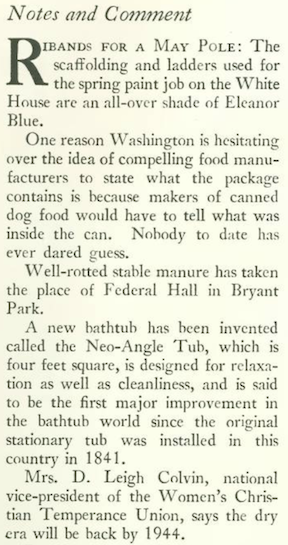
E.B. White began his weekly column with some thematic suggestions for the Maypole’s ceremonial ribbons. Excerpt:
A few of White’s references explained:
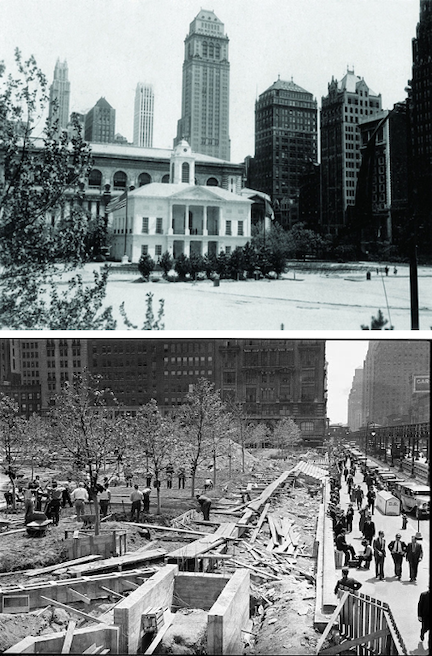
SPRING IS IN THE AIR, or in E.B. White’s case, horse manure, likely used to amend the soil in Bryant Park. In 1933 Parks Commissioner Robert Moses had the park’s Federal Hall replica demolished (erected in 1932 to commemorate the bicentennial of George Washington’s birth) and embarked on an ambitious facelift that included elevating the park from street level and planting numerous trees and hedges. The bottom image shows a 1934 view of the reconstruction looking south on 6th Avenue from 42nd Street. (Untapped Cities/NYC Parks Dept.)
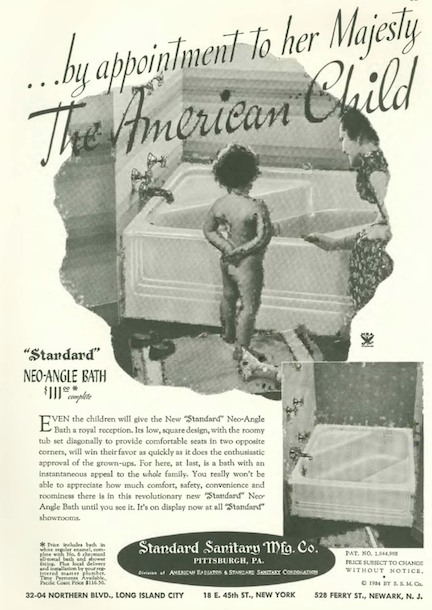
White also referenced the “Neo-Angle” bathtub, shown here in an ad from the same issue:
…James Thurber added this embellishment along the bottom of White’s column…
* * *
Freaked Out
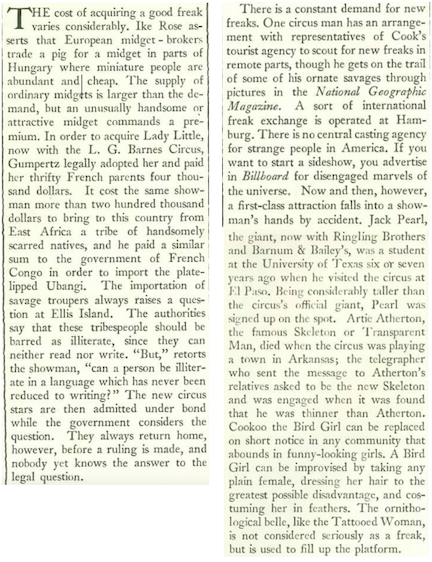
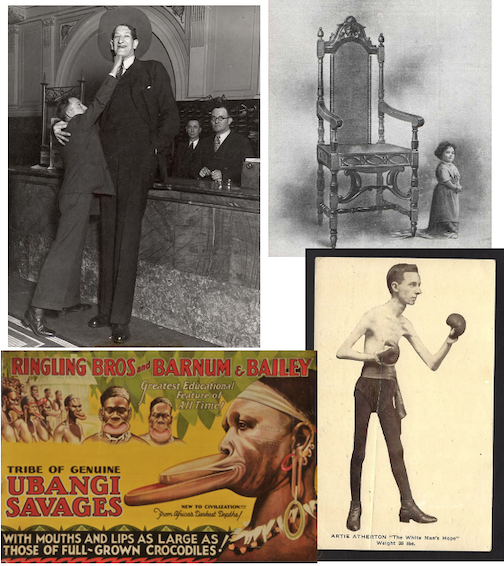
Alva Johnston contributed his third and final installment on the world of circus freaks, using descriptive language that would not pass muster today:
THE LONG AND SHORT OF IT…In his third installment of the world of circus freaks, Alva Johnston referenced the following performers, clockwise, from top left: circus giant Jack Earle; Lady Little, aka “Anita The Doll Lady,” on a 1918 postcard that described her as “26 inches high, 36 years old”; Artie Atherton, aka “Skeleton Dude,” weighing in at 38 pounds; Ringling Bros. and Barnum & Bailey Circus advertised “Geniune Ubangi Savages”—the word “Ubangi” was made up, plucked from a map of Africa because it sounded exotic. These “savages” were actually Congolese natives. (Pinterest/University of Sheffield/Worthpoint/Harry Ransom Center)
* * *
Biding Its Time
“The Talk of the Town” took notice of a lighthouse that was mounted atop the Seamen’s Church Institute, which overlooked New York Harbor from Battery Park. A time ball above the lighthouse would drop down a pole to signal twelve noon to ships in the harbor. Installed on April 15, 1913—to mark one year after the sinking of the RMS Titanic—the lighthouse and time ball were relocated to the South Street Seaport Museum in 1968.
REFUGE BY THE SEA…The Seamen’s Church Institute at 25 South Street (left) could house up to 580 seafarers in dormitory-style rooms. The building also housed a shipping bureau, a restaurant, a postal service and a chapel. When the building was demolished in 1968, the lighthouse and time ball were salvaged and relocated to South Street Seaport Museum. (southstreetseaportmuseum.org)
* * *
Gall of a Gaul
French writer Céline, aka Dr Louis Ferdinand Auguste Destouches (1894–1961), is considered by some to be one of France’s greatest 20th century writers, influencing the likes of Henry Miller, Samuel Beckett, and Charles Bukowski. However Céline is also widely reviled as a Nazi sympathizer and anti-semite, but whatever one thinks of the writer, most agree that he hated pretty much everyone. Clifton Fadiman tried to make sense of the bilious Céline and his most celebrated novel, Journey to the End of the Night (Voyage au bout de la nuit). An excerpt:
DON’T STAND SO CLOSE TO ME…The French writer Céline in a 1932 photograph. (Bibliothèque nationale de France)
* * *
From Our Advertisers
There’s nothing hateful about these brightly colored blankets and throws if you were looking for something for Mother’s Day…
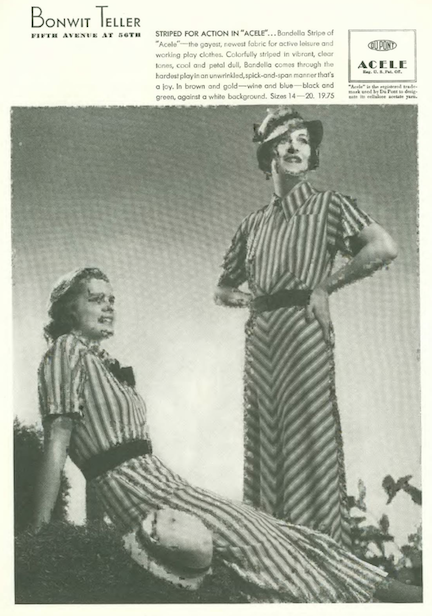
…it’s interesting how Fifth Avenue department stores such as Bonwit Teller embraced new-fangled synthetics made by Dupont—not exactly material favored by those to the manor born…
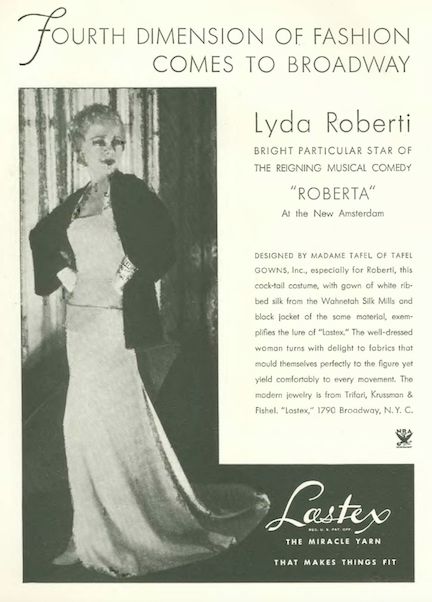
…however Lyda Roberti, the “Bright Particular Star” of the Broadway musical Roberta, seemed pleased to be sporting a gown spun from “Lastex,” formed from a combination of silk and rubber…
…more fashionable women, this time paired with Buick’s latest model displaying a bit of streamlined flair…
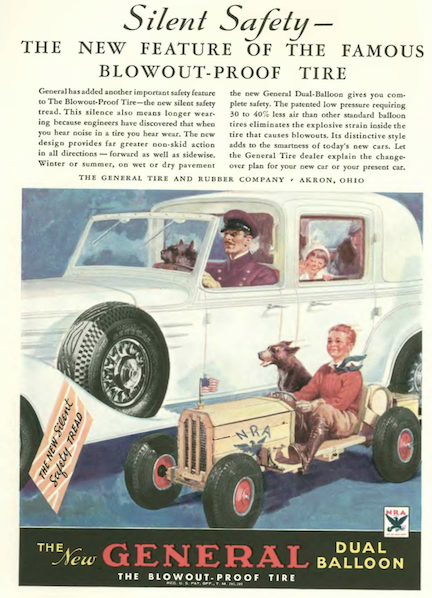
…the folks at General Tire touted the safety of their blowout-proof tires, but as with most things in the 1930s, the scene suggests little regard for safety in general…the boy driving the soapbox racer perilously close to the limo is not a supporter of the National Rifle Association—in the 1930s NRA stood for the New Deal’s National Recovery Act…
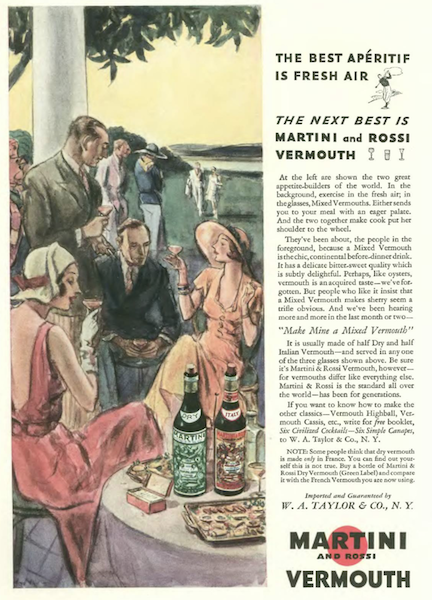
…recalling a style perfected by fashion illustrator Carl “Eric” Erickson, this lovely ad beckoned us to an outdoor cocktail party courtesy of Martini & Rossi…
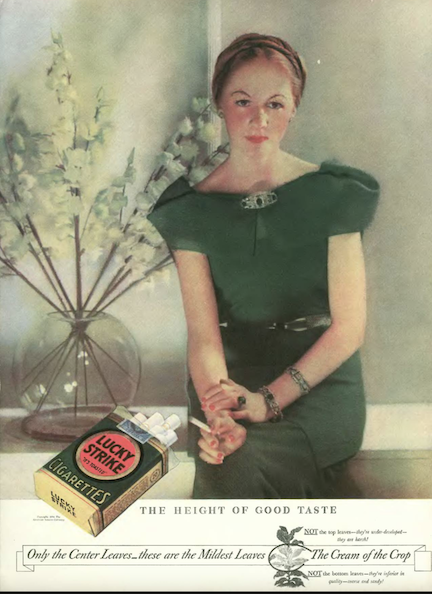
…working the growing market of female smokers, the folks at Lucky Strike gave us this sophisticate caught in a pensive mood…
…of course advertisers also appealed to another female market, the majority of women stuck at home doing the cooking and cleaning…and so we have pandering ads like this one from Heinz (did people really read these things?)…
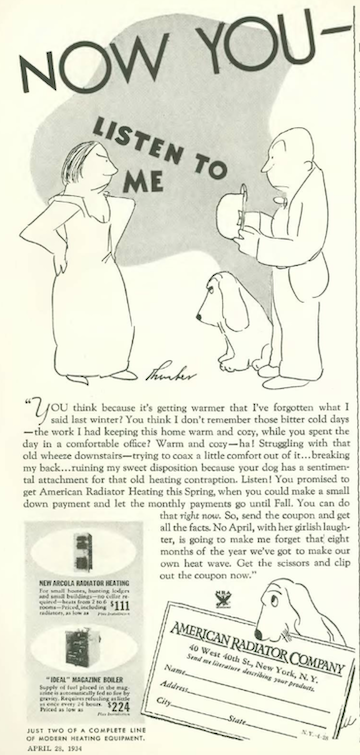
…another approach was to cast women as a nagging emasculators, here illustrated by James Thurber…
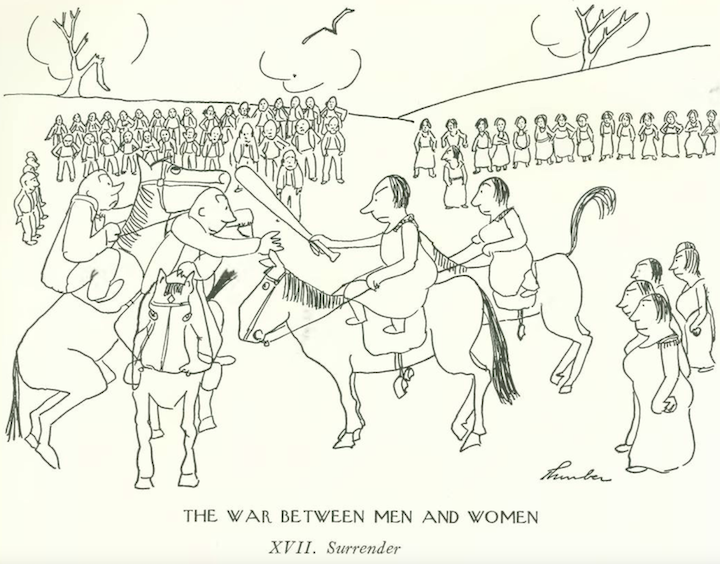
…however, in Thurber’s cartoon world, it was the men who got the upper hand in the final installment of his “war” series…
…Thurber was busy in this issue, also supplying this spot illustration…
…we switch to a more leisurely pace with Syd Hoff…
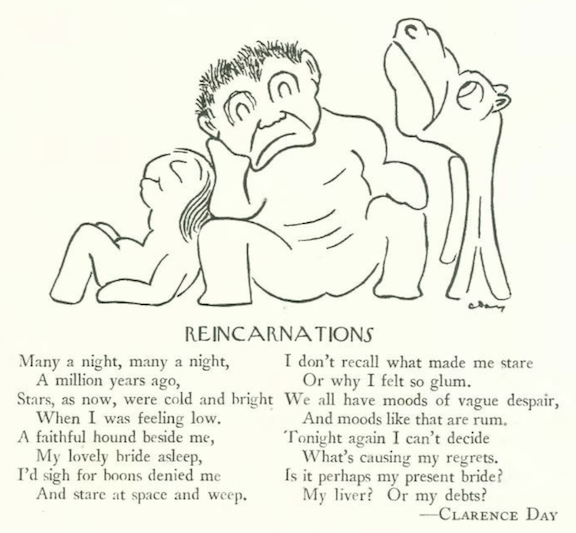
…and check in with Clarence Day, who in addition to his continuing “Life With Father” series occasionally contributed these illustrated poems…
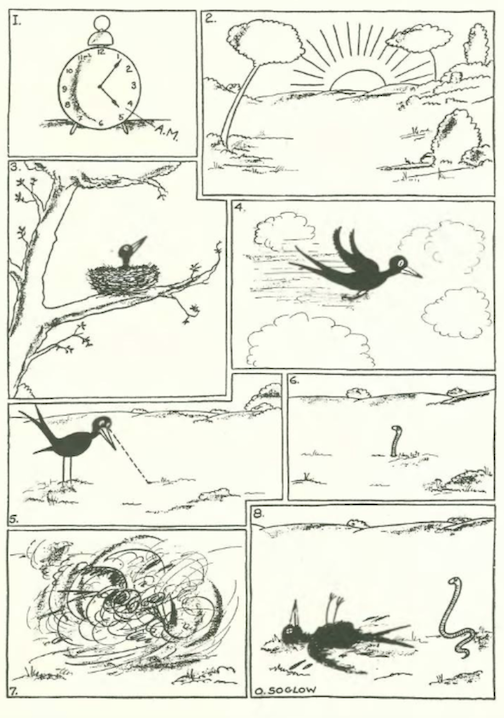
…and we close with Otto Soglow, and an early bird who should have stayed in bed…
It’s hard to believe in this day and age that a theoretical physicist could enjoy rock star status, but then Albert Einstein wasn’t your everyday theoretical physicist.
Dec. 2, 1933 cover by Helen Hokinson.
A two-part profile of Einstein (1879–1955) by Alva Johnston (with terrific caricature by Al Frueh) examined the life and “idol” status of a man who would define the idea of genius in the 20th century. Although Einstein desired to live an almost reclusive existence at Princeton University, Johnston noted that he had become “fairly reconciled to the occupation of popular idol.”
Einstein was at Princeton thanks to the rise of Adolf Hitler, who came to power in Germany in early 1933 while Einstein was visiting the United States. Returning to Europe that March, Einstein knew he could not return to his home country (indeed, the Gestapo had raided his Berlin apartment and eventually seized all of his property), so when Einstein landed in Antwerp, Belgium on March 28, 1933, he immediately went to the German consulate and surrendered his passport, formally renouncing his German citizenship.
I’M OUTTA HERE…Albert Einstein with a Zionist delegation from France, Belgium, and England upon leaving the SS Belgenland in Antwerp, Belgium, 1933. (United States Holocaust Memorial Museum)
After some time in Europe and Great Britain, in October 1933 Einstein accepted an offer made earlier by from the Institute for Advanced Study in Princeton, New Jersey to serve as a resident scholar. When he arrived with his wife, Elsa, he said he would seclude himself at the Institute and focus on his teaching and research.
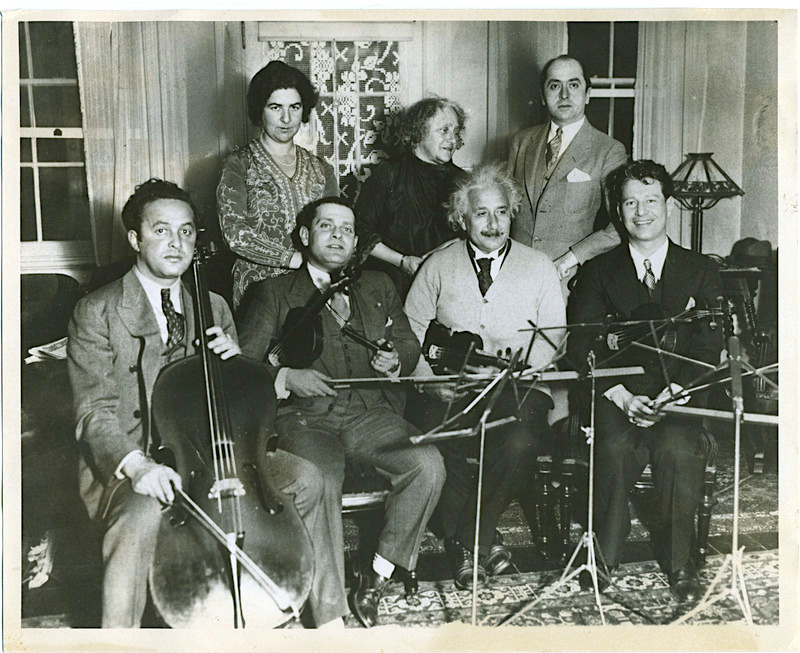
(NY Times, Oct. 18, 1933)EINSTEIN WASN’T FIDDLIN’ AROUND when he played his cherished violin—he once said that if he hadn’t been a scientist, he would have been a musician. This photo was taken at Einstein’s Princeton home in November 1933—he and fellow members of a string quartet were practicing for a December concert at the Waldorf-Astoria to raise money for German-Jewish refugees. From left to right, sitting: Arthur (Ossip) Giskin, Toscha Seidel, Albert Einstein, and Bernard Ocko; standing: Estelle Manheim (Seidel’s wife), Elsa Einstein and unidentified man. (Leo Baeck Institute)
* * *
Stop and Go
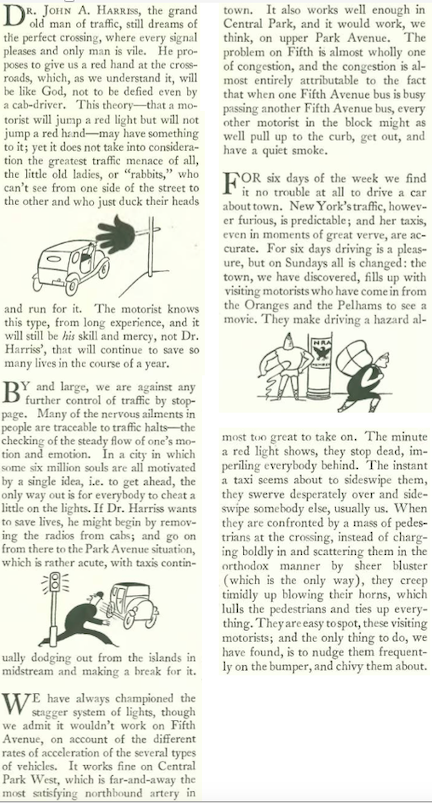
E.B. White devoted his “Notes and Comment” to Manhattan’s traffic situation, which he found manageable as long as tourists stayed out of the way…
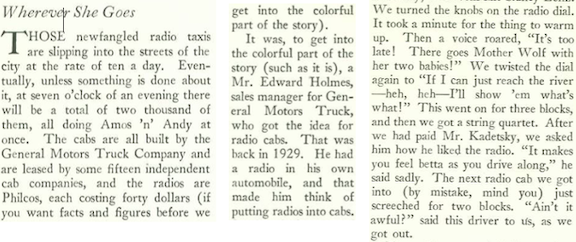
White also noted the perils of Park Avenue, especially the taxi drivers (distracted by those newfangled radios) darting between the islands…
Park Avenue in the 1930s. (geographicguide.com)
…and then there was Fifth Avenue, notorious for traffic jams, made worse on weekends by the tourist traffic…
Fifth Avenue in 1932. (New York State Archives)
…later in “The Talk of the Town” White continued his thoughts on New York taxis, namely the introduction of coin-operated radios installed for use by passengers…
* * *
Fly Newark
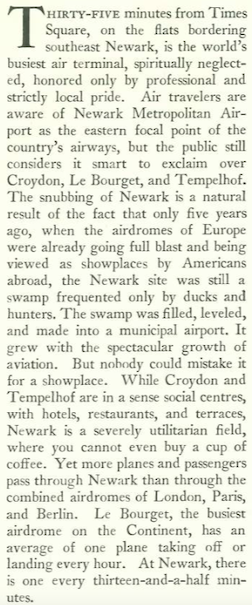
Albert L. Furth took us off the mean streets and into the air when he filed this account about the Newark Metropolitan Airport for “A Reporter at Large.” Furth seemed put off by the cachet of European airports and their many amenities, given that the Newark airport—although admittedly utilitarian—was the busiest in the world. An excerpt:
FREQUENT FLIER…Albert Furth noted that Newark Municipal Airport logged a landing or departure every thirteen-and-a-half minutes. Above, passengers boarding a Boston-bound American Airlines Condor at Newark Airport in 1930. In those simpler times, passengers just walked to the runway and climbed on board. The airport had opened two years earlier on 68 acres of reclaimed swampland along the Passaic River. It was the first major commercial airport in the New York metro area and the first anywhere with a paved runway. (njmonthly.com)
* * *
Goodnight, Speakeasy
Lois Long was an 17-year-old Vassar student when Prohibition went into effect in 1919, so when she started her career in New York in 1922 the only nightlife she knew revolved around speakeasies. Although she held Prohibition officers in disdain, she also believed that the repeal of the 18th Amendment would lower the quality of New York nightlife—the food, the “adroit service,” and the “genial din” of the speakeasy. Excerpts:
FROM LOUCHE TO LEGAL…Lois Long was saying a sad goodbye to her beloved speakeasies; perhaps the Algonquin Hotel (here, circa 1930) would offer some cheer. (Pinterest)
* * *
From Our Advertisers
Abercrombie & Fitch (then an outfitter for the elite outdoorsman) was offering holiday shoppers everything from multi-tool knives to cocktail shakers…
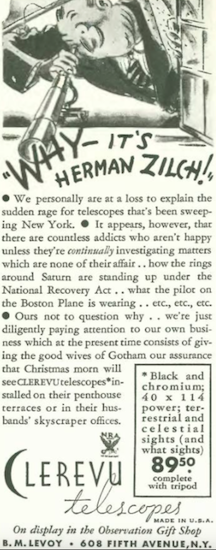
…while the folks at Clerevu telescopes found a growing market for folks who used their product for anything but stargazing…
…with Repeal just days away, the Pleasant Valley Wine Company of New York hoped folks would pop a few of their corks before the good stuff arrived from France…
…the British were coming to the rescue via the Berry Brothers, who were overseeing the importation of liquor from their offices at Rockefeller Center’s British Empire Building…
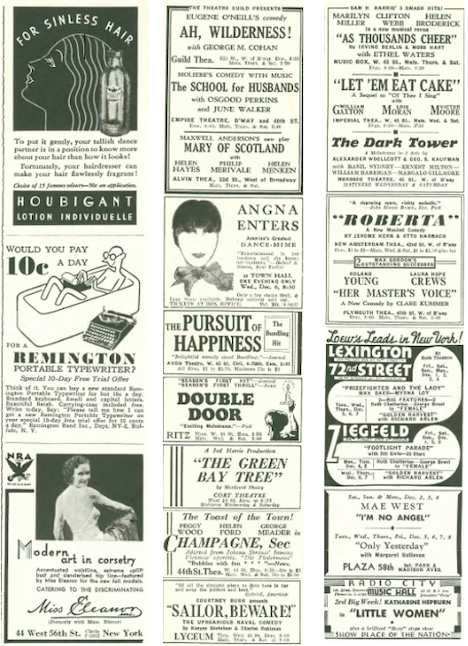
…let’s look at an assortment of one-column ads…the center strip features an ad promoting Angna Enters’ appearance for “one evening only” at The Town Hall (123 West 43rd Street)…Enters (1897–1989) was an American dancer, mime, painter and writer who likely performed her piece Moyen Age…
FEEL THAT STRETCH…Angna Enters performing Moyen Age, circa early 1930s. (NYPL)
…we begin our cartoons with Gardner Rea, and a dedicated bell ringer…
…Otto Soglow showed us a softer side of The Little King…
…Peter Arno revealed the human side of the posh set…
…and we close the Dec. 2 issue with this classic from James Thurber…
…on to Dec. 9, 1933, and a cover by an artist we haven’t seen in awhile, Ilonka Karasz…
Dec. 9, 1933 cover by Ilonka Karasz.
…and we open with this comment by E.B. White, who along with critic Lewis Mumford had once voiced displeasure over the massive Rockefeller Center project. However, while viewing the floodlit tower by night, he decided that he would have to eat his words, observing how “the whole thing swims up tremendously into the blue roxyspheres of the sky”…
MEA CULPA…E.B. White gained a new perspective on Rockefeller Center, pictured here in December 1933. (Wikipedia)
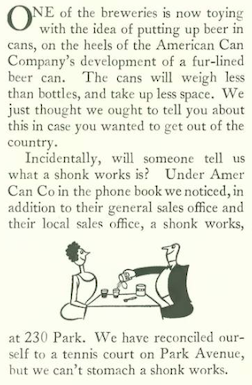
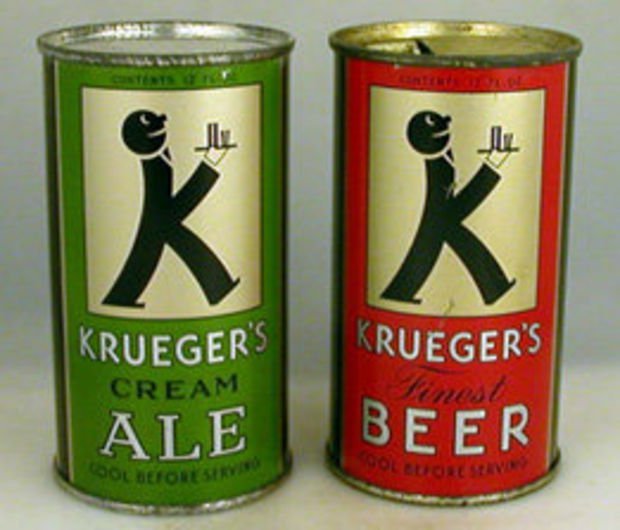
…we continue with White, who also offered his thoughts on something heretofore unthinkable—a proposal to start putting beer in cans…
…it would happen about a year later…on Jan. 24, 1935, the Gottfried Krueger Brewing Company, in partnership with the American Can Company, delivered 2,000 cans of Krueger’s Finest Beer and Krueger’s Cream Ale to drinkers in Richmond, Virginia…
(seletyn.com)
…and despite White’s doubts, apparently ninety-one percent of the first drinkers of the product approved of the canned beer, although when Krueger’s launched their ad blitz they had to include instructions (and a new tool) to open the darn things…
(seletyn.com)
* * *
Dreamscapes
Critic Lewis Mumford offered his thoughts on a recent exhibit by a young surrealist named Salvador Dali…
MIDDLEBROW SURREALIST…The Triangular Hour by Salvador Dali, 1933. (wikiart.org)
…and we move along to moving pictures, where John Mosher was showing some appreciation for Joan Crawford (1906–1977) in the pre-Code film Dancing Lady…
SHE HAD IT ALL…Audiences and critics alike were wowed by Joan Crawford’s performance in Dancing Lady, which featured a star-studded and eclectic cast. Clockwise from top left, Clark Gable plays a Broadway director who becomes Crawford’s love interest; Crawford displays her dancing talent in a Broadway rehearsal; Dancing Lady featured an early film appearance by The Three Stooges, pictured here with Gable and the Stooges’ leader at the time, Ted Healy; Crawford with Stooge Larry Fine—in the original film, Fine completes his jigsaw puzzle only to discover (to his disgust) that it’s a picture of Adolf Hitler. The Hitler scene was removed by the Production Code; its enforcers claimed it insulted a foreign head of state. (IMDB)
In addition to Crawford, the star-studded cast included Clark Gable, Fred Astaire (in his film debut), Franchot Tone (who was married to Crawford from 1935-39 and made seven movies with her), The Three Stooges, Nelson Eddy, and Robert Benchley, who played a reporter in the film.
Dancing Lady was the film debut of Astaire, making Crawford the first on-screen dance partner of the famed hoofer…
(IMDB)
* * *
More From Our Advertisers
We begin with this full-page advertisement from Heinz, which went to great lengths and expense to make their ad appear to part of The New Yorker’s editorial content, even featuring a Perry Barlow cartoon of a boy making a mess with their product…
…another New Yorker contributor who occasionally went over to the advertising side was Alexander Woollcott, here shilling for Chrysler…
…Kayser, purveyor of women’s hosiery and underthings, was going for some humorous holiday cheer, but the effect is a bit unsettling…
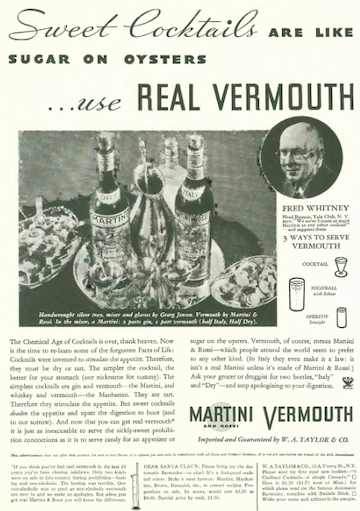
…liquor-related ads began to proliferate with the end of the Prohibition…this one from Martini & Rossi…
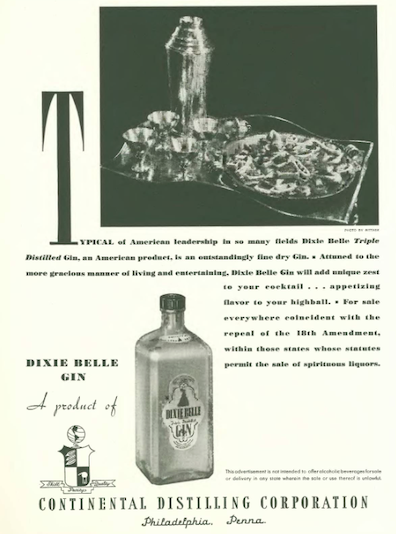
…Continental Distilling was hoping to grab its share of gin sales with its Dixie Belle American gin…
…from the same folks who brought us Fleishmann’s yeast (and kept The New Yorker afloat in its early lean years) came this American dry gin…
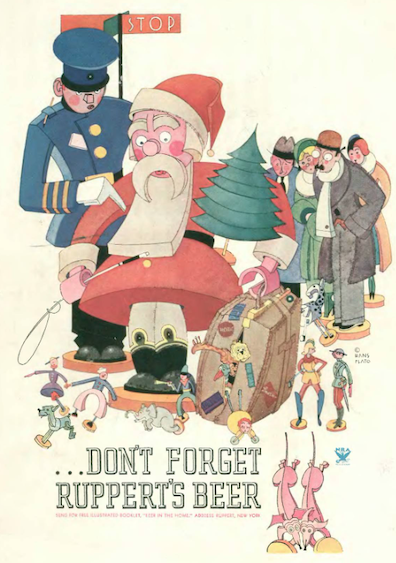
…Ruppert’s Beer was back with another full-page color ad by Hans Flato…
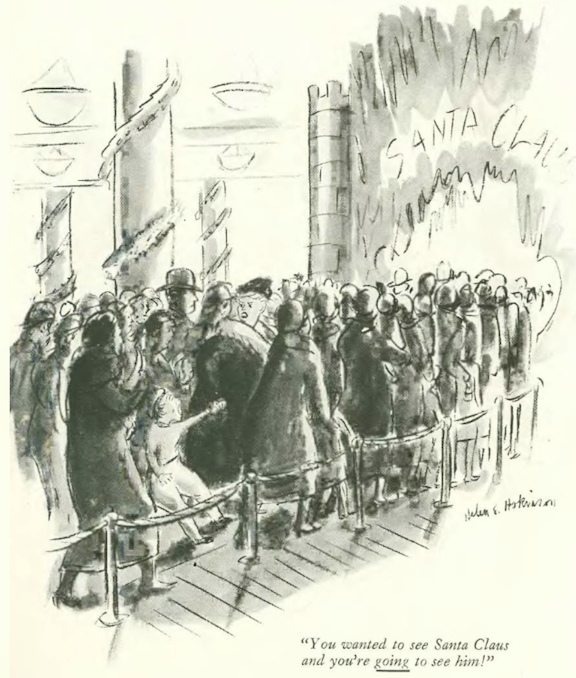
…on to our cartoons, and Santa again, this time besieged by an aggressive tot as rendered by Helen Hokinson…
…Carl Rose found an unlikely customer at a newsstand…
…here is the last of four cartoons Walter Schmidt published in the New Yorker between 1931 and 1933…
…Peter Arno left his glamorous world of nightclubs and high society parties to look in on life at a boarding house…
…and we close with the delightful Barbara Shermund…
Above: Former Governor Alfred E. Smith points out the sights of the city to Governor Franklin D. Roosevelt from an Empire State Building observation floor on May 1, 1931. (Empire State Realty Trust)
New York Governor Al Smith and the man who succeeded him in that office, Franklin D. Roosevelt, were both Democrats, but when it came to personalities, they were more like oil and water.
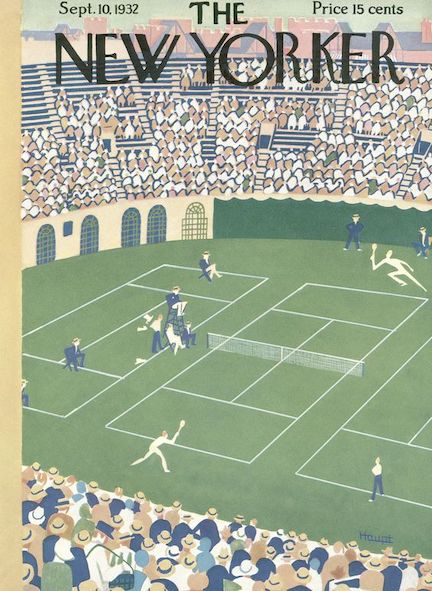
Sept. 3, 1932 cover by Ilonka Karasz.
A popular governor (1923 to 1928) from working-class roots, Smith thought he could ride that popularity to the White House, but lost to Herbert Hoover in the ’28 presidential elections. He then hoped to be of some use to his gubernatorial successor FDR, but was more or less snubbed by his fellow Democrat – the regal Roosevelt branded himself as a reformer, and didn’t want Smith’s deep Irish Tammany connections to sully that reputation. Smith did find something to do, however, by becoming president of the corporation that built and operated the Empire State Building.
THINGS ARE LOOKING UP…Al Smith (pointing) extolls the wonders of the Empire State Building at the May 1, 1931 grand opening. (chrismurphy.com)
But after the building’s dedication, Smith took another shot at the White House, this time against Roosevelt in the 1932 Democratic presidential primaries. Smith lost the nomination in a bitter convention battle (he eventually endorsed FDR) but kept busy with another venture: editor of the New Outlook magazine…
SECULAR SHIFT…The Outlook began publication as The Christian Union (1870–1893). The issue at left is from July 1, 1893, when the magazine became The Outlook to reflect its shift from religious subjects to social and political issues. That magazine went bankrupt and became the New Outlook in 1932; the issue at right is from October 1933, a year after Al Smith became editor. The magazine folded in 1935. (Wikipedia/Abe Books)
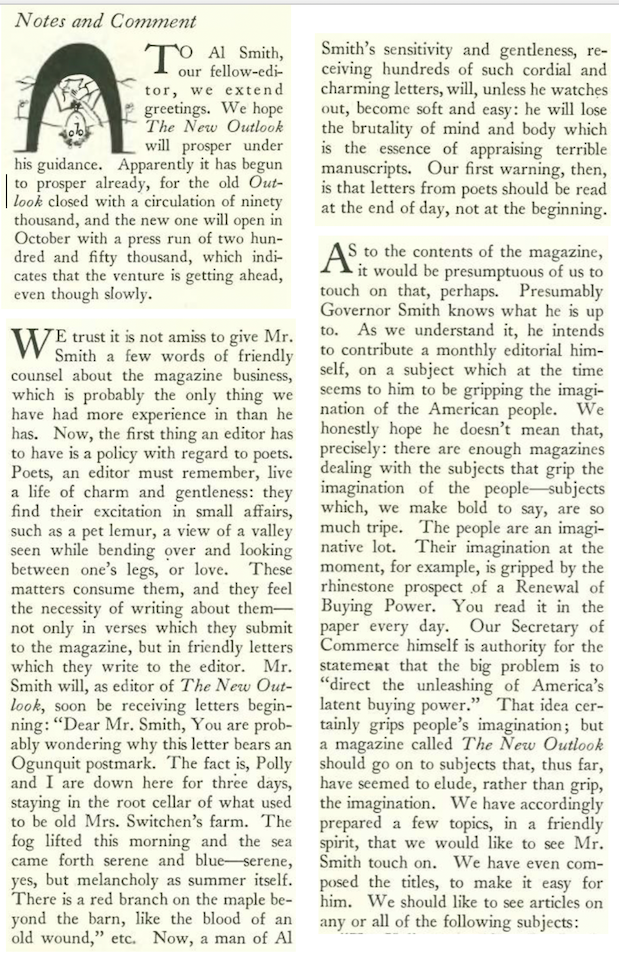
…which Smith used as a platform to attack his Democratic rival, and, particularly the New Deal policies following Roosevelt’s successful election to the White House. The election was still a couple months away when E.B. White offered these observations about Smith’s new publishing venture:
…Otto Soglow provided this interpretation of Smith’s new job for “Notes and Comment”…
…while other cartoonists made hay over the Roosevelt/Smith rift:
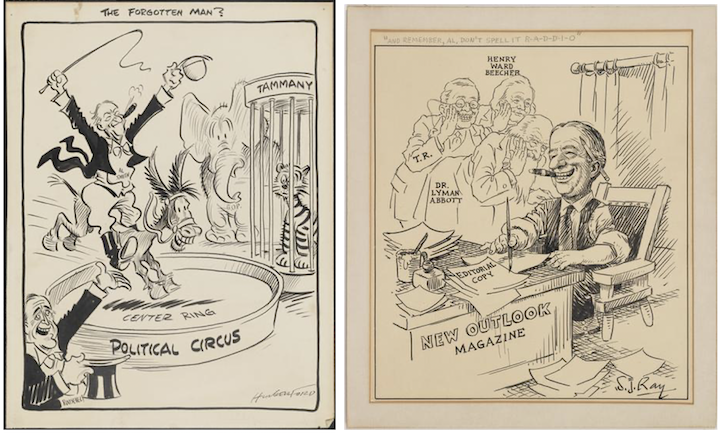
COMIC APPEAL…Cyrus Cotton “Cy” Hungerford produced daily cartoons for the Pittsburgh Post-Gazette for 50 years, including this gem at left that aptly illustrated the political circus that featured Al Smith as its star attraction; during his 32 years as editorial cartoonist for The Kansas City Star, Silvey Jackson (S. J. or Sil) Ray amassed a portfolio of roughly 10,000 cartoons, including the one at right that depicts the ghosts of past Outlook contributors and editors including Teddy Roosevelt, Lyman J. Abbott and Henry Ward Beecher. (Museum of the City of New York/kchistory.org)
* * *
Nein Bitte
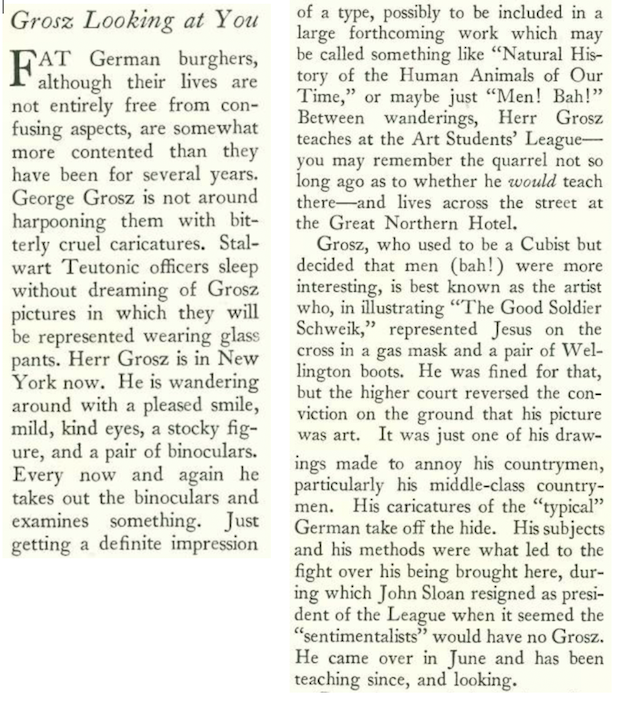
The German artist George Grosz (1893–1959) was perhaps best known for his bitter caricatures and paintings of Berlin’s Weimar years (roughly 1918 to 1933). In June 1932 he accepted an invitation to teach the summer semester at the Art Students League of New York, then briefly returned to Germany before emigrating to the U.S. with his family in January 1933.
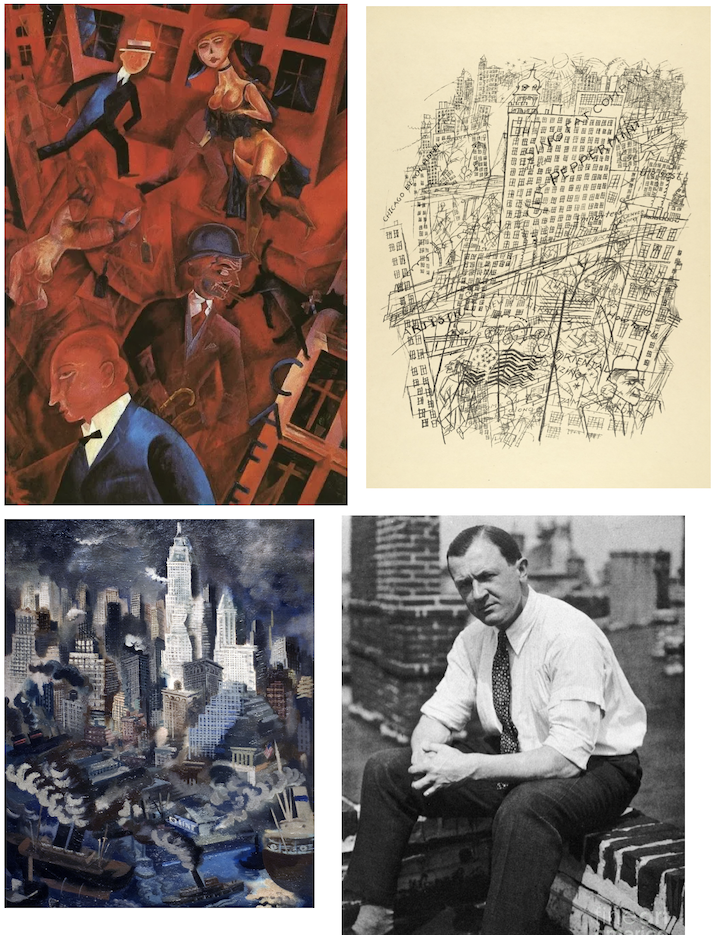
SEEING RED…Clockwise, from top left, George Grosz depicted Berlin as a hellscape awash in blood and corruption in Metropolis (1917); by contrast, Grosz celebrated the energy and freedom of New York in his 1915–16 work Memory of New York; Grosz in New York, circa 1932; after emigrating to the US in 1933, Grosz abandoned his harsh caricatures and corrupted cityscapes in favor of nudes and landscapes. He returned to the subject of the New York skyline a number of times, including his 1934 painting Lower Manhattan. (MoMA/Flickr)
* * *
From Our Advertisers
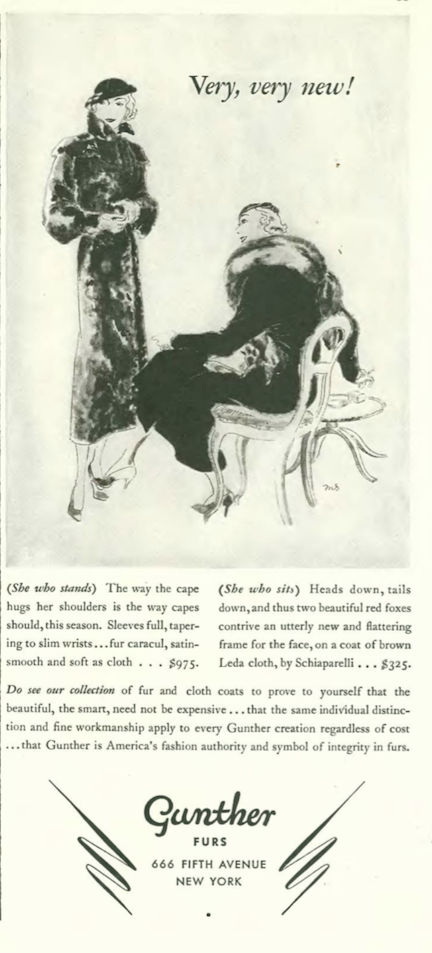
Back in the day when it was still acceptable to drape dead animals around your neck, Gunther Furs offered these ensembles…the coat at left would cost the equivalent of $17,000 today…
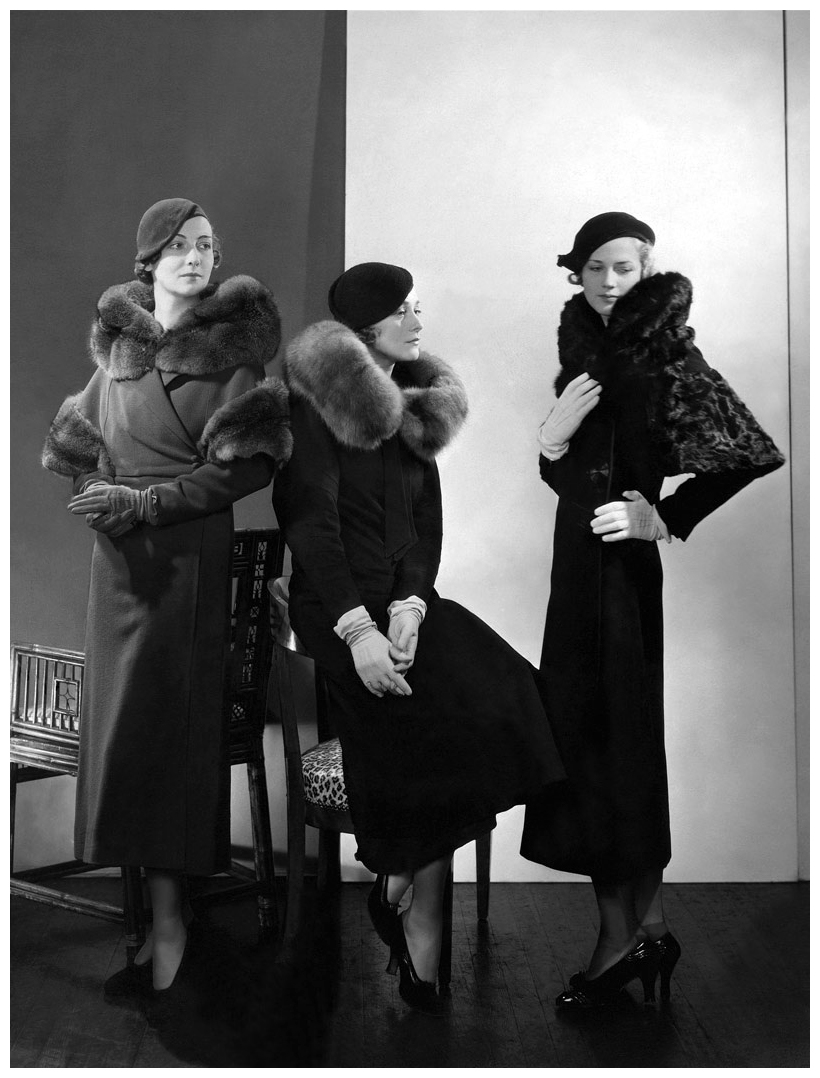
…this 1932 photo gives us some idea of how these coats might have appeared…
FUR SURE…Models in 1932 wearing (from left) wool coat with fur collar and armbands; wool coat with blue fox collar by Lanvin; and wool coat with caracal collar and sleeve trimming by Mainbocher. Photo by Edward Steichen. (pleasurephotoroom.wordpress.com)
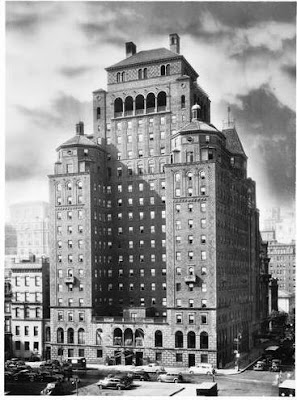
…perhaps you could wear one of the coats on a breezy day atop Ten Park Avenue…even this posh address felt the need to emphasize its affordability in those depressed times…also note the advertisement at the bottom for a “Milk Farm”…
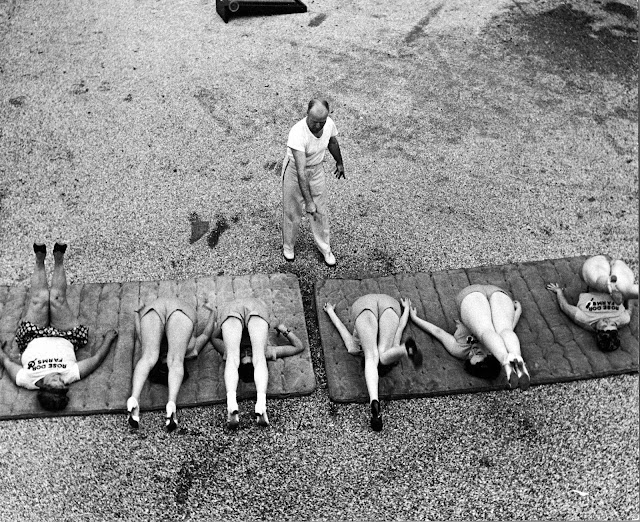
…the 1930s saw a weight-loss fad that included dairy as a dietary must; one such “milk farm” was the Rose Dor Farm just up the Hudson from New York…
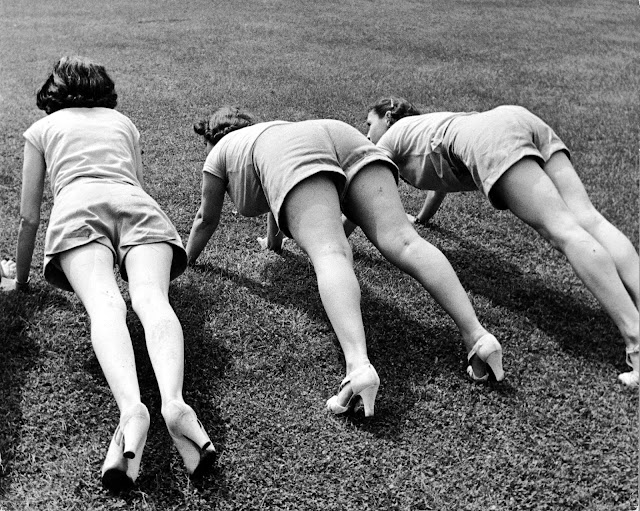
HUMP DAY…Top, Rose Dor Farm trainer Steve Finan directs mat exercises calculated to reduce hips and remove “widow’s humps” in the 1930s. Below, note the choice of footwear for the workout. (vintag.es)
…back to our apartment hunting, The Lombardy was built in the 1920s by William Randolph Hearst for his movie star mistress Marion Davies…unlike Ten Park Avenue, it wasn’t on Park, but the ad makes sure to note its close proximity, and the illustration assured that the clientele were sufficiently dour in their good taste…also note the ad for the Fraternity Clubs Building, which was going co-ed…
…The New York Times reported in August 1932 that “the ninety rooms of the fourth and fifth floors of the building have been redecorated and furnished with a ‘feminine touch'”…
NO ANIMAL HOUSE…The Fraternity Clubs Building, erected in 1923, went co-ed in 1932. The Renaissance Revival-style building was designed by the firm Murgatroyd & Ogden. Today it serves as the Jolly Madison Towers hotel. (New York Public Library via Daytonian in Manhattan)
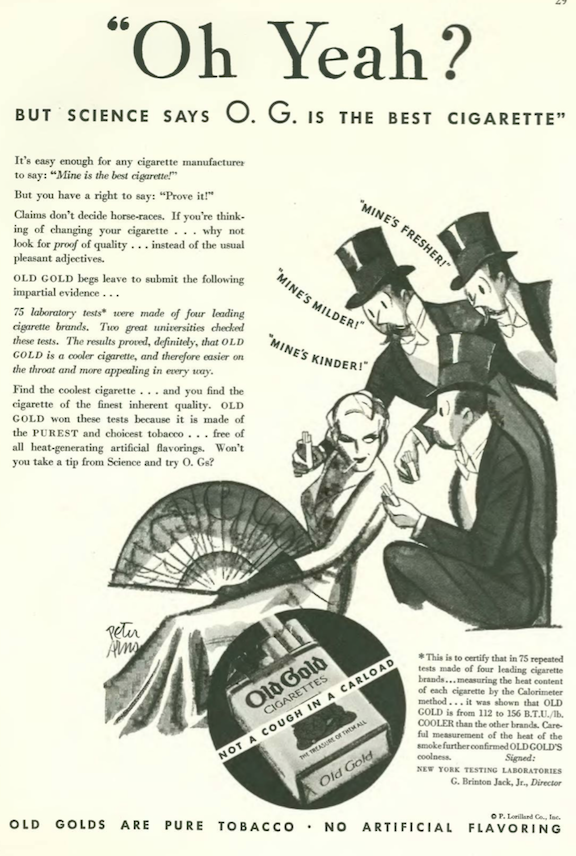
…time to step out for a smoke with another Old Gold ad illustrated by Peter Arno…
…in contrast to Arno’s defiant vamp, this woman enjoyed her smoke with a sense of ease…
…if you’ve never heard of Richard Himber, he made a name for himself in New York beginning with his days in vaudeville and Tin Pan Alley. Described in a Wikipedia entry as “American bandleader, composer, violinist, magician and practical joker,” Himber ran a band-booking agency before forming an orchestra of his own at the Essex House that performed over NBC Radio…
…our last ad is a most unlikely one from the Sterling Engine Company of Buffalo, New York, definitely an outlier among the other New Yorker ads…
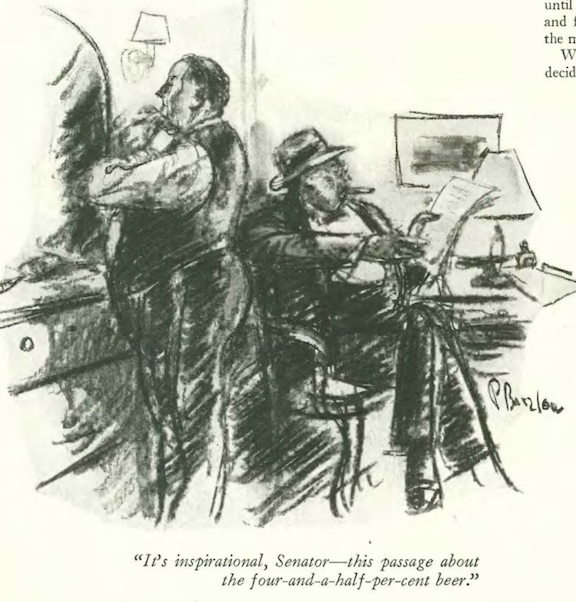
…our cartoonists include Perry Barlow on the campaign trail…
…along with Alain (Daniel Brustlein)…
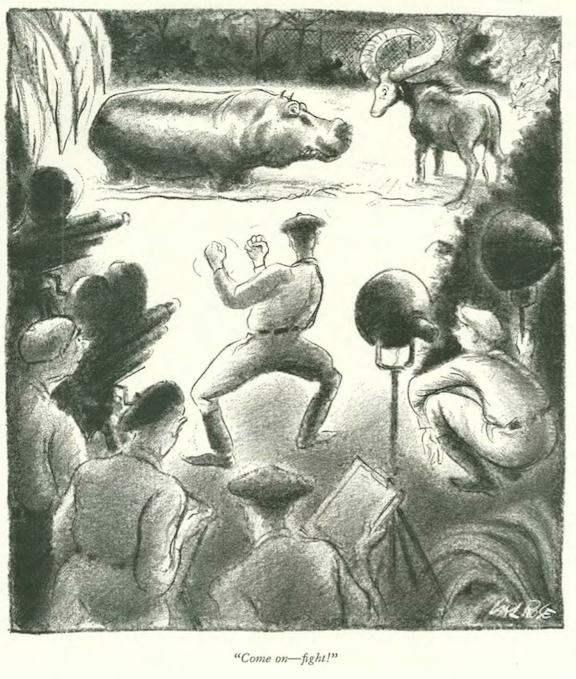
…Carl Rose gave us two zoo animals who were less than keen to become movie stars…
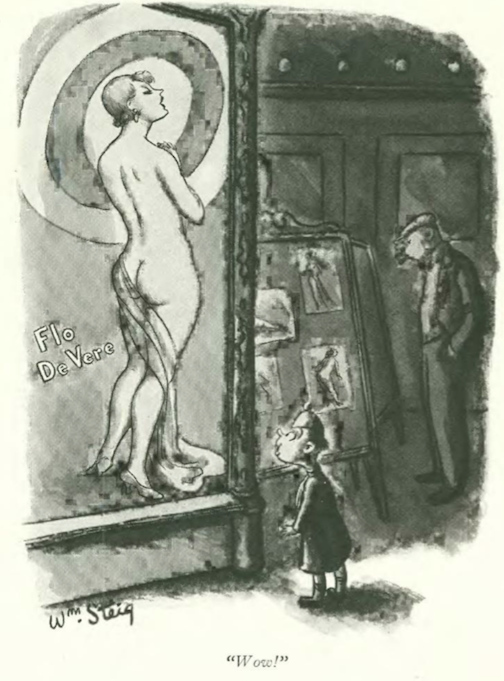
…and we close with William Steig, who showed us one of his Small Fry coming of age…
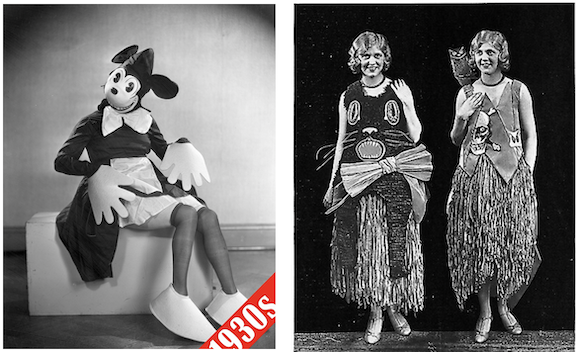
…but before we close, here’s a brief nod to Halloween, 1932, and some popular costumes for the grown-ups, including a Minnie Mouse costume that is unintentionally creepy…
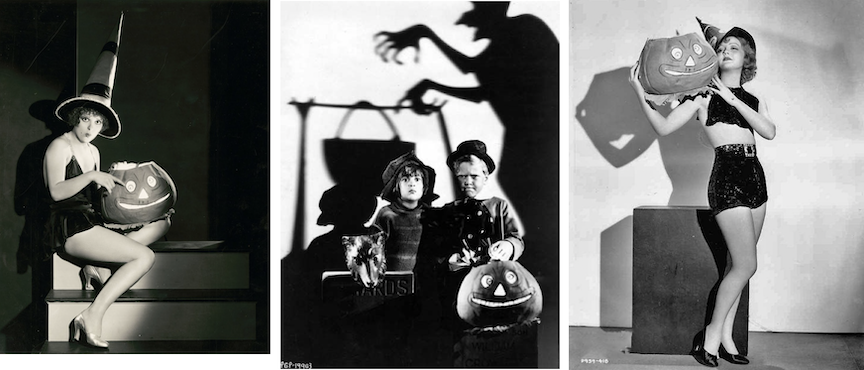
…Hollywood liked to get in on the fun by releasing studio “pin-ups” featuring stars of the day…
BOO…Paramount stars all pose with the same prop Jack ‘o Lantern circa 1931-32. From left, the original “It Girl” Clara Bow, who would retire from movies in 1933 at age 28 and become a rancher; Robert Coogan and Jackie Cooper were child stars of the film Sooky; Nancy Carroll’s latest film, Hot Saturday, was released a few days before Halloween 1932. The film also starred Cary Grant in his first leading role. (vintag.es/twitter/Pinterest)



































































































 A New Yorker State of Mind