Down to Earth

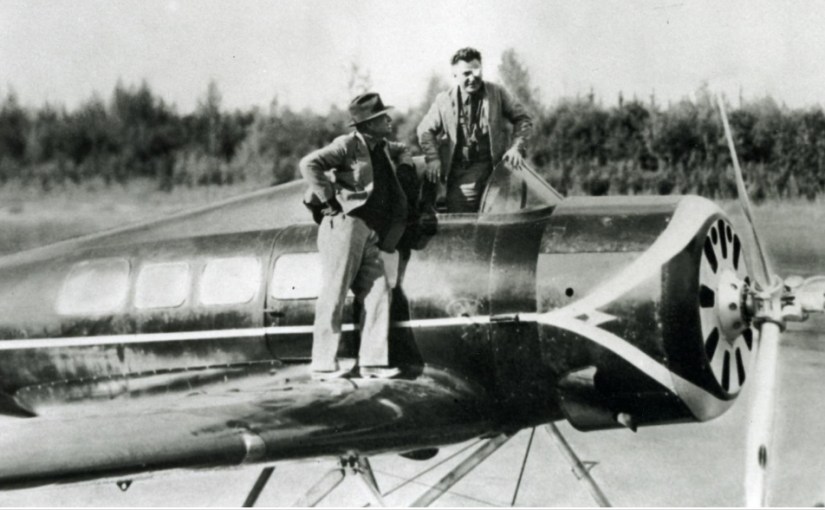
Above: Will Rogers (with hat) visits with pilot Wiley Post near Fairbanks, Alaska, hours before their fatal crash on August 15, 1935. (okhistory.org)

It would be a challenge to find a place for a multi-talented, mega-star like Will Rogers in today’s over-saturated and segmented media landscapehe was a trick roper, vaudevillian, social commentator, comedian, journalist, author, and radio and film celebrity. His early fame on the vaudeville circuit, including the Ziegfeld Follies, would spark a film career in 1918 (he would appear in 71 films), and a 1922 town hall speech would lead to a nationally syndicated newspaper column. When radio became a nationwide phenomenon his voice could heard coast-to-coast. He was seemingly everywhere.
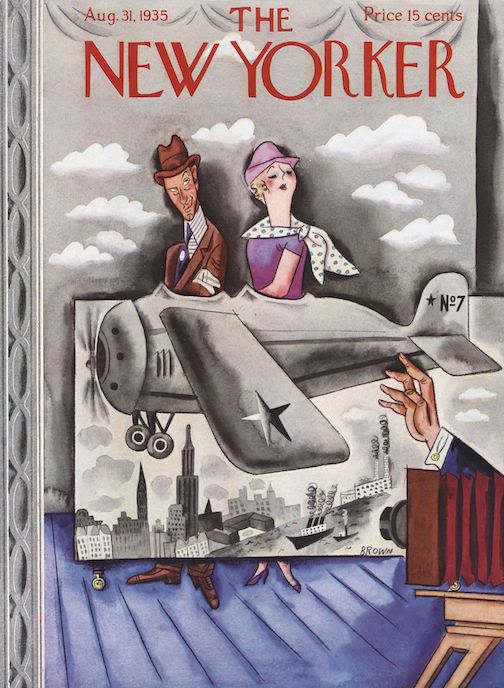
August 31, 1935 cover by Harry Brown. Brown illustrated eighteen covers for The New Yorker.

Rogers (1879-1935) was also a big promoter of aviation, and he gave his audiences many entertaining accounts of his world travels. In the summer of 1935 he announced plans to join famed aviator Wiley Post (1898-1935) on a flight to Alaska and beyond. It appeared to be routine, making the trip’s tragic ending all the more poignant.

Although E.B. White often seemed stuck in the past—he preferred Model Ts and rattily omnibuses to more more modern conveyances—he was a flying enthusiast, never missing a chance to hop aboard an airplane and marvel at the scene far below. However, when tragedy struck, White would become circumspect. When Notre Dame coach Knute Rockne’s Fokker Trimotor crashed into a Kansas wheatfield, White expressed doubts about air safety and pondered “safer” alternatives such as autogiros (a kind of early helicopter that wasn’t so safe or practical). Such doubts returned in his “Notes and Comment” for August 31, 1935:
The fated aircraft, a Lockheed Orion, was heavily modified by Post into a floatplane; one wing was even salvaged from a wrecked Explorer (an older Lockheed model). The pontoon floats he attached were also designed for a larger aircraft, which made the nose-heavy Orion even more unwieldy.

BUILT FOR SPEED…A Lockheed Model 9 Orion parked at Boeing Field, Seattle, in May 1935. With 200-mph speed, the single-engine passenger aircraft (5 to 6 passengers) was faster than any American military aircraft of the time. It was Lockheed’s last aircraft to use wood construction in the frame, which was lightweight but not designed for longevity on major airlines. (James Borden Photography Collection)
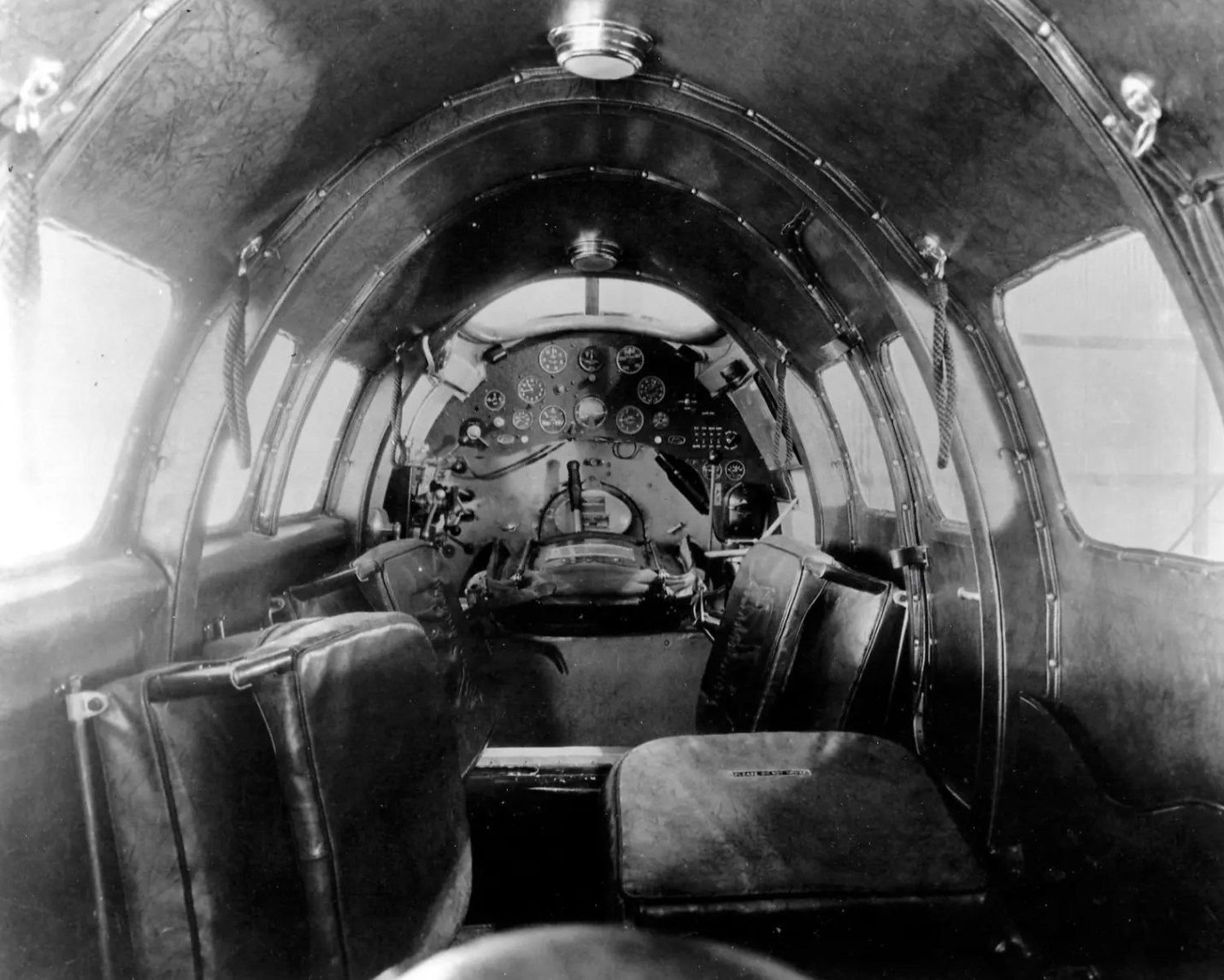
TIGHT QUARTERS….Interior view of a Lockheed Orion 9. No doubt much of the passenger space was loaded with gear for the trip to Alaska. (James Borden Photography Collection)

When Post and Rogers arrived in Juneau, local bush pilots doubtfully regarded the Orion and asked Rogers about the flight plan. “Wiley and I are like a couple of country boys in an old Ford—don’t know where we’re going and don’t care,” he said. They were actually headed to Point Barrow, and from there planned to hop over to Siberia.

After stopping in Fairbanks they set off for Point Barrow in bad weather. Lost in the murk, they landed short of their destination in the shallow waters of Walakpa Lagoon, fifteen or so miles southwest of Point Barrow. Post and Rogers then took off—despite warnings from locals about the conditions. But the weather wasn’t the worst problem: Post had a bad habit of taking to the air in an abrupt, steep climb, which likely caused the engine to stall. Powerless, the ungainly aircraft plunged into the lagoon and landed on its top. Post and Rogers were killed instantly.
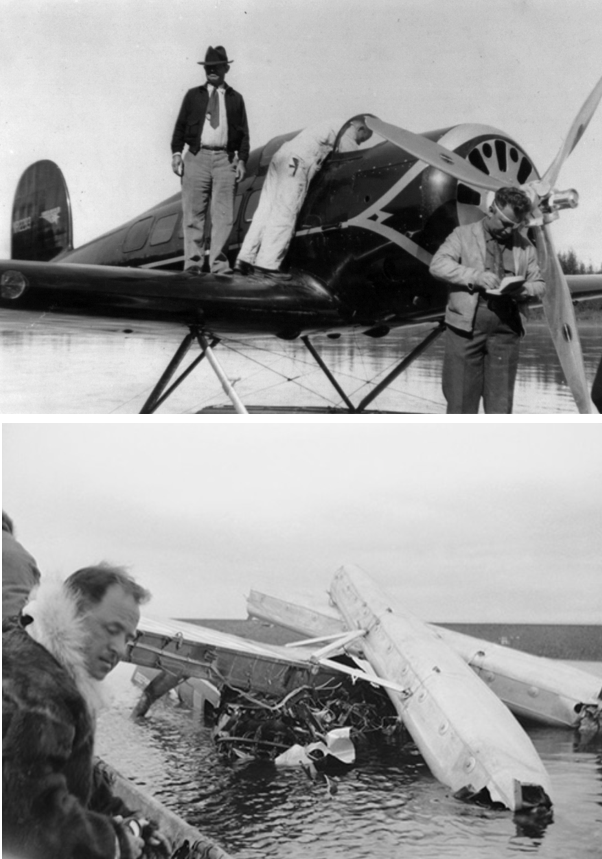
JUST A COUPLE OF COUNTRY BOYS…Top photo, Will Rogers on the wing of the Lockheed floatplane belonging to famed aviation pioneer Wiley Post, hours before their fatal crash on August 15, 1935. Below photo, inverted wreckage of the float plane in Walakpa Lagoon.  (Wikipedia/vintageaviationnews.com)

Rather than eulogize the fallen Rogers, “The Talk of Town” offered up an anecdote about his rise as a newspaper columnist, which was sparked by a backhanded endorsement speech:

A HUMAN FACE…Top left, Will Rogers backstage with the 1924 Ziegfeld Follies cast. At right, Rogers made his film debut in the now lost silent film Laughing Bill Hyde (1918) with co-star Anna Lehr. The magazine ad at right quoted producer Rex Beach, who called Rogers “the most human player who ever faced a camera.” (Will Rogers Memorial Museum/Wikipedia/IMDB)
FINAL CURTAIN…Top photo, Will Rogers with co-star Anne Shirley in Steamboat Round the Bend. Rogers wrapped filming just before heading to Alaska. The film was released posthumously on September 6,1935. Bottom image is a detail from a full-page ad in the October 1935 issue of Picture Play Magazine. Oddly, the ad makes no mention of Rogers’ death, proclaiming that “Will blazes a new path in his screen career as he scores his greatest triumph!”  (theretrorocket.blogspot.com/IMDB)

 * * *

Putting it Mildly

In “Onward & Upward With the Arts,” H.L. Mencken continued to explore the quirks of American language, this time looking at the pervasive (and evasive) use of euphemisms by “professional uplifters.” Excerpts:

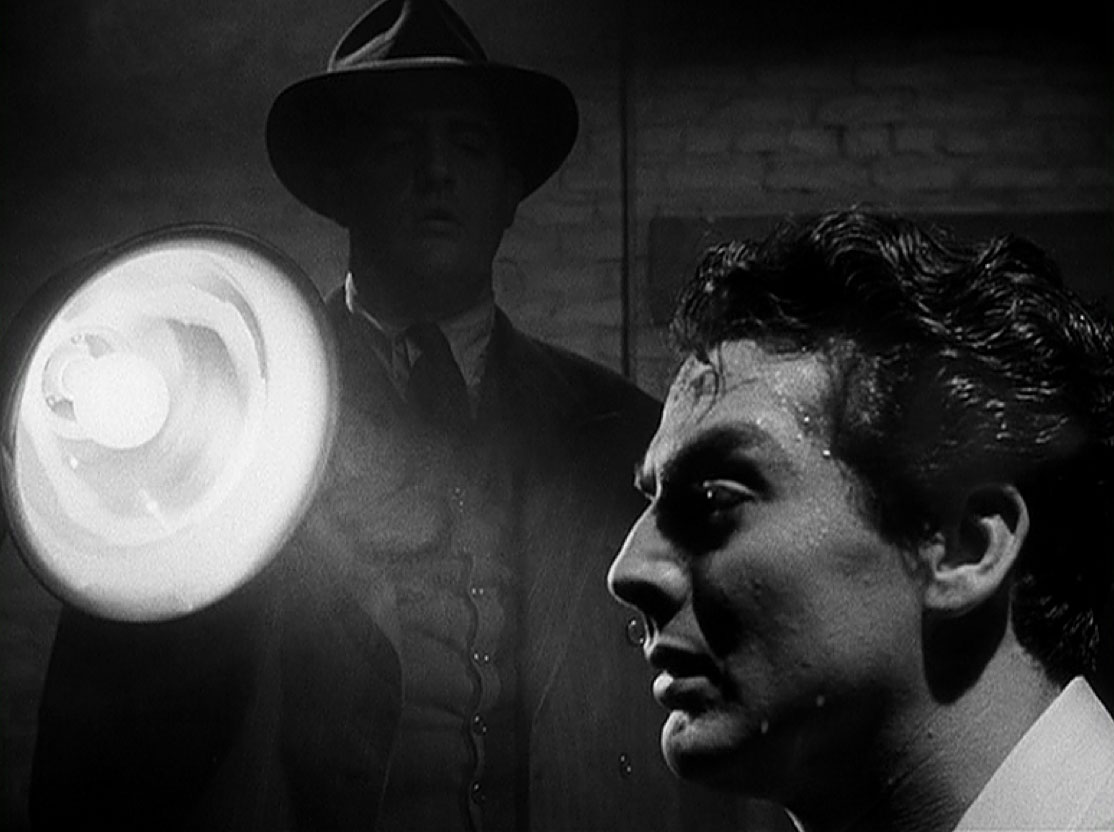
INTELLIGENCE TEST was suggested by “professional uplifters” as a polite replacement for giving someone “The Third Degree.” Image is from the 1941 noir thriller I Wake Up Screaming, starring Victor Mature, pictured here getting his “intelligence test.” (cinematography.com)

 * * *

At the Movies

We join film critic John Mosher to take a look at the latest epic from Cecil B. DeMille, The Crusades, which to Mosher’s disappointment was a rather mild epic, with little to astonish. However, our critic did find something to admire in a more recent historical drama, Diamond Jim.
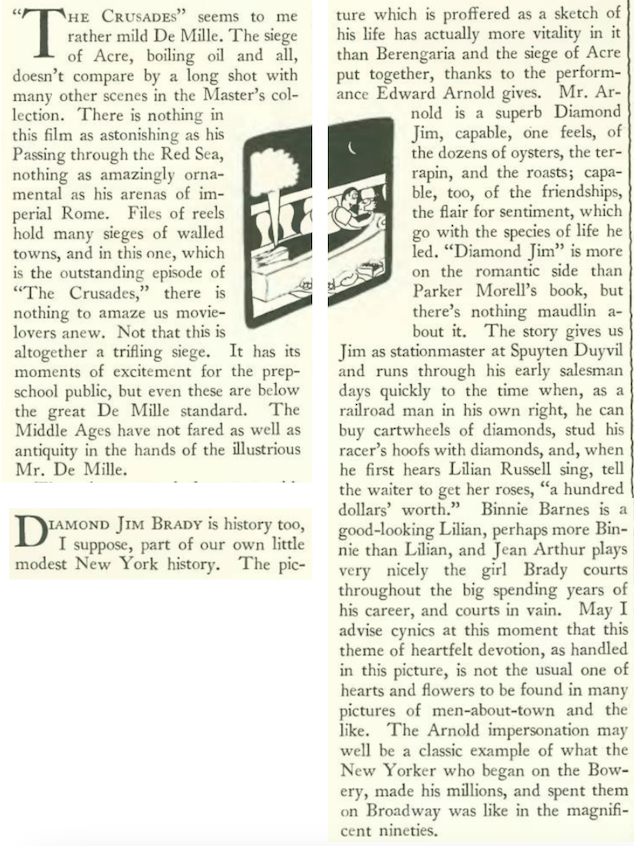
ANTISEPTIC EPIC?…Clockwise, from top left, movie poster for The Crusades offered up an image one typically does not associate with religious warfare, but you had to bring ’em in somehow; Henry Wilcoxon and Ian Keith in a scene from the film; co-stars Loretta Young as Berengaria of Navarre and Wilcoxon as Richard the Lionheart; the film also featured Joseph Schildkraut as Conrad of Montferrat and Katherine DeMille as Princess Alice of France (bottom left). A talented actress, Katherine reportedly landed the role as a Christmas gift from her adoptive father, Cecil B. DeMille. (cecilbdemille.com)
HEY BIG SPENDER…At right, Edward Arnold in the title role (here with Eric Blore) in Diamond Jim. At left, Cesar Romero moves in on Diamond Jim’s love interest, portrayed by Jean Arthur. (Rotten Tomatoes/IMDB)

 * * *

From Our Advertisers

We begin with this advertisement from Lord & Taylor, featuring the latest fall fashions for young women heading to college…notable here is the inclusion of Mickey Mouse in the illustration…the animated rodent was in vogue as much the latest fashions…


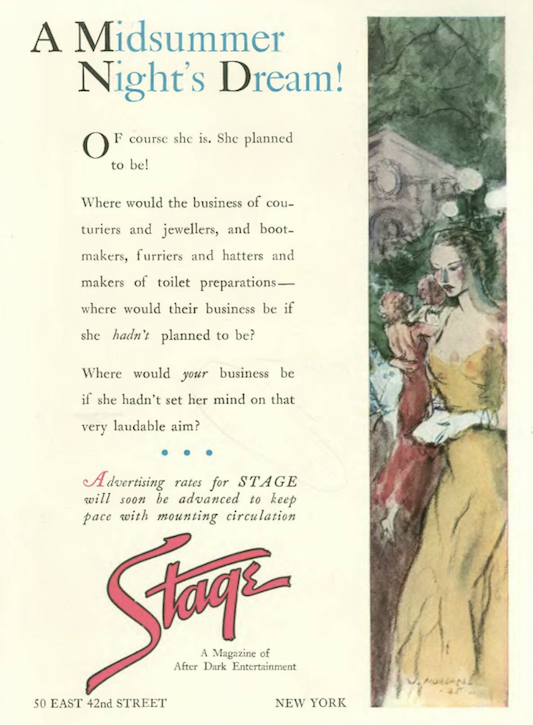
John Hanrahan, whose advertising savvy helped guide The New Yorker through its lean early years, was publisher of the richly designed Stage magazine, promoted here on the inside front cover…
…soft drink giant Coca-Cola recalled its soda fountain origins in this ad that promoted its 6.5-ounce bottled product…

…on the inside back cover Goodyear continued its series of perilous ads illustrating the dangers of tire blowouts (but not the obvious hazard of children riding untethered in a rumble seat, where they doubtless inhaled all manner of noxious fumes)…

…the majority of back covers in 1935 featured tobacco companies…here we learn that Lucky Strikes were more than cigarette; they were your “best friend”…

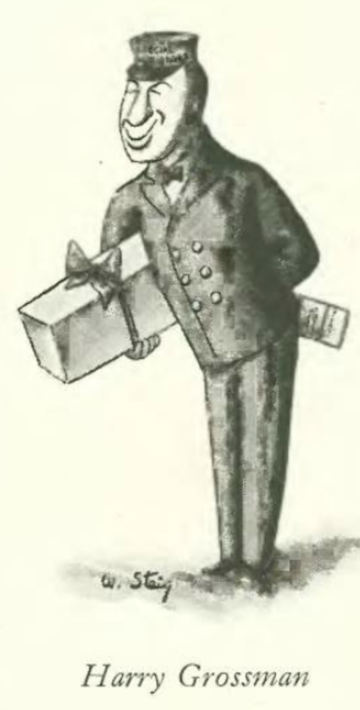
…on to our cartoonists, we start with this “Profile” illustration by William Steig…the profile was a two-parter featuring a clever summons server…
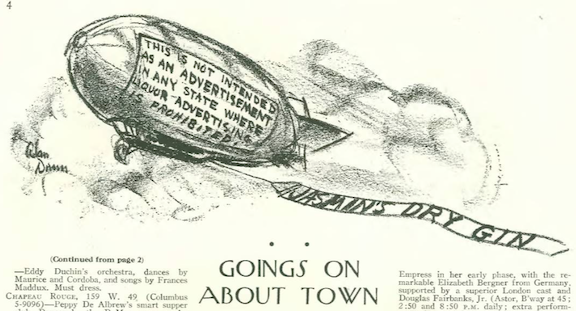
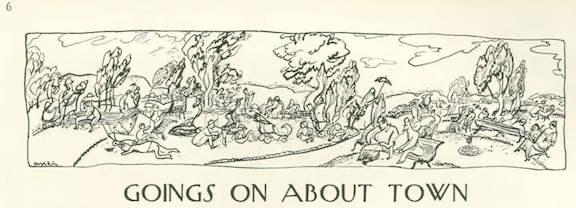
Adolph Dehn adorned the “Goings On” section with this illustration…
…unsigned, but I’m pretty sure this is H.O. Hofman

…here we get a lift from Robert Day

Al Frueh conjured up a nightmare of leaping sheep…

Helen Hokinson gave us some famous footwear…
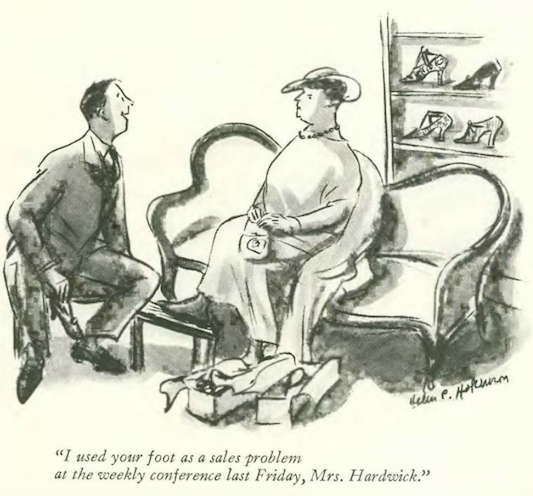
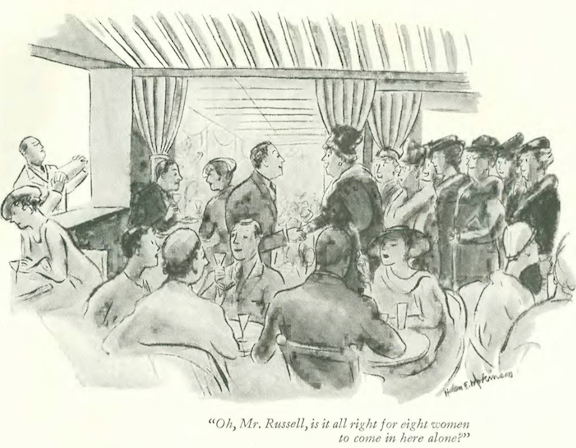
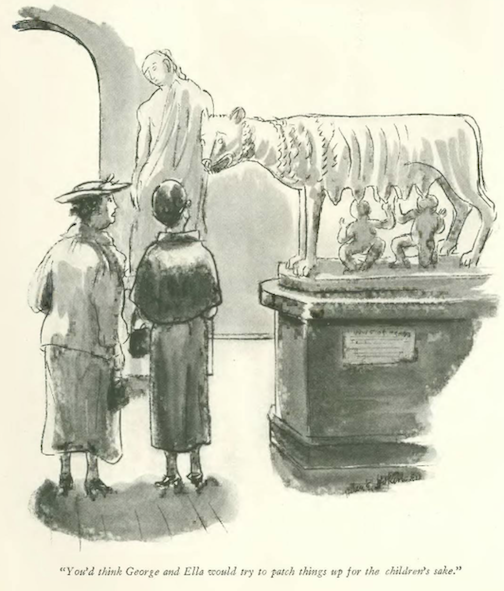
…Hokinson again, with Romulus and Remus providing a convenient metaphor…
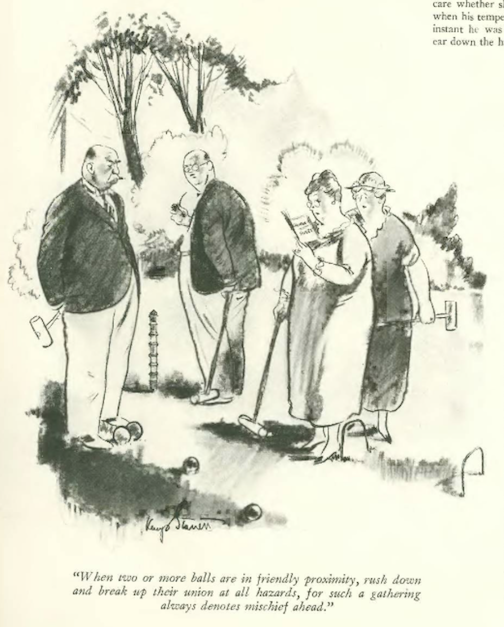
Kemp Starrett was bogged down in the rules of a game…
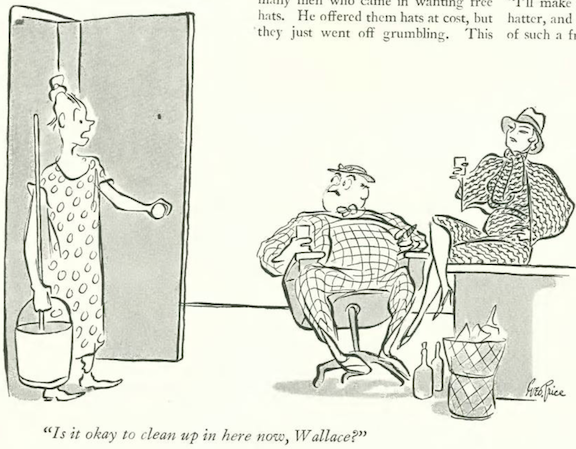
George Price discovered a budding talent…

Richard Decker took to the back roads…(reminds me of a scene from The Long, Long Trailer with Lucy and Desi)…

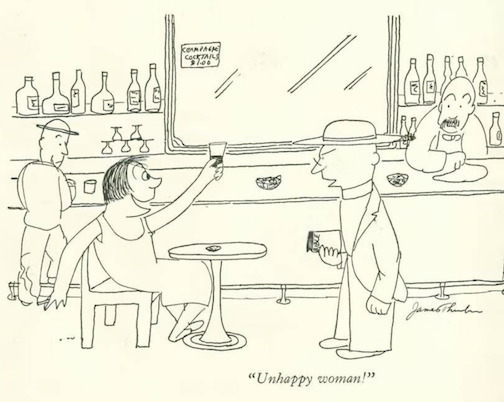
James Thurber raised a glass to a dry do-gooder…
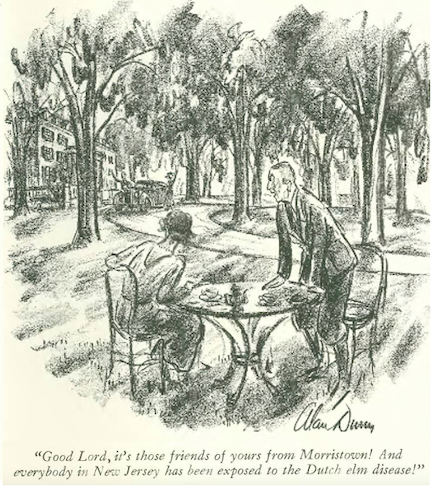
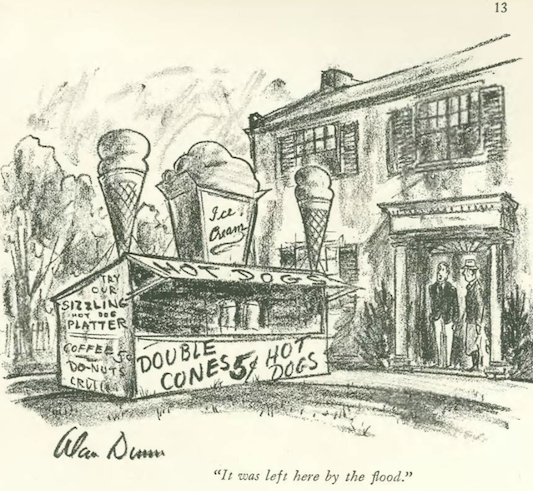
Alan Dunn brought an unexpected windfall to Westchester…
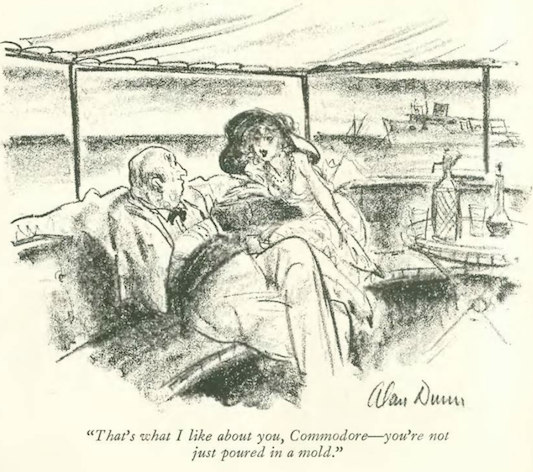
…and to close we Dunn again, and a bit of flattery…
Next Time: A Summer Night…
Not a Square Deal

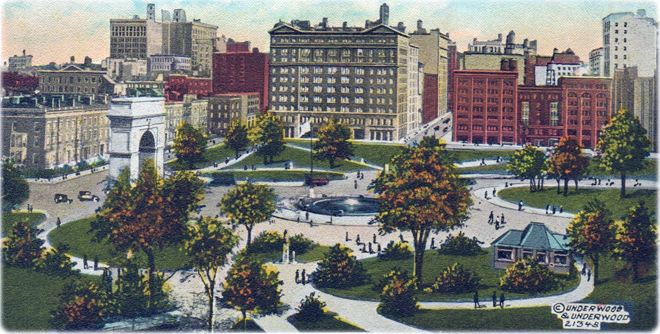
Above: Postcard image of Washington Square Park, circa 1930. (citybeautifulblog.com)

New Yorkers know all about change, and especially during the 1920s and 30s when the city razed everything from Dutch settler houses to the Gilded Age mansions of Fifth Avenue. Landmarks such as the old Waldorf-Astoria were leveled to make way for the Empire State Building, while several blocks—22 acres of residential and commercial buildings—were scraped clean for Rockefeller Center.

June 8, 1935 cover by Harry Brown. This June bride-themed cover was Brown’s fourteenth of the eighteen covers he would create for The New Yorker.

Some things, like Washington Square, were still held dear by city residents. But very little was sacred to the city’s new park commissioner, Robert Moses, who had no problem leveling whole neighborhoods if they stood in way of a road or some other ambitious project.

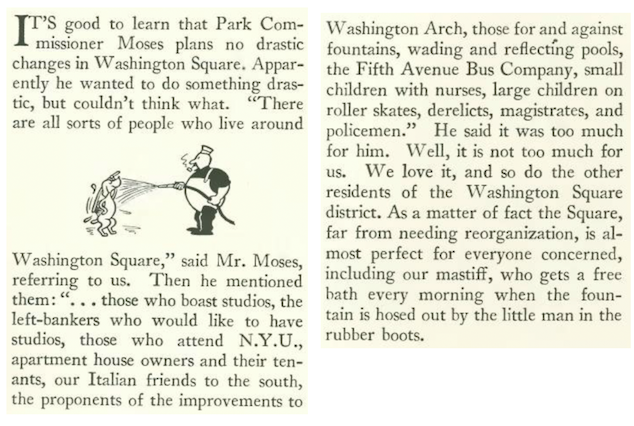
It all seemed well at first when Moses called for the repair of neglected parks, including Washington Square. However, when changes to the park were revealed by the Villager, residents were outraged. Moses’ plan, designed by landscape architect Gilmore Clarke, was a complete reversal of the park’s existing design. In “Notes and Comment,” E.B. White explained:

Village residents organized a “Save Washington Square” committee and successfully blocked Moses from implementing his plan; in true Moses style, he responded by allowing the park to deteriorate.

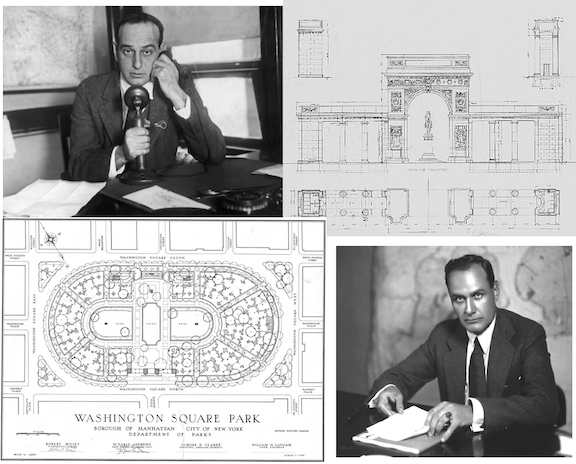
MAKE NO LITTLE PLANS…Clockwise, from top left, Parks Commissioner Robert Moses; proposal to add colonnades to either side of the arch; landscape architect Gilmore Clarke; Clarke’s plan for the redesign.  (Wikipedia/washingtonsqpark.org)

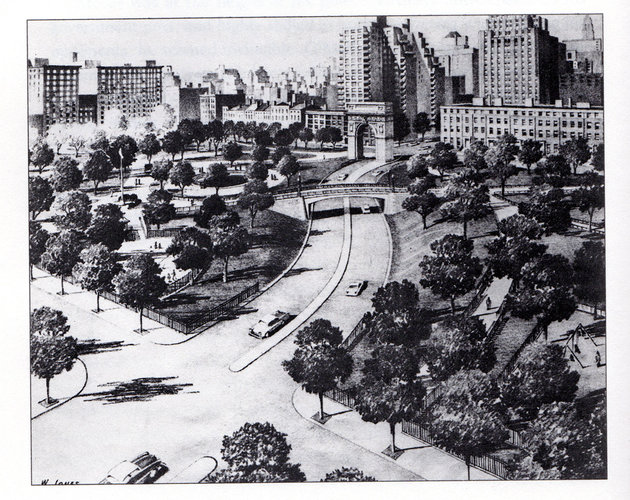
Moses, however, didn’t give up on Washington Square. Around 1940 he began floating the idea of building a double highway through the park. Local residents again rallied, joining business owners and NYU officials in blocking the audacious scheme.

DOUBLE TROUBLE…Around 1940 Moses began floating the idea of building a double highway through Washington Square Park. This illustration is circa 1950. (MTA Archives)

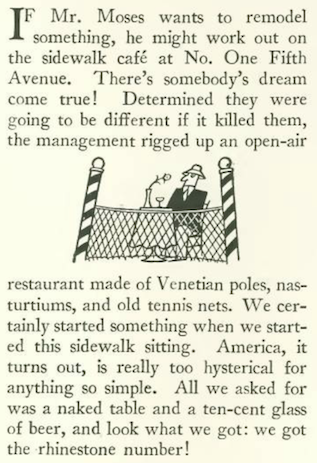
White continued on the theme of city planning, calling on Moses this time to figure out a better plan for sidewalk cafés.

AL FRESCO…Postcard images of sidewalk cafés at 24 Fifth Avenue (top) and 23rd and Lexington, circa 1935. (picryl.com)

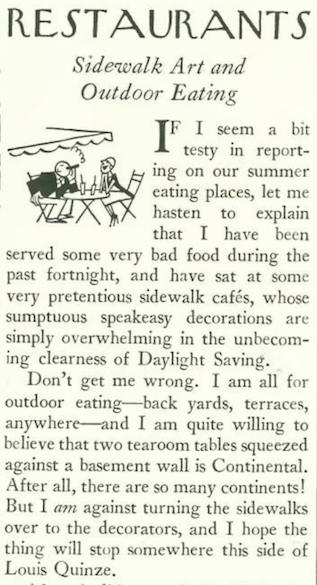
Additional note: The magazine’s June 15, 1935 issue featured Lois Long’s criticisms of sidewalk cafés in Manhattan:

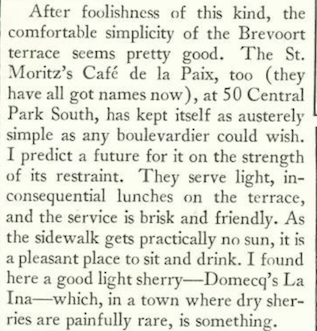
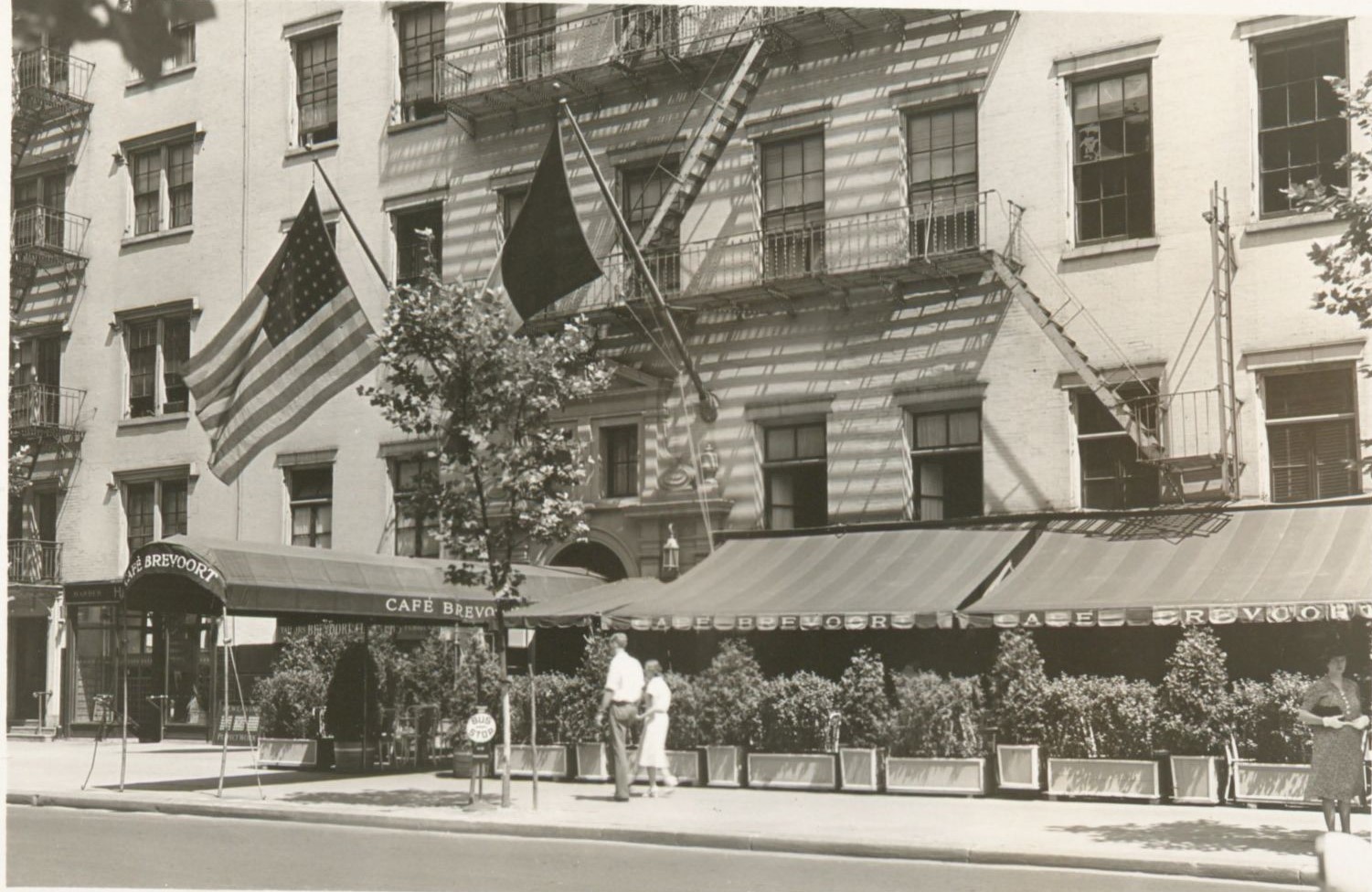
Long did offer, however, a couple of recommendations for sidewalk dining, including the Breevort in Greenwich Village…

If you really wanted to eat outside, Lois Long suggested the Breevort in Greenwich Village. (New York Public Library)

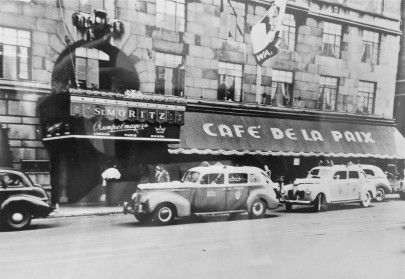
…and the St. Moritz’s Café de la Paix at 50 Central Park South…

The St. Moritz’s Café de la Paix in the 1940s. (blog.bondbrand.com)

 * * *

Sexily Danced the Burlesques

New Yorker writers loved to take shots at Henry Luce, publisher of Time and Fortune. Wolcott Gibbs famously satirized Time’s writing style in a parody profile in 1936: “Backward ran sentences until reeled the mind.” When Fortune decided to take a look behind the curtain at a burlesque show (February 1935), “The Talk of the Town” was ready to pounce.

The Fortune piece featured oil paintings by Stuyvesant Van Veen, including this one depicting the Proscenium at the Irving Place

Fortune images courtesy fulltable.com

…Van Veen got behind the curtain to create this painting (below) of “Burlesque Queens,” and the magazine chastely demonstrated the “cycle of the strip act” with the help of Miss Jean Lee, aka Miss Jess Mack…

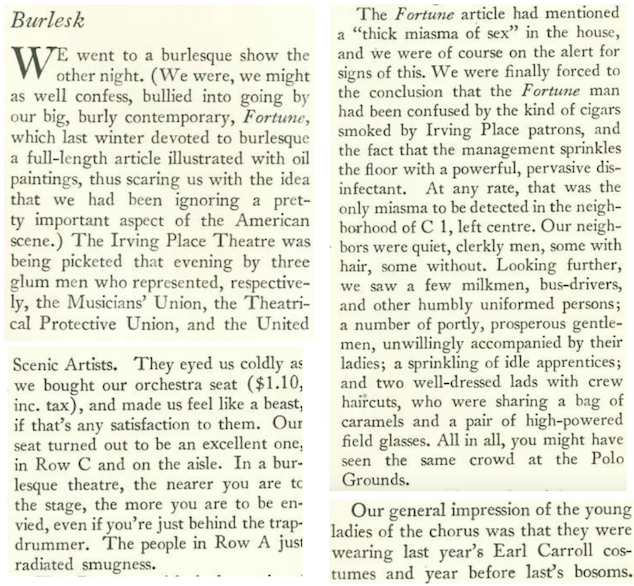
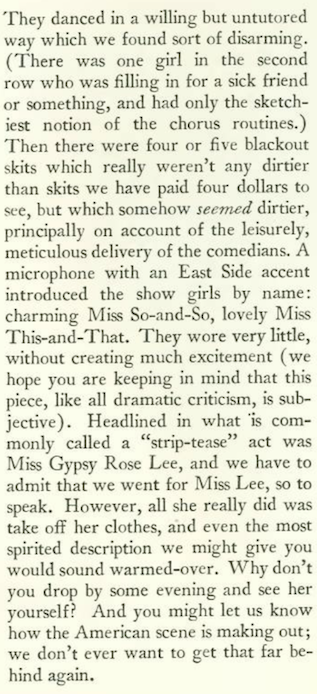
The New Yorker also took a sideways glance at Fortune’s stuffy approach to the subject of striptease, suggesting that it was much ado about nothing.

IT’S ALL AN ACT, FELLAS…Gypsy Rose Lee in 1943. (nypl.org)

 * * *

Futures and Fascists

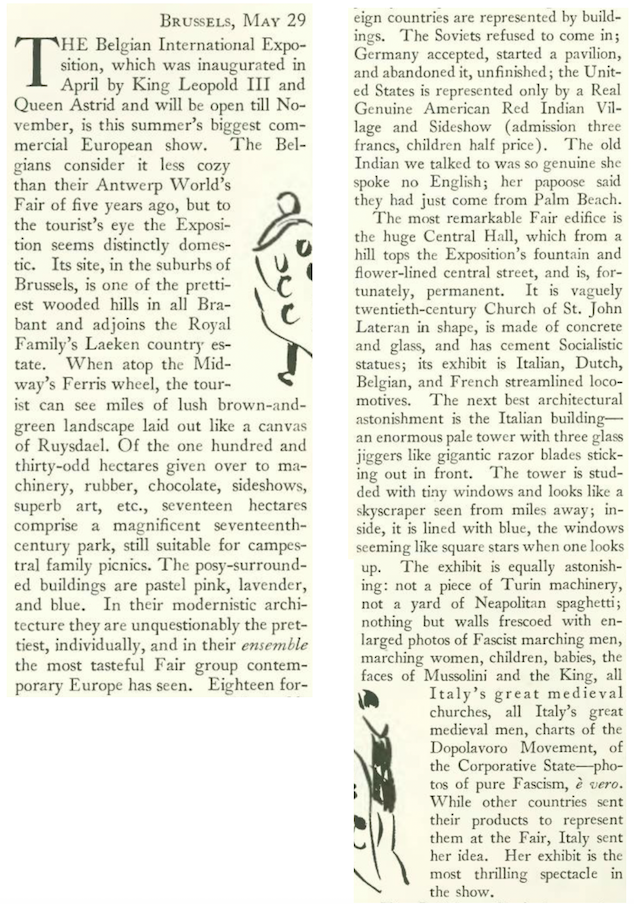
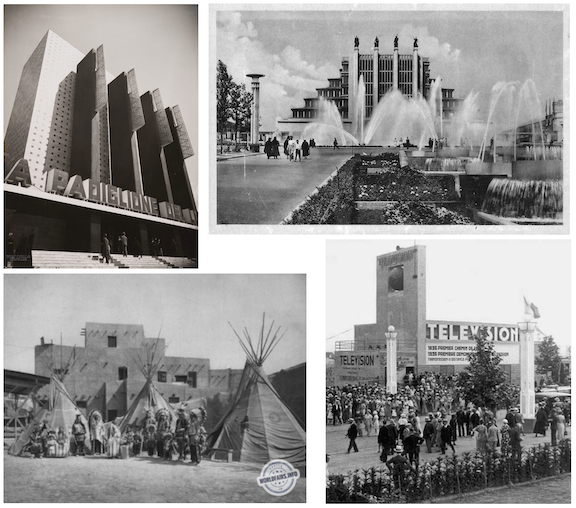
Before the days of television and the Internet, a world’s fair was the place to go to see the latest technologies and other attractions from countries around the world. Paris correspondent Janet Flanner filed a special report on the Brussels International Exposition of 1935, which attracted 20 million visitors in a little over six months.

EURO SPECTACLE…Clockwise, from top left, the menacing facade of the Italian Pavilion—its interior walls featured frescoes of marching fascists; the Palais des Expositions (Grand Palais) still stands today as the Brussels Exhibition Centre; an early demonstration of television; the U.S. featured an “Indian Village” at the Expo. (fomo.be/Wikimedia/en.worldsfairs.info)

 * * *

Matchbox Cars

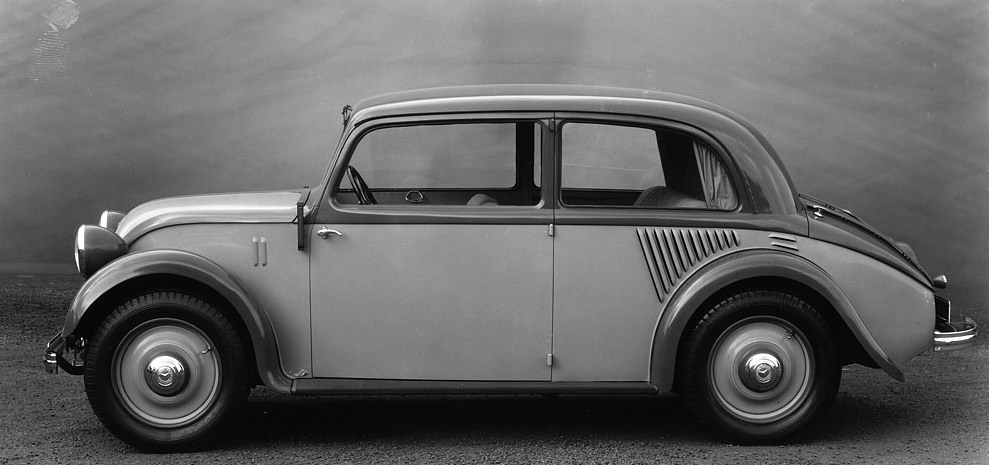
The New Yorker regularly checked the automobile competition from overseas, and found a tiny German car to be “perfectly amazing,” even if it didn’t go over so well with consumers.

IT’S CUTE, BUT…Due to its extreme unbalance of the Mercedes-Benz 130 H (two-thirds of the mass, including the engine, was on the rear axle), the car apparently was awkward to handle. It was discontinued in 1936. (automobile-catalog.com)

 * * *

From Our Advertisers

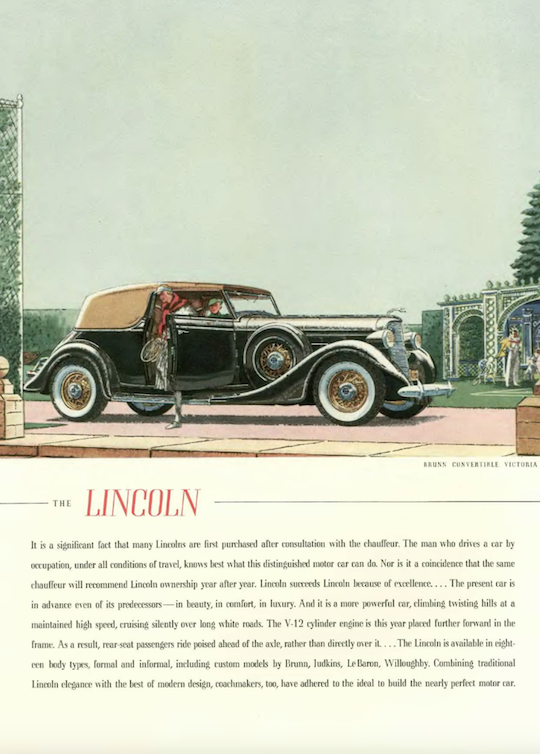
Anyway, most Americans preferred bigger cars, especially ones by luxury makers such as Lincoln, if they could afford them…

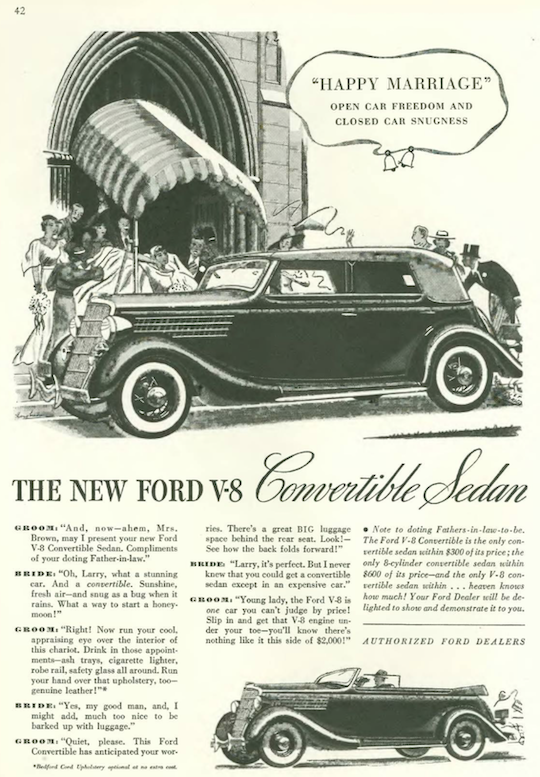
…Lincoln’s parent company, Ford, offered up a more affordable convertible with some flair of its own…automakers were fond of the marriage theme in advertisements, especially in the month of June…

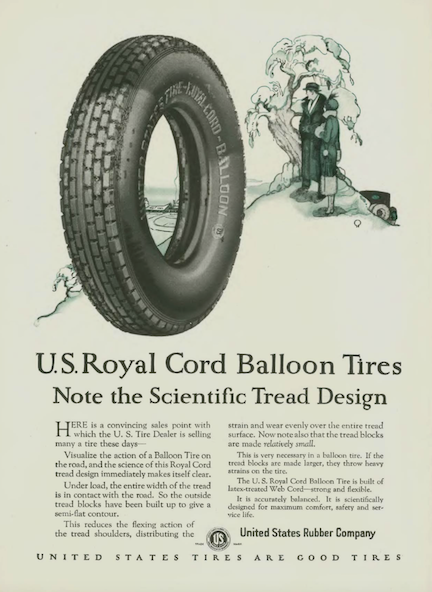
…automakers and related industries were important advertisers during The New Yorker’s first years…

…indeed, the back cover of Issue #1 (Feb. 21, 1925) featured this ad from the United States Rubber Company, promoting its U.S. Royal Cord Balloon Tires…

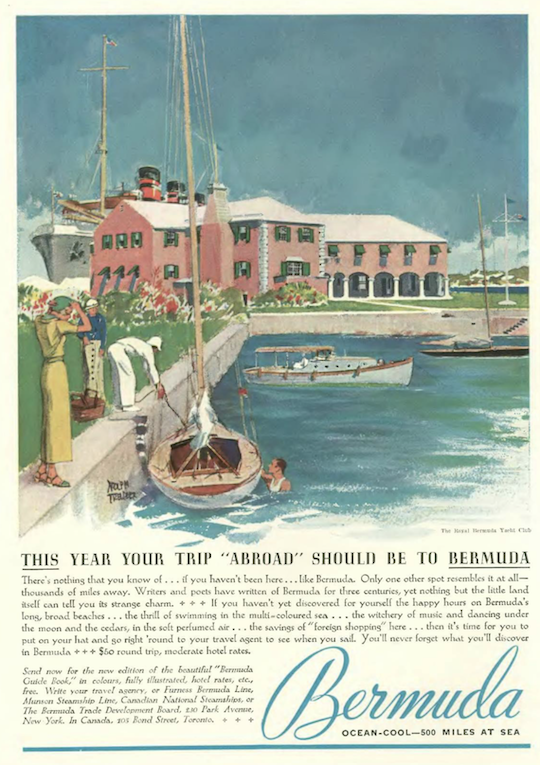
…another faithful advertiser in the magazine’s first decade was the Bermuda Trade Development Board…

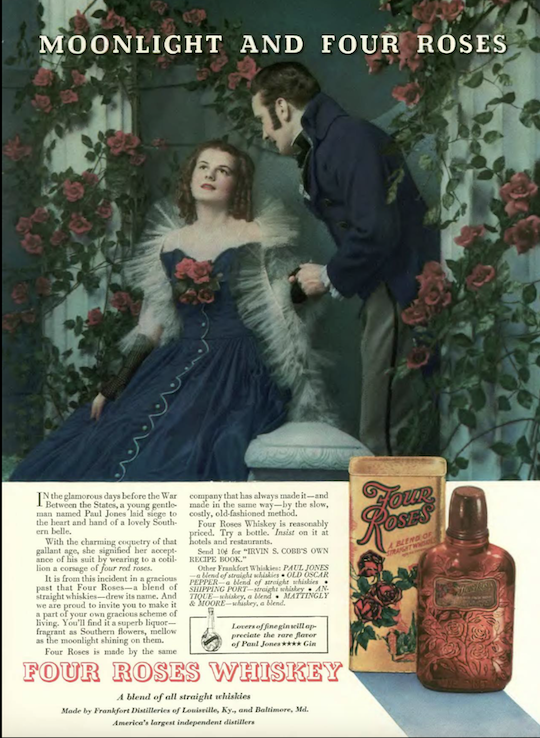
…this ad for Four Roses whiskey recalled “the glamorous days” (ahem) before the Civil War…

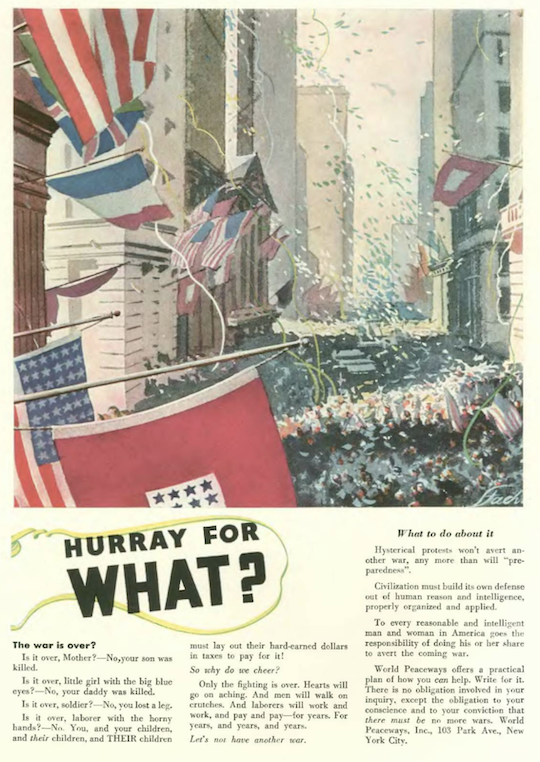
…and this colorful ad from World Peaceways reminded readers there was nothing to celebrate about wars…these ads pulled no punches (read the first few lines)…

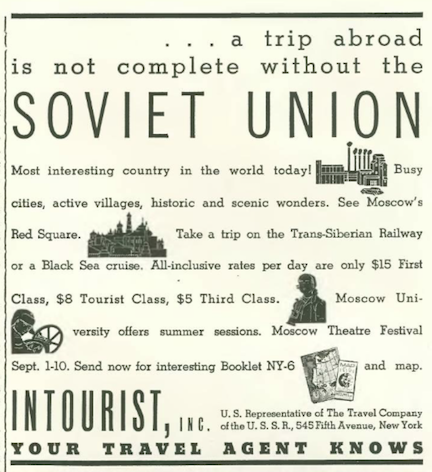
…”most interesting country in the world today!” proclaimed this ad inviting tourists to the Soviet Union…during 1934-35 Joseph Stalin was ruthlessly purging the Party, and local leaders across the country were being annihilated…of the 2.3 million people who had been party members in 1935, just under half were executed or perished in labor camps…this fact probably wasn’t mentioned in the travel folder…

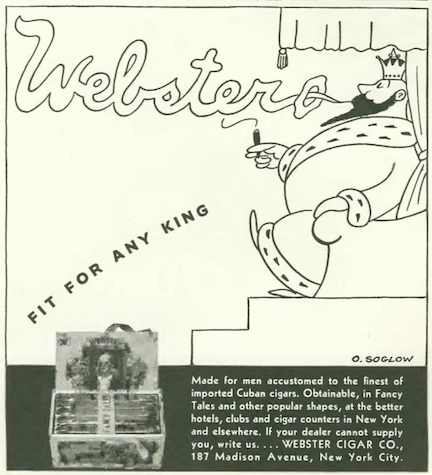
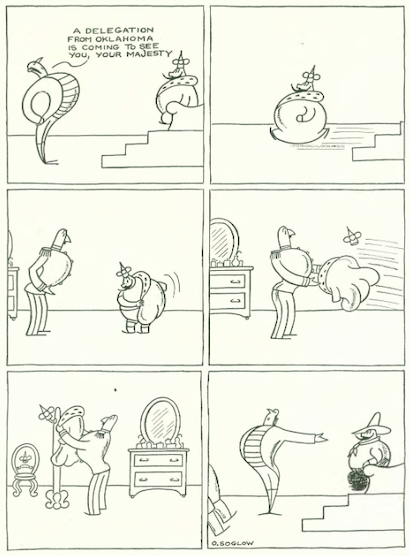
…the Webster Cigar Company hired Otto Soglow to create an ad doubtless based on the popularity of “The Little King,” but this isn’t the diminutive monarch…

…which takes us to our cartoonists, beginning with this spot signed E.S., I believe, or L.S. (anyone know?)…at any rate, its whimsical…

…of course we know Robert Day

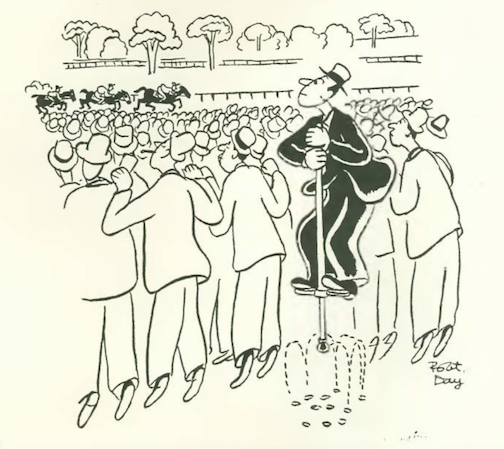
…Day again, in a very different style…

Helen Hokinson, sounding a contemporary note…

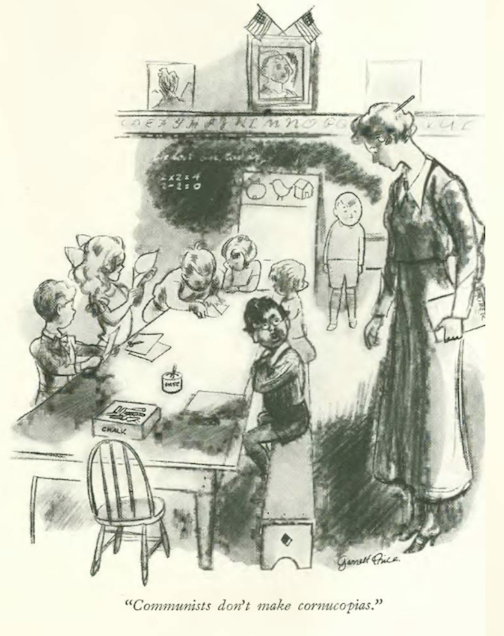
…a kindergarten political standoff, courtesy Garrett Price

Rea Irvin, and the obsolescence of Pan (today she’d have a cell phone)…

Peter Arno, and a clueless, cold, cuckold…

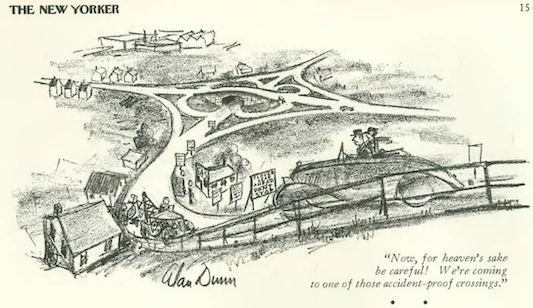
…and we close with Alan Dunn, and the future of transportation…

Next Time: A Return to Coney…

Reel News

Above: Newsreel cameramen perch on boards resting on a windowsill to get a birds-eye view of a passing parade, circa 1930. (Public Domain Image)

We marvel at, and sometimes decry, today’s instantaneous news coverage of wars, disasters and the like, but ninety years ago newsreel crews did a remarkable job of filming and delivering the latest news to thousands of theaters across the U.S. and around the world.

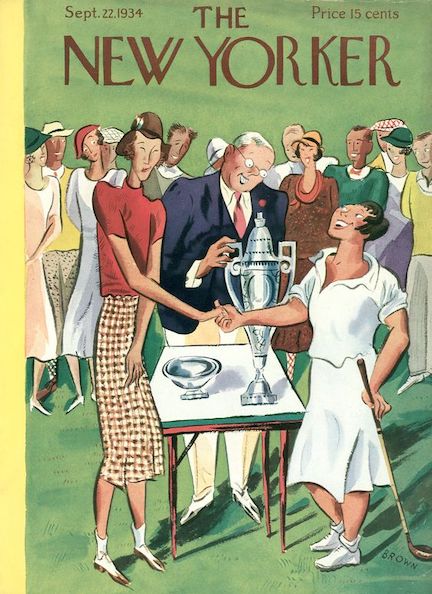
Sept. 22, 1934 cover by Harry Brown.

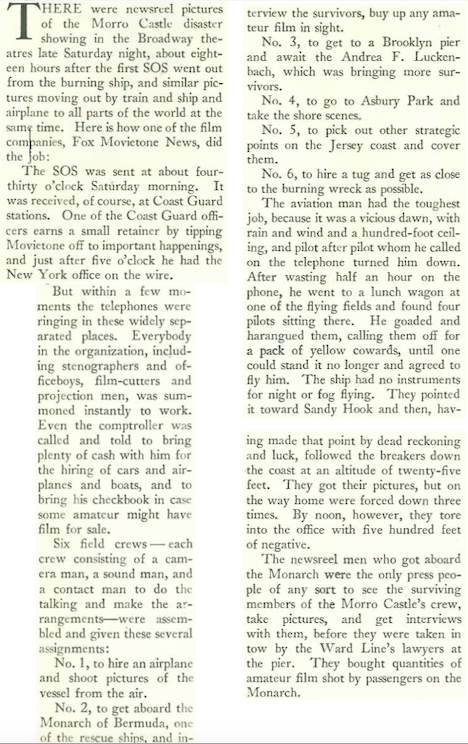
In his “A Reporter at Large” column, Morris Markey penned a lengthy account of Fox Movietone’s coverage of the SS Morro Castle disaster. En route from Havana to New York City on Sept. 8, 1934, the luxury liner caught fire near the New Jersey coast. Due to the ship’s design and the ineptitude of the crew, the blaze claimed 137 lives. Markey described how newsreel crews—with their bulky cameras and sound equipment—went into action, including a cameraman who “goaded” a pilot into taking him aloft through vicious weather conditions.

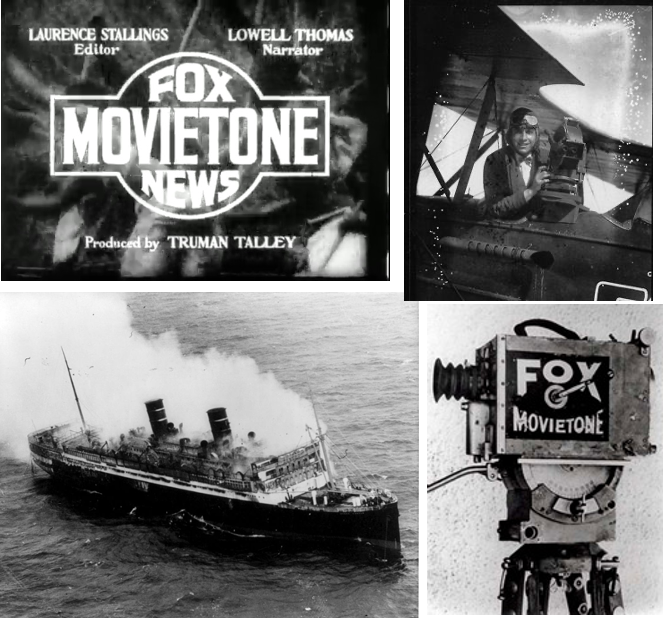
GUTS AND INGENUITY took newsreel reporters to places high and low. Clockwise, from top left, title card from a 1935 Fox Movietone newsreel; Jack Lieb goes aloft to get capture newsreel footage in an undated photo—Lieb was a cameraman for Hearst’s News of the Day; a 1930s Fox Movietone camera; the SS Morro Castle ablaze off the New Jersey Coast on Sept. 8, 1934. (Wikipedia/Lieb photo Courtesy of Bette Marshall via unwritten-record.blogs.archives.gov)

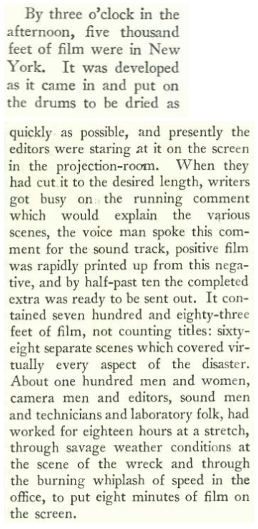
Somehow the cameraman aboard the airplane (which was forced down by weather three times) was able to get his footage to the Movietone office by noon, less than seven hours after the office first received word of the disaster. By three o’clock, five thousand feet of film from all sources was being developed.

UP NORTH AND DOWN UNDER…Movietone news had crews stationed around the world, including field staff in Sydney (top, from 1938), and in Toronto, circa 1930. (Nat’l Library of Australia/City of Toronto Archives)

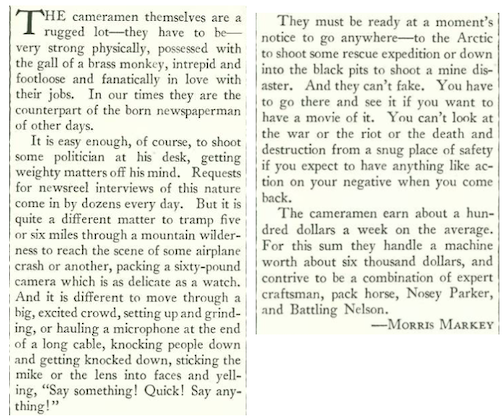
Markey concluded with this observation about the “rugged” and persistent newsreel cameramen:

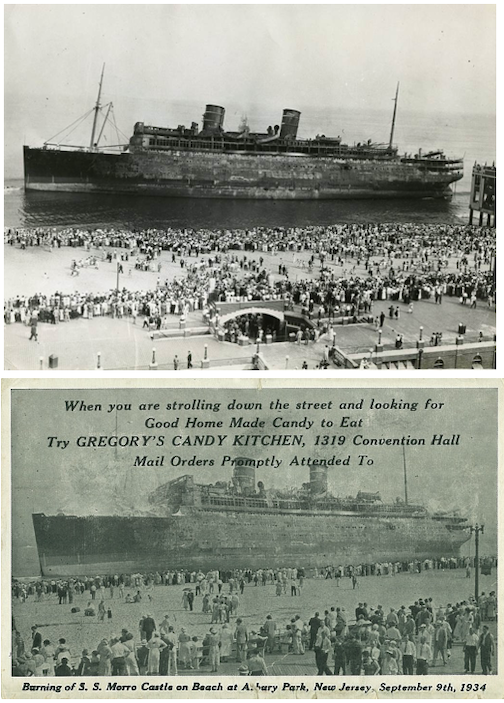
In the aftermath of the Morro Castle disaster, a scene of enormous tragedy was turned into a tourist attraction…

GAWKERS AND HAWKERS…The charred hulk of the SS Morro Castle came to rest on the shore near the Asbury Park boardwalk, which became a popular spot for souvenir salesmen and photo-ops. Tourists flocked to the site from September 1934 to March 1935, when the ship was finally towed away. Note the postcard (bottom) advertising homemade candy over an image of the charred ship. (ripleys.com/side-o-lamb.com)

Fox Movietone News produced sound newsreels from 1928 to 1963, and in the UK as British Movietone News…here is Movietone footage of the Morro Castle disaster, as presented by British Movietone in 1934:

 * * *

Up In The Old Hotels

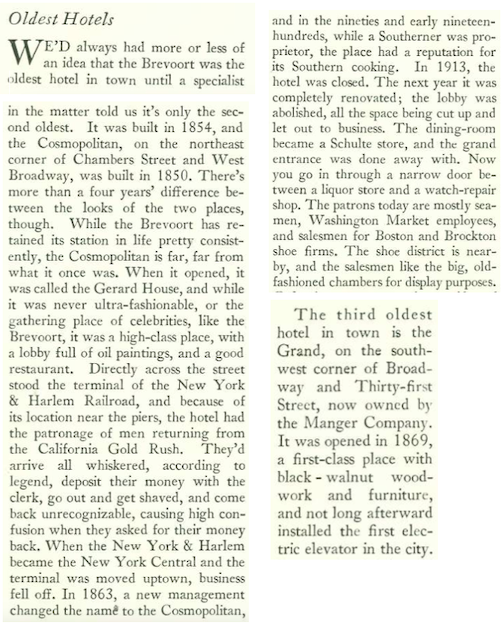
Last week “The Talk of the Town” looked in on one of Manhattan’s oldest saloons, McSorley’s. For the Sept. 22 “Talk” the subject was “Oldest Hotels,” two of which, The Cosmopolitan and The Grand, remarkably survive to this day.

HANGING IN THERE…The 1845 Brevoort House hotel at 15 Fifth Avenue (top left) was torn down in 1952, however the 1868 Grand Hotel (right) at 1232–1238 Broadway and the 1845 Cosmopolitan Hotel (below, left) at Chambers Street and West Broadway still stand today. (Museum of the City of New York / Chester Higgins Jr. for The New York Times)

 * * *

The Six-Million Dollar Road

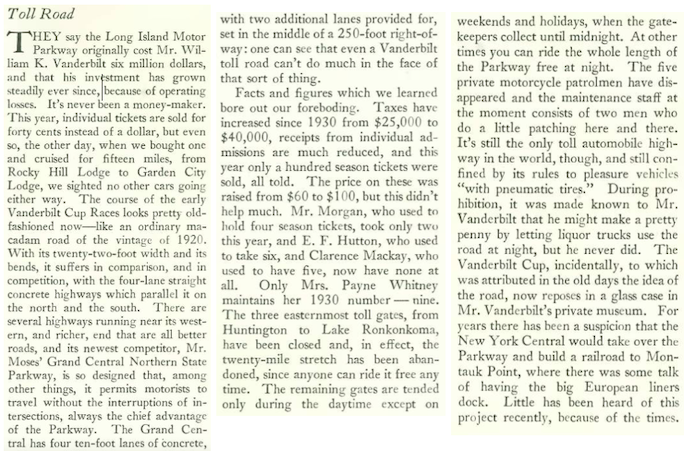
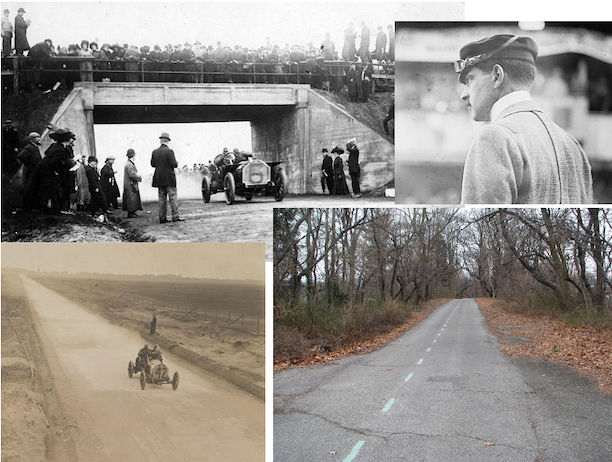
The first roadway designed exclusively for automobile use was likely the Long Island Motor Parkway, privately built by William Kissam Vanderbilt II because he wanted a road suitable for auto racing. He established the Vanderbilt Cup races on local roads in 1904, but after two spectators were killed and many others injured, in 1908 he began building what would become a 45-mile (72 km) toll road from Queens to Lake Ronkonkoma. After two mechanics were killed in a 1910 race, the New York Legislature banned racing on the road, which the state took over in 1938.

ROAD WARRIOR…William Kissam Vanderbilt II (top right) staged his Vanderbilt Cup Races on his private road until a fatal accident put a stop to the fun in 1910; At bottom right, a surviving section of the road today. Most of the road in Queens is a bicycle trail, and other segments still serve as parts of a county road. (nyheritage.org/Wikipedia-Steve Nowotarski/ny1.com)

 * * *

From Our Advertisers

I have nothing against accordion music, despite years of exposure to Lawrence Welk during my youth, but I find it hard to believe that a Park Avenue socialite (identified here as Mrs. René Du Champ Bellinger) would contemplate tormenting her posh friends with a Hohner squeezebox…

Esquire magazine was barely a year old when it posted this ad in The New Yorker…its appeal to men (and their anxieties) keeps it going today…

…it’s interesting how companies in the 19th century and on through the 1950s featured idealized, bird’s eye images of their factories in advertising, doubtless believing that consumers associated size (and smokestacks) with prosperity, and therefore a quality product…

…White Rock, however, has used the image of the Greek goddess Psyche for more than a century to promote the purity of its spring water…

…purity was also the main point of this ad from Daggett & Ramsdell, who hawked their wares to the Park Avenue set…after more than 130 years D&G is still in the beauty business…

…this next ad is almost unbelievable…single rooms starting at $5, double rooms $7, and a whole suite for $10…at the Plaza…okay, $10 is roughly equivalent to $225 today, but half of that could get you a single…

…and yet another unlikely claim from R.J. Reynolds regarding the energizing qualities of their Camel cigarettes…it seems the last thing you would need while climbing a mountain is smoke in your already over-taxed lungs…

…however, let’s give proper due to Georgia Engelhard (1906–1986), who scandalized the mountaineering world by ditching the Victorian climbing skirt in favor of a pair of climbing pants. Engelhard was the first female climber to ascend many of the peaks in the Rockies…

Georgia Engelhard in a 1922 photo attributed to her friend Alfred Stieglitz. (nga.gov)

…it seemed like nearly everyone smoked in the 1930s, even in ads that had nothing to do with tobacco companies (detail)…

…on to our cartoons, we begin with Richard Decker and some retail competition…

George Price drew up a curiosity even Robert Ripley couldn’t believe…

Robert Day examined advances in evolutionary science…

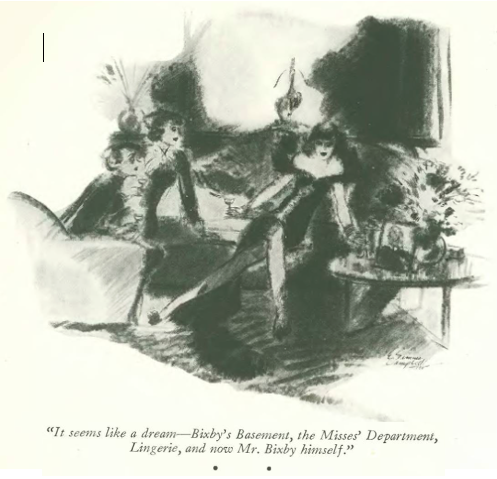
E. Simms Campbell offered up this abbreviated love story…

Peter Arno gave us a director with a god complex…

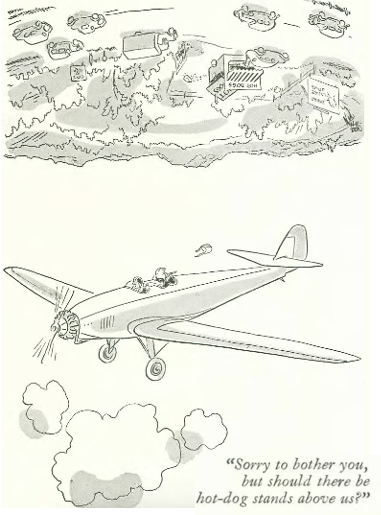
…and one from Ned Hilton, and a new perspective on flying…

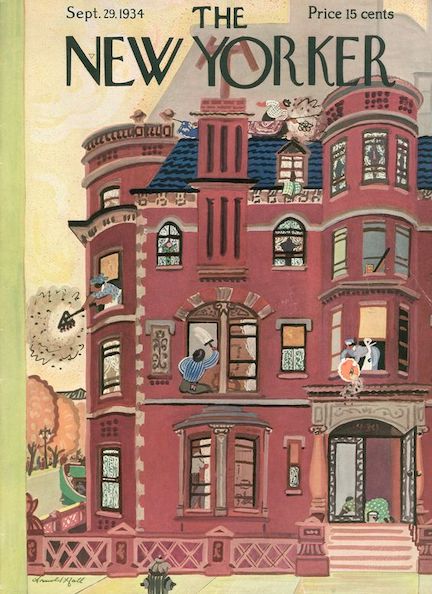
…on to Sept. 29, 1934, with a cover by Arnold Hall, who produced at least twelve covers for The New Yorker between 1933 and 1939…

Sept. 29, 1934 cover by Arnold Hall.

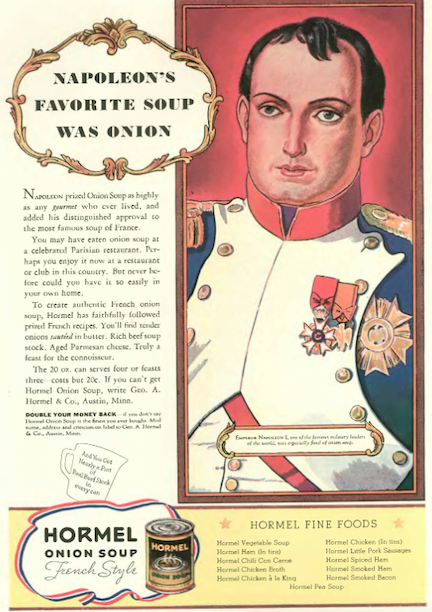
…and we go straight to ads, beginning with this alarming image that greeted readers on the inside cover…why would this prompt anyone to purchase a can of onion soup?…

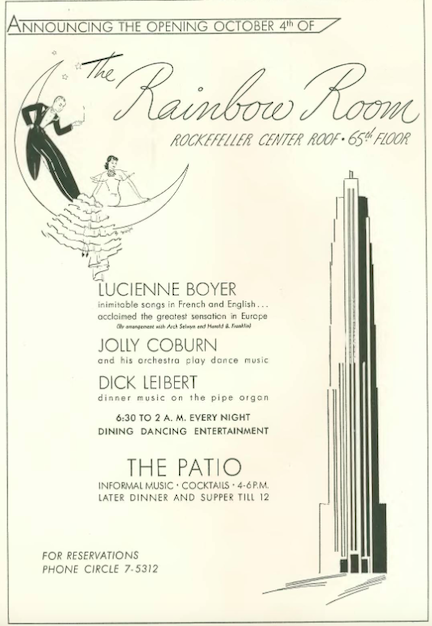
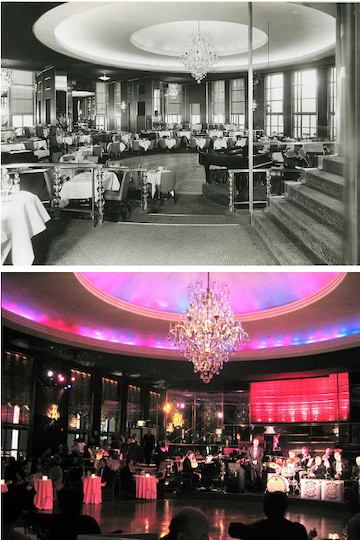
…the Rainbow Room on the 65th floor of Rockefeller Center opened in 1934, and it quickly became a focal point for the city’s elite…

Above, the dining room at the Rainbow Room, 1934, and below, in 2004. (Library of Congress/Wikipedia)

…Lucky Strike continued its series of ads featuring fashionable women looking smart with their product…

…our cartoons include this spot illustration by Otto Soglow, who did spots for The New Yorker for many years…although Soglow’s Little King moved to the Hearst newspapers, he continued to contribute cartoons to The New Yorker until 1974…

George Price continued to explore life as a levitating man…

…the enforcement of the Hays Code had this teen in a “fix,” per James Thurber

Gluyas Williams continued his exploration of various crises, this time in the music world…

Alan Dunn gave us a glimpse of civilization via the pharaonic sculptures that were emerging on the face of Mt. Rushmore…

…and we close with the wonderful wit of Barbara Shermund

Next Time: Bojangles…

The High Life

Above, Stewart's Cafeteria in Greenwich Village, May 1933. (New York Public Library)

Although Sherwood Anderson is mostly known for his short story collections and novels, in the 1930s he also worked as a journalist, and for the June 9, 1934 issue of the New Yorker he explored the “centre of proletarian high life,” Stewart’s Cafeteria in Greenwich Village.

June 9, 1934 cover by Helen Hokinson.

What is particularly interesting about Anderson’s page 77 article for the “A Reporter at Large” column is what it doesn’t report, namely, that Stewart’s Cafeteria (later the Life Cafeteria) was known as a popular gay and lesbian hangout in addition to being a place for gawkers, assorted bohemians, and bohemian wannabes.

Anderson was a man of the world, so he knew exactly what Stewart’s was all about. But even the New Yorker wasn’t in the business of outing anyone, and editor Harold Ross, whose eccentricities included a puritanical strain, would not have allowed anything associated with “sexual deviance” to be printed in his magazine. Here is an excerpt from Anderson’s article, “Stewart’s, On the Square,” in which he subtly hints at the cafeteria’s “third life.”

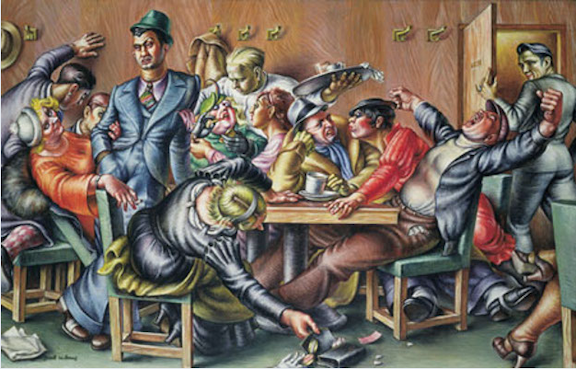
NIGHT LIFE…Paul Cadmus depicted Stewart’s in this sexually charged painting, Greenwich Village Cafeteria, 1934, oil on canvas, Museum of Modern Art. (All archival images for this entry were obtained via nyclgbtsites.org/site/stewarts-cafeteria)

While Anderson tiptoed around the topic of homosexuality, gossip rags such as Stephen Clow’s Broadway Brevities put it front and center. Described as one of the most vicious show business gossip magazines ever published, Brevities also provided Clow with some side income: Clow and his collaborators often threatened to blackmail wealthy businesspeople and show business figures who frequented places like Stewart’s—outing them in his tabloid unless payment was made.

(McGill Institute via HuffPost.com)

Naturally such reporting helped attract gawkers to Stewart’s and its successor, Life Cafeteria. According to the NYC LGBT Historic Sites Project, “Stewart’s closed in the mid-1930s and was subsequently reopened as the equally popular Life Cafeteria. Regulars included a young Tennessee Williams and Marlon Brando (though they didn’t meet each other until years later on a beach in Provincetown). Of the space, Brando later recalled, ‘The rednecks [on the street] were pointing at the diners like animals in a zoo. I was immediately intrigued and ventured in. Before I left that afternoon, I discovered that many of the homosexual men were actually putting on a show for the jam .'”

ON DISPLAY...According to the NYC LGBT Historic Sites Project, the large plate glass windows at Stewart's (later renamed Life Cafeteria) put gay life on full display to the late-night crowds who frequented the busy intersection. Artist Vincent La Gambina depicted one scene that gawkers might have taken in: Life Cafeteria, Greenwich Village, 1936. (Museum of the City of New York)
TODAY, the building still stands, although it is a bit less lively as a home for a CVS store and a Bank of America branch. Just around the corner is the famed Stonewall Inn. (Google Maps Image)

According to the NYC LGBT Historic Sites Project:

...in 1935 the manager of Stewart’s was convicted of operating a “public nuisance” and “disorderly house” and “openly outraging public decency” by allowing objectionable behavior in the interior and large crowds to gather outside. Specifically, the district attorney’s complaint cited “certain persons of the homosexual type and certain persons of the Lesbian type, to remain therein and engage in acts of sapphism and divers [sic] other lewd, obscene, indecent and disgusting acts” and that the cafeteria was “used as a rendezvous for perverts, degenerates, homosexuals and other evil-disposed persons.” Much of the testimony centered on the gender non-conforming dress and behavior of the patrons.

Here is another excerpt from Anderson's article, where he delves into the nighttime scene at Stewart's:

 * * *

Nightlife, Part II

In my previous post E.B. White pondered the fate of the Central Park Casino, a favorite haunt of deposed Mayor Jimmy Walker and other members of the smart set who openly flouted Prohibition laws. In "Tables for Two," Lois Long made this observation (below) at the conclusion of her nightlife column, believing that Parks Commissioner Robert Moses would give the management a chance to lower food prices and allow common folks to enjoy its sumptuous atmosphere. Little did she know that Moses was feasting on a diet of revenge rather than food, and had plans to tear the place down, regardless of its lower prices.

 * * *

From Our Advertisers

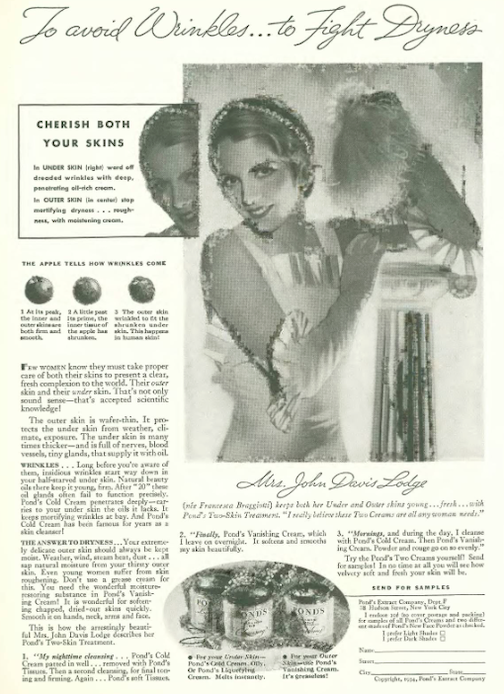
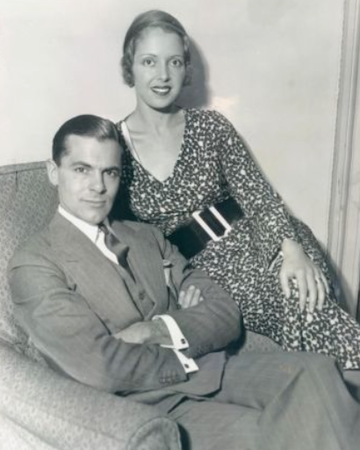
We kick off the ads with another Ponds celebrity endorsement from dancer and actress Francesca Braggiotti (1902-1998), who was married to actor, politician, and diplomat John Davis Lodge...

POWER COUPLE...John Davis Lodge and Francesca Braggiotti in 1932. They were married for 56 years. (Pinterest)

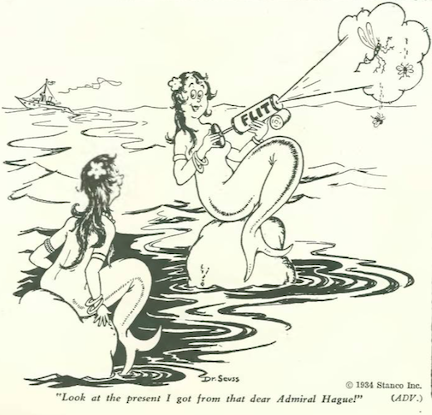
...Dr. Seuss was back with more ads for Flit insecticide...he was still two years away from his first children's book: And to Think That I Saw It on Mulberry Street...

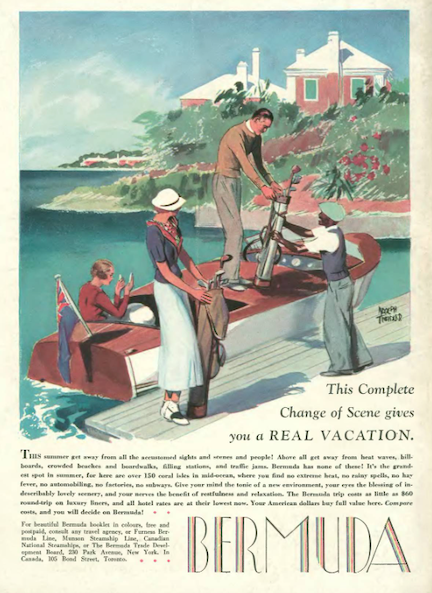
...and with a splash of color, Bermuda beckoned New Yorkers to a "Real Vacation"...

...however, before you headed to Bermuda, you'd needed to do something with the kids...

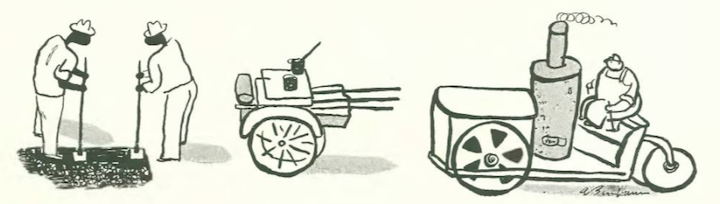
...on to our cartoonists, we start with spot art from Abe Birnbaum...

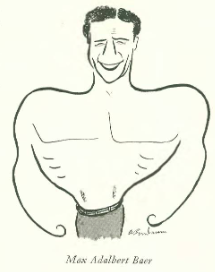
...Birnbaum again with an illustration of boxer Max Baer for the profile section...

...more spot art from James Thurber in the "Goings On About Town" section...

...and Thurber again with some alarming news for a potential suitor...

...Rea Irvin kicked off his series, "Our Native Birds"...

...a famed advertising agency launched a new door-to-door survey, per Perry Barlow...

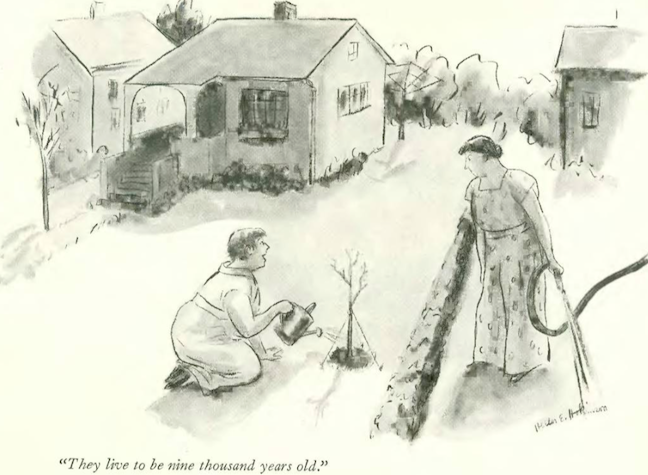
...Helen Hokinson gave us a hopeful gardener...

...Barbara Shermund looked in on the "modern girl" scene...

...and Peter Arno examined a sad medical case...

...and we close the June 9 issue with this item from E.B. White, who commented on a recent rally of American Nazis and some fighting Irish...

...the Nazi rally was also alluded to in the June 2 issue (I have the issues reversed this time to support the narrative)...

June 2, 1934 cover by Harry Brown.

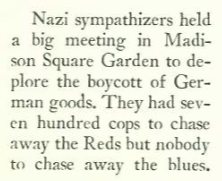
...where Howard Brubaker was keeping things light in his column "Of All Things." I was surprised how little was mentioned in either issue about the meeting of 20,000 Nazi sympathizers on May 17, 1934, at Madison Square Garden.

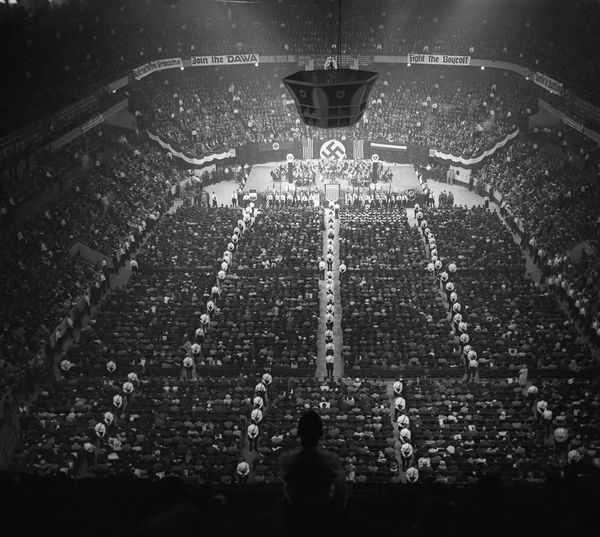
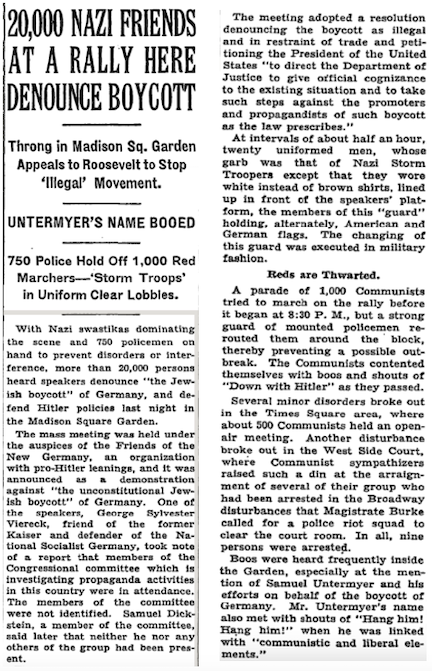
Let's explore further: According to the Jewish Virtual Library, America's first established anti-Nazi boycott group was the Jewish War Veterans (March 19, 1933), followed by the American League for the Defense of Jewish Rights (ALDJR), which was founded by the Yiddish journalist Abraham Coralnik in May 1933. By 1934 the ALDJR was led by Samuel Untermyer, who changed the organization's name to the "Non-Sectarian Anti-Nazi League to Champion Human Rights." Nazi sympathizers targeted Untermyer as the face of boycott efforts, and at the May 17 rally the mere mention of his name prompted shouts of "Hang him!"

AMERIKA...The site for hockey games and dog shows became a site for ugliness on May 17, 1934, when 20,000 Nazi sympathizers gathered in Madison Square Garden to denounce boycotts against Adolf Hitler's regime. (The Archive Project)

This excerpt from the May 18, 1934 edition of The New York Times gives some idea of what transpired at the rally:

REALLY? Americans gathered at Madison Square Garden on May 17, 1934 to show their support for Nazi Germany and denounce American boycotts. (The Archive Project)

  * * *

Dueling Muses

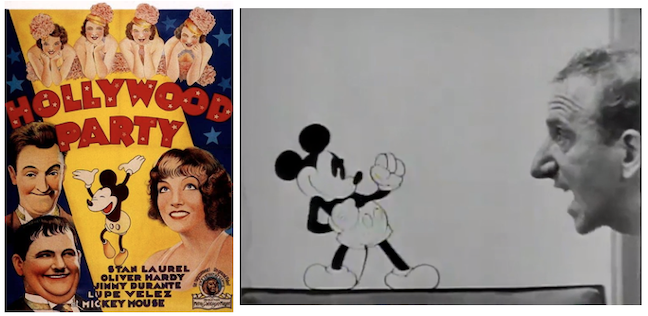
Film critic John Mosher always seemed upbeat about anything involving Disney, but given that animation was still in its infancy (its plastic trickery still rather novel), it didn't take much to outshine the otherwise drab fare (the "Grim") being coughed up by Tinseltown.

MAN OR MOUSE? The star-studded cast of Hollywood Party included Jimmy Durante, seen here duking it out with Mickey Mouse. (IMDB)

The grim included the Pre-Code drama, Upper World, about a rich, married man who falls to his ruin via a romance with a stripper (don't they always?), and Now I'll Tell, another Pre-Code drama, this one loosely based on the doings of racketeer and crime boss Arnold Rothstein.

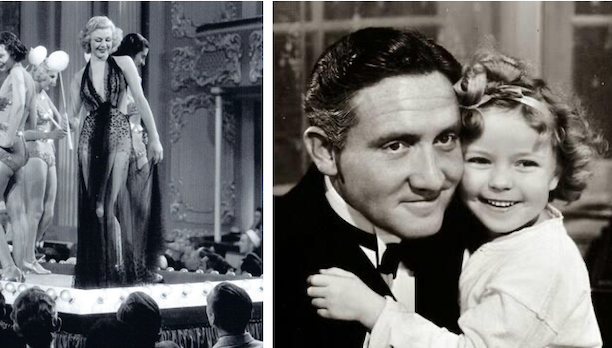
SHAKE IT WHILE YOU CAN...Ginger Rogers performs “Shake Your Powder Puff” in a burlesque show in the film Upper World, one of the last of the Pre-Code dramas. It featured Warren William as a wealthy married railroad tycoon whose friendship with a showgirl (Rogers) leads to blackmail and murder; at right, five-year-old future child star Shirley Temple with Spencer Tracy in Now I'll Tell, which was loosely based on the autobiography of Carolyn Green Rothstein, wife of New York gambler Arnold Rothstein. Temple's role was a minor one, however her appearance in the musical Stand Up and Cheer!, which was released a month earlier, would make her a star. (IMDB)

 * * *

More From Our Advertisers

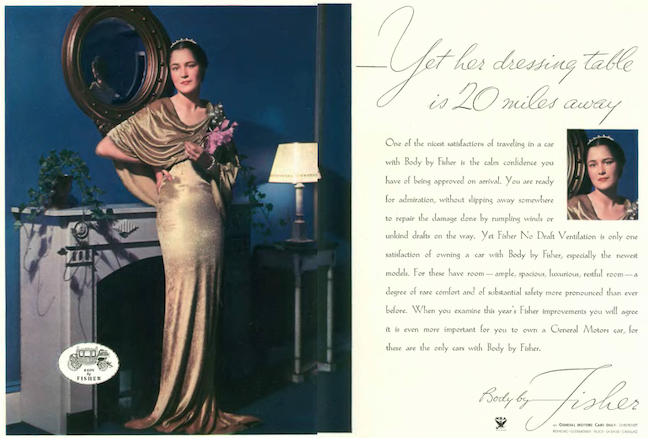
We cool off by a taking a dip in the pool...er, rather by enjoying the "No Draft Ventilation" of a car body by Fisher...the model might want to stay in the pool, since air-conditioning in cars was still a good twenty years away...

...and yes, this is also a car-related ad, if you can believe it, the bride looking forward not to years of wedded bliss but rather her new La Salle (a Cadillac product)...

...another bride, and a car...is that a car body by Fisher? Who cares, the wedding is over and its time to fire one up...

...this woman seems to have it all thanks to Daggett & Ramsdell of Park Avenue, who are prepared to coat her in a "complete range of all the essential creams, lotions, face powder...cold cream soap, dusting powder" etc. etc....

...Dr. Seuss again for Flit, with baby in tow...

...on to our cartoons, we have Robert Day checking on the progress at Mt. Rushmore...

...Alan Dunn reveals pandemic worries of a different nature...

...and we close with Helen Hokinson, and a sudden change of mood...

Next Time: Coney Summertime...


America’s Sweetheart

Above: A scene from Mary Pickford’s 1922 film Tess of the Storm Country. (Library of Congress)

In today’s celebrity-saturated culture it is difficult to find a parallel to silent film star Mary Pickford, who was dubbed Queen of the Movies more than a century ago. Indeed, during the 1910s and 1920s Pickford was regarded as the most famous woman in the world.

April 7, 1934 cover by Rea Irvin.

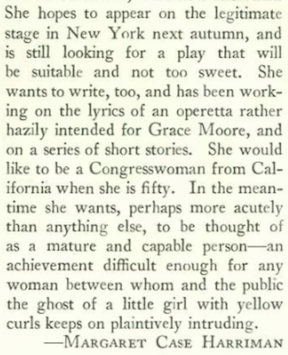
Pickford was also known as “America’s Sweet” for her portrayal of gutsy but tenderhearted heroines. In real life she was also a gutsy and shrewd businesswoman who co-founded United Artists in 1919 with Charlie Chaplin, Douglas Fairbanks, and director D. W. Griffith. Commanding a salary only rivaled by Chaplin, her stardom only grew when she married Fairbanks in 1920, forming the first celebrity supercouple; together they ruled Hollywood from their Beverly Hills mansion, Pickfair (apparently staging dull affairs, per the “Profile” excerpt below).

The end of the silent era also put an end to Pickford’s stardom, as well as to her fairytale marriage to Fairbanks. Margaret Case Harriman’s profile of Pickford, simply titled “Sweetheart,” gave readers a glimpse into the decline of a silent superstar. Excerpts:

SINGULAR STAR…Clockwise, from top left, Mary Pickford in a publicity photo, circa 1910; Pickford visits close friend and screenwriter Frances Marion during filming of Straight is the Way (1921); Douglas Fairbanks and Pickford in the early 1920s; Pickford with a movie camera in 1916—in addition to being a shrewd businesswoman, she was also skilled behind the camera. (thehollywoodtimes.today/Time/Library of Congress)

Harriman concluded her profile with some thoughts on Pickford’s future:

THE SOUND BARRIER…With the advent of sound movies Mary Pickford turned to writing books and serving various charities. From left, sharing ice cream with rising star Bing Crosby in 1934; center, Al Frueh’s caricature of Pickford for the profile; Pickford in a 1934 promotional picture supporting The Salvation Army. (Pinterest/Library of Congress)

A note on the profile’s writer, Margaret Case Harriman (1904-1966), who doubtless sharpened her people-watching skills at the Hotel Algonquin (famed birthing ground of the New Yorker), which was owned by her father, Frank Case. Douglas Fairbanks was one of Case’s best friends, and Harriman knew both Fairbanks and Pickford well, since they often stayed at the hotel.

HOME SWEET HOME…Margaret Case Harriman, photographed May 31, 1937 by Carl Van Vechten. Harriman was born in 1904 in room 1206 of the Hotel Algonquin, which was owned by her father, Frank Case. (Philadelphia Museum of Art)

 * * *

Master of Masters

The founder of perhaps the world’s most prestigious golf tournament was an amateur and a working lawyer by profession. When Bobby Jones (1902–1971) co-founded the Masters Tournament in 1934 with investment dealer Clifford Robert, it was called the Augusta National Invitation Tournament (it was Robert’s idea to call it The Masters, a name Jones thought immodest). Jones dominated top-level amateur competition from the early 1920s through 1930—the year he achieved a Grand Slam by winning golf ’s four major tournaments in the same year. However, by the 1934 Jones’s skills began to wane. The New Yorker had little to say about the first Masters (it wasn’t a big deal yet), other than Howard Brubaker making this observation in “Of All Things”…

A SWING INTO HISTORY…Bobby Jones (center) drives during the first-ever Masters Tournament in Augusta, Georgia on March 22, 1934. (augusta.com)

 * * *

From Our Advertisers

Wanna get away? This colorful advertisement beckoned New Yorker readers to take the next boat to sunny Bermuda…

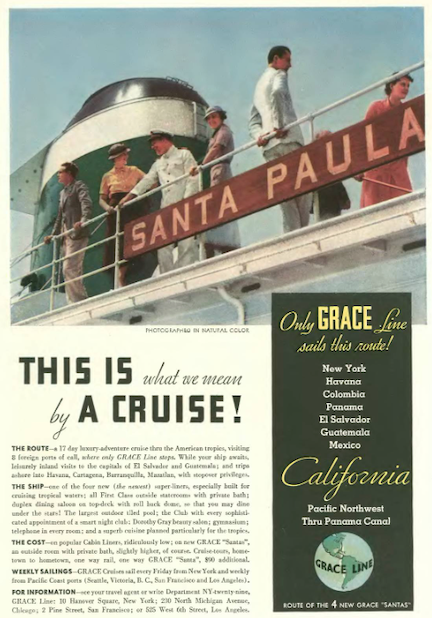
…while the Grace Line offered a southern cruise through the Panama Canal…

…but who needed to travel when you could enjoy a beer that was beloved the world over?…

Mrs. Potter d’Orsay Palmer nee Maria Eugenia Martinez de Hoz was content to stay home in Chicago and smoke a few Camels, apparently…

…we’ve encountered her before—she appeared in a Ponds ad (below) in the Aug. 8, 1931 issue of the New Yorker, where we learned she was wife No. 2 of Potter d’Orsay Palmer, son of the wealthy family of Chicago Palmer House fame…they would divorce in 1937, and the playboy Potter would marry two more times before dying of a cerebral hemorrhage in May 1939—following a drunken brawl in Sarasota, Florida with a meat cutter called Kenneth Nosworthy. Maria Eugenia would remarry and return to her homeland of Argentina to raise a family…

…this ad from Nash looks like a scene from Attack of the 50 Foot Woman, if she had a car to match, that is…

…the Cadillac V-16 was a truly massive automobile, but in contrast to the Nash ad, you can barely see the car as it approaches from the vanishing distance…

E. Simms Campbell got in on the advertising game with this spot that features contrasting images of storm and calm…

James Thurber offered this cartoon on behalf of Heinz soups…

…and Thurber again, as we kick off the cartoons with the ongoing battle…

Adolph Schus made a rare appearance in the New Yorker…according to Ink Spill, he also contributed a cartoon on March 19, 1938, and was editor of Pageant Magazine in 1945… 

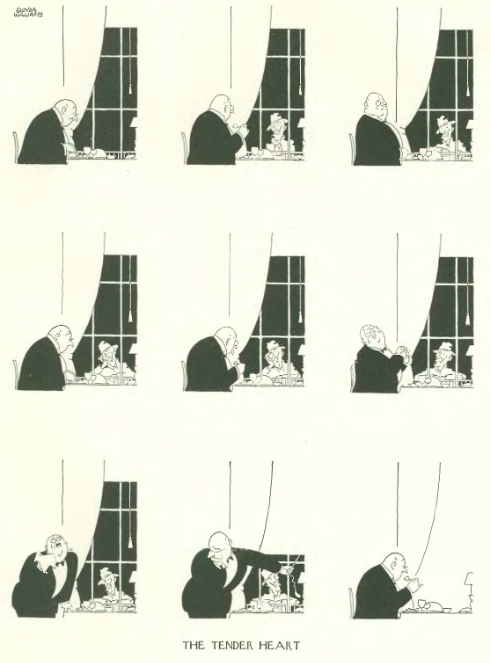
Gluyas Williams looked in on the sorrows of moneyed classes…

Helen Hokinson’s “girls” were in search of lunch, and propriety…

…and Leonard Dove gave us a renter surprised by something not included in his lease…

…on to April 14, 1934…

April 14, 1934 cover by Harry Brown.

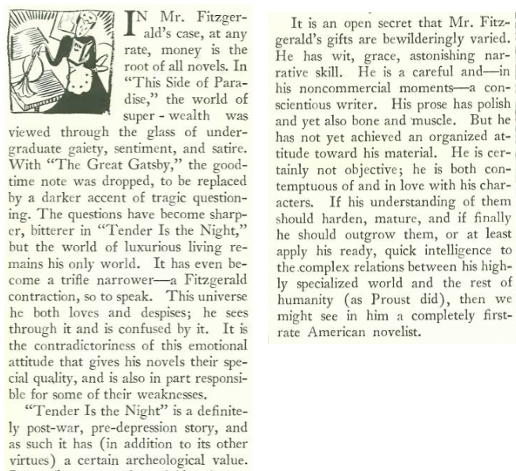
…and book reviewer Clifton Fadiman, who found F. Scott Fitzgerald’s literary gifts “bewilderingly varied”…

A NOT-SO-TENDER RECEPTION…F. Scott Fitzgerald’s status as a symbol of Jazz Age excess hurt his career during the Depression years. Tender Is the Night received mixed reviews, which didn’t help his alcoholism and deteriorating health. When Carl Van Vechten took this photo of Fitzgerald in June 1937, the author had a little over three years to live. (Wikipedia)

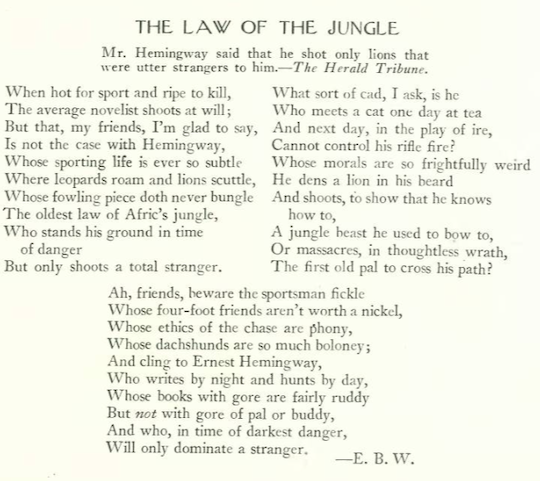
…speaking of F. Scott Fitzgerald, fellow author Ernest Hemingway defended Fitzgerald’s writing, arguing that criticism of his Jazz Age settings stemmed from superficial readings. One then wonders what Hemingway thought of E.B. White’s poetic “tribute” to his big game hunting excursions…

I ONLY SHOOT STRANGERS…Author Ernest Hemingway poses with a lion shot during a safari in Africa in 1934. (MPR News)

 * * *

From History’s Ash Heap

Various reference sources cite “freak shows” as a normal part of American culture in the late 19th to the early 20th centuries, but I have to admit I saw exhibits at state fairs of half-ton humans and conjoined twins when I was a kid in the 1970s (not to mention things in jars at a carnival in St. Louis that should have been given a decent burial).

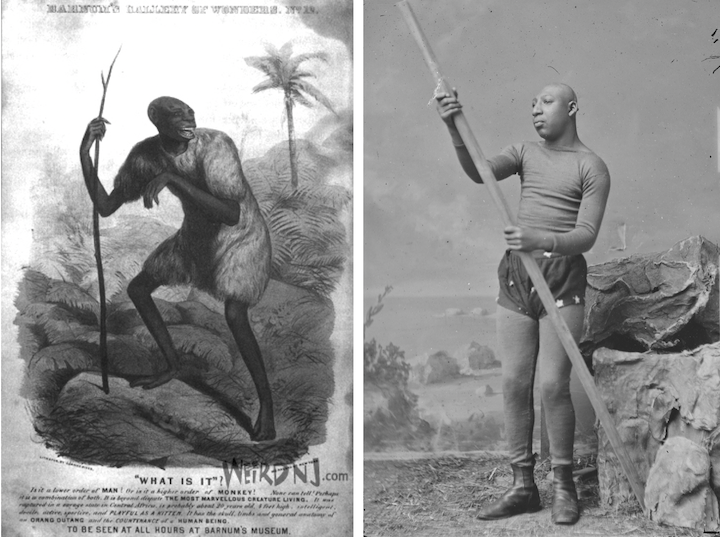
When Alva Johnston penned the first installment of a three-part profile series titled “Sideshow People,” such attractions could be found across the U.S. and Europe—Coney Island featured “Zip the Pinhead,” who was actually William Henry Johnson (1842–1926), one of six children born to former slaves living in New Jersey. His desperately poor parents agreed to allow P.T. Barnum to display him at a museum and at circus performances billed as a missing link, a “What-Is-It” supposedly caught in Africa.

FOR THE SUCKERS…P.T. Barnum exhibited William Henry Johnson as a “wild man”, a “What-Is-It” that subsisted on raw meat, nuts, and fruit, but was learning to eat more civilized fare such as bread and cake. Note the difference between the poster depiction at left and the actual man. Civil War-era photo at right by Mathew Brady’s photography studio in New York City. (National Portrait Gallery)

 * * *

Floating and Sinking

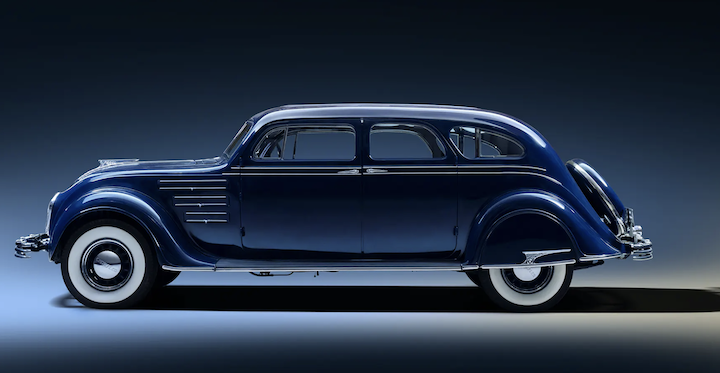
As much as New Yorker cartoonists (and E.B. White) liked to take pokes at Chrysler’s futuristic Airflow, there was much to be admired by the innovations the car represented. Unfortunately, the car’s design was too advanced for the buying public, and despite a big manufacturing and sales push by Chrysler the car was shelved by late 1936.

Writing for Time, Dan Neil noted the Airflow’s spectacularly bad timing. “Twenty years later, the car’s many design and engineering innovations — the aerodynamic singlet-style fuselage, steel-spaceframe construction, near 50-50 front-rear weight distribution and light weight—would have been celebrated. As it was, in 1934, the car’s dramatic streamliner styling antagonized Americans on some deep level, almost as if it were designed by Bolsheviks.”

SEEMED LIKE A GOOD IDEA. A restored 1934 Airflow. (Hagerty Media)

* * *

More From Our Advertisers

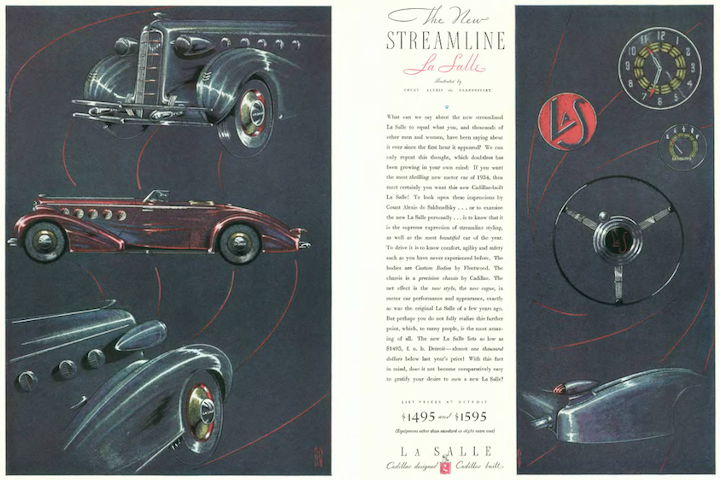
Maybe the buying public wasn’t ready for a car with a sloping hood and embedded headlights, but the folks at Cadillac were eager to unveil concepts for the new streamlined La Salle, which retained the familiar bullet headlights so as not to alarm consumers too much…

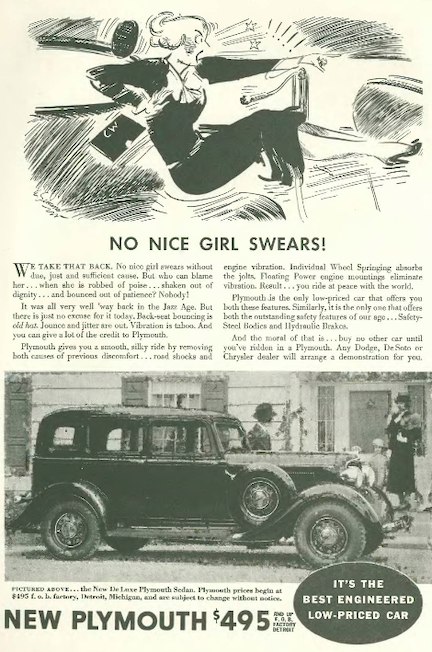
…and here’s a lovely image from Goodyear…I assume this woman is merely resting in a rumble seat, since this pose would not be possible above 25 mph…

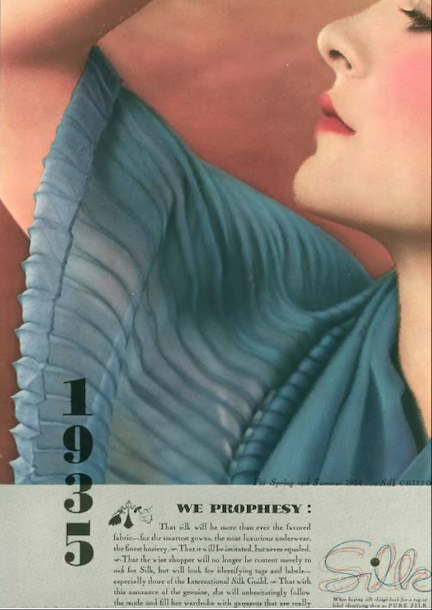
…full-bleed color ads were coming into their own, as demonstrated by this stylish entry from the purveyors of silk garments…

…on the other hand, our well-heeled friends at Ponds stuck with the tried and true copy-heavy approach…here they offer the flawless features of Anne Gould (1913–1962), granddaughter of Gilded Age robber baron Jay Gould

…R.J. Reynolds continued their campaign to convince us that Camels bring success to the average Joe and the champion athlete…

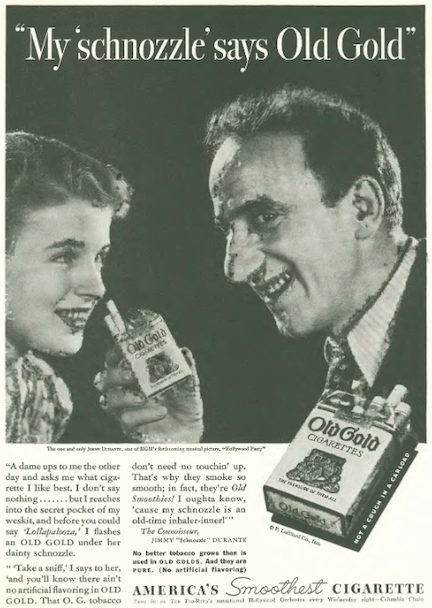
…the makers of Old Gold opted for the super creepy approach, asking entertainer Jimmy Durante to shove a pack of smokes into the face of what appears to be a teenager…

…here’s another ad from World Peaceways, reminding us of the futility of war…

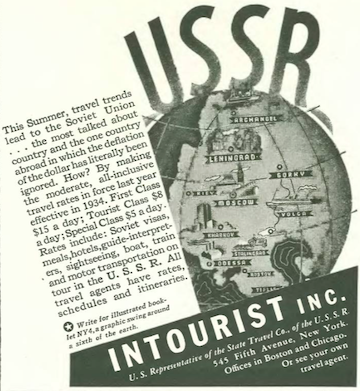
…speaking of futility, you could visit the USSR, which doubtless took great pains to steer tourists away from mass starvation in Ukraine and mass executions of Stalin’s many “enemies”…

…while folks in the USSR were worshiping Lenin and Stalin, Americans were rightly transfixed by the miracle of Kellogg’s Corn Flakes…a producer of industrial and advertising films, Castle Films would become a subsidiary of Universal and would go on to make a line of science-fiction and horror films including The Wolf Man, The Mummy, and Creature from the Black Lagoon.

…on to our cartoons, Alain took on the recent MoMA exhibition of “Machine Art”…

…and speaking of machine art, George Price was to latest cartoonist to take a crack at the Airflow…

James Thurber offered this bit of spot art for the opening pages…

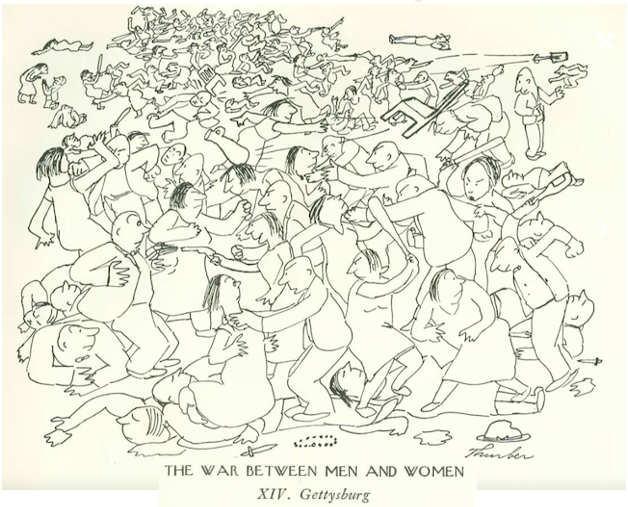
…and returned to a somber scene on the battlefield of the sexes…

Next Time: Model Citizens…

Rocky’s Cover-Up

On April 28, 1933, just two days before the RCA Building was to open to new tenants, artist Diego Rivera added a portrait of Vladimir Lenin to the mural he was painting in the building’s lobby.

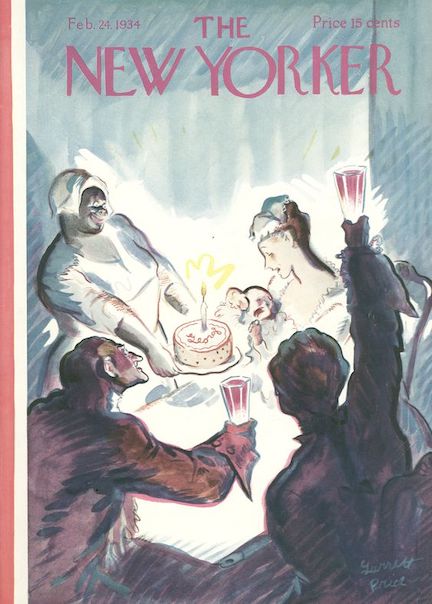
Feb. 24, 1934 cover by Garrett Price.

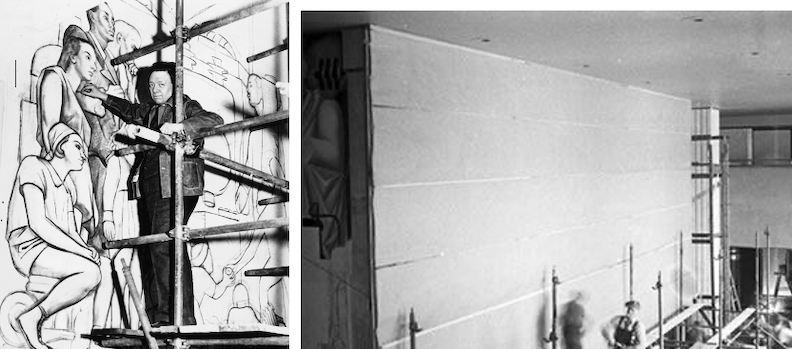
When Nelson Rockefeller asked Rivera to replace Lenin with a portrait of an “everyman,” Rivera refused, stating that he would prefer to see the whole mural destroyed than to alter it. Two weeks later Rivera was paid and dismissed from the job; carpenters immediately covered the mural in a white cloth. Fast forward to Saturday, February 10, 1934, when workers showed up late in the evening and began chipping away at the plaster bearing the mural, reducing Rivera’s artwork to dust. E.B. White, in his “Notes and Comment,” had this to say about that fateful night:

DUST TO DUST…Diego Rivera working on his mural, Man at the Crossroads, in the RCA Building lobby in 1933. At right, workers quickly covered up the mural after Rivera was dismissed from the job. One of Rivera’s artist assistants, Lucienne Bloch, clandestinely took the photo before she was escorted from the building. (Wikipedia/6sqft.com)
ARTEM INTERRUPTUS…Mexican artist Diego Rivera stands with a copy of the mural he painted at Rockefeller Center that was eventually destroyed. (A. Estrada /Courtesy of Museo Frida Kalho)

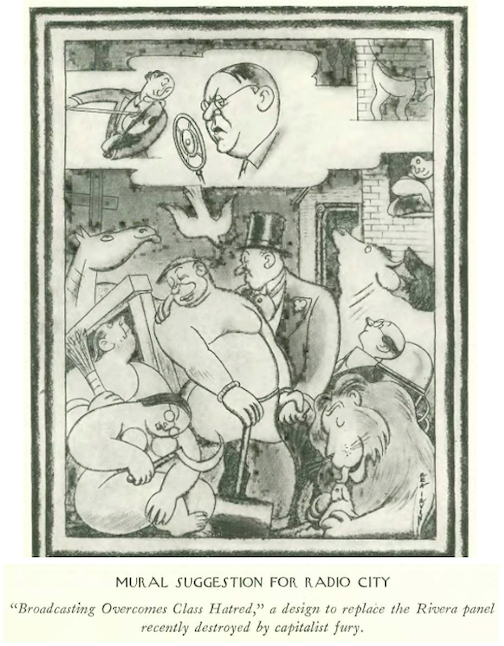
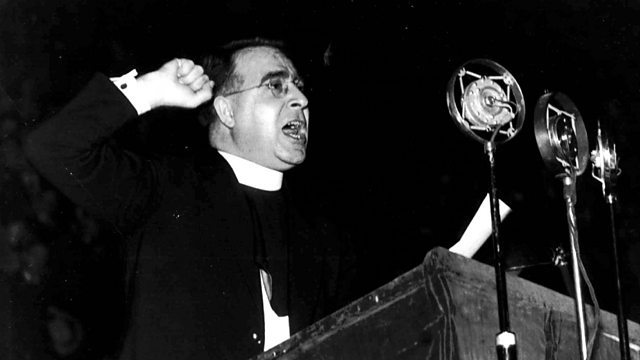
Rea Irvin shared his own thoughts on the issue with this illustration below, which referenced the hateful rhetoric of Charles Coughlin, a Canadian-American Catholic priest and populist leader and one of the first public figures to make effective use of the airwaves to spew his invective.

FAMILIAR RING…Charles Coughlin, a Catholic priest and populist leader, promoted antisemitic and pro-fascist views while also acting as a champion to the poor and a foe of big business. In the midst of the Depression he spoke to the hopes and fears of lower-middle class Americans throughout the U.S. One supporter recalled: “When he spoke it was a thrill like Hitler. And the magnetism was uncanny. It was so intoxicating, there’s no use saying what he talked about…” (BBC/NPR)

* * *

Dog Days

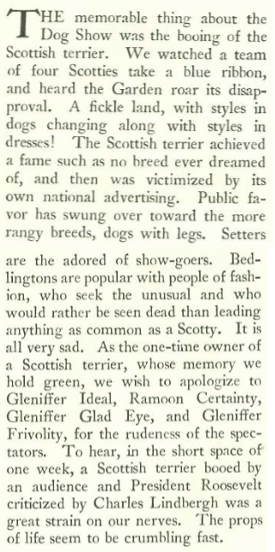
E.B. White also chimed in about boorish behavior he witnessed at the Westminster Kennel Club show at Madison Square Garden. Terriers had dominated Westminster; the fox terrier that ultimately won the 1934 competition represented the 21st terrier of any type to win Best of Show since that category was introduced in 1907.

YOU AGAIN? Ch Flornell Spicy Bit of Halleston, a Wire Fox Terrier, took Best of Show at Madison Square Garden in 1934. (westminsterkennelclub.org)

 * * *

Anybody Home?

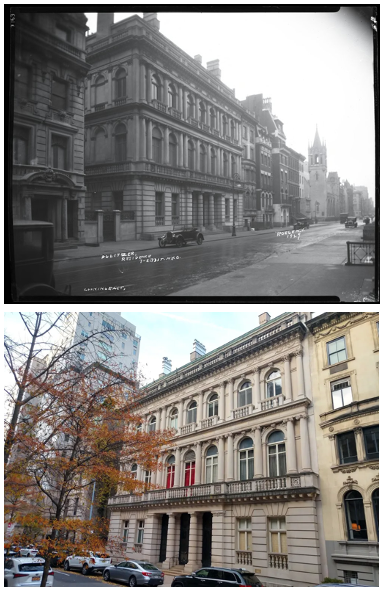
After the wealthy owner of the New York World, Joseph Pulitzer, died in 1911, his family moved out of his lavish East 73rd Street mansion, which was designed by Stanford White to resemble an Italian palazzo. The building sat empty until 1930, when investors planned to knock it down and replace it with an apartment building. The Depression foiled their plans, and another attempt to raze the mansion in the 1950s also miraculously failed, and the building was eventually converted into a co-op with sixteen apartments. Writing in “The Talk of the Town,” James Thurber pondered the Pulitzer mansion’s expected fate. An excerpt:

THEN AND NOW…With so many buildings reduced to dust these days in NYC, it’s good to see the Pulitzer mansion still standing. You can buy one of its sixteen apartments for roughly $6 million, if and when they become available. (ephemeralnewyork.wordpress.com)

 * * *

From Our Advertisers

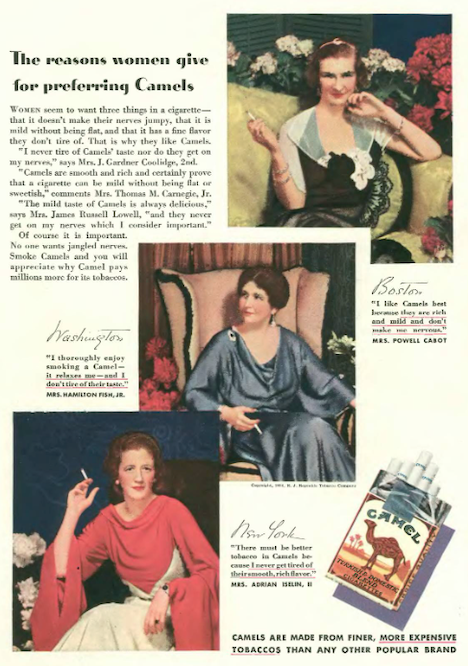
The makers of Camel cigarettes combined three previous ads into one, featuring endorsements from society matrons in Boston, Washington, D.C., and New York…

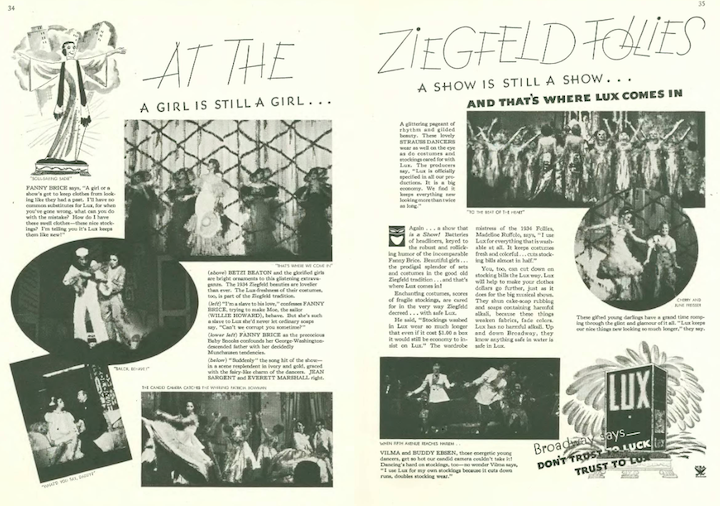
…while Fanny Brice and the cast of the 1934 Ziegfeld Follies offered a chorus of endorsements for Lux detergent in this two-page spread…

…the Graham-Paige Motors Corporation is long gone, but in the early 1930s the company was still going strong, introducing many innovations (described in the ad below) that would be copied by other carmakers…

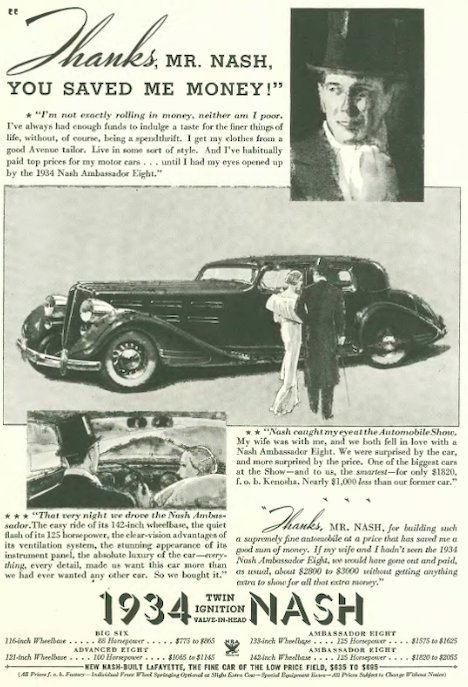
…in the 1930s an exiled Russian noble, Count Alexis de Sakhnoffsky, was known for his streamlined automobile designs…he influenced the look of the 1934 Nash Ambassador Eight, which was touted here as the choice of the budget-minded toff…note how the illustrator exaggerated the car’s length in this ad…

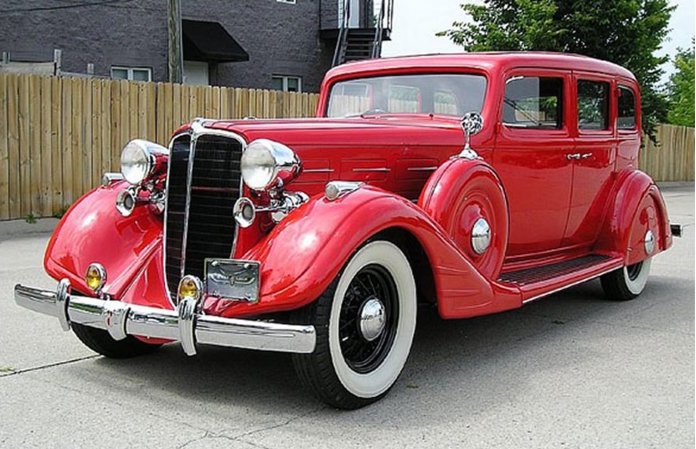
…as compared to an actual model of a Nash Eight…
A restored 1934 Nash Ambassador Eight. (classiccars.com)

…on to our cartoonists, Alan Dunn floated above the “Goings On About Town” section…

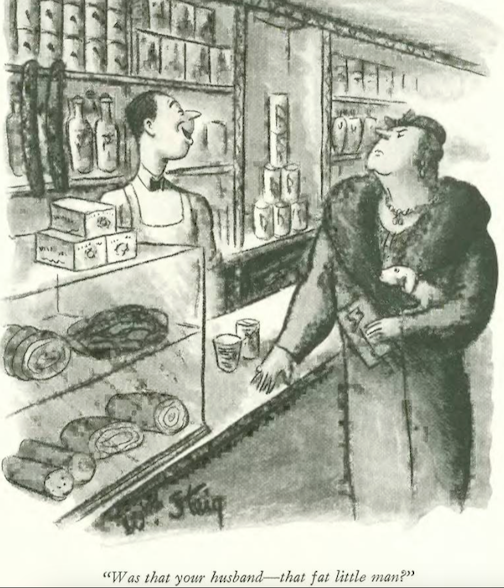
William Steig gave us a tactless grocer…

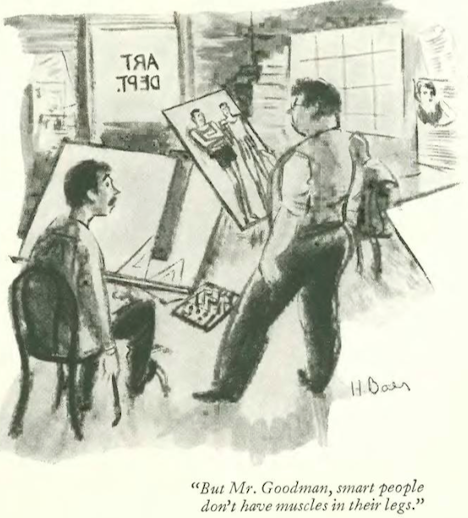
Howard Baer offered up some finer points from Madison Avenue…

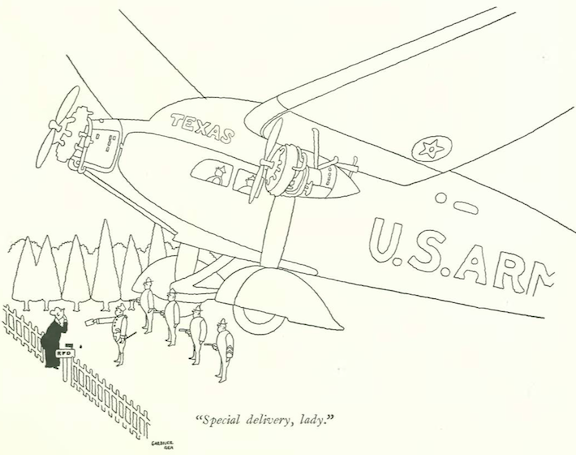
Gardner Rea illustrated a very special delivery…

…and James Thurber’s war continued to be waged on a snowy battlefield…

…on to our March 3, 1934 issue…

March 3, 1934 cover by Harry Brown.

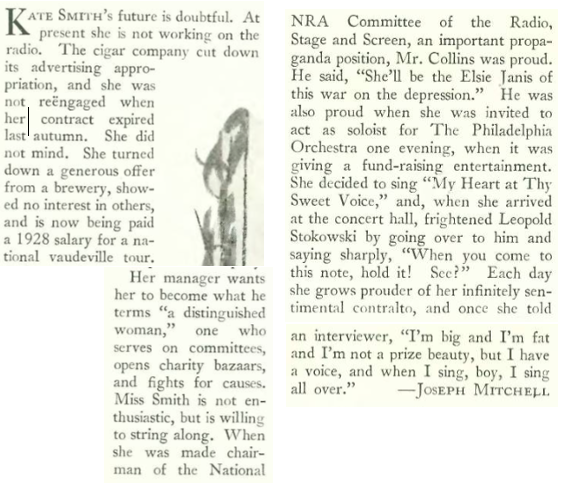
…which featured a profile of singer Kate Smith (1907–1986), written by none other than Joseph Mitchell (1908-1996), who began his career at The New Yorker in 1933. Smith was an American contralto often referred to as “The First Lady of Radio,” well known for her renditions of When the Moon Comes over the Mountain and Dream a Little Dream of Me. She was enormously popular during World War II for her rendition of God Bless America among other patriotic tunes.

Smith got her start in New York in 1926 when she appeared on Broadway in Honeymoon Lane. That year also saw the emergence of countless humiliating wisecracks about her weight that would dog her long career. A reviewer in The New York Times (Oct. 31, 1926) wrote, “A 19-year-old girl, weighing in the immediate neighborhood of 200 pounds, is one of the discoveries of the season…” In 1930, when Smith appeared in George White’s Flying High, she served as the butt of Bert Lahr’s often cruel jokes about her size.

An excerpt from the opening lines of Mitchell’s profile:

RISING STAR…At left, Kate Smith performing in the 1932 Paramount Pictures musical, Hello Everybody!; at right, on the cover of the October 1934 issue of Radio Mirror. (medium.com)

Toward the conclusion of the profile Mitchell suggested that Smith’s future was “doubtful.” She would prove that prediction wrong, however…

…23 years after her death her rendition of God Bless America would be discontinued pretty much everywhere when it was revealed that in the early 1930s she recorded such songs as That’s Why Darkies Were Born and Pickaninny Heaven (which was featured in Hello, Everybody!).

CANCELLED STAR…Since the late 1960s a rendition of God Bless America by Kate Smith served as a good luck charm for the Philadelphia Flyers hockey team. “The team began to win on nights the song was played,” The New York Times wrote in Smith’s 1986 obituary. Smith sang the tune live during game six of the 1974 Stanley Cup finals, which the Flyers went on to win against the Boston Bruins. When Smith’s racist songs were rediscovered in 2019, a statue of the singer that stood outside the Flyers’ arena was covered and ultimately removed. (Daily Mail)

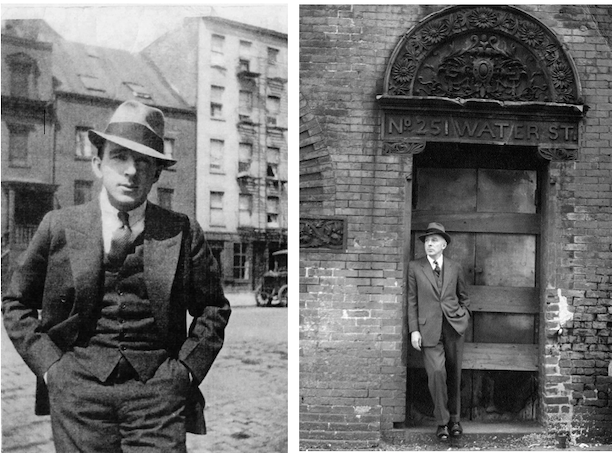
A note on Joseph Mitchell, whose first credited piece in The New Yorker was a Nov. 11, 1933 “A Reporter at Large” column titled “They Got Married in Elkton.” The article described a small Maryland border town that became known for discrete “quicky” marriages. Mitchell would become known for his finely crafted character studies and expressive stories found in commonplace settings. His 1943 McSorley’s Wonderful Saloon is a prime example.

MAN ABOUT TOWN…At left, Joseph Mitchell circa 1930, wearing a brown fedora he was rarely seen without; at right, Mitchell in Lower Manhattan near the old Fulton Fish Market, as photographed by his wife, Therese Mitchell, circa 1950. (Estate of Joseph Mitchell)

 * * *

Acquired Taste

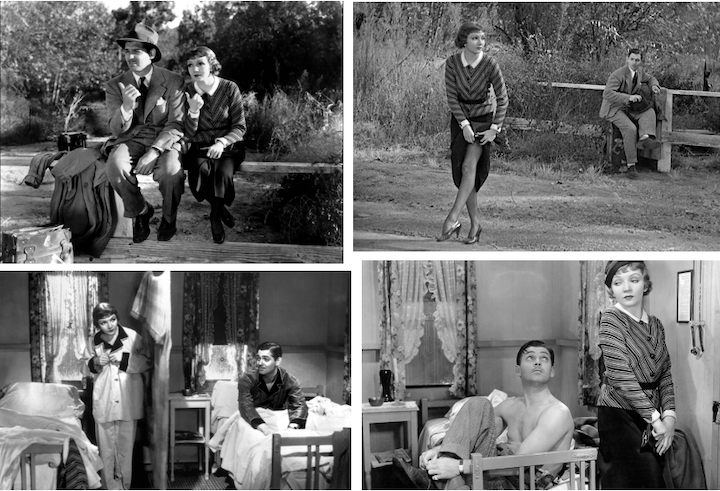
Occasionally New Yorker film critic John Mosher found himself at odds with other reviewers, and such was the case when Mosher sat down to watch Frank Capra’s It Happened One Night. While he described the 1934 pre-Code romantic comedy as “nonsense” and “dreary,” other critics found it generally enjoyable, and although it took audiences awhile to catch on, the film eventually became a smash hit.

In all fairness to Mosher, even the film’s co-star, Claudette Colbert, complained to a friend after the film wrapped, “I just finished the worst picture in the world.” As it turned out, It Happened One Night became the first of only three films to win all five major Academy Awards: Best Picture, Best Director, Best Actor, Best Actress, and Best Adapted Screenplay. It is now widely considered one of the best films ever made. Go figure.

Back to Mosher, who thought so little of the film he didn’t even lead his column with the picture’s review:

PRE-CODE AND TOPLESS…An heiress (Claudette Colbert) and a reporter (Clark Gable) find themselves hitchhiking (and sharing a motel room) after their bus breaks down in It Happened One Night. The film famously featured a scene in which co-star Gable undresses for bed and takes off his shirt to reveal that he is bare-chested. An urban legend claims that, as a result, sales of men’s undershirts declined noticeably. (IMDB)

 * * *

More From Our Advertisers

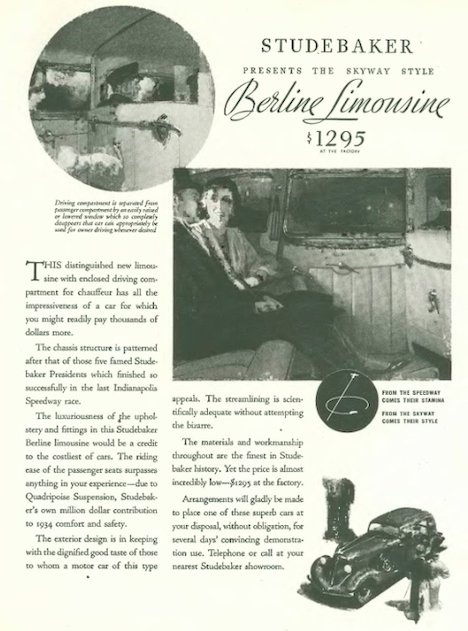
If you wanted luxury with the price, you could buy a Nash Ambassador Eight for $1,800 (about thousand less than other luxury models) or opt for Studebaker’s Berline Limousine, practically a steal at $1,295…

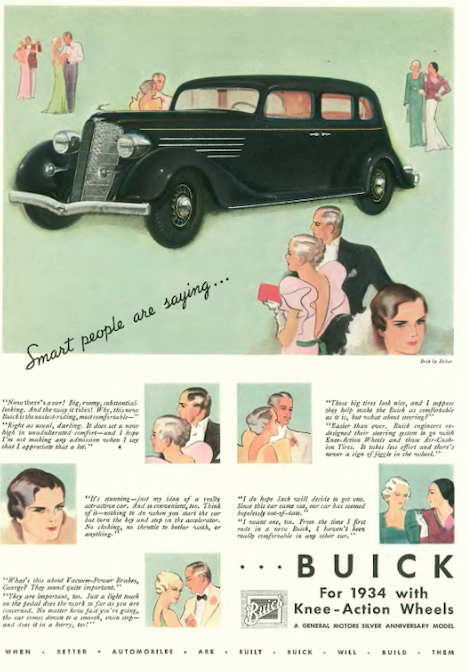
…or you could opt for this fancy-looking Buick with “Knee-Action wheels”…Knee Action was a GM marketing term for independent front suspension, which made for a smoother ride…

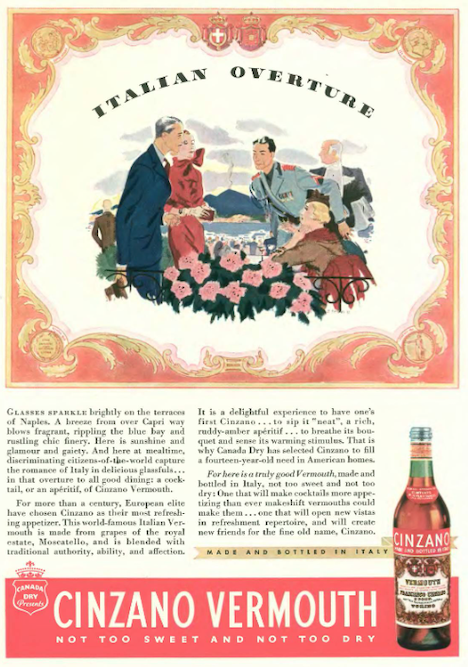
…always colorful, the makers of Cinzano vermouth made their splash in The New Yorker

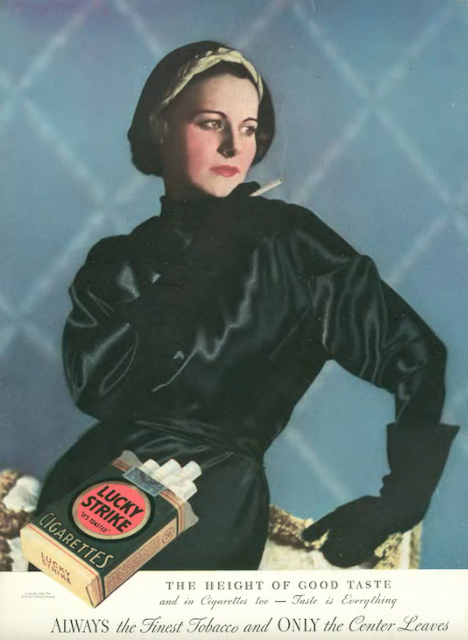
…the folks at Lucky Strike continued their theme of colorful ads featuring attractive women enjoying their cigs…

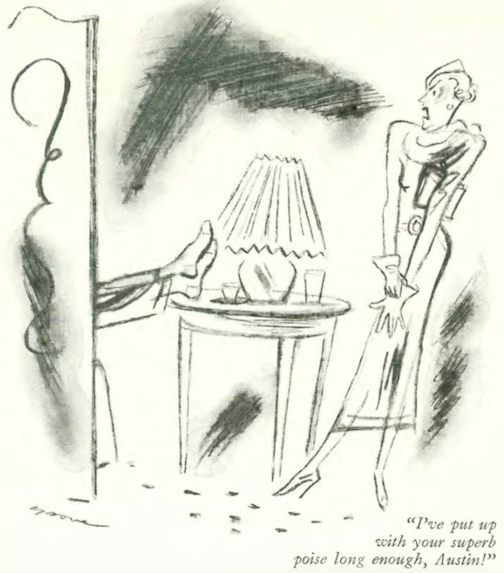
…on to our cartoonists, Leonard Dove illustrated a domestic spat…

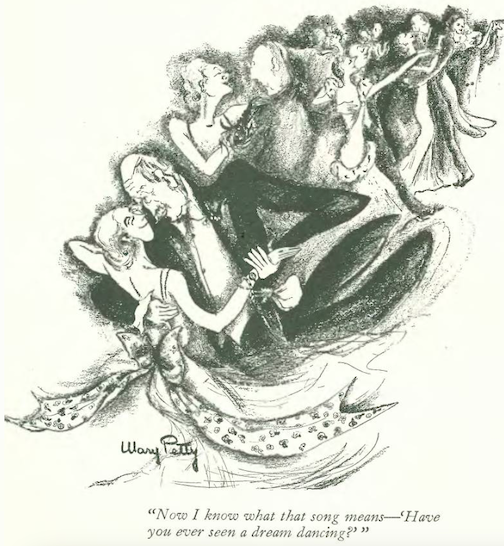
Mary Petty captured a romantic interlude on the dance floor…

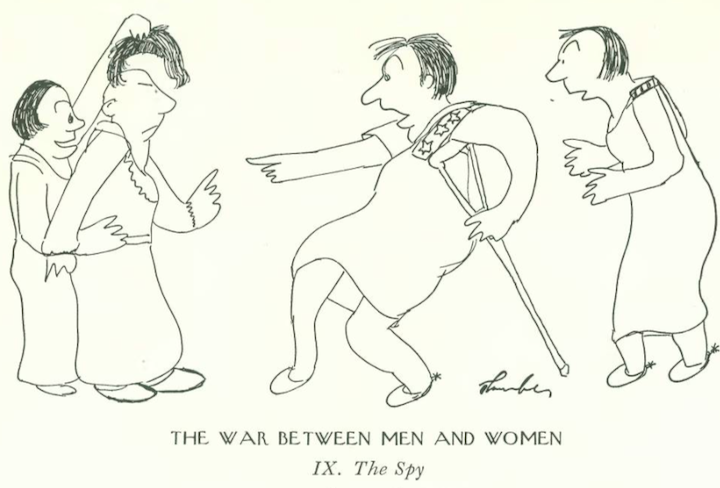
…and James Thurber introduced a new twist—espionage—into his “war”…

Next Time: The Power Broker…


Made In Germany

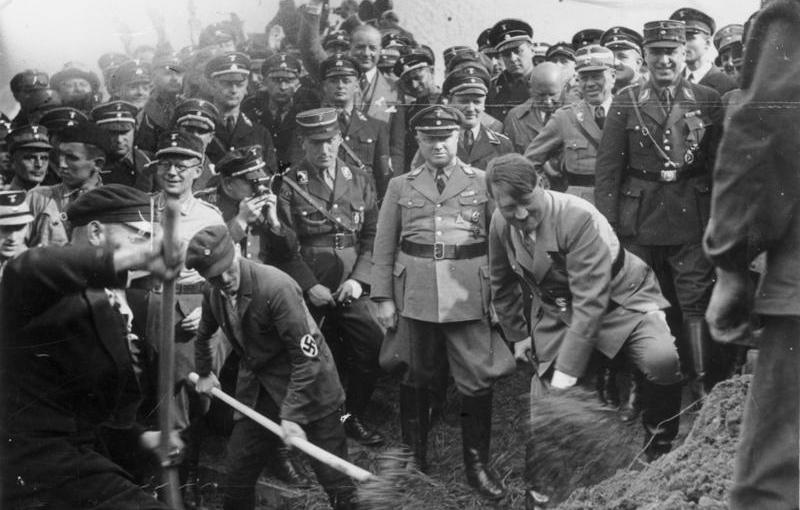
Above: Adolf Hitler at a groundbreaking ceremony for a new section of the Reichsautobahn highway system, 1933. (Bundesarchiv)

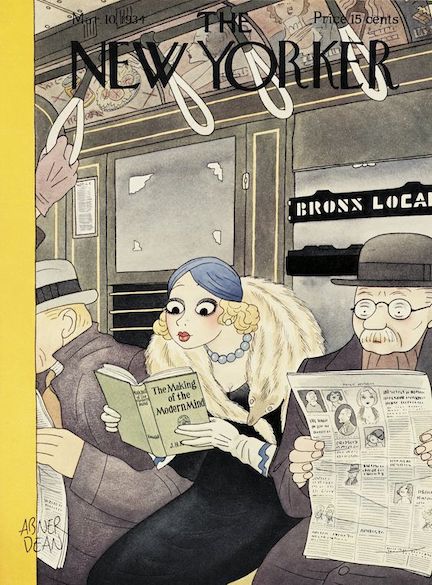
Mildred Gilman was one of the highest paid female reporters in the 1920s, interviewing everyone from murderers to heads of state. But when she arranged to interview Adolf Hitler in 1933, the Gestapo got nervous and threw her out of the country.

Feb. 10, 1934 cover by Harry Brown.

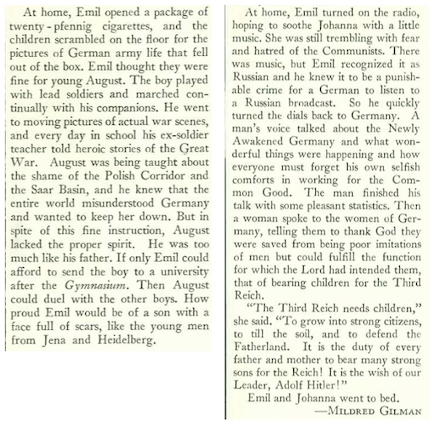
Gilman (1896-1994) doubtless sought a modicum of satisfaction when she penned “Made in Germany” for the Feb. 10, 1934 issue. I am including generous excerpts below, which describe the day in the life of an average Berliner named Emil Pfalz, a man who doesn’t question the omnipresent Nazi propaganda and often worries about his ability to keep in step with the new regime.

THERE’S SOMETHING HAPPENING HERE…Berliners (left) and residents of Worms (top) inspect Nazi propaganda that instructed Germans not to do business with Jewish people (on Jan. 24, 1934, the German government banned Jews from membership in the German Labor Front, depriving them of the opportunity to find employment); below, in early 1934 a simulated uprising was staged in Berlin (with people posing as casualties) as part of Nazi maneuvers. Later that summer SS and Gestapo forces would conduct a purge known as “Night of the Long Knives,” eliminating any known or suspected dissenters of the Nazi regime. Hundreds were murdered and many more arrested. (digitallibrary.usc/Wikipedia)
GRIM FAIRY TALE…As a loyal citizen, Emil Pfalz was sure to teach his children the Nazi salute. Image from a Nazi propaganda booklet. (British Library Board)

Emil’s story continues as he contemplates his duties as a father and husband in the Third Reich…

…and heeds the call to produce more Aryan babies.

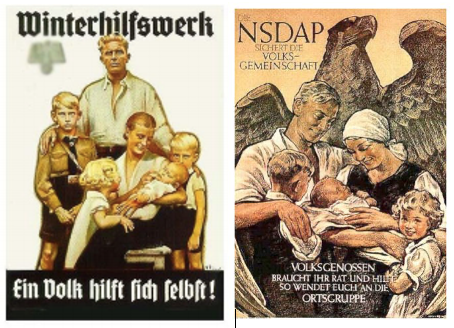
What the Nazis did not want more of was chronically ill or disabled persons. The sick minds of Nazi propagandists produced this image below, which argues that for the same daily amount of reichsmarks you could either support an entire Aryan family or a single mentally disabled person…in 1933 the Law for the Prevention of Hereditarily Diseased Offspring was passed, allowing for the forced sterilization of those regarded as ‘unfit’. In 1939 the regime began killing the disabled (up to 250,000 people).

A final note about the writer, Mildred Gilman. In addition to being a journalist of both daring and flair, she wrote eight novels including the bestseller Sob Sister. In her younger days she was employed as a secretary for New York World columnist Heywood Broun and partied with Dorothy Parker, Alexander Woollcott, and Robert Benchley. She wrote a profile of Paul Robeson for the Sept. 21, 1928 issue of The New Yorker.

Mildred Gilman in 1938.

 * * *

Up In Smoke

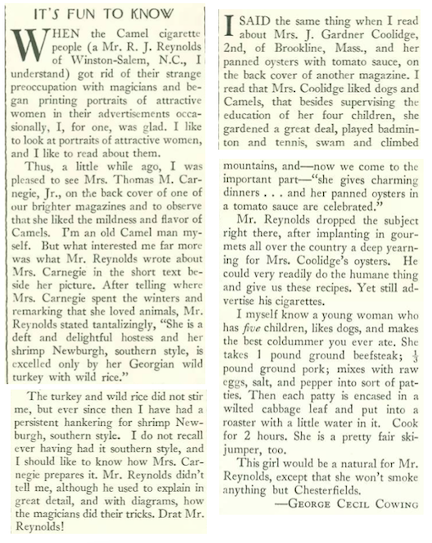
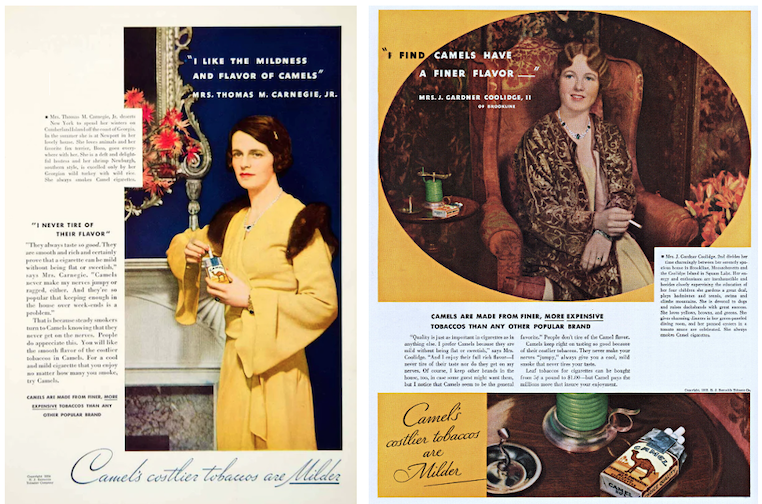
George Cecil Cowing, known for his whimsical “Boulevardier” column for the Pasadena Star-News, commented on the changing themes adopted by cigarette manufacturers, namely the folks at R.J. Reynolds who abandoned their magician-themed ads for their Camel brand (“It’s Fun to Be Fooled”) for spots featuring endorsements from second-tier society women…

POSH PUFFERS…”Mrs. Thomas M. Carnegie Jr.” (Virginia Beggs) and “Mrs. J. Gardner Coolidge II” (Mary Louise Coolidge) shared their favorite dishes and their love for smoking Camels in these ads, which appeared in The New Yorker in early 1934.

 * * *

From Our Advertisers

Appropriately we turn to our advertisers, where we find the Camel brand trying out a new theme that demonstrated their product’s appeal to plainer folks…

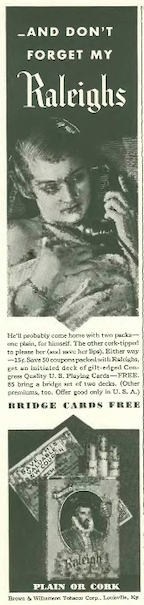
…Brown & Williamson’s first national brand, Raleigh, was launched as a premium cigarette in 1928, here marketed with a plain or cork tip (“to please her and save her lips”)…

…in his parody of Camel ads, George Cecil Cowing wrote that he preferred Chesterfields, a big-time brand of mid-century America…

…the makers of White Rock reveled in the newly found freedoms of legalized alcohol…

…the folks at Fisher were sticking with their lavish two-page color ads and what has always been a tiresome double entendre…

…Lord & Taylor took to the skies to promote their “country clothes” to the smart set…

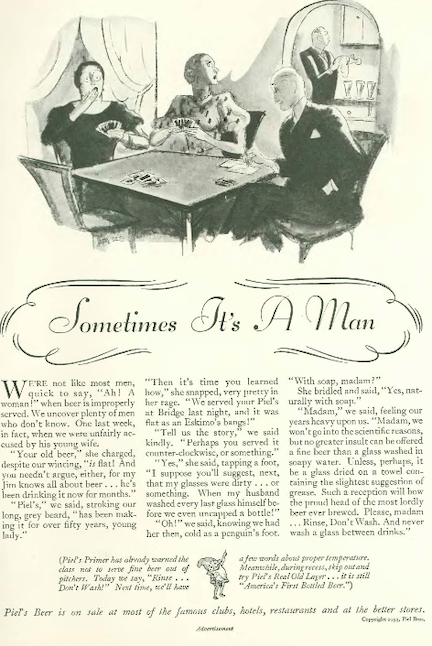
…and cartoonist Herbert Roese, who apparently never published a cartoon in The New Yorker, turned in this very New Yorker-looking illustration for Piel’s…

…on to our cartoonists, we begin with Clarence Day, better known for his Life With Father stories…

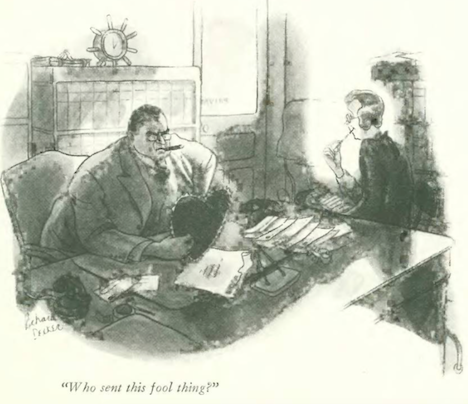
…the Valentine’s issue featured several themed cartoons, including these by Richard Decker

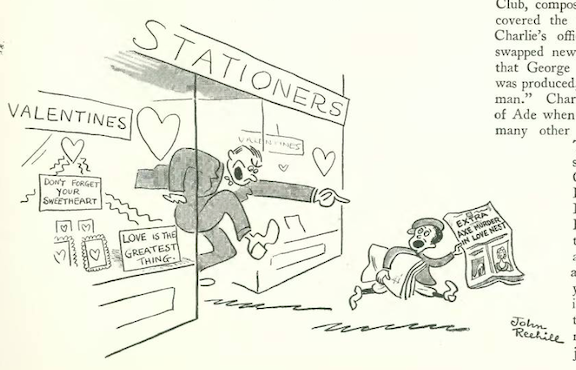
…and John Reehill

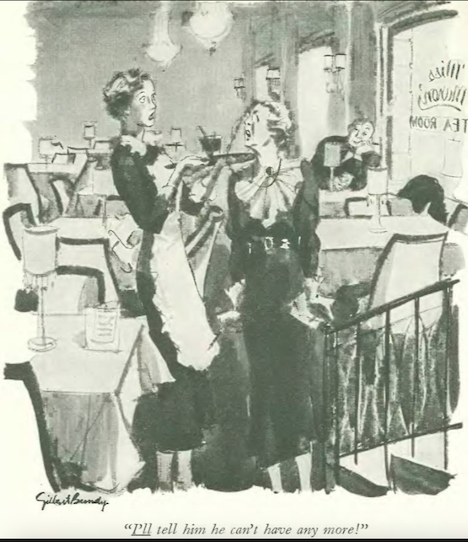
…love was also in the air for Gilbert Bundy

…while William Crawford Galbraith continued to ply the waters of the creepily lustful…

…and we test different waters with Richard Yardley, a popular editorial cartoonist for The Baltimore Sun…this is the only cartoon he published in The New Yorker

…the Westminster Kennel Club dog show was in town, here tapped by Helen Hokinson to also explore the theme of fatherhood…

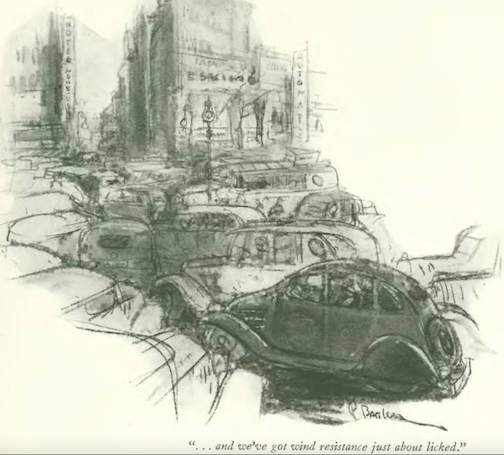
Perry Barlow was the latest New Yorker contributor to mock the futuristic, aerodynamic style of Chrysler’s Airflow

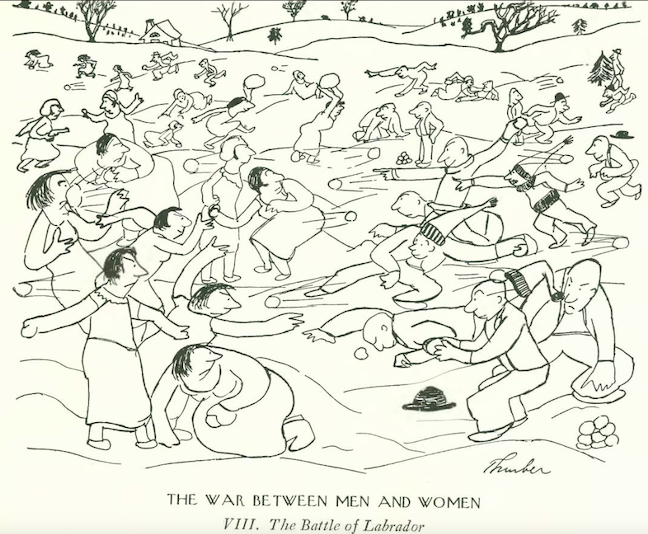
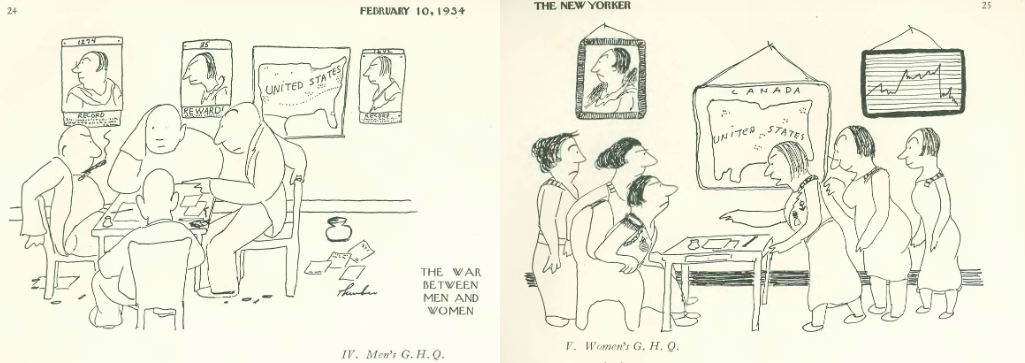
…and James Thurber’s “War Between Men and Women” paused as the two sides made preparations for the next battle…

Next Time: And Now We Are Nine…

As Millions Cheer

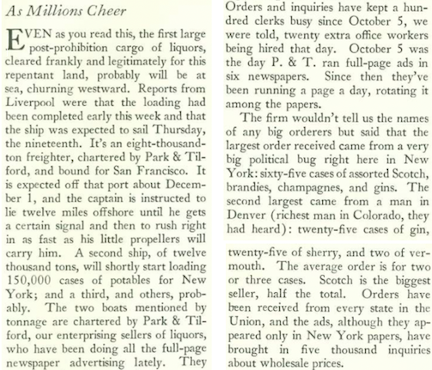
Proposed by the 72nd Congress on February 20, 1933, the 21st Amendment to end national prohibition needed ratification from at least thirty-six states—by the end of October twenty-nine had ratified the amendment, and with passage seeming imminent…

Oct. 21, 1933 cover by Harry Brown.

…Manhattan’s venerable grocer turned national wine and spirits distributor Park & Tilford began shipping tens of thousands of cases of “potables” to New York, according to “The Talk of the Town.” Excerpt:

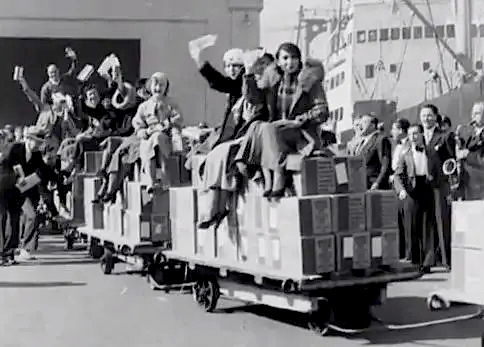
ON THE OFF WAGON…Parched, jubilant Americans ride on carts loaded with liquor prepared for distribution at the end of Prohibition. (Still from Universal News)

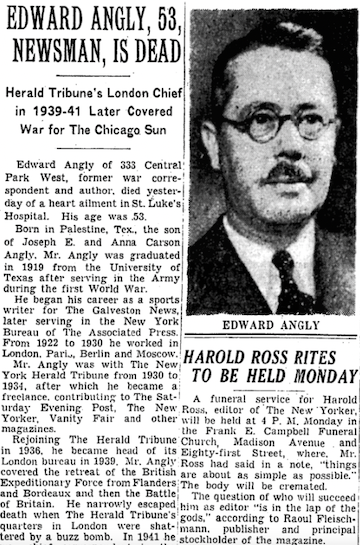
Edward Angly, who at the time was a journalist at the Herald-Tribune, tempered the celebratory mood in “A Reporter at Large” by considering the supply and demand issues (and higher prices) consumers would likely face upon ratification.

In early 1934 the Washington Post reported cocktail prices ranged from twenty-five cents (roughly $5.50 today) to forty cents. Whisky by the drink was selling from fifteen cents for blends to twenty-five cents for bonded varieties. One of the “higher priced” stores quoted a price of $3.80 for a quart of Four Roses (roughly eighty bucks today) while you could grab a quart of Crab Orchard straight Bourbon whisky for $1.40.

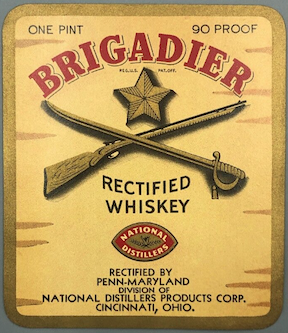
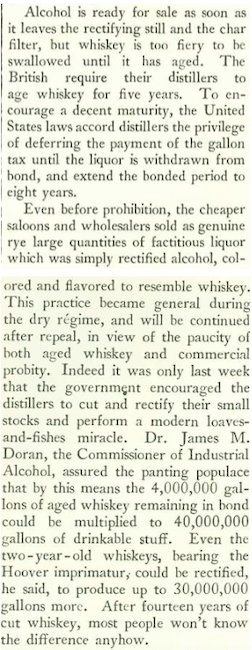
Until supplies could satisfy demand, distillers were encouraged to perform a “modern loaves-and-fishes miracle” and rectify their small stocks by cutting them with colored and flavored straight alcohol.

YOU CAN COME OUT NOW…With the end of Prohibition, bootleggers considered other career options. (floridamemory.com)

Who else would feel the pinch? In addition to the thousands of speakeasies that would close shop, legions of bootleggers would have to go legit or find another line of vice to keep themselves fed and occupied.

…before I close out this lead story, I came across this obituary for Edward Angly in the Dec. 8, 1951 edition of The New York Times. Note that this clip also features the funeral notice for New Yorker founding editor Harold Ross.

 * * *

Name Your Fears

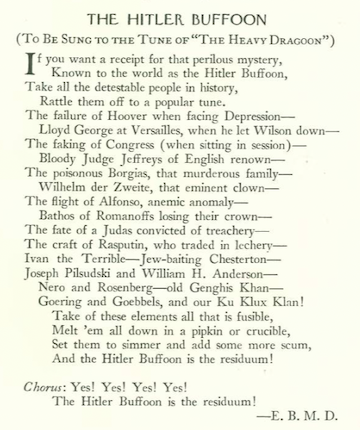
Irish writer and critic Ernest Boyd was for a time connected to the consular service and probably had a pretty good sense of what was to come in Europe. Turning to verse he pondered the origin of the Hitler curse.

 * * *

Fat and Happy

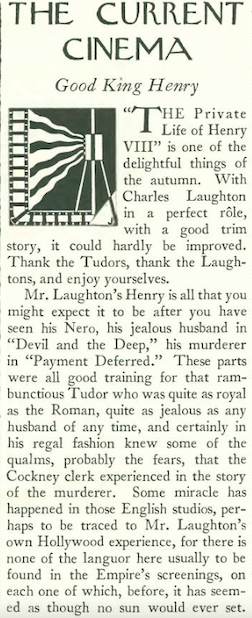
Premiered to record-breaking crowds at New York’s Radio City Music Hall, The Private Life of Henry VIII was a smash hit in both the UK and the US and established Charles Laughton as a box office star. Although the film played fast and loose with the historical record, it was a critical success for director/producer Alexander Korda. The New Yorker’s John Mosher was among those praising the British film.

SINKING HIS TEETH INTO A ROLE…Charles Laughton’s portrayal of Henry VIII in The Private Life of Henry VIII is credited with creating the popular image of the king as a fat, lecherous glutton. Top photo features Wendy Barrie as Jane Seymour (wife #3); below, Binnie Barnes as Katherine Howard (wife #5). (moma.org/tcm.com)
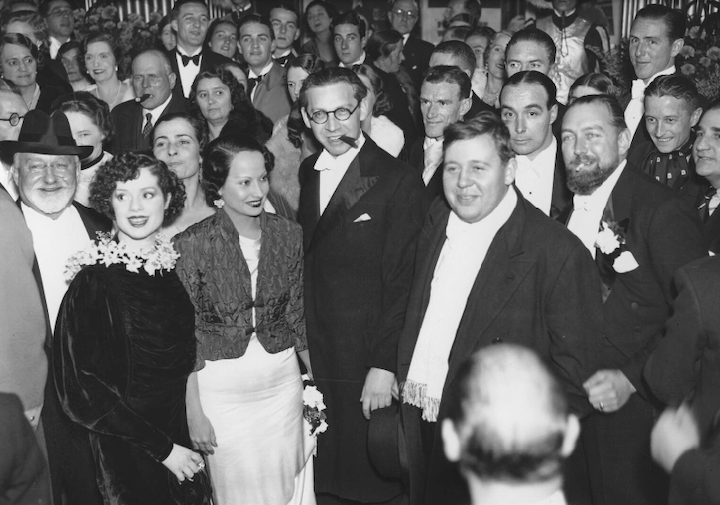
HAIL TO THE KING…Opening night in London for The Private Life of Henry VIII, Oct. 24, 1933. From left are Elsa Lanchester, who portrayed wife #4 Anne of Cleves; Merle Oberon (who portrayed wife #2 Anne Boleyn), producer/director Alexander Korda, and Charles Laughton. (Science & Society Picture Library / National Portrait Gallery, London)

 * * *

Kid’s Stuff

In her latest “Tables for Two” column, Lois Long bemoaned the state of ballroom dancing, which seemed to be appealing more to juvenile tastes.

SUITABLE FOR ADULT AUDIENCES…Lois Long recalled the cool allure of dancers Leonora Hughes (at left, with dance partner Maurice Mouvet in 1924) and Irene Castle (in a 1929 photo). Both photographs by Edward Steichen for Vanity Fair. (Conde Nast)

 * * *

From Our Advertisers

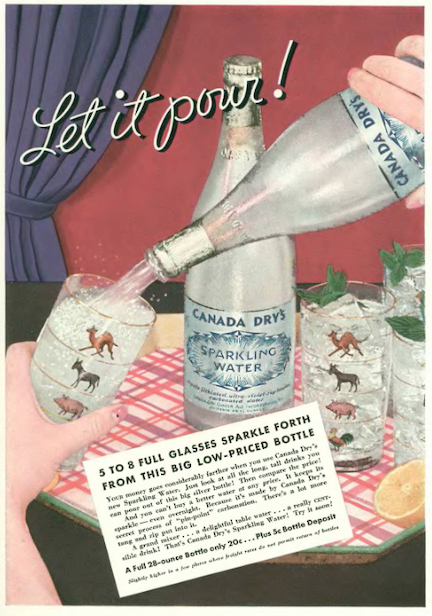
Let it pour indeed, as advertisers anticipated the end of Prohibition…

…Brooklyn-based Piel’s joined other brewers in targeting women as a new growth market, and as in previous New Yorker ads also appealed to those who fancied themselves among the smart set…

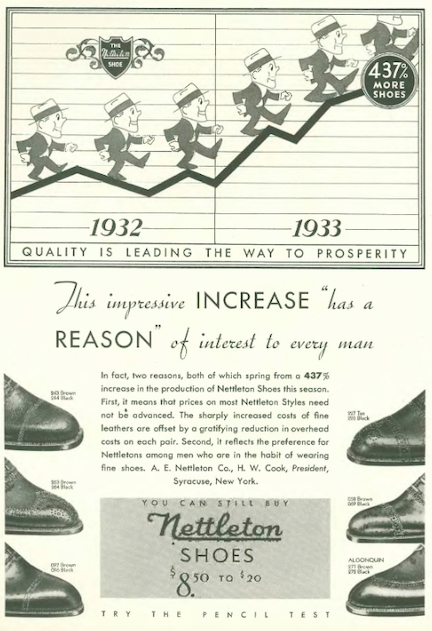
…looking for signs of optimism after four years of economic depression? Look no further than luxury shoemaker Nettleton…

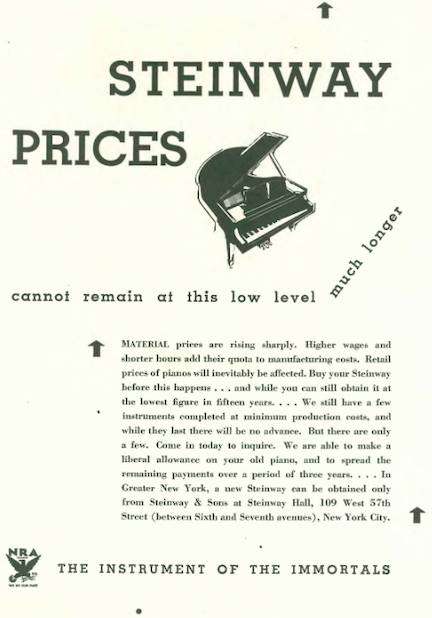
…while Nettleton held steady on its prices, the makers of Steinway pianos posted this gentle reminder about rising material costs, but what can you expect if you are purchasing “The Instrument of the Immortals”…

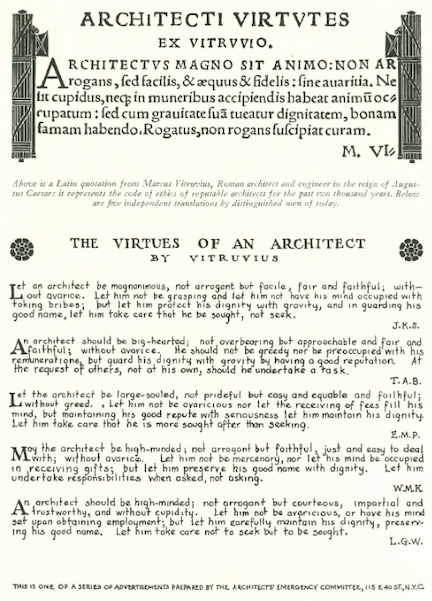
…the Architect’s Emergency Committee continued its campaign to promote the hiring of unemployed architects…in this ad the committee went back to the profession’s ancient origins, Marcus Vitruvius’ Virtues of an Architect

…on to our cartoonists, we begin with more adventures of The Little King, courtesy Otto Soglow

William Crawford Galbraith was still stuck on his theme of seductive women either paired with sugar daddies or clueless suitors…

…speaking of clueless, James Thurber gave us this party pooper…

Gardner Rea checked the economic temperature of the upper crust…

…and we close with William Steig, and an enterprising paperboy…

Next Time: The Bombshell…

Rumors of War

Above: German Panzer tanks on parade in the early 1930s. (alternativefinland.com)

The year 1933 marked a shift in the political winds, starting with Adolf Hitler’s rise to the chancellorship of Germany in 1933. By October he withdrew from the League of Nations and the Geneva Peace Conference, all the while clandestinely building up his war machine.

Sept. 16, 1933 cover by Harry Brown. The scene depicts the West Side’s infamous “Death Avenue,” where New York Central Railroad freight trains mixed with a jumble of automobiles, wagons and pedestrians amid factories and warehouses. Beginning in the 1850s “West Side Cowboys” rode in front of trains as a safety precaution. Still, there were hundreds of casualties until the rail was elevated in 1934—today’s High Line.

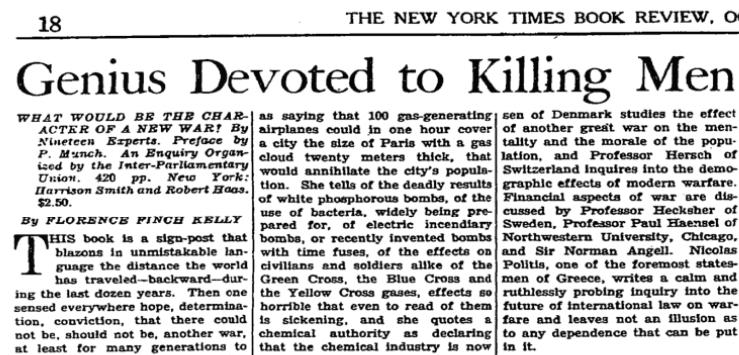
While some sounded alarms, most people, along with their nations, turned inward, focusing on domestic issues—FDR was busy with his New Deal agenda, Britain was dealing with its own economic woes, and Germany, Italy and Japan were keeping their populations in line by stoking the flames of nationalism. Few paid much attention to a 420-page book titled What Would Be the Character of a New War?, which accurately predicted the nature of the war to come. New Yorker critic Clifton Fadiman offered this sobering assessment (wryly titled “To the Gentler Reader”) of the work:

The book’s prescient warnings could be attributed in part to the experiences of the Inter-Parliamentary Union’s 19 authors—nearly half of them soldiers from Great Britain, Sweden, Germany and France, the others mostly scientists along with a statesman or two. In her Oct. 22, 1933, New York Times Book Review article, Florence Finch Kelly noted the authors’ general agreement as to the “utter uselessness” of international peace agreements. “This book is a sign-post that blazons in unmistakable language the distance the world has traveled—backward—during the last dozen years,” she wrote, concluding “the world very greatly needs this book…For it is the most ghastly, the most horrifying book about war that has ever been written.”

In my previous post we saw how H.G. Wells envisioned the next war, with destruction raining from the sky. So too was the conclusion of Inter-Parliamentary Union. Fadiman observed:

THEY LOVE A PARADE…Clockwise from top left: Adolf Hitler is cheered as he rides through the streets of Munich on Nov. 9, 1933; Hideki Tojo would be promoted to major general in 1933 and would go on to become minister of war and prime minister of Japan; the technologically advanced Heinkel He 111 was secretly produced as part of the clandestine German rearmament in the early 1930s; when he wasn’t busy murdering his own people, Josef Stalin (pictured here on Nov. 7, 1933) was implementing his Five-Year Plan. (The Atlantic via AP/Wikipedia)

The rumblings heard in Germany were also on the mind of Howard Brubaker, who made these observations in his column, “Of All Things.”

 * * *

Dining For Success

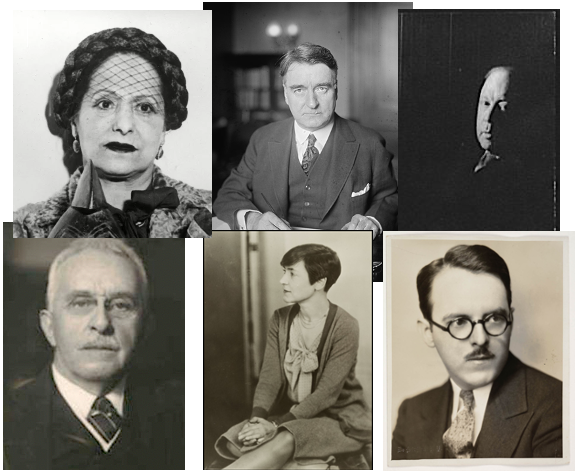
The Society for the Advancement of Better Living offered its own New Deal for Depression America—you could eat your way to better life. E.B. White noted the non-ideological nature of this new movement, where commies and capitalists could break bread together…

GUESS WHO’S COMING TO DINNER?…Hearty appetites make strange bedfellows, according to E.B. White. Clockwise, from top left, Helena Rubinstein, Dr. Royal Copeland, Robert Morss Lovett, C. Hartley Grattan, Suzanne La Follette, and Henry Goddard Leach. (Vanity Fair/Wikipedia/U of Nebraska)

 * * *

Bread & Circuses

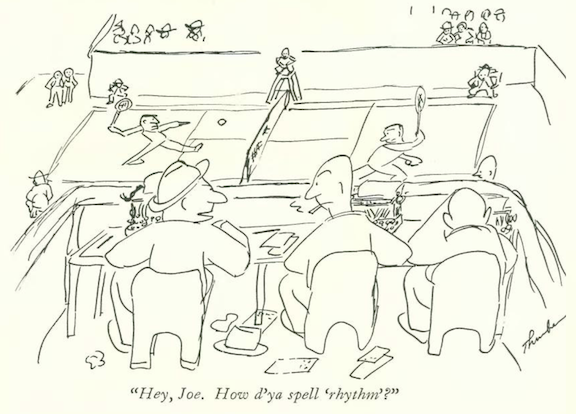
“The Talk of the Town” looked in on the game of college football, which some college presidents annually decried for becoming a “great spectacle.” If they could have only known what was to come…

THE HOME TEAM…Clockwise, from top left: Columbia University’s Baker Stadium in the 1920s; Columbia’s president in 1933, Nicholas Murray Butler, considered something of a blowhard in his day; Columbia’s Hall of Fame coach Lou Little in 1930; Columbia taking on archival Cornell in 1930. The Columbia Lions were a power in the 1930s—in 1933 the Lions won the Rose Bowl, beating Stanford 7–0. (Columbia University)

 * * *

From Our Advertisers

The fine folks at Martini & Rossi were doing their part to get Americans ready for the end of Prohibition…

…meanwhile, the makers of Her Majesty’s perfume summoned the old and the new while also showing support for the New Deal (the NRA logo)…this image, however, doesn’t conjure up visions of “Tomorrow’s World”…

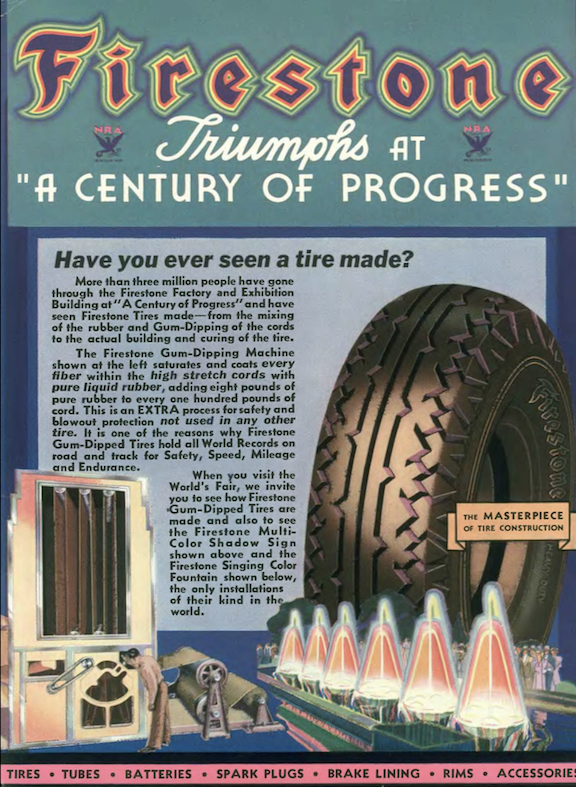
…and frankly neither does this tire, here linked to the wonders on display at Chicago’s Century of Progress…

…on to our cartoons, we have two by James Thurber, beginning with this cryptic drawing…

…and later in the issue, a more familiar Thurber at play…

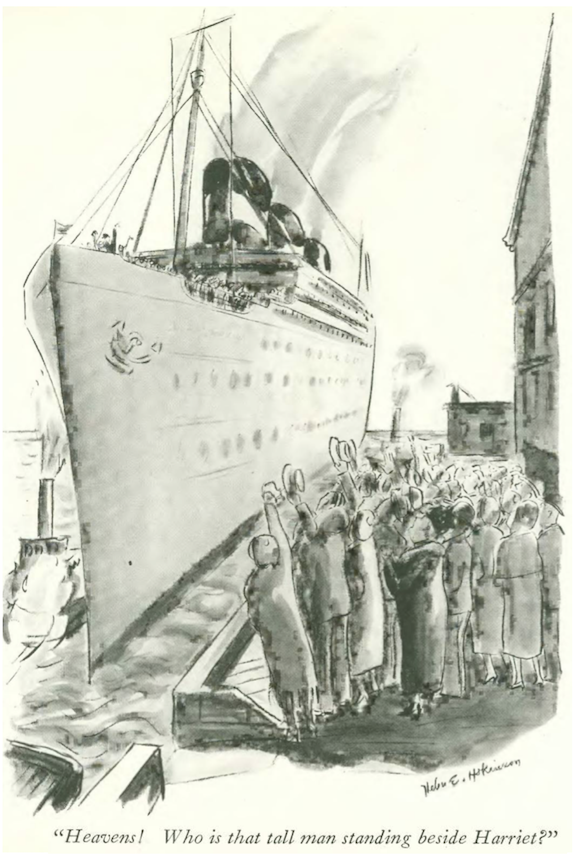
Helen Hokinson’s “girls” surmised a scandal aboard an incoming liner…

Henry Anton gave us a kindly pawn shop owner with a money back guarantee…on a pair of brass knuckles…

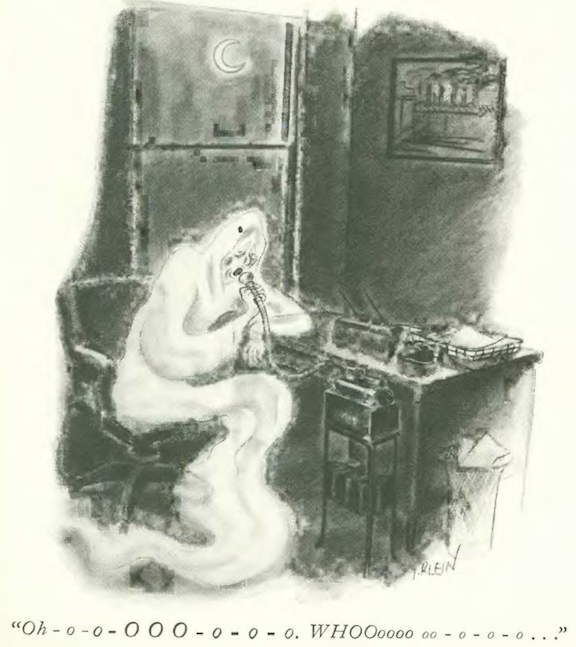
Isadore Klein conjured up a ghost who’d found a use for an executive’s wire recorder…

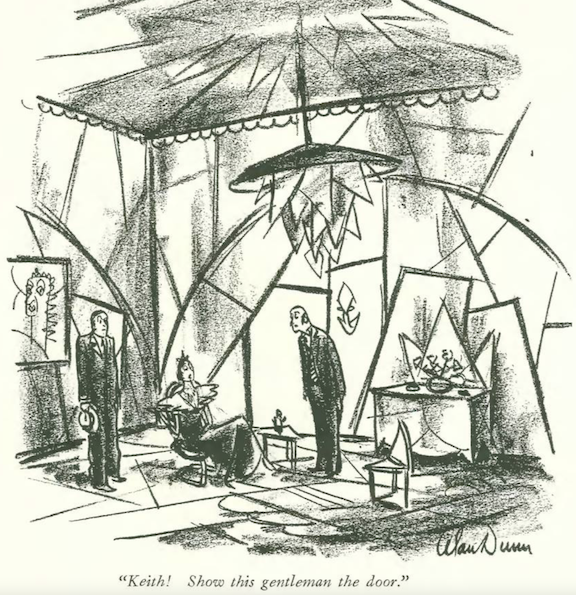
…and we close with Alan Dunn, and the perils of interior design…

Next Time: Music and Murder…

Making Hays

The name Will Hays will always be linked to the Motion Picture Production Code, a set of guidelines for self-censorship that studios adopted to avoid government intervention.

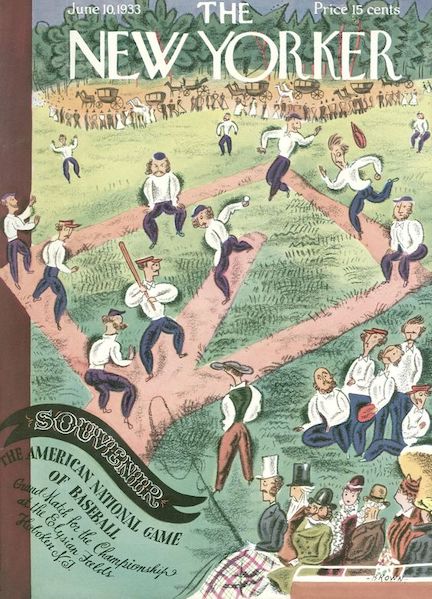
June 10, 1933 cover by Harry Brown.

Hays, however, played both sides in the culture wars. A Republican politician, Hays (1879–1954) managed the 1920 election of Warren G. Harding before moving on to Postmaster General and then chairman of the Motion Picture Producers and Distributors of America. During the so-called pre-Code era, roughly 1930 to 1934, the Production Code was barely enforced, giving filmmakers the freedom to explore themes ranging from prostitution to gangster violence. When Alva Johnston wrote a two-part profile on Hays for The New Yorker, pressure from Catholic Church and other morality groups was building for Hays to strictly enforce the Code, or else. An excerpt:

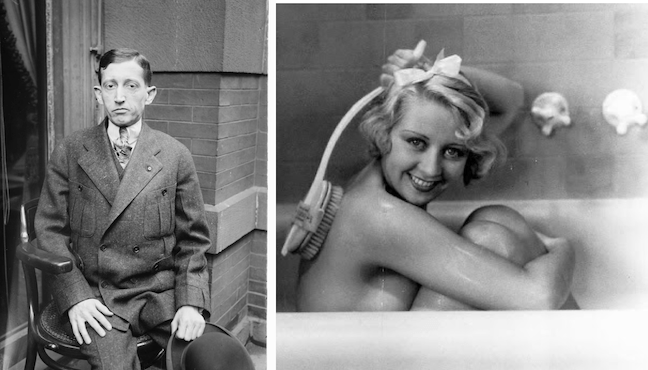
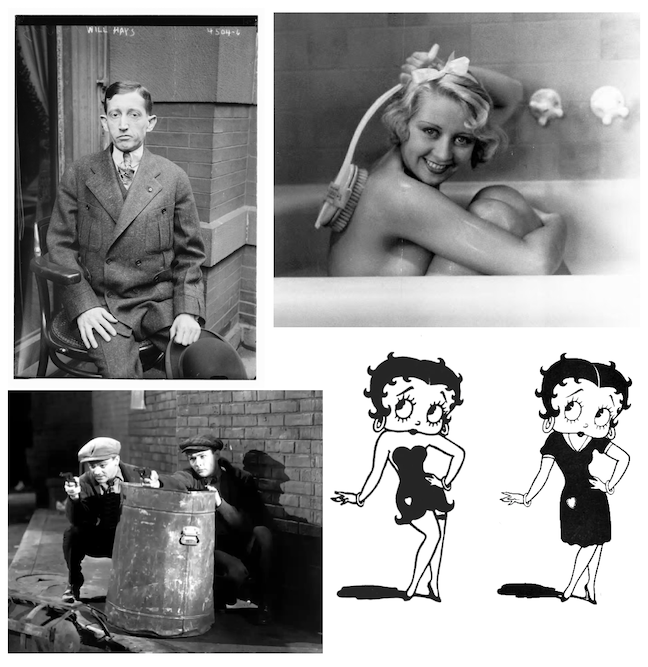
CLEAN IT UP, JOAN…Will Hays (top left) felt pressure in 1933 to start seriously enforcing the Production Code, and scenes such as the one at top right from Blonde Crazy (1931) with Joan Blondell would probably not pass muster after 1934; the Hays Code would also lengthen the animated Betty Boop’s skirts, and tone down gratuitous violence (James Cagney and Edward Woods in 1931’s Public Enemy). (Wikimedia/pre-code.com/Warner Brothers)

 * * *

The Trouble With Money

In their investigation of the probable causes of the 1929 market crash, the Senate Banking and Currency Committee summoned J.P. Morgan Jr (1867–1943) on June 1, 1933, to testify on questionable banking practices. Committee counsel Ferdinand Pecora (1882–1971) set out to prove, among other things, that Morgan sold stock below market price to some of his cronies. Pecora also learned that Morgan and many of his partners paid no income tax in 1931 and 1932, big news to Americans still suffering from the effects of the Great Depression. E.B. White made these observations:

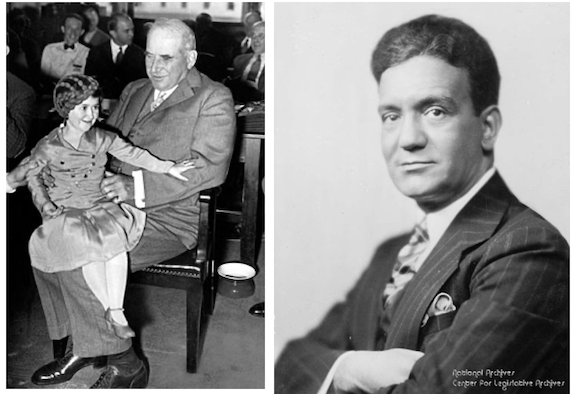
Although not mentioned by White, the hearing began with an odd little sideshow. Writing for the U.S. Capitol Historical Society blog, Joanna Hallac notes that because the hearings were slow to get started, newspaper reporters grew desperate to get something for the evening papers. Then one enterprising reporter, Ray Tucker, spotted circus dwarf Lya Graf with her agent, Charles Leef, outside of the hearing room (the Barnum & Bailey Circus was in town) and suggested Graf meet the famed banker. Hallac writes: “Although he was initially startled, Morgan was genial and rose and shook her hand. Naturally, the photographers were stepping all over each other to get a picture of the exchange. Leef, seeing a perfect press opportunity for himself and the circus, waited for Morgan to sit down and then scooped up Graf and placed her in J.P. Morgan’s lap. Morgan apparently laughed and had a brief exchange with the demure lady, in which he told her he had a grandchild bigger than her.”

THE LIGHTER SIDE OF FINANCE…Before being grilled by Senate counsel Ferdinand Pecora at a June 1, 1933 banking hearing,  J.P. Morgan Jr was paid a surprise visit by Lya Graf, a Barnum & Bailey circus dwarf. At right, Pecora, circa 1933. Sadly, Graf, who was German, perished in a concentration camp after she returned to her homeland in 1935. She was condemned to death in 1937 for being half Jewish and “abnormal.” (New York Magazine/Wikipedia)

 * * *

Single Member Plurality

Among other attributes, E.B. White was known for his use of the first person plural, the editorial or clinical “we.” White himself offered this insight:

I, ME, MINE…E.B. White at work in 1945. (Britannica.com)

 * * *

Uncle Tom, Revived

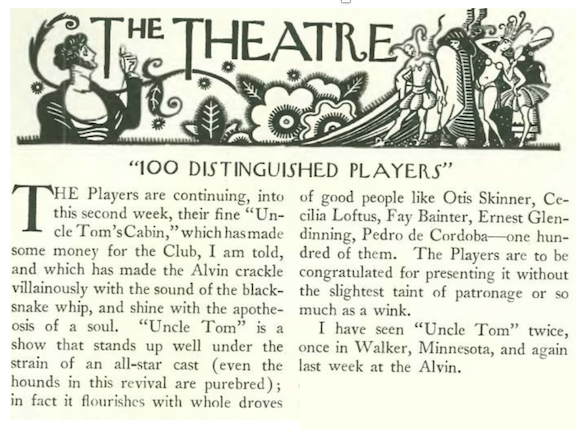
Plays based on Harriet Beecher Stowe’s 1852 novel Uncle Tom’s Cabin were wildly popular throughout the late 19th and early 20th centuries, but by the 1930s the story seemed antiquated and no longer relevant. That didn’t stop the Players (a Gramercy park actors club) from mounting a 1933 Broadway revival that proved popular with audiences and a New Yorker stage critic, namely E.B. White, sitting in for Robert Benchley…an excerpt…

SAY UNCLE…Otis Skinner (1858–1942), a beloved broadway actor, portrayed Uncle Tom in the 1933 Broadway revival. The all-white cast performed in blackface.

…on the other hand, White found the Frank Faye/Barbara Stanwyck play Tattle Tales tedious, a thin veneer over the stars’ crumbling marriage off-stage…

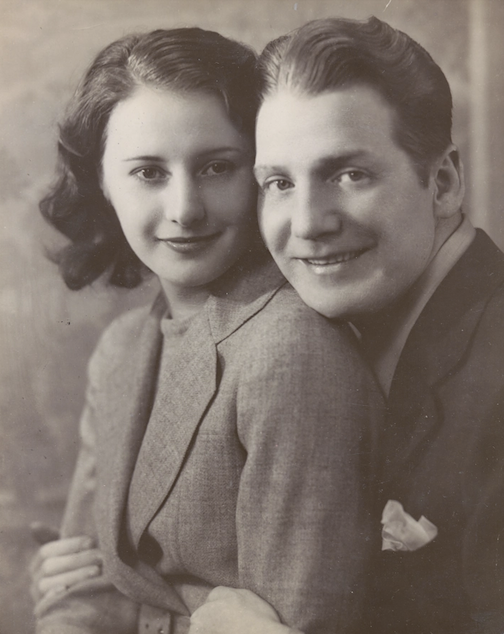
THAT’S ALL, FOLKS…Publicity photo of Barbara Stanwyck and Frank Faye for the Broadway production of Tattle Tales at the Broadhurst Theatre. The co-stars’ real-life marriage supposedly inspired the 1937 film A Star is Born (as well as subsequent remakes). As Stanwyck’s star rose, Faye’s faded—his heavy drinking and abuse led to their 1935 divorce. The play itself closed after 28 performances. (IBDB)

 * * *

Frothy Air

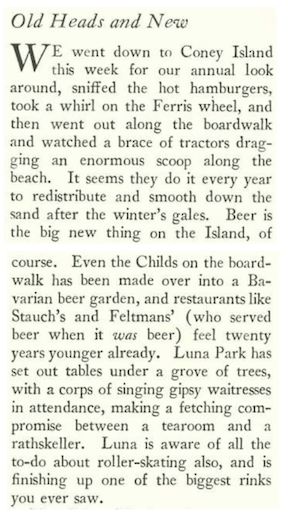
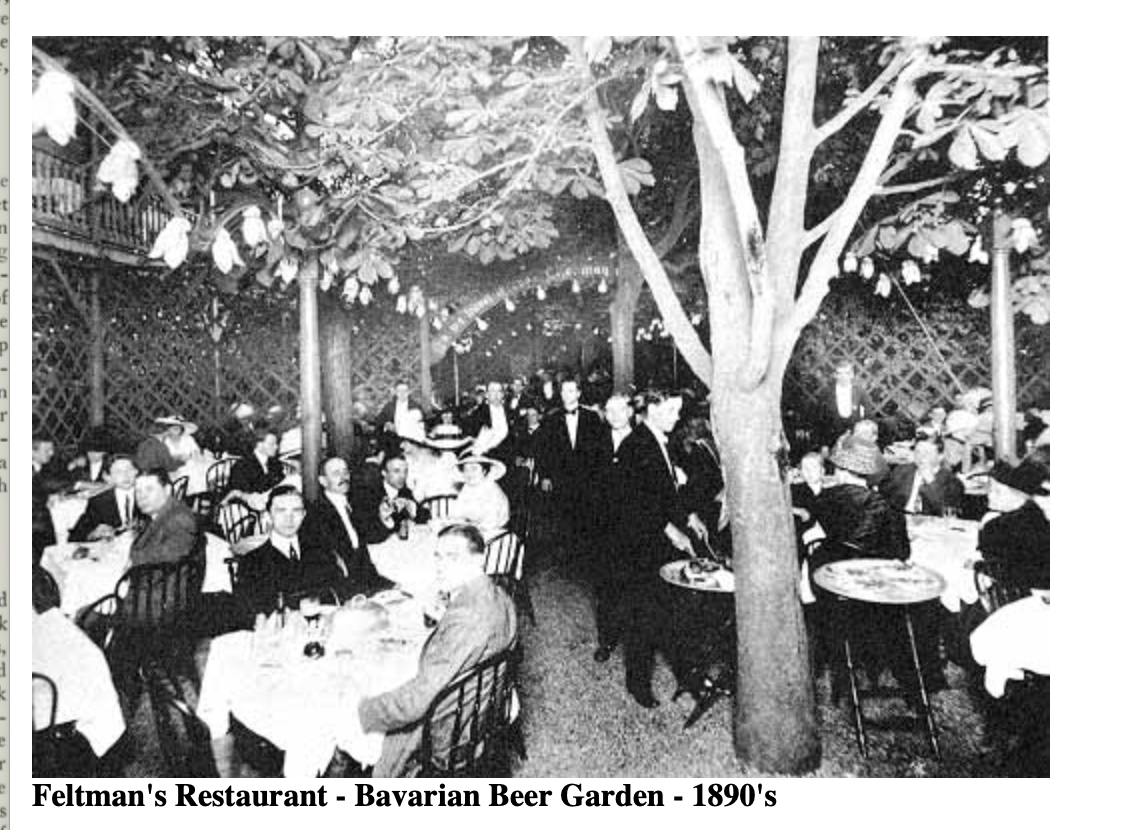
E.B. White (via “The Talk of the Town”) took a stroll through Coney Island and found the place somewhat revived, perhaps thanks to the return of legal beer and Bavarian-style beer gardens…

RECALLING THE GOOD OLD DAYS…Feltman’s Restaurant on Coney Island operated this popular Bavarian Beer Garden in 1890s. (Westland.net)

 * * *

Peace, He Said

Adolf Hitler was talking peace, but the French weren’t buying it according to The New Yorker’s Paris correspondent Janet Flanner—in just seven years her beloved City of Light would fall to the Nazis…

IF YOU CAN’T SAY SOMETHING NICE…Adolf Hitler makes his first radio broadcast as German Chancellor, February 1933. Hitler spoke of peace in Europe while preparing his country for war. (Detail of image courtesy Bundesarchiv)

…speaking of Janet Flanner, apparently her “Paris Letter” implied that the author Edna Ferber had married. Ferber offered this correction, in good humor:

 * * *

From Our Advertisers

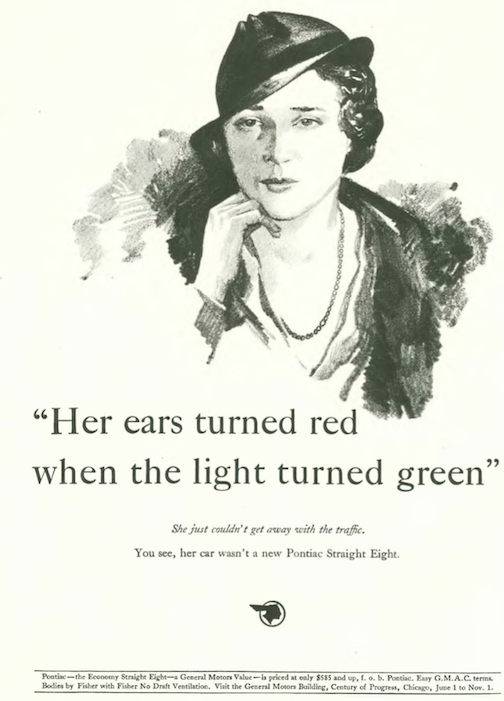
Class anxieties were (and still are) gold to Madison Avenue—look at this poor woman, pondering her very existence, lacking as she did the horsepower to lay some rubber at a green light…

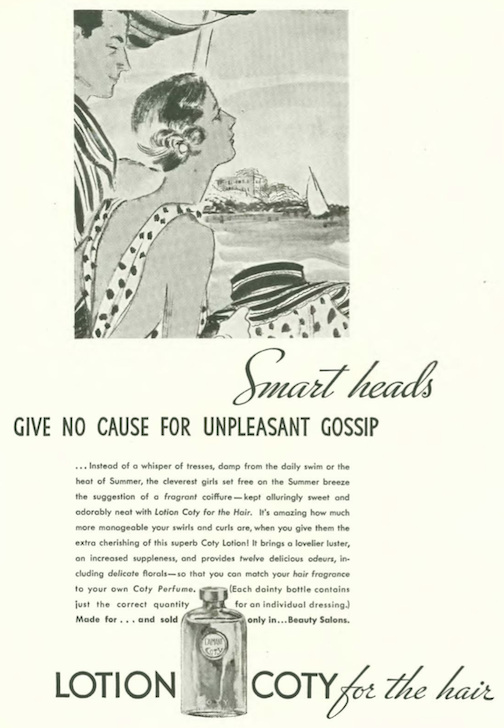
…or this woman, who thought ahead and made sure she had some hair lotion to ward off cackles from the beach harpies…

…on the other hand, this cyclist seems to care less about appearances as she races toward us with a crazed smile, half-human, half-illustration…

…and then there’s this fellow, playing it cool in a white linen suit, which for a sawbuck seems like a bargain, even in 1933…

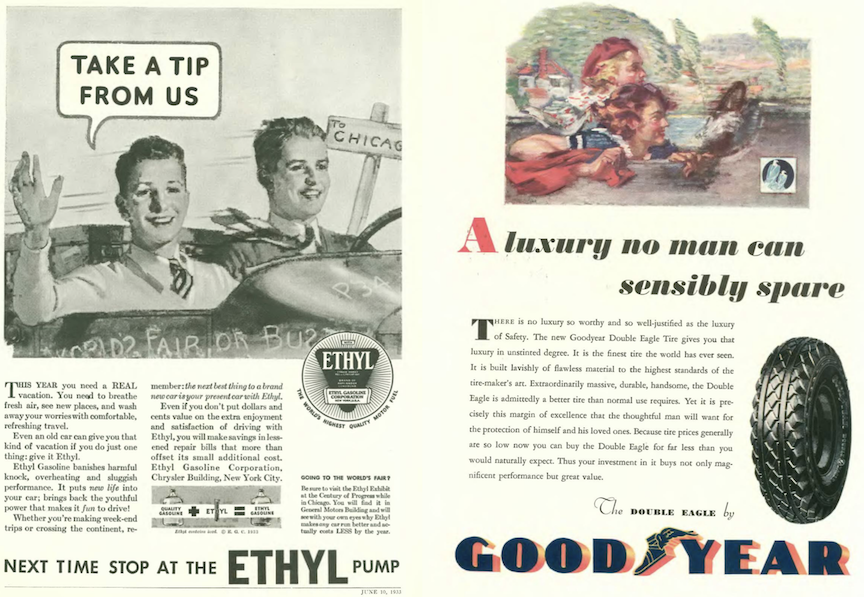
…the last two pages of the magazine featured friends racing to some swell destination…the lads at left are being propelled to the 1933 Chicago World’s Fair thanks to the wonders of leaded gasoline, while the women at right seem to be doing at least eighty…note neither car has a windshield, so you wonder how many bugs they will pick out of their teeth…

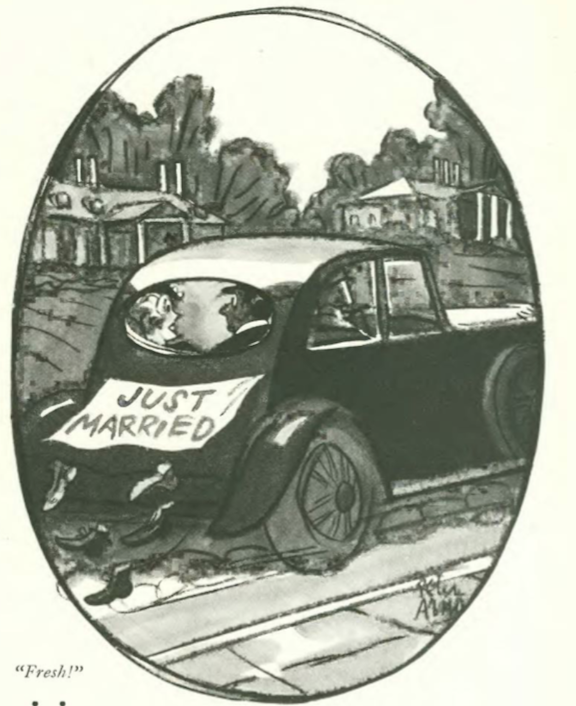
…an apt segue to our cartoons, where Peter Arno showed us a couple going nowhere fast…
Otto Soglow’s Little King had his own marital situation to ponder after a visit from a sultan…

…a very unusual cartoon from Helen Hokinson, who rarely delved into serious socio-political issues (although her captions were often provided by others at The New Yorker)…this cartoon referred to a cause célèbre of the 1930s, the case of the prejudicial sentences of the Scottsboro boys that recalled the Tom Mooney frame-up two decades earlier…

…on to lighter topics, Robert Day checked in on the progress at Mt. Rushmore…

George Price also went aloft for a challenge…

…and Carl Rose found this dichotomy in the conquest of nature…

…on to June 17, 1933…

June 17, 1933 cover by Perry Barlow.

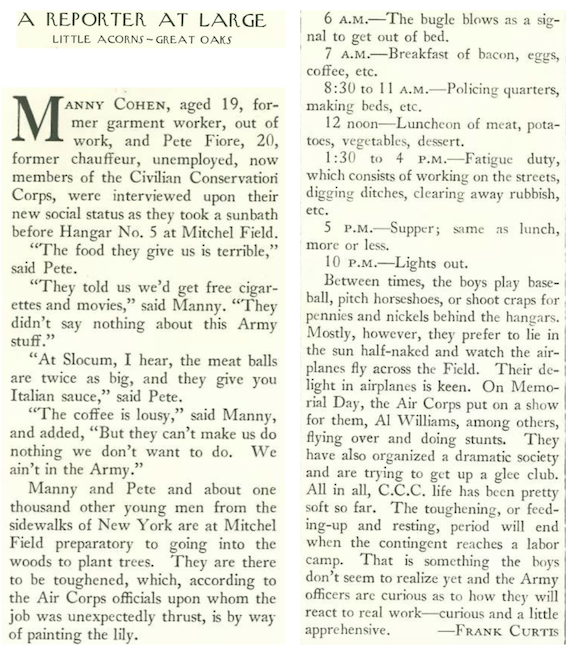
…where Frank Curtis reported on the military-style schedule that put young men to work for the Civilian Conservation Corps…excerpts:

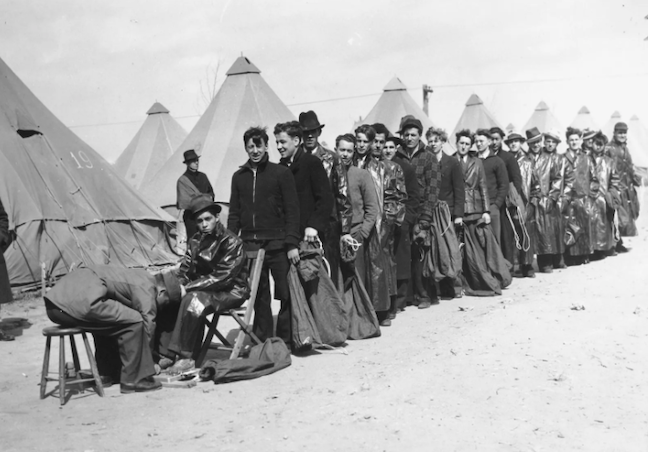
MARCHING ORDERS…New members of the Civilian Conservation Corps waiting to be fitted for shoes at Camp Dix, New Jersey, 1935. (Encyclopædia Britannica, Inc.)

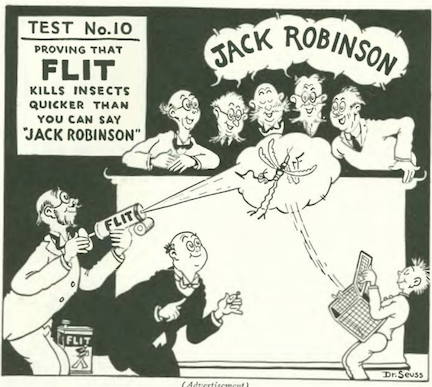
…just one ad from this issue, another Flit entry from Dr. Seuss, who wouldn’t publish his first book until 1937…

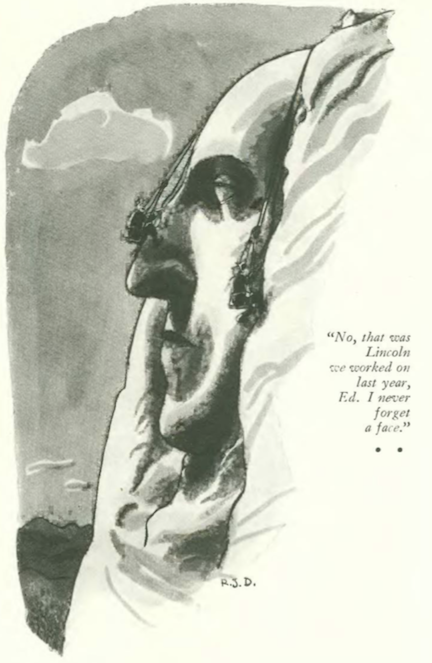
…our cartoons are courtesy Otto Soglow, with some bedside manner…

Kemp Starrett set up what should prove to be an interesting evening…

Gluyas Williams considered the woes of J.P. Morgan Jr

…and we close with another from George Price, doing some tidying up…

Next Time: Home Sweet Home…