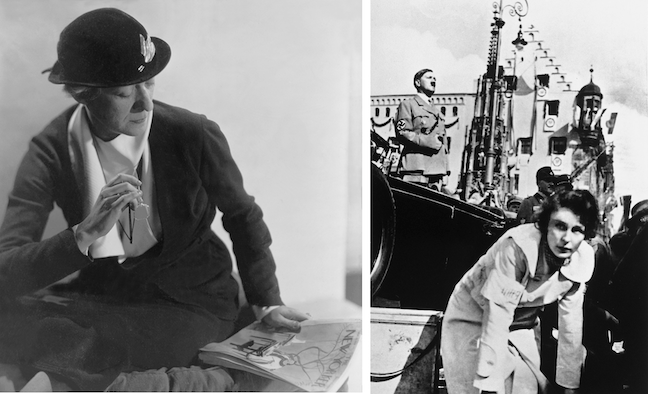
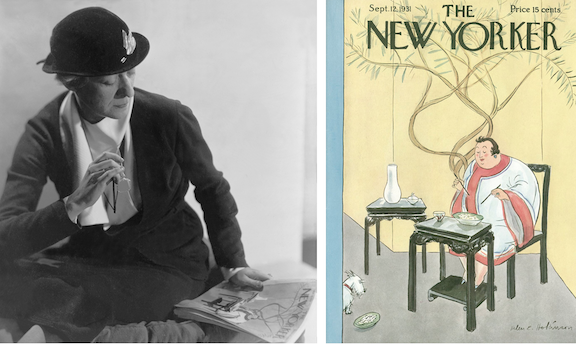
Above, left, Janet Flanner regards the cover of the Sept. 13, 1931 issue of The New Yorker; at right, Adolf Hitler's chosen filmmaker Leni Riefenstahl at Nuremberg's "Shovel Day" parade, 1936. (Library of Congress/Sueddeutscher Verlag)
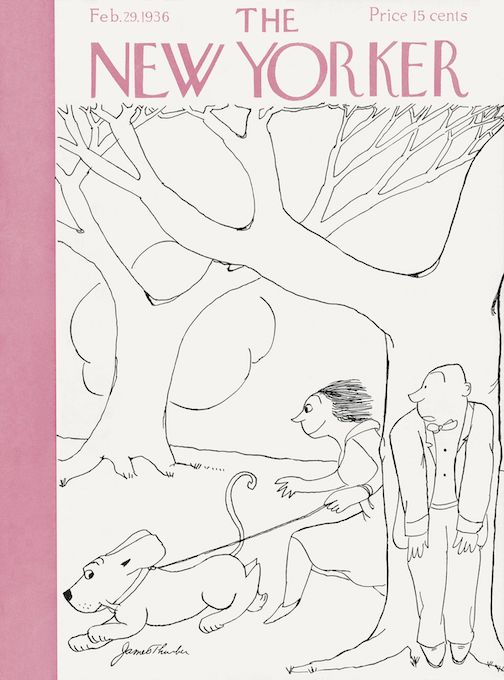
The February 29, 1936 issue stands out from pack not only for its cover—James Thurber’s first—but also for the magazine’s first in-depth look at a man who would spark the deadliest conflict in human history.
February 29, 1936 cover by James Thurber. This was the first of six covers Thurber contributed to The New Yorker. You can see all six covers at Michael Maslin’s Ink Spill, the go-to site for all things Thurber and so much more. UPDATE: Also check Maslin’s post regarding the repeat of this cover on Sept. 4, 2023. Fascinating read!
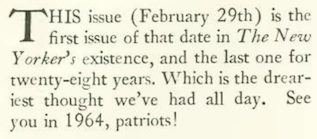
Before we jump in…Thurber’s close friend E.B. White noted another unusual fact about this issue…
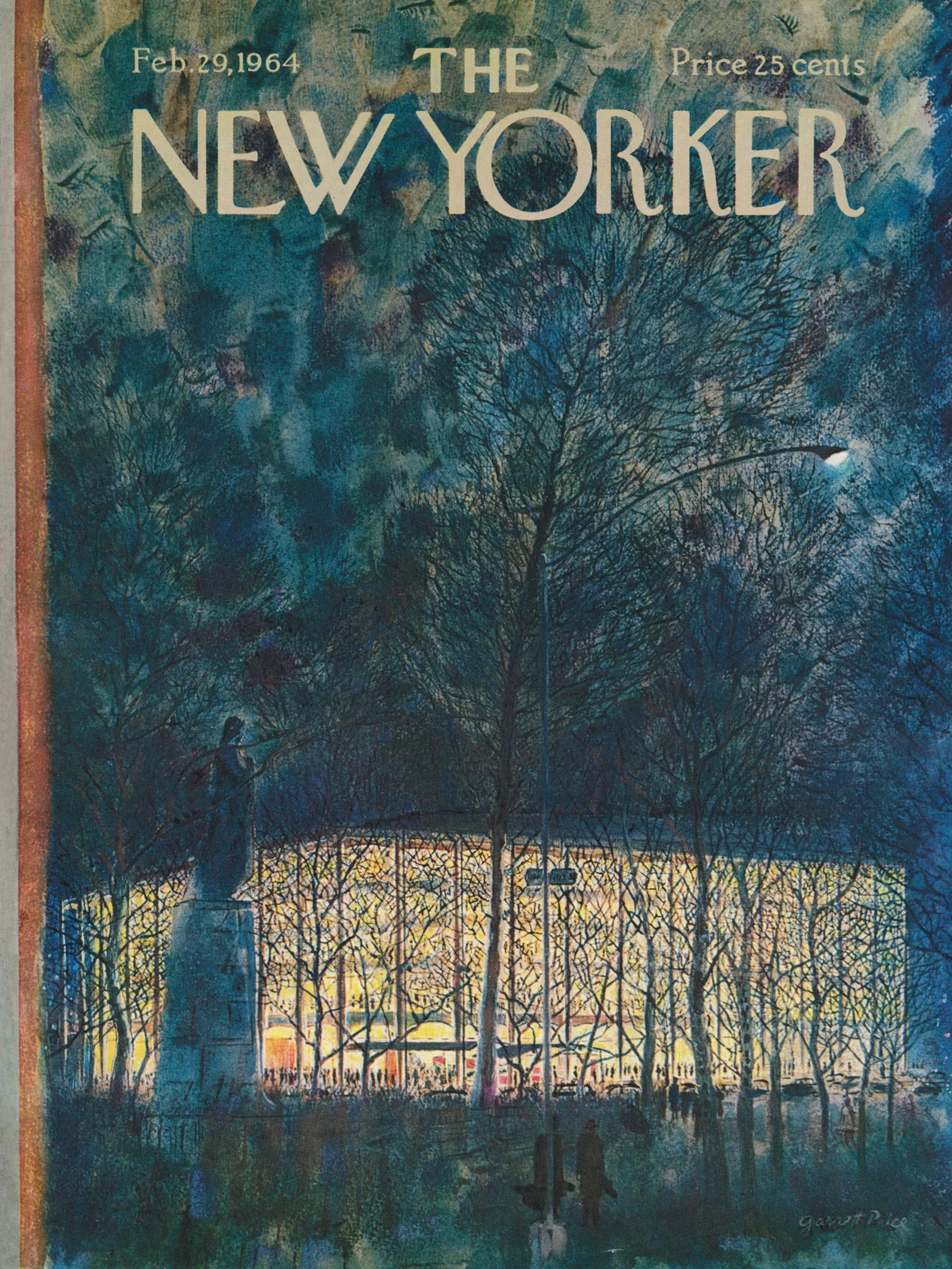
…twenty-eight years later, and a dime extra (cover by Garrett Price)…
* * *
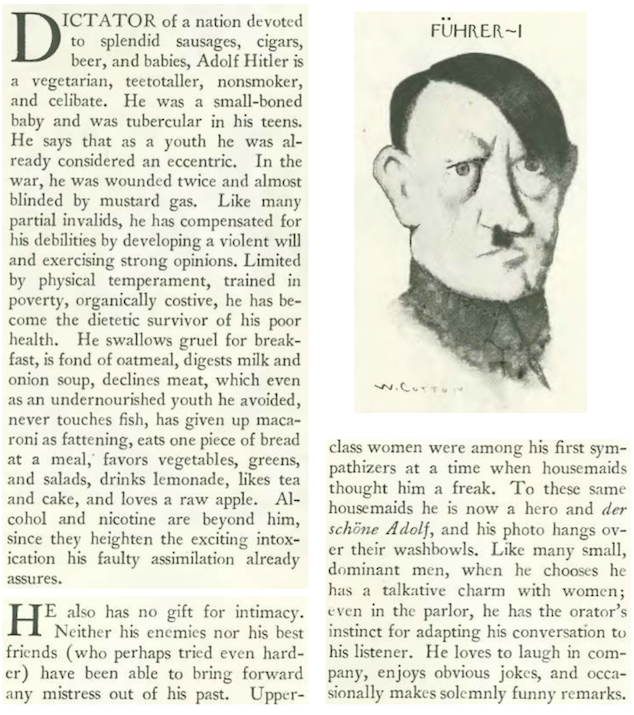
Inside the Feb. 29 issue, The New Yorker’s Paris correspondent Janet Flanner published the first part of a three-part profile on German dictator Adolf Hitler. In this first excerpt she described the Führer’s ascetic diet and personality (caricature by William Cotton).
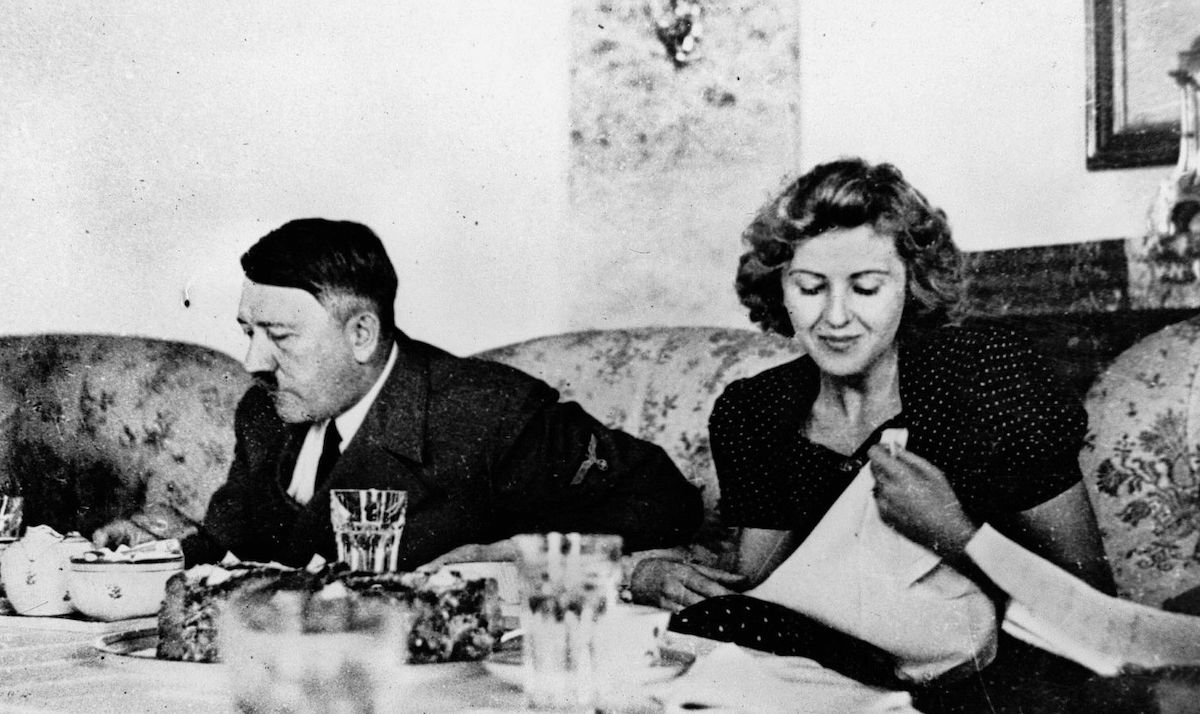
NAZI NUM NUMS….Adolf Hitler with one of his official food tasters, Margot Woelk, during World War II. Woelk later claimed she was the sole survivor from a group of food tasters who were summarily executed by the Red Army after the fall of Berlin. (warfarehistorynetwork.com)
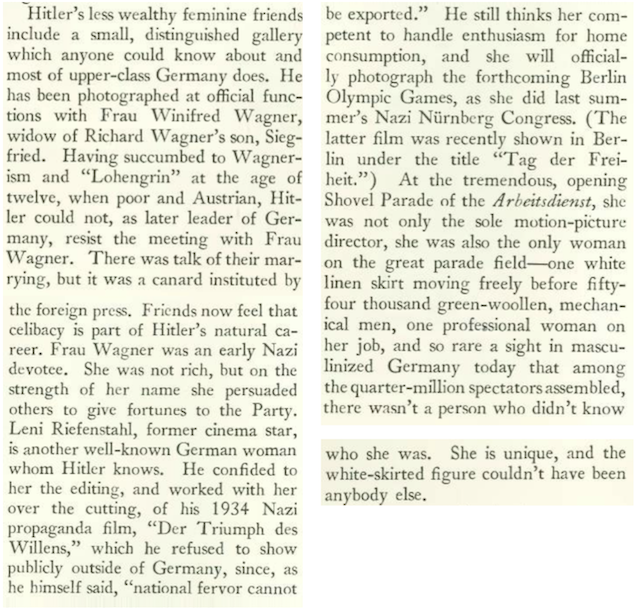
Flanner described Hitler’s relationships with influential women, particularly filmmaker Leni Riefenstahl.
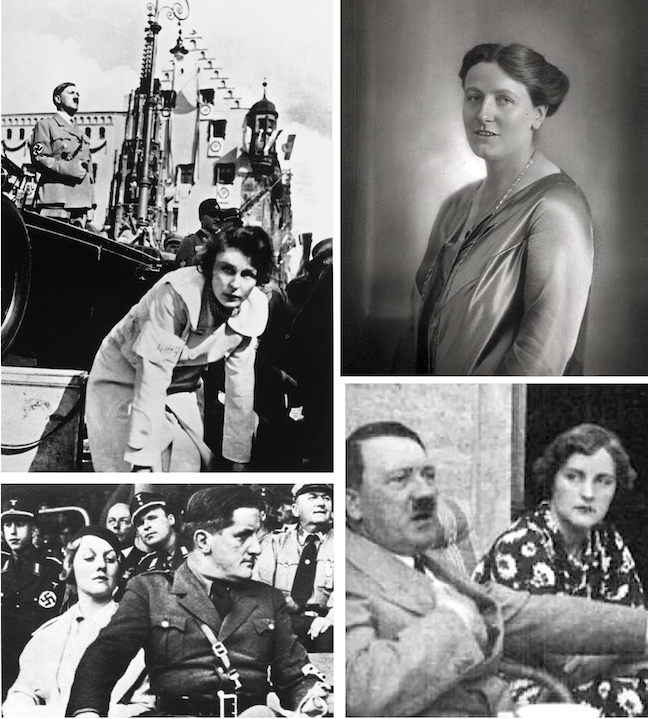
FRIENDS WITH BENEFITS…Adolf Hitler had influential admirers both in and outside of Germany, including, clockwise, from top left, filmmaker Leni Riefenstahl (in the white skirt described by Flanner) at the 1936 “Shovel Day” in Nuremburg; Winifred Wagner, daughter-in-law of composer Richard Wagner, in 1925; Hitler with Unity Mitford, one of six aristocratic Mitford sisters and a fanatical Nazi; Ernst Franz Sedgwick Hanfstaengl with another Mitford sister, Diana Mitford, at a 1934 Nuremberg rally. Diana as married to Oswald Mosley, leader of the British Union of Fascists, and Hanfstaengl was the son of Katharina Wilhelmina Hanfstaengl, a prominent Munich art publisher who helped finance Hitler’s rise to power. (Sueddeutscher Verlag/Wikipedia/historyreader.com)
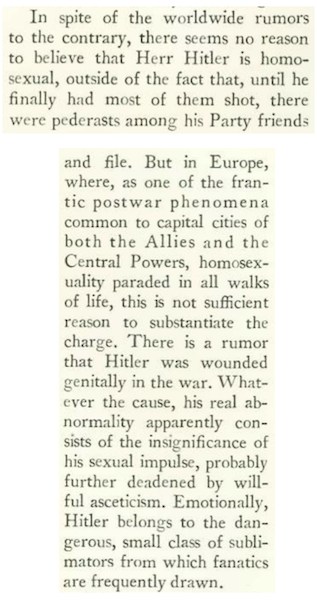
Flanner concluded the piece with a look at Hitler’s sexuality, which seemed non-existent, and drew an ominous conclusion about his personality type.
EXPENDABLE…Ernst Röhm with Adolf Hitler in 1933. Although Hitler knew Röhm was gay, he also valued Röhm’s leadership and organizational skills, that is until his presence proved a liability. Röhm was murdered by the SS in 1934 during the “Night of the Long Knives.” (Wikipedia)
As part of a centenary series, The New Yorker’s Andrew Marantz recently looked at Flanner’s profile of Hitler, noting that she was “neither an antifascist, like her friend Dorothy Parker, nor a Fascist, like her friend Ezra Pound; she was against crude bigotry, but she was not the world’s greatest philo-Semite.”
* * *
Lamour Amour
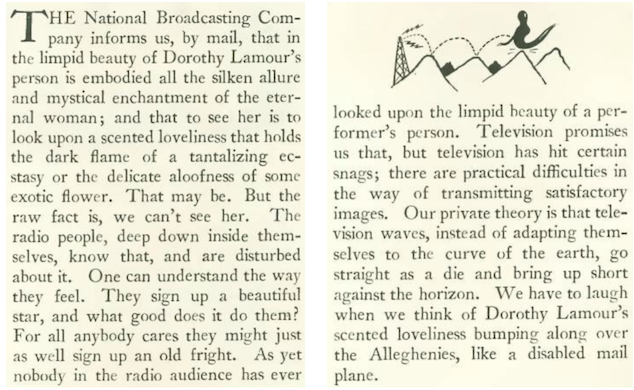
In his “Notes and Comment,” E.B. White pointed out the challenges of expressing physical beauty over a non-visual medium like radio:
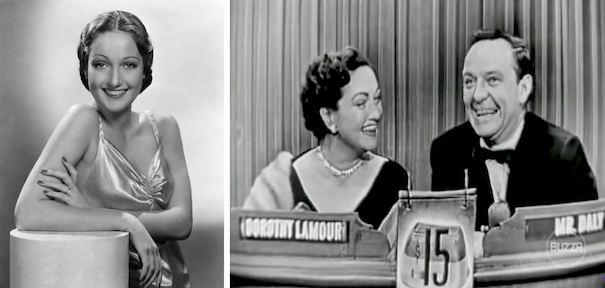
TELEGENIC…Hopefully E.B. White managed to see Dorothy Lamour on the “television waves… bumping along over the Alleghenies.” At left, publicity photo of Lamour from 1937; at right, Lamour appeared as a mystery guest on What’s My Line?, Feb. 20, 1955, seen here with host John Daly. In later years Lamour was a guest on a number of television shows, ranging from Marcus Welby, M.D. to Remington Steele. (Wikipedia/YouTube.com)
* * *
Shadow Plays
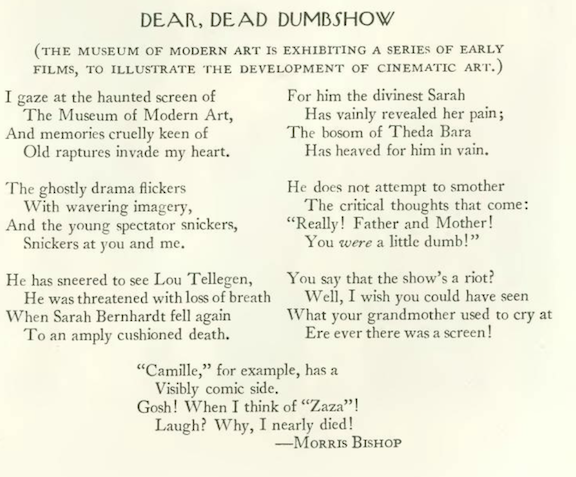
Morris Bishop (1893-1973), a noted scholar of the Middle Ages as well as a writer of light verse, offered up these lines after screening early silent films at the Museum of Modern Art. The screenings were curated by Iris Barry to showcase MoMA’s new film library and to advance the study of film as a serious art form.
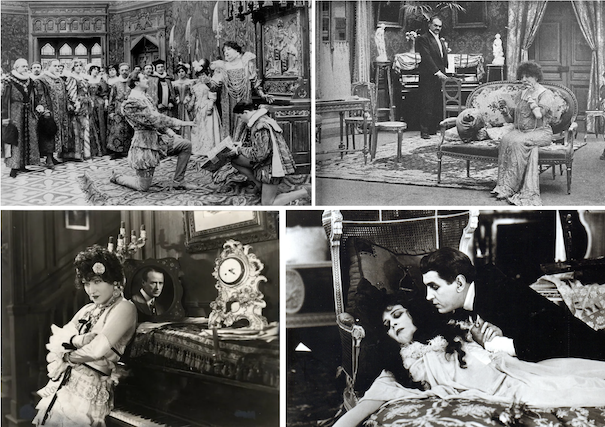
TIME CAPSULES…The Museum of Modern Art was a pioneer in the study of film as a modern art form. Among the films screened at MoMA in 1936 (clockwise, from top left): famed stage actress Sarah Bernhardt as Queen Elizabeth in the Les Amours de la reine Élisabeth (The Loves of Queen Elizabeth) with Lou Tellegen, 1912; Bernhardt in the film Camille (La Dame aux camélias) with André Calmettes, 1911; Theda Bara’s 1917 take on Camille, in a scene with Alan Roscoe; Gloria Swanson in Zaza, 1923. (Wikipedia/imdb.com/YouTube.com)
* * *
A Reporter’s Chops
With so much attention given to James Thurber as a humorist, it is easy to forget that he was an experienced journalist, and that he could apply his considerable gifts as a writer to narrative non-fiction. For the Feb. 29 “A Reporter at Large” column, Thurber penned “Crime in the Cumberlands.”I can’t do it justice through excerpts, but I highly recommend giving it a read as a prime example of Thurber’s skills as a reporter.
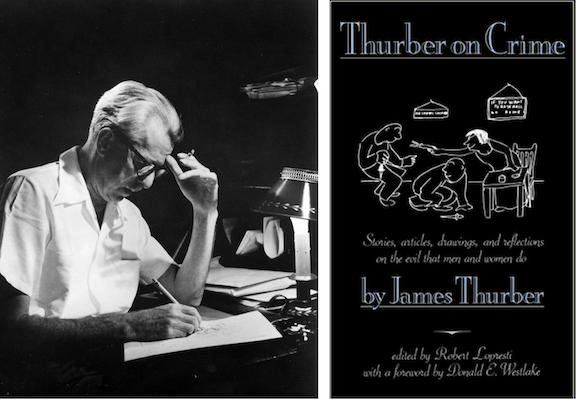
SERIOUSLY SERIOUS WRITER…You can find both humorous and not-so-humorous crime stories (and drawings, of course) in 1991’s Thurber on Crime, edited by Robert Lopresti. “Crime in the Cumberlands” is included in the collection. (jamesthurber.org/barnesandnoble.com)
* * *
At the Movies
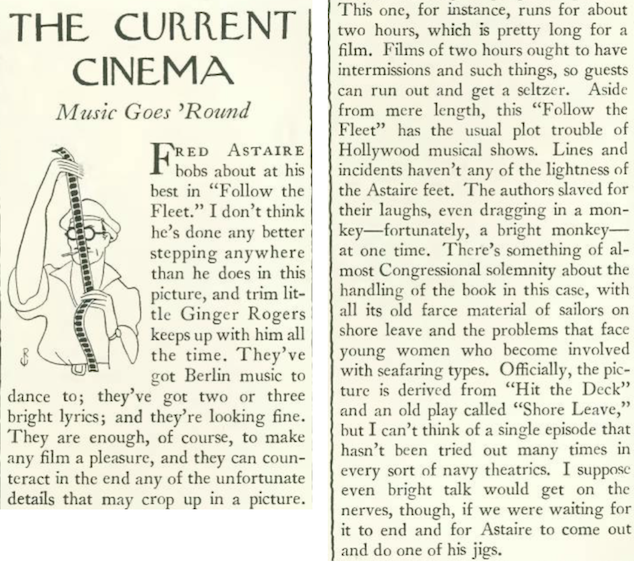
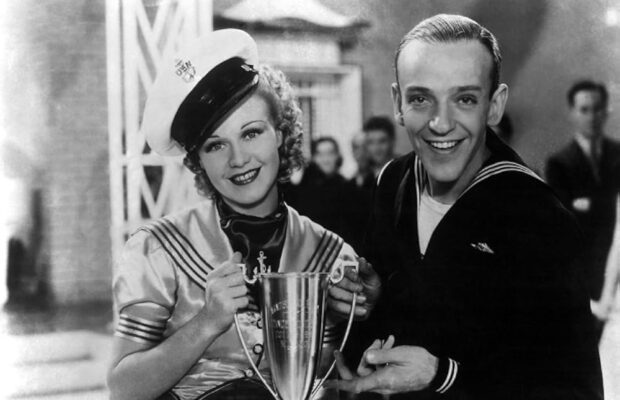
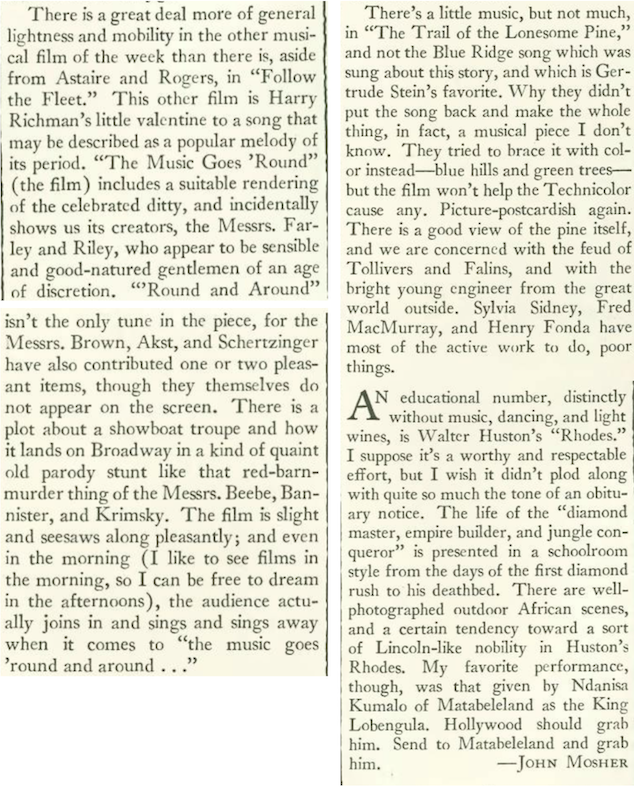
Not so serious were the films being churned out by Hollywood, including the Fred Astaire/Ginger Rogers toe-tapper Follow the Fleet, set to an Irving Berlin score that featured the hit “Let’s Face the Music and Dance.” Critic John Mosher was on board for the ride.
GOOD CLEAN FUN…Dance partners “Bake” Baker (Fred Astaire) and Sherry Martin (Ginger Rogers) find love during shore leave in Follow the Fleet.(Toronto Film Society)
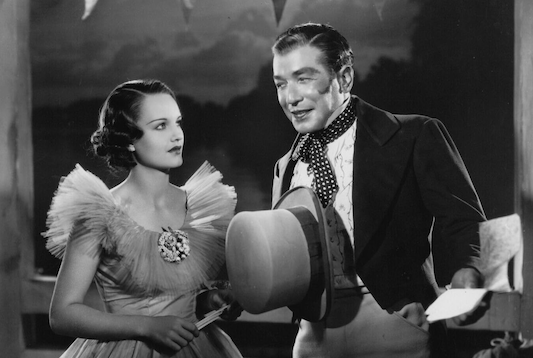
Bandleader Harry Richman, well known in the New York nightlife scene of the 1920s and 30s, showed his acting chops in The Music Goes ‘Round…
I CAN SING TOO…Rochelle Hudson and Harry Richman in The Music Goes ‘Round. (imdb.com)
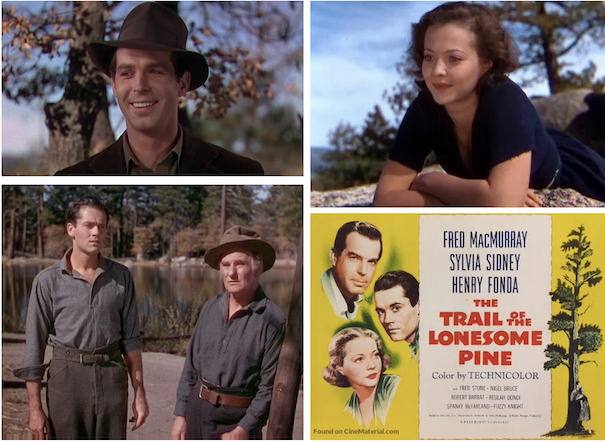
…Fred MacMurray, Sylvia Sydney, Henry Fonda and Fred Stone appeared in living color in The Trail of the Lonesome Pine–it was just the second full-length feature to be shot in three-strip Technicolor and the first to be shot outdoors in Technicolor…
LIFELIKE…Clockwise, from top left: Fred MacMurray; Sylvia Sydney; a Paramount movie poster; Henry Fonda and Fred Stone.(moviesalamark.com/imdb.com)
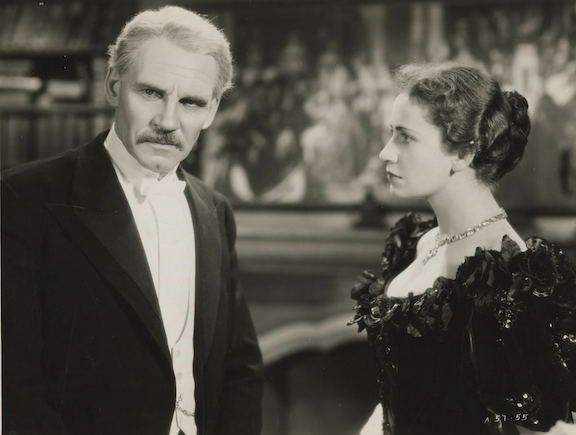
…the 1936 film Rhodes (aka Rhodes of Africa) featured the massive acting talents of Walter Huston and Peggy Ashcroft; not surprisingly, the subject matter of the film has not aged well…a 2015 review in The Guardianis headlined: “Rhodes of Africa: only slightly less offensive than the man himself”…
COLONIAL KLINK…Walter Huston and Peggy Ashcroft in Rhodes.(imdb.com)
* * *
From Our Advertisers
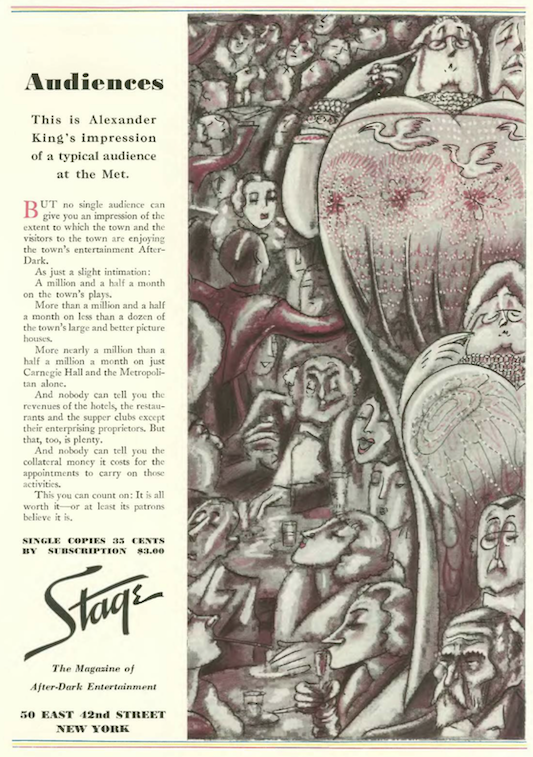
We begin with a Stage magazine ad from the inside front cover, featuring an illustration by Alexander King…
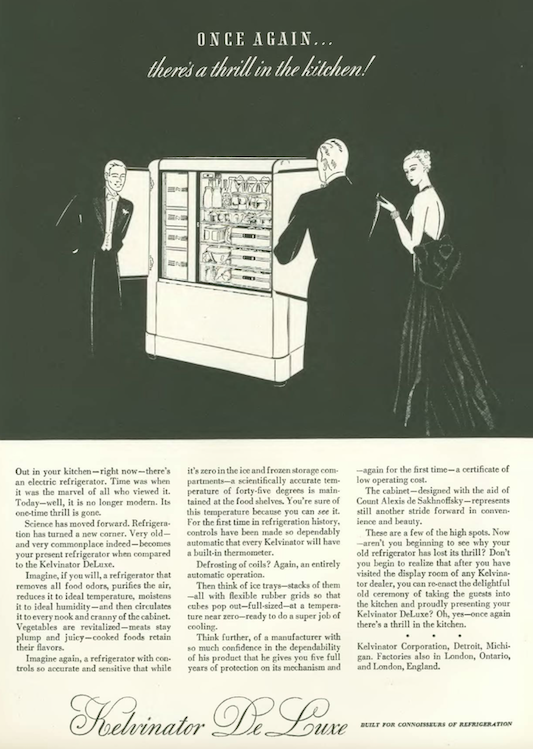
…only new-money swells would be seen doing this…old money wouldn’t dare enter the kitchen, unless they needed to sack the cook…
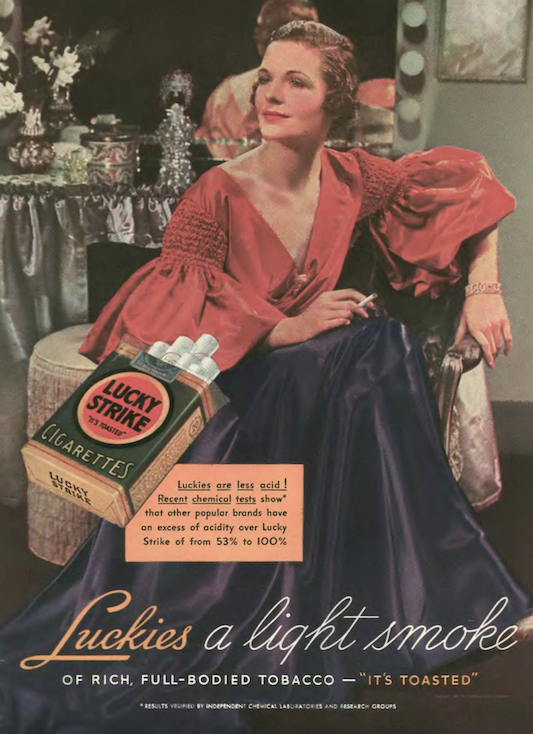
…on the back cover of the Feb. 29 issue you would find this elegant woman taking a break from her vanity to enjoy a “toasted” Lucky…
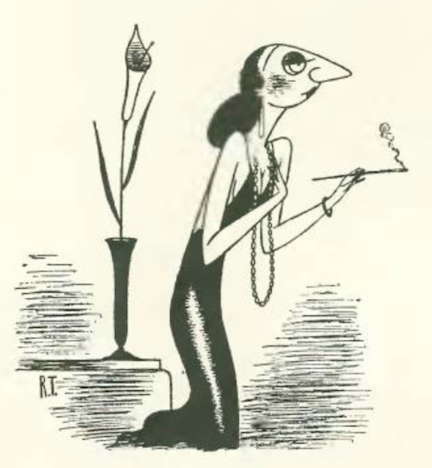
…we join our cartoonists, starting with this spot by Richard Taylor…
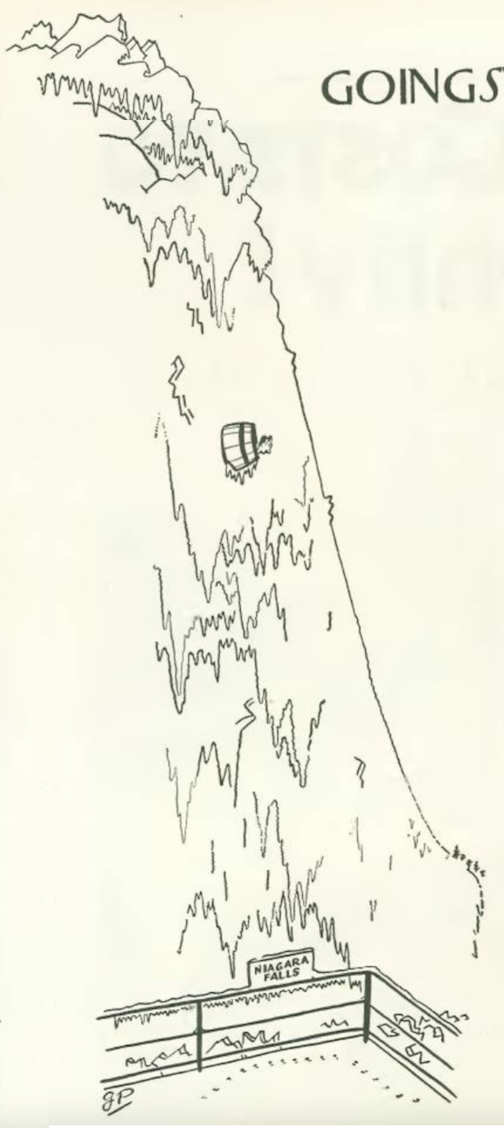
…Garrett Price got stuck over the frozen falls…
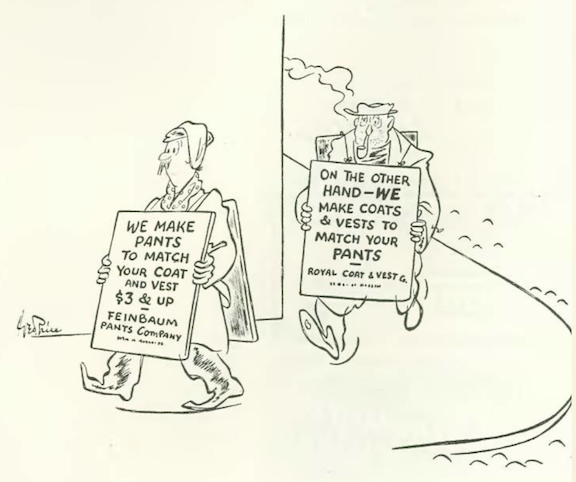
…George Price drew up a sandwich board competition…
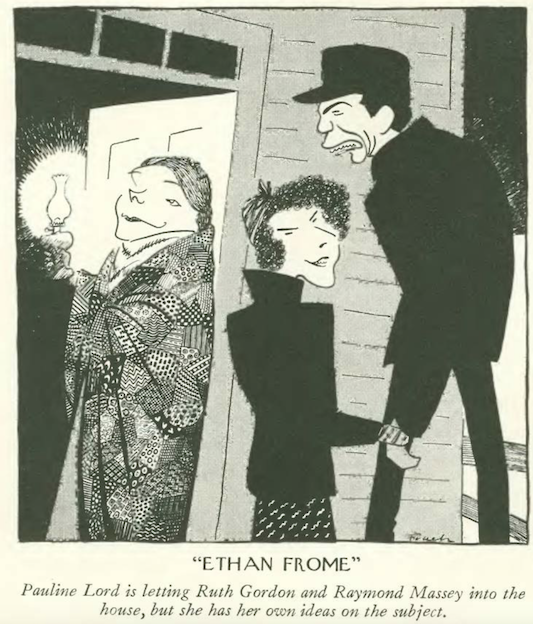
…Al Frueh continued to illuminate “The Theatre” section…
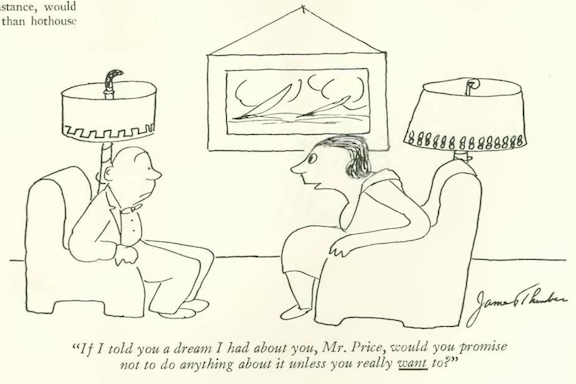
…James Thurber posed a loaded question…
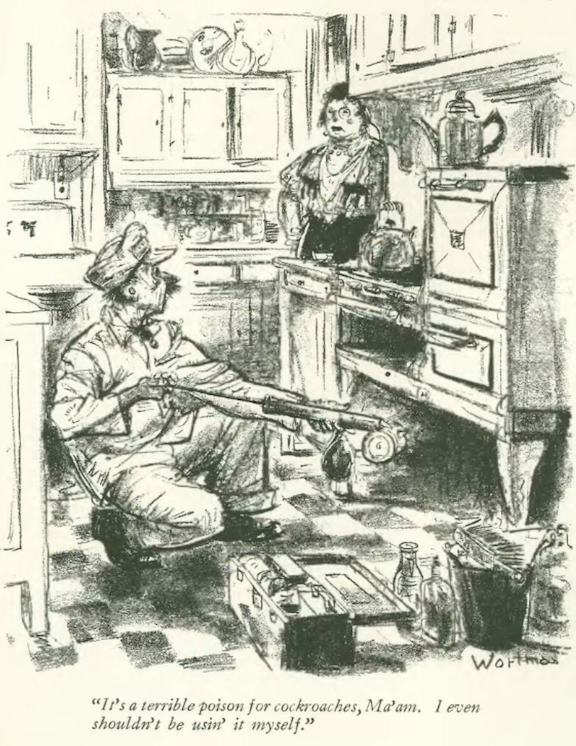
…Denys Wortman got down to some debugging…
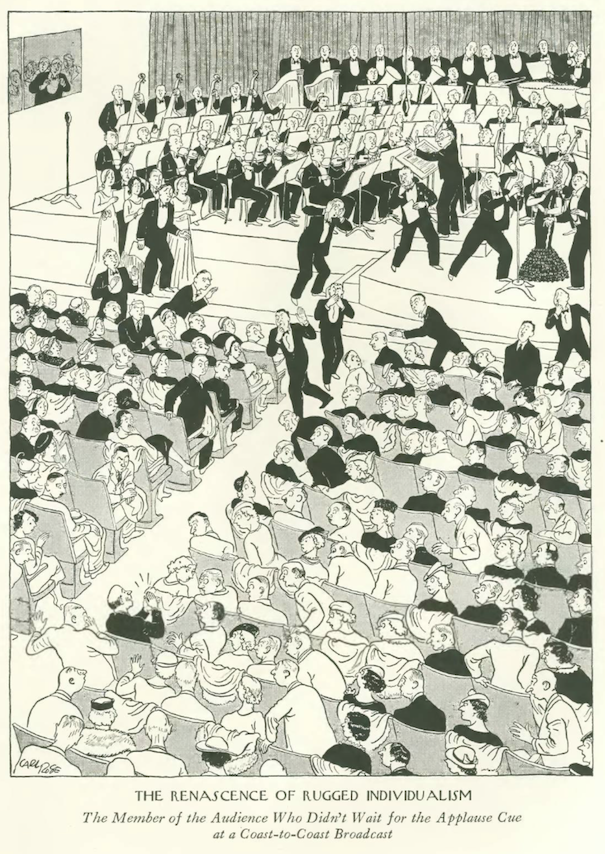
…Carl Rose offered up another example of rugged individualism…
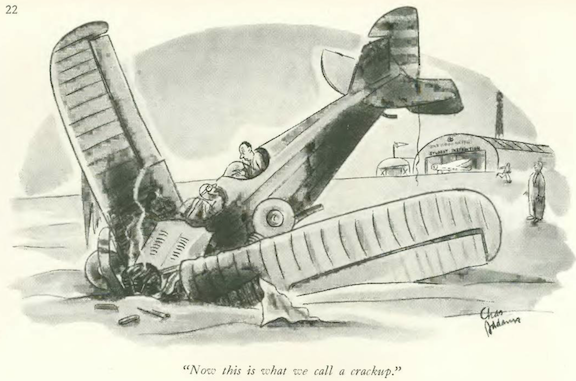
…Charles Addams came down to earth…
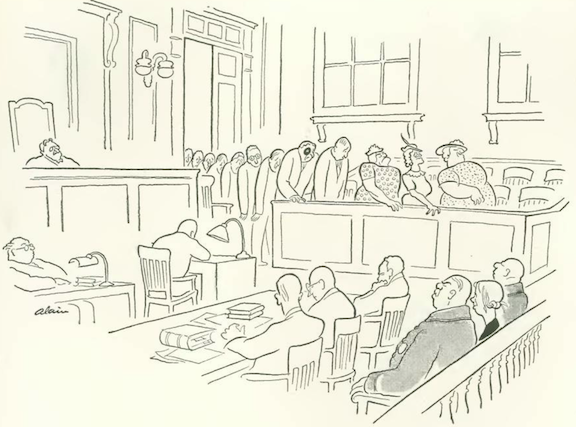
…Alain illustrated a case of jury tampering…
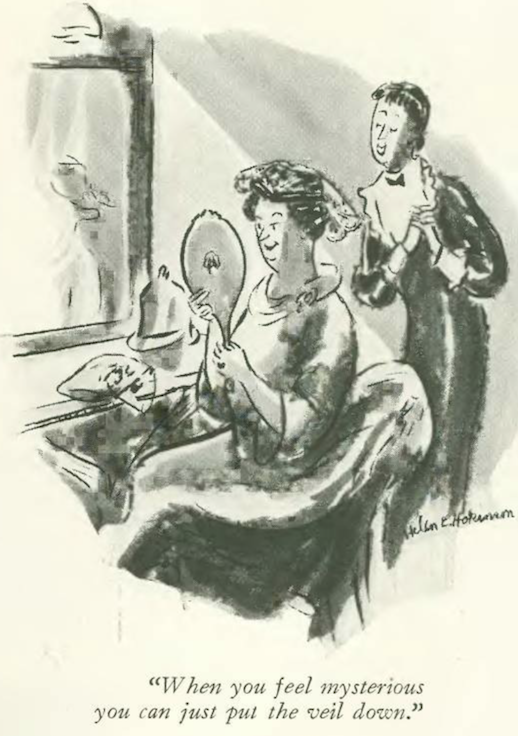
…Helen Hokinson demonstrated the allure of a netted hat…
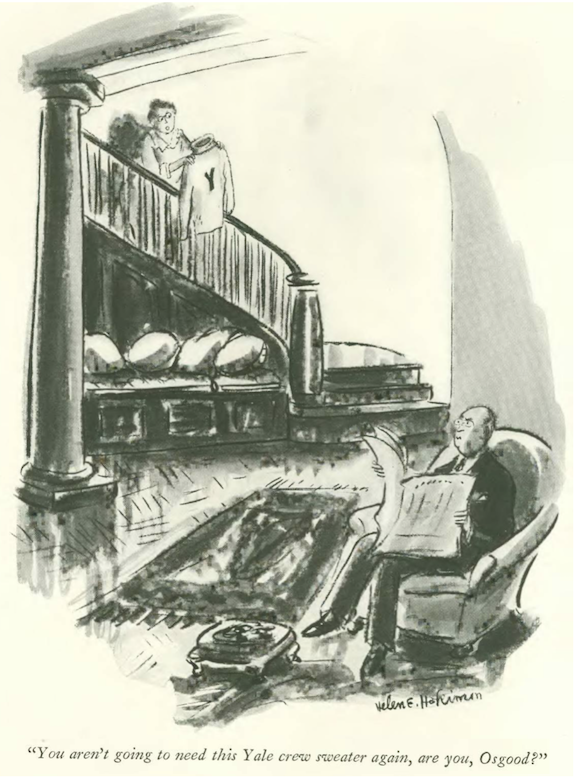
…and Hokinson again, doing some early spring cleaning…
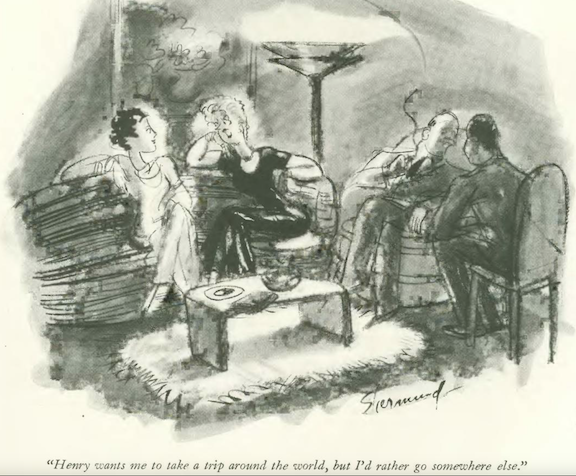
…and Barbara Shermund explored the idyll of wanderlust…
…and before we go, here is the New Yorker cover—by Helen Hokinson, Sept. 12, 1931—that was the object of Janet Flanner’s attention…
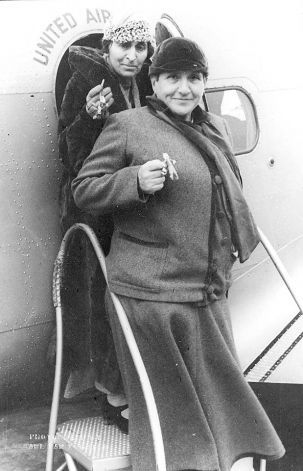
Above, left, a 1935 portrait of Gertrude Stein by Carl Van Vechten; right, Gertrude Stein and Alice B. Toklas arriving in New York aboard the French Line’s SS Champlain in 1934. (Library of Congress/AP)
Much of America’s literary world was abuzz about the arrival of Gertrude Stein in New York after her nearly three-decade absence from the States. Audiences were mostly receptive to Stein’s lectures, even if they were largely unintelligible, but The New Yorker would have none of it.
Nov. 17, 1934 cover by Rea Irvin.
Stein (1874–1946) visited the U.S. at the urging of friends who suggested that a lecture tour might help her gain an American audience for her work. She crisscrossed the country for 191 days, delivering seventy-four lectures in thirty-seven cities.
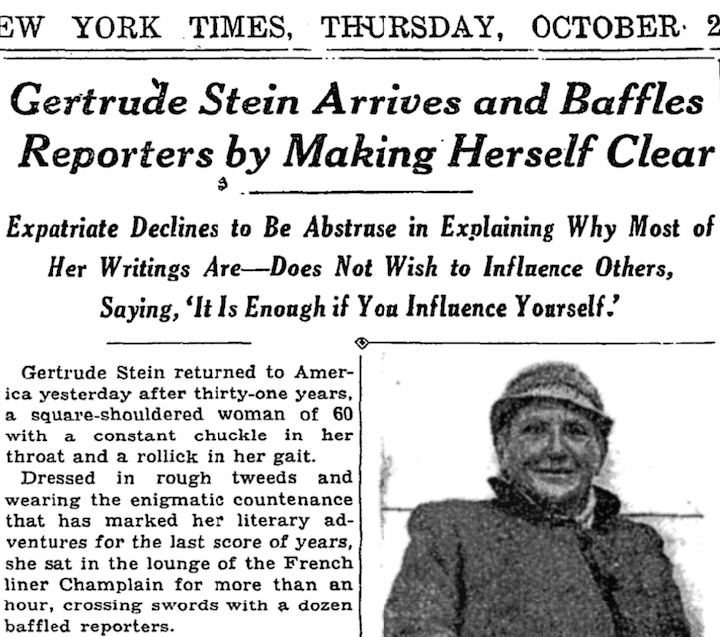
Writing for the Smithsonian Magazine (October 2011), Senior Editor Megan Gambino notes that publishing houses regarded Stein’s writing style as incomprehensible (Gambino writes that shortly after her arrival in the U.S., “psychiatrists speculated that Stein suffered from palilalia, a speech disorder that causes patients to stutter over words or phrases”), but in 1933 “she at last achieved the mass appeal she desired when she used a clearer, more direct voice” in The Autobiography of Alice B. Toklas. However, Stein was still best known in the U.S. for her “insane” writings, as one New York Times reporter described Stein’s work upon the writer’s arrival in New York. Excerpts from the Oct. 25, 1934 edition of the Times:
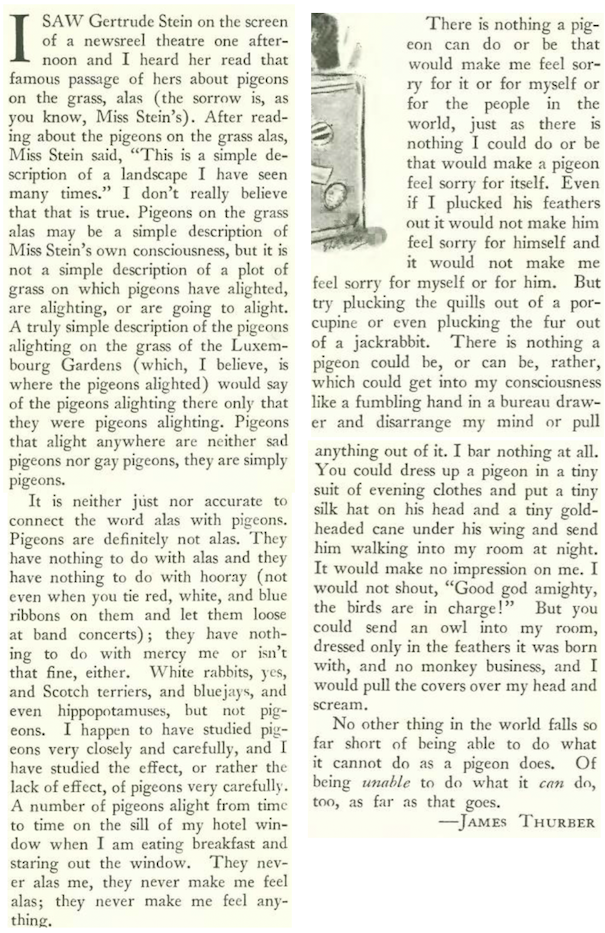
Stein had also achieved success in America via her libretto to Virgil Thomson’s opera Four Saints in Three Acts. Prior to her visit, Stein was featured in a newsreel reading the “pigeon” passage from the libretto, which James Thurber satirized in this piece titled “There’s An Owl In My Room.” Excerpts.
Here is a YouTube clip of the newsreel satirized by Thurber. Stein begins her “pigeon” reading at the 30-second mark:
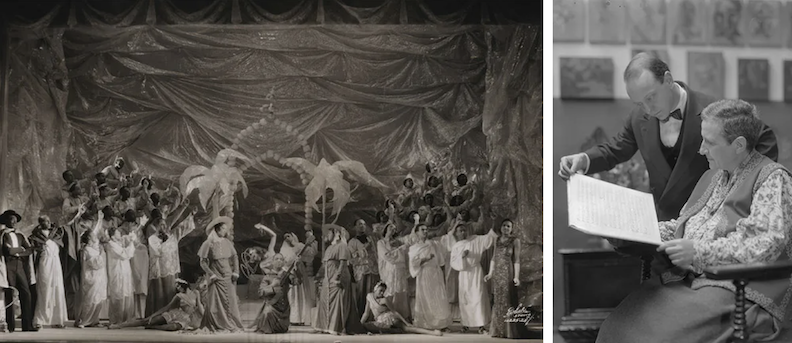
If Thurber found the libretto ridiculous, it was an opinion not necessarily shared by audiences who attended Four Saints in Three Acts, which premiered in Hartford, Connecticut, before making a six-week run on Broadway.
SAINTS AND PIGEONS…The original cast of Four Saints in Three Acts, onstage at the Wadsworth Atheneum, Hartford, 1934; at right, Gertrude Stein reviews the libretto for Four Saints with American composer Virgil Thomson, 1934. (Harold Swahn/Bancroft Library, UC Berkeley)
Since Stein had never seen the opera performed, writer and photographer Carl Van Vechten convinced Stein and Toklas to fly on an airplane for the first time in order to be able to see the play in Chicago.
FLIGHT INSURANCE…Stein and Toklas were anxious about flying, so Van Vechten gave each a small Zuni fetish—a good luck charm as they prepared to board their plane at Newark. (Boatwright Memorial Library, The University of Richmond)
Thurber wasn’t the only New Yorker writer to throw shade on Stein’s visit. In his “Books” column, Clifton Fadiman described Stein as a “mamma of dada” and a “Keyserling in divided skirts” (Hermann Keyserling was a non-academic German philosopher known for his platitudinous, obscure writings). Excerpt:
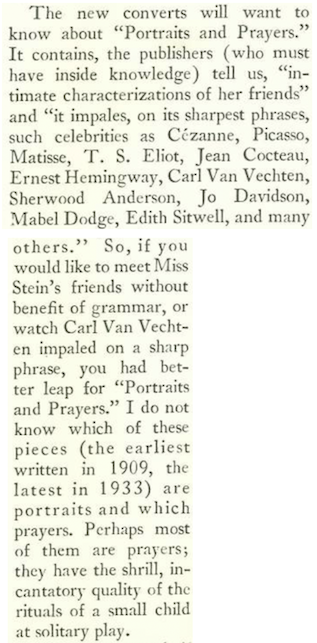
Fadiman continued by excoriating Stein’s latest book, Portraits and Prayers, likening its “shrill, incantatory” quality to “the rituals of a small child at solitary play.”
* * *
Over the Rainbow
We leave Gertrude Stein for the time being and check in with Lois Long, who was sampling the fall attractions of the New York nightclub scene in “Tables for Two.” In these excerpts, the 32-year-old Long continued her pose as a much older woman (“about to settle down with a gray shawl”) as she bemoaned the bourgeoisie excess of places like the Colony, once known for its boho, speakeasy atmosphere. And then there was the Rainbow Room, with its organ blaring full blast to the delight of gawking tourists.
LOST IN NEW YORK…Lois Long lamented the demise of cafe life in Manhattan; from left, the Colony, circa 1940, which went from boho to upscale; the 21 Club, a favorite Prohibition-era haunt of Long’s where she was suddenly a nobody; and high above the city, the Rockefeller Center’s Rainbow Room, and its interminable organ music. (Pinterest/Alice Lum via Daytonian in Manhattan/nycago.org)
* * *
From Our Advertisers
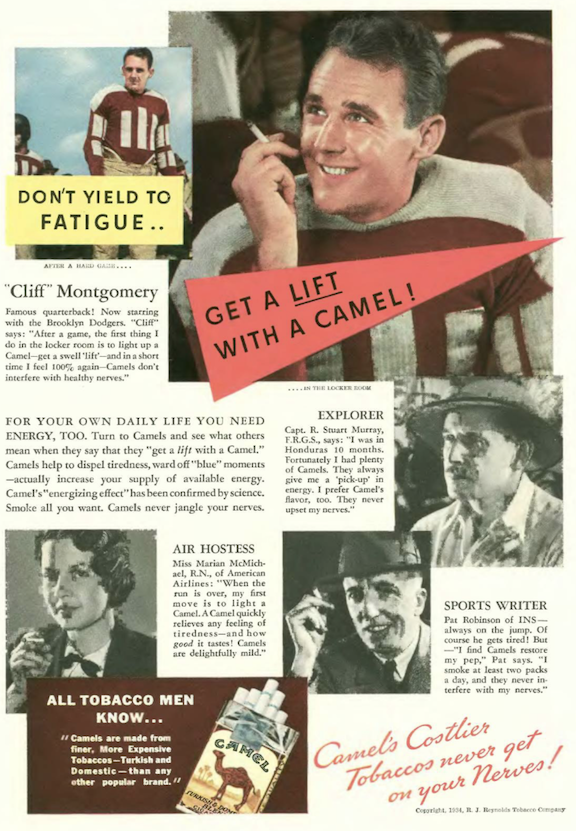
Just one ad from the Nov. 17 issue (more to come below)…the latest athlete to attest to the energizing effects of Camel cigarettes…Cliff Montgomery (1910–2005) was famed for a hidden ball trick play that led one of the greatest athletic upsets—Columbia’s 7-0 win over Stanford in the 1934 Rose Bowl. Montgomery would play one year with the NFL Brooklyn Dodgers, and would later earn a Silver Star for his heroism during World War II…
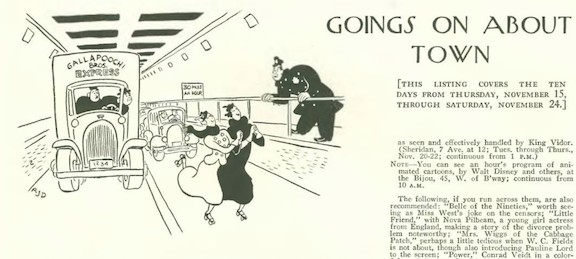
…on to our cartoonists, we begin with Robert Day’s jolly illustration for the “Goings On About Town” section…
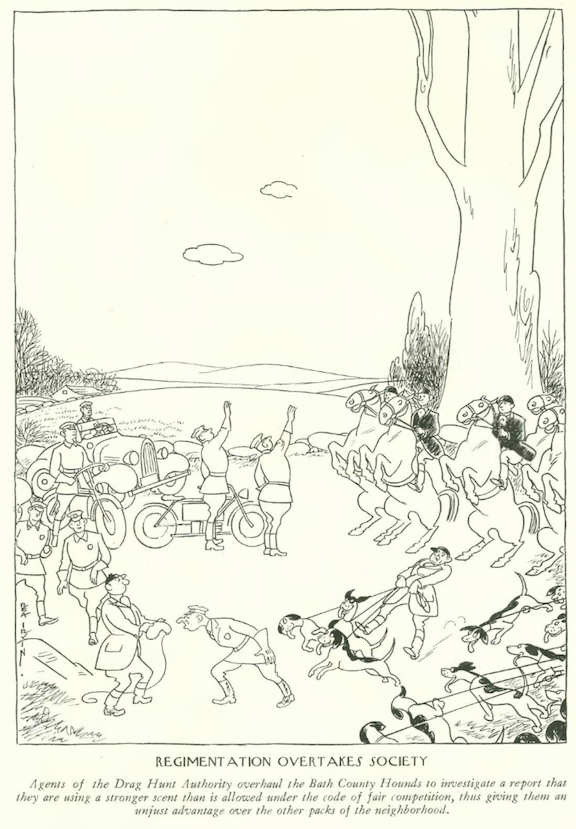
…Rea Irvin looked into fair play among the fox hunting set…
…Garrett Price gave us a tender moment among the bones at the American Museum of Natural History…
…and Peter Arno introduced two wrestlers to an unwelcoming hostess…
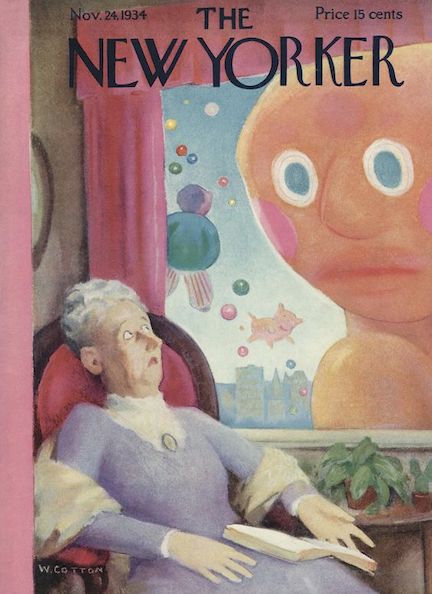
…on to Nov. 24, 1934 issue, and the perils of the Macy’s Thanksgiving Day Parade as illustrated on the cover by William Cotton…
Nov. 24, 1934 cover by William Cotton.
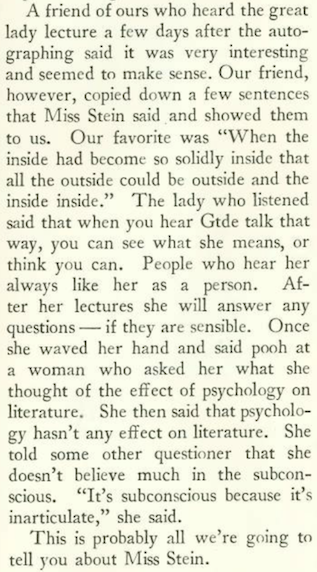
…where we find still more scorn being heaped upon Gertrude Stein. “The Talk of the Town” offered this observation (excerpt):
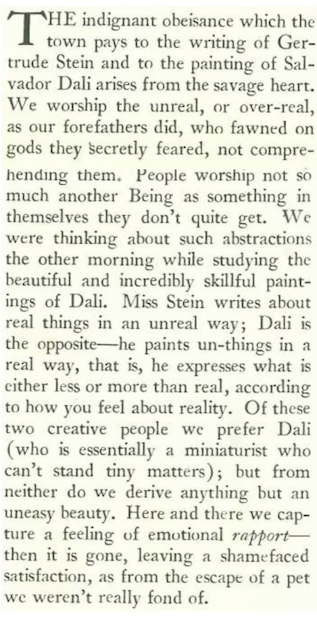
…and E.B. White had the last word on Stein in his Dec. 1, 1934 “Notes and Comment” column:
* * *
There Goes the Neighborhood
Returning to the Nov. 24 issue, Alberta Williams penned a lengthy “A Reporter at Large” column, titled “White-Collar Neighbors,” about the new Knickerbocker Village development in the Lower East Side. Real estate developer Fred French razed roughly one hundred buildings to build what has since been criticized as an example of early gentrification in Manhattan. Williams assessed the development after more than a year of construction, finding that despite federal funding, the leasing company had yet to rent any apartments “to Negroes or Orientals.” Although the development was meant to serve some of the families it displaced, the vast majority were forced to move back into slums due to escalating rents.
BREATHING ROOMS…Knickerbocker Village in 2019. To make way for the development, one hundred buildings were razed in the “Lung Block,” so named because of its high tuberculosis mortality rate. The development continues to be designated as affordable housing. (Wikipedia)
* * *
Dollmaker
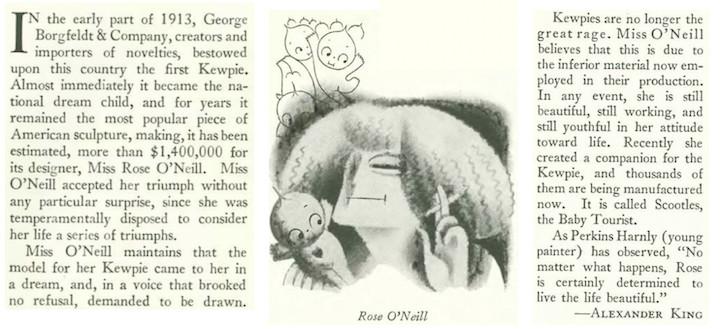
Raised in rural Nebraska, at an early age Rose O’Neill (1874–1944) demonstrated an artistic bent, and was already a published illustrator and writer when she drew her first images of “Kewpie” around the year 1908. A German doll manufacturer began producing a doll version of Kewpie in 1913, and they became an immediate hit, making O’Neill a millionaire and for a time the highest-paid female illustrator in the world. When Alexander King penned a profile of O’Neill, Kewpies were no longer the rage, but O’Neill was nevertheless determined to find success in a new doll line. Excerpts:
QP QUEEN…Clockwise from top left, Rose O’Neill circa 1910, just before her Kewpie dolls made it big; Kewpie doll in original box, undated; as the Kewpie craze faded in the 1930s, O’Neill tried to launch a new line called Little Ho Ho, a laughing baby Buddha, but before production plans were finalized the doll factory burned to the ground; a 1935 ad for a Rose O’Neill-branded “Scootles” doll, another attempt at a comeback. (Wikipedia/Pinterest/museumobscura.com)
* * *
Last Call
Lois Long was back with another installment of “Tables for Two” and in these excerpts she found the Central Park Casino a welcome place to hang out, apparently unaware that Parks Commissioner Robert Moses had already served an eviction notice to the Casino’s owners (Moses would tear down the Casino in 1936, mostly to settle a personal vendetta). Long also found respite at the Place Piquale, which featured the musical stylings of Eve Symington.
BYE BYE…The Central Park Casino was not long for the world when Lois Long paid an enjoyable visit in November 1934. Long also found a good time at the Place Piquale, which featured the “startling,” deep voice of cabaret singer Eve Symington. (centralpark.org/Pinterest)
At the Place Piquale, Long was “grateful” to see that silent film star Louise Brooks was also a good dancer. An icon of Jazz Age flapper culture, Brooks loathed the Hollywood scene and the mediocre roles it offered, and after a stint making films in Europe she returned to the States, appearing in three more films before declaring bankruptcy in 1932. A former dancer for the Ziegfeld Follies, Brooks had turned back to dancing in nightclubs to make a living.
IT’S A LIVING…Promotional photo for the Place Piquale featuring Louise Brooks (sans her familiar flapper bob) and Dario in “Spectacular Interpretive Dances,” April 17, 1934. (books0977.tumblr.com)
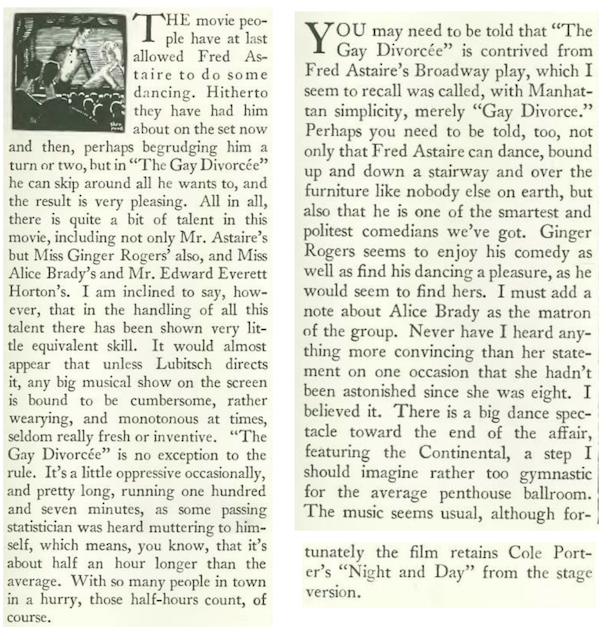
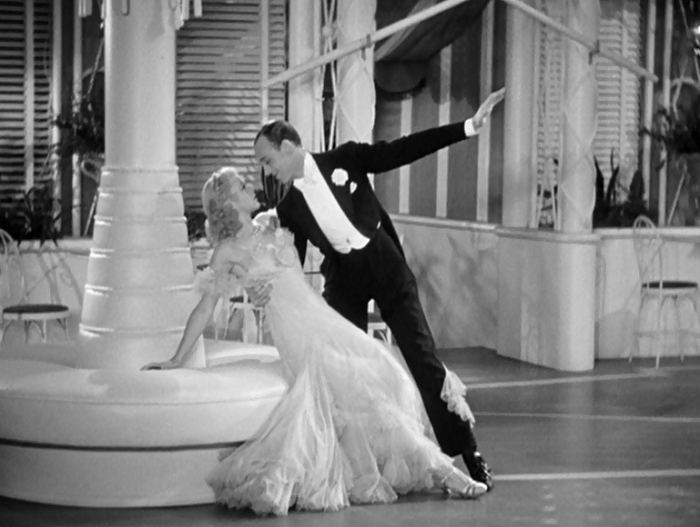
…and dance remains a theme with John Mosher’s film review of the Fred Astaire and Ginger Roger musical The Gay Divorcee, which was based on the 1932 Broadway musical Gay Divorce starring Astaire and Claire Luce.
YOU WILL HAVE TO DANCE BACKWARD, IN HEELS…Ginger Rogers and Fred Astaire trip the light fantastic in The Gay Divorcee. (precode.com)
* * *
Using Her Heads
Clifton Fadiman praised Peggy Bacon’s collection of caricatures, Off With Their Heads!, which included drawings of fellow New Yorker contributors as well as various Algonquin Hotel acolytes. Excerpt:
HEAD HUNTER…Peggy Bacon offered up caricatures of forty celebrities in her new book, Off With Their Heads! Bacon (1895–1987) contributed cartoons as well as poetry and fiction to The New Yorker from 1927 to 1950. Clockwise, from top left, title page with Bacon’s self-portrait; undated photo of Bacon, likely circa 1930; caricatures of Dorothy Parker, Carl Sandburg and Heywood Broun. (villagepreservation.org/printmag.com/Wikipedia–Peter A. Juley & Son)
* * *
More From Our Advertisers
“Beautiful Vanderbilts” Mrs. Reginald Vanderbilt and Miss Frederica Vanderbilt Webb wowed one unnamed dermatologist who discovered that both had 20-year-old skin even though they were seven years apart! “Mrs. Reginald” was Gloria Morgan Vanderbilt, who was thirty when this ad was produced (Miss Frederica was apparently twenty-three). We’ve met Gloria Morgan Vanderbilt before, shilling for Pond’s—she was the maternal grandmother of television journalist Anderson Cooper, and earned her “bad mom” rep from Vanderbilt vs. Whitney, one of America’s most sensational custody trials…
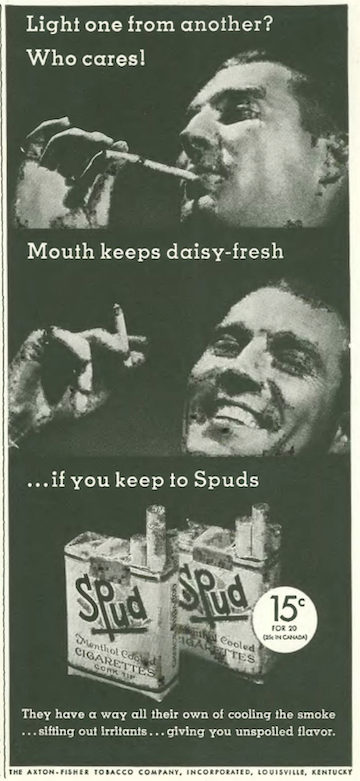
…we move from skin care to who cares…in this case how many Spud cigs you smoke…hell, smoke three packs a day if you like, the cooling menthol will always keep you feeling fresh even as your lungs gradually darken and shrivel up…
…and here’s a lesson from the makers of Inecto hair dye, no doubt a company solely run by men, who schooled wives with the advice that you’d better color that gray hair pronto or your hubby will kick you to the curb…
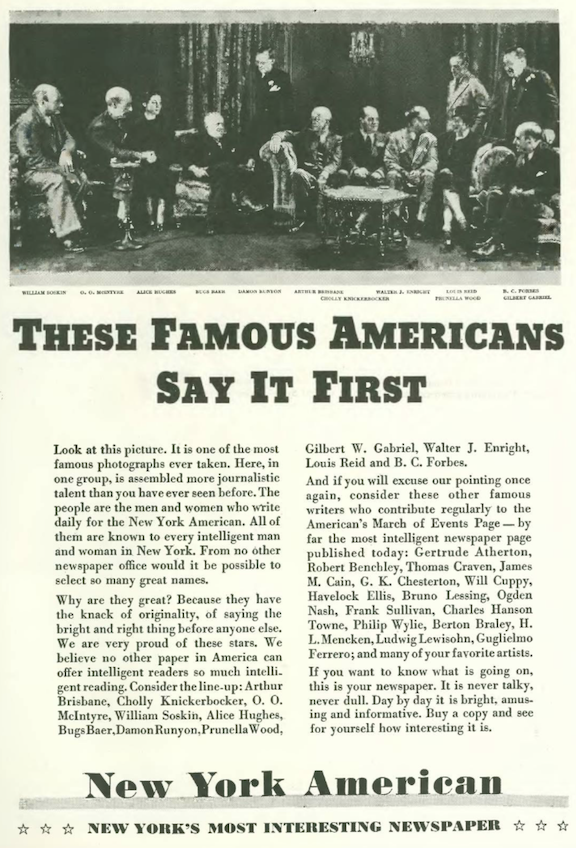
…the New York American was a Hearst broadsheet known for its sensationalism, however it did claim Damon Runyon, Alice Hughes, Robert Benchley and Frank Sullivan among its contributors…the morning American merged with the New York Evening Journal to form the American and Evening Journal in 1937. That paper folded in 1966…
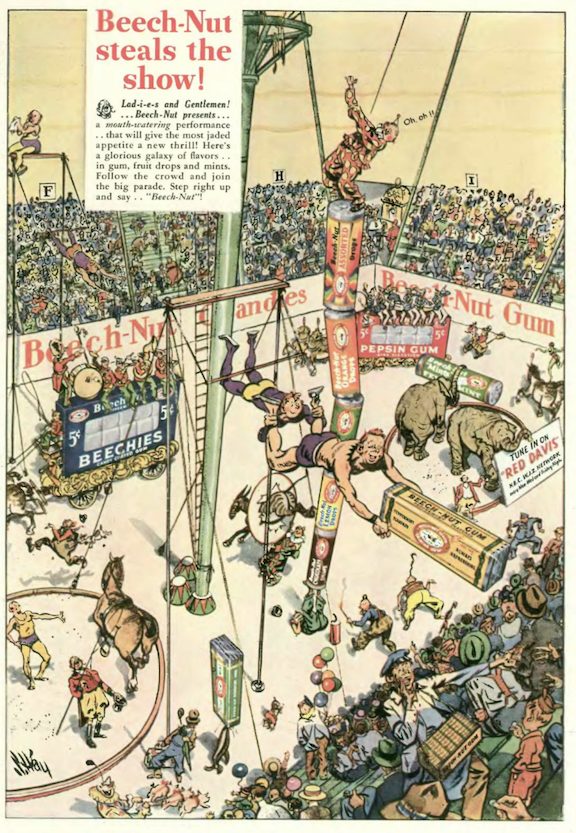
…illustrator Stuart Hay drew up this full page ad for the makers of Beech-Nut candy and chewing gum…when I was a kid we used to call this “grandpa gum”…
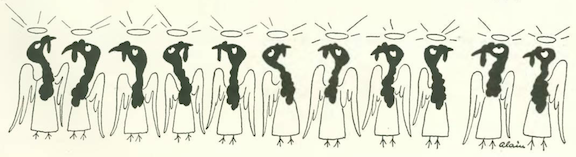
…on to our cartoonists, we begin with a Thanksgiving spot by Alain (Daniel Brustlein)…
…Barbara Shermund delivered another life of the party…
…George Price was finally bringing his floating man back to earth…
…Otto Soglow gave us an unlikely detour…
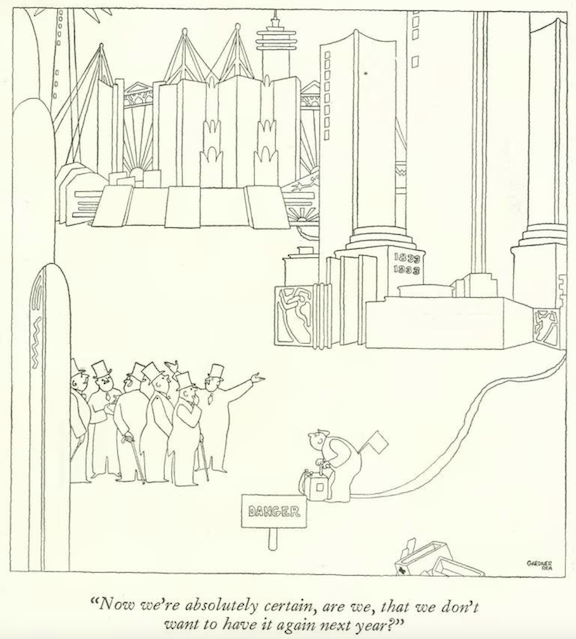
…Gardner Rea signaled the end to the 1933-34 Chicago World’s Fair…with a boom…
…Leonard Dove dialed up a familiar trope…
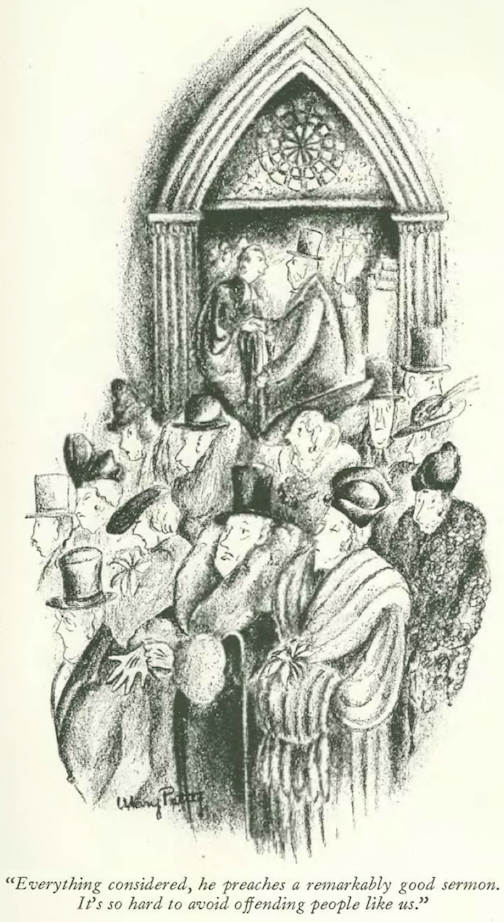
…and we close on a more pious note, with Mary Petty…
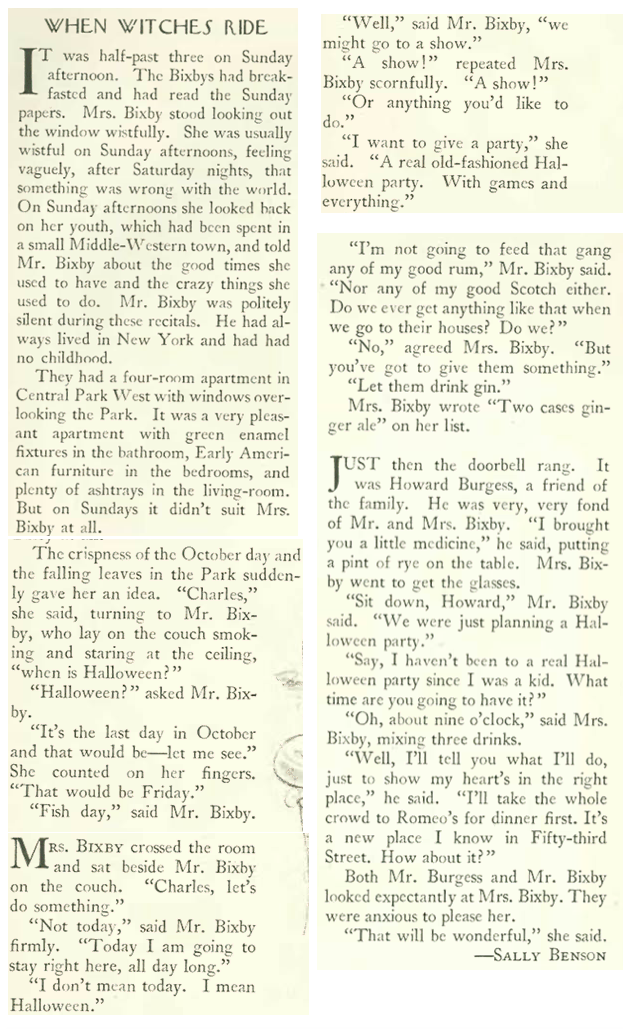
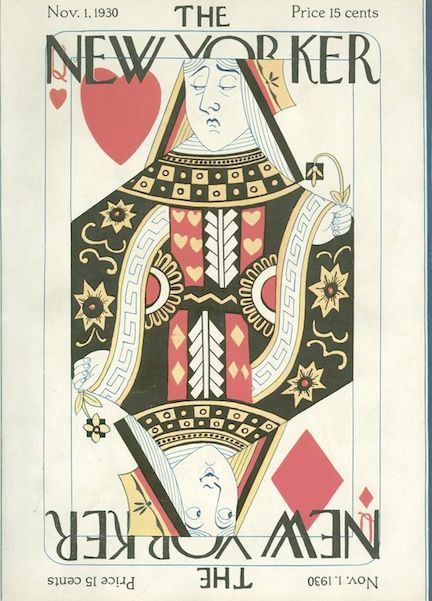
Since I am posting this on the night before All Hallow’s Eve, let’s take a quick look back 89 years at Halloween 1930 through the pages of the Oct. 25, 1930 issue of The New Yorker…
…which featured a short story (excerpted below) by Sally Benson, who would write a series of shorts for The New Yorker in 1941-42 that were later published in her book, Meet Me in St. Louis. Note how Prohibition laws seemed to pose no obstacle to the Bixbys’ party plans:
Benson’s Meet Me in St. Louis would be adapted into a popular 1944 film starring Judy Garland. One of the film’s highlights featured the Halloween hijinks of Tootie and Agnes Smith (Margaret O’Brien and Joan Carroll).
BOO!…Margaret O’Brien and Joan Carroll go trick-or-treating in 1944’s Meet Me in St. Louis. (Comet Over Hollywood)
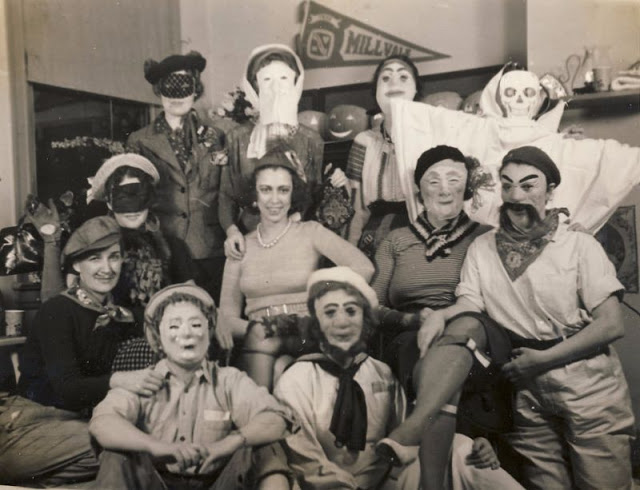
…Halloween revels were also popular with the college kids…
(Vintage Everyday)
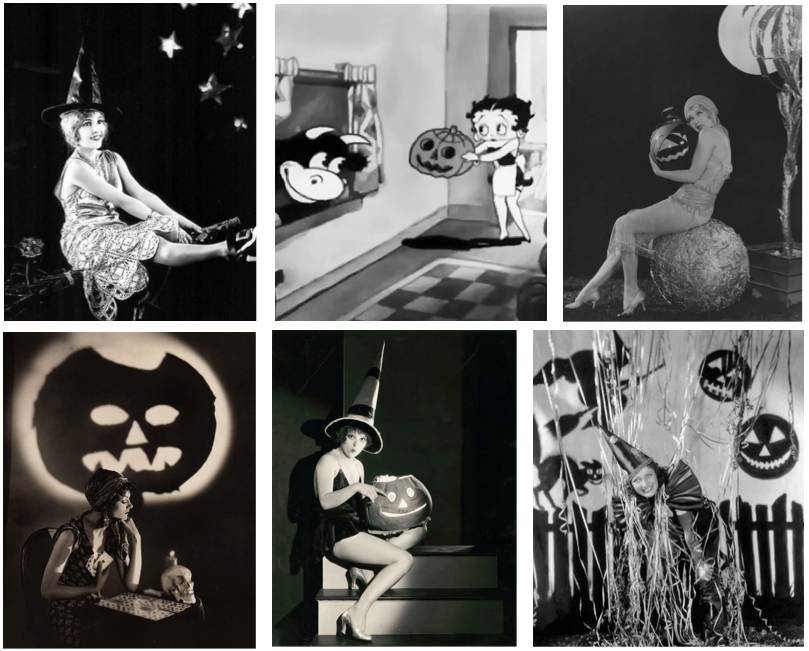
…and of course Hollywood got in on the act, each studio issuing pinup-style images of major female stars to newspapers and magazines …
Clockwise, from top left, Bessie Love (ca. 1920s), a still from a 1933 Betty Boop cartoon, Anita Page, Joan Crawford, Clara Bow, and Myrna Loy. (Vintage Everyday/YouTube)
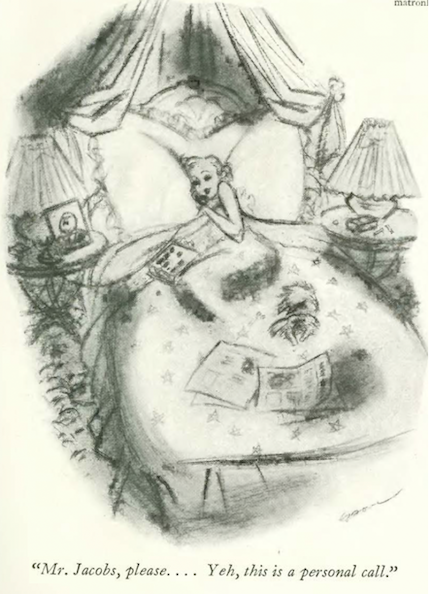
…the pages of the Oct. 25 issue contained other references to the holiday, including these Julian de Miskey spot drawings…
…and there were also ads offering both parties and party treats to those seeking some Halloween fun…
* * *
Not Exactly Whale Watching
On to our issues, the Oct. 15, 1930 edition featured a strange account (in “The Talk of the Town”) of a man who travelled the country with an embalmed whale carcass, which apparently drew large crowds wherever it was displayed.
Oct. 15, 1930 cover by Peter Arno. As I noted in my previous post, it seemed everyone was lighting up in the 1930s.
The account is disgusting on a number of levels (the last line: “People simply love whales”). During my research I learned that these “whale tours” continued into the 1970s.
SAVE THE WHALES…in this case, by pumping the animal with gallons of formaldehyde.
For further reading, author Lydia Pyne offers some history on this strange phenomenon at Not Even Past.
* * *
From Our Advertisers
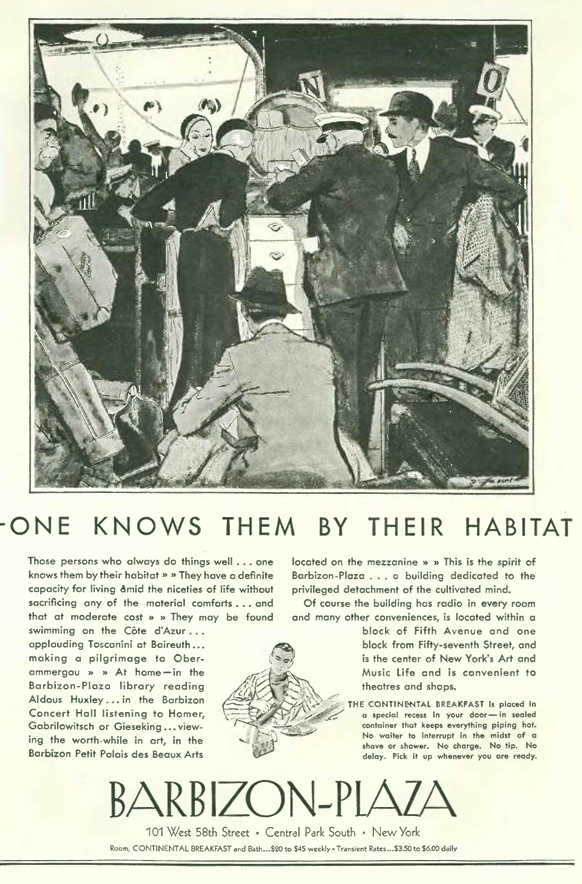
The owners of the new Barbizon-Plaza Hotel at 106 Central Park South tried their best to lure the smart set (especially artists and musicians) to this “habitat” designed especially for them. Unfortunately, artists and musicians were as broke as everyone else, and the property was foreclosed on in 1933…
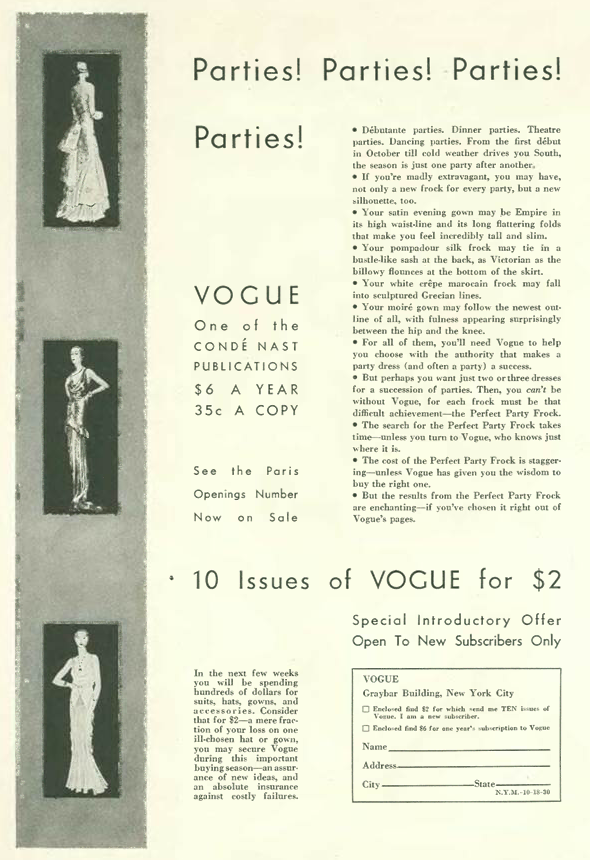
…and we have another appeal to the smart set, this one from the publishers of Vogue magazine (now a sister publication to the New Yorker, as both are now owned by Condé Nast)…
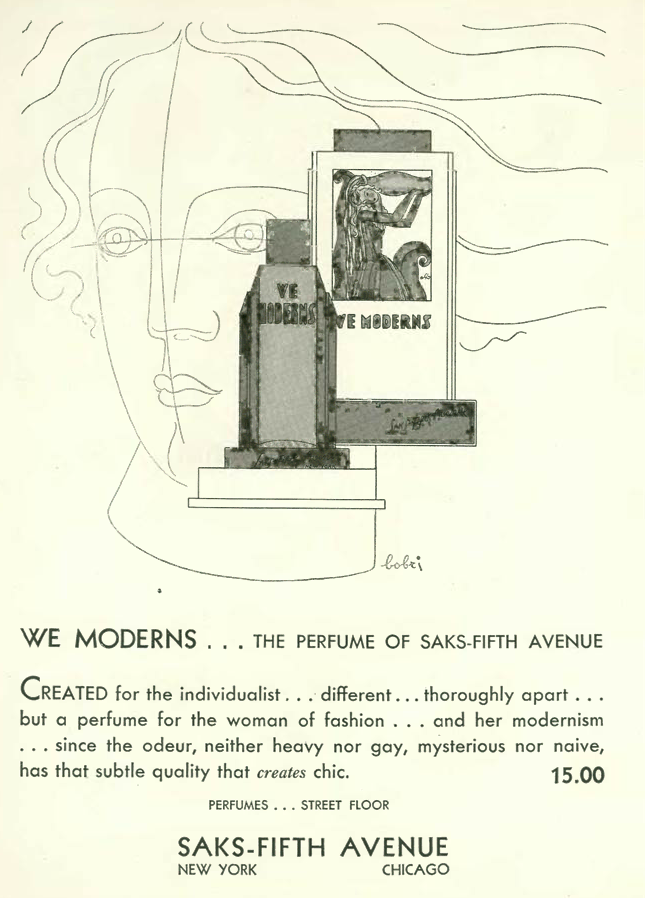
…and one more appeal to fashionable sorts, this time perfume in a bottle shaped like an art deco skyscraper…
…here is what one version of the bottle looked like in 1928, similar to ad above. According to the blog Cleopatra’s Boudoir, the We Moderns perfume was sold from 1928 to 1936 in bottles made in Czechoslovakia. The bottle below was made from glass, enamel (label), and the early plastic Bakelite (cover and base)…
(Perfume Bottles Auction)
…on to our color ads, I like this one because RCA induced the inventor of wireless radio, Guglielmo Marconi, to endorse their “Radiola”…
…and we have a beautiful illustration by Ellis Wilson for Dodge Boats…
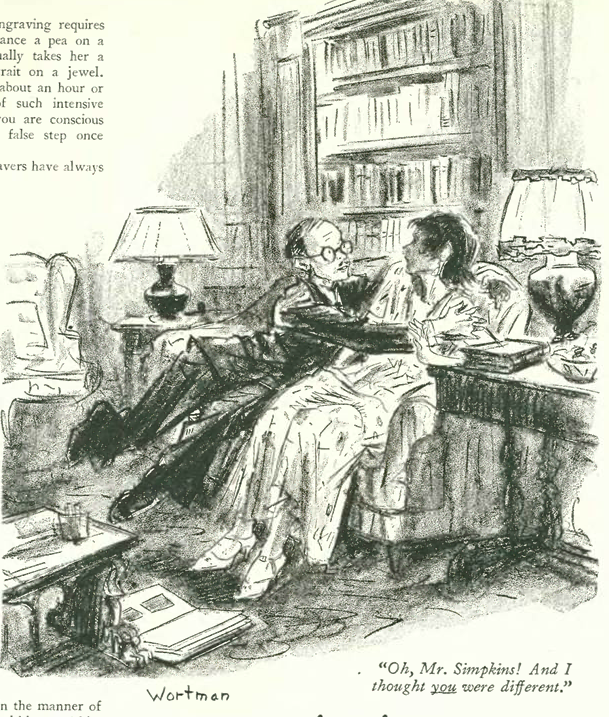
…on to our cartoons, we begin with Denys Wortman…
…here’s the art of Rea Irvin on a full page…
…Helen Hokinson kept up the tradition of New Yorkers looking down on those backward Bostonians…
…Alan Dunn, illustrating the sunlamp fad of the 20s and 30s…
…and Jack Markow, checking on the progress of the Empire State Building…
On to the Oct. 25 issue, and the Broadway opening of the comedy Girl Crazy…
Oct. 25, 1930 cover by Rea Irvin.
…which featured Ginger Rogers and Ethel Merman introducing the many hits from George Gershwin’s score including “I Got Rhythm” and ‘Embraceable You.” The plot was simple: a young New York playboy is banished by his family to a dude ranch in Arizona to keep him out of trouble…where of course he finds trouble. The orchestra for the Broadway performance included such talents as Benny Goodman, Glenn Miller, Jimmy Dorsey, Jack Teagarden, and Gene Krupa.
THEY SEEM SANE ENOUGH…Above, poster for the Broadway musical Girl Crazy. Below, Ginger Rogers poses with fellow stage actors. (gershwin.com)
* * *
More from Our Advertisers
Ads from the Oct. 25 issue included this recurring one from the promoters of the Empire State Building, marking progress through various historical vignettes…
…the ad accurately depicted the building’s progress, measured against these images below…
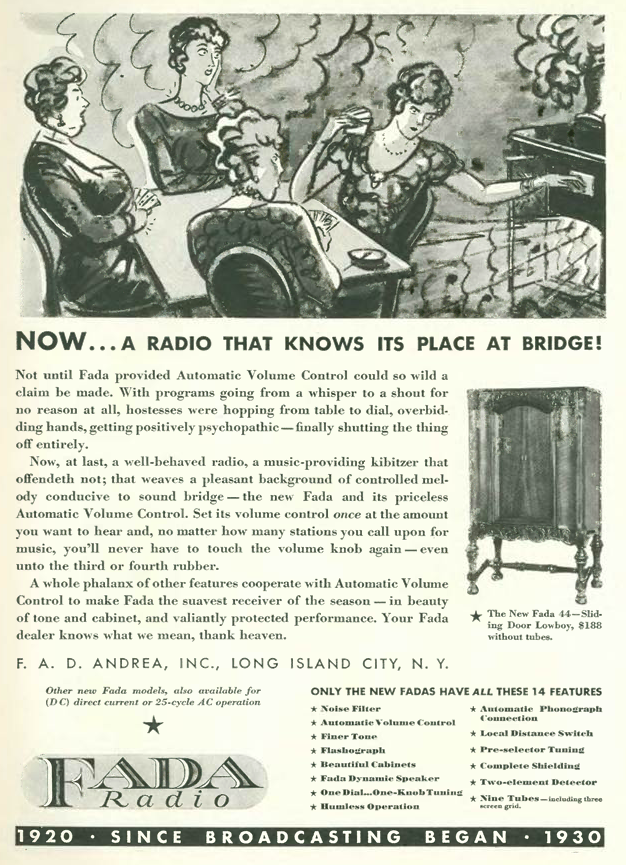
…and we have more radio ads…no endorsement from Marconi here, but the makers of Fada claimed their receiver was far less annoying than their rivals…
…while Atwater Kent touted the convenience of its new “Quick-Vision Dial”…
…as I’ve previously noted, backgammon was all the rage in 1930, so much so that this clothier even advertised a special frock for the game…
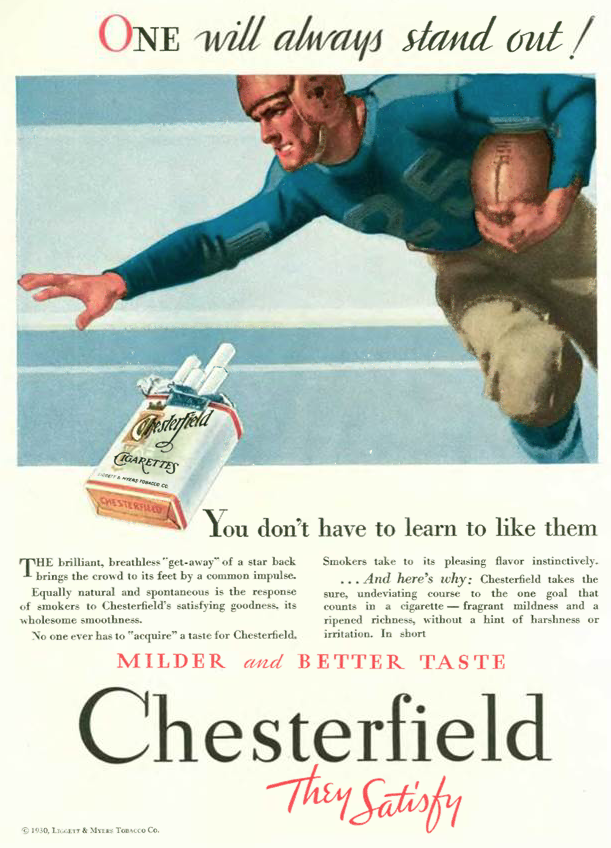
…and what would the 1930s be without smoking tied to athletic prowess…
…and remembering friends and family in California in 2019 as they battle wildfires across that great state…
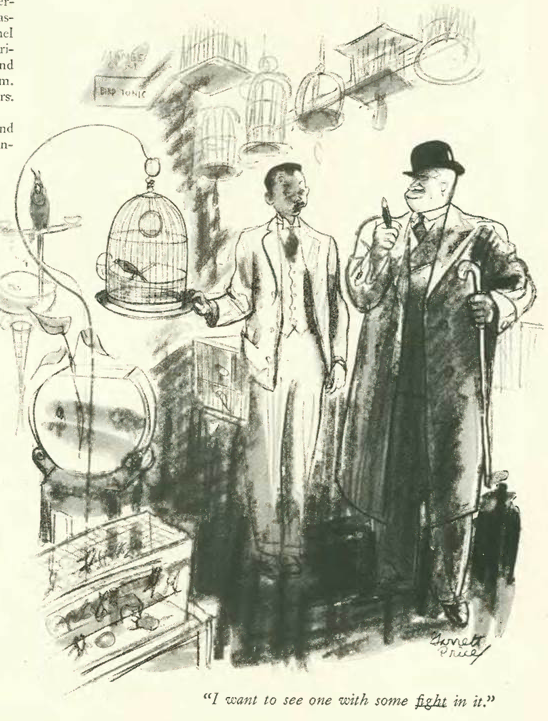
…on to our cartoons, Garrett Price introduced us to a man with a peculiar taste in pet canaries…
…Barbara Shermund illustrated the startling views afforded by rail travel…
…and Peter Arno leaves us in a moment of religious ecstasy…
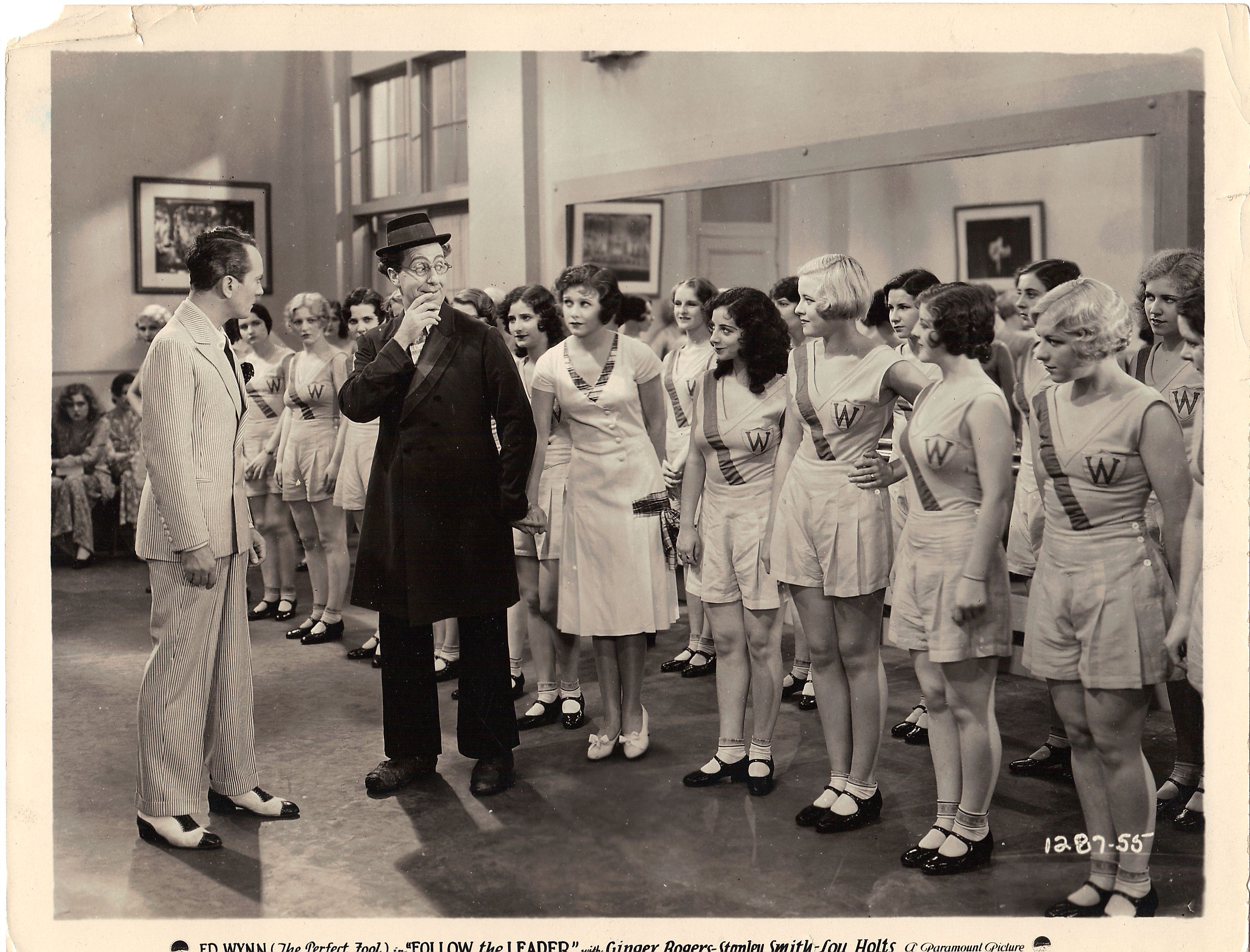
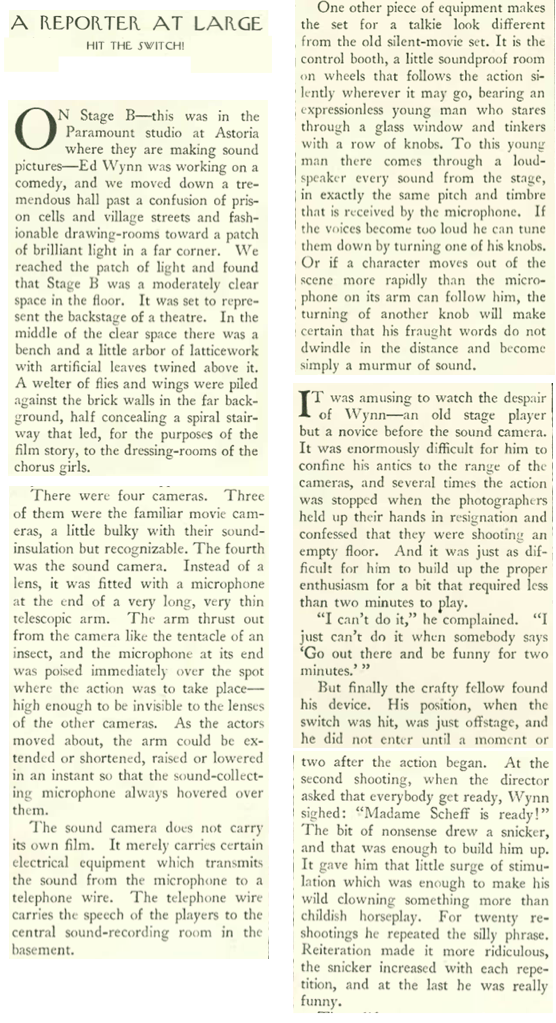
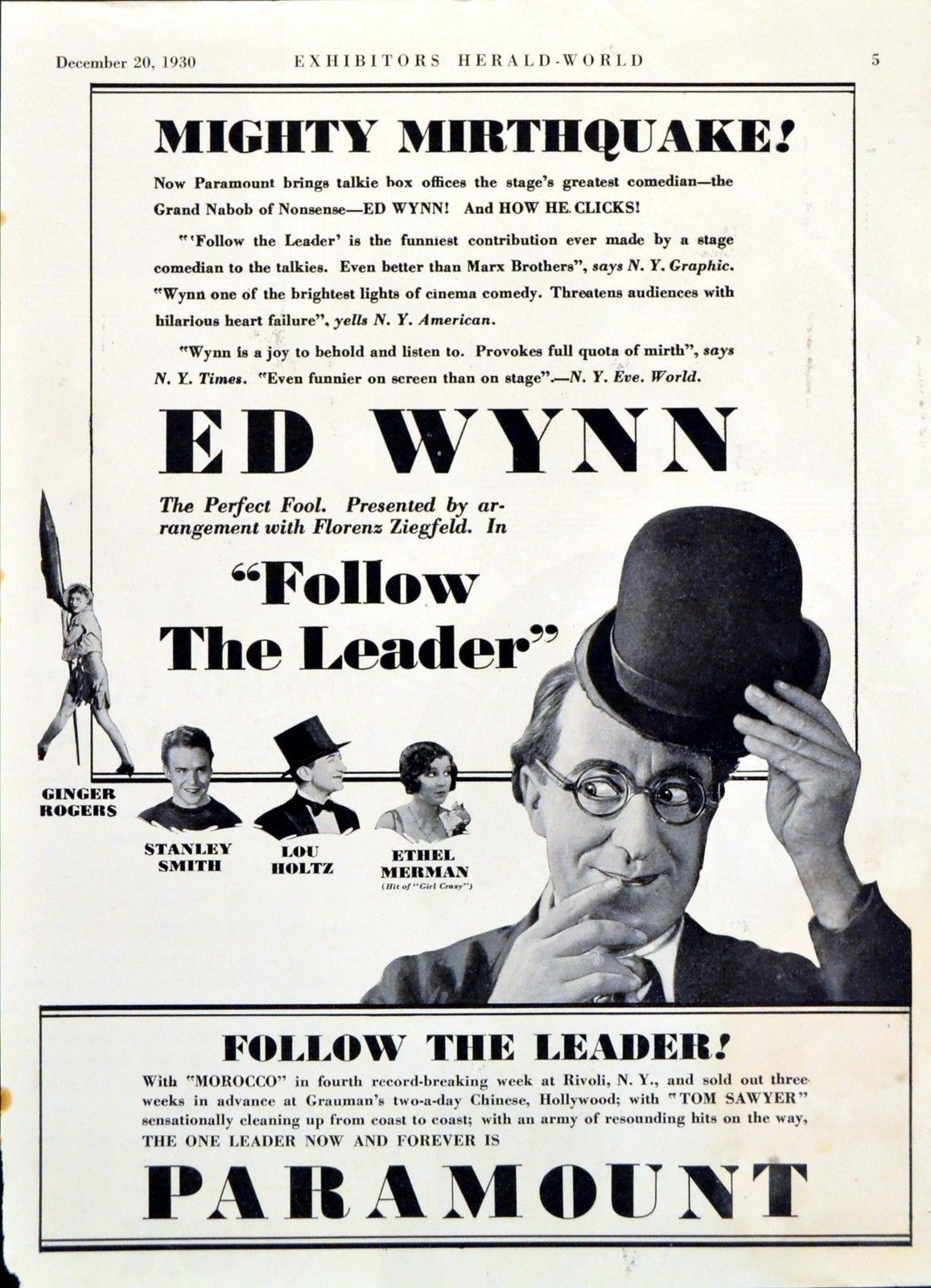
Comedian Ed Wynn began his long acting career on a vaudeville stage in 1903, and beginning in 1914 his giggly voice would delight Broadway crowds flocking to the Ziegfeld Follies. So when he stepped in front of a movie camera for a talking picture, it was something of a sensation.
September 27, 1930 cover by Sue Williams.
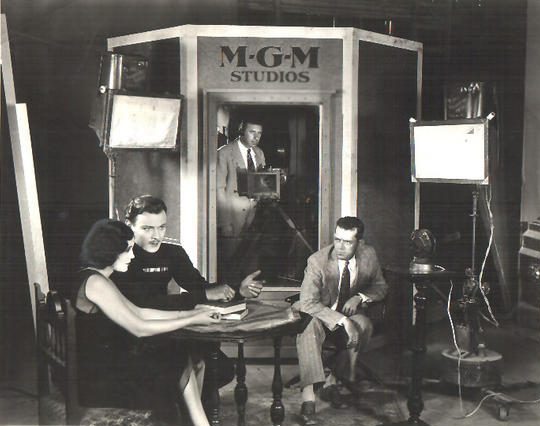
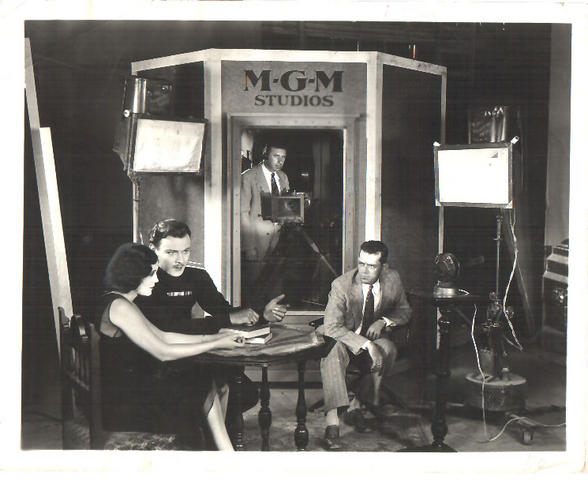
It was not an easy transition for the stage veteran. As you can see from Morris Markey’s account below in “A Reporter at Large,” the early talkies presented all manner of challenges and restrictions for stage actors accustomed to a bit more freedom of movement and expression.
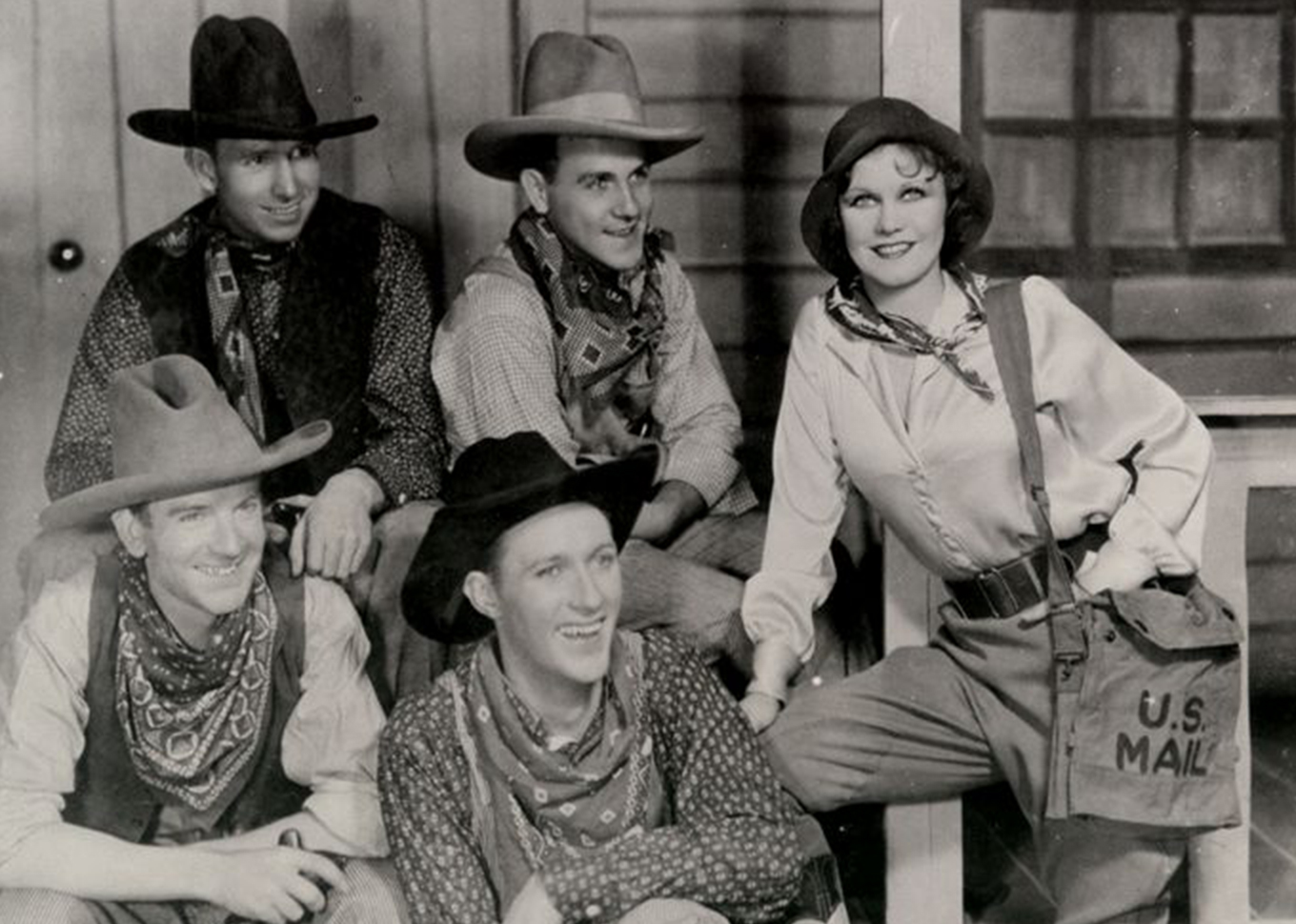
SCANDALOUS BUNCH…Ed Wynn (in hat) portrayed a character he developed on Broadway — “Crickets” — in his film debut Follow the Leader. At left is actor Stanley Smith, and at center, holding Wynn’s hand, is a brunette Ginger Rogers, with chorus girls from George White’s Scandals. (IMDB)
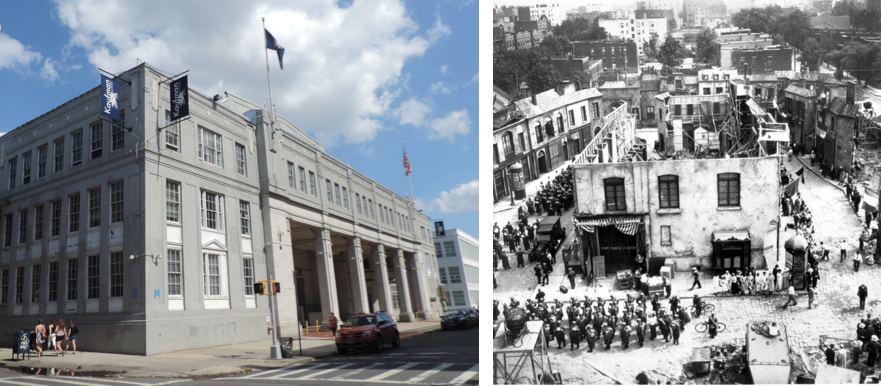
PAY NO ATTENTION TO THE MAN BEHIND THE WINDOW…Noisy cameras were enclosed in soundproof boxes in the early days of the talkies. Above, Woody Van Dyke directs Raquel Torres and Nils Asther in 1930’s The Sea Bat. (nilsasther.blogspot.com)TINSELTOWN IN QUEENS…For his article, Morris Markey visited the set of Follow the Leader at Astoria Studios in Queens. The original studio building, at 35th Avenue, is on the National Register of Historic Places. Although Paramount moved its movie operations to Hollywood in the early 1930s, the studio continued to be used for both film and television productions. At right, a bit of Paris was erected in the midst of Queens for the filming of 1929’sThe Gay Lady. (Wikipedia/Kaufman Astoria Studios)FILM DEBUT…A December 1930 magazine advertisement touting Ed Wynn’s first motion picture. (IMBD)
* * *
False Modesty?
In Morris Markey’s second installment of his profile on Charles Lindbergh, Markey suggested that Lindbergh’s aversion to publicity might be a pose…
NO WI-FI, BUT YOU COULD SMOKE…Top, the posh set take wing with TWA circa 1930; below, passengers prepare to board an American Airways Curtiss Condor II in 1933. (historydaily.org/Sweezey Pictures/Ken Sweezey)
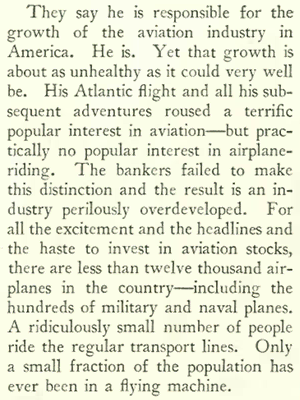
…and also wondered how much credit Lindbergh could take for sparking the aviation industry, given that flying was still an activity reserved for a very few…
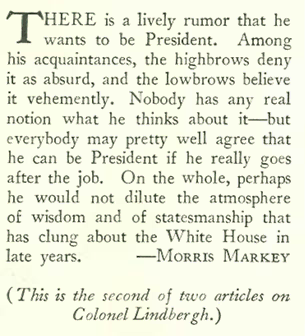
…Markey also noted a “lively rumor” that Lindbergh wanted to be President…
…fortunately Lindbergh did not give truth to the rumor, or fulfill the alternate history created by Philip Roth in his 2004 novel The Plot Against America…
HANGIN’ WITH A BAD CROWD…Top, Charles Lindbergh accepts a ceremonial sword from Hermann Göring during a 1936 visit to Nazi Germany; below, right, Lindbergh in Germany, 1937. Philip Roth’s novel imagined Lindbergh’s election to the Presidency in 1940 and its chilling results. (Reddit/The New Yorker/Goodreads)
* * *
Bad Moon Rising
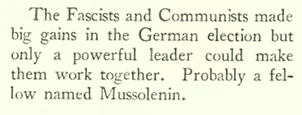
In 1930 few, if anyone, were aware of Lindbergh’s proclivities toward nationalism and antisemitism. And lacking a crystal ball, Markey’s New Yorker colleague, Howard Brubaker, had little reason to be alarmed by the federal elections in Germany, which gave the Nazis the second largest number of seats in the Reichstag. In his “Of All Things” column, Brubaker quipped:
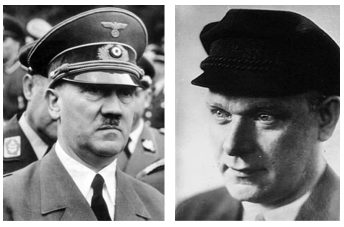
INCOMPATIBLE…As Howard Brubaker noted in “Of All Things,” the fascists led by Adolf Hitler, left, and the communists led by Ernst Thälmann (right) made big gains in the 1930 German elections. After gaining power in 1933, Hitler would arrest Thälmann and later have him shot. (Wikipedia)
* * *
Gummed to Death
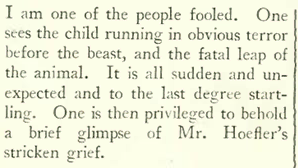
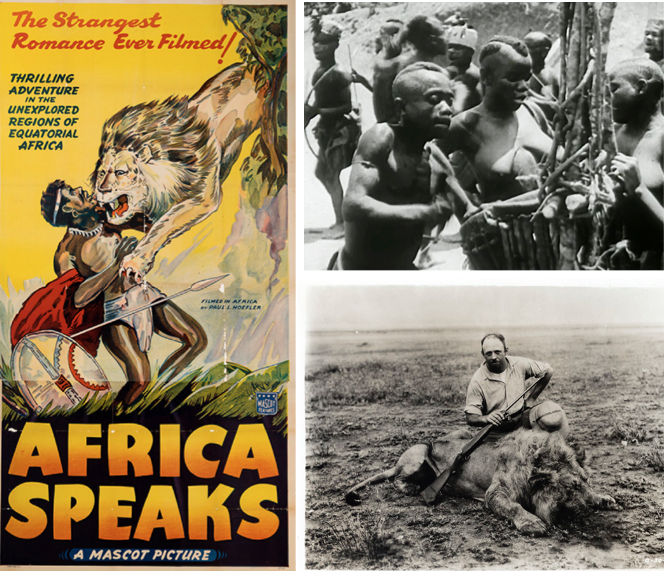
The New Yorker’sJohn Mosher took in the latest travelogue to exploit and misrepresent life on the African savannah. Africa Speaks included a scene depicting a fatal attack on a “native boy” by a lion — an attack that was actually staged at a Los Angeles zoo and involved a toothless lion…
STRANGE INDEED…At left, movie poster for Africa Speaks; top right, Pygmy drummers in the film; bottom right, explorer Paul Hoefler getting closer to nature. (IMDB/Wikimedia)
* * *
From Our Advertisers
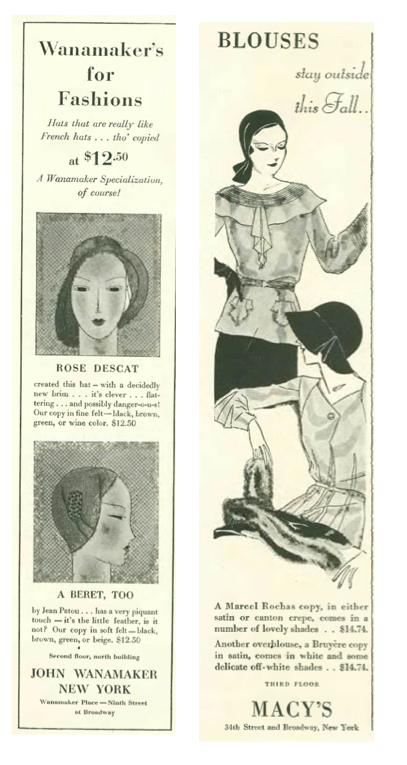
When Paris unveiled is spring and fall fashions, large department stores were always quick to respond with “copies”…
…while the higher end boutiques offered originals to “poor little rich girls”…
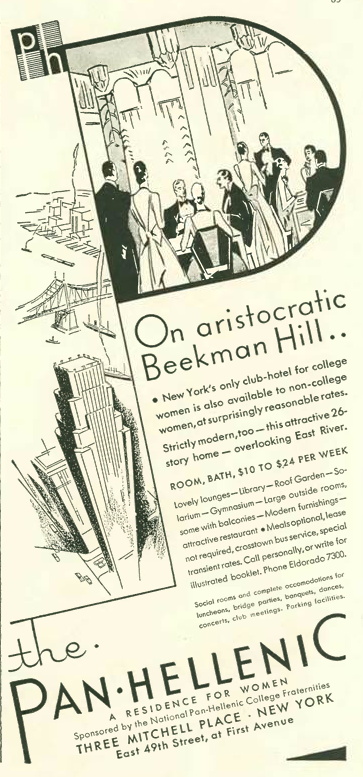
…perhaps some of these “poor little rich girls” socialized at the Panhellenic, a “club-hotel for college women”…
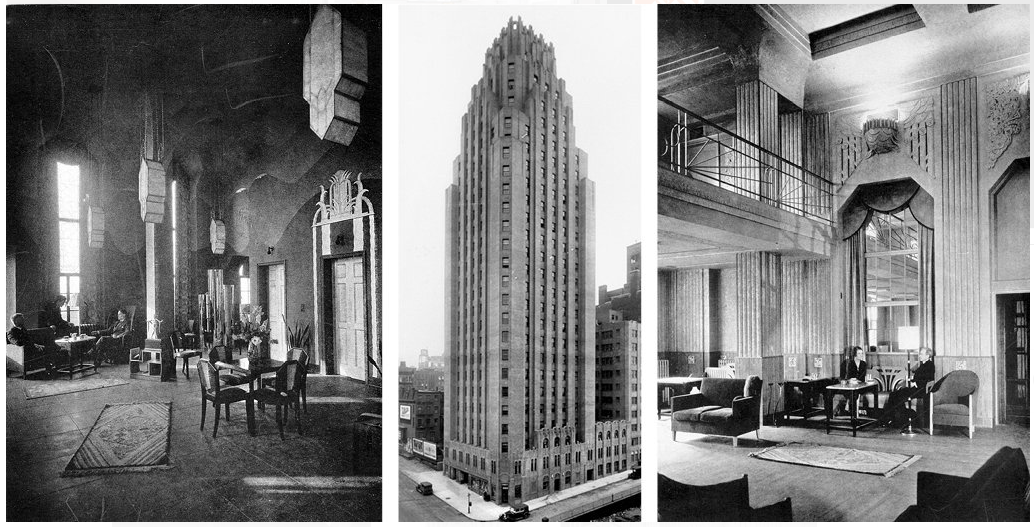
…and here are some views of the Panhellenic House, circa 1929…
Center, The Panhellenic House, at First Avenue and 49th Street; at left, the solarium; at right, a ballroom. (Avery Library/Museum of The City of New York)
…the makers of Old Gold cigarettes had some of the weirdest ads to push their smokes, including this one…
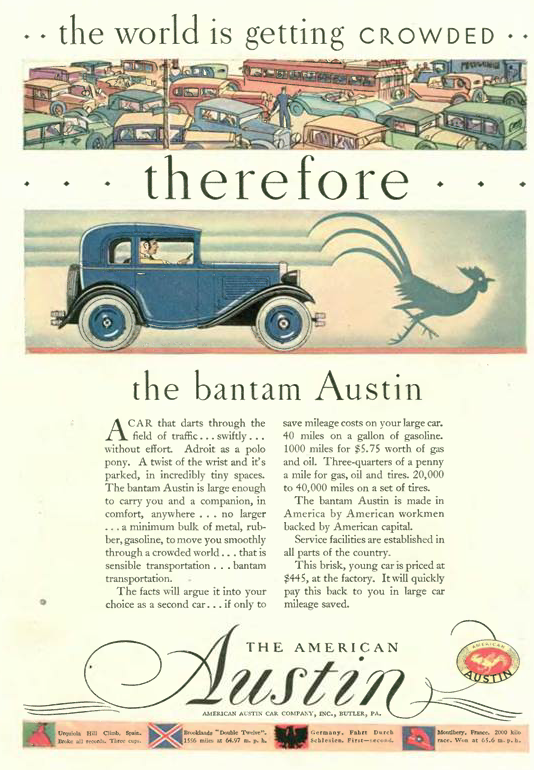
…and one wonders what the world would be like (and especially the U.S.) if car buyers would have favored a more compact version of the motorcar going forward…
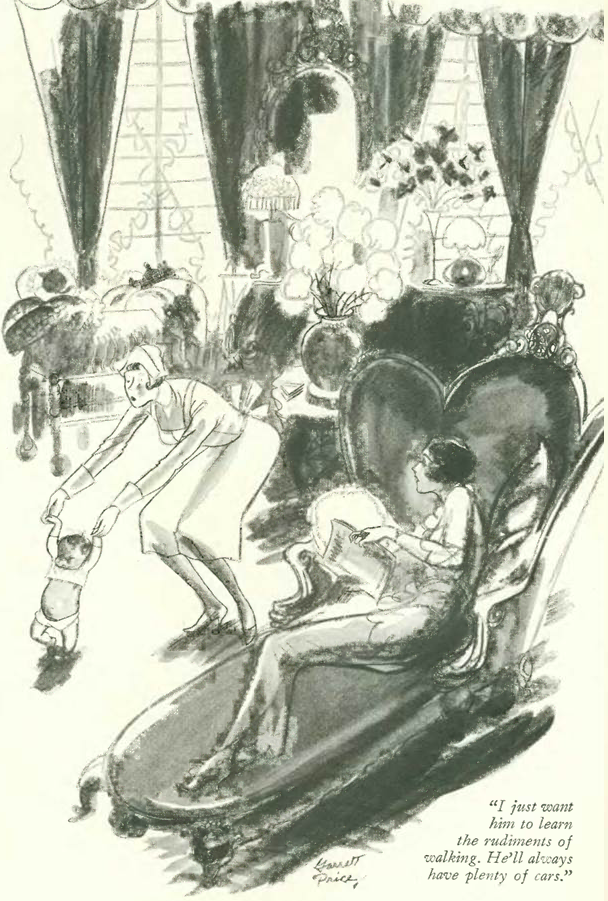
…on to our cartoons…we begin with parenting tips from the posh set, courtesy Garrett Price…
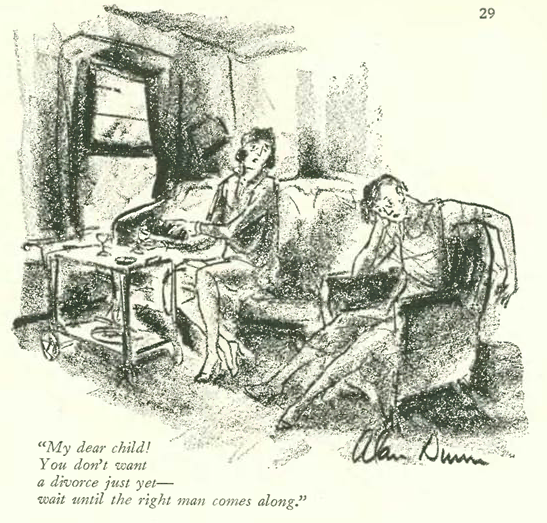
…Alan Dunn explored modern matrimony…
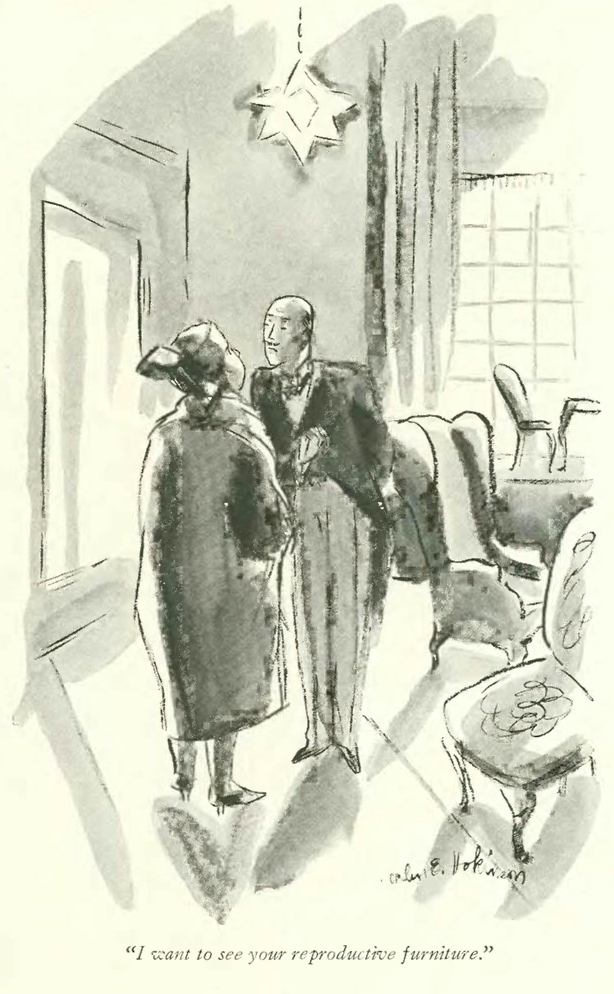
…one of Helen Hokinson’s ladies demonstrated a unique taste in furniture…
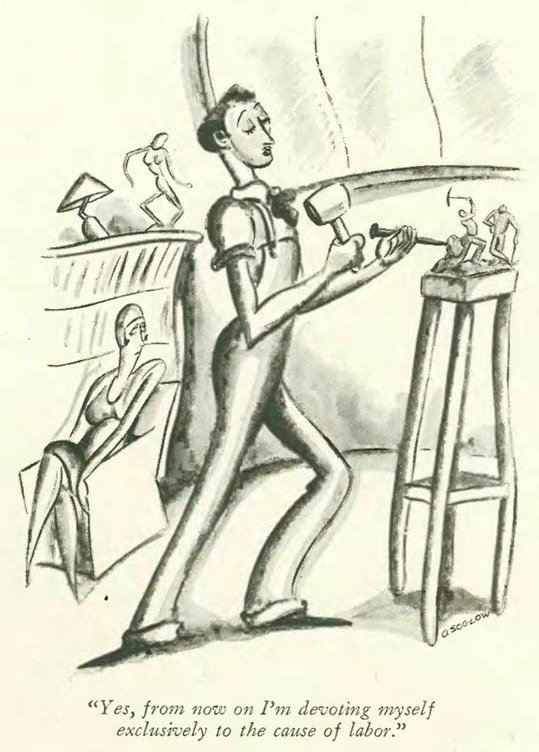
…Otto Soglow continued to explore humor in a wavy fashion…
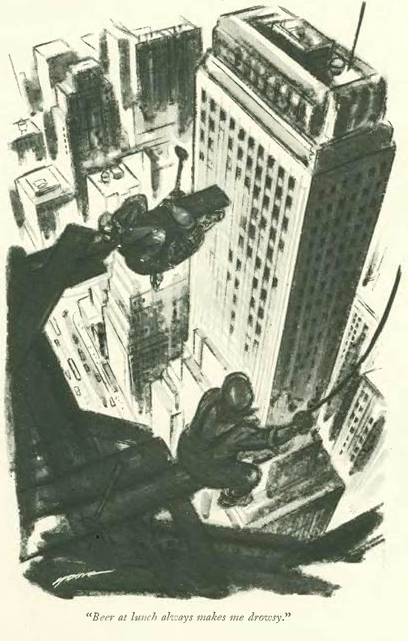
…and we close with this vertiginous view provided by Leonard Dove…











































 A New Yorker State of Mind