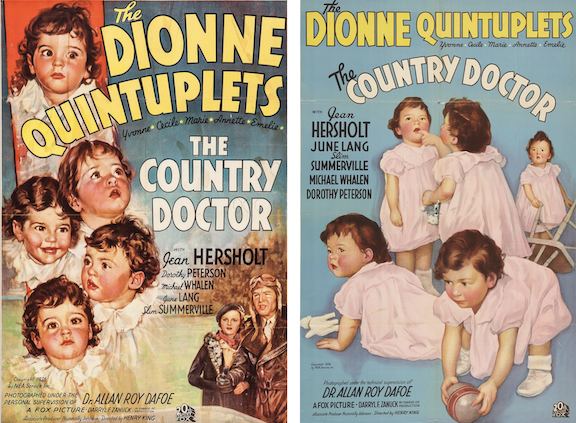
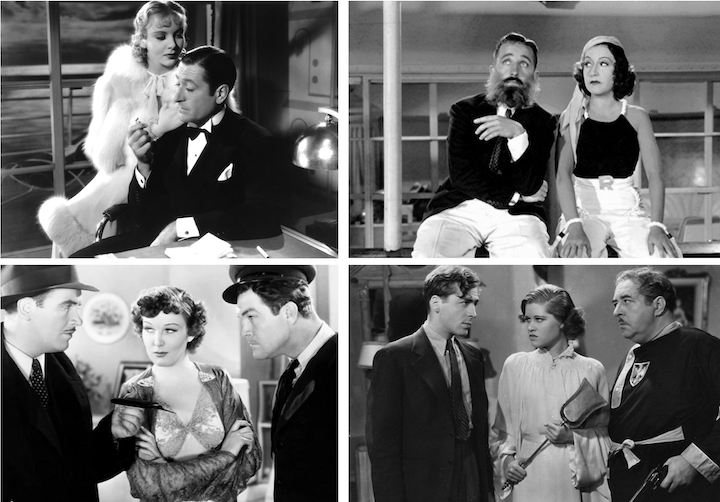
Above: Posters advertising The Country Doctor, a film featuring the Dionne Quintuplets as "The Wyatt Quintuplets." (Wikipedia/imdb.com)
The Dionne Quintuplets, famed as the first quintuplets known to have survived infancy, appeared in a motion picture before their second birthday—The Country Doctor—just one example of the many ways the girls were exploited by the province of Ontario, their doctor, their father, and the companies who used their images to sell everything from toys to toothpaste.
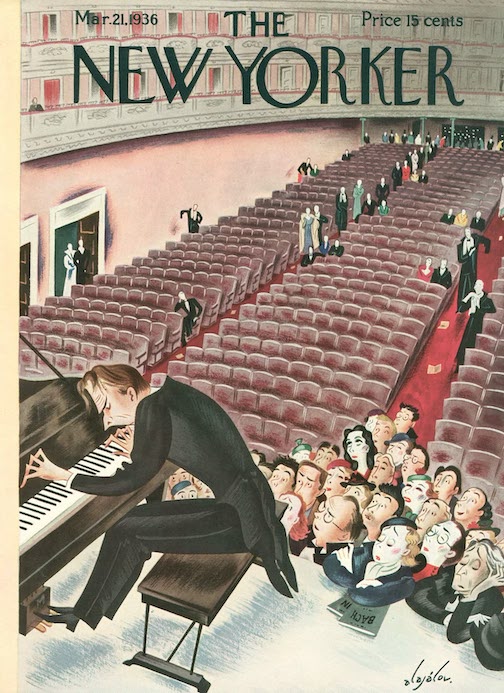
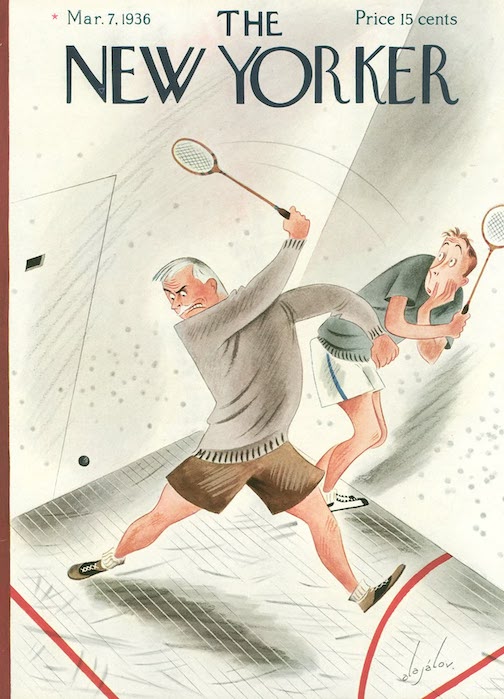
March 21, 1936 cover by Constantin Alajalov.
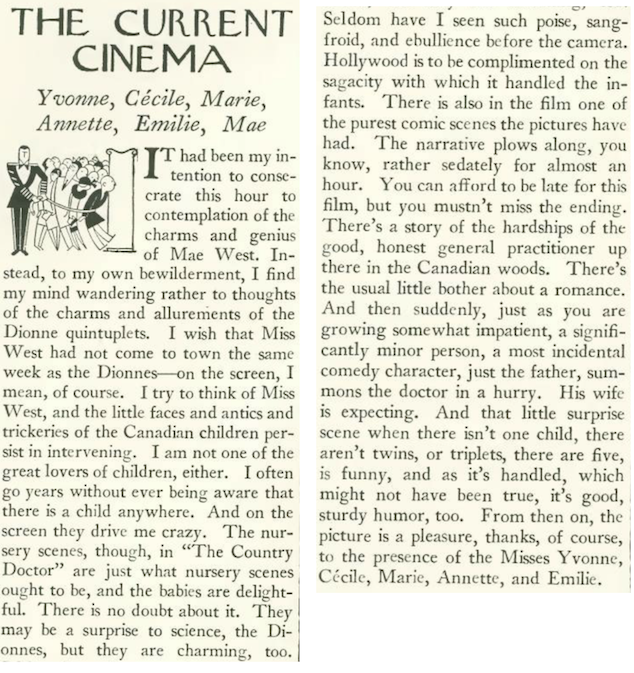
The Country Doctor was the first of three 20th Century Fox films featuring the toddlers as the “The Wyatt Quintuplets.” Actor Jean Hersholt played the country doctor (“Dr. John Luke”) in all three films, his character based on Allan Roy Dafoe, the Ontario obstetrician who successfully delivered the identical quints in 1934. It was a sign of the times that no one seemed too concerned about the children’s welfare—TheNew Yorker’s John Mosher was joined by his fellow critics in generally praising the film.
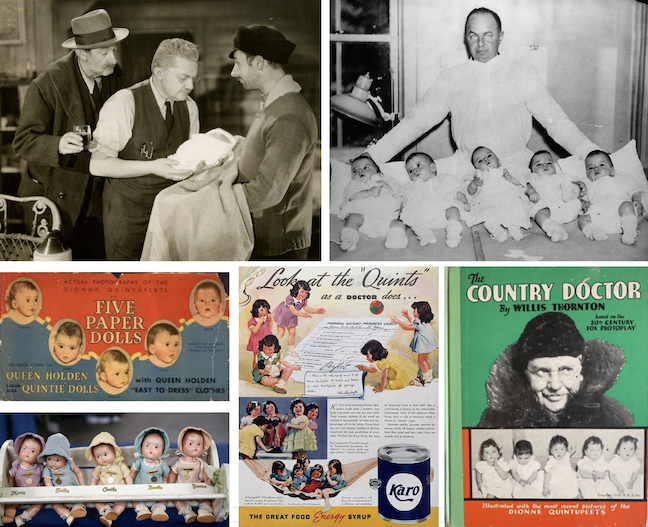
MARKETING MATERNITY…The Country Doctor was the first of three 20th Century Fox films featuring the Dionne Quintuplets. Clockwise, from top left: Slim Summerville, Jean Hersholt, and John Qualen in The Country Doctor; Ontario Premier Mitchell Hepburn with the quintuplets in 1934; a 1936 book based on the film; a 1937 ad for Karo Syrup, a major sponsor of the girls and Dr. Dafoe; an array of quintuplet-related toys included paper dolls and the much sought after Madame Alexander dolls. (Wikipedia/ebay.com/facebook.com/pbs.org)
The Dionne Quintuplets were used to endorse an array of products including Quaker Oats, Colgate toothpaste, Palmolive soap, and Lysol disinfectant. Dr. Dafoe became a wealthy man due to his association with the quintuplets, while the government of Ontario saw enormous tourism potential (the girls were made wards of the province ostensibly to protect them from exploitation). At the age of four months the quintuplets were moved from the farmhouse where they were born to a compound (“Quintland”) that featured an outdoor playground designed as a public observation area.
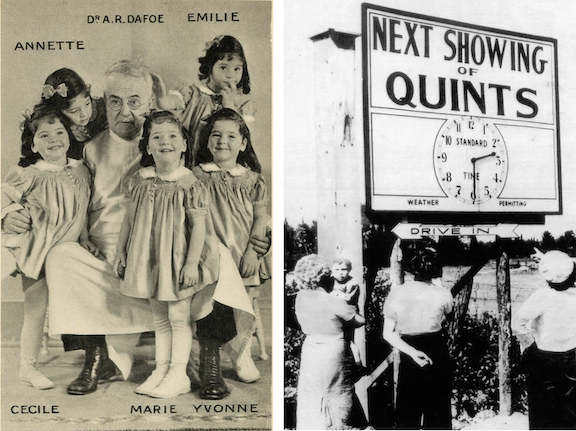
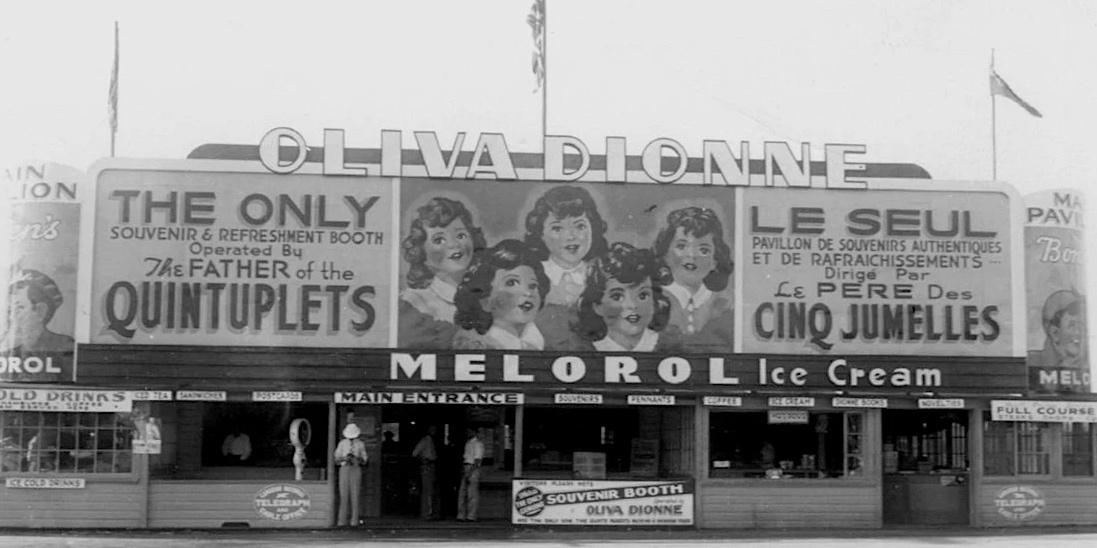
SURROUNDED BY RICHES…at left, Allen Roy DaFoe on a postcard with the Dionne Quintuplets; tourists consult sign for the next public showing of the “Quints.”(roadtripusa.com/facebook.com)CHA-CHING…Oliva Dionne, the quintuplets’ father, ran this souvenir and refreshment stand at Quintland, where the public flocked to view the girls playing. (montrealgazette.com)
The last surviving quintuplet, Annette, died on December 24, 2025, at the age of 91. Her sister Cécile died a few months earlier, also at age of 91.
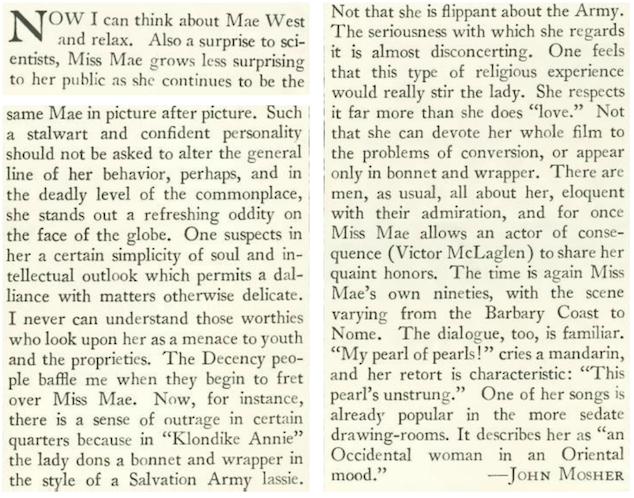
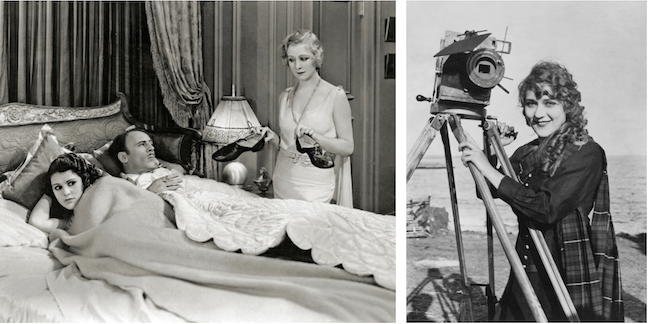
John Mosher also reviewed Mae West’s latest film, Klondike Annie. Some critics regarded it as her finest film, despite heavy censorship and the outrage of “Decency people.”
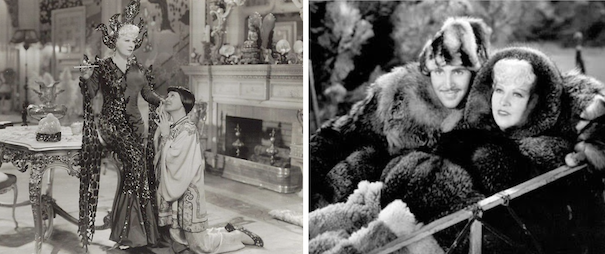
GO WEST, WEST…Mae West portrayed a kept woman who murders her keeper in self-defense and escapes to Nome, Alaska in Klondike Annie. At left, West in a scene with Son Yong; at right, with Phillip Reed. (Pinterest)
* * *
St. Katharine
Robert Benchley found Katharine Cornell’s theatrical performance in Saint Joan to be “as fine as was expected.” An excerpt:
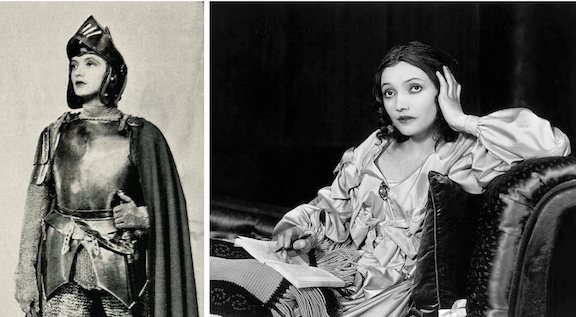
KNOWN QUANTITIES was how Robert Benchley described the talents of stage actress Katharine Cornell. At left, Cornell as Saint Joan; at right, Cornell (1893–1974) is perhaps best known in her role as Elizabeth Barrett in the 1931 Broadway production of The Barretts of Wimpole Street. (Wikipedia)
* * *
It Begins…
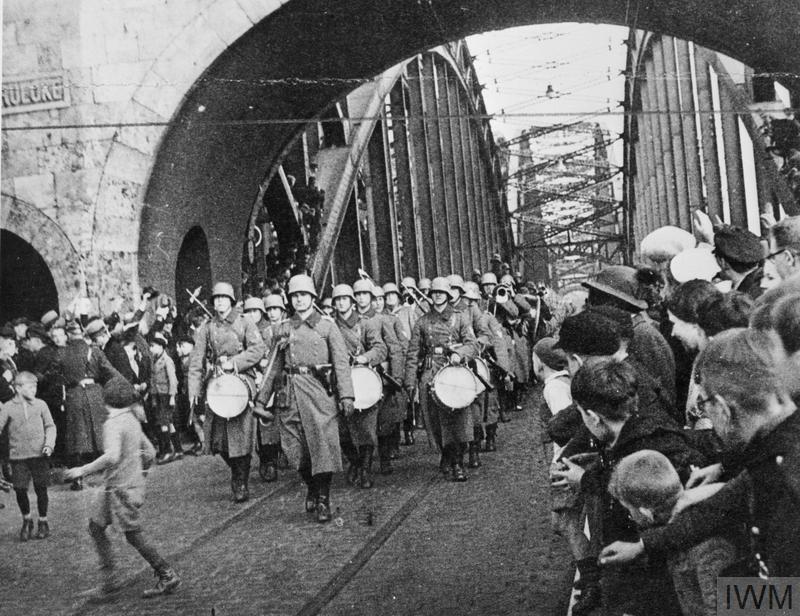
On March 7, 1936, 22,000 German army troops crossed a bridge over the Rhine River and entered the Rhineland, breaking the 1919 Treaty of Versailles, which mandated a demilitarized Rhineland to ensure French safety. Despite the violation, and the fact that the German army was still weak, France and Britain took no military action. E.B. White reported:
REOCCUPATION…On March 7, 1936, German Army troops crossed a bridge over the Rhine River and entered the Rhineland for the first time since the end of World War I. The lack of response from France and Great Britain no doubt emboldened Hitler to annex Austria and occupy Czechoslovakia in 1938. (iwm.org.uk)
Howard Brubaker, in his column “Of All Things,” also noted:
* * *
Some Pretty Things
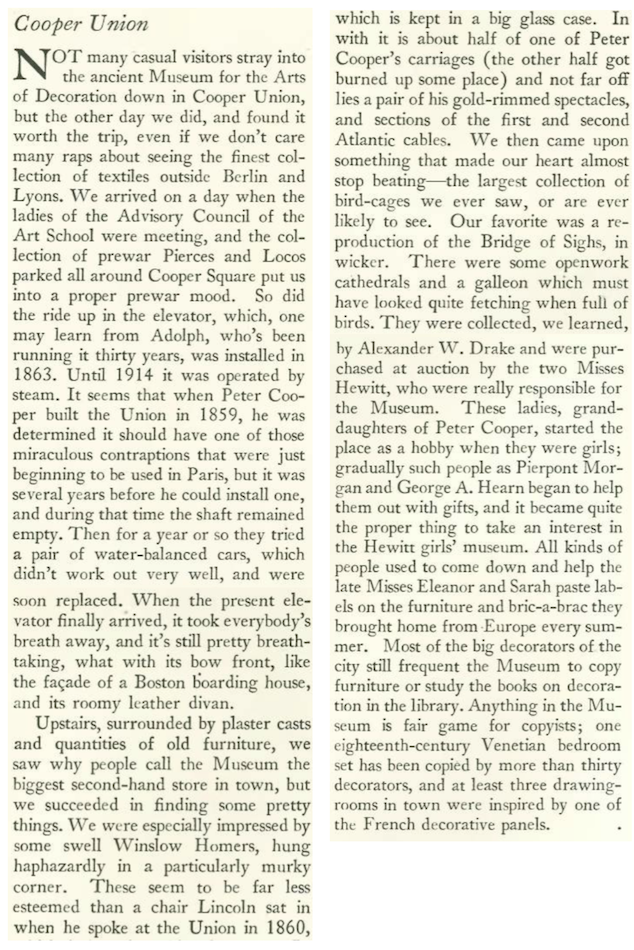
“The Talk of the Town” paid a visit to the Museum for the Arts of Decoration at the Cooper Union and found many treasures within, including a unique circular elevator.
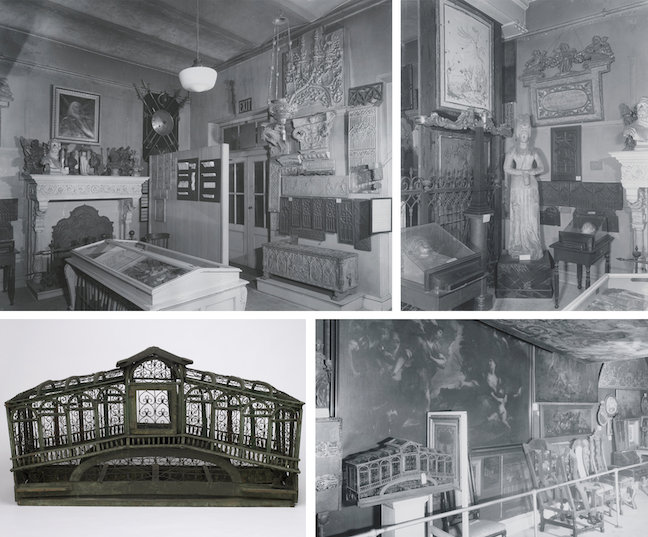
BRIDGE TO THE PAST…The Cooper Union’s Museum for the Arts of Decoration held many treasures, including (at bottom) an Italian birdcage fashioned to resemble the Rialto Bridge; at top, rooms filled with examples from the decorative arts. (cooperhewitt.org)
The “Talk” visit included a ride up a circa 1850s elevator shaft designed by inventor Peter Cooper four years before safety elevators even existed. The design was based on Cooper’s belief that the circular shape was the most efficient.
ROUND AND SOUND…At left, entrance to Peter Cooper’s circa 1850s round elevator and the elevator’s shaft at the Cooper Union Foundation Building. The round shaft remains a central feature of the building today, now housing a modern round elevator designed in 1972. (Cooper Union Library)
* * *
Commie Cutlery
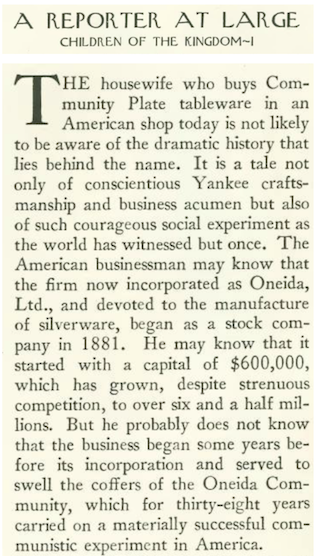
American non-fiction writer Carl Carmer published the first part of a two-part essay on the revolutionary Oneida Community, which Carmer dubbed “a materially successful communist experiment…”
This polyamorous Christian utopia disbanded before the end of the 19th century and reemerged as a joint-stock company, Oneida Community Limited, which focused on making silverware. This brief excerpt is from the first paragraph.
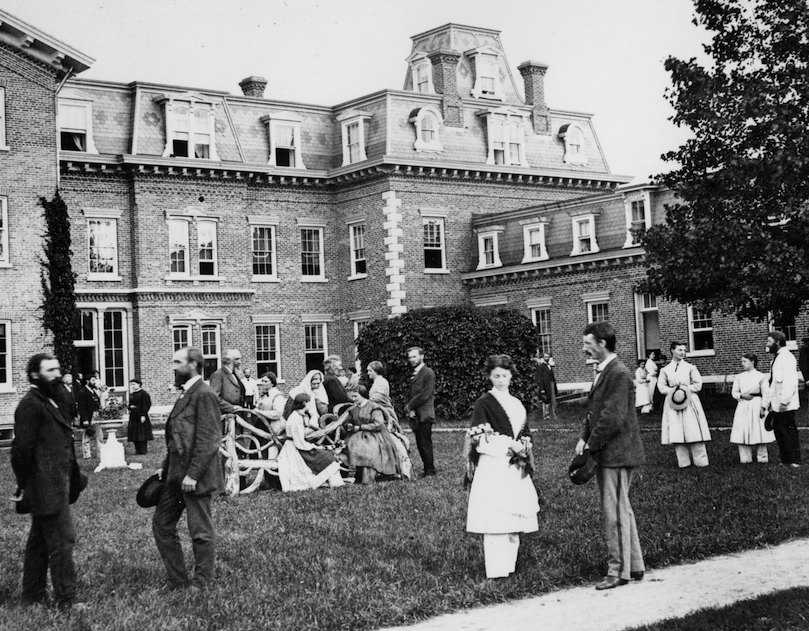
COHABITING COMRADES…Oneida commune members gather on the lawn in front of the Community Mansion House in in Madison County, New York, circa 1860s. Members of the community practiced free love, women and men had equal freedom in sexual expression and commitment, and children were raised communally. (collectorsweekly.com)
* * *
From Our Advertisers
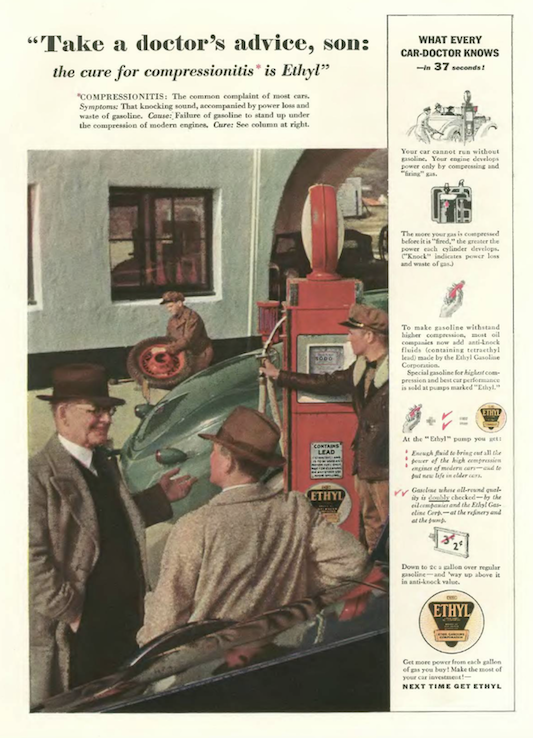
Yes, take a doctor’s advice, and put some leaded gas in your car, and into the air you breathe…
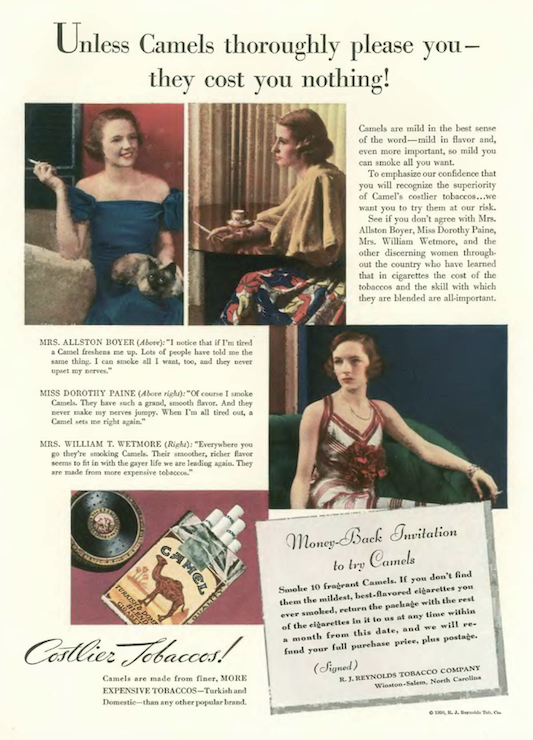
…R.J. Reynolds presented three women who exemplified the “society model” trend of the 1930s…well-known debs and socialites who provided an air of prestige to a brand…especially cigarettes…
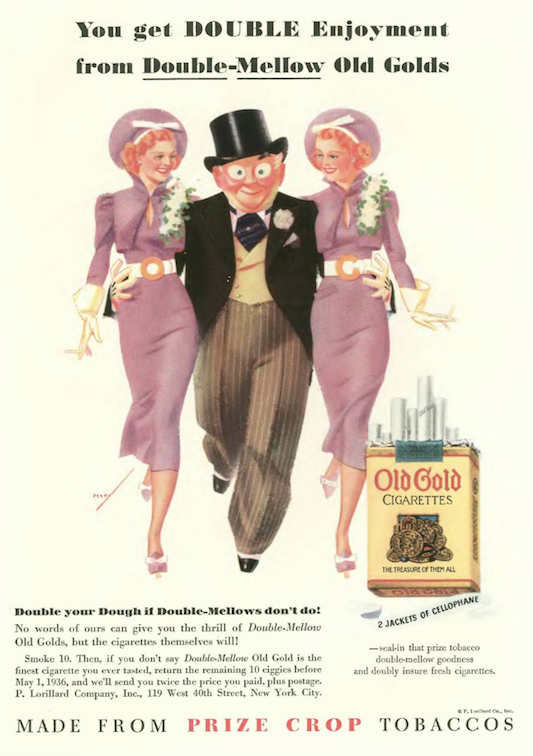
…Lorillard Tobacco Company, on the other hand, stuck with pin-up artist George Petty to push their Old Golds…
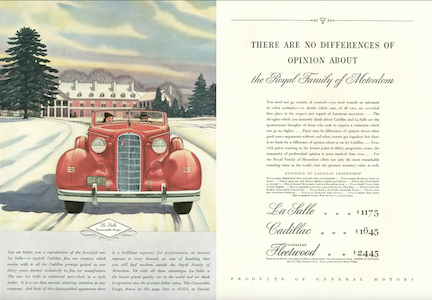
…General Motors took out the middle spread to tout their low-priced luxury automobile, the La Salle…
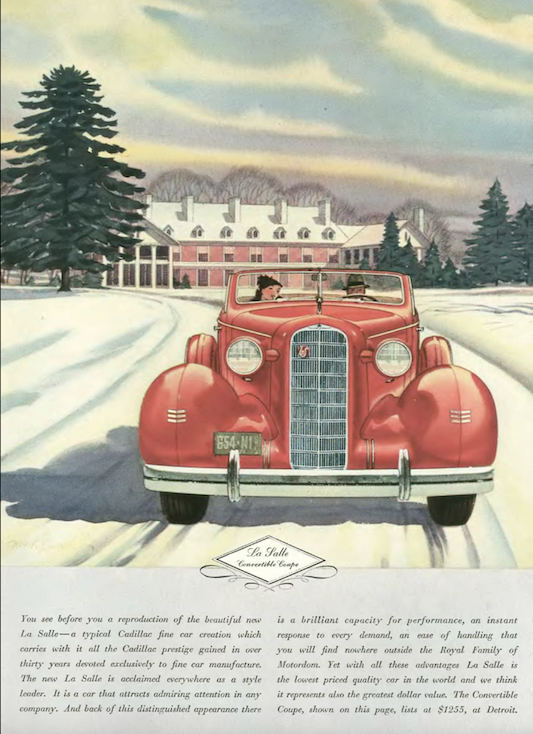
…the convertible La Salle looked handsome, if not a bit brisk with the top down…
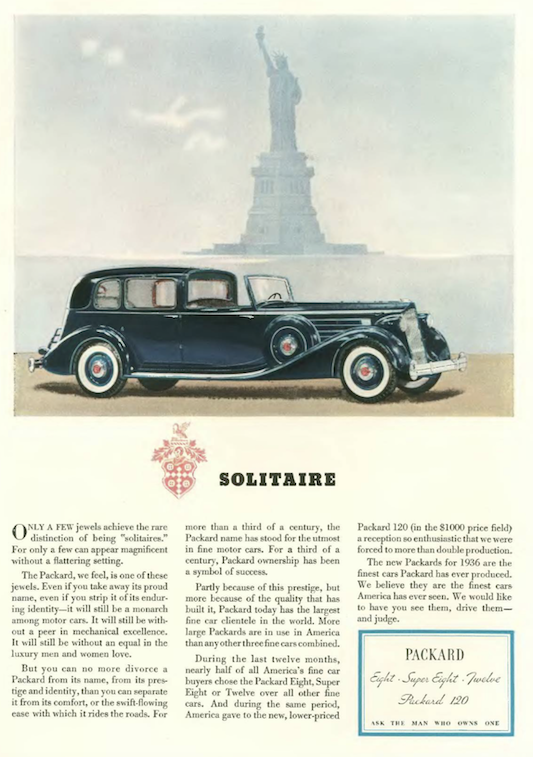
…American luxury carmaker Packard proudly displayed their twelve-cylinder luxury model, but reminded readers they could have a lesser model, the 120, for a price “in the $1,000 field”…
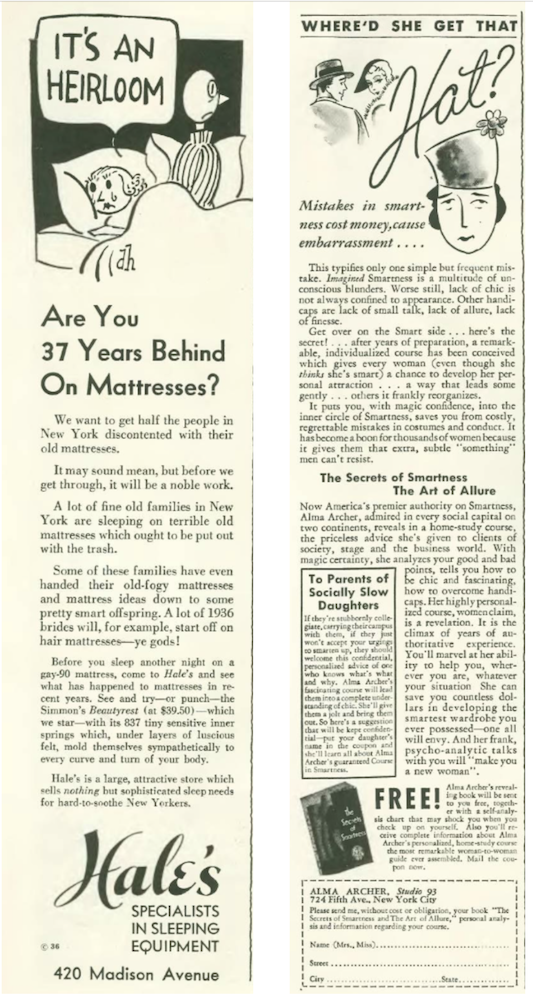
…a couple of one-column ads…Don Herold helped Hale’s move mattresses, while fashion columnist Alma Archer employed class anxiety to promote her new book, The Secrets of Smartness and the Art of Allure…
SMARTNESS AUTHORITY Alma Archer in 1937. Archer (1898–1988) wrote a widely read column for the New York Mirror that was syndicated in more than a thousand newspapers.
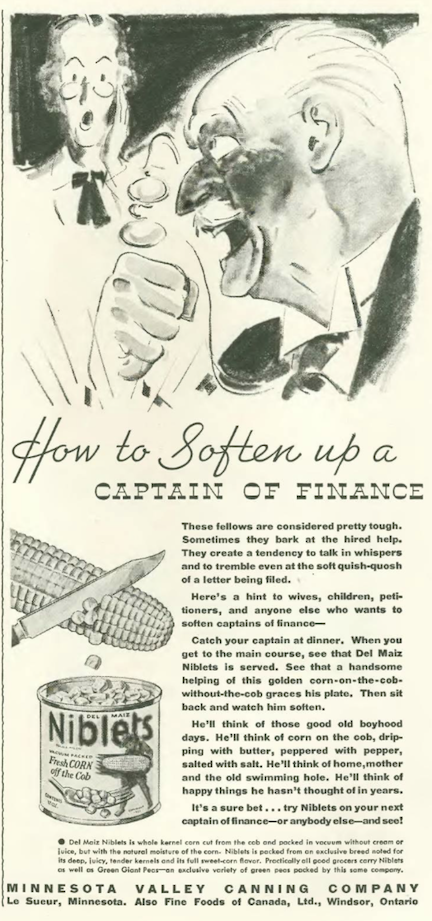
…if you have been following this blog, you’ll recall the ads with angry duchesses fuming over tomato juice and rich old men fondly recalling their countrified youth via canned corn niblets…well here is one robber baron who needed some niblets pronto to quiet his rage…maybe a snifter or two of brandy would have also helped…
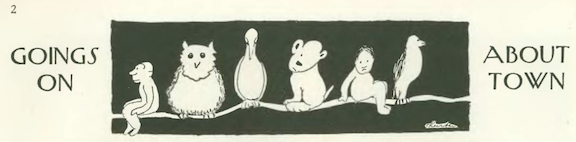
…on to our cartoonists, James Thurber kicked things off on page two…
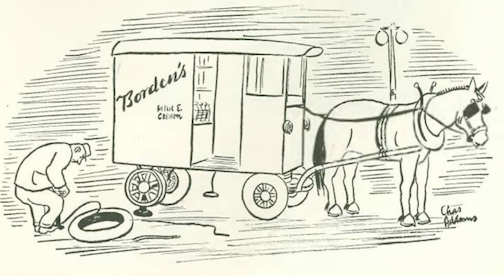
…the “Goings On” section concluded on page four with this drawing by Charles Addams…
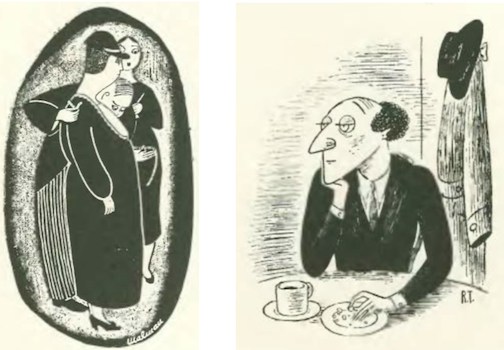
…a couple more spot drawings from the issue by Christina Malman (left) and Richard Taylor…
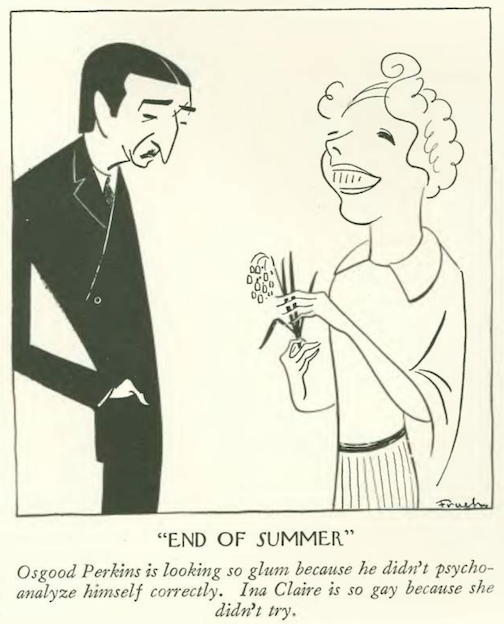
…Al Frueh offered this interpretation of the players in End of Summer…
…and we have Thurber again, with a hard-to-miss distraction…
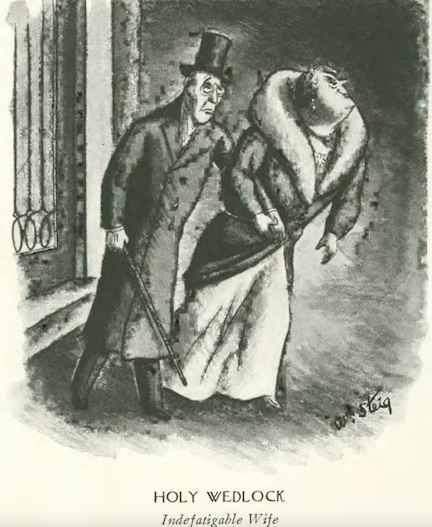
…William Steig continued to explore the varieties of “Holy Wedlock”…
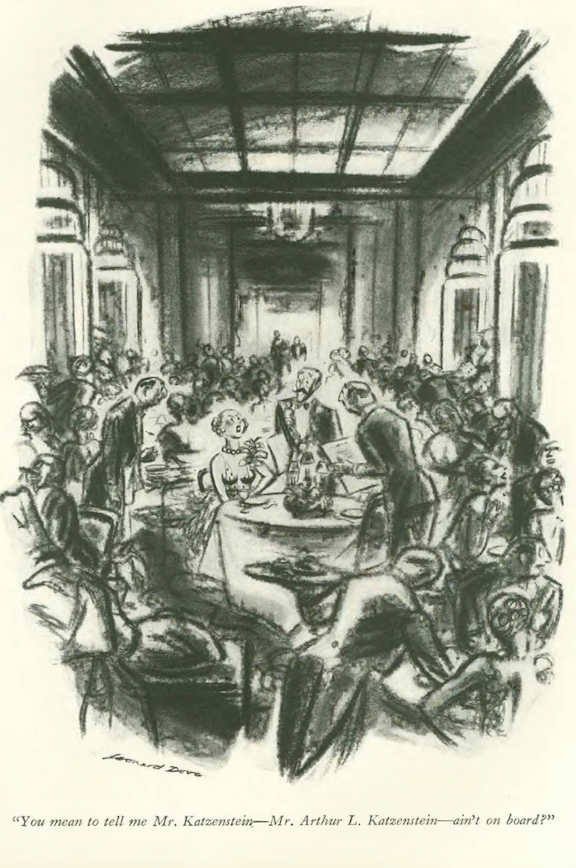
…Leonard Dove gave us a golddigger stranded at sea…
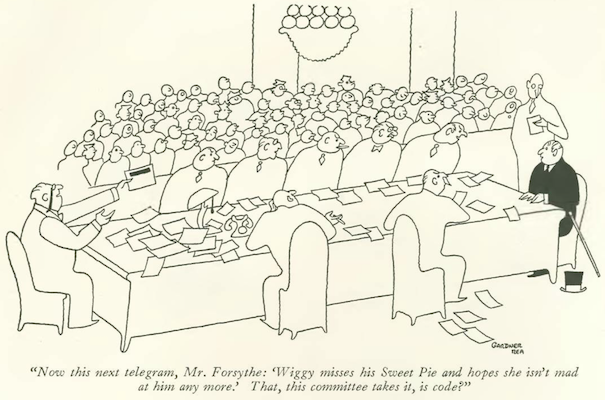
…Gardner Rea put a captain of industry in a tight spot…
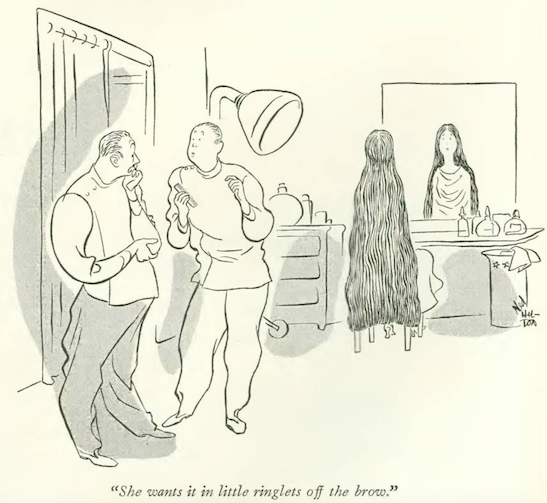
…Ned Hilton encountered a hairy challenge…
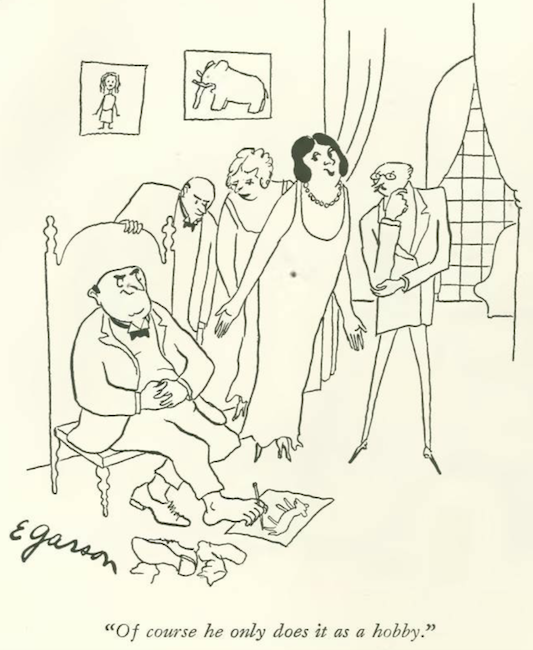
…Eli Garson demonstrated some remarkable foot dexterity…
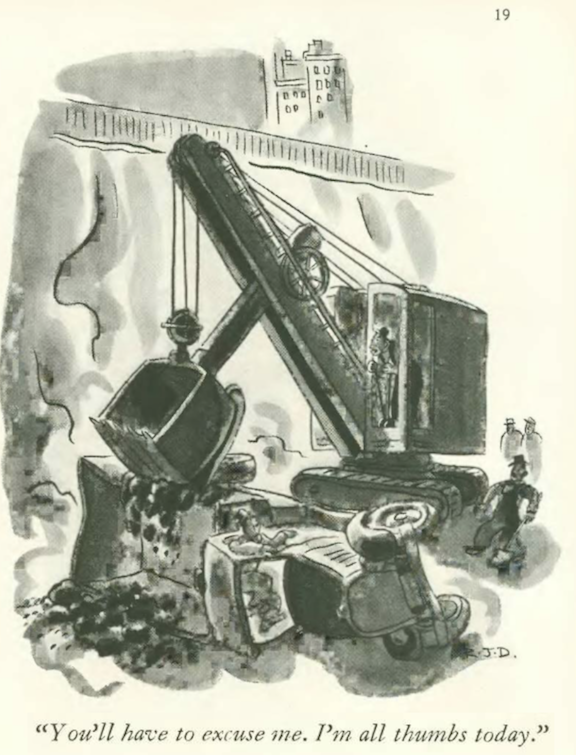
…while Robert Day showed a lack of dexterity a construction site…
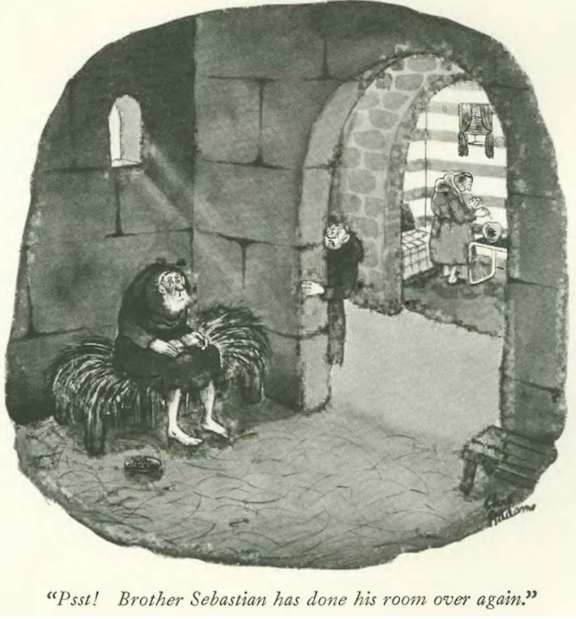
…Charles Addams revealed a materialist in the brotherhood…
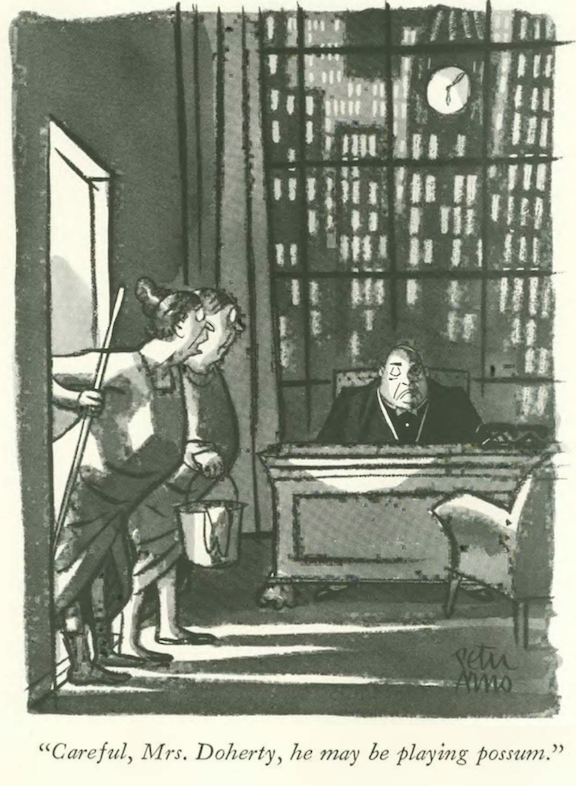
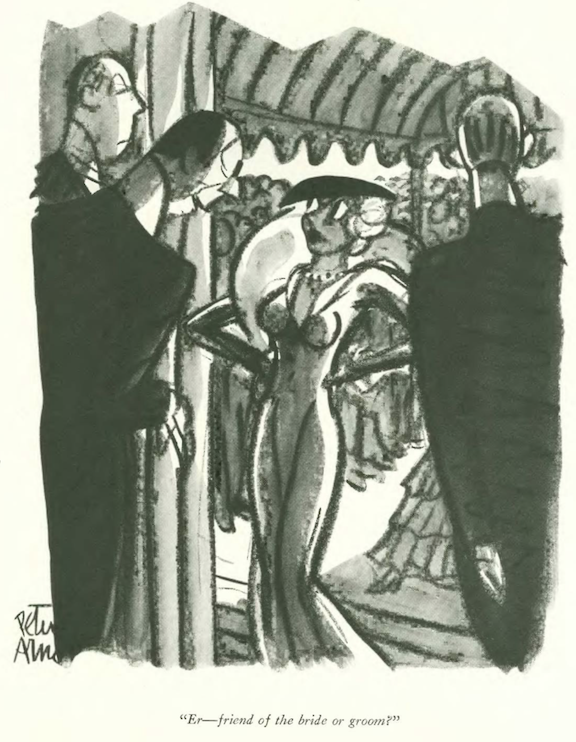
…Peter Arno’s charwomen let a sleeping dog lie…
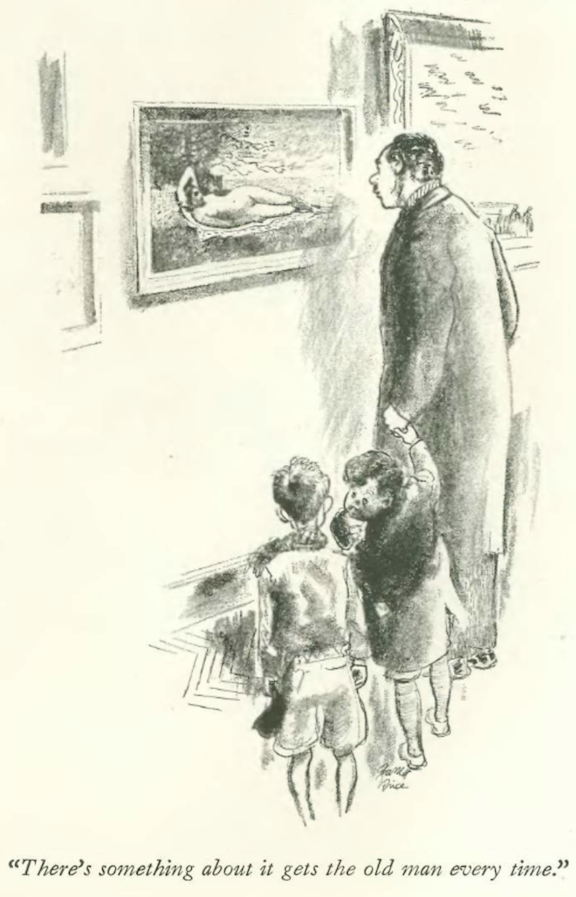
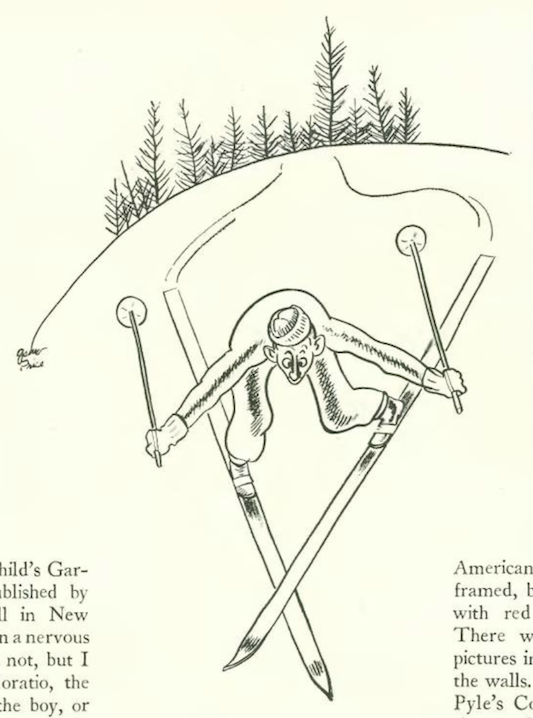
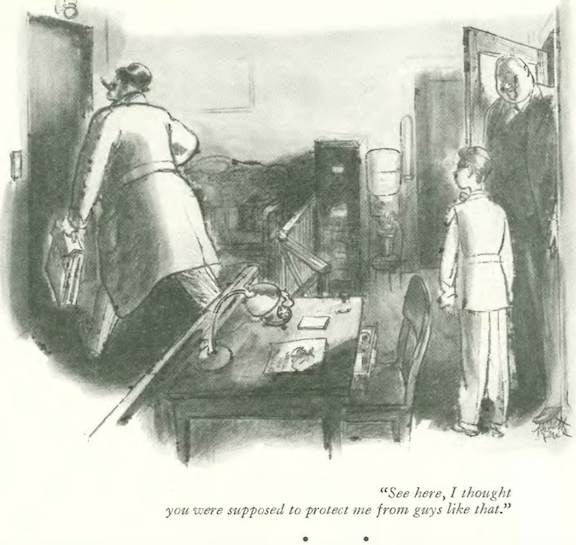
…and we close Garrett Price, and one perceptive lad…
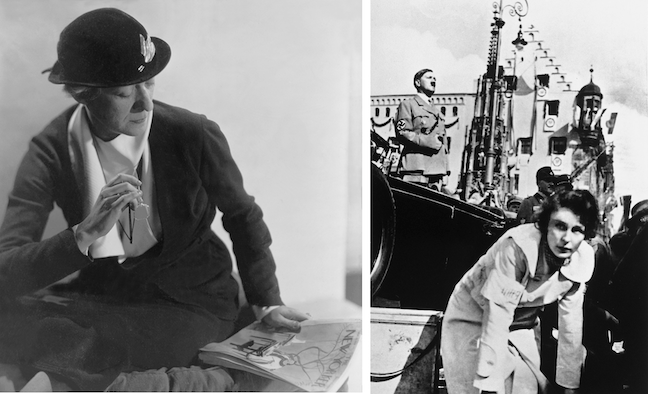
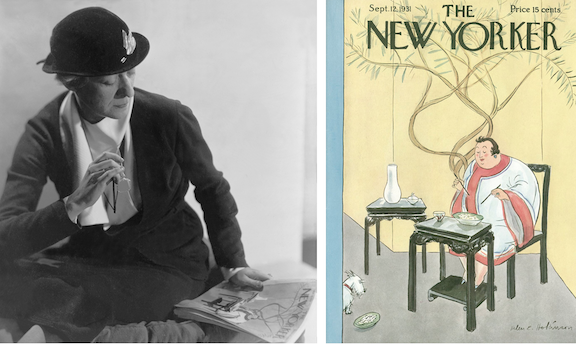
Above, left, Janet Flanner regards the cover of the Sept. 13, 1931 issue of The New Yorker; at right, Adolf Hitler's chosen filmmaker Leni Riefenstahl at Nuremberg's "Shovel Day" parade, 1936. (Library of Congress/Sueddeutscher Verlag)
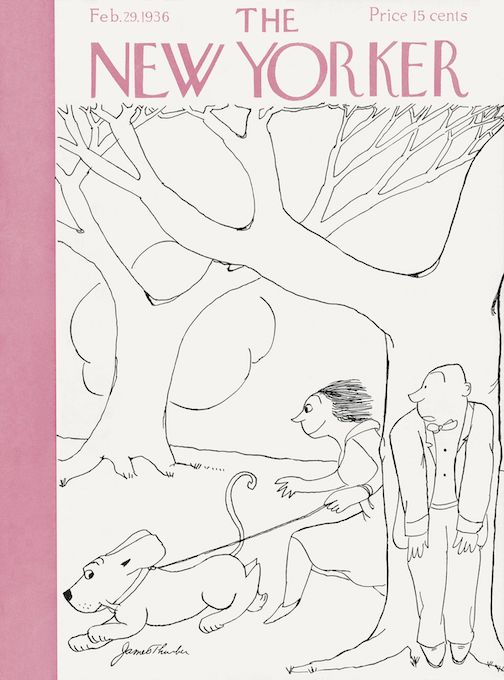
The February 29, 1936 issue stands out from pack not only for its cover—James Thurber’s first—but also for the magazine’s first in-depth look at a man who would spark the deadliest conflict in human history.
February 29, 1936 cover by James Thurber. This was the first of six covers Thurber contributed to The New Yorker. You can see all six covers at Michael Maslin’s Ink Spill, the go-to site for all things Thurber and so much more. UPDATE: Also check Maslin’s post regarding the repeat of this cover on Sept. 4, 2023. Fascinating read!
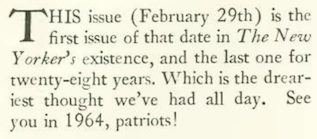
Before we jump in…Thurber’s close friend E.B. White noted another unusual fact about this issue…
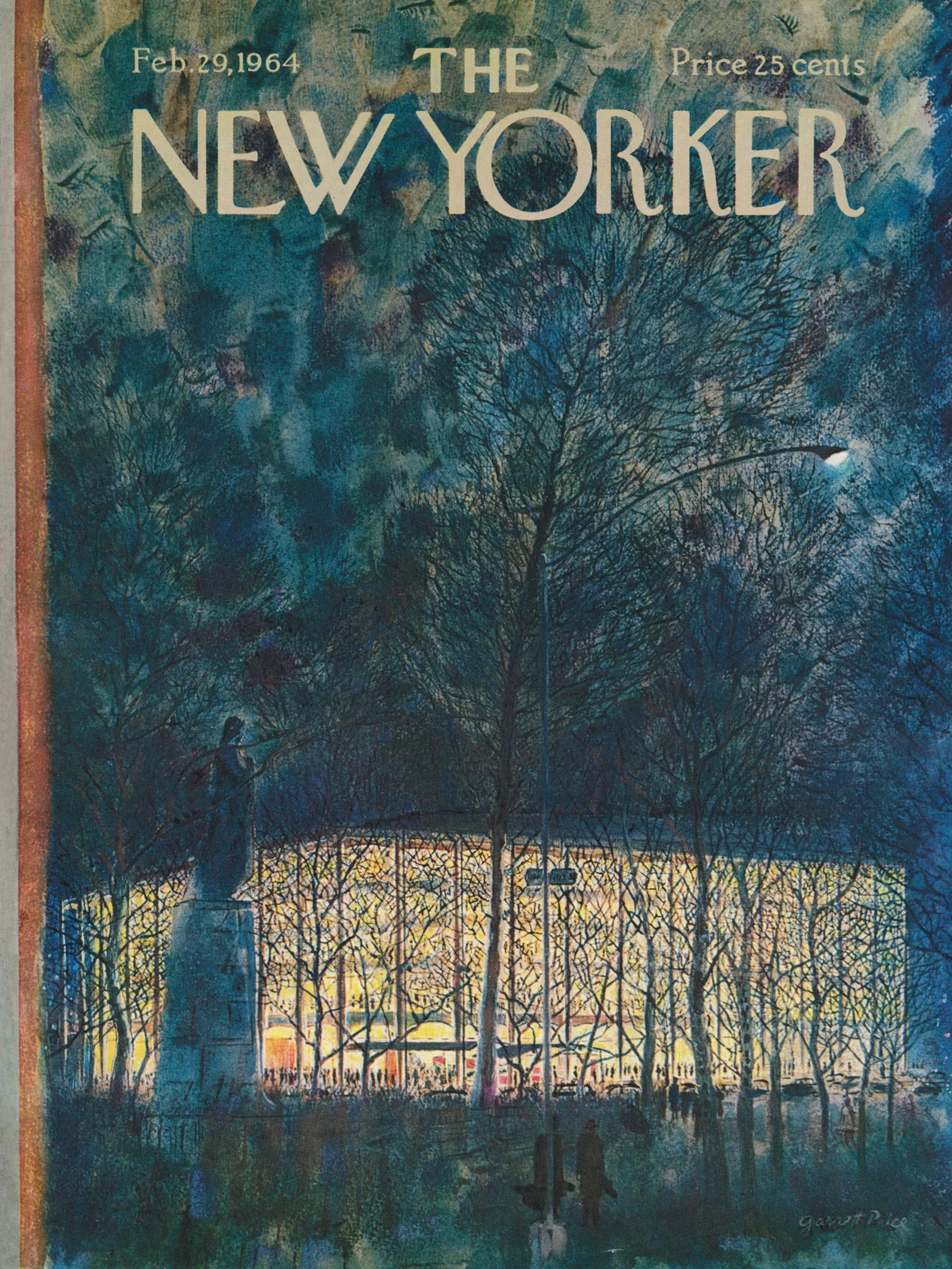
…twenty-eight years later, and a dime extra (cover by Garrett Price)…
* * *
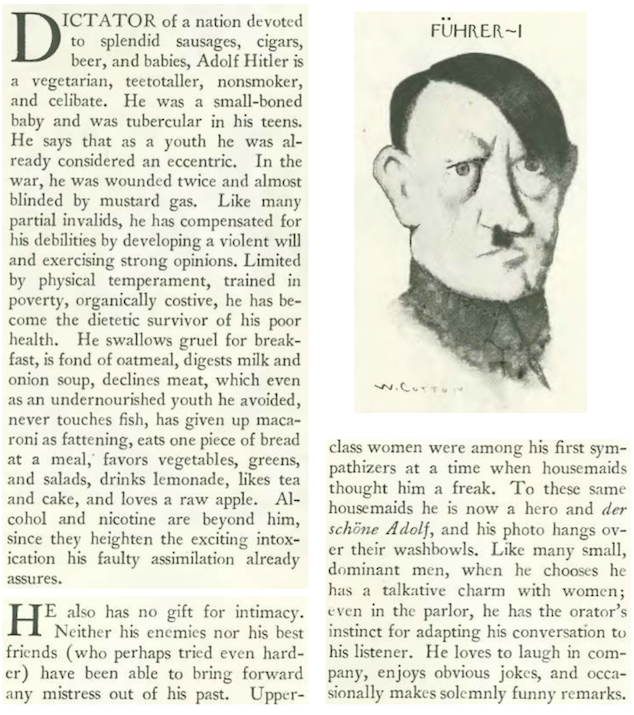
Inside the Feb. 29 issue, The New Yorker’s Paris correspondent Janet Flanner published the first part of a three-part profile on German dictator Adolf Hitler. In this first excerpt she described the Führer’s ascetic diet and personality (caricature by William Cotton).
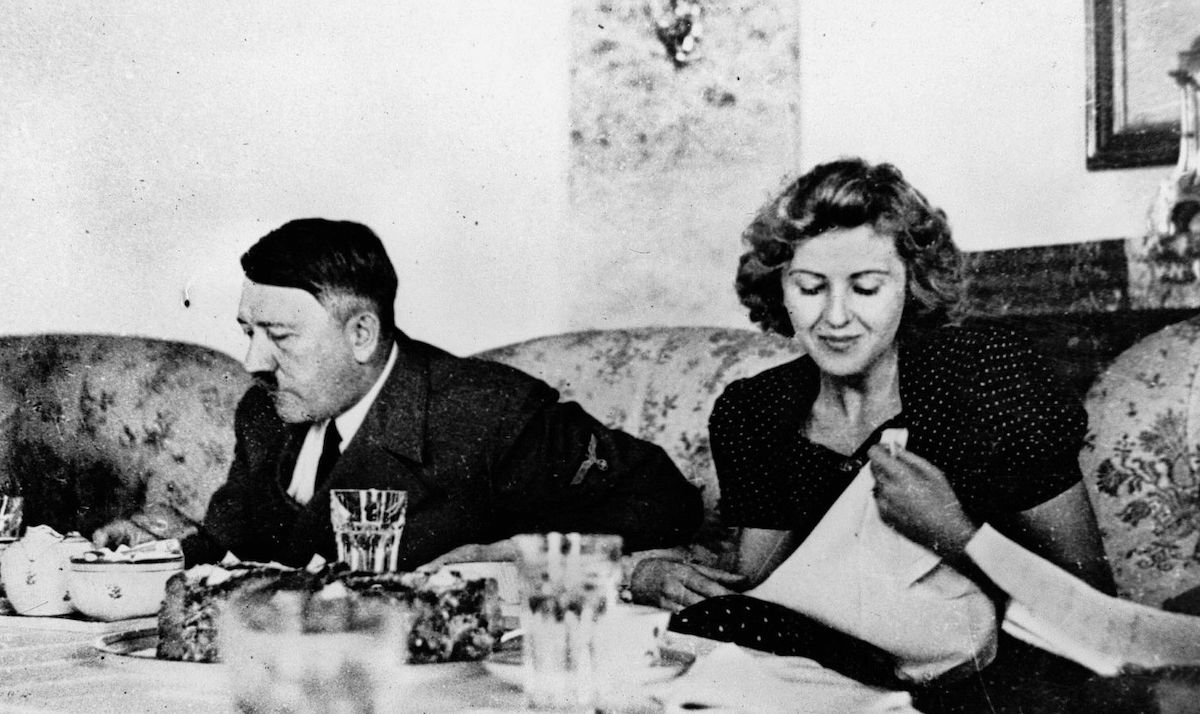
NAZI NUM NUMS….Adolf Hitler with one of his official food tasters, Margot Woelk, during World War II. Woelk later claimed she was the sole survivor from a group of food tasters who were summarily executed by the Red Army after the fall of Berlin. (warfarehistorynetwork.com)
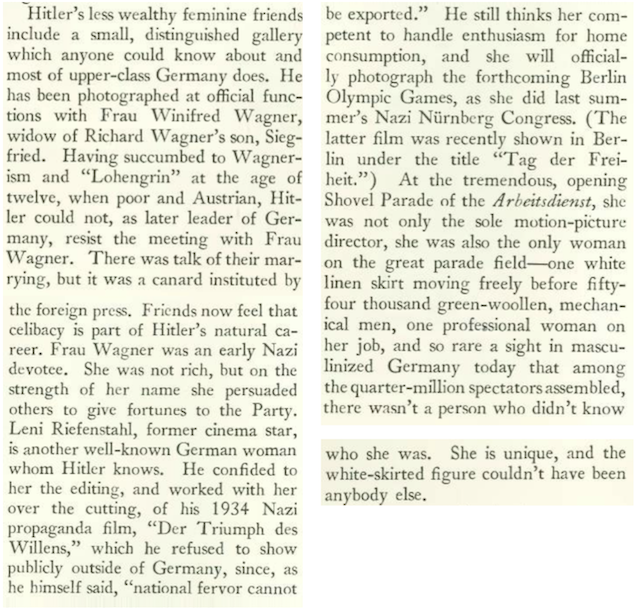
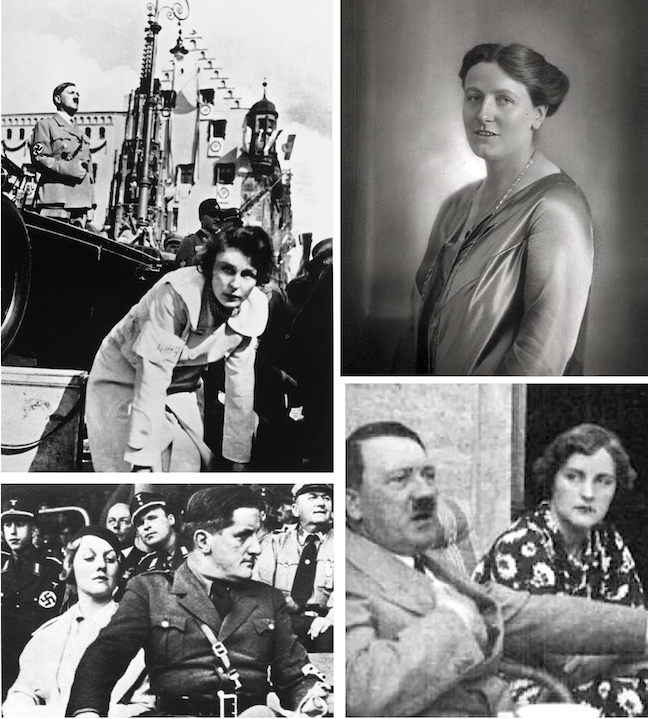
Flanner described Hitler’s relationships with influential women, particularly filmmaker Leni Riefenstahl.
FRIENDS WITH BENEFITS…Adolf Hitler had influential admirers both in and outside of Germany, including, clockwise, from top left, filmmaker Leni Riefenstahl (in the white skirt described by Flanner) at the 1936 “Shovel Day” in Nuremburg; Winifred Wagner, daughter-in-law of composer Richard Wagner, in 1925; Hitler with Unity Mitford, one of six aristocratic Mitford sisters and a fanatical Nazi; Ernst Franz Sedgwick Hanfstaengl with another Mitford sister, Diana Mitford, at a 1934 Nuremberg rally. Diana as married to Oswald Mosley, leader of the British Union of Fascists, and Hanfstaengl was the son of Katharina Wilhelmina Hanfstaengl, a prominent Munich art publisher who helped finance Hitler’s rise to power. (Sueddeutscher Verlag/Wikipedia/historyreader.com)
Flanner concluded the piece with a look at Hitler’s sexuality, which seemed non-existent, and drew an ominous conclusion about his personality type.
EXPENDABLE…Ernst Röhm with Adolf Hitler in 1933. Although Hitler knew Röhm was gay, he also valued Röhm’s leadership and organizational skills, that is until his presence proved a liability. Röhm was murdered by the SS in 1934 during the “Night of the Long Knives.” (Wikipedia)
As part of a centenary series, The New Yorker’s Andrew Marantz recently looked at Flanner’s profile of Hitler, noting that she was “neither an antifascist, like her friend Dorothy Parker, nor a Fascist, like her friend Ezra Pound; she was against crude bigotry, but she was not the world’s greatest philo-Semite.”
* * *
Lamour Amour
In his “Notes and Comment,” E.B. White pointed out the challenges of expressing physical beauty over a non-visual medium like radio:
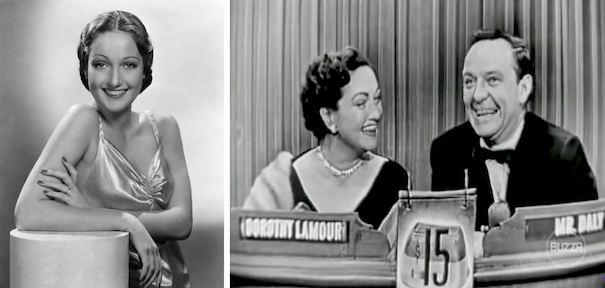
TELEGENIC…Hopefully E.B. White managed to see Dorothy Lamour on the “television waves… bumping along over the Alleghenies.” At left, publicity photo of Lamour from 1937; at right, Lamour appeared as a mystery guest on What’s My Line?, Feb. 20, 1955, seen here with host John Daly. In later years Lamour was a guest on a number of television shows, ranging from Marcus Welby, M.D. to Remington Steele. (Wikipedia/YouTube.com)
* * *
Shadow Plays
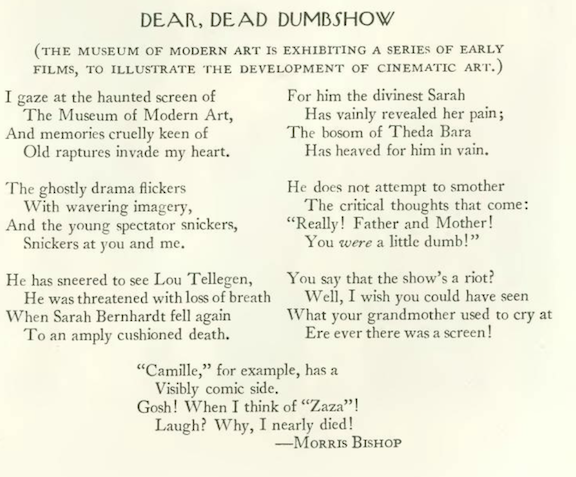
Morris Bishop (1893-1973), a noted scholar of the Middle Ages as well as a writer of light verse, offered up these lines after screening early silent films at the Museum of Modern Art. The screenings were curated by Iris Barry to showcase MoMA’s new film library and to advance the study of film as a serious art form.
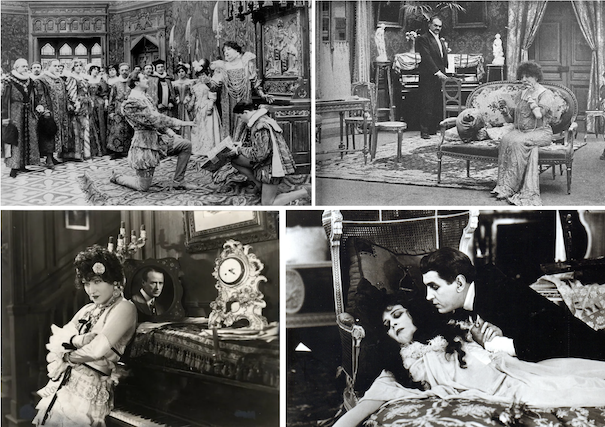
TIME CAPSULES…The Museum of Modern Art was a pioneer in the study of film as a modern art form. Among the films screened at MoMA in 1936 (clockwise, from top left): famed stage actress Sarah Bernhardt as Queen Elizabeth in the Les Amours de la reine Élisabeth (The Loves of Queen Elizabeth) with Lou Tellegen, 1912; Bernhardt in the film Camille (La Dame aux camélias) with André Calmettes, 1911; Theda Bara’s 1917 take on Camille, in a scene with Alan Roscoe; Gloria Swanson in Zaza, 1923. (Wikipedia/imdb.com/YouTube.com)
* * *
A Reporter’s Chops
With so much attention given to James Thurber as a humorist, it is easy to forget that he was an experienced journalist, and that he could apply his considerable gifts as a writer to narrative non-fiction. For the Feb. 29 “A Reporter at Large” column, Thurber penned “Crime in the Cumberlands.”I can’t do it justice through excerpts, but I highly recommend giving it a read as a prime example of Thurber’s skills as a reporter.
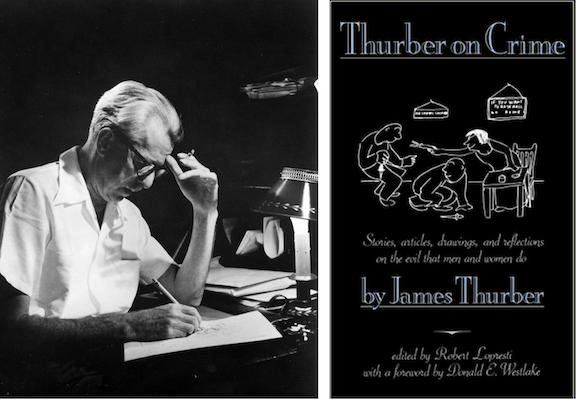
SERIOUSLY SERIOUS WRITER…You can find both humorous and not-so-humorous crime stories (and drawings, of course) in 1991’s Thurber on Crime, edited by Robert Lopresti. “Crime in the Cumberlands” is included in the collection. (jamesthurber.org/barnesandnoble.com)
* * *
At the Movies
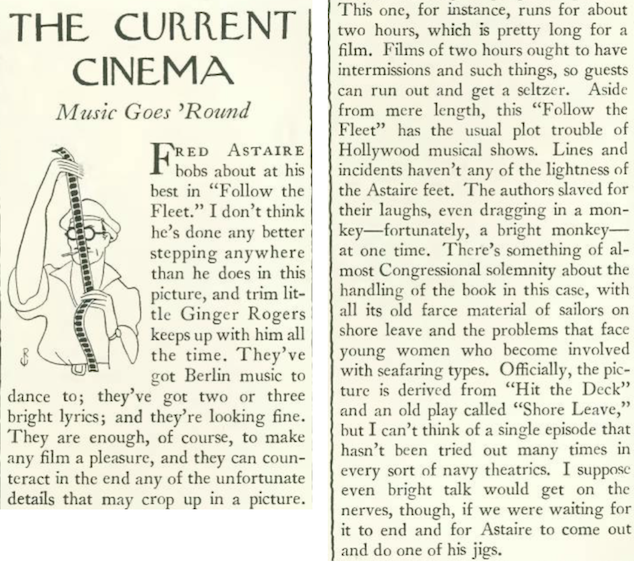
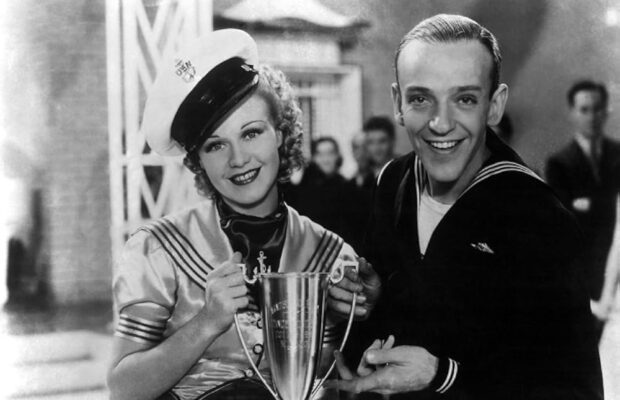
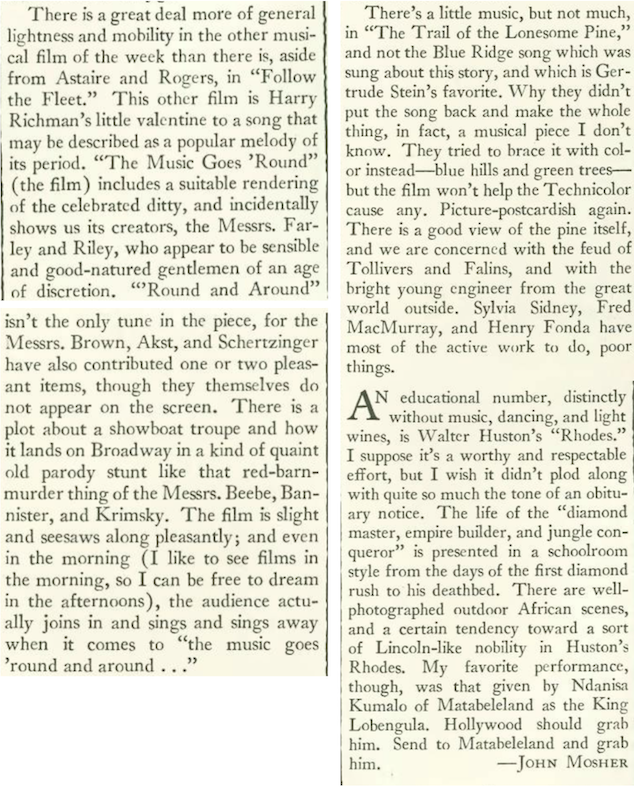
Not so serious were the films being churned out by Hollywood, including the Fred Astaire/Ginger Rogers toe-tapper Follow the Fleet, set to an Irving Berlin score that featured the hit “Let’s Face the Music and Dance.” Critic John Mosher was on board for the ride.
GOOD CLEAN FUN…Dance partners “Bake” Baker (Fred Astaire) and Sherry Martin (Ginger Rogers) find love during shore leave in Follow the Fleet.(Toronto Film Society)
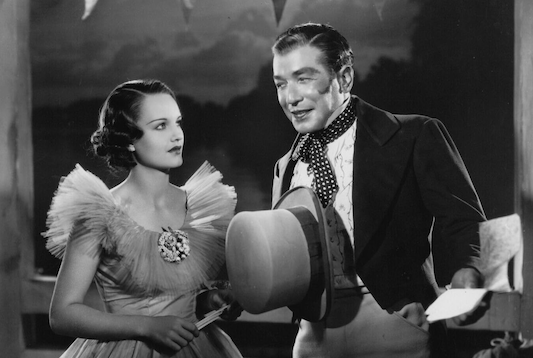
Bandleader Harry Richman, well known in the New York nightlife scene of the 1920s and 30s, showed his acting chops in The Music Goes ‘Round…
I CAN SING TOO…Rochelle Hudson and Harry Richman in The Music Goes ‘Round. (imdb.com)
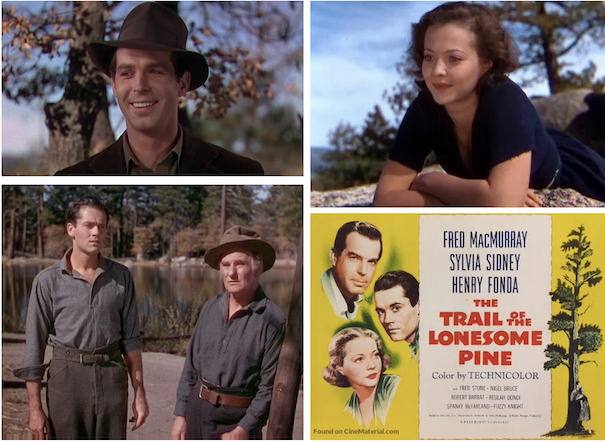
…Fred MacMurray, Sylvia Sydney, Henry Fonda and Fred Stone appeared in living color in The Trail of the Lonesome Pine–it was just the second full-length feature to be shot in three-strip Technicolor and the first to be shot outdoors in Technicolor…
LIFELIKE…Clockwise, from top left: Fred MacMurray; Sylvia Sydney; a Paramount movie poster; Henry Fonda and Fred Stone.(moviesalamark.com/imdb.com)
…the 1936 film Rhodes (aka Rhodes of Africa) featured the massive acting talents of Walter Huston and Peggy Ashcroft; not surprisingly, the subject matter of the film has not aged well…a 2015 review in The Guardianis headlined: “Rhodes of Africa: only slightly less offensive than the man himself”…
COLONIAL KLINK…Walter Huston and Peggy Ashcroft in Rhodes.(imdb.com)
* * *
From Our Advertisers
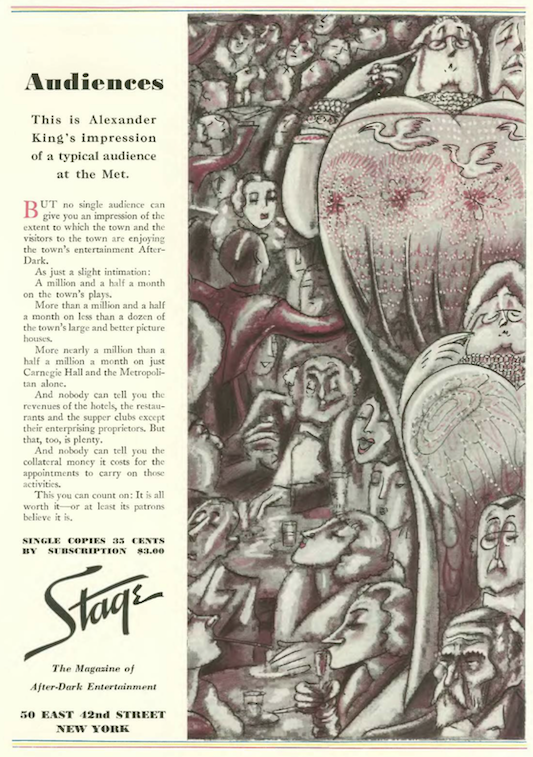
We begin with a Stage magazine ad from the inside front cover, featuring an illustration by Alexander King…
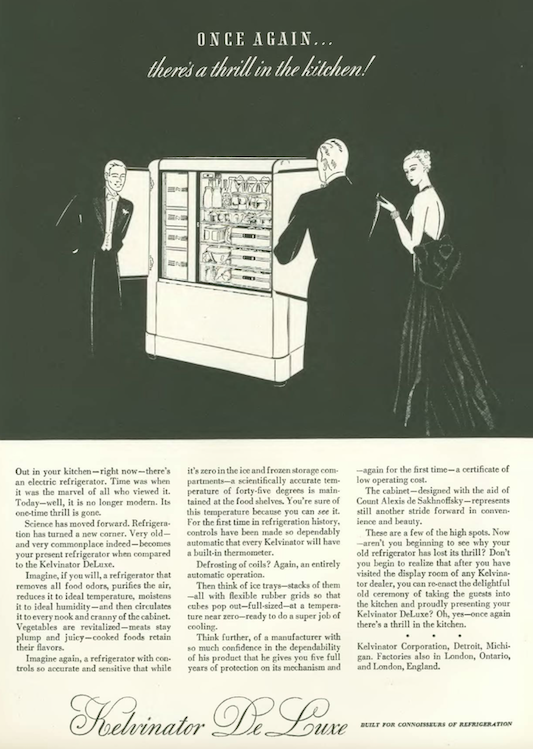
…only new-money swells would be seen doing this…old money wouldn’t dare enter the kitchen, unless they needed to sack the cook…
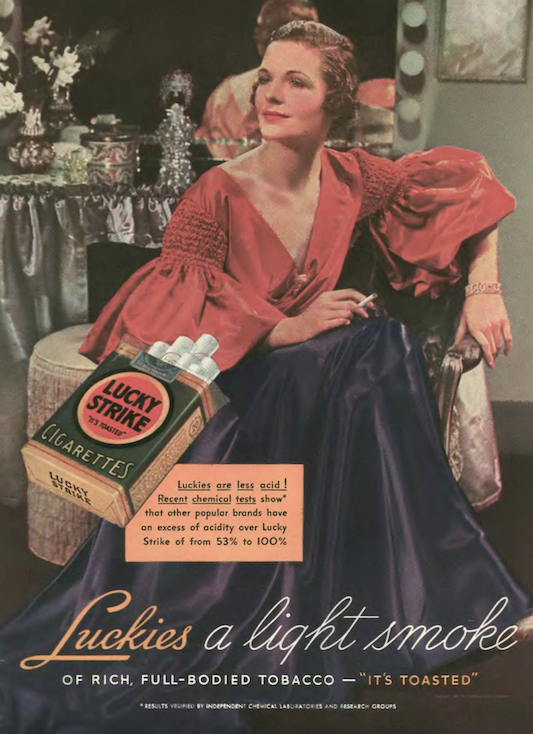
…on the back cover of the Feb. 29 issue you would find this elegant woman taking a break from her vanity to enjoy a “toasted” Lucky…
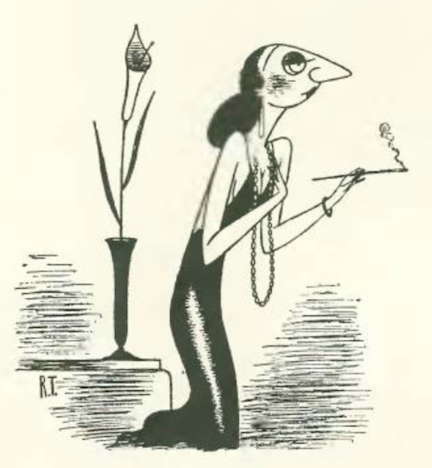
…we join our cartoonists, starting with this spot by Richard Taylor…
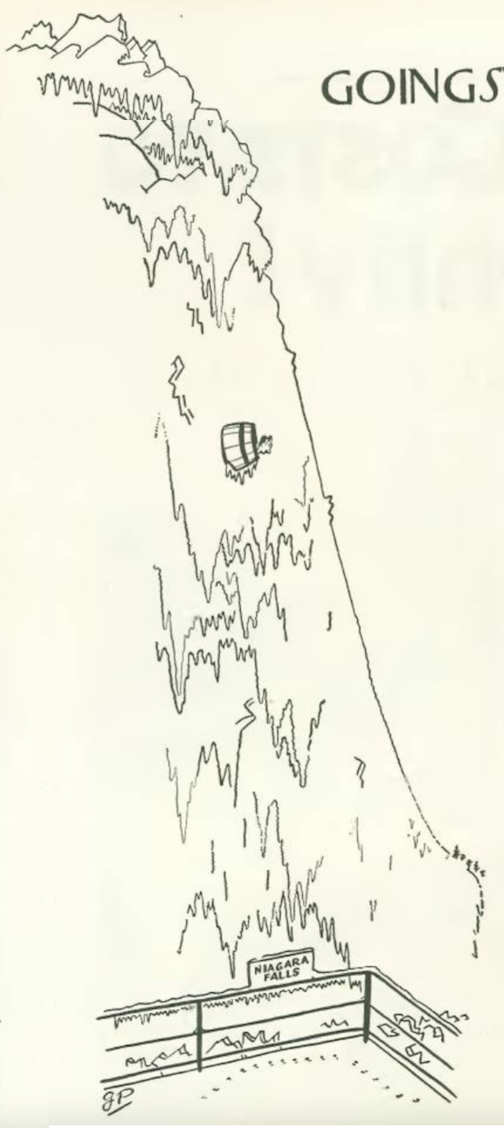
…Garrett Price got stuck over the frozen falls…
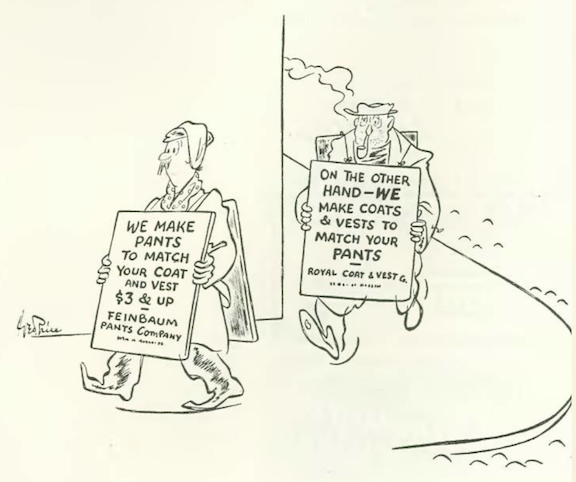
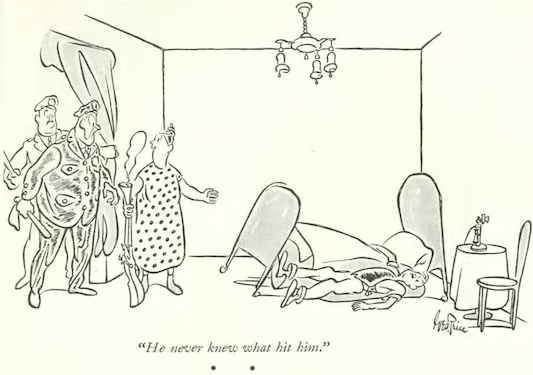
…George Price drew up a sandwich board competition…
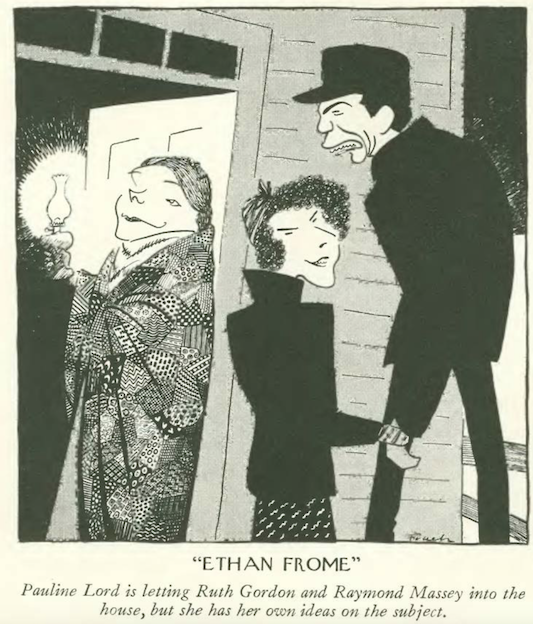
…Al Frueh continued to illuminate “The Theatre” section…
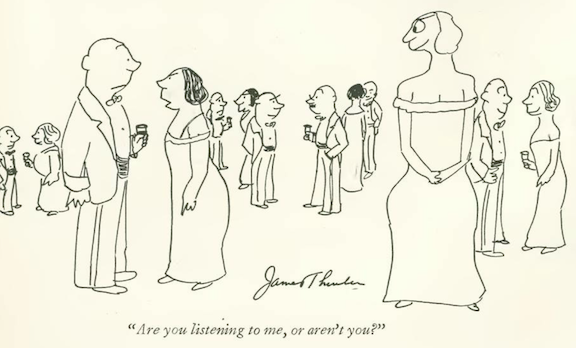
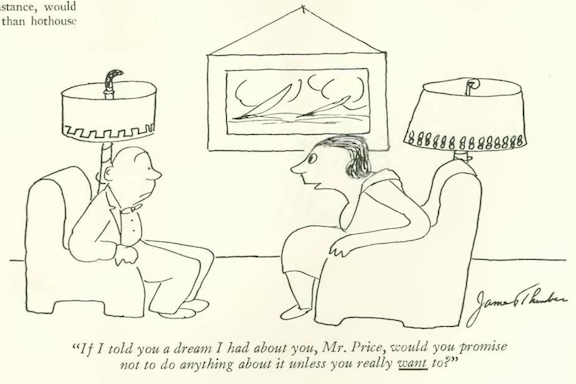
…James Thurber posed a loaded question…
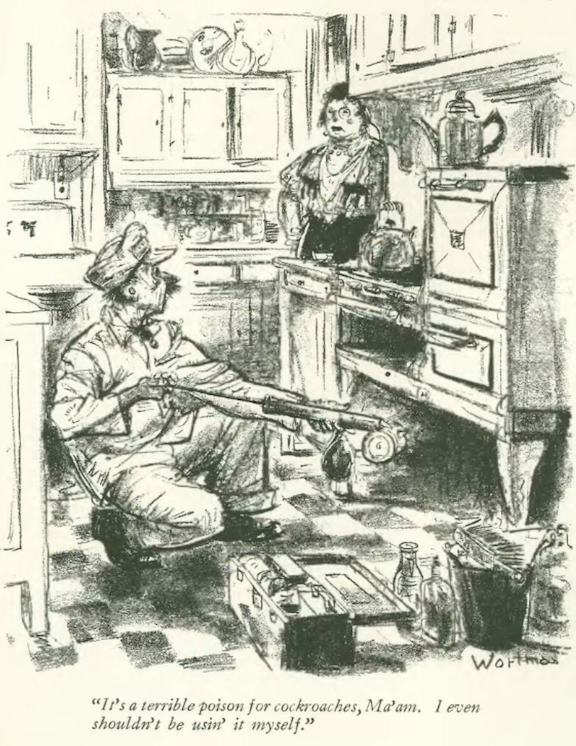
…Denys Wortman got down to some debugging…
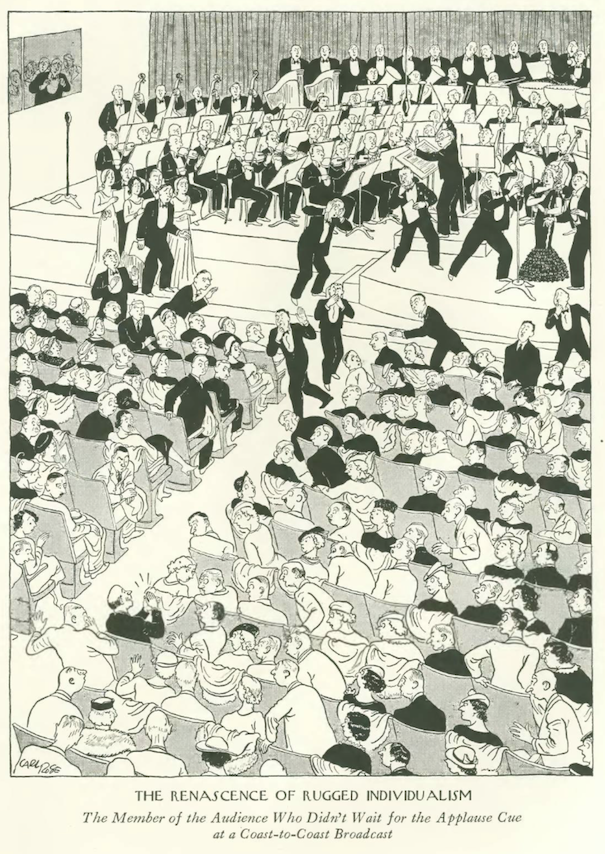
…Carl Rose offered up another example of rugged individualism…
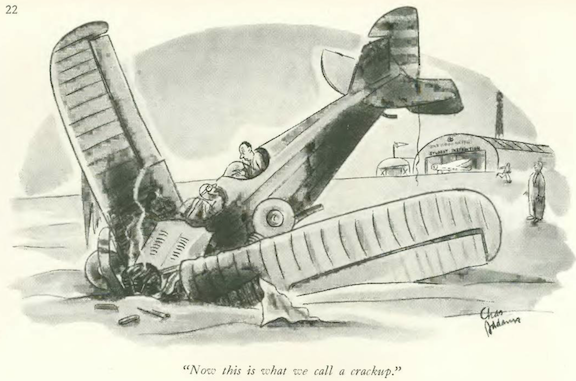
…Charles Addams came down to earth…
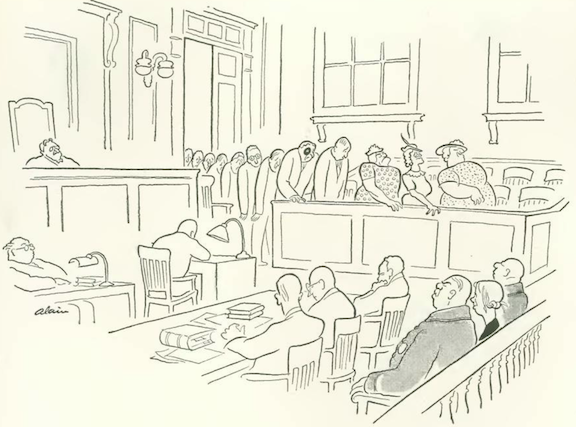
…Alain illustrated a case of jury tampering…
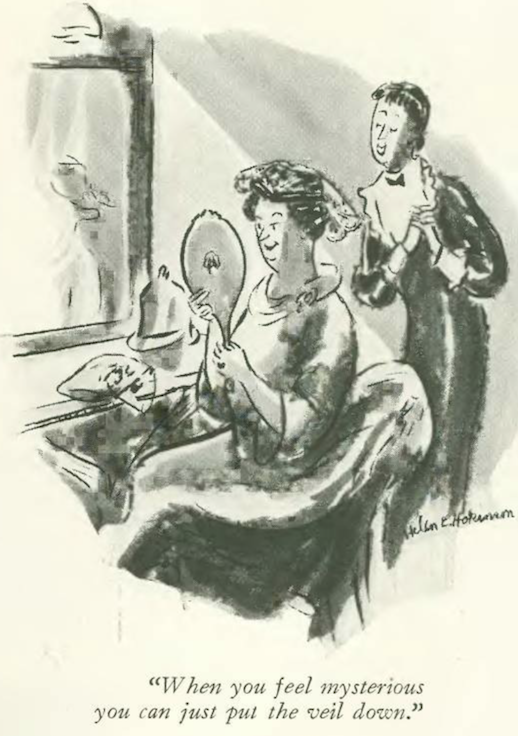
…Helen Hokinson demonstrated the allure of a netted hat…
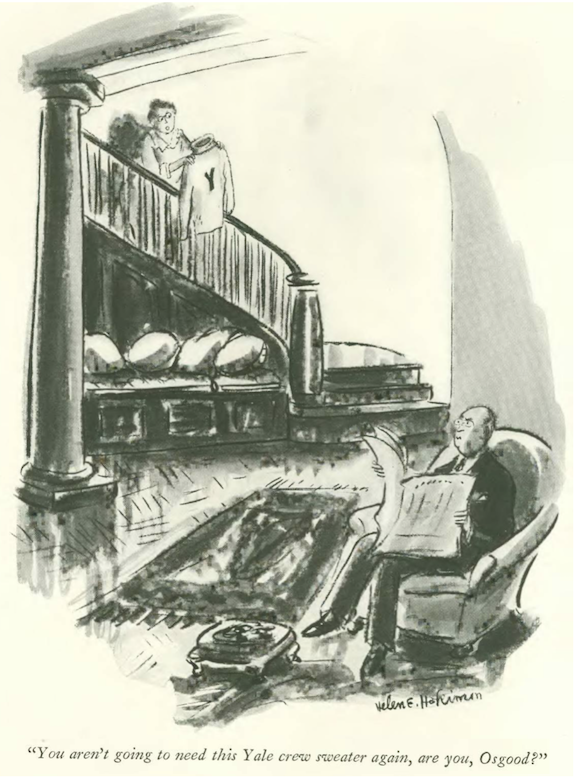
…and Hokinson again, doing some early spring cleaning…
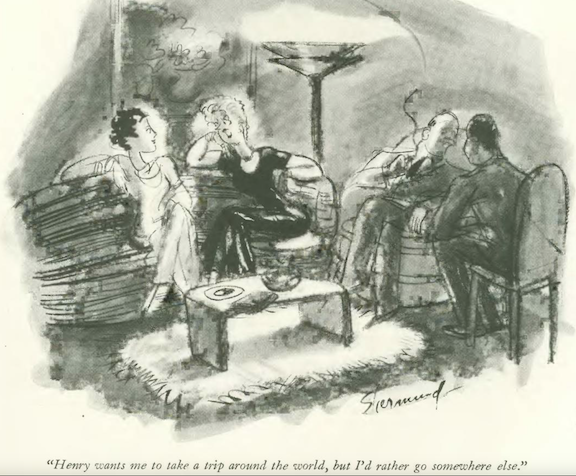
…and Barbara Shermund explored the idyll of wanderlust…
…and before we go, here is the New Yorker cover—by Helen Hokinson, Sept. 12, 1931—that was the object of Janet Flanner’s attention…
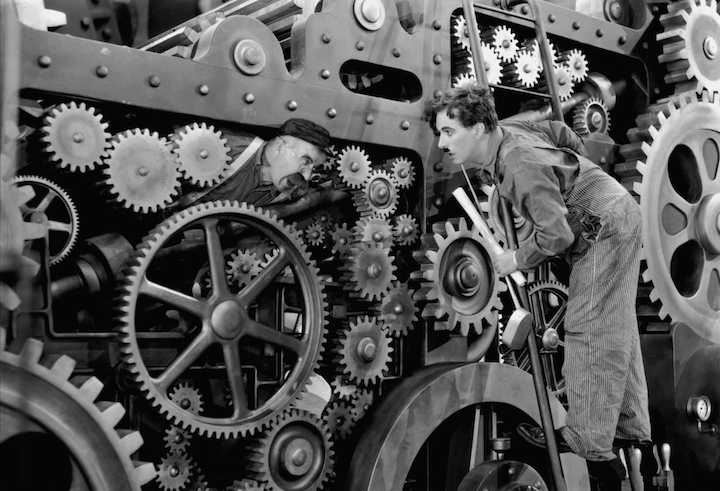
Above: A mechanic (Chester Conklin) gets caught up in his work with the help of the Tramp (Charlie Chaplin) in Modern Times. (festival-entrevues.com)
The film Modern Times was Charlie Chaplin’s last performance as “The Tramp” (or, “The Little Tramp”), a character he created more than twenty years earlier to represent a simple person’s struggle to survive in the modern world. That struggle was no more apparent than in Modern Times, a film in which the Tramp faced the dehumanizing industrial age in all its kooky complexity.
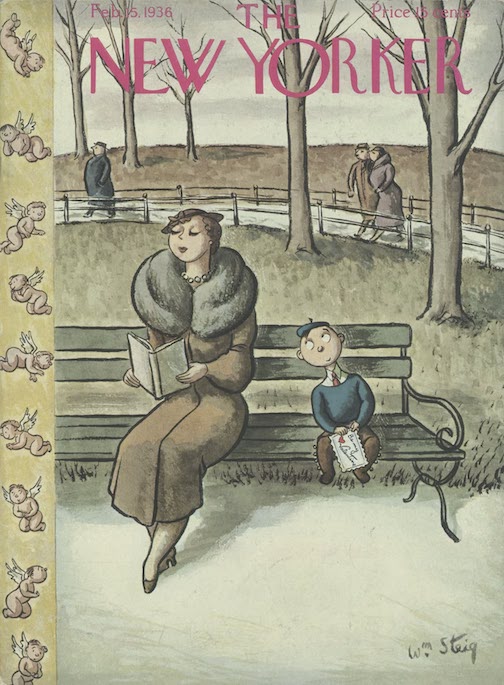
A sweet Valentine’s Day-themed cover by William Steig, February 15, 1936.
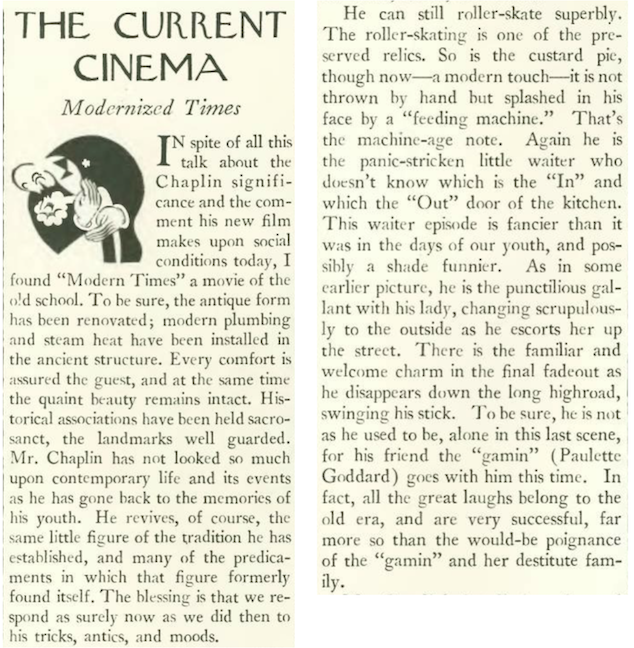
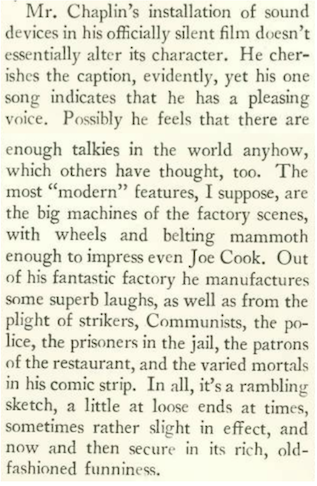
The film is notable for being Chaplin’s first picture to feature sound, and the first in which Chaplin’s voice is heard—singing Léo Daniderff’s comical song “Je cherche après Titine” (although Chaplin replaced the lyrics with gibberish). Modern Times was nevertheless filmed as a silent, with synchronized sound effects and a small amount of dialogue. Critic John Mosher appreciated the movie as being “of the old era,” not anticipating that it would become one of cinema’s most iconic and beloved films.
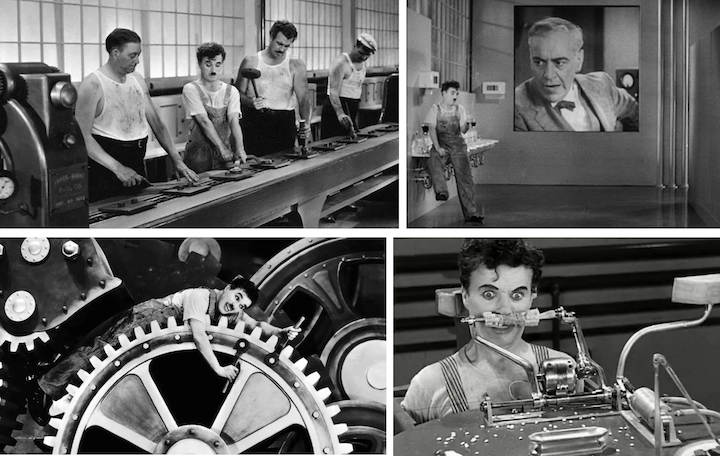
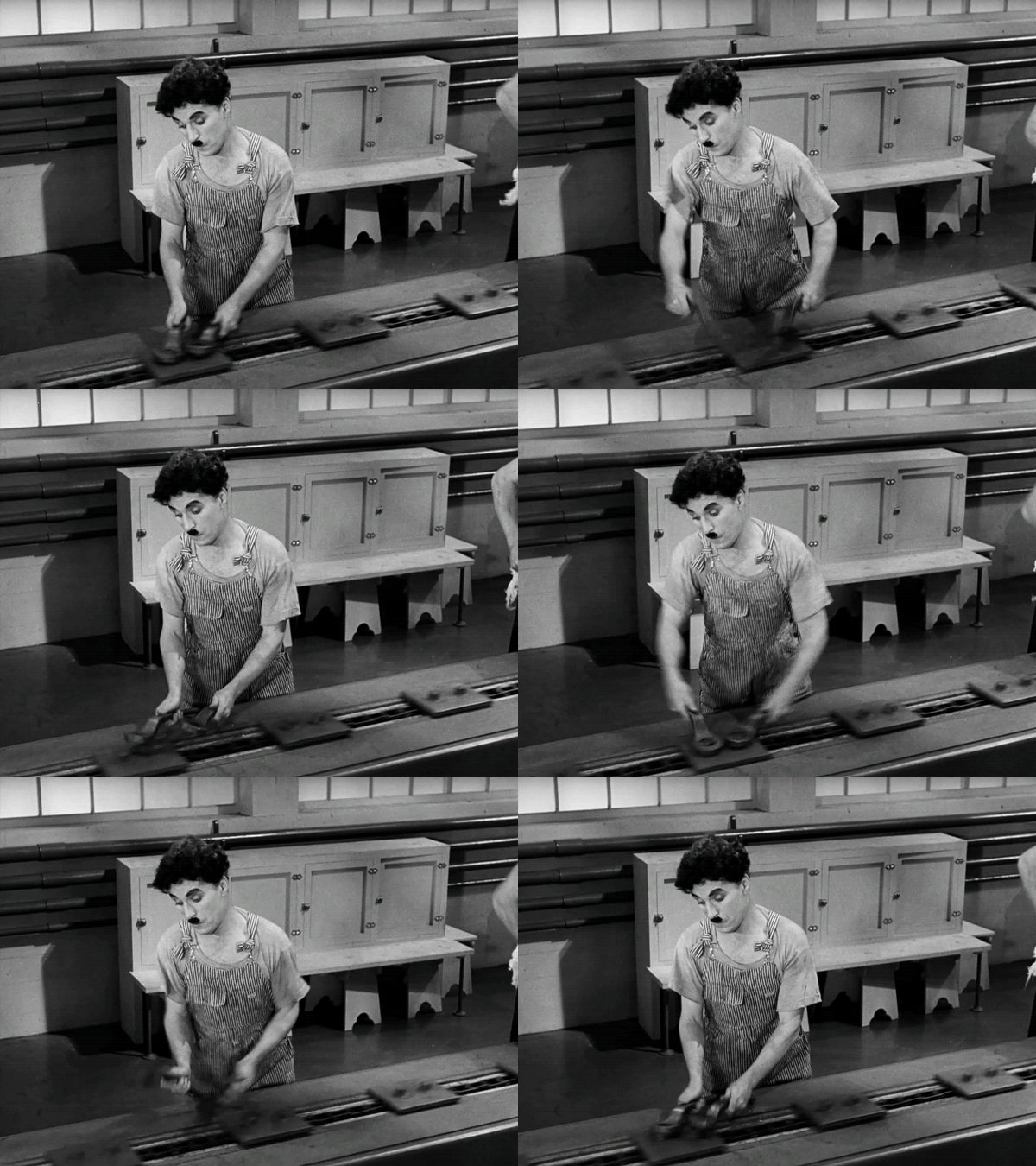
JUST A COG IN THE MACHINE…Clockwise, from top left: Repetitive assembly line work drives the Tramp (Charlie Chaplin) to a nervous breakdown; the steel factory is an Orwellian world where the president (Allan Ernest Garcia) constantly monitors his workers—even in the bathroom where the Tramp is caught taking a break; the company tries out a new lunch efficiency machine on the Tramp, with mixed results; iconic image of the Tramp at work. (medium.com/YouTube.com)(thetwingeeks.com)
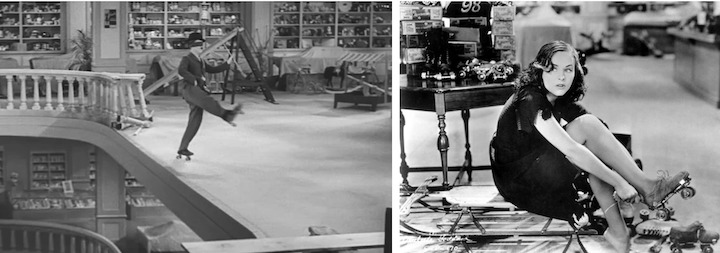
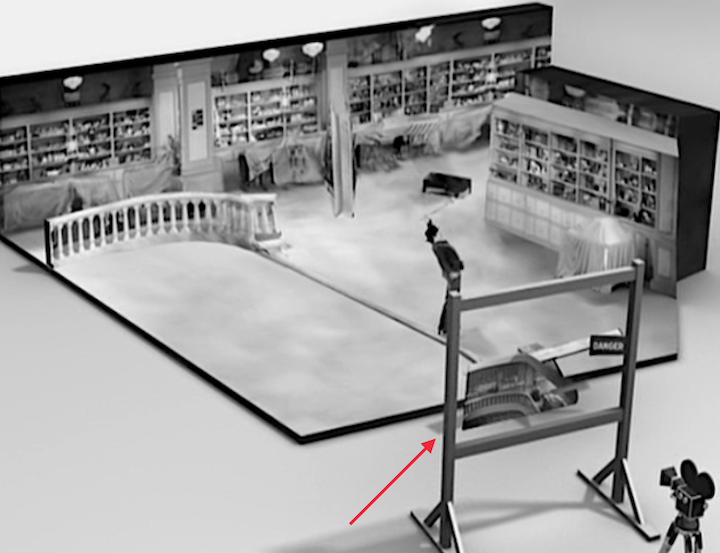
One of the film’s best stunts involved the blindfolded Tramp rollerskating on the fourth floor of an under-construction department store; Chaplin employed a matte painting, perfectly applied on a glass pane in front of a camera, to create the illusion of a sheer drop-off. Even as an illusion, Chaplin’s skating skills were remarkable.
HIGH ANXIETY…The blindfolded Tramp (Charlie Chaplin) skates precariously close to a sheer drop-off on the fourth floor of a department store while his companion, an orphan girl known as “The Gamin” (Paulette Goddard) puts on her skates, unaware of his peril. (YouTube.com)
The model below shows how the effect was achieved, filming next to a glass-mounted matte painting to create the illusion of a sheer drop off…
(reddit.com)
In his conclusion, Mosher found the film to be “secure in its rich, old-fashioned funniness.”
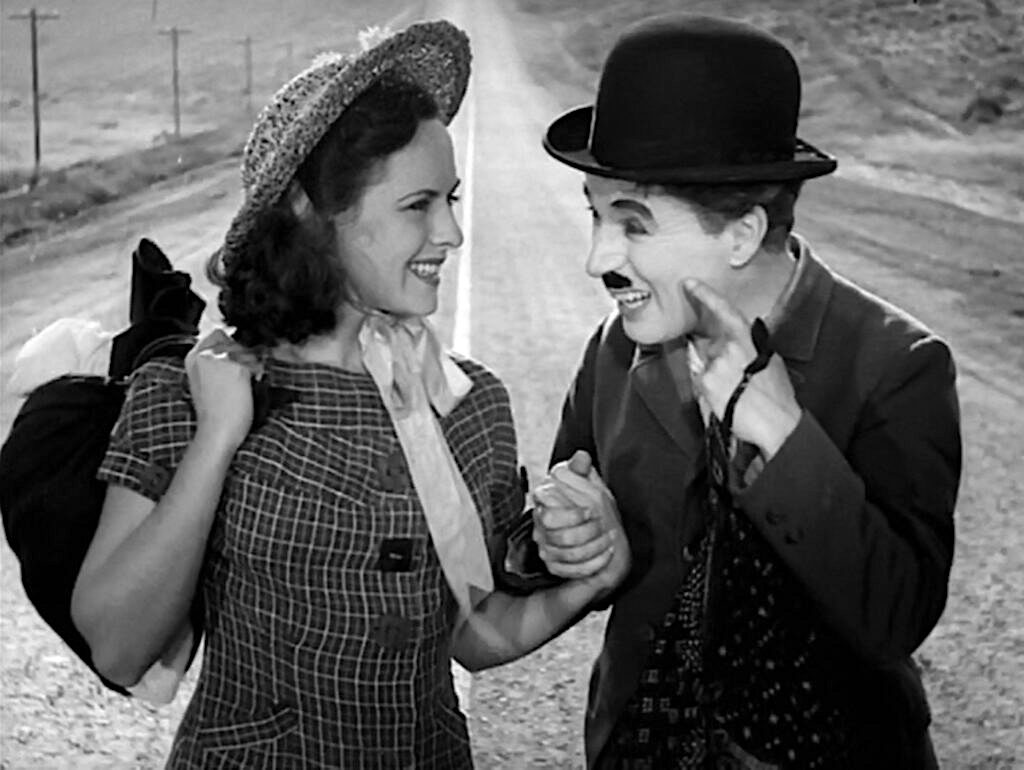
Chaplin gave a happy send-off to the Tramp, who at the end of earlier films walked down the road alone. Modern Times closed with the Tramp and the Gamin walking hand in hand, dreaming of a life together.
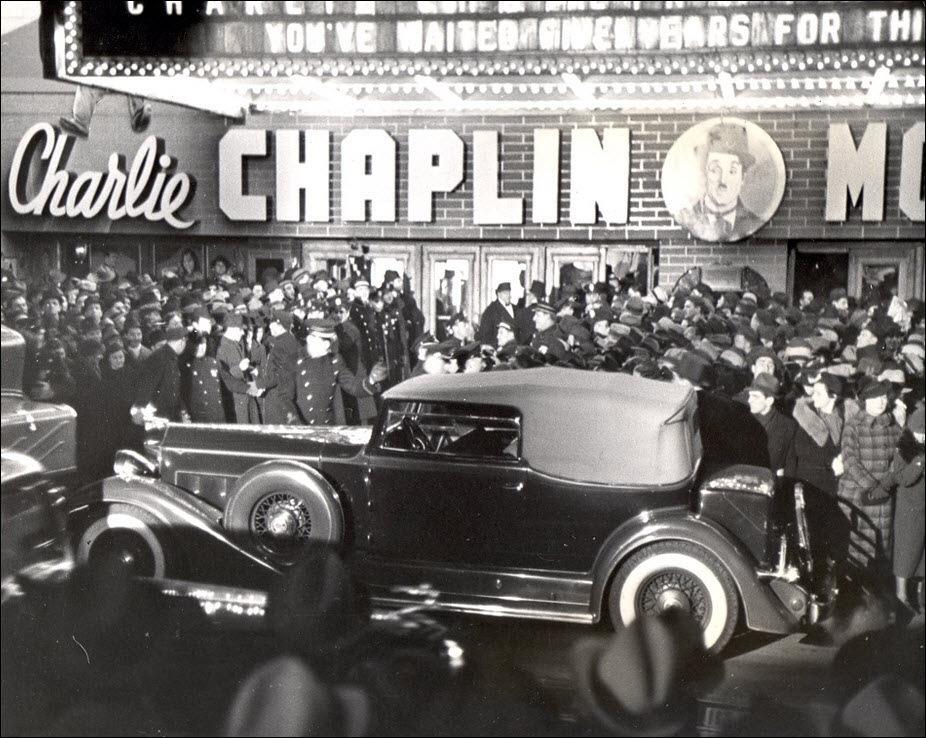
FOND FAREWALL…Paulette Goddard joined Charlie Chaplin on the road at the end of Modern Times. Goddard became Chaplin’s third wife in 1936. (the-cinematograph.com)THE TRAMP RETURNS…World premiere of Modern Times, Feb. 5, 1936, at the Rivoli Theatre in New York City. The film was one of the top-grossing films of 1936. (Wikipedia)
A final note: The website The Twin Geeks offers an excellent synopsis and analysis of Modern Times.
* * *
Bachelor King
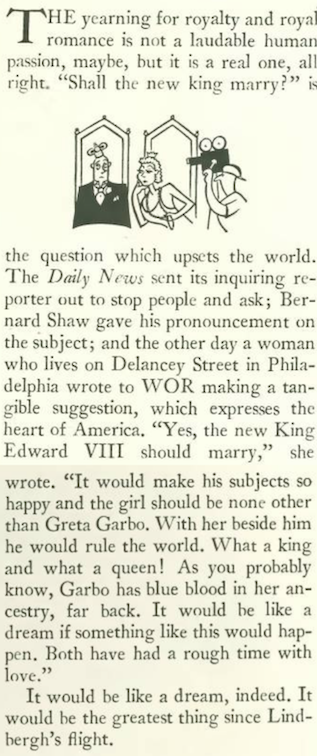
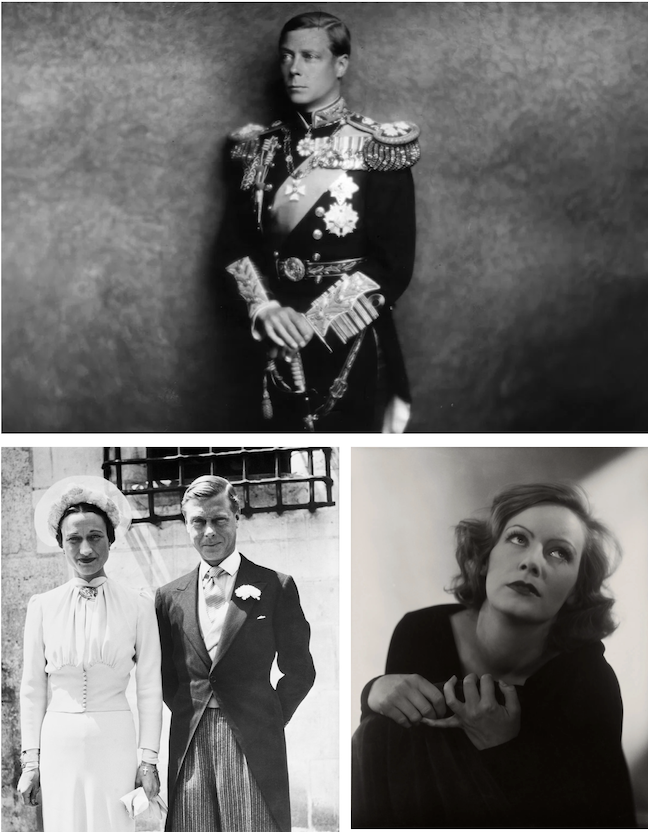
In his “Notes and Comment,” E.B. White wrote about the ascension to the British throne by Edward VIII following the death of his father, George V. In this excerpt, White considered a question raised by the Daily News regarding the king’s plans to marry (a question answered a few months later when Edward announced his plan to wed American divorcee Wallis Simpson, which led to a constitutional crisis and Edward’s subsequent abdication).
BUT I DON’T WANNA BE KING…The reluctant king Edward VIII would choose love over the crown when he abdicated the throne in December 1936 to marry Wallis Simpson (bottom left); E.B. White noted one woman’s suggestion that the king should marry actress Greta Garbo, since “Both have had a rough time at love.” (highland titles.com/George Eastman Museum)
* * *
By Any Other Name
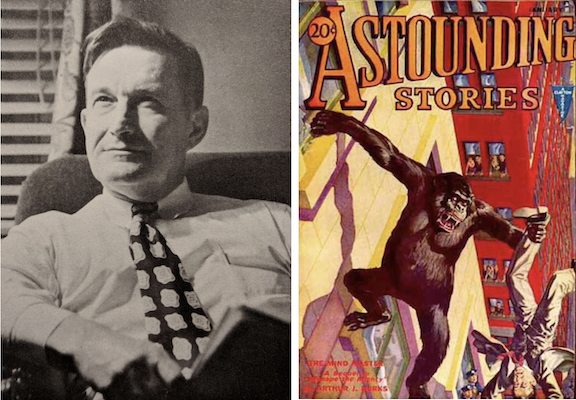
“The Talk of Town” featured a profile of Arthur J. Burks, a prolific writer of pulp fiction who published everything from detective stories to science fiction under a half-dozen pseudonyms. A brief excerpt:
A CURIOUS MIND…Arthur J. Burks (1898–1974) and the cover of Astounding Stories, January 1932, which featured the first part of his two-part tale, “The Mind Master.” Burks produced around eight hundred stories for the pulps, twenty-nine of which appeared in the magazine Weird Tales. (findagrave.com/gutenberg.org)
* * *
A Day in the Life
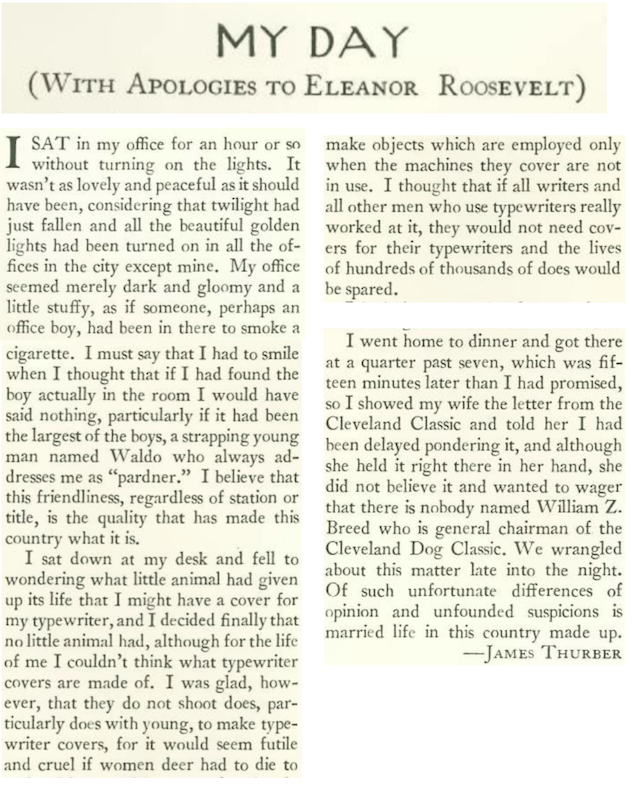
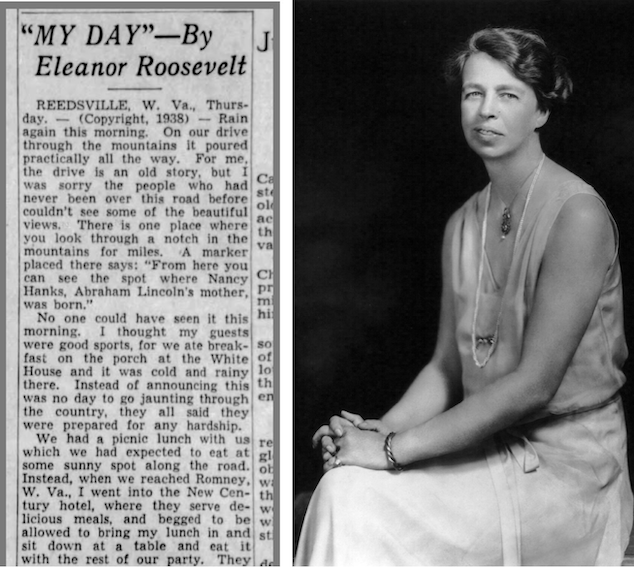
From 1935 to 1962 Eleanor Roosevelt published a daily syndicated newspaper column titled “My Day”—through the column millions of Americans learned her views on politics, society, and events of the day as well as details about her private and public life. James Thurber couldn’t resist writing a parody—here’s an excerpt:
THE REAL DEAL…At left, sample of one of Eleanor Roosevelt’s syndicated “My Day” columns from 1938; photo of the First Lady from 1932. (arthurdaleheritage.org/Library of Congress)
* * *
At the Movies
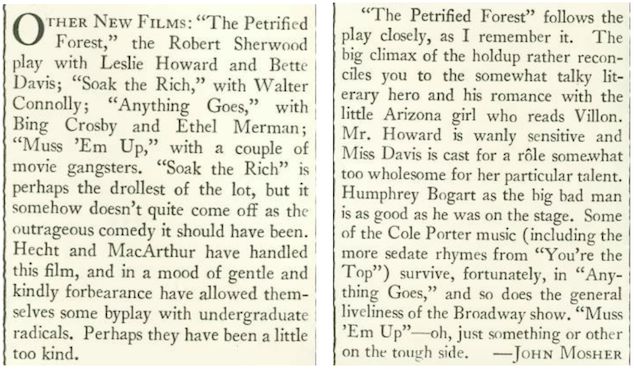
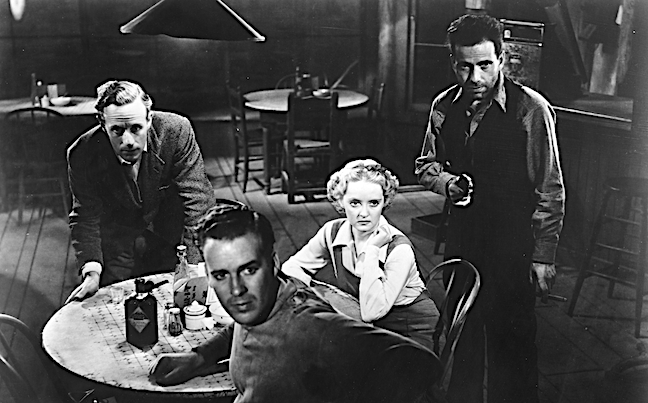
Besides Modern Times, there were other movies of note that were given rather scant attention in Mosher’s column, including the film adaptation of The Petrified Forest starring Humphrey Bogart, Bette Davis and Leslie Howard.
Robert E. Sherwood wrote the 1934 Broadway play of the same name, which was co-produced by Howard and featured both Howard and Bogart. When it was adapted to film, Howard insisted that Bogart appear in the movie, and it made Bogart a star (he remained grateful to Howard for the rest of his life).
DANGEROUS DINER…An odd mix of patrons at a gas station cafe are taken hostage by desparate criminals in The Petrified Forest. From left are Leslie Howard, Dick Foran, Bette Davis and Humphrey Bogart. Playwright Robert Sherwood based Bogart’s character, Duke Mantee, on the the real-life criminal John Dillinger, the FBI’s first “Public Enemy #1.” (moma.org)
Other cinema diversions included the musical Anything Goes, which included songs by Cole Porter; the comedy Soak the Rich, which featured a radical who falls in love with a rich man’s daughter; and a detective film, Muss ‘Em Up, with the usual movie gangsters.
TAKE YOUR PICK…Clockwise, from top left: Ida Lupino and Arthur Treacher in the musical Anything Goes; Bing Crosby (in disguise) and Ethel Merman in Anything Goes; John Howard, Mary Taylor and Walter Connolly in the comedy Soak the Rich; Preston Foster, Maxine Jennings and Guinn “Big Boy” Williams in the detective film Muss ‘Em Up. (imdb.com/torontofilmsociety.com/zeusdvds.com)
* * *
The Amazing Race
The New Yorker periodically featured “That Was New York,” which took a detailed look at significant events in the city’s history. In this installment, Donald Moffat recalled the 1908 New York to Paris automobile race, which commenced in Times Square on February 12 with six cars representing the U.S., France, Germany and Italy. It was an extraordinary event given that motorcars were a recent invention, and roads were nonexistent in many parts of the world. A brief excerpt:
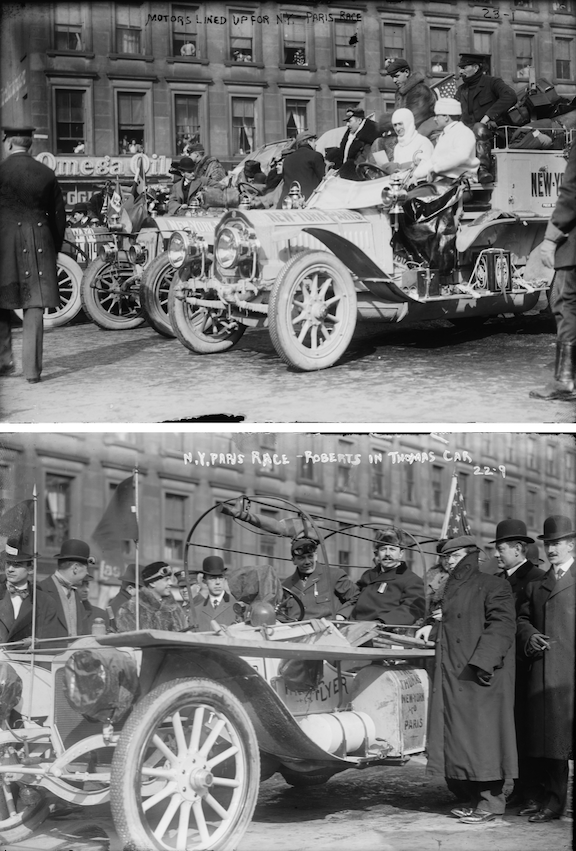
ON YOUR MARK…Cars lined up in Times Square on Feb 12, 1908 for the start of what would become a 169-day race. American George Schuster was declared the winner when he arrived in Paris on July 30, 1908, after covering approximately 10,377 miles (16,700 km). (Library of Congress)
* * *
Miscellany
Another regular feature in the early New Yorker was coverage of the New York Rangers, a team founded in 1926 by Tex Rickard after he completed construction of the third incarnation of Madison Square Garden. The Rangers were one of the Original Six NHL teams before the 1967 expansion, the others being the Boston Bruins, Chicago Blackhawks, Detroit Red Wings, Montreal Canadiens and Toronto Maple Leafs.
In this excerpt, the writer “K.B.” described the rough play against rival Detroit, which would win back-to-back Stanley Cups in 1936 and 1937.
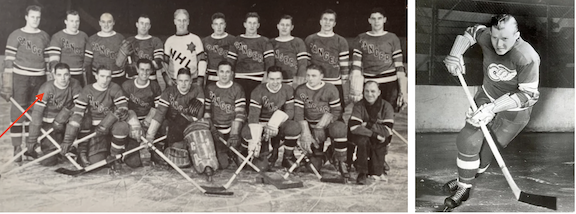
ZESTY…The excerpt above noted that the Rangers’ Phil Watson cuffed the Red Wings’ Syd Howe “with a zest richly appreciated by the balcony.” At left, team photo of the 1935-36 New York Rangers, with star and fight instigator Phil Watson identified with arrow; at right, Syd Howe won three Stanley Cups with Detroit, winning back-to-back in 1936 and 1937, and then again in 1943. (hockeygods.com)
* * *
From Our Advertisers
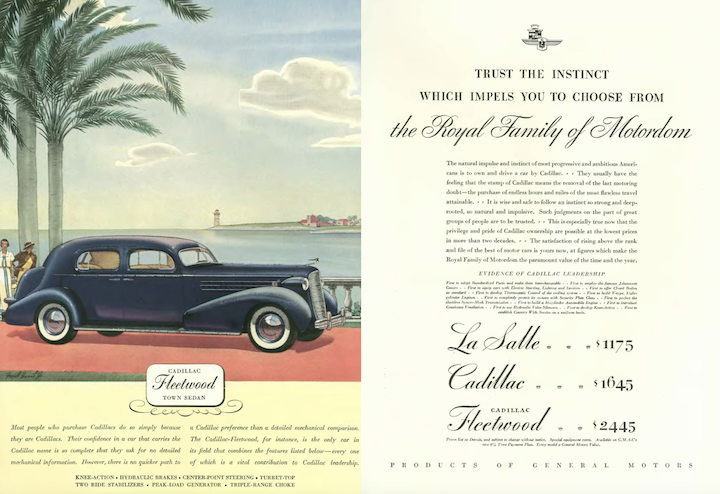
General Motors’ luxury car line offered three price points (and this lovely image) to weather the Depression years, ranging from the relatively affordable La Salle to the Cadillac Fleetwood…
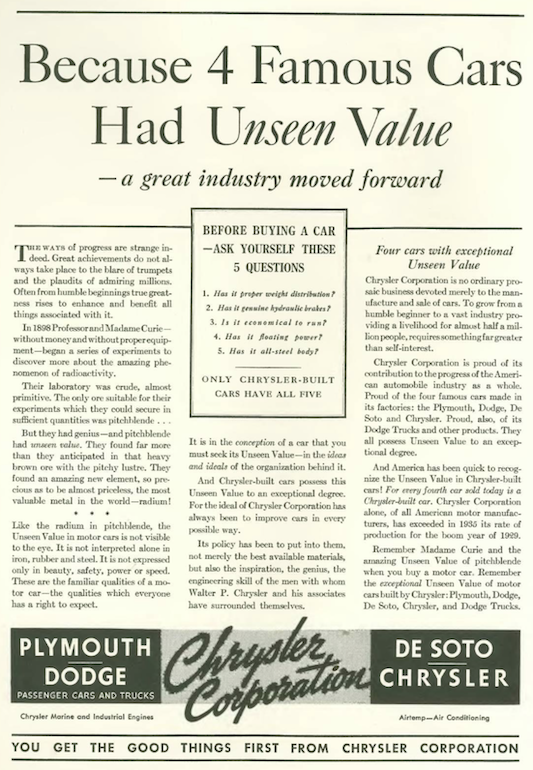
…the Chrysler corporation took a different approach, deploying a very wordy full-page ad that referenced history (a Madame Curie analogy) and something called “Unseen Value” to move its line of autos…
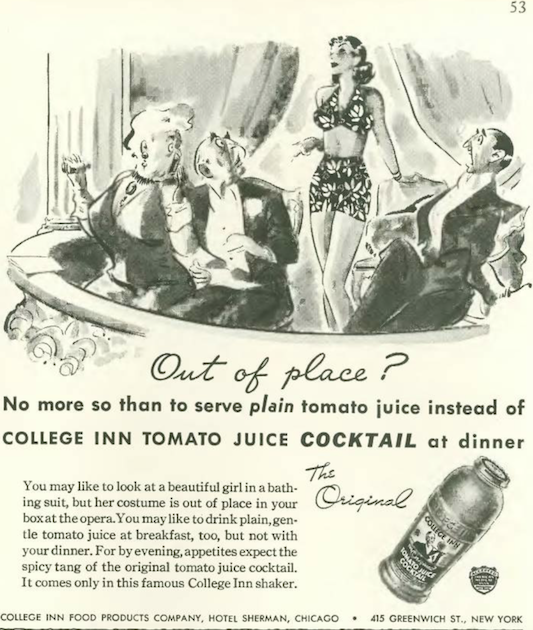
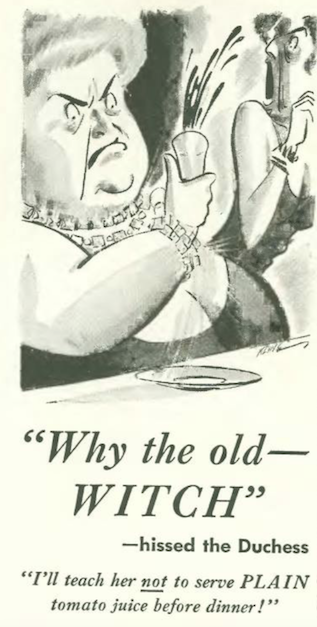
…the makers of College Inn Tomato Juice Cocktail brought back the “Duchess” with this shocking scene at the opera…
…recall last summer when College Inn featured the Duchess in a series of ads that illustrated her increasing fury over plain tomato juice…one wonders what sort of sadistic torment she had in mind for her hostess, “the old WITCH”…
…on to our cartoonists, beginning with this spot by James Thurber…
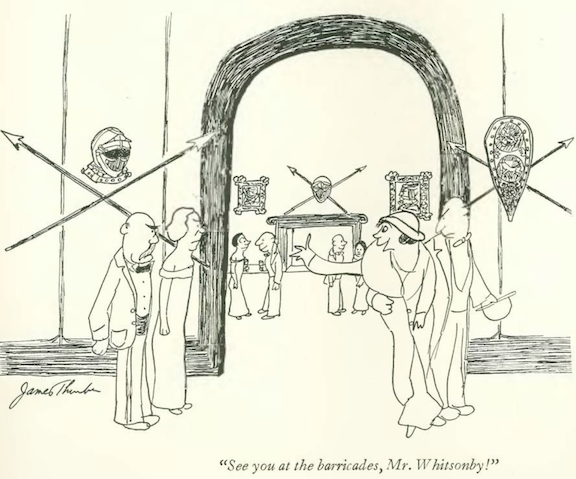
…and Thurber again, with an unwanted call to solidarity…
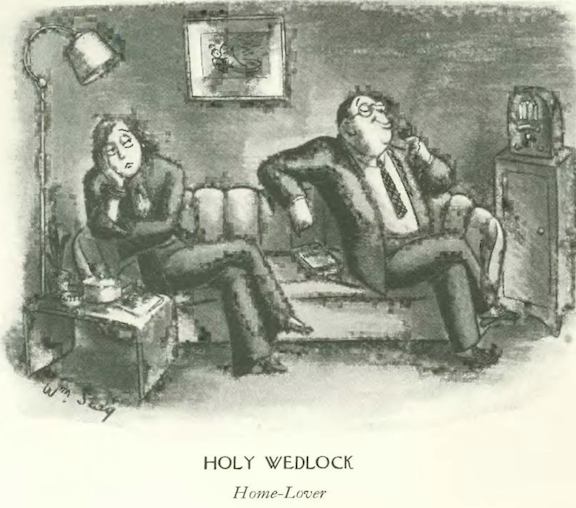
…William Steig explored marital bliss…
…George Price gave us a Three Stooges moment…
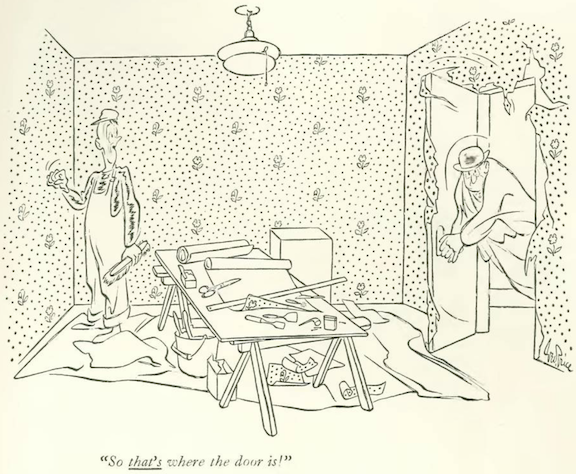
…I do not have the identity of this cartoonist…I will keep looking, but would love suggestions in the meantime…*update*…thanks to Frank Wilhoit for identifying the cartoonist below as John Kreuttner, also confirmed through Michael Maslin’s Ink Spill…
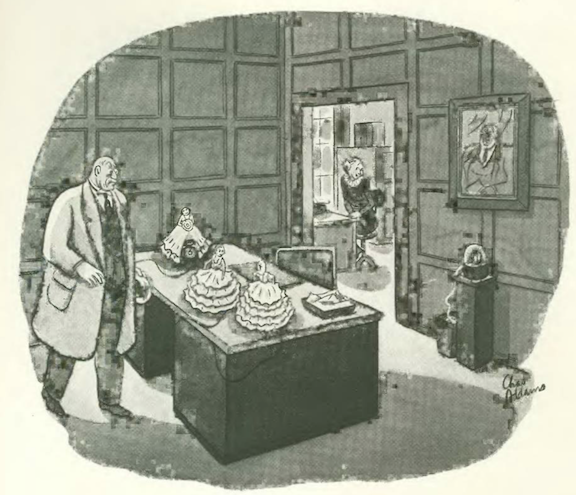
…Charles Addams added some frills to an executive suite…
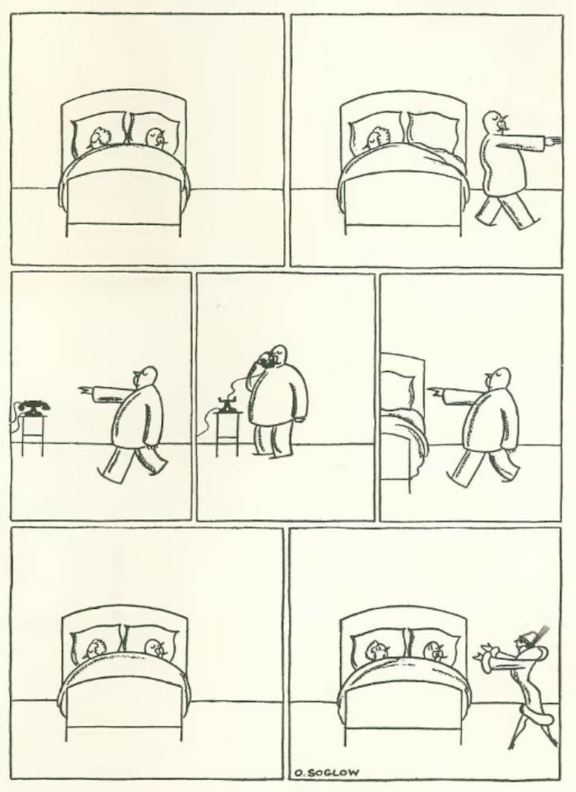
…Otto Soglow illustrated the hazards of sleepwalking…
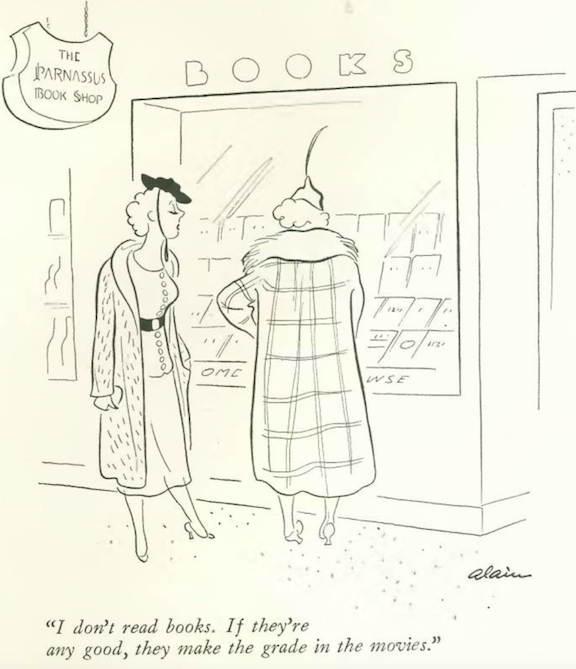
…Alain revealed a challenge to the publishing industry…
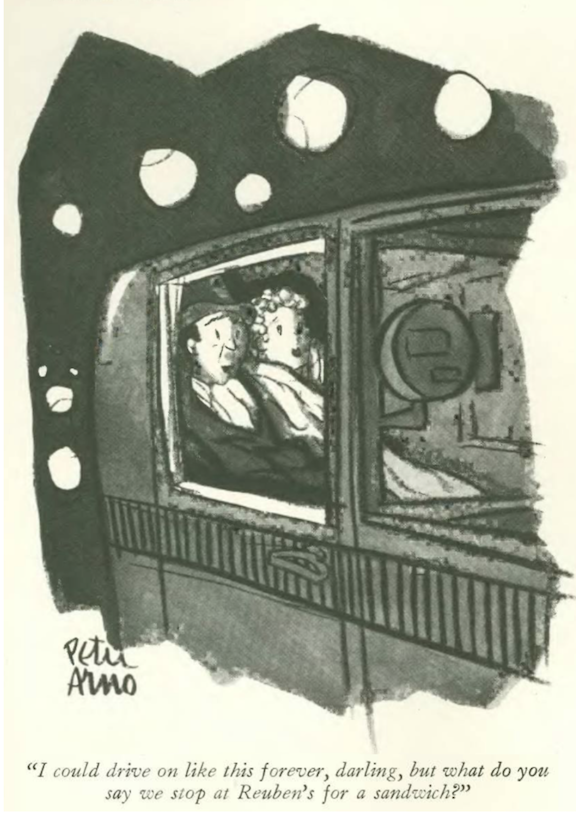
…Peter Arno possibly craved some sauerkraut and corned beef…
…William Crawford Galbraith was in familiar sugar daddy territory…
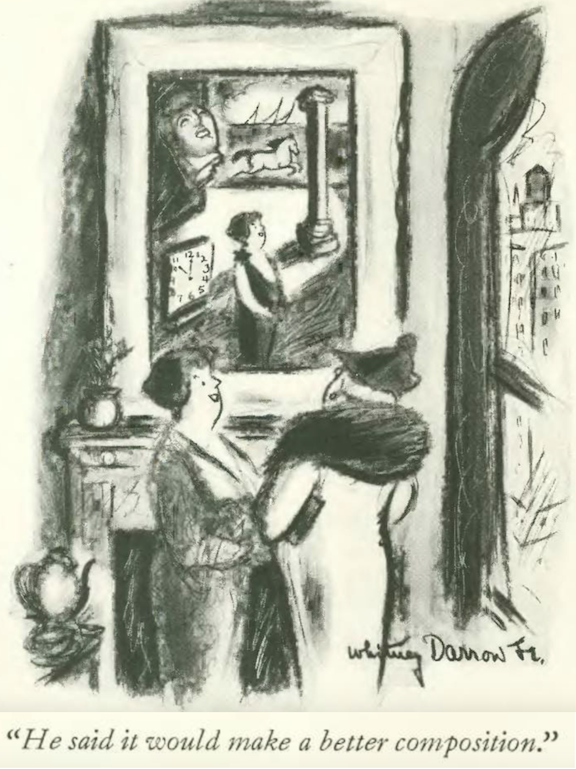
…Whitney Darrow Jr gave a nod to some homey surrealism…
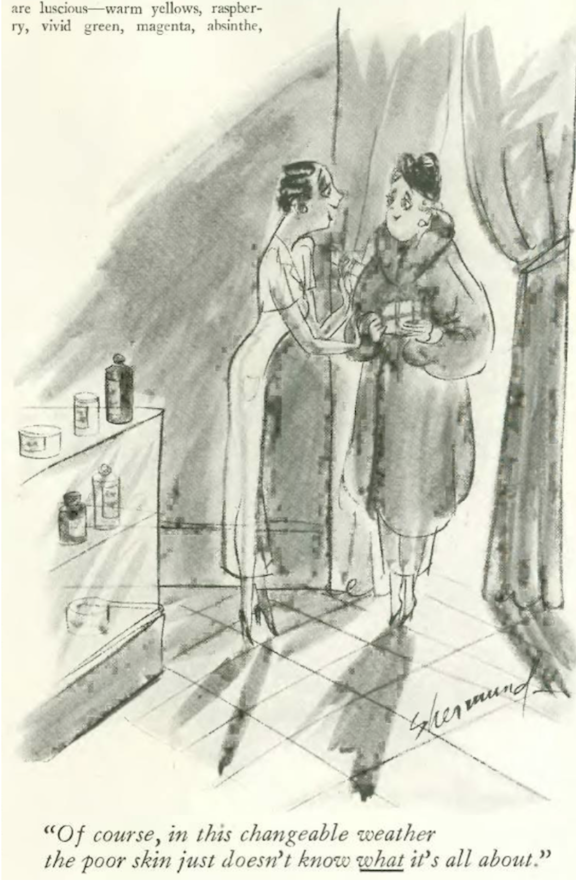
…Barbara Shermund offered some well-weathered advice…
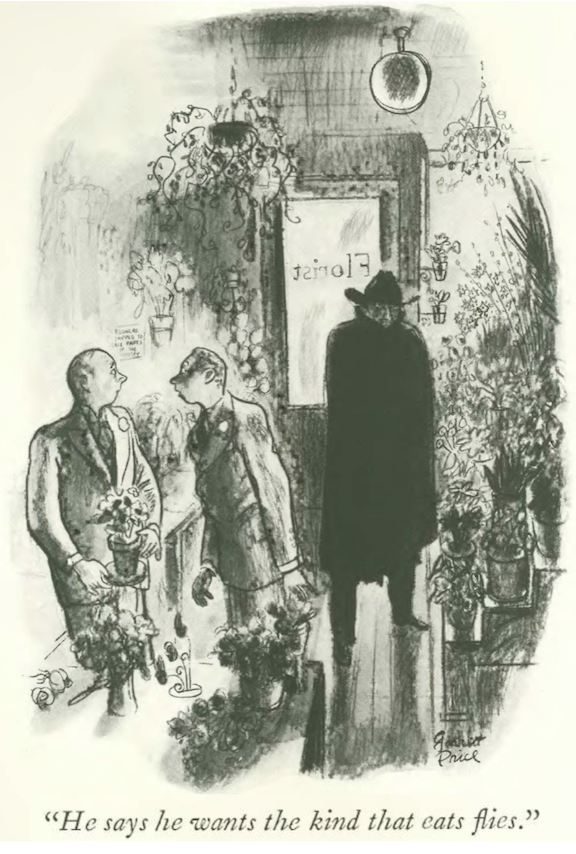
…and we close with Garrett Price, and a visitor more suited to Charles Addams…
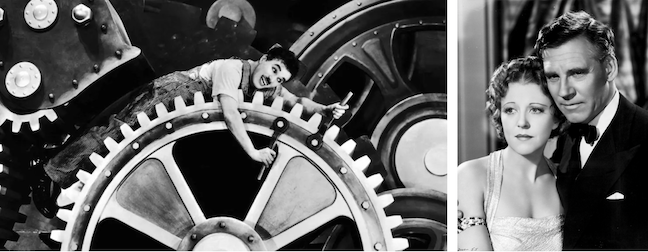
Above: Mary Pickford (right, from 1916) spoke out against salacious content in films, such as this scene from 1930's Madam Satan. (Wikipedia/mainemedia.edu)
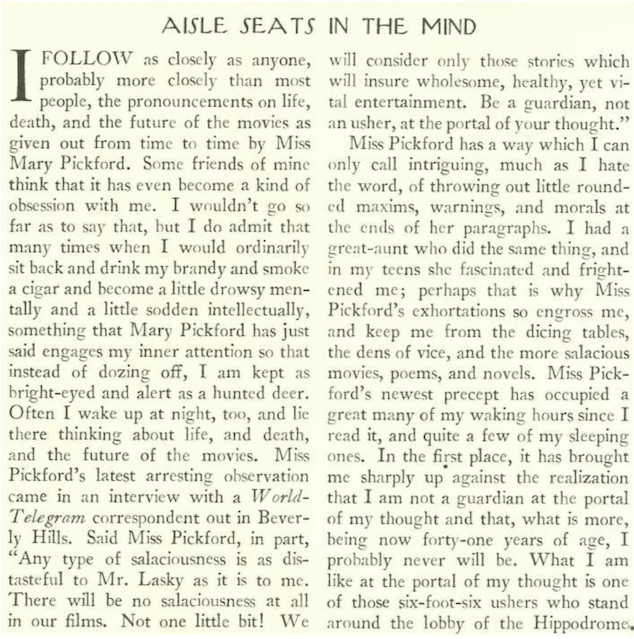
James Thurber seemed to enjoy teasing silent film legend Mary Pickford in her new career as social commentator and author of spiritual articles and books. Having retired from acting in 1933, Pickford was also using her powerful position as a co-founder of United Artists to focus on the moral direction of the film industry.
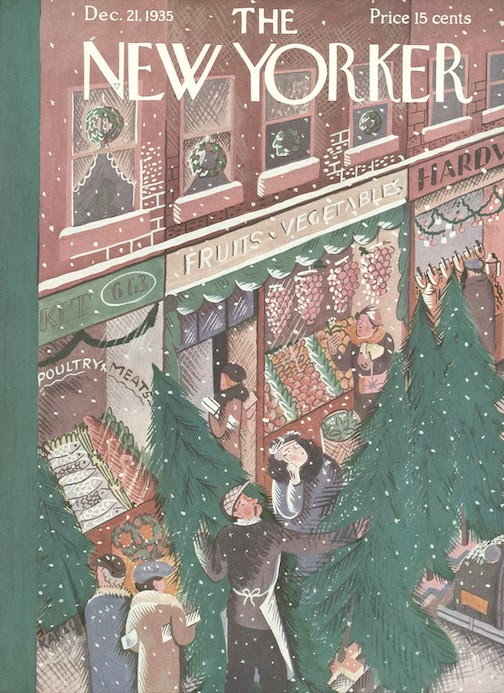
December 21, 1935 cover by Ilonka Karasz.
Back in the Sept. 21 issue of The New Yorker, Thurber took a humorous poke at Pickford’s Liberty magazine article on the afterlife, and found more fodder after Pickford, in an interview with the World-Telegram, criticized “salacious” films. “Be a guardian, not an usher, at the portal of your thought,” she advised. Thurber took the bait. Excerpts:
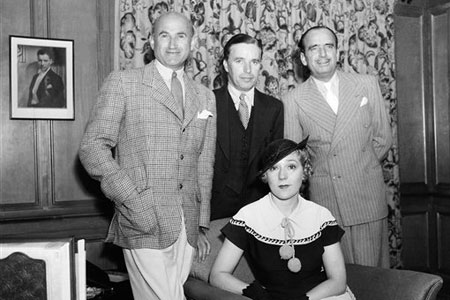
KEEPING IT CLEAN…From left, producer Samuel Goldwyn, actors Charlie Chaplin and Douglas Fairbanks Sr. pose behind Mary Pickford at a United Artists board meeting in Los Angeles, July 9, 1935. (AP)
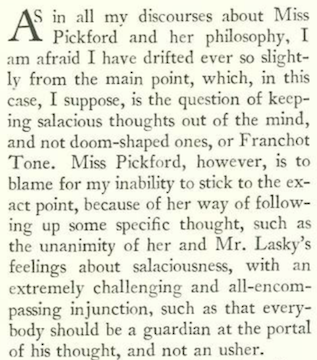
Thurber took particular pleasure in Pickford’s comments regarding the control of one’s dirty thoughts:
PICKFORD’S UNITED ARTISTS produced some memorable, non-salacious films in 1936, including Charlie Chaplin’sModern Times, and the acclaimed Dodsworth starring Ruth Chatterton and Walter Huston as Fran and Sam Dodsworth. (Wikipedia)
Pickford had a strong ally in the Hays Code, a set of self-imposed censorship guidelines that would keep mainstream studio films relatively free of salacious content for the next thirty years.
* * *
A White Christmas
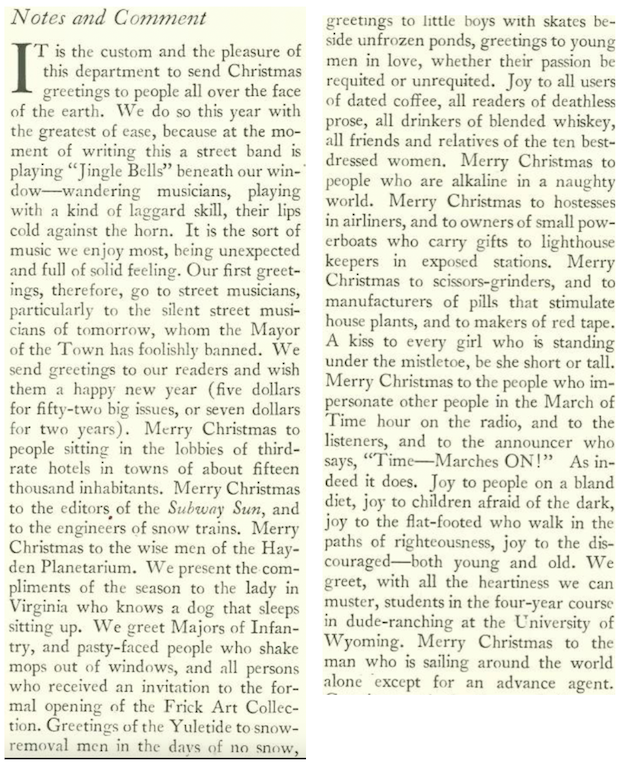
E.B. White offered holiday greetings to everyone from drinkers of blended whiskey to the makers of red tape (plus a plug for New Yorker subscriptions)…
CHEERS AND JEERS…E.B. White sent holiday greetings to the men who were changing the Normandie’s massive propellers (from three- to four-blade), and probably wanted to give a lump of coal to Mayor Fiorello La Guardia for “foolishly” banning organ grinders from city streets. (ships nostalgia.com/ephemeralnewyork)
…and concluded with these words…
…Otto Soglow added this bit of spot art to the bottom of White’s “Notes and Comment”…
* * *
A Holiday Tradition
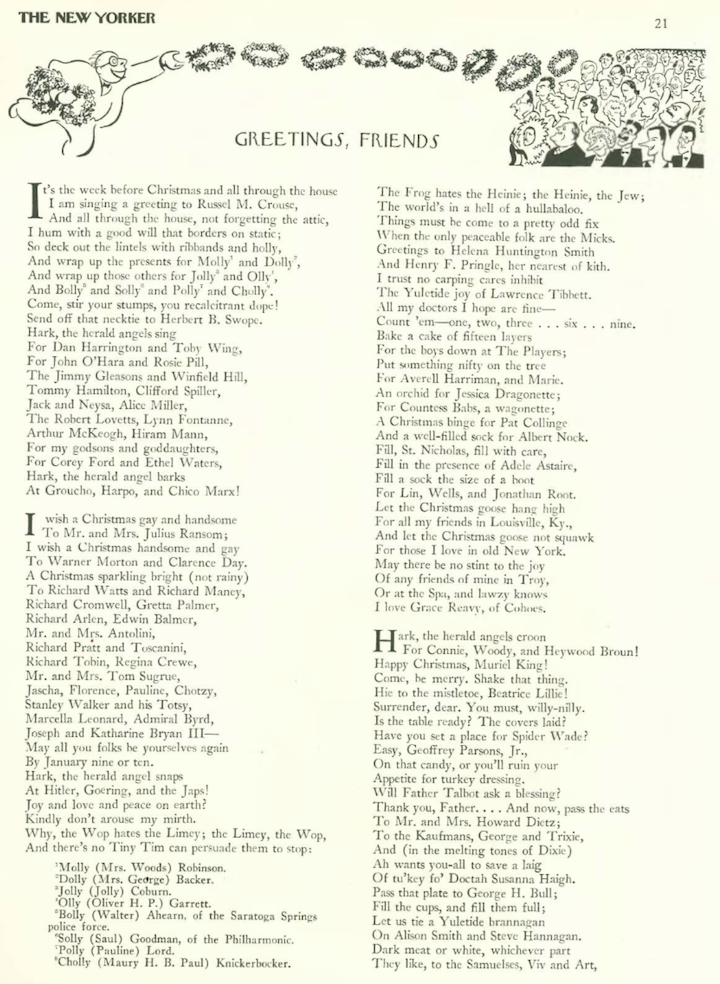
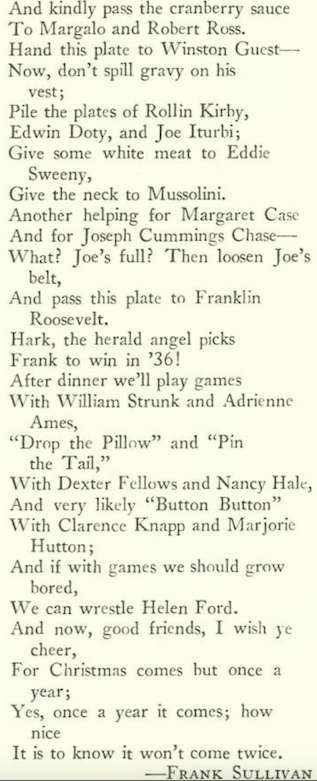
Page 21 featured Frank Sullivan’s annual Christmas poem (he wrote forty-two of them from 1932 to 1974)…
…which continued on page 22…
* * *
Lost In Paradise
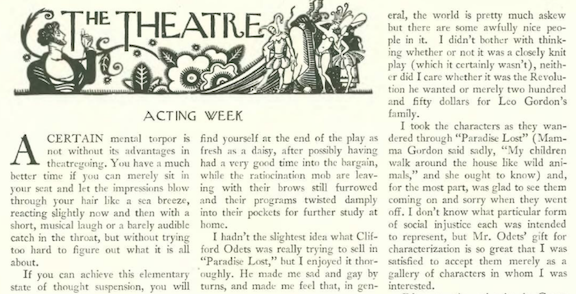
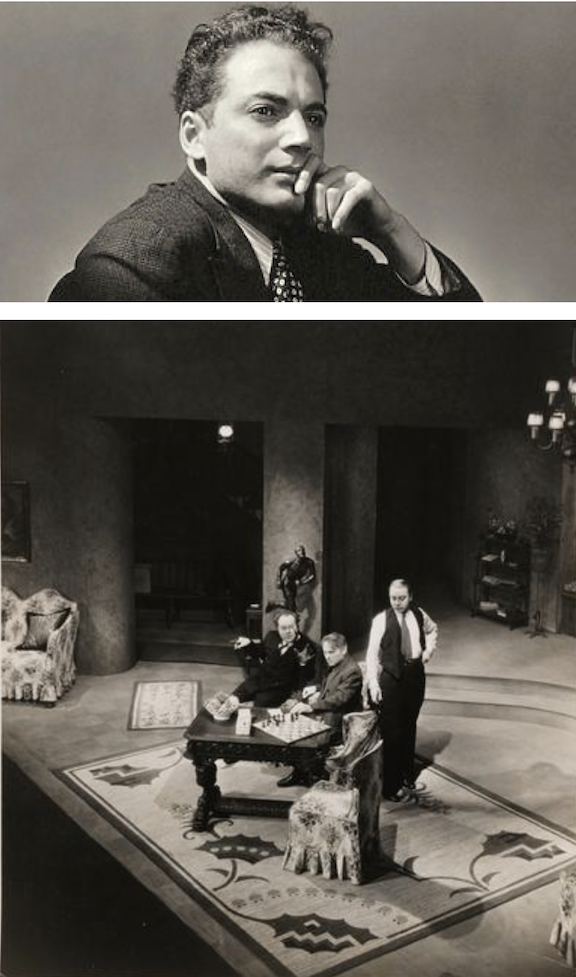
Robert Benchley did the honors as theatre critic for the Dec. 21 issue, enjoying an evening at Longacre Theatre with the richly endowed characters featured in Clifford Odets’Paradise Lost.
GREAT PLAY, WHATEVER IT MEANS…Robert Benchley thoroughly enjoyed Clifford Odets’ gallery of characters in Paradise Lost. Top, Odets circa 1930s; below, photo from the 1935-36 production at Broadway’s Longacre Theatre. (mcny.org)
Apparently the rest of the Broadway fare was not so great, as Benchley fled Cort’s Theatre (it featured This Our House, which closed after just two performances) to catch A Night at the Opera with the Marx Brothers.
* * *
At the Movies
Benchley wasn’t the only one enjoying a night at the movies. Critic John Mosher found favor with German actor Emil Jannings’ latest flick, The Making of a King (Der alte und der junge König), calling the film “a sensible picture of the old bully,” namely the father of Frederick the Great.
LIGHTEN UP, FRED…Heinrich Marlow (left) and Emil Jannings in a scene from The Making of a King. The film depicted the turbulent relationship between Prussian King Friedrich Wilhelm I and his son, Crown Prince Friedrich. (IMDB)
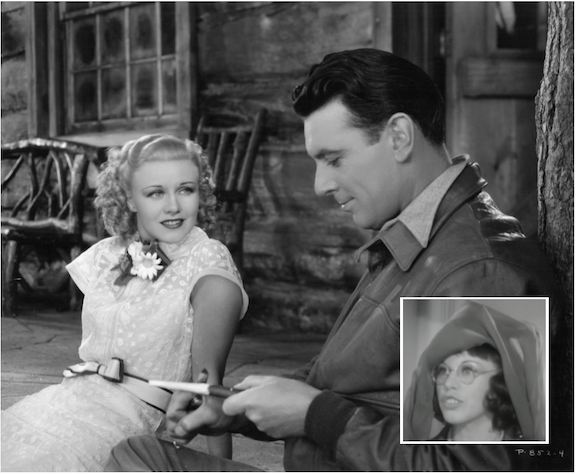
Mosher found bright moments in Ginger Rogers’ latest film, but would have preferred another pairing with her fellow hoofer, Fred Astaire.
BETTER WITH FRED thought John Mosher of Ginger Rogers’s brave turn as an actress fleeing from her admiring fans in 1935’s In Person. Rogers donned eyeglasses, a wig, and fake teeth (inset) to portray the actress in hiding. She is pictured here in a scene with co-star George Brent. (IMDB)
Mosher was stimulated by The Great Impersonation, however, the “cordial” films about small town life and happy radio folk left him less than enthused.
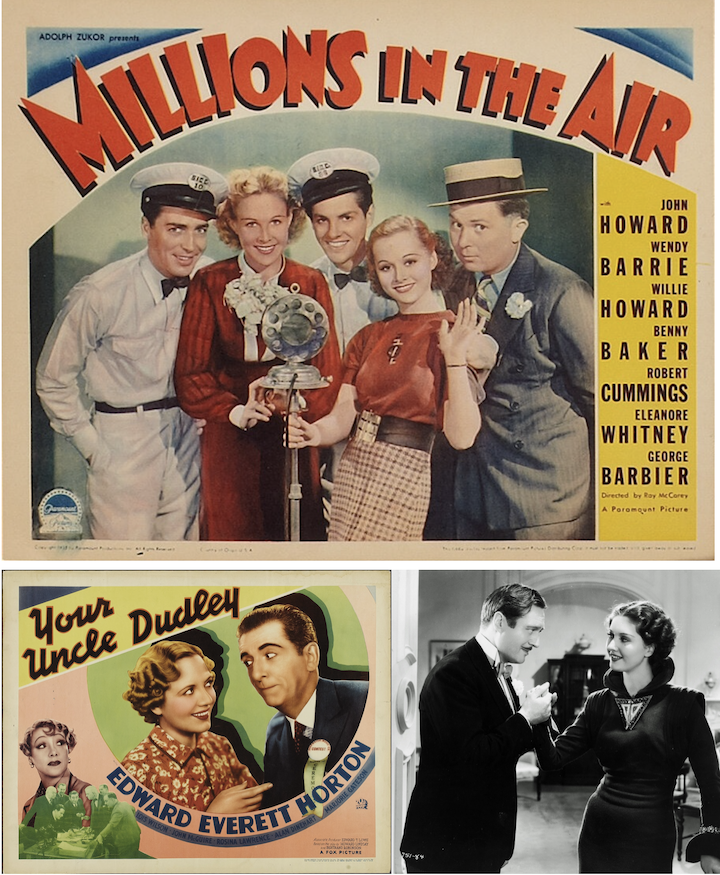
MORE SPIES, PLEASE…John Mosher didn’t get too excited over the standard fare offered in the films Millions in the Air and Your Uncle Dudley, however he found the performances of Edmund Lowe and Wera Engels (bottom right) in the spy caper The Great Impersonation to be most stimulating. (IMDB)
* * *
From Our Advertisers
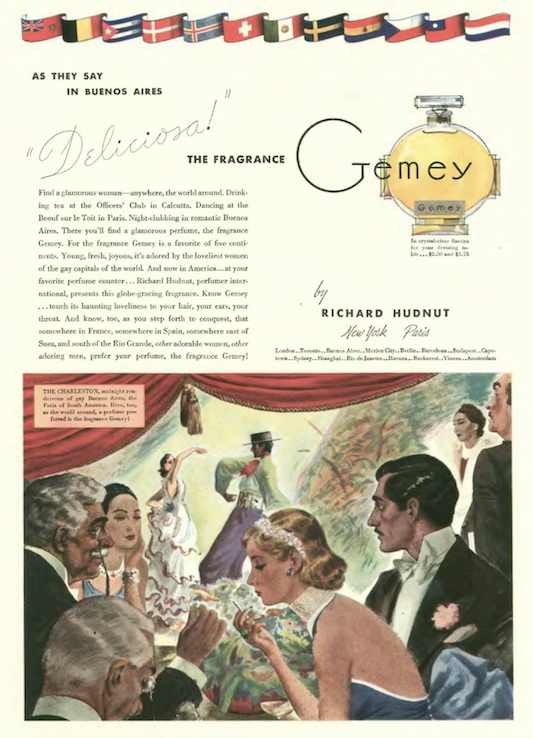
After touring France in the late 1870s, a New York drugstore owner named Richard Hudnut returned to the States determined to introduce French-style perfumes and cosmetics to American women. He soon transformed his drugstore into an elegant showroom, and in time became the first American to achieve international success in cosmetics…
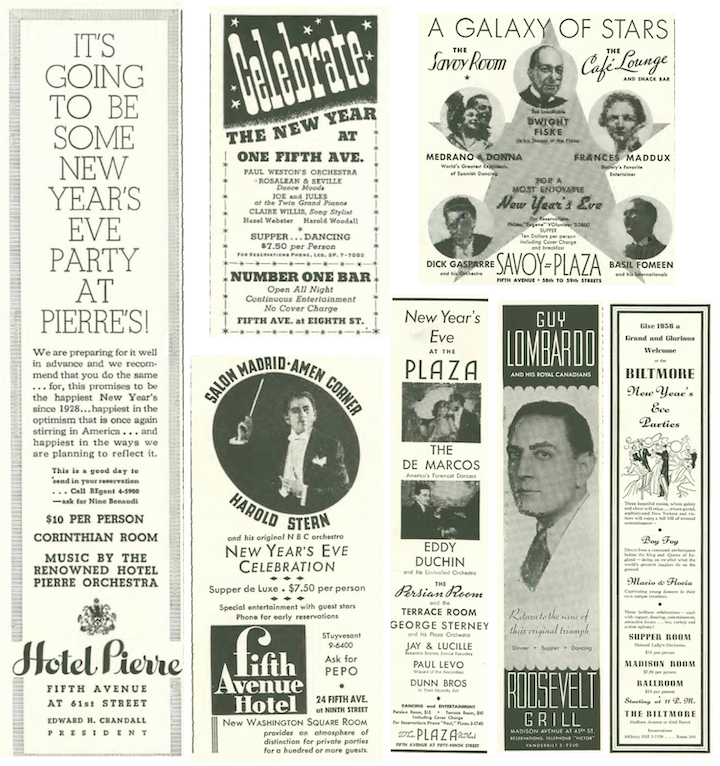
…advertisements for Christmas gifts mostly dropped out of the magazine, and the back of the book was filled with spots touting various New Year’s Eve entertainments…
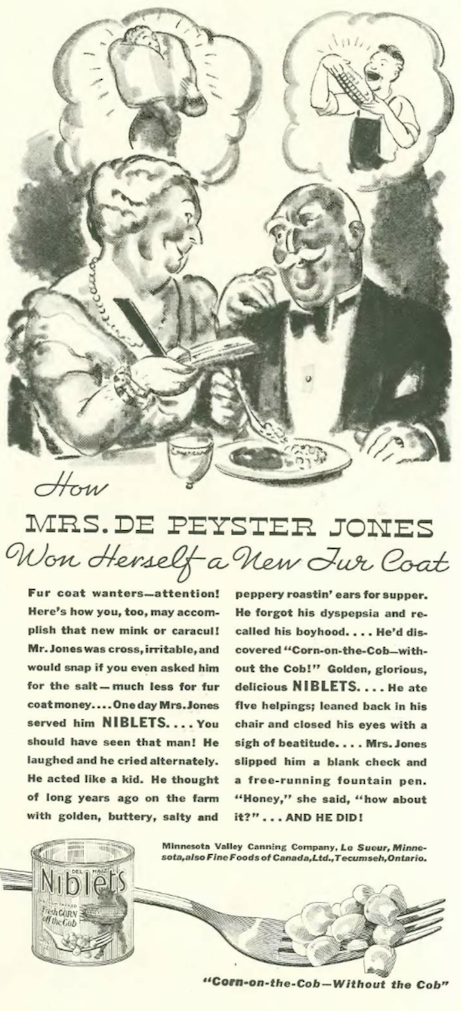
…in this ad from the Minnesota Valley Canning Company (renamed Green Giant in 1950), a robber baron’s humble roots, and his checkbook, are triggered by a can of corn…
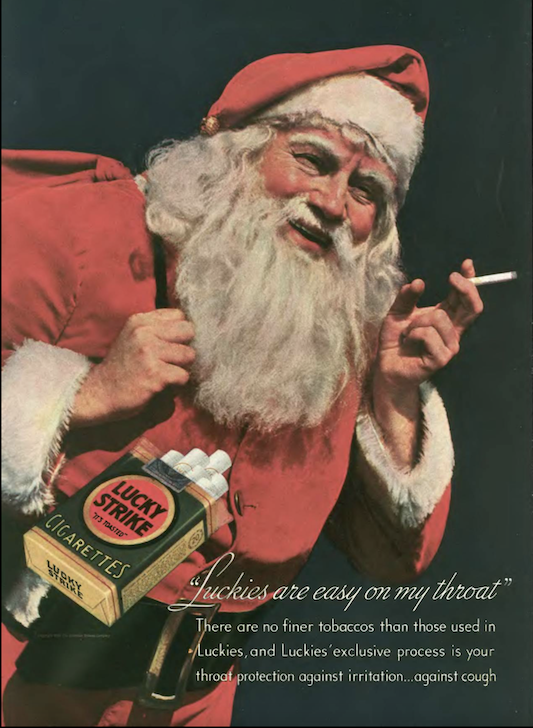
…thanks to the makers of Luckies, Jolly Old St. Nick was dropping more than soot down your chimney on Christmas Eve…
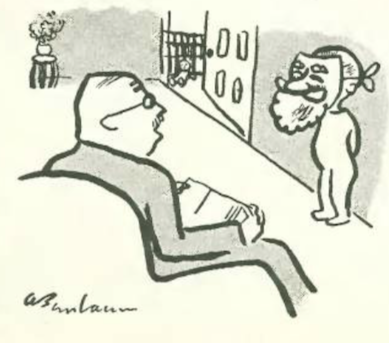
…we kick off our cartoons with this spot illustration by Abe Birnbaum…
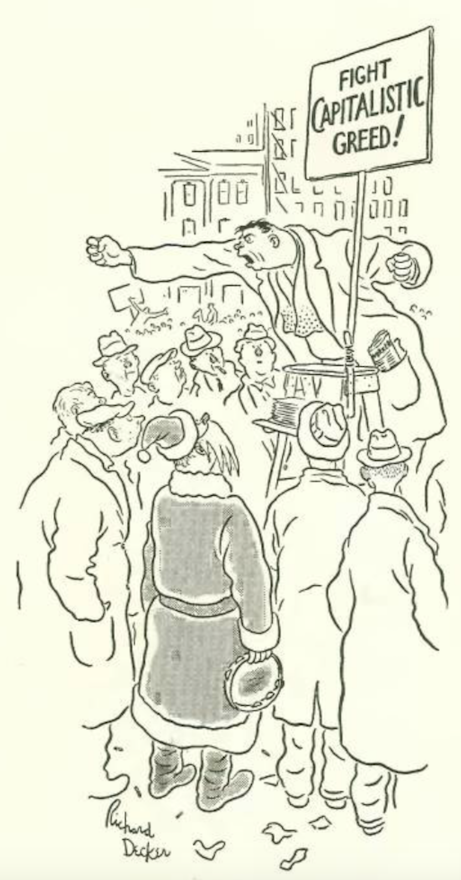
...Richard Decker gave us this caption-less appeal to the masses…
In 1933 the U.S. economy began a slow recovery from the 1929 market crash, but the recovery stalled in 1934 and 1935, and folks including E.B. White were looking for any indication of brighter days ahead.
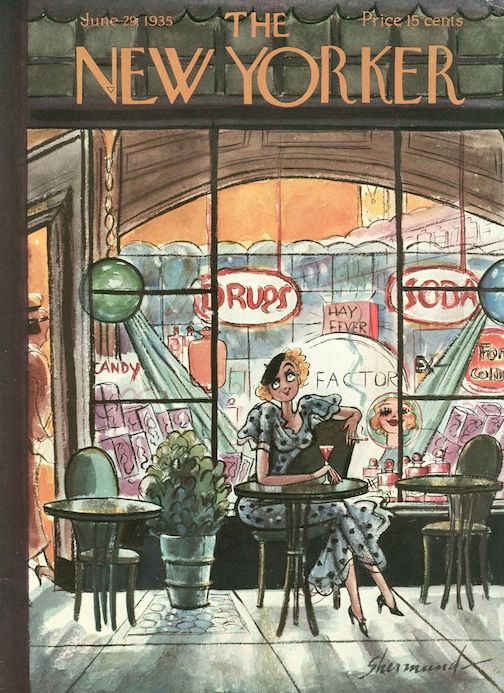
June 29, 1935 cover by Barbara Shermund. A prolific contributor of cartoons to The New Yorker (600 in all), Shermund also illustrated eight covers, including this charmer.
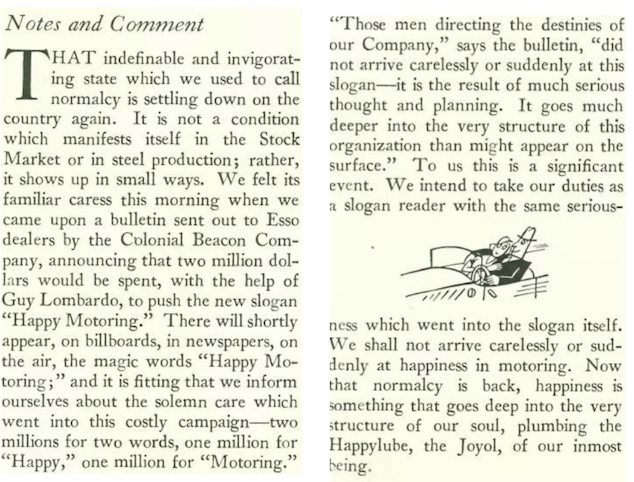
White suggested that Americans look for smaller signs of normalcy, such as the new slogan, “Happy Motoring,” that was being rolled out by Standard Oil’s Esso.
IT’S A GAS…At left, Gasoline Station, Tenth Avenue, photo by Berenice Abbott, 1935; at right, newspaper ad, May 1935. (metmuseum.org/wataugademocrat.com)
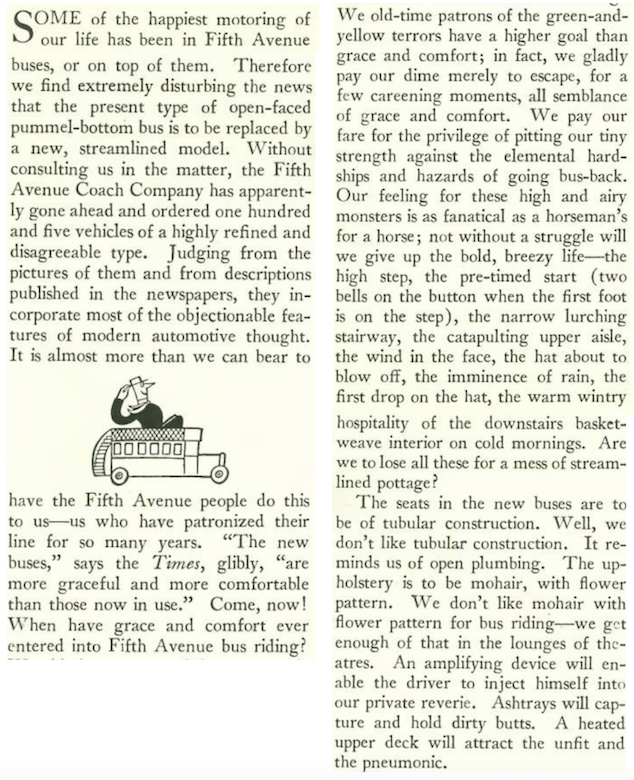
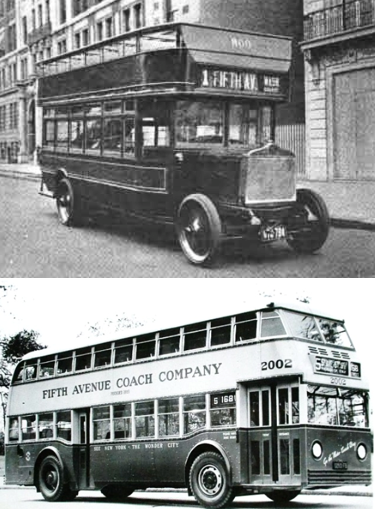
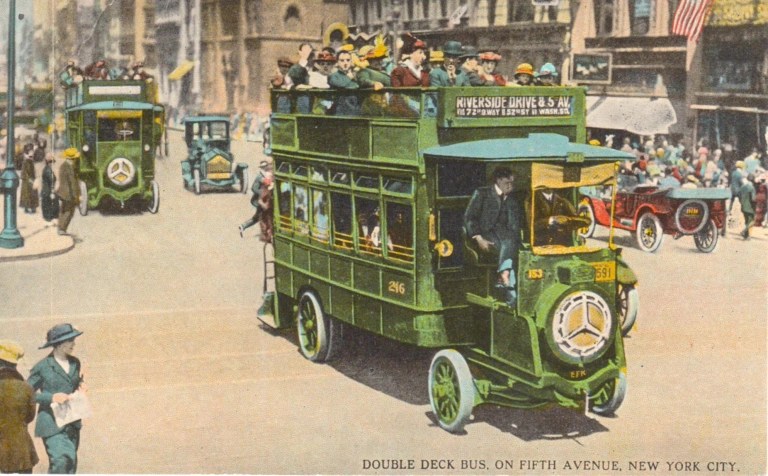
Like many of us, White was a study in contradictions, enthusiastically embracing the age of air travel while rejecting the style and comforts of modern automobiles (he famously loved his Model T). It is no surprise that he also preferred Fifth Avenue’s spartan green and yellow omnibuses over the new streamlined buses that would soon be plying the streets of Manhattan.
NO THANKS…E.B. White preferred the spartan accommodations of the old Fifth Avenue buses to the comforts of their replacements. (coachbuilt.com)
White elaborated on the advantages of the older buses:
STYLE OVER COMFORT…Of the old Fifth Avenue buses, E.B. White wrote that he preferred the “hard wooden benches on the sun deck, conducive to an erect posture, sparkling clean after a rain.” (Ephemeral New York)
* * *
Cinderella Story
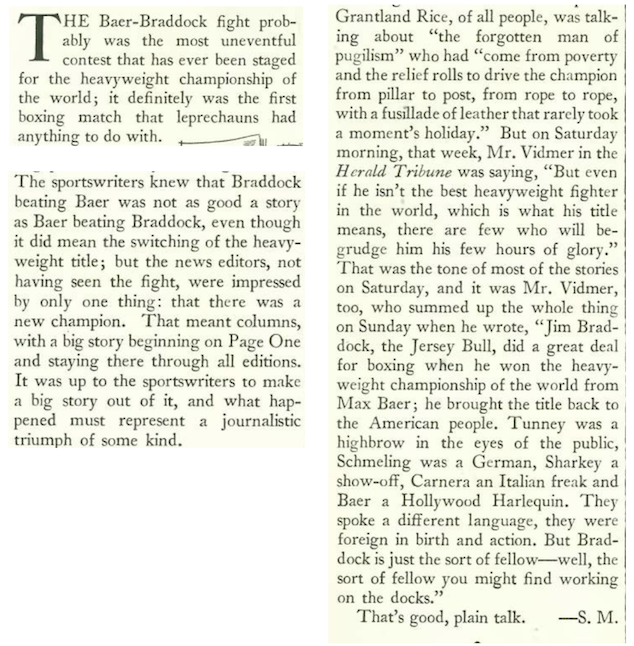
Challenger James J. Braddock achieved one of boxing’s greatest upsets by defeating the heavily favored (and reigning champ) Max Baer. For this feat he was given the nickname “Cinderella Man” by journalist Damon Runyon. The writer of the “Wayward Press” (byline “S.M.”) seemed less impressed, and mocked the national media for their sudden pivot on the bout’s unlikely outcome.
BRINGING THE FIGHT…Challenger James J. Braddock lays into defending champ Max Baer during a heavyweight boxing title match on June 13, 1935, at the Madison Square Garden Bowl in Long Island City. Although the national media dismissed Braddock’s chances of winning, Braddock trained hard for the fight while Baer spent more time clowning around than training. Braddock won by unanimous decision, eight rounds to six. (thefightcity.com)
* * *
Seemed Like a Nice Guy
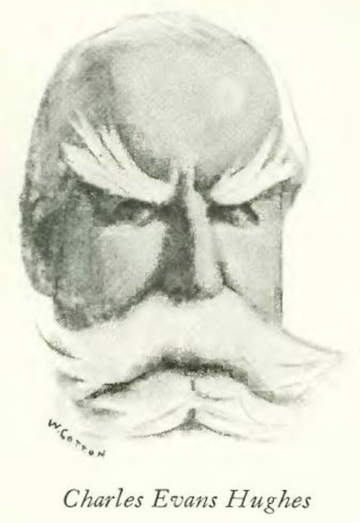
Henry Pringle penned the first part of a three-part profile of Supreme Court Chief Justice Charles Evans Hughes (1862–1948), who was also a former New York governor and U.S. secretary of state. William Cotton rendered a rather severe-looking Hughes in this caricature for the profile…
…although in reality he tended to look more like this…
PROGRESSIVE THINKER…Supreme Court Chief Justice Charles Evans Hughes in 1931. Known as a reformer who fought corruption, Hughes was a popular public figure in New York. (Wikipedia)
* * *
From Our Advertisers
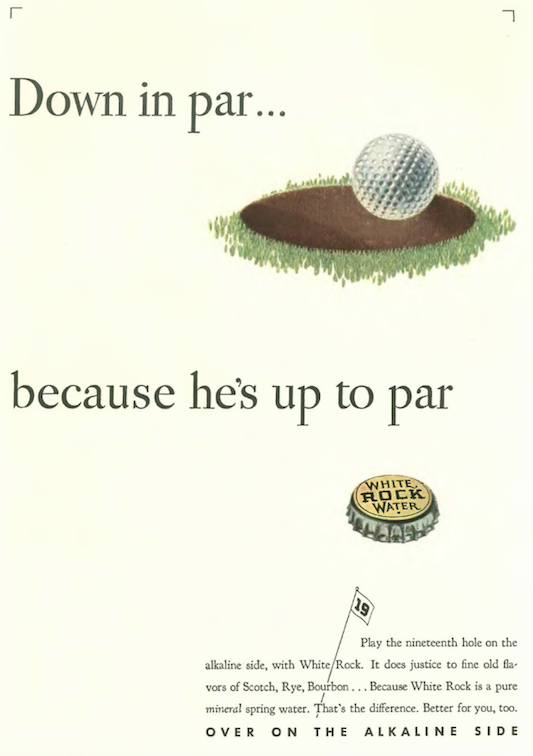
We begin with an advertisement that goes down easy, with its minimal style…
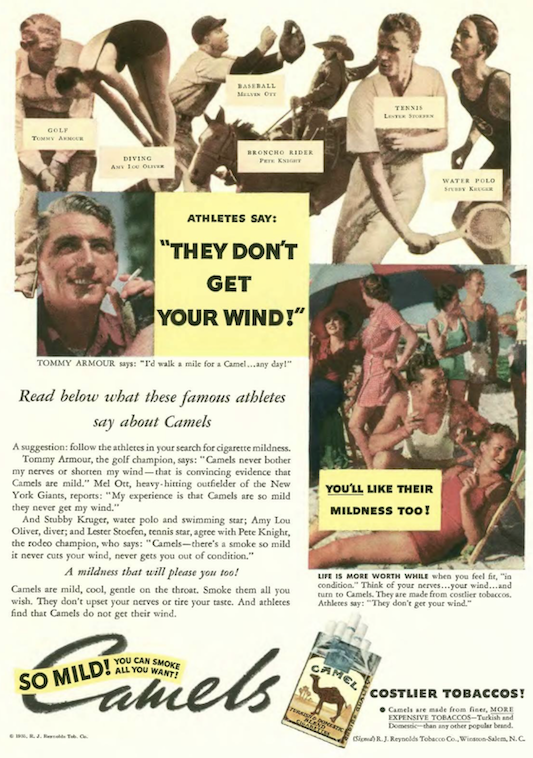
…by contrast, a busy Camel advertisement…R.J. Reynolds alternated full-page ads featuring society women with these health-themed spots that linked smoking with athletic prowess…
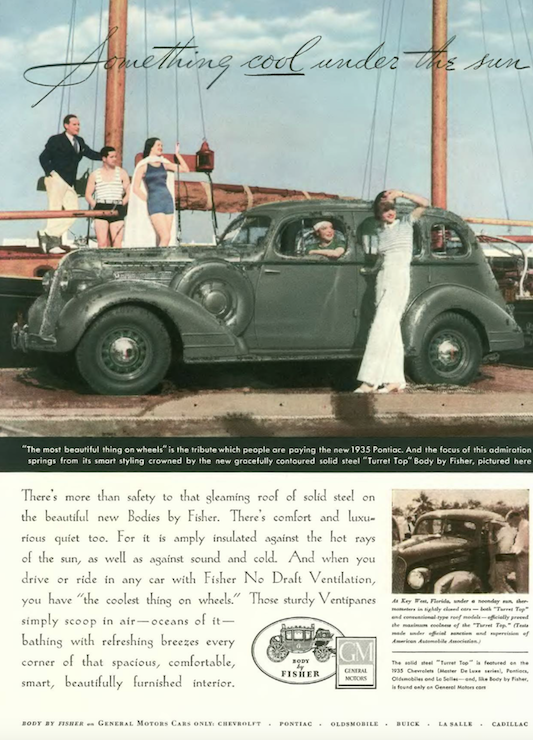
…this advertisement by Fisher claimed the 1935 Pontiac was “The most beautiful thing on wheels,” however here it looks perfectly ancient…
…as does this Nash on the inside back cover…
…the back cover was claimed by Highland Queen, a blend of some very fine distilleries…
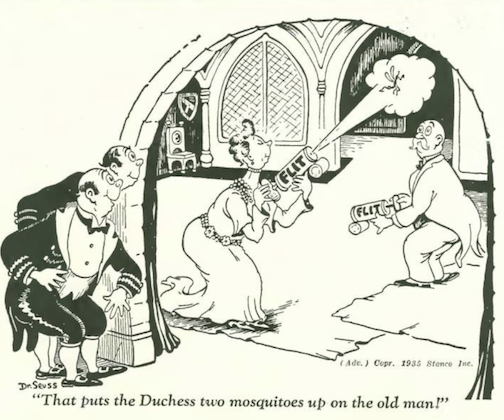
…Theodore Seuss Geisel continued his ongoing saga against the mighty mosquito…
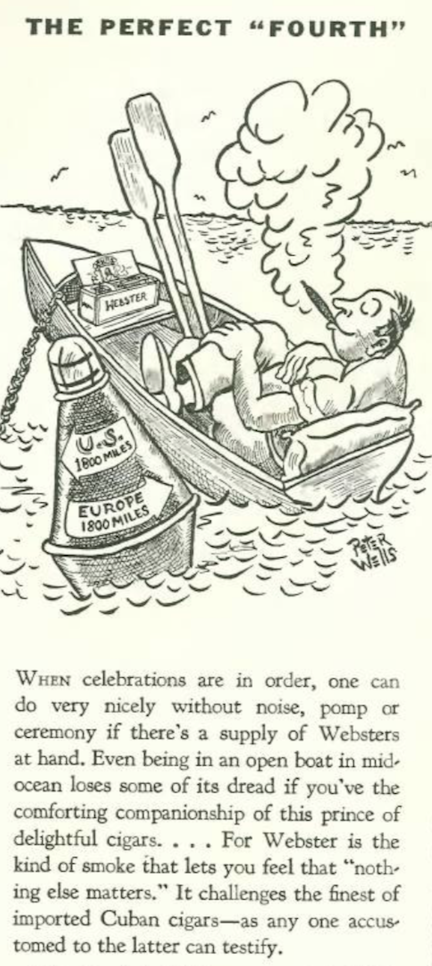
…and we have this back of the book ad for Webster cigars, who enlisted the talents of Peter Wells…
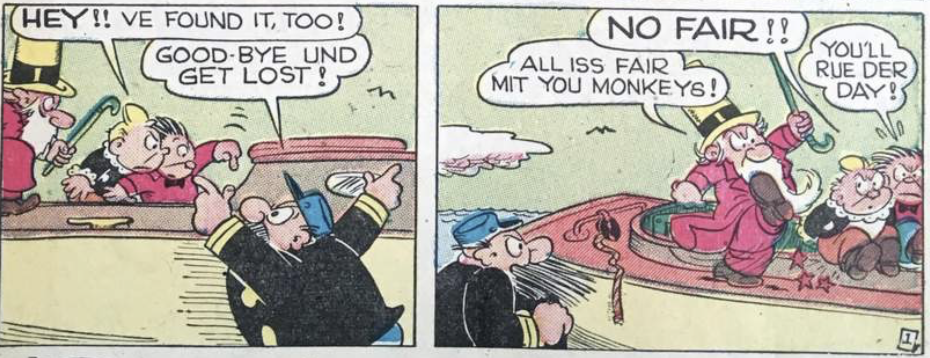
…Wells (1912–1995) was also a children’s book writer, most famous for contributing drawings to the Katzenjammer Kids comic strip …
Peter Wells, detail from the opening page from “The Katzenjammer Kids,” #16, Spring 1951, King Features Syndicate, Inc.
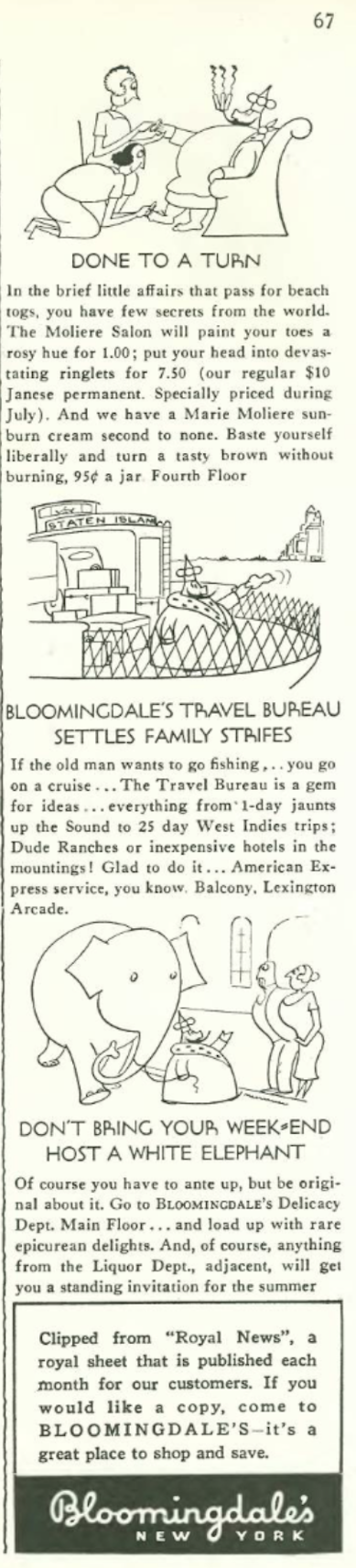
…and of course we are all familiar with Otto Soglow, who sold his beloved Little King to Hearst (and made a pile) but was still able to feature his diminutive potentate in the The New Yorker in a series of ads for Bloomingdales…
…which brings us to our cartoonists, and a familiar torment for our beloved James Thurber…
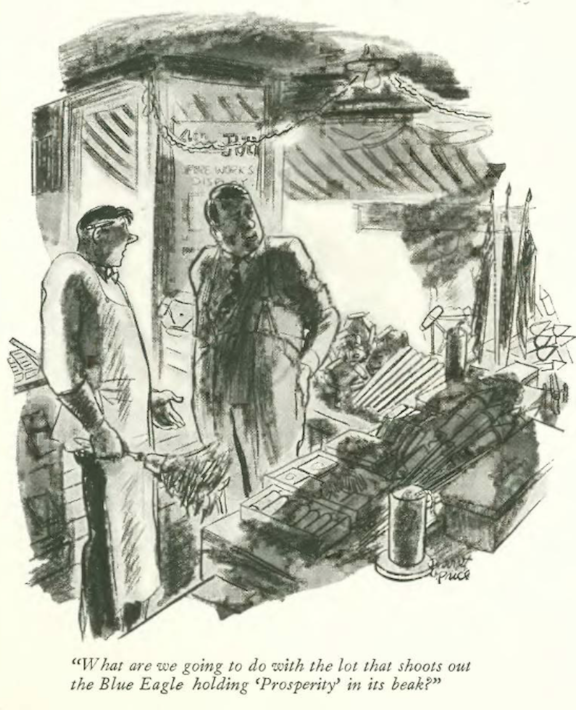
…Independence Day offered a marketing challenge to these shopkeepers, per Garrett Price…
…Peter Arno was at his best, in his element…
…Charles Addams explored the unnatural, which would become his calling card…
…Robert Day offered a new twist to the tonsorial arts…
…William Steig gave examples of some budding “tough guys”…
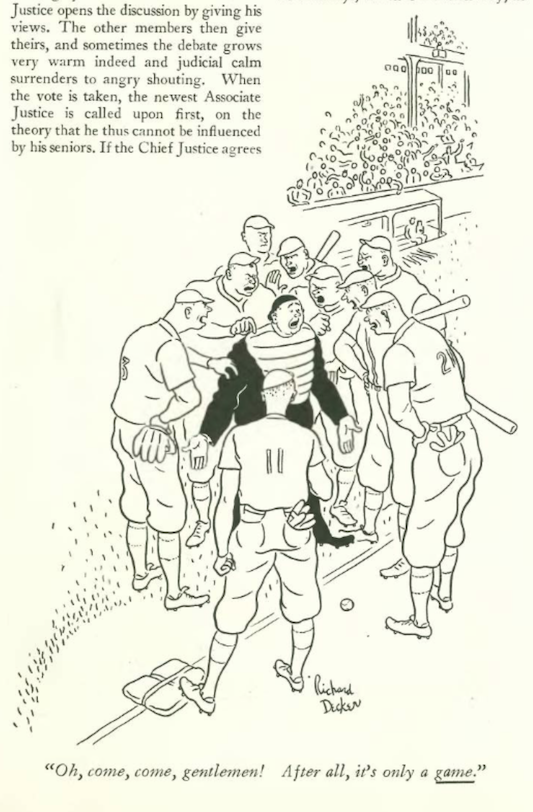
…a rare baseball-themed cartoon from Richard Decker (editor Harold Ross was not a baseball fan)…
…from George Price, what appears to be the end of his “floating man” series, which began in September 1934…
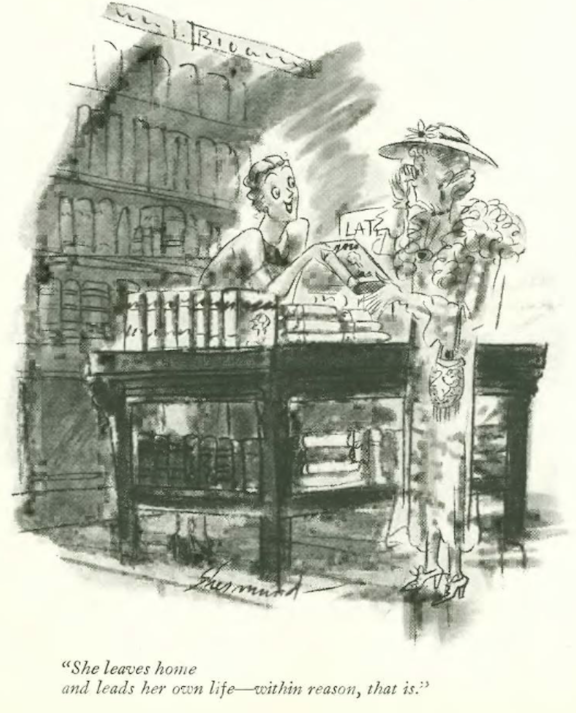
…and we close with one my favorite cartoonists, Barbara Shermund, here at the bookstore…
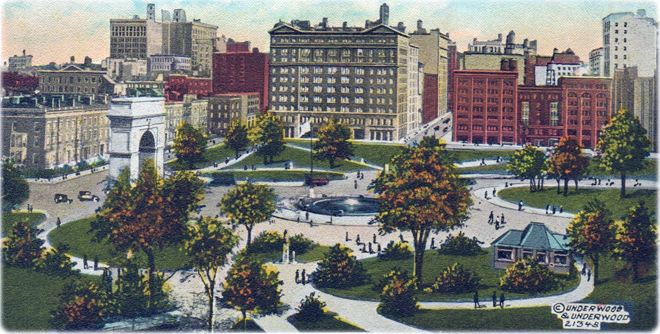
Above: Postcard image of Washington Square Park, circa 1930. (citybeautifulblog.com)
New Yorkers know all about change, and especially during the 1920s and 30s when the city razed everything from Dutch settler houses to the Gilded Age mansions of Fifth Avenue. Landmarks such as the old Waldorf-Astoria were leveled to make way for the Empire State Building, while several blocks—22 acres of residential and commercial buildings—were scraped clean for Rockefeller Center.
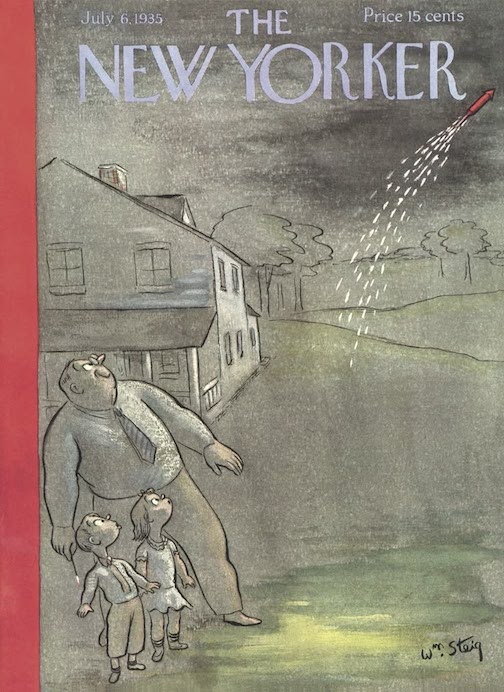
June 8, 1935 cover by Harry Brown. This June bride-themed cover was Brown’s fourteenth of the eighteen covers he would create for The New Yorker.
Some things, like Washington Square, were still held dear by city residents. But very little was sacred to the city’s new park commissioner, Robert Moses, who had no problem leveling whole neighborhoods if they stood in way of a road or some other ambitious project.
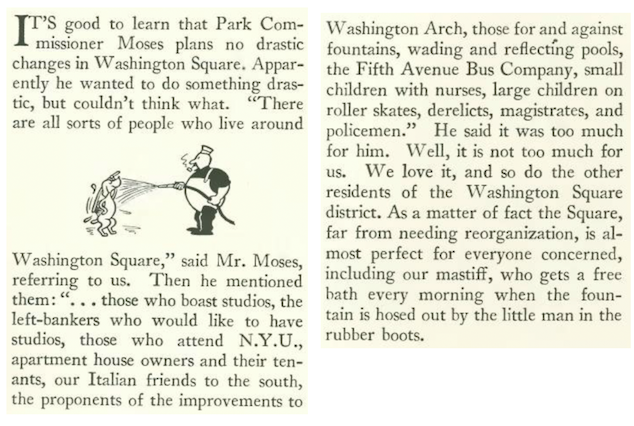
It all seemed well at first when Moses called for the repair of neglected parks, including Washington Square. However, when changes to the park were revealed by the Villager, residents were outraged. Moses’ plan, designed by landscape architect Gilmore Clarke, was a complete reversal of the park’s existing design. In “Notes and Comment,” E.B. White explained:
Village residents organized a “Save Washington Square” committee and successfully blocked Moses from implementing his plan; in true Moses style, he responded by allowing the park to deteriorate.
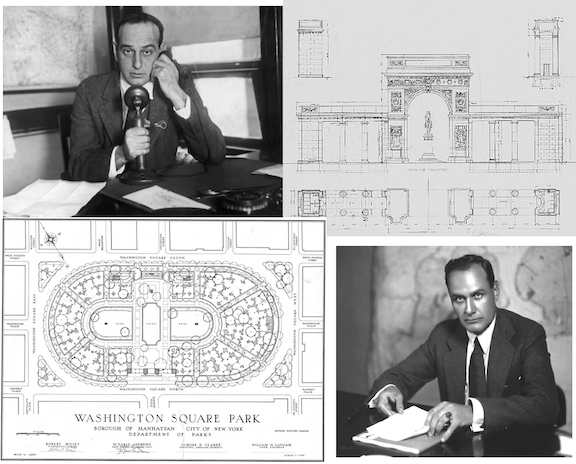
MAKE NO LITTLE PLANS…Clockwise, from top left, Parks Commissioner Robert Moses; proposal to add colonnades to either side of the arch; landscape architect Gilmore Clarke; Clarke’s plan for the redesign. (Wikipedia/washingtonsqpark.org)
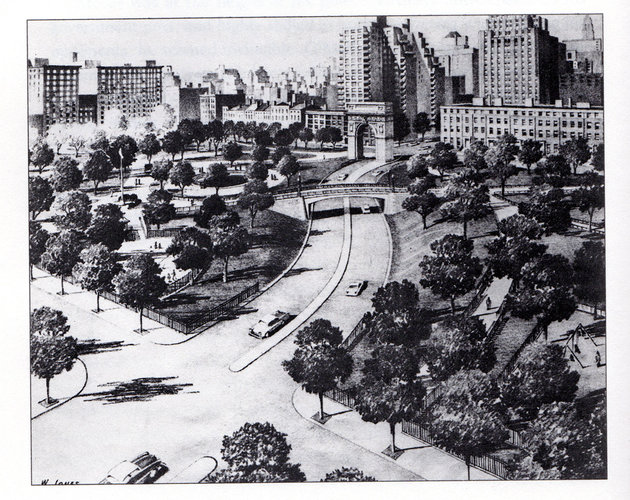
Moses, however, didn’t give up on Washington Square. Around 1940 he began floating the idea of building a double highway through the park. Local residents again rallied, joining business owners and NYU officials in blocking the audacious scheme.
DOUBLE TROUBLE…Around 1940 Moses began floating the idea of building a double highway through Washington Square Park. This illustration is circa 1950. (MTA Archives)
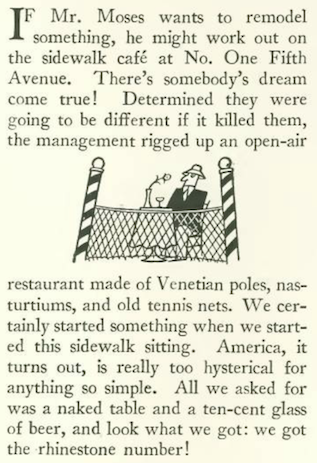
White continued on the theme of city planning, calling on Moses this time to figure out a better plan for sidewalk cafés.
AL FRESCO…Postcard images of sidewalk cafés at 24 Fifth Avenue (top) and 23rd and Lexington, circa 1935. (picryl.com)
Additional note: The magazine’s June 15, 1935 issue featured Lois Long’s criticisms of sidewalk cafés in Manhattan:
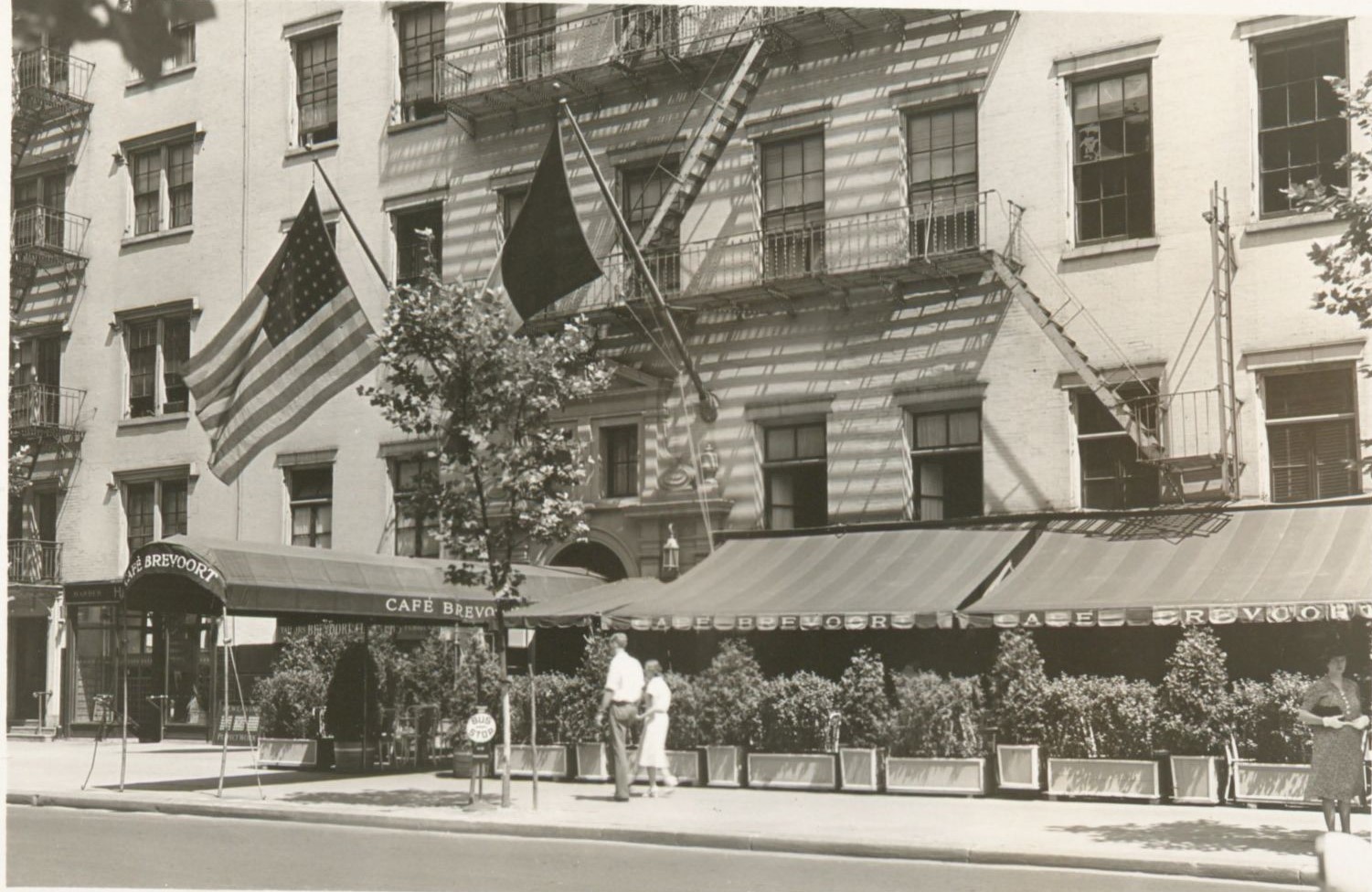
Long did offer, however, a couple of recommendations for sidewalk dining, including the Breevort in Greenwich Village…
If you really wanted to eat outside, Lois Long suggested the Breevort in Greenwich Village. (New York Public Library)
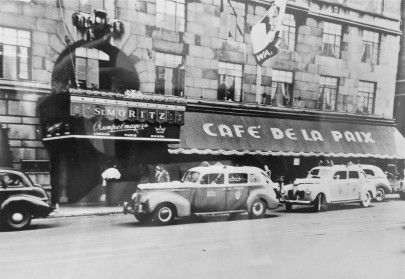
…and the St. Moritz’s Café de la Paix at 50 Central Park South…
The St. Moritz’s Café de la Paix in the 1940s. (blog.bondbrand.com)
* * *
Sexily Danced the Burlesques
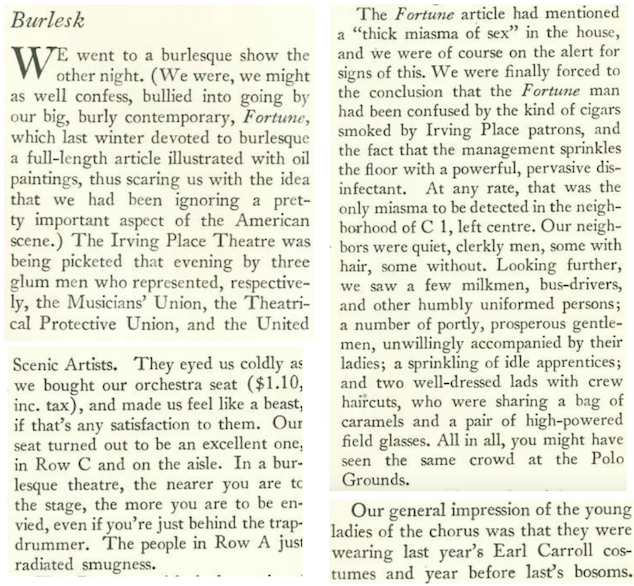
New Yorker writers loved to take shots at Henry Luce, publisher of Time and Fortune. Wolcott Gibbs famously satirized Time’s writing style in a parody profile in 1936: “Backward ran sentences until reeled the mind.” When Fortune decided to take a look behind the curtain at a burlesque show (February 1935), “The Talk of the Town” was ready to pounce.
The Fortune piece featured oil paintings by Stuyvesant Van Veen, including this one depicting the Proscenium at the Irving Place…
Fortune images courtesy fulltable.com
…Van Veen got behind the curtain to create this painting (below) of “Burlesque Queens,” and the magazine chastely demonstrated the “cycle of the strip act” with the help of Miss Jean Lee, aka Miss Jess Mack…
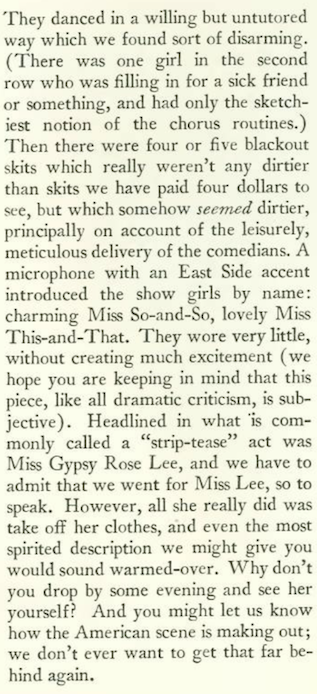
The New Yorker also took a sideways glance at Fortune’s stuffy approach to the subject of striptease, suggesting that it was much ado about nothing.
IT’S ALL AN ACT, FELLAS…Gypsy Rose Lee in 1943. (nypl.org)
* * *
Futures and Fascists
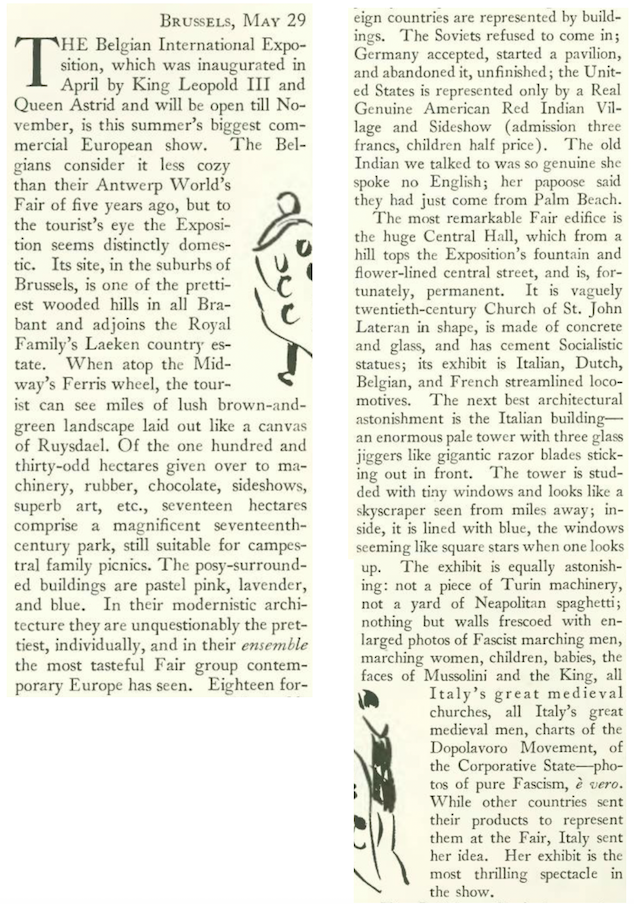
Before the days of television and the Internet, a world’s fair was the place to go to see the latest technologies and other attractions from countries around the world. Paris correspondent Janet Flanner filed a special report on the Brussels International Exposition of 1935, which attracted 20 million visitors in a little over six months.
EURO SPECTACLE…Clockwise, from top left, the menacing facade of the Italian Pavilion—its interior walls featured frescoes of marching fascists; the Palais des Expositions (Grand Palais) still stands today as the Brussels Exhibition Centre; an early demonstration of television; the U.S. featured an “Indian Village” at the Expo. (fomo.be/Wikimedia/en.worldsfairs.info)
* * *
Matchbox Cars
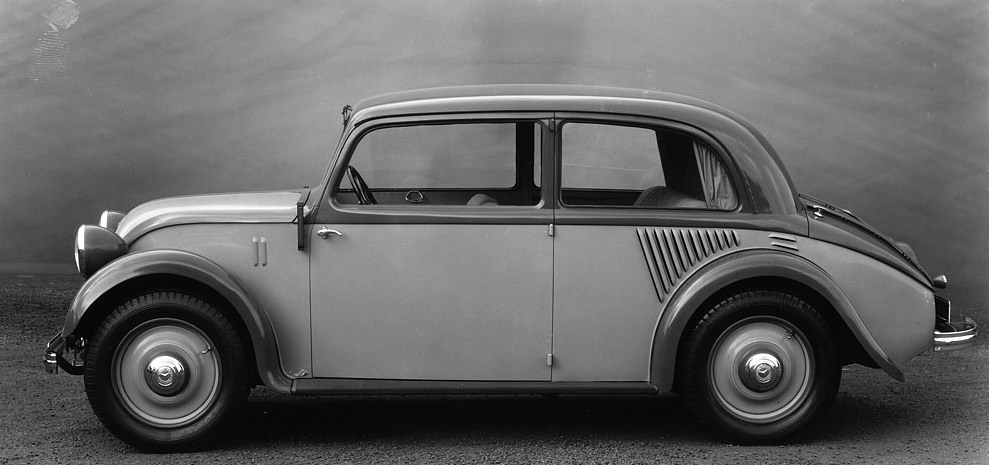
The New Yorker regularly checked the automobile competition from overseas, and found a tiny German car to be “perfectly amazing,” even if it didn’t go over so well with consumers.
IT’S CUTE, BUT…Due to its extreme unbalance of the Mercedes-Benz 130 H (two-thirds of the mass, including the engine, was on the rear axle), the car apparently was awkward to handle. It was discontinued in 1936. (automobile-catalog.com)
* * *
From Our Advertisers
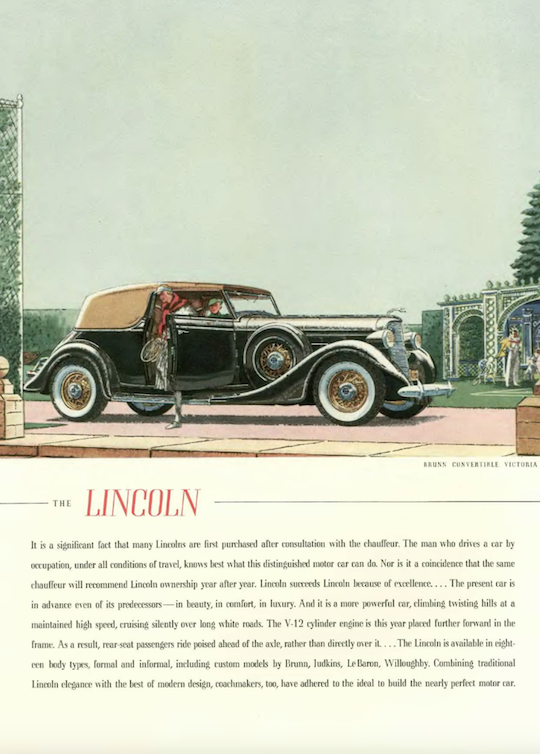
Anyway, most Americans preferred bigger cars, especially ones by luxury makers such as Lincoln, if they could afford them…
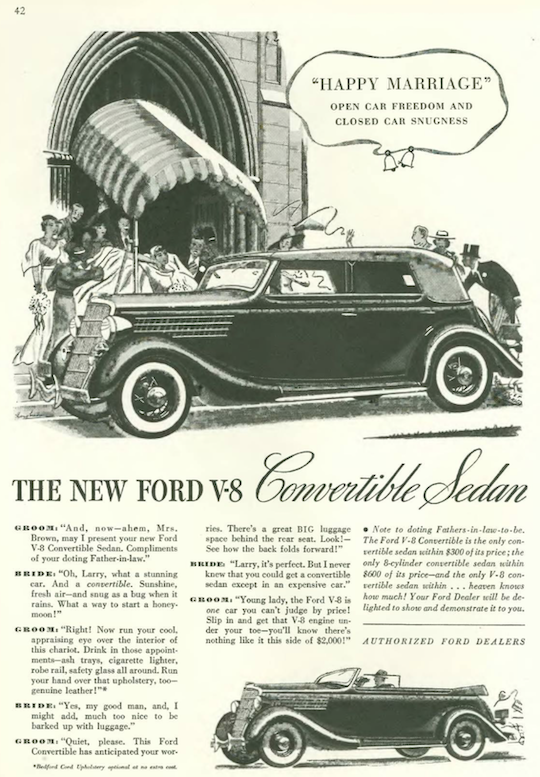
…Lincoln’s parent company, Ford, offered up a more affordable convertible with some flair of its own…automakers were fond of the marriage theme in advertisements, especially in the month of June…
…automakers and related industries were important advertisers during The New Yorker’s first years…
…indeed, the back cover of Issue #1 (Feb. 21, 1925) featured this ad from the United States Rubber Company, promoting its U.S. Royal Cord Balloon Tires…
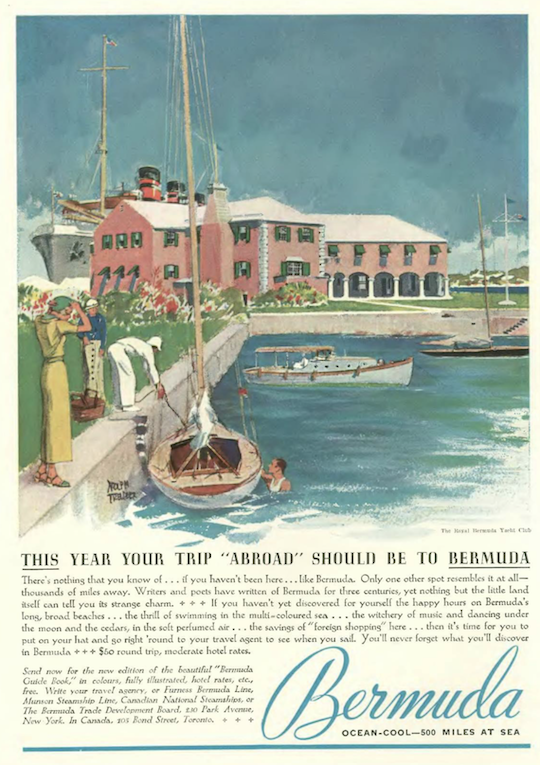
…another faithful advertiser in the magazine’s first decade was the Bermuda Trade Development Board…
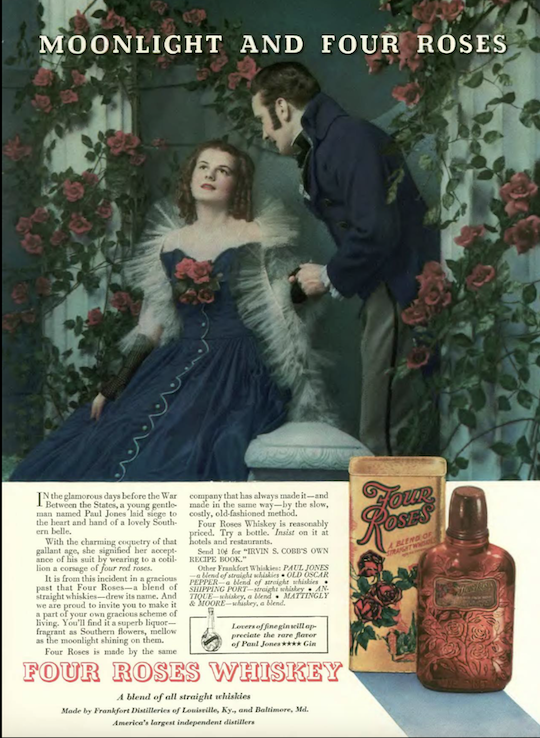
…this ad for Four Roses whiskey recalled “the glamorous days” (ahem) before the Civil War…
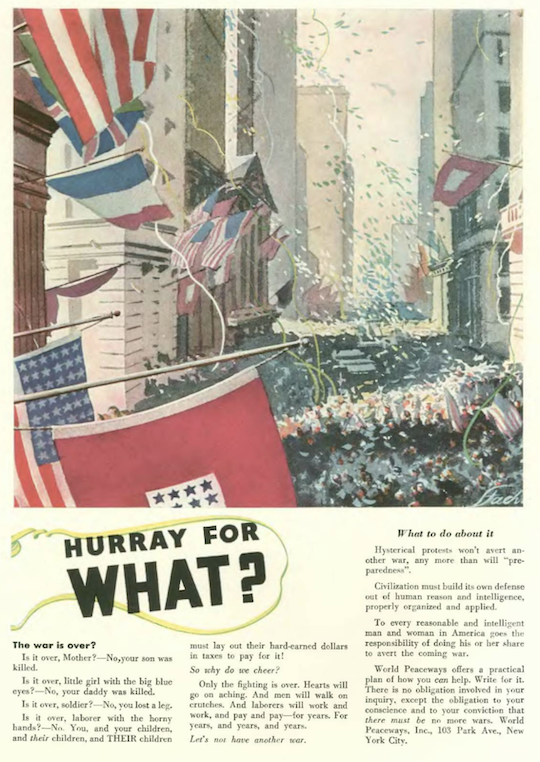
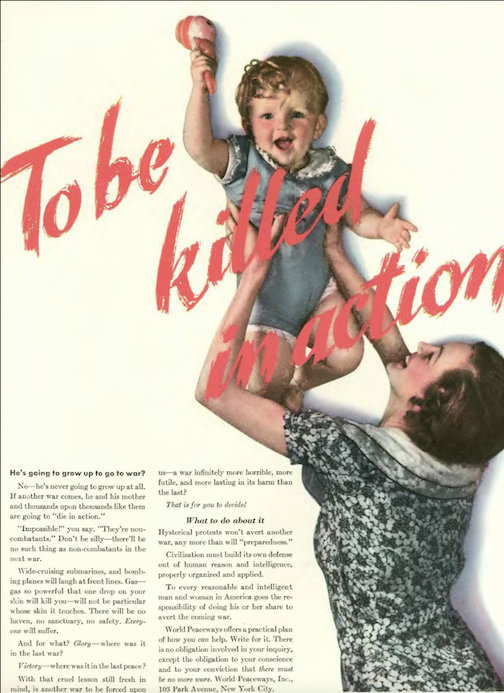
…and this colorful ad from World Peaceways reminded readers there was nothing to celebrate about wars…these ads pulled no punches (read the first few lines)…
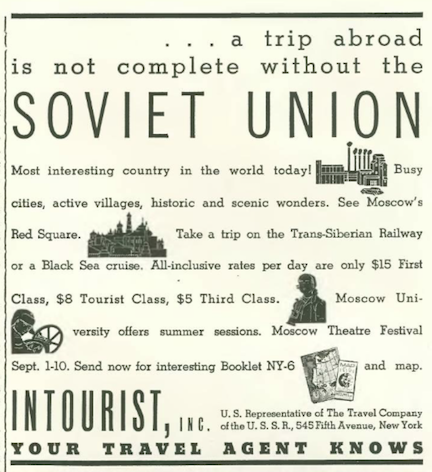
…”most interesting country in the world today!” proclaimed this ad inviting tourists to the Soviet Union…during 1934-35 Joseph Stalin was ruthlessly purging the Party, and local leaders across the country were being annihilated…of the 2.3 million people who had been party members in 1935, just under half were executed or perished in labor camps…this fact probably wasn’t mentioned in the travel folder…
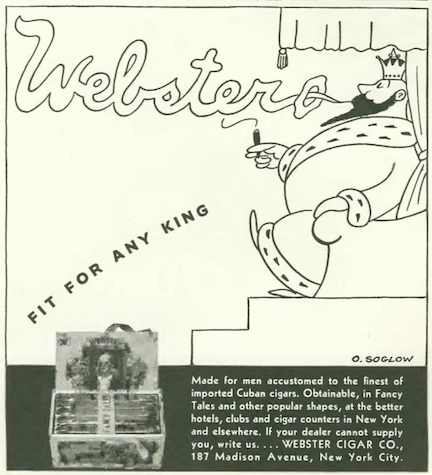
…the Webster Cigar Company hired Otto Soglow to create an ad doubtless based on the popularity of “The Little King,” but this isn’t the diminutive monarch…
…which takes us to our cartoonists, beginning with this spot signed E.S., I believe, or L.S. (anyone know?)…at any rate, its whimsical…
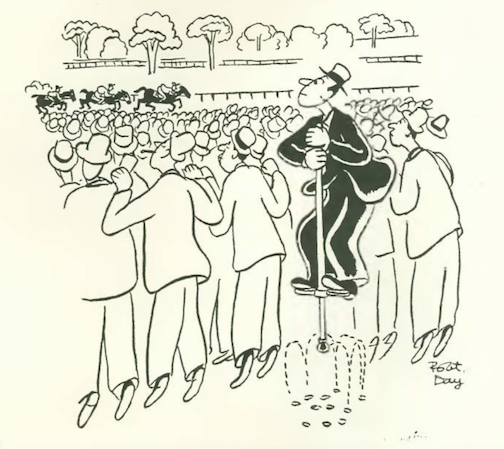
…of course we know Robert Day…
…Day again, in a very different style…
…Helen Hokinson, sounding a contemporary note…
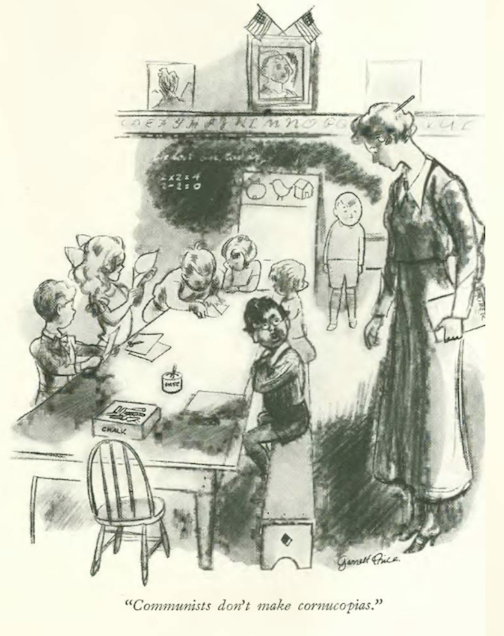
…a kindergarten political standoff, courtesy Garrett Price…
…Rea Irvin, and the obsolescence of Pan (today she’d have a cell phone)…
…Peter Arno, and a clueless, cold, cuckold…
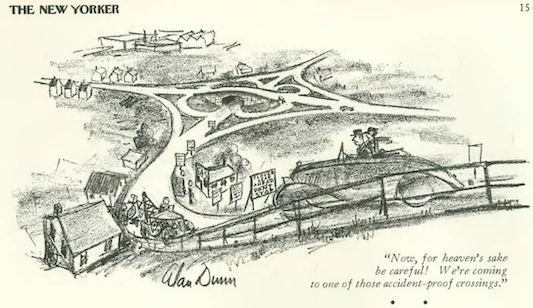
…and we close with Alan Dunn, and the future of transportation…
Above: Landscape in Bayside, 1935, by George Grosz (Phillips Collection)
Knowing that the Nazis would not look kindly on his art, George Grosz took a job teaching drawing in New York in 1932, and by 1933 he had become a permanent resident of the city.
March 30, 1935 cover by Garrett Price celebrated the traditional “Bock” beer of spring.
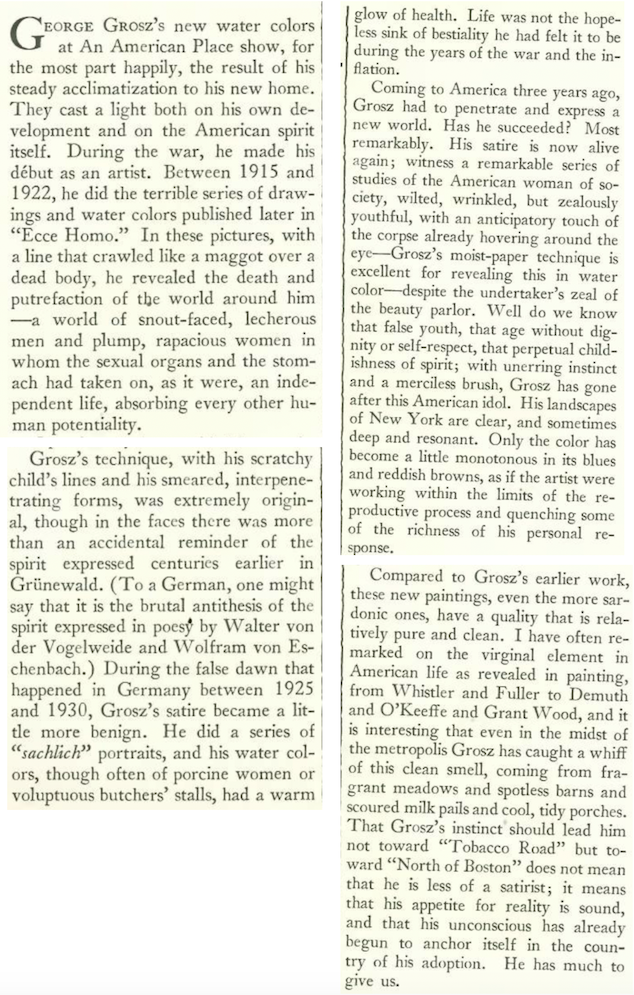
Grosz (1893–1959) was overwhelmed by the size and pace of his adopted city, and for the most part he left behind his bitter caricatures and paintings of Berlin’s Weimar years and turned to other subjects, including landscapes and New York’s urban life. Critic Lewis Mumford took in a show of Grosz’s new water colors at An American Place, a small gallery run by photographer and art dealer Alfred Stieglitz.
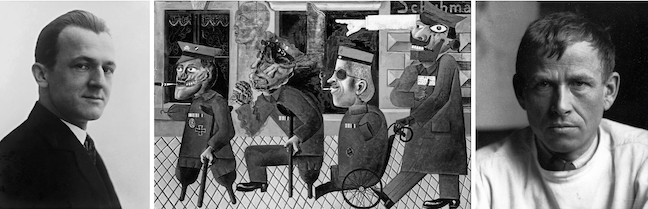
THE NEW OBJECTIVITY…George Grosz (left, circa 1921), was not alone in his harsh depictions of war and of German society during the Weimar Republic. Other key figures in the New Objectivity (Neue Sachlichkeit) movement included Max Beckmann and Otto Dix (right, circa 1929). Dix’s oil on canvas War Cripples (Kriegskrüppel), 1920, which is pictured above, was exhibited at the First International Dada Fair in Berlin in 1920. Only black and white images exist of the painting, which is believed to have been destroyed by Nazis who condemned it as degenerate art. (Wikimedia Commons/CUNY)
OH THE HUMANITY…Three selections from the “Ecco Homo” series by George Grosz. From left, Gruß aus Sachsen (Greetings from Saxony) 1920; Nachts, (At Night) 1919; and Schwere Zeiten (Hard Times) 1919. Grosz took a dim view of the corruption and moral decline he found in Weimar Berlin. (MoMA)SEEING RED…Detail from George Grosz’sMetropolis, Oil on Canvas, 1916-1917. A blood-like shade of red could be seen in many of the artist’s paintings during World War I and the Weimar Republic. In this painting and in others, death is omnipresent. (Thyssen-Bornemisza Museum, Madrid)A SOFTER SIDE could be found in George Grosz’s later watercolors, although he hadn’t entirely lost his sense of the satirical, or his taste for red paint. From left, Street in Harlem, circa mid-1930s; Ehepaar (A Married Couple), 1930; Central Park at Night, 1936. (Phillips Collection/Tate Gallery/Art Institute Chicago)
* * *
Not the Bee’s Knees
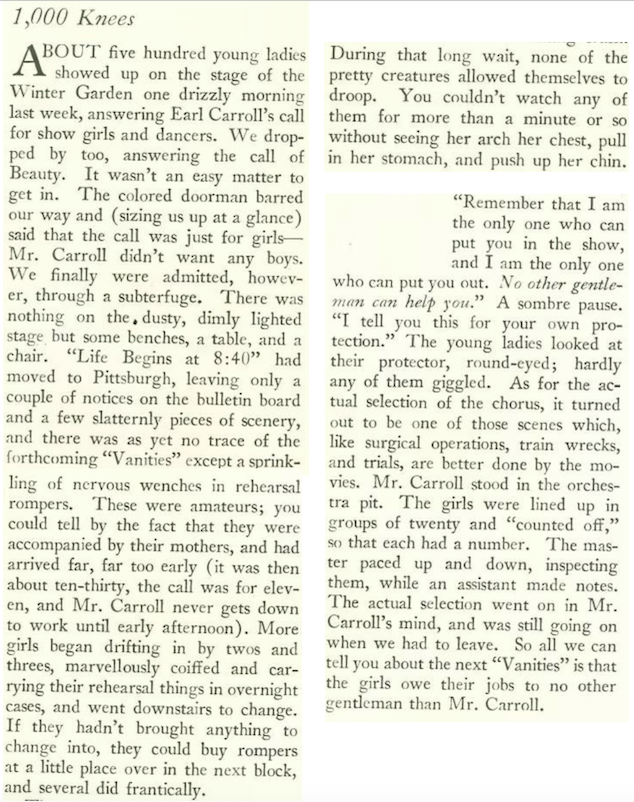
For all the progressive thinking that was on display in the early New Yorker, we also reminded that it was also a creature of its time in 1935. Here are excerpts from a lengthy “Talk of the Town” entry that described the sad winnowing process of Broadway revue producer Earl Carroll…
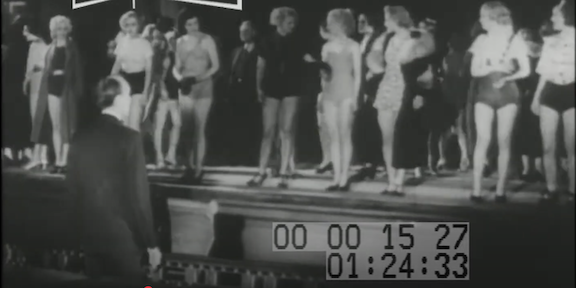
JUDGEMENT DAY…Here is a screenshot from a short film featuring the 1935 audition described in the “Talk” segment. At left is Earl Carroll. You can watch the film here. (YouTube)
* * *
Too Little For Too Much
Film critic John Mosher gave Alfred Hitchcock’s 1934 version of The Man Who Knew Too Much just five lines in his review. He described it as “one of those preposterous adventure stories which Englishmen are always writing…” The film, however, was an international success, and it would define the rest of Hitchcock’s career as a director of thrillers with a unique sense of humor.
A HAPPY, CAREFREE HOUR is how critic John Mosher described his experience watching 1934’s The Man Who Knew Too Much. Clockwise, from top right, director Alfred Hitchcock with the film’s German star, Peter Lorre, who learned his part phonetically; Lorre and Cicely Oates; Edna Best did her best at playing a grieving mother. The film was remade by Paramount in 1956, starring James Stewart and Doris Day. (Wikipedia/aurorasginjoint.com/IMDB)
* * *
Dizzy Nor Dazzled
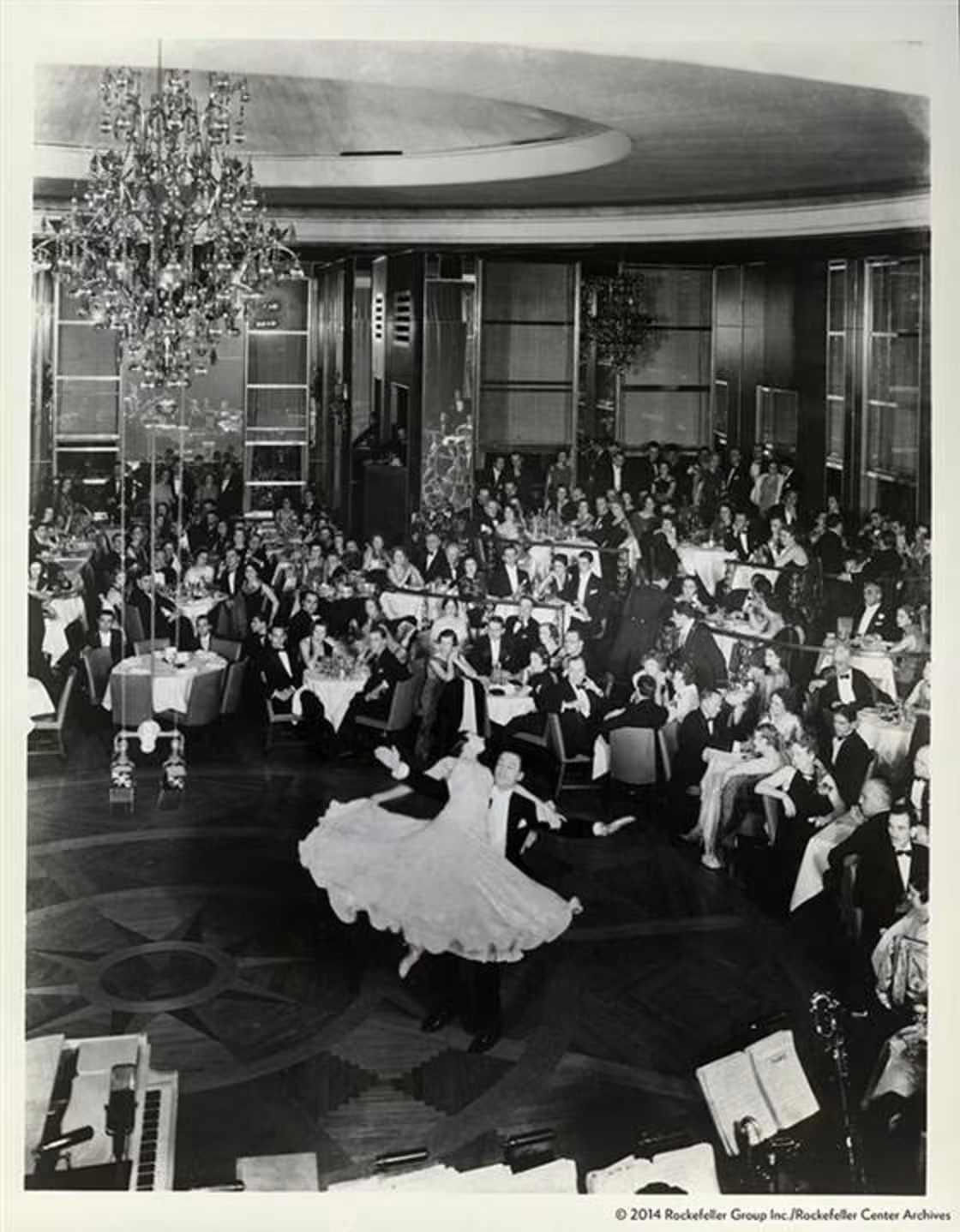
In 1935 Lois Long had been divorced from cartoonist Peter Arno for about four years, and she was the mother of six-year-old daughter from that marriage. That didn’t keep her from sampling the city’s night life, but the days of speakeasies and drinking sessions that lasted into the wee hours were over for the 34-year-old Long. For her “Tables for Two” column she took the elevator up to the 65th floor of 30 Rockefeller Plaza to take in the entertainment at the Rainbow Room…as well as the pedestrian crowd…
WHAT A WHIRL…Above, diners watch a performance by ballroom dancers Lydia and Joresco in the then newly opened Rainbow Room in 1934. Lois Long enjoyed the Rainbow Room in its 1930s heyday, but she missed her old speakeasy crowd, noting that the Rainbow Room’s customers weren’t “dizzy enough” to suit her tastes. (Rockefeller Center Archives)
…her speakeasy days were over, but it appears Long still enjoyed a bit of indulgence…here is how she concluded her column:
* * *
From Our Advertisers
Step into a crowded mid-century elevator and you were bound to catch a whiff of the menthol-tinged scent of Aqua Velva, not objectionable if properly applied…
…speaking of menthol, the makers of Spud cigarettes were now competing with upstart menthol cigarette makers including Kool…this ad has all kinds of problems, including the suggestion that the occasional Spud not only inspires one’s nuptials, but also ensures marital bliss, as well as a lifetime of chain-smoking…
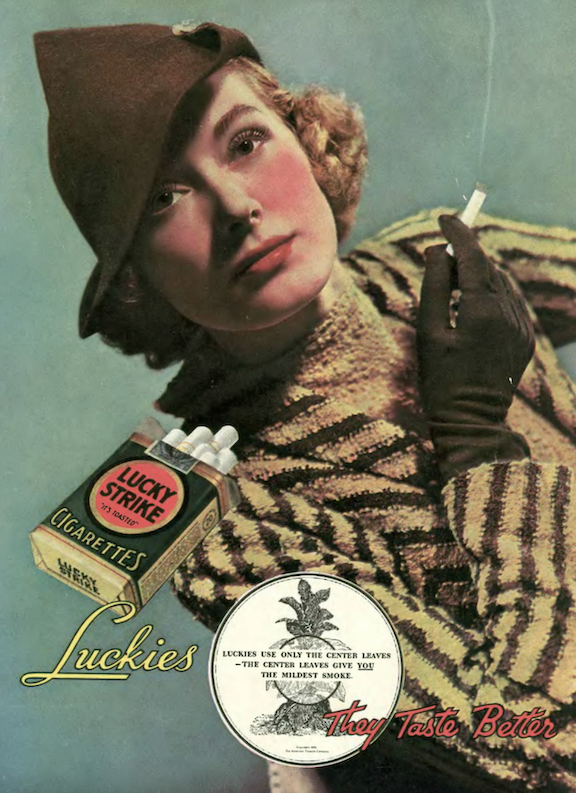
…Luckies, on the other hand, continued to appeal to the modern woman, and what impressionable young woman wouldn’t be inclined to pick up the habit to complete her ensemble?…
…the makers of College Inn tomato juice gave their raving Duchess the week off, but we get another old sourpuss in the form of a “Dowager” who demands that her servant remove a glass of what very well could have been tomato juice…enter the old bat’s niece, Dorothea, who suggests that the cook, Clementina, serve some Libby’s pineapple juice instead, probably spiked with vodka given the Dowager’s sudden change of demeanor…
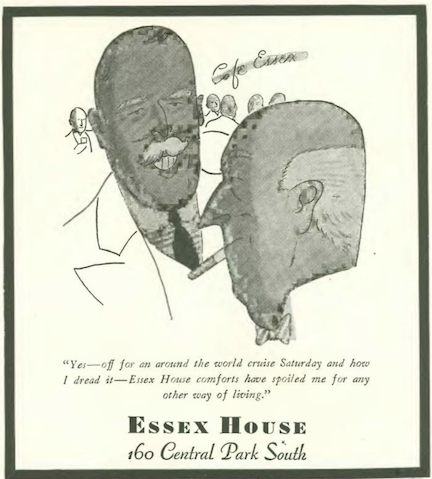
…Essex House continued their class-ridden ad campaign, this time with some stuff-shirt dreading his world cruise
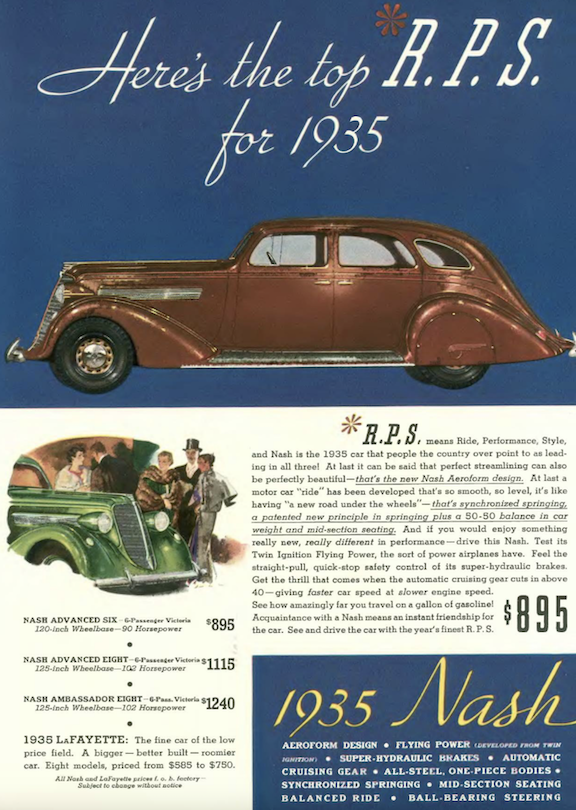
…carmakers continued to emphasize economy and price to move their latest models, including the 1935 Nash with “Aeroform Design”…
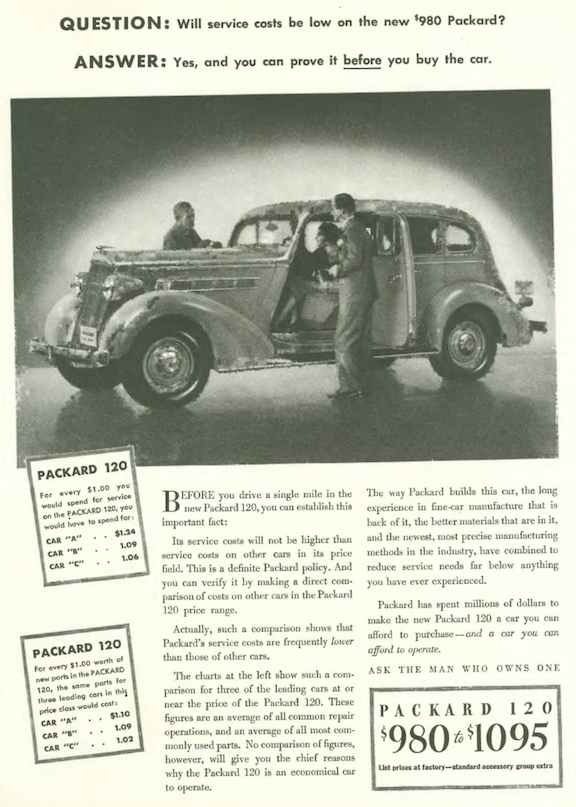
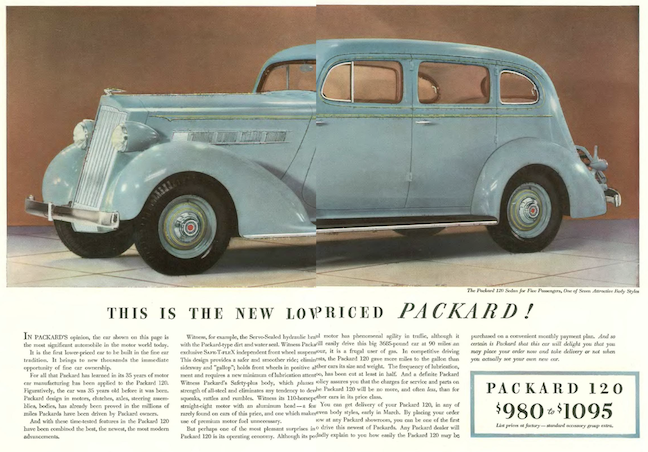
…last week I noted that Packard was doubling down on promoting the elite status of its premium automobile; however, the carmaker did introduce a “120” that cost a fraction of its luxury models and helped the company’s bottom line…
…Packard’s competition was Lincoln and Cadillac, among other luxury brands, but Pierce Arrow represented the pinnacle of luxury and craftsmanship, the American equivalent of Rolls Royce…unlike the other luxury brands, Pierce Arrow did not offer a lower-priced car, and the company folded it 1938…
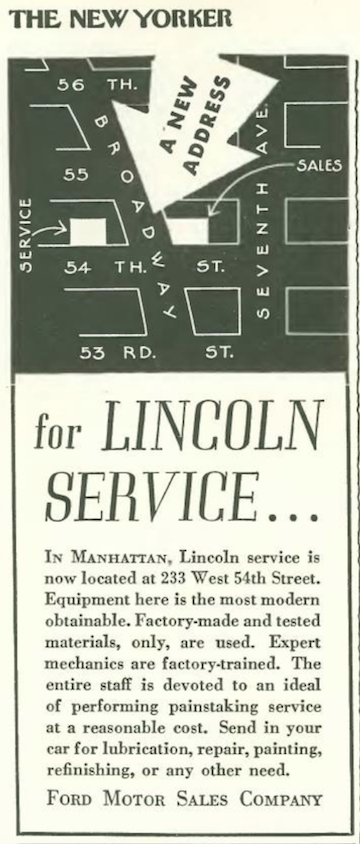
…speaking of luxury cars, if you owned a Lincoln, this little ad tucked into the top corner of page 55 showed you were to go to get a tune-up…
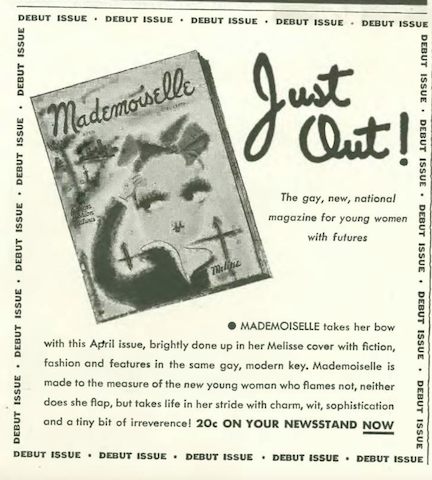
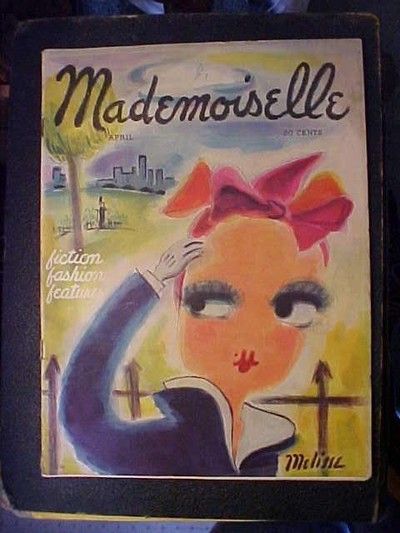
…the publishers at Street & Smith announced the launch of a new fashion magazine, Mademoiselle, a seemingly daring move in Depression America…the cover featured an illustration by Melisse (aka Mildred Oppenheim Melisse)…the magazine was later acquired by Condé Nast, and folded in November 2001…
Mildred Oppenheim Melisse’s cover for the debut issue of Mademoiselle, April 1935. Melisse also supplied the cover art for the May and June issues that year. (Pinterest)
…Otto Soglow was on his way to becoming a wealthy man thanks to his “Little King” cartoon…William Randolph Hearst lured Soglow and the cartoon away from The New Yorker in 1934, so the only way the wee potentate could appear in the magazine was in an ad, like this one for Bloomingdale’s…
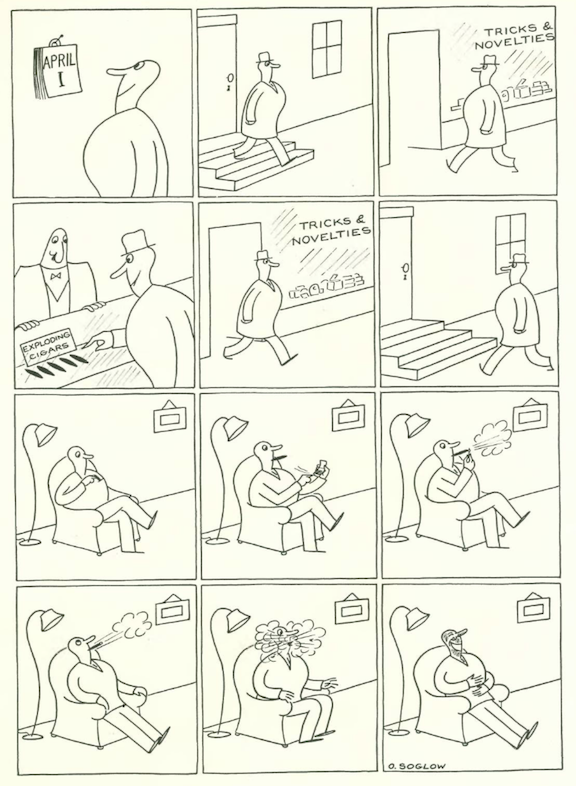
…Soglow continued to contribute to The New Yorker, and we kick off our cartoons with an April Fool’s joke…
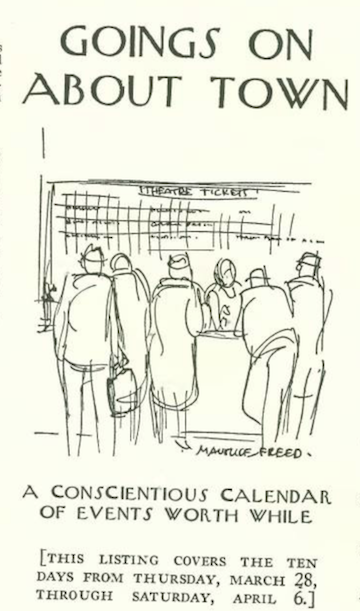
…for the second week in a row Maurice Freed supplied the opening spot art for “Goings On About Town”…
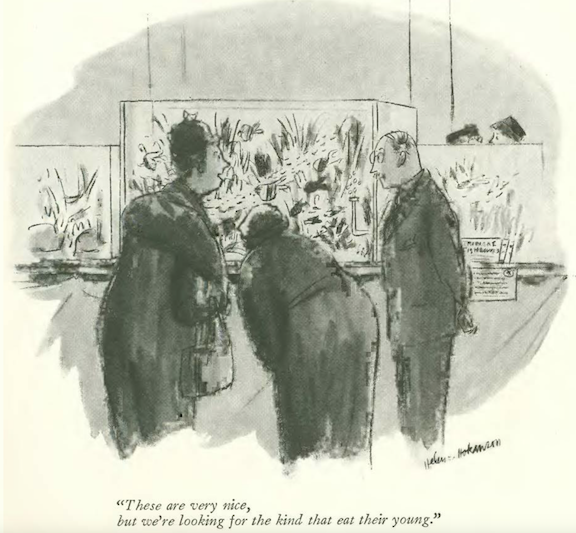
…Helen Hokinson was on the hunt for some predatory fish…
…James Thurber looked in on the nudist fad that emerged in the 1930s…
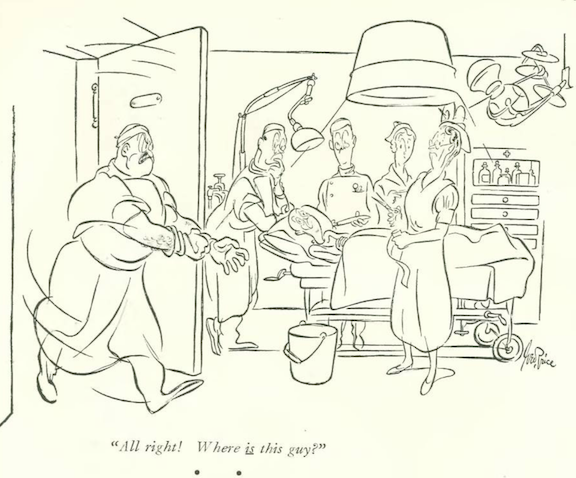
…and we close with George Price, an some alarming bedside manners…
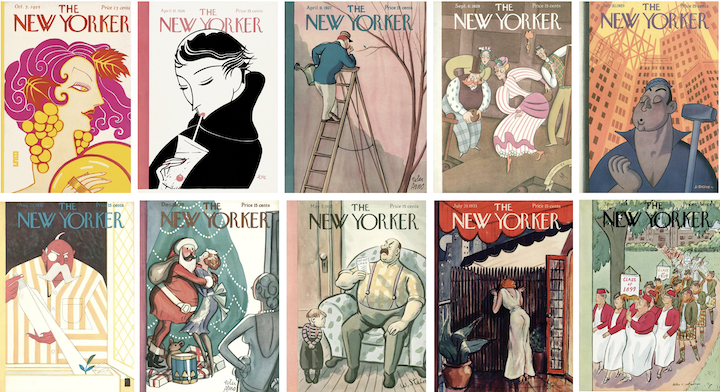
With this post (No. 413), we mark the tenth anniversary of The New Yorker. Since I began A New Yorker State of Mind in March 2015, I’ve attempted to give you at least a sense of what the magazine was like in those first years, as well as the historical events that often informed its editorial content as well as its famed cartoons. Those times also informed the advertisements; indeed, in some cases the ads give us a better idea of who was reading the magazine, as well as their changing tastes and buying power as we moved from the Roaring Twenties to the Depression, and from Prohibition into Repeal.
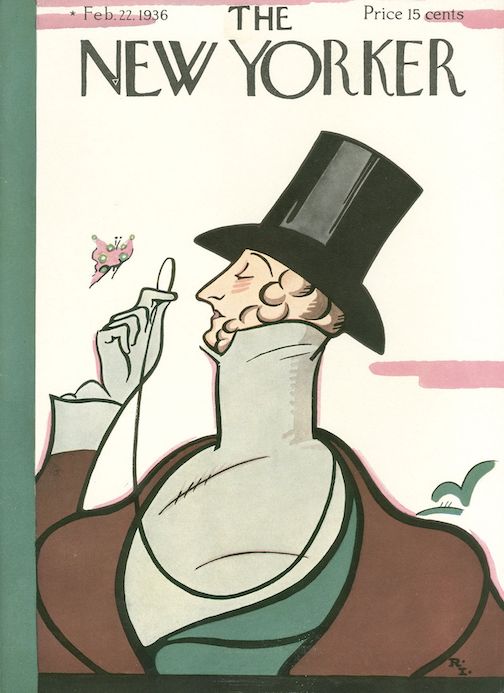
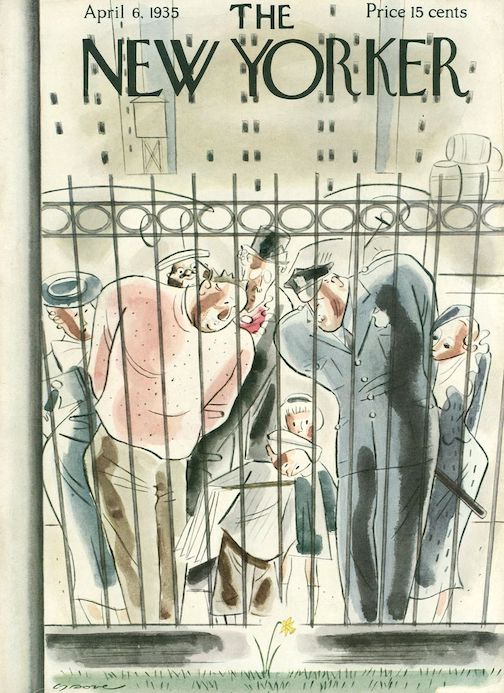
I have also chosen this time to go on hiatus, and hopefully resume this blog when The New Yorker celebrates its centennial next February (this site will remain active and available, and I will continue to monitor comments and messages). Let us hope that the editors use the original Rea Irvin cover for that occasion, and restore his masthead above “The Talk of the Town” section. Perhaps some enterprising soul could start a petition.
Feb. 16, 1935 cover by Rea Irvin.
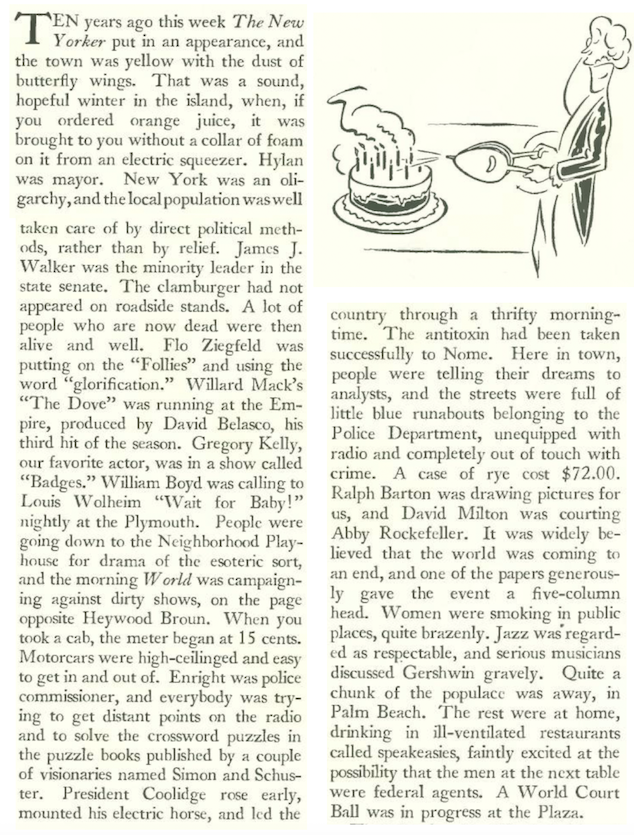
Moving on to the tenth anniversary issue, we find E.B. White recalling the world of The New Yorker’s first days. Given the massive economic and societal shifts that occurred from 1925 to 1935, those first days seemed distant to White, who felt old, “not in years but events.”
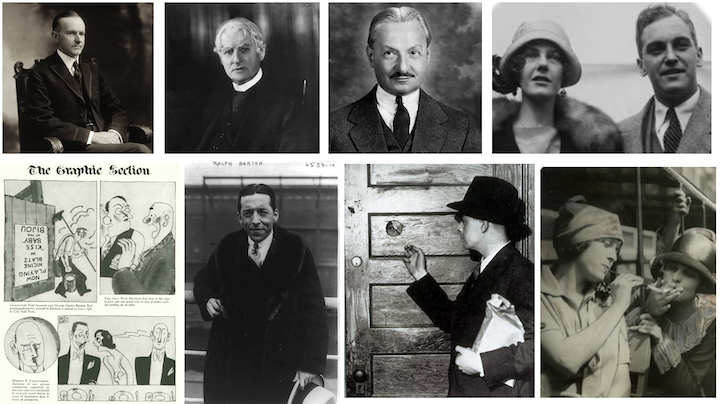
DAYS OF YORE…E.B. White noted the many changes that had taken place during The New Yorker’s first ten years, including, clockwise from top left, the passing of 1920s notables such as President Calvin Coolidge and two very different theatre impresarios—David Belasco and Flo Ziegfeld; White also recalled the much-publicized 1925 wedding of Abby Rockefeller to David Milton, the throngs of women who took to smoking in public in the 1920s and the drinkers who took their activities behind closed doors; and one of the early magazine’s beloved contributors, Ralph Barton, who offered his whimsical take on the news in “The Graphic Section” as well as in other illustrated features. (Wikipedia/Wikitree/Ephemeral New York)
White also noted a new craze that had originated around the same time as the birth of The New Yorker…
TWO ACROSS…Max Schuster and Richard Simon of Simon & Schuster, with their first crossword book, 1924. (americanbusinesshistory.org)
White concluded with these parting words, tinged with world-weariness, writing “More seems likely to happen.” One wonders if he imagined The New Yorker at 100, which in our day is just around the corner. Like White, many us have grown weary of this angry world, where indeed more seems likely to happen. Let us hope it is for the best.
Now, some unfinished business. We need to look at the previous issue, Feb. 9, 1935, before we close out the decade.
Feb. 9, 1935 cover by William Cotton.
We stay on the lighter side, joining critic John Mosher at the local cinema to appreciate Leslie Howard’s dashing performance in The Scarlet Pimpernel…
WORKING OVERTIME…Leslie Howard and Merle Oberon in The Scarlet Pimpernel. Howard portrayed an aristocrat who leads a double life, publicly appearing as a dandy while secretly rescuing French nobles from Robespierre’s Reign of Terror. (PBS)
* * *
From Our Advertisers
Cigarette manufacturers employed every angle from sex to health claims to move their product…not to be left out of any niche market, Chesterfield even went after the little old ladies…
…by contrast, the makers of Old Gold cigarettes featured a clueless sugar daddy and his leggy mistress in a series of ads drawn by famed pin-up artist George Petty…
…Otto Soglow would do well with advertisers during his career, promoting everything from whiskey to Pepsi and Shredded Wheat to department stores…in this case Bloomingdale’s…after William Randolph Hearst’s King Features Syndicate wrested The Little King away from The New Yorker in September 1934, this was the only way you would see the harmless potentate in the magazine…
…another New Yorker artist earning some ad dollars on the side was Constantin Alajalov, here adding a stylish flair for Coty…
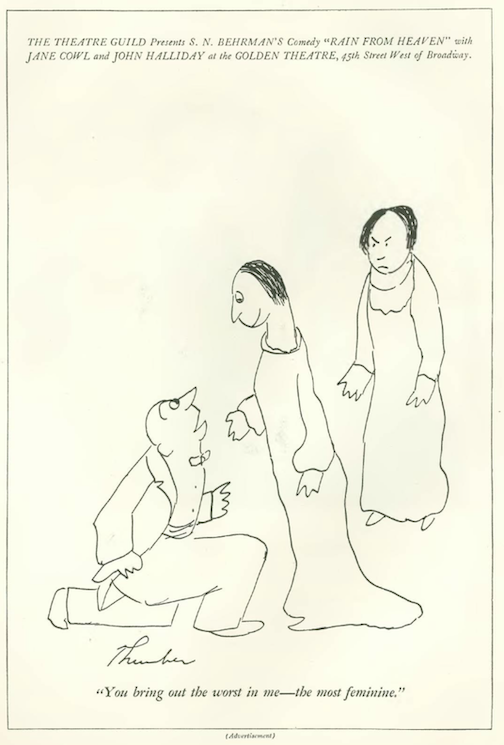
…and then there’s James Thurber, who continued to contribute his talents on behalf of the Theatre Guild…
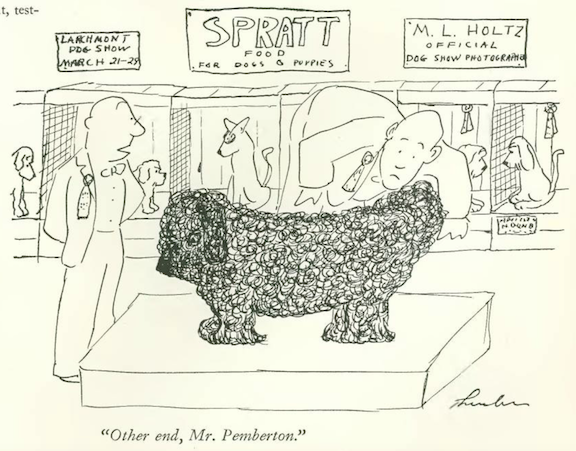
…and we move along to the Feb. 9 cartoons, with Thurber again…
…the issue also featured two by George Price…
…and Howard Baer supplied some life to this little party…
…now let’s return to the Feb. 15, 1935 issue…
…where John Mosher was back at the cinema, this time enjoying the story of a “beautiful stenographer”…
POPCORNY…Fred MacMurray and Claudette Colbert meet cute over popcorn in the romantic comedy The Gilded Lily. It was MacMurray’s second credited screen role, and it was the first of seven films in which Colbert and MacMurray would star together. (Wikipedia)
* * *
More From Our Advertisers
In its bid for survival during the Depression, the luxury brand Packard introduced its first car under $1000, the 120. Sales more than tripled in 1935 and doubled again in 1936…
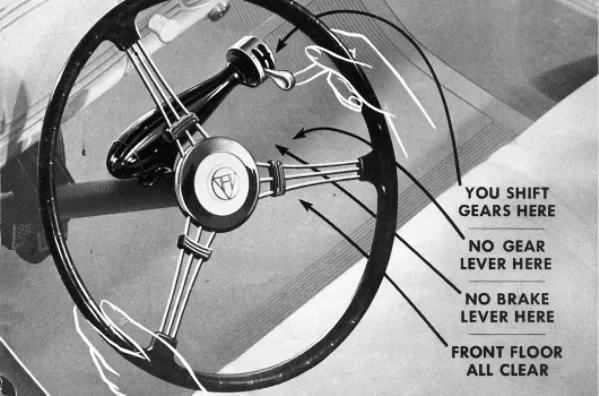
…meanwhile, Hudson was hanging in there with innovations such as the “Electric Hand”…it was not a true automatic transmission, but it did allow drivers to shift gears near the steering wheel…
…as demonstrated here…
…whatever you were driving, Goodyear claimed it would keep you the safest with their “Double Eagles”…
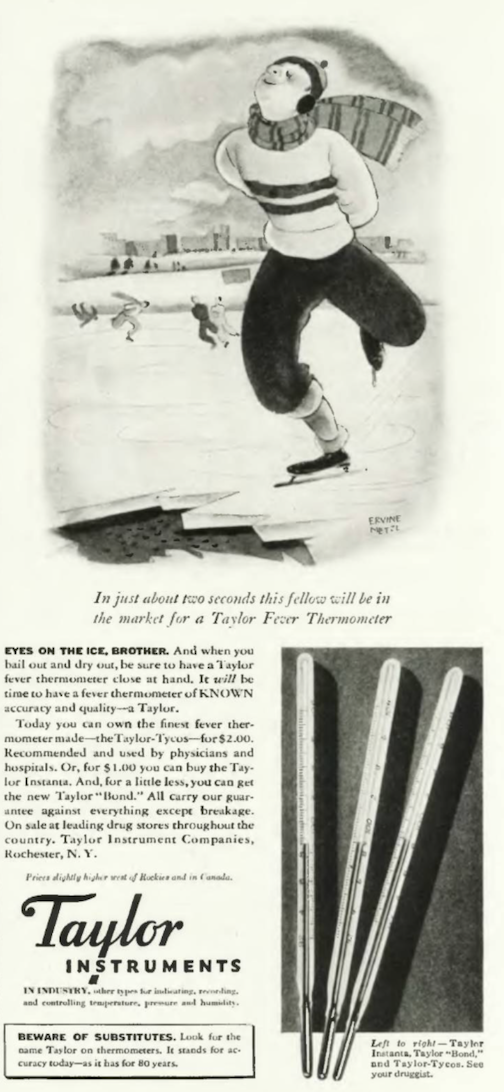
…I include this ad for Taylor Instruments because it features an illustration by Ervine Metzl, who would become known for his posters and postage stamp designs…
…Metzl’s design of a three-cent stamp commemorating the 1957–1958 International Geophysical Year…
…on to our cartoonists, we begin with this Deco-inspired artwork by an unidentified illustrator…
…one of Helen Hokinson’s “girls” was going about her daily rounds…
…Garrett Price gave us a gatekeeper not quite up to his task…
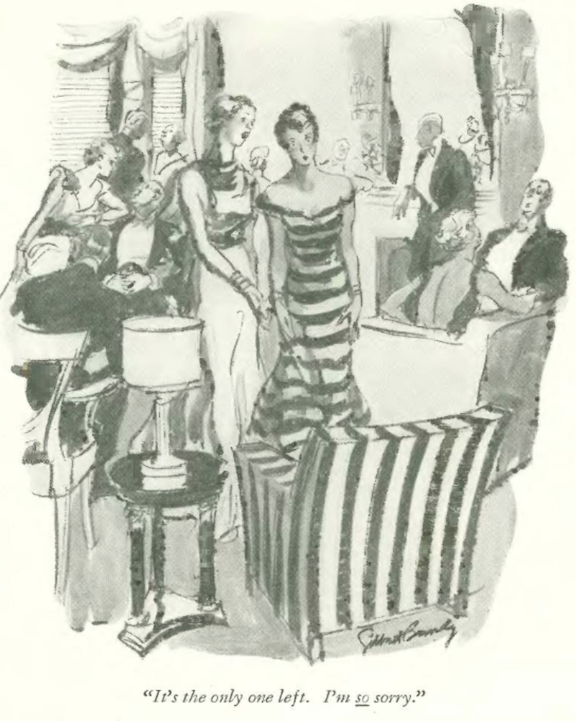
…Gilbert Bundy was seeing stripes rather than stars…
…while James Thurber’s medium was getting in touch with an equine spirit…
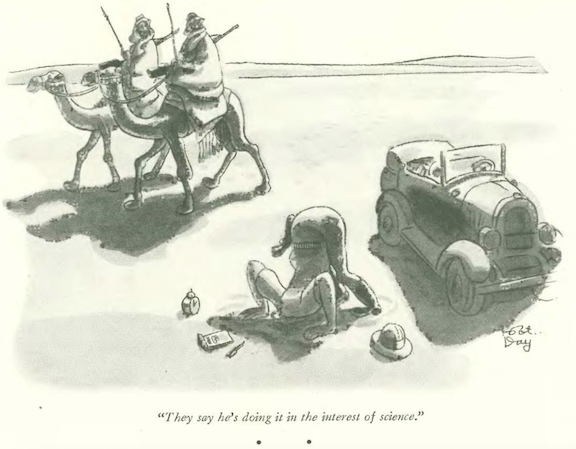
…scientific inquiry knew no bounds in Robert Day’s world….
…and in the world of Alain (aka Daniel Brustlein), old habits died hard…
…and we close with Peter Arno, at his risqué best…
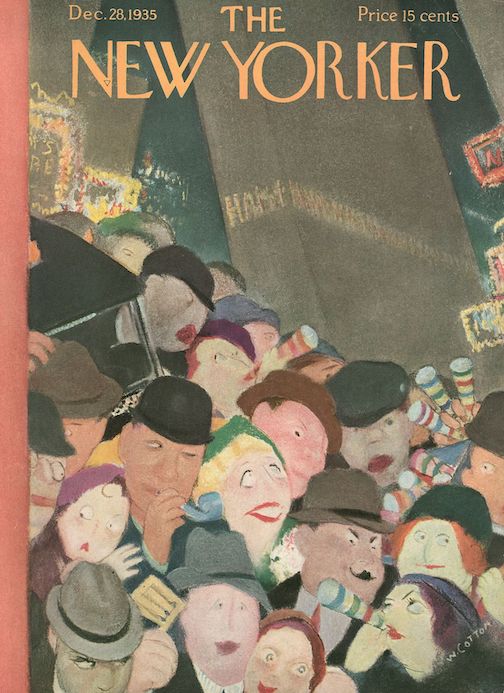
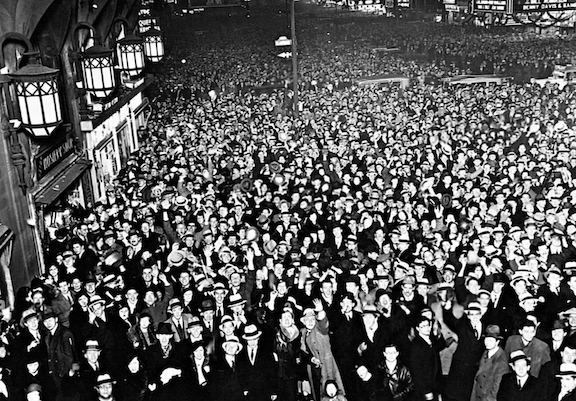
Above: Ringing in the New Year at Times Square, 1934.
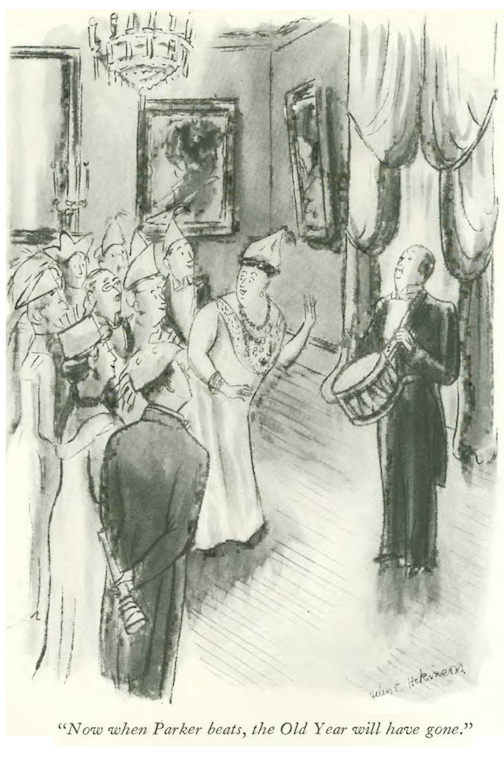
We bid adieu to 1934 with some odds and ends, beginning with E.B. White’s observations for the upcoming year, which if anyone had noticed the uptick in Ascot tie purchases, just might be a bit rosier than previous years of the decade.
Dec. 29, 1934 cover by S. Liam Dunn.
White was also hopeful for a new year with a less dreadful press, particularly the pandering type promulgated by William Randolph Hearst.
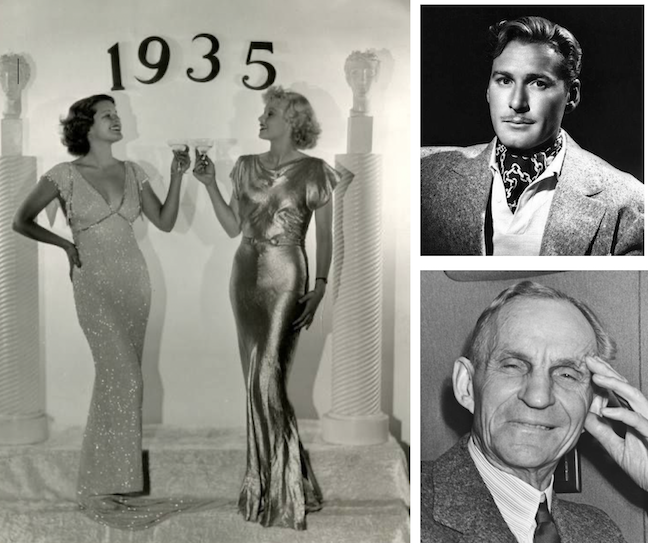
GOOD RIDDANCE…E.B. White wryly noted the positive signs heading into 1935. While actresses Billie Seward and Lucille Ball rang in the New Year, Erroll Flynn was sporting an ascot tie and Henry Ford was proclaiming that the Depression was over. (Pinterest)
* * *
Dr. Peeper
“The Talk of the Town” noted that Dr. Allan Dafoe, the country doctor who gained fame for delivering the Dionne Quintuplets, expressed a desire to see Sally Rand perform her bubble dance during his visit to Gotham. “Talk” also looked in on the some of the technical aspects of the burlesque dancer’s signature act:
DON’T BURST MY BUBBLE…Dr. Allan Dafoe of Dionne Quintuplet fame looked forward to taking in the sights of New York, including Sally Rand’s famed bubble dance. (Image from the 1936 book The Country Doctor/Sally Rand via stuffnobodycaresabout.com)
* * *
Leading Ladies
Film Critic John Mosher noted the continued rise of two leading female stars, twenty-seven-year-old Katharine Hepburn and six-year-old Shirley Temple. Mosher recalled Hepburn’s recent performance in Little Women, and proclaimed that she “succeeds again” in The Little Minister.
OPPORTUNITY KNOCKS...Katharine Hepburn and John Beal in The Little Minister. Hepburn portrayed Babbie, a member of the nobility who disguises herself as a gypsy to protect villagers from a tyrannical lord. In the process she falls in love with the good Rev. Gavin Dishart (Beal). (IMDB)
Although Mosher admitted he was a “disagreeable adult” who doesn’t enjoy seeing children on the screen “more than necessary,” he acknowledged Shirley Temple’s talents as well as those of child actor Jane Withers in Bright Eyes.
BRIGHT EYES, BRIGHT STARS…Jane Withers, Shirley Temple, and Terry in Bright Eyes. (IMDB)
* * *
That Youthful Feeling
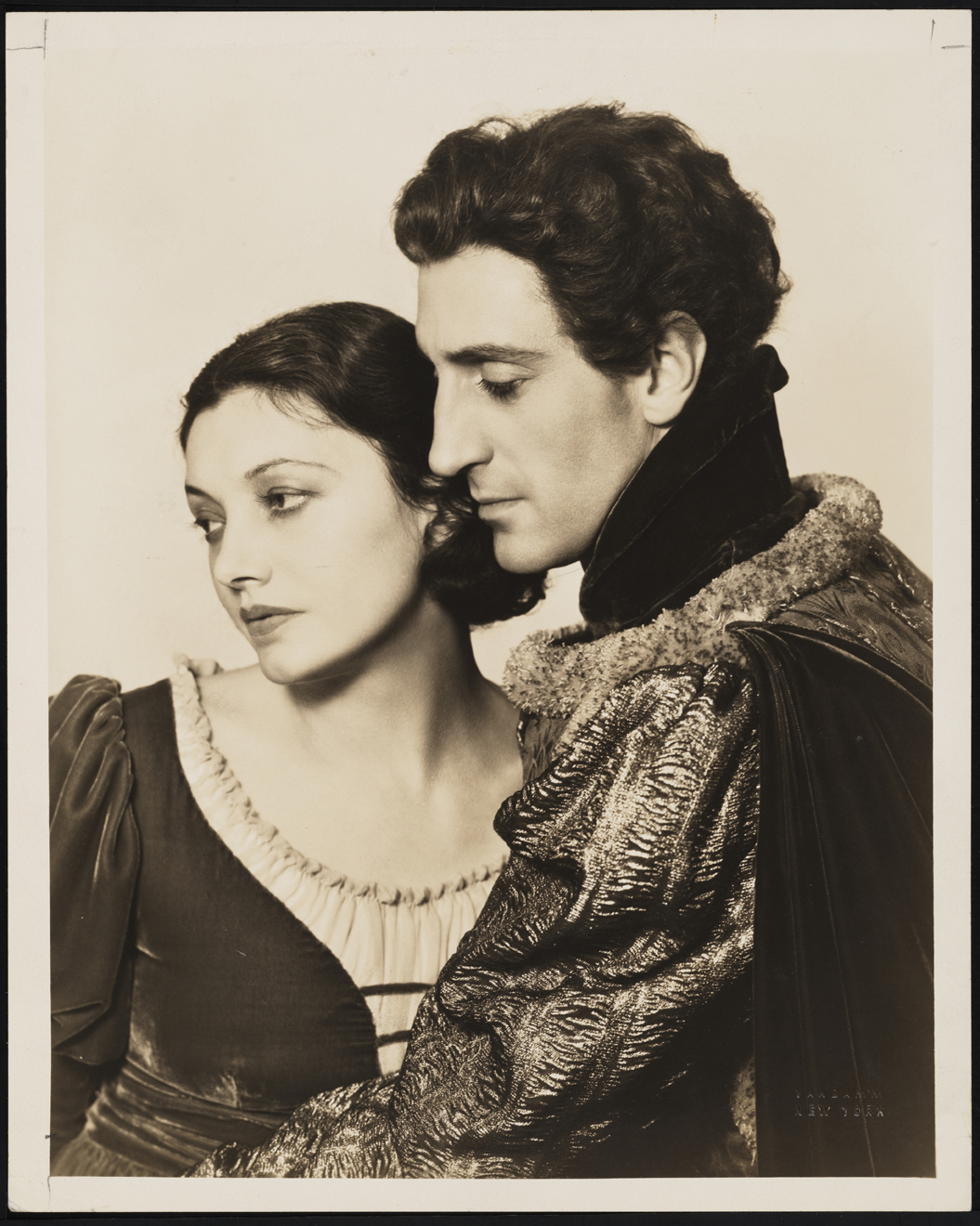
Given that William Shakespeare’s star-crossed lovers Romeo and Juliet were mere teenagers (the ages 13 and 16 were given to Juliet and Romeo, respectively), many productions featured actors more than twice that age. That was the case in 1933 when the play was revived by actress Katharine Cornell and her director husband Guthrie McClintic, who took the play on a seven-month nationwide tour before it was revised and opened on Broadway in December 1934. Critics dubbed the 41-year-old Cornell “the greatest Juliet of her time,” and it seems Robert Benchley heartily agreed in this excerpt from his stage review:
AGE IS JUST A NUMBER…The 41-year-old Katharine Cornell and 42-year-old Basil Rathbone in a promotional photo for Romeo and Juliet. Cornell was the first performer to receive the Drama League’s Distinguished Performance Award, which became the oldest and most exclusive theatrical honor in North America. (Vandamm photo, Museum of the City of New York)
* * *
The New Yorkiest Place
In 1930 gossip columnist Walter Winchell called the new Stork Club “New York’s New Yorkiest place on W. 58th,” and when it relocated to 3 East 53rd Street in 1934 it further defined itself as the ultimate New York night club. In her “Tables for Two” column, Lois Long found the new location much to her liking. An excerpt:
THE STORK DELIVERS…The Stork Club truly became the New Yorkiest nightclub when it relocated to 3 East 53rd Street in 1934. Clockwise, from top left: the club entrance in the 1930s; Cary Grant was one of the many celebrities who favored the nightclub, circa 1935; a 1930’s club menu; Lita Grey, the former teen bride of actor Charlie Chaplin, was a featured singer at the club during Lois Long’s visit. (Gibbes Museum of Art/Pinterest/vintagemenuart.com/IMDB)
* * *
So Long?
Clarence Day, best known for his Life with Father stories, also contributed a number of cartoons to the magazine, accompanied by satirical poems and humorous shorts. Day would die at the tender age of 61—after a bout with pneumonia—in December 1935, about a year after this cartoon was published in The New Yorker. I assume he was signing off from the magazine in order to arrange publication of his Life with Father book, which was published shortly after his death.
* * *
From Our Advertisers
Sunny California beckoned those who had the means and leisure to head to warmer climes during the New York winter…
…for those who stayed behind, they could wrap themselves in a chic winter coat such as this one sported by Camel endorser Mrs. Langdon Post (Janet Kirby)…
…another colorful ad with a not-so-colorful message from World Peaceways, a 1930s anti-war organization that characterized soldiers (and future soldiers, seen here) as pawns in the corrupt games of the rich and powerful…
…the distributors of French champagne rang in the New Year by suggesting that Doyen was worth your very last cent…
…we kick off our cartoons by welcoming the New Year with George Price…
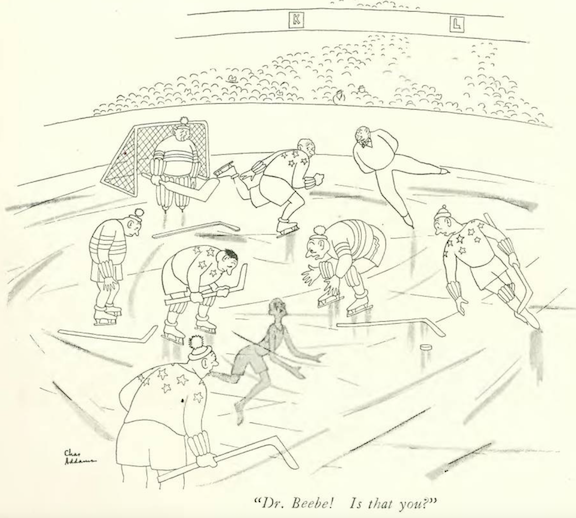
…Robert Day contributed a spot drawing that offered a new twist to ice hockey…
…I should know this artist, but it escapes me for the moment…nevertheless, a great illustration to stretch across the bottom of an opening page…
…a closeup of the signature…
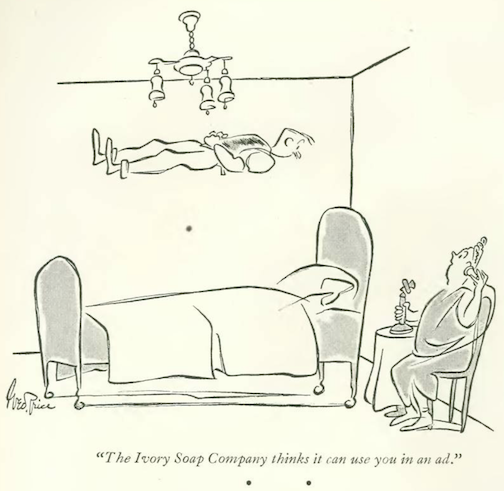
…another from George Price, still up in the air in the final issue of 1934…
…Garner Rea introduced us to the life of the party…
…”Miss Otis Regrets” is a 1934 Cole Porter song about the lynching of a society woman after she murders her unfaithful lover. Porter wrote the song as a parody of a sad cowboy song he heard on the radio. The song was further workshopped for fun at “smart set” cocktail parties…on to our next cartoon, and a moment of keen insight from James Thurber…
…Garrett Price went on the town with some students of anatomy…
…and we say Happy New Year with the help of Helen Hokinson…
Above, left, a 1935 portrait of Gertrude Stein by Carl Van Vechten; right, Gertrude Stein and Alice B. Toklas arriving in New York aboard the French Line’s SS Champlain in 1934. (Library of Congress/AP)
Much of America’s literary world was abuzz about the arrival of Gertrude Stein in New York after her nearly three-decade absence from the States. Audiences were mostly receptive to Stein’s lectures, even if they were largely unintelligible, but The New Yorker would have none of it.
Nov. 17, 1934 cover by Rea Irvin.
Stein (1874–1946) visited the U.S. at the urging of friends who suggested that a lecture tour might help her gain an American audience for her work. She crisscrossed the country for 191 days, delivering seventy-four lectures in thirty-seven cities.
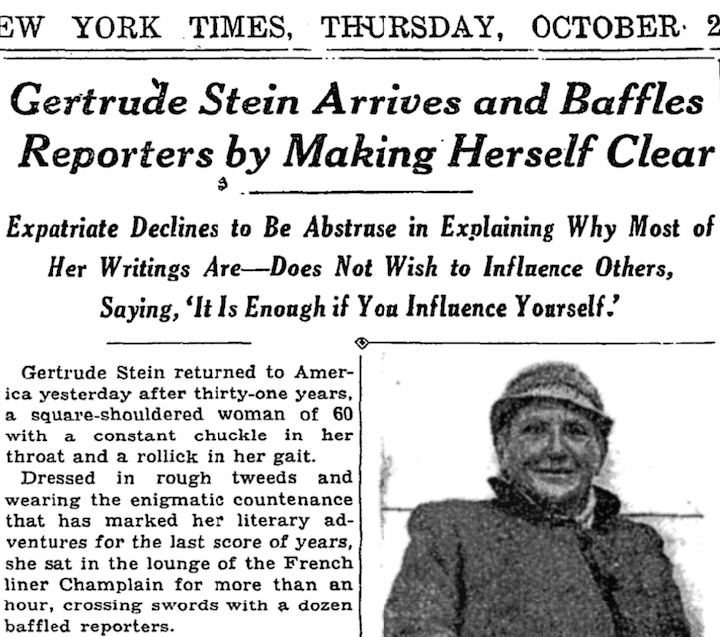
Writing for the Smithsonian Magazine (October 2011), Senior Editor Megan Gambino notes that publishing houses regarded Stein’s writing style as incomprehensible (Gambino writes that shortly after her arrival in the U.S., “psychiatrists speculated that Stein suffered from palilalia, a speech disorder that causes patients to stutter over words or phrases”), but in 1933 “she at last achieved the mass appeal she desired when she used a clearer, more direct voice” in The Autobiography of Alice B. Toklas. However, Stein was still best known in the U.S. for her “insane” writings, as one New York Times reporter described Stein’s work upon the writer’s arrival in New York. Excerpts from the Oct. 25, 1934 edition of the Times:
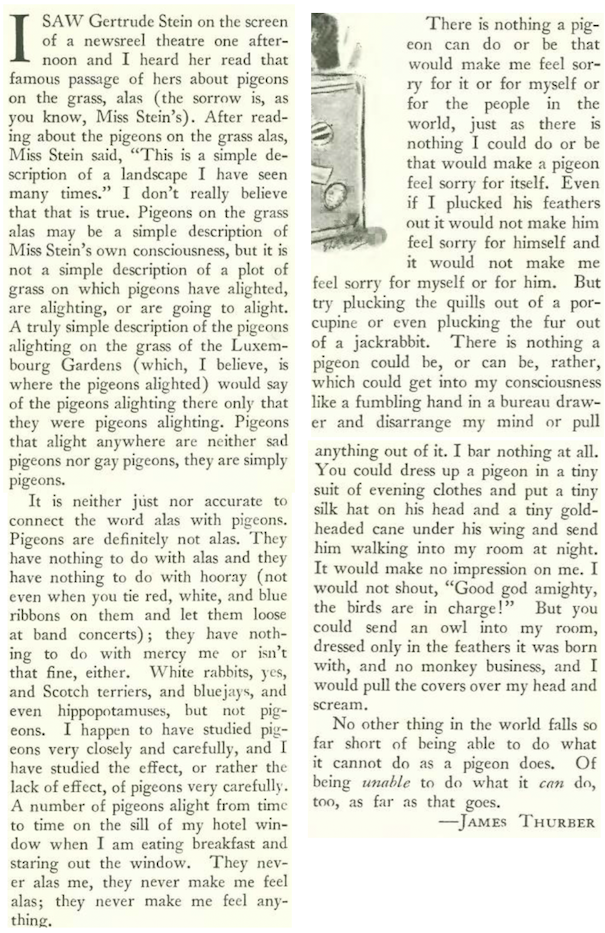
Stein had also achieved success in America via her libretto to Virgil Thomson’s opera Four Saints in Three Acts. Prior to her visit, Stein was featured in a newsreel reading the “pigeon” passage from the libretto, which James Thurber satirized in this piece titled “There’s An Owl In My Room.” Excerpts.
Here is a YouTube clip of the newsreel satirized by Thurber. Stein begins her “pigeon” reading at the 30-second mark:
If Thurber found the libretto ridiculous, it was an opinion not necessarily shared by audiences who attended Four Saints in Three Acts, which premiered in Hartford, Connecticut, before making a six-week run on Broadway.
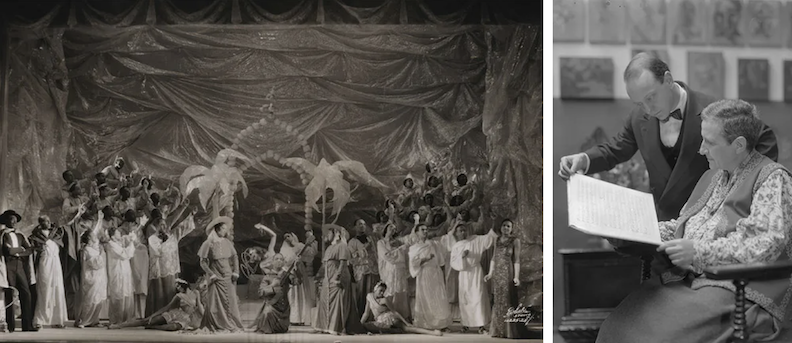
SAINTS AND PIGEONS…The original cast of Four Saints in Three Acts, onstage at the Wadsworth Atheneum, Hartford, 1934; at right, Gertrude Stein reviews the libretto for Four Saints with American composer Virgil Thomson, 1934. (Harold Swahn/Bancroft Library, UC Berkeley)
Since Stein had never seen the opera performed, writer and photographer Carl Van Vechten convinced Stein and Toklas to fly on an airplane for the first time in order to be able to see the play in Chicago.
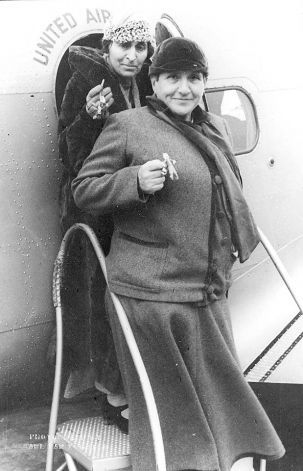
FLIGHT INSURANCE…Stein and Toklas were anxious about flying, so Van Vechten gave each a small Zuni fetish—a good luck charm as they prepared to board their plane at Newark. (Boatwright Memorial Library, The University of Richmond)
Thurber wasn’t the only New Yorker writer to throw shade on Stein’s visit. In his “Books” column, Clifton Fadiman described Stein as a “mamma of dada” and a “Keyserling in divided skirts” (Hermann Keyserling was a non-academic German philosopher known for his platitudinous, obscure writings). Excerpt:
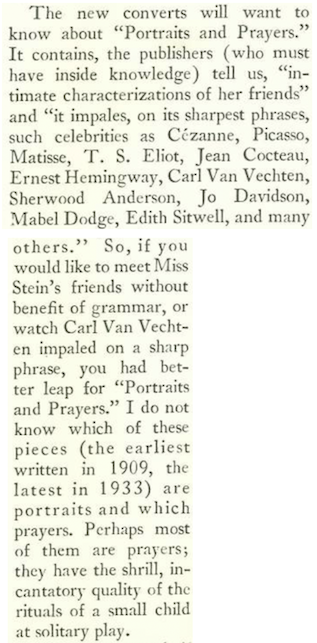
Fadiman continued by excoriating Stein’s latest book, Portraits and Prayers, likening its “shrill, incantatory” quality to “the rituals of a small child at solitary play.”
* * *
Over the Rainbow
We leave Gertrude Stein for the time being and check in with Lois Long, who was sampling the fall attractions of the New York nightclub scene in “Tables for Two.” In these excerpts, the 32-year-old Long continued her pose as a much older woman (“about to settle down with a gray shawl”) as she bemoaned the bourgeoisie excess of places like the Colony, once known for its boho, speakeasy atmosphere. And then there was the Rainbow Room, with its organ blaring full blast to the delight of gawking tourists.
LOST IN NEW YORK…Lois Long lamented the demise of cafe life in Manhattan; from left, the Colony, circa 1940, which went from boho to upscale; the 21 Club, a favorite Prohibition-era haunt of Long’s where she was suddenly a nobody; and high above the city, the Rockefeller Center’s Rainbow Room, and its interminable organ music. (Pinterest/Alice Lum via Daytonian in Manhattan/nycago.org)
* * *
From Our Advertisers
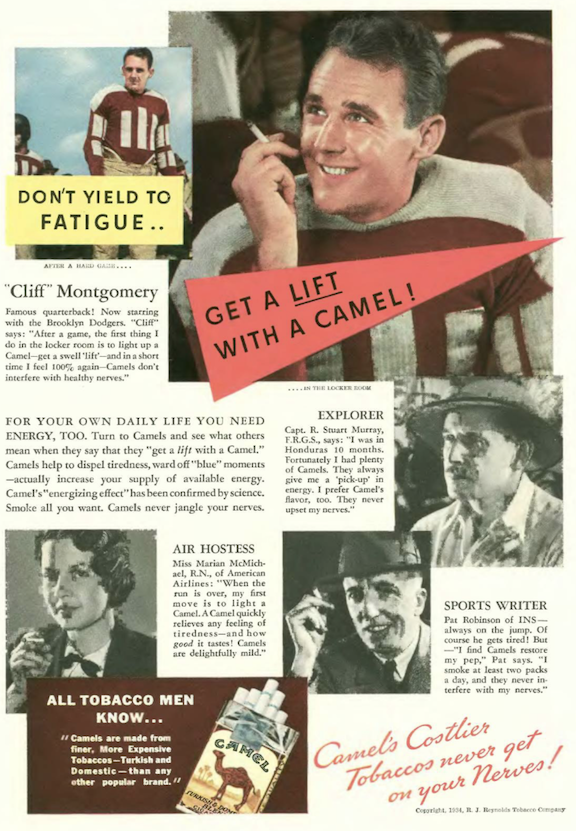
Just one ad from the Nov. 17 issue (more to come below)…the latest athlete to attest to the energizing effects of Camel cigarettes…Cliff Montgomery (1910–2005) was famed for a hidden ball trick play that led one of the greatest athletic upsets—Columbia’s 7-0 win over Stanford in the 1934 Rose Bowl. Montgomery would play one year with the NFL Brooklyn Dodgers, and would later earn a Silver Star for his heroism during World War II…
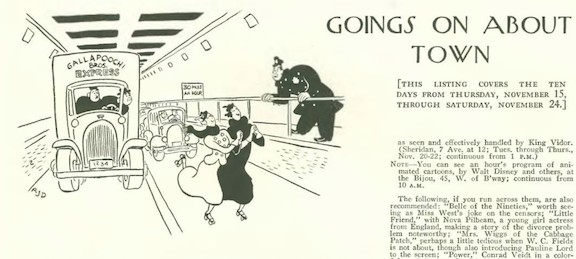
…on to our cartoonists, we begin with Robert Day’s jolly illustration for the “Goings On About Town” section…
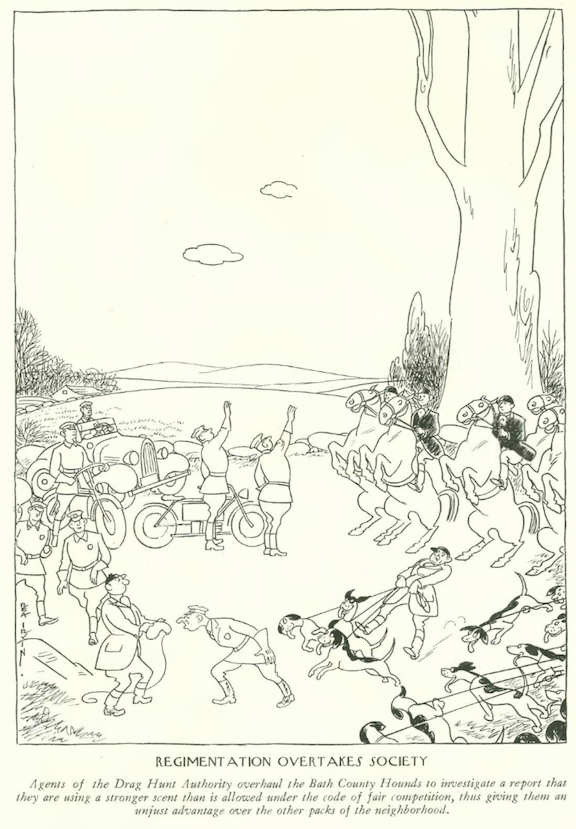
…Rea Irvin looked into fair play among the fox hunting set…
…Garrett Price gave us a tender moment among the bones at the American Museum of Natural History…
…and Peter Arno introduced two wrestlers to an unwelcoming hostess…
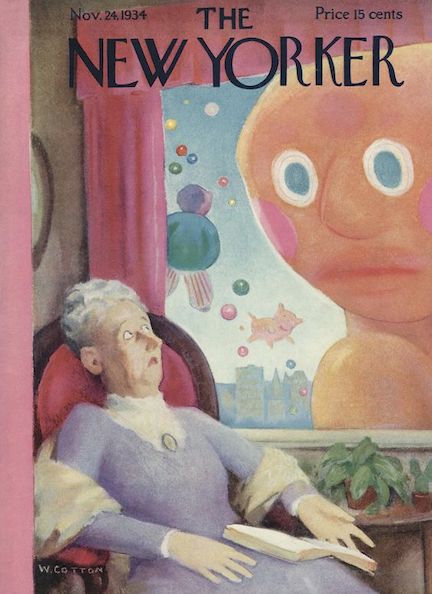
…on to Nov. 24, 1934 issue, and the perils of the Macy’s Thanksgiving Day Parade as illustrated on the cover by William Cotton…
Nov. 24, 1934 cover by William Cotton.
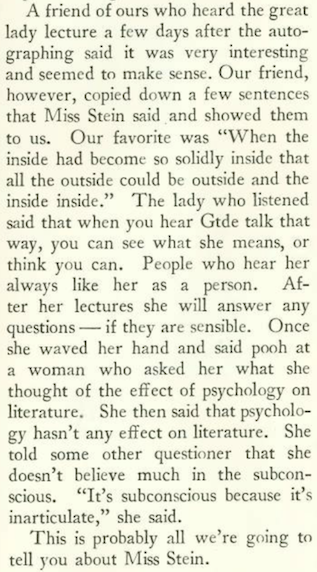
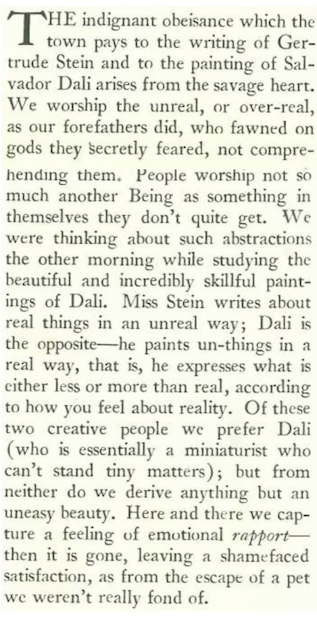
…where we find still more scorn being heaped upon Gertrude Stein. “The Talk of the Town” offered this observation (excerpt):
…and E.B. White had the last word on Stein in his Dec. 1, 1934 “Notes and Comment” column:
* * *
There Goes the Neighborhood
Returning to the Nov. 24 issue, Alberta Williams penned a lengthy “A Reporter at Large” column, titled “White-Collar Neighbors,” about the new Knickerbocker Village development in the Lower East Side. Real estate developer Fred French razed roughly one hundred buildings to build what has since been criticized as an example of early gentrification in Manhattan. Williams assessed the development after more than a year of construction, finding that despite federal funding, the leasing company had yet to rent any apartments “to Negroes or Orientals.” Although the development was meant to serve some of the families it displaced, the vast majority were forced to move back into slums due to escalating rents.
BREATHING ROOMS…Knickerbocker Village in 2019. To make way for the development, one hundred buildings were razed in the “Lung Block,” so named because of its high tuberculosis mortality rate. The development continues to be designated as affordable housing. (Wikipedia)
* * *
Dollmaker
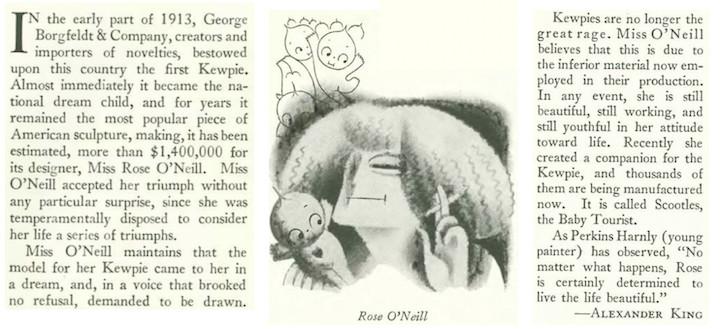
Raised in rural Nebraska, at an early age Rose O’Neill (1874–1944) demonstrated an artistic bent, and was already a published illustrator and writer when she drew her first images of “Kewpie” around the year 1908. A German doll manufacturer began producing a doll version of Kewpie in 1913, and they became an immediate hit, making O’Neill a millionaire and for a time the highest-paid female illustrator in the world. When Alexander King penned a profile of O’Neill, Kewpies were no longer the rage, but O’Neill was nevertheless determined to find success in a new doll line. Excerpts:
QP QUEEN…Clockwise from top left, Rose O’Neill circa 1910, just before her Kewpie dolls made it big; Kewpie doll in original box, undated; as the Kewpie craze faded in the 1930s, O’Neill tried to launch a new line called Little Ho Ho, a laughing baby Buddha, but before production plans were finalized the doll factory burned to the ground; a 1935 ad for a Rose O’Neill-branded “Scootles” doll, another attempt at a comeback. (Wikipedia/Pinterest/museumobscura.com)
* * *
Last Call
Lois Long was back with another installment of “Tables for Two” and in these excerpts she found the Central Park Casino a welcome place to hang out, apparently unaware that Parks Commissioner Robert Moses had already served an eviction notice to the Casino’s owners (Moses would tear down the Casino in 1936, mostly to settle a personal vendetta). Long also found respite at the Place Piquale, which featured the musical stylings of Eve Symington.
BYE BYE…The Central Park Casino was not long for the world when Lois Long paid an enjoyable visit in November 1934. Long also found a good time at the Place Piquale, which featured the “startling,” deep voice of cabaret singer Eve Symington. (centralpark.org/Pinterest)
At the Place Piquale, Long was “grateful” to see that silent film star Louise Brooks was also a good dancer. An icon of Jazz Age flapper culture, Brooks loathed the Hollywood scene and the mediocre roles it offered, and after a stint making films in Europe she returned to the States, appearing in three more films before declaring bankruptcy in 1932. A former dancer for the Ziegfeld Follies, Brooks had turned back to dancing in nightclubs to make a living.
IT’S A LIVING…Promotional photo for the Place Piquale featuring Louise Brooks (sans her familiar flapper bob) and Dario in “Spectacular Interpretive Dances,” April 17, 1934. (books0977.tumblr.com)
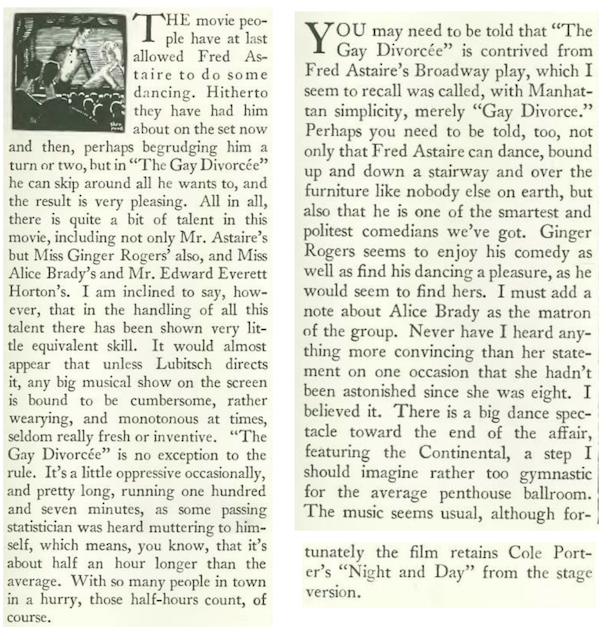
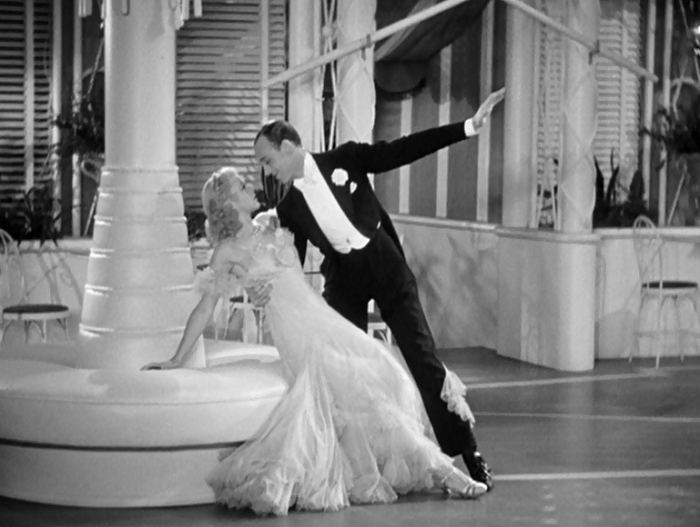
…and dance remains a theme with John Mosher’s film review of the Fred Astaire and Ginger Roger musical The Gay Divorcee, which was based on the 1932 Broadway musical Gay Divorce starring Astaire and Claire Luce.
YOU WILL HAVE TO DANCE BACKWARD, IN HEELS…Ginger Rogers and Fred Astaire trip the light fantastic in The Gay Divorcee. (precode.com)
* * *
Using Her Heads
Clifton Fadiman praised Peggy Bacon’s collection of caricatures, Off With Their Heads!, which included drawings of fellow New Yorker contributors as well as various Algonquin Hotel acolytes. Excerpt:
HEAD HUNTER…Peggy Bacon offered up caricatures of forty celebrities in her new book, Off With Their Heads! Bacon (1895–1987) contributed cartoons as well as poetry and fiction to The New Yorker from 1927 to 1950. Clockwise, from top left, title page with Bacon’s self-portrait; undated photo of Bacon, likely circa 1930; caricatures of Dorothy Parker, Carl Sandburg and Heywood Broun. (villagepreservation.org/printmag.com/Wikipedia–Peter A. Juley & Son)
* * *
More From Our Advertisers
“Beautiful Vanderbilts” Mrs. Reginald Vanderbilt and Miss Frederica Vanderbilt Webb wowed one unnamed dermatologist who discovered that both had 20-year-old skin even though they were seven years apart! “Mrs. Reginald” was Gloria Morgan Vanderbilt, who was thirty when this ad was produced (Miss Frederica was apparently twenty-three). We’ve met Gloria Morgan Vanderbilt before, shilling for Pond’s—she was the maternal grandmother of television journalist Anderson Cooper, and earned her “bad mom” rep from Vanderbilt vs. Whitney, one of America’s most sensational custody trials…
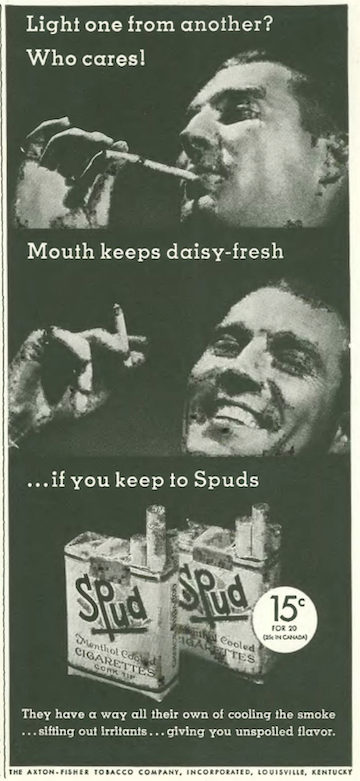
…we move from skin care to who cares…in this case how many Spud cigs you smoke…hell, smoke three packs a day if you like, the cooling menthol will always keep you feeling fresh even as your lungs gradually darken and shrivel up…
…and here’s a lesson from the makers of Inecto hair dye, no doubt a company solely run by men, who schooled wives with the advice that you’d better color that gray hair pronto or your hubby will kick you to the curb…
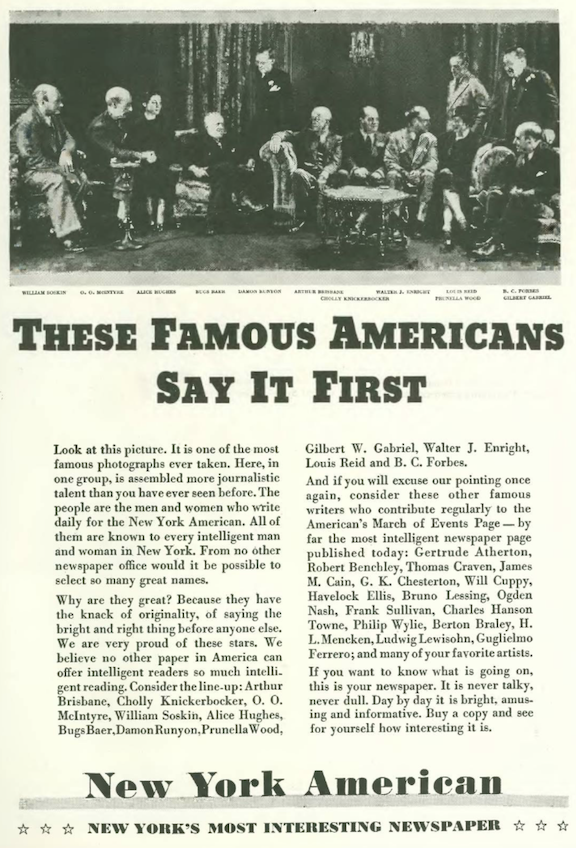
…the New York American was a Hearst broadsheet known for its sensationalism, however it did claim Damon Runyon, Alice Hughes, Robert Benchley and Frank Sullivan among its contributors…the morning American merged with the New York Evening Journal to form the American and Evening Journal in 1937. That paper folded in 1966…
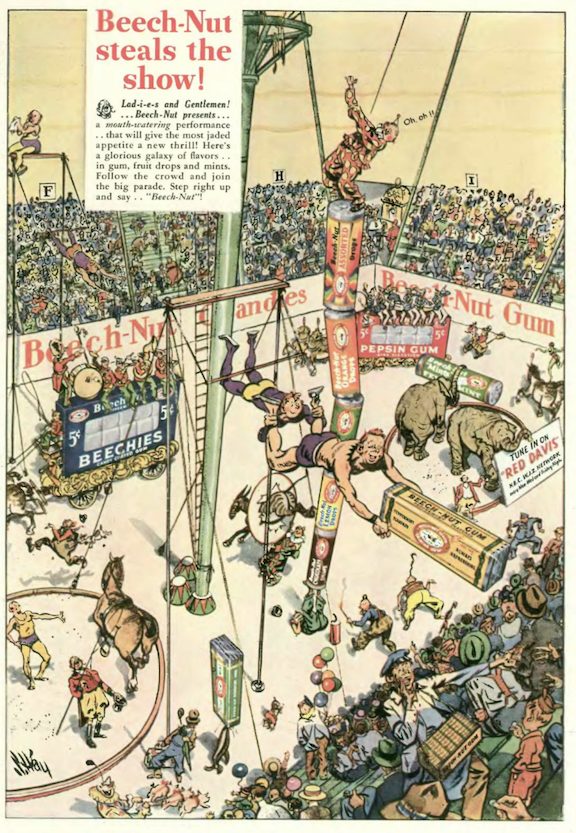
…illustrator Stuart Hay drew up this full page ad for the makers of Beech-Nut candy and chewing gum…when I was a kid we used to call this “grandpa gum”…
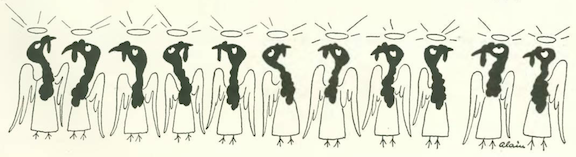
…on to our cartoonists, we begin with a Thanksgiving spot by Alain (Daniel Brustlein)…
…Barbara Shermund delivered another life of the party…
…George Price was finally bringing his floating man back to earth…
…Otto Soglow gave us an unlikely detour…
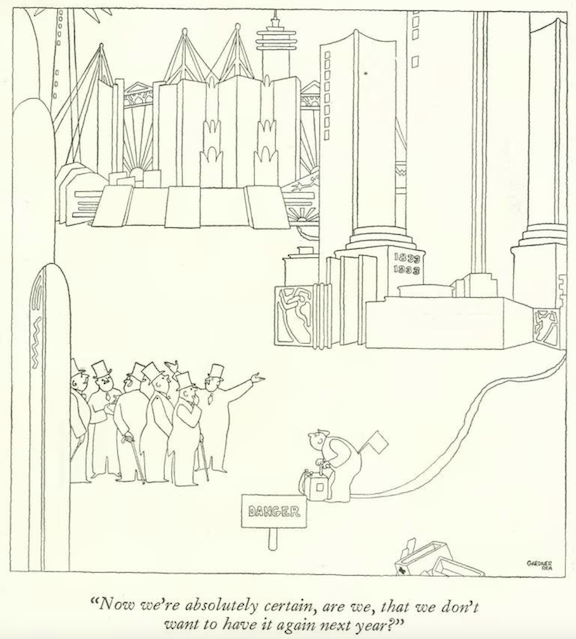
…Gardner Rea signaled the end to the 1933-34 Chicago World’s Fair…with a boom…
…Leonard Dove dialed up a familiar trope…
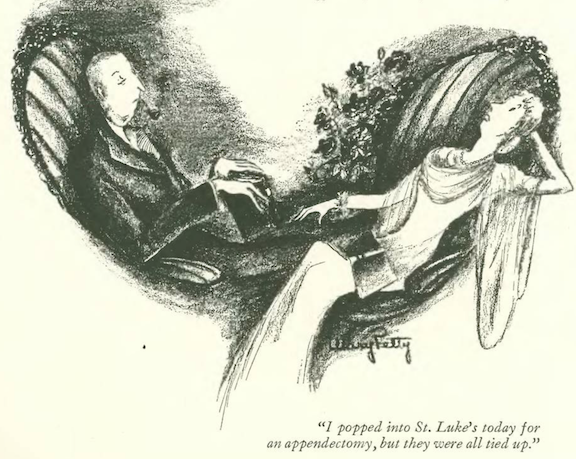
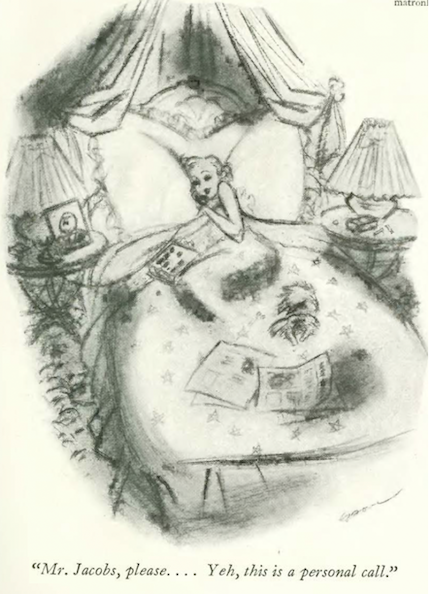
…and we close on a more pious note, with Mary Petty…








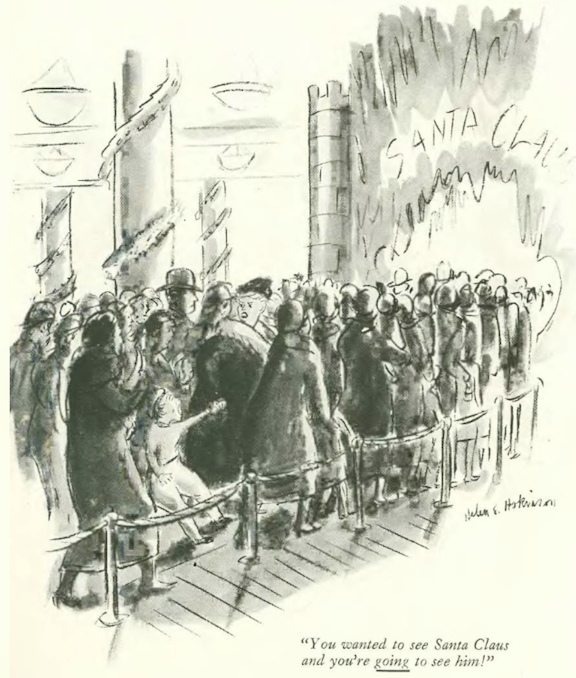
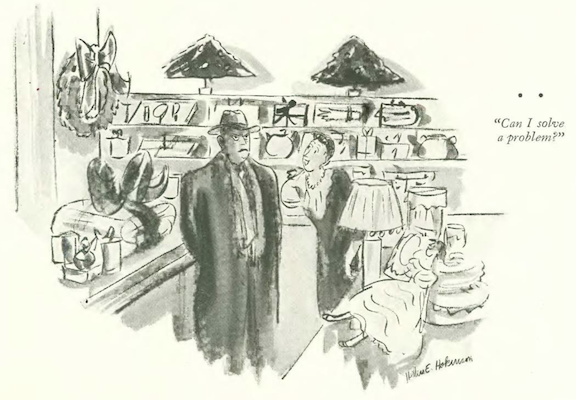
















































































 A New Yorker State of Mind