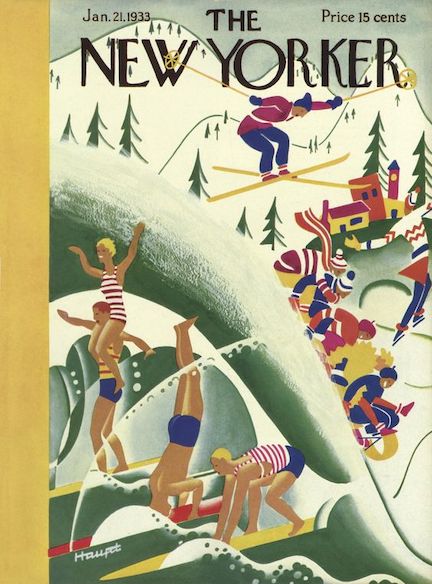
She Wore the Pants

It’s hard to fathom that a woman wearing trousers used to cause such a stir, but for international film star Marlene Dietrich it was an opportunity for the publicity that invariably came with defying the norms of fashion and sexuality in 1930s.

July 22, 1933 cover by Constantin Alajalov.

In May 1933 Dietrich was headed to Paris on a steamer, relaxing on the deck in a white pantsuit. Prior to her arrival, the Paris chief of police announced she would be arrested if she showed up in pants. However when Dietrich arrived at the Gare Saint Lazare wearing a man’s suit and overcoat, she stepped off the train, grabbed the chief of police by his arm, and walked him off the platform.

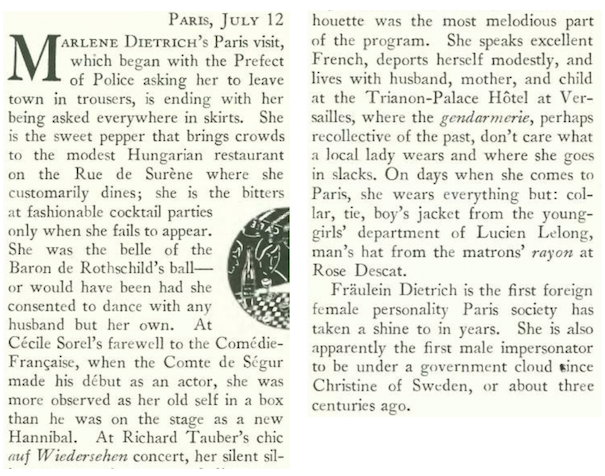
The New Yorker’s Janet Flanner reported on Dietrich’s comings and goings in her regular column “Letter From Paris”…
TAKING PARIS BY STORM…Clockwise, from top left: Marlene Dietrich in Paris, 1933, accompanied by her husband, Rudolf Sieber; Dietrich on the SS Europa, Cherbourg, France, May 1933; Dietrich arriving at the Gare Saint Lazare station, May 20, 1933 (this photo is often paired with an erroneous caption claiming that Dietrich is being arrested by French authorities. On the contrary, she owned them the moment she stepped onto the platform); Dietrich signing autographs in Paris, 1933. (bygonely.com/Smithsonian/Twitter/Pinterest)

 * * *

Bullish On Office Space

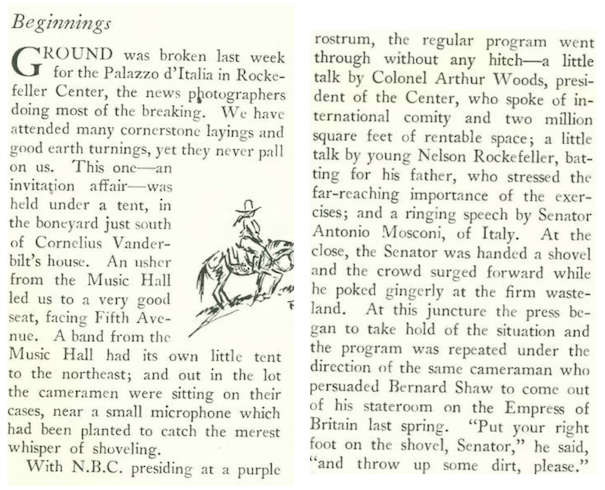
Despite the Depression, millions of square feet of office space were being added to the massive Rockefeller Center complex, including the Palazzo d’Italia at 626 Fifth Avenue. “The Talk of the Town” reported:
THE BIG SHORT…Attached to the International Building at its northwest corner, the Palazzo d’Italia was originally planned as a nine-story building, a fact that impressed the fascist Italian leader Benito Mussolini because it beat the six-story height of the French and British Buildings. In the end Benito only got six as well. (Wikipedia/Pinterest)

* * *

Urban Jungle

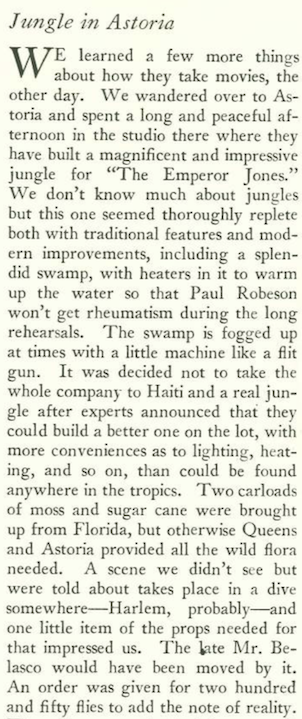
Astoria Studios in Queens was built in 1920 for Famous Players-Lasky and is still home to New York City’s only studio backlot. In 1933 it served as a tropical setting for The Emperor Jones, featuring Paul Robeson in the title role. “The Talk of the Town” looked in on the movie’s faux jungle:
35TH STREET JUNGLE…Paul Robeson in a scene from The Emperor Jones. (flickr.com)

Loosely based on a Eugene O’Neill play and financed with private money, the film was made outside of the Hollywood studio system and distributed by United Artists.

EMPEROR’S NEW CLOTHES…Brutus Jones (Robeson) schemes with colonial trader Smithers (Dudley Digges) on his plan to become emperor in The Emperor Jones. (moma.org)

 * * *

From Our Advertisers

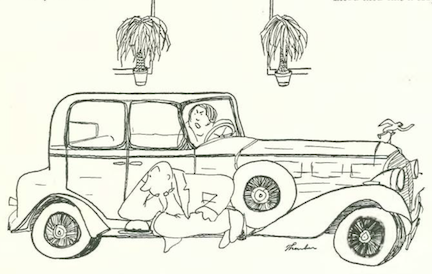
Yes, it’s advertising so we don’t expect it to be realistic, but I can guarantee no one is going to look like that after a ride to the beach in a rumble seat…also the woman behind the car is either floating or has exceedingly long legs…

…Hupmobile enlisted humorist Irvin S. Cobb to help boost its sagging sales…
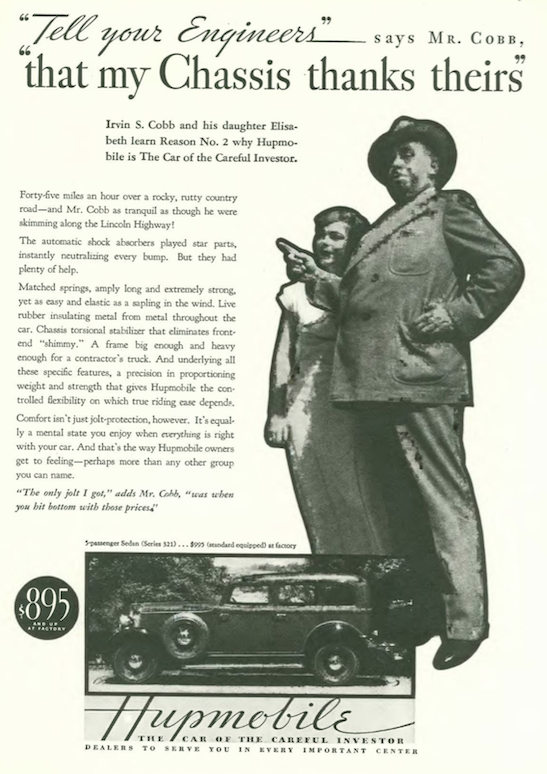
Irvin S. Cobb (1876–1944) wrote for Joseph Pulitzer’s New York World, and was once the highest paid staff reporter in the United States. (carnegiecenterlex.org)

…with the return of legal beer the makers of Budweiser struck a patriotic note in promoting their “King of Bottled Beer” to thirsty New Yorkers…

…the makers of Pabst Blue Ribbon claimed the title of “Best of the Better Beers” with this ad featuring a woman who appeared on the verge of going overboard…

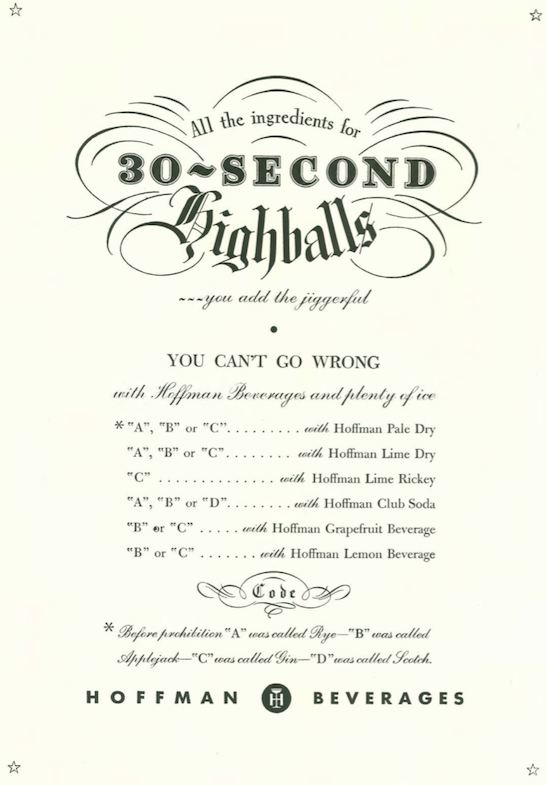
…if beer wasn’t your thing, you could try your hand at mixing a “30-Second Highball” per this Prohibition-themed ad…
…delving into the back pages one finds all sorts of curiosities, including this mail-order “charm school” operated by Margery Wilson

…Wilson (1896–1986) acted in numerous silent pictures (including the 1916 D. W. Griffith epic Intolerance) and in the early 1920s was a writer, director and producer…
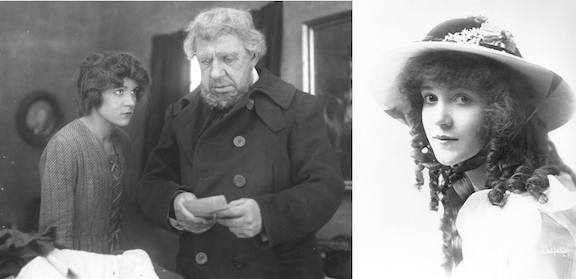
Margery Wilson in Eye of the Night (1916). She was among pioneering women filmmakers of the 1920s. (columbia.edu))

…it must have been a hot summer in New York with the abundance of air-conditioner ads…here’s one from Frigidaire for a unit that despite its size (and enormous cost) could cool only one room…

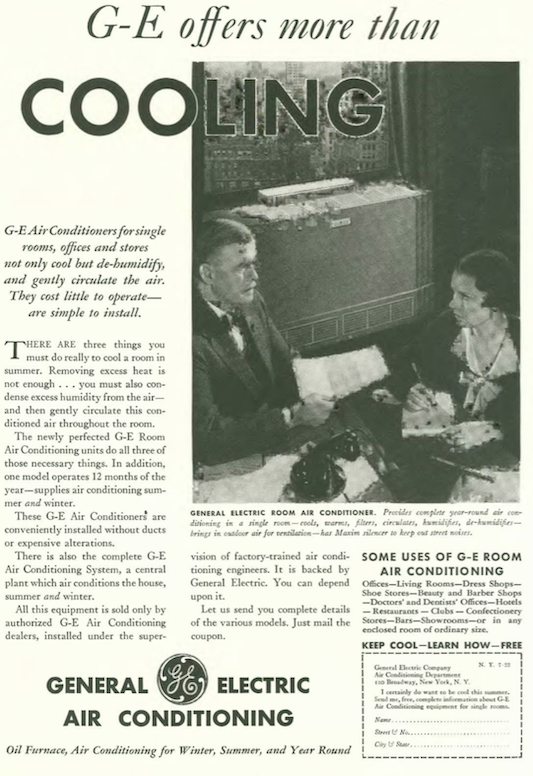
…this next air-conditioner ad from G-E seems poorly conceived…you would think an air-conditioned office would make the boss and his secretary a bit happier than they appear here…maybe they just got the bill from General Electric…
…we begin our cartoons with another pair of sourpusses, courtesy Mary Petty

George Price offered up this bit of art for the opening pages…
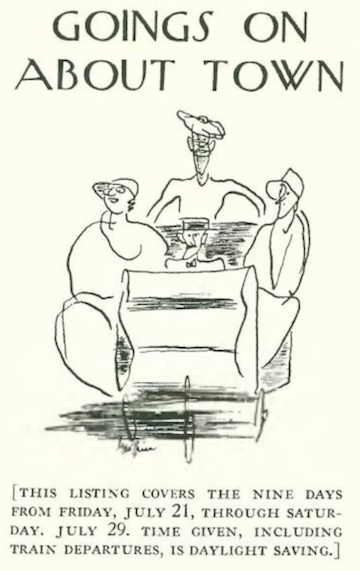
William Steig headed to the country to escape summer in the city…

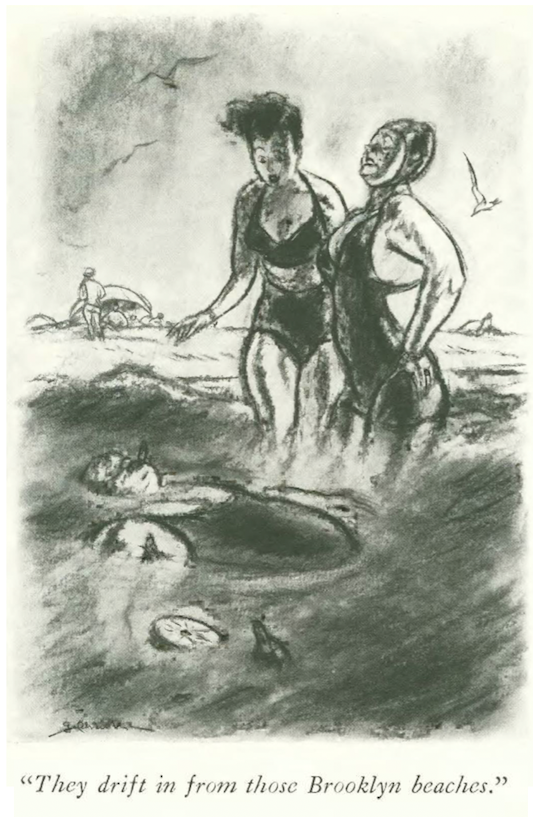
William Crawford Galbraith’s bathers kept cool by examining the flotsam from distant shores…
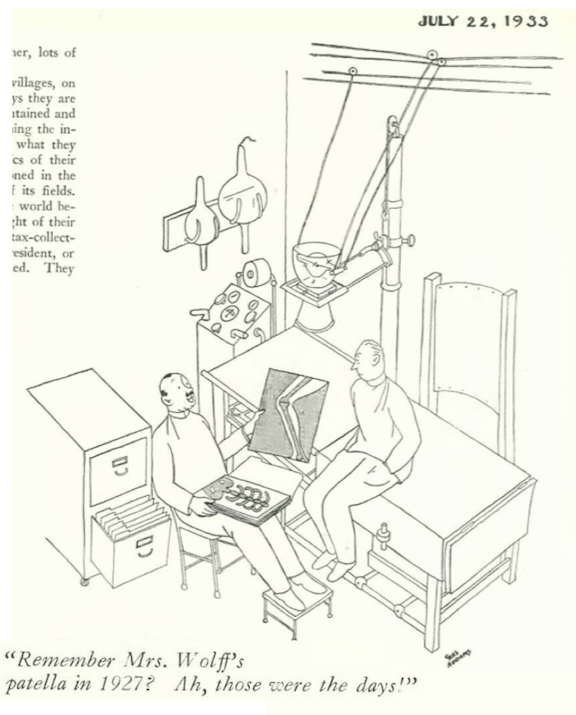
Charles Addams explored various themes before he launched his “Addams Family” in 1938…
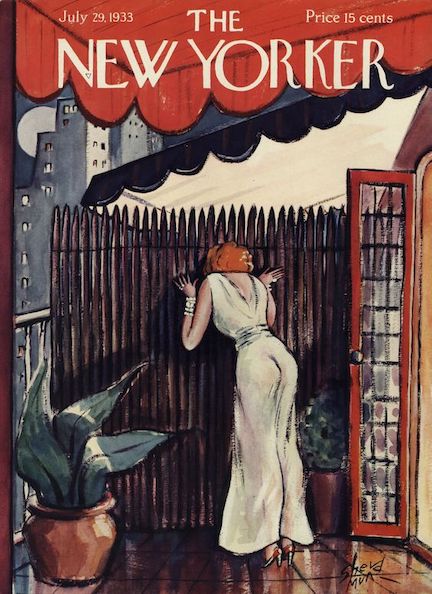
…and we move on to July 29 with a terrific cover by Barbara Shermund

July 29, 1933 cover by Barbara Shermund.

…in this issue Geoffrey T. Hellman penned a profile of Egyptologist Herbert E. Winlock, who made key discoveries about the Middle Kingdom of Egypt and served as director of the Metropolitan Museum from 1932 to 1939, where he was employed his entire career. Excerpt:
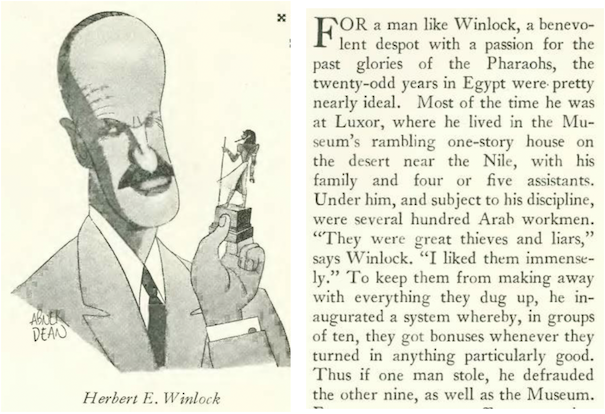
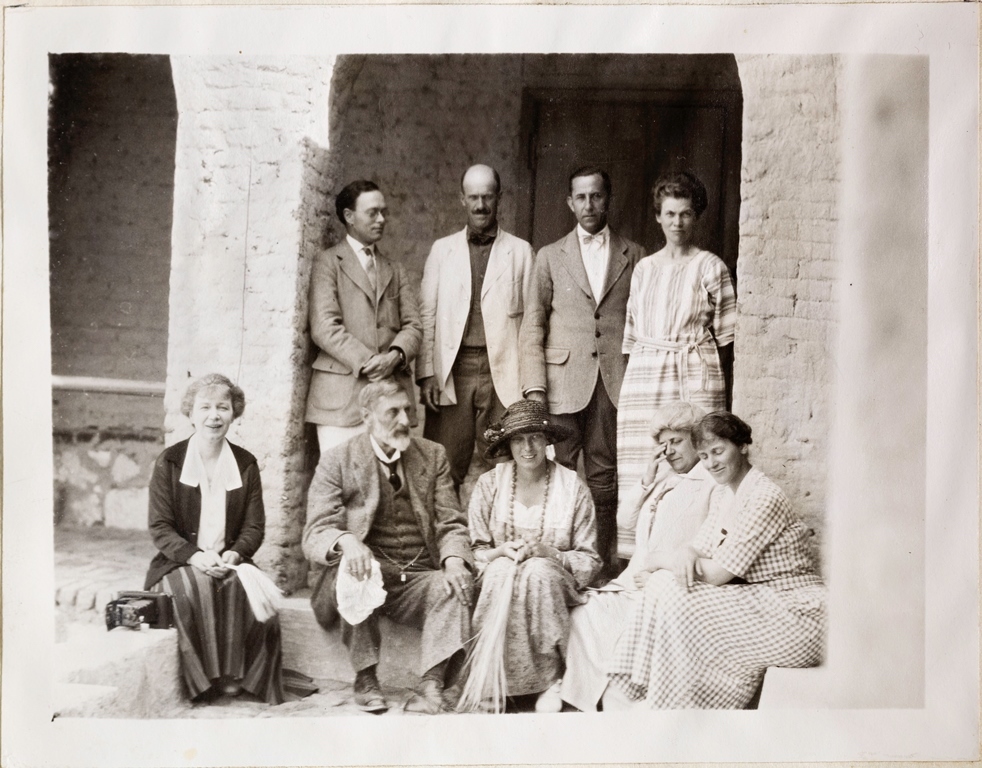
CAN YOU DIG IT…Early 1920s photo of the Metropolitan Museum’s Theban expedition team. Herbert E. Winlock is in the back row, second from left. His wife, Helen Chandler Winlock, is in the front row, far right. (Metropolitan Museum of Art)

 * * *

Chilling With U.S. Grant

In those days before air-conditioning was widely available or used, “The Talk of the Town” dispatched an investigator to sample indoor temperatures at various public places, finding the coolest spot at Grant’s Tomb:

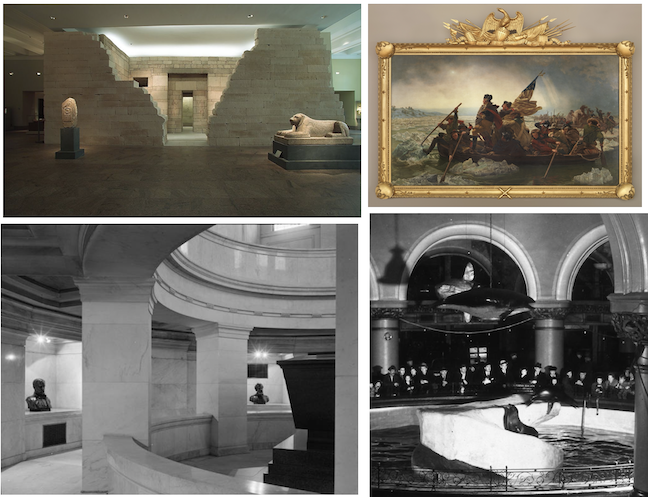
WHERE THE COOL PEOPLE HANG OUT…Clockwise, from top left: The tomb of Per-neb at the Metropolitan Museum registered a cozy 80 degrees, while in the same museum it was a balmy 84 by Emanuel Leutze’s famed painting Washington Crossing the Delaware; the New York Aquarium in Battery Park was a bit cooler at 79 (pictured is the Sea Lion Pool); while Grant’s Tomb was downright chilly at 70. (Met Museum/Wildlife Conservation Society/grantstomb.org)
 * * *
Node of Gold
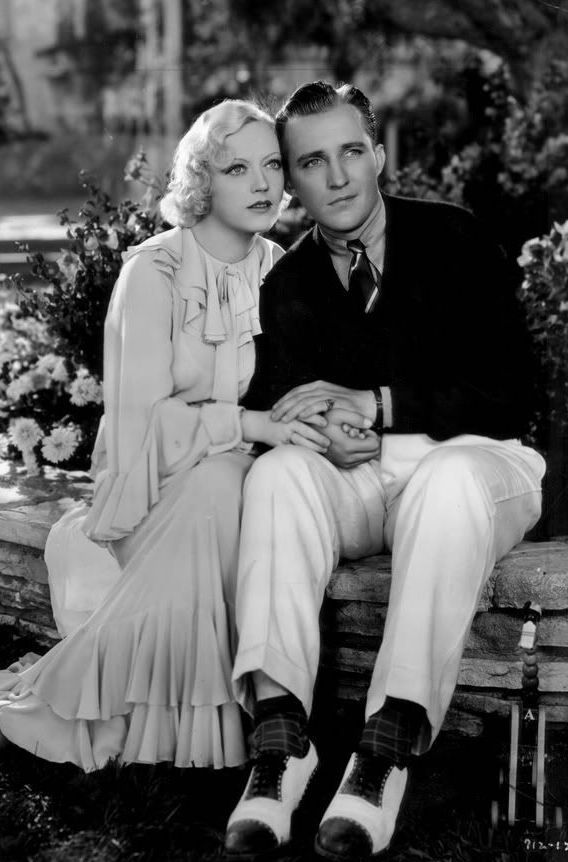
Apparently the famed crooner Bing Crosby had a minor node on one of his vocal cords, and when he consulted a specialist he was advised against removing it, lest he alter his voice in a way that would affect his career. Indeed, the node seemed to add an “appealing timbre” to his signature sound, so Crosby had his voice insured by Lloyd’s of London for $100,000 with a proviso that the node could not be removed. Howard Brubaker made this observation in “Of All Things”…

LUMP IN HIS THROAT…Bing Crosby with Marion Davies in the 1933 film Going Hollywood. (IMDB)

…Brubaker also shared this prescient observation from American astronomer Vesto Slipher

…Slipher (1875–1969) would live long enough to confirm his statement…the first full-disk “true color” picture of the Earth was captured by a U.S. Department of Defense satellite in September 1967:

(USAF/Johns Hopkins University)

 * * *

More From Our Advertisers

This ad was on the inside front cover of the July 29 issue, a rather jarring image following that lovely Barbara Shermund cover…
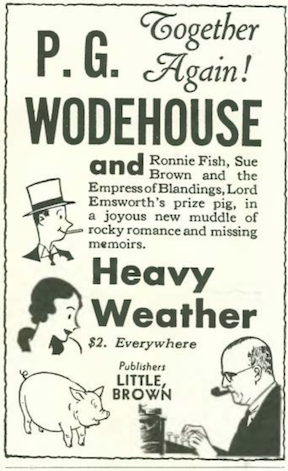
…the hugely popular P.G. Wodehouse was back with more silly antics from the British upper classes…
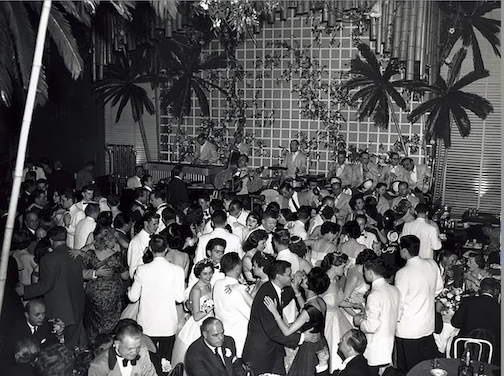
…while some New Yorkers could take a break from their reading and hit the dance floor atop the Waldorf-Astoria…
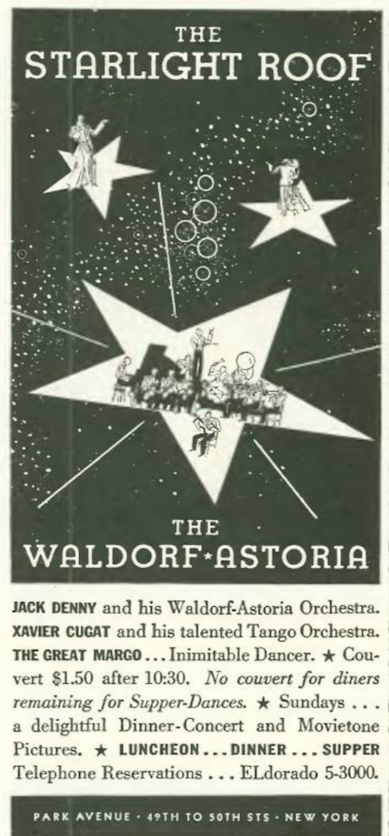
…and tango to the stylings of bandleader Xavier Cugat

Xavier Cugat and band atop the Waldorf-Astoria. (cntraveler.com)

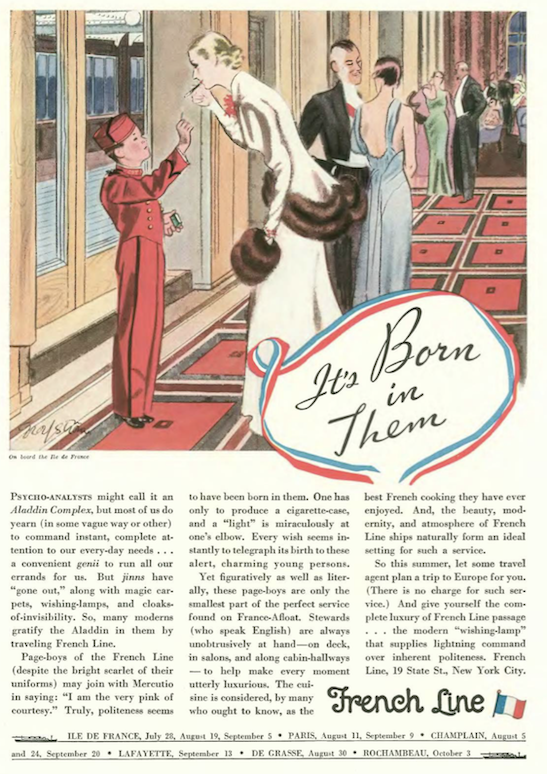
…this ad for the French Line, illustrated by Ruth Sigrid Grafstrom, offered a precious scene of a page-boy lighting a woman’s cigarette, a sight unimaginable today…
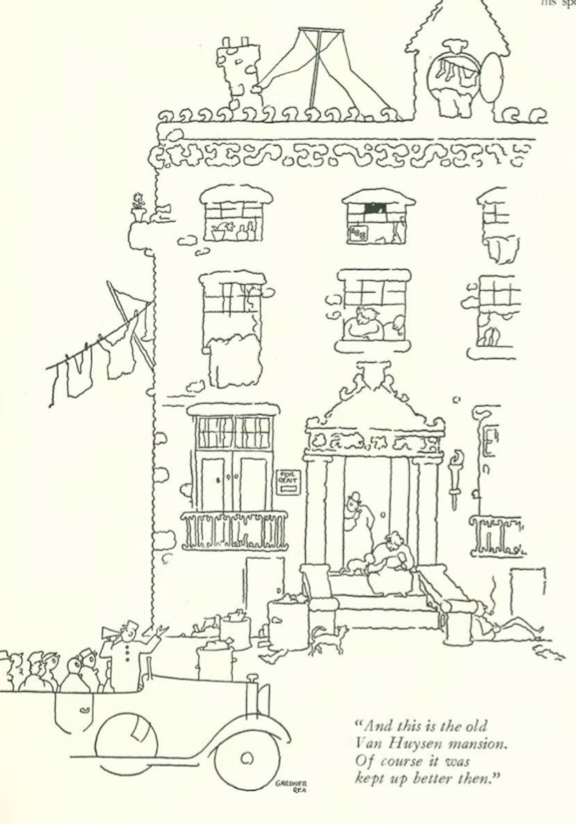
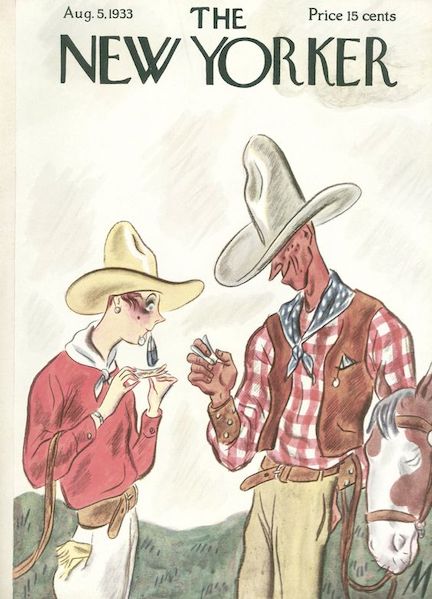
…and we close with a cartoon by Gardner Rea, doggone it…

Next Time: The Flying Season…
The Night the Bed Fell

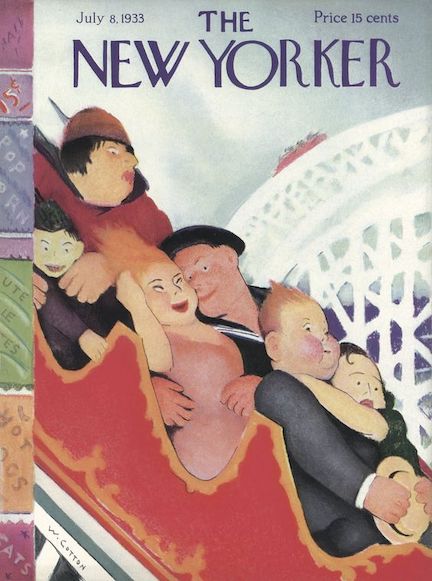
James Thurber was well established as a New Yorker writer and cartoonist by 1933, but his fame would grow with the publication of the autobiographical My Life and Hard Times, serialized in The New Yorker beginning with the July 8 issue.

July 8, 1933 cover by William Cotton.

And what a beginning. “The Night the Bed Fell In” recounts the comically absurd events that took place in the wee hours at the Thurber family home in Columbus, Ohio. Beginning with his father’s decision to sleep in the attic, the story introduces a cast of characters including cousin Briggs Beall and his mother, Clarissa. Excerpts:

Briggs’ mother also had fears of impeding calamity…

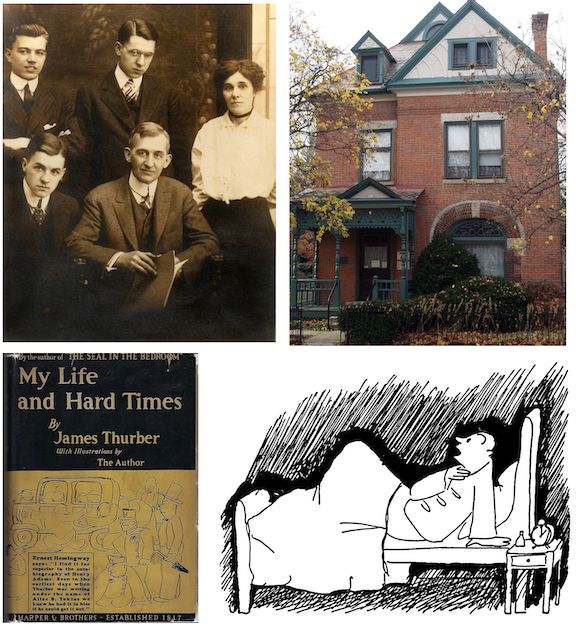
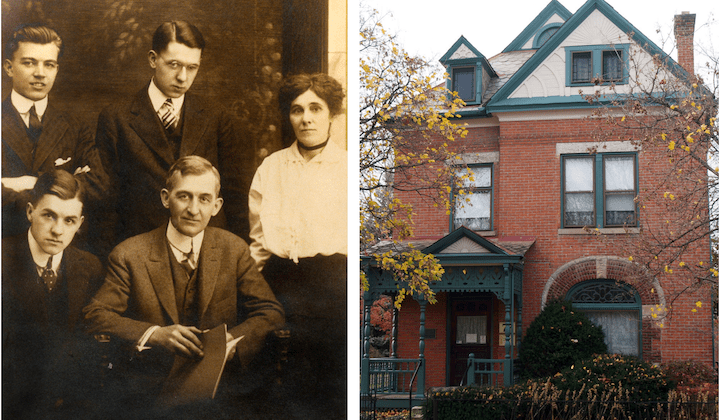
ALL IN THE FAMILY…Clockwise, from top left, James Thurber (center, back row) with his family circa 1915; the Thurber house that provided the setting for “The Night the Bed Fell In”; Thurber’s illustration of cousin Briggs Beall; cover of the 1933 first edition of My Life and Hard Times. (thurberhouse.org)

Need more Thurber? Longtime New Yorker cartoonist and author Michael Maslin recounts a 1986 pilgrimage to the Thurber house in this Ink Spill entry from 2018. You should also check out Maslin’s regular Thurber Thursday feature for more insights into the world of this beloved humorist.

 * * *

The Naked Truth

Once upon a time a Baptist and a Presbyterian got together and created a magazine promoting nudism. The Baptist, Ilsley Silias Boone (1879–1968), was founding father of the American Sunbathing Association—later reorganized as the American Association for Nude Recreation. His ally in advancing the cause of nudism, Presbyterian minister Henry Strong Huntington Jr (1882-1981), was the first president of the International Nudist Conference. “The Talk of the Town” laid bare the world of these randy clergymen.

DON’T GET UP…Baptist minister Ilsley Silias Boone (top, left) partnered with Presbyterian minister Henry Strong Huntington Jr on The Nudist (right). The magazine was published from 1933 to 1963. Later issues were published under the title Sunshine & Health. (flickr.com)

 * * *

His Kind of Town

In his “Shouts & Murmurs” column, Alexander Woollcott recounted his trip to Chicago, ostensibly to see the Century of Progress (the 1933 World’s Fair) but was sidelined along the way by various diversions, including a visit with poet Edna St. Vincent Millay. An excerpt:

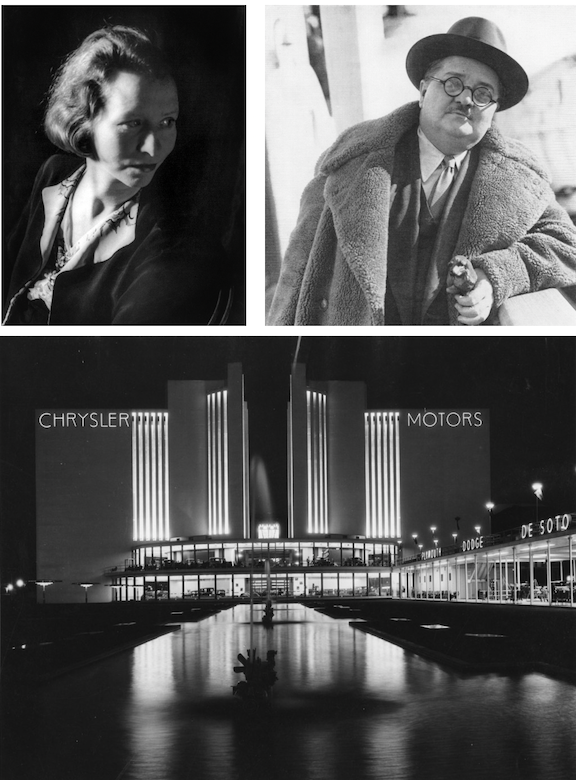
WAYLAID…Alexander Woollcott stopped by to see the poet Edna St. Vincent Millay before finally making his way to Chicago’s Century of Progress, which featured such spectacles as this Chrysler exhibition. Photo of Woollcott was taken upon his return from Europe in January 1933. Photo of Millay is by Carl Van Vechten, 1933. (Wikipedia/eBay/chicagology.com)

 * * *

From Our Advertisers

Prohibition wouldn’t be officially repealed until Dec. 5, 1933, but that didn’t stop New Yorkers from enjoying their favorite adult beverage, including this pair. What on earth is that man on the left doing? It appears he’s opening a bottle of White Rock (glimpsed between his legs), but why with his back turned?…

…the folks at Packard were consistent in promoting the durability and longevity of their premium automobiles…

…and it’s no coincidence that the makers of Goodyear tires featured a 1933 Packard to tout the durability of their product…

…speaking of durability, the ever-reliable Gardner Rea kicks off our cartoons…

Mary Petty eavesdropped on the latest social event…

…the battle of the sexes continued in James Thurber’s world…

Barbara Shermund shared the lamentations of a modern woman…

…and Garrett Price, likely inspired by a recent trip abroad, gave us this homesick tourist…

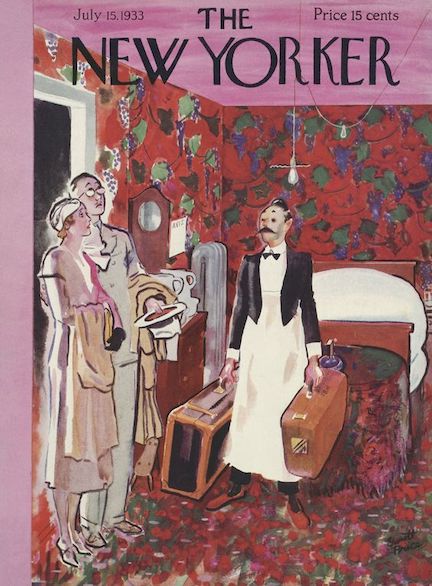
…and the cover of the July 15, 1933 issue…

July 15, 1933 cover by Garrett Price.

…in which Thurber continued his tales from My Life and Hard Times with “The Car We Had to Push”…also in the issue was a profile of “Bolshevik Businessman” Peter Bogdanov, written by foreign correspondent William C. White. An excerpt:

From 1930 to 1934 Bogdanov (1882–1939) headed the Amtorg Corporation, which helped the struggling Soviet economy establish valuable business and diplomatic relations with the United States. It is no surprise that like many who helped the Soviet cause, Bogdanov was eventually arrested on trumped-up charges and executed by Stalin’s henchmen. In March 1956 he was posthumously “rehabilitated.”

WORKING TOWARD AN EARLY RETIREMENT…Peter Bogdanov, circa 1920s. (Wikipedia)

 * * *

On the Lighter Side

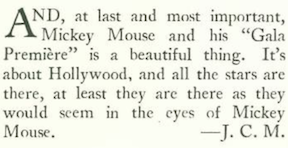
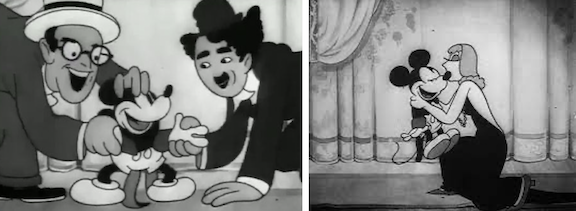
While millions in the Soviet Union were dying of famine and other Stalin-inspired atrocities, Americans were keeping their Depression-era spirits up at the movies, including critic John Mosher, who called the latest Mickey Mouse cartoon “a beautiful thing”…

THE MOUSE THAT ROARED…Mickey Mouse hobnobs with celebrities of the day including Harold Lloyd, Charlie Chaplin and Greta Garbo in his latest picture, Gala Premiere. (IMDB)

 * * *

More From Our Advertisers

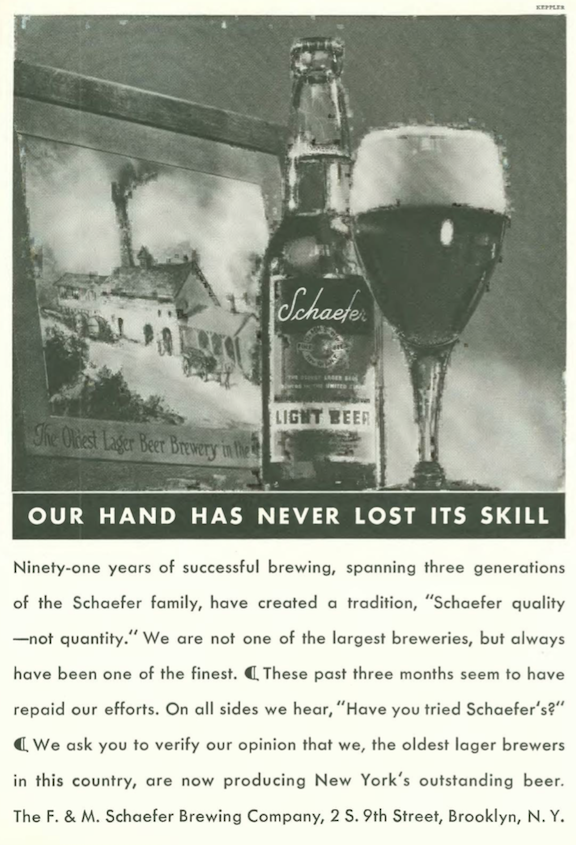
I once had a relative in New Jersey who drank a tall can of Schaefers every day, on orders from his doctor…

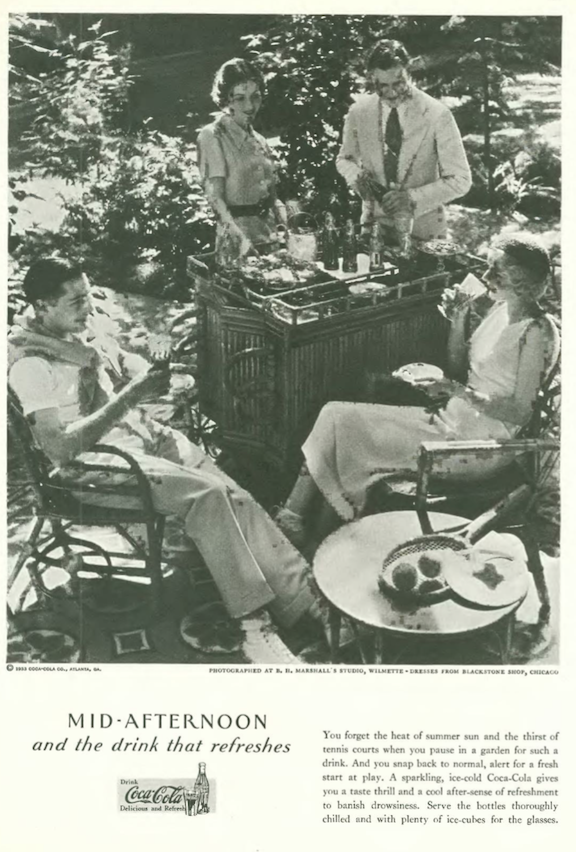
…the makers of Coca-Cola continued to tout their product in full-page New Yorker ads…

…recalling the Packard ad from the previous issue, the cheapest Packard model would set you back $2,150…you could instead get this swell Plymouth Six for just $455 and head down to the waterfront, where, according to this salesman, “men are men”…

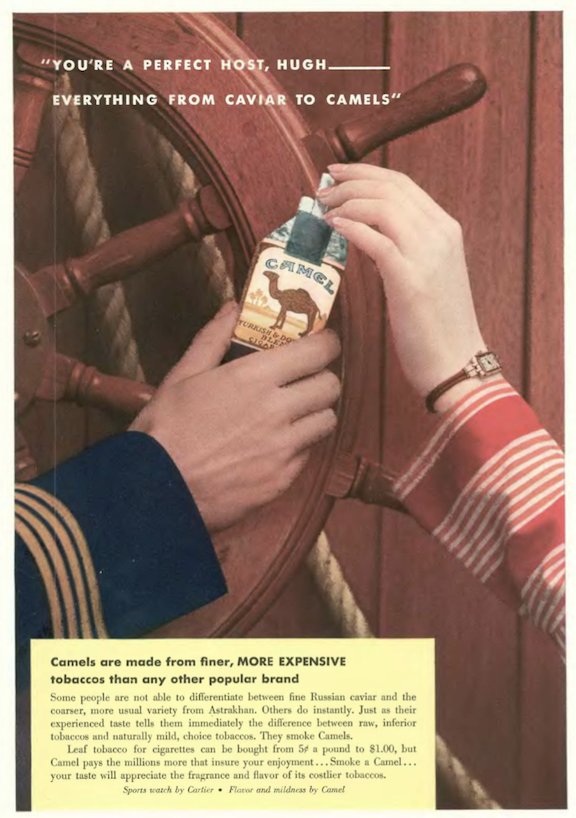
…and while on the waterfront you might be able to bum a smoke and maybe some caviar from a sailor named Hugh…

…and now we take a stroll in the park with Otto Soglow’s “Little King”…

…and find romance along with other hot dishes at the automat, courtesy Whitney Darrow Jr

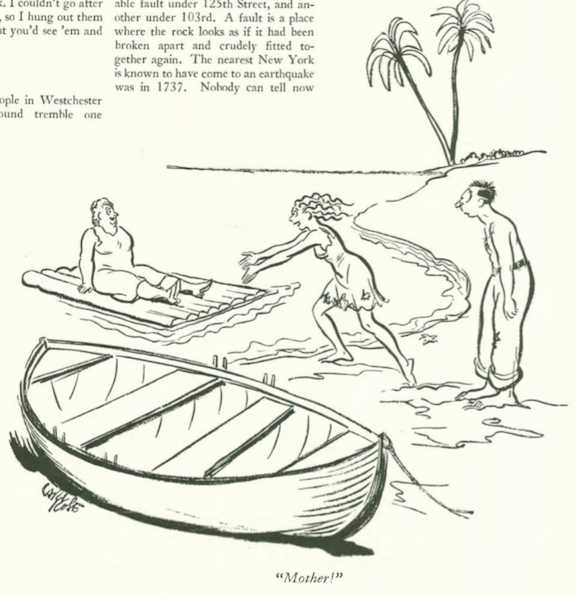
…adrift with Carl Rose, and a man unlucky in love…

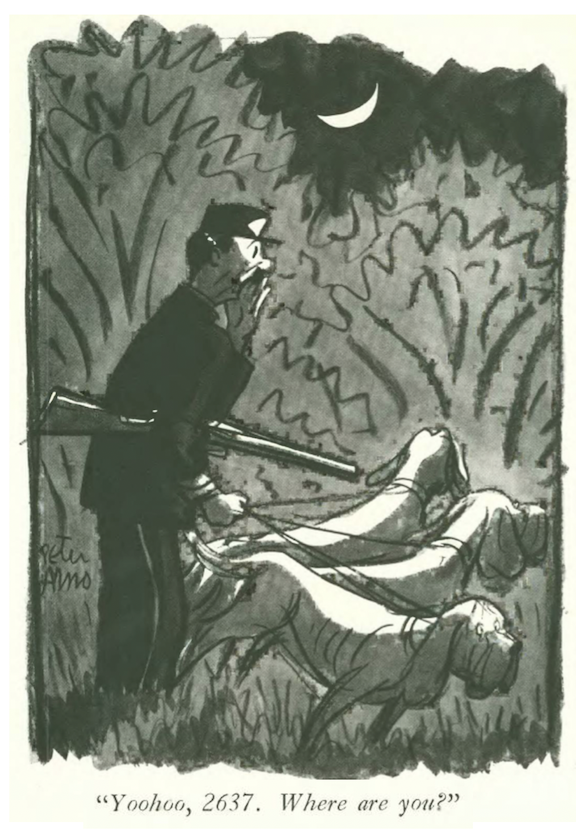
Peter Arno played hide and seek with an escaped con…
…and we end where we began, with James Thurber at his best…

Next Time: She Wore the Pants…

Rebirth of a Nation?

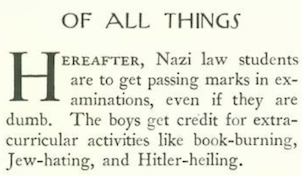
As we enter the summer months we find the recurring themes of June brides…and German Nazis…

May 27, 1933 cover by Constantin Alajalov.

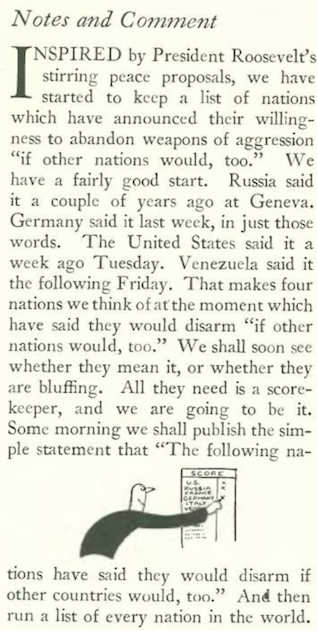
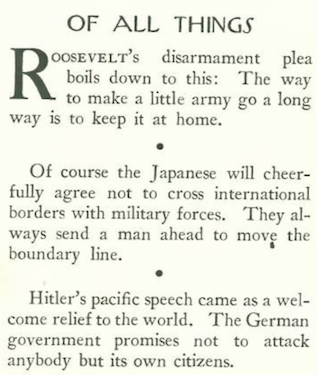
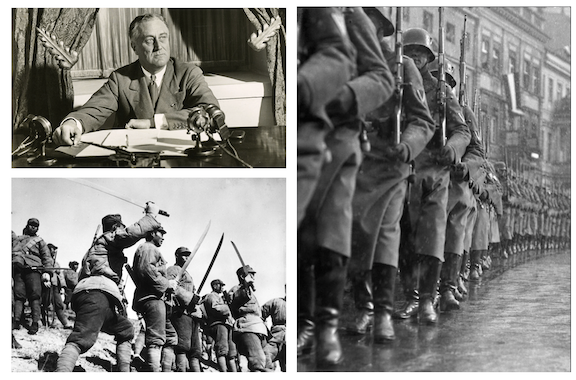
Those Nazis were on the mind of U.S. President Franklin D. Roosevelt when he wrote to the sixty participating nations at the Geneva Disarmament Conference, imploring them to eliminate all weapons of offensive warfare. As we now know, it was a plea that mostly fell on deaf ears, notably those of the leaders of Japan and Germany. E.B. White offered this observation:

GIVE PEACE A CHANCE?…Sixty countries sent delegates to the Geneva Disarmament Conference in 1932–33. Germany was represented by Nazi Minister of Public Enlightenment and Propaganda Joseph Goebbels (front row, center), that is until his country pulled out of the conference and continued its massive arms buildup. (Library of Congress)

Howard Brubaker was also keeping an eye on FDR’s efforts to hold off the rising powers in Europe and Asia…

WAR AND PEACE…On May 16, 1933, Franklin D. Roosevelt pleaded with the world’s nations to consider total disarmament of all offensive weapons. In the meantime, Adolf Hitler led the rapid rearmament of Germany (right) while Chinese soldiers (below) did what they could to counter the latest Japanese offensive—the invasion of Jehol Province. (Wikimedia/Pinterest)

*  *  *

Writer of Lost Causes

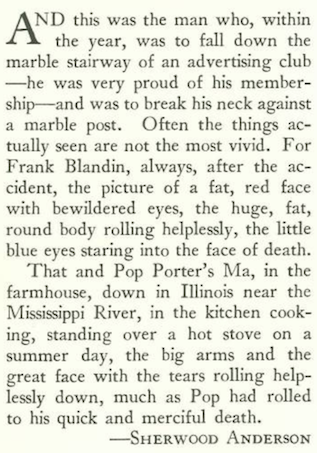
The short story “Pop” would be Sherwood Anderson’s first contribution to The New Yorker. Anderson was known for his stories about loners and losers in American life, including Pop Porter, whose sad, drunken death is described in the closing lines:

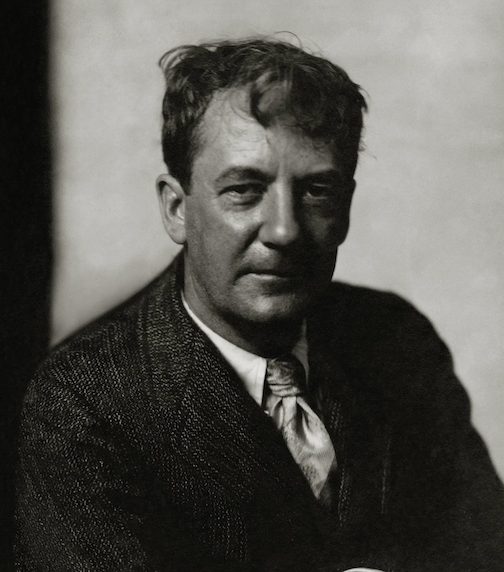
NO EXIT…Best known for his 1919 novel Winesburg, Ohio, Sherwood Anderson (1876–1941) took an unsentimental view of American life. He would contribute six short stories to The New Yorker from 1933 to 1936. Photo above by Edward Steichen, circa 1926. (The New York Times)

*  *  *

From Our Advertisers

The German Tourist Information Office welcomed visitors to “witness the rebirth of a nation,” promising a land of “new ideas and broader visions” that would bestow on travelers “undying memories endlessly renewed”…

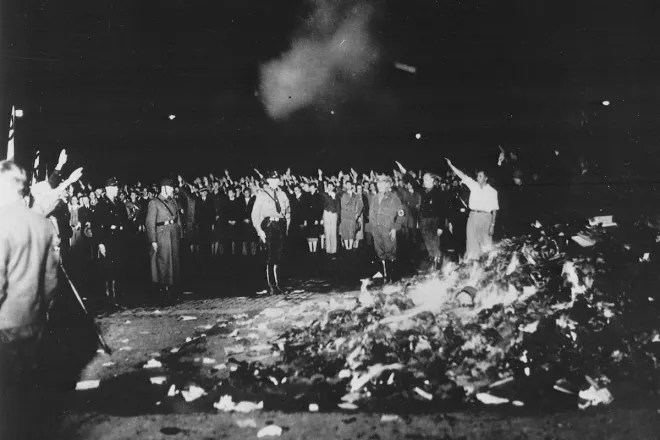
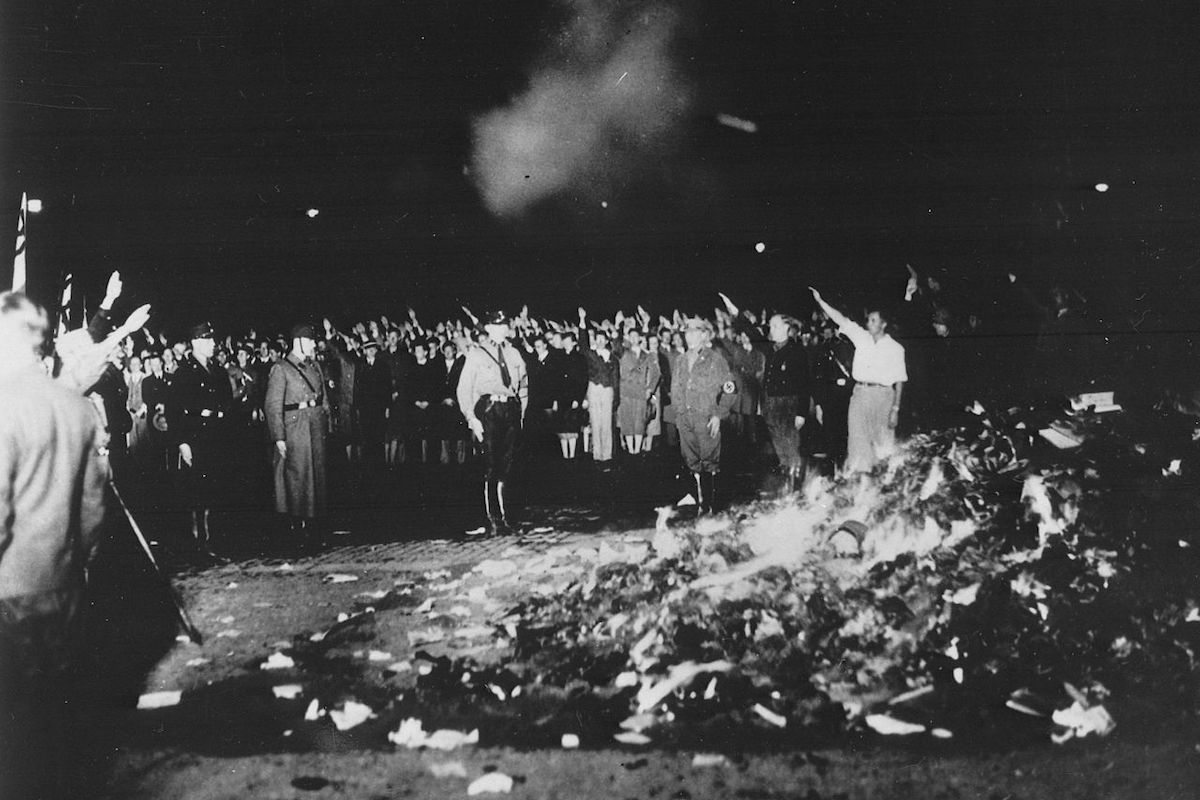
…Those “undying memories” might have included massive, country-wide book burnings that took place on May 10, 1933, when students in 34 university towns across Germany burned more than 25,000 “un-German” books…

FANNING FLAMES OF HATE…On May 10, 1933, student supporters of the Nazi Party burned thousands of volumes of “un-German” books in the square in front of the Berlin State Opera. (Bundesarchiv)

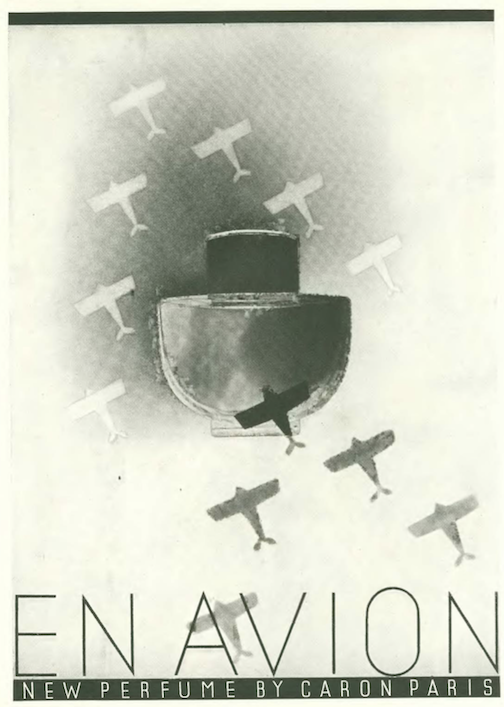
…knowing where all of this would lead, it is hard to look at this next ad and not think of the Luftwaffe raining death from the skies later in that decade…

…so for the time being we’ll turn to something less menacing, like checkered stockings, here resembling one of John Held Jr’s woodcuts…

…and this crudely illustrated ad (which originally appeared in one column)…call your buddy a fatso and the next thing you know he’s moving to Tudor City…

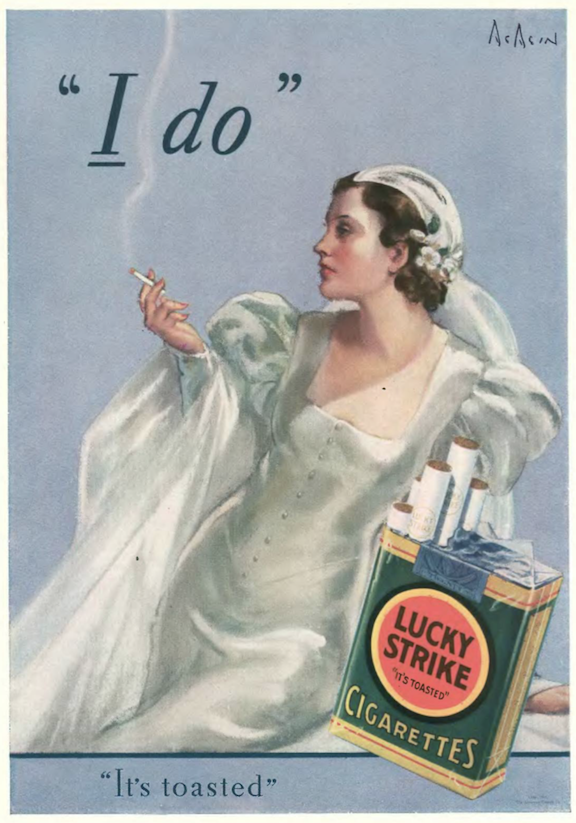
…and from the makers of Lucky Strikes, a back cover ad that provided a thematic bookend to Constantin Alajalov’s cover art…

James Thurber kicks off the cartoons with this sad clown…
…atop the Empire State Building, Daniel ‘Alain’ Brustlein found more than just a view of the city (it’s former governor Al Smith!)…
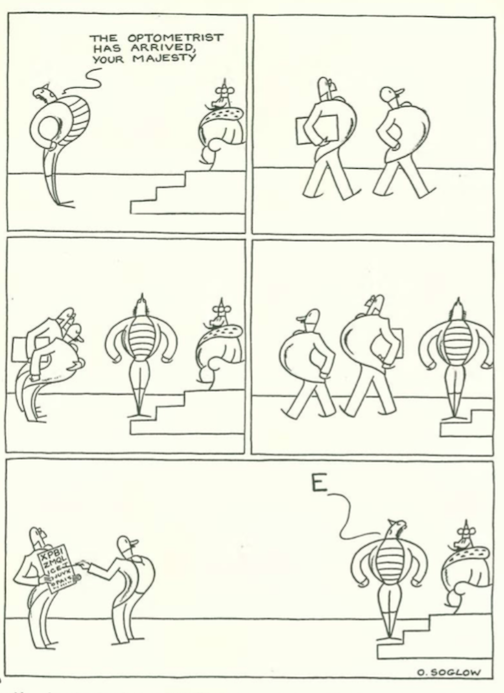
Otto Soglow’s Little King got his vision checked, in his own way…

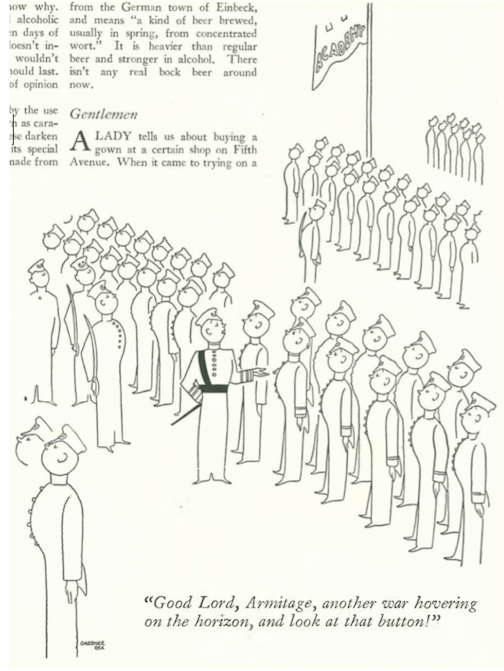
…a loose button threatened to bring down a nation…per Gardner Rea

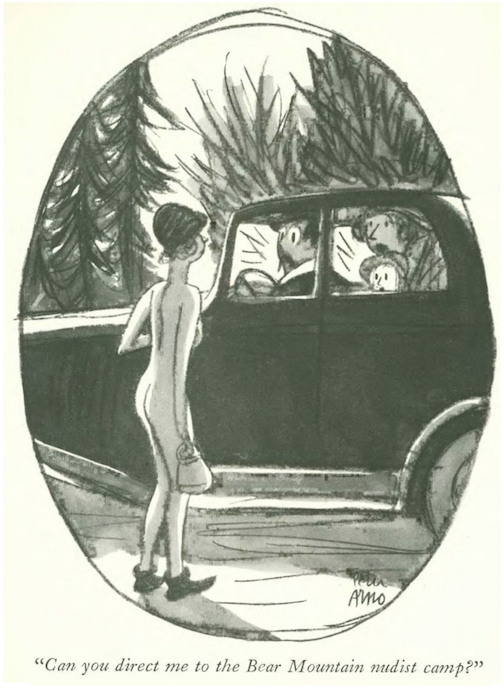
…and we take a leisurely Sunday drive, Peter Arno style…

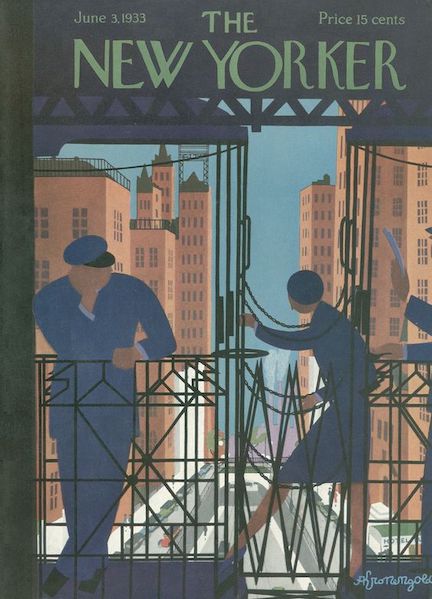
…on to the June 3, 1933 issue…

June 3, 1933 cover by Adolph K. Kronengold.

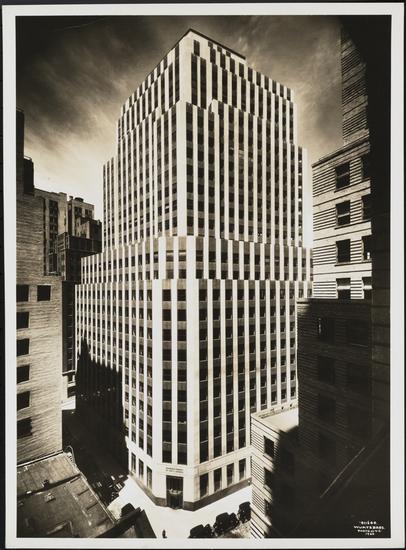
…where we appropriately look to the skyline, which was giving Lewis Mumford a crick in the neck…

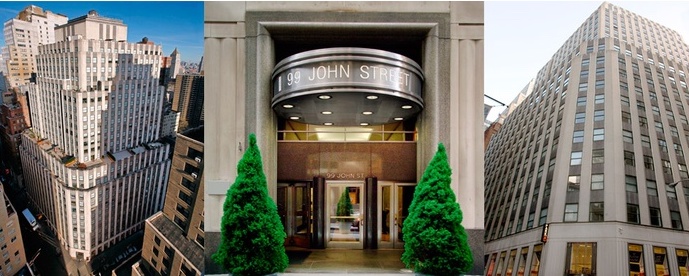
THAT’LL DO…Lewis Mumford was not a fan of giant skyscrapers, but when the architects of the Empire State Building turned their attention to the Insurance Company of North America building at 99 John Street, Mumford found a design that could serve as a model for future business buildings. (Museum of the City of New York)
CONVERSION THERAPY…the Insurance Company of North America building now houses modern loft condominiums known as 99 John Deco Lofts. (nest seekers.com).

Later in the column Mumford called skyscrapers “insupportable” luxuries, arguing instead for long, shallow buildings rising no more than ten stories.

*  *  *

The Stars Align

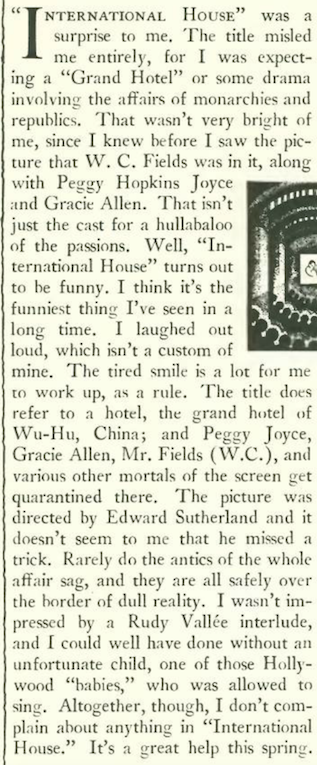
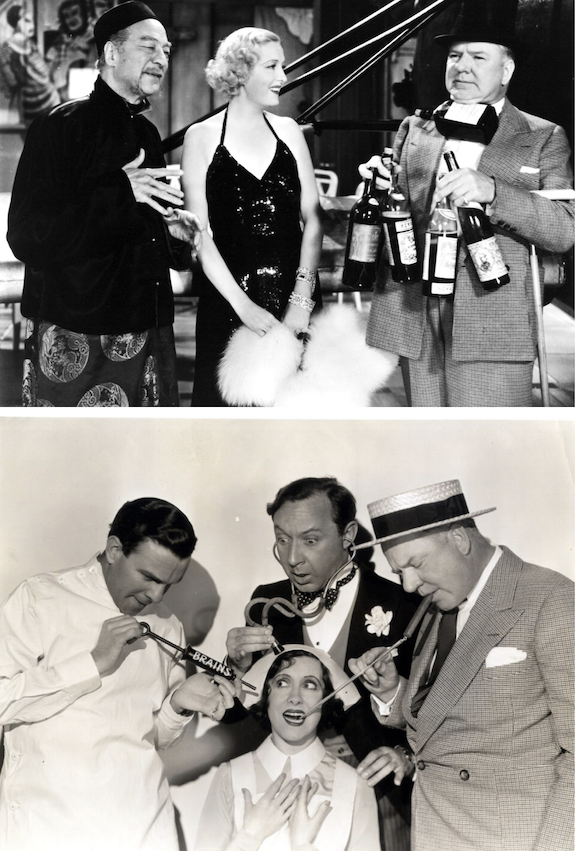
Film critic John Mosher was delightfully surprised by International House, a film loaded with some of the era’s top comedic stars along with other entertainers.

CLUTCH THOSE PEARLS…The risqué subject matter of International House had the Legion of Decency up in arms, but it left critic John Mosher in stitches thanks to the antics of Edmund Breese, Peggy Hopkins and W.C. Fields (top photo). Below, a publicity photo for International House with George Burns, Gracie Allen, Franklin Pangborn and W.C. Fields. (IMDB)

The film featured an array of entertainers including Peggy Hopkins (more famous as a real-life golddigger than an actress), the comedy duo Burns and Allen, W.C. Fields, Bela Lugosi, Cab Calloway, Rudy Valley and Baby Rose Marie.

ALL THE WORLD’S A STAGE…Ten-year-old Rose Marie Mazzetta, known in 1933 as the child performer Baby Rose Marie, sings a number atop a piano in a scene from International House. Thirty years later Rose Marie would appear on The Dick Van Dyke Show as television comedy writer Sally Rogers, pictured here with co-stars Dick Van Dyke and Morey Amsterdam. (WSJ/LA Times)
*  *  *
The New Germany, Part II
The June 3 “Out of Town” column took a look at life in Berlin as well as the 1933 Chicago World’s Fair. The piece is signed “A.L.”, leading me to believe it might be A.J. Liebling (author of the terrific Between Meals), but he didn’t start at The New Yorker until 1935. At any rate the article seems to dismiss the crackdown on Berlin’s cultural life as a mere inconvenience.

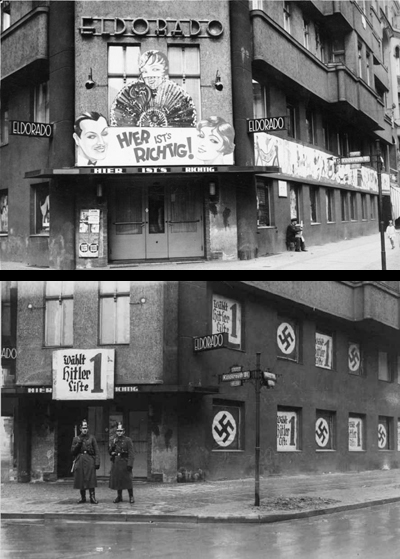
NEW THEME, NEW OWNERSHIP…The article mentions the closing of the Eldorado night club in Berlin, famed for its drag shows and other naughty diversions. Images above show the before and after the Nazis redecorated. (lonesomereader.com)

*  *  *

From Our Advertisers

More propaganda from Germany, where everything is sweet and bright away from the din of the city and the sound of marching jackboots and the crash of broken glass…


…an unusual ad from Cadillac, which barely mentions the automobile but goes full bore on the June bride theme…

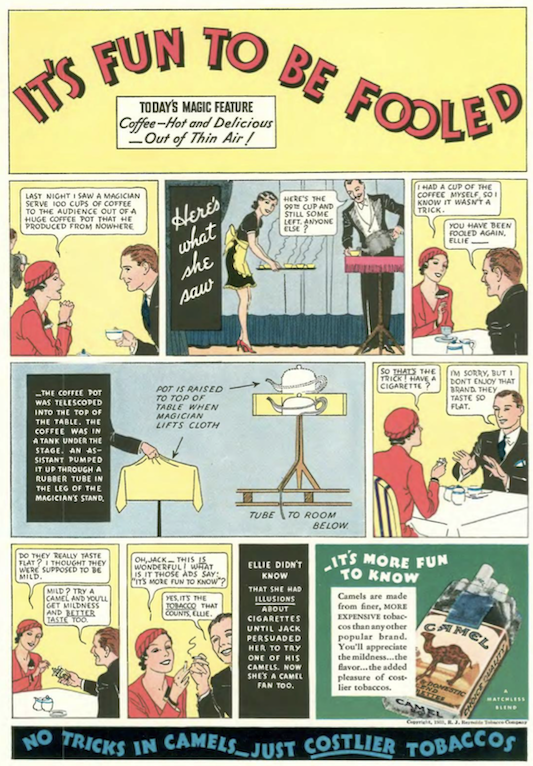
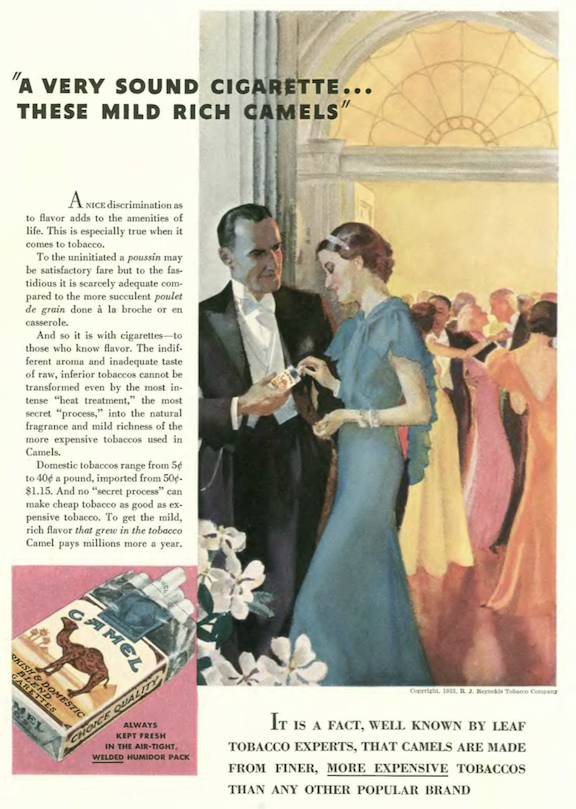
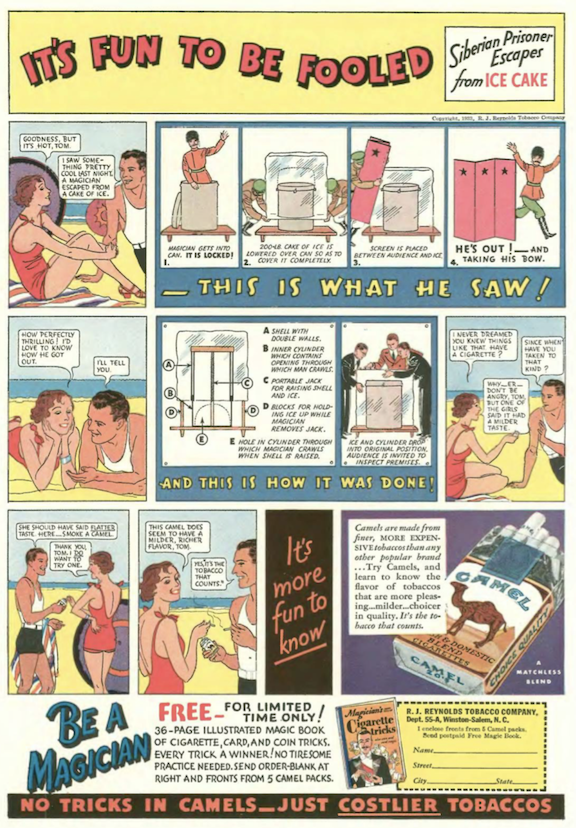
…the folks at Camel went full color in their latest installment of “It’s Fun to be Fooled”…in this strip Jack gets his friend Ellie hooked on his cigarette brand…

…looking for fresher air, well you could get a window air conditioner from the folks at Campbell Metal Window Corporation…however, these units were only available to the very wealthy, roughly costing more than $25,000 apiece (more than half a million today)…

…better to take a drive a catch the breeze with this smart pair…

…and fight off those pesky bugs with a blast of Flit, as illustrated by Dr. Seuss before he became a children’s author…

Richard Decker picked up some extra cash illustrating this ad for Arrow shirts…

…which segues to our other New Yorker cartoonists, such as H.O. Hoffman…

…and yet another bride, with sugar daddy, courtesy of Whitney Darrow Jr

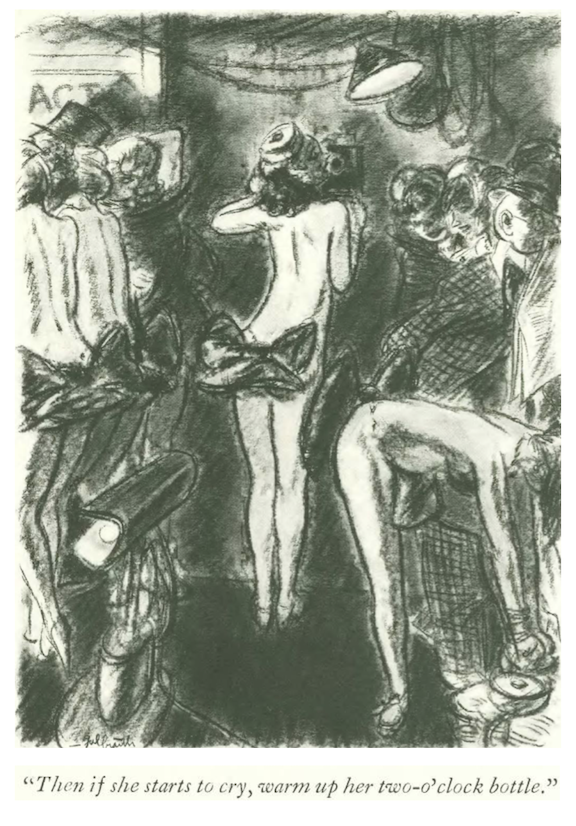
William Crawford Galbraith continued his exploration into the lives of showgirls…

Gardner Rea gave us this helpful switchboard operator…

Carl Rose showed us how the posh set got into the spirit of the Depression-era farm program…

George Price was getting into familiar domestic territory…

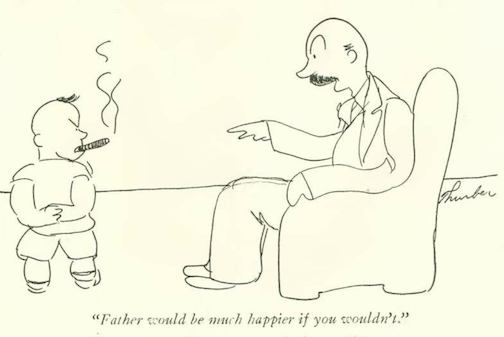
…and on this Father’s Day, we close with some fatherly advice from James Thurber

Next Time: Making Hays…


Headline News

The news of the day in May 1933 included a visit to the U.S. by Irish playwright George Bernard Shaw, a controversial Diego Rivera mural at Rockefeller Center, the abandonment of the Gold Standard, and the continuing saga of legal beer.

May 13, 1933 cover by Adolph K. Kronengold.

Writing under the pseudonym “Guy Fawkes,” Robert Benchley opined on the state of the print media in “The Wayward Press”…an excerpt:

NEWSMAKERS CIRCA 1933 included George Bernard Shaw (left), here being escorted by actors Charlie Chaplin and Marion Davies from a Hollywood luncheon hosted by Davies in March 1933; other headlines touted the return of legal beer and the suspension of the gold standard by the Roosevelt administration—everyone was required to deliver all gold coin, gold bullion and gold certificates owned by them to the Federal Reserve by May 1 for the set price of $20.67 per ounce. Pictured are guards stocking returned gold in New Jersey bank vaults, 1933. (Pinterest/history.com)

 * * *

Selling the Pitch

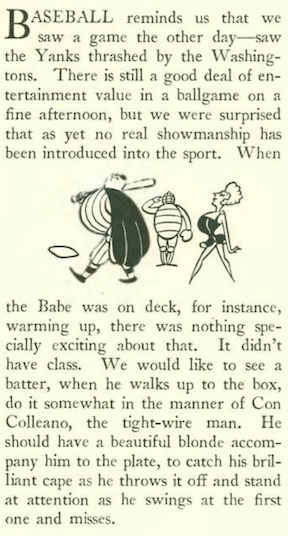
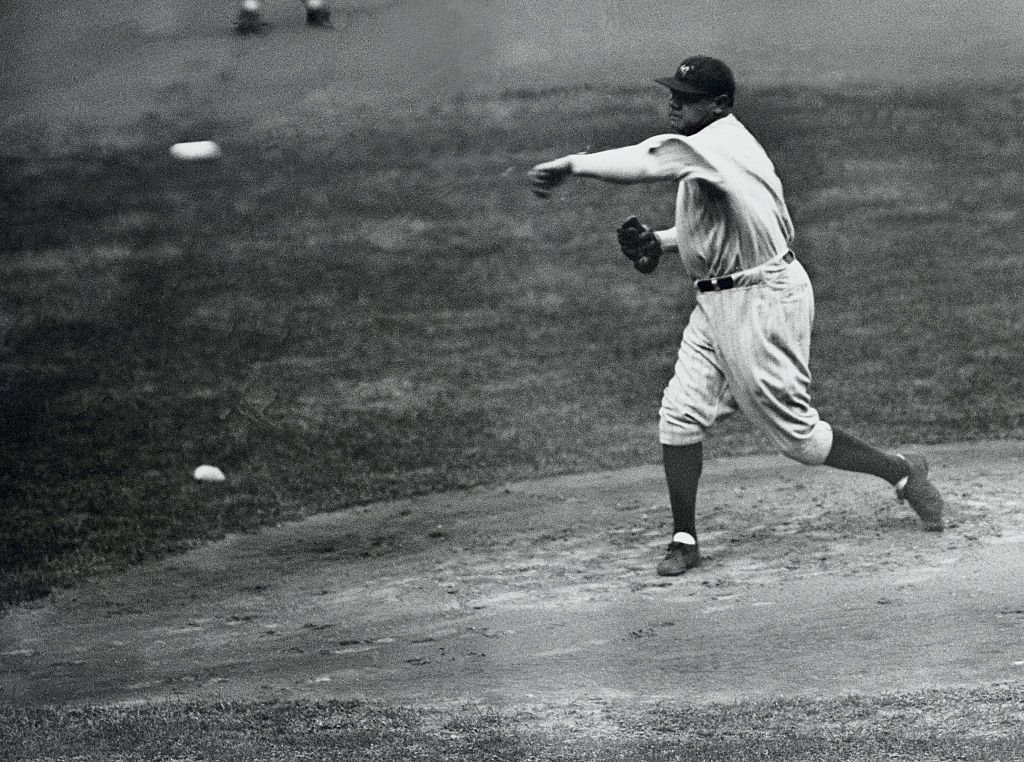
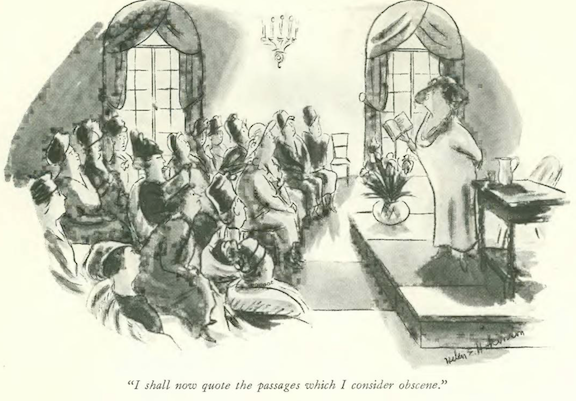
Babe Ruth was something of a freak of nature, becoming the “Sultan of Swat” despite a life of heavy drinking, poor eating habits and erratic attention to training regimens. Nevertheless, as Ruth neared the end of his career at age 38 he could still put on a show. In his “Notes and Comment,” E.B. White was hoping for just that sort of thing:

STILL GOT IT…E.B. White would get his wish for some “real showmanship” at the end of the 1933 season, when famed Yankee slugger Babe Ruth—in his 20th year in the majors—volunteered to pitch against the Red Sox in the final game of the season at Yankee Stadium. Not only did Ruth pitch a complete game, he also hit his 34th homer of the season in the Yankees’ 6–5 victory. (ballnine.com)

 * * *

From Our Advertisers

I wonder what it was like to cruise on the Dnieper River for fourteen days through “Colorful Ukrainia” during the Great Famine that Stalin imposed on that land, killing as many as five million people…

…more ads from the back pages touting various libations including Trommer’s “White Label” beer, a drink made from conch juice called “Konktail,” and an ad illustrated by William Steig promoting “imitation gin and other flavors” made by Red Lion…none of these products exist today…

…however you can still buy canned spaghetti, if that is your thing, but not “Force” breakfast cereal…

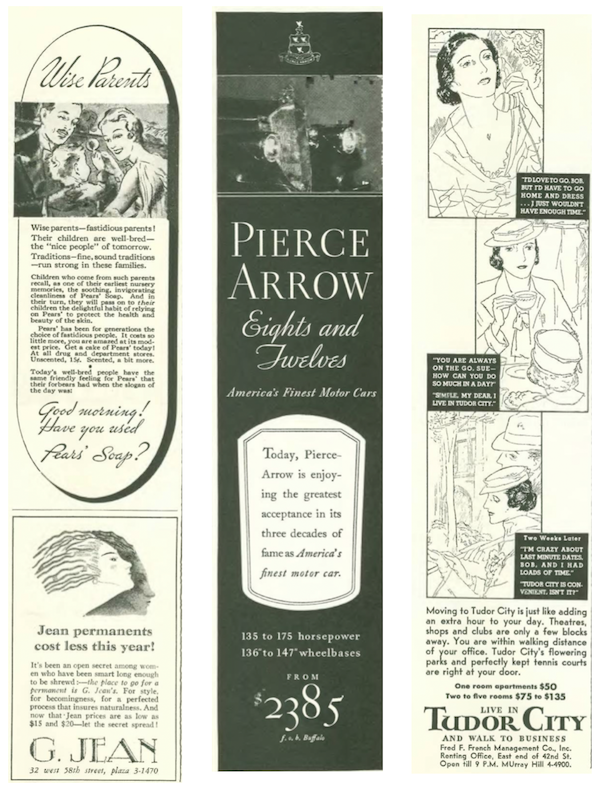
…still more selections from the back pages…on the left, an ad for Pear’s Soap that introduced us to “wise parents” whose children “are well-bred—the ‘nice people’ of tomorrow”…on the right, the lifeless gaze of a woman who pondered how life could be better in Tudor City…and in the middle, an unlikely one-column ad from luxury car maker Pierce Arrow…the automaker was America’s answer to Rolls Royce, but the Depression would take it down by 1938…

…I’m guessing the Velveeta is the mild one…

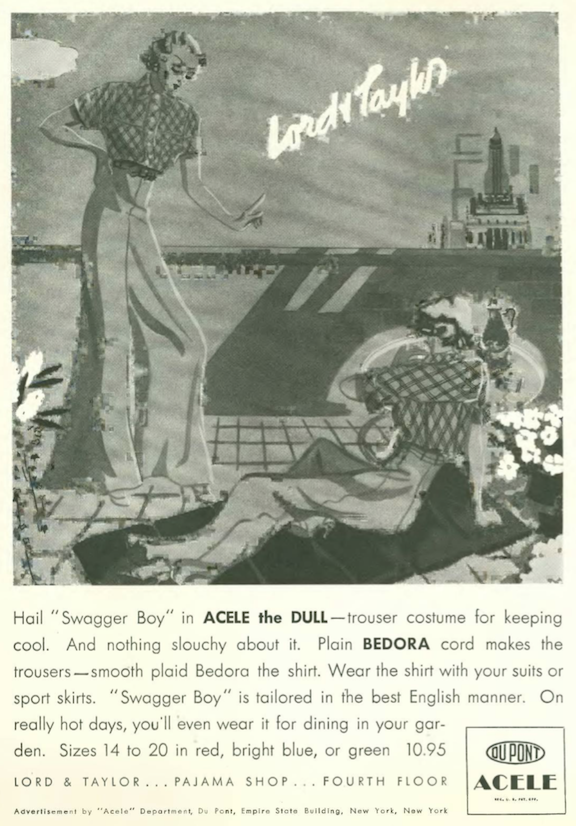
…technology was transforming beachwear, including this “Swagger Boy” outfit spun from Dupont’s latest synthetic, Acele…

…B. Altman, on the other hand, went full-color to promote their exclusive, imported fabric under the trade name Meadowbrook…

…and who ever thought a tire could look so posh, here dominating a gathering of the smart set…

…and look at this swell, sporting top hat and walking stick, but he also knows a good value when it comes to his tires…

…we move on to our cartoons with James Thurber and a lot of people apparently going nowhere…

Helen Hokinson’s girls were all ears at the latest club gathering…

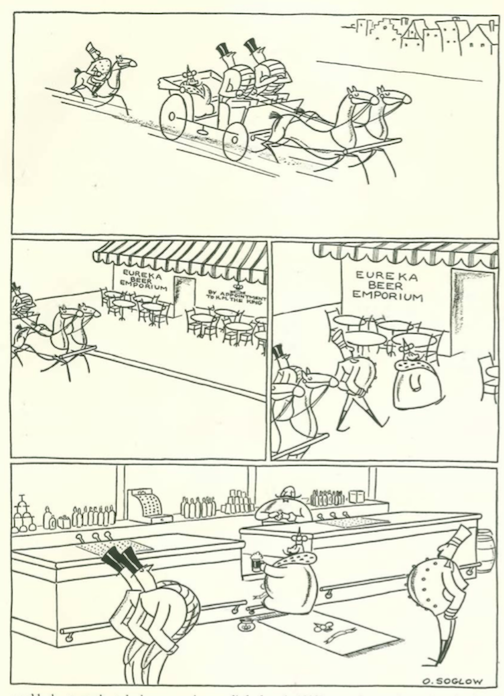
Otto Soglow’s Little King got in on the excitement of legal beer…

…and we continue to the issue of May 20, 1933, with a cover by Arnold Hall, who did at least eight covers for The New Yorker during the 1930s…

May 20, 1933 cover by Arnold Hall.

The big news in this issue was Mexican artist Diego Rivera and his controversial mural at Rockefeller Center. Rivera’s New Yorker profile was written by Geoffrey Hellman (1907–1977), who beginning in 1929 served as the magazine’s principal writer for “The Talk of the Town.” Here’s an excerpt, with illustration by Al Frueh:

What got Rivera in hot water with John D. Rockefeller Jr. and family was a mural that departed somewhat from the artist’s earlier study sketches—Rivera had been hired to depict “man at the crossroads,” looking to the future with uncertainty but also with hope for a better world.

According to a 2014 story by NPR’s Allison Keyes, leftist organizations and various communist groups in New York criticized Rivera for agreeing to work with capitalist paragons like the Rockefellers. In response, Rivera sent assistants to find a picture of Bolshevik leader Vladimir Lenin. “If you want communism, I will paint communism,” he apparently said.

The subsequent inclusion of Lenin in the mural led to protests by the Rockefeller family, the press and the public. Rivera was ultimately asked to leave the country, losing yet another commission for the Chicago World’s Fair. Rivera got paid for his Rockefeller Center mural, but the work itself was demolished.

After returning to Mexico Rivera recreated the mural, adding some vengeful references (see below) to his 1934 work, Man, Controller of the Universe.

Rivera’s wife, Frida Kahlo, had accompanied him to New York, and during their time in the states (1930-34) she produced a number of now-famous paintings. However in 1933 she was not recognized as a serious artist. Indeed when she visited with the Detroit News in 1932, the headline read, “Wife of the Master Mural Painter Gleefully Dabbles in Works of Art.” In the same vein, Hellman perceived Kahlo as nothing more than a pretty helpmeet.

MORE THAN A PRETTY FACE…At left, Diego Rivera and Frida Kahlo attending an art exhibition in New York, 1933; at right, Kahlo and Rivera before the controversial mural at Rockefeller Center. Although an unknown in the art world in 1933, Kahlo would one day eclipse her husband’s fame. (SFGate/Pinterest)
MISCONCEPTION…Clockwise, from top, an early sketch of the Diego Rivera’s mural differed from what he ultimately painted in Rockefeller Center. After the mural was destroyed in 1934, Rivera recreated the work under the title Man, Controller of the Universe, now on display at the Palacio de Bellas Artes in Mexico City. A detail of that work shows Vladimir Lenin holding hands with workers of different races. Below, juxtaposed with the image of Lenin in that painting was another famous face, that of John D. Rockefeller Jr., depicted drinking martinis with a prostitute. Touché!
(Museo Frida Kahlo)

Rivera’s Rockefeller Center mural was eventually replaced in 1937 by American Progress, painted by the Spanish artist José Maria Sert:

(Flickr)

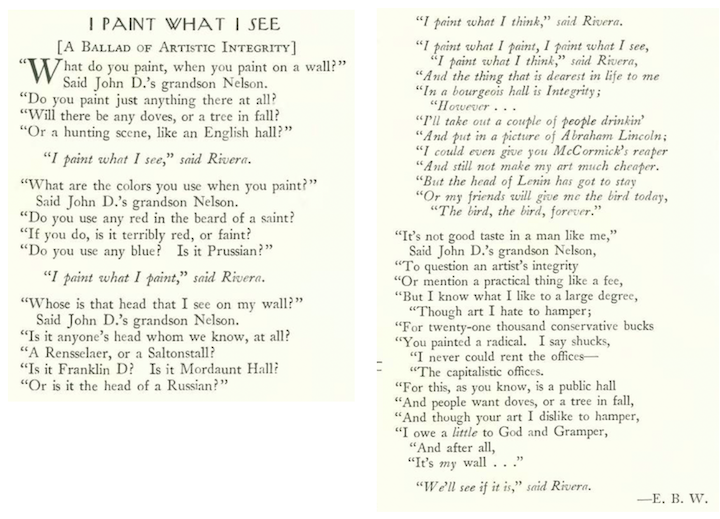
The irony of the Rivera controversy was not lost on E.B. White, who offered this ballad in response:

 * * *

Keep it in Your Pocket

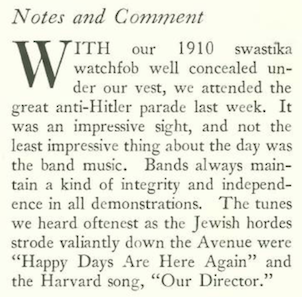
E.B. White again, this time opening his column with thoughts on the anti-Hitler parade that was held in New York.

White refers to his “swastika watchfob”…before the Nazis came to power, the swastika was known to many cultures as a symbol of prosperity and good luck.

IT’S THE REAL THING…In 1925 Coca Cola made a lucky brass watch fob in the shape of a swastika. At that time the swastika was still a symbol of good luck. (Reddit)
SHOW OF UNITY…Anti-Hitler parade in New York protested the May 10, 1933 book burnings across Nazi Germany. (encyclopedia.ushmm.org)

In his weekly column Howard Brubaker added this observation regarding life in Nazi Germany…

Back home, folks could still enjoy a taste of Germany that wasn’t associated with violence and hate…an excerpt from “The Talk of the Town”…

GEMÜTLICHLüchow’s opened in 1882 when Union Square was still New York’s theater and music hall district, and featured seven dining rooms and a beer garden. The restaurant closed in 1982 and was demolished in 1995 to make way for an NYU dormitory. (Pinterest/MCNY)

 * * *

From Our Advertisers

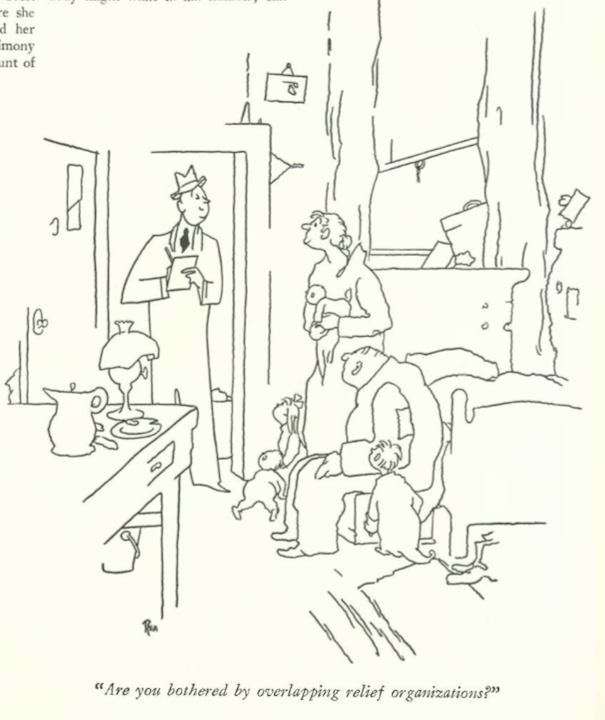
The architecture profession fell on hard times during the Depression. In 1931 the Architects’ Emergency Committee began promoting the talents of unemployed architects who were willing to work for less than half their ordinary fee, limiting charges to materials, a small amount of cash, and a place to sleep…this is an example of a series of ads that ran in The New Yorker in the spring of 1933…

…one profession not feeling the hard times?—the makers of tobacco products, and specifically cigarettes…

…speaking of hard times, we turn to our cartoons and Gardner Rea

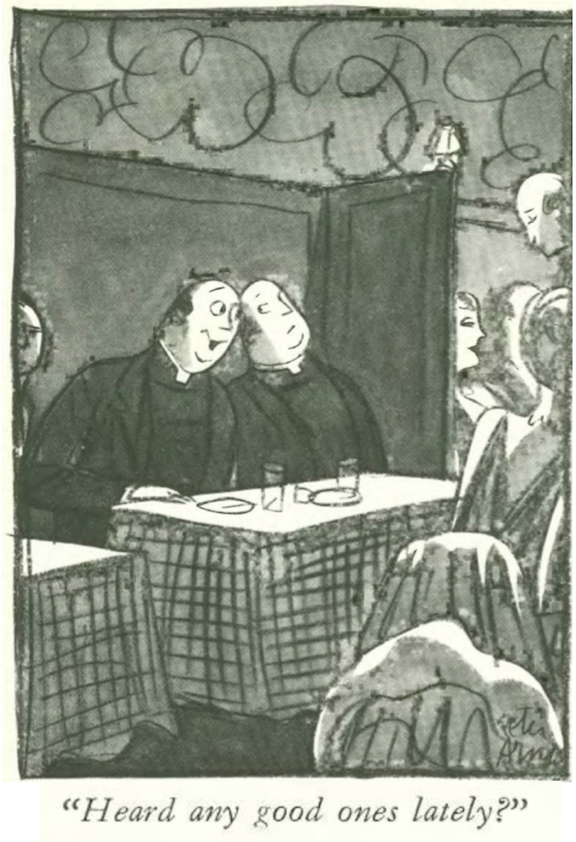
…and we close on a bright note, otherwise known as Peter Arno

Next Time: Rebirth of a Nation?

Bohemian Rhapsody

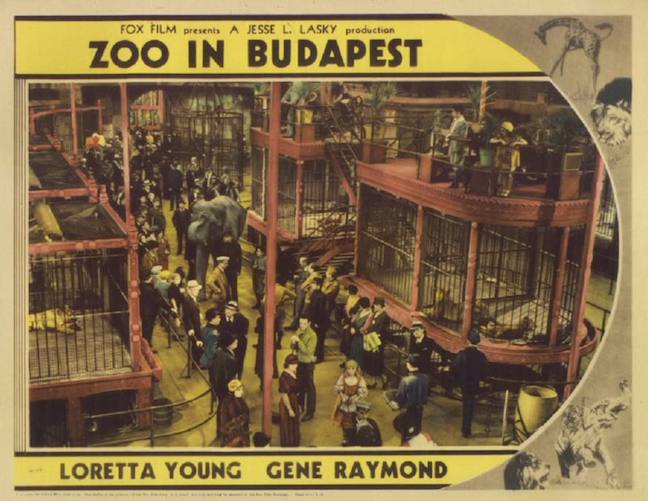
Part love story and part wildlife protection fable, the pre-Code romance and melodrama Zoo in Budapest was that rare film that pleased critics and audiences alike.

May 6, 1933 cover by Richard Decker. This is one of four covers Decker (1907–1988) contributed to The New Yorker; he also contributed more than 900 cartoons in his nearly 40-year run with the magazine.

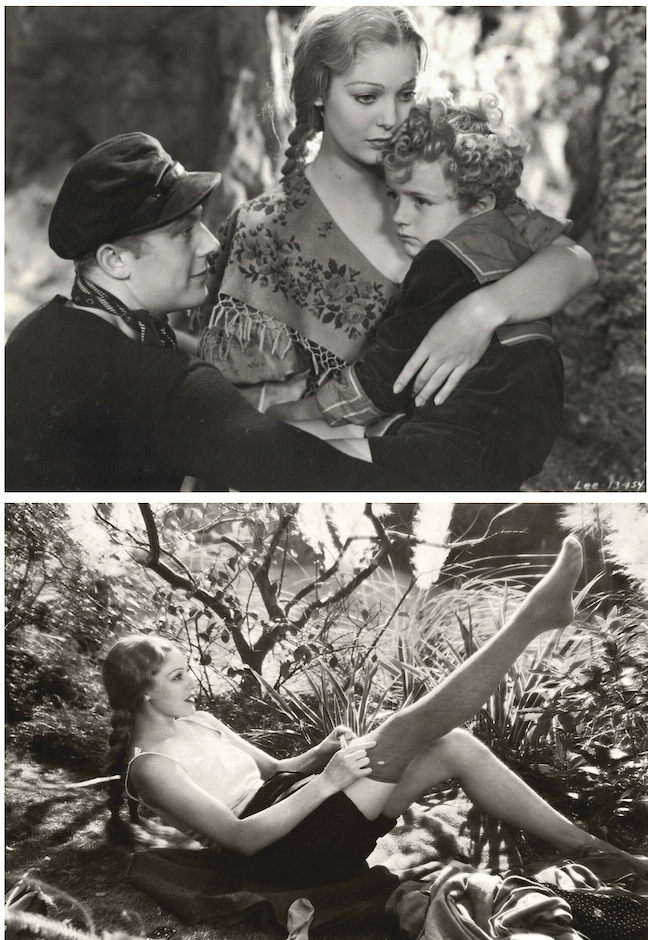
Jesse L. Lasky’s first production for Fox (Lasky was the founder of Paramount Pictures), Zoo in Budapest starred relative newcomer Gene Raymond as a young man (Zani) keenly attuned to nature and particularly to the animals he cares for in the Budapest Zoo. In the course of the film he becomes an anti-fur industry activist and rescues a beautiful orphan girl, Eve (Loretta Young) from a life of servitude. Although the film is little known today, in 1933 it had quite a winning effect on critic John Mosher, who usually found little to like from Hollywood’s output:

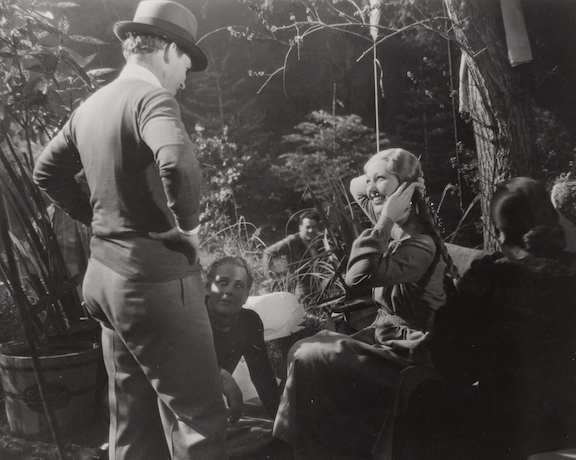
HE TALKS TO THE ANIMALS…Top, zoo worker Zani (Gene Raymond) rescues a beautiful orphan girl, Eve (Loretta Young) from a life of servitude, and both come to the aid of a little boy named Paul, played by Wally Albright, who escapes the clutches of his harsh governess. Below, hidden in the bushes, Eve changes her clothes after escaping from a group of orphans visiting the zoo. (IMDB)

The film made such an impression that even E.B. White had to mention it in the opening lines of his “Notes and Comment”…

ANIMAL CRACKERS…Filmmakers went all out in creating elaborate sets for Zoo in Budapest. The film was likened to Grand Hotel because the drama took place in less than 24 hours, almost entirely in one location. Below, Loretta Young converses with director Rowland Lee on the set. (IMDB)
(IMDB)

 * * *

High Anxiety

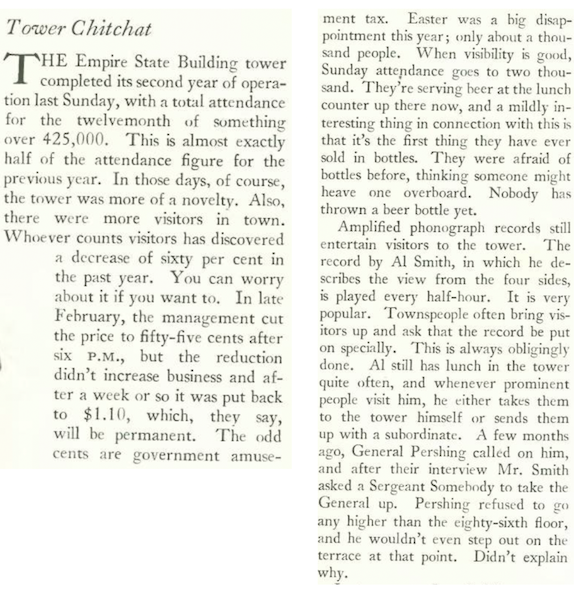
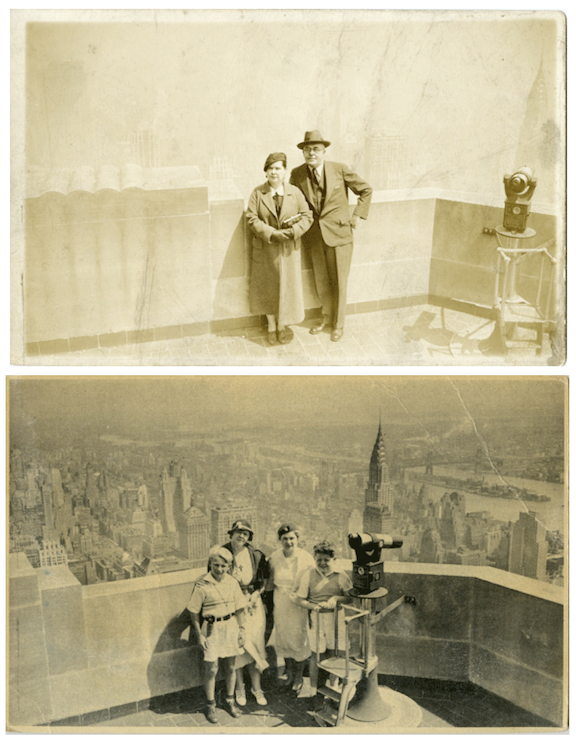
The Depression was hard on the Empire State Building, which opened its doors during some of the darkest days of the economic crisis. Visitation was down, and a lot of the office space in the world’s tallest building remained vacant. It would remain in the red into the 1940s.

BEEN THERE, DONE THAT…To this day the 86th floor observation deck has been a popular destination for tourists. In the 1930s a photographer stationed on the deck captured the moment for tourists on a souvenir postcard. The image at top is from 1934, the one below circa 1930s. Fencing to deter suicide attempts (or people chucking things over the side) wouldn’t be erected until 1947. (nyccirca.blogspot.com)

 * * *

As the World Churns

Howard Brubaker continued to comment on the deteriorating conditions of the German people in his column “Of All Things”…

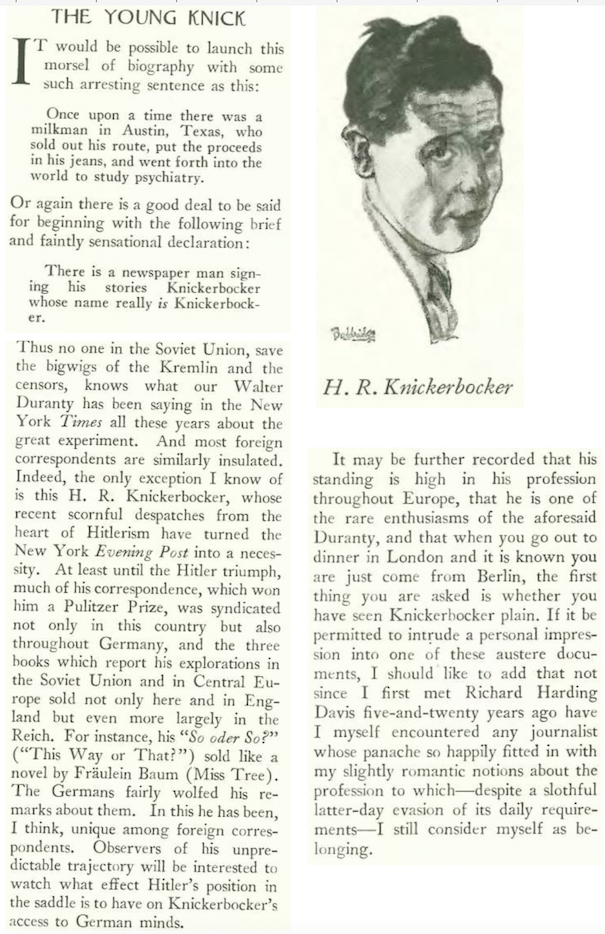
…and speaking of the Third Reich, Alexander Woollcott profiled (in his column “Shouts and Murmurs”) an enterprising young journalist Hubert R. Knickerbocker (1898–1949), who reported from Berlin from 1923 to 1933 and wrote about the threat of Nazism. In April 1933, after fleeing Germany, he reported in the New York Evening Post that “an indeterminate number of Jews [had] been killed.” A brief excerpt (with illustration by Cyrus Baldridge):

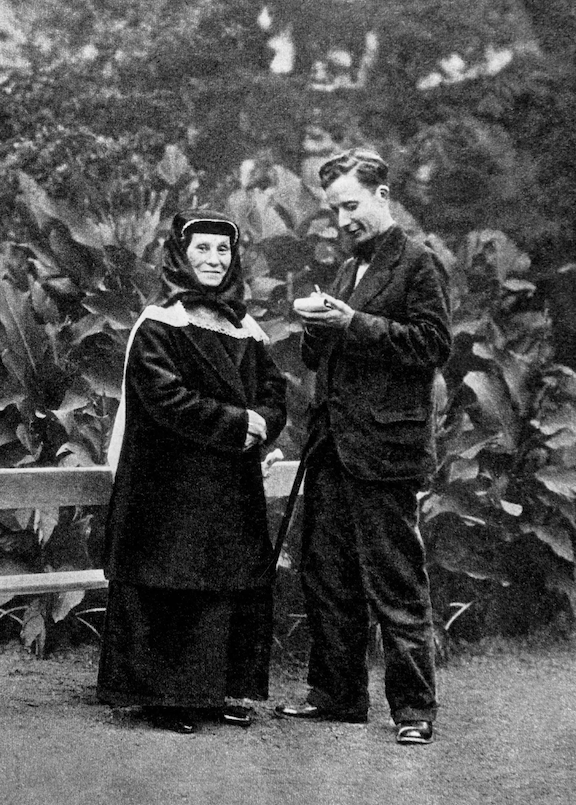
MYSTERY WRITER…In December 1930, H.R. Knickerbocker interviewed Josef Stalin’s mother, Keke Geladze, for the New York Evening Post. The resulting article was titled, “Stalin Mystery Man Even to His Mother.” (The New Yorker)

A graduate of Southwestern University in Georgetown, Texas and a 1931 Pulitzer Prize winner, Knickerbocker kept his word with Woollcott and entered Columbia University to study psychiatry.

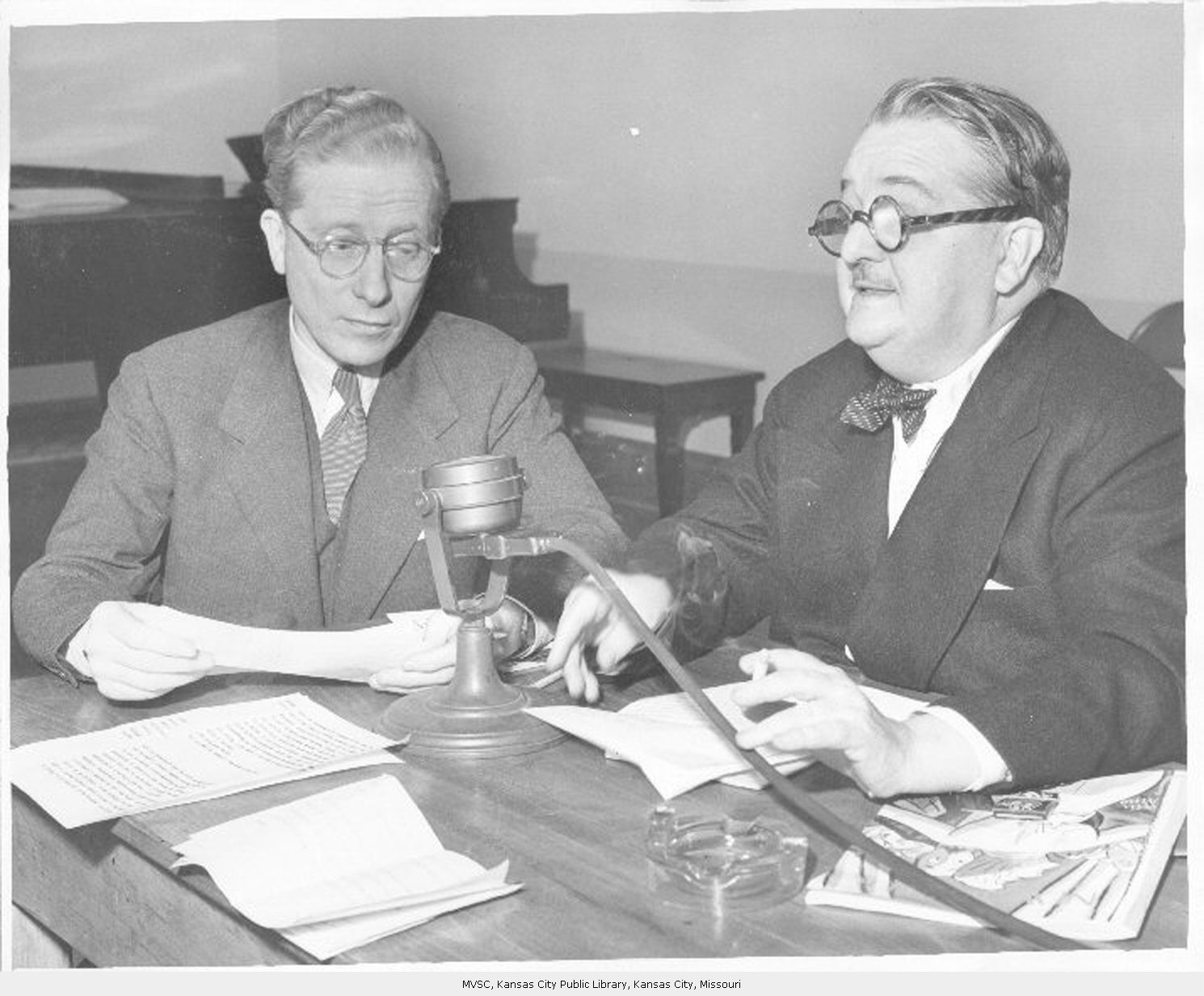
TALES TO TELL…H.L. Knickerbocker (at the microphone) with Alexander Woollcott circa 1940. (Kansas City Public Library)

 * * *

From Our Advertisers

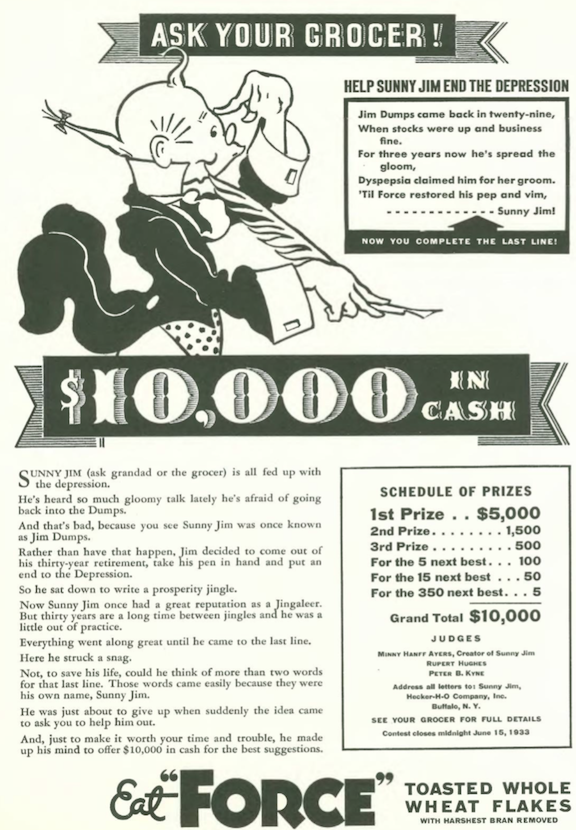
We begin with an ad from the makers of the first commercially successful wheat flake breakfast cereal…before there were Wheaties (created in 1921) there was Force, invented in 1901…almost from the beginning the Force brand was wildly successful thanks to a series of jingles featuring a morose character, Jimmy Dumps, who was transformed into Sunny Jim by consuming Force flakes…in 1933 the makers of Force were still big on jingles, sponsoring contests such as the one below…

…here is a box from that period, promoting cash prizes for winning jingles…

(worthpoint)

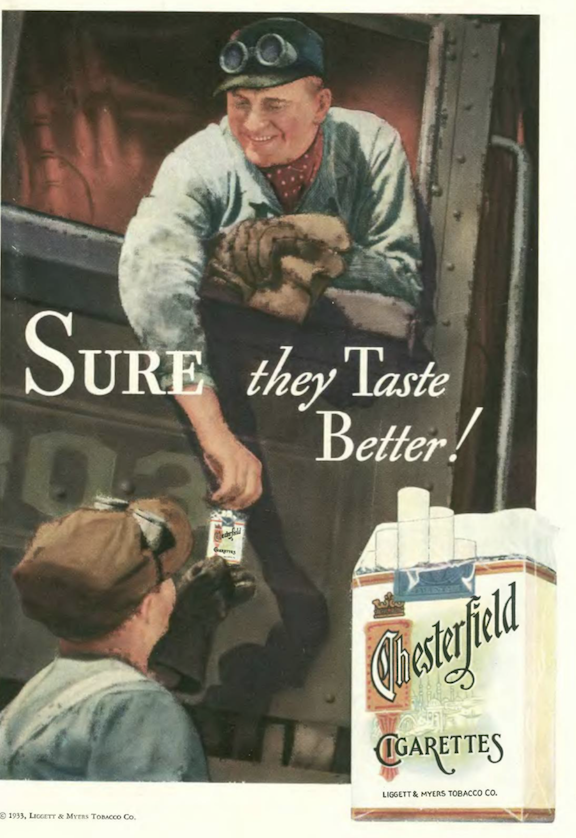
…the folks at Chesterfield began targeting the working man in their advertising…

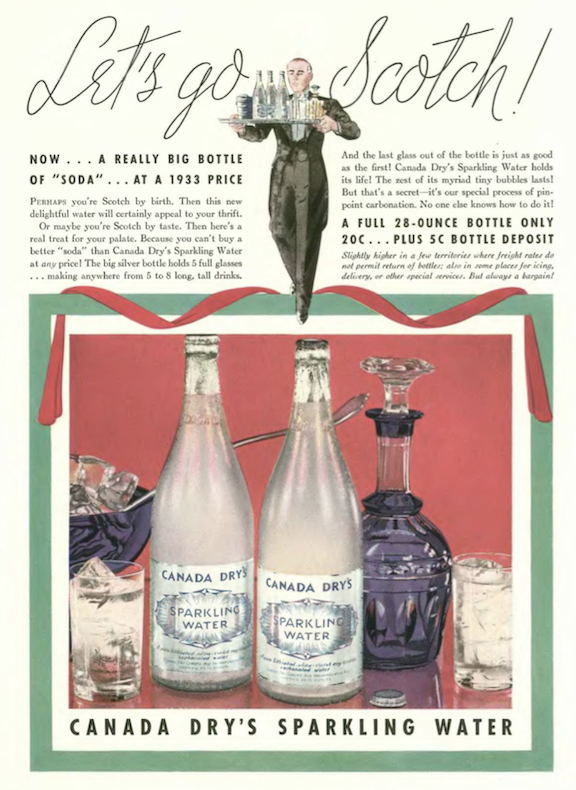
…while Canada Dry was anticipating the end of Prohibition…

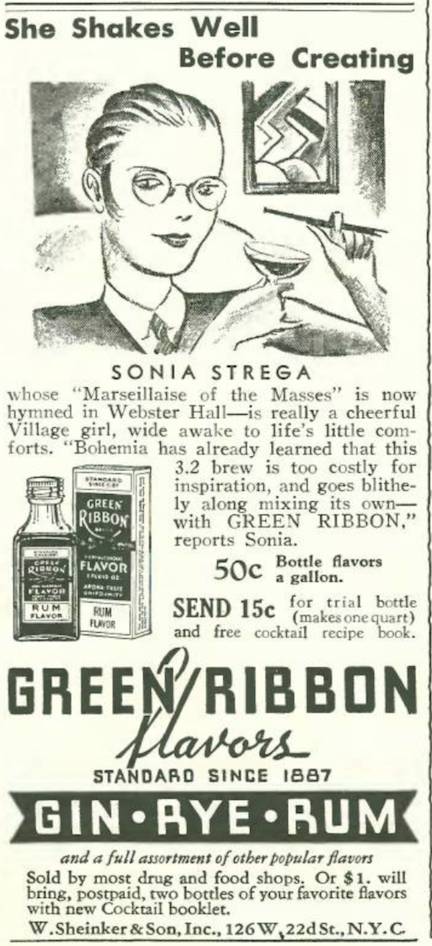
…but until that day, you could mix some Green Ribbon with your bootleg alcohol, according to Sonia Strega, who was likely an invention by the advertisers rather than an actual living endorser…

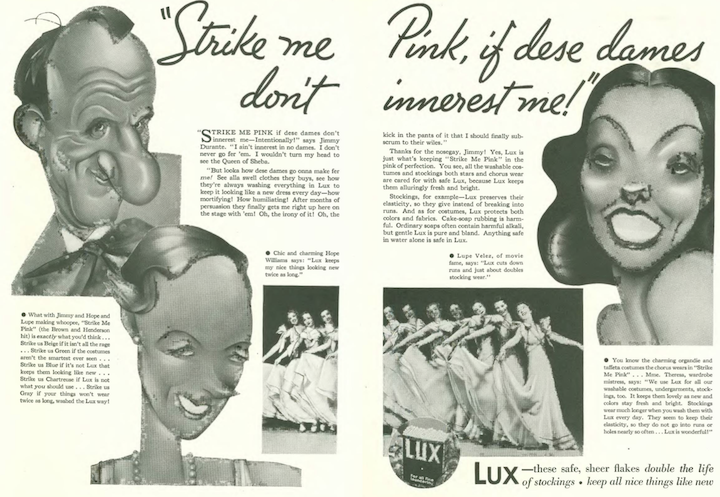
…Lux, on the other hand, had piles of money to spend on real life endorsers including Jimmy Durante, Hope Williams and Lupe Velez

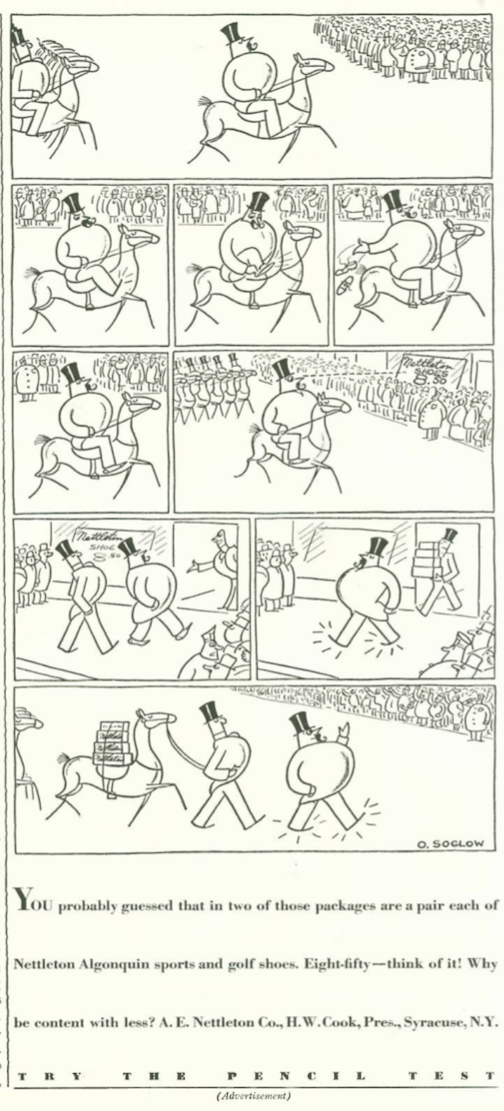
Otto Soglow drew up this strip for the makers of Nettleton shoes, creating a character similar to his famed “Little King” to promote the company’s sports and golf shoes…

James Thurber continued his work for the French Line, replete with his familiar dogs…

…and we also find Thurber in the cartoons…

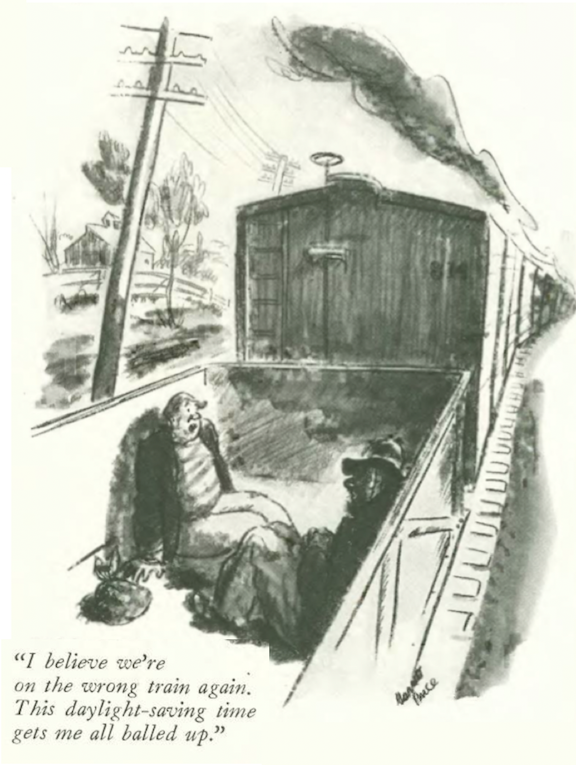
…joined  by Garrett Price

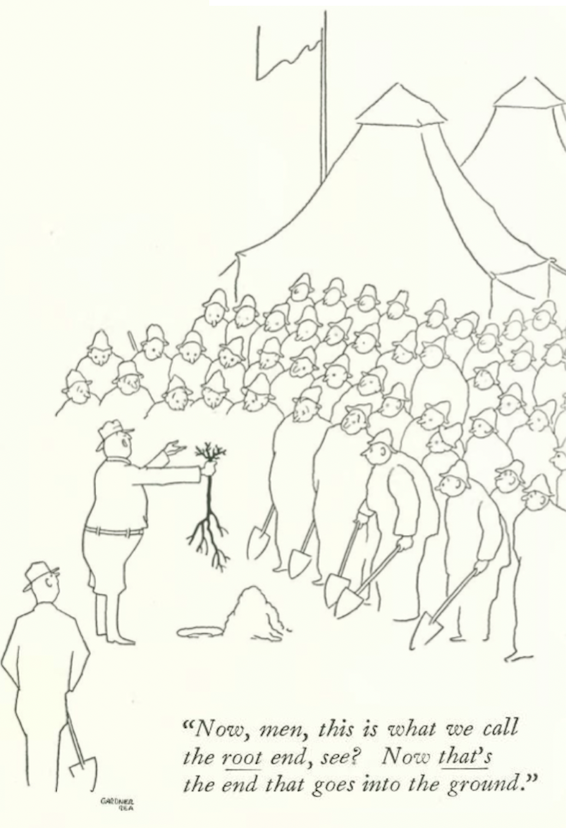
Gardner Rea

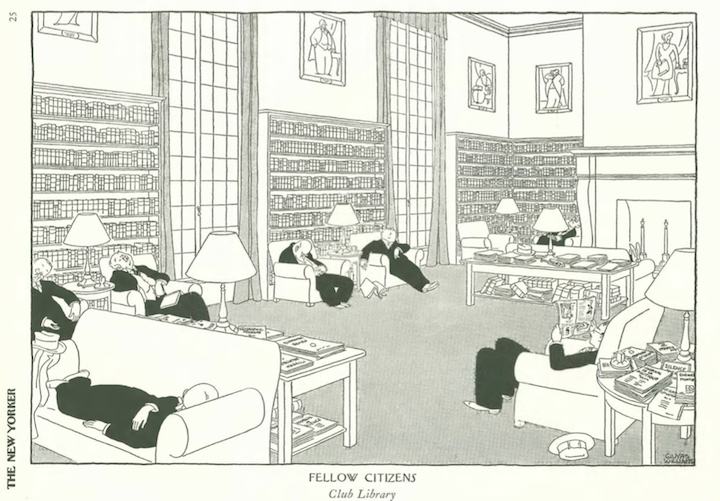
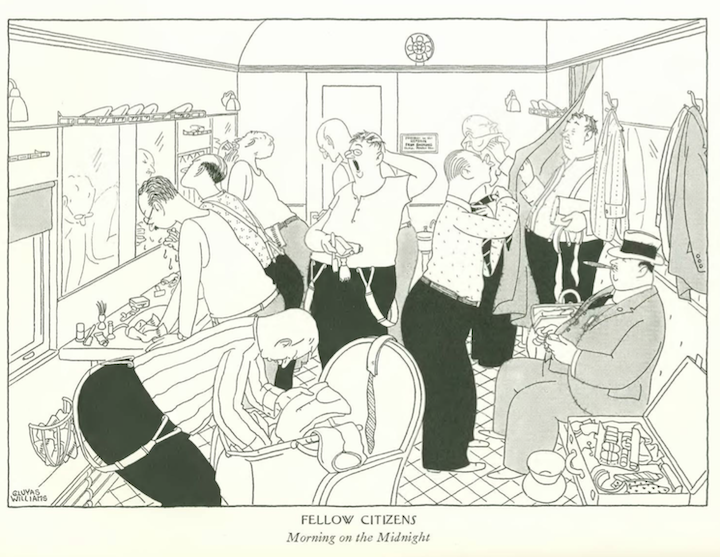
Gluyas Williams (originally this ran sideways)…

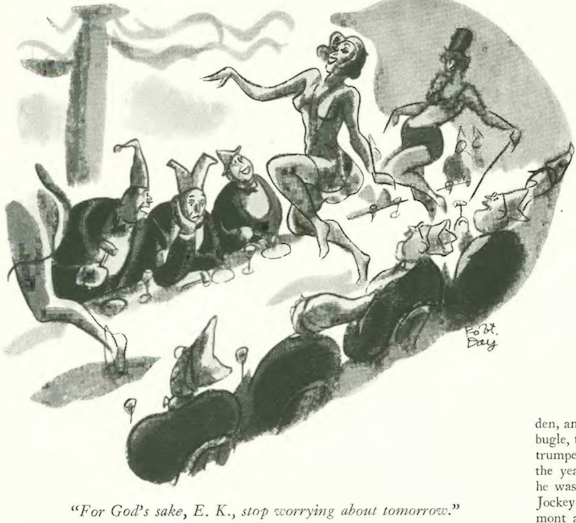
…and we close with a frolic by Robert Day

Next Time: Headline News…


Not Worth a Dime

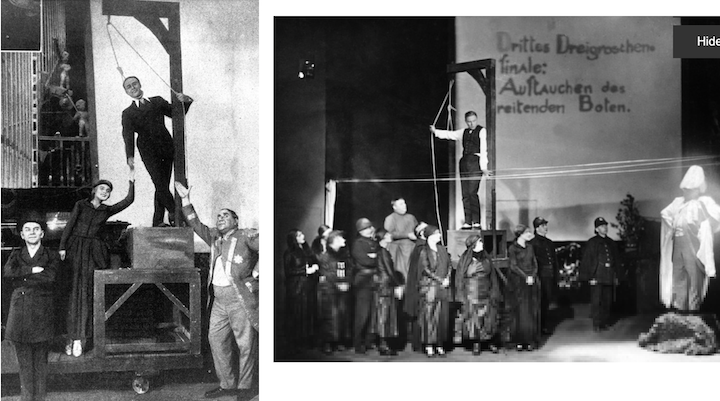
First performed in Berlin in 1928, The Threepenny Opera was Bertolt Brecht’s socialist critique of capitalist society and was a favorite (somewhat ironically) of that city’s bourgeois “smart set.” However when it landed on the Broadway stage in 1933, it famously flopped, and closed after just twelve performances.

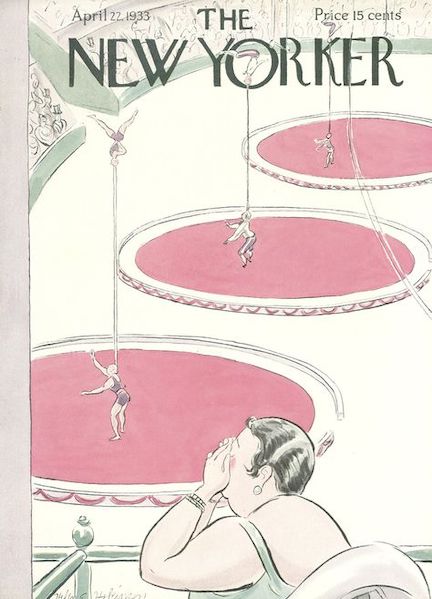
April 22, 1933 cover by Helen Hokinson.

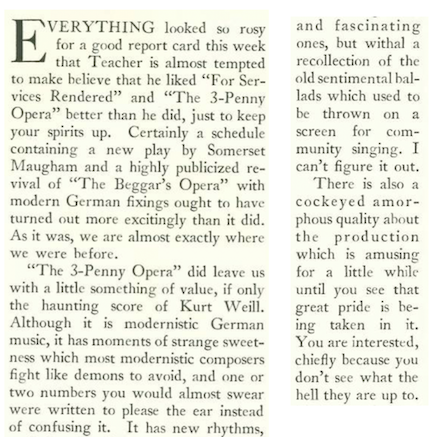
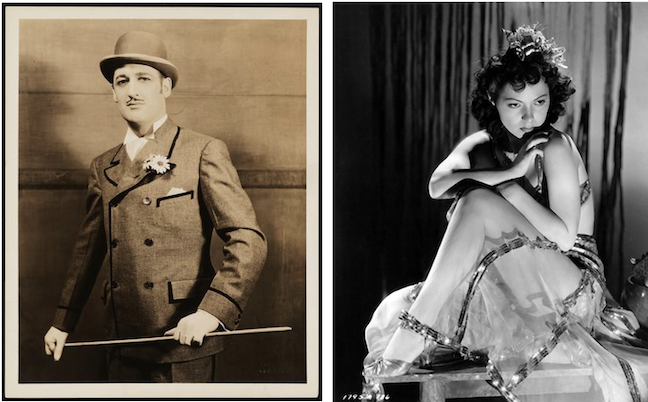
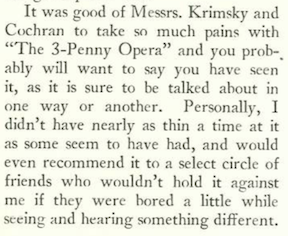
The first American production, adapted by Jerrold Krimsky and Gifford Cochran, opened April 13, 1933, at the Empire Theatre, featuring Robert Chisholm as Macheath (“Mack the Knife”) and Steffi Duna as his lover, Polly. Critic Robert Benchley found value in the play’s “modernistic” music, but seemed puzzled by its enigmatic production, an opinion shared by other contemporary critics.

HANGING IN THERE…Scenes from the 1928 Berlin premiere of Bertolt Brecht’s musical, The Threepenny Opera. At left, Macheath (tenor/baritone Harald Paulsen) is spared the noose during the closing act, much to the relief of his lover, Polly (soprano Roma Bahn); at right, in a deus ex machina moment, a messenger arrives at the hanging and announces that Macheath has been pardoned by the queen. (British Library)

Some critics today defend the 1933 American production, noting that the Krimsky–Cochran adaptation was quite faithful to the Brecht original. Perhaps something was lost in translation, or maybe the world in which the play was conceived no longer held much relevance to Depression-era Americans.

THE FINAL CURTAIN fell after just twelve performances of the first American production of The Threepenny Opera at Broadway’s Empire Theatre. The production featured Robert Chisholm as Macheath and Steffi Duna as Polly. (discogs.com/bizzarela.com)

Benchley half-heartedly concluded that the play was probably worth seeing, for no other reason than to experience something different for a change.

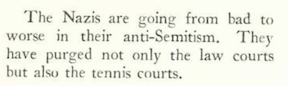
By 1933 the world that had conceived The Threepenny Opera was long gone—Brecht fled Nazi Germany two months before his play opened in New York, fearing persecution for his socialist leanings. Things were quickly going “from bad to worse” under Adolf Hitler’s new regime, as Howard Brubaker observed in his “Of All Things” column:

 * * *

Look Ma, No Net!

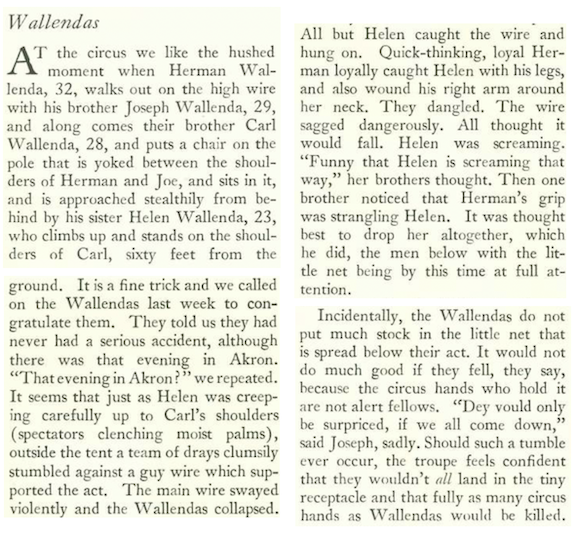
Karl Wallenda (referred to as “Carl” here) was born to an old circus family in Germany in 1905, and by 1922 he would put together a family-style high-wire act (with brother Herman) that would come to be known as “The Flying Wallendas.” They debuted at Madison Square Garden in 1928, notably without their safety net, which had been lost in transit. So they performed without it, much to the acclaim of the adoring crowd. They soon became known for their daring high-wire acts, often performed without safety nets. E.B. White filed this (excerpted) report for “The Talk of the Town.”

In the years that followed Karl developed some of troops’ most startling acts, including the famed seven-person chair pyramid. They performed this incredibly dangerous stunt until their appearance at the Detroit Shrine Circus in January 1962; the wire’s front man, Dieter Schepp, faltered, causing the pyramid to collapse. Schepp, who was Karl’s nephew, was killed, as was Richard Faughnan, Karl’s son-in-law. Karl injured his pelvis, and his adopted son, Mario, was paralyzed from the waist down.

DON’T TRY THIS AT HOME…The Wallenda family practices the seven-person pyramid just prior to the Shrine Circus in Detroit, where the group fell, killing Dieter Schepp (far right, bottom row) and Dick Faughnan (second from left, on bottom). (Sarasota Herald-Tribune)

Karl’s own luck finally ran out on March 22, 1978, on a tightrope between the towers of Condado Plaza Hotel in San Juan, Puerto Rico. High winds, and an improperly secured wire, caused the 73-year-old Wallenda to wobble, and then fall, one hundred feet to the ground. He was dead on arrival at a local hospital.

THE SHOW ENDED for Karl Wallenda on March 22, 1978, on a tightrope between the towers of Condado Plaza Hotel in San Juan, Puerto Rico. The 73-year-old high-wire legend fell one hundred feet to his death. (esquire.com)

 * * *

Safer Entertainments

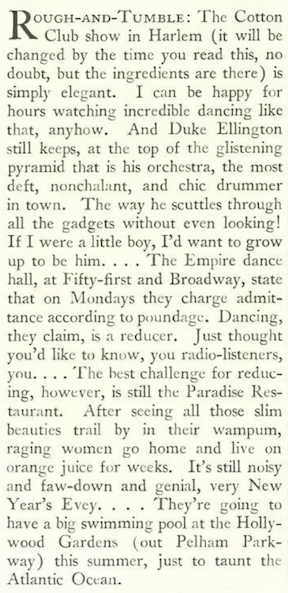
Lois Long continued to file nightlife reports in her “Tables for Two” column, reveling in the sights and sounds (and rhythms) of the Cotton Club’s orchestra, led by Duke Ellington…but the real attraction was Ellington’s unnamed drummer, whom I assume was the great Sonny Greer

JAZZ GREAT Sonny Greer wowed Lois Long and the rest of the crowd at Harlem’s Cotton Club in April 1933. (jazz.fm)

 * * *

From Our Advertisers

Given the news Howard Brubaker shared earlier in this post, I wouldn’t use the word Gemütlichkeit (basically, warmth and friendliness) to describe the state of things in Nazi Germany…

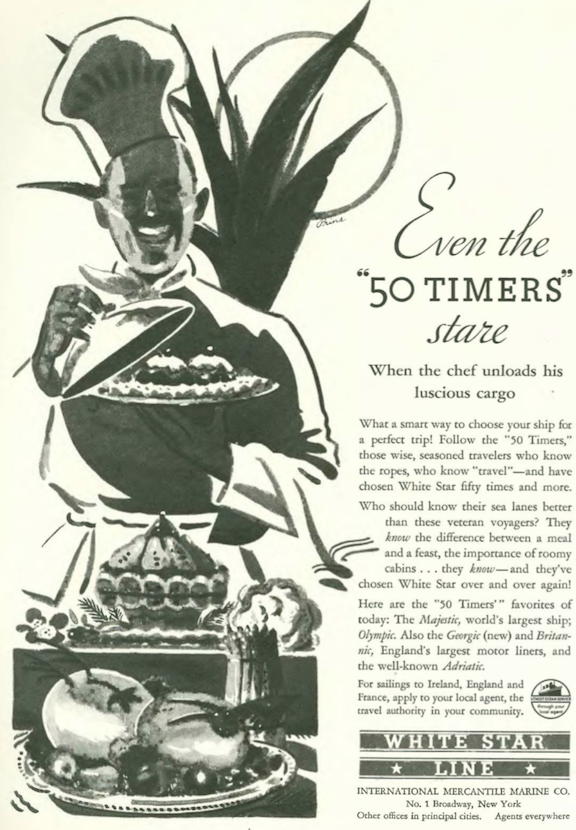
…a better option would be a trip to the British Isles or France on the White Star lines, nicht wahr?…

…RCA’s mascot, Nipper, appeared to contemplating fatherhood in this two-page ad for the company’s new “baby sets”…

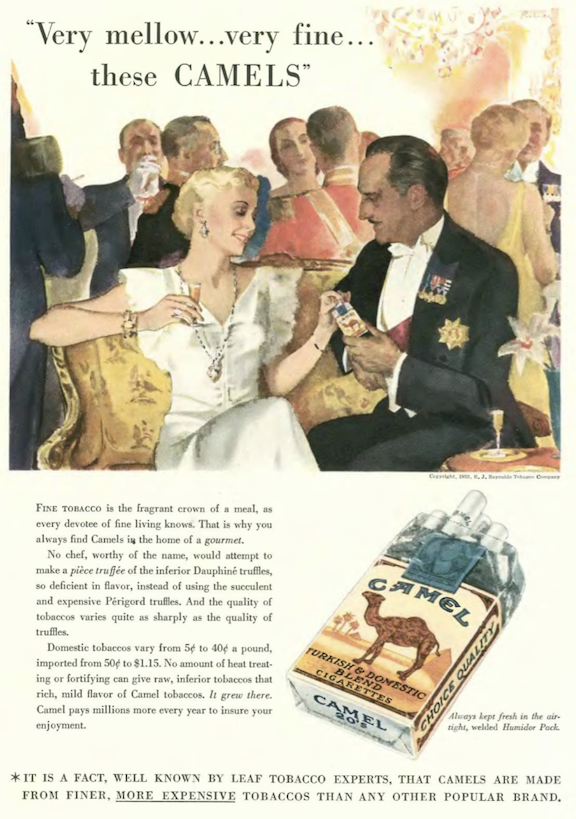
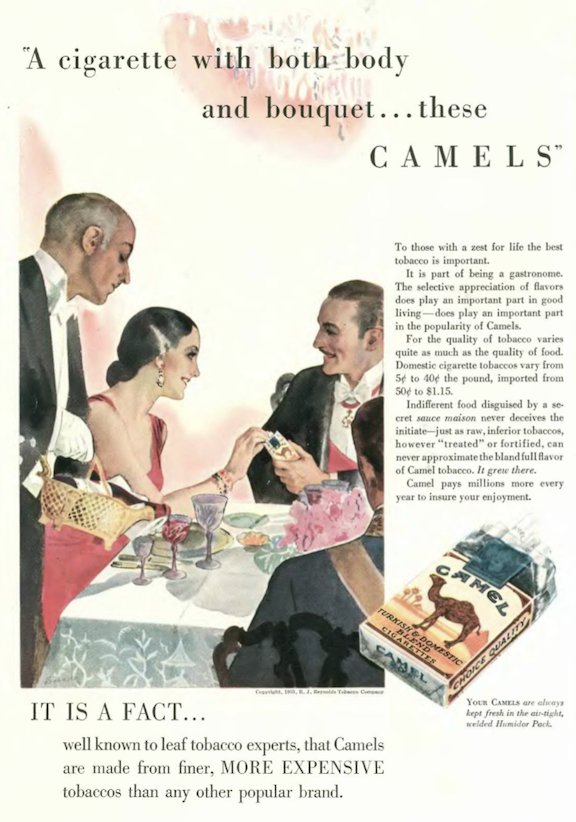
…Camel took a break from its magician-themed “It’s Fun to be Fooled” ads to run another elegant Ray Prohaska-illustrated spot…

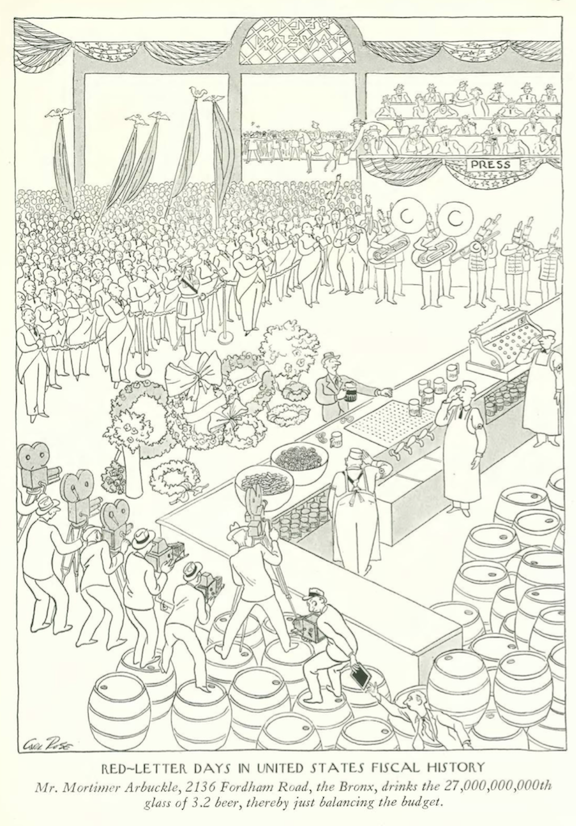
…on to our cartoons, Carl Rose demonstrated the economic benefits of legal beer…

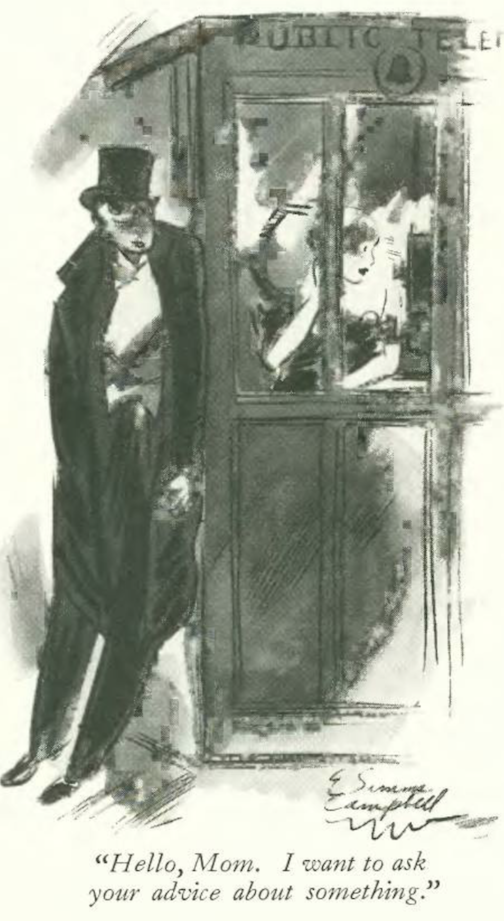
E. Simms Campbell showed us a woman seeking a bit of motherly wisdom…

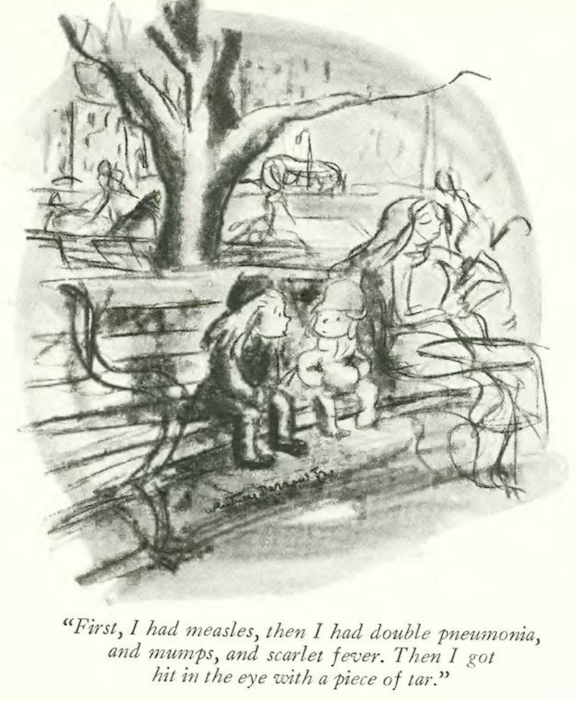
Whitney Darrow Jr (1909–1999), who began his 50-year career at The New Yorker on March 18, 1933, offered this look at childhood’s hard knocks…

James Thurber drew up an odd encounter at a cocktail party…

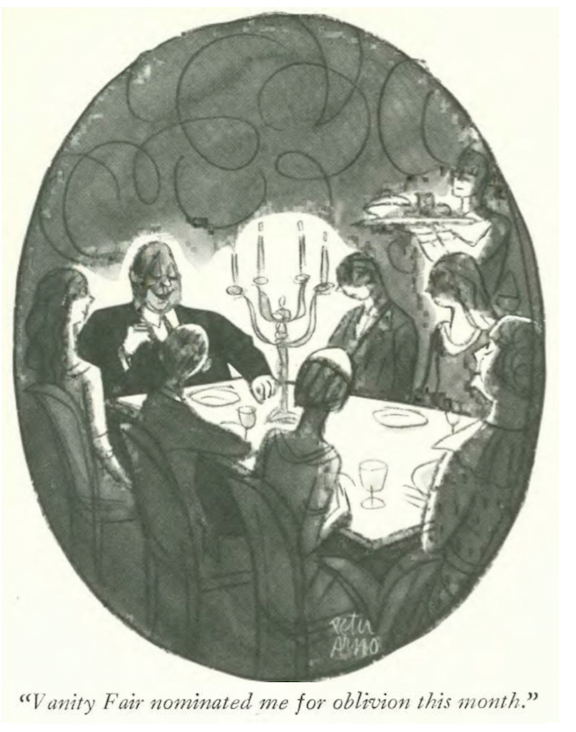
Peter Arno served up a proud patriarch…

…and William Steig explored the perils of somnambulism…

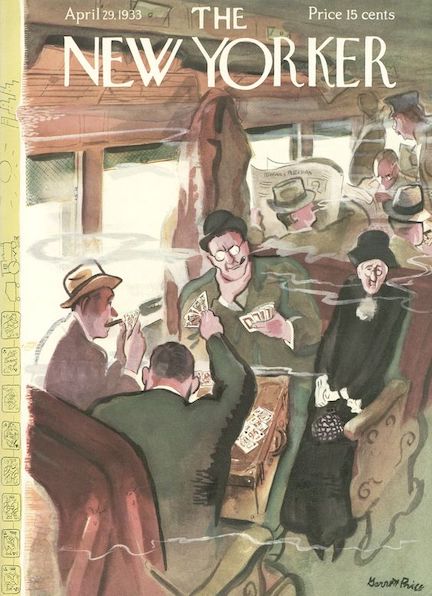
…on to our April 29, 1933 issue with a cover by Garrett Price…although we’ve already seen many cartoons by Price, we haven’t seen many covers (he did two covers in the magazine’s first year, 1925). Price would ultimately produce 100 covers for The New Yorker, in addition to his hundreds of cartoons…

April 29, 1933 cover by Garrett Price. Note the little train illustration along the spine (or strap, as it is called).

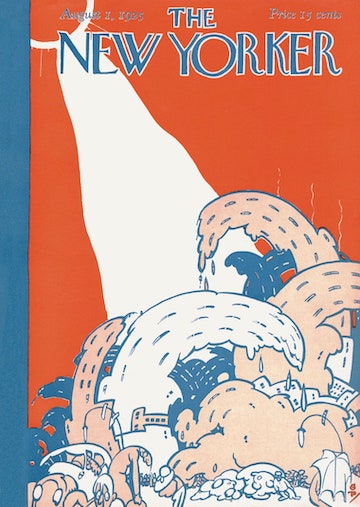
…for the record, here is Price’s first New Yorker cover from Aug. 1, 1925…

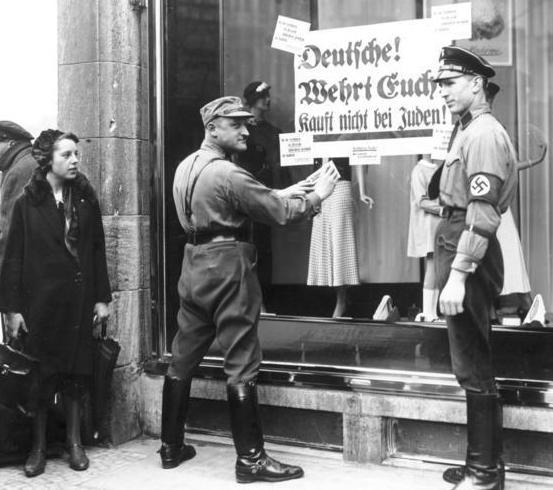
…there was more troubling news from Nazi Germany, this time from Paris correspondent Janet Flanner in her “Letter from Paris” column…Flanner would later gain wider fame as a war correspondent…

THUGS…SA members stick a poster to the window of a Jewish store in Berlin on April 1, 1933. The poster is inscribed, “Germans, Defend yourselves, Do not buy from Jews”. (Bundesarchiv, Berlin)

 * * *

From Our Advertisers

Camel followed up its elegant ad from the previous issue with another “Fun to be Fooled” spot, this time presented as a multi-panel comic strip…

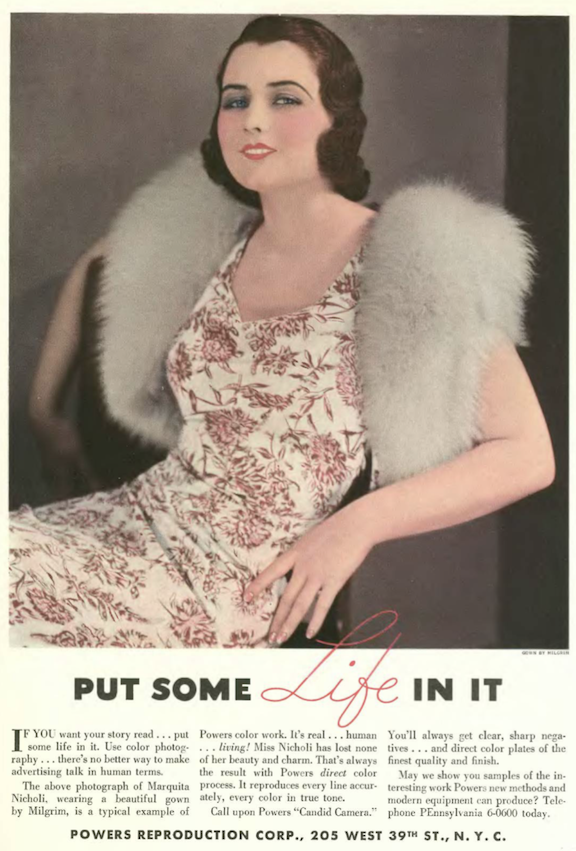
…Powers Reproduction was a frequent advertiser in the early New Yorker, touting the “realism” of their color photography, but in this case the model looked more like a department store mannequin…

Otto Soglow continued to ply a lucrative sideline illustrating ads for Sanka decaf…

…as we segue to our cartoonists, the opening section featuring work by both James Thurber and George Price

Gardner Rea’s snake charmer expressed her belief that all men are created equal…

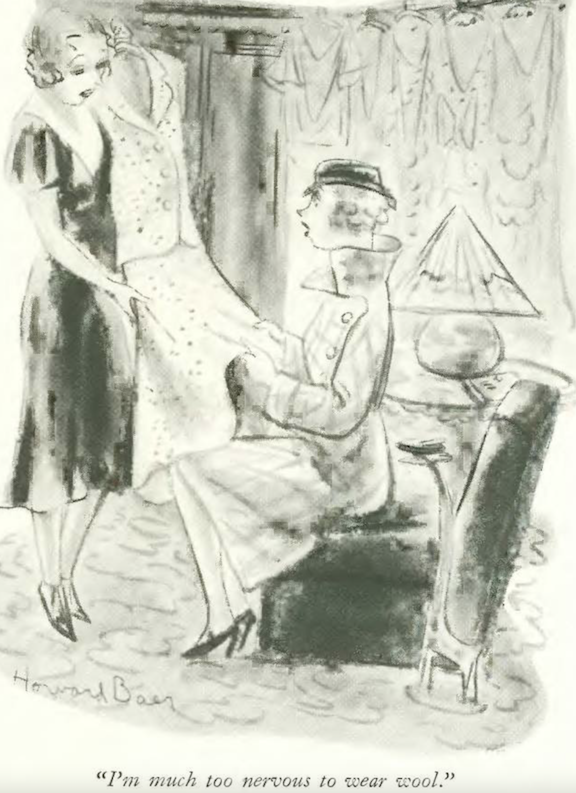
…here is a cartoon by a new artist, Howard Baer, who contributed to The New Yorker between 1933 and 1937…

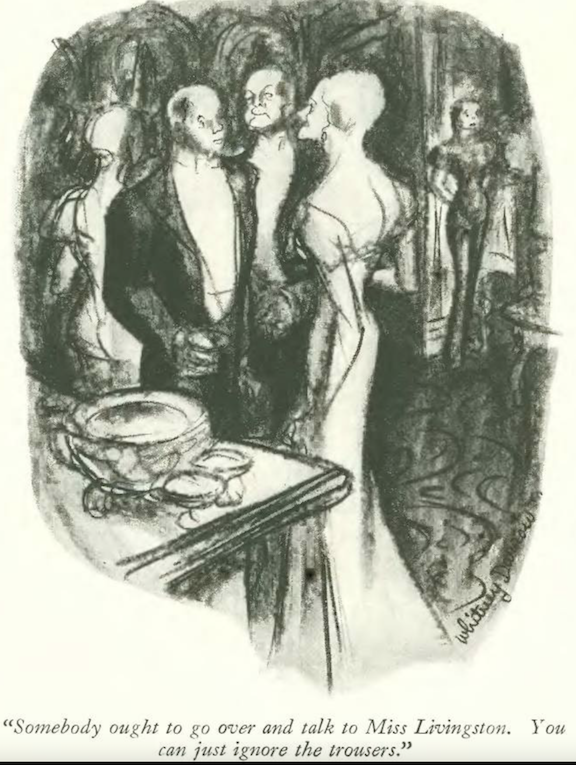
…and another by newcomers Whitney Darrow Jr.

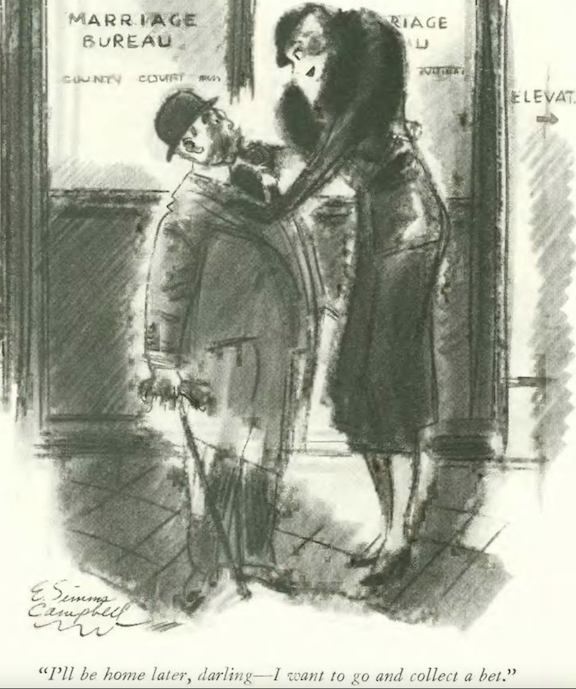
…and E. Simms Campbell

Barbara Shermund continued to rollick with her modern women…

…and we end with the ever-reliable Peter Arno

Before we close I want to remember Roger Angell, who died last week at age 101. A literary legend and a great baseball writer to be sure, but also one of the last living links to the first days of The New Yorker. Rest in Peace.

Photo by Brigitte Lacombe, for The New Yorker.

Next Time: Bohemian Rhapsody…


Diary of a Lady

It was no surprise Dorothy Parker did not think much of society types, especially those afflicted with extreme solipsism.

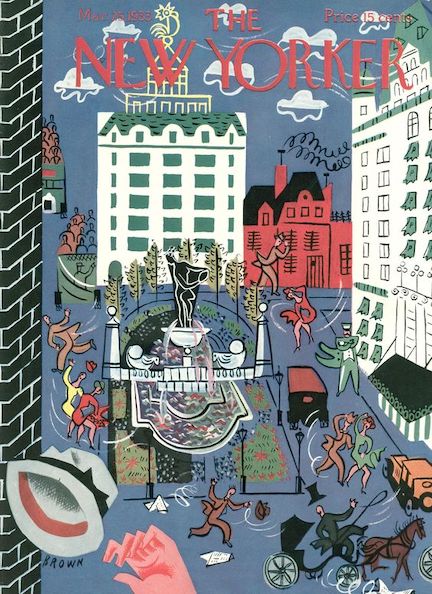
March 25, 1933 cover by Harry Brown.

Parker’s “The Diary of a Lady,” briefly excerpted here, featured entries from a diary of a fictional socialite who constantly bemoaned the minor inconveniences of her shallow existence, oblivious to the world around her.

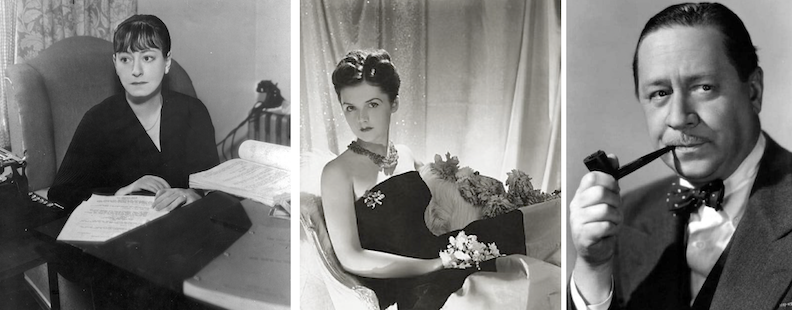
YOU POOR THING…Dorothy Parker (left) took a dim view of the lives of “poor little rich girls” like socialite Brenda Frazier (who had a tempestuous relationship with New Yorker cartoonist Peter Arno); Robert Benchley, on the other hand, took a more jolly view of human absurdity. (britannica.com/Wikipedia/theattic.space)

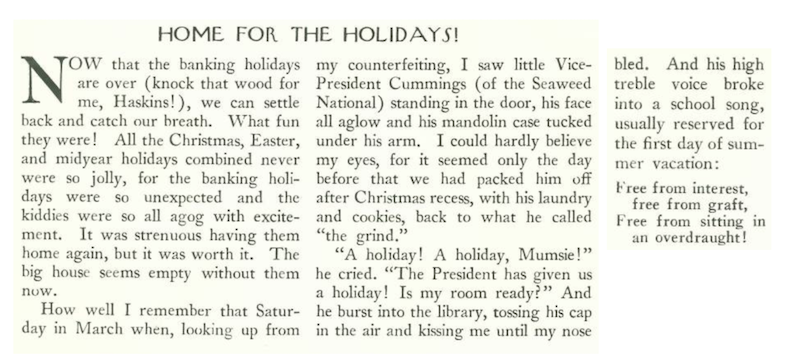
In contrast to Parker, Robert Benchley’s satire was usually more on the silly side, with a lot less bite. Here is an excerpt from “Home for the Holidays” (which immediately followed Parker’s piece in the magazine), in which Benchley describes the festive mood of one family during FDR’s “bank holiday”…

 *  *  *

On the Lighter Side

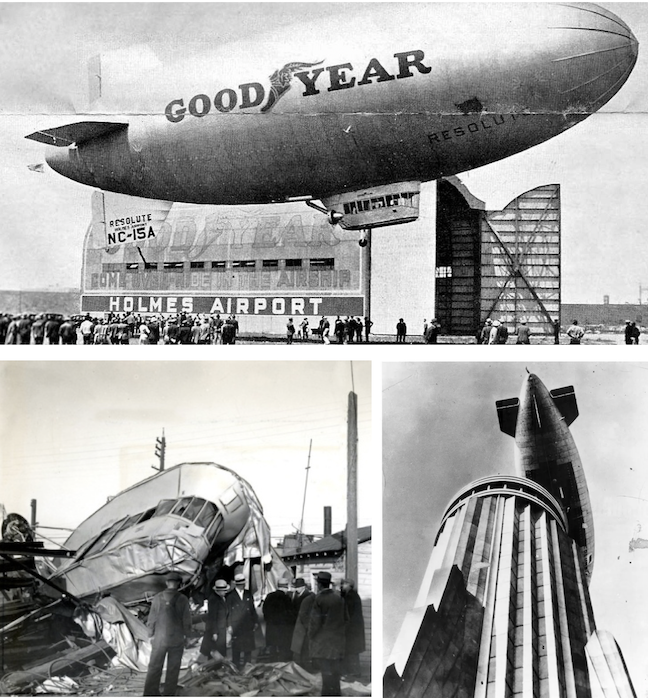
E.B. White was the unofficial aviation correspondent for The New Yorker, ever eager to go aloft in the latest contraption. In this excerpted “Talk of the Town” entry White described his adventures aboard the Goodyear blimp Resolute:

WHAT A GAS…Top photo, the Resolute at its home base, Holmes Airport (in Jackson Heights, L.I.), where E.B. White boarded his flight. As White noted, Resolute was a sister ship to kathrynsreport.com/New York Times)

And we turn again to White, this time an excerpt from his “Notes and Comment” celebrating Franklin D. Roosevelt’s planned amendment to the Volstead Act that would allow people to have a legal beer while they waited for the 21st Amendment to be ratified. White had a couple of ideas regarding locations for beer gardens. An excerpt:

BEER THIRTY…E.B. White believed the front of the internationally famous Brevoort Hotel (next to the Mark Twain House at the southeast corner of Fifth Avenue and 9th Street) would be an ideal spot to quaff some suds. Alas, the hotel (and the Twain house) fell to the wrecking ball in 1952, replaced by the Brevoort apartments (right). (MCNY/streetwise.com)

Although the Brevoort idea didn’t pan out, White did get his wish, more or less, for a Bryant Park location, the Bryant Park Grill…

(bryantpark.org)

 *  *  *

Mayor McCarthy

The profile featured Stitch McCarthy, considered one the most flamboyant “street mayors” of the Lower East Side. Writing in Lapham’s Quarterly (Aug. 1, 2018), Laurie Gwen Shapiro describes McCarthy as “a five-foot-tall, cross-eyed Romanian Jew born Samuel Rothberg, always seen with a cigar in his mouth.” What Stitch lacked in height he made up for in toughness, and by his teens was as tough as nails. Shapiro writes: “At night he managed a small-time boxer who once was scheduled to fight a bantamweight named Stitch McCartney in Jersey City. As he later told the story (no doubt over and over), his client fled in fear at the sight of McCartney and the crowd booed. He went in the ring himself, flattened McCartney, and took a version of his opponent’s name for his own.”

The profile was written by Meyer Berger, known as a master of the human interest story. Berger did a short stint at The New Yorker but for most of his career he worked for The New York Times, where he wrote a long-running column, “About New York.” Here is a very brief excerpt of the profile, with a caricature by Al Frueh.

TOUGH AS NAILS was what you became if you wanted to be one of the unofficial mayors of the Lower East Side like Stitch McCarthy, seen here in 1931. According to Laurie Gwen Shapiro, street mayors “were likable fixers who cut through red tape and might settle between fifteen and twenty neighborhood disputes a day.” Photo at left (by Berenice Abbott) is a scene from McCathy’s world—Hester Street, between Allen and Orchard Streets. (New York Public Library/Lapham’s Quarterly)

 *  *  *

From Our Advertisers

I would guess Dorothy Parker would have some problems with this ad, featuring society women shilling for nail polish…

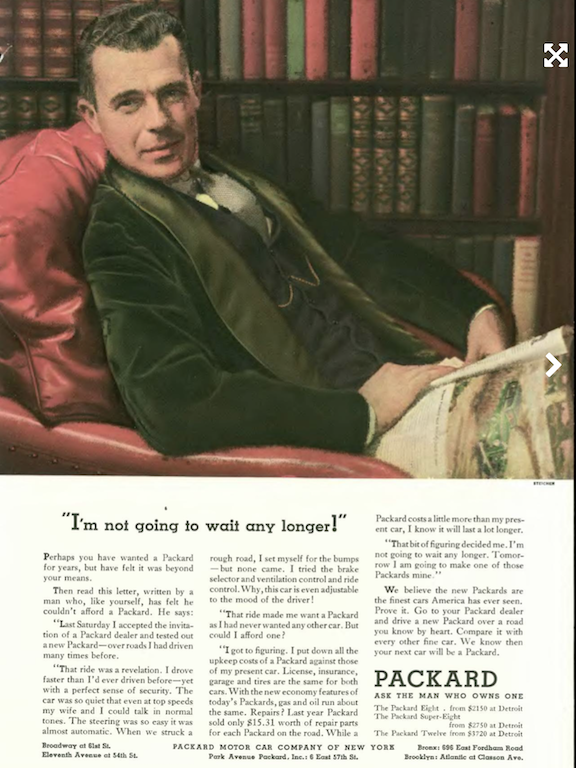
…the folks at Packard went with an ad that showed the ideal customer (seated in a library, clad in smoking jacket), contemplating one of their recent ads (the same one that was featured in the Feb. 18, 1933 issue of The New Yorker

…Camel ads took on a new look thanks to the artistry of Ray Prohaska (1901–1981)…in the early 1930’s you see more use of watercolors in ads for fashion, or in this case, cigarettes…

…and Gardner Rea drew up this scene for the makers of Sanka coffee, the decaf of its day…

…which leads into the work of other New Yorker cartoonists and another master of the line drawing, Gluyas Williams

Robert Day offered a bit of understatement…

Carl Rose celebrated the arrival of legal beer…

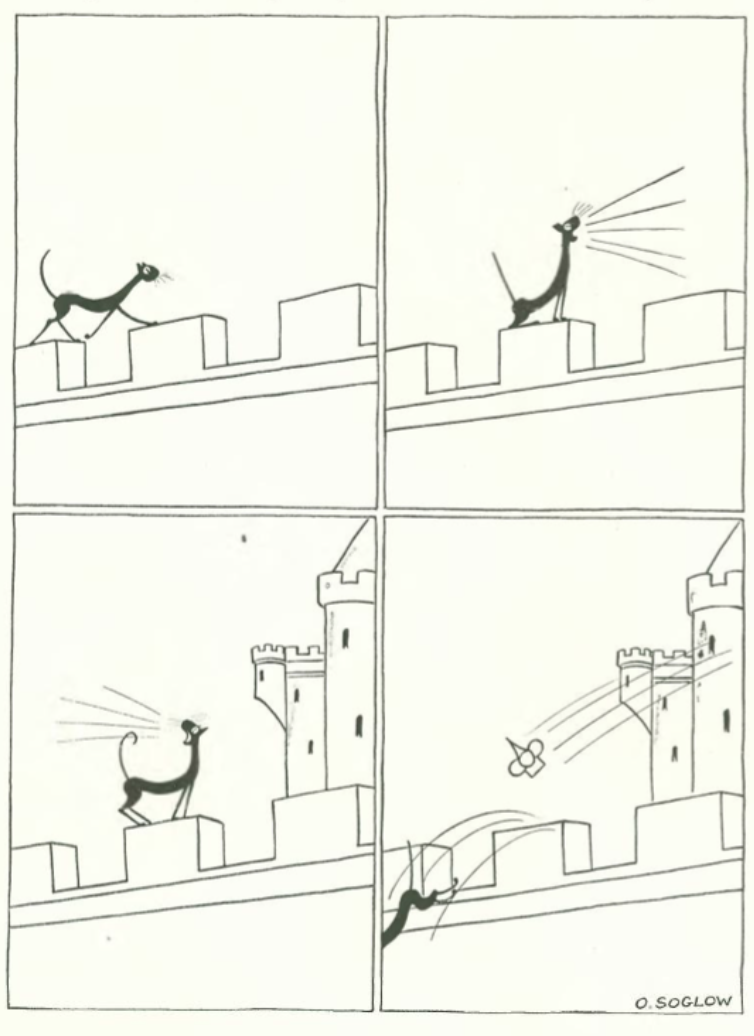
Otto Soglow showed us how royalty responds to a noisy feline…

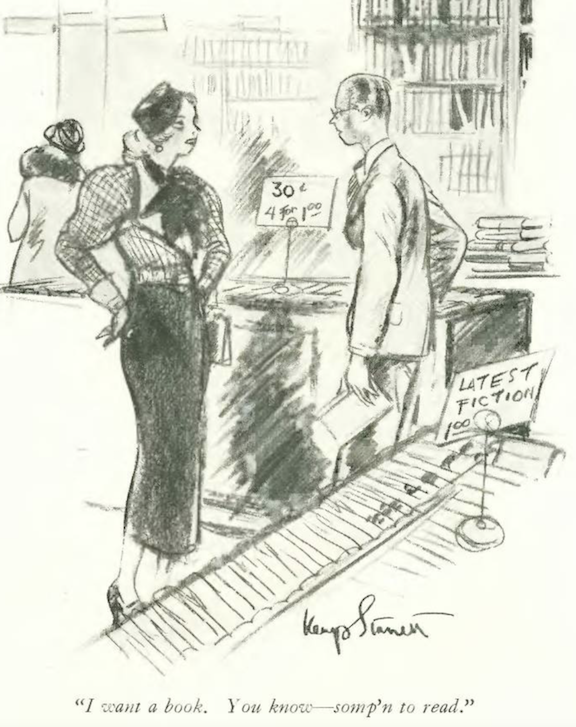
Kemp Starrett shopped for somp’n to read…

…and we close with Peter Arno, and an ill-timed joke, at least for one woman…

Next Time: Stormy Bellwether…

Deskey’s Deco

Above, Donald Deskey's Design for a Sportshack, 1940 (Cooper Hewitt)

If you’ve never heard of Donald Deskey, you’ve most likely seen his work.

Feb. 25, 1933 cover by Rea Irvin.

Cultural critic Gilbert Seldes featured Deskey in the Feb. 25 profile (“The Long Road to Roxy” — with illustration by Al Frueh), noting that his subject had come to his profession as an industrial designer in a rather roundabout fashion. Here is a brief excerpt:

Deskey (1894–1989) was locally known in the late 1920s for his window displays at New York’s Franklin Simon Department Store, but it was his work at Roxy Rothafel’s new Radio City Music Hall that made him a marquee name in the design world. Although known for popularizing the Art Deco style, his interior designs for RCMH were noted for their restraint, signaling a break from the lavish, ornate designs of the city’s earlier performance spaces.

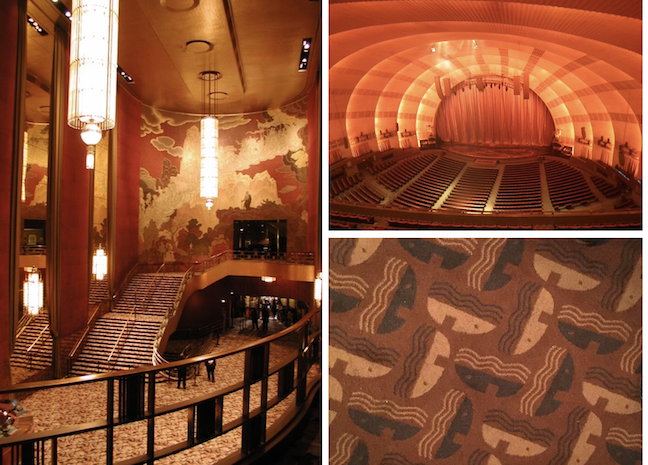
FEAST FOR THE EYES…Donald Deskey designed more than thirty spaces in Radio City Music Hall, including the Grand Foyer (left) and several lounges, each featuring a distinct visual motif. At bottom right, auditorium’s “Singing Woman” carpeting. (archdaily.com/drivingfordeco.com)

Original Deskey creations are highly prized today by collectors and museums…

DESIGN IN MOTION…Clockwise, from top left, Deskey’s “Guest Bedroom for Mrs. John D. Rockefeller, Jr.” (Abby Aldrich Rockefeller), on display at the 1931 American Union of Decorative Artists exhibition; Deskey table lamp, circa 1927; linen panel, circa 1930s; Deskey desk, circa 1930. (brooklynmuseum.org/artic.edu/Pinterest)

…and if that wasn’t enough, Deskey also designed logos for many consumer products in the late 1940s and 1950s…

THE TOTAL PACKAGE…Deskey designed some of the most iconic logos of midcentury America, including, clockwise from top left, Tide laundry detergent (1947); Gleem (1956) and Crest (1955) toothpastes; Cheer laundry detergent (1952); JIF peanut butter (1956) and Joy dishwashing liquid (1950).

*  *  *

From Our Advertisers

It seems appropriate to follow Mr. Deskey with some words and images from our sponsors, including the folks at Cadillac who continued to hammer home the snob appeal of their motorcar while also giving a nod to those hard times by emphasizing the car’s economy

…meanwhile, Studebaker was back with another full page ad—again featuring the admiring giant woman—in a vain attempt to push their fledgling, and unpopular line of Rockne automobiles…

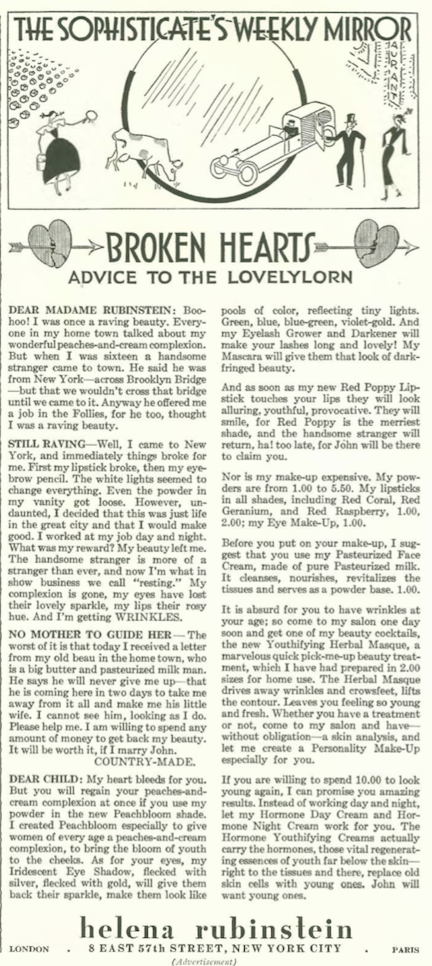
…and Helena Rubenstein continued her series of ads disguised as advice columns…the advice here was to shame women into buying her products…

…after Helena removed your wrinkles you could restore them with GE’s Mazda sunlight lamp…

Otto Soglow, on the brink of becoming a very wealthy man thanks to his Little King cartoons, continued to lay down some ink on behalf of the makers of Sanka decaf…

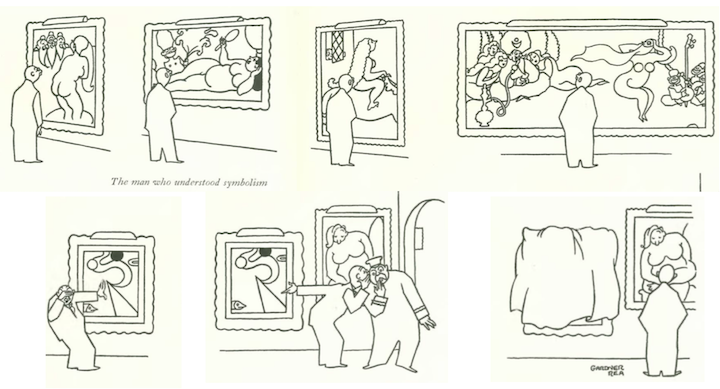
…and we move along to Soglow’s fellow cartoonists, beginning with Gardner Rea and a cartoon sequence spread across pages 24-25…

…here it is again, rearranged for closer inspection…

…and we have another terrific “Fellow Citizens” drawing by Gluyas Williams, which originally ran sideways on a full page…

…I like this James Thurber drawing for its utter disregard of scale—but of course (and thankfully) it wouldn’t be a Thurber if he cared about such things…

William Crawford Galbraith was still hung up on showgirls and sirens…

…while Peter Arno explored his spiritual side, as only Arno could…

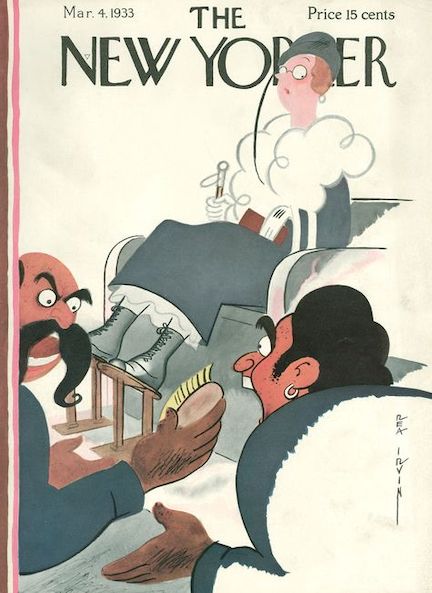
…and we move along to March 4, 1933…

March 4, 1933 cover by Rea Irvin.

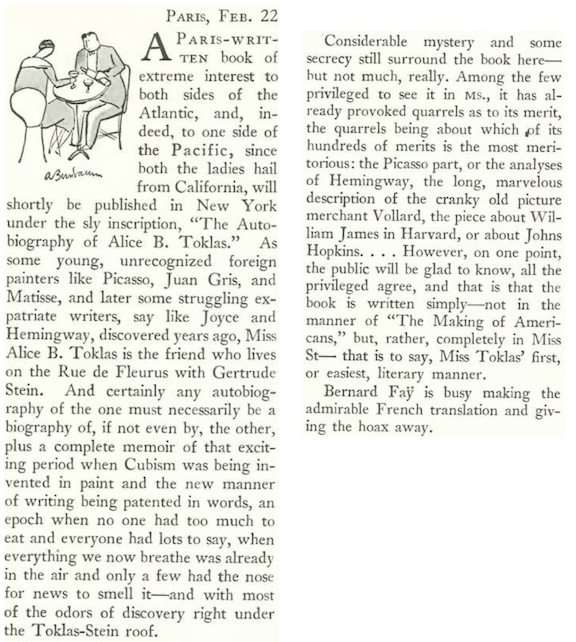
…in which The New Yorker’s Paris correspondent Janet Flanner (“Genêt”) wrote about a new book of “extreme interest to both sides of the Atlantic”…

BOOK OF REVELATION…Alice B. Toklas and Gertrude Stein were well known in the ex-pat community of 1920s Paris, but the publication of the American edition of The Autobiography of Alice B. Toklas (written by Stein) brought them fame in the wider world. Stein claimed she wrote the book — now considered a 20th century classic — in six weeks to amuse herself and to make money. At right, Toklas and Stein at 27 Rue de Fleurus in a portrait by Man Ray, 1922. (Library of Congress)

 *  *  *

Hope Springs Eternal

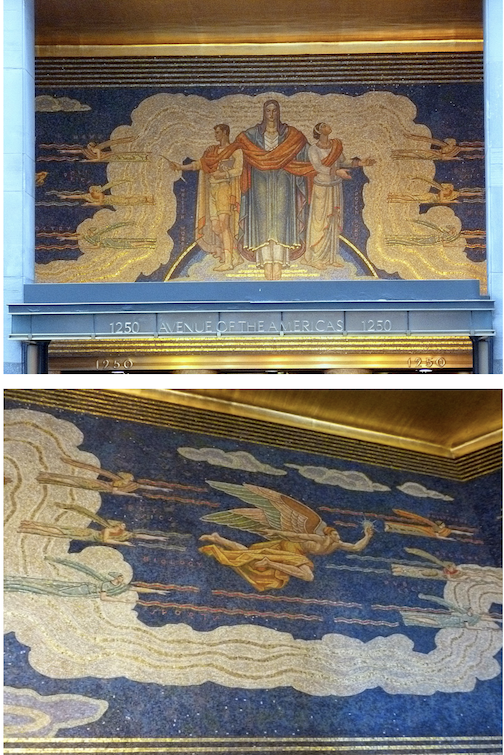
Even in the deepest depths of the Depression signs of hope abounded in works of public art, including a mosaic of one million hand-cut and hand-set glass tiles being prepared for the Sixth Avenue entrance to Rockefeller Center. Intelligence Awakening Mankind, by Barry Faulkner, celebrated the triumph of knowledge over the evil of ignorance. “The Talk of the Town” explained:

GOOD VIBES…Details of Intelligence Awakening Mankind include the central figure of Intelligence (top) sending knowledge into the far corners of the world. (Pinterest)

 *  *  *

From Our Advertisers

The folks at luxury brand Packard continued to counter their stodgy image with ads that emphasized other qualities including speed, durability, and here, serenity…despite the lengthy text, the ad also suggested modernity, with the sliced-off image and the single word “Hush!” to entice prospective buyers…

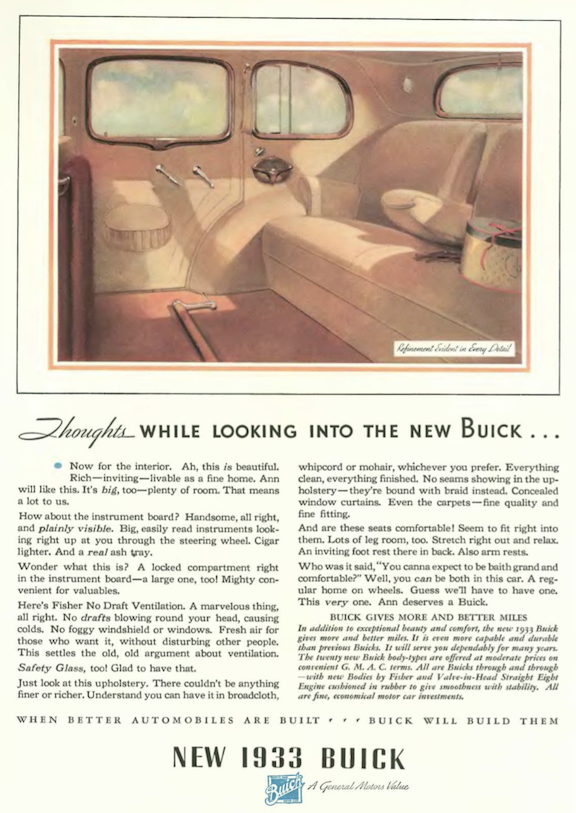
…if you couldn’t afford $3,720 for a 12-cylinder Packard, then you might have considered a Buick, “livable as a fine home” this ad claimed. And look at that back seat — you could comfortably fit three adults and a baby elephant in there…

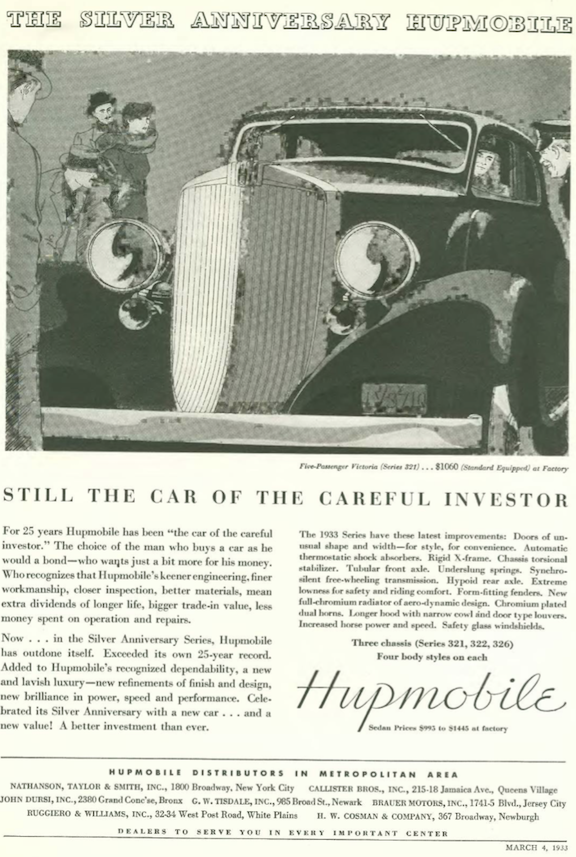
…and then there’s Hupmobile—for the price of a Packard 12 you could have purchased three Hupmobile Victorias (pictured below) with a good chunk of change left over…here the company celebrates its silver anniversary…a couple of odd facts: in 1914 a Minnesota Hupmobile salesman used an unsold vehicle to found Greyhound bus lines…the National Football League also traces its origins to Hupmobile — the league was created in 1920 at a Hupmobile dealership in Canton, Ohio…both Greyhound and the NFL survive Hupmobile, which went belly up in 1939…

…and now we move to the world of fashion, and some cultural appropriation by Lord & Taylor…

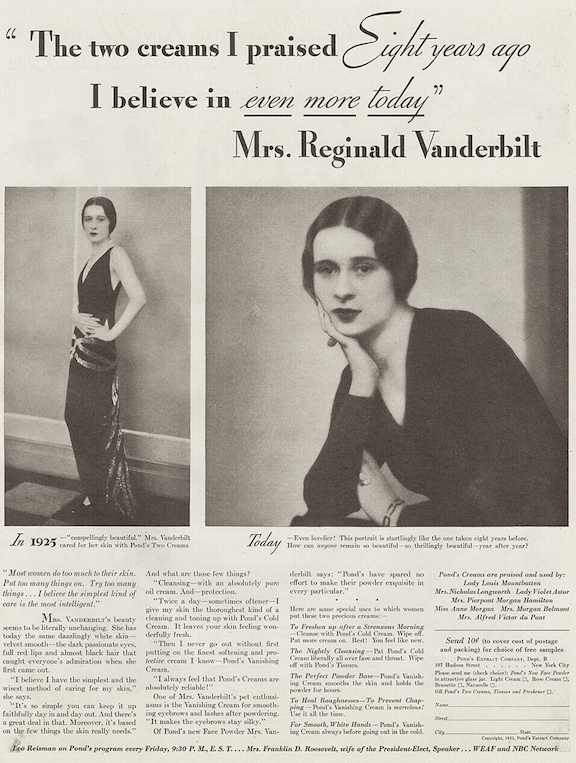
…in 1929 J. Walter Thompson President Stanley Resor observed how people instinctively wanted to be told what to do by authorities they respected. Applying this thinking to the marketing of Pond’s cold cream, Resor’s firm hired famed photographers to create idealized portraits of society women…

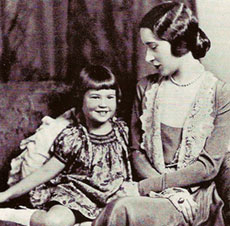
…Writing for Indy Week (July 7, 2010) Amy White observes that a 1933 portrait (above) of Mrs. Reginald Vanderbilt, aka Gloria Mercedes Morgan, reveals patrician eyes as “languid jet pools, her lips full and dark, her finely coiffed hair oiled to ebony perfection. However, a bit of backstory might explain the painful and hollow look Mrs. Vanderbilt can barely suppress. In that same year, she was declared by the courts to be unfit as a parent, and her young daughter was placed under the guardianship of her sister, Gertrude.” That young daughter, Gloria Vanderbilt, would later find fame for her designer jeans, her glittering lifestyle, and as mother of newscaster Anderson Cooper. White concludes, “I wonder if somehow, subconsciously, those consumers saw the pain in the eyes of some of those upper-crust spokeswomen, and it was basic humanness and empathy, as well as desire for wealth and beauty, that won them over”…

Mrs. Reginald Vanderbilt, aka Gloria Mercedes Morgan, and her daughter, “Little Gloria,” in 1928. (Wikipedia)

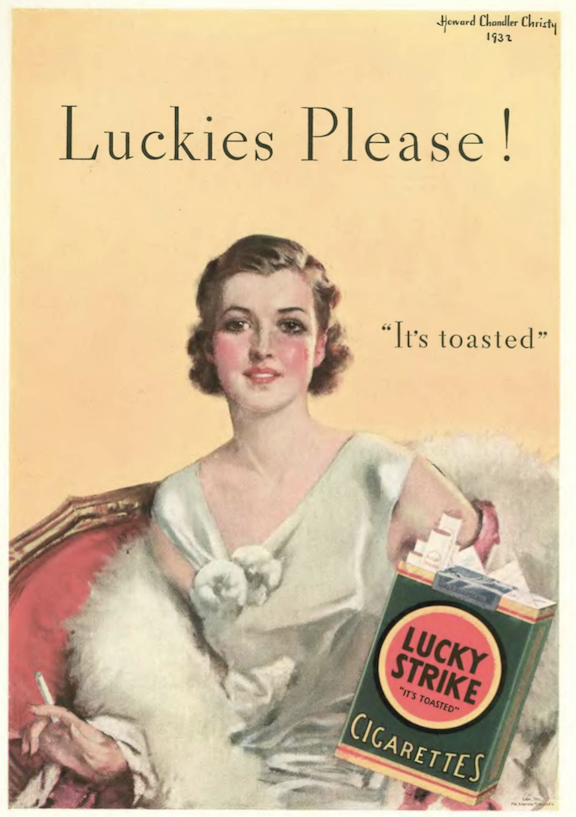
…and we move along to the toasted pleasures of Luckies, and Howard Chandler Christy’s “Christy Girl” looking the picture of health and vitality in this back cover ad…

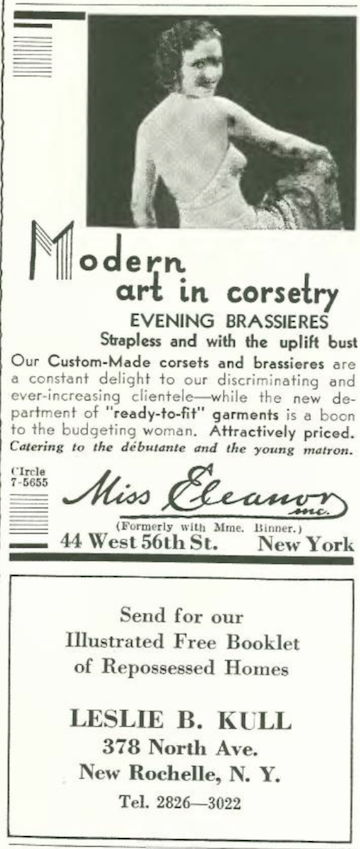
…we make an abrupt switch to the cheaper ads in the magazine’s nether pages…here “Miss Eleanor, formerly with Mme. Binner,” announced her selection of modern corsets for the “debutante and young matron”…and below, in a sign of the times, repossessed homes for sale…

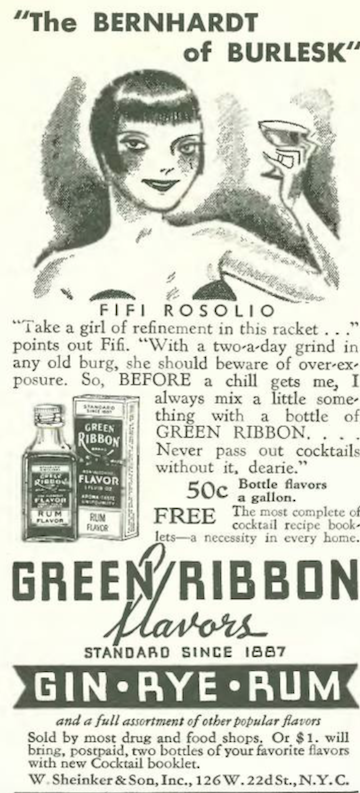
…looks like Fifi had a bit too much of the Green Ribbon-flavored bootleg…

…and if you thought taking probiotics was a new thing…

…the French Line once again featured the art of James Thurber to promote its Mediterranean cruises…

…and Thurber kicks off our cartoons with spot art that headed the “Goings On About Town” section…

…and this gem with one of Thurber’s beloved dogs…

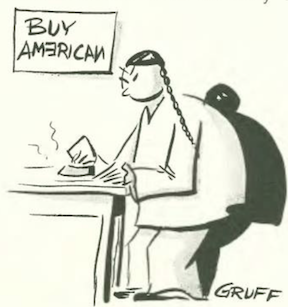
…below is the second New Yorker cartoon by Gruff with the “Buy American” slogan juxtaposed with an ethnic stereotype…I have no idea who this artist is, or if “Gruff” is a pen name — the style looks familiar but I haven’t had any luck chasing this artist down…

…here is the first one from the Feb. 18 issue…

…but we all know Al Frueh, who contributed this delightful bit of art to the theater review section…

Daniel ‘Alain’ Brustlein gave us an enterprising Frenchman offering peeks at exiled New York Mayor Jimmy Walker sunning on a beach at Cannes…

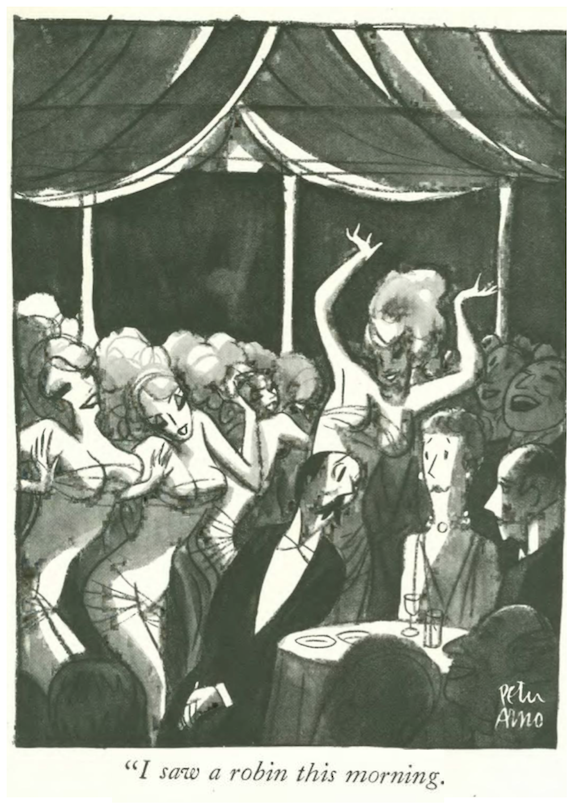
…and we close with Peter Arno, and the first signs of spring…

Next Time: Beauty and the Beast…

Belle Geste

“Nobody said not to go” was a phrase often used by Emily “Mickey” Hahn when returning from one of her far-flung and often wild adventures.

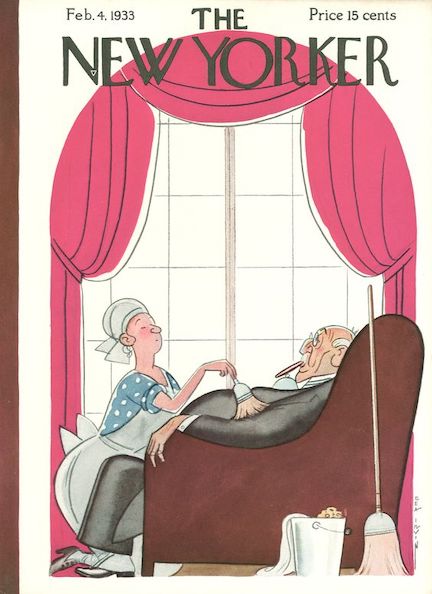
Feb. 4, 1933 cover by Rea Irvin.

And nobody ever told Hahn (1905–1997) what she could write about, and so she wrote, with brio and authority, on a variety of subjects ranging from feminism, diamond mining, and animal behavior to Chinese history and cooking. The author of 54 books, Hahn also penned a number of biographies including those of Leonardo da Vinci, Chiang Kai-shek, and D. H. Lawrence among others. In the Feb. 4 issue Hahn wrote about spending the night at a New York flophouse, not out of necessity but rather to write about the experience. Excerpts:

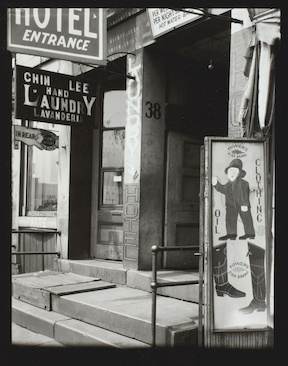
NO RITZ, THIS…Entrance to a flophouse in the Bowery, photo by Walker Evans, 1934.

In the following two excerpts, Hahn described her sleepless night, and her exit from the flophouse the following morning…

More on Emily Hahn, who defied convention from the very start of her adult life: before graduating from the University of Wisconsin in 1926 (the first woman to earn a degree in mining engineering there), she drove across the U.S. in a Model T, dressed a man. She wrote about her experiences in letters to her brother-in-law who, unbeknownst to Hahn, shared them with New Yorker editors. This would lead to a longtime relationship with the magazine, to which she would contribute nearly 200 articles (and one poem) between 1929 and 1996. She would also serve as China correspondent from 1935 to 1943.

In 1930 she traveled to the Belgian Congo, where she lived for two years with a pygmy tribe while working for the Red Cross; she later crossed Central Africa alone on foot. In his 2006 memoir, Let Me FinishRoger Angell described Hahn as the magazine’s “Belle Geste,” a woman “deeply, almost domestically, at home in the world. Driven by curiosity and energy, she went there and did that, and then wrote about it without fuss.”

AT HOME IN THE WORLD…Clockwise, from top left, Emily “Mickey” Hahn poses with her pet gibbon, Mr. Mills, in Shanghai, circa 1935; undated photo with more of her furry friends; Hahn as a teenager, circa 1920; cover photo from her 1944 book, China to Me; Hahn in 1944 with her daughter Carola, following their return from occupied China. (Wikipedia/Lilly Library, Indiana U)

 *  *  *

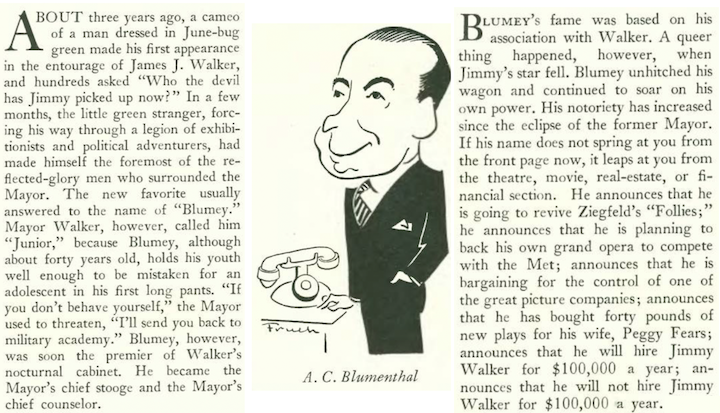
Chief Stooge

Theatrical promoter Alfred Cleveland Blumenthal (1885–1957) was well-known to New Yorkers in the 1920s and 30s as a speakeasy owner, buddy to Mayor Jimmy Walker and husband to actress Peggy Fears. Although “Blumey” is largely forgotten today, in 1933 he merited a two-part profile by Alva Johnston. Here are excerpts from the opening lines:

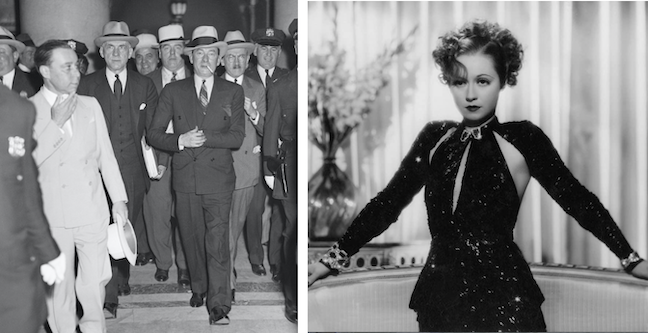
ONLY THE SHADOW KNOWS…A.C. “Blumey” Blumenthal (at left in the light suit) was often seen shadowing Mayor Jimmy Walker in his role as chief counselor and chief stooge. Here the mayor is escorted by Blumey and New York’s finest during corruption hearings in 1931. At right, Blumey’s wife Peggy Fears (1903–1994) in her most notable film role, 1935’s The Lottery Lover. Their tempestuous marriage lasted from 1927 to 1950. (avenuemagazine.com)

 *  *  *

Coward’s Ménage

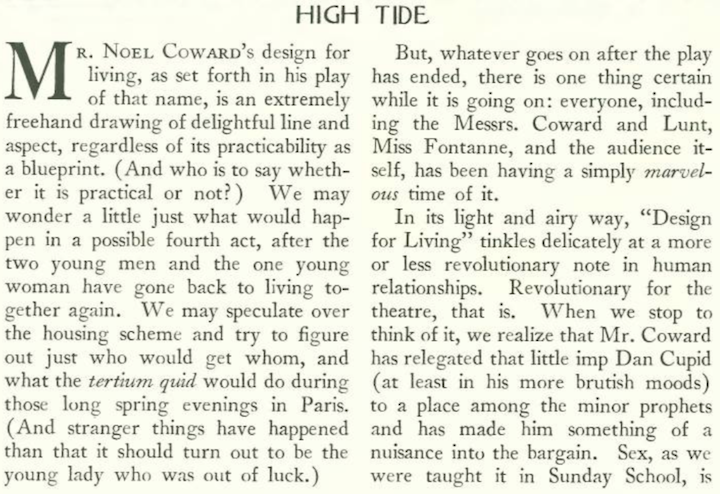
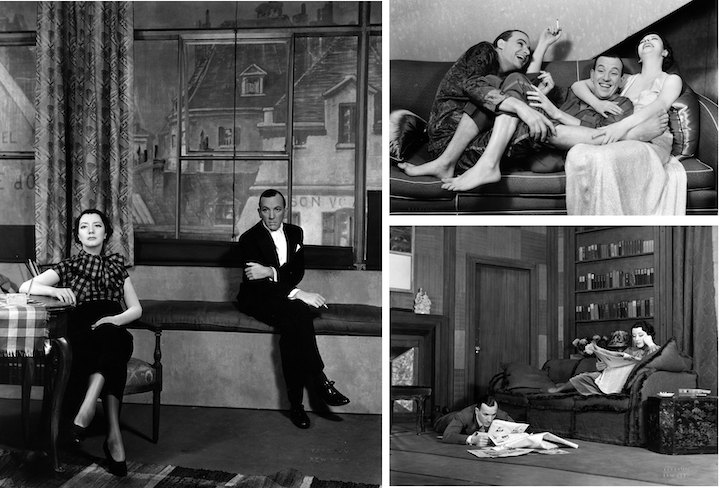
Playwright Noel Coward existed in the orbit of the Algonquin Round Table, so it was doubtless challenging for Robert Benchley to critically review his friend’s work. Fortunately, Benchley found Design For Living mostly to his liking. Note how Benchley subtly refers to the play’s gay subtext, and to the fact that it mirrored the real-life relationships of the play’s trio.

THREE’S COMPANY…A studio in Paris. A penthouse in New York. A flat in London. These were the settings for Noël Coward’s play Design for Living at the Ethel Barrymore Theatrewhich starred the wife-husband team Lynn Fontanne and Alfred Lunt and their close friend Coward in a Broadway run of 135 performances from January to May 1933. (Vandamm theatrical photos via wisc.edu)

Benchley did have a few quibbles, but reasoned there was no need to be overly critical when there was such a dearth of quality stage entertainment. Note the great caricatures by Al Frueh (below) that accompanied the review.

Benchley had a different sort of dilemma criticizing Elmer Rice’s earnestly patriotic We, the People, a play about the misfortunes of a working class family in Depression America.

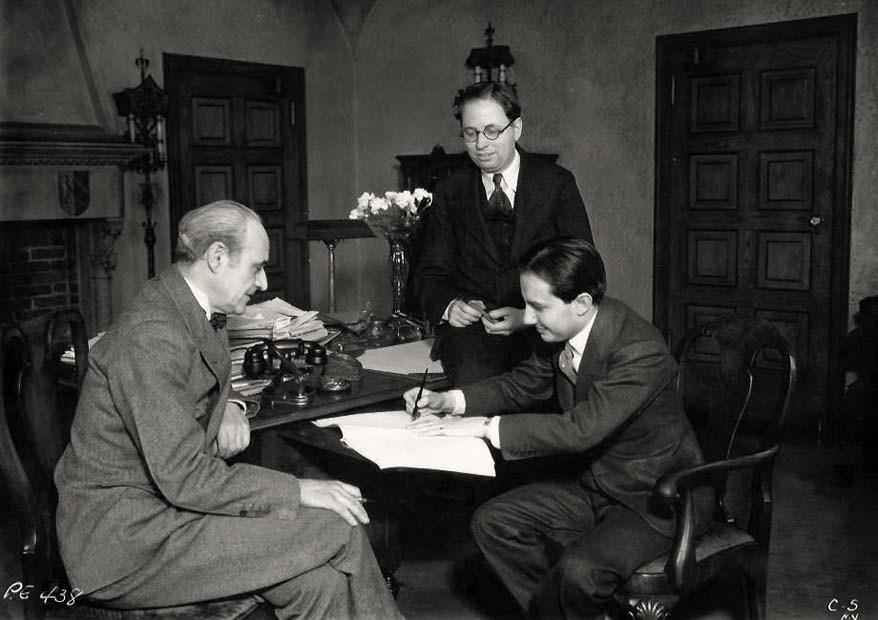
Rice, who won the Pulitzer Prize for Drama in 1929, was an occasional contributor to The New Yorker from 1929 to 1931, including his sci-fi satire on the film industry, Voyage to Purila, which was serialized in eleven installments (with illustrations by Peter Arno) in The New Yorker from Oct. 12 to Dec. 21, 1929.

LET’S MAKE A MOVIE…Elmer Rice (standing) joins theatre producer Joseph P. Bickerton, Jr. (left), and Universal’s Carl Laemmle Jr. to sign a contract for the film version of Rice’s 1931 Broadway play Counsellor at Law. The film proved to a critical success. (Wikipedia)

Meanwhile, film critic John Mosher was trying his best to enjoy the latest Hollywood fare, another Broadway play adapted to the silver screen. Whistling in the Dark…

MURDER MOST AMUSING…The 1933 American pre-Code comedy-mystery film Whistling in the Dark starred Ernest Truex and Una Merkel. (IMDB)

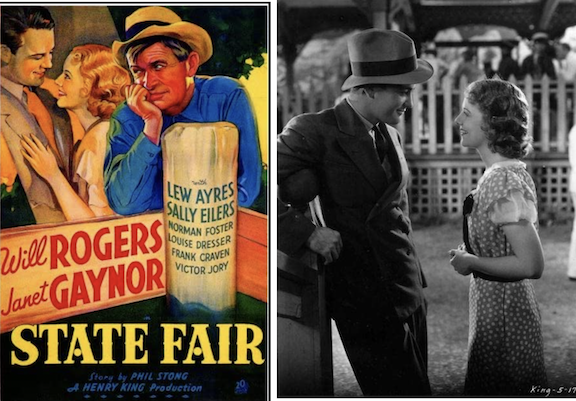
However, Mosher was surprisingly enthused by the rustic charms of Iowa country folk in State Fair…

THE TRIUMPH OF PRIZE PICKLES and other delights awaited viewers of 1933’s State Fair, which gave star billing to Will Rogers and Janet Gaynor. At right, Lew Ayres sweet-talks Gaynor at the fairgrounds. (IMDB)

 *   *   *

Form Follows Function

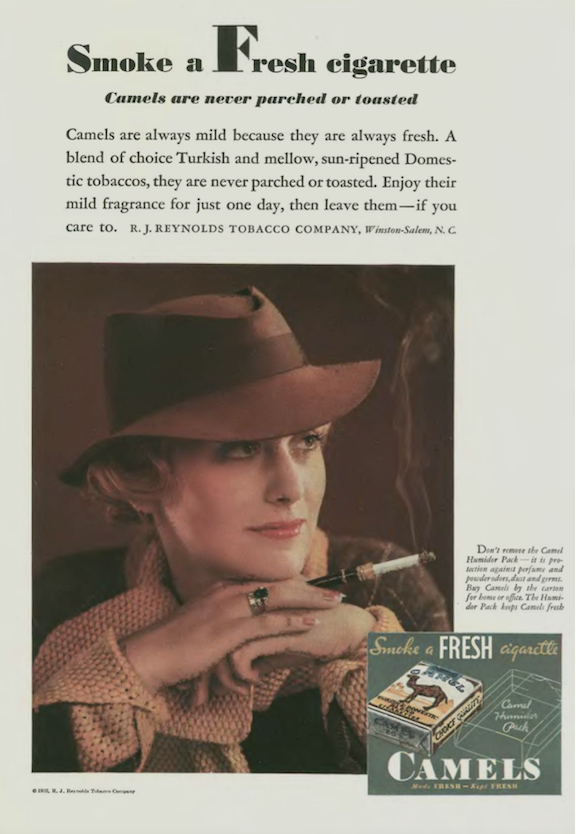
E.B. White paid close attention to all the little details of daily life, including the advertisements that appeared in The New Yorker. In “The Talk of the Town” he wrote about a Camel ad that inspired a sudden fashion trend:

…here is the Dec. 24, 1932 New Yorker ad to which White referred:

 *   *   *

From Our Advertisers

We keep our cigs lit for our first ad, from Lucky Strike, keeping it simple with their familiar slogan…

…this ad from Powers Reproduction shows us the beach caps that were all the rage in the early ’30s…

…this may look like an old car to modern eyes, but in 1933 these sweeping curves were la dernière mode in the auto world…

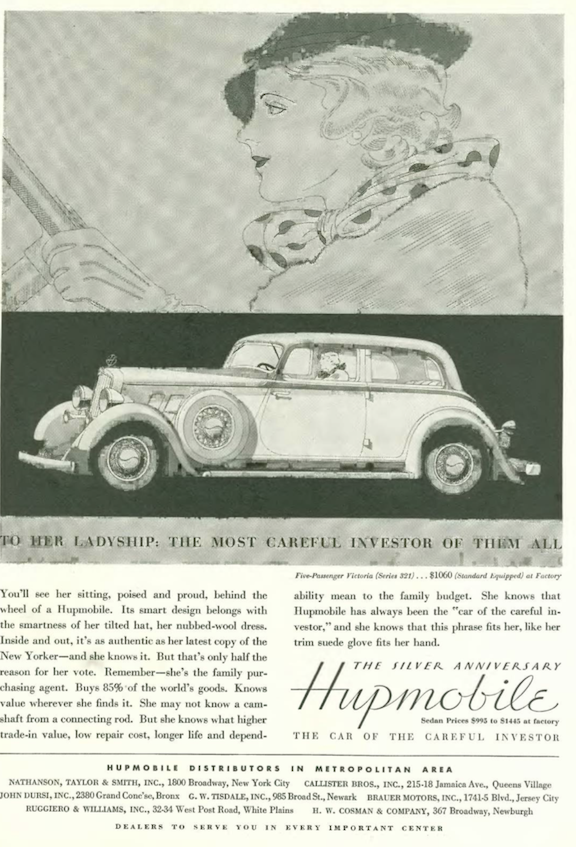
…and then there was Hupmobile, trying its best to stay relevant in the Depression…

…the company folded in 1939, but a few reminders live on…

HUP HUP HOORAY…The 1917 Hupmobile dealership at 25th and Farnam in Omaha, NE, was located along the old Lincoln Highway and is the last preserved Hupmobile dealership in the United States. On the National Register since 2014, it now houses apartments. (Flickr)

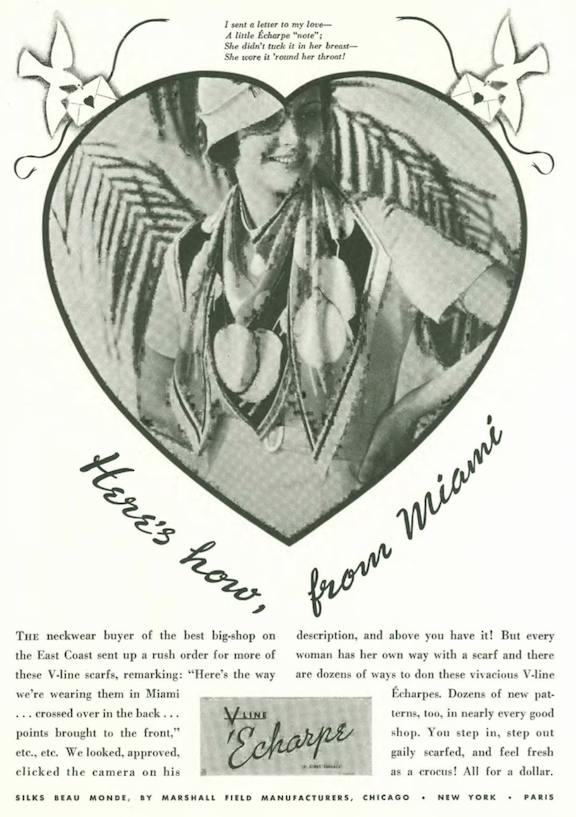
…Valentine’s Day was just around the corner, so time to buy your sweetheart something special, like this scarf that was all the rage among the Miami snowbirds…

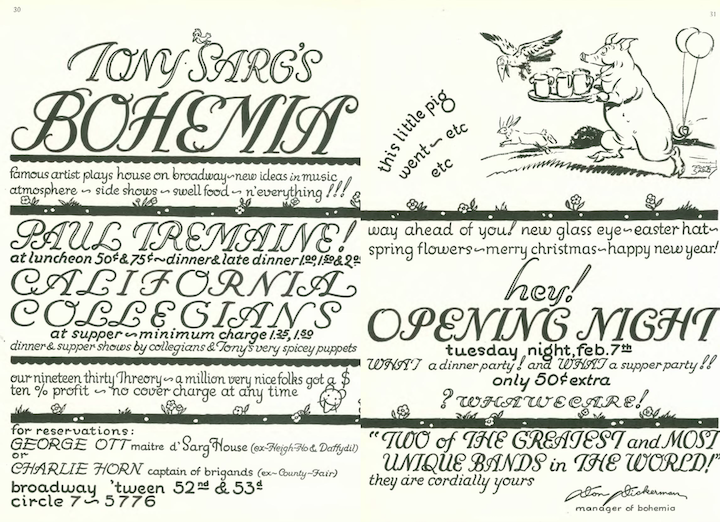
…Greenwich Village restaurateur and personality Don Dickerman took out this two-page ad to trumpet his partnership with puppeteer and illustrator Tony Sarg at the Bohemia restaurant on Broadway…

…the German-American Sarg is also known as the creator, in 1927, of the first giant balloons for Macy’s Thanksgiving Parade…

THE OLD GASBAG…Tony Sarg (upper right hand corner) and assistants painting one of his Macy’s parade balloons. (Fotograms News Photo Service via Pinterest)

…on to our cartoons, and what a big day for The New Yorker…the Feb. 4, 1933 issue featured the first captioned cartoon by Charles Addams

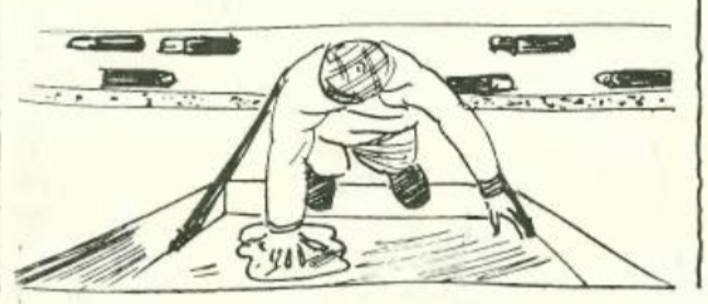
…for the record, Addams’s very first contribution to the magazine was this spot illustration (below) featured on page 65 of the Feb. 6, 1932 issue…

…one of the original contributing artists to The New Yorker, Gardner Rea, continued his skewering of America’s plutocrats…

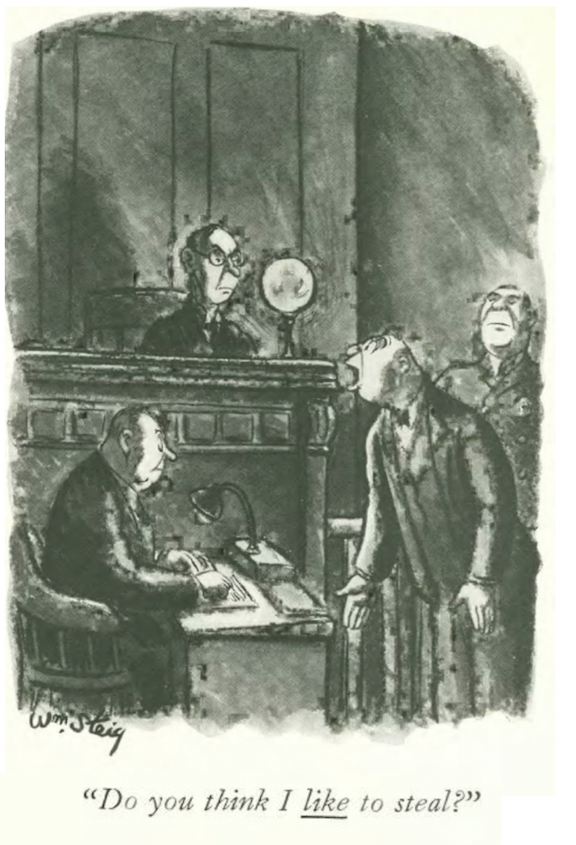
William Steig took us before the bench to make an honest plea…

James Thurber gave us another skirmish between the sexes…

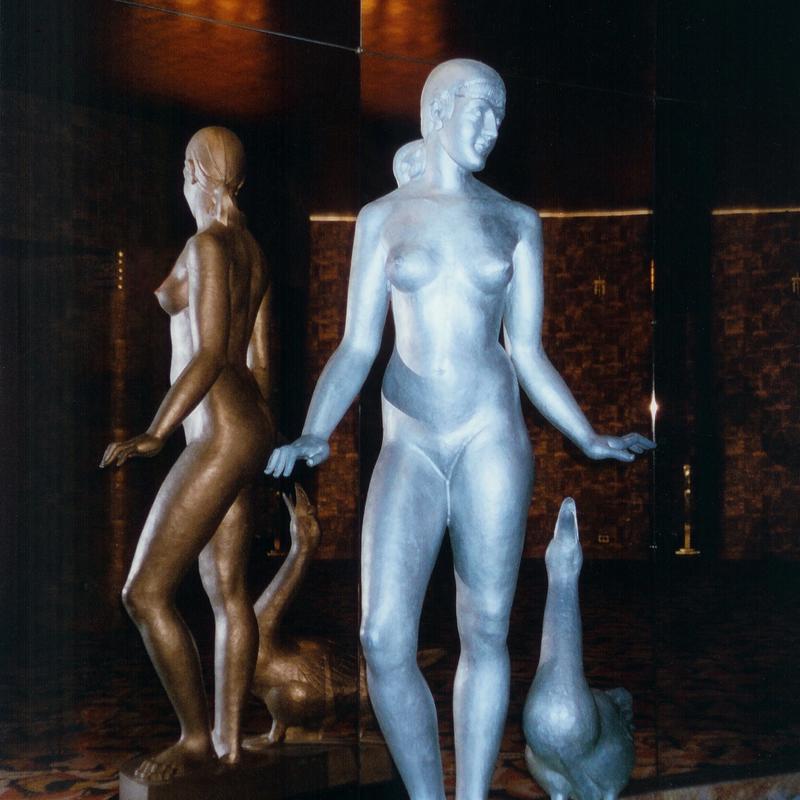
…and recalling my Jan. 12 post (about the Jan. 7, 1933 issue), in which the puritans got their knickers in a bunch over Robert Laurent’s Goose Girl sculpture in the Radio City Music Hall lobby…

…we end with Helen Hokinson, inspired by Laurent’s work…

Next Time: Role Reversal…

March of Time

In the span of 112 minutes, the much-anticipated Fox production Cavalcade took movie audiences through the first thirty years of the 20th century.

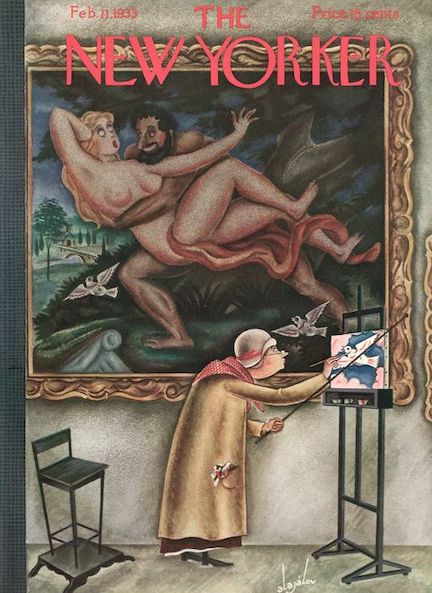
Jan. 14, 1933 cover by Peter Arno.

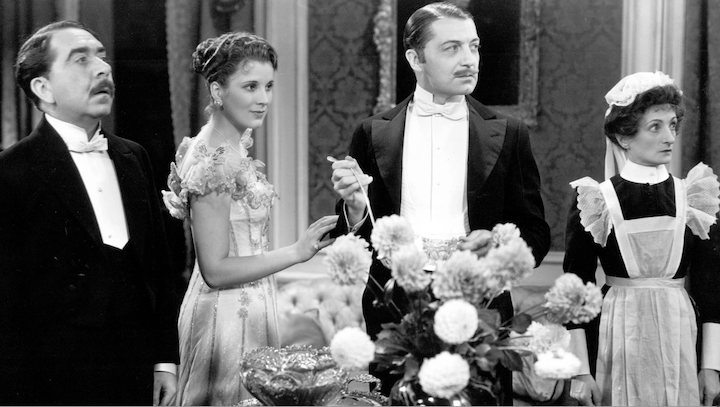
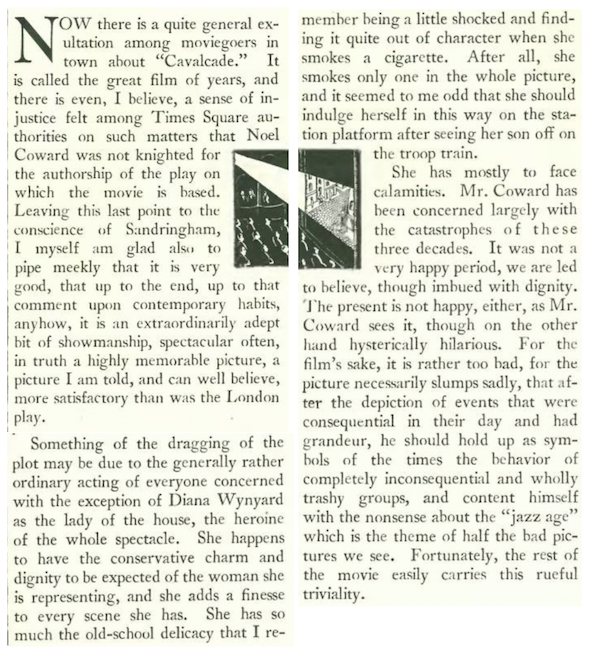
Anticipating Upstairs, Downstairs (1971) and the more recent Downton Abbey, Cavalcade looked at life through the eyes of upper class Londoners—Jane and Robert Marryot, their children and close friends—and the Marryot’s servants. It was a calamitous ride that included both the Boer War and World War I among other historic events. Critic John Mosher thought it a memorable picture despite its mawkishness.

IT’S A SCARY WORLD OUT THERE…This Fox theater card promised audiences epic thrills with a cast of thousands. (IMDB)
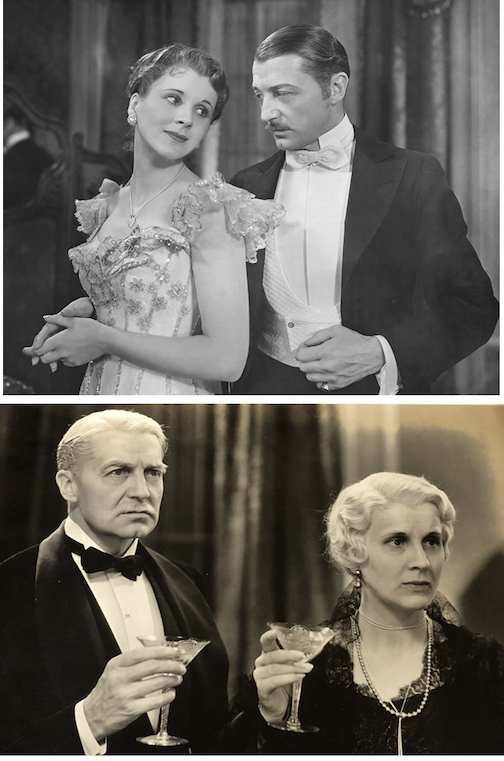
AGING GRACEFULLY…Diana Wynyard and Clive Brook portrayed upper class Londoners Jane and Robert Marryot through three tumultuous decades in Cavalcade. (IMDB)

In the film, the first decades of the 20th century would claim the lives of both Marryot sons—Joe would perish in World War I, and Edward would make the unfortunate decision to take his bride on a honeymoon cruise…

ONE-WAY TICKET…Edward Marryot (John Warburton) and his childhood sweetheart Edith Harris (Margaret Lindsay) are thrilled to be celebrating their honeymoon on a “big boat.” When the couple walk away from the railing, the opposite side of the life preserver is revealed in a dramatic camera shot.

After World War I the film hastily moved on to the Jazz Age, where the social order was going to hell…

CRY WOLF…A creepy older dude puts the moves on a young blonde (portrayed by Betty Grable in an uncredited role) during a Jazz Age scene of a wild party that included glimpses of flirting gay couples. Cavalcade was one of the first films to use the words “damn” and “hell.” (IMDB)

Cavalcade is considered by some critics to be one of the worst films to receive an Academy Award (it actually won three—Best Picture, Best Director, and Best Art Direction). If you are interested in learning more about Cavalcade or about pre-Code films in general, visit the excellent pre-code.com website.

 *  *  *

Sad Songs

George White was famed for his lavish Scandals revues, especially during the Roaring Twenties—leggy showgirls and wisecracking comedians shared the stage with some of the era’s top singers and dancers. White’s Music Hall Varieties seemed to have all of the same elements as his Scandals, but something seemed amiss to Robert Benchley—an unnamed sadness that he chalked up to those depressing times:

THE SHOW MUST GO ON…Even during the Depression George White did what he could to keep the old Roaring Twenties spark alive. Clockwise from top left: White auditioning dancers for his Scandals; Bert Lahr preparing for a stage show in the 1930s (Lahr’s son, John, would later become a New Yorker drama critic); the Howard Brothers, Eugene and Willie, in 1936; and a young Eleanor Powell ready to do some toe-tapping circa 1932. (PBS/NYPL/Wikipedia)

 *  *  *

Journey of the Mind

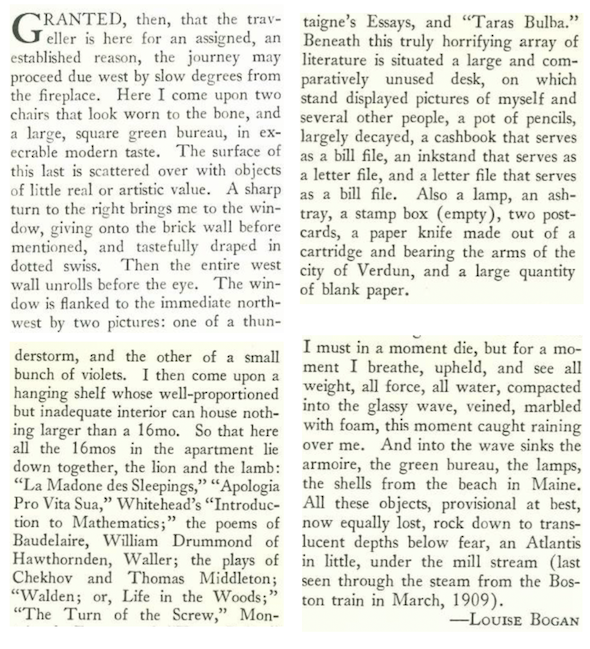
Louise Bogan (1897–1970) was poetry editor at The New Yorker for nearly forty years (1931–1970) and in 1945 was the first woman to be appointed Poet Laureate to the Library of Congress. For the Jan. 14 issue she wrote “Journey Around My Room,” which begins with her recollection of a childhood train ride. Here are some excerpts:

POET LAUREATE…Louise Bogan in 1937. She was poetry editor at The New Yorker for nearly forty years and was named U.S. Poet Laureate in 1945. (Library of Congress)

 *  *  *

Silent Cal Silenced

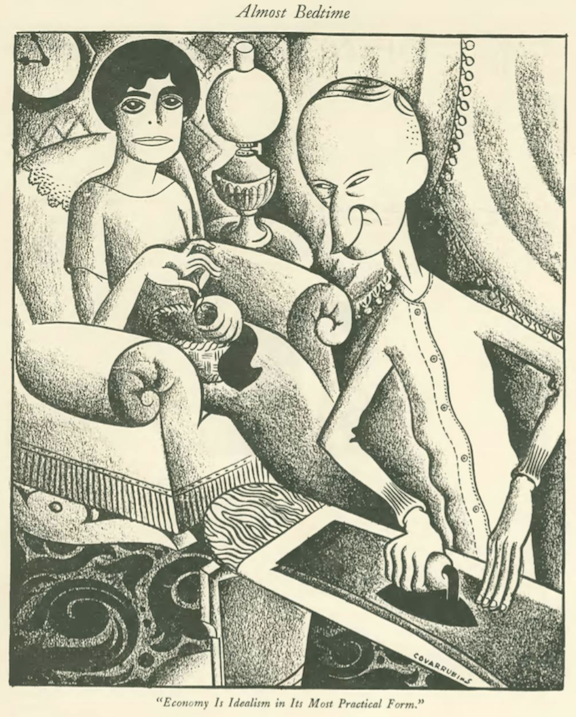
Many folks were surprised by the sudden passing of former U.S. President Calvin Coolidge. He was just sixty years old when he succumbed to coronary thrombosis at his Northampton home, “The Beeches.” During The New Yorker’s first years Coolidge was the butt of many jokes…beginning with this Miguel Covarrubias cartoon in the magazine’s fourth issue (March 14, 1925)…

E.B. White offered this eulogy of sorts…

THRIFTY IDYLL…Calvin and Grace Coolidge outside their newly acquired home, “The Beeches,” Northampton, summer 1930. (Leslie Jones Collection)

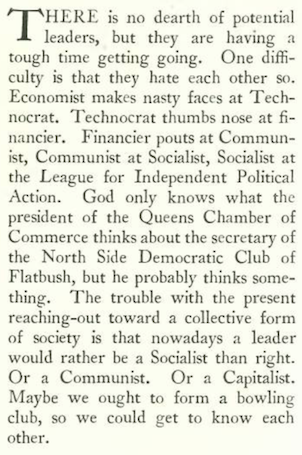
…and mused about the state of politics in 1933, proving that some things never change…

Last time we learned Lewis Mumford’s views about the new artwork displayed in the RKO Roxy Theatre and in Radio City Music Hall. In the Jan. 14 issue he turned his attentions to the actual buildings, giving them an average grade and preferring the Music Hall over the Roxy (he disliked the oversized chandelier/electrolier). Mumford was decidedly not a fan of the Rockefeller Center development, evident in his closing lines:

SHOWPLACES…Lewis Mumford gave Radio City Music Hall (top) and the RKO Roxy some muted nods, but found the Roxy’s electrolier distracting.

 *  *  *

Parting Thoughts

Alexander Woollcott shared some final recollections of his visit to Moscow, in which he likens the Russians’ freedom under Josef Stalin to the freedom of a spirited schoolboy who desires to sit in the back of the classroom…

 *  *  *

From Our Advertisers

Bonwit Teller employed some modern typesetting, wryly using the word DULL — offset in large san-serif letters — to draw attention to their “Chardonize” fabric, which was essentially artificial silk…

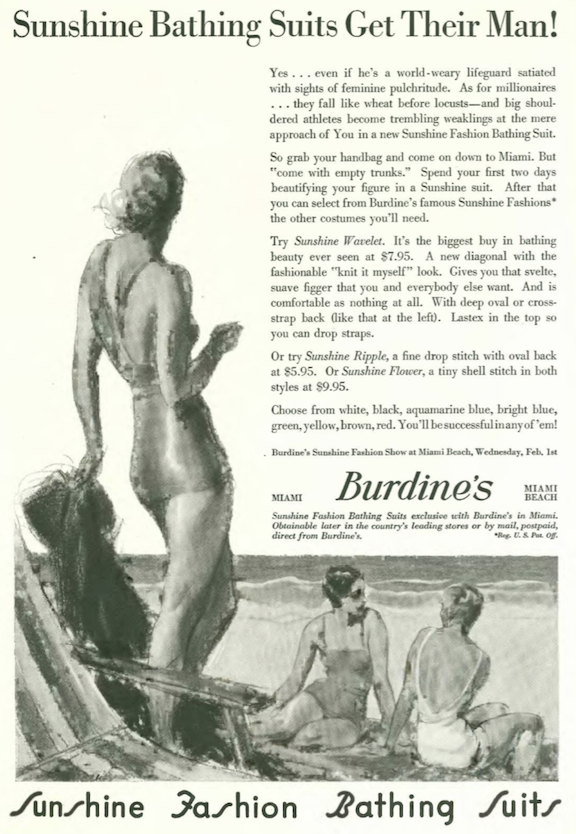
…nothing subtle about this next advertisement…don one of these bathing suits and millionaires will bow before you, or rather, to borrow this ad’s odd metaphor, “fall like wheat before locusts”…

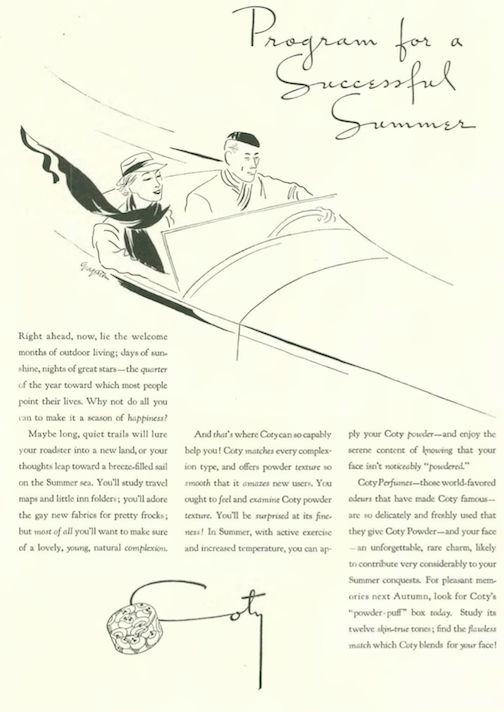
…we get a similar but far more muted pitch from Coty…so does this mean one out of every six desirable bachelors want to be seen with her? Not exactly knocking them down like locusts…

…now here’s a couple of self-assured souls who are neither troubled by hungry locusts nor face powders…they own a Cadillac, and wow, that is really quite the automobile, not like the Caddies you see today that are half-plastic and blend in with the rest of the shapeless blobs we call cars these days…

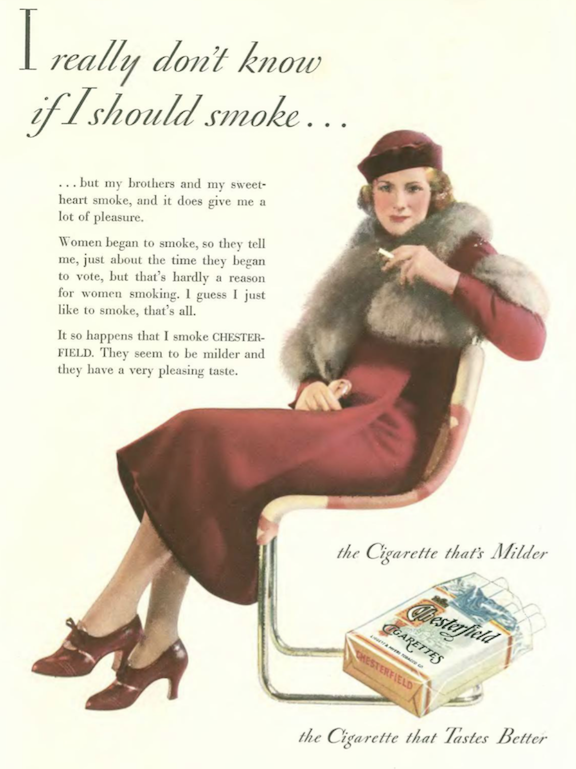
…the folks who pushed Chesterfield cigarettes were back with another ad aimed at their fastest growing demographic…note the sly reference to women’s suffrage…but that’s not why this woman (seated on a modern Breuer chair) smokes; she smokes because it gives her pleasure, and come to think of it, why should men have all the fun?…

…the Cunard Line suggested that you might run into some big-time celebrities on one of their ships, including actress Norma Shearer and banker/arts patron Otto Kahn (bottom of left-land page); or on the opposite page Charlie Chaplin, Douglas Fairbanks and Mary Pickford, Alfred Lunt and Lynn Fontanne among others…

…by contrast, the French Line employed the artistry of James Thurber to entice travelers onto the high seas…

…which gives us a nice segue into our cartoons, beginning with this spot by Thurber referencing the National Auto Show…

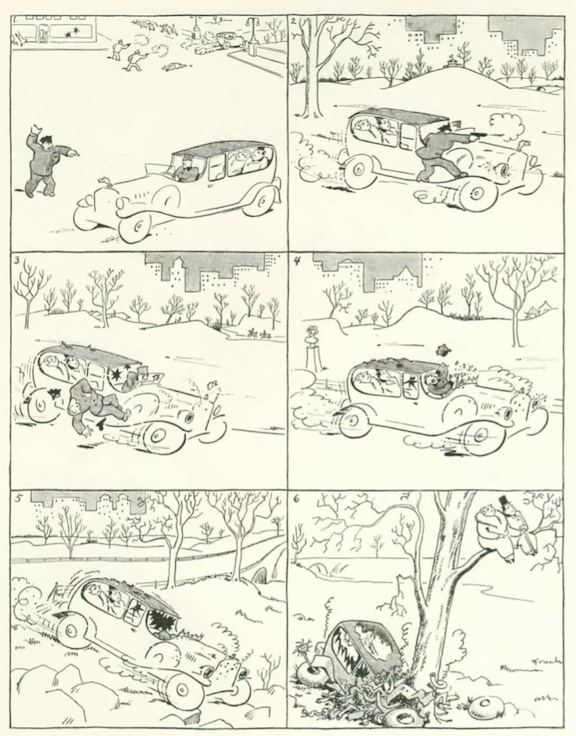
Al Frueh offered up another of his famed sequential works…

Gardner Rea with his usual perspective on the absurd…

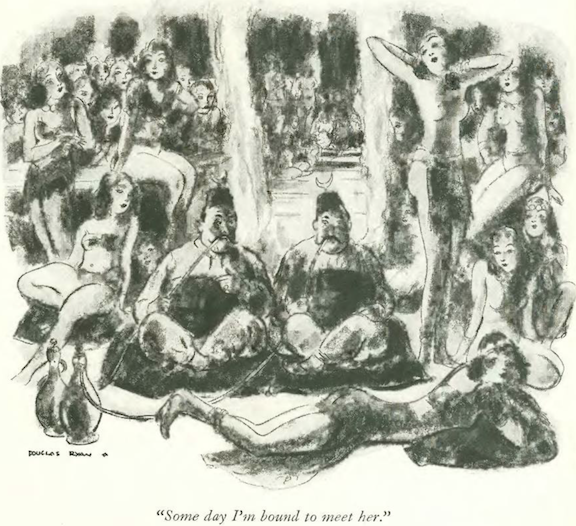
Douglas Ryan plied the familiar waters of the harem trope…

…and Robert Day showed us that even the smallest consolation can still satisfy…

Next Time: Life With Father…