Out With the Old

Perhaps no decade was more transformative to New York City than the 1920s. From the loosening of social mores to countless technological advances, the city was a very different place as it entered the last year of the Roaring Twenties.

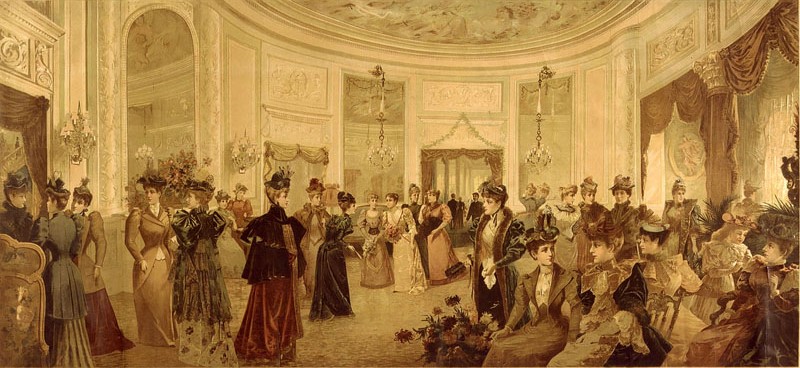
Jan. 5, 1929 cover by Sue Williams. Opening image depicts the original Waldorf Hotel’s Octagon Room in 1893.

Vestiges of the 19th century were quickly erased during the decade as old neighborhoods and stately mansions gave way to massive apartment blocks and towering skyscrapers. Such was the fate of the original Waldorf-Astoria Hotel, its Victorian lavishness out of style in a streamlined age. Writing under the pen name T-Square, New Yorker architecture critic George S. Chappell commented on the planned demolition of the old* Waldorf-Astoria Hotel:
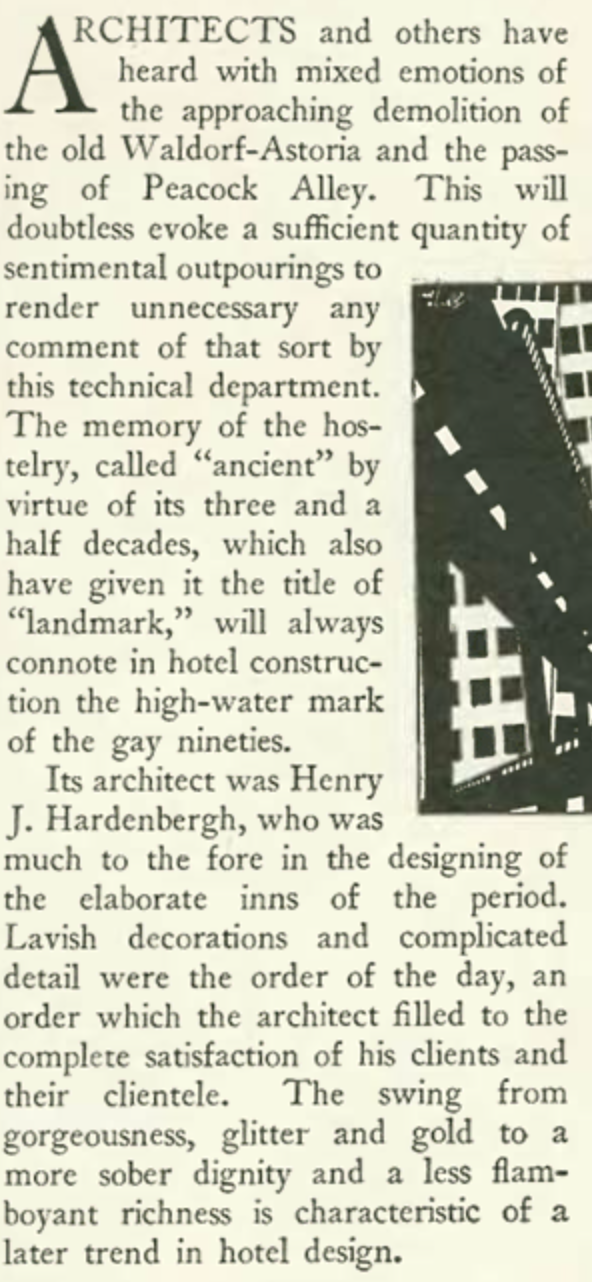
*Although outdated in appearance, the hotel was little more than 30 years old in 1929.
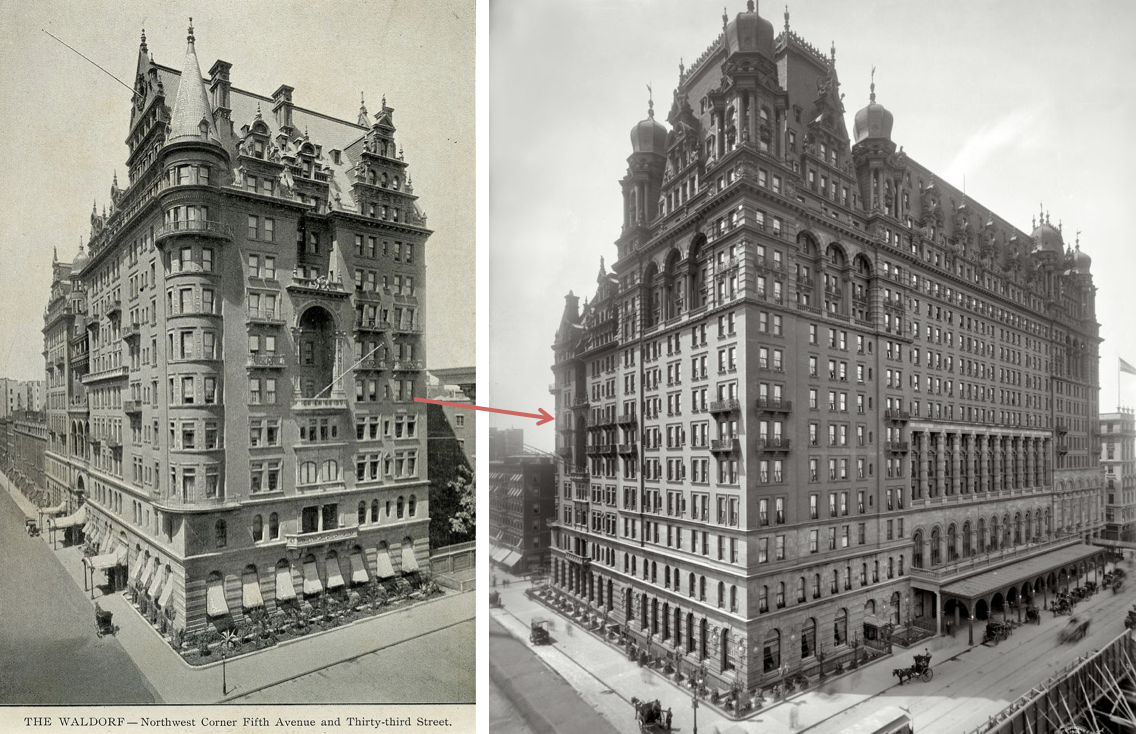
TALE OF TWO HOTELS…The Waldorf-Astoria was actually two hotels joined together. The Waldorf, at left, was built in 1893. The much larger Astoria (right) was constructed in 1897. Note the arrow indicating the original Waldorf in relation to the Astoria. (Wikipedia/Detroit Photography Archive)
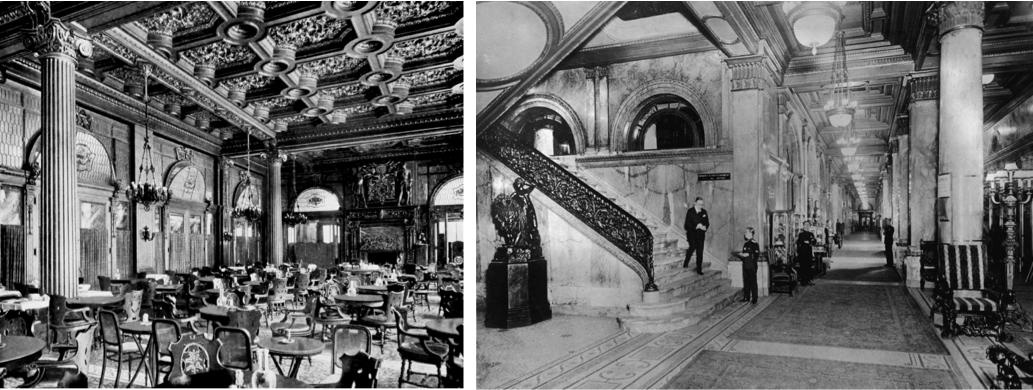
PLACES TO SEE AND BE SEEN…At left, the “Gentleman’s Cafe” in the Waldorf Hotel. At right, lobby entrance to the marble-lined “Peacock Alley” that connected the two hotels. (Wikipedia/justcocktails.com)
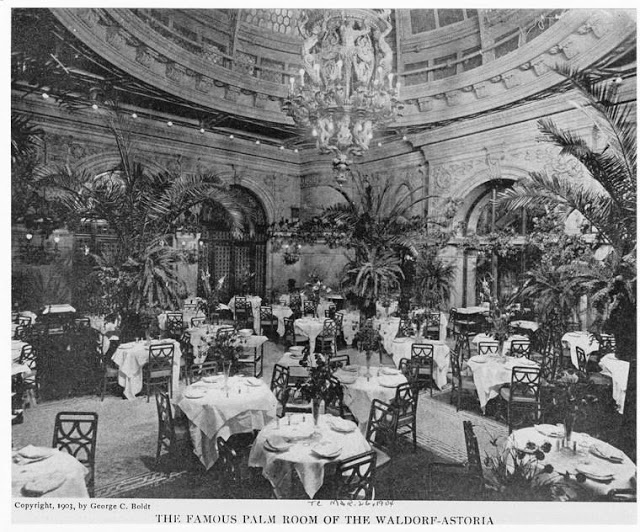
DINE IN STYLE…The Palm Room in the Astoria section of the original Waldorf-Astoria Hotel. (New York Public Library)

Chappell wrote that the prime building site was slated to be occupied by a 50-story office building…

…but as it turned out, Floyd Brown was unable to make the final payments on the property, so he sold his claim to the bank. John J. Raskob, a wealthy finance executive and chair of the National Democratic Committee, joined with entrepreneur Pierre du Pont and former New York Governor Al Smith (who lost his bid for the U.S. Presidency in 1928) to buy the property. They had much bigger plans than Floyd Brown: In August 1929 they announced their plan to build the tallest building in the world — what would become the Empire State Building.

TRY, TRY AGAIN…The architecture firm Shreve & Lamb developed this concept (left) for Floyd Brown’s proposed 50-story office building on the site of the old Waldorf-Astoria. At right, what occupies the site today: the Empire State Building, also designed by Shreve & Lamb. (Pinterest/oldstructures.com)

 * * *

Car Culture

The Jan. 5 issue featured a lengthy review of the 29th Annual National Automobile Show at Grand Central Palace, as well as numerous advertisements by auto manufacturers hoping to entice New Yorker readers with their latest models.

Promoters of the event touted the addition of a grand staircase to Grand Central’s mezzanine level that would ease access to both levels of the show:
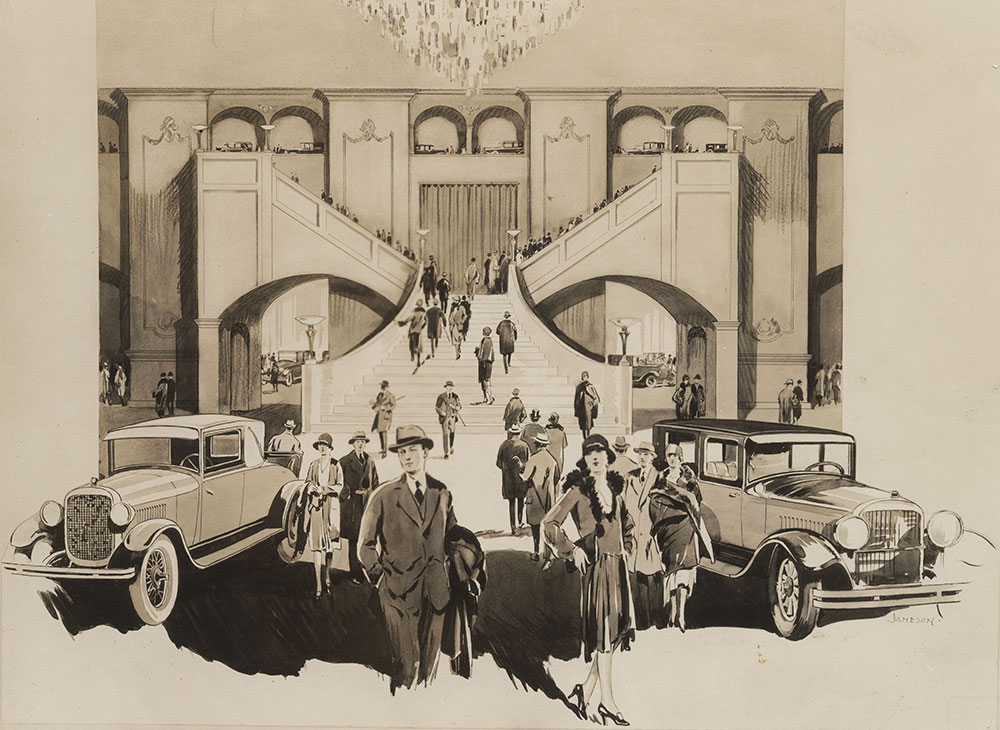
AIN’T IT GRAND?…Design drawing created for the 1929 National Automobile Show at Grand Central Palace touting the addition of an equally grand new staircase. (Free Library of Philadelphia)
How the new staircase actually appeared at the 1929 show. Note the background where the movement of workmen on ladders lends a ghostly appearance. (Free Library of Philadelphia)
A view of the 1929 National Automobile Show from the mezzanine of the Grand Central Palace. (Free Library of Philadelphia)

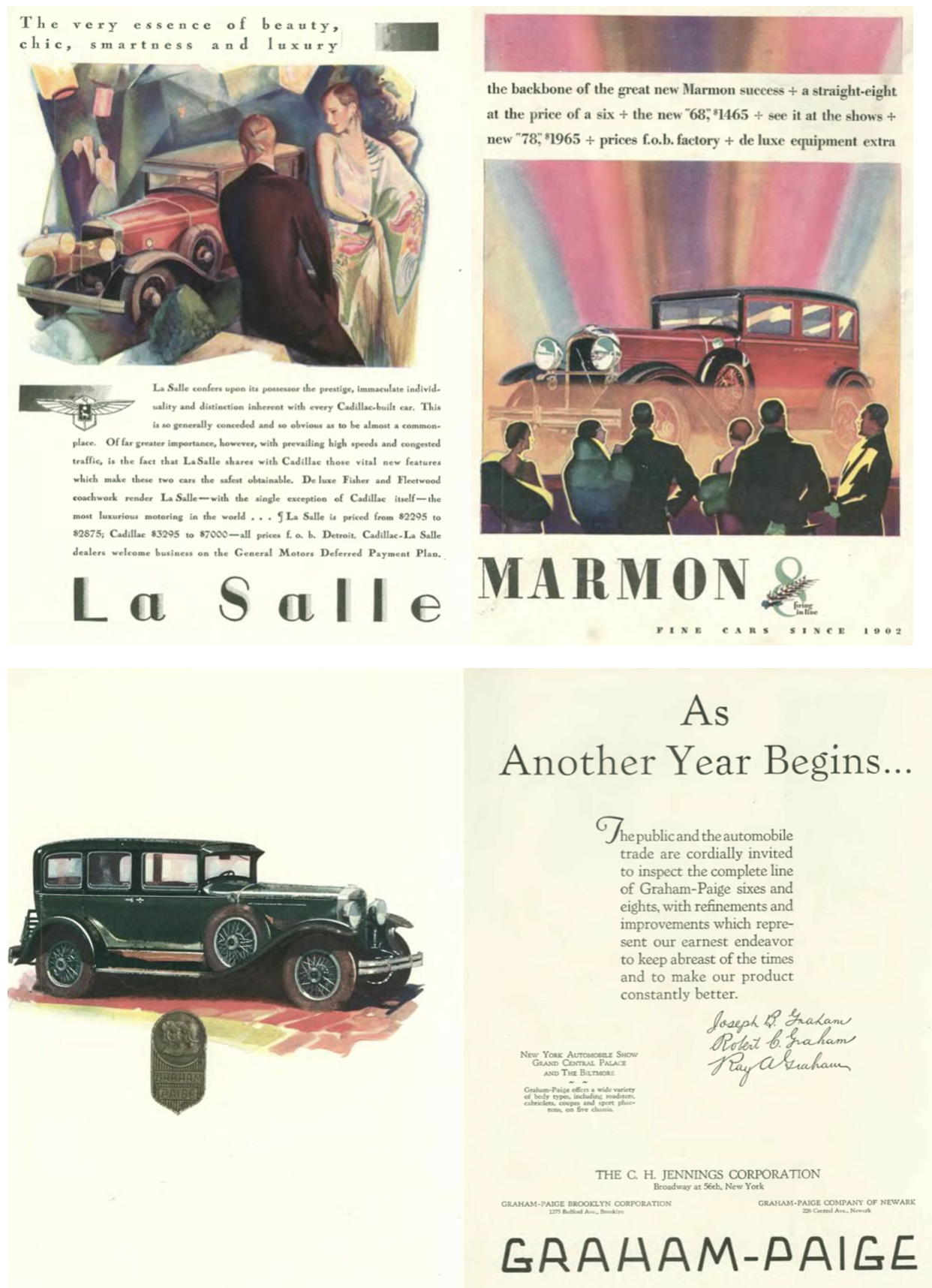
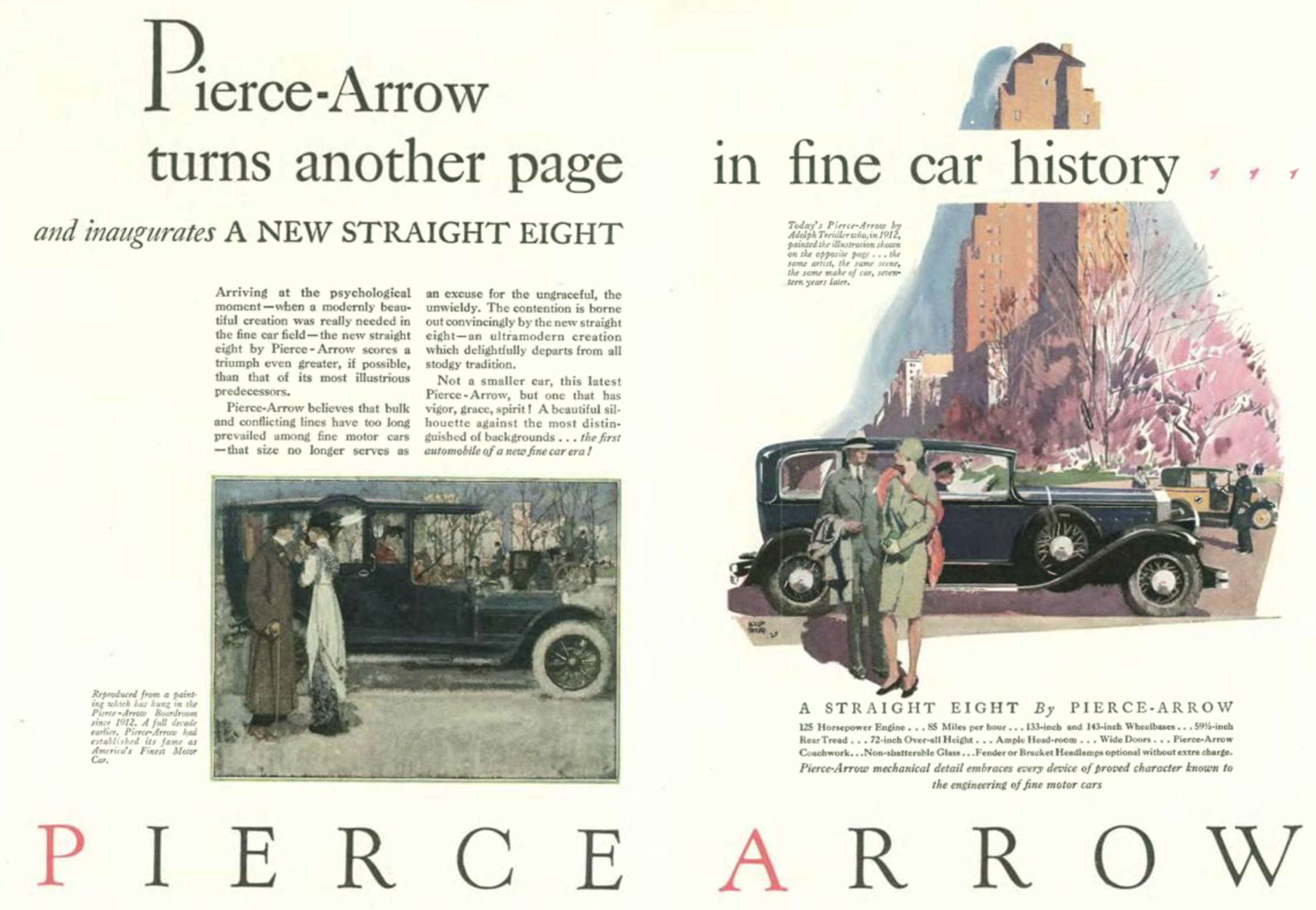
As I mentioned, the Jan. 5 issue was filled with car ads, mostly from long-gone automobile manufacturers. A constant in all of these ads is their appeal to New  York’s chic, smart set. Here’s a sampling of a few of them: (click ads to enlarge):
Hupmobile was a successful car company that began its decline in the late 1920s  precisely because it turned its back on buyers of medium-priced cars and went after what it perceived to be the more lucrative luxury buyer (see ad above). Hupmobile went out of business in 1939 (after briefly joining forces with Graham-Paige, which also went under that year).

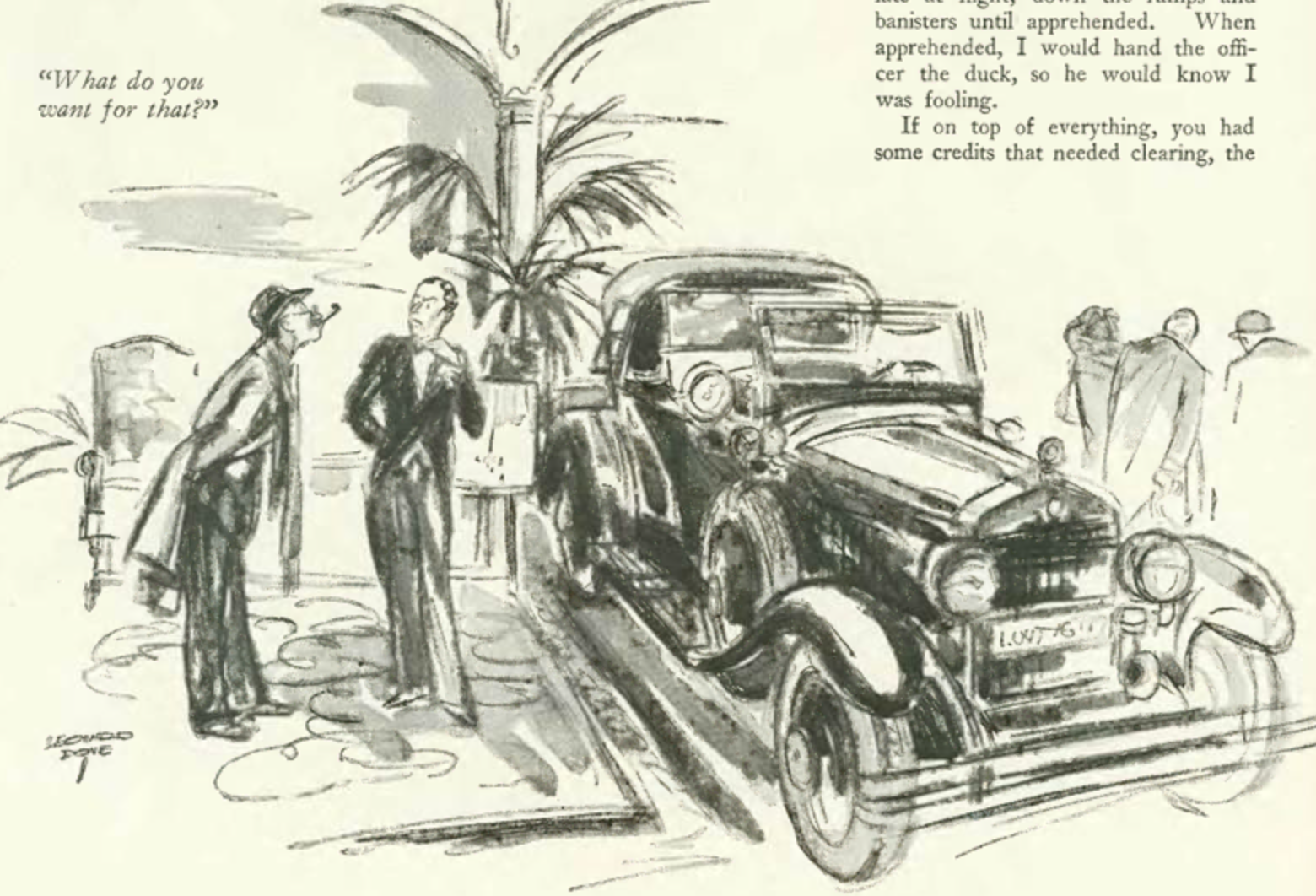
Cartoonist Leonard Dove found humor derived from these very class distinctions when he visited the auto show:
 * * *

The Game, Served Up Cold

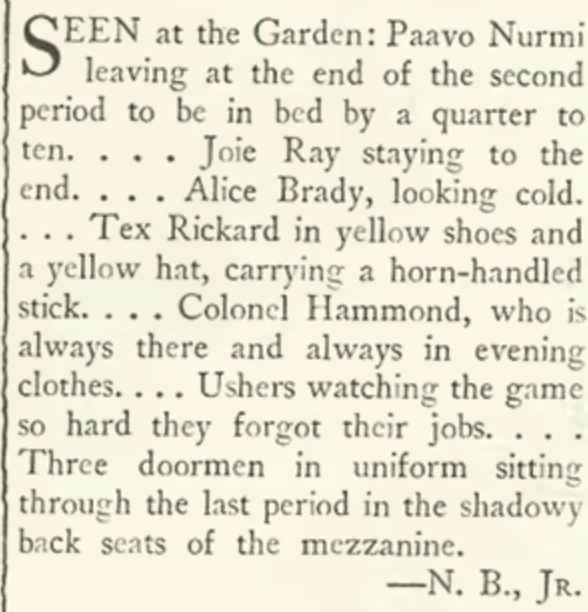
In other diversions from the Jan. 5 issue, Niven Busch Jr. attended the hockey game between the New York Rangers and the New York Americans at Madison Square Garden, noting famous faces in the crowd including Finnish track star Paavo Nurmi and American track star Joie Ray. Also noted were Tex Rickard, builder of Madison Square and founder of the Rangers, ex-football star and businessman Col. Harry Hammond, and film star Alice Brady.
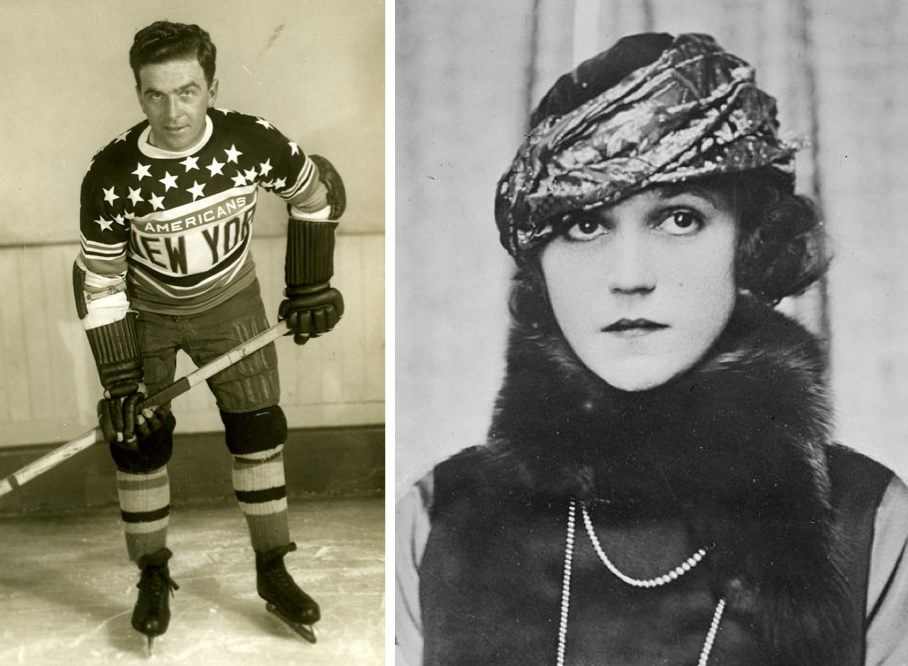
AT THE GARDEN…Not even the exciting hockey play of Billy Boyd (left) and his fellow New York Americans could keep actress Alice Brady warm. (Pinterest/Alchetron)

 * * *

From our non-automobile advertisers, another installment of a Theodore Geisel (Dr. Seuss) ad for Flit insecticide (this is the first instance — at least in the Flit ads— in which Geisel signs his art as “Dr. S” instead of “Seuss”).

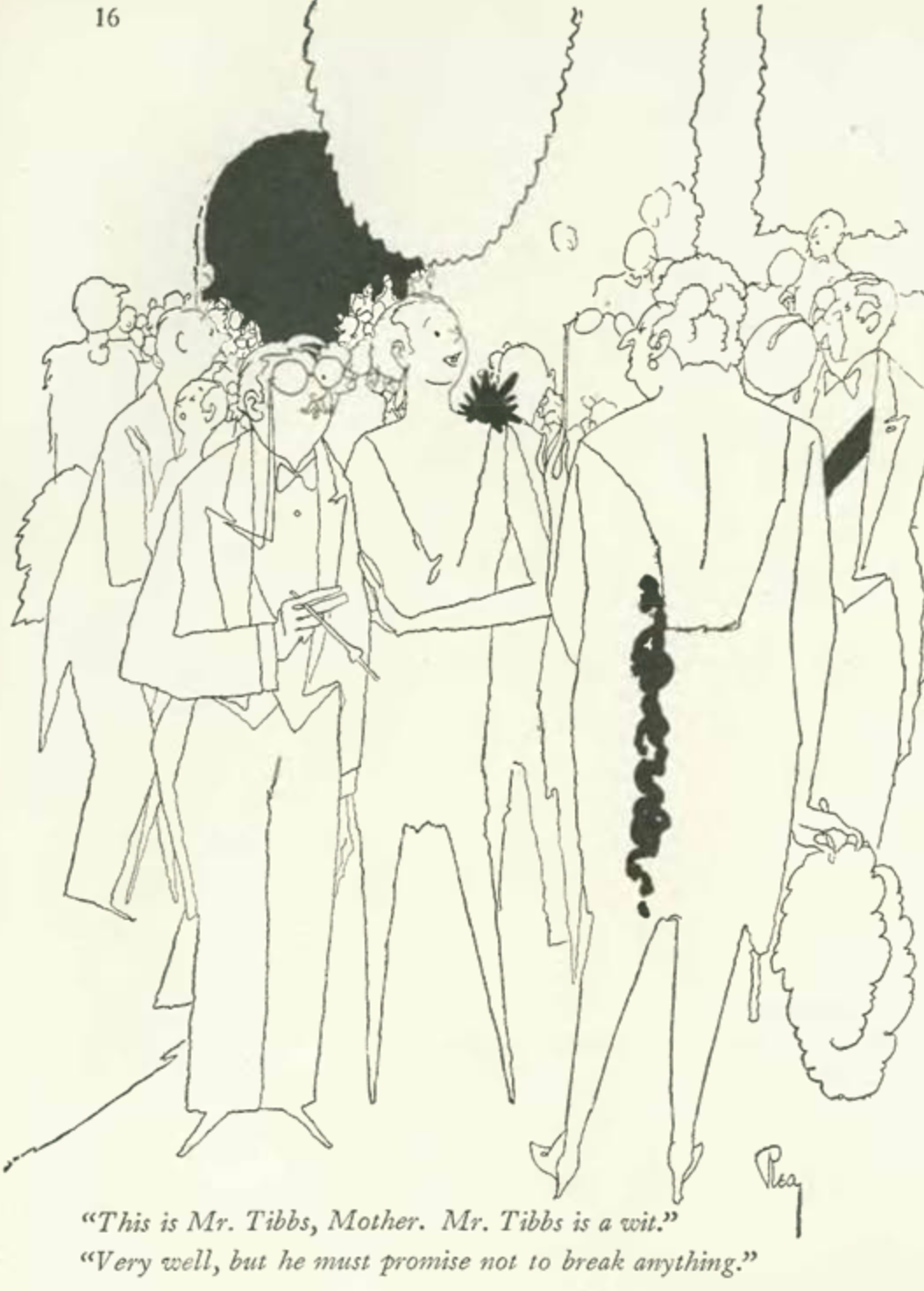
And another cartoon from the Jan. 5 issue, courtesy Gardner Rea:
 * * *

Arno Addendum

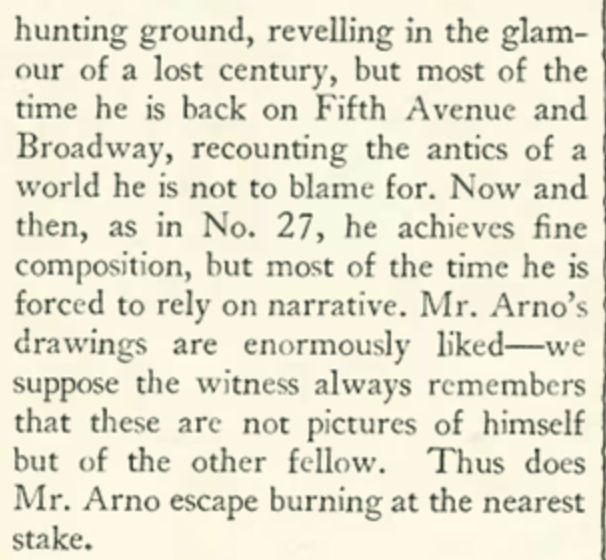
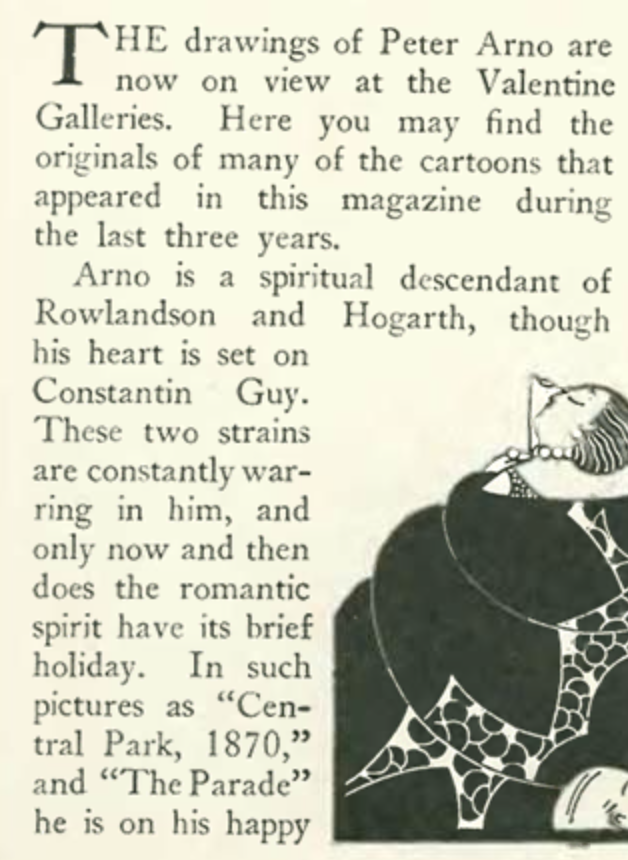
In the rush of the recent holidays I missed an item from the Dec. 22, 1928 issue — namely, art critic Murdock Pemberton’s tongue cheek review (in “The Art Galleries” column) of cartoonist Peter Arno’s December 1928 exhibition of drawings at the Valentine Gallery:
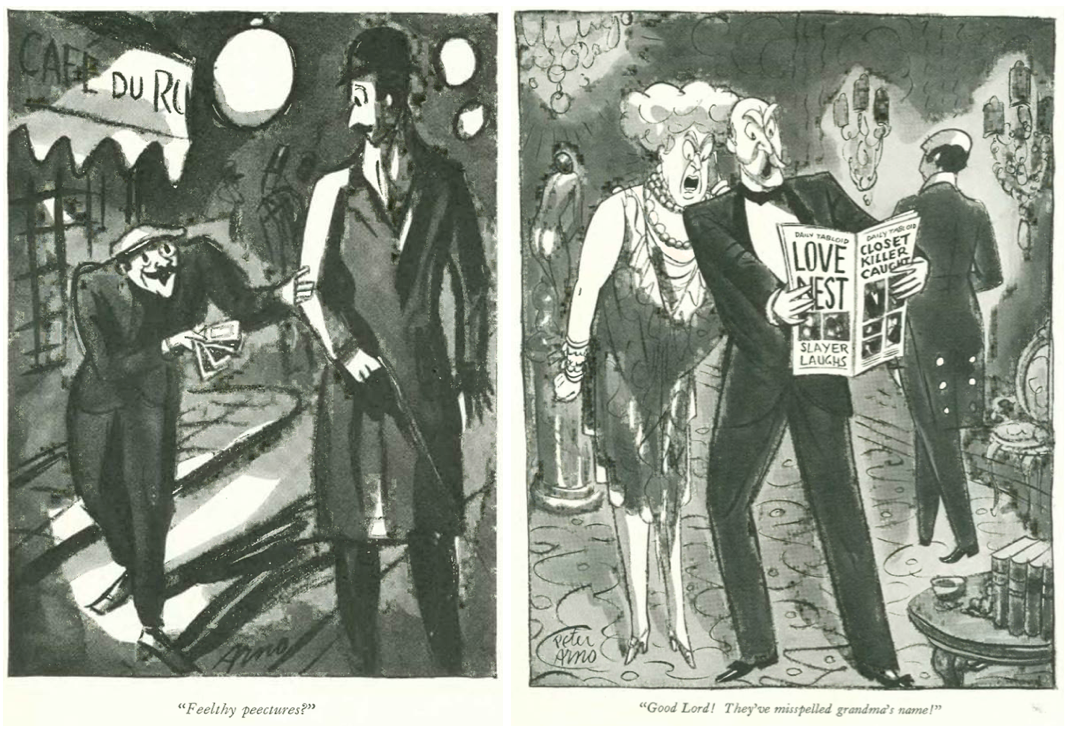
Here are two Arno drawings that were featured in the Valentine exhibition (click to enlarge):
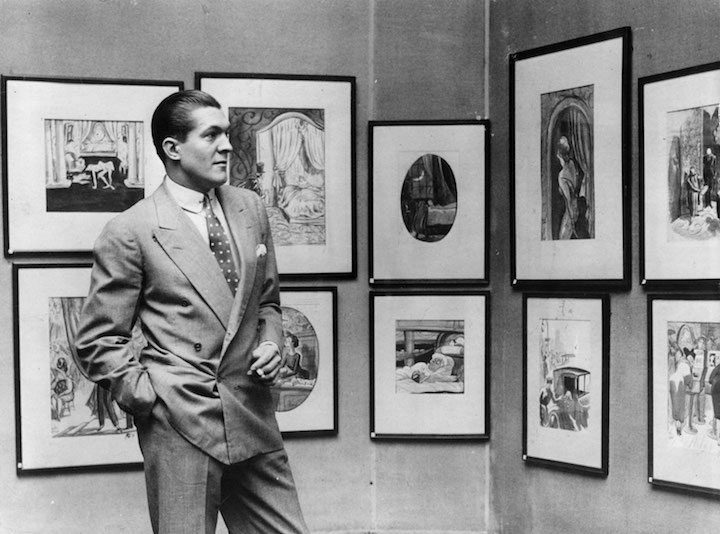
INTERNATIONAL APPEAL…less than four years after his Valentine Galleries debut, Peter Arno exhibited his drawings to great acclaim at the Leicester Galleries in London, October 1932. (Encyclopædia Britannica)

Next Time: Midnight Frolic…
Beyond 96th Street

The New Yorker stepped out of its Manhattan offices at 25 West 45th Street and headed north to see what lay beyond 96th Street and Park Avenue, to “a land on to which realtors may not push.”

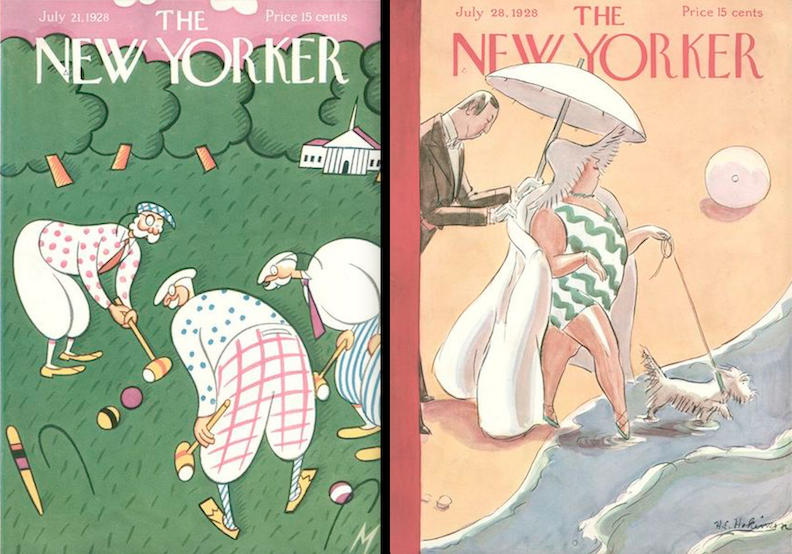
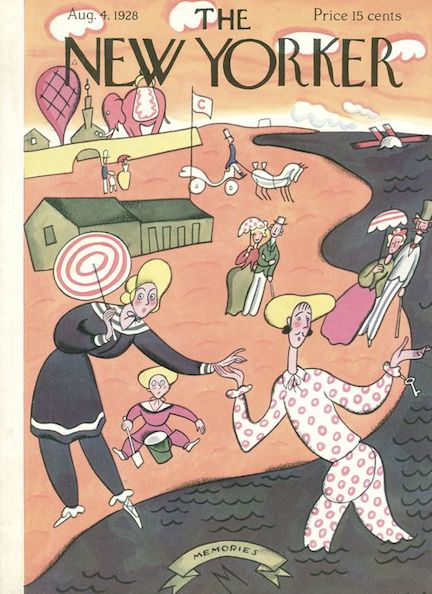
July 21, 1928 cover by Julian de Miskey; July 28, 1928 cover by Helen Hokinson.

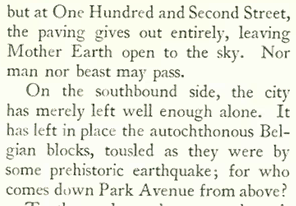
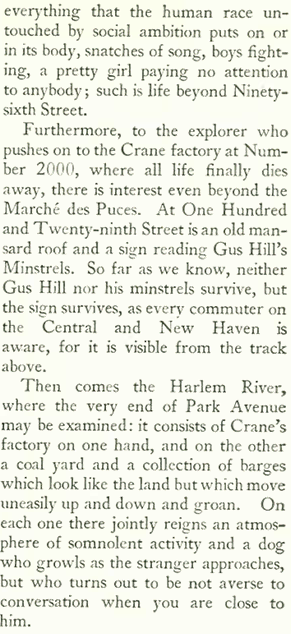
In the early to mid 20th century, 96th street represented a real dividing line across Park Avenue, separating Manhattan from the “frontier” to the north. Although developers have since breached this line (particularly beginning in the 1980s), back in 1928 it truly marked an end of sorts to Park Avenue—even the paving ran out by 102nd Street. The July 28, 1928 “Talk of the Town” observed:

FRONTIER NO MORE…Aerial view of Park Avenue from 96th Street (the X at bottom left) all the way past 132nd Street, where Park Avenue joins Harlem River Drive. The ‘X’ at the upper right hand corner marks the former location of Gus Hill’s Minstrels (mentioned in the article) at 129th and Park Avenue. (Google Maps) Click on image to enlarge

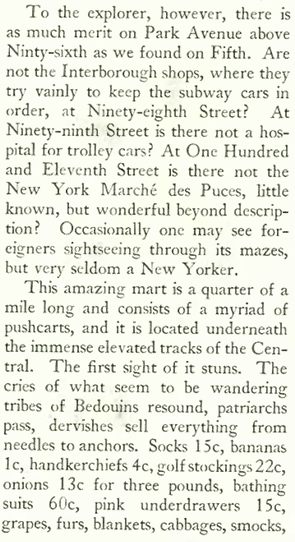
Beyond 96th a vast pushcart market was discovered to be operating under the elevated railroad tracks, while further on toward the Harlem River there were factories, coal yards, and a shuttered theatre:

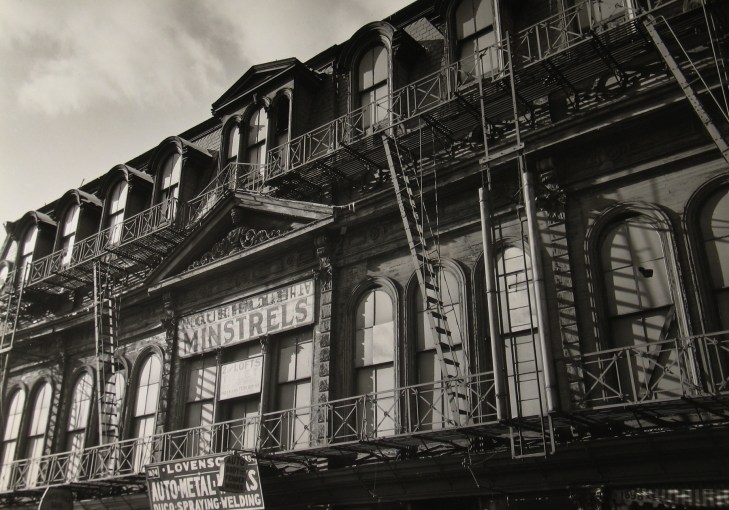
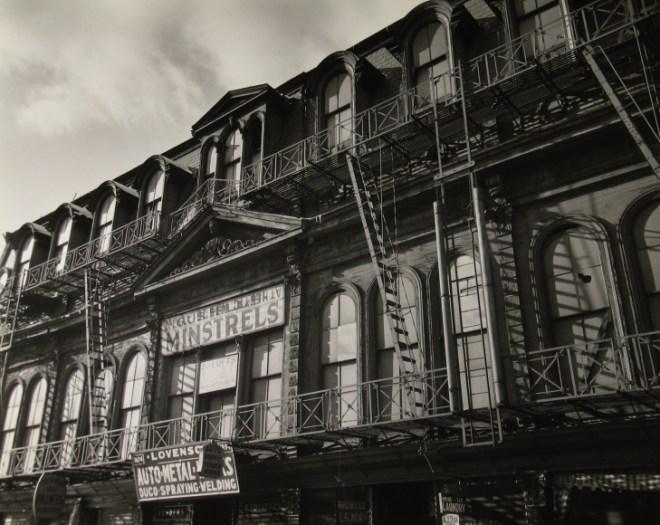
NEAR THE END OF THE LINE…The Gus Hill’s Minstrels building at the corner at East 129th and Park Avenue, facing the elevated train tracks. There was an auto garage at the lower floor. The “Minstrels” were long gone by the time the photo was taken, in 1935, by Berenice Abbott. (Museum of the City of New York)
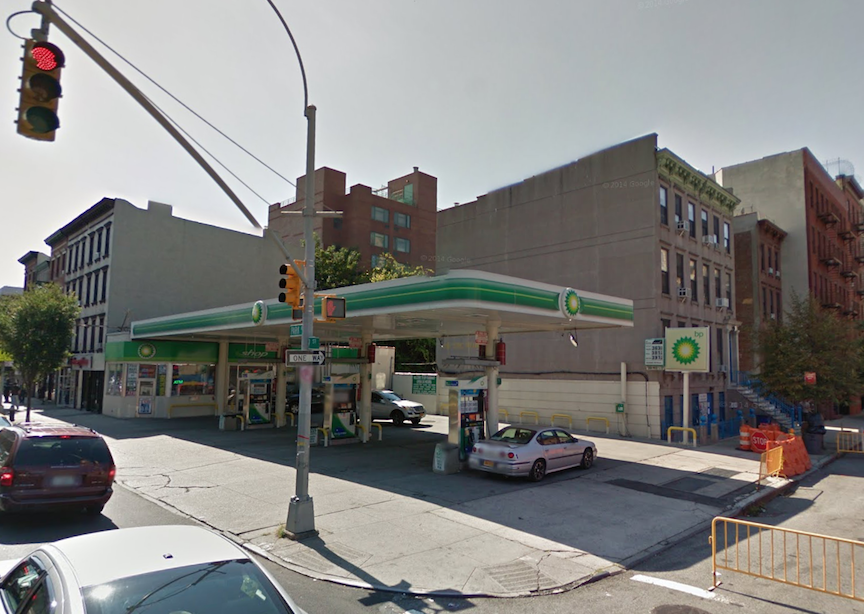
ONLY A GHOST…The former site of Gus Hill’s Minstrels, at the corner at East 129th and Park Avenue, now occupied by a filling station. (Google Maps)
SOARING…The Park Avenue elevated railroad tracks in Harlem east of 96th Street created vast covered spaces frequented by pushcart vendors. (nyc-architecture)
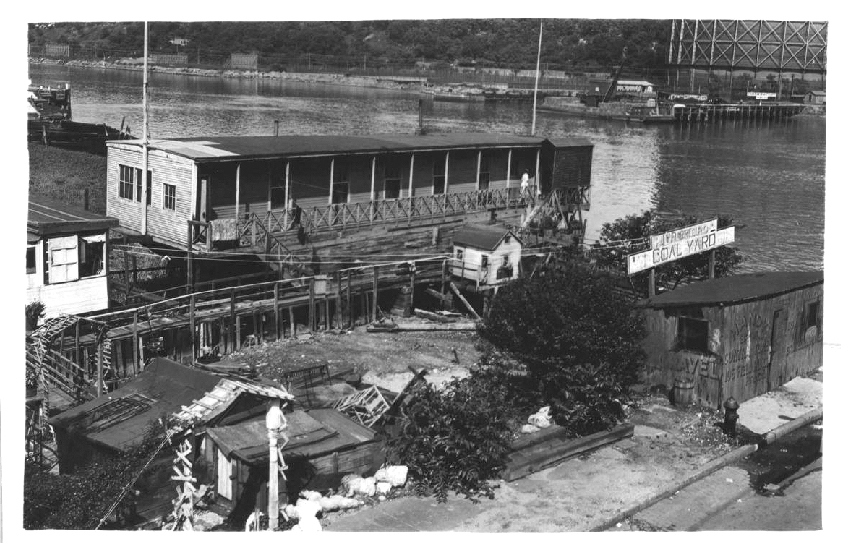
UP THE RIVER…A houseboat colony near a coal yard at 208th Street by the Harlem River, 1933. (myinwood.net)

 *  *  *

Sport of Lords and Ladies

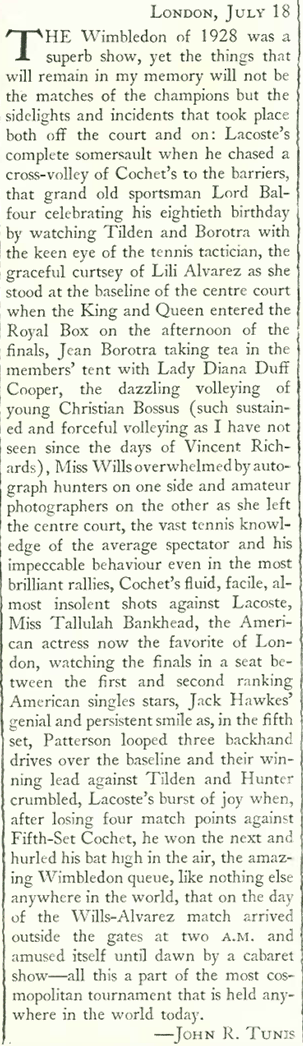
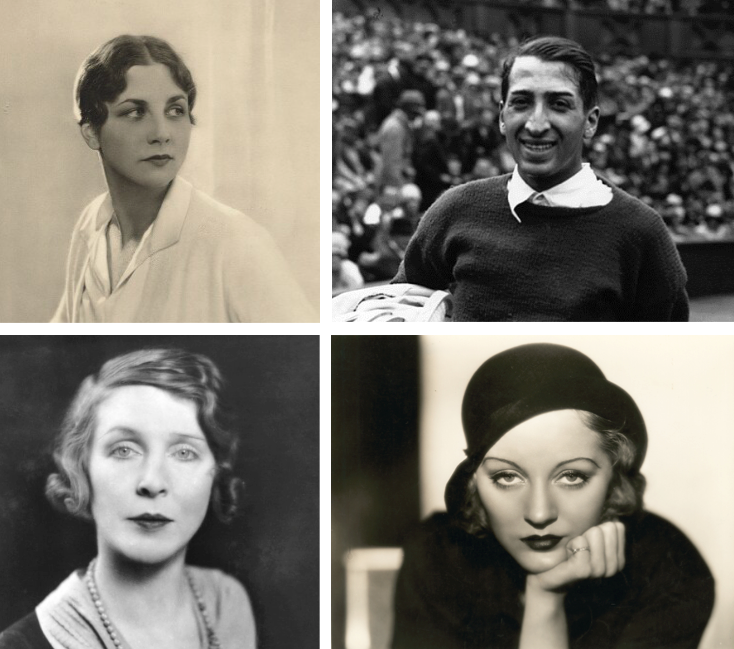
The New Yorker’s sportswriter John Tunis paid a visit to the 1928 Wimbledon tennis tournament, where he took in a scene that included several celebrities:

FACES IN THE CROWD at the 1928 Wimbledon included clockwise, from top left, the tournament’s singles champions Helen Wills Moody and René LaCoste; and spectators such as actress Tallulah Bankhead and Lady Diana Duff Cooper. (Wills Moody image from 1928 courtesy National Portrait Gallery, London; circa 1930 Bankhead image, Alchetron; Lady Diana image dated 1931, (UK National Portrait Gallery); and LaCoste photo taken after he won the men’s singles title at the 1928 Wimbledon, bltimes.com)

*  *  *

From Our Advertisers

The July 28 issue included yet another Dr. Seuss-illustrated ad for Flit insecticide. No doubt Seuss would later regret such an illustration, as later in life he strongly opposed racism and supported environmental causes.

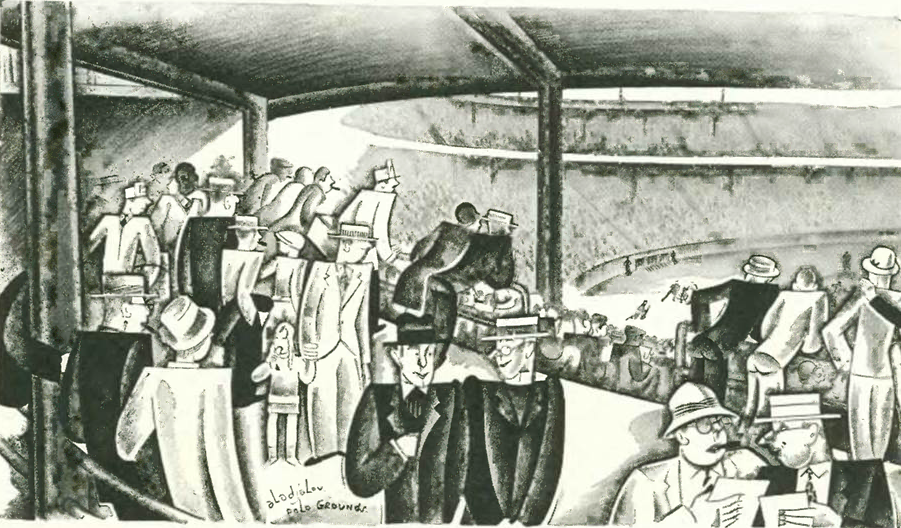
Also from the July 28 issue, a detail from a two-page illustration of baseball fans at the Polo Grounds by Constantin Alajalov, which appeared in “The Talk of the Town” section:

 *  *  *

From Our Advertisers, Part II:

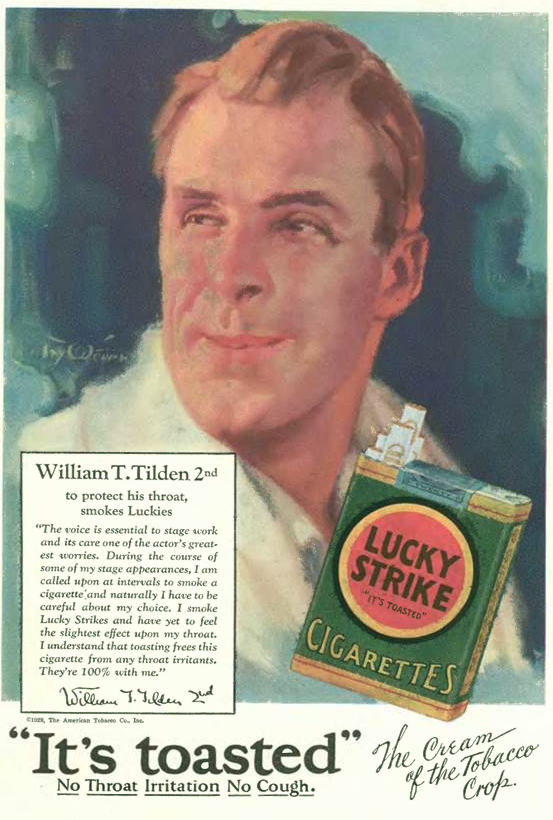
Jumping back an issue, to July 21, 1928, we find tennis great (and sometime film actor) Big Bill Tilden hawking the toasted pleasures of Lucky Strike cigarettes on the magazine’s back cover:

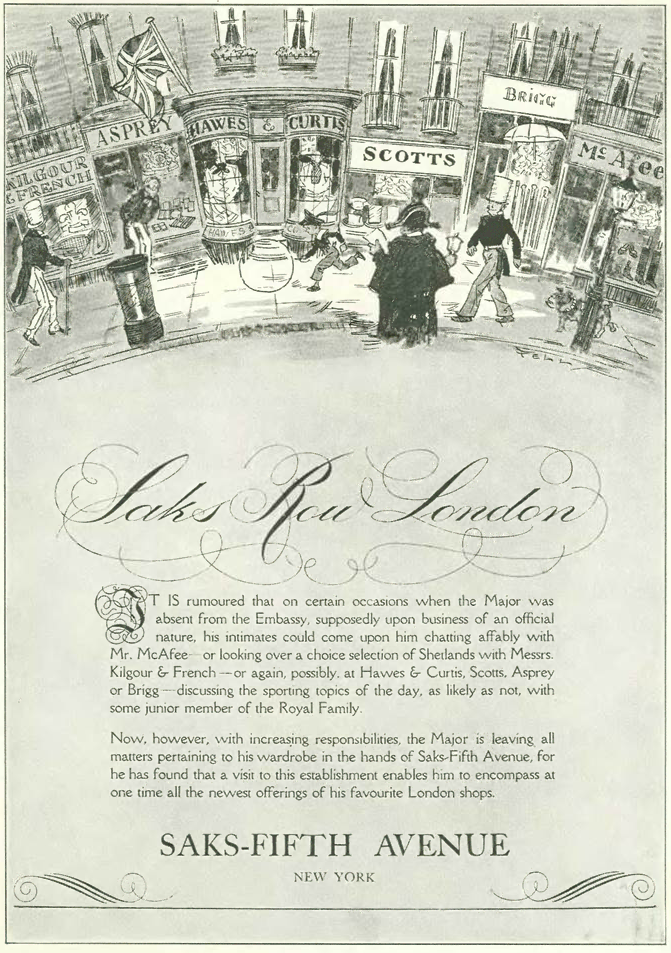
As I’ve noted before, many New Yorker ads appealed to the Anglophilic pretensions of its striving readershship. This one below from Saks is a particularly egregious example…

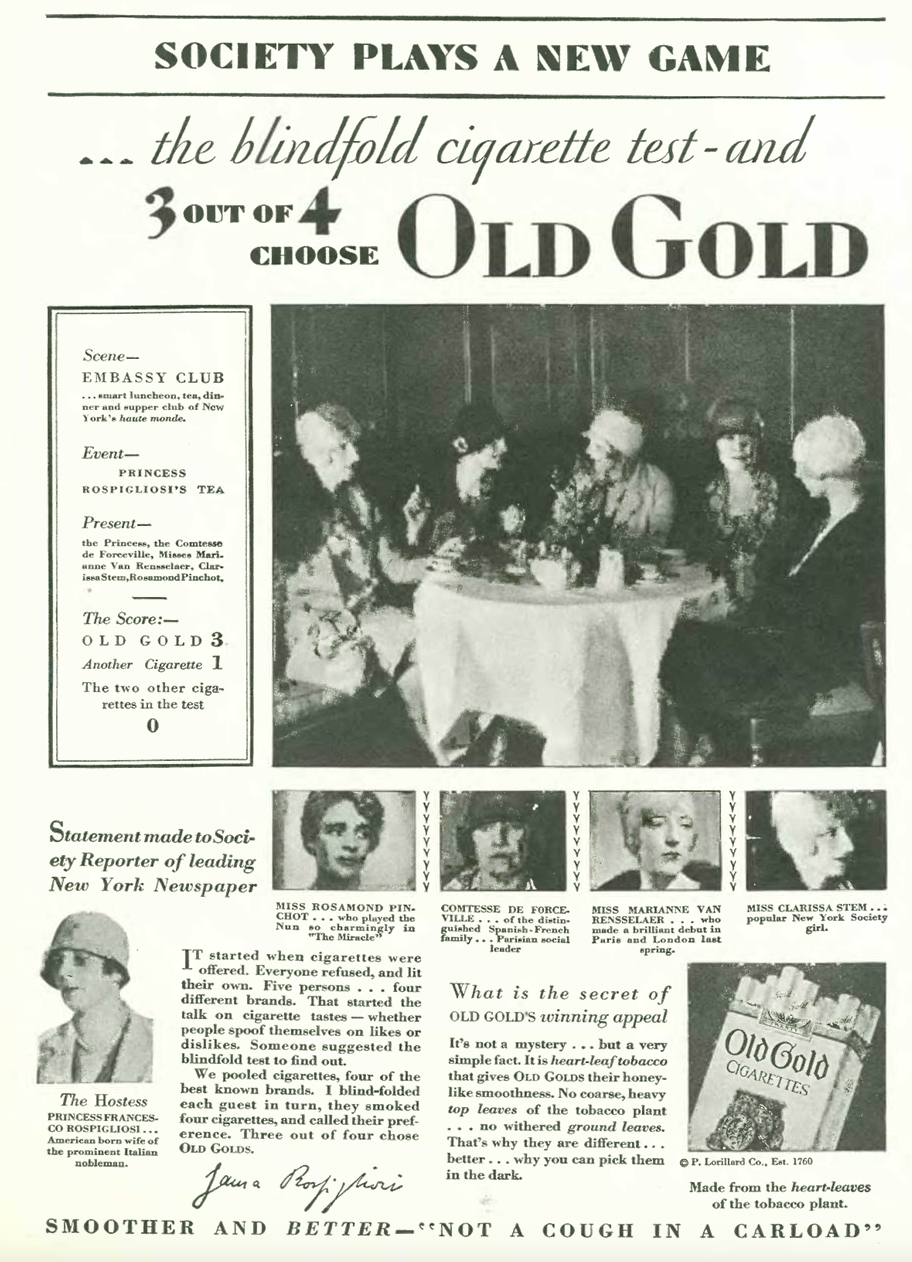
…other social strivers could look to the example of these society matrons who picked up some spare cash shilling for Old Gold cigarettes…

I close with a couple of cartoons from the July 21 issue by Barbara Shermund and Peter Arno:

Next Time: (Another) Fight of the Century…