Thackeray, In Color

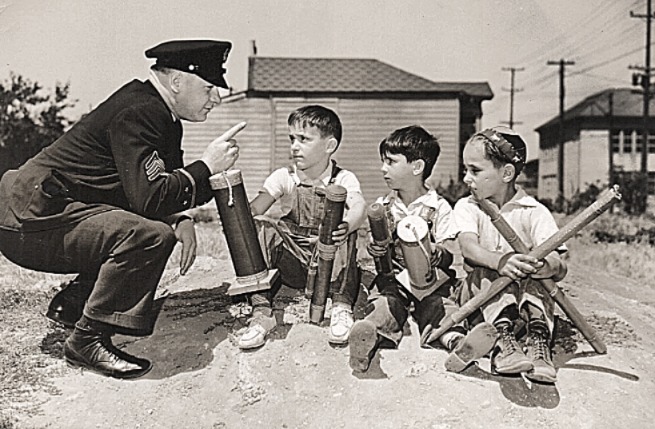
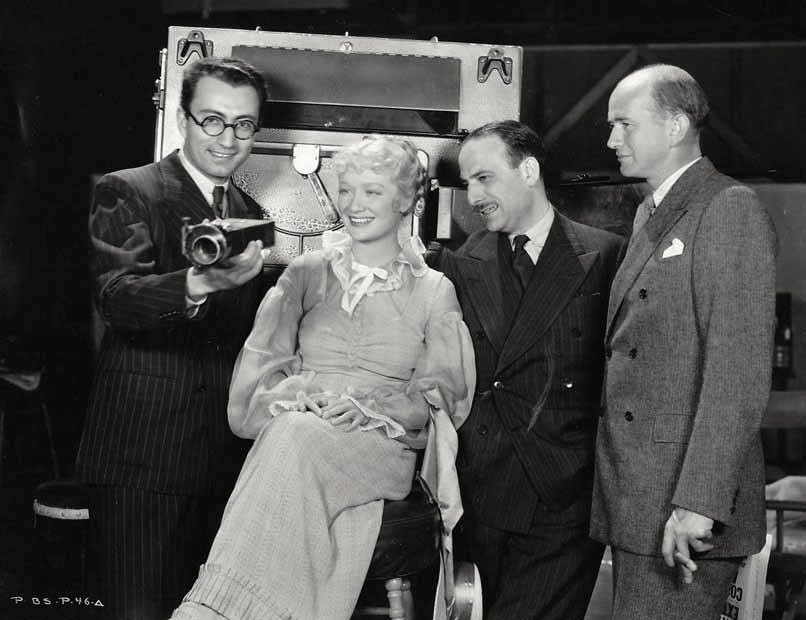
Above: Seated in front of a massive Technicolor camera, Rouben Mamoulian directs Miriam Hopkins (also inset) in Becky Sharp, the first feature shot entirely in three-color Technicolor. The film was based on character from William Makepeace Thackeray's 1848 novel Vanity Fair. (UCLA Film & Television Archive)

Rouben Mamoulian’s 1935 production of Becky Sharp wasn’t the first color film, but it was the first feature film to use the newly developed three-strip Technicolor process throughout, setting a standard for color films to come.

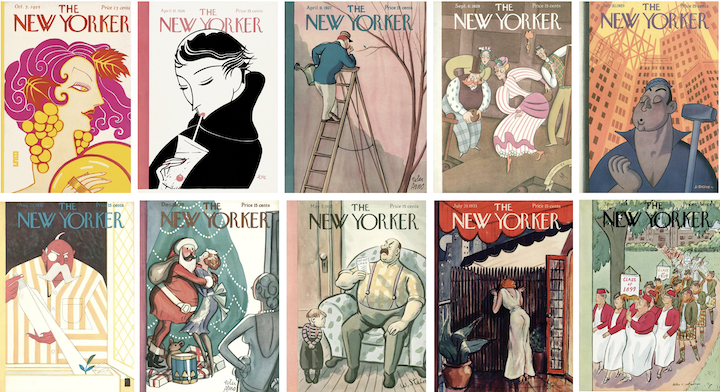
June 22, 1935 cover by Constantin Alajalov. A New Yorker contributor for thirty-four years, Alajalov (1900–1987) illustrated 170 covers for the magazine. Check out the treasure trove at Ink Spill for more on Alajalov and all things New Yorker.

Earlier color processes included films that were hand-tinted. Others used various dyes and techniques that included photographing a black-and-white film behind alternating red/orange and blue/green filters, and then projecting them through red and green filters. The inability to reproduce the full color spectrum, among other issues, had many critics dismissing the idea of color films altogether.

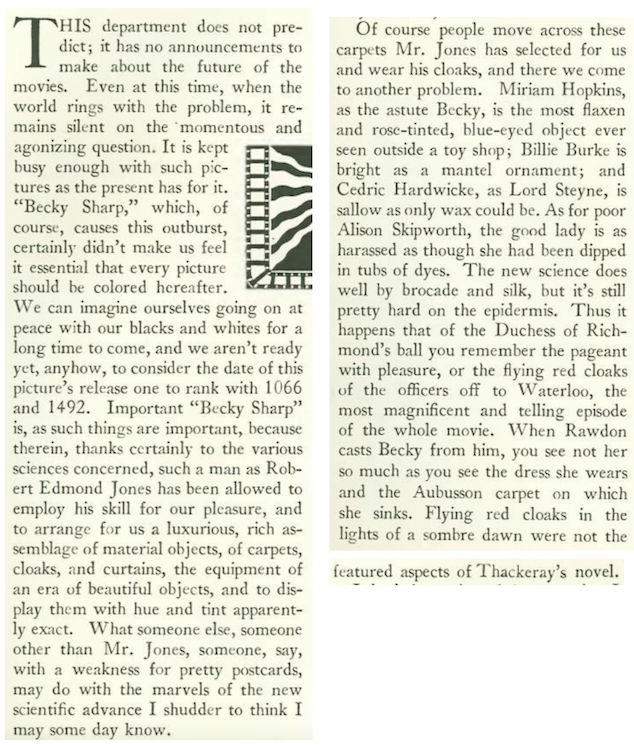
Mamoulian was fascinated by the possibilities of color film; by producing (and later directing) the film, he showcased the advancements in Technicolor. Film critic John Mosher had these observations:

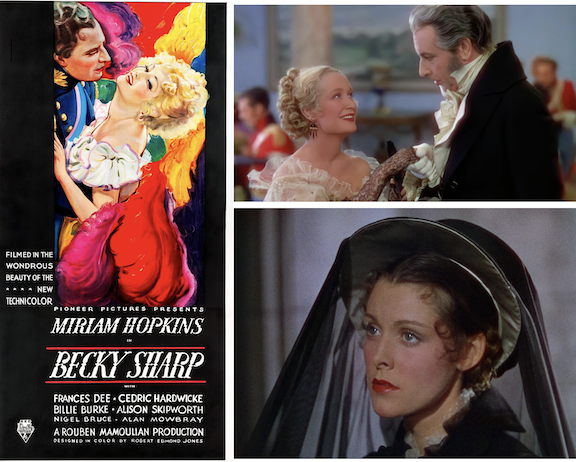
THIS IS A TEST…Considered a landmark in cinema as the first feature film to use the newly developed three-strip Technicolor production throughout, in many ways the film validated this advanced color technology. Top photo, Miriam Hopkins portrayed Becky Sharp, a socially ambitious woman (seen here with Cedric Hardwicke) who climbs the British social ladder with the help of her best friend, Amelia Sedley (Frances Dee, bottom photo). (Wikipedia/Amazon)
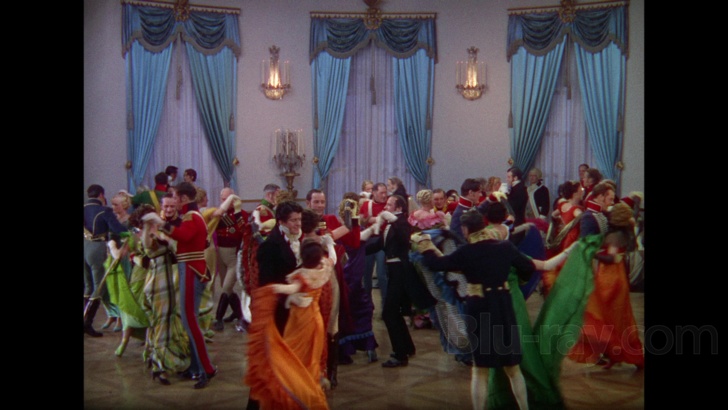
IT WAS FUN ANYWAY…Critic John Mosher was thrilled by the swirl of colors in the ballroom scene, even if flying red cloaks weren’t an aspect of William Makepeace Thackeray’s 1848 novel Vanity Fair. The film, however, was actually based on an 1899 play by Langdon Mitchell, who named his play after one of the characters in Thackeray’s novel. (blu-ray.com)
WHOLE NEW WORLD…Rouben Mamoulian, Miriam Hopkins, visitor Michael Balcon, and Kenneth Macgowan on the set of Becky Sharp. According to film historian Marc Spergel, “Mamoulian was fascinated by color…He saw in the color process another opportunity for innovations that would set a standard for the new technology…His interest lay in choosing color for psychological effect rather than mere realistic reproduction or decorative dividends. With the advent of color processing, particularly Technicolor processing—with its non-realistic, supersaturated color—Mamoulian could approach the film medium like a painter with a palette.” (Wikipedia)

Mosher also checked out the latest from Robert Montgomery and Joan Crawford, who exchanged marital banter in No More Ladies, while George Raft went all gangster in Dashiell Hammett’s The Glass Key.

HIGH FIDELITY…Top photo, socialite Marcia (Joan Crawford) is determined to keep her husband (Robert Montgomery) faithful in No More Ladies; below, George Raft does what he does best (playing a gangster) in The Glass Key. (jacksonupperco.com/notesoncinematograph.blogspot.com)

 * * *

Astor’s Risk

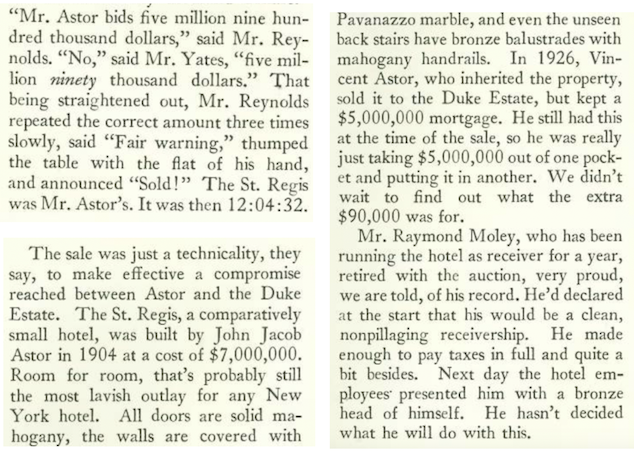
“The Talk of the Town” paid a visit to the Real Estate Exchange, where Vincent Astor re-acquired the St. Regis Hotel for five million and change. He then sunk another $500,000 (roughly $12 million today) into the hotel to further its luxurious status (including adding air-conditioning). The hotel’s famed King Cole Room and the Maisonette Russe restaurant opened in October 1935. Excerpts:

GOOD INVESTMENT…At left, Fifth Avenue facade of the St. Regis as seen in 2022. Right, entrance to the King Cole bar in the 55th Street annex. Thanks in part to the repeal of Prohibition, the hotel’s restaurant business increased by 300 percent between 1935 and 1937. (Wikipedia)

 * * *

School Days

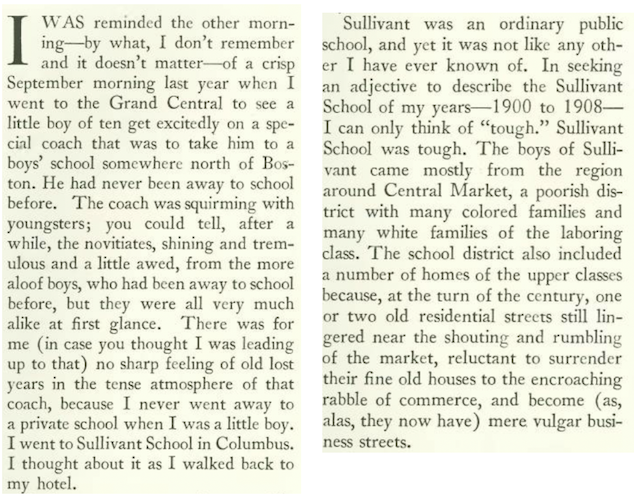
James Thurber recalled his “tough” years at Sullivant School in Columbus, Ohio, in the essay, “I Went to Sullivant.” Brief excerpts:

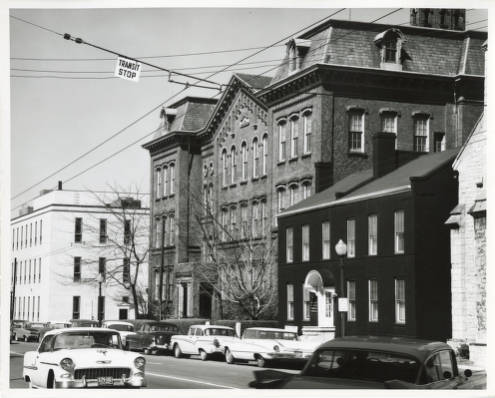
ALMA MATER…The Sullivant School James Thurber attended was completed in 1871 and was a school until 1923 when it became the offices for Columbus City Schools. This photo was taken shortly before it was demolished in 1961. (columbuslibrary.org)

 * * *

Avril en juin

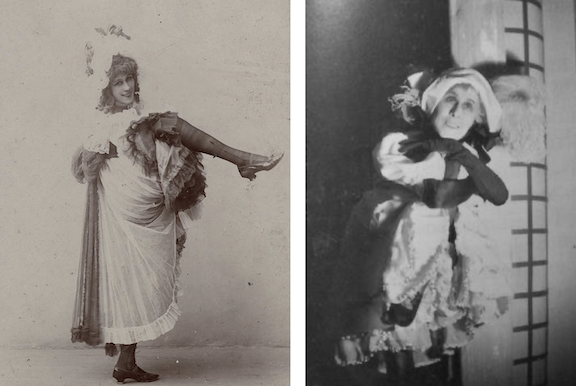
Paris correspondent Janet Flanner gave a rundown on the latest happenings, including the Toulouse-Lautrec costume ball that attracted none other than Jane Avril, the famed French can-can dancer of the 1890s who could still kick up her heels. Flanner gave Avril’s age at 80, but records indicate she was closer to 70.

STILL KICKING…Jane Avril (1868–1943) was a French can-can dancer at the Moulin Rouge in Paris and a frequent subject of painter Henri de Toulouse-Lautrec. The wispy Avril, known for her jerky movements and sudden contortions, was nicknamed La Mélinite, after an explosive. At top left, Avril in her heyday circa 1890s; at right, Avril at the 1935 Toulouse-Lautrec costume ball. Read more about Avril’s strange life at one of my favorite “rabbit hole” sites, Messy Nessy. (messynessychic.com/Pinterest)
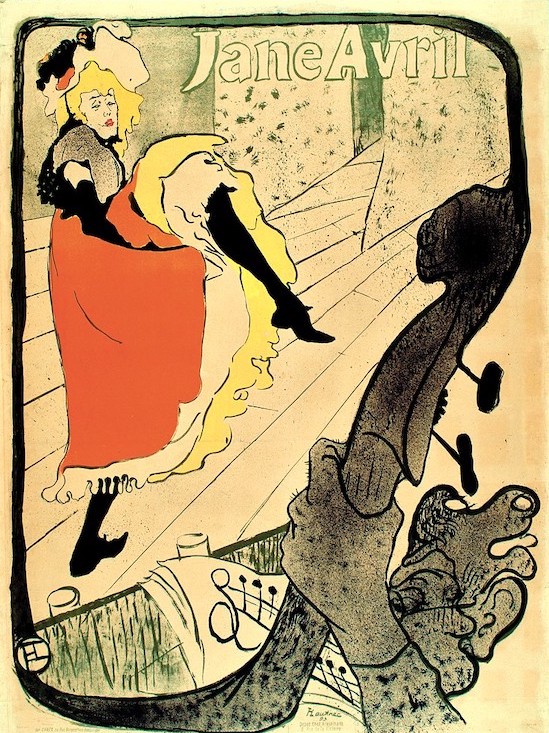
An 1893 Toulouse-Lautrec lithograph featuring Jane Avril, a lifelong friend of the artist. Avril commissioned this print to advertise her cabaret show at the Jardin de Paris. (met museum.org)

 * * *

From Our Advertisers

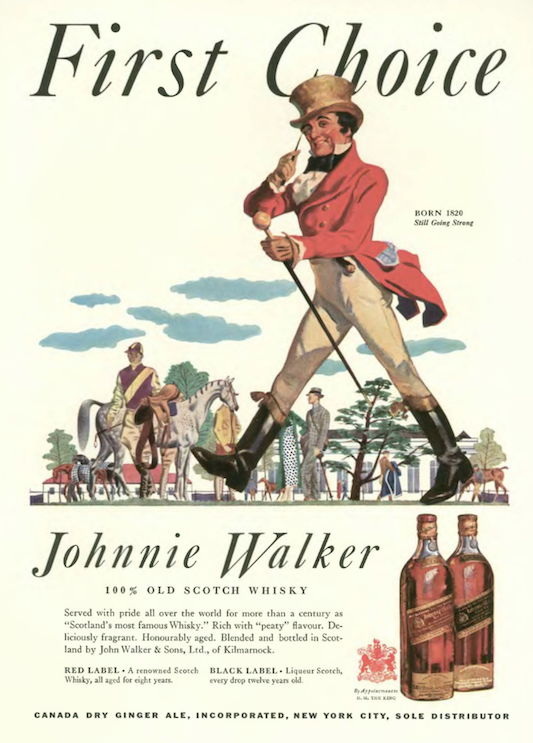
We begin with the inside front cover, Johnnie Walker strutting along at the horse races…

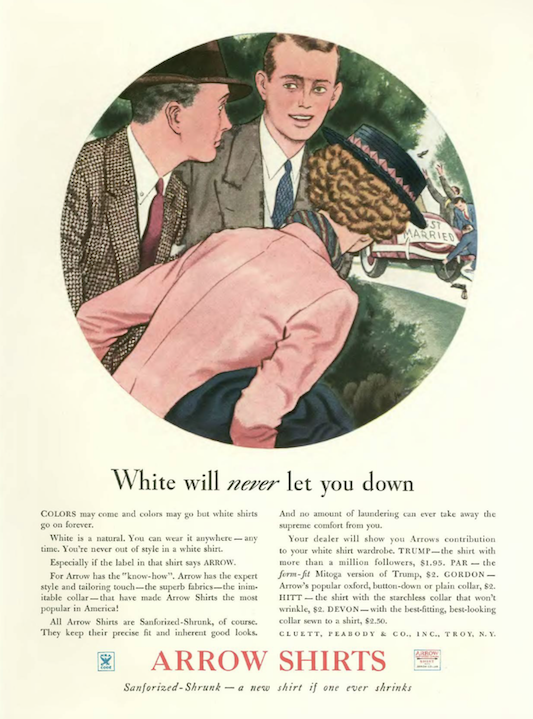
…the inside back cover belonged to Arrow Shirts…

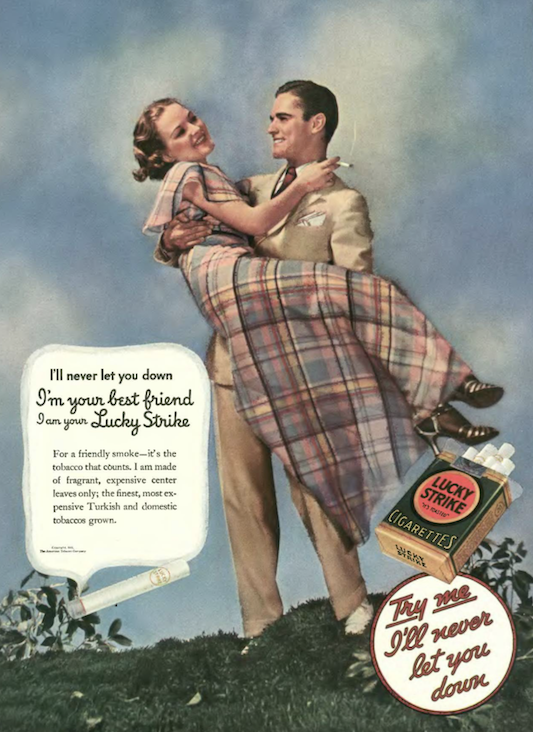
…and no surprise that the back cover featured a stylish woman enjoying a cigarette, in this case a Lucky…

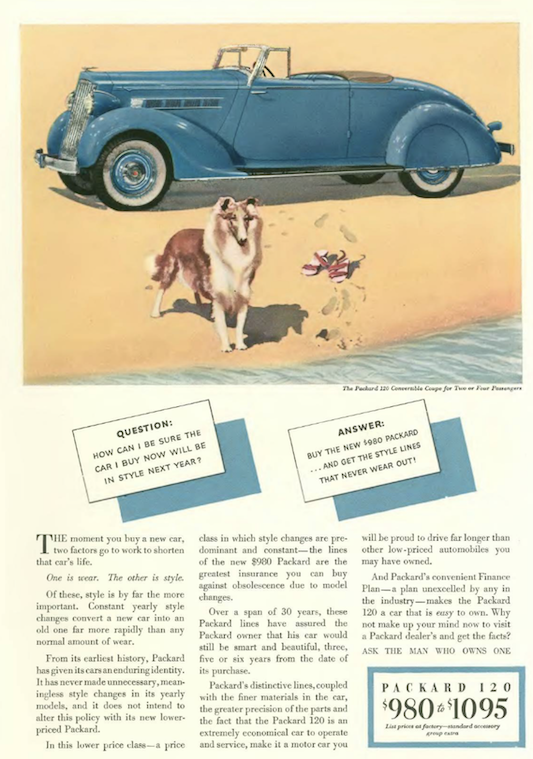
…Packard continued to run these colorful, wordy ads that made the case for owning a lower-priced Packard, which I’m sure was a fine automobile…
John Hanrahan, who early on served as The New Yorker’s policy council and guided it through its lean first years, be­came the publisher of Stage magazine (formerly The Theatre Guild Magazine) in 1932. In 1933 Stage became part of the Ultra-Class Magazine Group’s line-up that included Arts & Decoration and The Sportsman. Stage published its last issue in 1939, and I don’t believe the other two survived the 1930s either…this Mark Simonson site looks at the striking design elements of an issue from 1938…

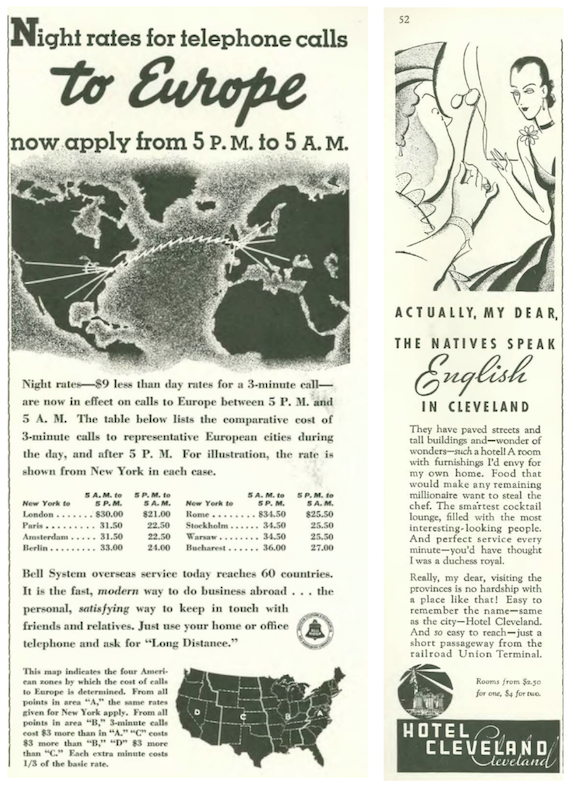
…a couple from back of the book…calling Europe by telephone in 1935 was an impressive feat, however it could cost you roughly $700 in today’s dollars to make a three-minute call to London…the one-column ad at right offered an Anglophilic appeal to those visiting Cleveland…

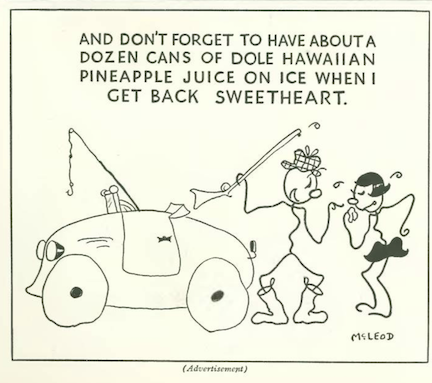
…this simple spot for Dole pineapple juice caught my eye because it was illustrated by Norman Z. McLeod (1898–1964), who drew Christie Comedy title cards during the Silent Era…

McLeod was also an acclaimed director of Marx Brothers comedies Monkey Business (1931) and Horse Feathers (1932), W.C. Fields’ It’s a Gift (1934), Danny Kaye’s The Secret Life of Walter Mitty (1947) and two of the Topper films.

HE GOT AROUND…Clockwise, from top left, director Norman Z. McLeod on the set of 1941’s Lady Be Good with actress Ann Sothern; Young’s familiar stick figure drawings on title cards for the 1928 silent short Loose Change; Cary Grant and Constance Bennett with Roland Young in 1937’s Topper. (TCM.com/silentology.wordpress.com/charlesmatthews.blogspot.com)

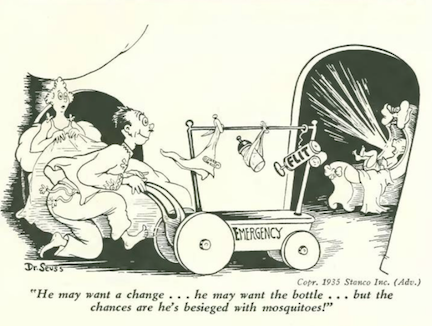
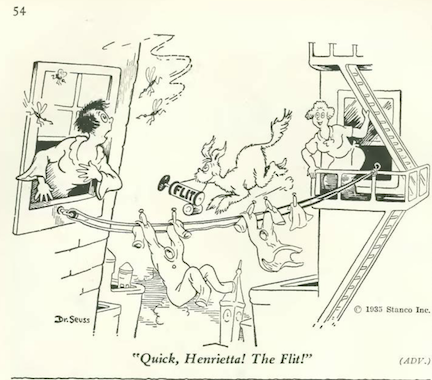
Dr. Seuss was back with his Flit advertisements…

Richard Decker illustrated this ad for Borden’s “Golden Crest” Farm Products…

…which segues into our cartoonists, and this curious spot drawing by James Thurber

Perry Barlow gave us the early days of the “Bed and Breakfast”…

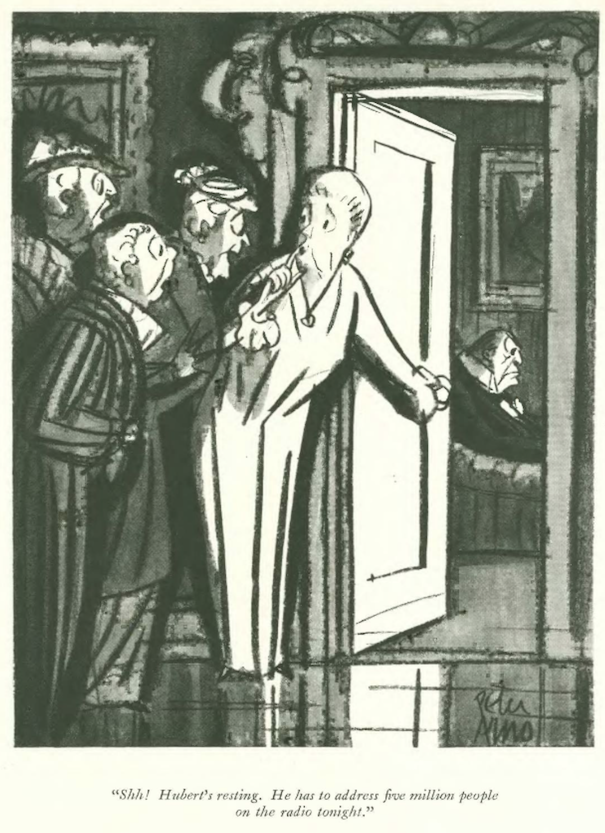
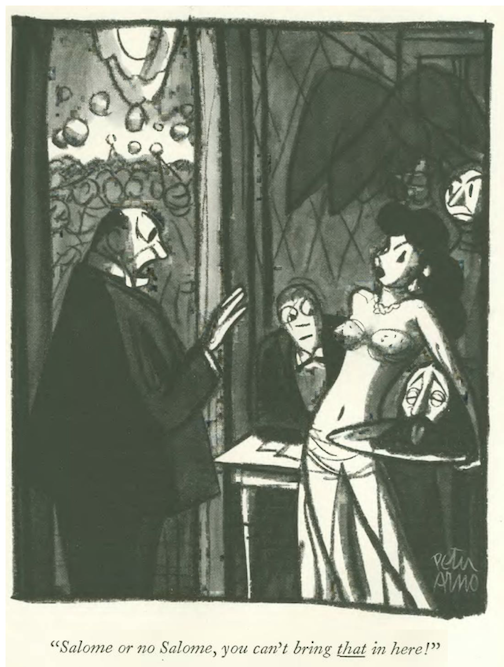
Peter Arno, and no rest for the titans of industry…

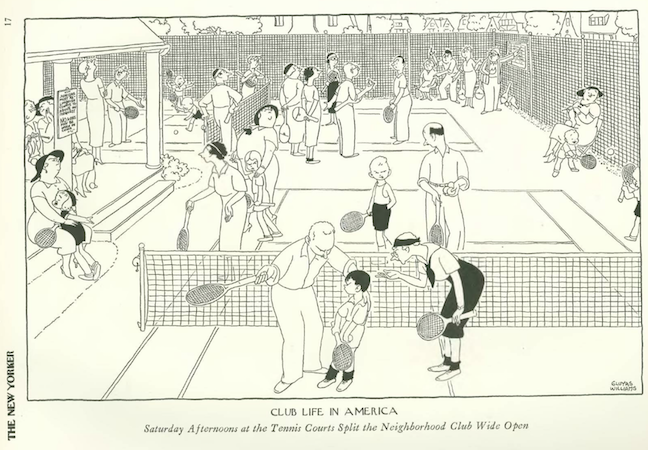
Gluyas Williams continued to take a sideways glance at Club Life in America”…

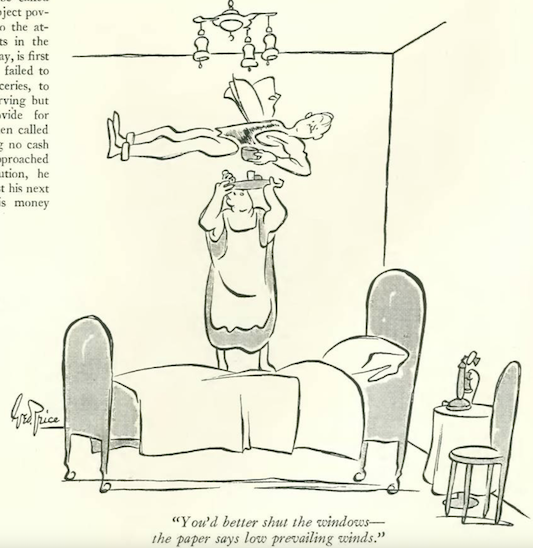
…from George Price…back in the day, tattoos were usually confined to sailors and longshoreman…this particular fellow found himself with some outdated ink…

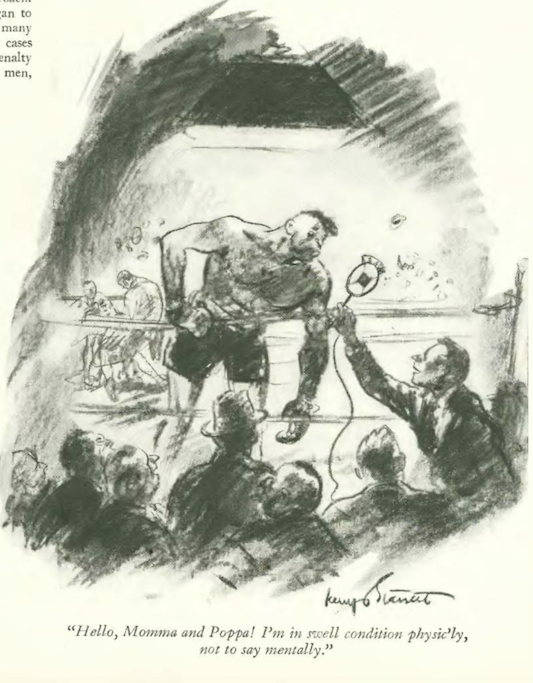
Kemp Starrett took us ringside…
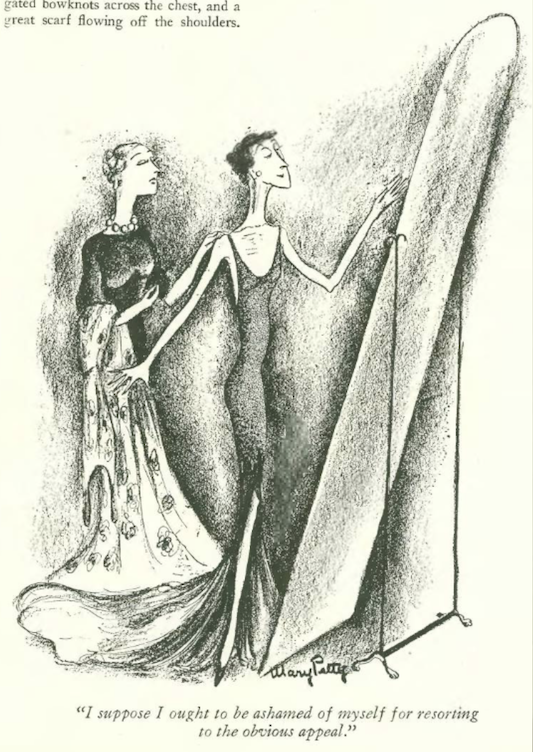
Mary Petty reflected on a bit of narcissism…

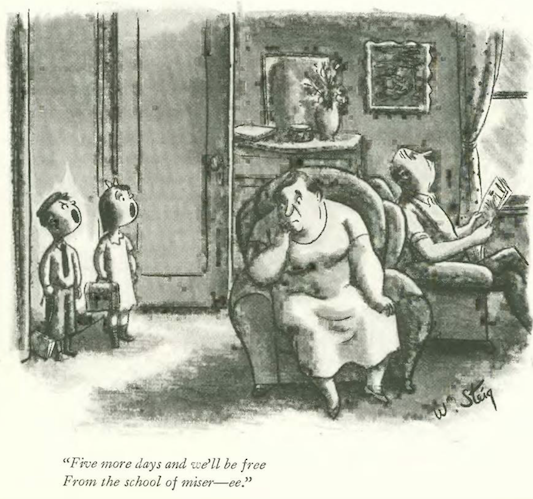
…and we close with William Steig, and mixed feelings about the summer season…

Next Time: Happy Motoring…

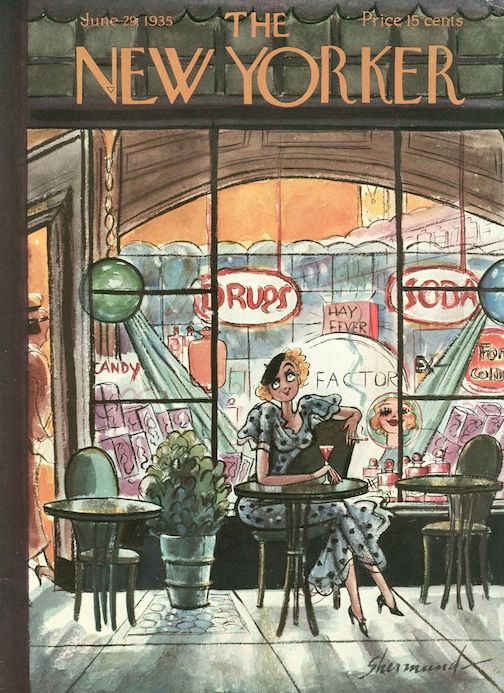
Vive La Normandie

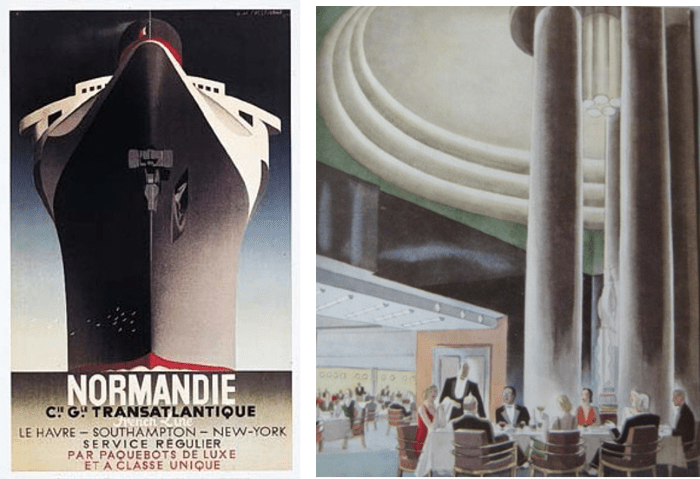
Above: At left, Adolphe Cassandre's famed 1935 depiction of the S.S. Normandie; right, image from a 1935 promotional booklet published by the French Line.

When the S.S. Normandie entered service in 1935, she was the largest and fastest passenger ship afloat, crossing the Atlantic in a little over four days. The ship was so impressive that even the imperturbable Janet Flanner expressed enthusiasm over its launch.

May 25, 1935 cover by Constantin Alajalov.

As Paris correspondent, Flanner was giving New Yorker readers a preview of Normandies May 29 maiden voyage from Le Havre to New York City.

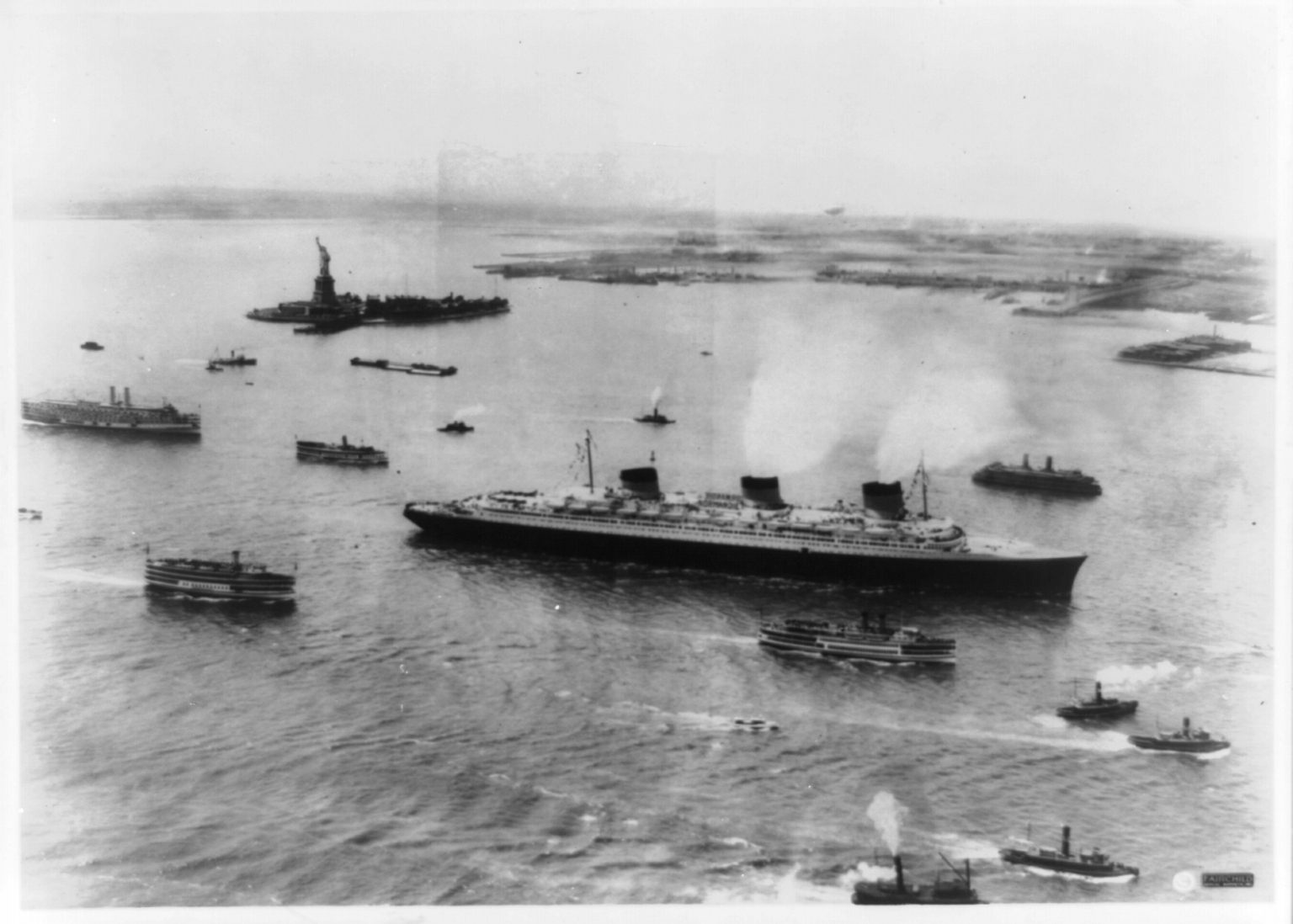
HER ENTOURAGE…The S.S. Normandie was welcomed into New York Harbor on June 3, 1935. (Wikipedia)
IMAGINE THAT…An S.S. Normandie promotional poster from 1935 depicts the ocean liner making an unlikely entrance into Manhattan. The sleek ship measured 1,029 feet (313.6m) in length and carried nearly 2,000 passengers plus 1,345 crew. It was the first ocean liner to exceed 1,000 feet in length. (Museum of the City of New York–MCNY)

To give New Yorkers some idea of the liner’s size, Flanner noted that the Normandie would stretch from 43rd to 47th Street, and if stood on her stern, would stand nearly 180 feet above the RCA Building at Rockefeller Center.

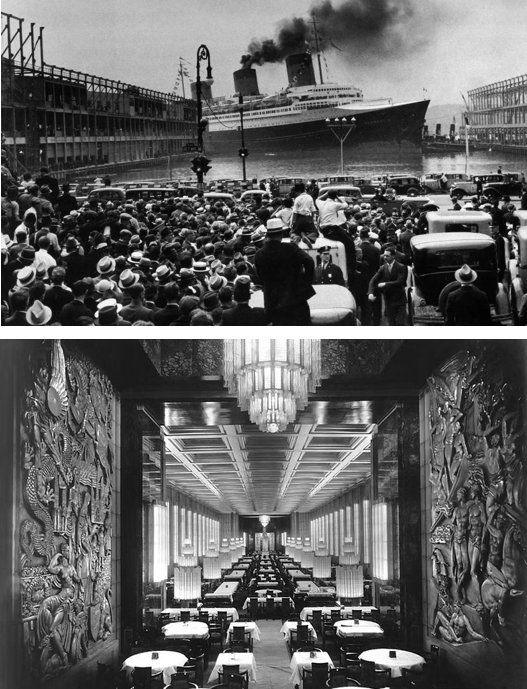
FRENCH TOAST…Top, a crowd cheers the S.S. Normandie as it arrives at New York’s Pier 88 on June 3, 1935; below, the first class dining hall was 305 feet long, 46 feet wide and three decks high. (drivingfordeco.com/MCNY)
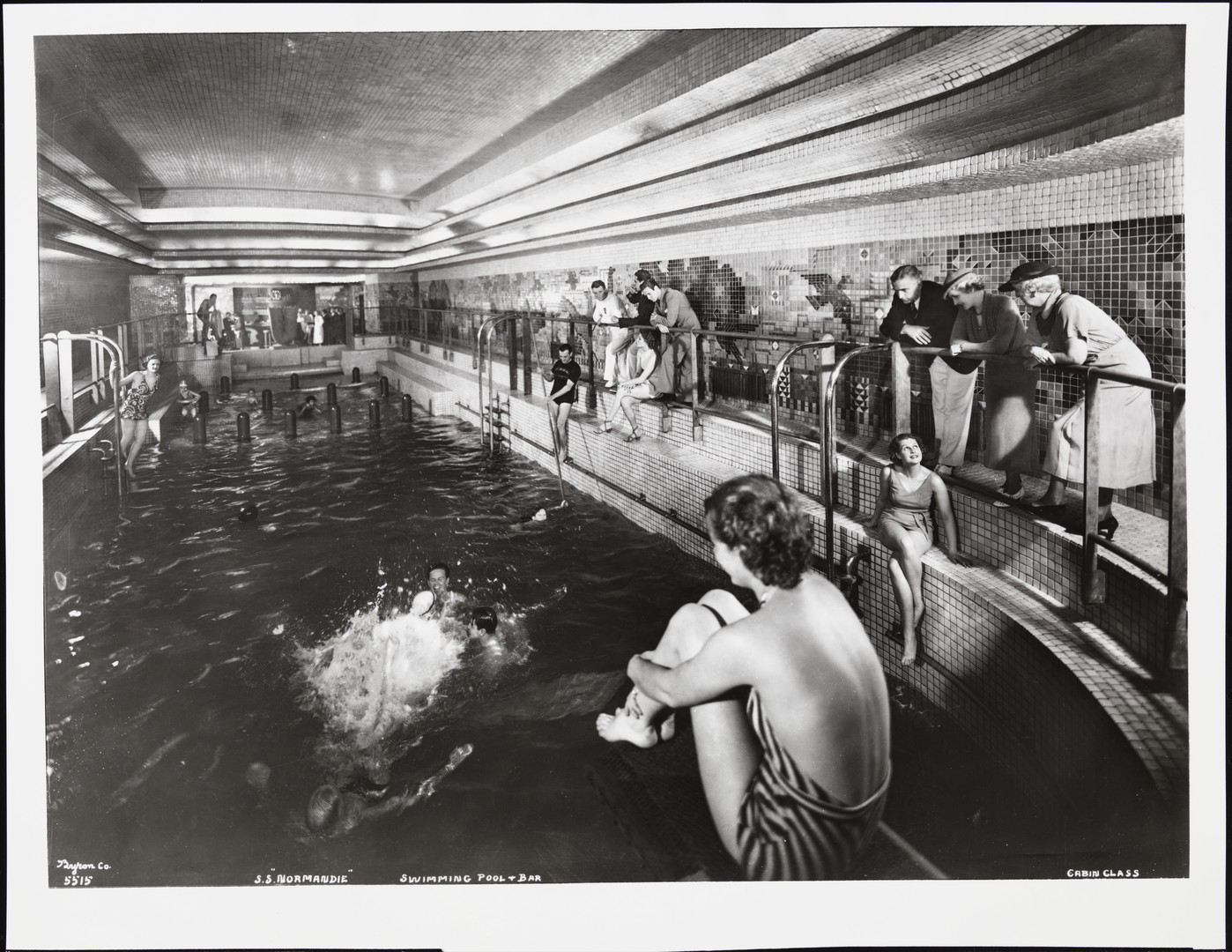
IN, AND ON THE WATER…Passengers take a plunge in the Normandie’s swimming pool, which included a bar at the far end. (MCNY)
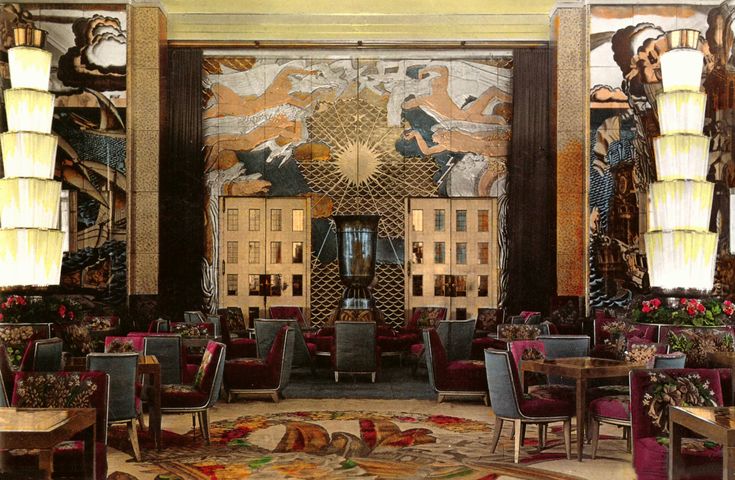
EYE-POPPING…Colorized image of the first-class lounge. (Pinterest)
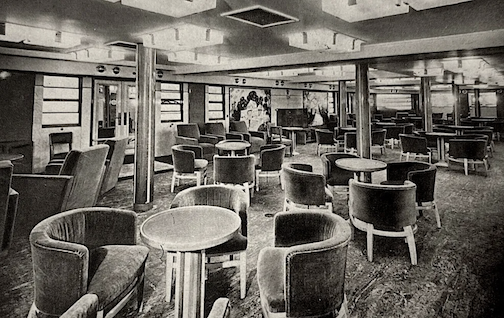
BARGAIN…Accommodations for weren’t too bad, either, for the other classes. Here is the 3rd class salon. (drivingfordeco.com)
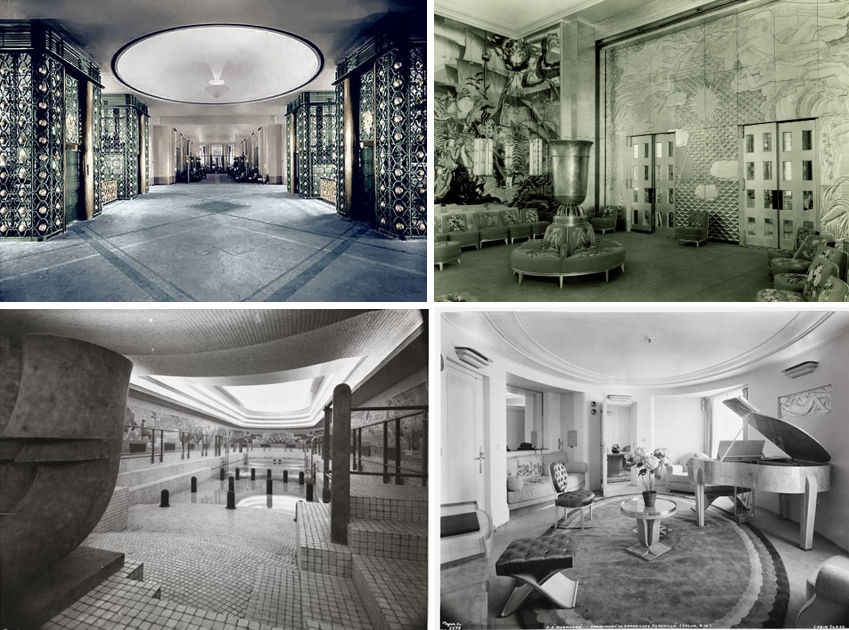
TAKE YOUR PICK…Clockwise from top left, elevators decorated in sea shells; the rear of the Grand Salon; a first class suite; view of the swimming pool. An incredible scale model of the S.S. Normandie is displayed on the Queen Mary, which is permanently docked at Long Beach, CA. (MCNY)

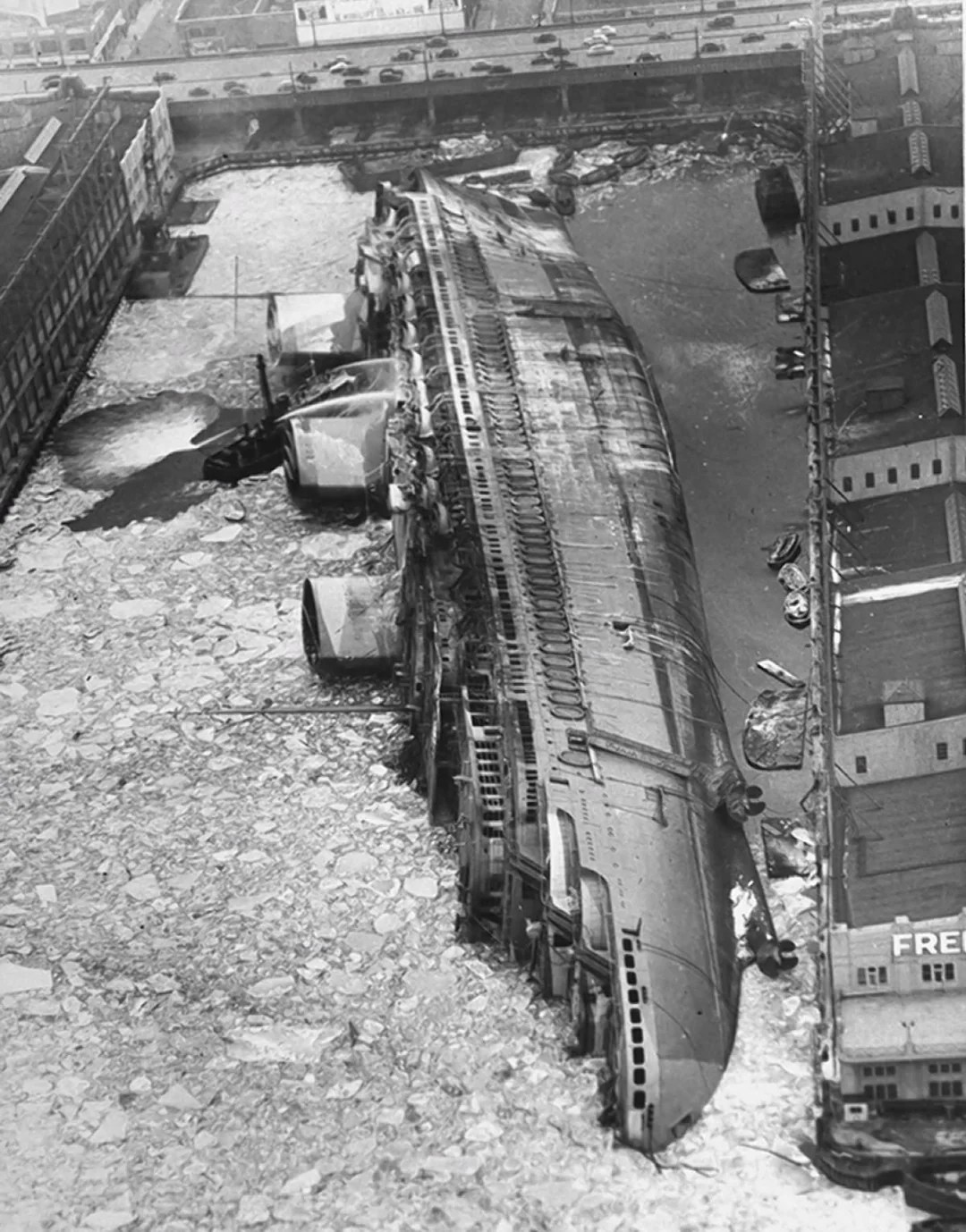
World War II would cut short the Normandie’s life. Seized in New York and renamed USS Lafayette in 1942, she was being converted to a troopship when she caught fire, capsized onto the port side, and came to rest half submerged on the bottom of the Hudson at Pier 88, the same pier where she was welcomed in 1935. She was scrapped in 1946.

THE WAGES OF STUPIDITY…The Normandie after a fire brought her glory days to an end. (Reddit)

 * * *

A Critic Is Born

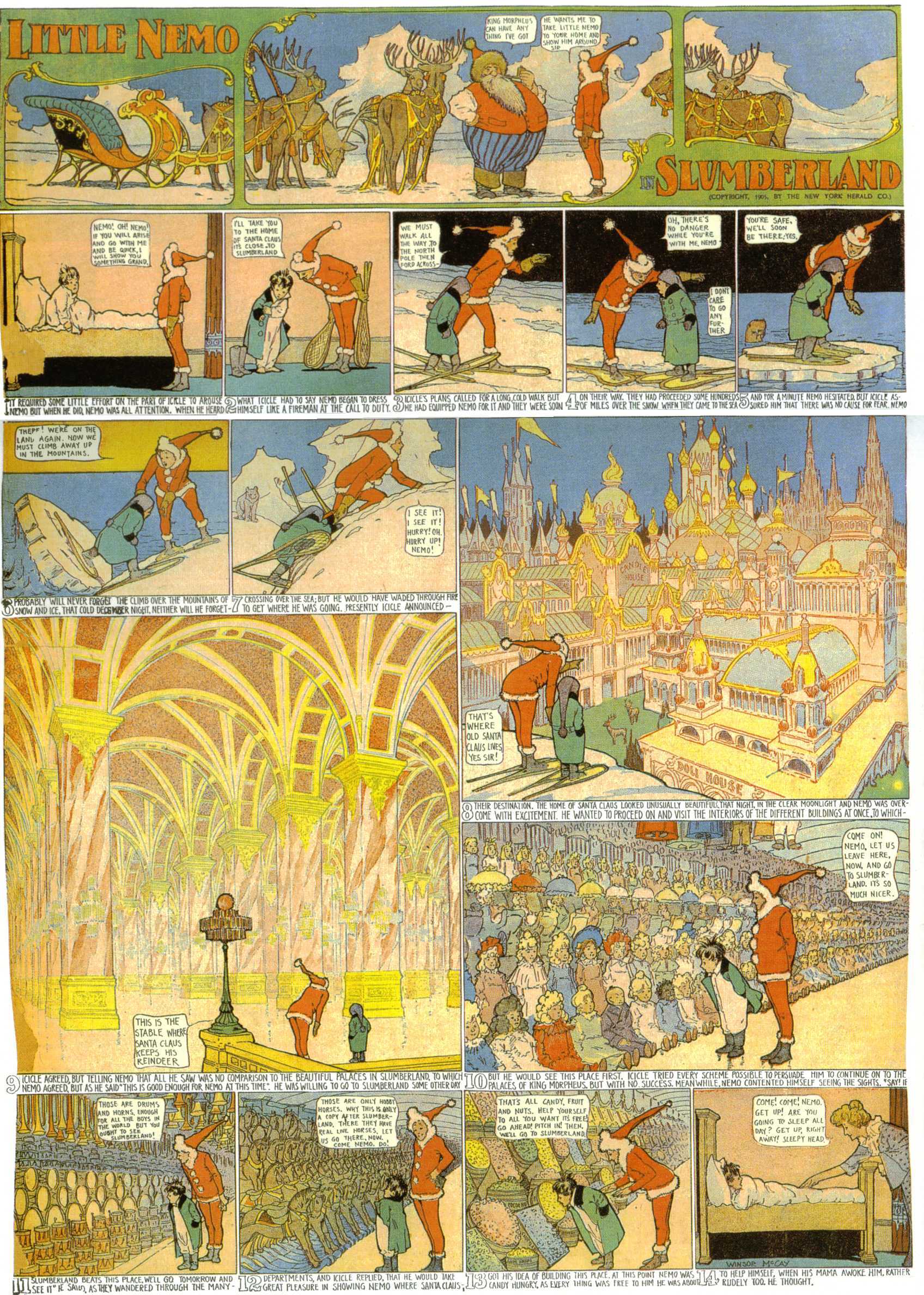
It turns out that Wolcott Gibbs (1902–1958) cut his teeth as The New Yorker’s theatre critic while he was still in short pants. Gibbs recalled his five-year-old self in an essay that described his first experience with the theatre—a play based on the New York Herald’s popular comic strip, Little Nemo in Slumberland, by Winsor McCay. In parallel with Gibbs’ childhood, the strip ran from 1905 to 1911.

As a child, Gibbs was wild about Little Nemo’s adventures, but the stage adaptation left the child disillusioned (and feeling “tricked and furious”). The New York Public Library’s Douglas Reside wrote (in 2015) that the producers, seeking to draw as wide an audience as possible, presented Little Nemo “as a bloated mixture of theatrical styles, including the minstrel show, pantomime, operetta, farce-comedy, vaudeville, revue, and ballet,” featuring three comedians “mostly superfluous to Nemo’s story.” The part of Nemo was played by a 25-year-old actor with dwarfism.

DREAMLAND…The Little Nemo strip from Dec. 17, 1905 depicted the boy’s dream of a visit to Santa’s magical city at the North Pole. (Wikipedia)
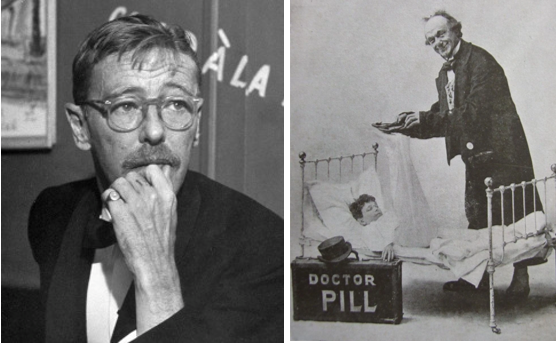
THAT’S SHOWBIZ…As a boy, Wolcott Gibbs (left) was disillusioned by a 1907 theatre adaptation of his favorite comic strip, Little Nemo in Slumberland. The play was dominated by three comedians including Joseph Cawthorn, right, who burlesqued German linguistic and cultural mannerisms for comic effect. He played Dr. Pill, the quack doctor of Slumberland’s royal court. The “boy” in the bed portraying Nemo was 25-year-old “Master” Gabriel Weigel. (Wikipedia/New York Public Library)

 * * *

Humorous Humors

Clarence Day, best known for his Life with Father stories, wrote humorously about his physical ailments and contributed a number of cartoons to The New Yorker that were accompanied by satirical poems. Day would be dead by December—after a bout with pneumonia—however, despite his ailments he would spend his last months arranging publication of his Life with Father book, which was published posthumously.

 * * *

Frankie Got Hitched

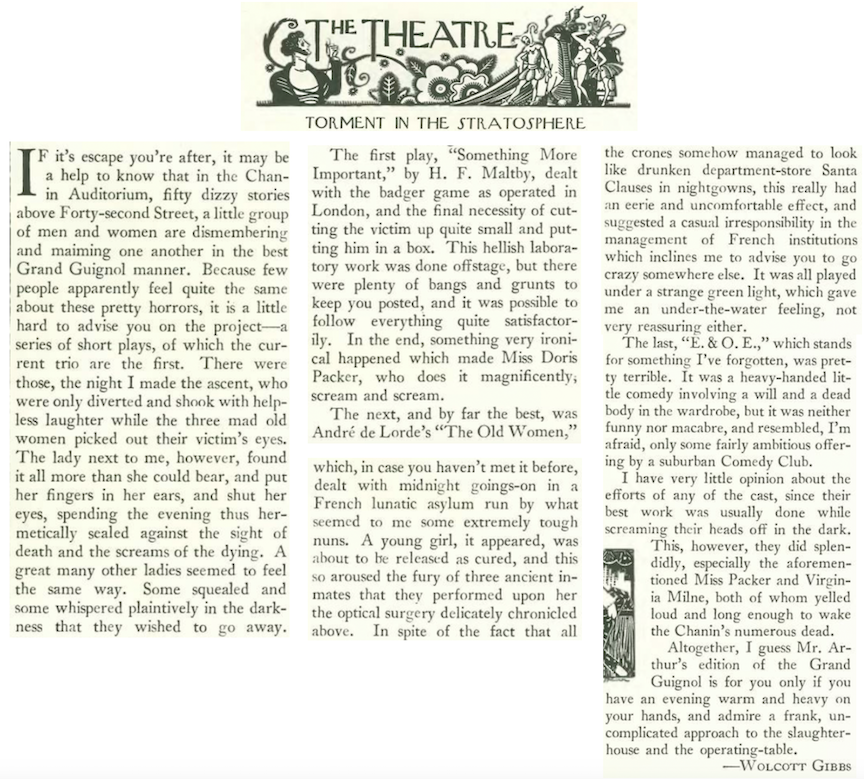
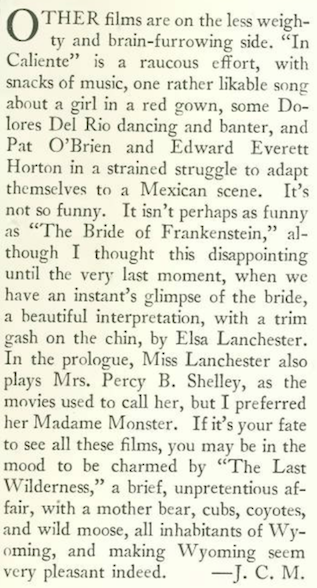
Film critic John Mosher still wasn’t finding much to rave about at the cinema, getting more chuckles from the monster mash-up of Boris Karloff and Elsa Lanchester in The Bride of Frankenstein than he did from the Dolores Del Rio vehicle Caliente.

DATE NIGHT…Top, Elsa Lanchester and Boris Karloff let the sparks fly in The Bride of Frankenstein, while Dolores Del Rio danced and chatted her way through the unfunny musical comedy Caliente. (Wikipedia/TCM)

* * *

Other features in the May 25 issue included H. L. Mencken’s continuing exploration into the origins of American names…

…and The New Yorker published its first John Cheever story, “Brooklyn Rooming House.” Of Cheever’s 180 short stories, the magazine would publish 121 of them.

A NEW FACE…In spring 1935 The New Yorker bought two John Cheever stories, paying $90 for “The Brooklyn Rooming House” and $45 for “Buffalo.” Fiction editor Katharine White urged the purchase of the stories. Above, Walker Evan’s photo of Cheever, circa 1940s. (metmuseum.org)

 * * *

From Our Advertisers

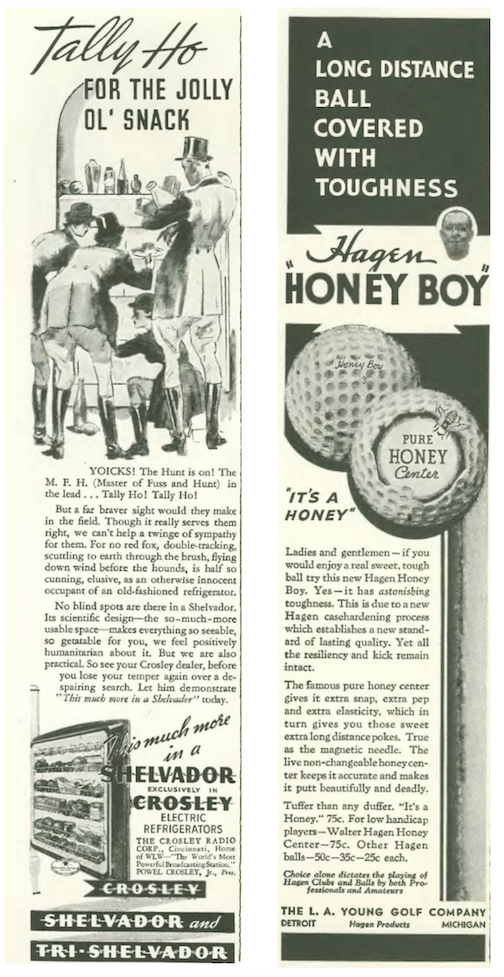
We start with some one-column gems from the back of the book including the latest innovation in electric refrigerators…a shelf in the door!…apparently Crosley was the first to invent this “Shelvador”…the ad to the right is interesting in that it advertises honey-filled golf balls…in the early 20th century some golf balls did contain real honey…apparently it was chosen for its consistent viscosity (or maybe for a quick snack on the ninth hole)…

…and from General Tire, we have another ominous warning from Dad as the teens head out for another night of crooning, or whatever they are dressed for…

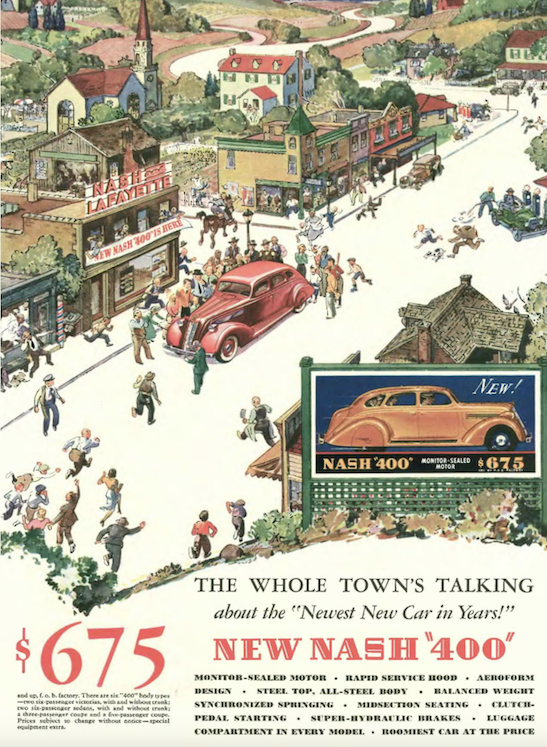
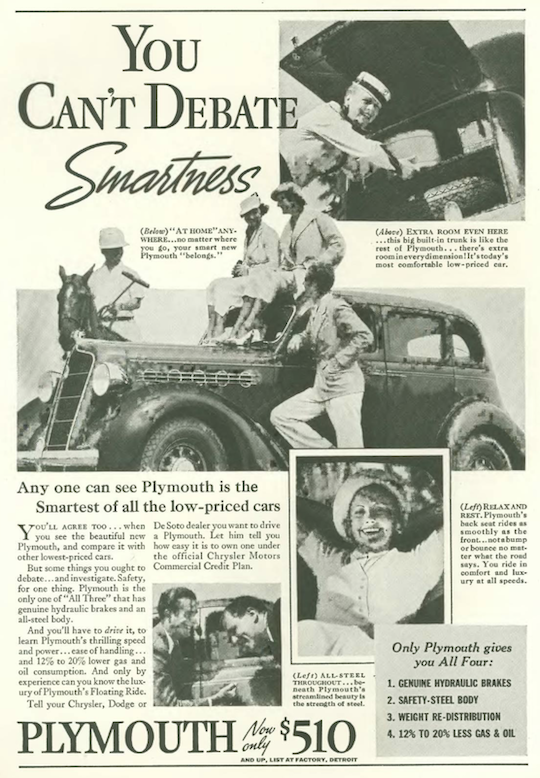
…last week Chrysler was offering its sedans for $745, and this week you could have one of their Plymouths for just 510 bucks…the message: you would be admired by your polo buddies for your smart, thrifty choice…

…where the above ad crammed every square inch with information, the folks at Pierce Arrow offered a restrained, minimal message (suggesting “we can afford to buy a full-page ad and leave much of it blank”)…another class signifier was the absence of a price tag (about $150k in today’s dollars)…but Chrysler-Plymouth would survive the Depression because it sold affordable cars, while Pierce Arrow was on its last legs…

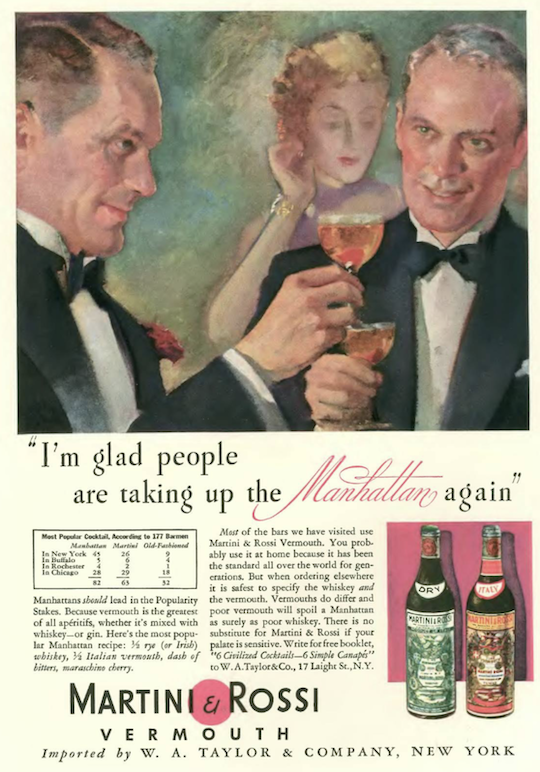
…here’s a couple of Pierce Arrow owners toasting the return of the Manhattan…

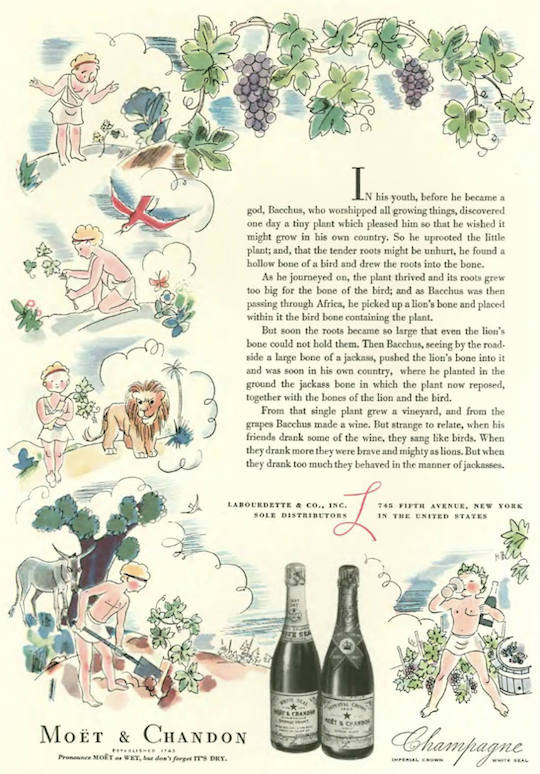
…Moët & Chandon offered up this whimsical tableau from the youth of Bacchus…

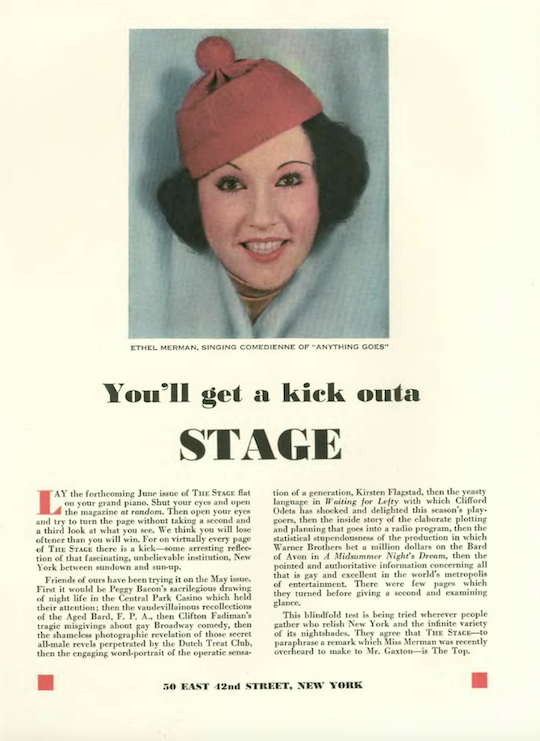
Ethel Merman popped through a curtain on the inside back cover to invite readers to subscribe to The Stage magazine…

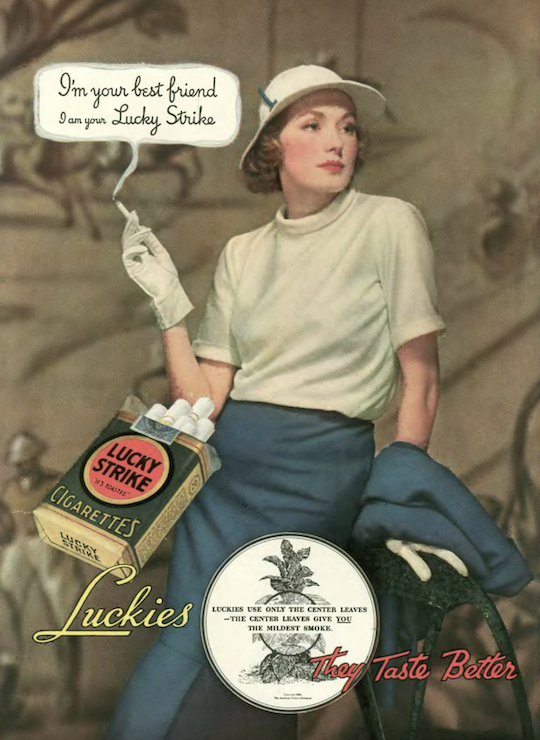
…and Lucky Strike claimed the back cover with another stylish woman and a talking cigarette bent on mind control…

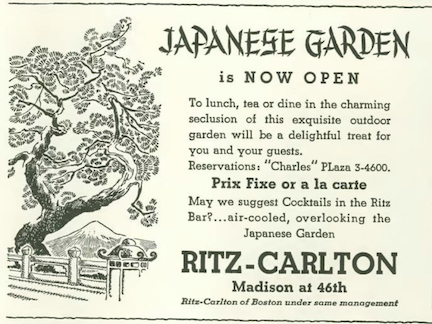
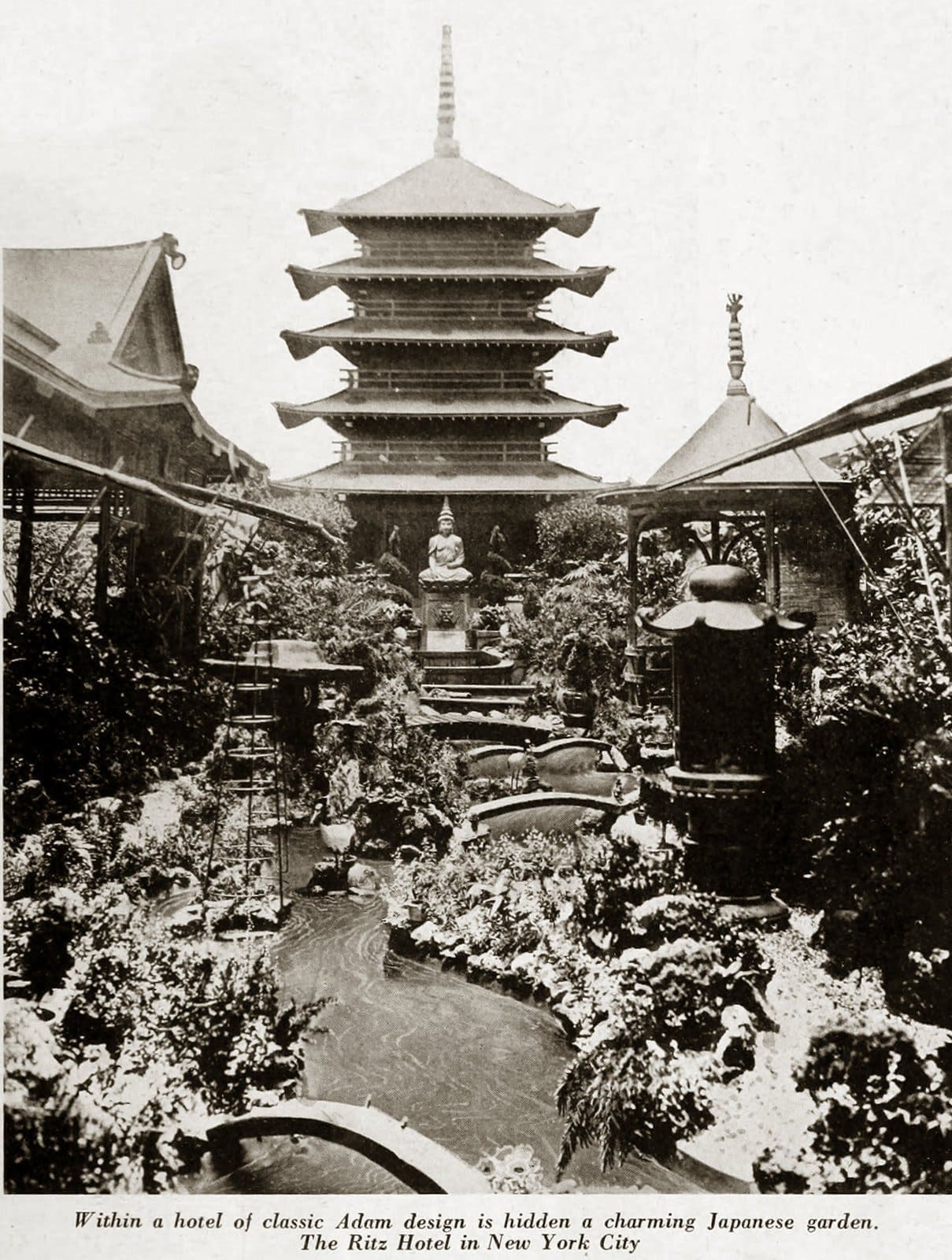
…the Ritz-Carlton announced the spring re-opening of its famed Japanese Garden…

The Japanese Garden in 1924. (clickamericana)

…and we kick off our cartoonists with this “Goings On” topper by D. Krán

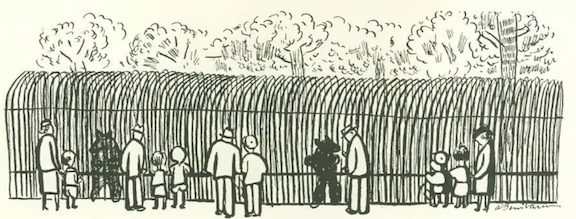
…followed by this visit to the zoo by Abe Birnbaum

James Thurber was up for some fashion criticism…

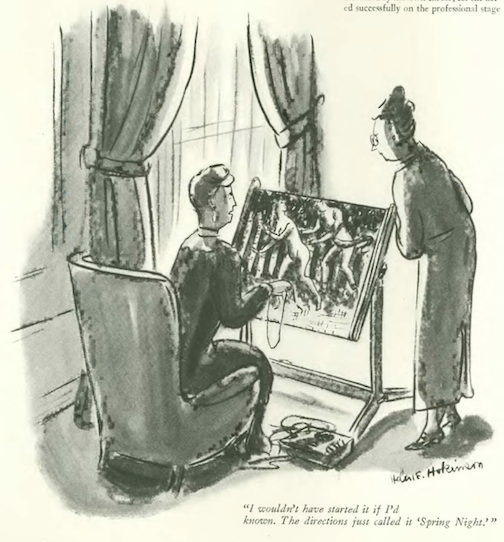
Helen Hokinson found a surprise in a paint-by-numbers kit..

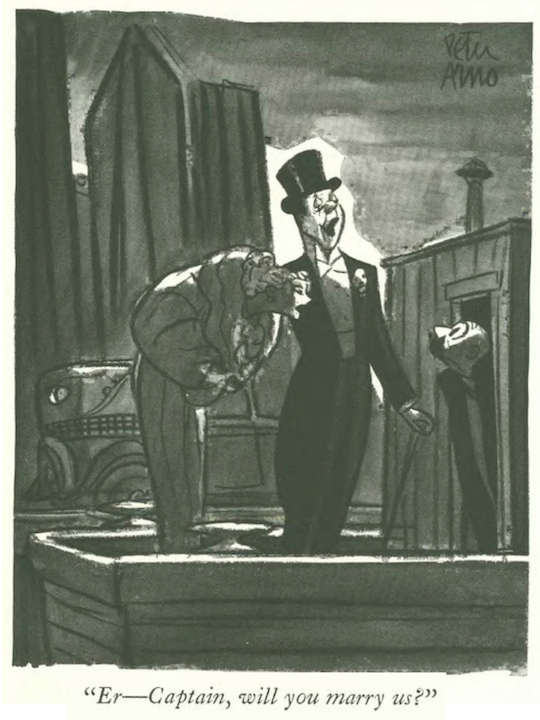
Peter Arno was up for some late night nuptials…

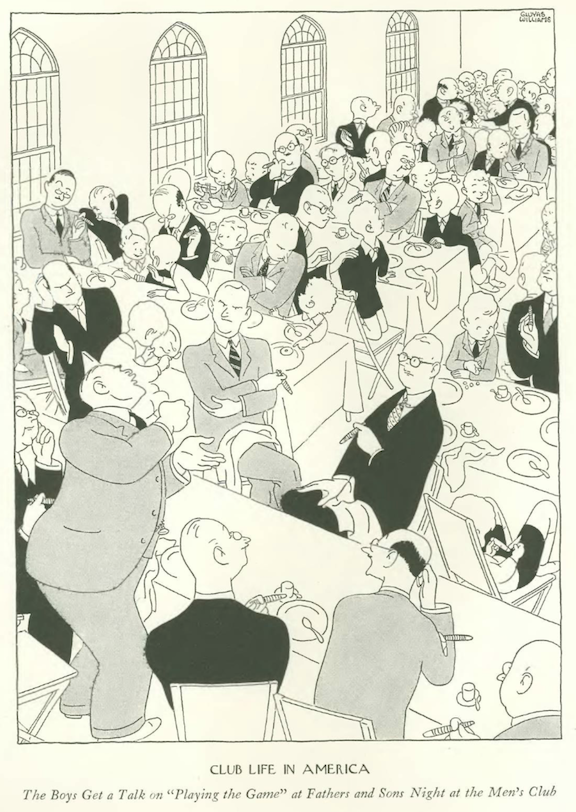
Gluyas Williams continued to examine club life…

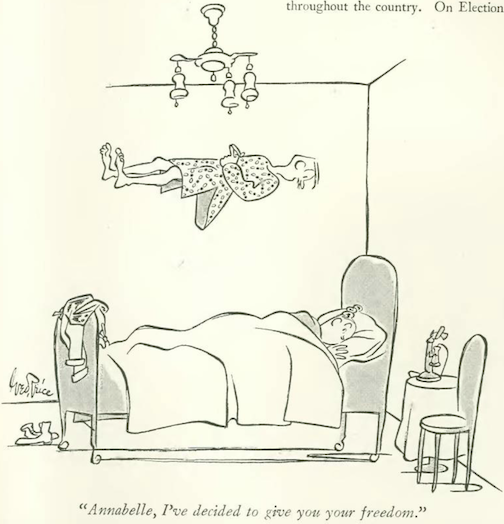
...George Price was back in the air…

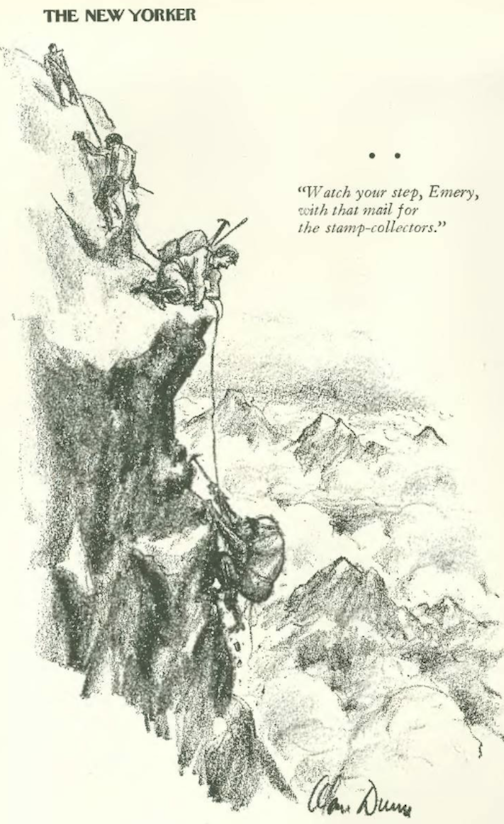
Alan Dunn gave us some men on a mission…

…and we close with Charles Addams, and some dam trouble…

Next Time: Wining and Dining…


Home Sweet Motohome

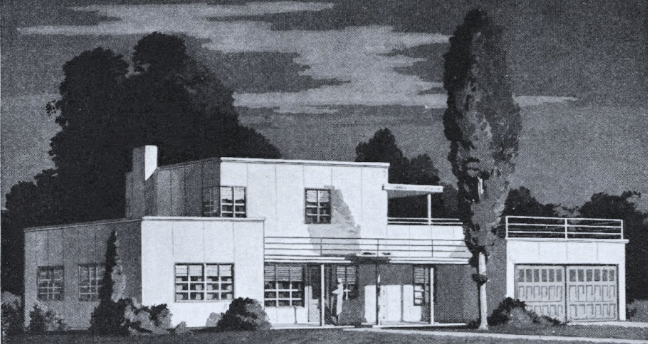
Morris Markey thought he was getting a glimpse of the future when he attended an exhibit of “machines to live in” at New York’s Grand Central Palace.

March 16, 1935 cover by Constantin Alajalov.

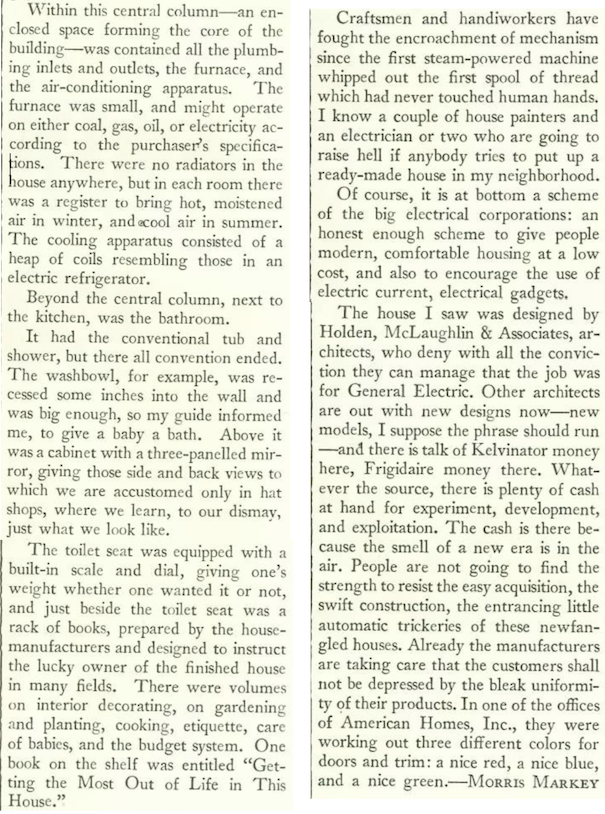
The Great Depression created a housing shortfall in the U.S. of nearly two million units, so many idled architects and builders turned to industrialized housing as a way to boost the building industry. In “A Reporter At Large,” Markey described his encounter with one type of “machine to live in”––the Motohome.

The idea of pre-fab living wasn’t exactly new in 1935, originating in the 1920s with the German Bauhaus school and with notables such as Swiss architect Le Corbusier.

NOT THRILLED WITH FRILLS…Charles-Édouard Jeanneret (1887-1965), better known as Le Corbusier, stated in 1923 that “a house is a living machine.” He believed the world had evolved beyond the need for decorative frills, and that homes and furnishings should reflect their functions. Top left, Corbu’s 1929 Villa Savoye in Poissy, France; at right, his 1947-52 Unité d’habitation de Marseille. (Fondation Le Corbusier/Architectural Digest/Le Corbusier World Heritage)

Markey correctly surmised that the American twist on Le Corbusier’s vision was largely driven by big corporations, and in the case of the Motohome, by General Electric.

GET YOUR MOTO RUNNING…Clockwise, from bottom left, New York’s Grand Central Palace; the Eggiman House in Madison, Wisconsin, a 1936 Motohome listed in the National Register of Historic Places; Long Island Motohome featured on a brochure; Popular Mechanics article on the Motohome. A common wall “core” was prefabricated with all kitchen and bath fixtures, as well as the HVAC system. (Wikipedia/makeitmidcentury.com/books.google.com)

 * * *

Strange and Wonderful

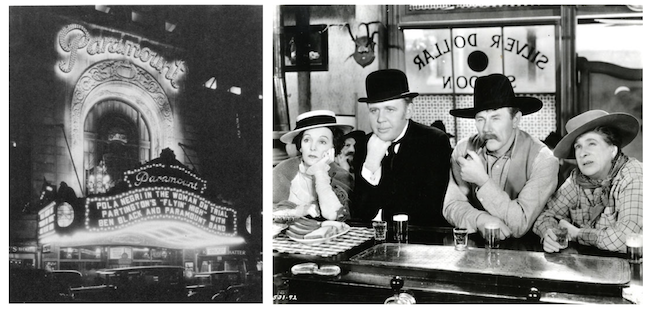
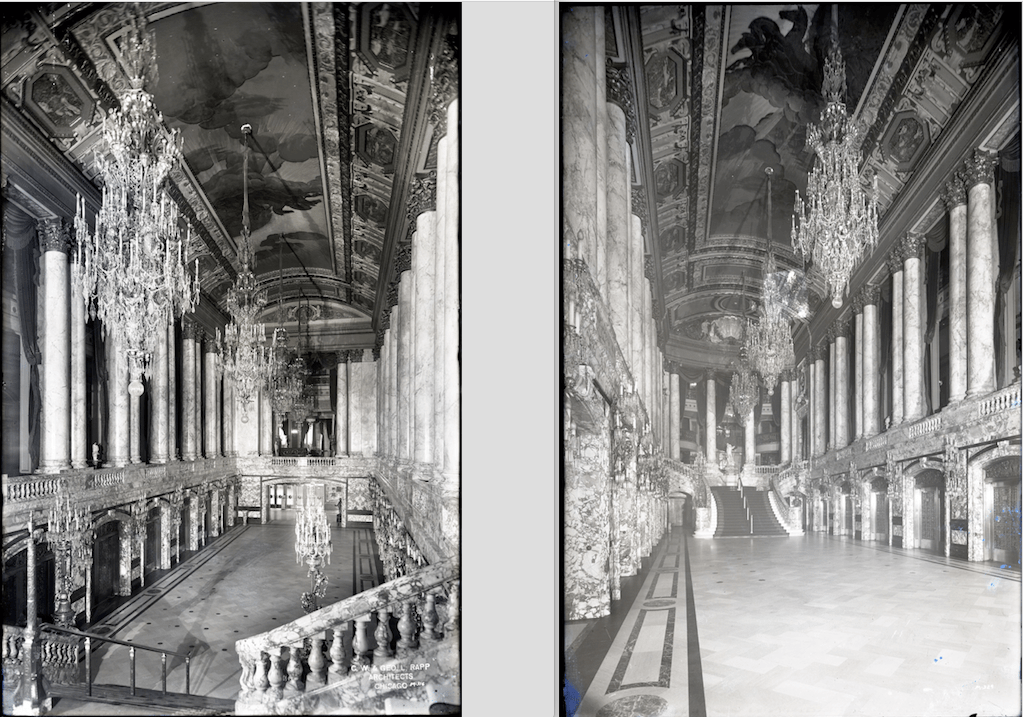
That is how E.B. White described the 3,664-seat Paramount Theatre, which opened on 43rd and Broadway in 1926. After nine years White was still in awe of its palatial trappings. In his “Notes and Comment,” White offered some thoughts after an evening at the movies.

CINEMA GLORY DAYS…E.B. White visited the Paramount Theatre to take in Charles Laughton’s hit film, Ruggles of Red Gap. From left, Zasu Pitts, Laughton, Charles Ruggles and Maude Eburne in Ruggles. (nyc.gov/TCM)
PALACE FOR THE PICTURES…The Paramount Theatre’s Grande Hall featured a 75-foot-long ceiling mural by artist Louis Grell above the Italian marble-lined entrance. In 1966, after a run of the James Bond film Thunderball, the Paramount was closed for good and later gutted and turned into retail and office space. (Louis Grell Foundation)

 * * *

Bad Guys

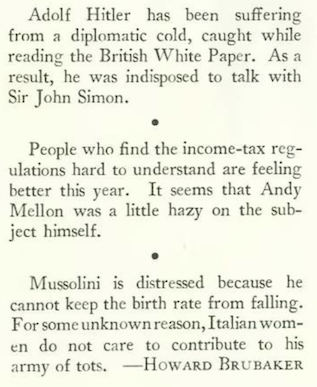
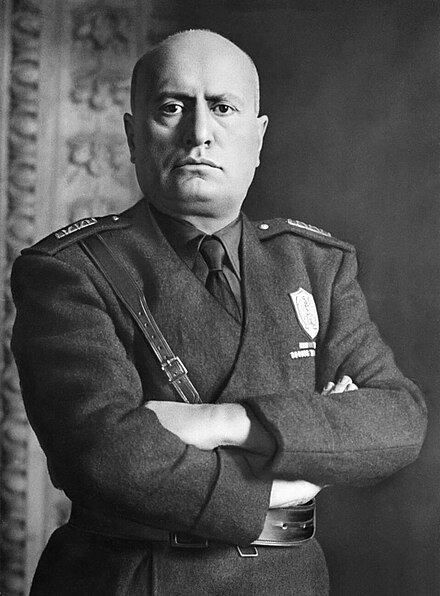
Andrew Mellon’s tax fraud troubles were sandwiched between the woes of a fascist bromance in Howard Brubaker’s “Of All Things”…Mellon would soon be dead, Adolf Hitler would lie his way around the Brits, and Benito Mussolini would struggle to inspire Italian women to produce his “army of tots”…

NOT TONIGHT, WE HAVE A HEADACHE…Little wonder fascist dictator Benito Mussolini couldn’t inspire a baby boom. (Wikipedia)

 * * *

Zoom Zoom

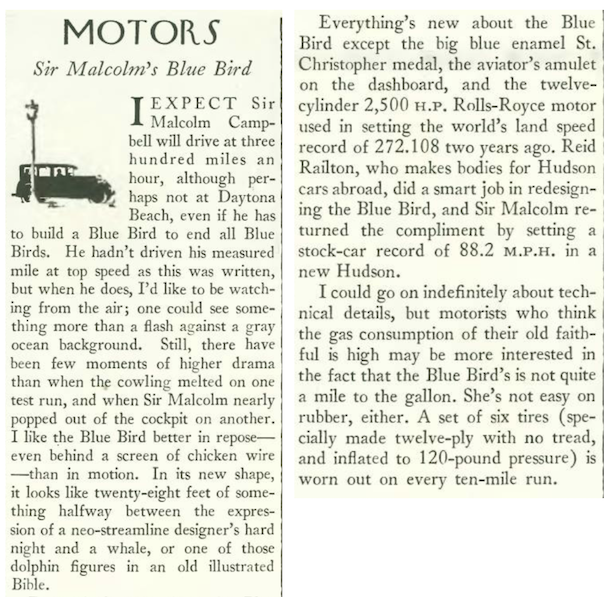
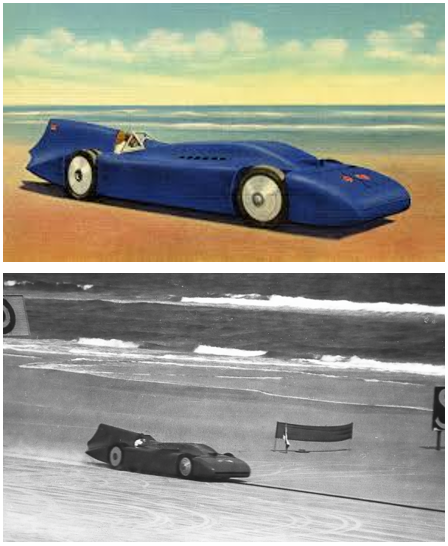
In his “Motors” column, writer “Speed” looked in on Sir Malcolm Campbell (1885-1948), who was attempting to break the 300-mph mark at Daytona in his 2,500-horsepower Blue Bird.

BLUE STREAK…Sir Malcolm Campbell’s bid for a land speed record surpassing 300 mph began at Daytona Beach in March 1935 in his Campbell-Railton Blue Bird, powered by a 2,500 hp supercharged Rolls-Royce V-12. He managed to hit 276 mph (combined runs in each direction), but conditions at the beach (bottom photo) left him short of his goal. He found a smoother, longer run at Utah’s Bonneville Salt Flats in September, where he would average 301.337 mph (484.955 km/h) in two passes to set the new record. (floridamemory.com/oldmachinepress.com)
ONCE IS NOT ENOUGH…Sir Malcolm Campbell MBE was a British racing motorist and motoring journalist. He gained the world speed record on land and on water several times. He was also one of the few land speed record holders of his era to die of natural causes. (Wikipedia)

 * * *

From Our Advertisers

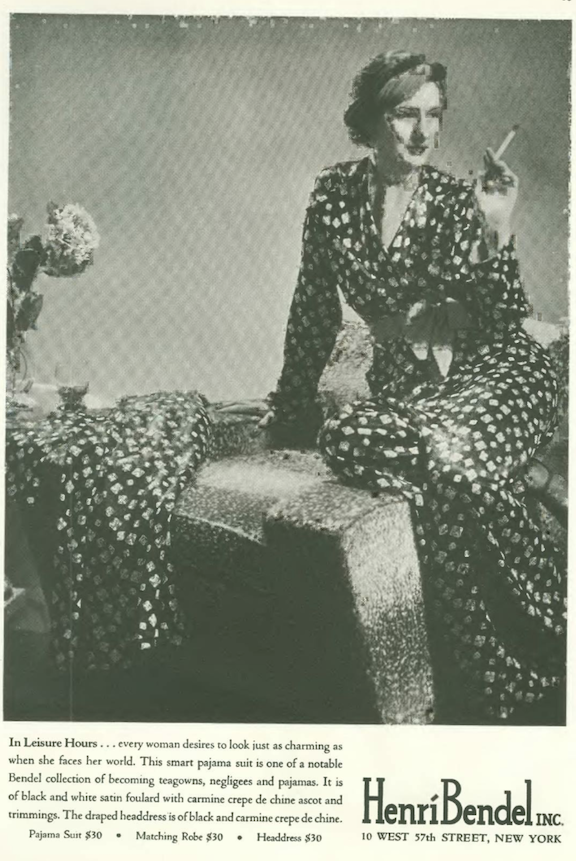
For ninety bucks you could get this swell pajama suit and matching robe (plus headdress) at Henri Bendel, the perfect ensemble for having a leisurely smoke after a day facing the world…For more than 100 years, Henri Bendel’s flagship and only store was located at 10 West 57th Street…it closed in 2018…

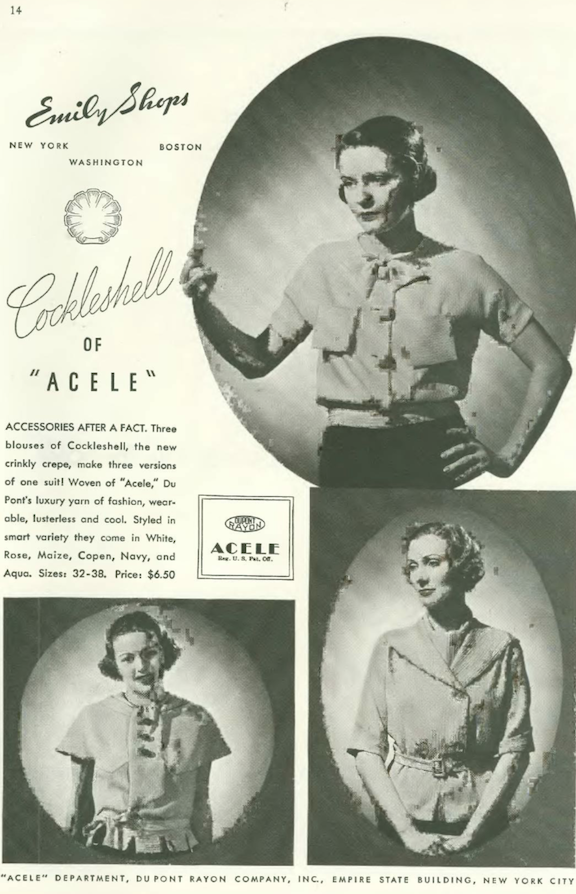
…I doubt the woman in the Bendel ad would have been interested in clothes made with Acele…it was without question that the uppers only wore clothes derived from living things…

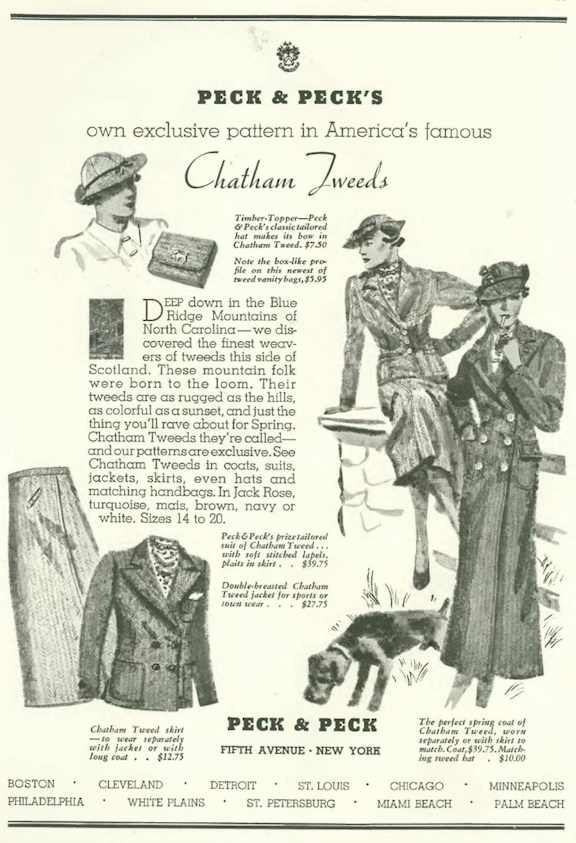
…this Anglophilic Peck & Peck ad is notable for its condescending reference to the “mountain folk” in Appalachia who “were born to loom”…

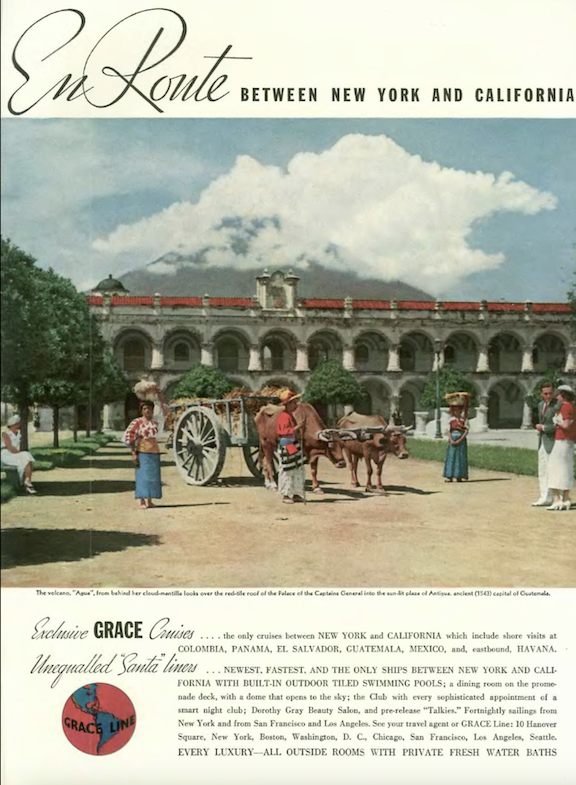
…while we are on the subject, check out this ad for Grace Cruises…this was a common theme in mid-century travel advertising, Westerners dressed in their Sunday best while having a gander at the colorful natives…

…who are just part of the scenery…

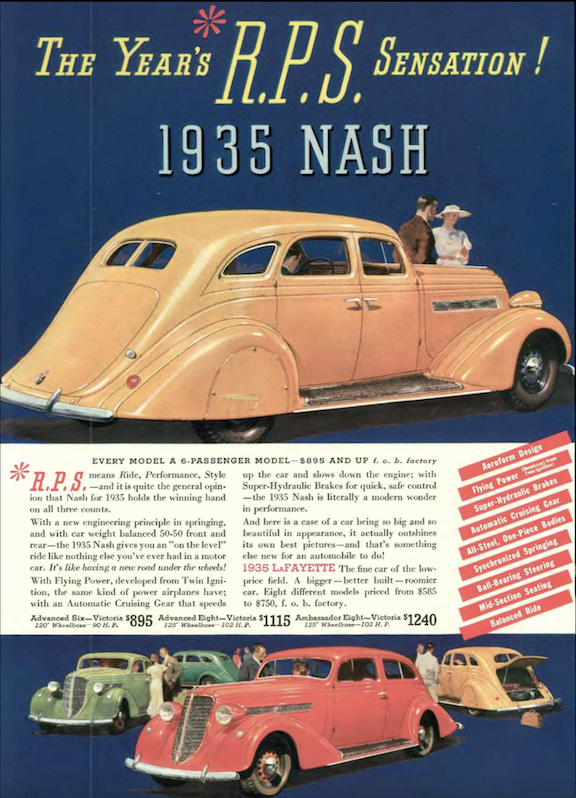
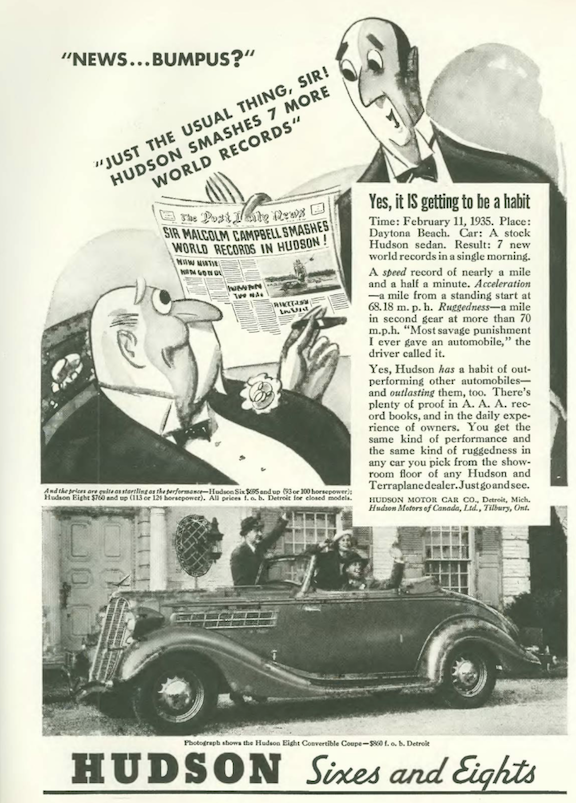
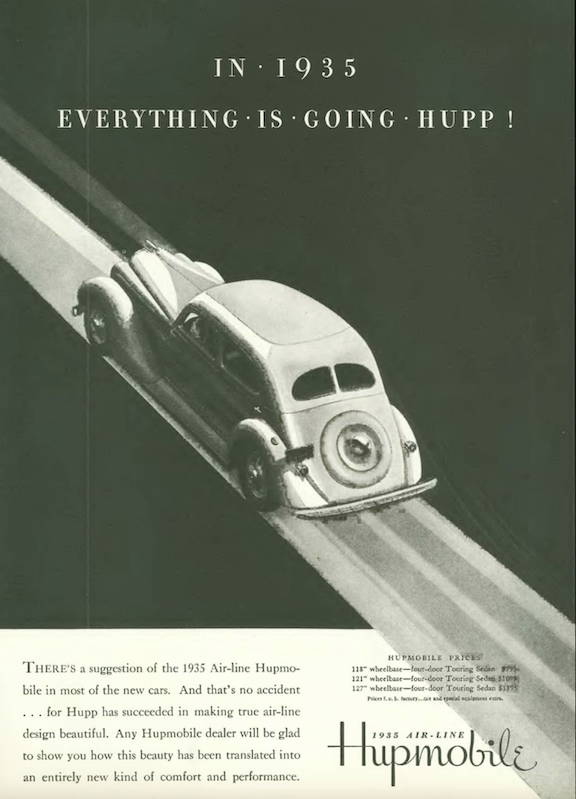
…all four of the automobile ads in this issue come from long-gone companies…the luxury carmaker Packard made beautiful, quality cars that outsold Cadillacs up until 1950, but competition from the Big Three (GM, Ford, Chrysler) plus Packard’s decision in 1954 to buy failing Studebaker led to Packard’s demise four years later…

…a more successful merger took place in 1954 between Nash…

…and Hudson, the two forming the new American Motors Corporation…

…contrary to this ad’s tagline, everything was actually going down for Hupmobile, which would go out of business in 1939…

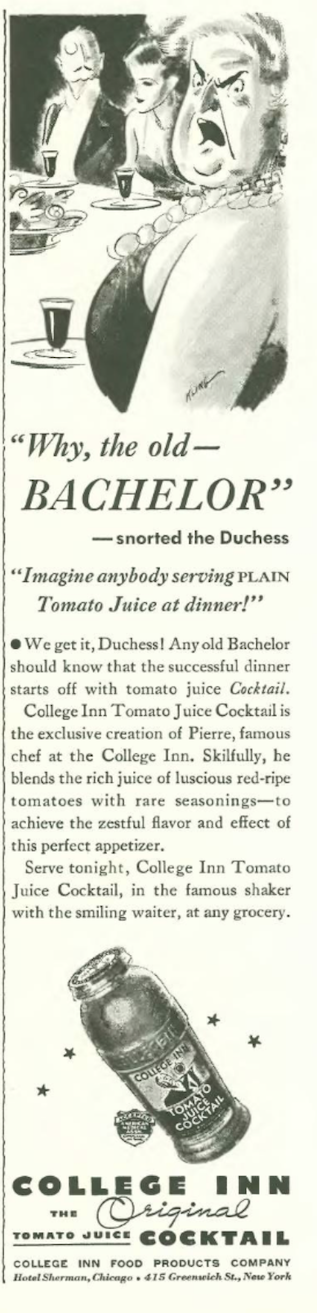
…the makers of College Inn Tomato Juice Cocktail apparently thought an angry old “Duchess” would boost sales…she first appeared in the Feb. 23 issue…

…in the March 16 issue she appears to be psychotic, threatening, “I’ll teach her not to serve PLAIN tomato juice before dinner!” Will she break the glass on the table and lunge at her host (the old WITCH) with a glass shard?…Stay tuned…

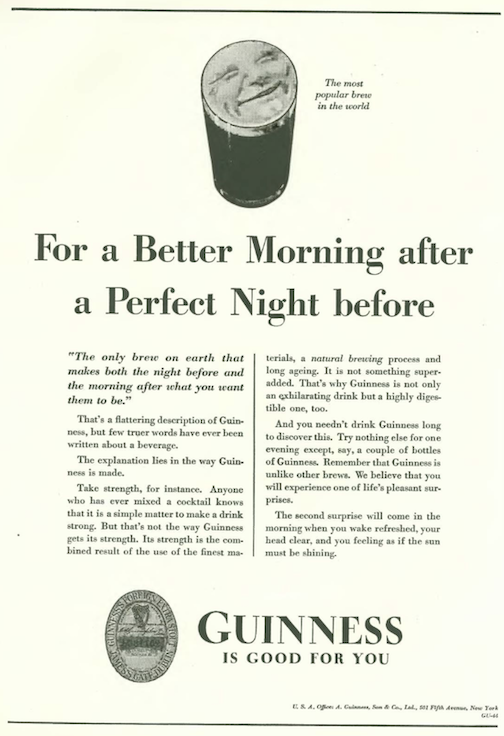
…better to calm down and have a Guinness, which, by Jove, was affordable and good for you!…

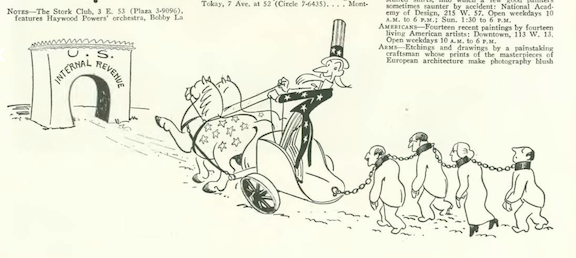
New Yorker cartoons are also good for you, and we begin with Al Frueh and this taxing illustration at the bottom of page 4…

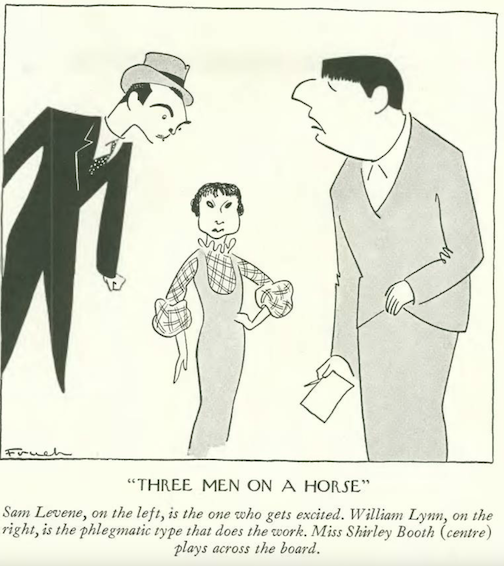
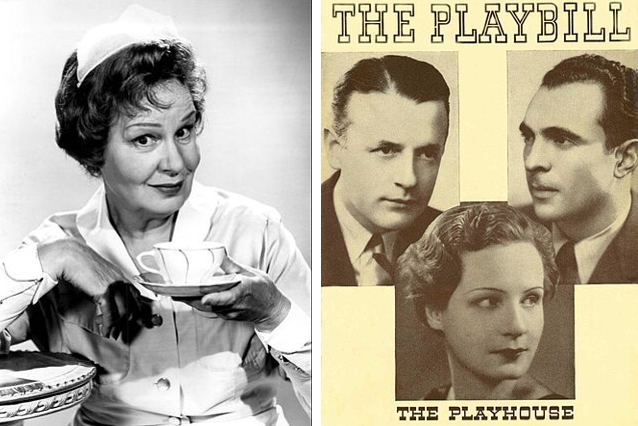
…Frueh again, for the theater review section…in the center is Shirley Booth, known to Baby Boomers as the star of the old TV series Hazel (1961-66)…

…Booth was much more than a sitcom star, achieving the Triple Crown of Acting––an Academy Award, two Primetime Emmy Awards and three Tony Awards…

ACTING CHOPS…Shirley Booth (1898-1992) as Hazel in 1962; on the cover of the 1935 Playbill featuring Three Men on a Horse. (Wikipedia)

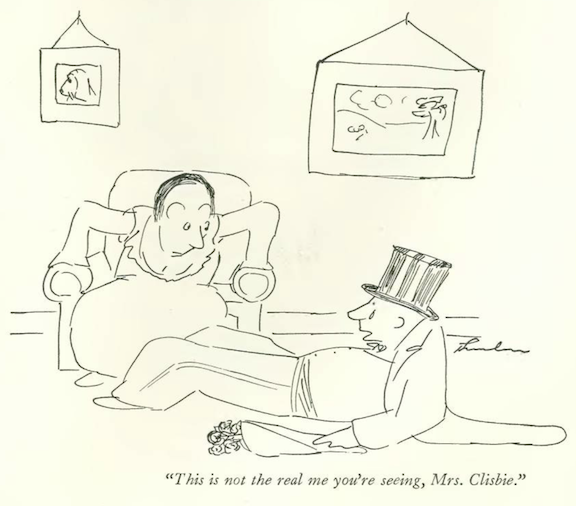
…we continue with Daniel ‘Alain’ Brustlein, and a term of endearment from someone well known to the police…

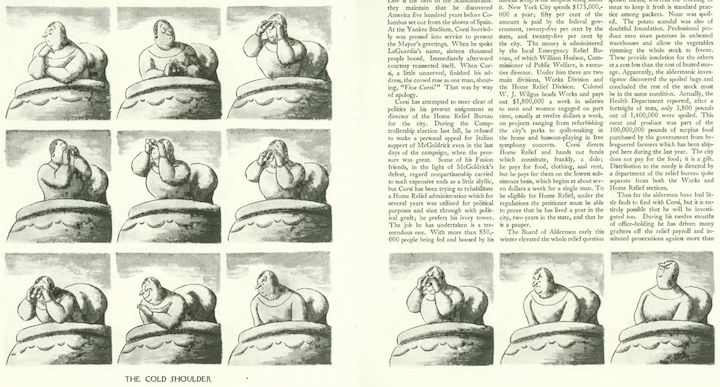
William Steig took up two pages to give one opera patron the cold shoulder…

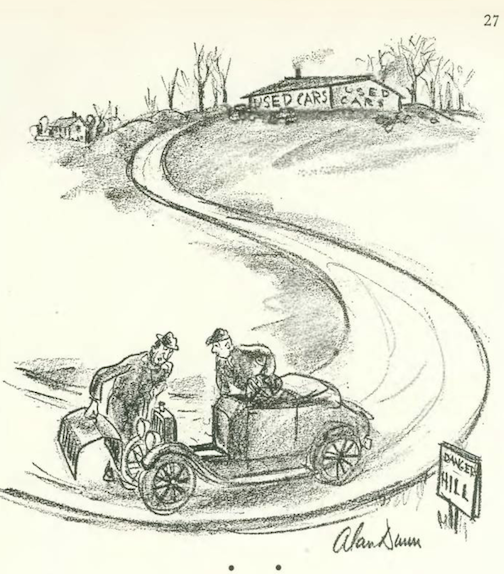
Alan Dunn cautioned against car dealers perched on high hills…

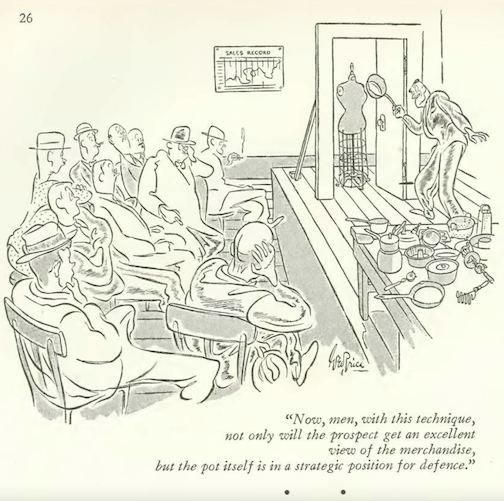
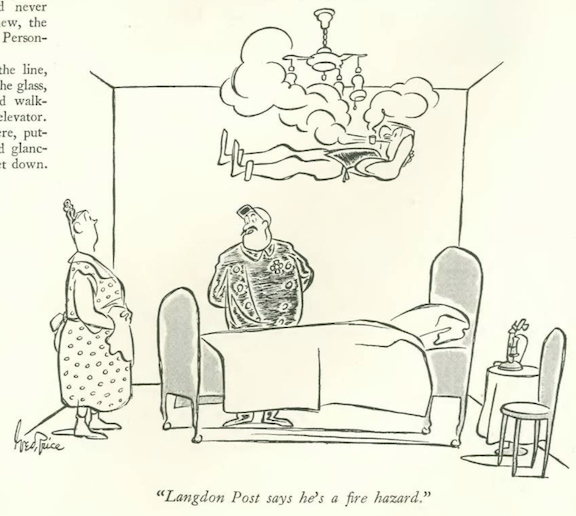
George Price examined the finer points of salesmanship…

Helen Hokinson headed for the high seas…

…and we close with an all-time classic from James Thurber

Next Time: Something Frivolous…

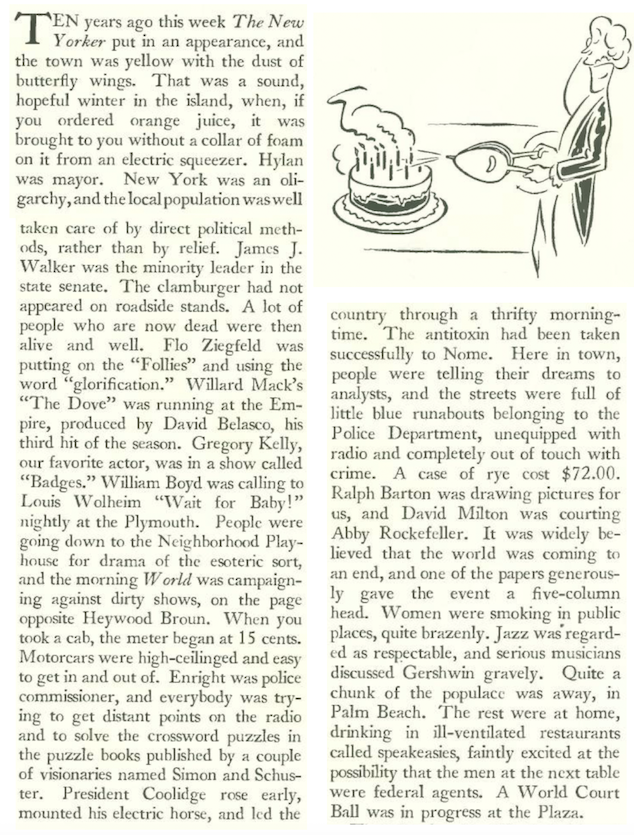
A Decade of Delights

With this post (No. 413), we mark the tenth anniversary of The New Yorker. Since I began A New Yorker State of Mind in March 2015, I’ve attempted to give you at least a sense of what the magazine was like in those first years, as well as the historical events that often informed its editorial content as well as its famed cartoons. Those times also informed the advertisements; indeed, in some cases the ads give us a better idea of who was reading the magazine, as well as their changing tastes and buying power as we moved from the Roaring Twenties to the Depression, and from Prohibition into Repeal.

I have also chosen this time to go on hiatus, and hopefully resume this blog when The New Yorker celebrates its centennial next February (this site will remain active and available, and I will continue to monitor comments and messages). Let us hope that the editors use the original Rea Irvin cover for that occasion, and restore his masthead above “The Talk of the Town” section. Perhaps some enterprising soul could start a petition.

Feb. 16, 1935 cover by Rea Irvin.

Moving on to the tenth anniversary issue, we find E.B. White recalling the world of The New Yorker’s first days. Given the massive economic and societal shifts that occurred from 1925 to 1935, those first days seemed distant to White, who felt old, “not in years but events.”

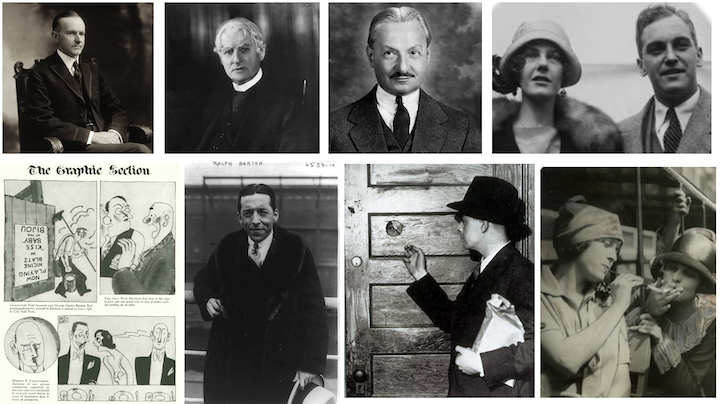
DAYS OF YORE…E.B. White noted the many changes that had taken place during The New Yorker’s first ten years, including, clockwise from top left, the passing of 1920s notables such as President Calvin Coolidge and two very different theatre impresarios—David Belasco and Flo Ziegfeld; White also recalled the much-publicized 1925 wedding of Abby Rockefeller to David Milton, the throngs of women who took to smoking in public in the 1920s and the drinkers who took their activities behind closed doors; and one of the early magazine’s beloved contributors, Ralph Barton, who offered his whimsical take on the news in “The Graphic Section” as well as in other illustrated features. (Wikipedia/Wikitree/Ephemeral New York)

White also noted a new craze that had originated around the same time as the birth of The New Yorker…

TWO ACROSS…Max Schuster and Richard Simon of Simon & Schuster, with their first crossword book, 1924. (americanbusinesshistory.org)

White concluded with these parting words, tinged with world-weariness, writing “More seems likely to happen.” One wonders if he imagined The New Yorker at 100, which in our day is just around the corner. Like White, many us have grown weary of this angry world, where indeed more seems likely to happen. Let us hope it is for the best.

Now, some unfinished business. We need to look at the previous issue, Feb. 9, 1935, before we close out the decade.

Feb. 9, 1935 cover by William Cotton.

We stay on the lighter side, joining critic John Mosher at the local cinema to appreciate Leslie Howard’s dashing performance in The Scarlet Pimpernel…

WORKING OVERTIME…Leslie Howard and Merle Oberon in The Scarlet Pimpernel. Howard portrayed an aristocrat who leads a double life, publicly appearing as a dandy while secretly rescuing French nobles from Robespierre’s Reign of Terror. (PBS)

 * * *

From Our Advertisers

Cigarette manufacturers employed every angle from sex to health claims to move their product…not to be left out of any niche market, Chesterfield even went after the little old ladies…

…by contrast, the makers of Old Gold cigarettes featured a clueless sugar daddy and his leggy mistress in a series of ads drawn by famed pin-up artist George Petty

Otto Soglow would do well with advertisers during his career, promoting everything from whiskey to Pepsi and Shredded Wheat to department stores…in this case Bloomingdale’s…after William Randolph Hearst’s King Features Syndicate wrested The Little King away from The New Yorker in September 1934, this was the only way you would see the harmless potentate in the magazine…

…another New Yorker artist earning some ad dollars on the side was Constantin Alajalov, here adding a stylish flair for Coty…

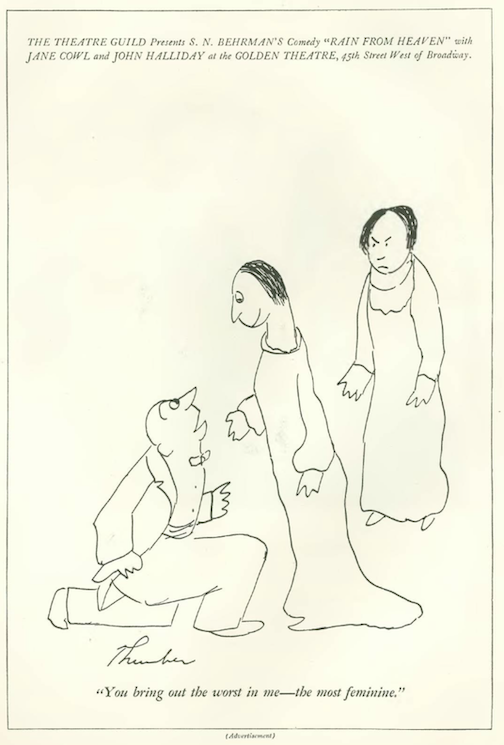
…and then there’s James Thurber, who continued to contribute his talents on behalf of the Theatre Guild…

…and we move along to the Feb. 9 cartoons, with Thurber again…

…the issue also featured two by George Price

…and Howard Baer supplied some life to this little party…

…now let’s return to the Feb. 15, 1935 issue…

…where John Mosher was back at the cinema, this time enjoying the story of a “beautiful stenographer”…

POPCORNY…Fred MacMurray and Claudette Colbert meet cute over popcorn in the romantic comedy The Gilded Lily. It was MacMurray’s second credited screen role, and it was the first of seven films in which Colbert and MacMurray would star together. (Wikipedia)

 * * *

More From Our Advertisers

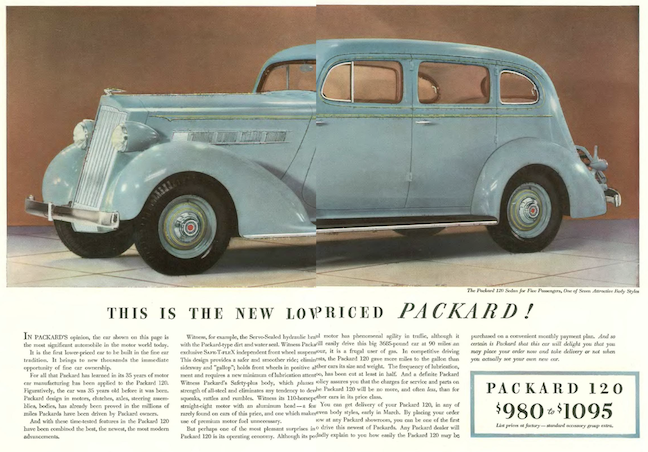
In its bid for survival during the Depression, the luxury brand Packard introduced its first car under $1000, the 120. Sales more than tripled in 1935 and doubled again in 1936…

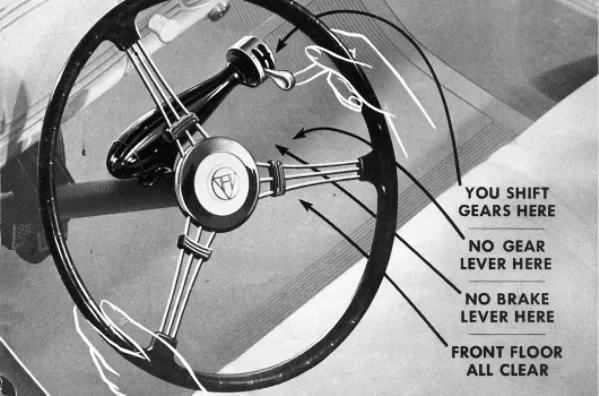
…meanwhile, Hudson was hanging in there with innovations such as the “Electric Hand”…it was not a true automatic transmission, but it did allow drivers to shift gears near the steering wheel…

…as demonstrated here…

…whatever you were driving, Goodyear claimed it would keep you the safest with their “Double Eagles”…

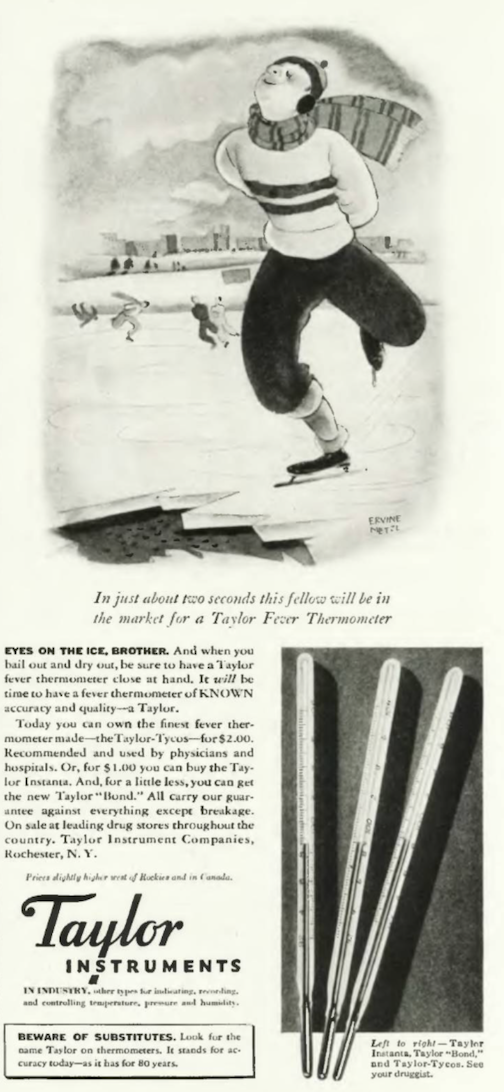
…I include this ad for Taylor Instruments because it features an illustration by Ervine Metzl, who would become known for his posters and postage stamp designs…

…Metzl’s design of a three-cent stamp commemorating the 1957–1958 International Geophysical Year…

…on to our cartoonists, we begin with this Deco-inspired artwork by an unidentified illustrator…

…one of Helen Hokinson’s “girls” was going about her daily rounds…

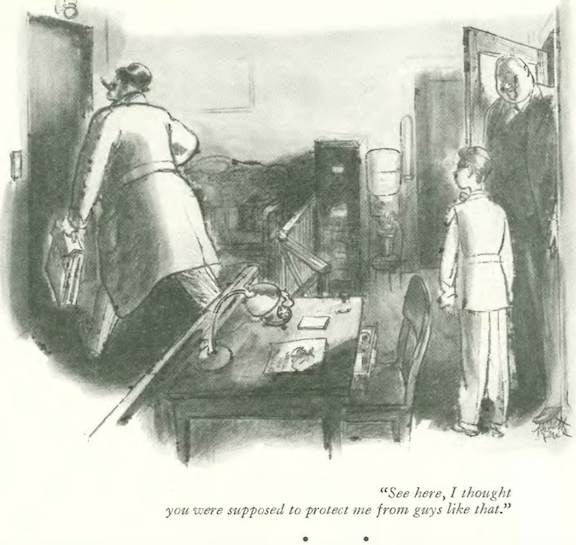
Garrett Price gave us a gatekeeper not quite up to his task…

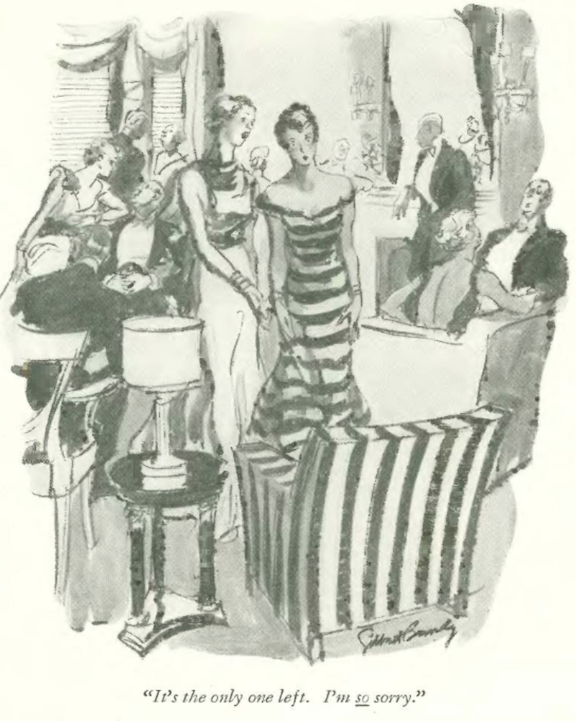
Gilbert Bundy was seeing stripes rather than stars…

…while James Thurber’s medium was getting in touch with an equine spirit…

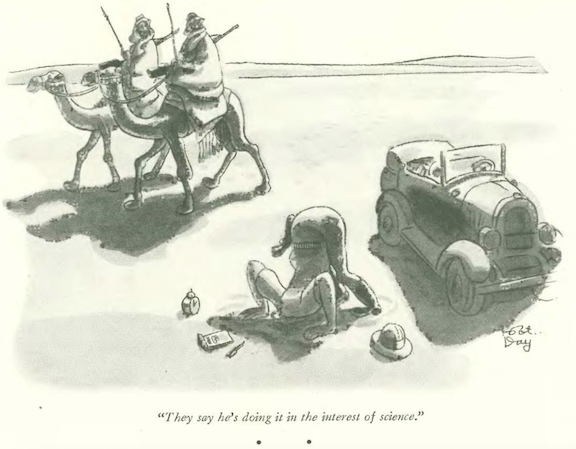
…scientific inquiry knew no bounds in Robert Day’s world….

…and in the world of Alain (aka Daniel Brustlein), old habits died hard…

…and we close with Peter Arno, at his risqué best…

Thanks for reading The New Yorker State of Mind!


Everything’s Jake

Lois Long employed the Prohibition-era slang term “Everything’s Jake” (“it’s all good”) to headline her latest installment of “Tables for Two.” If you’ve been following the exploits of our nightlife correspondent in this blog, you might recall that for a time in the early thirties she found the New York club scene lackluster, without the daring and grit of the speakeasy era. Lately, however, she was finding some new adventures after dark.

Jan. 19, 1935 cover by Constantin Alajalov.

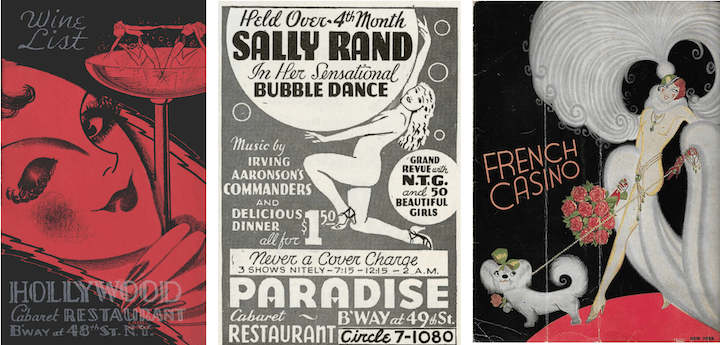
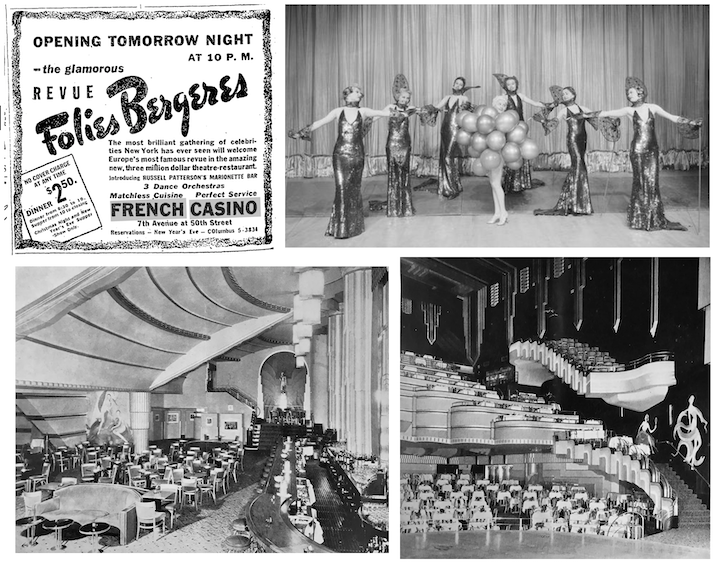
Long checked out the Revue Folies Bergère at the Earl Carroll Theatre, which had been renamed the French Casino, as well as the cavernous Flying Trapeze and the refurbished Hollywood Restaurant, headlined by crooner Rudy Vallée.

FROLIC AND FOLLY…Clockwise, from top left, a Dec. 24, 1934 Herald-Tribune advertisement for the Revue Folies Bergère, the show that opened the new French Casino; a bubble dance as part of the revue, circa 1936; the interior of the French Casino, view from the stage; interior view of former lounge underneath the balcony converted to a cocktail lounge for the French Casino. (Images from Chris Arena and Anthony L’Abbate via drivingfordeco.com/MCNY)
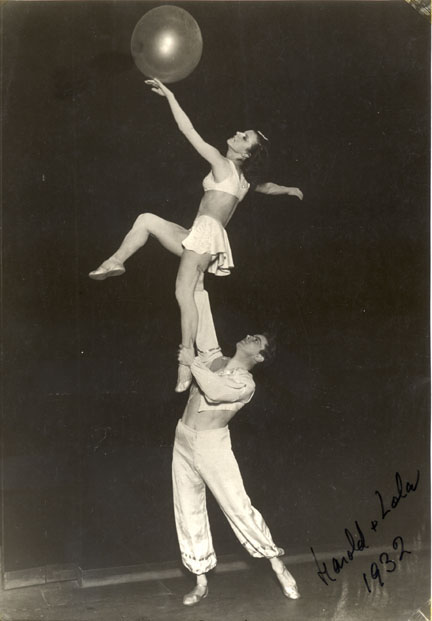
THE SERPENTINE WRITHINGS of dancers Harald and Lola (Harold Liebmann and Lola Werbesz) dazzled Lois Long during a Folies Bergère performance at the French Casino…They are seen here performing at New York’s Shubert Theatre during their first U.S. tour in 1932. (roosvt.com)
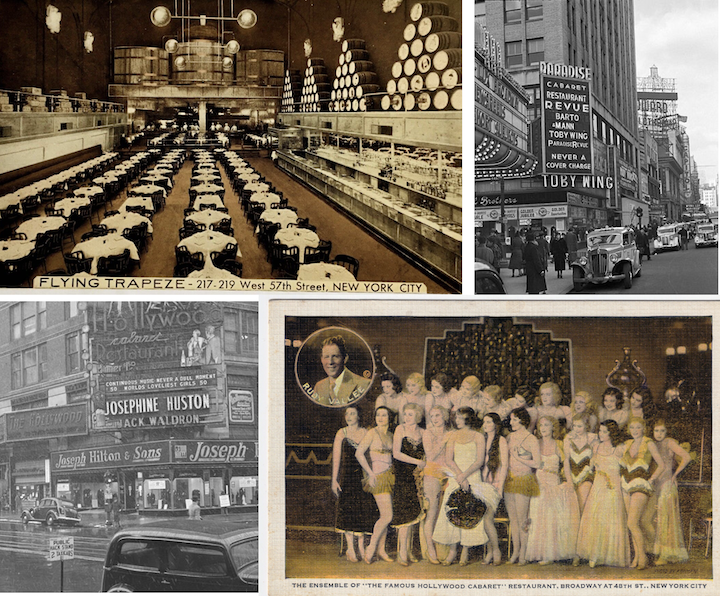
OTHER NIGHTLY DISTRACTIONS…Clockwise, from top left, postcard image of the cavernous Flying Trapeze Restaurant; Lois Long missed Sally Rand’s bubble dance at the Paradise, but she did catch a swell show at the Hollywood Cabaret at 48th and Broadway featuring Rudy Vallee, seen here on a 1935 postcard; exterior of the Hollywood Cabaret, circa 1935. (Pinterest)
NAUGHTY OR NICE…Lois Long was astonished by the female impersonators at the “naughty” Club Richmond…the club’s performers included Harvey Lee. (ualr.edu)

Long also checked out the “naughty” Club Richmond, and returned to the Central Park Casino, which was not long for the world.

 * * *

The Cost of Living

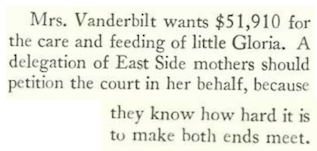
In 1934 Gloria Morgan Vanderbilt famously lost custody of her daughter, Gloria Laura Vanderbilt, to her sister-in-law Gertrude Vanderbilt Whitney. Granted limited parental rights, Gloria Morgan was allowed to see her daughter on weekends in New York, but the court had removed GMV as administrator of her daughter’s trust fund, her only source of support. Howard Brubaker had this to say in his column “Of All Things.”

WHAT’S A MOTHER TO DO? Gloria Morgan Vanderbilt in a 1933 photo. Inset, daughter Gloria Laura Vanderbilt in 1935. (Duke University)

 * * *

Too Much of a Good Thing

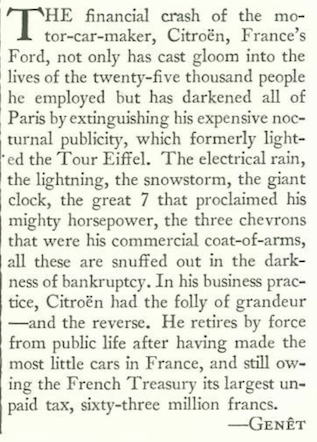
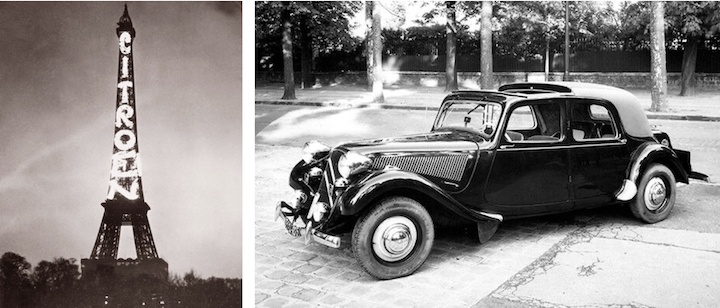
The French automaker Citroën established its reputation for innovation with the 1934 Traction Avant—the first car to be mass-produced with front-wheel drive, four-wheel independent suspension, and unibody construction. However, the cost of making all of these swell improvements—including the tearing down and rebuilding of company’s factory in just five months—led to the financial ruin of the company. After Citroën filed for bankruptcy in December 1934, its largest creditor, the tire-making giant Michelin, swept in to become the principal shareholder

Not only did Citroën lose control of its car company, it also lost its claim to the world’s largest advertising sign. Four nine years Citroën had its brand name emblazoned on the Eiffel Tower, but with bankruptcy (high electricity bills didn’t help) the company was forced to turn off the sign. Paris correspondent Janet Flanner had this observation:

CAN’T MISS IT…From 1925 to 1934, 125,000 glowing lights advertised the Citroën brand on the Eiffel Tower. At right, the company’s innovative 1934 Traction Avant. (Pinterest)

 * * *

From Our Advertisers

The National Motor Boat Show replaced the New York Auto Show as the main attraction at the Grand Central Palace…

…the folks at Pond’s found another Vanderbilt to shill for their cold cream, Muriel Vanderbilt, a socialite and noted thoroughbred racehorse owner…she is joined here by Washington Debutante Katrina McCormick, who was also a fancier of the horse circuit…

…the famed slogan Guinness is Good for You was launched in 1929, and apparently there is some truth to the claim (antioxidants, according to a University of Wisconsin study), and no doubt it was kinder to one’s morning head than other libations…

…if you preferred the stronger stuff, you could take the advice of cartoonist Peter Arno and Penn Maryland Whiskey, here making a play on words with the title of the 1925 novel (and Broadway play) Gentleman Prefer Blondes…

…here’s Arno again, with a touching moment among the upper crust…

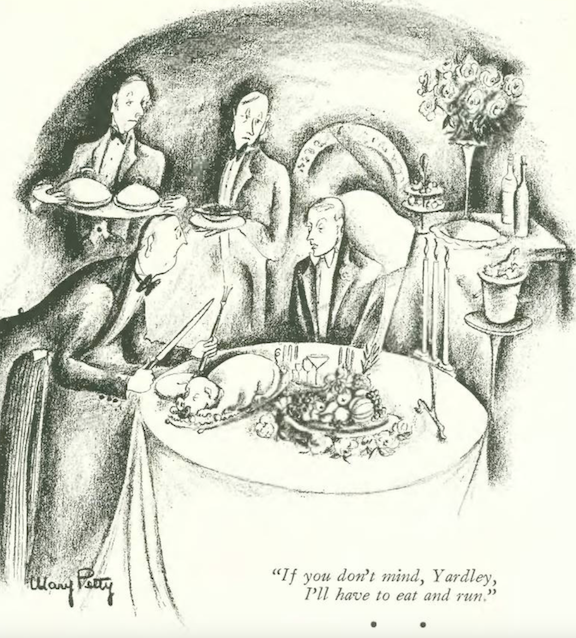
Mary Petty also looked in on the gilded set, and a callous young toff…

…but down in the lower classes, George Price found the youth quite engaging…

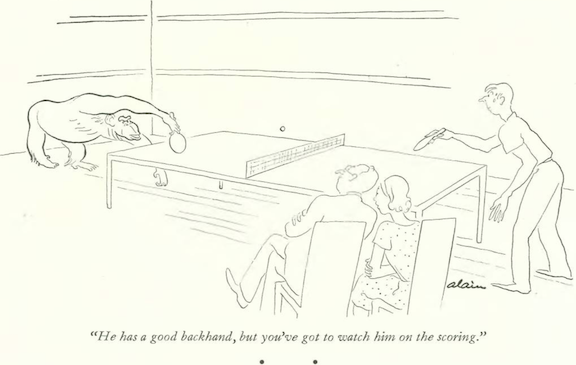
Alain looked in on a formidable ping-pong opponent…

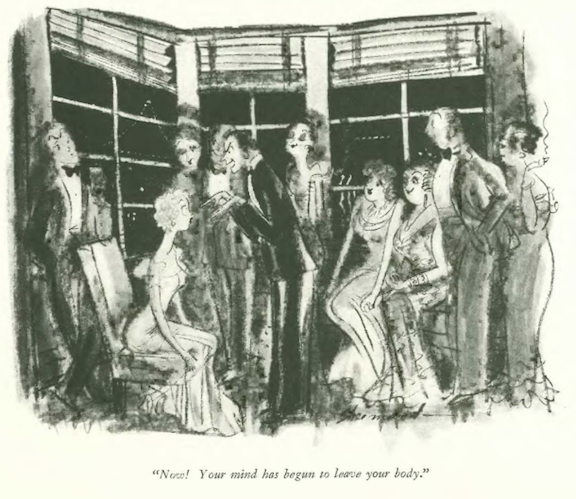
Barbara Shermund was evesdropping backstage at a Broadway revue…

…and we close with James Thurber, and a polite suggestion…

Next Time: Mary Quite Contrary…

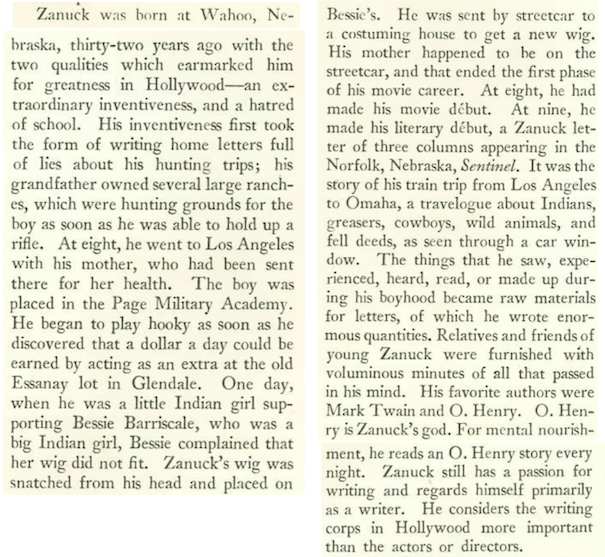
The Wahoo Boy

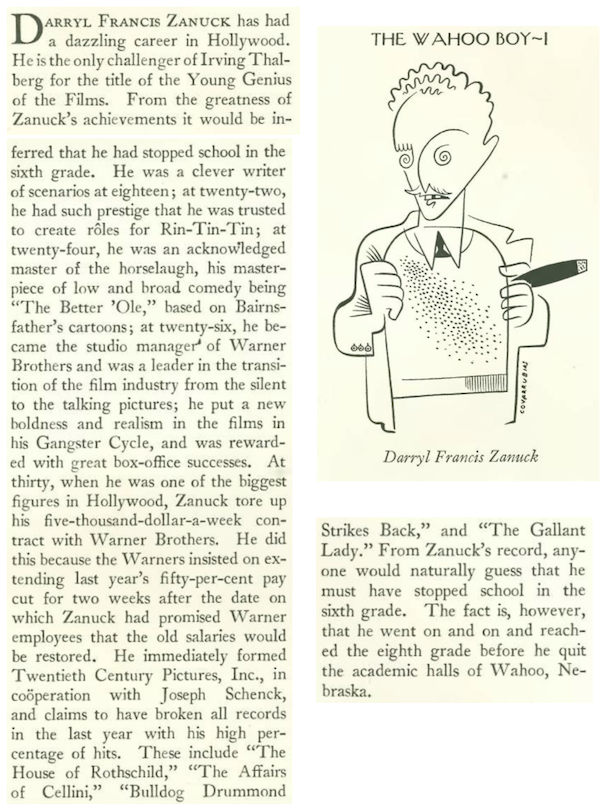
Darryl F. Zanuck (1902–1979) was an unlikely Hollywood mogul. Born in a small Nebraska town with an unusual name (both his and the town), Zanuck dropped out of school in the eighth grade, apparently bitten by the acting bug during a brief childhood sojourn in Los Angeles.

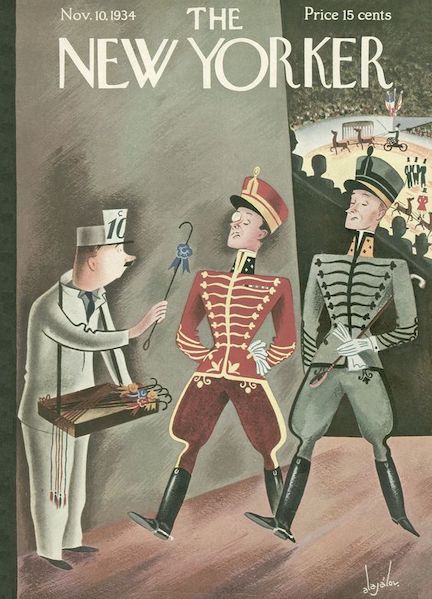
Nov. 10, 1934 cover by Constantin Alajalov.

In the first part of a two-part profile, Alva Johnston began to probe the mystery of the boy from Wahoo who would rise to become one of Hollywood’s most powerful studio executives.

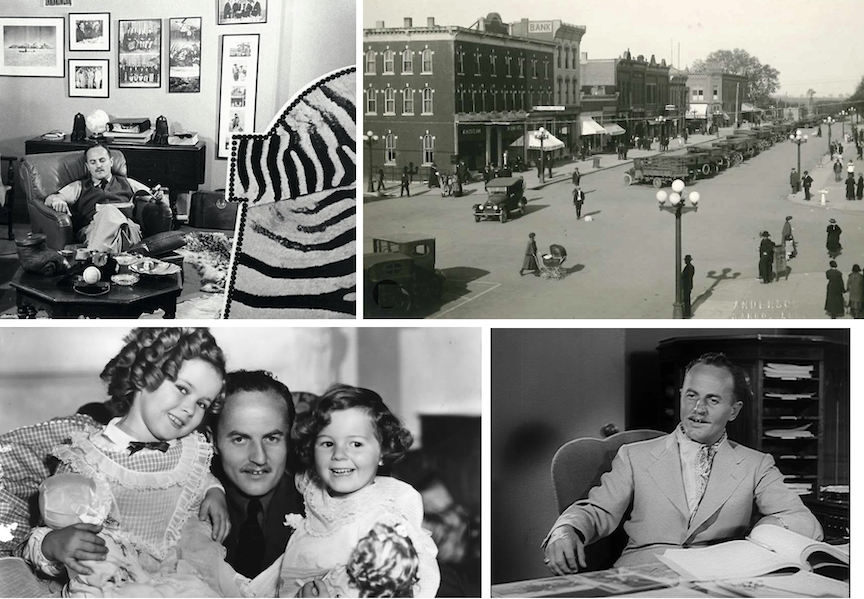
MAKING OF A MOGUL…Clockwise, from top left: Darryl F. Zanuck relaxing with trophies from his hunting excursions, circa 1940 (detail from a Margaret Bourke-White photo); Zanuck’s home town, Wahoo, Nebraska, 1920s; screenshot from a trailer for The Grapes of Wrath, 1940; Zanuck with child star Shirley Temple (left) and his first-born daughter Darrylin (mother was silent-screen actress Virginia Fox) in the 1930s. (Robin Pineda Zanuck via The Hollywood Reporter/Saunders County Historical Society/Wikipedia)

Johnston took a quick look at Zanuck’s humble origins, including his first encounter with the film industry at age eight. There must have been something in the water at Wahoo, a town of just 2,100 residents when Zanuck was born. Other Wahoo notables contemporary to Zanuck included Nobel Prize laureate and geneticist George Beadle, Pulitzer Prize–winning composer Howard Hanson, and Hall of Fame baseball player Sam Crawford, among others.

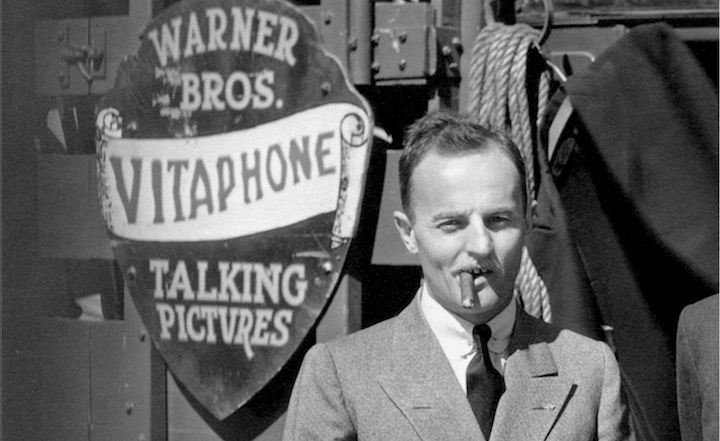
After writing dozens of scripts for Warner Brothers (including many for their popular canine star, Rin Tin Tin), in 1933 Zanuck would leave Warner and form 20th Century Pictures with Joseph Schenck. By the time Johnston penned the New Yorker profile, 20th Century had risen to be the most successful independent movie studio of its time.

 * * *

One-Way Street

It goes without saying that the interwar years of the 20th century were a time of extreme foment; Bolsheviks, communists, anarchists, fascists and other political agitators seemed to be constantly at each other’s throats as Europe prepared for its second act of self-annihilation. In the middle of it all was the Balkans, its many feuds always simmering near the boiling point.

After the assassination of Archduke Franz Ferdinand in 1914 (which, along with other factors, triggered World War I), you would have thought Europeans would have abandoned the practice of parading dignitaries through crowded streets. In 1934 they were reminded of its risks.

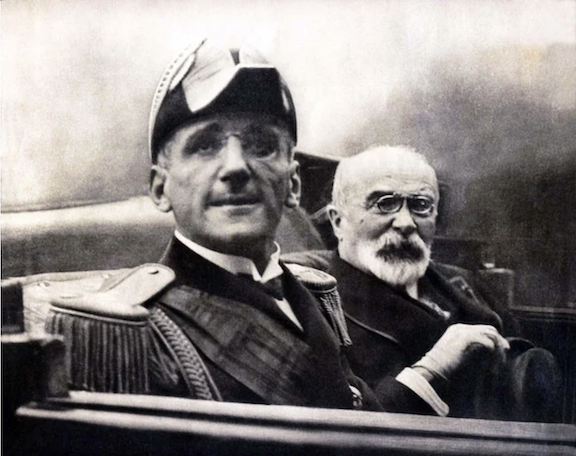
That year was King Alexander I of Yugoslavia’s thirteenth on the throne, but his time was running short in a country constantly beset by civil war. Fearing that the German Nazis and Italian Fascists would take advantage of the instability, on Oct. 9, 1934 French Foreign Minister Louis Barthou invited Alexander I to Marseille to sign a Franco-Yugoslav solidarity agreement. While Alexander and Barthou were being slowly driven in an open car through the city’s streets, a Bulgarian gunman, Vlado Chernozemski, stepped from the crowd, hopped onto the car’s running board, and shot Alexander along with his chauffeur. Barthou also died in the melee, killed by a stray bullet fired by French police (three women and a boy in the crowd were also fatally wounded by stray police bullets). Struck down by a policeman’s sword, Chernozemski was subsequently beaten to death by the enraged crowd. It was one of the first assassinations to be captured on film.

Paris correspondent Janet Flanner offered some thoughts about the incident in her “Paris Letter.” Excerpt:

WHAT A DIFFERENCE A DAY MAKES…King Alexander I of Yugoslavia (left) and French Foreign Minister Louis Barthou just moments before an assassin fired two fatal shots into the king. Barthou would die an hour later from a stray police bullet that would enter his arm and sever an artery. (Still image from YouTube video)

 * * *

The Traffic Machine

In his “A Reporter at Large” column, Morris Markey sang praises for the Triborough Bridge project, which was making visible progress on the massive public work that commenced in 1930. City officials had dreamed for years about a project that would at once connect Manhattan, Queens and the Bronx, but it wasn’t until the power broker Robert Moses got involved as the Triborough Bridge and Tunnel Authority chairman that things really started to move. Moses biographer Robert Caro wrote that “Triborough was not a bridge so much as a traffic machine, the largest ever built.” A brief excerpt:

As noted by Markey, the “people in charge” were forthright about the bridge’s completion date of July 1, 1936. And they kept their word. The bridge was substantially complete by June 1936, and would be dedicated on July 11, with Moses serving as master of ceremonies.

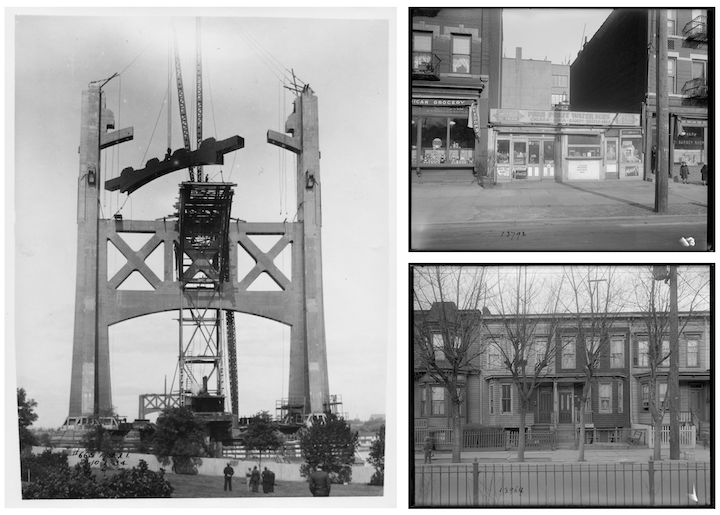
MAKE WAY FOR THE GIANTS…City engineers had been kicking around plans since 1916 to build bridges to connect Manhattan, Queens and the Bronx, but the massive Triborough Bridge project finally got off the ground in 1930. By 1934 the bridge’s Queens tower (left) would loom over Ward’s Island, visible in the background; at right, views of buildings in Astoria (Hoyt Ave.) that were slated for demolition to make way for the bridge, photographed by Eugene de Salignac in early 1931. (MTA Bridges and Tunnels Special Archives/NYC Municipal Archives)

 * * *

From Our Advertisers

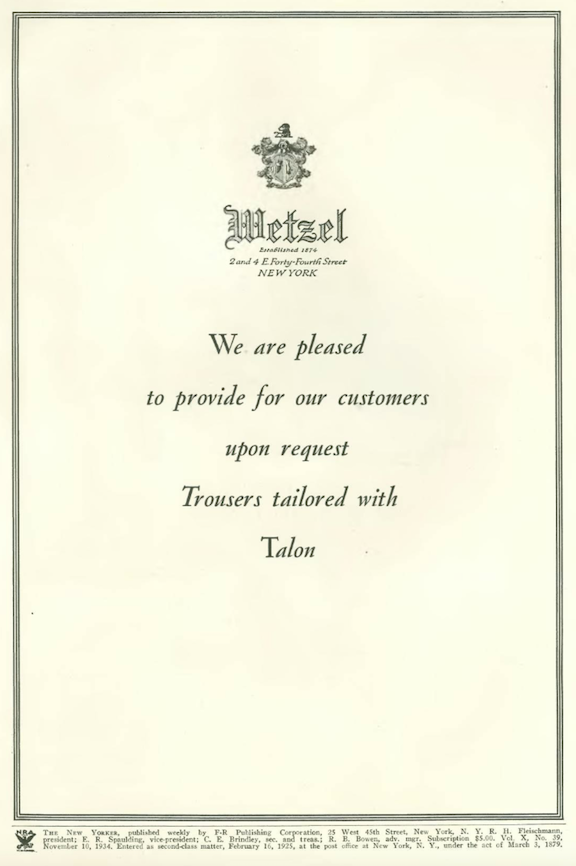
The common zipper was a relatively new invention in 1934. It had been more or less perfected by 1920, and in 1923 the B. F. Goodrich Company would coin the onomatopoetic word to describe the newfangled fastener on its galoshes, but it would take a while for the fashion industry to adopt the zipper as a replacement for buttons on garments, including men’s trousers. And so we get this staid-looking ad from Wetzel that signaled its entry into the brave new world of zippers (Talon was the dominant U.S. producer of zippers for many years)…

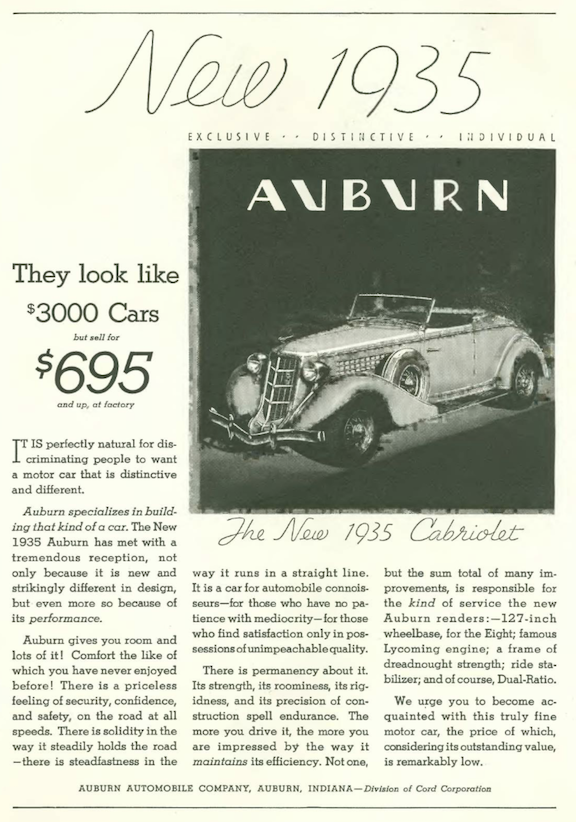
…this next ad is kind of amazing, a 1935 Auburn for only $695, which roughly translates to $15,000 or so today—still a bargain…known for cars that were fast, good-looking and expensive (and favored by Hollywood elite), Auburn struggled mightily during the Depression…along with its sister marques Duesenberg and Cord, the company would fold in 1937…

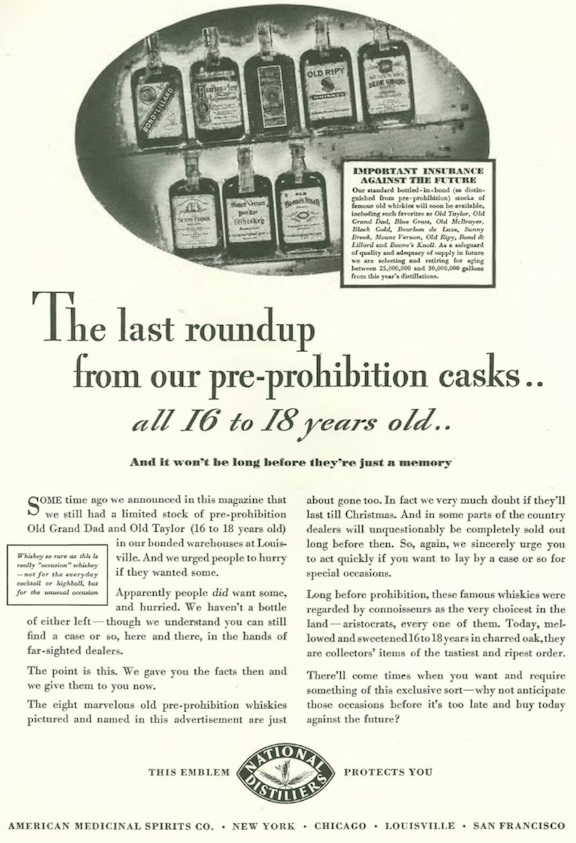
…during Prohibition distillers were allowed to keep stocks of whiskies produced before the 18th Amendment went into force…some of these were distributed through pharmacies during Prohibition for “medicinal purposes”…what was left over was sold after repeal, a stock of “pre-prohibition casks” that would be exhausted before Christmas, or so the ad rather alarmingly suggested…

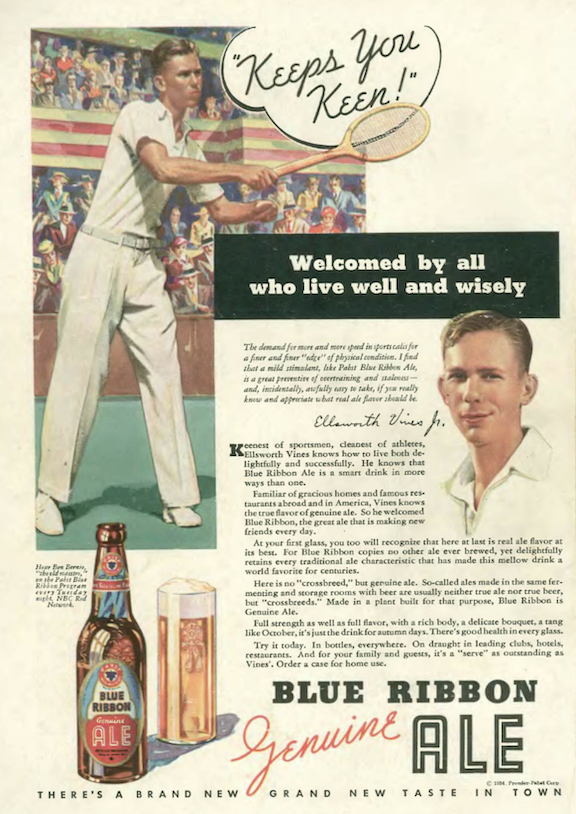
…we first met tennis star Ellsworth Vines Jr a few issues ago when he was touting the health and energy benefits of Camel cigarettes…here he promotes an unlikely “stimulant”—Pabst Blue Ribbon ale…Vines testified that “the demand for more and more speed in sports calls for a finer and finer ‘edge’ of physical condition” and observed that PBR was “a great preventive of overtraining and staleness”…yep, after a few brewskies who feels like doing anything, let alone play tennis?…

…on to our cartoonists we open with a couple of spots by George Shellhase

…and Gregory d’Alessio

William Crawford Galbraith gave us a fish out of water (the caption reads: You New Yorkers didn’t know we were so sophisticated in Detroit, did you?)…

George Price still hadn’t come back to earth in his latest installment…

Gardner Rea illustrated the results of charitable acts by the Junior League…

…and we close with James Thurber, and kindness from a stranger…

Next Time: Portraits and Prayers…

House & Home

The New Yorker’s art and architectural critic Lewis Mumford found much to dislike about urban life, from pretentious ornamentation to the gigantic scale of skyscrapers popping up all over Manhattan. Technology and progress were fine, but when coupled with unbridled capitalism, Mumford believed they created inhuman environments in which the average citizen struggled to survive, let alone thrive.

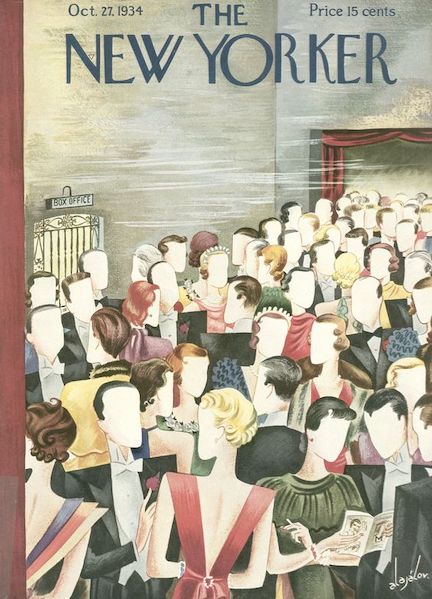
Oct. 27, 1934 cover by Constantin Alajalov.

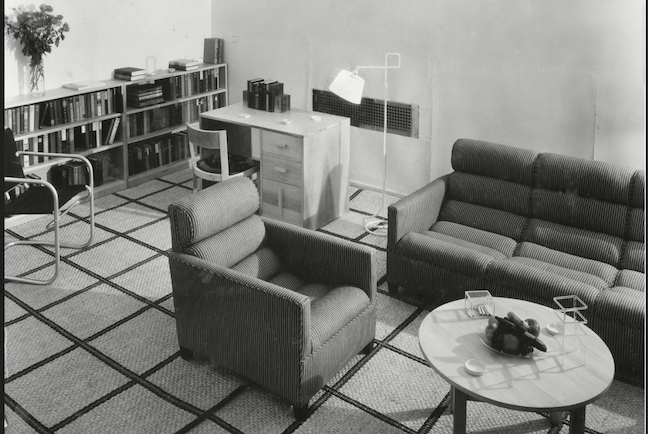
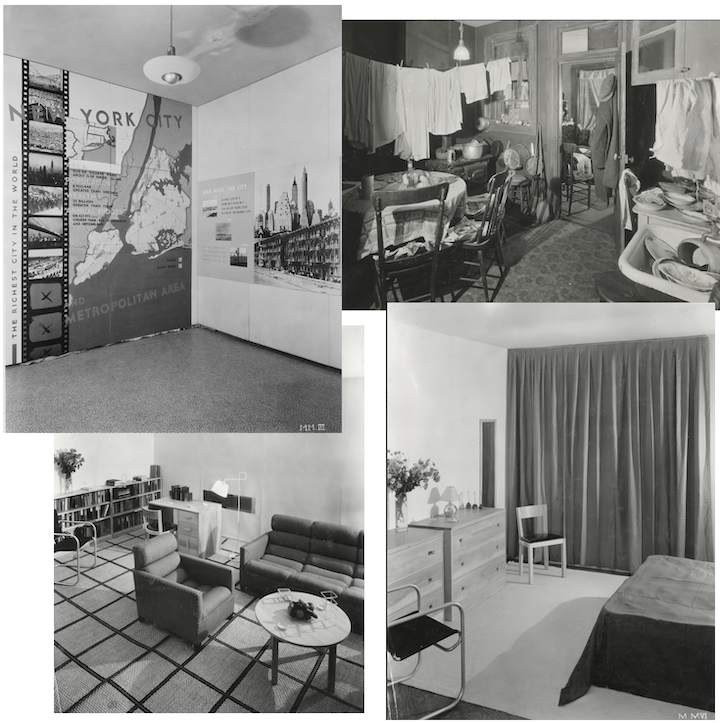
A housing exhibit at the Museum of Modern Art proposed policy and design solutions that addressed housing for the masses in “a human environment,” with European innovations leading the way. The Romanian-born Carol Aronovici (1881-1957), a well-known expert in city planning and public housing, was editor of a companion book to the exhibit, America Can’t Have Housing, in which he included seventeen essays by such experts as architect Walter Gropius, public housing advocate Catherine Bauer, and The New Yorker’s Mumford.

GIVE ME SHELTER…At left, Carol Aronovici’s companion book to the exhibition, with a cover image of the Siemensstadt Housing Development in Berlin, by Walter Gropius; above, excerpts from Lewis Mumford’s essay in the book; below, entrance to the exhibit. (MoMA)

Mumford reviewed the exhibit in his regular column, “The Sky Line.” Excerpts:

BETTER HOMES…Images from the exhibit included the squalor of a tenement (top right) that offered a stark contrast to the clean, modern look inspired by European designers. (MoMA)

 * * *

From Our Advertisers

We once again open the magazine to an odd juxtaposition of canned soup and high fashion…Hormel was pushing their onion soup by linking the product to French nobility (a previous ad featured Napoleon)…at right, illustrator Lyse Darcy created many ads for Guerlain products from the 1930s through the 1950s…

…the Macbeth-Evans Glass Company introduced Americans to a revolution in coffee brewing—the drip method…

…the folks who made Arrow Shirts wanted men to know that its “Thor” model would make them as confident as this man at a business conference…so confident, in fact, that he can appear mildly disinterested as he engages in a game of tic-tac-toe…

…purveyors of high fashion Lord & Taylor offered up a new design twist with this ad rendered in the Courier font…

…Pond’s continued to featured the rich and famous, women who apparently defied age itself with a few dabs of cold cream…the ad featured Alice Erdman, the wife of politician and theater producer Francis Cleveland (President Grover Cleveland’s son) and Long Island society maven Xenia Georgievna of Russia…

BELIEVER…Xenia Georgievna of Russia (1903–1965) was an influential member of New York’s Long Island North Shore society. She is best known for her belief that the imposter Anna Anderson was actually the Grand Duchess Anastasia. (Pinterest)

Newton D. Baker mobilized and presided over the United States Army during World War I, and during the Depression he led a “National Citizens Committee” that he mobilized for human needs…

…this detail from an ad for Webster cigars offered an image of a football game almost unimaginable today…

William Steig offered his cartooning services to the local gas company…

…which segues into more cartoons from the Oct. 27 issue, beginning with this spot from James Thurber

…and a cartoon…

…another in the floating man series by George Price

…and one from Peter Arno, with a classic clueless cuckold…

…on to Nov. 3, 1934…

Nov. 3, 1934 cover by Richard Decker.

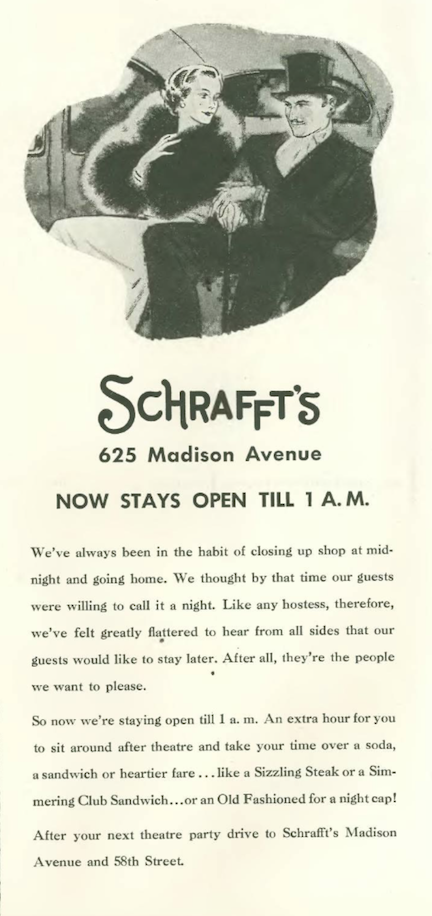
…and straight to the ads, beginning with this one from Schrafft’s, which was a chain of high-volume, moderately priced restaurants in the New York area…despite its affordability, Schrafft’s dining rooms were known for their gentility, an idea conveyed through this ad…

…and here we have another image of a posh couple savoring their downscale dining experience…perhaps they should ask their cook to stop using real turtles…

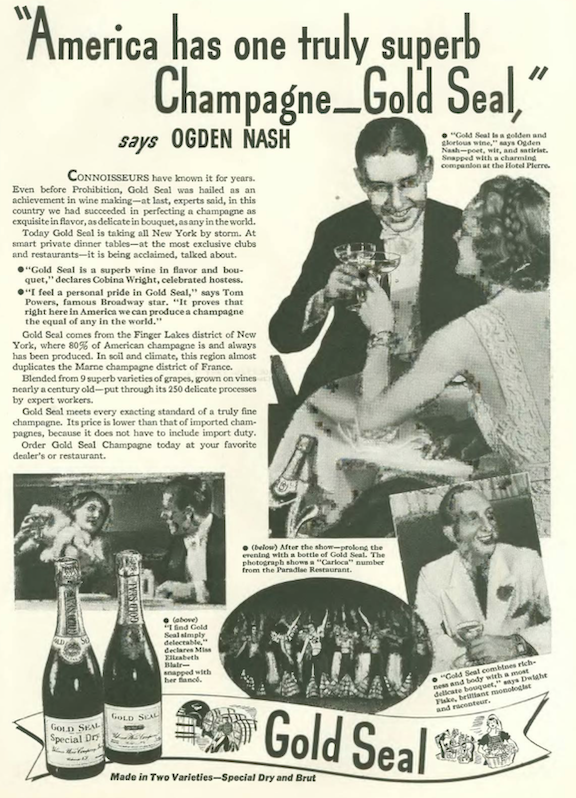
…the makers of Gold Seal “Champagne” lined up poet Ogden Nash to endorse what had to be some pretty awful stuff, even if Dwight Flake, “brilliant monologist and raconteur,” enjoyed its “delicate bouquet”…

…New York debutante Mimi Richardson joined the growing list of distinguished women who preferred puffing on a Camel…

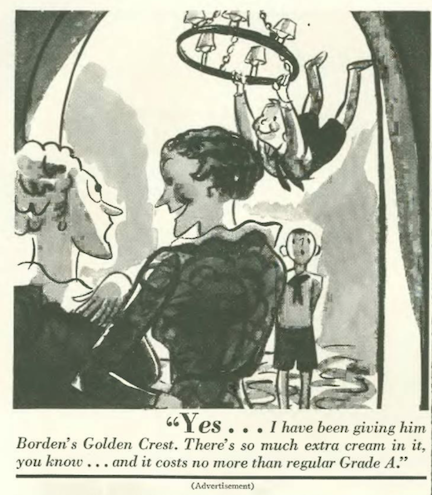
…this back-page ad featured an Arno-esque illustration touting the wonders of Borden’s Golden Crest milk…

…while the real Garrett Price drew up this image for the folks at Heinz…

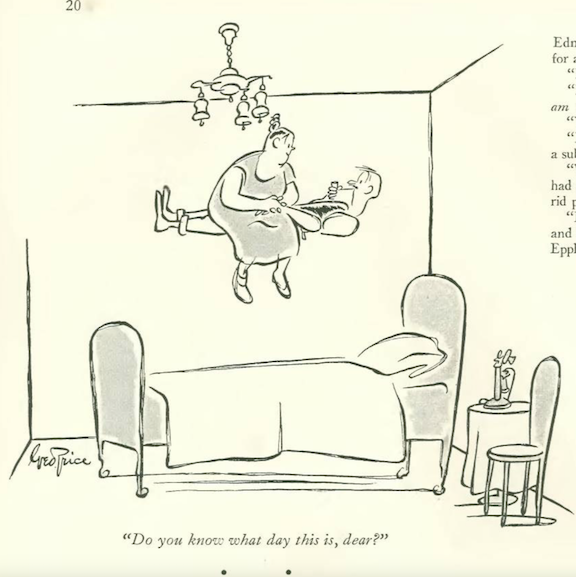
…which brings us to more cartoons, still up in the air with George Price

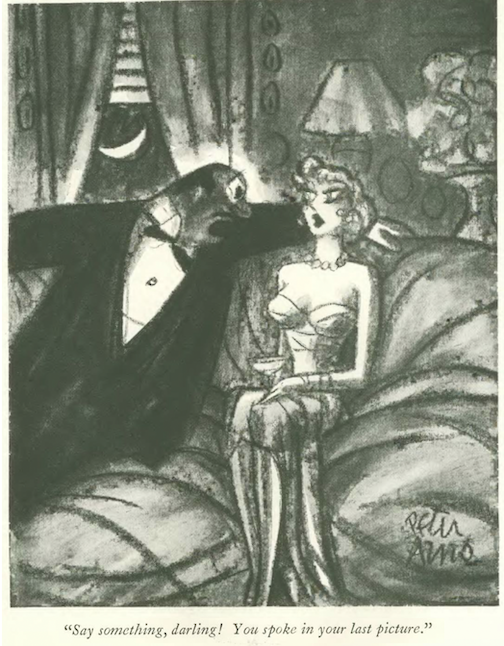
Peter Arno gave us a suitor who was no fan of the silents…

…and we close with James Thurber, and some scandalous dish…

Next Time: The Wahoo Boy…

The Age of Giants

Otto Klemperer rehearsing at the Hollywood Bowl in September 1937. (Los Angeles Philharmonic)

The 20th century was an age of big personalities in classical music, among them Otto Klemperer (1885-1973), a German-born protégé of the composer and conductor Gustav Mahler. Klemperer was already an established conductor in opera houses around Germany when the rise of the Nazis prompted the maestro to emigrate with his family in 1933. He was soon appointed chief conductor of the Los Angeles Philharmonic.

Oct. 13, 1934 cover by Rea Irvin.

Klemperer also guest conducted a number of orchestras in the U.S., including the New York Philharmonic, where his larger than life presence caught the attention of “The Talk of the Town.” Excerpts:

MAESTRO…Top left, Otto Klemperer with Czech composer Leoš Janáček in 1927; at right, with Austrian-American classical pianist and composer Artur Schnabel in 1933; bottom photo, with wife Johanna Geisler, son Werner and daughter Lotte in Los Angeles, 1936. (operaplus.cz/Otto Klemperer Film Foundation/ottoklemperer.nl)

Lauded internationally as a great orchestral commander, in 1939 Klemperer would begin experiencing balance issues. After a tumor the size of a small orange was removed from his brain, he would be left partially paralyzed on his right side; bouts of depression and a manic phase would later land him in a mental hospital. However, by 1946 he would recover his health enough to return to conducting in a career that would last until 1971.

The conductor’s daughter, Lotte Klemperer (1923–2003), would serve as her father’s secretary, negotiator and administrator until his death in 1973. Otto’s son, Werner Klemperer (1920–2000), would become a stage, screen and television actor, most notably portraying Colonel Klink in the 1960s comedy Hogan’s Heroes. Although the role would garner Werner two Emmys, his father never fully understood the series or even the concept of a sitcom. Reluctant to pursue a musical career while his father was alive, Werner would later join the Metropolitan Opera Company in the 1970s, appear in Broadway musicals, and serve as a narrator with a number of American symphony orchestras.

TO THEM HE WAS DAD…At left, daughter Lotte Klemperer with her famous father in 1954. She would serve as his caretaker and business partner after her mother’s death in 1956. At right, son Werner Klemperer acted on Broadway and in films before taking on the role of the bumbling Colonel Klink in the 1960s comedy Hogan’s Heroes, which garnered the actor two Emmys. Although Werner Klemperer was musically inclined, he avoided work in music until the death of his father in 1973. (Otto Klemperer Film Foundation/CBS)

 * * *

Vanished in the Haze

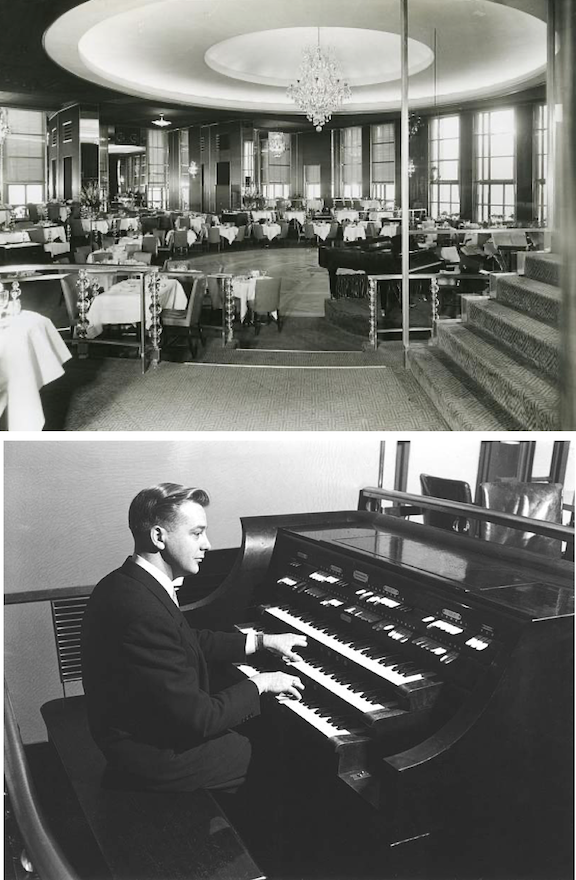
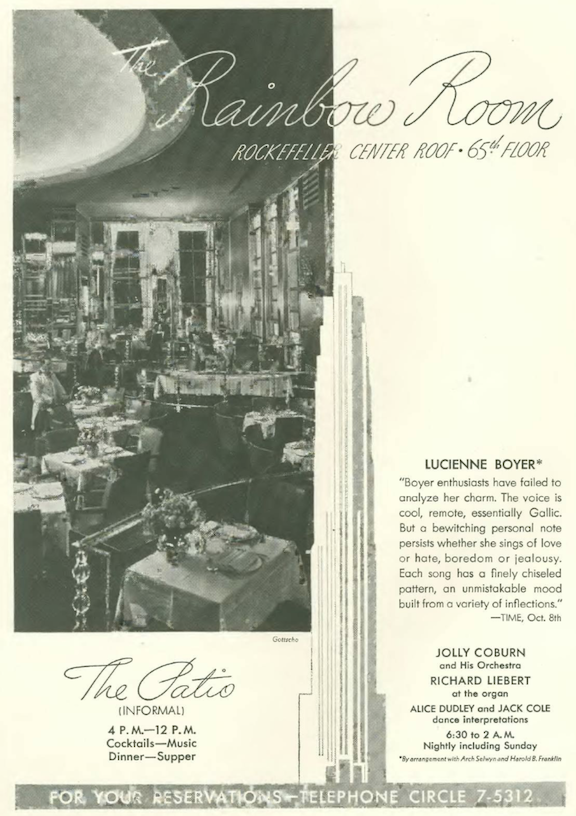
In his “Notes and Comment,” E.B. White lamented what appeared to be the transformation of the familiar night club; high above Manhattan in the Rockefeller Center’s Rainbow Room, the comforting haze of “cigarette smoke, talc, waiter’s venom” had been displaced by air conditioning, and to add to the horror, an organ had been installed that tinged the fox trot “with an odd piety.”

NOWHERE TO HIDE…E.B. White found the lack of haze in the new Rainbow Room disconcerting, not to mention the addition of a Wurlitzer organ, its wonders demonstrated here by organist Ray Bohr in 1934. (Library of Congress/nycago.org)

 * * *

There Oughta Be a Law

While E.B. White was mourning the demise of the smoky nightclub, art and design critic Lewis Mumford continued his tirade against the pretentious and mediocre buildings that were popping up all over the city, including the new Federal Court Building on Centre Street that was, in Mumford’s words, a supreme example of bad design and fake grandeur.

Cass Gilbert's The Federal Courthouse building (United States courthouse) in 1936 (the year of its completion). Located at 40 Centre Street (Foley Square), Manhattan, New York City. In 2001, it was designated as the Thurgood Marshall United States Courthouse.Source: Wurts Brothers Photography Collection at the National Building Museum.
A CRIMINAL CASE…Cass Gilbert’s Federal Courthouse building (United States courthouse) was completed in 1936, two years after Gilbert’s death. In 2001 it was designated as the Thurgood Marshall United States Courthouse. Critic Lewis Mumford called the design, which combined “two unlovely and unrelated forms”…”nothing short of a major crime.” (Wurts Brothers Photography Collection, National Building Museum)

 * * *

Crime of the Century

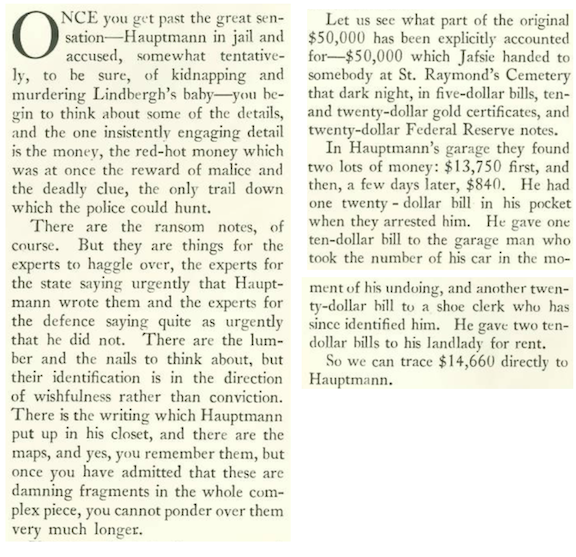
That is what the press called the kidnap and murder of the infant son of Charles Lindbergh and Anne Morrow. In September 1934 a German immigrant carpenter named Bruno Hauptmann was arrested for the crime, and a trial date was set for the following January. In his “A Reporter at Large” column, Morris Markey examined the ransom money trail that led to Hauptmann’s ultimate arrest. Excerpts:

DON’T SAY “CHEESE”…Bruno Hauptmann sits for a mug shot following his arrest for the abduction and murder of the 20-month-old son of Charles Lindbergh and Anne Morrow Lindbergh. (Leslie Jones, Boston Public Library)

 * * *

Should Have Stayed Lost

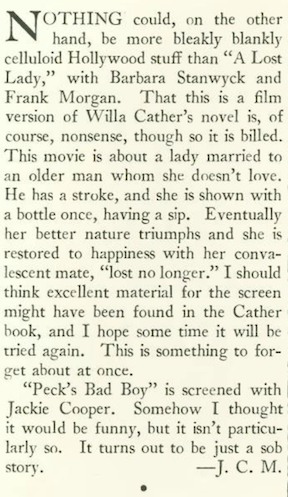
A film version of Willa Cather’s 1923 novel A Lost Lady was first made as a silent by Warner Brothers in 1924 (the film itself is lost) but in 1934 Warner had another go at the novel with a sound version starring starring Barbara Stanwyck, who was emerging as a major star. But Stanwyck’s talents could not overcome a script that critic John Mosher described as bleak, blank nonsense. Cather was so dismayed by the film that she refused to permit another adaptation of any of her novels during her lifetime.

LOST IN TRANSLATION…Barbara Stanwyck and Ricardo Cortez in A Lost Lady (1934). (IMDB)

 * * *

From Our Advertisers

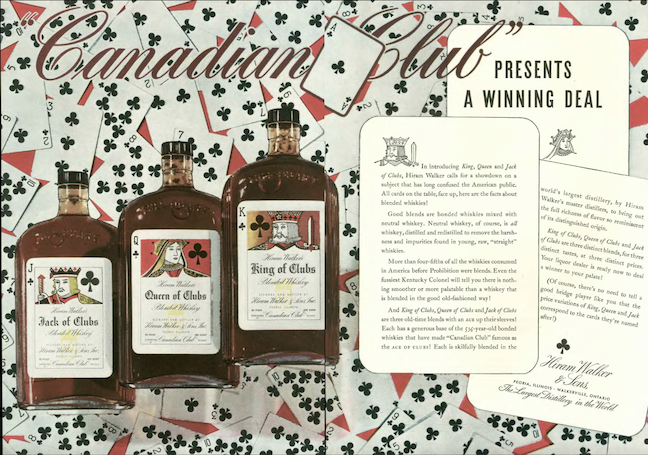
We kick off our sponsors with this two-page center spread from Hiram Walker & Sons, who introduced their new line of playing card-inspired whiskies…

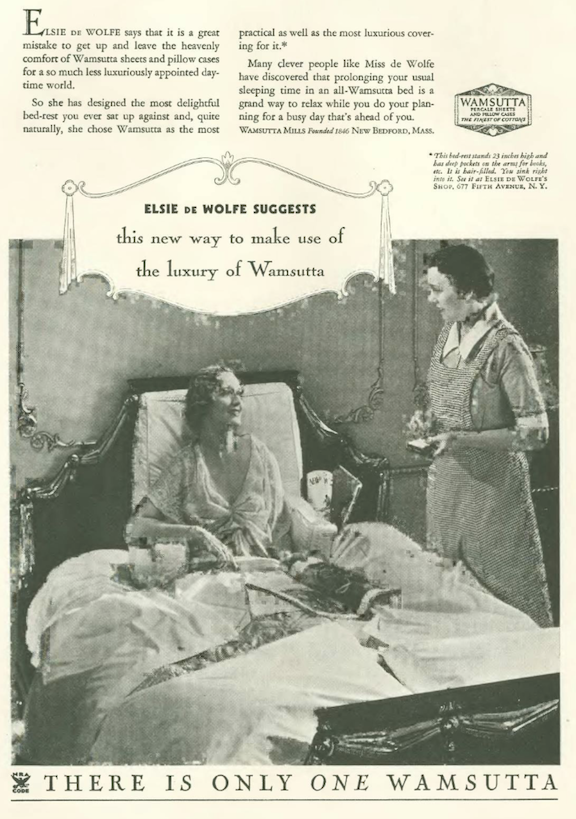
…the New Yorker’s Janet Flanner wrote in 1938 that Elsie de Wolfe invented interior design as a profession, so who was to argue with de Wolfe’s suggestion that the leisure class should linger in bed with the aid of a Wamsutta bed-rest…the small print beneath the logo indicated that the bed-rest was “hair-filled,” which I assume was horse hair, still used today in some luxury brands…

…if de Wolfe was queen of interior designers, then Hattie Carnegie was the “First Lady of Fashion,” or so this ad claimed…

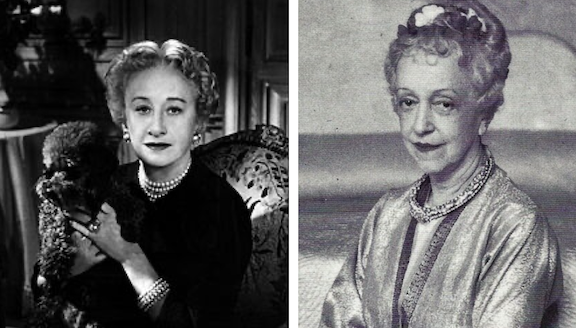
…here are images of the two titans of fashion and good taste…

TASTEMAKERS…At left, Hattie Carnegie aka Henrietta Kanengeiser (1880-1956), and Elsie de Wolfe, aka Lady Mendl (1859–1950). (americacomesalive.com/bureauofinteriors.com)

…and speaking of fashion, here is a llama cloth coat from B. Altman, trimmed in silver raccoon, suitable for Yale football games…based on inflation, that coat today would set you back at least $2,000…

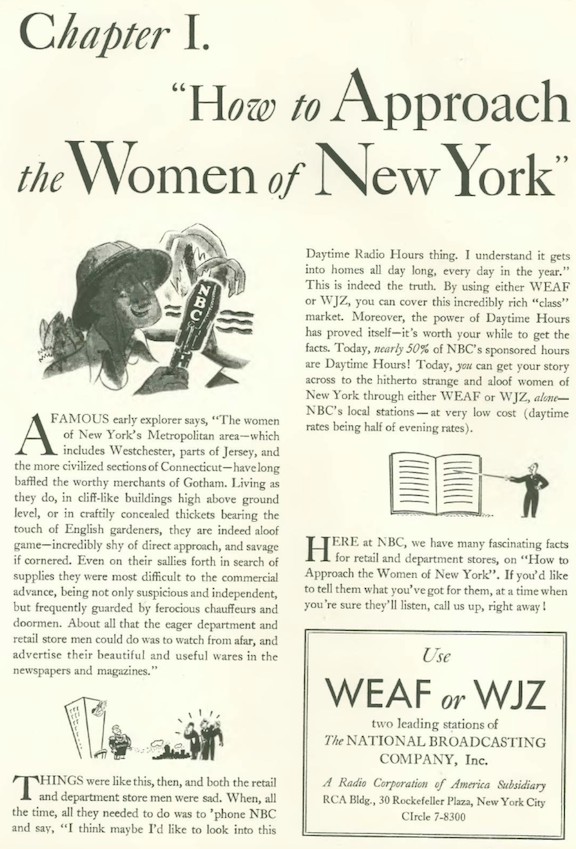
…this condescending ad offered merchants a way to reach the “hitherto strange and aloof women of New York” through daytime advertising…

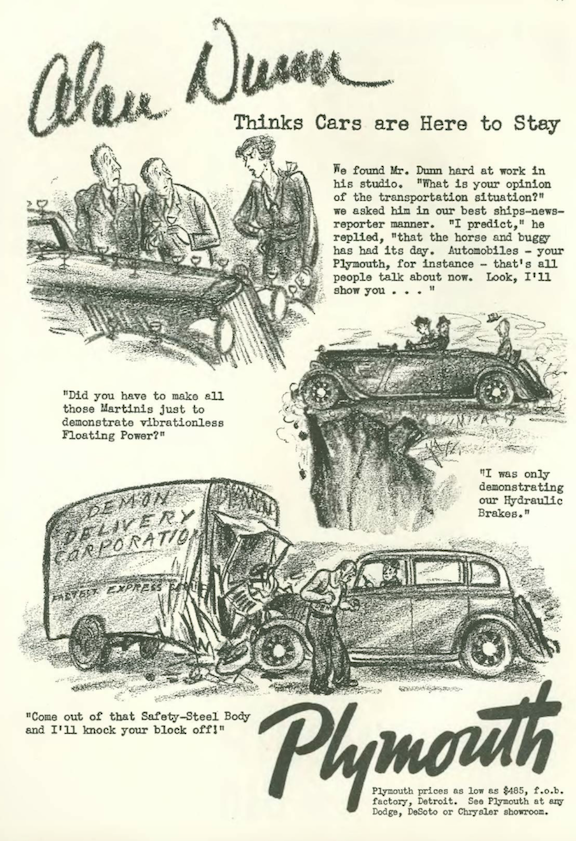
…Plymouth enlisted the talents of Alan Dunn to tout their car’s ride and durability…

…and on to our cartoonists, another from Dunn, a bit of spot art featuring a not so subtle commentary on Lawrence Lee Bazley Angas’s book The Coming American Boom

…and some spot art from Isadore Klein

Miguel Covarrubias contributed to the theater review section…

James Thurber entertained a house guest…

George Price was still up in the air…

Helen Hokinson took a spin with a celebrity look-alike…

…and Barbara Shermund offered another glimpse into the life of a modern woman…

…on to Oct. 20, 1934…

Oct. 20, 1934 cover by Helen Hokinson.

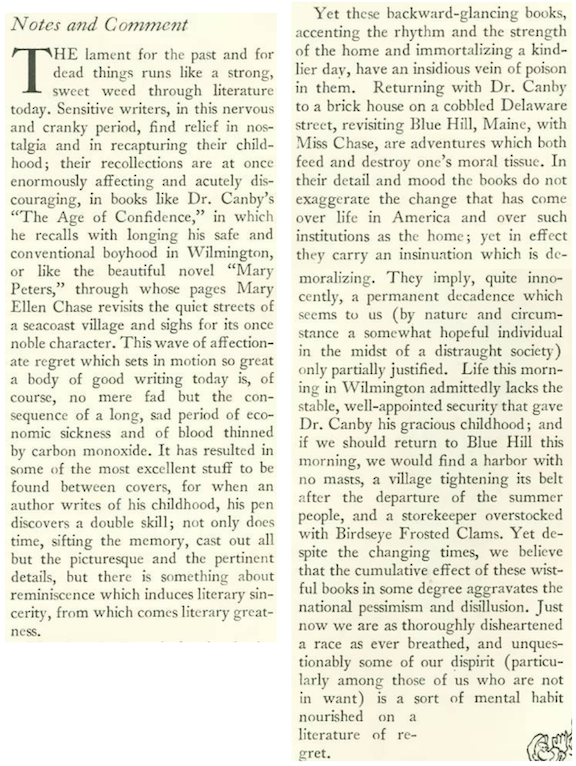
…in which E.B. White offered up a new lament, namely the pervasiveness of nostalgia and sentiment in contemporary literature…

HARKING BACK TO THOSE DAYS OF YORE…E.B. White simply had no stomach for the nostalgic stylings of Mary Ellen Chase (left) or Henry Seidel Canby, seen here on the cover of the May 19, 1924 issue of Time. (U of Maine/Time Inc)

 * * *

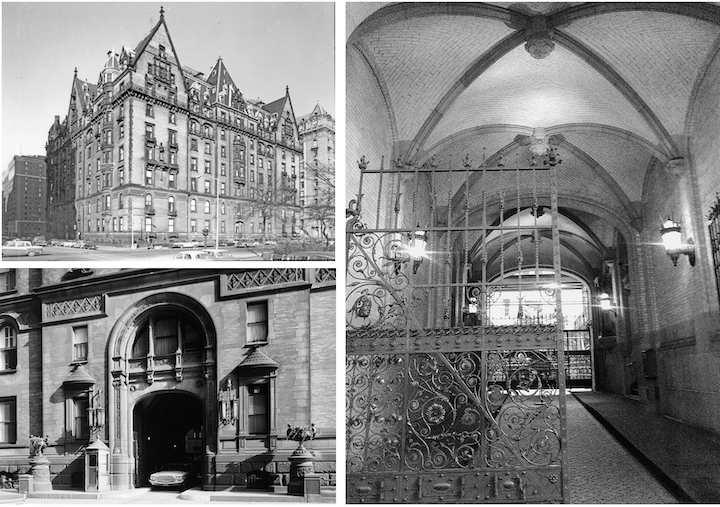
Fifty Years Young

“The Talk of the Town” marked the Dakota’s 50th year at Central Park West, and made note of its loyal and prominent clientele…back in the day it served as a residence for actors such as Lillian Gish, Boris Karloff, and Teresa Wright, and in later years such luminaries as Lauren Bacall, Judy Garland, Rudolf Nureyev, and, of course, John Lennon and Yoko Ono.

THE STORIES IT COULD TELL…At left, the facade and main entrance of the Dakota in the 1960s; at right, inside the main entrance. (Pinterest/Wikipedia)

 * * *

More From Our Advertisers

The Matson-Oceanic Line offered a “millionaire’s idea of a vacation” at an affordable price, and offered this sumptuous image as proof…

…E.B. White wasn’t crazy about the smokeless dazzle of the Rainbow Room, but it proved to be popular among the city’s elite…

…in case one was concerned about the provenance of one’s mink coat, Saks posted this helpful ad. Their high-end, natural-skin minks were priced at $8,000 (roughly $180,000 today); there was, however, a caveat regarding the cheaper models…

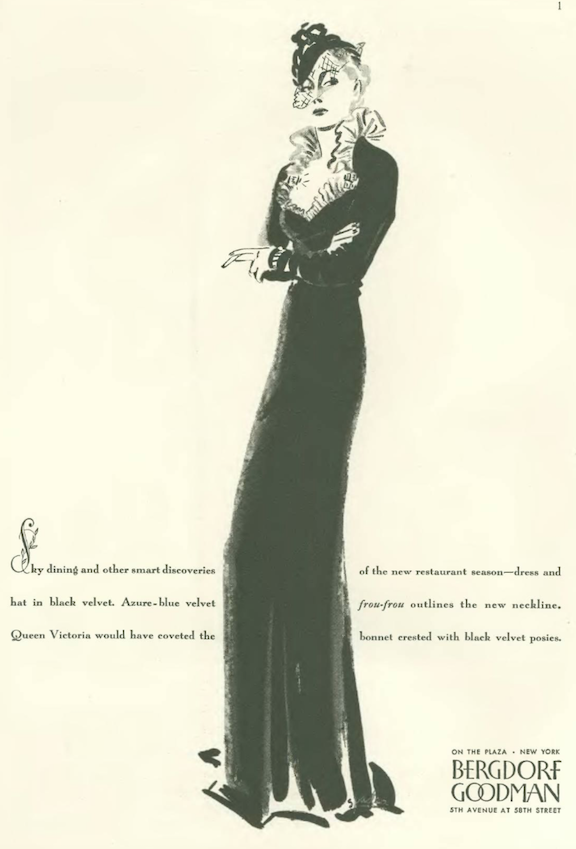
…Bergdorf Goodman offered up another ad featuring an impossibly attenuated model posed with a cigarette, her defiant gaze suggesting her modernity and individualism…

…Plymouth went back to the stable of New Yorker cartoonists, this time featuring the adventures of Helen Hokinson’s “girls”…

…and we segue to the rest of our cartoonists, including this spot by Constantin Alajalov

…and this by George Price

…who also gave us another update on the trials and tribulations of his floating man…

James Thurber occasionally ignored scale in rendering his characters, which didn’t really matter in his strange world…

Jack Markow had some bad news for two sign painters (the caption size is increased for readability)…

…and we close with Peter Arno, and the winner of most original Halloween costume…

…and before I go…this is being posted on Halloween, 2023, so here are a few images from 1934 to get you in the spirit, including a Saturday Evening Post cover, a 1934 party ideas magazine, and a page from Popular Mechanics featuring a smoking robot costume you could make yourself…in the 1930s, Popular Mechanics often featured Halloween party ideas that were downright lethal, usually involving electric shocks, pistols loaded with blanks, that sort of thing.

Happy Halloween!

Next Time: House & Home…

Up In The Air

The 1930s saw steady improvements in the fledging airline industry, which catered mostly to major businesses or well-heeled (and somewhat brave) folks who were interested in getting to places relatively quickly. Margaret Case Harriman reported on the many ways one could criss-cross the country by heading to the Newark Airport, the first major airport to serve the New York metro.

August 11, 1934 cover by Constantin Alajalov.

Writing for the “Out of Town” column, Harriman described how someone in 1934 could make their way to Los Angeles by boarding a 9 a.m. American Airlines flight in Newark and then changing over to a “sleeper plane” in Fort Worth around 10 p.m. that same day (top speed of the fastest plane was about 190 mph or 306 kph. The trip also required stops for refueling). The night flight from Fort Worth would deliver the traveler to Los Angeles the following day, at 7:55 a.m.—the trip totaled about 23 hours.

NIGHTY NIGHT…In 1934 American Airlines was the only airline offering “sleeper planes,” as the ad at left claimed. The head of American Airlines, C.R. Smith, was obsessed with customer service and the amenities offered on his Curtiss Condors—roomy airplanes with sleeping berths that Margaret Case Harriman likened to beds in a Pullman railroad car. Passengers loved the Curtiss Condor, although the planes tended to catch fire and pilots found them difficult to fly. (archbridgeinstitute.org/American Airlines)
SKYTRAIN…Top, the passenger section of an American Airlines Curtiss Condor, circa 1930s; below, interior of a Boeing 247—note the steps in the aisle used to cross over the support beams that reinforced the 247’s wings. Also note the female attendant—the profession was dominated by male stewards in the first years of passenger service, but in the 1930s women took over the profession. (American Airlines/bethelgrapevine.com)
TWENTY-TWO HOURS and change on a United Airlines Boeing 247 would get you from Newark to San Francisco in 1934. Top, Passengers are shown boarding a United Airlines Boeing 247 at the Newark Airport circa 1934; United boasted the fastest multi-motored plane service with the 247, but TWA apparently offered the fastest service between coasts with its sleek new DC-2, seen in photo below. (bethelgrapevine.com)
HARD TO BEAT…A TWA Douglas DC-2 could get you to California faster than either United or American—fifteen hours from Newark to Los Angeles. (wahsonline.com)

When we think of flying in the 1930s many of us recall the great travel posters featuring Pan American’s Clipper Ships—flying boats that took passengers to exotic locations in the Caribbean and in Central and South America. Harriman wrote:

FLYING BOAT…Boasting nautical appointments including porthole windows, Pan Am’s Sikorsky S-42 offered roomy seats to its 32 passengers. Top, a postcard image of a Sikorsky S-42 in Miami in the 1930s; below, passenger cabin of the Sikorsky S-42. (clipperflyingboats.com/seawings.com.uk)

Harriman closed with some advice to readers unfamiliar with flying, including putting drops of Argyrol (a silver-protein antiseptic) into ones eyes to “prevent that ticking sensation in the temples.”

 * * *

No Offense Taken

Critic John Mosher was no fan of Jean Harlow’s, but he did acknowledge her box office appeal, and that fans eagerly awaited the Blonde Bombshell’s next picture, The Girl from Missouri…with its “usual plot of a gold-digger and millionaries.” Mosher also noted that Harlow, along with Mae West, was a prime target of reformers (see Hays Code) who wanted to ban “immorality” from the pictures, and he was eager to see how the Puritans had wielded their new censoring shears on the film.

GOING FOR THE GOLD…At right, Lionel Barrymore, Jean Harlow, and Patsy Kelly in The Girl from Missouri. (IMDB)

 * * *

From Our Advertisers

We begin with another ad from the makers of Spud menthol cigarettes, who deployed what seemed like every known visual metaphor to suggest that smoking their cigarettes “all day” would leave one feeling cool, clean and fresh, in this case as a blanket of newly fallen snow (an appealing sight in that hot summer of 1934)…

…R.J. Reynolds deployed any number of tricks to sell their Camels, from ads promoting their health benefits to endorsements by wealthy socialites, in this case Sarah Lippincott (“Mrs. Nicholas Biddle”) of Philadelphia…

…snob appeal was not limited to cigarette ads, as this full page from the folks at Chevrolet attests…

…zooming in on the copy that accompanied the above ad, we find that this fictive Chevy owner was a “marked woman” sought out by paparazzi and admired by couturiers…

Dr. Seuss continued his series of weird ads for Flit insecticide…

Helen Hokinson illustrated this patrician picnic scene to promote Heinz’s line of sandwich spreads…

…and we kick off our cartoons with Helen again, observing a proud moment…

Robert Day offered this observation on modern architecture…

Rea Irvin skewered the puritan set with his latest bird illustration…

William Steig’s precocious “Small Fry” visited Coney Island…

…and we close with E. Simms Campbell, and a sly introduction…

Next Time: Dizzy Drinks…

Coney Summertime

Above: Wooden Horses(detail) by Reginald Marsh, 1936. Marsh was a frequent visitor to Coney Island, a place that inspired numerous sketches and paintings. (Wadsworth Atheneum Museum of Art)

We officially kick off the summer with a visit to Coney Island, where “The Talk of the Town” took in the latest sights and amusements.

June 16, 1934 cover by Constantin Alajalov.

This excerpted “Talk” piece, attributed either to an “ 

CLANKITY CLANK…The mechanical man referred to in the “Talk” piece was likely similar to the one pictured above in this October 1933 feature in Popular Mechanics. Like many “robots” of that era, they were often pictured smoking cigarettes. (Google books)
WET YOUR WHISTLE…Beer flowed up and down the boardwalk at Coney Island, but if you wanted something stronger you had to stop by the Half Moon Hotel or one of these establishments, Childs (left) or Feltmans’. (www.coneyislandhistory.org)
LEAVE SOME FOR ME…An estimated one million New Yorkers visited Coney Island on July 4, 1934 to get away from the heat of the city. (stuffnobodycaresabout.com)
DIFFERING INTERPRETATIONS…In his 1934 painting, Coney Island (left), artist Paul Cadmus portrayed beachgoers as ridiculous and uncouth rabble, while Cadmus’s friend and fellow artist Reginald Marsh took a somewhat kinder approach to the same subject in his 1936 Coney Island (right). (Jon F. Anderson, Estate of Paul Cadmus, licensed by VAGA, obtained via lacma.org / Syracuse University Art Collection)

Of course it wouldn’t be Coney Island without grisly wax museum scenes inspired by the latest sensational headlines…bank robber John Dillinger was still on the run, and “little June Robles” was finally free and apparently unharmed after being kidnapped and locked in a desert cage for 19 days…

THANKS WINDY CITY…At left, the Chicago World’s Fair inspired Coney Island to build a trackless, bobsled-style “flying turns” coaster in Steeplechase Park (the wooden ride was destroyed by fire after only five years of operation). At right, a postcard image of the Eden Musee wax museum. (riverviewparkchicago.com / New York Public Library)
ON THE BOARDWALK…Another Coney scene by Reginald Marsh, titled Pip and Flip, 1932. (Terra Foundation for American Art, Chicago Daniel J. Terra Collection via artblart.com)

 * * *

Luck of the Irish

The Irish Hospitals’ Sweepstake (more commonly known as the Irish Sweepstakes) was established in 1930 to raise funding for hospitals in Ireland. Although lotteries were generally illegal in the U.S., millions of tickets were sold in the States, many of them in New York and New England. In his “Notes and Comment,” E.B. White wondered what would become of the lottery’s newest American winners, including former Ziegfeld Follies showgirl Alma Mamay, who won $152,000 in the Irish sweepstakes. White might have been pleased to know that Mamay moved to California, married a millionaire oil tycoon, and lived to the age of ninety-one.

CALIFORNY IS THE PLACE YOU OUGHTA BE..Ziegfeld Follies showgirl Alma Mamay took her Sweepstakes winnings and fled to California, where she married a millionaire oil tycoon. (ziegfeldfolliesgirls.com)

 * * *

Rugged Individual

Matthew Alexander Henson (1866–1955) was an African American explorer who accompanied Polar explorer Robert Peary to the Arctic seven times, participating in a 1908–1909 expedition that arguably made Henson the first explorer to reach the geographic North Pole. “The Talk of the Town” caught up with Henson on the feat’s 25th anniversary.

GO NORTH YOUNG MAN…At left, Matthew Henson circa 1910. At right, photograph of Henson and four Inuit guides on the last stretch of their 1908–09 expedition, taken by Robert Peary at what they believed to be the North Pole. Henson (center) planted the flag. (Wikipedia)

 * * *

POTUS Profiled

Pulitizer Prize-winning historian Henry F. Pringle published the first installment of a three-part profile of President Franklin D. Roosevelt. In this excerpt Pringle writes about FDR’s sense of humor (illustration by William Cotton):

 * * *

Mattress Campers

The “About the House” column featured the latest in home-cooling devices. Couldn’t afford the zillions it would cost to install a home air-conditioner? Well the folks at Crosley—an electronics company known for its radios—offered a more affordable solution: an air-conditioned tent that could be erected over one’s bed for $150 (about $3,500 in today’s dollars):

Here is a 1934 ad for the contraption I found at worldradiohistory.com:

…and we continue with more from our advertisers, including the Broadway magazine The Stage, which offered up this idyllic scene showing what folks did in the days before air-conditioning…

…you could also escape the heat by taking to the high seas aboard the Italian liner SS Rex

…seen below arriving in New York in this 1932 photo, the 911-foot SS Rex was the largest ship built in Italy before World War II…it was destroyed by the British RAF in 1944…

(adventures-of-the-blackgang.tumblr.com)

…you could also cool off like these two old gents, sharing a toast and some Budweisers…

…or you could get yourself a jug of applejack brandy and mix it 1:1 with pineapple juice…not sure who or what is being “saved” here…

…long before there were Nikes or Adidas, golfers could hit the links in a pair of Sportocasins…

…Hupmobile was still hanging in there, enlisting the talents of illustrator Herbert Roese to extol the comforts and the beauty of its “air-line design”… it isn’t clear why it required five middle-aged men to take her on that beautiful ride…

…the real-life bellboy Johnny Roventini made his debut in the New Yorker as the spokesman for Phillip Morris cigarettes…

…Roventini (1910–1998), who stood less than four feet tall as an adult, was working as a bellboy at the New Yorker Hotel when he was discovered by an advertising executive in 1933. Apparently the exec had Roventini shout the line “Call for Philip Morris!” and learned the bellboy could repeatedly, and on cue, vocalize a perfect B-flat tone. Representing the company for more than forty years, he helped Lucille Ball and Desi Arnaz with the initial success of I Love Lucy (Philip Morris was the show’s sponsor)…

WHAT’S HIS LINE?…TV producers Mark Goodson, left, and Bill Todman greet Johnny Roventini during a 1952 radio broadcast of their quiz show, What’s My Line? The program’s sponsor was Phillip Morris. Note Goodson and Todman both hold cigarettes. (Wikipedia)

…by the looks of it, Anne Gould (heiress daughter of Jay Gould II and Anne Douglas Graham Gould) didn’t need anyone to tell her what to smoke…

…on to our cartoons, we continue our birdwatching with Rea Irvin…and we also get…

…high-flying nuptials with Isadore Klein

…a mismatch with George Price

…the prospects for war with Otto Soglow

…marital bliss with James Thurber

…and a courtship scene, with an expiration date, from Mary Petty

Next Time: A Ring Ding…